CN115976176A - Target analyte assay methods, mutant CsgG monomers and constructs thereof, and polynucleotide and oligomeric pores - Google Patents
Target analyte assay methods, mutant CsgG monomers and constructs thereof, and polynucleotide and oligomeric pores Download PDFInfo
- Publication number
- CN115976176A CN115976176A CN202210928014.4A CN202210928014A CN115976176A CN 115976176 A CN115976176 A CN 115976176A CN 202210928014 A CN202210928014 A CN 202210928014A CN 115976176 A CN115976176 A CN 115976176A
- Authority
- CN
- China
- Prior art keywords
- iii
- vii
- viii
- polynucleotide
- seq
- Prior art date
- Legal status (The legal status is an assumption and is not a legal conclusion. Google has not performed a legal analysis and makes no representation as to the accuracy of the status listed.)
- Pending
Links
Images


Classifications
-
- C—CHEMISTRY; METALLURGY
- C12—BIOCHEMISTRY; BEER; SPIRITS; WINE; VINEGAR; MICROBIOLOGY; ENZYMOLOGY; MUTATION OR GENETIC ENGINEERING
- C12Q—MEASURING OR TESTING PROCESSES INVOLVING ENZYMES, NUCLEIC ACIDS OR MICROORGANISMS; COMPOSITIONS OR TEST PAPERS THEREFOR; PROCESSES OF PREPARING SUCH COMPOSITIONS; CONDITION-RESPONSIVE CONTROL IN MICROBIOLOGICAL OR ENZYMOLOGICAL PROCESSES
- C12Q1/00—Measuring or testing processes involving enzymes, nucleic acids or microorganisms; Compositions therefor; Processes of preparing such compositions
- C12Q1/68—Measuring or testing processes involving enzymes, nucleic acids or microorganisms; Compositions therefor; Processes of preparing such compositions involving nucleic acids
- C12Q1/6869—Methods for sequencing
-
- C—CHEMISTRY; METALLURGY
- C07—ORGANIC CHEMISTRY
- C07K—PEPTIDES
- C07K14/00—Peptides having more than 20 amino acids; Gastrins; Somatostatins; Melanotropins; Derivatives thereof
- C07K14/195—Peptides having more than 20 amino acids; Gastrins; Somatostatins; Melanotropins; Derivatives thereof from bacteria
- C07K14/24—Peptides having more than 20 amino acids; Gastrins; Somatostatins; Melanotropins; Derivatives thereof from bacteria from Enterobacteriaceae (F), e.g. Citrobacter, Serratia, Proteus, Providencia, Morganella, Yersinia
- C07K14/245—Escherichia (G)
-
- G—PHYSICS
- G01—MEASURING; TESTING
- G01N—INVESTIGATING OR ANALYSING MATERIALS BY DETERMINING THEIR CHEMICAL OR PHYSICAL PROPERTIES
- G01N33/00—Investigating or analysing materials by specific methods not covered by groups G01N1/00 - G01N31/00
- G01N33/48—Biological material, e.g. blood, urine; Haemocytometers
- G01N33/483—Physical analysis of biological material
- G01N33/487—Physical analysis of biological material of liquid biological material
- G01N33/48707—Physical analysis of biological material of liquid biological material by electrical means
- G01N33/48721—Investigating individual macromolecules, e.g. by translocation through nanopores
-
- C—CHEMISTRY; METALLURGY
- C12—BIOCHEMISTRY; BEER; SPIRITS; WINE; VINEGAR; MICROBIOLOGY; ENZYMOLOGY; MUTATION OR GENETIC ENGINEERING
- C12Q—MEASURING OR TESTING PROCESSES INVOLVING ENZYMES, NUCLEIC ACIDS OR MICROORGANISMS; COMPOSITIONS OR TEST PAPERS THEREFOR; PROCESSES OF PREPARING SUCH COMPOSITIONS; CONDITION-RESPONSIVE CONTROL IN MICROBIOLOGICAL OR ENZYMOLOGICAL PROCESSES
- C12Q2565/00—Nucleic acid analysis characterised by mode or means of detection
- C12Q2565/60—Detection means characterised by use of a special device
- C12Q2565/631—Detection means characterised by use of a special device being a biochannel or pore
Landscapes
- Chemical & Material Sciences (AREA)
- Life Sciences & Earth Sciences (AREA)
- Health & Medical Sciences (AREA)
- Engineering & Computer Science (AREA)
- Organic Chemistry (AREA)
- Proteomics, Peptides & Aminoacids (AREA)
- Physics & Mathematics (AREA)
- Molecular Biology (AREA)
- General Health & Medical Sciences (AREA)
- Biochemistry (AREA)
- Biophysics (AREA)
- Biomedical Technology (AREA)
- Wood Science & Technology (AREA)
- Zoology (AREA)
- Genetics & Genomics (AREA)
- Immunology (AREA)
- Analytical Chemistry (AREA)
- Medicinal Chemistry (AREA)
- Microbiology (AREA)
- Biotechnology (AREA)
- Bioinformatics & Cheminformatics (AREA)
- General Engineering & Computer Science (AREA)
- Gastroenterology & Hepatology (AREA)
- Nanotechnology (AREA)
- Urology & Nephrology (AREA)
- Food Science & Technology (AREA)
- Hematology (AREA)
- General Physics & Mathematics (AREA)
- Pathology (AREA)
- Spectroscopy & Molecular Physics (AREA)
- Measuring Or Testing Involving Enzymes Or Micro-Organisms (AREA)
- Peptides Or Proteins (AREA)
- Micro-Organisms Or Cultivation Processes Thereof (AREA)
- Apparatus Associated With Microorganisms And Enzymes (AREA)
- Investigating Or Analyzing Materials By The Use Of Electric Means (AREA)
- Preparation Of Compounds By Using Micro-Organisms (AREA)
- Investigating Or Analysing Biological Materials (AREA)
- Investigating Or Analysing Materials By The Use Of Chemical Reactions (AREA)
- Medicines That Contain Protein Lipid Enzymes And Other Medicines (AREA)
- Enzymes And Modification Thereof (AREA)
Abstract
本发明涉及靶分析物测定方法、突变CsgG单体及其构筑体、及聚核苷酸和寡聚孔。本发明涉及CsgG的突变形式。本发明还涉及使用CsgG的分析物检测和表征。

The present invention relates to methods for measuring target analytes, mutant CsgG monomers and constructs thereof, and polynucleotides and oligomeric pores. The present invention relates to mutated forms of CsgG. The invention also relates to analyte detection and characterization using CsgG.
Description
本申请为申请日为2017年03月02日、申请号为201780014993X、发明名称为“突变孔”的中国专利申请的分案申请。This application is a divisional application of the Chinese patent application with application date of March 2, 2017, application number 201780014993X, and invention name “Mutation Hole”.
技术领域Technical Field
本发明涉及CsgG的突变形式。本发明还涉及使用CsgG的分析物检测和表征。The present invention relates to mutant forms of CsgG. The present invention also relates to analyte detection and characterization using CsgG.
背景技术Background Art
纳米孔感测是一种依赖于观测分析物分子与受体之间的个别结合或相互作用事件的感测方法。可通过在绝缘膜中放置纳米尺寸单孔和测量在分析物分子存在下通过孔的电压驱动的离子转运来产生纳米孔传感器。通过分析物的独特电流标志来揭露分析物的特性,值得注意的是,电流块的持续时间和程度以及电流电平的变化。此类纳米孔传感器是可商购的,如由牛津纳米孔科技有限公司(Oxford Nanopore Technologies Ltd)销售的MinIONTM装置,其包含与电子芯片集成的纳米孔阵列。Nanopore sensing is a sensing method that relies on observing individual binding or interaction events between analyte molecules and receptors. Nanopore sensors can be produced by placing a single nanometer-sized hole in an insulating membrane and measuring the voltage-driven ion transport through the hole in the presence of the analyte molecule. The characteristics of the analyte are revealed by the unique current signature of the analyte, notably, the duration and extent of the current block and the change in the current level. Such nanopore sensors are commercially available, such as the MinIONTM device sold by Oxford Nanopore Technologies Ltd, which comprises a nanopore array integrated with an electronic chip.
目前仍需要横跨广泛应用范围的快速且廉价的核酸(例如DNA或RNA)测序技术。现有技术缓慢且昂贵,这主要是因为其依赖于扩增技术来产生大体积的核酸且需要大量的用于信号检测的专业荧光化学试剂。纳米孔感测具有通过降低核苷酸和所需的试剂的数量来提供快速且廉价的核酸测序的潜能。There remains a need for rapid and inexpensive nucleic acid (e.g., DNA or RNA) sequencing technologies across a wide range of applications. Existing technologies are slow and expensive, primarily because they rely on amplification techniques to produce large volumes of nucleic acid and require large amounts of specialized fluorescent chemical reagents for signal detection. Nanopore sensing has the potential to provide rapid and inexpensive nucleic acid sequencing by reducing the number of nucleotides and reagents required.
使用纳米孔感测进行核酸测序的两个基本组分是(1)控制通过孔的核酸移动和(2)在核酸聚合物通过孔移动时鉴别核苷酸。在过去,为了实现核苷酸鉴别,核酸已通过溶血素突变。这提供了已表明为序列依赖性的电流标志。还表明,大量的核苷酸引起当使用溶血素孔时所观测的电流,使得在所观测的电流与聚核苷酸问题之间具有直接关系。The two essential components of nucleic acid sequencing using nanopore sensing are (1) controlling the movement of nucleic acids through the pore and (2) identifying nucleotides as nucleic acid polymers move through the pore. In the past, nucleic acids have been mutagenized by hemolysin to achieve nucleotide identification. This provides a current signature that has been shown to be sequence dependent. It has also been shown that a large number of nucleotides contribute to the current observed when using hemolysin pores, allowing for a direct relationship between the observed current and the polynucleotide problem.
虽然用于核苷酸鉴别的电流范围已通过溶血素孔突变来改进,但如果核苷酸之间的电流差异可以进一步改进,那么测序系统将具有更高个性能。另外,已观测到,当核酸通过孔移动时,一些电流状态显示很高的变化。还表明,一些突变溶血素孔比其它的显示更高的变化。虽然这些状态的变化可含有序列特异性信息,但期望生产具有低变化的孔以简化系统。还期望降低引起所观测电流的核苷酸数量。Although the current range for nucleotide discrimination has been improved by mutations in the hemolysin pore, if the current difference between nucleotides can be further improved, the sequencing system will have higher performance. In addition, it has been observed that some current states show high variation as nucleic acids move through the pore. It has also been shown that some mutant hemolysin pores show higher variation than others. Although the variation of these states may contain sequence-specific information, it is desirable to produce pores with low variation to simplify the system. It is also desirable to reduce the number of nucleotides that cause the observed current.
发明内容Summary of the invention
本发明人已出人意料地证实,CsgG和其新颖突变可用于表征分析物,如聚核苷酸。本发明涉及突变CsgG单体。本发明人已出人意料地证实,包含新颖突变单体的孔具有增强的评估分析物特征的能力,如聚核苷酸的序列。本发明人已制备出出人意料地提供靶聚核苷酸相对于,如通过孔更加一致移动的突变孔。本发明人已制备出出人意料地显示改进的表征准确度的突变孔。特定来说,本发明人制备的突变孔出人意料地显示电流范围增加和状态变化降低,所述电流范围增加使得更容易在不同核苷酸之间进行鉴别,所述状态变化降低增加信噪比。另外,突变孔出人意料地更容易捕获核苷酸和聚核苷酸。The present inventors have unexpectedly demonstrated that CsgG and novel mutations thereof can be used to characterize analytes, such as polynucleotides. The present invention relates to mutant CsgG monomers. The present inventors have unexpectedly demonstrated that pores comprising novel mutant monomers have an enhanced ability to assess characteristics of analytes, such as the sequence of polynucleotides. The present inventors have prepared mutant pores that unexpectedly provide a more consistent movement of a target polynucleotide relative to, e.g., through the pore. The present inventors have prepared mutant pores that unexpectedly show improved characterization accuracy. In particular, the mutant pores prepared by the present inventors unexpectedly show an increased current range that makes it easier to distinguish between different nucleotides and a reduced state change that increases the signal-to-noise ratio. In addition, the mutant pores unexpectedly capture nucleotides and polynucleotides more easily.
除非相反地陈述,否则本文所公开的所有氨基酸取代、缺失和/或添加均是参考包含SEQ ID NO:2中所示序列的变异体的突变CsgG单体。Unless stated to the contrary, all amino acid substitutions, deletions and/or additions disclosed herein are with reference to mutant CsgG monomers comprising a variant of the sequence shown in SEQ ID NO: 2.
提及包含SEQ ID NO:2中所示序列的变异体的突变CsgG单体,涵盖包含如在如下文所公开的其它SEQ ID NO中陈述的序列变异体的突变CsgG单体。可对包含除SEQ ID NO:2中所示以外的序列变异体的CsgG单体,进行等效于本文所公开的参考包含SEQ ID NO:2中所示序列的变异体的突变CsgG单体的那些取代、缺失和/或添加的氨基酸取代、缺失和/或添加。Reference to a mutant CsgG monomer comprising a variant of the sequence shown in SEQ ID NO: 2 encompasses mutant CsgG monomers comprising sequence variants as set out in other SEQ ID NOs as disclosed below. Amino acid substitutions, deletions and/or additions equivalent to those disclosed herein with reference to a mutant CsgG monomer comprising a variant of the sequence shown in SEQ ID NO: 2 may be made to a CsgG monomer comprising a sequence variant other than that shown in SEQ ID NO: 2.
突变单体可被视为经分离单体。The mutant monomers can be considered as isolated monomers.
特定来说,本发明涉及突变CsgG单体,其中在位置192处的精氨酸(R)已被天冬氨酸(D)、谷氨酰氨(Q)、苯丙氨酸(F)、丝氨酸(S)或苏氨酸(T)取代。本发明人已出人意料地证实,此类单体且特定来说包含R192D取代的单体比在192位置处无取代的单体容易表达许多。当CsgG单体包含这个突变时,产量得到增加。In particular, the present invention relates to mutant CsgG monomers in which the arginine (R) at position 192 has been substituted with aspartic acid (D), glutamine (Q), phenylalanine (F), serine (S) or threonine (T). The inventors have surprisingly demonstrated that such monomers, and in particular monomers comprising the R192D substitution, are much easier to express than monomers without substitution at position 192. When the CsgG monomer comprises this mutation, production is increased.
突变csgG单体可以是:The mutant csgG monomer may be:
-包含SEQ ID NO:2中所示序列的变异体的突变CsgG单体,所述突变CsgG单体包含R97W;- a mutant CsgG monomer comprising a variant of the sequence shown in SEQ ID NO: 2, wherein the mutant CsgG monomer comprises R97W;
-突变CsgG单体,其包含(a)R192D;(b)R97W/Y和/或R93W/Y,优选地R97W、R93W或R93Y和R97Y;(c)K94Q/N;(d)G103K/R和/或T104K/R;和/或(e)F191T,V105、A106和I107的缺失和/或F193、I194、D195、Y196、Q197、R198和L199的缺失。- a mutant CsgG monomer comprising (a) R192D; (b) R97W/Y and/or R93W/Y, preferably R97W, R93W or R93Y and R97Y; (c) K94Q/N; (d) G103K/R and/or T104K/R; and/or (e) F191T, deletion of V105, A106 and I107 and/or deletion of F193, I194, D195, Y196, Q197, R198 and L199.
突变CsgG单体优选地进一步包含Y51A和F56Q。The mutant CsgG monomer preferably further comprises Y51A and F56Q.
特定突变CsgG单体包含SEQ ID NO:2中所示序列的变异体,所述变异体包含以下突变:A specific mutant CsgG monomer comprises a variant of the sequence shown in SEQ ID NO:2, wherein the variant comprises the following mutations:
(1)Y51A、F56Q和R192D;(1) Y51A, F56Q and R192D;
(2)Y51A、F56Q和R97W。(2)Y51A, F56Q and R97W.
(3)Y51A、F56Q、R192D和R97W;(3) Y51A, F56Q, R192D and R97W;
(4)Y51A、F56Q、R192D和R93W;(4) Y51A, F56Q, R192D and R93W;
(5)Y51A、F56Q、R192D、R93Y和R97Y;或(5) Y51A, F56Q, R192D, R93Y and R97Y; or
(6)Y51A、F56Q、R192D和R93W。(6)Y51A, F56Q, R192D and R93W.
(7)根据(1)-(6)中任一项所述的突变,和:(7) The mutation according to any one of (1) to (6), and:
(a)V105、A106和I107的缺失。(a) Deletion of V105, A106 and I107.
(b)K94Q或K94N;(b) K94Q or K94N;
(c)D195、Y196、Q197、R198和L199的缺失或F193、I194、D195、Y196、Q197、R198和L199的缺失;和/或(c) a deletion of D195, Y196, Q197, R198 and L199 or a deletion of F193, I194, D195, Y196, Q197, R198 and L199; and/or
(d)F191T。(d) F191T.
(8)根据(1)-(6)中任一项所述的突变,和:(8) The mutation according to any one of (1) to (6), and:
(i)K94Q和V105、A106和I107的缺失;(i) deletions of K94Q and V105, A106, and I107;
(ii)K94N和V105、A106和I107的缺失;(ii) deletions of K94N and V105, A106, and I107;
(iii)F191T和V105、A106和I107的缺失;(iii) F191T and deletions of V105, A106, and I107;
(iv)K94Q和F191T;(iv) K94Q and F191T;
(v)K94N和F191T;(v) K94N and F191T;
(vi)K94Q、F191T和V105、A106和I107的缺失;或(vi) deletions of K94Q, F191T, and V105, A106, and I107; or
(vii)K94N、F191T和V105、A106和I107的缺失。(vii) K94N, F191T and deletions of V105, A106 and I107.
(9)根据(1)-(8)中任一项所述的突变,和:(9) The mutation according to any one of (1) to (8), and:
-T104K或T104R;-T104K or T104R;
-L90R;-L90R;
-N91R;-N91R;
-I95R;-I95R;
-A99R;-A99R;
-E101K、E101N、E101Q、E101T或E101H;-E101K, E101N, E101Q, E101T or E101H;
-E44N或E44Q;和/或- E44N or E44Q; and/or
-Q42K。-Q42K.
本发明还提供:The present invention also provides:
-一种构筑体,其包含两个或更多个共价连接的CsgG单体,其中所述单体中的至少一个是本发明的突变单体;- a construct comprising two or more covalently linked CsgG monomers, wherein at least one of the monomers is a mutant monomer of the invention;
-一种聚核苷酸,其编码本发明的突变单体或本发明的构筑体;- a polynucleotide encoding a mutant monomer of the invention or a construct of the invention;
-一种同源寡聚孔,其衍生自CsgG,所述同源寡聚孔包含相同的本发明的突变单体或相同的本发明的构筑体;- a homo-oligomeric pore derived from CsgG, said homo-oligomeric pore comprising the same mutant monomer of the invention or the same construct of the invention;
-一种异源寡聚孔,其衍生自CsgG,所述异源寡聚孔包含至少一个本发明的突变单体或至少一个本发明的构筑体;- a hetero-oligomeric pore derived from CsgG, said hetero-oligomeric pore comprising at least one mutant monomer of the invention or at least one construct of the invention;
-一种用于测定靶分析物是否存在或其一或多个特征的方法,其包含:- A method for determining the presence or absence of a target analyte or one or more characteristics thereof, comprising:
(a)使靶分析物与本发明的孔接触,使得靶分析物相对于孔移动;和(a) contacting a target analyte with a pore of the invention such that the target analyte moves relative to the pore; and
(b)在所述分析物相对于所述孔移动时,进行一或多个测量,且从而测定所述分析物是否存在或其一或多个特征;(b) performing one or more measurements as the analyte moves relative to the pore and thereby determining the presence or absence or one or more characteristics of the analyte;
-一种形成用于表征靶聚核苷酸的传感器的方法,其包含在本发明的孔与聚核苷酸结合蛋白之间形成复合体且从而形成用于表征靶聚核苷酸的传感器;- a method of forming a sensor for characterising a target polynucleotide comprising forming a complex between a pore of the invention and a polynucleotide binding protein and thereby forming a sensor for characterising a target polynucleotide;
-一种用于表征靶聚核苷酸的传感器,其包含本发明的孔与聚核苷酸结合蛋白之间的复合体;- a sensor for characterising a target polynucleotide comprising a complex between a pore of the invention and a polynucleotide binding protein;
-一种本发明的孔的用途,其用于测定靶分析物是否存在或其一或多个特征;- Use of a pore according to the invention for determining the presence or absence of a target analyte or one or more characteristics thereof;
-一种用于表征靶分析物的试剂盒,其包含(a)本发明的孔和(b)膜组分;- A kit for characterizing a target analyte, comprising (a) a pore according to the invention and (b) a membrane component;
-一种用于表征样本中的靶分析物的设备,其包含(a)多个本发明的孔和(b)多个膜;- A device for characterizing a target analyte in a sample, comprising (a) a plurality of pores according to the invention and (b) a plurality of membranes;
-一种表征靶聚核苷酸的方法,其包含:- A method for characterizing a target polynucleotide, comprising:
a)使聚核苷酸与本发明的孔、聚合酶和标记核苷酸接触,使得磷酸标记物种通过聚合酶依序添加到靶聚核苷酸中,其中磷酸物种含有对各核苷酸具有特异性的标记;和a) contacting a polynucleotide with a pore of the invention, a polymerase and labelled nucleotides such that phosphate labelling species are sequentially added to the target polynucleotide by the polymerase, wherein the phosphate species contains a label specific for each nucleotide; and
b)使用所述孔检测所述磷酸标记物种,且从而表征所述聚核苷酸;和b) detecting the phosphate-labeled species using the pore and thereby characterizing the polynucleotide; and
-一种生产本发明的突变单体或本发明的构筑体的方法,其包含在合适宿主细胞中表达本发明的聚核苷酸且从而生产本发明的突变单体或构筑体。- A method for producing a mutant monomer of the invention or a construct of the invention, comprising expressing a polynucleotide of the invention in a suitable host cell and thereby producing a mutant monomer or a construct of the invention.
附图说明BRIEF DESCRIPTION OF THE DRAWINGS
图1:示出来自大肠杆菌(E.coli)的CsgG。FIG. 1 : shows CsgG from E. coli.
图2:示出CsgG的尺寸。Figure 2: Showing the size of CsgG.
图3:示出在
图4:示出在
图5:示出在
图6到8:显示与野生型(WT)相比范围增加的突变孔。Figures 6 to 8: Show mutant pores with increased range compared to wild type (WT).
图9和10:显示与野生型(WT)相比输送量增加的突变孔。Figures 9 and 10: Mutant pores showing increased transport compared to wild type (WT).
图11和12:显示与野生型(WT)相比插入增加的突变孔。Figures 11 and 12: Mutant pores showing increased insertion compared to wild type (WT).
图13:显示实例2中使用的DNA构筑体X。标记1的区对应于30个SpC3间隔子。标记2的区对应于SEQ ID NO:42。标记3的区对应于四个iSp18间隔子。标记4的区对应于SEQ IDNO:43。标记5的区段对应于四个5-硝基吲哚。标记6的区对应于SEQ ID NO:44。标记7的区对应于SEQ ID NO:45。标记8的区对应于SEQ ID NO:46,其具有在SEQ ID NO:46的3'端处连接的四个iSp18间隔子(标记9的区)。在iSp18间隔子的相对端是3'胆固醇系链(标记10)。标记11的区对应于四个SpC3间隔子。Figure 13: shows the DNA construct X used in Example 2. The region labeled 1 corresponds to 30 SpC3 spacers. The region labeled 2 corresponds to SEQ ID NO:42. The region labeled 3 corresponds to four iSp18 spacers. The region labeled 4 corresponds to SEQ ID NO:43. The segment labeled 5 corresponds to four 5-nitroindoles. The region labeled 6 corresponds to SEQ ID NO:44. The region labeled 7 corresponds to SEQ ID NO:45. The region labeled 8 corresponds to SEQ ID NO:46, which has four iSp18 spacers connected at the 3' end of SEQ ID NO:46 (region labeled 9). At the opposite end of the iSp18 spacer is a 3' cholesterol tether (labeled 10). The region labeled 11 corresponds to four SpC3 spacers.
图14:显示CsgG蛋白的Strep trap(通用电气医疗集团(GE Healthcare))纯化的实例色谱迹线(x轴标记=洗脱体积(mL)、Y轴标记=吸光度(mAu))。将样本加载到25mMTris、150mM NaCl、2mM EDTA、0.01%DDM中,且用10mM脱硫生物素洗脱。其中CsgG蛋白洗脱的洗脱峰标记为E1。FIG14 : shows an example chromatographic trace of Strep trap (GE Healthcare) purification of CsgG protein (x-axis label = elution volume (mL), Y-axis label = absorbance (mAu)). Samples were loaded into 25 mM Tris, 150 mM NaCl, 2 mM EDTA, 0.01% DDM and eluted with 10 mM desthiobiotin. The elution peak in which the CsgG protein eluted is labeled E1.
图15:显示在初始strep纯化之后CsgG蛋白的典型SDS-PAGE观测的实例。在300V下在1×TGS缓冲液中进行4-20%TGX凝胶(伯乐公司(Bio Rad)电泳22分钟。用宝石红染色剂对凝胶进行染色。泳道1-3显示含有如由箭头指示的CsgG蛋白的主要洗脱峰(图14中的标记E1)。泳道4-6对应于含有杂质的主要洗脱峰(图14中的标记E1)尾部的洗脱份。M显示所使用的分子量标记,所述分子量标记是未染色Novex Sharp(单位=kD)。FIG15 : shows an example of a typical SDS-PAGE observation of CsgG protein after initial strep purification. 4-20% TGX gel (Bio Rad) electrophoresis was performed at 300 V in 1× TGS buffer for 22 minutes. The gel was stained with ruby red stain. Lanes 1-3 show the main elution peak containing CsgG protein as indicated by the arrow (marker E1 in FIG14 ). Lanes 4-6 correspond to the elution fractions at the tail of the main elution peak (marker E1 in FIG14 ) containing impurities. M shows the molecular weight marker used, which is unstained Novex Sharp (unit=kD).
图16:显示CsgG蛋白的尺寸排阻色谱图(SEC)的实例(120mL S200(通用电气医疗集团),x轴标记=洗脱体积(mL)、y轴标记=吸光度(mAu))。在strep纯化和加热蛋白质样本之后,进行SEC。SEC的电泳缓冲液是25mM Tris、150mM NaCl、2mM EDTA、0.01%DDM、0.1%SDS、pH 8.0,且在1毫升/分钟速率下进行色谱柱。标记X的迹线显示在220nm下的吸光度,且标记Y的迹线显示在280nm下的吸光度。收集标记为星形的峰。Figure 16: shows an example of a size exclusion chromatogram (SEC) of CsgG protein (120 mL S200 (GE Healthcare), x-axis label = elution volume (mL), y-axis label = absorbance (mAu)). SEC was performed after strep purification and heating of the protein sample. The running buffer for SEC was 25 mM Tris, 150 mM NaCl, 2 mM EDTA, 0.01% DDM, 0.1% SDS, pH 8.0, and the column was run at 1 mL/min. The trace labeled X shows the absorbance at 220 nm, and the trace labeled Y shows the absorbance at 280 nm. Peaks labeled as stars were collected.
图17:显示在SEC之后CsgG蛋白的典型SDS-PAGE观测的实例。在300V下在1×TGS缓冲液中进行4-20%TGX凝胶(伯乐公司)电泳22分钟,且用宝石红宝染色剂对凝胶进行染色。泳道1显示在strep纯化和加热之后但在SEC之前的CsgG蛋白样本。泳道2-8显示跨大致48mL-60mL图16(中间峰=55mL)电泳且在图16中用星形标记的峰收集的级分。M显示所使用的分子量标记,所述分子量标记是未染色Novex Sharp(单位=kD)。对应于CsgG-Eco孔的条棒由箭头指示。FIG17 : shows an example of a typical SDS-PAGE observation of CsgG protein after SEC. 4-20% TGX gel (Bio-Rad) was run at 300 V for 22 min in 1× TGS buffer and the gel was stained with Ruby Rubis stain.
图18到24:显示与野生型(WT)相比范围增加的突变孔。Figures 18 to 24: Show mutant pores with increased range compared to wild type (WT).
图25到30:显示与野生型(WT)相比范围增加的突变孔。Figures 25 to 30: Show mutant pores with increased range compared to wild type (WT).
图31显示在模拟期间于0和20ns获取(1到3回合),在孔(CsgG-Eco-(Y51T/F56Q)-StrepII(C))9(具有突变Y51T/F56Q的SEQ ID NO:2,其中StrepII(C)是SEQ ID NO:47且在C端处连接,孔突变第20号)上的酶(T4 Dda-(E94C/C109A/C136A/A360C)(具有突变E94C/C109A/C136A/A360C且接着(ΔM1)G1G2的SEQ ID NO:24))的快照。Figure 31 shows snapshots of the enzyme (T4 Dda-(E94C/C109A/C136A/A360C) (SEQ ID NO: 24 with mutations E94C/C109A/C136A/A360C followed by (ΔM1)G1G2)) on the pore (CsgG-Eco-(Y51T/F56Q)-StrepII(C))9 (SEQ ID NO: 2 with mutations Y51T/F56Q, wherein StrepII(C) is SEQ ID NO: 47 and is attached at the C-terminus, pore mutation no. 20) acquired at 0 and 20 ns during the simulation (
图32显示在模拟期间于30和40ns获取(1到3回合),在孔(CsgG-Eco-(Y51T/F56Q)-StrepII(C))9(具有突变Y51T/F56Q的SEQ ID NO:2,其中StrepII(C)是SEQ ID NO:47且在C端处连接,孔突变第20号)上的酶(T4 Dda-(E94C/C109A/C136A/A360C)(具有突变E94C/C109A/C136A/A360C且接着(ΔM1)G1G2的SEQ ID NO:24))的快照。Figure 32 shows snapshots of the enzyme (T4 Dda-(E94C/C109A/C136A/A360C) (SEQ ID NO: 24 with mutations E94C/C109A/C136A/A360C followed by (ΔM1)G1G2)) on the pore (CsgG-Eco-(Y51T/F56Q)-StrepII(C))9 (SEQ ID NO: 2 with mutations Y51T/F56Q, wherein StrepII(C) is SEQ ID NO: 47 and is attached at the C-terminus, pore mutation no. 20) acquired at 30 and 40 ns during the simulation (
图33显示在实例5中描述的模拟期间获取,在孔CsgG-Eco-(Y51A/F56Q/R97W)-StrepII(C))9(具有突变Y51A/F56Q/R97W的SEQ ID NO:2,其中StrepII(C)是SEQ ID NO:47且在C端处连接,孔突变第26号)上的酶(T4 Dda-(E94C/F98W/C109A/C136A/K194L/A360C)(具有突变E94C/F98W/C109A/C136A/K194L/A360C且接着(ΔM1)G1G2的SEQ ID NO:24)的快照。Figure 33 shows snapshots of the enzyme (T4 Dda-(E94C/F98W/C109A/C136A/K194L/A360C) (SEQ ID NO: 24 with mutations E94C/F98W/C109A/C136A/K194L/A360C followed by (ΔM1)G1G2) on the pore CsgG-Eco-(Y51A/F56Q/R97W)-StrepII(C))9 (SEQ ID NO: 2 with mutations Y51A/F56Q/R97W, wherein StrepII(C) is SEQ ID NO: 47 and is linked at the C-terminus, pore mutation no. 26) taken during the simulations described in Example 5.
图34显示电流迹线的两个十秒截屏,其显示在无酶控制的情况下通过MspA突变x=MspA-((Del-L74/G75/D118/L119)D56F/E59R/L88N/D90N/D91N/Q126R/D134R/E139K)8(SEQ ID NO:50,其具有突变D56F/E59R/L88N/D90N/D91N/Q126R/D134R/E139K和氨基酸L74/G75/D118/L119的缺失)的DNA(SEQ ID NO:51)的易位。Figure 34 shows two ten second screenshots of the current trace, which show the translocation of DNA (SEQ ID NO:51) by MspA mutant x=MspA-((Del-L74/G75/D118/L119)D56F/E59R/L88N/D90N/D91N/Q126R/D134R/E139K)8 (SEQ ID NO:50, which has mutations D56F/E59R/L88N/D90N/D91N/Q126R/D134R/E139K and deletion of amino acids L74/G75/D118/L119) in the absence of enzyme control.
图35显示电流迹线的两个十秒截屏,其显示在无酶控制的情况下通过CsgG-Eco-(Y51A/F56Q/R97W/R192D-StrepII(C))9(具有突变Y51A/F56Q/R97W/R192D的SEQ ID NO:2,其中StrepII(C)是SEQ ID NO:47且在C端处连接)的DNA(SEQ ID NO:51)的易位。FIG35 shows two ten second screenshots of a current trace showing translocation of DNA (SEQ ID NO: 51) by CsgG-Eco-(Y51A/F56Q/R97W/R192D-StrepII(C))9 (SEQ ID NO: 2 with mutations Y51A/F56Q/R97W/R192D, wherein StrepII(C) is SEQ ID NO: 47 and is linked at the C-terminus) in the absence of enzyme control.
图36显示电流迹线的两个十秒截屏,其显示在无酶控制的情况下通过CsgG-Eco-(Y51A/F56Q/R97W/E101S/R192D-StrepII(C))9(具有突变Y51A/F56Q/R97W/E101S/R192D的SEQ ID NO:2,其中StrepII(C)是SEQ ID NO:47且在C端处连接)的DNA(SEQ ID NO:51)的易位。FIG36 shows two ten second screenshots of a current trace showing translocation of DNA (SEQ ID NO: 51) by CsgG-Eco-(Y51A/F56Q/R97W/E101S/R192D-StrepII(C))9 (SEQ ID NO: 2 with mutations Y51A/F56Q/R97W/E101S/R192D, wherein StrepII(C) is SEQ ID NO: 47 and is linked at the C-terminus) in the absence of enzyme control.
图37显示CsgG突变孔的两个凝胶过滤色谱图(120ml S200色谱柱)的重叠,所述CsgG突变孔:A)CsgG-Eco-(Y51A/F56Q/R97W)-StrepII(C))9(具有突变Y51A/F56Q/R97W的SEQ ID NO:2,其中StrepII(C)是SEQ ID NO:47且在C端处连接);和B)CsgG-Eco-(Y51A/F56Q/R97W/R192D)-StrepII(C))9(具有突变Y51A/F56Q/R97W/R192D的SEQ ID NO:2,其中StrepII(C)是SEQ ID NO:47且在C端处连接)。CsgG-Eco-(Y51A/F56Q/R97W)-StrepII(C))9在A280下的吸光度标记为A,且CsgG-Eco-(Y51A/F56Q/R97W/R192D)-StrepII(C))9在A280下的吸光度标记为B。使两个构筑体均在500ml培养基中生长。使用加载到上色谱柱完全相同的方案和相同的体积来对两个蛋白质进行表达和纯化。电泳缓冲液是25mM Tris、150mMNaCl、2mM EDTA、0.01%DDM、0.1%SDS pH8。CsgG-Eco-(Y51A/F56Q/R97W)-StrepII(C))9孔的级分延迟是归因于在AKTA纯化器10上使用的不同连接配置。吸光度值的差异指示所表达的蛋白质的量,其中吸光度值越高指示所表达的蛋白质的量越高。Figure 37 shows an overlay of two gel filtration chromatograms (120 ml S200 column) of CsgG mutant pores: A) CsgG-Eco-(Y51A/F56Q/R97W)-StrepII(C))9 (SEQ ID NO:2 with mutations Y51A/F56Q/R97W, wherein StrepII(C) is SEQ ID NO:47 and is linked at the C-terminus); and B) CsgG-Eco-(Y51A/F56Q/R97W/R192D)-StrepII(C))9 (SEQ ID NO:2 with mutations Y51A/F56Q/R97W/R192D, wherein StrepII(C) is SEQ ID NO:47 and is linked at the C-terminus). The absorbance at A280 of CsgG-Eco-(Y51A/F56Q/R97W)-StrepII(C))9 is labeled A and the absorbance at A280 of CsgG-Eco-(Y51A/F56Q/R97W/R192D)-StrepII(C))9 is labeled B. Both constructs were grown in 500 ml of culture medium. Both proteins were expressed and purified using exactly the same protocol and the same volumes loaded onto the upper chromatography column. The running buffer was 25 mM Tris, 150 mM NaCl, 2 mM EDTA, 0.01% DDM, 0.1
图38显示CsgG纳米孔的SDS-PAGE分析。泳道A-C含有CsgG-Eco-(Y51A/F56Q/R97W)-StrepII(C))9;泳道D-F含有CsgG-Eco-(Y51A/F56Q/R97W/R192D)-StrepII(C))9;和泳道M含有分子量标记。使用完全相同的方案来表达和纯化两个孔。在4-20%TGX凝胶(伯乐公司,目录号5671093)上在TGS缓冲液中在300V下使孔进行电泳22分钟。用宝石红染色剂(生命技术公司(Life Technologies),目录号S1200)对凝胶进行染色。将相同体积的各孔样本加载到凝胶上,以比较在纯化之后所获得的蛋白质的量——泳道A和D含有5μL,泳道B和E含有10μL且泳道C和F含有15μL。FIG38 shows SDS-PAGE analysis of CsgG nanopores. Lanes A-C contain CsgG-Eco-(Y51A/F56Q/R97W)-StrepII(C))9; lanes D-F contain CsgG-Eco-(Y51A/F56Q/R97W/R192D)-StrepII(C))9; and lane M contains molecular weight markers. Exactly the same protocol was used to express and purify both pores. The pores were electrophoresed on 4-20% TGX gels (Bio-Rad, catalog number 5671093) in TGS buffer at 300 V for 22 minutes. The gel was stained with Ruby Red stain (Life Technologies, catalog number S1200). The same volume of each well sample was loaded onto the gel to compare the amount of protein obtained after purification - lanes A and D contained 5 μL, lanes B and E contained 10 μL and lanes C and F contained 15 μL.
图39显示相较于基线孔突变28(CsgG-(WT-Y51A/F56Q/R97W/R192D-StrepII)9)的basecall准确度的八个CsgG突变孔的basecall准确度。除由突变28中的R97W和R192D取代造成的准确度改进以外,D195-L199(突变A)、F193-L199(突变B)或V105-I107(突变D)的缺失,或F191T(突变C)的取代使得准确度进一步改进。还在含有额外K94Q突变(突变E)的突变孔中测试了对于缺失V105-I107的basecall准确度的效果,且仍观测到准确度相较于基线突变28的改进。引入R93W突变(突变F)或两个R93Y和R97W突变(突变H)而非R97W突变(基线突变28),增加basecall准确度。除R93W(突变G)以外的缺失D195-L199引起basecall准确度增强。FIG39 shows the basecall accuracy of eight CsgG mutant wells compared to the basecall accuracy of the baseline well mutation 28 (CsgG-(WT-Y51A/F56Q/R97W/R192D-StrepII)9). In addition to the accuracy improvements caused by the R97W and R192D substitutions in
图40显示基线突变28CsgG-(WT-Y51A/F56Q/R97W/R192D-StrepII)9和突变D的模板速度分布(A)和模板准确度分布(B),所述突变D包含额外的V105-I107的缺失。如实例中所描述,制备模板DNA,且通过突变孔。如实例中所描述,测定模板速度和准确度。图40A显示,当使用突变D时,速度分布相较于基线突变更为紧密。图40B显示,突变D相较于基线突变具有更紧密的模板分布。Figure 40 shows the template velocity distribution (A) and template accuracy distribution (B) for the baseline mutation 28CsgG-(WT-Y51A/F56Q/R97W/R192D-StrepII)9 and mutation D, which contains the additional deletion of V105-I107. Template DNA was prepared as described in the Examples and passed through the mutation well. Template velocity and accuracy were determined as described in the Examples. Figure 40A shows that when mutation D was used, the velocity distribution was tighter than the baseline mutation. Figure 40B shows that mutation D had a tighter template distribution than the baseline mutation.
图41显示实例“波浪线”,其显示通过基线突变28CsgG-(WT-Y51A/F56Q/R97W/R192D-StrepII)9呈现的“噪声”孔误差模式。图41的上图显示在“良好”和“噪声”孔状态期间,通过孔的电流流的差异。图41的下图显示从“良好”状态过渡到“噪声”状态的放大图。Figure 41 shows an example "wavy line" showing a "noisy" pore error pattern presented by the baseline mutation 28CsgG-(WT-Y51A/F56Q/R97W/R192D-StrepII) 9. The top panel of Figure 41 shows the difference in current flow through the pore during the "good" and "noisy" pore states. The bottom panel of Figure 41 shows a zoomed-in view of the transition from the "good" state to the "noisy" state.
图42显示平均在至少5个回合内,与基线突变28具有相同序列但当相较于基线突变28时具有额外K94N突变(突变I)或额外K94Q突变(突变J)的突变孔的噪声孔状态的减少,所述基线突变28含有Y51A/F56Q/R97W/R192D突变。Figure 42 shows the reduction in noisy pore states of mutant pores having the same sequence as
图43示出具有接合到其每一端的衔接子的模板链的结构。衔接子具有与其预结合的T4 Dda解螺旋酶。实例中使用的衔接子的各部分的序列显示于SEQ ID NO:52到55中。Figure 43 shows the structure of a template strand with an adaptor attached to each end thereof. The adaptor has T4 Dda helicase pre-bound to it. The sequences of the various parts of the adaptor used in the Examples are shown in SEQ ID NOs: 52 to 55.
图44显示突变CsgG纳米孔的凝血酶结合适体(TBA)事件之间的中值时间,所述突变CsgG纳米孔包含以下取代中的一个:Q42K(突变K)、E44N(突变L)、E44Q(突变M)、L90R(突变N)、N91R(突变O)、I95R(突变P)、A99R(突变Q)、E101H(突变R)、E101K(突变S)、E101N(突变T)、E101Q(突变U)、E101T(突变V)和Q114K(突变W)。中值时间相较于基线孔显著降低,所述基线孔包含突变Y51A/F56Q/K94Q/R97W/R192D-del(V105-I107)(基线突变E),其所有也包括于所测试13个突变中的每一个中。Figure 44 shows the median time between thrombin binding aptamer (TBA) events for mutant CsgG nanopores comprising one of the following substitutions: Q42K (mutation K), E44N (mutation L), E44Q (mutation M), L90R (mutation N), N91R (mutation O), I95R (mutation P), A99R (mutation Q), E101H (mutation R), E101K (mutation S), E101N (mutation T), E101Q (mutation U), E101T (mutation V), and Q114K (mutation W). The median time was significantly reduced compared to the baseline pore comprising mutations Y51A/F56Q/K94Q/R97W/R192D-del(V105-I107) (baseline mutation E), all of which were also included in each of the 13 mutations tested.
图44显示Q42K、E44N、E44Q、L90R、N91R、I95R、A99R、E101H、E101K、E101N、E101Q、E101T和Q114K取代中的每一个增加模板DNA捕获速率。FIG. 44 shows that each of the Q42K, E44N, E44Q, L90R, N91R, I95R, A99R, E101H, E101K, E101N, E101Q, E101T, and Q114K substitutions increased template DNA capture rate.
图45显示对应于SEQ ID NO 2、5、6、7、27、28、29、30、32、36、3、35、31、40、33、34、37、39、38、41和4的21种CsgG同源物的序列比对Figure 45 shows the sequence alignment of 21 CsgG homologues corresponding to
图46显示与图45相同的相对序列比对,其中所预测的α螺旋二级结构区另外加阴影。Figure 46 shows the same relative sequence alignment as Figure 45, with the predicted alpha-helical secondary structure regions additionally shaded.
图47显示与图45相同的相对序列比对,其中所预测的β折叠二级结构区另外加阴影。Figure 47 shows the same relative sequence alignment as Figure 45, with the predicted beta-sheet secondary structure regions additionally shaded.
图48显示孔AQ和孔97W的原始电子资料的两个实例。FIG. 48 shows two examples of raw electronic data for hole AQ and hole 97W.
序列表的描述Description of the Sequence Listing
SEQ ID NO:1显示来自大肠杆菌(Escherchia coli)菌株K-12亚株MC4100的编码野生型CsgG单体的密码子优化聚核苷酸序列。这个单体不含信号序列。SEQ ID NO: 1 shows the codon-optimized polynucleotide sequence encoding the wild-type CsgG monomer from Escherichia coli strain K-12 substrain MC4100. This monomer does not contain a signal sequence.
SEQ ID NO:2显示来自大肠杆菌菌株K-12亚株MC4100的野生型CsgG单体的成熟形式的氨基酸序列。这个单体不含信号序列。对于此使用的缩写为CsgG=CsgG-Eco。SEQ ID NO: 2 shows the amino acid sequence of the mature form of the wild-type CsgG monomer from E. coli strain K-12 substrain MC4100. This monomer does not contain a signal sequence. The abbreviation used herein is CsgG=CsgG-Eco.
SEQ ID NO:3显示假定蛋白CKO_02032[差异柠檬酸杆菌属(Citrobacter koseri)ATCC BAA-895]的YP_001453594.1:1-248的氨基酸序列,其与SEQ ID NO:2 99%一致。SEQ ID NO:3 shows the amino acid sequence of YP_001453594.1:1-248 of the hypothetical protein CKO_02032 [Citrobacter koseri ATCC BAA-895], which is 99% identical to SEQ ID NO:2.
SEQ ID NO:4显示卷曲生产组合件/转运组分CsgG、部分[肠道沙门氏菌(Salmonella enterica)]的WP_001787128.1:16-238的氨基酸序列,其与SEQ ID NO:298%。SEQ ID NO:4 shows the amino acid sequence of the curli production assembly/transport component CsgG, part of WP_001787128.1:16-238 of [Salmonella enterica], which is 98% identical to SEQ ID NO:2.
SEQ ID NO:5显示卷曲生产组合件/转运蛋白CsgG[无丙二酸柠檬酸杆菌属(Citrobacter amalonaticus)]的KEY44978.1|:16-277的氨基酸序列,其与SEQ ID NO:298%一致。SEQ ID NO:5 shows the amino acid sequence of KEY44978.1|:16-277 of the curli production assembly/transporter CsgG [Citrobacter amalonaticus], which is 98% identical to SEQ ID NO:2.
SEQ ID NO:6显示卷曲生产组合件/转运组分[鼠柠檬酸杆菌ICC168(Citrobacterrodentium ICC168)]的YP_003364699.1:16-277的氨基酸序列,其与SEQ ID NO:2 97%一致。SEQ ID NO:6 shows the amino acid sequence of YP_003364699.1:16-277 of the curli production assembly/transport component [Citrobacterrodentium ICC168], which is 97% identical to SEQ ID NO:2.
SEQ ID NO:7显示卷曲生产组合件/转运组分CsgG[阿氏肠杆菌LF7a(Enterobacter asburiae LF7a)]的YP_004828099.1:16-277的氨基酸序列,其与SEQ IDNO:2 94%一致。SEQ ID NO:7 shows the amino acid sequence of YP_004828099.1:16-277 of the curli production assembly/transport component CsgG [Enterobacter asburiae LF7a], which is 94% identical to SEQ ID NO:2.
SEQ ID NO:8显示编码Phi29 DNA聚合酶的聚核苷酸序列。SEQ ID NO: 8 shows the polynucleotide sequence encoding Phi29 DNA polymerase.
SEQ ID NO:9显示Phi29 DNA聚合酶的氨基酸序列。SEQ ID NO: 9 shows the amino acid sequence of Phi29 DNA polymerase.
SEQ ID NO:10显示衍生自大肠杆菌sbcB基因的密码子优化聚核苷酸序列。其编码大肠杆菌核酸外切酶I(EcoExo I)。SEQ ID NO: 10 shows a codon-optimized polynucleotide sequence derived from the E. coli sbcB gene, which encodes E. coli exonuclease I (EcoExo I).
SEQ ID NO:11显示大肠杆菌核酸外切酶I(EcoExo I)的氨基酸序列。SEQ ID NO: 11 shows the amino acid sequence of Escherichia coli exonuclease I (EcoExo I).
SEQ ID NO:12显示衍生自大肠杆菌xthA基因的密码子优化聚核苷酸序列。其编码大肠杆菌核酸外切酶III。SEQ ID NO: 12 shows a codon-optimized polynucleotide sequence derived from the E. coli xthA gene, which encodes the E. coli exonuclease III.
SEQ ID NO:13显示大肠杆菌核酸外切酶III的氨基酸序列。这个酶执行来自双链DNA(dsDNA)的一条链的5'单磷酸酯核苷在3'-5'方向上的分配消化。链上的酶起始需要大致4个核苷酸的5'悬突。SEQ ID NO: 13 shows the amino acid sequence of E. coli exonuclease III. This enzyme performs distributive digestion of 5' monophosphate nucleosides from one strand of double-stranded DNA (dsDNA) in the 3'-5' direction. Enzyme initiation on the strand requires a 5' overhang of approximately 4 nucleotides.
SEQ ID NO:14显示衍生自极端嗜热菌(T.thermophilus)recJ基因的密码子优化聚核苷酸序列。其编码极端嗜热菌RecJ酶(TthRecJ-cd)。SEQ ID NO: 14 shows a codon-optimized polynucleotide sequence derived from the T. thermophilus recJ gene, which encodes the T. thermophilus RecJ enzyme (TthRecJ-cd).
SEQ ID NO:15显示极端嗜热菌RecJ酶(TthRecJ-cd)的氨基酸序列。这个酶执行来自ssDNA的5'单磷酸酯核苷在5'-3'方向上的进行性消化。链上的酶起始需要至少4个核苷酸。SEQ ID NO: 15 shows the amino acid sequence of the extreme thermophilic bacterium RecJ enzyme (TthRecJ-cd). This enzyme performs a processive digestion of 5' monophosphate nucleosides from ssDNA in the 5'-3' direction. Enzyme initiation on the chain requires at least 4 nucleotides.
SEQ ID NO:16显示衍生自噬菌体λexo(redX)基因的密码子优化聚核苷酸序列。其编码噬菌体λ核酸外切酶。SEQ ID NO: 16 shows a codon-optimized polynucleotide sequence derived from the bacteriophage lambda exo (redX) gene, which encodes the bacteriophage lambda exonuclease.
SEQ ID NO:17显示噬菌体λ核酸外切酶的氨基酸序列。所述序列是组装成三聚体的三个相同亚基中的一个。所述酶执行来自dsDNA的一个链的核苷酸在5'-3'方向上的高度进行性消化(http://www.neb.com/nebecomm/products/productM0262.asp)。链上的酶起始优选地需要具有5'磷酸的大致4个核苷酸的5'悬突。SEQ ID NO: 17 shows the amino acid sequence of bacteriophage lambda exonuclease. The sequence is one of three identical subunits assembled into a trimer. The enzyme performs a highly processive digestion of nucleotides from one strand of dsDNA in the 5'-3' direction (http://www.neb.com/nebecomm/products/productM0262.asp). Enzyme initiation on the strand preferably requires a 5' overhang of approximately 4 nucleotides with a 5' phosphate.
SEQ ID NO:18显示Hel308 Mbu的氨基酸序列。SEQ ID NO: 18 shows the amino acid sequence of Hel308 Mbu.
SEQ ID NO:19显示Hel308 Csy的氨基酸序列。SEQ ID NO: 19 shows the amino acid sequence of Hel308 Csy.
SEQ ID NO:20显示Hel308 Tga的氨基酸序列。SEQ ID NO: 20 shows the amino acid sequence of Hel308 Tga.
SEQ ID NO:21显示Hel308 Mhu的氨基酸序列。SEQ ID NO: 21 shows the amino acid sequence of Hel308 Mhu.
SEQ ID NO:22显示TraI Eco的氨基酸序列。SEQ ID NO: 22 shows the amino acid sequence of TraI Eco.
SEQ ID NO:23显示XPD Mbu的氨基酸序列。SEQ ID NO: 23 shows the amino acid sequence of XPD Mbu.
SEQ ID NO:24显示Dda 1993的氨基酸序列。SEQ ID NO:24 shows the amino acid sequence of Dda 1993.
SEQ ID NO:25显示Trwc Cba的氨基酸序列。SEQ ID NO: 25 shows the amino acid sequence of Trwc Cba.
SEQ ID NO:26显示转运体[雷金斯堡约克氏菌(Yokenella regensburgei)]的WP_006819418.1:19-280的氨基酸序列,其与SEQ ID NO:2 91%一致。SEQ ID NO:26 shows the amino acid sequence of WP_006819418.1:19-280 of the transporter [Yokenella regensburgei], which is 91% identical to SEQ ID NO:2.
SEQ ID NO:27显示卷曲生产组合件/转运蛋白CsgG[灰尘粘菌(Cronobacterpulveris)]的WP_024556654.1:16-277的氨基酸序列,其与SEQ ID NO:2 89%一致。SEQ ID NO: 27 shows the amino acid sequence of WP_024556654.1: 16-277 of the curli production assembly/transporter CsgG [Cronobacter pulveris], which is 89% identical to SEQ ID NO: 2.
SEQ ID NO:28显示卷曲生产组合件/转运蛋白CsgG[水生拉恩菌HX2(Rahnellaaquatilis HX2)]的YP_005400916.1:16-277的氨基酸序列,其与SEQ ID NO:2 84%一致。SEQ ID NO:28 shows the amino acid sequence of YP_005400916.1:16-277 of the curli production assembly/transporter CsgG [Rahnella aquatilis HX2], which is 84% identical to SEQ ID NO:2.
SEQ ID NO:29显示CsgG家族卷曲生产组合件/转运组分[抗坏血酸吕克沃尔菌(Kluyvera ascorbata)ATCC 33433]的KFC99297.1:20-278的氨基酸序列,其与SEQ ID NO:2 82%一致。SEQ ID NO:29 shows the amino acid sequence of KFC99297.1:20-278 of the CsgG family curled production assembly/transport component [Kluyvera ascorbata ATCC 33433], which is 82% identical to SEQ ID NO:2.
SEQ ID NO:30显示CsgG家族卷曲生产组合件/转运组分[蜂房哈夫尼菌(Hafniaalvei)ATCC 13337]的KFC86716.1|:16-274的氨基酸序列,其与SEQ ID NO:2 81%一致。SEQ ID NO:30 shows the amino acid sequence of KFC86716.1|:16-274 of the CsgG family curled production assembly/transport component [Hafnia alvei ATCC 13337], which is 81% identical to SEQ ID NO:2.
SEQ ID NO:31显示涉及形成卷曲聚合物[肠杆菌科细菌菌株FGI 57]的未定性蛋白质的YP_007340845.1|:16-270的氨基酸序列,其与SEQ ID NO:2 76%一致。SEQ ID NO:31 shows the amino acid sequence of YP_007340845.1|:16-270 of an uncharacterized protein involved in forming a coiled polymer [Enterobacteriaceae strain FGI 57], which is 76% identical to SEQ ID NO:2.
SEQ ID NO:32显示卷曲生产组合件/转运蛋白CsgG[类志贺邻单胞菌(Plesiomonas shigelloides)]的WP_010861740.1:17-274的氨基酸序列,其与SEQ ID NO:2 70%一致。SEQ ID NO:32 shows the amino acid sequence of WP_010861740.1:17-274 of the curli production assembly/transporter CsgG [Plesiomonas shigelloides], which is 70% identical to SEQ ID NO:2.
SEQ ID NO:33显示卷曲生产组合件/转运外膜脂蛋白组分CsgG[费希弧菌(Vibriofischeri)ES114]的YP_205788.1:23-270的氨基酸序列,其与SEQ ID NO:2 60%一致。SEQ ID NO:33 shows the amino acid sequence of YP_205788.1:23-270 of the curli production assembly/transport outer membrane lipoprotein component CsgG [Vibrio fischeri ES114], which is 60% identical to SEQ ID NO:2.
SEQ ID NO:34显示卷曲生产组合件蛋白质CsgG[洛伊氏弧菌(Aliivibriologei)]的WP_017023479.1:23-270的氨基酸序列,其与SEQ ID NO:2 59%一致。SEQ ID NO:34 shows the amino acid sequence of WP_017023479.1:23-270 of the curli production assembly protein CsgG [Aliivibriologei], which is 59% identical to SEQ ID NO:2.
SEQ ID NO:35显示卷曲生产组合件/转运组分CsgG[发光杆菌属(Photobacteriumsp.)AK15]的WP_007470398.1:22-275的氨基酸序列,其与SEQ ID NO:2 57%一致。SEQ ID NO:35 shows the amino acid sequence of WP_007470398.1:22-275 of the curli production assembly/transport component CsgG [Photobacterium sp. AK15], which is 57% identical to SEQ ID NO:2.
SEQ ID NO:36显示卷曲生产组合件蛋白质CsgG[维氏气单胞菌(Aeromonasveronii)]的WP_021231638.1:17-277的氨基酸序列,其与SEQ ID NO:2 56%一致。SEQ ID NO:36 shows the amino acid sequence of WP_021231638.1:17-277 of the curli production assembly protein CsgG [Aeromonas veronii], which is 56% identical to SEQ ID NO:2.
SEQ ID NO:37显示卷曲生产组合件/转运蛋白CsgG[希瓦氏菌属(Shewanellasp.)ECSMB14101]的WP_033538267.1:27-265的氨基酸序列,其与SEQ ID NO:2 56%一致。SEQ ID NO:37 shows the amino acid sequence of WP_033538267.1:27-265 of the curli production assembly/transporter CsgG [Shewanella sp. ECSMB14101], which is 56% identical to SEQ ID NO:2.
SEQ ID NO:38显示卷曲生产组合件蛋白质CsgG[恶臭假单胞菌(Pseudomonasputida)]的WP_003247972.1:30-262的氨基酸序列,其与SEQ ID NO:2 54%一致。SEQ ID NO:38 shows the amino acid sequence of WP_003247972.1:30-262 of the curli production assembly protein CsgG [Pseudomonas putida], which is 54% identical to SEQ ID NO:2.
SEQ ID NO:39显示卷曲生产组合件/转运组分CsgG[堇色希瓦氏菌(Shewanellaviolacea)DSS12]的YP_003557438.1:1-234的氨基酸序列,其与SEQ ID NO:2 53%一致。SEQ ID NO:39 shows the amino acid sequence of YP_003557438.1:1-234 of the curli production assembly/transport component CsgG [Shewanella violacea DSS12], which is 53% identical to SEQ ID NO:2.
SEQ ID NO:40显示卷曲生产组合件/转运蛋白CsgG[詹氏海杆菌(Marinobacterium jannaschii)]的WP_027859066.1:36-280的氨基酸序列,其与SEQ IDNO:2 53%一致。SEQ ID NO:40 shows the amino acid sequence of WP_027859066.1:36-280 of the curli production assembly/transporter CsgG [Marinobacterium jannaschii], which is 53% identical to SEQ ID NO:2.
SEQ ID NO:41显示卷曲生产组合件/转运组分CsgG[生鲜奶金黄杆菌属(Chryseobacterium oranimense)G311]的CEJ70222.1:29-262的氨基酸序列,其与SEQ IDNO:2 50%一致。SEQ ID NO:41 shows the amino acid sequence of CEJ70222.1:29-262 of the curl production assembly/transport component CsgG [Chryseobacterium oranimense G311], which is 50% identical to SEQ ID NO:2.
SEQ ID NO:42显示实例2中使用的聚核苷酸序列。SEQ ID NO:42 shows the polynucleotide sequence used in Example 2.
SEQ ID NO:43显示实例2中使用的聚核苷酸序列。SEQ ID NO:43 shows the polynucleotide sequence used in Example 2.
SEQ ID NO:44显示实例2中使用的聚核苷酸序列。SEQ ID NO:44 shows the polynucleotide sequence used in Example 2.
SEQ ID NO:45显示实例2中使用的聚核苷酸序列。SEQ ID NO:45 shows the polynucleotide sequence used in Example 2.
SEQ ID NO:46显示实例2中使用的聚核苷酸序列。连接于SEQ ID NO:46的3'端的是六个iSp18间隔子,其在两个胸腺嘧啶和3'胆固醇TEG相对端处连接。SEQ ID NO: 46 shows the polynucleotide sequence used in Example 2. Attached to the 3' end of SEQ ID NO: 46 are six iSp18 spacers attached at the opposite end of two thymines and 3' cholesterol TEG.
SEQ ID NO:47显示StrepII(C)的聚核苷酸序列。SEQ ID NO: 47 shows the polynucleotide sequence of StrepII (C).
SEQ ID NO:48显示Pro的聚核苷酸序列。SEQ ID NO: 48 shows the polynucleotide sequence of Pro.
SEQ ID NO:49显示编码野生型MspA单体的密码子优化聚核苷酸序列。这个突变不含信号序列。SEQ ID NO: 49 shows the codon-optimized polynucleotide sequence encoding the wild-type MspA monomer. This mutation does not contain a signal sequence.
SEQ ID NO:50显示野生型MspA单体的成熟形式的氨基酸序列。这个突变不含信号序列。SEQ ID NO: 50 shows the amino acid sequence of the mature form of the wild-type MspA monomer. This mutation does not contain a signal sequence.
SEQ ID NO:51显示在实例7和11中使用的凝血酶结合适体的聚核苷酸序列。SEQ ID NO: 51 shows the polynucleotide sequence of the thrombin binding aptamer used in Examples 7 and 11.
SEQ ID NO:52显示Y衔接子上链的聚核苷酸序列。SEQ ID NO:52 shows the polynucleotide sequence of the upper strand of the Y adaptor.
SEQ ID NO:53显示Y衔接子阻断链的聚核苷酸序列。SEQ ID NO:53 shows the polynucleotide sequence of the Y adaptor blocking strand.
SEQ ID NO:54显示Y衔接子胆固醇系链链的聚核苷酸序列。SEQ ID NO:54 shows the polynucleotide sequence of the Y adaptor cholesterol tether chain.
SEQ ID NO:55显示Y衔接子下链的聚核苷酸序列。SEQ ID NO:55 shows the polynucleotide sequence of the Y adaptor bottom strand.
SEQ ID NO:56显示在实例中使用的3.6kb双链DNA靶序列的聚核苷酸序列。SEQ ID NO: 56 shows the polynucleotide sequence of the 3.6 kb double-stranded DNA target sequence used in the Examples.
具体实施方式DETAILED DESCRIPTION
应理解,所公开产物和方法的不同应用可根据所属领域的特定需要来调适。还应理解,本文所用的术语仅出于描述本发明的特定实施例的目的,并且不打算是限制性的。It will be understood that different applications of the disclosed products and methods can be adapted according to the specific needs of the art.It will also be understood that the terminology used herein is for the purpose of describing particular embodiments of the invention only and is not intended to be limiting.
另外除非上下文另外明确规定,否则如本说明书中所使用,单数形式“一(a/an)”和“所述(the)”包括多个指示物。因此,举例来说,提及“聚核苷酸”包括两个或更多个聚核苷酸;提及“一聚核苷酸结合蛋白”包括两个或更多个此类蛋白质;提及“一解螺旋酶”包括两个或更多个解螺旋酶;提及“一单体”是指两个或更多个单体;提及“一孔”包括两个或更多个孔和其类似物。Additionally, as used in this specification, the singular forms "a", "an", and "the" include plural referents unless the context clearly dictates otherwise. Thus, for example, reference to "a polynucleotide" includes two or more polynucleotides; reference to "a polynucleotide binding protein" includes two or more such proteins; reference to "a helicase" includes two or more helicases; reference to "a monomer" refers to two or more monomers; reference to "a pore" includes two or more pores and the like.
本文中(不论上文或下文)所列举的所有公开、专利和专利申请均以全文引用的方式并入本文中。All publications, patents and patent applications cited herein, whether supra or infra, are hereby incorporated by reference in their entirety.
突变CsgG单体Mutant CsgG monomer
本发明的一方面提供突变CsgG单体。突变CsgG单体可用于形成本发明的孔。突变CsgG单体是其序列不同于野生型CsgG单体的序列且保持形成孔的能力的单体。用于确定突变单体形成孔的能力的方法在所属领域中是众所周知的,且在下文更详细地论述。One aspect of the invention provides mutant CsgG monomers. Mutant CsgG monomers can be used to form pores of the invention. A mutant CsgG monomer is a monomer whose sequence differs from the sequence of a wild-type CsgG monomer and which retains the ability to form a pore. Methods for determining the ability of a mutant monomer to form a pore are well known in the art and are discussed in more detail below.
由本发明的一些实施例的CsgG单体(包含修饰R97W)构筑的孔显示,当表征(或测序)靶聚核苷酸时,相较于在97处无修饰的其它相同孔,准确度增加。当本发明的CsgG单体包含修饰R93W或修饰R93Y和R97Y而非R97W时,也看到准确度增加。因此,可由一或多个突变CsgG单体来构筑孔,所述突变CsgG单体包含SEQ ID NO:2的R97或R93处的修饰,使得所述修饰增加氨基酸的疏水性。举例来说,此类修饰可包括被含有疏水性侧链的任何氨基酸,包括例如(但不限于)W和Y,取代的氨基酸取代。Pores constructed from CsgG monomers of some embodiments of the invention (comprising modification R97W) show increased accuracy when characterizing (or sequencing) a target polynucleotide compared to an otherwise identical pore without modification at 97. Increased accuracy is also seen when CsgG monomers of the invention comprise modification R93W or modifications R93Y and R97Y instead of R97W. Thus, pores may be constructed from one or more mutant CsgG monomers comprising a modification at R97 or R93 of SEQ ID NO: 2 such that the modification increases the hydrophobicity of the amino acid. For example, such modifications may include amino acid substitutions with any amino acid containing a hydrophobic side chain, including, for example, but not limited to, W and Y.
本发明的包含R192D/Q/F/S/T的CsgG单体比在位置192处不具有取代的单体更容易表达,这可归因于正电荷的减少。因此,位置192可被降低正电荷的氨基酸取代。本发明的包含R192D/Q/F/S/T的单体还可包含额外修饰,所述修饰改进由单体形成的突变孔与分析物(如聚核苷酸)相互作用和表征的能力。The CsgG monomers of the invention comprising R192D/Q/F/S/T are more easily expressed than monomers without substitution at position 192, which can be attributed to the reduction in positive charge. Therefore, position 192 can be substituted with an amino acid that reduces the positive charge. The monomers of the invention comprising R192D/Q/F/S/T can also comprise additional modifications that improve the ability of the mutant pore formed by the monomer to interact with and characterize an analyte (such as a polynucleotide).
当表征(或测序)靶聚核苷酸时,本发明的一些实施例的CsgG单体显示准确度增加,所述CsgG单体包含V105、A106和I107的缺失,F193、I194、D195、Y196、Q197、R198和L199的缺失,或D195、Y196、Q197、R198和L199的缺失和/或F191T。When characterizing (or sequencing) a target polynucleotide, the CsgG monomers of some embodiments of the invention comprise a deletion of V105, A106 and I107, a deletion of F193, I194, D195, Y196, Q197, R198 and L199, or a deletion of D195, Y196, Q197, R198 and L199 and/or F191T, show increased accuracy.
包含本发明的一些实施例的CsgG单体的孔,所述CsgG单体包含K94Q或K94N,显示当表征(或测序)靶聚核苷酸时,相较于在94处无突变的相同孔,噪声孔(即引起信号:噪声比增加的那些孔)的数量减少。发现位置94是在孔的孔室内,且发现是一个关于电流信号噪声的尤其敏感的位置。Pores comprising CsgG monomers of some embodiments of the invention comprising K94Q or K94N showed a reduced number of noisy pores (i.e. those pores that cause an increase in signal:noise ratio) when characterizing (or sequencing) a target polynucleotide compared to the same pore without the mutation at position 94. Position 94 was found to be within the pore chamber of the pore and was found to be a particularly sensitive position with respect to current signal noise.
包含本发明的一些实施例的CsgG单体的孔,所述CsgG单体包含T104K或T104R、N91R、E101K/N/Q/T/H、E44N/Q、Q114K、A99R、I95R、N91R、L90R、E44Q/N和/或Q42K,均表明当用于表征(或测序)靶聚核苷酸时,相较于在这些位置处无取代的相同孔,捕获靶聚核苷酸的能力改进。Pores comprising CsgG monomers of some embodiments of the invention comprising T104K or T104R, N91R, E101K/N/Q/T/H, E44N/Q, Q114K, A99R, I95R, N91R, L90R, E44Q/N and/or Q42K all show improved ability to capture a target polynucleotide when used to characterise (or sequence) a target polynucleotide compared to the same pore without substitutions at these positions.
使用跨膜孔表征(如测序)聚核苷酸可如在国际申请第PCT/GB2012/052343号(公开为WO 2013/041878)中所公开来进行。由于靶聚核苷酸相对于孔移动或移动通过孔,可通常通过测量流过孔的离子电流来从所产生的独特离子电流标志来表征分析物。在任何特定时间处测量的电流电平通常取决于一组k聚合物(例如核苷酸)单元,其中k是正整数,且典型电流标志可表示为指示特定k聚体的一系列电流电平。聚核苷酸相对于(如通过)孔的移动可视为从一个k聚体移动到另一个或从k聚体移动到k聚体。表征聚核苷酸的分析技术可例如涉及使用HMM、神经网络和例如前向-后向算法或维特比算法(Viterbi algorithm)来测定对应于特定序列的一系列测量的可能性。或者,聚核苷酸可通过测定特征向量和将特征向量与另一特征向量进行比较来表征,所述另一特征向量可为已知的,如在国际申请第PCT/GB2013/050381号(公开为WO 2013/121224)中所公开。然而,用于表征聚核苷酸的分析技术不必限于以上实例。Characterizing (e.g., sequencing) polynucleotides using transmembrane pores can be performed as disclosed in International Application No. PCT/GB2012/052343 (published as WO 2013/041878). Since the target polynucleotide moves relative to the pore or moves through the pore, the analyte can be characterized from the unique ion current signature generated by measuring the ion current flowing through the pore. The current level measured at any particular time is generally dependent on a set of k polymer (e.g., nucleotide) units, where k is a positive integer, and a typical current signature can be represented as a series of current levels indicating a specific k polymer. The movement of a polynucleotide relative to (e.g., through) a pore can be considered as moving from one k polymer to another or from a k polymer to a k polymer. The analytical technique for characterizing a polynucleotide can, for example, involve using HMM, neural networks, and, for example, forward-backward algorithms or Viterbi algorithms to determine the likelihood of a series of measurements corresponding to a specific sequence. Alternatively, a polynucleotide may be characterized by determining a feature vector and comparing the feature vector to another feature vector, which may be known, as disclosed in International Application No. PCT/GB2013/050381 (published as WO 2013/121224). However, the analytical techniques used to characterize a polynucleotide are not necessarily limited to the above examples.
当本发明的单体形成跨膜孔且与聚核苷酸结合蛋白一起使用以表征靶聚核苷酸时,一些经修饰位置与聚核苷酸结合蛋白相互作用。举例来说,当单体形成跨膜孔且与聚核苷酸结合蛋白一起使用以表征靶聚核苷酸时,R97W与聚核苷酸结合蛋白相互作用。修饰根据本发明的CsgG单体通常提供靶聚核苷酸相对于(如通过)包含单体的跨膜孔的更一致移动。在靶聚核苷酸相对于(如通过)孔移动时,修饰通常提供从一个k聚体到另一个或从k聚体到k聚体的更一致移动。修饰通常允许靶聚核苷酸相对于(如通过)跨膜孔更平稳地移动。修饰通常提供靶聚核苷酸相对于(如通过)跨膜孔更规则或更不规则的移动。When the monomer of the invention forms a transmembrane pore and is used with a polynucleotide binding protein to characterize a target polynucleotide, some of the modified positions interact with the polynucleotide binding protein. For example, when the monomer forms a transmembrane pore and is used with a polynucleotide binding protein to characterize a target polynucleotide, R97W interacts with the polynucleotide binding protein. Modifications of the CsgG monomer according to the invention generally provide for more consistent movement of the target polynucleotide relative to (such as through) a transmembrane pore comprising the monomer. The modifications generally provide for more consistent movement from one k-mer to another or from k-mer to k-mer as the target polynucleotide moves relative to (such as through) the pore. The modifications generally allow the target polynucleotide to move more smoothly relative to (such as through) the transmembrane pore. The modifications generally provide for more regular or less regular movement of the target polynucleotide relative to (such as through) the transmembrane pore.
修饰根据本发明的CsgG单体(例如R97W)通常降低与靶聚核苷酸相对于(如通过)包含单体的孔移动相关的正向滑动的量。在实例中使用的包括Dda解螺旋酶的一些解螺旋酶沿聚核苷酸在5'到3'方向上移动。当聚核苷酸的5'端(远离解螺旋酶移动的末端)由孔捕获时,解螺旋酶按照由所施加的电势造成的场的方向起作用,且将交织的聚核苷酸移动到孔中且移动到反式腔室中。正向滑动涉及DNA相对于孔正向移动(即朝向其3'且远离其5'端移动)至少4个连续核苷酸且通常大于10个连续核苷酸。正向滑动可涉及正向移动100个连续核苷酸或更多,且这可在各链中发生大于一次。Modification of a CsgG monomer according to the invention (e.g. R97W) generally reduces the amount of positive sliding associated with movement of a target polynucleotide relative to (e.g., through) a pore comprising the monomer. Some helicases, including the Dda helicase used in the Examples, move along a polynucleotide in the 5' to 3' direction. When the 5' end of the polynucleotide (away from the end to which the helicase moves) is captured by the pore, the helicase acts in the direction of the field created by the applied potential and moves the intertwined polynucleotide into the pore and into the trans chamber. Positive sliding involves the DNA moving forward relative to the pore (i.e., moving toward its 3' and away from its 5' end) for at least 4 consecutive nucleotides and typically greater than 10 consecutive nucleotides. Positive sliding may involve positive movement of 100 consecutive nucleotides or more, and this may occur more than once in each strand.
根据本发明修饰CsgG单体(例如R97W)通常降低与靶聚核苷酸相对于(如通过)包含单体的跨膜孔移动相关的噪声。在分析信号时靶聚核苷酸在任何方向上的不需要的移动通常造成电流标志或k聚体电平中的噪声。修饰可通过降低靶聚核苷酸中的与一或多个k聚体(如各k聚体)相关的不需要的移动,来降低这种噪声。修饰可降低靶聚核苷酸中的与一或多个k聚体(如各k聚体)的电流电平或标志相关的噪声。Modification of a CsgG monomer (e.g., R97W) according to the invention generally reduces noise associated with movement of a target polynucleotide relative to (e.g., through) a transmembrane pore comprising the monomer. Unwanted movement of a target polynucleotide in any direction generally causes noise in a current signature or k-mer level when analyzing a signal. The modification may reduce such noise by reducing unwanted movement associated with one or more k-mers (e.g., each k-mer) in the target polynucleotide. The modification may reduce noise associated with a current level or signature of one or more k-mers (e.g., each k-mer) in the target polynucleotide.
对于聚核苷酸采用的酶马达在完全催化周期中具有多个步骤,其中ATP水解以使聚核苷酸正向移动一个碱基(例如结合ATP.Mg,水解以产生ADP.P.Mg,使聚核苷酸正向移动一个碱基,且释放ADP/P/Mg副产物)。各子步骤过程具有通过所述过程的动力学所测定的特有停留时间分布。如果催化周期的这些子步骤的任一个在读取器中移动聚核苷酸的位置(例如通过相对于酶移动聚核苷酸,或通过改变孔顶部上的酶的位置),接着这可观测为通过孔的电流变化,只要所述变化持续足够长以通过采集电子设备检测到即可。如果子步骤过程未引起构形改变或聚核苷酸中的移动,或发生地太快而难以观测到,那么在理想系统中,对于聚核苷酸正向移动一个整数碱基,完全催化周期将仅引起电流的一个阶跃变化。The enzyme motor employed for the polynucleotide has multiple steps in a complete catalytic cycle, where ATP is hydrolyzed to move the polynucleotide forward one base (e.g., binds ATP.Mg, hydrolyzes to produce ADP.P.Mg, moves the polynucleotide forward one base, and releases ADP/P/Mg byproducts). Each sub-step process has a unique residence time distribution determined by the kinetics of the process. If any of these sub-steps of the catalytic cycle moves the position of the polynucleotide in the reader (e.g., by moving the polynucleotide relative to the enzyme, or by changing the position of the enzyme on the top of the hole), then this can be observed as a change in the current through the hole, as long as the change lasts long enough to be detected by the collection electronics. If the sub-step process does not cause a conformational change or movement in the polynucleotide, or occurs too quickly to be observed, then in an ideal system, a complete catalytic cycle will only cause one step change in current for the polynucleotide to move one integer base forward.
对于不含有R97W的孔(例如Pro-CP1-Eco-(WT-Y51A/F56Q-StrepII(C))9),我们观测到以大致取决于ATP.Mg浓度的指数停留分布的很长的停留时间水平(其通过模型预测)。对于孔AQ,我们也观测到主要电平之间的短暂的子步骤电流电平,如在图48中标示。因为子步骤电流电平是短暂的,所以其在两个相隔较宽的电流电平之间的空隙中最容易观测到。子步骤电平对应于聚核苷酸的中等大致0.5个碱基移动,且在这些条件下,具有大致3毫秒的ATP.Mg独立的停留时间。For pores that do not contain R97W (e.g., Pro-CP1-Eco-(WT-Y51A/F56Q-StrepII(C))9), we observed very long dwell time levels (which were predicted by the model) with an exponential dwell distribution that depended roughly on ATP.Mg concentration. For pore AQ, we also observed brief sub-step current levels between the main levels, as indicated in Figure 48. Because the sub-step current levels are brief, they are most easily observed in the gap between two widely spaced current levels. The sub-step levels correspond to moderate, roughly 0.5 base movements of the polynucleotide, and under these conditions, have ATP.Mg-independent dwell times of roughly 3 milliseconds.
含有R97W的孔(例如Pro-CP1-Eco-(WT-Y51A/F56Q/R97W-StrepII(C))9)显示类似很长的具有ATP.Mg依赖性停留时间的主要电平,但在这些条件下或在采集频率下,不显示独特中间子步骤电流电平的迹象(可能解释为,其未发生,发生地太快而难以观测,或子步骤确实发生且对于观测原则上足够缓慢,但实际上其归因于例如酶与孔相互作用的方式而不能观测到)。Wells containing R97W (e.g. Pro-CP1-Eco-(WT-Y51A/F56Q/R97W-StrepII(C))9) show similarly long main levels with ATP.Mg-dependent residence times, but show no evidence of distinct intermediate sub-step current levels under these conditions or at the acquisition frequency (possibly explained by the fact that they do not occur, occur too quickly to be observed, or that the sub-steps do occur and are slow enough for observation in principle, but in practice they cannot be observed due to, for example, the way the enzyme interacts with the pore).
原始数据迹线(图48)显示,对于孔Pro-CP1-Eco-(WT-Y51A/F56Q/R97W-StrepII(C))9(孔97W)和Pro-CP1-Eco-(WT-Y51A/F56Q-StrepII(C))9(孔AQ),通过纳米孔的酶控制DNA链易位的相对于时间(x轴,秒)的离子电流(y轴,pA)迹线。各电流电平是保持在纳米孔读取器中的序列改变离子流的结果,且当聚核苷酸改变在纳米孔中的位置时,例如当酶使整个链正向移动一个碱基时,观测到电流逐步变化。在此情况下,DNA链部分地含有重复序列(GGTT)n。通过将Dda酶负载到合成DNA聚核苷酸上和在记录原始数据输出的MinION上运行来获得数据(顺式缓冲液:500mM KCl、25mM HEPES、pH 8、0.6mM MgCl2、0.6mM ATP、140mV、37℃、5kHz采集频率)。孔97W仅显示来自聚核苷酸的整数个逐步动作的主要电流电平,在电平之间无显著数据密度。相比而言,孔AQ具有显著的中间子步骤电平,如在图48中由箭头标示。The raw data traces (Figure 48) show the ion current (y-axis, pA) traces for enzyme-controlled DNA strand translocation through the nanopore relative to time (x-axis, seconds) for pores Pro-CP1-Eco-(WT-Y51A/F56Q/R97W-StrepII(C))9 (pore 97W) and Pro-CP1-Eco-(WT-Y51A/F56Q-StrepII(C))9 (pore AQ). Each current level is the result of sequence-altering ion currents held in the nanopore reader, and step-wise changes in current are observed as the polynucleotide changes position in the nanopore, e.g., as the enzyme moves the entire strand forward by one base. In this case, the DNA strand partially contains the repeat sequence (GGTT)n. Data were acquired by loading the Dda enzyme onto a synthetic DNA polynucleotide and running on a MinION recording raw data output (cis buffer: 500 mM KCl, 25 mM HEPES,
突变单体优选地具有改进的聚核苷酸读取特性,即显示改进的聚核苷酸捕获和核苷酸鉴别。特定来说,由突变单体构筑的孔优选地比野生型更容易地捕获核苷酸和聚核苷酸。另外,由突变单体构筑的孔优选地显示电流范围增加和状态变化降低,所述电流范围增加使得更容易在不同核苷酸之间进行鉴别,所述状态变化降低增加信噪比。The mutant monomer preferably has improved polynucleotide reading characteristics, i.e., shows improved polynucleotide capture and nucleotide discrimination. Specifically, the hole constructed by the mutant monomer preferably captures nucleotides and polynucleotides more easily than the wild type. In addition, the hole constructed by the mutant monomer preferably shows an increase in current range and a decrease in state change, wherein the increase in current range makes it easier to discriminate between different nucleotides, and the decrease in state change increases the signal-to-noise ratio.
另外,优选地减少在聚核苷酸移动通过由突变构筑的孔时引起电流的核苷酸的数量。这使得其更容易鉴定在聚核苷酸移动通过孔时所观测的电流与聚核苷酸序列之间的直接关系。另外,由突变单体构筑的孔可显示增加的输送量,即更可能与分析物(如聚核苷酸)相互作用。这使得使用孔更容易表征分析物。可更容易地将由突变单体构筑的孔插入到膜中。本发明的突变单体包含SEQ ID NO:2中所示序列的变异体。SEQ ID NO:2是来自大肠杆菌菌株K-12亚株MC4100的野生型CsgG单体。SEQ ID NO:2的变异体是具有不同于SEQ IDNO:2的氨基酸序列且保持其形成孔的能力的多肽。可使用本领域中已知的任何方法来分析变异体形成孔的能力。举例来说,可将变异体连同其它适当亚基一起插入到两亲层中,且可测定其寡聚形成孔的能力。用于将亚基插入到膜(如两亲层)中的方法在本领域中已知。举例来说,可将纯化形式的亚基悬浮于含有三嵌段共聚物膜的溶液中,使得其扩散到膜中且通过结合于膜和组装成功能性状态来插入。In addition, it is preferred to reduce the number of nucleotides that cause a current when a polynucleotide moves through a pore constructed by the mutation. This makes it easier to identify a direct relationship between the current observed when a polynucleotide moves through a pore and the polynucleotide sequence. In addition, pores constructed by mutant monomers may show increased transport, i.e., are more likely to interact with an analyte (such as a polynucleotide). This makes it easier to characterize analytes using the pores. Pores constructed by mutant monomers may be more easily inserted into membranes. Mutant monomers of the invention include variants of the sequence shown in SEQ ID NO:2. SEQ ID NO:2 is a wild-type CsgG monomer from Escherichia coli strain K-12 substrain MC4100. Variants of SEQ ID NO:2 are polypeptides having an amino acid sequence different from SEQ ID NO:2 and retaining its ability to form a pore. The ability of a variant to form a pore may be analyzed using any method known in the art. For example, a variant may be inserted into an amphiphilic layer together with other appropriate subunits, and its ability to oligomerize to form a pore may be determined. Methods for inserting subunits into a membrane (such as an amphiphilic layer) are known in the art. For example, the subunits in purified form can be suspended in a solution containing a triblock copolymer membrane, allowing them to diffuse into the membrane and insert by binding to the membrane and assembling into a functional state.
在本文的所有论述中,使用标准的针对氨基酸的一个字母代码。这些如下:丙氨酸(A)、精氨酸(R)、天冬酰胺(N)、天冬氨酸(D)、半胱氨酸(C)、谷氨酸(E)、谷氨酰氨(Q)、甘氨酸(G)、组氨酸(H)、异亮氨酸(I)、亮氨酸(L)、赖氨酸(K)、甲硫氨酸(M)、苯丙氨酸(F)、脯氨酸(P)、丝氨酸(S)、苏氨酸(T)、色氨酸(W)、酪氨酸(Y)和缬氨酸(V)。也使用标准的取代记法,即Q42R意指位置42处的Q被R置换。In all discussions herein, standard one-letter codes for amino acids are used. These are as follows: alanine (A), arginine (R), asparagine (N), aspartic acid (D), cysteine (C), glutamic acid (E), glutamine (Q), glycine (G), histidine (H), isoleucine (I), leucine (L), lysine (K), methionine (M), phenylalanine (F), proline (P), serine (S), threonine (T), tryptophan (W), tyrosine (Y), and valine (V). Standard substitution notation is also used, i.e., Q42R means that the Q at position 42 is replaced by R.
在本发明的突变单体的一个实施例中,SEQ ID NO:2的变异体包含(a)在以下位置处的一或多个突变(即在以下位置中的一或多个处的突变):I41、R93、A98、Q100、G103、T104、A106、I107、N108、L113、S115、T117、Y130、K135、E170、S208、D233、D238和E244;和/或(b)以下中的一或多个:D43S、E44S、F48S/N/Q/Y/W/I/V/H/R/K、Q87N/R/K、N91K/R、K94R/F/Y/W/L/S/N、R97F/Y/W/V/I/K/S/Q/H、E101I/L/A/H、N102K/Q/L/I/V/S/H、R110F/G/N、Q114R/K、R142Q/S、T150Y/A/V/L/S/Q/N、R192D/Q/F/S/T和D248S/N/Q/K/R。变异体可包含(a);(b);或(a)和(b)。In one embodiment of the mutant monomer of the present invention, the variant of SEQ ID NO: 2 comprises (a) one or more mutations at the following positions (i.e., mutations at one or more of the following positions): I41, R93, A98, Q100, G103, T104, A106, I107, N108, L113, S115, T117, Y130, K135, E170, S208, D233, D238, and E244; and/or (b) one or more of the following: D43S, E44S, F48S/N/Q /Y/W/I/V/H/R/K, Q87N/R/K, N91K/R, K94R/F/Y/W/L/S/N, R97F/Y/W/V/I/K/S/Q/H, E101I/L/A/H, N102K/Q/L/I/V/S/H, R110F/G/N, Q114R/K, R142Q/S, T150Y/A/V/L/S/Q/N, R192D/Q/F/S/T and D248S/N/Q/K/R. The variant may comprise (a); (b); or (a) and (b).
在本发明的一些实施例中,SEQ ID NO:2的变异体包含R97W。In some embodiments of the invention, the variant of SEQ ID NO: 2 comprises R97W.
在本发明的一些实施例中,SEQ ID NO:2的变异体包含R192D/Q/F/S/T,优选地R192D/Q,更优选地R192D。在(a)中,变异体可包含任何数量的位置和位置的组合处的修饰,如1、2、3、4、5、6、7、8、9、10、11、12、13、14、15、16、17、18或19个位置。在(a)中,变异体优选地包含以下中的一或多个:I41N、R93F/Y/W/L/I/V/N/Q/S、A98K/R、Q100K/R、G103F/W/S/N/K/R、T104R/K、A106R/K、I107R/K/W/F/Y/L/V、N108R/K、L113K/R、S115R/K、T117R/K、Y130W/F/H/Q/N、K135L/V/N/Q/S、E170S/N/Q/K/R、S208V/I/F/W/Y/L/T、D233S/N/Q/K/R、D238S/N/Q/K/R和E244S/N/Q/K/R。In some embodiments of the invention, the variant of SEQ ID NO: 2 comprises R192D/Q/F/S/T, preferably R192D/Q, more preferably R192D. In (a), the variant may comprise modifications at any number of positions and combinations of positions, such as 1, 2, 3, 4, 5, 6, 7, 8, 9, 10, 11, 12, 13, 14, 15, 16, 17, 18 or 19 positions. In (a), the variant preferably comprises one or more of the following: I41N, R93F/Y/W/L/I/V/N/Q/S, A98K/R, Q100K/R, G103F/W/S/N/K/R, T104R/K, A106R/K, I107R/K/W/F/Y/L/V, N108R/K, L113K/R, S115R/K, T117R/K, Y130W/F/H/Q/N, K135L/V/N/Q/S, E170S/N/Q/K/R, S208V/I/F/W/Y/L/T, D233S/N/Q/K/R, D238S/N/Q/K/R and E244S/N/Q/K/R.
在(a)中,变异体优选地包含提供靶聚核苷酸相对于(如通过)包含单体的跨膜孔的更一致移动的一或多个修饰。特定来说,在(a)中,变异体优选地包含在以下位置处的一或多个突变(即在以下位置中的一或多个处的突变):R93、G103和I107。变异体可包含R93、G103、I107、R93和G103、R93和I107、G103和I107,或R93,G103和I107。变异体优选地包含以下中的一或多个:R93F/Y/W/L/I/V/N/Q/S、G103F/W/S/N/K/R和I107R/K/W/F/Y/L/V。这些可以针对位置R93、G103和I107所示的任何组合存在。In (a), the variant preferably comprises one or more modifications that provide for more consistent movement of the target polynucleotide relative to (such as through) a transmembrane pore comprising a monomer. In particular, in (a), the variant preferably comprises one or more mutations at the following positions (i.e., mutations at one or more of the following positions): R93, G103, and I107. The variant may comprise R93, G103, I107, R93 and G103, R93 and I107, G103 and I107, or R93, G103, and I107. The variant preferably comprises one or more of the following: R93F/Y/W/L/I/V/N/Q/S, G103F/W/S/N/K/R, and I107R/K/W/F/Y/L/V. These may be present in any combination shown for positions R93, G103, and I107.
在(a)中,变异体优选地包含允许由突变单体构筑的孔优选地更容易捕获核苷酸和聚核苷酸的一或多个修饰。特定来说,在(a)中,变异体优选地包含在以下位置处的一或多个突变(即在以下位置中的一或多个处的突变):I41、T104、A106、N108、L113、S115、T117、E170、D233、D238和E244。变异体可包含任何数量的位置和位置的组合处的修饰,如1、2、3、4、5、6、7、8、9、10或11个位置。变异体优选地包含以下中的一或多个:I41N、T104R/K、A106R/K、N108R/K、L113K/R、S115R/K、T117R/K、E170S/N/Q/K/R、D233S/N/Q/K/R、D238S/N/Q/K/R和E244S/N/Q/K/R。另外或替代地,变异体可包含(c)Q42K/R、E44N/Q、L90R/K、N91R/K、I95R/K、A99R/K、E101H/K/N/Q/T和/或Q114K/R。In (a), the variant preferably comprises one or more modifications that allow the pore constructed by the mutant monomer to preferably capture nucleotides and polynucleotides more easily. In particular, in (a), the variant preferably comprises one or more mutations at the following positions (i.e., mutations at one or more of the following positions): I41, T104, A106, N108, L113, S115, T117, E170, D233, D238 and E244. The variant may comprise modifications at any number of positions and combinations of positions, such as 1, 2, 3, 4, 5, 6, 7, 8, 9, 10 or 11 positions. The variant preferably comprises one or more of the following: I41N, T104R/K, A106R/K, N108R/K, L113K/R, S115R/K, T117R/K, E170S/N/Q/K/R, D233S/N/Q/K/R, D238S/N/Q/K/R and E244S/N/Q/K/R. Additionally or alternatively, the variant may comprise (c) Q42K/R, E44N/Q, L90R/K, N91R/K, I95R/K, A99R/K, E101H/K/N/Q/T and/or Q114K/R.
在(a)中,变异体优选地包含提供更一致移动和增加捕获的一或多个修饰。特定来说,在(a)中,变异体优选地包含在以下位置处的一或多个突变(即在以下位置中的一或多个处的突变)(i)A98、(ii)Q100、(iii)G103和(iv)I107。变异体优选地包含以下中的一或多个:(i)A98R/K、(ii)Q100K/R、(iii)G103K/R和(iv)I107R/K。变异体可包含{i};{ii};{iii};{iv};{i,ii};{i,iii};{i,iv};{ii,iii};{ii,iv};{iii,iv};{i,ii,iii};{i,ii,iv};{i,iii,iv};{ii,iii,iv}或{i,ii,iii,iv}。In (a), the variant preferably comprises one or more modifications that provide more consistent movement and increased capture. Specifically, in (a), the variant preferably comprises one or more mutations at the following positions (i.e., mutations at one or more of the following positions) (i) A98, (ii) Q100, (iii) G103, and (iv) I107. The variant preferably comprises one or more of the following: (i) A98R/K, (ii) Q100K/R, (iii) G103K/R, and (iv) I107R/K. The variant may comprise {i}; {ii}; {iii}; {iv}; {i,ii}; {i,iii}; {i,iv}; {ii,iii}; {ii,iv}; {iii,iv}; {i,ii,iii}; {i,ii,iv}; {i,iii,iv}; {ii,iii,iv}; {ii,iii,iv} or {i,ii,iii,iv}.
特别优选的是,提供增加捕获分析物(如聚核苷酸)的突变单体包括在位置Q42、E44、E44、L90、N91、I95、A99、E101和Q114中的一或多个处的突变,所述突变移除在突变位置处的负电荷和/或增加正电荷。特定来说,以下突变可包括于本发明的突变单体中,以产生具有改进的捕获分析物的能力的CsgG孔,优选地聚核苷酸:Q42K、E44N、E44Q、L90R、N91R、I95R、A99R、E101H、E101K、E101N、E101Q、E101T和Q114K。包含这些突变中的一个与其它有益突变组合的特定突变单体的实例描述于实例11中。It is particularly preferred that mutant monomers providing increased capture of analytes (e.g. polynucleotides) include mutations at one or more of positions Q42, E44, E44, L90, N91, I95, A99, E101 and Q114 that remove negative charge and/or increase positive charge at the mutation position. In particular, the following mutations may be included in mutant monomers of the invention to generate CsgG pores, preferably polynucleotides, with improved ability to capture analytes: Q42K, E44N, E44Q, L90R, N91R, I95R, A99R, E101H, E101K, E101N, E101Q, E101T and Q114K. Examples of specific mutant monomers comprising one of these mutations in combination with other beneficial mutations are described in Example 11.
在(a)中,变异体优选地包含提供增加的表征准确度的一或多个修饰。特定来说,在(a)中,变异体优选地包含在以下位置处的一或多个突变(即在以下位置中的一或多个处的突变):Y130、K135和S208,如Y130、K135、S208、Y130和K135,Y130和S208,K135和S208,或Y130、K135和S208。变异体优选地包含以下中的一或多个:Y130W/F/H/Q/N、K135L/V/N/Q/S和R142Q/S。这些取代可以任何数量和组合存在,如针对Y130、K135和S208所陈述。In (a), the variant preferably comprises one or more modifications that provide increased characterization accuracy. Specifically, in (a), the variant preferably comprises one or more mutations at the following positions (i.e., mutations at one or more of the following positions): Y130, K135 and S208, such as Y130, K135, S208, Y130 and K135, Y130 and S208, K135 and S208, or Y130, K135 and S208. The variant preferably comprises one or more of the following: Y130W/F/H/Q/N, K135L/V/N/Q/S and R142Q/S. These substitutions can exist in any number and combination, as stated for Y130, K135 and S208.
在(b)中,变异体可包含任何数量的取代和取代的组合,如1、2、3、4、5、6、7、8、9、10、11或12个取代。在(b)中,变异体优选地包含提供靶聚核苷酸相对于(如通过)包含单体的跨膜孔更一致移动的一或多个修饰。特定来说,在(b)中,变异体优选地包含以下中的一或多个:(i)Q87N/R/K、(ii)K94R/F/Y/W/L/S/N、(iii)R97F/Y/W/V/I/K/S/Q/H、(iv)N102K/Q/L/I/V/S/H和(v)R110F/G/N。更优选地,变异体包含K94D或K94Q和/或R97W或R97Y。变异体可包含:{i};{ii};{iii};{iv};{v};{i,ii};{i,iii};{i,iv};{i,v};{ii,iii};{ii,iv};{ii,v};{iii,iv};{iii,v};{iv,v};{i,ii,iii};{i,ii,iv};{i,ii,v};{i,iii,iv};{i,iii,v};{i,iv,v};{ii,iii,iv};{ii,iii,v};{ii,iv,v};{iii,iv,v};{i,ii,iii,iv};{i,ii,iii,v};{i,ii,iv,v};{i,iii,iv,v};{ii,iii,iv,v}或{i,ii,iii,iv,v}。经修饰以提供靶聚核苷酸相对于(如通过)包含单体的跨膜孔更一致移动的其它优选变异体包括(vi)R93W和R93Y。优选变异体可包含R93W和R97W、R93Y和R97W、R93W和R97W,或更优选地R93Y和R97Y。变异体可包含:{vi};{i,vi};{ii,vi};{iii,vi};{iv,vi};{v,vi};{i,ii,vi};{i,iii,vi};{i,iv,vi};{i,v,vi};{ii,iii,vi};{ii,iv,vi};{ii,v,vi};{iii,iv,vi};{iii,v,vi};{iv,v,vi}、{i,ii,iii,vi};{i,ii,iv,vi};{i,ii,v,vi},{i,iii,iv,vi};{i,iii,v,vi};{i,iv,v,vi};{ii,iii,iv,vi};{ii,iii,v,vi};{ii,iv,v,vi};{iii,iv,v,vi}、{i,ii,iii,iv,vi}、{i,ii,iii,v,vi};{i,ii,iv,v,vi};{i,iii,iv,v,vi};{ii,iii,iv,v,vi}或{i,ii,iii,iv,v,vi}。In (b), the variant may comprise any number and combination of substitutions, such as 1, 2, 3, 4, 5, 6, 7, 8, 9, 10, 11 or 12 substitutions. In (b), the variant preferably comprises one or more modifications that provide for more consistent movement of the target polynucleotide relative to (such as through) a transmembrane pore comprising a monomer. In particular, in (b), the variant preferably comprises one or more of the following: (i) Q87N/R/K, (ii) K94R/F/Y/W/L/S/N, (iii) R97F/Y/W/V/I/K/S/Q/H, (iv) N102K/Q/L/I/V/S/H and (v) R110F/G/N. More preferably, the variant comprises K94D or K94Q and/or R97W or R97Y. Variants may include: {i}; {ii}; {iii}; {iv}; {v}; {i,ii}; {i,iii}; {i,iv}; {i,v}; {ii,iii}; {ii,iv}; {ii,v}; {iii,iv}; {iii,v}; ,v}; {i,iv,v}; {ii,iii,iv}; {ii,iii,v}; {ii,iv,v}; {iii,iv,v}; {i,ii,iii,iv}; {i,ii,iii,v}; {i,ii,iv,v}; Other preferred variants modified to provide for more consistent movement of the target polynucleotide relative to (e.g., through) a transmembrane pore comprising the monomer include (vi) R93W and R93Y. Preferred variants may include R93W and R97W, R93Y and R97W, R93W and R97W, or more preferably R93Y and R97Y. Variants may include: {vi}; {i,vi}; {ii,vi}; {iii,vi}; {iv,vi}; {v,vi}; {i,ii,vi}; {i,iii,vi}; {i,iv,vi}; {i,v,vi}; {ii,iii,vi}; {ii,iv,vi}; {ii,v,vi}; {iii,iv,vi}; {iii,v,vi}; {iv,v,vi}, {i,ii,iii,vi}; {i,ii,iv,vi}; {i,ii,v,vi} , {i,iii,iv,vi}; {i,iii,v,vi}; {i,iv,v,vi}; {ii,iii,iv,vi}; {ii,iii,v,vi}; {ii,iv,v,vi}; ,iii,iv,v,vi} or {i,ii,iii,iv,v,vi}.
在(b)中,变异体优选地包含允许由突变单体构筑的孔优选地更容易捕获核苷酸和聚核苷酸的一或多个修饰。特定来说,在(b)中,变异体优选地包含以下中的一或多个:(i)D43S、(ii)E44S、(iii)N91K/R、(iv)Q114R/K和(v)D248S/N/Q/K/R。变异体可包含:{i};{ii};{iii};{iv};{v};{i,ii};{i,iii};{i,iv};{i,v};{ii,iii};{ii,iv};{ii,v};{iii,iv};{iii,v};{iv,v};{i,ii,iii};{i,ii,iv};{i,ii,v};{i,iii,iv};{i,iii,v};{i,iv,v};{ii,iii,iv};{ii,iii,v};{ii,iv,v};{iii,iv,v};{i,ii,iii,iv};{i,ii,iii,v};{i,ii,iv,v};{i,iii,iv,v};{ii,iii,iv,v}或{i,ii,iii,iv,v}。In (b), the variant preferably comprises one or more modifications that allow the pore constructed by the mutant monomer to preferably capture nucleotides and polynucleotides more easily. In particular, in (b), the variant preferably comprises one or more of the following: (i) D43S, (ii) E44S, (iii) N91K/R, (iv) Q114R/K and (v) D248S/N/Q/K/R. Variants may include: {i}; {ii}; {iii}; {iv}; {v}; {i,ii}; {i,iii}; {i,iv}; {i,v}; {ii,iii}; {ii,iv}; {ii,v}; {iii,iv}; {iii,v}; ,v}; {i,iv,v}; {ii,iii,iv}; {ii,iii,v}; {ii,iv,v}; {iii,iv,v}; {i,ii,iii,iv}; {i,ii,iii,v}; {i,ii,iv,v};
在(b)中,变异体优选地包含提供更一致移动和增加捕获的一或多个修饰。特定来说,在(b)中,变异体优选地包含以下中的一或多个:Q87R/K、E101I/L/A/H和N102K,如Q87R/K;E101I/L/A/H;N102K;Q87R/K和E101I/L/A/H;Q87R/K和N102K;E101I/L/A/H和N102K;或Q87R/K、E101I/L/A/H和N102K。In (b), the variant preferably comprises one or more modifications that provide more consistent movement and increased capture. In particular, in (b), the variant preferably comprises one or more of the following: Q87R/K, E101I/L/A/H and N102K, such as Q87R/K; E101I/L/A/H; N102K; Q87R/K and E101I/L/A/H; Q87R/K and N102K; E101I/L/A/H and N102K; or Q87R/K, E101I/L/A/H and N102K.
在(b)中,变异体优选地包含提供增加的表征准确度的一或多个修饰。特定来说,在(a)中,变异体优选地包含F48S/N/Q/Y/W/I/V。In (b), the variant preferably comprises one or more modifications that provide increased characterization accuracy. In particular, in (a), the variant preferably comprises F48S/N/Q/Y/W/I/V.
在(b)中,变异体优选地包含提供表征准确度增加和捕获增加的一或多个修饰。特定来说,在(a)中,变异体优选地包含F48H/R/K。In (b), the variant preferably comprises one or more modifications that provide increased characterization accuracy and increased capture. In particular, in (a), the variant preferably comprises F48H/R/K.
变异体可包含(a)和(b)两个中的提供更一致移动的修饰。变异体可包含(a)和(b)两个中的提供捕获增加的修饰。The variant may comprise modifications in both (a) and (b) that provide for more consistent movement. The variant may comprise modifications in both (a) and (b) that provide for increased capture.
本发明提供SEQ ID NO:2的变异体,其使用包含变异体的孔提供增加输送量的用于表征分析物(如聚核苷酸)的分析。此类变异体可包含K94处,优选地K94Q或K94N处,更优选地K94Q处的突变。包含K94Q或K94N突变与其它有益突变组合的特定突变单体的实例描述于实例10和11中。The present invention provides variants of SEQ ID NO: 2, which provide an increased delivery for characterizing an analyte (such as a polynucleotide) using a pore comprising the variant. Such variants may comprise a mutation at K94, preferably at K94Q or K94N, more preferably at K94Q. Examples of specific mutant monomers comprising a K94Q or K94N mutation in combination with other beneficial mutations are described in Examples 10 and 11.
本发明提供SEQ ID NO:2的变异体,其使用包含变异体的孔在用于表征分析物(如聚核苷酸)的分析提供增加的表征准确度。此类变异体包括包含以下的变异体:F191处,优选地F191T处的突变;V105-I107的缺失;F193-L199或D195-L199的缺失;和/或R93和/或R97处,优选地R93Y、R97Y处,或更优选地R97W、R93W或R97Y和R97Y两个处的突变。包含这些突变中的一或多个与其它有益突变组合的特定突变单体的实例描述于实例9中。The present invention provides variants of SEQ ID NO:2, which use a pore comprising the variant to provide increased characterization accuracy in an analysis for characterizing an analyte (such as a polynucleotide). Such variants include variants comprising: a mutation at F191, preferably at F191T; a deletion of V105-I107; a deletion of F193-L199 or D195-L199; and/or a mutation at R93 and/or R97, preferably at R93Y, R97Y, or more preferably at R97W, R93W or R97Y and R97Y. Examples of specific mutant monomers comprising one or more of these mutations in combination with other beneficial mutations are described in Example 9.
在本发明的突变单体的另一实施例中,SEQ ID NO:2的变异体包含:(A)一或多个位置R192、F193、I194、D195、Y196、Q197、R198、L199、L200和E201的缺失;和/或(B)以下中的一或多个的缺失:V139/G140/D149/T150/V186/Q187/V204/G205(在本文中称为条带1)、G137/G138/Q151/Y152/Y184/E185/Y206/T207(在本文中称为条带2)和A141/R142/G147/A148/A188/G189/G202/E203(在本文中称为条带3)。In another embodiment of the mutant monomer of the present invention, the variant of SEQ ID NO:2 comprises: (A) deletion of one or more positions R192, F193, I194, D195, Y196, Q197, R198, L199, L200 and E201; and/or (B) deletion of one or more of the following: V139/G140/D149/T150/V186/Q187/V204/G205 (referred to herein as band 1), G137/G138/Q151/Y152/Y184/E185/Y206/T207 (referred to herein as band 2) and A141/R142/G147/A148/A188/G189/G202/E203 (referred to herein as band 3).
在(A)中,变异体可包含任何数量的位置和位置的组合的缺失,如1、2、3、4、5、6、7、8、9或10个位置。在(A)中,变异体优选地包含以下的缺失:In (A), the variant may comprise the deletion of any number of positions and combinations of positions, such as 1, 2, 3, 4, 5, 6, 7, 8, 9 or 10 positions. In (A), the variant preferably comprises the following deletions:
-D195、Y196、Q197、R198和L199;-D195, Y196, Q197, R198 and L199;
-R192、F193、I194、D195、Y196、Q197、R198、L199和L200;-R192, F193, I194, D195, Y196, Q197, R198, L199 and L200;
-Q197、R198、L199和L200;-Q197, R198, L199 and L200;
-I194、D195、Y196、Q197、R198和L199;-I194, D195, Y196, Q197, R198 and L199;
-D195、Y196、Q197、R198、L199和L200;-D195, Y196, Q197, R198, L199 and L200;
-Y196、Q197、R198、L199、L200和E201;-Y196, Q197, R198, L199, L200 and E201;
-Q197、R198、L199、L200和E201;-Q197, R198, L199, L200 and E201;
-Q197、R198、L199;或-Q197, R198, L199; or
-F193、I194、D195、Y196、Q197、R198和L199。-F193, I194, D195, Y196, Q197, R198 and L199.
更优选地,变异体包含以下的缺失:D195、Y196、Q197、R198和L199或F193、I194、D195、Y196、Q197、R198和L199。在(B)中,可缺失任何数量的条带和条带1到3的组合,如条带1、条带2、条带3条带1和2、条带1和3、条带2和3,或条带1、2和3。More preferably, the variant comprises the following deletions: D195, Y196, Q197, R198 and L199 or F193, I194, D195, Y196, Q197, R198 and L199. In (B), any number of bands and combinations of
变异体可包含根据(A)、(B),或(A)和(B)的缺失。The variant may comprise a deletion according to (A), (B), or both (A) and (B).
包含根据以上(A)和/或(B)的一或多个位置的缺失的变异体可进一步包含上文和下文所论述的修饰或取代中的任一个。如果在出现于SEQ ID NO:2中的缺失位置之后的一或多个位置处进行修饰或取代,那么修饰或取代的一或多个位置的编号必须进行相应的调整。举例来说,如果缺失L199,那么E244变为E243。类似地,如果缺失条带1,那么R192变为R186。Variants comprising deletions of one or more positions according to (A) and/or (B) above may further comprise any of the modifications or substitutions discussed above and below. If a modification or substitution is made at one or more positions after the deletion position that appears in SEQ ID NO: 2, the numbering of the modified or substituted one or more positions must be adjusted accordingly. For example, if L199 is deleted, then E244 becomes E243. Similarly, if
在本发明的突变单体的另一实施例中,SEQ ID NO:2的变异体包含(C)一或多个位置V105、A106和I107的缺失。除根据(A)和/或(B)的缺失以外,可进行根据(C)的缺失。In another embodiment of the mutant monomer of the present invention, the variant of SEQ ID NO: 2 comprises (C) a deletion of one or more positions V105, A106 and I107. In addition to the deletion according to (A) and/or (B), the deletion according to (C) can be performed.
上文所描述的缺失通常降低与靶聚核苷酸相对于(如通过)包含单体的跨膜孔移动相关的噪声。因此,可更准确地表征靶聚核苷酸。The deletions described above generally reduce the noise associated with the movement of a target polynucleotide relative to (eg, through) a transmembrane pore comprising a monomer. Thus, the target polynucleotide can be more accurately characterized.
在于特定位置处的不同氨基酸通过/符号分隔的以上段落中,/符号意指“或”。举例来说,Q87R/K意指Q87R或Q87K。In the above paragraphs where different amino acids at specific positions are separated by the / symbol, the / symbol means “or.” For example, Q87R/K means Q87R or Q87K.
本发明提供SEQ ID NO:2的变异体,其提供增加的分析物(如聚核苷酸)的捕获。此类变异体可包含:T104处,优选地T104R或T104K处的突变;N91处,优选地N91R处的突变;E101处,优选地E101K/N/Q/T/H处的突变;位置E44处,优选地E44N或E44Q处的突变;和/或位置Q42处,优选地Q42K处的突变。The present invention provides variants of SEQ ID NO: 2 that provide increased capture of analytes (such as polynucleotides). Such variants may comprise: a mutation at T104, preferably T104R or T104K; a mutation at N91, preferably N91R; a mutation at E101, preferably E101K/N/Q/T/H; a mutation at position E44, preferably E44N or E44Q; and/or a mutation at position Q42, preferably Q42K.
在SEQ ID NO:2中不同位置处的突变可以任何可能的方法来进行组合。特定来说,本发明的单体可包含:改进准确度的一或多个突变、降低噪声的一或多个突变、和/或增强捕获分析物的一或多个突变。Mutations at different positions in SEQ ID NO: 2 may be combined in any possible way. In particular, the monomers of the invention may comprise: one or more mutations that improve accuracy, one or more mutations that reduce noise, and/or one or more mutations that enhance capture of analytes.
在本发明的突变单体中,SEQ ID NO:2的变异体优选地包含以下中的一或多个:(i)在以下位置处的一或多个突变(即在以下位置中的一或多个处的突变):N40、D43、E44、S54、S57、Q62、R97、E101、E124、E131、R142、T150和R192,如在以下位置处的一或多个突变(即在以下位置中的一或多个处的突变)N40、D43、E44、S54、S57、Q62、E101、E131 and T150or N40、D43、E44、E101和E131;(ii)在Y51/N55、Y51/F56、N55/F56或Y51/N55/F56处的突变;(iii)Q42R或Q42K;(iv)K49R;(v)N102R、N102F、N102Y或N102W;(vi)D149N、D149Q或D149R;(vii)E185N、E185Q或E185R;(viii)D195N、D195Q或D195R;(ix)E201N、E201Q或E201R;(x)E203N、E203Q或E203R;和(xi)以下位置中的一或多个的缺失:F48、K49、P50、Y51、P52、A53、S54、N55、F56和S57。变异体可包含(i)到(xi)的任何组合。特定来说,变异体可包含:(其中由空格分隔的圆括号{}中的各变异体表示来自变异体列表的任选变异体,即{i}或{ii}或{iii}或{iv}或{v}等){i}{ii}{iii}{iv}{v}{vi}{vii}{viii}{ix}{x}{xi}{i,ii}{i,iii}{i,iv}{i,v}{i,vi}{i,vii}{i,viii}{i,ix}{i,x}{i,xi}{ii,iii}{ii,iv}{ii,v}{ii,vi}{ii,vii}{ii,viii}{ii,ix}{ii,x}{ii,xi}{iii,iv}{iii,v}{iii,vi}{iii,vii}{iii,viii}{iii,ix}{iii,x}{iii,xi}{iv,v}{iv,vi}{iv,vii}{iv,viii}{iv,ix}{iv,x}{iv,xi}{v,vi}{v,vii}{v,viii}{v,ix}{v,x}{v,xi}{vi,vii}{vi,viii}{vi,ix}{vi,x}{vi,xi}{vii,viii}{vii,ix}{vii,x}{vii,xi}{viii,ix}{viii,x}{viii,xi}{ix,x}{ix,xi}{x,xi}{i,ii,iii}{i,ii,iv}{i,ii,v}{i,ii,vi}{i,ii,vii}{i,ii,viii}{i,ii,ix}{i,ii,x}{i,ii,xi}{i,iii,iv}{i,iii,v}{i,iii,vi}{i,iii,vii}{i,iii,viii}{i,iii,ix}{i,iii,x}{i,iii,xi}{i,iv,v}{i,iv,vi}{i,iv,vii}{i,iv,viii}{i,iv,ix}{i,iv,x}{i,iv,xi}{i,v,vi}{i,v,vii}{i,v,viii}{i,v,ix}{i,v,x}{i,v,xi}{i,vi,vii}{i,vi,viii}{i,vi,ix}{i,vi,x}{i,vi,xi}{i,vii,viii}{i,vii,ix}{i,vii,x}{i,vii,xi}{i,viii,ix}{i,viii,x}{i,viii,xi}{i,ix,x}{i,ix,xi}{i,x,xi}{ii,iii,iv}{ii,iii,v}{ii,iii,vi}{ii,iii,vii}{ii,iii,viii}{ii,iii,ix}{ii,iii,x}{ii,iii,xi}{ii,iv,v}{ii,iv,vi}{ii,iv,vii}{ii,iv,viii}{ii,iv,ix}{ii,iv,x}{ii,iv,xi}{ii,v,vi}{ii,v,vii}{ii,v,viii}{ii,v,ix}{ii,v,x}{ii,v,xi}{ii,vi,vii}{ii,vi,viii}{ii,vi,ix}{ii,vi,x}{ii,vi,xi}{ii,vii,viii}{ii,vii,ix}{ii,vii,x}{ii,vii,xi}{ii,viii,ix}{ii,viii,x}{ii,viii,xi}{ii,ix,x}{ii,ix,xi}{ii,x,xi}{iii,iv,v}{iii,iv,vi}{iii,iv,vii}{iii,iv,viii}{iii,iv,ix}{iii,iv,x}{iii,iv,xi}{iii,v,vi}{iii,v,vii}{iii,v,viii}{iii,v,ix}{iii,v,x}{iii,v,xi}{iii,vi,vii}{iii,vi,viii}{iii,vi,ix}{iii,vi,x}{iii,vi,xi}{iii,vii,viii}{iii,vii,ix}{iii,vii,x}{iii,vii,xi}{iii,viii,ix}{iii,viii,x}{i,ii,iii,iv}{i,ii,iii,v}{i,ii,iii,vi}{i,ii,iii,vii}{i,ii,iii,viii}{i,ii,iii,ix}{i,ii,iii,x}{i,ii,iii,xi}{i,ii,iv,v}{i,ii,iv,vi}{i,ii,iv,vii}{i,ii,iv,viii}{i,ii,iv,ix}{i,ii,iv,x}{i,ii,iv,xi}{i,ii,v,vi}{i,ii,v,vii}{i,ii,v,viii}{i,ii,v,ix}{i,ii,v,x}{i,ii,v,xi}{i,ii,vi,vii}{i,ii,vi,viii}{i,ii,vi,ix}{i,ii,vi,x}{i,ii,vi,xi}{i,ii,vii,viii}{i,ii,vii,ix}{i,ii,vii,x}{i,ii,vii,xi}{i,ii,viii,ix}{i,ii,viii,x}{i,ii,viii,xi}{i,ii,ix,x}{i,ii,ix,xi}{i,ii,x,xi}{i,iii,iv,v}{i,iii,iv,vi}{i,iii,iv,vii}{i,iii,iv,viii}{i,iii,iv,ix}{i,iii,iv,x}{i,iii,iv,xi}{i,iii,v,vi}{i,iii,v,vii}{i,iii,v,viii}{i,iii,v,ix}{i,iii,v,x}{i,iii,v,xi}{i,iii,vi,vii}{i,iii,vi,viii}{i,iii,vi,ix}{i,iii,vi,x}{i,iii,vi,xi}{i,iii,vii,viii}{i,iii,vii,ix}{i,iii,vii,x}{i,iii,vii,xi}{i,iii,viii,ix}{i,iii,viii,x}{i,iii,viii,xi}{i,iii,ix,x}{i,iii,ix,xi}{i,iii,x,xi}{i,iv,v,vi}{i,iv,v,vii}{i,iv,v,viii}{i,iv,v,ix}{i,iv,v,x}{i,iv,v,xi}{i,iv,vi,vii}{i,iv,vi,viii}{i,iv,vi,ix}{i,iv,vi,x}{i,iv,vi,xi}{i,iv,vii,viii}{i,iv,vii,ix}{i,iv,vii,x}{i,iv,vii,xi}{i,iv,viii,ix}{i,iv,viii,x}{i,iv,viii,xi}{i,iv,ix,x}{i,iv,ix,xi}{i,iv,x,xi}{i,v,vi,vii}{i,v,vi,viii}{i,v,vi,ix}{i,v,vi,x}{i,v,vi,xi}{i,v,vii,viii}{i,v,vii,ix}{i,v,vii,x}{i,v,vii,xi}{i,v,viii,ix}{i,v,viii,x}{i,v,viii,xi}{i,v,ix,x}{i,v,ix,xi}{i,v,x,xi}{i,vi,vii,viii}{i,vi,vii,ix}{i,vi,vii,x}{i,vi,vii,xi}{i,vi,viii,ix}{i,vi,viii,x}{i,vi,viii,xi}{i,vi,ix,x}{i,vi,ix,xi}{i,vi,x,xi}{i,vii,viii,ix}{i,vii,viii,x}{i,vii,viii,xi}{i,vii,ix,x}{i,vii,ix,xi}{i,vii,x,xi}{i,viii,ix,x}{i,viii,ix,xi}{i,viii,x,xi}{i,ix,x,xi}{ii,iii,iv,v}{ii,iii,iv,vi}{ii,iii,iv,vii}{ii,iii,iv,viii}{ii,iii,iv,ix}{ii,iii,iv,x}{ii,iii,iv,xi}{ii,iii,v,vi}{ii,iii,v,vii}{ii,iii,v,viii}{ii,iii,v,ix}{ii,iii,v,x}{ii,iii,v,xi}{ii,iii,vi,vii}{ii,iii,vi,viii}{ii,iii,vi,ix}{ii,iii,vi,x}{ii,iii,vi,xi}{ii,iii,vii,viii}{ii,iii,vii,ix}{ii,iii,vii,x}{ii,iii,vii,xi}{ii,iii,viii,ix}{ii,iii,viii,x}{ii,iii,viii,xi}{ii,iii,ix,x}{ii,iii,ix,xi}{ii,iii,x,xi}{ii,iv,v,vi}{ii,iv,v,vii}{ii,iv,v,viii}{ii,iv,v,ix}{ii,iv,v,x}{ii,iv,v,xi}{ii,iv,vi,vii}{ii,iv,vi,viii}{ii,iv,vi,ix}{ii,iv,vi,x}{ii,iv,vi,xi}{ii,iv,vii,viii}{ii,iv,vii,ix}{ii,iv,vii,x}{ii,iv,vii,xi}{ii,iv,viii,ix}{ii,iv,viii,x}{ii,iv,viii,xi}{ii,iv,ix,x}{ii,iv,ix,xi}{ii,iv,x,xi}{ii,v,vi,vii}{ii,v,vi,viii}{ii,v,vi,ix}{ii,v,vi,x}{ii,v,vi,xi}{ii,v,vii,viii}{ii,v,vii,ix}{ii,v,vii,x}{ii,v,vii,xi}{ii,v,viii,ix}{ii,v,viii,x}{ii,v,viii,xi}{ii,v,ix,x}{ii,v,ix,xi}{ii,v,x,xi}{ii,vi,vii,viii}{ii,vi,vii,ix}{ii,vi,vii,x}{ii,vi,vii,xi}{ii,vi,viii,ix}{ii,vi,viii,x}{ii,vi,viii,xi}{ii,vi,ix,x}{ii,vi,ix,xi}{ii,vi,x,xi}{ii,vii,viii,ix}{ii,vii,viii,x}{ii,vii,viii,xi}{ii,vii,ix,x}{ii,vii,ix,xi}{ii,vii,x,xi}{ii,viii,ix,x}{ii,viii,ix,xi}{ii,viii,x,xi}{ii,ix,x,xi}{iii,iv,v,vi}{iii,iv,v,vii}{iii,iv,v,viii}{iii,iv,v,ix}{iii,iv,v,x}{iii,iv,v,xi}{iii,iv,vi,vii}{iii,iv,vi,viii}{iii,iv,vi,ix}{iii,iv,vi,x}{iii,iv,vi,xi}{iii,iv,vii,viii}{iii,iv,vii,ix}{iii,iv,vii,x}{iii,iv,vii,xi}{iii,iv,viii,ix}{iii,iv,viii,x}{iii,iv,viii,xi}{iii,iv,ix,x}{iii,iv,ix,xi}{iii,iv,x,xi}{iii,v,vi,vii}{iii,v,vi,viii}{iii,v,vi,ix}{iii,v,vi,x}{iii,v,vi,xi}{iii,v,vii,viii}{iii,v,vii,ix}{iii,v,vii,x}{iii,v,vii,xi}{iii,v,viii,ix}{iii,v,viii,x}{iii,v,viii,xi}{iii,v,ix,x}{iii,v,ix,xi}{iii,v,x,xi}{iii,vi,vii,viii}{iii,vi,vii,ix}{iii,vi,vii,x}{iii,vi,vii,xi}{iii,vi,viii,ix}{iii,vi,viii,x}{iii,vi,viii,xi}{iii,vi,ix,x}{iii,vi,ix,xi}{iii,vi,x,xi}{iii,vii,viii,ix}{iii,vii,viii,x}{iii,vii,viii,xi}{iii,vii,ix,x}{iii,vii,ix,xi}{iii,vii,x,xi}{iii,viii,ix,x}{iii,viii,ix,xi}{iii,viii,x,xi}{iii,ix,x,xi}{iv,v,vi,vii}{iv,v,vi,viii}{iv,v,vi,ix}{iv,v,vi,x}{iv,v,vi,xi}{iv,v,vii,viii}{iv,v,vii,ix}{iv,v,vii,x}{iv,v,vii,xi}{iv,v,viii,ix}{iv,v,viii,x}{iv,v,viii,xi}{iv,v,ix,x}{iv,v,ix,xi}{iv,v,x,xi}{iv,vi,vii,viii}{iv,vi,vii,ix}{iv,vi,vii,x}{iv,vi,vii,xi}{iv,vi,viii,ix}{iv,vi,viii,x}{iv,vi,viii,xi}{iv,vi,ix,x}{iv,vi,ix,xi}{iv,vi,x,xi}{iv,vii,viii,ix}{iv,vii,viii,x}{iv,vii,viii,xi}{iv,vii,ix,x}{iv,vii,ix,xi}{iv,vii,x,xi}{iv,viii,ix,x}{iv,viii,ix,xi}{iv,viii,x,xi}{iv,ix,x,xi}{v,vi,vii,viii}{v,vi,vii,ix}{v,vi,vii,x}{v,vi,vii,xi}{v,vi,viii,ix}{v,vi,viii,x}{v,vi,viii,xi}{v,vi,ix,x}{v,vi,ix,xi}{v,vi,x,xi}{v,vii,viii,ix}{v,vii,viii,x}{v,vii,viii,xi}{v,vii,ix,x}{v,vii,ix,xi}{v,vii,x,xi}{v,viii,ix,x}{v,viii,ix,xi}{v,viii,x,xi}{v,ix,x,xi}{vi,vii,viii,ix}{vi,vii,viii,x}{vi,vii,viii,xi}{vi,vii,ix,x}{vi,vii,ix,xi}{vi,vii,x,xi}{vi,viii,ix,x}{vi,viii,ix,xi}{vi,viii,x,xi}{vi,ix,x,xi}{vii,viii,ix,x}{vii,viii,ix,xi}{vii,viii,x,xi}{vii,ix,x,xi}{viii,ix,x,xi}{i,ii,iii,iv,v}{i,ii,iii,iv,vi}{i,ii,iii,iv,vii}{i,ii,iii,iv,viii}{i,ii,iii,iv,ix}{i,ii,iii,iv,x}{i,ii,iii,iv,xi}{i,ii,iii,v,vi}{i,ii,iii,v,vii}{i,ii,iii,v,viii}{i,ii,iii,v,ix}{i,ii,iii,v,x}{i,ii,iii,v,xi}{i,ii,iii,vi,vii}{i,ii,iii,vi,viii}{i,ii,iii,vi,ix}{i,ii,iii,vi,x}{i,ii,iii,vi,xi}{i,ii,iii,vii,viii}{i,ii,iii,vii,ix}{i,ii,iii,vii,x}{i,ii,iii,vii,xi}{i,ii,iii,viii,ix}{i,ii,iii,viii,x}{i,ii,iii,viii,xi}{i,ii,iii,ix,x}{i,ii,iii,ix,xi}{i,ii,iii,x,xi}{i,ii,iv,v,vi}{i,ii,iv,v,vii}{i,ii,iv,v,viii}{i,ii,iv,v,ix}{i,ii,iv,v,x}{i,ii,iv,v,xi}{i,ii,iv,vi,vii}{i,ii,iv,vi,viii}{i,ii,iv,vi,ix}{i,ii,iv,vi,x}{i,ii,iv,vi,xi}{i,ii,iv,vii,viii}{i,ii,iv,vii,ix}{i,ii,iv,vii,x}{i,ii,iv,vii,xi}{i,ii,iv,viii,ix}{i,ii,iv,viii,x}{i,ii,iv,viii,xi}{i,ii,iv,ix,x}{i,ii,iv,ix,xi}{i,ii,iv,x,xi}{i,ii,v,vi,vii}{i,ii,v,vi,viii}{i,ii,v,vi,ix}{i,ii,v,vi,x}{i,ii,v,vi,xi}{i,ii,v,vii,viii}{i,ii,v,vii,ix}{i,ii,v,vii,x}{i,ii,v,vii,xi}{i,ii,v,viii,ix}{i,ii,v,viii,x}{i,ii,v,viii,xi}{i,ii,v,ix,x}{i,ii,v,ix,xi}{i,ii,v,x,xi}{i,ii,vi,vii,viii}{i,ii,vi,vii,ix}{i,ii,vi,vii,x}{i,ii,vi,vii,xi}{i,ii,vi,viii,ix}{i,ii,vi,viii,x}{i,ii,vi,viii,xi}{i,ii,vi,ix,x}{i,ii,vi,ix,xi}{i,ii,vi,x,xi}{i,ii,vii,viii,ix}{i,ii,vii,viii,x}{i,ii,vii,viii,xi}{i,ii,vii,ix,x}{i,ii,vii,ix,xi}{i,ii,vii,x,xi}{i,ii,viii,ix,x}{i,ii,viii,ix,xi}{i,ii,viii,x,xi}{i,ii,ix,x,xi}{i,iii,iv,v,vi}{i,iii,iv,v,vii}{i,iii,iv,v,viii}{i,iii,iv,v,ix}{i,iii,iv,v,x}{i,iii,iv,v,xi}{i,iii,iv,vi,vii}{i,iii,iv,vi,viii}{i,iii,iv,vi,ix}{i,iii,iv,vi,x}{i,iii,iv,vi,xi}{i,iii,iv,vii,viii}{i,iii,iv,vii,ix}{i,iii,iv,vii,x}{i,iii,iv,vii,xi}{i,iii,iv,viii,ix}{i,iii,iv,viii,x}{i,iii,iv,viii,xi}{i,iii,iv,ix,x}{i,iii,iv,ix,xi}{i,iii,iv,x,xi}{i,iii,v,vi,vii}{i,iii,v,vi,viii}{i,iii,v,vi,ix}{i,iii,v,vi,x}{i,iii,v,vi,xi}{i,iii,v,vii,viii}{i,iii,v,vii,ix}{i,iii,v,vii,x}{i,iii,v,vii,xi}{i,iii,v,viii,ix}{i,iii,v,viii,x}{i,iii,v,viii,xi}{i,iii,v,ix,x}{i,iii,v,ix,xi}{i,iii,v,x,xi}{i,iii,vi,vii,viii}{i,iii,vi,vii,ix}{i,iii,vi,vii,x}{i,iii,vi,vii,xi}{i,iii,vi,viii,ix}{i,iii,vi,viii,x}{i,iii,vi,viii,xi}{i,iii,vi,ix,x}{i,iii,vi,ix,xi}{i,iii,vi,x,xi}{i,iii,vii,viii,ix}{i,iii,vii,viii,x}{i,iii,vii,viii,xi}{i,iii,vii,ix,x}{i,iii,vii,ix,xi}{i,iii,vii,x,xi}{i,iii,viii,ix,x}{i,iii,viii,ix,xi}{i,iii,viii,x,xi}{i,iii,ix,x,xi}{i,iv,v,vi,vii}{i,iv,v,vi,viii}{i,iv,v,vi,ix}{i,iv,v,vi,x}{i,iv,v,vi,xi}{i,iv,v,vii,viii}{i,iv,v,vii,ix}{i,iv,v,vii,x}{i,iv,v,vii,xi}{i,iv,v,viii,ix}{i,iv,v,viii,x}{i,iv,v,viii,xi}{i,iv,v,ix,x}{i,iv,v,ix,xi}{i,iv,v,x,xi}{i,iv,vi,vii,viii}{i,iv,vi,vii,ix}{i,iv,vi,vii,x}{i,iv,vi,vii,xi}{i,iv,vi,viii,ix}{i,iv,vi,viii,x}{i,iv,vi,viii,xi}{i,iv,vi,ix,x}{i,iv,vi,ix,xi}{i,iv,vi,x,xi}{i,iv,vii,viii,ix}{i,iv,vii,viii,x}{i,iv,vii,viii,xi}{i,iv,vii,ix,x}{i,iv,vii,ix,xi}{i,iv,vii,x,xi}{i,iv,viii,ix,x}{i,iv,viii,ix,xi}{i,iv,viii,x,xi}{i,iv,ix,x,xi}{i,v,vi,vii,viii}{i,v,vi,vii,ix}{i,v,vi,vii,x}{i,v,vi,vii,xi}{i,v,vi,viii,ix}{i,v,vi,viii,x}{i,v,vi,viii,xi}{i,v,vi,ix,x}{i,v,vi,ix,xi}{i,v,vi,x,xi}{i,v,vii,viii,ix}{i,v,vii,viii,x}{i,v,vii,viii,xi}{i,v,vii,ix,x}{i,v,vii,ix,xi}{i,v,vii,x,xi}{i,v,viii,ix,x}{i,v,viii,ix,xi}{i,v,viii,x,xi}{i,v,ix,x,xi}{i,vi,vii,viii,ix}{i,vi,vii,viii,x}{i,vi,vii,viii,xi}{i,vi,vii,ix,x}{i,vi,vii,ix,xi}{i,vi,vii,x,xi}{i,vi,viii,ix,x}{i,vi,viii,ix,xi}{i,vi,viii,x,xi}{i,vi,ix,x,xi}{i,vii,viii,ix,x}{i,vii,viii,ix,xi}{i,vii,viii,x,xi}{i,vii,ix,x,xi}{i,viii,ix,x,xi}{ii,iii,iv,v,vi}{ii,iii,iv,v,vii}{ii,iii,iv,v,viii}{ii,iii,iv,v,ix}{ii,iii,iv,v,x}{ii,iii,iv,v,xi}{ii,iii,iv,vi,vii}{ii,iii,iv,vi,viii}{ii,iii,iv,vi,ix}{ii,iii,iv,vi,x}{ii,iii,iv,vi,xi}{ii,iii,iv,vii,viii}{ii,iii,iv,vii,ix}{ii,iii,iv,vii,x}{ii,iii,iv,vii,xi}{ii,iii,iv,viii,ix}{ii,iii,iv,viii,x}{ii,iii,iv,viii,xi}{ii,iii,iv,ix,x}{ii,iii,iv,ix,xi}{ii,iii,iv,x,xi}{ii,iii,v,vi,vii}{ii,iii,v,vi,viii}{ii,iii,v,vi,ix}{ii,iii,v,vi,x}{ii,iii,v,vi,xi}{ii,iii,v,vii,viii}{ii,iii,v,vii,ix}{ii,iii,v,vii,x}{ii,iii,v,vii,xi}{ii,iii,v,viii,ix}{ii,iii,v,viii,x}{ii,iii,v,viii,xi}{ii,iii,v,ix,x}{ii,iii,v,ix,xi}{ii,iii,v,x,xi}{ii,iii,vi,vii,viii}{ii,iii,vi,vii,ix}{ii,iii,vi,vii,x}{ii,iii,vi,vii,xi}{ii,iii,vi,viii,ix}{ii,iii,vi,viii,x}{ii,iii,vi,viii,xi}{ii,iii,vi,ix,x}{ii,iii,vi,ix,xi}{ii,iii,vi,x,xi}{ii,iii,vii,viii,ix}{ii,iii,vii,viii,x}{ii,iii,vii,viii,xi}{ii,iii,vii,ix,x}{ii,iii,vii,ix,xi}{ii,iii,vii,x,xi}{ii,iii,viii,ix,x}{ii,iii,viii,ix,xi}{ii,iii,viii,x,xi}{ii,iii,ix,x,xi}{ii,iv,v,vi,vii}{ii,iv,v,vi,viii}{ii,iv,v,vi,ix}{ii,iv,v,vi,x}{ii,iv,v,vi,xi}{ii,iv,v,vii,viii}{ii,iv,v,vii,ix}{ii,iv,v,vii,x}{ii,iv,v,vii,xi}{ii,iv,v,viii,ix}{ii,iv,v,viii,x}{ii,iv,v,viii,xi}{ii,iv,v,ix,x}{ii,iv,v,ix,xi}{ii,iv,v,x,xi}{ii,iv,vi,vii,viii}{ii,iv,vi,vii,ix}{ii,iv,vi,vii,x}{ii,iv,vi,vii,xi}{ii,iv,vi,viii,ix}{ii,iv,vi,viii,x}{ii,iv,vi,viii,xi}{ii,iv,vi,ix,x}{ii,iv,vi,ix,xi}{ii,iv,vi,x,xi}{ii,iv,vii,viii,ix}{ii,iv,vii,viii,x}{ii,iv,vii,viii,xi}{ii,iv,vii,ix,x}{ii,iv,vii,ix,xi}{ii,iv,vii,x,xi}{ii,iv,viii,ix,x}{ii,iv,viii,ix,xi}{ii,iv,viii,x,xi}{ii,iv,ix,x,xi}{ii,v,vi,vii,viii}{ii,v,vi,vii,ix}{ii,v,vi,vii,x}{ii,v,vi,vii,xi}{ii,v,vi,viii,ix}{ii,v,vi,viii,x}{ii,v,vi,viii,xi}{ii,v,vi,ix,x}{ii,v,vi,ix,xi}{ii,v,vi,x,xi}{ii,v,vii,viii,ix}{ii,v,vii,viii,x}{ii,v,vii,viii,xi}{ii,v,vii,ix,x}{ii,v,vii,ix,xi}{ii,v,vii,x,xi}{ii,v,viii,ix,x}{ii,v,viii,ix,xi}{ii,v,viii,x,xi}{ii,v,ix,x,xi}{ii,vi,vii,viii,ix}{ii,vi,vii,viii,x}{ii,vi,vii,viii,xi}{ii,vi,vii,ix,x}{ii,vi,vii,ix,xi}{ii,vi,vii,x,xi}{ii,vi,viii,ix,x}{ii,vi,viii,ix,xi}{ii,vi,viii,x,xi}{ii,vi,ix,x,xi}{ii,vii,viii,ix,x}{ii,vii,viii,ix,xi}{ii,vii,viii,x,xi}{ii,vii,ix,x,xi}{ii,viii,ix,x,xi}{iii,iv,v,vi,vii}{iii,iv,v,vi,viii}{iii,iv,v,vi,ix}{iii,iv,v,vi,x}{iii,iv,v,vi,xi}{iii,iv,v,vii,viii}{iii,iv,v,vii,ix}{iii,iv,v,vii,x}{iii,iv,v,vii,xi}{iii,iv,v,viii,ix}{iii,iv,v,viii,x}{iii,iv,v,viii,xi}{iii,iv,v,ix,x}{iii,iv,v,ix,xi}{iii,iv,v,x,xi}{iii,iv,vi,vii,viii}{iii,iv,vi,vii,ix}{iii,iv,vi,vii,x}{iii,iv,vi,vii,xi}{iii,iv,vi,viii,ix}{iii,iv,vi,viii,x}{iii,iv,vi,viii,xi}{iii,iv,vi,ix,x}{iii,iv,vi,ix,xi}{iii,iv,vi,x,xi}{iii,iv,vii,viii,ix}{iii,iv,vii,viii,x}{iii,iv,vii,viii,xi}{iii,iv,vii,ix,x}{iii,iv,vii,ix,xi}{iii,iv,vii,x,xi}{iii,iv,viii,ix,x}{iii,iv,viii,ix,xi}{iii,iv,viii,x,xi}{iii,iv,ix,x,xi}{iii,v,vi,vii,viii}{iii,v,vi,vii,ix}{iii,v,vi,vii,x}{iii,v,vi,vii,xi}{iii,v,vi,viii,ix}{iii,v,vi,viii,x}{iii,v,vi,viii,xi}{iii,v,vi,ix,x}{iii,v,vi,ix,xi}{iii,v,vi,x,xi}{iii,v,vii,viii,ix}{iii,v,vii,viii,x}{iii,v,vii,viii,xi}{iii,v,vii,ix,x}{iii,v,vii,ix,xi}{iii,v,vii,x,xi}{iii,v,viii,ix,x}{iii,v,viii,ix,xi}{iii,v,viii,x,xi}{iii,v,ix,x,xi}{iii,vi,vii,viii,ix}{iii,vi,vii,viii,x}{iii,vi,vii,viii,xi}{iii,vi,vii,ix,x}{iii,vi,vii,ix,xi}{iii,vi,vii,x,xi}{iii,vi,viii,ix,x}{iii,vi,viii,ix,xi}{iii,vi,viii,x,xi}{iii,vi,ix,x,xi}{iii,vii,viii,ix,x}{iii,vii,viii,ix,xi}{iii,vii,viii,x,xi}{iii,vii,ix,x,xi}{iii,viii,ix,x,xi}{iv,v,vi,vii,viii}{iv,v,vi,vii,ix}{iv,v,vi,vii,x}{iv,v,vi,vii,xi}{iv,v,vi,viii,ix}{iv,v,vi,viii,x}{iv,v,vi,viii,xi}{iv,v,vi,ix,x}{iv,v,vi,ix,xi}{iv,v,vi,x,xi}{iv,v,vii,viii,ix}{iv,v,vii,viii,x}{iv,v,vii,viii,xi}{iv,v,vii,ix,x}{iv,v,vii,ix,xi}{iv,v,vii,x,xi}{iv,v,viii,ix,x}{iv,v,viii,ix,xi}{iv,v,viii,x,xi}{iv,v,ix,x,xi}{iv,vi,vii,viii,ix}{iv,vi,vii,viii,x}{iv,vi,vii,viii,xi}{iv,vi,vii,ix,x}{iv,vi,vii,ix,xi}{iv,vi,vii,x,xi}{iv,vi,viii,ix,x}{iv,vi,viii,ix,xi}{iv,vi,viii,x,xi}{iv,vi,ix,x,xi}{iv,vii,viii,ix,x}{iv,vii,viii,ix,xi}{iv,vii,viii,x,xi}{iv,vii,ix,x,xi}{iv,viii,ix,x,xi}{v,vi,vii,viii,ix}{v,vi,vii,viii,x}{v,vi,vii,viii,xi}{v,vi,vii,ix,x}{v,vi,vii,ix,xi}{v,vi,vii,x,xi}{v,vi,viii,ix,x}{v,vi,viii,ix,xi}{v,vi,viii,x,xi}{v,vi,ix,x,xi}{v,vii,viii,ix,x}{v,vii,viii,ix,xi}{v,vii,viii,x,xi}{v,vii,ix,x,xi}{v,viii,ix,x,xi}{vi,vii,viii,ix,x}{vi,vii,viii,ix,xi}{vi,vii,viii,x,xi}{vi,vii,ix,x,xi}{vi,viii,ix,x,xi}{vii,viii,ix,x,xi}{i,ii,iii,iv,v,vi}{i,ii,iii,iv,v,vii}{i,ii,iii,iv,v,viii}{i,ii,iii,iv,v,ix}{i,ii,iii,iv,v,x}{i,ii,iii,iv,v,xi}{i,ii,iii,iv,vi,vii}{i,ii,iii,iv,vi,viii}{i,ii,iii,iv,vi,ix}{i,ii,iii,iv,vi,x}{i,ii,iii,iv,vi,xi}{i,ii,iii,iv,vii,viii}{i,ii,iii,iv,vii,ix}{i,ii,iii,iv,vii,x}{i,ii,iii,iv,vii,xi}{i,ii,iii,iv,viii,ix}{i,ii,iii,iv,viii,x}{i,ii,iii,iv,viii,xi}{i,ii,iii,iv,ix,x}{i,ii,iii,iv,ix,xi}{i,ii,iii,iv,x,xi}{i,ii,iii,v,vi,vii}{i,ii,iii,v,vi,viii}{i,ii,iii,v,vi,ix}{i,ii,iii,v,vi,x}{i,ii,iii,v,vi,xi}{i,ii,iii,v,vii,viii}{i,ii,iii,v,vii,ix}{i,ii,iii,v,vii,x}{i,ii,iii,v,vii,xi}{i,ii,iii,v,viii,ix}{i,ii,iii,v,viii,x}{i,ii,iii,v,viii,xi}{i,ii,iii,v,ix,x}{i,ii,iii,v,ix,xi}{i,ii,iii,v,x,xi}{i,ii,iii,vi,vii,viii}{i,ii,iii,vi,vii,ix}{i,ii,iii,vi,vii,x}{i,ii,iii,vi,vii,xi}{i,ii,iii,vi,viii,ix}{i,ii,iii,vi,viii,x}{i,ii,iii,vi,viii,xi}{i,ii,iii,vi,ix,x}{i,ii,iii,vi,ix,xi}{i,ii,iii,vi,x,xi}{i,ii,iii,vii,viii,ix}{i,ii,iii,vii,viii,x}{i,ii,iii,vii,viii,xi}{i,ii,iii,vii,ix,x}{i,ii,iii,vii,ix,xi}{i,ii,iii,vii,x,xi}{i,ii,iii,viii,ix,x}{i,ii,iii,viii,ix,xi}{i,ii,iii,viii,x,xi}{i,ii,iii,ix,x,xi}{i,ii,iv,v,vi,vii}{i,ii,iv,v,vi,viii}{i,ii,iv,v,vi,ix}{i,ii,iv,v,vi,x}{i,ii,iv,v,vi,xi}{i,ii,iv,v,vii,viii}{i,ii,iv,v,vii,ix}{i,ii,iv,v,vii,x}{i,ii,iv,v,vii,xi}{i,ii,iv,v,viii,ix}{i,ii,iv,v,viii,x}{i,ii,iv,v,viii,xi}{i,ii,iv,v,ix,x}{i,ii,iv,v,ix,xi}{i,ii,iv,v,x,xi}{i,ii,iv,vi,vii,viii}{i,ii,iv,vi,vii,ix}{i,ii,iv,vi,vii,x}{i,ii,iv,vi,vii,xi}{i,ii,iv,vi,viii,ix}{i,ii,iv,vi,viii,x}{i,ii,iv,vi,viii,xi}{i,ii,iv,vi,ix,x}{i,ii,iv,vi,ix,xi}{i,ii,iv,vi,x,xi}{i,ii,iv,vii,viii,ix}{i,ii,iv,vii,viii,x}{i,ii,iv,vii,viii,xi}{i,ii,iv,vii,ix,x}{i,ii,iv,vii,ix,xi}{i,ii,iv,vii,x,xi}{i,ii,iv,viii,ix,x}{i,ii,iv,viii,ix,xi}{i,ii,iv,viii,x,xi}{i,ii,iv,ix,x,xi}{i,ii,v,vi,vii,viii}{i,ii,v,vi,vii,ix}{i,ii,v,vi,vii,x}{i,ii,v,vi,vii,xi}{i,ii,v,vi,viii,ix}{i,ii,v,vi,viii,x}{i,ii,v,vi,viii,xi}{i,ii,v,vi,ix,x}{i,ii,v,vi,ix,xi}{i,ii,v,vi,x,xi}{i,ii,v,vii,viii,ix}{i,ii,v,vii,viii,x}{i,ii,v,vii,viii,xi}{i,ii,v,vii,ix,x}{i,ii,v,vii,ix,xi}{i,ii,v,vii,x,xi}{i,ii,v,viii,ix,x}{i,ii,v,viii,ix,xi}{i,ii,v,viii,x,xi}{i,ii,v,ix,x,xi}{i,ii,vi,vii,viii,ix}{i,ii,vi,vii,viii,x}{i,ii,vi,vii,viii,xi}{i,ii,vi,vii,ix,x}{i,ii,vi,vii,ix,xi}{i,ii,vi,vii,x,xi}{i,ii,vi,viii,ix,x}{i,ii,vi,viii,ix,xi}{i,ii,vi,viii,x,xi}{i,ii,vi,ix,x,xi}{i,ii,vii,viii,ix,x}{i,ii,vii,viii,ix,xi}{i,ii,vii,viii,x,xi}{i,ii,vii,ix,x,xi}{i,ii,viii,ix,x,xi}{i,iii,iv,v,vi,vii}{i,iii,iv,v,vi,viii}{i,iii,iv,v,vi,ix}{i,iii,iv,v,vi,x}{i,iii,iv,v,vi,xi}{i,iii,iv,v,vii,viii}{i,iii,iv,v,vii,ix}{i,iii,iv,v,vii,x}{i,iii,iv,v,vii,xi}{i,iii,iv,v,viii,ix}{i,iii,iv,v,viii,x}{i,iii,iv,v,viii,xi}{i,iii,iv,v,ix,x}{i,iii,iv,v,ix,xi}{i,iii,iv,v,x,xi}{i,iii,iv,vi,vii,viii}{i,iii,iv,vi,vii,ix}{i,iii,iv,vi,vii,x}{i,iii,iv,vi,vii,xi}{i,iii,iv,vi,viii,ix}{i,iii,iv,vi,viii,x}{i,iii,iv,vi,viii,xi}{i,iii,iv,vi,ix,x}{i,iii,iv,vi,ix,xi}{i,iii,iv,vi,x,xi}{i,iii,iv,vii,viii,ix}{i,iii,iv,vii,viii,x}{i,iii,iv,vii,viii,xi}{i,iii,iv,vii,ix,x}{i,iii,iv,vii,ix,xi}{i,iii,iv,vii,x,xi}{i,iii,iv,viii,ix,x}{i,iii,iv,viii,ix,xi}{i,iii,iv,viii,x,xi}{i,iii,iv,ix,x,xi}{i,iii,v,vi,vii,viii}{i,iii,v,vi,vii,ix}{i,iii,v,vi,vii,x}{i,iii,v,vi,vii,xi}{i,iii,v,vi,viii,ix}{i,iii,v,vi,viii,x}{i,iii,v,vi,viii,xi}{i,iii,v,vi,ix,x}{i,iii,v,vi,ix,xi}{i,iii,v,vi,x,xi}{i,iii,v,vii,viii,ix}{i,iii,v,vii,viii,x}{i,iii,v,vii,viii,xi}{i,iii,v,vii,ix,x}{i,iii,v,vii,ix,xi}{i,iii,v,vii,x,xi}{i,iii,v,viii,ix,x}{i,iii,v,viii,ix,xi}{i,iii,v,viii,x,xi}{i,iii,v,ix,x,xi}{i,iii,vi,vii,viii,ix}{i,iii,vi,vii,viii,x}{i,iii,vi,vii,viii,xi}{i,iii,vi,vii,ix,x}{i,iii,vi,vii,ix,xi}{i,iii,vi,vii,x,xi}{i,iii,vi,viii,ix,x}{i,iii,vi,viii,ix,xi}{i,iii,vi,viii,x,xi}{i,iii,vi,ix,x,xi}{i,iii,vii,viii,ix,x}{i,iii,vii,viii,ix,xi}{i,iii,vii,viii,x,xi}{i,iii,vii,ix,x,xi}{i,iii,viii,ix,x,xi}{i,iv,v,vi,vii,viii}{i,iv,v,vi,vii,ix}{i,iv,v,vi,vii,x}{i,iv,v,vi,vii,xi}{i,iv,v,vi,viii,ix}{i,iv,v,vi,viii,x}{i,iv,v,vi,viii,xi}{i,iv,v,vi,ix,x}{i,iv,v,vi,ix,xi}{i,iv,v,vi,x,xi}{i,iv,v,vii,viii,ix}{i,iv,v,vii,viii,x}{i,iv,v,vii,viii,xi}{i,iv,v,vii,ix,x}{i,iv,v,vii,ix,xi}{i,iv,v,vii,x,xi}{i,iv,v,viii,ix,x}{i,iv,v,viii,ix,xi}{i,iv,v,viii,x,xi}{i,iv,v,ix,x,xi}{i,iv,vi,vii,viii,ix}{i,iv,vi,vii,viii,x}{i,iv,vi,vii,viii,xi}{i,iv,vi,vii,ix,x}{i,iv,vi,vii,ix,xi}{i,iv,vi,vii,x,xi}{i,iv,vi,viii,ix,x}{i,iv,vi,viii,ix,xi}{i,iv,vi,viii,x,xi}{i,iv,vi,ix,x,xi}{i,iv,vii,viii,ix,x}{i,iv,vii,viii,ix,xi}{i,iv,vii,viii,x,xi}{i,iv,vii,ix,x,xi}{i,iv,viii,ix,x,xi}{i,v,vi,vii,viii,ix}{i,v,vi,vii,viii,x}{i,v,vi,vii,viii,xi}{i,v,vi,vii,ix,x}{i,v,vi,vii,ix,xi}{i,v,vi,vii,x,xi}{i,v,vi,viii,ix,x}{i,v,vi,viii,ix,xi}{i,v,vi,viii,x,xi}{i,v,vi,ix,x,xi}{i,v,vii,viii,ix,x}{i,v,vii,viii,ix,xi}{i,v,vii,viii,x,xi}{i,v,vii,ix,x,xi}{i,v,viii,ix,x,xi}{i,vi,vii,viii,ix,x}{i,vi,vii,viii,ix,xi}{i,vi,vii,viii,x,xi}{i,vi,vii,ix,x,xi}{i,vi,viii,ix,x,xi}{i,vii,viii,ix,x,xi}{ii,iii,iv,v,vi,vii}{ii,iii,iv,v,vi,viii}{ii,iii,iv,v,vi,ix}{ii,iii,iv,v,vi,x}{ii,iii,iv,v,vi,xi}{ii,iii,iv,v,vii,viii}{ii,iii,iv,v,vii,ix}{ii,iii,iv,v,vii,x}{ii,iii,iv,v,vii,xi}{ii,iii,iv,v,viii,ix}{ii,iii,iv,v,viii,x}{ii,iii,iv,v,viii,xi}{ii,iii,iv,v,ix,x}{ii,iii,iv,v,ix,xi}{ii,iii,iv,v,x,xi}{ii,iii,iv,vi,vii,viii}{ii,iii,iv,vi,vii,ix}{ii,iii,iv,vi,vii,x}{ii,iii,iv,vi,vii,xi}{ii,iii,iv,vi,viii,ix}{ii,iii,iv,vi,viii,x}{ii,iii,iv,vi,viii,xi}{ii,iii,iv,vi,ix,x}{ii,iii,iv,vi,ix,xi}{ii,iii,iv,vi,x,xi}{ii,iii,iv,vii,viii,ix}{ii,iii,iv,vii,viii,x}{ii,iii,iv,vii,viii,xi}{ii,iii,iv,vii,ix,x}{ii,iii,iv,vii,ix,xi}{ii,iii,iv,vii,x,xi}{ii,iii,iv,viii,ix,x}{ii,iii,iv,viii,ix,xi}{ii,iii,iv,viii,x,xi}{ii,iii,iv,ix,x,xi}{ii,iii,v,vi,vii,viii}{ii,iii,v,vi,vii,ix}{ii,iii,v,vi,vii,x}{ii,iii,v,vi,vii,xi}{ii,iii,v,vi,viii,ix}{ii,iii,v,vi,viii,x}{ii,iii,v,vi,viii,xi}{ii,iii,v,vi,ix,x}{ii,iii,v,vi,ix,xi}{ii,iii,v,vi,x,xi}{ii,iii,v,vii,viii,ix}{ii,iii,v,vii,viii,x}{ii,iii,v,vii,viii,xi}{ii,iii,v,vii,ix,x}{ii,iii,v,vii,ix,xi}{ii,iii,v,vii,x,xi}{ii,iii,v,viii,ix,x}{ii,iii,v,viii,ix,xi}{ii,iii,v,viii,x,xi}{ii,iii,v,ix,x,xi}{ii,iii,vi,vii,viii,ix}{ii,iii,vi,vii,viii,x}{ii,iii,vi,vii,viii,xi}{ii,iii,vi,vii,ix,x}{ii,iii,vi,vii,ix,xi}{ii,iii,vi,vii,x,xi}{ii,iii,vi,viii,ix,x}{ii,iii,vi,viii,ix,xi}{ii,iii,vi,viii,x,xi}{ii,iii,vi,ix,x,xi}{ii,iii,vii,viii,ix,x}{ii,iii,vii,viii,ix,xi}{ii,iii,vii,viii,x,xi}{ii,iii,vii,ix,x,xi}{ii,iii,viii,ix,x,xi}{ii,iv,v,vi,vii,viii}{ii,iv,v,vi,vii,ix}{ii,iv,v,vi,vii,x}{ii,iv,v,vi,vii,xi}{ii,iv,v,vi,viii,ix}{ii,iv,v,vi,viii,x}{ii,iv,v,vi,viii,xi}{ii,iv,v,vi,ix,x}{ii,iv,v,vi,ix,xi}{ii,iv,v,vi,x,xi}{ii,iv,v,vii,viii,ix}{ii,iv,v,vii,viii,x}{ii,iv,v,vii,viii,xi}{ii,iv,v,vii,ix,x}{ii,iv,v,vii,ix,xi}{ii,iv,v,vii,x,xi}{ii,iv,v,viii,ix,x}{ii,iv,v,viii,ix,xi}{ii,iv,v,viii,x,xi}{ii,iv,v,ix,x,xi}{ii,iv,vi,vii,viii,ix}{ii,iv,vi,vii,viii,x}{ii,iv,vi,vii,viii,xi}{ii,iv,vi,vii,ix,x}{ii,iv,vi,vii,ix,xi}{ii,iv,vi,vii,x,xi}{ii,iv,vi,viii,ix,x}{ii,iv,vi,viii,ix,xi}{ii,iv,vi,viii,x,xi}{ii,iv,vi,ix,x,xi}{ii,iv,vii,viii,ix,x}{ii,iv,vii,viii,ix,xi}{ii,iv,vii,viii,x,xi}{ii,iv,vii,ix,x,xi}{ii,iv,viii,ix,x,xi}{ii,v,vi,vii,viii,ix}{ii,v,vi,vii,viii,x}{ii,v,vi,vii,viii,xi}{ii,v,vi,vii,ix,x}{ii,v,vi,vii,ix,xi}{ii,v,vi,vii,x,xi}{ii,v,vi,viii,ix,x}{ii,v,vi,viii,ix,xi}{ii,v,vi,viii,x,xi}{ii,v,vi,ix,x,xi}{ii,v,vii,viii,ix,x}{ii,v,vii,viii,ix,xi}{ii,v,vii,viii,x,xi}{ii,v,vii,ix,x,xi}{ii,v,viii,ix,x,xi}{ii,vi,vii,viii,ix,x}{ii,vi,vii,viii,ix,xi}{ii,vi,vii,viii,x,xi}{ii,vi,vii,ix,x,xi}{ii,vi,viii,ix,x,xi}{ii,vii,viii,ix,x,xi}{iii,iv,v,vi,vii,viii}{iii,iv,v,vi,vii,ix}{iii,iv,v,vi,vii,x}{iii,iv,v,vi,vii,xi}{iii,iv,v,vi,viii,ix}{iii,iv,v,vi,viii,x}{iii,iv,v,vi,viii,xi}{iii,iv,v,vi,ix,x}{iii,iv,v,vi,ix,xi}{iii,iv,v,vi,x,xi}{iii,iv,v,vii,viii,ix}{iii,iv,v,vii,viii,x}{iii,iv,v,vii,viii,xi}{iii,iv,v,vii,ix,x}{iii,iv,v,vii,ix,xi}{iii,iv,v,vii,x,xi}{iii,iv,v,viii,ix,x}{iii,iv,v,viii,ix,xi}{iii,iv,v,viii,x,xi}{iii,iv,v,ix,x,xi}{iii,iv,vi,vii,viii,ix}{iii,iv,vi,vii,viii,x}{iii,iv,vi,vii,viii,xi}{iii,iv,vi,vii,ix,x}{iii,iv,vi,vii,ix,xi}{iii,iv,vi,vii,x,xi}{iii,iv,vi,viii,ix,x}{iii,iv,vi,viii,ix,xi}{iii,iv,vi,viii,x,xi}{iii,iv,vi,ix,x,xi}{iii,iv,vii,viii,ix,x}{iii,iv,vii,viii,ix,xi}{iii,iv,vii,viii,x,xi}{iii,iv,vii,ix,x,xi}{iii,iv,viii,ix,x,xi}{iii,v,vi,vii,viii,ix}{iii,v,vi,vii,viii,x}{iii,v,vi,vii,viii,xi}{iii,v,vi,vii,ix,x}{iii,v,vi,vii,ix,xi}{iii,v,vi,vii,x,xi}{iii,v,vi,viii,ix,x}{iii,v,vi,viii,ix,xi}{iii,v,vi,viii,x,xi}{iii,v,vi,ix,x,xi}{iii,v,vii,viii,ix,x}{iii,v,vii,viii,ix,xi}{iii,v,vii,viii,x,xi}{iii,v,vii,ix,x,xi}{iii,v,viii,ix,x,xi}{iii,vi,vii,viii,ix,x}{iii,vi,vii,viii,ix,xi}{iii,vi,vii,viii,x,xi}{iii,vi,vii,ix,x,xi}{iii,vi,viii,ix,x,xi}{iii,vii,viii,ix,x,xi}{iv,v,vi,vii,viii,ix}{iv,v,vi,vii,viii,x}{iv,v,vi,vii,viii,xi}{iv,v,vi,vii,ix,x}{iv,v,vi,vii,ix,xi}{iv,v,vi,vii,x,xi}{iv,v,vi,viii,ix,x}{iv,v,vi,viii,ix,xi}{iv,v,vi,viii,x,xi}{iv,v,vi,ix,x,xi}{iv,v,vii,viii,ix,x}{iv,v,vii,viii,ix,xi}{iv,v,vii,viii,x,xi}{iv,v,vii,ix,x,xi}{iv,v,viii,ix,x,xi}{iv,vi,vii,viii,ix,x}{iv,vi,vii,viii,ix,xi}{iv,vi,vii,viii,x,xi}{iv,vi,vii,ix,x,xi}{iv,vi,viii,ix,x,xi}{iv,vii,viii,ix,x,xi}{v,vi,vii,viii,ix,x}{v,vi,vii,viii,ix,xi}{v,vi,vii,viii,x,xi}{v,vi,vii,ix,x,xi}{v,vi,viii,ix,x,xi}{v,vii,viii,ix,x,xi}{vi,vii,viii,ix,x,xi}{i,ii,iii,iv,v,vi,vii}{i,ii,iii,iv,v,vi,viii}{i,ii,iii,iv,v,vi,ix}{i,ii,iii,iv,v,vi,x}{i,ii,iii,iv,v,vi,xi}{i,ii,iii,iv,v,vii,viii}{i,ii,iii,iv,v,vii,ix}{i,ii,iii,iv,v,vii,x}{i,ii,iii,iv,v,vii,xi}{i,ii,iii,iv,v,viii,ix}{i,ii,iii,iv,v,viii,x}{i,ii,iii,iv,v,viii,xi}{i,ii,iii,iv,v,ix,x}{i,ii,iii,iv,v,ix,xi}{i,ii,iii,iv,v,x,xi}{i,ii,iii,iv,vi,vii,viii}{i,ii,iii,iv,vi,vii,ix}{i,ii,iii,iv,vi,vii,x}{i,ii,iii,iv,vi,vii,xi}{i,ii,iii,iv,vi,viii,ix}{i,ii,iii,iv,vi,viii,x}{i,ii,iii,iv,vi,viii,xi}{i,ii,iii,iv,vi,ix,x}{i,ii,iii,iv,vi,ix,xi}{i,ii,iii,iv,vi,x,xi}{i,ii,iii,iv,vii,viii,ix}{i,ii,iii,iv,vii,viii,x}{i,ii,iii,iv,vii,viii,xi}{i,ii,iii,iv,vii,ix,x}{i,ii,iii,iv,vii,ix,xi}{i,ii,iii,iv,vii,x,xi}{i,ii,iii,iv,viii,ix,x}{i,ii,iii,iv,viii,ix,xi}{i,ii,iii,iv,viii,x,xi}{i,ii,iii,iv,ix,x,xi}{i,ii,iii,v,vi,vii,viii}{i,ii,iii,v,vi,vii,ix}{i,ii,iii,v,vi,vii,x}{i,ii,iii,v,vi,vii,xi}{i,ii,iii,v,vi,viii,ix}{i,ii,iii,v,vi,viii,x}{i,ii,iii,v,vi,viii,xi}{i,ii,iii,v,vi,ix,x}{i,ii,iii,v,vi,ix,xi}{i,ii,iii,v,vi,x,xi}{i,ii,iii,v,vii,viii,ix}{i,ii,iii,v,vii,viii,x}{i,ii,iii,v,vii,viii,xi}{i,ii,iii,v,vii,ix,x}{i,ii,iii,v,vii,ix,xi}{i,ii,iii,v,vii,x,xi}{i,ii,iii,v,viii,ix,x}{i,ii,iii,v,viii,ix,xi}{i,ii,iii,v,viii,x,xi}{i,ii,iii,v,ix,x,xi}{i,ii,iii,vi,vii,viii,ix}{i,ii,iii,vi,vii,viii,x}{i,ii,iii,vi,vii,viii,xi}{i,ii,iii,vi,vii,ix,x}{i,ii,iii,vi,vii,ix,xi}{i,ii,iii,vi,vii,x,xi}{i,ii,iii,vi,viii,ix,x}{i,ii,iii,vi,viii,ix,xi}{i,ii,iii,vi,viii,x,xi}{i,ii,iii,vi,ix,x,xi}{i,ii,iii,vii,viii,ix,x}{i,ii,iii,vii,viii,ix,xi}{i,ii,iii,vii,viii,x,xi}{i,ii,iii,vii,ix,x,xi}{i,ii,iii,viii,ix,x,xi}{i,ii,iv,v,vi,vii,viii}{i,ii,iv,v,vi,vii,ix}{i,ii,iv,v,vi,vii,x}{i,ii,iv,v,vi,vii,xi}{i,ii,iv,v,vi,viii,ix}{i,ii,iv,v,vi,viii,x}{i,ii,iv,v,vi,viii,xi}{i,ii,iv,v,vi,ix,x}{i,ii,iv,v,vi,ix,xi}{i,ii,iv,v,vi,x,xi}{i,ii,iv,v,vii,viii,ix}{i,ii,iv,v,vii,viii,x}{i,ii,iv,v,vii,viii,xi}{i,ii,iv,v,vii,ix,x}{i,ii,iv,v,vii,ix,xi}{i,ii,iv,v,vii,x,xi}{i,ii,iv,v,viii,ix,x}{i,ii,iv,v,viii,ix,xi}{i,ii,iv,v,viii,x,xi}{i,ii,iv,v,ix,x,xi}{i,ii,iv,vi,vii,viii,ix}{i,ii,iv,vi,vii,viii,x}{i,ii,iv,vi,vii,viii,xi}{i,ii,iv,vi,vii,ix,x}{i,ii,iv,vi,vii,ix,xi}{i,ii,iv,vi,vii,x,xi}{i,ii,iv,vi,viii,ix,x}{i,ii,iv,vi,viii,ix,xi}{i,ii,iv,vi,viii,x,xi}{i,ii,iv,vi,ix,x,xi}{i,ii,iv,vii,viii,ix,x}{i,ii,iv,vii,viii,ix,xi}{i,ii,iv,vii,viii,x,xi}{i,ii,iv,vii,ix,x,xi}{i,ii,iv,viii,ix,x,xi}{i,ii,v,vi,vii,viii,ix}{i,ii,v,vi,vii,viii,x}{i,ii,v,vi,vii,viii,xi}{i,ii,v,vi,vii,ix,x}{i,ii,v,vi,vii,ix,xi}{i,ii,v,vi,vii,x,xi}{i,ii,v,vi,viii,ix,x}{i,ii,v,vi,viii,ix,xi}{i,ii,v,vi,viii,x,xi}{i,ii,v,vi,ix,x,xi}{i,ii,v,vii,viii,ix,x}{i,ii,v,vii,viii,ix,xi}{i,ii,v,vii,viii,x,xi}{i,ii,v,vii,ix,x,xi}{i,ii,v,viii,ix,x,xi}{i,ii,vi,vii,viii,ix,x}{i,ii,vi,vii,viii,ix,xi}{i,ii,vi,vii,viii,x,xi}{i,ii,vi,vii,ix,x,xi}{i,ii,vi,viii,ix,x,xi}{i,ii,vii,viii,ix,x,xi}{i,iii,iv,v,vi,vii,viii}{i,iii,iv,v,vi,vii,ix}{i,iii,iv,v,vi,vii,x}{i,iii,iv,v,vi,vii,xi}{i,iii,iv,v,vi,viii,ix}{i,iii,iv,v,vi,viii,x}{i,iii,iv,v,vi,viii,xi}{i,iii,iv,v,vi,ix,x}{i,iii,iv,v,vi,ix,xi}{i,iii,iv,v,vi,x,xi}{i,iii,iv,v,vii,viii,ix}{i,iii,iv,v,vii,viii,x}{i,iii,iv,v,vii,viii,xi}{i,iii,iv,v,vii,ix,x}{i,iii,iv,v,vii,ix,xi}{i,iii,iv,v,vii,x,xi}{i,iii,iv,v,viii,ix,x}{i,iii,iv,v,viii,ix,xi}{i,iii,iv,v,viii,x,xi}{i,iii,iv,v,ix,x,xi}{i,iii,iv,vi,vii,viii,ix}{i,iii,iv,vi,vii,viii,x}{i,iii,iv,vi,vii,viii,xi}{i,iii,iv,vi,vii,ix,x}{i,iii,iv,vi,vii,ix,xi}{i,iii,iv,vi,vii,x,xi}{i,iii,iv,vi,viii,ix,x}{i,iii,iv,vi,viii,ix,xi}{i,iii,iv,vi,viii,x,xi}{i,iii,iv,vi,ix,x,xi}{i,iii,iv,vii,viii,ix,x}{i,iii,iv,vii,viii,ix,xi}{i,iii,iv,vii,viii,x,xi}{i,iii,iv,vii,ix,x,xi}{i,iii,iv,viii,ix,x,xi}{i,iii,v,vi,vii,viii,ix}{i,iii,v,vi,vii,viii,x}{i,iii,v,vi,vii,viii,xi}{i,iii,v,vi,vii,ix,x}{i,iii,v,vi,vii,ix,xi}{i,iii,v,vi,vii,x,xi}{i,iii,v,vi,viii,ix,x}{i,iii,v,vi,viii,ix,xi}{i,iii,v,vi,viii,x,xi}{i,iii,v,vi,ix,x,xi}{i,iii,v,vii,viii,ix,x}{i,iii,v,vii,viii,ix,xi}{i,iii,v,vii,viii,x,xi}{i,iii,v,vii,ix,x,xi}{i,iii,v,viii,ix,x,xi}{i,iii,vi,vii,viii,ix,x}{i,iii,vi,vii,viii,ix,xi}{i,iii,vi,vii,viii,x,xi}{i,iii,vi,vii,ix,x,xi}{i,iii,vi,viii,ix,x,xi}{i,iii,vii,viii,ix,x,xi}{i,iv,v,vi,vii,viii,ix}{i,iv,v,vi,vii,viii,x}{i,iv,v,vi,vii,viii,xi}{i,iv,v,vi,vii,ix,x}{i,iv,v,vi,vii,ix,xi}{i,iv,v,vi,vii,x,xi}{i,iv,v,vi,viii,ix,x}{i,iv,v,vi,viii,ix,xi}{i,iv,v,vi,viii,x,xi}{i,iv,v,vi,ix,x,xi}{i,iv,v,vii,viii,ix,x}{i,iv,v,vii,viii,ix,xi}{i,iv,v,vii,viii,x,xi}{i,iv,v,vii,ix,x,xi}{i,iv,v,viii,ix,x,xi}{i,iv,vi,vii,viii,ix,x}{i,iv,vi,vii,viii,ix,xi}{i,iv,vi,vii,viii,x,xi}{i,iv,vi,vii,ix,x,xi}{i,iv,vi,viii,ix,x,xi}{i,iv,vii,viii,ix,x,xi}{i,v,vi,vii,viii,ix,x}{i,v,vi,vii,viii,ix,xi}{i,v,vi,vii,viii,x,xi}{i,v,vi,vii,ix,x,xi}{i,v,vi,viii,ix,x,xi}{i,v,vii,viii,ix,x,xi}{i,vi,vii,viii,ix,x,xi}{ii,iii,iv,v,vi,vii,viii}{ii,iii,iv,v,vi,vii,ix}{ii,iii,iv,v,vi,vii,x}{ii,iii,iv,v,vi,vii,xi}{ii,iii,iv,v,vi,viii,ix}{ii,iii,iv,v,vi,viii,x}{ii,iii,iv,v,vi,viii,xi}{ii,iii,iv,v,vi,ix,x}{ii,iii,iv,v,vi,ix,xi}{ii,iii,iv,v,vi,x,xi}{ii,iii,iv,v,vii,viii,ix}{ii,iii,iv,v,vii,viii,x}{ii,iii,iv,v,vii,viii,xi}{ii,iii,iv,v,vii,ix,x}{ii,iii,iv,v,vii,ix,xi}{ii,iii,iv,v,vii,x,xi}{ii,iii,iv,v,viii,ix,x}{ii,iii,iv,v,viii,ix,xi}{ii,iii,iv,v,viii,x,xi}{ii,iii,iv,v,ix,x,xi}{ii,iii,iv,vi,vii,viii,ix}{ii,iii,iv,vi,vii,viii,x}{ii,iii,iv,vi,vii,viii,xi}{ii,iii,iv,vi,vii,ix,x}{ii,iii,iv,vi,vii,ix,xi}{ii,iii,iv,vi,vii,x,xi}{ii,iii,iv,vi,viii,ix,x}{ii,iii,iv,vi,viii,ix,xi}{ii,iii,iv,vi,viii,x,xi}{ii,iii,iv,vi,ix,x,xi}{ii,iii,iv,vii,viii,ix,x}{ii,iii,iv,vii,viii,ix,xi}{ii,iii,iv,vii,viii,x,xi}{ii,iii,iv,vii,ix,x,xi}{ii,iii,iv,viii,ix,x,xi}{ii,iii,v,vi,vii,viii,ix}{ii,iii,v,vi,vii,viii,x}{ii,iii,v,vi,vii,viii,xi}{ii,iii,v,vi,vii,ix,x}{ii,iii,v,vi,vii,ix,xi}{ii,iii,v,vi,vii,x,xi}{ii,iii,v,vi,viii,ix,x}{ii,iii,v,vi,viii,ix,xi}{ii,iii,v,vi,viii,x,xi}{ii,iii,v,vi,ix,x,xi}{ii,iii,v,vii,viii,ix,x}{ii,iii,v,vii,viii,ix,xi}{ii,iii,v,vii,viii,x,xi}{ii,iii,v,vii,ix,x,xi}{ii,iii,v,viii,ix,x,xi}{ii,iii,vi,vii,viii,ix,x}{ii,iii,vi,vii,viii,ix,xi}{ii,iii,vi,vii,viii,x,xi}{ii,iii,vi,vii,ix,x,xi}{ii,iii,vi,viii,ix,x,xi}{ii,iii,vii,viii,ix,x,xi}{ii,iv,v,vi,vii,viii,ix}{ii,iv,v,vi,vii,viii,x}{ii,iv,v,vi,vii,viii,xi}{ii,iv,v,vi,vii,ix,x}{ii,iv,v,vi,vii,ix,xi}{ii,iv,v,vi,vii,x,xi}{ii,iv,v,vi,viii,ix,x}{ii,iv,v,vi,viii,ix,xi}{ii,iv,v,vi,viii,x,xi}{ii,iv,v,vi,ix,x,xi}{ii,iv,v,vii,viii,ix,x}{ii,iv,v,vii,viii,ix,xi}{ii,iv,v,vii,viii,x,xi}{ii,iv,v,vii,ix,x,xi}{ii,iv,v,viii,ix,x,xi}{ii,iv,vi,vii,viii,ix,x}{ii,iv,vi,vii,viii,ix,xi}{ii,iv,vi,vii,viii,x,xi}{ii,iv,vi,vii,ix,x,xi}{ii,iv,vi,viii,ix,x,xi}{ii,iv,vii,viii,ix,x,xi}{ii,v,vi,vii,viii,ix,x}{ii,v,vi,vii,viii,ix,xi}{ii,v,vi,vii,viii,x,xi}{ii,v,vi,vii,ix,x,xi}{ii,v,vi,viii,ix,x,xi}{ii,v,vii,viii,ix,x,xi}{ii,vi,vii,viii,ix,x,xi}{iii,iv,v,vi,vii,viii,ix}{iii,iv,v,vi,vii,viii,x}{iii,iv,v,vi,vii,viii,xi}{iii,iv,v,vi,vii,ix,x}{iii,iv,v,vi,vii,ix,xi}{iii,iv,v,vi,vii,x,xi}{iii,iv,v,vi,viii,ix,x}{iii,iv,v,vi,viii,ix,xi}{iii,iv,v,vi,viii,x,xi}{iii,iv,v,vi,ix,x,xi}{iii,iv,v,vii,viii,ix,x}{iii,iv,v,vii,viii,ix,xi}{iii,iv,v,vii,viii,x,xi}{iii,iv,v,vii,ix,x,xi}{iii,iv,v,viii,ix,x,xi}{iii,iv,vi,vii,viii,ix,x}{iii,iv,vi,vii,viii,ix,xi}{iii,iv,vi,vii,viii,x,xi}{iii,iv,vi,vii,ix,x,xi}{iii,iv,vi,viii,ix,x,xi}{iii,iv,vii,viii,ix,x,xi}{iii,v,vi,vii,viii,ix,x}{iii,v,vi,vii,viii,ix,xi}{iii,v,vi,vii,viii,x,xi}{iii,v,vi,vii,ix,x,xi}{iii,v,vi,viii,ix,x,xi}{iii,v,vii,viii,ix,x,xi}{iii,vi,vii,viii,ix,x,xi}{iv,v,vi,vii,viii,ix,x}{iv,v,vi,vii,viii,ix,xi}{iv,v,vi,vii,viii,x,xi}{iv,v,vi,vii,ix,x,xi}{iv,v,vi,viii,ix,x,xi}{iv,v,vii,viii,ix,x,xi}{iv,vi,vii,viii,ix,x,xi}{v,vi,vii,viii,ix,x,xi}{i,ii,iii,iv,v,vi,vii,viii}{i,ii,iii,iv,v,vi,vii,ix}{i,ii,iii,iv,v,vi,vii,x}{i,ii,iii,iv,v,vi,vii,xi}{i,ii,iii,iv,v,vi,viii,ix}{i,ii,iii,iv,v,vi,viii,x}{i,ii,iii,iv,v,vi,viii,xi}{i,ii,iii,iv,v,vi,ix,x}{i,ii,iii,iv,v,vi,ix,xi}{i,ii,iii,iv,v,vi,x,xi}{i,ii,iii,iv,v,vii,viii,ix}{i,ii,iii,iv,v,vii,viii,x}{i,ii,iii,iv,v,vii,viii,xi}{i,ii,iii,iv,v,vii,ix,x}{i,ii,iii,iv,v,vii,ix,xi}{i,ii,iii,iv,v,vii,x,xi}{i,ii,iii,iv,v,viii,ix,x}{i,ii,iii,iv,v,viii,ix,xi}{i,ii,iii,iv,v,viii,x,xi}{i,ii,iii,iv,v,ix,x,xi}{i,ii,iii,iv,vi,vii,viii,ix}{i,ii,iii,iv,vi,vii,viii,x}{i,ii,iii,iv,vi,vii,viii,xi}{i,ii,iii,iv,vi,vii,ix,x}{i,ii,iii,iv,vi,vii,ix,xi}{i,ii,iii,iv,vi,vii,x,xi}{i,ii,iii,iv,vi,viii,ix,x}{i,ii,iii,iv,vi,viii,ix,xi}{i,ii,iii,iv,vi,viii,x,xi}{i,ii,iii,iv,vi,ix,x,xi}{i,ii,iii,iv,vii,viii,ix,x}{i,ii,iii,iv,vii,viii,ix,xi}{i,ii,iii,iv,vii,viii,x,xi}{i,ii,iii,iv,vii,ix,x,xi}{i,ii,iii,iv,viii,ix,x,xi}{i,ii,iii,v,vi,vii,viii,ix}{i,ii,iii,v,vi,vii,viii,x}{i,ii,iii,v,vi,vii,viii,xi}{i,ii,iii,v,vi,vii,ix,x}{i,ii,iii,v,vi,vii,ix,xi}{i,ii,iii,v,vi,vii,x,xi}{i,ii,iii,v,vi,viii,ix,x}{i,ii,iii,v,vi,viii,ix,xi}{i,ii,iii,v,vi,viii,x,xi}{i,ii,iii,v,vi,ix,x,xi}{i,ii,iii,v,vii,viii,ix,x}{i,ii,iii,v,vii,viii,ix,xi}{i,ii,iii,v,vii,viii,x,xi}{i,ii,iii,v,vii,ix,x,xi}{i,ii,iii,v,viii,ix,x,xi}{i,ii,iii,vi,vii,viii,ix,x}{i,ii,iii,vi,vii,viii,ix,xi}{i,ii,iii,vi,vii,viii,x,xi}{i,ii,iii,vi,vii,ix,x,xi}{i,ii,iii,vi,viii,ix,x,xi}{i,ii,iii,vii,viii,ix,x,xi}{i,ii,iv,v,vi,vii,viii,ix}{i,ii,iv,v,vi,vii,viii,x}{i,ii,iv,v,vi,vii,viii,xi}{i,ii,iv,v,vi,vii,ix,x}{i,ii,iv,v,vi,vii,ix,xi}{i,ii,iv,v,vi,vii,x,xi}{i,ii,iv,v,vi,viii,ix,x}{i,ii,iv,v,vi,viii,ix,xi}{i,ii,iv,v,vi,viii,x,xi}{i,ii,iv,v,vi,ix,x,xi}{i,ii,iv,v,vii,viii,ix,x}{i,ii,iv,v,vii,viii,ix,xi}{i,ii,iv,v,vii,viii,x,xi}{i,ii,iv,v,vii,ix,x,xi}{i,ii,iv,v,viii,ix,x,xi}{i,ii,iv,vi,vii,viii,ix,x}{i,ii,iv,vi,vii,viii,ix,xi}{i,ii,iv,vi,vii,viii,x,xi}{i,ii,iv,vi,vii,ix,x,xi}{i,ii,iv,vi,viii,ix,x,xi}{i,ii,iv,vii,viii,ix,x,xi}{i,ii,v,vi,vii,viii,ix,x}{i,ii,v,vi,vii,viii,ix,xi}{i,ii,v,vi,vii,viii,x,xi}{i,ii,v,vi,vii,ix,x,xi}{i,ii,v,vi,viii,ix,x,xi}{i,ii,v,vii,viii,ix,x,xi}{i,ii,vi,vii,viii,ix,x,xi}{i,iii,iv,v,vi,vii,viii,ix}{i,iii,iv,v,vi,vii,viii,x}{i,iii,iv,v,vi,vii,viii,xi}{i,iii,iv,v,vi,vii,ix,x}{i,iii,iv,v,vi,vii,ix,xi}{i,iii,iv,v,vi,vii,x,xi}{i,iii,iv,v,vi,viii,ix,x}{i,iii,iv,v,vi,viii,ix,xi}{i,iii,iv,v,vi,viii,x,xi}{i,iii,iv,v,vi,ix,x,xi}{i,iii,iv,v,vii,viii,ix,x}{i,iii,iv,v,vii,viii,ix,xi}{i,iii,iv,v,vii,viii,x,xi}{i,iii,iv,v,vii,ix,x,xi}{i,iii,iv,v,viii,ix,x,xi}{i,iii,iv,vi,vii,viii,ix,x}{i,iii,iv,vi,vii,viii,ix,xi}{i,iii,iv,vi,vii,viii,x,xi}{i,iii,iv,vi,vii,ix,x,xi}{i,iii,iv,vi,viii,ix,x,xi}{i,iii,iv,vii,viii,ix,x,xi}{i,iii,v,vi,vii,viii,ix,x}{i,iii,v,vi,vii,viii,ix,xi}{i,iii,v,vi,vii,viii,x,xi}{i,iii,v,vi,vii,ix,x,xi}{i,iii,v,vi,viii,ix,x,xi}{i,iii,v,vii,viii,ix,x,xi}{i,iii,vi,vii,viii,ix,x,xi}{i,iv,v,vi,vii,viii,ix,x}{i,iv,v,vi,vii,viii,ix,xi}{i,iv,v,vi,vii,viii,x,xi}{i,iv,v,vi,vii,ix,x,xi}{i,iv,v,vi,viii,ix,x,xi}{i,iv,v,vii,viii,ix,x,xi}{i,iv,vi,vii,viii,ix,x,xi}{i,v,vi,vii,viii,ix,x,xi}{ii,iii,iv,v,vi,vii,viii,ix}{ii,iii,iv,v,vi,vii,viii,x}{ii,iii,iv,v,vi,vii,viii,xi}{ii,iii,iv,v,vi,vii,ix,x}{ii,iii,iv,v,vi,vii,ix,xi}{ii,iii,iv,v,vi,vii,x,xi}{ii,iii,iv,v,vi,viii,ix,x}{ii,iii,iv,v,vi,viii,ix,xi}{ii,iii,iv,v,vi,viii,x,xi}{ii,iii,iv,v,vi,ix,x,xi}{ii,iii,iv,v,vii,viii,ix,x}{ii,iii,iv,v,vii,viii,ix,xi}{ii,iii,iv,v,vii,viii,x,xi}{ii,iii,iv,v,vii,ix,x,xi}{ii,iii,iv,v,viii,ix,x,xi}{ii,iii,iv,vi,vii,viii,ix,x}{ii,iii,iv,vi,vii,viii,ix,xi}{ii,iii,iv,vi,vii,viii,x,xi}{ii,iii,iv,vi,vii,ix,x,xi}{ii,iii,iv,vi,viii,ix,x,xi}{ii,iii,iv,vii,viii,ix,x,xi}{ii,iii,v,vi,vii,viii,ix,x}{ii,iii,v,vi,vii,viii,ix,xi}{ii,iii,v,vi,vii,viii,x,xi}{ii,iii,v,vi,vii,ix,x,xi}{ii,iii,v,vi,viii,ix,x,xi}{ii,iii,v,vii,viii,ix,x,xi}{ii,iii,vi,vii,viii,ix,x,xi}{ii,iv,v,vi,vii,viii,ix,x}{ii,iv,v,vi,vii,viii,ix,xi}{ii,iv,v,vi,vii,viii,x,xi}{ii,iv,v,vi,vii,ix,x,xi}{ii,iv,v,vi,viii,ix,x,xi}{ii,iv,v,vii,viii,ix,x,xi}{ii,iv,vi,vii,viii,ix,x,xi}{ii,v,vi,vii,viii,ix,x,xi}{iii,iv,v,vi,vii,viii,ix,x}{iii,iv,v,vi,vii,viii,ix,xi}{iii,iv,v,vi,vii,viii,x,xi}{iii,iv,v,vi,vii,ix,x,xi}{iii,iv,v,vi,viii,ix,x,xi}{iii,iv,v,vii,viii,ix,x,xi}{iii,iv,vi,vii,viii,ix,x,xi}{iii,v,vi,vii,viii,ix,x,xi}{iv,v,vi,vii,viii,ix,x,xi}{i,ii,iii,iv,v,vi,vii,viii,ix}{i,ii,iii,iv,v,vi,vii,viii,x}{i,ii,iii,iv,v,vi,vii,viii,xi}{i,ii,iii,iv,v,vi,vii,ix,x}{i,ii,iii,iv,v,vi,vii,ix,xi}{i,ii,iii,iv,v,vi,vii,x,xi}{i,ii,iii,iv,v,vi,viii,ix,x}{i,ii,iii,iv,v,vi,viii,ix,xi}{i,ii,iii,iv,v,vi,viii,x,xi}{i,ii,iii,iv,v,vi,ix,x,xi}{i,ii,iii,iv,v,vii,viii,ix,x}{i,ii,iii,iv,v,vii,viii,ix,xi}{i,ii,iii,iv,v,vii,viii,x,xi}{i,ii,iii,iv,v,vii,ix,x,xi}{i,ii,iii,iv,v,viii,ix,x,xi}{i,ii,iii,iv,vi,vii,viii,ix,x}{i,ii,iii,iv,vi,vii,viii,ix,xi}{i,ii,iii,iv,vi,vii,viii,x,xi}{i,ii,iii,iv,vi,vii,ix,x,xi}{i,ii,iii,iv,vi,viii,ix,x,xi}{i,ii,iii,iv,vii,viii,ix,x,xi}{i,ii,iii,v,vi,vii,viii,ix,x}{i,ii,iii,v,vi,vii,viii,ix,xi}{i,ii,iii,v,vi,vii,viii,x,xi}{i,ii,iii,v,vi,vii,ix,x,xi}{i,ii,iii,v,vi,viii,ix,x,xi}{i,ii,iii,v,vii,viii,ix,x,xi}{i,ii,iii,vi,vii,viii,ix,x,xi}{i,ii,iv,v,vi,vii,viii,ix,x}{i,ii,iv,v,vi,vii,viii,ix,xi}{i,ii,iv,v,vi,vii,viii,x,xi}{i,ii,iv,v,vi,vii,ix,x,xi}{i,ii,iv,v,vi,viii,ix,x,xi}{i,ii,iv,v,vii,viii,ix,x,xi}{i,ii,iv,vi,vii,viii,ix,x,xi}{i,ii,v,vi,vii,viii,ix,x,xi}{i,iii,iv,v,vi,vii,viii,ix,x}{i,iii,iv,v,vi,vii,viii,ix,xi}{i,iii,iv,v,vi,vii,viii,x,xi}{i,iii,iv,v,vi,vii,ix,x,xi}{i,iii,iv,v,vi,viii,ix,x,xi}{i,iii,iv,v,vii,viii,ix,x,xi}{i,iii,iv,vi,vii,viii,ix,x,xi}{i,iii,v,vi,vii,viii,ix,x,xi}{i,iv,v,vi,vii,viii,ix,x,xi}{ii,iii,iv,v,vi,vii,viii,ix,x}{ii,iii,iv,v,vi,vii,viii,ix,xi}{ii,iii,iv,v,vi,vii,viii,x,xi}{ii,iii,iv,v,vi,vii,ix,x,xi}{ii,iii,iv,v,vi,viii,ix,x,xi}{ii,iii,iv,v,vii,viii,ix,x,xi}{ii,iii,iv,vi,vii,viii,ix,x,xi}{ii,iii,v,vi,vii,viii,ix,x,xi}{ii,iv,v,vi,vii,viii,ix,x,xi}{iii,iv,v,vi,vii,viii,ix,x,xi}{i,ii,iii,iv,v,vi,vii,viii,ix,x}{i,ii,iii,iv,v,vi,vii,viii,ix,xi}{i,ii,iii,iv,v,vi,vii,viii,x,xi}{i,ii,iii,iv,v,vi,vii,ix,x,xi}{i,ii,iii,iv,v,vi,viii,ix,x,xi}{i,ii,iii,iv,v,vii,viii,ix,x,xi}{i,ii,iii,iv,vi,vii,viii,ix,x,xi}{i,ii,iii,v,vi,vii,viii,ix,x,xi}{i,ii,iv,v,vi,vii,viii,ix,x,xi}{i,iii,iv,v,vi,vii,viii,ix,x,xi}{ii,iii,iv,v,vi,vii,viii,ix,x,xi}或{i,ii,iii,iv,v,vi,vii,viii,ix,x,xi}。In the mutant monomers of the present invention, the variants of SEQ ID NO: 2 preferably comprise one or more of the following: (i) one or more mutations at the following positions (i.e. mutations at one or more of the following positions): N40, D43, E44, S54, S57, Q62, R97, E101, E124, E131, R142, T150 and R192, such as one or more mutations at the following positions (i.e. mutations at one or more of the following positions): N40, D43, E44, S54, S57, Q62, E101, E124, E131, R142, T150 and R192. N40, D43, E44, E101 and E131; (ii) mutations at Y51/N55, Y51/F56, N55/F56 or Y51/N55/F56; (iii) Q42R or Q42K; (iv) K49R; (v) N102R, N102F, N102Y or N102W; (vi) D149N, D149Q or D149R; (vii ) E185N, E185Q or E185R; (viii) D195N, D195Q or D195R; (ix) E201N, E201Q or E201R; (x) E203N, E203Q or E203R; and (xi) deletion of one or more of the following positions: F48, K49, P50, Y51, P52, A53, S54, N55, F56 and S57. The variant may comprise any combination of (i) to (xi). In particular, the variants may include: (wherein each variant in parentheses {} separated by spaces represents an optional variant from a list of variants, i.e., {i} or {ii} or {iii} or {iv} or {v}, etc.) {i}{ii}{iii}{iv}{v}{vi}{vii}{viii}{ix}{x}{xi}{i,ii}{i,iii}{i,iv}{i,v}{i,vi}{i,vii}{i,viii}{i,ix}{i,x}{i,xi}{ii,iii}{ii,iv}{ii,v}{ii,vi}{ii,vii}{ii,viii}{ii,ix}{ii,x}{ii,xi}{iii,iv}{iii,v}{iii,vi}{iii,vii}{iii, viii}{iii,ix}{iii,x}{iii,xi}{iv,v}{iv,vi}{iv,vii}{iv,viii}{iv,ix}{iv,x}{iv,xi}{v,vi}{v,vii}{v,viii}{v,ix}{v,x}{v,xi}{vi,vii}{vi,viii}{vi,ix}{vi,x}{vi,xi}{vii,viii}{ vii,ix}{vii,x}{vii,xi}{viii,ix}{viii,x}{viii,xi}{ix,x}{ix,xi}{x,xi}{i,ii,iii}{i,ii,iv}{i,ii,v}{i,ii,vi}{i,ii,vii}{i,ii,v iii}{i,ii,ix}{i,ii,x}{i,ii,xi}{i,iii,iv}{i,iii,v}{i,iii,vi}{i,iii,vii}{i,iii,viii}{i,iii,ix}{i,iii,x}{i,iii,xi}{i,iv,v}{i,iv,vi}{i,iv,vii}{i,iv,viii}{i,iv,ix}{i, iv,x}{i,iv,xi}{i,v,vi}{i,v,vii}{i,v,viii}{i,v,ix}{i,v,x}{i,v,xi}{i,vi,vii}{i,vi,viii}{i,vi,ix}{i,vi,x}{i,vi,xi}{i,vii,viii }{i,vii,ix}{i,vii,x}{i,vii,xi}{i,viii,ix}{i,viii,x}{i,viii,xi}{i,ix,x}{i,ix,xi}{i,x,xi}{ii,iii,iv}{ii,iii,v}{ii,iii,vi}{ii,iii,vii}{ii,iii,viii}{ii,iii,ix}{ii,iii,x} {ii,iii,xi}{ii,iv,v}{ii,iv,vi}{ii,iv,vii}{ii,iv,viii}{ii,iv,ix}{ii,iv,x}{ii,iv,xi}{ii,v,vi}{ii,v,vii}{ii,v,viii}{ii,v,i x}{ii,v,x}{ii,v,xi}{ii,vi,vii}{ii,vi,viii}{ii,vi,ix}{ii,vi,x}{ii,vi,x}{ii,vii,viii}{ii,vii,ix}{ii,vii,x}{ii,vii,xi}{ii,viii,ix}{ii,viii,x}{ii,viii,xi}{ii,ix,x}{ii,ix, xi}{ii,x,xi}{iii,iv,v}{iii,iv,vi}{iii,iv,vii}{iii,iv,viii}{iii,iv,ix}{iii,iv,x}{iii,iv,xi}{iii,v,vi}{iii,v,vii}{iii, v,viii}{iii,v,ix}{iii,v,x}{iii,v,xi}{iii,vi,vii}{iii,vi,viii}{iii,vi,ix}{iii,vi,x}{iii,vi,xi}{iii,vii,viii}{iii,vii,ix}{iii,vii,x}{iii,vii,xi}{iii,viii,ix}{iii,viii,x}{i,ii,iii,iv}{i ,ii,iii,v}{i,ii,iii,vi}{i,ii,iii,vii}{i,ii,iii,viii}{i,ii,iii,ix}{i,ii,iii,x}{i,ii,iii,xi}{i,ii,iv,v}{ i,ii,iv,vi}{i,ii,iv,vii}{i,ii,iv,viii}{i,ii,iv,ix}{i,ii,iv,x}{i,ii,iv,xi}{i,ii,v,vi}{i,ii,v,vii}{i,ii,v,vii}{i,ii,v,ix}{i,ii,v,x}{i,ii,v,xi}{i,ii,vi,vii}{i ,ii,vi,viii}{i,ii,vi,ix}{i,ii,vi,x}{i,ii,vi,xi}{i,ii,vii,viii}{i,ii,vii,ix}{i,ii,vii,x}{i,ii,vii,xi}{i,ii,viii,ix}{i,ii,viii,x}{ i,ii,viii,xi}{i,ii,ix,x}{i,ii,ix,xi}{i,ii,x,xi}{i,iii,iv,v}{i,iii,iv,vi}{i,iii,iv,vii}{i,iii,iv,viii}{i,iii,iv,ix}{i,iii,iv,x}{i,iii,iv,xi}{i,iii,v,vi}{i,iii,v,vii}{i ,iii,v,viii}{i,iii,v,ix}{i,iii,v,x}{i,iii,v,xi}{i,iii,vi,vii}{i,iii,vi,viii}{i,iii,vi,ix}{i,iii,vi,x}{i,iii,vi,xi}{i,i ii,vii,viii}{i,iii,vii,ix}{i,iii,vii,x}{i,iii,vii,xi}{i,iii,viii,ix}{i,iii,viii,x}{i,iii,viii,xi}{i,iii,ix,x}{i,iii,ix,xi}{i,iii,x,xi}{i,iv,v,vi}{i,iv,v,vii}{i,iv,v, viii}{i,iv,v,ix}{i,iv,v,x}{i,iv,v,xi}{i,iv,vi,vii}{i,iv,vi,viii}{i,iv,vi,ix}{i,iv,vi,x}{i,iv,vi,xi}{i,iv,vii,viii}{i,i v,vii,ix}{i,iv,vii,x}{i,iv,vii,xi}{i,iv,viii,ix}{i,iv,viii,x}{i,iv,viii,x}{i,iv,ix,x}{i,iv,ix,xi}{i,iv,x,xi}{i,v,vi,vii}{i,v,vi,viii}{i,v,vi,ix}{i,v,vi,x} {i,v,vi,xi}{i,v,vii,viii}{i,v,vii,ix}{i,v,vii,x}{i,v,vii,xi}{i,v,viii,ix}{i,v,viii,x}{i,v,viii,xi}{i,v,ix,x}{i,v,ix,xi}{i,v,x,xi} {i,vi,vii,viii}{i,vi,vii,ix}{i,vi,vii,x}{i,vi,vii,xi}{i,vi,viii,ix}{i,vi,viii,x}{i,vi,viii,xi}{i,vi,ix,x}{i,vi,ix,xi}{i,vi,x,xi}{i,vii,viii,ix}{i,vii,viii,x}{i ,vii,viii,xi}{i,vii,ix,x}{i,vii,ix,xi}{i,vii,x,xi}{i,viii,ix,x}{i,viii,ix,xi}{i,viii,x,xi}{i,ix,x,xi}{ii,iii,iv,v}{ii,iii,iv, vi}{ii,iii,iv,vii}{ii,iii,iv,viii}{ii,iii,iv,ix}{ii,iii,iv,x}{ii,iii,iv,xi}{ii,iii,v,vi}{ii,iii,v,vii}{ii,iii,v,viii}{ii,iii,v,ix}{ii,iii,v,x}{ii,iii,v,xi}{ii,iii,vi,vii}{ii,iii,vi,v iii}{ii,iii,vi,ix}{ii,iii,vi,x}{ii,iii,vi,xi}{ii,iii,vii,viii}{ii,iii,vii,ix}{ii,iii,vii,x}{ii,iii,vii ,xi}{ii,iii,viii,ix}{ii,iii,viii,x}{ii,iii,viii,xi}{ii,iii,ix,x}{ii,iii,ix,xi}{ii,iii,x,xi}{ii,iv,v,vi}{ii,iv,v,vii}{ii,iv,v,viii}{ii,iv,v,ix}{ii,iv,v,x}{ii,iv,v,xi}{ii,iv, vi,vii}{ii,iv,vi,viii}{ii,iv,vi,ix}{ii,iv,vi,x}{ii,iv,vi,xi}{ii,iv,vii,viii}{ii,iv,vii,ix}{ii,iv,vii,x}{ii,iv,v ii,xi}{ii,iv,viii,ix}{ii,iv,viii,x}{ii,iv,viii,xi}{ii,iv,ix,x}{ii,iv,ix,xi}{ii,iv,x,xi}{ii,v,vi,vii}{ii,v,vi,viii}{ii,v,vi,ix}{ii,v,vi,x}{ii,v,vi,xi}{ii,v,vii,viii}{ii ,v,vii,ix}{ii,v,vii,x}{ii,v,vii,xi}{ii,v,viii,ix}{ii,v,viii,x}{ii,v,viii,xi}{ii,v,ix,x}{ii,v,ix,xi}{ii,v,x,xi}{ii,vi, vii,viii}{ii,vi,vii,ix}{ii,vi,vii,x}{ii,vi,vii,xi}{ii,vi,viii,ix}{ii,vi,viii,ix}{ii,vi,viii,xi}{ii,vi,ix,x}{ii,vi,ix,xi}{ii,vi,x,xi}{ii,vii,viii,ix}{ii,vii,viii,x}{ii,vii,v iii,xi}{ii,vii,ix,x}{ii,vii,ix,xi}{ii,vii,x,xi}{ii,viii,ix,x}{ii,viii,ix,xi}{ii,viii,x,xi}{ii,ix,x,xi}{iii,iv,v,v i}{iii,iv,v,vii}{iii,iv,v,viii}{iii,iv,v,ix}{iii,iv,v,x}{iii,iv,v,xi}{iii,iv,vi,vii}{iii,iv,vi,viii}{iii,iv,vi,ix}{iii,iv,vi,x}{iii,iv,vi,xi}{iii,iv,vii,viii}{iii,iv,vii,ix}{iii,iv, vii,x}{iii,iv,vii,xi}{iii,iv,viii,ix}{iii,iv,viii,x}{iii,iv,viii,xi}{iii,iv,ix,x}{iii,iv,ix,xi}{iii,iv, x,xi}{iii,v,vi,vii}{iii,v,vi,viii}{iii,v,vi,ix}{iii,v,vi,x}{iii,v,vi,xi}{iii,v,vii,viii}{iii,v,vii,ix}{iii,v,vii,x}{iii,v,vii,xi}{iii,v,viii,ix}{iii,v,viii,x}{iii,v,viii,xi} {iii,v,ix,x}{iii,v,ix,xi}{iii,v,x,xi}{iii,vi,vii,viii}{iii,vi,vii,ix}{iii,vi,vii,x}{iii,vi,vii,xi}{iii,vi,viii ,ix}{iii,vi,viii,x}{iii,vi,viii,xi}{iii,vi,ix,x}{iii,vi,ix,xi}{iii,vi,x,xi}{iii,vii,viii,ix}{iii,vii,viii,x}{iii,vii,viii,xi}{iii,vii,ix,x}{iii,vii,ix,xi}{iii,vii,x,xi}{iii,viii,ix, x}{iii,viii,ix,xi}{iii,viii,x,xi}{iii,ix,x,xi}{iv,v,vi,vii}{iv,v,vi,viii}{iv,v,vi,ix}{iv,v,vi,x}{iv,v,v i,xi}{iv,v,vii,viii}{iv,v,vii,ix}{iv,v,vii,x}{iv,v,vii,xi}{iv,v,viii,ix}{iv,v,viii,x}{iv,v,vii,xi}{iv,v,ix,x}{iv,v,ix,xi}{iv,v,x,xi}{iv,vi,vii,viii}{iv,vi,vii,ix }{iv,vi,vii,x}{iv,vi,vii,xi}{iv,vi,viii,ix}{iv,vi,viii,x}{iv,vi,viii,xi}{iv,vi,ix,x}{iv,vi,ix,xi}{iv,vi,x,xi}{iv,vii,viii . i,x}{v,vi,vii,xi}{v,vi,viii,ix}{v,vi,viii,x}{v,vi,viii,xi}{v,vi,ix,x}{v,vi,ix,xi}{v,vi,x,xi}{v,vii,viii,ix}{v,vii,viii . ix,x}{vi,vii,ix,xi}{vi,vii,x,xi}{vi,viii,ix,x}{vi,viii,ix,xi}{vi,viii,x,xi}{vi,ix,x,xi}{vii,viii,ix,x}{vii,viii,ix,xi}{vii i ,ii,iii,v,vii}{i,ii,iii,v,viii}{i,ii,iii,v,ix}{i,ii,iii,v,x}{i,ii,iii,v,xi}{i,ii,iii,vi,vii}{i,ii,iii,vi,viii}{i,ii, iii,vi,ix}{i,ii,iii,vi,x}{i,ii,iii,vi,xi}{i,ii,iii,vii,viii}{i,ii,iii,vii,ix}{i,ii,iii,vii,x}{i,ii,iii,vii,xi}{i,ii,iii,viii,ix}{i,ii,iii,viii,x}{i,ii,iii,viii,xi}{i,ii,iii,ix ,x}{i,ii,iii,ix,xi}{i,ii,iii,x,xi}{i,ii,iv,v,vi}{i,ii,iv,v,vii}{i,ii,iv,v,viii}{i,ii,iv,v,ix}{i,ii,iv,v,x}{i, ii,iv,v,xi}{i,ii,iv,vi,vii}{i,ii,iv,vi,viii}{i,ii,iv,vi,ix}{i,ii,iv,vi,x}{i,ii,iv,vi,xi}{i,ii,iv,vii,viii}{i,ii,iv,vii,ix}{i,ii,iv,vii,x}{i,ii,iv,vii,xi}{i,ii,iv, viii,ix}{i,ii,iv,viii,x}{i,ii,iv,viii,xi}{i,ii,iv,ix,x}{i,ii,iv,ix,xi}{i,ii,iv,x,xi}{i,ii,v,vi,vii}{i,ii,v,vi,viii}{i,ii,v ,vi,ix}{i,ii,v,vi,x}{i,ii,v,vi,xi}{i,ii,v,vii,viii}{i,ii,v,vii,ix}{i,ii,v,vii,x}{i,ii,v,vii,xi}{i,ii,v,viii,ix}{i,ii,v,viii,x}{i,ii,v,viii,xi}{i,ii,v,ix, x}{i,ii,v,ix,xi}{i,ii,v,x,xi}{i,ii,vi,vii,viii}{i,ii,vi,vii,ix}{i,ii,vi,vii,x}{i,ii,vi,vii,xi}{i,ii,vi,viii,ix}{i,ii,vi,viii,x}{i, ii,vi,viii,xi}{i,ii,vi,ix,x}{i,ii,vi,ix,xi}{i,ii,vi,x,xi}{i,ii,vii,viii,ix}{i,ii,vii,viii,x}{i,ii,vii,viii,xi}{i,ii,vii,ix,x}{i,ii,vii,ix,xi}{i,ii,vii,x,xi}{i,ii, viii,ix,x}{i,ii,viii,ix,xi}{i,ii,viii,x,xi}{i,ii,ix,x,xi}{i,iii,iv,v,vi}{i,iii,iv,v,vii}{i,iii,iv,v,viii}{i,iii,iv,v,ix}{i ,iii,iv,v,x}{i,iii,iv,v,xi}{i,iii,iv,vi,vii}{i,iii,iv,vi,viii}{i,iii,iv,vi,ix}{i,iii,iv,vi,x}{i,iii,iv,vi,xi}{i,iii,iv,vii,viii}{i,iii,iv,vii,ix}{i,iii,iv,vii,x}{i,iii,iv, vii,xi}{i,iii,iv,viii,ix}{i,iii,iv,viii,x}{i,iii,iv,viii,xi}{i,iii,iv,ix,x}{i,iii,iv,ix,xi}{i,iii,iv,x,xi}{i,iii, v,vi,vii}{i,iii,v,vi,viii}{i,iii,v,vi,ix}{i,iii,v,vi,x}{i,iii,v,vi,xi}{i,iii,v,vii,viii}{i,iii,v,vii,ix}{i,iii,v,vii,x}{i,iii,v,vii,xi}{i,iii,v,viii,ix}{i,iii,v,viii, x}{i,iii,v,viii,xi}{i,iii,v,ix,x}{i,iii,v,ix,xi}{i,iii,v,x,xi}{i,iii,vi,vii,viii}{i,iii,vi,vii,ix}{i,iii,vi,vii,x}{i,i ii,vi,vii,xi}{i,iii,vi,viii,ix}{i,iii,vi,viii,x}{i,iii,vi,viii,xi}{i,iii,vi,ix,x}{i,iii,vi,ix,xi}{i,iii,vi,x,xi}{i,iii,vii,viii,ix}{i,iii,vii,viii,x}{i,iii,vii,viii,xi}{i,iii ,vii,ix,x}{i,iii,vii,ix,xi}{i,iii,vii,x,xi}{i,iii,viii,ix,x}{i,iii,viii,ix,xi}{i,iii,viii,x,xi}{i,iii,ix,x,xi }{i,iv,v,vi,vii}{i,iv,v,vi,viii}{i,iv,v,vi,ix}{i,iv,v,vi,x}{i,iv,v,vi,xi}{i,iv,v,vii,viii}{i,iv,v,vii,ix}{i,iv,v,vii,x}{i,iv,v,vii,xi}{i,iv,v,viii,ix}{i, iv,v,viii,x}{i,iv,v,viii,xi}{i,iv,v,ix,x}{i,iv,v,ix,xi}{i,iv,v,x,xi}{i,iv,vi,vii,viii}{i,iv,vi,vii,ix}{i,iv,vi,vii,x}{i,iv,vi,vii,x i}{i,iv,vi,viii,ix}{i,iv,vi,viii,x}{i,iv,vi,viii,xi}{i,iv,vi,ix,x}{i,iv,vi,ix,xi}{i,iv,vi,x,xi}{i,iv,vii,viii,ix}{i,iv,vii,viii,x}{i,iv,vii,viii,xi}{i,iv,vii,ix,x} {i,iv,vii,ix,xi}{i,iv,vii,x,xi}{i,iv,viii,ix,x}{i,iv,viii,ix,xi}{i,iv,viii,x,xi}{i,iv,ix,x,xi}{i,v,vi,vii,viii}{i,v,vi,vi i,ix}{i,v,vi,vii,x}{i,v,vi,vii,xi}{i,v,vi,viii,ix}{i,v,vi,viii,x}{i,v,vi,viii,xi}{i,v,vi,ix,x}{i,v,vi,ix,xi}{i,v,vi,x,xi}{i,v,vii,viii,ix}{i,v,vii,viii,x }{i,v,vii,viii,xi}{i,v,vii,ix,x}{i,v,vii,ix,xi}{i,v,vii,x,xi}{i,v,viii,ix,x}{i,v,viii,ix,xi}{i,v,viii,x,xi}{i,v,ix,x,xi}{i,vi,vii,v iii,ix}{i,vi,vii,viii,x}{i,vi,vii,viii,xi}{i,vi,vii,ix,x}{i,vi,vii,ix,xi}{i,vi,vii,x,xi}{i,vi,viii,ix,x}{i,vi,viii,ix,xi}{i,vi,viii,x,xi}{i,vi,ix,x,xi}{i,vii,viii ,ix,x}{i,vii,viii,ix,xi}{i,vii,viii,x,xi}{i,vii,ix,x,xi}{i,viii,ix,x,xi}{ii,iii,iv,v,vi}{ii,iii,iv,v,vii}{ii,iii,iv,v,vii i}{ii,iii,iv,v,ix}{ii,iii,iv,v,x}{ii,iii,iv,v,xi}{ii,iii,iv,vi,vii}{ii,iii,iv,vi,viii}{ii,iii,iv,vi,ix}{ii,iii,iv,vi,x}{ii,iii,iv,vi,xi}{ii,iii,iv,vii,viii}{ii,iii,iv,vii,ix}{ii,iii, iv,vii,x}{ii,iii,iv,vii,xi}{ii,iii,iv,viii,ix}{ii,iii,iv,viii,x}{ii,iii,iv,viii,xi}{ii,iii,iv,ix,x}{ii ,iii,iv,ix,xi}{ii,iii,iv,x,xi}{ii,iii,v,vi,vii}{ii,iii,v,vi,viii}{ii,iii,v,vi,ix}{ii,iii,v,vi,x}{ii,iii,v,vi,xi}{ii,iii,v,vii,viii}{ii,iii,v,vii,ix}{ii,iii,v,vii,x}{ii,iii,v,vi i,xi}{ii,iii,v,viii,ix}{ii,iii,v,viii,x}{ii,iii,v,viii,xi}{ii,iii,v,ix,x}{ii,iii,v,ix,xi}{ii,iii,v,x,xi}{ii ,iii,vi,vii,viii}{ii,iii,vi,vii,ix}{ii,iii,vi,vii,x}{ii,iii,vi,vii,xi}{ii,iii,vi,viii,ix}{ii,iii,vi,viii,x}{ii,iii,vi,viii,xi}{ii,iii,vi,ix,x}{ii,iii,vi,ix,xi}{ii,iii,vi,x,xi}{ii,iii,vi i,viii,ix}{ii,iii,vii,viii,x}{ii,iii,vii,viii,xi}{ii,iii,vii,ix,x}{ii,iii,vii,ix,xi}{ii,iii,vii,x,x i}{ii,iii,viii,ix,x}{ii,iii,viii,ix,xi}{ii,iii,viii,x,xi}{ii,iii,ix,x,xi}{ii,iv,v,vi,vii}{ii,iv,v,vi,viii}{ii,iv,v,vi,ix}{ii,iv,v,vi,x}{ii,iv,v,vi,xi}{ii,iv,v,vii,viii}{ii, iv,v,vii,ix}{ii,iv,v,vii,x}{ii,iv,v,vii,xi}{ii,iv,v,viii,ix}{ii,iv,v,viii,x}{ii,iv,v,viii,xi}{ii,iv,v,ix,x}{ii, iv,v,ix,xi}{ii,iv,v,x,xi}{ii,iv,vi,vii,viii}{ii,iv,vi,vii,ix}{ii,iv,vi,vii,x}{ii,iv,vi,vii,xi}{ii,iv,vi,viii,ix}{ii,iv,vi,viii,x}{ii,iv,vi,viii,xi}{ii,iv,vi,ix,x}{ii,iv,vi ,ix,xi}{ii,iv,vi,x,xi}{ii,iv,vii,viii,ix}{ii,iv,vii,viii,x}{ii,iv,vii,viii,xi}{ii,iv,vii,ix,x}{ii,iv,vii,ix,xi}{i i,iv,vii,x,xi}{ii,iv,viii,ix,x}{ii,iv,viii,ix,xi}{ii,iv,viii,x,xi}{ii,iv,ix,x,xi}{ii,v,vi,vii,viii}{ii,v,vi,vii,ix}{ii,v,vi,vii,x}{ii,v,vi,vii,xi}{ii,v,vi,viii,ix}{ii, v,vi,viii,x}{ii,v,vi,viii,xi}{ii,v,vi,ix,x}{ii,v,vi,ix,xi}{ii,v,vi,x,xi}{ii,v,vii,viii,ix}{ii,v,vii,viii,x}{ii,v,vii, viii,xi}{ii,v,vii,ix,x}{ii,v,vii,ix,xi}{ii,v,vii,x,xi}{ii,v,viii,ix,x}{ii,v,viii,ix,xi}{ii,v,viii,x,xi}{ii,v,ix,x,xi}{ii,vi,vii,viii,ix}{ii,vi,vii,viii,x}{ii,vi,vii, viii,xi}{ii,vi,vii,ix,x}{ii,vi,vii,ix,xi}{ii,vi,vii,x,xi}{ii,vi,viii,ix,x}{ii,vi,viii,ix,xi}{ii,vi,viii,x,xi}{ii,vi,ix, x,xi}{ii,vii,viii,ix,x}{ii,vii,viii,ix,xi}{ii,vii,viii,x,xi}{ii,vii,ix,x,xi}{ii,viii,ix,x,xi}{iii,iv,v,vi,vii}{iii,iv,v,vi,viii}{iii,iv,v,vi,ix}{iii,iv,v,vi,x}{iii,iv,v,vi, xi}{iii,iv,v,vii,viii}{iii,iv,v,vii,ix}{iii,iv,v,vii,x}{iii,iv,v,vii,xi}{iii,iv,v,viii,ix}{iii,iv,v,viii,x}{iii ,iv,v,viii,xi}{iii,iv,v,ix,x}{iii,iv,v,ix,xi}{iii,iv,v,x,xi}{iii,iv,vi,vii,viii}{iii,iv,vi,vii,ix}{iii,iv,vi,vii,x}{iii,iv,vi,vii,xi}{iii,iv,vi,viii,ix}{iii,iv,vi,viii,x}{iii,iv, vi,viii,xi}{iii,iv,vi,ix,x}{iii,iv,vi,ix,xi}{iii,iv,vi,x,xi}{iii,iv,vii,viii,ix}{iii,iv,vii,viii,x}{iii,iv ,vii,viii,xi}{iii,iv,vii,ix,x}{iii,iv,vii,ix,xi}{iii,iv,vii,x,xi}{iii,iv,viii,ix,x}{iii,iv,viii,ix,xi}{iii,iv,viii,x,xi}{iii,iv,ix,x,xi}{iii,v,vi,vii,viii}{iii,v,vi,vii,ix}{iii,v ,vi,vii,x}{iii,v,vi,vii,xi}{iii,v,vi,viii,ix}{iii,v,vi,viii,x}{iii,v,vi,viii,xi}{iii,v,vi,ix,x}{iii,v,vi,i x,xi}{iii,v,vi,x,xi}{iii,v,vii,viii,ix}{iii,v,vii,viii,x}{iii,v,vii,viii,xi}{iii,v,vii,ix,x}{iii,v,vii,ix,xi}{iii,v,vii,x,xi}{iii,v,viii,ix,x}{iii,v,viii,ix,xi}{iii,v,viii,x ,xi}{iii,v,ix,x,xi}{iii,vi,vii,viii,ix}{iii,vi,vii,viii,x}{iii,vi,vii,viii,xi}{iii,vi,vii,ix,x}{iii,vi,vii,ix,x i}{iii,vi,vii,x,xi}{iii,vi,viii,ix,x}{iii,vi,viii,ix,xi}{iii,vi,viii,x,xi}{iii,vi,ix,x,xi}{iii,vii,viii,ix,x}{iii,vii,viii,ix,xi}{iii,vii,viii,x,xi}{iii,vii,ix,x,xi}{iii,viii,ix,x, xi}{iv,v,vi,vii,viii}{iv,v,vi,vii,ix}{iv,v,vi,vii,x}{iv,v,vi,vii,xi}{iv,v,vi,viii,ix}{iv,v,vi,viii,x}{i v,v,vi,viii,xi}{iv,v,vi,ix,x}{iv,v,vi,ix,xi}{iv,v,vi,x,xi}{iv,v,vii,viii,ix}{iv,v,vii,viii,x}{iv,v,vii,viii,xi}{iv,v,vii,ix,x}{iv,v,vii,ix,xi}{iv,v,vii,x,xi}{iv,v ,viii,ix,x}{iv,v,viii,ix,xi}{iv,v,viii,x,xi}{iv,v,ix,x,xi}{iv,vi,vii,viii,ix}{iv,vi,vii,viii,x}{iv,vi,vii,viii,xi}{iv,vi,v ii,ix,x}{iv,vi,vii,ix,xi}{iv,vi,vii,x,xi}{iv,vi,viii,ix,x}{iv,vi,viii,ix,xi}{iv,vi,viii,x,xi}{iv,vi,ix,x,xi}{iv,vii,viii,ix,x}{iv,vii,viii,ix,xi}{iv,vii,viii,x,xi}{iv,vii ,ix,x,xi}{iv,viii,ix,x,xi}{v,vi,vii,viii,ix}{v,vi,vii,viii,x}{v,vi,vii,viii,xi}{v,vi,vii,ix,x}{v,vi,vii,ix,xi}{v,v i,vii,x,xi}{v,vi,viii,ix,x}{v,vi,viii,ix,xi}{v,vi,viii,x,xi}{v,vi,ix,x,xi}{v,vii,viii,ix,x}{v,vii,viii,ix,xi}{v,vii,viii,x,xi}{v,vii,ix,x,xi}{v,viii,ix,x,xi}{vi,vi i,viii,ix,x}{vi,vii,viii,ix,xi}{vi,vii,viii,x,xi}{vi,vii,ix,x,xi}{vi,viii,ix,x,xi}{vii,viii,ix,x,xi}{i,ii,iii,iv,v,vi}{i, ii,iii,iv,v,vii}{i,ii,iii,iv,v,viii}{i,ii,iii,iv,v,ix}{i,ii,iii,iv,v,x}{i,ii,iii,iv,v,xi}{i,ii,iii,iv,vi,vii}{i,ii,iii,iv,vi,viii}{i,ii,iii,iv,vi,ix}{i,ii,iii,iv,vi,x}{i, ii,iii,iv,vi,xi}{i,ii,iii,iv,vii,viii}{i,ii,iii,iv,vii,ix}{i,ii,iii,iv,vii,x}{i,ii,iii,iv,vii,xi}{i,ii,iii,iv,vii i,ix}{i,ii,iii,iv,viii,x}{i,ii,iii,iv,viii,xi}{i,ii,iii,iv,ix,x}{i,ii,iii,iv,ix,xi}{i,ii,iii,iv,x,xi}{i,ii,iii,v,vi,vii}{i,ii,iii,v,vi,viii}{i,ii,iii,v,vi,ix}{i,ii,iii,v,vi ,x}{i,ii,iii,v,vi,xi}{i,ii,iii,v,vii,viii}{i,ii,iii,v,vii,ix}{i,ii,iii,v,vii,x}{i,ii,iii,v,vii,xi}{i,ii,iii,v,vi ii,ix}{i,ii,iii,v,viii,x}{i,ii,iii,v,viii,xi}{i,ii,iii,v,ix,x}{i,ii,iii,v,ix,xi}{i,ii,iii,v,x,xi}{i,ii,iii,vi,vii,viii}{i,ii,iii,vi,vii,ix}{i,ii,iii,vi,vii,x}{i,ii,iii, vi,vii,xi}{i,ii,iii,vi,viii,ix}{i,ii,iii,vi,viii,x}{i,ii,iii,vi,viii,xi}{i,ii,iii,vi,ix,x}{i,ii,iii,vi,ix,xi}{i,ii,i ii,vi,x,xi}{i,ii,iii,vii,viii,ix}{i,ii,iii,vii,viii,x}{i,ii,iii,vii,viii,xi}{i,ii,iii,vii,ix,x}{i,ii,iii,vii,ix,xi}{i,ii,iii,vii,x,xi}{i,ii,iii,viii,ix,x}{i,ii,iii,viii,ix, xi}{i,ii,iii,viii,x,xi}{i,ii,iii,ix,x,xi}{i,ii,iv,v,vi,vii}{i,ii,iv,v,vi,viii}{i,ii,iv,v,vi,ix}{i,ii,iv,v,vi,x}{ i,ii,iv,v,vi,xi}{i,ii,iv,v,vii,viii}{i,ii,iv,v,vii,ix}{i,ii,iv,v,vii,x}{i,ii,iv,v,vii,xi}{i,ii,iv,v,vii,ix}{i,ii,iv,v,viii,x}{i,ii,iv,v,viii,xi}{i,ii,iv,v,ix, x}{i,ii,iv,v,ix,xi}{i,ii,iv,v,x,xi}{i,ii,iv,vi,vii,viii}{i,ii,iv,vi,vii,ix}{i,ii,iv,vi,vii,x}{i,ii,iv,vi,vii,xi}{i,ii,iv,vi, viii,ix}{i,ii,iv,vi,viii,x}{i,ii,iv,vi,viii,xi}{i,ii,iv,vi,ix,x}{i,ii,iv,vi,ix,xi}{i,ii,iv,vi,x,xi}{i,ii,iv,vii,viii,ix}{i,ii,iv,vii,viii,x}{i,ii,iv,vii,viii,xi}{i,ii, iv,vii,ix,x}{i,ii,iv,vii,ix,xi}{i,ii,iv,vii,x,xi}{i,ii,iv,viii,ix,x}{i,ii,iv,viii,ix,xi}{i,ii,iv,viii,x,xi}{i,ii,iv,i x,x,xi}{i,ii,v,vi,vii,viii}{i,ii,v,vi,vii,ix}{i,ii,v,vi,vii,x}{i,ii,v,vi,vii,xi}{i,ii,v,vi,viii,ix}{i,ii,v,vi,viii,x}{i,ii,v,vi,viii,xi}{i,ii,v,vi,ix,x}{i,ii, v,vi,ix,xi}{i,ii,v,vi,x,xi}{i,ii,v,vii,viii,ix}{i,ii,v,vii,viii,x}{i,ii,v,vii,viii,xi}{i,ii,v,vii,ix,x}{i,ii,v,vii,ix,xi}{i,ii ,v,vii,x,xi}{i,ii,v,viii,ix,x}{i,ii,v,viii,ix,xi}{i,ii,v,viii,x,xi}{i,ii,v,ix,x,xi}{i,ii,vi,vii,viii,ix}{i,ii,vi,vii,viii,x}{i,ii,vi,vii,viii,xi}{i,ii,vi,vii,ix ,x}{i,ii,vi,vii,ix,xi}{i,ii,vi,vii,x,xi}{i,ii,vi,viii,ix,x}{i,ii,vi,viii,ix,xi}{i,ii,vi,viii,x,xi}{i,ii,vi,ix,x,xi}{i,ii,vii ,viii,ix,x}{i,ii,vii,viii,ix,xi}{i,ii,vii,viii,x,xi}{i,ii,vii,ix,x,xi}{i,ii,viii,ix,x,xi}{i,iii,iv,v,vi,vii}{i,iii,iv,v,vi,viii}{i,iii,iv,v,vi,ix}{i,iii,iv,v,vi,x}{ i,iii,iv,v,vi,xi}{i,iii,iv,v,vii,viii}{i,iii,iv,v,vii,ix}{i,iii,iv,v,vii,x}{i,iii,iv,v,vii,xi}{i,iii,iv,v,viii,ix}{i,ii i,iv,v,viii,x}{i,iii,iv,v,viii,xi}{i,iii,iv,v,ix,x}{i,iii,iv,v,ix,xi}{i,iii,iv,v,x,xi}{i,iii,iv,vi,vii,viii}{i,iii,iv,vi,vii,ix}{i,iii,iv,vi,vii,x}{i,iii,iv,vi,vii,xi}{ i,iii,iv,vi,viii,ix}{i,iii,iv,vi,viii,x}{i,iii,iv,vi,viii,xi}{i,iii,iv,vi,ix,x}{i,iii,iv,vi,ix,xi}{i,iii,iv,vi,x,xi} {i,iii,iv,vii,viii,ix}{i,iii,iv,vii,viii,x}{i,iii,iv,vii,viii,xi}{i,iii,iv,vii,ix,x}{i,iii,iv,vii,ix,xi}{i,iii,iv,vii,x,xi}{i,iii,iv,viii,ix,x}{i,iii,iv,viii,ix,xi}{i,iii,iv, viii,x,xi}{i,iii,iv,ix,x,xi}{i,iii,v,vi,vii,viii}{i,iii,v,vi,vii,ix}{i,iii,v,vi,vii,x}{i,iii,v,vi,vii,xi}{i,ii i,v,vi,viii,ix}{i,iii,v,vi,viii,x}{i,iii,v,vi,viii,xi}{i,iii,v,vi,ix,x}{i,iii,v,vi,ix,xi}{i,iii,v,vi,x,xi}{i,iii,v,vii,viii,ix}{i,iii,v,vii,viii,x}{i,iii,v,vii,viii,xi }{i,iii,v,vii,ix,x}{i,iii,v,vii,ix,xi}{i,iii,v,vii,x,xi}{i,iii,v,viii,ix,x}{i,iii,v,viii,ix,xi}{i,iii,v,viii,x,xi}{i, iii,v,ix,x,xi}{i,iii,vi,vii,viii,ix}{i,iii,vi,vii,viii,x}{i,iii,vi,vii,viii,xi}{i,iii,vi,vii,ix,x}{i,iii,vi,vii,ix,xi}{i,iii,vi,vii,x,xi}{i,iii,vi,viii,ix,x}{i,iii,vi,viii ,ix,xi}{i,iii,vi,viii,x,xi}{i,iii,vi,ix,x,xi}{i,iii,vii,viii,ix,x}{i,iii,vii,viii,ix,xi}{i,iii,vii,viii,x,xi}{i, iii,vii,ix,x,xi}{i,iii,viii,ix,x,xi}{i,iv,v,vi,vii,viii}{i,iv,v,vi,vii,ix}{i,iv,v,vi,vii,x}{i,iv,v,vi,vii,xi}{i,iv,v,vi,viii,ix}{i,iv,v,vi,vii,x}{i,iv,v,vi,viii ,xi}{i,iv,v,vi,ix,x}{i,iv,v,vi,ix,xi}{i,iv,v,vi,x,xi}{i,iv,v,vii,viii,ix}{i,iv,v,vii,viii,x}{i,iv,v,vii,viii,xi}{i,iv,v,vii ,ix,x}{i,iv,v,vii,ix,xi}{i,iv,v,vii,x,xi}{i,iv,v,viii,ix,x}{i,iv,v,viii,ix,xi}{i,iv,v,viii,x,xi}{i,iv,v,ix,x,xi}{i,iv,vi,vii,viii,ix}{i,iv,vi,vii,viii,x}{i,iv ,vi,vii,viii,xi}{i,iv,vi,vii,ix,x}{i,iv,vi,vii,ix,xi}{i,iv,vi,vii,x,xi}{i,iv,vi,viii,ix,x}{i,iv,vi,viii,ix,xi}{i,iv,vi,viii,x, xi}{i,iv,vi,ix,x,xi}{i,iv,vii,viii,ix,x}{i,iv,vii,viii,ix,xi}{i,iv,vii,viii,x,xi}{i,iv,vii,ix,x,xi}{i,iv,viii,ix,x,xi}{i,v,vi,vii,viii,ix}{i,v,vi,vii,viii,x}{i, v,vi,vii,viii,xi}{i,v,vi,vii,ix,x}{i,v,vi,vii,ix,xi}{i,v,vi,vii,x,xi}{i,v,vi,viii,ix,x}{i,v,vi,viii,ix,xi}{i,v,vi,viii,x,xi} {i,v,vi,ix,x,xi}{i,v,vii,viii,ix,x}{i,v,vii,viii,ix,xi}{i,v,vii,viii,x,xi}{i,v,vii,ix,x,xi}{i,v,viii,ix,x,xi}{i,vi,vii,viii,ix,x}{i,vi,vii,viii,ix,xi}{i,vi,vi i,viii,x,xi}{i,vi,vii,ix,x,xi}{i,vi,viii,ix,x,xi}{i,vii,viii,ix,x,xi}{ii,iii,iv,v,vi,vii}{ii,iii,iv,v,vi,viii}{ii,iii,iv,v,vi ,ix}{ii,iii,iv,v,vi,x}{ii,iii,iv,v,vi,xi}{ii,iii,iv,v,vii,viii}{ii,iii,iv,v,vii,ix}{ii,iii,iv,v,vii,x}{ii,iii,iv,v,vii,xi}{ii,iii,iv,v,viii,ix}{ii,iii,iv,v,viii,x}{ii,iii,iv, v,viii,xi}{ii,iii,iv,v,ix,x}{ii,iii,iv,v,ix,xi}{ii,iii,iv,v,x,xi}{ii,iii,iv,vi,vii,viii}{ii,iii,iv,vi,vii,ix}{ ii,iii,iv,vi,vii,x}{ii,iii,iv,vi,vii,xi}{ii,iii,iv,vi,viii,ix}{ii,iii,iv,vi,viii,x}{ii,iii,iv,vi,viii,xi}{ii,iii,iv,vi,ix,x}{ii,iii,iv,vi,ix,xi}{ii,iii,iv,vi,x,xi}{ii,iii,iv,vii,viii, ix}{ii,iii,iv,vii,viii,x}{ii,iii,iv,vii,viii,xi}{ii,iii,iv,vii,ix,x}{ii,iii,iv,vii,ix,xi}{ii,iii,iv, vii,x,xi}{ii,iii,iv,viii,ix,x}{ii,iii,iv,viii,ix,xi}{ii,iii,iv,viii,x,xi}{ii,iii,iv,ix,x,xi}{ii,iii,v,vi,vii,viii}{ii,iii,v,vi,vii,ix}{ii,iii,v,vi,vii,x}{ii,iii,v,vi,vii,xi}{ii,iii ,v,vi,viii,ix}{ii,iii,v,vi,viii,x}{ii,iii,v,vi,viii,xi}{ii,iii,v,vi,ix,x}{ii,iii,v,vi,ix,xi}{ii,iii,v,vi ,x,xi}{ii,iii,v,vii,viii,ix}{ii,iii,v,vii,viii,x}{ii,iii,v,vii,viii,xi}{ii,iii,v,vii,ix,x}{ii,iii,v,vii,ix,xi}{ii,iii,v,vii,x,xi}{ii,iii,v,viii,ix,x}{ii,iii,v,viii,ix,xi}{ ii,iii,v,viii,x,xi}{ii,iii,v,ix,x,xi}{ii,iii,vi,vii,viii,ix}{ii,iii,vi,vii,viii,x}{ii,iii,vi,vii,viii,xi}{ii,iii ,vi,vii,ix,x}{ii,iii,vi,vii,ix,xi}{ii,iii,vi,vii,x,xi}{ii,iii,vi,viii,ix,x}{ii,iii,vi,viii,ix,xi}{ii,iii,vi,viii,x,xi}{ii,iii,vi,ix,x,xi}{ii,iii,vii,viii,ix,x}{ii,iii,vii,viii,ix ,xi}{ii,iii,vii,viii,x,xi}{ii,iii,vii,ix,x,xi}{ii,iii,viii,ix,x,xi}{ii,iv,v,vi,vii,viii}{ii,iv,v,vi,vii,ix }{ii,iv,v,vi,vii,x}{ii,iv,v,vi,vii,xi}{ii,iv,v,vi,viii,ix}{ii,iv,v,vi,viii,x}{ii,iv,v,vi,viii,xi}{ii,iv,v,vi,ix,x}{ii,iv,v,vi,ix,xi}{ii,iv,v,vi,x,xi}{ii,iv,v,vii,v iii,ix}{ii,iv,v,vii,viii,x}{ii,iv,v,vii,viii,xi}{ii,iv,v,vii,ix,x}{ii,iv,v,vii,ix,xi}{ii,iv,v,vii,x,xi}{ii,iv,v,viii,ix,x }{ii,iv,v,viii,ix,xi}{ii,iv,v,viii,x,xi}{ii,iv,v,ix,x,xi}{ii,iv,vi,vii,viii,ix}{ii,iv,vi,vii,viii,x}{ii,iv,vi,vii,viii,xi}{ii,iv,vi,vii,ix,x}{ii,iv,vi,vii,ix,xi}{ii,iv,vi ,vii,x,xi}{ii,iv,vi,viii,ix,x}{ii,iv,vi,viii,ix,xi}{ii,iv,vi,viii,x,xi}{ii,iv,vi,ix,x,xi}{ii,iv,vii,viii,ix,x}{ii, iv,vii,viii,ix,xi}{ii,iv,vii,viii,x,xi}{ii,iv,vii,ix,x,xi}{ii,iv,viii,ix,x,xi}{ii,v,vi,vii,viii,ix}{ii,v,vi,vii,viii,x}{ii,v,vi,vii,viii,xi}{ii,v,vi,vii,ix,x}{ii,v,vi, vii,ix,xi}{ii,v,vi,vii,x,xi}{ii,v,vi,viii,ix,x}{ii,v,vi,viii,ix,xi}{ii,v,vi,viii,x,xi}{ii,v,vi,ix,x,xi}{ii,v,vii,vii i,ix,x}{ii,v,vii,viii,ix,xi}{ii,v,vii,viii,x,xi}{ii,v,vii,ix,x,xi}{ii,v,viii,ix,x,xi}{ii,vi,vii,viii,ix,x}{ii,vi,vii,viii,ix,xi}{ii,vi,vii,viii,x,xi}{ii,vi,vii,ix,x,xi }{ii,vi,viii,ix,x,xi}{ii,vii,viii,ix,x,xi}{iii,iv,v,vi,vii,viii}{iii,iv,v,vi,vii,ix}{iii,iv,v,vi,vii,x}{iii,iv,v,vi,v ii,xi}{iii,iv,v,vi,viii,ix}{iii,iv,v,vi,viii,x}{iii,iv,v,vi,viii,xi}{iii,iv,v,vi,ix,x}{iii,iv,v,vi,ix,xi}{iii,iv,v,vi,x,xi}{iii,iv,v,vii,viii,ix}{iii,iv,v,vii,viii,x}{iii,iv,v ,vii,viii,xi}{iii,iv,v,vii,ix,x}{iii,iv,v,vii,ix,xi}{iii,iv,v,vii,x,xi}{iii,iv,v,viii,ix,x}{iii,iv,v,viii,ix, xi}{iii,iv,v,viii,x,xi}{iii,iv,v,ix,x,xi}{iii,iv,vi,vii,viii,ix}{iii,iv,vi,vii,viii,x}{iii,iv,vi,vii,viii,xi}{iii,iv,vi,vii,ix,x}{iii,iv,vi,vii,ix,xi}{iii,iv,vi,vii,x,xi}{iii,iv,vi ,viii,ix,x}{iii,iv,vi,viii,ix,xi}{iii,iv,vi,viii,x,xi}{iii,iv,vi,ix,x,xi}{iii,iv,vii,viii,ix,x}{iii,iv,v ii,viii,ix,xi}{iii,iv,vii,viii,x,xi}{iii,iv,vii,ix,x,xi}{iii,iv,viii,ix,x,xi}{iii,v,vi,vii,viii,ix}{iii,v,vi,vii,viii,x}{iii,v,vi,vii,viii,xi}{iii,v,vi,vii,ix,x}{iii,v,vi,vii, ix,xi}{iii,v,vi,vii,x,xi}{iii,v,vi,viii,ix,x}{iii,v,vi,viii,ix,xi}{iii,v,vi,viii,x,xi}{iii,v,vi,ix,x,xi}{iii ,v,vii,viii,ix,x}{iii,v,vii,viii,ix,xi}{iii,v,vii,viii,x,xi}{iii,v,vii,ix,x,xi}{iii,v,viii,ix,x,xi}{iii,vi,vii,viii,ix,x}{iii,vi,vii,viii,ix,xi}{iii,vi,vii,viii,x,xi}{iii,vi, vii,ix,x,xi}{iii,vi,viii,ix,x,xi}{iii,vii,viii,ix,x,xi}{iv,v,vi,vii,viii,ix}{iv,v,vi,vii,viii,x}{iv,v,vi,vii,v iii,xi}{iv,v,vi,vii,ix,x}{iv,v,vi,vii,ix,xi}{iv,v,vi,vii,x,xi}{iv,v,vi,viii,ix,x}{iv,v,vi,viii,ix,xi}{iv,v,vi,viii,x,xi}{iv,v,vi,ix,x,xi}{iv,v,vii,viii,ix,x}{iv,v, vii,viii,ix,xi}{iv,v,vii,viii,x,xi}{iv,v,vii,ix,x,xi}{iv,v,viii,ix,x,xi}{iv,vi,vii,viii,ix,x}{iv,vi,vii,viii,ix,xi}{iv,vi ,vii,viii,x,xi}{iv,vi,vii,ix,x,xi}{iv,vi,viii,ix,x,xi}{iv,vii,viii,ix,x,xi}{v,vi,vii,viii,ix,x}{v,vi,vii,viii,ix,xi}{v,vi,vii,viii,x,xi}{v,vi,vii,ix,x,xi}{v,vi,viii,ix ,x,xi}{v,vii,viii,ix,x,xi}{vi,vii,viii,ix,x,xi}{i,ii,iii,iv,v,vi,vii}{i,ii,iii,iv,v,vi,viii}{i,ii,iii,iv,v,vi,ix}{i,i i,iii,iv,v,vi,x}{i,ii,iii,iv,v,vi,xi}{i,ii,iii,iv,v,vii,viii}{i,ii,iii,iv,v,vii,ix}{i,ii,iii,iv,v,vii,x}{i,ii,iii,iv,v,vii,xi}{i,ii,iii,iv,v,viii,ix}{i,ii,iii,iv,v,viii,x }{i,ii,iii,iv,v,viii,xi}{i,ii,iii,iv,v,ix,x}{i,ii,iii,iv,v,ix,xi}{i,ii,iii,iv,v,x,xi}{i,ii,iii,iv,vi,vii,viii}{i, ii,iii,iv,vi,vii,ix}{i,ii,iii,iv,vi,vii,x}{i,ii,iii,iv,vi,vii,xi}{i,ii,iii,iv,vi,viii,ix}{i,ii,iii,iv,vi,viii,x}{i,ii,iii,iv,vi,viii,xi}{i,ii,iii,iv,vi,ix,x}{i,ii,iii,iv,vi,ix, xi}{i,ii,iii,iv,vi,x,xi}{i,ii,iii,iv,vii,viii,ix}{i,ii,iii,iv,vii,viii,x}{i,ii,iii,iv,vii,viii,xi}{i,ii,iii, iv,vii,ix,x}{i,ii,iii,iv,vii,ix,xi}{i,ii,iii,iv,vii,x,xi}{i,ii,iii,iv,viii,ix,x}{i,ii,iii,iv,viii,ix,xi}{i,ii,iii,iv,viii,x,xi}{i,ii,iii,iv,ix,x,xi}{i,ii,iii,v,vi,vii,viii} {i,ii,iii,v,vi,vii,ix}{i,ii,iii,v,vi,vii,x}{i,ii,iii,v,vi,vii,xi}{i,ii,iii,v,vi,viii,ix}{i,ii,iii,v,vi,viii,x}{ i,ii,iii,v,vi,viii,xi}{i,ii,iii,v,vi,ix,x}{i,ii,iii,v,vi,ix,xi}{i,ii,iii,v,vi,x,xi}{i,ii,iii,v,vii,viii,ix}{i,ii,iii,v,vii,vii,x}{i,ii,iii,v,vii,viii,xi}{i,ii,iii,v,vii, ix,x}{i,ii,iii,v,vii,ix,xi}{i,ii,iii,v,vii,x,xi}{i,ii,iii,v,viii,ix,x}{i,ii,iii,v,viii,ix,xi}{i,ii,iii,v,viii,x,xi }{i,ii,iii,v,ix,x,xi}{i,ii,iii,vi,vii,viii,ix}{i,ii,iii,vi,vii,viii,x}{i,ii,iii,vi,vii,viii,xi}{i,ii,iii,vi,vii,ix,x}{i,ii,iii,vi,vii,ix,xi}{i,ii,iii,vi,vii,x,xi}{i,ii,iii, vi,viii,ix,x}{i,ii,iii,vi,viii,ix,xi}{i,ii,iii,vi,viii,x,xi}{i,ii,iii,vi,ix,x,xi}{i,ii,iii,vii,viii,ix,x}{i,ii, iii,vii,viii,ix,xi}{i,ii,iii,vii,viii,x,xi}{i,ii,iii,vii,ix,x,xi}{i,ii,iii,viii,ix,x,xi}{i,ii,iv,v,vi,vii,viii}{i,ii,iv,v,vi,vii,ix}{i,ii,iv,v,vi,vii,x}{i,ii,iv,v,vi, vii,xi}{i,ii,iv,v,vi,viii,ix}{i,ii,iv,v,vi,viii,x}{i,ii,iv,v,vi,viii,xi}{i,ii,iv,v,vi,ix,x}{i,ii,iv,v,vi,ix,xi}{i,ii,i v,v,vi,x,xi}{i,ii,iv,v,vii,viii,ix}{i,ii,iv,v,vii,viii,x}{i,ii,iv,v,vii,viii,xi}{i,ii,iv,v,vii,ix,x}{i,ii,iv,v,vii,ix,xi}{i,ii,iv,v,vii,x,xi}{i,ii,iv,v,viii,ix, x}{i,ii,iv,v,viii,ix,xi}{i,ii,iv,v,viii,x,xi}{i,ii,iv,v,ix,x,xi}{i,ii,iv,vi,vii,viii,ix}{i,ii,iv,vi,vii,viii,x}{i,ii,iv,vi,v ii,viii,xi}{i,ii,iv,vi,vii,ix,x}{i,ii,iv,vi,vii,ix,xi}{i,ii,iv,vi,vii,x,xi}{i,ii,iv,vi,viii,ix,x}{i,ii,iv,vi,vii,ix,xi}{i,ii,iv,vi,viii,x,xi}{i,ii,iv,vi,ix,x,xi}{i,ii ,iv,vii,viii,ix,x}{i,ii,iv,vii,viii,ix,xi}{i,ii,iv,vii,viii,x,xi}{i,ii,iv,vii,ix,x,xi}{i,ii,iv,viii,ix,x,xi}{i,ii,v,v i,vii,viii,ix}{i,ii,v,vi,vii,viii,x}{i,ii,v,vi,vii,viii,xi}{i,ii,v,vi,vii,ix,x}{i,ii,v,vi,vii,ix,xi}{i,ii,v,vi,vii,x,xi}{i,ii,v,vi,viii,ix,x}{i,ii,v,vi,viii,ix,xi }{i,ii,v,vi,viii,x,xi}{i,ii,v,vi,ix,x,xi}{i,ii,v,vii,viii,ix,x}{i,ii,v,vii,viii,ix,xi}{i,ii,v,vii,viii,x,xi}{i,ii,v,vii,i x,x,xi}{i,ii,v,viii,ix,x,xi}{i,ii,vi,vii,viii,ix,x}{i,ii,vi,vii,viii,ix,xi}{i,ii,vi,vii,viii,x,xi}{i,ii,vi,vii,ix,x,xi}{i,ii,vi,viii,ix,x,xi}{i,ii,vii,viii,ix,x,xi}{ i,iii,iv,v,vi,vii,viii}{i,iii,iv,v,vi,vii,ix}{i,iii,iv,v,vi,vii,x}{i,iii,iv,v,vi,vii,xi}{i,iii,iv,v,vi,viii,ix}{i,iii,i v,v,vi,viii,x}{i,iii,iv,v,vi,viii,xi}{i,iii,iv,v,vi,ix,x}{i,iii,iv,v,vi,ix,xi}{i,iii,iv,v,vi,x,xi}{i,iii,iv,v,vii,viii,ix}{i,iii,iv,v,vii,viii,x}{i,iii,iv,v,vii,viii,xi }{i,iii,iv,v,vii,ix,x}{i,iii,iv,v,vii,ix,xi}{i,iii,iv,v,vii,x,xi}{i,iii,iv,v,viii,ix,x}{i,iii,iv,v,viii,ix,xi}{i,iii ,iv,v,viii,x,xi}{i,iii,iv,v,ix,x,xi}{i,iii,iv,vi,vii,viii,ix}{i,iii,iv,vi,vii,viii,x}{i,iii,iv,vi,vii,viii,xi}{i,iii,iv,vi,vii,ix,x}{i,iii,iv,vi,vii,ix,xi}{i,iii,iv,vi,vii, x,xi}{i,iii,iv,vi,viii,ix,x}{i,iii,iv,vi,viii,ix,xi}{i,iii,iv,vi,viii,x,xi}{i,iii,iv,vi,ix,x,xi}{i,iii,iv,vii,vi ii,ix,x}{i,iii,iv,vii,viii,ix,xi}{i,iii,iv,vii,viii,x,xi}{i,iii,iv,vii,ix,x,xi}{i,iii,iv,viii,ix,x,xi}{i,iii,v,vi,vii,viii,ix}{i,iii,v,vi,vii,viii,x}{i,iii,v,vi,vii,viii, xi}{i,iii,v,vi,vii,ix,x}{i,iii,v,vi,vii,ix,xi}{i,iii,v,vi,vii,x,xi}{i,iii,v,vi,viii,ix,x}{i,iii,v,vi,viii,ix,xi}{ i,iii,v,vi,viii,x,xi}{i,iii,v,vi,ix,x,xi}{i,iii,v,vii,viii,ix,x}{i,iii,v,vii,viii,ix,xi}{i,iii,v,vii,viii,x,xi}{i,iii,v,vii,ix,x,xi}{i,iii,v,viii,ix,x,xi}{i,iii,vi,vii ,viii,ix,x}{i,iii,vi,vii,viii,ix,xi}{i,iii,vi,vii,viii,x,xi}{i,iii,vi,vii,ix,x,xi}{i,iii,vi,viii,ix,x,xi}{i,iii,vii,v iii,ix,x,xi}{i,iv,v,vi,vii,viii,ix}{i,iv,v,vi,vii,viii,x}{i,iv,v,vi,vii,viii,xi}{i,iv,v,vi,vii,ix,x}{i,iv,v,vi,vii,ix,xi}{i,iv,v,vi,vii,x,xi}{i,iv,v,vi,viii,ix,x }{i,iv,v,vi,viii,ix,xi}{i,iv,v,vi,viii,x,xi}{i,iv,v,vi,ix,x,xi}{i,iv,v,vii,viii,ix,x}{i,iv,v,vii,viii,ix,xi}{i,iv,v,vii,vii i,x,xi}{i,iv,v,vii,ix,x,xi}{i,iv,v,viii,ix,x,xi}{i,iv,vi,vii,viii,ix,x}{i,iv,vi,vii,viii,ix,xi}{i,iv,vi,vii,viii,x,xi}{i,iv,vi,vii,ix,x,xi}{i,iv,vi,viii,ix,x,xi}{ i,iv,vii,viii,ix,x,xi}{i,v,vi,vii,viii,ix,x}{i,v,vi,vii,viii,ix,xi}{i,v,vi,vii,viii,x,xi}{i,v,vi,vii,ix,x,xi}{i,v,vi,viii, ix,x,xi}{i,v,vii,viii,ix,x,xi}{i,vi,vii,viii,ix,x,xi}{ii,iii,iv,v,vi,vii,viii}{ii,iii,iv,v,vi,vii,ix}{ii,iii,iv,v,vi,vii,x}{ii,iii,iv,v,vi,vii,xi}{ii,iii,iv,v,vi,viii,ix}{ ii,iii,iv,v,vi,viii,x}{ii,iii,iv,v,vi,viii,xi}{ii,iii,iv,v,vi,ix,x}{ii,iii,iv,v,vi,ix,xi}{ii,iii,iv,v,vi,x,xi}{i i,iii,iv,v,vii,viii,ix}{ii,iii,iv,v,vii,viii,x}{ii,iii,iv,v,vii,viii,xi}{ii,iii,iv,v,vii,ix,x}{ii,iii,iv,v,vii,ix,xi}{ii,iii,iv,v,vii,x,xi}{ii,iii,iv,v,viii,ix,x}{ii,iii,iv,v ,viii,ix,xi}{ii,iii,iv,v,viii,x,xi}{ii,iii,iv,v,ix,x,xi}{ii,iii,iv,vi,vii,viii,ix}{ii,iii,iv,vi,vii,viii,x}{ii ,iii,iv,vi,vii,viii,xi}{ii,iii,iv,vi,vii,ix,x}{ii,iii,iv,vi,vii,ix,xi}{ii,iii,iv,vi,vii,x,xi}{ii,iii,iv,vi,viii,ix,x}{ii,iii,iv,vi,viii,ix,xi}{ii,iii,iv,vi,viii,x,xi}{ii,iii,iv,vi,ix ,x,xi}{ii,iii,iv,vii,viii,ix,x}{ii,iii,iv,vii,viii,ix,xi}{ii,iii,iv,vii,viii,x,xi}{ii,iii,iv,vii,ix,x ,xi}{ii,iii,iv,viii,ix,x,xi}{ii,iii,v,vi,vii,viii,ix}{ii,iii,v,vi,vii,viii,x}{ii,iii,v,vi,vii,viii,xi}{ii,iii,v,vi,vii,ix,x}{ii,iii,v,vi,vii,ix,xi}{ii,iii,v,vi,vii,x,xi}{ii, iii,v,vi,viii,ix,x}{ii,iii,v,vi,viii,ix,xi}{ii,iii,v,vi,viii,x,xi}{ii,iii,v,vi,ix,x,xi}{ii,iii,v,vii,viii,ix,x} {ii,iii,v,vii,viii,ix,xi}{ii,iii,v,vii,viii,x,xi}{ii,iii,v,vii,ix,x,xi}{ii,iii,v,viii,ix,x,xi}{ii,iii,vi,vii,viii,ix,x}{ii,iii,vi,vii,viii,ix,xi}{ii,iii,vi,vii,viii,x,xi}{ii,iii, vi,vii,ix,x,xi}{ii,iii,vi,viii,ix,x,xi}{ii,iii,vii,viii,ix,x,xi}{ii,iv,v,vi,vii,viii,ix}{ii,iv,v,vi,vii,v iii,x}{ii,iv,v,vi,vii,viii,xi}{ii,iv,v,vi,vii,ix,x}{ii,iv,v,vi,vii,ix,xi}{ii,iv,v,vi,vii,x,xi}{ii,iv,v,vi,vii,ix,x}{ii,iv,v,vi,viii,ix,xi}{ii,iv,v,vi,viii,x,xi}{ii,iv ,v,vi,ix,x,xi}{ii,iv,v,vii,viii,ix,x}{ii,iv,v,vii,viii,ix,xi}{ii,iv,v,vii,viii,x,xi}{ii,iv,v,vii,ix,x,xi}{ii,iv,v,vii i,ix,x,xi}{ii,iv,vi,vii,viii,ix,x}{ii,iv,vi,vii,viii,ix,xi}{ii,iv,vii,viii,x,xi}{ii,iv,vi,vii,ix,x,xi}{ii,iv,vi,viii,ix,x,xi}{ii,iv,vii,viii,ix,x,xi}{ii,v,vi,vii,viii,ix ,x}{ii,v,vi,vii,viii,ix,xi}{ii,v,vi,vii,viii,x,xi}{ii,v,vi,vii,ix,x,xi}{ii,v,vi,viii,ix,x,xi}{ii,v,vii,viii,ix,x ,xi}{ii,vi,vii,viii,ix,x,xi}{iii,iv,v,vi,vii,viii,ix}{iii,iv,v,vi,vii,viii,x}{iii,iv,v,vi,vii,viii,xi}{iii,iv,v,vi,vii,ix,x}{iii,iv,v,vi,vii,ix,xi}{iii,iv,v,vi,vii,x,xi}{iii ,iv,v,vi,viii,ix,x}{iii,iv,v,vi,viii,ix,xi}{iii,iv,v,vi,viii,x,xi}{iii,iv,v,vi,ix,x,xi}{iii,iv,v,vii,viii,ix,x} {iii,iv,v,vii,viii,ix,xi}{iii,iv,v,vii,viii,x,xi}{iii,iv,v,vii,ix,x,xi}{iii,iv,v,viii,ix,x,xi}{iii,iv,vi,vii,viii,ix,x}{iii,iv,vi,vii,viii,ix,xi}{iii,iv,vi,vii,viii,x,xi}{iii,iv, vi,vii,ix,x,xi}{iii,iv,vi,viii,ix,x,xi}{iii,iv,vii,viii,ix,x,xi}{iii,v,vi,vii,viii,ix,x}{iii,v,vi,vii,vii i,ix,xi}{iii,v,vi,vii,viii,x,xi}{iii,v,vi,vii,ix,x,xi}{iii,v,vi,viii,ix,x,xi}{iii,v,vii,viii,ix,x,xi}{iii,vi,vii,viii,ix,x,xi}{iv,v,vi,vii,viii,ix,x}{iv,v,vi,vii,viii,ix,xi }{iv,v,vi,vii,viii,x,xi}{iv,v,vi,vii,ix,x,xi}{iv,v,vi,viii,ix,x,xi}{iv,v,vii,viii,ix,x,xi}{iv,vi,vii,viii,ix,x,x i}{v,vi,vii,viii,ix,x,xi}{i,ii,iii,iv,v,vi,vii,viii}{i,ii,iii,iv,v,vi,vii,ix}{i,ii,iii,iv,v,vi,vii,x}{i,ii,iii,iv,v,vi,vii,xi}{i,ii,iii,iv,v,vi,viii,ix}{i,ii,iii,iv,v,vi ,viii,x}{i,ii,iii,iv,v,vi,viii,xi}{i,ii,iii,iv,v,vi,ix,x}{i,ii,iii,iv,v,vi,ix,xi}{i,ii,iii,iv,v,vi,x,xi}{i,ii,iii,i v,v,vii,viii,ix}{i,ii,iii,iv,v,vii,viii,x}{i,ii,iii,iv,v,vii,viii,xi}{i,ii,iii,iv,v,vii,ix,x}{i,ii,iii,iv,v,vii,ix,xi}{i,ii,iii,iv,v,vii,x,xi}{i,ii,iii,iv,v,viii,ix,x}{ i,ii,iii,iv,v,viii,ix,xi}{i,ii,iii,iv,v,viii,x,xi}{i,ii,iii,iv,v,ix,x,xi}{i,ii,iii,iv,vi,vii,viii,ix}{i,ii,iii,iv,vi ,vii,viii,x}{i,ii,iii,iv,vi,vii,viii,xi}{i,ii,iii,iv,vi,vii,ix,x}{i,ii,iii,iv,vi,vii,ix,xi}{i,ii,iii,iv,vi,vii,x,xi}{i,ii,iii,iv,vi,viii,ix,x}{i,ii,iii,iv,vi,viii,ix,xi}{i, ii,iii,iv,vi,viii,x,xi}{i,ii,iii,iv,vi,ix,x,xi}{i,ii,iii,iv,vii,viii,ix,x}{i,ii,iii,iv,vii,viii,ix,xi}{i,ii,iii ,iv,vii,viii,x,xi}{i,ii,iii,iv,vii,ix,x,xi}{i,ii,iii,iv,viii,ix,x,xi}{i,ii,iii,v,vi,vii,viii,ix}{i,ii,iii,v,vi,vii,viii,x}{i,ii,iii,v,vi,vii,viii,xi}{i,ii,iii,v,vi,vii,ix ,x}{i,ii,iii,v,vi,vii,ix,xi}{i,ii,iii,v,vi,vii,x,xi}{i,ii,iii,v,vi,viii,ix,x}{i,ii,iii,v,vi,viii,ix,xi}{i,ii,iii,v ,vi,viii,x,xi}{i,ii,iii,v,vi,ix,x,xi}{i,ii,iii,v,vii,viii,ix,x}{i,ii,iii,v,vii,viii,ix,xi}{i,ii,iii,v,vii,vii,x,xi}{i,ii,iii,v,vii,ix,x,xi}{i,ii,iii,v,viii,ix,x,xi}{ i,ii,iii,vi,vii,viii,ix,x}{i,ii,iii,vi,vii,viii,ix,xi}{i,ii,iii,vi,vii,viii,x,xi}{i,ii,iii,vi,vii,ix,x,xi}{i,ii,iii,vi ,viii,ix,x,xi}{i,ii,iii,vii,viii,ix,x,xi}{i,ii,iv,v,vi,vii,viii,ix}{i,ii,iv,v,vi,vii,viii,x}{i,ii,iv,v,vi,vii,viii,xi}{i,ii,iv,v,vi,vii,ix,x}{i,ii,iv,v,vi,vii,ix,xi} {i,ii,iv,v,vi,vii,x,xi}{i,ii,iv,v,vi,viii,ix,x}{i,ii,iv,v,vi,viii,ix,xi}{i,ii,iv,v,vi,viii,x,xi}{i,ii,iv,v,vi,ix,x,xi}{ i,ii,iv,v,vii,viii,ix,x}{i,ii,iv,v,vii,viii,ix,xi}{i,ii,iv,v,vii,viii,x,xi}{i,ii,iv,v,vii,ix,x,xi}{i,ii,iv,v,viii,ix,x,xi}{i,ii,iv,vi,vii,viii,ix,x}{i,ii,iv,vi,vii ,viii,ix,xi}{i,ii,iv,vi,vii,viii,x,xi}{i,ii,iv,vi,vii,ix,x,xi}{i,ii,iv,vi,viii,ix,x,xi}{i,ii,iv,vii,viii,ix,x,xi}{i,ii,v ,vi,vii,viii,ix,x}{i,ii,v,vi,vii,viii,ix,xi}{i,ii,v,vi,vii,viii,x,xi}{i,ii,v,vi,vii,ix,x,xi}{i,ii,v,vi,viii,ix,x,xi}{i,ii,v,vii,viii,ix,x,xi}{i,ii,vi,vii,viii,ix,x ,xi}{i,iii,iv,v,vi,vii,viii,ix}{i,iii,iv,v,vi,vii,viii,x}{i,iii,iv,v,vi,vii,viii,xi}{i,iii,iv,v,vi,vii,ix,x}{i,iii,iv,v,v i,vii,ix,xi}{i,iii,iv,v,vi,vii,x,xi}{i,iii,iv,v,vi,viii,ix,x}{i,iii,iv,v,vi,viii,ix,xi}{i,iii,iv,v,vi,viii,x,xi}{i,iii,iv,v,vi,ix,x,xi}{i,iii,iv,v,vii,viii,ix,x}{i,iii, iv,v,vii,viii,ix,xi}{i,iii,iv,v,vii,viii,x,xi}{i,iii,iv,v,vii,ix,x,xi}{i,iii,iv,v,viii,ix,x,xi}{i,iii,iv,vi,vii,viii ,ix,x}{i,iii,iv,vi,vii,viii,ix,xi}{i,iii,iv,vi,vii,viii,x,xi}{i,iii,iv,vi,vii,ix,x,xi}{i,iii,iv,vi,viii,ix,x,xi}{i,iii,iv,vii,viii,ix,x,xi}{i,iii,v,vi,vii,viii,ix,x}{i,iii ,v,vi,vii,viii,ix,xi}{i,iii,v,vi,vii,viii,x,xi}{i,iii,v,vi,vii,ix,x,xi}{i,iii,v,vi,viii,ix,x,xi}{i,iii,v,vii,viii ,ix,x,xi}{i,iii,vi,vii,viii,ix,x,xi}{i,iv,v,vi,vii,viii,ix,x}{i,iv,v,vi,vii,viii,ix,xi}{i,iv,v,vi,vii,viii,x,xi}{i,iv,v,vi,vii,ix,x,xi}{i,iv,v,vi,viii,ix,x,xi}{i, iv,v,vii,viii,ix,x,xi}{i,iv,vi,vii,viii,ix,x,xi}{i,v,vi,vii,viii,ix,x,xi}{ii,iii,iv,v,vi,vii,viii,ix}{ii,iii,iv,v,vi,vii, viii,x}{ii,iii,iv,v,vi,vii,viii,xi}{ii,iii,iv,v,vi,vii,ix,x}{ii,iii,iv,v,vi,vii,ix,xi}{ii,iii,iv,v,vi,vii,x,xi}{ii,iii,iv,v,vi,viii,ix,x}{ii,iii,iv,v,vi,viii,ix,xi}{ii,iii,iv, v,vi,viii,x,xi}{ii,iii,iv,v,vi,ix,x,xi}{ii,iii,iv,v,vii,viii,ix,x}{ii,iii,iv,v,vii,viii,ix,xi}{ii,iii,iv,v,vi i,viii,x,xi}{ii,iii,iv,v,vii,ix,x,xi}{ii,iii,iv,v,viii,ix,x,xi}{ii,iii,iv,vi,vii,viii,ix,x}{ii,iii,iv,vi,vii,viii,ix,xi}{ii,iii,iv,vi,vii,viii,x,xi}{ii,iii,iv,vi,vii,ix,x,xi}{ii ,iii,iv,vi,viii,ix,x,xi}{ii,iii,iv,vii,viii,ix,x,xi}{ii,iii,v,vi,vii,viii,ix,x}{ii,iii,v,vi,vii,viii,ix,xi} {ii,iii,v,vi,vii,viii,x,xi}{ii,iii,v,vi,vii,ix,x,xi}{ii,iii,v,vi,viii,ix,x,xi}{ii,iii,v,vii,vii,viii,ix,x,xi}{ii,iv,v,vi,vii,viii,ix,x}{ii,iv,v,vi,vii ,viii,ix,xi}{ii,iv,v,vi,vii,viii,x,xi}{ii,iv,v,vi,vii,ix,x,xi}{ii,iv,v,vi,viii,ix,x,xi}{ii,iv,v,vii,viii,ix,x, xi}{ii,iv,vi,vii,viii,ix,x,xi}{ii,v,vi,vii,viii,ix,x,xi}{iii,iv,v,vi,vii,viii,ix,x}{iii,iv,v,vi,vii,viii,ix,xi}{iii,iv,v,vi,vii,viii,x,xi}{iii,iv,v,vi,vii,ix,x,xi}{iii,iv,v ,vi,viii,ix,x,xi}{iii,iv,v,vii,viii,ix,x,xi}{iii,iv,vi,vii,viii,ix,x,xi}{iii,v,vi,vii,viii,ix,x,xi}{iv,v,vi,vii ,viii,ix,x,xi}{i,ii,iii,iv,v,vi,vii,viii,ix}{i,ii,iii,iv,v,vi,vii,viii,x}{i,ii,iii,iv,v,vi,vii,viii,xi}{i,ii,iii,iv,v,vi,vii,ix,x}{i,ii,iii,iv,v,vi,vii,ix,xi}{i,ii,iii,iv ,v,vi,vii,x,xi}{i,ii,iii,iv,v,vi,viii,ix,x}{i,ii,iii,iv,v,vi,viii,ix,xi}{i,ii,iii,iv,v,vi,viii,x,xi}{i,ii,iii,iv,v ,vi,ix,x,xi}{i,ii,iii,iv,v,vii,viii,ix,x}{i,ii,iii,iv,v,vii,viii,ix,xi}{i,ii,iii,iv,v,vii,viii,x,xi}{i,ii,iii,iv,v,vii,ix,x,xi}{i,ii,iii,iv,v,viii,ix,x,xi}{i,ii,iii,iv,vi ,vii,viii,ix,x}{i,ii,iii,iv,vi,vii,viii,ix,xi}{i,ii,iii,iv,vi,vii,viii,x,xi}{i,ii,iii,iv,vi,vii,ix,x,xi}{i,ii,iii, iv,vi,viii,ix,x,xi}{i,ii,iii,iv,vii,viii,ix,x,xi}{i,ii,iii,v,vi,vii,viii,ix,x}{i,ii,iii,v,vi,vii,viii,ix,xi}{i,ii,iii,v,vi,vii,viii,x,xi}{i,ii,iii,v,vi,vii,ix,x,xi}{i,ii ,iii,v,vi,viii,ix,x,xi}{i,ii,iii,v,vii,viii,ix,x,xi}{i,ii,iii,vi,vii,viii,ix,x,xi}{i,ii,iv,v,vi,vii,viii,ix,x}{i,ii ,iv,v,vi,vii,viii,ix,xi}{i,ii,iv,v,vi,vii,viii,x,xi}{i,ii,iv,v,vi,vii,ix,x,xi}{i,ii,iv,v,vi,viii,ix,x,xi}{i,ii,iv,v,vii,viii,ix,x,xi}{i,ii,iv,vi,vii,viii,ix,x,xi}{ i,ii,v,vi,vii,viii,ix,x,xi}{i,iii,iv,v,vi,vii,viii,ix,x}{i,iii,iv,v,vi,vii,viii,ix,xi}{i,iii,iv,v,vi,vii,viii,x,xi}{i,ii i,iv,v,vi,vii,ix,x,xi}{i,iii,iv,v,vi,viii,ix,x,xi}{i,iii,iv,v,vii,viii,ix,x,xi}{i,iii,iv,vi,vii,viii,ix,x,xi}{i,iii,v,vi,vii,viii,ix,x,xi}{i,iv,v,vi,vii,viii,ix,x,xi}{ ii,iii,iv,v,vi,vii,viii,ix,x}{ii,iii,iv,v,vi,vii,viii,ix,xi}{ii,iii,iv,v,vi,vii,viii,x,xi}{ii,iii,iv,v,vi,vii,ix,x,xi }{ii,iii,iv,v,vi,viii,ix,x,xi}{ii,iii,iv,v,vii,viii,ix,x,xi}{ii,iii,iv,vi,vii,viii,ix,x,xi}{ii,iii,v,vi,vii,viii,ix,x,xi}{ii,iv,v,vi,vii,viii,ix,x,xi}{iii,iv,v,vi,vii,viii,ix ,x,xi}{i,ii,iii,iv,v,vi,vii,viii,ix,x}{i,ii,iii,iv,v,vi,vii,viii,ix,xi}{i,ii,iii,iv,v,vi,vii,viii,x,xi}{i,ii,i ii,iv,v,vi,vii,ix,x,xi}{i,ii,iii,iv,v,vi,viii,ix,x,xi}{i,ii,iii,iv,v,vii,viii,ix,x,xi}{i,ii,iii,iv,vi,vii,viii,ix,x,xi}{i,ii,iii,v,vi,vii,viii,ix,x,xi}{i,ii,iv,v,vi,vii ,viii,ix,x,xi}{i,iii,iv,v,vi,vii,viii,ix,x,xi}{ii,iii,iv,v,vi,vii,viii,ix,x,xi} or {i,ii,iii,iv,v,vi,vii,viii,ix,x,xi}.
如果变异体包含(i)和(iii)到(xi)中的任一个,那么其可进一步包含在Y51、N55和F56中的一或多个处的突变,如在Y51、N55、F56、Y51/N55、Y51/F56、N55/F56或Y51/N55/F56处。If the variant comprises any of (i) and (iii) to (xi), it may further comprise a mutation at one or more of Y51, N55 and F56, such as at Y51, N55, F56, Y51/N55, Y51/F56, N55/F56 or Y51/N55/F56.
在(i)中,变异体可包含在任何数量和以下的组合处突变:N40、D43、E44、S54、S57、Q62、R97、E101、E124、E131、R142、T150和R192。在(i)中,变异体优选地包含在以下位置处的一或多个突变(即在以下位置中的一或多个处的突变):N40、D43、E44、S54、S57、Q62、E101、E131和T150。在(i)中,变异体优选地包含在以下位置处的一或多个突变(即在以下位置中的一或多个处的突变):N40、D43、E44、E101和E131。在(i)中,变异体优选地包含在S54和/或S57处的突变。在(i)中,变异体更优选地包含在以下处的突变:(a)S54和/或S57;和(b)Y51、N55和F56中的一或多个,如在Y51、N55、F56、Y51/N55、Y51/F56、N55/F56或Y51/N55/F56处。如果在(xi)中缺失S54和/或S57,那么其在(i)中不会为突变的且反之亦然。在(i)中,变异体优选地包含在T150处的突变,如T150I。或者,变异体优选地包含在以下处的突变:(a)T150;和(b)Y51、N55和F56中的一或多个,如在Y51、N55、F56、Y51/N55、Y51/F56、N55/F56或Y51/N55/F56处。在(i)中,变异体优选地包含在Q62处的突变,如Q62R或Q62K。或者,变异体优选地包含在以下处的突变:(a)Q62;和(b)Y51、N55和F56中的一或多个,如在Y51、N55、F56、Y51/N55、Y51/F56、N55/F56或Y51/N55/F56处。变异体可包含在D43、E44、Q62处或其任何组合的突变,如D43、E44、Q62、D43/E44、D43/Q62、E44/Q62或D43/E44/Q62。或者,变异体优选地包含在以下处的突变:(a)D43、E44、Q62、D43/E44、D43/Q62、E44/Q62或D43/E44/Q62;和(b)Y51、N55和F56中的一或多个,如在Y51、N55、F56、Y51/N55、Y51/F56、N55/F56或Y51/N55/F56处。In (i), the variant may comprise mutations at any number and combination of: N40, D43, E44, S54, S57, Q62, R97, E101, E124, E131, R142, T150 and R192. In (i), the variant preferably comprises one or more mutations at the following positions (i.e., mutations at one or more of the following positions): N40, D43, E44, S54, S57, Q62, E101, E131 and T150. In (i), the variant preferably comprises one or more mutations at the following positions (i.e., mutations at one or more of the following positions): N40, D43, E44, E101 and E131. In (i), the variant preferably comprises a mutation at S54 and/or S57. In (i), the variant preferably comprises a mutation at (a) S54 and/or S57; and (b) one or more of Y51, N55 and F56, such as at Y51, N55, F56, Y51/N55, Y51/F56, N55/F56 or Y51/N55/F56. If S54 and/or S57 are deleted in (xi), they will not be mutated in (i) and vice versa. In (i), the variant preferably comprises a mutation at T150, such as T150I. Alternatively, the variant preferably comprises a mutation at (a) T150; and (b) one or more of Y51, N55 and F56, such as at Y51, N55, F56, Y51/N55, Y51/F56, N55/F56 or Y51/N55/F56. In (i), the variant preferably comprises a mutation at Q62, such as Q62R or Q62K. Alternatively, the variant preferably comprises a mutation at: (a) Q62; and (b) one or more of Y51, N55 and F56, such as at Y51, N55, F56, Y51/N55, Y51/F56, N55/F56 or Y51/N55/F56. The variant may comprise a mutation at D43, E44, Q62 or any combination thereof, such as D43, E44, Q62, D43/E44, D43/Q62, E44/Q62 or D43/E44/Q62. Alternatively, the variant preferably comprises a mutation in: (a) D43, E44, Q62, D43/E44, D43/Q62, E44/Q62 or D43/E44/Q62; and (b) one or more of Y51, N55 and F56, such as at Y51, N55, F56, Y51/N55, Y51/F56, N55/F56 or Y51/N55/F56.
在(ii)和由/符号分隔的不同位置的本申请的其它地方中,/符号意指“和”,从而Y51/N55是Y51和N55。在(ii)中,变异体优选地包含在Y51/N55处的突变。已提出,CsgG中的收缩是由通过残基Y51、N55和F56的侧链形成的三个堆叠式同心环构成(Goyal等人,2014,《自然(Nature)》,516,250-253)。因此,(ii)中的这些残基的突变可降低在聚核苷酸移动通过孔时引起电流的核苷酸的数量,且从而使得其更容易鉴定所观测的电流(在聚核苷酸移动通过孔时)与聚核苷酸之间的直接关系。F56可以下文参考适用于本发明的方法中的变异体和孔而论述任一个方式来突变。In (ii) and elsewhere in this application at different positions separated by the / symbol, the / symbol means "and", so that Y51/N55 is Y51 and N55. In (ii), the variant preferably comprises a mutation at Y51/N55. It has been proposed that the constriction in CsgG is composed of three stacked concentric rings formed by the side chains of residues Y51, N55 and F56 (Goyal et al., 2014, Nature, 516, 250-253). Therefore, mutation of these residues in (ii) may reduce the number of nucleotides that cause a current as the polynucleotide moves through the pore, and thereby make it easier to identify a direct relationship between the observed current (as the polynucleotide moves through the pore) and the polynucleotide. F56 may be mutated in any of the ways discussed below with reference to variants and pores suitable for use in the methods of the invention.
在(v)中,变异体可包含N102R、N102F、N102Y或N102W。变异体优选地包含:(a)N102R、N102F、N102Y或N102W;和(b)在Y51、N55和F56中的一或多个处的突变,如在Y51、N55、F56、Y51/N55、Y51/F56、N55/F56或Y51/N55/F56处。In (v), the variant may comprise N102R, N102F, N102Y or N102W. The variant preferably comprises: (a) N102R, N102F, N102Y or N102W; and (b) a mutation at one or more of Y51, N55 and F56, such as at Y51, N55, F56, Y51/N55, Y51/F56, N55/F56 or Y51/N55/F56.
在(xi)中,可缺失任何数量和以下的组合:K49、P50、Y51、P52、A53、S54、N55、F56和S57。优选地,可缺失K49、P50、Y51、P52、A53、S54、N55和S57中的一或多个。如果在(xi)中缺失Y51、N55和F56中的任一个,那么其在(ii)中不会为突变的且反之亦然。In (xi), any number and combination of the following may be deleted: K49, P50, Y51, P52, A53, S54, N55, F56 and S57. Preferably, one or more of K49, P50, Y51, P52, A53, S54, N55 and S57 may be deleted. If any of Y51, N55 and F56 is deleted in (xi), it will not be mutated in (ii) and vice versa.
在(i)中,变异体优选地包含以下取代中的一或多个:N40R、N40K、D43N、D43Q、D43R、D43K、E44N、E44Q、E44R、E44K、S54P、S57P、Q62R、Q62K、R97N、R97G、R97L、E101N、E101Q、E101R、E101K、E101F、E101Y、E101W、E124N、E124Q、E124R、E124K、E124F、E124Y、E124W、E131D、R142E、R142N、T150I、R192E和R192N,如以下中的一或多个:N40R、N40K、D43N、D43Q、D43R、D43K、E44N、E44Q、E44R、E44K、S54P、S57P、Q62R、Q62K、E101N、E101Q、E101R、E101K、E101F、E101Y、E101W、E131D和T150I,或以下中的一或多个:N40R、N40K、D43N、D43Q、D43R、D43K、E44N、E44Q、E44R、E44K、E101N、E101Q、E101R、E101K、E101F、E101Y、E101W和E131D。变异体可包含任何数量的取代和这些取代的组合。在(i)中,变异体优选地包含S54P和/或S57P。在(i)中,变异体优选地包含:(a)S54P和/或S57P;和(b)在Y51、N55和F56中的一或多个处的突变,如在Y51、N55、F56、Y51/N55、Y51/F56、N55/F56或Y51/N55/F56处。在Y51、N55和F56中的一或多个处的突变可以是下文论述的那些中的任一个。在(i)中,变异体优选地包含F56A/S57P或S54P/F56A。变异体优选地包含T150I。或者,变异体优选地包含在以下处的突变:(a)T150I;和(b)Y51、N55和F56中的一或多个,如在Y51、N55、F56、Y51/N55、Y51/F56、N55/F56或Y51/N55/F56处。In (i), the variant preferably comprises one or more of the following substitutions: N40R, N40K, D43N, D43Q, D43R, D43K, E44N, E44Q, E44R, E44K, S54P, S57P, Q62R, Q62K, R97N, R97G, R97L, E101N, E101Q, E101R, E101K, E101F, E101Y, E101W, E124N, E124Q, E124R, E124K, E124F, E124Y, E124W, E131D, R142E, R142N, T150I, R192E and R192N, such as one of the following or one or more of: N40R, N40K, D43N, D43Q, D43R, D43K, E44N, E44Q, E44R, E44K, S54P, S57P, Q62R, Q62K, E101N, E101Q, E101R, E101K, E101F, E101Y, E101W, E131D, and T150I, or one or more of: N40R, N40K, D43N, D43Q, D43R, D43K, E44N, E44Q, E44R, E44K, E101N, E101Q, E101R, E101K, E101F, E101Y, E101W, and E131D. Variants may comprise any number of substitutions and combinations of these substitutions. In (i), the variant preferably comprises S54P and/or S57P. In (i), the variant preferably comprises: (a) S54P and/or S57P; and (b) a mutation at one or more of Y51, N55 and F56, such as at Y51, N55, F56, Y51/N55, Y51/F56, N55/F56 or Y51/N55/F56. The mutation at one or more of Y51, N55 and F56 can be any of those discussed below. In (i), the variant preferably comprises F56A/S57P or S54P/F56A. The variant preferably comprises T150I. Alternatively, the variant preferably comprises a mutation at: (a) T150I; and (b) one or more of Y51, N55 and F56, such as at Y51, N55, F56, Y51/N55, Y51/F56, N55/F56 or Y51/N55/F56.
在(i)中,变异体优选地包含Q62R或Q62K。或者,变异体优选地包含:(a)Q62R或Q62K;和(b)在Y51、N55和F56中的一或多个处的突变,如在Y51、N55、F56、Y51/N55、Y51/F56、N55/F56或Y51/N55/F56处。变异体可包含D43N、E44N、Q62R或Q62K或其任何组合,如D43N、E44N、Q62R、Q62K、D43N/E44N、D43N/Q62R、D43N/Q62K、E44N/Q62R、E44N/Q62K、D43N/E44N/Q62R或D43N/E44N/Q62K。或者,变异体优选地包含:(a)D43N、E44N、Q62R、Q62K、D43N/E44N、D43N/Q62R、D43N/Q62K、E44N/Q62R、E44N/Q62K、D43N/E44N/Q62R或D43N/E44N/Q62K;和(b)在Y51、N55和F56中的一或多个处的突变,如在Y51、N55、F56、Y51/N55、Y51/F56、N55/F56或Y51/N55/F56处。In (i), the variant preferably comprises Q62R or Q62K. Alternatively, the variant preferably comprises: (a) Q62R or Q62K; and (b) a mutation at one or more of Y51, N55 and F56, such as at Y51, N55, F56, Y51/N55, Y51/F56, N55/F56 or Y51/N55/F56. The variant may comprise D43N, E44N, Q62R or Q62K or any combination thereof, such as D43N, E44N, Q62R, Q62K, D43N/E44N, D43N/Q62R, D43N/Q62K, E44N/Q62R, E44N/Q62K, D43N/E44N/Q62R or D43N/E44N/Q62K. Alternatively, the variant preferably comprises: (a) D43N, E44N, Q62R, Q62K, D43N/E44N, D43N/Q62R, D43N/Q62K, E44N/Q62R, E44N/Q62K, D43N/E44N/Q62R or D43N/E44N/Q62K; and (b) a mutation at one or more of Y51, N55 and F56, such as at Y51, N55, F56, Y51/N55, Y51/F56, N55/F56 or Y51/N55/F56.
在(i)中,变异体优选地包含D43N。In (i), the variant preferably comprises D43N.
在(i)中,变异体优选地包含E101R、E101S、E101F或E101N。In (i), the variant preferably comprises E101R, E101S, E101F or E101N.
在(i)中,变异体优选地包含E124N、E124Q、E124R、E124K、E124F、E124Y、E124W或E124D,如E124N。In (i), the variant preferably comprises E124N, E124Q, E124R, E124K, E124F, E124Y, E124W or E124D, such as E124N.
在(i)中,变异体优选地包含R142E和R142N。In (i), the variant preferably comprises R142E and R142N.
在(i)中,变异体优选地包含R97N、R97G或R97L。In (i), the variant preferably comprises R97N, R97G or R97L.
在(i)中,变异体优选地包含R192E和R192N。In (i), the variant preferably comprises R192E and R192N.
在(ii)中,变异体优选地包含:F56N/N55Q、F56N/N55R、F56N/N55K、F56N/N55S、F56N/N55G、F56N/N55A、F56N/N55T、F56Q/N55Q、F56Q/N55R、F56Q/N55K、F56Q/N55S、F56Q/N55G、F56Q/N55A、F56Q/N55T、F56R/N55Q、F56R/N55R、F56R/N55K、F56R/N55S、F56R/N55G、F56R/N55A、F56R/N55T、F56S/N55Q、F56S/N55R、F56S/N55K、F56S/N55S、F56S/N55G、F56S/N55A、F56S/N55T、F56G/N55Q、F56G/N55R、F56G/N55K、F56G/N55S、F56G/N55G、F56G/N55A、F56G/N55T、F56A/N55Q、F56A/N55R、F56A/N55K、F56A/N55S、F56A/N55G、F56A/N55A、F56A/N55T、F56K/N55Q、F56K/N55R,F56K/N55K、F56K/N55S、F56K/N55G、F56K/N55A、F56K/N55T、F56N/Y51L、F56N/Y51V、F56N/Y51A、F56N/Y51N、F56N/Y51Q、F56N/Y51S、F56N/Y51G、F56Q/Y51L、F56Q/Y51V、F56Q/Y51A、F56Q/Y51N、F56Q/Y51Q、F56Q/Y51S、F56Q/Y51G、F56R/Y51L、F56R/Y51V、F56R/Y51A、F56R/Y51N、F56R/Y51Q、F56R/Y51S、F56R/Y51G、F56S/Y51L、F56S/Y51V、F56S/Y51A、F56S/Y51N、F56S/Y51Q、F56S/Y51S、F56S/Y51G、F56G/Y51L、F56G/Y51V、F56G/Y51A、F56G/Y51N、F56G/Y51Q、F56G/Y51S、F56G/Y51G、F56A/Y51L、F56A/Y51V、F56A/Y51A、F56A/Y51N、F56A/Y51Q、F56A/Y51S、F56A/Y51G、F56K/Y51L、F56K/Y51V、F56K/Y51A、F56K/Y51N、F56K/Y51Q、F56K/Y51 S、F56K/Y51G、N55Q/Y51L、N55Q/Y51V、N55Q/Y51A、N55Q/Y51N、N55Q/Y51Q、N55Q/Y51S、N55Q/Y51G、N55R/Y51L、N55R/Y51V、N55R/Y51A、N55R/Y51N、N55R/Y51Q、N55R/Y51S、N55R/Y51G、N55K/Y51L、N55K/Y51V、N55K/Y51A、N55K/Y51N、N55K/Y51Q、N55K/Y51S、N55K/Y51G、N55S/Y51L、N55S/Y51V、N55S/Y51A、N55S/Y51N、N55S/Y51Q、N55S/Y51S、N55S/Y51G、N55G/Y51L、N55G/Y51V、N55G/Y51A、N55G/Y51N、N55G/Y51Q、N55G/Y51S、N55G/Y51G、N55A/Y51L、N55A/Y51V、N55A/Y51A、N55A/Y51N、N55A/Y51Q、N55A/Y51S、N55A/Y51G、N55T/Y51L、N55T/Y51V、N55T/Y51A、N55T/Y51N、N55T/Y51Q、N55T/Y51S、N55T/Y51G、F56N/N55Q/Y51L、F56N/N55Q/Y51V、F56N/N55Q/Y51A、F56N/N55Q/Y51N、F56N/N55Q/Y51Q、F56N/N55Q/Y51S、F56N/N55Q/Y51G、F56N/N55R/Y51L、F56N/N55R/Y51V、F56N/N55R/Y51A、F56N/N55R/Y51N、F56N/N55R/Y51Q、F56N/N55R/Y51S、F56N/N55R/Y51G、F56N/N55K/Y51L、F56N/N55K/Y51V、F56N/N55K/Y51A、F56N/N55K/Y51N、F56N/N55K/Y51Q、F56N/N55K/Y51S、F56N/N55K/Y51G、F56N/N55S/Y51L、F56N/N55S/Y51V、F56N/N55S/Y51A、F56N/N55S/Y51N、F56N/N55S/Y51Q、F56N/N55S/Y51S、F56N/N55S/Y51G、F56N/N55G/Y51L、F56N/N55G/Y51V、F56N/N55G/Y51A、F56N/N55G/Y51N、F56N/N55G/Y51Q、F56N/N55G/Y51S、F56N/N55G/Y51G、F56N/N55A/Y51L、F56N/N55A/Y51V、F56N/N55A/Y51A、F56N/N55A/Y51N、F56N/N55A/Y51Q、F56N/N55A/Y51S、F56N/N55A/Y51G、F56N/N55T/Y51L、F56N/N55T/Y51V、F56N/N55T/Y51A、F56N/N55T/Y51N、F56N/N55T/Y51Q、F56N/N55T/Y51 S、F56N/N55T/Y51G、F56Q/N55Q/Y51L、F56Q/N55Q/Y51V、F56Q/N55Q/Y51A、F56Q/N55Q/Y51N、F56Q/N55Q/Y51Q、F56Q/N55Q/Y51S、F56Q/N55Q/Y51G、F56Q/N55R/Y51L、F56Q/N55R/Y51V、F56Q/N55R/Y51A、F56Q/N55R/Y51N、F56Q/N55R/Y51Q、F56Q/N55R/Y51S、F56Q/N55R/Y51G、F56Q/N55K/Y51L、F56Q/N55K/Y51V、F56Q/N55K/Y51A、F56Q/N55K/Y51N、F56Q/N55K/Y51Q、F56Q/N55K/Y51S、F56Q/N55K/Y51G、F56Q/N55S/Y51L、F56Q/N55S/Y51V、F56Q/N55S/Y51A、F56Q/N55S/Y51N、F56Q/N55S/Y51Q、F56Q/N55S/Y51S、F56Q/N55S/Y51G、F56Q/N55G/Y51L、F56Q/N55G/Y51V、F56Q/N55G/Y51A、F56Q/N55G/Y51N、F56Q/N55G/Y51Q、F56Q/N55G/Y51S、F56Q/N55G/Y51G、F56Q/N55A/Y51L、F56Q/N55A/Y51V、F56Q/N55A/Y51A、F56Q/N55A/Y51N、F56Q/N55A/Y51Q、F56Q/N55A/Y51S、F56Q/N55A/Y51G、F56Q/N55T/Y51L、F56Q/N55T/Y51V、F56Q/N55T/Y51A、F56Q/N55T/Y51N、F56Q/N55T/Y51Q、F56Q/N55T/Y51 S、F56Q/N55T/Y51G、F56R/N55Q/Y51L、F56R/N55Q/Y51V、F56R/N55Q/Y51A、F56R/N55Q/Y51N、F56R/N55Q/Y51Q、F56R/N55Q/Y51S、F56R/N55Q/Y51G、F56R/N55R/Y51L、F56R/N55R/Y51V、F56R/N55R/Y51A、F56R/N55R/Y51N、F56R/N55R/Y51Q、F56R/N55R/Y51S、F56R/N55R/Y51G、F56R/N55K/Y51L、F56R/N55K/Y51V、F56R/N55K/Y51A、F56R/N55K/Y51N、F56R/N55K/Y51Q、F56R/N55K/Y51S、F56R/N55K/Y51G、F56R/N55S/Y51L、F56R/N55S/Y51V、F56R/N55S/Y51A、F56R/N55S/Y51N、F56R/N55S/Y51Q、F56R/N55S/Y51S、F56R/N55S/Y51G、F56R/N55G/Y51L、F56R/N55G/Y51V、F56R/N55G/Y51A、F56R/N55G/Y51N、F56R/N55G/Y51Q、F56R/N55G/Y51 S、F56R/N55G/Y51G、F56R/N55A/Y51L、F56R/N55A/Y51V、F56R/N55A/Y51A、F56R/N55A/Y51N、F56R/N55A/Y51Q、F56R/N55A/Y51S、F56R/N55A/Y51G、F56R/N55T/Y51L、F56R/N55T/Y51V、F56R/N55T/Y51A、F56R/N55T/Y51N、F56R/N55T/Y51Q、F56R/N55T/Y51S、F56R/N55T/Y51G、F56S/N55Q/Y51L、F56S/N55Q/Y51V、F56S/N55Q/Y51A、F56S/N55Q/Y51N、F56S/N55Q/Y51Q、F56S/N55Q/Y51S、F56S/N55Q/Y51G、F56S/N55R/Y51L、F56S/N55R/Y51V、F56S/N55R/Y51A、F56S/N55R/Y51N、F56S/N55R/Y51Q、F56S/N55R/Y51S、F56S/N55R/Y51G、F56S/N55K/Y51L、F56S/N55K/Y51V、F56S/N55K/Y51A、F56S/N55K/Y51N、F56S/N55K/Y51Q、F56S/N55K/Y51S、F56S/N55K/Y51G、F56S/N55S/Y51L、F56S/N55S/Y51V、F56S/N55S/Y51A、F56S/N55S/Y51N、F56S/N55S/Y51Q、F56S/N55S/Y51S、F56S/N55S/Y51G、F56S/N55G/Y51L、F56S/N55G/Y51V、F56S/N55G/Y51A、F56S/N55G/Y51N、F56S/N55G/Y51Q、F56S/N55G/Y51S、F56S/N55G/Y51G、F56S/N55A/Y51L、F56S/N55A/Y51V、F56S/N55A/Y51A、F56S/N55A/Y51N、F56S/N55A/Y51Q、F56S/N55A/Y51 S、F56S/N55A/Y51G、F56S/N55T/Y51L、F56S/N55T/Y51V、F56S/N55T/Y51A、F56S/N55T/Y51N、F56S/N55T/Y51Q、F56S/N55T/Y51S、F56S/N55T/Y51G、F56G/N55Q/Y51L、F56G/N55Q/Y51V、F56G/N55Q/Y51A、F56G/N55Q/Y51N、F56G/N55Q/Y51Q、F56G/N55Q/Y51S、F56G/N55Q/Y51G、F56G/N55R/Y51L、F56G/N55R/Y51V、F56G/N55R/Y51A、F56G/N55R/Y51N、F56G/N55R/Y51Q、F56G/N55R/Y51S、F56G/N55R/Y51G、F56G/N55K/Y51L、F56G/N55K/Y51V、F56G/N55K/Y51A、F56G/N55K/Y51N、F56G/N55K/Y51Q、F56G/N55K/Y51S、F56G/N55K/Y51G、F56G/N55S/Y51L、F56G/N55S/Y51V、F56G/N55S/Y51A、F56G/N55S/Y51N、F56G/N55S/Y51Q、F56G/N55S/Y51S、F56G/N55S/Y51G、F56G/N55G/Y51L、F56G/N55G/Y51V、F56G/N55G/Y51A、F56G/N55G/Y51N、F56G/N55G/Y51Q、F56G/N55G/Y51S、F56G/N55G/Y51G、F56G/N55A/Y51L、F56G/N55A/Y51V、F56G/N55A/Y51A、F56G/N55A/Y51N、F56G/N55A/Y51Q、F56G/N55A/Y51S、F56G/N55A/Y51G、F56G/N55T/Y51L、F56G/N55T/Y51V、F56G/N55T/Y51A、F56G/N55T/Y51N、F56G/N55T/Y51Q、F56G/N55T/Y51 S、F56G/N55T/Y51G、F56A/N55Q/Y51L、F56A/N55Q/Y51V、F56A/N55Q/Y51A、F56A/N55Q/Y51N、F56A/N55Q/Y51Q、F56A/N55Q/Y51S、F56A/N55Q/Y51G、F56A/N55R/Y51L、F56A/N55R/Y51V、F56A/N55R/Y51A、F56A/N55R/Y51N、F56A/N55R/Y51Q、F56A/N55R/Y51S、F56A/N55R/Y51G、F56A/N55K/Y51L、F56A/N55K/Y51V、F56A/N55K/Y51A、F56A/N55K/Y51N、F56A/N55K/Y51Q、F56A/N55K/Y51S、F56A/N55K/Y51G、F56A/N55S/Y51L、F56A/N55S/Y51V、F56A/N55S/Y51A、F56A/N55S/Y51N、F56A/N55S/Y51Q、F56A/N55S/Y51S、F56A/N55S/Y51G、F56A/N55G/Y51L、F56A/N55G/Y51V、F56A/N55G/Y51A、F56A/N55G/Y51N、F56A/N55G/Y51Q、F56A/N55G/Y51S、F56A/N55G/Y51G、F56A/N55A/Y51L、F56A/N55A/Y51V、F56A/N55A/Y51A、F56A/N55A/Y51N、F56A/N55A/Y51Q、F56A/N55A/Y51S、F56A/N55A/Y51G、F56A/N55T/Y51L、F56A/N55T/Y51V、F56A/N55T/Y51A、F56A/N55T/Y51N、F56A/N55T/Y51Q、F56A/N55T/Y51S、F56A/N55T/Y51G、F56K/N55Q/Y51L、F56K/N55Q/Y51V、F56K/N55Q/Y51A、F56K/N55Q/Y51N、F56K/N55Q/Y51Q、F56K/N55Q/Y51S、F56K/N55Q/Y51G、F56K/N55R/Y51L、F56K/N55R/Y51V、F56K/N55R/Y51A、F56K/N55R/Y51N、F56K/N55R/Y51Q、F56K/N55R/Y51S、F56K/N55R/Y51G、F56K/N55K/Y51L、F56K/N55K/Y51V、F56K/N55K/Y51A、F56K/N55K/Y51N、F56K/N55K/Y51Q、F56K/N55K/Y51S、F56K/N55K/Y51G、F56K/N55S/Y51L、F56K/N55S/Y51V、F56K/N55S/Y51A、F56K/N55S/Y51N、F56K/N55S/Y51Q、F56K/N55S/Y51S、F56K/N55S/Y51G、F56K/N55G/Y51L、F56K/N55G/Y51V、F56K/N55G/Y51A、F56K/N55G/Y51N、F56K/N55G/Y51Q、F56K/N55G/Y51S、F56K/N55G/Y51G、F56K/N55A/Y51L、F56K/N55A/Y51V、F56K/N55A/Y51A、F56K/N55A/Y51N、F56K/N55A/Y51Q、F56K/N55A/Y51S、F56K/N55A/Y51G、F56K/N55T/Y51L、F56K/N55T/Y51V、F56K/N55T/Y51A、F56K/N55T/Y51N、F56K/N55T/Y51Q,F56K/N55T/Y51S、F56K/N55T/Y51G、F56E/N55R、F56E/N55K、F56D/N55R、F56D/N55K、F56R/N55E、F56R/N55D、F56K/N55E或F56K/N55D。In (ii), the variant preferably comprises: F56N/N55Q, F56N/N55R, F56N/N55K, F56N/N55S, F56N/N55G, F56N/N55A, F56N/N55T, F56Q/N55Q, F56Q/N55R, F56Q/N55K, F56Q/N55S, F56Q/N55G, F56Q/N55A, F56Q/N55T, F56R/N55Q, F56R/N55R, F56R/N55K, F56R/N55S, F56R/N55G, F56R/N55A, F56R/N55T, F56S/N55Q, F56S/N55R, F56S/N55K, F56S/N55S, F56S/N55G, F56S/N55A, F56S/N55T, F56G/N55Q, F56G/N55R, F56G/N55K, F56G/N55S, F56G/N55G, F56G/N55A, F56G/N55T, F5 6A/N55Q, F56A/N55R, F56A/N55K, F56A/N55S, F56A/N55G, F56A/N55A, F56 A/N55T, F56K/N55Q, F56K/N55R, F56K/N55K, F56K/N55S, F56K/N55G, F56K/ N 55A, F56K/N55T, F56N/Y51L, F56N/Y51V, F56N/Y51A, F56N/Y51N, F56N/Y51Q, F56N/Y51S, F56N/Y51G, F56Q/Y51L, F56Q/Y51V, F56Q/Y51A, F56Q/Y5 1N , F56Q/Y51Q, F56Q/Y51S, F56Q/Y51G, F56R/Y51L, F56R/Y51V, F56R/Y51A, F56R/Y51N, F56R/Y51Q, F56R/Y51S, F56R/Y51G, F56S/Y51L, F56S/Y51V, F 5 6S/Y51A, F56S/Y51N, F56S/Y51Q, F56S/Y51S, F56S/Y51G, F56G/Y51L, F56G/Y51V, F56G/Y51A, F56G/Y51N, F56G/Y51Q, F56G/Y51S, F56G/Y51G, F56A / Y51L, F56A/Y51V, F56A/Y51A, F56A/Y51N, F56A/Y51Q, F56A/Y51S, F56A/Y51G, F56K/Y51L, F56K/Y51V, F56K/Y51A, F56K/Y51N, F56K/Y51Q, F56K/Y51 S, F56K/Y51G, N55Q/Y51L, N55Q/Y51V, N55Q/Y51A, N55Q/Y51N, N55Q/Y51Q, N55Q/Y51S, N55Q/Y51G, N55R/Y51L, N55R/Y51V, N55R/Y51A, N55R/Y51N, N 55R/Y51Q, N55R/Y51S, N55R/Y51G, N55K/Y51L, N55K/Y51V, N55K/Y51A, N55K/Y51N, N55K/Y51Q, N55K/Y51S, N55K/Y51G, N55S/Y51L, N55S/Y51V, N55S/Y51A, N55S/Y51N, N55S/Y51Q, N5 5S/Y51S, N55S/Y51G, N55G/Y51L, N55 G/Y51V, N55G/Y51A, N55G/Y51N, N55G/Y51Q, N55G/Y51S, N55G/Y51G, N55A/Y51L, N55A/Y51V, N55A/Y51A, N55A/Y51N, N55A/Y51Q, N55A/Y51S, N55A/ Y51G, N55T/Y51L, N55T/Y51V, N55T/ Y51A, N55T/Y51N, N55T/Y51Q, N55T/Y51S, N55T/Y51G, F56N/N55Q/Y51L, F56N/N55Q/Y51V, F56N/N55Q/Y51A, F56N/N55Q/Y51N, F56N/N55Q/Y51Q, F5 6N/N55Q/Y51S, F56N/N55Q/Y51G, F56 N/N55R/Y51L, F56N/N55R/Y51V, F56N/N55R/Y51A, F56N/N55R/Y51N, F56N/N55R/Y51Q, F56N/N55R/Y51S, F56N/N55R/Y51G, F56N/N55K/Y51L, F56N/N 55K/Y51V, F56N/N55K/Y51A, F56N/ N55K/Y51N, F56N/N55K/Y51Q, F56N/N55K/Y51S, F56N/N55K/Y51G, F56N/N55S/Y51L, F56N/N55S/Y51V, F56N/N55S/Y51A, F56N/N55S/Y51N, F56N/N5 5S/Y51Q, F56N/N55S/Y51S, F56N/N55 S/Y51G, F56N/N55G/Y51L, F56N/N55G/Y51V, F56N/N55G/Y51A, F56N/N55G/Y51N, F56N/N55G/Y51Q, F56N/N55G/Y51S, F56N/N55G/Y51G, F56N/N55A/Y 51L, F56N/N55A/Y51V, F56N/N55A/ Y51A, F56N/N55A/Y51N, F56N/N55A/Y51Q, F56N/N55A/Y51S, F56N/N55A/Y51G, F56N/N55T/Y51L, F56N/N55T/Y51V, F56N/N55T/Y51A, F56N/N55T/Y5 1N, F56N/N55T/Y51Q, F56N/N55T/Y51 S, F56N/N55T/Y51G, F56Q/N55Q/Y51L, F56Q/N55Q/Y51V, F56Q/N55Q/Y51A, F56Q/N55Q/Y51N, F56Q/N55Q/Y51Q, F56Q/N55Q/Y51S, F56Q/N55Q/Y51G, F56Q/N55R/Y51L, F56Q/N55R/Y51V, F56Q/N55R/Y51A, F56Q/N55R/Y51N, F 56Q/N55R/Y51Q, F56Q/N55R/Y51S, F56Q/N55R/Y51G, F56Q/N55K/Y51L, F56Q/N55K/Y51V, F56Q/N55K/Y51A, F56Q/N55K/Y51N, F56Q/N55K/Y51Q, F56 Q/N55K/Y51S, F56Q/N55K/Y51G, F56Q/N55S/Y51L, F56Q/N55S/Y51V, F56Q/ N55S/Y51A, F56Q/N55S/Y51N, F56Q/N55S/Y51Q, F56Q/N55S/Y51S, F56Q/N55S/Y51G, F56Q/N55G/Y51L, F56Q/N55G/Y51V, F56Q/N55G/Y51A, F56Q/N5 5G/Y51N, F56Q/N55G/Y51Q, F56Q/N55G/Y51S, F56Q/N55G/Y51G, F56Q/N55A /Y51L、F56Q/N55A/Y51V、F56Q/N55A/Y51A、F56Q/N55A/Y51N、F56Q/N55A/Y51Q、F56Q/N55A/Y51S、F56Q/N55A/Y51G、F56Q/N55T/Y51L、F56Q/N55T/Y 51V, F56Q/N55T/Y51A, F56Q/N55T/Y51N, F56Q/N55T/Y51Q, F56Q/N55T/Y51 F 56R/N55R /Y51L、F56R/N55R/Y51V、F56R/N55R/Y51A、F56R/N55R/Y51N、F56R/N55R/Y51Q、F56R/N55R/Y51S、F56R/N55R/Y51G、F56R/N55K/Y51L、F56R/N55K/Y 51V, F56R/ N55K/Y51A, F56R/N55K/Y51N, F56R/N55K/Y51Q, F56R/N55K/Y51S, F56R/N55K/Y51G, F56R/N55S/Y51L, F56R/N55S/Y51V, F56R/N55S/Y51A, F56R/N55 S/Y51N,F 56R/N55S/Y51Q, F56R/N55S/Y51S, F56R/N55S/Y51G, F56R/N55G/Y51L, F56R/N55G/Y51V, F56R/N55G/Y51A, F56R/N55G/Y51N, F56R/N55G/Y51Q, F5 6R/N55G/Y51 S, F56R/N55G/Y51G, F56R/N55A/Y51L, F56R/N55A/Y51V, F56R/N55A/Y51A, F56R/N55A/Y51N, F56R/N55A/Y51Q, F56R/N55A/Y51S, F56R/N55A/Y51G, F 56R/N55T/Y51L, F56R/N55T/Y51V, F56R/N55T/Y51A, F56R/N55T/Y51N, F56R/N55T/Y51Q, F56R/N55T/Y51 S, F56R/N55T/Y51G, F56S/N55Q/Y51L, F56S/N55Q/Y51V, F56S/N55Q/Y51A, F56S/N55Q/Y51N, F56S/N55Q/Y51Q, F56S/N55Q/Y51S, F56S/N55Q/Y51G, F 56S/N55R/Y51L, F56S/N55R/Y51V, F56S/N55R/Y51A, F56S/N55R/Y51N, F56S/N55R/Y51Q, F56S/N55R/Y51 S, F56S/N55R/Y51G, F56S/N55K/Y51L, F56S/N55K/Y51V, F56S/N55K/Y51A, F56S/N55K/Y51N, F56S/N55K/Y51Q, F56S/N55K/Y51S, F56S/N55K/Y51G, F 56S/N55S/Y51L, F56S/N55S/Y51V, F56S/N55S/Y51A, F56S/N55S/Y51N, F56S/N55S/Y51Q, F56S/N55S/Y51 F 56S/N55A/Y51L, F56S/N55A/Y51V, F56S/N55A/Y51A, F56S/N55A/Y51N, F56S/N55A/Y51Q, F56S/N55A/Y51 F 56G/N55Q/Y51L, F56G/N55Q/Y51V, F56G/N55Q/Y51A, F56G/N55Q/Y51N, F56G/N55Q/Y51Q, F56G/N55Q/Y51 S, F56G/N55Q/Y51G, F56G/N55R/Y51L, F56G/N55R/Y51V, F56G/N55R/Y51A, F56G/N55R/Y51N, F56G/N55R/Y51Q, F56G/N55R/Y51S, F56G/N55R/Y51G, F 56G/N55K/Y51L, F56G/N55K/Y51V, F56G/N55K/Y51A, F56G/N55K/Y51N, F56G/N55K/Y51Q, F56G/N55K/Y51 S, F56G/N55K/Y51G, F56G/N55S/Y51L, F56G/N55S/Y51V, F56G/N55S/Y51A, F56G/N55S/Y51N, F56G/N55S/Y51Q, F56G/N55S/Y51S, F56G/N55S/Y51G, F 56G/N55G/Y51L, F56G/N55G/Y51V, F56G/N55G/Y51A, F56G/N55G/Y51N, F56G/N55G/Y51Q, F56G/N55G/Y51 S, F56G/N55G/Y51G, F56G/N55A/Y51L, F56G/N55A/Y51V, F56G/N55A/Y51A, F56G/N55A/Y51N, F56G/N55A/Y51Q, F56G/N55A/Y51S, F56G/N55A/Y51G, F 56G/N55T/Y51L, F56G/N55T/Y51V, F56G/N55T/Y51A, F56G/N55T/Y51N, F56G/N55T/Y51Q, F56G/N55T/Y51 S, F56G/N55T/Y51G, F56A/N55Q/Y51L, F56A/N55Q/Y51V, F56A/N55Q/Y51A, F56A/N55Q/Y51N, F56A/N55Q/Y51Q, F56A/N55Q/Y51S, F56A/N55Q/Y51G, F 56A/N55R/Y51L, F56A/N55R/Y51V, F56A/N55R/Y51A, F56A/N55R/Y51N, F56A/N55R/Y51 Q、F56A/N55R/Y51S、F56A/N55R/Y51G、F56A/N55K/Y51L、F56A/N55K/Y51V、F56A/N55K/Y51A、F56A/N55K/Y51N、F56A/N55K/Y51Q、F56A/N55K/Y51S、 F56A/N55K/Y51G, F56A/N55S/Y51L, F56A/N55S/Y51V, F56A/N55S/Y51A, F56A/N55S/Y51N , F56A/N55S/Y51Q, F56A/N55S/Y51S, F56A/N55S/Y51G, F56A/N55G/Y51L, F56A/N55G/Y51V, F56A/N55G/Y51A, F56A/N55G/Y51N, F56A/N55G/Y51Q, F56A/N55G/Y51S, F56A/N55G/Y51G, F56A/N55A/Y51L, F56A/N55A/Y51V, F56A/N55A/Y51A, F56A/N55A/Y51N, F56A/N55A/Y51Q, F56A/N55A/Y51S, F56A/N55A/Y51G, F56A/N55T/Y51L, F56A/N55T/Y51V, F56A/N55T/Y51A, F56A/N55T/Y51N, F56 A/N55T/Y51Q, F56A/N55T/Y51S, F56A/N55T/Y51G, F56K/N55Q/Y51L, F56K/N55Q/Y51V, F 56K/N55Q/Y51A, F56K/N55Q/Y51N, F56K/N55Q/Y51Q, F56K/N55Q/Y51S, F56K/N55Q/Y51G, F56K/N55R/Y51L, F56K/N55R/Y51V, F56K/N55R/Y51A, F56 K/N55R/Y51N, F56K/N55R/Y51Q, F56K/N55R/Y51S, F56K/N55R/Y51G, F56K/N55K/Y51L, F5 6K/N55K/Y51V, F56K/N55K/Y51A, F56K/N55K/Y51N, F56K/N55K/Y51Q, F56K/N55K/Y51S, F56K/N55K/Y51G, F56K/N55S/Y51L, F56K/N55S/Y51V, F56K /N55S/Y51A, F56K/N55S/Y51N, F56K/N55S/Y51Q, F56K/N55S/Y51S, F56K/N55S/Y51G, F56 K/N55G/Y51L, F56K/N55G/Y51V, F56K/N55G/Y51A, F56K/N55G/Y51N, F56K/N55G/Y51Q, F56K/N55G/Y51S, F56K/N55G/Y51G, F56K/N55A/Y51L, F56K/ N55A/Y51V, F56K/N55A/Y51A, F56K/N55A/Y51N, F56K/N55A/Y51Q, F56K/N55A/Y51S, F56K 1. If the 1-pin connector is not specified, the 1-pin connector will not work with the 1-pin connector. 2. If the 1-pin connector is not specified, the 1-pin connector will not work with the 1-pin connector.
在(ii)中,变异体优选地包含:Y51R/F56Q、Y51N/F56N、Y51M/F56Q、Y51L/F56Q、Y51I/F56Q、Y51V/F56Q、Y51A/F56Q、Y51P/F56Q、Y51G/F56Q、Y51C/F56Q、Y51Q/F56Q、Y51N/F56Q、Y51S/F56Q、Y51E/F56Q、Y51D/F56Q、Y51K/F56Q或Y51H/F56Q。In (ii), the variant preferably comprises: Y51R/F56Q, Y51N/F56N, Y51M/F56Q, Y51L/F56Q, Y51I/F56Q, Y51V/F56Q, Y51A/F56Q, Y51P/F56Q, Y51G/F56Q, Y51C/F56Q, Y51Q/F56Q, Y51N/F56Q, Y51S/F56Q, Y51E/F56Q, Y51D/F56Q, Y51K/F56Q or Y51H/F56Q.
在(ii)中,变异体优选地包含Y51T/F56Q、Y51Q/F56Q或Y51A/F56Q。In (ii), the variant preferably comprises Y51T/F56Q, Y51Q/F56Q or Y51A/F56Q.
在(ii)中,变异体优选地包含:Y51T/F56F、Y51T/F56M、Y51T/F56L、Y51T/F56I、Y51T/F56V、Y51T/F56A、Y51T/F56P、Y51T/F56G、Y51T/F56C、Y51T/F56Q、Y51T/F56N、Y51T/F56T、Y51T/F56S、Y51T/F56E、Y51T/F56D、Y51T/F56K、Y51T/F56H或Y51T/F56R。In (ii), the variant preferably comprises: Y51T/F56F, Y51T/F56M, Y51T/F56L, Y51T/F56I, Y51T/F56V, Y51T/F56A, Y51T/F56P, Y51T/F56G, Y51T/F56C, Y51T/F56Q, Y51T/F56N, Y51T/F56T, Y51T/F56S, Y51T/F56E, Y51T/F56D, Y51T/F56K, Y51T/F56H or Y51T/F56R.
在(ii)中,变异体优选地包含Y51T/N55Q、Y51T/N55S或Y51T/N55A。In (ii), the variant preferably comprises Y51T/N55Q, Y51T/N55S or Y51T/N55A.
在(ii)中,变异体优选地包含:Y51A/F56F、Y51A/F56L、Y51A/F56I、Y51A/F56V、Y51A/F56A、Y51A/F56P、Y51A/F56G、Y51A/F56C、Y51A/F56Q、Y51A/F56N、Y51A/F56T、Y51A/F56S、Y51A/F56E、Y51A/F56D、Y51A/F56K、Y51A/F56H或Y51A/F56R。In (ii), the variant preferably comprises: Y51A/F56F, Y51A/F56L, Y51A/F56I, Y51A/F56V, Y51A/F56A, Y51A/F56P, Y51A/F56G, Y51A/F56C, Y51A/F56Q, Y51A/F56N, Y51A/F56T, Y51A/F56S, Y51A/F56E, Y51A/F56D, Y51A/F56K, Y51A/F56H or Y51A/F56R.
在(ii)中,变异体优选地包含:Y51C/F56A、Y51E/F56A、Y51D/F56A、Y51K/F56A、Y51H/F56A、Y51Q/F56A、Y51N/F56A、Y51S/F56A、Y51P/F56A或Y51V/F56A。In (ii), the variant preferably comprises: Y51C/F56A, Y51E/F56A, Y51D/F56A, Y51K/F56A, Y51H/F56A, Y51Q/F56A, Y51N/F56A, Y51S/F56A, Y51P/F56A or Y51V/F56A.
在(xi)中,变异体优选地包含Y51/P52、Y51/P52/A53、P50到P52、P50到A53、K49到Y51、K49到A53的缺失,和K49到S54用单一脯氨酸(P)的置换;和Y51到A53、Y51到S54、N55/F56、N55到S57、N55/F56用单一P的置换;和N55/F56用单一P的置换;和N55/F56用单一甘氨酸(公克)的置换;和N55/F56用单一丙氨酸(A)的置换;和用单一P的置换,和Y51N、N55/F56;和用单一P的置换,和Y51Q、N55/F56;和用单一P的置换,Y51S、N55/F56;和用单一G的置换,和Y51N、N55/F56;和用单一G的置换,和Y51Q、N55/F56;和用单一G的置换,和Y51S、N55/F56;和用单一A的置换,和Y51N、N55/F56;和用单一A/Y51Q或N55/F56的置换;和用单一A的置换,和Y51S。In (xi), the variant preferably comprises a deletion of Y51/P52, Y51/P52/A53, P50 to P52, P50 to A53, K49 to Y51, K49 to A53, and a substitution of K49 to S54 with a single proline (P); and a substitution of Y51 to A53, Y51 to S54, N55/F56, N55 to S57, N55/F56 with a single P; and a substitution of N55/F56 with a single P; and a substitution of N55/F56 with a single glycine (g); and a substitution of N55/F56 with a single alanine (A). ; and replacement with a single P, and Y51N, N55/F56; and replacement with a single P, and Y51Q, N55/F56; and replacement with a single P, Y51S, N55/F56; and replacement with a single G, and Y51N, N55/F56; and replacement with a single G, and Y51Q, N55/F56; and replacement with a single G, and Y51S, N55/F56; and replacement with a single A, and Y51N, N55/F56; and replacement with a single A/Y51Q or N55/F56; and replacement with a single A, and Y51S.
变异体更优选地包含:D195N/E203N、D195Q/E203N、D195N/E203Q、D195Q/E203Q、E201N/E203N、E201Q/E203N、E201N/E203Q、E201Q/E203Q、E185N/E203Q、E185Q/E203Q、E185N/E203N、E185Q/E203N、D195N/E201N/E203N、D195Q/E201N/E203N、D195N/E201Q/E203N、D195N/E201N/E203Q、D195Q/E201Q/E203N、D195Q/E201N/E203Q、D195N/E201Q/E203Q、D195Q/E201Q/E203Q、D149N/E201N、D149Q/E201N、D149N/E201Q、D149Q/E201Q、D149N/E201N/D195N、D149Q/E201N/D195N、D149N/E201Q/D195N、D149N/E201N/D195Q、D149Q/E201Q/D195N、D149Q/E201N/D195Q、D149N/E201Q/D195Q、D149Q/E201Q/D195Q、D149N/E203N、D149Q/E203N、D149N/E203Q、D149Q/E203Q、D149N/E185N/E201N、D149Q/E185N/E201N、D149N/E185Q/E201N、D149N/E185N/E201Q、D149Q/E185Q/E201N、D149Q/E185N/E201Q、D149N/E185Q/E201Q、D149Q/E185Q/E201Q、D149N/E185N/E203N、D149Q/E185N/E203N、D149N/E185Q/E203N、D149N/E185N/E203Q、D149Q/E185Q/E203N、D149Q/E185N/E203Q、D149N/E185Q/E203Q、D149Q/E185Q/E203Q、D149N/E185N/E201N/E203N、D149Q/E185N/E201N/E203N、D149N/E185Q/E201N/E203N、D149N/E185N/E201Q/E203N、D149N/E185N/E201N/E203Q、D149Q/E185Q/E201N/E203N、D149Q/E185N/E201Q/E203N、D149Q/E185N/E201N/E203Q、D149N/E185Q/E201Q/E203N、D149N/E185Q/E201N/E203Q、D149N/E185N/E201Q/E203Q、D149Q/E185Q/E201Q/E203Q、D149Q/E185Q/E201N/E203Q、D149Q/E185N/E201Q/E203Q、D149N/E185Q/E201Q/E203Q、D149Q/E185Q/E201Q/E203N、D149N/E185N/D195N/E201N/E203N、D149Q/E185N/D195N/E201N/E203N、D149N/E185Q/D195N/E201N/E203N、D149N/E185N/D195Q/E201N/E203N、D149N/E185N/D195N/E201Q/E203N、D149N/E185N/D195N/E201N/E203Q、D149Q/E185Q/D195N/E201N/E203N、D149Q/E185N/D195Q/E201N/E203N、D149Q/E185N/D195N/E201Q/E203N、D149Q/E185N/D195N/E201N/E203Q、D149N/E185Q/D195Q/E201N/E203N、D149N/E185Q/D195N/E201Q/E203N、D149N/E185Q/D195N/E201N/E203Q、D149N/E185N/D195Q/E201Q/E203N、D149N/E185N/D195Q/E201N/E203Q、D149N/E185N/D195N/E201Q/E203Q、D149Q/E185Q/D195Q/E201N/E203N、D149Q/E185Q/D195N/E201Q/E203N、D149Q/E185Q/D195N/E201N/E203Q、D149Q/E185N/D195Q/E201Q/E203N、D149Q/E185N/D195Q/E201N/E203Q、D149Q/E185N/D195N/E201Q/E203Q、D149N/E185Q/D195Q/E201Q/E203N、D149N/E185Q/D195Q/E201N/E203Q、D149N/E185Q/D195N/E201Q/E203Q、D149N/E185N/D195Q/E201Q/E203Q、D149Q/E185Q/D195Q/E201Q/E203N、D149Q/E185Q/D195Q/E201N/E203Q、D149Q/E185Q/D195N/E201Q/E203Q、D149Q/E185N/D195Q/E201Q/E203Q、D149N/E185Q/D195Q/E201Q/E203Q、D149Q/E185Q/D195Q/E201Q/E203Q、D149N/E185R/E201N/E203N、D149Q/E185R/E201N/E203N、D149N/E185R/E201Q/E203N、D149N/E185R/E201N/E203Q、D149Q/E185R/E201Q/E203N、D149Q/E185R/E201N/E203Q、D149N/E185R/E201Q/E203Q、D149Q/E185R/E201Q/E203Q、D149R/E185N/E201N/E203N、D149R/E185Q/E201N/E203N、D149R/E185N/E201Q/E203N、D149R/E185N/E201N/E203Q、D149R/E185Q/E201Q/E203N、D149R/E185Q/E201N/E203Q、D149R/E185N/E201Q/E203Q、D149R/E185Q/E201Q/E203Q、D149R/E185N/D195N/E201N/E203N、D149R/E185Q/D195N/E201N/E203N、D149R/E185N/D195Q/E201N/E203N、D149R/E185N/D195N/E201Q/E203N、D149R/E185Q/D195N/E201N/E203Q、D149R/E185Q/D195Q/E201N/E203N、D149R/E185Q/D195N/E201Q/E203N、D149R/E185Q/D195N/E201N/E203Q、D149R/E185N/D195Q/E201Q/E203N、D149R/E185N/D195Q/E201N/E203Q、D149R/E185N/D195N/E201Q/E203Q、D149R/E185Q/D195Q/E201Q/E203N、D149R/E185Q/D195Q/E201N/E203Q、D149R/E185Q/D195N/E201Q/E203Q、D149R/E185N/D195Q/E201Q/E203Q、D149R/E185Q/D195Q/E201Q/E203Q、D149N/E185R/D195N/E201N/E203N、D149Q/E185R/D195N/E201N/E203N、D149N/E185R/D195Q/E201N/E203N、D149N/E185R/D195N/E201Q/E203N、D149N/E185R/D195N/E201N/E203Q、D149Q/E185R/D195Q/E201N/E203N、D149Q/E185R/D195N/E201Q/E203N、D149Q/E185R/D195N/E201N/E203Q、D149N/E185R/D195Q/E201Q/E203N、D149N/E185R/D195Q/E201N/E203Q、D149N/E185R/D195N/E201Q/E203Q、D149Q/E185R/D195Q/E201Q/E203N、D149Q/E185R/D195Q/E201N/E203Q、D149Q/E185R/D195N/E201Q/E203Q、D149N/E185R/D195Q/E201Q/E203Q、D149Q/E185R/D195Q/E201Q/E203Q、D149N/E185R/D195N/E201R/E203N、D149Q/E185R/D195N/E201R/E203N、D149N/E185R/D195Q/E201R/E203N、D149N/E185R/D195N/E201R/E203Q、D149Q/E185R/D195Q/E201R/E203N、D149Q/E185R/D195N/E201R/E203Q、D149N/E185R/D195Q/E201R/E203Q、D149Q/E185R/D195Q/E201R/E203Q、E131D/K49R、E101N/N102F、E101N/N102Y、E101N/N102W、E101F/N102F、E101F/N102Y、E101F/N102W、E101Y/N102F、E101Y/N102Y、E101Y/N102W、E101W/N102F、E101W/N102Y、E101W/N102W、E101N/N102R、E101F/N102R、E101Y/N102R或E101W/N102F。More preferably, the variant comprises: D195N/E203N, D195Q/E203N, D195N/E203Q, D195Q/E203Q, E201N/E203N, E201Q/E203N, E201N/E203Q, E201Q/E203Q, E185N/E203Q, E185Q/E203Q, E185N/E203N, E185Q/E203N, D195N/E201N/E203N, D195Q/E201N/E203N, D195N/E201N/E203Q, D195Q/E201N/E203N, 5Q/E201N/E203Q, D195N/E201Q/E203Q, D195Q/E201Q/E203Q, D149N/E201N, D149Q/E201N, D149N/E201Q, D149Q/E201Q, D149N/E201N/D195N, D149Q / E201N/D195N, D149N/E201Q/D195N, D149N/E201N/D195Q, D149Q/E201Q/D195N, D149Q/E201N/D195Q, D149N/E201Q/D195Q, D149Q/E201Q/D195Q, D1 49 N/E203N, D149Q/E203N, D149N/E203Q, D149Q/E203Q, D149N/E185N/E201N, D149Q/E185N/E201N, D149N/E185Q/E201N, D149N/E185N/E201Q, D149Q/E 185Q/E201N, D149Q/E185N/E201Q, D149N/E185Q/E201Q, D149Q/E185Q/E201Q, D149N/E185N/E203N, D149Q/E185N/E203N, D149N/E185Q/E203N, D1 49N /E185N/E203Q, D149Q/E185Q/E203N, D149Q/E185N/E203Q, D149N/E185Q/E203Q, D149Q/E185Q/E203Q, D149N/E185N/E201N/E203N, D149Q/E185N/E 20 1N/E203N, D149N/E185Q/E201N/E203N, D149N/E185N/E201Q/E203N, D149N/E185N/E201N/E203Q, D149Q/E185Q/E201N/E203N, D149Q/E185N/E201Q /E 203N, D149Q/E185N/E201N/E203Q, D149N/E185Q/E201Q/E203N, D149N/E185Q/E201N/E203Q, D149N/E185N/E201Q/E203Q, D149Q/E185Q/E201Q/E2 03 Q、D149Q/E185Q/E201N/E203Q、D149Q/E185N/E201Q/E203Q、D149N/E185Q/E201Q/E203Q、D149Q/E185Q/E201Q/E203N、D149N/E185N/D195N/E201N/E 2 03N、D149Q/E185N/D195N/E201N/E203N、D149N/E185Q/D195N/E201N/E203N、D149N/E185N/D195Q/E201N/E203N、D149N/E185N/D195N/E201Q/E20 3N , D149N/E185N/D195N/E201N/E203Q, D149Q/E185Q/D195N/E201N/E203N, D149Q/E185N/D195Q/E201N/E203N, D14 9Q/E185N/D195N/E201N/E203Q, D149N/E185Q/D195Q/E201N/E203N, D149N/E185Q/D195N/E201Q/E203N, D149N/E185Q/D195N/E201N/E203Q, D149N / E185N/D195Q/E201Q/E203N, D149N/E185N/D195Q/E201N/E203Q, D149N/E185N/D195N/E201Q/E203Q, D149Q/E185Q/D195Q/E201N/E203N, D149Q/E1 85 Q/D195N/E201Q/E203N, D149Q/E185Q/D195N/E201N/E203Q, D149Q/E185N/D195Q/E201Q/E203N, D149Q/E185N/D195Q/E201N/E203Q, D149Q/E185N/D 1 95N/E201Q/E203Q, D149N/E185Q/D195Q/E201Q/E203N, D149N/E185Q/D195Q/E201N/E203Q, D149N/E185Q/D195N/E201Q/E203Q, D149N/E185N/D195 Q/ E201Q/E203Q, D149Q/E185Q/D195Q/E201Q/E203N, D149Q/E185Q/D195Q/E201N/E203Q, D149Q/E185Q/D195N/E201Q/E203Q, D149Q/E185N/D195Q/E20 1Q/E203Q, D149N/E185Q/D195Q/E201Q/E203Q, D149Q/E185Q/D195Q/E201Q/E203Q, D149N/E185R/E201N/E203N, D149Q/E185R/E201N/E203N, D149N /E 185R/E201Q/E203N, D149N/E185R/E201N/E203Q, D149Q/E185R/E201Q/E203N, D149Q/E185R/E201N/E203Q, D149N/E185R/E201Q/E203Q, D149Q/E1 85 R/E201Q/E203Q, D149R/E185N/E201N/E203N, D149R/E185Q/E201N/E203N, D149R/E185N/E201Q/E203N, D149R/E185N/E201N/E203Q, D149R/E185Q/E 2 01Q/E203N, D149R/E185Q/E201N/E203Q, D149R/E185N/E201Q/E203Q, D149R/E185Q/E201Q/E203Q, D149R/E185N/D195N/E201N/E203N, D149R/E18 5Q /D195N/E201N/E203N, D149R/E185N/D195Q/E201N/E203N, D149R/E185N/D195N/E201Q/E203N, D149R/E185Q/D195N/E201N/E203Q, D149R/E185Q/D 19 5Q/E201N/E203N, D149R/E185Q/D195N/E201Q/E203N, D149R/E185Q/D195N/E201N/E203Q, D149R/E185N/D195Q/E201Q/E203N, D149R/E185N/D195Q /E 201N/E203Q, D149R/E185N/D195N/E201Q/E203Q, D149R/E185Q/D195Q/E201Q/E203N, D149R/E185Q/D195Q/E201N/E203Q, D149R/E185Q/D195N/E2 01Q /E203Q、D149R/E185N/D195Q/E201Q/E203Q、D149R/E185Q/D195Q/E201Q/E203Q、D149N/E185R/D195N/E201N/E203N、D149Q/E185R/D195N/E201N/E2 03N、D149N/E185R/D195Q/E201N/E203N、D149N/E185R/D195N/E201Q/E203N、D149N/E185R/D195N/E201N/E203Q、D149Q/E185R/D195Q/E201N/E203 N. D149Q/E185R/D195N/E201Q/E203N, D149Q/E185R/D195N/E201N/E203Q, D149N/E185R/D195Q/E201Q/E203N, D149N/E185R/D195Q/E201N/E203Q, D1 49 N/E185R/D195N/E201Q/E203Q, D149Q/E185R/D195Q/E201Q/E203N, D149Q/E185R/D195Q/E201N/E203Q, D149Q/E185R/D195N/E201Q/E203Q, D149N/E 1 85R/D195Q/E201Q/E203Q, D149Q/E185R/D195Q/E201Q/E203Q, D149N/E185R/D195N/E201R/E203N, D149Q/E185R/D195N/E201R/E203N, D149N/E18 5R /D195Q/E201R/E203N, D149N/E185R/D195N/E201R/E203Q, D149Q/E185R/D195Q/E201R/E203N, D149Q/E185R/D195N/E201R/E203Q, D149N/E185R/D 19 5Q/E201R/E203Q, D149Q/E185R/D195Q/E201R/E203Q, E131D/K49R, E101N/N102F, E101N/N102Y, E101N/N102W, E101F/N102F, E101F/N102Y, E101F/ N1 101Y/N102R, E101F/N102R, E101Y/N102R, or E101W/N102F.
本发明形成孔的优选变异体,其中较少核苷酸在聚核苷酸移动通过孔时引起电流,包含Y51A/F56A、Y51A/F56N、Y51I/F56A、Y51L/F56A、Y51T/F56A、Y51I/F56N、Y51L/F56N或Y51T/F56N,或更优选地Y51I/F56A、Y51L/F56A或Y51T/F56A。如上文所论述,这使得其更容易鉴定所观测的电流(在聚核苷酸移动通过孔时)与聚核苷酸之间的直接关系。Preferred variants of the invention that form pores in which fewer nucleotides cause a current as the polynucleotide moves through the pore comprise Y51A/F56A, Y51A/F56N, Y51I/F56A, Y51L/F56A, Y51T/F56A, Y51I/F56N, Y51L/F56N or Y51T/F56N, or more preferably Y51I/F56A, Y51L/F56A or Y51T/F56A. As discussed above, this makes it easier to identify a direct relationship between the observed current (as the polynucleotide moves through the pore) and the polynucleotide.
形成显示范围增加的孔的优选变异体包含在以下位置处的突变:Preferred variants that form pores showing increased range comprise mutations at the following positions:
Y51、F56、D149、E185、E201和E203;Y51, F56, D149, E185, E201, and E203;
N55和F56;N55 and F56;
Y51和F56;Y51 and F56;
Y51、N55和F56;或Y51, N55 and F56; or
F56和N102。F56 and N102.
形成显示范围增加的孔的优选变异体包含:Preferred variants that form pores showing increased range include:
Y51N、F56A、D149N、E185R、E201N和E203N;Y51N, F56A, D149N, E185R, E201N, and E203N;
N55S和F56Q;N55S and F56Q;
Y51A和F56A;Y51A and F56A;
Y51A和F56N;Y51A and F56N;
Y51I和F56A;Y51I and F56A;
Y51L和F56A;Y51L and F56A;
Y51T和F56A;Y51T and F56A;
Y51I和F56N;Y51I and F56N;
Y51L和F56N;Y51L and F56N;
Y51T和F56N;Y51T and F56N;
Y51T和F56Q;Y51T and F56Q;
Y51A、N55S和F56A;Y51A, N55S, and F56A;
Y51A、N55S和F56N;Y51A, N55S, and F56N;
Y51T、N55S和F56Q;或Y51T, N55S and F56Q; or
F56Q和N102R。F56Q and N102R.
形成孔的优选变异体,其中较少核苷酸在聚核苷酸移动通过孔时引起电流,包含在以下位置处的突变:Preferred variants that form pores in which fewer nucleotides induce a current when the polynucleotide moves through the pore comprise mutations at the following positions:
N55和F56,如N55X和F56Q,其中X是任何氨基酸;或N55 and F56, such as N55X and F56Q, wherein X is any amino acid; or
Y51和F56,如Y51X和F56Q,其中X是任何氨基酸。Y51 and F56, such as Y51X and F56Q, wherein X is any amino acid.
特别优选的是,变异体包含Y51A和F56Q。It is particularly preferred that the variant comprises Y51A and F56Q.
形成显示输送量增加的孔的优选变异体包含在以下位置处的突变:Preferred variants that form pores that exhibit increased transport comprise mutations at the following positions:
D149、E185和E203;D149, E185 and E203;
D149、E185、E201和E203;或D149, E185, E201 and E203; or
D149、E185、D195、E201和E203。D149, E185, D195, E201 and E203.
形成显示输送量增加的孔的优选变异体包含:Preferred variants that form pores that exhibit increased transport include:
D149N、E185N和E203N;D149N, E185N and E203N;
D149N、E185N、E201N和E203N;D149N, E185N, E201N and E203N;
D149N、E185R、D195N、E201N和E203N;或D149N, E185R, D195N, E201N and E203N; or
D149N、E185R、D195N、E201R和E203N。D149N, E185R, D195N, E201R and E203N.
形成其中捕获聚核苷酸增加的孔的优选变异体包含以下突变:Preferred variants that form pores in which capture polynucleotides are increased comprise the following mutations:
D43N/Y51T/F56Q;D43N/Y51T/F56Q;
E44N/Y51T/F56Q;E44N/Y51T/F56Q;
D43N/E44N/Y51T/F56Q;D43N/E44N/Y51T/F56Q;
Y51T/F56Q/Q62R;Y51T/F56Q/Q62R;
D43N/Y51T/F56Q/Q62R;D43N/Y51T/F56Q/Q62R;
E44N/Y51T/F56Q/Q62R;或E44N/Y51T/F56Q/Q62R; or
D43N/E44N/Y51T/F56Q/Q62R。D43N/E44N/Y51T/F56Q/Q62R.
优选变异体包含以下突变:Preferred variants contain the following mutations:
D149R/E185R/E201R/E203R或Y51T/F56Q/D149R/E185R/E201R/E203R;D149R/E185R/E201R/E203R or Y51T/F56Q/D149R/E185R/E201R/E203R;
D149N/E185N/E201N/E203N或Y51T/F56Q/D149N/E185N/E201N/E203N;D149N/E185N/E201N/E203N or Y51T/F56Q/D149N/E185N/E201N/E203N;
E201R/E203R或Y51T/F56Q/E201R/E203RE201R/E203R or Y51T/F56Q/E201R/E203R
E201N/E203R或Y51T/F56Q/E201N/E203R;E201N/E203R or Y51T/F56Q/E201N/E203R;
E203R或Y51T/F56Q/E203R;E203R or Y51T/F56Q/E203R;
E203N或Y51T/F56Q/E203N;E203N or Y51T/F56Q/E203N;
E201R或Y51T/F56Q/E201R;E201R or Y51T/F56Q/E201R;
E201N或Y51T/F56Q/E201N;E201N or Y51T/F56Q/E201N;
E185R或Y51T/F56Q/E185R;E185R or Y51T/F56Q/E185R;
E185N或Y51T/F56Q/E185N;E185N or Y51T/F56Q/E185N;
D149R或Y51T/F56Q/D149R;D149R or Y51T/F56Q/D149R;
D149N或Y51T/F56Q/D149N;D149N or Y51T/F56Q/D149N;
R142E或Y51T/F56Q/R142E;R142E or Y51T/F56Q/R142E;
R142N或Y51T/F56Q/R142N;R142N or Y51T/F56Q/R142N;
R192E或Y51T/F56Q/R192E;或R192E or Y51T/F56Q/R192E; or
R192N或Y51T/F56Q/R192N。R192N or Y51T/F56Q/R192N.
优选变异体包含以下突变:Preferred variants contain the following mutations:
Y51A/F56Q/E101N/N102R;Y51A/F56Q/E101N/N102R;
Y51A/F56Q/R97N/N102G;Y51A/F56Q/R97N/N102G;
Y51A/F56Q/R97N/N102R;Y51A/F56Q/R97N/N102R;
Y51A/F56Q/R97N;Y51A/F56Q/R97N;
Y51A/F56Q/R97G;Y51A/F56Q/R97G;
Y51A/F56Q/R97L;Y51A/F56Q/R97L;
Y51A/F56Q/N102R;Y51A/F56Q/N102R;
Y51A/F56Q/N102F;Y51A/F56Q/N102F;
Y51A/F56Q/N102G;Y51A/F56Q/N102G;
Y51A/F56Q/E101R;Y51A/F56Q/E101R;
Y51A/F56Q/E101F;Y51A/F56Q/E101F;
Y51A/F56Q/E101N;或Y51A/F56Q/E101N; or
Y51A/F56Q/E101GY51A/F56Q/E101G
优选地进一步包含在T150处的突变。形成显示插入增加的孔的优选变异体包含T150I。在T150处的突变(如T150I)可与上文所论述突变或其组合中的任一个进行组合。Preferably further comprises a mutation at T150. Preferred variants forming pores showing increased insertion comprise T150I. A mutation at T150 (such as T150I) may be combined with any of the mutations discussed above or a combination thereof.
SEQ ID NO:2的优选变异体包含(a)R97W和(b)在Y51和/或F56处的突变。SEQ IDNO:2的优选变异体包含(a)R97W和(b)Y51R/H/K/D/E/S/T/N/Q/C/G/P/A/V/I/L/M和/或F56R/H/K/D/E/S/T/N/Q/C/G/P/A/V/I/L/M。SEQ ID NO:2的优选变异体包含(a)R97W和(b)Y51L/V/A/N/Q/S/G和/或F56A/Q/N。SEQ ID NO:2的优选变异体包含(a)R97W和(b)Y51A和/或F56Q。SEQ ID NO:2的优选变异体包含R97W、Y51A和F56Q。Preferred variants of SEQ ID NO:2 include (a) R97W and (b) mutations at Y51 and/or F56. Preferred variants of SEQ ID NO:2 include (a) R97W and (b) Y51R/H/K/D/E/S/T/N/Q/C/G/P/A/V/I/L/M and/or F56R/H/K/D/E/S/T/N/Q/C/G/P/A/V/I/L/M. Preferred variants of SEQ ID NO:2 include (a) R97W and (b) Y51L/V/A/N/Q/S/G and/or F56A/Q/N. Preferred variants of SEQ ID NO:2 include (a) R97W and (b) Y51A and/or F56Q. Preferred variants of SEQ ID NO:2 include R97W, Y51A and F56Q.
在本发明的突变单体中,SEQ ID NO:2的变异体优选地包含在R192处的突变。变异体优选地包含R192D/Q/F/S/T/N/E、R192D/Q/F/S/T或R192D/Q。SEQ ID NO:2的优选变异体包含(a)R97W,(b)在Y51和/或F56处的突变和(c)在R192处的突变,如R192D/Q/F/S/T/N/E、R192D/Q/F/S/T或R192D/Q。SEQ ID NO:2的优选变异体包含(a)R97W,(b)Y51R/H/K/D/E/S/T/N/Q/C/G/P/A/V/I/L/M和/或F56 R/H/K/D/E/S/T/N/Q/C/G/P/A/V/I/L/M,和(c)在R192处的突变,如R192D/Q/F/S/T/N/E、R192D/Q/F/S/T或R192D/Q。SEQ ID NO:2的优选变异体包含(a)R97W,(b)51L/V/A/N/Q/S/G和/或F56A/Q/N,和(c)在R192处的突变,如R192D/Q/F/S/T/N/E、R192D/Q/F/S/T或R192D/Q。SEQ ID NO:2的优选变异体包含(a)R97W,(b)Y51A和/或F56Q,和(c)在R192处的突变,如R192 D/Q/F/S/T/N/E、R192D/Q/F/S/T或R192D/Q。SEQ IDNO:2的优选变异体包含R97W、Y51A、F56Q和R192D/Q/F/S/T或R192D/Q。SEQ ID NO:2的优选变异体包含R97W、Y51A、F56Q和R192D。SEQ ID NO:2的优选变异体包含R97W、Y51A、F56Q和R192Q。在于特定位置处的不同氨基酸通过/符号分隔的以上段落中,/符号意指“或”。举例来说,R192D/Q意指R192D或R192Q。In the mutant monomer of the present invention, the variant of SEQ ID NO:2 preferably comprises a mutation at R192. The variant preferably comprises R192D/Q/F/S/T/N/E, R192D/Q/F/S/T or R192D/Q. Preferred variants of SEQ ID NO:2 comprise (a) R97W, (b) mutations at Y51 and/or F56 and (c) mutations at R192, such as R192D/Q/F/S/T/N/E, R192D/Q/F/S/T or R192D/Q. Preferred variants of SEQ ID NO:2 include (a) R97W, (b) Y51R/H/K/D/E/S/T/N/Q/C/G/P/A/V/I/L/M and/or F56 R/H/K/D/E/S/T/N/Q/C/G/P/A/V/I/L/M, and (c) a mutation at R192, such as R192D/Q/F/S/T/N/E, R192D/Q/F/S/T or R192D/Q. Preferred variants of SEQ ID NO:2 include (a) R97W, (b) 51L/V/A/N/Q/S/G and/or F56A/Q/N, and (c) a mutation at R192, such as R192D/Q/F/S/T/N/E, R192D/Q/F/S/T or R192D/Q. Preferred variants of SEQ ID NO:2 include (a) R97W, (b) Y51A and/or F56Q, and (c) a mutation at R192, such as R192 D/Q/F/S/T/N/E, R192D/Q/F/S/T or R192D/Q. Preferred variants of SEQ ID NO:2 include R97W, Y51A, F56Q and R192D/Q/F/S/T or R192D/Q. Preferred variants of SEQ ID NO:2 include R97W, Y51A, F56Q and R192D. Preferred variants of SEQ ID NO:2 include R97W, Y51A, F56Q and R192Q. In the above paragraphs where different amino acids at specific positions are separated by the / symbol, the / symbol means "or". For example, R192D/Q means R192D or R192Q.
在本发明的突变单体中,SEQ ID NO:2的变异体优选地包含在R93处的突变。SEQID NO:2的优选变异体包含(a)R93W和(b)在Y51和/或F56处的突变,优选地Y51A和F56Q。D或R192N,V105、A106和I107的缺失。In the mutant monomer of the present invention, the variant of SEQ ID NO: 2 preferably comprises a mutation at R93. Preferred variants of SEQ ID NO: 2 comprise (a) R93W and (b) mutations at Y51 and/or F56, preferably Y51A and F56Q. D or R192N, deletions of V105, A106 and I107.
以上SEQ ID NO:2的优选变异体中的任一个可包含K94N/Q突变。以上SEQ ID NO:2的优选变异体中的任一个可包含F191T突变。本发明还提供一种突变CsgG单体,其包含SEQID NO:2中所示序列的变异体,所述变异体包含在实例中所公开的变异体中存在的突变组合。Any of the preferred variants of SEQ ID NO: 2 above may comprise a K94N/Q mutation. Any of the preferred variants of SEQ ID NO: 2 above may comprise a F191T mutation. The present invention also provides a mutant CsgG monomer comprising a variant of the sequence shown in SEQ ID NO: 2, wherein the variant comprises a combination of mutations present in the variants disclosed in the examples.
用于引入或取代天然存在的氨基酸的方法在所属领域中是众所周知的。举例来说,可通过在编码突变单体的聚核苷酸中的相关位置处用精氨酸的密码子(CGT)置换甲硫氨酸的密码子(ATG),而用精氨酸(R)将甲硫氨酸(M)取代。接着,可如下文所论述来表达聚核苷酸。Methods for introducing or substituting naturally occurring amino acids are well known in the art. For example, methionine (M) can be substituted with arginine (R) by replacing the codon for methionine (ATG) with the codon for arginine (CGT) at the relevant position in the polynucleotide encoding the mutant monomer. The polynucleotide can then be expressed as discussed below.
用于引入或取代非天然存在的氨基酸的方法在所属领域中也是众所周知的。举例来说,可通过在用于表达突变单体的IVTT系统中包括合成氨基酰基-tRNA来引入非天然存在的氨基酸。替代地,可通过在特定氨基酸营养缺陷型大肠杆菌中在那些特定氨基酸的合成(即非天然存在的)类似物存在下表达突变单体,来引入所述非天然存在的氨基酸。如果突变单体是使用部分肽合成来生产,那么其还可通过裸接合来生产。Methods for introducing or substituting non-naturally occurring amino acids are also well known in the art. For example, non-naturally occurring amino acids can be introduced by including synthetic aminoacyl-tRNAs in the IVTT system used to express mutant monomers. Alternatively, the non-naturally occurring amino acids can be introduced by expressing mutant monomers in E. coli auxotrophic for specific amino acids in the presence of synthetic (i.e., non-naturally occurring) analogs of those specific amino acids. If the mutant monomers are produced using partial peptide synthesis, they can also be produced by naked ligation.
变异体Variants
除上文所论述的特定突变以外,变异体可包括其它突变。在SEQ ID NO:2的氨基酸序列的整个长度内,基于氨基酸同源性,变异体将优选地与所述序列至少50%同源。更优选地,基于氨基酸同源性,变异体可在整个序列上与SEQ ID NO:2的氨基酸序列至少55%、至少60%、至少65%、至少70%、至少75%、至少80%、至少85%、至少90%,并且更优选地至少95%、97%或99%同源。在100个或更多的延伸段内,例如在125、150、175或200个或更多的邻接氨基酸内,可存在至少80%,例如至少85%、90%或95%氨基酸同源性(“硬同源性”)。In addition to the specific mutations discussed above, variants may include other mutations. Over the entire length of the amino acid sequence of SEQ ID NO: 2, based on amino acid homology, the variant will preferably be at least 50% homologous to the sequence. More preferably, based on amino acid homology, the variant may be at least 55%, at least 60%, at least 65%, at least 70%, at least 75%, at least 80%, at least 85%, at least 90%, and more preferably at least 95%, 97% or 99% homologous to the amino acid sequence of SEQ ID NO: 2 over the entire sequence. Within an extension of 100 or more, for example within 125, 150, 175 or 200 or more contiguous amino acids, there may be at least 80%, for example at least 85%, 90% or 95% amino acid homology ("hard homology").
所属领域中的标准方法可用于测定同源性。举例来说,UWGCG程序包提供BESTFIT程序,其可用于计算同源性,例如用其默认设置(德弗罗等人(1984)《核酸研究(NucleicAcids Research)》12,第387-395页)。PILEUP和BLAST算法可用于计算同源性对序列进行排序(如鉴定等同残基或对应序列(通常用其默认设置)),例如如Altschul S.F.(1993)《分子进化杂志(J Mol Evol)》36:290-300;Altschul,S.F等人(1990)《分子进化杂志》215:403-10中所描述。用于执行BLAST分析的软件可通过美国国家生物技术信息中心(NationalCenter for Biotechnology Information)(http://www.ncbi.nlm.nih.gov/)公开获得。Standard methods in the art can be used to determine homology. For example, the UWGCG program package provides the BESTFIT program, which can be used to calculate homology, for example, with its default settings (Devereux et al. (1984)
SEQ ID NO:2是来自大肠杆菌菌株K-12亚株MC4100的野生型CsgG单体。SEQ IDNO:2的变异体可包含存在于另一CsgG同源物中的取代中的任一个。优选CsgG同源物在SEQID NO:3到7和26到41中显示。与SEQ ID NO:2相比,变异体可包含存在于SEQ ID NO:3到7和26到41中的取代中的一或多个的组合。举例来说,可在SEQ ID NO:2中的任何一或多个位置处进行突变,所述一或多个位置在SEQ ID NO:2与SEQ ID NO:3到7和SEQ ID NO:26到41中的任一个之间是不同的。此类突变可为SEQ ID NO:2中的氨基酸被SEQ ID NO:3到7和SEQID NO:26到41中的任一个的对应位置的氨基酸取代。替代地,在这些位置中的任一个处的突变可为用任何氨基酸的取代,或可为缺失或插入突变,如缺失或插入1到10个氨基酸,如缺失或插入2到8或3到6个氨基酸。除本文所公开的突变以外,在SEQ ID NO:2与所有SEQ IDNO:3到7和SEQ ID NO:26到41之间是保守的氨基酸优选地存在于本发明的变异体中。然而,可在任何一或多个位置处进行保守突变,这些一或多个位置在SEQ ID NO:2与所有SEQ IDNO:3到7和SEQ ID NO:26到41之间是保守的。SEQ ID NO:2 is a wild-type CsgG monomer from E. coli strain K-12 substrain MC4100. Variants of SEQ ID NO:2 may comprise any of the substitutions present in another CsgG homologue. Preferred CsgG homologues are shown in SEQ ID NOs: 3 to 7 and 26 to 41. Compared to SEQ ID NO:2, the variant may comprise a combination of one or more of the substitutions present in SEQ ID NOs: 3 to 7 and 26 to 41. For example, a mutation may be made at any one or more positions in SEQ ID NO:2 that are different between SEQ ID NO:2 and any one of SEQ ID NOs: 3 to 7 and SEQ ID NOs: 26 to 41. Such a mutation may be a substitution of an amino acid in SEQ ID NO:2 by an amino acid at the corresponding position of any one of SEQ ID NOs: 3 to 7 and SEQ ID NOs: 26 to 41. Alternatively, the mutation at any of these positions may be a substitution with any amino acid, or may be a deletion or insertion mutation, such as a deletion or insertion of 1 to 10 amino acids, such as a deletion or insertion of 2 to 8 or 3 to 6 amino acids. In addition to the mutations disclosed herein, amino acids that are conservative between SEQ ID NO: 2 and all of SEQ ID NO: 3 to 7 and SEQ ID NO: 26 to 41 are preferably present in the variants of the present invention. However, conservative mutations may be made at any one or more positions that are conservative between SEQ ID NO: 2 and all of SEQ ID NO: 3 to 7 and SEQ ID NO: 26 to 41.
本发明提供一种孔形成CsgG突变单体,其包含本文所描述的氨基酸中的任何一个或多个,所述氨基酸在CsgG单体结构中对应于SEQ ID NO:2中的特定位置的位置处被取代成SEQ ID NO:2的特定位置。可通过所属领域中的标准技术来测定对应位置。举例来说,上文提到的PILEUP和BLAST算法可用于比对CsgG单体的序列与SEQ ID NO:2,且因此鉴定对应残基。The present invention provides a pore-forming CsgG mutant monomer comprising any one or more of the amino acids described herein substituted at a position in the CsgG monomer structure corresponding to a specific position in SEQ ID NO: 2 into a specific position in SEQ ID NO: 2. The corresponding position can be determined by standard techniques in the art. For example, the PILEUP and BLAST algorithms mentioned above can be used to align the sequence of the CsgG monomer with SEQ ID NO: 2 and thereby identify the corresponding residues.
特定来说,本发明提供一种孔形成CsgG突变单体,其包含以下中的任何一个或多个:In particular, the invention provides a pore-forming CsgG mutant monomer comprising any one or more of the following:
-在对应于SEQ ID NO:2中的R97的位置处的W;- W at the position corresponding to R97 in SEQ ID NO: 2;
-在对应于SEQ ID NO:2中的R93的位置处的W;- W at the position corresponding to R93 in SEQ ID NO: 2;
-在对应于SEQ ID NO:2中的R97的位置处的Y;- Y at the position corresponding to R97 in SEQ ID NO: 2;
-在对应于SEQ ID NO:2中的R93的位置处的Y;- Y at the position corresponding to R93 in SEQ ID NO: 2;
-在对应于SEQ ID NO:2中的R93和R97的各位置处的Y;- Y at each position corresponding to R93 and R97 in SEQ ID NO: 2;
-在对应于SEQ ID NO:2中的R192的位置处的D;- D at the position corresponding to R192 in SEQ ID NO: 2;
-在对应于SEQ ID NO:2中的V105-I107的位置处的残基的缺失;- deletion of the residues at the positions corresponding to V105-I107 in SEQ ID NO: 2;
-在对应于SEQ ID NO:2中的F193到L199的一或多个位置处的残基的缺失;- deletion of the residues at one or more positions corresponding to F193 to L199 in SEQ ID NO: 2;
-在对应于SEQ ID NO:2中的F195到L199的位置处的残基的缺失;- deletion of the residues at the positions corresponding to F195 to L199 in SEQ ID NO: 2;
-在对应于SEQ ID NO:2中的F193到L199的位置处的残基的缺失;- deletion of the residues at the positions corresponding to F193 to L199 in SEQ ID NO: 2;
-在对应于SEQ ID NO:2中的F191的位置处的T;- T at the position corresponding to F191 in SEQ ID NO: 2;
-在对应于SEQ ID NO:2中的K49的位置处的Q;- Q at the position corresponding to K49 in SEQ ID NO: 2;
-在对应于SEQ ID NO:2中的K49的位置处的N;- N at the position corresponding to K49 in SEQ ID NO: 2;
-在对应于SEQ ID NO:2中的K42的位置处的Q;- Q at the position corresponding to K42 in SEQ ID NO: 2;
-在对应于SEQ ID NO:2中的E44的位置处的Q;- Q at the position corresponding to E44 in SEQ ID NO: 2;
-在对应于SEQ ID NO:2中的E44的位置处的N;- N at the position corresponding to E44 in SEQ ID NO: 2;
-在对应于SEQ ID NO:2中的L90的位置处的R;- R at the position corresponding to L90 in SEQ ID NO: 2;
-在对应于SEQ ID NO:2中的L91的位置处的R;- R at the position corresponding to L91 in SEQ ID NO: 2;
-在对应于SEQ ID NO:2中的I95的位置处的R;- R at the position corresponding to I95 in SEQ ID NO: 2;
-在对应于SEQ ID NO:2中的A99的位置处的R;- R at the position corresponding to A99 in SEQ ID NO: 2;
-在对应于SEQ ID NO:2中的E101的位置处的H;- H at the position corresponding to E101 in SEQ ID NO: 2;
-在对应于SEQ ID NO:2中的E101的位置处的K;- K at the position corresponding to E101 in SEQ ID NO: 2;
-在对应于SEQ ID NO:2中的E101的位置处的N;- N at the position corresponding to E101 in SEQ ID NO: 2;
-在对应于SEQ ID NO:2中的E101的位置处的Q;- Q at the position corresponding to E101 in SEQ ID NO: 2;
-在对应于SEQ ID NO:2中的E101的位置处的T;- T at the position corresponding to E101 in SEQ ID NO: 2;
-在对应于SEQ ID NO:2中的Q114的位置处的K。- K at the position corresponding to Q114 in SEQ ID NO:2.
本发明的CsgG孔形成单体优选地进一步包含在对应于SEQ ID NO:2中的Y51的位置处的A和/或在对应于SEQ ID NO:2中的F56的位置处的Q。The CsgG pore-forming monomer of the invention preferably further comprises an A at the position corresponding to Y51 in SEQ ID NO: 2 and/or a Q at the position corresponding to F56 in SEQ ID NO: 2.
孔形成突变单体通常保持形成与野生型CsgG单体相同的3D结构的能力,如与具有SEQ ID NO:2的序列的CsgG单体相同的3D结构。CsgG的3D结构在本领域中已知且公开于例如Cao等人(2014)《美国国家科学院院刊(PNAS)》E5439-E5444中。可在野生型CsgG序列中进行任何数量的除本文所描述突变以外的突变,其限制条件为,CsgG突变单体保持通过本发明的突变赋予其的改进的特性。The pore-forming mutant monomer generally retains the ability to form the same 3D structure as a wild-type CsgG monomer, such as the same 3D structure as a CsgG monomer having the sequence of SEQ ID NO: 2. The 3D structure of CsgG is known in the art and disclosed, for example, in Cao et al. (2014) PNAS E5439-E5444. Any number of mutations other than those described herein may be made in the wild-type CsgG sequence, provided that the CsgG mutant monomer retains the improved properties conferred thereto by the mutations of the invention.
通常,CsgG单体将保持形成包含三个α-螺旋和五个β-折叠的结构的能力。特定来说,本发明人已显示,可至少在CsgG的以下区中进行不影响CsgG单体形成跨膜孔的能力的突变:在第一α螺旋(其开始于SEQ ID NO:2中的S63)的N端、在第二α螺旋(从SEQ ID NO:2的G85到A99)中、在第二α螺旋与第一β折叠之间的环(从SEQ ID NO:2的Q100到N120)中、在第四和第五β折叠(分别地,SEQ ID NO:2的S173到R192和R198到T107)中和在第四与第五β折叠之间的环(SEQ ID NO:2的F193到Q197)中,所述跨膜孔能够使多肽移位。因此,可以设想,可在任何CsgG单体中的这些区中的任一个中进行不影响单体形成可使聚核苷酸移位的孔的能力的其它突变。还预期,可在其它区中进行不影响单体形成可使聚核苷酸移位的孔的能力的突变,所述其它区如:在α螺旋中的任一个(SEQ ID NO:2的S63到R76、G85到A99或V211到L236)中;或在β折叠中的任一个(SEQ ID NO:2的I121到N133、K135到R142、I146到R162、S173到R192或R198到T107)中。还预期,可在以下中的任一个中进行不影响单体形成可使聚核苷酸移位的孔的能力的一或多个氨基酸的缺失:连接α螺旋与β折叠的环区,和/或在CsgG单体的N端和/或C端区中。Typically, a CsgG monomer will retain the ability to form a structure comprising three α-helices and five β-sheets. In particular, the inventors have shown that mutations that do not affect the ability of a CsgG monomer to form a transmembrane pore can be made at least in the following regions of CsgG: at the N-terminus of the first α-helix (which starts at S63 in SEQ ID NO: 2), in the second α-helix (from G85 to A99 of SEQ ID NO: 2), in the loop between the second α-helix and the first β-sheet (from Q100 to N120 of SEQ ID NO: 2), in the fourth and fifth β-sheets (S173 to R192 and R198 to T107 of SEQ ID NO: 2, respectively), and in the loop between the fourth and fifth β-sheets (F193 to Q197 of SEQ ID NO: 2), which are capable of translocating polypeptides. It is therefore envisaged that other mutations that do not affect the ability of the monomer to form a pore that can translocate a polynucleotide can be made in any of these regions in any CsgG monomer. It is also contemplated that mutations that do not affect the ability of the monomer to form a pore that can displace a polynucleotide can be made in other regions, such as in any of the alpha helices (S63 to R76, G85 to A99, or V211 to L236 of SEQ ID NO: 2); or in any of the beta sheets (I121 to N133, K135 to R142, I146 to R162, S173 to R192, or R198 to T107 of SEQ ID NO: 2). It is also contemplated that deletions of one or more amino acids that do not affect the ability of the monomer to form a pore that can displace a polynucleotide can be made in any of the following: the loop regions connecting the alpha helices to the beta sheets, and/or in the N-terminal and/or C-terminal regions of the CsgG monomer.
可对SEQ ID NO:2的氨基酸序列进行除上文所论述的那些以外的氨基酸取代,例如至多1、2、3、4、5、10、20或30个取代。保守取代用具有类似化学结构、类似化学特性或类似侧链体积的其它氨基酸来置换氨基酸。所引入的氨基酸可具有与其置换的氨基酸类似的极性、亲水性、疏水性、碱性、酸性、电中性或电荷。替代地,保守取代可引入代替预先存在的芳族或脂族氨基酸的另一芳族或脂族氨基酸。保守氨基酸改变在所属领域中是众所周知的,且可根据如在下文表2中限定的20中主要氨基酸的特性来选择。当氨基酸具有类似极性时,还可参考表3中的氨基酸侧链的亲水性值来决定这个选择。The amino acid sequence of SEQ ID NO:2 may be subjected to amino acid substitutions other than those discussed above, for example, up to 1, 2, 3, 4, 5, 10, 20 or 30 substitutions. Conservative substitutions replace amino acids with other amino acids having similar chemical structures, similar chemical properties or similar side chain volumes. The introduced amino acid may have a polarity, hydrophilicity, hydrophobicity, alkalinity, acidity, electroneutrality or charge similar to the amino acid it replaces. Alternatively, conservative substitutions may introduce another aromatic or aliphatic amino acid that replaces a pre-existing aromatic or aliphatic amino acid. Conservative amino acid changes are well known in the art and may be selected based on the properties of the 20 major amino acids as defined in Table 2 below. When amino acids have similar polarity, the hydrophilicity values of the amino acid side chains in Table 3 may also be referenced to determine this selection.
表2-氨基酸的化学特性Table 2 - Chemical properties of amino acids

表3-亲水性值Table 3 - Hydrophilicity values

可从上文所描述的多肽另外缺失SEQ ID NO:2的氨基酸序列的一或多个氨基酸残基。可缺失至多1、2、3、4、5、10、20或30个或更多个残基。One or more amino acid residues of the amino acid sequence of SEQ ID NO: 2 may be additionally deleted from the polypeptides described above. Up to 1, 2, 3, 4, 5, 10, 20 or 30 or more residues may be deleted.
变异体可包括SEQ ID NO:2的片段。此类片段保持孔形成活性。片段的长度可为至少50、至少100、至少150、至少200或至少250个氨基酸。此类片段可用于产生孔。片段优选地包含SEQ ID NO:2的跨膜域,即K135-Q153和S183-S208。Variants may include fragments of SEQ ID NO: 2. Such fragments retain pore forming activity. The length of the fragments may be at least 50, at least 100, at least 150, at least 200 or at least 250 amino acids. Such fragments may be used to generate pores. The fragments preferably comprise the transmembrane domain of SEQ ID NO: 2, i.e. K135-Q153 and S183-S208.
替代地或另外,可向上文所描述的多肽中添加一或多个氨基酸。可在SEQ ID NO:2或其变异体或片段的氨基酸序列的氨基端或羧基端处提供延长物。延长物的长度可以非常短,例如1到10个氨基酸。替代地,延长物可以较长,例如至多50或100个氨基酸。可将载体蛋白与根据本发明的氨基酸序列融合。其它融合蛋白在下文更详细地论述。Alternatively or in addition, one or more amino acids may be added to the polypeptide described above. An extension may be provided at the amino or carboxyl terminus of the amino acid sequence of SEQ ID NO:2 or its variants or fragments. The length of the extension may be very short, for example 1 to 10 amino acids. Alternatively, the extension may be longer, for example up to 50 or 100 amino acids. A carrier protein may be fused to an amino acid sequence according to the invention. Other fusion proteins are discussed in more detail below.
如上文所论述,变异体是具有不同于SEQ ID NO:2的氨基酸序列且保持其形成孔的能力的多肽。变异体通常含有SEQ ID NO:2的引起孔形成的区。CsgG的孔形成能力通过各亚基中的β-折叠提供,所述CsgG含有β-折叠桶。SEQ ID NO:2的变异体通常包含SEQ ID NO:2中形成β-折叠的区,即K135-Q153和S183-S208。可对SEQ ID NO:2的形成β-折叠的区进行一或多个修饰,只要所得变异体保持其形成孔的能力即可。SEQ ID NO:2的变异体优选地在其-螺旋和/或环区内包括一或多个修饰,如取代、添加或缺失。As discussed above, a variant is a polypeptide having an amino acid sequence different from that of SEQ ID NO:2 and retaining its ability to form a pore. Variants typically contain the region of SEQ ID NO:2 that causes pore formation. The pore-forming ability of CsgG is provided by β-sheets in each subunit, which contain a β-sheet barrel. Variants of SEQ ID NO:2 typically comprise the β-sheet-forming region of SEQ ID NO:2, i.e., K135-Q153 and S183-S208. One or more modifications may be made to the β-sheet-forming region of SEQ ID NO:2, as long as the resulting variant retains its ability to form a pore. Variants of SEQ ID NO:2 preferably include one or more modifications, such as substitutions, additions or deletions, within its -helix and/or loop regions.
衍生自CsgG的单体可经修饰以辅助其鉴定或纯化,例如通过添加抗生蛋白链菌素标签或通过添加信号序列以促进其从其中单体并不天然地含有此类序列的细胞分泌。其它合适的标签在下文更详细地论述。单体可用显露标记来进行标记。显露标记可以是使单体被检测到的任何合适标记。合适标记在下文描述。Monomers derived from CsgG may be modified to aid their identification or purification, for example by adding a streptavidin tag or by adding a signal sequence to promote their secretion from cells in which the monomer does not naturally contain such a sequence. Other suitable tags are discussed in more detail below. The monomer may be labeled with a revealing label. The revealing label may be any suitable label that enables the monomer to be detected. Suitable labels are described below.
衍生自CsgG的单体还可使用D-氨基酸来产生。举例来说,衍生自CsgG的单体可包含L-氨基酸与D-氨基酸的混合物。这在用于产生此类蛋白质或肽的所属领域中是常规的。Monomers derived from CsgG can also be produced using D-amino acids. For example, monomers derived from CsgG may comprise a mixture of L-amino acids and D-amino acids. This is routine in the art for producing such proteins or peptides.
衍生自CsgG的单体含有一或多个特异性修饰以便于核苷酸鉴别。衍生自CsgG的单体还可含有其它非特异性修饰,只要其不干扰孔形成即可。本领域中已知多种非特异性侧链修饰,且可对衍生自CsgG的单体的侧链进行所述多种非特异性侧链修饰。此类修饰包括例如,通过与醛反应,随后用NaBH4、用甲基乙酰亚氨酸脒化或用乙酸酐酰化来对氨基酸还原烷化。The monomer derived from CsgG contains one or more specific modifications to facilitate nucleotide identification. The monomer derived from CsgG may also contain other non-specific modifications, as long as they do not interfere with pore formation. Various non-specific side chain modifications are known in the art and may be made to the side chains of the monomer derived from CsgG. Such modifications include, for example, reductive alkylation of amino acids by reaction with aldehydes followed by NaBH 4 , amidination with methylacetimidate, or acylation with acetic anhydride.
可使用本领域中已知的标准方法来产生衍生自CsgG的单体。可以合成方式或通过重组手段来制备衍生自CsgG的单体。举例来说,可通过活体外翻译和转录(IVTT)来合成单体。用于产生孔和单体的合适方法在国际申请第PCT/GB09/001690号(公开为WO 2010/004273)、第PCT/GB09/001679号(公开为WO 2010/004265)或第PCT/GB10/000133号(公开为WO 2010/086603)中论述。论述用于将孔插入到膜中的方法。Monomers derived from CsgG may be produced using standard methods known in the art. Monomers derived from CsgG may be prepared synthetically or by recombinant means. For example, monomers may be synthesized by in vitro translation and transcription (IVTT). Suitable methods for producing pores and monomers are discussed in International Application Nos. PCT/GB09/001690 (published as WO 2010/004273), PCT/GB09/001679 (published as WO 2010/004265), or PCT/GB10/000133 (published as WO 2010/086603). Methods for inserting pores into membranes are discussed.
在一些实施例中,突变单体进行化学修饰。突变单体可以任何方式和在任何位点处进行化学修饰。突变单体优选地通过将一分子与一或多个半胱氨酸连接(半胱氨酸连接)、将一分子与一或多个赖氨酸连接、将一分子与一或多个非天然氨基酸连接、表位的酶修饰或末端的修饰来进行化学修饰。用于进行此类修饰的合适方法在所属领域中是众所周知的。突变单体可通过连接任何分子来进行化学修饰。举例来说,突变单体可通过连接染料或荧光团来进行化学修饰。In some embodiments, the mutant monomer is chemically modified. The mutant monomer can be chemically modified in any manner and at any site. The mutant monomer is preferably chemically modified by connecting a molecule to one or more cysteines (cysteine connection), connecting a molecule to one or more lysines, connecting a molecule to one or more non-natural amino acids, enzyme modification of epitopes, or modification of the ends. Suitable methods for performing such modifications are well known in the art. The mutant monomer can be chemically modified by connecting any molecule. For example, the mutant monomer can be chemically modified by connecting a dye or a fluorophore.
在一些实施例中,突变单体用有助于包含单体的孔与靶核苷酸或靶聚核苷酸序列之间的相互作用的分子衔接子来进行化学修饰。衔接子的存在改进孔和核苷酸或聚核苷酸序列的宿主-客体化学,且从而改进由突变单体形成的孔的测序能力。宿主-客体化学的原理在所属领域中是众所周知的。衔接子对于孔的物理或化学特性具有效果,其改进其与核苷酸或聚核苷酸序列的相互作用。衔接子可改变孔的折叠桶或通道的电荷,或特异性地与核苷酸或聚核苷酸序列相互作用或结合于所述核苷酸或聚核苷酸序列,从而促进其与孔相互作用。In some embodiments, the mutant monomer is chemically modified with a molecular adapter that facilitates the interaction between the hole comprising the monomer and the target nucleotide or target polynucleotide sequence. The presence of the adapter improves the host-guest chemistry of the hole and the nucleotide or polynucleotide sequence, and thereby improves the sequencing ability of the hole formed by the mutant monomer. The principles of host-guest chemistry are well known in the art. The adapter has an effect on the physical or chemical properties of the hole, which improves its interaction with the nucleotide or polynucleotide sequence. The adapter can change the charge of the folded barrel or channel of the hole, or specifically interact with or bind to the nucleotide or polynucleotide sequence, thereby promoting its interaction with the hole.
分子衔接子优选地是环状分子、环糊精、能够杂交的物种、DNA结合剂或嵌入剂、肽或肽类似物、合成聚合物、芳族平面分子、能够结合氢的带正电小分子或小分子。The molecular adaptor is preferably a cyclic molecule, a cyclodextrin, a species capable of hybridization, a DNA binder or intercalator, a peptide or peptide analog, a synthetic polymer, an aromatic planar molecule, a positively charged small molecule capable of binding hydrogen, or a small molecule.
衔接子可为环状的。环状衔接子优选地具有与孔相同的对称性。衔接子优选地具有八重或九重对称性,这是由于CsgG通常围绕中心轴具有八或九个亚基。这一点在下文更详细论述。The adaptor may be circular. A circular adaptor preferably has the same symmetry as the pore. The adaptor preferably has eight-fold or nine-fold symmetry, as CsgG typically has eight or nine subunits around a central axis. This is discussed in more detail below.
衔接子通常通过宿主-客体化学而与核苷酸或聚核苷酸序列相互作用。衔接子通常能够与核苷酸或聚核苷酸序列相互作用。衔接子包含能够与核苷酸或聚核苷酸序列相互作用的一或多个化学基团。所述一或多个化学基团优选地通过非共价相互作用而与核苷酸或聚核苷酸序列相互作用,如疏水性相互作用、氢结合、范德华力(Van der Waal'sforces)、π-阳离子相互作用和/或静电力。能够与核苷酸或聚核苷酸序列相互作用的一或多个化学基团优选地带正电。能够与核苷酸或聚核苷酸序列相互作用的一或多个化学基团优选地包含氨基。氨基可连接于伯、仲或叔碳原子。衔接子甚至更优选地包含氨基环,如6、7或8个氨基的环。衔接子最优选地包含八氨基环。质子化氨基环可与核苷酸或聚核苷酸序列中的带负电磷酸基相互作用。Adaptors typically interact with nucleotide or polynucleotide sequences through host-guest chemistry. Adaptors are typically capable of interacting with nucleotide or polynucleotide sequences. Adaptors include one or more chemical groups capable of interacting with nucleotide or polynucleotide sequences. The one or more chemical groups preferably interact with nucleotide or polynucleotide sequences through non-covalent interactions, such as hydrophobic interactions, hydrogen bonding, van der Waals forces, π-cation interactions and/or electrostatic forces. The one or more chemical groups capable of interacting with nucleotide or polynucleotide sequences are preferably positively charged. The one or more chemical groups capable of interacting with nucleotide or polynucleotide sequences preferably include amino groups. The amino group may be attached to a primary, secondary or tertiary carbon atom. Adaptors even more preferably include an amino ring, such as a ring of 6, 7 or 8 amino groups. Adaptors most preferably include octaamino rings. Protonated amino rings may interact with negatively charged phosphate groups in nucleotide or polynucleotide sequences.
孔内的衔接子的正确定位可通过衔接子与包含突变单体的孔之间的宿主-客体化学来进行。衔接子优选地包含能够与孔中的一或多个氨基酸相互作用的一或多个化学基团。衔接子更优选地包含通过非共价相互作用而能够与孔中的一或多个氨基酸相互作用的一或多个化学基团,所述非共价相互作用如疏水性相互作用、氢结合、范德华力、π-阳离子相互作用和/或静电力。能够与孔中的一或多个氨基酸相互作用的化学基团通常是羟基或胺。羟基可连接于伯、仲或叔碳原子。羟基可与孔中的不带电氨基酸形成氢键。可使用有助于孔与核苷酸或聚核苷酸序列之间的相互作用的任何衔接子。The correct positioning of the adapter in the hole can be carried out by host-guest chemistry between the adapter and the hole containing the mutant monomer. The adapter preferably comprises one or more chemical groups that can interact with one or more amino acids in the hole. The adapter more preferably comprises one or more chemical groups that can interact with one or more amino acids in the hole through non-covalent interactions, such as hydrophobic interactions, hydrogen bonding, van der Waals forces, π-cation interactions and/or electrostatic forces. The chemical group that can interact with one or more amino acids in the hole is typically a hydroxyl or an amine. The hydroxyl group can be attached to a primary, secondary or tertiary carbon atom. The hydroxyl group can form hydrogen bonds with uncharged amino acids in the hole. Any adapter that contributes to the interaction between the hole and the nucleotide or polynucleotide sequence can be used.
合适衔接子包括(但不限于)环糊精、环肽和葫芦脲。衔接子优选地是环糊精或其衍生物。环糊精或其衍生物可以是在Eliseev,A.V.和Schneider,H-J.(1994)《美国化学学会杂志(J.Am.Chem.Soc.)》116,6081-6088中所公开那些化合物中的任一个。衔接子更优选地是七-6-氨基-β-环糊精(am7-βCD)、6-单脱氧-6-单氨基-β-环糊精(am1-βCD)或七-(6-脱氧-6-胍基)-环糊精(gu7-βCD)。gu7-βCD中的胍基具有比am7-βCD中的伯胺高许多的pKa,且因此其带更多的正电。这种gu7-βCD衔接子可用于增加孔中的核苷酸的停留时间,增加所测量的剩余电流的准确度、以及增加在高温或低数据获取速率下的碱基检测速率。Suitable linkers include, but are not limited to, cyclodextrins, cyclopeptides, and cucurbiturils. The linker is preferably a cyclodextrin or a derivative thereof. The cyclodextrin or a derivative thereof may be any of those compounds disclosed in Eliseev, AV and Schneider, HJ. (1994) Journal of the American Chemical Society (J. Am. Chem. Soc.) 116, 6081-6088. The linker is more preferably heptadeca-6-amino-β-cyclodextrin (am 7 -βCD), 6-monodeoxy-6-monoamino-β-cyclodextrin (am 1 -βCD), or heptadeca-(6-deoxy-6-guanidino)-cyclodextrin (gu 7 -βCD). The guanidino group in gu 7 -βCD has a much higher pKa than the primary amine in am 7 -βCD, and therefore it is more positively charged. This gu7 -βCD adaptor can be used to increase the residence time of the nucleotide in the pore, increase the accuracy of the measured residual current, and increase the rate of base detection at high temperatures or slow data acquisition rates.
如果如在下文更详细地论述来使用3-(2-吡啶二硫代)丙酸丁二酰亚胺酯(SPDP)交联剂,那么衔接子优选地是七(6-脱氧-6-胺基)-6-N-单(2-吡啶基)二硫代丙酰基-β-环糊精(am6amPDP1-βCD)。If succinimidyl-3-(2-pyridyldithio)propionate (SPDP) cross-linker is used as discussed in more detail below, then the adaptor is preferably heptakis(6-deoxy-6-amino)-6-N-mono(2-pyridyl)dithiopropionyl-β-cyclodextrin ( am6amPDP1 - βCD).
更多合适的衔接子包括γ-环糊精,其包含9个糖单元且因此具有九重对称性)。γ-环糊精可含有连接子分子,或可进行修饰以包含所有或更多个在上文所论述的β-环糊精实例中使用的经修饰糖单元。Further suitable linkers include γ-cyclodextrin, which comprises 9 sugar units and thus has nine-fold symmetry.) γ-cyclodextrin may contain a linker molecule, or may be modified to include all or more of the modified sugar units used in the β-cyclodextrin examples discussed above.
分子衔接子优选地共价连接于突变单体。可使用本领域中已知的任何方法,将衔接子共价连接于孔。通常通过化学连接来连接衔接子。如果通过半胱氨酸连接来连接分子衔接子,那么通过取代优选地将一或多个半胱氨酸引入到突变中,例如折叠桶中。可通过将分子衔接子连接到突变单体中的一或多个半胱氨酸来对突变单体进行化学修饰。所述一或多个半胱氨酸可为天然存在的,即在SEQ ID NO:2中的位置1和/或215处。替代地,可通过将分子衔接子连接到在其它位置处所引入的一或多个半胱氨酸来对突变单体进行化学修饰。在位置215处的半胱氨酸可例如通过取代来移除,以确保分子衔接子并不连接到所述位置,而不是在位置1处的半胱氨酸或在另一位置处引入的半胱氨酸。The molecular adapter is preferably covalently linked to the mutant monomer. Any method known in the art can be used to covalently link the adapter to the hole. The adapter is usually connected by chemical connection. If the molecular adapter is connected by cysteine connection, one or more cysteines are preferably introduced into the mutation, such as in the folding barrel, by substitution. The mutant monomer can be chemically modified by connecting the molecular adapter to one or more cysteines in the mutant monomer. The one or more cysteines may be naturally occurring, i.e., at
可通过修饰相邻残基来增强半胱氨酸残基的反应性。举例来说,侧接精氨酸、组氨酸或赖氨酸残基的碱性基团将改变半胱氨酸巯基的pKa为更具反应性的S-基的pKa。半胱氨酸残基的反应性可通过巯基保护基(如dTNB)来保护。在连接连接子之前,这些可与突变单体的一或多个半胱氨酸残基反应。The reactivity of cysteine residues can be enhanced by modifying adjacent residues. For example, basic groups flanking arginine, histidine or lysine residues will change the pKa of the cysteine sulfhydryl group to that of the more reactive S - group. The reactivity of cysteine residues can be protected by sulfhydryl protecting groups such as dTNB. These can react with one or more cysteine residues of the mutant monomer prior to attachment of the linker.
可将所述分子直接连接于突变单体。使用连接子,如化学交联剂或肽连接子,所述分子优选地连接于突变单体。The molecule may be directly linked to the mutant monomer. The molecule is preferably linked to the mutant monomer using a linker, such as a chemical cross-linker or a peptide linker.
合适化学交联剂在所属领域中是众所周知的。优选交联剂包括3-(吡啶-2-基二磺酰基)丙酸2,5-二氧代吡咯烷-1-基酯、4-(吡啶-2-基二磺酰基)丁酸2,5-二氧代吡咯烷-1-基酯和8-(吡啶-2-基二磺酰基)辛酸2,5-二氧代吡咯烷-1-基酯。最优选交联剂是3-(2-吡啶二硫代)丙酸丁二酰亚胺酯(SPDP)。通常,在分子/交联剂复合体共价连接于突变单体之前,分子共价连接于双功能交联剂,但也有可能在双功能交联剂/单体复合体连接于分子之前,双功能交联剂与共价连接于单体。Suitable chemical crosslinkers are well known in the art. Preferred crosslinkers include 2,5-dioxopyrrolidin-1-yl 3-(pyridin-2-yldisulfonyl)propionate, 2,5-dioxopyrrolidin-1-yl 4-(pyridin-2-yldisulfonyl)butyrate, and 2,5-dioxopyrrolidin-1-yl 8-(pyridin-2-yldisulfonyl)octanoate. The most preferred crosslinker is succinimidyl 3-(2-pyridyldithio)propionate (SPDP). Typically, the molecule is covalently linked to the bifunctional crosslinker before the molecule/crosslinker complex is covalently linked to the mutant monomer, but it is also possible that the bifunctional crosslinker is covalently linked to the monomer before the bifunctional crosslinker/monomer complex is linked to the molecule.
连接子优选地对二硫苏糖醇(DTT)具有抗性。合适连接子包括(但不限于)基于碘乙酰胺和基于马来酰亚胺的连接子。The linker is preferably resistant to dithiothreitol (DTT). Suitable linkers include, but are not limited to, iodoacetamide-based and maleimide-based linkers.
在其它实施例中,单体可连接于聚核苷酸结合蛋白。这形成可在本发明的测序方法中使用的模块测序系统。下文论述聚核苷酸结合蛋白。In other embodiments, the monomers may be linked to polynucleotide binding proteins. This forms a modular sequencing system that can be used in the sequencing methods of the present invention. Polynucleotide binding proteins are discussed below.
聚核苷酸结合蛋白优选地共价连接于突变单体。可使用本领域中已知的任何方法,将蛋白质共价连接于单体。可对单体和蛋白质进行化学融合或基因融合。如果从单一聚核苷酸序列表达完全构筑体,那么单体和蛋白质是基因融合的。将单体基因融合于聚核苷酸结合蛋白论述于国际申请第PCT/GB09/001679号(公开为WO 2010/004265)中。The polynucleotide binding protein is preferably covalently linked to the mutant monomer. The protein can be covalently linked to the monomer using any method known in the art. The monomer and protein can be chemically fused or genetically fused. If the complete construct is expressed from a single polynucleotide sequence, the monomer and protein are genetically fused. Genetic fusion of monomers to polynucleotide binding proteins is discussed in International Application No. PCT/GB09/001679 (published as WO 2010/004265).
如果通过半胱氨酸连接来连接聚核苷酸结合蛋白,那么通过取代优选地将一或多个半胱氨酸引入到突变中。将一或多个半胱氨酸优选地引入到在同源物中具有低保守性、指示可容许突变或插入的环区中。因此,其适合于连接聚核苷酸结合蛋白。在此类实施例中,可移除在位置251处的天然存在的半胱氨酸。可通过如上文所描述的修饰来增强半胱氨酸残基的反应性。If the polynucleotide binding protein is connected by cysteine linkage, then one or more cysteines are preferably introduced into the mutation by substitution. One or more cysteines are preferably introduced into a loop region that has low conservation in homologs, indicating that mutations or insertions can be tolerated. Therefore, it is suitable for connecting polynucleotide binding proteins. In such embodiments, the naturally occurring cysteine at position 251 can be removed. The reactivity of cysteine residues can be enhanced by modifications as described above.
可将聚核苷酸结合蛋白直接连接于突变单体或通过一或多个连接子连接于突变单体。可使用在国际申请第PCT/GB10/000132号(公开为WO 2010/086602)中描述的杂交连接子,来将分子连接于突变单体。替代地,可使用肽连接子。肽连接子是氨基酸序列。肽连接子的长度、柔性和亲水性通常被设计为使得其不干扰单体和分子的功能。优选柔性肽连接子是2到20,如4、6、8、10或16个丝氨酸和/或甘氨酸的延伸段。更优选的柔性连接子包括(SG)1、(SG)2、(SG)3、(SG)4、(SG)5和(SG)8,其中S是丝氨酸且G是甘氨酸。优选刚性连接子是2到30,如4、6、8、16或24个脯氨酸的延伸段。更优选的刚性连接子包括(P)12,其中P是脯氨酸。The polynucleotide binding protein can be directly linked to the mutant monomer or connected to the mutant monomer through one or more linkers. The hybrid linker described in International Application No. PCT/GB10/000132 (published as WO 2010/086602) can be used to connect the molecule to the mutant monomer. Alternatively, a peptide linker can be used. The peptide linker is an amino acid sequence. The length, flexibility and hydrophilicity of the peptide linker are generally designed so that it does not interfere with the function of the monomer and the molecule. Preferably, the flexible peptide linker is an extension of 2 to 20, such as 4, 6, 8, 10 or 16 serines and/or glycines. More preferably, the flexible linker includes (SG) 1 , (SG) 2 , (SG) 3 , (SG) 4 , (SG) 5 and (SG) 8 , wherein S is serine and G is glycine. Preferably, the rigid linker is an extension of 2 to 30, such as 4, 6, 8, 16 or 24 prolines. More preferred rigid linkers include (P) 12 , wherein P is proline.
突变单体可用分子衔接子和聚核苷酸结合蛋白来进行化学修饰。Mutant monomers can be chemically modified using molecular adaptors and polynucleotide binding proteins.
可将分子(用所述分子来对单体进行化学修饰)直接连接于单体或通过如以下国际申请中所公开的连接子来连接:第PCT/GB09/001690号(公开为WO 2010/004273)、第PCT/GB09/001679号(公开为WO 2010/004265)或第PCT/GB10/000133号(公开为WO 2010/086603)。The molecule with which the monomer is chemically modified may be linked directly to the monomer or via a linker as disclosed in International Application Nos. PCT/GB09/001690 (published as WO 2010/004273), PCT/GB09/001679 (published as WO 2010/004265) or PCT/GB10/000133 (published as WO 2010/086603).
可例如通过添加组氨酸残基(his标签)、天冬氨酸残基(asp标签)、抗生蛋白链菌素标签、flag标签、SUMO标签、GST标签或MBP标签,或通过添加促进其从其中多肽并不天然地含有此类序列的细胞分泌的信号序列,来对本文所描述的任一种蛋白质(如本发明的突变单体和孔进行修饰)以辅助其鉴定或纯化。引入基因标签的替代性方案是将标签化学反应到蛋白质上的原生或经工程改造的位置上。此的实例将为将凝胶移动试剂与蛋白质外上经工程改造的半胱氨酸反应。这已证实为一种用于分离溶血素异源寡聚物的方法(《生物化学(Chem Biol)》.1997年7月;4(7):497-505)。Any of the proteins described herein (such as the mutant monomers and pores of the invention) may be modified to aid in their identification or purification, for example, by the addition of histidine residues (his-tag), aspartic acid residues (asp-tag), streptavidin tags, flag tags, SUMO tags, GST tags, or MBP tags, or by the addition of signal sequences that promote their secretion from cells in which the polypeptide does not naturally contain such sequences. An alternative to introducing a genetic tag is to chemically react the tag to a native or engineered position on the protein. An example of this would be reacting a gel shift reagent with an engineered cysteine on the outside of the protein. This has been demonstrated as a method for separating hemolysin hetero-oligomers (Chem Biol. 1997 Jul; 4(7): 497-505).
本文所描述的任一个蛋白质,如本发明的突变单体和孔,可用显露标记来标记。显露标记可以是使蛋白质被检测到的任何合适标记。合适标记包括(但不限于)荧光分子;放射性同位素,例如125I、35S;酶;抗体;抗原;聚核苷酸;和配体,如生物素。Any of the proteins described herein, such as the mutant monomers and pores of the invention, can be labeled with a revealing label. The revealing label can be any suitable label that allows the protein to be detected. Suitable labels include (but are not limited to) fluorescent molecules; radioisotopes, such as 125 I, 35 S; enzymes; antibodies; antigens; polynucleotides; and ligands, such as biotin.
本文所描述的任一个蛋白质,如本发明的单体或孔,可以合成方式或通过重组手段来制备。举例来说,可通过活体外翻译和转录(IVTT)来合成蛋白质。蛋白质的氨基酸序列可进行修饰以包括非天然存在的氨基酸或增加蛋白质的稳定性。当通过合成手段来生产蛋白质时,可在生产期间引入此类氨基酸。还可根据合成或重组生产来改变蛋白质。Any of the proteins described herein, such as the monomers or pores of the invention, can be prepared synthetically or by recombinant means. For example, the protein can be synthesized by in vitro translation and transcription (IVTT). The amino acid sequence of the protein can be modified to include non-naturally occurring amino acids or to increase the stability of the protein. When the protein is produced by synthetic means, such amino acids can be introduced during production. The protein can also be altered according to synthetic or recombinant production.
还可使用D-氨基酸来生产蛋白质。举例来说,蛋白质可包含L-氨基酸与D-氨基酸的混合物。这在用于产生此类蛋白质或肽的所属领域中是常规的。D-amino acids can also be used to produce proteins. For example, a protein may include a mixture of L-amino acids and D-amino acids. This is conventional in the art for producing such proteins or peptides.
蛋白质还可含有其它非特异性修饰,只要其不干扰蛋白质的功能即可。在本领域中已知多种非特异性侧链修饰,且可对蛋白质的侧链进行所述多种非特异性侧链修饰。此类修饰包括例如,通过与醛反应,随后用NaBH4、用甲基乙酰亚氨酸脒化或用乙酸酐酰化来对氨基酸还原烷化。The protein may also contain other non-specific modifications, as long as they do not interfere with the function of the protein. A variety of non-specific side chain modifications are known in the art and may be performed on the side chains of the protein. Such modifications include, for example, reductive alkylation of amino acids by reaction with aldehydes followed by NaBH 4 , amidination with methylacetimidate, or acylation with acetic anhydride.
可使用本领域中已知的标准方法来生产本文所描述的任一个蛋白质,包括本发明的单体和孔。可使用所属领域中的标准方法来推导编码蛋白质的聚核苷酸序列且进行复制。可使用所属领域中的标准技术在细菌宿主细胞中表达编码蛋白质的聚核苷酸序列。可通过从重组表达载体原位表达多肽来在细胞中产生蛋白质。表达载体任选地携带诱导性启动子以控制多肽的表达。这些方法描述于Sambrook,J.和Russell,D.(2001).《分子克隆实验指南(Molecular Cloning:A Laboratory Manual)》第3版.纽约冷泉港的冷泉港实验室出版社(Cold Spring Harbor Laboratory Press)中。Any of the proteins described herein, including monomers and holes of the present invention, can be produced using standard methods known in the art. Polynucleotide sequences encoding proteins can be derived and replicated using standard methods in the art. Polynucleotide sequences encoding proteins can be expressed in bacterial host cells using standard techniques in the art. Proteins can be produced in cells by in situ expression of polypeptides from recombinant expression vectors. The expression vector optionally carries an inducible promoter to control the expression of the polypeptide. These methods are described in Sambrook, J. and Russell, D. (2001). Molecular Cloning: A Laboratory Manual, 3rd edition. Cold Spring Harbor Laboratory Press, Cold Spring Harbor, New York.
可在从蛋白质产生生物体通过任何蛋白质液相色谱系统纯化之后或在重组表达之后,大规模生产蛋白质。典型的蛋白质液相色谱系统包括FPLC、AKTA系统、Bio-Cad系统、Bio-Rad生物系统和Gilson HPLC系统。Proteins can be produced on a large scale after purification from protein producing organisms by any protein liquid chromatography system or after recombinant expression. Typical protein liquid chromatography systems include FPLC, AKTA system, Bio-Cad system, Bio-Rad biological system, and Gilson HPLC system.
构筑体Structure
本发明还提供一种构筑体,其包含两个或更多个共价连接的CsgG单体,其中所述单体中的至少一个是本发明的突变单体。本发明的构筑体保持其形成孔的能力。可如上文所论述来测定此。本发明的一或多个构筑体可用于形成用于表征(如测序)聚核苷酸的孔。构筑体可包含至少2、至少3、至少4、至少5、至少6、至少7、至少8、至少9或至少10个单体。构筑体优选地包含两个单体。两个或更多个单体可相同或不同。The invention also provides a construct comprising two or more covalently linked CsgG monomers, wherein at least one of the monomers is a mutant monomer of the invention. The construct of the invention retains its ability to form a pore. This may be determined as discussed above. One or more constructs of the invention may be used to form a pore for characterizing (e.g. sequencing) a polynucleotide. The construct may comprise at least 2, at least 3, at least 4, at least 5, at least 6, at least 7, at least 8, at least 9 or at least 10 monomers. The construct preferably comprises two monomers. The two or more monomers may be the same or different.
构筑体中的至少一个单体是本发明的突变单体。构筑体中的2个或更多个、3个或更多个、4个或更多个、5个或更多个、6个或更多个、7个或更多个、8个或更多个、9个或更多个、或10个或更多个单体可为本发明的突变单体。构筑体中的所有单体优选地是本发明的突变单体。突变单体可相同或不同。在一优选实施例中,构筑体包含两个本发明的突变单体。At least one monomer in the construct is a mutant monomer of the present invention. 2 or more, 3 or more, 4 or more, 5 or more, 6 or more, 7 or more, 8 or more, 9 or more, or 10 or more monomers in the construct can be mutant monomers of the present invention. All monomers in the construct are preferably mutant monomers of the present invention. The mutant monomers can be the same or different. In a preferred embodiment, the construct comprises two mutant monomers of the present invention.
构筑体中的本发明的突变单体的长度优选地大致相同,或相同。构筑体中的本发明的突变的折叠桶的长度优选地大致相同,或相同。长度可以氨基酸数量和/或长度单位的形式测量。The lengths of the mutant monomers of the invention in the construct are preferably about the same, or the same. The lengths of the mutant folding barrels of the invention in the construct are preferably about the same, or the same. The length can be measured in the form of amino acid numbers and/or length units.
构筑体可包含不是本发明的突变单体的一或多个单体。不是本发明的突变单体的CsgG突变单体包括:单体,其包含SEQ ID NO:2、3、4、5、6、7、26、27、28、29、30、31、32、33、34、35、36、37、38、39、40或41;或以下的比较变异体:SEQ ID NO:2、3、4、5、6、7、26、27、28、29、30、31、32、33、34、35、36、37、38、39、40或41,其中以上所论述的氨基酸/位置无一个突变。构筑体中的至少一个单体可包含:SEQ ID NO:2、3、4、5、6、7、26、27、28、29、30、31、32、33、34、35、36、37、38、39、40或41,或以下中所示序列的比较变异体:SEQ ID NO:2、3、4、5、6、7、26、27、28、29、30、31、32、33、34、35、36、37、38、39、40或41。基于氨基酸同源性,SEQ ID NO:2、3、4、5、6、7、26、27、28、29、30、31、32、33、34、35、36、37、38、39、40或41的比较变异体,在其整个序列内,与SEQ ID NO:2、3、4、5、6、7、26、27、28、29、30、31、32、33、34、35、36、37、38、39、40或41至少50%同源。更优选地,基于氨基酸同源性,比较变异体可在整个序列上与SEQ ID NO:2、3、4、5、6、7、26、27、28、29、30、31、32、33、34、35、36、37、38、39、40或41的氨基酸序列,至少55%、至少60%、至少65%、至少70%、至少75%、至少80%、至少85%、至少90%,并且更优选地至少95%、97%或99%同源。The construct may comprise one or more monomers that are not mutant monomers of the invention. CsgG mutant monomers that are not mutant monomers of the invention include: a monomer comprising SEQ ID NO: 2, 3, 4, 5, 6, 7, 26, 27, 28, 29, 30, 31, 32, 33, 34, 35, 36, 37, 38, 39, 40 or 41; or a comparative variant of SEQ ID NO: 2, 3, 4, 5, 6, 7, 26, 27, 28, 29, 30, 31, 32, 33, 34, 35, 36, 37, 38, 39, 40 or 41, wherein none of the amino acids/positions discussed above are mutated. At least one monomer in the construct can comprise: SEQ ID NO: 2, 3, 4, 5, 6, 7, 26, 27, 28, 29, 30, 31, 32, 33, 34, 35, 36, 37, 38, 39, 40, or 41, or a comparative variant of the sequence shown in SEQ ID NO: 2, 3, 4, 5, 6, 7, 26, 27, 28, 29, 30, 31, 32, 33, 34, 35, 36, 37, 38, 39, 40, or 41. Based on amino acid homology, the compared variants of SEQ ID NO:2, 3, 4, 5, 6, 7, 26, 27, 28, 29, 30, 31, 32, 33, 34, 35, 36, 37, 38, 39, 40 or 41 are at least 50% homologous to SEQ ID NO:2, 3, 4, 5, 6, 7, 26, 27, 28, 29, 30, 31, 32, 33, 34, 35, 36, 37, 38, 39, 40 or 41 throughout their sequence. More preferably, based on amino acid homology, the comparison variants may be at least 55%, at least 60%, at least 65%, at least 70%, at least 75%, at least 80%, at least 85%, at least 90%, and more preferably at least 95%, 97% or 99% homologous to the amino acid sequence of SEQ ID NO: 2, 3, 4, 5, 6, 7, 26, 27, 28, 29, 30, 31, 32, 33, 34, 35, 36, 37, 38, 39, 40 or 41 over the entire sequence.
优选地将构筑体中的单体进行基因融合。如果从单一聚核苷酸序列表达完全构筑体,那么单体是基因融合的。可以任何方式来组合单体中的编码序列,以形成编码构筑体的单一聚核苷酸序列。Preferably the monomers in the construct are genetically fused. If the entire construct is expressed from a single polynucleotide sequence, the monomers are genetically fused. The coding sequences in the monomers can be combined in any manner to form a single polynucleotide sequence encoding the construct.
可以任何构形来将单体基因融合。可通过单体的末端氨基酸来融合单体。举例来说,可将一个单体所述氨基端与另一单体的羧基端融合。构筑体中的第二和随后单体(在氨基到羧基方向上)可在其氨基端端包含甲硫氨酸(其中的每一个与前一个单体的羧基端融合)。举例来说,如果M是单体(不具有氨基端甲硫氨酸),且mM是具有氨基端甲硫氨酸的单体,那么构筑体可包含序列M-mM、M-mM-mM或M-mM-mM-mM。这些蛋氨酸的存在通常由在于编码整个构筑体的聚核苷酸内的编码第二或随后单体的聚核苷酸的5'端处的起始密码子(即ATG)的表达造成。构筑体中的第一单体(在氨基到羧基方向上)还可包含甲硫氨酸(例如mM-mM、mM-mM-mM或mM-mM-mM-mM)。Monomer genes can be fused in any configuration. Monomers can be fused by the terminal amino acids of monomers. For example, the amino terminus of one monomer can be fused to the carboxyl terminus of another monomer. The second and subsequent monomers in the construct (in the amino to carboxyl direction) can include methionine (each of which is fused to the carboxyl terminus of the previous monomer) at its amino terminus. For example, if M is a monomer (without amino terminus methionine), and mM is a monomer with amino terminus methionine, then the construct can include the sequence M-mM, M-mM-mM or M-mM-mM-mM. The presence of these methionines is usually caused by the expression of the start codon (i.e., ATG) at the 5' end of the polynucleotide encoding the second or subsequent monomer in the polynucleotide encoding the entire construct. The first monomer in the construct (in the amino to carboxyl direction) can also include methionine (e.g., mM-mM, mM-mM-mM or mM-mM-mM-mM).
可将两个或更多个单体直接基因融合在一起。优选地使用连接子来将单体进行基因融合。连接子可设计成限制单体的移动性。优选连接子是氨基酸序列(即肽连接子)。可使用上文所论述的任一个肽连接子。Two or more monomers can be directly genetically fused together. Preferably, a linker is used to genetically fuse the monomers. The linker can be designed to restrict the mobility of the monomers. Preferably, the linker is an amino acid sequence (i.e., a peptide linker). Any of the peptide linkers discussed above can be used.
在另一优选实施例中,将单体化学融合。如果例如通过化学交联剂将两部分化学连接,那么两个单体是化学融合的。可使用上文所论述的任一个化学交联剂。可将连接子连接于引入到本发明的突变单体中一或多个半胱氨酸残基。替代地,可将连接子连接于构筑体中的一个单体的末端。In another preferred embodiment, the monomers are chemically fused. Two monomers are chemically fused if the two parts are chemically linked, for example, by a chemical cross-linking agent. Any of the chemical cross-linking agents discussed above can be used. The linker can be attached to one or more cysteine residues introduced into the mutant monomer of the present invention. Alternatively, the linker can be attached to the end of one of the monomers in the construct.
如果构筑体含有不同单体,那么可通过保持连接子的浓度大量过度于单体来预防单体自身的交联。替代地,可在使用两个连接子的情况中使用“锁和钥”排列。各连接子仅一端可反应在一起,以形成较长连接子,且连接子的另一端各自与不同单体反应。此类连接子描述于国际申请第PCT/GB10/000132号(公开为WO 2010/086602)中。If the construct contains different monomers, cross-linking of the monomers themselves can be prevented by keeping the concentration of the linkers in large excess over the monomers. Alternatively, a "lock and key" arrangement can be used where two linkers are used. Only one end of each linker can be reacted together to form a longer linker, and the other end of each linker is reacted with a different monomer. Such linkers are described in International Application No. PCT/GB10/000132 (published as WO 2010/086602).
聚核苷酸Polynucleotide
本发明还提供聚核苷酸序列,其编码本发明的突变单体。突变单体可以是上文所论述的那些突变单体中的任一个。基于核苷酸一致性,聚核苷酸序列优选地包含在整个序列上与SEQ ID NO:1的序列至少50%、60%、70%、80%、90%或95%同源的序列。在300个或更多个,例如375、450、525或600或更多个连续核苷酸的延伸段上,可存在至少80%,例如至少85%、90%或95%核苷酸一致性(“硬同源性”)。可如上文所描述来计算同源性。基于基因密码的简并,聚核苷酸序列可包含不同于SEQ ID NO:1的序列。The present invention also provides polynucleotide sequences encoding mutant monomers of the present invention. The mutant monomers may be any of those mutant monomers discussed above. Based on nucleotide identity, the polynucleotide sequence preferably comprises a sequence that is at least 50%, 60%, 70%, 80%, 90% or 95% homologous to the sequence of SEQ ID NO: 1 over the entire sequence. At least 80%, such as at least 85%, 90% or 95% nucleotide identity ("hard homology") may be present over an extended stretch of 300 or more, such as 375, 450, 525 or 600 or more consecutive nucleotides. Homology may be calculated as described above. Based on the degeneracy of the genetic code, the polynucleotide sequence may comprise a sequence different from SEQ ID NO: 1.
本发明还提供聚核苷酸序列,其编码本发明的基因融合构筑体中的任一个。聚核苷酸优选地包含SEQ ID NO:1中所示序列的两个或更多个变异体。基于核苷酸一致性,聚核苷酸序列优选地包含在整个序列上与SEQ ID NO:1具有至少50%、60%、70%、80%、90%或95%同源性的两个或更多个序列。在600个或更多个,例如750、900、1050或1200或更多个连续核苷酸的延伸段上,可存在至少80%,例如至少85%、90%或95%核苷酸一致性(“硬同源性”)。可如上文所描述来计算同源性。The present invention also provides polynucleotide sequences encoding any one of the gene fusion constructs of the present invention. The polynucleotide preferably comprises two or more variants of the sequence shown in SEQ ID NO: 1. Based on nucleotide identity, the polynucleotide sequence preferably comprises two or more sequences having at least 50%, 60%, 70%, 80%, 90% or 95% homology to SEQ ID NO: 1 over the entire sequence. At least 80%, such as at least 85%, 90% or 95% nucleotide identity ("hard homology") may be present over a stretch of 600 or more, such as 750, 900, 1050 or 1200 or more consecutive nucleotides. Homology can be calculated as described above.
可使用所属领域中的标准方法来推导聚核苷酸序列且进行复制。可从生产孔的生物体(如大肠杆菌)提取编码野生型CsgG的染色体DNA。可使用涉及特异性引物的PCR来扩增编码孔亚基的基因。可接着对所扩增的序列进行定点诱变。定点诱变的合适方法在本领域中已知,且包括例如组合链反应。编码本发明的构筑体的聚核苷酸可使用熟知技术来制备,如在Sambrook,J.和Russell,D.(2001).《分子克隆实验指南》第3版,纽约冷泉港的冷泉港实验室出版社中所描述的那些技术。Standard methods in the art may be used to deduce polynucleotide sequences and replicate. Chromosomal DNA encoding wild-type CsgG may be extracted from a pore-producing organism such as E. coli. PCR involving specific primers may be used to amplify the genes encoding the pore subunits. The amplified sequences may then be subjected to site-directed mutagenesis. Suitable methods for site-directed mutagenesis are known in the art and include, for example, combinatorial chain reactions. Polynucleotides encoding the constructs of the invention may be prepared using well-known techniques, such as those described in Sambrook, J. and Russell, D. (2001). Molecular Cloning: A Laboratory Manual, 3rd ed., Cold Spring Harbor Laboratory Press, Cold Spring Harbor, New York.
可接着将所得聚核苷酸序列并入到重组可复制的载体(如克隆载体)中。载体可用于在相容的宿主细胞中复制聚核苷酸。因此,可通过将聚核苷酸引入到可复制的载体中,将所述载体引入到相容的宿主细胞中,和在产生载体复制的条件下使宿主细胞生长,来制备聚核苷酸序列。可从宿主细胞回收载体。用于克隆聚核苷酸的合适宿主细胞在本领域中已知,且在下文更详细地描述。The resulting polynucleotide sequence can then be incorporated into a recombinant replicable vector (e.g., a cloning vector). The vector can be used to replicate the polynucleotide in a compatible host cell. Thus, the polynucleotide sequence can be prepared by introducing the polynucleotide into a replicable vector, introducing the vector into a compatible host cell, and growing the host cell under conditions that result in replication of the vector. The vector can be recovered from the host cell. Suitable host cells for cloning polynucleotides are known in the art and are described in more detail below.
可将聚核苷酸序列克隆到合适表达载体中。在表达载体中,聚核苷酸序列通常可操作地连接于控制序列,所述控制序列能够通过宿主细胞实现编码序列的表达。此类表现载体可用于表达孔亚基。The polynucleotide sequence can be cloned into a suitable expression vector. In the expression vector, the polynucleotide sequence is usually operably linked to a control sequence that enables expression of the coding sequence by the host cell. Such expression vectors can be used to express pore subunits.
术语“可操作地连接”是指所描述的组分处于允许其以其预期方式起作用的关系的并接。“可操作地连接”于编码序列的控制序列是以在与控制序列相容的条件下实现编码序列的表达的方式接合。可将相同或不同聚核苷酸序列的多个拷贝引入到载体中。The term "operably linked" refers to a juxtaposition of the described components in a relationship permitting them to function in their intended manner. A control sequence "operably linked" to a coding sequence is joined in such a way that expression of the coding sequence is achieved under conditions compatible with the control sequences. Multiple copies of the same or different polynucleotide sequences may be introduced into a vector.
可接着将表达载体引入到合适宿主细胞中。因此,可通过将聚核苷酸序列插入到表达载体中、将载体引入到相容的细菌宿主细胞中和在产生聚核苷酸序列的表达的条件下使宿主细胞生长,来生产本发明的突变单体或构筑体。可将以重组方式表达的单体或构筑体自组装到宿主细胞膜中的孔中。替代地,以此方式生产的重组孔可从宿主细胞移除且插入到另一膜中。当生产包含至少两个不同单体或构筑体的孔时,不同单体或构筑体可分开地在如上文所描述的不同宿主细胞中表达,从宿主细胞移除且组装到独立膜(如兔细胞膜或合成膜)中的孔中。The expression vector can then be introduced into a suitable host cell. Thus, the mutant monomers or constructs of the present invention can be produced by inserting the polynucleotide sequence into an expression vector, introducing the vector into a compatible bacterial host cell, and growing the host cell under conditions that produce expression of the polynucleotide sequence. The recombinantly expressed monomers or constructs can be self-assembled into holes in the host cell membrane. Alternatively, the recombinant pores produced in this way can be removed from the host cell and inserted into another membrane. When producing a hole comprising at least two different monomers or constructs, the different monomers or constructs can be separately expressed in different host cells as described above, removed from the host cell and assembled into holes in an independent membrane (such as a rabbit cell membrane or a synthetic membrane).
载体可例如为质粒、病毒或噬菌体载体,其具备复制起点、任选地用于表达所述聚核苷酸序列的启动子和任选地启动子的调控子。载体可含有一或多个可选标记基因,例如四环素抗性基因。可选择启动子和其它表达调控信号,以与被设计成表达载体的宿主细胞相容。通常使用T7、trc、lac、ara或λL启动子。The vector may be, for example, a plasmid, a virus or a phage vector having a replication origin, a promoter optionally for expressing the polynucleotide sequence and optionally a regulator of the promoter. The vector may contain one or more selectable marker genes, such as a tetracycline resistance gene. Promoters and other expression control signals may be selected to be compatible with the host cell into which the expression vector is designed. T7, trc, lac, ara or λ L promoters are commonly used.
宿主细胞通常以高水平表达单体或构筑体。将选择用聚核苷酸序列转化的宿主细胞,以与用于转化细胞的表达载体相容。宿主细胞通常是细菌并优选地大肠杆菌。具有λDE3溶源,例如C41(DE3)、BL21(DE3)、JM109(DE3)、B834(DE3)、TUNER、Origami和Origami B,的任何细胞可表达包含T7启动子的载体。除上文所列的条件以外,列举于以下中的任一个方法可用于表达CsgG蛋白:Cao等人,2014,《美国国家科学院院刊》,《九聚体细菌淀粉状蛋白分泌通道的结构(Structure of the nonameric bacterial amyloid secretionchannel)》,doi-1411942111;和Goyal等人,2014,《自然》,516,250-253《对细菌淀粉状蛋白分泌通道CsgG的结构性和机制见解(structural and mechanistic insights into thebacterial amyloid secretion channel CsgG)》。The host cell typically expresses the monomer or construct at high levels. The host cell transformed with the polynucleotide sequence will be selected to be compatible with the expression vector used to transform the cell. The host cell is typically a bacterium and preferably E. coli. Any cell with a lambda DE3 lysogen, such as C41 (DE3), BL21 (DE3), JM109 (DE3), B834 (DE3), TUNER, Origami and Origami B, can express a vector comprising a T7 promoter. In addition to the conditions listed above, any of the methods listed in the following can be used to express CsgG protein: Cao et al., 2014, Proceedings of the National Academy of Sciences, Structure of the nonameric bacterial amyloid secretion channel, doi-1411942111; and Goyal et al., 2014, Nature, 516, 250-253, Structural and mechanistic insights into the bacterial amyloid secretion channel CsgG.
本发明还包含一种生产本发明的突变单体或本发明的构筑体的方法。方法包含在合适宿主细胞中表达本发明的聚核苷酸。聚核苷酸优选地是载体的一部分,且优选地可操作地连接于启动子。The present invention also comprises a method for producing a mutant monomer of the present invention or a construct of the present invention. The method comprises expressing a polynucleotide of the present invention in a suitable host cell. The polynucleotide is preferably part of a vector and is preferably operably linked to a promoter.
孔hole
本发明还提供各种孔。本发明的孔对于表征(如测序)聚核苷酸序列是理想的,这是因为其可以较高程度的敏感性在不同核苷酸之间进行鉴别。孔可出人意料地区别DNA和RNA中的四种核苷酸。本发明的孔可甚至区别甲基化和未甲基化的核苷酸。本发明的孔的基础分辨率出人意料地高。孔显示几乎完全分离所有四种DNA核苷酸。基于孔中的停留时间和流过孔的电流,孔进一步在脱氧胞苷单磷酸酯(dCMP)与甲基-dCMP之间进行鉴别。The present invention also provides various pores. The pores of the present invention are ideal for characterizing (e.g., sequencing) polynucleotide sequences because they can distinguish between different nucleotides with a high degree of sensitivity. The pores can unexpectedly distinguish between the four nucleotides in DNA and RNA. The pores of the present invention can even distinguish between methylated and unmethylated nucleotides. The basic resolution of the pores of the present invention is unexpectedly high. The pores show almost complete separation of all four DNA nucleotides. Based on the residence time in the pore and the current flowing through the pore, the pore further distinguishes between deoxycytidine monophosphate (dCMP) and methyl-dCMP.
本发明的孔还可在一系列条件下在不同核苷酸之间进行鉴别。特定来说,孔将在有利于表征(如测序)核酸的条件下在核苷酸之间进行鉴别。本发明的孔可在不同核苷酸之间进行鉴别的程度可通过改变所施加的电势、盐浓度、缓冲液、温度和添加剂的存在(如脲、甜菜碱和DTT)来控制。这允许对孔的功能进行微调,尤其当测序时。这一点在下文更详细论述。本发明的孔还可用于根据与一或多个单体的相互作用而不是根据核苷酸紧接核苷酸,来鉴定聚核苷酸聚合物。The pores of the present invention can also discriminate between different nucleotides under a range of conditions. Specifically, the pores will discriminate between nucleotides under conditions that are conducive to characterizing (e.g., sequencing) nucleic acids. The extent to which the pores of the present invention can discriminate between different nucleotides can be controlled by varying the applied potential, salt concentration, buffer, temperature, and the presence of additives such as urea, betaine, and DTT. This allows fine tuning of the function of the pore, especially when sequencing. This is discussed in more detail below. The pores of the present invention can also be used to identify polynucleotide polymers based on interactions with one or more monomers rather than based on nucleotides next to nucleotides.
本发明的孔可为经分离,大体上经分离、纯化或大体上纯化的。如果本发明的孔完全不含任何其它组分(如脂质或其它孔),那么其是经分离或纯化的。如果孔是与将不干扰其既定用途的载体或稀释剂混合的,那么其是大体上经分离的。举例来说,如果孔是以包含小于10%、小于5%、小于2%或小于1%的其它组分(如三嵌段共聚物、脂质或其它孔)的形式存在,那么其大体上是经分离或大体上经纯化的。替代地,本发明的孔可存在于膜中。下文论述合适膜。The pores of the present invention may be isolated, substantially isolated, purified or substantially purified. If the pores of the present invention are completely free of any other components (such as lipids or other pores), then they are isolated or purified. If the pores are mixed with a carrier or diluent that will not interfere with their intended use, then they are substantially isolated. For example, if the pores are present in a form that contains less than 10%, less than 5%, less than 2% or less than 1% of other components (such as triblock copolymers, lipids or other pores), then they are substantially isolated or substantially purified. Alternatively, the pores of the present invention may be present in a membrane. Suitable membranes are discussed below.
本发明的孔可呈个别或单一孔存在。替代地,本发明的孔可以同源孔群体或两种或更多种孔的异源群体存在。The pores of the invention may exist as individual or single pores. Alternatively, the pores of the invention may exist as a homogenous pore population or a heterogenous population of two or more pores.
同源寡聚孔Homo-oligomeric pore
本发明还提供一种同源寡聚孔,其衍生自CsgG,所述同源寡聚孔包含相同的本发明的突变单体。同源寡聚孔可包含本发明的突变中的任一个。本发明的同源寡聚孔对于表征(如测序)聚核苷酸是理想的。本发明的同源寡聚孔可具有上文所论述的任一个优势。The invention also provides a homo-oligomeric pore derived from CsgG, the homo-oligomeric pore comprising the same mutant monomers of the invention. The homo-oligomeric pore may comprise any of the mutations of the invention. The homo-oligomeric pore of the invention is ideal for characterising (e.g. sequencing) polynucleotides. The homo-oligomeric pore of the invention may have any of the advantages discussed above.
同源寡聚孔可含有任何数量的突变单体。孔通常包含至少7、至少8、至少9或至少10个相同突变单体,如7、8、9或10个突变单体。孔优选地包含八个或九个相同突变单体。一或多个,如2、3、4、5、6、7、8、9或10个突变单体优选地如上文所论述进行化学修饰。The homo-oligomeric pore may contain any number of mutant monomers. The pore typically comprises at least 7, at least 8, at least 9 or at least 10 identical mutant monomers, such as 7, 8, 9 or 10 mutant monomers. The pore preferably comprises eight or nine identical mutant monomers. One or more, such as 2, 3, 4, 5, 6, 7, 8, 9 or 10 mutant monomers are preferably chemically modified as discussed above.
用于制备孔的方法在下文更详细地论述。Methods for making pores are discussed in more detail below.
异源寡聚孔Hetero-oligomeric pore
本发明还提供一种异源寡聚孔,其衍生自CsgG,所述同源寡聚孔包含至少一个本发明的突变单体。本发明的异源寡聚孔对于表征(如测序)聚核苷酸是理想的。异源寡聚孔可使用本领域中已知的方法来制备(例如《蛋白质科学(Protein Sci.)》2002年7月;11(7):1813-24)。The invention also provides a hetero-oligomeric pore derived from CsgG, the homo-oligomeric pore comprising at least one mutant monomer of the invention. The hetero-oligomeric pore of the invention is ideal for characterising (e.g. sequencing) polynucleotides. Hetero-oligomeric pores may be prepared using methods known in the art (e.g. Protein Sci. 2002 Jul;11(7):1813-24).
异源寡聚孔含有足够的单体来形成孔。单体可具有任何类型。孔通常包含至少7、至少8、至少9或至少10个单体,如7、8、9或10个单体。孔优选地包含八个或九个单体。The hetero-oligomeric pore contains sufficient monomers to form a pore. The monomers may be of any type. The pore typically comprises at least 7, at least 8, at least 9 or at least 10 monomers, such as 7, 8, 9 or 10 monomers. The pore preferably comprises eight or nine monomers.
在一优选实施例中,所有单体(如10、9、8或7个单体)均是本发明的突变单体,且其中的至少一个不同于另外的突变单体。在一更优选实施例中,孔包含八个或九个本发明的突变单体,且其中的至少一个不同于另外的突变单体。其所有可彼此不同。In a preferred embodiment, all monomers (such as 10, 9, 8 or 7 monomers) are mutant monomers of the invention, and at least one of them is different from another mutant monomer. In a more preferred embodiment, the hole comprises eight or nine mutant monomers of the invention, and at least one of them is different from another mutant monomer. All of them may be different from each other.
孔中的本发明的突变单体的长度优选地大致相同,或相同。孔中的本发明的突变的折叠桶的长度优选地大致相同,或相同。长度可以氨基酸数量和/或长度单位的形式测量。The lengths of the mutant monomers of the invention in the pores are preferably about the same, or the same. The lengths of the mutant folded barrels of the invention in the pores are preferably about the same, or the same. The length can be measured in terms of number of amino acids and/or length units.
在另一优选实施例中,突变单体中的至少一个不是本发明的突变单体。在这个实施例中,残余单体优选地是本发明的突变单体。因此,孔可包含9、8、7、6、5、4、3、2或1个本发明的突变单体。任何数量的孔中的单体可以不是本发明的突变单体。孔优选地包含七或八个本发明的突变单体,且一单体不是本发明的单体。本发明的突变单体可相同或不同。In another preferred embodiment, at least one of the mutant monomers is not a mutant monomer of the present invention. In this embodiment, the residual monomer is preferably a mutant monomer of the present invention. Thus, the hole may contain 9, 8, 7, 6, 5, 4, 3, 2 or 1 mutant monomers of the present invention. The monomers in any number of holes may not be mutant monomers of the present invention. The hole preferably contains seven or eight mutant monomers of the present invention, and one monomer is not a monomer of the present invention. The mutant monomers of the present invention may be the same or different.
构筑体中的本发明的突变单体的长度优选地大致相同,或相同。构筑体中的本发明的突变的折叠桶的长度优选地大致相同,或相同。长度可以氨基酸数量和/或长度单位的形式测量。The lengths of the mutant monomers of the invention in the construct are preferably about the same, or the same. The lengths of the mutant folding barrels of the invention in the construct are preferably about the same, or the same. The length can be measured in the form of amino acid numbers and/or length units.
孔可包含不是本发明的突变单体的一或多个单体。不是本发明的突变单体的CsgG单体包括:单体,其包含SEQ ID NO:2、3、4、5、6、7、26、27、28、29、30、31、32、33、34、35、36、37、38、39、40或41;或以下的比较变异体:SEQ ID NO:2、3、4、5、6、7、26、27、28、29、30、31、32、33、34、35、36、37、38、39、40或41,其中上文关于本发明所论述的氨基酸/位置无一个突变/取代。基于氨基酸同源性,SEQ ID NO:2、3、4、5、6、7、26、27、28、29、30、31、32、33、34、35、36、37、38、39、40或41的比较变异体通常在其整个序列上与SEQ ID NO:2、3、4、5、6、7、26、27、28、29、30、31、32、33、34、35、36、37、38、39、40或41至少50%同源。更优选地,基于氨基酸同源性,比较变异体可在整个序列上与SEQ ID NO:2、3、4、5、6、7、26、27、28、29、30、31、32、33、34、35、36、37、38、39、40或41的氨基酸序列,至少55%、至少60%、至少65%、至少70%、至少75%、至少80%、至少85%、至少90%,并且更优选地至少95%、97%或99%同源。The pore may comprise one or more monomers which are not mutant monomers of the invention. CsgG monomers which are not mutant monomers of the invention include: a monomer comprising SEQ ID NO: 2, 3, 4, 5, 6, 7, 26, 27, 28, 29, 30, 31, 32, 33, 34, 35, 36, 37, 38, 39, 40 or 41; or a comparative variant of SEQ ID NO: 2, 3, 4, 5, 6, 7, 26, 27, 28, 29, 30, 31, 32, 33, 34, 35, 36, 37, 38, 39, 40 or 41 wherein none of the amino acids/positions discussed above in relation to the invention are mutated/substituted. Based on amino acid homology, comparative variants of SEQ ID NO:2, 3, 4, 5, 6, 7, 26, 27, 28, 29, 30, 31, 32, 33, 34, 35, 36, 37, 38, 39, 40 or 41 are typically at least 50% homologous to SEQ ID NO:2, 3, 4, 5, 6, 7, 26, 27, 28, 29, 30, 31, 32, 33, 34, 35, 36, 37, 38, 39, 40 or 41 over their entire sequence. More preferably, based on amino acid homology, the comparison variants may be at least 55%, at least 60%, at least 65%, at least 70%, at least 75%, at least 80%, at least 85%, at least 90%, and more preferably at least 95%, 97% or 99% homologous to the amino acid sequence of SEQ ID NO: 2, 3, 4, 5, 6, 7, 26, 27, 28, 29, 30, 31, 32, 33, 34, 35, 36, 37, 38, 39, 40 or 41 over the entire sequence.
在所有上文所论述的实施例中,一或多个,如2、3、4、5、6、7、8、9或10个突变单体优选地如上文所论述进行化学修饰。In all of the embodiments discussed above, one or more, such as 2, 3, 4, 5, 6, 7, 8, 9 or 10 mutant monomers are preferably chemically modified as discussed above.
用于制备孔的方法在下文更详细地论述。Methods for making pores are discussed in more detail below.
含构筑体的孔Holes containing structures
本发明还提供一种孔,其包含至少一个本发明的构筑体。本发明的构筑体包含两个或更多个共价连接的衍生自CsgG的单体,其中所述单体中的至少一个是本发明的突变单体。换句话说,构筑体必须含有超过一个单体。孔含有足够的构筑体和(视需要)单体,以形成孔。举例来说,八聚体孔可包含:(a)四个构筑体,其各自包含两个构筑体;(b)两个构筑体,其各自包含四个单体,或(b)一个构筑体,其包含两个单体和六个不形成构筑体的一部分的单体。举例来说,九聚体孔可包含:(a)四个构筑体,其各自包含两个构筑体和一个并不形成构筑体的一部分的单体;(b)两个构筑体,其各自包含四个单体和一并不形成构筑体的一部分的单体,或(b)一个构筑体,其包含两个单体和七个不形成构筑体的一部分的单体。构筑体和单体的其它组合可由所属领域的技术人员来设想。The invention also provides a pore comprising at least one construct of the invention. The construct of the invention comprises two or more covalently linked monomers derived from CsgG, wherein at least one of the monomers is a mutant monomer of the invention. In other words, the construct must contain more than one monomer. The pore contains enough constructs and (optionally) monomers to form a pore. For example, an octameric pore may comprise: (a) four constructs, each comprising two constructs; (b) two constructs, each comprising four monomers, or (b) one construct comprising two monomers and six monomers that do not form part of the construct. For example, a nonameric pore may comprise: (a) four constructs, each comprising two constructs and one monomer that does not form part of the construct; (b) two constructs, each comprising four monomers and one monomer that does not form part of the construct, or (b) one construct comprising two monomers and seven monomers that do not form part of the construct. Other combinations of constructs and monomers can be envisioned by those skilled in the art.
孔中的至少两个单体是呈本发明的构筑体形式。构筑体和因此孔包含至少一个本发明的突变单体。孔通常总共包含至少7、至少8、至少9或至少10个单体,如7、8、9或10个单体(其中的至少两个必须呈构筑体形式)。孔优选地包含八个或九单体(其中的至少两个必须呈构筑体形式)。At least two monomers in the pore are in the form of a construct of the invention. The construct and thus the pore comprises at least one mutant monomer of the invention. The pore typically comprises at least 7, at least 8, at least 9 or at least 10 monomers in total, such as 7, 8, 9 or 10 monomers (at least two of which must be in the form of a construct). The pore preferably comprises eight or nine monomers (at least two of which must be in the form of a construct).
含有构筑体的孔可为同源寡聚物(即包括相同的构筑体)或为异源寡聚物(即其中至少一个构筑体不同于另外的构筑体)。The pore containing the constructs may be a homo-oligomer (ie comprising identical constructs) or a hetero-oligomer (ie wherein at least one construct is different from another construct).
孔通常含有:(a)一个构筑体,其包含两个单体;和(b)5、6、7或8个单体。构筑体可以是上文所论述的那些突变构筑体中的任一个。单体可以是上文所论述的那些单体中的任一个,包括:本发明的突变单体;单体,其包含SEQ ID NO:2、3、4、5、6、7、26、27、28、29、30、31、32、33、34、35、36、37、38、39、40或41;和突变单体,其包含如上文所论述的SEQ ID NO:2、3、4、5、6、7、26、27、28、29、30、31、32、33、34、35、36、37、38、39、40或41的比较变异体。The pores typically contain: (a) a construct comprising two monomers; and (b) 5, 6, 7 or 8 monomers. The constructs may be any of those mutant constructs discussed above. The monomers may be any of those discussed above, including: mutant monomers of the invention; monomers comprising SEQ ID NO: 2, 3, 4, 5, 6, 7, 26, 27, 28, 29, 30, 31, 32, 33, 34, 35, 36, 37, 38, 39, 40 or 41; and mutant monomers comprising comparative variants of SEQ ID NO: 2, 3, 4, 5, 6, 7, 26, 27, 28, 29, 30, 31, 32, 33, 34, 35, 36, 37, 38, 39, 40 or 41 as discussed above.
另一典型孔包含超过一个本发明的构筑体,如两个、三个或四个本发明的构筑体。视需要,此类孔进一步包含足够的额外单体或构筑体,来形成孔。额外单体可以是上文所论述的那些单体中的任一个,包括:本发明的突变单体;单体,其包含SEQ ID NO:2、3、4、5、6、7、26、27、28、29、30、31、32、33、34、35、36、37、38、39、40或41;和突变单体,其包含如上文所论述的SEQ ID NO:2、3、4、5、6、7、26、27、28、29、30、31、32、33、34、35、36、37、38、39、40或41的比较变异体。额外构筑体可以是上文所论述的那些构筑体中的任一个,或可为包含两个或更多个共价连接的CsgG单体的构筑体,所述单体各自包含:单体,其包含SEQ ID NO:2、3、4、5、6、7、26、27、28、29、30、31、32、33、34、35、36、37、38、39、40或41;或以下的比较变异体:如上文所论述的SEQ ID NO:2、3、4、5、6、7、26、27、28、29、30、31、32、33、34、35、36、37、38、39、40或41。Another typical pore comprises more than one construct of the invention, such as two, three or four constructs of the invention. Optionally, such a pore further comprises sufficient additional monomers or constructs to form a pore. The additional monomers may be any of those discussed above, including: mutant monomers of the invention; monomers comprising SEQ ID NO: 2, 3, 4, 5, 6, 7, 26, 27, 28, 29, 30, 31, 32, 33, 34, 35, 36, 37, 38, 39, 40 or 41; and mutant monomers comprising comparative variants of SEQ ID NO: 2, 3, 4, 5, 6, 7, 26, 27, 28, 29, 30, 31, 32, 33, 34, 35, 36, 37, 38, 39, 40 or 41 as discussed above. The additional construct may be any of those discussed above, or may be a construct comprising two or more covalently linked CsgG monomers, each of which comprises: a monomer comprising SEQ ID NO: 2, 3, 4, 5, 6, 7, 26, 27, 28, 29, 30, 31, 32, 33, 34, 35, 36, 37, 38, 39, 40 or 41; or a comparative variant of SEQ ID NO: 2, 3, 4, 5, 6, 7, 26, 27, 28, 29, 30, 31, 32, 33, 34, 35, 36, 37, 38, 39, 40 or 41 as discussed above.
本发明的其它孔仅包含含有2个单体的构筑体,例如孔可包含含有2个单体的4、5、6、7或8个构筑体。至少一个构筑体是本发明的构筑体,即至少一个构筑体中的至少一个单体,并优选地至少一个构筑体中的各单体是本发明的突变单体。包含2个单体的所有构筑体均可为本发明的构筑体。Other pores of the invention only comprise constructs comprising 2 monomers, for example a pore may comprise 4, 5, 6, 7 or 8 constructs comprising 2 monomers. At least one construct is a construct of the invention, i.e. at least one monomer in at least one construct, and preferably each monomer in at least one construct is a mutant monomer of the invention. All constructs comprising 2 monomers may be constructs of the invention.
根据本发明的特异性孔包含四个本发明的构筑体,其各自包含两个单体,其中各构筑体中的至少一个单体,并优选地各构筑体中的各单体是本发明的突变单体。构筑体可寡聚成孔,所述孔具有使得仅各构筑体的一个单体造成孔的通道的结构。通常,构筑体的其它单体将在孔的通道外部上。举例来说,本发明的孔可包含7、8、9或10个构筑体,所述构筑体包含2个单体,其中通道包含7、8、9或10个单体。The specific pore according to the invention comprises four constructs of the invention, each comprising two monomers, wherein at least one monomer in each construct, and preferably each monomer in each construct, is a mutant monomer of the invention. The constructs can oligomerize into a pore having a structure such that only one monomer of each construct contributes to the channel of the pore. Typically, the other monomers of the construct will be on the outside of the channel of the pore. For example, the pore of the invention may comprise 7, 8, 9 or 10 constructs comprising 2 monomers, wherein the channel comprises 7, 8, 9 or 10 monomers.
可将突变引入到如上文所描述的构筑体中。突变可为交替的,即突变对于两单体构筑体内的各单体是不同的,且构筑体组装为同源寡聚物,从而产生交替的修饰。换句话说,将包含MutA和MutB的单体融合和组装,形成A-B:A-B:A-B:A-B孔。替代地,突变可为相邻的,即将相同突变引入到构筑体中的两个单体中,且这接着与不同突变单体或构筑体寡聚。换句话说,将包含MutA的单体融合,随后与含MutB的单体寡聚反应,形成A-A:B:B:B:B:B:B。Mutations can be introduced into constructs as described above. Mutations can be alternating, i.e., mutations are different for each monomer within a two-monomer construct, and the constructs are assembled into homo-oligomers, thereby generating alternating modifications. In other words, monomers comprising MutA and MutB are fused and assembled to form an A-B:A-B:A-B:A-B pore. Alternatively, mutations can be adjacent, i.e., the same mutation is introduced into two monomers in a construct, and this is then oligomerized with a different mutation monomer or construct. In other words, monomers comprising MutA are fused and then oligomerized with a monomer containing MutB to form A-A:B:B:B:B:B:B:B.
含构筑体的孔中的本发明的单体中的一或多个可如上文所论述进行化学修饰。One or more of the monomers of the invention in the pore containing construct may be chemically modified as discussed above.
分析物表征Analyte characterization
本发明提供一种测定靶分析物是否存在或其一或多个特征的方法。方法涉及:使靶分析物与本发明的孔接触,使得靶分析物相对于(如通过)孔移动,和在分析物相对于孔移动时进行一或多个测量,且从而测定分析物是否存在或其一或多个特征。靶分析物还可被称为模板分析物或所关注的分析物。The present invention provides a method for determining the presence or one or more characteristics of a target analyte. The method involves contacting the target analyte with a pore of the present invention, causing the target analyte to move relative to (such as through) the pore, and performing one or more measurements as the analyte moves relative to the pore, and thereby determining the presence or one or more characteristics of the analyte. The target analyte may also be referred to as a template analyte or an analyte of interest.
步骤(a)和(b)优选地在孔两端施加电势的情况下进行。如下文更详细地论述,所施加的电势通常使得在孔与聚核苷酸结合蛋白之间形成复合体。所施加的电势可为电压电势。替代地,所施加的电势可为化学势。此的实例为在两亲层两端使用盐梯度。盐梯度公开于Holden等人《美国化学学会杂志》2007年7月11日;129(27):8650-5中。Steps (a) and (b) are preferably performed with an electric potential applied across the pore. As discussed in more detail below, the applied electric potential is typically such that a complex is formed between the pore and the polynucleotide binding protein. The applied electric potential may be a voltage potential. Alternatively, the applied electric potential may be a chemical potential. An example of this is the use of a salt gradient across the amphiphilic layer. Salt gradients are disclosed in Holden et al., Journal of the American Chemical Society, 2007
方法是用于测定靶分析物是否存在或其一或多个特征。方法可用于测定分析物是否存在或其一或多个特征。方法可涉及测定分析物是否存在或其一或多个特征。方法可包含测定任何数量的分析物是否存在或其一或多个特征,如2、5、10、15、20、30、40、50、100种或更多种分析物。可测定一或多种分析物的任何数量的特征,如1、2、3、4、5、10个或更多个特征。The method is for determining the presence or absence of a target analyte or one or more characteristics thereof. The method can be used to determine the presence or absence of an analyte or one or more characteristics thereof. The method can involve determining the presence or absence of an analyte or one or more characteristics thereof. The method can comprise determining the presence or absence of any number of analytes or one or more characteristics thereof, such as 2, 5, 10, 15, 20, 30, 40, 50, 100 or more analytes. Any number of characteristics of one or more analytes can be determined, such as 1, 2, 3, 4, 5, 10 or more characteristics.
靶分析物优选地是金属离子、无机盐、聚合物、氨基酸、肽、多肽、蛋白质、核苷酸、寡核苷酸、聚核苷酸、染料、漂白剂、药物、诊断剂、娱乐性药物、爆炸性或环境污染物。方法可涉及测定两种或更多种相同类型的分析物是否存在或其一或多个特征,如两种或更多种蛋白质、两种或更多种核苷酸或两种或更多种药物。替代地,方法可涉及测定两种或更多种不同类型的分析物是否存在或其一或多个特征,如一或多种蛋白质、一或多种核苷酸和一或多种药物。The target analyte is preferably a metal ion, an inorganic salt, a polymer, an amino acid, a peptide, a polypeptide, a protein, a nucleotide, an oligonucleotide, a polynucleotide, a dye, a bleach, a drug, a diagnostic agent, a recreational drug, an explosive or an environmental pollutant. The method may involve determining the presence or one or more characteristics of two or more analytes of the same type, such as two or more proteins, two or more nucleotides or two or more drugs. Alternatively, the method may involve determining the presence or one or more characteristics of two or more different types of analytes, such as one or more proteins, one or more nucleotides and one or more drugs.
可从细胞分泌靶分析物。替代地,靶分析物可为存在于细胞内部使得在可进行本发明之前必须从细胞提取分析物的分析物。The target analyte may be secreted from the cell. Alternatively, the target analyte may be an analyte that is present inside the cell such that the analyte must be extracted from the cell before the present invention can be performed.
分析物优选地是氨基酸、肽、多肽和/或蛋白质。氨基酸、肽、多肽或蛋白质可为天然存在的或非天然存在的。多肽或蛋白质可包括在其合成或修饰氨基酸内。对于氨基酸的多种不同类型修饰在本领域中已知。合适氨基酸和其修饰如上文。出于本发明的目的,应理解,可通过所属领域中任何可用的方法来修饰靶分析物。The analyte is preferably an amino acid, a peptide, a polypeptide and/or a protein. The amino acid, peptide, polypeptide or protein may be naturally occurring or non-naturally occurring. The polypeptide or protein may be included in its synthetic or modified amino acid. A variety of different types of modifications to amino acids are known in the art. Suitable amino acids and modifications thereof are as described above. For purposes of the present invention, it will be appreciated that the target analyte may be modified by any method available in the art.
蛋白质可酶、抗体、激素、生长因子或生长调控蛋白,如细胞因子。细胞因子可选自:白介素,优选地IFN-1、IL-1、IL-2、IL-4、IL-5、IL-6、IL-10、IL-12和IL-13;干扰素,优选地IL-γ;和其它细胞因子,如TNF-α。蛋白质可为细菌蛋白质、真菌蛋白质、病毒蛋白质或寄生虫来源的蛋白质。The protein may be an enzyme, an antibody, a hormone, a growth factor or a growth regulatory protein, such as a cytokine. The cytokine may be selected from: interleukins, preferably IFN-1, IL-1, IL-2, IL-4, IL-5, IL-6, IL-10, IL-12 and IL-13; interferons, preferably IL-γ; and other cytokines, such as TNF-α. The protein may be a bacterial protein, a fungal protein, a viral protein or a parasitic protein.
靶分析物优选地是核苷酸、寡核苷酸或聚核苷酸。下文论述核苷酸和聚核苷酸。寡核苷酸是短核苷酸聚合物,其通常具有50个或更少个核苷酸,如40个或更少个、30个或更少个、20个或更少个、10个或更少个或5个或更少个核苷酸。寡核苷酸可包含下文论述的任一个核苷酸,包括无碱基和修饰核苷酸。The target analyte is preferably a nucleotide, an oligonucleotide or a polynucleotide. Nucleotide and polynucleotide are discussed below. Oligonucleotide is a short nucleotide polymer, which generally has 50 or less nucleotides, such as 40 or less, 30 or less, 20 or less, 10 or less or 5 or less nucleotides. Oligonucleotide may comprise any nucleotide discussed below, including abasic and modified nucleotides.
靶分析物,如靶聚核苷酸,可存在于下文论述中的任一个合适样本中。The target analyte, such as a target polynucleotide, may be present in any suitable sample as discussed below.
孔通常存在于如下文所论述的膜中。可使用下文论述的方法,来将靶分析物偶联或递送到膜。The pores are typically present in the membrane as discussed below. The target analyte may be coupled or delivered to the membrane using the methods discussed below.
下文论述中的任一个测量可用于测定靶分析物是否存在或其一或多个特征。方法优选地包含:使靶分析物与本发明的孔接触,使得靶分析物相对于(如移动通过)孔移动,和在分析物相对于孔移动时测量穿过孔的电流,且从而测定分析物是否存在或其一或多个特征。Any of the measurements discussed below can be used to determine the presence or absence of a target analyte or one or more characteristics thereof. The method preferably comprises contacting a target analyte with a pore of the invention, causing the target analyte to move relative to (e.g., move through) the pore, and measuring the current passing through the pore as the analyte moves relative to the pore, and thereby determining the presence or absence of the analyte or one or more characteristics thereof.
如果电流以对分析物具有特异性的方式流过孔(即如果检测到与分析物相关的流过孔的独特电流),那么靶分析物存在。如果电流并不以对核苷酸具有特异性的方式流过孔,那么分析物不存在。可在分析物存在下进行对照实验,以测定如果影响流过孔的电流的方式。If the current flows through the pore in a manner specific for the analyte (i.e., if a unique current flowing through the pore associated with the analyte is detected), then the target analyte is present. If the current does not flow through the pore in a manner specific for the nucleotide, then the analyte is not present. Control experiments can be performed in the presence of the analyte to determine how the current flowing through the pore is affected.
本发明可基于分析物对于穿过孔的电流具有不同效果,而用于区分具有类似结构的分析物。个别分析物可根据当其与孔相互作用时的其电流幅度来在单分子水平下进行鉴定。本发明还可用于测定样本中是否存在特定分析物。本发明还可用于测量样本中的特定分析物的浓度。使用除CsgG以外的孔来进行分析物表征在本领域中已知。The present invention can be used to differentiate analytes of similar structure based on the different effects they have on the current passing through the pore. Individual analytes can be identified at the single molecule level based on the magnitude of their current when they interact with the pore. The present invention can also be used to determine whether a particular analyte is present in a sample. The present invention can also be used to measure the concentration of a particular analyte in a sample. The use of pores other than CsgG for analyte characterization is known in the art.
聚核苷酸表征Polynucleotide characterization
本发明提供一种表征靶聚核苷酸,如测序聚核苷酸的方法。对于使用纳米孔表征或测序聚核苷酸存在两种主要策略,即链表征/测序和核酸外切酶表征/测序。本发明的方法可涉及任一个方法。The present invention provides a method for characterizing a target polynucleotide, such as sequencing a polynucleotide. There are two main strategies for characterizing or sequencing polynucleotides using nanopores, namely strand characterization/sequencing and exonuclease characterization/sequencing. The method of the present invention may involve either method.
在链测序中,通过所施加的电势或抵抗所施加的电势,DNA通过纳米孔易位。可在孔的顺侧上使用渐进地或逐渐地对双链DNA起作用的核酸外切酶,以在所施加的电势下馈送残余单链,或在逆转电势下在反侧上。同样,使双链DNA解旋的解螺旋酶也可以类似的方式使用。还可使用聚合酶。需要链抵抗施加的电势而易位的测序应用也有可能,但DNA必须首先在逆转或无电势下由酶“捕获”。随着电势接着切换回后续结合,链应以顺式到反式的方式穿过孔,且通过电流保持为延长的构形。单链DNA核酸外切酶或单链DNA依赖性聚合酶可充当分子马达,所述分子马达抵抗施加的电势将最近易位的单链以逐步受控方式(反式到顺式)牵拉回反式通过孔。In chain sequencing, DNA is translocated through the nanopore by an applied potential or against an applied potential. Exonucleases that act on double-stranded DNA progressively or gradually can be used on the cis side of the hole to feed residual single strands under an applied potential, or on the trans side under a reversal potential. Similarly, helicases that unwind double-stranded DNA can also be used in a similar manner. Polymerases can also be used. Sequencing applications that require chains to resist an applied potential and transposition are also possible, but DNA must first be "captured" by an enzyme under reversal or no potential. As the potential is then switched back to subsequent binding, the chain should pass through the hole in a cis-to-trans manner and be maintained in an extended configuration by an electric current. Single-stranded DNA exonucleases or single-stranded DNA-dependent polymerases can serve as molecular motors that pull the recently translocated single strands back through the hole in a stepwise controlled manner (trans-to-cis) against an applied potential.
在一个实施例中,表征靶聚核苷酸的方法涉及使靶序列与本发明的孔和解螺旋酶接触。方法中可以使用任何解螺旋酶。下文论述合适解螺旋酶。解螺旋酶可以相对于孔的两种模式来起作用。首先,优选地使用解螺旋酶进行方法,使得其在由所施加电压造成的场的情况下控制靶序列移动通过孔。在这种模式中,DNA的5'端首先在孔中被捕获,且酶控制DNA移动到孔中,使得靶序列在场的情况下通过孔,直到其最终易位通过到双层的反侧为止。替代地,优选地进行方法,使得解螺旋酶在抵抗由所施加电压造成的场的情况下控制靶序列移动通过孔。在这种模式中,DNA的3'端首先在孔中被捕获,且酶控制DNA移动到孔中,使得靶序列抵抗所施加场的情况下牵拉出孔,直到其最终推回到双层的顺侧为止。In one embodiment, the method for characterizing the target polynucleotide involves contacting the target sequence with the hole of the present invention and a helicase. Any helicase can be used in the method. Suitable helicases are discussed below. The helicase can work with respect to two modes of the hole. First, the method is preferably performed using a helicase so that it controls the target sequence to move through the hole under the field caused by the applied voltage. In this mode, the 5' end of the DNA is first captured in the hole, and the enzyme controls the DNA to move into the hole so that the target sequence passes through the hole under the field until it finally translocates through the anti-side of the double layer. Alternatively, the method is preferably performed so that the helicase controls the target sequence to move through the hole under the field caused by the applied voltage. In this mode, the 3' end of the DNA is first captured in the hole, and the enzyme controls the DNA to move into the hole so that the target sequence pulls out of the hole under the field caused by the applied voltage until it finally pushes back to the cis side of the double layer.
在核酸外切酶测序中,核酸外切酶从靶聚核苷酸的一端释放个别核苷酸,且如下文所论述来鉴定这些个别核苷酸。在另一实施例中,表征靶聚核苷酸的方法涉及使靶序列与孔和核酸外切酶接触。可在方法中使用下文论述中的任一个核酸外切酶。酶可共价连接于孔,如下文所论述。In exonuclease sequencing, an exonuclease releases individual nucleotides from one end of a target polynucleotide and identifies these individual nucleotides as discussed below. In another embodiment, a method of characterizing a target polynucleotide involves contacting the target sequence with a hole and an exonuclease. Any of the exonucleases discussed below can be used in the method. The enzyme can be covalently attached to the hole, as discussed below.
核酸外切酶是通常扣在聚核苷酸的一端且从那个末端一次一个核苷酸来消化序列的酶。核酸外切酶可在5′到3′方向或3′到5′方向上消化聚核苷酸。通常通过选择所使用的酶和/或使用本领域中已知的方法,来决定与核酸外切酶结合的聚核苷酸的末端。在聚核苷酸的任一末端处的羟基或帽结构可通常用于防止或促进核酸外切酶结合于聚核苷酸的特定末端。Exonucleases are enzymes that typically latch onto one end of a polynucleotide and digest the sequence one nucleotide at a time from that end. Exonucleases can digest polynucleotides in either the 5' to 3' direction or the 3' to 5' direction. The end of the polynucleotide to which the exonuclease binds is typically determined by the choice of enzyme used and/or by methods known in the art. Hydroxyl groups or cap structures at either end of a polynucleotide can be used to prevent or promote exonuclease binding to a specific end of a polynucleotide.
方法涉及使聚核苷酸与核酸外切酶接触,使得如上文所论述,以允许表征或鉴定一定比例的核苷酸的速率从聚核苷酸的末端消化核苷酸。进行此的方法在所属领域中是众所周知的。举例来说,Edman降解用于从多肽的末端连续地消化单一氨基酸,使得可使用高效液相色谱(HPLC)来鉴定其。在本发明中可使用同源方法。The method involves contacting a polynucleotide with an exonuclease such that, as discussed above, nucleotides are digested from the ends of the polynucleotide at a rate that allows a proportion of the nucleotides to be characterized or identified. Methods for doing this are well known in the art. For example, Edman degradation is used to sequentially digest single amino acids from the ends of a polypeptide so that they can be identified using high performance liquid chromatography (HPLC). Homologous methods can be used in the present invention.
核酸外切酶起作用的速率通常比野生型核酸外切酶的最优速率慢。在本发明的方法中的核酸外切酶的活性的合适速率包括以下的消化速率:0.5到1000个核苷酸每秒、0.6到500个核苷酸每秒、0.7到200个核苷酸每秒、0.8到100个核苷酸每秒、0.9到50个核苷酸每秒或1到20或10个核苷酸每秒。速率优选地是1、10、100、500或1000个核苷酸每秒。核酸外切酶活性的合适速率可以不同方式来实现。举例来说,可根据本发明使用具有降低的最优活性速率的变异体核酸外切酶。The speed that exonuclease works is slower than the optimal speed of wild-type exonuclease usually.The suitable speed of the activity of the exonuclease in the method for the present invention comprises following digestion rate: 0.5 to 1000 nucleotide per second, 0.6 to 500 nucleotide per second, 0.7 to 200 nucleotide per second, 0.8 to 100 nucleotide per second, 0.9 to 50 nucleotide per second or 1 to 20 or 10 nucleotide per second.Speed is preferably 1,10,100,500 or 1000 nucleotide per second.The suitable speed of exonuclease activity can be realized in different ways.For example, can use the variant exonuclease with the optimal activity speed of reduction according to the present invention.
在链表征实施例中,方法包含:使聚核苷酸与本发明的孔接触,使得聚核苷酸相对于(如通过)孔移动,和在聚核苷酸相对于孔移动时进行一或多个测量,其中测量指示聚核苷酸的一或多个特征,且从而表征靶聚核苷酸。In strand characterization embodiments, the method comprises contacting a polynucleotide with a pore of the invention, allowing the polynucleotide to move relative to (such as through) the pore, and making one or more measurements as the polynucleotide moves relative to the pore, wherein the measurements are indicative of one or more characteristics of the polynucleotide and thereby characterizes the target polynucleotide.
在核酸外切酶表征实施例中,方法包含:使聚核苷酸与本发明的孔和核酸外切酶接触,使得核酸外切酶从靶聚核苷酸的一端消化个别核苷酸,和个别核苷酸相对于(如通过)孔移动,和在个别核苷酸相对于孔移动时进行一或多个测量,其中测量指示个别核苷酸的一或多个特征,且从而表征靶聚核苷酸。In the exonuclease characterization embodiments, the method comprises contacting a polynucleotide with a pore of the invention and an exonuclease, such that the exonuclease digests individual nucleotides from one end of the target polynucleotide, and the individual nucleotides move relative to (such as through) the pore, and making one or more measurements as the individual nucleotides move relative to the pore, wherein the measurements are indicative of one or more characteristics of the individual nucleotides and thereby characterize the target polynucleotide.
个别核苷酸是单核苷酸。个别核苷酸是不通过核苷酸键结合于另一核苷酸或聚核苷酸的核苷酸。核苷酸键涉及结合于另一核苷酸的糖基团的核苷酸的一个磷酸基。个别核苷酸通常是通过核苷酸键结合于另一聚核苷酸的核苷酸,所述聚核苷酸具有至少5、至少10、至少20、至少50、至少100、至少200、至少500、至少1000或至少5000个核苷酸。举例来说,已从靶聚核苷酸序列(如DNA或RNA链)消化个别核苷酸。核苷酸可为下文论述的那些中的任一个。An individual nucleotide is a mononucleotide. An individual nucleotide is a nucleotide that is not bound to another nucleotide or polynucleotide by a nucleotide bond. A nucleotide bond involves a phosphate group of a nucleotide that is bound to a sugar group of another nucleotide. An individual nucleotide is typically a nucleotide that is bound to another polynucleotide by a nucleotide bond, the polynucleotide having at least 5, at least 10, at least 20, at least 50, at least 100, at least 200, at least 500, at least 1000, or at least 5000 nucleotides. For example, an individual nucleotide has been digested from a target polynucleotide sequence such as a DNA or RNA strand. The nucleotide may be any of those discussed below.
个别核苷酸可以任何方式且在任何位点处与孔相互作用。核苷酸优选地通过如上文所论述的衔接子或结合衔接子而可逆地结合于孔。在核苷酸穿过跨膜的孔时,核苷酸最优选地通过衔接子或结合衔接子而可逆地结合于孔。在核苷酸穿过跨膜的孔时,核苷酸还可通过衔接子或结合衔接子而可逆地结合于孔的折叠桶或通道。Individual nucleotides can interact with the pore in any manner and at any site. The nucleotide is preferably reversibly bound to the pore by an adaptor or a binding adaptor as discussed above. As the nucleotide passes through the transmembrane pore, the nucleotide is most preferably reversibly bound to the pore by an adaptor or a binding adaptor. As the nucleotide passes through the transmembrane pore, the nucleotide may also reversibly bind to the folded barrel or channel of the pore by an adaptor or a binding adaptor.
在个别核苷酸与孔之间的相互作用期间,核苷酸通常以对所述核苷酸具有特异性的方式影响流过孔的电流。举例来说,特定核苷酸将减少在特定平均时段流过孔的电流,且减少到特定程度。换句话说,对于特定核苷酸,流过孔的电流是独特的。可进行对照实验,以测定特定核苷酸对于流过孔的电流的影响。接着,可将在测试样本上进行本发明的方法的结果与来自此类对照实验的结果进行比较,以鉴定样本中的特定核苷酸或测定在样品中是否存在特定核苷酸。在所述频率下以指示特定核苷酸的方式影响流过孔的电流的频率,可用于测定样本中的所述核苷酸的浓度。还可计算样本内不同核苷酸的比率。举例来说,可计算dCMP与甲基-dCMP的比率。During the interaction between individual nucleotides and holes, the nucleotides usually affect the current flowing through the hole in a manner specific to the nucleotides. For example, a specific nucleotide will reduce the current flowing through the hole in a specific average period, and reduce it to a specific degree. In other words, for a specific nucleotide, the current flowing through the hole is unique. A control experiment can be performed to determine the influence of a specific nucleotide on the current flowing through the hole. Then, the results of the method of the present invention can be compared with the results from such control experiments on the test sample to identify the specific nucleotides in the sample or to determine whether a specific nucleotide is present in the sample. The frequency of the current flowing through the hole in a manner indicating a specific nucleotide at the frequency can be used to determine the concentration of the nucleotide in the sample. The ratio of different nucleotides in the sample can also be calculated. For example, the ratio of dCMP to methyl-dCMP can be calculated.
方法涉及测量靶聚核苷酸的一或多个特征。靶聚核苷酸还可被称为模板聚核苷酸或所关注的聚核苷酸。The method involves measuring one or more characteristics of a target polynucleotide. A target polynucleotide may also be referred to as a template polynucleotide or a polynucleotide of interest.
这个实施例也使用本发明的孔。可使用上文关于靶分析物所论述的孔和实施例中的任一个。This example also uses the pores of the invention.Any of the pores and examples discussed above with respect to the target analyte may be used.
聚核苷酸Polynucleotide
聚核苷酸(如核酸)是包含两个或更多个核苷酸的大分子。聚核苷酸或核酸可包含任何核苷酸的任何组合。核苷酸可以是天然存在的或人工的。聚核苷酸中的一或多个核苷酸可以是氧化或甲基化的。聚核苷酸中的一或多个核苷酸可以是受损的。举例来说,聚核苷酸可以包含嘧啶二聚体。此类二聚体通常与紫外光的损坏相关,且是皮肤黑色素瘤的主要病因。聚核苷酸中的一或多个核苷酸可例如用标记或标签修饰。合适标记在下文描述。聚核苷酸可包含一或多个间隔子。A polynucleotide (such as a nucleic acid) is a macromolecule comprising two or more nucleotides. A polynucleotide or nucleic acid may comprise any combination of any nucleotides. Nucleotides may be naturally occurring or artificial. One or more nucleotides in a polynucleotide may be oxidized or methylated. One or more nucleotides in a polynucleotide may be damaged. For example, a polynucleotide may comprise a pyrimidine dimer. Such dimers are often associated with damage by ultraviolet light and are the main cause of cutaneous melanoma. One or more nucleotides in a polynucleotide may be modified, for example, with a label or tag. Suitable labels are described below. A polynucleotide may comprise one or more spacers.
核苷酸通常含有核碱基、糖和至少一个磷酸基。核碱基和糖形成核苷。Nucleotides generally contain a nucleobase, a sugar, and at least one phosphate group. The nucleobase and sugar form a nucleoside.
核碱基通常是杂环的。核碱基包括(但不限于)嘌呤和嘧啶,且更详细地说腺嘌呤(A)、鸟嘌呤(G)、胸腺嘧啶(T)、尿嘧啶(U)和胞嘧啶(C)。Nucleobases are typically heterocyclic. Nucleobases include, but are not limited to, purines and pyrimidines, and more particularly adenine (A), guanine (G), thymine (T), uracil (U), and cytosine (C).
糖通常是戊糖。核苷酸糖包括(但不限于)核糖和脱氧核糖。糖优选地是脱氧核糖。The sugar is typically a pentose. Nucleotide sugars include, but are not limited to, ribose and deoxyribose. The sugar is preferably deoxyribose.
聚核苷酸优选地包含以下核苷:脱氧腺苷(dA)、脱氧尿苷(dU)和/或胸苷(dT)、脱氧鸟苷(dG)和脱氧胞苷(dC)。The polynucleotide preferably comprises the following nucleosides: deoxyadenosine (dA), deoxyuridine (dU) and/or thymidine (dT), deoxyguanosine (dG) and deoxycytidine (dC).
核苷酸通常是核糖核苷酸或脱氧核糖核苷酸。核苷酸通常含有单磷酸、二磷酸或三磷酸。核苷酸可包含超过三个磷酸,如4或5个磷酸。磷酸可连接在核苷酸的5'或3'侧上。核苷酸包括(但不限于):单磷酸腺苷(AMP)、单磷酸鸟苷(GMP)、单磷酸胸苷(TMP)、单磷酸尿苷(UMP)、单磷酸5-甲基胞啶、单磷酸5-羟基甲基胞苷、单磷酸胞嘧啶核苷(CMP)、环单磷酸腺苷(cAMP)、环单磷酸鸟苷(cGMP)、单磷酸脱氧腺苷(dAMP)、单磷酸脱氧鸟苷(dGMP)、单磷酸脱氧胸苷(dTMP)、单磷酸脱氧尿苷(dUMP)、单磷酸脱氧胞苷(dCMP)和单磷酸脱氧甲基胞苷。核苷酸优选地是选自AMP、TMP、GMP、CMP、UMP、dAMP、dTMP、dGMP、dCMP和dUMP。Nucleotides are usually ribonucleotides or deoxyribonucleotides. Nucleotides usually contain monophosphate, diphosphate or triphosphate. Nucleotides can contain more than three phosphates, such as 4 or 5 phosphates. The phosphate can be connected to the 5' or 3' side of the nucleotide. Nucleotides include (but are not limited to): adenosine monophosphate (AMP), guanosine monophosphate (GMP), thymidine monophosphate (TMP), uridine monophosphate (UMP), 5-methylcytidine monophosphate, 5-hydroxymethylcytidine monophosphate, cytosine monophosphate (CMP), cyclic adenosine monophosphate (cAMP), cyclic guanosine monophosphate (cGMP), deoxyadenosine monophosphate (dAMP), deoxyguanosine monophosphate (dGMP), deoxythymidine monophosphate (dTMP), deoxyuridine monophosphate (dUMP), deoxycytidine monophosphate (dCMP) and deoxymethylcytidine monophosphate. Nucleotides are preferably selected from AMP, TMP, GMP, CMP, UMP, dAMP, dTMP, dGMP, dCMP and dUMP.
核苷酸可以无碱基(即缺乏核碱基)。核苷酸还可缺乏核碱基和糖(即是C3间隔子)。A nucleotide may be abasic (ie, lack a nucleobase). A nucleotide may also lack a nucleobase and a sugar (ie, be a C3 spacer).
聚核苷酸中的核苷酸可以任何方式彼此连接。如在核酸中,核苷酸通常通过其糖和磷酸基连接。如在嘧啶二聚体中,核苷酸可通过其核碱基连接。The nucleotides in a polynucleotide can be linked to each other in any manner. As in nucleic acids, the nucleotides are usually linked by their sugar and phosphate groups. As in pyrimidine dimers, the nucleotides can be linked by their nucleobases.
聚核苷酸可以是单链或双链。聚核苷酸优选地是单链。在实例中,单链聚核苷酸表征是被称作1D。聚核苷酸的至少部分可以是双链。The polynucleotide may be single-stranded or double-stranded. The polynucleotide is preferably single-stranded. In an example, the single-stranded polynucleotide characterization is referred to as ID. At least a portion of the polynucleotide may be double-stranded.
聚核苷酸可以是核酸,例如脱氧核糖核酸(DNA)或核糖核酸(RNA)。聚核苷酸可以包含与一条DNA链杂交的一条RNA链。聚核苷酸可以是所属领域中已知的任何合成核酸,如肽核酸(PNA)、甘油核酸(GNA)、苏糖核酸(TNA)、锁核酸(LNA)或具有核苷酸侧链的其它合成聚合物。PNA主链由通过肽键连接的N-(2-氨基乙基)-甘氨酸重复单元构成。GNA主链由通过磷酸二酯键连接的乙二醇重复单元构成。TNA主链由通过磷酸二酯键连接在一起的重复苏糖构成。LNA是由如上文所论述的具有将核糖部分中的2'氧和4'碳连接的额外桥的核糖核苷酸形成。桥接核酸(BNA)是经修饰的RNA核苷酸。其还可被称为受限或不可接近的RNA。BNA单体可含有五元、六元或甚至七元桥接结构,其具有“固定”的C3'-内糖褶皱。在核糖的2',4'-位置处合成地并入桥,产生2',4'-BNA单体。A polynucleotide may be a nucleic acid, such as a deoxyribonucleic acid (DNA) or a ribonucleic acid (RNA). A polynucleotide may comprise an RNA strand hybridized to a DNA strand. A polynucleotide may be any synthetic nucleic acid known in the art, such as a peptide nucleic acid (PNA), a glycerol nucleic acid (GNA), a threose nucleic acid (TNA), a locked nucleic acid (LNA), or other synthetic polymers having nucleotide side chains. The PNA backbone consists of repeating units of N-(2-aminoethyl)-glycine linked by peptide bonds. The GNA backbone consists of repeating units of ethylene glycol linked by phosphodiester bonds. The TNA backbone consists of repeating threose linked together by phosphodiester bonds. LNA is formed by a ribonucleotide having an additional bridge linking the 2' oxygen and 4' carbon in the ribose moiety as discussed above. A bridged nucleic acid (BNA) is a modified RNA nucleotide. It may also be referred to as a restricted or inaccessible RNA. BNA monomers may contain a five-, six-, or even seven-membered bridge structure with a "fixed" C3'-endosugar fold. The bridge is synthetically incorporated at the 2',4'-position of the ribose, resulting in a 2',4'-BNA monomer.
聚核苷酸最优选地是核糖核酸(RNA)或脱氧核糖核酸(DNA)。The polynucleotide is most preferably ribonucleic acid (RNA) or deoxyribonucleic acid (DNA).
聚核苷酸可以是任何长度的。举例来说,聚核苷酸的长度可以是至少10、至少50、至少100、至少150、至少200、至少250、至少300、至少400或至少500个核苷酸或核苷酸对。聚核苷酸的长度可以是1000个或更多个核苷酸或核苷酸对、5000个或更多个核苷酸或核苷酸对、或100000个或更多个核苷酸或核苷酸对。The polynucleotide can be of any length. For example, the length of the polynucleotide can be at least 10, at least 50, at least 100, at least 150, at least 200, at least 250, at least 300, at least 400, or at least 500 nucleotides or nucleotide pairs. The length of the polynucleotide can be 1000 or more nucleotides or nucleotide pairs, 5000 or more nucleotides or nucleotide pairs, or 100000 or more nucleotides or nucleotide pairs.
可研究任何数量的聚核苷酸。举例来说,本发明的方法可涉及表征2、3、4、5、6、7、8、9、10、20、30、50、100或更多个聚核苷酸。如果表征两个或更多个聚核苷酸,那么其可以是不同的聚核苷酸或两个相同聚核苷酸的例子。Any number of polynucleotides may be studied. For example, the methods of the invention may involve characterizing 2, 3, 4, 5, 6, 7, 8, 9, 10, 20, 30, 50, 100 or more polynucleotides. If two or more polynucleotides are characterized, they may be different polynucleotides or examples of two identical polynucleotides.
聚核苷酸可以是天然存在的或人工的。举例来说,方法可用于验证所制造寡核苷酸的序列。通常在活体外进行所述方法。Polynucleotides can be naturally occurring or artificial. For example, the method can be used to verify the sequence of a manufactured oligonucleotide. The method is usually performed in vitro.
样本sample
聚核苷酸通常存在于任何合适样本中。通常在已知含有或疑似含有聚核苷酸的样本进行上本发明。替代地,可在确认聚核苷酸的一致性的样本上进行本发明,已知或预期所述聚核苷酸在样本中存在。Polynucleotides are generally present in any suitable sample. The present invention is generally performed on a sample known to contain or suspected to contain a polynucleotide. Alternatively, the present invention may be performed on a sample to confirm the identity of a polynucleotide that is known or expected to be present in the sample.
样本可以是生物样本。可使用从任何生物体或微生物获得或提取的样本在活体外进行本发明。生物体或微生物通常是古细菌、原核或真核微生物,且通常属于以下五界中的一个:植物界、动物界、真菌界、原核生物界和原生生物界。可在从任何病毒获得或提取的样本上在活体外进行本发明。样本优选地是流体样本。样本通常包含患者的体液。样本可以是尿液、淋巴液、唾液、粘液或羊膜液,但优选地是血液、血浆或血清。The sample may be a biological sample. The present invention may be performed in vitro using a sample obtained or extracted from any organism or microorganism. The organism or microorganism is typically an archaea, a prokaryotic or eukaryotic microorganism, and typically belongs to one of the following five kingdoms: Plant Kingdom, Animal Kingdom, Fungi Kingdom, Prokaryotes Kingdom and Protist Kingdom. The present invention may be performed in vitro on a sample obtained or extracted from any virus. The sample is preferably a fluid sample. The sample typically comprises a body fluid of the patient. The sample may be urine, lymph, saliva, mucus or amniotic fluid, but is preferably blood, plasma or serum.
通常,样本是人类来源的;但替代地其可以是来自另一哺乳动物,如来自商业养殖动物,如马、牛、绵羊、鱼、鸡或猪;或替代地可以是宠物,如猫或狗。替代地,样本可以是植物来源的,如从经济作物获得的样本,如谷物、豆科植物、果实或植物,例如小麦、大麦、燕麦、芥花、玉米、大豆、稻谷、大黄、香蕉、苹果、番茄、马铃薯、葡萄、烟草、菜豆、小扁豆、甘蔗、可可、棉花。Typically, the sample is of human origin; but alternatively it may be from another mammal, such as from a commercially farmed animal, such as a horse, cow, sheep, fish, chicken or pig; or alternatively may be a pet, such as a cat or dog. Alternatively, the sample may be of plant origin, such as a sample obtained from a cash crop, such as a grain, legume, fruit or plant, for example wheat, barley, oats, canola, corn, soybean, rice, rhubarb, banana, apple, tomato, potato, grape, tobacco, bean, lentil, sugar cane, cocoa, cotton.
样本可以是非生物样本。非生物样本优选地是流体样本。非生物样本的实例包括手术液、水(如饮用水、海水或河水)和实验室测试用试剂。The sample may be a non-biological sample. The non-biological sample is preferably a fluid sample. Examples of non-biological samples include surgical fluid, water (such as drinking water, sea water or river water) and reagents for laboratory testing.
通常在于本发明中使用之前处理样本,例如通过离心或通过穿过滤出不需要的分子或细胞(如红细胞)的膜。可紧接着在获取后进行测量。还可通常在分析之前存储样本,优选地低于-70℃。The sample is typically processed prior to use in the present invention, for example by centrifugation or by passing through a membrane that filters out unwanted molecules or cells (such as red blood cells). The measurement may be performed immediately after acquisition. The sample may also be typically stored, preferably below -70°C, prior to analysis.
表征Characterization
方法可涉及测量聚核苷酸的两个、三个、四个或五个或更多个特征。一或多个特征优选地是选自:(i)聚核苷酸的长度;(ii)聚核苷酸的一致性;(iii)聚核苷酸的序列;(iv)聚核苷酸的二级结构;和(v)聚核苷酸是否被修饰。可根据本发明来测量(i)到(v)的任何组合,如:{i}、{ii}、{iii}、{iv}、{v}、{i,ii}、{i,iii}、{i,iv}、{i,v}、{ii,iii}、{ii,iv}、{ii,v}、{iii,iv}、{iii,v}、{iv,v}、{i,ii,iii}、{i,ii,iv}、{i,ii,v}、{i,iii,iv}、{i,iii,v}、{i,iv,v}、{ii,iii,iv}、{ii,iii,v}、{ii,iv,v}、{iii,iv,v}、{i,ii,iii,iv}、{i,ii,iii,v}、{i,ii,iv,v}、{i,iii,iv,v}、{ii,iii,iv,v}或{i,ii,iii,iv,v}。可对于与第二聚核苷酸进行比较的第一聚核苷酸,测量(i)到(v)的不同组合,包括上文所列的那些组合中的任一个。The method may involve measuring two, three, four or five or more characteristics of a polynucleotide. The one or more characteristics are preferably selected from: (i) the length of the polynucleotide; (ii) the identity of the polynucleotide; (iii) the sequence of the polynucleotide; (iv) the secondary structure of the polynucleotide; and (v) whether the polynucleotide is modified. Any combination of (i) to (v) can be measured according to the present invention, such as: {i}, {ii}, {iii}, {iv}, {v}, {i,ii}, {i,iii}, {i,iv}, {i,v}, {ii,iii}, {ii,iv}, {ii,v}, {iii,iv}, {iii,v}, {iv,v}, {i,ii,iii}, {i,ii,iv}, {i,ii,v} . Different combinations of (i) through (v), including any of those listed above, can be measured for a first polynucleotide being compared to a second polynucleotide.
对于(i),可例如通过测定聚核苷酸与孔之间的相互作用的数量或聚核苷酸与孔之间的相互作用的持续时间,来测量聚核苷酸的长度。For (i), the length of the polynucleotide may be measured, for example, by determining the number of interactions between the polynucleotide and the pore or the duration of the interaction between the polynucleotide and the pore.
对于(ii),可以多种方式来测量聚核苷酸的一致性。可结合测量聚核苷酸的序列或不测量聚核苷酸的序列,来测量聚核苷酸的一致性。前者是直接了当的;测序聚核苷酸且从而进行鉴定。可以若干方式来进行后者。举例来说,可测量聚核苷酸中的特定基序的存在(而不测量聚核苷酸的残余序列)。替代地,方法中的特定电子和/或光学信号的测量可鉴定来自特定来源的聚核苷酸。For (ii), the identity of a polynucleotide can be measured in a variety of ways. The identity of a polynucleotide can be measured in conjunction with measuring the sequence of the polynucleotide or without measuring the sequence of the polynucleotide. The former is straightforward; sequence the polynucleotide and identify it thereby. The latter can be done in several ways. For example, the presence of a specific motif in a polynucleotide can be measured (without measuring the residual sequence of the polynucleotide). Alternatively, measurement of a specific electronic and/or optical signal in the method can identify a polynucleotide from a specific source.
对于(iii),可如先前所描述来测定聚核苷酸的序列。合适测序方法,尤其使用电测量的那些测序方法,描述于以下中:Stoddart D等人,《美国国家科学院院刊》,12;106(19):7702-7,Lieberman KR等人,《美国化学学会杂志》2010;132(50):17961-72,和国际申请WO 2000/28312。For (iii), the sequence of the polynucleotide can be determined as previously described. Suitable sequencing methods, particularly those using electrical measurements, are described in: Stoddart D et al., Proc. Natl. Acad. Sci. USA, 12; 106(19):7702-7, Lieberman KR et al., J. Am. Chem. Soc. 2010; 132(50):17961-72, and International Application WO 2000/28312.
对于(iv),可以多种方式来测量二级结构。举例来说,如果方法涉及电测量,那么可使用停留时间的变化或流过孔的电流的变化来测量二级结构。这允许区分单链和双链聚核苷酸的区。For (iv), secondary structure can be measured in a variety of ways. For example, if the method involves electrical measurement, then changes in residence time or changes in the current flowing through the pore can be used to measure secondary structure. This allows for the distinction of regions of single-stranded and double-stranded polynucleotides.
对于(v),可测量是否存在任何修饰。方法优选地包含,用一或多个蛋白质或用一或多个标记、标签或间隔子,测定聚核苷酸是否通过甲基化、通过氧化、通过损坏来修饰。特异性修饰将引起与可使用以下所描述的方法测量的孔的特异性相互作用。举例来说,可基于在孔与各核苷酸相互作用期间流过孔的电流,将甲基胞嘧啶与胞嘧啶区别开。For (v), the presence or absence of any modification can be measured. The method preferably comprises determining whether the polynucleotide is modified by methylation, by oxidation, by damage, with one or more proteins or with one or more markers, tags or spacers. Specific modifications will give rise to specific interactions with the pore that can be measured using the methods described below. For example, methylcytosine can be distinguished from cytosine based on the current flowing through the pore during the interaction of the pore with each nucleotide.
使靶聚核苷酸与本发明的孔接触。孔通常存在于膜中。下文论述合适膜。可使用适合于研究膜/孔系统的任何设备来进行方法,其中孔存在于膜中。可使用适合于跨膜孔感测的任何设备来进行方法。举例来说,设备包含含有水溶液的腔室和将腔室分隔为两个部分的屏障。屏障通常具有开孔,在开孔中形成含有孔的膜。替代地,屏障形成其中存在孔的膜。The target polynucleotide is contacted with the pore of the present invention. The pore is generally present in the membrane. Suitable membranes are discussed below. The method can be performed using any device suitable for studying membrane/pore systems, wherein the pore is present in the membrane. The method can be performed using any device suitable for transmembrane pore sensing. For example, the device comprises a chamber containing an aqueous solution and a barrier separating the chamber into two parts. The barrier generally has an opening in which a membrane containing the pore is formed. Alternatively, the barrier forms a membrane in which the pore is present.
可使用描述于国际申请第PCT/GB08/000562号(WO 2008/102120)中的设备来进行方法。The method may be carried out using the apparatus described in International Application No. PCT/GB08/000562 (WO 2008/102120).
可进行各种不同类型的测量。这包括(但不限于)电测量和光学测量。可能电测量包括:电流测量、阻抗测量、隧道测量(Ivanov AP等人,《纳米快报(Nano Lett.)》2011年1月12日;11(1):279-85)和FET测量(国际申请WO 2005/124888)。可将光学测量与电测量组合(Soni GV等人,《科学仪器综述(Rev Sci Instrum.)》2010年1月;81(1):014301)。测量可以是跨膜电流测量,如流过孔的离子电流的测量。Various different types of measurements can be performed. This includes (but is not limited to) electrical measurements and optical measurements. Possible electrical measurements include: current measurements, impedance measurements, tunneling measurements (Ivanov AP et al., Nano Lett. 2011 January 12; 11(1):279-85) and FET measurements (International Application WO 2005/124888). Optical measurements can be combined with electrical measurements (Soni GV et al., Rev Sci Instrum. 2010 January; 81(1):014301). The measurement can be a transmembrane current measurement, such as a measurement of the ionic current flowing through a pore.
可使用标准单通道记录装置来进行电测量,如Stoddart D等人,《美国国家科学院院刊》,12;106(19):7702-7,Lieberman KR等人,《美国化学学会杂志》2010;132(50):17961-72,和国际申请WO 2000/28312中所描述。替代地,可使用多通道系统来进行电测量,例如如国际申请WO 2009/077734和国际申请WO 2011/067559中所描述。Electrical measurements can be made using standard single channel recording devices, such as Stoddart D et al., Proc. Natl. Acad. Sci. USA, 12; 106(19):7702-7, Lieberman KR et al., J. Am. Chem. Soc. 2010; 132(50):17961-72, and International Application WO 2000/28312. Alternatively, electrical measurements can be made using multi-channel systems, such as described in International Application WO 2009/077734 and International Application WO 2011/067559.
优选地通过在膜两端施加的电势来进行所述方法。所施加的电势可为电压电势。替代地,所施加的电势可为化学势。此的实例是在膜(如两亲层)两端使用盐梯度。盐梯度公开于Holden等人《美国化学学会杂志》2007年7月11日;129(27):8650-5中。在一些例子中,在聚核苷酸相对于孔移动时穿过孔的电流用于评估或测定聚核苷酸的序列。这是链测序。The method is preferably performed by applying a potential across the membrane. The applied potential may be a voltage potential. Alternatively, the applied potential may be a chemical potential. An example of this is the use of a salt gradient across a membrane (such as an amphiphilic layer). Salt gradients are disclosed in Holden et al., Journal of the American Chemical Society, 2007
方法可涉及在聚核苷酸相对于孔移动时测量穿过孔的电流。因此,在方法中使用的设备还可包含能够施加电势和测量膜和孔两端的电信号的电路。可使用贴片钳或电压钳来进行方法。方法优选地涉及使用电压钳。The method may involve measuring the current passing through the hole when the polynucleotide moves relative to the hole. Therefore, the equipment used in the method may also include a circuit capable of applying an electric potential and measuring the electrical signal at both ends of the membrane and the hole. The method can be performed using a patch clamp or a voltage clamp. The method preferably involves using a voltage clamp.
本发明的方法可涉及在聚核苷酸相对于孔移动时测量穿过孔的电流。用于测量通过跨膜蛋白孔的离子电流的合适条件是所属领域中已知的,且公开于实例中。通常通过在膜和孔两端施加的电压来进行所述方法。所用电压通常是+5V到-5V,如+4V到-4V、+3V到-3V,或+2V到-2V。所用电压通常是-600mV到+600mV或-400mV到+400mV。所用电压优选地在具有下限和上限的范围内,下限选自:-400mV、-300mV、-200mV、-150mV、-100mV、-50mV、-20mV和0mV,上限独立地选自:+10mV、+20mV、+50mV、+100mV、+150mV、+200mV、+300mV和+400mV。所用电压更优选地在100mV到240mV的范围内,并且最优选在120mV到220mV的范围内。有可能通过使用增大的所施加电势来增大通过孔对不同核苷酸之间的鉴别。The method of the present invention may involve measuring the current passing through the hole as the polynucleotide moves relative to the hole. Suitable conditions for measuring the ionic current through the transmembrane protein pore are known in the art and disclosed in the examples. The method is usually performed by applying a voltage across the membrane and the hole. The voltage used is usually +5V to -5V, such as +4V to -4V, +3V to -3V, or +2V to -2V. The voltage used is usually -600mV to +600mV or -400mV to +400mV. The voltage used is preferably within a range having a lower limit selected from: -400mV, -300mV, -200mV, -150mV, -100mV, -50mV, -20mV and 0mV, and an upper limit independently selected from: +10mV, +20mV, +50mV, +100mV, +150mV, +200mV, +300mV and +400mV. The voltage used is more preferably within a range of 100mV to 240mV, and most preferably within a range of 120mV to 220mV. It is possible to increase the discrimination between different nucleotides through the hole by using an increased applied potential.
通常在存在任何电荷载流子的情况下进行方法,电荷载流子如金属盐,例如碱金属盐、卤盐,例如氯化物盐,例如碱金属氯化物盐。电荷载体可以包括离子液体或有机盐,例如四甲基氯化铵、三甲基苯基氯化铵、苯基三甲基氯化铵,或1-乙基-3-甲基氯化咪唑。在下文论述的示范性设备中,盐在腔室中的水溶液中存在。通常使用氯化钾(KCl)、氯化钠(NaCl)、氯化铯(CsCl),或亚铁氰化钾和铁氰化钾的混合物。优选KCl、NaCl,以及亚铁氰化钾和铁氰化钾的混合物。电荷载流子可以是跨膜不对称的。举例来说,电荷载流子的类型和/或浓度可在膜的各侧上不同。The method is usually carried out in the presence of any charge carrier, such as a metal salt, such as an alkali metal salt, a halogen salt, such as a chloride salt, such as an alkali metal chloride salt. The charge carrier may include an ionic liquid or an organic salt, such as tetramethylammonium chloride, trimethylphenylammonium chloride, phenyltrimethylammonium chloride, or 1-ethyl-3-methylimidazole chloride. In the exemplary apparatus discussed below, the salt is present in an aqueous solution in the chamber. Potassium chloride (KCl), sodium chloride (NaCl), cesium chloride (CsCl), or a mixture of potassium ferrocyanide and potassium ferrocyanide are usually used. KCl, NaCl, and a mixture of potassium ferrocyanide and potassium ferrocyanide are preferred. The charge carrier may be asymmetric across the membrane. For example, the type and/or concentration of the charge carrier may be different on each side of the membrane.
盐浓度可以是饱和的。盐浓度可以是3M或更低,且通常0.1到2.5M、0.3到1.9M、0.5到1.8M、0.7到1.7M、0.9到1.6M或1M到1.4M。盐浓度优选地是150mM到1M。优选地使用至少0.3M的盐浓度来进行方法,如至少0.4M、至少0.5M、至少0.6M、至少0.8M、至少1.0M、至少1.5M、至少2.0M、至少2.5M或至少3.0M。高盐浓度提供高信噪比且允许在正常电流波动的背景下鉴定指示核苷酸存在的电流。The salt concentration can be saturated. The salt concentration can be 3M or lower, and typically 0.1 to 2.5M, 0.3 to 1.9M, 0.5 to 1.8M, 0.7 to 1.7M, 0.9 to 1.6M or 1M to 1.4M. The salt concentration is preferably 150mM to 1M. Preferably, the method is performed using a salt concentration of at least 0.3M, such as at least 0.4M, at least 0.5M, at least 0.6M, at least 0.8M, at least 1.0M, at least 1.5M, at least 2.0M, at least 2.5M or at least 3.0M. High salt concentrations provide a high signal-to-noise ratio and allow identification of current indicating the presence of nucleotides against the background of normal current fluctuations.
通常在缓冲液存在下进行方法。在下文论述的示范性设备中,缓冲液在腔室中的水溶液中存在。在本发明的方法中可使用任何缓冲液。通常,缓冲液是磷酸盐缓冲液。其它合适的缓冲液是HEPES和Tris-HCl缓冲液。通常在以下的pH下来进行方法:4.0到12.0、4.5到10.0、5.0到9.0、5.5到8.8、6.0到8.7或7.0到8.8或7.5到8.5。所用pH优选地是约7.5。The method is typically carried out in the presence of a buffer. In the exemplary apparatus discussed below, the buffer is present in an aqueous solution in the chamber. Any buffer may be used in the method of the invention. Typically, the buffer is a phosphate buffer. Other suitable buffers are HEPES and Tris-HCl buffers. The method is typically carried out at a pH of 4.0 to 12.0, 4.5 to 10.0, 5.0 to 9.0, 5.5 to 8.8, 6.0 to 8.7, or 7.0 to 8.8, or 7.5 to 8.5. The pH used is preferably about 7.5.
可在以下温度下来进行方法:0℃到100℃、15℃到95℃、16℃到90℃、17℃到85℃、18℃到80℃、19℃到70℃或20℃到60℃。通常在室温下进行方法。任选地在支持酶功能的温度(如约37℃)下进行方法。The method can be carried out at a temperature of 0°C to 100°C, 15°C to 95°C, 16°C to 90°C, 17°C to 85°C, 18°C to 80°C, 19°C to 70°C, or 20°C to 60°C. The method is typically carried out at room temperature. The method is optionally carried out at a temperature that supports enzyme function, such as about 37°C.
聚核苷酸结合蛋白Polynucleotide Binding Protein
链表征方法优选地包含使聚核苷酸与聚核苷酸结合蛋白接触,使得蛋白质控制聚核苷酸相对于(如通过)孔的移动。The strand characterisation method preferably comprises contacting the polynucleotide with a polynucleotide binding protein such that the protein controls movement of the polynucleotide relative to (eg through) the pore.
更优选地,方法包含:(a)使聚核苷酸与本发明的孔和聚核苷酸结合蛋白接触,使得蛋白质控制聚核苷酸相对于(如通过)孔的移动;和(b)在聚核苷酸相对于孔移动时进行一或多个测量,其中测量指示聚核苷酸的一或多个特征,且从而表征聚核苷酸。More preferably, the method comprises: (a) contacting a polynucleotide with a pore of the invention and a polynucleotide binding protein such that the protein controls movement of the polynucleotide relative to (e.g. through) the pore; and (b) making one or more measurements as the polynucleotide moves relative to the pore, wherein the measurements are indicative of one or more characteristics of the polynucleotide, and thereby characterises the polynucleotide.
更优选地,方法包含:(a)使聚核苷酸与本发明的孔和聚核苷酸结合蛋白接触,使得蛋白质控制聚核苷酸相对于(如通过)孔的移动;和(b)在聚核苷酸相对于孔移动时测量通过孔的电流,其中电流指示聚核苷酸的一或多个特征,且从而表征聚核苷酸。More preferably, the method comprises: (a) contacting a polynucleotide with a pore of the invention and a polynucleotide binding protein such that the protein controls movement of the polynucleotide relative to (e.g. through) the pore; and (b) measuring a current passing through the pore as the polynucleotide moves relative to the pore, wherein the current is indicative of one or more characteristics of the polynucleotide, and thereby characterizes the polynucleotide.
聚核苷酸结合蛋白可以是能够结合于聚核苷酸且控制其移动通过孔的任何蛋白质。在所属领域中测定蛋白质是否结合于聚核苷酸是直接了当的。蛋白质通常与聚核苷酸相互作用,且修改其的至少一个特性。蛋白质可通过裂解聚核苷酸形成个别核苷酸或较短核苷酸链(如二或三核苷酸)来修改聚核苷酸。蛋白质可通过将聚核苷酸定位或移动到特异性位置(即控制其移动)来修改聚核苷酸。The polynucleotide binding protein can be any protein that is capable of binding to a polynucleotide and controlling its movement through a pore. It is straightforward in the art to determine whether a protein binds to a polynucleotide. Proteins typically interact with a polynucleotide and modify at least one property thereof. Proteins can modify a polynucleotide by cleaving the polynucleotide to form individual nucleotides or shorter nucleotide chains such as di- or trinucleotides. Proteins can modify a polynucleotide by positioning or moving the polynucleotide to a specific location (i.e., controlling its movement).
聚核苷酸结合蛋白优选地衍生自聚核苷酸操作酶。聚核苷酸操作酶是能够与聚核苷酸相互作用且修改其的至少一个特性的多肽。酶可通过裂解聚核苷酸形成个别核苷酸或较短核苷酸链(如二或三核苷酸)来修改聚核苷酸。酶可通过将聚核苷酸定位或移动到特异性位置来修改聚核苷酸。聚核苷酸操作酶并不需要显示酶促活性,只要其能够结合聚核苷酸且控制其移动通过孔即可。举例来说,酶可进行修饰以移除其酶促活性,或可在防止其充当酶的条件下使用。在下文更详细地论述此类条件。The polynucleotide binding protein is preferably derived from a polynucleotide handling enzyme. A polynucleotide handling enzyme is a polypeptide that can interact with a polynucleotide and modify at least one of its characteristics. The enzyme can modify the polynucleotide by cleaving the polynucleotide to form individual nucleotides or shorter nucleotide chains (such as di- or tri-nucleotides). The enzyme can modify the polynucleotide by positioning or moving the polynucleotide to a specific position. The polynucleotide handling enzyme does not need to show enzymatic activity, as long as it can bind the polynucleotide and control its movement through the hole. For example, the enzyme can be modified to remove its enzymatic activity, or it can be used under conditions that prevent it from acting as an enzyme. Such conditions are discussed in more detail below.
聚核苷酸操作酶优选地衍生自核分解酶。酶的构筑体中所用的聚核苷酸操作酶更优选地是衍生自以下酶分类(EC)组中的任一个的成员:3.1.11、3.1.13、3.1.14、3.1.15、3.1.16、3.1.21、3.1.22、3.1.25、3.1.26、3.1.27、3.1.30和3.1.31。酶可以是在国际申请第PCT/GB10/000133号(公开为WO 2010/086603)中所公开任一种酶。The polynucleotide handling enzyme is preferably derived from a nucleolytic enzyme. The polynucleotide handling enzyme used in the enzyme construct is more preferably a member derived from any of the following enzyme classification (EC) groups: 3.1.11, 3.1.13, 3.1.14, 3.1.15, 3.1.16, 3.1.21, 3.1.22, 3.1.25, 3.1.26, 3.1.27, 3.1.30 and 3.1.31. The enzyme may be any enzyme disclosed in International Application No. PCT/GB10/000133 (published as WO 2010/086603).
优选酶是聚合酶、核酸外切酶、解螺旋酶和拓扑异构酶,如回旋酶。合适酶包括(但不限于)来自大肠杆菌的核酸外切酶I(SEQ ID NO:11)、来自大肠杆菌的核酸外切酶III(SEQ ID NO:13)、来自极端嗜热菌的RecJ(SEQ ID NO:15)和噬菌体λ核酸外切酶(SEQ IDNO:17)、TatD核酸外切酶和其变异体。包含SEQ ID NO:15中所示序列的三个亚基或其变异体相互作用,形成三聚体核酸外切酶。这些核酸外切酶还可用于本发明的核酸外切酶方法中。聚合酶可以是


酶最优选地是衍生自解螺旋酶,如Hel308 Mbu(SEQ ID NO:18)、Hel308 Csy(SEQID NO:19)、Hel308 Tga(SEQ ID NO:20)、Hel308 Mhu(SEQ ID NO:21)、TraI Eco(SEQ IDNO:22)、XPD Mbu(SEQ ID NO:23)或其变异体。可在本发明中使用任何解螺旋酶。解螺旋酶可以是或衍生自Hel308解螺旋酶、RecD解螺旋酶(如Tral解螺旋酶或TrwC解螺旋酶)、XPD解螺旋酶或Dda解螺旋酶。解螺旋酶可以是在中以下国际申请中所公开的任何解螺旋酶、修饰解螺旋酶或解螺旋酶构筑体:第PCT/GB2012/052579号(公开为WO 2013/057495)、第PCT/GB2012/053274号(公开为WO 2013/098562)、第PCT/GB2012/053273号(公开为WO2013098561)、第PCT/GB2013/051925号(公开为WO 2014/013260)、第PCT/GB2013/051924号(公开为WO 2014/013259)、第PCT/GB2013/051928号(公开为WO 2014/013262)和第PCT/GB2014/052736号。The enzyme is most preferably derived from a helicase, such as Hel308 Mbu (SEQ ID NO: 18), Hel308 Csy (SEQ ID NO: 19), Hel308 Tga (SEQ ID NO: 20), Hel308 Mhu (SEQ ID NO: 21), TraI Eco (SEQ ID NO: 22), XPD Mbu (SEQ ID NO: 23) or a variant thereof. Any helicase can be used in the present invention. The helicase can be or be derived from a Hel308 helicase, a RecD helicase (such as a TraI helicase or a TrwC helicase), an XPD helicase or a Dda helicase. The helicase may be any helicase, modified helicase or helicase construct disclosed in the following international applications: PCT/GB2012/052579 (published as WO 2013/057495), PCT/GB2012/053274 (published as WO 2013/098562), PCT/GB2012/053273 (published as WO 2013098561), PCT/GB2013/051925 (published as WO 2014/013260), PCT/GB2013/051924 (published as WO 2014/013259), PCT/GB2013/051928 (published as WO 2014/013269), PCT/GB2014/052736.
解螺旋酶优选地包含SEQ ID NO:25中所示的序列(Trwc Cba)或其变异体、SEQ IDNO:18中所示的序列(Hel308 Mbu)或其变异体,或SEQ ID NO:24中所示的序列(Dda)或其变异体。变异体可以下文关于跨膜孔所论述中的任一个方式来不同于原生序列。SEQ ID NO:24的优选变异体包含:(a)E94C和A360C;或(b)E94C、A360C、C109A和C136A且接着任选地(ΔM1)G1G2(即缺失M1且接着添加G1和G2)。The helicase preferably comprises the sequence shown in SEQ ID NO: 25 (Trwc Cba) or a variant thereof, the sequence shown in SEQ ID NO: 18 (Hel308 Mbu) or a variant thereof, or the sequence shown in SEQ ID NO: 24 (Dda) or a variant thereof. The variant may differ from the native sequence in any of the ways discussed below for transmembrane pores. Preferred variants of SEQ ID NO: 24 comprise: (a) E94C and A360C; or (b) E94C, A360C, C109A and C136A and then optionally (ΔM1) G1G2 (i.e., deletion of M1 and then addition of G1 and G2).
根据本发明可以使用任何数量的解螺旋酶。举例来说,可使用1、2、3、4、5、6、7、8、9、10个或更多个解螺旋酶。在一些实施例中,可使用不同数量的解螺旋酶。Any number of helicases can be used according to the present invention. For example, 1, 2, 3, 4, 5, 6, 7, 8, 9, 10 or more helicases can be used. In some embodiments, different numbers of helicases can be used.
本发明的方法优选地包含使聚核苷酸与两个或更多个解螺旋酶接触。两个或更多个解螺旋酶通常是相同的解螺旋酶。两个或更多个解螺旋酶可以是不同的解螺旋酶。The method of the invention preferably comprises contacting the polynucleotide with two or more helicases. The two or more helicases are usually the same helicase. The two or more helicases may be different helicases.
两个或更多个解螺旋酶可以是上文提到的解螺旋酶的任何组合。两个或更多个解螺旋酶可以是两个或更多个Dda解螺旋酶。两个或更多个解螺旋酶可以是一或多个Dda解螺旋酶和一或多个TrwC解螺旋酶。两个或更多个解螺旋酶可以是相同解螺旋酶的不同变异体。The two or more helicases can be any combination of the helicases mentioned above. The two or more helicases can be two or more Dda helicases. The two or more helicases can be one or more Dda helicases and one or more TrwC helicases. The two or more helicases can be different variants of the same helicase.
两个或更多个解螺旋酶优选地彼此连接。两个或更多个解螺旋酶更优选地彼此共价连接。解螺旋酶可以按任何次序和使用任何方法来连接。用于本发明中的优选解螺旋酶构筑体描述于以下国际申请中:第PCT/GB2013/051925号(公开为WO 2014/013260)、第PCT/GB2013/051924号(公开为WO 2014/013259)、第PCT/GB2013/051928号(公开为WO 2014/013262)和第PCT/GB2014/052736号。Two or more helicases are preferably connected to each other. Two or more helicases are more preferably covalently connected to each other. The helicases can be connected in any order and using any method. Preferred helicase constructs for use in the present invention are described in the following international applications: PCT/GB2013/051925 (published as WO 2014/013260), PCT/GB2013/051924 (published as WO 2014/013259), PCT/GB2013/051928 (published as WO 2014/013262) and PCT/GB2014/052736.
SEQ ID NO:9、11、13、15、17、18、19、20、21、22、23、24或25的变异体是氨基酸序列不同于SEQ ID NO:9、11、13、15、17、18、19、20、21、22、23、24或25且其保持聚核苷酸结合能力的酶。这可使用所属领域中已知的任何方法来测量。举例来说,可使变异体与聚核苷酸接触,且可测量其结合于聚核苷酸和沿所述聚核苷酸移动的能力。变异体可包括便于聚核苷酸结合和/或便于其在高盐浓度和/或室温下活性的修饰。变异体可进行修饰,使得其结合聚核苷酸(即保持聚核苷酸结合能力)但不充当解螺旋酶(即当具备所有便于移动的必需组分(例如ATP和Mg2+)时不沿聚核苷酸移动)。此类修饰是所属领域中已知的。举例来说,解螺旋酶中的Mg2+结合域的修饰通常产生不充当解螺旋酶的变异体。这些变异体类型可充当分子制动器(参见下文)。A variant of SEQ ID NO: 9, 11, 13, 15, 17, 18, 19, 20, 21, 22, 23, 24, or 25 is an enzyme that has an amino acid sequence different from SEQ ID NO: 9, 11, 13, 15, 17, 18, 19, 20, 21, 22, 23, 24, or 25 and that retains polynucleotide binding ability. This can be measured using any method known in the art. For example, the variant can be contacted with a polynucleotide and its ability to bind to and move along the polynucleotide can be measured. The variant may include modifications that facilitate polynucleotide binding and/or facilitate its activity at high salt concentrations and/or room temperature. The variant may be modified so that it binds to a polynucleotide (i.e., retains polynucleotide binding ability) but does not act as a helicase (i.e., does not move along a polynucleotide when all necessary components that facilitate movement (e.g., ATP and Mg 2+ ) are present). Such modifications are known in the art. For example, modification of the Mg2+ binding domain in a helicase generally results in variants that do not function as helicases. These types of variants can function as molecular brakes (see below).
基于氨基酸同源性,在SEQ ID NO:9、11、13、15、17、18、19、20、21、22、23、24或25的氨基酸序列的整个长度上,变异体将优选地与所述序列至少50%同源。更优选地,基于氨基酸同源性,变异体多肽可在整个序列上与SEQ ID NO:9、11、13、15、17、18、19、20、21、22、23、24或25的氨基酸序列,至少55%、至少60%、至少65%、至少70%、至少75%、至少80%、至少85%、至少90%,并且更优选地至少95%、97%或99%同源。在200个或更多个,例如230、250、270、280、300、400、500、600、700、800、900或1000个或更多个邻接氨基酸的延伸段上,可存在至少80%,例如至少85%、90%或95%氨基酸同源性(“硬同源性”)。如上文所描述来测定同源性。变异体可以上文关于以上SEQ ID NO:2所论述中的任一个方式来不同于野生型序列。酶可共价连接于孔。任何方法可用于将酶共价连接于孔。Based on amino acid homology, the variant will preferably be at least 50% homologous to the amino acid sequence of SEQ ID NO: 9, 11, 13, 15, 17, 18, 19, 20, 21, 22, 23, 24 or 25 over the entire length of the sequence. More preferably, based on amino acid homology, the variant polypeptide may be at least 55%, at least 60%, at least 65%, at least 70%, at least 75%, at least 80%, at least 85%, at least 90%, and more preferably at least 95%, 97% or 99% homologous to the amino acid sequence of SEQ ID NO: 9, 11, 13, 15, 17, 18, 19, 20, 21, 22, 23, 24 or 25 over the entire sequence. There may be at least 80%, e.g., at least 85%, 90% or 95% amino acid homology ("hard homology") over a stretch of 200 or more, e.g., 230, 250, 270, 280, 300, 400, 500, 600, 700, 800, 900 or 1000 or more contiguous amino acids. Homology is determined as described above. Variants may differ from the wild-type sequence in any of the ways discussed above for SEQ ID NO: 2 above. The enzyme may be covalently linked to the pore. Any method may be used to covalently link the enzyme to the pore.
优选分子制动器是TrwC Cba-Q594A(具有突变Q594A的SEQ ID NO:25)。变异体并不充当解螺旋酶(即当具备所有便于移动的必需组分(例如ATP和Mg2+)时,结合聚核苷酸但并不沿其移动)。A preferred molecular brake is TrwC Cba-Q594A (SEQ ID NO: 25 with mutation Q594A). The variant does not act as a helicase (ie binds to a polynucleotide but does not move along it when all necessary components are present to facilitate movement (eg ATP and Mg2 + )).
在链测序中,通过所施加的电势或抵抗所施加的电势,聚核苷酸通过纳米孔易位。可在孔的顺侧上使用渐进地或逐渐地对双链聚核苷酸起作用的核酸外切酶,以在所施加的电势下馈送残余单链,或在逆转电势下在反侧上。同样,使双链DNA解旋的解螺旋酶也可以类似的方式使用。还可使用聚合酶。需要链抵抗施加的电势而易位的测序应用也有可能,但DNA必须首先在逆转或无电势下由酶“捕获”。随着电势接着切换回后续结合,链应以顺式到反式的方式穿过孔,且通过电流保持为延长的构形。单链DNA核酸外切酶或单链DNA依赖性聚合酶可充当分子马达,所述分子马达抵抗施加的电势将最近易位的单链以逐步受控方式(反式到顺式)牵拉回反式通过孔。In chain sequencing, polynucleotides are translocated through nanopores by an applied potential or by resistance to an applied potential. Exonucleases that act progressively or gradually on double-stranded polynucleotides can be used on the cis side of the hole to feed residual single strands under an applied potential, or on the trans side under a reversal potential. Similarly, helicases that unwind double-stranded DNA can also be used in a similar manner. Polymerases can also be used. Sequencing applications that require chains to resist an applied potential and transposition are also possible, but DNA must first be "captured" by an enzyme under reversal or no potential. As the potential is then switched back to subsequent binding, the chain should pass through the hole in a cis-to-trans manner and be maintained in an extended configuration by an electric current. Single-stranded DNA exonucleases or single-stranded DNA-dependent polymerases can serve as molecular motors that pull the recently translocated single strands back to the trans through the hole in a stepwise controlled manner (trans to cis) against an applied potential.
方法中可以使用任何解螺旋酶。解螺旋酶可以相对于孔的两种模式来起作用。首先,优选地使用解螺旋酶来进行方法,使得在由所施加电压造成的场的情况下,解螺旋酶使聚核苷酸通过孔移动。在这种模式中,聚核苷酸的5'端首先在孔中被捕获,且解螺旋酶使聚核苷酸移动到孔中,使得其在场的情况下通过孔,直到其最终易位通过到膜的反侧为止。替代地,优选地进行方法,使得抵抗由所施加电压造成的场的情况下,解螺旋酶使聚核苷酸移动通过孔。在这种模式中,聚核苷酸的3'端首先在孔中被捕获,且解螺旋酶使聚核苷酸移动到孔中,使得其抵抗所施加场的情况下牵拉出孔,直到其最终推回到膜的顺侧为止。Any helicase can be used in the method. The helicase can work relative to the two modes of the hole. First, the method is preferably carried out using a helicase so that the helicase moves the polynucleotide through the hole in the case of the field caused by the applied voltage. In this mode, the 5' end of the polynucleotide is first captured in the hole, and the helicase moves the polynucleotide into the hole so that it passes through the hole in the case of the field until its final translocation passes through the anti-side of the film. Alternatively, the method is preferably carried out so that in the case of the field caused by the applied voltage, the helicase moves the polynucleotide through the hole. In this mode, the 3' end of the polynucleotide is first captured in the hole, and the helicase moves the polynucleotide into the hole so that it pulls out of the hole in the case of the applied field until it is finally pushed back to the cis side of the film.
还可在相反的方向上进行方法。聚核苷酸的3'端可首先在孔中被捕获,且解螺旋酶可使聚核苷酸移动到孔中,使得其在场的情况下通过孔,直到其最终易位通过到膜的反侧为止。The method can also be performed in the reverse direction. The 3' end of the polynucleotide can first be captured in the pore, and the helicase can move the polynucleotide into the pore, allowing it to pass through the pore in the presence of the helicase until it is finally translocated through to the trans side of the membrane.
当解螺旋酶不具备便于移动的必需组分,或进行修饰以阻止或防止其移动时,当其通过所施加的场牵拉到孔中时,其可结合于聚核苷酸,且充当减缓聚核苷酸移动的制动器。在非活动模式中,是3'还是5'向下捕获聚核苷酸是不重要的,是所施加的场,通过充当制动器的酶,朝向反式侧而将聚核苷酸牵拉到孔中。当在非活动模式中时,通过解螺旋酶对聚核苷酸的移动控制可以多种方式(包括棘轮、滑动和制动)描述。还可以这种方式来使用缺乏解螺旋酶活性的解螺旋酶变异体。When the helicase does not have the necessary components to facilitate movement, or is modified to prevent or prevent its movement, it can bind to the polynucleotide when it is pulled into the hole by the applied field, and act as a brake to slow down the movement of the polynucleotide. In the inactive mode, it is not important whether the polynucleotide is captured 3' or 5' downward, it is the applied field that pulls the polynucleotide into the hole towards the trans side by the enzyme acting as a brake. When in the inactive mode, the control of the movement of the polynucleotide by the helicase can be described in many ways (including ratcheting, sliding and braking). Helicase variants lacking helicase activity can also be used in this way.
可按任何次序使聚核苷酸与聚核苷酸结合蛋白和孔接触。优选的是,当使聚核苷酸与聚核苷酸结合蛋白(如解螺旋酶)和孔接触时,聚核苷酸首先与蛋白质形成复合体。当在孔两端施加电压时,接着聚核苷酸/蛋白质复合体与孔形成复合体,且控制聚核苷酸通过孔的移动。The polynucleotide may be contacted with the polynucleotide binding protein and the pore in any order. Preferably, when the polynucleotide is contacted with the polynucleotide binding protein (e.g., helicase) and the pore, the polynucleotide first forms a complex with the protein. When a voltage is applied across the pore, the polynucleotide/protein complex then forms a complex with the pore and controls the movement of the polynucleotide through the pore.
通常在游离核苷酸或游离核苷酸类似物和有助于聚核苷酸结合蛋白作用的酶辅因子存在下,进行方法中使用聚核苷酸结合蛋白的任何步骤。游离核苷酸可以是上文所论述的任一个个别核苷酸中的一或多个。游离核苷酸包括(但不限于):单磷酸腺苷(AMP)、二磷酸腺苷(ADP)、三磷酸腺苷(ATP)、单磷酸鸟苷(GMP)、二磷酸鸟苷(GDP)、三磷酸鸟苷(GTP)、单磷酸胸苷(TMP)、二磷酸胸苷(TDP)、三磷酸胸苷(TTP)、单磷酸尿苷(UMP)、二磷酸尿苷(UDP)、三磷酸尿苷(UTP)、单磷酸胞苷(CMP)、二磷酸胞苷(CDP)、三磷酸胞苷(CTP)、环单磷酸腺苷(cAMP)、环单磷酸鸟苷(cGMP)、单磷酸脱氧腺苷(dAMP)、二磷酸脱氧腺苷(dADP)、三磷酸脱氧腺苷(dATP)、单磷酸脱氧鸟苷(dGMP)、二磷酸脱氧鸟苷(dGDP)、三磷酸脱氧鸟苷(dGTP)、单磷酸脱氧胸苷(dTMP)、二磷酸脱氧胸苷(dTDP)、三磷酸脱氧胸苷(dTTP)、单磷酸脱氧尿苷(dUMP)、二磷酸脱氧尿苷(dUDP)、三磷酸脱氧尿苷(dUTP)、单磷酸脱氧胞苷(dCMP)、二磷酸脱氧胞苷(dCDP)和三磷酸脱氧胞苷(dCTP)。游离核苷酸优选地是选自AMP、TMP、GMP、CMP、UMP、dAMP、dTMP、dGMP或dCMP。游离核苷酸优选地是三磷酸腺苷(ATP)。酶辅因子是一种允许构筑体起作用的因子。酶辅因子优选地是二价金属阳离子。二价金属阳离子优选地是Mg2+、Mn2+、Ca2+或Co2+。酶辅因子最优选地是Mg2+。Any step in the method using a polynucleotide binding protein is typically performed in the presence of free nucleotides or free nucleotide analogs and an enzyme cofactor that facilitates the action of the polynucleotide binding protein. The free nucleotides may be one or more of any of the individual nucleotides discussed above. Free nucleotides include, but are not limited to, adenosine monophosphate (AMP), adenosine diphosphate (ADP), adenosine triphosphate (ATP), guanosine monophosphate (GMP), guanosine diphosphate (GDP), guanosine triphosphate (GTP), thymidine monophosphate (TMP), thymidine diphosphate (TDP), thymidine triphosphate (TTP), uridine monophosphate (UMP), uridine diphosphate (UDP), uridine triphosphate (UTP), cytidine monophosphate (CMP), cytidine diphosphate (CDP), cytidine triphosphate (CTP), cyclic adenosine monophosphate (cAMP), cyclic guanosine monophosphate (cGMP), monophosphate The free nucleotide is preferably selected from AMP, TMP, GMP, CMP, UMP, dAMP, dTMP, dGMP or dCMP. The free nucleotide is preferably adenosine triphosphate (ATP). The enzyme cofactor is a factor that allows the construct to work. The enzyme cofactor is preferably a divalent metal cation. The divalent metal cation is preferably Mg 2+ , Mn 2+ , Ca 2+ or Co 2+ . The enzyme cofactor is most preferably Mg 2+ .
解螺旋酶和分子制动器Helicases and molecular brakes
在一优选实施例中,方法包含:In a preferred embodiment, the method comprises:
(a)提供聚核苷酸与一或多个解螺旋酶以及连接于聚核苷酸的一或多个分子制动器;(a) providing a polynucleotide and one or more helicases and one or more molecular brakes attached to the polynucleotide;
(b)使聚核苷酸与本发明的孔接触,且在孔两端施加电势,使得一或多个解螺旋酶和一或多个分子制动器带到一起,且均控制聚核苷酸相对于(如通过)孔的移动;(b) contacting the polynucleotide with a pore of the invention and applying a potential across the pore such that one or more helicases and one or more molecular brakes are brought together and both control movement of the polynucleotide relative to (e.g. through) the pore;
(c)在所述聚核苷酸相对于所述孔移动时,进行一或多个测量,其中测量指示聚核苷酸的一或多个特征,且从而表征聚核苷酸。(c) taking one or more measurements as the polynucleotide moves relative to the pore, wherein the measurements are indicative of one or more characteristics of the polynucleotide and thereby characterize the polynucleotide.
这个方法类型在国际申请PCT/GB2014/052737中详细论述This type of method is discussed in detail in international application PCT/GB2014/052737
一或多个解螺旋酶可以是上文所论述的那些解螺旋酶中的任一个。一或多个分子制动器可以是结合于聚核苷酸且减缓聚核苷酸通过孔的移动的任何化合物或分子。一或多个分子制动器优选地包含结合于聚核苷酸的一或多个化合物。一或多个化合物优选地是一或多个巨环化合物。合适巨环化合物包括(但不限于)环糊精、杯芳烃、环肽、冠醚、葫芦脲、柱状芳烃、其衍生物或其组合。环糊精或其衍生物可以是在Eliseev,A.V.和Schneider,H-J.(1994)《美国化学学会杂志》116,6081-6088中所公开那些化合物中的任一个。药剂更优选地是七-6-氨基-β-环糊精(am7-βCD)、6-单脱氧-6-单氨基-β-环糊精(am1-CD)或七-(6-脱氧-6-胍基)-环糊精(gu7-βCD)。The one or more helicases may be any of those discussed above. The one or more molecular brakes may be any compound or molecule that binds to a polynucleotide and slows the movement of the polynucleotide through the pore. The one or more molecular brakes preferably comprise one or more compounds that bind to a polynucleotide. The one or more compounds are preferably one or more macrocyclic compounds. Suitable macrocyclic compounds include, but are not limited to, cyclodextrins, calixarene, cyclopeptides, crown ethers, cucurbiturils, columnar aromatics, derivatives thereof, or combinations thereof. Cyclodextrin or its derivative may be any of those disclosed in Eliseev, AV and Schneider, HJ. (1994) Journal of the
一或多个分子制动器优选地是一或多个单链结合蛋白(SSB)。一或多个分子制动器更优选地是:单链结合蛋白(SSB),其包含并不具有净负电荷的羧基端(C端)区;或(ii)经修饰SSB,其包含在其C端区中减少C端区的净负电荷的一或多个修饰。一或多个分子制动器最优选地是国际申请第PCT/GB2013/051924号(公开为WO 2014/013259)中所公开的SSB中的一个。The one or more molecular brakes are preferably one or more single-stranded binding proteins (SSBs). The one or more molecular brakes are more preferably: a single-stranded binding protein (SSB) comprising a carboxyl terminal (C-terminal) region that does not have a net negative charge; or (ii) a modified SSB comprising one or more modifications in its C-terminal region that reduce the net negative charge of the C-terminal region. The one or more molecular brakes are most preferably one of the SSBs disclosed in International Application No. PCT/GB2013/051924 (published as WO 2014/013259).
一或多个分子制动器优选地是一或多个聚核苷酸结合蛋白。聚核苷酸结合蛋白可以是能够结合于聚核苷酸且控制其移动通过孔的任何蛋白质。在所属领域中测定蛋白质是否结合于聚核苷酸是直接了当的。蛋白质通常与聚核苷酸相互作用,且修改其的至少一个特性。蛋白质可通过裂解聚核苷酸形成个别核苷酸或较短核苷酸链(如二或三核苷酸)来修改聚核苷酸。所述部分可通过将聚核苷酸定位或移动到特异性位置(即控制其移动)来修改聚核苷酸。The one or more molecular brakes are preferably one or more polynucleotide binding proteins. The polynucleotide binding protein may be any protein capable of binding to a polynucleotide and controlling its movement through the pore. It is straightforward in the art to determine whether a protein binds to a polynucleotide. Proteins typically interact with polynucleotides and modify at least one property thereof. Proteins may modify polynucleotides by cleaving polynucleotides to form individual nucleotides or shorter nucleotide chains such as di- or trinucleotides. The moieties may modify polynucleotides by positioning or moving the polynucleotide to a specific location (i.e., controlling its movement).
聚核苷酸结合蛋白优选地衍生自聚核苷酸操作酶。一或多个分子制动器可衍生自上文所论述的聚核苷酸操作酶中的任一个。Phi29聚合酶(SEQ ID NO:8)的充当分子制动器的经修饰型式公开于美国专利第5,576,204号中。一或多个分子制动器优选地是衍生自解螺旋酶。The polynucleotide binding protein is preferably derived from a polynucleotide handling enzyme. The one or more molecular brakes may be derived from any of the polynucleotide handling enzymes discussed above. A modified version of Phi29 polymerase (SEQ ID NO: 8) that acts as a molecular brake is disclosed in U.S. Pat. No. 5,576,204. The one or more molecular brakes are preferably derived from a helicase.
可使用任何数量的衍生自解螺旋酶的分子制动器。举例来说,1、2、3、4、5、6、7、8、9、10个或更多个解螺旋酶可用作分子制动器。如果两个或更多个解螺旋酶用作分子制动器,那么所述两个或更多个解螺旋酶通常是相同的解螺旋酶。两个或更多个解螺旋酶可以是不同的解螺旋酶。Any number of molecular brakes derived from helicases can be used. For example, 1, 2, 3, 4, 5, 6, 7, 8, 9, 10 or more helicases can be used as molecular brakes. If two or more helicases are used as molecular brakes, the two or more helicases are typically the same helicase. The two or more helicases can be different helicases.
两个或更多个解螺旋酶可以是上文提到的解螺旋酶的任何组合。两个或更多个解螺旋酶可以是两个或更多个Dda解螺旋酶。两个或更多个解螺旋酶可以是一或多个Dda解螺旋酶和一或多个TrwC解螺旋酶。两个或更多个解螺旋酶可以是相同解螺旋酶的不同变异体。The two or more helicases can be any combination of the helicases mentioned above. The two or more helicases can be two or more Dda helicases. The two or more helicases can be one or more Dda helicases and one or more TrwC helicases. The two or more helicases can be different variants of the same helicase.
两个或更多个解螺旋酶优选地彼此连接。两个或更多个解螺旋酶更优选地彼此共价连接。解螺旋酶可以按任何次序和使用任何方法来连接。衍生自解螺旋酶的一或多个分子制动器优选地进行修饰,以降低聚核苷酸结合域中的开口的大小,通过所述开口,在至少一个构形状态中,聚核苷酸可与解螺旋酶解结合。这公开于WO 2014/013260中。The two or more helicases are preferably linked to each other. The two or more helicases are more preferably covalently linked to each other. The helicases may be linked in any order and using any method. The one or more molecular brakes derived from the helicase are preferably modified to reduce the size of the opening in the polynucleotide binding domain through which the polynucleotide can bind to the helicase in at least one conformational state. This is disclosed in WO 2014/013260.
用于本发明中的优选解螺旋酶构筑体描述于以下国际申请中:第PCT/GB2013/051925号(公开为WO 2014/013260)、第PCT/GB2013/051924号(公开为WO 2014/013259)、第PCT/GB2013/051928号(公开为WO 2014/013262)和第PCT/GB2014/052736号。Preferred helicase constructs for use in the present invention are described in the following International Applications: PCT/GB2013/051925 (published as WO 2014/013260), PCT/GB2013/051924 (published as WO 2014/013259), PCT/GB2013/051928 (published as WO 2014/013262) and PCT/GB2014/052736.
如果以主动模式使用一或多个解螺旋酶(即当一或多个解螺旋酶具备便于移动的所有必需组分(例如ATP和Mg2+)时),那么一或多个分子制动器优选地是:(a)以非活动模式使用(即在不存在便于移动的必需组分下使用,或不能主动移动),(b)以主动模式使用,其中一或多个分子制动器在与一或多个解螺旋酶相反的方向上移动,或(c)以主动模式使用,其中一或多个分子制动器在与一或多个解螺旋酶相同的方向上移动,且比一或多个解螺旋酶更缓慢。If the one or more helicases are used in an active mode (i.e., when the one or more helicases have all the necessary components to facilitate movement (e.g., ATP and Mg2 + )), then the one or more molecular brakes are preferably: (a) used in an inactive mode (i.e., used in the absence of the necessary components to facilitate movement, or are unable to actively move), (b) used in an active mode, where the one or more molecular brakes move in the opposite direction to the one or more helicases, or (c) used in an active mode, where the one or more molecular brakes move in the same direction as the one or more helicases, but more slowly than the one or more helicases.
如果以非活动模式使用一或多个解螺旋酶(即当一或多个解螺旋酶不具备便于移动的所有必需组分(例如ATP和Mg2+)时,或不能主动移动),那么一或多个分子制动器优选地是:(a)以非活动模式使用(即在不存在便于移动的必需组分下使用,或不能主动移动),或(b)以主动模式使用,其中一或多个分子制动器在与聚核苷酸相同的方向上沿聚核苷酸移动通过孔。If the one or more helicases are used in an inactive mode (i.e. when the one or more helicases do not have all the necessary components to facilitate movement (e.g. ATP and Mg2 + ) or are not actively moving), then the one or more molecular brakes are preferably: (a) used in an inactive mode (i.e. used in the absence of the necessary components to facilitate movement, or are not actively moving), or (b) used in an active mode, wherein the one or more molecular brakes move along the polynucleotide through the pore in the same direction as the polynucleotide.
一或多个解螺旋酶和一或多个分子制动器可在任何位置处连接于聚核苷酸,使得其带到一起且均控制聚核苷酸通过孔的移动。一或多个解螺旋酶和一或多个分子制动器相隔至少一个核苷酸,如相隔至少5、至少10、至少50、至少100、至少500、至少1000、至少5000、至少10,000、至少50,000个核苷酸或更多。如果方法涉及表征在一端具备Y衔接子且在另一端具备发夹环衔接子的双链聚核苷酸,那么一或多个解螺旋酶优选地连接于Y衔接子,且一或多个分子制动器优选地连接于发夹环衔接子。在这个实施例中,一或多个分子制动器优选地是进行修饰使得其结合聚核苷酸但不充当解螺旋酶的一或多个解螺旋酶。连接于Y衔接子的一或多个解螺旋酶优选地在间隔子处停止,如下文更详细地论述。连接于发夹环衔接子的一或多个分子制动器优选地不在间隔子处停止。当一或多个解螺旋酶达到发夹环时,一或多个解螺旋酶和一或多个分子制动器优选地带到一起。在Y衔接子连接于聚核苷酸之前或在Y衔接子连接于聚核苷酸之后,一或多个解螺旋酶可连接于Y衔接子。在发夹环衔接子连接于聚核苷酸之前或在发夹环衔接子连接于聚核苷酸之后,一或多个分子制动器可连接于发夹环衔接子。One or more helicases and one or more molecular brakes can be connected to the polynucleotide at any position so that they are brought together and all control the movement of the polynucleotide through the hole. One or more helicases and one or more molecular brakes are separated by at least one nucleotide, such as at least 5, at least 10, at least 50, at least 100, at least 500, at least 1000, at least 5000, at least 10,000, at least 50,000 nucleotides or more. If the method involves characterizing a double-stranded polynucleotide having a Y adapter at one end and a hairpin loop adapter at the other end, then one or more helicases are preferably connected to the Y adapter, and one or more molecular brakes are preferably connected to the hairpin loop adapter. In this embodiment, one or more molecular brakes are preferably modified so that it binds to the polynucleotide but does not act as one or more helicases of the helicase. One or more helicases connected to the Y adapter preferably stop at the spacer, as discussed in more detail below. One or more molecular brakes connected to the hairpin loop adapter preferably do not stop at the spacer. When the one or more helicases reach the hairpin loop, the one or more helicases and the one or more molecular brakes are preferably brought together. The one or more helicases can be attached to the Y adaptor before the Y adaptor is attached to the polynucleotide or after the Y adaptor is attached to the polynucleotide. The one or more molecular brakes can be attached to the hairpin loop adaptor before the hairpin loop adaptor is attached to the polynucleotide or after the hairpin loop adaptor is attached to the polynucleotide.
一或多个解螺旋酶和一或多个分子制动器优选地不彼此连接。一或多个解螺旋酶和一或多个分子制动器更优选地不彼此共价连接。一或多个解螺旋酶和一或多个分子制动器优选地不连接,如以下国际申请中所描述:第PCT/GB2013/051925号(公开为WO 2014/013260)、第PCT/GB2013/051924号(公开为WO 2014/013259)、第PCT/GB2013/051928号(公开为WO 2014/013262)和第PCT/GB2014/052736号。The one or more helicases and the one or more molecular brakes are preferably not linked to each other. The one or more helicases and the one or more molecular brakes are more preferably not covalently linked to each other. The one or more helicases and the one or more molecular brakes are preferably not linked as described in the following international applications: PCT/GB2013/051925 (published as WO 2014/013260), PCT/GB2013/051924 (published as WO 2014/013259), PCT/GB2013/051928 (published as WO 2014/013262) and PCT/GB2014/052736.
间隔子Spacer
一或多个解螺旋酶可在一或多个间隔子处停止,如在国际申请第PCT/GB2014/050175号中所论述。在本发明中可使用在国际申请中所公开的一或多个解螺旋酶和一或多个间隔子的任何构形。The one or more helicases may stop at one or more spacers, as discussed in International Application No. PCT/GB2014/050175. Any configuration of the one or more helicases and one or more spacers disclosed in the International Application may be used in the present invention.
当聚核苷酸的一部分进入孔且沿由施加的电势造成的场移动通过孔时,随着聚核苷酸移动通过孔,一或多个解螺旋酶通过孔而移过间隔子。这是因为聚核苷酸(包括一或多个间隔子)移动通过孔且一或多个解螺旋酶残留在孔上。When a portion of the polynucleotide enters the pore and moves through the pore along the field caused by the applied potential, one or more helicases move through the pore past the spacer as the polynucleotide moves through the pore. This is because the polynucleotide (including one or more spacers) moves through the pore and one or more helicases remain on the pore.
一或多个间隔子优选地是聚核苷酸的一部分,例如其中断聚核苷酸序列。一或多个间隔子优选地不是与聚核苷酸杂交的一或多个阻断分子(如减速带)的一部分。The one or more spacers are preferably part of a polynucleotide, for example interrupting the polynucleotide sequence. The one or more spacers are preferably not part of one or more blocking molecules (such as speed bumps) that hybridize to the polynucleotide.
在聚核苷酸中可存在任何数量的间隔子,如1、2、3、4、5、6、7、8、9、10个或更多个间隔子。在聚核苷酸中优选地存在两个、四个或六个间隔子。在聚核苷酸的不同区中可存在一或多个间隔子,如Y衔接子和/或发夹环衔接子中的一或多个间隔子。Any number of spacers may be present in a polynucleotide, such as 1, 2, 3, 4, 5, 6, 7, 8, 9, 10 or more spacers. Preferably, two, four or six spacers are present in a polynucleotide. One or more spacers may be present in different regions of a polynucleotide, such as one or more spacers in a Y adaptor and/or a hairpin loop adaptor.
一或多个间隔子各自提供能量势垒,一或多个解螺旋酶甚至在主动模式中不能克服所述能量势垒。一或多个间隔子可通过降低解螺旋酶的牵引(例如通过从聚核苷酸中的核苷酸移除碱基)或物理地阻断一或多个解螺旋酶的移动(例如使用大型化学基团)来使一或多个解螺旋酶停止。One or more spacers each provide an energy barrier that one or more helicases cannot overcome even in active mode. One or more spacers can stop one or more helicases by reducing the pull of the helicase (e.g., by removing bases from nucleotides in a polynucleotide) or physically blocking the movement of one or more helicases (e.g., using large chemical groups).
一或多个间隔子可包含使一或多个解螺旋酶停止的任何分子或所述分子的组合。一或多个间隔子可包含防止一或多个解螺旋酶沿聚核苷酸移动的任何分子或所述分子的组合。测定一或多个解螺旋酶是否在不存在跨膜孔和所施加的电势下在一或多个间隔子处停止是直接了当的。举例来说,可通过PAGE来测量解螺旋酶移动通过间隔子和使DNA互补链移位的能力。One or more spacers may comprise any molecule or combination of molecules that stops one or more helicases. One or more spacers may comprise any molecule or combination of molecules that prevents one or more helicases from moving along a polynucleotide. It is straightforward to determine whether one or more helicases stop at one or more spacers in the absence of a transmembrane pore and an applied potential. For example, the ability of a helicase to move through a spacer and displace a complementary DNA strand can be measured by PAGE.
一或多个间隔子通常包含线性分子,如聚合物。一或多个间隔子通常具有与聚核苷酸不同的结构。举例来说,如果聚核苷酸是DNA,那么一或多个间隔子通常不是DNA。特定来说,如果聚核苷酸是脱氧核糖核酸(DNA)或核糖核酸(RNA),那么一或多个间隔子优选地包含肽核酸(PNA)、甘油核酸(GNA)、苏糖核酸(TNA)、锁核酸(LNA)或与核苷酸侧链的合成聚合物。一或多个间隔子可包含在从聚核苷酸的相反的方向上的一或多个核苷酸。举例来说,当聚核苷酸是在5'到3'方向上时,一或多个间隔子在3'到5'方向上可包含一或多个核苷酸。核苷酸可以是上文所论述的那些核苷酸中的任一个。One or more spacers generally include linear molecules, such as polymers. One or more spacers generally have a structure different from a polynucleotide. For example, if a polynucleotide is DNA, one or more spacers are generally not DNA. Specifically, if a polynucleotide is deoxyribonucleic acid (DNA) or ribonucleic acid (RNA), one or more spacers preferably include peptide nucleic acid (PNA), glycerol nucleic acid (GNA), threose nucleic acid (TNA), locked nucleic acid (LNA) or a synthetic polymer with a nucleotide side chain. One or more spacers may be included in one or more nucleotides in the opposite direction from the polynucleotide. For example, when a polynucleotide is in the 5' to 3' direction, one or more spacers may include one or more nucleotides in the 3' to 5' direction. Nucleotide can be any of those nucleotides discussed above.
一或多个间隔子优选地包含:一或多个硝基吲哚,如一或多个5-硝基吲哚;一或多个肌苷;一或多个吖啶;一或多个2-氨基嘌呤;一或多个2-6-二氨基嘌呤;一或多个5-溴-脱氧尿苷;一或多个反向胸苷(反向dT);一或多个反向双脱氧胸苷(ddT;);一或多个双脱氧胞苷(ddC);一或多个5-甲基胞苷;一或多个5-羟甲基胞苷;一或多个2'-O-甲基RNA碱基;一或多个异脱氧胞苷(Iso-dC);一或多个异脱氧鸟苷(Iso-dG);一或多个iSpC3基团(即缺乏糖和碱基的核苷酸);一或多个可光分解(PC)集团;一或多个基团;一或多个间隔子9(iSp9)基团;一或多个间隔子18(iSp18)基团;聚合物或一或多个巯基连接。一或多个间隔子可包含这些基团的任何组合。许多这些基团可购自

一或多个间隔子可含有任何数量的这些基团。举例来说,对于2-氨基嘌呤、2-6-二氨基嘌呤、5-溴-脱氧尿苷、反向dT、ddT、ddC、5-甲基胞苷、5-羟甲基胞苷、2'-O-甲基RNA碱基、Iso-dC、Iso-dG、iSpC3基团、PC基团、己二醇基团和巯基连接,一或多个间隔子优选地包含2、3、4、5、6、7、8、9、10、11、12个或更多个。一或多个间隔子优选地包含2、3、4、5、6、7、8个或更多个iSp9基团。一或多个间隔子优选地包含2、3、4、5或6个或更多个iSp18基团。最优选间隔子是四个iSp18基团。One or more spacers may contain any number of these groups. For example, for 2-aminopurine, 2-6-diaminopurine, 5-bromo-deoxyuridine, reverse dT, ddT, ddC, 5-methylcytidine, 5-hydroxymethylcytidine, 2'-O-methyl RNA bases, Iso-dC, Iso-dG, iSpC3 groups, PC groups, hexanediol groups and sulfhydryl groups, one or more spacers preferably include 2, 3, 4, 5, 6, 7, 8, 9, 10, 11, 12 or more. One or more spacers preferably include 2, 3, 4, 5, 6, 7, 8 or more iSp9 groups. One or more spacers preferably include 2, 3, 4, 5 or 6 or more iSp18 groups. Most preferably, the spacer is four iSp18 groups.
聚合物优选地是多肽或聚乙二醇(PEG)。多肽优选地包含2、3、4、5、6、7、8、9、10、11、12个或更多个氨基酸。PEG优选地包含2、3、4、5、6、7、8、9、10、11、12个或更多个单体单元。The polymer is preferably a polypeptide or polyethylene glycol (PEG). The polypeptide preferably comprises 2, 3, 4, 5, 6, 7, 8, 9, 10, 11, 12 or more amino acids. The PEG preferably comprises 2, 3, 4, 5, 6, 7, 8, 9, 10, 11, 12 or more monomer units.
一或多个间隔子优选地包含一或多个无碱基核苷酸(即缺乏核碱基的核苷酸),如2、3、4、5、6、7、8、9、10、11、12个或更多个无碱基核苷酸。在无碱基核苷酸中,核碱基可被-H(idSp)或-OH置换。可通过从一或多个相邻核苷酸移除核碱基,将无碱基间隔子插入到聚核苷酸中。举例来说,聚核苷酸可进行修饰,以包括3-甲基腺嘌呤、7-甲基鸟嘌呤、1,N6-亚乙烯基腺嘌呤肌苷或次黄嘌呤,且可使用人类烷基腺嘌呤DNA糖基化酶(hAAG)来从这些核苷酸移除核碱基。替代地,聚核苷酸可进行修饰,以包括尿嘧啶且用尿嘧啶-DNA糖基化酶(UDG)移除核碱基。在一个实施例中,一或多个间隔子不包含任何无碱基核苷酸。One or more spacers preferably include one or more abasic nucleotides (i.e., nucleotides lacking a core base), such as 2, 3, 4, 5, 6, 7, 8, 9, 10, 11, 12 or more abasic nucleotides. In abasic nucleotides, core bases can be replaced by-H(idSp) or-OH. Abasic spacers can be inserted into polynucleotides by removing core bases from one or more adjacent nucleotides. For example, polynucleotides can be modified to include 3-methyladenine, 7-methylguanine, 1, N6-vinylidene adenine inosine or hypoxanthine, and human alkyladenine DNA glycosylase (hAAG) can be used to remove core bases from these nucleotides. Alternatively, polynucleotides can be modified to include uracil and remove core bases with uracil-DNA glycosylase (UDG). In one embodiment, one or more spacers do not include any abasic nucleotides.
一或多个解螺旋酶可通过(即之前)或在各线性分子间隔子上停止。如果使用线性分子间隔子,那么聚核苷酸优选地具备与一或多个解螺旋酶待移动的各间隔子的末端相邻的聚核苷酸的双链区。双链区通常有助于使一或多个解螺旋酶在相邻间隔子上停止。如果在约100mM或更低的盐浓度下进行方法,那么双链区的存在是特别优选的。各双链区的长度通常是至少10个,如至少12个核苷酸。如果在本发明中所用聚核苷酸是单链,那么可通过将较短聚核苷酸与同间隔子相邻的区杂交来形成双链区。较短聚核苷酸通常由与聚核苷酸相同的核苷酸来形成,但可由不同核苷酸来形成。举例来说,较短聚核苷酸可由LNA来形成。One or more helicases can stop by (i.e. before) or on each linear molecule spacer. If a linear molecule spacer is used, the polynucleotide preferably has a double-stranded region of the polynucleotide adjacent to the end of each spacer to be moved by one or more helicases. The double-stranded region usually helps to stop one or more helicases on adjacent spacers. If the method is carried out at a salt concentration of about 100mM or lower, the presence of the double-stranded region is particularly preferred. The length of each double-stranded region is usually at least 10, such as at least 12 nucleotides. If the polynucleotide used in the present invention is a single strand, then a double-stranded region can be formed by hybridizing a shorter polynucleotide with a region adjacent to the same spacer. Shorter polynucleotides are usually formed by the same nucleotides as the polynucleotide, but can be formed by different nucleotides. For example, shorter polynucleotides can be formed by LNA.
如果使用线性分子间隔子,那么聚核苷酸优选地在与一或多个解螺旋酶待移动的各间隔子的末端相反的各间隔子的末端具备阻断分子。这可有助于确保一或多个解螺旋酶仍在各间隔子上停止。在其于溶液中扩散开的情况下,其还可有助于将一或多个解螺旋酶保持在聚核苷酸上。阻断分子可以是下文论述、物理地引起一或多个解螺旋酶停止的任何化学基团。阻断分子可以是聚核苷酸的双链区。If linear molecular spacers are used, the polynucleotide preferably has a blocking molecule at the end of each spacer opposite to the end of each spacer to which the one or more helicases are to move. This can help ensure that the one or more helicases remain stopped on each spacer. In the case where it diffuses out in solution, it can also help to keep the one or more helicases on the polynucleotide. The blocking molecule can be any chemical group discussed below that physically causes the one or more helicases to stop. The blocking molecule can be a double-stranded region of the polynucleotide.
一或多个间隔子优选地包含物理地引起一或多个解螺旋酶停止的一或多个化学基团。一或多个化学基团优选地是一或多个侧链(pendant)化学基团。一或多个化学基团可连接于聚核苷酸中的一或多个核碱基。一或多个化学基团可连接于聚核苷酸主链。可存在任何数量的这些化学基团,如2、3、4、5、6、7、8、9、10、11、12个或更多。合适基团包括(但不限于)荧光团、抗生蛋白链菌素和/或生物素、胆固醇、亚甲基蓝、二硝基苯酚(DNP)、地高辛和/或抗地高辛和二苯基环辛炔基团。One or more spacers preferably include one or more chemical groups that physically cause one or more helicases to stop. One or more chemical groups are preferably one or more side chain (pendant) chemical groups. One or more chemical groups can be connected to one or more core bases in a polynucleotide. One or more chemical groups can be connected to a polynucleotide backbone. Any number of these chemical groups can be present, such as 2, 3, 4, 5, 6, 7, 8, 9, 10, 11, 12 or more. Suitable groups include, but are not limited to, fluorophores, streptavidin and/or biotin, cholesterol, methylene blue, dinitrophenol (DNP), digoxin and/or anti-digoxin and diphenylcyclooctyne groups.
聚核苷酸中的不同间隔子可包含不同停止分子。举例来说,一个间隔子可包含上文所论述的一个线性分子,且另一间隔子可包含物理地引起一或多个解螺旋酶停止的一或多个化学基团。间隔子可包含上文所论述中的任一个线性分子和物理地引起一或多个解螺旋酶停止的一或多个化学基团(如一或多个无碱基基团和荧光团)。Different spacers in a polynucleotide may comprise different stop molecules. For example, one spacer may comprise a linear molecule discussed above, and another spacer may comprise one or more chemical groups that physically cause one or more helicases to stop. The spacer may comprise any of the linear molecules discussed above and one or more chemical groups that physically cause one or more helicases to stop (such as one or more abasic groups and fluorophores).
可取决于聚核苷酸的类型和进行本发明的方法的条件,来设计合适间隔子。大部分解螺旋酶结合DNA且沿DNA移动,且因此可使用不是DNA的任何东西来使其停止。合适分子在上文论述。Suitable spacers can be designed depending on the type of polynucleotide and the conditions under which the method of the invention is performed. Most helicases bind to and move along DNA, and thus anything other than DNA can be used to stop them. Suitable molecules are discussed above.
优选地在存在游离核苷酸和/或存在解螺旋酶辅因子下来进行本发明的方法。这一点在下文更详细论述。在不存在跨膜孔和所施加的电势下,一或多个间隔子优选地能够在存在游离核苷酸和/或存在解螺旋酶辅因子下,使一或多个解螺旋酶停止。The method of the invention is preferably carried out in the presence of free nucleotides and/or in the presence of a helicase cofactor. This is discussed in more detail below. In the absence of a transmembrane pore and an applied potential, one or more spacers are preferably capable of stopping one or more helicases in the presence of free nucleotides and/or in the presence of a helicase cofactor.
如果如下文所论述在存在游离核苷酸和解螺旋酶辅因子下进行本发明的方法(使得更多解螺旋酶中的一个是在主动模式中),那么一或多个较长间隔子通常用于确保在使一或多个解螺旋酶与跨膜孔接触和施加电势之前,所述一或多个解螺旋酶在聚核苷酸上停止。可在不存在游离核苷酸和解螺旋酶辅因子下使用一或多个较短间隔子(使得一或多个解螺旋酶是在非活动模式中)。If the method of the invention is performed in the presence of free nucleotides and helicase cofactors as discussed below (so that one of the more helicases is in active mode), then one or more longer spacers are typically used to ensure that the one or more helicases are stopped on the polynucleotide before contacting the one or more helicases with the transmembrane pore and applying an electric potential. One or more shorter spacers may be used in the absence of free nucleotides and helicase cofactors (so that one or more helicases are in inactive mode).
盐浓度还影响一或多个间隔子使一或多个解螺旋酶停止的能力。在不存在跨膜孔施加的电势下,一或多个间隔子优选地能够在约100mM或更低的盐浓度下使一或多个解螺旋酶停止。在本发明的方法中所用的盐浓度越高,通常使用的一或多个间隔子越短,且反之亦然。Salt concentration also affects the ability of one or more spacers to stop one or more helicases. In the absence of a potential applied by the transmembrane pore, one or more spacers are preferably capable of stopping one or more helicases at a salt concentration of about 100 mM or less. The higher the salt concentration used in the method of the present invention, the shorter the one or more spacers are typically used, and vice versa.
优选的特征组合显示于以下表4中。Preferred combinations of features are shown in Table 4 below.


表4Table 4
方法可涉及移动两个或更多个解螺旋酶通过间隔子。在此类情况下,通常增加间隔子的长度,以防止在不存在孔和施加的电势下后置解螺旋酶牵拉前导解螺旋酶通过间隔子。如果方法涉及移动两个或更多个解螺旋酶通过一或多个间隔子,那么可增加上文所论述的间隔子长度至少1.5倍,如2倍、2.5倍或3倍。举例来说,如果方法涉及移动两个或更多个解螺旋酶通过一或多个间隔子,那么可增加以上表4第三列中的间隔子长度1.5倍、2倍、2.5倍或3倍。The method may involve moving two or more helicases through a spacer. In such cases, the length of the spacer is generally increased to prevent the trailing helicase from pulling the leading helicase through the spacer in the absence of a hole and an applied potential. If the method involves moving two or more helicases through one or more spacers, the spacer length discussed above may be increased by at least 1.5 times, such as 2 times, 2.5 times, or 3 times. For example, if the method involves moving two or more helicases through one or more spacers, the spacer length in the third column of Table 4 above may be increased by 1.5 times, 2 times, 2.5 times, or 3 times.
膜membrane
本发明的孔可存在于膜中。在本发明的方法中,通常使聚核苷酸与膜中的本发明的孔接触。根据本发明可以使用任何膜。合适膜在所属领域中是众所周知的。膜优选地是两亲层。两亲层是由两亲分子形成的层,所述两亲分子如磷脂,其具有亲水性和亲脂性特性两种。两亲分子可以是合成的或天然存在的。非天然存在的两亲物和形成单层的两亲物在所属领域中是已知的,且包括例如嵌段共聚物(Gonzalez-Perez等人,《朗缪尔(Langmuir)》,2009,25,10447-10450)。嵌段共聚物是聚合在一起的两个或更多个单体子单元产生单一聚合物链的聚合材料。嵌段共聚物通常具有通过各单体子单元提供的特性。然而,嵌段共聚物可具有由个别子单元形成的聚合物不拥有的独特特性。嵌段共聚物可进行工程改造,使得单体子单元中的一个在水性介质中是疏水性的(即亲脂性),而其它子单元是亲水性的。在此情况下,嵌段共聚物可拥有两亲特性,且可形成模拟生物膜的结构。嵌段共聚物可以是二嵌段的(其由两个单体子单元组成),但也可由超过两个的单体子单元来构筑,形成表现为两亲物的更复杂的排列。共聚物可以是三嵌段、四嵌段或五嵌段共聚物。膜优选地是三嵌段共聚物膜。The pores of the present invention may be present in a membrane. In the method of the present invention, a polynucleotide is generally contacted with the pores of the present invention in a membrane. Any membrane may be used according to the present invention. Suitable membranes are well known in the art. The membrane is preferably an amphiphilic layer. An amphiphilic layer is a layer formed by amphiphilic molecules, such as phospholipids, which have both hydrophilic and lipophilic properties. Amphiphilic molecules may be synthetic or naturally occurring. Non-naturally occurring amphiphiles and amphiphiles that form a monolayer are known in the art and include, for example, block copolymers (Gonzalez-Perez et al., Langmuir, 2009, 25, 10447-10450). Block copolymers are polymeric materials in which two or more monomer subunits are polymerized together to produce a single polymer chain. Block copolymers generally have properties provided by each monomer subunit. However, block copolymers may have unique properties that are not possessed by polymers formed by individual subunits. Block copolymers can be engineered so that one of the monomer subunits is hydrophobic (i.e., lipophilic) in aqueous media, while the other subunit is hydrophilic. In this case, the block copolymer can possess amphiphilic properties and can form a structure that simulates a biological membrane. Block copolymers can be diblock (which consists of two monomer subunits), but can also be constructed from more than two monomer subunits to form a more complex arrangement that behaves as an amphiphile. The copolymer can be a triblock, tetrablock, or pentablock copolymer. The membrane is preferably a triblock copolymer membrane.
古细菌双极四醚脂质是进行构筑使得脂质形成单层膜的天然存在的脂质。这些脂质一般发现于存活于苛刻生物环境中的极端条件的生物、嗜热菌、嗜盐菌和嗜酸菌中。认为其稳定性是源于最终双层的融合性质。通过产生具有一般基序亲水性-疏水性-亲水性的三嵌段聚合物来构筑模拟这些生物实体的嵌段共聚物材料,是直接了当的。这种材料可形成表现类似于脂质双层且涵盖囊泡到层状膜的一系列阶段表现的单体膜。由这些三嵌段共聚物形成的膜在生物脂质膜上保持若干优势。因为合成三嵌段共聚物,所以可小心地控制准确的构筑,以提供形成膜和与孔和其它蛋白质相互作用所需的正确链长度和特性。Archaeal bipolar tetraether lipids are naturally occurring lipids that are constructed so that lipids form monolayer membranes. These lipids are generally found in organisms that survive extreme conditions in harsh biological environments, thermophiles, halophiles, and acidophiles. It is believed that their stability is derived from the fusogenic nature of the final bilayer. It is straightforward to construct block copolymer materials that mimic these biological entities by producing triblock polymers with the general motif hydrophilicity-hydrophobicity-hydrophilicity. This material can form a monomeric membrane that behaves similarly to a lipid bilayer and covers a series of stage behaviors from vesicles to lamellar membranes. The membranes formed by these triblock copolymers maintain several advantages over biological lipid membranes. Because the triblock copolymers are synthetic, the exact construction can be carefully controlled to provide the correct chain length and characteristics required to form a membrane and interact with pores and other proteins.
还可由不分类为脂质亚材料的子单元来构筑嵌段共聚物,例如可由硅氧烷或其它非基于烃的单体来制成疏水性聚合物。嵌段共聚物的亲水性小节还可拥有很低的蛋白质结合特性,此允许产生当暴露于原始生物样本时具有高度抗性的膜。这种头基单元还可来源于非经典的脂质头基。Block copolymers can also be constructed from subunits that are not classified as lipid submaterials, for example, hydrophobic polymers can be made from siloxanes or other non-hydrocarbon-based monomers. The hydrophilic subsections of the block copolymers can also possess very low protein binding properties, which allows the production of membranes that are highly resistant when exposed to raw biological samples. Such head group units can also be derived from non-classical lipid head groups.
与生物脂质膜进行比较,三嵌段共聚物膜还具有增加的机械和环境稳定性,例如高许多的操作温度或pH范围。嵌段共聚物的合成性质提供定制用于广泛范围应用的基于聚合物的膜的平台。Compared to biological lipid membranes, triblock copolymer membranes also have increased mechanical and environmental stability, such as much higher operating temperature or pH ranges.The synthetic nature of block copolymers provides a platform for tailoring polymer-based membranes for a wide range of applications.
膜最优选地是国际申请第PCT/GB2013/052766号或第PCT/GB2013/052767号中所公开的膜中的一个。The membrane is most preferably one of the membranes disclosed in International Application No. PCT/GB2013/052766 or No. PCT/GB2013/052767.
两亲分子可进行化学修饰或官能化,以便于偶联聚核苷酸。The amphiphilic molecules can be chemically modified or functionalized to facilitate coupling to polynucleotides.
两亲层可以是单层或双层。两亲层通常是平坦的。两亲层可以是弯曲的。两亲层可以是支撑式的。The amphiphilic layer can be a single layer or a double layer. The amphiphilic layer is usually flat. The amphiphilic layer can be curved. The amphiphilic layer can be supported.
两亲膜通常天然地是流动的,基本上以大致10-8cm s-1的脂质扩散速率充当二维液体。这意味着孔和偶联的聚核苷酸可通常在两亲膜内移动。Amphiphilic membranes are generally fluid in nature, essentially acting as two-dimensional liquids with lipid diffusion rates of approximately 10 −8 cm s −1 . This means that the pores and coupled polynucleotides can generally move within the amphiphilic membrane.
膜可以是脂质双层。脂质双层是细胞膜的模型,且用作一系列实验研究的极佳平台。举例来说,脂质双层可用于通过单通道记录对膜蛋白的活体外研究。替代地,脂质双层可用作检测一系列物质的存在的生物传感器。脂质双层可以是任何脂质双层。合适脂质双层包括(但不限于)平坦脂质双层、支撑式双层或脂质体。脂质双层优选地是平坦脂质双层。合适脂质双层公开于以下中:国际申请第PCT/GB08/000563号(公开为WO 2008/102121)、国际申请第PCT/GB08/004127号(公开为WO 2009/077734)和国际申请第PCT/GB2006/001057号(公开为WO 2006/100484)。The membrane can be a lipid bilayer. The lipid bilayer is a model of a cell membrane and is used as an excellent platform for a range of experimental studies. For example, a lipid bilayer can be used for in vitro studies of membrane proteins by single channel recording. Alternatively, a lipid bilayer can be used as a biosensor for detecting the presence of a range of substances. The lipid bilayer can be any lipid bilayer. Suitable lipid bilayers include, but are not limited to, flat lipid bilayers, supported bilayers, or liposomes. The lipid bilayer is preferably a flat lipid bilayer. Suitable lipid bilayers are disclosed in: International Application No. PCT/GB08/000563 (published as WO 2008/102121), International Application No. PCT/GB08/004127 (published as WO 2009/077734), and International Application No. PCT/GB2006/001057 (published as WO 2006/100484).
用于形成脂质双层的方法在所属领域中是已知的。脂质双层通常通过Montal和Mueller的方法(《美国国家科学学院院报(Proc.Natl.Acad.Sci.USA.)》,1972;69:3561-3566)来形成,其中脂质单层携载于通过开孔两侧的水溶液/空气界面上,所述开孔垂直于所述界面。通常通过首先将脂质溶解在有机溶剂中,且接着使在开孔两侧上的水溶液的表面上蒸发一滴溶剂,来将脂质添加到水性电解质溶液的表面。一旦有机溶剂已蒸发,那么开孔两侧上的溶液/空气界面来回物理地移动通过开孔,直到形成双层为止。可跨越膜中的开孔或跨越凹槽中的开口形成平坦脂质双层。Methods for forming lipid bilayers are known in the art. Lipid bilayers are typically formed by the method of Montal and Mueller (Proc. Natl. Acad. Sci. USA, 1972; 69: 3561-3566), in which a lipid monolayer is carried on an aqueous solution/air interface passing through both sides of an opening perpendicular to the interface. The lipids are typically added to the surface of an aqueous electrolyte solution by first dissolving the lipids in an organic solvent and then evaporating a drop of solvent on the surface of the aqueous solution on both sides of the opening. Once the organic solvent has evaporated, the solution/air interface on both sides of the opening is physically moved back and forth through the opening until a bilayer is formed. A flat lipid bilayer can be formed across an opening in a membrane or across an opening in a groove.
Montal和米勒的方法是常用的,这是因为是节约成本的,且是形成适合于蛋白孔插入的良好品质脂质双层的相对直接了当的方法。双层形成的其它常见方法包括脂质体双层的尖端浸没、双层涂刷和贴片夹持。The method of Montal and Miller is commonly used because it is a cost-effective and relatively straightforward method for forming good quality lipid bilayers suitable for protein pore insertion. Other common methods of bilayer formation include tip immersion, bilayer painting, and patch clamping of liposomal bilayers.
尖端浸没双层形成需要使开孔表面(例如移液管尖端)接触到携载脂质单层的测试溶液的表面。同样,通过将溶解于有机溶剂中的一滴脂质在溶液表面处蒸发来首先在溶液/空气界面处产生脂质单层。接着,通过朗缪尔-沙佛(Langmuir-Schaefer)过程形成双层,且需要机械自动以使开孔相对于溶液表面移动。Tip-immersion bilayer formation requires contacting the surface of the opening (e.g., pipette tip) to the surface of the test solution carrying the lipid monolayer. Likewise, a lipid monolayer is first generated at the solution/air interface by evaporating a drop of lipid dissolved in an organic solvent at the solution surface. Next, the bilayer is formed by the Langmuir-Schaefer process, and mechanical automation is required to move the opening relative to the solution surface.
对于涂刷的双层,将溶解于有机溶剂中的一滴脂质直接应用于开孔,所述开孔浸没在水性测试溶液中。使用笔刷或等效物,使脂质溶液稀薄地扩散在开孔内。溶剂的薄化使得形成脂质双层。然而,从双层完全移除溶剂是非常困难的,且因此通过这种方法形成的双层较不稳定且更倾向于在电化学测量期间具有噪声。For the brushed bilayer, a drop of lipid dissolved in an organic solvent is applied directly to the opening, which is immersed in an aqueous test solution. Using a brush or equivalent, the lipid solution is spread thinly within the opening. The thinning of the solvent allows the formation of a lipid bilayer. However, it is very difficult to completely remove the solvent from the bilayer, and therefore the bilayer formed by this method is less stable and more prone to noise during electrochemical measurements.
贴片夹持是在生物细胞膜研究中常用的。通过抽汲将细胞膜夹持到移液管的末端,且膜贴片变为连接在开孔内。所述方法适用于通过夹持接着爆裂以离开密封在移液管的开孔内的脂质双层的脂质体来产生脂质双层。所述方法需要稳定的、巨大的且单层脂质体和在具有玻璃表面的材料中制造小开孔。Patch clamping is commonly used in biological cell membrane research. The cell membrane is clamped to the end of the pipette by pumping, and the membrane patch becomes connected in the perforation. The method is suitable for producing lipid bilayers by clamping and then bursting liposomes to leave the lipid bilayer sealed in the perforation of the pipette. The method requires stable, huge and unilamellar liposomes and making small perforations in materials with glass surfaces.
可通过超声处理、挤压或Mozafari方法来形成脂质体(Colas等人(2007)《Micron》38:841-847)。Liposomes can be formed by sonication, extrusion, or the Mozafari method (Colas et al. (2007) Micron 38:841-847).
在一优选实施例中,如国际申请第PCT/GB08/004127号(公开为WO 2009/077734)中所描述形成脂质双层。在此方法中有利的是,由干燥脂质形成脂质双层。在一最优选实施例中,跨越开口形成脂质双层,如WO2009/077734(PCT/GB08/004127)中所描述。In a preferred embodiment, the lipid bilayer is formed as described in International Application No. PCT/GB08/004127 (published as WO 2009/077734). Advantageously, the lipid bilayer is formed by drying lipids. In a most preferred embodiment, the lipid bilayer is formed across the opening as described in WO2009/077734 (PCT/GB08/004127).
由脂质的两个相对层形成脂质双层。两个脂质层被布置成使得其疏水尾部基团面朝彼此,形成疏水性的内部。脂质的亲水性头基朝外面向双层各侧上的水性环境。双层可存在于多种脂质阶段中,所述阶段包括(但不限于)液体无序阶段(液体片层)、液体有序阶段、固体有序阶段(片层凝胶阶段、交错结合的凝胶阶段)和平坦双层晶体(片层亚凝胶阶段、片层结晶阶段)。The lipid bilayer is formed by two relative layers of lipids. The two lipid layers are arranged so that their hydrophobic tail groups face each other, forming a hydrophobic interior. The hydrophilic head groups of lipids face outward to the aqueous environment on each side of the bilayer. The bilayer can exist in a variety of lipid stages, including, but not limited to, liquid disordered stage (liquid lamella), liquid ordered stage, solid ordered stage (lamella gel stage, interlaced gel stage) and flat bilayer crystals (lamella subgel stage, lamella crystallization stage).
可使用形成脂质双层的任何脂质组合物。选择脂质组合物,使得脂质双层具有所需的特性,如表面电荷、支持膜蛋白的能力、充填密度或所形成的机械特性。脂质组合物可包含一或多种不同脂质。举例来说,脂质组合物可含有至多100种脂质。脂质组合物优选地含有1到10种脂质。脂质组合物可包含天然存在的脂质和/或人工脂质。Any lipid composition that forms a lipid bilayer can be used. The lipid composition is selected so that the lipid bilayer has a desired characteristic, such as surface charge, the ability to support membrane proteins, packing density, or the mechanical properties formed. The lipid composition can include one or more different lipids. For example, the lipid composition can contain up to 100 lipids. The lipid composition preferably contains 1 to 10 lipids. The lipid composition can include naturally occurring lipids and/or artificial lipids.
脂质通常包含头基、界面部分和可相同或不同的两个疏水尾部基团。合适头基包括(但不限于):中性头基,如二酰基甘油酯(DG)和脑酰胺(CM);两性离子头基,如磷脂酰胆碱(PC)、磷脂酰乙醇胺(PE)和鞘磷脂(SM);带负电头基,如磷脂酰甘油(PG)、磷脂酰丝氨酸(PS)、磷脂酰肌醇(PI)、磷脂酸(PA)和心磷脂(CA);和带正电头基,如三甲基铵丙烷(TAP)。合适界面部分包括(但不限于)天然存在的界面部分,如基于甘油或基于脑酰胺的部分。合适疏水尾部基团包括(但不限于):饱和烃链,如月桂酸(正十二烷酸)、肉豆蔻酸(正十四烷酸)、棕榈酸(正十六烷酸)、硬脂酸(正十八烷酸)和花生酸(正二十烷酸);不饱和烃链,如油酸(顺-9-十八烷酸);和分支链烃链,如植烷酰基。链的长度和不饱和烃链中的双键的位置与数量可变化。链的长度和分支链烃链中的分支(如甲基)的位置和数量可变化。疏水尾部基团可作为醚或酯连接于界面部分。脂质可以是分枝菌酸。Lipids typically comprise a head group, an interfacial moiety, and two hydrophobic tail groups that may be the same or different. Suitable head groups include, but are not limited to, neutral head groups such as diacylglycerides (DG) and ceramide (CM); zwitterionic head groups such as phosphatidylcholine (PC), phosphatidylethanolamine (PE), and sphingomyelin (SM); negatively charged head groups such as phosphatidylglycerol (PG), phosphatidylserine (PS), phosphatidylinositol (PI), phosphatidic acid (PA), and cardiolipin (CA); and positively charged head groups such as trimethylammoniumpropane (TAP). Suitable interfacial moieties include, but are not limited to, naturally occurring interfacial moieties such as glycerol-based or ceramide-based moieties. Suitable hydrophobic tail groups include, but are not limited to, saturated hydrocarbon chains such as lauric acid (n-dodecanoic acid), myristic acid (n-tetradecanoic acid), palmitic acid (n-hexadecanoic acid), stearic acid (n-octadecanoic acid), and arachidic acid (n-eicosanoic acid); unsaturated hydrocarbon chains such as oleic acid (cis-9-octadecanoic acid); and branched hydrocarbon chains such as phytanoyl. The length of the chain and the position and number of double bonds in the unsaturated hydrocarbon chain may vary. The length of the chain and the position and number of branches (e.g., methyl) in the branched hydrocarbon chain may vary. The hydrophobic tail group may be attached to the interfacial portion as an ether or ester. The lipid may be a mycolic acid.
脂质还可以进行化学修饰。脂质的头基或尾部基团可以进行化学修饰。头基已进行化学修饰的合适脂质包括(但不限于):PEG修饰的脂质,如1,2-二酰基-sn-甘油-3-磷酸乙醇胺-N-[甲氧基(聚乙二醇)-2000];官能化的PEG脂质,如1,2-二硬脂酰基-sn-甘油-3磷酸乙醇胺-N-[生物素基(聚乙二醇)2000];和针对结合修饰的脂质,如1,2-二油酰基-sn-甘油-3-磷酸乙醇胺-N-(丁二酰基)和1,2-二棕榈酰基-sn-甘油-3-磷酸乙醇胺-N-(生物素基)。尾部基团已进行化学修饰的合适脂质包括(但不限于):可聚合脂质,如1,2-双(10,12-三辅二炔基)-sn-甘油-3-磷酸胆碱;氟化脂质,如1-软脂酰基-2-(16-氟软脂酰基)-sn-甘油-3-磷酸胆碱;氘化脂质,如1,2-二棕榈酰基-D62-sn-甘油-3-磷酸胆碱;和醚连接的脂质,如1,2-二-O-植烷基-sn-甘油-3-磷酸胆碱。脂质可以进行化学修饰或官能化,以便于偶联聚核苷酸。The lipids can also be chemically modified. The head group or tail group of the lipid can be chemically modified. Suitable lipids whose head groups have been chemically modified include (but are not limited to): PEG-modified lipids, such as 1,2-diacyl-sn-glycero-3-phosphoethanolamine-N-[methoxy(polyethylene glycol)-2000]; functionalized PEG lipids, such as 1,2-distearoyl-sn-glycero-3-phosphoethanolamine-N-[biotinyl(polyethylene glycol)2000]; and lipids modified for binding, such as 1,2-dioleoyl-sn-glycero-3-phosphoethanolamine-N-(succinyl) and 1,2-dipalmitoyl-sn-glycero-3-phosphoethanolamine-N-(biotinyl). Suitable lipids whose tail groups have been chemically modified include, but are not limited to: polymerizable lipids such as 1,2-bis(10,12-trioxadiynyl)-sn-glycero-3-phosphocholine; fluorinated lipids such as 1-palmitoyl-2-(16-fluoropalmitoyl)-sn-glycero-3-phosphocholine; deuterated lipids such as 1,2-dipalmitoyl-D62-sn-glycero-3-phosphocholine; and ether-linked lipids such as 1,2-di-O-phytanyl-sn-glycero-3-phosphocholine. The lipids may be chemically modified or functionalized to facilitate coupling to polynucleotides.
两亲层,例如脂质组合物,通常包含将影响层的特性的一或多个添加剂。合适添加剂包括(但不限于):脂肪酸,如棕榈酸、肉豆蔻酸和油酸;脂肪醇,如棕榈醇、肉豆蔻醇和油醇;固醇,如胆固醇、麦角固醇、羊毛固醇、谷固醇和豆固醇;溶血磷脂,如1-酰基-2-羟基-sn-甘油-3-磷酸胆碱;和脑酰胺。The amphiphilic layer, such as a lipid composition, typically comprises one or more additives that will affect the properties of the layer. Suitable additives include, but are not limited to: fatty acids, such as palmitic acid, myristic acid, and oleic acid; fatty alcohols, such as palmityl alcohol, myristyl alcohol, and oleyl alcohol; sterols, such as cholesterol, ergosterol, lanosterol, sitosterol, and stigmasterol; lysophospholipids, such as 1-acyl-2-hydroxy-sn-glycero-3-phosphocholine; and ceramides.
在另一优选实施例中,膜包含固态层。固态层可由两个有机和无机材料形成,所述材料包括(但不限于):微电子材料;绝缘材料,如Si3N4、A12O3和SiO;有机和无机聚合物,如聚酰胺;塑料,如
通常使用以下来进行方法:(i)人工两亲层,其包含孔,(ii)分离包含孔的天然存在的脂质双层,或(iii)其中插入有孔的细胞。通常使用人工两亲层,如人工三嵌段共聚物层,来进行方法。层可包含其它跨膜和/或膜内蛋白质以及除孔以外的其它分子。下文论述合适设备和条件。通常在活体外进行本发明的方法。The methods are typically performed using (i) an artificial amphiphilic layer comprising a pore, (ii) an isolated naturally occurring lipid bilayer comprising a pore, or (iii) a cell having a pore inserted therein. The methods are typically performed using an artificial amphiphilic layer, such as an artificial triblock copolymer layer. The layer may comprise other transmembrane and/or intramembrane proteins and other molecules in addition to the pore. Suitable equipment and conditions are discussed below. The methods of the invention are typically performed in vitro.
偶联Coupling
聚核苷酸优选地与包含孔的膜偶联。方法可包含将聚核苷酸与包含孔的膜偶联。使用一或多个锚,聚核苷酸优选地与膜偶联。使用任何已知的方法,聚核苷酸可与膜偶联。The polynucleotide is preferably coupled to a membrane comprising a pore. The method may comprise coupling the polynucleotide to a membrane comprising a pore. The polynucleotide is preferably coupled to the membrane using one or more anchors. The polynucleotide may be coupled to the membrane using any known method.
各锚包含与聚核苷酸偶联(或结合)的基团和与膜偶联(或结合)的基团。各锚可与聚核苷酸和/或膜共价偶联(或结合)。如果使用Y衔接子和/或发夹环衔接子,那么使用衔接子,聚核苷酸优选地与膜偶联。Each anchor comprises a group that couples (or binds) to a polynucleotide and a group that couples (or binds) to a membrane. Each anchor may be covalently coupled (or bound) to a polynucleotide and/or a membrane. If a Y adaptor and/or a hairpin loop adaptor is used, then the polynucleotide is preferably coupled to the membrane using the adaptor.
使用任何数量的锚,如2、3、4个或更多个锚,聚核苷酸可与膜偶联。举例来说,使用两个锚,聚核苷酸可与膜偶联,所述两个锚中的每一个分别地与聚核苷酸和膜两个偶联(或结合)。The polynucleotide can be coupled to the membrane using any number of anchors, such as 2, 3, 4 or more anchors. For example, the polynucleotide can be coupled to the membrane using two anchors, each of which is coupled (or bound) to both the polynucleotide and the membrane, respectively.
一或多个锚可包含一或多个解螺旋酶和/或一或多个分子制动器。The one or more anchors may comprise one or more helicases and/or one or more molecular brakes.
如果膜是两亲层,如共聚物膜或脂质双层,那么一或多个锚优选地包含存在于膜中的多肽锚和/或存在于膜中的疏水性锚。疏水性锚优选地是脂质、脂肪酸、固醇、碳纳米管、多肽、蛋白质或氨基酸,例如胆固醇、棕榈酸或生育酚。在优选实施例中,一或多个锚不是孔。If the membrane is an amphiphilic layer, such as a copolymer membrane or a lipid bilayer, then the one or more anchors preferably comprise a polypeptide anchor present in the membrane and/or a hydrophobic anchor present in the membrane. The hydrophobic anchor is preferably a lipid, a fatty acid, a sterol, a carbon nanotube, a polypeptide, a protein or an amino acid, such as cholesterol, palmitic acid or tocopherol. In a preferred embodiment, the one or more anchors are not pores.
膜的组分,如两亲分子、共聚物或脂质,可进行化学修饰或官能化,以形成一或多个锚。膜的组分的合适化学修饰和合适官能化方式的实例在下文更详细地论述。可对任何比例的膜组分进行官能化,例如至少0.01%、至少0.1%、至少1%、至少10%、至少25%、至少50%或100%。Components of the membrane, such as amphiphilic molecules, copolymers or lipids, can be chemically modified or functionalized to form one or more anchors. Examples of suitable chemical modifications of components of the membrane and suitable functionalization methods are discussed in more detail below. Any proportion of the membrane components can be functionalized, for example, at least 0.01%, at least 0.1%, at least 1%, at least 10%, at least 25%, at least 50% or 100%.
聚核苷酸可直接与膜偶联。用于将聚核苷酸与膜偶联的一或多个锚优选地包含连接子。一或多个锚可包含一或多个连接子,如2、3、4个或更多个。可使用一个连接子来将超过一个聚核苷酸与膜偶联,如2、3、4个或更多个。The polynucleotide may be coupled directly to the membrane. The one or more anchors for coupling the polynucleotide to the membrane preferably comprise a linker. The one or more anchors may comprise one or more linkers, such as 2, 3, 4 or more. One linker may be used to couple more than one polynucleotide to the membrane, such as 2, 3, 4 or more.
优选连接子包括(但不限于)聚合物,如聚核苷酸、聚乙二醇(PEG)、多糖和多肽。这些连接子可以是线性、分支链或环状的。举例来说,连接子可以是环状聚核苷酸。聚核苷酸可与环状聚核苷酸连接子上的互补序列杂交。Preferred linkers include, but are not limited to, polymers such as polynucleotides, polyethylene glycol (PEG), polysaccharides, and polypeptides. These linkers can be linear, branched, or cyclic. For example, the linker can be a cyclic polynucleotide. The polynucleotide can hybridize to a complementary sequence on a cyclic polynucleotide linker.
一或多个锚或一或多个连接子可包含可进行剪切分解的组分,如限制位点或光不稳定性基团。One or more anchors or one or more linkers may comprise a cleavable component, such as a restriction site or a photolabile group.
官能化连接子和其可偶联分子的方式在所属领域中是已知的。举例来说,用马来酰亚胺基团官能化的连接子将与蛋白质中的半胱氨酸残基反应且连接。在本发明的上下文中,蛋白质可存在于膜中,或可用于与聚核苷酸偶联(或结合)。这一点在下文更详细论述。Functionalized linkers and the manner in which they can couple molecules are known in the art. For example, a linker functionalized with a maleimide group will react with and link to a cysteine residue in a protein. In the context of the present invention, the protein may be present in a membrane, or may be used to couple (or bind) to a polynucleotide. This is discussed in more detail below.
可使用“锁和钥”排列来避免聚核苷酸的交联。各连接子的仅一端可一起反应形成较长连接子,且连接子的另一端各自分别与聚核苷酸或膜反应。此类连接子描述于国际申请第PCT/GB10/000132号(公开为WO 2010/086602)中。A "lock and key" arrangement can be used to avoid cross-linking of polynucleotides. Only one end of each linker can be reacted together to form a longer linker, and the other end of the linker is each reacted separately with a polynucleotide or membrane. Such linkers are described in International Application No. PCT/GB10/000132 (published as WO 2010/086602).
在下文论述的测序实施例中,使用连接子是优选的。如果在当与孔相互作用时聚核苷酸并不解耦(即在步骤(b)或(e)中不解耦)的意义上,聚核苷酸永久性直接与膜偶联,那么在归因于膜与孔之间的距离而测序操作不能持续到聚核苷酸的末端时,将丢失一些序列数据。如果使用连接子,那么聚核苷酸可进行处理完全。In the sequencing examples discussed below, the use of a linker is preferred. If the polynucleotide is permanently coupled directly to the membrane in the sense that the polynucleotide does not decouple when interacting with the pore (i.e., does not decouple in step (b) or (e)), some sequence data will be lost if the sequencing operation cannot continue to the end of the polynucleotide due to the distance between the membrane and the pore. If a linker is used, the polynucleotide can be processed completely.
偶联可以是永久性或稳定的。换句话说,偶联可以使得当聚核苷酸与孔相互作用时其仍与膜偶联。The coupling may be permanent or stable. In other words, the coupling may be such that when the polynucleotide interacts with the pore it remains coupled to the membrane.
偶联可以是暂时的。换句话说,偶联可以使得当聚核苷酸与孔相互作用时其可与膜解耦。The coupling may be temporary. In other words, the coupling may be such that the polynucleotide can be uncoupled from the membrane while it interacts with the pore.
对于某些应用,如适体检测,暂时性质的偶联是优选的。如果永久性或稳定连接子直接连接于聚核苷酸的5'或3'端,且连接子比膜与跨膜孔的通道之间的距离短,那么在测序操作不能持续到聚核苷酸的末端时,一些序列数据将丢失。如果偶联是暂时的,接着当偶联的末端随机变为不含膜时,那么聚核苷酸可以进行处理完全。形成永久性/稳定或暂时连接的化学基团在下文更详细地论述。使用胆固醇或脂肪酰基链,聚核苷酸可以与两亲层或三嵌段共聚物膜暂时偶联。可使用长度为6到30个碳原子的任何脂肪酰基链,如十六烷酸。For some applications, such as aptamer detection, coupling of temporary nature is preferred. If a permanent or stable linker is directly connected to the 5' or 3' end of the polynucleotide, and the linker is shorter than the distance between the membrane and the channel of the transmembrane pore, some sequence data will be lost when the sequencing operation cannot continue to the end of the polynucleotide. If the coupling is temporary, then when the end of the coupling becomes randomly free of membrane, the polynucleotide can be processed completely. The chemical groups that form permanent/stable or temporary connections are discussed in more detail below. Using cholesterol or fatty acyl chains, polynucleotides can be temporarily coupled to amphiphilic layers or triblock copolymer membranes. Any fatty acyl chain with a length of 6 to 30 carbon atoms, such as hexadecanoic acid, can be used.
在优选实施例中,聚核苷酸(如核酸)与两亲层(如三嵌段共聚物膜或脂质双层)偶联。先前已用各种不同网络共享的策略进行核酸与合成脂质双层的偶联。这些概述于下表5中。In a preferred embodiment, a polynucleotide (e.g., nucleic acid) is coupled to an amphiphilic layer (e.g., a triblock copolymer membrane or a lipid bilayer). A variety of network-sharing strategies have been used previously to couple nucleic acids to synthetic lipid bilayers. These are summarized in Table 5 below.
表5Table 5

合成聚核苷酸和/或连接子可在合成反应中使用修饰胺基磷酸酯来官能化,所述修饰胺基磷酸酯容易地与直接添加合适锚定基团相容,所述锚定基团如,胆固醇、生育酚、棕榈酸、巯基、脂质和生物素基团。这些不同的连接化学,产生一套用于与聚核苷酸连接的选项。各不同修饰基团以稍微不同的方式偶联聚核苷酸,且偶联未必总是永久性的,因此对于聚核苷酸与膜,得到不同的停留时间。暂时偶联的优势在上文论述。Synthetic polynucleotides and/or connexons can be functionalized in the building-up reaction using modified phosphoamidoesters that are easily compatible with the direct addition of suitable anchoring groups, such as cholesterol, tocopherol, palmitic acid, sulfhydryl, lipid, and biotin groups. These different connection chemistries produce a set of options for connection with polynucleotides. Each different modification group couples polynucleotides in a slightly different manner, and the coupling may not always be permanent, so that different residence times are obtained for polynucleotides and membranes. The advantages of temporary coupling are discussed above.
聚核苷酸与连接子或与官能化膜的偶联还可可通过多种其它手段来实现,其限制条件为可向聚核苷酸中添加互补反应性基团或锚定基团。向聚核苷酸的任一末端添加反应性基团,先前已有报道。可使用T4聚核苷酸激酶和ATPγS向ssDNA或dsDNA的5'中添加巯基(Grant,G.P.和P.Z.Qin(2007).“《一种用于连接在核酸的5'端处的氮氧化物自旋标记的便捷方法(A facile method for attaching nitroxide spin labels at the 5'terminusof nucleic acids)》”.《核酸研究》35(10):e77)。可使用T4聚核苷酸激酶和γ-[2-叠氮基乙基]-ATP或γ-[6-叠氮基己基]-ATP,向ssDNA或dsDNA的5'-磷酸中添加叠氮基团。使用巯基或点击化学,含有巯基、碘乙酰胺OPSS或马来酰亚胺基团(与巯基具有反应性)或DIBO(二苯并环氧磷)或炔基(与叠氮化物具有反应性)中的任一个的系链,可共价连接于聚核苷酸。可使用末端转移酶将修饰寡核苷酸并入到ssDNA的3'中,来添加更多样的化学基团选择(如生物素、巯基和荧光团)(Kumar,A.、P.Tchen等人(1988).“《通过末端脱氧核苷酸转移酶对合成寡核苷酸探针进行非放射性标记(Nonradioactive labeling of syntheticoligonucleotide probes with terminal deoxynucleotidyl transferase)》”.《分析生物化学》169(2):376-82)。抗生蛋白链菌素/生物素和/或抗生蛋白链菌素/脱硫生物素偶联可用于任何其它聚核苷酸。以下实例描述聚核苷酸可如何使用抗生蛋白链菌素/生物素和抗生蛋白链菌素/脱硫生物素来与膜偶联。也有可能,可使用末端转移酶(例如胆固醇或棕榈酸)向具有合适修饰的核苷酸的聚核苷酸中直接添加锚。Coupling of polynucleotides to linkers or to functionalized membranes can also be achieved by a variety of other means, subject to the limitation that complementary reactive groups or anchoring groups can be added to the polynucleotides. Adding reactive groups to either end of a polynucleotide has been previously reported. T4 polynucleotide kinase and ATPγS can be used to add sulfhydryl groups to the 5' terminus of ssDNA or dsDNA (Grant, G.P. and P.Z. Qin (2007). "A facile method for attaching nitroxide spin labels at the 5' terminus of nucleic acids". Nucleic Acids Research 35(10):e77). Azide groups can be added to the 5'-phosphate of ssDNA or dsDNA using T4 polynucleotide kinase and γ-[2-azidoethyl]-ATP or γ-[6-azidohexyl]-ATP. Tethers containing any of thiol, iodoacetamide OPSS or maleimide groups (reactive with thiol) or DIBO (dibenzophosphine oxide) or alkynyl groups (reactive with azide) can be covalently attached to the polynucleotide using thiol or click chemistry. Modified oligonucleotides can be incorporated into the 3' of ssDNA using terminal transferase to add a wider selection of chemical groups (such as biotin, thiol and fluorophore) (Kumar, A., P. Tchen et al. (1988). "Nonradioactive labeling of synthetic oligonucleotide probes with terminal deoxynucleotidyl transferase". Analytical Biochemistry 169 (2): 376-82). Streptavidin/biotin and/or streptavidin/dethiobiotin coupling can be used for any other polynucleotide. The following examples describe how polynucleotides can be coupled to membranes using streptavidin/biotin and streptavidin/desthiobiotin. It is also possible that an anchor can be added directly to a polynucleotide with a suitably modified nucleotide using a terminal transferase such as cholesterol or palmitic acid.
一或多个锚优选地通过杂交将聚核苷酸与膜偶联。一或多个锚中的杂交允许以如上文所论述的暂时方式偶联。杂交可存在于一或多个锚的任何部分中,如在一或多个锚与聚核苷酸之间,在一或多个锚内或在一或多个锚与膜之间。举例来说,连接子可包含两个或更多个杂交在一起的聚核苷酸,如3、4或5个聚核苷酸。一或多个锚可与聚核苷酸杂交。一或多个锚可直接与聚核苷酸或直接与Y衔接子和/或连接于聚核苷酸的前导序列或直接与连接于聚核苷酸的发夹环衔接子杂交(如下文所论述)。替代地,一或多个锚可与一或多个(如2或3个)中间聚核苷酸(或“夹板”)杂交,所述中间聚核苷酸与聚核苷酸、与连接于聚核苷酸的Y衔接子和/或前导序列或与连接于聚核苷酸的发夹环衔接子杂交(如下文所论述)。One or more anchors preferably couple the polynucleotide to the membrane by hybridization. Hybridization in one or more anchors allows coupling in a temporary manner as discussed above. Hybridization may be present in any part of one or more anchors, such as between one or more anchors and the polynucleotide, within one or more anchors or between one or more anchors and the membrane. For example, the linker may comprise two or more polynucleotides hybridized together, such as 3, 4 or 5 polynucleotides. One or more anchors may hybridize with the polynucleotide. One or more anchors may hybridize directly with the polynucleotide or directly with a Y adapter and/or a leader sequence connected to the polynucleotide or directly with a hairpin loop adapter connected to the polynucleotide (as discussed below). Alternatively, one or more anchors may hybridize with one or more (such as 2 or 3) intermediate polynucleotides (or "splints"), which hybridize with the polynucleotide, with a Y adapter and/or a leader sequence connected to the polynucleotide or with a hairpin loop adapter connected to the polynucleotide (as discussed below).
一或多个锚可包含单链或双链聚核苷酸。锚的一个部分可与单链或双链聚核苷酸接合。已报道使用T4 RNA接合酶I对ssDNA的短碎片的接合(Troutt,A.B.、M.G.McHeyzer-Williams等人(1992).“《接合锚定的PCR:具有单侧特异性的简单扩增技术(Ligation-anchored PCR:a simple amplification technique with single-sidedspecificity)》”.《美国国家科学院院刊》89(20):9823-5)。替代地,单链或双链聚核苷酸可与双链聚核苷酸接合,且接着两个链通过热或化学变性分开。对于双链聚核苷酸,有可能,向双螺旋的一个或两个端中添加一片单链聚核苷酸,或向一个或两个端中添加双链聚核苷酸。对于向双链聚核苷酸中添加单链聚核苷酸,这可使用T4 RNA接合酶I来实现,如与单链聚核苷酸的其它区的接合。对于向双链聚核苷酸中添加双链聚核苷酸,那么分别通过聚核苷酸上的互补3'dA/dT尾和所添加聚核苷酸(入对于许多样本制备型应用常规地进行,以防止多联体或二聚体形成),或使用通过限制性消化聚核苷酸和相容衔接子的接合而产生的“粘稠端”,接合可以是“平末端”的。接着,如果单链聚核苷酸用于在5'端、3'端或两端(当双链聚核苷酸用于接合时)处的接合或修饰,那么当双螺旋熔融时,各单链将具有5'或3'修饰。One or more anchors may comprise single-stranded or double-stranded polynucleotides. A portion of the anchor may be joined to a single-stranded or double-stranded polynucleotide. The use of T4 RNA ligase I to join short fragments of ssDNA has been reported (Troutt, A.B., M.G.McHeyzer-Williams et al. (1992). "Ligation-anchored PCR: a simple amplification technique with single-sided specificity". Proceedings of the National Academy of Sciences of the United States of America 89 (20): 9823-5). Alternatively, a single-stranded or double-stranded polynucleotide may be joined to a double-stranded polynucleotide, and then the two chains are separated by heat or chemical denaturation. For double-stranded polynucleotides, it is possible to add a piece of single-stranded polynucleotide to one or both ends of the double helix, or to add a double-stranded polynucleotide to one or both ends. For adding a single-stranded polynucleotide to a double-stranded polynucleotide, this can be achieved using T4 RNA ligase I, such as joining to other regions of a single-stranded polynucleotide. For addition of double-stranded polynucleotides to double-stranded polynucleotides, the ligation can be "blunt-ended" by complementary 3' dA/dT tails on the polynucleotide and the added polynucleotide (routinely performed for many sample preparation applications to prevent concatemer or dimer formation), respectively, or using "sticky ends" generated by ligation of restriction digested polynucleotides and compatible adaptors. Then, if a single-stranded polynucleotide is used for ligation or modification at the 5' end, 3' end, or both ends (when a double-stranded polynucleotide is used for ligation), then when the double helix is fused, each single strand will have a 5' or 3' modification.
如果聚核苷酸是合成链,那么可在化学合成聚核苷酸期间并入一或多个锚。举例来说,可使用具有连接于其的反应性基团的引物来合成聚核苷酸。If the polynucleotide is a synthetic strand, one or more anchors may be incorporated during chemical synthesis of the polynucleotide. For example, a polynucleotide may be synthesized using a primer having a reactive group attached thereto.
腺苷酸化聚核苷酸是接合反应中的中间物,其中单磷酸腺苷连接于聚核苷酸的5'-磷酸。用于产生这种中间物的各种试剂盒是可获得的,如来自NEB的5′DNA腺苷酰化试剂盒。通过在反应中对于修饰核苷酸三磷酸进行取代ATP,那么可以向聚核苷酸的5'中添加反应性基团(如巯基、胺、生物素、叠氮化物等)。也有可能,可使用5'DNA腺苷酰化试剂盒向具有合适修饰的核苷酸的聚核苷酸中直接添加锚。Adenylated polynucleotides are intermediates in the ligation reaction, where adenosine monophosphate is attached to the 5'-phosphate of the polynucleotide. Various kits are available for generating this intermediate, such as the 5' DNA Adenylation Kit from NEB. Reactive groups (such as sulfhydryls, amines, biotin, azides, etc.) can be added to the 5' of the polynucleotide by substituting ATP for the modified nucleotide triphosphate in the reaction. It is also possible to use the 5' DNA Adenylation Kit to add anchors directly to polynucleotides with appropriately modified nucleotides.
用于扩增基因组DNA片段的常见技术是使用聚合酶链式反应(PCR)。此处,使用两个合成寡核苷酸引物,可产生大量相同DNA片段的拷贝,其中对于各拷贝,双螺旋中的各链的5'将是合成聚核苷酸。可通过使用聚合酶向单或双链DNA的3'端中添加单个或多个核苷酸。可使用的聚合酶的实例包括(但不限于)末端转移酶、Klenow和大肠杆菌Poly(A)聚合酶)。通过在反应中对于修饰核苷酸三磷酸取代ATP,那么可将锚(如胆固醇、巯基、胺、叠氮化物、生物素或脂质)并入到双链聚核苷酸中。因此,所扩增聚核苷酸的各拷贝将含有锚。A common technique for amplifying genomic DNA fragments is to use polymerase chain reaction (PCR). Here, using two synthetic oligonucleotide primers, a large number of copies of the same DNA fragment can be produced, wherein for each copy, the 5' of each strand in the double helix will be a synthetic polynucleotide. Single or multiple nucleotides can be added to the 3' end of single or double-stranded DNA by using a polymerase. Examples of polymerases that can be used include (but are not limited to) terminal transferase, Klenow, and E. coli Poly (A) polymerase). By replacing ATP for the modified nucleotide triphosphate in the reaction, an anchor (such as cholesterol, sulfhydryl, amine, azide, biotin or lipid) can be incorporated into the double-stranded polynucleotide. Therefore, each copy of the amplified polynucleotide will contain an anchor.
理想地,聚核苷酸与膜偶联而无须使聚核苷酸官能化。这可通过将一或多个锚(如聚核苷酸结合蛋白或化学基团)与膜偶联和使一或多个锚与聚核苷酸相互作用或通过使膜官能化来实现。一或多个锚可通过本文所描述的任一个方法来与膜偶联。特定来说,一或多个锚可包含一或多个连接子,如马来酰亚胺官能化连接子。Ideally, the polynucleotide is coupled to the membrane without functionalizing the polynucleotide. This can be achieved by coupling one or more anchors (such as polynucleotide binding proteins or chemical groups) to the membrane and allowing the one or more anchors to interact with the polynucleotide or by functionalizing the membrane. The one or more anchors can be coupled to the membrane by any of the methods described herein. In particular, the one or more anchors can include one or more linkers, such as maleimide functionalized linkers.
在这个实施例中,聚核苷酸通常是RNA、DNA、PNA、TNA或LNA,且可以是双或单链。这个实施例尤其适合于基因组DNA聚核苷酸。In this embodiment, the polynucleotide is typically RNA, DNA, PNA, TNA or LNA, and can be double- or single-stranded. This embodiment is particularly suitable for genomic DNA polynucleotides.
一或多个锚可包含,与单或双链聚核苷酸、聚核苷酸内的特异性核苷酸序列或聚核苷酸内的修饰核苷酸的图案或存在于聚核苷酸上的任何其它配体偶联、结合或与相互作用的任何基团。The one or more anchors may comprise any group that couples, binds or interacts with a single or double stranded polynucleotide, a specific nucleotide sequence within a polynucleotide or a pattern of modified nucleotides within a polynucleotide, or any other ligand present on a polynucleotide.
用于锚中的合适结合蛋白包括(但不限于):大肠杆菌单链结合蛋白、P5单链结合蛋白、T4 gp32单链结合蛋白、TOPO V dsDNA结合区、人类组蛋白、大肠杆菌HU DNA结合蛋白,和其它古细菌、原核或真核单链或双链聚核苷酸(或核酸)结合蛋白,包括下文所列的那些。Suitable binding proteins for use in anchors include, but are not limited to, E. coli single-stranded binding protein, P5 single-stranded binding protein, T4 gp32 single-stranded binding protein, TOPO V dsDNA binding region, human histones, E. coli HU DNA binding protein, and other archaeal, prokaryotic or eukaryotic single-stranded or double-stranded polynucleotide (or nucleic acid) binding proteins, including those listed below.
特异性核苷酸序列可以是由转录因子、核糖体、核酸内切酶、拓扑异构酶或复制起始因子识别的序列。修饰核苷酸的图案可以是甲基化或损坏图案。The specific nucleotide sequence may be a sequence recognized by a transcription factor, a ribosome, an endonuclease, a topoisomerase, or a replication initiation factor. The pattern of modified nucleotides may be a methylation or damage pattern.
一或多个锚可包含与聚核苷酸偶联、结合、插入或相互作用的任何基团。基团可通过静电、氢结合或范德华力相互作用插入聚核苷酸中或与其相互作用。此类基团包括赖氨酸单体、聚赖氨酸(其将与ssDNA或dsDNA相互作用)、溴化乙锭(其插入dsDNA)、通用碱基或通用核苷酸(其可与任何聚核苷酸杂交)和锇络合物(其可与甲基化碱基反应)。因此,聚核苷酸可使用连接于膜的一或多个通用核苷酸而与膜偶联。各通用核苷酸可使用一或多个连接子而与膜偶联。通用核苷酸优选地包含以下核碱基中的一个:次黄嘌呤、4-硝基吲哚、5-硝基吲哚、6-硝基吲哚、甲酰基吲哚、3-硝基吡咯、硝基咪唑、4-硝基吡唑、4-硝基苯并咪唑、5-硝基吲唑、4-氨基苯并咪唑或苯基(C6-芳环)。通用核苷酸更优选地包含以下核苷中的一个:2'-脱氧肌苷、肌苷、7-脱氮-2'-脱氧肌苷、7-脱氮-肌苷、2-氮杂-脱氧肌苷、2-氮杂-肌苷、2-O'-甲基肌苷、4-硝基吲哚2'-脱氧核苷、4-硝基吲哚核苷、5-硝基吲哚2'-脱氧核苷、5-硝基吲哚核苷、6-硝基吲哚2'-脱氧核苷、6-硝基吲哚核苷、3-硝基吡咯2'-脱氧核苷、3-硝基吡咯核苷、次黄嘌呤的非环糖类似物、硝基咪唑2'-脱氧核苷、硝基咪唑核苷、4-硝基吡唑2'-脱氧核苷、4-硝基吡唑核苷、4-硝基苯并咪唑2'-脱氧核苷、4-硝基苯并咪唑核苷、5-硝基吲唑2'-脱氧核苷、5-硝基吲唑核苷、4-氨基苯并咪唑2'-脱氧核苷、4-氨基苯并咪唑核苷、苯基C-核苷、苯基C-2'-脱氧核糖基核苷、2'-脱氧烟云杯伞素、2'-脱氧异鸟苷、K-2'-脱氧核苷、P-2'-脱氧核苷和吡咯烷。通用核苷酸更优选地包含2'-脱氧肌苷。通用核苷酸更优选地是IMP或dIMP。通用核苷酸最优选地是dPMP(2'-脱氧-P-核苷单磷酸)或dKMP(N6-甲氧基-2,6-二氨基嘌呤单磷酸)。One or more anchors may include any group coupled, combined, inserted or interacted with a polynucleotide. The group may be inserted into a polynucleotide or interact with it by electrostatic, hydrogen binding or van der Waals interactions. Such groups include lysine monomers, polylysine (which will interact with ssDNA or dsDNA), ethidium bromide (which inserts dsDNA), universal bases or universal nucleotides (which can hybridize with any polynucleotide) and osmium complexes (which can react with methylated bases). Therefore, a polynucleotide may be coupled to the membrane using one or more universal nucleotides connected to the membrane. Each universal nucleotide may be coupled to the membrane using one or more linkers. Universal nucleotides preferably include one of the following nucleobases: hypoxanthine, 4-nitroindole, 5-nitroindole, 6-nitroindole, formyl indole, 3-nitropyrrole, nitroimidazole, 4-nitropyrazole, 4-nitrobenzimidazole, 5-nitroindazole, 4-aminobenzimidazole or phenyl (C6-aromatic ring). The universal nucleotide more preferably comprises one of the following nucleosides: 2'-deoxyinosine, inosine, 7-deaza-2'-deoxyinosine, 7-deaza-inosine, 2-aza-deoxyinosine, 2-aza-inosine, 2-O'-methylinosine, 4-nitroindole 2'-deoxynucleoside, 4-nitroindole nucleoside, 5-nitroindole 2'-deoxynucleoside, 5-nitroindole nucleoside, 6-nitroindole 2'-deoxynucleoside, 6-nitroindole nucleoside, 3-nitropyrrole 2'-deoxynucleoside, 3-nitropyrrole nucleoside, a non-cyclic sugar analog of hypoxanthine, Nitroimidazole 2'-deoxynucleoside, nitroimidazole nucleoside, 4-nitropyrazole 2'-deoxynucleoside, 4-nitropyrazole nucleoside, 4-nitrobenzimidazole 2'-deoxynucleoside, 4-nitrobenzimidazole nucleoside, 5-nitroindazole 2'-deoxynucleoside, 5-nitroindazole nucleoside, 4-aminobenzimidazole 2'-deoxynucleoside, 4-aminobenzimidazole nucleoside, phenyl C-nucleoside, phenyl C-2'-deoxyribosyl nucleoside, 2'-deoxyfumocylindrin, 2'-deoxyisoguanosine, K-2'-deoxynucleoside, P-2'-deoxynucleoside and pyrrolidine. Universal nucleotides more preferably include 2'-deoxyinosine. Universal nucleotides are more preferably IMP or dIMP. The universal nucleotide is most preferably dPMP (2'-deoxy-P-nucleoside monophosphate) or dKMP (N6-methoxy-2,6-diaminopurine monophosphate).
一或多个锚可通过Hoogsteen氢键(其中两个核碱基通过氢键保持在一起)或反向Hoogsteen氢键(其中一个核碱基相对于其它核碱基旋转180°)与聚核苷酸偶联(或结合)。举例来说,一或多个锚可包含与聚核苷酸形成Hoogsteen氢键或反向Hoogsteen氢键的一或多个核苷酸、一或多个寡核苷酸或一或多个聚核苷酸。这些氢键类型允许第三聚核苷酸链卷绕双链螺旋于周围,且形成三链螺旋。通过与双链双螺旋形成三链螺旋,一或多个锚可与双链聚核苷酸偶联(或结合)。One or more anchors can be coupled (or bound) to a polynucleotide by Hoogsteen hydrogen bonding (where two nucleobases are held together by hydrogen bonding) or reversed Hoogsteen hydrogen bonding (where one nucleobase is rotated 180° relative to the other nucleobases). For example, one or more anchors can comprise one or more nucleotides, one or more oligonucleotides, or one or more polynucleotides that form Hoogsteen hydrogen bonds or reversed Hoogsteen hydrogen bonds with a polynucleotide. These types of hydrogen bonds allow a third polynucleotide strand to wrap around the double-stranded helix and form a triple helix. One or more anchors can be coupled (or bound) to a double-stranded polynucleotide by forming a triple helix with the double-stranded double helix.
在此实施例中,至少1%、至少10%、至少25%、至少50%或100%的膜组分可进行官能化。In this embodiment, at least 1%, at least 10%, at least 25%, at least 50%, or 100% of the membrane components may be functionalized.
当一或多个锚包含蛋白质时,所述一或多个锚可以能够直接锚定到膜中而无需进一步官能化,例如当其已具有与膜相容的外部疏水区时。此类蛋白质的实例包括(但不限于)跨膜蛋白质、膜内蛋白质和膜蛋白。替代地,可表达具有与膜相容的基因融合疏水区的蛋白质。此类疏水性蛋白质区在所属领域中是已知的。When the one or more anchors comprise proteins, the one or more anchors may be able to anchor directly into the membrane without further functionalization, for example when it already has an external hydrophobic region that is compatible with the membrane. Examples of such proteins include, but are not limited to, transmembrane proteins, intramembrane proteins, and membrane proteins. Alternatively, proteins with genetically fused hydrophobic regions that are compatible with membranes may be expressed. Such hydrophobic protein regions are known in the art.
一或多个锚优选地在与膜接触之前与聚核苷酸混合,但一或多个锚可与膜接触且随后与聚核苷酸接触。The one or more anchors are preferably mixed with the polynucleotide prior to contacting with the membrane, but the one or more anchors may be contacted with the membrane and subsequently contacted with the polynucleotide.
在另一方面中,聚核苷酸可使用上文所描述的方法来官能化,使得其可由特异性结合基团识别。具体地说,聚核苷酸可用配体进行官能化,所述配体如,生物素(用于结合于抗生蛋白链菌素)、直链淀粉(用于结合于麦芽糖结合蛋白或融合蛋白)、Ni-NTA(用于结合于聚组氨酸或聚组氨酸标签的蛋白质)或肽(如抗原)。In another aspect, the polynucleotide can be functionalized using the methods described above so that it can be recognized by a specific binding group. Specifically, the polynucleotide can be functionalized with a ligand such as biotin (for binding to streptavidin), amylose (for binding to maltose binding protein or fusion protein), Ni-NTA (for binding to polyhistidine or polyhistidine-tagged proteins) or a peptide (such as an antigen).
根据一优选实施例,一或多个锚可用于当聚核苷酸连接于前导序列时将聚核苷酸与膜偶联,所述前导序列优选地螺旋到孔中。前导序列在下文更详细地论述。较佳地,聚核苷酸连接(如接合)于优选地螺旋到孔中的前导序列。此类前导序列可包含均聚聚核苷酸或无碱基区。前导序列通常设计成直接与一或多个锚杂交,或通过一或多个中间聚核苷酸(或夹板)与所述一或多个锚杂交。在此类情况下,一或多个锚通常包含与前导序列中的序列或一或多个中间聚核苷酸(或夹板)中的序列互补的聚核苷酸序列。在此类情况下,一或多个夹板通常包含与前导序列中的序列互补的聚核苷酸序列。According to a preferred embodiment, one or more anchors can be used to couple the polynucleotide to the membrane when the polynucleotide is attached to a leader sequence, which is preferably spiraled into the hole. The leader sequence is discussed in more detail below. Preferably, the polynucleotide is attached (such as joined) to the leader sequence, which is preferably spiraled into the hole. Such a leader sequence may comprise a homopolymeric polynucleotide or an abasic region. The leader sequence is generally designed to hybridize directly to the one or more anchors, or to hybridize to the one or more anchors through one or more intermediate polynucleotides (or splints). In such cases, the one or more anchors generally comprise a polynucleotide sequence complementary to a sequence in the leader sequence or a sequence in one or more intermediate polynucleotides (or splints). In such cases, the one or more splints generally comprise a polynucleotide sequence complementary to a sequence in the leader sequence.
化学连接中使用的分子的实例是EDC(1-乙基-3-[3-二甲基胺基丙基]碳化二亚胺盐酸盐)。还可使用可商购的试剂盒(Thermo Pierce,产品号22980),来向聚核苷酸的5'中添加反应性基团。合适方法包括(但不限于)使用组氨酸残基和Ni-NTA的暂时亲和力连接,以及通过反应性半胱氨酸、赖氨酸或非天然氨基酸的更稳固共价连接。An example of a molecule used in chemical ligation is EDC (1-ethyl-3-[3-dimethylaminopropyl]carbodiimide hydrochloride). A commercially available kit (Thermo Pierce, product number 22980) can also be used to add reactive groups to the 5' of a polynucleotide. Suitable methods include, but are not limited to, transient affinity ligation using histidine residues and Ni-NTA, and more stable covalent ligation through reactive cysteine, lysine, or unnatural amino acids.
双链聚核苷酸Double-stranded polynucleotide
聚核苷酸可以是双链。如果聚核苷酸是双链,那么在接触步骤之前,方法优选地进一步包含使桥接部分(如发夹环)与聚核苷酸的一端接合。可接着在使聚核苷酸与根据本发明孔接触时或之前,将聚核苷酸的两条链分开。在聚核苷酸通过孔移动受聚核苷酸结合蛋白(如解螺旋酶或分子制动器)控制时,可将两条链分开。The polynucleotide may be double stranded. If the polynucleotide is double stranded, then prior to the contacting step, the method preferably further comprises engaging a bridging moiety (e.g., a hairpin loop) with one end of the polynucleotide. The two strands of the polynucleotide may then be separated before or during contacting the polynucleotide with the pore according to the invention. The two strands may be separated when the movement of the polynucleotide through the pore is controlled by a polynucleotide binding protein (e.g., a helicase or a molecular brake).
以此方式连接和询问双链上的两条链增加表征的效率和准确度。Linking and interrogating both strands of a duplex in this manner increases the efficiency and accuracy of characterization.
桥接部分能够连接靶聚核苷酸的两条链。桥接部分通常共价连接靶聚核苷酸的两条链。桥接部分可以是能够连接靶聚核苷酸的两条链的任何东西,其限制条件为桥接部分不干扰单链聚核苷酸通过跨膜孔的移动。The bridging moiety is capable of connecting the two strands of the target polynucleotide. The bridging moiety typically covalently connects the two strands of the target polynucleotide. The bridging moiety can be anything that is capable of connecting the two strands of the target polynucleotide, with the proviso that the bridging moiety does not interfere with the movement of the single-stranded polynucleotide through the transmembrane pore.
桥接部分可通过在所属领域中已知的任何合适手段连接于靶聚核苷酸。桥接部分可分开地合成,且化学连接或酶促接合于靶聚核苷酸。替代地,桥接部分可以是在靶聚核苷酸加工中产生。The bridging moiety can be attached to the target polynucleotide by any suitable means known in the art. The bridging moiety can be synthesized separately and chemically attached or enzymatically joined to the target polynucleotide. Alternatively, the bridging moiety can be generated during the processing of the target polynucleotide.
桥接部分连接于在靶聚核苷酸的一端处或附近的靶聚核苷酸。桥接部分优选地连接于在靶聚核苷酸的10个核苷酸末端内的靶聚核苷酸The bridging moiety is attached to the target polynucleotide at or near one end of the target polynucleotide. The bridging moiety is preferably attached to the target polynucleotide within 10 nucleotides of the end of the target polynucleotide.
合适桥接部分包括(但不限于)聚合物连接子、化学连接子、聚核苷酸或多肽。优选地,桥接部分包含DNA、RNA、修饰DNA(如无碱基DNA)、RNA、PNA、LNA或PEG。桥接部分更优选地是DNA或RNA。Suitable bridging moieties include, but are not limited to, polymer linkers, chemical linkers, polynucleotides or polypeptides. Preferably, the bridging moiety comprises DNA, RNA, modified DNA (such as abasic DNA), RNA, PNA, LNA or PEG. The bridging moiety is more preferably DNA or RNA.
桥接部分最优选地是发夹环或发夹环衔接子。可使用所属领域中已知的方法来设计合适发夹衔接子。发夹环可以是任何长度。发夹环的长度通常是110个或更少个核苷酸,如100个或更少个核苷酸、90个或更少个核苷酸、80个或更少个核苷酸、70个或更少个核苷酸、60个或更少个核苷酸、50个或更少个核苷酸、40个或更少个核苷酸、30个或更少个核苷酸、20个或更少个核苷酸,或10个或更少个核苷酸。发夹环的长度优选地是约1到110、2到100、5到80或6到50个核苷酸。如果环涉及不同的衔接子的选择能力,那么较长长度的发夹环,如50到110个核苷酸,是优选的。类似地,如果环不涉及如下文所论述的可选择结合,那么较短长度的发夹环,如1到5个核苷酸,是优选的。The bridging portion is most preferably a hairpin loop or a hairpin loop adapter. Suitable hairpin adapters can be designed using methods known in the art. The hairpin loop can be of any length. The length of the hairpin loop is typically 110 or less nucleotides, such as 100 or less nucleotides, 90 or less nucleotides, 80 or less nucleotides, 70 or less nucleotides, 60 or less nucleotides, 50 or less nucleotides, 40 or less nucleotides, 30 or less nucleotides, 20 or less nucleotides, or 10 or less nucleotides. The length of the hairpin loop is preferably about 1 to 110, 2 to 100, 5 to 80 or 6 to 50 nucleotides. If the loop involves the selectivity of different adapters, a longer length of hairpin loop, such as 50 to 110 nucleotides, is preferred. Similarly, if the loop does not involve selectable binding as discussed below, a shorter length of hairpin loop, such as 1 to 5 nucleotides, is preferred.
发夹衔接子可接合于第一和/或第二聚核苷酸的任一端,即5'或3'端。使可用所属领域中已知的方法,将发夹衔接子接合于第一和/或第二聚核苷酸。可使用接合酶,如T4DNA接合酶、大肠杆菌DNA接合酶、Taq DNA接合酶、Tma DNA接合酶和9oN DNA接合酶,来接合发夹衔接子。The hairpin adapter can be joined to either end of the first and/or second polynucleotide, i.e., the 5' or 3' end. The hairpin adapter can be joined to the first and/or second polynucleotide using methods known in the art. The hairpin adapter can be joined using a ligase, such as T4 DNA ligase, E. coli DNA ligase, Taq DNA ligase, Tma DNA ligase, and 9oN DNA ligase.
可使用所属领域中已知的任何方法,来将聚核苷酸的两条链分开。举例来说,可通过聚核苷酸结合蛋白或使用有利于解杂交的条件,来将其分开(有利于解杂交的条件的实例包括(但不限于)高温、高pH和添加可破坏氢结合或碱基配对的药剂,如甲酰胺和脲)。The two strands of a polynucleotide can be separated using any method known in the art. For example, they can be separated by a polynucleotide binding protein or using conditions that favor dehybridization (examples of conditions that favor dehybridization include, but are not limited to, high temperature, high pH, and the addition of agents that disrupt hydrogen bonding or base pairing, such as formamide and urea).
发夹衔接子优选地包含可选择结合部分。这允许第一和/或第二聚核苷酸纯化或分离。可选择结合部分是可基于其结合特性而选择的部分。因此,可选择结合部分优选地是特异性结合于表面的部分。如果可选择结合部分以比在本发明中使用的任何其它部分高许多的程度结合于表面,那么其特异性结合于表面。在优选实施例中,部分结合于无本发明中使用的其它部分与其结合的表面。The hairpin adapter preferably comprises a selectable binding moiety. This allows the first and/or second polynucleotide to be purified or separated. A selectable binding moiety is a moiety that can be selected based on its binding properties. Therefore, the selectable binding moiety is preferably a moiety that specifically binds to a surface. If the selectable binding moiety is bound to a surface at a much higher degree than any other moiety used in the present invention, then it specifically binds to the surface. In a preferred embodiment, the moiety is bound to a surface to which no other moiety used in the present invention binds.
合适选择性结合部分在所属领域中是已知的。优选选择性结合部分包括(但不限于):生物素;聚核苷酸序列;抗体;抗体片段,如Fab和ScSv;抗原;聚核苷酸结合蛋白;聚组氨酸尾部和GST标签。最优选选择性结合部分是生物素和可选择聚核苷酸序列。生物素特异性结合于涂布有抗生物素蛋白的表面。可选择聚核苷酸序列特异性地结合(即杂交)于涂布有同源序列的表面。替代地,可选择聚核苷酸序列特异性结合于涂布有聚核苷酸结合蛋白的表面。Suitable selective binding moieties are known in the art. Preferred selective binding moieties include, but are not limited to: biotin; polynucleotide sequences; antibodies; antibody fragments, such as Fab and ScSv; antigens; polynucleotide binding proteins; polyhistidine tails and GST tags. Most preferably, the selective binding moieties are biotin and a selectable polynucleotide sequence. Biotin specifically binds to a surface coated with avidin. The selectable polynucleotide sequence specifically binds (i.e., hybridizes) to a surface coated with a homologous sequence. Alternatively, the selectable polynucleotide sequence specifically binds to a surface coated with a polynucleotide binding protein.
发夹衔接子和/或可选择结合部分可包含可进行剪切、切割、裂解或水解的区。此类区可设计成允许从其在纯化或分离后结合于其的表面移除第一和/或第二聚核苷酸。合适区在所属领域中是已知的。合适区包括(但不限于)RNA区、包含脱硫生物素和抗生蛋白链菌素的区、二硫键和可光裂解区。The hairpin adapter and/or the selectable binding moiety may comprise a region that can be sheared, cleaved, cleaved, or hydrolyzed. Such regions may be designed to allow removal of the first and/or second polynucleotide from the surface to which they are bound after purification or isolation. Suitable regions are known in the art. Suitable regions include, but are not limited to, RNA regions, regions comprising desthiobiotin and streptavidin, disulfide bonds, and photocleavable regions.
双链靶聚核苷酸优选地包含在桥接部分(如发夹环或发夹环衔接子)相对端处的前导序列。前导序列在下文更详细地论述。The double-stranded target polynucleotide preferably comprises a leader sequence at the opposite end of the bridging portion (such as a hairpin loop or a hairpin loop adaptor). Leader sequences are discussed in more detail below.
进行转角测序Turn Sequencing
在一优选实施例中,靶双链聚核苷酸在一端具备桥接部分,如发夹环或发夹环衔接子,且方法包含使聚核苷酸与孔接触,使得聚核苷酸的两条链移动通过孔,且在聚核苷酸的两条链相对于孔移动时进行一或多个测量,其中测量指示聚核苷酸的链的一或多个特征,且从而表征靶双链聚核苷酸。在另一优选实施例中,靶双链聚核苷酸在一端具备桥接部分,如发夹环或发夹环衔接子,且方法包含使聚核苷酸与孔和核酸外切酶接触,使得消化聚核苷酸的两条链,形成个别核苷酸。上文所论述的任一个实施例同样应用于这个实施例。In a preferred embodiment, the target double-stranded polynucleotide has a bridging portion at one end, such as a hairpin loop or a hairpin loop adapter, and the method comprises contacting the polynucleotide with a pore, such that the two strands of the polynucleotide move through the pore, and taking one or more measurements as the two strands of the polynucleotide move relative to the pore, wherein the measurements indicate one or more characteristics of the strands of the polynucleotide, and thereby characterize the target double-stranded polynucleotide. In another preferred embodiment, the target double-stranded polynucleotide has a bridging portion at one end, such as a hairpin loop or a hairpin loop adapter, and the method comprises contacting the polynucleotide with a pore and an exonuclease, such that the two strands of the polynucleotide are digested to form individual nucleotides. Any of the embodiments discussed above also apply to this embodiment.
前导序列Preamble sequence
在链表征/测序方法中的接触步骤之前,方法优选地包含将聚核苷酸连接于优选地螺旋到孔中的前导序列。前导序列有助于本发明的方法。前导序列设计成优选地螺旋到孔中,且从而有助于聚核苷酸通过孔的移动。前导序列还可用于将聚核苷酸连接于如上文所论述的一或多个锚。Prior to the contacting step in the strand characterization/sequencing method, the method preferably comprises attaching the polynucleotide to a leader sequence that preferably spirals into the pore. The leader sequence facilitates the method of the invention. The leader sequence is designed to preferably spiral into the pore and thereby facilitate movement of the polynucleotide through the pore. The leader sequence may also be used to attach the polynucleotide to one or more anchors as discussed above.
前导序列通常包含聚合物。聚合物优选地是带负电的。聚合物优选地是:聚核苷酸,如DNA或RNA;修饰聚核苷酸(如无碱基DNA);PNA;LNA;聚乙二醇(PEG)或多肽。前导优选地包含聚核苷酸,并且更优选地包含单链聚核苷酸。前导序列可包含上文所论述的任一个聚核苷酸。单链前导序列最优选地包含DNA的单链,如聚dT区段。前导序列优选地包含一或多个间隔子。The leader sequence typically comprises a polymer. The polymer is preferably negatively charged. The polymer is preferably: a polynucleotide, such as DNA or RNA; a modified polynucleotide (such as abasic DNA); PNA; LNA; polyethylene glycol (PEG) or a polypeptide. The leader preferably comprises a polynucleotide, and more preferably comprises a single-stranded polynucleotide. The leader sequence may comprise any of the polynucleotides discussed above. The single-stranded leader sequence most preferably comprises a single strand of DNA, such as a poly dT segment. The leader sequence preferably comprises one or more spacers.
前导序列可以是任何长度,但其长度通常是10到150个核苷酸,如20到150个核苷酸。前导的长度通常取决于方法中使用的跨膜孔。The leader sequence may be of any length, but is typically 10 to 150 nucleotides in length, such as 20 to 150 nucleotides in length. The length of the leader will typically depend on the transmembrane pore used in the method.
前导序列优选地是如下文所定义的Y衔接子的一部分。The leader sequence is preferably part of a Y adaptor as defined below.
双重偶联Double coupling
本发明的方法可涉及双链聚核苷酸的双重偶联。在一优选实施例中,本发明的方法包含:The method of the present invention may involve double coupling of double-stranded polynucleotides. In a preferred embodiment, the method of the present invention comprises:
(a)提供在一端处具有Y衔接子和在另一端处具有桥接部分衔接子(如发夹环衔接子)的双链聚核苷酸,其中Y衔接子包含用于将聚核苷酸与膜偶联的一或多个第一锚,其中桥接部分衔接子包含用于将聚核苷酸与膜偶联的一或多个第二锚,且其中桥接部分衔接子与膜偶联的强度大于Y衔接子与膜偶联的强度;(a) providing a double-stranded polynucleotide having a Y adaptor at one end and a bridging moiety adaptor (such as a hairpin loop adaptor) at the other end, wherein the Y adaptor comprises one or more first anchors for coupling the polynucleotide to a membrane, wherein the bridging moiety adaptor comprises one or more second anchors for coupling the polynucleotide to a membrane, and wherein the strength of coupling of the bridging moiety adaptor to the membrane is greater than the strength of coupling of the Y adaptor to the membrane;
(b)使步骤(a)中提供的聚核苷酸与本发明的孔接触,使得聚核苷酸相对于(如通过)孔移动;和(b) contacting the polynucleotide provided in step (a) with a pore of the invention such that the polynucleotide moves relative to (e.g. through) the pore; and
(c)在聚核苷酸相对于孔移动时,进行一或多个测量,其中测量指示聚核苷酸的一或多个特征,且从而表征靶聚核苷酸。(c) taking one or more measurements as the polynucleotide moves relative to the pore, wherein the measurements are indicative of one or more characteristics of the polynucleotide and thereby characterize the target polynucleotide.
这种方法类型在英国申请第1406147.7号中详细论述。This type of process is described in detail in UK application no. 1406147.7.
双链聚核苷酸在一端处具备Y衔接子和在另一端处具备桥接部分衔接子。Y衔接子和/或桥接部分衔接子通常是聚核苷酸衔接子。其可由上文所论述的任一个聚核苷酸形成。The double-stranded polynucleotide has a Y adaptor at one end and a bridging portion adaptor at the other end. The Y adaptor and/or the bridging portion adaptor are typically polynucleotide adaptors. It can be formed by any of the polynucleotides discussed above.
Y衔接子通常包含(a)双链区和(b)单链区或在另一端处不互补的区。如果Y衔接子包含单链区,那么其可被描述为具有悬突。Y衔接子中非互补区的存在给予衔接子其Y形状,这是由于不同于双链部分,两条链通常不彼此杂交。Y衔接子包含一或多个第一锚。锚在上文更详细地论述。A Y adaptor typically comprises (a) a double-stranded region and (b) a single-stranded region or a region that is not complementary at the other end. If a Y adaptor comprises a single-stranded region, it can be described as having an overhang. The presence of the non-complementary region in a Y adaptor gives the adaptor its Y shape because, unlike the double-stranded portion, the two strands generally do not hybridize to each other. A Y adaptor comprises one or more first anchors. Anchors are discussed in more detail above.
Y衔接子优选地包含优选地螺旋到孔中的前导序列。这一点在上文论述。The Y adaptor preferably comprises a leader sequence that is preferably helical into the hole. This is discussed above.
桥接部分衔接子优选地包含如上文所论述的可选择结合部分。桥接部分衔接子和/或可选择结合部分可包含可如上文所论述进行剪切、切割、裂解或水解的区。The bridging moiety adaptor preferably comprises a selectable binding moiety as discussed above.The bridging moiety adaptor and/or the selectable binding moiety may comprise a region that may be sheared, cleaved, cleaved or hydrolyzed as discussed above.
如果一或多个解螺旋酶和一或多个分子制动器如上文所论述来使用,那么Y衔接子优选地包含一或多个解螺旋酶,且桥接部分衔接子优选地包含一或多个分子制动器。If one or more helicases and one or more molecular brakes are used as discussed above, the Y adaptor preferably comprises one or more helicases and the bridging moiety adaptor preferably comprises one or more molecular brakes.
使可用所属领域中已知的方法,将Y衔接子和/或桥接部分衔接子接合于聚核苷酸。可使用接合酶,如T4 DNA接合酶、大肠杆菌DNA接合酶、Taq DNA接合酶、Tma DNA接合酶和9oN DNA接合酶,来接合衔接子中的一个或两个。替代地,可使用下文论述的本发明的方法,向聚核苷酸中添加衔接子。The Y adaptor and/or the bridging portion adaptor can be joined to the polynucleotide using methods known in the art. A conjugation enzyme such as T4 DNA conjugation enzyme, E. coli DNA conjugation enzyme, Taq DNA conjugation enzyme, Tma DNA conjugation enzyme, and 9oN DNA conjugation enzyme can be used to join one or both of the adaptors. Alternatively, the methods of the present invention discussed below can be used to add adaptors to the polynucleotide.
在一优选实施例中,方法的步骤a)包含修饰双链聚核苷酸,使得其包含在一端处的Y衔接子且在另一端处的桥接部分衔接子。可使用任何修饰方式。方法优选地包含修饰根据本发明的双链聚核苷酸。这一点在下文更详细论述。可以任何方式对修饰和表征方法进行组合。In a preferred embodiment, step a) of the method comprises modifying a double-stranded polynucleotide such that it comprises a Y adaptor at one end and a bridging moiety adaptor at the other end. Any modification may be used. The method preferably comprises modifying a double-stranded polynucleotide according to the invention. This is discussed in more detail below. The modification and characterization methods may be combined in any manner.
桥接部分衔接子与膜偶联(或结合)的强度大于Y衔接子与膜偶联(或结合)的强度。这可以任何方式来测量。用于测量偶联(或结合)的强度的合适方法公开于英国申请第1406147.7号的实例中。The strength of the coupling (or binding) of the bridging part adaptor to the membrane is greater than the strength of the coupling (or binding) of the Y adaptor to the membrane. This can be measured in any way. Suitable methods for measuring the strength of coupling (or binding) are disclosed in the examples of UK application No. 1406147.7.
桥接部分衔接子偶联(或结合)的强度优选地是Y衔接子偶联(或结合)的强度的至少1.5倍,如锚衔接子偶联(或结合)的强度的至少两倍、至少三倍、至少四倍、至少五倍或至少十倍。桥接部分衔接子对于膜的亲和力常数(Kd)优选地是Y衔接子的亲和力常数的至少1.5倍,如Y衔接子的偶联的强度的至少两倍、至少三倍、至少四倍、至少五倍或至少十倍。The strength of the coupling (or binding) of the bridging part adaptor is preferably at least 1.5 times that of the coupling (or binding) of the Y adaptor, such as at least two times, at least three times, at least four times, at least five times, or at least ten times that of the coupling (or binding) of the anchor adaptor. The affinity constant (Kd) of the bridging part adaptor for the membrane is preferably at least 1.5 times that of the affinity constant of the Y adaptor, such as at least two times, at least three times, at least four times, at least five times, or at least ten times that of the coupling of the Y adaptor.
存在若干种使桥接部分衔接子比Y衔接子更强烈地与膜偶联(或结合)的方式。举例来说,桥接部分衔接子可包含比Y衔接子更多的锚。举例来说,桥接部分衔接子可包含2、3个或更多个第二锚,而Y衔接子可包含一个第一锚。There are several ways to make the bridging moiety adaptor more strongly coupled (or bound) to the membrane than the Y adaptor. For example, the bridging moiety adaptor may comprise more anchors than the Y adaptor. For example, the bridging moiety adaptor may comprise 2, 3 or more second anchors, while the Y adaptor may comprise one first anchor.
一或多个第二锚与膜的偶联(或结合)的强度可大于一或多个第一锚与膜的偶联(或结合)的强度。一或多个第二锚与桥接部分衔接子的偶联(或结合)的强度可大于一或多个第一锚与Y衔接子的偶联(或结合)的强度。一或多个第一锚和一或多个第二锚可通过杂交而连接于其相应衔接子,且一或多个第二锚中的杂交的强度比一或多个第一锚中的杂交的强度高。在本发明中还可使用此等实施例的任何组合。可使用所属领域中的已知技术来测量偶联(或结合)的强度。The strength of coupling (or binding) of the one or more second anchors to the membrane may be greater than the strength of coupling (or binding) of the one or more first anchors to the membrane. The strength of coupling (or binding) of the one or more second anchors to the bridging portion adaptor may be greater than the strength of coupling (or binding) of the one or more first anchors to the Y adaptor. The one or more first anchors and the one or more second anchors may be connected to their respective adaptors by hybridization, and the strength of hybridization in the one or more second anchors is higher than the strength of hybridization in the one or more first anchors. Any combination of these embodiments may also be used in the present invention. The strength of coupling (or binding) may be measured using known techniques in the art.
一或多个第二锚优选地包含以比一或多个第一锚中的一个或多个基团与膜偶联(或结合)更高的强度与膜偶联(或结合)的一个或多个基团。在优选实施例中,桥接部分衔接子/一或多个第二锚使用胆固醇与膜偶联(或结合),且Y衔接子/一或多个第一锚使用棕榈酸与膜偶联(或结合)。胆固醇比棕榈酸更强烈地结合于三嵌段共聚物膜和脂质膜。在一替代实施例中,桥接部分衔接子/一或多个第二锚使用单酰基物种(如棕榈酸)与膜偶联(或结合),且Y衔接子/一或多个第一锚使用二酰基物种(如二棕榈酰基磷脂酰胆碱)与膜偶联(或结合)。The one or more second anchors preferably comprise one or more groups that couple (or bind) to the membrane with a higher strength than the one or more groups in the one or more first anchors couple (or bind) to the membrane. In a preferred embodiment, the bridging moiety adaptor/one or more second anchors couple (or bind) to the membrane using cholesterol, and the Y adaptor/one or more first anchors couple (or bind) to the membrane using palmitic acid. Cholesterol binds more strongly to triblock copolymer membranes and lipid membranes than palmitic acid. In an alternative embodiment, the bridging moiety adaptor/one or more second anchors couple (or bind) to the membrane using a monoacyl species (such as palmitic acid), and the Y adaptor/one or more first anchors couple (or bind) to the membrane using a diacyl species (such as dipalmitoylphosphatidylcholine).
添加发夹环和前导序列Adding hairpin loops and leader sequences
在提供之前,可使双链聚核苷酸与MuA转座酶和双链MuA底物群体接触,其中群体中的一部分底物是包含前导序列的Y衔接子,且其中群体中的一部分底物是发夹环衔接子。转座酶将双链聚核苷酸分析物分段,且将MuA底物与片段的一个或两个端接合。这产生包含在一端处的前导序列和在另一端处的发夹环的多个修饰双链聚核苷酸。可接着使用本发明的方法来研究修饰双链聚核苷酸。Prior to providing, the double-stranded polynucleotide can be contacted with a MuA transposase and a population of double-stranded MuA substrates, wherein a portion of the substrates in the population are Y adaptors comprising a leader sequence, and wherein a portion of the substrates in the population are hairpin loop adaptors. The transposase fragments the double-stranded polynucleotide analyte, and the MuA substrate is joined to one or both ends of the fragments. This produces a plurality of modified double-stranded polynucleotides comprising a leader sequence at one end and a hairpin loop at the other end. The modified double-stranded polynucleotides can then be studied using the methods of the present invention.
群体中的各底物优选地包含至少一个通用核苷酸的悬突,使得转座酶将模板聚核苷酸分段,且将底物与双链片段的一或两端接合,且从而产生多个片段/底物构筑体,且其中方法进一步包含使悬突与构筑体中的片段接合,且从而生产多个修饰双链聚核苷酸。合适通用核苷酸在上文论述。悬突的长度优选地是五个核苷酸。Each substrate in the population preferably comprises an overhang of at least one universal nucleotide, such that the transposase fragments the template polynucleotide and joins the substrate to one or both ends of the double-stranded fragment, and thereby produces a plurality of fragment/substrate constructs, and wherein the method further comprises joining the overhang to the fragments in the construct, and thereby producing a plurality of modified double-stranded polynucleotides. Suitable universal nucleotides are discussed above. The length of the overhang is preferably five nucleotides.
替代地,群体中的各底物优选地包含:(i)至少一个悬突;和(ii)在与包含不存在于模板聚核苷酸中的核苷的至少一个悬突相同的链中的至少一个核苷酸,使得转座酶将模板聚核苷酸分段,且使底物与双链片段的一或两端接合,且从而产生多个片段/底物构筑体,且其中方法进一步包含(a)通过选择性地移除至少一个核苷酸来从构筑体移除悬突,且从而生产包含单链间隙的多个双链构筑体,和(b)修复构筑体中的单链间隙,且从而生产多个修饰双链聚核苷酸。聚核苷酸通常包含以下核苷:脱氧腺苷(dA)、脱氧尿苷(dU)和/或胸苷(dT)、脱氧鸟苷(dG)和脱氧胞苷(dC)。不存在于聚核苷酸中的核苷优选地是无碱基核苷、腺苷(A)、尿苷(U)、5-甲基尿苷(m5U)、胞苷(C)或鸟苷(G),或包含脲、5,6二羟基胸苷、胸苷乙二醇、5-羟基-5甲基乙内酰脲、尿嘧啶乙二醇、6-羟基-5,6-二羟基胸苷、甲基酒石酰脲、7,8-二氢-8-氧代鸟嘌呤(8-氧代鸟嘌呤)、8-氧代腺嘌呤、fapy-鸟嘌呤、甲基-fapy-鸟嘌呤、fapy-腺嘌呤、黄霉毒素B1-fapy-鸟嘌呤、5-羟基-胞嘧啶、5-羟基-尿嘧啶、3-甲基腺嘌呤、7-甲基鸟嘌呤、1,N6-亚乙烯基腺嘌呤、次黄嘌呤、5-羟基尿嘧啶、5-羟甲基尿嘧啶、5-甲酰基尿嘧啶或顺-syn-环丁烷嘧啶二聚体。至少一个核苷酸优选地是来自悬突的10个核苷酸或更少。至少一个核苷酸是悬突中的第一个核苷酸。悬突中的所有核苷酸优选地包含不存在于模板聚核苷酸中的核苷。Alternatively, each substrate in the population preferably comprises: (i) at least one overhang; and (ii) at least one nucleotide in the same strand as at least one overhang comprising a nucleoside not present in the template polynucleotide, such that the transposase fragments the template polynucleotide and joins the substrate to one or both ends of the double-stranded fragment, and thereby produces a plurality of fragment/substrate constructs, and wherein the method further comprises (a) removing the overhang from the construct by selectively removing at least one nucleotide, and thereby producing a plurality of double-stranded constructs comprising a single-stranded gap, and (b) repairing the single-stranded gap in the construct, and thereby producing a plurality of modified double-stranded polynucleotides. The polynucleotides typically comprise the following nucleosides: deoxyadenosine (dA), deoxyuridine (dU) and/or thymidine (dT), deoxyguanosine (dG) and deoxycytidine (dC). The nucleosides not present in the polynucleotide are preferably abasic nucleosides, adenosine (A), uridine (U), 5-methyluridine (m5U), cytidine (C) or guanosine (G), or a nucleoside containing urea, 5,6-dihydroxythymidine, thymidine glycol, 5-hydroxy-5-methylhydantoin, uracil glycol, 6-hydroxy-5,6-dihydroxythymidine, methyltartaryl urea, 7,8-dihydro-8-oxoguanine (8-oxoguanine), 8 -oxoadenine, fapy-guanine, methyl-fapy-guanine, fapy-adenine, flavotoxin B1-fapy-guanine, 5-hydroxy-cytosine, 5-hydroxy-uracil, 3-methyladenine, 7-methylguanine, 1, N6-vinylidene adenine, hypoxanthine, 5-hydroxyuracil, 5-hydroxymethyluracil, 5-formyluracil or cis-syn-cyclobutane pyrimidine dimer. At least one nucleotide is preferably 10 nucleotides or less from the overhang. At least one nucleotide is the first nucleotide in the overhang. All nucleotides in the overhang preferably contain nucleosides that are not present in the template polynucleotide.
这些基于MuA的方法公开于国际申请第PCT/GB2014/052505号中。其还在英国申请第1406147.7号中详细论述。These MuA-based methods are disclosed in International Application No. PCT/GB2014/052505. They are also discussed in detail in UK Application No. 1406147.7.
在一或多个解螺旋酶与双链聚核苷酸和MuA转座酶接触之前,所述一或多个解螺旋酶可连接于穆阿底物Y衔接子。替代地,在一或多个解螺旋酶与双链聚核苷酸和MuA转座酶接触之前,所述一或多个解螺旋酶可连接于MuA底物Y衔接子。Prior to contacting the one or more helicases with the double-stranded polynucleotide and the MuA transposase, the one or more helicases may be attached to the MuA substrate Y adaptor. Alternatively, prior to contacting the one or more helicases with the double-stranded polynucleotide and the MuA transposase, the one or more helicases may be attached to the MuA substrate Y adaptor.
在一或多个分子制动器与双链聚核苷酸和MuA转座酶接触之前,所述一或多个分子制动器可连接于MuA底物发夹环衔接子。替代地,在一或多个分子制动器与双链聚核苷酸和MuA转座酶接触之前,所述一或多个分子制动器可连接于MuA底物发夹环衔接子。Prior to contacting the one or more molecular brakes with the double-stranded polynucleotide and the MuA transposase, the one or more molecular brakes may be attached to the MuA substrate hairpin loop adaptor. Alternatively, prior to contacting the one or more molecular brakes with the double-stranded polynucleotide and the MuA transposase, the one or more molecular brakes may be attached to the MuA substrate hairpin loop adaptor.
解偶联Uncoupling
本发明的方法可涉及表征多个靶聚核苷酸和解偶联至少第一靶聚核苷酸。The methods of the invention may involve characterizing a plurality of target polynucleotides and uncoupling at least a first target polynucleotide.
在一优选实施例中,本发明涉及表征两个或更多个靶聚核苷酸。方法包含:In a preferred embodiment, the present invention relates to characterizing two or more target polynucleotides. The method comprises:
(a)在第一样本中提供第一聚核苷酸;(a) providing a first polynucleotide in a first sample;
(b)在第二样本中提供第二聚核苷酸;(b) providing a second polynucleotide in a second sample;
(c)使用一或多个锚,将第一样本中的第一聚核苷酸与膜偶联;(c) coupling the first polynucleotide in the first sample to the membrane using one or more anchors;
(d)使第一聚核苷酸与本发明的孔接触,使得聚核苷酸相对于(如通过)孔移动;(d) contacting the first polynucleotide with a pore of the invention such that the polynucleotide moves relative to (e.g. through) the pore;
(e)在第一聚核苷酸相对于所述孔移动时,进行一或多个测量,其中测量指示第一聚核苷酸的一或多个特征,且从而表征第一聚核苷酸;(e) taking one or more measurements as the first polynucleotide moves relative to the pore, wherein the measurements are indicative of one or more characteristics of the first polynucleotide and thereby characterize the first polynucleotide;
(f)将第一聚核苷酸从膜解偶联;(f) uncoupling the first polynucleotide from the membrane;
(g)使用一或多个锚,将第二样本中的第二聚核苷酸与膜偶联;(g) coupling a second polynucleotide in the second sample to the membrane using one or more anchors;
(h)使第二聚核苷酸与本发明的孔接触,使得第二聚核苷酸相对于(如通过)孔移动;和(h) contacting a second polynucleotide with a pore of the invention such that the second polynucleotide moves relative to (e.g. through) the pore; and
(i)在第二聚核苷酸相对于孔移动时,进行一或多个测量,其中测量指示第二聚核苷酸的一或多个特征,且从而表征第二靶聚核苷酸。(i) taking one or more measurements as the second polynucleotide moves relative to the pore, wherein the measurements are indicative of one or more characteristics of the second polynucleotide and thereby characterize the second target polynucleotide.
这种方法类型在英国申请第1406155.0号中详细论述。This type of process is described in detail in UK application no. 1406155.0.
可以在步骤(g)(即在使第二聚核苷酸与膜偶联之前)之前,进行步骤(f)(即将第一聚核苷酸解偶联)。可以在步骤(f)之前进行步骤(g)。如果在第一聚核苷酸解偶联之前,第二聚核苷酸与膜偶联,那么步骤(f)优选地包含选择性地将第一聚核苷酸从膜解偶联(即从膜解偶联第一聚核苷酸但不解偶联第二聚核苷酸)。所属领域的技术人员可设计其中实现选择性解偶联的系统。可以在同时进行步骤(f)和(g)。这一点在下文更详细论述。Step (f) (i.e., uncoupling the first polynucleotide) may be performed before step (g) (i.e., before coupling the second polynucleotide to the membrane). Step (g) may be performed before step (f). If the second polynucleotide is coupled to the membrane before the first polynucleotide is uncoupled, then step (f) preferably comprises selectively uncoupling the first polynucleotide from the membrane (i.e., uncoupling the first polynucleotide from the membrane but not the second polynucleotide). One skilled in the art can design a system in which selective uncoupling is achieved. Steps (f) and (g) may be performed simultaneously. This is discussed in more detail below.
在步骤(f)中,至少10%的第一聚核苷酸优选地从膜解偶联。举例来说,至少20%、至少30%、至少40%、至少50%、至少60%、至少70%、至少80%、至少90%或至少95%的第一聚核苷酸可以从膜解偶联。优选地,所有的第一聚核苷酸均从膜解偶联。可使用孔来测定从膜解偶联的第一聚核苷酸的量。这公开于实例中。In step (f), at least 10% of the first polynucleotide is preferably uncoupled from the membrane. For example, at least 20%, at least 30%, at least 40%, at least 50%, at least 60%, at least 70%, at least 80%, at least 90% or at least 95% of the first polynucleotide can be uncoupled from the membrane. Preferably, all of the first polynucleotide is uncoupled from the membrane. A well can be used to determine the amount of the first polynucleotide uncoupled from the membrane. This is disclosed in the Examples.
第一聚核苷酸和第二聚核苷酸可彼此不同。替代地,第一和第二聚核苷酸可以是不同的聚核苷酸。在此类情况下,不需要在添加第二聚核苷酸之前移除至少一部分的第一样本。这一点在下文更详细论述。如果方法涉及研究三个或更多个聚核苷酸,那么其所有均可以彼此不同,或其中一些可以彼此不同。The first polynucleotide and the second polynucleotide may be different from each other. Alternatively, the first and second polynucleotides may be different polynucleotides. In such cases, it is not necessary to remove at least a portion of the first sample before adding the second polynucleotide. This is discussed in more detail below. If the method involves studying three or more polynucleotides, then all of them may be different from each other, or some of them may be different from each other.
第一聚核苷酸和第二聚核苷酸可以是相同聚核苷酸的两个例子。第一聚核苷酸可以与第二聚核苷酸相同。这允许校对。如果方法涉及研究三个或更多个聚核苷酸,那么其所有均可以所有相同聚核苷酸的三个或更多个例子,或其中一些可以是相同聚核苷酸的独立例子。The first polynucleotide and the second polynucleotide can be two examples of the same polynucleotide. The first polynucleotide can be identical to the second polynucleotide. This allows proofreading. If the method involves studying three or more polynucleotides, then all of them can be three or more examples of the same polynucleotide, or some of them can be independent examples of the same polynucleotide.
第一样本和第二样本可以彼此不同。举例来说,第一样本可来源于人类,且第二样本可来源于病毒。如果第一和第二样本彼此不同,那么其可含有或疑似含有相同的第一和第二聚核苷酸。如果方法涉及研究三个或更多个样本,那么其所有均可以彼此不同,或其中一些可以彼此不同。The first sample and the second sample may be different from each other. For example, the first sample may be derived from a human, and the second sample may be derived from a virus. If the first and second samples are different from each other, they may contain or are suspected of containing the same first and second polynucleotides. If the method involves studying three or more samples, all of them may be different from each other, or some of them may be different from each other.
第一样本和第二样本优选地是相同样本的两个例子。第一样本优选地与第二样本相同。这允许校对。如果方法涉及研究三个或更多个样本,那么其所有均可以是相同样本的三个或更多个例子,或其中一些可以是相同样本的独立例子。The first sample and the second sample are preferably two instances of the same sample. The first sample is preferably identical to the second sample. This allows for calibration. If the method involves studying three or more samples, all of them may be three or more instances of the same sample, or some of them may be independent instances of the same sample.
可研究任何数量的聚核苷酸。举例来说,本发明的方法可涉及表征3、4、5、6、7、8、9、10、20、30、50、100或更多个聚核苷酸。如果使用本发明的方法研究三个或更多个聚核苷酸,那么第二聚核苷酸也从膜解偶联,且对于第三聚核苷酸添加必需的步骤数。对于四个或更多个聚核苷酸来说,也是如此。Any number of polynucleotides may be studied. For example, the methods of the invention may involve characterizing 3, 4, 5, 6, 7, 8, 9, 10, 20, 30, 50, 100 or more polynucleotides. If three or more polynucleotides are studied using the methods of the invention, the second polynucleotide is also uncoupled from the membrane, and the necessary number of steps is added for the third polynucleotide. The same is true for four or more polynucleotides.
本发明的方法涉及从膜解偶联第一聚核苷酸。如果研究三个或更多个聚核苷酸,那么本发明的方法可涉及从膜解偶联第二聚核苷酸。The method of the invention involves uncoupling a first polynucleotide from the membrane. If three or more polynucleotides are studied, the method of the invention may involve uncoupling a second polynucleotide from the membrane.
可使用任何已知方法,从膜解偶联第一聚核苷酸。优选地在步骤(f)中使用跨膜孔,不从膜解偶联第一聚核苷酸。优选地使用电压或施加的电势,不从膜解偶联第一聚核苷酸。Any known method may be used to uncouple the first polynucleotide from the membrane. Preferably, a transmembrane pore is used in step (f) without uncoupling the first polynucleotide from the membrane. Preferably, a voltage or applied potential is used without uncoupling the first polynucleotide from the membrane.
步骤(f)优选地包含通过从膜移除一或多个锚来从膜解偶联第一聚核苷酸。如果移除锚,那么使用其它(或独立)锚将第二聚核苷酸与膜偶联。用于偶联第二聚核苷酸的锚可以是与偶联第一聚核苷酸相同的锚类型或不同的锚类型。Step (f) preferably comprises uncoupling the first polynucleotide from the membrane by removing one or more anchors from the membrane. If an anchor is removed, then a second polynucleotide is coupled to the membrane using another (or independent) anchor. The anchor used to couple the second polynucleotide can be the same anchor type as the first polynucleotide or a different anchor type.
步骤(f)更优选地包含使一或多个锚与对于所述一或多个锚具有比膜对于锚具有的亲和力更高的亲和力的药剂接触。用于竞争性结合或免疫放射分析以测定分子的特异性结合能力的各种方案在所属领域中是众所周知的(参见例如Maddox等人,《实验医学杂志(J.Exp.Med.)》158,1211-1226,1993)。药剂将锚从膜移除,且从而解偶联第一聚核苷酸。药剂优选地是糖。可使用以比一或多个锚对于膜具有的亲和力更高的亲和力结合于一或多个锚的任何糖。糖可以是如下文所论述的环糊精或其衍生物。Step (f) more preferably comprises contacting the one or more anchors with an agent having a higher affinity for the one or more anchors than the affinity that the membrane has for the anchors. Various protocols for competitive binding or immunoradiometric analysis to determine the specific binding ability of a molecule are well known in the art (see, e.g., Maddox et al., J. Exp. Med. 158, 1211-1226, 1993). The agent removes the anchor from the membrane and thereby uncouples the first polynucleotide. The agent is preferably a sugar. Any sugar that binds to the one or more anchors with a higher affinity than the one or more anchors have for the membrane can be used. The sugar can be a cyclodextrin or a derivative thereof as discussed below.
如果一或多个锚包含疏水性锚(如胆固醇),那么药剂优选地是环糊精一其衍生物或脂质。环糊精或其衍生物可以是在Eliseev,A.V.和Schneider,H-J.(1994)《美国化学学会杂志》116,6081-6088中所公开那些化合物中的任一个。药剂更优选地是七-6-氨基-β-环糊精(am7-βCD)、6-单脱氧-6-单氨基-β-环糊精(am1-CD)或七-(6-脱氧-6-胍基)-环糊精(gu7-βCD)。可使用本文所公开的任一个脂质。If one or more anchors comprise a hydrophobic anchor (such as cholesterol), the agent is preferably a cyclodextrin, a derivative thereof or a lipid. The cyclodextrin or its derivative may be any of those compounds disclosed in Eliseev, AV and Schneider, HJ. (1994) Journal of the
如果锚包含抗生蛋白链菌素、生物素或脱硫生物素,那么药剂优选地是生物素、脱硫生物素或抗生蛋白链菌素。生物素和脱硫生物素两个均以比抗生蛋白链菌素结合于膜更高的亲和力结合于抗生蛋白链菌素,且反之亦然。生物素对于抗生蛋白链菌素比脱硫生物素具有更强的亲和力。因此,可使用生物素或抗生蛋白链菌素从膜移除包含抗生蛋白链菌素的锚,且反之亦然。If the anchor comprises streptavidin, biotin or desthiobiotin, then the agent is preferably biotin, desthiobiotin or streptavidin. Both biotin and desthiobiotin bind to streptavidin with a higher affinity than streptavidin binds to the membrane, and vice versa. Biotin has a stronger affinity for streptavidin than desthiobiotin. Therefore, an anchor comprising streptavidin can be removed from the membrane using biotin or streptavidin, and vice versa.
如果锚包含蛋白质,那么药剂优选地是特异性结合于蛋白质的抗体或其片段。如果抗体以优先或高亲和力结合于蛋白质,但并不结合或仅以很低的亲和力结合于其它或不同蛋白质,那么抗体特异性结合于蛋白质。如果抗体以1×10⁻⁶M或更少,更优选地1×10⁻⁷M或更少、5×10⁻⁸M或更少,更优选地1×10⁻⁸M或更少或更优选地5×10⁻⁹M或更少的Kd结合,那么所述抗体以优先或高亲和性结合。如果抗体以1×10⁻⁶M或更多,更优选地1×10⁻⁵M或更多,更优选地1×10⁻⁴M或更多,更优选地1×10⁻³M或更多,甚至更优选地1×10⁻²M或更多的Kd结合,那么所述抗体以很低的亲和力结合。任何方法可用于检测结合或特异性结合。定量测量抗体与蛋白质的结合的方法在所属领域中是众所周知的。抗体可以是单克隆抗体或多克隆抗体。合适的抗体片段包括(但不限于)Fv、F(ab')和F(ab')2片段以及单链抗体。此外,抗体或其片段可以是嵌合抗体或其片段、CDR-接枝抗体或其片段或人源化抗体或其片段。If the anchor comprises a protein, the agent is preferably an antibody or fragment thereof that specifically binds to the protein. An antibody specifically binds to a protein if it binds to the protein with preferential or high affinity, but does not bind or binds to other or different proteins with only very low affinity. An antibody binds with preferential or high affinity if it binds with a Kd of 1× 10⁻⁶ M or less, more preferably 1× 10⁻⁷ M or less, 5× 10⁻⁸ M or less, more preferably 1×10⁻⁸ M or less, or more preferably 5× 10⁻⁹ M or less. An antibody binds with preferential or high affinity if it binds with a Kd of 1× 10⁻⁶ M or more, more preferably 1× 10⁻⁵ M or more, more preferably 1× 10⁻⁴ M or more, more preferably 1× 10⁻³ M or more, even more preferably 1× 10⁻² M or more, then the antibody binds with very low affinity. Any method can be used to detect binding or specific binding. Methods for quantitatively measuring the binding of an antibody to a protein are well known in the art. The antibody can be a monoclonal antibody or a polyclonal antibody. Suitable antibody fragments include, but are not limited to, Fv, F(ab') and F(ab') 2 fragments and single chain antibodies. In addition, the antibody or fragment thereof may be a chimeric antibody or fragment thereof, a CDR-grafted antibody or fragment thereof, or a humanized antibody or fragment thereof.
步骤(f)优选地包含使一或多个锚与药剂接触,所述药剂降低所述一或多个锚与膜偶联的能力。举例来说,药剂可干扰一或多个锚的结构和/或疏水性,且从而降低其与膜偶联的能力。如果锚包含胆固醇,那么药剂优选地是胆固醇脱氢酶。如果锚包含脂质,那么药剂优选地是磷脂酶。如果锚包含蛋白质,那么药剂优选地是蛋白酶或脲。合适锚与药剂的其它组合对于所属领域的技术人员将是清楚的。Step (f) preferably comprises contacting one or more anchors with an agent that reduces the ability of the one or more anchors to couple to the membrane. For example, the agent may interfere with the structure and/or hydrophobicity of the one or more anchors and thereby reduce their ability to couple to the membrane. If the anchor comprises cholesterol, the agent is preferably cholesterol dehydrogenase. If the anchor comprises a lipid, the agent is preferably a phospholipase. If the anchor comprises a protein, the agent is preferably a protease or urea. Other combinations of suitable anchors and agents will be clear to those skilled in the art.
步骤(f)优选地包含通过从一或多个锚分离第一聚核苷酸来从膜解偶联第一聚核苷酸。这可以任何手段来进行。举例来说,可以在包含连接子的锚中剪切连接子。这个实施例特别适用于涉及通过杂交连接的锚。此类锚在上文论述。Step (f) preferably comprises uncoupling the first polynucleotide from the membrane by separating the first polynucleotide from one or more anchors. This can be done by any means. For example, the linker can be cleaved in an anchor comprising a linker. This embodiment is particularly applicable to anchors involving attachment by hybridization. Such anchors are discussed above.
步骤(f)更优选地包含通过使第一聚核苷酸和一或多个锚与药剂接触来从膜解偶联第一聚核苷酸,所述药剂与第一聚核苷酸竞争与一或多个锚结合。用于测定和测量竞争性结合的方法在所属领域中是已知的。药剂优选地是与第一聚核苷酸竞争与一或多个锚杂交的聚核苷酸。举例来说,如果使用涉及杂交的一或多个锚来使第一聚核苷酸与膜偶联,那么可通过使一或多个锚与也与杂交位点杂交的聚核苷酸接触来解偶联聚核苷酸。通常以高于第一聚核苷酸和一或多个锚的浓度的浓度,来添加聚核苷酸药剂。替代地,聚核苷酸药剂可比第一聚核苷酸更强烈地与一或多个锚杂交。Step (f) more preferably comprises uncoupling the first polynucleotide from the membrane by contacting the first polynucleotide and the one or more anchors with an agent that competes with the first polynucleotide for binding to the one or more anchors. Methods for determining and measuring competitive binding are known in the art. The agent is preferably a polynucleotide that competes with the first polynucleotide for hybridization with the one or more anchors. For example, if the first polynucleotide is coupled to the membrane using one or more anchors involved in hybridization, the polynucleotide can be uncoupled by contacting the one or more anchors with a polynucleotide that is also hybridized to the hybridization site. The polynucleotide agent is typically added at a concentration that is higher than the concentration of the first polynucleotide and the one or more anchors. Alternatively, the polynucleotide agent may hybridize more strongly to the one or more anchors than the first polynucleotide.
步骤(f)更优选地包含:(i)使第一聚核苷酸和一或多个锚与脲、三(2-羧乙基)膦(TCEP)、二硫苏糖醇(DTT)、抗生蛋白链菌素或生物素、UV光、酶或结合剂接触;(ii)将第一聚核苷酸和一或多个锚加热;或(iii)改变pH。脲、三(2-羧乙基)膦(TCEP)或二硫苏糖醇(DTT)能够破坏锚且从膜分离第一聚核苷酸。如果锚包含抗生蛋白链菌素-生物素连接,那么抗生蛋白链菌素药剂将竞争与生物素结合。如果锚包含抗生蛋白链菌素-脱硫生物素连接,那么生物素药剂将竞争与抗生蛋白链菌素结合。UV光可用于分解光不稳定性基团。酶和结合剂可用于剪切、分解或拆开锚。优选酶包括(但不限于)核酸外切酶、核酸内切酶或解螺旋酶。优选结合剂包括(但不限于)酶、抗体或其片段或单链结合蛋白(SSB)。可使用下文论述的酶或上文所论述的抗体中的任一个。加热和pH可用于破坏杂交和其它连接。Step (f) more preferably comprises: (i) contacting the first polynucleotide and one or more anchors with urea, tris(2-carboxyethyl)phosphine (TCEP), dithiothreitol (DTT), streptavidin or biotin, UV light, an enzyme or a binding agent; (ii) heating the first polynucleotide and one or more anchors; or (iii) changing the pH. Urea, tris(2-carboxyethyl)phosphine (TCEP) or dithiothreitol (DTT) can disrupt the anchor and separate the first polynucleotide from the membrane. If the anchor comprises a streptavidin-biotin linkage, the streptavidin agent will compete for binding to biotin. If the anchor comprises a streptavidin-desthiobiotin linkage, the biotin agent will compete for binding to streptavidin. UV light can be used to decompose photolabile groups. Enzymes and binding agents can be used to cleave, decompose or disassemble the anchor. Preferred enzymes include, but are not limited to, exonucleases, endonucleases or helicases. Preferred binding agents include, but are not limited to, enzymes, antibodies or fragments thereof, or single-stranded binding proteins (SSBs). Any of the enzymes discussed below or antibodies discussed above may be used. Heat and pH may be used to disrupt hybridization and other linkages.
如果通过从一或多个锚分离第一聚核苷酸来从膜解偶联第一聚核苷酸,那么一或多个锚将残留在膜中。步骤(g)优选地包含使用从第一聚核苷酸分离的一或多个锚,来使第二聚核苷酸与膜偶联。举例来说,第二聚核苷酸还可具备与残留于膜中的一或多个锚杂交的一或多个聚核苷酸。替代地,步骤(g)优选地包含使用来自从第一聚核苷酸分离的一者(即一或多个其它锚)的一或多个独立锚,来使第二聚核苷酸与膜偶联。所述一或多个独立锚可以是与用于使第一聚核苷酸与膜偶联的锚相同的锚类型,或可以是不同的锚类型。步骤(g)优选地包含使用来自从第一聚核苷酸分离的一或多个锚的一或多个不同锚,来使第二聚核苷酸与膜偶联。If the first polynucleotide is uncoupled from the membrane by separating it from one or more anchors, the one or more anchors will remain in the membrane. Step (g) preferably comprises coupling the second polynucleotide to the membrane using the one or more anchors separated from the first polynucleotide. For example, the second polynucleotide may also be provided with one or more polynucleotides hybridized to the one or more anchors remaining in the membrane. Alternatively, step (g) preferably comprises coupling the second polynucleotide to the membrane using one or more independent anchors from one of the separated from the first polynucleotide (i.e., one or more other anchors). The one or more independent anchors may be the same anchor type as the anchor used to couple the first polynucleotide to the membrane, or may be a different anchor type. Step (g) preferably comprises coupling the second polynucleotide to the membrane using one or more different anchors from the one or more anchors separated from the first polynucleotide.
在一优选实施例中,步骤(f)和(g)包含通过使膜与第二聚核苷酸接触,来从膜解偶联第一聚核苷酸,使得第二聚核苷酸与第一聚核苷酸竞争与一或多个锚结合,且置换第一聚核苷酸。举例来说,如果使用涉及杂交的一或多个锚来使第一聚核苷酸与膜偶联,那么可通过使锚与连接于也与一或多个锚中的杂交位点杂交的聚核苷酸的第二聚核苷酸接触,来解偶联第一聚核苷酸。通常以高于第一聚核苷酸和一或多个锚的浓度的浓度,来添加第二聚核苷酸。替代地,第二聚核苷酸可比第一聚核苷酸更强烈地与一或多个锚杂交。In a preferred embodiment, steps (f) and (g) comprise uncoupling the first polynucleotide from the membrane by contacting the membrane with a second polynucleotide such that the second polynucleotide competes with the first polynucleotide for binding to the one or more anchors and displaces the first polynucleotide. For example, if the first polynucleotide is coupled to the membrane using one or more anchors that involve hybridization, the first polynucleotide can be uncoupled by contacting the anchor with a second polynucleotide that is linked to a polynucleotide that also hybridizes to a hybridization site in the one or more anchors. The second polynucleotide is typically added at a concentration that is higher than the concentration of the first polynucleotide and the one or more anchors. Alternatively, the second polynucleotide may hybridize to the one or more anchors more strongly than the first polynucleotide.
移除或洗涤Remove or wash
尽管在步骤(f)中从膜解偶联第一聚核苷酸,但不必移除或洗掉。如果第二聚核苷酸可容易地区别于第一聚核苷酸,那么不需要移除第一聚核苷酸。Although the first polynucleotide is decoupled from the membrane in step (f), it does not have to be removed or washed away. If the second polynucleotide is easily distinguishable from the first polynucleotide, then the first polynucleotide does not need to be removed.
在步骤(f)与(g)之间,方法优选地进一步包含从膜移除至少一些第一样本。可移除至少10%的第一样本,如可移除至少20%、至少30%、至少40%、至少50%、至少60%、至少70%、至少80%或至少90%的第一样本。Between steps (f) and (g), the method preferably further comprises removing at least some of the first sample from the membrane. At least 10% of the first sample may be removed, such as at least 20%, at least 30%, at least 40%, at least 50%, at least 60%, at least 70%, at least 80% or at least 90% of the first sample may be removed.
方法更优选地进一步包含从膜移除所有的第一样本。这可以任何方式来进行。举例来说,可在已解偶联第一聚核苷酸之后,用缓冲液来洗涤膜。合适缓冲液在下文论述。The method more preferably further comprises removing all of the first sample from the membrane. This can be done in any manner. For example, the membrane can be washed with a buffer after the first polynucleotide has been decoupled. Suitable buffers are discussed below.
经修饰聚核苷酸Modified polynucleotides
在表征之前,可通过在使用靶聚核苷酸作为模板,聚合酶形成经修饰聚核苷酸的条件下,使聚核苷酸与聚合酶和游离核苷酸群体接触,来对靶聚核苷酸进行修饰,其中当形成经修饰聚核苷酸时,聚合酶用不同核苷酸物种置换靶聚核苷酸中的一或多个核苷酸物种。接着,经修饰聚核苷酸可具备连接于聚核苷酸的一或多个解螺旋酶和连接于聚核苷酸的一或多个分子制动器。这种修饰类型描述于英国申请第1403096.9号中。可使用上文所论述的任一个聚合酶。聚合酶优选地是Klenow或9o North。Prior to characterization, the target polynucleotide may be modified by contacting the polynucleotide with a polymerase and a population of free nucleotides under conditions where the polymerase forms the modified polynucleotide using the target polynucleotide as a template, wherein the polymerase replaces one or more nucleotide species in the target polynucleotide with a different nucleotide species when the modified polynucleotide is formed. The modified polynucleotide may then be provided with one or more helicases attached to the polynucleotide and one or more molecular brakes attached to the polynucleotide. This type of modification is described in UK Application No. 1403096.9. Any of the polymerases discussed above may be used. The polymerase is preferably Klenow or 9o North.
在使用模板聚核苷酸作为模板,聚合酶形成经修饰聚核苷酸的条件下,使模板聚核苷酸与聚合酶接触。此类条件是本领域中已知的。举例来说,通常使聚核苷酸与含聚合酶的可商购的聚合酶缓冲液接触,所述缓冲液如来自New England
使用跨膜孔表征(如测序)聚核苷酸通常涉及分析由k个核苷酸构成的聚合物单元,其中k是正整数(即‘k-聚体’)。这一点在国际申请第PCT/GB2012/052343号(公开为WO2013/041878)号中论述。尽管期望在不同聚体的电流测量之间具有清楚的分隔,但这些测量中的一些重叠是常见的。尤其在k聚体中用高数量的聚合物单元,即高的k值,可能变得难以解析由不同k聚体产生的测量,损害关于聚核苷酸的推导信息,例如聚核苷酸的潜在序列的评估。Characterizing (e.g., sequencing) polynucleotides using transmembrane pores typically involves analyzing polymer units consisting of k nucleotides, where k is a positive integer (i.e., 'k-polymers'). This is discussed in International Application No. PCT/GB2012/052343 (published as WO2013/041878). Although it is desirable to have clear separations between current measurements of different polymers, some overlaps in these measurements are common. Especially with a high number of polymer units in k polymers, i.e., high k values, it may become difficult to resolve measurements generated by different k polymers, compromising the derived information about polynucleotides, such as the evaluation of the potential sequence of polynucleotides.
通过用经修饰聚核苷酸中的不同核苷酸物种来置换靶聚核苷酸中的一或多个核苷酸物种,经修饰聚核苷酸含有不同于靶聚核苷酸中的那些k聚体的k聚体。经修饰聚核苷酸中的不同k聚体能够从靶聚核苷酸中的k聚体产生不同的电流测量,且因此经修饰聚核苷酸提供来自靶聚核苷酸的不同信息。来自经修饰聚核苷酸的额外信息可使得其更容易表征靶聚核苷酸。在一些例子中,经修饰聚核苷酸自身可以更容易进行表征。举例来说,经修饰聚核苷酸可以设计成包括在其电流测量之间具有增加的分隔或清楚的分隔的k聚体,或具有噪声减少的k聚体。By replacing one or more nucleotide species in the target polynucleotide with different nucleotide species in modified polynucleotide, modified polynucleotide contains k polymers that are different from those k polymers in the target polynucleotide. Different k polymers in modified polynucleotide can produce different current measurements from the k polymers in the target polynucleotide, and therefore modified polynucleotide provides different information from the target polynucleotide. Additional information from modified polynucleotide can make it easier to characterize the target polynucleotide. In some examples, modified polynucleotide itself can be more easily characterized. For example, modified polynucleotide can be designed to include the k polymers with increased separation or clear separation between its current measurements, or with the k polymers reduced by noise.
当形成经修饰聚核苷酸时,聚合酶优选地用不同核苷酸物种置换靶聚核苷酸中的两个或更多个核苷酸物种。聚合酶可用独特的核苷酸物种置换靶聚核苷酸中的两个或更多个核苷酸物种中的每一个。聚合酶可用相同的核苷酸物种置换靶聚核苷酸中的两个或更多个核苷酸物种中的每一个。When forming a modified polynucleotide, the polymerase preferably replaces two or more nucleotide species in the target polynucleotide with different nucleotide species. The polymerase can replace each of the two or more nucleotide species in the target polynucleotide with a unique nucleotide species. The polymerase can replace each of the two or more nucleotide species in the target polynucleotide with the same nucleotide species.
如果靶聚核苷酸是DNA,那么经修饰聚核苷酸中的不同核苷酸物种通常包含不同于腺嘌呤、鸟嘌呤、胸腺嘧啶、胞嘧啶或甲基胞嘧啶的核碱基,和/或包含不同于脱氧腺苷、脱氧鸟苷、胸苷、脱氧胞苷或脱氧甲基胞苷的核苷。如果靶聚核苷酸是RNA,那么经修饰聚核苷酸中的不同核苷酸物种通常包含不同于腺嘌呤、鸟嘌呤、尿嘧啶、胞嘧啶或甲基胞嘧啶的核碱基,和/或包含不同于腺苷、鸟苷、尿苷、胞苷或甲基胞苷的核苷。不同核苷酸物种可以是上文所论述的任一个通用核苷酸。If the target polynucleotide is DNA, the different nucleotide species in the modified polynucleotide typically include nucleobases different from adenine, guanine, thymine, cytosine, or methylcytosine, and/or include nucleosides different from deoxyadenosine, deoxyguanosine, thymidine, deoxycytidine, or deoxymethylcytidine. If the target polynucleotide is RNA, the different nucleotide species in the modified polynucleotide typically include nucleobases different from adenine, guanine, uracil, cytosine, or methylcytosine, and/or include nucleosides different from adenosine, guanosine, uridine, cytidine, or methylcytidine. The different nucleotide species can be any of the universal nucleotides discussed above.
聚合酶可用不同核苷酸物种来置换一或多个核苷酸物种,所述不同核苷酸物种包含一或多个核苷酸物种缺乏的化学基团或原子。化学基团可以是丙炔基、硫基、氧代基、甲基、羟甲基、甲酰基、羧基、羰基、苯甲基、炔丙基或炔丙胺基。The polymerase can replace one or more nucleotide species with a different nucleotide species, wherein the different nucleotide species comprises a chemical group or atom that is lacking in one or more nucleotide species. The chemical group can be a propynyl, thiol, oxo, methyl, hydroxymethyl, formyl, carboxyl, carbonyl, benzyl, propargyl, or propargylamino.
聚合酶可用不同核苷酸物种来置换一或多个核苷酸物种,所述不同核苷酸物种缺乏一或多个核苷酸物种中存在的化学基团或原子。聚合酶可用具有电负性改变的不同核苷酸物种来置换核苷酸物种中的一或多个。具有电负性改变的不同核苷酸物种优选地包含卤素原子。Polymerase can replace one or more nucleotide species with different nucleotide species, and the different nucleotide species lacks the chemical group or atom present in one or more nucleotide species. Polymerase can replace one or more of the nucleotide species with different nucleotide species with electronegativity change. Different nucleotide species with electronegativity change preferably include halogen atoms.
方法优选地进一步包含从经修饰聚核苷酸中的一或多个不同核苷酸物种选择性地移除核碱基。The method preferably further comprises selectively removing nucleobases from one or more different nucleotide species in the modified polynucleotide.
分析物递送Analyte delivery
靶分析物优选地连接于将分析物递送向膜的微粒。这种递送类型公开于英国申请第1418469.1号中。The target analyte is preferably attached to microparticles which deliver the analyte to the membrane.This type of delivery is disclosed in UK Application No. 1418469.1.
可使用任何类型的微粒和连接方法。Any type of particles and attachment method may be used.
其它表征方法Other characterization methods
在另一实施例中,利用聚合酶通过检测向靶聚核苷酸中添加的标记物种,来表征聚核苷酸,且接着释放。聚合酶使用聚核苷酸作为模板。各标记的物种对各核苷酸具有特异性。使聚核苷酸与本发明的孔(如本发明的孔)、聚合酶和标记核苷酸接触,使得磷酸标记的物种通过聚合酶依序添加到靶聚核苷酸中,其中磷酸物种含有对各核苷酸具有特异性的标记。可在从核苷酸释放标记物种之前(即在靶聚核苷酸向中添加其时),或在从核苷酸释放其之后,使用孔来检测标记物种。In another embodiment, a polynucleotide is characterized by detecting a labeled species added to a target polynucleotide using a polymerase, and then released. The polymerase uses a polynucleotide as a template. Each labeled species is specific to each nucleotide. The polynucleotide is contacted with a hole of the present invention (such as a hole of the present invention), a polymerase, and a labeled nucleotide so that a phosphate-labeled species is sequentially added to the target polynucleotide by a polymerase, wherein the phosphate species contains a label specific to each nucleotide. The labeled species can be detected using a hole before the labeled species is released from the nucleotide (i.e., when the target polynucleotide is added to the target polynucleotide), or after the labeled species is released from the nucleotide.
聚合酶可以是上文所论述的那些聚合酶中的任一个。使用孔检测磷酸标记物种,且从而表征聚核苷酸。这种方法类型公开于欧洲申请第13187149.3(公开为EP 2682460)号中。上文所论述的任一个实施例同样应用于这种方法。The polymerase may be any of those discussed above. A pore is used to detect phosphate-labeled species and thereby characterize the polynucleotide. This type of method is disclosed in European Application No. 13187149.3 (published as EP 2682460). Any of the embodiments discussed above is equally applicable to this method.
标记物种的实例包括(但不限于)聚合物、聚乙二醇、糖、环糊精、荧光团、药物、代谢物、肽。此类标签的非限制性实例可在Kumar等人《科学研究(Sci Rep.)》2012;2:684.电子版2012年9月21的研究中找到。Examples of labeling species include, but are not limited to, polymers, polyethylene glycols, sugars, cyclodextrins, fluorophores, drugs, metabolites, peptides. Non-limiting examples of such tags can be found in Kumar et al., Sci Rep. 2012; 2:684. Epub 2012 Sep 21.
形成传感器的方法Method of forming a sensor
本发明还提供一种形成用于表征靶聚核苷酸的传感器的方法。方法包含在本发明的孔与聚核苷酸结合蛋白(如解螺旋酶或核酸外切酶)之间形成复合体。可通过在存在靶聚核苷酸下使孔和蛋白质接触且接着在孔两端施加电势,来形成复合体。所施加的电势可以是如上文所描述的化学势或电压电势。替代地,可通过将孔共价连接于蛋白质来形成复合体。用于共价连接的方法在所属领域中是已知的,且例如公开于国际申请第PCT/GB09/001679号(公开为WO 2010/004265)和第PCT/GB10/000133号(公开为WO 2010/086603)中。复合体是用于表征靶聚核苷酸的传感器。方法优选地包含在本发明的孔与解螺旋酶之间形成复合体。上文所论述的任一个实施例同样应用于这种方法。The present invention also provides a method for forming a sensor for characterizing a target polynucleotide. The method includes forming a complex between the hole of the present invention and a polynucleotide binding protein (such as a helicase or an exonuclease). The complex can be formed by contacting the hole and the protein in the presence of the target polynucleotide and then applying an electric potential at both ends of the hole. The applied electric potential can be a chemical potential or a voltage potential as described above. Alternatively, the complex can be formed by covalently linking the hole to the protein. Methods for covalent attachment are known in the art and are disclosed, for example, in International Application Nos. PCT/GB09/001679 (published as WO 2010/004265) and PCT/GB10/000133 (published as WO 2010/086603). The complex is a sensor for characterizing a target polynucleotide. The method preferably includes forming a complex between the hole of the present invention and a helicase. Any of the embodiments discussed above is also applicable to this method.
本发明还提供一种用于表征靶聚核苷酸的传感器。传感器包含在本发明的孔与聚核苷酸结合蛋白之间的复合体。上文所论述的任一个实施例同样应用于本发明的传感器。The present invention also provides a sensor for characterizing a target polynucleotide. The sensor comprises a complex between a pore of the present invention and a polynucleotide binding protein. Any of the embodiments discussed above also apply to the sensor of the present invention.
试剂盒Reagent test kit
本发明还提供一种用于表征靶聚核苷酸的试剂盒。试剂盒包含本发明的孔和膜的组分。膜优选地由组分形成。孔优选地存在于膜中。试剂盒可包含上文所公开的任一个膜(如两亲层或三嵌段共聚物膜)的组分。The invention also provides a kit for characterizing a target polynucleotide. The kit comprises components of the pores and membranes of the invention. The membrane is preferably formed by the components. The pores are preferably present in the membrane. The kit may comprise components of any of the membranes disclosed above (e.g., an amphiphilic layer or a triblock copolymer membrane).
试剂盒可进一步包含聚核苷酸结合蛋白。可使用上文所论述的任一个聚核苷酸结合蛋白。The kit may further comprise a polynucleotide binding protein.Any of the polynucleotide binding proteins discussed above may be used.
试剂盒可进一步包含用于使聚核苷酸与膜偶联的一或多个锚。The kit may further comprise one or more anchors for coupling the polynucleotide to the membrane.
试剂盒优选地是用于表征双链聚核苷酸,并优选地包含Y衔接子和发夹环衔接子。Y衔接子优选地具有所连接的一或多个解螺旋酶,且发夹环衔接子优选地具有所连接的一或多个分子制动器。Y衔接子优选地包含用于使聚核苷酸与膜偶联的一或多个第一锚,发夹环衔接子优选地包含用于使聚核苷酸与膜偶联的一或多个第二锚,且发夹环衔接子与膜偶联的强度优选地大于Y衔接子与膜偶联的强度。The kit is preferably for characterizing a double-stranded polynucleotide and preferably comprises a Y adaptor and a hairpin loop adaptor. The Y adaptor preferably has one or more helicases attached, and the hairpin loop adaptor preferably has one or more molecular brakes attached. The Y adaptor preferably comprises one or more first anchors for coupling the polynucleotide to the membrane, the hairpin loop adaptor preferably comprises one or more second anchors for coupling the polynucleotide to the membrane, and the strength of the coupling of the hairpin loop adaptor to the membrane is preferably greater than the strength of the coupling of the Y adaptor to the membrane.
本发明的试剂盒可另外包含使得能够进行上文提到的任一个实施例的一或多个其它试剂或仪器。此类试剂或仪器包括以下中的一或多个:合适缓冲液(水性溶液)、从个体获得样本的装置(如包含针的容器或仪器)、用于扩增和/或表达聚核苷酸的装置,或电压或贴片钳设备。试剂可以干态形式存在于试剂盒中,使得流体样本再悬浮试剂。试剂盒还可任选地包含使得能够用本发明的方法使用试剂盒的说明书或关于何种生物体可使用所述方法的详情。The kit of the present invention may additionally include one or more other reagents or instruments that enable any of the embodiments mentioned above to be performed. Such reagents or instruments include one or more of the following: a suitable buffer (aqueous solution), a device for obtaining a sample from an individual (such as a container or instrument comprising a needle), a device for amplifying and/or expressing a polynucleotide, or a voltage or patch clamp device. The reagent may be present in the kit in a dry form so that the fluid sample resuspends the reagent. The kit may also optionally include instructions that enable the use of the kit with the method of the present invention or details on which organism the method can be used.
设备equipment
本发明还提供一种用于表征靶分析物(如靶聚核苷酸)的设备。设备包含多个本发明的孔和多个膜。多个孔优选地存在于多个膜中。孔和膜的数量优选地是相等的。优选地,各膜中存在单一孔。The present invention also provides a device for characterizing a target analyte (such as a target polynucleotide). The device comprises a plurality of pores of the present invention and a plurality of membranes. The plurality of pores are preferably present in a plurality of membranes. The number of pores and membranes is preferably equal. Preferably, a single pore is present in each membrane.
设备优选地进一步包含用于进行本发明的方法的说明书。设备可以是用于分析物分析的任何常规设备,如阵列或芯片。上文参考本发明的方法所论述的任一个实施例同样适用于本发明的设备。设备可进一步包含存在于本发明的试剂盒中的任一个特征。The device preferably further comprises instructions for carrying out the method of the present invention. The device can be any conventional device for analyte analysis, such as an array or a chip. Any embodiment discussed above with reference to the method of the present invention is equally applicable to the device of the present invention. The device may further comprise any feature present in the kit of the present invention.
设备优选地安设成进行本发明的方法。The apparatus is preferably arranged to carry out the method of the invention.
设备优选地包含:The device preferably comprises:
传感器装置,其能够支撑多个孔和膜,所述传感器装置能够操作以使用孔和膜来执行分析物表征;和a sensor device capable of supporting a plurality of wells and a membrane, the sensor device being operable to perform analyte characterization using the wells and the membrane; and
至少一个通口,其用于递送执行表征用材料。At least one port for delivering material for performing the characterization.
替代地,设备优选地包含:Alternatively, the device preferably comprises:
传感器装置,其能够支撑多个孔和膜,所述传感器装置能够操作以使用孔和膜来执行分析物表征;和a sensor device capable of supporting a plurality of wells and a membrane, the sensor device being operable to perform analyte characterization using the wells and the membrane; and
至少一个储槽,其用于盛放执行表征用材料。At least one storage tank for holding materials for performing characterization.
设备更优选地包含:The device more preferably comprises:
传感器装置,其能够支撑多个孔和膜,所述传感器装置能够操作以使用孔和膜来执行分析物表征;a sensor device capable of supporting a plurality of wells and a membrane, the sensor device being operable to perform analyte characterization using the wells and the membrane;
至少一个储槽,其用于盛放执行表征用材料;at least one storage tank for holding material for performing the characterization;
流控系统,其配置成可控地从至少一个储槽供应材料到传感器装置;和a fluidics system configured to controllably supply material from at least one reservoir to the sensor device; and
一个或多个容器,其用于容纳相应样本,所述流控系统配置成选择性地从一个或多个容器供应样本到传感器装置。One or more containers are used to contain corresponding samples, and the fluidics system is configured to selectively supply samples from the one or more containers to the sensor device.
设备可以是在国际申请第PCT/GB08/004127号(公开为WO 2009/077734)、第PCT/GB10/000789号(公开为WO 2010/122293)、国际申请第PCT/GB10/002206号(公开为WO2011/067559)或国际申请第PCT/US99/25679号(公开为WO 00/28312)中所描述的任一种设备。The device can be any device described in International Application No. PCT/GB08/004127 (published as WO 2009/077734), No. PCT/GB10/000789 (published as WO 2010/122293), International Application No. PCT/GB10/002206 (published as WO2011/067559) or International Application No. PCT/US99/25679 (published as WO 00/28312).
以下实例说明本发明。The following examples illustrate the invention.
实例1Example 1
本实例描述研究在CsgG内的DNA行为所进行的模拟。This example describes simulations performed to study the behavior of DNA within CsgG.
材料和方法Materials and methods
进行所操控的分子动态模拟,以研究CsgG-Eco和各种突变对于DNA易位的高能屏障的量值。使用GROMACS程序包4.0.5版,利用GROMOS 53a6力场和SPC水模型来进行模拟。CsgG-Eco(SEQ ID NO:2)的结构取自蛋白质数据库登录号4UV3。为了制备CsgG-Eco突变的模型,使用PyMOL对野生型蛋白质结构进行突变。所研究的突变是CsgG-Eco-(F56A))(具有突变F56A的SEQ ID NO:2)、CsgG-Eco-(F56A-N55S)(具有突变F56A/N55S的SEQ ID NO:2)和CsgG-Eco-(F56A-N55S-Y51A)(具有突变F56A/N55S/Y51A的SEQ ID NO:2)。Manipulated molecular dynamics simulations were performed to investigate the magnitude of the high energy barrier to DNA translocation for CsgG-Eco and various mutations. The simulations were performed using the GROMACS package version 4.0.5, using the GROMOS 53a6 force field and the SPC water model. The structure of CsgG-Eco (SEQ ID NO: 2) was taken from the Protein Data Bank accession number 4UV3. To prepare models of CsgG-Eco mutations, the wild-type protein structure was mutated using PyMOL. The mutations investigated were CsgG-Eco-(F56A)) (SEQ ID NO: 2 with mutation F56A), CsgG-Eco-(F56A-N55S) (SEQ ID NO: 2 with mutations F56A/N55S) and CsgG-Eco-(F56A-N55S-Y51A) (SEQ ID NO: 2 with mutations F56A/N55S/Y51A).
接着,将DNA放置到孔中。安设两个不同系统:Next, the DNA is placed into the wells. Two different systems are set up:
i.将单一鸟嘌呤核苷酸放置到孔中,恰好在收缩区上(大致残基56环上方的5-10埃)i. Place a single guanine nucleotide into the well, just above the constriction (approximately 5-10 angstroms above the
ii.沿孔轴放置单链DNA(ssDNA),其中5'端朝向孔的β-折叠桶侧。在这种安设中,ssDNA预先螺旋到孔的整个长度中。ii. Placement of single-stranded DNA (ssDNA) along the axis of the pore with the 5' end towards the β-barrel side of the pore. In this arrangement, the ssDNA is pre-helicaled into the entire length of the pore.
接着,将模拟盒溶剂化,且接着使用最陡下降算法使能量降至最低。The simulation box was then solvated and the energy was then minimized using a steepest descent algorithm.
使用到300K的Berendsen恒温器和Berendsen恒压器,在NPT集中模拟各系统。在整个模拟中,对于孔的主链应用限制。Each system was simulated in the NPT set using a Berendsen thermostat and Berendsen barostat to 300 K. Throughout the simulations, restraints were applied to the backbone of the pores.
为了牵拉DNA通过孔,在单一鸟嘌呤模拟中,对于磷原子施加拉力。在ssDNA模拟中,对于链的5'端处的磷原子施加拉力。通过在上文提到的DNA磷原子与以恒定速度平行于孔轴行进的假想点之间连接弹簧,以恒定速度来施加拉力。应注意,弹簧并不具有任何形状也不确实使其进行任何流体动力学拖拽。弹簧常数等于
结果result
单一G易位Single G translocation
如图3中所示,拉力相对于时间的图展现,对于核苷酸进入野生型CsgG-Eco孔中的苯丙氨酸残基F56的环,存在很大的屏障。对于针对所研究的CsgG-Eco突变观测到的鸟嘌呤易位,无明显屏障。As shown in Figure 3, a plot of pulling force versus time reveals that there is a large barrier for nucleotide entry into the loop of phenylalanine residue F56 in the wild-type CsgG-Eco pore. There is no obvious barrier to guanine translocation observed for the CsgG-Eco mutations studied.
ssDNA易位ssDNA translocation
对于ssDNA易位,每孔进行两个模拟,其中各回合具有不同的施加的牵拉速度(


实例2Example 2
本实例描述若干CsgG突变的表征。This example describes the characterization of several CsgG mutations.
材料和方法Materials and methods
在设置实验之前,将DNA构筑体X(最终浓度0.1nM,参见图13对于构筑体X的草图表示和描述)与T4 Dda-E94C/C109A/C136A/A360C(具有突变E94C/C109A/C136A/A360C的SEQID NO:24,添加到纳米孔系统的最终浓度是10nM,其是以于缓冲液(151.5mM KCl,25mM磷酸钾,5%甘油,pH7.0,1mM EDTA)中的形式提供),在室温下预先培育五分钟。在五分钟之后,向预混合物中添加TMAD(100μM),且将混合物另外培育5分钟。最终,向预混合物中添加MgCl2(添加到纳米孔系统的最终浓度是1.5mM)、ATP(添加到纳米孔系统的最终浓度是1.5mM)、KCl(添加到纳米孔系统的最终浓度是500mM)和磷酸钾缓冲液(添加到纳米孔系统的最终浓度是25mM)。Prior to setting up the experiment, DNA construct X (final concentration 0.1 nM, see FIG. 13 for a schematic representation and description of construct X) was pre-incubated at room temperature for five minutes with T4 Dda-E94C/C109A/C136A/A360C (SEQ ID NO: 24 with mutations E94C/C109A/C136A/A360C, added to the nanopore system at a final concentration of 10 nM, which was provided in buffer (151.5 mM KCl, 25 mM potassium phosphate, 5% glycerol, pH 7.0, 1 mM EDTA). After five minutes, TMAD (100 μM) was added to the pre-mix, and the mixture was incubated for an additional 5 minutes. Finally, MgCl2 (final concentration added to the nanopore system is 1.5 mM), ATP (final concentration added to the nanopore system is 1.5 mM), KCl (final concentration added to the nanopore system is 500 mM), and potassium phosphate buffer (final concentration added to the nanopore system is 25 mM) were added to the premix.
从插入在含嵌段共聚物的缓冲液(25mM磷酸钾缓冲液,150mM亚铁(II)氰化钾,150mM铁(III)氰化钾,pH 8.0)中的各种单一CsgG纳米孔获得电测量。在达到插入在嵌段共聚物中的单一孔之后,接着缓冲液(2mL,25mM磷酸钾缓冲液,150mM亚铁(II)氰化钾,150mM铁(III)氰化钾,pH 8.0)流过系统,移除任何过量的CsgG纳米孔。接着,使150μL的500mMKCl、25mM磷酸钾、1.5mM MgCl2、1.5mM ATP、pH8.0流过系统。在10分钟之后,使150μL的500mM KCl、25mM磷酸钾、1.5mM MgCl2、1.5mM ATP、pH8.0流过系统,且接着酶(T4 Dda-E94C/C109A/C136A/A360C,10nM最终浓度)、DNA构筑体X(0.1nM,最终浓度)、燃料(MgCl2,1.5mM最终浓度;ATP,1.5mM最终浓度)的预混合物(总共150μL)流动到单一纳米孔实验系统中。实验是在-120mV下进行,且进行解螺旋酶控制的DNA移动监测。Electrical measurements were obtained from various single CsgG nanopores inserted in a buffer containing block copolymers (25 mM potassium phosphate buffer, 150 mM potassium ferro(II)cyanide, 150 mM potassium ferro(III)cyanide, pH 8.0). After reaching a single pore inserted in a block copolymer, a buffer (2 mL, 25 mM potassium phosphate buffer, 150 mM potassium ferro(II)cyanide, 150 mM potassium ferro(III)cyanide, pH 8.0) was then flowed through the system to remove any excess CsgG nanopore. Next, 150 μL of 500 mM KCl, 25 mM potassium phosphate, 1.5 mM MgCl 2 , 1.5 mM ATP, pH 8.0 was flowed through the system. After 10 minutes, 150 μL of 500 mM KCl, 25 mM potassium phosphate, 1.5 mM MgCl 2 , 1.5 mM ATP, pH 8.0 was flowed through the system, and then a premix of enzyme (T4 Dda-E94C/C109A/C136A/A360C, 10 nM final concentration), DNA construct X (0.1 nM, final concentration), fuel (MgCl 2 , 1.5 mM final concentration; ATP, 1.5 mM final concentration) (150 μL in total) was flowed into the single nanopore experimental system. The experiment was performed at -120 mV, and helicase-controlled DNA movement monitoring was performed.
结果result
显示范围增加的孔(图6到8和图18到30)Holes showing increased range (Figures 6 to 8 and Figures 18 to 30)
CsgG-Eco-(StrepII(C))(SEQ ID NO:2,其中StrepII(C)是SEQ ID NO:47,且在C端处连接)具有~10pA的范围(参见图6(a)),而以下的CsgG-Eco孔突变呈现增加的电流范围:CsgG-Eco-(StrepII(C)) (SEQ ID NO:2, wherein StrepII(C) is SEQ ID NO:47 and is linked at the C-terminus) had a range of ∼10 pA (see FIG6( a )), while the following CsgG-Eco pore mutations exhibited increased current ranges:
1-CsgG-Eco-(Y51N-F56A-D149N-E185R-E201N-E203N-StrepII(C))9(具有突变Y51N/F56A/D149N/E185R/E201N/E203N的SEQ ID NO:2,其中StrepII(C)是SEQ ID NO:47,且在C端处连接)呈现~30pA的范围(参见图6(b))。1-CsgG-Eco-(Y51N-F56A-D149N-E185R-E201N-E203N-StrepII(C))9 (SEQ ID NO: 2 with mutations Y51N/F56A/D149N/E185R/E201N/E203N, wherein StrepII(C) is SEQ ID NO: 47 and is linked at the C-terminus) exhibited a range of ∼30 pA (see FIG6( b )).
2-CsgG-Eco-(N55A-StrepII(C))9(具有突变N55A的SEQ ID NO:2,其中StrepII(C)是SEQ ID NO:47,且在C端处连接)呈现~35pA的范围(参见图6(c))。2-CsgG-Eco-(N55A-StrepII(C))9 (SEQ ID NO: 2 with mutation N55A, wherein StrepII(C) is SEQ ID NO: 47 and is linked at the C-terminus) exhibited a range of ∼35 pA (see FIG6( c )).
3-CsgG-Eco-(N55S-StrepII(C))9(具有突变N55S的SEQ ID NO:2,其中StrepII(C)是SEQ ID NO:47,且在C端处连接)呈现~40pA的范围(参见图7(a))。3-CsgG-Eco-(N55S-StrepII(C))9 (SEQ ID NO: 2 with mutation N55S, wherein StrepII(C) is SEQ ID NO: 47 and is linked at the C-terminus) exhibited a range of ∼40 pA (see FIG7( a )).
4-CsgG-Eco-(Y51N-StrepII(C))9(具有突变Y51N的SEQ ID NO:2,其中StrepII(C)是SEQ ID NO:47,且在C端处连接)呈现~40pA的范围(参见图7(b))。4-CsgG-Eco-(Y51N-StrepII(C))9 (SEQ ID NO: 2 with mutation Y51N, wherein StrepII(C) is SEQ ID NO: 47 and is linked at the C-terminus) exhibited a range of ∼40 pA (see FIG7( b )).
5-CsgG-Eco-(Y51A-F56A-StrepII(C))9(具有突变Y51A/F56A的SEQ ID NO:2,其中StrepII(C)是SEQ ID NO:47,且在C端处连接)呈现~30pA的范围(参见图7(c))。5-CsgG-Eco-(Y51A-F56A-StrepII(C))9 (SEQ ID NO: 2 with mutations Y51A/F56A, wherein StrepII(C) is SEQ ID NO: 47 and is linked at the C-terminus) exhibited a range of ∼30 pA (see FIG7( c )).
6-CsgG-Eco-(Y51A-F56N-StrepII(C))9(具有突变Y51A/F56N的SEQ ID NO:2,其中StrepII(C)是SEQ ID NO:47,且在C端处连接)呈现~20pA的范围(参见图8(a))。6-CsgG-Eco-(Y51A-F56N-StrepII(C))9 (SEQ ID NO: 2 with mutations Y51A/F56N, wherein StrepII(C) is SEQ ID NO: 47 and is linked at the C-terminus) exhibited a range of ∼20 pA (see FIG8( a )).
7-CsgG-Eco-(Y51A-N55S-F56A-StrepII(C))9(具有突变Y51A/N55S/F56A的SEQID NO:2,其中StrepII(C)是SEQ ID NO:47,且在C端处连接)呈现~30pA的范围(参见图8(b))。7-CsgG-Eco-(Y51A-N55S-F56A-StrepII(C))9 (SEQ ID NO: 2 with mutations Y51A/N55S/F56A, wherein StrepII(C) is SEQ ID NO: 47 and is linked at the C-terminus) exhibited a range of ∼30 pA (see FIG8( b )).
8-CsgG-Eco-(Y51A-N55S-F56N-StrepII(C))9(具有突变Y51A/N55S/F56N的SEQID NO:2,其中StrepII(C)是SEQ ID NO:47,且在C端处连接)呈现~30pA的范围(参见图8(c))。8-CsgG-Eco-(Y51A-N55S-F56N-StrepII(C))9 (SEQ ID NO: 2 with mutations Y51A/N55S/F56N, wherein StrepII(C) is SEQ ID NO: 47 and is linked at the C-terminus) exhibited a range of ∼30 pA (see FIG8( c )).
13-CsgG-Eco-(F56H-StrepII(C))9(具有突变F56H的SEQ ID NO:2,其中StrepII(C)是SEQ ID NO:47,且在C端处连接)呈现~35pA的范围(参见图18)。13-CsgG-Eco-(F56H-StrepII(C))9 (SEQ ID NO: 2 with mutation F56H, wherein StrepII(C) is SEQ ID NO: 47 and is linked at the C-terminus) exhibited a range of ∼35 pA (see FIG18 ).
14-CsgG-Eco-(F56Q-StrepII(C))9(具有突变F56Q的SEQ ID NO:2,其中StrepII(C)是SEQ ID NO:47,且在C端处连接)呈现~40pA的范围(参见图19)。14-CsgG-Eco-(F56Q-StrepII(C))9 (SEQ ID NO: 2 with mutation F56Q, wherein StrepII(C) is SEQ ID NO: 47 and is linked at the C-terminus) exhibited a range of ∼40 pA (see FIG19 ).
15-CsgG-Eco-(F56T-StrepII(C))9(具有突变F56T的SEQ ID NO:2,其中StrepII(C)是SEQ ID NO:47,且在C端处连接)呈现~35pA的范围(参见图20)。15-CsgG-Eco-(F56T-StrepII(C))9 (SEQ ID NO: 2 with mutation F56T, wherein StrepII(C) is SEQ ID NO: 47 and is linked at the C-terminus) exhibited a range of ∼35 pA (see FIG20 ).
16-CsgG-Eco-(S54P/F56A-StrepII(C))9(具有突变S54P/F56A的SEQ ID NO:2,其中StrepII(C)是SEQ ID NO:47,且在C端处连接)呈现~35pA的范围(参见图21)。16-CsgG-Eco-(S54P/F56A-StrepII(C))9 (SEQ ID NO: 2 with mutations S54P/F56A, wherein StrepII(C) is SEQ ID NO: 47 and is linked at the C-terminus) exhibited a range of ∼35 pA (see FIG21 ).
17-CsgG-Eco-(Y51T/F56A-StrepII(C))9(具有突变Y51T/F56A的SEQ ID NO:2,其中StrepII(C)是SEQ ID NO:47,且在C端处连接)呈现~30pA的范围(参见图22)。17-CsgG-Eco-(Y51T/F56A-StrepII(C))9 (SEQ ID NO: 2 with mutations Y51T/F56A, wherein StrepII(C) is SEQ ID NO: 47 and is linked at the C-terminus) exhibited a range of ∼30 pA (see FIG22 ).
18-CsgG-Eco-(F56P-StrepII(C))9(具有突变F56P的SEQ ID NO:2,其中StrepII(C)是SEQ ID NO:47,且在C端处连接)呈现~30pA的范围(参见图23)。18-CsgG-Eco-(F56P-StrepII(C))9 (SEQ ID NO: 2 with mutation F56P, wherein StrepII(C) is SEQ ID NO: 47 and is linked at the C-terminus) exhibited a range of ∼30 pA (see FIG23 ).
19-CsgG-Eco-(F56A-StrepII(C))9(具有突变F56A的SEQ ID NO:2,其中StrepII(C)是SEQ ID NO:47,且在C端处连接)呈现~40pA的范围(参见图24)。19-CsgG-Eco-(F56A-StrepII(C))9 (SEQ ID NO: 2 with mutation F56A, wherein StrepII(C) is SEQ ID NO: 47 and is linked at the C-terminus) exhibited a range of ∼40 pA (see FIG24 ).
20-CsgG-Eco-(Y51T/F56Q-StrepII(C))9(具有突变Y51T/F56Q的SEQ ID NO:2,其中StrepII(C)是SEQ ID NO:47,且在C端处连接)呈现~30pA的范围(参见图25)。20-CsgG-Eco-(Y51T/F56Q-StrepII(C))9 (SEQ ID NO: 2 with mutations Y51T/F56Q, wherein StrepII(C) is SEQ ID NO: 47 and is linked at the C-terminus) exhibited a range of ∼30 pA (see FIG25 ).
21-CsgG-Eco-(N55S/F56Q-StrepII(C))9(具有突变N55S/F56Q的SEQ ID NO:2,其中StrepII(C)是SEQ ID NO:47,且在C端处连接)呈现~35pA的范围(参见图26)。21-CsgG-Eco-(N55S/F56Q-StrepII(C))9 (SEQ ID NO: 2 with mutations N55S/F56Q, wherein StrepII(C) is SEQ ID NO: 47 and is linked at the C-terminus) exhibited a range of ∼35 pA (see FIG26 ).
22-CsgG-Eco-(Y51T/N55S/F56Q-StrepII(C))9(具有突变Y51T/N55S/F56Q的SEQID NO:2,其中StrepII(C)是SEQ ID NO:47,且在C端处连接)呈现~35pA的范围(参见图27)。22-CsgG-Eco-(Y51T/N55S/F56Q-StrepII(C))9 (SEQ ID NO: 2 with mutations Y51T/N55S/F56Q, wherein StrepII(C) is SEQ ID NO: 47 and is linked at the C-terminus) exhibited a range of ∼35 pA (see FIG27 ).
23-CsgG-Eco-(F56Q/N102R-StrepII(C))9(具有突变F56Q/N102R的SEQ ID NO:2,其中StrepII(C)是SEQ ID NO:47,且在C端处连接)呈现~30pA的范围(参见图28)。23-CsgG-Eco-(F56Q/N102R-StrepII(C))9 (SEQ ID NO: 2 with mutations F56Q/N102R, wherein StrepII(C) is SEQ ID NO: 47 and is linked at the C-terminus) exhibited a range of ∼30 pA (see FIG28 ).
24-CsgG-Eco-(Y51Q/F56Q-StrepII(C))9(具有突变Y51Q/F56Q的SEQ ID NO:2,其中StrepII(C)是SEQ ID NO:47,且在C端处连接)呈现~40pA的范围(参见图29)。24-CsgG-Eco-(Y51Q/F56Q-StrepII(C))9 (SEQ ID NO: 2 with mutations Y51Q/F56Q, wherein StrepII(C) is SEQ ID NO: 47 and is linked at the C-terminus) exhibited a range of ∼40 pA (see FIG29 ).
25-CsgG-Eco-(Y51A/F56Q-StrepII(C))9(具有突变Y51A/F56Q的SEQ ID NO:2,其中StrepII(C)是SEQ ID NO:47,且在C端处连接)呈现~35pA的范围(参见图30)。25-CsgG-Eco-(Y51A/F56Q-StrepII(C))9 (SEQ ID NO: 2 with mutations Y51A/F56Q, wherein StrepII(C) is SEQ ID NO: 47 and is linked at the C-terminus) exhibited a range of ∼35 pA (see FIG30 ).
显示输送量增加的孔(图9和10)Holes showing increased delivery (Figures 9 and 10)
如可从图9和10看出,以下突变孔(以下9-12)呈现在4小时中多个解螺旋酶控制的DNA移动(在图9和10中标记为X)每通道,而图9中显示的CsgG-Eco-(StrepII(C))(SEQ IDNO:2,其中StrepII(C)是SEQ ID NO:47,且在C端处连接)(a)通常呈现在4小时中仅1或2个解螺旋酶控制的DNA移动(在图9(a)中标记为X)每通道,且相反呈现延长的块区(在图9(a)中标记为Y)。As can be seen from Figures 9 and 10 , the following mutant pores (9-12 below) exhibited multiple helicase-controlled DNA movements (marked as X in Figures 9 and 10 ) per channel in 4 hours, whereas CsgG-Eco-(StrepII(C)) (SEQ ID NO:2, wherein StrepII(C) is SEQ ID NO:47 and is linked at the C-terminus) (a) shown in Figure 9 typically exhibited only 1 or 2 helicase-controlled DNA movements (marked as X in Figure 9(a)) per channel in 4 hours, and instead exhibited an extended block region (marked as Y in Figure 9(a)).
9-CsgG-Eco-(D149N-E185N-E203N-StrepII(C))9(具有突变D149N/E185N/E203N的SEQ ID NO:2,其中StrepII(C)是SEQ ID NO:47,且在C端处连接)(图9(b))9-CsgG-Eco-(D149N-E185N-E203N-StrepII(C))9 (SEQ ID NO: 2 with mutations D149N/E185N/E203N, wherein StrepII(C) is SEQ ID NO: 47 and is linked at the C-terminus) ( FIG. 9( b ))
10-CsgG-Eco-(D149N-E185N-E201N-E203N-StrepII(C))9(具有突变D149N/E185N/E201N/E203N的SEQ ID NO:2,其中StrepII(C)是SEQ ID NO:47,且在C端处连接)(图9(c))10-CsgG-Eco-(D149N-E185N-E201N-E203N-StrepII(C))9 (SEQ ID NO: 2 with mutations D149N/E185N/E201N/E203N, wherein StrepII(C) is SEQ ID NO: 47 and is linked at the C-terminus) ( FIG. 9( c ))
11-CsgG-Eco-(D149N-E185R-D195N-E201N-E203N)-StrepII(C))9(具有突变D149N/E185R/D195N/E201N/E203N的SEQ ID NO:2,其中StrepII(C)是SEQ ID NO:47,且在C端处连接)(图10(a))11-CsgG-Eco-(D149N-E185R-D195N-E201N-E203N)-StrepII(C))9 (SEQ ID NO: 2 with mutations D149N/E185R/D195N/E201N/E203N, wherein StrepII(C) is SEQ ID NO: 47 and is linked at the C-terminus) ( FIG. 10( a) )
12-CsgG-Eco-(D149N-E185R-D195N-E201R-E203N)-StrepII(C))9(具有突变D149N/E185R/D195N/E201R/E203N的SEQ ID NO:2,其中StrepII(C)是SEQ ID NO:47,且在C端处连接)(图10(b))12-CsgG-Eco-(D149N-E185R-D195N-E201R-E203N)-StrepII(C))9 (SEQ ID NO: 2 with mutations D149N/E185R/D195N/E201R/E203N, wherein StrepII(C) is SEQ ID NO: 47 and is linked at the C-terminus) ( FIG. 10( b ))
显示插入增加的孔(图11和12)Shows the holes added for insertion (Figures 11 and 12)
如可通过比较图11和12看出,图12中显示的突变孔CsgG-Eco-(T150I-StrepII(C))9(具有突变T150I的SEQ ID NO:2,其中StrepII(C)是SEQ ID NO:47,且在C端处连接),存在于膜中,所述膜的孔数量相较于CsgG-Eco-(StrepII(C))(SEQ ID NO:2,其中StrepII(C)是SEQ ID NO:47,且在C端处连接)孔(图11中显示)增加(~4-5倍)。图11和12中的箭头说明在4小时实验中插入到嵌段共聚物中的CsgG-Eco纳米孔的数量(图11中,130-140;且在图12中1-11,各自对应于独立纳米孔实验)。多余CsgG-Eco-(StrepII(C))(SEQ ID NO:2,其中StrepII(C)是SEQ ID NO:47,且在C端处连接),三个实验显示插入一个纳米孔,而对于突变孔(CsgG-Eco-(T150I-StrepII(C))9),各实验显示插入至少一个纳米孔,且若干实验显示多个孔插入。As can be seen by comparing Figures 11 and 12, the mutant pore CsgG-Eco-(T150I-StrepII(C))9 (SEQ ID NO:2 with mutation T150I, wherein StrepII(C) is SEQ ID NO:47, and is linked at the C-terminus) shown in Figure 12, is present in membranes with an increased number of pores (~4-5 fold) compared to the CsgG-Eco-(StrepII(C)) (SEQ ID NO:2, wherein StrepII(C) is SEQ ID NO:47, and is linked at the C-terminus) pore (shown in Figure 11). The arrows in Figures 11 and 12 illustrate the number of CsgG-Eco nanopores inserted into the block copolymer in the 4 hour experiment (130-140 in Figure 11; and 1-11 in Figure 12, each corresponding to an independent nanopore experiment). For the supernatant CsgG-Eco-(StrepII(C)) (SEQ ID NO:2, wherein StrepII(C) is SEQ ID NO:47 and is linked at the C-terminus), three experiments showed insertion into one nanopore, while for the mutant pore (CsgG-Eco-(T150I-StrepII(C))9), each experiment showed insertion into at least one nanopore, and several experiments showed insertion into multiple pores.
实例3Example 3
本实例描述研究用于纯化CsgG孔的大肠杆菌纯化方法。This example describes an E. coli purification method developed for purification of CsgG pores.
材料和方法Materials and methods
在美国金斯瑞公司(GenScript USA Inc.)中合成编码多肽Pro-CsgG-Eco-(StrepII(C))(SEQ ID NO:2,其中StrepII(C)是SEQ ID NO:47,且在C端处连接,且其中Pro是SEQ ID NO:48,且在N端处连接)的DNA,且克隆到含有胺苄青霉素抗性基因的pT7载体中。通过异丙基β-D-1-硫代半乳糖吡喃糖苷(IPTG)来诱导pT7载体的蛋白表达。将DNA溶液的浓度调整到400ng/μL。DNA(1μl)用于转化Lemo21(DE3)感受态大肠杆菌细胞(50μl,NEB,目录号C2528H)。在转化之前,从Lemo21(DE3)细胞(德国的基因桥公司(Gene Bridges GmbH))敲除CsgG基因。接着,将细胞向外涂铺在含有胺苄青霉素(0.1mg/mL)的LB琼脂上,且在37℃下培育大致16小时。DNA encoding the polypeptide Pro-CsgG-Eco-(StrepII(C)) (SEQ ID NO: 2, wherein StrepII(C) is SEQ ID NO: 47 and is linked at the C-terminus, and wherein Pro is SEQ ID NO: 48 and is linked at the N-terminus) was synthesized in GenScript USA Inc. and cloned into the pT7 vector containing the ampicillin resistance gene. Protein expression from the pT7 vector was induced by isopropyl β-D-1-thiogalactopyranoside (IPTG). The concentration of the DNA solution was adjusted to 400 ng/μL. DNA (1 μl) was used to transform Lemo21(DE3) competent E. coli cells (50 μl, NEB, catalog number C2528H). Prior to transformation, the CsgG gene was knocked out from Lemo21(DE3) cells (Gene Bridges GmbH, Germany). The cells were then plated outward on LB agar containing ampicillin (0.1 mg/mL) and incubated at 37°C for approximately 16 hours.
使细菌菌落在含有胺苄青霉素的LB板上生长,并入CsgG质粒。一个此类菌落用于接种含有羧苄青霉素(0.1mg/mL)的LB培养基的起子培养物(100mL)。使起子培养物在37℃、搅动下生长,直到OD600达到1.0-1.2为止。起子培养物用于接种含有羧苄青霉素(0.1mg/mL)和鼠李糖(500μM)的新鲜500mL LB培养基,直到O.D.600为0.1。使培养物在37℃、搅动下生长,直到OD600达到0.6为止。接着,调整培养物的温度到18℃,且通过添加IPTG(0.2mM最终浓度)来起始诱导。在18℃、搅动下,进行诱导大致18小时。Bacterial colonies were grown on LB plates containing ampicillin, incorporating the CsgG plasmid. One such colony was used to inoculate a starter culture (100 mL) of LB medium containing carbenicillin (0.1 mg/mL). The starter culture was grown at 37°C with agitation until an OD600 of 1.0-1.2 was reached. The starter culture was used to inoculate fresh 500 mL of LB medium containing carbenicillin (0.1 mg/mL) and rhamnose (500 μM) until an O.D.600 of 0.1 was reached. The culture was grown at 37°C with agitation until an OD600 of 0.6 was reached. Next, the temperature of the culture was adjusted to 18°C, and induction was initiated by the addition of IPTG (0.2 mM final concentration). Induction was performed for approximately 18 hours at 18°C with agitation.
在诱导之后,通过在6,000g下离心30分钟,来集结培养物。将集结粒再悬浮于50mMTris、300mM NaCl、含有蛋白酶抑制剂(默克密理博公司539138)、benzonase核酸酶(西格玛公司E1014)和1×bugbuster(默克密理博公司70921)pH8.0(大致10mL缓冲液每克集结粒)中。将悬浮液充分混合,直到其完全均匀为止,接着将样本转移到4℃下的辊式混合器大致5小时。通过在20,000g下离心45分钟来使裂解物集结,且通过0.22μM PES针筒过滤器来过滤上清液。向上获取含有CsgG的上清液(称为样本1),以用于通过柱色谱纯化。After induction, the culture was pelleted by centrifugation at 6,000 g for 30 minutes. The pellet was resuspended in 50 mM Tris, 300 mM NaCl, pH 8.0 (approximately 10 mL buffer per gram of pellet) containing protease inhibitors (Merck Millipore 539138), benzonase nuclease (Sigma E1014), and 1× bugbuster (Merck Millipore 70921). The suspension was mixed thoroughly until it was completely homogenous, and the sample was then transferred to a roller mixer at 4°C for approximately 5 hours. The lysate was pelleted by centrifugation at 20,000 g for 45 minutes, and the supernatant was filtered through a 0.22 μM PES syringe filter. The supernatant containing CsgG (referred to as sample 1) was taken up for purification by column chromatography.
样本1应用于5mL Strep Trap柱(通用电气医疗集团)。用25mM Tris、150mM NaCl、2mM EDTA、0.01%DDM pH8来洗涤柱,直到维持10柱体积的稳定基线为止。接着,在返回到150mM缓冲液之前,用25mM Tris、2M NaCl、2mM EDTA、0.01%DDM pH8来洗涤柱。用10mM脱硫生物素进行洗脱。CsgG蛋白的Strep trap(通用电气医疗集团)纯化的色谱迹线的实例显示于图14中。洗脱峰标记为E1。图15显示在初始strep纯化之后CsgG-Eco蛋白的典型SDS-PAGE观测的实例。泳道1-3显示含有如由箭头指示的CsgG蛋白的主要洗脱峰(图14中的标记E1)。泳道4-6对应于含有杂质的主要洗脱峰(图14中的标记E1)尾部的洗脱份。
合并洗脱峰值,且加热到65℃维持15分钟以移除热不稳定的受污染的蛋白质。在20,000g下对加热的溶液进行离心10分钟,且丢弃集结粒。在120mL葡聚糖凝胶S200柱(通用电气医疗集团)上在25mM Tris、150mM NaCl、2mM EDTA、0.01%DDM、0.1%SDS pH8中对上清液进行凝胶过滤。在220nM下进行监测,这是归因于蛋白质的低色氨酸组成。在大致55mL体积下洗脱样本(图16显示55mL样本峰(用星形标记)的尺寸排阻柱迹线)。在4-20%TGX上进行洗脱峰(参见图17,伯乐公司),以确认所关注的CsgG-Eco-(StrepII(C))(SEQ ID NO:2,其中StrepII(C)是SEQ ID NO:47,且在C端处连接)的孔的存在。合并经鉴定级分,且通过50kD Amicon离心柱浓缩。The elution peaks were combined and heated to 65°C for 15 minutes to remove heat-labile contaminated proteins. The heated solution was centrifuged at 20,000 g for 10 minutes and the pellet was discarded. The supernatant was gel filtered in 25 mM Tris, 150 mM NaCl, 2 mM EDTA, 0.01% DDM, 0.1
实例4Example 4
本实例描述为研究CsgG-Eco-(Y51T/F56Q)-StrepII(C))9(具有突变Y51T/F56Q的SEQ ID NO:2,其中StrepII(C)是SEQ ID NO:47,且在C端处连接,孔突变第20号)与T4Dda-(E94C/C109A/C136A/A360C)(具有突变E94C/C109A/C136A/A360C且接着(ΔM1)G1G2的SEQID NO:24)之间的相互作用进行的模拟。This example describes simulations performed to investigate the interaction between CsgG-Eco-(Y51T/F56Q)-StrepII(C))9 (SEQ ID NO:2 with mutations Y51T/F56Q, wherein StrepII(C) is SEQ ID NO:47 and is linked at the C-terminus, pore mutation no. 20) and T4Dda-(E94C/C109A/C136A/A360C) (SEQ ID NO:24 with mutations E94C/C109A/C136A/A360C followed by (ΔM1)G1G2).
模拟方法Simulation method
使用GROMACS程序包4.0.5版,利用GROMOS 53a6力场和SPC水模型来进行模拟。The simulations were performed using the GROMACS program package version 4.0.5, using the GROMOS 53a6 force field and the SPC water model.
CsgG-Eco-(Y51T/F56Q)-StrepII(C))9(具有突变Y51T/F56Q的SEQ ID NO:2,其中StrepII(C)是SEQ ID NO:47,且在C端处连接,孔突变第20号)模型是基于在蛋白质数据库登录号4UV3和4Q79中发现的CsgG的晶体结构。使用PyMOL制备相关突变。接着,使用最陡下降算法,使所得孔模型能量降至最低。T4 Dda-(E94C/C109A/C136A/A360C))(具有突变E94C/C109A/C136A/A360C且接着(ΔM1)G1G2的SEQ ID NO:24)模型是基于蛋白质数据库登录号3UPU中发现的Dda1993结构。同样,使用PyMOL制备相关突变,且使用最陡下降算法使模型能量降至最低。The CsgG-Eco-(Y51T/F56Q)-StrepII(C))9 (SEQ ID NO:2 with mutations Y51T/F56Q, wherein StrepII(C) is SEQ ID NO:47 and is linked at the C-terminus, pore mutation No. 20) model is based on the crystal structure of CsgG found in Protein Data Bank Accession Nos. 4UV3 and 4Q79. The relevant mutations were prepared using PyMOL. The resulting pore model energy was then minimized using the steepest descent algorithm. The T4 Dda-(E94C/C109A/C136A/A360C)) (SEQ ID NO:24 with mutations E94C/C109A/C136A/A360C followed by (ΔM1)G1G2) model is based on the Dda1993 structure found in Protein Data Bank Accession No. 3UPU. Again, the relevant mutations were prepared using PyMOL, and the model energy was minimized using the steepest descent algorithm.
接着,将T4 Dda-(E94C/C109A/C136A/A360C)(具有突变E94C/C109A/C136A/A360C且接着(ΔM1)G1G2的SEQ ID NO:24)模型放置在CsgG-Eco-(Y51T/F56Q)-StrepII(C))9(具有突变Y51T/F56Q的SEQ ID NO:2,其中StrepII(C)是SEQ ID NO:47,且在C端处连接,孔突变第20号)上。用不同的初始酶构形进行三个模拟(回合1到3(0ns),参见图31):Next, the T4 Dda-(E94C/C109A/C136A/A360C) (SEQ ID NO: 24 with mutations E94C/C109A/C136A/A360C followed by (ΔM1)G1G2) model was placed on CsgG-Eco-(Y51T/F56Q)-StrepII(C))9 (SEQ ID NO: 2 with mutations Y51T/F56Q, wherein StrepII(C) is SEQ ID NO: 47 and is attached at the C-terminus, pore mutation number 20). Three simulations were performed with different initial enzyme configurations (
在所有酶构形中,定位酶,使得DNA的5'端指向孔,且酶在整个模拟中不受限制。孔主链受限制,且使模拟盒溶剂化。使用到300K的Berendsen恒温器和Berendsen恒压器,在NPT集中模拟系统40ns。In all enzyme configurations, the enzyme was positioned so that the 5' end of the DNA pointed toward the pore and the enzyme was unrestrained throughout the simulation. The pore backbone was restrained and the simulation box was solvated. The system was simulated for 40 ns in the NPT set using a Berendsen thermostat and Berendsen barostat to 300 K.
使用GROMACS分析软件以及本地写入码两个来分析酶与孔之间的接触。下表显示对于孔和酶氨基酸两个所观测到的接触的数量。表6-8显示孔上的氨基酸接触点,所述氨基酸接触点与酶上的氨基酸接触点相互作用。在三分之二的模拟中,酶在孔上倾斜(参见回合2和3(20、30和40ns),图31和32)。回合1显示,酶尚未倾斜,且因此在表6中显示具有高的相互作用的点可进行优化,以增加孔帽上的酶稳定性。The contact between enzyme and hole is analyzed using GROMACS analysis software and local write code. The following table shows the number of contacts observed for hole and enzyme amino acid. Tables 6-8 show the amino acid contact points on the hole, which interact with the amino acid contact points on the enzyme. In two-thirds of the simulations, the enzyme tilted on the hole (see
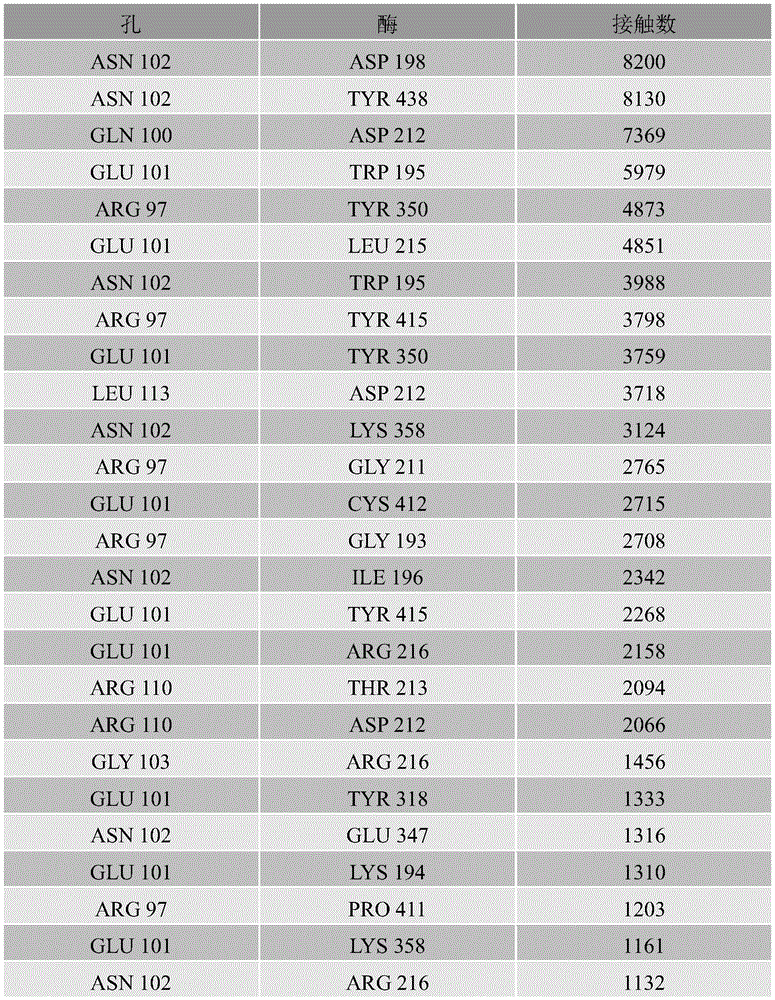


表6=回合1,酶和孔接触相互作用Table 6 =


表7=回合2,酶和孔接触相互作用Table 7 =


表8=回合3,酶和孔接触相互作用Table 8 =
实例5Example 5
本实例描述为了研究以下之间的相互作用而进行的模拟:a)CsgG-Eco-(Y51A/F56Q)-StrepII(C))9(具有突变Y51A/F56Q的SEQ ID NO:2,其中StrepII(C)是SEQ ID NO:47,且在C端处连接,孔突变第25号)与T4 Dda-(E94C/F98W/C109A/C136A/K194L/A360C)(具有突变E94C/F98W/C109A/C136A/K194L/A360C且接着(ΔM1)G1G2的SEQ ID NO:24)之间,和b)CsgG-Eco-(Y51A/F56Q/R97W)-StrepII(C))9(具有突变Y51A/F56Q/R97W的SEQ ID NO:2,其中StrepII(C)是SEQ ID NO:47,且在C端处连接,孔突变第26号)与T4 Dda-(E94C/F98W/C109A/C136A/K194L/A360C)(具有突变E94C/F98W/C109A/C136A/K194L/A360C且接着(ΔM1)G1G2的SEQ ID NO:24)之间。This example describes simulations performed to investigate the interaction between a) CsgG-Eco-(Y51A/F56Q)-StrepII(C))9 (SEQ ID NO:2 with mutations Y51A/F56Q, wherein StrepII(C) is SEQ ID NO:47 and connected at the C-terminus, pore mutation no. 25) and T4 Dda-(E94C/F98W/C109A/C136A/K194L/A360C) (SEQ ID NO:24 with mutations E94C/F98W/C109A/C136A/K194L/A360C followed by (ΔM1)G1G2), and b) CsgG-Eco-(Y51A/F56Q/R97W)-StrepII(C))9 (SEQ ID NO:2 with mutations Y51A/F56Q/R97W). NO:2, wherein StrepII (C) is SEQ ID NO:47 and is linked at the C-terminus, between hole mutation no. 26) and T4 Dda-(E94C/F98W/C109A/C136A/K194L/A360C) (SEQ ID NO:24 with mutations E94C/F98W/C109A/C136A/K194L/A360C followed by (ΔM1)G1G2).
模拟方法Simulation method
如实例4中所描述进行模拟。The simulations were performed as described in Example 4.
CsgG-Eco-(Y51A/F56Q)-StrepII(C))9(具有突变Y51A/F56Q的SEQ ID NO:2,其中StrepII(C)是SEQ ID NO:47,且在C端处连接,孔突变第25号)和CsgG-Eco-(Y51A/F56Q/R97W)-StrepII(C))9(具有突变Y51A/F56Q/R97W的SEQ ID NO:2,其中StrepII(C)是SEQ IDNO:47,且在C端处连接,孔突变第26号)模型,是基于在蛋白质数据库登录号4UV3和4Q79中发现的CsgG的晶体结构。使用PyMOL制备相关突变。接着,使用最陡下降算法,使所得孔模型能量降至最低。The CsgG-Eco-(Y51A/F56Q)-StrepII(C))9 (SEQ ID NO:2 with mutations Y51A/F56Q, wherein StrepII(C) is SEQ ID NO:47 and is linked at the C-terminus, pore mutation No. 25) and CsgG-Eco-(Y51A/F56Q/R97W)-StrepII(C))9 (SEQ ID NO:2 with mutations Y51A/F56Q/R97W, wherein StrepII(C) is SEQ ID NO:47 and is linked at the C-terminus, pore mutation No. 26) models were based on the crystal structures of CsgG found in Protein Data Bank Accession Nos. 4UV3 and 4Q79. The relevant mutations were prepared using PyMOL. The resulting pore model energy was then minimized using the steepest descent algorithm.
T4 Dda-(E94C/F98W/C109A/C136A/K194L/A360C)(具有突变E94C/F98W/C109A/C136A/K194L/A360C且接着(ΔM1)G1G2的SEQ ID NO:24)模型,是基于在蛋白质数据库登录号3UPU中发现的Dda1993结构。同样,使用PyMOL制备相关突变,且使用最陡下降算法使模型能量降至最低。The T4 Dda-(E94C/F98W/C109A/C136A/K194L/A360C) (SEQ ID NO: 24 with mutations E94C/F98W/C109A/C136A/K194L/A360C followed by (ΔM1)G1G2) model was based on the Dda1993 structure found in Protein Data Bank Accession No. 3UPU. Again, relevant mutations were prepared using PyMOL, and the model energy was minimized using the steepest descent algorithm.
接着,将T4 Dda-(E94C/F98W/C109A/C136A/K194L/A360C)(具有突变E94C/F98W/C109A/C136A/K194L/A360C且接着(ΔM1)G1G2的SEQ ID NO:24)模型放置在突变孔25和26上。Next, the T4 Dda-(E94C/F98W/C109A/C136A/K194L/A360C) (SEQ ID NO: 24 with mutations E94C/F98W/C109A/C136A/K194L/A360C followed by (ΔM1)G1G2) model was placed over mutant wells 25 and 26.
在模拟中,定位酶,使得DNA的5'端指向孔,且酶在整个模拟中不受限制。对于所研究的突变孔中的每一个,进行两个模拟:首先,孔主链受限制,且将模拟盒溶剂化;其次,除帽区以外孔主链受限制,且将模拟盒溶剂化。使用到300K的Berendsen恒温器和Berendsen恒压器,在NPT集中模拟系统40ns。In the simulations, the enzyme was positioned so that the 5' end of the DNA pointed toward the pore, and the enzyme was unrestrained throughout the simulation. For each of the mutant pores studied, two simulations were performed: first, the pore backbone was restrained and the simulation box was solvated; second, the pore backbone was restrained except for the cap region, and the simulation box was solvated. The system was simulated for 40 ns in the NPT set using a Berendsen thermostat and Berendsen barostat set to 300 K.
使用GROMACS分析软件以及本地写入码两个来分析酶与孔之间的接触。下表显示对于孔和酶氨基酸两个所观测到的接触的数量(对于突变25和26,其具有T4 Dda-(E94C/F98W/C109A/C136A/K194L/A360C))。表9(孔主链受限制)和10(孔主链受限制,其中帽区不受限制)显示孔突变25上的氨基酸接触点和用酶(T4 Dda-(E94C/F98W/C109A/C136A/K194L/A360C))制备的接触的接触数量。表11(孔主链受限制)和12(孔主链受限制,其中帽区不受限制)显示孔突变25(CsgG-Eco-(Y51A/F56Q)-StrepII(C))9(具有突变Y51A/F56Q的SEQ ID NO:2,其中StrepII(C)是SEQ ID NO:47,且在C端处连接)上的氨基酸接触点,所述氨基酸接触点与酶(T4 Dda-(E94C/F98W/C109A/C136A/K194L/A360C))上的氨基酸接触点相互作用。表13(孔主链受限制)和14(孔主链受限制,其中帽区不受限制)显示孔突变26上的氨基酸接触点和用酶(T4 Dda-(E94C/F98W/C109A/C136A/K194L/A360C))制备的接触的接触数量。表15(孔主链受限制)和16(孔主链受限制,其中帽区不受限制)显示孔突变26(CsgG-Eco-(Y51A/F56Q/R97W)-StrepII(C))9(具有突变Y51A/F56Q/R97W的SEQ ID NO:2,其中StrepII(C)是SEQ ID NO:47,且在C端处连接)上的氨基酸接触点,所述氨基酸接触点与酶(T4 Dda-(E94C/F98W/C109A/C136A/K194L/A360C))上的氨基酸接触点相互作用。图33显示孔突变26和T4 Dda-(E94C/F98W/C109A/C136A/K194L/A360C)的初始快照。The contact between the enzyme and the pore was analyzed using GROMACS analysis software and local write code. The following table shows the number of contacts observed for both the pore and enzyme amino acids (for mutations 25 and 26, which have T4 Dda-(E94C/F98W/C109A/C136A/K194L/A360C)). Tables 9 (pore backbone constrained) and 10 (pore backbone constrained, where the cap region is unconstrained) show the number of contacts for the amino acid contact points on the pore mutation 25 and the contacts made with the enzyme (T4 Dda-(E94C/F98W/C109A/C136A/K194L/A360C)). Tables 11 (pore backbone constrained) and 12 (pore backbone constrained, where the cap region is unconstrained) show the amino acid contact points on the pore mutation 25 (CsgG-Eco-(Y51A/F56Q)-StrepII(C))9 (SEQ ID NO:2 with mutations Y51A/F56Q, where StrepII(C) is SEQ ID NO:47 and is attached at the C-terminus) that interact with the amino acid contact points on the enzyme (T4 Dda-(E94C/F98W/C109A/C136A/K194L/A360C)). Tables 13 (pore backbone constrained) and 14 (pore backbone constrained with cap region unconstrained) show the amino acid contact points on pore mutation 26 and the number of contacts for contacts made with the enzyme (T4 Dda-(E94C/F98W/C109A/C136A/K194L/A360C)). Tables 15 (pore backbone constrained) and 16 (pore backbone constrained, where cap region is unconstrained) show amino acid contact points on pore mutation 26 (CsgG-Eco-(Y51A/F56Q/R97W)-StrepII(C))9 (SEQ ID NO:2 with mutations Y51A/F56Q/R97W, where StrepII(C) is SEQ ID NO:47, and is attached at the C-terminus) that interact with amino acid contact points on the enzyme (T4 Dda-(E94C/F98W/C109A/C136A/K194L/A360C)). Figure 33 shows an initial snapshot of pore mutation 26 and T4 Dda-(E94C/F98W/C109A/C136A/K194L/A360C).


表9Table 9


表10Table 10


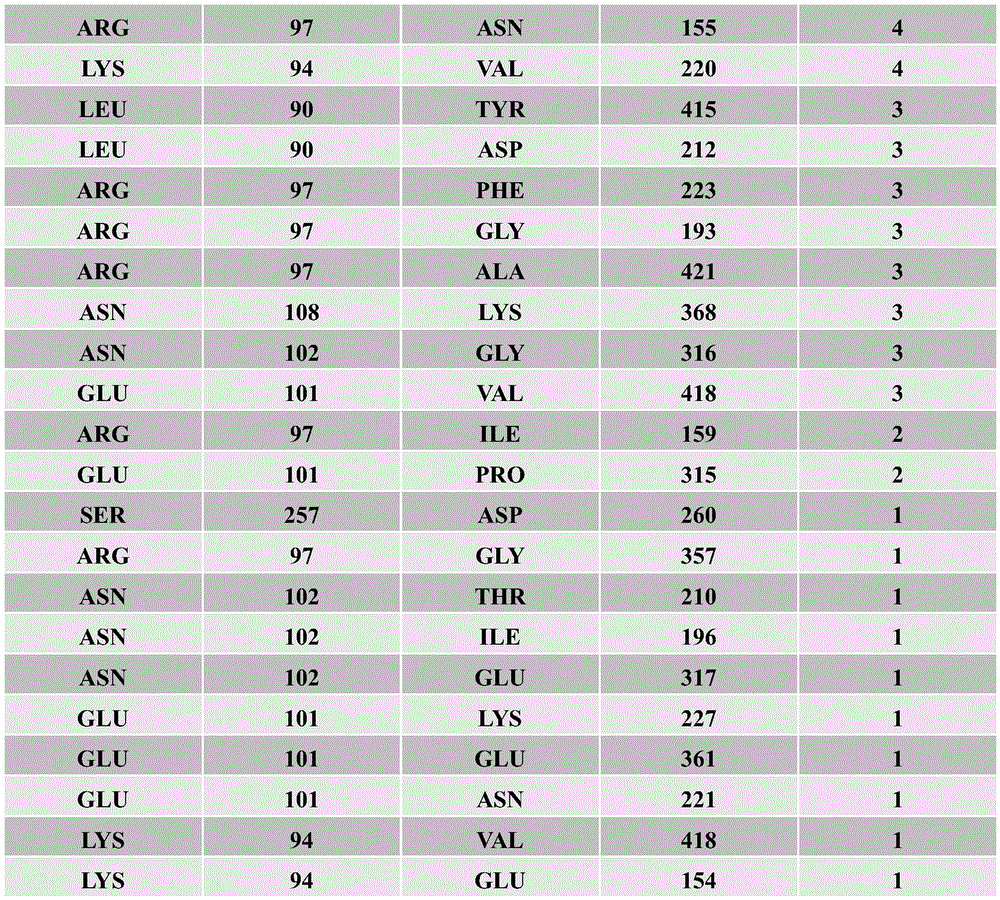
表11Table 11


表12Table 12

表13Table 13


表14Table 14

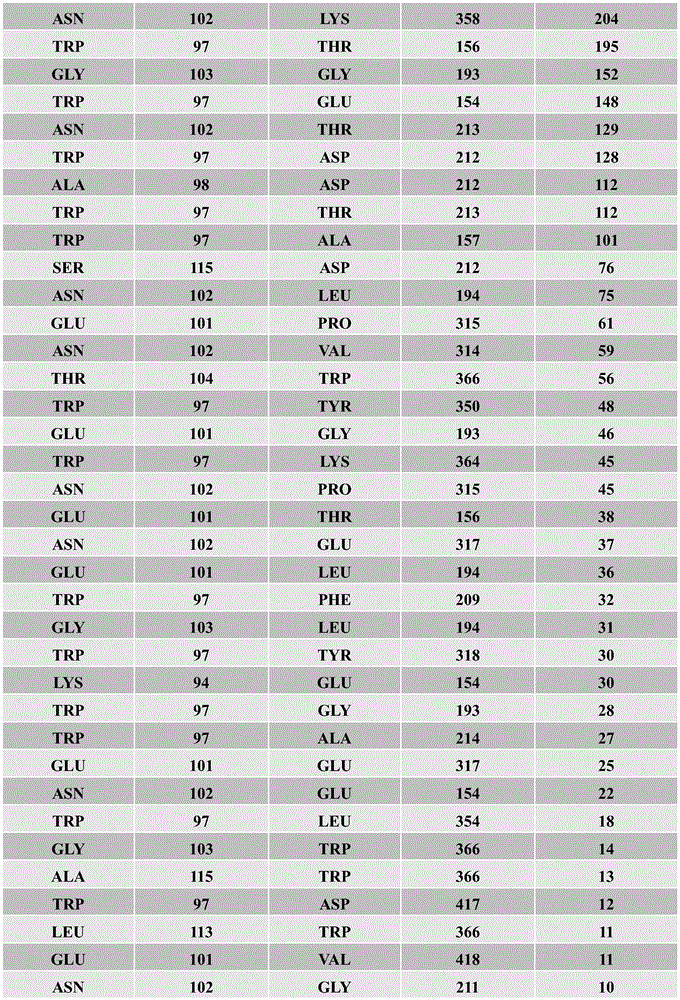

表15Table 15


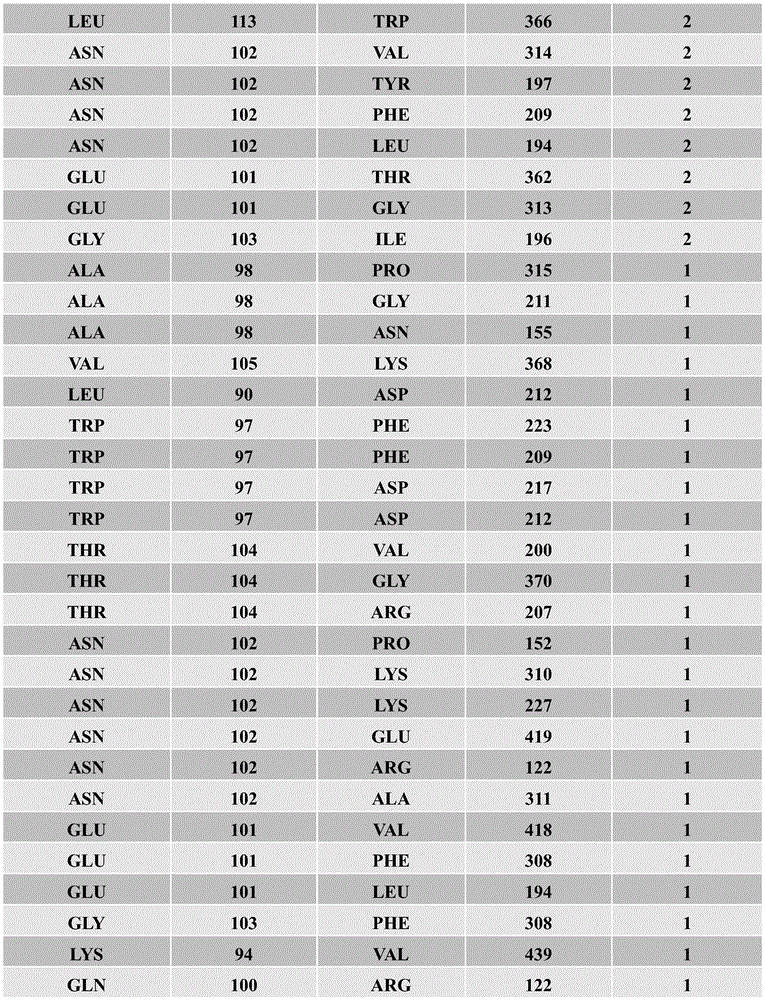
表16Table 16
实例6Example 6
本实例描述显示表征准确度改进的若干CsgG突变的表征。This example describes the characterization of several CsgG mutations that showed improved characterization accuracy.
材料和方法Materials and methods
在此实例中使用的材料和方法是与上文对于实例2所描述的那些相同。用于控制移动的酶是酶1=T4 Dda-E94C/C109A/C136A/A360C(具有突变E94C/C109A/C136A/A360C的SEQ ID NO:24或酶2=T4 Dda-E94C/F98W/C109A/C136A/K194L/A360C(具有突变E94C/F98W/C109A/C136A/K194L/A360C的SEQ ID NO:24)。The materials and methods used in this example were the same as those described above for Example 2. The enzymes used to control movement were
使用如在国际申请PCT/GB2012/052343(公开为WO/2013/041878)中公开的方法,来计算1D准确度表征测量。The ID accuracy characterization measure was calculated using the method as disclosed in International Application PCT/GB2012/052343 (published as WO/2013/041878).
结果result
对于MspA突变x=MspA-((Del-L74/G75/D118/L119)D56F/E59R/L88N/D90N/D91N/Q126R/D134R/E139K)8(SEQ ID NO:50,其具有突变D56F/E59R/L88N/D90N/D91N/Q126R/D134R/E139K,和氨基酸L74/G75/D118/L119的缺失)(其中DNA易位受T4 Dda-E94C/F98W/C109A/C136A/K194L/A360C控制)的1D basecall表征准确度是68.7%。所测试的所有突变(参见下表17)显示相较于MspA突变X,1D basecall表征准确度改进。The ID basecall characterization accuracy for MspA mutation x = MspA-((Del-L74/G75/D118/L119)D56F/E59R/L88N/D90N/D91N/Q126R/D134R/E139K)8 (SEQ ID NO:50, which has mutations D56F/E59R/L88N/D90N/D91N/Q126R/D134R/E139K, and deletion of amino acids L74/G75/D118/L119) (wherein the DNA translocation is controlled by T4 Dda-E94C/F98W/C109A/C136A/K194L/A360C) was 68.7%. All mutations tested (see Table 17 below) showed improved ID basecall characterization accuracy compared to MspA mutation X.
27-CsgG-Eco-(Y51A/F56Q/R97W/R192Q-StrepII(C))9(具有突变Y51A/F56Q/R97W/R192Q的SEQ ID NO:2,其中StrepII(C)是SEQ ID NO:47,且在C端处连接)27-CsgG-Eco-(Y51A/F56Q/R97W/R192Q-StrepII(C))9 (SEQ ID NO: 2 with mutations Y51A/F56Q/R97W/R192Q, wherein StrepII(C) is SEQ ID NO: 47 and is linked at the C-terminus)
28-CsgG-Eco-(Y51A/F56Q/R97W/R192D-StrepII(C))9(具有突变Y51A/F56Q/R97W/R192D的SEQ ID NO:2,其中StrepII(C)是SEQ ID NO:47,且在C端处连接)28-CsgG-Eco-(Y51A/F56Q/R97W/R192D-StrepII(C))9 (SEQ ID NO: 2 with mutations Y51A/F56Q/R97W/R192D, wherein StrepII(C) is SEQ ID NO: 47 and is linked at the C-terminus)
29-CsgG-Eco-(Y51A/F56Q/K135L/T150I/S208V-StrepII(C))9(具有突变Y51A/F56Q/K135L/T150I/S208V的SEQ ID NO:2,其中StrepII(C)是SEQ ID NO:47,且在C端处连接)29-CsgG-Eco-(Y51A/F56Q/K135L/T150I/S208V-StrepII(C))9 (SEQ ID NO: 2 with mutations Y51A/F56Q/K135L/T150I/S208V, wherein StrepII(C) is SEQ ID NO: 47 and is linked at the C-terminus)
30-CsgG-Eco-(Y51A/F56Q/T150I/S208V-StrepII(C))9(具有突变Y51A/F56Q/T150I/S208V的SEQ ID NO:2,其中StrepII(C)是SEQ ID NO:47,且在C端处连接)30-CsgG-Eco-(Y51A/F56Q/T150I/S208V-StrepII(C))9 (SEQ ID NO: 2 with mutations Y51A/F56Q/T150I/S208V, wherein StrepII(C) is SEQ ID NO: 47 and is linked at the C-terminus)
31-CsgG-Eco-(Y51A/F56Q/S208V-StrepII(C))9(具有突变Y51A/F56Q/S208V的SEQ ID NO:2,其中StrepII(C)是SEQ ID NO:47,且在C端处连接)31-CsgG-Eco-(Y51A/F56Q/S208V-StrepII(C))9 (SEQ ID NO: 2 with mutations Y51A/F56Q/S208V, wherein StrepII(C) is SEQ ID NO: 47 and is linked at the C-terminus)
32-CsgG-Eco-(Y51A/F56Q/T150I-StrepII(C))9(具有突变Y51A/F56Q/T150I的SEQ ID NO:2,其中StrepII(C)是SEQ ID NO:47,且在C端处连接)32-CsgG-Eco-(Y51A/F56Q/T150I-StrepII(C))9 (SEQ ID NO: 2 with mutations Y51A/F56Q/T150I, wherein StrepII(C) is SEQ ID NO: 47 and is linked at the C-terminus)
33-CsgG-Eco-(Y51A/F56Q/K135V/T150Y-StrepII(C))9(具有突变Y51A/F56Q/K135V/T150Y的SEQ ID NO:2,其中StrepII(C)是SEQ ID NO:47,且在C端处连接)33-CsgG-Eco-(Y51A/F56Q/K135V/T150Y-StrepII(C))9 (SEQ ID NO: 2 with mutations Y51A/F56Q/K135V/T150Y, wherein StrepII(C) is SEQ ID NO: 47 and is linked at the C-terminus)
34-CsgG-Eco-(Y51A/F56Q/K135L-StrepII(C))9(具有突变Y51A/F56Q/K135L的SEQ ID NO:2,其中StrepII(C)是SEQ ID NO:47,且在C端处连接)34-CsgG-Eco-(Y51A/F56Q/K135L-StrepII(C))9 (SEQ ID NO: 2 with mutations Y51A/F56Q/K135L, wherein StrepII(C) is SEQ ID NO: 47 and is linked at the C-terminus)
35-CsgG-Eco-(Y51A/F56Q/R97F/R192D-StrepII(C))9(具有突变Y51A/F56Q/R97F/R192D的SEQ ID NO:2,其中StrepII(C)是SEQ ID NO:47,且在C端处连接)35-CsgG-Eco-(Y51A/F56Q/R97F/R192D-StrepII(C))9 (SEQ ID NO: 2 with mutations Y51A/F56Q/R97F/R192D, wherein StrepII(C) is SEQ ID NO: 47 and is linked at the C-terminus)
36-CsgG-Eco-(Y51A/F56Q/K135L/T150I-StrepII(C))9(具有突变Y51A/F56Q/K135L/T150I的SEQ ID NO:2,其中StrepII(C)是SEQ ID NO:47,且在C端处连接)36-CsgG-Eco-(Y51A/F56Q/K135L/T150I-StrepII(C))9 (SEQ ID NO: 2 with mutations Y51A/F56Q/K135L/T150I, wherein StrepII(C) is SEQ ID NO: 47 and is linked at the C-terminus)
37-CsgG-Eco-((Del-D195/Y196/Q197/R198/L199)-Y51A/F56Q-StrepII(C))9(SEQ ID NO:2,其具有突变Y51A/F56Q和氨基酸D195/Y196/Q197/R198/L199的缺失,其中StrepII(C)是SEQ ID NO:47,且在C端处连接)37-CsgG-Eco-((Del-D195/Y196/Q197/R198/L199)-Y51A/F56Q-StrepII(C))9 (SEQ ID NO:2 having mutations Y51A/F56Q and deletion of amino acids D195/Y196/Q197/R198/L199, wherein StrepII(C) is SEQ ID NO:47 and is linked at the C-terminus)
38-CsgG-Eco-((Del-R192/F193/I194/D195/Y196/Q197/R198/L199/L200)-Y51A/F56Q-StrepII(C))9(SEQ ID NO:2,其具有突变Y51A/F56Q和氨基酸R192/F193/I194/D195/Y196/Q197/R198/L199/L200的缺失,其中StrepII(C)是SEQ ID NO:47,且在C端处连接)38-CsgG-Eco-((Del-R192/F193/I194/D195/Y196/Q197/R198/L199/L200)-Y51A/F56Q-StrepII(C))9 (SEQ ID NO:2 having mutations Y51A/F56Q and a deletion of amino acids R192/F193/I194/D195/Y196/Q197/R198/L199/L200, wherein StrepII(C) is SEQ ID NO:47 and is linked at the C-terminus)
39-CsgG-Eco-((Del-Q197/R198/L199/L200)-Y51A/F56Q-StrepII(C))9(SEQ IDNO:2,其具有突变Y51A/F56Q和氨基酸Q197/R198/L199/L200的缺失,其中StrepII(C)是SEQID NO:47,且在C端处连接)39-CsgG-Eco-((Del-Q197/R198/L199/L200)-Y51A/F56Q-StrepII(C))9 (SEQ ID NO: 2, which has mutations Y51A/F56Q and deletion of amino acids Q197/R198/L199/L200, wherein StrepII(C) is SEQ ID NO: 47 and is linked at the C-terminus)
40-CsgG-Eco-((Del-I194/D195/Y196/Q197/R198/L199)-Y51A/F56Q-StrepII(C))9(SEQ ID NO:2,其具有突变Y51A/F56Q和氨基酸I194/D195/Y196/Q197/R198/L199的缺失,其中StrepII(C)是SEQ ID NO:47,且在C端处连接)40-CsgG-Eco-((Del-I194/D195/Y196/Q197/R198/L199)-Y51A/F56Q-StrepII(C))9 (SEQ ID NO:2 having mutations Y51A/F56Q and deletion of amino acids I194/D195/Y196/Q197/R198/L199, wherein StrepII(C) is SEQ ID NO:47 and is linked at the C-terminus)
41-CsgG-Eco-((Del-V139/G140/D149/T150/V186/Q187/V204/G205)-Y51A/F56Q-StrepII(C))9(SEQ ID NO:2,其具有突变Y51A/F56Q和氨基酸V139/G140/D149/T150/V186/Q187/V204/G205的缺失,其中StrepII(C)是SEQ ID NO:47,且在C端处连接)41-CsgG-Eco-((Del-V139/G140/D149/T150/V186/Q187/V204/G205)-Y51A/F56Q-StrepII(C))9 (SEQ ID NO:2 having mutations Y51A/F56Q and a deletion of amino acids V139/G140/D149/T150/V186/Q187/V204/G205, wherein StrepII(C) is SEQ ID NO:47 and is linked at the C-terminus)
42-CsgG-Eco-((Del-D195/Y196/Q197/R198/L199/L200)-Y51A/F56Q-StrepII(C))9(SEQ ID NO:2,其具有突变Y51A/F56Q和氨基酸D195/Y196/Q197/R198/L199/L200的缺失,其中StrepII(C)是SEQ ID NO:47,且在C端处连接)42-CsgG-Eco-((Del-D195/Y196/Q197/R198/L199/L200)-Y51A/F56Q-StrepII(C))9 (SEQ ID NO:2 having mutations Y51A/F56Q and deletion of amino acids D195/Y196/Q197/R198/L199/L200, wherein StrepII(C) is SEQ ID NO:47 and is linked at the C-terminus)
43-CsgG-Eco-((Del-Y196/Q197/R198/L199/L200/E201)-Y51A/F56Q-StrepII(C))9(SEQ ID NO:2,其具有突变Y51A/F56Q和氨基酸Y196/Q197/R198/L199/L200/E201的缺失,其中StrepII(C)是SEQ ID NO:47,且在C端处连接)43-CsgG-Eco-((Del-Y196/Q197/R198/L199/L200/E201)-Y51A/F56Q-StrepII(C))9 (SEQ ID NO:2 having mutations Y51A/F56Q and deletion of amino acids Y196/Q197/R198/L199/L200/E201, wherein StrepII(C) is SEQ ID NO:47 and is linked at the C-terminus)
44-CsgG-Eco-((Del-Q197/R198/L199)-Y51A/F56Q-StrepII(C))9(SEQ ID NO:2,其具有突变Y51A/F56Q和氨基酸Q197/R198/L199的缺失,其中StrepII(C)是SEQ ID NO:47,且在C端处连接)44-CsgG-Eco-((Del-Q197/R198/L199)-Y51A/F56Q-StrepII(C))9 (SEQ ID NO:2 having mutations Y51A/F56Q and deletion of amino acids Q197/R198/L199, wherein StrepII(C) is SEQ ID NO:47 and is linked at the C-terminus)
45-CsgG-Eco-((Del-F193/I194/D195/Y196/Q197/R198/L199)-Y51A/F56Q-StrepII(C))9(SEQ ID NO:2,其具有突变Y51A/F56Q和氨基酸F193/I194/D195/Y196/Q197/R198/L199的缺失,其中StrepII(C)是SEQ ID NO:47,且在C端处连接)45-CsgG-Eco-((Del-F193/I194/D195/Y196/Q197/R198/L199)-Y51A/F56Q-StrepII(C))9 (SEQ ID NO:2 having mutations Y51A/F56Q and deletion of amino acids F193/I194/D195/Y196/Q197/R198/L199, wherein StrepII(C) is SEQ ID NO:47 and is linked at the C-terminus)
46-CsgG-Eco-(Y51A/F56Q/R192T-StrepII(C))9(具有突变Y51A/F56Q/R192T的SEQ ID NO:2,其中StrepII(C)是SEQ ID NO:47,且在C端处连接)46-CsgG-Eco-(Y51A/F56Q/R192T-StrepII(C))9 (SEQ ID NO: 2 with mutations Y51A/F56Q/R192T, wherein StrepII(C) is SEQ ID NO: 47 and is linked at the C-terminus)
47-CsgG-Eco-(Y51A/F56Q/N102S-StrepII(C))9(具有突变Y51A/F56Q/N102S的SEQ ID NO:2,其中StrepII(C)是SEQ ID NO:47,且在C端处连接)47-CsgG-Eco-(Y51A/F56Q/N102S-StrepII(C))9 (SEQ ID NO: 2 with mutations Y51A/F56Q/N102S, wherein StrepII(C) is SEQ ID NO: 47 and is linked at the C-terminus)
48-CsgG-Eco-(Y51A/F56Q/Q42R-StrepII(C))9(具有突变Y51A/F56Q/Q42R的SEQID NO:2,其中StrepII(C)是SEQ ID NO:47,且在C端处连接)48-CsgG-Eco-(Y51A/F56Q/Q42R-StrepII(C))9 (SEQ ID NO: 2 with mutations Y51A/F56Q/Q42R, wherein StrepII(C) is SEQ ID NO: 47 and is linked at the C-terminus)
49-CsgG-Eco-(Y51A/F56Q/R192S-StrepII(C))9(具有突变Y51A/F56Q/R192S的SEQ ID NO:2,其中StrepII(C)是SEQ ID NO:47,且在C端处连接)49-CsgG-Eco-(Y51A/F56Q/R192S-StrepII(C))9 (SEQ ID NO: 2 with mutations Y51A/F56Q/R192S, wherein StrepII(C) is SEQ ID NO: 47 and is linked at the C-terminus)
50-CsgG-Eco-(Y51A/F56Q/G103N-StrepII(C))9(具有突变Y51A/F56Q/G103N的SEQ ID NO:2,其中StrepII(C)是SEQ ID NO:47,且在C端处连接)50-CsgG-Eco-(Y51A/F56Q/G103N-StrepII(C))9 (SEQ ID NO: 2 with mutations Y51A/F56Q/G103N, wherein StrepII(C) is SEQ ID NO: 47 and is linked at the C-terminus)
51-CsgG-Eco-(Y51A/F56Q/R97N/N102R-StrepII(C))9(具有突变Y51A/F56Q/R97N/N102R的SEQ ID NO:2,其中StrepII(C)是SEQ ID NO:47,且在C端处连接)51-CsgG-Eco-(Y51A/F56Q/R97N/N102R-StrepII(C))9 (SEQ ID NO: 2 with mutations Y51A/F56Q/R97N/N102R, wherein StrepII(C) is SEQ ID NO: 47 and is linked at the C-terminus)
52-CsgG-Eco-(Y51A/F56Q/R97L-StrepII(C))9(具有突变Y51A/F56Q/R97L的SEQID NO:2,其中StrepII(C)是SEQ ID NO:47,且在C端处连接)52-CsgG-Eco-(Y51A/F56Q/R97L-StrepII(C))9 (SEQ ID NO: 2 with mutations Y51A/F56Q/R97L, wherein StrepII(C) is SEQ ID NO: 47 and is linked at the C-terminus)
53-CsgG-Eco-(Y51A/F56Q/R192D-StrepII(C))9(具有突变Y51A/F56Q/R192D的SEQ ID NO:2,其中StrepII(C)是SEQ ID NO:47,且在C端处连接)53-CsgG-Eco-(Y51A/F56Q/R192D-StrepII(C))9 (SEQ ID NO: 2 with mutations Y51A/F56Q/R192D, wherein StrepII(C) is SEQ ID NO: 47 and is linked at the C-terminus)
54-CsgG-Eco-(Y51A/F56Q/R97N/N102G-StrepII(C))9(具有突变Y51A/F56Q/R97N/N102G的SEQ ID NO:2,其中StrepII(C)是SEQ ID NO:47,且在C端处连接)54-CsgG-Eco-(Y51A/F56Q/R97N/N102G-StrepII(C))9 (SEQ ID NO: 2 with mutations Y51A/F56Q/R97N/N102G, wherein StrepII(C) is SEQ ID NO: 47 and is linked at the C-terminus)
55-CsgG-Eco-(Y51A/F56Q/F48S-StrepII(C))9(具有突变Y51A/F56Q/F48S的SEQID NO:2,其中StrepII(C)是SEQ ID NO:47,且在C端处连接)55-CsgG-Eco-(Y51A/F56Q/F48S-StrepII(C))9 (SEQ ID NO: 2 with mutations Y51A/F56Q/F48S, wherein StrepII(C) is SEQ ID NO: 47 and is linked at the C-terminus)
56-CsgG-Eco-(Y51A/F56Q/G103S-StrepII(C))9(具有突变Y51A/F56Q/G103S的SEQ ID NO:2,其中StrepII(C)是SEQ ID NO:47,且在C端处连接)56-CsgG-Eco-(Y51A/F56Q/G103S-StrepII(C))9 (SEQ ID NO: 2 with mutations Y51A/F56Q/G103S, wherein StrepII(C) is SEQ ID NO: 47 and is linked at the C-terminus)
57-CsgG-Eco-(Y51A/F56Q/E101L-StrepII(C))9(具有突变Y51A/F56Q/E101L的SEQ ID NO:2,其中StrepII(C)是SEQ ID NO:47,且在C端处连接)57-CsgG-Eco-(Y51A/F56Q/E101L-StrepII(C))9 (SEQ ID NO: 2 with mutations Y51A/F56Q/E101L, wherein StrepII(C) is SEQ ID NO: 47 and is linked at the C-terminus)
58-CsgG-Eco-(Y51A/F56Q/R192Q-StrepII(C))9(具有突变Y51A/F56Q/R192Q的SEQ ID NO:2,其中StrepII(C)是SEQ ID NO:47,且在C端处连接)58-CsgG-Eco-(Y51A/F56Q/R192Q-StrepII(C))9 (SEQ ID NO: 2 with mutations Y51A/F56Q/R192Q, wherein StrepII(C) is SEQ ID NO: 47 and is linked at the C-terminus)
59-CsgG-Eco-(Y51A/F56Q/K135N/R142N/R192N-StrepII(C))9(具有突变Y51A/F56Q/K135N/R142N/R192N的SEQ ID NO:2,其中StrepII(C)是SEQ ID NO:47,且在C端处连接)59-CsgG-Eco-(Y51A/F56Q/K135N/R142N/R192N-StrepII(C))9 (SEQ ID NO: 2 with mutations Y51A/F56Q/K135N/R142N/R192N, wherein StrepII(C) is SEQ ID NO: 47 and is linked at the C-terminus)
60-CsgG-Eco-(Y51A/F56Q/R97N-StrepII(C))9(具有突变Y51A/F56Q/R97N的SEQID NO:2,其中StrepII(C)是SEQ ID NO:47,且在C端处连接)60-CsgG-Eco-(Y51A/F56Q/R97N-StrepII(C))9 (SEQ ID NO: 2 with mutations Y51A/F56Q/R97N, wherein StrepII(C) is SEQ ID NO: 47 and is linked at the C-terminus)
61-CsgG-Eco-(Y51A/F56Q/R192N-StrepII(C))9(具有突变Y51A/F56Q/R192N的SEQ ID NO:2,其中StrepII(C)是SEQ ID NO:47,且在C端处连接)61-CsgG-Eco-(Y51A/F56Q/R192N-StrepII(C))9 (SEQ ID NO: 2 with mutations Y51A/F56Q/R192N, wherein StrepII(C) is SEQ ID NO: 47 and is linked at the C-terminus)
62-CsgG-Eco-(Y51A/F56Q/Y130W-StrepII(C))9(具有突变Y51A/F56Q/Y130W的SEQ ID NO:2,其中StrepII(C)是SEQ ID NO:47,且在C端处连接)62-CsgG-Eco-(Y51A/F56Q/Y130W-StrepII(C))9 (SEQ ID NO: 2 with mutations Y51A/F56Q/Y130W, wherein StrepII(C) is SEQ ID NO: 47 and is linked at the C-terminus)
63-CsgG-Eco-(Y51A/F56Q/E101G-StrepII(C))9(具有突变Y51A/F56Q/E101G的SEQ ID NO:2,其中StrepII(C)是SEQ ID NO:47,且在C端处连接)63-CsgG-Eco-(Y51A/F56Q/E101G-StrepII(C))9 (SEQ ID NO: 2 with mutations Y51A/F56Q/E101G, wherein StrepII(C) is SEQ ID NO: 47 and is linked at the C-terminus)

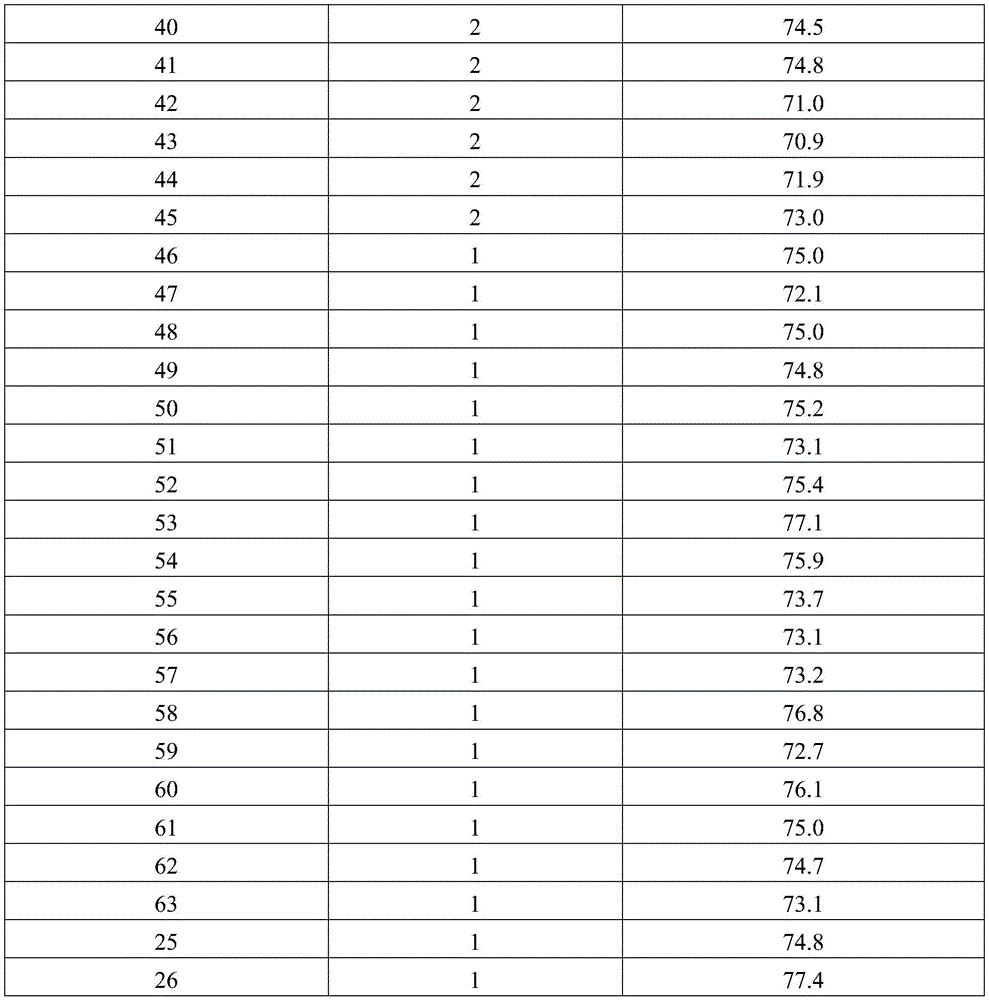
表17Table 17
实例7Example 7
本实例比较多种不同突变纳米孔的DNA捕获。This example compares DNA capture using nanopores with different mutations.
材料和方法Materials and methods
从插入在含嵌段共聚物的缓冲液(25mM磷酸钾缓冲液,150mM亚铁(II)氰化钾,150mM铁(III)氰化钾,pH 8.0)中的各种单一CsgG或MspA纳米孔获得电测量。在达到插入在嵌段共聚物中的单一孔之后,接着缓冲液(2mL,25mM磷酸钾缓冲液,150mM亚铁(II)氰化钾,150mM铁(III)氰化钾,pH 8.0)流过系统,移除任何过量的纳米孔。接着,使150μL的500mMKCl、25mM磷酸钾、1.5mM MgCl2、1.5mM ATP、pH8.0流过系统。在10分钟之后,接着将150μL的DNA(SEQ ID NO:51,200nM)流动到单一纳米孔实验系统中。实验是在-120mV下进行,且进行解螺旋酶控制的DNA移动监测。Electrical measurements were obtained from various single CsgG or MspA nanopores inserted in a buffer containing block copolymers (25 mM potassium phosphate buffer, 150 mM potassium ferro(II)cyanide, 150 mM potassium ferro(III)cyanide, pH 8.0). After reaching a single pore inserted in a block copolymer, buffer (2 mL, 25 mM potassium phosphate buffer, 150 mM potassium ferro(II)cyanide, 150 mM potassium ferro(III)cyanide, pH 8.0) was then flowed through the system to remove any excess nanopore. Next, 150 μL of 500 mM KCl, 25 mM potassium phosphate, 1.5 mM MgCl 2 , 1.5 mM ATP, pH 8.0 was flowed through the system. After 10 minutes, 150 μL of DNA (SEQ ID NO: 51, 200 nM) was then flowed into the single nanopore experimental system. Experiments were performed at -120 mV and helicase-controlled DNA movement was monitored.
结果result
CsgG突变CsgG-Eco-(Y51A/F56Q/R97W/E101S/R192D-StrepII(C))9(具有突变Y51A/F56Q/R97W/E101S/R192D的SEQ ID NO:2,其中StrepII(C)是SEQ ID NO:47,且在C端处连接)(参见图36)显示,比MspA-((Del-L74/G75/D118/L119)D56F/E59R/L88N/D90N/D91N/Q126R/D134R/E139K)8(参见图34),更高的捕获速率(例如更容易地捕获DNA聚核苷酸)。电流迹线中的各尖峰对应于在不受酶控制的情况下DNA聚核苷酸(SEQ ID NO:51)通过纳米孔的易位。对于CsgG纳米孔-CsgG-Eco-(Y51A/F56Q/R97W/E101S/R192D-StrepII(C))9,图34中的10秒电流迹线显示比10秒电流迹线更少的DNA易位。The CsgG mutant CsgG-Eco-(Y51A/F56Q/R97W/E101S/R192D-StrepII(C))9 (SEQ ID NO:2 with mutations Y51A/F56Q/R97W/E101S/R192D, wherein StrepII(C) is SEQ ID NO:47 and is linked at the C-terminus) (see FIG36 ) showed a higher capture rate (e.g., more readily captured DNA polynucleotides) than MspA-((Del-L74/G75/D118/L119)D56F/E59R/L88N/D90N/D91N/Q126R/D134R/E139K)8 (see FIG34 ). Each spike in the current trace corresponds to the translocation of a DNA polynucleotide (SEQ ID NO:51) through the nanopore without enzyme control. For CsgG nanopore-CsgG-Eco-(Y51A/F56Q/R97W/E101S/R192D-StrepII(C))9, the 10 s current trace in FIG34 shows less DNA translocation than the 10 s current trace.
当相较于无E101S突变的CsgG突变时,位置E101到E101S的突变引起捕获率的增加。图35显示,CsgG突变CsgG-Eco-(Y51A/F56Q/R97W/R192D-StrepII(C))9(具有突变Y51A/F56Q/R97W/R192D的SEQ ID NO:2,其中StrepII()是SEQ ID NO:47,且在C端处连接)的10秒电流迹线呈现比CsgG-Eco-(Y51A/F56Q/R97W/E101S/R192D-StrepII(C))9更少的易位。CsgG-Eco-(Y51A/F56Q/R97W/R192D-StrepII(C))9的易位的平均数是7.25/秒(n=12),且CsgG-Eco-(Y51A/F56Q/R97W/E101S/R192D-StrepII(C))9的易位的平均数是18/秒(n=14)。The mutation of position E101 to E101S caused an increase in capture rate when compared to the CsgG mutation without the E101S mutation. Figure 35 shows that the 10 second current trace of the CsgG mutant CsgG-Eco-(Y51A/F56Q/R97W/R192D-StrepII(C))9 (SEQ ID NO:2 with mutations Y51A/F56Q/R97W/R192D, wherein StrepII() is SEQ ID NO:47 and is linked at the C-terminus) exhibited less translocation than CsgG-Eco-(Y51A/F56Q/R97W/E101S/R192D-StrepII(C))9. The average number of translocations of CsgG-Eco-(Y51A/F56Q/R97W/R192D-StrepII(C))9 was 7.25/sec (n=12), and the average number of translocations of CsgG-Eco-(Y51A/F56Q/R97W/E101S/R192D-StrepII(C))9 was 18/sec (n=14).
实例8Example 8
本实例比较两个不同CsgG突变孔的表达水平。This example compares the expression levels of two different CsgG mutant pores.
材料和方法Materials and methods
在此实例中用于制备纳米孔(A=CsgG-Eco-(Y51A/F56Q/R97W)-StrepII(C))9(具有突变Y51A/F56Q/R97W的SEQ ID NO:2,其中StrepII(C)是SEQ ID NO:47,且在C端处连接);和B=CsgG-Eco-(Y51A/F56Q/R97W/R192D)-StrepII(C))9(具有突变Y51A/F56Q/R97W/R192D的SEQ ID NO:2,其中StrepII(C)是SEQ ID NO:47,且在C端处连接))的材料和方法与上文对于实例3所描述的那些相同。The materials and methods used to prepare the nanopores (A = CsgG-Eco-(Y51A/F56Q/R97W)-StrepII(C))9 (SEQ ID NO: 2 with mutations Y51A/F56Q/R97W, wherein StrepII(C) is SEQ ID NO: 47, and is linked at the C-terminus); and B = CsgG-Eco-(Y51A/F56Q/R97W/R192D)-StrepII(C))9 (SEQ ID NO: 2 with mutations Y51A/F56Q/R97W/R192D, wherein StrepII(C) is SEQ ID NO: 47, and is linked at the C-terminus)) in this example were the same as those described above for Example 3.
结果result
两个纳米孔A=CsgG-Eco-(Y51A/F56Q/R97W)-StrepII(C))9(具有突变Y51A/F56Q/R97W的SEQ ID NO:2,其中StrepII(C)是SEQ ID NO:47,且在C端处连接)和B=CsgG-Eco-(Y51A/F56Q/R97W/R192D)-StrepII(C))9(具有突变Y51A/F56Q/R97W/R192D的SEQ IDNO:2,其中StrepII(C)是SEQ ID NO:47,且在C端处连接),使用精确相同的方案来表达和纯化,且使用凝胶过滤色谱图(120mL S200柱,参见图37)和SDS-PAGE分析(参见图38)来分析相同体积的各纳米孔。B(470.3mAu)的吸光度值比A(11.4mAu)高许多,此指,CsgG-Eco-(Y51A/F56Q/R97W/R192D)-StrepII(C))9以比CsgG-Eco-(Y51A/F56Q/R97W)-StrepII(C))9更许多的水平表达。图38中的条带的强度还指示两个孔的表达水平。条带A-C(含有CsgG-Eco-(Y51A/F56Q/R97W)-StrepII(C))9)比条带D-E(含有CsgG-Eco-(Y51A/F56Q/R97W/R192D)-StrepII(C))9)的强力低。分析两个的两个方法指示,添加R192D突变极大地增加CsgG突变所观测到的表达。Two nanopores, A = CsgG-Eco-(Y51A/F56Q/R97W)-StrepII(C))9 (SEQ ID NO:2 with mutations Y51A/F56Q/R97W, wherein StrepII(C) is SEQ ID NO:47, and is linked at the C-terminus) and B = CsgG-Eco-(Y51A/F56Q/R97W/R192D)-StrepII(C))9 (SEQ ID NO:2 with mutations Y51A/F56Q/R97W/R192D, wherein StrepII(C) is SEQ ID NO:47, and is linked at the C-terminus), were expressed and purified using the exact same protocol, and identical volumes of each nanopore were analyzed using gel filtration chromatography (120 mL S200 column, see FIG37 ) and SDS-PAGE analysis (see FIG38 ). The absorbance value of B (470.3 mAu) is much higher than that of A (11.4 mAu), indicating that CsgG-Eco-(Y51A/F56Q/R97W/R192D)-StrepII(C))9 is expressed at a much higher level than CsgG-Eco-(Y51A/F56Q/R97W)-StrepII(C))9. The intensity of the bands in FIG38 also indicates the expression levels of the two wells. Bands A-C (containing CsgG-Eco-(Y51A/F56Q/R97W)-StrepII(C))9) are less potent than bands D-E (containing CsgG-Eco-(Y51A/F56Q/R97W/R192D)-StrepII(C))9. Both methods of analysis indicated that adding the R192D mutation greatly increased the expression observed with the CsgG mutation.
实例9Example 9
本实例描述显示表征准确度改进的若干CsgG突变的表征。This example describes the characterization of several CsgG mutations that showed improved characterization accuracy.
材料和方法Materials and methods
CsG孔CsG hole
测试以下8个CsgG突变孔。上文实例X中描述的突变28用作基线孔。在SEQ ID NO:2中制备突变,且纯化标签StrepII具有SEQ ID NO:47中所示的序列。The following 8 CsgG mutant wells were tested.
基线孔(突变28):CsgG-(WT-Y51A/F56Q/R97W/R192D-StrepII)9Baseline well (mutation 28): CsgG-(WT-Y51A/F56Q/R97W/R192D-StrepII)9
突变A:CsgG-(WT-Y51A/F56Q/R97W/R192D-StrepII)9-del(D195-L199)Mutation A: CsgG-(WT-Y51A/F56Q/R97W/R192D-StrepII)9-del(D195-L199)
突变B:CsgG-(WT-Y51A/F56Q/R97W/R192D-StrepII)9-del(F193-L199)Mutant B: CsgG-(WT-Y51A/F56Q/R97W/R192D-StrepII)9-del(F193-L199)
突变C:CsgG-(WT-Y51A/F56Q/R97W/R192D-StrepII)9-F191TMutant C: CsgG-(WT-Y51A/F56Q/R97W/R192D-StrepII)9-F191T
突变D:CsgG-(WT-Y51A/F56Q/R97W/R192D-del(V105-I107)-StrepII)9Mutation D: CsgG-(WT-Y51A/F56Q/R97W/R192D-del(V105-I107)-StrepII)9
突变E:CsgG-(WT-Y51A/F56Q/K94Q/R97W/R192D-del(V105-I107)Mutation E: CsgG-(WT-Y51A/F56Q/K94Q/R97W/R192D-del(V105-I107)
突变F:CsgG-(WT-Y51A/F56Q/R192D-StrepII)9-R93WMutant F: CsgG-(WT-Y51A/F56Q/R192D-StrepII)9-R93W
突变G:CsgG-(WT-Y51A/F56Q/R192D-StrepII)9-R93W-del(D195-L199)Mutant G: CsgG-(WT-Y51A/F56Q/R192D-StrepII)9-R93W-del(D195-L199)
突变H:CsgG-(WT-Y51A/F56Q/R192D-StrepII)9-R93Y/R97YMutation H: CsgG-(WT-Y51A/F56Q/R192D-StrepII)9-R93Y/R97Y
纳米孔制备Nanopore preparation
为了制备含有嵌段共聚物膜的多个槽孔的纳米孔阵列芯片,所述多个孔各自具有所插入的单一CsgG突变纳米孔,使用以下方法。将在大肠杆菌中表达的CsgG突变纯化,且存储于在pH8下含有25mM Tris、150mM NaCl、2mM EDTA、0.01%DDM、0.1%SDS、0.1%Brij 58的缓冲液中。使用在pH 8.0下包含25mM磷酸钾、150mM亚铁(II)氰化钾、150mM铁(III)氰化钾的缓冲液,以1:1000000将这些突变CsgG孔进行稀释,且添加到芯片中,在各槽孔中获得单一孔。在孔插入之后,用在pH 8.0下包含25mM磷酸钾、150mM亚铁(II)氰化钾、150mM铁(III)氰化钾的1mL缓冲液来洗涤阵列芯片,以移除过量的孔。在几分钟之后,用500mL的测序混合液冲洗各芯片两次,所述测序混合液含有470mM KCl、25mM HEPES、11mM ATP和10mMMgCl2。To prepare a nanopore array chip containing multiple slots of a block copolymer membrane, each of which has a single CsgG mutant nanopore inserted, the following method was used. CsgG mutants expressed in E. coli were purified and stored in a buffer containing 25 mM Tris, 150 mM NaCl, 2 mM EDTA, 0.01% DDM, 0.1% SDS, 0.1% Brij 58 at
DNA样本制备DNA sample preparation
使用以下方法制备DNA样本,以用于测序。将1μg DNA分析物与40nM的含有同衔接子和平头TA接合酶(获自https://store.nanoporetech.com/)预结合的T4 Dda解螺旋酶的衔接子混合物一起培育10分钟。衔接子的结构显示于图43中,且衔接子中所含的序列陈述于SEQ ID NO:52到55中。接着,使用Spri纯化,纯化接合反应混合物,以移除未接合的游离衔接子。在含有在pH10下的40mM CAPS、40mM KCl和400nM胆固醇系链的25μL洗脱缓冲液中,洗脱最终接合的混合物。对于各芯片,将12μl DNA-衔接子接合的混合物与测序混合液(最终体积,150μL)混合,且添加到芯片,以用于测序。接着,在160mV下进行实验6小时。DNA samples were prepared using the following method for sequencing. 1 μg of DNA analyte was incubated with a 40 nM adapter mixture containing T4 Dda helicase pre-bound to the same adapter and blunt-head TA ligase (obtained from https://store.nanoporetech.com/) for 10 minutes. The structure of the adapter is shown in Figure 43, and the sequence contained in the adapter is stated in SEQ ID NO: 52 to 55. Then, the ligation reaction mixture was purified using Spri purification to remove unligated free adapters. The final ligated mixture was eluted in a 25 μL elution buffer containing 40 mM CAPS, 40 mM KCl and 400 nM cholesterol tethers at
使用如在WO2013/041878中所公开的方法,来计算1D准确度表征测量。The ID accuracy characterization measure is calculated using the method as disclosed in WO2013/041878.
测量模板速度Measuring template speed
通过以下方法来测量模板速度。将各波浪线的basecall与参考序列进行比对。将跨越比对(从比对起始位置减去比对终点位置)的碱基的数量,除对应于比对结束的事件与对应于比对开始的事件之间的时间。Template velocity was measured by the following method: The basecall of each wavy line was aligned with the reference sequence. The number of bases spanning the alignment (the alignment end position was subtracted from the alignment start position) was divided by the time between the event corresponding to the end of the alignment and the event corresponding to the start of the alignment.
结果result
Basecall准确度Basecall Accuracy
如图39中所示,发现所有8个CsgG突变孔,相较于实例6中描述的基线孔突变28(CsgG-(WT-Y51A/F56Q/R97W/R192D-StrepII)9),均具有改进的basecall准确度。如表17中所示,突变28显示在实例6中所测试的所有CsgG突变的最高basecall准确度(80.2%),其中实例5中描述的突变25(CsgG-(WT-Y51A/F56Q-StrepII)9)是基线突变。因此,除由突变28中的R97W和R192D取代引起的准确度的改进以外,D195-L199、F193-L199或V105-I107的缺失,或F191T的取代,引起另外的准确度的改进。As shown in FIG39 , all eight CsgG mutant wells were found to have improved basecall accuracy compared to the baseline well mutation 28 (CsgG-(WT-Y51A/F56Q/R97W/R192D-StrepII)9) described in Example 6. As shown in Table 17,
D195-L199、F193-L199或V105-I107的缺失,或F191T的取代,也各自将预期为在存在CsgG序列中的其它突变下或在不存在R97W、R192D、Y51A和/或F56Q突变下准确度得到改进。举例来说,突变E,其含有除del(V105-I107)突变以外的突变K94Q,相较于突变28具有改进的准确度,就如含有del(V105-I107)的突变G一样,所述突变G不含有R97W取代但相反含有R93W取代。Deletions of D195-L199, F193-L199 or V105-I107, or substitution of F191T, would also each be expected to improve accuracy in the presence of other mutations in the CsgG sequence or in the absence of R97W, R192D, Y51A and/or F56Q mutations. For example, mutation E, which contains mutation K94Q in addition to the del(V105-I107) mutation, has improved accuracy compared to
实例26中的表17显示,突变26,其含有R97W取代,具有几乎与突变28(80.2%)一样良好的basecall准确度(79.2%)。这表明,R97W突变是basecall准确度增加的基础。在此实例中,对不含有R97W突变(以及不含有R192D突变)但相反含有Table 17 in Example 26 shows that mutation 26, which contains the R97W substitution, has a basecall accuracy (79.2%) that is almost as good as mutation 28 (80.2%). This suggests that the R97W mutation is the basis for the increase in basecall accuracy. In this example, the mutation 26 that does not contain the R97W mutation (and does not contain the R192D mutation) but instead contains
R93W取代(突变F)或R93Y取代和R97Y取代两个(突变H)的两个突变进行测试,且发现具有比突变28更高的basecall准确度。这显示,R93W和R93Y/R97Y取代可用于改进CsgG纳米孔的basecall准确度。Two mutations, R93W substitution (mutation F) or both R93Y substitution and R97Y substitution (mutation H), were tested and found to have higher basecall accuracy than
模板速度和模板准确度Template speed and template accuracy
如图40A中所示,突变D(CsgG-(WT-Y51A/F56Q/R97 W/R192D-del(V105-I107)-StrepII)9),相较于基线突变28CsgG-(WT-Y51A/F56Q/R97W/R192D-StrepII)9,具有收紧的速度群体分布。As shown in FIG40A , mutation D (CsgG-(WT-Y51A/F56Q/R97 W/R192D-del(V105-I107)-StrepII)9) has a tightened velocity population distribution compared to the
图40B显示,突变D(CsgG-(WT-Y51A/F56Q/R97W/R192D-del(V105-I107)-StrepII)9),相较于基线突变28CsgG-(WT-Y51A/F56Q/R97W/R192D-StrepII)9,具有收紧的模板准确度分布。FIG. 40B shows that mutation D (CsgG-(WT-Y51A/F56Q/R97W/R192D-del(V105-I107)-StrepII)9) has a tightened template accuracy distribution compared to the
有利的是,具有收紧的速度和准确度分布,这是由于数据中存在较小的偏差。另外,数据的中值准确度将通过降低所产生的较低准确度数据的量而增加。因此,从CsgG纳米孔的V105到I107缺失氨基酸,可用于产生具有用于表征聚核苷酸的改进的特性的CsgG纳米孔。Advantageously, there is a tightened distribution of speed and accuracy due to the presence of less bias in the data. Additionally, the median accuracy of the data will be increased by reducing the amount of lower accuracy data generated. Thus, deleting amino acids from V105 to I107 of a CsgG nanopore can be used to generate a CsgG nanopore with improved properties for characterizing polynucleotides.
实例10Example 10
本实例描述显示噪声孔信号减少的CsgG突变的表征。This example describes the characterization of CsgG mutations that show reduced noisy pore signal.
材料和方法Materials and methods
CsG孔CsG hole
测试以下CsgG突变孔。上文实例X中描述的突变28用作基线孔。在SEQ ID NO:2中制备突变,且纯化标签StrepII具有SEQ ID NO:47中所示的序列。The following CsgG mutant wells were tested.
基线孔(突变28):CsgG-(WT-Y51A/F56Q/R97W/R192D-StrepII)9Baseline well (mutation 28): CsgG-(WT-Y51A/F56Q/R97W/R192D-StrepII)9
突变I:CsgG-(WT-Y51A/F56Q/R97W/R192D-StrepII)9-K94N.Mutation 1: CsgG-(WT-Y51A/F56Q/R97W/R192D-StrepII)9-K94N.
突变J:CsgG-(WT-Y51A/F56Q/R97W/R192D-StrepII)9-K94Q.Mutation J: CsgG-(WT-Y51A/F56Q/R97W/R192D-StrepII)9-K94Q.
纳米孔制备Nanopore preparation
如实例9中所描述,制备含有嵌段共聚物膜的多个槽孔的芯片,所述多个槽孔各自具有插入的单一CsgG突变纳米孔。As described in Example 9, a chip containing multiple slots of a block copolymer membrane, each with a single CsgG mutant nanopore inserted, was prepared.
DNA样本制备DNA sample preparation
使用实例9中描述的方法,制备DNA样本,以用于测序。Using the methods described in Example 9, DNA samples were prepared for sequencing.
测定在噪声孔状态中的时间花费Determine the time spent in the noisy hole state
如下计算噪声孔状态中的时间花费的百分比。将在各通道内的事件检测的信号分成不重叠的短窗口。对于每个窗口,计算电流电平的平均值和电流电平的分散性。接着,将获得的值传递给分类器,所述分类器返回标示窗口是否含有噪声信号的标记。分类器经过训练,以通过提供噪声信号具有预标记的数据来检测噪声信号。The percentage of time spent in the noisy hole state is calculated as follows. The signal of event detection in each channel is divided into short non-overlapping windows. For each window, the average value of the current level and the dispersion of the current level are calculated. Next, the obtained value is passed to a classifier, which returns a label indicating whether the window contains a noise signal. The classifier is trained to detect noise signals by providing data with pre-labeled noise signals.
结果result
噪声孔状态Noise hole status
图41显示实例“波浪线”,其显示通过基线突变28CsgG-(WT-Y51A/F56Q/R97W/R192D-StrepII)9呈现的“噪声”孔误差模式。图41的上图显示在“良好”和“噪声”孔状态期间,通过孔的电流流的差异。图41的下图显示从“良好”状态过渡到“噪声”状态的放大图。Figure 41 shows an example "wavy line" showing a "noisy" pore error pattern presented by the baseline mutation 28CsgG-(WT-Y51A/F56Q/R97W/R192D-StrepII) 9. The top panel of Figure 41 shows the difference in current flow through the pore during the "good" and "noisy" pore states. The bottom panel of Figure 41 shows a zoomed-in view of the transition from the "good" state to the "noisy" state.
图42显示平均在至少5个回合内,当相较于基线突变28时,突变孔I和J的噪声孔状态的减少。Figure 42 shows the reduction in noisy pore states for mutant pores I and J when compared to the
突变J和突变I两个的噪声孔状态的时间花费的百分比相较于基线显著地降低。突变I和J与用作基线的突变28恰好相差一个残基。突变I和突变J两个均含有K94的取代。突变I含有K94N突变,且突变II含有K94Q突变。因此,CsgG纳米孔中的K94的取代,尤其用N或Q取代,可用于产生具有用于表征聚核苷酸的改进的特性的CsgG纳米孔。The percentage of time spent in the noisy pore state for both mutation J and mutation I is significantly reduced compared to the baseline. Mutations I and J differ by exactly one residue from
实例11Example 11
本实例描述显示捕获活性增加的若干CsgG突变的表征。This example describes the characterization of several CsgG mutations that showed increased capture activity.
材料和方法Materials and methods
CsG孔CsG hole
测试以下CsgG突变孔。上文实例9中描述的突变E用作基线孔。在SEQ ID NO:2中制备突变,且纯化标签StrepII具有SEQ ID NO:47中所示的序列。The following CsgG mutant wells were tested. Mutation E described in Example 9 above was used as a baseline well. The mutation was made in SEQ ID NO:2 and the purification tag StrepII had the sequence shown in SEQ ID NO:47.
基线(突变E):CsgG-(WT-Y51A/F56Q/K94Q/R97W/R192D-del(V105-I107).Baseline (Mutation E): CsgG-(WT-Y51A/F56Q/K94Q/R97W/R192D-del(V105-I107).
突变K:CsgG-(WT-Y51A/F56Q/K94Q/R97W/R192D-del(V105-I107)-Q42KMutant K: CsgG-(WT-Y51A/F56Q/K94Q/R97W/R192D-del(V105-I107)-Q42K
突变L:CsgG-(WT-Y51A/F56Q/K94Q/R97W/R192D-del(V105-I107)-E44NMutation L: CsgG-(WT-Y51A/F56Q/K94Q/R97W/R192D-del(V105-I107)-E44N
突变M:CsgG-(WT-Y51A/F56Q/K94Q/R97W/R192D-del(V105-I107)-E44QMutant M: CsgG-(WT-Y51A/F56Q/K94Q/R97W/R192D-del(V105-I107)-E44Q
突变N:CsgG-(WT-Y51A/F56Q/K94Q/R97W/R192D-del(V105-I107)-L90RMutant N: CsgG-(WT-Y51A/F56Q/K94Q/R97W/R192D-del(V105-I107)-L90R
突变O:CsgG-(WT-Y51A/F56Q/K94Q/R97W/R192D-del(V105-I107)-N91RMutation O: CsgG-(WT-Y51A/F56Q/K94Q/R97W/R192D-del(V105-I107)-N91R
突变P:CsgG-(WT-Y51A/F56Q/K94Q/R97W/R192D-del(V105-I107)-I95RMutant P: CsgG-(WT-Y51A/F56Q/K94Q/R97W/R192D-del(V105-I107)-I95R
突变Q:CsgG-(WT-Y51A/F56Q/K94Q/R97W/R192D-del(V105-I107)-A99RMutation Q: CsgG-(WT-Y51A/F56Q/K94Q/R97W/R192D-del(V105-I107)-A99R
突变R:CsgG-(WT-Y51A/F56Q/K94Q/R97W/R192D-del(V105-I107)-E101HMutant R: CsgG-(WT-Y51A/F56Q/K94Q/R97W/R192D-del(V105-I107)-E101H
突变S:CsgG-(WT-Y51A/F56Q/K94Q/R97W/R192D-del(V105-I107)-E101KMutant S: CsgG-(WT-Y51A/F56Q/K94Q/R97W/R192D-del(V105-I107)-E101K
突变T:CsgG-(WT-Y51A/F56Q/K94Q/R97W/R192D-del(V105-I107)-E101NMutant T: CsgG-(WT-Y51A/F56Q/K94Q/R97W/R192D-del(V105-I107)-E101N
突变U:CsgG-(WT-Y51A/F56Q/K94Q/R97W/R192D-del(V105-I107)-E101QMutation U: CsgG-(WT-Y51A/F56Q/K94Q/R97W/R192D-del(V105-I107)-E101Q
突变V:CsgG-(WT-Y51A/F56Q/K94Q/R97W/R192D-del(V105-I107)-E101TMutation V: CsgG-(WT-Y51A/F56Q/K94Q/R97W/R192D-del(V105-I107)-E101T
突变W:CsgG-(WT-Y51A/F56Q/K94Q/R97W/R192D-del(V105-I107)-Q114KMutation W: CsgG-(WT-Y51A/F56Q/K94Q/R97W/R192D-del(V105-I107)-Q114K
纳米孔制备Nanopore preparation
为了制备含有嵌段共聚物膜的多个槽孔的纳米孔阵列芯片,所述多个槽孔各自具有所插入的单一CsgG突变纳米孔,使用以下方法。将在大肠杆菌中表达的CsgG突变纯化,且存储于在pH8下含有25mM Tris、150mM NaCl、2mM EDTA、0.01%DDM、0.1%SDS、0.1%Brij58的缓冲液中。使用在pH 8.0下包含25mM磷酸钾、150mM亚铁(II)氰化钾、150mM铁(III)氰化钾的缓冲液,以1:1000000将这些突变CsgG孔进行稀释,且添加到芯片中,在各槽孔中获得单一孔。在孔插入之后,用在pH 8.0下包含25mM磷酸钾、150mM亚铁(II)氰化钾、150mM铁(III)氰化钾的1mL缓冲液来洗涤芯片,以移除过量的孔。将1mL在pH 8.0下含有含240nMTBA分析物的25mM磷酸钾、150mM亚铁(II)氰化钾、150mM铁(III)氰化钾的溶液冲洗到芯片中。To prepare a nanopore array chip containing multiple slots of a block copolymer membrane, each of which has a single CsgG mutant nanopore inserted, the following method was used. CsgG mutants expressed in E. coli were purified and stored in a buffer containing 25 mM Tris, 150 mM NaCl, 2 mM EDTA, 0.01% DDM, 0.1% SDS, 0.1% Brij58 at
测定捕获能力Determination of capture capacity
接着,突变孔捕获DNA分析物的能力通过其捕获凝血酶结合适体(TBA)(SEQ IDNO:51)的能力来评定。在180mV下进行实验。为了测量通过孔的TBA捕获,计算TBA事件之间的中值时间。Next, the ability of the mutant pores to capture DNA analytes was assessed by their ability to capture the thrombin binding aptamer (TBA) (SEQ ID NO: 51). Experiments were performed at 180 mV. To measure TBA capture by the pores, the median time between TBA events was calculated.
结果result
如图44中所示,13个突变的TBA事件之间的中值时间相较于基线显著地降低,从而指示,所有13个突变均显示模板DNA的捕获速率增加。As shown in FIG. 44 , the median time between TBA events for the 13 mutations was significantly reduced compared to the baseline, indicating that all 13 mutations showed an increased capture rate of template DNA.
13突变中的每一个相较于基线孔具有单一氨基酸取代。特定取代是:Q42K、E44N、E44Q、L90R、N91R、I95R、A99R、E101H、E101K、E101N、E101Q、E101T和Q114K。所有这些突变均包括用不带电氨基酸或带正电氨基酸取代带负电氨基酸,或带正电氨基酸取代不带电氨基酸。因此,可推断,在位置Q42、E44、E44、L90、N91、I95、A99、E101和Q114中的一或多个处的氨基酸,用在这些位置处移除负电荷和/或增加正电荷的氨基酸取代,引起聚核苷酸的捕获增加。Each of the 13 mutations has a single amino acid substitution compared to the baseline pore. Specific substitutions are: Q42K, E44N, E44Q, L90R, N91R, I95R, A99R, E101H, E101K, E101N, E101Q, E101T and Q114K. All of these mutations involve substitution of a negatively charged amino acid with an uncharged amino acid or a positively charged amino acid, or substitution of a positively charged amino acid with an uncharged amino acid. Therefore, it can be inferred that substitution of an amino acid at one or more of positions Q42, E44, E44, L90, N91, I95, A99, E101 and Q114 with an amino acid that removes negative charge and/or increases positive charge at these positions results in increased capture of polynucleotides.
各种CsgG同源物的序列比对Sequence alignment of various CsgG homologues
图45显示二十一个CsgG同源物之间的序列比对,如上文详述。对以下序列进行多序列比对:SEQ ID NO:2、SEQ ID NO:3、SEQ ID NO:4、SEQ ID NO:5、SEQ ID NO:6、SEQ IDNO:7、SEQ ID NO:27、SEQ ID NO:28、SEQ ID NO:29、SEQ ID NO:30、SEQ ID NO:31、SEQ IDNO:32、SEQ ID NO:33、SEQ ID NO:34、SEQ ID NO:35、SEQ ID NO:36、SEQ ID NO:37、SEQ IDNO:38、SEQ ID NO:39、SEQ ID NO:40和SEQ ID NO:41。Figure 45 shows a sequence alignment between twenty-one CsgG homologues, as detailed above. A multiple sequence alignment was performed on the following sequences: SEQ ID NO:2, SEQ ID NO:3, SEQ ID NO:4, SEQ ID NO:5, SEQ ID NO:6, SEQ ID NO:7, SEQ ID NO:27, SEQ ID NO:28, SEQ ID NO:29, SEQ ID NO:30, SEQ ID NO:31, SEQ ID NO:32, SEQ ID NO:33, SEQ ID NO:34, SEQ ID NO:35, SEQ ID NO:36, SEQ ID NO:37, SEQ ID NO:38, SEQ ID NO:39, SEQ ID NO:40 and SEQ ID NO:41.
Praline软件(一种集成同源性延长和二级结构信息的多序列比对工具箱)用于执行比对,http://www.ibi.vu.nl/programs/pralinewww/,也参见Simossis VA1,HeringaJ.;《核酸研究》2005年7月1日;33(万维网服务器问题):W289-94。使用BLOSUM62残基交换矩阵,来对比对进行记分。关于这种方法的详情,参见例如Henikoff S、Henikoff JG;《美国国家科学学院学报(Proc.Natl.Acad.Sci.USA)》第89卷,第10915-10919页,1992年11月。分别地使用12的空隙开口和1的延长罚分。使用PSIPRED的二级结构预测用于引导比对。关于这种方法的详情,参见例如Jones D.T.;《分子生物学杂志》1999年9月17日;292(2):195-202。用于比对序列的以上方法是示范性的,且可使用所属领域中已知的其它序列比对方法。The Praline software (a multiple sequence alignment toolbox integrating homology extension and secondary structure information) was used to perform the alignment, http://www.ibi.vu.nl/programs/pralinewww/, see also Simossis VAl, Heringa J.; Nucleic Acids Research July 1, 2005; 33(World Wide Web Server Issues): W289-94. The BLOSUM62 residue exchange matrix was used to score the alignment. For details of this method, see, e.g., Henikoff S, Henikoff JG; Proc. Natl. Acad. Sci. USA, Vol. 89, pp. 10915-10919, November 1992. A gap opening of 12 and an extension penalty of 1 were used, respectively. Secondary structure prediction using PSIPRED was used to guide the alignment. For details of this method, see, e.g., Jones D.T.; J. Mol. Biol. 1999 Sep 17; 292(2): 195-202. The above methods for aligning sequences are exemplary, and other sequence alignment methods known in the art may be used.
参考图45的序列比对,序列比对的各区段、在各位置处的保守性通过直方图和得分指示。刻度上的数字0-9指示保守性增加,具有产生与保守氨基类似特性的突变的柱标记有加号(‘+’),且星形符号(‘*’)指示在那个位置处的100%序列一致性。可从序列比对的保守值看出,许多残基显示极高或甚至完美的序列一致性,从而指示这些21个同源物是紧密相关的。With reference to the sequence alignment of Figure 45, each segment of the sequence alignment, the conservation at each position is indicated by a histogram and a score. The numbers 0-9 on the scale indicate increased conservation, the bars with mutations that produce properties similar to the conserved amino group are marked with a plus sign ('+'), and the star symbol ('*') indicates 100% sequence identity at that position. It can be seen from the conservation values of the sequence alignment that many residues show extremely high or even perfect sequence identity, indicating that these 21 homologues are closely related.
图46显示与图45相同的相对序列比对,其中所预测的α螺旋二级结构区另外加灰色阴影。图47显示与图45相同的相对序列比对,其中所预测的β折叠二级结构区另外加灰色阴影。图46和47显示,这些同源物的所预测的α螺旋和β折叠的区(CsgG纳米孔的重要二级结构)是高度保守的。Figure 46 shows the same relative sequence alignment as Figure 45, with the predicted alpha helical secondary structure regions additionally shaded in grey. Figure 47 shows the same relative sequence alignment as Figure 45, with the predicted beta sheet secondary structure regions additionally shaded in grey. Figures 46 and 47 show that the predicted alpha helical and beta sheet regions, important secondary structures of CsgG nanopores, are highly conserved among these homologs.
多序列比对强烈表明所述序列是相关的;不仅是存在很高程度的沿比对的保守性,而且还比对所预测的二级结构元件。The multiple sequence alignment strongly indicates that the sequences are related; not only is there a high degree of conservation along the alignment, but also the predicted secondary structure elements align.
图45、46和47中的序列比对可用作显示彼此比对的相对位置的参考。因此,可鉴定相对于SEQ ID NO 2鉴定的氨基酸残基和其它CsgG同源物中的对应氨基酸残基。为了易于鉴定,残基R97和R192已用星号定位。可从表看出,例如SEQ ID NO:2的R192对应于SEQ IDNO:32的残基R191和SEQ ID NO:37的残基K177。The sequence alignments in Figures 45, 46 and 47 can be used as a reference to show relative positions aligned to each other. Thus, the amino acid residues identified relative to
如参考图45到47将容易地理解,CsgG单体是高度保守的。此外,根据关于SEQ IDNO:2的突变的知识,有可能测定除SEQ ID NO:2以外的CsgG单体的突变的等效位置。As will be readily appreciated with reference to Figures 45 to 47, the CsgG monomer is highly conserved. Furthermore, based on knowledge of mutations in SEQ ID NO: 2, it is possible to determine the equivalent positions of mutations in CsgG monomers other than SEQ ID NO: 2.
因此,提到包含如SEQ ID NO:2中所示序列的变异体和如在说明书中其它地方中陈述的其特异性氨基酸突变的突变CsgG单体,还涵盖包含如以下中所示序列的变异体和其对应氨基酸突变的突变CsgG单体:SEQ ID NO:3、SEQ ID NO:4、SEQ ID NO:5、SEQ ID NO:6、SEQ ID NO:7、SEQ ID NO:27、SEQ ID NO:28、SEQ ID NO:29、SEQ ID NO:30、SEQ ID NO:31、SEQ ID NO:32、SEQ ID NO:33、SEQ ID NO:34、SEQ ID NO:35、SEQ ID NO:36、SEQ ID NO:37、SEQ ID NO:38、SEQ ID NO:39、SEQ ID NO:40和SEQ ID NO:41。同样,提到涉及使用关于包含如SEQ ID NO:2中所示序列的变异体和如在说明书中其它地方陈述的其特异性氨基酸突变的突变CsgG单体的孔的构筑体、孔或方法,还涵盖关于包含根据以上所公开的SEQ IDNO的序列的变异体和其对应氨基酸突变的突变CsgG单体的构筑体、孔或方法。还应理解,本发明延伸到未在说明书中明确鉴定的显示高度保守区的其它变异CsgG单体。Thus, reference to a mutant CsgG monomer comprising a variant as shown in SEQ ID NO:2 and specific amino acid mutations thereof as set out elsewhere in the specification also encompasses variants comprising a sequence as shown in SEQ ID NO:3, SEQ ID NO:4, SEQ ID NO:5, SEQ ID NO:6, SEQ ID NO:7, SEQ ID NO:27, SEQ ID NO:28, SEQ ID NO:29, SEQ ID NO:30, SEQ ID NO:31, SEQ ID NO:32, SEQ ID NO:33, SEQ ID NO:34, SEQ ID NO:35, SEQ ID NO:36, SEQ ID NO:37, SEQ ID NO:38, SEQ ID NO:39, SEQ ID NO:40 and SEQ ID NO:41 and mutant CsgG monomers comprising corresponding amino acid mutations thereof. Likewise, references to constructs, pores or methods involving the use of pores to mutant CsgG monomers comprising variants of the sequence as shown in SEQ ID NO: 2 and specific amino acid mutations thereof as set out elsewhere in the specification also encompass constructs, pores or methods to mutant CsgG monomers comprising variants of the sequence according to the SEQ ID NO disclosed above and corresponding amino acid mutations thereof. It will also be appreciated that the invention extends to other variant CsgG monomers showing highly conserved regions not explicitly identified in the specification.
Claims (15)
Applications Claiming Priority (8)
| Application Number | Priority Date | Filing Date | Title |
|---|---|---|---|
| GB1603657.6 | 2016-03-02 | ||
| GBGB1603657.6A GB201603657D0 (en) | 2016-03-02 | 2016-03-02 | Mutant Pore |
| GBGB1603656.8A GB201603656D0 (en) | 2016-03-02 | 2016-03-02 | Mutant Pore |
| GB1603656.8 | 2016-03-02 | ||
| GB1603658.4 | 2016-03-02 | ||
| GBGB1603658.4A GB201603658D0 (en) | 2016-03-02 | 2016-03-02 | Mutant pore |
| PCT/GB2017/050571 WO2017149318A1 (en) | 2016-03-02 | 2017-03-02 | Mutant pores |
| CN201780014993.XA CN108699138B (en) | 2016-03-02 | 2017-03-02 | Abrupt change hole |
Related Parent Applications (1)
| Application Number | Title | Priority Date | Filing Date |
|---|---|---|---|
| CN201780014993.XA Division CN108699138B (en) | 2016-03-02 | 2017-03-02 | Abrupt change hole |
Publications (1)
| Publication Number | Publication Date |
|---|---|
| CN115976176A true CN115976176A (en) | 2023-04-18 |
Family
ID=58266678
Family Applications (7)
| Application Number | Title | Priority Date | Filing Date |
|---|---|---|---|
| CN201780015042.4A Pending CN108779170A (en) | 2016-03-02 | 2017-03-02 | mutation hole |
| CN201780015041.XA Pending CN108884150A (en) | 2016-03-02 | 2017-03-02 | mutation hole |
| CN202210928014.4A Pending CN115976176A (en) | 2016-03-02 | 2017-03-02 | Target analyte assay methods, mutant CsgG monomers and constructs thereof, and polynucleotide and oligomeric pores |
| CN202310314465.3A Pending CN116496364A (en) | 2016-03-02 | 2017-03-02 | Target analyte determination methods, mutant CsgG monomers, constructs, polynucleotides and oligo-wells thereof |
| CN202211049872.8A Pending CN116356000A (en) | 2016-03-02 | 2017-03-02 | Target analyte determination methods, mutant CsgG monomers, constructs, polynucleotides and oligo-wells thereof |
| CN201780014993.XA Active CN108699138B (en) | 2016-03-02 | 2017-03-02 | Abrupt change hole |
| CN202211048976.7A Pending CN116200476A (en) | 2016-03-02 | 2017-03-02 | Target analyte determination methods, mutant CsgG monomers, constructs, polynucleotides and oligo-wells thereof |
Family Applications Before (2)
| Application Number | Title | Priority Date | Filing Date |
|---|---|---|---|
| CN201780015042.4A Pending CN108779170A (en) | 2016-03-02 | 2017-03-02 | mutation hole |
| CN201780015041.XA Pending CN108884150A (en) | 2016-03-02 | 2017-03-02 | mutation hole |
Family Applications After (4)
| Application Number | Title | Priority Date | Filing Date |
|---|---|---|---|
| CN202310314465.3A Pending CN116496364A (en) | 2016-03-02 | 2017-03-02 | Target analyte determination methods, mutant CsgG monomers, constructs, polynucleotides and oligo-wells thereof |
| CN202211049872.8A Pending CN116356000A (en) | 2016-03-02 | 2017-03-02 | Target analyte determination methods, mutant CsgG monomers, constructs, polynucleotides and oligo-wells thereof |
| CN201780014993.XA Active CN108699138B (en) | 2016-03-02 | 2017-03-02 | Abrupt change hole |
| CN202211048976.7A Pending CN116200476A (en) | 2016-03-02 | 2017-03-02 | Target analyte determination methods, mutant CsgG monomers, constructs, polynucleotides and oligo-wells thereof |
Country Status (8)
| Country | Link |
|---|---|
| US (10) | US10995372B2 (en) |
| EP (6) | EP3423485B1 (en) |
| JP (3) | JP6799072B2 (en) |
| KR (3) | KR102222188B1 (en) |
| CN (7) | CN108779170A (en) |
| AU (3) | AU2017225374B2 (en) |
| CA (2) | CA3016243C (en) |
| WO (3) | WO2017149316A1 (en) |
Families Citing this family (74)
| Publication number | Priority date | Publication date | Assignee | Title |
|---|---|---|---|---|
| GB0905140D0 (en) | 2009-03-25 | 2009-05-06 | Isis Innovation | Method |
| EP2987870B1 (en) | 2011-10-21 | 2020-02-19 | Oxford Nanopore Technologies Limited | Method of characterizing a target polynucleotide using a transmembrane pore and molecular motor |
| CN104350067A (en) | 2012-04-10 | 2015-02-11 | 牛津纳米孔技术公司 | mutant lysin pore |
| GB201222928D0 (en) | 2012-12-19 | 2013-01-30 | Oxford Nanopore Tech Ltd | Analysis of a polynucleotide |
| GB201313477D0 (en) | 2013-07-29 | 2013-09-11 | Univ Leuven Kath | Nanopore biosensors for detection of proteins and nucleic acids |
| AU2015208919B9 (en) | 2014-01-22 | 2021-04-01 | Oxford Nanopore Technologies Limited | Method for attaching one or more polynucleotide binding proteins to a target polynucleotide |
| CN106459159B (en) | 2014-05-02 | 2021-11-30 | 牛津纳米孔技术公司 | Abrupt change hole |
| WO2016034591A2 (en) | 2014-09-01 | 2016-03-10 | Vib Vzw | Mutant pores |
| GB201502810D0 (en) | 2015-02-19 | 2015-04-08 | Oxford Nanopore Tech Ltd | Method |
| EP3283887B1 (en) | 2015-04-14 | 2021-07-21 | Katholieke Universiteit Leuven | Nanopores with internal protein adaptors |
| EP3387432B1 (en) | 2015-12-08 | 2022-09-28 | Katholieke Universiteit Leuven KU Leuven Research & Development | Modified nanopores, compositions comprising the same, and uses thereof |
| WO2017149316A1 (en) | 2016-03-02 | 2017-09-08 | Oxford Nanopore Technologies Limited | Mutant pore |
| CA3212147A1 (en) | 2016-04-06 | 2017-10-12 | Oxford Nanopore Technologies Plc | Mutant pore |
| GB201617886D0 (en) | 2016-10-21 | 2016-12-07 | Oxford Nanopore Technologies Limited | Method |
| GB201707122D0 (en) | 2017-05-04 | 2017-06-21 | Oxford Nanopore Tech Ltd | Pore |
| CN117106038B (en) | 2017-06-30 | 2025-12-09 | 弗拉芒区生物技术研究所 | Novel protein pores |
| GB2569630B (en) | 2017-12-21 | 2022-10-12 | Sharp Life Science Eu Ltd | Droplet Interfaces in Electro-wetting Devices |
| GB201801768D0 (en) | 2018-02-02 | 2018-03-21 | Oxford Nanopore Tech Ltd | Synthesis method |
| EP3542903A1 (en) * | 2018-03-22 | 2019-09-25 | IMEC vzw | Memory writing |
| EP3801901A1 (en) | 2018-05-24 | 2021-04-14 | Oxford Nanopore Technologies Limited | Droplet interfaces in electro-wetting devices |
| GB201818216D0 (en) | 2018-11-08 | 2018-12-26 | Oxford Nanopore Tech Ltd | Pore |
| EP3877547A1 (en) * | 2018-11-08 | 2021-09-15 | Oxford Nanopore Technologies Limited | Pore |
| JP7520833B2 (en) | 2018-11-28 | 2024-07-23 | オックスフォード ナノポール テクノロジーズ ピーエルシー | Sensing system and method of operation |
| GB201821155D0 (en) | 2018-12-21 | 2019-02-06 | Oxford Nanopore Tech Ltd | Method |
| GB201907244D0 (en) * | 2019-05-22 | 2019-07-03 | Oxford Nanopore Tech Ltd | Method |
| JP2023502658A (en) * | 2019-11-19 | 2023-01-25 | レイクスユニフェルシテイト フローニンゲン | Engineered nanopores and uses and methods associated therewith |
| US20230024319A1 (en) * | 2019-12-02 | 2023-01-26 | Oxford Nanopore Technologies Plc | Method of characterising a target polypeptide using a nanopore |
| AU2021299182A1 (en) | 2020-07-02 | 2023-01-05 | Illumina, Inc. | Devices with field effect transistors |
| US20220059187A1 (en) | 2020-08-07 | 2022-02-24 | Oxford Nanopore Technologies Limited | Methods of detecting nucleic acid barcodes |
| AU2022246748A1 (en) | 2021-03-31 | 2023-01-05 | Illumina, Inc. | Scalable circuit for molecular detection |
| US20240240248A1 (en) | 2021-05-19 | 2024-07-18 | Oxford Nanopore Technologies Plc | Methods for complement strand sequencing |
| GB202107192D0 (en) | 2021-05-19 | 2021-06-30 | Oxford Nanopore Tech Ltd | Method |
| WO2023019471A1 (en) * | 2021-08-18 | 2023-02-23 | 成都齐碳科技有限公司 | Mutant of porin monomer, protein pore and application thereof |
| US20240352516A1 (en) * | 2021-08-18 | 2024-10-24 | Qitan Technology Ltd., Chengdu | Mutant of pore protein monomer, protein pore, and use thereof |
| WO2023050031A1 (en) * | 2021-09-28 | 2023-04-06 | 成都齐碳科技有限公司 | Mutant of porin monomer, protein pore and use thereof |
| WO2023060421A1 (en) * | 2021-10-12 | 2023-04-20 | 成都齐碳科技有限公司 | Mutant of porin monomer, protein pore and use thereof |
| WO2023060422A1 (en) * | 2021-10-12 | 2023-04-20 | 成都齐碳科技有限公司 | Mutant of porin monomer, protein pore and use thereof |
| WO2023060419A1 (en) * | 2021-10-12 | 2023-04-20 | 成都齐碳科技有限公司 | Mutant of porin monomer, protein pore and use thereof |
| CN113773373B (en) * | 2021-10-12 | 2024-02-06 | 成都齐碳科技有限公司 | Mutant of porin monomer, protein hole and application thereof |
| WO2023060418A1 (en) * | 2021-10-12 | 2023-04-20 | 成都齐碳科技有限公司 | Mutant of porin monomer, protein pore, and application thereof |
| CN113754743B (en) * | 2021-10-12 | 2024-02-02 | 成都齐碳科技有限公司 | Mutants of porin monomers, protein pores and their applications |
| GB202118908D0 (en) | 2021-12-23 | 2022-02-09 | Oxford Nanopore Tech Ltd | Method |
| GB202118939D0 (en) | 2021-12-23 | 2022-02-09 | Oxford Nanopore Tech Plc | Pore |
| GB202118906D0 (en) | 2021-12-23 | 2022-02-09 | Oxford Nanopore Tech Ltd | Method |
| GB202205617D0 (en) | 2022-04-14 | 2022-06-01 | Oxford Nanopore Tech Plc | Novel modified protein pores and enzymes |
| CN114957412B (en) * | 2022-04-28 | 2024-09-17 | 清华大学 | A novel porin monomer and its application |
| WO2023222657A1 (en) | 2022-05-17 | 2023-11-23 | Oxford Nanopore Technologies Plc | Method and adaptors |
| CA3262945A1 (en) | 2022-08-09 | 2024-02-15 | The Regents Of The University Of California | De novo pores |
| GB202211602D0 (en) | 2022-08-09 | 2022-09-21 | Oxford Nanopore Tech Plc | Novel pore monomers and pores |
| GB202211607D0 (en) | 2022-08-09 | 2022-09-21 | Oxford Nanopore Tech Plc | Novel pore monomers and pores |
| CN119630970A (en) | 2022-08-09 | 2025-03-14 | 牛津纳米孔科技公开有限公司 | Novel pore monomers and pores |
| GB202215442D0 (en) | 2022-10-19 | 2022-11-30 | Oxford Nanopore Tech Plc | Analysis of a polymer |
| KR20250096716A (en) | 2022-10-28 | 2025-06-27 | 옥스포드 나노포어 테크놀로지즈 피엘씨 | Pore monomer and pore |
| GB202216162D0 (en) | 2022-10-31 | 2022-12-14 | Oxford Nanopore Tech Plc | Method |
| GB202216905D0 (en) | 2022-11-11 | 2022-12-28 | Oxford Nanopore Tech Plc | Novel pore monomers and pores |
| WO2024138382A1 (en) * | 2022-12-27 | 2024-07-04 | 深圳华大生命科学研究院 | Porin monomer, porin, mutant thereof and use thereof |
| CN120418274A (en) * | 2022-12-28 | 2025-08-01 | 深圳华大生命科学研究院 | Nanoporous proteins and uses thereof |
| CN120344850A (en) * | 2022-12-28 | 2025-07-18 | 深圳华大生命科学研究院 | Nanopore sensors and their applications in sequencing |
| WO2024138473A1 (en) * | 2022-12-28 | 2024-07-04 | 深圳华大生命科学研究院 | Porin monomer, porin, mutant thereof, and use thereof |
| WO2024138425A1 (en) * | 2022-12-28 | 2024-07-04 | 深圳华大生命科学研究院 | Novel nanopore protein and use thereof |
| EP4644407A1 (en) * | 2022-12-29 | 2025-11-05 | BGI Shenzhen | Novel porin bcp34, and mutant thereof and use thereof |
| WO2024138565A1 (en) * | 2022-12-29 | 2024-07-04 | 深圳华大生命科学研究院 | Nanopore protein, and mutant and use thereof |
| GB202304324D0 (en) | 2023-03-24 | 2023-05-10 | Oxford Nanopore Tech Plc | Method and kits |
| GB202305524D0 (en) | 2023-04-14 | 2023-05-31 | Oxford Nanopore Tech Plc | Novel pore monomers and pores |
| GB202307141D0 (en) | 2023-05-12 | 2023-06-28 | Oxford Nanopore Tech Plc | Modified helicases |
| GB202307486D0 (en) | 2023-05-18 | 2023-07-05 | Oxford Nanopore Tech Plc | Method |
| GB202315935D0 (en) | 2023-10-18 | 2023-11-29 | Oxford Nanopore Tech Ltd | Novel enzymes |
| GB202317028D0 (en) | 2023-11-06 | 2023-12-20 | Oxford Nanopore Tech Ltd | Method |
| WO2025151716A1 (en) * | 2024-01-11 | 2025-07-17 | Catalog Technologies, Inc. | Methods and systems for nanopore-based multiomics analysis |
| CN117964713B (en) * | 2024-02-26 | 2024-07-30 | 江苏省疾病预防控制中心(江苏省公共卫生研究院) | A T4GP32 protein mutant and its application |
| GB202405960D0 (en) | 2024-04-29 | 2024-06-12 | Oxford Nanopore Tech Plc | Photo-active conjugates and their uses |
| GB202407044D0 (en) | 2024-05-17 | 2024-07-03 | Oxford Nanopore Tech Plc | Polymer analysis using transformer neural network |
| GB202407055D0 (en) | 2024-05-17 | 2024-07-03 | Oxford Nanopore Tech Plc | Enhanced polynucleotide sequencing |
| GB202407247D0 (en) | 2024-05-21 | 2024-07-03 | Oxford Nanopore Tech Plc | Method |
Citations (2)
| Publication number | Priority date | Publication date | Assignee | Title |
|---|---|---|---|---|
| WO2013153359A1 (en) * | 2012-04-10 | 2013-10-17 | Oxford Nanopore Technologies Limited | Mutant lysenin pores |
| CN103460040A (en) * | 2011-02-11 | 2013-12-18 | 牛津纳米孔技术有限公司 | mutant hole |
Family Cites Families (116)
| Publication number | Priority date | Publication date | Assignee | Title |
|---|---|---|---|---|
| US5198543A (en) | 1989-03-24 | 1993-03-30 | Consejo Superior Investigaciones Cientificas | PHI29 DNA polymerase |
| US6362002B1 (en) | 1995-03-17 | 2002-03-26 | President And Fellows Of Harvard College | Characterization of individual polymer molecules based on monomer-interface interactions |
| US5795782A (en) | 1995-03-17 | 1998-08-18 | President & Fellows Of Harvard College | Characterization of individual polymer molecules based on monomer-interface interactions |
| JP3891620B2 (en) | 1996-11-14 | 2007-03-14 | 株式会社アイシン・コスモス研究所 | Nucleic acid probe molecule having a hairpin structure, and nucleic acid detection method using the nucleic acid probe molecule |
| US20020197614A1 (en) | 1997-05-16 | 2002-12-26 | Mosaic Technologies, Inc. | Electrophoretic analysis of target molecules using adapter molecules |
| WO1999005167A1 (en) | 1997-07-25 | 1999-02-04 | University Of Massachusetts | Designed protein pores as components for biosensors |
| US6743605B1 (en) | 1998-06-24 | 2004-06-01 | Enzo Life Sciences, Inc. | Linear amplification of specific nucleic acid sequences |
| US6150112A (en) | 1998-09-18 | 2000-11-21 | Yale University | Methods for identifying DNA sequences for use in comparison of DNA samples by their lack of polymorphism using Y shape adaptors |
| US6267872B1 (en) | 1998-11-06 | 2001-07-31 | The Regents Of The University Of California | Miniature support for thin films containing single channels or nanopores and methods for using same |
| US6426231B1 (en) | 1998-11-18 | 2002-07-30 | The Texas A&M University System | Analyte sensing mediated by adapter/carrier molecules |
| NO986133D0 (en) | 1998-12-23 | 1998-12-23 | Preben Lexow | Method of DNA Sequencing |
| EP1192453B1 (en) | 1999-06-22 | 2012-02-15 | President and Fellows of Harvard College | Molecular and atomic scale evaluation of biopolymers |
| AU7901300A (en) | 1999-08-31 | 2001-03-26 | Stefan Bossmann | Method for producing a channel-forming protein |
| WO2001059453A2 (en) | 2000-02-11 | 2001-08-16 | The Texas A & M University System | Biosensor compositions and methods of use |
| WO2001062943A1 (en) | 2000-02-25 | 2001-08-30 | Invitrogen Corporation | Topoisomerase linker-mediated amplification methods |
| US7001792B2 (en) | 2000-04-24 | 2006-02-21 | Eagle Research & Development, Llc | Ultra-fast nucleic acid sequencing device and a method for making and using the same |
| WO2002042496A2 (en) | 2000-11-27 | 2002-05-30 | The Regents Of The University Of California | Methods and devices for characterizing duplex nucleic acid molecules |
| US6863833B1 (en) | 2001-06-29 | 2005-03-08 | The Board Of Trustees Of The Leland Stanford Junior University | Microfabricated apertures for supporting bilayer lipid membranes |
| WO2003095669A1 (en) | 2002-05-10 | 2003-11-20 | The Texas A & M University System | Stochastic sensing through covalent interactions |
| EP1606417A2 (en) | 2003-03-07 | 2005-12-21 | Rubicon Genomics Inc. | In vitro dna immortalization and whole genome amplification using libraries generated from randomly fragmented dna |
| US7704712B2 (en) | 2003-03-25 | 2010-04-27 | Stratagene California | DNA polymerase fusions and uses thereof |
| US7163658B2 (en) | 2003-04-23 | 2007-01-16 | Rouvain Bension | Rapid sequencing of polymers |
| AU2003904237A0 (en) | 2003-08-08 | 2003-08-21 | Garvan Institute Of Medical Research | Novel translocation assay |
| KR101178776B1 (en) | 2004-02-06 | 2012-09-07 | 카운슬 오브 사이언티픽 앤드 인더스트리얼 리서치 | A computer apparatus for identifying adhesin and adhesin-like proteins of therapeutic potential |
| JP2005253427A (en) | 2004-03-15 | 2005-09-22 | Aisin Seiki Co Ltd | Nucleic acid detection method and nucleic acid isolation method |
| US7238485B2 (en) | 2004-03-23 | 2007-07-03 | President And Fellows Of Harvard College | Methods and apparatus for characterizing polynucleotides |
| WO2005124888A1 (en) | 2004-06-08 | 2005-12-29 | President And Fellows Of Harvard College | Suspended carbon nanotube field effect transistor |
| US20060105461A1 (en) | 2004-10-22 | 2006-05-18 | May Tom-Moy | Nanopore analysis system |
| EP1842061A4 (en) | 2004-12-21 | 2009-05-13 | Texas A & M Univ Sys | CHANNELS AND PORES IONIC AT HIGH TEMPERATURE |
| GB0505971D0 (en) | 2005-03-23 | 2005-04-27 | Isis Innovation | Delivery of molecules to a lipid bilayer |
| KR100730350B1 (en) | 2005-10-17 | 2007-06-19 | 삼성전자주식회사 | DNA detection method and detection device using surface treated nanopores |
| GB0523282D0 (en) | 2005-11-15 | 2005-12-21 | Isis Innovation | Methods using pores |
| WO2007075987A2 (en) | 2005-12-22 | 2007-07-05 | Pacific Biosciences Of California, Inc. | Active surface coupled polymerases |
| WO2007119880A1 (en) | 2006-04-13 | 2007-10-25 | Ajinomoto Co., Inc. | A method for producing an l-amino acid using a bacterium of the enterobacteriaceae family which has been modified to abolish curli formation |
| US7849581B2 (en) | 2006-05-05 | 2010-12-14 | University Of Utah Research Foundation | Nanopore electrode, nanopore membrane, methods of preparation and surface modification, and use thereof |
| US7638034B2 (en) | 2006-09-21 | 2009-12-29 | Los Alamos National Security, Llc | Electrochemical detection of single molecules using abiotic nanopores having electrically tunable dimensions |
| NZ579083A (en) | 2007-02-20 | 2012-07-27 | Oxford Nanopore Tech Ltd | Lipid bilayer sensor system |
| CA2684801C (en) | 2007-04-04 | 2017-10-10 | The Regents Of The University Of California | Compositions, devices, systems, and methods for using a nanopore |
| EP3543357A1 (en) | 2007-05-08 | 2019-09-25 | Trustees of Boston University | Chemical functionalization of solid-state nanopores and nanopore arrays and applications thereof |
| GB0716264D0 (en) | 2007-08-21 | 2007-09-26 | Isis Innovation | Bilayers |
| EP3540436B1 (en) | 2007-09-12 | 2023-11-01 | President And Fellows Of Harvard College | High-resolution molecular sensor |
| GB2453377A (en) | 2007-10-05 | 2009-04-08 | Isis Innovation | Transmembrane protein pores and molecular adapters therefore. |
| US8951731B2 (en) | 2007-10-15 | 2015-02-10 | Complete Genomics, Inc. | Sequence analysis using decorated nucleic acids |
| GB0724736D0 (en) | 2007-12-19 | 2008-01-30 | Oxford Nanolabs Ltd | Formation of layers of amphiphilic molecules |
| US8231969B2 (en) | 2008-03-26 | 2012-07-31 | University Of Utah Research Foundation | Asymmetrically functionalized nanoparticles |
| WO2009120372A2 (en) | 2008-03-28 | 2009-10-01 | Pacific Biosciences Of California, Inc. | Compositions and methods for nucleic acid sequencing |
| WO2009143425A1 (en) | 2008-05-22 | 2009-11-26 | The Regents Of The University Of California | Membrane precursors and membranes formed therefrom |
| US8652771B2 (en) | 2008-05-28 | 2014-02-18 | University of Souther California | Measurement of succinate in urine samples as a biomarker of kidney damage in diabetic subjects |
| CN102144037A (en) | 2008-07-07 | 2011-08-03 | 牛津纳米孔技术有限公司 | Base-detecting pore |
| CN103695530B (en) | 2008-07-07 | 2016-05-25 | 牛津纳米孔技术有限公司 | Enzyme-hole construct |
| US8481264B2 (en) | 2008-09-19 | 2013-07-09 | Pacific Biosciences Of California, Inc. | Immobilized nucleic acid complexes for sequence analysis |
| ES2576114T3 (en) | 2008-09-22 | 2016-07-05 | University Of Washington | MSP nanopores and related procedures |
| US9080211B2 (en) | 2008-10-24 | 2015-07-14 | Epicentre Technologies Corporation | Transposon end compositions and methods for modifying nucleic acids |
| GB0820927D0 (en) | 2008-11-14 | 2008-12-24 | Isis Innovation | Method |
| CN102439043A (en) | 2009-01-30 | 2012-05-02 | 牛津纳米孔技术有限公司 | hybrid linker |
| WO2010086622A1 (en) | 2009-01-30 | 2010-08-05 | Oxford Nanopore Technologies Limited | Adaptors for nucleic acid constructs in transmembrane sequencing |
| GB0905140D0 (en) | 2009-03-25 | 2009-05-06 | Isis Innovation | Method |
| BRPI1012752B1 (en) | 2009-04-20 | 2019-06-25 | Oxford Nanopore Technologies Limited | METHOD AND APPARATUS FOR DETECTING AN INTERACTION OF A MOLECULAR ENTITY WITH A MEMBRANE PROTEIN IN A LAYER OF ANFIFYLIC MOLECULES |
| US8402071B2 (en) | 2009-06-19 | 2013-03-19 | Aptare, Inc. | Catalog that stores file system metadata in an optimized manner |
| CA2781581C (en) | 2009-12-01 | 2018-03-06 | Oxford Nanopore Technologies Limited | Biochemical analysis instrument |
| ES2978883T3 (en) | 2010-02-23 | 2024-09-23 | Univ Washington | Nanopore analyte sequencing |
| US9073990B2 (en) | 2010-04-05 | 2015-07-07 | Bar-Llan University | Protease-activatable pore-forming polypeptides |
| CN103154729B (en) | 2010-06-08 | 2015-01-07 | 哈佛大学校长及研究员协会 | Nanopore device with graphene supported artificial lipid membrane |
| US9593370B2 (en) | 2010-10-01 | 2017-03-14 | Oxford Nanopore Technologies Ltd. | Biochemical analysis apparatus and rotary valve |
| CN102116783B (en) | 2010-12-31 | 2013-05-29 | 北京普源精电科技有限公司 | A Waveform Display Method |
| CN102174554A (en) | 2011-01-24 | 2011-09-07 | 内蒙古民族大学 | Double-control double-regulation prokaryotic expression vector system and construction method and application thereof |
| KR101963918B1 (en) | 2011-05-27 | 2019-03-29 | 옥스포드 나노포어 테크놀로지즈 리미티드 | Coupling method |
| US9580480B2 (en) | 2011-05-31 | 2017-02-28 | Massachusetts Institute Of Technology | Cell-directed synthesis of multifunctional nanopatterns and nanomaterials |
| BR112014001699A2 (en) | 2011-07-25 | 2017-06-13 | Oxford Nanopore Tech Ltd | method for sequencing a double stranded target polynucleotide, kit, methods for preparing a double stranded target polynucleotide for sequencing and sequencing a double stranded target polynucleotide, and apparatus |
| JP6457811B2 (en) | 2011-09-23 | 2019-01-23 | オックスフォード ナノポール テクノロジーズ リミテッド | Analysis of polymers containing polymer units |
| EP2987870B1 (en) * | 2011-10-21 | 2020-02-19 | Oxford Nanopore Technologies Limited | Method of characterizing a target polynucleotide using a transmembrane pore and molecular motor |
| CA2861808C (en) | 2011-12-29 | 2021-02-23 | Oxford Nanopore Technologies Limited | Enzyme method |
| WO2013098561A1 (en) | 2011-12-29 | 2013-07-04 | Oxford Nanopore Technologies Limited | Method for characterising a polynucelotide by using a xpd helicase |
| CA2861457A1 (en) | 2012-01-20 | 2013-07-25 | Genia Technologies, Inc. | Nanopore based molecular detection and sequencing |
| IN2014DN06796A (en) | 2012-02-15 | 2015-05-22 | Oxford Nanopore Tech Ltd | |
| CN104321441B (en) | 2012-02-16 | 2016-10-19 | 牛津楠路珀尔科技有限公司 | The survey quantitative analysis of polymer |
| TWI655213B (en) | 2012-07-13 | 2019-04-01 | Menicon Co., Ltd. | Method for producing self-organized peptide derivative |
| WO2014013262A1 (en) | 2012-07-19 | 2014-01-23 | Oxford Nanopore Technologies Limited | Enzyme construct |
| JP6614972B2 (en) | 2012-07-19 | 2019-12-04 | オックスフォード ナノポール テクノロジーズ リミテッド | Modified helicase |
| WO2014013259A1 (en) | 2012-07-19 | 2014-01-23 | Oxford Nanopore Technologies Limited | Ssb method |
| GB201313121D0 (en) | 2013-07-23 | 2013-09-04 | Oxford Nanopore Tech Ltd | Array of volumes of polar medium |
| AU2013336430B2 (en) | 2012-10-26 | 2018-02-15 | Oxford Nanopore Technologies Limited | Droplet interfaces |
| WO2014078489A1 (en) | 2012-11-16 | 2014-05-22 | President And Fellows Of Harvard College | Methods and compositions relating to amyloidogenic polypeptides |
| US9683230B2 (en) | 2013-01-09 | 2017-06-20 | Illumina Cambridge Limited | Sample preparation on a solid support |
| WO2014122654A2 (en) | 2013-02-07 | 2014-08-14 | Yissum Research Development Company Of The Hebrew University Of Jerusalem Ltd. | Hybrid nanopores and uses thereof for detection of analytes |
| GB201314695D0 (en) | 2013-08-16 | 2013-10-02 | Oxford Nanopore Tech Ltd | Method |
| SG11201507138RA (en) | 2013-03-08 | 2015-10-29 | Oxford Nanopore Tech Ltd | Enzyme stalling method |
| EP3553175B1 (en) | 2013-03-13 | 2021-07-14 | Illumina, Inc. | Method of preparing a nucleic acid sequencing library |
| US10613076B2 (en) | 2013-03-14 | 2020-04-07 | The Trustees Of Boston University | Optoelectronic control of solid-state nanopores |
| GB201313477D0 (en) | 2013-07-29 | 2013-09-11 | Univ Leuven Kath | Nanopore biosensors for detection of proteins and nucleic acids |
| PT3004378T (en) | 2013-05-24 | 2018-03-06 | Illumina Cambridge Ltd | Pyrophosphorolytic sequencing using nanopores |
| WO2015051378A1 (en) | 2013-10-04 | 2015-04-09 | University Of Washington Through Its Center For Commercialization | Systems and methods for nanopore-based analysis of nucleic acids |
| GB201406151D0 (en) * | 2014-04-04 | 2014-05-21 | Oxford Nanopore Tech Ltd | Method |
| CA2927726A1 (en) | 2013-10-18 | 2015-04-23 | Oxford Nanopore Technologies Limited | Modified helicases for use in nucleic acid sequencing |
| LT3074534T (en) | 2013-11-26 | 2019-08-26 | Illumina, Inc. | METHODS FOR POLINUCLEOTIDE SEQUENCES |
| WO2015097289A1 (en) | 2013-12-24 | 2015-07-02 | Vib Vzw | Secretion and functional display of chimeric polypeptides |
| AU2015208919B9 (en) | 2014-01-22 | 2021-04-01 | Oxford Nanopore Technologies Limited | Method for attaching one or more polynucleotide binding proteins to a target polynucleotide |
| GB201406155D0 (en) | 2014-04-04 | 2014-05-21 | Oxford Nanopore Tech Ltd | Method |
| GB201403096D0 (en) | 2014-02-21 | 2014-04-09 | Oxford Nanopore Tech Ltd | Sample preparation method |
| US10337060B2 (en) | 2014-04-04 | 2019-07-02 | Oxford Nanopore Technologies Ltd. | Method for characterising a double stranded nucleic acid using a nano-pore and anchor molecules at both ends of said nucleic acid |
| CN106459159B (en) | 2014-05-02 | 2021-11-30 | 牛津纳米孔技术公司 | Abrupt change hole |
| US9925679B2 (en) | 2014-05-19 | 2018-03-27 | I+D+M Creative, Llc | Devices and methods for assisting with slicing items |
| FR3023394B1 (en) | 2014-07-02 | 2017-12-29 | Adn Access Data Networks | DEVICE FOR FACILITATING THE TEACHING OF THE AMBARIC LANGUAGE AND NORMALIZING THE WRITING |
| WO2016034591A2 (en) | 2014-09-01 | 2016-03-10 | Vib Vzw | Mutant pores |
| US10266885B2 (en) | 2014-10-07 | 2019-04-23 | Oxford Nanopore Technologies Ltd. | Mutant pores |
| CN107109489B (en) | 2014-10-17 | 2021-11-30 | 牛津纳米孔技术公司 | Nanopore RNA characterization method |
| GB201502810D0 (en) | 2015-02-19 | 2015-04-08 | Oxford Nanopore Tech Ltd | Method |
| GB201502809D0 (en) | 2015-02-19 | 2015-04-08 | Oxford Nanopore Tech Ltd | Mutant pore |
| EP3283887B1 (en) | 2015-04-14 | 2021-07-21 | Katholieke Universiteit Leuven | Nanopores with internal protein adaptors |
| EP3387432B1 (en) | 2015-12-08 | 2022-09-28 | Katholieke Universiteit Leuven KU Leuven Research & Development | Modified nanopores, compositions comprising the same, and uses thereof |
| WO2017149316A1 (en) | 2016-03-02 | 2017-09-08 | Oxford Nanopore Technologies Limited | Mutant pore |
| CA3212147A1 (en) | 2016-04-06 | 2017-10-12 | Oxford Nanopore Technologies Plc | Mutant pore |
| CN110267974A (en) | 2017-02-10 | 2019-09-20 | 牛津纳米孔技术公司 | Modified nanopores, compositions containing the same and uses thereof |
| GB201707122D0 (en) | 2017-05-04 | 2017-06-21 | Oxford Nanopore Tech Ltd | Pore |
| CN117106038B (en) | 2017-06-30 | 2025-12-09 | 弗拉芒区生物技术研究所 | Novel protein pores |
| EP3877547A1 (en) | 2018-11-08 | 2021-09-15 | Oxford Nanopore Technologies Limited | Pore |
-
2017
- 2017-03-02 WO PCT/GB2017/050569 patent/WO2017149316A1/en not_active Ceased
- 2017-03-02 EP EP17710371.0A patent/EP3423485B1/en active Active
- 2017-03-02 KR KR1020187025412A patent/KR102222188B1/en active Active
- 2017-03-02 CN CN201780015042.4A patent/CN108779170A/en active Pending
- 2017-03-02 EP EP21209072.4A patent/EP4015531A3/en active Pending
- 2017-03-02 AU AU2017225374A patent/AU2017225374B2/en active Active
- 2017-03-02 JP JP2018545861A patent/JP6799072B2/en active Active
- 2017-03-02 CN CN201780015041.XA patent/CN108884150A/en active Pending
- 2017-03-02 EP EP21209304.1A patent/EP4019543A1/en active Pending
- 2017-03-02 EP EP17710372.8A patent/EP3423486B1/en active Active
- 2017-03-02 CN CN202210928014.4A patent/CN115976176A/en active Pending
- 2017-03-02 CN CN202310314465.3A patent/CN116496364A/en active Pending
- 2017-03-02 AU AU2017225375A patent/AU2017225375B2/en active Active
- 2017-03-02 KR KR1020187025415A patent/KR102222192B1/en active Active
- 2017-03-02 WO PCT/GB2017/050570 patent/WO2017149317A1/en not_active Ceased
- 2017-03-02 AU AU2017225376A patent/AU2017225376B2/en active Active
- 2017-03-02 US US16/081,891 patent/US10995372B2/en active Active
- 2017-03-02 CN CN202211049872.8A patent/CN116356000A/en active Pending
- 2017-03-02 CN CN201780014993.XA patent/CN108699138B/en active Active
- 2017-03-02 US US16/081,888 patent/US11186868B2/en active Active
- 2017-03-02 EP EP21209299.3A patent/EP4019542A1/en active Pending
- 2017-03-02 US US16/081,894 patent/US10975428B2/en active Active
- 2017-03-02 WO PCT/GB2017/050571 patent/WO2017149318A1/en not_active Ceased
- 2017-03-02 JP JP2018546034A patent/JP6874017B2/en active Active
- 2017-03-02 CA CA3016243A patent/CA3016243C/en active Active
- 2017-03-02 CA CA3016240A patent/CA3016240C/en active Active
- 2017-03-02 KR KR1020187025461A patent/KR102222191B1/en active Active
- 2017-03-02 EP EP17710373.6A patent/EP3423487B1/en active Active
- 2017-03-02 CN CN202211048976.7A patent/CN116200476A/en active Pending
- 2017-03-02 JP JP2018545998A patent/JP6776366B2/en active Active
-
2021
- 2021-03-08 US US17/194,472 patent/US11685949B2/en active Active
- 2021-03-29 US US17/215,506 patent/US11597970B2/en active Active
- 2021-10-26 US US17/511,391 patent/US12018326B2/en active Active
-
2023
- 2023-01-26 US US18/159,718 patent/US12227800B2/en active Active
- 2023-05-05 US US18/313,079 patent/US20240117422A1/en active Pending
-
2024
- 2024-05-15 US US18/665,109 patent/US20240368683A1/en active Pending
-
2025
- 2025-01-08 US US19/013,448 patent/US20250283165A1/en active Pending
Patent Citations (2)
| Publication number | Priority date | Publication date | Assignee | Title |
|---|---|---|---|---|
| CN103460040A (en) * | 2011-02-11 | 2013-12-18 | 牛津纳米孔技术有限公司 | mutant hole |
| WO2013153359A1 (en) * | 2012-04-10 | 2013-10-17 | Oxford Nanopore Technologies Limited | Mutant lysenin pores |
Non-Patent Citations (1)
| Title |
|---|
| 无: "A0A081NL13", UNIPROT, 29 October 2014 (2014-10-29), pages 1022 - 1035 * |
Also Published As
Similar Documents
| Publication | Publication Date | Title |
|---|---|---|
| US12227800B2 (en) | Mutant pores | |
| HK40067564A (en) | Mutant pore | |
| HK40067562A (en) | Mutant pores | |
| HK40067520A (en) | Mutant pore |
Legal Events
| Date | Code | Title | Description |
|---|---|---|---|
| PB01 | Publication | ||
| PB01 | Publication | ||
| SE01 | Entry into force of request for substantive examination | ||
| SE01 | Entry into force of request for substantive examination |