KR102215240B1 - Density enhancement methods and compositions - Google Patents
Density enhancement methods and compositions Download PDFInfo
- Publication number
- KR102215240B1 KR102215240B1 KR1020167006973A KR20167006973A KR102215240B1 KR 102215240 B1 KR102215240 B1 KR 102215240B1 KR 1020167006973 A KR1020167006973 A KR 1020167006973A KR 20167006973 A KR20167006973 A KR 20167006973A KR 102215240 B1 KR102215240 B1 KR 102215240B1
- Authority
- KR
- South Korea
- Prior art keywords
- particles
- group
- delete delete
- volume
- groups
- Prior art date
- Legal status (The legal status is an assumption and is not a legal conclusion. Google has not performed a legal analysis and makes no representation as to the accuracy of the status listed.)
- Active
Links
Images


Classifications
-
- C—CHEMISTRY; METALLURGY
- C04—CEMENTS; CONCRETE; ARTIFICIAL STONE; CERAMICS; REFRACTORIES
- C04B—LIME, MAGNESIA; SLAG; CEMENTS; COMPOSITIONS THEREOF, e.g. MORTARS, CONCRETE OR LIKE BUILDING MATERIALS; ARTIFICIAL STONE; CERAMICS; REFRACTORIES; TREATMENT OF NATURAL STONE
- C04B35/00—Shaped ceramic products characterised by their composition; Ceramics compositions; Processing powders of inorganic compounds preparatory to the manufacturing of ceramic products
- C04B35/01—Shaped ceramic products characterised by their composition; Ceramics compositions; Processing powders of inorganic compounds preparatory to the manufacturing of ceramic products based on oxide ceramics
- C04B35/10—Shaped ceramic products characterised by their composition; Ceramics compositions; Processing powders of inorganic compounds preparatory to the manufacturing of ceramic products based on oxide ceramics based on aluminium oxide
- C04B35/111—Fine ceramics
-
- B—PERFORMING OPERATIONS; TRANSPORTING
- B22—CASTING; POWDER METALLURGY
- B22F—WORKING METALLIC POWDER; MANUFACTURE OF ARTICLES FROM METALLIC POWDER; MAKING METALLIC POWDER; APPARATUS OR DEVICES SPECIALLY ADAPTED FOR METALLIC POWDER
- B22F10/00—Additive manufacturing of workpieces or articles from metallic powder
-
- B22F1/0014—
-
- B22F1/0048—
-
- B—PERFORMING OPERATIONS; TRANSPORTING
- B22—CASTING; POWDER METALLURGY
- B22F—WORKING METALLIC POWDER; MANUFACTURE OF ARTICLES FROM METALLIC POWDER; MAKING METALLIC POWDER; APPARATUS OR DEVICES SPECIALLY ADAPTED FOR METALLIC POWDER
- B22F1/00—Metallic powder; Treatment of metallic powder, e.g. to facilitate working or to improve properties
- B22F1/05—Metallic powder characterised by the size or surface area of the particles
- B22F1/052—Metallic powder characterised by the size or surface area of the particles characterised by a mixture of particles of different sizes or by the particle size distribution
-
- B—PERFORMING OPERATIONS; TRANSPORTING
- B22—CASTING; POWDER METALLURGY
- B22F—WORKING METALLIC POWDER; MANUFACTURE OF ARTICLES FROM METALLIC POWDER; MAKING METALLIC POWDER; APPARATUS OR DEVICES SPECIALLY ADAPTED FOR METALLIC POWDER
- B22F1/00—Metallic powder; Treatment of metallic powder, e.g. to facilitate working or to improve properties
- B22F1/06—Metallic powder characterised by the shape of the particles
- B22F1/065—Spherical particles
-
- B—PERFORMING OPERATIONS; TRANSPORTING
- B22—CASTING; POWDER METALLURGY
- B22F—WORKING METALLIC POWDER; MANUFACTURE OF ARTICLES FROM METALLIC POWDER; MAKING METALLIC POWDER; APPARATUS OR DEVICES SPECIALLY ADAPTED FOR METALLIC POWDER
- B22F3/00—Manufacture of workpieces or articles from metallic powder characterised by the manner of compacting or sintering; Apparatus specially adapted therefor ; Presses and furnaces
- B22F3/10—Sintering only
- B22F3/11—Making porous workpieces or articles
-
- B—PERFORMING OPERATIONS; TRANSPORTING
- B22—CASTING; POWDER METALLURGY
- B22F—WORKING METALLIC POWDER; MANUFACTURE OF ARTICLES FROM METALLIC POWDER; MAKING METALLIC POWDER; APPARATUS OR DEVICES SPECIALLY ADAPTED FOR METALLIC POWDER
- B22F7/00—Manufacture of composite layers, workpieces, or articles, comprising metallic powder, by sintering the powder, with or without compacting wherein at least one part is obtained by sintering or compression
- B22F7/002—Manufacture of composite layers, workpieces, or articles, comprising metallic powder, by sintering the powder, with or without compacting wherein at least one part is obtained by sintering or compression of porous nature
-
- B—PERFORMING OPERATIONS; TRANSPORTING
- B22—CASTING; POWDER METALLURGY
- B22F—WORKING METALLIC POWDER; MANUFACTURE OF ARTICLES FROM METALLIC POWDER; MAKING METALLIC POWDER; APPARATUS OR DEVICES SPECIALLY ADAPTED FOR METALLIC POWDER
- B22F7/00—Manufacture of composite layers, workpieces, or articles, comprising metallic powder, by sintering the powder, with or without compacting wherein at least one part is obtained by sintering or compression
- B22F7/008—Manufacture of composite layers, workpieces, or articles, comprising metallic powder, by sintering the powder, with or without compacting wherein at least one part is obtained by sintering or compression characterised by the composition
-
- B—PERFORMING OPERATIONS; TRANSPORTING
- B22—CASTING; POWDER METALLURGY
- B22F—WORKING METALLIC POWDER; MANUFACTURE OF ARTICLES FROM METALLIC POWDER; MAKING METALLIC POWDER; APPARATUS OR DEVICES SPECIALLY ADAPTED FOR METALLIC POWDER
- B22F7/00—Manufacture of composite layers, workpieces, or articles, comprising metallic powder, by sintering the powder, with or without compacting wherein at least one part is obtained by sintering or compression
- B22F7/02—Manufacture of composite layers, workpieces, or articles, comprising metallic powder, by sintering the powder, with or without compacting wherein at least one part is obtained by sintering or compression of composite layers
-
- B—PERFORMING OPERATIONS; TRANSPORTING
- B23—MACHINE TOOLS; METAL-WORKING NOT OTHERWISE PROVIDED FOR
- B23K—SOLDERING OR UNSOLDERING; WELDING; CLADDING OR PLATING BY SOLDERING OR WELDING; CUTTING BY APPLYING HEAT LOCALLY, e.g. FLAME CUTTING; WORKING BY LASER BEAM
- B23K26/00—Working by laser beam, e.g. welding, cutting or boring
- B23K26/34—Laser welding for purposes other than joining
- B23K26/342—Build-up welding
-
- B—PERFORMING OPERATIONS; TRANSPORTING
- B23—MACHINE TOOLS; METAL-WORKING NOT OTHERWISE PROVIDED FOR
- B23K—SOLDERING OR UNSOLDERING; WELDING; CLADDING OR PLATING BY SOLDERING OR WELDING; CUTTING BY APPLYING HEAT LOCALLY, e.g. FLAME CUTTING; WORKING BY LASER BEAM
- B23K26/00—Working by laser beam, e.g. welding, cutting or boring
- B23K26/352—Working by laser beam, e.g. welding, cutting or boring for surface treatment
- B23K26/354—Working by laser beam, e.g. welding, cutting or boring for surface treatment by melting
-
- B—PERFORMING OPERATIONS; TRANSPORTING
- B28—WORKING CEMENT, CLAY, OR STONE
- B28B—SHAPING CLAY OR OTHER CERAMIC COMPOSITIONS; SHAPING SLAG; SHAPING MIXTURES CONTAINING CEMENTITIOUS MATERIAL, e.g. PLASTER
- B28B1/00—Producing shaped prefabricated articles from the material
- B28B1/001—Rapid manufacturing of 3D objects by additive depositing, agglomerating or laminating of material
-
- B—PERFORMING OPERATIONS; TRANSPORTING
- B29—WORKING OF PLASTICS; WORKING OF SUBSTANCES IN A PLASTIC STATE IN GENERAL
- B29C—SHAPING OR JOINING OF PLASTICS; SHAPING OF MATERIAL IN A PLASTIC STATE, NOT OTHERWISE PROVIDED FOR; AFTER-TREATMENT OF THE SHAPED PRODUCTS, e.g. REPAIRING
- B29C45/00—Injection moulding, i.e. forcing the required volume of moulding material through a nozzle into a closed mould; Apparatus therefor
- B29C45/0001—Injection moulding, i.e. forcing the required volume of moulding material through a nozzle into a closed mould; Apparatus therefor characterised by the choice of material
-
- B—PERFORMING OPERATIONS; TRANSPORTING
- B29—WORKING OF PLASTICS; WORKING OF SUBSTANCES IN A PLASTIC STATE IN GENERAL
- B29C—SHAPING OR JOINING OF PLASTICS; SHAPING OF MATERIAL IN A PLASTIC STATE, NOT OTHERWISE PROVIDED FOR; AFTER-TREATMENT OF THE SHAPED PRODUCTS, e.g. REPAIRING
- B29C64/00—Additive manufacturing, i.e. manufacturing of three-dimensional [3D] objects by additive deposition, additive agglomeration or additive layering, e.g. by 3D printing, stereolithography or selective laser sintering
- B29C64/10—Processes of additive manufacturing
- B29C64/141—Processes of additive manufacturing using only solid materials
- B29C64/153—Processes of additive manufacturing using only solid materials using layers of powder being selectively joined, e.g. by selective laser sintering or melting
-
- B—PERFORMING OPERATIONS; TRANSPORTING
- B29—WORKING OF PLASTICS; WORKING OF SUBSTANCES IN A PLASTIC STATE IN GENERAL
- B29C—SHAPING OR JOINING OF PLASTICS; SHAPING OF MATERIAL IN A PLASTIC STATE, NOT OTHERWISE PROVIDED FOR; AFTER-TREATMENT OF THE SHAPED PRODUCTS, e.g. REPAIRING
- B29C64/00—Additive manufacturing, i.e. manufacturing of three-dimensional [3D] objects by additive deposition, additive agglomeration or additive layering, e.g. by 3D printing, stereolithography or selective laser sintering
- B29C64/10—Processes of additive manufacturing
- B29C64/165—Processes of additive manufacturing using a combination of solid and fluid materials, e.g. a powder selectively bound by a liquid binder, catalyst, inhibitor or energy absorber
-
- B—PERFORMING OPERATIONS; TRANSPORTING
- B29—WORKING OF PLASTICS; WORKING OF SUBSTANCES IN A PLASTIC STATE IN GENERAL
- B29C—SHAPING OR JOINING OF PLASTICS; SHAPING OF MATERIAL IN A PLASTIC STATE, NOT OTHERWISE PROVIDED FOR; AFTER-TREATMENT OF THE SHAPED PRODUCTS, e.g. REPAIRING
- B29C64/00—Additive manufacturing, i.e. manufacturing of three-dimensional [3D] objects by additive deposition, additive agglomeration or additive layering, e.g. by 3D printing, stereolithography or selective laser sintering
- B29C64/30—Auxiliary operations or equipment
- B29C64/364—Conditioning of environment
- B29C64/371—Conditioning of environment using an environment other than air, e.g. inert gas
-
- B—PERFORMING OPERATIONS; TRANSPORTING
- B33—ADDITIVE MANUFACTURING TECHNOLOGY
- B33Y—ADDITIVE MANUFACTURING, i.e. MANUFACTURING OF THREE-DIMENSIONAL [3-D] OBJECTS BY ADDITIVE DEPOSITION, ADDITIVE AGGLOMERATION OR ADDITIVE LAYERING, e.g. BY 3-D PRINTING, STEREOLITHOGRAPHY OR SELECTIVE LASER SINTERING
- B33Y10/00—Processes of additive manufacturing
-
- B—PERFORMING OPERATIONS; TRANSPORTING
- B33—ADDITIVE MANUFACTURING TECHNOLOGY
- B33Y—ADDITIVE MANUFACTURING, i.e. MANUFACTURING OF THREE-DIMENSIONAL [3-D] OBJECTS BY ADDITIVE DEPOSITION, ADDITIVE AGGLOMERATION OR ADDITIVE LAYERING, e.g. BY 3-D PRINTING, STEREOLITHOGRAPHY OR SELECTIVE LASER SINTERING
- B33Y70/00—Materials specially adapted for additive manufacturing
-
- B—PERFORMING OPERATIONS; TRANSPORTING
- B33—ADDITIVE MANUFACTURING TECHNOLOGY
- B33Y—ADDITIVE MANUFACTURING, i.e. MANUFACTURING OF THREE-DIMENSIONAL [3-D] OBJECTS BY ADDITIVE DEPOSITION, ADDITIVE AGGLOMERATION OR ADDITIVE LAYERING, e.g. BY 3-D PRINTING, STEREOLITHOGRAPHY OR SELECTIVE LASER SINTERING
- B33Y70/00—Materials specially adapted for additive manufacturing
- B33Y70/10—Composites of different types of material, e.g. mixtures of ceramics and polymers or mixtures of metals and biomaterials
-
- C—CHEMISTRY; METALLURGY
- C03—GLASS; MINERAL OR SLAG WOOL
- C03C—CHEMICAL COMPOSITION OF GLASSES, GLAZES OR VITREOUS ENAMELS; SURFACE TREATMENT OF GLASS; SURFACE TREATMENT OF FIBRES OR FILAMENTS MADE FROM GLASS, MINERALS OR SLAGS; JOINING GLASS TO GLASS OR OTHER MATERIALS
- C03C12/00—Powdered glass; Bead compositions
-
- C—CHEMISTRY; METALLURGY
- C03—GLASS; MINERAL OR SLAG WOOL
- C03C—CHEMICAL COMPOSITION OF GLASSES, GLAZES OR VITREOUS ENAMELS; SURFACE TREATMENT OF GLASS; SURFACE TREATMENT OF FIBRES OR FILAMENTS MADE FROM GLASS, MINERALS OR SLAGS; JOINING GLASS TO GLASS OR OTHER MATERIALS
- C03C3/00—Glass compositions
- C03C3/04—Glass compositions containing silica
-
- C—CHEMISTRY; METALLURGY
- C04—CEMENTS; CONCRETE; ARTIFICIAL STONE; CERAMICS; REFRACTORIES
- C04B—LIME, MAGNESIA; SLAG; CEMENTS; COMPOSITIONS THEREOF, e.g. MORTARS, CONCRETE OR LIKE BUILDING MATERIALS; ARTIFICIAL STONE; CERAMICS; REFRACTORIES; TREATMENT OF NATURAL STONE
- C04B20/00—Use of materials as fillers for mortars, concrete or artificial stone according to more than one of groups C04B14/00 - C04B18/00 and characterised by shape or grain distribution; Treatment of materials according to more than one of the groups C04B14/00 - C04B18/00 specially adapted to enhance their filling properties in mortars, concrete or artificial stone; Expanding or defibrillating materials
- C04B20/0076—Use of materials as fillers for mortars, concrete or artificial stone according to more than one of groups C04B14/00 - C04B18/00 and characterised by shape or grain distribution; Treatment of materials according to more than one of the groups C04B14/00 - C04B18/00 specially adapted to enhance their filling properties in mortars, concrete or artificial stone; Expanding or defibrillating materials characterised by the grain distribution
- C04B20/0096—Fillers with bimodal grain size distribution
-
- C—CHEMISTRY; METALLURGY
- C04—CEMENTS; CONCRETE; ARTIFICIAL STONE; CERAMICS; REFRACTORIES
- C04B—LIME, MAGNESIA; SLAG; CEMENTS; COMPOSITIONS THEREOF, e.g. MORTARS, CONCRETE OR LIKE BUILDING MATERIALS; ARTIFICIAL STONE; CERAMICS; REFRACTORIES; TREATMENT OF NATURAL STONE
- C04B28/00—Compositions of mortars, concrete or artificial stone, containing inorganic binders or the reaction product of an inorganic and an organic binder, e.g. polycarboxylate cements
- C04B28/02—Compositions of mortars, concrete or artificial stone, containing inorganic binders or the reaction product of an inorganic and an organic binder, e.g. polycarboxylate cements containing hydraulic cements other than calcium sulfates
-
- C—CHEMISTRY; METALLURGY
- C04—CEMENTS; CONCRETE; ARTIFICIAL STONE; CERAMICS; REFRACTORIES
- C04B—LIME, MAGNESIA; SLAG; CEMENTS; COMPOSITIONS THEREOF, e.g. MORTARS, CONCRETE OR LIKE BUILDING MATERIALS; ARTIFICIAL STONE; CERAMICS; REFRACTORIES; TREATMENT OF NATURAL STONE
- C04B35/00—Shaped ceramic products characterised by their composition; Ceramics compositions; Processing powders of inorganic compounds preparatory to the manufacturing of ceramic products
- C04B35/515—Shaped ceramic products characterised by their composition; Ceramics compositions; Processing powders of inorganic compounds preparatory to the manufacturing of ceramic products based on non-oxide ceramics
- C04B35/547—Shaped ceramic products characterised by their composition; Ceramics compositions; Processing powders of inorganic compounds preparatory to the manufacturing of ceramic products based on non-oxide ceramics based on sulfides or selenides or tellurides
-
- C—CHEMISTRY; METALLURGY
- C04—CEMENTS; CONCRETE; ARTIFICIAL STONE; CERAMICS; REFRACTORIES
- C04B—LIME, MAGNESIA; SLAG; CEMENTS; COMPOSITIONS THEREOF, e.g. MORTARS, CONCRETE OR LIKE BUILDING MATERIALS; ARTIFICIAL STONE; CERAMICS; REFRACTORIES; TREATMENT OF NATURAL STONE
- C04B35/00—Shaped ceramic products characterised by their composition; Ceramics compositions; Processing powders of inorganic compounds preparatory to the manufacturing of ceramic products
- C04B35/515—Shaped ceramic products characterised by their composition; Ceramics compositions; Processing powders of inorganic compounds preparatory to the manufacturing of ceramic products based on non-oxide ceramics
- C04B35/56—Shaped ceramic products characterised by their composition; Ceramics compositions; Processing powders of inorganic compounds preparatory to the manufacturing of ceramic products based on non-oxide ceramics based on carbides or oxycarbides
-
- C—CHEMISTRY; METALLURGY
- C04—CEMENTS; CONCRETE; ARTIFICIAL STONE; CERAMICS; REFRACTORIES
- C04B—LIME, MAGNESIA; SLAG; CEMENTS; COMPOSITIONS THEREOF, e.g. MORTARS, CONCRETE OR LIKE BUILDING MATERIALS; ARTIFICIAL STONE; CERAMICS; REFRACTORIES; TREATMENT OF NATURAL STONE
- C04B35/00—Shaped ceramic products characterised by their composition; Ceramics compositions; Processing powders of inorganic compounds preparatory to the manufacturing of ceramic products
- C04B35/515—Shaped ceramic products characterised by their composition; Ceramics compositions; Processing powders of inorganic compounds preparatory to the manufacturing of ceramic products based on non-oxide ceramics
- C04B35/56—Shaped ceramic products characterised by their composition; Ceramics compositions; Processing powders of inorganic compounds preparatory to the manufacturing of ceramic products based on non-oxide ceramics based on carbides or oxycarbides
- C04B35/5607—Shaped ceramic products characterised by their composition; Ceramics compositions; Processing powders of inorganic compounds preparatory to the manufacturing of ceramic products based on non-oxide ceramics based on carbides or oxycarbides based on refractory metal carbides
- C04B35/5626—Shaped ceramic products characterised by their composition; Ceramics compositions; Processing powders of inorganic compounds preparatory to the manufacturing of ceramic products based on non-oxide ceramics based on carbides or oxycarbides based on refractory metal carbides based on tungsten carbides
-
- C—CHEMISTRY; METALLURGY
- C04—CEMENTS; CONCRETE; ARTIFICIAL STONE; CERAMICS; REFRACTORIES
- C04B—LIME, MAGNESIA; SLAG; CEMENTS; COMPOSITIONS THEREOF, e.g. MORTARS, CONCRETE OR LIKE BUILDING MATERIALS; ARTIFICIAL STONE; CERAMICS; REFRACTORIES; TREATMENT OF NATURAL STONE
- C04B35/00—Shaped ceramic products characterised by their composition; Ceramics compositions; Processing powders of inorganic compounds preparatory to the manufacturing of ceramic products
- C04B35/622—Forming processes; Processing powders of inorganic compounds preparatory to the manufacturing of ceramic products
- C04B35/626—Preparing or treating the powders individually or as batches ; preparing or treating macroscopic reinforcing agents for ceramic products, e.g. fibres; mechanical aspects section B
- C04B35/62605—Treating the starting powders individually or as mixtures
- C04B35/62695—Granulation or pelletising
-
- C—CHEMISTRY; METALLURGY
- C22—METALLURGY; FERROUS OR NON-FERROUS ALLOYS; TREATMENT OF ALLOYS OR NON-FERROUS METALS
- C22C—ALLOYS
- C22C14/00—Alloys based on titanium
-
- C—CHEMISTRY; METALLURGY
- C22—METALLURGY; FERROUS OR NON-FERROUS ALLOYS; TREATMENT OF ALLOYS OR NON-FERROUS METALS
- C22C—ALLOYS
- C22C38/00—Ferrous alloys, e.g. steel alloys
- C22C38/002—Ferrous alloys, e.g. steel alloys containing In, Mg, or other elements not provided for in one single group C22C38/001 - C22C38/60
-
- C—CHEMISTRY; METALLURGY
- C22—METALLURGY; FERROUS OR NON-FERROUS ALLOYS; TREATMENT OF ALLOYS OR NON-FERROUS METALS
- C22C—ALLOYS
- C22C38/00—Ferrous alloys, e.g. steel alloys
- C22C38/02—Ferrous alloys, e.g. steel alloys containing silicon
-
- C—CHEMISTRY; METALLURGY
- C22—METALLURGY; FERROUS OR NON-FERROUS ALLOYS; TREATMENT OF ALLOYS OR NON-FERROUS METALS
- C22C—ALLOYS
- C22C38/00—Ferrous alloys, e.g. steel alloys
- C22C38/18—Ferrous alloys, e.g. steel alloys containing chromium
- C22C38/40—Ferrous alloys, e.g. steel alloys containing chromium with nickel
- C22C38/44—Ferrous alloys, e.g. steel alloys containing chromium with nickel with molybdenum or tungsten
-
- C—CHEMISTRY; METALLURGY
- C22—METALLURGY; FERROUS OR NON-FERROUS ALLOYS; TREATMENT OF ALLOYS OR NON-FERROUS METALS
- C22C—ALLOYS
- C22C38/00—Ferrous alloys, e.g. steel alloys
- C22C38/18—Ferrous alloys, e.g. steel alloys containing chromium
- C22C38/40—Ferrous alloys, e.g. steel alloys containing chromium with nickel
- C22C38/56—Ferrous alloys, e.g. steel alloys containing chromium with nickel with more than 1.7% by weight of carbon
-
- B—PERFORMING OPERATIONS; TRANSPORTING
- B22—CASTING; POWDER METALLURGY
- B22F—WORKING METALLIC POWDER; MANUFACTURE OF ARTICLES FROM METALLIC POWDER; MAKING METALLIC POWDER; APPARATUS OR DEVICES SPECIALLY ADAPTED FOR METALLIC POWDER
- B22F10/00—Additive manufacturing of workpieces or articles from metallic powder
- B22F10/20—Direct sintering or melting
- B22F10/28—Powder bed fusion, e.g. selective laser melting [SLM] or electron beam melting [EBM]
-
- B—PERFORMING OPERATIONS; TRANSPORTING
- B22—CASTING; POWDER METALLURGY
- B22F—WORKING METALLIC POWDER; MANUFACTURE OF ARTICLES FROM METALLIC POWDER; MAKING METALLIC POWDER; APPARATUS OR DEVICES SPECIALLY ADAPTED FOR METALLIC POWDER
- B22F10/00—Additive manufacturing of workpieces or articles from metallic powder
- B22F10/30—Process control
- B22F10/34—Process control of powder characteristics, e.g. density, oxidation or flowability
-
- B—PERFORMING OPERATIONS; TRANSPORTING
- B22—CASTING; POWDER METALLURGY
- B22F—WORKING METALLIC POWDER; MANUFACTURE OF ARTICLES FROM METALLIC POWDER; MAKING METALLIC POWDER; APPARATUS OR DEVICES SPECIALLY ADAPTED FOR METALLIC POWDER
- B22F2301/00—Metallic composition of the powder or its coating
- B22F2301/15—Nickel or cobalt
-
- B—PERFORMING OPERATIONS; TRANSPORTING
- B22—CASTING; POWDER METALLURGY
- B22F—WORKING METALLIC POWDER; MANUFACTURE OF ARTICLES FROM METALLIC POWDER; MAKING METALLIC POWDER; APPARATUS OR DEVICES SPECIALLY ADAPTED FOR METALLIC POWDER
- B22F2301/00—Metallic composition of the powder or its coating
- B22F2301/20—Refractory metals
- B22F2301/205—Titanium, zirconium or hafnium
-
- B—PERFORMING OPERATIONS; TRANSPORTING
- B22—CASTING; POWDER METALLURGY
- B22F—WORKING METALLIC POWDER; MANUFACTURE OF ARTICLES FROM METALLIC POWDER; MAKING METALLIC POWDER; APPARATUS OR DEVICES SPECIALLY ADAPTED FOR METALLIC POWDER
- B22F2301/00—Metallic composition of the powder or its coating
- B22F2301/35—Iron
-
- B—PERFORMING OPERATIONS; TRANSPORTING
- B22—CASTING; POWDER METALLURGY
- B22F—WORKING METALLIC POWDER; MANUFACTURE OF ARTICLES FROM METALLIC POWDER; MAKING METALLIC POWDER; APPARATUS OR DEVICES SPECIALLY ADAPTED FOR METALLIC POWDER
- B22F2302/00—Metal Compound, non-Metallic compound or non-metal composition of the powder or its coating
- B22F2302/10—Carbide
-
- B—PERFORMING OPERATIONS; TRANSPORTING
- B22—CASTING; POWDER METALLURGY
- B22F—WORKING METALLIC POWDER; MANUFACTURE OF ARTICLES FROM METALLIC POWDER; MAKING METALLIC POWDER; APPARATUS OR DEVICES SPECIALLY ADAPTED FOR METALLIC POWDER
- B22F2998/00—Supplementary information concerning processes or compositions relating to powder metallurgy
- B22F2998/10—Processes characterised by the sequence of their steps
-
- B—PERFORMING OPERATIONS; TRANSPORTING
- B22—CASTING; POWDER METALLURGY
- B22F—WORKING METALLIC POWDER; MANUFACTURE OF ARTICLES FROM METALLIC POWDER; MAKING METALLIC POWDER; APPARATUS OR DEVICES SPECIALLY ADAPTED FOR METALLIC POWDER
- B22F2999/00—Aspects linked to processes or compositions used in powder metallurgy
-
- B—PERFORMING OPERATIONS; TRANSPORTING
- B29—WORKING OF PLASTICS; WORKING OF SUBSTANCES IN A PLASTIC STATE IN GENERAL
- B29C—SHAPING OR JOINING OF PLASTICS; SHAPING OF MATERIAL IN A PLASTIC STATE, NOT OTHERWISE PROVIDED FOR; AFTER-TREATMENT OF THE SHAPED PRODUCTS, e.g. REPAIRING
- B29C64/00—Additive manufacturing, i.e. manufacturing of three-dimensional [3D] objects by additive deposition, additive agglomeration or additive layering, e.g. by 3D printing, stereolithography or selective laser sintering
- B29C64/20—Apparatus for additive manufacturing; Details thereof or accessories therefor
- B29C64/264—Arrangements for irradiation
- B29C64/268—Arrangements for irradiation using laser beams; using electron beams [EB]
-
- B—PERFORMING OPERATIONS; TRANSPORTING
- B29—WORKING OF PLASTICS; WORKING OF SUBSTANCES IN A PLASTIC STATE IN GENERAL
- B29K—INDEXING SCHEME ASSOCIATED WITH SUBCLASSES B29B, B29C OR B29D, RELATING TO MOULDING MATERIALS OR TO MATERIALS FOR MOULDS, REINFORCEMENTS, FILLERS OR PREFORMED PARTS, e.g. INSERTS
- B29K2105/00—Condition, form or state of moulded material or of the material to be shaped
- B29K2105/0058—Liquid or visquous
- B29K2105/0064—Latex, emulsion or dispersion
-
- B—PERFORMING OPERATIONS; TRANSPORTING
- B29—WORKING OF PLASTICS; WORKING OF SUBSTANCES IN A PLASTIC STATE IN GENERAL
- B29K—INDEXING SCHEME ASSOCIATED WITH SUBCLASSES B29B, B29C OR B29D, RELATING TO MOULDING MATERIALS OR TO MATERIALS FOR MOULDS, REINFORCEMENTS, FILLERS OR PREFORMED PARTS, e.g. INSERTS
- B29K2105/00—Condition, form or state of moulded material or of the material to be shaped
- B29K2105/25—Solid
- B29K2105/251—Particles, powder or granules
-
- B—PERFORMING OPERATIONS; TRANSPORTING
- B33—ADDITIVE MANUFACTURING TECHNOLOGY
- B33Y—ADDITIVE MANUFACTURING, i.e. MANUFACTURING OF THREE-DIMENSIONAL [3-D] OBJECTS BY ADDITIVE DEPOSITION, ADDITIVE AGGLOMERATION OR ADDITIVE LAYERING, e.g. BY 3-D PRINTING, STEREOLITHOGRAPHY OR SELECTIVE LASER SINTERING
- B33Y30/00—Apparatus for additive manufacturing; Details thereof or accessories therefor
-
- B—PERFORMING OPERATIONS; TRANSPORTING
- B33—ADDITIVE MANUFACTURING TECHNOLOGY
- B33Y—ADDITIVE MANUFACTURING, i.e. MANUFACTURING OF THREE-DIMENSIONAL [3-D] OBJECTS BY ADDITIVE DEPOSITION, ADDITIVE AGGLOMERATION OR ADDITIVE LAYERING, e.g. BY 3-D PRINTING, STEREOLITHOGRAPHY OR SELECTIVE LASER SINTERING
- B33Y40/00—Auxiliary operations or equipment, e.g. for material handling
-
- C—CHEMISTRY; METALLURGY
- C04—CEMENTS; CONCRETE; ARTIFICIAL STONE; CERAMICS; REFRACTORIES
- C04B—LIME, MAGNESIA; SLAG; CEMENTS; COMPOSITIONS THEREOF, e.g. MORTARS, CONCRETE OR LIKE BUILDING MATERIALS; ARTIFICIAL STONE; CERAMICS; REFRACTORIES; TREATMENT OF NATURAL STONE
- C04B2235/00—Aspects relating to ceramic starting mixtures or sintered ceramic products
- C04B2235/02—Composition of constituents of the starting material or of secondary phases of the final product
- C04B2235/30—Constituents and secondary phases not being of a fibrous nature
- C04B2235/32—Metal oxides, mixed metal oxides, or oxide-forming salts thereof, e.g. carbonates, nitrates, (oxy)hydroxides, chlorides
- C04B2235/3217—Aluminum oxide or oxide forming salts thereof, e.g. bauxite, alpha-alumina
-
- C—CHEMISTRY; METALLURGY
- C04—CEMENTS; CONCRETE; ARTIFICIAL STONE; CERAMICS; REFRACTORIES
- C04B—LIME, MAGNESIA; SLAG; CEMENTS; COMPOSITIONS THEREOF, e.g. MORTARS, CONCRETE OR LIKE BUILDING MATERIALS; ARTIFICIAL STONE; CERAMICS; REFRACTORIES; TREATMENT OF NATURAL STONE
- C04B2235/00—Aspects relating to ceramic starting mixtures or sintered ceramic products
- C04B2235/02—Composition of constituents of the starting material or of secondary phases of the final product
- C04B2235/30—Constituents and secondary phases not being of a fibrous nature
- C04B2235/38—Non-oxide ceramic constituents or additives
- C04B2235/3817—Carbides
- C04B2235/3839—Refractory metal carbides
- C04B2235/3847—Tungsten carbides
-
- C—CHEMISTRY; METALLURGY
- C04—CEMENTS; CONCRETE; ARTIFICIAL STONE; CERAMICS; REFRACTORIES
- C04B—LIME, MAGNESIA; SLAG; CEMENTS; COMPOSITIONS THEREOF, e.g. MORTARS, CONCRETE OR LIKE BUILDING MATERIALS; ARTIFICIAL STONE; CERAMICS; REFRACTORIES; TREATMENT OF NATURAL STONE
- C04B2235/00—Aspects relating to ceramic starting mixtures or sintered ceramic products
- C04B2235/02—Composition of constituents of the starting material or of secondary phases of the final product
- C04B2235/30—Constituents and secondary phases not being of a fibrous nature
- C04B2235/40—Metallic constituents or additives not added as binding phase
- C04B2235/405—Iron group metals
-
- C—CHEMISTRY; METALLURGY
- C04—CEMENTS; CONCRETE; ARTIFICIAL STONE; CERAMICS; REFRACTORIES
- C04B—LIME, MAGNESIA; SLAG; CEMENTS; COMPOSITIONS THEREOF, e.g. MORTARS, CONCRETE OR LIKE BUILDING MATERIALS; ARTIFICIAL STONE; CERAMICS; REFRACTORIES; TREATMENT OF NATURAL STONE
- C04B2235/00—Aspects relating to ceramic starting mixtures or sintered ceramic products
- C04B2235/02—Composition of constituents of the starting material or of secondary phases of the final product
- C04B2235/30—Constituents and secondary phases not being of a fibrous nature
- C04B2235/44—Metal salt constituents or additives chosen for the nature of the anions, e.g. hydrides or acetylacetonate
- C04B2235/446—Sulfides, tellurides or selenides
-
- C—CHEMISTRY; METALLURGY
- C04—CEMENTS; CONCRETE; ARTIFICIAL STONE; CERAMICS; REFRACTORIES
- C04B—LIME, MAGNESIA; SLAG; CEMENTS; COMPOSITIONS THEREOF, e.g. MORTARS, CONCRETE OR LIKE BUILDING MATERIALS; ARTIFICIAL STONE; CERAMICS; REFRACTORIES; TREATMENT OF NATURAL STONE
- C04B2235/00—Aspects relating to ceramic starting mixtures or sintered ceramic products
- C04B2235/02—Composition of constituents of the starting material or of secondary phases of the final product
- C04B2235/50—Constituents or additives of the starting mixture chosen for their shape or used because of their shape or their physical appearance
- C04B2235/52—Constituents or additives characterised by their shapes
- C04B2235/528—Spheres
-
- C—CHEMISTRY; METALLURGY
- C04—CEMENTS; CONCRETE; ARTIFICIAL STONE; CERAMICS; REFRACTORIES
- C04B—LIME, MAGNESIA; SLAG; CEMENTS; COMPOSITIONS THEREOF, e.g. MORTARS, CONCRETE OR LIKE BUILDING MATERIALS; ARTIFICIAL STONE; CERAMICS; REFRACTORIES; TREATMENT OF NATURAL STONE
- C04B2235/00—Aspects relating to ceramic starting mixtures or sintered ceramic products
- C04B2235/02—Composition of constituents of the starting material or of secondary phases of the final product
- C04B2235/50—Constituents or additives of the starting mixture chosen for their shape or used because of their shape or their physical appearance
- C04B2235/54—Particle size related information
- C04B2235/5418—Particle size related information expressed by the size of the particles or aggregates thereof
- C04B2235/5427—Particle size related information expressed by the size of the particles or aggregates thereof millimeter or submillimeter sized, i.e. larger than 0,1 mm
-
- C—CHEMISTRY; METALLURGY
- C04—CEMENTS; CONCRETE; ARTIFICIAL STONE; CERAMICS; REFRACTORIES
- C04B—LIME, MAGNESIA; SLAG; CEMENTS; COMPOSITIONS THEREOF, e.g. MORTARS, CONCRETE OR LIKE BUILDING MATERIALS; ARTIFICIAL STONE; CERAMICS; REFRACTORIES; TREATMENT OF NATURAL STONE
- C04B2235/00—Aspects relating to ceramic starting mixtures or sintered ceramic products
- C04B2235/02—Composition of constituents of the starting material or of secondary phases of the final product
- C04B2235/50—Constituents or additives of the starting mixture chosen for their shape or used because of their shape or their physical appearance
- C04B2235/54—Particle size related information
- C04B2235/5418—Particle size related information expressed by the size of the particles or aggregates thereof
- C04B2235/5436—Particle size related information expressed by the size of the particles or aggregates thereof micrometer sized, i.e. from 1 to 100 micron
-
- C—CHEMISTRY; METALLURGY
- C04—CEMENTS; CONCRETE; ARTIFICIAL STONE; CERAMICS; REFRACTORIES
- C04B—LIME, MAGNESIA; SLAG; CEMENTS; COMPOSITIONS THEREOF, e.g. MORTARS, CONCRETE OR LIKE BUILDING MATERIALS; ARTIFICIAL STONE; CERAMICS; REFRACTORIES; TREATMENT OF NATURAL STONE
- C04B2235/00—Aspects relating to ceramic starting mixtures or sintered ceramic products
- C04B2235/02—Composition of constituents of the starting material or of secondary phases of the final product
- C04B2235/50—Constituents or additives of the starting mixture chosen for their shape or used because of their shape or their physical appearance
- C04B2235/54—Particle size related information
- C04B2235/5418—Particle size related information expressed by the size of the particles or aggregates thereof
- C04B2235/5445—Particle size related information expressed by the size of the particles or aggregates thereof submicron sized, i.e. from 0,1 to 1 micron
-
- C—CHEMISTRY; METALLURGY
- C04—CEMENTS; CONCRETE; ARTIFICIAL STONE; CERAMICS; REFRACTORIES
- C04B—LIME, MAGNESIA; SLAG; CEMENTS; COMPOSITIONS THEREOF, e.g. MORTARS, CONCRETE OR LIKE BUILDING MATERIALS; ARTIFICIAL STONE; CERAMICS; REFRACTORIES; TREATMENT OF NATURAL STONE
- C04B2235/00—Aspects relating to ceramic starting mixtures or sintered ceramic products
- C04B2235/02—Composition of constituents of the starting material or of secondary phases of the final product
- C04B2235/50—Constituents or additives of the starting mixture chosen for their shape or used because of their shape or their physical appearance
- C04B2235/54—Particle size related information
- C04B2235/5463—Particle size distributions
- C04B2235/5472—Bimodal, multi-modal or multi-fraction
-
- C—CHEMISTRY; METALLURGY
- C04—CEMENTS; CONCRETE; ARTIFICIAL STONE; CERAMICS; REFRACTORIES
- C04B—LIME, MAGNESIA; SLAG; CEMENTS; COMPOSITIONS THEREOF, e.g. MORTARS, CONCRETE OR LIKE BUILDING MATERIALS; ARTIFICIAL STONE; CERAMICS; REFRACTORIES; TREATMENT OF NATURAL STONE
- C04B2235/00—Aspects relating to ceramic starting mixtures or sintered ceramic products
- C04B2235/60—Aspects relating to the preparation, properties or mechanical treatment of green bodies or pre-forms
- C04B2235/608—Green bodies or pre-forms with well-defined density
-
- C—CHEMISTRY; METALLURGY
- C22—METALLURGY; FERROUS OR NON-FERROUS ALLOYS; TREATMENT OF ALLOYS OR NON-FERROUS METALS
- C22C—ALLOYS
- C22C1/00—Making non-ferrous alloys
- C22C1/08—Alloys with open or closed pores
-
- C—CHEMISTRY; METALLURGY
- C22—METALLURGY; FERROUS OR NON-FERROUS ALLOYS; TREATMENT OF ALLOYS OR NON-FERROUS METALS
- C22C—ALLOYS
- C22C29/00—Alloys based on carbides, oxides, nitrides, borides, or silicides, e.g. cermets, or other metal compounds, e.g. oxynitrides, sulfides
- C22C29/02—Alloys based on carbides, oxides, nitrides, borides, or silicides, e.g. cermets, or other metal compounds, e.g. oxynitrides, sulfides based on carbides or carbonitrides
- C22C29/06—Alloys based on carbides, oxides, nitrides, borides, or silicides, e.g. cermets, or other metal compounds, e.g. oxynitrides, sulfides based on carbides or carbonitrides based on carbides, but not containing other metal compounds
- C22C29/08—Alloys based on carbides, oxides, nitrides, borides, or silicides, e.g. cermets, or other metal compounds, e.g. oxynitrides, sulfides based on carbides or carbonitrides based on carbides, but not containing other metal compounds based on tungsten carbide
-
- Y—GENERAL TAGGING OF NEW TECHNOLOGICAL DEVELOPMENTS; GENERAL TAGGING OF CROSS-SECTIONAL TECHNOLOGIES SPANNING OVER SEVERAL SECTIONS OF THE IPC; TECHNICAL SUBJECTS COVERED BY FORMER USPC CROSS-REFERENCE ART COLLECTIONS [XRACs] AND DIGESTS
- Y02—TECHNOLOGIES OR APPLICATIONS FOR MITIGATION OR ADAPTATION AGAINST CLIMATE CHANGE
- Y02P—CLIMATE CHANGE MITIGATION TECHNOLOGIES IN THE PRODUCTION OR PROCESSING OF GOODS
- Y02P10/00—Technologies related to metal processing
- Y02P10/25—Process efficiency
Landscapes
- Chemical & Material Sciences (AREA)
- Engineering & Computer Science (AREA)
- Materials Engineering (AREA)
- Ceramic Engineering (AREA)
- Manufacturing & Machinery (AREA)
- Organic Chemistry (AREA)
- Mechanical Engineering (AREA)
- Structural Engineering (AREA)
- Physics & Mathematics (AREA)
- Optics & Photonics (AREA)
- Metallurgy (AREA)
- Composite Materials (AREA)
- Chemical Kinetics & Catalysis (AREA)
- Health & Medical Sciences (AREA)
- Toxicology (AREA)
- Inorganic Chemistry (AREA)
- Life Sciences & Earth Sciences (AREA)
- General Chemical & Material Sciences (AREA)
- Geochemistry & Mineralogy (AREA)
- Plasma & Fusion (AREA)
- Civil Engineering (AREA)
- Environmental & Geological Engineering (AREA)
- Nanotechnology (AREA)
- Powder Metallurgy (AREA)
- Producing Shaped Articles From Materials (AREA)
- Compositions Of Macromolecular Compounds (AREA)
- Processes Of Treating Macromolecular Substances (AREA)
- Fats And Perfumes (AREA)
- Silicates, Zeolites, And Molecular Sieves (AREA)
Abstract
본 발명은 과립형 복합물 밀도 향상, 및 관련 방법 및 조성물에 관한 것이다. 이들 특성이 유용한 적용분야는 다음을 포함하지만 이에 한정되지 않는다: 1) 금속, 세라믹, 서멧, 고분자, 플라스틱, 또는 기타 건조 또는 용매-현탁된 분말 또는 겔을 포함하는 적층 제조 ("3D 프린팅"), 2) 콘크리트 재료, 3) 고체 추진제 재료, 4) 서멧 재료, 5) 과립형 장갑, 6) 유리-금속 및 유리-플라스틱 혼합물, 및 7) 과립형 복합물을 포함하는 (또는 이를 이용하여 제조된) 세라믹스.The present invention relates to granular composite density improvement, and related methods and compositions. Applications where these properties are useful include, but are not limited to: 1) Additive manufacturing ("3D printing") comprising metals, ceramics, cermets, polymers, plastics, or other dry or solvent-suspended powders or gels. , 2) concrete material, 3) solid propellant material, 4) cermet material, 5) granular gloves, 6) glass-metal and glass-plastic mixtures, and 7) granular composites comprising (or made using the same) ) Ceramics.
Description
발명의 분야Field of invention
본 발명은 미국 국립과학재단에 의해 수여된 수상 번호 DMR-0820341 및 DMS-1211087 하에 정부 지원으로 이루어졌다. 정부는 본 발명에 대해 특정 권리를 가진다.The present invention was made with government support under award numbers DMR-0820341 and DMS-1211087 awarded by the National Science Foundation of the United States. The government has certain rights in the invention.
배경background
과립형 재료, 또는 과립형 복합물은 구성요소 입자의 집적체(accumulation)이며, 여기서 각각의 구성요소는, 예를 들어, 중력에 의하여 구성요소가 근접하게 놓이고 서로 압착될 경우 대강 고정된 채로 유지되는 소정의 기하특성(geometry) (크기 및 형상)을 가진다. 과립형 복합물에서, 구성요소는 또한 용매 또는 액체에 현탁되거나, "페이스트" 또는 "글루"에 의하여 적소에 대강 또는 정확하게 고정되어 유지될 수 있다. 과립형 복합물은 산업, 연구실, 및 자연계 전반에 걸쳐 도처에 존재한다. 자연계에서 과립형 복합물의 통상적인 예는 분진, 모래, 및 자갈을 포함하고; 인조 과립형 복합물의 통상적인 예는 콘크리트, 조류용 산탄(bird shot), 설탕, 베이비 파우더, 고체 추진제, 서멧, 세라믹, 잉크, 및 콜로이드를 포함한다.A granular material, or granular composite, is an accumulation of constituent particles, where each component remains roughly fixed when the components are placed close together and pressed against each other, for example by gravity. It has a certain geometry (size and shape). In granular composites, the components may also be suspended in a solvent or liquid, or held roughly or accurately fixed in place by a “paste” or “glue”. Granular composites are ubiquitous throughout industry, laboratories, and nature. Typical examples of granular composites in nature include dust, sand, and gravel; Typical examples of artificial granular composites include concrete, bird shot, sugar, baby powder, solid propellants, cermets, ceramics, inks, and colloids.
과립형 복합물의 물리적 특징은 구성요소 입자의 물리적 상호작용을 통하여 형성된 세부적인 다중체 구조에, 그리고 구성요소를 포함하는 재료의 물리적 특징에 직접적으로 의존한다. 이들 특징은 기공률 (구성요소 입자에 의하여 채워지지 않은 공극 공간의 분율), 점도, 기계적 강도, 연성, 인장 강도, 탄성계수(elastic modulus), 체적탄성계수(bulk modulus), 전단탄성계수(shear modulus), 열전도도, 전기전도도, 및 열팽창계수를 포함하지만 이에 한정되지 않는다. 예를 들어, 높은 기공률 구조를 가지는 주어진 유형의 재료로 이루어진 복합물은 일반적으로, 동일한 유형의 재료로 이루어지지만 더 낮은 기공률 구조를 가지는 복합물보다 덜 강하고, 덜 열전도성이며, 덜 전기전도성일 것이다. 또는, 매우 조질이고 (높은 마찰계수) 형상이 비구형인 경향이 있는 구성요소로 이루어진 복합물이 무작위로 혼합될 경우 일반적으로, 동일한 재료의 구성요소로 이루어지지만 구성요소가 비교적 덜 조질이고 덜 비구형인 복합물보다 덜 조밀한 (더 높은 기공률) 구조를 형성할 것이다.The physical characteristics of the granular composite depend directly on the detailed multibody structure formed through the physical interaction of the constituent particles, and on the physical characteristics of the material containing the constituent particles. These features include porosity (the fraction of void space not filled by component particles), viscosity, mechanical strength, ductility, tensile strength, elastic modulus, bulk modulus, and shear modulus. ), thermal conductivity, electrical conductivity, and coefficient of thermal expansion, but are not limited thereto. For example, a composite made of a given type of material with a high porosity structure will generally be less strong, less thermally conductive, and less electrically conductive than a composite made of the same type of material but with a lower porosity structure. Or, if a composite consisting of components that are very coarse (high coefficient of friction) and tend to be non-spherical in shape are mixed randomly, it is generally composed of components of the same material, but the components are relatively less coarse and less non-spherical. It will form a less dense (higher porosity) structure.
과립형 복합물 및 이들의 적용의 연구는 일반적으로, 주어진 복합물의 물리적 특징 및 이의 구성요소 입자의 기하학적 크기, 형상, 및 기타 물리적 특징 측정에 초점을 맞춘다. 예를 들어, 콘크리트 산업에서, 파쇄 암석 및 모래가 특정 비율로 습윤 시멘트("페이스트")와 혼합되어 콘크리트를 형성할 경우, 혼합물 중의 구성요소 입자의 크기 분포를 대략적으로 나타내기 위하여 "통과 곡선(passing curve)"이 흔히 이용된다. 이러한 "통과 곡선"은 모래 및 파쇄 암석의 건조 혼합물(골재로도 지칭됨)을 연속적으로 더 미세한 체에 통과시키고, 각각의 체를 통과한 골재의 부피 (또는 질량) 분율을 플로팅하여 생성된다. 예를 들어, 더 작은 크기의 골재(이 경우에는 모래)의 양 감소에 의한 입자의 크기 분포 변화가, 습윤 콘크리트의 물리적 특징, 예를 들어, 습윤 콘크리트 점도, 그리고 또한 건조 및 고결된 콘크리트의 물리적 특징, 예를 들어, 콘크리트 탄성계수 및 내구성을 변화시킬 수 있음이 공지이다. 이러한 방식으로, 일부 연구자들은 골재의 혼합비를 변화시켜 콘크리트 특성을 개선하고자 했다. F. de Larrard, Concrete optimization with regard to packing density and rheology, 3rd RILEM international symposium on rheology of cement suspensions such as fresh concrete, France (2009). J. M. Shilstone, Jr., and J.M. Schilstone, Sr., Performance based Concrete mixtures and specifications for today, Concrete International, 80-83, February (2002). F. de Larrard, Concrete mixture proportioning, Routledge, New York (1999). J. M. Schilstone, Concrete mixture optimization, Concrete International, 33-40, June (1990).The study of granular composites and their applications generally focuses on measuring the physical properties of a given composite and the geometrical size, shape, and other physical properties of its constituent particles. For example, in the concrete industry, if crushed rock and sand are mixed with wet cement ("paste") in a certain proportion to form concrete, the "pass curve(()) is used to approximate the size distribution of the constituent particles in the mixture. passing curve)" is commonly used. These “passage curves” are created by successively passing a dry mixture of sand and crushed rock (also referred to as aggregate) through a finer sieve and plotting the volume (or mass) fraction of the aggregate that has passed through each sieve. For example, the change in the size distribution of the particles due to a decrease in the amount of smaller size aggregates (in this case sand) can be attributed to the physical characteristics of wet concrete, e.g. wet concrete viscosity, and also the physical properties of dry and solidified concrete. It is known that characteristics, for example concrete modulus and durability, can be varied. In this way, some researchers have tried to improve concrete properties by changing the mixing ratio of the aggregate. F. de Larrard, Concrete optimization with regard to packing density and rheology , 3rd RILEM international symposium on rheology of cement suspensions such as fresh concrete, France (2009). JM Shilstone, Jr., and JM Schilstone, Sr., Performance based Concrete mixtures and specifications for today , Concrete International, 80-83, February (2002). F. de Larrard, Concrete mixture proportioning , Routledge, New York (1999). JM Schilstone, Concrete mixture optimization , Concrete International, 33-40, June (1990).
그러나, 구성요소 기하특성 및 특징에 기초한 과립형 복합물 설계의 광범위한 문제는 설계의 막대한 복잡성으로 인하여 일반적으로 다루기 쉽지 않다. 복합물의 특징은 각각의 모든 성분 구성요소의 세부적인 기하특성 및 물리적 특징에 의존할 뿐만 아니라, 복합물 내 모든 입자의 위치, 배향, 및 배열에도 의존한다. 예를 들어, 폐쇄 용기에서 구성요소를 진탕한 다음 또 다른 용기에 부어 획득한 복합물 구조는 용기에서 고주파 진동에 의하여 정확히 동일한 구성요소로부터 생성된 구조와 상이한 기공률을 가질 것이다. 이러한 차이는, 예를 들어 진동화 제조에 있어서 50% 정도 더 작은 기공률로 상당히 클 수 있으며, 상이한 기공률 구조 간의 내재적인 차이는 복합물의 물리적 특징에 현저한 영향을 미칠 것이다.However, the widespread problems of granular composite design based on component geometry and features are generally not easy to handle due to the enormous complexity of the design. The properties of the composite depend not only on the detailed geometric and physical characteristics of each and every component component, but also on the location, orientation, and arrangement of all particles in the composite. For example, a composite structure obtained by shaking a component in a closed container and then pouring it into another container will have a different porosity than a structure produced from exactly the same component by high-frequency vibrations in the container. This difference can be quite large, with a porosity that is as much as 50% smaller, for example in vibrating manufacturing, and the intrinsic difference between different porosity structures will have a significant effect on the physical properties of the composite.
예를 들어, 콘크리트에서, 콘크리트의 기계적 강도는 골재 혼합물의 기공률에 기하급수적으로 의존하는 것으로 나타나며, 더 작은 기공률을 나타내는 혼합물이 기하급수적으로 더 강하다. 그러나, 유동의 용이성에 반비례 관계인 점도가 또한 기공률에 기하급수적으로 의존하며, 더 작은 기공률을 나타내는 혼합물이 더 잘 유동하지 않는다 (더 높은 점도를 가진다). 콘크리트는 작업 장소에 부어지도록 어느 정도는 유동해야 하며, 비록 더 큰 기공률이 더 낮은 강도를 의미하기는 하지만 그와 같이 골재 혼합물의 더 큰 기공률이 요구될 수 있다. 또 다른 예는 과립형 장갑이며, 여기서 성형 이전의 장갑의 더 낮은 기공률은 더 높은 점도를 의미할 것이고, 완성된 장갑은 제작하기에는 더 어렵지만 더 강해진다. 고체 추진제에 관하여, 로켓의 추진은 복합 추진제의 밀도의 제곱에 대략적으로 의존한다 (복합물의 밀도는 1 - 기공률에 비례한다).In concrete, for example, the mechanical strength of concrete appears to be exponentially dependent on the porosity of the aggregate mixture, with mixtures exhibiting smaller porosities being exponentially stronger. However, the viscosity, which is inversely proportional to the ease of flow, also depends exponentially on the porosity, and mixtures exhibiting a smaller porosity do not flow better (have a higher viscosity). Concrete must flow to some extent to be poured into the work area, and as such a greater porosity of the aggregate mixture may be required, although a greater porosity implies a lower strength. Another example is a granular glove, where a lower porosity of the glove prior to molding will mean a higher viscosity, and the finished glove is more difficult to fabricate, but stronger. With regard to solid propellants, the propulsion of a rocket depends approximately on the square of the density of the composite propellant (the density of the composite is 1-proportional to the porosity).
일반적으로, 과립형 복합물의 구조를 효과적으로 예상하고, 설계하고, 제어하여 복합적인 물리적 특징에 대하여 큰 정도의 제어를 제공하는 능력이 요구된다. 특히, 물리적 특징을 개선하기 위하여 복합물의 기공률을 감소시키는 방법, 그리고 여러 경우에, 제작 공정에서 이용될 능력을 보유하기 위하여 충분히 낮은 점도를 유지하면서 기공률을 감소시키는 방법이 요구된다.In general, there is a need for the ability to effectively predict, design, and control the structure of granular composites to provide a great degree of control over complex physical properties. In particular, there is a need for a method of reducing the porosity of a composite to improve physical properties, and in many cases, a method of reducing the porosity while maintaining a sufficiently low viscosity to retain the ability to be used in the manufacturing process.
발명의 요약Summary of the invention
본 발명은 과립형 복합물 밀도 향상, 및 관련 방법 및 조성물에 관한 것이다. 이들 특성이 유용한 적용분야는 다음을 포함하지만 이에 한정되지 않는다: 1) 금속, 세라믹, 서멧, 고분자, 플라스틱, 또는 기타 건조 또는 용매-현탁된 분말 또는 겔을 포함하는 적층 제조(additive manufacturing) ("3D 프린팅"), 2) 콘크리트 재료, 3) 고체 추진제 재료, 4) 서멧 재료, 5) 과립형 장갑, 6) 유리-금속 및 유리-플라스틱 혼합물, 및 7) 과립형 복합물을 포함하는 (또는 이를 이용하여 제조된) 세라믹스.The present invention relates to granular composite density improvement, and related methods and compositions. Applications where these properties are useful include, but are not limited to: 1) additive manufacturing including metals, ceramics, cermets, polymers, plastics, or other dry or solvent-suspended powders or gels (" 3D printing"), 2) concrete material, 3) solid propellant material, 4) cermet material, 5) granular gloves, 6) glass-metal and glass-plastic mixtures, and 7) granular composites comprising (or Ceramics).
일 실시양태에서, 본 발명은 저기공률의 재료를 제조하도록 배합하는 방법을 고려한다. 일 실시양태에서, 본 발명은 다음 단계를 포함하는 과립형 복합 조성물 제조 방법을 고려한다: a) 적어도 100 입자의 개별적인 적어도 제1 및 제2 그룹을 제공하는 단계, 각각의 그룹은 평균 입자 크기 V i avg 및 하나 이상의 극댓값을 나타내는 그룹의 입자 부피 확률 밀도 함수 P i (V)를 대표하는 통과 곡선을 보유함; 및 b) 각각의 그룹으로부터의 적어도 50 입자의 일부 조합이 조합물의 입자 부피 확률 밀도 함수 P(V)를 대표하는 조합된 통과 곡선을 나타내는 조합된 과립형 복합물을 산출하도록 하는 조건하에, 상기 둘 이상의 그룹으로부터의 입자를 혼합하는 단계, 여기서 상기 조합된 과립형 복합물은 다음 특징을 가짐: i) 적어도 둘의 극댓값, V 1 로 표지된 더 작은 부피(점)에서 나타나는 극댓값 및 V 2 로 표지된 더 큰 부피에서 나타나는 극댓값은 V 2 avg / V 1 avg 의 비율이 10,000 이하이도록 상이한 입자 그룹 "1" 및 "2"와 관련됨, ii) 극솟값에서의 통과 곡선의 높이가 양쪽의 극댓값에서의 통과 곡선의 높이의 75% 이하이도록, 앞서 언급한 두 극댓값 사이에 있는 적어도 하나의 극솟값, 및 iii) 양의 점 V l 및 V r , V l 로부터 앞서 언급한 두 극댓값 사이에 있고 기준 ii)를 충족시키는 극솟값 중 적어도 하나까지의 V*P(V)의 적분이 V l 로부터 V r 까지의 V*P(V)의 적분의 적어도 2%이고, 상기 극솟값으로부터 V r 까지의 적분이 V l 로부터 V r 까지의 V*P(V)의 적분의 적어도 2%이도록 앞서 언급한 극솟값 중 적어도 하나가 이들 사이에 있고 V r / V l = 10,000임. 일 실시양태에서, V 2 avg / V 1 avg <= 2,000 및 >= 25이다.In one embodiment, the present invention contemplates a method of compounding to produce a low porosity material. In one embodiment, the present invention contemplates a method of preparing a granular composite composition comprising the following steps: a) providing at least a separate first and second group of at least 100 particles, each group having an average particle size V i avg and a pass curve representing the particle volume probability density function P i (V) of the group representing one or more local maximums; And b) under conditions such that some combinations of at least 50 particles from each group yield a combined granular composite that exhibits a combined passage curve representing the particle volume probability density function P(V) of the combination. Mixing particles from a group, wherein the combined granular composite has the following characteristics: i) at least two local maximums, local maximums appearing in smaller volumes (points) labeled V 1 and more labeled V 2 The local maximum in large volumes is Associated with different particle groups "1" and "2" such that the ratio of V 2 avg / V 1 avg is less than 10,000, ii) the height of the pass curve at the local minima is less than 75% of the height of the pass curve at both local maxima at least one geuksotgap between two geukdaetgap mentioned above, and iii) the amount of the point V l and V r, and between the two geukdaetgap mentioned above from V l criteria ii) V of at least to one of the geuksotgap meeting the * P (V) integration of up to from V l V r V * P (V) at least 2% and, V * P (V a is integral to V r from the geuksotgap up from V l V r in the integral of the ) , at least one of the aforementioned local minima is between them so that it is at least 2% of the integral of V r / V l = 10,000 In one embodiment, V 2 avg / V 1 avg <= 2,000 and >= 25.
일 실시양태에서, 둘 초과의 입자 그룹이 존재하고, 상기 방법은, 단계 b) 이전에, 입자 그룹을 부분집합으로 분할하는 단계를 포함한다. 일 실시양태에서, 상기 혼합은 상분리를 억제하는 조건하에 수행된다. 일 실시양태에서, 상기 조합된 복합물은 25% 미만, 또는 20% 미만, 또는 15% 미만의 기공률을 나타낸다. 일 실시양태에서, 상기 혼합은 (상대) 점도를 감소시킨다. 일 실시양태에서, 조합된 복합물은 용매, 페이스트, 겔, 액체, 또는 현탁액 중에 침지된다. 일 실시양태에서, V 2 avg /V 1 avg 은 2,000 이하(<=) 25 이상(>=)이다. 일 실시양태에서, 상기 방법은 상기 입자 그룹 중 둘 이상을 이용하여 저기공률 조합을 계산하기 위한 최적화 절차를 추가로 포함하고, 여기서 최적화는 입자 그룹의 혼합물에 대한 기공률 함수 Ρ i ( φ i,j1 ,φ i,j2 …φ i,jN ) 또는 부분(partial) 부분집합(subset) 기공률 함수 Ρ j1,j2 ,…( φ i,j1 ,φ i,j2 …)를 획득하는 것을 포함한다. 일 실시양태에서, 최적화 절차는 조합된 복합물의 물리적 특징에 대한 제약을 포함한다. 일 실시양태에서, 상기 혼합은 초균일(hyperuniform) 구조를 야기한다. 일 실시양태에서, 상기 혼합은 근-초균일(nearly-hyperuniform) 구조를 야기한다. 일 실시양태에서, 상기 혼합은 가장 큰 그룹 중의 가장 큰 입자보다 적어도 100 배 큰 직경 및 높이를 가지는 용기에서 수행된다. 일 실시양태에서, 상기 혼합은 제2 그룹의 입자를 입자의 제1 그룹에 첨가하는 것을 포함한다. 일 실시양태에서, 상기 혼합의 결과로 더 작은 평균 입자 부피를 가지는 그룹의 입자의 최종 백분율이 대략 10-80%이 된다. 일 실시양태에서, 상기 혼합은 제1 그룹의 입자를 입자의 제2 그룹에 첨가하는 것을 포함한다. 일 실시양태에서, 상기 제1 그룹 및 제2 그룹에 대한 입자 크기 분포는 20% 미만의 산술 표준편차를 나타낸다. 일 실시양태에서, 상기 방법은 c) 25% 미만의 최종 기공률을 가지는 상기 과립형 복합물을 분말로서, 예를 들어 레이저 소결에서 분말로서, 또는 레이저 용융에서 분말로서, 또는 세라믹스의 적층 제조에서 분말로서, 또는 분말 야금학에서 분말로서, 또는 사출 성형을 위한 분말로서, 또는 과립형 장갑 제조를 위한 분말로서, 또는 다른 목적을 위한 분말로서 사용하는 단계를 추가로 포함한다. 또 다른 실시양태에서, 상기 방법은 c) 콘크리트 제조에서 과립형 복합물을 사용하는 것을 추가로 포함한다.In one embodiment, there are more than two particle groups, and the method comprises, prior to step b), dividing the particle groups into subsets. In one embodiment, the mixing is carried out under conditions that inhibit phase separation. In one embodiment, the combined composite exhibits a porosity of less than 25%, or less than 20%, or less than 15%. In one embodiment, the mixing reduces the (relative) viscosity. In one embodiment, the combined composite is immersed in a solvent, paste, gel, liquid, or suspension. In one embodiment, V 2 avg /V 1 avg is less than or equal to 2,000 (<=) and greater than or equal to 25 (>=). In one embodiment, the method further comprises an optimization procedure for calculating a low porosity combination using two or more of said particle groups, wherein the optimization is a porosity function Ρ i ( φ i,j1 for a mixture of particle groups ,φ i,j2 …φ i,jN ) or partial subset porosity function Ρ j1,j2 ,… It involves obtaining ( φ i,j1 ,φ i,j2 …) . In one embodiment, the optimization procedure includes constraints on the physical characteristics of the combined composite. In one embodiment, the mixing results in a hyperuniform structure. In one embodiment, the mixing results in a near-hyperuniform structure. In one embodiment, the mixing is carried out in a vessel having a diameter and height that is at least 100 times larger than the largest particle in the largest group. In one embodiment, the mixing comprises adding a second group of particles to the first group of particles. In one embodiment, the mixing results in a final percentage of particles in the group having a smaller average particle volume of approximately 10-80%. In one embodiment, the mixing comprises adding a first group of particles to a second group of particles. In one embodiment, the particle size distributions for the first and second groups exhibit an arithmetic standard deviation of less than 20%. In one embodiment, the method comprises c) the granular composite having a final porosity of less than 25% as a powder, for example as a powder in laser sintering, or as a powder in laser melting, or as a powder in additive manufacturing of ceramics. , Or as a powder in powder metallurgy, or as a powder for injection molding, or as a powder for making granular gloves, or as a powder for other purposes. In another embodiment, the method further comprises c) using the granular composite in concrete manufacture.
본 발명은 또한 본 명세서에 기재된 방법에 의하여 생성된 조성물을 고려한다. 일 실시양태에서, 본 발명은 입자 크기 (부피) 확률 밀도 함수 P(V)를 대표하는 통과 곡선을 나타내는, 적어도 100 입자로 구성된 과립형 복합 조성물을 고려하고, 상기 함수는 다음 특징을 가진다; i) 부피 V i 및 V j 에서 나타나는 적어도 둘의 극댓값, 여기서 더 작은 부피는 V i 로 표지되고 더 큰 부피는 V j 로 표지됨, ii) V i < V i -j < V j 이도록 V i-j 에서 나타나는 적어도 하나의 극솟값, 여기서 V i-j 에서 나타나는 극솟값에서의 통과 곡선의 높이가 양쪽의 극댓값에서의 통과 곡선의 높이의 75% 이하임; iii) V h -i < V i < V j < V j - k 이도록 하는 점 V h -i 및 V j -k , 여기서 점 V h -i 는 다음과 같이 정의됨: 복합물 중의 가장 작은 입자의 부피 또는 V h 및 V i 에서의 극댓값 사이의 극솟값 중 더 큰 것, V h 에서의 극댓값이 모든 기준 i), ii), iii), iv) 및 v)을 충족시키는 입자 그룹 "h"에 대응하도록 V h < V i ,임, 그리고 점 V j -k 는 다음과 같이 정의됨: 복합물 중의 가장 큰 입자의 부피 또는 V j 및 V k 에서의 극댓값 사이의 극솟값 중 더 작은 것, V k 에서의 극댓값이 모든 기준 i), ii), iii), iv) 및 v)을 충족시키는 입자 그룹 "k"에 대응하도록 V j < V k 임; iv) V i avg 및 V j avg ≤ 10,000이도록 하는 대응하는 입자 그룹 "i" 및 "j"의 평균 입자 부피 V i avg 및 V j avg , 여기서 그룹 "i"는 V h-i 내지 V i-j 범위의 부피를 가지는 모든 입자를 포함하는 그룹으로 정의되고, 그룹 "j"는 V i-j 내지 V j -k 범위의 부피를 가지는 모든 입자를 포함하는 그룹으로 정의됨, 및; v) 점 V l 및 V r , V h -i 로부터 V i 및 V j 에서의 극댓값 사이에 있고 기준 ii)를 충족시키는 극솟값 V i-j 중 적어도 하나까지의 V*P(V)의 적분이 V l 로부터 V r 까지의 V*P(V)의 적분의 적어도 2%이도록 하고, V i-j 에서의 상기 극솟값으로부터 V j -k 까지의 적분이 V l 로부터 V r 까지의 V*P(V)의 적분의 적어도 2%이도록 V l < V i avg < V j avg < V r 및 V r / V l = 10,000. 일 실시양태에서, 입자 그룹 "j" 및 "i"의 적어도 하나의 쌍에 대하여, V j avg > V i avg , V j avg / V i avg <= 2,000 및 >=25이다. 일 실시양태에서, (평균 부피로) 인접한 입자 그룹의 적어도 하나의 쌍에 대하여, 두 그룹 중 (평균 부피로) 더 큰 그룹 내의 큰 입자-큰 입자(large-large) 최근접 이웃(nearest neighbor)의 평균 수는 1 이상이다. 일 실시양태에서, (평균 부피로) 인접한 입자 그룹의 쌍 중 적어도 하나의 더 작은 그룹의 상대 부피는 그룹의 쌍 중의 입자의 총 부피의 10% 내지 80%이다. 일 실시양태에서, 고정된 양의 입자 그룹의 혼합물은 임의의 단일 입자 그룹이 그 자체의 고정된 양으로 점유하는 공간의 부피보다 더 큰 공간의 부피를 점유한다. 일 실시양태에서, 상기 복합물은 25% 미만, 더욱 바람직하게는 20% 미만, 심지어 15% 미만의 기공률을 나타낸다. 일 실시양태에서, 상기 과립형 복합물은 용매, 페이스트, 겔, 액체, 또는 현탁액 중에 침지된다. 일 실시양태에서, 유사 크기 그룹으로의 입자의 공간 상분리가 입자의 모든 그룹에 대하여 일어나지 않는다. 일 실시양태에서, 상기 과립형 복합물의 짝상관함수(pair correlation function)는 접촉하는 세 입자의 중심의 선형 배열 확률 증가를 입증하고, 여기서 두 입자가 다른 입자의 부피의 적어도 25 배의 부피를 나타내거나, 두 입자가 다른 입자의 부피보다 적어도 25 배 더 작은 부피를 나타낸다.The invention also contemplates compositions produced by the methods described herein. In one embodiment, the present invention contemplates a granular composite composition composed of at least 100 particles, which exhibits a pass curve representing a particle size (volume) probability density function P(V) , the function having the following characteristics; i) the volume V of at least two geukdaetgap, in which a smaller volume is labeled as V i that appears in a larger volume V i and j are being labeled with a V j, ii) V i <V i -j <V j such that V ij At least one minima appearing in, wherein the height of the passing curve at the minima appearing in V ij is 75% or less of the height of the pass curve at both local maximum values; iii) the points V h -i and V j -k such that V h -i < V i < V j < V j - k , where the points V h -i are defined as: the volume of the smallest particle in the composite Or the larger of the local minima between the local maximum at V h and V i , so that the local maximum at V h corresponds to a particle group “ h ” that meets all criteria i), ii), iii), iv) and v). V h < V i , and the point V j -k is defined as: the volume of the largest particle in the composite or the local minima between the local maximum at V j and V k , whichever is smaller, the local maximum at V k To correspond to the particle group " k " meeting all these criteria i), ii), iii), iv) and v) V j < V k ; iv) the average particle volumes V i avg and V j avg of the corresponding particle groups " i " and " j " such that V i avg and V j avg ≤ 10,000, where groups " i " are volumes ranging from V hi to V ij It is defined as a group including all particles having a, and the group " j " is defined as a group including all particles having a volume in the range of V ij to V j -k , and; v) points V l and V r , -I from the V h V i and V, at least to one of the geuksotgap V ij of between geukdaetgap in V and j satisfy the criteria ii) * P (V) is integral to from V l V r V * P of ( such that at least 2% of the integral of V), such that at least 2% of the integral of V * P (V) of the integral up to V j -k from the geuksotgap up from V l V r of the V ij V l <V i avg < V j avg < V r and V r / V l = 10,000. In one embodiment, for at least one pair of particle groups “ j ” and “ i ”, V j avg > V i avg , V j avg / V i avg <= 2,000 and >=25. In one embodiment, for at least one pair of adjacent particle groups (by average volume), the larger of the two groups (by average volume) within the larger group-large-large nearest neighbor The average number of is 1 or more. In one embodiment, the relative volume of at least one smaller group of the pair of adjacent particle groups (by average volume) is between 10% and 80% of the total volume of the particles in the pair of groups. In one embodiment, the mixture of a fixed amount of particle groups occupies a volume of space that is greater than the volume of space occupied by any single particle group in its own fixed amount. In one embodiment, the composite exhibits a porosity of less than 25%, more preferably less than 20% and even less than 15%. In one embodiment, the granular composite is immersed in a solvent, paste, gel, liquid, or suspension. In one embodiment, spatial phase separation of the particles into similar size groups does not occur for all groups of particles. In one embodiment, the pair correlation function of the granular composite demonstrates an increase in the probability of linear alignment of the centers of three particles in contact, wherein the two particles exhibit a volume of at least 25 times the volume of the other particle. Or, the two particles represent a volume that is at least 25 times smaller than the volume of the other particle.
일 실시양태에서, 본 발명은 적층 제조를 위한 시스템, 레이어 및 방법을 고려한다. 일 실시양태에서, 본 발명은 a) 표적 표면 위에 위치하는 디스펜서, 상기 디스펜서는 20% 이하의 기공률을 가지는 과립형 복합물을 수용함; 및 b) 복합물이 상기 표적 표면 상에 디스펜싱 될 경우 에너지를 상기 복합물에 전달하도록 위치된 에너지원을 포함하는 시스템을 고려한다. 일 실시양태에서, 상기 복합물은 불활성 차폐 가스로써 산화에 대하여 보호된다. 일 실시양태에서, 상기 복합물은 소결성(sinterable) 분말이다. 일 실시양태에서, 상기 복합물은 융합성(fusible) 분말이다. 일 실시양태에서, 상기 복합물은 용융성(meltable) 분말이다. 본 발명이 특정 용융 온도를 가지는 분말에 한정되도록 의도되지 않는다. 일 실시양태에서, 상기 용융성 분말은 500 내지 5000 °C의 용융 온도를 나타낸다. 또한 본 발명이 분말 제조에 사용되는 입자의 성질에 제한되도록 의도되지 않는다. 일 실시양태에서, 상기 분말은 금속 입자를 포함한다. 일 실시양태에서, 상기 분말은 세라믹 입자를 포함한다. 일 실시양태에서, 상기 분말은 서멧 입자를 포함한다. 일 실시양태에서, 상기 분말은 세라믹 및 금속 입자의 혼합물을 포함한다. 일 실시양태에서, 상기 분말은 탄화물 입자를 포함한다. 일 실시양태에서, 상기 분말은 유리 입자를 포함한다. 분말은 두 가지 이상 입자 유형의 혼합물일 수 있다. 일 실시양태에서, 상기 분말은 고분자 및 금속 입자의 혼합물을 포함한다. 일 실시양태에서, 상기 분말은 고분자 및 세라믹 입자의 혼합물을 포함한다. 일 실시양태에서, 상기 분말은 고분자 및 유리 입자의 혼합물을 포함한다. 일 실시양태에서, 상기 분말은 금속 및 유리 입자의 혼합물을 포함한다. 일 실시양태에서, 상기 분말은 탄화물 및 고분자 입자의 혼합물을 포함한다. 일 실시양태에서, 상기 분말은 탄화물 및 금속 입자의 혼합물을 포함한다. 일 실시양태에서, 상기 분말은 탄화물, 서멧, 및 금속 입자의 혼합물을 포함한다. 일 실시양태에서, 상기 분말은 탄화물, 서멧, 및 고분자 입자의 혼합물을 포함한다. 일 실시양태에서, 상기 분말은 세라믹, 금속, 및 고분자 입자의 혼합물을 포함한다. 일 실시양태에서, 상기 분말은 금속, 유리, 및 고분자 입자의 혼합물을 포함한다. 일 실시양태에서, 상기 분말은 탄화물, 금속, 및 고분자 입자의 혼합물을 포함한다. 일 실시양태에서, 상기 분말은 티타늄 합금 입자를 포함하고 대략 10%의 기공률을 가진다. 일 실시양태에서, 상기 분말은 제1 및 제2 그룹의 입자를 포함하고, 상기 제1 그룹의 상기 입자는 상기 제2 그룹의 상기 입자의 평균 입자 부피보다 적어도 25 배 더 큰 평균 입자 부피를 가진다. 일 실시양태에서, 상기 분말은 제1 및 제2 그룹의 입자를 포함하고, 상기 제1 그룹의 상기 입자는 상기 제2 그룹의 상기 입자의 평균 입자 부피보다 25 내지 2000 배 더 큰 평균 입자 부피를 가진다. 일 실시양태에서, 상기 분말은 각각 대략 10 마이크론 입자를 포함하는 제1 그룹, 대략 2 마이크론 입자를 포함하는 제2 그룹, 대략 200 나노미터 입자를 포함하는 제3 그룹, 및 대략 40 나노미터 입자를 포함하는 제4 그룹 각각의 (부피로) 62.8% : 16.2% : 16.1%: 4.3% 혼합물을 포함하고, 상기 분말은 대략 4.4%의 기공률을 가진다. 일 실시양태에서, 상기 에너지원은 레이저이다. 일 실시양태에서, 상기 과립형 복합물은 용매 중에 있다. 일 실시양태에서, 상기 과립형 복합물은 페이스트 중에 있다.In one embodiment, the present invention contemplates systems, layers and methods for additive manufacturing. In one embodiment, the present invention relates to a) a dispenser positioned on a target surface, the dispenser containing a granular composite having a porosity of 20% or less; And b) an energy source positioned to deliver energy to the composite when the composite is dispensed onto the target surface. In one embodiment, the composite is protected against oxidation with an inert shielding gas. In one embodiment, the composite is a sinterable powder. In one embodiment, the composite is a fusible powder. In one embodiment, the composite is a meltable powder. It is not intended that the present invention be limited to powders having a specific melting temperature. In one embodiment, the meltable powder exhibits a melting temperature of 500 to 5000 °C. It is also not intended that the present invention be limited to the nature of the particles used in powder preparation. In one embodiment, the powder comprises metal particles. In one embodiment, the powder comprises ceramic particles. In one embodiment, the powder comprises cermet particles. In one embodiment, the powder comprises a mixture of ceramic and metal particles. In one embodiment, the powder comprises carbide particles. In one embodiment, the powder comprises glass particles. The powder may be a mixture of two or more particle types. In one embodiment, the powder comprises a mixture of polymer and metal particles. In one embodiment, the powder comprises a mixture of polymer and ceramic particles. In one embodiment, the powder comprises a mixture of polymers and glass particles. In one embodiment, the powder comprises a mixture of metal and glass particles. In one embodiment, the powder comprises a mixture of carbide and polymer particles. In one embodiment, the powder comprises a mixture of carbide and metal particles. In one embodiment, the powder comprises a mixture of carbide, cermet, and metal particles. In one embodiment, the powder comprises a mixture of carbide, cermet, and polymer particles. In one embodiment, the powder comprises a mixture of ceramic, metal, and polymer particles. In one embodiment, the powder comprises a mixture of metal, glass, and polymer particles. In one embodiment, the powder comprises a mixture of carbide, metal, and polymer particles. In one embodiment, the powder comprises titanium alloy particles and has a porosity of approximately 10%. In one embodiment, the powder comprises a first and a second group of particles, wherein the particles of the first group have an average particle volume that is at least 25 times greater than the average particle volume of the particles of the second group. . In one embodiment, the powder comprises a first and a second group of particles, and the particles of the first group have an average particle volume that is 25 to 2000 times greater than the average particle volume of the particles of the second group. Have. In one embodiment, the powders each comprise a first group comprising approximately 10 micron particles, a second group comprising approximately 2 micron particles, a third group comprising approximately 200 nanometer particles, and approximately 40 nanometer particles. 62.8%: 16.2%: 16.1%: 4.3% mixture (by volume) of each of the containing fourth group, the powder has a porosity of approximately 4.4%. In one embodiment, the energy source is a laser. In one embodiment, the granular composite is in a solvent. In one embodiment, the granular composite is in a paste.
본 발명은 또한 레이어를 고려한다. 일 실시양태에서, 본 발명은 과립형 복합 분말의 레이어를 고려하고, 상기 레이어는 두께가 1000 마이크론 미만이고, 상기 분말은 20% 이하의 기공률을 가진다. 일 실시양태에서, 상기 분말은 소결성이다. 일 실시양태에서, 상기 분말은 융합성이다. 일 실시양태에서, 상기 분말은 용융성이다. 게다가, 본 발명이 분말 제조에 사용되는 입자의 성질에 한정되도록 의도되지 않는다. 일 실시양태에서, 상기 분말은 금속 입자를 포함한다. 일 실시양태에서, 상기 분말은 세라믹 입자를 포함한다. 일 실시양태에서, 상기 분말은 서멧 입자를 포함한다. 일 실시양태에서, 상기 분말은 탄화물 입자를 포함한다. 게다가, 입자의 혼합물이 고려된다. 일 실시양태에서, 상기 분말은 세라믹 및 금속 입자의 혼합물을 포함한다. 일 실시양태에서, 상기 분말은 세라믹, 금속 및 고분자 입자의 혼합물을 포함한다. 일 실시양태에서, 상기 분말은 티타늄 합금 입자를 포함하고 대략 10%의 기공률을 가진다. 일 실시양태에서, 상기 분말은 제1 및 제2 그룹의 입자를 포함하고, 상기 제1 그룹의 상기 입자는 상기 제2 그룹의 상기 입자의 평균 입자 부피보다 적어도 25 배 더 큰 평균 입자 부피를 가진다. 일 실시양태에서, 상기 분말은 제1 및 제2 그룹의 입자를 포함하고, 상기 제1 그룹의 상기 입자는 상기 제2 그룹의 상기 입자의 평균 입자 부피보다 25 내지 2000 배 더 큰 평균 입자 부피를 가진다. 일 실시양태에서, 상기 분말은 대략 10 마이크론 입자를 포함하는 제1 그룹, 대략 2 마이크론 입자를 포함하는 제2 그룹, 대략 200 나노미터 입자를 포함하는 제3 그룹, 및 대략 40 나노미터 입자를 포함하는 제4 그룹 각각의 62.8% : 16.2% : 16.7%: 4.3% 혼합물을 포함하고, 상기 분말은 대략 4.4%의 기공률을 가진다. 일 실시양태에서, 상기 레이어는 과립형 복합 분말의 제2 레이어 상에 위치되고, 상기 제2 레이어는 두께가 1000 마이크론 미만이고, 상기 분말은 20% 이하의 기공률을 가진다. 일 실시양태에서, 두 레이어 모두 두께가 대략 50 마이크론이다. 일 실시양태에서, 상기 과립형 복합 분말은 용매 중에 있다. 일 실시양태에서, 상기 과립형 복합 분말은 페이스트 중에 있다.The invention also contemplates layers. In one embodiment, the present invention contemplates a layer of granular composite powder, the layer having a thickness of less than 1000 microns, and the powder having a porosity of 20% or less. In one embodiment, the powder is sinterable. In one embodiment, the powder is fusible. In one embodiment, the powder is meltable. Furthermore, it is not intended that the present invention be limited to the nature of the particles used in powder preparation. In one embodiment, the powder comprises metal particles. In one embodiment, the powder comprises ceramic particles. In one embodiment, the powder comprises cermet particles. In one embodiment, the powder comprises carbide particles. In addition, mixtures of particles are considered. In one embodiment, the powder comprises a mixture of ceramic and metal particles. In one embodiment, the powder comprises a mixture of ceramic, metal and polymer particles. In one embodiment, the powder comprises titanium alloy particles and has a porosity of approximately 10%. In one embodiment, the powder comprises a first and a second group of particles, wherein the particles of the first group have an average particle volume that is at least 25 times greater than the average particle volume of the particles of the second group. . In one embodiment, the powder comprises a first and a second group of particles, and the particles of the first group have an average particle volume that is 25 to 2000 times greater than the average particle volume of the particles of the second group. Have. In one embodiment, the powder comprises a first group comprising approximately 10 micron particles, a second group comprising approximately 2 micron particles, a third group comprising approximately 200 nanometer particles, and approximately 40 nanometer particles. Each of the fourth group of which contains a mixture of 62.8%: 16.2%: 16.7%: 4.3%, and the powder has a porosity of approximately 4.4%. In one embodiment, the layer is placed on a second layer of granular composite powder, the second layer is less than 1000 microns thick, and the powder has a porosity of 20% or less. In one embodiment, both layers are approximately 50 microns thick. In one embodiment, the granular composite powder is in a solvent. In one embodiment, the granular composite powder is in a paste.
본 발명은 또한 레이어 제조 방법을 고려한다. 일 실시양태에서, 본 발명은 다음 단계를 포함하는 레이어 제조 방법을 고려한다: a) 20% 이하의 기공률을 가지는 과립형 복합 분말의 공급원을 제공하는 단계; b) 상기 분말의 제1 부분을 표적 표면 상에 부착하는 단계; c) 에너지가 제1 분말 부분의 소결, 융합 또는 용융을 일으켜 제1 레이어를 생성하도록 하는 조건하에, 에너지를 상기 제1 부분의 분말에 부여하는 단계; d) 분말의 제2 부분을 상기 제1 레이어 상에 부착하는 단계; 및 e) 에너지가 제2 분말 부분의 소결, 융합 또는 용융을 일으켜 상기 제1 레이어 상에 위치한 제2 레이어를 생성하도록 하는 조건하에, 에너지를 상기 제2 부분의 분말에 부여하는 단계. 본 발명은 에너지원에 의하여 한정되도록 의도되지 않는다. 일 실시양태에서, 에너지는 레이저에 의하여 부여된다. 일 실시양태에서, 단계 c)는 적어도 하나의 렌즈로써 레이저를 집중(focusing)시키는 것을 포함한다. 본 발명이 특정 두께의 레이어에 한정되도록 의도되지 않는다. 그러나, 일 실시양태에서, 상기 제1 레이어 및 제2 레이어는 두께가 100 마이크론 미만(또는 50 마이크론 미만)이다. 본 발명이 분말 제조에 사용되는 입자의 성질에 의하여 한정되도록 의도되지 않는다. 일 실시양태에서, 상기 분말은 금속 입자를 포함한다. 일 실시양태에서, 상기 분말은 세라믹 입자를 포함한다. 일 실시양태에서, 상기 분말은 서멧 입자를 포함한다. 일 실시양태에서, 상기 분말은 탄화물 입자를 포함한다. 일 실시양태에서, 상기 분말은 세라믹 및 금속 입자의 혼합물을 포함한다. 일 실시양태에서, 상기 분말은 세라믹, 금속 및 고분자 입자의 혼합물을 포함한다. 일 실시양태에서, 상기 분말은 티타늄 합금 입자를 포함하고 대략 10%의 기공률을 가진다. 또한 본 발명이 입자 그룹의 수에 의하여 한정되도록 의도되지 않는다. 일 실시양태에서, 상기 분말은 제1 및 제2 그룹의 입자를 포함하고, 상기 제1 그룹의 상기 입자는 상기 제2 그룹의 상기 입자의 평균 입자 부피보다 적어도 25 배 더 큰 평균 입자 부피를 가진다. 일 실시양태에서, 상기 분말은 제1 및 제2 그룹의 입자를 포함하고, 상기 제1 그룹의 상기 입자는 상기 제2 그룹의 상기 입자의 평균 입자 부피보다 25 내지 2000 배 더 큰 평균 입자 부피를 가진다. 일 실시양태에서, 상기 분말은 대략 10 마이크론 입자를 포함하는 제1 그룹, 대략 2 마이크론 입자를 포함하는 제2 그룹, 대략 200 나노미터 입자를 포함하는 제3 그룹, 및 대략 40 나노미터 입자를 포함하는 제4 그룹 각각의 62.8% : 16.2% : 16.7%: 4.3% 혼합물을 포함하고, 상기 분말은 대략 4.4%의 기공률을 가진다. 일 실시양태에서, 상기 과립형 복합 분말은 용매 중에 있다. 일 실시양태에서, 상기 과립형 복합 분말은 페이스트 중에 현탁된다.The invention also contemplates a method of making a layer. In one embodiment, the present invention contemplates a method of making a layer comprising the following steps: a) providing a source of granular composite powder having a porosity of 20% or less; b) attaching the first portion of the powder onto the target surface; c) imparting energy to the powder of the first portion under conditions such that energy causes sintering, fusing or melting of the first powder portion to create a first layer; d) attaching a second portion of the powder onto the first layer; And e) imparting energy to the powder of the second portion under conditions such that energy causes sintering, fusing or melting of the second powder portion to create a second layer located on the first layer. The invention is not intended to be limited by an energy source. In one embodiment, the energy is imparted by a laser. In one embodiment, step c) includes focusing the laser with at least one lens. It is not intended that the invention be limited to layers of any particular thickness. However, in one embodiment, the first and second layers are less than 100 microns (or less than 50 microns) thick. It is not intended that the present invention be limited by the nature of the particles used to make the powder. In one embodiment, the powder comprises metal particles. In one embodiment, the powder comprises ceramic particles. In one embodiment, the powder comprises cermet particles. In one embodiment, the powder comprises carbide particles. In one embodiment, the powder comprises a mixture of ceramic and metal particles. In one embodiment, the powder comprises a mixture of ceramic, metal and polymer particles. In one embodiment, the powder comprises titanium alloy particles and has a porosity of approximately 10%. It is also not intended that the invention be limited by the number of particle groups. In one embodiment, the powder comprises a first and a second group of particles, wherein the particles of the first group have an average particle volume that is at least 25 times greater than the average particle volume of the particles of the second group. . In one embodiment, the powder comprises a first and a second group of particles, and the particles of the first group have an average particle volume that is 25 to 2000 times greater than the average particle volume of the particles of the second group. Have. In one embodiment, the powder comprises a first group comprising approximately 10 micron particles, a second group comprising approximately 2 micron particles, a third group comprising approximately 200 nanometer particles, and approximately 40 nanometer particles. Each of the fourth group of which contains a mixture of 62.8%: 16.2%: 16.7%: 4.3%, and the powder has a porosity of approximately 4.4%. In one embodiment, the granular composite powder is in a solvent. In one embodiment, the granular composite powder is suspended in a paste.
본 발명은 또한 두 가지 이상의 상이한 분말을 사용하는 레이어 제조를 고려한다. 일 실시양태에서, 본 발명은 다음 단계를 포함하는 레이어 제조 방법을 고려한다: a) 제1 및 제2 과립형 복합 분말을 제공하는 단계, 상기 분말 각각은 20% 이하의 기공률을 가짐; b) 상기 제1 분말을 표적 표면 상에 부착하는 단계; c) 에너지가 상기 제1 분말의 소결, 융합 또는 용융을 일으켜 제1 레이어를 생성하도록 하는 조건하에, 에너지를 상기 제1 분말에 부여하는 단계; d) 상기 제2 분말을 제1 레이어 상에 부착하는 단계; 및 e) 에너지가 상기 제2 분말의 소결, 융합 또는 용융을 일으켜 제2 레이어를 생성하도록 에너지를 상기 제2 분말에 부여하는 단계. 게다가, 본 발명이 에너지원에 의하여 한정되도록 의도되지 않는다. 일 실시양태에서, 상기 에너지는 레이저에 의하여 부여된다. 게다가, 본 발명이 특정 두께의 레이어에 한정되도록 의도되지 않는다. 일 실시양태에서, 상기 제1 레이어 및 제2 레이어는 두께가 100 마이크론 미만(또는 50 마이크론 미만)이다. 게다가, 본 발명은 분말 제조에 사용되는 특정 유형의 입자 또는 입자 조합물에 한정되지 않는다. 일 실시양태에서, 상기 제1 분말은 금속 입자를 포함한다. 일 실시양태에서, 상기 제2 분말은 세라믹 입자를 포함한다. 일 실시양태에서, 상기 제1 분말은 서멧 입자를 포함한다. 일 실시양태에서, 상기 제2 분말은 세라믹 및 금속 입자의 혼합물을 포함한다. 일 실시양태에서, 상기 제1 분말은 티타늄 합금 입자를 포함하고 대략 10%의 기공률을 가진다. 일 실시양태에서, 상기 제1 분말은 제1 및 제2 그룹의 입자를 포함하고, 상기 제1 그룹의 상기 입자는 상기 제2 그룹의 상기 입자의 평균 입자 부피보다 적어도 25 배 더 큰 평균 입자 부피를 가진다. 일 실시양태에서, 상기 제1 분말은 제1 및 제2 그룹의 입자를 포함하고, 상기 제1 그룹의 상기 입자는 상기 제2 그룹의 상기 입자의 평균 입자 부피보다 25 내지 2000 배 더 큰 평균 입자 부피를 가진다.The invention also contemplates making a layer using two or more different powders. In one embodiment, the present invention contemplates a method for producing a layer comprising the following steps: a) providing first and second granular composite powders, each of said powders having a porosity of 20% or less; b) attaching the first powder onto a target surface; c) imparting energy to the first powder under conditions such that energy causes sintering, fusion or melting of the first powder to form a first layer; d) attaching the second powder onto the first layer; And e) imparting energy to the second powder such that energy causes sintering, fusing or melting of the second powder to create a second layer. Moreover, it is not intended that the invention be limited by an energy source. In one embodiment, the energy is imparted by a laser. Moreover, it is not intended that the invention be limited to a layer of a particular thickness. In one embodiment, the first and second layers are less than 100 microns (or less than 50 microns) thick. Furthermore, the present invention is not limited to the specific types of particles or combination of particles used in powder preparation. In one embodiment, the first powder comprises metal particles. In one embodiment, the second powder comprises ceramic particles. In one embodiment, the first powder comprises cermet particles. In one embodiment, the second powder comprises a mixture of ceramic and metal particles. In one embodiment, the first powder comprises titanium alloy particles and has a porosity of approximately 10%. In one embodiment, the first powder comprises a first and a second group of particles, wherein the particles of the first group have an average particle volume that is at least 25 times greater than the average particle volume of the particles of the second group. Have. In one embodiment, the first powder comprises a first and a second group of particles, wherein the particles of the first group are 25 to 2000 times larger than the average particle volume of the particles of the second group. Have volume
위에 기재된 시스템, 레이어 및 방법은 3D 프린팅에 이용될 수 있다. 입자를 소결, 용융, 또는 융합시키기 위한 에너지원을 이용하는3D 프린팅에서 사용되는 분말에 관하여, 더 낮은 기공률은 여러 장점 중에서도 특히, 더욱 재현성인 제조, 더 높은 열전도도, 및 분말에 의하여 흡수되는 레이저 에너지의 더 높은 효율을 의미한다.The systems, layers and methods described above can be used for 3D printing. For powders used in 3D printing using energy sources to sinter, melt, or fuse the particles, the lower porosity is, among other advantages, more reproducible manufacturing, higher thermal conductivity, and laser energy absorbed by the powder. Means higher efficiency.
도 1A는 입자의 두 그룹에 대한 부피 확률 밀도 곡선의 플롯이고, 그룹 1은 25 mm3의 평균 부피 V 1 avg , V 1 = 18 mm3에서의 극댓값, 및 (1/2) 이의 평균의 표준편차를 가지고 (청색), 그룹 2는 1000 mm3의 평균 부피 V 2 avg , V 1 = 716 mm3에서의 극댓값, 및 (1/2) 이의 평균의 표준편차를 가진다 (녹색). 도 1B는 각각의 입자 그룹이 동일한 입자 총 부피를 포함함을 가정하여, S = 1.01005에 대하여 플로팅된 상기 두 입자 그룹에 대한 통과 곡선을 나타낸다. 도 1B의 Y-축은, 비록 각각의 점 V S,i 가 플로팅될 경우, 각각의 점이 점 0.5*(V S,i -1 +V S,i ) 및 0.5*(V S,i +V S,i +1 ) 사이의 입자의 부피를 나타내고, 축의 단위가 부피 (mm3)이기는 하지만, 축의 척도화가 파라미터 S에 의존함을 강조하기 위하여, "입자 분율"로 표지된다. P(V)의 적분의 유니티(unity)로의 정규화로 인하여, 또는 일반적으로 입자의 상이한 그룹에 대하여 P(V) 비교 시, 각각의 그룹 중의 입자의 상대적 수에 대한 정보가 도 1 A에 제시되지 않음에 유의하라. 그러나, 이미 조합된 복합물에 대한 통과 곡선 또는 확률 밀도 함수가 이러한 정보를 간직할 것이다. 표시된 그래프에서, 극댓값 V 1 및 V 2 의 위치가 동일하지 않고, 통과 곡선(아래)에서 극댓값이 약 V 1 = 28.1 및 V 2 = 1113.2에서 나타남에 또한 유의하라. 부피 확률 곡선을 통과 곡선으로서 플로팅하는 것은 입자 그룹 간의 직접적인 비교를 허용하도록 극댓값을 재위치시키고 높이 및 표준편차를 변경한다.
도 2는 5 극댓값(V 1 내지 V 5 로 표지됨)를 포함하는 S = 1.00958로써 플로팅된 통과 곡선의 예를 제공한다. 이러한 입자 분포에 있어서, V 2 및 V 5 에서의 극댓값에 대응하는 둘의 "충분히 크기분류된(sufficiently sized)" 입자 그룹이 존재하고, 각각 부피 범위 [V l ,V 3 -4 ] 및 [V 3- 4 ,V r ]에 의하여 나타난다. 이들 입자 그룹은, 이들 사이에 다른 충분히 크기분류된 입자 그룹이 존재하지 않고, 그룹 중의 입자의 더 큰 평균 부피 대 더 작은 평균 부피의 비율이 10,000 미만이므로, 또한 인접하다. V 1 및 V 2 에서의 극댓값 사이의 V 1-2 에서의 가장 작은 극솟값이 V 1 에서의 극댓값의 높이 PC S (V 1 )의 75% 초과인 높이 PC S (V 2-3 )이므로, V 1 에서의 극댓값은 충분히 크기분류된 입자 그룹과 관련되지 않는다. 통과 곡선 PC S (V S,i )로부터 계산된 P(V)로써, 범위 [V 2-3 ,V 3-4 ]에 걸친 P(V)V의 적분(그 대신에, 동일 범위에서 모든 PC S (V S,i )의 합계)이 [V l ,V r ]에 걸친 P(V)V의 적분(그 대신에, 동일 범위에서 모든 PC S (V S,i )의 합계)의 2% 미만이므로, V 3 에서의 극댓값에 대응하는 입자 그룹은 충분히 크기분류되지 않는다. V 1 에서의 극댓값과 유사하게, V 4-5 에서의 극솟값의 높이 PC S (V 4-5 )가 V 4 에서의 극댓값의 높이 PC S (V 4 )의 75% 초과이므로, V 4 에서의 극댓값은 충분히 크기분류된 입자 그룹과 관련되지 않는다.
도 3은 더 큰 입자 직경이 1이고 더 작은 직경이 0.45이고 (11의 큰 입자 대 작은 입자 부피 비율) 더 작은 입자의 상대 부피 분율 x S 은 0.267인 (입자의 이러한 크기 비율에 대한 기공률에서 거의 최소), 구형 입자의 2원 혼합물(두 크기)에 대한 짝상관함수 g 2 (r)를 나타낸다. 거리 r = 1.175, r = 1.4, 및 r = 1.725에서 g 2 (r)의 피크 (불연속성) 및 선형 거동에 유의하라. 급격한 최대값에 이어 즉각적인 수직 강하로 기술될 수 있는 이러한 불연속성은, 둘의 작은 입자 및 하나의 큰 입자 (r = 1.175), 둘의 작은 입자 사이의 하나의 큰 입자 (r = 1.4), 및 둘의 큰 입자 및 하나의 작은 입자 (r = 1.725)으로 이루어진 집단 내의 접촉하는 입자 중심의 선형 배열의 더 높은 확률을 나타낸다. 세 입자의 중심의 이러한 선형 배열에 대한 선호가 DSMG 구조에서 고유하지만, 각각의 모든 입자 그룹이 평균 크기에 대하여 특히 작은 크기 변동을 나타내는, 즉, 각각의 개별적인 입자 그룹에 대한 부피 분포 P(V)가 작은 표준편차를 나타내는 입자 그룹의 혼합물에 대해서만 용이하게 검출될 수 있다.
도 4A는 둘의 충분히 크기분류된 그룹으로 간주될 수 있는 입자의 그룹핑에 대한 통과 곡선 예를 나타낸다. 도 4B는 둘의 충분히 크기분류된 그룹으로의 입자의 그룹핑의 분할 예를 나타낸다.
도 5 A는 그룹 1(청색, 더 작은 극댓값) 및 그룹 2(녹색, 더 큰 극댓값)로부터의 입자의 상대 부피의 조합이 둘의 충분히 크기분류된 입자 그룹이 존재하는 조합된 통과 곡선을 유발할 수 없으므로, 하나로 간주되어야 하는 입자의 둘의 그룹핑에 대한 통과 곡선 예를 나타낸다. 도 5B는 단일 그룹으로서 조합된 입자의 그룹핑의 조합 통과 곡선 예를 나타낸다.
도 6은 그룹 평균 입자 부피 V j avg 를 가지는 9 입자 그룹 j = 1...9를 네 자리수(10,000 배)에 이르는 부피 범위에 따른 부분집합으로 분리하는 것을 나타내는 개략도이다. 이 경우에, 모든 부분집합의 상위집합 {i}는 4 부분집합, {1,2,3,4}1, {4,5}2, {5,6,7}3, 및 {7,8,9}4를 포함한다.
도 7은 21.2%의 기공률을 가지는, 약 17% 상대 부피 분율의 2mm 직경 소다석회 비드와 약 83% 상대 부피 분율의 10mm 직경 소다석회 비드의 혼합물의 측면 사진(도 7A) 및 상면 사진(도 7B)을 제공한다. 비드는 > 0.98의 구형도 및 정지마찰계수 < 0.05를 가지고, 따라서 마찰 없는 구를 잘 모의한다.
도 8은 상이한 부분집합으로부터의 입자 그룹이 혼합될 경우 기공률을 감소시키기 위하여 이용된 근사적 혼합 부피 분율 φ j 계산에서 이용된 부피 계산 예를 나타내는 도표이다. 주어진 예는 각각의 인접한 부분집합을 가지는 하나의 중첩되는 입자 그룹을 포함하는 부분집합에 대한 것이다.Figure 1A is a plot of the volume of the probability density curves for the two groups of particles, the
FIG. 2 provides an example of a pass curve plotted as S = 1.00958 including 5 local maxima (labeled V 1 to V 5 ). In this particle distribution, there are two "sufficiently sized" particle groups corresponding to the local maximums in V 2 and V 5 , and volume ranges [ V 1 , V 3 -4 ] and [ V by 3- 4, V r] is displayed. These particle groups are also contiguous since there are no other sufficiently sized particle groups between them and the ratio of the larger average volume to the smaller average volume of the particles in the group is less than 10,000. Since the smallest local minima at V 1-2 between the local maxima at V 1 and V 2 is the height PC S ( V 2-3 ) that is more than 75% of the maximum value at V 1 , PC S ( V 1 ), V The local maximum at 1 is not related to a sufficiently sized group of particles. As P(V) calculated from the pass curve PC S ( V S,i ), Over the range [ V 2-3 , V 3-4 ] The integral of P(V)V (instead of the sum of all PC S ( V S,i ) in the same range) over [ V l , V r ] Since it is less than 2% of the integral of P(V)V (instead of the sum of all PC S ( V S,i ) in the same range), the particle group corresponding to the local maximum at V 3 is not sufficiently sized. Since in analogy to geukdaetgap at V 1, the height of the geuksotgap in PC 4-5 V S (V 4-5) exceeds 75% of the height PC S (V 4) of geukdaetgap in V 4, V 4 in the The local maximum is not related to a sufficiently sized group of particles.
Figure 3 shows that the larger particle diameter is 1 and the smaller diameter is 0.45 (a large particle to small particle volume ratio of 11) and the relative volume fraction of the smaller particles x S is 0.267 (approximately at the porosity for this size ratio of particles). Minimum), represents the pair correlation function g 2 ( r ) for a binary mixture of spherical particles (two sizes). Note the peak (discontinuity) and linear behavior of g 2 ( r ) at distances r = 1.175, r = 1.4, and r = 1.725. This discontinuity, which can be described as an immediate vertical drop followed by a sharp maximum, is two small particles and one large particle (r = 1.175), one large particle between the two smaller particles (r = 1.4), and two. Represents a higher probability of the linear arrangement of the centers of the contacting particles within a population of large particles and one small particle (r = 1.725). While the preference for this linear arrangement of the centers of three particles is unique in the DSMG structure, each and every particle group exhibits particularly small size variation with respect to the average size, i.e. the volume distribution P(V) for each individual particle group. Can be easily detected only for mixtures of groups of particles that exhibit small standard deviations.
4A shows an example pass curve for a grouping of particles that can be considered as two fully sized groups. 4B shows an example of the division of the grouping of particles into two sufficiently sized groups.
Figure 5A shows that the combination of the relative volumes of particles from group 1 (blue, smaller local maxima) and group 2 (green, larger local maxima) can result in a combined pass curve in which two groups of sufficiently sized particles are present. So, we show an example of the pass curve for the grouping of two of the particles that should be considered one. 5B shows an example combination pass curve of grouping of particles combined as a single group.
6 is a schematic diagram showing the division of 9 particle groups j = 1...9 with group average particle volume V j avg into subsets according to a volume range up to four digits (10,000 times). In this case, the superset { i } of all subsets is a subset of 4, {1,2,3,4} 1 , {4,5} 2 , {5,6,7} 3 , and {7,8 ,9} includes 4 .
Figure 7 is a side photograph (Figure 7A) and a top photograph (Figure 7B) of a mixture of 2mm diameter soda-lime beads with about 17% relative volume fraction and 10mm diameter soda-lime beads with about 83% relative volume fraction, having a porosity of 21.2%. ). The bead has a sphericity of> 0.98 and a static friction coefficient <0.05, thus simulating a frictionless sphere well.
8 is a chart showing an example of volume calculation used in calculating the approximate mixing volume fraction φ j used to reduce the porosity when groups of particles from different subsets are mixed. The example given is for a subset containing one overlapping particle group with each contiguous subset.
정의Justice
본원에서 사용 시, "TJ 알고리즘"은 A. B. Hopkins, F. H. Stillinger, 및 S. Torquato, Disordered strictly jammed binary sphere packings attain an anomalously large range of densities, Physical Review E 88, 022205 (2013)에 기재된 바와 같이, 구 또는 나노구상 개체의 무질서한 엄격하게 밀집된 (기계적으로 안정한) 패킹(패킹은 특정한 위치를 가지는 비중첩 개체의 집합임)을 생성하는 방법을 지칭한다. TJ 알고리즘은 선형 계획법 기법을 이용하여 해결될 최적화 문제로서 엄격하게 밀집된 패킹 생성 문제에 접근한다. 이러한 최적화 문제에서 최소화되어야 하는 목적 함수(objective function)는 패킹 분율의 음량(negative)에 대략적으로 등가이도록 선택되고, 여기서 패킹 분율은 개체가 차지하는 공간의 부피이다.As used herein, the "TJ algorithm" refers to the phrase as described in AB Hopkins, FH Stillinger, and S. Torquato, Disordered strictly jammed binary sphere packings attain an anomalously large range of densities , Physical Review E 88 , 022205 (2013). Or it refers to a method of creating a disordered, strictly dense (mechanically stable) packing of nanospherical entities (packing is a collection of non-overlapping entities with specific positions). The TJ algorithm approaches a strictly dense packing generation problem as an optimization problem to be solved using a linear programming technique. In this optimization problem, the objective function to be minimized is selected to be approximately equivalent to the negative of the packing fraction, where the packing fraction is the volume of space occupied by the entity.
이용된 공간은 주기적 경계 조건하에 N 개체를 포함하는, 격자 벡터 Μ λ = { λ 1 ; ... ; λ d }를 가지는 d 차원의 변형성 단위 셀이다. N 개체 각각은 구가 서로에 대하여 고정된 위치에서 중첩되고 유지되지만, 다른 개체에 대해서는 반드시 그러한 것은 아닌 상이한 크기의 구로 구성된다. 임의의 형상 및 크기의 개체가 서로에 대하여 적소에 고정된 중첩되는 구를 이용하여 형성될 수 있다.The used space is a lattice vector Μ λ = { λ 1 , containing N entities under periodic boundary conditions ; ...; It is a deformable unit cell of d dimension with λ d } . Each of the N entities consists of spheres of different sizes, where the spheres overlap and remain in a fixed position with respect to each other, but not necessarily for other entities. Objects of any shape and size can be formed using overlapping spheres fixed in place with respect to each other.
임의의 패킹 분율에서의 N 개체 패킹의 초기조건으로부터 출발하여, 여기서 낮은 패킹 분율에서의 무작위 초기조건이 실험적으로 재현성인 결과를 산출함, 선형 계획법 문제가 N 개체의 제한된 평행이동 및 회전, 셀의 제한된 전단 및 압축에 대하여, 그리고 개체의 선형화 비중첩 조건하에 단위 셀의 부피를 최소화하도록 해결된다. 이러한 해는 개체에 대한 새로운 좌표 및 방향, 그리고 더 작은 부피를 가지는 새로운 단위 셀을 생성한다. 이러한 새로운 좌표, 방향, 및 단위 셀을 이용하여, 새로운 선형 계획법 문제가 유사한 제한된 이동 및 비중첩 조건하에 단위 셀을 최소화하도록 해결된다. 이 과정은 추가적인 단위 셀 부피 감소가 가능하지 않을 때까지 반복된다. 이러한 순차적 선형 계획법(sequential linear programming, SLP) 과정의 최종해(final solution)는 엄격하게 밀집되도록 (기계적으로 안정하도록) 보장된다.Starting from the initial conditions of N individual packing at an arbitrary packing fraction, where random initial conditions at a low packing fraction yield experimentally reproducible results, the linear programming problem is limited translation and rotation of N objects, Regarding limited shear and compression, and to minimize the volume of the unit cell under conditions of non-overlapping linearization of the individual. This solution creates a new unit cell with a new coordinate and orientation for the object and a smaller volume. Using these new coordinates, directions, and unit cells, a new linear programming problem is solved to minimize unit cells under similar constrained movement and non-overlapping conditions. This process is repeated until no further unit cell volume reduction is possible. The final solution of this sequential linear programming (SLP) process is guaranteed to be tightly packed (mechanically stable).
각각의 선형 계획법 문제의 수식은 다음과 같다. 이 식에서, r λ ij = x λ i - x λ j는 , 패킹 중의 구 i 및 j 사이에서, 단위 셀 격자 Μ λ의 기저에서, 위치 x λ i를 가지는 구에 대한 변위 벡터이고, Δr λ ij = Δx λ i - Δx λ j는 각각의 SLP 최적화 단계 동안 해결되어야 할 변위 변화이고, ε = {ε kl }는 단위 셀과 관련된 변형률 텐서이며, {ε kl } 또한 SLP 단계 동안 해결된다. 모든 Δx λ i 및 ε kl 은 구 직경에 비하여 작은 각 단계 동안의 구의 제한된 이동 범위를 산출하도록 위로 및 아래로 유계이다.The formula for each linear programming problem is as follows. In this equation, r λ ij = x λ i - x λ j is the displacement vector for the sphere with position x λ i at the base of the unit cell lattice Μ λ between spheres i and j in packing, and Δ r λ ij = Δ x λ i -Δ x λ j is the displacement change to be solved during each SLP optimization step, ε = { ε kl } is the strain tensor associated with the unit cell, and { ε kl } is also resolved during the SLP step. . All Δ x λ i and ε kl are bounded up and down to yield a limited range of motion of the sphere during each step, which is small relative to the sphere diameter.
최소화된 값은 단위 셀의 선형화 부피 변화와 등가인 변형률 행렬의 대각합, Tr(ε) = ε 11 + … + ε dd 이다. Δx λ i 및 ε kl 에 대한 상계 및 하계 이외에도, 각각의 Δx λ i 및 ε kl 은 상이한 구의 각각의 쌍 i,j에 대한 선형화 비중첩 제약을 따라야 한다. 이들 제약은 Μ λ· r λ ij· ε·Μ λ· r λ ij + Δr λ ij· Μ T λ· Μ λ· r λ ij ≥(D2 ij-r λ ij· Μ T λ· Μ λ· r λ ij)로 기재되며, Dij는 구 i 및 j의 평균 직경이다. 각각의 비구형 개체에 있어서, 구 i 및 j가 동일한 개체의 일부일 경우, 이들 구는 선형화 비중첩 제약을 따를 필요가 없다. 그보다는, 이들의 위치는 이들의 개별적인 변위가 기준 구의 변위 및 방향에 의하여 전적으로 결정되도록 단일 기준 구, 개체당 하나의 기준 구에 대하여 고정된다. 이러한 목적을 위하여, 둘의 추가적인 방향 변수 φ i 및 θ i 가, 각각의 기준 구에 대한 φ i 및 θ i 가 Δx λ i 및 ε kl 에 대한 것과 같이 반드시 위로 및 아래로 유계이도록 각각의 기준 구에 대하여 요구되고, 각각의 SLP 단계에 대하여 해결된다.The minimized value is the diagonal sum of the strain matrix equivalent to the linearized volume change of the unit cell, Tr( ε ) = ε 11 +… + ε dd . In addition to the upper and lower bounds for Δ x λ i and ε kl , each Δ x λ i and ε kl must comply with the linearization non-overlapping constraints for each pair i,j of different spheres. These constraints are Μ λ· r λ ij· ε·Μ λ· r λ ij + Δ r λ ij· Μ T λ· Μ λ· r λ ij ≥(D 2 ij - r λ ij· Μ T λ· Μ λ · R λ ij ), where D ij is the average diameter of spheres i and j . For each non-spherical entity, if the spheres i and j are part of the same entity, then these spheres need not follow the linearization non-overlapping constraint. Rather, their positions are fixed relative to a single reference sphere, one reference sphere per entity, such that their individual displacements are determined entirely by the displacement and orientation of the reference sphere. For this purpose, two additional directional variables φ i and θ i are given for each reference sphere. It is required for each reference sphere so that φ i and θ i are bounded up and down necessarily as for Δ x λ i and ε kl , and resolved for each SLP step.
마찰이 또한, 구 "점착성" 확률 P f , 0≤ P f ≤1, 및 거리 x f 에 의하여 TJ 알고리즘에 통합된다. SLP 단계 이후 두 개체가 특정 지점에서 서로 접촉할 경우 (즉, 서로의 거리 x f 내에 있는 경우), 다음 SLP 단계에서, 이들은 각각의 개체의 평행이동 및 방향의 제한에 의하여 확률 P f 로써 접촉하도록 유지된다. P f 및 x f 의 값이 더 클수록 마찰이 더 크다. 값 P f = 0은 마찰 없는 또는 매우 낮은 마찰의 개체에 대응한다.Friction is also incorporated into the TJ algorithm by means of the old "stickiness" probability P f , 0≦ P f ≦1 , and distance x f . After the SLP step, if two entities contact each other at a specific point (i.e., if they are within the distance x f of each other), in the next SLP step, they are brought into contact with a probability P f by the limitation of the translation and direction of each entity. maintain. The larger the values of P f and x f, the greater the friction. The value P f = 0 corresponds to a frictionless or very low friction object.
2-상 불균일 매질("구조"로도 지칭됨)에서, 어느 상의 국소 부피 분율의 분산 σ i 2 (R)은 (1/ν(R)) * Int(χ( r ) *α(r ; R)d r )와 같고, 여기서 " r "은 d-차원 유클리드 공간의 벡터이고, "d r "은 상기 공간의 무한소 부피 요소이고, ν(R)은 "d" 차원의 반경 "R"의 구의 부피이고, χ( r )은 자기공분산 함수이고, α( r ; R )은 척도화된 교차 부피(scaled intersection volulme)이고, 적분 "Int"은 전체 공간을 아우른다. 구조가 초균일할 경우, 수 분산 σ i 2 (R)은 (1/R) d 보다는 오직 (1/R) d+1 만큼 빠르게 비례적으로 증가한다. 이는, ||k||가 영에 접근함에 따른 극한에서, 자기공분산 함수 F[χ( k )]의 푸리에 변환인 스펙트럼 밀도가 영과 같다는 것과 동등하고, 여기서 ||·||은 유클리드 거리를 나타내고 F[ 가운데점 ]은 푸리에 변환을 나타낸다.In a two-phase heterogeneous medium (also referred to as the “structure”), the variance σ i 2 (R) of the local volume fraction of any phase is (1/ν(R)) * Int(χ( r ) *α(r; R )d r ) , where " r " is the vector of d-dimensional Euclidean space, " d r " is the infinitesimal volume element of the space, and ν(R) is the sphere of the radius " R " of dimension " d " Volume, χ( r ) is the autocovariance function, α( r; R ) is the scaled intersection volume, and the integral " Int " covers the entire space. When the second structure is uniform, can be dispersed σ i 2 (R) is (1 / R) only (1 / R) d + 1 quickly increases in proportion as than d. This is, || At the limit as k || approaches zero, the spectral density, which is the Fourier transform of the autocovariance function F[χ( k )] , is equal to zero, where ||·|| represents the Euclidean distance and F[ midpoint ] Represents the Fourier transform.
한 상이 임의의 재료, 유형, 크기 또는 조성의 과립형 입자로 이루어지고, 다른 상이 공극 공간, 용매, 겔, 페이스트, 또는 일부 다른 유형의 충전재인 2-상 매질을 고려하라. 과립형 복합물인 이 매질에 있어서, 주어진 "R"에 대하여 점 "z 0 "에서 상"i"의 국소 부피 분율은 점 "z 0 "을 중심으로 하는 반경 "R"의 d-차원 구 내에 수용된 상 "i"에 속하는 공간의 분율로 정의된다. 국소 부피 분율의 상 "i"에 대한 분산 σ i 2 (R)은 매질 중의 모든 점 "z 0 "에 대한 국소 부피 분율의 분산이다. 2-상 매질에 대한 그러한 분산은, 자기공분산 함수 χ( r ) 및 척도화된 교차 부피 α( r ; R )의 항으로 σ i 2 (R)의 상기 수학적 기술에서 나타나는 바와 같이, 우리가 고려하는 상에 의존하지 않는다.Consider a two-phase medium in which one phase consists of granular particles of any material, type, size or composition and the other phase is void space, solvent, gel, paste, or some other type of filler. A granule complex is in the medium, given the local volume fraction of the "i" in that "z 0" with respect to "R" is d of the radius "R" which is centered around the point "z 0" - housed in the dimensional sphere It is defined as the fraction of space that belongs to the phase " i ". The variance σ i 2 (R) of the local volume fraction for phase “ i ” is the variance of the local volume fraction for all points “ z 0 ”in the medium. Such a variance for a two-phase medium, we consider, as shown in the above mathematical description of σ i 2 (R) in terms of the autocovariance function χ( r ) and the scaled cross-volume α( r; R ) . Do not depend on the prize
2-상 불균일 매질에서 자기공분산 함수 χ( r )은 2-점 확률 함수 S i 2 ( r ) 및 부피 분율 φi의 항으로 χ( r ) = S i 2 ( r ) - φ i 2 로서 기재될 수 있고, 여기서 어느 상 "i"를 선택하든지 동일한 χ( r )을 산출한다. 상 "i"에 대한 2점 확률 함수 S i 2 ( r )는 " r "의 방향을 따라 유향인 길이 || r ||의 선분의 끝점이 모두 상 "i"에 있을 확률과 같고, 부피 분율 φ i 는 상 "i"가 차지하는 공간의 분율이다. 척도화된 교차 부피 α( r ; R )은 거리 "r"만큼 떨어진 반경 "R"의 둘의 d-차원 구의 연합과 같다. 더욱 상세한 내용은, C. E. Zachary, Y. Jiao, 및 S. Torquato, Hyperuniform long-range correlations are a signature of disordered jammed hard-particle packings, Physical Review Letters 106, 178001 (2011)을 참조하라.In a two-phase heterogeneous medium, the autocovariance function χ( r ) is a term of the two-point probability function S i 2 ( r ) and the volume fraction φ i , written as χ( r ) = S i 2 ( r ) -φ i 2 Can be, where any phase " i " selected yields the same χ( r ) . The two-point probability function S i 2 ( r ) for the phase " i " is the length that is directed along the direction of " r " || The probability that the end points of the line segments of r || are all in phase " i " is equal, and the volume fraction φ i is the fraction of space occupied by phase " i ". The scaled crossing volume α( r; R ) is equal to the association of two d -dimensional spheres of radius " R " separated by a distance "r". For more details, see CE Zachary, Y. Jiao, and S. Torquato, Hyperuniform long-range correlations are a signature of disordered jammed hard-particle packings ,
유한수의 구성요소 입자에 대하여, || k ||가 영에 접근함에 따른 스펙트럼 밀도 F[χ( k )]의 극한은, 오직 무한 공간 및 무한 입자의 극한에서 || k ||가 영에 도달하는 것과 같이, 더욱 상세히 정의되어야 한다. 입자의 유한 그룹에 대하여, 선택된 || k ||의 값은 || k || > 1 / L이도록 한정되어야 하고, 여기서 "L"은 시스템 크기의 선형 정도(linear extent)이다. 이 경우에, || k ||가 영에 접근함에 따른 극한은 || k ||의 가장 작은 몇몇의 점에 대하여 곡선을 F[χ( k )]로 피팅하고 피팅된 곡선이 점 || k || = 0을 포함하도록 외삽하여 정의될 수 있다. 구조는 || k ||가 영에 접근함에 따른 극한이, F[χ( k )] / <V 1/d > 2 의 단위로 값 "0.01" 미만일 경우, "근-초균일"로 정의되고, <V 1/d >는 구성요소 입자의 평균 유효 직경이다.For a finite number of component particles, || As k || approaches zero, the limit of the spectral density F[χ( k )] is only at the limit of infinite space and infinite particles || Just as k || reaches zero, it must be defined in more detail. For a finite group of particles, selected || The value of k || is || k || > 1 / L , where " L " is the linear extent of the system size. In this case, || The limit as k || approaches spirit is || For some of the smallest points of k ||, the curve is fitted with F[χ( k )] and the fitted curve is the point || k || Can be defined by extrapolating to include = 0. The structure is || If the limit as k || approaches zero is less than "0.01" in units of F[χ( k )] / < V 1/d > 2 , it is defined as "near-superuniform", and < V 1 /d > is the average effective diameter of the component particles.
값 "0.01"은 특정 유형의 시스템에 존재하는 장-범위 공간 상관관계의 정도를 반영하도록 선택된다. 예를 들어, 입자의 모든 결정 및 준결정 배열은, 구의 최대로 무작위 밀집된 배열이 그러한 것과 같이, 초균일하다. 이들 시스템 모두는 입자 사이의 장범위 순서매김을 표현한다: 결정에서, 각각의 입자의 위치가 이의 이웃의 위치에 대하여 고정되고, 구의 최대로 무작위 밀집된 배열에서, 짝상관함수는 -1/r d+1 에 따라 감쇠하고, "r"은 점 사이의 거리이다 (A. Donev, F. H. Stillinger, 및 S. Torquato, Unexpected density fluctuations in jammed disordered sphere packings, Physical Review Letters 95, 090604 (2005) 참조). 액체에서, 짝상관함수는 기하급수적으로 빠르게 감쇠하고, 예를 들어, 강성 구 액체에 대한 ||k||가 영에 접근함에 따른 극한에서, F[χ( k )]는 약 0.028과 같다. 일반적으로 말해서, || k ||가 영에 접근함에 따른 극한에서 F[χ( k )]가 더 작을수록, "R"에서 수 분산 σ i 2 (R)의 증가가 더 작고, 장거리인 입자 사이의 공간 상관관계가 더 크다.The value "0.01" is chosen to reflect the degree of long-range spatial correlation present in a particular type of system. For example, all crystalline and quasicrystalline arrangements of particles are super-uniform, as is the most randomly dense arrangement of spheres. All of these systems represent long-range ordering between particles: in a crystal, the position of each particle is fixed relative to its neighboring position, and in the most randomly dense arrangement of spheres, the pair correlation function is- 1 / r d Decays according to +1 , and " r " is the distance between points (see A. Donev, FH Stillinger, and S. Torquato, Unexpected density fluctuations in jammed disordered sphere packings , Physical Review Letters 95 , 090604 (2005)). In liquids, the pair correlation function decays exponentially quickly, e.g. for a rigid sphere liquid At the limit as k || approaches zero, F[χ( k )] equals about 0.028. Generally speaking, || The smaller F[χ( k )] at the limit as k || approaches zero, the smaller the increase in number variance σ i 2 (R) at " R ", and the spatial correlation between long-distance particles Bigger.
발명의 설명Description of the invention
과립형 복합물 밀도 향상 공정이 모든 크기, 형상, 및 물리적 특징의 구성요소를 가지는 과립형 복합물에 대하여 기술된다. 상기 공정은, 일반적인 실시에서 상대 크기의 범위 내의 입자를 감안하여 획득 가능한 것으로 알려진 것보다 더 낮은 기공률 및 점도의 조합을 나타내는 복합물을 일관적으로 야기하고, 여기서 입자 크기란, 달리 명시되지 않으면, 주어진 단일 입자가 차지하는 공간의 부피를 지칭한다. 이러한 공정은 또한 입자의 감소된 상분리를 유발하는데, 여기서 별개의 크기 그룹으로 입자가 분리되는 것은, 그룹 간에 큰 크기 차이를 가지는 입자의 여러 그룹이 복합물 구성요소로서 이용될 경우, 조밀한 복합물 제조에서 심각한 실제적 장애물이다. 특정하게 선택된 입자의 크기 그룹을 목표한 비율로 맞춤 혼합하는 것을 포함하는 과정이, 이전에 확인되지 않은 유형의 구조, 따라서 조성물을 생성한다. 이들 구조는 기공률 및 점도를 포함하는 이들의 물성을 통하여, 그리고 또한 구성요소의 구조 짝상관함수, 접촉 분포, 및 부피 분포를 포함하지만 이에 제한되지 않는 통계적 측정치를 통하여 구분 가능하다. 구체적으로, 이들 구조에 대한 앞서 언급한 통계적 측정치에 의하여 나타나는 어떤 특정한 특징이 통상적으로 알려진 과립형 복합물 구조에 대한 통계적 측정치에 의해서는 나타나지 않는다.Granular composite density enhancement processes are described for granular composites having components of all sizes, shapes, and physical characteristics. The process consistently results in a composite exhibiting a lower combination of porosity and viscosity than is known to be obtainable given particles within a range of relative sizes in general practice, where particle size is, unless otherwise specified, given It refers to the volume of space occupied by a single particle. This process also leads to reduced phase separation of the particles, where the separation of particles into separate size groups is in the manufacture of dense composites when several groups of particles with large size differences between the groups are used as composite components. It is a serious practical obstacle. A process involving custom mixing of a specifically selected group of particles in a targeted proportion results in a structure, and thus a composition, of a type not previously identified. These structures can be distinguished through their physical properties, including porosity and viscosity, and also through statistical measurements including, but not limited to, the structural pair correlation function, contact distribution, and volume distribution of the constituents. Specifically, any specific characteristics exhibited by the aforementioned statistical measures for these structures are not represented by statistical measures for commonly known granular composite structures.
이 공정은 바람직한 기공률 감소, 점도 감소, 상분리 경향의 감소, 또는 모든 세 요인의 조합으로 인하여, 그리고 기공률, 점도 및 상분리 감소에 의하여 야기되고 이에 상관관계가 있는 바람직한 물리적 및 관련된 경제적 특성으로 인하여 다수의 적용분야를 가진다. 바람직한 물성은, 더 큰 체적탄성계수, 탄성계수, 전단탄성계수, 내구성, 경도, 유동성 (유동의 용이성), 열전도도, 열용량, 전기전도도, 레이저 (및 다른 광자) 에너지의 전체 흡수, 및 열 (및 광자 에너지)의 전체 흡수, 그뿐만 아니라 "벌크" 분자 고체와의 계면 에너지, 열팽창계수, 레이저 (및 다른 광자) 에너지의 침투 흡수 깊이, 및 음향 에너지의 침투 흡수 깊이 감소를 포함하지만 이에 제한되지 않는다. 바람직한 경제적 특성은 과립형 복합물 가공의 감소된 복합물 성분 비용, 증가된 재현성 및 반복성, 그리고 과립형 복합물의 더욱 균일한 가공을 포함하지만 이에 제한되지 않는다. 이들 특성이 유용한 적용분야는 1) 금속, 세라믹, 서멧, 고분자, 플라스틱, 또는 다른 건조 또는 용매-현탁된 분말 또는 겔 또는 슬러리를 포함하는 적층 제조 ("3D 프린팅"), 2) 콘크리트 재료, 3) 고체 추진제 재료, 4) 서멧 재료, 5) 과립형 장갑, 6) 유리-금속 및 유리-플라스틱 혼합물, 및 7) 과립형 복합물을 포함하는 (또는 이를 이용하여 제조된) 세라믹스를 포함하지만 이에 제한되지 않는다.This process is due to the desired reduction in porosity, decrease in viscosity, decrease in phase separation tendency, or a combination of all three factors, and due to the desirable physical and related economic properties that are caused by and correlated with the reduction in porosity, viscosity and phase separation. It has an application field. Desirable properties include a larger volume modulus, modulus of elasticity, shear modulus, durability, hardness, fluidity (ease of flow), thermal conductivity, heat capacity, electrical conductivity, total absorption of laser (and other photons) energy, and heat ( And reduction of the total absorption of photon energy), as well as interfacial energy with "bulk" molecular solids, coefficient of thermal expansion, penetration absorption depth of laser (and other photons) energy, and penetration absorption depth of acoustic energy. Does not. Preferred economic properties include, but are not limited to, reduced composite component cost of processing granular composites, increased reproducibility and repeatability, and more uniform processing of granular composites. Applications where these properties are useful include 1) additive manufacturing ("3D printing"), including 1) metal, ceramic, cermet, polymer, plastic, or other dry or solvent-suspended powder or gel or slurry, 2) concrete materials, 3 ) Solid propellant materials, 4) cermet materials, 5) granular gloves, 6) glass-metal and glass-plastic mixtures, and 7) ceramics comprising (or made using) granular composites. It doesn't work.
적층 제조에서, 재료, 흔히 분말은, 원하는 공간 형태에 배치된 이후, 먼저 재료가 상이 변화하고 고체와 결합하여 그 자체가 고체가 되도록, 그 아래의 고체 재료와 (일반적으로 열에 의하여) 반응해야 한다. 이러한 경우에, 더 낮은 기공률 및 점도의 이점은 과립형 복합물의 더욱 고른 가열 및 용융, 복합물 배치의 용이성 및 더욱 고른 배치, 증가된 전체 레이저 흡수 및 감소된 침투 흡수 깊이, 복합물에서 감소된 에너지의 측면 산란, 감소된 복합물의 산화, 및 복합물에 걸친, 그리고 결과적으로 복합물로부터 유도된 용융 및 재응고된 고체에 걸친 감소된 온도 구배를 포함할 수 있지만 이에 제한되지 않는다.In additive manufacturing, a material, often a powder, must first react (generally by heat) with the solid material beneath it so that the material changes phase and binds with the solid to itself become a solid after being placed in the desired spatial shape. . In this case, the advantages of lower porosity and viscosity are in terms of more even heating and melting of the granular composite, ease and even placement of the composite, increased overall laser absorption and reduced depth of penetration absorption, and reduced energy in the composite. Scattering, reduced oxidation of the composite, and reduced temperature gradients across the composite, and consequently over the melted and resolidified solids derived from the composite.
콘크리트 재료에서, 필수 속도로 여전히 유동하는 골재의 더 낮은 기공률의 혼합물은 골재 사이의 공극을 채우고 골재를 서로 "접착"시키기 위하여 요구되는 페이스트 재료 감소를 허용한다. 일반적으로 포틀랜드 시멘트를 포함하는 이들 페이스트 재료는, 흔히 콘크리트의 가장 비싼 성분이고, 그러므로 이들의 감소는 매우 바람직하다. 추가적으로, 콘크리트 중의 골재 기공률 감소는 흔히, 기하급수적으로 증가하는, 체적탄성계수, 탄성계수 및 전단탄성계수, 경도 및 수명을 포함하는 강도와 상관관계가 있다.In concrete materials, the lower porosity mixture of aggregates still flowing at the required velocity allows for the reduction of the paste material required to fill the voids between the aggregates and "glue" the aggregates together. These paste materials, which generally contain Portland cement, are often the most expensive components of concrete, and therefore their reduction is highly desirable. In addition, the decrease in aggregate porosity in concrete is often correlated with strength, including volume modulus, modulus of elasticity and shear modulus, hardness and lifetime, which increase exponentially.
흔히 과립형 복합물인 고체 추진제 재료에서, 기공률 감소 및 관련된 밀도 증가는 추진제 추진 증가를 유발하고, 이는 복합물 밀도의 제곱에 의존할 수 있다. 증가된 추진은 부하를 들어올리는 증가된 능력, 증가된 로켓 속도, 및 다른 바람직한 장점으로 인하여 바람직하다.In solid propellant materials that are often granular composites, a decrease in porosity and an associated increase in density cause an increase in propellant propulsion, which may depend on the square of the composite density. Increased propulsion is desirable due to the increased ability to lift loads, increased rocket speed, and other desirable advantages.
과립형 복합물, 유리 금속 혼합물, 및 유리 플라스틱 혼합물을 포함하는(또는 이를 이용하여 제조된) 서멧 재료, 과립형 장갑, 세라믹스에서, 감소된 기공률은 더 큰 체적탄성계수, 탄성계수 및 전단탄성계수, 경도 및 수명을 포함하지만 이에 한정되지 않는 더 큰 강도를 유발한다. 이는 또한 일반적으로 열응력 사이클링하의 내구성 증가를 유발한다. 이들 특성은 보호성 배리어, 부하견딤(load-bearing) 구조재, 및 고온 및 응력/변형률 내구성 재료로서의 용도로 인하여 상기 재료에서 흔히 바람직하다.In granular composites, glass metal mixtures, and cermet materials including (or made using) glass plastic mixtures, granular gloves, and ceramics, the reduced porosity may result in higher volume modulus, modulus of elasticity and shear modulus, Resulting in greater strength including, but not limited to, hardness and longevity. This also leads to increased durability under thermal stress cycling in general. These properties are often desirable in such materials due to their use as protective barriers, load-bearing structures, and high temperature and stress/strain durable materials.
A. A. 신규한New 조성물의 특성 Characteristics of the composition
과립형 입자의 기계적으로 안정한 다정(multimodal) 혼합물의 연구가 신규한 조성물을 확인시켰다. 이러한 조성물은, 예를 들어, 액체와 같이, 충분한 외부 힘(예컨대 중력)이 평형 형상을 변형시킬 경우 유동할 수 있지만, 고체와 같이, 변형이 일어나지 않고 작지만 영이 아닌 부피응력 및 전단응력에 견딜 수 있다는 점에서, 액체의 특성 및 고체의 특성 양자와 유사한 특성을 나타낼 수 있다. 이러한 조성물은, 분말과 같이, 고체-유사 및 액체-유사 특성을 동시에 나타낼 수 있다. 이러한 조성물은, 이의 구성요소가 "페이스트" 또는 "글루"에 의하여 적소에 고정될 경우 분말-유사 형태, 슬러리-유사 (액체) 형태, 또는 고체-유사 형태로 나타날 수 있다는 점에서, 본 문서에서 앞서 정의된 의미에서 과립형 복합물이다.The study of mechanically stable multimodal mixtures of granular particles confirmed the novel composition. Such compositions can flow if sufficient external force (e.g. gravity) deforms the equilibrium shape, such as a liquid, but, like a solid, does not undergo deformation and can withstand small but non-zero volume and shear stresses. In that it is possible to exhibit properties similar to both liquid properties and solid properties. Such compositions, like powders, can simultaneously exhibit solid-like and liquid-like properties. Such compositions, in this document, can appear in powder-like form, slurry-like (liquid) form, or solid-like form when their constituents are fixed in place by “paste” or “glue”. It is a granular composite in the sense defined above.
이러한 조성물을 제조하기 위한 공정은 이후 논의될 것이다. 이 섹션에서, 이러한 조성물의 제한적 특성 및 확인이 논의된다. 이러한 조성물은 기공률 및 점도를 포함하는 이들의 물성을 통하여, 그리고 또한 구성요소의 구조 짝상관함수, 접촉 분포, 및 부피 분포를 포함하지만 이에 제한되지 않는 통계적 측정치를 통하여 구분 가능하다. 이 섹션은 통상적으로 알려진 과립형 복합물 구조에 대한 통계적 측정치에 의해서 나타나지 않고 이들 구조에 대한 앞서 언급한 통계적 측정치에 의하여 나타나는 어떤 특정한 특징에 대해 논의한다.The process for making this composition will be discussed later. In this section, the limiting properties and identification of these compositions are discussed. These compositions can be distinguished through their physical properties, including porosity and viscosity, and also through statistical measurements including, but not limited to, structural pair correlation functions, contact distributions, and volume distributions of components. This section discusses certain specific characteristics that are not represented by statistical measures for the commonly known granular composite structures, but by the aforementioned statistical measures for these structures.
이러한 조성물은 이의 기저의 과립형 구성요소의 구조 및 조성에 의하여 정의된다. 이러한 조성물을 포함하는 구조의 부류는, 이러한 구조의 부류의 특정 일원이 구성요소 입자가 아우르는 작은 크기 범위를 고려하여 과립형 구조에 대하여 일반적으로 조밀하므로, 이후 조밀 작은-크기-범위 다정 과립형(Dense Small-size-range Multimodal Granular, DSMG) 구조로 지칭될 것이다.This composition is defined by the structure and composition of its underlying granular component. The class of structures comprising such a composition is, since certain members of this class of structures are generally dense for a granular structure, taking into account the small size range encompassed by the constituent particles, then dense small-size-range polycrystalline granular ( Dense Small-size-range Multimodal Granular (DSMG) structure.
하기 단락에서, 과립형 복합물 및 DSMG 구조는 적어도 대략 100 입자로 구성되는 것으로 가정된다. 일반적으로, DSMG 구조는 100을 훨씬 초과하는 입자로 구성될 수 있고 구성되지만, 과립형 복합물 중의 구성요소 입자 혼합의 무작위적 성질로 인하여, DSMG 구조적 특징이 명백해지기 위하여 적어도 대략 100 입자가 필요하다.In the following paragraphs, it is assumed that the granular composite and DSMG structure consist of at least approximately 100 particles. In general, DSMG structures can and consist of particles well in excess of 100, but due to the random nature of the mixing of constituent particles in the granular composite, at least approximately 100 particles are required for the DSMG structural characteristics to become apparent.
모든 DSMG 구조 및 이들의 구성요소 입자의 혼합물은 하기 특징을 나타낸다:All DSMG structures and mixtures of their constituent particles exhibit the following characteristics:
1. DSMG 구조는 인접한 충분히 크기분류된 입자 그룹과 관련된 둘 이상의 극댓값을 포함하는 부피 확률 밀도 함수 P(V) (단순하게 부피 분포, 또는 입자 크기 분포로도 지칭됨)를 나타내는 구성요소 입자 크기로 구성된다. "인접한" 및 "충분히 크기분류된" 입자 그룹을 정의하기 위하여, 먼저 부피 분포 P(V)에 존재하는 극댓값 및 극솟값(비록 이들이 약간 상이한 점에서 나타날 수 있기는 함)을 보유하는 특정 유형의 통과 곡선으로서 과립형 복합물의 부피 분포를 리플로팅하는 것이 유용하다. 이어서, 과립형 복합물이 이러한 통과 곡선에 따른 입자의 그룹으로 분할될 수 있다. 통과 곡선으로서 부피 분포의 리플로팅은 비교가능 척도(comparable scale)에서 상이한 부피에서 나타나는 극댓값 및 극소값을 고찰하기 위하여 요구된다.1.The DSMG structure is a component particle size representing a volume probability density function P(V) (also referred to simply as a volume distribution, or particle size distribution ) containing two or more local maximums associated with adjacent sufficiently sized particle groups. Is composed. To define groups of "adjacent" and "well-sized" particles, first a specific type of pass that holds the local maxima and minima present in the volume distribution P(V) , although they may appear at slightly different points. It is useful to replot the volume distribution of the granular composite as a curve. The granular composite can then be divided into groups of particles according to this passage curve. Replotting of the volume distribution as a passing curve is required in order to consider the local maxima and minima appearing at different volumes on a comparable scale.
1a. 부피 분포는 점 V S,i 의 집합으로서 플로팅될 수 있고, 여기서 이러한 점의 집합은 하기 방식으로 통과 곡선 PC S ( V S,i )로 지칭된다. 복합물 중의 가장 작은 입자의 부피로부터 가장 큰 입자의 부피에 이르는 부피 범위에 있어서, 부피 구간은 기하학적 척도로 선택된다. 다시 말해서, 각각의 구간은 일부 대략적으로 선택된 스칼라 S > 1에 대하여, "S"의 “n” 제곱은 가장 큰 입자의 부피보다 크고, "S"의 "m" 제곱은 가장 작은 입자의 부피보다 작도록, X(i) = S i 에서 시작되고 X(i + 1) = S i +1 에서 끝나며, 여기서 "i"는 정수 i = m...n이다 ("m" 및 "n" 어느 하나 또는 둘 모두 음일 가능성이 있음). 스칼라 S = S 0 는 적어도, 모든 S에 대하여, 1 < S ≤ S 0 , S에 의하여 결정된 충분히 크기분류된 입자 그룹의 수 및 관련된 극댓값 및 극솟값이 일정하게 유지되도록 충분히 작게 선택되어야 한다. 이는 부피 분포 P(V) 및 통과 곡선 PC S ( V S,i )에서 극값 (극댓값 및 극솟값) 사이에 일대일 대응이 있을 것임을 의미하고, 여기서 고려된 극값은 충분히 크기분류된 입자 그룹과 관련된 것이다. 결과적으로, 충분히 크기분류된 입자 그룹과 관련된 곡선 P(V) 및 PC S ( V S,i ) 양자 모두에서 대응하는 극댓값 및 극솟값이 상호교환적으로 언급될 수 있다.1a. The volume distribution can be plotted as a set of points V S,i , where this set of points is referred to as the pass curve PC S ( V S,i ) in the following manner. For the volume range from the volume of the smallest particle in the composite to the volume of the largest particle, the volume interval is chosen as a geometrical measure. In other words, each interval is some roughly selected scalar S> 1, the "n" square of "S" is greater than the volume of the largest particle, and the "m" square of "S" is greater than the volume of the smallest particle. To be small, it starts at X(i) = S i and ends at X(i + 1) = S i +1 , where " i " is the integer i = m...n (either " m " and " n " One or both are likely negative). The scalar S = S 0 should be chosen to be at least small enough so that, for all S , 1 <S ≤ S 0 , the number of sufficiently sized particle groups determined by S and the associated local maxima and minima are kept constant. This means that there will be a one-to-one correspondence between the extrema (maximum and minima) in the volume distribution P(V) and the passage curve PC S ( V S,i ) , where the extreme values considered are related to a sufficiently sized group of particles. Consequently, in both the curves P(V) and PC S ( V S,i ) associated with a sufficiently sized group of particles, the corresponding local maxima and minima can be referred to interchangeably.
충분히 작은 "S"가 주어지면, 부피 분포 곱하기 부피 P(V)V의 적분이 각 구간에 걸쳐 취해지고, 결과가 각 구간 중점에서 플로팅된다; 다시 말해서, 각각의 i = m...0...n-1에 대하여, Int _X(i)^X(i+1)P(V)VdV가 부피점 V S,i = (1/2) *(X(i) + X(i+1))에서 플로팅된다. 비교가능 척도에서 입자 그룹의 상대 표준편차(평균으로 나눈 표준편차)를 고찰하기 위하여, 점 PC S ( V S,i )이 로그 척도에서 부피축으로써 플로팅되어야 한다. 결과적인 통과 곡선 PC S ( V S,i )는 표준 체가 기하학적 척도의 메쉬 크기를 나타내므로 표준 체를 사용한 입자 체별에 의하여 생성된 통과 곡선과 유사하거나 정확하게 비교가능하다. 매끄러운 곡선 PC S (V)가 임의의 표준 방법을 이용하여 점 사이를 내삽하여 단순히 점 PC S ( V S,i )의 집합으로부터 생성될 수 있다. 곡선 PC S (V) 및 PC S ( V S,i ) 양자 모두는, V S,m 으로부터 V S,n 까지의 P(V)V의 적분이 평균 입자 부피와 같은 것과 마찬가지로, PC S ( V S,i )의 모든 i = m...n에 걸친 합계가 평균 입자 부피 V avg 와 같은 특성을 나타낸다. 부피 분포 P(V) 대 통과 곡선 PC S ( V S,i )의 리플로팅이 도 1에 나타난다. Given a sufficiently small " S ", the integral of the volume distribution times the volume P(V)V is taken over each interval, and the result is plotted at each interval midpoint; In other words, for each i = m...0...n-1 , Int _X(i) ^ X(i+1)P(V)VdV is the volume point V S,i = (1/2 ) *(X(i) + X(i+1)) In order to consider the relative standard deviation (standard deviation divided by the mean) of a group of particles on a comparable scale, the point PC S ( V S,i ) should be plotted as the volume axis on a logarithmic scale. The resulting pass curve PC S ( V S,i ) is similar or accurately comparable to the pass curve generated by particle sieve using the standard sieve since the standard sieve represents the mesh size on a geometric scale. The smooth curve PC S (V) can be generated from a set of points PC S ( V S,i ) simply by interpolating between the points using any standard method. All curves PC S (V) and PC S (V S, i) both are, V S, just as from V S, the integration of the P (V) V to n, such as the average particle volume m, PC S (V The sum of S,i ) over all i = m...n exhibits a property equal to the average particle volume V avg . Replotting of the volume distribution P(V) versus the pass curve PC S ( V S,i ) is shown in FIG. 1.
1b. 플로팅되면, 통과 곡선이 단순히 서로 배타적인 인접 부피 범위로, 따라서, 과립형 복합물 입자가 각각의 부피 범위의 끝점이 그룹 내의 입자 크기의 아래로 및 위로 유계이도록 하는 크기 그룹으로 분할될 수 있다. 끝점에 있는 부피를 가지는 입자는 상기 끝점을 가지는 어느 그룹에나 놓일 수 있다. 부피 범위는 각각이 "충분한 크기"의 입자 그룹을 나타내도록, 그리고 범위의 상계 및 하계가 충분한 크기의 입자 그룹과 관련된 극댓값 사이의 부피에 있는 극솟값에 있도록 정의된다. "충분한 크기"의 예 및 정의는 다음과 같다. 상기 섹션 1a)에 기재된 통과 곡선으로부터, 부피 V 2 및 V 3 에서 나타나는 두 극댓값을 고려하고, 이들의 각각의 극댓값 V 2 및 V 3 과 관련된 그룹 중의 입자의 평균 입자 부피 V 2 avg 및 V 3 avg 가 V 3 avg / V 2 avg <= 10,000를 따르도록 V 3 > V 2 이다. 이 후자의 조건은 입자 그룹이 "인접한" 것으로 간주되기에 필요한 두 조건 중 하나이다. 이들에 대하여 충분히 크기분류된 입자 그룹과 관련될 극댓값은 다음을 요구한다: a) 고려된 두 극댓값 사이에 나타나는 모든 극솟값 중에서, V 2-3 에서 나타나는 크기 PC S (V 2-3 )를 가지는 극솟값 "2-3"이 존재해야 하고, 이는 둘의 극댓값 크기 PC S (V 2 ), PC S (V 3 ) 중 더 작은 것의 크기의 최대 75%임 및 b) V 1 < V 2 avg < V 3 avg < V r 및 V r / V l = 10,000이도록 하는 일부 부피 범위 [V l , V r ]에 걸쳐, i) V S,i 가 V 1 및 V 2 에서의 인접한 극댓값 사이에서 V 1-2 에 나타나는 극솟값 및 V 2-3 에 이르는 범위 내에 있는 PC S ( V S,i )의 모든 i의 합계가, V S,i 가 범위 [V l , V r ] 내에 있는 PC S ( V S,i )의 모든 i에 걸친 합계의 값의 적어도 2%이어야 하고, ii) V S,i 가 V 2-3 및 V 3 및 V 4 에서의 인접한 극댓값 사이에서 V 3-4 에 나타나는 극솟값에 이르는 범위 내에 있는 PC S ( V S,i )의 모든 i의 합계가, V S,i 가 범위 [V l , V r ] 내에 있는 PC S (V S,i )의 모든 i에 걸친 합계의 값의 적어도 2%이어야 한다. V 2 보다 작은 충분한 크기 V 1 의 극댓값이 존재하지 않을 경우, 가장 작은 입자 크기보다 가까스로 작은 부피 V가 대신 취해지고, V 3 보다 큰 충분한 크기 V 4 의 극댓값이 존재하지 않을 경우, 가장 큰 입자 크기보다 가까스로 큰 부피 V가 대신 취해진다. 극댓값의 쌍 사이에 여러 극솟값이 존재할 경우, 극솟값 중 임의의 것이 선택될 수 있으며, 모두 기준 a) 및 b)가 충족될 수 있는지를 확인하여 고려되어야 한다. 기준 a)가, 전체 과립형 복합물의 극댓값에 계속해서 적용된 후, 충분히 크기분류된 입자 그룹의 극댓값의 (하나 내지 양측에) 관련된 두 극솟값이 이들 사이의 극댓값의 값의 75% 이하인 값 PC S (V)를 가질 것을 요구함에 유의하는 것이 중요하다.1b. When plotted, the passage curve can simply be divided into adjacent volumetric ranges that are mutually exclusive, thus allowing the granular composite particles to be bounded below and above the particle size in the group with the endpoints of each volumetric range. Particles having a volume at the end point can be placed in any group with the end point. Volume ranges are defined so that each represents a group of particles of "sufficient size", and that the upper and lower bounds of the range are at a local minimum in volume between the local maximums associated with the group of particles of sufficient size. Examples and definitions of "sufficient size" are as follows. From the passage curves described in section 1a) above, consider the two local maxima appearing in the volumes V 2 and V 3 , and the average particle volume V 2 avg and V 3 avg of the particles in the group associated with their respective local maxima V 2 and V 3 V 3 > V 2 so that V 3 avg / V 2 avg <= 10,000. This latter condition is one of two conditions necessary for a group of particles to be considered "adjacent". For these geukdaetgap connection with enough sizing the particle group requires the following: a) of all the geuksotgap appears between the two considered geukdaetgap, geuksotgap having a size PC S (2-3 V) appears at the V 2-3 "2-3" must be present, which is at most 75% of the size of the smaller of the two local maximum sizes PC S (V 2 ) , PC S (V 3 ) and b) V 1 < V 2 avg < V 3 Over some volume range [ V l , V r ] such that avg < V r and V r / V l = 10,000, i) V S,i is at V 1-2 between adjacent local maxima at V 1 and V 2 the sum of all S i of PC (V S, i), V S, i in the range [V l, V r] PC S (V S, i) in the in the range from 2-3 V and appears geuksotgap Must be at least 2% of the value of the sum over all i of, and ii) V S,i is in the range between V 2-3 and adjacent local maxima in V 3 and V 4 to the minima appearing in V 3-4 the sum of all i's PC S (V S, i) , V S, i is at least 2% of the value of the sum over all i's PC S (V S, i) in the range [V l, V r] Should be. If a local maximum of sufficient size V 1 less than V 2 does not exist, a volume V that is close to the smallest particle size is taken instead, and if a local maximum of sufficient size V 4 greater than V 3 does not exist, the largest particle size A more narrowly large volume V is taken instead. If there are multiple local minima values between pairs of local maximum values, any of the local minima values can be selected, and both should be considered by checking whether criteria a) and b) can be satisfied. After the criterion a) continues to be applied to the local maximum of the entire granular composite, a value PC S ( It is important to note that it requires to have V) .
부피 V 2 및 V 3 에서 나타나는 극댓값을 가지는 두 입자 그룹이 "인접"하기 위한 두 번째 조건은 임의의 부피 Vbt에서 나타나는 PC S (V)의 다른 극댓값이 없어야 하고, 부피 V 2 및 V bt 에 나타나는 극댓값의 쌍 및 부피 V bt 및 V 3 에 나타나는 극댓값의 쌍 양자 모두 "충분히 크기분류"되기 위한 기준 a) 및 b)를 충족시키도록 V2 < Vbt < V3인 것이다. 모든 충분히 크기분류된 그룹이 분리되도록 방금 기술된 기준에 따라 입자 그룹으로 분할된 임의의 과립형 복합물은 DSMG 구조를 형성하는 복합물을 위한 인접한 충분히 크기분류된 입자 그룹의 적어도 하나의 쌍을 포함해야 한다. 참조되는 부피 확률 밀도 함수 또는 통과 곡선은 체별, 원심분리, 이미지 분석, 또는 임의의 다른 확립된 수단에 의하여 결정될 수 있다. 특히, 함수가 정확하게 결정될 필요는 없지만, 그러한 함수 측정의 일반적인 확립된 수단에 의하여 통상적으로 달성되는 정확도 수준까지는 정확하게 결정될 필요가 있다. 도 2는 통과 곡선을 이용한 입자 그룹 정의의 예를 포함한다.The second condition for two groups of particles with local maximums appearing in volumes V 2 and V 3 to be "adjacent" is that there must be no other local maximums of PC S (V) appearing in any volume V bt , and in volumes V 2 and V bt . Both the pair of local maxima appearing and the pair of local maxima appearing in the volumes V bt and V 3 are such that V 2 <V bt <V 3 so as to satisfy the criteria a) and b) for being "sufficiently sized". Any granular composite divided into particle groups according to the criteria just described so that all fully sized groups are separated must contain at least one pair of adjacent fully sized particle groups for the composite forming the DSMG structure. . The referenced volume probability density function or pass curve can be determined by sieve, centrifugation, image analysis, or any other established means. In particular, the function need not be accurately determined, but up to the level of accuracy typically achieved by the generally established means of measuring such function. 2 includes an example of particle group definition using a pass curve.
2. 혼합 시, 상기 특징 1에 기재된 기준에 따른 통과 곡선의 극댓값과 관련된 입자 그룹으로의 입자의 공간 상분리가 모든 공간 영역에 걸쳐 모든 그룹에 대하여 발생하지 않을 수 있다. 더욱이, 모든 DSMG 구조는 적어도 둘의 인접한 충분히 크기분류된 그룹으로부터의 입자의 약간의 공간 혼합을 나타내야 한다. 이는, 분말 형태인 복합물에 있어서, 영역 높이, 폭, 및 깊이가 더 큰 부피 입자를 가지는 그룹으로부터의 가장 큰 입자의 적어도 대략 수배 길이의 크기인 복합물 내의 공간의 일부 영역에서, 공간 혼합이 상이한 그룹 중의 입자 간의 접촉을 포함할 것임을 의미한다.2. When mixing, spatial phase separation of particles into particle groups related to the maximum value of the pass curve according to the criteria described in
3. 분말 형태인 경우, 즉, 액체 또는 다른 매트릭스 재료가 구성요소 입자 사이의 공극 공간을 채우지 않을 경우, DSMG 구조는 다음 특성을 가진다: 질량 M i 의 입자 G i 의 n 그룹으로 구성된 구조에 대하여, 상기 그룹은 상기 특징 1에 정의된 바와 같고, 입자 G i 및 G j 의 그룹의 적어도 하나의 쌍이 (정수i 및 j는 i가 j와 동일하지 않도록 모든 n 범위에 걸침), 질량 M i 및 M j 로 혼합 시, 개별적인 그룹 G i 또는 G j 자체의 부피 중 어느 것보다도 더 큰 부피를 산출한다. 제조 방법에 대한 입자 그룹 부피 의존성의 결과로서, 이러한 특징은 일반적으로 입자의 단일 그룹 및 입자의 두 그룹의 혼합물의 부피에 대한 유사한 제조 및 측정 방법을 요구한다. 구체적으로, 이러한 특징은 과립형 복합물이, 분말 형태로, 다음 특성을 나타내는 DSMG 구조의 부류로부터 배제된다: 입자의 모든 그룹은, 복합물에 혼합되는 것과 동일한 양으로 혼합 시, 더 큰 부피 입자를 가지는 그룹으로부터의 입자만을 포함하는 기계적으로 안정한 구조를 형성하고, 여기서 더 작은 부피 입자를 가지는 그룹으로부터의 입자는 더 큰 입자를 가지는 그룹으로부터의 입자만으로 구성된 기계적으로 안정한 구조에 의하여 생성된 공극에만 존재한다.3. In the case of powder form, that is, when a liquid or other matrix material does not fill the void space between the constituent particles, the DSMG structure has the following characteristics: for a structure consisting of n groups of particles G i of mass M i , The group is as defined in
4. 각각의 집합에서, 가장 큰 입자의 그룹의 평균 입자 부피 가장 작은 입자의 그룹의 평균 입자 부피보다 10,000 배 이하 더 크도록 과립형 복합물 중의 입자 그룹의 모든 집합을 고려하고, 상기 그룹은 상기 특징 1에서 정의된 바와 같다. 이들 분할을 고려 시, DSMG 구조는 다음을 요구한다:4. In each set, consider all sets of groups of particles in the granular composite such that the average particle volume of the group of the largest particles is not more than 10,000 times larger than the average particle volume of the group of the smallest particles, the group being characterized by As defined in 1. Considering these divisions, the DSMG structure requires:
4a. 집합 중의 인접한 입자 그룹의 적어도 하나의 쌍이 (입자 그룹이 그룹의 평균 입자 부피에 의하여 정렬될 경우) 두 그룹 중 "더 큰" 것 중의 부피가 입자 그룹의 쌍 중의 입자의 총 부피의 적어도 20%인 특성을 나타내도록, 그리고 "더 작은" 것 중의 입자의 총 부피가 입자 그룹의 쌍의 총 부피의 적어도 10%이도록, 적어도 하나의 집합을 분할할 수 있다. 입자 그룹의 모든 집합 중의 입자 그룹의 모든 쌍에 대하여, 이들 조건을 충족시킬 수 없을 경우, 과립형 복합물은 일반적으로 DSMG 구조를 형성하지 않을 것이다.4a. At least one pair of adjacent particle groups in the set (if the group of particles is ordered by the average particle volume of the group) is the volume of the "larger" of the two groups of at least 20% of the total volume of the particles in the pair of particle groups. The at least one set can be divided so as to represent the properties and such that the total volume of the particles in the "smaller" is at least 10% of the total volume of the pair of particle groups. For all pairs of particle groups in all collections of particle groups, if these conditions cannot be met, the granular composite will generally not form a DSMG structure.
4b. 분말 형태인 전체 복합물에 대하여, 이전과 같이 입자의 모든 집합 중의 인접한 입자 그룹의 모든 쌍을 고려하여, 적어도 하나의 집합에 대하여, 더 큰 그룹 중의 입자에 대한 더 큰 최근접-이웃 입자의 평균 개수는 1 이상이다. 부피 V c 를 가지는 주어진 "중심" 입자에 대한 부피 V nn 를 가지는 "최근접-이웃"은 중심 입자를 R s 미만의 거리만큼 이동시켜 이와 접촉할 수 있는 입자로서 정의되고, 여기서 R s = (3V nn /4π) 1/3 + ( 3V c / 4π ) 1/3 )/2는 두 입자의 평균 구-상당 입자 반경이다. 최근접 이웃은 이러한 목적에 의도된 특수한 "글루" 또는 "페이스트"를 이용한 적소의 분말 구조 "동결" 및 결과적인 고체의 횡단면 절편의 이미지 분석 수행, 그리고 당해 분야에서 통상의 지식을 가진 자에 의한 복합물의 (표준 산란 실험을 통하여 획득 가능한) 짝상관함수 및 부피 확률 밀도 함수 양자의 주의 깊은 조사를 포함하는 여러 기법에 의하여 확인될 수 있다. 비록 합리적으로 정확한 방법이 합리적으로 정확한 결과를 얻기 위하여 필요하기는 하지만, 최근접 이웃 결정 방법은 DSMG 구조에 적절하지 않다.4b. For the entire composite in powder form, for at least one set, the average number of larger nearest-neighbor particles for the particles in the larger group, taking into account all pairs of adjacent particle groups in all sets of particles as before. Is 1 or more. A "closest-neighbor" with a volume V nn for a given "central" particle with volume V c is defined as a particle that can be brought into contact with the central particle by moving it a distance less than R s , where R s = ( 3V nn /4π) 1/3 + ( 3V c / 4π ) 1/3 )/2 is the average sphere-equivalent particle radius of the two particles. Nearest neighbors perform image analysis of in-place powder structure "freeze" and cross-sectional sections of the resulting solid using special "glue" or "paste" intended for this purpose, and by those of ordinary skill in the art. It can be identified by several techniques, including careful examination of both the pair correlation function and the bulk probability density function (obtainable through standard scattering experiments) of the complex. Although a reasonably accurate method is necessary to obtain a reasonably accurate result, the nearest neighbor determination method is not suitable for the DSMG structure.
상기 특징 1은 상이한 크기의 입자의 그룹 측면에서 DSMG 과립형 복합물을 기술한다. 이는 구조가 입자의 단정(unimodal) 크기 분포(특징 1에 정의된 바와 같이 단지 하나의 입자 그룹)로부터 형성된 DSMG 구조의 부류로부터 제거되고, 입자의 그룹이 DSMG 구조적 특징의 형성에 기여하기 위하여 입자 그룹이 (주어진 부피 범위에 대한) 최소 총 부피를 가진다는 요건을 반영한다. 이는 또한 인접한 입자 그룹 중의 더 큰 평균 입자 크기 대 더 작은 평균 입자 크기의 비율이 지나치게 크지 않을 것을 요구한다. 특징 2는 DSMG 구조에 의하여 보유되는 하나의 구조적 특징을 명시한다. 특징 3은 구조의 구성요소 입자의 통계적 측정에 의하여 DSMG 구조적 특징이 명시된 일부 물리적 특징을 가지는 입자 그룹으로 구성된 과립형 복합물에 존재할 수 있는지 여부를 결정하는 방법을 기술한다. 특징 4는 모든 DSMG 구조에 의하여 나타나는 구조적 특징, 및, 통계적 측정치를 이용하여, DSMG 구조적 특징이 명시된 일부 물리적 특징을 가지는 입자 그룹으로 구성된 과립형 복합물에 존재할 수 있는지 여부를 결정하는 방법을 명시한다. 이는 과립형 복합물이 더 작은 입자의 집합 및 더 큰 입자의 집합만으로 이루어진 DSMG 구조의 부류로부터 제거되고 여기서 더 큰 입자는 더 작은 입자 전반에 걸쳐 더욱 희박하게 분산되고 서로 매우 가깝거나 접촉하는 일이 거의 없다.
이들 4 특징 이외에도, 모든 DSMG 구조는 하기 특징 중 하나 이상을 나타내야 한다:In addition to these 4 features, all DSMG structures must exhibit one or more of the following features:
A. 입자의 단지 두 그룹으로부터 형성된 과립형 복합물에 대하여 25% 미만의 기공률, 상기 그룹은 상기 특징 1에 정의된 바와 같음.A. Porosity of less than 25% for the granular composite formed from only two groups of particles, the group as defined in
B. 입자의 셋 이상의 그룹으로부터 형성된 과립형 복합물에 대하여 20% 미만의 기공률, 상기 그룹은 상기 특징 1에 정의된 바와 같음.B. Porosity of less than 20% for granular composites formed from three or more groups of particles, the groups as defined in
C. 구성요소 입자 사이에 용매, 페이스트, 액체 또는 겔이 없는 분말 형태로, 정의 섹션에서 기재된 바와 같은 초균일성 또는 근-초균일성.C. Super-uniformity or near-super-uniformity as described in the Definitions section in the form of a powder, without solvent, paste, liquid or gel between the component particles.
D. 입자 그룹의 적어도 하나의 쌍 사이의, 한 그룹으로부터의 2 입자 및 다른 그룹으로부터의 1 입자인 3 입자의 질량의 중심의, 세 가지의 대략적인 선형 배열 중 적어도 하나의 증가된 확률. 세 가지의 가능한 대략적으로 선형인 배열은, 더 큰 크기의 입자의 그룹 및 더 작은 크기의 입자의 그룹에 대하여, 큰 입자-큰 입자-작은 입자, 큰 입자-작은 입자-큰 입자, 또는 큰 입자-작은 입자-작은 입자이다. 이들 집단은, 일부 복합물에 대하여, 산란 실험에 의하여 얻기 쉬운 과립형 복합물의 짝상관함수 관찰에 의하여 검출될 수 있다. 이러한 특징의 검출의 예가 도 3에 주어지며, 이는 구형 입자의 2원 혼합물의 짝상관함수의 표현이다. 그룹이 상기 특징 1에서와 같이 정의되며, 입자의 그룹을 포함하는 복합물에 있어서, 여기서 개별적인 그룹 내의 입자는 크기 및 형상이 가변적이고, 한 그룹으로부터의 2 및 다른 그룹으로부터의 1인 3 입자의 선형 집단을 나타내는 거리에서 짝상관함수 확률의 뚜렷한 피크가, 평탄해지고 둥글어질 것이다. 여러 DSMG 구조에서, 비록 이러한 그룹핑이 구조에 존재할 것이기는 하지만, 도 3에 표현된 짝상관함수이 특징이, 이러한 평탄화 및 둥글어짐으로 인하여 검출 가능하지 않을 것이다.D. Increased probability of at least one of three approximate linear arrangements of the center of mass of 3 particles, 2 particles from one group and 1 particle from the other, between at least one pair of particle groups. The three possible approximately linear arrangements are, for a group of particles of a larger size and a group of particles of a smaller size, a large particle-large particle-small particle, a large particle-small particle-large particle, or a large particle. -Small particle-It is a small particle. These populations can be detected by observing the pair correlation function of granular composites that are easy to obtain by scattering experiments for some composites. An example of the detection of this feature is given in Fig. 3, which is a representation of the pair correlation function of a binary mixture of spherical particles. Groups are defined as in
B. 조성물 제조 공정B. Composition manufacturing process
최대 부피 입자 대 최소 부피 입자의 명시된 비율 내의 입자에 대하여, 제조될 수 있는 것으로 통상적으로 알려진 복합물에 비하여 감소된 기공률, 감소된 상분리 경향, 및 감소된 점도를 가지는과립형 복합물 제조 공정이 기술된다. 생성된 복합물 구조는 흔히 이전 섹션에 기술된 구조적 및 다른 물리적 특징 중 일부 또는 전부를 나타낸다.For particles within a specified ratio of maximum volume particles to minimum volume particles, a process for making granular composites with reduced porosity, reduced tendency to phase separation, and reduced viscosity compared to composites commonly known to be produced is described. The resulting composite structure often exhibits some or all of the structural and other physical characteristics described in the previous section.
과립형 복합물이 다양한 상이한 기공률로써 제조될 수 있음이 일반적으로 알려져 있다. 예를 들어, 동일 크기 구형 입자의 상이한 배열을 고려하여, 기계적으로 안정한 복합물은 약 51% 기공률 내지 약 26% 기공률 범위로 구축될 수 있다. 이러한 이용에서, "기계적으로 안정한"은 복합물이 붕괴, 변형, 또는 팽창 없이 임의의 방향의 약간의 무시할 수 없는 응력 또는 전단에 견딜 것이고, 따라서 약간의 응력 범위에 걸쳐 고체와 같이 거동함을 의미한다. 그러나, 언급된 기공률 상계(51%) 및 하계(26%)를 구현하는 구조는 고도로 정렬되며, 이는 그러한 기공률을 구현하는 구조 생성을 위하여 엄격한 구축 방법이 요구될 것임을 의미한다.It is generally known that granular composites can be produced with a variety of different porosities. For example, taking into account different arrangements of spherical particles of the same size, mechanically stable composites can be built in the range of about 51% porosity to about 26% porosity. In this use, "mechanically stable" means that the composite will withstand some non-negligible stress or shear in any direction without collapse, deformation, or expansion, and thus behave like a solid over some stress range. . However, the structures implementing the mentioned porosity upper limit (51%) and summer limit (26%) are highly aligned, which means that a strict construction method will be required to create a structure implementing such porosity.
진동 또는 진탕에 의하여 완전히 혼합되고 마찰 및 중력에 의하여 상호작용하는 동일 크기의 대략적으로 구형 입자를 고려하면, 입자의 정확한 형상 및 이들 사이의 마찰계수에 따라 약 37% 내지 46%의 기공률이 통상적이다. 대부분의 관심 과립형 복합물 중의 입자의 극도로 많은 수를 감안하면 정확한 구축 방법이 실제적이지 않고 심지어 가능하지도 않기 때문에, 이러한 "완전히 혼합된" 복합물은 고려해야 할 중요한 경우이다. 예를 들어, 단지 한 줌의 미세한 모래가 수십억이 넘는 입자를 포함할 수 있고, 그러한 한 줌으로부터 한 번에 한 입자 구조를 구축하기 위하여 요구되는 시간을 고려할 수 있을 것이다.Considering approximately spherical particles of the same size that are thoroughly mixed by vibration or shaking and interact by friction and gravity, porosity of about 37% to 46% is common depending on the exact shape of the particles and the coefficient of friction between them. . Given the extremely high number of particles in most granular composites of interest, these "fully mixed" composites are an important case to consider, as precise construction methods are not practical and even not possible. For example, only a handful of fine sand may contain over billions of particles, and from such a handful one could take into account the time required to build one particle structure at a time.
여러 상이한 크기 및 형상의 입자를 포함하는 과립형 복합물을 고려 시, 완전히 혼합된, 기계적으로 안정한 복합물 구조는 넓은 범위의 가능한 기공률을 포괄한다. 예를 들어, 대략적으로 로그 정규분포된 크기를 가지는 입자를 사용한 실험이, 입자 크기, 형상, 및 마찰 상호작용, 그뿐만 아니라 예를 들어, 고주파에서 진동되는지 압축되는지 여부를 포함하여 복합물 제조의 상세한 사항에 따라 (대략적으로) 최대 60% 및 15% 정도로 낮은 기공률을 산출한다. 여러 제조 방법 및 자연적 과정이 로그 정규분포된 크기를 가지는 복합물을 생성하므로, 로그 정규분포된 입자 분포가 실제적 적용에 중요하다. 입자 부피의 대략적인 로그 정규분포를 나타내는 복합물의 예는 토양, 분진, 모래, 일부 유형의 파쇄된 암석, 및 화염 또는 화학적 방법에 의하여 생성된 일부 유형의 나노입자를 포함하지만 이에 제한되지 않는다.When considering granular composites comprising particles of several different sizes and shapes, the fully mixed, mechanically stable composite structure covers a wide range of possible porosities. For example, experiments using particles with approximately lognormally distributed sizes can include particle size, shape, and frictional interactions, as well as details of composite fabrication, including, for example, whether vibrated or compressed at high frequencies. Depending on the specification, it yields porosity as low as (approximately) up to 60% and 15%. Since various manufacturing methods and natural processes produce complexes with lognormally distributed sizes, lognormally distributed particle distributions are important for practical applications. Examples of composites that exhibit an approximate lognormal distribution of particle volume include, but are not limited to, soil, dust, sand, some types of crushed rock, and some types of nanoparticles produced by flame or chemical methods.
시멘트, 실리카 애쉬, 모래 및 파쇄된 암석을 이용하는 콘크리트 골재 혼합물에 대한 연구는 대략적으로 로그 정규분포된 구성요소의 특수하게 맞추어진 혼합물이 15% 정도로 낮은 기공률을 산출할 수 있음을 제안한다. 가장 중요하게는, 비록 달성될 가장 낮은 기공률에 대해서이기는 하지만, 가장 큰 입자가 가장 작은 입자보다 훨씬 더 큰 부피를 가져야 한다. 예를 들어, 언급된 연구에서, 가장 큰 입자는 가장 작은 입자의 부피의 100 조 배 이상의 부피를 가진다. F. de Larrard, Concrete mixture proportioning, Routledge, New York (1999).The study of concrete aggregate mixtures using cement, silica ash, sand and crushed rock suggests that a specially tailored mixture of approximately lognormally distributed components can yield porosities as low as 15%. Most importantly, although for the lowest porosity to be achieved, the largest particles should have a much larger volume than the smallest particles. For example, in the mentioned study, the largest particle has a volume of over 100 trillion times the volume of the smallest particle. F. de Larrard, Concrete mixture proportioning , Routledge, New York (1999).
학술 문헌에서, 거의 0% 기공률을 가지는 복합물의 가설상의 구축이 논의된다. 이것이 이론적으로 달성되는 한 방법은 연속적인 입자 크기의 분포, 예를 들어, 원자와 바위 간의 부피 차이 정도로 가장 작은 입자가 가장 큰 입자의 부피와 비교하여 아주 작은 부피를 가지도록, 극도로 큰 표준편차를 가지는 입자 부피의 분포 생성에 의한 것이다. 이러한 방식으로, 크기 분포가 올바르게 선택될 경우, 더 큰 입자 사이의 공극 공간은 항상 더 작은 입자에 의하여 채워질 수 있고, (비록 실제로는 절대 도달할 수 없지만) 0% 기공률에 접근할 수 있다.In the academic literature, the hypothetical construction of composites with nearly 0% porosity is discussed. One way this is theoretically achieved is a continuous distribution of particle sizes, e.g., an extremely large standard deviation so that the smallest particle has a very small volume compared to the volume of the largest particle, such as the volume difference between atoms and rocks. Is by creating a distribution of the volume of particles with In this way, if the size distribution is chosen correctly, the void space between larger particles can always be filled by smaller particles and
기공률을 실질적으로 감소시키기 위하여 학술 문헌에서 논의된 또 다른 이론적 방법은 입자 크기의 불연속 분포를 이용하는 것이며, 여기서 각각의 연속적으로 더 작은 입자의 그룹핑에서 입자의 평균 부피는 더 작은 입자가 용이하게 더 큰 입자에 의하여 형성된 구조 중의 공간에 맞게 통과할 수 있도록 충분히 작다. 복합물이 각각의 그룹이 복합물 중의 입자의 각각의 그룹의 모든 다른 평균 부피보다 최소 10,000 배 더 크거나 더 작은 불연속적인 평균 부피를 나타내는 입자의 그룹으로 이루어져야 함을 반영하기 위하여, 이를 "불연속적 큰 비율(discrete large ratio)" 접근법으로 명명한다. 이들 그룹의 추가적인 요건은 평균 부피에 대한 입자 부피 분포의 표준편차가 상이한 그룹 중의 입자 크기가 실질적으로 중첩되도록 크지 않다는 것이다. 10,000의 부피 비율은 더 작은 입자가 더 큰 입자의 기계적으로 안정한 구조에 의하여 생성된 공극 공간에 들어맞기 위하여 필요하고, 이들 더 작은 입자의 작은 집단이 더 큰 입자 사이의 입자 접촉에 간섭하는 구조를 형성하기 않기에 필요한 최소 크기 불일치를 반영한다. 마찰 없는 2원 구의 복합물의 경우에 대한 그러한 집단이, A. B. Hopkins, F. H. Stillinger, 및 S. Torquato, Disordered strictly jammed binary sphere packings attain an anomalously large range of densities, Physical Review E 88, 022205 (2013)에 논의된다.Another theoretical method discussed in the academic literature to substantially reduce the porosity is to use a discontinuous distribution of particle sizes, where the average volume of the particles in each grouping of successively smaller particles is the smaller particles are easily larger. It is small enough to fit in the space in the structure formed by the particles. In order to reflect that the composite should be made up of a group of particles that each group represents a discontinuous average volume that is at least 10,000 times larger or smaller than all other average volumes of each group of particles in the composite, this is referred to as "discontinuously large proportions. (discrete large ratio)" approach. An additional requirement of these groups is that the standard deviation of the particle volume distribution relative to the average volume is not so large that the particle sizes among the different groups substantially overlap. A volume ratio of 10,000 is necessary for the smaller particles to fit into the void space created by the mechanically stable structure of the larger particles, and a structure in which smaller populations of these smaller particles interfere with particle contact between the larger particles. It reflects the minimum size discrepancy necessary to avoid forming. Such populations for the case of frictionless binary sphere complexes, AB Hopkins, FH Stillinger, and S. Torquato, are discussed in Disordered strictly jammed binary sphere packings attain an anomalously large range of densities , Physical Review E 88 , 022205 (2013). do.
저기공률을 가지는 복합물 생성을 위하여 불연속적 큰 비율 접근법 이용 시, 각각의 그룹으로부터의 입자의 부피는 각각의 연속적으로 작아지는 그룹이 최종적으로 더 큰 그룹 사이의 공극 공간을 완전히 채우도록 정확한 비율로 선택되어야 한다. 예를 들어, 저마찰 구형 입자의 네 그룹을 고려하면, 각각의 그룹은 다음의 더 큰 그룹 중의 입자보다 100,000 더 작은 부피를 가지는 대략적으로 동일 크기의 입자로 이루어지고, (부피로) 64.5% 가장 큰 입자, 23.6% 두 번째로 큰 입자, 8.6% 세 번째로 큰 입자, 및 3.2% 가장 작은 입자의 혼합물이 약 2.5%의 기공률을 가지는 구조를 산출할 수 있다. 이 예에서, 가장 큰 입자의 부피는 가장 작은 입자의 부피의 천조 배임이 유의된다.When using a discrete large ratio approach to create a composite with low porosity, the volume of particles from each group is chosen at the correct ratio so that each successively smaller group finally completely fills the void space between the larger groups. Should be. For example, considering four groups of low-friction spherical particles, each group consists of particles of approximately the same size with a volume of 100,000 smaller than the particles in the next larger group, with 64.5% (by volume) A mixture of the large particles, 23.6% second largest particles, 8.6% third largest particles, and 3.2% smallest particles can yield structures with a porosity of about 2.5%. It is noted that in this example, the volume of the largest particle is a thousand trillion times the volume of the smallest particle.
중력 환경에서 침강한 후 진동된 또는 혼합된 경우, 불연속 큰 비율 접근법을 이용하여 생성된 복합물 중의 입자 그룹은 입자의 가장 작은 그룹이 바닥, 그 위에 두 번째로 가장 작은 입자 그룹, 그리고 그런 식으로 최종적으로 가장 큰 그룹이 맨 위가 되도록 상분리되는 경향을 가질 것임이 또한 유의된다. 이는 증가하는 시간 동안의 혼합 또는 진동이 감소하는 복합물의 기공률을 유발할 것임을 의미하며, 작은 입자-그룹 표준편차를 가지는 저마찰 구형 입자를 이용하여 바로 앞에 기술된 예에 대하여 최종 기공률이 37%에 근접한다. 이러한 유형의 상분리는, 가장 성공적으로는 입자의 그룹 사이의 더 큰 평균 입자 부피 대 더 작은 평균 입자 부피의 비율이 가능한 한 작을 경우 (불연속 큰 비율 접근법에 대하여, 그러한 가장 작은 비율은 대략적으로 10,000임) 때로는 방지될 수 있다. 그러한 경우에, 상분리를 방지하는 한 방법은 이전의 더 작은 그룹보다 실질적으로 더 조밀한 재료에서 나온 입자의 각각의 더 큰 그룹 제작에 의한 것이다. 또 다른 방법은, 비록 이것이 전체 복합물 기공률을 또한 증가시킬 것이기는 하지만, 입자 사이의 마찰 상호작용을, 때로 서브-마이크론 입자에 대하여 정전기적 힘 또는 반데르발스 힘에 의하여 실질적으로 증가시키는 것이다. 상분리를 완화시키는 또 다른 접근법은 조합된 입자 분포를 위로부터 압축하는 것, 또는 "좌-우" 혼합보다는 "상-하" 혼합을 이용하는 것이다. 일반적으로, 기재된 불연속 큰 비율 접근법은 a) 각각의 그룹에 대하여 크기가 매우 유사한 입자 제작 비용, b) 입자가 다른 그룹 중의 입자보다 수조 배 더 크거나 더 작은 부피를 가지는 입자 그룹 제작의 어려움, 및 c) 입자 상분리 극복의 어려움으로 인하여 적용분야에서 이용되지 않는다.When vibrated or mixed after sedimentation in a gravitational environment, the group of particles in the composite produced using the discrete large ratio approach is the smallest group of particles at the bottom, the second smallest group of particles on top, and so on. It is also noted that the largest group will tend to phase-separate to be the top. This means that mixing or vibration over an increasing period of time will cause the porosity of the composite to decrease, and the final porosity is close to 37% for the example just described using low-friction spherical particles with small particle-group standard deviation. do. This type of phase separation is most successful when the ratio of the larger average particle volume to the smaller average particle volume between groups of particles is as small as possible (for a discontinuous large ratio approach, such a smallest ratio is approximately 10,000. ) Sometimes it can be prevented. In such cases, one way to avoid phase separation is by making each larger group of particles from a material that is substantially denser than the previous smaller group. Another way is to substantially increase the frictional interactions between the particles, sometimes by electrostatic or van der Waals forces against the sub-micron particles, although this will also increase the overall composite porosity. Another approach to mitigating phase separation is to compress the combined particle distribution from above, or to use “top-bottom” mixing rather than “left-right” mixing. In general, the described discrete large ratio approach includes: a) the cost of making particles of very similar size for each group, b) the difficulty of making groups of particles in which the particles have a volume trillion times larger or smaller than the particles in the other groups, and c) It is not used in the field of application due to the difficulty of overcoming particle phase separation.
또 다른 접근법이 복합물 기공률을 시질적으로 감소시킬 수 있음이 당해 분야에서 통상의 지식을 가진 자 또는 일반 공중에게 아직 일반적으로 알려지지 않았으며, 이 접근법은 상이한 크기 분포, 형상, 마찰 상호작용, 또는 기타 물성을 나타내는 입자의 여러 그룹의 임의의 집합에 적용될 수 있다. 이 접근법은 앞서 기재된 불연속 큰 비율 접근법에서와 같이 큰 개별적인 입자 부피 차이를 요구하지 않는다. 더욱이, 이 접근법에 의하여 제조된 복합물은 앞서 기재된 불연속 큰 비율 접근법에서와 같이 용이하게 상분리되지 않는데, 부분적으로는 그룹 간의 입자 부피 차이가 그만큼 크기 않기 때문이다. 본 명세서에서 상세하기 기재된는 이 접근법은, 과립형 복합물 밀도 향상 공정(granular composite density enhancement process, GCDEP)으로 명명된다.It is not yet generally known to those of ordinary skill in the art or to the general public that another approach can substantially reduce the composite porosity, and this approach has different size distributions, shapes, frictional interactions, or others. It can be applied to any set of several groups of particles that exhibit physical properties. This approach does not require large individual particle volume differences as in the discontinuous large ratio approach described previously. Moreover, the composites prepared by this approach do not phase separate as easily as in the discontinuous large ratio approach described above, in part because the difference in particle volume between groups is not that great. This approach, described in detail herein, is termed a granular composite density enhancement process (GCEPP).
GCDEP는 각각의 분율 이의 그룹을 대표하는 통과 곡선을 나타내도록 하는 각각의 그룹의 분율이 특정 비율로 조합되도록 의도된 과립형 복합물의 임의의 둘 이상의 개별적인 그룹의 조건으로 적용될 수 있다. 각각의 그룹은 동일하거나 상이한 재료로 만들어진 입자로 이루어질 수 있고, 그룹 중의 입자의 형상 및 물리적 특징은 동일하거나 상이할 수 있다. 일반적으로, 입자의 개별적인 그룹이 이들의 통과 곡선에서 충분한 크기의 단지 하나의 극댓값, 또는 대략적으로 비교가능한 크기의 극댓값이 존재하는 단일 부피 범위를 나타내야 한다. 둘 이상의 극댓값이, 둘 이상의 충분히 크기분류된 입자 그룹이 충분히 크기분류된 그룹으로부터의 입자의 부피의 일부 조합에 대하여 특징 1(상기 참조)에서 기재된 방식으로 구별 가능할 수 있도록 입자의 그룹핑에 존재할 경우, 그룹핑이 특징 1에서 설명된 분리 기준이 충족되도록 분리되고 둘 이상의 그룹으로 간주되어야 한다. 그룹은 마찬가지로 이들 기준에 따라 물리적으로 분할될 수 있다. 이러한 개념은 도 4에 도해된다. 물리적으로 분할되지 않을 경우, 미분할된 그룹을 다른 그룹과 혼합 시, 미분할된 그룹이 미분할된 그룹 내의 충분히 크기분류된 그룹 간의 입자의 부피 비율이 고정되는 여러 충분히 크기분류된 그룹으로서 간주되어야 한다. 그 대신에, 입자의 둘 이상의 그룹핑에서, 이들 각각은 하나 초과의 충분히 크기분류된 입자 그룹으로 분할될 수 없고, 두 그룹으로부터의 부피의 조합이 둘의 충분히 크기분류된 그룹을 형성할 수 없도록 극댓값 또는 극댓값이 나타나는 부피 범위가 중첩될 경우, 이들 그룹은 단일 그룹으로서 조합되고 간주되어야 한다. 이러한 개념은 도 5에 도해된다. 이러한 방식으로 간주되고 준비될 경우, 모든 개별적인 입자 그룹의 집합이 "GCDEP 그룹 기준"에 일치하는 것으로 언급될 것이다.The GCDEP can be applied under the condition of any two or more individual groups of granular composites intended to combine the fractions of each group in a specific ratio such that each fraction exhibits a pass curve representing its group. Each group may consist of particles made of the same or different materials, and the shape and physical characteristics of the particles in the group may be the same or different. In general, individual groups of particles should exhibit a single volume range in which there is only one local maximum of sufficient size, or approximately comparable size local maximum in their pass curve. If more than one local maximum is present in the grouping of particles such that at least two groups of sufficiently sized particles can be distinguished in the manner described in Characteristic 1 (see above) for some combination of the volume of particles from the sufficiently sized group, The grouping should be separated and considered as two or more groups so that the separation criteria described in
이러한 방식으로, GCDEP는 입자의 개별적인 그룹의 혼합 비율보다는 전체 과립형 복합물의 조합된 부피 분포를 고려하는 다른 과립형 복합물 기공률 (및 때로 또한 점도) 감소 과정과 구별된다. 조합된 부피 분포의 관점에서 혼합에 접근하는 방법은 고성능 콘크리트 혼합물 배합을 포함하지만 이에 제한되지 않는 여러 분야에서 통상적이다. 예를 들어, 가령 F. de Larrard, Concrete mixture proportioning, Routledge, New York (1999) 및 J. M. Schilstone, Concrete mixture optimization, Concrete International, 33-40, June (1990)을 포함하는 학술 문헌에 논의된 방법 중 여러 가지가 그 이외의 매끄러운 부피 분포에 놓인 "갭"이 기공률 및 상대 점도를 증가시킬 수 있다고 결론을 내린 반면, GCDEP는 갭 크기에 따른 혼합물 배합 최적화가 기공률 및 상대 점도를 감소시킨다는 착상에 부분적으로 기초한다. 이를 비롯한 서술에서, "상대 점도"는 과립형 복합물이 유체 또는 다른 유형의 매트릭스 재료에 현탁된 입자로 이루어진 경우를 지칭하고, 상대 점도는 입자 대 매트릭스의 고정된 비율에서 입자 및 매트릭스의 점도를 매트릭스 단독의 점도로 나눈 것이다. M. N, Mangulkar 및 S. S. Jamkar, Review of particle packing theories used for concrete mix proportioning, International Journal Of Scientific & Engineering Research 4, 143-148 (2013); F. de Larrard, Concrete optimization with regard to packing density and rheology, 3rd RILEM international symposium on rheology of cement suspensions such as fresh concrete, France (2009); 및 F. de Larrard, Concrete mixture proportioning, Routledge, New York (1999)에 논의된 것을 포함하는 다른 접근법이 때로, 불연속적 큰 비율 접근법에서와 같이 입자의 별개의 그룹을 고려한다. 그러나, 이들 접근법은 일반적으로 결과적인 복합물이 특징 1(상기 참조)에서 논의된 극댓값/극솟값 크기 기준을 충족시키지 않도록 하는 그룹의 조합을 선호한다. 이들 복합물이 선호되지 않을 경우, M. Kolonko, S. Raschdorf, 및 D. Wasch, A hierarchical approach to simulate the packing density of particle mixtures on a computer, Granular Matter 12, 629-643 (2010)의 가정과 같이, 불연속적 큰 비율 접근법을 이용한 경우와 마찬가지로 더 작은 입자 더 큰 입자에 의하여 형성된 기계적으로 안정한 구조의 공극 내에 맞을 것으로 가정된다. 그러나, 이러한 가정은 그룹의 평균 입자 부피가 10,000 미만의 큰 입자 대 작은 입자 비율일 경우 기공률 평가에서 큰 오차를 가지고 부정확하며, 흔히 쉽게 상분리되는 혼합된 복합물을 유발한다.In this way, GCDEP is distinguished from other granular composite porosity (and sometimes also viscosity) reduction processes that take into account the combined volume distribution of the entire granular composite rather than the mixing ratio of individual groups of particles. The method of approaching mixing in terms of combined volume distribution is common in many fields, including but not limited to high performance concrete mixture compounding. For example, F. de Larrard, Concrete mixture proportioning , Routledge, New York (1999) and JM Schilstone, Concrete mixture optimization , Concrete While several of the methods discussed in academic literature including International, 33-40, June (1990) have concluded that other "gaps" placed in a smooth volume distribution can increase porosity and relative viscosity, GCDEP Is based in part on the idea that optimizing the formulation of the mixture according to the gap size reduces porosity and relative viscosity. In this and other statements, “relative viscosity” refers to the case where the granular composite consists of particles suspended in a fluid or other type of matrix material, and the relative viscosity refers to the viscosity of the particles and matrix at a fixed ratio of particles to matrix. It is divided by the independent viscosity. M. N, Mangulkar and SS Jamkar, Review of particle packing theories used for concrete mix proportioning , International Journal Of Scientific &
별개의 그룹을 고려하는 일부 접근법은 큰 입자가 더 큰 입자에 의하여 형성된 기계적으로 안정한 구조의 공극 내에 맞을 것이라는 가정을 하여 부정확성을 수정하려고 시도한다; 그러나, 이들 접근법은 1) 가장 작은 기공률을 산출하는 그룹 간의 혼합 비율을 정확하게 예측할 수 없고, 2) GCDEP에 의하여 생성된 구조의 지식에 기반하지 않으며 대신, 예를 들어, F. de Larrard, Concrete optimization with regard to packing density and rheology, 3rd RILEM international symposium on rheology of cement suspensions such as fresh concrete, France (2009); 및 F. de Larrard, Concrete mixture proportioning, Routledge, New York (1999)에서 논의된 바와 같은 부정확한 "가상" 구조를 이용한다. 이들 "수정" 접근법은 근본적으로 GCDEP와 별개이며, 이들은 GCDEP가 지시하는 것과 상이한 혼합물 배합을 지시한다. 예를 들어, 대부분의 접근법은 흔히, 저-기공률 구조를 생성하기 위하여, 매우 큰 갭이 입자 그룹 사이에 존재해야 함, 즉, 그룹 간의 큰 평균 입자 부피 대 작은 평균 입자 부피의 비율이 클 것임을 지시한다. 큰 평균 입자 부피 대 작은 평균 입자 부피가 10,000보다 작을 경우, 이들 접근법은 결과적인 복합물의 통과 곡선이 특징 1(상기 참조)에서 논의된 극댓값/극솟값 크기 기준을 충족시키지 않도록 하는 입자의 조합을 선호한다. 결과적으로, 선호되는 복합물의 예상된 기공률 및 상대 점도는 GCDEP를 이용하여 달성될 수 있는 것보다 훨씬 더 높다. 예를 들어, de Larrard의 압축 가능 패킹 모델은 E. P. Koehler, D. W. Fowler, E. H. Foley, G. J. Rogers, S. Watanachet, and M. J. Jung, Self-consolidating concrete for precast structural applications: mixture proportions, workability, and early-age hardened properties, Center for Transportation Research, Project 0-5134-1 (2008)에서 지적되는 바와 같이, 대략적으로 구형 입자의 둘 이상의 입자 그룹으로 이루어진 것을 포함하는 여러 과립형 복합물의 기공률을 과대평가하는 것으로 알려져 있다. 이는 또한 A. B. Yu, R. P. Zou, and N. Standish, Modifying the linear packing model for predicting the porosity of nonspherical particle mixtures, Ind. Eng. Chem. Res. 35, 3730-3741 (1996)에 논의된 바와 같이, 선형 패킹 모델 및 비-구형 입자로의 이들 모델의 확장에 대해서도 사실이다.Some approaches that consider separate groups attempt to correct the inaccuracies by making the assumption that larger particles will fit within the pores of the mechanically stable structure formed by the larger particles; However, these approaches 1) cannot accurately predict the mixing ratio between groups yielding the smallest porosity, and 2) are not based on knowledge of the structure produced by GCDEP, but instead, for example, F. de Larrard, Concrete optimization with regard to packing density and rheology , 3rd RILEM international symposium on rheology of cement suspensions such as fresh concrete, France (2009); And F. de Larrard, Concrete mixture proportioning , Routledge, New York (1999). These "modify" approaches are fundamentally separate from GCDEP, and they dictate a mixture formulation different from that indicated by GCDEP. For example, most approaches often indicate that in order to create a low-porosity structure, a very large gap must exist between groups of particles, i.e. the ratio of the large average particle volume to the small average particle volume between groups will be large. do. When the large average particle volume versus the small average particle volume is less than 10,000, these approaches favor a combination of particles such that the pass curve of the resulting composite does not meet the local maximum/minimum size criteria discussed in feature 1 (see above). . As a result, the expected porosity and relative viscosity of the preferred composites are much higher than can be achieved using GCDEP. For example, de Larrard's compressible packing model is EP Koehler, DW Fowler, EH Foley, GJ Rogers, S. Watanachet, and MJ Jung, Self-consolidating concrete for precast structural applications: mixture proportions, workability, and early-age. As noted in hardened properties , Center for Transportation Research, Project 0-5134-1 (2008), it is known to overestimate the porosity of several granular composites, including those consisting of two or more particle groups of roughly spherical particles. . It is also known as AB Yu, RP Zou, and N. Standish, Modifying the linear packing model for predicting the porosity of nonspherical particle mixtures , Ind. Eng. Chem. Res. As discussed in 35, 3730-3741 (1996), this is also true for linear packing models and extensions of these models to non-spherical particles.
GCDEP를 이용하여, 이 문서에서 입증된 예와 같이, 일부 다른 것의 결론과 대조적으로, 과립형 복합물의 조합된 부피 분포 중의 "갭"은, 갭의 크기 및 상기 복합물을 형성하기 위하여 혼합된 개별적인 그룹의 부피 비율이 신중하게 선택될 경우 갭의 결여보다 훨씬 더 낮은 기공률 및 상대 점도를 유발한다. 예는 또한, GCDEP를 이용하여, 주어진 입자 크기 범위에 대하여 1) 더 작은 입자가 더 큰 입자에 의하여 형성된 기계적으로 안정한 구조의 공극 내에 있다는 가정을 하는 접근법, 및 2) 더 작은 입자가 더 큰 입자에 의하여 형성된 기계적으로 안정한 구조의 공극 내에 있다는 가정에 의하여 도입된 오차를 수정하려는 시도를 하는 접근법 양자에 의하여 달성될 수 있는 것보다 더 큰 기공률 감소 및 상대 점도 감소가 달성될 수 있음을 입증한다. GCDEP는 DSMG 구조의 생성을 촉진하도록 설계된 신규한 접근법에 의하여 이러한 감소를 달성할 수 있다.Using GCDEP, in contrast to the conclusions of some others, such as the examples demonstrated in this document, the "gap" in the combined volume distribution of the granular composite is the size of the gap and the individual groups mixed to form the composite. If the volume ratio of is carefully chosen it results in a much lower porosity and relative viscosity than the absence of a gap. An example is also an approach using GCDEP to make the assumption that for a given particle size range 1) the smaller particles are within the pores of the mechanically stable structure formed by the larger particles, and 2) the smaller particles are the larger particles. It demonstrates that greater porosity reduction and relative viscosity reduction can be achieved than can be achieved by both approaches that attempt to correct the error introduced by the assumption that they are within the pores of the mechanically stable structure formed by. GCDEP can achieve this reduction by a novel approach designed to promote the generation of DSMG structures.
임의의 과립형 복합물의 구성요소에 대한 입자 부피 확률 밀도 함수는 여러 상이한 방법으로 실험적으로 용이하게 결정될 수 있다. 한 방법은 표준 체별에 의한 것이며, 이는 일반적으로 마이크론 내지 센티미터 규모의 크기 범위인 여러 유형의 입자에 유용하다. 더 작은 입자에 대하여, 분포는 주사 전자 현미경법 및 이미지 분석 기법을 이용하여, 또는 특수한 작은-입자 체를 이용하여, 또는 데스크탑 원심분리에 의하여 결정될 수 있다. 체 및 원심분리 방법은, 여기에 기재되지 않은 다른 방법과 함께, 분리(또는 조합)이 앞서 기재된 "GCDEP 그룹 기준"을 충족시키기 위하여 요구되는 경우, 입자 분리에 또한 이용될 수 있다. 부피 분포 결정에 이용된 정확한 절차는, 상기 절차에서 증가된 정확도가 공정 이용 시 감소된 기공률 및 상대 점도를 야기할 수 있는 경우를 제외하면, GCDEP와 관련이 없다.The particle volume probability density function for the constituents of any granular composite can be readily determined experimentally in a number of different ways. One method is by standard sifting, which is useful for many types of particles, generally ranging in size from micron to centimeter scale. For smaller particles, the distribution can be determined using scanning electron microscopy and image analysis techniques, or using special small-particle sieves, or by desktop centrifugation. Sieve and centrifugation methods, along with other methods not described herein, can also be used for particle separation if separation (or combination) is required to meet the “GCDEP group criteria” described above. The exact procedure used to determine the volume distribution is not relevant to GCDEP, except where the increased accuracy in the procedure can lead to reduced porosity and relative viscosity in process use.
차후, 둘의 상이한 그룹으로부터의 입자의 상이한 양을 조합하여 만들어진 과립형 복합물이 언급되고, 여기서 상기 그룹은 "이정(bimodal)" 복합물로서 GCDEP 그룹 기준에 일치하고, 셋의 상이한 그룹으로부터 만들어진 복합물은 "삼정(trimodal)" 복합물로서 기준에 일치하고, 넷은 "사정(quadramodal)"으로 설정된다. 이러한 개념은, 개별적인 그룹으로부터의 입자의 상이한 양의 조합을 포함하는 과립형 복합물의 기공률 감소 측면에서, 입자의 개별적인 그룹의 임의의 두 부피 확률 밀도 함수(또는 통과 곡선)이 거의 중접되지 않을 경우에 가장 유용하게 적용된다. 그러나, 비록 일반적으로 입자의 조합된 집합의 기공률이 더 높은 것이 결과일 것이기는 하지만, GCDEP는 개별적인 분포 사이의 현저한 중첩이 존재하는 경우에도 마찬가지로 용이하게 적용될 수 있다.Subsequently, a granular composite made by combining different amounts of particles from two different groups is referred to, wherein the group is a "bimodal" composite that conforms to the GCDEP group criteria, and a composite made from three different groups is Matches the criteria as a "trimodal" complex, and the four are set to "quadramodal". This concept is, in terms of reducing the porosity of granular composites comprising combinations of different amounts of particles from individual groups, when any two volume probability density functions (or pass curves) of individual groups of particles are hardly overlapped. The most useful application. However, although generally the result will be a higher porosity of the combined set of particles, GCDEP can be applied as well, even if there is a significant overlap between the individual distributions.
핵심은, GCDEP가, GCDEP 그룹 기준을 따르는 둘 이상의 입자 그룹을 포함하는 집합의 조건으로, 명시된 부피의 상태 비율로 이들 그룹의 조합을 허용하여, 실험적 정확도 내에서 기공률을 계산하는 방법을 포함하여 낮은 기공률 및 상대 점도가 달성된다. 앞에서와 같이 이러한 이용에서, "상대 점도"는 구성요소 사이의 공극을 채우는 매트릭스 재료를 포함하는 입자의 과립형 복합물의 상대 점도를 지칭하고, 여기서 구성요소 대 매트릭스 재료의 비율은 고정된다.The key point is that GCDEP is a low-cost method, including how to calculate porosity within experimental accuracy, allowing for a combination of these groups with a specified volume of state ratio, with conditions of a set containing two or more particle groups conforming to the GCDEP group criteria. Porosity and relative viscosity are achieved. In this use as before, "relative viscosity" refers to the relative viscosity of the granular composite of particles comprising matrix material filling the voids between the components, where the ratio of component to matrix material is fixed.
그러나, GCDEP는, 최적화 방법과 함께, 집합으로부터 그룹의 부분집합의 모든 가능한 조합을 감안하여, GCDEP 그룹 기준을 따르는 입자의 셋 이상의 그룹의 집합으로부터 기공률 및 상대 점도를 최소화하거나 거의 최소화하는 입자의 그룹의 부분집합을 선택하기 위하여 추가로 이용될 수 있다. 이 섹션은 GCDEP에 포함된 단계의 설명 및 이들 단계의 입자의 그룹에 대한 실제 적용을 포함한다. 하기 섹션은 GCDEP를 이용하여, 입자의 그룹의 모든 부분집합을 고려하는 집합에 대한 기공률이 최소화되거나 거의 최소화되도록 셋 이상의 입자 그룹의 집합으로부터 그룹의 부분집합을 선택하는 방법의 설명 및 예를 포함한다.However, GCDEP is a group of particles that minimizes or almost minimizes porosity and relative viscosity from a set of three or more groups of particles conforming to the GCDEP group criteria, taking into account all possible combinations of subsets of groups from the set, along with optimization methods. It can be used additionally to select a subset of. This section contains a description of the steps included in the GCDEP and their practical application to groups of particles in these steps. The following section contains descriptions and examples of how to use GCDEP to select a subset of groups from a set of groups of three or more particles such that the porosity for a set taking into account all subsets of the groups of particles is minimized or nearly minimized. .
C. C. GCDEP의GCDEP 정확도 개선 Accuracy improvement
GCDEP 이용 이전에, 저-기공률 과립형 복합물 생성 시, 과립형 복합물을 포함할 입수 가능한 미립자 재료가 확인될 수 있다. 예를 들어, 3D 프린팅 과정에서 이용될 잉크 생성에서, 최종 프린팅된 부품을 제조할 최초 재료가 무엇인지 일반적으로 알려져 있다. 예는 티타늄과 같은 순수한 원소, 스테인리스 강 및 Ti 6-4와 같은 합금, 티타늄 카바이드 또는 갈륨 니트라이드와 같은 서멧, 및 모래/알루미늄과 같은 혼합상 복합물을 포함한다. 어떤 재료가 입수 가능한지를 고려하여 상세한 사항이 확립되면, 이들을 어떻게 혼합할지에 대한 계획이 개발될 수 있다. GCDEP가 어떤 재료가 사용되는지를 배제하지 않지만, 일단 선택되면, 이들이 혼합되어야 하는 근사적 비율로 감소된 기공률 및 상대 점도를 어떻게 획득하는지를 배체함에 유의하는 것이 중요하다.Prior to the use of GCDEP, when producing low-porosity granular composites, available particulate materials to include granular composites can be identified. For example, in the creation of ink to be used in a 3D printing process, it is generally known what is the original material from which the final printed part will be manufactured. Examples include pure elements such as titanium, stainless steels and alloys such as Ti 6-4, cermets such as titanium carbide or gallium nitride, and mixed phase composites such as sand/aluminum. Once the details have been established taking into account which materials are available, a plan can be developed for how to mix them. It is important to note that GCDEP does not preclude which materials are used, but once selected, it is important to note how they achieve reduced porosity and relative viscosity in approximate proportions with which they must be mixed.
특정 지식이 GCDEP에 유용하다. 이러한 지식은 입자의 그룹이 GCDEP 그룹 기준을 따르는 것으로 확인될 수 있도록 필요한 입자의 선택된 그룹 또는 그룹들의 근사적 부피 확률 밀도 함수(또는 통과 곡선)을 포함한다. 그 대신에, 앞서 기재한 바와 같이, 입자의 그룹은 그룹의 최종 집합이 GCDEP 그룹 기준에 일치하도록 분리되거나 조합될 수 있다. 예를 들어, 큰 범위의 입자 크기에 이르는 부피 분포를 나타내는 입자 그룹의 경우에, 이러한 그룹은, 새로운 입자 그룹이 갭에 의하여 다른 그룹으로부터 분리되고 새로운 집합 중의 그룹이 GCDEP 그룹 기준에 따르도록, 특정 크기의 입자를 제거하여 둘 이상의 상이한 그룹으로 분할될 수 있다. 이들 단계가 취해질 경우, 부피 분포가 더욱 정확할수록, GCDEP 혼합 비율이 더욱 정확해질 것이고, 그러므로 달성될 수 있는 가능한 기공률 및 상대 점도가 더 낮음을 유의하는 것이 중요하다.Certain knowledge is useful for GCDEP. This knowledge includes the approximate volume probability density function (or pass curve) of the selected group or groups of particles needed so that the group of particles can be confirmed to conform to the GCDEP group criteria. Alternatively, as previously described, groups of particles can be separated or combined so that the final set of groups matches the GCDEP group criteria. For example, in the case of a group of particles exhibiting a volume distribution over a large range of particle sizes, these groups are specified so that the new group of particles is separated from other groups by gaps and the groups in the new set conform to the GCDEP group criteria. Particles of size can be removed and divided into two or more different groups. It is important to note that if these steps are taken, the more accurate the volume distribution, the more accurate the GCDEP mixing ratio will be, and therefore the lower possible porosity and relative viscosity that can be achieved.
직접 실험보다는 GCDEP의 단계 1을 완료하기 위하여 룩업 테이블 또는 알고리즘 이용 시 (아래에서 더욱 상세히 논의됨), 입자 그룹의 부피 분포에 더하여 추가의 정보가 요구된다. 이러한 정보는 입자 기하특성 및 입자 간의 마찰 (또는 다른, 예를 들어, 정전기적, 반데르발스) 상호작용에 대한 상세한 사항, 그뿐만 아니라 입자가 혼합될 방법(예를 들어, 중력하에 느슨하게 혼합됨 또는 압축됨, 진동됨, 진탕됨 등)을 포함한다. 대부분의 공지 재료에 대하여, 이러한 정보는 관련 문헌에서 발견될 수 있거나, 이러한 정보의 근사치가 계산될 수 있다. 적용될 GCDEP에 정확한 정보가 필요하지는 않지만, 더욱 정확한 정보가 일반적으로, GCDEP를 이용하여 개발된 최종 과립형 복합물의 감소된 기공률 및 점도를 유발한다.When using a lookup table or algorithm to complete
GCDEP 그룹 기준에 일치하는 셋 이상의 입자 그룹을 포함하는 집합에 있어서, GCDEP이 적용될 수 있기 전에, 하기의 부분집합 및 상위집합의 정의에 따라 입자 그룹의 집합의 모든 부분집합의 상위집합이 제공되어야 한다. 부분집합 {j}i는 V r / V l = 10,000이도록 하는 부피 중의 범위 [V l , V r ]에 걸쳐서, 범위 [V l , V r ]에 포함되는 그룹 평균 입자 부피를 가지는 모든 입자 그룹으로 이루어지고, 여기서 {j}i는 이것이 "가장 큰" 부분집합 "i"임, 즉, {j}i에 포함되는 입자 그룹 모두를 또한 포함하는 {j}i보다 더 많은 입자 그룹을 가지는 부분집합이 없음을 요구한다. 이 정의에 의하여, 입자 그룹은 하나 초과의 부분집합에 속할 수 있다. 모든 부분집합 {j}i의 상위집합 {i}는 입자 그룹의 모든 고유한 가장 큰 부분집합으로 이루어진다. 이러한 개념은 도 6에 도해된다. 따라서, 입자의 셋 이상의 그룹으로 구성된 집합에 대하여, 본 발명은 입자 그룹의 집합을 GCDEP 그룹 기준에 일치하는 부분집합으로 분할하기 위한 기준을 고려한다.For a set containing three or more particle groups matching the GCDEP group criteria, before GCDEP can be applied, a superset of all subsets of the set of particle groups must be provided according to the definition of subsets and supersets below. . Subset { j } i is all particle groups with group mean particle volumes in the range [ V l , V r ] over the range [ V l , V r ] in the volume such that V r / V l = 10,000. made and, where {j} i is this is the "largest" subset "i" of, i.e., {j} i {j} subset having more particle groups than i, which also includes both particle groups that are contained in the It requires no. By this definition, a group of particles can belong to more than one subset. The superset { i } of all subsets { j } i consists of all distinct largest subsets of the particle group. This concept is illustrated in FIG. 6. Thus, for a set consisting of three or more groups of particles, the present invention considers a criterion for dividing the set of particle groups into subsets that match the GCDEP group criteria.
D. D. GCDEPGCDEP 단계 step
GCDEP 단계는 다음과 같이 일 실시양태에 대하여 요약될 수 있다:The GCDEP steps can be summarized for one embodiment as follows:
1. 부분집합 내의 입자의 그룹이 기공률을 감소시키도록 조합될 상대 부피를 결정한다. 이는 컴퓨터 시뮬레이션, 실험, 또는 룩업 테이블의 이용헤 의하여 달성될 수 있다. 세 경우 모두의 예가 아래 제공된다.1. Determine the relative volume in which groups of particles in the subset will be combined to reduce porosity. This can be achieved by computer simulation, experimentation, or the use of lookup tables. Examples of all three cases are provided below.
2. 입자의 부분집합에 대하여 단계 1에서 결정된 정보를 고려하여 (부분집합은 이전의 섹션에서 명백하게 정의됨), 여기서 기재된 식에 따라, 획득된 근사적 기공률의 계산을 포함하여, 전체 집합 내의 입자의 그룹이 기공률을 감소시키도록 조합될 수 있는 상대 부피를 계산한다.2. Particles within the entire set, including the calculation of the approximate porosity obtained, according to the equation described here, taking into account the information determined in
중요하게는, 단계 2는 입자 그룹이 단일 부분집합만을 형성하는 경우, 및 부분집합이 입자 그룹 측면에서 중첩되지 않는 경우에 요구되지 않는다. 그러나, 입자 그룹 측면에서 중첩되는 다중 부분집합을 이용하더라도, 위에 기재한 GCDEP의 단계 2 이용보다는, 최소 기공률 구조를 발견하기 위하여 시뮬레이션, 데이터 테이블, 또는 실험이 (단계 1에서와 같이) 수행될 수 있다.Importantly,
이제 상기 단계를 더욱 상세히 언급하면, 과정의 먼저 요구되는 단계는, GCDEP 그룹 기준에 일치하는 입자 그룹의 집합에 대하여, 각각의 부분집합 내의 입자 그룹이 혼합되어 기공률을 최소화하는 상대 부피를 결정하는 것이다. 이는 부피 분포, 대략적인 입자 형상, 및 입자 간의 마찰 상호작용이 알려져 있다고 가정하여, 잘 설계된 실험을 이용하여 실험적으로, 또는 룩업 테이블 또는 컴퓨터 시뮬레이션에 의하여 달성될 수 있다. 각각의 그룹이 단일 크기의 마찰 없는 구로 이루어지는 두 입자 그룹의 최소 기공률을 결정하기 위한 한 컴퓨터 시뮬레이션의 이용이 Hopkins, Stillinger, 및 Torquato (위에 인용됨)의 저작에 설명된다. Hopkins, Stillinger 및 Torquato에서 이용된 컴퓨터 시뮬레이션 알고리즘은 또한 셋 이상의 입자 그룹을 시뮬레이션할 수 있고, 비록 더 많은 입자 그룹 및 매우 비구형인 형상 포함이 계산 시간을 증가시키기는 하지만 임의의 형상 및 마찰 상호작용의 비구형 입자를 고려할 수 있다. TJ 알고리즘은 정의 섹션에서 더욱 상세히 설명된다.Now referring to the above steps in more detail, the first required step in the process is to determine a relative volume that minimizes porosity by mixing the groups of particles in each subset, for a set of particle groups that match the GCDEP group criteria. . This can be achieved experimentally using well designed experiments, or by lookup tables or computer simulations, assuming that the volume distribution, approximate particle shape, and frictional interactions between particles are known. The use of a computer simulation to determine the minimum porosity of two groups of particles, each group consisting of a single-sized frictionless sphere, is described in the work of Hopkins, Stillinger, and Torquato (cited above). The computer simulation algorithm used by Hopkins, Stillinger and Torquato can also simulate three or more particle groups, and although the inclusion of more particle groups and very non-spherical shapes increases computation time, Non-spherical particles can be considered. The TJ algorithm is described in more detail in the definition section.
입자 그룹의 부피 확률 밀도 함수를 이용하여, 일부 경우에, 근소한 오차로, 불연속적 큰 비율 접근법을 이용하여 기공률의 최소가 나타나는 상대 그룹 부피를 대략적으로 계산할 수 있다. 이는 일반적으로, 1) 더 큰 입자 대 더 작은 입자의 그룹 간의 평균 입자 부피의 비율이 적어도 10,000인 경우, 및 2) 기공률의 최소에 대응하는 그룹의 상대 부피의 혼합물에 대하여, 각각의 개별적인 부피 분포가 약 3% 초과인 부피 범위에 걸친, 두 그룹의 조합된 부피 분포에서의 적분이, 입자의 두 그룹의 총 부피의 약 10% 이하를 포함하는 경우이다. 이러한 "중첩 적분 가이드라인에서" 수치 3% 및 10%가 정확한 경계인 것으로 의도되지 않음에 유의하는 것이 중요하다. 대신, 이러한 근사적 묘사에서의 의도는, 존재하는 데이터에 근거하여, 불연속적 큰 비율 접근법을 이용하여 입자의 두 그룹이 언제 처리될 수 있는지를 평가하는 것이다.Using the volume probability density function of a group of particles, it is possible to roughly calculate the relative group volume at which a minimum of porosity appears, using a discrete large ratio approach, in some cases with a slight error. This is generally the case for 1) the ratio of the average particle volume between groups of larger to smaller particles is at least 10,000, and 2) for a mixture of the relative volumes of the groups corresponding to the minimum of porosity, each individual volume distribution The case where the integral in the combined volume distribution of the two groups, over a volume range where is greater than about 3%, comprises no more than about 10% of the total volume of the two groups of particles. It is important to note that in these "overlapping integration guidelines" the figures 3% and 10% are not intended to be exact boundaries. Instead, the intent in this approximate depiction is to evaluate when two groups of particles can be processed using a discrete large ratio approach, based on the data present.
불연속 큰 비율 접근법이 이용될 수 있는 경우에, 입자의 두 그룹의 혼합은 앞서 기재된 DSMG 구조의 별개의 특징의 일부 또는 전부를 명백하게 나타내는 구조를 야기하지 않을 것이다. 그러나, 더 큰 평균 입자 부피의 비율에서 상분리가 더욱 빈번하게 그리고 더욱 용이하게 발생하므로 상분리의 가능성이 고려될 필요가 있을 것이다. 상분리가 일어나지 않는 경우에, 불연속 큰 비율 접근법에서 전체 패킹 분율 φ t (1 - 기공률과 같음)가 φ t = φ L + (1- φ L )*φ S 로서 용이하게 계산되고, φ L 입자 집합의 패킹 분율은 더 큰 부피 입자만을 포함하고 φ S 입자 집합의 패킹 분율은 더 작은 부피 입자만을 포함한다. 더 작은 집합 x S 로부터의 입자의 상대 부피는 x S = ((1- φ L )*φ S )/ φ t 와 같고, 더 큰 집합으로부터는 x L = 1- x S = φ L /φ t 와 같다.In cases where a discontinuous large ratio approach can be used, mixing the two groups of particles will not result in a structure that clearly exhibits some or all of the distinct features of the DSMG structure described above. However, since phase separation occurs more frequently and more easily at a ratio of a larger average particle volume, the possibility of phase separation will need to be considered. In the case of no phase separation, the total packing fraction φ t (1-equal to porosity) in the discontinuous large ratio approach is easily calculated as φ t = φ L + (1- φ L ) * φ S , and the φ L particle set The packing fraction of φ contains only the larger volume particles and the packing fraction of the φ S particle set contains only the smaller volume particles. The relative volume of particles from the smaller set x S is equal to x S = ((1- φ L )* φ S )/ φ t , and from the larger set x L = 1- x S = φ L / φ t Same as
비록 셋 이상의 입자 그룹을 포함하는 부분집합에 대하여 실험이 지루하고 시간 소모성일 수 있기는 하지만, 최소 기공률이 나타날 부분집합 내의 입자 그룹의 상대 부피를 발견하기 위하여 실험이 또한 이용될 수 있다. 먼저 입자의 단지 두 그룹을 간주하여, 그룹이 혼합되어 기공률 최솟값을 획득할 상대 부피 결정을 위한 한 실험 절차가 설명될 것이다. GCDEP가 이 절차가 사용될 것을 요구하지 않고; 그보다는 기공률 최솟값을 결정하기 위한 임의의 실험 절차가 이용될 수 있음을 유의하는 것이 중요하다. 그러나, 과립형 복합물의 기공률 및 상대 점도 감소의 정도는 이용된 절차의 정확도에 의존할 것이고; 이러한 이유로, 정확도를 보장하기 위하여 실험을 매우 신중하게 수행하는 것이 유용하다.Although experiments can be tedious and time consuming for subsets containing more than two particle groups, experiments can also be used to find the relative volumes of groups of particles in the subset where the minimum porosity will occur. First, considering only two groups of particles, one experimental procedure for determining the relative volume at which the groups will be mixed to obtain a minimum porosity value will be described. GCDEP does not require this procedure to be used; Rather, it is important to note that any experimental procedure can be used to determine the minimum porosity. However, the degree of reduction in porosity and relative viscosity of the granular composite will depend on the accuracy of the procedure used; For this reason, it is useful to conduct experiments very carefully to ensure accuracy.
그러한 한 절차에서, 부피를 매우 정확하게 측정할 수 있는 용기 및 정확한 척도가 요구된다. 높은 정확도를 위하여, 용기는 길이 및 폭 (또는 직경), 및 높이가 입자의 더 큰 집합에서 입자의 평균 최장 선형 정도의 적어도 100 배로 측정되어야 한다. 추가적으로, 입자의 부피 측정 시, 충분한 입자가 충전의 측정된 높이가 더 큰 그룹 중의 입자의 평균 최정 선형 정도의 적어도 100 배이도록 용기에 넣어져야 한다. 이는 더 작은 입자가 큰 입자가 배치될 수 없는 벽에 면한 공간에서 큰 개수로 축적될 것이고, 더 큰 입자 복합물의 최상부에 축적될 수 있음에 따른 복합물에 대한 경계 벽의 효과로 인한 것이다.In one such procedure, a container and an accurate scale capable of very accurately measuring the volume are required. For high accuracy, the container should be measured in length and width (or diameter), and height at least 100 times the average longest linear degree of particles in a larger set of particles. Additionally, when measuring the volume of particles, sufficient particles should be placed in a container such that the measured height of the charge is at least 100 times the average most linear degree of the particles in the larger group. This is due to the effect of the boundary wall on the composite as the smaller particles will accumulate in large numbers in the space facing the wall where larger particles cannot be placed, and may accumulate on top of the larger particle composite.
예를 들어, 더 큰 입자가 연신된 입자 및 더 작은 입자의 125 배의 평균 부피를 가지고, 양자 모두 이들의 평균 부피의 10% 미만의 표준편차를 가지는 두 입자 그룹의 집합을 고려하라. 높이 복합물 중의 가장 큰 입자의 가장 큰 선형 정도의 1000 배의 직경 및 높이를 가지는 원주형 용기에서 이들 집합이 혼합되어 최소 기공률을 획득하는 부피의 비율이 25% 더 작은 입자, 75% 더 큰 입자일 경우, 복합물 중의 가장 큰 입자의 가장 큰 선형 정도의 단지 10 배의 직경을 가지는 용기가 사용된다면, 최소 기공률이 증가할 것이고 이 기공률을 생성하기 위하여 발견된 혼합 비율은 대략 70% 더 큰 입자, 30% 더 작은 입자일 것이다. 이러한 대략적인 근사는 경계 벽 근처에서, 더 큰 입자의 평균 최대 정도의 길이의 절반 내에서, 복합물이 더 큰 집합으로부터 부피로 50% 입자, 더 작은 집합으로부터 50% 입자를 포함할 것이라는 가정에 기초한다. 실제로는, 기계적으로 안정한 과립형 복합물 중의 입자 간의 공간 상관관계로 인하여, 경계의 실제 효과가 더 큰 입자의 평균 최대 정도의 길이의 절반보다 경계로부터 현저하게 더 멀리에서부터 실질적인 영향을 미치므로, 이는 매우 조악한 근사이다. 추가적으로, 더 작은 입자 및 더 큰 입자 형상, 입자 간의 마찰 상호작용, 및 입자와 경계 간의 마찰 상호작용, 그뿐만 아니라 입자가 용기에 넣어지는 방법이 경계 효과에서 또한 역할을 할 것이다. 그러므로 경계의 상대적인 효과를 감소시키기 위한 가장 좋은 방법은 용기를 더 크게 만들고 이를 더 큰 부피의 입자로 채워 용기의 상대 부피 대 표면 비율을 증가시키는 것이다.For example, consider a set of two groups of particles, where the larger particles have an average volume of 125 times that of the elongated and smaller particles, and both have a standard deviation of less than 10% of their average volume. In a cylindrical container with a diameter and height 1000 times the largest linear degree of the largest particle in the height composite, the proportion of the volume at which these aggregates are mixed to obtain the minimum porosity is 25% smaller particles, 75% larger particles. In this case, if a container with a diameter of only 10 times the largest linear degree of the largest particle in the composite is used, the minimum porosity will increase and the mixing ratio found to produce this porosity is approximately 70% larger particles, 30 % Smaller particles. This approximate approximation is based on the assumption that near the boundary wall, within half the length of the average maximum degree of the larger particles, the composite will contain 50% particles by volume from the larger set and 50% particles from the smaller set. do. In practice, due to the spatial correlation between particles in a mechanically stable granular composite, this is very important, since the actual effect of the boundary has a substantial effect from significantly further away from the boundary than half the length of the average maximum degree of the larger particles. It's a coarse approximation. Additionally, smaller and larger particle shapes, frictional interactions between particles, and frictional interactions between particles and boundaries, as well as how the particles are placed in the container will also play a role in the boundary effect. Therefore, the best way to reduce the relative effect of the boundary is to make the container larger and fill it with a larger volume of particles to increase the relative volume to surface ratio of the container.
용기가 선택되면, 각각의 집합 중의 개별적인 입자의 영-기공률 평균 밀도(밀도 분모에서 부피로부터 공극 공간을 배제하여 계산된 밀도)가 획득되어야 한다. 특히 입자 재료가 공지이고 이들의 특성이 문헌에서 검색될 수 있을 경우 이를 수행하기 위한 수많은 방법이 존재한다. 밀도를 결정하는 방법이 GCDEP에 중요하지는 않지만, 밀도의 큰 오차가 입자 그룹 혼합 시 더 큰 기공률 및 상대 점도를 야기할 것이다.When a vessel is selected, the average zero-porosity density (density calculated by excluding void space from volume in the density denominator) of the individual particles in each set should be obtained. There are numerous methods for doing this, especially when particulate materials are known and their properties can be retrieved from the literature. Although the method of determining the density is not critical to GCDEP, large errors in density will lead to greater porosity and relative viscosity when mixing groups of particles.
밀도 데이터를 이용하여, 각각의 개별적인 입자 그룹의 기공률이 결정되어야 한다. 이는 용기를 저우 위에 놓고, 이의 질량을 참작하고, 용기를 단일 그룹으로부터의 입자 상기 그룹 중의 입자의 평균 최장 선형 정도의 적어도 100 배의 높이까지 채우는 것을 포함하지만 이에 제한되지 않는 여러 방법으로 달성될 수 있다. 용기 중의 입자의 부피로 나누고, 그룹 중의 개별적인 입자의 평균 밀도로 나눈, 입자를 포함하는 용기와 입자를 포함하지 않는 용기 사이의 질량 차이가 패킹 분율(1 - 기공률과 같음)이다. 더 높은 통계적 정확도를 획득하기 위하여 이러한 측정이 여러 번 반복되고 결과가 평균되어야 한다.Using the density data, the porosity of each individual particle group should be determined. This can be accomplished in a number of ways, including, but not limited to, placing the vessel on a ledge, taking into account its mass, and filling the vessel to a height of at least 100 times the average longest linear degree of the particles from a single group. have. The difference in mass between the container containing the particles and the container not containing the particles, divided by the volume of the particles in the container and the average density of the individual particles in the group, is the packing fraction (1-equal to porosity). To obtain higher statistical accuracy, these measurements must be repeated several times and the results averaged.
저울 및 용기를 이용한 부피 및 질량 측정 수행 시, 각각의 복합물 구조를 이전과 대략 동일한 방식으로 제조하도록 크게 주의해야 한다. 복합물 제조가 기공률에 크게 영향을 미칠 수 있으므로, 이러한 방식은 과립형 복합물이 사용될 것으로 예상되는 최종 적용분야를 반영해야 한다. 예를 들어, 최종 적용분야에서 과립형 복합물이 압축될 경우, 제조는 압축 단계를 포함해야 한다. 최종 적용분야에서 과립형 복합물이 용매 중에 넣어질 경우, 용매(그리고 고려된 이 용매의 질량을 반영하기 위한 적절한 계산)가 추가되어야 한다.When performing volume and mass measurements using scales and containers, great care must be taken to prepare each composite structure in approximately the same manner as before. Since composite fabrication can have a significant impact on porosity, this approach should reflect the end application where the granular composite is expected to be used. For example, if the granular composite is to be compressed in the final application, the manufacturing should include a compression step. When the granular composite is put into a solvent in the final application, the solvent (and appropriate calculation to reflect the mass of this solvent considered) should be added.
두 이제 입자 그룹의 혼합물을 고려하는 것을 제외하고 이 접근법이 반복되어야 한다. 게다가, 두 입자 그룹의 혼합이 복합물의 최종 적용분야에서 일어날 혼합을 반영하도록 주의해야 한다. 더 큰 그룹으로부터의 입자만으로 시작한 다음, 더 작은 그룹으로부터의 입자의 증가하는 질량으로 혼합할 수 있거나, 더 작은 그룹으로부터의 입자로 시작하여 더 큰 그룹으로부터의 입자의 증가하는 질량으로 혼합할 수 있다. 과립형 복합물의 부피 분율은 작은 질량의 입자를 혼합물에 첨가하는 단계 및 최초 혼합 방식으로 재혼합하는 단계 각각 이후에 계산되어야 한다. 더 작은 질량 증분은 최대 밀도가 나타나는 비율의 더욱 정확한 결정을 야기할 것이다. 이 경우에, 부피 분율은 용기 중의 혼합된 복합물의 부피로 나눈, 용기 중의 이들의 질량에 따른 각각의 그룹으로부터의 입자의 영-기공률 부피의 합계와 같다. 입자의 각각의 그룹에 있어서, 영-기공률 부피는 용기 중의 입자의 질량을 상기 그룹의 입자의 영-기공률 평균 밀도로 나누어 계산된다. 더 높은 통계적 정확도를 획득하기 위하여 이러한 전체 실험이 여러 번 반복되고 결과가 평균되어야 한다.This approach has to be repeated except for considering a mixture of two now particle groups. In addition, care must be taken to ensure that the mixing of the two groups of particles reflects the mixing that will occur in the final application of the composite. You can start with only particles from a larger group and then mix with increasing mass of particles from a smaller group, or you can start with particles from a smaller group and mix with increasing mass of particles from a larger group. . The volume fraction of the granular composite should be calculated after each step of adding a small mass of particles to the mixture and remixing in an initial mixing manner. Smaller mass increments will lead to a more accurate determination of the rate at which the maximum density appears. In this case, the volume fraction is equal to the sum of the zero-porosity volumes of the particles from each group according to their mass in the container divided by the volume of the mixed composite in the container. For each group of particles, the zero-porosity volume is calculated by dividing the mass of the particles in the container by the average zero-porosity density of the particles of the group. To obtain higher statistical accuracy, this entire experiment should be repeated several times and the results averaged.
더 작은 또는 더 큰 입자 그룹으로부터의 입자의 상대 부피의 함수로서 패킹 분율 곡선의 플로팅이 별개의 최댓값을 산출한다 (여기서 각 점에서의 상대 부피는 용기 중의 이들의 질량에 따른 양쪽 그룹의 영-기공률 부피의 합계로 나눈 용기 중의 이의 질량에 따른 단일 그룹으로부터의 입자의 영-기공률 부피로서 계산된다). 이러한 최댓값에서 및 그 주위에서 과립형 복합물은 위에 기재된 바와 같은 DSMG 구조의 특징의 일부 또는 전부를 나타내는 구조를 가질 것이다. 일반적으로, 최댓값보다 최대 약 10% 더 작은 절대 상대 작은 입자 그룹 부피 분율, 및 최댓값으로부터 약 30-50% 더 큰 절대 상대 작은 입자 그룹 부피 분율을 가지는 혼합물은 DSMG 구조적 특징의 일부 또는 전부를 나타낼 것이다. 이들 특징이 검출 가능한 최댓값보다 더 작거나 더 큰 절대 상대 작은 입자 그룹 부피 분율의 단위의 정확한 거리는 입자의 크기 및 형상, 부피 분포, 혼합 방법, 및 입자 간의 마찰 상호작용에 의존한다.Plotting the packing fraction curve as a function of the relative volume of the particles from the smaller or larger group of particles yields a distinct maximum (where the relative volume at each point is the zero-porosity of both groups according to their mass in the container) It is calculated as the zero-porosity volume of particles from a single group according to their mass in the container divided by the sum of the volumes). At and around this maximum, the granular composite will have a structure that exhibits some or all of the features of the DSMG structure as described above. In general, a mixture having an absolute relative small particle group volume fraction up to about 10% less than the maximum value, and an absolute relative small particle group volume fraction about 30-50% larger than the maximum value will exhibit some or all of the DSMG structural features. . The exact distance in units of absolute relative small particle group volume fractions of which these features are less or greater than the maximum detectable depends on the size and shape of the particles, the volume distribution, the mixing method, and the frictional interactions between the particles.
입자의 둘 이상의 그룹이 고려되어야 할 경우, 바로 앞서 기재된 실험 절차는 셋 이상의 그룹으로부터의 입자의 조합을 이용하여 수행될 수 있다. 이는 현저하게 더 많은 시간일 걸릴 것이지만, 당해 분야의 숙련가는 밀도의 극댓값을 산출할 가능성이 가장 큰 입자로 보이는, 입자 그룹의 쌍에 대한 실험에 의하여 정보를 얻은 상대 부피 분율에 초점을 맞추어 이러한 시간을 단축시킬 수 있다. 셋 이상의 그룹의 경우에, 밀도에서 하나 초과의 극댓값이 나타날 수 있고; 이들 극댓값 중 가장 큰 입자의 확인은 전체 복합물 기공률 및 상대 점도의 더 큰 감소를 가능하게 할 것이다.If more than one group of particles is to be considered, the experimental procedure described immediately above can be performed using a combination of particles from three or more groups. This will take significantly more time, but those skilled in the art will focus on the relative volume fraction, informed by experiments on pairs of particle groups, which appear to be the particles most likely to yield a local maximum of density. Can be shortened. In the case of more than two groups, more than one local maximum in density may appear; Identification of the largest of these locals will allow for a greater reduction in overall composite porosity and relative viscosity.
모든 부분집합에 대한 기공률 최솟값을 산출하는 상대 부피가 결정되면, 집합이 저기공률의 DSMG 구조를 산출하기 위하여 조합되어야 하는 상대 부피 비율 및 상대 점도가 단순한 기법을 이용하여 우수한 근사로 결정될 수 있다. 이러한 기법은 부분집합으로의 분할이 엄격하게 필요하지 않으므로 비록 이것이 필수적인 단계가 아니지는 하지만 GCDEP의 제2 단계이며; 이 단계는 시간을 절약하기 위한 신속하고 상당히 정확한 근사를 단순하게 허용한다. 입자 그룹의 단일 부분집합만이 존재할 경우, 이러한 제2 단계는 완전피 불필요하며, 부분집합 간의 중첩이 없을 경우, 즉, 어떠한 두 부분집합도 동일한 입자 그룹을 포함하지 않을 경우, 이러한 제2 단계는 (비록 여전히 매우 정확하기는 하지만) 수학적으로 자명하다.When the relative volume for calculating the minimum porosity value for all subsets is determined, the relative volume ratio and relative viscosity that the sets should be combined to produce a low porosity DSMG structure can be determined with a good approximation using a simple technique. This technique is the second step of the GCDEP, although this is not a necessary step as partitioning into subsets is not strictly necessary; This step simply allows a quick and fairly accurate approximation to save time. If there is only a single subset of particle groups, this second step is completely unnecessary, and if there is no overlap between the subsets, i.e., if neither subset contains the same particle group, this second step It is mathematically self-evident (although still very accurate).
이 기법에서, 하기 표기법이 이용될 것이다: 모든 부분집합의 상위집합은 {i}이고, 여기서 가장 큰 평균 입자 부피를 가지는 입자 그룹은 집합 i=1에 속하고, (집합 1에만 속하는 입자 그룹을 배제하고) 모든 나머지 부분집합 중에서, 가장 큰 평균 입자 부피를 가지는 입자 그룹을 가지는 부분집합는 집합 i=2이며, 계속 그러하다. 각각의 집합 "i"에 포함되는 모든 입자 그룹의 부분집합은 {j} i 이고, 여기서 "j"는 가장 큰 그룹이 j=1이고, 다음으로 큰 입자가 j=2이며, 계속 그러한 입자 그룹이다. 따라서 부분집합 2가 입자의 두 번째, 세 번째, 및 네 번째로 큰 그룹을 포함할 경우, {2,3,4}2가 이 집합에 대한 표기이다. 혼합 실험, 시뮬레이션, 룩업 테이블, 또는 기타 수단에 의하여 GCDEP의 단계 1로부터 발견된 것과 같은 부분집합 중의 각각의 입자 그룹에 의하여 점유된 공간의 분율은 φ i,j 이고, 공극 공간과 함께, 입자의 각각의 부분집합 "i"는 다음을 따른다: 1 = Σ ji φ i,j + φ iν , φ iν 는 공극에 의하여 점유되는 공간의 분율 및 부분집합 {j} i 중의 모든 "j"에 걸친 합. GCDEP의 제2 단계에서 이용된 φ i,j 가 부분집합 "i"의 혼합에 대한 기공률의 최솟값에서 나타나는 φ i,j 일 필요가 없음을 유의하는 것이 중요하다. 그러나, 기법이 정확하기 위하여, 각각의 부분집합 "i"에 대하여 이용된 φ i,j 가 GCDEP의 단계 1에서 결정된 바와 같은 실제 혼합 곡선(또는 표면)상에 있어야 한다. 앞서 논의한 바와 같이, DSMG 구조는 기공률 최솟값을 산출하는 φ i,j 값으로부터 멀리 떨어진 φ i,j 값의 범위에 대하여 형성될 수 있고, GCDEP의 제2 단계는 일반적으로 이러한 값의 범위를 수용한다.In this technique, the following notation will be used: the superset of all subsets is { i }, where the particle group with the largest average particle volume belongs to the set i = 1 , Excluded) of all remaining subsets, the subset with the group of particles with the largest average particle volume is the set i = 2 , and so on. The subset of all particle groups included in each set " i " is { j } i , where " j " is the largest group j=1 , the next largest particle j=2 , and continues to be such a particle group to be. So if
상기 기법의 정성적 개관은 다음과 같다. 입자 그룹 간의 중첩이 있는 부분집합의 쌍의 조합을 고려 시, 일부 입자 그룹은 크기가 충분히 가까우므로 "상호작용"할 것인 한편, 더 작은 부분집합 중의 가장 작은 입자 그룹으로부터의 입자는 더 큰 부분집합 중의 가장 큰 입자 그룹으로부터의 입자가 단지 국한된 공간의 경계인 것과 같이 거동할 것이다. 즉, 이들 그룹은 "비-상호작용성"이다. 이를 염두에 두면, 가장 작은 입자 그룹으로부터의 입자에 의해서만 채워질 수 있는, 가장 큰 입자 그룹에 의하여 유계인 자유 공간의 부피가 존재한다. 하기 표기에서, 이들 부피는 아래첨자 인덱스 "1"로 끝난다. 즉, 아래첨자 {a i } 및 부분집합 "i"에 대하여, 이들 부피는 V{ a 1 ,a 2 ,…, a (i-2) ,a (i-1) ,1}로 표기된다.A qualitative overview of the technique is as follows. Considering the combination of pairs of subsets with overlap between particle groups, some particle groups will "interact" because they are close enough in size, while particles from the smallest particle group in the smaller subset will have a larger fraction. Particles from the largest group of particles in the set will behave as if they were just the boundaries of confined space. That is, these groups are "non-interactive". With this in mind, there is a volume of free space bounded by the largest particle group that can only be filled by particles from the smallest particle group. In the notation below, these volumes end with a subscript index " 1 ". That is, for the subscript { a i } and subset " i ", these volumes are V{ a 1 ,a 2 ,... , a (i-2) ,a (i-1) ,1} .
입자 그룹 최종 부피 분율의 계산의 항과 관련된 각각의 부분집합 중의 부피 공간의 개수는 피보나치 수열을 따른다. 제1 부분집합 계산은 V 0 으로 표지된 단지 하나의 부피를 필요로 한다 (V 0 는 부피 분율 항에서 V 0 = 1로 기재되는 패킹될 공간의 부피와 같아야 한다). 피보나치 수열에 따라, 제2 부분집합은 두 부피, V 00 및 V 01 를 필요로 하고, 제3 부분집합은 세 부피, 제4는 다섯 부피, 제5는 여덟 부피를 필요로 하고, 이후로도 그러하다. 2진수 아래첨자 표기에서, 아래첨자의 개수는 부분집합 개수 "i"를 지시하고; 항 "0"은 부분집합 "i" 중의 입자 그룹 전부에 의하여 이용 가능한 (그리고 점유되는) 부피를 지시하고, 항 "1"은 부분집합 "i" 중의 가장 작은 입자 그룹, 즉, 부분집합 "i"에 속하고 "i - 1"에 속하지 않는 그룹만이 이용 가능한 부피를 지시한다. 추가적으로, 부분집합 중의 가장 작은 입자만이 이용 가능한 부피는, 다음의 부분집합 "i + 1"에 대하여, "i + 1" 부분집합 중의 가장 작은 입자만이 이용 가능한 "추가적인" 부피를 포함할 수 없으므로, 아래첨자 표지 "1"은 또 다른 아래첨자 "1"과 인접할 수 없다. 이러한 기재 규칙을 따르면 아래첨자는 부분집합 "i" 중의 부피 항의 개수는 "i + 1" 피보나치 수에 대응함을 의미한다. 예를 들어, 제4 부분집합은 5 부피 V0000, V0100, V0010, V0101, 및 V0001을 포함하고, "5"는 다섯 번째 피보나치 수이다. 도 8은 부분집합 {1,2}1, {2,3}2, {3,4,5}3, {5,6,7,8}4, 및 {8,9}5에 대한 이들 부피의 계산의 도해이다.The number of volume spaces in each subset associated with the term of the calculation of the final volume fraction of a particle group follows the Fibonacci sequence. The need for only a single volume of the
이 기법을 위하여, 단일 입자 그룹(혼합 없음)의 기공률 P j 가 때로 요구된다. 추가적으로, 셋 이상의 입자 그룹을 포함하는 특정 부분집합에 대한 특정 경우에, 상기 부분집합으로부터 더 큰 그룹 또는 더 큰 그룹들을 배제하는 입자 그룹의 혼합물에 관한 정보가 요구될 수 있다. 이러한 요건은 하기 단계 3에 기재된다. 하기 기재되는 기법에서, 양 φ j 는 주어진 입자 그룹의 입자가 최종 복합물 혼합물에서 점유할 총 공간의 부피 분율을 나타낸다. 이러한 기법은 부분집합의 각각의 연속적인 쌍이 입자 그룹을 공유하지 않거나 이들 사이의 단일 입자 그룹만을 공유할 경우에 약간 더 정확한 경향이 있다. 결과적으로, 이들 경우가 먼저 논의될 것이고, 임의의 두 부분집합이 다중 입자 그룹을 공유하는 경우는 특수한 경우로서 차후 설명될 것이다.For this technique, the porosity P j of a single group of particles (no mixing) is sometimes required. Additionally, in certain cases for a particular subset containing three or more particle groups, information may be required regarding a larger group or a mixture of particle groups excluding larger groups from the subset. These requirements are described in
상기 기법은 다음과 같다:The technique is as follows:
1) 제1 부분집합 i = 1로부터 시작하여, 부분집합 1 중의 모든 “j”에 대한 φ j 를 φ 1j 와 같게 설정한다.1) Starting from the first subset i = 1 , set φ j for all “ j ”in
2) 입자 그룹이 부분집합 간에 공유될 경우, 다음 부분집합에 대한 모든 부피 V{a n }, 제2 부분집합 i = 2에 대하여 즉, V 00 및 V 01 을 계산한다.2) If a group of particles is shared between subsets, calculate V 00 and V 01 for all volumes V{a n } for the next subset and for the second subset i = 2 .
a. "0,0"으로 끝나는 마지막 두 아래첨자 “a (i-1) ,a i ”를 가지는 임의의 부피에 대하여, V{ a 1 ,a 2 , ...a (i-2) ,0 ,0} = V{ a 1 ,a 2 , ...a (i-2) ,0 } * ( φ (i-1)j / φ i,j )이고, 여기서 "j"는 부분집합 "i" 및 "i-1"에 의하여 공유되는 입자 그룹을 지칭한다. 예를 들어, 인접한 부분집합 {4,5,6}3 및 {6,7,8,9}4에 대하여 i = 4일 경우, V 0000 = V 000 * {φ 3,6 /φ 4,6 }, 및 V 0100 = V 010 * { φ 3 ,6 / φ 4 , 6 }이다. V{ a 1 ,a 2 , ... a (i-2) ,0 , 0}이 V{a 1 ,a 2 , ... a (i-2) ,0}보다 클 경우, V'{a 1 ,a 2 , ... a (i-2) ,0 ,0} = V{ a 1 ,a 2 , ...a (i-2) ,0 }을 계산하고 V'{a 1 ,a 2 , ... a (i-2) ,0 } = V'{a 1 ,a 2 , ... a (i-2) ,0 ,0} / V{ a 1 ,a 2 , ...a (i-2) ,0 , 0}을 계산한다. 차후의 모든 계산에서, V{ a 1 ,a 2 , ...a (i-2) ,0 } 및 V{ a 1 ,a 2 , ...a (i-2) ,0 ,0} 대신 V'{a 1 ,a 2 , ...a (i-2) ,0 } 및 V'{ a 1 ,a 2 , ...a (i-2) ,0 , 0}을 각각 이용하고, V{ a 1 ,a 2 , ...a (i-2) ,0 }를 요구하는 임의의 다른 부피를 그 자리에 V'{ a 1 ,a 2 , ...a (i-2) ,0}를 이용하여 재계산한다.a. For any volume with the last two subscripts “ a (i-1) ,a i ”ending in" 0,0 ", V{ a 1 ,a 2 , ...a (i-2) ,0 , 0} = V{ a 1 ,a 2 , ...a (i-2) ,0 } * ( φ (i-1)j / φ i,j ) , where " j " is the subset " i " And a group of particles shared by “ i-1 ”. For example, if i = 4 work against the vicinity of the set {4,5,6} 3 and {6,7,8,9} 4, V 0000 = V 000 * {
b. "1,0"으로 끝나는 마지막 두 아래첨자 “a (i-1) ,a i ”를 가지는 임의의 부피에 대하여, 부분집합 "i - 1”에만 속하는 입자 그룹이 없음을 가정하여 V{ a 1 ,a 2 , ...a (i-2) ,1 ,0} = V{ a 1 ,a 2 , ...a (i-2) ,1 }이다. 존재할 경우, 부분집합 "i - 1”에 속하지만 부분집합 "i"에 속하지 않는 모든 입자 그룹의 최소 기공률 혼합물에 의하여 점유되는 공간의 분율을 알아야 한다. 이들 분율은 φ i ',j 로 기재되고, V{ a 1 ,a 2 , ...a (i-2) ,1 ,0}를 V{ a 1 ,a 2 , ...a (i-2) ,1 ,0} = V{ a 1 ,a 2 , ...a (i-2) ,1 } * (φ (i-1)',j / φ i,j )로서 계산하기 위하여 이용되고, 여기서 “j”는 부분집합 "i" 및 "i - 1"에 의하여 공유되는 입자 그룹을 지칭한다. 예를 들어, "i = 4" 및 부분집합 {2,3,4}2, {4,5,6}3, 및 {6,7,8,9}4에 대하여, V 0010 = V 001 * ( φ 3 ',6 / φ 4 , 6 )이고, 여기서 φ 3 ',6 은 입자 그룹 5 및 6의 혼합물의 기공률을 최소화하는 입자 그룹 6의 부피 분율을 나타낸다.b. For any volume with the last two subscripts “ a (i-1) ,a i ”ending in" 1,0 ", assuming that there are no groups of particles belonging to only the subset " i-1 ", V{ a 1 ,a 2 , ...a (i-2) ,1 ,0} = V{ a 1 ,a 2 , ...a (i-2) ,1 } If present, subset " i-1 The fraction of space occupied by the minimum porosity mixture of all particle groups belonging to "" but not in subset "i" must be known. The fraction φ i ', and described as a j, V {a 1, a 2, ... a (i-2), 1, 0} to V {a 1, a 2, ... a (i- 2) ,1 ,0} = V{ a 1 ,a 2 , ...a (i-2) ,1 } * used to calculate as (φ (i-1)',j / φ i,j ) Where “ j ” refers to a group of particles shared by subsets “ i ” and “ i-1 ”. For example, for " i = 4 " and subset {2,3,4} 2 , {4,5,6} 3 , and {6,7,8,9} 4 , V 0010 = V 001 * ( φ 3 ′,6 / φ 4 , 6 ) , where φ 3 ′,6 represents the volume fraction of
c. "0,1"으로 끝나는 마지막 두 아래첨자 “a (i-1) ,a i ”를 가지는 임의의 부피에 대하여, V{ a 1 ,...a (i-2) ,0 ,1} = V{ a 1 ,...a (i-2) ,0 } * (1 -∑ φ (i-1),j ) - V{a 1 ,...,a (i-2) ,0,0}이고, 여기서 φ (i-1),j 에 걸친 합은 입자 그룹 “j”가 부분집합 "i - 1"에 속하지만 부분집합 "i"에 속하지 않도록 모든 φ (i-1),j 를 포함한다. 예를 들어, 부분집합 {2,3,4}2, {4,5,6}3, 및 {6,7,8,9}4에 대하여 i = 4일 경우, V 0101 = V 010 * (1 - φ 3 ,4 - φ 3 ,5 ) - V 0100 이다. c. For any volume with the last two subscripts “ a (i-1) ,a i ”ending in “0, 1 ”, V{ a 1 ,...a (i-2) ,0 ,1} = V{ a 1 ,...a (i-2) ,0 } * (1 -∑ φ (i-1),j )-V{a 1 ,...,a (i-2) ,0, 0}, and where φ (i-1), the sum over j is particle group "j" is a subset "i - 1" all φ (i-1) so that part of the inside, but a subset "i" on, j Includes. For example, if i = 4 work against a subset {2,3,4} 2, {4,5,6} 3, and {6,7,8,9} 4, V 0101 = V 010 * ( 1- φ 3 ,4 - φ 3 ,5 )-V 0100 .
3) 임의의 음의 부피 V{ a 1 ,a 2 , ...,a (i-1) ,1 }에 대하여, GCDEP의 제1 단계에서 발견된 φ i,j 이 조정되어야 한다. 두 가지 선택사항이 가능하다: 첫 번째는 일반적으로 두 번째보다 약간 더 낮은 전체 기공률을 야기하며, 두 번째는 일반적으로 상대적으로 감소된 상분리를 야기한다.3) For any negative volume V{ a 1 ,a 2 , ...,a (i-1) ,1 } , φ i,j found in the first stage of GCDEP must be adjusted. Two options are possible: the first generally results in a slightly lower overall porosity than the second, and the second generally results in a relatively reduced phase separation.
a. φ (i-1),(j=x) 를 φ' (i-1),(j=x) 로 환산하고, 여기서 φ' (i-1),(j=x) 는 부분집합 "i"의 가장 작은 부피 V{ a 1 ,a 2 , ...,a (i-1) ,1 }가 영이도록 하는 값으로 정의되고, 입자 그룹 "j = x"는 부분집합 "i" 및 "i - 1" 양자에 속한다. φ (i-1),j 대신 φ' ( i- 1),j 를 이용하여, 부분집합 "i"에 대한 모든 부피 V{a n }를 재계산하고, 이후의 모든 계산에 대하여 φ (i-1),j 대신 φ' ( i- 1),j 를 이용하여 진행한다.a. Convert φ (i-1),(j=x) to φ' (i-1),(j=x) , where φ' (i-1),(j=x) is the subset " i " The smallest volume of V{ a 1 ,a 2 , ...,a (i-1) ,1 } is defined as a value such that it is zero, and the particle group " j = x " is the subset " i " and " i -1 "belongs to both. φ (i-1), j instead of φ '(i- 1), using a j, a subset "i" all volume V {n} a recalculation, and for all subsequent calculations of the φ (i for Proceed using φ' ( i- 1 ),j instead of -1),j .
b. 다른 부피 계산에 대해서는 해당되지 않고, 부분집합 "i" 중의 부피의 계산에 대해서만, 모든 φ (i-1),j 를 φ' ( i- 1),j 로 비례적으로 환산하고, 여기서 φ' (i- 1) 는 부분집합 "i"의 가장 작은 부피 V{ a 1 ,a 2 , ...,a (i-1) ,1 }가 영이도록 하는 값으로 정의되고, 입자 그룹 "j"는 부분집합 "i - 1"에 속하지만 "i"에 속하지 않는 모든 그룹이다. φ (i-1),j 대신 φ' ( i- 1),j 를 이용하여, 부분집합 "i"에 대한 모든 부피 V{a n }를 재계산한다. 이 단계가 취해질 경우, 부분집합 "i - 1" 및 "i - 2"에 대한 φ i 계산 시, 환산된 φ' (i- 1)j 가 이용되어야 한다.b. This does not apply to other volume calculations, and only for the calculation of the volume in the subset " i ", all φ (i- 1),j are proportionally converted to φ' ( i- 1),j , where φ' (i- 1) is defined as a value such that the smallest volume V{ a 1 ,a 2 , ...,a (i-1) ,1 } of the subset " i " is zero, and the particle group " j " Is all groups in subset " i-1 " but not in " i ". using φ (i-1), j instead of φ '(i- 1), j , and recalculates the volume of all V {a n} for a subset "i". When this step is taken, when calculating φ i for subsets " i-1 " and " i-2 ", the converted φ' (i- 1)j should be used.
4) 모든 부분집합에 대한 부피가 계산될 때까지 단계 2) 및 3)을 반복한다.4) Repeat steps 2) and 3) until the volumes for all subsets have been calculated.
5) 부피 V{a n }를 이용하여 각각의 입자 그룹 "j"에 대하여 φ i 를 계산하라. 하기 식에서, 단계 3에서 논의된 φ' i,j 가, "i - 1"로 시작하는 각각의 부분집합 "i"에 대하여, 고려된 부분집합 "i"보다 작은 임의의 "i"에 속하지 않는 입자 그룹 "j"에 대하여 지시된 φ i,j 를 대신하는 것으로 가정된다.5) Calculate φ i for each particle group " j " using the volume V{a n } . To formula, the φ 'i, j discussed in
a. 어떠한 입자 그룹도 부분집합 "i"에만 속하지 않도록 하는 부분집합 "i" 중의 입자 그룹에 대하여, φ j = φ i,j * ∑V{ a 1 ,a 2 ,...a (i-1) ,0 } + φ (i+1),j * ∑V{a 1 ,a 2 ,...a (i-1) ,1}이고, 여기서 첫 번째 합계는 아래첨자 "1"로 끝나지 않는 "i"에 대한 모든 V{ a 1 ,a 2 ,...a (i-1) , a i }에 대한 것이고, 두 번째는 아래첨자 "1"로 끝나는 모든 V{ a 1 ,a 2 ,...a (i-1) , a i }에 대한 것이다. "i"보다 큰 인덱스를 가지는 부분집합이 존재하지 않는 경우, 값 (i - P j )가 식의 두 번째 항에서 φ (i+1),j 를 대체한다. 예를 들어, i = 4 및 부분집합 {2,3,4}2, {4,5,6}3, {6,7}4, {7,8,9}5에 대하여, φ 7 = φ 4 ,7 * (V 0000 + V 0100 + V 0010 ) + φ 5 ,7 * (V 0001 + V 0101 )이다. 이전의 예에서 부분집합 5가 혼합되지 않았을 경우, φ 7 = φ 4 ,7 * (V 0000 + V 0100 + V 0010 ) + (1-P 7 ) * (V 0001 + V 0101 )이다.a. For a group of particles in subset " i " such that no group of particles belongs to only subset " i ", φ j = φ i,j * ∑V{ a 1 ,a 2 ,...a (i-1) ,0 } + φ (i+1),j * ∑V{a 1 ,a 2 ,...a (i-1) ,1} , where the first sum is all V{ a 1 ,a 2 for " i " that do not end with the subscript "1" ,...a (i-1) , a i } , the second is for all V{ a 1 ,a 2 ,...a (i-1) , a i } ending with the subscript "1" For. If there is no subset with an index greater than " i ", the value (i- P j ) replaces φ (i+1),j in the second term of the equation. For example, for i = 4 and subset {2,3,4} 2 , {4,5,6} 3 , {6,7} 4 , {7,8,9} 5 , φ 7 = φ 4 ,7 * (V 0000 + V 0100 + V 0010 ) + φ 5 ,7 * (V 0001 + V 0101 ) . In the previous example, if
b. 부분집합 "i"에만 속하는 입자 그룹 "j"가 존재하는 부분집합 "i" 중의 입자 그룹에 대하여, φ j = φ i,j * ∑V{ a 1 ,a 2 ,...a (i-1) ,0 } + φ i ',j * ∑V{ a 1 ,a 2 ,...a (i-1) ,1 }이고, 여기서 φ i ',j 는 단계 2b)에서 계산된 것, 즉, 부분집합 "i - 1"에 속하지만 부분집합 "i"에 속하지 않는 모든 입자 그룹의 최소 기공률 혼합물에 의하여 점유된 공간의 분율과 동일하다. 예를 들어, i = 4 및 부분집합 {2,3,4}2, {4,5,6}3, 및 {6,7,8,9}4 에 대하여, φ 7 , φ 8 , 및 φ 9 는 φ 7 = φ 4 ,7 * (V 0000 + V 0100 + V 0010 ) + φ 4',7 * (V 0001 + V 0101 ), φ 8 = φ 4 ,8 * (V 0000 + V 0100 + V 0010 ) + φ 4 ',8 * (V 0001 + V 0101 ), 및 φ 9 = φ 4 ,9 * (V 0000 + V 0100 + V 0010 ) + φ 4 ',9 * (V 0001 + V 0101 )로서 계산된다.b. A subset of the subset "i" particle group "j" that belongs only exists with respect to the particles of the group "i", φ j = φ i,j * ∑V{ a 1 ,a 2 ,...a (i-1) ,0 } + φ i ',j * ∑V{ a 1 ,a 2 ,...a (i-1) ,1 } , where φ i ',j belongs to the one calculated in step 2b), that is, in the subset " i-1 " However, it is equal to the fraction of space occupied by the mixture with the least porosity of all particle groups not in subset " i ". For example, for i = 4 and subset {2,3,4} 2 , {4,5,6} 3 , and {6,7,8,9} 4 , φ 7 , φ 8 , and φ 9 is φ 7 = φ 4 ,7 * (V 0000 + V 0100 + V 0010 ) + φ 4',7 * (V 0001 + V 0101 ), φ 8 = φ 4 ,8 * (V 0000 + V 0100 + V 0010 ) + φ 4 ',8 * (V 0001 + V 0101 ), and φ 9 = φ 4 ,9 * (V 0000 + V 0100 + V 0010 ) + It is calculated as φ 4 ',9 * (V 0001 + V 0101 ) .
6) 부분집합 간에 입자 그룹이 공유되지 않을 경우, 모든 부분집합의 상위집합은 그 안에서 각각의 부분집합이 집합 중의 적어도 하나의 다른 입자 그룹과 입자 그룹을 공유하는 부분집합의 집합으로 세분될 수 있다. 예를 들어, {1,2}1, {2,3}2, {4,5,6}3, {6,7}4, {8}5는 셋의 집합, {1,2}1, {2,3}2; {4,5,6}1, {6,7}2; 및 {8}1로 분할될 수 있고, 각각은 상기 단계 1) 내지 6)에서 설명된 방식으로 계산된, 각각의 부분집합 "i"에 대한 부피의 그 자체의 집합 (V1){a n }, (V2){a n }, (V3){a n }를 가진다. 유일한 차이점은 (V1) 0 = 1인 한편, (V2) 0 는 1 - 집합 1에 속하는 입자 그룹의 전체 기공률과 같게 설정되고, (V3) 0 는 1 - 집합 1 및 2에 속하는 입자 그룹의 전체 기공률과 같게 설정되며, 이후로도 그러하다는 것이다. 이전의 예를 이용하면, (V2) 0 = 1 - φ1 - φ2 - φ3, 및 (V3)- 0 = 1 - φ1 - φ2 - φ3 - φ4 - φ5 - φ6 - φ7 = V20 - φ4 - φ5 - φ6 - φ7이다.6) If particle groups are not shared between subsets, the superset of all subsets can be subdivided into a set of subsets in which each subset shares a particle group with at least one other particle group in the set. . For example, {1,2} 1 , {2,3} 2 , {4,5,6} 3 , {6,7} 4 , {8} 5 is a set of three, {1,2} 1 , {2,3} 2 ; {4,5,6} 1 , {6,7} 2 ; And {8} 1 , each of which is its own set of volumes for each subset " i ", calculated in the manner described in steps 1) to 6) ( V1 ) {a n } , ( V2 ) {a n } , ( V3 ) {a n } . The only difference is that ( V1 ) 0 = 1 , while (V2) 0 is set equal to 1-the total porosity of the particle groups belonging to set 1, and (V3) 0 is 1-the total porosity of the particle groups belonging to
둘 초과의 입자 그룹이 부분집합 간에 중첩될 경우, 상기 6-단계 기법의 단계 2a 및 2b에 대한 변형이 필요하다. 변형은 간단하다; 부분집합 "i"에 대한 부피 계산 시, ( φ (i-1),j / φ i,j ) (단계 2a) 또는 (φ (i-1)',j / φ i,j ) (단계 2b)를 곱하는 대신, 모든 중첩되는 그룹 부피 분율을 고려한 일반적인 환산 인자 φ i,j 및 φ (i-1),j 가 이용되어야 한다. 예를 들어, 부분집합 "i" 및 "i - 1" 간에 중첩되는 그룹 j1, j2에 대하여, 중첩되는 그룹의 부피 분율의 평균, ( φ (i-1),j1 + φ (i-1),j2 ) / ( φ i,j1 + φ i,j2 ) (단계 2a) 또는 (φ (i-1)',j1 + φ (i-1)',j2 ) / ( φ i,j1 + φ i,j2 ) (단계 2b)가 각각 원래의 인자 (φ (i-1),j / φ i,j ) (단계 2a) 또는 (φ (i-1)',j / φ i,j ) (단계 2b)를 대신하여 이용될 수 있다. 평균은 셋 이상의 중첩되는 그룹에도 마찬가지로 확장될 수 있다. 그 대신에, 둘의 중첩되는 그룹의 더 큰 입자 대 더 작은 입자 평균 부피 분율이 클 경우, 예를 들어, 1,000보다 클 경우, 이들 양자가 중첩될 수 있다는 사실은 무시될 수 있고, 부피 계산의 목적을 위하여, 더 큰 평균 입자 크기를 가지는 그룹이 부분집합 "i"에 속하지 않는 것으로 가정될 수 있다. 예를 들어, 그룹 {1,2,3 }1 및 {2,3,4}2를 감안하면, 인자 (φ 1 ,3 / φ 2 , 3 )이 V00을 계산하기 위하여 이용될 수 있다. 이 경우에 중첩의 무시는 최종 계산된 기공률의 정확도의 약간의 감소를 야기할 것이다.If more than two groups of particles overlap between subsets, modifications to steps 2a and 2b of the 6-step technique are required. The transformation is simple; When calculating the volume for subset " i ", ( φ (i-1),j / φ i,j ) (step 2a) or (φ (i-1)',j / φ i,j ) (step 2b Instead of multiplying by ), the general conversion factors φ i,j and φ (i-1),j taking into account all overlapping group volume fractions should be used. For example, for groups j1 and j2 overlapping between subsets " i " and " i-1 " , the average of the volume fractions of the overlapping groups, ( φ (i-1),j1 + φ (i-1) ,j2 ) / ( φ i,j1 + φ i,j2 ) (step 2a) or (φ (i-1)',j1 + φ (i-1)',j2 ) / ( φ i,j1 + φ i ,j2 ) (step 2b) is the original factor (φ (i-1),j / φ i,j ) (step 2a) or (φ (i-1)',j / φ i,j ) (step It can be used in place of 2b). The mean can likewise be extended to more than two overlapping groups. Instead, the fact that if the average volume fraction of the larger to smaller particles of the two overlapping groups is large, e.g. greater than 1,000, then the fact that both of them can overlap can be neglected, For the purpose, it can be assumed that groups with a larger average particle size do not belong to subset " i ". For example, considering groups {1,2,3} 1 and {2,3,4} 2 , factors ( φ 1 ,3 / φ 2 , 3 ) can be used to calculate V 00 . Neglecting the overlap in this case will result in a slight decrease in the accuracy of the final calculated porosity.
위에 기재된 6-단계 기법의 모든 다른 단계에서, 단일 중첩 그룹에 적용하는 임의의 술어가 모든 중첩 그룹에 적용하기 위하여 확장될 수 있다. 예를 들어, 환산 인자를 계산하기 위하여 부피 분율의 평균을 이용할 경우, i = 4 및 부분집합 {3,4}2, {4,5,6}3, 및 {5,6,7}4에 대한 단계 2c에서, 부분집합 3 및 부분집합 4 양자에 모두 속하는 그룹 5 및 6와 같이, V 0101 = V 010 * (1 - φ 3 ,4 - φ 3 ,5 ) - V 0100 보다는 V 0101 = V 010 * (1 - φ 3 , 4 ) - V 0100 이다. 그러나, 단지 그룹 6이 중첩됨을 가정하면, 이전과 같이 V 0101 = V 010 * (1 - φ 3 , 4 - φ 3 , 5 ) - V 0100 이다.In all other steps of the six-step technique described above, any predicate that applies to a single overlapping group can be extended to apply to all overlapping groups. For example, when using the average of the volume fraction to calculate the conversion factor, i = 4 and the subset {3,4} 2 , {4,5,6} 3 , and {5,6,7} 4 In step 2c for, V 0101 = V 010 * (1- φ 3 ,4 - φ 3 ,5 ) -V 0101 = V rather than V 0100 , like
E. 기공률 최소화를 위한 입자 그룹 선택 방법E. Particle group selection method to minimize porosity
여러 실제 상황에서, 입자 형태로 가능한 재료는 다수의 그룹으로 분할될 수 있거나, 복합물이 형성될 수 있는 다수의 가능한 입자의 그룹이 존재한다. 예를 들어, 콘크리트 제조에서, 흔히 채석장 또는 작업 장소 근처의 다른 골재 생산 시설에 편리하게 위치하는10-50 정도로 많은 여러 상이한 유형의 골재가 존재한다. 또는, 적층 제조에서, 특정 분자 조성의 분말 재료가 특정한 평균 입자 부피 및 표준편차 기준을 충족시키도록 제조(또는 정렬)될 수 있다. 일반적으로, 작은 비율 범위 내의 평균 부피를 가지는 입자의 여러 그룹이 이용 가능할 경우, 예를 들어, 1,000,000의 가장 큰 입자 대 가장 작은 입자의 평균 부피 비율을 가지는 10 그룹이 이용 가능할 경우, 과립형 복합물을 구성하기 위한 모든 가능한 그룹 이용이 최저 기공률을 산출하지 않을 것이다. 이러한 경우에, 낮은 기공률을 달성하기 위하여 올바른 그룹을 선택하는 것이 중요하다.In many practical situations, the material possible in the form of particles may be divided into a number of groups, or there are a number of possible groups of particles from which a composite may be formed. In concrete manufacturing, for example, there are many different types of aggregates, as many as 10-50, which are often conveniently located in a quarry or other aggregate production facility near the work site. Alternatively, in additive manufacturing, a powder material of a specific molecular composition may be manufactured (or aligned) to meet a specific average particle volume and standard deviation criterion. In general, when several groups of particles having an average volume within a range of small proportions are available, for example, 10 groups with an average volume ratio of the largest to smallest particles of 1,000,000 are available, a granular composite is used. All possible group use to construct will not yield the lowest porosity. In this case, it is important to select the right group to achieve a low porosity.
입자 그룹 선택을 위한 일부 "경험 법칙" 기준에는 a) 25 초과 2,000 미만의 큰 입자 대 작은 입자 평균 입자 부피 비율을 가지는 인접한 그룹 선택, b) 가능할 경우, 더 작은 상대 표준편차를 가지는 그룹 선택 (예를 들어, 평균 입자 부피의 30% 미만의 산술 표준편차를 가지는 그룹, 특히 인접한 입자 그룹의 큰 입자 대 작은 입자 평균 입자 부피 비율이 작을 경우), 및 c) 더 높은 평균 구형도를 가지고, 혼합 방법이 압축 또는 진동 단계를 포함하지 않을 경우, 더 작은 그룹 정지마찰계수를 가지는 그룹 선택이 포함된다.Some "law of thumb" criteria for particle group selection include: a) selection of adjacent groups with large to small particle average particle volume ratios greater than 25 and less than 2,000, b) selection of groups with smaller relative standard deviations where possible (e.g. For example, a group having an arithmetic standard deviation of less than 30% of the average particle volume, especially when the ratio of the large to small particle average particle volume of the adjacent particle group is small), and c) having a higher average sphericity, and the mixing method If this compression or vibration step is not included, a group selection with a smaller group static friction coefficient is included.
첫 번째 기준 (a)는 감소하는 기공률과 감소하는 상분리 경향 간의 균형을 반영한다. 상이한 입자 그룹 혼합 시, 기공률 및 상분리 경향 양자 모두 다양한 요인에 강하게 의존한다. 그러나, 더 작은 큰 입자 대 작은 입자 평균 입자 부피 비율을 가지는 인접한 입자 그룹이 훨씬 덜 용이하게 상분리되는 경향이 있지만, 덜 조밀한 구조를 형성하는 반면, 더 큰 큰 입자 대 작은 입자 평균 부피 비율을 가지는 입자 그룹이 더 용이하게 상분리되는 경향이 있지만 분리되지 않을 경우 더 조밀한 구조를 형성한다. 두 번째 기준 (b)는 연속 입자 분포와 인접한 충분히 크기분류된 입자 그룹 간의 차이를 반영하고; 입자 그룹이 GCDEP 그룹 기준에 의하여 기술된 바와 같이 별개가 아닌 경우, 이들 그룹은 혼합 시 덜 조밀하게 패킹하는 경향이 있다. 세 번째 기준 (c)는 입자의 다중 그룹 혼합을 위한 일반적인 가이드라인을 반영한다: 매우 각진 비구형 입자의 그룹은 더 큰 큰 입자 대 작은 입자 평균 입자 부피 비율 및 혼합물을 감소된 기공률을 가지는 복합물로 특히 주의 깊게 제조하는 것을 필요로 하고; 낮은 정지마찰계수를 가지는 구형 입자 이용 시 저기공률을 달성하기가 더욱 간단하다.The first criterion (a) reflects the balance between decreasing porosity and decreasing tendency of phase separation. When mixing different groups of particles, both porosity and the tendency of phase separation are strongly dependent on various factors. However, groups of adjacent particles with smaller large to small particle average particle volume ratios tend to phase separate much less easily, but form less dense structures, while having a larger large to small particle average volume ratio. Particle groups tend to phase separate more easily, but if not, they form a denser structure. The second criterion (b) reflects the difference between the continuous particle distribution and adjacent well-sized particle groups; When groups of particles are not distinct as described by the GCDEP group criteria, these groups tend to pack less tightly when mixed. The third criterion (c) reflects the general guidelines for mixing multiple groups of particles: a group of very angular non-spherical particles is the ratio of the larger larger to the small particle average particle volume and the mixture into a composite with reduced porosity. Especially requires careful manufacturing; It is simpler to achieve low porosity when using spherical particles with low static friction coefficient.
과립형 복합물 기공률과, 상대 점도 및 상분리 경향을 포함하지만 이에 제한되지 않는 다른 바람직한 물리적 특징의 균형은, 입자 그룹의 물리적 특징, 물리적 상호작용, 크기 분포, 입자 기하특성, 혼합 방법, 및 또한 잠재적으로 다른 요인들에 대한 상당한 지식을 필요로 한다. 그러나, 이들 기준 요인의 일부 또는 전부의 상당한 지식을 감안하면, 입자 그룹 혼합을 최적화 문제로 간주하여 원하는 결과(예를 들어, 상대 점도에 대한 고정 상한을 감안하여 특정 적용하에 상분리를 일으키지 않을 최소 기공률 구조 발견 포함)를 달성하기 위하여 어떤 입자 그룹을 혼합할지가 선택될 수 있다.The balance of the granular composite porosity and other desirable physical properties, including, but not limited to, relative viscosity and phase separation tendency, can be attributed to the physical properties of the group of particles, physical interactions, size distribution, particle geometry, mixing methods, and also potentially It requires considerable knowledge of other factors. However, given the considerable knowledge of some or all of these criterion factors, the particle group mixing is considered an optimization problem and the desired result (e.g., a minimum porosity that will not cause phase separation under certain applications given a fixed upper limit on relative viscosity). Which particle groups to mix to achieve (including structure discovery) can be chosen.
GCDEP 그룹 기준에 따르는 입자 그룹의 상위집합의 조건으로, GCDEP 과정의 제1 단계는 입자 그룹의 부분집합으로 구성된 과립형 복합물의 기공률을 최소화하기 위한 최적화 방법과 함께 이용될 수 있다. 이러한 접근법은 입자 그룹의 상위집합의 부분집합으로의 분할에 의하여, 이의 예가 도 6에 도해됨, 그리고 혼합물 중의 각각의 그룹의 상대 부피의 함수로서 과립형 복합물의 적용을 위하여 혼합될 것과 같이 혼합된 부분집합의 기공률의 지식에 의하여 보조된다. N i 입자 그룹 "j"를 포함하는 주어진 부분집합 "i"에 대하여 이들 기공률은 부피 분율 φ i,jn 에 대하여 P i ( φ i,j1 , φ i,j2 …φ i,jN )로 기재될 수 있다.With the condition of a superset of particle groups according to the GCDEP group criteria, the first step of the GCDEP process can be used with an optimization method to minimize the porosity of a granular composite composed of a subset of the particle groups. This approach is accomplished by dividing a group of particles into a subset of a superset, an example of which is illustrated in Fig. 6, and as a function of the relative volume of each group in the mixture to be mixed for application of granular composites. It is assisted by knowledge of the porosity of the subset. For a given subset " i " containing N i particle group " j ", these porosities will be described as P i ( φ i,j1 , φ i,j2 …φ i,jN ) for the volume fraction φ i,jn I can.
이들 기공률 함수 P i ( φ i,j1 , φ i,j2 … φ i,jN )를 감안하면, 그룹 선택의 문제는 ∑ i ( N i - 1)와 동일한 다수의 변수에서 비선형 계획법 문제가 되고, 여기서 합계는 모든 부분집합 "i"에 대한 것이고 "마이너스 1" 항은 φ i,jn 의 기공률 P i 및 "N i - 1"의 조건하에 최종 φ i,jn 이 결정될 수 있다는 사실로 인한 것이다. 당해 분야의 숙련가는 위에 기술된 6-단계 근사 기법 또는 고안된 임의의 다른 정확한 부분집합 조합 기법을 이용하여 계획 문제의 목적 함수를 구축할 수 있다. 표준 제약, 예를 들어, φ i,jn > = 0이 문제에 포함될 수 있고, 또는 상분리를 감소시키기 위하여, 임의의 φ i,jn 이 기공률의 최솟값에 대응하는 φ i,jn 보다 임의의 양만큼 더 크게 설정될 수 있다. 제약은 6-단계 근사 기법의 단계 3을 포함하도록 설정될 수 있다. 확장 라그랑지안, 준-뉴턴, 배리어, 공액 구배 등을 포함하지만 이에 제한되지 않는 임의의 정확한 계획법 기법이 그 자체로 또는 감소된 기공률 해를 얻기 위한 다른 방법과 함께 이용될 수 있다. 이들 방법 이용에서, 다수의 입자 그룹에 대하여, 부피 분율 φ i,jn 의 다수가 j = jn일 때마다 영일 가능성이 높고, 이는 그룹 "j"가 최종 복합물에 포함되지 않음을 나타낸다. 이러한 영이 아닌 부피 분율 φ i,jn 은 최종 복합물에 포함되어야 하는 그룹을 나타낸다.Considering these porosity functions P i ( φ i,j1 , φ i,j2 … φ i,jN ) , the problem of group selection becomes a nonlinear programming problem in a number of variables equal to ∑ i ( N i -1) , Here the sum is for all subsets " i " and the term "
각각의 부분집합에 대하여 φ i,jn 중의 관심 범위에 걸친 P i ( φ i,j1 , φ i,j2 … φ i,jN )에 대한 부분적 지식은 흔히 획득하기 위하여 시간 소모적인 방법을 필요로 한다. 그러나, 이러한 지식은 일반적으로 최적화 방법에 필요하지 않다. 그보다는, 부분집합 "i" 중의 입자 그룹의 개수가 쌍의 큰 입자 대 작은 입자 평균 부피 비율이 10,000 미만인 입자 그룹의 혼합물에 대한 부분 부분집합 기공률 함수 P j1,j2 (φ i,j1 ,φ i,j2 ), 및 쌍의 큰 입자 대 작은 입자 평균 부피 비율이 10,000 미만인 입자 그룹의 삼중항의 혼합물에 대한 함수 P j1,j2,j3 ( φ i,j1 ,φ i,j2 ,φ i,j3 )을 획득하도록 큰 경우에 더욱 실제적이다. 동일한 평균 부피 비율 기준하의 넷, 다섯, 여섯 등의 입자 그룹의 그룹이 또한 이용될 수 있다. 그러나, 입자 그룹의 특히 큰 상위집합을 감안하면, 앞서 언급된 "경험 법칙" 기준이 요구되는 기공률 함수의 개수를 감소시키기 위하여 이용될 수 있다.For each subset, partial knowledge of P i ( φ i,j1 , φ i,j2 … φ i,jN ) over the range of interest in φ i,jn often requires a time-consuming method to acquire . However, this knowledge is generally not required for the optimization method. Rather, the sub- subset porosity function P j1,j2 (φ i,j1 ,φ i for a mixture of particle groups in which the number of particle groups in the subset " i " is less than 10,000 in the paired large to small particle average volume ratio ,j2 ) , and a function P j1,j2,j3 ( φ i,j1 ,φ i,j2 ,φ i,j3 ) for a mixture of triplet of a group of particles with an average volume ratio of large to small particles of less than 10,000. It is more practical if it is large to obtain. Groups of four, five, six, etc. particle groups under the same average volume ratio criterion can also be used. However, given a particularly large superset of particle groups, the "law of experience" criterion mentioned above can be used to reduce the number of porosity functions required.
부분 부분집합 기공률 함수 P j1,j2 ,…( φ i,j1 , φ i,j2 …) 및 예가 도 6에 주어진 부분집합 분리 절차를 감안하면, 당해 분야에서 통상의 지식을 가진 자가 앞서 기술한 6-단계 근사 기법을 이용하여 계획법 문제를 위한 목적 함수를 구축할 수 있다. 완전한 P i ( φ i,j1 , φ i,j2 … φ i,jN ) 함수 이용 시와 동일한 방식으로 제약이 추가될 수 있다. 추가적으로, 이러한 접근법은 P j1,j2 ,…( φ i,j1 , φ i,j2 …)가 도 6에 도해된 부분집합 분리 절차에 의하여 부분집합을 형성하도록 P j1,j2 ,…( φ i,j1 , φ i,j2 …)의 집합에만 대응하는 결과의 목적 함수 그룹 이용을 필요로 한다. 결과적으로, P j1,j2 ,…(φ i,j1 , φ i,j2 …)의 상이한 집합에 대응하는 목적 함수 및 제약을 가지는 여러 상이한 계획화 문제를 고려 및/또는 해결하는 것이 필요할 수 있다. 그러나, 이러한 계획법 문제는 더 단순한 형태의 P j1,j2 ,…( φ i,j1 , φ i,j2 …)로 인한 각각의 문제의 변수 감소를 감안하면 해결하기에 현저하게 더 시간 효율적일 것이다.Subset porosity function P j1,j2 ,... ( φ i,j1 , φ i,j2 …) and considering the subset separation procedure given in FIG. You can build an objective function. Constraints can be added in the same way as when using the complete P i ( φ i,j1 , φ i,j2 … φ i,jN ) function. Additionally, this approach uses P j1,j2 ,... ( φ i,j1 , φ i,j2 …) to form a subset by the subset separation procedure illustrated in FIG. P j1,j2 ,... We need to use the objective function group of the result corresponding only to the set of ( φ i,j1 , φ i,j2 …) . Consequently, P j1,j2 ,... It may be necessary to consider and/or solve several different planning problems with objective functions and constraints corresponding to different sets of (φ i,j1 , φ i,j2 …) . However, this programming problem is a simpler form of P j1,j2 ,... Considering the reduction in the variables of each problem due to ( φ i,j1 , φ i,j2 …) , it will be significantly more time efficient to solve.
마지막으로, 완전한 또는 부분 기공률 함수 P i ( φ i,j1 , φ i,j2 … φ i,jN ) 및 P j1,j2 ,…(φ i,j1 , φ i,j2 …)은, 그룹의 큰 상위집합으로부터, 실질적으로 감소된 기공률을 가지는 과립형 복합물을 획득하기 위하여 어떤 그룹을 혼합해야 하는지를 선택하기 위하여 필요하지 않다. 각각의 기공률 함수 P i ( φ i,j1 , φ i,j2 … φ i,jN )로부터의 단일점, 또는 선택된 P j1,j2 ,…( φ i,j1 , φ i,j2 …)의 집합 각각으로부터의 단일점을 감안하면, 여기서 P j1,j2 ,…( φ i,j1 , φ i,j2 …)의 집합 각각은 도 6에 도해된 부분집합 분리 절차에 의하여 부분집합을 형성하고, 이전 섹션의 하위섹션 B에 기술된 6-단계 절차가 감소된 기공률 혼합물을 얻기 위하여 이용될 수 있다. 특히, 주어진 점이 기공률 함수의 기공률의 최솟값 또는 기공률의 최솟값 근방에 있을 경우, 이전 섹션의 하위섹션 B에 기술된 6-단계 기법이 실질적으로 감소된-기공률 혼합물을 산출할 것이다.Finally, complete or partial porosity functions P i ( φ i,j1 , φ i,j2 … φ i,jN ) and P j1,j2 ,... (φ i,j1 , φ i,j2 …) is not necessary to select which groups should be mixed in order to obtain a granular composite with substantially reduced porosity from a large superset of groups. Single point from each porosity function P i ( φ i,j1 , φ i,j2 … φ i,jN ) , or selected P j1,j2 ,... Considering a single point from each of the sets of ( φ i,j1 , φ i,j2 …) , where P j1,j2 ,... Each of the sets of ( φ i,j1 , φ i,j2 …) forms a subset by the subset separation procedure illustrated in FIG. 6, and the 6-step procedure described in subsection B of the previous section has reduced porosity. It can be used to obtain a mixture. In particular, if the given point is near the minimum of porosity or the minimum of porosity of the porosity function, the six-step technique described in subsection B of the previous section will yield a substantially reduced-porosity mixture.
바람직한 구체예의 설명Description of preferred embodiments
위에서 언급한 바와 같이, 일 실시양태에서, 본 발명은 선택적 레이저 소결(Selective laser sintering, SLS)을 포함하지만 이에 제한되지 않는 적층 제조를 고려한다. SLS는 원형 모델 및 기능적 성분의 제조를 위하여 이용되는 기법이다. SLS는 분말화 재료를 소결하기 위한 전력원으로서 레이저를 이용하여, 분말을 함께 결합시켜 고체 구조물을 생성한다. 레이저 빔의 조준은 분말의 레이어 위를 주사하고 빔이 점등되어 분말 또는 분말의 일부가 소결된다. 완전한 부품이 형성될 때까지 분말이 도포되고 연달아 레이어가 소결된다. 분말은 플라스틱, 금속, 세라믹, 탄화물, 유리, 및 고분자 물질 (및 이들의 조합)을 포함할 수 있다.As mentioned above, in one embodiment, the present invention contemplates additive manufacturing including, but not limited to, Selective laser sintering (SLS). SLS is a technique used for the manufacture of prototype models and functional components. SLS uses a laser as a power source for sintering powdered materials, bonding powders together to create a solid structure. The aiming of the laser beam scans over the layer of powder, and the beam is lit so that the powder or part of the powder is sintered. The powder is applied and subsequently the layers are sintered until a complete part is formed. Powders can include plastics, metals, ceramics, carbides, glass, and polymeric materials (and combinations thereof).
선택적 레이어 소결과 직접 금속 레이저 소결(Direct Metal Laser Sintering)은 본질적으로 동일한 것이며, SLS이 다양한 재료- 플라스틱, 유리, 세라믹스에 적용되는 공정을 지칭하기 위하여 이용되는 반면- DMLS은 흔히 금속 합금에 적용되는 공정을 지칭한다. 그러나 소결을 용융 또는 "쿠싱(Cusing)"과 별도로 정하는 것은 소결 공정이 분말을 완전히 용융시키지 않으며, 분말이 분자 수준에서 서로 융합될 수 있는 지점까지 분말을 가열한다는 점이다.Selective layer sintering and direct metal laser sintering are essentially the same, and while SLS is used to refer to a process applied to a variety of materials-plastics, glass, ceramics-DMLS is commonly applied to metal alloys. Refers to the process. What sets sintering apart from melting or “Cusing”, however, is that the sintering process does not completely melt the powder and heats the powder to the point where it can fuse together at the molecular level.
반면에 선택적 레이저 용융(Selective Laser Melting), 또는 SLM (흔히 직접 금속 레이저 메탈링(Direct Metal Laser Metaling), 또는 DMLM로 지칭됨)은, 완전한 용융물을 획득하기 위하여 레이저를 이용한다. 이 경우에, 분말은 서로 단지 융합되는 것이 아니라, 실제로 균일 부품으로 용융된다. 용융은 전형적으로 단지 하나의 용융점이 존재하므로 단일재료(순수한 티타늄 또는 Ti 6-4와 같은 단일 합금)에 유용하다. 대조적으로, 다중 금속, 합금, 또는 합금의 조합 및 기타 재료, 예컨대 플라스틱, 세라믹스, 고분자, 탄화물 또는 유리를 사용하는 작업 시, SLS 또는 DMLS를 이용하는 것이 현재 전형적이다.Whereas selective laser melting (Selective Laser Melting), or SLM (commonly referred to as direct metal laser metalling (Direct Metal Laser Metaling), or DMLM) is to utilizes a laser to obtain a complete melt. In this case, the powders are not just fused with each other, but actually melted into homogeneous parts. Melting is useful for a single material (pure titanium or a single alloy such as Ti 6-4) as there is typically only one melting point. In contrast, when working with multiple metals, alloys, or combinations of alloys and other materials such as plastics, ceramics, polymers, carbides or glass, it is currently typical to use SLS or DMLS.
본 발명은 증가된 기공률 분말과 함께 SLS 및 DMLS를 이용하는 것을 고려한다. 더욱이, 그러한 분말은 본 명세서에서 SLM 및 DMLM을 대한 것으로 고려된다.The present invention contemplates using SLS and DMLS with increased porosity powder. Moreover, such powders are contemplated herein as for SLM and DMLM.
일반적으로, 분말과 같은 복합물을 이용하는 적층 제조 분야에서, 복합물의 구조 최적화에 관한 작업이 거의 수행되지 않고 있다. 당해 분야의 전문가들 사이에서도, 크게 감소된 기공률을 가지는 복합물이 제조될 수 있고, 이러한 복합물이 쉽게 상분리되지 않으며 여전히 표준 적용분야에서 이용되기에 충분히 가단성임이 알려지지 않았다. 선택적 레이저 용융 및 선택적 레이저 소결 공정에서 이용되는 금속 및 세라믹 분말은 일반적으로 약 30% 내지 50%의 기공률을 나타낸다. 레이저 소결 및 레이저 용융 공정에 대한 분말 기공률의 효과의 주제에 대하여 입수 가능한 드문 학술 문헌에서, 25% 정도로 낮은 기공률을 가지는 분말이 제조되었다. E. O. Olakanmi, K. W. Dalgamo, 및 R. F. Cochrane, Laser sintering of blended Al-Si powders, Rapid Prototyping Journal 18, 109-119 (2012). 더 낮은 기공률 분말과 관련된 이러한 적은 저작물의 이유는, a) 약 25% 미만의 기공률을 가지는 분말 사용의 장점 정도가 알려지지 않음, 및 b) 쉽게 상분리되지 않고, 쉽게 가공될 가단성을 유지하고 (즉, 충분히 낮은 점도를 가지고), 약 25% 미만의 기공률을 나타내는 분말을 제조하는 저비용 제조 공정이 알려지지 않음이지만 이에 제한되지 않는다.In general, in the field of additive manufacturing using composites such as powders, little work has been done on optimizing the structure of composites. Even among experts in the art, it is not known that composites with greatly reduced porosity can be prepared, and such composites do not phase separate easily and are still malleable enough to be used in standard applications. Metal and ceramic powders used in selective laser melting and selective laser sintering processes generally exhibit porosities of about 30% to 50%. In the rare academic literature available on the subject of the effect of powder porosity on laser sintering and laser melting processes, powders with porosities as low as 25% were prepared. EO Olakanmi, KW Dalgamo, and RF Cochrane, Laser sintering of blended Al-Si powders , Rapid Prototyping Journal 18 , 109-119 (2012). The reasons for this less chewing associated with lower porosity powders are: a) the degree of advantage of using powders with a porosity of less than about 25% is unknown, and b) does not phase separate easily, maintains malleability to be processed easily (i. It is not known, but is not limited to, a low-cost manufacturing process for producing powders having a sufficiently low viscosity) and having a porosity of less than about 25%.
레이저에 의하여 집중된 용융과 함께 금속, 세라믹, 서멧, 유리, 탄화물, 또는 다른 고-용융 온도 분말을 이용하는 적층 제조 공정 또는 기타 공정에 대한 일반적인 공정 개선으로서, 20% 이하의 기공률을 가지는 분말로서 정의된 저기공률 분말을 이용하는 용도 및 장점이 기술된다. 이들 저기공률 분말은 과립형 복합물 밀도 향상 공정에 의하여 또는 일부 기타 공정에 의하여 (이러한 분별은 아래에서 상세히 논의됨) 제조될 수 있다. 저기공률 분말의 이용은 금속, 서멧, 세라믹스, 유리, 고분자, 및 임의의 원소 또는 분자 조성의 합금으로 구성된 분말 입자로써 수행될 수 있다. 특히, 20% 기공률의 문턱값은 저기공률 분말에 대하여 사용된 분말의 기공률의 상계를 반영하도록 설정되고 현행 적층 제조 공정에서 이용될 수 있다.A general process improvement to additive manufacturing processes or other processes that use metal, ceramic, cermet, glass, carbide, or other high-melting temperature powders with focused melting by laser, defined as powders with a porosity of 20% or less. The uses and advantages of using a low porosity powder are described. These low porosity powders can be prepared by granular composite density enhancing processes or by some other process (such fractionation is discussed in detail below). The use of low porosity powder can be carried out with powder particles composed of metals, cermets, ceramics, glass, polymers, and alloys of any element or molecular composition. In particular, the threshold value of 20% porosity is set to reflect the upper limit of the porosity of the powder used for the low porosity powder and can be used in the current additive manufacturing process.
적층 제조는 산업 및 연구 공통성으로서 때때로 분말의 기공률 감소의 일부 이점이 인식되었다. 이는 레이저 에너지를 이용한 용융 또는 소결 이전에 약 35-50%로부터 약 25-35%까지 분말의 기공률을 감소시키기 위하여 레이저 용융 및 레이저 소결 공정에서 롤러 또는 진동 호퍼를 이용하여 수행되는 때때로-이용되는 "압축 단계"에서 명백하다. 그러나, 조사된 소수의 경우에서, 이러한 양을 넘어서는 기공률 감소가 흔히 바람직한 것으로 보이지 않는다. 예를 들어, 레이저 소결 공정에서 레이저 소결된 부품에 대한 분말 기공률 감소의 영향의 일부에 대한 데이터를 포함하는 소수의 연구 중 하나가, "[기타] 연구로부터의 결과가 입자 패킹 배열의 성질이 레이저 소결된 성분의 가공 조건, 조밀화, 및 미세구조에 대하여 어떤 직접적인 결과를 가지는지 완전하게 정의할 수 없음"을 언급한다. E. O. Olakanmi 등(상기 인용됨)을 참조하라. Olakanmi 등은 대략적으로 28% 내지 37%의 기공률 범위의 금속 분말을 연구했다. 비록 바람직하게 이들의 더 낮은-기공률 분말의 일부가 더 큰 밀도 프린팅된 부품을 제조하기는 하지만, 다른 경우에서, 이들은 프린팅된 부품의 밀도와 분말의 기공률 사이에 "강한 상관관계가 없음"을 발견했다. 이들은 이들의 연구의 실험 파라미터를 넘어서는 기공률 감소가 레이저 소결 공정에 유익할 수 있는지가 명백하지 않다고 결론을 내렸다.Additive manufacturing is an industry and research commonality that has sometimes recognized some benefits of reducing the porosity of the powder. This is a sometimes-used "which is performed using rollers or vibrating hoppers in laser melting and laser sintering processes to reduce the porosity of the powder from about 35-50% to about 25-35% prior to melting or sintering with laser energy. It is evident in the "compression stage". However, in the few cases investigated, a reduction in porosity beyond this amount often does not appear to be desirable. For example, one of the few studies that contains data on some of the effects of powder porosity reduction on laser sintered parts in a laser sintering process, "The results from [other] studies show that the nature of the particle packing arrangement is It is noted that it is not possible to completely define what direct consequences for the processing conditions, densification, and microstructure of the sintered component. See E. O. Olakanmi et al. (cited above). Olakanmi et al. studied metal powders in the porosity range of approximately 28% to 37%. Although preferably some of their lower-porosity powders produce higher density printed parts, in other cases they find "no strong correlation" between the density of the printed part and the porosity of the powder. did. They concluded that it was not clear whether a reduction in porosity beyond the experimental parameters of their work could be beneficial for the laser sintering process.
이들 결론과 직접 대조되어, 본 발명자들은 저기공률 분말 이용으로 인한 레이저 용융 및 레이저 소결 공정의 광범한 장점을 확인했다. 이들 장점에 대한 논의가 이어진다.In direct contrast to these conclusions, the inventors have identified a wide range of advantages of laser melting and laser sintering processes due to the use of low porosity powders. A discussion of these advantages follows.
기공률 감소는 분말, 특히 분말 레이어가 점점 더 얇아짐에 따라, 예를 들어, 100μm 미만 두께의 레이어에 대하여, 분말에서 레이저 에너지의 전체 흡수를 증가시킨다. 흡수 증가는 에너지가 프린터 챔버의 대기로 산란되기보다는 더 많은 레이저 에너지가 입자 용융에 이용되어, 저기공률 분말을 이용한 프린팅이 더욱 효율적이 됨을 의미한다. 레이저 용융 및 레이저 소결 공정이 값비싼 고전력 레이저를 요구하므로, 요구되는 레이저 전력을 감소시키는 능력이 프린터의 레이저 컴포넌트에 있어서 현저한 비용 절감을 야기할 수 있다. 예를 들어, 레이저 용융 공정에서, 약 65 μm의 침투 깊이를 가지는 약 40% 기공률의 표준 티타늄계 합금 분말의 흡수를 약 20 μm의 침투 깊이를 가지는 약 10% 기공률의 저기공률 티타늄계 합금 분말과 비교하면, 저기공률 분말은 대략 2.5x 정도로 많은 레이저 에너지를 흡수할 것이고, 이에 의하여 60% 더 적은 전력을 출력하는 레이저의 이용이 허용된다.The reduction in porosity increases the total absorption of the laser energy in the powder, for example for layers less than 100 μm thick, as the powder, especially the powder layer becomes thinner. The increased absorption means that more laser energy is used for particle melting than the energy is scattered into the atmosphere of the printer chamber, making printing with low porosity powder more efficient. As laser melting and laser sintering processes require expensive high power lasers, the ability to reduce the required laser power can lead to significant cost savings for the laser components of the printer. For example, in a laser melting process, absorption of a standard titanium-based alloy powder having a penetration depth of about 65 μm and a standard titanium-based alloy powder having a porosity of about 40% and a low-porosity titanium-based alloy powder having a penetration depth of about 20 μm In comparison, a low porosity powder will absorb as much laser energy as about 2.5x, thereby allowing the use of a laser that outputs 60% less power.
기공률 감소는 또한 분말의 레이저 가열에서 레이저 에너지의 측면 산란을 감소시키며, 이는 가열이 더욱 집중됨을 의미한다. 이는 더욱 균일하고, 더욱 제어된 용융 또는 소결 공정을 유발한다.The reduction in porosity also reduces the lateral scattering of laser energy in laser heating of the powder, which means that the heating is more concentrated. This leads to a more uniform, more controlled melting or sintering process.
기공률 감소는 분말의 열전도도를 기하급수적으로 증가시킨다. 이는 부분적으로, 입자 간에 더 많은 접촉을 가지는 더 낮은-기공률 분말에 존재하는 전도 경로의 수 증가로 인한 것이다. 40% 기공률 분말로부터 5% 기공률 분말까지의 열전도도 증가는 10x 내지 50x 정도로 클 수 있고, 이러한 변화는 레이저 용융 및 레이저 소결 공정에 대한 다수의 개선을 야기할 수 있다.The decrease in porosity increases the thermal conductivity of the powder exponentially. This is in part due to the increased number of conductive paths present in the lower-porosity powder with more contact between the particles. The increase in thermal conductivity from 40% porosity powder to 5% porosity powder can be as large as 10x-50x, and this change can lead to a number of improvements to the laser melting and laser sintering process.
이러한 열전도도 증가로부터 야기된 한 개선은 분말 레이어가 가열되고, 용융되고, 재응고됨에 따라 이에 존재하는 온도 구배가 크게 감소되는 것이다. 이러한 감소된 구배는 센티미터당 250,000 켈빈도 정도로 크거나 더 클 수 있다. 더 큰 온도 구배는 액체의 일부 영역에서 더 큰 열팽창, 그러므로 액체로부터 고체로의 더 큰 부피 변화를 의미하며, 금속 고체 중의 더 많은 결정립 및 결정립계 (균열 포함) 측면에서 고르지 않은 재응고를 유발한다. 그러므로 증가된 열전도도를 가지는 분말은 더 적은 결정립계 및 균열로써 재응고될 수 있다. 이는 더욱 고른 열흐름 및 이에 따른 용융으로 인하여 고체의 더 큰 강도 및 응력, 고온, 및 부식 조건하의 더 큰 내구성, 그리고 개선된 부품 표면 구조를 유발한다.One improvement resulting from this increase in thermal conductivity is that the temperature gradient present therein is greatly reduced as the powder layer is heated, melted and resolidified. This reduced gradient can be as large or greater as 250,000 Kelvin per centimeter. A larger temperature gradient implies a greater thermal expansion in some areas of the liquid, and therefore a greater volume change from liquid to solid, causing more grains in the metallic solid and uneven resolidification in terms of grain boundaries (including cracks). Therefore, powders with increased thermal conductivity can be resolidified with fewer grain boundaries and cracks. This leads to a greater strength and stress of the solid, greater durability under high temperature, and corrosive conditions, and an improved part surface structure due to a more even heat flow and thus melting.
더 높은 분말 열전도도에 의하여 유도된 감소된 온도 구배는 또한 분말 아래의 금속 재료로 확장된다. 이는 분말이 상대적으로 더 높은 열전도도를 가질 경우 이전에 프린팅된 레이어 중 더 많은 것이 더 높은 온도까지 가열될 것임을 의미하고, 이는 결정립계 감소 및 일반적으로 더욱 균일한 완성된 부품 미세구조를 유발하는 금속의 더 많은 어닐링을 의미한다. 이는 또한 액체 금속이 표면 상에서 "볼링(balling)하는" 경향 감소를 유발하는데, 볼링은 계면 에너지가 계면에 걸친 더 낮은 온도 구배하에서 감소되기 때문에 최종 프린팅된 고체에서 볼링이 기공 형성을 유발하므로 바람직하지 않다.The reduced temperature gradient induced by the higher powder thermal conductivity also extends to the metallic material under the powder. This means that if the powder has a relatively higher thermal conductivity, more of the previously printed layers will be heated to a higher temperature, which leads to reduced grain boundaries and generally more uniform finished part microstructure. Means more annealing. This also causes a decrease in the tendency of the liquid metal to "ball" on the surface, which is undesirable as bowling causes pore formation in the final printed solid as the interfacial energy decreases under a lower temperature gradient across the interface. not.
상대적으로 더 높은 분말 열전도도는 또한 레이저 용융 또는 레이저 소결 공정 동안 나타나는 상대적으로 더 낮은 최대 온도를 유발한다. 최대 온도 차이는 1000 켈빈도를 초과할 수 있고, 여기서 최고 온도는 분말 표면(이는 액화되고 때로 비등함)에서 나타난다. 상대적으로 더 높은 최대 온도는 더 많은 산화를 의미하며, 이는 산화-유도된 볼링 및 산화물 불순물의 도입으로 인하여 바람직하지 않다. 상대적으로 더 높은 최대 온도는 또한 더 조질인 표면 및 마이크로 또는 마크로 기공 형성 가능성을 야기하는 표면 액체의 더 많은 "튐"을 의미한다. 기공 형성은 더 약하고, 덜 내구성이고, 덜 내부식성인 고체 부품을 유발한다. 상대적으로 더 높은 최대 온도는 추가적으로, 합금에서, 더 많은 상분리, 예를 들어, 액체 스테인리스 강에서 표면으로의 탄소 이동을 의미한다. 상분리는 더 약한 구조 및 심지어 레이어의 박리를 유발하므로 바람직하지 않다.The relatively higher powder thermal conductivity also results in a relatively lower maximum temperature that appears during the laser melting or laser sintering process. The maximum temperature difference can exceed 1000 Kelvin, where the maximum temperature appears at the powder surface (which liquefies and sometimes boils). A relatively higher maximum temperature means more oxidation, which is undesirable due to the introduction of oxidation-induced bowling and oxide impurities. A relatively higher maximum temperature also means more "splash" of the surface liquid which results in a coarser surface and the possibility of micro or macro pore formation. Pore formation results in solid parts that are weaker, less durable and less corrosion resistant. A relatively higher maximum temperature additionally means more phase separation in the alloy, for example carbon transfer to the surface in liquid stainless steel. Phase separation is undesirable because it causes weaker structures and even peeling of the layers.
기공률 감소는 또한, 분말 구조 중의 입자 사이의 공간에 존재하는 과열된 기체의 양을 감소시킨다. 이는 기체가 용융 및 재응고 과정 동안 유출되어야 하기 때문에 중요하다. 응고 동안의 기체 유출은 마이크로 및 마크로 기공 형성 및 결정립계 형성을 유발할 수 있다.The reduction in porosity also reduces the amount of superheated gas present in the space between the particles in the powder structure. This is important because the gas must flow out during the melting and resolidification process. Outflow of gas during solidification can lead to micro and macro pore formation and grain boundary formation.
이전에 논의된 것을 포함하지만 이에 제한되지 않는 장점으로 인하여, 그리고 분말을 포함하는 적층 제조 공정에서 상대적으로 더 조밀한 분말을 이용하는 것의 효과를 조사하는 과거 연구의 비결론적 본질 및 가공성의 (충분히 낮은 점도 및 최소한의 상분리를 의미함) 20% 이하의 기공률을 가지는 분말을 제조하는 일반적 실시에서의 이전의 불가능으로 인하여, 본 발명자들은, 복합물 레이어가 연속으로 소결되거나 용융되어 최종 제품을 형성하는 적층 제조 공정에 대한 일반적인 공정 개선으로서, 20% 이하의 기공률을 나타내는 분말의 이용을 제안한다. 순수한 금속, 합금, 세라믹스, 서멧, 및 유리를 포함하지만 이에 제한되지 않는 여러 상이한 재료의 범위로부터 그러한 분말을 제조하기 위한 방법, 과립형 복합물 밀도 향상 공정이 위에 기술된다. 과립형 복합물 밀도 향상 공정을 이용하여 20% 이하의 기공률을 가지는 가공성 분말을 제조하는 방법의 구체적 예가 실험 섹션에 주어진다. 다른 공정을 이용하여 20% 이하의 기공률을 가지는 가공성 분말을 제조하는 방법의 예가 또한 실험 섹션에서 발견된다.Due to advantages including, but not limited to, those previously discussed, and the nonconclusive nature and processability of past studies investigating the effects of using relatively denser powders in additive manufacturing processes involving powders (sufficiently low viscosity And minimal phase separation) Due to the previous impossibility in the general practice of producing a powder having a porosity of 20% or less, the present inventors believe that the composite layer is continuously sintered or melted to form the final product. As a general process improvement for, it is proposed to use a powder exhibiting a porosity of 20% or less. A method for making such powders from a range of several different materials including, but not limited to, pure metals, alloys, ceramics, cermets, and glass, granular composite density enhancing processes are described above. A specific example of a method of producing a processable powder having a porosity of 20% or less using a granular composite density enhancing process is given in the experimental section. An example of how to make a processable powder having a porosity of 20% or less using another process is also found in the experimental section.
직접 금속 레이저 소결(DMLS) 또는 선택적 레이저 용융(SLM) 공정을 위한 분말화 금속 잉크 이용 시, 프린트 속도가 본 명세서에 기술된 과립형 복합물 밀도 향상 공정에 따라 제조된 잉크를 이용하여 극적으로 향상될 수 있다. (예로서) "향상된 잉크"를 대략 동일 크기의, 대략적으로 구형인 입자로 이루어진 표준 금속 분말과 비교하는 것이 유용하다. 잉크의 용융 시간이 프린트 속도의 제한 인자인 것으로 가정하여, 향상된 잉크의 증가된 열전도도 및 더 낮은 기공률로 인하여 최소 50-100 배의 프린트 속도 증가가 예상된다. 이들 계산은 대략 1 기압의 압력에서 Ni 또는 Ar의 중성 배경 가스를 가정하고 다양한 금속, 세라믹, 탄화물, 및 Ti, Ti 합금, 스테인리스 강, 구리, 니켈계 초합금, 산화 알루미늄, 탄화 텅스텐, 및 1 W/m*K 초과의 체적열전도도를 가지는 임의의 다른 재료를 포함하는 다른 잉크에 대하여 유효하다. 더 낮은 압력에서 더 높은 체적열전도도를 가지는 재료에 대하여, 증가가 더욱 현저하다. 프린트 속도 증가는 현저한 체적탄성계수, 전단탄성계수 및 영의 계수(Young's moduli) 증가 (즉, 증가된 기계적 강도), 및 현저한 전기전도도 및 열전도도 증가를 동반한다. 추가적으로, 감소된 공극 분율 및 결함으로 인한 고품질의 프린팅된 제품의 재현성의 현저한 개선이 결과적인 프린팅된 제품에서 예상된다.When using powdered metal inks for direct metal laser sintering (DMLS) or selective laser melting (SLM) processes, the print speed will be dramatically improved using inks made according to the granular composite density enhancement process described herein. I can. It is useful (as an example) to compare "enhanced ink" with a standard metal powder consisting of approximately the same size, approximately spherical particles. Assuming that the melting time of the ink is the limiting factor of the print speed, a print speed increase of at least 50-100 times is expected due to the increased thermal conductivity and lower porosity of the improved ink. These calculations assume a neutral background gas of Ni or Ar at a pressure of approximately 1 atmosphere, and various metals, ceramics, carbides, and Ti, Ti alloys, stainless steels, copper, nickel-based superalloys, aluminum oxide, tungsten carbide, and 1 W. It is effective for other inks containing any other material having a volumetric thermal conductivity greater than /m*K. For materials with higher volumetric thermal conductivity at lower pressures, the increase is even more pronounced. The increase in print speed is accompanied by a significant increase in volumetric modulus, shear modulus and Young's moduli (ie, increased mechanical strength), and significant electrical and thermal conductivity increases. Additionally, significant improvements in the reproducibility of high quality printed products due to reduced void fraction and defects are expected in the resulting printed products.
(예로서) "향상된 잉크"를 두 가지 크기의 대략적으로 구형 입자의 혼합물로 이루어진 금속 분말과 비교 시, 더 큰 입자는 더 작은 입자보다 부피로 대략적으로 100 배인 더 큰 입자로 가정된다. 잉크의 용융 시간이 프린트 속도의 제한 인자인 것으로 가정하여, 향상된 잉크의 증가된 열전도도 및 더 낮은 기공률로 인하여 5-25 배의 프린트 속도 증가가 예상된다. 이들 계산은 대략 1 기압의 압력에서 N2 또는 Ar 중성 배경 가스를 가정하고 Ti, Ti 합금, 스테인리스 강, 구리, 및 1 W/m*K 초과의 체적열전도도를 가지는 임의의 다른 금속 원소 또는 합금을 포함하는 다양한 금속 잉크에 대하여 유효하다. 더 낮은 압력에서 더 높은 체적열전도도를 가지는 금속에 대하여, 증가가 더욱 현저하다. 프린트 속도 증가는 현저한 체적탄성계수, 전단탄성계수 및 영의 계수 증가 (즉, 증가된 기계적 강도), 및 현저한 전기전도도 및 열전도도 증가를 동반한다. 추가적으로, 감소된 공극 분율 및 결함으로 인한 고품질의 프린팅된 제품의 재현성의 현저한 개선이 결과적인 프린팅된 제품에서 예상된다. 기계적 강도, 전도도, 및 재현성 증가는 일반적인 분말 잉크와 비교 시 획득된 것보다 다소 덜 극단적인 것으로 예상된다.When comparing (as an example) "enhanced ink" to a metal powder consisting of a mixture of approximately spherical particles of two sizes, the larger particles are assumed to be larger particles, which are approximately 100 times by volume than the smaller particles. Assuming that the melting time of the ink is the limiting factor of the print speed, a 5-25 fold increase in print speed is expected due to the increased thermal conductivity and lower porosity of the improved ink. These calculations assume an N 2 or Ar neutral background gas at a pressure of approximately 1 atmosphere and are Ti, Ti alloys, stainless steels, copper, and any other metallic elements or alloys with a volumetric thermal conductivity greater than 1 W/m*K. It is effective for a variety of metal inks including. For metals with higher volumetric thermal conductivity at lower pressures, the increase is even more pronounced. The increase in print speed is accompanied by significant increases in volumetric modulus, shear modulus and Young's modulus (ie, increased mechanical strength), and significant electrical and thermal conductivity increases. Additionally, significant improvements in the reproducibility of high quality printed products due to reduced void fraction and defects are expected in the resulting printed products. The mechanical strength, conductivity, and reproducibility increases are expected to be somewhat less extreme than those obtained when compared to conventional powder inks.
향상된 잉크 설명에서, 기억해야 할 가장 중요한 점은 심지어 유사한 기공률에서도 (기공률은 단일 합금 도는 원소가 명시될 경우 밀도와 상호교환 가능함) 상이한 미세구조가 점도, 전도도 (프린트 속도와 관련됨), 및 기계적 강도를 포함하는 상이한 특징을 야기할 수 있다는 것이다.In an improved ink description, the most important thing to remember is that even at similar porosities (porosity is interchangeable with density if a single alloy or element is specified), different microstructures can be used in viscosity, conductivity (related to print speed), and mechanical strength. It is possible to cause different features, including.
실험Experiment
실시예Example 1 One
이는 GCDEP를 이용하지 않는 적층 제조 목적을 위한 조밀한 분말 제조의 예이다. Ti 6-4 (Ti-6A1-4V, 또는 (중량으로) 약 6% 알루미늄, 4% 바나듐, 및 철 및 산소를 포함하지만 이에 제한되지 않는 일부 최소한의 미량 원소를 함유하는 티타늄). 이 예에서, 큰 평균 입자 크기 차이를 가지는 상용 순도의 Ti 6-4 입자의 두 그룹을 대략 18%의 기공률을 가지는 압축된 금속 분말을 제조하기 위하여 사용한다. 입자의 제1 그룹은 약 8,000μm3의 평균 입자 부피 (약 25 μm의 유효 직경) 및 5μm의 작은 직경 표준편차를 가지는 대략적으로 정규분포된 부피를 나타낸다. 제2 그룹의 부피는 유효 직경(대략적으로 정규분포된 통과 곡선, 그리고 입자 유효 직경의 로그 또는 입자 부피의 로그의 함수로서 부피 확률 밀도 함수를 또한 의미함)에 따라 대략적으로 로그 정규분포되고, 0.5μm3의 평균 입자 부피(약 1μm의 유효 직경), 및 0.5μm의 직경 표준편차를 가진다. 입자의 그룹 양자 모두 매우 구형이고 (구형도 > 0.95), 동일 그룹 내의 입자 간의 마찰 상호작용의 계수는 약 0.28이며, 이는 입자를 둘러싸는 얇은 (< 5nm 두께) 천연 산화물 레이어의 존재를 지시한다. 제1 그룹의 비압축 패킹 분율(입자가 차지하는 공간의 분율)은 0.60이고, 제2 그룹의 비압축 패킹 분율은 0.595이고, 그룹의 구형도 및 마찰계수에 일치한다. 71% : 29%의 더 큰 그룹 대 더 작은 그룹 질량 분율로 진동 없이 대략적으로 혼합 시, 벌크 재료의 기공률은 대략 18%일 것이다. 이들 입자가 예를 들어 진동 시 상분리 경향을 가질 것이므로, 정확한 기공률은 혼합 방법에 크게 의존한다. 상분리된 혼합물은 약 40%의 기공률을 나타낼 것이다. 18% 기공률을 달성하기 위하여, 진동이 최소인 완전한 상하 혼합 및 압축 단계가 필요하다. 예를 들어, 적층 제조에서, 혼합된 분말의 100μm 레이어가 롤러를 이용하여 부착될 경우, 이 롤러는 약간 더 낮은 높이에서를 제외하고 부착된 레이어 위로 두 번째 통과할 수 있고, 이에 의하여 혼합물이 압축된다. 이 경우에, 레이어의 표면은 ~10-20μm의 깊이까지만 벌크보다 더 높은 기공률을 나타낼 것이다.This is an example of dense powder manufacturing for additive manufacturing purposes without using GCDEP. Ti 6-4 (Ti-6A1-4V, or titanium containing (by weight) about 6% aluminum, 4% vanadium, and some minimal trace elements including, but not limited to, iron and oxygen). In this example, two groups of commercially pure Ti 6-4 particles having a large average particle size difference are used to prepare a compressed metal powder having a porosity of approximately 18%. The first group of particles exhibits an approximately normally distributed volume with an average particle volume of about 8,000 μm (effective diameter of about 25 μm) and a small diameter standard deviation of 5 μm. The volume of the second group is approximately lognormally distributed according to the effective diameter (roughly normally distributed pass curve, and also means the volume probability density function as a function of the logarithm of the particle effective diameter or the log of the particle volume), and 0.5 It has an average particle volume of μm3 (effective diameter of about 1 μm), and a diameter standard deviation of 0.5 μm. Both groups of particles are very spherical (sphericality> 0.95), and the coefficient of frictional interaction between particles in the same group is about 0.28, indicating the presence of a thin (< 5 nm thick) natural oxide layer surrounding the particles. The uncompressed packing fraction of the first group (the fraction of the space occupied by the particles) is 0.60, and the uncompressed packing fraction of the second group is 0.595, which coincides with the sphericity and friction coefficient of the group. 71%: When mixing roughly without vibration with a larger group to smaller group mass fraction of 29%, the porosity of the bulk material will be approximately 18%. Since these particles will have a tendency to phase separate upon vibration, for example, the exact porosity is highly dependent on the mixing method. The phase separated mixture will have a porosity of about 40%. To achieve 18% porosity, a complete top and bottom mixing and compression step with minimal vibration is required. For example, in additive manufacturing, if a 100 μm layer of mixed powder is attached using a roller, this roller can pass a second time over the attached layer except at a slightly lower height, whereby the mixture is compressed. do. In this case, the surface of the layer will exhibit a higher porosity than the bulk only to a depth of ~10-20 μm.
실시예Example 2 2
이는 GCDEP를 이용하지 않는 적층 제조 목적을 위한 조밀한 분말 제조의 예이다. 316 스테인리스 강 (대략 16.5% 탄소, 12% 크롬, 3% 니켈, 1.4% 몰리브덴, 0.8% 규소, 및 미량 인, 황, 기타 원소). 이 예에서, 약 50nm의 평균 입자 유효 직경 (65,000nm3의 유효 부피), 0.86의 구형도, 및 0.52의 마찰계수를 가지고 연속적인 대략적으로 로그 정규분포된 크기 (직경) 확률 밀도 함수를 나타내는 단일 그룹 중의 상용 순도의 스테인리스 강 입자를 약 20%의 기공률을 가지는 분말을 제조하기 위하여 사용한다. 이에 따르면, 입자 그룹의 기하 표준편차는 약 5.5μm이어야 하고, 이는 입자의 총 부피의 5%가 직경이 1mm보다 클 것임(그리고 40%가 직경이 100μm보다 클 것임)을 의미한다. 이 경우에, 적층 제조를 위하여, 상분리가 우려될 가능성이 없을 것이므로 진동 단계가 기공률 감소에 유리할 것이다. 그러나, 1mm 두께 레이어의 레이저 가공은 복잡한데, 심지어 (증발이 최소인) 입자 용융도 레이저가 최초로 표면을 타격하는 지점으로부터 1mm인 레이어의 바닥을 용융 온도까지 가열하기 위하여 필요한 시간에 의하여 억제되기 때문이다. 추가적으로, 훨씬 더 높은 표면적 대 부피의 비율을 가지는 더 작은 나노미터-규모 입자는 이들을 서로 그리고 더 큰 입자에 "달라붙게" 만드는, 정전기적, 카시미르 및 반데르발스 힘을 포함하지만 이에 제한되지 않는 힘을 받기 더 쉽다. 정전기적 힘에 대항하기 위하여, 잔류 전하가 최소인 환경("무정전기" 환경)이 중요하고, 20% 기공률을 달성하기 위하여 추가적인 압축 단계가 필요할 수 있다.This is an example of dense powder manufacturing for additive manufacturing purposes without using GCDEP. 316 stainless steel (approximately 16.5% carbon, 12% chromium, 3% nickel, 1.4% molybdenum, 0.8% silicon, and trace phosphorus, sulfur and other elements). In this example, a single group representing a continuous approximately lognormally distributed size (diameter) probability density function with an average particle effective diameter of about 50 nm (effective volume of 65,000 nm3), a sphericity of 0.86, and a coefficient of friction of 0.52. Stainless steel particles of commercial purity are used to prepare a powder having a porosity of about 20%. According to this, the geometric standard deviation of a group of particles should be about 5.5 μm, which means that 5% of the total volume of the particles will be greater than 1 mm in diameter (and 40% will be greater than 100 μm in diameter). In this case, for additive manufacturing, the vibrating step will be advantageous for reducing the porosity since there will be no possibility of phase separation being concerned. However, laser processing of 1mm thick layers is complicated, even because the particle melting (with minimal evaporation) is suppressed by the time required to heat the bottom of the layer 1mm from the point where the laser first strikes the surface to the melting temperature. to be. Additionally, smaller nanometer-scale particles with a much higher surface area to volume ratio are forces, including, but not limited to, electrostatic, Casimir and Van der Waals forces that make them "stick" to each other and to larger particles. Easier to receive. In order to counter electrostatic forces, an environment with minimal residual charge ("electrostatic" environment) is important, and an additional compression step may be required to achieve a 20% porosity.
실시예Example 3 3
이는 GCDEP를 이용하는 조밀한 과립형 복합물 제조의 예이다. 거시적 필터(macroscopic filter)를 형성하기 위하여 높은 구형도 > 0.98 및 낮은 정지 마찰계수 < 0.05를 가지는 플린트 유리(소다석회로도 지칭됨) 비드의 두 그룹을 혼합해야 한다. 비드의 더 큰 그룹은 직경이 10mm이고 더 작은 그룹은 직경이 2mm이다. 비드 혼합물은 매우 균일하다. 즉, 각각의 그룹의 부피 확률 밀도 함수의 표준편차가 대략 영이다. 다양한 작은 입자 대 큰 입자 평균 구 직경 (및 부피) 비율에서 마찰 없는 구의 시뮬레이션된 혼합물에 대한 (TJ 알고리즘을 이용하여 수행된 시뮬레이션) 다양한 임계 기공률 값에 대한 목록인 표 1을 참조하면, 21.6%의 최소 기공률이 20.6%의 작은 구의 상대 부피 분율에서 나타나는 것으로 발견된다. 이러한 기공률을 달성하기 위하여 압축 또는 진동 단계가 필요하지 않고; 사실상, 과도한 진동이 이들 크기 비율에서 비드의 상분리를 야기할 것이다. 혼합 시, 기공률 최솟값이, 시뮬레이션된 값의 2.4% 이내로 20.1%의 작은 구의 상대 부피 분율에서 시뮬레이션된 값의 0.9% 이내로 나타나는 21.4%인 것으로 발견되었다. 다소 더 작은 작은 구 상대 부피 분율에서 발견되는 약간 더 낮은 기공률은 혼합 동안 일어나는 더 큰 구의 얼마간의 정렬의 결과인 것 같았다. 도 7은 이들 시험의 실험 장치를 나타내는 사진을 포함한다. 사진 속의 비커는 22.2%의 기공률을 가지는, 약 17.5% 2mm 비드 및 82.5% 10mm 비드의 상대 부피 분율의 혼합물을 수용한다. 이 사진은 이러한 비드의 직경 비율에 대하여 발견된 최소 기공률 구조에서 포착된 것이 아니다.This is an example of making dense granular composites using GCDEP. To form a macroscopic filter, two groups of flint glass (also referred to as soda-lime circuit) beads with a high sphericity> 0.98 and a low coefficient of static friction <0.05 must be mixed. The larger group of beads is 10 mm in diameter and the smaller group is 2 mm in diameter. The bead mixture is very homogeneous. That is, the standard deviation of the volume probability density function of each group is approximately zero. Referring to Table 1, a list of different critical porosity values (simulation performed using the TJ algorithm) for a simulated mixture of frictionless spheres at various small to large particle average sphere diameter (and volume) ratios, 21.6% It is found that the minimum porosity occurs at the relative volume fraction of small spheres of 20.6%. No compression or vibration steps are required to achieve this porosity; In fact, excessive vibration will cause phase separation of the beads at these size ratios. Upon mixing, the minimum porosity was found to be 21.4%, which appeared within 0.9% of the simulated value at the relative volume fraction of a small sphere of 20.1% within 2.4% of the simulated value. The slightly lower porosity found in the slightly smaller sphere relative volume fractions seemed to be the result of some alignment of the larger spheres occurring during mixing. Figure 7 includes photographs showing the experimental setup for these tests. The beaker in the picture contains a mixture of about 17.5% 2 mm beads and a relative volume fraction of 82.5% 10 mm beads, having a porosity of 22.2%. This photo was not captured in the structure of the smallest porosity found for the diameter ratio of these beads.
상기 비드와 동일한 물리적 특징을 나타내는 1mm 및 10mm 비드의 혼합물에 대하여, 17.7%의 최소 기공률이 작은 비드의 25.0% 상대 부피 분율에서 발견되었고; 이는 시뮬레이션에 의하여 예측된 최소 기공률의 0.6% 이내이며, 최솟값이 임계의 상대적인 작은 구 부피 분율의 0.4% 내에서 나타난다 (표 1에 나타나는 데이터).For a mixture of 1 mm and 10 mm beads exhibiting the same physical characteristics as the beads, a minimum porosity of 17.7% was found at 25.0% relative volume fraction of the small beads; This is within 0.6% of the minimum porosity predicted by the simulation, and the minimum value appears within 0.4% of the critical relative small sphere volume fraction (data shown in Table 1).
상기 비드와 동일한 물리적 특징을 나타내는 1mm 및 3mm 비드의 혼합물에 대하여, 28.8%의 최소 기공률이 24.5%의 상대적인 작은 구 부피 분율에서 발견되었고, 이는 기공률의 0.7% 이내이며 시뮬레이션에 의하여 예측된 상대적인 작은 구 부피 분율의 0.4% 이내의 최소값이다 (표 1에 나타나는 데이터).For a mixture of 1mm and 3mm beads exhibiting the same physical characteristics as the beads, a minimum porosity of 28.8% was found at a relatively small sphere volume fraction of 24.5%, which is within 0.7% of the porosity and is a relatively small sphere predicted by simulation. It is the minimum value within 0.4% of the volume fraction (data shown in Table 1).
실시예Example 4 4
이는 GCDEP를 이용하는 조밀한 과립형 복합물 제조의 예이다. 기공률을 최소화하기 위하여 매우 구형인 (구형도 > 0.95), 매우 낮은 마찰 (0.07와 같은 정지 마찰계수, 0.03의 동마찰계수) 이황화 텅스텐 입자의 두 그룹을 혼합할 것이다. 제1 그룹은 0.9μm의 표준편차를 가지는 10.1μm의 평균 크기에 대한 직경의 정규분포를 나타내고, 마찬가지로 정규분포된 제2 그룹은, 0.14μm의 표준편차를 가지는 1.4μm의 평균 크기를 나타낸다. 마찰계수가 매우 낮고, 구형도가 1에 매우 근접하고, 평균 입자 크기의 백분율로서 표준편차가 매우 작으므로, 이들 입자 그룹은 마찰 없는 구로 간주될 수 있다. 표 1을 참조하면, 기공률을 최소화하는 혼합물이 18.7%의 기공률을 가지고, 22.4% 더 작은 입자의 상대 부피 분율에서 나타나는 것으로 결정된다. 이들 값은 0.10 및 0.15의 작은 입자 대 큰 입자 직경 비율에 대하여 표에 주어진 값으로부터 1.4/10.1 = 0.137의 직경 비율로 선형 보간법에 의하여 결정된다. 낮은 마찰계수로 인하여, 진동 또는 압축이 저기공률을 달성하기 위해서 필요하지 않지만, 상분리 유도 없이 혼합 절차에서 발생하는 임의의 정전기적 힘을 무효화하기 위하여, 때때로 압축 단계가 필요할 수 있다.This is an example of making dense granular composites using GCDEP. To minimize porosity, we will mix two groups of tungsten disulfide particles, which are very spherical (sphericality> 0.95) and very low friction (static friction coefficient equal to 0.07, dynamic friction coefficient equal to 0.03). The first group represents a normal distribution of diameters to an average size of 10.1 μm with a standard deviation of 0.9 μm, and the second group, which is similarly distributed, shows an average size of 1.4 μm with a standard deviation of 0.14 μm. Since the coefficient of friction is very low, the sphericity is very close to 1, and the standard deviation as a percentage of the average particle size is very small, these particle groups can be considered as frictionless spheres. Referring to Table 1, it is determined that the mixture that minimizes porosity has a porosity of 18.7% and appears at a relative volume fraction of 22.4% smaller particles. These values are determined by linear interpolation with a diameter ratio of 1.4/10.1 = 0.137 from the values given in the table for the small to large particle diameter ratios of 0.10 and 0.15. Due to the low coefficient of friction, vibration or compression is not necessary to achieve low porosity, but sometimes a compression step may be necessary to counteract any electrostatic forces occurring in the mixing procedure without inducing phase separation.
실시예Example 5 5
이는 GCDEP를 이용하는 조밀한 과립형 복합물 제조의 예이다. 파쇄된 암석 및 모래로 이루어진 매우 구형인, 고 마찰계수 입자의 이들 그룹을, 시멘트 물로 이루어진 페이스트와 혼합하여 콘크리트를 제조한다. 이 예에서, 콘크리트 배합에 필요한 시멘트의 양은 콘크리트가 여전히 "가공성"이도록 최소화되며, 가공성은 콘크리트가 여전히 유동하고 압축 후에도 거시적 공극이 잔여하지 않도록 레바(rebar) 주위의 공간을 채움을 의미한다. 입자의 가장 큰 그룹은 0.21의 평균 원마도, 밀도 2.79g/cm3, 0.56의 평균 구형도, 및 0.92의 정지마찰계수를 가지는 매우 연신된 파쇄된 화강암으로 이루어진다. 입자는 4.00mm 내지 4.18mm 체로 체별되어 4.00mm 내지 4.18mm의 대략적으로 균일한 크기 분포를 가지는 4.09mm의 수평균 크기가 산출되었다. 입자의 이 그룹의 기공률은 (그 자체로) P1 = 52%이다. 입자의 제2 그룹은 평균 원마도 0.54, 밀도 2.66g/cm3, 0.76의 평균 구형도, 및 0.70의 정지마찰계수의 천연 모래로 이루어진다. 입자는 1.00mm 내지 1.25mm 체로 체별되어 1.00mm 내지 1.25mm의 대략적으로 균일한 크기 분포를 가지는 1.13mm의 수평균 크기가 산출되었다. 또한 천연 모래인 제3그룹은 0.15mm 내지 0.20mm 체를 통하여 체별되어, 0.18mm의 평균 크기와 함께 0.15mm 내지 0.20mm의 대략적으로 균일한 입자 분포가 산출됨을 제외하고 제2 그룹과 유사한 특징을 나타낸다. 제2 그룹은 기공률 (그 자체로) P 2 = 45%의 기공률을 나타내고, 제3그룹은 P 3 = 44%를 나타낸다. 입자의 제4그룹은 회색 포틀랜드 시멘트로 이루어지고; 이는 0.78의 평균 원마도, 3.15g/cm3의 밀도, 0.88의 평균 구형도, 및 0.38의 정지마찰계수를 나타낸다. 이의 부피 확률 밀도 함수는 약 97,500μm3의 산술 표준편차로 (선형 크기 단위로 57μm) 33,500μm3의 평균 입자 부피 (40μm의 유효 선형 크기 (직경)) 주위에 대략적으로 로그 정규분포되고, 이는 시멘트 입자의 부피의 97%가 크기 150μm보다 작은 (69%가 75μm보다 작은) 선형 크기를 가짐을 의미한다. 시멘트의 기공률은 (그 자체로) 30%이다. 그러나, 시멘트의 크기 분포 및 평균 입자 부피는 시멘트가 물과 화학적으로 반응할 경우 변할 것이므로 (입자가 더 작아질 것임), 크기 분포 및 평균 입자 부피가 이 경우에 무시된다. 물과의 반응을 감안하여 이것이 가능하지만, 가장 작은 모래 입자가 시멘트 입자와 크기가 더욱 비슷했고, 시멘트 평균 입자 부피 및 크기 분포가 반드시 무시될 수 있는 것은 아니다.This is an example of making dense granular composites using GCDEP. Concrete is prepared by mixing these groups of very spherical, high coefficient of friction particles made of crushed rock and sand with a paste made of cement water. In this example, the amount of cement required to mix concrete is minimized so that the concrete is still "workable," and workability means filling the space around the rebar so that the concrete still flows and no macroscopic voids remain after compression. The largest group of particles consisted of highly elongated crushed granite with an average roundness of 0.21, a density of 2.79 g/cm 3 , an average sphericity of 0.56, and a static friction coefficient of 0.92. The particles were sieved through a 4.00mm to 4.18mm sieve, yielding a number average size of 4.09mm having an approximately uniform size distribution of 4.00mm to 4.18mm. The porosity of this group of particles is (by itself) P1 = 52%. The second group of particles consists of natural sand with an average roundness of 0.54, a density of 2.66 g/cm3, an average sphericity of 0.76, and a static friction coefficient of 0.70. The particles were sieved through a 1.00 mm to 1.25 mm sieve, yielding a number average size of 1.13 mm having an approximately uniform size distribution of 1.00 mm to 1.25 mm. In addition, the third group, which is natural sand, is sieved through a 0.15mm to 0.20mm sieve, and has similar characteristics to the second group, except that an approximately uniform particle distribution of 0.15mm to 0.20mm with an average size of 0.18mm is calculated. Show. The second group shows a porosity (by itself) P 2 = 45%, and the third group shows P 3 = 44%. The fourth group of particles consists of gray Portland cement; This represents an average roundness of 0.78, a density of 3.15 g/cm 3 , an average sphericity of 0.88, and a static friction coefficient of 0.38. Its volume probability density function is approximately lognormally distributed around an average particle volume of 33,500 μm 3 (effective linear size (diameter) of 40 μm) with an arithmetic standard deviation of about 97,500 μm 3 (57 μm in linear size units), which is It means that 97% of the volume of the particle has a linear size less than 150 μm in size (69% less than 75 μm). The porosity of cement is (by itself) 30%. However, the size distribution and average particle volume of the cement will change if the cement reacts chemically with water (the particles will be smaller), so the size distribution and average particle volume are neglected in this case. This is possible given the reaction with water, but the smallest sand particles were more similar in size to the cement particles, and the cement average particle volume and size distribution are not necessarily negligible.
도 6에 나타는 방법을 이용하여 입자의 세 그룹을 부분집합으로 분할하는 것은 입자 그룹의 두 부분집합, {1,2}1 및 {2,3}2을 산출한다. 이 경우에, 각각의 부분집합에 대하여, 최소 기공률이 나타나는 더 작은 그룹 입자의 상대 부피 분율이 상기 서브섹션 B에 기술된 실험 방법을 이용하여 실험적으로 결정된다. 앞서 언급한 바와 같이, 부피 분율 측정에서 진동 또는 압축 단계를 수행하지 않았다. 부분집합 1에 대하여, 최소 기공률은 44%이고 40%의 그룹 2 입자의 상대 부피 분율에서 나타난다. 부분집합 2에 대하여, 최소 기공률은 26%이고 24%의 그룹 3 입자의 상대 부피 분율에서 나타난다. 상기 서브섹션 B에 기재된 GCDEP의 제2 단계를 이용하면, 그룹 1 입자의 부피 분율 φ 1 = 0.56 * 0.60 = 0.336인 것으로 발견되고, 그룹 2 입자의 부피 분율은 φ 2 = 0.56 * 0.40 = 0.224인 것으로 발견된다. 양 V 00 = 0.398 및 V 01 = 0.266은, φ 3 = V 00 *φ 2 ,3 + V 01 * (1 - P 3 ) = 0.220을 산출한다. 그룹 3 입자의 부피 분율은 (1 - 0.364 - 0.358) * 0.56 = 0.156인 것으로 발견된다. 골재 혼합물의 기공률은 22.2%이다.Dividing the three groups of particles into subsets using the method shown in Fig. 6 yields two subsets of the particle groups, {1,2} 1 and {2,3} 2 . In this case, for each subset, the relative volume fraction of the smaller group particles exhibiting the minimum porosity is experimentally determined using the experimental method described in subsection B above. As previously mentioned, no vibration or compression steps were performed in the volume fraction measurement. For
이러한 골재의 세 그룹의 혼합물에 물 중의 시멘트의 페이스트를 첨가한다. 셋은 적어도 골재 사이의 기공을 채우기에 충분한 페이스트여야 한다; 그러나, 일반적으로, 습윤 콘크리트 혼합물이 흐르도록 하기 위하여 더 많은 페이스트가 첨가된다. 시멘트 페이스트의 특성이 혼합된 물의 양에 의존하므로 시멘트 및 물은 일반적으로 소정의 질량비로 조합된다. 그러나, 골재의 물 흡수를 고려하여 추가의 물이 첨가되어야 한다. 골재의 각각의 그룹 1, 2, 및 3은 각각, 이들의 질량의 1.1%, 1.5%, 및 1.6%의 물을 흡수한다. 이 경우에, 시멘트는 총 혼합물 질량의 11.9%의 질량 분율로 첨가되며, 0.45 그램의 물이 1 그램의 시멘트마다 첨가되고, 골재 흡수를 고려하여 시멘트 그램당 추가적인 0.09 그램의 물이 첨가된다. 시멘트 및 물이 혼합 시 이들의 밀도를 유지하는 것으로 가정될 경우 (즉, 화학 반응을 무시했음), 골재 중의 기공을 채우기 위하여 요구되는 시멘트의 질량 분율은 (물은 물 : 시멘트, 0.54 : 1의 질량 분율로 첨가됨) 10.0%일 것이다. 그러나, 추가적인 시멘트 첨가에 의하여 제공된로써, 성분의 최종 질량 분율은 36.1 % : 23.0% : 22.5% : 11.9% : 6.5% 그룹 1 : 그룹 2: 그룹 3 : 시멘트 : 물이었다. 이는 부피로 총 74.6% 골재, 9.4% 시멘트, 및 16.0% 물을 나타낸다.To a mixture of these three groups of aggregates a paste of cement in water is added. Three should be at least enough paste to fill the pores between the aggregates; However, in general, more paste is added to allow the wet concrete mixture to flow. Since the properties of the cement paste depend on the amount of water mixed, cement and water are generally combined in a predetermined mass ratio. However, additional water must be added in consideration of the water absorption of the aggregate. Each of the
실시예Example 6 6
이는 GCDEP를 이용하는 조밀한 과립형 복합물 제조의 예이다. 입자의 세 그룹, 구형의 주조된 텅스텐 탄화물(WC) 분말로 이루어진 처음 둘의 구조재, 및 세 번째인 코발트(Co) 분말로 이루어진 결합제가, 혼합되어 선택적 레이저 소결을 위한 복합물 분말을 형성한다. WC 입자는 매우 구형이고 (평균 구형도 > 0.97) 소량의 윤활제 첨가로 인하여 0.08의 낮은 정지 마찰계수를 나타내며, 이는 소결 동안 저온(< 500 도씨)에서 연소될 것이다. 입자의 제1 그룹은 114μm의 평균 입자 부피를 가지며 111μm 내지 118μm의 균일한 크기 분포를 가진다. 제2 그룹은 23μm의 평균 입자 부피를 가지며 20μm 내지 26μm의 또한 균일한 크기 분포를 가진다. 첫 번째 두 입자 그룹에서의 높은 구형도 및 낮은 마찰계수를 고려하면, 이들 그룹은 마찰 없는 구로서 근사될 수 있다. 코발트 입자는 0.84의 구형도 및 0.37의 정지마찰계수를 가지며 둥글어지고 다소 구형이다. 이들의 부피는 0.25μm3의 산술 표준편차(약 0.78μm의 유효 직경 표준편차)를 가지며 0.4μm3의 평균(0.9μm의 유효 직경)에 대하여 대략적으로 로그 정규분포된다. 코발트 입자는 31%의 비압축 기공률을 나타낸다. 도 6에 도해된 방법에 의하여 세 그룹을 부분집합으로 분할하는 것은 두 부분집합 {1,2}1 및 {3}2를 산출하고, 여기서 제3그룹은 더 큰 두 그룹에 의하여 남겨진 공극 공간에 맞는 것으로 가정하기에 충분히 작다.This is an example of making dense granular composites using GCDEP. The three groups of particles, the first two structural members composed of spherical cast tungsten carbide (WC) powder, and the third, a binder composed of cobalt (Co) powder, are mixed to form a composite powder for selective laser sintering. The WC particles are very spherical (average sphericity> 0.97) and exhibit a low coefficient of static friction of 0.08 due to the addition of a small amount of lubricant, which will burn at low temperatures (< 500 degrees Celsius) during sintering. The first group of particles has an average particle volume of 114 μm and a uniform size distribution of 111 μm to 118 μm. The second group has an average particle volume of 23 μm and a also uniform size distribution of 20 μm to 26 μm. Considering the high sphericity and low coefficient of friction in the first two particle groups, these groups can be approximated as frictionless spheres. Cobalt particles have a sphericity of 0.84 and a static friction coefficient of 0.37, and are rounded and somewhat spherical. Their volumes have an arithmetic standard deviation of 0.25 μm3 (effective diameter standard deviation of about 0.78 μm) and are approximately lognormally distributed over a mean of 0.4 μm3 (effective diameter of 0.9 μm). The cobalt particles have an uncompressed porosity of 31%. Dividing the three groups into subsets by the method illustrated in Fig. 6 yields two subsets {1,2} 1 and {3} 2 , where the third group is in the void space left by the larger two groups. It's small enough to assume it's right.
이 경우에, 적층 제조 공정의 각 단계에서 소결될 분말 레이어의 두께는 250μm - 350μm이다. 레이어 표면 두께 변동을 최소화하기 위하여, 최소 기공률이 입자의 첫 번째의 두 집합 혼합에서 추구되지 않고, 그보다는 (부피로) 35% 23μm 입자를 포함하는 혼합물에서 추구되고, 이에 의하여 더 큰 입자가 희석되고 측면 표면 두께 변동이 감소된다. 다양한 작은 입자 대 큰 입자 평균 구 직경 비율에서 마찰 없는 구의 시뮬레이션된 혼합물에 대한 상이한 작은 구 상대 부피 분율에서 기공률 값의 목록인 표 2를 참조하면, 65% 그룹 1, 35% 그룹 2 혼합물의 비압축 기공률이 24%인 것으로 결정된다. 이상적인 제작 공정에서, 용융된 코발트가 스며들고 WC 혼합물 내의 공극 공간을 완전히 채울 것이다. 31%의 비압축 코발트 분말 기공률에서, 이는 0.65 : 0.35 : 0.35 그룹 1 : 그룹 2 : 그룹 3 입자의 부피 비율을 요구할 것이다. 질량 분율로 기재하여, 이는 55% : 30% : 15% 그룹 1 : 그룹 2: 그룹 3 입자이다. 그룹 2 WC 입자에 비하여 코발트 입자의 작은 평균 입자 크기로 인하여, WC 입자로부터 코발트의 상분리를 최소화하기 위하여 소결 전에 압축 단계가 필요할 수 있다.In this case, the thickness of the powder layer to be sintered in each step of the additive manufacturing process is 250 μm-350 μm. To minimize layer surface thickness fluctuations, a minimum porosity is not sought in the first two sets of particles, but rather in a mixture containing 35% 23 μm particles (by volume), whereby the larger particles are diluted. And the side surface thickness fluctuation is reduced. Referring to Table 2, a list of porosity values at different small sphere relative volume fractions for a simulated mixture of frictionless spheres at various small to large particle average sphere diameter ratios, uncompressed 65
대부분의 제작 공정에서, 부분적으로는 액체 및 고체 코발트의 상이한 밀도로 인하여, 레이저 소결 이후 제조된 재료는 다공성일 것이고, 그러므로 이 실시예에서 사용된 것보다 더 작은 질량의 코발트를 요구할 수 있음에 유의해야 한다.Note that in most fabrication processes, in part due to the different densities of liquid and solid cobalt, the material produced after laser sintering will be porous and therefore may require a smaller mass of cobalt than that used in this example. Should be.
실시예Example 7 7
이는 GCDEP를 이용하는 조밀한 과립형 복합물 제조의 예이다. 각각 약 89.5% 티타늄, 6% 알루미늄, 4% 바나듐, 0.3% 철 및 0.2% 산소, 그리고 미량 원소를 포함하는 Ti 6-4 입자의 네 그룹은 레이저 용융 적층 제조 공정을 위한 분말을 형성하기 위하여 혼합되어야 한다. 입자의 제1 그룹은 0.97의 평균 구형도, 0.25의 정지마찰계수를 나타내고, 302μm3의 평균 입자 부피(유효 직경이 8.3μm)를 가지며 240μm3 내지 380μm3의 입자 부피(유효 직경이 7.7μm 내지 9.0μm)로 대략적으로 균일하게 분포된다. 제2 그룹은 유사한 평균 구형도 및 정지마찰계수를 나타내고, 4.8μm3의 평균 입자 부피를 가지며 2.5μm3 내지 7.1μm3의 입자 부피(유효 직경이 1.7μm 내지 2.4μm)로 균일하게 분포된다. 제 3 입자 그룹은 0.91의 평균 구형도, 0.37의 정지마찰계수를 나타내고, 0.075μm3의 평균 입자 부피(525nm의 유효 직경) 및 약 0.015μm3의 표준편차를 가지며 이의 부피 확률 밀도 함수로 로그 정규분포된다. 제4 입자 그룹은 0.87의 평균 구형도, 0.42의 정지마찰계수를 나타내고, 0.000697μm3의 평균 입자 부피(110nm의 유효 직경) 및 약 0.000290μm3의 표준편차를 가지며 이의 부피 확률 밀도 함수로 로그 정규분포된다. 도 6에 도해된 방법에 의하여 네 그룹을 부분집합으로 분할하는 것은 두 부분집합, {1,2,3}1 및 {3,4}2를 산출한다.This is an example of making dense granular composites using GCDEP. Four groups of Ti 6-4 particles each containing about 89.5% titanium, 6% aluminum, 4% vanadium, 0.3% iron and 0.2% oxygen, and trace elements are mixed to form a powder for the laser melt additive manufacturing process. Should be. Particles of the first group has an average circularity of 0.97, indicates the static coefficient of friction of 0.25, an average particle of 302μm 3 has a volume (the effective diameter 8.3μm) 3 to 240μm 380μm 3 particle volume (the effective diameter of 7.7μm to the 9.0 μm) approximately uniformly distributed. The second group is similar and the average circularity indicates a static frictional coefficient, a mean particle volume of 3 4.8μm 2.5μm 7.1μm to about 3 volume of the particles 3 are uniformly distributed in (effective diameter of 1.7μm to 2.4μm). The third group of particles has an average sphericity of 0.91, a static friction coefficient of 0.37, an average particle volume of 0.075 μm 3 (effective diameter of 525 nm) and a standard deviation of about 0.015 μm 3 and is lognormal as a function of its volume probability density. Is distributed. The fourth particle group has an average sphericity of 0.87, a static friction coefficient of 0.42, an average particle volume of 0.000697 μm 3 (effective diameter of 110 nm) and a standard deviation of about 0.000290 μm 3 , and is lognormal as a function of its volume probability density. Is distributed. Dividing four groups into subsets by the method illustrated in Fig. 6 yields two subsets, {1,2,3} 1 and {3,4} 2 .
크기 분포, 구형도 및 정지마찰계수가 알려지면, TJ 알고리즘을 이용하는 시뮬레이션은 기공률 최솟값 및 부분집합에 대하여 나타나는상대 부피 분율을 산출한다. 복합물이 가공 전에 압축될 것이므로, 압축이 또한 시뮬레이션에서 고려되고, 이는 제1 부분집합에 대하여 65.8% : 19.7% : 14.5%의 상대 부피 분율에서 12.3%의 기공률, 제2 부분집합에 대하여 22.3 % 그룹 4 입자의 상대 부피 분율에서 나타나는 23.4%의 기공률을 산출하고, 여기서 그룹 4 입자는 그 자체로 기공률 P4 = 38.8%를 나타낸다. 상기 서브섹션 B에서 논의된 바와 같이 GCDEP의 제2 단계가 적용되어, V 00 = 0.213 및 V 01 = 0.0437이 산출되고, φ 1 = 0.578, φ 2 = 0.172, 및 φ 3 = 0.127로써, φ 4 = V 00 * φ 2 ,4 + V 01 * (1 - P 4 ) = 0.0589가 산출된다. 이는 61.7% : 18.4% : 13.6% : 6.3% 그룹 1 : 그룹 2 : 그룹 3 : 그룹 4 입자의 상대 부피 분율과 함께 6.4%의 최종 기공률을 제공한다.Once the size distribution, sphericity and static friction coefficient are known, simulations using the TJ algorithm yield the minimum porosity and the relative volume fraction that appears for a subset. Since the composite will be compressed prior to processing, compression is also considered in the simulation, which is a porosity of 12.3% at a relative volume fraction of 65.8%: 19.7%: 14.5% for the first subset, and 22.3% groups for the second subset. It yields a porosity of 23.4%, which appears from the relative volume fraction of 4 particles, where the
실시예Example 8 8
이는 GCDEP를 이용하는 조밀한 과립형 복합물 제조의 예이다. 고순도(> 99.0%)의 알루미나(Al2O3) 분말의 일곱 그룹이 과립형 장갑으로서 사용하기 위하여 혼합되고, 고압(200MPa)에서 압축되고, 1550 도씨에서 고체-상태 소결되어야 한다. 입자 그룹은 하기 특성을 가진다:This is an example of making dense granular composites using GCDEP. Seven groups of high purity (> 99.0%) alumina (Al 2 O 3 ) powders are mixed for use as granular gloves, compressed at high pressure (200 MPa), and solid-state sintered at 1550 degrees Celsius. Particle groups have the following properties:
1. 제1 그룹은 680 내지 740mm3의 대략적으로 균일하게 분포된 부피를 가지는 (710mm3의 평균 부피) 12.2mm 길이 및 8.6mm 직경 실린더(약 0.87의 구형도)로 이루어진다. 이들의 마찰계수는 0.34이다.1. The first group consists of 12.2 mm long and 8.6 mm diameter cylinders (sphericality of about 0.87) having an approximately uniformly distributed volume of 680 to 740 mm 3 (average volume of 710 mm 3 ). Their coefficient of friction is 0.34.
2. 제2 그룹은 19.5mm3 내지 22.0mm3의 대략적으로 균일하게 분포된 부피를 가지는 (21.8mm3의 평균 부피, 3.4mm의 유효 평균 직경) 각진 비구형 입자(0.72의 구형도)로 이루어진다. 이들의 마찰계수는 0.74이다.2. The second group is made up to 19.5mm3 (mean volume, the effective average diameter of 3.4mm of 21.8mm 3) (sphericity of 0.72) angled non-spherical particles having an approximately uniformly distributed in the volume of 22.0mm 3. Their coefficient of friction is 0.74.
3. 제3그룹은 0.55mm3 내지 0.9mm3의 대략적으로 균일하게 분포된 부피를 가지는 (0.73mm3의 평균 부피, 1.1mm의 유효 평균 직경) 각진 비구형 입자(0.75의 구형도)로 이루어진다. 이들의 마찰계수는 0.59이다.3. The third group consists of angular non-spherical particles (sphericality of 0.75) having an approximately uniformly distributed volume of 0.55 mm3 to 0.9 mm 3 (average volume of 0.73 mm3, effective average diameter of 1.1 mm). Their coefficient of friction is 0.59.
4. 제4그룹은 평균하여 0.0016mm3의 정규분포된 부피 및 0.0004mm3의 표준편차를 가지는 (145μm의 유효 평균 직경) 매우 구형인 입자(0.98의 구형도)로 이루어진다. 이들의 마찰계수는 0.17이다.4. The fourth group consists of very spherical particles (sphericity of 0.98) with a normal distributed volume of 0.0016 mm3 on average and a standard deviation of 0.0004 mm 3 (effective average diameter of 145 μm). Their coefficient of friction is 0.17.
5. 제5 그룹은 5100μm3 내지 6050μm3의 대략적으로 균일하게 분포된 부피를 가지는 (5580μm3의 평균 부피, 22.0μm의 유효 평균 직경) 매우 구형인 입자(0.97의 구형도)로 이루어진다. 이들의 마찰계수는 0.21이다.5. The fifth group consists of very spherical particles (sphericity of 0.97) having an approximately uniformly distributed volume of 5100 μm 3 to 6050 μm 3 (average volume of 5580 μm 3 , effective average diameter of 22.0 μm). Their coefficient of friction is 0.21.
6. 제6 그룹은 평균하여 69μm3의 로그 정규분포된 부피와 함께 5.2μm3의 표준편차를 가지는 (5.1μm의 유효 평균 직경) 원마된 다소 구형인 입자(0.88의 구형도)로 이루어진다. 이들의 마찰계수는 0.38이다.6. the sixth group is formed of an average of 3 to 69μm with a log-normal distribution with a volume standard deviation of 5.2μm 3 (the effective average diameter of 5.1μm) (sphericity of 0.88) of a slightly spherical particles wonma. Their coefficient of friction is 0.38.
7. 제7 그룹은 평균하여 0.27μm3의 로그 정규분포된 부피와 함께 0.05μm3의 표준편차를 가지는 (0.8μm의 유효 평균 직경) 다소 원마된 비구형 입자(0.84의 구형도)로 이루어진다. 이들의 마찰계수는 0.47이다.7.
도 6에 도해된 방법에 의하여 일곱 입자 그룹을 부분집합으로 분할하는 것은 다섯 부분집합, {1,2,3}1, {3,4}2, {4,5}3, {5,6}4, 및 {6,7}5를 산출한다. 각각의 부분집합에 대하여, 압축 동안 큰 공극이 없도록 보장하기 위하여, 더 작은 구의 상대 부피가 기공률 최솟값에 대응하는 부피보다 약 20% 더 크게 선택된다. TJ 알고리즘을 이용하는 시뮬레이션은 제1 부분집합에 대하여 원하는 상대 부피를 결정하기 위하여 이용되고, 14.5%의 최소 압축 기공률을 산출하지만; 이용된 부피 분율에 대하여, 압축 기공률은 46.4% : 25.9% : 27.3% 그룹 1 : 그룹 2 : 그룹 3 입자의 상대 부피에서 16.9%이다. 제2 부분집합에 대하여, 입자의 기공률 대 그룹 4 상대 부피 분율의 곡선을 결정하기 위하여 실험이 이용된다. 결과는 28% 그룹 4 입자에서 나타나는 18.8%의 압축 기공률 최솟값이지만; 부분집합의 혼합물에 대하여, 33.5% 그룹 4 입자가 이용되고, 19.7%의 기공률이 제공된다. 제3 부분집합에 대하여, 압축하에, 입자의 두 입자 그룹 모두 마찰 없는 구로서 근사될 수 있다. 0.15의 작은 입자 대 큰 입자 직경 비율에서 룩업 테이블 2를 이용하는 것은, 선형 보간법에 의하여, 그룹 5 입자의 27% 상대 부피 분율에서 19.9%의 기공률을 산출한다. 제4 및 제5 부분집합에 대하여, TJ 알고리즘을 이용하고, 다시 기공률 최솟값이 나타나는 값보다 약 20% 더 큰 더 작은 입자의 상대 부피 분율에 대한 값을 이용하는 시뮬레이션이 이용된다. 이러한 접근법은 각각 29.5% 및 25.2%의 더 작은 입자의 상대 부피 분율에서 나타나는 25.5% 및 21.8%의 기공률을 산출한다. 입자 그룹 7의 압축 기공률 P 7 그 자체로 34.2%인 것으로 시뮬레이션되었다. 실험은 P 7 를 33.9%에 두었고, 이는 이용된 값이었다.Dividing the seven particle groups into subsets by the method illustrated in FIG. 6 is five subsets, {1,2,3} 1 , {3,4} 2 , {4,5} 3 , {5,6} 4 , and {6,7} 5 are calculated. For each subset, in order to ensure that there are no large voids during compression, the relative volume of the smaller sphere is chosen about 20% larger than the volume corresponding to the minimum porosity. Simulation using the TJ algorithm is used to determine the desired relative volume for the first subset, yielding a minimum compressed porosity of 14.5%; For the volume fraction used, the compressed porosity is 16.9% in the relative volume of the 46.4%: 25.9%: 27.3% Group 1: Group 2:
본 명세서에 기술된 6-단계 방법을 이용하면, 부분집합이 조합된다. 다음 값이 계산된다:Using the six-step method described herein, subsets are combined. The following values are calculated:
1. V 0 = 1, φ 1 = 0.386, φ 2 = 0.215, φ 3 = 0.227 1. V 0 = 1, φ 1 = 0.386,
2. V 00 = 0.425, V 01 = -0.0261. 부분집합 조합 기법의 단계 3b)에 따르면, φ 1 은 0.369까지 φ 2 는 0.206까지 감소되고, V 01 = 0이 산출됨. 값 φ 4 = 0.114. 2. V 00 = 0.425, V 01 = -0.0261. According to step 3b) of the subset combination technique, φ 1 is reduced to 0.369 and φ 2 is reduced to 0.206, yielding V 01 = 0. Value φ 4 = 0.114.
3. V 000 = 0.195, V 001 = 0.0026, V 010 = 0. 값 φ 5 = 0.0436. 3. V 000 = 0.195, V 001 = 0.0026, V 010 = 0. value φ 5 = 0.0436.
4. V 0000 = 0.080, V 0001 = 0.00070, V 0100 = 0, V 0101 = 0, V 0010 = 0.0026. 값 φ 6 = 0.0480. 4. V 0000 = 0.080, V 0001 = 0.00070, V 0100 = 0, V 0101 = 0, V 0010 = 0.0026. Value φ 6 = 0.0480.
5. V 00000 = 0.030, V 00001 = 0.0080, V 00010 = .00070, V 01000 = 0, V 01001 = 0, V 01010 = 0, V 00100 = 0.00099, V 00101 = 0.00026. 값 φ 7 = 0.0125. 5. V 00000 = 0.030, V 00001 = 0.0080, V 00010 = .00070, V 01000 = 0, V 01001 = 0, V 01010 = 0, V 00100 = 0.00099, V 00101 = 0.00026. Value φ 7 = 0.0125.
압축된 분말의 최종 기공률은 가장 큰 입자로부터 가장 작은 입자 그룹으로, 37.26% : 20.75% : 22.90% : 1 1.54% : 4.40% : 1.88% : 1.26%의 상대 부피 분율에서 0.90%인 것으로 밝혀진다. 0.90% 기공률을 달성하기 위하여 압축 이전에 무정전기 환경에서 분말의 주의 깊은 혼합이 필요하다.The final porosity of the compacted powder was found to be 0.90% at a relative volume fraction of 37.26%: 20.75%: 22.90%: 1 1.54%: 4.40%: 1.88%: 1.26%, from largest to smallest particle group. Careful mixing of the powder in an electroless environment prior to compression is required to achieve 0.90% porosity.
표:table:
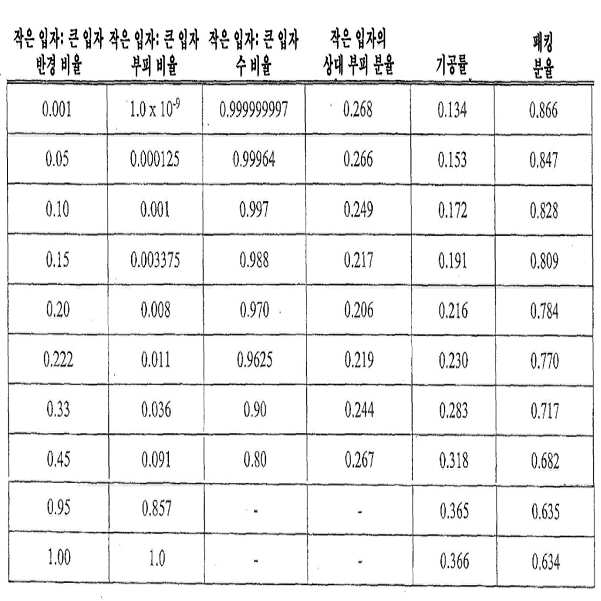
표 1 설명: 이정의 마찰 없는 구의 그룹의 시뮬레이션된 혼합물에 대한 값의 표, 여기서 각각의 그룹은 단지 한 크기의 구로 이루어진다. 혼합물에 대한 최소 기공률(최대 패킹 분율)이 달성되는 임계 수 및 부피 분율과 함께, 작은 입자 대 큰 입자 그룹 평균 입자 직경 및 평균 입자 부피의 비율이 주어진다. 이들 값을 결정한 시뮬레이션은 TJ 알고리즘을 이용하여 수행되었다.9 시뮬레이션 방법은 최소 기공률이 나타나는 작은 구의 최소 기공률 및 임계 상대 부피 분율의 정확한 값 결정에 중요하다.Table 1 Description: A table of values for a simulated mixture of groups of frictionless spheres with two definitions, where each group consists of spheres of only one size. The ratio of the small to large particle group average particle diameter and average particle volume is given, along with the critical number and volume fraction at which the minimum porosity (maximum packing fraction) for the mixture is achieved. Simulations for determining these values were performed using the TJ algorithm. 9 The simulation method is important in determining the exact values of the minimum porosity and critical relative volume fraction of small spheres where the minimum porosity appears.
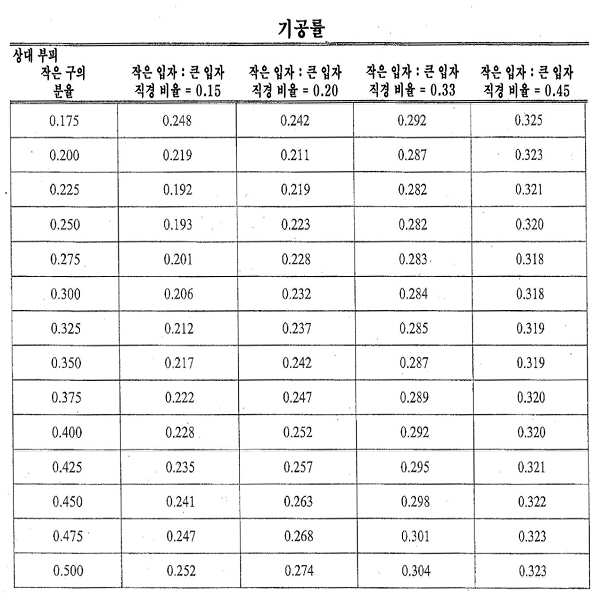
표 2 설명: 이정의 마찰 없는 구의 그룹의 시뮬레이션된 혼합물에 대한 다양한 작은 구 상대 부피 분율에서의 기공률 값의 표, 여기서 각각의 그룹은 단지 한 크기의 구로 이루어진다. 이들 값을 결정한 시뮬레이션은 TJ 알고리즘을 이용하여 수행되었다.9 시뮬레이션 방법은 다양한 작은 구 상대 부피 분율에서 기공률의 정확한 값 결정에 중요하다.Table 2 Description: Table of porosity values at various small sphere relative volume fractions for a simulated mixture of groups of frictionless spheres with two definitions, where each group consists of spheres of only one size. Simulations for determining these values were performed using the TJ algorithm. 9 The simulation method is important in determining the exact value of porosity at various small sphere relative volume fractions.
Claims (74)
상기 레이어는 두께가 1000 마이크론 미만이고,
여기서, 그룹 간 분할 부피가 복합물의 대표적인 통과 곡선 또는 입자 크기 분포 내 최솟값인 경우, 각 그룹이 상호 배타적인 입자 부피의 범위를 가지고, 두 개 이상의 그룹의 연합이 복합물 내 모든 입자를 포함하도록, 상기 과립형 복합물은 적어도 두 그룹의 입자를 포함하고,
복합물 내 적어도 두 개의 이러한 그룹의 경우, 두 그룹 사이의 최솟값에서 통과 곡선의 값 또는 입자 크기 분포의 다른 측정치는 두 그룹 중의 하나의 가장 큰 최대값에서 통과 곡선의 값 또는 입자 크기 분포의 다른 측정치의 75%보다 크지 않고,
여기서, 평균적으로, 더 큰 그룹으로부터 입자는 동일한 그룹으로부터 적어도 하나의 다른 입자와 접촉하며, 더 작은 그룹 및 더 큰 그룹 모두로부터의 복합물 입자 전체에서 복합물 구조의 기계적 안정성에 기여하는 기계적으로 안정한 구조를 형성하며,
상기 분말은 제1 및 제2 그룹의 입자를 포함하고, 상기 제1 그룹의 상기 입자는 상기 제2 그룹의 상기 입자의 평균 입자 부피보다 최대 2000 배 더 큰 평균 입자 부피를 가지는, 레이어.A layer of particles comprising a disordered, flowable granular composite powder that exhibits a porosity of 25% or less and does not phase separate when flowing,
The layer is less than 1000 microns thick,
Here, when the divided volume between groups is the minimum value in the representative passage curve or particle size distribution of the composite, each group has a range of mutually exclusive particle volumes, and the association of two or more groups includes all particles in the composite, The granular composite contains at least two groups of particles,
For at least two such groups in the composite, the value of the pass curve or other measure of the particle size distribution at the minimum value between the two groups is the value of the pass curve at the largest maximum of one of the two groups, or of another measure of the particle size distribution. Not greater than 75%,
Here, on average, particles from a larger group are in contact with at least one other particle from the same group, and have a mechanically stable structure that contributes to the mechanical stability of the composite structure throughout the composite particles from both the smaller and larger groups. To form,
Wherein the powder comprises a first and a second group of particles, wherein the particles of the first group have an average particle volume that is up to 2000 times greater than the average particle volume of the particles of the second group.
상기 레이어는 두께가 1000 마이크론 미만이고,
여기서, 그룹 간 분할 부피가 복합물의 대표적인 통과 곡선 또는 입자 크기 분포 내 최솟값인 경우, 각 그룹이 상호 배타적인 입자 부피의 범위를 가지고, 두 개 이상의 그룹의 연합이 복합물 내 모든 입자를 포함하도록, 상기 과립형 복합물은 적어도 두 그룹의 입자를 포함하고,
복합물 내 적어도 두 개의 이러한 그룹의 경우,
두 그룹 사이에 최솟값에서 통과 곡선의 값 또는 입자 크기 분포의 다른 측정치는 두 그룹 중의 하나의 가장 큰 최대값에서 통과 곡선의 값 또는 입자 크기 분포의 다른 측정치의 75% 보다 크지 않고,
여기서, 평균적으로, 더 큰 그룹으로부터 입자는 동일한 그룹으로부터 적어도 하나의 다른 입자를 최근접 이웃(nearest neighbor)으로 가지며, 더 작은 그룹에서 입자의 총 부피가 더 작은 그룹 및 더 큰 그룹에서 입자의 부피의 총합의 적어도 10%이도록 하며,
상기 현탁액은 제1 및 제2 그룹의 입자를 포함하고, 상기 제1 그룹의 상기 입자는 상기 제2 그룹의 상기 입자의 평균 입자 부피보다 최대 2000 배 더 큰 평균 입자 부피를 가지는, 레이어. A layer of particles comprising a suspension of a disordered, flowable granular composite that exhibits a porosity of 35% or less and does not phase separate when flowing,
The layer is less than 1000 microns thick,
Here, when the divided volume between groups is the minimum value in the representative passage curve or particle size distribution of the composite, each group has a range of mutually exclusive particle volumes, and the association of two or more groups includes all particles in the composite, The granular composite contains at least two groups of particles,
For at least two of these groups in the composite,
The value of the pass curve or other measure of the particle size distribution at the minimum between the two groups is not greater than 75% of the value of the pass curve or the other measure of the particle size distribution at the greatest maximum of one of the two groups,
Here, on average, particles from a larger group have at least one other particle from the same group as the nearest neighbor, and the total volume of particles in the smaller group is the volume of the particles in the smaller and larger groups. Should be at least 10% of the sum of
Wherein the suspension comprises a first and a second group of particles, the particles of the first group having an average particle volume of at most 2000 times greater than the average particle volume of the particles of the second group.
Applications Claiming Priority (7)
| Application Number | Priority Date | Filing Date | Title |
|---|---|---|---|
| US201361867788P | 2013-08-20 | 2013-08-20 | |
| US61/867,788 | 2013-08-20 | ||
| US201461933007P | 2014-01-29 | 2014-01-29 | |
| US61/933,007 | 2014-01-29 | ||
| US201462014922P | 2014-06-20 | 2014-06-20 | |
| US62/014,922 | 2014-06-20 | ||
| PCT/US2014/051468 WO2015073081A1 (en) | 2013-08-20 | 2014-08-18 | Density enhancement methods and compositions |
Publications (2)
| Publication Number | Publication Date |
|---|---|
| KR20160044014A KR20160044014A (en) | 2016-04-22 |
| KR102215240B1 true KR102215240B1 (en) | 2021-02-15 |
Family
ID=53057839
Family Applications (1)
| Application Number | Title | Priority Date | Filing Date |
|---|---|---|---|
| KR1020167006973A Active KR102215240B1 (en) | 2013-08-20 | 2014-08-18 | Density enhancement methods and compositions |
Country Status (10)
| Country | Link |
|---|---|
| US (4) | US10207327B2 (en) |
| EP (2) | EP3117935B1 (en) |
| JP (2) | JP7010590B2 (en) |
| KR (1) | KR102215240B1 (en) |
| AU (2) | AU2014349205A1 (en) |
| BR (1) | BR112016003414A8 (en) |
| CA (2) | CA2920344C (en) |
| MX (2) | MX377521B (en) |
| WO (1) | WO2015073081A1 (en) |
| ZA (1) | ZA201601250B (en) |
Families Citing this family (57)
| Publication number | Priority date | Publication date | Assignee | Title |
|---|---|---|---|---|
| KR102215240B1 (en) * | 2013-08-20 | 2021-02-15 | 더 트러스티즈 오브 프린스턴 유니버시티 | Density enhancement methods and compositions |
| US9505057B2 (en) * | 2013-09-06 | 2016-11-29 | Arcam Ab | Powder distribution in additive manufacturing of three-dimensional articles |
| GB201320888D0 (en) * | 2013-11-27 | 2014-01-08 | Linde Aktiengesellshcaft | Additive manufacturing of titanium article |
| DE102014212176A1 (en) * | 2014-06-25 | 2015-12-31 | Siemens Aktiengesellschaft | Powder bed-based additive manufacturing process and apparatus for carrying out this process |
| US10144065B2 (en) | 2015-01-07 | 2018-12-04 | Kennametal Inc. | Methods of making sintered articles |
| KR101799558B1 (en) * | 2015-08-12 | 2017-11-20 | 인하대학교 산학협력단 | Forming materials and method for 3D printing based on irregular shape amorphous glass and structure body thereby |
| JP6656911B2 (en) * | 2015-12-22 | 2020-03-04 | 株式会社フジミインコーポレーテッド | Modeling materials for use in powder additive manufacturing |
| JP6764228B2 (en) * | 2015-12-22 | 2020-09-30 | 株式会社フジミインコーポレーテッド | Modeling material for use in additive manufacturing |
| US10844475B2 (en) | 2015-12-28 | 2020-11-24 | Jx Nippon Mining & Metals Corporation | Method for manufacturing sputtering target |
| WO2017150340A1 (en) * | 2016-03-01 | 2017-09-08 | 日立金属株式会社 | Composite particles, composite powder, method for manufacturing composite particles, and method for manufacturing composite member |
| JP6861728B2 (en) * | 2016-04-15 | 2021-04-21 | サンドビック インテレクチュアル プロパティー アクティエボラーグ | Three-dimensional printing of cermet or cemented carbide |
| EP3235867A1 (en) | 2016-04-20 | 2017-10-25 | Evonik Röhm GmbH | Polymer beads from hard phase with domains of a soft phase |
| DE102016107630B4 (en) * | 2016-04-25 | 2024-08-01 | Schott Ag | Process for producing a shaped body made of glass ceramic with complex geometry and shaped bodies produced in this way |
| US20170336337A1 (en) * | 2016-05-18 | 2017-11-23 | Tty-Säätiö | Method and apparatus for monitoring a heterogeneous mixture |
| CN106001571B (en) * | 2016-07-07 | 2017-03-22 | 四川天塬增材制造材料有限公司 | Metal part selective laser alloying additive manufacturing method |
| CA3032821A1 (en) | 2016-08-03 | 2018-02-08 | 3Deo, Inc. | Devices and methods for three-dimensional printing |
| HUE053886T2 (en) * | 2016-09-28 | 2021-07-28 | Evonik Roehm Gmbh | Production and use of porous bead polymers in 3d printing using the binder jetting method |
| JP2018066049A (en) * | 2016-10-20 | 2018-04-26 | 株式会社リコー | 3D modeling powder material, 3D modeling material set, 3D model manufacturing apparatus, and 3D model manufacturing method |
| WO2018089341A1 (en) * | 2016-11-08 | 2018-05-17 | Purdue Research Foundation | Methods and apparatus for 3d printing of highly viscous materials |
| CN110121392B (en) | 2016-12-28 | 2021-03-02 | 三菱电机株式会社 | Method for manufacturing alloy molded article |
| JP6825374B2 (en) * | 2017-01-12 | 2021-02-03 | Tdk株式会社 | Soft magnetic materials, cores and inductors |
| JP2018123381A (en) * | 2017-02-01 | 2018-08-09 | 三菱重工業株式会社 | Mixed powder containing two powders of different particle sizes |
| US11065863B2 (en) | 2017-02-20 | 2021-07-20 | Kennametal Inc. | Cemented carbide powders for additive manufacturing |
| JP6961972B2 (en) * | 2017-03-24 | 2021-11-05 | 富士フイルムビジネスイノベーション株式会社 | Three-dimensional shape molding equipment, information processing equipment and programs |
| US11157907B1 (en) | 2017-04-26 | 2021-10-26 | Wells Fargo Bank, N.A. | Transaction validation and fraud mitigation |
| EP3548209A4 (en) | 2017-04-28 | 2020-04-29 | Hewlett-Packard Development Company, L.P. | PELLETS OF METAL CONSTRUCTION MATERIAL |
| CN107391790B (en) * | 2017-06-12 | 2020-08-25 | 深圳大学 | Green self-compacting concrete and preparation method thereof |
| AU2018283171A1 (en) * | 2017-06-15 | 2020-01-16 | Heavy Metal Llc | Multilayer parameter-varying fusing and deposition strategies for additive manufacturing |
| JP6509290B2 (en) | 2017-09-08 | 2019-05-08 | 三菱日立パワーシステムズ株式会社 | Cobalt-based alloy laminate shaped body, cobalt-based alloy product, and method for producing them |
| US11998987B2 (en) | 2017-12-05 | 2024-06-04 | Kennametal Inc. | Additive manufacturing techniques and applications thereof |
| CN111356546A (en) * | 2018-01-02 | 2020-06-30 | 惠普发展公司,有限责任合伙企业 | Powder bed material |
| JP7022595B2 (en) * | 2018-01-17 | 2022-02-18 | スタンレー電気株式会社 | Electronic devices and their manufacturing methods |
| JP6958434B2 (en) * | 2018-03-06 | 2021-11-02 | 三菱マテリアル株式会社 | Metal particle agglomerates and a method for producing the same, and a paste-like metal particle agglomerate composition and a method for producing a bonded body using the same. |
| US11167375B2 (en) | 2018-08-10 | 2021-11-09 | The Research Foundation For The State University Of New York | Additive manufacturing processes and additively manufactured products |
| US11453618B2 (en) * | 2018-11-06 | 2022-09-27 | Utility Global, Inc. | Ceramic sintering |
| JP7117226B2 (en) | 2018-11-12 | 2022-08-12 | 株式会社フジミインコーポレーテッド | Powder material for use in powder additive manufacturing, powder additive manufacturing method using the same, and modeled object |
| JP7201401B2 (en) * | 2018-11-12 | 2023-01-10 | 株式会社フジミインコーポレーテッド | Powder material for use in powder additive manufacturing, powder additive manufacturing method using the same, and modeled object |
| CN112004950B (en) | 2019-03-07 | 2022-06-28 | 三菱重工业株式会社 | Cobalt-based alloy articles and cobalt-based alloy articles |
| EP3725902B1 (en) | 2019-03-07 | 2023-03-01 | Mitsubishi Heavy Industries, Ltd. | Cobalt-based alloy product and method for producing same |
| WO2020179080A1 (en) | 2019-03-07 | 2020-09-10 | 三菱日立パワーシステムズ株式会社 | Cobalt-based alloy product, method for manufacturing said product, and cobalt-based alloy article |
| KR102445591B1 (en) | 2019-03-07 | 2022-09-21 | 미츠비시 파워 가부시키가이샤 | Cobalt-Based Alloy Products |
| WO2020179085A1 (en) | 2019-03-07 | 2020-09-10 | 三菱日立パワーシステムズ株式会社 | Heat exchanger |
| WO2020179082A1 (en) | 2019-03-07 | 2020-09-10 | 三菱日立パワーシステムズ株式会社 | Cobalt-based alloy powder, cobalt-based alloy sintered body, and method for producing cobalt-based alloy sintered body |
| DE112020001416T5 (en) | 2019-03-25 | 2021-12-09 | Kennametal Inc. | ADDITIVE MANUFACTURING TECHNIQUES AND THEIR APPLICATIONS |
| US20210008615A1 (en) | 2019-07-10 | 2021-01-14 | Lawrence Livermore National Security, Llc | Tailored particles for power-based additive manufacturing |
| JP7278909B2 (en) * | 2019-09-03 | 2023-05-22 | 東洋アルミニウム株式会社 | Metal powder for additive manufacturing |
| JP6756994B1 (en) * | 2019-09-24 | 2020-09-16 | 冨士ダイス株式会社 | Manufacturing method of powder for additive manufacturing, manufacturing method of additive manufacturing, and manufacturing method of sintered body of additive manufacturing |
| DE102019125810A1 (en) * | 2019-09-25 | 2021-03-25 | Bayerische Motoren Werke Aktiengesellschaft | Building material for a process, in particular an additive manufacturing process or a joining process |
| CN110846568A (en) * | 2019-10-16 | 2020-02-28 | 邯郸钢铁集团有限责任公司 | 400 MPa-level straight reinforcing steel bar and production method thereof |
| CN111333474A (en) * | 2020-03-13 | 2020-06-26 | 北京星际荣耀空间科技有限公司 | Solid propellant and horizontal additive manufacturing method thereof |
| WO2022093276A1 (en) * | 2020-10-30 | 2022-05-05 | Hewlett-Packard Development Company, L.P. | Flexibility of features of an object to be additively manufactured |
| CN112958784A (en) * | 2021-02-01 | 2021-06-15 | 中国科学院金属研究所 | Method for actively controlling uniform distribution and growth direction of reinforcing phase in particle-reinforced titanium-based composite material |
| JP7795185B2 (en) * | 2021-07-09 | 2026-01-07 | 株式会社木村鋳造所 | Casting method |
| WO2023064985A1 (en) * | 2021-10-18 | 2023-04-27 | The University Of Queensland | A composition for additive manufacturing |
| EP4268996A1 (en) | 2022-04-29 | 2023-11-01 | EOS GmbH Electro Optical Systems | Powder mixtures for additive manufacture having an increased density |
| CN114951996B (en) * | 2022-05-27 | 2024-03-22 | 长沙理工大学 | Laser energy space-time cooperative modulation laser deep-melting welding method and system |
| CN115216666B (en) * | 2022-06-21 | 2023-01-03 | 南京工业大学 | High-strength high-toughness laminated titanium alloy composite material, preparation method and aircraft landing gear using same |
Citations (4)
| Publication number | Priority date | Publication date | Assignee | Title |
|---|---|---|---|---|
| US20040009089A1 (en) | 2002-07-12 | 2004-01-15 | Jianxin Liu | Blended powder solid-supersolidus liquid phase sintering |
| JP2011241450A (en) | 2010-05-19 | 2011-12-01 | Keijiro Yamamoto | Layered manufacturing method and layered manufacturing apparatus |
| WO2014083277A1 (en) | 2012-11-27 | 2014-06-05 | Snecma | A method for the additive manufacturing of a part by selective melting or selective sintering of optimised-compactness powder beds using a high energy beam |
| WO2015014711A1 (en) | 2013-07-24 | 2015-02-05 | Emil Müller GmbH | Salt core and additive manufacturing method for producing salt cores |
Family Cites Families (38)
| Publication number | Priority date | Publication date | Assignee | Title |
|---|---|---|---|---|
| JPS5427811B2 (en) | 1973-02-07 | 1979-09-12 | ||
| US4073999A (en) * | 1975-05-09 | 1978-02-14 | Minnesota Mining And Manufacturing Company | Porous ceramic or metallic coatings and articles |
| JPH0610282B2 (en) | 1984-03-14 | 1994-02-09 | 日本電装株式会社 | Amorphous metal forming method |
| JPH02166201A (en) | 1988-12-19 | 1990-06-26 | Kobe Steel Ltd | Manufacture of high density sintered body |
| US5431967A (en) * | 1989-09-05 | 1995-07-11 | Board Of Regents, The University Of Texas System | Selective laser sintering using nanocomposite materials |
| US5990268A (en) | 1992-11-23 | 1999-11-23 | Dtm Corporation | Sinterable semi-crystalline powder and near-fully dense article formed therewith |
| US5527877A (en) | 1992-11-23 | 1996-06-18 | Dtm Corporation | Sinterable semi-crystalline powder and near-fully dense article formed therewith |
| DE69633143T2 (en) * | 1995-11-09 | 2005-08-04 | Toyota Jidosha K.K., Toyota | Method and device for producing a 3-D core sand mold by forming layers of sand |
| JP3402106B2 (en) * | 1996-01-31 | 2003-04-28 | 株式会社デンソー | Oxygen concentration detecting element and method of manufacturing the same |
| US5817206A (en) * | 1996-02-07 | 1998-10-06 | Dtm Corporation | Selective laser sintering of polymer powder of controlled particle size distribution |
| US6967183B2 (en) * | 1998-08-27 | 2005-11-22 | Cabot Corporation | Electrocatalyst powders, methods for producing powders and devices fabricated from same |
| US6171690B1 (en) * | 1998-08-28 | 2001-01-09 | Ncr Corporation | Thermal transfer media with a mixture of non-melting solid particles of distinct sizes |
| US20010001640A1 (en) * | 1999-03-16 | 2001-05-24 | Steven A. Miller Et Al | Method of making a closed porosity surface coating on a low density preform |
| JP3551838B2 (en) | 1999-05-26 | 2004-08-11 | 松下電工株式会社 | Manufacturing method of three-dimensional shaped object |
| WO2003028927A1 (en) * | 2001-09-28 | 2003-04-10 | Mitsubishi Materials Corporation | Silver powder for silver clay and silver clay comprising the silver powder |
| JP2003306705A (en) | 2002-04-17 | 2003-10-31 | Mitsubishi Materials Corp | Sintered product and method for producing the same |
| CA2448592C (en) * | 2002-11-08 | 2011-01-11 | Howmedica Osteonics Corp. | Laser-produced porous surface |
| US20060147332A1 (en) * | 2004-12-30 | 2006-07-06 | Howmedica Osteonics Corp. | Laser-produced porous structure |
| JP2005023416A (en) | 2003-07-04 | 2005-01-27 | Hitachi Powdered Metals Co Ltd | Manufacturing method of metal-ceramic sintered laminate |
| US8329501B1 (en) * | 2004-02-19 | 2012-12-11 | Nanosolar, Inc. | High-throughput printing of semiconductor precursor layer from inter-metallic microflake particles |
| US8642455B2 (en) * | 2004-02-19 | 2014-02-04 | Matthew R. Robinson | High-throughput printing of semiconductor precursor layer from nanoflake particles |
| JP5188674B2 (en) | 2004-06-25 | 2013-04-24 | Tdk株式会社 | Method for producing rare earth sintered magnet, method for grinding raw alloy powder for sintered magnet |
| TWI262110B (en) * | 2005-03-04 | 2006-09-21 | Foxconn Tech Co Ltd | Method of making porous structure |
| KR100964565B1 (en) * | 2005-09-29 | 2010-06-21 | 닝시아 오리엔트 탄탈럼 인더스트리 코포레이션 엘티디 | Spherical granulation and agglomeration method of metal particles and metal particles produced by the method, anode prepared from the metal particles |
| US7731776B2 (en) * | 2005-12-02 | 2010-06-08 | Exxonmobil Research And Engineering Company | Bimodal and multimodal dense boride cermets with superior erosion performance |
| JP5268908B2 (en) * | 2006-07-28 | 2013-08-21 | エレメント シックス (プロダクション)(プロプライエタリィ) リミテッド | Abrasive compact |
| ATE470649T1 (en) | 2006-09-14 | 2010-06-15 | Ibiden Co Ltd | METHOD FOR PRODUCING A HONEYCOMB BODY AND COMPOSITION FOR SINTERED HONEYCOMB BODY |
| WO2009013713A2 (en) * | 2007-07-23 | 2009-01-29 | Element Six (Production) (Pty) Ltd | Abrasive compact |
| US7799128B2 (en) | 2008-10-10 | 2010-09-21 | Roman Cement, Llc | High early strength pozzolan cement blends |
| JP5573110B2 (en) | 2009-11-06 | 2014-08-20 | 三菱マテリアル株式会社 | Sintered metal sheet material for electrochemical member and method for producing sintered metal sheet material for electrochemical member |
| FR2959505B1 (en) * | 2010-04-28 | 2012-11-16 | Saint Gobain Ct Recherches | COATED MULLITE GRAINS. |
| DE102011053740A1 (en) * | 2011-09-19 | 2013-03-21 | Gühring Ohg | Preparing a hard material tool component e.g. a full hard metal tool, comprises transforming and/or pressing or extruding a hard material, a sintering agent such as carbon monoxide, and/or binding agent to slug, and then sintering |
| CN105247703B (en) * | 2013-04-29 | 2019-09-03 | 奥普图多特公司 | Nanoporous composite separator with increased thermal conductivity |
| KR102215240B1 (en) * | 2013-08-20 | 2021-02-15 | 더 트러스티즈 오브 프린스턴 유니버시티 | Density enhancement methods and compositions |
| GB201315036D0 (en) | 2013-08-22 | 2013-10-02 | Renishaw Plc | Apparatus and method for building objects by selective solidification of powder material |
| US9505057B2 (en) | 2013-09-06 | 2016-11-29 | Arcam Ab | Powder distribution in additive manufacturing of three-dimensional articles |
| EP3049077A4 (en) | 2013-09-26 | 2017-02-15 | CHDI Foundation, Inc. | Kynurenine-3-monooxygenase inhibitors, pharmaceutical compositions, and methods of use thereof |
| EP3094669B1 (en) * | 2014-01-16 | 2022-11-23 | Hewlett-Packard Development Company, L.P. | Polymeric powder composition for three-dimensional (3d) printing |
-
2014
- 2014-08-18 KR KR1020167006973A patent/KR102215240B1/en active Active
- 2014-08-18 EP EP16179428.4A patent/EP3117935B1/en active Active
- 2014-08-18 US US14/912,661 patent/US10207327B2/en active Active
- 2014-08-18 MX MX2016002172A patent/MX377521B/en active IP Right Grant
- 2014-08-18 MX MX2020006880A patent/MX394008B/en unknown
- 2014-08-18 AU AU2014349205A patent/AU2014349205A1/en not_active Abandoned
- 2014-08-18 CA CA2920344A patent/CA2920344C/en active Active
- 2014-08-18 WO PCT/US2014/051468 patent/WO2015073081A1/en not_active Ceased
- 2014-08-18 BR BR112016003414A patent/BR112016003414A8/en not_active Application Discontinuation
- 2014-08-18 CA CA3172723A patent/CA3172723A1/en active Pending
- 2014-08-18 JP JP2016536350A patent/JP7010590B2/en active Active
- 2014-08-18 EP EP14861670.9A patent/EP3036191A4/en not_active Withdrawn
-
2016
- 2016-02-24 ZA ZA2016/01250A patent/ZA201601250B/en unknown
- 2016-03-15 US US15/071,004 patent/US11396044B2/en active Active
-
2018
- 2018-06-22 AU AU2018204556A patent/AU2018204556B2/en active Active
- 2018-12-28 US US16/235,654 patent/US10864577B2/en active Active
-
2021
- 2021-06-02 JP JP2021092969A patent/JP7580340B2/en active Active
-
2022
- 2022-06-22 US US17/846,300 patent/US12151978B2/en active Active
Patent Citations (5)
| Publication number | Priority date | Publication date | Assignee | Title |
|---|---|---|---|---|
| US20040009089A1 (en) | 2002-07-12 | 2004-01-15 | Jianxin Liu | Blended powder solid-supersolidus liquid phase sintering |
| JP2005533177A (en) * | 2002-07-12 | 2005-11-04 | エクス ワン コーポレーション | Solid-ultra-solid liquid phase sintering of mixed powder |
| JP2011241450A (en) | 2010-05-19 | 2011-12-01 | Keijiro Yamamoto | Layered manufacturing method and layered manufacturing apparatus |
| WO2014083277A1 (en) | 2012-11-27 | 2014-06-05 | Snecma | A method for the additive manufacturing of a part by selective melting or selective sintering of optimised-compactness powder beds using a high energy beam |
| WO2015014711A1 (en) | 2013-07-24 | 2015-02-05 | Emil Müller GmbH | Salt core and additive manufacturing method for producing salt cores |
Also Published As
| Publication number | Publication date |
|---|---|
| EP3036191A4 (en) | 2017-01-18 |
| CA2920344C (en) | 2022-12-06 |
| MX377521B (en) | 2025-03-10 |
| EP3036191A1 (en) | 2016-06-29 |
| US20220395898A1 (en) | 2022-12-15 |
| US10864577B2 (en) | 2020-12-15 |
| ZA201601250B (en) | 2017-05-31 |
| JP2021130879A (en) | 2021-09-09 |
| EP3117935A1 (en) | 2017-01-18 |
| AU2018204556A1 (en) | 2018-07-12 |
| US12151978B2 (en) | 2024-11-26 |
| MX394008B (en) | 2025-03-24 |
| MX2016002172A (en) | 2017-01-05 |
| CA3172723A1 (en) | 2015-05-21 |
| JP7580340B2 (en) | 2024-11-11 |
| EP3117935B1 (en) | 2024-10-30 |
| JP7010590B2 (en) | 2022-01-26 |
| US20190308244A1 (en) | 2019-10-10 |
| MX2020006880A (en) | 2020-08-24 |
| AU2018204556B2 (en) | 2020-02-06 |
| US20160200045A1 (en) | 2016-07-14 |
| US11396044B2 (en) | 2022-07-26 |
| KR20160044014A (en) | 2016-04-22 |
| JP2016535169A (en) | 2016-11-10 |
| BR112016003414A8 (en) | 2020-02-11 |
| WO2015073081A1 (en) | 2015-05-21 |
| US20160368057A1 (en) | 2016-12-22 |
| AU2014349205A1 (en) | 2016-02-25 |
| US10207327B2 (en) | 2019-02-19 |
| CA2920344A1 (en) | 2015-05-21 |
Similar Documents
| Publication | Publication Date | Title |
|---|---|---|
| KR102215240B1 (en) | Density enhancement methods and compositions | |
| Miyanaji et al. | Effect of powder characteristics on parts fabricated via binder jetting process | |
| Hao et al. | Direct ink writing of mineral materials: A review | |
| Zhang et al. | Design and fabrication technology of metal mirrors based on additive manufacturing: A review | |
| JP2019502028A (en) | Economical manufacturing method for metal parts | |
| Roy et al. | Processing and elastic property characterization of porous SiC preform for interpenetrating metal/ceramic composites | |
| Petersson et al. | Rearrangement and pore size evolution during WC–Co sintering below the eutectic temperature | |
| Tang et al. | Investigation of wax-based barite slurry and deposition for 3D printing landslide model | |
| Wang et al. | Compression properties of porous Inconel 718 alloy formed by selective laser melting | |
| Popovich et al. | Additive manufacturing of functionally graded materials from lunar regolith | |
| Jiang et al. | Investigation of microstructural evolution and property optimization of pure tungsten via powder extrusion 3D printing | |
| Ji et al. | 3D gel-printing of TiC-reinforced 316L stainless steel: influence of the printing parameters | |
| Delie et al. | Effect of inclusion morphology on the densification of powder composites | |
| Jhabvala | Study of the consolidation process under macro-and microscopic thermal effects in selective laser sintering and selective laser melting | |
| Mitra | Experimental and numerical characterization of functional properties of sand molds produced by additive manufacturing (3D printing by jet binding) in a fast foundr | |
| Han et al. | Experimental analysis for fabrication of high-aspect-ratio piezoelectric ceramic structure by micro-powder injection molding process | |
| Baloyo | Porous metals with novel structures for optimum heat exchange performance | |
| Le | Computational modeling of selective laser melting process | |
| Cigno | Engineering Powders for Ceramic 3-D Printing | |
| Londero | Silicon carbide paste development for the extrusion based 3D printing of a heat exchanger employed in concentrated solar power applications | |
| Jiang | Extrusion-Based Additive Manufacturing of Metal Materials Through Theoretical, Computational, and Experimental Study | |
| Diener | Relation of process parameters and green parts quality in the Layerwise Slurry Deposition Print process of SiSiC | |
| Boccaccini et al. | Use of heating microscopy to assess sintering anisotropy in layered glass metal powder compacts | |
| Hou et al. | An Integrated Simulation Model Towards Lpbf in Situ Alloying Technology | |
| Alymov et al. | Synthesis of a porous tube based on powdered titanium carbide |
Legal Events
| Date | Code | Title | Description |
|---|---|---|---|
| PA0105 | International application |
Patent event date: 20160316 Patent event code: PA01051R01D Comment text: International Patent Application |
|
| PG1501 | Laying open of application | ||
| A201 | Request for examination | ||
| A302 | Request for accelerated examination | ||
| AMND | Amendment | ||
| PA0201 | Request for examination |
Patent event code: PA02012R01D Patent event date: 20190624 Comment text: Request for Examination of Application |
|
| PA0302 | Request for accelerated examination |
Patent event date: 20190624 Patent event code: PA03022R01D Comment text: Request for Accelerated Examination |
|
| E902 | Notification of reason for refusal | ||
| PE0902 | Notice of grounds for rejection |
Comment text: Notification of reason for refusal Patent event date: 20190702 Patent event code: PE09021S01D |
|
| AMND | Amendment | ||
| E902 | Notification of reason for refusal | ||
| PE0902 | Notice of grounds for rejection |
Comment text: Notification of reason for refusal Patent event date: 20191122 Patent event code: PE09021S01D |
|
| AMND | Amendment | ||
| E601 | Decision to refuse application | ||
| PE0601 | Decision on rejection of patent |
Patent event date: 20200427 Comment text: Decision to Refuse Application Patent event code: PE06012S01D Patent event date: 20191122 Comment text: Notification of reason for refusal Patent event code: PE06011S01I Patent event date: 20190702 Comment text: Notification of reason for refusal Patent event code: PE06011S01I |
|
| X091 | Application refused [patent] | ||
| AMND | Amendment | ||
| PX0901 | Re-examination |
Patent event code: PX09011S01I Patent event date: 20200427 Comment text: Decision to Refuse Application Patent event code: PX09012R01I Patent event date: 20200218 Comment text: Amendment to Specification, etc. Patent event code: PX09012R01I Patent event date: 20190830 Comment text: Amendment to Specification, etc. Patent event code: PX09012R01I Patent event date: 20190624 Comment text: Amendment to Specification, etc. |
|
| E902 | Notification of reason for refusal | ||
| PE0902 | Notice of grounds for rejection |
Comment text: Notification of reason for refusal Patent event date: 20200701 Patent event code: PE09021S01D |
|
| AMND | Amendment | ||
| PX0701 | Decision of registration after re-examination |
Patent event date: 20201116 Comment text: Decision to Grant Registration Patent event code: PX07013S01D Patent event date: 20200812 Comment text: Amendment to Specification, etc. Patent event code: PX07012R01I Patent event date: 20200528 Comment text: Amendment to Specification, etc. Patent event code: PX07012R01I Patent event date: 20200427 Comment text: Decision to Refuse Application Patent event code: PX07011S01I Patent event date: 20200218 Comment text: Amendment to Specification, etc. Patent event code: PX07012R01I Patent event date: 20190830 Comment text: Amendment to Specification, etc. Patent event code: PX07012R01I Patent event date: 20190624 Comment text: Amendment to Specification, etc. Patent event code: PX07012R01I |
|
| X701 | Decision to grant (after re-examination) | ||
| GRNT | Written decision to grant | ||
| PR0701 | Registration of establishment |
Comment text: Registration of Establishment Patent event date: 20210205 Patent event code: PR07011E01D |
|
| PR1002 | Payment of registration fee |
Payment date: 20210205 End annual number: 3 Start annual number: 1 |
|
| PG1601 | Publication of registration | ||
| PR1001 | Payment of annual fee |
Payment date: 20240125 Start annual number: 4 End annual number: 4 |
|
| PR1001 | Payment of annual fee |
Payment date: 20250123 Start annual number: 5 End annual number: 5 |