KR101522042B1 - Use of protein hydrolysates to stabilize metalloprotease detergent formulations - Google Patents
Use of protein hydrolysates to stabilize metalloprotease detergent formulations Download PDFInfo
- Publication number
- KR101522042B1 KR101522042B1 KR1020097022743A KR20097022743A KR101522042B1 KR 101522042 B1 KR101522042 B1 KR 101522042B1 KR 1020097022743 A KR1020097022743 A KR 1020097022743A KR 20097022743 A KR20097022743 A KR 20097022743A KR 101522042 B1 KR101522042 B1 KR 101522042B1
- Authority
- KR
- South Korea
- Prior art keywords
- metalloprotease
- protein
- inhibitor
- formulation
- neutral metalloprotease
- Prior art date
- Legal status (The legal status is an assumption and is not a legal conclusion. Google has not performed a legal analysis and makes no representation as to the accuracy of the status listed.)
- Expired - Fee Related
Links
Images


Classifications
-
- C—CHEMISTRY; METALLURGY
- C07—ORGANIC CHEMISTRY
- C07K—PEPTIDES
- C07K14/00—Peptides having more than 20 amino acids; Gastrins; Somatostatins; Melanotropins; Derivatives thereof
- C07K14/81—Protease inhibitors
- C07K14/8107—Endopeptidase (E.C. 3.4.21-99) inhibitors
- C07K14/8146—Metalloprotease (E.C. 3.4.24) inhibitors, e.g. tissue inhibitor of metallo proteinase, TIMP
-
- C—CHEMISTRY; METALLURGY
- C11—ANIMAL OR VEGETABLE OILS, FATS, FATTY SUBSTANCES OR WAXES; FATTY ACIDS THEREFROM; DETERGENTS; CANDLES
- C11D—DETERGENT COMPOSITIONS; USE OF SINGLE SUBSTANCES AS DETERGENTS; SOAP OR SOAP-MAKING; RESIN SOAPS; RECOVERY OF GLYCEROL
- C11D11/00—Special methods for preparing compositions containing mixtures of detergents
- C11D11/0094—Process for making liquid detergent compositions, e.g. slurries, pastes or gels
-
- C—CHEMISTRY; METALLURGY
- C11—ANIMAL OR VEGETABLE OILS, FATS, FATTY SUBSTANCES OR WAXES; FATTY ACIDS THEREFROM; DETERGENTS; CANDLES
- C11D—DETERGENT COMPOSITIONS; USE OF SINGLE SUBSTANCES AS DETERGENTS; SOAP OR SOAP-MAKING; RESIN SOAPS; RECOVERY OF GLYCEROL
- C11D17/00—Detergent materials or soaps characterised by their shape or physical properties
- C11D17/08—Liquid soap, e.g. for dispensers; capsuled
-
- C—CHEMISTRY; METALLURGY
- C11—ANIMAL OR VEGETABLE OILS, FATS, FATTY SUBSTANCES OR WAXES; FATTY ACIDS THEREFROM; DETERGENTS; CANDLES
- C11D—DETERGENT COMPOSITIONS; USE OF SINGLE SUBSTANCES AS DETERGENTS; SOAP OR SOAP-MAKING; RESIN SOAPS; RECOVERY OF GLYCEROL
- C11D3/00—Other compounding ingredients of detergent compositions covered in group C11D1/00
- C11D3/16—Organic compounds
- C11D3/38—Products with no well-defined composition, e.g. natural products
- C11D3/386—Preparations containing enzymes, e.g. protease or amylase
- C11D3/38663—Stabilised liquid enzyme compositions
-
- C—CHEMISTRY; METALLURGY
- C12—BIOCHEMISTRY; BEER; SPIRITS; WINE; VINEGAR; MICROBIOLOGY; ENZYMOLOGY; MUTATION OR GENETIC ENGINEERING
- C12P—FERMENTATION OR ENZYME-USING PROCESSES TO SYNTHESISE A DESIRED CHEMICAL COMPOUND OR COMPOSITION OR TO SEPARATE OPTICAL ISOMERS FROM A RACEMIC MIXTURE
- C12P21/00—Preparation of peptides or proteins
- C12P21/06—Preparation of peptides or proteins produced by the hydrolysis of a peptide bond, e.g. hydrolysate products
Landscapes
- Chemical & Material Sciences (AREA)
- Organic Chemistry (AREA)
- Life Sciences & Earth Sciences (AREA)
- Health & Medical Sciences (AREA)
- Wood Science & Technology (AREA)
- Engineering & Computer Science (AREA)
- Chemical Kinetics & Catalysis (AREA)
- Oil, Petroleum & Natural Gas (AREA)
- General Health & Medical Sciences (AREA)
- Genetics & Genomics (AREA)
- Molecular Biology (AREA)
- Biochemistry (AREA)
- Gastroenterology & Hepatology (AREA)
- Biophysics (AREA)
- Medicinal Chemistry (AREA)
- Proteomics, Peptides & Aminoacids (AREA)
- Zoology (AREA)
- Biotechnology (AREA)
- General Chemical & Material Sciences (AREA)
- Microbiology (AREA)
- Bioinformatics & Cheminformatics (AREA)
- General Engineering & Computer Science (AREA)
- Detergent Compositions (AREA)
- Enzymes And Modification Thereof (AREA)
Abstract
본 발명은 증가된 보관 안정성을 보여주는 메탈로프로테아제 효소 및 단백질 가수분해물 억제제를 포함하는 조성물 및 제제를 제공한다. 한 구현예에서, 본 발명은 세제 제제에 단백질 가수분해물을 포함하여 안정화된, 하나 이상의 메탈로프로테아제 (예를 들어, 바실러스 sp. 중성 메탈로프로테아제) 를 포함하는 액체 세제 제제를 제공한다. 본 발명은 또한, 메탈로프로테아제 효소를 사용해 단백질 기질을 분해함으로써 세제 제제를 안정화시키기 위한 단백질 가수분해물의 제조 방법을 제공한다.
메탈로프로테아제
The present invention provides compositions and formulations comprising a metalloprotease enzyme and a protein hydrolyzate inhibitor exhibiting increased storage stability. In one embodiment, the present invention provides a liquid detergent formulation comprising one or more metalloproteases (e.g., Bacillus sp. Neutral metalloprotease) stabilized with a protein hydrolyzate in a detergent formulation. The present invention also provides a method for producing a protein hydrolyzate for stabilizing a detergent formulation by decomposing a protein substrate using a metalloprotease enzyme.
Metalloprotease
Description
관련 출원에 관한 교차-참조문헌Cross-references to related applications
본 출원은 그 전체가 본원에 참조로써 삽입된 2007 년 4 월 30 일에 출원된 미국 가출원 제 60/914, 965 호의 이익을 주장한다.This application claims the benefit of U.S. Provisional Application No. 60 / 914,965, filed April 30, 2007, which is hereby incorporated by reference in its entirety.
본 발명은 보관 조건 하에 메탈로프로테아제 함유 세제 제제를 안정화시키기 위한, 단백질 가수분해물 억제제의 용도에 관한 것이다.The present invention relates to the use of protein hydrolysates inhibitors for stabilizing metalloprotease containing detergent formulations under storage conditions.
효소는 많은 세제 제제에서 주요 활성 성분이다. 이들은 촉매성이기 때문에, 효소는 얼룩을 분해시키는데 있어서 고도로 효과적인 성분일 수 있다. 그러나, 이들은 생물학적 생성물이라서, 효소는 또한 가장 비용이 드는 성분 중에 있을 수 있다. 결과적으로, 세제 제제의 일생을 통틀어 높은 효소 활성을 유지하는 것이 상기 세제 제제를 기반으로 한 생성물의 성공에 중요하다. Enzymes are the major active ingredient in many detergent formulations. Because they are catalytic, enzymes can be highly effective components in breaking down stains. However, since these are biological products, enzymes can also be among the most costly ingredients. As a result, maintaining high enzyme activity throughout the lifetime of the detergent formulation is critical to the success of the detergent-based product.
상기 제제에 사용되는 효소에는 프로테아제, 리파아제, 아밀라아제, 셀룰라아제, 만노시다아제, 뿐만 아니라 다른 효소 또는 그의 혼합물이 포함된다.Enzymes used in the formulations include proteases, lipases, amylases, cellulases, mannosidases, as well as other enzymes or mixtures thereof.
액체에서의 보관 동안 (즉, 사용 전) 효소 안정성을 유지하는 것과 관련한 문제는 잘 알려져 있다. 전형적으로, 프로테아제는 그의 촉매적 활성이 제제에서 다른 단백질을 분해하도록 작용하고, 뿐만 아니라 프로테아제 자체의 자가분해 (즉, 자가 분해) 의 과정을 통해 분해되기 때문에 더 큰 안정성 문제를 제기한다. 그러나, 세린 프로테아제 (예를 들어, 서브틸리신 (subtilisin)) 가 안정화될 수 있는 상대적인 용이성, 및 증가된 안정성을 위해 조작된 돌연변이의 개발로 인해, 상기 부류의 프로테아제는 세제 제제에서 광범위하게 사용되어 왔다. 실제로, 서브틸리신은 세제에서의 그의 용도로 인해, 가장 시중적으로 중요한 프로테아제 효소 중 하나이다. Problems associated with maintaining enzyme stability during storage in liquids (i.e., prior to use) are well known. Typically, a protease poses a greater stability problem because its catalytic activity acts to degrade other proteins in the formulation, as well as degrades through the process of autolysis (i.e., self-degradation) of the protease itself. However, due to the development of engineered mutants for the relative ease with which serine proteases (e.g., subtilisin) can be stabilized, and increased stability, proteases of this class are widely used in detergent formulations come. Indeed, subtilisin is one of the most commercially important protease enzymes due to its use in detergents.
반대로, 메탈로프로테아제는 세제 제제와 같은 산업 적용에서 거의 사용되지 않거나 또는 사용되지 않았다. 메탈로프로테아제는 각각 안정성 및 기능을 위한 칼슘 및 금속 이온에 대한 완전한 요구를 갖는 더욱 복잡한 단백질계를 포함한다. 세제 제제 및 다른 세정 조성물은 전형적으로 메탈로프로테아제 안정성 및 활성을 유지하는 문제를 크게 제기하는 활성 성분의 복잡한 조성물을 포함한다. 특히, 세제 제제에는 종종 칼슘 및/또는 필수 금속 이온을 킬레이트화시켜서 안정성 및 촉매적 활성의 소실의 감소를 초래하는 화합물이 포함된다.Conversely, metalloproteases have rarely or never been used in industrial applications such as detergent formulations. Metalloproteases include more complex protein systems with complete requirements for calcium and metal ions for stability and function, respectively. Detergent formulations and other cleaning compositions typically comprise complex compositions of active ingredients that substantially raise the problem of maintaining metalloprotease stability and activity. In particular, detergent formulations often include compounds that chelate calcium and / or the requisite metal ions, resulting in reduced stability and loss of catalytic activity.
2006 년 10 월 12 일에 출원된 미국 특허 출원 제 11/581,102 호 (본원에서 참조로써 삽입됨) 는 세제 제제에서의 메탈로프로테아제의 용도와 관련한 어려움을 일부 극복하는 중성 메탈로프로테아제를 개시한다. 특히, 바실러스 sp. (Bacillus sp.) 유래의 중성 메탈로프로테아제 NprE 및 PMN 은 세제 제제 조건을 견뎌내고 15 mM 미만의 아연 이온 농도의 존재 하에 대략 4 주에 걸쳐 안정성을 나 타내는 것으로 밝혀졌다. 더욱이, 이들 중성 메탈로프로테아제는 심지어 더 낮은 온도에서도 양호한 세정 효과를 나타낸다. 특히, 바실러스 아밀로리퀘파시엔스 (Bacillus amyloliquefaciens) 유래의 재조합 중성 메탈로프로테아제인 NprE 는 다른 세제 제제보다 이퀘스트 그래스 (Equest Grass, Warwick) 에서 더 양호한 세정력을 보여주는 것으로 나타났다. 따라서, 중성 메탈로프로테아제는 그것이 충분히 안정화된다면 개선된 시판의 생존가능한 산업성 세제를 만들어낼 능력을 갖고 있다. U.S. Patent Application No. 11 / 581,102, filed October 12, 2006, which is incorporated herein by reference, discloses a neutral metalloprotease that overcomes some of the difficulties associated with the use of metalloprotease in detergent formulations. In particular, Bacillus sp. The neutral metalloproteases NprE and PMN from Bacillus sp. Were found to be stable over the course of about 4 weeks in the presence of zinc ion concentrations below 15 mM. Moreover, these neutral metalloproteases exhibit good cleaning effects even at lower temperatures. In particular, NprE, a recombinant neutral metalloprotease from Bacillus amyloliquefaciens, showed better detergency in the Equest Grass (Warwick) than other detergent formulations. Thus, neutral metalloproteases have the ability to produce improved commercial viable industrial detergents if they are sufficiently stabilized.
여전히, 중성 메탈로프로테아제는 그의 활성을 빠르게 감소시켜 결과적으로, 세제 제제의 보관 안정성을 감소시키는 자가 분해라는 일반적인 프로테아제 문제점으로 인해 곤란을 겪고 있다. 메탈로프로테아제 (또는 임의의 효소) 를 사용하는 상대적인 고 비용은 사용 전에 활성이 손실되는 것을 최소화시켜, 세제 성분으로서 시판적으로도 생존가능하게 한다. 분명하게는, 메탈로프로테아제의 자가 분해를 최소화시키기 위한 임의의 조성물 및/또는 방법은 목적하는 효소 활성 (즉, 얼룩의 단백질 성분을 분해하는 등) 을 억제시키는 것으로 인해 비용을 추가로 너무 크게 증가시켜서는 안된다. 결과적으로, 사용 동안에 목적하는 활성을 감소시키지 않으면서 세제 보관 동안에 자가분해 활성을 최소화시키기 위해 섬세한 밸런스가 이루어져야 한다. 따라서, 특히 세제 제제 및 다른 세정 조성물에 혼입되는 경우, 분해에 대해 중성 메탈로프로테아제를 안정화시키는 방법, 화합물, 제제 및 조성물이 필요하다.Still, the neutral metalloprotease is suffering from a general protease problem of self-cleavage which rapidly decreases its activity and consequently reduces the storage stability of detergent formulations. The relative high cost of using metalloprotease (or any enzyme) minimizes loss of activity prior to use, making it commercially viable as a detergent component. Obviously, any composition and / or method for minimizing the autolysis of metalloprotease may further increase the cost by an additional too large, by inhibiting the desired enzyme activity (i. E., Degrading the protein component of the stain) Do not. As a result, delicate balance must be made to minimize autolytic activity during detergent storage without reducing the desired activity during use. Thus, there is a need for methods, compounds, formulations and compositions for stabilizing neutral metalloproteases for degradation, particularly when incorporated into detergent formulations and other cleaning compositions.
발명의 개요Summary of the Invention
본 발명은 메탈로프로테아제 효소 및 메탈로프로테아제 억제제를 포함하여, 분해에 대해 증가된 안정성을 나타내는 조성물 및 세제 제제를 제공한다. 본 발명은 또한 이들 억제제-안정화된 세제 제제의 제조 방법을 제공한다.The present invention provides compositions and detergent formulations that exhibit increased stability against degradation, including metalloprotease enzymes and metalloprotease inhibitors. The present invention also provides methods of making these inhibitor-stabilized detergent formulations.
본원에 개시된 세제 제제는 모두 메탈로프로테아제를 포함하고, 증가된 안정성은, 효소에 결합하여 효소의 자가 분해를 방지하는 메탈로프로테아제 억제제의 포함으로 인한 것이다. 중요하게는, 이들 억제제-안정화된 세제 제제는 상기 억제제가 결합해서 보관 동안에 메탈로프로테아제 분해를 효과적으로 약화시키나, 이어서 세제가 사용되는 경우 희석 시 활성 효소를 방출, 제공하도록 제조된다. 본 발명은 분해에 대해 안정화시키기에 특히 효과적인 메탈로프로테아제 억제제로서 단백질 가수분해물을 개시한다. 특히 바람직한 구현예에서, 단백질 가수분해물 억제제는 메탈로프로테아제 효소 자체에 의한 단백질 기질의 가수분해에 의해 제조된다. 생성 가수분해물은 단리될 수 있으며, 이를 생성한 메탈로프로테아제에 대한 특히 효과적인 경쟁적 억제제이다.The detergent formulations disclosed herein all include metalloproteases and the increased stability is due to the inclusion of metalloprotease inhibitors that bind to the enzyme to prevent autolysis of the enzyme. Importantly, these inhibitor-stabilized detergent formulations are prepared such that the inhibitors effectively combat metalloprotease degradation during storage, followed by release of the active enzyme upon dilution if a detergent is used. The present invention discloses a protein hydrolyzate as a metalloprotease inhibitor particularly effective for stabilizing against degradation. In a particularly preferred embodiment, the protein hydrolyzate inhibitor is prepared by hydrolysis of the protein substrate by the metalloprotease enzyme itself. The resulting hydrolyzate can be isolated and is a particularly effective competitive inhibitor of the metalloprotease that produces it.
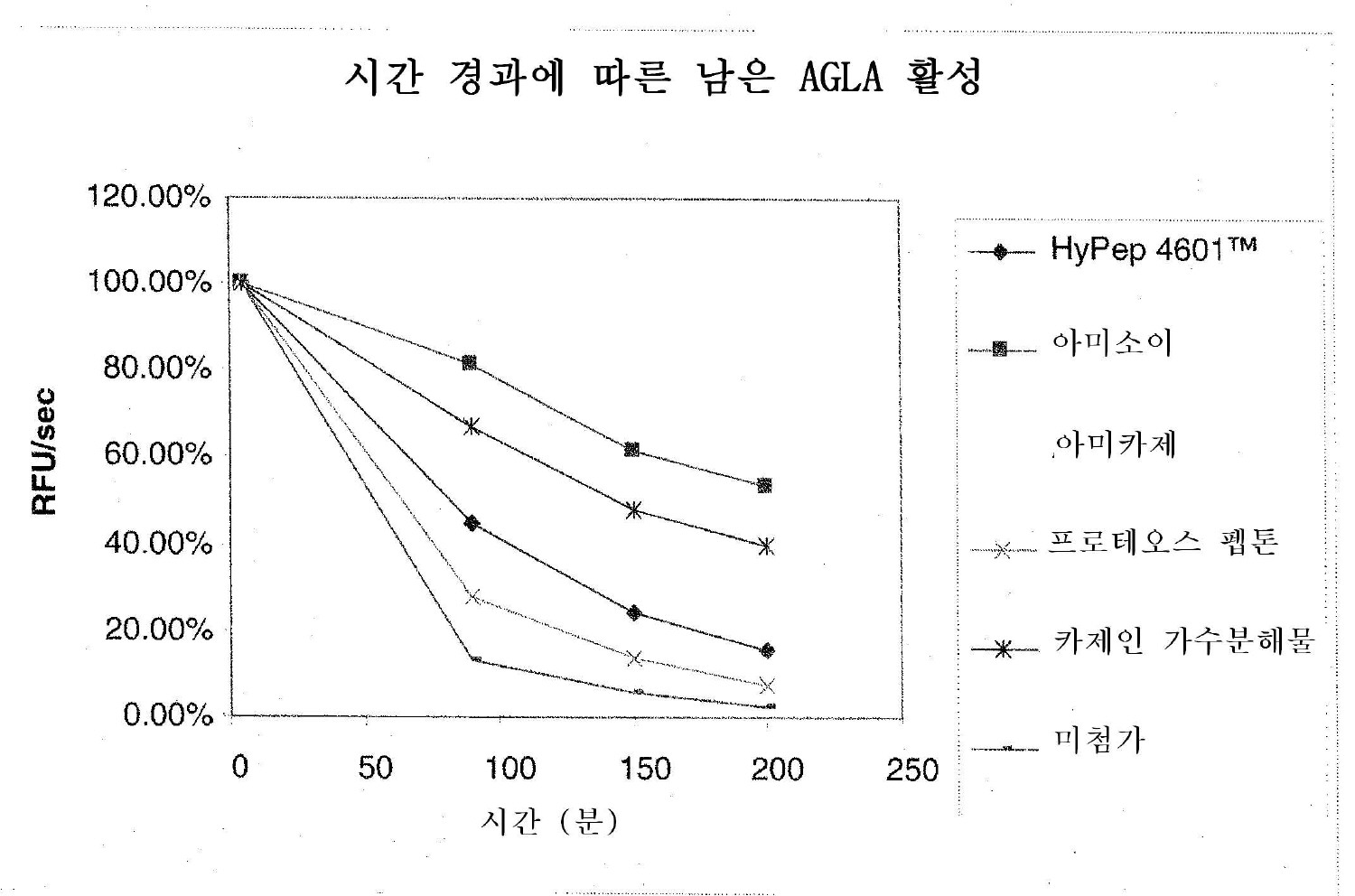
따라서, 메탈로프로테아제 억제제는 단백질 가수분해물이다. 본 발명의 단백질 가수분해물은 단백질 (예를 들어, 카제인) 범위의 가수분해 (효소 또는 비효소적) 에 의해 생성되는 펩티드 분절을 포함한다. 본 발명의 억제제로서 유용한 단백질 가수분해물에는 하기가 포함되나 이에 제한되지 않는다 : 밀 글루텐 가수분해물 (예를 들어, HyPep 4601™), 콩 단백질 산 가수분해물 (예를 들어, 아미소이 (Amisoy)), 소 젖 (소 젖) 의 카제인 산 가수분해물 (예를 들어, 아미카제 (Amicase)), 및 식물 단백질의 효소 가수분해물 (예를 들어, 프로테오스 펩톤). 또한, 본 발명은 하나 이상의 메탈로프로테아제 효소, 예를 들어 흥미있는 메탈로프로테아제 효소 자체를 사용한 가수분해/분해에 의해 생성되는 단백질 가수분해물 억제제의 용도를 교시한다.Thus, the metalloprotease inhibitor is a protein hydrolyzate. The protein hydrolyzate of the present invention comprises peptide segments produced by hydrolysis (enzymatic or non-enzymatic) in the range of proteins (e.g., casein). Protein hydrolysates useful as inhibitors of the present invention include, but are not limited to, wheat gluten hydrolyzate (e.g., HyPep 4601 ™), soy protein hydrolyzate (eg, Amisoy) (For example, Amicase), and enzymatic hydrolysates (for example, proteospeptone) of plant proteins. The present invention also teaches the use of protein hydrolysates inhibitors produced by hydrolysis / degradation using one or more metalloprotease enzymes, such as the interesting metalloprotease enzyme itself.
구현예의 한 바람직한 세트에서, 본 발명은 바실러스 sp. 로부터 단리된 중성 메탈로프로테아제, 및 특히, 바실러스 아밀로리퀴파시엔스 유래의 재조합 중성 메탈로프로테아제인 NprE 를 포함하는 액체 세제 제제를 제공한다.In one preferred set of embodiments, the invention relates to a method for the treatment of Bacillus sp. And NprE, in particular, a recombinant neutral metalloprotease from Bacillus amyloliquefaciens. The present invention also provides a liquid detergent formulation comprising a neutral metalloprotease,
본 발명은 하기를 포함하는 액체 세제 제제를 포함한다 :The present invention includes a liquid detergent formulation comprising:
(a) 약 1 중량% 내지 약 75 중량% 의 계면활성제 ; (a) from about 1% to about 75% by weight of a surfactant;
(b) 약 10 중량% 내지 약 95 중량% 의 물 ; (b) from about 10% to about 95% water by weight;
(c) 약 0.01 중량% 내지 약 5 중량% 의 중성 메탈로프로테아제 ; 및(c) from about 0.01% to about 5% neutral metalloprotease; And
(d) 사용 전에, 억제제가 약 90% 이상의 중성 메탈로프로테아제 분자에 결합하는, 즉, 활성 부위에 결합하거나 또는 활성 부위 이외의 부위에 결합하고 기질과 활성 부위 간의 촉매적 상호작용을 방지 또는 억제하도록 하는 양의 중성 메탈로프로테아제 억제제, 여기서, 세제 제제의 적절한 희석은 결합된 중성 메탈로프로테아제 분자 중 약 25% 이상으로부터 억제제가 해리되게 한다. 전형적으로, 적절한 희석은 액체 세제 제제가 세제 제제의 200, 400, 500, 600, 또는 심지어 1000-배 희석이 되게 하는 큰 부피의 세정수에 첨가될 때 일어난다.(d) before use, the inhibitor binds to at least about 90% of the neutral metalloprotease molecules, i.e., binds to the active site or binds to a site other than the active site and prevents or inhibits catalytic interactions between the substrate and the active site Wherein a suitable dilution of the detergent formulation causes the inhibitor to dissociate from at least about 25% of the bound neutral metalloprotease molecules. Typically, a suitable dilution occurs when the liquid detergent formulation is added to a large volume of wash water which results in 200, 400, 500, 600, or even 1000-fold dilution of the detergent formulation.
상기 제제의 한 구현예에서, 억제제 결합된 중성 메탈로프로테아제 효소 중 45%, 65%, 75%, 85%, 또는 심지어 95% 이상이 상기 세제의 희석 시 억제제-없는 형태로 방출된다. 한 구현예에서, 제제에 대해 선별된 억제제는 약 pH 6.5 내지 약 pH 11, 바람직하게는 약 pH 7.5 내지 약 pH 9.5 에서 약 5 mM 내지 약 15 mM 의 겉보기 (apparent) Ki 로 중성 메탈로프로테아제를 경쟁적으로 억제시킨다. 한 바람직한 구현예에서, 세제 제제는 약 pH 8.0 에서 겉보기 Ki 가 대략 10 mM 인 단백질 가수분해물 억제제를 포함한다.In one embodiment of the formulation, 45%, 65%, 75%, 85%, or even 95% or more of the inhibitor-bound neutral metalloprotease enzyme is released in the inhibitor-free form upon dilution of the detergent. In one embodiment, the inhibitor selected for the agent is a neutral metalloprotease with an apparent Ki of about 5 mM to about 15 mM at about pH 6.5 to about pH 11, preferably at about pH 7.5 to about pH 9.5 Competitive inhibition. In one preferred embodiment, the detergent formulation comprises a protein hydrolyzate inhibitor having an apparent Ki of about 10 mM at about pH 8.0.
제제에서 사용되는 억제제의 절대량이 결합 친화성, 효소 농도 및 기타 요소에 따라 다양할 수 있더라도, 전형적으로 억제제의 양은 적절한 희석 전에 액체 세제 제제의 약 0.01 중량% 내지 약 15 중량%, 약 0.05 중량% 내지 약 5 중량%, 약 0.1 중량% 내지 약 2.5 중량% 이다.Typically, the amount of inhibitor will be from about 0.01% to about 15%, from about 0.05% to about 15%, and most preferably from about 0.1% to about 5%, by weight, of the liquid detergent formulation prior to appropriate dilution, although the absolute amount of inhibitor used in the formulation may vary depending on binding affinity, To about 5 wt%, and about 0.1 wt% to about 2.5 wt%.
한 구현예에서, 액체 세제 제제는 폴리프로필렌 글리콜 및/또는 칼슘 이온 (예를 들어, CaCl2) 을 포함하여 다른 성분의 존재에 의해 추가로 안정화된다. 일부 구현예에서, 제제는 하기로 이루어진 군으로부터 선택되는 일반적인 HDL 제형에 따라 제조된 HDL 세제이다 : DW-AA, DW-AF, DW-AK, DW-CR, DW-CS, 및 DW-CT. 일부 구현예에서, 액체 세제 제제는 붕소를 포함하지 않는다.In one embodiment, the liquid detergent formulation is further stabilized by the presence of other ingredients, including polypropylene glycol and / or calcium ions (e.g., CaCl 2 ). In some embodiments, the formulation is an HDL detergent made according to a common HDL formulation selected from the group consisting of DW-AA, DW-AF, DW-AK, DW-CR, DW-CS, and DW-CT. In some embodiments, the liquid detergent formulation does not include boron.
또다른 구현예에서, 본 발명은 하기를 포함하는 억제제-안정화된 중성 메탈로프로테아제 조성물을 제공한다 : In another embodiment, the invention provides an inhibitor-stabilized neutral metalloprotease composition comprising:
(a) 약 0.001 중량% 내지 약 10 중량% 의 중성 메탈로프로테아제 ; 및(a) from about 0.001% to about 10% neutral metalloprotease; And
(b) 경쟁적 억제제, 여기서, 경쟁적 억제제는 상기 중성 메탈로프로테아제 분자의 약 90% 이상에 결합함. 한 바람직한 구현예에서, 경쟁적 억제제는 단백질 가수분해물이다. 또다른 바람직한 구현예에서, 중성 메탈로프로테아제는 바실러스 sp. 유래이고, 특히, B. 아밀로리퀴파시엔스 유래의 NprE 이다. 상기 억제제-안정화된 조성물은 액체 또는 건조 (예를 들어, 과립형) 제제일 수 있다. 한 구현예에서, 조성물은 본 발명의 상기-개시된 세제 제제의 제조에서 전구체 성분으로서 사용된다. (b) a competitive inhibitor, wherein the competitive inhibitor binds to at least about 90% of the neutral metalloprotease molecule. In one preferred embodiment, the competitive inhibitor is a protein hydrolyzate. In another preferred embodiment, the neutral metalloprotease is Bacillus sp. And particularly NprE from B. amyloliquefaciens. The inhibitor-stabilized composition may be a liquid or dry (e.g., granular) agent. In one embodiment, the composition is used as a precursor component in the preparation of the above-described detergent formulations of the present invention.
또다른 구현예에서, 억제제-안정화된 메탈로프로테아제 조성물은 캡슐화된 입자에 있다.In another embodiment, the inhibitor-stabilized metalloprotease composition is in encapsulated particles.
따라서, 또다른 구현예에서, 억제제-안정화된 메탈로프로테아제 조성물은 조성물을 하기와 조합하는 방법에 의해 세제 제제를 제조하는데 사용된다 :Thus, in another embodiment, an inhibitor-stabilized metalloprotease composition is used to prepare a detergent formulation by a method that combines the following:
(a) 물 ; (a) water;
(b) 약 0.1 중량% 내지 약 75 중량% 의 세제 계면활성제 ; (b) from about 0.1 wt% to about 75 wt% detergent surfactant;
(c) 약 5 중량% 내지 약 15 중량% 의 프로필렌 글리콜 ; 및(c) from about 5% to about 15% propylene glycol; And
(d) 약 0.5 mM 내지 약 5.0 mM 의 Ca2 + 이온.(d) from about 0.5 mM to about 5.0 mM Ca < 2 + & gt ; ions.
본 발명의 또다른 구현예는 하기를 포함하는 성분을 조합하는 방법에 의해 제조되는 액체 세제 제제이다 :Another embodiment of the present invention is a liquid detergent formulation prepared by a method of combining the ingredients comprising:
(a) pH 약 6.5 내지 약 8.5 의 수성 완충액 ; (a) an aqueous buffer having a pH of from about 6.5 to about 8.5;
(b) 약 0.1 중량% 내지 약 75 중량% 의 세제 계면활성제 ; (b) from about 0.1 wt% to about 75 wt% detergent surfactant;
(c) 약 0.01 중량% 내지 약 5 중량% 의 메탈로프로테아제 ; 및(c) from about 0.01% to about 5% by weight of a metalloprotease; And
(d) 기질 단백질, 여기서, 적어도 하나, 즉, 하나 이상의 메탈로프로테아제에 의한 기질 단백질의 분해는 약 90% 이상의 메탈로프로테아제 분자에 결합하는 생성물을 생성한다. 한 구현예에서, 기질 단백질은 하기로 이루어진 군으로부터 선택된다 : 밀 글루텐, 카제인, 콩 단백질, 및 식물성 단백질. 한 구현예에서, 사용되는 기질 단백질은 약 0.01 중량% 내지 약 15 중량% 이다. 본원에 개시된 다른 제제와 함께, 일부 구현예에서 메탈로프로테아제는 바실러스 sp. 로부터 단리된 중성 메탈로프로테아제, 및 특히, 중성 메탈로프로테아제인 NprE 이다.(d) a substrate protein, wherein at least one, i.e., degradation of the substrate protein by the at least one metalloprotease, produces a product that binds to at least about 90% of the metalloprotease molecule. In one embodiment, the substrate protein is selected from the group consisting of wheat gluten, casein, soy protein, and vegetable protein. In one embodiment, the substrate protein used is from about 0.01% to about 15% by weight. Together with the other agents disclosed herein, in some embodiments the metalloprotease is Bacillus sp. ≪ / RTI > neutral metalloprotease, and in particular, NprE, which is a neutral metalloprotease.
또다른 구현예에서, 본 발명은 하기 단계를 포함하는 억제제-안정화된 액체 세제 제제의 제조 방법을 제공한다 : In another embodiment, the invention provides a method of making an inhibitor-stabilized liquid detergent formulation comprising the steps of:
(a) 수성 완충액 내에 적어도 하나, 즉 하나 이상의 중성 메탈로프로테아제 및 단백질 기질을 포함하는 혼합물을 약 pH 6.5 내지 약 pH 11 의 pH 및 약 22℃ 내지 약 37℃ 의 온도에서 인큐베이션시켜서, 적어도 하나, 즉 하나 이상의 메탈로프로테아제에 의한 기질 단백질의 분해가 가수분해 생성물을 생성하는 단계 ; (a) incubating at least one, i. e., a mixture comprising at least one neutral metalloprotease and a protein substrate, in an aqueous buffer at a pH of from about pH 6.5 to about pH 11 and at a temperature of from about 22 DEG C to about 37 DEG C, Degradation of the substrate protein by one or more metalloproteases produces a hydrolysis product;
(b) 분자량이 약 5000 Da 미만인 가수분해 생성물을 단리하는 단계 ; 및(b) isolating the hydrolysis product having a molecular weight less than about 5000 Da; And
(c) 단계 (b) 의 가수분해 생성물을 약 0.001 중량% 내지 약 10 중량% 의 중성 메탈로프로테아제를 포함하는 액체 세제 제제와 조합하는 단계. 또다른 구현예에서, 본 발명은 단백질 가수분해 생성물을 약 0.001 중량% 내지 약 10 중량% 의 중성 메탈로프로테아제를 포함하는 액체 세제 제제와 조합하는 것을 포함하는, 억제제-안정화된 액체 세제 제제의 제조 방법을 제공하는데, 여기서, 단백질 가수분해 생성물은 적어도 하나, 즉 하나 이상의 중성 메탈로프로테아제 및 단백질 기질을 포함하는 혼합물을 약 pH 6.5 내지 약 pH 11 의 pH 및 약 22℃ 내지 약 37℃ 의 온도에서 수성 완충액에서 인큐베이션함으로써 제조되며, 그리하여 적어도 하나, 즉 하나 이상의 메탈로프로테아제에 의한 기질 단백질의 분해가 가수분해 생성물을 생성하며, 여기서, 분자량이 약 5000 Da 미만인 가수분해 생성물은 중성 메탈로프로테아제와 조합하기 전에 단리된다. 한 구현예에서, 인큐베이션 혼합물은 약 0.001 중량% 내지 약 10 중량% 의 중성 메탈로프로테아제 및 약 5 중량% 내지 약 20 중량% 의 단백질 기질을 포함한다. 한 바람직한 구현예에서, 중성 메탈로프로테아제는 NprE 이고, 단백질 기질은 소 젖 카제인이다.(c) combining the hydrolyzate of step (b) with a liquid detergent formulation comprising from about 0.001% to about 10% neutral metalloprotease by weight. In another embodiment, the present invention relates to the preparation of inhibitor-stabilized liquid detergent formulations comprising combining a protein hydrolyzate with a liquid detergent formulation comprising from about 0.001% to about 10% neutral metalloprotease by weight. Wherein the protein hydrolyzate comprises at least one, i.e., a mixture comprising at least one neutral metalloprotease and a protein substrate, at a pH from about pH 6.5 to about pH 11 and at a temperature from about 22 < 0 > C to about 37 & Aqueous buffer so that degradation of the substrate protein by at least one, i.e., one or more metalloproteases produces a hydrolysis product wherein the hydrolysis product having a molecular weight of less than about 5000 Da is combined with a neutral metalloprotease Before being isolated. In one embodiment, the incubation mixture comprises about 0.001 wt% to about 10 wt% neutral metalloprotease and about 5 wt% to about 20 wt% protein substrate. In one preferred embodiment, the neutral metalloprotease is NprE and the protein substrate is bovine milk casein.
한 구현예에서, 본 발명은 중성 메탈로프로테아제 유전자 및 단백질 기질 유전자를 포함하는 발현 벡터를 제공하는데, 여기서, 단백질 기질 유전자 생성물은 중성 메탈로프로테아제 유전자 생성물에 의해 효소적으로 전환되어 단백질 가수분해물 억제제를 생성한다. 또다른 구현예에서, 발현 벡터는 추가로 단백질 기질 유전자에 조작적으로 연결된 프로모터를 포함하는데, 여기서, 프로모터는 단백질 기질 유전자 생성물의 발현을 증진시키나 중성 메탈로프로테아제 유전자 생성물의 발현을 증진시키지는 않는다. 한 구현예에서, 중성 메탈로프로테아제 유전자는 바실러스 sp. 의 것이고, 단백질 기질은 카제인이다. 바람직한 구현예에서, 중성 메탈로프로테아제 유전자는 B. 아밀로리퀴파시엔스 유래의 NprE 이고, 단백질 기질은 카제인이다.In one embodiment, the invention provides an expression vector comprising a neutral metalloprotease gene and a protein substrate gene, wherein the protein substrate gene product is enzymatically converted by a neutral metalloprotease gene product to form a protein hydrolyzate inhibitor . In another embodiment, the expression vector further comprises a promoter operatively linked to a protein substrate gene, wherein the promoter promotes expression of the protein substrate gene product but does not enhance the expression of the neutral metalloprotease gene product. In one embodiment, the neutral metalloprotease gene is selected from the group consisting of Bacillus sp. And the protein substrate is casein. In a preferred embodiment, the neutral metalloprotease gene is NprE from B. amyloliquefaciens, and the protein substrate is casein.
도 1 은 더 높은 농도의 NprE 와 함께 첨가된 폴리프로필렌 글리콜 (PPG) 및 CaCl2 가 시간 경과에 따라 증가된 AGLA 활성을 유지한다는 것을 보여주는 실험 어세이 데이타의 한 도시를 그린 것이다. 모든 샘플은 10% PPG 및 0.5 mM CaCl2 와 함께 열거된 농도의 NprE 를 함유하였다. 밀폐된 원모양의 데이타는 임의의 첨가된 PPG 또는 CaCl2 없이 625 ppm NprE 의 조절을 나타낸다.Figure 1 depicts one illustration of experimental assay data showing that polypropylene glycol (PPG) and CaCl 2 added with higher concentrations of NprE retained increased AGLA activity over time. All samples contained the NprE concentration of the listed along with 10% PPG and 0.5 mM CaCl 2. The closed circular data shows the control of 625 ppm NprE without any added PPG or CaCl 2 .
도 2 는 NprE-생성된 카제인 가수분해 생성물이 NprE 의 경쟁적 억제제임을 보여주는 정상 상태의 반응속도 데이타를 그린 것이다. 도 2A 는 증가량의 억제제와 함께 NprE 활성의 기질 의존도를 나타낸다. 도 2B 는 보편적인 y-절편을 나타내는 이중 역수 도시를 보여준다. 도 2C 는 억제제 펩티드 농도에 대한 겉보기 Km 재도시를 보여준다. 도 2D 는 증가량의 억제제 펩티드 농도에 대한 이중 역수 경사 재도시를 보여준다. 도 2C 및 2D 에서 x-절편은 대략 10 mM 카제인 가수분해 생성물 농도의 겉보기 Ki 를 지시한다.Figure 2 depicts steady state kinetic data showing that the NprE-generated casein hydrolysis product is a competitive inhibitor of NprE. Figure 2A shows the substrate dependence of NprE activity with increasing amounts of inhibitor. Figure 2B shows a double reciprocal map showing the universal y-intercept. Figure 2C shows an apparent Km plot of inhibitor peptide concentration. Figure 2D shows a double inverted slope representation for an increasing amount of inhibitor peptide concentration. In Figures 2C and 2D, the x-intercept indicates the apparent Ki of approximately 10 mM casein hydrolysis product concentration.
도 3 은 다양한 단백질 가수분해물의 존재 하에 시간 경과에 따른 NprE 활성의 실험 어세이 데이타의 도시를 보여준다.Figure 3 shows an experimental assay data of NprE activity over time in the presence of various protein hydrolysates.
발명의 상세한 설명DETAILED DESCRIPTION OF THE INVENTION
개요summary
본 발명은 분해에 대해 증가된 안정성을 나타내는, 메탈로프로테아제 효소 및 메탈로프로테아제 억제제를 포함하는 조성물 및 세제 제제를 제공한다. 본 발명은 또한, 이들 억제제-안정화된 메탈로프로테아제 조성물 및 세제 제제의 제조 방법을 제공한다.The present invention provides compositions and detergent formulations comprising a metalloprotease enzyme and a metalloprotease inhibitor exhibiting increased stability against degradation. The present invention also provides these inhibitor-stabilized metalloprotease compositions and methods of making detergent formulations.
본원에 개시된 조성물 및 세제 제제는 모두 메탈로프로테아제를 포함하고, 증가된 안정성은 효소에 가역적으로 결합하여 효소의 자가 분해를 방지하는 경쟁적 억제제의 포함으로 인한 것이다. 본원에 기술된 바와 같은 억제제는 활성 부위에 결합할 수 있고, 활성 부위에서 효소와 기질 간의 상호작용을 직접 방해할 수 있다. 대안적으로, 억제제는 활성 부위 이외의 부위 (즉, 활성 부위에 비-특이적인 부위) 에 결합해서, 예를 들어, 활성 부위에서 기질 상호 작용을 방해 또는 훼방하는 3 차 또는 4 차 구조 변경의 도입에 의해 효소와 기질 간의 촉매적 상호작용을 방지 또는 억제할 수 있다. 중요하게는, 이들 억제제-안정화된 조성물 및 세제 제제는 억제제가 결합해서 보관 동안에 메탈로프로테아제 분해를 효과적으로 약화시키나, 이어서 조성물 또는 세제가 사용되는 경우 희석 시 활성 효소를 방출, 제공하도록 제조된다. 본 발명은 분해에 대해 안정화시키기에 특히 효과적인 메탈로프로테아제 억제제로서 단백질 가수분해물을 개시한다. 특히 바람직한 구현예에서, 단백질 가수분해물 억제제는 메탈로프로테아제 효소 자체에 의한 단백질 기질의 가수분해에 의해 제조된다. 생성 가수분해 생성물은 단리될 수 있고, 이를 생성한 메탈로프로테아제에 대해 특히 효과적인 경쟁적 억제제이다.The compositions and detergent formulations disclosed herein all include metalloproteases and the increased stability is due to the inclusion of competitive inhibitors that reversibly bind to the enzyme to prevent autolysis of the enzyme. Inhibitors such as those described herein can bind to the active site and can directly interfere with the interaction between the enzyme and the substrate at the active site. Alternatively, the inhibitor may bind to a site other than the active site (i. E., A site that is non-specific to the active site), for example, a tertiary or quaternary structural alteration that interferes with or inhibits substrate interactions at the active site The introduction can prevent or inhibit catalytic interactions between the enzyme and the substrate. Importantly, these inhibitor-stabilized compositions and detergent formulations are prepared to bind inhibitors effectively to attenuate metalloprotease degradation during storage, followed by release of the active enzyme upon dilution when a composition or detergent is used. The present invention discloses a protein hydrolyzate as a metalloprotease inhibitor particularly effective for stabilizing against degradation. In a particularly preferred embodiment, the protein hydrolyzate inhibitor is prepared by hydrolysis of the protein substrate by the metalloprotease enzyme itself. The product hydrolysis product is a competitive inhibitor that can be isolated and is particularly effective against the metalloprotease that produces it.
정의Justice
본원에서 달리 정의되지 않는 한, 본원에서 사용되는 모든 기술적 및 과학적 용어는 본 발명이 속한 당업자가 흔히 이해하는 바와 동일한 의미를 갖는다. 예를 들어, [Singleton and Sainsbury, Dictionoary of Microbiology and Molecular Biology, 2d Ed., John Wiley 및 Sons, NY (1994) ; 및 Hale and Marham, The Harper Collins Dictionary of Biology, Harper Perennial, NY (1991)] 은 본원에서 사용되는 일반적인 사전의 많은 용어를 당업자에게 제공한다. 본원에서 기술된 것과 유사 또는 동일한 임의의 방법 및 물질이 본 발명의 실행에서 사용되더라도, 바람직한 방법 및 물질이 본원에 기술된다. 따라서, 하기 바로 정의되는 용어는 전체로서 명세서에서 참조에 의해 더욱 완전히 기술된다. 또한, 본원에서 사용되는 바와 같이, 단수 표현은 문맥에서 달리 분명하게 지시하지 않는 한, 복수를 포함한다. 달리 지시되지 않는 한, 핵산은 5' 에서 3' 방향으로 왼쪽에서 오른쪽으로 쓰여지고 ; 아미노산 서열은 각각 아미노에서 카르복실 방향으로 왼쪽에서 오른쪽으로 쓰여진다. 본 발명은 기술되는 특별한 방법, 프로토콜 및 시약에 제한되지 않고, 당업자에 의해 사용되는 문맥에 따라 다양할 수 있음을 이해한다.Unless otherwise defined herein, all technical and scientific terms used herein have the same meaning as commonly understood by one of ordinary skill in the art to which this invention belongs. See, for example, Singleton and Sainsbury, Dictionoary of Microbiology and Molecular Biology, 2d Ed., John Wiley and Sons, NY (1994); And Hale and Marham, The Harper Collins Dictionary of Biology, Harper Perennial, NY (1991) provide many of the terms of the generic dictionary used herein to those of skill in the art. Although any methods and materials similar or identical to those described herein are used in the practice of the present invention, the preferred methods and materials are described herein. Accordingly, the terms defined immediately below are more fully described by reference in the specification as a whole. Also, as used herein, the singular forms "a," "an," and "the" include plural referents unless the context clearly dictates otherwise. Unless otherwise indicated, nucleic acids are written from left to right in the 5 'to 3' direction; Amino acid sequences are written from left to right, respectively, from amino to carboxyl. It is understood that the invention is not limited to the particular methods, protocols and reagents described, but may vary depending on the context used by those skilled in the art.
본 명세서를 통틀어서 주어지는 모든 최대수 제한은 모든 더 낮은 수 제한을 포함하고, 그러한 더 낮은 수 제한은 본원에서 표현적으로 나타내어졌음을 이해한다. 본 명세서를 통틀어서 주어지는 모든 최소수 제한은 그러한 더 높은 수가 본원에서 표현적으로 쓰여진다면, 모든 더 높은 수의 제한을 포함할 것이다. 본 명세서를 통틀어서 주어지는 모든 수 범위는 더 좁은 수 범위가 본원에서 표현적으로 쓰여진다면, 그러한 더 광범위한 수 범위 내에 속하는 모든 더 좁은 수 범위를 포함할 것이다.It is understood that all the maximum number limits given throughout this specification include all lower number limits, and such lower number limits are expressly set forth herein. All minimum number limits given throughout this specification will include all the higher number limitations if such higher numbers are expressly used herein. All numerical ranges given throughout this specification will include all narrower numerical ranges falling within the broader range of such numerical ranges, unless a narrower numerical range is expressly recited herein.
언급된 모든 문서는 상대적으로, 참조로써 본원에 삽입되어 있으며 ; 임의의 문서의 언급은 본 발명에 대해 선행 기술임을 허락받은 것으로서 해석되는 것은 아니다.All documents mentioned are, relative to each other, incorporated herein by reference; Any reference to a document is not to be construed as an admission that it is prior art to the present invention.
본원에서 사용된 바와 같이, 용어 "효소" 는 화학 반응을 촉매하는 단백질을 말한다. 효소의 촉매 기능은 그의 "활성" 또는 "촉매적 활성" 을 구성한다. 효소는 전형적으로 그것이 수행하는 촉매 기능, 예를 들어, 펩티드 결합의 가수분해의 유형에 따라 분류된다.As used herein, the term "enzyme" refers to a protein that catalyzes a chemical reaction. The catalytic function of the enzyme constitutes its "activity" or "catalytic activity". Enzymes are typically classified according to the catalytic function it carries out, for example the type of hydrolysis of the peptide bond.
본원에 사용된 바와 같이, "유효량의 효소" 는 특정 용도 (예를 들어, 개인 케어 생성물, 세정 조성물 등) 에서 요구되는 촉매적 활성을 달성하는데 필요한 효소의 양을 말한다. 상기 유효량은 당업자가 이미 이해하고 있고, 많은 요소, 예컨대 사용되는 특정 효소 변이체, 세제 적용, 세제의 특정 제제 등을 바탕으로 한다. As used herein, "effective amount of enzyme" refers to the amount of enzyme required to achieve the catalytic activity required in a particular application (eg, personal care product, cleaning composition, etc.). Such effective amounts are well known to those skilled in the art and are based on a number of factors, such as the particular enzyme variants employed, the application of detergents, the specific formulation of detergents, and the like.
본원에 사용된 바와 같이, 용어 "프로테아제" 또는 "단백질분해효소" 는 단백질에서 펩티드 결합의 가수분해를 촉매하는 효소를 말한다.As used herein, the term "protease" or "proteolytic enzyme" refers to an enzyme that catalyzes the hydrolysis of a peptide bond in a protein.
본원에 사용된 바와 같이, 용어 "메탈로프로테아제," "메탈로단백질분해효소," 또는 "메탈로펩티다아제" 는 촉매적 활성을 수행하기 위해서는, 결합된 금속 이온을 필요로 하는 프로테아제를 말한다.As used herein, the term "metalloprotease," " metalloproteinase, "or" metallopeptidase "refers to a protease that requires a bound metal ion to effect catalytic activity.
본원에 사용된 바와 같이, 용어 "중성 메탈로프로테아제" 는 중성 pH 에서 최적으로 활성이고 촉매적 활성을 위해 아연 이온을 필요로 하는 메탈로프로테아제를 말한다. 전형적으로, 중성 메탈로프로테아제의 크기는 30 내지 40 kDa 범위이다. 본 발명의 중성 메탈로프로테아제를 또한 "중성 메탈로엔도펩티다아제" 라고 하고, 부류 EC 3.4.24.4 의 효소를 포함한다.As used herein, the term "neutral metalloprotease" refers to a metalloprotease that is optimally active at neutral pH and requires zinc ions for catalytic activity. Typically, the size of the neutral metalloprotease ranges from 30 to 40 kDa. The neutral metalloprotease of the present invention is also referred to as the "neutral metalloendopeptidase" and includes the enzyme of class EC 3.4.24.4.
본원에 사용된 바와 같이, 용어 "기질" 은 효소가 그의 촉매적 활성을 수행하여 생성물을 생성하는 성분 (예를 들어, 화학적 화합물) 을 말한다. 메탈로프로테아제의 경우, 기질은 보통 단백질이고, 그렇더라도 메탈로프로테아제는 또한 비-단백질 화합물에서 펩티드 또는 에스테르 결합에 작용할 수 있다. 따라서, 용어 "단백질 기질" 은 단백질인 기질을 말한다.As used herein, the term "substrate" refers to an element (e.g., a chemical compound) in which an enzyme performs its catalytic activity to produce a product. In the case of metalloproteases, the substrate is usually a protein, although metalloproteases can also act on peptide or ester linkages in non-protein compounds. Thus, the term "protein substrate" refers to a substrate that is a protein.
본원에 사용된 바와 같이, 용어 "활성 부위" 는 기질이 결합해서 촉매적 활성이 일어나는 효소의 영역을 말한다. 일부 경우에, 효소는 하나 초과의 활성 부위를 가질 수 있다. 전형적으로, 메탈로프로테아제는 단일 활성 부위를 갖는다.As used herein, the term "active site" refers to the region of the enzyme where the substrate binds and catalytic activity takes place. In some cases, the enzyme may have more than one active site. Typically, the metalloprotease has a single active site.
본원에 사용된 바와 같이, 용어 "억제제" 는 촉매적 활성의 속도를 감소시키는 성분을 말한다. 예를 들어, 억제제는 단백질 가수분해물, 폴리펩티드, 또는 단백질 가수분해물 또는 폴리펩티드의 천연 또는 합성 유사체를 말할 수 있다. 따라서, 억제제에는 중성 메탈로프로테아제 효소의 활성 부위에 결합하는 단백질 가수분해물의 능력의 특정 측면을 흉내내는 합성 화합물이 포함될 수 있다.As used herein, the term "inhibitor" refers to a component that reduces the rate of catalytic activity. For example, an inhibitor can refer to a protein hydrolyzate, a polypeptide, or a natural or synthetic analog of a protein hydrolyzate or polypeptide. Thus, inhibitors may include synthetic compounds that mimic certain aspects of the ability of protein hydrolysates to bind to the active site of neutral metalloprotease enzymes.
본원에 사용된 바와 같이, 용어 "경쟁적 억제제" 는 효소에 가역적으로 결합하여 기질이 결합하는 것을 방지하는 억제제를 말하는데, 즉, 억제제는 활성 부위에 결합하는 기질과 경쟁하거나 또는 억제제는 효소 분자 상 어디엔가 결합하여 촉매적 기질이 활성 부위에서 효소와 상호작용하는 것을 방지 또는 억제한다.As used herein, the term "competitive inhibitor" refers to an inhibitor that binds reversibly to an enzyme to prevent binding of the substrate, i.e., the inhibitor compete with the substrate binding to the active site, Enriched to prevent or inhibit the catalytic substrate from interacting with the enzyme at the active site.
본원에 사용된 바와 같이, "Ki" 또는 "억제 상수" 는 효소-억제제 결합 복합 체의 해리 상수, 즉, 자유 효소 농도 (즉, "[E]") 대 억제제-결합된 효소 (즉, "[E
본원에 사용된 바와 같이, "겉보기 Ki" 는 실제 억제제 농도가 정확하게 측정될 수 없는 경우에 측정되는 Ki 값을 말한다. 예를 들어, 억제제가 가수분해 생성물 혼합물 (즉, 단백질 분절의 혼합물) 인 경우, 측정된 Ki 은 "겉보기 Ki" 일 것인데, 그 이유는 절대 억제제 농도는 예를 들어, 단지 펩티드 농도의 화학 분석을 바탕으로 해서 측정될 수 있기 때문이다. 효소 분자에 결합해서 억제를 초래하는, 혼합물 내 특정 분절(들) 의 실제 농도는 측정된 농도보다 훨씬 더 낮을 것이다. 결과적으로, "겉보기 Ki" 은 정제된 억제제를 사용하여 측정될 Ki 값보다 더 높을 것이다.As used herein, "apparent Ki" refers to the Ki value measured when the actual inhibitor concentration can not be accurately measured. For example, if the inhibitor is a mixture of hydrolysis products (i. E., A mixture of protein segments), the measured Ki will be "apparent Ki ", since the absolute inhibitor concentration may, for example, Because it can be measured on the basis of. The actual concentration of a particular segment (s) in the mixture that binds to the enzyme molecule and results in inhibition will be much lower than the measured concentration. As a result, "apparent Ki" will be higher than the Ki value measured using the purified inhibitor.
본원에 사용된 바와 같이, 용어 "자가분해" 는 조직 또는 세포 그 자체의 효소에 의한 조직 또는 세포의 분해를 말한다. 한 구현예에서, 용어 "자가분해" 는 그 자체의 폴리펩티드 사슬을 효소가 가수분해하는 것을 말하는데, 예를 들어, 프로테아제 효소에 의해 자가-단백분해이다.As used herein, the term "autolysis" refers to the degradation of tissue or cells by the enzyme of the tissue or cell itself. In one embodiment, the term " autolysis "refers to the enzymatic hydrolysis of its own polypeptide chain, e. G., Self-proteolysis by protease enzymes.
본원에 사용된 바와 같이, 효소와 관련해서 용어 "안정성" 은 특정 환경 조 건 하에 시간 경과에 걸쳐서 특정 수준의 기능적 활성을 유지하는 효소의 능력을 말한다. 용어 "안정성" 은 많은 문맥에서 흥미있는 특정 환경 조건을 말하는데 사용될 수 있다. 예를 들어, "자가 안정성" 은 자가 분해 (즉, 자가-단백질분해) 를 견뎌내는 효소의 능력을 말한다. 실제적인 안정성 변화는 안정화제 (예를 들어, 억제제 화합물) 의 부재 하에 존재하는 촉매적 활성과 비교하여, 촉매적 활성의 반감기에서 약 5% 이상의 증가 또는 감소 (대부분의 구현예에서, 이는 바람직하게는 증가) 에 의해 증거된다. 용어가 단백질의 안정성을 평가하기 위해 특정 프로테아제를 사용하는 것이 제한되는 것은 아니다.As used herein, the term "stability" with respect to an enzyme refers to the ability of the enzyme to maintain a certain level of functional activity over time under certain environmental conditions. The term "stability" can be used to refer to specific environmental conditions of interest in many contexts. For example, "self-stability" refers to the ability of an enzyme to withstand self-degradation (ie, self-proteolysis). An actual stability change is an increase or decrease of about 5% or more in the half-life of the catalytic activity compared to the catalytic activity present in the absence of the stabilizer (e.g., inhibitor compound) (in most embodiments, Is increased. The term does not limit the use of a particular protease to assess the stability of the protein.
본원에 사용된 바와 같이, 용어 "촉매적 전환" 은 기질 또는 중간체가 효소와 접촉함으로써 기질 또는 중간체가 생성물로 개질되는 것을 말한다. 일부 구현예에서, 접촉은 기질 또는 중간체가 적절한 효소에 직접 노출됨으로써 이루어진다. 다른 구현예에서, 노출은 각각 기질 또는 중간체를, 효소를 발현 및/또는 분비하고/거나, 또는 목적하는 기질 및/또는 중간체를 목적하는 중간체 및/또는 최종-생성물로 대사하는 개체에 노출시키는 것을 포함한다.As used herein, the term "catalytic conversion" refers to the transformation of a substrate or intermediate into a product by contacting the substrate or intermediate with an enzyme. In some embodiments, the contacting is by direct exposure of the substrate or intermediate to the appropriate enzyme. In other embodiments, the exposures may be accomplished by exposing the substrate or intermediate, respectively, to an entity that expresses and / or secretes the enzyme and / or metabolizes the desired substrate and / or intermediate to the desired intermediate and / .
본원에 사용된 바와 같이, 용어 "분해" 는 단백질 기질이 프로테아제에 의해 생성물로 촉매적 전환되는 것을 말한다.As used herein, the term "degradation" refers to the catalytic conversion of a protein substrate to a product by a protease.
본원에 사용된 바와 같이, 용어 "정제된" 및 "단리된" 은 성분 (예를 들어, 폴리펩티드 또는 폴리뉴클레오타이드) 이 자연적으로 함께 있는 물질의 제거 및/또는 샘플로부터의 오염물의 제거를 말한다.As used herein, the terms "purified" and "isolated " refer to the removal of materials with which the components (e.g., polypeptides or polynucleotides) naturally occur together and / or the removal of contaminants from the sample.
본원에 사용된 바와 같이, 용어 "가수분해물" 은 가수분해에 의해 생성되는 임의의 성분을 말한다. 상기 용어는 가수분해의 특정 방법에 의해 생성되는 성분에 제한되는 것은 아니다. 상기 용어는 촉매 반응뿐만 아니라 비-촉매 반응에 의해 생성되는 "가수분해물" 을 포함하는 것이다. 예를 들어, 공지된 가수분해 효소 (예를 들어, 세린 프로테아제, 메탈로프로테아제, 가수분해효소 등) 는 상기 용어가 본 출원에서 사용되는 의미 내에서 가수분해물을 생성할 수 있다. 유사하게는, 비-촉매적 방법의 가수분해 (예를 들어, 산/염기 가수분해 등) 또한 본 출원에서 사용되는 의미 내에서 가수분해물을 생성한다.As used herein, the term "hydrolyzate" refers to any component produced by hydrolysis. The term is not limited to the components produced by a particular method of hydrolysis. The term includes "hydrolysates" which are produced by catalytic reactions as well as non-catalytic reactions. For example, known hydrolytic enzymes (e.g., serine proteases, metalloproteases, hydrolytic enzymes, etc.) can produce hydrolysates within the meaning of the term as used in this application. Similarly, hydrolysis of non-catalytic processes (e.g., acid / base hydrolysis, etc.) also yields hydrolyzates within the meaning as used in this application.
본원에 사용된 바와 같이, 용어 "단백질 가수분해물" 은 임의의 유형 또는 부류의 단백질의 가수분해에 의해 생성되는 가수분해물을 말한다. 공지된 단백질은 가수분해되어, 본 출원에서 사용되는 바와 같은 용어의 의미 내에서 단백질 가수분해물을 생성할 수 있다. "단백질 가수분해물" 은 촉매적 방법뿐만 아니라 비-촉매적 방법에 의해 생성될 수 있고, 크기가 2 내지 100 개 이상의 아미노산 범위인 단백질 분절 (예를 들어, 폴리펩티드) 을 포함할 수 있다. 추가로, 본원에 사용된 바와 같이, "단백질 가수분해물" 은 단일 생성물 화합물에 제한되지 않으나, 가수분해 생성물 (예를 들어, 단백질 분절) 의 비균일 분배물 또는 혼합물을 포함할 수 있다. 또한, 가수분해 생성물의 균일 화합물 또는 정제된 분획을 포함할 수 있다. 단백질 가수분해물의 바람직한 구현예에는 하기가 포함된다 : HyPep 4601™ (밀 글루텐의 단백질 가수분해물), 아미소이 (콩 단백질 산 가수분해물), 아미카제 (소 젖의 카제인 산 가수분해물), 프로테오스 펩톤 (식물성 단백질의 효소 가수분해물).As used herein, the term "protein hydrolyzate" refers to a hydrolyzate produced by hydrolysis of any type or class of protein. Known proteins can be hydrolyzed to produce protein hydrolysates within the meaning of the term as used in the present application. "Protein hydrolysates" may comprise protein segments (e. G., Polypeptides) that may be produced by non-catalytic methods as well as catalytic methods and which range in size from 2 to more than 100 amino acids. In addition, as used herein, "protein hydrolysates" are not limited to single product compounds, but may include non-uniform distributions or mixtures of hydrolysis products (eg, protein segments). It may also comprise a homogeneous compound or a purified fraction of the hydrolysis product. Preferred embodiments of the protein hydrolyzate include: HyPep 4601 (protein hydrolyzate of wheat gluten), amyos (soy protein hydrolyzate), amikase (cow's milk casein hydrolyzate), proteo Speptone (enzyme hydrolyzate of vegetable protein).
본원에 사용된 바와 같이, "단백질" 은 아미노산으로 이루어지고 당업자에 의해 단백질로서 인지되는 조성물을 말한다. 용어 "단백질," "펩티드" 및 "폴리펩티드" 는 본원에서 상호교환적으로 사용된다. 여기서, 펩티드가 단백질의 일부이며, 당업자는 문맥에서 용어의 사용을 이해한다. 용어 "야생형" 및 "천연" 은 자연에서 발견되는 단백질을 말한다. 일부 구현예에서, 야생형 단백질의 서열은 단백질 조작 프로젝트의 출발점이다.As used herein, "protein" refers to a composition consisting of an amino acid and recognized by the skilled artisan as a protein. The terms "protein," "peptide" and "polypeptide" are used interchangeably herein. Here, the peptide is a part of the protein, and the person skilled in the art understands the use of the term in context. The terms "wild type" and "natural" refer to proteins found in nature. In some embodiments, the sequence of the wild type protein is the starting point of the protein manipulation project.
본원에 사용된 바와 같이, 용어 "관련 단백질" 또는 "동종 단백질" 은 기능적으로 및/또는 구조적으로 유사한 (즉, 유사한 작용 및/또는 구조를 갖는) 단백질을 말한다. 상기 용어는 상이한 종에서 수득되는 동일한 또는 유사한 효소(들) (즉, 구조 및 기능 면에서) 를 포함하는 것이다. 본 발명은 진화적으로 관련있는 단백질 또는 특정 기원(들) 의 단백질에 제한되는 것은 아니다. 또한, 상기 관련 또는 동종 단백질은 3 차 구조 동종체 및 1 차 서열 동종체를 포함한다. 따라서, 상기 용어는 야생형 서열에 대해 "변이체" 또는 "돌연변이체" 서열을 갖는 단백질을 포함한다.As used herein, the term "related protein" or "homologous protein" refers to a protein that is functionally and / or structurally similar (i.e., has similar activities and / or structures). The term is intended to include the same or similar enzyme (s) (i.e., in structure and function) obtained from different species. The invention is not limited to proteins of evolutionarily related or specific origin (s). In addition, the related or homologous protein comprises a tertiary structural homolog and a first sequence homolog. Thus, the term includes proteins that have a "variant" or "mutant" sequence for a wild-type sequence.
본원에 사용된 바와 같이, 용어 "세제," "세제 조성물," 및 "세제 제제" 는 오염된 물체의 세정을 위한 세정 매질에서 사용되고자 하는 혼합물을 말한다. 일부 구현예에서, 상기 용어는 직물 및/또는 의복을 세탁하는데 (예를 들어, "세탁 세제") 사용된다. 다른 구현예에서, 상기 용어는 식기, 식탁용 칼붙이 등을 세정하는데 사용되는 것과 같은 세제 (예를 들어, "식기 세정제") 를 말한다. 일반적으로, 상기 용어는 예를 들어, 메탈로프로테아제 효소, 메탈로프로테아제 억제 제 예컨대 단백질 가수분해물, 효소 안정화제 예컨대 폴리프로필렌 글리콜, 계면활성제, 트랜스퍼라아제(들), 가수분해 효소, 산화환원효소, 보강제, 표백제, 표백활성화제, 청색화제 및 형광 염료, 케이킹 (caking) 억제제, 가림제 (masking agent), 효소 활성화제, 항산화제, 및 용해제를 포함하는, "중질 액체" ("HDL") 제제를 포함하여, 제제를 포함하는 것이다. 본 발명은 특정 세제 제제 또는 조성물에 제한되는 것이 아니다.As used herein, the terms " detergent, "" detergent composition," and "detergent formulation" refer to a mixture intended to be used in a cleaning medium for cleaning a contaminated object. In some embodiments, the term is used to wash fabrics and / or garments (e.g., "laundry detergent"). In other embodiments, the term refers to detergents (e.g., "dishwashing detergents") such as those used to clean tableware, table cutlery, and the like. In general, the term includes, for example, metalloprotease enzymes, metalloprotease inhibitors such as protein hydrolysates, enzyme stabilizers such as polypropylene glycol, surfactants, transferase (s), hydrolases, &Quot; HDL "(" HDL "), which includes, but is not limited to, additives, reinforcing agents, bleaches, bleach activators, blueing agents and fluorescent dyes, caking inhibitors, masking agents, enzyme activators, ), ≪ / RTI > and the like. The present invention is not limited to specific detergent formulations or compositions.
본원에 사용된 바와 같이, 용어 "계면활성제" 는 표면 장력을 감소시키는 표면 활성 화합물을 말한다. 상기 용어는 비이온성 계면활성제, 음이온성 계면활성제, 양이온성 계면활성제, 양친매성 계면활성제, 쯔비터이온성 계면활성제, 준-극성 비이온성 계면활성제, 및 그의 혼합물을 포함하여, 모든 잘-알려진 유형의 계면활성제 및 계면활성제계를 포함하는 것이다.As used herein, the term "surfactant" refers to a surface active compound that reduces surface tension. The term includes all well-known types of nonionic surfactants, including nonionic surfactants, anionic surfactants, cationic surfactants, amphipathic surfactants, zwitterionic surfactants, quasi-polar nonionic surfactants, A surfactant and a surfactant system.
본원에 사용된 바와 같이, 구 "세제 안정성" 은 특정 환경 조건 하에 그리고 특정 기간 동안 세정 매질에서 오염된 물체를 세정하는 능력을 유지하는 세제 조성물의 능력을 말한다. 세제 안정성은 그의 보관 기간 (즉, 사용-전) 동안의 안정성, 또는 세정 매질에서의 사용 동안의 안정성을 말하는데 사용될 수 있다. 세제 안정성은 안정성을 측정하는데 사용되는 세정 테스트의 유형에 따라 다양할 수 있다. 더욱이, 세제 안정성은 상기 특정 성분이 실질적으로 세정 테스트에 기여하는 경우 세제 제제에서 특정 활성 성분의 안정성에 밀접하게 상응할 수 있다.As used herein, the phrase "detergent stability" refers to the ability of a detergent composition to maintain the ability to clean contaminated objects in a cleaning medium under certain environmental conditions and for a specified period of time. Detergent stability can be used to refer to stability during its shelf life (i.e., before use), or stability during use in a cleaning medium. Detergent stability can vary depending on the type of cleaning test used to measure stability. Moreover, detergent stability can closely correspond to the stability of certain active ingredients in detergent formulations if the particular ingredients contribute substantially to a cleaning test.
본원에 사용된 바와 같이, 달리 언급되지 않는 한, "세정 조성물" 및 "세정 제제" 는 세정되어야 할 물품, 예컨대, 직물, 식기, 콘택트 렌즈, 기타 고체 기질, 헤어 (샴푸), 피부 (비누 및 크림), 치아 (구강세척제, 치약) 등으로부터 불필요한 화합물을 제거하는데 사용되는 조성물을 말한다. 상기 용어는 조성물이 조성물에서 사용되는 메탈로프로테아제 및 다른 효소(들) 와 융화성인 한, 목적하는 세정 조성물의 특정 유형 및 생성물 (예를 들어, 액체, 젤, 과립, 또는 스프레이 조성물) 의 형태에 대해 선택되는 임의의 물질/화합물을 포함한다. 세정 조성물 물질의 특정 선택은 세정될 표면, 물품 또는 직물, 및 사용 동안의 세정 조건에 대한 조성물의 목적하는 형태를 고려하여 당업자에 의해 쉽게 이루어진다.As used herein, unless otherwise stated, the terms "cleaning composition" and "cleaning formulation" refer to an article to be cleaned, such as a fabric, dishware, contact lens or other solid substrate, hair (shampoo) Cream), tooth (mouthwash, toothpaste), and the like. The term refers to the type of product (e.g., liquid, gel, granule, or spray composition) of the particular cleaning composition desired, as long as the composition is compatible with the metalloprotease used in the composition and with other enzyme / RTI > < RTI ID = 0.0 > The particular choice of cleaning composition material is readily accomplished by those skilled in the art, taking into account the surface, article or fabric to be cleaned, and the desired form of composition for the cleaning conditions during use.
용어 "세정 조성물" 및 "세정 제제" 는 물체 및/또는 표면의 세정, 표백, 소독 및/또는 멸균에 적합한 임의의 조성물을 말한다. 상기 용어는 세제 조성물 (예를 들어, 액체 및/또는 고체 세탁 세제 및 미세한 직물 세제 ; 경 표면 세정 제제, 예컨대 유리, 나무, 세라믹 및 금속 카운터 탑 및 창문용 세정 제제 ; 카펫 세정제 ; 오븐 세정제 ; 직물 후레셔너 (섬유 freshener) ; 직물 유연제 ; 및 섬유 및 세탁 예비-스포터 (pre-spotter), 뿐만 아니라 식기 세제) 을 포함하나, 이에 제한되지 않는다.The terms "cleaning composition" and "cleaning formulation" refer to any composition suitable for cleaning, bleaching, disinfecting, and / or sterilizing an object and / or surface. The term includes, but is not limited to, detergent compositions (e.g., liquid and / or solid laundry detergents and fine fabric detergents, light surface cleaners such as glass, wood, ceramic and metal countertops and window cleaners, carpet cleaners, oven cleaners, But are not limited to, fabric fresheners, fabric softeners, and fibers and laundry pre-spotters, as well as dishwashing detergents.
더욱이, 본원에 사용된 바와 같이 용어 "세정 조성물" 및 "세정 제제" 는 달리 언급되지 않는 한, 과립 또는 분말-형 범용 또는 중질 세정제, 특히 세정 제제 ; 액체, 젤 또는 페이스트-형 범용 세정제, 특히, 소위 중질 액체 (HDL) 유형 ; 액체 미세-직물 세제 ; 손 세정제 또는 경질 식기세정제, 특히 높은-포밍 (foaming) 유형의 것들 ; 가정 및 산업용 다양한 정제, 과립, 액체 및 헹굼-보조 유형을 포함하여 식기세척기용 제제 ; 항균 손-세정 유형, 세정 바, 구강세척제, 의치 세정제, 차 또는 카펫 샴푸, 욕실 세정제를 포함하여 액체 세정 및 소독제 ; 헤어 샴푸 및 헤어-린스 ; 샤워 젤 및 폼 배쓰 및 금속 세정제 ; 뿐만 아니라 세정 보조제 예컨대 표백 보조제 및 "얼룩-스틱" 또는 예비-처리 유형을 포함하나, 이에 제한되지 않는다.Moreover, as used herein, the terms "cleaning composition" and "cleaning agent ", unless otherwise indicated, include granular or powder-form general or heavy detergents, especially cleaning agents; Liquid, gel or paste-type universal detergents, in particular so-called heavy liquid (HDL) types; Liquid micro-fabric detergents; Hand or dishwashing detergents, especially those of the high-foaming type; Household and industrial preparations for dishwashers, including a variety of tablets, granules, liquids and rinse-assisted types; Liquid washing and disinfecting agents including antibacterial hand-washing type, cleaning bars, mouthwashes, denture cleaners, tea or carpet shampoos, bathroom cleaners; Hair shampoo and hair-rinse; Shower gel and foam bath and metal cleaner; As well as cleaning adjuvants such as bleaching adjuvants and "stain-stick" or pre-treatment types.
본원에 사용된 바와 같이, "직물" 은 임의의 섬유 물질을 포함한다. 따라서, 상기 용어는 의복, 뿐만 아니라, 직물, 방적사, 섬유, 부직포, 천연 물질, 합성 물질, 및 임의의 다른 섬유 물질을 포함하는 것이다.As used herein, "fabric" includes any fibrous material. Thus, the term includes not only garments, but also fabrics, yarns, fibers, non-wovens, natural materials, synthetic materials, and any other fibrous material.
본원에 사용된 바와 같이 용어 "재조합 DNA 분자" 는 분자 생물학적 기술에 의해 함께 조인된 DNA 분절로 이루어진 DNA 분자를 말한다. As used herein, the term "recombinant DNA molecule" refers to a DNA molecule composed of DNA segments joined together by molecular biology techniques.
용어 "재조합 올리고뉴클레오타이드" 는 폴리뉴클레오타이드 서열의 제한 효소 분해에 의해 생성되는 2 개 이상의 올리고뉴클레오타이드 서열의 연결, 올리고뉴클레오타이드의 합성 (예를 들어, 프라이머 또는 올리고뉴클레오타이드의 합성) 등을 포함하나 이에 제한되지 않는, 분자 생물학적 조작을 사용하여 만들어진 올리고뉴클레오타이드를 말한다.The term "recombinant oligonucleotide" includes, but is not limited to, linking two or more oligonucleotide sequences generated by restriction enzyme digestion of a polynucleotide sequence, synthesis of oligonucleotides (e.g., synthesis of primers or oligonucleotides) Refers to oligonucleotides made using molecular biologic manipulations.
본원에 사용된 바와 같이 용어 "조절 원소" 는 핵산 서열의 발현의 일부 측면을 조절하는 유전적 원소를 말한다. 예를 들어, 프로모터는 조작적으로 연결된 코딩 영역의 전사의 개시를 유용하게 하는 조절 원소를 말한다. 추가의 조절 원소에는 스플라이싱 신호, 폴리아데닐화 신호 및 종료 신호가 포함된다.As used herein, the term "regulatory element" refers to a genetic element that regulates some aspects of the expression of a nucleic acid sequence. For example, a promoter refers to a regulatory element that makes the initiation of transcription of an operatively linked coding region useful. Additional control elements include a splicing signal, a polyadenylation signal, and a termination signal.
용어 "프로모터/인핸서" 는 프로모터 및 인핸서 기능 둘 다를 제공할 수 있 는 서열을 함유하는 (예를 들어, 레트로바이러스의 긴 말단 반복부분은 프로모터 및 인핸서 기능 둘 다를 함유함) DNA 분절을 말한다. 인핸서/프로모터는 "내인성" 또는 "외인성" 또는 "이종성" 일 수 있다. 내인성 인핸서/프로모터는 게놈 내 주어진 유전자에 자연적으로 연결된 것이다. 외인성 (이종성) 인핸서/프로모터는 유전자 조작 (즉, 분자 생물학적 기술) 에 의해 유전자 옆에 위치한 것이다.The term "promoter / enhancer" refers to a DNA segment containing sequences capable of providing both promoter and enhancer functions (e.g., the long terminal repeats of the retrovirus contain both promoter and enhancer functions). The enhancer / promoter may be "endogenous" or "exogenous" or "heterologous". The endogenous enhancer / promoter is naturally linked to a given gene in the genome. The exogenous enhancer / promoter is located next to the gene by genetic manipulation (i.e., molecular biology).
본원에 사용된 바와 같이, "발현 벡터" 는 적합한 숙주 내에서 DNA 의 발현에 영향을 미칠 수 있는 적합한 조절 서열에 조작적으로 연결된 DNA 서열을 함유하는 DNA 구축물을 말한다. 상기 조절 서열은 전사에 영향을 미치는 프로모터, 상기 전사를 조절하는 임의의 오퍼레이터 서열, 적합한 mRNA 리보좀 결합 부위를 암호화하는 서열, 및 전사 및 번역의 종료를 조절하는 서열을 포함한다. 벡터는 플라스미드, 파지 입자, 또는 단순하게는 강력한 게놈 삽입물일 수 있다. 일단 적합한 숙주에 형질전환되면, 벡터는 숙주 게놈과는 독립적으로 복제하고 기능할 수 있거나, 또는 일부 경우에 게놈 자체에 혼입될 수 있다.As used herein, an "expression vector" refers to a DNA construct containing a DNA sequence operably linked to a suitable regulatory sequence that may affect the expression of the DNA in an appropriate host. The regulatory sequences include promoters that affect transcription, any operator sequences that regulate the transcription, sequences that encode suitable mRNA ribosome binding sites, and sequences that control transcription and termination of translation. The vector may be a plasmid, phage particle, or simply a potent genome insert. Once transformed into the appropriate host, the vector may replicate and function independently of the host genome, or, in some cases, be incorporated into the genome itself.
용어 "플라스미드," "발현 플라스미드," 및 "벡터" 는 본원에서 상호 교환적으로 사용되며, 상기 플라스미드는 현재 가장 흔히 사용되는 형태의 벡터이다. 그러나, 본 발명은 상응하는 작용을 하고 당업자에게 알려지거나 또는 알려지게 되는 그러한 다른 형태의 발현 벡터를 포함하고자 한다.The terms "plasmid," " expression plasmid, "and" vector "are used interchangeably herein and the plasmid is the vector of the most commonly used form now. However, the present invention is intended to include such other forms of expression vectors that have a corresponding function and become known or known to those skilled in the art.
핵산 서열을 세포에 삽입하는 맥락에서, 용어 "도입된" 은 형질전환 (trans포맷ion), 유전자도입 (transduction) 또는 트랜스펙션 (transfection) 을 의미한 다. 형질전환의 수단은 당업계에 알려진 바와 같이 원형질 형질전환, 염화칼슘 침전, 전기천공, 네이키드 DNA 등을 포함한다 ([Chang and Cohen, Mol. Gen. Genet., 168:111-115 [1979]; Smith 등, Appl. Env. Microbiol., 51:634 [1986]; and the review article by Ferrari 등, in Harwood, Bacillus, Plenum Publishing Corporation, pp. 57-72 [1989]] 참조).In the context of inserting a nucleic acid sequence into a cell, the term "introduced " means transformation ion, transduction or transfection. Means of transformation include, but are not limited to, protoplast transformation, calcium chloride precipitation, electroporation, naked DNA and the like as is known in the art (Chang and Cohen, Mol. Gen. Genet., 168: 111-115 [1979]; Smith et al., Appl. Env. Microbiol., 51: 634 [1986], and the review article by Ferrari et al., In Harwood, Bacillus, Plenum Publishing Corporation, pp. 57-72 [1989]).
본원에 사용된 바와 같이, "숙주 세포" 는 일반적으로 당업계에 알려진 재조합 DNA 기술을 사용하여 구축된 벡터로 형질전환 또는 트랜스펙션된 원핵생물 또는 진핵생물 숙주이다. 형질전환된 숙주 세포는 목적하는 단백질 변이체를 발현하거나 또는 단백질 변이체를 암호화하는 벡터를 복제할 수 있다. 단백질 변이체의 전- 또는 전전-형태를 암호화하는 벡터의 경우, 상기 변이체는, 발현되는 경우, 전형적으로 숙주 세포에서 숙주 세포 매질로 분비된다.As used herein, "host cell" is a prokaryotic or eukaryotic host that is generally transformed or transfected with a vector constructed using recombinant DNA techniques known in the art. The transformed host cell may express a desired protein variant or may replicate a vector encoding a protein variant. In the case of a vector encoding a full-length or full-length form of a protein variant, the variant, when expressed, is typically secreted into the host cell medium in the host cell.
중성 neutrality 메탈로프로테아제Metalloprotease 효소 enzyme
메탈로프로테아제는 박테리아, 진균류뿐만 아니라 더 고등 개체에서 발견되는 다양한 부류의 프로테아제이다. 메탈로프로테아제의 활성 부위에 있는 결합된 금속 이온은 물 분자의 촉매적 활성화를 가능하게 한다. 다음, 물 분자는 펩티드 결합의 카르보닐기를 절단하는 친핵체로서 작용한다. 다양한 서열 및 구조가 상기 부류에 존재하나, 큰 대다수의 메탈로프로테아제는 활성 부위에 결합된 아연 이온을 포함한다. 일부 메탈로프로테아제에서, 아연 이온은 활성 소실 없이 코발트 또는 니켈과 같은 또다른 금속 이온에 의해 대체될 수 있다. 현재 이해되는 바와 같이, 메탈로프로테아제의 촉매 기작은 효소에 의해 절단되는 카르 보닐기 상에서 아연-결합된 물 분자의 공격을 통해 형성되는 비-공유 사면체 중간체를 포함한다.Metalloprotease is a diverse class of proteases found in higher organisms as well as bacteria and fungi. Bonded metal ions in the active site of metalloprotease enable catalytic activation of water molecules. Next, the water molecule acts as a nucleophile that cleaves the carbonyl group of the peptide bond. Various sequences and structures exist in this class, but the vast majority of metalloproteases include zinc ions bound to the active site. In some metalloproteases, zinc ions can be replaced by another metal ion such as cobalt or nickel without loss of activity. As is now understood, the catalytic mechanism of metalloprotease involves non-covalently tetrahedral intermediates formed through attack of zinc-bonded water molecules on a carbonyl group that is cleaved by an enzyme.
중성 메탈로프로테아제 (즉, 중성 메탈로엔도펩티다아제, EC 3.4.24.4) 는 촉매적 활성을 위해 아연 이온이 절대적으로 필요한 프로테아제 부류에 속한다. 이들 효소는 중성 pH 에서 최적으로 활성이고, 30 내지 40 kDa 크기 범위에 있다. 중성 메탈로프로테아제는 단백질의 구조적 안정성에 기여하는 2 내지 4 개의 칼슘 이온에 결합한다. 중성 메탈로프로테아제 패밀리는 박테리아 효소 서몰리신 (thermolysin), 및 기타 서몰리신-형 프로테아제 ("TLP"), 뿐만 아니라 카르복시펩티다아제 A (분해 효소), 및 조직 리모델링 및 분해에 관여하는 반응을 촉매하는 매트릭스 메탈로프로테아제를 포함한다.Neutral metalloprotease (i.e., neutral metalloendopeptidase, EC 3.4.24.4) belongs to the protease class for which zinc ions are absolutely necessary for catalytic activity. These enzymes are optimally active at neutral pH and range in size from 30 to 40 kDa. Neutral metalloproteases bind to two to four calcium ions that contribute to the structural stability of the protein. The neutral metalloprotease family is a family of enzymes that catalyze reactions involved in tissue remodeling and degradation, as well as the bacterial enzymes thermolysin, and other salmolicin-type proteases ("TLPs") as well as carboxypeptidase A Lt; RTI ID = 0.0 > metalloprotease. ≪ / RTI >
아마도, 기능 및 안정성 면에서 가장 특징화된 중성 메탈로프로테아제는 서몰리신 및 TLP 이다. 많은 연구가 그의 열적 안정성을 증가시키기 위해 바실러스 서브틸리스 서몰리신을 조작하는데 초점을 맞추었다 (예를 들어, [Vriend 등, In, Tweel 등 (eds), Stability and Stabilization of Enzymes, Elsevier, pp. 93-99 [1993]] 참조). 고온에서의 자가분해 및 변성을 증진시키는 국소 풀림 과정을 방지할 수 있는, 분자 모델링을 통해 규명된, 구조적 결정체를 변형시킴으로써 TLP 의 안정성을 증가시키기 위해 많은 노력이 수행되었다 (예를 들어, [van den Burg 등, in Hopsu-Havu 등, (eds), Proteolysis in Cell Function Manipulating the Autolvtic Pathway of a Bacillus Protease. Biomedical 및 Health Research Vol. 13, IOS Press [1997] p. 576] 참조). 칼슘 이온이 중성 메탈로프로테아 제 자가분해의 방지를 도울 수 있다고 보고되었다. B. 스테아로서모필루스 (B. stearothermophilus) 중성 프로테아제는 칼슘의 첨가에 의해 자가분해 및 단백분해에 대해 안정화되었다 ([Duerrschmidt 등, FEBS J., 272:1523-1534 [2005]]참조).Perhaps the most characterized neutral metalloprotease in terms of function and stability is sumolysin and TLP. Many studies have focused on manipulating Bacillus subtilis surmolysin to increase its thermal stability (see, for example, Vriend et al., In, Tweel et al. (Eds.), Stability and Stabilization of Enzymes, Elsevier, pp. 93-99 [1993]). Much effort has been made to increase the stability of TLP by modifying structural crystallites, identified through molecular modeling, which can prevent local loosening processes that promote autolysis and denaturation at high temperatures (see, for example, van den Burg, et al., in Hopsu-Havu et al., (eds), Proteolysis in Cell Function Manipulating the Autolvtic Pathway of a Bacillus Protease, Biomedical and Health Research Vol. 13, IOS Press [1997] p. It has been reported that calcium ions can help prevent self-degradation of neutral metalloprotease enzymes. B. stearothermophilus neutral protease as B. stearate was stabilized against autolysis and proteolysis by the addition of calcium (see Duerrschmidt et al., FEBS J., 272: 1523-1534 [2005]).
개선된 특징을 갖는 NprE 를 포함하여 중성 메탈로프로테아제를 조작하기 위한 조성물 및 방법은 본원에 참조로써 삽입된 2006 년 10 월 12 일에 출원된 미국 특허 출원 제 11/581,102 호에 기술되어 있다. 다른 측면 중에서, 미국 특허 출원 제 11/581,102 호는 그의 구조적 안정성을 유지하기 위해, 칼슘과는 독립적인 중성 메탈로프로테아제의 조작에 적합한 조성물 및 방법을 제공한다. 그에 제공된 다른 구현예에서, 중성 메탈로프로테아제의 조작은 단백질분해를 방지할 수 있는 특정 2 차 구조 원소에서의 국소적인 풀림을 방지한다.Compositions and methods for manipulating neutral metalloproteases including NprE with improved features are described in U.S. Patent Application No. 11 / 581,102, filed October 12, 2006, which is incorporated herein by reference. In another aspect, U.S. Patent Application No. 11 / 581,102 provides compositions and methods suitable for the manipulation of neutral metalloproteases independent of calcium to maintain their structural stability. In other embodiments provided herein, the manipulation of the neutral metalloprotease prevents local annealing in certain secondary structural elements that may prevent protein degradation.
미국 특허 출원 제11/581,102 호에 기술된 안정한 중성 메탈로프로테아제 중에서, 바실러스 아밀로리퀘파시엔스의 야생형 메탈로프로테아제 (예를 들어, 정제된 MULTIFECT® Neutral; "PMN") 및 NprE 라고 하는 재조합 중성 메탈로프로테아제 (예를 들어, 바실러스 서브틸리스에 클로닝된 바실러스 아밀로리퀘파시엔스 중성 메탈로프로테아제) 가 있다.(E.g., purified MULTIFECT® Neutral ("PMN")) of Bacillus amyloliquefaciens and recombinant neutral (hereinafter referred to as "NprE"), NprE, among the stable neutral metalloprotease described in U.S. Patent Application No. 11 / 581,102 And metalloproteases (for example, Bacillus amyloliquefaciens neutral metalloprotease cloned in Bacillus subtilis).
바실러스 아밀로리퀘파시엔스의 중성 메탈로프로테아제외에도, 본 발명은 다른 기원, 특히 바실러스 sp. 기원의 관련 효소의 용도를 포함하며, 이에는 B. 세루우스 (B. cereus), B. 세루우스 E33L (B. cereus E33L), B. 칼도리티쿠스 (B. caldolyticus), B. 푸물리스 (B. pumulis), B. 메가테륨 (B. megaterium), B. 서브틸리스 아밀로사카리티쿠스 (B. Subtilis amylosacchariticus), 브레비바실러스 브 레비스 (Brevibacillus brevis), 팬니바실러스 폴리믹사 (Paenibacillus polymyxa) (바실러스 폴리 믹사), B. 스테아로서모필루스, B. 투린기엔시스 (B. thuringiensis), B. 서브틸리스 및 S. 아우레우스 (S. aureus) 로부터 수득되는 메탈로프로테아제 동종체, 뿐만 아니라 아우레오리신 (aureolysin), 세포외 엘라스타제 (extracellular elastase), 및 중성 프로테아제 B 가 포함되나, 이에 제한되지 않는다.In addition to the neutral metalloprotease of Bacillus amyloliquefaciens, the present invention is also useful in the treatment of Bacillus sp. B. cereus, B. cereus E33L, B. caldolyticus, B. pseudomonas, B. cereus, E. coli, E. coli, B. pumulis, B. megaterium, B. subtilis amylosacchariticus, Brevibacillus brevis, Paenibacillus brevis, polymyxa (Bacillus polymyxa), B. stufa, B. thuringiensis, B. subtilis, and S. aureus. , But also include, but are not limited to, aureolysin, extracellular elastase, and neutral protease B.
본 발명의 구현예에 유용한 메탈로프로테아제는 메탈로프로테아제가 아닌 용액 또는 제제 내 오염성 단백질 및 다른 화합물을 제거함으로써 정제될 수 있다. 일부 구현예에서, 재조합 메탈로프로테아제는 박테리아 또는 진균류 숙주 세포에서 발현되고, 이들 재조합 메탈로프로테아제는 다른 숙주 세포 구성물의 제거에 의해 정제되고 ; 재조합 메탈로프로테아제 폴리펩티드의 % 는 샘플에서 증가된다. 특히 바람직한 구현예에서, 본 발명에 따라 사용되는 메탈로프로테아제는 SDS-PAGE 또는 당업계에 공지된 다른 표준에 의해 측정되는 바와 같이, 실질적으로 99% 이상의 단백질 성분의 수준으로 정제된다. 대안의 바람직한 구현예에서, 본 발명의 메탈로프로테아제는 조성물의 프로테아제 성분의 약 99% 이상을 포함한다. 더욱 다른 대안의 구현예에서, 메탈로프로테아제는 총 단백질 및/또는 프로테아제의 약 90 ~ 95% 이상의 범위로 존재한다. The metalloprotease useful in embodiments of the present invention can be purified by removing contaminating proteins and other compounds in solutions or formulations that are not metalloproteases. In some embodiments, the recombinant metalloprotease is expressed in bacterial or fungal host cells and these recombinant metalloproteases are purified by removal of other host cell constructs; The percentage of recombinant metalloprotease polypeptide is increased in the sample. In a particularly preferred embodiment, the metalloprotease used according to the invention is purified to a level of substantially 99% or more protein component, as determined by SDS-PAGE or other standard known in the art. In a preferred alternative embodiment, the metalloprotease of the present invention comprises at least about 99% of the protease component of the composition. In yet another alternative embodiment, the metalloprotease is present in a range of about 90-95% or more of the total protein and / or protease.
야생형 및 변이체 메탈로프로테아제 효소의 기능적 특징화는 적합한 수단을 통해 달성될 수 있고, 바람직하게는 흥미있는 특성의 평가를 바탕으로 한다. 예를 들어, pH 및/또는 온도, 뿐만 아니라 세제 및/또는 산화 안정성은 본 발명의 일부 구현예에서 결정된다. 실제로, 이들 특징 중 하나 이상에서 다양한 정도의 안정성 (단백분해 또는 자가분해 안정성, 세제 안정성, pH, 온도, 및/또는 산화 안정성) 을 갖는 메탈로프로테아제 효소는 본 발명의 문맥에서 사용될 수 있다. Functional characterization of wild-type and mutant metalloprotease enzymes can be achieved through suitable means and is preferably based on an evaluation of interesting properties. For example, pH and / or temperature, as well as detergent and / or oxidative stability are determined in some embodiments of the present invention. Indeed, metalloprotease enzymes with varying degrees of stability (proteolytic or autolytic stability, detergent stability, pH, temperature, and / or oxidative stability) in one or more of these characteristics may be used in the context of the present invention.
세제 제제 안정성을 위한 효소의 개선 접근법은 효소 자체의 구조를 변경하는 것 - 즉, 세제 제제 조건 하에 증가된 활성 및/또는 특이성을 나타내는 변이체 아미노산 서열을 가진 효소의 개발이다. 예를 들어, 많은 프로테아제 변이체가 당업계에 개시되어 있다. 예를 들어, U.S. Reissue Pat. No. 34,606 (Genencor) 에 상응하는 EP 0 130 756 ; EP 0 214 435 (Henkel) ; WO 87/04461 (Amgen) ; WO 87/05050 (Genex) ; EP 0 260 105 (Genencor) ; WO 88/08028 (Genex) ; WO 88/08033 (Amgen) ; WO 95/27049 (Solvay) ; WO 95/30011 (Procter & Gamble) ; WO 95/30010 (Procter & Gamble) ; WO 95/29979 (Procter & Gamble) ; U.S. Pat. No. 5,543,302 (Solvay) ; EP 0 251 446 (Genencor) ; WO 89/06279 (Novozymes A/S) ; WO 91/00345 (Novozymes A/S) ; EP 0 525 610 Al (Solvay) 를 참조한다.The improvement approach of enzymes for detergent stability is the development of enzymes with altered structure of the enzyme itself - that is, variant amino acid sequences that exhibit increased activity and / or specificity under detergent formulation conditions. For example, many protease variants are disclosed in the art. For example, U.S. Pat. Reissue Pat. No.
변이체 효소는 소수의 아미노산 잔기에 의해 모 단백질과 그리고 서로 상이할 수 있다. 상이한 아미노산 잔기의 수는 하나 이상, 바람직하게는 1, 2, 3, 4, 5, 10, 15, 20, 30, 40, 50 개 이상의 아미노산 잔기일 수 있다. 일부 바람직한 구현에에서, 변이체 간의 상이한 아미노산의 수는 1 내지 10 이다. 일부 특히 바람직한 구현예에서, 관련 단백질 및 특히 변이체 단백질은 35%, 40%, 45%, 50%, 55%, 60%, 65%, 70%, 75%, 80%, 85%, 90%, 95%, 97%, 98% 또는 99% 이상의 아미노산 서열 동일성을 포함한다.Mutant enzymes can differ from the parent protein by a small number of amino acid residues and from each other. The number of different amino acid residues may be one or more, preferably 1, 2, 3, 4, 5, 10, 15, 20, 30, 40, 50 or more amino acid residues. In some preferred embodiments, the number of different amino acids between variants is between 1 and 10. In some particularly preferred embodiments, the related proteins and particularly the variant proteins are 35%, 40%, 45%, 50%, 55%, 60%, 65%, 70%, 75%, 80%, 85% 95%, 97%, 98% or 99% amino acid sequence identity.
다수의 방법이 본 발명의 효소의 변이체를 생성하기에 적합한 것으로 당업계에 알려져 있으며, 상기 방법에는 위치-포화 돌연변이, 스캐닝 돌연변이, 삽입 돌연변이, 랜덤 돌연변이, 위치-특이적 돌연변이, 및 위치-진화, 뿐만 아니라 다양한 기타 재조합 접근법이 포함되나, 이에 제한되지 않는다.A number of methods are known in the art to be suitable for producing variants of the enzymes of the present invention, including but not limited to, site-directed mutagenesis, scanning mutagenesis, insertional mutagenesis, random mutagenesis, site-specific mutagenesis, As well as various other recombination approaches.
중성 메탈로프로테아제 변이체 서열의 범위는 본원에 참조로써 삽입된 2006 년 10 월 12 일에 출원된 미국 출원 제 11/581,102 호에 기술되어 있다. 이들 변이체 효소는 정도를 달리하면서 야생형 효소와 기능적인 특징 면에서 상이할 수 있다. 그러나, 상기 변이체 중성 메탈로프로테아제가 자가분해 활성을 갖고 또한 단백질 가수분해물에 의해 경쟁적으로 억제되는 점에서, 이는 본원에 개시된 제제 및 방법에 따라 사용될 수 있다. 따라서, 본원에 기술된 구현예의 억제제-안정화된 메탈로프로테아제 중 임의는 야생형 중성 메탈로프로테아제 효소뿐만 아니라 일련의 활성 돌연변이 및 다른 변이체와 함께 적용될 수 있다.The range of neutral metalloprotease variant sequences is described in U.S. Application Serial No. 11 / 581,102, filed October 12, 2006, which is incorporated herein by reference. These variant enzymes may differ in their functional characteristics from wild type enzymes at varying degrees. However, it can be used according to the formulations and methods disclosed herein in that the mutant neutral metalloprotease has autolytic activity and is competitively inhibited by protein hydrolysates. Thus, any of the inhibitor-stabilized metalloproteases of the embodiments described herein may be applied with a series of active mutants and other variants as well as wild-type neutral metalloprotease enzymes.
한 구현예에서, 본 발명은 특정 단백질 가수분해물이 세제 제제에서의 개선된 안정성에 더욱 선호할만한 억제제 결합 특징을 나타낼 중성 메탈로프로테아제 활성 부위를 조작하기 위해 위치-특이적 돌연변이를 사용하는 것을 포함한다. 돌연변이의 중성 메탈로프로테아제 "위치 평가 라이브러리" (SEL) 를 생성하는 방법은 본원에 참조로써 삽입된 2006 년 10 월 12 일에 출원된 미국 출원 제 11/581,102 호에 개시되어 있다. 본 발명에 따라, 이들 SEL 은 세제 제제 및 세정 조성물에서의 자가 분해에 대해 안정화하기 위해 이들 억제제를 사용하는 능력을 향상시키는 개선된 단백질 가수분해물 (또는 다른 억제제) 결합 특징에 대해 스크리닝될 수 있는 중성 메탈로프로테아제의 활성 부위 돌연변이의 라이브러리를 생성하는데 사용될 수 있다.In one embodiment, the invention includes the use of a site-specific mutation to engineer a neutral metalloprotease active site where a particular protein hydrolyzate will exhibit more favorable inhibitor binding characteristics with improved stability in detergent formulations . A method for generating a mutant, neutral metalloprotease "position locus library" (SEL) is disclosed in U.S. Serial No. 11 / 581,102, filed October 12, 2006, which is incorporated herein by reference. In accordance with the present invention, these SELs can be screened for improved protein hydrolyzate (or other inhibitor) binding characteristics that enhance their ability to use these inhibitors to stabilize against detergent formulations and self-cleansing in cleaning compositions. Can be used to generate a library of active site mutations of the metalloprotease.
억제제 및 Inhibitors and 안정화제로서의As stabilizer 단백질 protein 가수분해물Hydrolyzate
중성 메탈로프로테아제, 예컨대 NprE 는 용액에서 보관되었을 때, 시간 경과에 따라 유의한 활성 소실을 겪을 수 있다. 이러한 효소 활성 소실 중 많은 것은 자가분해로 인한 것인데, 즉, 중성 메탈로프로테아제 분자는 다른 메탈로프로테아제 효소 분자 또는 심지어 그 자체를 촉매적으로 단백분해시킨다. 자가분해는 효소의 접힌 구조를 비가역적으로 손상시킬 수 있어서, 그의 기능 및 활성이 크게 약화 또는 완전히 파괴된다. 전형적으로, 이러한 자가 활성 소실은 세제 제제가 노출되는 세정 조건에 종종 사용되는 더 높은 온도에 의해 가속화된다. 결과적으로, 이러한 효소 활성 소실은 세제 안정성의 직접적인 소실을 초래한다.A neutral metalloprotease, such as NprE, may experience significant loss of activity over time when stored in solution. Many of these enzymatic loss of activity are due to autolysis, that is, neutral metalloprotease molecules catalytically proteolyze other metalloprotease enzyme molecules or even themselves. Autolysis can irreversibly damage the folded structure of the enzyme, so that its function and activity is greatly weakened or completely destroyed. Typically, such self-activating disappearance is accelerated by the higher temperatures often used in cleaning conditions in which the detergent formulation is exposed. As a result, this loss of enzyme activity results in a direct loss of detergent stability.
이상적으로는, 자가분해를 최소화하기 위해, 각각의 중성 메탈로프로테아제는 사용 준비가 될 때까지 그의 촉매적 활성에 참여하는 것으로부터 차단되어야 할 것이다. 효소의 억제제는 그의 활성을 차단할 수 있는데 ; 그러나, 억제제가 효소의 활성 부위에 결합하는 것은 종종 극도로 타이트하고 비가역적이다. 예를 들어, 소위 "자살 억제제" 는 화학적으로 효소의 활성 부위를 변형시켜서, 임의의 촉매적 활성을 다시 얻지 못하게 한다.Ideally, to minimize autolysis, each neutral metalloprotease should be blocked from participating in its catalytic activity until ready for use. Inhibitors of enzymes can block its activity; However, it is often extremely tight and irreversible that inhibitors bind to the active site of the enzyme. For example, the so-called "suicide inhibitor" chemically modifies the active site of the enzyme so that it does not regain any catalytic activity.
붕소-기재 억제제 화합물 (예를 들어, 붕산 및 다양한 붕소산) 과 같은 억제 제를 첨가함으로써 세제 제제에서 세린 프로테아제의 보관 안정성을 향상시키는 방법이 알려져 있다. 이들 붕소-기재 억제제는 세린 프로테아제 효소를 가역적으로 억제시키는 것으로 알려져 있다. 예를 들어, 붕소산에 의한 세린 프로테아제 서브틸리신의 억제에 대한 논의는 [Molecular & Cellular Biochemistry 51, 1983, pp. 5-32] 에 제공되어 있다. 그러나, 이들 붕소-기재 억제제는 메탈로프로테아제를 강하게 억제시키지 못해서, 이는 세린 프로테아제보다 상이한 촉매적 기작에 의해 작용한다. 추가로, 조절 작용 (agency) 은 붕소-기재 화합물의 안정성에 관한 질문을 야기하기 시작하였고, 이들의 환경으로의 방출을 제한할 것을 고려하고 있다.Methods of enhancing the storage stability of serine proteases in detergent formulations by adding inhibitors such as boron-based inhibitor compounds (e.g., boric acid and various boronic acids) are known. These boron-based inhibitors are known to reversibly inhibit serine protease enzymes. For example, a discussion of the inhibition of serine protease subtilisin by boronic acid [Molecular & Cellular Biochemistry 51, 1983, pp. 5-32]. However, these boron-based inhibitors do not strongly inhibit metalloprotease, which acts by a catalytic mechanism that is different than that of serine proteases. In addition, the agency has begun to raise questions about the stability of boron-based compounds and is considering limiting their release into the environment.
본 발명의 목적을 위해, 메탈로프로테아제의 억제제는 메탈로메탈로프로테아제의 자가 활성을 가역적인 방식으로 차단하는 것이 요구된다. 상기 억제제는 메탈로프로테아제가 보관되는 경우 타이트하게 그러나 가역적으로 결합한 다음, 효소 분자로부터 해리되어, 효소가 그의 촉매적 작용이 요구될 때 그의 활성을 유지할 수 있게 한다. 더욱이, 이러한 가역적 억제는 효소가 세제 제제 또는 다른 세정 조성물 내 성분인 경우, 존재하는 환경 조건과 융화성이어야 한다.For the purposes of the present invention, inhibitors of metalloprotease are required to block the self-activation of metallomatoloprotease in a reversible manner. The inhibitor binds tightly but reversibly when the metalloprotease is stored, then dissociates from the enzyme molecule, allowing the enzyme to maintain its activity when its catalytic action is required. Moreover, this reversible inhibition should be compatible with the environmental conditions present, if the enzyme is a component in a detergent formulation or other cleaning composition.
따라서, 한 구현예에서, 본 발명은 하기를 포함하는 억제제-안정화된 메탈로프로테아제 조성물을 제공한다 : Thus, in one embodiment, the invention provides an inhibitor-stabilized metalloprotease composition comprising:
(a) 약 0.001 중량% 내지 약 10 중량% 의 중성 메탈로프로테아제; 및(a) from about 0.001% to about 10% neutral metalloprotease; And
(b) 경쟁적 억제제, 여기서, 경쟁적 억제제는 상기 중성 메탈로프로테아제 분자 중 90% 이상에 결합함. 이러한 억제제-안정화된 조성물은 액체 또는 건성 (예를 들어, 과립) 제제일 수 있다. 한 구현예에서, 조성물은 하기 더 상세히 기술되는 본 발명의 세제 제제의 제조에서 전구체 성분으로서 사용된다. 또다른 구현예에서, 억제제-안정화된 메탈로프로테아제 조성물은 하기 더 상세히 기술되는 캡슐화된 입자로 있다.(b) a competitive inhibitor, wherein the competitive inhibitor binds to at least 90% of said neutral metalloprotease molecules. Such inhibitor-stabilized compositions may be liquid or dry (e.g., granular) agents. In one embodiment, the composition is used as a precursor component in the preparation of the detergent formulations of the present invention as described in more detail below. In another embodiment, the inhibitor-stabilized metalloprotease composition is in encapsulated particles as described in more detail below.
세린 프로테아제 효소는 더 높은 농도에서 보관되는 경우 더 큰 활성을 유지한다고 잘 알려져 있다. 이는 효소가 더 높은 농도에 있을 때, 자가 생성물이 세린 프로테아제 활성 부위에 결합해서인 것으로 생각된다. 즉, 자가 생성물 해리 속도가 크게 감소된다. 그 결과, 더 높은 전반적인 효소 농도가 자가분해 생성물이 억제제로서 작용하도록 야기한다. 농도가 저하되는 경우 (희석에 의해), 자가분해 생성물이 쉽게 해리될 수 있고, 자가분해 반응이 재생될 수 있다.It is well known that serine protease enzymes maintain greater activity when stored at higher concentrations. It is believed that when the enzyme is at a higher concentration, the autogenous product is bound to the serine protease active site. That is, the self-dissociation rate is greatly reduced. As a result, a higher overall enzyme concentration causes the autolysis product to act as an inhibitor. If the concentration is lowered (by dilution), the autolysis product can easily dissociate and the autolysis reaction can be regenerated.
하기 실시예 1 에서 개시된 바와 같이, 중성 메탈로프로테아제는 더 높은 농도에서 보관될 때 증가된 안정성 (즉, 시간 경과에 따라 더 큰 활성을 유지함) 을 나타낸다. 세린 프로테아제 효소로서, 농도에 따른 이러한 증가된 안정성은 메탈로프로테아제 효소의 자가 생성물이 억제제로서 작용함을 지시하는 것으로 보인다.As disclosed in Example 1 below, neutral metalloprotease exhibits increased stability (i.e., greater activity over time) when stored at higher concentrations. As the serine protease enzyme, this increased stability with concentration appears to indicate that the autocatalytic activity of the metalloprotease enzyme acts as an inhibitor.
따라서, 한 구현예에서 본 발명은 중성 메탈로프로테아제 용액을 포함하는 안정화된 중성 메탈로프로테아제 제제를 포함하는데, 여기서, 중성 메탈로프로테아제의 농도는 약 500 ppm, 1000 ppm, 2500 ppm, 5000 ppm, 10000 ppm, 또는 그 이상이다. 한 구현예에서, 중성 메탈로프로테아제 용액은 추가로 약 10% 이상의 프로필렌 글리콜을 포함한다. 또다른 구현예에서, 중성 메탈로프로테아제 용액은 추가로 약 0.5 mM 이상, 예를 들어, 약 0.5 mM 내지 약 5 mM 의 칼슘 이온 (예를 들어, 염화칼슘, 포르메이트, 시트레이트, 아스코르베이트, 아세테이트 또는 포스페이트) 을 포함한다. 한 구현예에서, 중성 메탈로프로테아제 용액은 약 0.5 mM 내지 약 5 mM 의 CaCl2 를 포함한다.Thus, in one embodiment, the invention includes a stabilized neutral metalloprotease preparation comprising a neutral metalloprotease solution, wherein the concentration of neutral metalloprotease is about 500 ppm, 1000 ppm, 2500 ppm, 5000 ppm, 10000 ppm, or more. In one embodiment, the neutral metalloprotease solution further comprises at least about 10% propylene glycol. In another embodiment, the neutral metalloprotease solution further comprises a calcium ion (e.g., calcium chloride, formate, citrate, ascorbate, Acetate or phosphate). In one embodiment, the metal as a neutral protease solution comprises CaCl 2 of about 0.5 mM to about 5 mM.
중성 메탈로프로테아제, 예컨대 NprE 가 높은 농도에서 자가 분해 생성물의 억제를 수행한다는 관찰은 다른 가수분해 생성물이 억제제로서 작용하여 자가분해에 대해 안정화될 수 있음을 제안한다. 따라서, 한 구현예에서 본 발명은 중성 메탈로프로테아제 및 단백질 가수분해물을 포함하는 중성 메탈로프로테아제 함유 제제 (또는 조성물) 를 포함한다. 한 구현예에서, 단백질 가수분해물은 중성 메탈로프로테아제 자체에 의해 생성된다. 예를 들어, 하기 실시예 2 에서 개시된 바와 같이, 소 단백질, 예컨대 젖 카제인은 활성 중성 메탈로프로테아제, 예컨대 NprE 로 처리되어, 단백질 가수분해물 혼합물을 촉매적으로 생성한다. 전형적으로, 이러한 촉매적으로 생성된 단백질 가수분해물은 다양한 크기의 펩티드 생성물의 이종 혼합물로서, 예를 들어, 상기 펩티드는 카제인의 NprE 촉매화된 분해로 인한 것이다. 한 구현예에서, 이러한 촉매적으로 생성된 단백질 가수분해물 조성물은 그 자체로 억제제로서 사용될 수 있다. 다른 구현예에서, 이러한 혼합물은 추가로 단리 및/또는 정제되어, 더욱 농축된 및/또는 균질한 단백질 가수분해물 조성물을 생성할 수 있다.The observation that a neutral metalloprotease, such as NprE, performs inhibition of the autolysis product at high concentrations suggests that other hydrolysis products may act as inhibitors and stabilize against autolysis. Thus, in one embodiment, the invention includes a neutral metalloprotease containing formulation (or composition) comprising a neutral metalloprotease and a protein hydrolyzate. In one embodiment, the protein hydrolyzate is produced by the neutral metalloprotease itself. For example, as disclosed in Example 2 below, small proteins such as milk casein are treated with an active neutral metalloprotease, such as NprE, to catalytically produce a protein hydrolyzate mixture. Typically, such catalytically-produced protein hydrolysates are heterogeneous mixtures of peptide products of varying sizes, for example, the peptides are due to NprE-catalyzed degradation of casein. In one embodiment, such a catalytically produced protein hydrolyzate composition can be used as an inhibitor by itself. In other embodiments, such mixtures may be further isolated and / or purified to produce more concentrated and / or homogenous protein hydrolyzate compositions.
본 발명의 한 구현예에서, 중성 메탈로프로테아제 생성 단백질 가수분해물은 5000 Da MW 컷-오프 막을 통해 진행되어, 저분자량 혼합물을 생성한다. 다음, 이러한 저분자량 혼합물이 중성 메탈로프로테아제를 함유하는 제제에 첨가되어, 보관 동안의 자가 분해에 대해 안정화된다.In one embodiment of the present invention, the neutral metalloprotease-producing protein hydrolyzate proceeds through a 5000 Da MW cut-off membrane to produce a low molecular weight mixture. This low molecular weight mixture is then added to the formulation containing the neutral metalloprotease and stabilized against autolysis during storage.
본 발명에 따라, 메탈로프로테아제 억제제는 경쟁적 억제제이어야 할 것이다. 가역적으로 결합하는 경쟁적 억제제를 사용함으로써, 실질적으로 적은 메탈로프로테아제가 세제 제제 또는 다른 세정 조성물에서 사용될 수 있다. 억제제-안정화된 메탈로프로테아제의 생성을 위한 경쟁적 억제제를 선택할 때 고려해야 할 요소는 하기이다 : According to the present invention, the metalloprotease inhibitor should be a competitive inhibitor. By using a competitive inhibitor that reversibly binds, substantially less metalloprotease can be used in detergent formulations or other cleaning compositions. Factors to consider when choosing competitive inhibitors for the production of inhibitor-stabilized metalloproteases are:
(1) 메탈로프로테아제 억제제는 Ki 로 선택되어야 할 것이고/거나, 또는 억제제는 세제 제제 (또는 세정 조성물) 내 효소 분자 중 약 90% 이상이 보관 동안에 (즉, 사용 전에) 억제제에 결합되도록 하는 충분한 양으로 첨가되어야 할 것임 ; 및 (1) the metalloprotease inhibitor should be selected as K i , and / or the inhibitor is such that at least about 90% of the enzyme molecules in the detergent formulation (or cleaning composition) bind to the inhibitor during storage It should be added in sufficient amount; And
(2) 억제제는 또한 보관 동안에, 세제 제제 (또는 세정 조성물) 가 약 10-배 내지 약 10,000-배, 또는 약 10-배 내지 약 100,000-배로 물 (또는 다른 적절한 액체) 과 희석될 때, 약 25%, 50%, 75%, 95% 이상의 결합된 억제제가 효소 분자로부터 방출되도록 선택되어야 함.(2) The inhibitor may also be added to the detergent formulation when the detergent formulation (or cleaning composition) is diluted with water (or other suitable liquid) at about 10-fold to about 10,000-fold, or about 10-fold to about 100,000- 25%, 50%, 75%, 95% or more of the bound inhibitor should be selected to be released from the enzyme molecule.
한 구현예에서, 경쟁적 억제제는 희석 전, 및 약 10-배 내지 약 10,000-배, 또는 약 10-배 내지 약 100,000-배로 물 (또는 다른 적절한 액체) 과의 희석 시 약 90% 이상의 메탈로프로테아제 분자에 결합하는 양으로 존재하고, 억제제는 약 25%, 50%, 75%, 95% 이상의 결합된 효소 분자로부터 해리되고, 그러한 분자는 촉매적으로 활성 형태로 방출된다.In one embodiment, the competitive inhibitor is at least about 90% of the metalloprotease (s) at dilution with water (or other suitable liquid) at about 10-fold to about 10,000-fold, or about 10-fold to about 100,000- And the inhibitor is dissociated from about 25%, 50%, 75%, 95% or more of the bound enzyme molecules, and such molecules are released in a catalytically active form.
본 발명의 억제제-안정화된 메탈로프로테아제 구현예 중에서, 선택된 메탈로프로테아제 억제제는 단백질 가수분해물일 수 있다. 본 발명의 한 바람직한 구현예에서, 메탈로프로테아제 억제제는 메탈로프로테아제에 의한 단백질의 가수분해에 의해 제조되는 단백질 가수분해물이다. 한 구현예에서, 메탈로프로테아제는 NprE 이고, 억제제는 NprE 에 의해 생성되는 소 젖 카제인의 가수분해 생성물이다. 또다른 구현예에서, 메탈로프로테아제는 NprE 이고, 억제제는 하기로 이루어진 군으로부터 선택되는 단백질 가수분해물이다 : 밀 글루텐 가수분해물 (예를 들어, HyPep 4601™), 콩 단백질 산 가수분해물 (예를 들어, 아미소이), 소 젖의 카제인 산 가수분해물 (예를 들어, 아미카제), 식물성 단백질의 효소 가수분해물 (예를 들어, 프로테오스 펩톤), 및 그의 혼합물.Among the inhibitor-stabilized metalloprotease embodiments of the present invention, the selected metalloprotease inhibitor may be a protein hydrolyzate. In one preferred embodiment of the invention, the metalloprotease inhibitor is a protein hydrolyzate prepared by hydrolysis of the protein by metalloprotease. In one embodiment, the metalloprotease is NprE and the inhibitor is the hydrolyzed product of the bovine milk casein produced by NprE. In another embodiment, the metalloprotease is NprE and the inhibitor is a protein hydrolyzate selected from the group consisting of wheat gluten hydrolyzate (e.g., HyPep 4601 ™), soy protein hydrolyzate (eg, , Amylose), bovine milk casein hydrolyzate (e.g., amikase), enzyme hydrolyzate of vegetable protein (e.g., proteospeptone), and mixtures thereof.
많은 다른 단백질 가수분해물 혼합물이 시판된다. 예를 들어, 하기 단백질 가수분해물은 Sigma Chemical 카탈로그에 열거되어 있다 : 알부민 가수분해물 ; 카제인 산 가수분해물 비타민 프리 (free) ; 카제인 가수분해물 ; 카제인 가수분해물 브로스 (broth) ; 카제인 마그네슘 브로스 ; 카제인 효모 마그네슘 아가 (agar) ; 카제인 효모 마그네슘 브로스 ; Edamin® K ; 젤라틴 가수분해물 촉매 ; 옥수수의 글루텐 촉매적 가수분해물 ; Hy-Case P ; Hy-Case® M ; 락트알부민 가수분해물 ; 간 가수분해물 ; N-Z-Amine® B ; N-Z-Amine® BT ; N-Z-Amine® YTT ; 펩톤 ; 카제인의 펩톤, 산 분해물 ; 락트알부민의 분해, 촉매적 분해, 쉽게 용해성 ; 고기의 펩톤, 펩티드 분해 ; 우유 고체의 펩톤 ; 연어의 펩톤 ; 펩톤 Hy-Soy® T ; 펩톤 N-Z-Soy® BL 4 ; 프리마톤 (Primatone) ; 단백질 가수분해물 아미카제® ; 단백질 가수분해물 N-Z-Amine® AS ; 프로테오스 펩톤 ; 콩 단백질 산 가수분해물 ; 트립톤 ; 트립토스 ; 및 식물성 가수분해물 No. 2.Many other protein hydrolyzate mixtures are commercially available. For example, the following protein hydrolysates are listed in the Sigma Chemical catalog: albumin hydrolyzate; Casein hydrolyzate vitamin free; Casein hydrolyzate; Casein hydrolyzate broth; Casein magnesium broth; Casein yeast magnesium agar; Casein yeast magnesium broth; Edamin K; Gelatin hydrolyzate catalyst; A gluten-catalyzed hydrolyzate of corn; Hy-Case P; Hy-Case® M; Lactalbumin hydrolyzate; Liver hydrolyzate; N-Z-Amine B; N-Z-Amine® BT; N-Z-Amine® YTT; Peptone; Peptone, acid degradation products of casein; Degradation of lactalbumin, catalytic degradation, easy solubility; Peptone, peptidolysis of meat; Peptone in milk solids; Peptone in salmon; Peptone Hy-Soy® T; Peptone N-Z-
모든 이러한 단백질 가수분해물 혼합물은 단백질의 가수분해로 인한 펩티드 분절의 혼합물을 포함하여 공통적인 특징을 공유한다. 이러한 공통적인 특징으로 바탕으로, 당업자는 각각의 단백질 가수분해물 혼합물이 메탈로프로테아제의 강력한 억제제임을 인지하게 될 것이다. 본 발명의 교시에 따라, 당업자는 목적하는 메탈로프로테아제를 억제시키는 (및 자가분해에 대해 안정화시키는) 그의 능력에 대해 이러한 단백질 가수분해물을 스크리닝할 수 있다. 실제로, 많은 이러한 단백질 가수분해물 혼합물은 공통적인 단백질 (예를 들어, 카제인) 의 가수분해를 바탕으로 한다. 결과적으로, 상기 혼합물은 유사한 구조의 폴리펩티드 분절를 포함하는 것으로 타당하게 예상될 수 있으며, 결과적으로, 메탈로프로테아제의 억제제로서 유사한 작용을 할 수 있는 것으로 예상될 수 있다. 하기 추가로 설명될 바와 같이, 단백질 가수분해물의 작용은 효소반응 속도론의 잘-알려진 기술을 사용해 쉽게 결정된다.All these protein hydrolyzate mixtures share a common feature, including a mixture of peptide segments due to hydrolysis of the protein. Based on this common feature, one skilled in the art will recognize that each protein hydrolyzate mixture is a potent inhibitor of metalloprotease. In accordance with the teachings of the present invention, one of skill in the art can screen such protein hydrolysates for their ability to inhibit (and stabilize against, autolysis) the desired metalloprotease. Indeed, many such protein hydrolyzate mixtures are based on the hydrolysis of a common protein (e.g., casein). Consequently, the mixture can be reasonably expected to include polypeptide segments of similar structure, and as a result, can be expected to have a similar action as an inhibitor of metalloprotease. As will be further explained below, the action of the protein hydrolyzate is readily determined using well-known techniques of enzyme kinetics.
한 구현예에서, 본 발명에 따라 유용한 메탈로프로테아제 억제제는 흥미있는 메탈로프로테아제를 사용하여 그의 관찰된 Ki 값을 바탕으로 선택된 경쟁적 억제제이다. 따라서, 한 구현예에서, 본 발명의 단백질 가수분해물의 겉보기 Ki 는 표준, 잘 알려진, 정상-상태의 효소반응 속도론을 사용하여 측정될 수 있다. 분자량이 약 5000 Da 미만인 NprE 생성 카제인 가수분해 생성물을 사용하여, 정상 상태의 효소반응 속도론 분석은 약 10 mM 의 겉보기 Ki 를 제공한다.In one embodiment, the metalloprotease inhibitor useful in accordance with the present invention is a competitive inhibitor selected based on its observed Ki value using an interesting metalloprotease. Thus, in one embodiment, the apparent Ki of the protein hydrolyzate of the present invention can be measured using standard, well known, steady-state enzyme kinetics. Using a NprE producing casein hydrolysis product with a molecular weight of less than about 5000 Da, steady-state enzyme kinetic analysis provides an apparent Ki of about 10 mM.
하기 실시예 2 에서 나타낸 바와 같이, 중성 메탈로프로테아제에 의해 생성된 카제인 단백질 가수분해 생성물 조성물은 효소의 경쟁적 억제제로서 작용한다. 한 구현예에서, 본 발명은 약 15 mM, 약 10 mM, 약 5 mM, 약 0.5 mM 또는 그보다 더 낮은 값의 겉보기 Ki 를 나타내는 단백질 가수분해물의 용도를 포함한다. 효소 생성 가수분해물 조성물의 성질이 펩티드의 이종 혼합물이기 때문에 겉보기 Ki 값이 측정되고, 일부 펩티드는 약한 억제제로서 작용하거나 또는 전혀 효소를 억제시키지 못하는 것으로 보인다.As shown below in Example 2, the casein protein hydrolyzate product produced by the neutral metalloprotease serves as a competitive inhibitor of the enzyme. In one embodiment, the invention includes the use of a protein hydrolyzate exhibiting an apparent Ki of about 15 mM, about 10 mM, about 5 mM, about 0.5 mM, or lower. Apparent Ki values are measured because the nature of the enzyme producing hydrolyzate composition is a heterogeneous mixture of peptides and some peptides appear to act as weak inhibitors or not at all to inhibit the enzyme.
상대적으로 정제된, 상대적으로 동종인 단백질 가수분해물 조성물의 경우, 측정된 Ki 는 대략 1 ~ 10 μM 의 Ki 의 범위에서 대략 100-배 내지 1000-배 미만인 것으로 예상될 것이다.For relatively purified, relatively homogeneous protein hydrolyzate compositions, the measured Ki would be expected to be about 100-fold to 1000-fold less in the range of about 1 to 10 [mu] M Ki.
일반적으로, 본 발명은 메탈로프로테아제가 메탈로프로테아제를 사용한 억제제에 대해 측정된 Ki 값의 약 5-배 내지 약 10-배, 약 5-배 내지 약 100-배, 또는 그 이상의 배인 억제제 농도의 존재 하에 있는 경우, 최적의 억제가 발생한다.In general, the present invention is directed to a method of inhibiting metalloproteinase activity, wherein the metalloprotease inhibitor is selected from the group consisting of a 5-fold to about 10-fold, a 5-fold to about 100-fold, If present, optimal inhibition occurs.
세제 제제에서의 메탈로프로테아제의 억제제로서의 단백질 가수분해물의 유용성을 바탕으로, 본 발명은 또한 액체 세제 제제의 제조, 또는 세정 조성물을 포함하는 다른 적용에서 전구체로서 사용될 수 있는 억제제-안정화된 메탈로프로테아제 조성물을 포함한다. 상기 구현예에서, 본 발명은 약 0.001 중량% 내지 약 10 중량% 의 중성 메탈로프로테아제를 포함하는 억제제-안정화된 메탈로프로테아제 조성물을 제공하는데, 여기서, 경쟁적 억제제는 상기 중성 메탈로프로테아제 분자 중 약 90% 이상에 결합한다. 이러한 억제제-안정화된 조성물은 액체 또는 건조 (예를 들어, 과립형) 제제일 수 있다. 또다른 구현예에서, 억제제-안정화된 메탈로프로테아제 조성물은 캡슐화된 입자로 있다.Based on the availability of protein hydrolysates as inhibitors of metalloproteases in detergent formulations, the present invention also relates to the preparation of liquid detergent formulations, or to the use of inhibitor-stabilized metalloprotease agents which can be used as precursors in other applications including cleaning compositions ≪ / RTI > In this embodiment, the present invention provides an inhibitor-stabilized metalloprotease composition comprising from about 0.001% to about 10% by weight of a neutral metalloprotease, wherein the competitive inhibitor is selected from the group consisting of the neutral metalloprotease molecule Gt; 90% < / RTI > Such inhibitor-stabilized compositions may be liquid or dry (e.g., granular) agents. In another embodiment, the inhibitor-stabilized metalloprotease composition is in encapsulated particles.
건조 조성물의 제조는 용액 내 효소를 단백질 기질 (예를 들어, 카제인) 또는 단백질 가수분해물 (예를 들어, 아미소이) 과 접촉시킴으로써 메탈로프로테아제 분자의 약 90% 이상이 가수분해물 억제제에 결합되도록 하는 농도에서 억제제 결합된 효소를 우선 제조하는 것을 포함한다. 다음, 상기 용액을 예를 들어, 동결건조, 냉동-건조, 및/또는 단백질 제제의 분야에서 잘 알려진 다른 기술에 의해 탈수시킨다. 이러한 생성 건조된 억제제-결합된 효소 조성물은 임의로, 물 및 다른 세제 제제 성분과 재구성함으로써 억제제-안정화된 메탈로프로테아제 액체 세제 제제의 제조에서 이후의 사용을 위해 보관된다.The preparation of the dry composition can be carried out by contacting the enzyme in solution with a protein substrate (e.g., casein) or a protein hydrolyzate (e.g., Lt; RTI ID = 0.0 > inhibitor-bound < / RTI > The solution is then dehydrated by, for example, lyophilization, freeze-drying, and / or other techniques well known in the art of protein formulations. These resultant dried inhibitor-bound enzyme compositions are optionally retained for subsequent use in the manufacture of inhibitor-stabilized metalloprotease liquid detergent formulations by reconstitution with water and other detergent formulation ingredients.
대안적으로, 억제제-안정화된 메탈로프로테아제 조성물은 캡슐화된 입자 제제를 제조하는데 사용될 수 있다.Alternatively, inhibitor-stabilized metalloprotease compositions can be used to prepare encapsulated particle formulations.
따라서, 또다른 구현예에서, 억제제-안정화된 메탈로프로테아제 조성물은 조성물을 하기와 조합하는 방법에 의해 세제 제제를 제조하는데 사용된다 : Thus, in another embodiment, an inhibitor-stabilized metalloprotease composition is used to prepare a detergent formulation by a method that combines the following:
(a) 물 ; (a) water;
(b) 약 0.1 중량% 내지 약 75 중량% 의 세제 계면활성제 ; (b) from about 0.1 wt% to about 75 wt% detergent surfactant;
(c) 약 5 중량% 내지 약 15 중량% 의 프로필렌 글리콜 ; 및(c) from about 5% to about 15% propylene glycol; And
(d) 약 0.5 mM 내지 약 5.0 mM 의 Ca2 + 이온.(d) from about 0.5 mM to about 5.0 mM Ca < 2 + & gt ; ions.
따라서, 한 구현예에서 본 발명은 중성 메탈로프로테아제 및 억제제를 포함하는 억제제-안정화된 중성 메탈로프로테아제 제제를 제공하는데, 여기서, 억제제는 효소에 의해 생성되는 단백질 가수분해물이고, 제제 내 억제제 농도는 중성 메탈로프로테아제를 사용한 단백질 가수분해물의 겉보기 Ki 의 약 5 배이다. 한 구현예에서, 겉보기 Ki 는 약 5 mM 내지 약 15 mM 이고, 제제에서 사용되는 단백질 가수분해물 농도는 약 25 mM, 약 35 mM, 약 50 mM, 또는 그 이상이다.Thus, in one embodiment, the present invention provides an inhibitor-stabilized neutral metalloprotease preparation comprising a neutral metalloprotease and an inhibitor, wherein the inhibitor is a protein hydrolyzate produced by the enzyme and the inhibitor concentration in the formulation is It is about five times the apparent Ki of protein hydrolyzate using neutral metalloprotease. In one embodiment, the apparent Ki is from about 5 mM to about 15 mM and the protein hydrolyzate concentration used in the formulation is about 25 mM, about 35 mM, about 50 mM, or more.
본 발명의 제제 도는 조성물에서 사용되는 억제제의 절대량은 억제제 결합 친화성 (즉, Ki), 억제제 분자량, 효소 농도 및 다른 요소에 따라 다양할 수 있다. 그러나, 전형적으로, 본 발명의 액체 세제 제제 구현예에서 사용되는 억제제의 양은 세정용 제제의 사용과 관련한 임의의 희석 전의 약 0.01 중량% 내지 약 15 중량%, 약 0.05 중량% 내지 약 5 중량%, 또는 약 0.1 중량% 내지 약 2.5 중량% 이다.The absolute amount of inhibitor used in the formulations and compositions of the present invention may vary depending on the inhibitor binding affinity (i.e., Ki), inhibitor molecular weight, enzyme concentration, and other factors. Typically, however, the amount of inhibitor used in the liquid detergent formulations embodiments of the present invention will range from about 0.01% to about 15%, from about 0.05% to about 5%, by weight, prior to any dilution with respect to use of the cleaning formulation, Or from about 0.1% to about 2.5% by weight.
대안의 구현예에서, 특정 단백질 기질은 그것이 특정 중성 메탈로프로테아제에 의한 촉매적 전환을 수행하면 더욱 선호할만한 억제 특징을 갖는 가수분해 생성물을 제공하도록 조작될 수 있다 (예를 들어, 위치-특이적 돌연변이를 사용해). 이러한 변이체 단백질 기질이 사용되어, 억제제-안정화된 중성 메탈로프로테아제 조성물을 제조할 수 있다.In alternative embodiments, a particular protein substrate can be engineered to provide the hydrolysis product with more favorable inhibition characteristics as it undergoes catalytic conversion by the particular neutral metalloprotease (e. G., Position-specific Using mutations). These variant protein substrates can be used to prepare inhibitor-stabilized neutral metalloprotease compositions.
중성 neutrality 메탈로프로테아제를Metalloprotease 안정화시키기 위한 단백질 기질을 공동-발현하는 벡터 및 숙주 세포 A vector co-expressing a protein substrate for stabilization and a host cell
한 구현예에서, 본 발명은 중성 메탈로프로테아제 유전자 및 단백질 기질 유전자를 포함하는 발현 벡터를 제공하는데, 여기서, 단백질 기질 유전자 생성물은 발현된 중성 메탈로프로테아제에 의해 촉매적으로 전환되어, 단백질 가수분해물 억제제를 생성한다. 다음, 중성 메탈로프로테아제 및 단백질 기질 유전자를 포함하는 클로닝된 벡터는 숙주 세포 (세포 형질전환 또는 트랜스펙션에서 잘 알려진 기술을 통해) 에 도입되어, 2 개의 단백질 유전자 생성물을 공동-발현시킨다.In one embodiment, the invention provides an expression vector comprising a neutral metalloprotease gene and a protein substrate gene, wherein the protein substrate gene product is catalytically converted by the expressed neutral metalloprotease, and the protein hydrolyzate To produce an inhibitor. Next, the cloned vector containing the neutral metalloprotease and the protein substrate gene is introduced into the host cell (via well known techniques in cell transformation or transfection) to co-express the two protein gene products.
단백질 기질이 중성 메탈로프로테아제와 함께 공동-발현되기 때문에, 단백질 기질은 메탈로프로테아제에 의한 촉매적 전환을 즉시 수행하여, 단백질 가수분해 생성물 (즉, 단백질 가수분해물) 을 생성할 수 있다. 다음, 본원에 기술된 바와 같이, 생성 단백질 가수분해물 생성물은 중성 메탈로프로테아제를 억제시킬 수 있고, 이는 새로 발현된 효소에 대한 자가 분해에 대해 더 큰 보호를 초래한다.Because the protein substrate is co-expressed with the neutral metalloprotease, the protein substrate can immediately undergo catalytic conversion by the metalloprotease to produce a protein hydrolyzate (i.e., a protein hydrolyzate). Next, as described herein, the product protein hydrolyzate product can inhibit the neutral metalloprotease, which results in greater protection against autolysis of the newly expressed enzyme.
본 구현예에서, 공동-발현 벡터는 효율적인 유전자 발현에 필요한 원소 (예를 들어, 흥미있는 유전자에 조작적으로 연결된 프로모터) 를 포함한다. 일부 구현예에서, 이러한 필수 원소는 인지된다면 (즉, 숙주에 의해 전사된다면) 유전자 자체의 동종 프로모터, 외인성이거나 또는 중성 메탈로프로테아제 유전자의 내인성 종결자 영역 (생물 숙주 세포용 폴리아데닐화 영역) 에 의해 제공되는 전사 종결자로서 제공된다. 일부 구현예에서, 선별 유전자 예컨대 항균제-함유 배지에서 성장함으로써 플라스미드-감염 숙주세포의 지속적인 배양 유지를 가능하게 하는 항생제 내성 유전자가 또한 포함된다.In this embodiment, the co-expression vector comprises an element necessary for efficient gene expression (e.g., a promoter operably linked to an interesting gene). In some embodiments, this essential element is present in the endogenous terminator region of the gene itself (if it is transcribed by the host), the endogenous promoter of an exogenous or neutral metalloprotease gene (polyadenylation region for biological host cells) Lt; / RTI > In some embodiments, antibiotic resistance genes are also included that allow for continued culturing maintenance of the plasmid-infected host cells by growth in a selection gene, such as an antimicrobial-containing medium.
한 바람직한 구현예에서, 단백질 기질의 생성을 조절하는 유전적 원소는 개 별 프로모터에 조작적으로 연결되어, 개별 프로모터가 단지 단백질 기질의 생성을 향상시키며, 그러나 중성 메탈로프로테아제 단백질의 생성을 향상시키지는 않는다. 결과적으로, 적합한 숙주에서의 벡터의 발현은 메탈로프로테아제보다 더 큰 양의 단백질 기질 유전자 생성물의 생성을 초래한다. 발효 브로스 내에서의 이러한 단백질 기질 대 메탈로프로테아제의 증가된 비율은 가수분해 생성물의 양의 증가를 초래하여, 메탈로프로테아제 분자에 결합하여, 자가 분해를 억제시키는 그의 능력을 향상시킨다.In one preferred embodiment, the genetic elements that control the production of the protein substrate are operatively linked to an individual promoter so that the individual promoter only enhances the production of the protein substrate, but enhances the production of the neutral metalloprotease protein Do not. As a result, the expression of the vector in the appropriate host results in the production of a larger amount of protein substrate gene product than the metalloprotease. The increased proportion of this protein substrate to the metalloprotease in the fermentation broth leads to an increase in the amount of the hydrolysis product, thereby enhancing its ability to bind to the metalloprotease molecule and inhibit autolysis.
또다른 구현예에서, 중성 메탈로프로테아제 및 단백질 기질의 생성을 조절하는 유전적 원소는 단일 숙주에서 형질전환된 개별 벡터 (예를 들어, 플라스미드) 상에 있다. 본 구현예에서, 단백질 기질 유전자는 프로모터에 조작적으로 연결되어, 메탈로프로테아제보다 더 큰 양으로 생성될 수 있게 하는 것이 또한 바람직하다.In another embodiment, the genetic elements that control the production of neutral metalloprotease and protein substrate are on separate vectors (e. G., Plasmids) that are transformed in a single host. In this embodiment, it is also preferred that the protein substrate gene is operably linked to a promoter so that it can be produced in greater amounts than the metalloprotease.
한 구현예에서, 숙주 세포 및 벡터는 공동-발현된 단백질이 세포외 발효 브로스에 분비되도록 선택된다.In one embodiment, the host cell and the vector are selected such that the co-expressed protein is secreted into the extracellular fermentation broth.
일부 구현예에서, 공동-발현 벡터는 숙주 세포에서 복제하는 플라스미드이다. 상기 구현예에서, 사용되는 플라스미드는 플라스미드 복제에 필요한 잘 알려진 원소를 포함한다. 대안적으로, 플라스미드는 숙주 염색체에 혼입되도록 디자인될 수 있다.In some embodiments, the co-expression vector is a plasmid that replicates in a host cell. In this embodiment, the plasmids used contain well known elements required for plasmid replication. Alternatively, the plasmid can be designed to be incorporated into the host chromosome.
B. 아밀로리퀴파시엔스의 중성 메탈로프로테아제인 NprE 의 B. 서브틸리스 숙주에 도입된 플라스미드 벡터로의 재조합 클로닝, 발현 및 발효 기술은 본원에 참조로써 삽입된 2006 년 10 월 12 일에 출원된 미국 특허 출원 제 11/581,102 호에 기술되어 있다. 본 발명의 한 구현예에서, 이러한 NprE 발현 시스템은 NprE 효소에 대한 단백질 기질의 공동-발현에 적응되도록 되어 있다. 한 바람직한 구현예에서, 공동-발현된 단백질 기질은 카제인이다.B. Recombinant cloning, expression and fermentation techniques of plasmid vectors introduced into the B. subtilis host of NprE, a neutral metalloprotease of B. amyloliquefaciens, are described in detail in a filed on October 12, 2006, Gt; 11 / 581,102. ≪ / RTI > In one embodiment of the invention, the NprE expression system is adapted to co-expression of the protein substrate to the NprE enzyme. In one preferred embodiment, the co-expressed protein substrate is casein.
세제 제제 및 세정 조성물Detergent formulations and cleaning compositions
본 발명의 억제제-안정화된 메탈로프로테아제 조성물은 다양한 세제 제제 및 세정 조성물을 제형하는데 유용하다. 이러한 제제 및 조성물은 유리하게는 세탁 적용, 경 표면 세정, 자동 식기세척 적용, 뿐만 아니라 미용 적용 예컨대 틀니, 치아, 헤어 및 피부에서 적용될 수 있다. 그러나, 본 발명의 중성 메탈로프로테아제 효소의 더 낮은 온도 용액에서의 증가된 효과 및 우수한 색상-안정성 프로파일로 인해, 억제제-안정화된 조성물은 이상적으로는 세탁 적용에 적합하다.The inhibitor-stabilized metalloprotease compositions of the present invention are useful for formulating various detergent formulations and cleaning compositions. Such formulations and compositions may advantageously be applied in laundry applications, in light surface cleaning, in automatic dishwashing applications, as well as in cosmetic applications such as dentures, teeth, hair and skin. However, due to the increased effectiveness of the neutral metalloprotease enzyme of the present invention at lower temperature solutions and the superior color-stability profile, inhibitor-stabilized compositions are ideally suited for laundering applications.
본원에 개시된 것 외에도, 본 발명의 억제제-안정화된 메탈로프로테아제를 사용하기에 적합한 광범위한 세제 제제 및 세정 조성물이 본원에 참조로써 삽입된 2006 년 10 월 12 일에 출원된 미국 특허 출원 제 11/581,102 호에 기술되어 있다.In addition to those disclosed herein, a wide variety of detergent and cleaning compositions suitable for use with the inhibitor-stabilized metalloprotease of the present invention are described in U.S. Patent Application No. 11 / 581,102, filed October 12, 2006, .
달리 언급되지 않는 한, 본원에 제공되는 모든 성분 또는 조성물은 성분 또는 좃어물의 활성 수준을 참조로 하여 제조되고, 시판의 기원에서 존재할 수 있는 불순물, 예를 들어, 잔여 용매 또는 부산물이 제거된 것이다. 효소 성분의 중량은 총 활성 단백질을 바탕으로 한 것이다. 모든 % 및 비율은 달리 언급되지 않는 한 중량에 의해 계산된다. Unless otherwise indicated, all components or compositions provided herein are prepared with reference to the active level of the component or dispersion, and any impurities, such as residual solvent or by-products, which may be present in a commercial source, have been removed . The weight of the enzyme component is based on total active protein. All percentages and ratios are calculated by weight unless otherwise stated.
예시된 세제 제제 및 세정 조성물에서, 효소 수준은 달리 언급되지 않는 한 총 조성물의 중량에 의해 순수한 효소로서 표현되고, 세제 성분은 총 조성물의 중량으로 표현된다.In the exemplary detergent and cleaning compositions, the enzyme levels are expressed as pure enzymes by weight of the total composition, unless otherwise stated, and the detergent component is expressed by the weight of the total composition.
한 구현예에서, 본 발명의 세제 제제 및 세정 조성물은 적어도 하기를 포함한다 :In one embodiment, the detergent formulations and cleaning compositions of the present invention comprise at least:
(1) 계면활성제, 바람직하게는 비이온성 또는 음이온성 계면활성제 ; 및 (1) a surfactant, preferably a nonionic or anionic surfactant; And
(2) 중량 기준으로 약 10 중량% 내지 약 95 중량% 의 물 ; 및 (2) from about 10% to about 95% by weight of water; And
(3) 메탈로프로테아제 효소 ; 및(3) metalloprotease enzymes; And
(4) 메탈로프로테아제 억제제.(4) Metalloprotease inhibitor.
다른 구현예에서, 이러한 단순한 세제 제제는 하기로 이루어진 군으로부터 선택되는 다양한 추가 성분 (즉, 보조 물질) 을 추가로 포함할 수 있다 : 추가 계면활성제, 보강제, 킬레이트제, 염료 이동 억제제, 증착 보조제, 분산제, 추가 효소, 효소 안정화제, 촉매적 물질, 표백 활성화제, 표백 증강제, 과산화수소, 과산화수소 공급원, 미리 형성된 과산, 중합체성 분산제, 흙 오염물 제거/항-재증착제, 발광제, 거품 억제제, 염료, 향, 구조 유연화제, 섬유 유연제, 담체, 하이드로트로프 (hydrotrope), 가공 보조제 및/또는 색소.In other embodiments, such simple detergent formulations can additionally comprise a variety of additional components (i.e., auxiliary substances) selected from the group consisting of: additional surfactants, adjuvants, chelating agents, dye transfer inhibitors, Dispersants, additional enzymes, enzyme stabilizers, catalytic materials, bleach activators, bleach enhancers, hydrogen peroxide, hydrogen peroxide sources, preformed peracids, polymeric dispersants, soil contaminant removal / anti-redeposition agents, luminescent agents, , Fragrances, structural softeners, fabric softeners, carriers, hydrotropes, processing aids and / or pigments.
한 구현예에서, 본 발명은 하기를 포함하는 액체 세제 제제를 제공한다 : In one embodiment, the present invention provides a liquid detergent formulation comprising:
(a) 약 1 중량% 내지 약 75 중량% 의 계면활성제 ; (a) from about 1% to about 75% by weight of a surfactant;
(b) 약 10 중량% 내지 약 95 중량% 의 물 ; (b) from about 10% to about 95% water by weight;
(c) 약 0.01 중량% 내지 약 5 중량% 의 중성 메탈로프로테아제 ; 및(c) from about 0.01% to about 5% neutral metalloprotease; And
(d) 사용 전에 약 90% 이상의 중성 메탈로프로테아제 분자에 억제제가 결합 하게 되는 양의 중성 메탈로프로테아제 억제제, 여기서, 적절한 세제 제제의 희석은 결합된 중성 메탈로프로테아제 분자의 약 25% 이상으로부터 억제제가 해리되는 것을 초래함. 전형적으로, 적절한 희석은 액체 세제 제제가 큰 부피의 세정수에 첨가될 때 일어나서, 세제 제제의 200, 400, 500, 600, 또는 심지어 1000-배 희석을 초래한다.(d) a neutral metalloprotease inhibitor in an amount sufficient to cause the inhibitor to bind to at least about 90% of the neutral metalloprotease molecule prior to use, wherein dilution of a suitable detergent formulation results in inhibition of at least about 25% Resulting in dissociation. Typically, proper dilution occurs when a liquid detergent formulation is added to a large volume of wash water, resulting in 200, 400, 500, 600, or even 1000-fold dilution of the detergent formulation.
상기 액체 세제 제제의 또다른 구현예에서, 45%, 65%, 75%, 85%, 또는 95% 이상의 억제제 결합된 중성 메탈로프로테아제 효소가 상기 세제의 희석 시 그의 억제제-없는 형태로 방출된다. 한 구현예에서, 제제에 대해 선택된 억제제는 약 pH 6.5 내지 약 pH 11, 및 바람직하게는 약 pH 7.5 내지 약 pH 9.5 에서 약 5 mM 내지 약 15 mM 의 겉보기 Ki 로 경쟁적으로 중성 메탈로프로테아제를 억제시킨다. 한 바람직한 구현예에서, 액체 세제 제제는 약 pH 8.0 에서 대략 10 mM 의 겉보기 Ki 로 단백질 가수분해물 억제제를 포함한다.In another embodiment of the liquid detergent formulation, the inhibitor-bound neutral metalloprotease enzyme at 45%, 65%, 75%, 85%, or 95% is released in its inhibitor-free form upon dilution of the detergent. In one embodiment, the inhibitor selected for the formulation competitively inhibits the neutral metalloprotease from about pH 6.5 to about pH 11, and preferably from about pH 7.5 to about pH 9.5, to an apparent Ki of about 5 mM to about 15 mM . In one preferred embodiment, the liquid detergent formulation comprises a protein hydrolyzate inhibitor at an apparent Ki of about 10 mM at about pH 8.0.
본 발명에 의해 제공되는 액체 세제 제제의 한 구현예에서, 선택된 메탈로프로테아제 억제제는 단백질 가수분해물이다. 바람직한 구현예에서, 메탈로프로테아제 억제제는 메탈로프로테아제에 의한 단백질의 가수분해에 의해 제조되는 단백질 가수분해물이다. 또다른 구현예에서, 메탈로프로테아제는 NprE 이고, 억제제는 NprE 에 의해 생성되는 소 젖 카제인의 가수분해 생성물이다. 또다른 구현예에서, 억제제는 하기로 이루어진 군으로부터 선택되는 단백질 가수분해물이다 : 밀 글루텐 가수분해물 (예를 들어, HyPep 4601™), 콩 단백질 산 가수분해물 (예를 들어, 아미소이), 소 젖의 카제인 산 가수분해물 (예를 들어, 아미카제), 식 물성 단백질의 효소 가수분해물 (예를 들어, 프로테오스 펩톤), 및 그의 임의의 조합물.In one embodiment of the liquid detergent formulations provided by the present invention, the selected metalloprotease inhibitor is a protein hydrolyzate. In a preferred embodiment, the metalloprotease inhibitor is a protein hydrolyzate produced by hydrolysis of the protein by metalloprotease. In another embodiment, the metalloprotease is NprE and the inhibitor is the hydrolysis product of a bovine milk casein produced by NprE. In another embodiment, the inhibitor is a protein hydrolyzate selected from the group consisting of wheat gluten hydrolyzate (e.g., HyPep 4601 ™), soy protein hydrolyzate (eg, Amiso), cow milk (E.g., amikase), enzymatic hydrolysates of proteinaceous proteins (e. G. Proteospeptone), and any combination thereof.
본 발명의 단백질 가수분해물 억제제로 안정화된 중성 메탈로프로테아제 제제는 중질 액체 (HDL) 세제 제제에서 사용하기에 특이적으로 잘 적합하게 된다.Neutral metalloproteinase formulations stabilized with the protein hydrolyzate inhibitors of the present invention become particularly well suited for use in heavy liquid (HDL) detergent formulations.
한 구현예에서, 본 발명의 억제제-안정화된 메탈로프로테아제 조성물은 HDL 세제 제제에 혼입될 수 있으며, 여기서, HDL 세제 제제는 하기를 포함한다 : 각각 약 30 중량% 내지 60 중량% 의 물 ; 약 45 중량% 내지 15 중량% 의 활성물 ; 여기서, HDL 세제 제제 대 억제제-안정화된 메탈로프로테아제 조성물의 비는 약 9 대 1 부피비이다.In one embodiment, the inhibitor-stabilized metalloprotease compositions of the present invention can be incorporated into an HDL detergent formulation, wherein the HDL detergent formulation comprises: from about 30% to 60% by weight of water, respectively; About 45% to 15% by weight of active water; Here, the ratio of the HDL detergent formulation to the inhibitor-stabilized metalloprotease composition is about 9: 1 by volume.
일부 구현예에서, HDL 제제는 약 33 중량% 내지 53 중량%, 약 35 중량% 내지 51 중량%, 또는 약 36 중량% 내지 44 중량% 의 물을 포함한다. 일부 구현예에서, HDL 제제는 약 40%, 38%, 36%, 34%, 32%, 30%, 또는 그보다 더 낮은 중량% 이하의 물을 포함한다.In some embodiments, the HDL formulation comprises about 33 wt% to 53 wt%, about 35 wt% to 51 wt%, or about 36 wt% to 44 wt% water. In some embodiments, the HDL formulation comprises less than about 40%, 38%, 36%, 34%, 32%, 30%, or less by weight water.
한 구현예에서, 본 발명의 HDL 세제 제제는 추가로 약 5% 내지 15%, 약 7.5% 내지 12.5%, 또는 약 10% 이상의 폴리프로필렌 글리콜을 포함한다.In one embodiment, the HDL detergent formulations of the present invention further comprise about 5% to 15%, about 7.5% to 12.5%, or about 10% or more polypropylene glycol.
한 구현예에서, 본 발명의 HDL 세제 제제는 약 20 중량% 내지 약 50 중량% 의 계면활성제를 포함한다. 일부 구현예에서, HDL 제제는 하기로 이루어진 군으로부터 선택되는 계면활성제의 혼합물을 포함한다 : C12 에톡실레이트 (Alfonic 1012-6, Hetoxol LA7, Hetoxol LA4), 나트륨 알킬 벤젠 술포네이트 (예를 들어, Nacconol 90G), 나트륨 라우레스 술페이트 (예를 들어, Steol CS-370), 및 그의 임 의의 조합물. 일부 구현예에서, HDL 제제는 알킬벤젠 술포네이트, 알킬에테르 술페이트, 및 알콜 에톡실레이트로부터 선택되는 하나 이상의 계면활성제를 포함한다.In one embodiment, the HDL detergent formulations of the present invention comprise from about 20% to about 50% by weight of a surfactant. In some embodiments, the HDL formulation comprises a mixture of surfactants selected from the group consisting of: C12 ethoxylate (Alfonic 1012-6, Hetoxol LA7, Hetoxol LA4), sodium alkylbenzenesulfonate (e.g., Nacconol 90G), sodium laureth sulfate (e.g., Steol CS-370), and any combination thereof. In some embodiments, the HDL formulation comprises at least one surfactant selected from alkyl benzene sulfonates, alkyl ether sulfates, and alcohol ethoxylates.
한 구현예에서, 본 발명의 HDL 세제 제제는 약 35 중량% 내지 약 52 중량% 의 물, 및 약 24 중량% 내지 약 40 중량% 의 계면활성제를 포함하는데, 여기서, 계면활성제는 하기를 포함한다 : Nacconol 9OG, Alfonic 1012-6, 및 Steol CS-370. 또다른 구현예에서, HDL 제제 (총 90 부라고 추정함) 내 물 및 계면활성제의 특정 부피비는 약 : 30 부의 물, 17 부의 Nacconol 9OG, 13 부의 Alfonic 1012-6, 및 10 부의 Steol CS-370 이다. 당업자는 본 발명에 따라 유용한 대안의 HDL 제제는 유사한 양의 상응하는 계면활성제를 사용하여 제조될 수 있음을 즉시 알게 될 것이다.In one embodiment, an HDL detergent formulation of the present invention comprises from about 35 wt% to about 52 wt% water, and from about 24 wt% to about 40 wt% surfactant, wherein the surfactant comprises : Nacconol 9OG, Alfonic 1012-6, and Steol CS-370. In another embodiment, the specific volume ratio of water and surfactant in the HDL formulation (estimated at a total of 90 parts) is about 30 parts water, 17 parts Nacconol 9OG, 13 parts Alfonic 1012-6, and 10 parts Steol CS-370 to be. Those skilled in the art will readily appreciate that alternative HDL formulations useful in accordance with the present invention may be prepared using a similar amount of the corresponding surfactant.
표 1 ~ 5 (하기) 에 본 발명에 따라 사용될 수 있는 실례의 일반적인 HDL 제제의 범위에 대한 레시피가 열거되어 있다. 이들 일반적인 제제는 물 및 다른 활성 성분의 양을 다양하게 가지고 있으며, 90 부의 세제 대 10 부의 억제제-안정화된 메탈로프로테아제 조성물의 비로 제형된다. 한 바람직한 구현예에서, 액체 세제 제제는 억제제-안정화된 메탈로프로테아제 (바람직하게는 단백질 가수분해물 안정화된 메탈로프로테아제) 및 일반적인 HDL 세제 제제 중 하나의 성분을 표 1 ~ 5 에 열거된 레시피와 동일한 비로 포함한다. Tables 1-5 (below) list recipes for a range of typical HDL formulations of the illustrative examples that may be used in accordance with the present invention. These generic formulations have varying amounts of water and other active ingredients and are formulated as a ratio of 90 parts detergent to 10 parts inhibitor-stabilized metalloprotease composition. In one preferred embodiment, the liquid detergent formulations contain one of the inhibitor-stabilized metalloprotease (preferably a protein hydrolyzate stabilized metalloprotease) and a conventional HDL detergent formulation in the same formulation as listed in Tables 1-5 .


상기 표에 개시된 일반적인 HDL 제제 레시피는 제한하려는 것은 아니다. 한 구현예에서, 이들 중 임의의 것은 다양한 추가 보조 물질을 포함하는 시판의 HDL 제제의 제조를 위한 기본으로서 사용될 수 있다. 그러나, 본 발명의 억제제-안정화된 메탈로프로테아제 조성물은 당업계에 알려진 다른 적합한 HDL 제제에 혼입될 수 있다. 그러한 HDL 제제는 완충액, 계면활성제, 및/또는 다른 보조 물질의 상이한 조합의 범위를 포함할 수 있다.The general HDL formulation recipe disclosed in the above table is not intended to be limiting. In one embodiment, any of these can be used as a basis for the preparation of commercially available HDL formulations comprising a variety of additional auxiliary substances. However, the inhibitor-stabilized metalloprotease compositions of the present invention may be incorporated into other suitable HDL agents known in the art. Such HDL agents may include a range of different combinations of buffers, surfactants, and / or other auxiliary materials.
본 발명의 세제 제제, 세정 조성물, 및 세정 보조물은 유효량의 메탈로프로테아제 효소를 필요로 한다. 일부 구현예에서, 효소의 필요한 수준은 하나 이상의 종의 메탈로프로테아제의 첨가에 의해 달성된다. 전형적으로, 본 발명의 세제 제제는 100% 활성인 효소를 기준으로 메탈로프로테아제 효소를 약 0.0001 중량% 내지 10 중량%, 더욱 바람직하게는 약 0.001 중량% 내지 5중량%, 및 가장 바람직하게는 약 0.01 중량% 내지 2.0 중량% 의 예비-세정 (즉, 보관 형태의) 세제 제제의 양으로 포함하여야 할 것이다. 효소의 활성은 본 발명에 일치하는 제제의 제조 시 고려되어야 한다.The detergent formulations, cleaning compositions, and cleaning aids of the present invention require an effective amount of a metalloprotease enzyme. In some embodiments, the requisite level of enzyme is achieved by addition of one or more species of metalloprotease. Typically, the detergent formulations of the present invention comprise about 0.0001% to 10%, more preferably about 0.001% to 5%, and most preferably about 0.0001% to about 5%, by weight of the metalloprotease enzyme, based on 100% (I. E., In the form of a shelf) detergent formulation of from 0.01% to 2.0% by weight of the detergent composition. The activity of the enzyme should be taken into account in the preparation of formulations consistent with the present invention.
일부 바람직한 구현예에서, 본원에 제공되는 세제 제제 및 세정 조성물은 전형적으로 수성 세정 조작에서 사용하는 동안에, 세정수의 pH 가 약 5.0 내지 약 11.5 이도록 제형되거나, 또는 대안적인 구현예에서, 심지어 약 6.0 내지 약 10.5 이도록 제형된다. 일부 바람직한 구현예에서, 액체 생성물 제제는 전형적으로 순 pH (neat pH) 가 약 3.0 내지 약 9.0 이도록 제형되는 한편, 일부 대안적인 구현예에서, 제제의 순 pH 는 약 3 내지 약 5 이다. 일부 구현예에서, 과립형 세탁 생성물은 전형적으로 pH 가 약 8 내지 약 11 이도록 제형된다. 권고되는 사용 수준에서 pH 를 조절하기 위한 기술은 완충액, 알칼리, 산 등의 사용을 포함하고, 당업자에게 잘 알려져 있다.In some preferred embodiments, the detergent formulations and cleaning compositions provided herein are typically formulated such that the pH of the wash water is from about 5.0 to about 11.5, or, in alternative embodiments, even between about 6.0 To about 10.5. In some preferred embodiments, the liquid product formulation is typically formulated to have a neat pH of from about 3.0 to about 9.0, while in some alternative embodiments, the net pH of the formulation is from about 3 to about 5. [ In some embodiments, the granular laundry product is typically formulated such that the pH is from about 8 to about 11. Techniques for adjusting the pH at the recommended level of use include the use of buffers, alkalis, acids, and the like, and are well known to those skilled in the art.
캡슐화된 입자 제제Encapsulated particle formulation
일부 구현예에서, 억제제-안정화된 중성 메탈로프로테아제는 과립형 조성물 또는 액체에 적용될 수 있으며, 여기서, 억제제와 복합체화된 중성 메탈로프로테아제는 캡슐화된 입자의 형태로 있어서, 보관 동안에 조성물의 다른 성분으로부터 이를 보호한다. 캡슐화는 세정 과정 동안에 억제제-안정화된 중성 메탈로프로테아제의 이용가능성을 조절하는 추가의 수단을 제공하고, 억제제-안정화된 중성 메탈로프로테아제의 성능을 향상시킬 수 있다. 본 발명의 캡슐화된 억제제-안정화된 중성 메탈로프로테아제는 다양한 세팅에서 사용될 것으로 생각된다. 또한, 억제제-안정화된 중성 메탈로프로테아제는 임의의 적합한 캡슐화 물질(들) 및 당업계에 공지된 방법(들) 을 사용하여 캡슐화되고자 한다.In some embodiments, the inhibitor-stabilized neutral metalloprotease can be applied to a granular composition or liquid, wherein the neutral metalloprotease complexed with the inhibitor is in the form of encapsulated particles such that during storage the other components of the composition . Encapsulation can provide an additional means of controlling the availability of inhibitor-stabilized neutral metalloprotease during the rinsing process and can improve the performance of the inhibitor-stabilized neutral metalloprotease. The encapsulated inhibitor-stabilized neutral metalloprotease of the present invention is believed to be used in a variety of settings. In addition, the inhibitor-stabilized neutral metalloprotease is to be encapsulated using any suitable encapsulating material (s) and method (s) known in the art.
일부 바람직한 구현예에서, 캡슐화 물질은 전형적으로 억제제-안정화된 중성 메탈로프로테아제의 일부 이상을 캡슐화한다. 일부 구현예에서, 캡슐화 물질은 수용성 및/또는 수-혼화성이다. 일부 추가의 구현예에서, 캡슐화 물질의 유리 전이 온도 (Tg) 는 0℃ 이상이다 (예를 들어, 유리 전이 온도에 관한 더 많은 정보 를 위해서는 WO 97/11151, 구체적으로는 6 쪽 25 줄 내지 7 쪽 2 줄을 참조).In some preferred embodiments, the encapsulating material typically encapsulates at least some of the inhibitor-stabilized neutral metalloprotease. In some embodiments, the encapsulating material is water soluble and / or water-miscible. In some further embodiments, the glass transition temperature (Tg) of the encapsulating material is greater than or equal to 0 ° C (for example, see WO 97/11151 for more information on glass transition temperature, See page 2).
일부 구현예에서, 캡슐화 물질은 탄수화물, 천연 또는 합성 고무, 키틴 및 키토산, 셀룰로스 및 셀룰로스 유도체, 실리케이트, 포스페이트, 보레이트, 폴리비닐 알콜, 폴리에틸렌 글리콜, 파라핀 왁스 및 그의 조합으로 이루어진 군으로부터 선택된다. 캡슐화 물질이 탄수화물인 일부 구현예에서, 이는 모노사카라이드, 올리고사카라이드, 폴리사카라이드 및 그의 조합으로 이루어진 군으로부터 선택된다. 일부 구현예에서, 캡슐화 물질은 전분이다 (일부 실례의 적합한 전분에 대한 상세한 설명을 위해서는 예를 들어, EP 0 922 499; US 4,977,252, US 5,354,559, 및 US 5,935,826 참조).In some embodiments, the encapsulating material is selected from the group consisting of carbohydrates, natural or synthetic rubbers, chitin and chitosan, cellulose and cellulose derivatives, silicates, phosphates, borates, polyvinyl alcohols, polyethylene glycols, paraffin waxes and combinations thereof. In some embodiments where the encapsulating material is a carbohydrate, it is selected from the group consisting of monosaccharides, oligosaccharides, polysaccharides, and combinations thereof. In some embodiments, the encapsulating material is starch (see for
추가의 구현예에서, 캡슐화 물질은 플라스틱으로 만들어진 미소구체 (마이크로sphere) (예를 들어, 열가소성물질, 아크릴로니트릴, 메타크릴로니트릴, 폴리아크릴로니트릴 및 그의 혼합물 ; 이용되는 시판의 미소구체에는 EXPANCEL® [Casco Products, Stockholm, Sweden], PM 6545, PM 6550, PM 7220, PM 7228, EXTENDOSPHERES®, 및 Q-CEL® [PQ Corp., Valley Forge, PA], LUXSIL® 및 SPHERICELI® [Potters Industries, Inc., Carlstadt, NJ and Valley Forge, PA] 가 포함되나 이에 제한되지 않음) 를 포함한다.In a further embodiment, the encapsulating material is made of plastic microspheres (e.g., thermoplastics, acrylonitrile, methacrylonitrile, polyacrylonitrile, and mixtures thereof; EXPORCEL® [Casco Products, Stockholm, Sweden], PM 6545, PM 6550, PM 7220, PM 7228, EXTENDOSPHERES® and Q-CEL® [PQ Corp., Valley Forge, PA], LUXSIL® and SPHERICELI® [Potters Industries , Inc., Carlstadt, NJ and Valley Forge, PA).
세정 첨가 제제Cleaning additive preparation
본 발명의 억제제-안정화된 메탈로프로테아제 조성물은 또한 세정 첨가 생성물에서 사용된다. 본 발명의 하나 이상의 효소를 포함하는 세정 첨가 생성물은 이상적으로는 추가의 표백 효과가 요구되는 경우 세정 과정에서 포함되기에 적합하 다. 그러한 예에는 저온 용액 세정 적용이 포함되나 이에 제한되지 않는다. 첨가 생성물은 그의 간단한 형태에서, 본 발명에 의해 제공되는 바와 같은 하나 이상의 억제제-안정화된 중성 메탈로프로테아제일 수 있다. 일부 구현예에서, 상기 첨가는 퍼옥시겐의 공급원이 적용되고 증가된 표백 효과가 요구되는 세정 과정에 첨가될 투여 형태로 포장된다. 일부 구현예에서, 단일 투여 형태는 예비측정된 분말 및/또는 액체를 포함하여 알약, 정제, 겔캡 또는 다른 단일 투여 단위를 포함한다.The inhibitor-stabilized metalloprotease compositions of the present invention are also used in cleaning adducts. Cleaning adducts comprising one or more enzymes of the present invention are ideally suited for inclusion in the cleaning process when additional bleaching effects are required. Such examples include, but are not limited to, cold solution cleaning applications. The adduct may be in its simple form, one or more inhibitor-stabilized neutral metalloprotease as provided by the present invention. In some embodiments, the addition is packaged in a dosage form to be added to a cleaning process where a source of peroxygen is applied and increased bleaching effect is desired. In some embodiments, the single dosage form comprises pills, tablets, gelcaps or other single dose units, including pre-measured powders and / or liquids.
일부 구현예에서, 충진제 및/또는 담체 물질(들) 이 포함되어, 상기 조성물의 부피를 증가시킨다. 적합한 충진제 또는 담체 물질에는 술페이트, 카르보네이트 및 실리케이트의 다양한 염, 뿐만 아니라 탈크, 클레이 (clay) 등이 포함되나 이에 제한되지 않는다. 일부 구현예에서, 액체 조성물용 충진제 및/또는 담체 물질은 물, 및/또는 폴리올 및 디올을 포함하여 저분자량 1 차 및 2 차 알콜을 포함한다. 상기 알콜의 예에는 메탄올, 에탄올, 프로판올 및 이소프로판올이 포함되나 이에 제한되지 않는다. 일부 구현예에서, 조성물은 상기 물질을 약 5% 내지 약 90% 포함한다. 추가의 구현예에서, 산 충진제가 사용되어 조성물의 pH 를 감소시킨다. 일부 대안의 구현예에서, 세정 첨가제에는 하기 기술되는 하나 이상의 활성화된 퍼옥시겐 공급원 및/또는 하기 더욱 상세히 기술되는 보조 성분이 포함된다.In some embodiments, a filler and / or carrier material (s) are included to increase the volume of the composition. Suitable fillers or carrier materials include, but are not limited to, various salts of sulfates, carbonates, and silicates, as well as talc, clay, and the like. In some embodiments, the filler and / or carrier material for the liquid composition comprises low molecular weight primary and secondary alcohols, including water, and / or polyols and diols. Examples of such alcohols include, but are not limited to, methanol, ethanol, propanol, and isopropanol. In some embodiments, the composition comprises from about 5% to about 90% of the material. In a further embodiment, an acid filler is used to reduce the pH of the composition. In some alternative embodiments, the cleaning additive includes one or more of the activated peroxygen sources described below and / or auxiliary components described in more detail below.
세제 제제 및 세정 조성물의 제조 및 사용 방법Methods of making and using detergent formulations and cleaning compositions
본 발명의 억제제-안정화된 메탈로프로테아제 조성물은 제형자에 의해 선택 되는 적합한 방법을 사용하여 적합한 세제 제제 또는 세정 조성물에 제형될 수 있다. 예를 들어, 각각이 본원에 참조로써 삽입된 U.S. 5,879,584, U.S. 5,691,297, U.S. 5,574,005, U.S. 5,569,645, U.S. 5,565,422, U.S. 5,516,448, U.S. 5,489,392, U.S. 5,486,303, U.S. 4,515,705, U.S. 4,537,706, U.S. 4,515,707, U.S. 4,550,862, U.S. 4,561,998, U.S. 4,597,898, U.S. 4,968,451, U.S. 5,565,145, U.S. 5,929,022, U.S. 6,294,514, 및 U.S. 6,376,445 를 참조한다.The inhibitor-stabilized metalloprotease compositions of the present invention can be formulated in suitable detergent formulations or cleaning compositions using suitable methods selected by the formulator. For example, U. S. Pat. 5,879,584, U.S. Pat. 5,691,297, U.S. Pat. 5,574,005, U.S. Pat. 5,569,645, U.S. Pat. 5,565,422, U.S. Pat. 5,516,448, U.S. Pat. 5,489,392, U.S. Pat. 5,486,303, U.S. Pat. 4,515,705, U.S. Pat. 4,537,706, U.S. Pat. 4,515,707, U.S. Pat. 4,550,862, U.S. Pat. 4,561,998, U.S. Pat. 4,597,898, U.S. Pat. 4,968,451, U.S. Pat. 5,565,145, U.S. Pat. 5,929,022, U.S. Pat. 6,294,514, and U.S. Pat. 6,376,445.
바람직한 구현예에서, 본 발명의 세제 제제 및 세정 조성물은 섬유 및/또는 표면의 세정에 사용된다. 일부 구현예에서, 표면 및/또는 섬유의 일부 이상이 순수한 형태 또는 세정액에서 희석된 상태의 본 발명의 하나 이상의 구현예의 세정 조성물과 접촉되고, 그런 다음, 표면 및/또는 섬유가 최적으로 세정 및/또는 헹구어진다. 본 발명의 목적을 위해, "세정" 에는 문지름, 및 기계적 진탕이 포함되나 이에 제한되지 않는다. 본 발명의 제제에 의해 세정될 수 있는 섬유는 정상적인 소비자 사용 조건에서 세탁될 수 있는 임의의 섬유를 포함한다.In a preferred embodiment, the detergent formulations and cleaning compositions of the present invention are used for cleaning fibers and / or surfaces. In some embodiments, the surface and / or some of the fibers are contacted with the cleaning composition of one or more embodiments of the present invention in pure form or diluted in a cleaning liquid, and then the surface and / or fibers are optimally cleaned and / Or rinsed. For purposes of the present invention, "cleaning" includes, but is not limited to, rubbing, and mechanical agitation. Fibers that can be cleaned by the formulations of the present invention include any fibers that can be laundered under normal consumer use conditions.
바람직한 구현예에서, 본 발명의 세제 제제 및 세정 조성물은 용액에서 약 500 ppm 내지 약 15,000 ppm 의 농도로 사용된다. 세정 용매가 물인 일부 구현예에서, 물 온도는 전형적으로 약 5℃ 내지 약 90℃ 의 범위이다. 섬유 세정에 대한 일부 바람직한 구현예에서, 물 대 섬유 질량비는 전형적으로 약 1 : 1 내지 약 30 : 1 이다.In a preferred embodiment, the detergent formulations and cleaning compositions of the present invention are used in a concentration of from about 500 ppm to about 15,000 ppm in solution. In some embodiments where the cleaning solvent is water, the water temperature is typically in the range of from about 5 [deg.] C to about 90 [deg.] C. In some preferred embodiments for fiber cleaning, the water to fiber mass ratio is typically from about 1: 1 to about 30: 1.
본 발명에 따라 유용한 보조 물질Useful auxiliary substances according to the invention
본 발명의 목적에 필수적이지 않은 한편, 일부 구현예에서, 본원에 기술된 비-제한적 목록의 보조제가 본 발명의 세정 조성물에서 사용하기에 적합하다. 실제로, 일부 구현예에서, 보조제는 본 발명의 세정 조성물에 혼입된다. 일부 구현예에서, 보조 물질은 세정 성능을 돕고/거나 또는 이를 향상시키고, 세정되는 기질을 처리하고/거나, 또는 세정 조성물 (예를 들어, 향, 착색제, 염료 등) 의 심미성을 개질시킨다. 상기 보조제는 본 발명의 억제제-안정화된 메탈로프로테아제 조성물을 포함하는 제제 및 조성물에 첨가되는 것으로 이해된다. 이들 추가 성분의 정확한 성질, 및 그의 혼입 수준은 사용되는 세정 조작 성질 및 조성물의 물리적 형태에 의존한다.While not necessary for the purposes of the present invention, in some embodiments, the non-limiting list of adjuvants described herein are suitable for use in the cleaning compositions of the present invention. Indeed, in some embodiments, adjuvants are incorporated into the cleaning composition of the present invention. In some embodiments, the auxiliary material assists the cleaning performance and / or improves it, treats the substrate to be cleaned and / or modifies the aesthetics of the cleaning composition (e.g., flavor, colorant, dye, etc.). It is understood that the adjuvants are added to formulations and compositions comprising the inhibitor-stabilized metalloprotease compositions of the present invention. The exact nature of these additional ingredients, and the level of incorporation thereof, depends on the nature of the cleaning operation employed and on the physical form of the composition.
적합한 보조 물질에는 계면활성제, 보강제, 킬레이트제, 염료 이동 억제제, 증착 보조제, 분산제, 추가 효소, 효소 안정화제, 촉매적 물질, 표백 활성화제, 표백 증강제, 과산화수소, 과산화수소 공급원, 미리 형성된 과산, 중합체성 분산제, 흙 오염물 제거/항-재증착제, 발광제, 거품 억제제, 염료, 향, 구조 유연화제, 섬유 유연제, 담체, 하이드로트로프 (hydrotrope), 가공 보조제 및/또는 색소가 포함되나 이에 제한되지 않는다.Suitable auxiliary materials include, but are not limited to, surfactants, adjuvants, chelating agents, dye transfer inhibitors, deposition aids, dispersants, additional enzymes, enzyme stabilizers, catalytic materials, bleach activators, bleach enhancers, hydrogen peroxide, hydrogen peroxide sources, But are not limited to, dispersants, soil contaminants / anti-redeposition agents, luminescent agents, foam inhibitors, dyes, fragrances, structural softeners, fabric softeners, carriers, hydrotropes, processing aids and / or pigments .
본원에서 명백하게 제공된 것 외에도, 추가 보조 물질이 당업계에 공지되어 있다 (예를 들어, 미국 특허 Nos. 5,576,282, 6,306,812 B1 및 6,326,348 B1 참조). 일부 구현예에서, 상기 언급된 보조 성분은 본 발명의 제제 및 조성물의 균형을 구성한다.In addition to being explicitly provided herein, additional ancillary materials are known in the art (see, for example, U.S. Patent Nos. 5,576,282, 6,306,812 B1 and 6,326,348 B1). In some embodiments, the above-mentioned auxiliary ingredients constitute the balance of the formulation and composition of the present invention.
계면활성제 - 일부 구현예에서, 본 발명의 세정 조성물은 하나 이상의 계면 활성제 또는 계면활성제계를 포함하며, 여기서, 계면활성제는 비이온성 계면활성제, 음이온성 계면활성제, 양이온성 계면활성제, 양친매성 계면활성제, 쯔비터이온성 계면활성제, 준-극성 비이온성 계면활성제, 및 그의 혼합물로부터 선택된다. 단독으로 또는 혼합물로서, 본 발명의 억제제-안정화된 메탈로프로테아제 세제 제제에 유용한 실례의 계면활성제에는 하기가 포함된다 : C12 에톡실레이트 (Alfonic 1012-6, Hetoxol LA7, Hetoxol LA4), 나트륨 알킬 벤젠 술포네이트 (예를 들어, Nacconol 90G), 나트륨 라우레스 술페이트 (예를 들어, Steol CS-370). Surfactants - In some embodiments, the cleaning compositions of the present invention comprise at least one surfactant or surfactant system, wherein the surfactant is selected from the group consisting of a nonionic surfactant, an anionic surfactant, a cationic surfactant, an amphipathic surfactant , Zwitterionic surfactants, quasi-polar nonionic surfactants, and mixtures thereof. Exemplary surfactants useful in the inhibitor-stabilized metalloprotease detergent formulations of the present invention, alone or as mixtures, include: C12 ethoxylates (Alfonic 1012-6, Hetoxol LA7, Hetoxol LA4), sodium alkylbenzene (E.g., Nacconol 90G), sodium laureth sulfate (e.g., Steol CS-370).
일부 낮은 pH 세정 조성물 (예를 들어, 순 pH 가 약 3 내지 약 5 인 조성물) 구현예에서, 상기 조성물은 전형적으로 알킬 에톡시화된 술페이트를 함유하지 않는데, 그 이유는 상기 유형의 계면활성제는 그러한 산 조건 하에 조성물에 의해 가수분해될 수 있기 때문이다. In some low pH cleaning compositions (e.g., compositions having a net pH of from about 3 to about 5), the compositions typically do not contain alkyl ethoxylated sulfates because the types of surfactants And can be hydrolyzed by the composition under such acidic conditions.
일부 구현예에서, 계면활성제는 세정 조성물의 약 0.1 중량% 내지 약 75 중량% 의 수준으로 존재하며, 한편 대안의 구현예에서, 상기 수준은 약 1 중량% 내지 약 50 중량% 이며, 한편, 더욱 추가의 구현예에서, 상기 수준은 약 5 중량% 내지 약 40 중량% 이다.In some embodiments, the surfactant is present at a level of from about 0.1% to about 75% by weight of the cleaning composition, while in alternative embodiments, the level is from about 1% to about 50% by weight, In further embodiments, the level is from about 5 wt% to about 40 wt%.
보강제 - 일부 구현예에서, 본 발명의 세정 조성물은 하나 이상의 세제 보강제 또는 보강제계를 포함한다. 하나 이상의 세제 보강제를 혼입하는 일부 구현예에서, 세정 조성물은 세정 조성물의 약 1 중량% 이상, 약 3 중량% 내지 약 60 중량%, 또는 심지어 약 5 중량% 내지 약 40 중량% 의 보강제를 포함한다. Reinforcements - In some embodiments, the cleaning compositions of the present invention comprise one or more detergent adjuvants or reinforcement systems. In some embodiments incorporating one or more detergent adjuvants, the cleaning composition comprises at least about 1%, at least about 3%, and at least about 60%, or even at least about 5% to about 40% .
보강제에는 알칼리 금속, 폴리포스페이트의 암모늄 및 알카노암모늄염, 알칼 리 금속 실리케이트, 알칼리 토금속 및 알칼리 금속 카르보네이트, 알루미노실리케이트 보강제 폴리카르복실화 화합물, 에테르 히드록시폴리카르복실레이트, 말레산 무수물과 에틸렌 또는 비닐 메틸 에테르의 공중합체, 1,3,5-트리히드록시 벤젠-2,4,6-트리술폰산, 및 카르복시메틸옥시숙신산, 폴리아세트산 예컨대 에틸렌디아민 테트라아세트산 및 니트릴로트리아세트산의 다양한 알칼리 금속, 암모늄 및 치환 암모늄염, 뿐만 아니라 폴리카르복실레이트 예컨대 멜리트산, 숙신산, 시트르산, 옥시디숙신산, 폴리말레산, 벤젠 1,3,5-트리카르복실산, 카르복시메틸옥시숙신산, 및 그의 용해성 염이 포함되나 이에 제한되지 않는다. 실제로, 임의의 적합한 보강제가 본 발명의 다양한 구현예에서 사용될 것으로 생각된다.Reinforcing agents include, but are not limited to, alkali metals, ammonium and alkanoammonium salts of polyphosphates, alkali metal silicates, alkaline earth metals and alkali metal carbonates, aluminosilicate reinforcing agent polycarboxylated compounds, ether hydroxypolycarboxylates, Copolymers of ethylene or vinyl methyl ether, 1,3,5-trihydroxybenzene-2,4,6-trisulfonic acid, and carboxymethyloxysuccinic acid, polyacetic acid such as ethylenediaminetetraacetic acid and nitrilotriacetic acid, , Ammonium and substituted ammonium salts as well as polycarboxylates such as mellitic acid, succinic acid, citric acid, oxydisuccinic acid, polymaleic acid,
킬레이트제 - 일부 구현예에서, 본 발명의 세정 조성물은 하나 이상의 킬레이트제를 포함하고, 적합한 킬레이트제에는 구리, 철 및/또는 망간 킬레이트제 및 그의 혼합물이 포함되나 이에 제한되지 않는다. 하나 이상의 킬레이트제가 사용되는 구현예에서, 본 발명의 세정 조성물은 목적 세정 조성물의 약 0.1 중량% 내지 약 15 중량% 또는 심지어 약 3.0 중량% 내지 약 10 중량% 의 킬레이트제를 포함한다. Chelating Agents - In some embodiments, the cleaning compositions of the present invention comprise one or more chelating agents, suitable chelating agents include, but are not limited to, copper, iron and / or manganese chelating agents and mixtures thereof. In embodiments where more than one chelating agent is used, the cleaning composition of the present invention comprises from about 0.1% to about 15%, or even from about 3.0% to about 10%, by weight of the chelating agent of the desired cleaning composition.
증착 보조제 - 일부 구현예에서, 본 발명의 세정 조성물은 하나 이상의 증착 보조제를 포함한다. 적합한 증착 보조제에는 폴리에틸렌 글리콜, 폴리프로필렌 글리콜, 폴리카르복실레이트, 방오 중합체 예컨대 폴리테레프탈산, 클레이 예컨대 카올리나이트, 몬모릴로나이트, 아타풀가이트, 일라이트, 벤토나이트, 할로이사이트, 및 그의 혼합물이 포함되나 이에 제한되지 않는다. Deposition Adjuvants - In some embodiments, the cleaning compositions of the present invention comprise one or more deposition aids. Suitable deposition adjuvants include, but are not limited to, polyethylene glycols, polypropylene glycols, polycarboxylates, antifouling polymers such as polyterephthalic acid, clays such as kaolinite, montmorillonite, atapulgite, ilite, bentonite, .
염료 이동 억제제 - 일부 구현예에서, 본 발명의 세정 조성물은 하나 이상의 염료 이동 억제제를 포함한다. 적합한 중합체성 염료 이동 억제제에는 폴리비닐피롤리돈 중합체, 폴리아민 N-옥시드 중합체, N-비닐피롤리돈 및 N-비닐이미다졸의 공중합체, 폴리비닐옥사졸리돈 및 폴리비닐이미다졸 또는 그의 혼합물이 포함되나 이에 제한되지 않는다. Dye Migration Inhibitors - In some embodiments, the cleaning compositions of the present invention comprise at least one dye transfer inhibitor. Suitable polymeric dye transfer inhibitors include, but are not limited to, polyvinylpyrrolidone polymers, polyamine N-oxide polymers, copolymers of N-vinylpyrrolidone and N-vinylimidazole, polyvinyloxazolidone and polyvinylimidazole, But are not limited to, mixtures thereof.
하나 이상의 염료 이동 억제제가 사용되는 구현예에서, 본 발명의 세정 조성물은 세정 조성물의 약 0.0001 중량% 내지 약 10 중량%, 약 0.01 중량% 내지 약 5 중량%, 또는 심지어 약 0.1 중량% 내지 약 3 중량% 의 염료 이동 억제제를 포함한다.In embodiments where more than one dye transfer inhibitor is used, the cleaning composition of the present invention may comprise from about 0.0001% to about 10%, from about 0.01% to about 5%, or even from about 0.1% to about 3% By weight of dye transfer inhibitor.
분산제 - 일부 구현예에서, 본 발명의 세정 조성물은 하나 이상의 분산제를 함유한다. 적합한 수용성 유기 분산제 물질에는 단독- 또는 공-중합체성 산 또는 그의 염이 포함되나 이에 제한되지 않으며, 여기서, 폴리카르복실산은 2 개 이하의 탄소 원자에 의해 서로 분리되는 2 개 이상의 카르복실 라디칼을 포함한다. Dispersants - In some embodiments, the cleaning composition of the present invention contains one or more dispersants. Suitable water-soluble organic dispersant materials include, but are not limited to, mono- or co-polymeric acids or salts thereof, wherein the polycarboxylic acid comprises two or more carboxyl radicals separated from each other by not more than two carbon atoms do.
효소 - 일부 구현예에서, 본 발명의 세정 조성물은 본원에서 기술된 메탈로프로테아제 외에도, 세정 성능 및/또는 섬유 케어 이점을 제공하는 하나 이상의 세제 효소를 포함한다. 적합한 효소의 예에는 헤미셀룰라아제, 퍼옥시다제, 프로테아제, 셀룰라아제, 자일라나아제, 리파아제, 포스포리파아제, 에스터라아제, 큐티나아제, 펙티나아제, 케라티나아제, 환원효소, 산화효소, 페놀록시다아제, 리폭시게나아제, 리그니나아제, 풀룰라나아제, 타나아제, 펜토사나아제, 말라나아제, β-글루카나아제, 아라비노시다아제, 히알루로니다아제, 콘드로티나아제, 락카아제 및 아밀라아제 또는 그의 혼합물이 포함되나, 이에 제한되지 않는다. 일부 구현예에서, 프로테아제, 리파아제, 큐티나아제 및/또는 셀룰라아제와 함께 아밀라아제와 같은 통상적으로 이용가능한 효소를 포함하는 효소의 조합물 (즉, "혼화물")이 사용된다. Enzymes - In some embodiments, the cleaning compositions of the present invention include, in addition to the metalloproteases described herein, one or more detergent enzymes that provide cleaning performance and / or fiber care benefits. Examples of suitable enzymes include, but are not limited to, hemicellulase, peroxidase, protease, cellulase, xylalanase, lipase, phospholipase, estrase, cutinase, pectinase, keratinase, reductase, oxidase, phenoloxy But are not limited to, lipase, lipase, lipase, lipase, ligninase, fulleranease, tanase, pentosanase, malanase, β-glucanase, arabinosidase, hyaluronidase, Azelaic and amylase, or mixtures thereof. In some embodiments, a combination of enzymes comprising a commonly available enzyme such as amylase with a protease, lipase, cutinase, and / or cellulase (i. E., "
효소 안정화제 - 본 발명의 일부 구현예에서, 본 발명의 세제 제제에서 사용되는 효소는 안정화된다. 효소 안정화를 위한 다양한 기술이 본 발명에서 사용될 것으로 생각된다. 예를 들어, 일부 구현예에서, 본원에서 적용되는 효소는 효소에 아연 (II), 칼슘 (II) 및/또는 마그네슘 (II) 이온, 뿐만 아니라 다른 금속 이온 (예를 들어, 바륨 (II), 스칸듐 (II), 철 (II), 망간 (II), 알루미늄 (III), 주석 (II), 코발트 (II), 구리 (II), 니켈 (II), 및 옥소바나듐 (IV)) 을 제공하는 완성된 조성물에서 아연 (II), 칼슘 (II) 및/또는 마그네슘 (II) 이온의 수용성 공급원의 존재에 의해 안정화된다. Enzyme Stabilizers -In some embodiments of the invention, the enzymes used in the detergent formulations of the invention are stabilized. Various techniques for enzyme stabilization are contemplated for use in the present invention. For example, in some embodiments, the enzymes employed in the present application may include zinc (II), calcium (II) and / or magnesium (II) ions, as well as other metal ions (e.g., barium (II), iron (II), manganese (II), aluminum (III), tin (II), cobalt (II), copper (II), nickel (II), and oxobanadium Is stabilized by the presence of a water soluble source of zinc (II), calcium (II) and / or magnesium (II) ions in the finished composition.
촉매적 금속 복합체 - 일부 구현예에서, 본 발명의 세정 조성물은 하나 이상의 촉매적 금속 복합체를 함유한다. 일부 구현예에서, 금속-함유 표백 촉매가 사용된다. 일부 바람직한 구현예에서, 금속 표백 촉매는 정의된 표백 촉매적 활성의 전이 금속 양이온 (예를 들어, 구리, 철, 티탄, 루테늄, 텅스텐, 몰리브덴, 또는 망간 양이온), 표백 촉매적 활성이 거의 없거나 아예 없는 보조 금속 양이온 (예를 들어, 아연 또는 알루미늄 양이온), 및 촉매적 및 보조 금속 양이온에 대한 정의된 안정성 상수를 갖는 시퀘스트레이트 (sequestrate), 구체적으로는 에틸렌디아민테트라아세트산, 에틸렌디아민테트라 (메틸렌포스폰산) 및 그의 수용성 염을 포함하는 촉매계를 포함한다 (예를 들어, U.S. 4,430,243 참조). Catalytic Metal Complex - In some embodiments, the cleaning composition of the present invention contains one or more catalytic metal complexes. In some embodiments, a metal-containing bleaching catalyst is used. In some preferred embodiments, the metal bleach catalyst comprises a transition metal cation (e.g., copper, iron, titanium, ruthenium, tungsten, molybdenum, or manganese cation) of defined bleach catalytic activity, little or no bleach catalytic activity (For example, zinc or aluminum cations), and sequestrates having defined stability constants for the catalytic and auxiliary metal cations, specifically, ethylenediamine tetraacetic acid, ethylenediamine tetra (methylene Phosphonic acid) and water-soluble salts thereof (see, for example, US 4,430,243).
일부 구현예에서, 본 발명의 세정 조성물은 망간 화합물에 의해 촉매화된다. 상기 화합물 및 용도 수준은 당업계에 잘 알려져 있다 (예를 들어, U.S. 5,576,282 참조). 추가의 구현예에서, 코발트 표백 촉매가 본 발명의 세정 조성물에서 사용된다. 다양한 코발트 표백 촉매가 당업계에 알려져 있다 (예를 들어, U.S. 5,597,936, 및 U.S. 5,595,967 참조). 상기 코발트 촉매는 공지된 과정에 의해 쉽게 제조된다 (예를 들어, U.S. 5,597,936, 및 U.S. 5,595,967 참조).In some embodiments, the cleaning composition of the present invention is catalyzed by a manganese compound. Such compounds and levels of use are well known in the art (see, for example, U.S. 5,576,282). In a further embodiment, a cobalt bleaching catalyst is used in the cleaning composition of the present invention. A variety of cobalt bleaching catalysts are known in the art (see, e.g., U.S. 5,597,936, and U.S. 5,595,967). The cobalt catalyst is readily prepared by known processes (see, for example, U.S. 5,597,936, and U.S. 5,595,967).
추가의 구현예에서, 본 발명의 세정 조성물은 마크로폴리시클릭 강성 리간드 (macropolycyclic rigid ligand, "MRL") 의 전이 금속 복합체를 포함한다. 실용적인 문제로서, 그리고 제한 없이, 일부 구현예에서, 본 발명에 의해 제공되는 조성물 및 세정 방법은 수성 세정 매질에서 활성 MRL 종을 1 이상의 백만분율 (ppm) 의 순서로 제공하도록 조정되고, 일부 바람직한 구현예에서, 약 0.005 ppm 내지 약 25 ppm, 더욱 바람직하게는 약 0.05 ppm 내지 약 10 ppm, 및 가장 바람직하게는 약 0.1 ppm 내지 약 5 ppm 의 MRL 을 세정액에 제공하도록 조정된다.In a further embodiment, the cleaning composition of the present invention comprises a transition metal complex of a macropolycyclic rigid ligand ("MRL"). As a practical matter, and without limitation, in some embodiments, the compositions and cleaning methods provided by the present invention are adapted to provide active MRL species in an aqueous cleaning medium in the order of one or more million parts per million (ppm) In the example, the cleaning liquid is adjusted to provide an MRL of from about 0.005 ppm to about 25 ppm, more preferably from about 0.05 ppm to about 10 ppm, and most preferably from about 0.1 ppm to about 5 ppm.
본 발명의 전이-금속 표백 촉매에서 바람직한 전이-금속에는 망간, 철 및 크롬이 포함되나 이에 제한되지 않는다. 바람직한 MRL 에는 또한, 교차-가교되는 특수한 울트라-강성 리간드가 포함되나 이에 제한되지 않는다 (예를 들어, 5,12-디에틸-1,5,8,12-테트라아자비시클로[6.6.2]헥사데칸). 적합한 전이 금속 MRL 은 공지된 과정에 의해 쉽게 제조된다 (예를 들어, WO 00/32601, 및 U.S. 6,225,464 참조).Preferred transition metal in the transition metal bleaching catalyst of the present invention include, but are not limited to, manganese, iron and chromium. Preferred MRLs also include, but are not limited to, special ultra-rigid ligands that cross-crosslink (for example, 5,12-diethyl-1,5,8,12-tetraazabicyclo [6.6.2] hexa Decane). Suitable transition metal MRLs are readily prepared by known procedures (see, for example, WO 00/32601, and U.S. 6,225,464).
하기 실시예는 본 발명의 특정 바람직한 구현예 및 측면을 설명하고 추가로 예시하기 위해 제공되며, 그의 범주를 제한하려는 것은 아니다.The following examples are provided to illustrate and further illustrate certain preferred embodiments and aspects of the present invention and are not intended to limit its scope.
하기의 실험 개시물에서, 하기 약어가 적용된다 : ℃ (섭씨 온도) ; rpm 또는 RPM (분 당 회전수) ; Da (달톤), kDa (킬로달톤) ; g (그램) ; μg 및 ug (마이크로그램) ; mg (밀리그램) ; ng (나노그램) ; μl 및 ul (마이크로리터) ; ml (밀리리터) ; mm (밀리미터) ; nm (나노미터) ; μm 및 um (마이크로미터) ; M (몰) ; mM (밀리몰) ; μM 및 uM (마이크로몰) ; U (유닛) ; MW (분자량) ; sec (초) ; min (분) ; hr (시) ; OD280 (280 nm 에서의 광학 밀도) ; OD405 (405 nm 에서의 광학 밀도) ; OD60O (600 nm 에서의 광학 밀도) ; PAGE (폴리아크릴아마이드 겔 전기영동) ; EtOH (에탄올) ; PBS (인산염 완충액 식염수 [150 mM NaCl, 10 mM 나트륨 인산염 완충액, pH 7.2]) ; SDS (나트륨 도데실 술페이트) ; Tris (트리스(히드록시메틸)아미노메탄) ; TAED (N,N,N'N'-테트라아세틸에틸렌디아민) ; MES (2-모르폴리노에탄술폰산, 모노히드레이트 ; f.w. 195.24 ; Sigma # M-3671) ; CaCl2 (염화칼슘, 무수물 ; f.w. 110.99 ; Sigma # C-4901) ; DMF (N,N- 디메틸포름아미드, f.w. 73.09, d = 0.95) ; w/v (중량 대 부피) ; v/v (부피 대 부피) ; NprE (중성 메탈로프로테아제) ; PMN (정제된 MULTIFECT® 메탈로프로테아제).In the following experimental disclosures, the following abbreviations apply: ° C (Celsius temperature); rpm or RPM (revolutions per minute); Da (dalton), kDa (kilodalton); g (grams); μg and ug (microgram); mg (milligrams); ng (nanogram); μl and ul (microliter); ml (milliliters); mm (millimeters); nm (nanometer); μm and um (micrometers); M (mol); mM (millimol); mu M and uM (micromolar); U (unit); MW (molecular weight); sec (sec); min (min); hr (hour); OD 280 (optical density at 280 nm); OD 405 (optical density at 405 nm); OD 60O (optical density at 600 nm); PAGE (polyacrylamide gel electrophoresis); EtOH (ethanol); PBS (phosphate buffered saline [150 mM NaCl, 10 mM sodium phosphate buffer, pH 7.2]); SDS (sodium dodecyl sulfate); Tris (tris (hydroxymethyl) aminomethane); TAED (N, N, N'N'-tetraacetylethylenediamine); MES (2-morpholinoethanesulfonic acid, monohydrate; fw 195.24; Sigma # M-3671); CaCl 2 (calcium chloride, anhydrous; fw 110.99; Sigma # C-4901); DMF (N, N-dimethylformamide, fw 73.09, d = 0.95); w / v (weight to volume); v / v (volume to volume); NprE (neutral metalloprotease); PMN (purified MULTIFECT® metalloprotease).
하기 어세이를 하기 기술되는 실시예에서 사용하였다.The following assay was used in the examples described below.
A. A. NprENprE 농도 측정을 위한 96-웰 The 96-well 마이크로타이터Microtimer 플레이트 ( plate ( MTPMTP ) 를 사용한 브래드포드 () Using Bradford BradfordBradford ) ) 어세이Assay
브래드포드 어세이는 96-웰 MTP 포맷에서 개발하였고, 이를 사용하여 하기 실시예에서 사용되는 샘플에 대한 NprE 프로테아제 농도를 측정하였다.Bradford Assay was developed in 96-well MTP format and used to measure the NprE protease concentration for the samples used in the following examples.
상기 브래드포드 어세이 시스템에서, 사용된 하기 화학 및 시약 용액은 : Quick Start 브래드포드 염료 시약 (BIO-RAD, #500-0205) ; 희석 완충액: 1O mM NaCl, 0.1 mM CaCl2, 0.005% TWEEN®-80 이었다. In the Bradford assay system, the following chemical and reagent solutions used were: Quick Start Bradford dye reagent (BIO-RAD, # 500-0205); Dilution buffer: it was 1O mM NaCl, 0.1 mM CaCl 2 , 0.005% TWEEN®-80.
사용된 장비는 Biomek FX Robot (Beckman) 및 SpectraMAX (유형 340) MTP 판독기였고 ; MTP 는 Costar (유형 9017) 제품이었다.Equipment used were Biomek FX Robot (Beckman) and SpectraMAX (type 340) MTP readers; MTP was a Costar (type 9017) product.
테스트에서, 200 μl 브래드포드 염료 시약을 각각의 웰에 파이펫팅하고, 이어서 15 μl 희석 완충액을 파이펫팅하였다. 마지막으로, 10 μl 의 여과된 배양 브로스를 웰에 첨가하였다.In the test, 200 [mu] l Bradford dye reagent was pipetted into each well followed by 15 [mu] l dilution buffer. Finally, 10 [mu] l of filtered culture broth was added to the wells.
완전히 혼합한 후, MTP 를 실온에서 10 분 이상 인큐베이션시켰다. 가능한 공기 방울을 불어서 제거하고, 웰의 OD 를 595 nm 에서 판독하였다.After thorough mixing, the MTP was incubated at room temperature for at least 10 minutes. Possible air bubbles were blown off and the OD of the wells read at 595 nm.
단백질 농도를 측정하기 위해, 배경 판독결과 (즉, 대조군 웰의 것) 를 샘플 판독결과에서 제하였다. 수득된 OD595 값은 샘플 내 단백질 함량의 상대적인 측정을 제공하였다. 0 내지 5 μg 의 NprE 보정선의 선형 (linearity) 은 단백질 함량에 대한 상대적인 측정으로서 OD595 nm 값을 사용할 수 있게 하였다. 상청액 내 NprE 의 예상 함량이 200 ~ 300 μg/ml 였기 때문에, 테스트에서 사용된 1O μl 의 샘플 부피는 5 μg 미만의 단백질을 함유하였고, 이는 선형 범위 내 값을 제공하였다.To measure the protein concentration, the background readout results (i.e., of the control wells) were removed from the sample readout. The OD 595 value obtained provided a relative measure of the protein content in the sample. The linearity of the 0-5 μg NprE correction line allowed the OD 595 nm value to be used as a relative measure of protein content. Because the expected content of NprE in the supernatant was 200-300 μg / ml, the 10 μl sample volume used in the test contained less than 5 μg of protein, which provided a linear range of values.
B. B. NprENprE 활성 및 억제 반응속도를 결정하기 위한 To determine the rate of activation and inhibition AGLAAGLA 어세이Assay
하기 기술되는 "AGLA" 어세이는 재생가능한 중성 메탈로프로테아제 활성 (예를 들어, NprE) 을 제공한다. 상기 어세이가 주어진 실험실 조건에 맞추어질 수 있는 한편, 변형된 과정을 통해 수득된 임의의 데이타는 원래의 방법에 의해 만들어지는 결과와 일치되어야 할 것이다.The "AGLA" assay described below provides a regenerable neutral metalloprotease activity (eg, NprE). While the assay can be tailored to a given laboratory condition, any data obtained through the modified procedure should be consistent with the results produced by the original method.
중성 메탈로프로테아제는 Abz-AGLA-Nba (2-아미노벤조일-L-알라닐글리실-L-루실-L-알라니노-4-니트로벤질아미드 ; f.w. 583.65 ; BaChem AG, Bubendorf, Switzerland 사에서 # H-6675 로 이용가능, 또는 VWR 사의 카탈로그 # 100040-598)의 글리신 및 루신 간의 펩티드 결합을 절단한다. 용액 내 자유 2-아미노벤조일-L-알라닐글리실 (Abz-AG) 은 415 nm 에서 형광 방출 최대를 가지고, 340 nm 에서 여기 최대를 가진다. Abz-AG 의 형광은 본래의 Abz-AGLA-Nba 분자에서 니트로벤질아미드에 의해 켄칭 (quench) 된다.Neutral metalloprotease was obtained from Abz-AGLA-Nba (2-aminobenzoyl-L-alanylglycyl-L-lucyl-L-alanino-4-nitrobenzylamide fw 583.65; BaChem AG, Bubendorf, -6675, or catalog # 100040-598 from VWR). The free 2-aminobenzoyl-L-alanylglycyl (Abz-AG) in solution has a fluorescence emission maximum at 415 nm and an excitation maximum at 340 nm. Fluorescence of Abz-AG is quenched by the nitrobenzylamide in the original Abz-AGLA-Nba molecule.
상기 실험들에서, Abz-AGLA-Nba 의 프로테아제 절단에 의한 Abz-AG 의 유리를 형광 스펙트럼에 의해 모니터링하였다 (λ여기 = 340 nm/λ방출 = 415 nm). Abz-AG 의 출현 속도는 단백분해 활성의 측정값이었다. 어세이는 비-기질 제한된 초기 속도 조건 하에 수행하였다.In these experiments, the release of Abz-AG by protease cleavage of Abz-AGLA-Nba was monitored by fluorescence spectroscopy (lambda excitation = 340 nm / lambda emission = 415 nm). Abz-AG was found to be a measure of proteolytic activity. Assays were performed under non-substrate limited initial velocity conditions.
어세이Assay 장비 equipment
온도 조절기가 있는 마이크로플레이트 혼합기 (예를 들어, Eppendorf Thermomixer) 는 재생가능한 어세이 결과에 필요하였다. 효소 첨가 전에, 마이크로플레이트 혼합기에서 어세이 용액을 목적하는 온도 (예를 들어, 25℃) 로 인큐베이션시켰다. 효소 용액을 혼합기에서 플레이트에 첨가하고, 격렬하게 혼합하고, 빨리 플레이트 판독기에 옮겼다.Microplate mixers with thermostats (for example, Eppendorf Thermomixer) were required for reproducible assay results. Before enzyme addition, the assay solution in a microplate mixer was incubated at the desired temperature (e.g., 25 ° C). The enzyme solution was added to the plates in a mixer, mixed vigorously and transferred to a plate reader quickly.
예를 들어, SpectraMax M5, Gemini EM (Molecular Devices, Sunnyvale, CA)과 같은 지속적인 데이타 기록, 선형 회귀 분석의 가능성, 및 온도 조절기가 있는 스펙트럼 형광계를 사용하였다. 판독기를 항상 목적하는 온도 (예를 들어, 25℃) 에서 유지시켰다. 판독기를 상부-판독 형광 검출을 위해 세팅하였고, 컷-오프 필터를 사용하지 않고, 여기를 350 nm 로 세팅하고, 방출을 415 nm 로 세팅하였다. PMT 를 매질 민감도 및 웰 당 5 회의 판독을 위해 세팅하였다. 자동보정이 켜졌고, 뿐만 아니라, 처음의 판독 전에 보정이 이루어졌다. 상기 어세이를 모니터링될 것으로 선택된 웰의 수에 따라 최소화된 판독 간격으로 3 분 동안 측정하였다. 밀리-RFU/분 (분 당 상대적인 형광 유닛의 1/1000) 의 속도를 계산하도록 판독기를 세팅하였다. 속도를 계산하기 위해 사용된 판독기의 수 (V최대 점) 를 판독 간격에 의해 측정되는 바와 같이, 2 분에 상응하는 수로 세팅하였다 (예를 들어, 매 10 초 당의 판독은 12 개의 점을 사용하여 속도를 계산할 것임). 최대 RFU 는 50,000 으로 세팅하였다.For example, spectral fluorescence spectrometers with continuous data recordings such as SpectraMax M5, Gemini EM (Molecular Devices, Sunnyvale, Calif.), The possibility of linear regression analysis, and thermostats were used. The reader was always kept at the desired temperature (e.g., 25 ° C). The reader was set for top-reading fluorescence detection and the excitation was set to 350 nm and the emission set to 415 nm without using a cut-off filter. PMT was set for medium sensitivity and 5 readings per well. Automatic calibration was turned on, as well as calibration before the first reading. The assay was measured for 3 minutes at a minimized reading interval according to the number of wells selected to be monitored. The reader was set to calculate the rate of milli-RFU / min (1/1000 of the relative fluorescence unit per minute). The number of readers used to calculate the velocity (V max point) was set to a number corresponding to two minutes, as measured by the readout interval (e.g., reading per 10 seconds using 12 points Speed will be calculated). The maximum RFU was set at 50,000.
효소 및 기질 스탁 용액의 모든 파이펫팅은 포지티브 교환형 파이펫 (positive displacement pipet) (Rainin Microman) 을 사용하였다. 완충액, 어세이, 및 효소 작동 용액을 튜브, 시약 보관병 또는 스탁 마이크로플레이트에서 단일 또는 다중-채널 공기-교환형 파이펫 (Rainin LTS) 에 의해 파이펫팅하였다. 반복 파이펫 (repeater pipet, Eppendorf) 을 사용하여 웰이 거의 사용되지 않은 경우 어세이 용액을 마이크로플레이트 웰에 옮겨서, 시약 손실을 최소화할 수 있다. 자동화된 파이펫팅 기구 예컨대 Beckman FX 또는 Cybio Cybi-well 을 또한 사용하여, 효소 용액을 작업 스탁 마이크로플레이트에서 어세이 마이크로플레이트로 옮겨서, 전체 마이크로플레이트를 한번에 시작할 수 있다. All pipetting of the enzyme and substrate stock solution was performed using a positive displacement pipet (Rainin Microman). Buffer, assay, and enzyme working solutions were pipetted by a single or multi-channel air-exchange pipette (Rainin LTS) in tubes, reagent storage bottles or Stock Microplates. Using a repeater pipet (Eppendorf), the assay solution can be transferred to a microplate well and the reagent loss can be minimized if the well is rarely used. An automated pipetting device, such as a Beckman FX or Cybio Cybi-well, can also be used to transfer the enzyme solution from the working stock microplate to the assay microplate and start the entire microplate at one time.
시약 및 용액Reagents and solutions
스탁 MES 완충액 - 52.6 mM MES / NaOH , 2.6 mM CaCl 2 , pH 6.5 : MES 산 (10.28 g) 및 292 mg 무수 CaCl2 를 대략 90O mL 의 정제수에서 용해시켰다. 상기 용액을 NaOH 를 사용해 pH 6.5 (25℃ 에서 또는 온도 조정 pH 프로브 사용) 로 적정하였다. pH-조정된 완충액을 총 부피가 1 L 가 되게 하였다. 최종 용액을 0.22 μm 멸균 필터를 통해 여과하고, 실온에서 보관하였다. Stark MES Buffer - 52.6 mM MES / NaOH , 2.6 mM CaCl 2 , pH 6.5 : MES acid (10.28 g) and 292 mg anhydrous CaCl 2 were dissolved in approximately 90 mL of purified water. The solution was titrated with NaOH at pH 6.5 (at 25 [deg.] C or using a temperature-adjusted pH probe). The pH-adjusted buffer was brought to a total volume of 1L. The final solution was filtered through a 0.22 [mu] m sterile filter and stored at room temperature.
효소 희석 완충액 - 50 mM MES , 2.5 mM CaCl 2 , pH 6.5 : 5 mL 의 정제수를 95 mL 스탁 MES 완충액에 첨가하여 상기 완충액을 제조하였다. Enzyme Dilution Buffer - 50 mM MES , 2.5 mM CaCl 2 , pH 6.5 : 5 mL of purified water was added to 95 mL of Stark MES buffer to make the buffer.
효소 스탁 용액 : 정제된 NprE 효소를 효소 희석 완충액과 희석시켜, 대략 1 ppm (1 μg/mL) 의 농도로 되게 하였다. MULTIFECT® 중성 메탈로프로테아제 (야생형 NprE) 를 6 ppm (6 μg/mL) 미만의 농도로 희석시켰다. 단계 희석이 바람직하였다. 상기 용액은 실온에서 1 시간 동안 안정하였으나, 더 장기간의 보관을 위해서 용액을 얼음 상에서 유지하였다. Enzyme Stock Solution : Purified NprE enzyme was diluted with enzyme dilution buffer to a concentration of approximately 1 ppm (1 μg / mL). MULTIFECT 占 neutral metalloprotease (wild type NprE) was diluted to a concentration of less than 6 ppm (6 μg / mL). Stage dilution was preferred. The solution was stable at room temperature for 1 hour, but the solution was kept on ice for longer term storage.
기질 스탁 용액 - DMF 중 48 mM Abz - AGLA - Nba : 대략 28 mg 의 Abz-AGLA-Nba 를 작은 튜브에 놓았다. 이를 대략 1 mL 의 DMF (부피는 덩어리진 (massed) Abz-AGLA-Nba 에 따라 다양할 것임) 에서 용해시키고, 수 분 동안 와동시켰다. 상기 용액을 빛이 차단된 실온에서 보관하였다. Abz-AGLA-Nba 를 DMF 에 용해시키고, 같은 날 제조된 채로 사용하였다. Stark substrate solution - 48 mM in DMF Abz - AGLA - Nba : Approximately 28 mg of Abz-AGLA-Nba was placed in a small tube. This was dissolved in approximately 1 mL of DMF (volume will vary according to the massed Abz-AGLA-Nba) and allowed to vortex for a few minutes. The solution was stored at room temperature where light was blocked. Abz-AGLA-Nba was dissolved in DMF and used as manufactured on the same day.
기질 희석 완충액 - 50 mM MES , 2.5 mM CaCl 2 , 5% DMF , pH 6.5 : 5 mL 의 순수한 DMF 를 95 mL 의 스탁 MES 완충액에 첨가하였다. 상기 완충액을 사용하여 반응속도 파라미터를 측정하였다. Substrate Dilution Buffer - 50 mM MES , 2.5 mM CaCl 2 , 5% DMF , pH 6.5 : 5 mL of pure DMF was added to 95 mL of Stark MES buffer. The reaction rate parameters were determined using the buffer.
어세이 용액 - 50 mM MES , 2.5 mM CaCl 2 , 5% DMF , 2.4 mM Abz - AGLA - Nba pH 6.5 : 1 mL 의 기질 스탁 용액을 19 mL 의 기질 희석 완충액에 첨가하고, 와동시켰다. 상기 용액을 빛이 차단된 실온에서 보관하였다. Assay solution - 50 mM MES , 2.5 mM CaCl 2 , 5% DMF , 2.4 mM Abz - AGLA - Nba pH 6.5 : 1 mL of the substrate stock solution was added to 19 mL of substrate dilution buffer and vortexed. The solution was stored at room temperature where light was blocked.
어세이Assay 과정 process
모든 완충액, 스탁, 및 작업 용액을 제조하였다. 달리 언급되지 않는 한, 각각의 효소 희석물을 삼중으로 어세이하였다. 완전히 채워지지 않는 경우, 효소 작업 용액 스탁 마이크로플레이트를 플레이트의 좌측에서 출발하는 전체 수직 칼럼에 배치하였다 (플레이트 판독기에 놔두기 위해). 상응하는 어세이 플레이트를 유사하게 세팅하였다. 마이크로플레이트 스펙트럼형광계를 이전에 기술된 바와 같이 세팅하였다.All buffers, stains, and working solutions were prepared. Unless otherwise noted, each enzyme dilution was assayed in triplicate. If not completely filled, the enzyme working solution stock microplate was placed on the entire vertical column starting from the left side of the plate (to leave the plate reader). The corresponding assay plates were similarly set. Microplate spectrophotometer was set up as previously described.
우선, 어세이 용액 중 200 μL 의 분취물을 96-웰 마이크로플레이트의 웰에 놓았다. 플레이트를 빛이 차단된 채 온도 조절된 마이크로플레이트 혼합기에서 25℃ 에서 10 분 동안 인큐베이션시켰다. 스탁 마이크로플레이트에서 10 μL 의 작업 효소 용액을 혼합기 내 어세이 마이크로플레이트에 옮김으로써 어세이를 시작하였다. 최적으로는, 96-웰 파이펫팅을 사용하였거나, 또는 8-웰 멀티-채널 파이펫을 사용하여, 좌측-근접 칼럼에서 우선 옮겼다. 용액을 15 초 동안 격렬히 혼합하였다 (Eppendorf Thermomixer 에서 900 rpm). 즉시, 어세이 마이크로플레이트를 마이크로플레이트 스펙트럼형광계로 옮기고, 350 nm 의 여기 및 415 nm 의 방출에서의 형광 측정값의 기록을 시작하였다. 스펙트럼형광계 소프트웨어는 각 웰에 대한 형광의 증가의 반응 속도를 밀리-RFU/분의 선형 회귀선으로계산하였다. 일부 구현예에서, 첫번째 플레이트를 판독하는 한편, 온도 평형을 위하여 두번째 플레이트를 마이크로플레이트 혼합기에 두었다.First, 200 [mu] L aliquots of the assay solution were placed in wells of a 96-well microplate. The plates were incubated in a thermostatted microplate mixer at 25 [deg.] C for 10 minutes with light blocked. Assay was initiated by transferring 10 μL of the working enzyme solution from the Stark microplate to the assay microplate in the mixer. Optimally, 96-well pipetting was used, or first transferred in a left-proximity column, using an 8-well multi-channel pipet. The solution was mixed vigorously for 15 seconds (900 rpm in an Eppendorf Thermomixer). Immediately the assay microplate was transferred to a microplate spectrofluorimeter and recording of fluorescence readings at 350 nm excitation and 415 nm emission was initiated. The spectrofluorometer software calculated the response rate of the increase in fluorescence to each well as a linear regression line of milli-RFU / min. In some implementations, the first plate was read while the second plate was placed in a microplate mixer for temperature equilibration.
초기 속도는 0.3 mM 생성물 이하의 생성물 농도 (즉, 유리된 2-아미노벤조일 형광) 에 대해 선형이었으며, 이는 대략 22,000 RFU 의 배경 형광이 있는 2.3 mM Abz-AGLA-Nba 에서 출발한 용액에서 대략 50,000 RFU 에 상응하였다.The initial rate was linear for product concentrations below 0.3 mM product (i.e., liberated 2-aminobenzoyl fluorescence), which was approximately 50,000 RFU in a solution starting from 2.3 mM Abz-AGLA-Nba with background fluorescence of approximately 22,000 RFU Lt; / RTI >
실시예Example 1 One
더 높은 보관 농도를 이용한 Using higher storage concentration 증가된Increased NprENprE 안정성 stability
본 실시예는 효소가 더 높은 농도 및/또는 10% 프로필렌 글리콜 (PPG) 및 CaCl2 의 존재 하에서 유지되는 경우 발생하는 중성 메탈로프로테아제 안정성의 증가를 예시한다.This example illustrates the increase in neutral metalloprotease stability that occurs when the enzyme is maintained in the presence of higher concentrations and / or 10% propylene glycol (PPG) and CaCl 2 .
pH 8.0 의 10 mM HEPES (N-(2-히드록시에틸)피페라진-N'-(2-에탄술폰산)) 완충액에서 625 내지 10000 ppm 의 농도 범위에서 중성 메탈로프로테아제인 NprE 를 함유하도록 샘플을 제조하였다. 625 ppm NprE 농도에서의 하나의 대조군을 제외하고 모든 샘플은 10% PPG 및 0.5 mM CaCl2 를 포함하였다. 모든 샘플을 32℃ 의 온도에서 6 시간에 걸쳐 인큐베이션하였다. 샘플의 NprE 활성을 다양한 시점에서 AGLA 활성 어세이를 사용해 측정하였다.A sample was prepared to contain NprE, a neutral metalloprotease in a concentration range of 625 to 10000 ppm in 10 mM HEPES (N- (2-hydroxyethyl) piperazine-N '- (2- ethanesulfonic acid) . All samples contained 10% PPG and 0.5 mM CaCl 2 , except for one control at 625 ppm NprE concentration. All samples were incubated at a temperature of 32 DEG C for 6 hours. The NprE activity of the samples was measured at various time points using AGLA activity assays.
결과result
도 1 에서 나타낸 바와 같이, 625 ppm NprE 가 있고 PPG 또는 CaCl2 가 첨가되지 않은 대조군 샘플은 처음 2 시간 내에 그의 활성 중 거의 모두를 상실하였다. 반대로, 다른 샘플의 NprE 활성은 더 높은 단백질 농도와 관련하여 그의 활성 중 대부분을 유지하였다. 10,000 μg/mL (또는 ppm) NprE 농도에서, 효소는 활성 상실 전 1.5 시간 동안 대부분의 전체 활성을 유지한다. 비교로서, 625, 1250 및 2500 ppm 단백질 샘플은 감소된 활성 (1.5 시간째에 대략 60%) 을 보여주었다. 대조군 샘플과 비교해서, 높은 농도 샘플은 보관 안정성이 크게 증가된 것으로 나타났다.As shown in Figure 1, a control sample with 625 ppm NprE and no PPG or CaCl 2 lost almost all of its activity within the first two hours. Conversely, the NprE activity of the other samples retained most of its activity with respect to higher protein concentrations. At 10,000 μg / mL (or ppm) NprE concentration, the enzyme retains most of its total activity over 1.5 hours before loss of activity. By comparison, 625, 1250, and 2500 ppm protein samples showed reduced activity (approximately 60% at 1.5 hours). Compared with the control samples, the higher concentration samples showed a significant increase in storage stability.
증가된 농도와 증가된 NprE 안정성 간의 관계를 보여주는 이러한 결과는 생성물 억제에 의한 안정화와 일치한다.These results, which show the relationship between increased concentration and increased NprE stability, are consistent with stabilization by product inhibition.
실시예Example 2 2
카제인Casein 가수분해 생성물에 의한 By hydrolysis products NprENprE 억제 control
본 실시예는 단백질 가수분해 생성물을 생성한 다음 경쟁적 억제를 통해 중성 메탈로프로테아제를 안정화시키는데 사용되는 중성 메탈로프로테아제의 용도를 예시한다.This example illustrates the use of a neutral metalloprotease that is used to produce protein hydrolyzate products and then stabilize the neutral metalloprotease through competitive inhibition.
물질 및 방법Materials and methods
100 mg/mL 의 소 젖 카제인의 카제인 (카탈로그 #C 7078 ; Sigma Chemical, St. Louis, MO) 을 32℃ 에서 세팅되어 흔들면서 밤새 인큐베이션된 10 mL 의 완충액 (5O mM MES, 2.5 mM CaCl2, pH 6.5) 에서 0.4 mg/mL 의 중성 메탈로프로테아제인 NprE 와 함께 인큐베이션하였다. 생성 분해 혼합물을 SM-24 고정된 각 회전기가 장착된 Sorvall RC-5B Plus 원심분리기 (Thermo Fisher Scientific, Inc., Waltham MA) 를 사용해 4℃ 에서 30 분 동안 18,000 rpm 에서 원심분리하여, 미반응 입자를 제거하였다. 원심분리 후, 상청액을 Vivaspin 20 원심분리 필터 장치 (Sartorius AG, Germany) 를 사용하여 5K MWCO 막을 통해 여과하였다. 분자량이 약 5000 Da 미만인 가수분해 생성물 (또한 본원에서는 "카제인 펩티드" 라고 함) 만을 포함해야 할, 물질을 통한 흐름을 수합하였다.(100 mM MES, 2.5 mM CaCl 2 , pH 7.4) containing 100 mg / mL of casein (Catalog # C 7078; Sigma Chemical, St. Louis, Mo.) pH 6.5) with 0.4 mg / mL neutral metalloprotease, NprE. The resulting degradation mixture was centrifuged at 18,000 rpm for 30 minutes at 4 DEG C using a Sorvall RC-5B Plus centrifuge (Thermo Fisher Scientific, Inc., Waltham MA) equipped with SM-24 fixed rotator, . After centrifugation, the supernatant was filtered through a 5K MWCO membrane using a
카제인 가수분해 생성물의 정량 어세이를 트리니트로벤젠 술폰산 (TNBS) 어세이를 사용하여 수행하였는데, 이는 표준으로서 자유 아미노산을 사용하여 혼합물의 펩티드에 존재하는 자유 아민을 색도계로 측정한다. 전형적으로, 10 μL 샘 플을 120 mM 보레이트 완충액, pH 9 내 1.2 mg/mL TNBS 중 60 μL 와 혼합하고, 50℃ 에서 15 분 동안 인큐베이션하였다. 다음, 반응 혼합물을 500 mM 포스페이트 완충액, pH 7.5 중 140 μL 를 사용하여 중성화시켰다. 색상 변화를 420 nm 에서 모니터링하였고, 아미노산 표준 (카탈로그 #AAS18; Sigma Chemical, St. Louis, MO) 에 대해 보정하였다. 정량화된 카제인 가수분해 생성물 혼합물을 사용하여 하기 NprE 억제 반응속도 연구를 수행하는데 사용되는 스탁 용액을 생성하였다.A quantitative assay of the casein hydrolysis product was performed using a trinitrobenzenesulfonic acid (TNBS) assay, which measures the free amine present in the peptides of the mixture using a free amino acid as a standard with a colorimeter. Typically, 10 μL samples were mixed with 60 μL of 1.2 mg / mL TNBS in 120 mM borate buffer, pH 9, and incubated at 50 ° C. for 15 minutes. The reaction mixture was then neutralized using 140 [mu] L of 500 mM phosphate buffer, pH 7.5. Color changes were monitored at 420 nm and corrected for the amino acid standard (catalog # AAS18; Sigma Chemical, St. Louis, MO). A quantified casein hydrolysis product mixture was used to generate a stock solution used to perform the following NprE inhibition kinetics studies.
카제인 가수분해 생성물 혼합물에 의한 NprE 억제의 반응속도를 상기 기술된 일반적인 AGLA 활성 어세이를 사용하여 수행하였으나, 어세이 혼합물에 존재하는 카제인 가수분해 생성물의 농도를 다양하게 하였다. 표준 Michaelis-Menten 촉매 속도 도시를 만들었고, 이를 사용하여 카제인 가수분해 생성물에 대한 겉보기 Ki 를 포함하여 다양한 반응속도 상수를 유도하였다. 어세이 용액은 pH 6.5, 실온에서 2.5 mM CaCl2 및 0.005% Tween 80 이 있는 50 mM MES 완충액이었다.The rate of NprE inhibition by the casein hydrolysis product mixture was performed using the general AGLA activity assay described above, but the concentration of the casein hydrolysis product present in the assay mixture varied. A standard Michaelis-Menten catalyst velocity diagram was constructed and used to derive various reaction rate constants including apparent Ki for casein hydrolysis products. Assay solution is pH 6.5, it was 50 mM MES buffer with 2.5 mM CaCl 2 and 0.005% Tween 80 at room temperature.
결과result
도 2 는 상기 기술된 바와 같이 생성되고 단리된 카제인 가수분해 생성물에 의한 NprE 의 억제를 보여준다. 도 2A ~ 2D 는 형광생성 (fluorogenic) AGLA 기질에 대한 카제인 가수분해 생성물 억제에 대한 표준 Michaelis-Menten 반응속도 도시를 보여준다.Figure 2 shows the inhibition of NprE by casein hydrolysis products produced and isolated as described above. Figures 2A-2D show the standard Michaelis-Menten reaction kinetics for inhibition of casein hydrolysis products on fluorogenic AGLA substrates.
도 2B 는 이중 역수 도시가 가수분해 생성물이 NprE 의 경쟁적 억제제로서 작용함을 지시하는 보편적인 y-절편을 공유한다. 도 2C 및 2D 는 각각 겉보기 Km 및 이중 역수 도시 경사 재도시를 보여준다.Figure 2B shares a universal y-intercept indicating that the double-inverted C-terminal hydrolysis product acts as a competitive inhibitor of NprE. Figures 2C and 2D show respectively the apparent Km and the double reciprocal urban slope material.
이러한 결과는 NprE 에 의한 젖 카제인의 분해에 의해 생성된 카제인 가수분해 생성물 혼합물이 또한 대략 10 mM 의 겉보기 Ki 값을 가진 NprE 의 단백질 가수분해물 억제제임을 보여준다.These results show that the casein hydrolysis product mixture produced by the degradation of milk casein by NprE is also a proteolipid inhibitor of NprE with an apparent Ki value of approximately 10 mM.
실시예Example 3 3
액체 세제 제제에서의 In liquid detergent formulations 증가된Increased NprENprE 안정성 stability
상기 실시예는 세제 제제를 함유하는 중성 메탈로프로테아제를 안정화시키기 위한 단백질 가수분해물의 용도를 예시한다.This example illustrates the use of protein hydrolysates to stabilize neutral metalloproteases containing detergent formulations.
물질matter
하기 단백질 가수분해물을 Sigma Chemical (St. Louis, MO) 로부터 수득하였고, 이를 추가의 정제 없이 사용하였다 : 밀 글루텐의 HyPep 4601™ 단백질 가수분해물 (카탈로그 #H 6784), 아미소이, 콩 단백질 산 가수분해물 (카탈로그 # S 1674), 아미카제, 소 젖 카제인 산 가수분해물 (카탈로그 # A 2427), 및 프로테오스 펩톤, 식물성 단백질의 촉매적 가수분해물 (카탈로그 # P 0431). 소 젖의 카제인 (카탈로그 # C7078; Sigma Chemical, St. Louis, MO) 을 NprE 에 의한 가수분해에 사용하였다.The following protein hydrolyzate was obtained from Sigma Chemical (St. Louis, Mo.) and used without further purification: HyPep 4601 (TM) protein hydrolyzate of wheat gluten (catalog # H 6784), Amisoyl, soy protein acyl hydrolyzate (Catalog # S 1674), amikase, bovine lactose casein hydrolyzate (catalog # A 2427), and proteospeptone, catalytic hydrolysates of vegetable proteins (catalog # P 0431). Bovine milk casein (Catalog # C7078; Sigma Chemical, St. Louis, Mo.) was used for hydrolysis by NprE.
단백질 protein 가수분해물Hydrolyzate 스탁Stark 용액 solution
pH 8.0, 10 mM HEPES 완충액 내 70 mg/ml 농도에서 시판의 수득되는 시약을 사용해 단백질 가수분해물 스탁 용액을 제조하였다.A protein hydrolyzate stock solution was prepared using commercially available reagents at a concentration of 70 mg / ml in pH 8.0, 10 mM HEPES buffer.
pH 6.5, 37℃ 에서, 2.5 mM CaCl2 가 있는 50 mM MES 완충액 내 8 mg/mL NprE 를 사용해 카제인을 분해하여 소 젖 카제인 가수분해물을 생성하였다. 분해되지 않은 물질을 원심분리에 의해 제거하고, 이어서 MWCO 5 kDa 막을 사용해 투석하였다. 물질을 통한 흐름을 수합하였고, 분취하였고, 이후의 사용을 위해 -2O℃ 에서 보관하였다. 카제인 가수분해물 생성물은 트리니트로벤젠 술폰산 (TNBS) 펩티드 어세이에 의해 대략 90 mM 펩티드인 것으로 측정되었다 (실시예 2 에서).at pH 6.5, 37 ℃, 2.5
중질 액체 (Heavy liquid ( HDLHDL ) 세제 제조) Manufacture of detergents
본 실시예에서 사용되는 HDL 세제 제제는 DW-CT 였다. 본 제제는 37% 의 물 함량을 가지고, 안정화제 또는 효소와 같은 성분이 첨가되도록, 10% 의 공간 (부피에 의해) 이 있는 90% 부피 이하로 만들어지도록 디자인되었다. 상기 표 1 에서 나타낸 레시피에 따라 제조하였다.The HDL detergent formulation used in this example was DW-CT. This formulation is designed to have a water content of 37% and to be made up to 90% volume with 10% space (by volume), such as stabilizers or enzymes, to be added. Were prepared according to the recipe shown in Table 1 above.
5 mL 의 DW-CT (표 1 에서 제조됨), pH 8.0 의 1 mL 의 500 mM HEPES 및 44 mL 의 증류수를 혼합하여 제조된 10% DW-CT 세제 제제를 사용하여 어세이를 수행하였다. Assays were performed using a 10% DW-CT detergent formulation prepared by mixing 5 mL of DW-CT (prepared in Table 1), 1 mL of 500 mM HEPES at pH 8.0 and 44 mL of distilled water.
안정성 stability 어세이Assay 샘플 제조 Sample preparation
5 개의 상이한 후보 단백질 가수분해물, 뿐만 아니라억제제가 첨가되지 않은 대조군을 사용하여 안정성 어세이 샘플을 제조하였다.Stability assay samples were prepared using 5 different candidate protein hydrolysates, as well as a control without added inhibitor.
일반적으로, 20 μL 의 억제제 스탁 용액을 10 μL 의 50 mg/mL NprE 스탁 용액과 미리 혼합하였다. 다음, 10 mM HEPES 중 10% DW-CT 세제 제제 220 μL 를 각각의 샘플에 첨가하여, 최종 NprE 농도가 2 mg/mL 가 되게 하였다. 샘플을 Thermomixer (Eppendorf) 에서 마이크로타이터 플레이트에서 32℃ 에서 인큐베이션하였다.In general, 20 μL of the inhibitor stock solution was premixed with 10 μL of a 50 mg / mL NprE stock solution. Next, 220 μL of a 10% DW-CT detergent formulation in 10 mM HEPES was added to each sample to give a final NprE concentration of 2 mg / mL. Samples were incubated at 32 [deg.] C on a microtiter plate in a Thermomixer (Eppendorf).
각 샘플 내 효소의 최종 농도는 2 mg/mL NprE 였다. 그의 각각의 샘플 내 최종 억제제 농도는 : 각각 5.6 mg/mL 의 아미소이, 아미카제, HyPep 4601, 또는 프로테오스 펩톤 ; 또는 7.2 mM 의 카제인 가수분해 생성물 혼합물 (12.5-배 희석 기준) 이었다. DW-CT 세제 제제의 최종 희석은 9% 였다.The final concentration of enzyme in each sample was 2 mg / mL NprE. The final inhibitor concentrations in each of its samples were: 5.6 mg / mL of Amisoy, Amikase, HyPep 4601, or proteospeptone, respectively; Or 7.2 mM casein hydrolyzate mixture (12.5-fold dilution). The final dilution of the DW-CT detergent formulation was 9%.
남은 left AGLAAGLA 활성 activation 어세이Assay
사용된 어세이 용액이 pH 6.5 에서 50 mM MES, 2.5 mM CaCl2, 0.005% Tween 80 이라는 점을 제외하고는, 안정성 어세이 샘플 (상기에서 제조) 중 각각의 남은 NprE 활성을 일반적인 AGLA 활성 어세이를 사용하여 다양한 시점에서 측정하였다. 남은 AGLA 활성 어세이는 9000-배 희석 범위에 걸쳐 선형인 것으로 나타났다.The remaining NprE activity of each of the stability assay samples (prepared above) was compared to the normal AGLA activity assay, except that the assay solution used was 50 mM MES, 2.5 mM CaCl 2 , 0.005% Tween 80 at pH 6.5. At various time points. The remaining AGLA activity assays were linear over a 9000-fold dilution range.
안정성 stability 어세이Assay 샘플의 Of the sample SDSSDS -- PAGEPAGE
억제제에 의해 제공되는 NprE 자가분해에 대한 보호의 수준에 대한 독립적인 측정으로서, SDS-PAGE 분석을 각각의 안정성 어세이 샘플에 대해 수행하여, 남은 본래의 NprE 대 자가분해 생성물의 상대적인 양을 측정하였다.As an independent measure of the level of protection against NprE autolysis provided by inhibitors, SDS-PAGE analysis was performed on each of the stability assay samples to determine the relative amount of the remaining native NprE autolysis product .
안정성 어세이 인큐베이션 기간 (t = 200 분) 의 종료 시, 10 μL 의 각각의 샘플을 취하고, 200 μL 1 N HCl 로 켄칭하였다. 즉시, 200 μL 의 5% TCA 를 첨가하였다. TCA 침전을 20 분 동안 얼음 위에서 수행하였다. 펠렛을 원심분리에 의해 수합하고, 추가로 얼음 냉각 90% 아세톤으로 세정하였다. 다음, 펠렛을 1.5 X 샘플 로딩 완충액에서 재현탁시키고, 95℃ 로 5 분 동안 가열하였다. 다음, 샘플을 4 ~ 12% SDS-PAGE 젤에 로딩하였다. 전기영동 및 젤 가시화를 수행하였고, 당업계에 잘 알려진 SDS-PAGE 표준 프로토콜을 사용하여 코마시 블루 염색을 수행하였다. At the end of the stability assay incubation period (t = 200 min), 10 μL of each sample was taken and quenched with 200 μL 1 N HCl. Immediately, 200 μL of 5% TCA was added. TCA precipitation was performed on ice for 20 minutes. The pellet was collected by centrifugation and further washed with ice-cold 90% acetone. The pellet was then resuspended in 1.5 X sample loading buffer and heated to 95 C for 5 minutes. The sample was then loaded onto a 4-12% SDS-PAGE gel. Electrophoresis and gel visualization were performed and coma blue staining was performed using SDS-PAGE standard protocols well known in the art.
결과result
도 3 에서 나타낸 바와 같이, 메탈로프로테아제 NprE 는 HDL 세제 제제인 DW-CT 에서 인큐베이션되었을 때 약 1 시간 내에 그의 본래의 활성 중 80% 초과를 상실한다. 단백질 가수분해물 억제제를 동일한 NprE 세제 제제에 첨가하면 효소의 안정성을 유의하게 향상시켰다. 예를 들어, 아미소이 (콩 단백질 산 가수분해물), NprE 분해된 카제인 가수분해물, HyPep 4601™ (밀 글루텐 가수분해물), 아미카제 (카제인 산 가수분해물), 및 프로테오스 펩톤 (식물성 단백질 가수분해물) 를 함유하는 세제 제제는 모두 유의한 남은 NprE 활성을 나타내었다. 아미소이는 3 시간 후에 50% 초과의 활성이 남은 가장 안정한 NprE HDL 세제 제제를 초래하였다. 카제인 가수분해 생성물이 첨가된 제제는 또한 매우 잘 수행하였는데, 여전히 3 시간 후에도 40% 의 활성을 보여주었다. As shown in Figure 3, metalloprotease NprE lost over 80% of its original activity within about 1 hour when incubated in the HDL detergent formulation DW-CT. The addition of protein hydrolyzate inhibitors to the same NprE detergent formulation significantly improved the stability of the enzyme. For example, there may be mentioned amiose (soybean protein hydrolyzate), NprE degraded casein hydrolyzate, HyPep 4601 (wheat gluten hydrolyzate), amikase (casein hydrolyzate), and proteospeptone Degrading agent) all exhibited significant NprE activity. Amisio resulted in the most stable NprE HDL detergent formulation remaining in excess of 50% activity after 3 hours. The preparation to which the casein hydrolyzate was added was also very well performed and still showed 40% activity after 3 hours.
200 분째의 안정성 어세이 샘플의 SDS-PAGE 결과는 단백질 가수분해물 아미소이 및 카제인 가수분해 생성물이 세제 제제에서 NprE 자가분해에 대해 가장 강한 보호를 제공함을 지시하였다. 이러한 단백질 가수분해물이 안정화시키는 능력 은 이들 샘플에 대한 SDS-PAGE 가 자가분해 생성물을 지시하는 검출가능한 저분자량 밴드가 없는 단일의 강한 NprE 밴드를 보여주는 사실에 의해 증거되었다. 실제로, NprE 밴드의 강도는 인큐베이션되지 않은 대조군 NprE 샘플에 유사하였다. 비교로서, 억제제가 없이 인큐베이션된 NprE 샘플의 SDS-PAGE 는 검출가능한 NprE 밴드를 거의 나타내지 않았으며, 이는 비보호된 NprE 는 세제 제제에서 200 분 후에 거의 완전히 분해되었다. HyPep 4601 단백질 가수분해물 샘플은 또한, 가시적인 저분자량 생성물이 거의 없거나 또는 아예 없는 단일의 강한 NprE 밴드를 보여주었으며, 그렇더라도 상기 밴드는 아미소이 및 카제인 가수분해 생성물에 대한 것만큼 강하지는 않았다. 단백질 가수분해물 아미카제 및 프로테오스 펩톤은 SDS-PAGE 에서 NprE 밴드를 보여주었으나, 억제제 없이 인큐베이션된 샘플 내 NprE 밴드보다 단지 약간 더 밝았다. 따라서, SDS-PAGE 결과는 AGLA 어세이를 사용해 측정된 남은 NprE 활성과 일치한다 (도 3 에서 나타남).Stability at 200 minutes The SDS-PAGE results of the assay samples indicated that the protein hydrolyzate amylose and casein hydrolysis products provide the strongest protection against NprE autolysis in detergent formulations. The ability of these protein hydrolysates to stabilize was evidenced by the fact that SDS-PAGE for these samples showed a single strong NprE band without detectable low molecular weight bands indicating autolysis products. Indeed, the intensity of the NprE band was similar to the unincubated control NprE sample. By comparison, SDS-PAGE of the NprE sample incubated without inhibitor showed little detectable NprE band, indicating that the unprotected NprE was almost completely degraded after 200 minutes in the detergent formulation. The HyPep 4601 protein hydrolyzate sample also showed a single strong NprE band with little or no visible low molecular weight product, even though the band was not as strong as for the amylose and casein hydrolysis products. Protein hydrolysates Amikase and Proteosepeptone showed the NprE band on SDS-PAGE, but only slightly brighter than the NprE band in the incubated sample without inhibitor. Thus, the SDS-PAGE results are consistent with the remaining NprE activity measured using an AGLA assay (as shown in FIG. 3).
본 명세서에서 언급된 모든 특허 및 공개물은 본 발명이 속한 당업자의 수준의 지표이다. 모든 특허 및 공개물은 각각의 개별 공개물이 구체적으로 그리고 개별적으로 참조로써 지시되는 동일한 범위로 참조로써 본원에 삽입된다.All patents and publications mentioned in this specification are indicative of the level of ordinary skill in the art to which this invention belongs. All patents and publications are herein incorporated by reference to the same extent as if each individual disclosure were specifically and individually indicated by reference.
본 발명의 특정 구현예가 예시 및 기술되는 한편, 당업자는 다양한 다른 변화 및 변형이 본 발명의 취지 및 범주에서 벗어나지 않으면서 이루어질 수 있음을 알 것이다. 따라서, 본 발명의 범주 내의 모든 그러한 변화 및 변형을 첨부된 청구항에서 포함하고자 한다. While certain embodiments of the invention have been illustrated and described, those skilled in the art will appreciate that various other changes and modifications can be made without departing from the spirit and scope of the invention. Accordingly, it is intended to embrace all such changes and modifications within the scope of the invention in the appended claims.
본원에서 예시적으로 기술된 본 발명은 임의의 원소 또는 원소들의 부재, 본 원에서 구체적으로 개시되지 않은 제한 또는 제한점의 부재 하에 실행될 수 있다. 적용된 용어 및 표현은 상세한 설명의 면에서 그리고 제한 없이 사용되고, 나타내고 기술된 특징의 해당부분 또는 그의 부분을 제외하는 상기 용어 및 표현의 사용에 있어서 의도는 없으나, 다양한 변형이 청구하는 본 발명의 범주 내에서 가능함이 인지된다. 따라서, 본 발명이 바람직한 구현예 및 최적의 특징에 의해 구체적으로 개시되었다 하더라도, 본원에서 개시된 개념의 변형 및 변화는 당업자에게 의지될 수 있으며, 그러한 변형 및 변화는 첨부된 청구항에 의해 정의된 본 발명의 범주 내에서 고려되어야함을 이해해야 할 것이다.The invention illustratively described herein may be practiced without the absence of any element or elements, limitations or limitations not specifically disclosed herein. The terms and expressions which have been employed are used as terms of description and not of limitation, and are not intended to be limiting of the scope of the claimed invention to the use of the above terms and expressions, Is recognized as possible. Thus, although the present invention has been specifically disclosed by preferred embodiments and optimal features, modifications and variations of the concepts disclosed herein may be resorted to by those skilled in the art, and such modifications and variations are possible in light of the invention It should be understood that it should be considered within the scope of.
본 발명은 본원에서 광범위하고 일반적으로 기술되었다. 일반적인 개시물에 속하는 더 좁은 종 및 하위종 그룹의 각각 또한 본 발명의 일부를 형성한다. 이는 종의 대상체를 제거하는 단서 또는 부정적인 제한과 함께 본 발명의 일반적인 상세한 설명을 포함하며, 삭제된 물질이 구체적으로 본원에서 언급되는지와는 상관이 없다.The present invention has been extensively and generally described herein. Each of the narrower species and subgroup species belonging to the general disclosure also form part of the present invention. This includes a general description of the invention, with clues or negative limitations that remove the species's object, and is not related to whether the deleted material is specifically mentioned herein.
Claims (30)
Applications Claiming Priority (3)
| Application Number | Priority Date | Filing Date | Title |
|---|---|---|---|
| US91496507P | 2007-04-30 | 2007-04-30 | |
| US60/914,965 | 2007-04-30 | ||
| PCT/US2008/061230 WO2008134343A1 (en) | 2007-04-30 | 2008-04-23 | Use of protein hydrolysates to stabilize metalloprotease detergent formulations |
Publications (2)
| Publication Number | Publication Date |
|---|---|
| KR20100016079A KR20100016079A (en) | 2010-02-12 |
| KR101522042B1 true KR101522042B1 (en) | 2015-05-20 |
Family
ID=39651307
Family Applications (1)
| Application Number | Title | Priority Date | Filing Date |
|---|---|---|---|
| KR1020097022743A Expired - Fee Related KR101522042B1 (en) | 2007-04-30 | 2008-04-23 | Use of protein hydrolysates to stabilize metalloprotease detergent formulations |
Country Status (11)
| Country | Link |
|---|---|
| US (1) | US20100190682A1 (en) |
| EP (1) | EP2147098B1 (en) |
| JP (1) | JP5427776B2 (en) |
| KR (1) | KR101522042B1 (en) |
| CN (1) | CN101675160A (en) |
| BR (1) | BRPI0810863A2 (en) |
| CA (1) | CA2685690A1 (en) |
| DK (1) | DK2147098T3 (en) |
| MX (1) | MX2009011566A (en) |
| RU (1) | RU2484138C2 (en) |
| WO (1) | WO2008134343A1 (en) |
Cited By (1)
| Publication number | Priority date | Publication date | Assignee | Title |
|---|---|---|---|---|
| KR20210053397A (en) | 2019-11-01 | 2021-05-12 | 고려대학교 산학협력단 | Serine protease inhibitor peptide derived from Choanephora cucurbitarum and mutants thereof |
Families Citing this family (32)
| Publication number | Priority date | Publication date | Assignee | Title |
|---|---|---|---|---|
| EP3725797A1 (en) * | 2008-03-26 | 2020-10-21 | Novozymes A/S | Stabilized liquid enzyme compositions |
| CN101974506A (en) * | 2010-09-26 | 2011-02-16 | 吴鹏 | Complex antiseptic of liquid neutral proteinase and papain |
| DE102010043934A1 (en) | 2010-11-15 | 2012-05-16 | Henkel Ag & Co. Kgaa | Stabilized liquid enzyme-containing surfactant preparation |
| CN102181330B (en) * | 2011-03-14 | 2013-06-05 | 唐兴旺 | Biological cleaning agent and preparation method thereof |
| US10087401B2 (en) | 2012-03-16 | 2018-10-02 | Monosol, Llc | Water soluble compositions incorporating enzymes, and method of making same |
| CN104619838A (en) * | 2012-08-22 | 2015-05-13 | 诺维信公司 | Metalloprotease from exiguobacterium |
| CN105189724A (en) | 2013-03-14 | 2015-12-23 | 诺维信公司 | Enzyme and inhibitor containing water-soluble films |
| CN105164244B (en) | 2013-05-03 | 2019-08-20 | 诺维信公司 | Microencapsulation of detergent enzymes |
| CN105452456A (en) * | 2013-05-29 | 2016-03-30 | 丹尼斯科美国公司 | Novel metalloproteases |
| JP6367930B2 (en) * | 2013-05-29 | 2018-08-01 | ダニスコ・ユーエス・インク | Novel metalloprotease |
| EP3068861B1 (en) | 2013-11-11 | 2020-03-18 | Ecolab USA Inc. | Multiuse, enzymatic detergent and methods of stabilizing a use solution |
| CN105829516A (en) | 2013-11-11 | 2016-08-03 | 艺康美国股份有限公司 | High Alkaline Warewash Detergent With Enhanced Scale Control And Soil Dispersion |
| CN114292829A (en) | 2015-07-06 | 2022-04-08 | 诺维信公司 | Lipase variants and polynucleotides encoding them |
| WO2017117089A1 (en) | 2015-12-28 | 2017-07-06 | Novozymes Bioag A/S | Heat priming of bacterial spores |
| WO2018202846A1 (en) | 2017-05-05 | 2018-11-08 | Novozymes A/S | Compositions comprising lipase and sulfite |
| CN111108183A (en) | 2017-06-30 | 2020-05-05 | 诺维信公司 | Enzyme slurry composition |
| WO2019067390A1 (en) | 2017-09-27 | 2019-04-04 | The Procter & Gamble Company | Detergent compositions comprising lipases |
| BR112020006224A2 (en) | 2017-09-27 | 2020-10-13 | Novozymes A/S | lipase variants and microcapsule compositions comprising such lipase variants |
| BR112020008711A2 (en) | 2017-11-01 | 2020-11-10 | Novozymes A/S | polypeptides and compositions comprising such polypeptides |
| EP4379029A1 (en) | 2017-11-01 | 2024-06-05 | Novozymes A/S | Polypeptides and compositions comprising such polypeptides |
| DE102017219993A1 (en) * | 2017-11-09 | 2019-05-09 | Henkel Ag & Co. Kgaa | Enzyme-containing detergent or cleaner |
| WO2019154955A1 (en) | 2018-02-08 | 2019-08-15 | Novozymes A/S | Lipase variants and compositions thereof |
| CN111868239A (en) | 2018-02-08 | 2020-10-30 | 诺维信公司 | Lipase, lipase variants and compositions thereof |
| WO2019175240A1 (en) | 2018-03-13 | 2019-09-19 | Novozymes A/S | Microencapsulation using amino sugar oligomers |
| CN109234045A (en) * | 2018-09-25 | 2019-01-18 | 重庆奥舍生物化工有限公司 | A kind of medical Multi-enzyme detergent and preparation method thereof |
| EP3647398B1 (en) | 2018-10-31 | 2024-05-15 | Henkel AG & Co. KGaA | Cleaning compositions containing dispersins v |
| EP3647397A1 (en) | 2018-10-31 | 2020-05-06 | Henkel AG & Co. KGaA | Cleaning compositions containing dispersins iv |
| EP3994255A1 (en) | 2019-07-02 | 2022-05-11 | Novozymes A/S | Lipase variants and compositions thereof |
| US11597897B2 (en) * | 2019-12-19 | 2023-03-07 | The Procter & Gamble Company | Water-soluble film and water-soluble unit dose article made therefrom |
| US20220411773A1 (en) | 2019-12-20 | 2022-12-29 | Novozymes A/S | Polypeptides having proteolytic activity and use thereof |
| US20240301328A1 (en) | 2021-03-12 | 2024-09-12 | Novozymes A/S | Polypeptide variants |
| JP2026501223A (en) | 2022-12-23 | 2026-01-14 | ノボザイムス アクティーゼルスカブ | Detergent composition containing catalase and amylase |
Citations (3)
| Publication number | Priority date | Publication date | Assignee | Title |
|---|---|---|---|---|
| EP0544359A2 (en) * | 1991-11-25 | 1993-06-02 | Unilever N.V. | Stabilization of peroxygen bleach in enzyme-containing heavy duty liquids |
| JP2006507221A (en) * | 2002-04-29 | 2006-03-02 | ソシエテ デ プロデユイ ネツスル ソシエテ アノニム | Metalloproteinase inhibitors |
| WO2007044993A2 (en) * | 2005-10-12 | 2007-04-19 | Genencor International, Inc. | Use and production of storage-stable neutral metalloprotease |
Family Cites Families (26)
| Publication number | Priority date | Publication date | Assignee | Title |
|---|---|---|---|---|
| US3325364A (en) * | 1966-04-18 | 1967-06-13 | Us Vitamin Pharm Corp | Process for stabilizing enzyme compositions |
| US3296094A (en) * | 1966-05-05 | 1967-01-03 | Baxter Laboratories Inc | Stabilized aqueous enzyme solutions |
| IE81141B1 (en) | 1983-06-24 | 2000-04-05 | Genencor Int | Procaryotic carbonyl hydrolases |
| US4760025A (en) * | 1984-05-29 | 1988-07-26 | Genencor, Inc. | Modified enzymes and methods for making same |
| JPS6066403A (en) * | 1983-09-21 | 1985-04-16 | Hitachi Metals Ltd | Ceramics substrate for thin film magnetic head |
| DE3527913A1 (en) | 1985-08-03 | 1987-02-12 | Henkel Kgaa | ALKALINE PROTEASE, METHOD FOR PRODUCING HYBRID VECTORS AND GENETICALLY TRANSFORMED MICROORGANISMS |
| WO1987004461A1 (en) | 1986-01-15 | 1987-07-30 | Amgen | THERMALLY STABLE AND pH STABLE SUBTILISIN ANALOGS AND METHOD FOR PRODUCTION THEREOF |
| JPS63502959A (en) | 1986-02-12 | 1988-11-02 | ジェネックス、コ−ポレ−ション | Mutagenesis and screening methods and products |
| SG30639G (en) | 1986-04-30 | 1995-09-01 | Genencor Int | Non-human carbonyl hydrolase mutants DNA sequences and vectors encoding same and hosts transformed with said vectors |
| NZ221627A (en) | 1986-09-09 | 1993-04-28 | Genencor Inc | Preparation of enzymes, modifications, catalytic triads to alter ratios or transesterification/hydrolysis ratios |
| GB2200132B (en) * | 1986-12-15 | 1991-09-18 | Colgate Palmolive Co | Stabilised enzyme systems and compositions containing them |
| JP3155984B2 (en) | 1987-04-06 | 2001-04-16 | ノヴォザイムズ・アクティーゼルスカブ | Manipulating electrostatic interactions at metal ion binding sites for protein stabilization |
| US4914031A (en) | 1987-04-10 | 1990-04-03 | Amgen, Inc. | Subtilisin analogs |
| DK6488D0 (en) | 1988-01-07 | 1988-01-07 | Novo Industri As | ENZYMES |
| US5543302A (en) | 1988-05-27 | 1996-08-06 | Solvay Enzymes, Inc. | Proteases of altered stability to autolytic degradation |
| US5039446A (en) * | 1988-07-01 | 1991-08-13 | Genencor International, Inc. | Liquid detergent with stabilized enzyme |
| JPH034790A (en) * | 1989-05-30 | 1991-01-10 | Kanebo Ltd | Stabilization of enzyme |
| DK316989D0 (en) | 1989-06-26 | 1989-06-26 | Novo Nordisk As | ENZYMES |
| US5073292A (en) * | 1990-06-07 | 1991-12-17 | Lever Brothers Company, Division Of Conopco, Inc. | Heavy duty liquid detergent compositions containing enzymes stabilized by quaternary nitrogen substituted proteins |
| EP0525610A3 (en) | 1991-07-27 | 1993-03-24 | Solvay Enzymes Gmbh & Co. Kg | Process for increasing the stability of enzymes and stabilized enzymes |
| TW306932B (en) * | 1993-08-27 | 1997-06-01 | Holland Sweetener Co | |
| US6436690B1 (en) | 1993-09-15 | 2002-08-20 | The Procter & Gamble Company | BPN′ variants having decreased adsorption and increased hydrolysis wherein one or more loop regions are substituted |
| DE4411223A1 (en) | 1994-03-31 | 1995-10-05 | Solvay Enzymes Gmbh & Co Kg | Use of alkaline proteases in commercial textile washing processes |
| ZA952220B (en) | 1994-05-02 | 1995-12-14 | Procter & Gamble | Bpn' variants having decreased adsorption and increased hydrolysis wherein one or more loop regions are substituted |
| US6599730B1 (en) | 1994-05-02 | 2003-07-29 | Procter & Gamble Company | Subtilisin 309 variants having decreased adsorption and increased hydrolysis |
| AU2003256996A1 (en) * | 2002-07-26 | 2004-02-16 | Stratagene | Thermostable protease with altered cleavage specificity |
-
2008
- 2008-04-23 EP EP08746618.1A patent/EP2147098B1/en not_active Revoked
- 2008-04-23 CN CN200880014264A patent/CN101675160A/en active Pending
- 2008-04-23 RU RU2009144091/10A patent/RU2484138C2/en not_active IP Right Cessation
- 2008-04-23 JP JP2010506446A patent/JP5427776B2/en not_active Expired - Fee Related
- 2008-04-23 MX MX2009011566A patent/MX2009011566A/en active IP Right Grant
- 2008-04-23 DK DK08746618.1T patent/DK2147098T3/en active
- 2008-04-23 CA CA002685690A patent/CA2685690A1/en active Pending
- 2008-04-23 WO PCT/US2008/061230 patent/WO2008134343A1/en not_active Ceased
- 2008-04-23 KR KR1020097022743A patent/KR101522042B1/en not_active Expired - Fee Related
- 2008-04-23 US US12/593,267 patent/US20100190682A1/en not_active Abandoned
- 2008-04-23 BR BRPI0810863-3A2A patent/BRPI0810863A2/en not_active Application Discontinuation
Patent Citations (4)
| Publication number | Priority date | Publication date | Assignee | Title |
|---|---|---|---|---|
| EP0544359A2 (en) * | 1991-11-25 | 1993-06-02 | Unilever N.V. | Stabilization of peroxygen bleach in enzyme-containing heavy duty liquids |
| JPH05287299A (en) * | 1991-11-25 | 1993-11-02 | Unilever Nv | Stabilization of peroxoygen bleach in enzyme-containing heavy-duty liquid detergent composition |
| JP2006507221A (en) * | 2002-04-29 | 2006-03-02 | ソシエテ デ プロデユイ ネツスル ソシエテ アノニム | Metalloproteinase inhibitors |
| WO2007044993A2 (en) * | 2005-10-12 | 2007-04-19 | Genencor International, Inc. | Use and production of storage-stable neutral metalloprotease |
Cited By (1)
| Publication number | Priority date | Publication date | Assignee | Title |
|---|---|---|---|---|
| KR20210053397A (en) | 2019-11-01 | 2021-05-12 | 고려대학교 산학협력단 | Serine protease inhibitor peptide derived from Choanephora cucurbitarum and mutants thereof |
Also Published As
| Publication number | Publication date |
|---|---|
| EP2147098A1 (en) | 2010-01-27 |
| RU2009144091A (en) | 2011-06-10 |
| CN101675160A (en) | 2010-03-17 |
| RU2484138C2 (en) | 2013-06-10 |
| US20100190682A1 (en) | 2010-07-29 |
| MX2009011566A (en) | 2009-11-10 |
| JP5427776B2 (en) | 2014-02-26 |
| JP2010526177A (en) | 2010-07-29 |
| BRPI0810863A2 (en) | 2014-10-07 |
| DK2147098T3 (en) | 2013-10-14 |
| EP2147098B1 (en) | 2013-07-17 |
| WO2008134343A1 (en) | 2008-11-06 |
| KR20100016079A (en) | 2010-02-12 |
| CA2685690A1 (en) | 2008-11-06 |
Similar Documents
| Publication | Publication Date | Title |
|---|---|---|
| KR101522042B1 (en) | Use of protein hydrolysates to stabilize metalloprotease detergent formulations | |
| US20240401017A1 (en) | Use and production of storage-stable neutral metalloprotease | |
| US20250034542A1 (en) | Protease variants and uses thereof | |
| HK1127368B (en) | Use and production of storage-stable neutral metalloprotease |
Legal Events
| Date | Code | Title | Description |
|---|---|---|---|
| PA0105 | International application |
St.27 status event code: A-0-1-A10-A15-nap-PA0105 |
|
| PG1501 | Laying open of application |
St.27 status event code: A-1-1-Q10-Q12-nap-PG1501 |
|
| A201 | Request for examination | ||
| E13-X000 | Pre-grant limitation requested |
St.27 status event code: A-2-3-E10-E13-lim-X000 |
|
| P11-X000 | Amendment of application requested |
St.27 status event code: A-2-2-P10-P11-nap-X000 |
|
| P13-X000 | Application amended |
St.27 status event code: A-2-2-P10-P13-nap-X000 |
|
| PA0201 | Request for examination |
St.27 status event code: A-1-2-D10-D11-exm-PA0201 |
|
| E902 | Notification of reason for refusal | ||
| PE0902 | Notice of grounds for rejection |
St.27 status event code: A-1-2-D10-D21-exm-PE0902 |
|
| T11-X000 | Administrative time limit extension requested |
St.27 status event code: U-3-3-T10-T11-oth-X000 |
|
| P11-X000 | Amendment of application requested |
St.27 status event code: A-2-2-P10-P11-nap-X000 |
|
| P13-X000 | Application amended |
St.27 status event code: A-2-2-P10-P13-nap-X000 |
|
| E902 | Notification of reason for refusal | ||
| PE0902 | Notice of grounds for rejection |
St.27 status event code: A-1-2-D10-D21-exm-PE0902 |
|
| P11-X000 | Amendment of application requested |
St.27 status event code: A-2-2-P10-P11-nap-X000 |
|
| P13-X000 | Application amended |
St.27 status event code: A-2-2-P10-P13-nap-X000 |
|
| E701 | Decision to grant or registration of patent right | ||
| PE0701 | Decision of registration |
St.27 status event code: A-1-2-D10-D22-exm-PE0701 |
|
| GRNT | Written decision to grant | ||
| PR0701 | Registration of establishment |
St.27 status event code: A-2-4-F10-F11-exm-PR0701 |
|
| PR1002 | Payment of registration fee |
St.27 status event code: A-2-2-U10-U12-oth-PR1002 Fee payment year number: 1 |
|
| PG1601 | Publication of registration |
St.27 status event code: A-4-4-Q10-Q13-nap-PG1601 |
|
| P22-X000 | Classification modified |
St.27 status event code: A-4-4-P10-P22-nap-X000 |
|
| P22-X000 | Classification modified |
St.27 status event code: A-4-4-P10-P22-nap-X000 |
|
| LAPS | Lapse due to unpaid annual fee | ||
| PC1903 | Unpaid annual fee |
St.27 status event code: A-4-4-U10-U13-oth-PC1903 Not in force date: 20180515 Payment event data comment text: Termination Category : DEFAULT_OF_REGISTRATION_FEE |
|
| PC1903 | Unpaid annual fee |
St.27 status event code: N-4-6-H10-H13-oth-PC1903 Ip right cessation event data comment text: Termination Category : DEFAULT_OF_REGISTRATION_FEE Not in force date: 20180515 |