KR101506920B1 - A process for improving paper strength - Google Patents
A process for improving paper strength Download PDFInfo
- Publication number
- KR101506920B1 KR101506920B1 KR1020097008543A KR20097008543A KR101506920B1 KR 101506920 B1 KR101506920 B1 KR 101506920B1 KR 1020097008543 A KR1020097008543 A KR 1020097008543A KR 20097008543 A KR20097008543 A KR 20097008543A KR 101506920 B1 KR101506920 B1 KR 101506920B1
- Authority
- KR
- South Korea
- Prior art keywords
- paper
- organic polymeric
- anionic
- acrylic
- polymeric microparticles
- Prior art date
- Legal status (The legal status is an assumption and is not a legal conclusion. Google has not performed a legal analysis and makes no representation as to the accuracy of the status listed.)
- Expired - Fee Related
Links
Images

Classifications
-
- D—TEXTILES; PAPER
- D21—PAPER-MAKING; PRODUCTION OF CELLULOSE
- D21H—PULP COMPOSITIONS; PREPARATION THEREOF NOT COVERED BY SUBCLASSES D21C OR D21D; IMPREGNATING OR COATING OF PAPER; TREATMENT OF FINISHED PAPER NOT COVERED BY CLASS B31 OR SUBCLASS D21G; PAPER NOT OTHERWISE PROVIDED FOR
- D21H23/00—Processes or apparatus for adding material to the pulp or to the paper
- D21H23/02—Processes or apparatus for adding material to the pulp or to the paper characterised by the manner in which substances are added
- D21H23/04—Addition to the pulp; After-treatment of added substances in the pulp
- D21H23/06—Controlling the addition
- D21H23/14—Controlling the addition by selecting point of addition or time of contact between components
-
- D—TEXTILES; PAPER
- D21—PAPER-MAKING; PRODUCTION OF CELLULOSE
- D21H—PULP COMPOSITIONS; PREPARATION THEREOF NOT COVERED BY SUBCLASSES D21C OR D21D; IMPREGNATING OR COATING OF PAPER; TREATMENT OF FINISHED PAPER NOT COVERED BY CLASS B31 OR SUBCLASS D21G; PAPER NOT OTHERWISE PROVIDED FOR
- D21H17/00—Non-fibrous material added to the pulp, characterised by its constitution; Paper-impregnating material characterised by its constitution
- D21H17/20—Macromolecular organic compounds
- D21H17/33—Synthetic macromolecular compounds
- D21H17/34—Synthetic macromolecular compounds obtained by reactions only involving carbon-to-carbon unsaturated bonds
- D21H17/37—Polymers of unsaturated acids or derivatives thereof, e.g. polyacrylates
-
- D—TEXTILES; PAPER
- D21—PAPER-MAKING; PRODUCTION OF CELLULOSE
- D21H—PULP COMPOSITIONS; PREPARATION THEREOF NOT COVERED BY SUBCLASSES D21C OR D21D; IMPREGNATING OR COATING OF PAPER; TREATMENT OF FINISHED PAPER NOT COVERED BY CLASS B31 OR SUBCLASS D21G; PAPER NOT OTHERWISE PROVIDED FOR
- D21H21/00—Non-fibrous material added to the pulp, characterised by its function, form or properties; Paper-impregnating or coating material, characterised by its function, form or properties
- D21H21/14—Non-fibrous material added to the pulp, characterised by its function, form or properties; Paper-impregnating or coating material, characterised by its function, form or properties characterised by function or properties in or on the paper
- D21H21/18—Reinforcing agents
- D21H21/20—Wet strength agents
-
- D—TEXTILES; PAPER
- D21—PAPER-MAKING; PRODUCTION OF CELLULOSE
- D21H—PULP COMPOSITIONS; PREPARATION THEREOF NOT COVERED BY SUBCLASSES D21C OR D21D; IMPREGNATING OR COATING OF PAPER; TREATMENT OF FINISHED PAPER NOT COVERED BY CLASS B31 OR SUBCLASS D21G; PAPER NOT OTHERWISE PROVIDED FOR
- D21H21/00—Non-fibrous material added to the pulp, characterised by its function, form or properties; Paper-impregnating or coating material, characterised by its function, form or properties
- D21H21/14—Non-fibrous material added to the pulp, characterised by its function, form or properties; Paper-impregnating or coating material, characterised by its function, form or properties characterised by function or properties in or on the paper
- D21H21/18—Reinforcing agents
Landscapes
- Chemical & Material Sciences (AREA)
- Chemical Kinetics & Catalysis (AREA)
- Paper (AREA)
Abstract
본 발명은 유기 중합체성 미세입자를 포함하는 셀룰로스계의 진한 원료를 제공하는 단계(i), 단계(i)의 진한 원료를 희석시켜 묽은 원료를 형성하는 단계(ii), 단계(ii)의 묽은 원료를 와이어 위에서 배수시켜 지필을 형성하는 단계(iii) 및 단계(iii)의 지필을 건조시켜 종이 또는 판지를 형성하는 단계(iv)를 포함하는, 강도가 향상된 종이 또는 판지의 제조방법; 및 상기 방법으로 수득할 수 있는 종이를 제공한다.
셀룰로스, 유기 중합체성 미세입자, 종이, 판지, 강도, 내부 결합 강도, 지필 강도
The present invention relates to a process for the production of a polymeric microparticle comprising the steps of (i) providing a thickened cellulosic material comprising organic polymeric microparticles, (ii) diluting the thick stock of step (i) to form a dilute stock, (Iv) drying the paper of step (iii) and step (iii) to form paper or paperboard by draining the raw material on a wire to form paper paper; And a paper obtainable by the above method.
Cellulose, organic polymeric microparticles, paper, cardboard, strength, internal bond strength, paper strength
Description
본 발명은 강도가 향상된 종이 또는 판지의 제조방법 및 당해 방법으로 수득할 수 있는 종이 또는 판지에 관한 것이다.The present invention relates to a method for producing paper or paperboard having improved strength and a paper or cardboard obtainable by the method.
오늘날 종이의 제조에 사용되는 기계는 습부(wet end section), 압착부, 건조부 및 캘린더부로 이루어진다. 습부에서, 물 중의 약 3% 섬유의 진한 원료(thick stock)를 일반적으로 팬 펌프의 유입구에서 물 또는 재순환수(백수(white water))로 희석시켜서 약 1% 섬유의 묽은 원료(thin stock)를 형성하고, 이를 헤드박스를 통해 하나 또는 다수의 와이어 위에 부하시키고, 여기서 지필(web)이 형성되며, 배수된 물(백수)을 수집한다. 각종 화학약품을 습부 중의 각종 첨가 지점에서 섬유에 첨가하여 최종 종이의 성질 또는 제지 공정을 향상시킬 수 있다.Today, the machine used to manufacture paper consists of a wet end section, a crimping section, a drying section and a calender section. In the wetting area, a thick stock of about 3% of the fibers in water is diluted with water or recirculated water (white water) at the inlet of the fan pump in general to form a thin stock of about 1% And loaded on one or more wires through a headbox, where a web is formed and collects the drained water (white water). Various chemicals can be added to the fibers at various points in the wetting zone to improve the properties of the final paper or the papermaking process.
예를 들면, 최종 종이의 강도를 향상시키기 위해, 전분과 같은 건조지력 증강제를 습부에 첨가할 수 있다. 일반적으로, 양이온성 전분을 진한 원료에 첨가하고/하거나 천연 전분을 형성되는 지필 위에 분무한다. 전분을 습부에 첨가하는 하나의 단점은 수집된 백수가 전분을 함유한다는 점이다. 백수 중의 전분의 존재로 인해, 세균이 과도하게 성장하고 점액이 형성될 수 있으며, 당해 백수는 고가의 폐기물로서 처리되어야 하거나 재순환이 가능하기 전에 증가된 양의 살생물제로 처리해야 한다. 형성되는 지필에 분무함으로써 전분을 적용시키는 또 하나의 단점은, 전분의 분무에 사용되는 노즐이 플러깅되기 쉬우므로 기계의 주행성 문제가 흔히 발생한다는 점이다.For example, to improve the strength of the final paper, a dry strength agent such as starch may be added to the wetted portion. Generally, the cationic starch is added to the thick stock and / or sprayed onto the paper on which the natural starch is formed. One disadvantage of adding starch to wetting is that the collected white water contains starch. Due to the presence of starch in the white water, bacteria may become overgrown and mucus formed, and the white water should be treated as expensive waste or treated with an increased amount of biocide before recycling is possible. Another disadvantage of applying starch by spraying on the formed paper is that the nozzles used for spraying the starch are prone to plugging, and therefore machine travel problems are common.
습윤 지필 강도는 제지 공정 동안의 습윤 종이의 강도를 의미한다. 습윤 지필의 강도가 높을수록, 종이를 와이어로부터 압착부로 인도하기가 쉬워져, 결과적으로 압착부로부터 건조부로 인도하기가 쉬워진다. 따라서, 증가된 습윤 지필 강도로 인해 제지 기계의 주행성이 우수해진다. 습윤 지필 강도는 특히 상기 기계 부분(section)들 사이에 충분한 가이던스가 없는 제지 기계, 예를 들면, 오픈 드로우(open draw)를 갖는 기계에 특히 중요하다.Wet paper strength refers to the strength of the wet paper during the papermaking process. The higher the strength of the wet paper, the easier it is to guide the paper from the wire to the crimping portion, and as a result, it is easier to lead from the crimping portion to the drying portion. Therefore, the running property of the paper machine is improved due to the increased wet paper strength. The wet paper strength is particularly important for machines having a paper machine, for example, an open draw, without sufficient guidance between the machine sections.
본 발명의 목적은 강도가 향상된 종이 또는 판지, 특히 내부 결합 강도와 습윤 지필 강도가 향상된 종이 또는 판지의 제조방법을 제공하는 것이다. 또한, 당해 방법은 우수한 보류도(retension) 및 지합도(formation)를 나타낼 것이다.It is an object of the present invention to provide a paper or paperboard with improved strength, especially a paper or paperboard with improved internal bond strength and wet paper strength. In addition, the method will exhibit excellent retention and formation.
이러한 목적은 청구항 제1항의 방법 및 제7항의 종이로 해결된다.This object is solved by the method of claim 1 and the paper of claim 7.
본 발명의 종이 또는 판지 제조방법은, 유기 중합체성 미세입자를 포함하는 셀룰로스계의 진한 원료를 제공하는 단계(i), 단계(i)의 진한 원료를 희석시켜 묽은 원료를 형성하는 단계(ii), 단계(ii)의 묽은 원료를 와이어 위에서 배수시켜 지필을 형성하는 단계(iii) 및 단계(iii)의 지필을 건조시켜 종이 또는 판지를 형성하는 단계(iv)를 포함한다.The method of producing paper or paperboard of the present invention comprises the steps of (i) providing a thick cellulose raw material containing organic polymeric fine particles, (ii) diluting the thick raw material of step (i) to form a dilute raw material, , And (iv) drying the paper of step (iii) and step (iii) to form paper or paperboard by draining the dilute raw material of step (ii) on the wire to form paper.
유기 중합체성 미세입자는 비이온성, 양이온성 또는 음이온성일 수 있다. 바람직하게는, 유기 중합체성 미세입자는 양이온성 또는 음이온성이다. 더욱 바람직하게는, 유기 중합체성 미세입자는 음이온성이다. 유기 중합체성 미세입자는 실 질적으로 수 불용성이다. 팽윤되지 않은 상태에서, 유기 중합체성 미세입자의 수 평균 입자 직경은 1000㎚ 미만, 바람직하게는 750㎚ 미만, 더욱 바람직하게는 300㎚ 미만일 수 있다.The organic polymeric microparticles can be nonionic, cationic or anionic. Preferably, the organic polymeric microparticles are cationic or anionic. More preferably, the organic polymeric microparticles are anionic. Organic polymeric microparticles are practically water insoluble. In the non-swollen state, the number average particle diameter of the organic polymeric microparticles may be less than 1000 nm, preferably less than 750 nm, more preferably less than 300 nm.
바람직하게는, 유기 중합체성 미세입자는 에틸렌성 불포화 단량체로부터 형성된다.Preferably, the organic polymeric microparticles are formed from ethylenically unsaturated monomers.
에틸렌성 불포화 단량체의 예는 아크릴 단량체, 예를 들면, (메트)아크릴산 및 이의 염, 2-아크릴아미도-2-메틸-프로판설폰산 및 이의 염, (메트)아크릴아미드, N-C1-4-알킬 (메트)아크릴아미드, N,N-디(C1-4-알킬) (메트)아크릴아미드, C1-4-알킬 (메트)아크릴레이트, [N,N-디(C1-4-알킬)아미노]C1-6-알킬 (메트)아크릴레이트 및 이의 C1-4-알킬 할라이드 부가물, [N,N-디(C1-4-알킬)아미노]C1-6-알킬 (메트)아크릴아미드 및 이의 C1 -4-알킬 할라이드 부가물 또는 아크릴로니트릴; 스티렌 단량체, 예를 들면, 스티렌 또는 4-스티렌설폰산 및 이의 염; 비닐 단량체, 예를 들면, 비닐 아세테이트 또는 N-비닐 피롤리돈; 알릴 단량체, 예를 들면, 디알릴디메틸암모늄 클로라이드 또는 테트라알릴암모늄 클로라이드; 올레핀 단량체, 예를 들면, 에틸렌, 프로필렌 또는 부타디엔; 및 말레산 단량체, 예를 들면, 말레산 및 이의 염, 말레산 무수물 또는 말레이미드이다. 각 산들의 염은, 예를 들면, 암모늄일 수 있거나 나트륨 염과 같은 알칼리 금속 염일 수 있다.Examples of ethylenically unsaturated monomers are acrylic monomers such as (meth) acrylic acid and salts thereof, 2-acrylamido-2-methyl-propanesulfonic acid and salts thereof, (meth) acrylamide, NC 1-4 - alkyl (meth) acrylamide, N, N- di (C 1-4 - alkyl) (meth) acrylamide, C 1-4 - alkyl (meth) acrylates, [N, N- di (C 1-4 - alkyl) amino] C 1-6 - alkyl (meth) acrylates and their C 1-4 - alkyl halide adducts, [N, N- di (C 1-4 - alkyl) amino] C 1-6 - alkyl ( Meth) acrylamide and its C 1 -4 -alkyl halide adducts or acrylonitrile; Styrene monomers such as styrene or 4-styrenesulfonic acid and its salts; Vinyl monomers such as vinyl acetate or N-vinylpyrrolidone; Allyl monomers such as diallyldimethylammonium chloride or tetraallylammonium chloride; Olefin monomers such as ethylene, propylene or butadiene; And maleic acid monomers such as maleic acid and its salts, maleic anhydride or maleimide. The salt of each of the acids may be, for example, ammonium or may be an alkali metal salt such as a sodium salt.
비이온성 유기 중합체성 미세입자는 비이온성 에틸렌성 불포화 단량체로부터, 또는 비이온성, 음이온성 및 양이온성 에틸렌성 불포화 단량체로부터, 또는 음 이온성 및 양이온성 에틸렌성 불포화 단량체로부터 단독으로 형성될 수 있으며, 단, 전체 양이온성 전하는 0이다. 양이온성 유기 중합체성 미세입자는 양이온성 단량체 및 임의로 비이온성 및/또는 음이온성 단량체로부터 형성될 수 있으며, 단, 전체 전하는 양성이다. 음이온성 유기 중합체성 미세입자는 음이온성 단량체 및 임의로 비이온성 및/또는 양이온성 단량체로부터 형성될 수 있으며, 단, 전체 전하는 음성이다. 바람직하게는, 음이온성 유기 중합체성 미세입자는 음이온성 및 비이온성 에틸렌성 불포화 단량체로부터 형성된다.The nonionic organic polymeric microparticles may be formed singly from nonionic ethylenically unsaturated monomers or from nonionic, anionic and cationic ethylenically unsaturated monomers, or from anionic and cationic ethylenically unsaturated monomers, However, the total cationic charge is zero. The cationic organic polymeric microparticles may be formed from cationic monomers and optionally nonionic and / or anionic monomers, provided that the total charge is positive. The anionic organic polymeric microparticles may be formed from anionic monomers and optionally nonionic and / or cationic monomers, provided that the total charge is negative. Preferably, the anionic organic polymeric microparticles are formed from anionic and nonionic ethylenically unsaturated monomers.
더욱 바람직하게는, 유기 중합체성 미세입자는 아크릴 단량체로부터 형성되고, 가장 바람직하게는 하나 이상의 아크릴 음이온성 단량체 및 하나 이상의 아크릴 비이온성 단량체를 포함하는 아크릴 단량체로부터 형성된다.More preferably, the organic polymeric microparticles are formed from acrylic monomers, most preferably from acrylic monomers comprising at least one acrylic anionic monomer and at least one acrylic nonionic monomer.
아크릴 음이온성 단량체의 예는 (메트)아크릴산, 2-아크릴아미도-2-메틸-1-프로판설폰산 및 이의 염이다. 바람직한 아크릴 음이온성 단량체는 (메트)아크릴산 및 이의 염이다. 더욱 바람직한 음이온성 단량체는 아크릴산 및 이의 염이다.Examples of acrylic anionic monomers are (meth) acrylic acid, 2-acrylamido-2-methyl-1-propanesulfonic acid and its salts. Preferred acrylic anionic monomers are (meth) acrylic acid and its salts. More preferred anionic monomers are acrylic acid and its salts.
아크릴 비이온성 단량체의 예는 (메트)아크릴아미드, N-C1-4-알킬 (메트)아크릴아미드, 예를 들면, N-메틸 (메트)아크릴아미드; N,N-디(C1 -4-알킬) (메트)아크릴아미드, 예를 들면, N,N-디메틸 (메트)아크릴아미드; C1 -4-알킬 (메트)아크릴레이트, 예를 들면, 메틸 (메트)아크릴레이트 및 아크릴로니트릴이다. 바람직하게는, 아크릴 비이온성 단량체는 (메트)아크릴아미드이다. 더욱 바람직하게는, 아크릴 비이온성 단량체는 아크릴아미드이다.Examples of acrylic nonionic monomers include (meth) acrylamides, NC 1-4 -alkyl (meth) acrylamides such as N-methyl (meth) acrylamide; N, N- di (C 1 -4 - alkyl) (meth) acrylamides, e.g., N, N- dimethyl (meth) acrylamide; C 1 -4 -alkyl (meth) acrylates, such as methyl (meth) acrylate and acrylonitrile. Preferably, the acrylic nonionic monomer is (meth) acrylamide. More preferably, the acryl nonionic monomer is acrylamide.
아크릴 음이온성 단량체/아크릴 비이온성 단량체의 중량 비는 99/1 내지 1/99일 수 있다. 바람직하게는 90/10 내지 10/90, 더욱 바람직하게는 80/20 내지 20/80, 가장 바람직하게는 70/30 내지 50/50이다.The weight ratio of the acrylic anionic monomer / acrylic nonionic monomer may be 99/1 to 1/99. Preferably 90/10 to 10/90, more preferably 80/20 to 20/80, and most preferably 70/30 to 50/50.
바람직하게는, 중합체성 미세입자는 가교결합제의 존재하에 형성된다. 바람직하게는, 단량체를 기준으로 하여, 4mol ppm 이상의 가교결합제가 사용된다. 가교결합제의 양은 바람직하게는 4 내지 6000mol ppm, 더욱 바람직하게는 10 내지 2000mol ppm, 더욱 바람직하게는 20 내지 500mol ppm이다. 가교결합제의 예는 N,N-메틸렌비스아크릴아미드, 폴리(에틸렌 글리콜), 디메타크릴레이트, 테트라알릴암모늄 클로라이드 및 디알릴 프탈레이트이다. 바람직한 가교결합제는 N,N-메틸렌비스아크릴아미드이다.Preferably, the polymeric microparticles are formed in the presence of a crosslinking agent. Preferably, at least 4 mol ppm of a crosslinking agent is used based on the monomer. The amount of the crosslinking agent is preferably 4 to 6000 mol ppm, more preferably 10 to 2000 mol ppm, and still more preferably 20 to 500 mol ppm. Examples of cross-linking agents are N, N-methylene bisacrylamide, poly (ethylene glycol), dimethacrylate, tetraallyl ammonium chloride and diallyl phthalate. A preferred crosslinking agent is N, N-methylenebisacrylamide.
유기 중합체성 미세입자의 용액 점도는 1.0 내지 2.0mPas일 수 있다.The solution viscosity of the organic polymeric microparticles may be 1.0 to 2.0 mPas.
유기 중합체성 미세입자는 당해 기술 분야에 공지된 기술에 의해 단량체의 마이크로에멀젼 중합으로 제조할 수 있다. 예를 들면, 유기 중합체성 미세입자는 단량체의 수용액을 포함하는 수성 상을 탄화수소 액체 및 표면활성제 또는 표면활성제 혼합물을 포함하는 오일 상에 첨가하여 오일 상에서 소량의 수성 액적의 역 마이크로에멀젼(inverse microemulsion)을 형성하고(i), 개시제 또는 개시제 혼합물의 존재하에 단량체를 중합시켜 중합체성 미세입자를 포함하는 마이크로에멀젼을 형성함(ii)을 포함하는 방법으로 제조할 수 있다.Organic polymeric microparticles can be prepared by microemulsion polymerization of monomers by techniques known in the art. For example, the organic polymeric microparticles may be prepared by adding an aqueous phase comprising an aqueous solution of monomer to an oil phase comprising a hydrocarbon liquid and a surfactant or surfactant mixture to form an inverse microemulsion of a small amount of an aqueous liquid on the oil, And (ii) polymerizing the monomers in the presence of an initiator or initiator mixture to form a microemulsion comprising the polymeric microparticles.
수성 상은 추가의 첨가제, 예를 들면, 가교결합제, 봉쇄제(예를 들면, 디에틸렌트리아민펜타아세트산), 오나트륨 염, 또는 pH 조절제(예를 들면, 무기 산, 무 기 염기, 유기 산 또는 유기 염기)를 포함할 수 있다. 수성 상은 또한 개시제 또는 개시제 혼합물 (또는 이의 일부)을 포함할 수 있다.The aqueous phase may contain further additives such as, for example, crosslinking agents, sequestering agents (e.g. diethylenetriaminepentaacetic acid), sodium salts, or pH adjusting agents (e.g., inorganic acids, Organic bases). The aqueous phase may also include an initiator or initiator mixture (or a portion thereof).
탄화수소 액체는 하나 이상의 액체 탄화수소, 예를 들면, 톨루엔, 헥산, 파라핀 오일 또는 미네랄 오일로 이루어질 수 있다. 수성 상/오일 상의 중량 비는 일반적으로 1/4 내지 4/1, 바람직하게는 1/2 내지 2/1의 범위이다.The hydrocarbon liquid may consist of one or more liquid hydrocarbons, for example, toluene, hexane, paraffin oil or mineral oil. The weight ratio of the aqueous phase to the oil phase is generally in the range of 1/4 to 4/1, preferably 1/2 to 2/1.
일반적으로 하나 이상의 표면활성제는 8 내지 약 11의 HLB(친수성 친유성 균형) 값을 수득하기 위해 선택된다. 적합한 HLB 값 이외에도, 표면활성제(들)의 농도는 또한 역 마이크로에멀젼을 수득하기 위해 조심스럽게 선택되어야 한다. 통상적인 표면활성제는 소르비탄 세스퀴올레에이트 및 폴리옥시에틸렌 소르비톨 헥사올레에이트이다.Generally, one or more surfactants are selected to obtain an HLB (hydrophilic lipophilic balance) value of from 8 to about 11. In addition to the appropriate HLB value, the concentration of the surfactant (s) must also be carefully chosen to obtain the reverse microemulsion. Typical surface active agents are sorbitan sesquioleate and polyoxyethylene sorbitol hexaoleate.
개시제 또는 개시제 혼합물은 일반적으로 오일 상과 혼합되기 전에 수성 상에 첨가된다. 또는, 개시제(들)의 일부를 수성 상에 첨가할 수 있고, 개시제(들)의 일부는 수성 상과 오일 상을 혼합한 후 수득된 마이크로에멀젼에 첨가할 수 있다. 개시제는 과산화물, 예를 들면, 과산화수소 또는 3급-부틸 하이드로퍼옥사이드; 과황산염, 예를 들면, 과황산칼륨; 아조 화합물, 예를 들면, 2,2-아조비스이소부티로니트릴; 또는 산화제와 환원제로 이루어진 산화환원 커플일 수 있다. 산화제의 예는 과산화물 및 과황산염이다. 환원제의 예는 이산화황 및 황산제1철암모늄이다.The initiator or initiator mixture is generally added to the aqueous phase prior to mixing with the oil phase. Alternatively, a portion of the initiator (s) may be added to the aqueous phase, and a portion of the initiator (s) may be added to the resulting microemulsion after mixing the aqueous and oil phases. The initiator may be a peroxide, such as hydrogen peroxide or tert-butyl hydroperoxide; Persulfates such as potassium persulfate; Azo compounds such as 2,2-azobisisobutyronitrile; Or a redox couple comprising an oxidizing agent and a reducing agent. Examples of oxidizing agents are peroxides and persulfates. Examples of reducing agents are sulfur dioxide and ferrous ammonium sulfate.
임의로, 티오글리콜산, 하이포아인산나트륨, 2-머캅토에탄올 또는 N-도데실 머캅탄과 같은 쇄 이동제가 중합 과정에서 제공될 수 있다.Optionally, chain transfer agents such as thioglycolic acid, sodium hypophosphite, 2-mercaptoethanol or N-dodecyl mercaptan may be provided in the polymerization process.
임의로, 유기 중합체성 미세입자는 스트리핑에 의해 마이크로에멀젼으로부터 분리될 수 있다. 또한, 유기 중합체성 미세입자는 분리 후에 임의로 건조될 수 있다. 유기 중합체성 미세입자는 제지에 사용하기 위한 물에 재분산시킬 수 있다.Optionally, the organic polymeric microparticles can be separated from the microemulsion by stripping. In addition, the organic polymeric microparticles may optionally be dried after separation. Organic polymeric microparticles can be redispersed in water for use in papermaking.
또는, 중합체성 미세입자를 포함하는 마이크로에멀젼을 물에 직접 분산시킬 수도 있다. 마이크로에멀젼에 사용되는 표면활성제(들)의 타입 및 양에 따라, 물 중의 분산액은 HLB 값이 높은 표면활성제를 사용하는 것을 필요로 할 수 있다.Alternatively, microemulsions containing polymeric microparticles may be dispersed directly in water. Depending on the type and amount of surfactant (s) used in the microemulsion, the dispersion in water may require the use of surfactants with high HLB values.
셀룰로스계의 진한 원료는 일반적으로 침엽수, 예를 들면, 가문비나무, 소나무, 전나무 낙엽송 및 북미산 송솔나무; 및 몇몇 활엽수, 예를 들면, 유칼립투스 및 자작나무로부터 생기는 목재 펄프로부터 제조될 수 있다. 목재 펄프는 화학 펄프, 예를 들면, 크라프트 펄프(설페이트 펄프); 기계 펄프, 예를 들면, 쇄목 펄프, 열기계 펄프 또는 화학기계 펄프; 또는 재순환 펄프일 수 있다. 펄프는 화학 펄프, 기계 펄프 및/또는 재순환 펄프의 혼합물일 수도 있다. 펄프는 산소, 오존 또는 과산화수소로 표백될 수 있다.The darker feedstocks of the cellulose system are generally coniferous, for example, spruce, pine, fir larch and North American callus; And some hardwoods, e. G., Eucalyptus and wood pulp from birch. Wood pulp is a chemical pulp, for example, kraft pulp (sulfate pulp); Mechanical pulp, for example, groundwood pulp, thermomechanical pulp or chemical mechanical pulp; Or recycled pulp. The pulp may be a mixture of chemical pulp, mechanical pulp and / or recycled pulp. The pulp can be bleached with oxygen, ozone or hydrogen peroxide.
진한 원료의 고체 함량은 일반적으로 0.5 내지 5중량%, 바람직하게는 1.0 내지 4중량%, 더욱 바람직하게는 1.5 내지 3.5중량%, 가장 바람직하게는 2.5 내지 3.5중량%이다.The solid content of the thick raw material is generally 0.5 to 5% by weight, preferably 1.0 to 4% by weight, more preferably 1.5 to 3.5% by weight, most preferably 2.5 to 3.5% by weight.
묽은 원료는 진한 염료를 물로 희석시킴으로써 형성되며, 일반적으로 고체 함량이 0.1 내지 2중량%, 바람직하게는 0.3 내지 1.5중량%, 더욱 바람직하게는 0.5 내지 1.5중량%이다.A dilute raw material is formed by diluting a thick dye with water, and generally has a solid content of 0.1 to 2% by weight, preferably 0.3 to 1.5% by weight, more preferably 0.5 to 1.5% by weight.
각종 첨가제, 예를 들면, 충전제, 양이온성 응고제, 건조지력 증강제, 보류 조제, 사이징제, 광학 증백제 및 염료 고착제를 습부 내의 원료에 첨가할 수 있다. 첨가 순서 및 특정 첨가 지점은 특정 용도에 좌우되며, 이는 통상적인 제지 관행이다.Various additives such as fillers, cationic coagulants, dry strength enhancers, retention aids, sizing agents, optical brighteners and dye fixing agents can be added to the raw materials in the wetting portion. The order of addition and the particular point of addition will depend on the particular application, which is a common papermaking practice.
충전제의 예는 무기 실리케이트, 예를 들면, 활석, 운모 및 점토, 예를 들면, 고령토, 탄산칼슘, 예를 들면, 미분된 탄산칼슘(GCC) 및 침강된 탄산칼슘(PCC) 및 이산화티탄이다. 충전제의 첨가량은 최종 종이의 건조 중량을 기준으로 하여, 60중량% 이하일 수 있다. 충전제는 일반적으로 진한 원료에 첨가된다.Examples of fillers are inorganic silicates such as talc, mica and clays such as kaolin, calcium carbonate such as finely divided calcium carbonate (GCC) and precipitated calcium carbonate (PCC) and titanium dioxide. The amount of filler added may be up to 60% by weight, based on the dry weight of the final paper. The filler is generally added to the thick stock.
양이온성 응고제는 비교적 높은 양이온 전하를 띈 수용성의 저분자량 화합물이다. 양이온성 응고제는 무기 화합물, 예를 들면, 황산알루미늄, 황산알루미늄칼륨(alum) 또는 폴리알루미늄 클로라이드(PAC) 또는 유기 중합체, 예를 들면, 폴리디알릴디메틸암모늄클로라이드, 폴리아미도아민/에피클로르하이드린 축합물 또는 폴리에틸렌이민일 수 있다. 양이온성 응고제는 또한 일반적으로 진한 원료에 첨가되고, 피치(pitch) 및/또는 스틱키(sticky)를 고착시키는 작용을 한다.Cationic coagulants are water-soluble, low molecular weight compounds with relatively high cationic charge. The cationic coagulant may be an inorganic compound such as aluminum sulfate, aluminum aluminum sulfate or polyaluminum chloride (PAC) or an organic polymer such as polydiallyldimethylammonium chloride, polyamidoamine / epichlorohydrin Condensate or polyethyleneimine. Cationic coagulants are also generally added to the thick stock and serve to fix pitch and / or sticky.
원료의 전하를 중성화시키기 위해 유기 중합체인 양이온성 응고제를 또한 첨가할 수 있고, 이는, 예를 들면, 비교적 고분자량인 음이온성 보류 조제가 이후에 묽은 원료에 첨가될 경우에 필요할 수 있다. 이 경우, 양이온성 응고제는 일반적으로 진한 원료를 묽은 원료로 만들기 위한 희석 지점에 매우 가깝게 첨가한다.A cationic coagulant, which is an organic polymer, may also be added to neutralize the charge of the raw material, which may be necessary, for example, when a relatively high molecular weight anionic retention aid is subsequently added to the dilute stock. In this case, the cationic coagulant is generally added very close to the dilution point to make the thick stock into a dilute stock.
건조지력 증강제의 예는 비교적 저분자량(일반적으로 1,000,000g/mol 이하)의 아크릴아미드와 비교적 고분자량의 폴리사카라이드의 수용성 음이온성 공중합체이다. 아크릴아미드의 음이온성 공중합체의 예는 아크릴아미드 및 음이온성 단량 체(예를 들면, 아크릴산)로부터 유도된 공중합체이다. 아크릴아미드의 음이온성 공중합체를 일반적으로 묽은 원료에 첨가한다. 폴리사카라이드의 예는 카복시메틸 셀룰로스, 구아 검 유도체, 및 전분이다. 양이온성 전분, 카복시메틸 셀룰로스, 및 구아 검 유도체는 일반적으로 진한 원료에 첨가되는 반면, 가공하지 않은 천연 전분은 형성되는 지필에 분무할 수 있다.Examples of dry strength enhancers are water-soluble anionic copolymers of relatively low molecular weight (generally 1,000,000 g / mol or less) acrylamide and relatively high molecular weight polysaccharides. An example of an anionic copolymer of acrylamide is a copolymer derived from acrylamide and anionic monomers (e.g., acrylic acid). The anionic copolymer of acrylamide is generally added to the dilute stock. Examples of polysaccharides are carboxymethylcellulose, guar gum derivatives, and starch. Cationic starch, carboxymethylcellulose, and guar gum derivatives are generally added to thick stock, while unprocessed natural starch can be sprayed onto the formed paper.
바람직하게는, 보류 조제는, 지필 상의 미분제, 충전제 및 섬유의 보류도를 향상시키기 위해, 습부에 첨가한다. 보류 조제의 예는 수용성 중합체, 음이온성 무기 미세입자, 중합체성 유기 미세입자 및 이의 배합물(보류 시스템)이다. 보류 조제는 일반적으로 펀 펌프(fun pump) 후 묽은 원료에 첨가한다.Preferably, the retention aid is added to the wetting part to improve the degree of retention of the paper-like fine powder, filler and fiber. Examples of retention aids are water-soluble polymers, anionic inorganic fine particles, polymeric organic fine particles and combinations thereof (retention system). The suspending agent is generally added to the diluted stock after a fun pump.
보류 조제로서 사용된 수용성 중합체는 비이온성, 양이온성 또는 음이온성일 수 있다. 비이온성 중합체의 예는 폴리에틸렌 옥사이드 및 폴리아크릴아미드이다. 양이온성 중합체의 예는 아크릴아미드 및 양이온성 단량체(예를 들면, N,N-디알킬아미노알킬 (메트)아크릴레이트의 알킬 할라이드 부가물, 예를 들면, N,N-디메틸아미노에틸아크릴레이트 메틸 클로라이드)로부터 유도된 공중합체이다. 음이온성 중합체의 예는 아크릴아미드 및 음이온성 단량체(예를 들면, 아크릴산 또는 2-아크릴아미도-2 메틸-1-프로판 설폰산)로부터 유도된 공중합체이다. 바람직하게는, 보류 조제로서 사용된 음이온성 중합체는 비교적 고분자량(일반적으로 1,000,000g/mol 이상)이다.The water-soluble polymer used as the retention aid may be non-ionic, cationic or anionic. Examples of non-ionic polymers are polyethylene oxide and polyacrylamide. Examples of cationic polymers are acrylamide and alkyl halide adducts of cationic monomers such as N, N-dialkylaminoalkyl (meth) acrylates, such as N, N-dimethylaminoethyl acrylate methyl Chloride). ≪ / RTI > Examples of anionic polymers are copolymers derived from acrylamide and anionic monomers such as acrylic acid or 2-acrylamido-2-methyl-1-propanesulfonic acid. Preferably, the anionic polymer used as the retention aid is of relatively high molecular weight (generally 1,000,000 g / mol or more).
음이온성 무기 미세입자의 예는 콜로이드성 실리카 및 팽윤성 점토, 예를 들면, 벤토나이트이다. 중합체성 유기 미세입자의 예는 상기한 바와 같다.Examples of anionic inorganic fine particles are colloidal silica and swellable clays, such as bentonite. Examples of the polymeric organic fine particles are as described above.
2개 이상의 보류 조제를 혼합하여 보류 시스템을 형성할 수 있다.Two or more retention aids may be mixed to form a retention system.
보류 시스템의 예는 음이온성 수용성 중합체와 음이온성 무기 미세입자의 배합물, 및 양이온성 수용성 중합체, 음이온성 수용성 중합체 및 음이온성 무기 미세입자의 배합물이다. 음이온성 수용성 중합체가 음이온성 무기 미세입자와 배합되어 첨가되는 경우, 당해 2개 성분은 동시에 첨가할 수 있거나, 음이온성 무기 미세입자를 먼저 첨가한 다음 상기 중합체를 첨가한다. 보류 시스템이 양이온성 수용성 중합체도 포함하는 경우, 당해 양이온성 중합체는 일반적으로 음이온성 수용성 중합체와 음이온성 무기 미세입자를 첨가하기 전에 첨가한다.Examples of retention systems are combinations of anionic water soluble polymers and anionic inorganic fine particles, and combinations of cationic water soluble polymers, anionic water soluble polymers and anionic inorganic fine particles. When the anionic water-soluble polymer is added in combination with the anionic inorganic fine particles, the two components may be added at the same time, or the anionic inorganic fine particles may be added first and then the polymer may be added. When the retention system also comprises a cationic water-soluble polymer, the cationic polymer is generally added prior to the addition of the anionic water-soluble polymer and the anionic inorganic fine particles.
추가로, 보류 시스템의 예는 양이온성 수용성 중합체와 중합체성 유기 미세입자의 배합물, 및 양이온성 수용성 중합체, 음이온성 수용성 중합체 및 중합체성 유기 미세입자의 배합물이다.In addition, examples of retention systems are combinations of cationic water-soluble polymers and polymeric organic micro-particles, and cationic water-soluble polymers, anionic water-soluble polymers and polymeric organic micro-particles.
바람직하게는, 보류 조제는 양이온성 수용성 중합체 또는 양이온성 수용성 중합체를 포함하는 보류 시스템이다.Preferably, the retention aid is a retention system comprising a cationic water-soluble polymer or a cationic water-soluble polymer.
사이징제의 예는 천연 사이징제, 예를 들면, 로진 및 합성 사이징제, 예를 들면, 알케닐 석신산 무수물(ASA) 및 알킬 케텐 다이머(AKD)이다.Examples of sizing agents are natural sizing agents such as rosins and synthetic sizing agents such as alkenyl succinic anhydride (ASA) and alkyl ketene dimer (AKD).
광학 증백제의 예는, 예를 들면, 상표명 Ciba® Tinopal® CBS-X로 시판되는 것과 같은 스틸벤 유도체이다.Examples of optical brighteners are, for example, stilbene derivatives such as those sold under the trade name Ciba® Tinopal® CBS-X.
유기 중합체성 미세입자는, 기타 진한 원료 첨가제를 첨가하기 전 또는 첨가한 후 또는 첨가하는 동안에, 진한 원료에 첨가할 수 있다.The organic polymeric microparticles may be added to the thick stock before, or after, or during the addition of the other thick stock additive.
유기 중합체성 미세입자는 고체 형태로 또는 수성 분산액으로 첨가할 수 있 다. 통상적으로, 유기 중합체성 미세입자는 고형분 함량이 1중량% 이하인 수성 분산액으로서 첨가된다.The organic polymeric microparticles can be added in solid form or as an aqueous dispersion. Typically, the organic polymeric microparticles are added as an aqueous dispersion having a solids content of 1 wt% or less.
일반적으로, 유기 중합체성 미세입자의 진한 원료로의 첨가량은, 원료의 건조 중량을 기준으로 하여, 50 내지 5000중량ppm, 바람직하게는 100 내지 3000중량ppm, 더욱 바람직하게는 300 내지 2000중량ppm, 가장 바람직하게는 400 내지 1000중량ppm이다.Generally, the amount of the organic polymeric fine particles to be added to the thick raw material is 50 to 5000 ppm by weight, preferably 100 to 3000 ppm by weight, more preferably 300 to 2000 ppm by weight, Most preferably 400 to 1000 ppm by weight.
유기 중합체성 미세입자가 보류 조제로서의 묽은 원료에 추가로 첨가되는 경우, 묽은 원료로의 유기 중합체성 미세입자의 첨가량은, 원료의 건조 중량을 기준으로 하여, 50 내지 5000중량ppm, 바람직하게는 100 내지 3000중량ppm, 더욱 바람직하게는 300 내지 2000중량ppm, 가장 바람직하게는 300 내지 1000중량ppm이다.When the organic polymeric fine particles are additionally added to the dilute raw material as the retention aid, the amount of the organic polymeric fine particles added to the dilute raw material is 50 to 5000 ppm by weight, preferably 100 To 3000 ppm by weight, more preferably 300 to 2000 ppm by weight, and most preferably 300 to 1000 ppm by weight.
본 발명의 방법으로 수득할 수 있는 종이 또는 판지 또한 본 발명의 일부이다.Paper or paperboard obtainable by the method of the present invention is also part of the present invention.
유기 중합체성 미세입자를 진한 원료에 첨가함을 포함하는, 종이 또는 판지의 강도, 특히 내부 결합 강도 및 습윤 지필 강도를 향상시키는 방법 또한 본 발명의 일부이다.Methods of enhancing the strength, in particular internal bond strength and wet paper strength, of paper or paperboard, including adding organic polymeric microparticles to the thick stock, are also part of the present invention.
본 발명의 종이 또는 판지 제조방법의 이점은 유기 중합체성 미세입자를 진한 원료에 첨가하여 습윤 지필 강도를 상당히 향상시켜, 그 결과 압착부 및 건조부에서 기계의 주행성을 향상시킨다는 점이다.An advantage of the paper or paperboard manufacturing method of the present invention is that organic polymeric microparticles can be added to the thicker feedstock to significantly improve the wet paper strength and as a result improve the machineability of the machine in the press and dry sections.
본 발명의 방법의 추가의 이점은, 건조 강도가 큰, 특히 내부 결합 강도가 큰 종이를 수득하기 위해 습부에 전분을 전혀 첨가하지 않거나 감소된 양의 전분만 을 첨가하는 것이 필요하다는 점이다. 따라서, 첨가 단계가 덜 필요하기 때문에 전체 공정이 더욱 쉬워진다. 특히, 일반적으로 주행성 문제를 일으키는 전분의 지필로의 분무를 본 발명에 이르러 피할 수 있다. 또한, 습부에서 수집된 백수는 전분을 함유하지 않거나 단지 감소된 양으로 함유한다. 백수 중의 전분의 존재가 일반적으로 과도한 세균 성장 및 점액 형성을 유도하며, 이는 증가량의 살생물제의 첨가를 필요로 하기 때문에, 전분의 부재 또는 감소량의 전분의 존재는, 점액 형성이 감소되며 살생물제가 감소된 양으로만 필요하다는 것을 의미한다.A further advantage of the process of the present invention is that it is necessary to add no or only a reduced amount of starch to the wetted portion in order to obtain a paper having a high dry strength, especially a high internal bond strength. Thus, the entire process becomes easier since the addition step is less necessary. Particularly, the spraying of starch, which generally causes a running problem, can be avoided by reaching the present invention. In addition, the white water collected in the wetting zone contains no or only a reduced amount of starch. Since the presence of starch in white water generally induces excessive bacterial growth and mucus formation, which requires the addition of an increasing amount of biocide, the presence of starch in the absence or in a reduced amount of starch, Which means I need only a reduced amount.
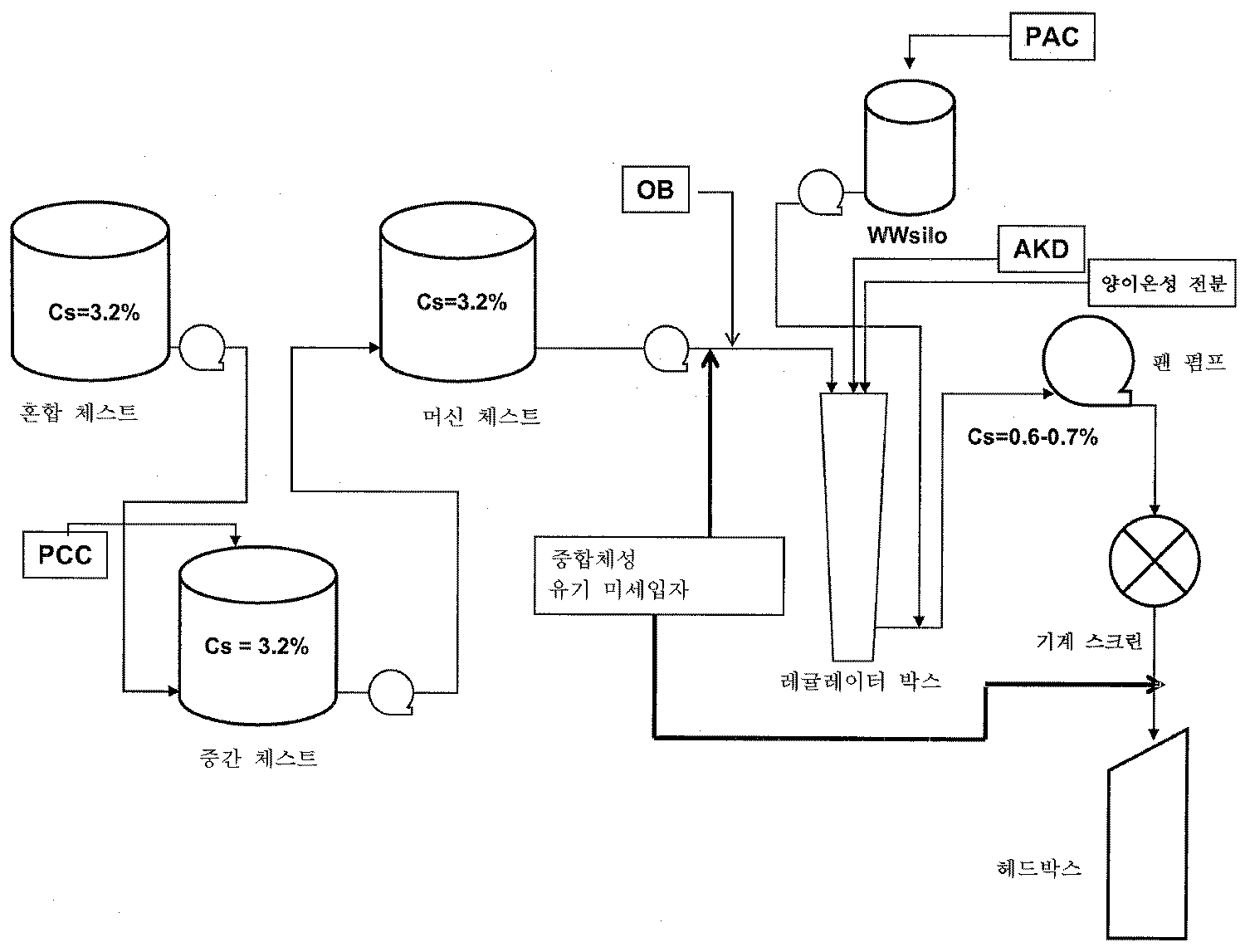
도 1은 제지 공장에서 종이 또는 판지를 제조하기 위한 본 발명의 방법의 개요이다.BRIEF DESCRIPTION OF THE DRAWINGS Figure 1 is an overview of the method of the present invention for making paper or paperboard in a paper mill.
실시예Example 1 One
유기 중합체성 미세입자의 제조Preparation of Organic Polymeric Fine Particles
유기 중합체성 미세입자는 수산화나트륨이 수산화암모늄으로 대체되는 것을 제외하고는, 문헌[참조: EP 제0 462 365 A1호, page 9, lines 14-38, "Procedure for the Preparation of Anionic Microemulsion"]과 유사하게, 전체 단량체를 기준으로 하여, 메틸렌비스아크릴아미드 53mol ppm의 존재하에 중량비 40/60의 아크릴아미드/아크릴산(암모늄 아크릴레이트로서 48중량%)으로부터 제조된다.Organic polymeric microparticles are prepared by the method described in EP 0 462 365 A1, page 9, lines 14-38, "Procedure for the Preparation of Anionic Microemulsion ", except that sodium hydroxide is replaced by ammonium hydroxide Similarly, based on total monomers, acrylamide / acrylic acid (48 wt% as ammonium acrylate) in a weight ratio of 40/60 in the presence of 53 mol ppm of methylene bisacrylamide is prepared.
실시예Example 2 2
패키징 보드 100g/㎡는 320m/min에 가까운 속도에서 종이 10 내지 11t/h를 생성하는 푸어드리니어 기계(fourdrinier machine)를 사용하여 제조한다.The packaging board 100 g / m 2 is manufactured using a fourdrinier machine which produces 10 to 11 t / h of paper at a speed close to 320 m / min.
습부는 도 1에 개요되고, 추가로 다음과 같이 설명된다. 3.2중량% 섬유(12% 침엽수 표백 크라프트 펄프 및 88% 활엽수 표백 크라프트 펄프)를 함유하는 진한 원료를 제조하고, 섬유의 건조 중량을 기준으로 하여, 캐나다 표준의 20중량% 침강 탄산칼륨(PCC) 390 내지 420ml와 뒤섞는다. 섬유 및 충전제를 함유하고 고형분 함량이 3.2중량%인 진한 원료에, 섬유의 건조 중량을 기준으로 하여, 실시예 1의 유기 중합체성 미세입자 711중량ppm, 광학 증백제(OB) 0.45중량%, 알케닐 케텐 다이머(AKD) 0.9중량% 및 폴리알루미늄 클로라이드(PAC) 0.015중량%를 첨가한다. 팬 펌프 전에, 백수를 사용하여 진한 원료를 고형분 함량 0.6 내지 0.7중량%로 희석시켜, 묽은 원료를 형성한다. 마지막 고전단 단계인 기계 스크린을 통과시킨 후, 실시예 1의 유기 중합체성 미세입자 633중량ppm를 추가로 첨가한다. 이어서, 묽은 원료를 헤드박스를 통해 와이어 위에 적하한다.The wet portion is outlined in Fig. 1 and further described as follows. A thick stock containing 3.2% by weight fiber (12% softwood bleached kraft pulp and 88% hardwood bleached kraft pulp) was prepared and tested on Canadian standard 20 wt% precipitated potassium carbonate (PCC) 390 To 420 ml. Fiber and filler and having a solid content of 3.2% by weight, 711% by weight of the organic polymeric fine particles of Example 1, 0.45% by weight of optical brightener (OB) 0.9% by weight of ketylketene dimer (AKD) and 0.015% by weight of polyaluminum chloride (PAC) are added. Prior to the fan pump, dilute raw materials are diluted to a solids content of 0.6 to 0.7 wt% using white water to form a dilute raw material. After passing through the machine screen, which is the last high-stage step, 633 ppm by weight of the organic polymeric fine particles of Example 1 are further added. Subsequently, the dilute raw material is dripped onto the wire through the head box.
제1 통과 보류도는 82.3이고, 회분 제1 통과 보류도는 66.0이다.The first pass retention is 82.3 and the ash first pass retention is 66.0.
비교 compare 실시예Example 1 One
유기 중합체성 미세입자를 진한 원료에 전혀 첨가하지 않으며, 헤드박스 직전에 중합체성 미세입자를 633중량ppm 대신 1200중량ppm로 묽은 원료에 첨가하는 것 이외에는 실시예 1의 방법을 반복한다. 또한, 양이온성 전분인 0.8중량%의 Ciba®Raisamyl®40041을 진한 원료에 첨가하고, 천연 전분 0.6중량%를 제1 탈수 엘리먼트인 지합 구성판(forming board) 이후, 미세한 상향 포물선 샤워로 습윤 지필 위에 분무한다. 전분은 모든 제지 재료의 건조 중량을 기준으로 한 중량%로 제시된다.The procedure of Example 1 is repeated except that no organic polymeric microparticles are added to the thick stock and the polymeric microparticles are added to the dilute raw material at 1200 ppm by weight instead of 633 ppm by weight just before the headbox. In addition, 0.8 wt% of Ciba®Raisamyl® 40041, a cationic starch, was added to the thick stock and 0.6 wt% of the natural starch was added to a moistened paper towel in a fine upward parabolic shower after forming a first dehydrating element, Spray. Starch is presented in weight percent based on the dry weight of all papermaking materials.
시험 결과:Test result:
종이 또는 판지의 내부 결합 강도는, 인장 하중이 종이 두께를 통해, 즉 시트의 Z 방향으로 인가될 때 층간분리(splitting)에 저항하는 생성물의 능력이고, 종이 또는 판지의 내부 강도의 척도이다. 실시예 1에서 수득된 패키징 보드 및 비교 실시예 1에서 수득된 패키징 보드의 내부 결합 강도는 스콧 결합 측정기(Scott Bond Tester)로 측정한다.The internal bond strength of paper or paperboard is the product's ability to resist splitting when the tensile load is applied through the paper thickness, i. E. In the Z direction of the sheet, and is a measure of the internal strength of the paper or paperboard. The internal bonding strength of the packaging board obtained in Example 1 and the packaging board obtained in Comparative Example 1 is measured with a Scott bond tester.
첨가된 전분
[%]To dark raw materials
Added starch
[%]
분무된
전분
[%]Over paper
Sprayed
Starch
[%]
첨가된 OPM1
[ppm]To dark raw materials
OPM 1 added
[ppm]
OPM1
[ppm]Added before headbox passing
OPM 1
[ppm]
강도
[J/㎡]Inner bond
burglar
[J / ㎡]
표 1로부터, 내부 결합 강도 및 따라서 종이의 내부 결합 강도가, 유기 중합체성 미세입자가 마지막 전단 단계 이후 및 헤드박스 이전에만 첨가되는 것이 아니라, 유기 중합체성 미세입자의 일부가 진한 원료에도 공급될 경우에 증가한다는 것을 알 수 있다. 이러한 유기 중합체성 미세입자의 분할 첨가가 전분 사용을 완전히 생략하도록 한다는 것은 더욱 놀랍다. 지합도는 두 공정에서 유사하다.It can be seen from Table 1 that when the internal bond strength and thus the internal bond strength of the paper is not only added after the last shearing step and before the head box but also when a part of the organic polymeric microparticles is also supplied to the dark stock . ≪ / RTI > It is even more surprising that fractional addition of such organic polymeric microparticles completely eliminates the use of starch. Coherence is similar in both processes.
또한, 습윤 지필 강도는 비교 실시예 1의 방법에 비해 실시예 2의 방법에서 상당히 증가된다.In addition, the wet paper strength is significantly increased in the method of Example 2 compared to the method of Comparative Example 1.
Claims (8)
Applications Claiming Priority (3)
| Application Number | Priority Date | Filing Date | Title |
|---|---|---|---|
| EP06122952.2 | 2006-10-25 | ||
| EP06122952 | 2006-10-25 | ||
| PCT/EP2007/060929 WO2008049748A1 (en) | 2006-10-25 | 2007-10-15 | A process for improving paper strength |
Publications (2)
| Publication Number | Publication Date |
|---|---|
| KR20090079907A KR20090079907A (en) | 2009-07-22 |
| KR101506920B1 true KR101506920B1 (en) | 2015-03-30 |
Family
ID=37964553
Family Applications (1)
| Application Number | Title | Priority Date | Filing Date |
|---|---|---|---|
| KR1020097008543A Expired - Fee Related KR101506920B1 (en) | 2006-10-25 | 2007-10-15 | A process for improving paper strength |
Country Status (17)
| Country | Link |
|---|---|
| US (3) | US8088251B2 (en) |
| EP (1) | EP2087172B1 (en) |
| JP (1) | JP5232967B2 (en) |
| KR (1) | KR101506920B1 (en) |
| CN (1) | CN101529021B (en) |
| AU (1) | AU2007308198B2 (en) |
| BR (1) | BRPI0717984B1 (en) |
| CA (1) | CA2667432C (en) |
| CL (1) | CL2007003062A1 (en) |
| ES (1) | ES2648150T3 (en) |
| MX (1) | MX2009004481A (en) |
| NO (1) | NO20091974L (en) |
| NZ (1) | NZ575263A (en) |
| RU (1) | RU2009119355A (en) |
| TW (1) | TW200833902A (en) |
| WO (1) | WO2008049748A1 (en) |
| ZA (1) | ZA200900856B (en) |
Families Citing this family (19)
| Publication number | Priority date | Publication date | Assignee | Title |
|---|---|---|---|---|
| US8980056B2 (en) * | 2010-11-15 | 2015-03-17 | Kemira Oyj | Composition and process for increasing the dry strength of a paper product |
| RU2473725C1 (en) * | 2011-08-16 | 2013-01-27 | Общество с ограниченной ответственностью "Оптимальные химические технологии+консалтинг" | Method of production of cardboard with white cover layer |
| CN103741538B (en) * | 2012-09-04 | 2016-07-06 | 金东纸业(江苏)股份有限公司 | Reducing rules and the method improving its intensity, apply the paper that this reducing rules prepares |
| FI125714B (en) * | 2012-11-12 | 2016-01-15 | Kemira Oyj | Process for the treatment of fiber pulp for the manufacture of paper, cardboard or the like and product |
| US8821689B1 (en) * | 2013-01-25 | 2014-09-02 | Penford Products Co. | Starch-biogum compositions |
| WO2014207704A2 (en) | 2013-06-26 | 2014-12-31 | Pan Jiayi | Filter media |
| CN104562847A (en) * | 2014-12-17 | 2015-04-29 | 广西大学 | Method for improving paper strength |
| CN105077556B (en) * | 2015-07-09 | 2017-03-01 | 川渝中烟工业有限责任公司 | A kind of method of calcium carbonate retention rate in raising papermaking-method reconstituted tobaccos |
| TW201739983A (en) | 2016-01-14 | 2017-11-16 | 亞齊羅馬Ip公司 | Use of acrylate copolymer, manufacturing method of substrate using the same, and substrate thereof |
| US10920065B2 (en) | 2016-06-10 | 2021-02-16 | Ecolab Usa Inc. | Low molecular weight dry powder polymer for use as paper-making dry strength agent |
| RU2746075C2 (en) * | 2016-09-26 | 2021-04-06 | Кемира Ойй | Composition providing strength in dry state, its use and method for producing paper, cardboard and similar materials |
| WO2019028001A1 (en) | 2017-07-31 | 2019-02-07 | Ecolab Usa Inc. | Process for fast dissolution of powder comprising low molecular weight acrylamide-based polymer |
| EP3662108A1 (en) | 2017-07-31 | 2020-06-10 | Ecolab Usa Inc. | Dry polymer application method |
| ES2977122T3 (en) | 2017-09-08 | 2024-08-19 | Solenis Technologies Cayman Lp | Composition comprising cross-linked anionic organic polymeric microparticles, their preparation and use in paper and cardboard manufacturing processes |
| CN111315814B (en) | 2017-12-13 | 2023-01-20 | 埃科莱布美国股份有限公司 | Solution comprising associative polymer and cyclodextrin polymer |
| CN111979843A (en) * | 2020-08-24 | 2020-11-24 | 山鹰国际控股股份公司 | Wet-end papermaking process for improving surface smoothness of paper |
| FR3114008B1 (en) | 2020-09-11 | 2023-12-08 | Swm Luxembourg Sarl | Filter for smoking or vaping item comprising a nonwoven substrate |
| ES3045610T3 (en) | 2020-12-04 | 2025-11-28 | Agc Chemicals Americas Inc | Treated article, methods of making the treated article, and dispersion for use in making the treated article |
| US12031274B2 (en) * | 2021-12-30 | 2024-07-09 | Kemira Oyj | High cationic starch as a promoter in AKD sizing emulsions |
Citations (2)
| Publication number | Priority date | Publication date | Assignee | Title |
|---|---|---|---|---|
| KR950007186B1 (en) * | 1986-01-29 | 1995-07-03 | 얼라이드 콜로이드 리미티드 | Manufacturing method of paper and cardboard |
| KR20000057343A (en) * | 1996-12-06 | 2000-09-15 | 자이드 스콜드 | A process for the production of paper |
Family Cites Families (16)
| Publication number | Priority date | Publication date | Assignee | Title |
|---|---|---|---|---|
| JPS58214597A (en) * | 1982-06-01 | 1983-12-13 | ハイモ株式会社 | Production of paper |
| US4643801A (en) * | 1986-02-24 | 1987-02-17 | Nalco Chemical Company | Papermaking aid |
| US5180473A (en) | 1987-03-20 | 1993-01-19 | Mitsui-Cyanamid, Ltd. | Paper-making process |
| JP2575692B2 (en) * | 1987-03-20 | 1997-01-29 | 三井サイテック株式会社 | Paper manufacturing method |
| EP0335575B2 (en) * | 1988-03-28 | 2000-08-23 | Ciba Specialty Chemicals Water Treatments Limited | Production of paper and paper board |
| JPH0280690A (en) * | 1988-06-22 | 1990-03-20 | Kanzaki Paper Mfg Co Ltd | Production of paper |
| US5167766A (en) * | 1990-06-18 | 1992-12-01 | American Cyanamid Company | Charged organic polymer microbeads in paper making process |
| EP0773319A1 (en) * | 1995-11-08 | 1997-05-14 | Nalco Chemical Company | Method to enhance the performance of polymers and copolymers of acrylamide as flocculants and retention aids |
| US6007679A (en) * | 1996-05-01 | 1999-12-28 | Nalco Chemical Company | Papermaking process |
| TW483970B (en) * | 1999-11-08 | 2002-04-21 | Ciba Spec Chem Water Treat Ltd | A process for making paper and paperboard |
| JP2001279599A (en) * | 2000-01-25 | 2001-10-10 | Harima Chem Inc | Paper-making method |
| MY140287A (en) * | 2000-10-16 | 2009-12-31 | Ciba Spec Chem Water Treat Ltd | Manufacture of paper and paperboard |
| JP3712190B2 (en) * | 2001-11-14 | 2005-11-02 | ハイモ株式会社 | Paper manufacturing method |
| JP4770121B2 (en) * | 2004-03-30 | 2011-09-14 | 栗田工業株式会社 | Paper and paperboard manufacturing method |
| JP4556171B2 (en) * | 2004-11-11 | 2010-10-06 | ハリマ化成株式会社 | Wet paper making method |
| GB0425101D0 (en) * | 2004-11-15 | 2004-12-15 | Ciba Spec Chem Water Treat Ltd | Papermaking process |
-
2007
- 2007-10-15 JP JP2009533787A patent/JP5232967B2/en not_active Expired - Fee Related
- 2007-10-15 ES ES07821296.6T patent/ES2648150T3/en active Active
- 2007-10-15 NZ NZ575263A patent/NZ575263A/en not_active IP Right Cessation
- 2007-10-15 MX MX2009004481A patent/MX2009004481A/en unknown
- 2007-10-15 WO PCT/EP2007/060929 patent/WO2008049748A1/en not_active Ceased
- 2007-10-15 KR KR1020097008543A patent/KR101506920B1/en not_active Expired - Fee Related
- 2007-10-15 CA CA2667432A patent/CA2667432C/en active Active
- 2007-10-15 RU RU2009119355/12A patent/RU2009119355A/en unknown
- 2007-10-15 US US12/445,590 patent/US8088251B2/en active Active
- 2007-10-15 AU AU2007308198A patent/AU2007308198B2/en active Active
- 2007-10-15 BR BRPI0717984-7A patent/BRPI0717984B1/en active IP Right Grant
- 2007-10-15 EP EP07821296.6A patent/EP2087172B1/en active Active
- 2007-10-15 CN CN200780039481.5A patent/CN101529021B/en active Active
- 2007-10-23 TW TW096139637A patent/TW200833902A/en unknown
- 2007-10-24 CL CL200703062A patent/CL2007003062A1/en unknown
-
2009
- 2009-02-05 ZA ZA200900856A patent/ZA200900856B/en unknown
- 2009-05-20 NO NO20091974A patent/NO20091974L/en not_active Application Discontinuation
-
2011
- 2011-11-22 US US13/302,597 patent/US8425726B2/en active Active
- 2011-11-22 US US13/302,530 patent/US8425725B2/en active Active
Patent Citations (2)
| Publication number | Priority date | Publication date | Assignee | Title |
|---|---|---|---|---|
| KR950007186B1 (en) * | 1986-01-29 | 1995-07-03 | 얼라이드 콜로이드 리미티드 | Manufacturing method of paper and cardboard |
| KR20000057343A (en) * | 1996-12-06 | 2000-09-15 | 자이드 스콜드 | A process for the production of paper |
Also Published As
| Publication number | Publication date |
|---|---|
| EP2087172B1 (en) | 2017-08-23 |
| AU2007308198B2 (en) | 2012-02-23 |
| RU2009119355A (en) | 2010-11-27 |
| US20120067534A1 (en) | 2012-03-22 |
| CN101529021A (en) | 2009-09-09 |
| TW200833902A (en) | 2008-08-16 |
| NZ575263A (en) | 2012-02-24 |
| CL2007003062A1 (en) | 2008-05-30 |
| KR20090079907A (en) | 2009-07-22 |
| BRPI0717984A2 (en) | 2013-11-12 |
| EP2087172A1 (en) | 2009-08-12 |
| WO2008049748A1 (en) | 2008-05-02 |
| NO20091974L (en) | 2009-05-25 |
| CA2667432A1 (en) | 2008-05-02 |
| BRPI0717984B1 (en) | 2020-11-10 |
| AU2007308198A1 (en) | 2008-05-02 |
| US8425726B2 (en) | 2013-04-23 |
| US20100288457A1 (en) | 2010-11-18 |
| CA2667432C (en) | 2015-10-13 |
| CN101529021B (en) | 2014-12-10 |
| ES2648150T3 (en) | 2017-12-28 |
| US8088251B2 (en) | 2012-01-03 |
| US20120067535A1 (en) | 2012-03-22 |
| JP5232967B2 (en) | 2013-07-10 |
| MX2009004481A (en) | 2009-05-12 |
| ZA200900856B (en) | 2010-04-28 |
| JP2010507731A (en) | 2010-03-11 |
| US8425725B2 (en) | 2013-04-23 |
Similar Documents
| Publication | Publication Date | Title |
|---|---|---|
| KR101506920B1 (en) | A process for improving paper strength | |
| EP3071751B1 (en) | Method for increasing paper strength | |
| FI126216B (en) | Method for making board | |
| KR102093138B1 (en) | Emulsification of alkenyl succinic anhydride with an amine-containing homopolymer or copolymer | |
| CA2957694A1 (en) | Strength agent, its use and method for increasing strength properties of paper | |
| CN104114766B (en) | Systems and methods for improving paper and paperboard | |
| EP1846615A1 (en) | An additive system for use in paper making and process of using the same | |
| JP2018523764A (en) | Paper manufacturing method | |
| WO2026015766A1 (en) | Flushable tissue products | |
| WO2025255232A1 (en) | High molecular weigh gpam compositions and methods of use as strength and drainage aids | |
| CN121488083A (en) | Use of amphoteric emulsion polymers with a strong resin as retention and drainage aids | |
| CN118922601A (en) | High molecular weight GPAM containing anionic polymer accelerator |
Legal Events
| Date | Code | Title | Description |
|---|---|---|---|
| PA0105 | International application |
St.27 status event code: A-0-1-A10-A15-nap-PA0105 |
|
| PG1501 | Laying open of application |
St.27 status event code: A-1-1-Q10-Q12-nap-PG1501 |
|
| A201 | Request for examination | ||
| P11-X000 | Amendment of application requested |
St.27 status event code: A-2-2-P10-P11-nap-X000 |
|
| P13-X000 | Application amended |
St.27 status event code: A-2-2-P10-P13-nap-X000 |
|
| PA0201 | Request for examination |
St.27 status event code: A-1-2-D10-D11-exm-PA0201 |
|
| D13-X000 | Search requested |
St.27 status event code: A-1-2-D10-D13-srh-X000 |
|
| D14-X000 | Search report completed |
St.27 status event code: A-1-2-D10-D14-srh-X000 |
|
| E902 | Notification of reason for refusal | ||
| PE0902 | Notice of grounds for rejection |
St.27 status event code: A-1-2-D10-D21-exm-PE0902 |
|
| T11-X000 | Administrative time limit extension requested |
St.27 status event code: U-3-3-T10-T11-oth-X000 |
|
| T11-X000 | Administrative time limit extension requested |
St.27 status event code: U-3-3-T10-T11-oth-X000 |
|
| E13-X000 | Pre-grant limitation requested |
St.27 status event code: A-2-3-E10-E13-lim-X000 |
|
| P11-X000 | Amendment of application requested |
St.27 status event code: A-2-2-P10-P11-nap-X000 |
|
| P13-X000 | Application amended |
St.27 status event code: A-2-2-P10-P13-nap-X000 |
|
| E701 | Decision to grant or registration of patent right | ||
| PE0701 | Decision of registration |
St.27 status event code: A-1-2-D10-D22-exm-PE0701 |
|
| PR0701 | Registration of establishment |
St.27 status event code: A-2-4-F10-F11-exm-PR0701 |
|
| PR1002 | Payment of registration fee |
St.27 status event code: A-2-2-U10-U12-oth-PR1002 Fee payment year number: 1 |
|
| PG1601 | Publication of registration |
St.27 status event code: A-4-4-Q10-Q13-nap-PG1601 |
|
| R17-X000 | Change to representative recorded |
St.27 status event code: A-5-5-R10-R17-oth-X000 |
|
| FPAY | Annual fee payment |
Payment date: 20180307 Year of fee payment: 4 |
|
| PR1001 | Payment of annual fee |
St.27 status event code: A-4-4-U10-U11-oth-PR1001 Fee payment year number: 4 |
|
| FPAY | Annual fee payment |
Payment date: 20190521 Year of fee payment: 5 |
|
| PR1001 | Payment of annual fee |
St.27 status event code: A-4-4-U10-U11-oth-PR1001 Fee payment year number: 5 |
|
| FPAY | Annual fee payment |
Payment date: 20200312 Year of fee payment: 6 |
|
| PR1001 | Payment of annual fee |
St.27 status event code: A-4-4-U10-U11-oth-PR1001 Fee payment year number: 6 |
|
| PR1001 | Payment of annual fee |
St.27 status event code: A-4-4-U10-U11-oth-PR1001 Fee payment year number: 7 |
|
| PR1001 | Payment of annual fee |
St.27 status event code: A-4-4-U10-U11-oth-PR1001 Fee payment year number: 8 |
|
| PR1001 | Payment of annual fee |
St.27 status event code: A-4-4-U10-U11-oth-PR1001 Fee payment year number: 9 |
|
| PR1001 | Payment of annual fee |
St.27 status event code: A-4-4-U10-U11-oth-PR1001 Fee payment year number: 10 |
|
| PC1903 | Unpaid annual fee |
St.27 status event code: A-4-4-U10-U13-oth-PC1903 Not in force date: 20250325 Payment event data comment text: Termination Category : DEFAULT_OF_REGISTRATION_FEE |
|
| H13 | Ip right lapsed |
Free format text: ST27 STATUS EVENT CODE: N-4-6-H10-H13-OTH-PC1903 (AS PROVIDED BY THE NATIONAL OFFICE); TERMINATION CATEGORY : DEFAULT_OF_REGISTRATION_FEE Effective date: 20250325 |
|
| PC1903 | Unpaid annual fee |
St.27 status event code: N-4-6-H10-H13-oth-PC1903 Ip right cessation event data comment text: Termination Category : DEFAULT_OF_REGISTRATION_FEE Not in force date: 20250325 |