JP4770121B2 - Paper and paperboard manufacturing method - Google Patents
Paper and paperboard manufacturing method Download PDFInfo
- Publication number
- JP4770121B2 JP4770121B2 JP2004099969A JP2004099969A JP4770121B2 JP 4770121 B2 JP4770121 B2 JP 4770121B2 JP 2004099969 A JP2004099969 A JP 2004099969A JP 2004099969 A JP2004099969 A JP 2004099969A JP 4770121 B2 JP4770121 B2 JP 4770121B2
- Authority
- JP
- Japan
- Prior art keywords
- polymer
- anionic
- water
- soluble
- group
- Prior art date
- Legal status (The legal status is an assumption and is not a legal conclusion. Google has not performed a legal analysis and makes no representation as to the accuracy of the status listed.)
- Expired - Fee Related
Links
Landscapes
- Paper (AREA)
Description
本発明は紙及び板紙の製造方法に係り、特に、紙料に、分岐又は架橋した水溶性両性高分子ポリマーを添加することにより、酸性、中性のいずれの抄造系においても効果を示し、地合いの悪化を抑えながら、濾水性及び歩留性を飛躍的に改善すると共に、作業性の悪さ、スケール生成といった副次的障害を解決する紙及び板紙の製造方法に関する。 The present invention relates to a method for producing paper and paperboard, and in particular, by adding a branched or cross-linked water-soluble amphoteric polymer to a paper material, it exhibits an effect in both acidic and neutral papermaking systems. The present invention relates to a paper and paperboard manufacturing method that drastically improves drainage and yield while suppressing deterioration of the paper and solves secondary obstacles such as poor workability and scale generation.
近年、紙及び板紙の製造においては、酸性紙では紙の寿命が劣ること、インキの乾燥性などの印刷適性について中性紙の方が優れること、コート紙が増えたことによる炭酸カルシウムの多いブロークが流入するため、酸性抄造に適さないこと、などの要因から、抄造系は酸性抄造から中性抄造に変わってきている。また、酸性抄造と中性抄造が混在する紙生産設備が多数見受けられ、酸性、中性の両方に効果のある歩留剤が求められている。 In recent years, in the manufacture of paper and paperboard, acid paper has a poor paper life, neutral paper is superior in terms of printability, such as ink drying properties, and broke rich in calcium carbonate due to the increase in coated paper. The papermaking system has changed from acidic papermaking to neutral papermaking due to factors such as being unsuitable for acidic papermaking. In addition, there are many paper production facilities in which acidic papermaking and neutral papermaking are mixed, and there is a demand for a retention agent that is effective for both acidity and neutrality.
こうした課題に対して、USP4,388,150号公報には、カチオン性スターチ及びコロイドシリカを脱水前の紙料に添加して歩留りを改善する方法が記載されており、このものは商業化されている。また、EP235893号(特開昭62−191598号公報に対応する)には、濾水性、歩留性、乾燥及び地合い特性を改善すべく、特定の剪断ステップの前に第1の合成カチオン性ポリマーを加え、かつその剪断ステップの後でベントナイトを加える方法が開示され、このものは商業化されている。 In response to these problems, US Pat. No. 4,388,150 discloses a method for improving the yield by adding cationic starch and colloidal silica to the paper before dehydration, which has been commercialized. Yes. EP 235893 (corresponding to JP 62-191598 A) also describes a first synthetic cationic polymer prior to a specific shearing step in order to improve drainage, retention, drying and formation properties. And a method of adding bentonite after the shearing step is disclosed and is commercially available.
しかし、これらの方法は、歩留効果、特に填料の歩留において十分に満足し得る効果が得られていない。填料の添加量を増やすと、歩留の改善が見られるが、この場合には製品の地合いが低下するという問題がある。更に、ベントナイトを用いる場合には、溶解のための手間が紙料り、またコロイダルシリカを用いる場合には、有効成分の濃度が低いために輸送コストが高くなる、添加ポイントでシリカスケールが発生して紙品質が低下するといった問題がある。 However, these methods have not been able to obtain a satisfactory yield effect, particularly a satisfactory filler yield. Increasing the amount of filler added improves yield, but in this case there is a problem that the texture of the product decreases. Furthermore, when bentonite is used, paper is required for dissolution, and when colloidal silica is used, the concentration of active ingredients is low, resulting in high transportation costs, and silica scale is generated at the point of addition. There is a problem that the paper quality deteriorates.
また、特公平5−29719号公報(特許第2128702号)には、主カチオン性ポリマーの前に主ポリマーより分子量の低いカチオン性ポリマーを添加し、最後にアニオン性の無機物質を添加し、ピッチ、濾水性を改善する方法が記載されている。しかし、この方法では歩留り、特に填料の歩留効果の向上が顕著ではないという問題がある。 In Japanese Patent Publication No. 5-29719 (Patent No. 21287702), a cationic polymer having a molecular weight lower than that of the main polymer is added before the main cationic polymer, and finally an anionic inorganic substance is added. A method for improving drainage is described. However, this method has a problem that the yield, in particular, the improvement of the yield effect of the filler is not remarkable.
更に、特許第2948358号公報には、カチオン性ポリマーとアニオン性高分子微粒子を紙料中に含有させる歩留改善方法が開示されている。しかし、この方法は、酸性抄造系では、pHが低下するためアニオン基の効果が著しく低下するという問題がある。
本発明は、近年、酸性抄造から中性抄造に移行しつつある状況において、酸性抄造と中性抄造が混在する紙生産設備に対応し、酸性抄造、中性抄造のいずれにおいても、地合いを崩さず、濾水性及び歩留性を改善することができる紙及び板紙の製造方法を提供することを目的とする。 The present invention corresponds to a paper production facility in which acidic papermaking and neutral papermaking coexist in a situation where acid papermaking is recently shifting to neutral papermaking. An object of the present invention is to provide a paper and paperboard production method capable of improving drainage and yield.
本発明によれば、分岐又は架橋した水溶性両性高分子ポリマーを紙料に添加する工程と、水溶性アニオン性高分子ポリマー、アニオン性有機高分子微粒子、又は水溶性カチオン性高分子ポリマーを紙料に添加する工程と、前記二工程を経た紙料を脱水し、乾燥させる工程と、を含む紙及び板紙の製造方法であって、前記分岐又は架橋した水溶性両性高分子ポリマーが、下記一般式(1)で示されるカチオン性モノマー単位0.5〜90モル%と、(メタ)アクリル酸、イタコン酸、アクリルアミド−2−メチルプロパンスルホン酸及びこれらの塩よりなる群から選ばれる1種又は2種以上のアニオン性モノマー単位0.2〜90モル%と、アクリルアミド単位1〜99.3モル%とを有し、1規定硝酸ナトリウム水溶液(pH3)中における極限粘度が0.1dl/g以上で、カチオン性当量が0.1〜5meq/g、アニオン性当量が0.01〜10meq/gの物性を有するものであり、前記アニオン性有機高分子微粒子が、交叉結合された場合に直径約750nmより小さく、かつ非交叉結合性でかつ水不溶性である場合に直径約60nmより小さく、該微粒子のイオン性がアニオン性当量として少なくとも0.1meq/gかそれよりも高いアニオン性のアニオン性有機高分子微粒子であり、前記水溶性アニオン性高分子ポリマーが、(メタ)アクリル酸、イタコン酸、アクリルアミド−2−メチルプロパンスルホン酸及びこれらの塩よりなる群から選ばれる1種又は2種以上のアニオン性モノマー単位0.2〜90モル%と、アクリルアミド単位1〜99.3モル%とを有し、1規定食塩水中における極限粘度が0.1dl/g以上で、アニオン性当量が0.01〜10meq/gの物性を有する水溶性アニオン性高分子ポリマーであり、前記水溶性カチオン性高分子ポリマーが、下記一般式(1)で示されるカチオン性モノマーとアクリルアミドとの共重合物であり、1規定食塩水中における極限粘度が4dl/g以上で、カチオン性当量が0.1〜11meq/gの物性を有する水溶性カチオン性高分子ポリマーであることを特徴とする紙及び板紙の製造方法が提供される。 According to the present invention, a step of adding a branched or cross-linked water-soluble amphoteric polymer polymer to a paper material , a water-soluble anionic polymer polymer, an anionic organic polymer fine particle, or a water-soluble cationic polymer polymer on paper. And a step of dehydrating and drying the paper material having undergone the two steps , wherein the branched or cross-linked water-soluble amphoteric polymer is One or more selected from the group consisting of 0.5 to 90 mol% of the cationic monomer unit represented by the formula (1) and (meth) acrylic acid, itaconic acid, acrylamido-2-methylpropanesulfonic acid and salts thereof Two or more kinds of anionic monomer units of 0.2 to 90 mol% and acrylamide units of 1 to 99.3 mol%, and in a 1N aqueous sodium nitrate solution (pH 3) The anionic organic polymer fine particles have physical properties such that the limiting viscosity is 0.1 dl / g or more, the cationic equivalent is 0.1 to 5 meq / g, and the anionic equivalent is 0.01 to 10 meq / g. Less than about 750 nm when cross-linked, and less than about 60 nm when non-cross-linked and water-insoluble, and the ionicity of the microparticles is at least 0.1 meq / g or more as anionic equivalent Higher anionic organic polymer fine particles, wherein the water-soluble anionic polymer polymer is selected from the group consisting of (meth) acrylic acid, itaconic acid, acrylamido-2-methylpropanesulfonic acid, and salts thereof. One or two or more selected anionic monomer units of 0.2 to 90 mol% and acrylamide units of 1 to 99.3 mol% A water-soluble anionic polymer having physical properties of an intrinsic viscosity of 0.1 dl / g or more in 1 N saline and an anionic equivalent of 0.01 to 10 meq / g, the water-soluble cationic polymer The polymer is a copolymer of a cationic monomer represented by the following general formula (1) and acrylamide, the intrinsic viscosity in 1 N saline is 4 dl / g or more, and the cationic equivalent is 0.1 to 11 meq / g. There is provided a method for producing paper and paperboard, which is a water-soluble cationic polymer having the above physical properties .
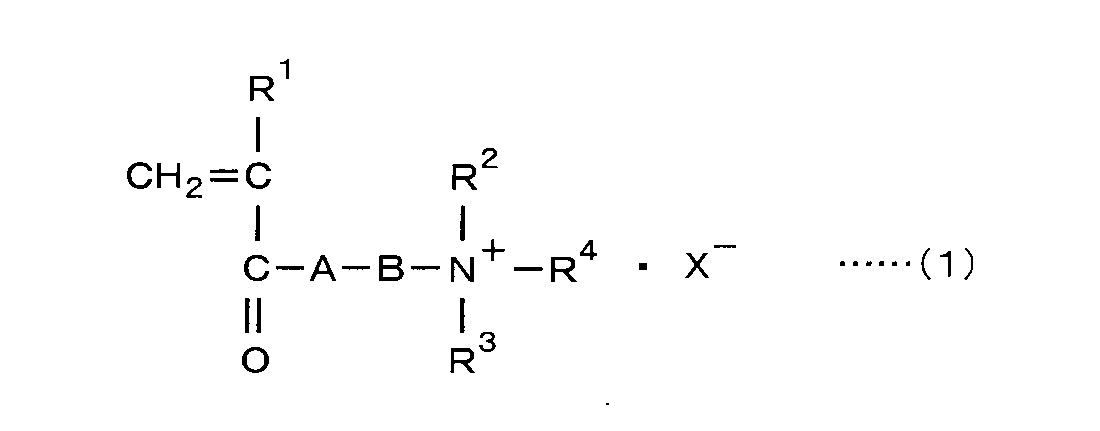
(但し、AはO又はNHを表し、BはC(However, A represents O or NH, and B represents C. 22 HH 44 、C, C 33 HH 66 又はCHOr CH 22 CHOHCHCHOHCH 22 を表し、RRepresents R 11 はH、メチル基、エチル基、ベンジル基又は3−クロロ−2−ヒドロキシプロピル基を表し、RRepresents H, methyl group, ethyl group, benzyl group or 3-chloro-2-hydroxypropyl group; 22 ,R, R 33 ,R, R 44 は各々独立に、H、炭素数1〜3のアルキル基、アルコキシル基、或いはベンジル基を表し、XEach independently represents H, an alkyl group having 1 to 3 carbon atoms, an alkoxyl group, or a benzyl group; −− はアニオンを表す。)Represents an anion. )
ポリマーはその構造によって、線状、分岐及び架橋ポリマーに大別されるが、本発明では、分岐又は架橋した水溶性両性高分子ポリマーを用いる。本発明で用いる分岐又は架橋した水溶性両性高分子ポリマー(以下「分岐/架橋両性ポリマー」と称す場合がある。)の「分岐又は架橋した」とは、分子形状が主鎖のみで構成される線状ではなく、枝分かれした、即ち分岐鎖を有する形状又は複数の線状のものが架橋されてなる形状をいう。 The polymers are roughly classified into linear, branched and crosslinked polymers depending on their structures. In the present invention, branched or crosslinked water-soluble amphoteric polymer polymers are used. “Branched or cross-linked” of the branched or cross-linked water-soluble amphoteric polymer used in the present invention (hereinafter sometimes referred to as “branched / cross-linked amphoteric polymer”) means that the molecular shape is composed only of the main chain. It is not a linear shape but a branched shape, that is, a shape having a branched chain or a shape in which a plurality of linear shapes are crosslinked.
本発明における架橋したポリマーと分岐したポリマーの定義は次の通りである。
架橋ポリマー:
高度に分岐したポリマーである。
分岐ポリマー:
分岐ポリマーは、短鎖分岐ポリマーと長鎖分岐ポリマーとに大別される。長鎖分岐ポリマーは、分岐の仕方により、一つの中心から3本以上の枝が出ている星型ポリマー[star polymer]、一本の幹に、それ自身は分岐していない枝が複数出ているくし型ポリマー[comb polymer]、及び無秩序に分岐が起こっている統計的分岐ポリマー[randomly branched polymer]に分けられる。
The definition of the crosslinked polymer and the branched polymer in the present invention is as follows.
Crosslinked polymer:
A highly branched polymer.
Branched polymer:
Branched polymers are roughly classified into short-chain branched polymers and long-chain branched polymers. A long-chain branched polymer is a star polymer in which three or more branches come out from one center depending on the way of branching, and a plurality of branches that are not branched out on one trunk. They are divided into comb polymers and randomly branched polymers that are randomly branched.
本発明において、紙料に添加する分岐/架橋両性ポリマーは、中性、酸性のいずれの抄造系においても、濾水・歩留向上効果を発揮し、生産性が向上する。この分岐/架橋両性ポリマーは、分岐又は架橋しているため、線状のポリマーに比べ剪断に強く、ポンプ、スクリーン、インレットを通過時に、凝集生成したフロックが直鎖状のポリマーに比べて壊れにくいため、高い効果を維持することができる。また、細かいフロックを形成するため、地合いを崩さず、濾水性及び歩留性を改善し、断紙の低減、生産スピードアップといった生産性の向上を図ることができる。 In the present invention, the branched / crosslinked amphoteric polymer added to the stock exhibits an effect of improving drainage / yield and improves productivity in both neutral and acidic papermaking systems. Since this branched / crosslinked amphoteric polymer is branched or crosslinked, it is more resistant to shearing than linear polymers, and the flocs formed by aggregation are less likely to break than linear polymers when passing through pumps, screens, and inlets. Therefore, a high effect can be maintained. In addition, since fine flocs are formed, it is possible to improve productivity such as reducing drainage and increasing production speed by improving drainage and yield without breaking the texture.
分岐/架橋両性ポリマーを添加する本発明の紙及び板紙の製造方法による作用機構の詳細は未だ完全には解明されていないが、下記のように推定される。 The details of the mechanism of action of the paper and paperboard production method of the present invention in which a branched / crosslinked amphoteric polymer is added have not yet been fully elucidated, but are estimated as follows.
酸性抄造系では、紙繊維に定着したバンド或いは、紙力剤、カチオン澱粉などを介して分岐/架橋両性ポリマーのアニオン部位が結合し凝集する。この際、分岐/架橋両性ポリマーは分岐又は架橋しているため、大きなフロックを形成せず、従って、地合いを崩さない。 In the acidic papermaking system, the anion sites of the branched / crosslinked amphoteric polymer are bonded and aggregated through a band fixed on the paper fiber, a paper strength agent, a cationic starch or the like. At this time, since the branched / crosslinked amphoteric polymer is branched or crosslinked, it does not form a large floc and therefore does not break the texture.
中性抄造系では、分岐/架橋両性ポリマーは、アニオン基の解離が進み、更に効果が上がる。特に、分岐/架橋両性ポリマーが4級のカチオン基を有する場合には、pHが上がっても十分な効果を発揮する。 In the neutral papermaking system, the branched / crosslinked amphoteric polymer is further improved in the effect of anionic group dissociation. In particular, when the branched / crosslinked amphoteric polymer has a quaternary cationic group, a sufficient effect is exhibited even when the pH is increased .
カチオン性ポリマーとベントナイトやコロイダルシリカに代表されるアニオン性無機微粒子とを併用した従来技術における問題点は、カチオン性ポリマーとアニオン性無機微粒子との間の凝集力が十分ではなく、十分な歩留効果が得られないことが原因であった。また、カチオン性ポリマーとアニオン性ポリマーを併用した従来技術は酸性時に効果が劣る問題があった。 Ca thione polymer and bentonite or colloidal silica in problems in combination with the prior art and the anionic inorganic particles to be representative, cohesive force is insufficient between the cationic polymer and anionic inorganic particles, sufficient step This was because the retention effect was not obtained. Further, the conventional technique using both a cationic polymer and an anionic polymer has a problem that the effect is inferior when acidic.
これに対して、分岐/架橋両性ポリマーと、水溶性アニオン性高分子ポリマー及び/又はアニオン性有機高分子微粒子とを併用することで、分岐/架橋両性ポリマーのカチオン基と、水溶性アニオン性高分子ポリマー及び/又はアニオン性有機高分子微粒子のアニオン基との強い相互作用により、優れた凝集効果が得られる。 On the other hand, by using the branched / crosslinked amphoteric polymer in combination with the water-soluble anionic polymer polymer and / or the anionic organic polymer fine particles, the cationic group of the branched / crosslinked amphoteric polymer and the water-soluble anionic polymer Due to the strong interaction with the anionic group of the molecular polymer and / or anionic organic polymer fine particles, an excellent aggregation effect is obtained.
また、分岐/架橋両性ポリマーと、水溶性カチオン性高分子ポリマーとを併用することで、分岐/架橋両性ポリマーのアニオン基と、水溶性カチオン性高分子ポリマーのカチオン基との強い相互作用により、優れた凝集効果が得られる。 In addition, by using a branched / crosslinked amphoteric polymer in combination with a water-soluble cationic polymer, a strong interaction between the anionic group of the branched / crosslinked amphoteric polymer and the cationic group of the water-soluble cationic polymer is Excellent agglomeration effect is obtained.
本発明の紙及び板紙の製造方法によれば、分岐又は架橋した水溶性両性高分子ポリマーを用いるため、酸性、中性の条件に拘わらず、アニオントラッシュの多い紙料であっても、ピッチを抑え、欠陥の減少を図るだけでなく、地合いを崩さず、濾水性及び歩留性を改善すると共に、断紙の減少、生産スピードアップといった生産性の向上を図ることができる。 According to the paper and paperboard production method of the present invention, since a branched or cross-linked water-soluble amphoteric polymer is used, the pitch can be adjusted even for paper stocks with a lot of anionic trash, regardless of acidic and neutral conditions. In addition to suppressing and reducing defects, it is possible to improve productivity, such as reducing paper breaks and increasing production speed, as well as improving drainage and yield without destroying the texture.
以下に本発明の紙及び板紙の製造方法の実施の形態を詳細に説明する。 Embodiments of the paper and board manufacturing method of the present invention will be described in detail below.
まず、本発明で用いる分岐/架橋両性ポリマー、アニオン性有機高分子微粒子、水溶性アニオン性高分子ポリマー、水溶性カチオン性高分子ポリマーについて説明する。 First, the branched / crosslinked amphoteric polymer, anionic organic polymer fine particles, water-soluble anionic polymer polymer, and water-soluble cationic polymer polymer used in the present invention will be described.
本発明で用いる分岐/架橋両性ポリマーは、下記一般式(1)で示されるカチオン性モノマー単位0.5〜90モル%、(メタ)アクリル酸、イタコン酸、アクリルアミド−2−メチルプロパンスルホン酸及びこれらの塩よりなる群から選ばれる1種又は2種以上のアニオン性モノマー単位0.2〜90モル%と、アクリルアミド単位1〜99.3モル%とを有し、1規定硝酸ナトリウム水溶液(pH3)中における極限粘度が0.1dl/g以上で、カチオン性当量が0.1〜5meq/g、アニオン性当量が0.01〜10meq/gの物性を有するものである。 Branched / crosslinked amphoteric polymer over for use in the present invention include cationic monomer units 0.5 to 90 mol% of the following general formula (1), (meth) acrylic acid, itaconic acid, acrylamido-2-methylpropanesulfonic acid And 1 or 2 or more types of anionic monomer units selected from the group consisting of these salts and 0.2 to 90 mol% of acrylamide units and 1 to 99.3 mol% of 1N sodium nitrate aqueous solution ( in pH 3) an intrinsic viscosity of 0.1 dl / g or more in the cationic equivalent 0.1~5meq / g, the anionic equivalent is one having the physical properties of 0.01~10meq / g.
分岐/架橋両性ポリマーは、このようなモノマー成分から共重合体を製造するに当たり、架橋剤を配合してポリマー鎖に分岐構造または架橋構造を導入することにより製造される。分岐または架橋の程度は、この架橋剤の配合量で調整することができ、例えば、仕込みモノマー換算で0.00001〜1モル%の架橋剤を添加でき、0.0001〜0.01モル%程度が好ましい。 The branched / crosslinked amphoteric polymer is produced by blending a crosslinking agent and introducing a branched structure or a crosslinked structure into a polymer chain in producing a copolymer from such monomer components. The degree of branching or cross-linking can be adjusted by the amount of the cross-linking agent. For example, 0.00001 to 1 mol% of the cross-linking agent can be added in terms of charged monomers, and about 0.0001 to 0.01 mol%. Is preferred.
なお、用いる架橋剤としては、メチレンビス(メタ)アクリルアミド、エチレンビス(メタ)アクリルアミド、ビス(メタ)アクリルアミド−メチロールエチレン尿素縮合体、ビス(メタ)アクリルアミド−メチロール尿素等のビス(メタ)アクリルアミド類やエチレングリコールジ(メタ)アクリレート、ジエチレングリコールジ(メタ)アクリレート等のジ(メタ)アクリレート類、アジピン酸ジビニル、セバシン酸ジビニル等のジビニルエステル類、N,N−ジアリルアクリルアミド、1,2,3−トリアクロイルヘキサヒドロ−s−トリアジン、トリアリルイソシアヌレート等のトリビニルモノマー系架橋剤を挙げることができる。 Examples of the crosslinking agent used include bis (meth) acrylamides such as methylene bis (meth) acrylamide, ethylene bis (meth) acrylamide, bis (meth) acrylamide-methylol ethylene urea condensate, bis (meth) acrylamide-methylol urea, and the like. Di (meth) acrylates such as ethylene glycol di (meth) acrylate and diethylene glycol di (meth) acrylate, divinyl esters such as divinyl adipate and divinyl sebacate, N, N-diallylacrylamide, 1,2,3-tri Examples thereof include trivinyl monomer-based crosslinking agents such as acroylhexahydro-s-triazine and triallyl isocyanurate.
繊維表面にループ状ないしテール状の吸着が形成しやすくなるという観点からは、この分岐/架橋両性ポリマーの1規定硝酸ナトリウム水溶液(pH3)中における極限粘度は0.1dl/g以上であり、また、分岐/架橋両性ポリマーのカチオン性当量は、十分な吸着を確保するという観点からは0.1meq/g以上とし、凝集異物の生成を避けるという観点からは5meq/g以下である。また、分岐/架橋両性ポリマーのアニオン性当量に関しては、十分な吸着を確保するという観点からは0.01meq/g以上であり、凝集異物の生成を避けるという観点からは10meq/g以下である。 From the viewpoint of a loop or tail-shaped suction it tends to form on the fiber surface state, and are the intrinsic viscosity is 0.1 dl / g or more in the 1N nitric acid aqueous solution of sodium branch / cross-linked ampholytic polymers (pH 3), also, cationic equivalent of branching / crosslinking ampholytic polymer, from the viewpoint of ensuring sufficient suction and 0.1 meq / g or more, Ru der below 5 meq / g from the viewpoint of avoiding the formation of agglomerated foreign matter. Regarding the anionic equivalent of branching / crosslinking ampholytic polymer, from the viewpoint of ensuring sufficient suction Ri der than 0.01 meq / g, Der below 10 meq / g from the viewpoint of avoiding the formation of agglomerated foreign matter The
分岐/架橋両性ポリマーのより好ましい極限粘度は1〜25dl/gで、より好ましいカチオン性当量は0.5〜4meq/gで、より好ましいアニオン性当量は0.05〜9meq/gである。 The more preferable intrinsic viscosity of the branched / crosslinked amphoteric polymer is 1 to 25 dl / g, the more preferable cationic equivalent is 0.5 to 4 meq / g, and the more preferable anionic equivalent is 0.05 to 9 meq / g.
本発明で用いるアニオン性有機高分子微粒子は、特許第2948358号公報の請求項2に記載されたAの微粒子であり、交叉結合された場合に直径約750nmより小さく、かつ非交叉結合性でかつ水不溶性である場合に直径約60nmより小さく、該微粒子のアニオン性当量が0.1meq/g以上(カチオン性当量として少なくとも−0.1meq/gかそれよりも高いアニオン性)のものである。 Anionic organic polymer fine particles used in the present invention are fine particles A according to claim 2 of Patent No. 2948358 publication, less than the diameter of about 750nm when it is crosslinked, and a non-cross-linking In addition, when the particle is insoluble in water, the diameter is smaller than about 60 nm, and the fine particle has an anionic equivalent of 0.1 meq / g or more (cationic equivalent is at least −0.1 meq / g or higher anionic). .
このようなアニオン性有機高分子微粒子としては、例えばアクリル酸とアクリルアミドがN,N'−メチルビスアクリルアミドで交叉結合されたミクロエマルジョン共重合体が挙げられる。 Examples of such anionic organic polymer fine particles include a microemulsion copolymer in which acrylic acid and acrylamide are cross-linked with N, N′-methylbisacrylamide.
なお、アニオン性有機高分子微粒子は、特許第2948358号公報の請求項2に記載されるように、イオン性高分子微粒子と高分子量イオン性重合体或いはイオン性多糖類との混合物からなる組成物であっても良い。 The anionic organic polymer fine particle is a composition comprising a mixture of an ionic polymer fine particle and a high molecular weight ionic polymer or ionic polysaccharide as described in claim 2 of Japanese Patent No. 2948358. It may be.
本発明で用いる水溶性アニオン性高分子ポリマーは、(メタ)アクリル酸、イタコン酸、アクリルアミド−2−メチルプロパンスルホン酸及びこれらの塩よりなる群から選ばれる1種又は2種以上のアニオン性モノマー単位0.2〜90モル%と、アクリルアミド単位1〜99.3モル%とを有し、1規定食塩水中における極限粘度が0.1dl/g以上で、アニオン性当量が0.01〜10meq/gの物性を有するものである。 Water-soluble anionic polymer polymer over for use in the present invention, (meth) acrylic acid, itaconic acid, acrylamido-2-methylpropanesulfonic acid and one or more anionic selected from the group consisting of salts It has a monomer unit of 0.2 to 90 mol% and an acrylamide unit of 1 to 99.3 mol%, has an intrinsic viscosity of 0.1 dl / g or more in 1 N saline, and an anionic equivalent of 0.01 to 10 meq. / g and has a physical property of.
カチオン性の電荷を帯びた繊維表面(酸化チタン、硫酸バンド、紙力増強剤などを使用する場合)に、ループ状ないしテール状の吸着が形成しやすくなるという観点、及びカチオン性の電荷を帯びた繊維同士が吸着しやすくなる観点から、この水溶性アニオン性高分子ポリマーの極限粘度は0.1dl/g以上である。また、十分な吸着を確保する観点から、水溶性アニオン性高分子ポリマーのアニオン性当量は0.01meq/g以上であり、凝集異物の生成を避けるという観点からは10meq/g以下である。 In view of the fact that loop-like or tail-like adsorption is easily formed on the surface of a fiber having a cationic charge (when using titanium oxide, a sulfuric acid band, a paper strength enhancer, etc.), and having a cationic charge. from the viewpoint of fibers is likely to adsorb the intrinsic viscosity of the water-soluble anionic polymer polymer Ru der than 0.1 dl / g. Further, in order to ensure sufficient adsorption, anionic equivalent of the water-soluble anionic polymer polymer Ri der than 0.01 meq / g, Ru der below 10 meq / g from the viewpoint of avoiding the formation of agglomerated foreign matter .
水溶性アニオン性高分子ポリマーのより好ましい極限粘度は3〜30dl/gで、より好ましいアニオン性当量は0.05〜6meq/gである。 The more preferable intrinsic viscosity of the water-soluble anionic polymer is 3 to 30 dl / g, and the more preferable anionic equivalent is 0.05 to 6 meq / g.
本発明で用いる水溶性カチオン性高分子ポリマーは、下記一般式(1)で示されるカチオン性モノマーとアクリルアミドとの共重合物であり、1規定食塩水中における極限粘度が4dl/g以上で、カチオン性当量が0.1〜11meq/gの物性を有するものである。 Water-soluble cationic polymer polymer over for use in the present invention is a copolymer of a cationic monomer and acrylamide represented by the following general formula (1), in intrinsic viscosity in 1N saline is 4 dl / g or more, cationic equivalent weight of those having the physical properties of 0.1~11meq / g.
繊維表面にループ状ないしテール状の吸着が形成しやすくなるという観点からは、水溶性カチオン性高分子ポリマーの1規定食塩水中における極限粘度は4dl/g以上である。また、十分な吸着を確保するという観点からは、カチオン性当量は0.1meq/g以上であり、凝集異物の生成を避けるという観点からは11meq/g以下である。 From the viewpoint of a loop or tail-shaped suction it tends to form on the fiber surface, an intrinsic viscosity in 1N saline soluble cationic polymer polymer Ru der least 4 dl / g. In view of ensuring adequate adsorption cationic equivalent Ri der least 0.1 meq / g, Ru der below 11 mEq / g from the viewpoint of avoiding the formation of agglomerated foreign matter.
水溶性カチオン性高分子ポリマーのより好ましい極限粘度は5〜20dl/gで、より好ましいカチオン性当量は1〜10meq/gである。 The more preferable intrinsic viscosity of the water-soluble cationic polymer is 5 to 20 dl / g, and the more preferable cationic equivalent is 1 to 10 meq / g .
本発明においては、分岐/架橋両性ポリマーと水溶性アニオン性高分子ポリマー又はアニオン性有機高分子微粒子とを添加した後、或いは分岐/架橋両性ポリマーと水溶性カチオン性高分子ポリマーとを添加した後、紙料を脱水してシート状とし、その後乾燥させるが、分岐/架橋両性ポリマーと、アニオン性有機高分子微粒子、水溶性アニオン性高分子ポリマー、或いは水溶性カチオン性高分子ポリマーとを紙料に添加するに当たって、その添加順序に特に制限はない。従って、例えば下記の方法を採用することができる。
(1)分岐/架橋両性ポリマーを紙料に添加する第一工程と、第一工程を経て得られた紙料にアニオン性有機高分子微粒子又は水溶性アニオン性高分子ポリマーを添加する第二工程とを含む紙及び板紙の製造方法
(2)アニオン性有機高分子微粒子又は水溶性アニオン性高分子ポリマーを紙料に添加する第一工程と、第一工程を経て得られた紙料に分岐/架橋両性ポリマーを添加する第二工程とを含む紙及び板紙の製造方法
(3)水溶性カチオン性高分子ポリマーを紙料に添加する第一工程と、第一工程を経て得られた紙料に分岐/架橋両性ポリマーを添加する第二工程とを含む紙及び板紙の製造方法
(4)分岐/架橋両性ポリマーを紙料に添加する第一工程と、第一工程を経て得られた紙料に水溶性カチオン性高分子ポリマーを添加する第二工程とを含む紙及び板紙の製造方法
In the present invention, the branch / cross-linked ampholytic polymer and a water-soluble after anionic polymer polymer over or with the addition of the anionic organic polymer fine particles, or a branched / crosslinked amphoteric polymer and a water-soluble cationic high polymer After the addition, the stock is dehydrated to form a sheet, and then dried. The branched / crosslinked amphoteric polymer, the anionic organic polymer fine particles , the water-soluble anionic polymer polymer, or the water-soluble cationic polymer polymer There is no particular limitation on the order of addition when adding to the stock. Therefore, for example, the following method can be employed.
(1) a first step of adding a branching / crosslinking ampholytic polymer to the stock, the anionic organic polymer fine Komata the stock obtained through the first step adding a water-soluble anionic high polymer paper method of manufacturing paper and paperboard (2) an anionic organic polymer fine Komata is obtained through a first step of adding a water-soluble anionic polymer polymer to the stock, the first step comprising the two steps Paper and paperboard manufacturing method comprising a second step of adding a branched / crosslinked amphoteric polymer to the base material (3) Obtained through the first step of adding the water-soluble cationic polymer to the base material and the first step A paper and paperboard manufacturing method comprising a second step of adding a branched / crosslinked amphoteric polymer to a paper stock. (4) Obtained through a first step of adding a branched / crosslinked amphoteric polymer to a paper stock, and a first step. Add water-soluble cationic polymer to the paper stock The method of manufacturing paper and paperboard comprising a step
上記の添加手順において、第一工程における歩留剤の添加と、第二工程の歩留剤の添加とは、その添加の間において、5秒以上、特に10〜30秒の時間を設けることが好ましい。 In the above addition procedure, the addition of the retention agent in the first step and the addition of the retention agent in the second step may take a time of 5 seconds or more, particularly 10 to 30 seconds, between the additions. preferable.
本発明において、分岐/架橋両性ポリマーの添加率は好ましくは乾燥紙料に対して0.002〜0.5重量%であり、より好ましくは0.005〜0.2重量%である。 In the present invention, the addition ratio of the branched / crosslinked amphoteric polymer is preferably 0.002 to 0.5% by weight, more preferably 0.005 to 0.2% by weight, based on the dry paper stock.
また、アニオン性有機高分子微粒子、水溶性アニオン性高分子ポリマー、或いは水溶性カチオン性高分子ポリマーの添加率は、好ましくは乾燥紙料に対して0.002〜0.5重量%であり、より好ましくは0.005〜0.2重量%である。 Further, the anionic organic polymer fine particles, a water-soluble anionic high polymer, or the addition of the water-soluble cationic polymer polymer over is preferably 0.002 to 0.5 wt% based on dry paper stock is More preferably, it is 0.005 to 0.2% by weight.
以下に実施例及び比較例を挙げて本発明をより具体的に説明する。 Hereinafter, the present invention will be described more specifically with reference to Examples and Comparative Examples.
なお、以下の実施例及び比較例において用いた添加剤は、次の通りである。また、以下において、「部」は「重量部」を示す。 In addition, the additive used in the following Examples and Comparative Examples is as follows. In the following, “part” means “part by weight”.
(1) 実施例及び比較例で用いた添加剤
表1において、X−1は、仕込みモノマーとしてDAA(分子量193.5)30モル%と、AAm(分子量71)60モル%と、AANa(分子量94)10モル%とを用い(仕込みモノマーの平均分子量110.05)、架橋剤としてN,N’−メチレンビスアクリルアミド(分子量140)を仕込みモノマー1モルに対して0.000008モル(即ち0.0008モル%)添加し、共重合して得られたものである。 In Table 1, X-1 uses DAA (molecular weight 193.5) 30 mol%, AAm (molecular weight 71) 60 mol%, and AAAa (molecular weight 94) 10 mol% as charge monomers (average charge monomer) Molecular weight 110.05), N, N′-methylenebisacrylamide (molecular weight 140) as a crosslinking agent is added, 0.000008 mol (ie 0.0008 mol%) is added to 1 mol of the monomer, and copolymerization is performed. It is a thing.
(2) 実施例で用いたアニオン性有機高分子微粒子「A−1」の詳細
アクリル酸/アクリルアミド/N,N'−メチレンビスアクリルアミドの共重合体:N,N'−メチレンビスアクリルアミド(MBAAm)349ppmで交叉結合された、粒径130nmのアクリル酸ナトリウム(AANa)30モル%及びアクリルアミド(AAm)70モル%のミクロエマルジョン共重合体。
(2) Details of Anionic Organic Polymer Fine Particles “A-1” Used in the Examples Acrylic acid / acrylamide / N, N′-methylenebisacrylamide copolymer: N, N′-methylenebisacrylamide (MBAAm) A microemulsion copolymer of 30 mol% sodium acrylate (AANa) and 70 mol% acrylamide (AAm) cross-linked at 349 ppm.
上記のアニオン性有機高分子微粒子は、以下の方法により製造した。 The above-mentioned anionic organic polymer fine particles were produced by the following method.
順次にアクリル酸147部、脱イオン水200部、56.5重量%水酸化ナトリウム144部、アクリルアミド結晶343.2部、10重量%ジエチレントリアミン五酢酸五ナトリウム0.3部、更に脱イオン水39.0部及び0.52重量%硫酸銅5水和物1.5部を混合することにより水相を調製した。生じた水相溶液110部に1重量%t−ブチルヒドロパーオキシド0.25部及び0.61重量%N,N'−メチレンビスアクリルアミド3.50部を加えた。次に、水相120部をパラフィン油77.8部、脂肪酸ソルビタン(オレイン酸を含有する)3.6部及びヘキサオレイン酸ポリオキシエチレンソルビトール21.4部を含む油相と混合した。 Sequentially, 147 parts of acrylic acid, 200 parts of deionized water, 144 parts of 56.5% by weight sodium hydroxide, 343.2 parts of acrylamide crystals, 0.3 part of 10% by weight diethylenetriaminepentaacetic acid pentasodium, and 39. An aqueous phase was prepared by mixing 0 parts and 1.5 parts of 0.52 wt% copper sulfate pentahydrate. To 110 parts of the resulting aqueous phase solution was added 0.25 parts of 1 wt% t-butyl hydroperoxide and 3.50 parts of 0.61 wt% N, N'-methylenebisacrylamide. Next, 120 parts of the aqueous phase was mixed with an oil phase containing 77.8 parts of paraffin oil, 3.6 parts of fatty acid sorbitan (containing oleic acid) and 21.4 parts of polyoxyethylene sorbitol hexaoleate.
生じた透明なミクロエマルジョンを窒素で20分間脱気した。ガス状SO2を用いて重合を開始し、発熱を40℃までとし、氷水を用いて40℃に制御した。冷却をこれ以上必要としなくなった時点で氷水を除去した。その後窒素を1時間通気して重合物を得た。 The resulting clear microemulsion was degassed with nitrogen for 20 minutes. Polymerization was initiated using gaseous SO 2 , the exotherm was brought to 40 ° C. and controlled to 40 ° C. using ice water. The ice water was removed when no further cooling was required. Thereafter, nitrogen was passed through for 1 hour to obtain a polymer.
(3) 比較例で用いたアニオン性無機微粒子
コロイダルシリカ:アルカリで安定化された平均粒径5nmの市販のコロイド状シリカ(Eka Chemicals社製、商品名「BMA」)
ベントナイト:セピオライト、アタパルジャイト又はモンモリロナイトからなる市販のアニオン性膨潤性ベントナイト(Ciba Specialty Chemicals社製、商品名「Orgaoosorb O」
(3) Anionic inorganic fine particles used in comparative examples Colloidal silica: Commercially available colloidal silica stabilized with alkali and having an average particle diameter of 5 nm (trade name “BMA” manufactured by Eka Chemicals)
Bentonite: a commercially available anionic swelling bentonite made of sepiolite, attapulgite or montmorillonite (Ciba Specialty Chemicals, trade name “Orgaoosorb O”)
また、SSの歩留率測定及び地合い指数の測定には、次の測定装置を用いた。
SSの歩留率:ミューテック社製,濾水歩留試験機「DFS(ダイナミック フィルトレーション システム)」
地合い指数:M/K System Inc.社製「3-D Sheet Analyzer」
Moreover, the following measuring apparatus was used for the measurement of the yield rate of SS and the measurement of the formation index.
SS Yield: A drainage yield tester “DFS (Dynamic Filtration System)” manufactured by Mutech
Ground index: “3-D Sheet Analyzer” manufactured by M / K System Inc.
[実施例1〜6、比較例1,2:酸性上質紙の例]
LBKP(広葉樹晒クラフトパルプ)100%、フリーネス450ccの紙料の乾燥重量当りの濃度が0.8重量%になるよう調整した。
[Examples 1 to 6, Comparative Examples 1 and 2: Examples of acidic fine paper]
LBKP (hardwood bleached kraft pulp) 100% and freeness 450 cc of paper stock was adjusted so that the concentration per dry weight was 0.8% by weight.
このようにして得られた紙料(A)を歩留試験機「DFS」に投入し、硫酸バンド(硫酸アルミニウム)を対乾燥パルプ2.0重量%、カチオン化澱粉(NSC社製「Cato−3212」)を対乾燥パルプ1.0重量%、タルク(日本タルク社製「タルク86−C」)を対乾燥パルプ10重量%、歩留剤1剤目の順で添加し、続いて歩留剤2剤目を添加し、濾液(B)を採取した。DFSの設定条件はミューテック社の推奨方法を用いた。各歩留剤は20秒間隔で添加した。本試験機による剪断は、標準条件の撹拌を与えることによって、付与されている。評価はpH4〜5で行った。pHが4〜5にならない場合は、10重量%硫酸を滴下して調整した。 The stock (A) thus obtained was put into a yield tester “DFS”, and a sulfuric acid band (aluminum sulfate) was added to 2.0% by weight of dry pulp and cationized starch (“Cato-” manufactured by NSC). 3212 ") to 1.0% by weight of dry pulp and talc (" Talc 86-C "manufactured by Nippon Talc Co., Ltd.) was added in the order of 10% by weight of dry pulp to the first agent, followed by yield. The second agent was added and the filtrate (B) was collected. The recommended setting method of DFS was used for setting conditions of DFS. Each retention agent was added at 20 second intervals. Shearing by the tester is imparted by applying standard agitation. Evaluation was performed at pH 4-5. When pH did not become 4-5, 10 weight% sulfuric acid was dripped and adjusted.
各例で用いた歩留剤1剤目及び歩留剤2剤目の種類と添加量は表2に示す通りである。 Table 2 shows the types and addition amounts of the first and second retention agents used in each example.
採取した濾液中のSS(SSはSSの測定方法「ISO4119−1995」に従った。)の濃度を測定し、下記の式に従い、SSの歩留率を算出した。
SSの歩留率=[1−濾液(B)のSS/紙料(A)のSS]×100%
The concentration of SS in the collected filtrate (SS was according to SS measurement method “ISO4119-1995”) was measured, and the yield of SS was calculated according to the following formula.
SS yield = [1-SS of filtrate (B) / SS of stock (A)] × 100%
また、上記と同じ比率と方法によって調製した紙料を用いて、手漉きシートを作成し、地合い指数を測定した。 A handmade sheet was prepared using the paper stock prepared by the same ratio and method as described above, and the texture index was measured.
歩留試験機による試験結果及び手漉きシートの地合い指数測定結果を表2に示す。表2より明らかなように、実施例1〜6では比較例1,2よりもSSの歩留りが向上し、地合いも良好となった。 Table 2 shows the results of the test using the yield tester and the results of measuring the texture index of the handsheets. As is clear from Table 2, in Examples 1 to 6, the yield of SS was improved and the texture was also better than Comparative Examples 1 and 2.
[実施例7〜12、比較例3,4:中性上質紙の例]
LBKP(広葉樹晒クラフトパルプ)100%、フリーネス450ccの紙料の乾燥重量当りの濃度が0.8重量%になるよう調整した。
[Examples 7 to 12, Comparative Examples 3 and 4: Example of neutral high-quality paper]
LBKP (hardwood bleached kraft pulp) 100% and freeness 450 cc of paper stock was adjusted so that the concentration per dry weight was 0.8% by weight.
このようにして得られた紙料(A)を歩留試験機「DFS」に投入し、硫酸バンド(硫酸アルミニウム)を対乾燥パルプ2.0重量%、カチオン化澱粉(NSC社製「Cato−3212」)を対乾燥パルプ1.0重量%、炭酸カルシウム(奥多摩工業社製「TP−12L」)を対乾燥パルプ10重量%、歩留剤1剤目の順で添加し、続いて20秒後に歩留剤2剤目を添加し、濾液(B)を採取した。DFSの設定条件はミューテック社の推奨方法を用いた。本試験機による剪断は、標準条件の撹拌を与えることによって、付与されている。評価はpH7以上で行った。 The stock (A) thus obtained was put into a yield tester “DFS”, and a sulfuric acid band (aluminum sulfate) was added to 2.0% by weight of dry pulp and cationized starch (“Cato-” manufactured by NSC). 3212 ") to 1.0% by weight of dry pulp, calcium carbonate (" TP-12L "manufactured by Okutama Kogyo Co., Ltd.) was added in the order of 10% by weight of dry pulp and the first agent of the retention agent, followed by 20 seconds. The second retention agent was added later, and the filtrate (B) was collected. The recommended setting method of DFS was used for setting conditions of DFS. Shearing by the tester is imparted by applying standard agitation. Evaluation was performed at pH 7 or higher.
各例で用いた歩留剤1剤目及び歩留剤2剤目の種類と添加量は表3に示す通りである。 Table 3 shows the types and addition amounts of the first and second retention agents used in each example.
採取した濾液について、実施例1と同様にしてSSの歩留率を求めると共に、実施例1と同様にして手漉きシートの地合い指数を測定し、結果を表3に示した。 For the collected filtrate, the yield rate of SS was determined in the same manner as in Example 1, and the texture index of the handsheet was measured in the same manner as in Example 1, and the results are shown in Table 3.
表3より明らかなように、実施例7〜12では比較例3,4よりもSSの歩留が向上し、地合いも良好となった。 As is clear from Table 3, in Examples 7 to 12, the yield of SS was improved and the texture was better than Comparative Examples 3 and 4.
本発明の紙及び板紙の製造方法によれば、酸性・中性抄紙両方に対応した紙及び板紙の製造を実施することができる。 According to the paper and paperboard manufacturing method of the present invention, it is possible to manufacture paper and paperboard that are compatible with both acidic and neutral papermaking.
Claims (1)
水溶性アニオン性高分子ポリマー、アニオン性有機高分子微粒子、又は水溶性カチオン性高分子ポリマーを紙料に添加する工程と、
前記二工程を経た紙料を脱水し、乾燥させる工程と、
を含む紙及び板紙の製造方法であって、
前記分岐又は架橋した水溶性両性高分子ポリマーが、下記一般式(1)で示されるカチオン性モノマー単位0.5〜90モル%と、
(メタ)アクリル酸、イタコン酸、アクリルアミド−2−メチルプロパンスルホン酸及びこれらの塩よりなる群から選ばれる1種又は2種以上のアニオン性モノマー単位0.2〜90モル%と、
アクリルアミド単位1〜99.3モル%と
を有し、
1規定硝酸ナトリウム水溶液(pH3)中における極限粘度が0.1dl/g以上で、カチオン性当量が0.1〜5meq/g、アニオン性当量が0.01〜10meq/gの物性を有するものであり、
前記アニオン性有機高分子微粒子が、交叉結合された場合に直径約750nmより小さく、かつ非交叉結合性でかつ水不溶性である場合に直径約60nmより小さく、該微粒子のイオン性がアニオン性当量として少なくとも0.1meq/gかそれよりも高いアニオン性のアニオン性有機高分子微粒子であり、
前記水溶性アニオン性高分子ポリマーが、(メタ)アクリル酸、イタコン酸、アクリルアミド−2−メチルプロパンスルホン酸及びこれらの塩よりなる群から選ばれる1種又は2種以上のアニオン性モノマー単位0.2〜90モル%と、
アクリルアミド単位1〜99.3モル%と
を有し、
1規定食塩水中における極限粘度が0.1dl/g以上で、アニオン性当量が0.01〜10meq/gの物性を有する水溶性アニオン性高分子ポリマーであり、
前記水溶性カチオン性高分子ポリマーが、下記一般式(1)で示されるカチオン性モノマーとアクリルアミドとの共重合物であり、
1規定食塩水中における極限粘度が4dl/g以上で、カチオン性当量が0.1〜11meq/gの物性を有する水溶性カチオン性高分子ポリマーであることを特徴とする紙及び板紙の製造方法。
Adding a water-soluble anionic polymer , an anionic organic polymer fine particle , or a water-soluble cationic polymer to the stock;
Dehydrating and drying the stock that has undergone the two steps; and
A method for producing paper and paperboard, comprising :
The branched or cross-linked water-soluble amphoteric polymer is 0.5 to 90 mol% of a cationic monomer unit represented by the following general formula (1):
0.2 to 90 mol% of one or more anionic monomer units selected from the group consisting of (meth) acrylic acid, itaconic acid, acrylamido-2-methylpropanesulfonic acid and salts thereof;
Acrylamide units 1-99.3 mol%
Have
The intrinsic viscosity in a 1N aqueous sodium nitrate solution (pH 3) is 0.1 dl / g or more, the cationic equivalent is 0.1 to 5 meq / g, and the anionic equivalent is 0.01 to 10 meq / g. Yes,
When the anionic organic polymer fine particles are smaller than about 750 nm in diameter when they are cross-linked, and smaller than about 60 nm in diameter when they are non-cross-linked and water-insoluble, the ionicity of the fine particles is defined as an anionic equivalent. Anionic anionic organic polymer fine particles of at least 0.1 meq / g or higher,
The water-soluble anionic polymer is one or more anionic monomer units selected from the group consisting of (meth) acrylic acid, itaconic acid, acrylamido-2-methylpropanesulfonic acid, and salts thereof. 2 to 90 mol%,
Acrylamide units 1-99.3 mol%
Have
A water-soluble anionic polymer having physical properties of an intrinsic viscosity of 0.1 dl / g or more in 1 N saline and an anionic equivalent of 0.01 to 10 meq / g,
The water-soluble cationic polymer is a copolymer of a cationic monomer represented by the following general formula (1) and acrylamide,
A method for producing paper and paperboard, which is a water-soluble cationic polymer having physical properties such that an intrinsic viscosity in 1 N saline is 4 dl / g or more and a cationic equivalent is 0.1 to 11 meq / g.
Priority Applications (2)
| Application Number | Priority Date | Filing Date | Title |
|---|---|---|---|
| JP2004099969A JP4770121B2 (en) | 2004-03-30 | 2004-03-30 | Paper and paperboard manufacturing method |
| CN 200510062929 CN1676748A (en) | 2004-03-30 | 2005-03-30 | Process for producing paper and board |
Applications Claiming Priority (1)
| Application Number | Priority Date | Filing Date | Title |
|---|---|---|---|
| JP2004099969A JP4770121B2 (en) | 2004-03-30 | 2004-03-30 | Paper and paperboard manufacturing method |
Publications (3)
| Publication Number | Publication Date |
|---|---|
| JP2005281922A JP2005281922A (en) | 2005-10-13 |
| JP2005281922A5 JP2005281922A5 (en) | 2006-12-07 |
| JP4770121B2 true JP4770121B2 (en) | 2011-09-14 |
Family
ID=35049469
Family Applications (1)
| Application Number | Title | Priority Date | Filing Date |
|---|---|---|---|
| JP2004099969A Expired - Fee Related JP4770121B2 (en) | 2004-03-30 | 2004-03-30 | Paper and paperboard manufacturing method |
Country Status (2)
| Country | Link |
|---|---|
| JP (1) | JP4770121B2 (en) |
| CN (1) | CN1676748A (en) |
Families Citing this family (6)
| Publication number | Priority date | Publication date | Assignee | Title |
|---|---|---|---|---|
| JP5232967B2 (en) * | 2006-10-25 | 2013-07-10 | ビーエーエスエフ ソシエタス・ヨーロピア | How to improve paper strength |
| GB0702249D0 (en) * | 2007-02-05 | 2007-03-14 | Ciba Sc Holding Ag | Manufacture of paper or paperboard |
| PL2443284T5 (en) | 2009-06-16 | 2021-04-19 | Basf Se | Method for increasing dry strength of paper, paperboard and cardboard |
| WO2015053349A1 (en) * | 2013-10-08 | 2015-04-16 | ソマール株式会社 | Retention aid and method for producing paper by using same |
| JP6503201B2 (en) | 2015-03-12 | 2019-04-17 | ニッポン高度紙工業株式会社 | SEPARATOR FOR STORAGE DEVICE AND STORAGE DEVICE USING THE SEPARATOR |
| WO2025238307A1 (en) * | 2024-05-17 | 2025-11-20 | Kemira Oyj | Composition for dewatering, its use and method for dewatering |
Family Cites Families (11)
| Publication number | Priority date | Publication date | Assignee | Title |
|---|---|---|---|---|
| JPH01139898A (en) * | 1987-11-19 | 1989-06-01 | Kyoritsu Yuki Co Ltd | Filler yield enhancing method in neutral paper |
| JP3053431B2 (en) * | 1991-06-20 | 2000-06-19 | 日本製紙株式会社 | Packaging material, manufacturing method and processing method |
| JPH0782689A (en) * | 1993-09-13 | 1995-03-28 | Arakawa Chem Ind Co Ltd | Additive in paper-making |
| PH31656A (en) * | 1994-02-04 | 1999-01-12 | Allied Colloids Ltd | Process for making paper. |
| JP3273534B2 (en) * | 1995-09-14 | 2002-04-08 | 星光化学工業株式会社 | Papermaking additive and papermaking method |
| JPH0978488A (en) * | 1995-09-14 | 1997-03-25 | Hymo Corp | Freeness improver |
| MY140287A (en) * | 2000-10-16 | 2009-12-31 | Ciba Spec Chem Water Treat Ltd | Manufacture of paper and paperboard |
| JP3642566B2 (en) * | 2001-03-22 | 2005-04-27 | ハイモ株式会社 | Paper making method |
| JP2003073991A (en) * | 2001-08-29 | 2003-03-12 | Mitsui Chemicals Inc | Method for making paper and paper produced by the method |
| JP3712190B2 (en) * | 2001-11-14 | 2005-11-02 | ハイモ株式会社 | Paper manufacturing method |
| JP3840996B2 (en) * | 2002-03-20 | 2006-11-01 | 日本製紙株式会社 | Paper containing amphoteric polyacrylamide paper strength enhancer |
-
2004
- 2004-03-30 JP JP2004099969A patent/JP4770121B2/en not_active Expired - Fee Related
-
2005
- 2005-03-30 CN CN 200510062929 patent/CN1676748A/en active Pending
Also Published As
| Publication number | Publication date |
|---|---|
| JP2005281922A (en) | 2005-10-13 |
| CN1676748A (en) | 2005-10-05 |
Similar Documents
| Publication | Publication Date | Title |
|---|---|---|
| US8636875B2 (en) | Enhanced dry strength and drainage performance by combining glyoxalated acrylamide-containing polymers with cationic aqueous dispersion polymers | |
| EP1167392B1 (en) | Materials for use in making paper | |
| KR101316336B1 (en) | Quaternary vinylamine-containing polymers as additives in papermaking | |
| CA1168404A (en) | Production of paper and board | |
| JP2000504790A (en) | Manufacture of filled paper and compositions for use therein | |
| JP2000504794A (en) | Manufacture of filled paper and compositions for use therein | |
| JPH08508795A (en) | Paper manufacturing method | |
| JPH08508796A (en) | Papermaking method | |
| JP2017503936A (en) | Papermaking pharmaceutical composition and method for treating fiber stock | |
| JP4770121B2 (en) | Paper and paperboard manufacturing method | |
| US20090120601A1 (en) | Papermaking Process | |
| CA2500545A1 (en) | Cationised polysaccharide product | |
| JP2005054311A (en) | Paper and paperboard manufacturing method | |
| JP4517662B2 (en) | Paper and paperboard manufacturing method | |
| RU2287631C2 (en) | Paper and cardboard manufacture method | |
| EP1082493B1 (en) | Papermaking process utilizing hydrophilic dispersion polymers of diallyldimethyl ammonium chloride and acrylamide as retention and drainage aids | |
| CN103608516B (en) | Production of paper and board | |
| US11708481B2 (en) | Solution comprising an associative polymer and a cyclodextrin polymer | |
| JP3998769B2 (en) | Paper making method | |
| JPH0978488A (en) | Freeness improver | |
| AU2024286818A1 (en) | Strength agent for paper, board, or the like | |
| JP2001329484A (en) | Papermaking method | |
| JPH11247089A (en) | Production of paper | |
| JPH0140159B2 (en) | ||
| JPWO2023031667A5 (en) |
Legal Events
| Date | Code | Title | Description |
|---|---|---|---|
| A521 | Request for written amendment filed |
Free format text: JAPANESE INTERMEDIATE CODE: A523 Effective date: 20061019 |
|
| A621 | Written request for application examination |
Free format text: JAPANESE INTERMEDIATE CODE: A621 Effective date: 20061019 |
|
| A977 | Report on retrieval |
Free format text: JAPANESE INTERMEDIATE CODE: A971007 Effective date: 20090326 |
|
| A131 | Notification of reasons for refusal |
Free format text: JAPANESE INTERMEDIATE CODE: A131 Effective date: 20090331 |
|
| A521 | Request for written amendment filed |
Free format text: JAPANESE INTERMEDIATE CODE: A523 Effective date: 20090526 |
|
| A131 | Notification of reasons for refusal |
Free format text: JAPANESE INTERMEDIATE CODE: A131 Effective date: 20100427 |
|
| TRDD | Decision of grant or rejection written | ||
| A01 | Written decision to grant a patent or to grant a registration (utility model) |
Free format text: JAPANESE INTERMEDIATE CODE: A01 Effective date: 20110524 |
|
| A61 | First payment of annual fees (during grant procedure) |
Free format text: JAPANESE INTERMEDIATE CODE: A61 Effective date: 20110606 |
|
| FPAY | Renewal fee payment (event date is renewal date of database) |
Free format text: PAYMENT UNTIL: 20140701 Year of fee payment: 3 |
|
| R150 | Certificate of patent or registration of utility model |
Ref document number: 4770121 Country of ref document: JP Free format text: JAPANESE INTERMEDIATE CODE: R150 Free format text: JAPANESE INTERMEDIATE CODE: R150 |
|
| LAPS | Cancellation because of no payment of annual fees |