KR101486561B1 - Compound for organic photoelectric device and organic photoelectric device including the same - Google Patents
Compound for organic photoelectric device and organic photoelectric device including the same Download PDFInfo
- Publication number
- KR101486561B1 KR101486561B1 KR20100140562A KR20100140562A KR101486561B1 KR 101486561 B1 KR101486561 B1 KR 101486561B1 KR 20100140562 A KR20100140562 A KR 20100140562A KR 20100140562 A KR20100140562 A KR 20100140562A KR 101486561 B1 KR101486561 B1 KR 101486561B1
- Authority
- KR
- South Korea
- Prior art keywords
- group
- substituted
- unsubstituted
- formula
- chemical formula
- Prior art date
- Legal status (The legal status is an assumption and is not a legal conclusion. Google has not performed a legal analysis and makes no representation as to the accuracy of the status listed.)
- Active
Links
Images


Classifications
-
- C—CHEMISTRY; METALLURGY
- C07—ORGANIC CHEMISTRY
- C07D—HETEROCYCLIC COMPOUNDS
- C07D405/00—Heterocyclic compounds containing both one or more hetero rings having oxygen atoms as the only ring hetero atoms, and one or more rings having nitrogen as the only ring hetero atom
- C07D405/02—Heterocyclic compounds containing both one or more hetero rings having oxygen atoms as the only ring hetero atoms, and one or more rings having nitrogen as the only ring hetero atom containing two hetero rings
- C07D405/10—Heterocyclic compounds containing both one or more hetero rings having oxygen atoms as the only ring hetero atoms, and one or more rings having nitrogen as the only ring hetero atom containing two hetero rings linked by a carbon chain containing aromatic rings
-
- C—CHEMISTRY; METALLURGY
- C07—ORGANIC CHEMISTRY
- C07D—HETEROCYCLIC COMPOUNDS
- C07D213/00—Heterocyclic compounds containing six-membered rings, not condensed with other rings, with one nitrogen atom as the only ring hetero atom and three or more double bonds between ring members or between ring members and non-ring members
- C07D213/02—Heterocyclic compounds containing six-membered rings, not condensed with other rings, with one nitrogen atom as the only ring hetero atom and three or more double bonds between ring members or between ring members and non-ring members having three double bonds between ring members or between ring members and non-ring members
- C07D213/04—Heterocyclic compounds containing six-membered rings, not condensed with other rings, with one nitrogen atom as the only ring hetero atom and three or more double bonds between ring members or between ring members and non-ring members having three double bonds between ring members or between ring members and non-ring members having no bond between the ring nitrogen atom and a non-ring member or having only hydrogen or carbon atoms directly attached to the ring nitrogen atom
- C07D213/06—Heterocyclic compounds containing six-membered rings, not condensed with other rings, with one nitrogen atom as the only ring hetero atom and three or more double bonds between ring members or between ring members and non-ring members having three double bonds between ring members or between ring members and non-ring members having no bond between the ring nitrogen atom and a non-ring member or having only hydrogen or carbon atoms directly attached to the ring nitrogen atom containing only hydrogen and carbon atoms in addition to the ring nitrogen atom
- C07D213/16—Heterocyclic compounds containing six-membered rings, not condensed with other rings, with one nitrogen atom as the only ring hetero atom and three or more double bonds between ring members or between ring members and non-ring members having three double bonds between ring members or between ring members and non-ring members having no bond between the ring nitrogen atom and a non-ring member or having only hydrogen or carbon atoms directly attached to the ring nitrogen atom containing only hydrogen and carbon atoms in addition to the ring nitrogen atom containing only one pyridine ring
-
- C—CHEMISTRY; METALLURGY
- C07—ORGANIC CHEMISTRY
- C07D—HETEROCYCLIC COMPOUNDS
- C07D251/00—Heterocyclic compounds containing 1,3,5-triazine rings
- C07D251/02—Heterocyclic compounds containing 1,3,5-triazine rings not condensed with other rings
- C07D251/12—Heterocyclic compounds containing 1,3,5-triazine rings not condensed with other rings having three double bonds between ring members or between ring members and non-ring members
- C07D251/14—Heterocyclic compounds containing 1,3,5-triazine rings not condensed with other rings having three double bonds between ring members or between ring members and non-ring members with hydrogen or carbon atoms directly attached to at least one ring carbon atom
- C07D251/24—Heterocyclic compounds containing 1,3,5-triazine rings not condensed with other rings having three double bonds between ring members or between ring members and non-ring members with hydrogen or carbon atoms directly attached to at least one ring carbon atom to three ring carbon atoms
-
- C—CHEMISTRY; METALLURGY
- C07—ORGANIC CHEMISTRY
- C07D—HETEROCYCLIC COMPOUNDS
- C07D403/00—Heterocyclic compounds containing two or more hetero rings, having nitrogen atoms as the only ring hetero atoms, not provided for by group C07D401/00
- C07D403/02—Heterocyclic compounds containing two or more hetero rings, having nitrogen atoms as the only ring hetero atoms, not provided for by group C07D401/00 containing two hetero rings
- C07D403/04—Heterocyclic compounds containing two or more hetero rings, having nitrogen atoms as the only ring hetero atoms, not provided for by group C07D401/00 containing two hetero rings directly linked by a ring-member-to-ring-member bond
-
- C—CHEMISTRY; METALLURGY
- C07—ORGANIC CHEMISTRY
- C07D—HETEROCYCLIC COMPOUNDS
- C07D403/00—Heterocyclic compounds containing two or more hetero rings, having nitrogen atoms as the only ring hetero atoms, not provided for by group C07D401/00
- C07D403/14—Heterocyclic compounds containing two or more hetero rings, having nitrogen atoms as the only ring hetero atoms, not provided for by group C07D401/00 containing three or more hetero rings
-
- C—CHEMISTRY; METALLURGY
- C07—ORGANIC CHEMISTRY
- C07D—HETEROCYCLIC COMPOUNDS
- C07D405/00—Heterocyclic compounds containing both one or more hetero rings having oxygen atoms as the only ring hetero atoms, and one or more rings having nitrogen as the only ring hetero atom
- C07D405/02—Heterocyclic compounds containing both one or more hetero rings having oxygen atoms as the only ring hetero atoms, and one or more rings having nitrogen as the only ring hetero atom containing two hetero rings
- C07D405/04—Heterocyclic compounds containing both one or more hetero rings having oxygen atoms as the only ring hetero atoms, and one or more rings having nitrogen as the only ring hetero atom containing two hetero rings directly linked by a ring-member-to-ring-member bond
-
- C—CHEMISTRY; METALLURGY
- C07—ORGANIC CHEMISTRY
- C07D—HETEROCYCLIC COMPOUNDS
- C07D405/00—Heterocyclic compounds containing both one or more hetero rings having oxygen atoms as the only ring hetero atoms, and one or more rings having nitrogen as the only ring hetero atom
- C07D405/14—Heterocyclic compounds containing both one or more hetero rings having oxygen atoms as the only ring hetero atoms, and one or more rings having nitrogen as the only ring hetero atom containing three or more hetero rings
-
- C—CHEMISTRY; METALLURGY
- C07—ORGANIC CHEMISTRY
- C07D—HETEROCYCLIC COMPOUNDS
- C07D409/00—Heterocyclic compounds containing two or more hetero rings, at least one ring having sulfur atoms as the only ring hetero atoms
- C07D409/02—Heterocyclic compounds containing two or more hetero rings, at least one ring having sulfur atoms as the only ring hetero atoms containing two hetero rings
- C07D409/04—Heterocyclic compounds containing two or more hetero rings, at least one ring having sulfur atoms as the only ring hetero atoms containing two hetero rings directly linked by a ring-member-to-ring-member bond
-
- C—CHEMISTRY; METALLURGY
- C07—ORGANIC CHEMISTRY
- C07D—HETEROCYCLIC COMPOUNDS
- C07D409/00—Heterocyclic compounds containing two or more hetero rings, at least one ring having sulfur atoms as the only ring hetero atoms
- C07D409/02—Heterocyclic compounds containing two or more hetero rings, at least one ring having sulfur atoms as the only ring hetero atoms containing two hetero rings
- C07D409/10—Heterocyclic compounds containing two or more hetero rings, at least one ring having sulfur atoms as the only ring hetero atoms containing two hetero rings linked by a carbon chain containing aromatic rings
-
- C—CHEMISTRY; METALLURGY
- C07—ORGANIC CHEMISTRY
- C07D—HETEROCYCLIC COMPOUNDS
- C07D409/00—Heterocyclic compounds containing two or more hetero rings, at least one ring having sulfur atoms as the only ring hetero atoms
- C07D409/14—Heterocyclic compounds containing two or more hetero rings, at least one ring having sulfur atoms as the only ring hetero atoms containing three or more hetero rings
-
- C—CHEMISTRY; METALLURGY
- C07—ORGANIC CHEMISTRY
- C07D—HETEROCYCLIC COMPOUNDS
- C07D421/00—Heterocyclic compounds containing two or more hetero rings, at least one ring having selenium, tellurium, or halogen atoms as ring hetero atoms
- C07D421/02—Heterocyclic compounds containing two or more hetero rings, at least one ring having selenium, tellurium, or halogen atoms as ring hetero atoms containing two hetero rings
- C07D421/10—Heterocyclic compounds containing two or more hetero rings, at least one ring having selenium, tellurium, or halogen atoms as ring hetero atoms containing two hetero rings linked by a carbon chain containing aromatic rings
-
- C—CHEMISTRY; METALLURGY
- C07—ORGANIC CHEMISTRY
- C07D—HETEROCYCLIC COMPOUNDS
- C07D421/00—Heterocyclic compounds containing two or more hetero rings, at least one ring having selenium, tellurium, or halogen atoms as ring hetero atoms
- C07D421/14—Heterocyclic compounds containing two or more hetero rings, at least one ring having selenium, tellurium, or halogen atoms as ring hetero atoms containing three or more hetero rings
-
- C—CHEMISTRY; METALLURGY
- C07—ORGANIC CHEMISTRY
- C07D—HETEROCYCLIC COMPOUNDS
- C07D491/00—Heterocyclic compounds containing in the condensed ring system both one or more rings having oxygen atoms as the only ring hetero atoms and one or more rings having nitrogen atoms as the only ring hetero atoms, not provided for by groups C07D451/00 - C07D459/00, C07D463/00, C07D477/00 or C07D489/00
- C07D491/02—Heterocyclic compounds containing in the condensed ring system both one or more rings having oxygen atoms as the only ring hetero atoms and one or more rings having nitrogen atoms as the only ring hetero atoms, not provided for by groups C07D451/00 - C07D459/00, C07D463/00, C07D477/00 or C07D489/00 in which the condensed system contains two hetero rings
- C07D491/04—Ortho-condensed systems
- C07D491/044—Ortho-condensed systems with only one oxygen atom as ring hetero atom in the oxygen-containing ring
- C07D491/048—Ortho-condensed systems with only one oxygen atom as ring hetero atom in the oxygen-containing ring the oxygen-containing ring being five-membered
-
- C—CHEMISTRY; METALLURGY
- C07—ORGANIC CHEMISTRY
- C07D—HETEROCYCLIC COMPOUNDS
- C07D495/00—Heterocyclic compounds containing in the condensed system at least one hetero ring having sulfur atoms as the only ring hetero atoms
- C07D495/02—Heterocyclic compounds containing in the condensed system at least one hetero ring having sulfur atoms as the only ring hetero atoms in which the condensed system contains two hetero rings
- C07D495/04—Ortho-condensed systems
-
- C—CHEMISTRY; METALLURGY
- C07—ORGANIC CHEMISTRY
- C07D—HETEROCYCLIC COMPOUNDS
- C07D517/00—Heterocyclic compounds containing in the condensed system at least one hetero ring having selenium, tellurium, or halogen atoms as ring hetero atoms
- C07D517/02—Heterocyclic compounds containing in the condensed system at least one hetero ring having selenium, tellurium, or halogen atoms as ring hetero atoms in which the condensed system contains two hetero rings
- C07D517/04—Ortho-condensed systems
-
- C—CHEMISTRY; METALLURGY
- C07—ORGANIC CHEMISTRY
- C07F—ACYCLIC, CARBOCYCLIC OR HETEROCYCLIC COMPOUNDS CONTAINING ELEMENTS OTHER THAN CARBON, HYDROGEN, HALOGEN, OXYGEN, NITROGEN, SULFUR, SELENIUM OR TELLURIUM
- C07F9/00—Compounds containing elements of Groups 5 or 15 of the Periodic Table
- C07F9/02—Phosphorus compounds
- C07F9/547—Heterocyclic compounds, e.g. containing phosphorus as a ring hetero atom
- C07F9/6564—Heterocyclic compounds, e.g. containing phosphorus as a ring hetero atom having phosphorus atoms, with or without nitrogen, oxygen, sulfur, selenium or tellurium atoms, as ring hetero atoms
- C07F9/6568—Heterocyclic compounds, e.g. containing phosphorus as a ring hetero atom having phosphorus atoms, with or without nitrogen, oxygen, sulfur, selenium or tellurium atoms, as ring hetero atoms having phosphorus atoms as the only ring hetero atoms
- C07F9/65685—Heterocyclic compounds, e.g. containing phosphorus as a ring hetero atom having phosphorus atoms, with or without nitrogen, oxygen, sulfur, selenium or tellurium atoms, as ring hetero atoms having phosphorus atoms as the only ring hetero atoms the ring phosphorus atom being part of a phosphine oxide or thioxide
-
- C—CHEMISTRY; METALLURGY
- C09—DYES; PAINTS; POLISHES; NATURAL RESINS; ADHESIVES; COMPOSITIONS NOT OTHERWISE PROVIDED FOR; APPLICATIONS OF MATERIALS NOT OTHERWISE PROVIDED FOR
- C09K—MATERIALS FOR MISCELLANEOUS APPLICATIONS, NOT PROVIDED FOR ELSEWHERE
- C09K11/00—Luminescent, e.g. electroluminescent, chemiluminescent materials
- C09K11/06—Luminescent, e.g. electroluminescent, chemiluminescent materials containing organic luminescent materials
-
- H—ELECTRICITY
- H10—SEMICONDUCTOR DEVICES; ELECTRIC SOLID-STATE DEVICES NOT OTHERWISE PROVIDED FOR
- H10K—ORGANIC ELECTRIC SOLID-STATE DEVICES
- H10K50/00—Organic light-emitting devices
- H10K50/10—OLEDs or polymer light-emitting diodes [PLED]
- H10K50/11—OLEDs or polymer light-emitting diodes [PLED] characterised by the electroluminescent [EL] layers
-
- H—ELECTRICITY
- H10—SEMICONDUCTOR DEVICES; ELECTRIC SOLID-STATE DEVICES NOT OTHERWISE PROVIDED FOR
- H10K—ORGANIC ELECTRIC SOLID-STATE DEVICES
- H10K50/00—Organic light-emitting devices
- H10K50/10—OLEDs or polymer light-emitting diodes [PLED]
- H10K50/14—Carrier transporting layers
- H10K50/15—Hole transporting layers
-
- H—ELECTRICITY
- H10—SEMICONDUCTOR DEVICES; ELECTRIC SOLID-STATE DEVICES NOT OTHERWISE PROVIDED FOR
- H10K—ORGANIC ELECTRIC SOLID-STATE DEVICES
- H10K50/00—Organic light-emitting devices
- H10K50/10—OLEDs or polymer light-emitting diodes [PLED]
- H10K50/17—Carrier injection layers
-
- H—ELECTRICITY
- H10—SEMICONDUCTOR DEVICES; ELECTRIC SOLID-STATE DEVICES NOT OTHERWISE PROVIDED FOR
- H10K—ORGANIC ELECTRIC SOLID-STATE DEVICES
- H10K85/00—Organic materials used in the body or electrodes of devices covered by this subclass
- H10K85/60—Organic compounds having low molecular weight
- H10K85/649—Aromatic compounds comprising a hetero atom
- H10K85/654—Aromatic compounds comprising a hetero atom comprising only nitrogen as heteroatom
-
- H—ELECTRICITY
- H10—SEMICONDUCTOR DEVICES; ELECTRIC SOLID-STATE DEVICES NOT OTHERWISE PROVIDED FOR
- H10K—ORGANIC ELECTRIC SOLID-STATE DEVICES
- H10K85/00—Organic materials used in the body or electrodes of devices covered by this subclass
- H10K85/60—Organic compounds having low molecular weight
- H10K85/649—Aromatic compounds comprising a hetero atom
- H10K85/657—Polycyclic condensed heteroaromatic hydrocarbons
- H10K85/6572—Polycyclic condensed heteroaromatic hydrocarbons comprising only nitrogen in the heteroaromatic polycondensed ring system, e.g. phenanthroline or carbazole
-
- H—ELECTRICITY
- H10—SEMICONDUCTOR DEVICES; ELECTRIC SOLID-STATE DEVICES NOT OTHERWISE PROVIDED FOR
- H10K—ORGANIC ELECTRIC SOLID-STATE DEVICES
- H10K85/00—Organic materials used in the body or electrodes of devices covered by this subclass
- H10K85/60—Organic compounds having low molecular weight
- H10K85/649—Aromatic compounds comprising a hetero atom
- H10K85/657—Polycyclic condensed heteroaromatic hydrocarbons
- H10K85/6574—Polycyclic condensed heteroaromatic hydrocarbons comprising only oxygen in the heteroaromatic polycondensed ring system, e.g. cumarine dyes
-
- H—ELECTRICITY
- H10—SEMICONDUCTOR DEVICES; ELECTRIC SOLID-STATE DEVICES NOT OTHERWISE PROVIDED FOR
- H10K—ORGANIC ELECTRIC SOLID-STATE DEVICES
- H10K85/00—Organic materials used in the body or electrodes of devices covered by this subclass
- H10K85/60—Organic compounds having low molecular weight
- H10K85/649—Aromatic compounds comprising a hetero atom
- H10K85/657—Polycyclic condensed heteroaromatic hydrocarbons
- H10K85/6576—Polycyclic condensed heteroaromatic hydrocarbons comprising only sulfur in the heteroaromatic polycondensed ring system, e.g. benzothiophene
-
- C—CHEMISTRY; METALLURGY
- C09—DYES; PAINTS; POLISHES; NATURAL RESINS; ADHESIVES; COMPOSITIONS NOT OTHERWISE PROVIDED FOR; APPLICATIONS OF MATERIALS NOT OTHERWISE PROVIDED FOR
- C09K—MATERIALS FOR MISCELLANEOUS APPLICATIONS, NOT PROVIDED FOR ELSEWHERE
- C09K2211/00—Chemical nature of organic luminescent or tenebrescent compounds
- C09K2211/14—Macromolecular compounds
- C09K2211/1441—Heterocyclic
Landscapes
- Chemical & Material Sciences (AREA)
- Organic Chemistry (AREA)
- Physics & Mathematics (AREA)
- Engineering & Computer Science (AREA)
- Materials Engineering (AREA)
- Spectroscopy & Molecular Physics (AREA)
- Optics & Photonics (AREA)
- Health & Medical Sciences (AREA)
- Life Sciences & Earth Sciences (AREA)
- Biochemistry (AREA)
- General Health & Medical Sciences (AREA)
- Molecular Biology (AREA)
- Electroluminescent Light Sources (AREA)
Abstract
유기광전소자용 화합물 및 이를 포함하는 유기광전소자에 관한 것으로, 하기 화학식 1; 및 화학식 2 또는 3의 조합으로 표시되는 유기광전소자용 화합물을 제공하여, 우수한 전기화학적 및 열적 안정성으로 수명 특성이 우수하고, 낮은 구동전압에서도 높은 발광효율을 가지는 유기광전소자를 제조할 수 있다.
[화학식 1] [화학식 2] [화학식 3]


상기 화학식 1, 2 및 3의 정의는 본 명세서에 기재된 바와 같다.The present invention relates to a compound for an organic photoelectric device and an organic photoelectric device containing the same. And a compound represented by the general formula (2) or (3) to provide an organic photoelectric device having excellent electrochemical and thermal stability, excellent lifetime characteristics, and high luminous efficiency even at a low driving voltage.
[Formula 3] < EMI ID =
The definitions of the above formulas (1), (2) and (3) are as described herein.
Description
수명, 효율, 전기화학적 안정성 및 열적 안정성이 우수한 유기광전소자를 제공할 수 있는 유기광전소자용 화합물 및 이를 포함하는 유기광전소자에 관한 것이다.
To an organic photoelectric device capable of providing an organic photoelectric device excellent in lifetime, efficiency, electrochemical stability, and thermal stability, and an organic photoelectric device containing the same.
유기광전소자(organic photoelectric device)라 함은 정공 또는 전자를 이용한 전극과 유기물 사이에서의 전하 교류를 필요로 하는 소자를 의미한다.An organic photoelectric device refers to a device that requires charge exchange between an electrode and an organic material using holes or electrons.
유기광전소자는 동작 원리에 따라 하기와 같이 크게 두 가지로 나눌 수 있다. 첫째는 외부의 광원으로부터 소자로 유입된 광자에 의하여 유기물층에서 엑시톤(exciton)이 형성되고 이 엑시톤이 전자와 정공으로 분리되고, 이 전자와 정공이 각각 다른 전극으로 전달되어 전류원(전압원)으로 사용되는 형태의 전자소자이다.Organic photovoltaic devices can be roughly classified into two types according to their operating principles as follows. First, an exciton is formed in an organic material layer by a photon introduced into an element from an external light source. The exciton is separated into an electron and a hole, and the electrons and holes are transferred to different electrodes to be used as a current source Type electronic device.
둘째는 2 개 이상의 전극에 전압 또는 전류를 가하여 전극과 계면을 이루는 유기물 반도체에 정공 또는 전자를 주입하고, 주입된 전자와 정공에 의하여 동작하는 형태의 전자소자이다.The second type is an electronic device in which holes or electrons are injected into an organic semiconductor forming an interface with an electrode by applying a voltage or current to two or more electrodes and operated by injected electrons and holes.
유기광전소자의 예로는 유기발광소자, 유기태양전지, 유기감광체 드럼(organic photo conductor drum), 유기트랜지스터 등이 있으며, 이들은 모두 소자의 구동을 위하여 정공의 주입 또는 수송 물질, 전자의 주입 또는 수송 물질, 또는 발광 물질을 필요로 한다.Examples of the organic photoelectric device include an organic light emitting device, an organic solar cell, an organic photo conductor drum, and an organic transistor, all of which are used for injecting or transporting holes, , Or a luminescent material.
특히, 유기발광소자(organic light emitting diodes, OLED)는 최근 평판 디스플레이(flat panel display)의 수요가 증가함에 따라 주목받고 있다. 일반적으로 유기 발광 현상이란 유기 물질을 이용하여 전기에너지를 빛에너지로 전환시켜주는 현상을 말한다.Particularly, organic light emitting diodes (OLEDs) have been attracting attention in recent years as the demand for flat panel displays increases. In general, organic light emission phenomenon refers to a phenomenon in which an organic material is used to convert electric energy into light energy.
이러한 유기발광소자는 유기발광재료에 전류를 가하여 전기에너지를 빛으로 전환시키는 소자로서 통상 양극(anode)과 음극(cathode) 사이에 기능성 유기물 층이 삽입된 구조로 이루어져 있다. 여기서 유기물층은 유기광전소자의 효율과 안정성을 높이기 위하여 각기 다른 물질로 구성된 다층의 구조로 이루어진 경우가 많으며, 예컨대 정공주입층, 정공수송층, 발광층, 전자수송층, 전자주입층 등으로 이루어질 수 있다.Such an organic light emitting device is a device that converts electric energy into light by applying an electric current to an organic light emitting material, and is usually composed of a structure in which a functional organic layer is interposed between an anode and a cathode. Here, in order to increase the efficiency and stability of the organic photoelectric device, the organic material layer may have a multi-layered structure composed of different materials. For example, the organic material layer may include a hole injection layer, a hole transport layer, a light emitting layer, an electron transport layer, and an electron injection layer.
이러한 유기발광소자의 구조에서 두 전극 사이에 전압을 걸어주게 되면 양극에서는 정공(hole)이, 음극에서는 전자(electron)가 유기물층에 주입되게 되고, 주입된 정공과 전자가 만나 재결합(recombination)에 의해 에너지가 높은 여기자를 형성하게 된다. 이때 형성된 여기자가 다시 바닥상태(ground state)로 이동하면서 특정한 파장을 갖는 빛이 발생하게 된다.When a voltage is applied between the two electrodes in the structure of such an organic light emitting device, holes are injected into the anode and electrons are injected into the organic layer through the cathode, and injected holes and electrons are recombined Energy excitons are formed. At this time, the exciton formed again moves to the ground state, and light having a specific wavelength is generated.
최근에는, 형광 발광물질뿐 아니라 인광 발광물질도 유기광전소자의 발광물질로 사용될 수 있음이 알려졌으며, 이러한 인광 발광은 바닥상태(ground state)에서 여기상태(excited state)로 전자가 전이한 후, 계간 전이(intersystem crossing)를 통해 단일항 여기자가 삼중항 여기자로 비발광 전이된 다음, 삼중항 여기자가 바닥상태로 전이하면서 발광하는 메카니즘으로 이루어진다.In recent years, it has been known that not only a fluorescent light emitting material but also a phosphorescent light emitting material can be used as a light emitting material of an organic photoelectric device. Such phosphorescence emission is a phenomenon in which electrons are transferred from a ground state to an excited state, The mechanism consists of a non-luminescent transition of a singlet exciton to a triplet exciton through intersystem crossing, followed by a luminescence of the triplet exciton transitioning to the ground state.
상기한 바와 같이 유기발광소자에서 유기물층으로 사용되는 재료는 기능에 따라, 발광 재료와 전하 수송 재료, 예컨대 정공주입 재료, 정공수송 재료, 전자수송 재료, 전자주입 재료 등으로 분류될 수 있다.As described above, a material used as an organic material layer in an organic light emitting device can be classified into a light emitting material and a charge transporting material such as a hole injecting material, a hole transporting material, an electron transporting material, and an electron injecting material depending on functions.
또한, 발광 재료는 발광색에 따라 청색, 녹색, 적색 발광재료와 보다 나은 천연색을 구현하기 위해 필요한 노란색 및 주황색 발광 재료로 구분될 수 있다.Further, the light emitting material can be classified into blue, green, and red light emitting materials and yellow and orange light emitting materials required to realize better natural color depending on the luminescent color.
한편, 발광 재료로서 하나의 물질만 사용하는 경우 분자간 상호 작용에 의하여 최대 발광 파장이 장파장으로 이동하고 색순도가 떨어지거나 발광 감쇄 효과로 소자의 효율이 감소되는 문제가 발생하므로, 색순도의 증가와 에너지 전이를 통한 발광 효율과 안정성을 증가시키기 위하여 발광 재료로서 호스트/도판트 계를 사용할 수 있다.On the other hand, when only one material is used as a light emitting material, there arises a problem that the maximum light emission wavelength shifts to a long wavelength due to intermolecular interaction, the color purity decreases, or the efficiency of the device decreases due to the light emission attenuating effect. A host / dopant system can be used as a light emitting material in order to increase the light emitting efficiency and stability through the light emitting layer.
유기발광소자가 전술한 우수한 특징들을 충분히 발휘하기 위해서는 소자 내 유기물층을 이루는 물질, 예컨대 정공주입 물질, 정공수송 물질, 발광 물질, 전자수송 물질, 전자주입 물질, 발광 재료 중 호스트 및/또는 도판트 등이 안정하고 효율적인 재료에 의하여 뒷받침되는 것이 선행되어야 하며, 아직까지 안정하고 효율적인 유기발광소자용 유기물층 재료의 개발이 충분히 이루어지지 않은 상태이며, 따라서 새로운 재료의 개발이 계속 요구되고 있다. 이와 같은 재료 개발의 필요성은 전술한 다른 유기광전소자에서도 마찬가지이다.In order for the organic luminescent device to fully exhibit the above-described excellent characteristics, a host material and / or a dopant such as a hole injecting material, a hole transporting material, a luminescent material, an electron transporting material, an electron injecting material, The organic material layer for organic light emitting devices has not been sufficiently developed yet. Therefore, development of new materials has been continuously required. The necessity of developing such a material is the same in other organic photoelectric devices described above.
또한, 저분자 유기발광소자는 진공 증착법에 의해 박막의 형태로 소자를 제조하므로 효율 및 수명성능이 좋으며, 고분자 유기 발광 소자는 잉크젯(Inkjet) 또는 스핀코팅(spin coating)법을 사용하여 초기 투자비가 적고 대면적화가 유리한 장점이 있다.In addition, the low-molecular organic light-emitting device has good efficiency and long life performance because it is manufactured in the form of a thin film by a vacuum deposition method. The polymer organic light-emitting device uses an inkjet or spin coating method, There is an advantage that the large area is advantageous.
저분자 유기발광소자 및 고분자 유기발광소자는 모두 자체발광, 고속응답, 광시야각, 초박형, 고화질, 내구성, 넓은 구동온도범위 등의 장점을 가지고 있어 차세대 디스플레이로 주목을 받고 있다.특히 기존의 LCD(liquid crystal display)와 비교하여 자체발광형으로서 어두운 곳이나 외부의 빛이 들어와도 시안성이 좋으며, 백라이트가 필요 없어 LCD의 1/3수준으로 두께 및 무게를 줄일 수 있다.The low molecular weight organic light emitting devices and the polymer organic light emitting devices are attracting attention as next generation displays because they have advantages such as self light emission, high speed response, wide viewing angle, ultra-thin type, high image quality, durability, crystal display, it is a self-luminous type. It has good visibility even in the dark place or outside light, and it can reduce the thickness and weight to 1/3 of that of LCD without backlight.
또한, 응답속도가 LCD에 비해 1000배 이상 빠른 마이크로 초 단위여서 잔상이 없는 완벽한 동영상을 구현할 수 있다. 따라서, 최근 본격적인 멀티미디어 시대에 맞춰 최적의 디스플레이로 각광받을 것으로 기대되며, 이러한 장점을 바탕으로 1980년대 후반 최초 개발 이후 효율 80배, 수명 100배 이상에 이르는 급격한 기술발전을 이루어 왔고, 최근에는 40인치 유기발광소자 패널이 발표되는 등 대형화가 급속히 진행되고 있다. In addition, the response speed is 1000 times faster than that of LCD, so it is possible to realize perfect video without residual image. Therefore, it is anticipated that it will be seen as an optimal display in accordance with the multimedia age in recent years. Based on these advantages, after the first development in the late 1980s, the efficiency has been rapidly increased to 80 times and the life span of 100 times. And organic light-emitting device panels have been announced, and the size of the organic light-emitting device panel is rapidly increasing.
대형화를 위해서는 발광 효율의 증대 및 소자의 수명 향상이 수반되어야 한다. 이때, 소자의 발광 효율은 발광층 내의 정공과 전자의 결합이 원활히 이루어져야 한다. 그러나, 일반적으로 유기물의 전자 이동도는 정공 이동도에 비해 느리므로, 발광층 내의 정공과 전자의 결합이 효율적으로 이루어지기 위해서는, 효율적인 전자 수송층을 사용하여 음극으로부터의 전자 주입 및 이동도를 높이는 동시에, 정공의 이동을 차단할 수 있어야 한다.In order to increase the size, it is necessary to increase the luminous efficiency and the lifetime of the device. At this time, the luminous efficiency of the device should be such that the holes and electrons in the light emitting layer are smoothly coupled. However, since the electron mobility of an organic material is generally slower than the hole mobility, in order to efficiently bond holes and electrons in the light-emitting layer, an efficient electron transport layer is used to increase electron injection and mobility from the cathode, It should be able to block the movement of holes.
또한, 수명 향상을 위해서는 소자의 구동시 발생하는 줄열(Joule heat)로 인해 재료가 결정화되는 것을 방지하여야 한다. 따라서, 전자의 주입 및 이동성이 우수하며, 전기화학적 안정성이 높은 유기 화합물에 대한 개발이 필요하다.
Further, in order to improve the lifetime, the material should be prevented from crystallizing due to joule heat generated when the device is driven. Therefore, it is necessary to develop organic compounds having excellent electron injection and mobility and high electrochemical stability.
유기광전소자(organic photoelectric device)라 함은 정공 또는 전자를 이용한 전극과 유기물 사이에서의 전하 교류를 필요로 하는 소자를 의미한다.An organic photoelectric device refers to a device that requires charge exchange between an electrode and an organic material using holes or electrons.
유기광전소자는 동작 원리에 따라 하기와 같이 크게 두 가지로 나눌 수 있다. 첫째는 외부의 광원으로부터 소자로 유입된 광자에 의하여 유기물층에서 엑시톤(exciton)이 형성되고 이 엑시톤이 전자와 정공으로 분리되고, 이 전자와 정공이 각각 다른 전극으로 전달되어 전류원(전압원)으로 사용되는 형태의 전자소자이다.Organic photovoltaic devices can be roughly classified into two types according to their operating principles as follows. First, an exciton is formed in an organic material layer by a photon introduced into an element from an external light source. The exciton is separated into an electron and a hole, and the electrons and holes are transferred to different electrodes to be used as a current source Type electronic device.
둘째는 2 개 이상의 전극에 전압 또는 전류를 가하여 전극과 계면을 이루는 유기물 반도체에 정공 또는 전자를 주입하고, 주입된 전자와 정공에 의하여 동작하는 형태의 전자소자이다.The second type is an electronic device in which holes or electrons are injected into an organic semiconductor forming an interface with an electrode by applying a voltage or current to two or more electrodes and operated by injected electrons and holes.
유기광전소자의 예로는 유기발광소자, 유기태양전지, 유기감광체 드럼(organic photo conductor drum), 유기트랜지스터 등이 있으며, 이들은 모두 소자의 구동을 위하여 정공의 주입 또는 수송 물질, 전자의 주입 또는 수송 물질, 또는 발광 물질을 필요로 한다.Examples of the organic photoelectric device include an organic light emitting device, an organic solar cell, an organic photo conductor drum, and an organic transistor, all of which are used for injecting or transporting holes, , Or a luminescent material.
특히, 유기발광소자(organic light emitting diodes, OLED)는 최근 평판 디스플레이(flat panel display)의 수요가 증가함에 따라 주목받고 있다. 일반적으로 유기 발광 현상이란 유기 물질을 이용하여 전기에너지를 빛에너지로 전환시켜주는 현상을 말한다.Particularly, organic light emitting diodes (OLEDs) have been attracting attention in recent years as the demand for flat panel displays increases. In general, organic light emission phenomenon refers to a phenomenon in which an organic material is used to convert electric energy into light energy.
이러한 유기발광소자는 유기발광재료에 전류를 가하여 전기에너지를 빛으로 전환시키는 소자로서 통상 양극(anode)과 음극(cathode) 사이에 기능성 유기물 층이 삽입된 구조로 이루어져 있다. 여기서 유기물층은 유기광전소자의 효율과 안정성을 높이기 위하여 각기 다른 물질로 구성된 다층의 구조로 이루어진 경우가 많으며, 예컨대 정공주입층, 정공수송층, 발광층, 전자수송층, 전자주입층 등으로 이루어질 수 있다.Such an organic light emitting device is a device that converts electric energy into light by applying an electric current to an organic light emitting material, and is usually composed of a structure in which a functional organic layer is interposed between an anode and a cathode. Here, in order to increase the efficiency and stability of the organic photoelectric device, the organic material layer may have a multi-layered structure composed of different materials. For example, the organic material layer may include a hole injection layer, a hole transport layer, a light emitting layer, an electron transport layer, and an electron injection layer.
이러한 유기발광소자의 구조에서 두 전극 사이에 전압을 걸어주게 되면 양극에서는 정공(hole)이, 음극에서는 전자(electron)가 유기물층에 주입되게 되고, 주입된 정공과 전자가 만나 재결합(recombination)에 의해 에너지가 높은 여기자를 형성하게 된다. 이때 형성된 여기자가 다시 바닥상태(ground state)로 이동하면서 특정한 파장을 갖는 빛이 발생하게 된다.When a voltage is applied between the two electrodes in the structure of such an organic light emitting device, holes are injected into the anode and electrons are injected into the organic layer through the cathode, and injected holes and electrons are recombined Energy excitons are formed. At this time, the exciton formed again moves to the ground state, and light having a specific wavelength is generated.
최근에는, 형광 발광물질뿐 아니라 인광 발광물질도 유기광전소자의 발광물질로 사용될 수 있음이 알려졌으며, 이러한 인광 발광은 바닥상태(ground state)에서 여기상태(excited state)로 전자가 전이한 후, 계간 전이(intersystem crossing)를 통해 단일항 여기자가 삼중항 여기자로 비발광 전이된 다음, 삼중항 여기자가 바닥상태로 전이하면서 발광하는 메카니즘으로 이루어진다.In recent years, it has been known that not only a fluorescent light emitting material but also a phosphorescent light emitting material can be used as a light emitting material of an organic photoelectric device. Such phosphorescence emission is a phenomenon in which electrons are transferred from a ground state to an excited state, The mechanism consists of a non-luminescent transition of a singlet exciton to a triplet exciton through intersystem crossing, followed by a luminescence of the triplet exciton transitioning to the ground state.
상기한 바와 같이 유기발광소자에서 유기물층으로 사용되는 재료는 기능에 따라, 발광 재료와 전하 수송 재료, 예컨대 정공주입 재료, 정공수송 재료, 전자수송 재료, 전자주입 재료 등으로 분류될 수 있다.As described above, a material used as an organic material layer in an organic light emitting device can be classified into a light emitting material and a charge transporting material such as a hole injecting material, a hole transporting material, an electron transporting material, and an electron injecting material depending on functions.
또한, 발광 재료는 발광색에 따라 청색, 녹색, 적색 발광재료와 보다 나은 천연색을 구현하기 위해 필요한 노란색 및 주황색 발광 재료로 구분될 수 있다.Further, the light emitting material can be classified into blue, green, and red light emitting materials and yellow and orange light emitting materials required to realize better natural color depending on the luminescent color.
한편, 발광 재료로서 하나의 물질만 사용하는 경우 분자간 상호 작용에 의하여 최대 발광 파장이 장파장으로 이동하고 색순도가 떨어지거나 발광 감쇄 효과로 소자의 효율이 감소되는 문제가 발생하므로, 색순도의 증가와 에너지 전이를 통한 발광 효율과 안정성을 증가시키기 위하여 발광 재료로서 호스트/도판트 계를 사용할 수 있다.On the other hand, when only one material is used as a light emitting material, there arises a problem that the maximum light emission wavelength shifts to a long wavelength due to intermolecular interaction, the color purity decreases, or the efficiency of the device decreases due to the light emission attenuating effect. A host / dopant system can be used as a light emitting material in order to increase the light emitting efficiency and stability through the light emitting layer.
유기발광소자가 전술한 우수한 특징들을 충분히 발휘하기 위해서는 소자 내 유기물층을 이루는 물질, 예컨대 정공주입 물질, 정공수송 물질, 발광 물질, 전자수송 물질, 전자주입 물질, 발광 재료 중 호스트 및/또는 도판트 등이 안정하고 효율적인 재료에 의하여 뒷받침되는 것이 선행되어야 하며, 아직까지 안정하고 효율적인 유기발광소자용 유기물층 재료의 개발이 충분히 이루어지지 않은 상태이며, 따라서 새로운 재료의 개발이 계속 요구되고 있다. 이와 같은 재료 개발의 필요성은 전술한 다른 유기광전소자에서도 마찬가지이다.In order for the organic luminescent device to fully exhibit the above-described excellent characteristics, a host material and / or a dopant such as a hole injecting material, a hole transporting material, a luminescent material, an electron transporting material, an electron injecting material, The organic material layer for organic light emitting devices has not been sufficiently developed yet. Therefore, development of new materials has been continuously required. The necessity of developing such a material is the same in other organic photoelectric devices described above.
또한, 저분자 유기발광소자는 진공 증착법에 의해 박막의 형태로 소자를 제조하므로 효율 및 수명성능이 좋으며, 고분자 유기 발광 소자는 잉크젯(Inkjet) 또는 스핀코팅(spin coating)법을 사용하여 초기 투자비가 적고 대면적화가 유리한 장점이 있다.In addition, the low-molecular organic light-emitting device has good efficiency and long life performance because it is manufactured in the form of a thin film by a vacuum deposition method. The polymer organic light-emitting device uses an inkjet or spin coating method, There is an advantage that the large area is advantageous.
저분자 유기발광소자 및 고분자 유기발광소자는 모두 자체발광, 고속응답, 광시야각, 초박형, 고화질, 내구성, 넓은 구동온도범위 등의 장점을 가지고 있어 차세대 디스플레이로 주목을 받고 있다.특히 기존의 LCD(liquid crystal display)와 비교하여 자체발광형으로서 어두운 곳이나 외부의 빛이 들어와도 시안성이 좋으며, 백라이트가 필요 없어 LCD의 1/3수준으로 두께 및 무게를 줄일 수 있다.The low molecular weight organic light emitting devices and the polymer organic light emitting devices are attracting attention as next generation displays because they have advantages such as self light emission, high speed response, wide viewing angle, ultra-thin type, high image quality, durability, crystal display, it is a self-luminous type. It has good visibility even in the dark place or outside light, and it can reduce the thickness and weight to 1/3 of that of LCD without backlight.
또한, 응답속도가 LCD에 비해 1000배 이상 빠른 마이크로 초 단위여서 잔상이 없는 완벽한 동영상을 구현할 수 있다. 따라서, 최근 본격적인 멀티미디어 시대에 맞춰 최적의 디스플레이로 각광받을 것으로 기대되며, 이러한 장점을 바탕으로 1980년대 후반 최초 개발 이후 효율 80배, 수명 100배 이상에 이르는 급격한 기술발전을 이루어 왔고, 최근에는 40인치 유기발광소자 패널이 발표되는 등 대형화가 급속히 진행되고 있다. In addition, the response speed is 1000 times faster than that of LCD, so it is possible to realize perfect video without residual image. Therefore, it is anticipated that it will be seen as an optimal display in accordance with the multimedia age in recent years. Based on these advantages, after the first development in the late 1980s, the efficiency has been rapidly increased to 80 times and the life span of 100 times. And organic light-emitting device panels have been announced, and the size of the organic light-emitting device panel is rapidly increasing.
대형화를 위해서는 발광 효율의 증대 및 소자의 수명 향상이 수반되어야 한다. 이때, 소자의 발광 효율은 발광층 내의 정공과 전자의 결합이 원활히 이루어져야 한다. 그러나, 일반적으로 유기물의 전자 이동도는 정공 이동도에 비해 느리므로, 발광층 내의 정공과 전자의 결합이 효율적으로 이루어지기 위해서는, 효율적인 전자 수송층을 사용하여 음극으로부터의 전자 주입 및 이동도를 높이는 동시에, 정공의 이동을 차단할 수 있어야 한다.In order to increase the size, it is necessary to increase the luminous efficiency and the lifetime of the device. At this time, the luminous efficiency of the device should be such that the holes and electrons in the light emitting layer are smoothly coupled. However, since the electron mobility of an organic material is generally slower than the hole mobility, in order to efficiently bond holes and electrons in the light-emitting layer, an efficient electron transport layer is used to increase electron injection and mobility from the cathode, It should be able to block the movement of holes.
또한, 수명 향상을 위해서는 소자의 구동시 발생하는 줄열(Joule heat)로 인해 재료가 결정화되는 것을 방지하여야 한다. 따라서, 전자의 주입 및 이동성이 우수하며, 전기화학적 안정성이 높은 유기 화합물에 대한 개발이 필요하다.
Further, in order to improve the lifetime, the material should be prevented from crystallizing due to joule heat generated when the device is driven. Therefore, it is necessary to develop organic compounds having excellent electron injection and mobility and high electrochemical stability.
본 발명의 일 측면에서는, 하기 화학식 1; 및 화학식 2 또는 3;의 조합으로 표시되는 유기광전소자용 화합물을 제공한다.In one aspect of the present invention, And a compound represented by the general formula (2) or (3).
[화학식 1] [화학식 2] [화학식 3][Formula 3] < EMI ID =


상기 화학식 1 내지 3에서, 상기 X는 O, Se, S, SO2(O=S=O), PO(P=O) 또는 CO(C=O)이고, 상기 Y는 CR'R" 또는 NR*이고, 상기 a*, b*, R', R", R1, R2 및 R*는 서로 동일하거나 상이하며, 독립적으로 수소, 중수소, 할로겐기, 시아노기, 히드록실기, 아미노기, 치환 또는 비치환된 C1 내지 C20 아민기, 니트로기, 치환 또는 비치환된 C2 내지 C10 카르복실기, 치환 또는 비치환된 페로세닐기, 치환 또는 비치환된 C1 내지 C20 알킬기, 치환 또는 비치환된 C6 내지 C30 아릴기, 치환 또는 비치환된 C2 내지 C30 헤테로아릴기, 치환 또는 비치환된 C1 내지 C20 알콕시기, 치환 또는 비치환된 C6 내지 C20 아릴옥시기, 치환 또는 비치환된 C3 내지 C40 실릴옥시기, 치환 또는 비치환된 C1 내지 C20 아실기, 치환 또는 비치환된 C2 내지 C20 알콕시카르보닐기, 치환 또는 비치환된 C2 내지 C20 아실옥시기, 치환 또는 비치환된 C2 내지 C20의 아실아미노기, 치환 또는 비치환된 C2 내지 C20의 알콕시카르보닐아미노기, 치환 또는 비치환된 C7 내지 C20 아릴옥시카르보닐아미노기, 치환 또는 비치환된 C1 내지 C20 술파모일아미노기, 치환 또는 비치환된 C1 내지 C20 술포닐기, 치환 또는 비치환된 C1 내지 C20의 알킬티올기, 치환 또는 비치환된 C6 내지 C20 아릴티올기, 치환 또는 비치환된 C1 내지 C20 헤테로시클로티올기, 치환 또는 비치환된 C1 내지 C20의 우레이드기, 치환 또는 비치환된 C3 내지 C40 실릴기 또는 이들의 조합이고, 상기 화학식 1의 인접한 두 개의 *는, 상기 화학식 2 또는 3의 인접한 두 개의 *와 결합하여 융합고리를 형성하고, 상기 a*, b* 또는 R* 중 적어도 어느 하나는 하기 화학식 4로 표시되는 치환기이고,Wherein X is O, Se, S, SO2 (O = S = O), PO (P = O) or CO (C = O), Y is CR'R " and the a *, b *, R ' , R ", R 1, R 2 , and R * are the same or different, independently represent hydrogen, deuterium, a halogen group, a cyano group, a hydroxyl group, an amino group, a substituted or A substituted or unsubstituted C1 to C20 amine group, a nitro group, a substituted or unsubstituted C2 to C10 carboxyl group, a substituted or unsubstituted ferrocenyl group, a substituted or unsubstituted C1 to C20 alkyl group, a substituted or unsubstituted C6 to C30 aryl A substituted or unsubstituted C2 to C30 heteroaryl group, a substituted or unsubstituted C1 to C20 alkoxy group, a substituted or unsubstituted C6 to C20 aryloxy group, a substituted or unsubstituted C3 to C40 silyloxy group, a substituted Or a substituted or unsubstituted C1 to C20 acyl group, a substituted or unsubstituted C2 to C20 alkoxycarbonyl group, a substituted or unsubstituted C2 to C20 acyloxy group, a substituted Or a substituted or unsubstituted C2 to C20 acylamino group, a substituted or unsubstituted C2 to C20 alkoxycarbonylamino group, a substituted or unsubstituted C7 to C20 aryloxycarbonylamino group, a substituted or unsubstituted C1 to C20 sulfamoylamino group , A substituted or unsubstituted C1 to C20 sulfonyl group, a substituted or unsubstituted C1 to C20 alkylthiol group, a substituted or unsubstituted C6 to C20 arylthiol group, a substituted or unsubstituted C1 to C20 heterocyclothiol group, Substituted or unsubstituted C 1 to C 20 ureide groups, substituted or unsubstituted C 3 to C 40 silyl groups, or combinations thereof. The adjacent two * in the formula (1) At least one of a *, b * and R * is a substituent represented by the following general formula (4)
[화학식 4][Chemical Formula 4]

상기 화학식 4에서, 상기 ETU는 전자 특성을 가지는, 치환 또는 비치환된 C6 내지 C30 아릴기; 또는 전자 특성을 가지는, 치환 또는 비치환된 C2 내지 C30 헤테로아릴기이고, 상기 L은 단일결합, 치환 또는 비치환된 C2 내지 C6 알케닐렌기, 치환 또는 비치환된 C2 내지 C6 알키닐렌기, 치환 또는 비치환된 C6 내지 C30 아릴렌기, 치환 또는 비치환된 헤테로아릴렌기 또는 이들의 조합이고, 상기 n은 0 내지 2 중 어느 하나의 정수이다. In Formula 4, the ETU is a substituted or unsubstituted C6 to C30 aryl group having electron characteristics; Or a substituted or unsubstituted C2 to C30 heteroaryl group having an electron characteristic, and L is a single bond, a substituted or unsubstituted C2 to C6 alkenylene group, a substituted or unsubstituted C2 to C6 alkynylene group, a substituted Or an unsubstituted C6 to C30 arylene group, a substituted or unsubstituted heteroarylene group, or a combination thereof, and n is an integer of 0 to 2.
상기 유기광전소자용 화합물은 하기 화학식 5로 표시되는 것일 수 있다. The compound for organic photoelectric conversion may be represented by the following general formula (5).
[화학식 5][Chemical Formula 5]

상기 화학식 5에서, 상기 X는 O, Se, S, SO2(O=S=O), PO(P=O) 또는 CO(C=O)이고, 상기 Y는 CR'R" 또는 NR*이고, 상기 a*, b*, R', R", R1, R2 및 R*는 서로 동일하거나 상이하며, 독립적으로 수소, 중수소, 할로겐기, 시아노기, 히드록실기, 아미노기, 치환 또는 비치환된 C1 내지 C20 아민기, 니트로기, 치환 또는 비치환된 C2 내지 C10 카르복실기, 치환 또는 비치환된 페로세닐기, 치환 또는 비치환된 C1 내지 C20 알킬기, 치환 또는 비치환된 C6 내지 C30 아릴기, 치환 또는 비치환된 C2 내지 C30 헤테로아릴기, 치환 또는 비치환된 C1 내지 C20 알콕시기, 치환 또는 비치환된 C6 내지 C20 아릴옥시기, 치환 또는 비치환된 C3 내지 C40 실릴옥시기, 치환 또는 비치환된 C1 내지 C20 아실기, 치환 또는 비치환된 C2 내지 C20 알콕시카르보닐기, 치환 또는 비치환된 C2 내지 C20 아실옥시기, 치환 또는 비치환된 C2 내지 C20의 아실아미노기, 치환 또는 비치환된 C2 내지 C20의 알콕시카르보닐아미노기, 치환 또는 비치환된 C7 내지 C20 아릴옥시카르보닐아미노기, 치환 또는 비치환된 C1 내지 C20 술파모일아미노기, 치환 또는 비치환된 C1 내지 C20 술포닐기, 치환 또는 비치환된 C1 내지 C20의 알킬티올기, 치환 또는 비치환된 C6 내지 C20 아릴티올기, 치환 또는 비치환된 C1 내지 C20 헤테로시클로티올기, 치환 또는 비치환된 C1 내지 C20의 우레이드기, 치환 또는 비치환된 C3 내지 C40 실릴기 또는 이들의 조합이고, 상기 a*, b* 또는 R* 중 적어도 어느 하나는 하기 화학식 4로 표시되는 치환기이고, Wherein X is O, Se, S, SO 2 (O═S═O), PO (P═O) or CO (C═O), Y is CR'R " Wherein the a *, b *, R ', R ", R 1 , R 2 and R * are the same or different and independently represent hydrogen, deuterium, a halogen group, a cyano group, a hydroxyl group, A substituted or unsubstituted C1 to C20 amine group, a nitro group, a substituted or unsubstituted C2 to C10 carboxyl group, a substituted or unsubstituted ferrocenyl group, a substituted or unsubstituted C1 to C20 alkyl group, a substituted or unsubstituted C6 to C30 aryl group, A substituted or unsubstituted C2 to C30 heteroaryl group, a substituted or unsubstituted C1 to C20 alkoxy group, a substituted or unsubstituted C6 to C20 aryloxy group, a substituted or unsubstituted C3 to C40 silyloxy group, A substituted or unsubstituted C2 to C20 alkoxycarbonyl group, a substituted or unsubstituted C2 to C20 acyloxy group, a substituted or unsubstituted C1 to C20 acyl group, A substituted or unsubstituted C2 to C20 acylamino group, a substituted or unsubstituted C2 to C20 alkoxycarbonylamino group, a substituted or unsubstituted C7 to C20 aryloxycarbonylamino group, a substituted or unsubstituted C1 to C20 sulfamoylamino group, a substituted A substituted or unsubstituted C1 to C20 alkylthiol group, a substituted or unsubstituted C6 to C20 arylthiol group, a substituted or unsubstituted C1 to C20 heterocyclothiol group, a substituted or unsubstituted C1 to C20 alkylsulfinyl group, A substituted or unsubstituted C3 to C40 silyl group, or a combination thereof, and at least one of a *, b *, and R * is a substituent represented by the following formula (4)
[화학식 4][Chemical Formula 4]

상기 화학식 4에서, 상기 ETU는 전자 특성을 가지는, 치환 또는 비치환된 C6 내지 C30 아릴기; 또는 전자 특성을 가지는, 치환 또는 비치환된 C2 내지 C30 헤테로아릴기이고, 상기 L은 단일결합, 치환 또는 비치환된 C2 내지 C6 알케닐렌기, 치환 또는 비치환된 C2 내지 C6 알키닐렌기, 치환 또는 비치환된 C6 내지 C30 아릴렌기, 치환 또는 비치환된 헤테로아릴렌기 또는 이들의 조합이고, 상기 n은 0 내지 2 중 어느 하나의 정수이다.In Formula 4, the ETU is a substituted or unsubstituted C6 to C30 aryl group having electron characteristics; Or a substituted or unsubstituted C2 to C30 heteroaryl group having an electron characteristic, and L is a single bond, a substituted or unsubstituted C2 to C6 alkenylene group, a substituted or unsubstituted C2 to C6 alkynylene group, a substituted Or an unsubstituted C6 to C30 arylene group, a substituted or unsubstituted heteroarylene group, or a combination thereof, and n is an integer of 0 to 2.
상기 유기광전소자용 화합물은 하기 화학식 6으로 표시되는 것일 수 있다. The compound for organic photoelectric conversion may be represented by the following formula (6).
[화학식 6][Chemical Formula 6]

상기 화학식 6에서, 상기 X는 O, Se, S, SO2(O=S=O), PO(P=O) 또는 CO(C=O)이고, 상기 Y는 CR'R" 또는 NR*이고, 상기 R', R", R1, R2 및 R*는 서로 동일하거나 상이하며, 독립적으로 수소, 중수소, 할로겐기, 시아노기, 히드록실기, 아미노기, 치환 또는 비치환된 C1 내지 C20 아민기, 니트로기, 치환 또는 비치환된 C2 내지 C10 카르복실기, 치환 또는 비치환된 페로세닐기, 치환 또는 비치환된 C1 내지 C20 알킬기, 치환 또는 비치환된 C6 내지 C30 아릴기, 치환 또는 비치환된 C2 내지 C30 헤테로아릴기, 치환 또는 비치환된 C1 내지 C20 알콕시기, 치환 또는 비치환된 C6 내지 C20 아릴옥시기, 치환 또는 비치환된 C3 내지 C40 실릴옥시기, 치환 또는 비치환된 C1 내지 C20 아실기, 치환 또는 비치환된 C2 내지 C20 알콕시카르보닐기, 치환 또는 비치환된 C2 내지 C20 아실옥시기, 치환 또는 비치환된 C2 내지 C20의 아실아미노기, 치환 또는 비치환된 C2 내지 C20의 알콕시카르보닐아미노기, 치환 또는 비치환된 C7 내지 C20 아릴옥시카르보닐아미노기, 치환 또는 비치환된 C1 내지 C20 술파모일아미노기, 치환 또는 비치환된 C1 내지 C20 술포닐기, 치환 또는 비치환된 C1 내지 C20의 알킬티올기, 치환 또는 비치환된 C6 내지 C20 아릴티올기, 치환 또는 비치환된 C1 내지 C20 헤테로시클로티올기, 치환 또는 비치환된 C1 내지 C20의 우레이드기, 치환 또는 비치환된 C3 내지 C40 실릴기 또는 이들의 조합이고, 상기 ETU는 전자 특성을 가지는, 치환 또는 비치환된 C6 내지 C30 아릴기; 또는 전자 특성을 가지는, 치환 또는 비치환된 C2 내지 C30 헤테로아릴기이고, 상기 L은 단일결합, 치환 또는 비치환된 C2 내지 C6 알케닐렌기, 치환 또는 비치환된 C2 내지 C6 알키닐렌기, 치환 또는 비치환된 C6 내지 C30 아릴렌기, 치환 또는 비치환된 헤테로아릴렌기 또는 이들의 조합이고, 상기 n은 0 내지 2 중 어느 하나의 정수이다. Wherein X is O, Se, S, SO 2 (O═S═O), PO (P═O) or CO (C═O), Y is CR'R " Wherein R ', R ", R 1 , R 2 and R * are the same or different and independently represent hydrogen, deuterium, a halogen group, a cyano group, a hydroxyl group, an amino group, a substituted or unsubstituted C1 to C20 amine group , A nitro group, a substituted or unsubstituted C2 to C10 carboxyl group, a substituted or unsubstituted ferrocenyl group, a substituted or unsubstituted C1 to C20 alkyl group, a substituted or unsubstituted C6 to C30 aryl group, a substituted or unsubstituted C2 A substituted or unsubstituted C1 to C20 alkoxy group, a substituted or unsubstituted C6 to C20 aryloxy group, a substituted or unsubstituted C3 to C40 silyloxy group, a substituted or unsubstituted C1 to C20 acyl group, A substituted or unsubstituted C2 to C20 alkoxycarbonyl group, a substituted or unsubstituted C2 to C20 acyloxy group, Substituted or unsubstituted C2 to C20 acylamino groups, substituted or unsubstituted C2 to C20 alkoxycarbonylamino groups, substituted or unsubstituted C7 to C20 aryloxycarbonylamino groups, substituted or unsubstituted C1 to C20 sulfamoylamino groups, A substituted or unsubstituted C1 to C20 alkylthiol group, a substituted or unsubstituted C6 to C20 arylthiol group, a substituted or unsubstituted C1 to C20 heterocyclothiol group, a substituted or unsubstituted C1 to C20 alkylsulfinyl group, A substituted or unsubstituted C3 to C40 silyl group, or a combination thereof, wherein the ETU is a substituted or unsubstituted C6 to C30 aryl group having electronic properties; Or a substituted or unsubstituted C2 to C30 heteroaryl group having an electron characteristic, and L is a single bond, a substituted or unsubstituted C2 to C6 alkenylene group, a substituted or unsubstituted C2 to C6 alkynylene group, a substituted Or an unsubstituted C6 to C30 arylene group, a substituted or unsubstituted heteroarylene group, or a combination thereof, and n is an integer of 0 to 2.
상기 유기광전소자용 화합물은 하기 화학식 7로 표시되는 것일 수 있다. The compound for organic photoelectric conversion may be represented by the following general formula (7).
[화학식 7](7)

상기 화학식 7에서, 상기 X는 O, Se, S, SO2(O=S=O), PO(P=O) 또는 CO(C=O)이고, 상기 Y는 CR'R" 또는 NR*이고, 상기 R', R", R1, R2 및 R*는 서로 동일하거나 상이하며, 독립적으로 수소, 중수소, 할로겐기, 시아노기, 히드록실기, 아미노기, 치환 또는 비치환된 C1 내지 C20 아민기, 니트로기, 치환 또는 비치환된 C2 내지 C10 카르복실기, 치환 또는 비치환된 페로세닐기, 치환 또는 비치환된 C1 내지 C20 알킬기, 치환 또는 비치환된 C6 내지 C30 아릴기, 치환 또는 비치환된 C2 내지 C30 헤테로아릴기, 치환 또는 비치환된 C1 내지 C20 알콕시기, 치환 또는 비치환된 C6 내지 C20 아릴옥시기, 치환 또는 비치환된 C3 내지 C40 실릴옥시기, 치환 또는 비치환된 C1 내지 C20 아실기, 치환 또는 비치환된 C2 내지 C20 알콕시카르보닐기, 치환 또는 비치환된 C2 내지 C20 아실옥시기, 치환 또는 비치환된 C2 내지 C20의 아실아미노기, 치환 또는 비치환된 C2 내지 C20의 알콕시카르보닐아미노기, 치환 또는 비치환된 C7 내지 C20 아릴옥시카르보닐아미노기, 치환 또는 비치환된 C1 내지 C20 술파모일아미노기, 치환 또는 비치환된 C1 내지 C20 술포닐기, 치환 또는 비치환된 C1 내지 C20의 알킬티올기, 치환 또는 비치환된 C6 내지 C20 아릴티올기, 치환 또는 비치환된 C1 내지 C20 헤테로시클로티올기, 치환 또는 비치환된 C1 내지 C20의 우레이드기, 치환 또는 비치환된 C3 내지 C40 실릴기 또는 이들의 조합이고, 상기 ETU는 전자 특성을 가지는, 치환 또는 비치환된 C6 내지 C30 아릴기; 또는 전자 특성을 가지는, 치환 또는 비치환된 C2 내지 C30 헤테로아릴기이고, 상기 L은 단일결합, 치환 또는 비치환된 C2 내지 C6 알케닐렌기, 치환 또는 비치환된 C2 내지 C6 알키닐렌기, 치환 또는 비치환된 C6 내지 C30 아릴렌기, 치환 또는 비치환된 헤테로아릴렌기 또는 이들의 조합이고, 상기 n은 0 내지 2 중 어느 하나의 정수이다. Wherein X is O, Se, S, SO 2 (O═S═O), PO (P═O) or CO (C═O), Y is CR'R " Wherein R ', R ", R 1 , R 2 and R * are the same or different and independently represent hydrogen, deuterium, a halogen group, a cyano group, a hydroxyl group, an amino group, a substituted or unsubstituted C1 to C20 amine group , A nitro group, a substituted or unsubstituted C2 to C10 carboxyl group, a substituted or unsubstituted ferrocenyl group, a substituted or unsubstituted C1 to C20 alkyl group, a substituted or unsubstituted C6 to C30 aryl group, a substituted or unsubstituted C2 A substituted or unsubstituted C1 to C20 alkoxy group, a substituted or unsubstituted C6 to C20 aryloxy group, a substituted or unsubstituted C3 to C40 silyloxy group, a substituted or unsubstituted C1 to C20 acyl group, A substituted or unsubstituted C2 to C20 alkoxycarbonyl group, a substituted or unsubstituted C2 to C20 acyloxy group, Substituted or unsubstituted C2 to C20 acylamino groups, substituted or unsubstituted C2 to C20 alkoxycarbonylamino groups, substituted or unsubstituted C7 to C20 aryloxycarbonylamino groups, substituted or unsubstituted C1 to C20 sulfamoylamino groups, A substituted or unsubstituted C1 to C20 alkylthiol group, a substituted or unsubstituted C6 to C20 arylthiol group, a substituted or unsubstituted C1 to C20 heterocyclothiol group, a substituted or unsubstituted C1 to C20 alkylsulfinyl group, A substituted or unsubstituted C3 to C40 silyl group, or a combination thereof, wherein the ETU is a substituted or unsubstituted C6 to C30 aryl group having electronic properties; Or a substituted or unsubstituted C2 to C30 heteroaryl group having an electron characteristic, and L is a single bond, a substituted or unsubstituted C2 to C6 alkenylene group, a substituted or unsubstituted C2 to C6 alkynylene group, a substituted Or an unsubstituted C6 to C30 arylene group, a substituted or unsubstituted heteroarylene group, or a combination thereof, and n is an integer of 0 to 2.
상기 유기광전소자용 화합물은 하기 화학식 8로 표시되는 것일 수 있다. The compound for organic photoelectric conversion may be represented by the following general formula (8).
[화학식 8][Chemical Formula 8]

상기 화학식 8에서, 상기 X는 O, Se, S, SO2(O=S=O), PO(P=O) 또는 CO(C=O)이고, 상기 Y는 CR'R" 또는 NR*이고, 상기 R', R", R1, R2 및 R*는 서로 동일하거나 상이하며, 독립적으로 수소, 중수소, 할로겐기, 시아노기, 히드록실기, 아미노기, 치환 또는 비치환된 C1 내지 C20 아민기, 니트로기, 치환 또는 비치환된 C2 내지 C10 카르복실기, 치환 또는 비치환된 페로세닐기, 치환 또는 비치환된 C1 내지 C20 알킬기, 치환 또는 비치환된 C6 내지 C30 아릴기, 치환 또는 비치환된 C2 내지 C30 헤테로아릴기, 치환 또는 비치환된 C1 내지 C20 알콕시기, 치환 또는 비치환된 C6 내지 C20 아릴옥시기, 치환 또는 비치환된 C3 내지 C40 실릴옥시기, 치환 또는 비치환된 C1 내지 C20 아실기, 치환 또는 비치환된 C2 내지 C20 알콕시카르보닐기, 치환 또는 비치환된 C2 내지 C20 아실옥시기, 치환 또는 비치환된 C2 내지 C20의 아실아미노기, 치환 또는 비치환된 C2 내지 C20의 알콕시카르보닐아미노기, 치환 또는 비치환된 C7 내지 C20 아릴옥시카르보닐아미노기, 치환 또는 비치환된 C1 내지 C20 술파모일아미노기, 치환 또는 비치환된 C1 내지 C20 술포닐기, 치환 또는 비치환된 C1 내지 C20의 알킬티올기, 치환 또는 비치환된 C6 내지 C20 아릴티올기, 치환 또는 비치환된 C1 내지 C20 헤테로시클로티올기, 치환 또는 비치환된 C1 내지 C20의 우레이드기, 치환 또는 비치환된 C3 내지 C40 실릴기 또는 이들의 조합이고, 상기 ETU는 전자 특성을 가지는, 치환 또는 비치환된 C6 내지 C30 아릴기; 또는 전자 특성을 가지는, 치환 또는 비치환된 C2 내지 C30 헤테로아릴기이고, 상기 L은 단일결합, 치환 또는 비치환된 C2 내지 C6 알케닐렌기, 치환 또는 비치환된 C2 내지 C6 알키닐렌기, 치환 또는 비치환된 C6 내지 C30 아릴렌기, 치환 또는 비치환된 헤테로아릴렌기 또는 이들의 조합이고, 상기 n은 0 내지 2 중 어느 하나의 정수이다.Wherein X is O, Se, S, SO 2 (O═S═O), PO (P═O) or CO (C═O), Y is CR'R " Wherein R ', R ", R 1 , R 2 and R * are the same or different and independently represent hydrogen, deuterium, a halogen group, a cyano group, a hydroxyl group, an amino group, a substituted or unsubstituted C1 to C20 amine group , A nitro group, a substituted or unsubstituted C2 to C10 carboxyl group, a substituted or unsubstituted ferrocenyl group, a substituted or unsubstituted C1 to C20 alkyl group, a substituted or unsubstituted C6 to C30 aryl group, a substituted or unsubstituted C2 A substituted or unsubstituted C1 to C20 alkoxy group, a substituted or unsubstituted C6 to C20 aryloxy group, a substituted or unsubstituted C3 to C40 silyloxy group, a substituted or unsubstituted C1 to C20 acyl group, A substituted or unsubstituted C2 to C20 alkoxycarbonyl group, a substituted or unsubstituted C2 to C20 acyloxy group, Substituted or unsubstituted C2 to C20 acylamino groups, substituted or unsubstituted C2 to C20 alkoxycarbonylamino groups, substituted or unsubstituted C7 to C20 aryloxycarbonylamino groups, substituted or unsubstituted C1 to C20 sulfamoylamino groups, A substituted or unsubstituted C1 to C20 alkylthiol group, a substituted or unsubstituted C6 to C20 arylthiol group, a substituted or unsubstituted C1 to C20 heterocyclothiol group, a substituted or unsubstituted C1 to C20 alkylsulfinyl group, A substituted or unsubstituted C3 to C40 silyl group, or a combination thereof, wherein the ETU is a substituted or unsubstituted C6 to C30 aryl group having electronic properties; Or a substituted or unsubstituted C2 to C30 heteroaryl group having an electron characteristic, and L is a single bond, a substituted or unsubstituted C2 to C6 alkenylene group, a substituted or unsubstituted C2 to C6 alkynylene group, a substituted Or an unsubstituted C6 to C30 arylene group, a substituted or unsubstituted heteroarylene group, or a combination thereof, and n is an integer of 0 to 2.
상기 전자 특성을 가지는, 치환 또는 비치환된 C6 내지 C30 아릴기는 치환 또는 비치환된 트리페닐레닐기, 치환 또는 비치환된 플로레닐기, 치환 또는 비치환된 스피로플로레닐기, 치환 또는 비치환된 터페닐기, 치환 또는 비치환된 파이레닐기, 치환 또는 비치환된 페릴레닐기, 치환 또는 비치환된 페난트레닐기 또는 이들의 조합인 것일 수 있다. The substituted or unsubstituted C6 to C30 aryl group having the above-mentioned electronic characteristics is a substituted or unsubstituted triphenylenyl group, a substituted or unsubstituted fluorenyl group, a substituted or unsubstituted spirofluorenyl group, a substituted or unsubstituted terphenyl group , A substituted or unsubstituted pyrenyl group, a substituted or unsubstituted perylenyl group, a substituted or unsubstituted phenanthrenyl group, or a combination thereof.
상기 전자 특성을 가지는, 치환 또는 비치환된 C2 내지 C30 헤테로아릴기는 치환 또는 비치환된 이미다졸릴기, 치환 또는 비치환된 트리아졸릴기, 치환 또는 비치환된 테트라졸릴기, 치환 또는 비치환된 카바졸릴기, 치환 또는 비치환된 옥사다이아졸릴기, 치환 또는 비치환된 옥사트리아졸릴기, 치환 또는 비치환된 싸이아트리아졸릴기, 치환 또는 비치환된 벤즈이미다졸릴기, 치환 또는 비치환된 벤조트리아졸릴기, 치환 또는 비치환된 피리디닐기, 치환 또는 비치환된 피리미디닐기, 치환 또는 비치환된 트리아지닐기, 치환 또는 비치환된 피라지닐기, 치환 또는 비치환된 피리다지닐기, 치환 또는 비치환된 퓨리닐기, 치환 또는 비치환된 퀴놀리닐기, 치환 또는 비치환된 이소퀴놀리닐기, 치환 또는 비치환된 프탈라지닐기, 치환 또는 비치환된 나프피리디닐기, 치환 또는 비치환된 퀴녹살리닐기, 치환 또는 비치환된 퀴나졸리닐기, 치환 또는 비치환된 아크리디닐기, 치환 또는 비치환된 페난트롤리닐기, 치환 또는 비치환된 페나지닐기 또는 이들의 조합인 것일 수 있다. The substituted or unsubstituted C2 to C30 heteroaryl group having the above-mentioned electronic characteristics is a substituted or unsubstituted imidazolyl group, a substituted or unsubstituted triazolyl group, a substituted or unsubstituted tetrazolyl group, a substituted or unsubstituted Substituted or unsubstituted oxadiazolyl group, substituted or unsubstituted oxadiazolyl group, substituted or unsubstituted thiadiazolyl group, substituted or unsubstituted benzimidazolyl group, substituted or unsubstituted oxadiazolyl group, substituted or unsubstituted oxadiazolyl group, substituted or unsubstituted oxadiazolyl group, A substituted or unsubstituted pyridinyl group, a substituted or unsubstituted pyridinyl group, a substituted or unsubstituted pyrazinyl group, a substituted or unsubstituted pyrazinyl group, a substituted or unsubstituted pyridazinyl group, A substituted or unsubstituted aryloxy group, a substituted or unsubstituted aryloxy group, a substituted or unsubstituted aryloxy group, a substituted or unsubstituted aryloxy group, a substituted or unsubstituted thiopyranyl group, A substituted or unsubstituted quinazolinyl group, a substituted or unsubstituted quinazolinyl group, a substituted or unsubstituted acridinyl group, a substituted or unsubstituted phenanthrolinyl group, a substituted or unsubstituted phenazinyl group, a substituted or unsubstituted quinazolinyl group, It can be a combination.
상기 유기광전소자용 화합물은 하기 화학식 A-1 내지 A-55 중 어느 하나로 표시될 수 있다. The compound for organic photoelectric conversion may be represented by any one of the following formulas A-1 to A-55.
[화학식 A-1] [화학식 A-2] [화학식 A-3][Formula A-1] [Formula A-2] [Formula A-3]


[화학식 A-4] [화학식 A-5] [화학식 A-6][Chemical formula A-4] [Chemical formula A-5] [Chemical formula A-6]


[화학식 A-7] [화학식 A-8] [화학식 A-9][Chemical Formula A-7] [Chemical Formula A-8] [Chemical Formula A-9]


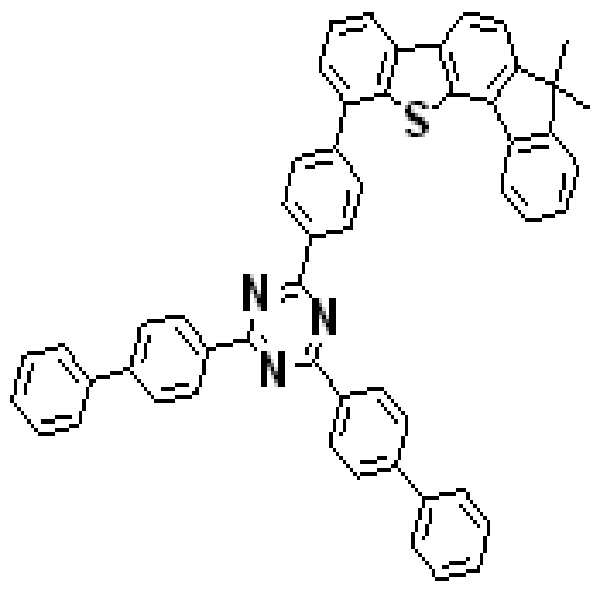
[화학식 A-10] [화학식 A-11] [화학식 A-12][A-10] [Chemical formula A-11] [Chemical formula A-12]

[화학식 A-13] [화학식 A-14] [화학식 A-15][Chemical formula A-13] [Chemical formula A-14] [Chemical formula A-15]

[화학식 A-16] [화학식 A-17] [화학식 A-18][Chemical Formula A-16] [Chemical Formula A-17] [Chemical Formula A-18]


[화학식 A-22] [화학식 A-23] [화학식 A-24][Chemical Formula A-22] [Chemical Formula A-23] [Chemical Formula A-24]

[화학식 A-25] [화학식 A-26] [화학식 A-27][Chemical Formula A-25] [Chemical Formula A-26] [Chemical Formula A-27]

[화학식 A-28] [화학식 A-29] [화학식 A-30][Chemical Formula A-28] [Chemical Formula A-29] [Chemical Formula A-30]

[화학식 A-31] [화학식 A-32] [화학식 A-33][Chemical Formula A-31] [Chemical Formula A-32] [Chemical Formula A-33]

[화학식 A-34] [화학식 A-35] [화학식 A-36][Chemical Formula A-34] [Chemical Formula A-35] [Chemical Formula A-36]

[화학식 A-37] [화학식 A-38] [화학식 A-39][Chemical Formula A-37] [Chemical Formula A-38] [Chemical Formula A-39]

[화학식 A-40] [화학식 A-41] [화학식 A-42][Chemical Formula A-40] [Chemical Formula A-41] [Chemical Formula A-42]

[화학식 A-43] [화학식 A-44] [화학식 A-45][Chemical Formula A-43] [Chemical Formula A-44] [Chemical Formula A-45]
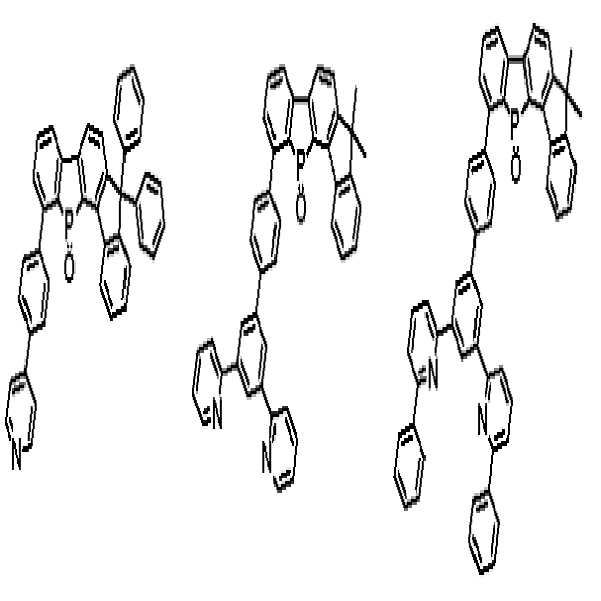
[화학식 A-46] [화학식 A-47] [화학식 A-48][Chemical Formula A-46] [Chemical Formula A-47] [Chemical Formula A-48]
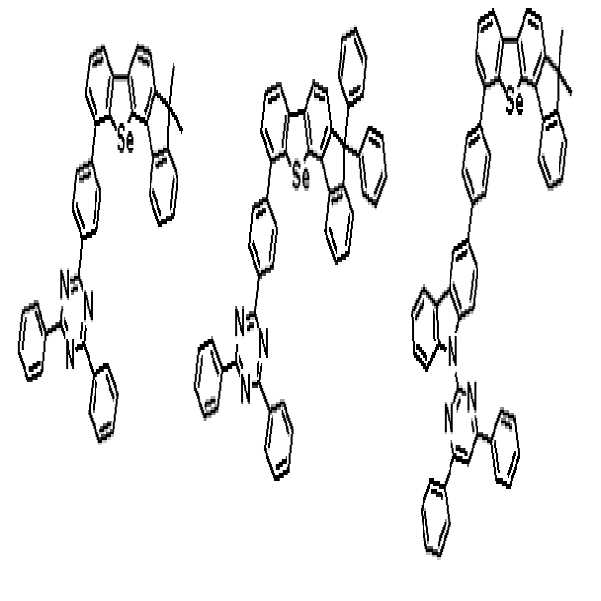
[화학식 A-49] [화학식 A-51] [화학식 A-52][Formula A-49] [Formula A-51] [Formula A-52]

[화학식 A-53] [화학식 A-54] [화학식 A-55][Formula A-53] [Chemical Formula A-54] [Chemical Formula A-55]
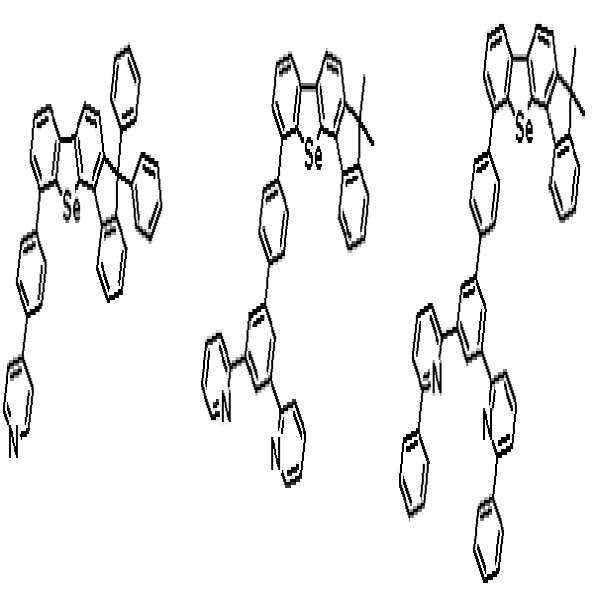
상기 유기광전소자용 화합물은 하기 화학식 B-1 내지 B-44 중 어느 하나로 표시될 수 있다. The compound for organic photoelectric conversion may be represented by any one of the following formulas (B-1) to (B-44).
[화학식 B-1] [화학식 B-2] [화학식 B-3][Formula B-1] [Formula B-2] [Formula B-3]
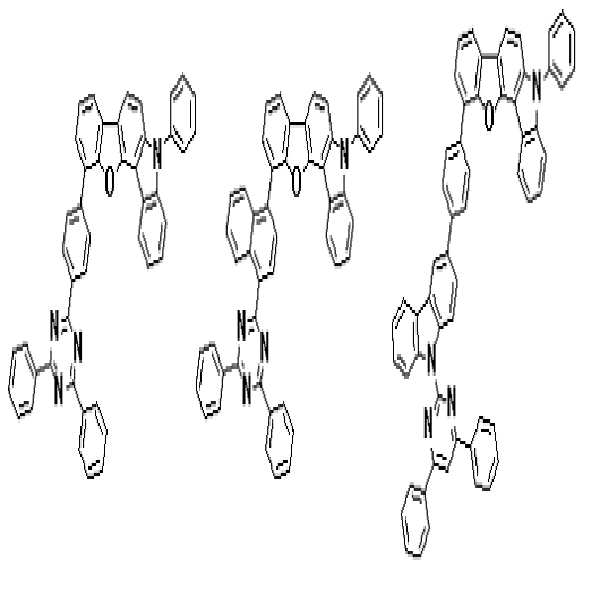
[화학식 B-4] [화학식 B-5] [화학식 B-6][Formula B-4] [Formula B-5] [Formula B-6]

[화학식 B-7] [화학식 B-8] [화학식 B-9][Formula B-7] [Formula B-8] [Formula B-9]
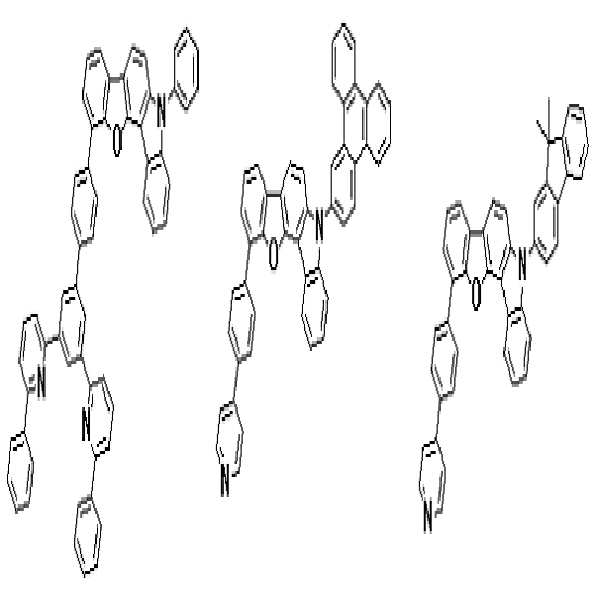
[화학식 B-10] [화학식 B-11] [Chemical formula B-10] [Chemical formula B-11]
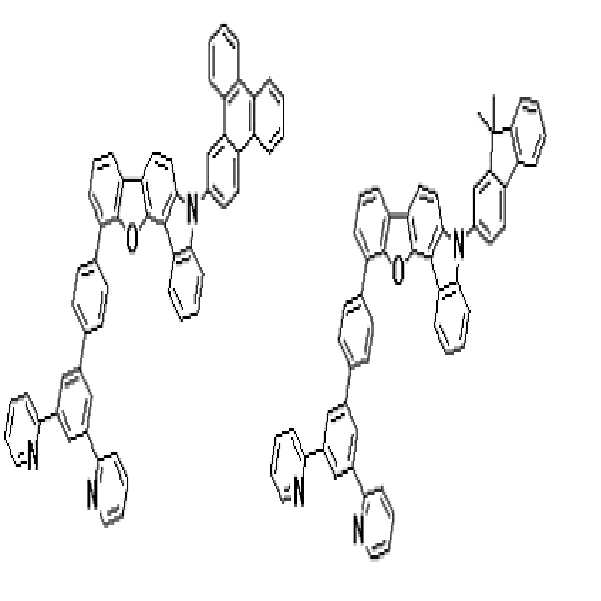
[화학식 B-12] [화학식 B-13] [화학식 B-14][Formula B-12] [Formula B-13] [Formula B-14]
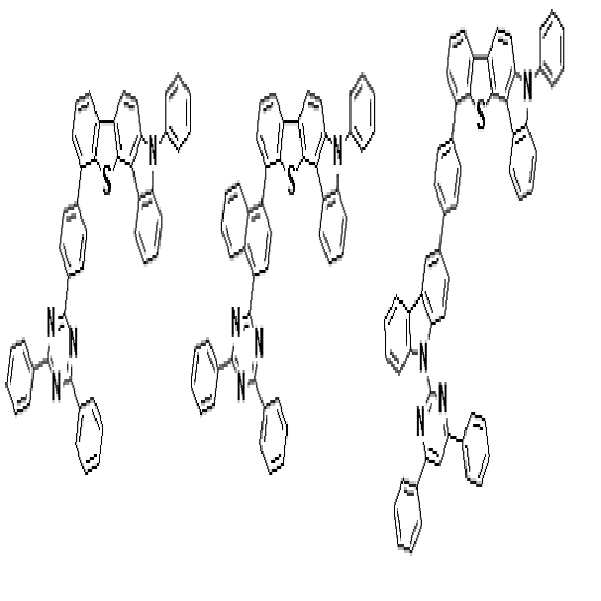
[화학식 B-15] [화학식 B-16] [화학식 B-17][Formula B-15] [Formula B-16] [Formula B-17]

[화학식 B-18] [화학식 B-19] [화학식 B-20][Formula B-18] [Formula B-19] [Formula B-20]

[화학식 B-21] [화학식 B-22][Formula B-21] [Formula B-22]

[화학식 B-23] [화학식 B-24] [화학식 B-25][Formula B-23] [Formula B-24] [Formula B-25]

[화학식 B-26] [화학식 B-27] [화학식 B-28][Formula B-26] [Formula B-27] [Formula B-28]

[화학식 B-29] [화학식 B-30] [화학식 B-31][Formula B-29] [Formula B-30] [Formula B-31]

[화학식 B-32] [화학식 B-33] [Formula B-32] [Formula B-33]

[화학식 B-34] [화학식 B-35] [화학식 B-36][Formula B-34] [Formula B-35] [Formula B-36]

[화학식 B-37] [화학식 B-38] [화학식 B-39][Formula B-37] [Formula B-38] [Formula B-39]

[화학식 B-40] [화학식 B-41] [화학식 B-42][Formula B-40] [Formula B-41] [Formula B-42]
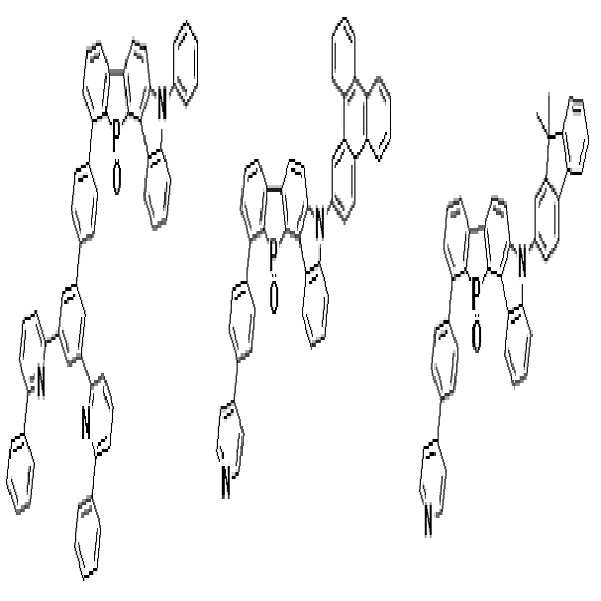
[화학식 B-43] [화학식 B-44][Chemical formula B-43] [Chemical formula B-44]

상기 유기광전소자용 화합물은 하기 화학식 C-1 내지 C-12 중 어느 하나로 표시될 수 있다. The compound for organic photoelectric conversion may be represented by any one of the following formulas C-1 to C-12.
[화학식 C-1] [화학식 C-2] [화학식 C-3][Formula C-1] [Formula C-2] [Formula C-3]


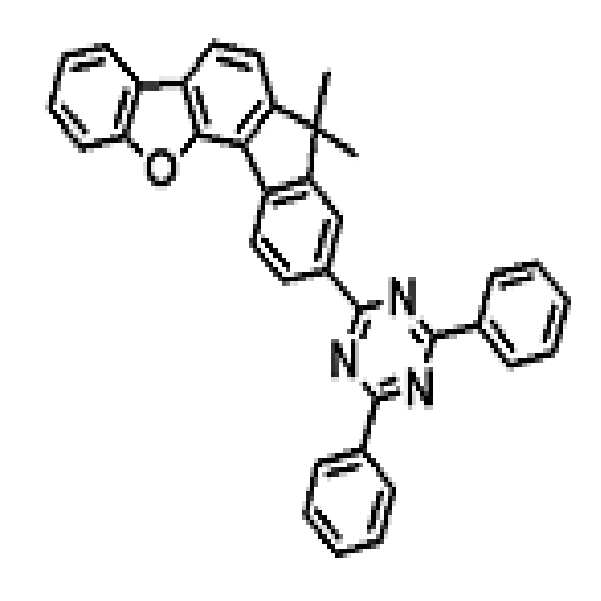
[화학식 C-4] [화학식 C-5] [화학식 C-6][Formula C-4] [Formula C-5] [Formula C-6]
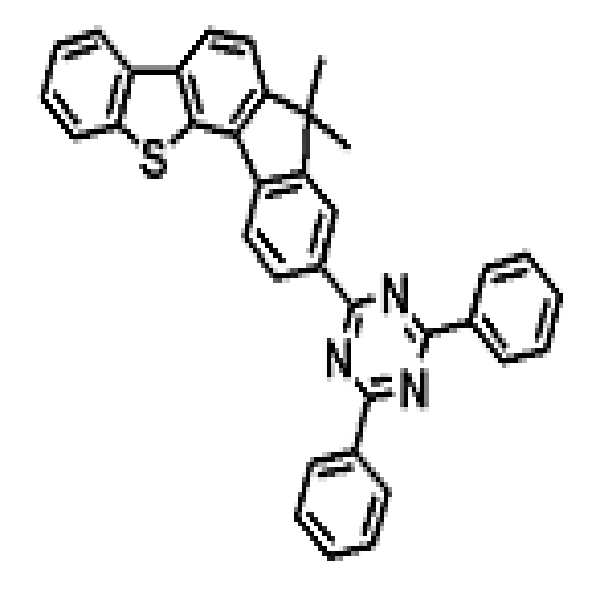
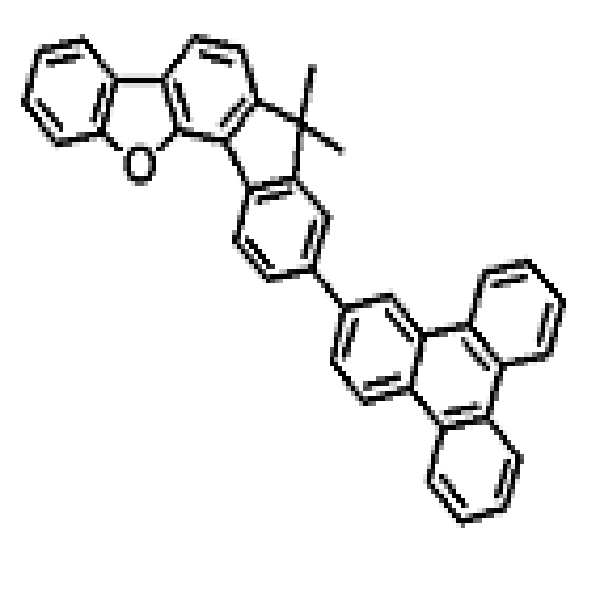

[화학식 C-7] [화학식 C-8] [화학식 C-9][Formula C-7] [Formula C-8] [Formula C-9]


[화학식 C-10] [화학식 C-11] [화학식 C-12][Formula C-10] [Formula C-11] [Formula C-12]
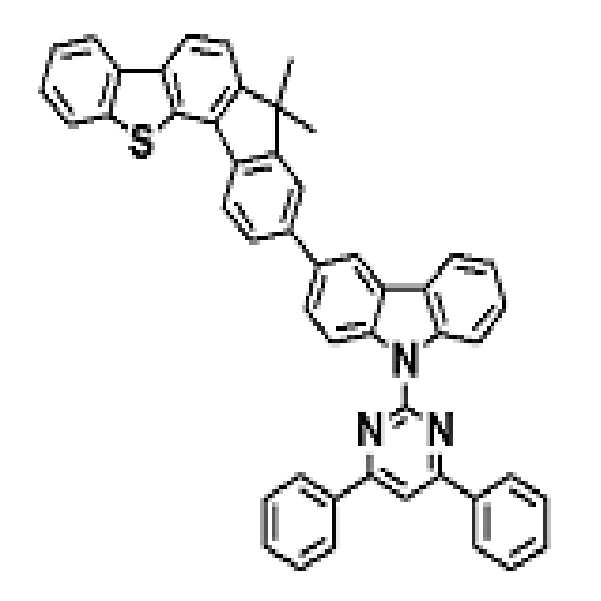
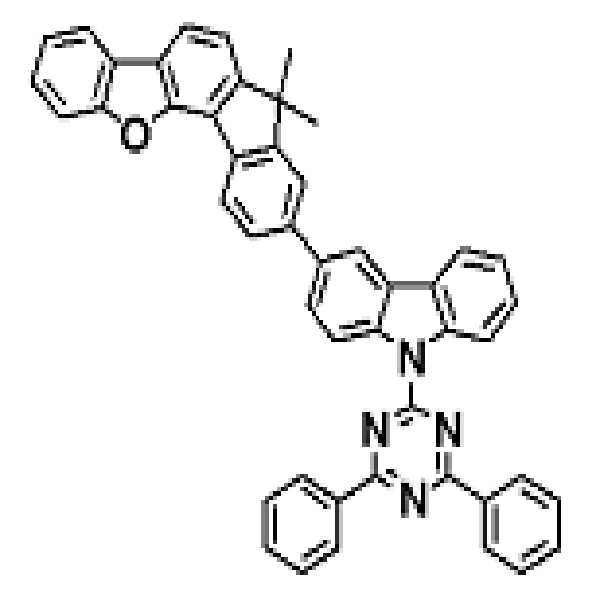
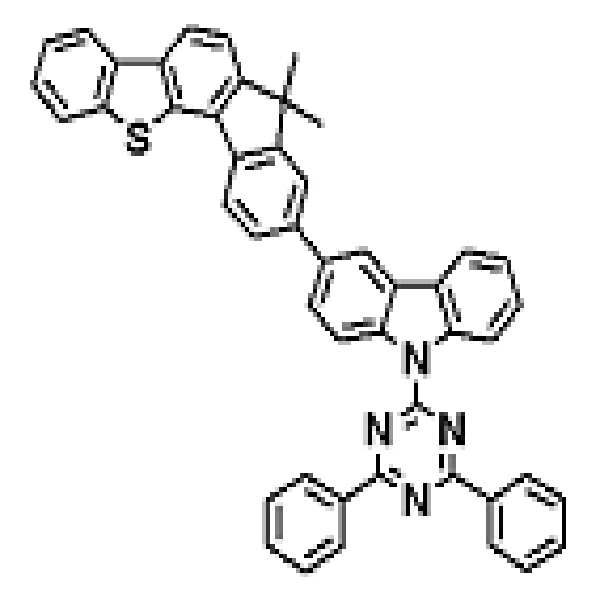
[화학식 C-13] [화학식 C-14] [화학식 C-15][Formula C-13] [Formula C-14] [Formula C-15]


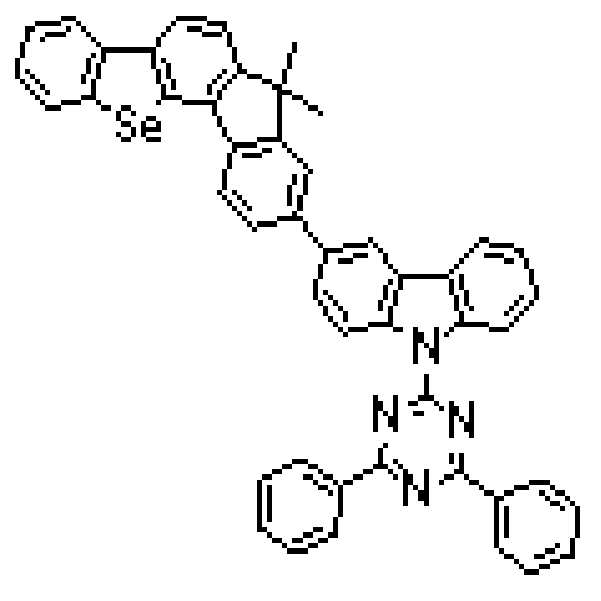
[화학식 C-16] [화학식 C-17] [화학식 C-18][Formula C-16] [Formula C-17] [Formula C-18]


[화학식 C-19] [화학식 C-20] [Chemical formula C-19] [Chemical formula C-20]
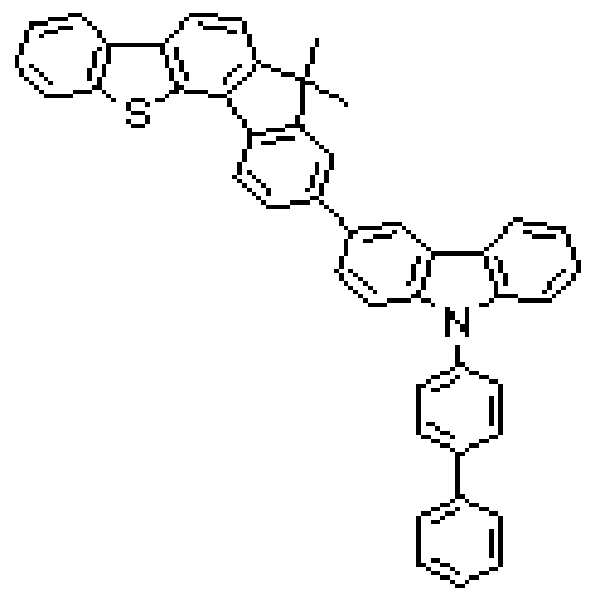

상기 유기광전소자용 화합물은 하기 화학식 D-1 내지 D-6 중 어느 하나로 표시될 수 있다. The organic optoelectronic device compound may be represented by any one of the following formulas (D-1) to (D-6).
[화학식 D-1] [화학식 D-2] [화학식 D-3][Formula D-1] [Formula D-2] [Formula D-3]


[화학식 D-4] [화학식 D-5] [화학식 D-6][Formula D-4] [Formula D-5] [Formula D-6]


[화학식 D-7] [화학식 D-8] [Formula D-7] [Formula D-8]


상기 유기광전소자용 화합물은 하기 화학식 E-1 내지 E-6 중 어느 하나로 표시되는 유기광전소자용 화합물.Wherein the compound for an organic photoelectric device is represented by any one of the following formulas (E-1) to (E-6).
[화학식 E-1] [화학식 E-2] [화학식 E-3][Formula E-1] [Formula E-2] [Formula E-3]

[화학식 E-4] [화학식 E-5] [화학식 E-6][Formula E-4] [Formula E-5] [Formula E-6]

[화학식 E-7] [화학식 E-8] [Formula E-7] [Formula E-8]

[화학식 E-9] [E-9]
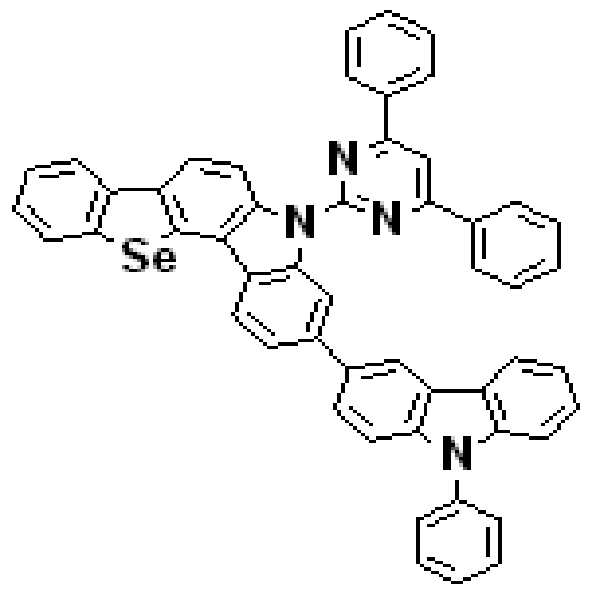
상기 유기광전소자용 화합물은 유기발광소자의 발광 재료로 이용될 수 있는 것일 수 있다. The compound for an organic photoelectric device may be one that can be used as a light emitting material of an organic light emitting device.
상기 유기광전소자용 화합물은 3중항 여기에너지(T1) 2.0eV 이상인 것일 수 있다. The compound for an organic photoelectric device may have a triplet excitation energy (T1) of 2.0 eV or more.
상기 유기광전소자는 유기발광소자, 유기태양전지, 유기트랜지스터, 유기 감광체 드럼 및 유기메모리소자로 이루어진 군에서 선택되는 것일 수 있다. The organic photoelectric device may be selected from the group consisting of an organic light emitting device, an organic solar cell, an organic transistor, an organic photoreceptor drum, and an organic memory device.
본 발명의 또 다른 측면에서는, 양극, 음극 및 상기 양극과 음극 사이에 개재되는 적어도 한 층 이상의 유기박막층을 포함하는 유기발광소자에 있어서, 상기 유기박막층 중 적어도 어느 한 층은 전술한 유기광전소자용 화합물을 포함하는 것인 유기발광소자를 제공한다.According to another aspect of the present invention, there is provided an organic light emitting device comprising a cathode, a cathode, and at least one organic thin film layer interposed between the anode and the cathode, wherein at least one of the organic thin film layers comprises And a compound represented by the following general formula (1).
상기 유기박막층은 발광층, 정공수송층, 정공주입층, 전자수송층, 전자주입층, 정공차단층 및 이들의 조합을 이루어진 군에서 선택되는 것일 수 있다. The organic thin film layer may be selected from the group consisting of a light emitting layer, a hole transporting layer, a hole injecting layer, an electron transporting layer, an electron injecting layer, a hole blocking layer, and combinations thereof.
상기 유기광전소자용 화합물은 정공수송층, 정공주입층, 전자수송층 또는 전자주입층 내에 포함되는 것일 수 있다. The compound for an organic photoelectric device may be contained in a hole transporting layer, a hole injecting layer, an electron transporting layer, or an electron injecting layer.
상기 유기광전소자용 화합물은 발광층 내에 포함되는 것일 수 있다. The compound for an organic photoelectric device may be included in the light emitting layer.
상기 유기광전소자용 화합물은 발광층 내에 인광 또는 형광 호스트 재료로서 사용되는 것일 수 있다. The compound for an organic photoelectric device may be one used as a phosphorescent or fluorescent host material in the light emitting layer.
상기 유기광전소자용 화합물은 발광층 내에 형광 청색 도펀트 재료로서 사용되는 것일 수 있다. The compound for an organic photoelectric device may be one used as a fluorescent blue dopant material in the light emitting layer.
본 발명의 다른 측면에서는 전술한 유기발광소자를 포함하는 것인 표시장치를 제공한다.
According to another aspect of the present invention, there is provided a display device including the organic light emitting element described above.
높은 정공 또는 전자 수송성, 막 안정성 열적 안정성 및 높은 3중항 여기에너지를 가지는 화합물을 제공할 수 있다.A compound having high hole or electron transporting property, film stability, thermal stability and high triplet excitation energy can be provided.
이러한 화합물은 발광층의 정공 주입/수송 재료, 호스트 재료, 또는 전자 주입/수송 재료로 이용될 수 있다. 이를 이용한 유기광전소자는 우수한 전기화학적 및 열적 안정성을 가지게 되어 수명 특성이 우수하고, 낮은 구동전압에서도 높은 발광효율을 가질 수 있다.
Such a compound can be used as a hole injecting / transporting material, a host material, or an electron injecting / transporting material of a light emitting layer. The organic photoelectric device using the organic electroluminescent device has excellent electrochemical and thermal stability, and has excellent lifetime characteristics, and can have a high luminous efficiency even at a low driving voltage.
도 1 내지 도 5는 본 발명의 일 구현예에 따른 유기광전소자용 화합물을 이용하여 제조될 수 있는 유기광전소자에 대한 다양한 구현예들을 나타내는 단면도이다.1 to 5 are cross-sectional views illustrating various embodiments of an organic photoelectric device that can be manufactured using the compound for organic photoelectric conversion devices according to an embodiment of the present invention.
이하, 본 발명의 구현예를 상세히 설명하기로 한다. 다만, 이는 예시로서 제시되는 것으로, 이에 의해 본 발명이 제한되지는 않으며 본 발명은 후술할 청구범위의 범주에 의해 정의될 뿐이다.Hereinafter, embodiments of the present invention will be described in detail. However, it should be understood that the present invention is not limited thereto, and the present invention is only defined by the scope of the following claims.
본 명세서에서 "치환"이란 별도의 정의가 없는 한, 치환기 또는 화합물 중의 적어도 하나의 수소가 중수소, 할로겐기, 히드록시기, 아미노기, 치환 또는 비치환된 C1 내지 C20 아민기, 니트로기, 치환 또는 비치환된 C3 내지 C40 실릴기, C1 내지 C30 알킬기, C1 내지 C10 알킬실릴기, C3 내지 C30 시클로알킬기, C6 내지 C30 아릴기, C1 내지 C20 알콕시기, 플루오로기, 트리플루오로메틸기 등의 C1 내지 C10 트리플루오로알킬기, 또는 시아노기로 치환된 것을 의미한다.As used herein, unless otherwise defined, at least one of the substituents or at least one hydrogen in the compound is substituted with one or more substituents selected from the group consisting of deuterium, a halogen group, a hydroxy group, an amino group, a substituted or unsubstituted C1 to C20 amine group, a nitro group, C1 to C10 alkyl groups such as a C3 to C40 silyl group, a C1 to C30 alkyl group, a C1 to C10 alkylsilyl group, a C3 to C30 cycloalkyl group, a C6 to C30 aryl group, a C1 to C20 alkoxy group, a fluoro group, A trifluoroalkyl group, or a cyano group.
본 명세서에서 "헤테로"란 별도의 정의가 없는 한, 하나의 작용기 내에 N, O, S 및 P로 이루어진 군에서 선택되는 헤테로 원자를 1 내지 3개 함유하고, 나머지는 탄소인 것을 의미한다.Means one to three heteroatoms selected from the group consisting of N, O, S and P in one functional group, and the remainder is carbon, unless otherwise defined.
본 명세서에서 "이들의 조합"이란 별도의 정의가 없는 한, 둘 이상의 치환기가 연결기로 결합되어 있거나, 둘 이상의 치환기가 축합하여 결합되어 있는 것을 의미한다. In the present specification, the term "combination thereof" means that two or more substituents are bonded to each other via a linking group or two or more substituents are condensed and bonded.
본 명세서에서 "알킬(alkyl)기"이란 별도의 정의가 없는 한, 지방족 탄화수소기를 의미한다. 알킬기는 어떠한 알켄기나 알킨기를 포함하고 있지 않음을 의미하는 "포화 알킬(saturated alkyl)기"일 수 있다. 알킬기는 적어도 하나의 알켄기 또는 알킨기를 포함하고 있음을 의미하는 "불포화 알킬(unsaturated alkyl)기"일 수도 있다. "알켄(alkene)기"는 적어도 두 개의 탄소원자가 적어도 하나의 탄소-탄소 이중 결합으로 이루어진 작용기를 의미하며, "알킨(alkyne)기" 는 적어도 두 개의 탄소원자가 적어도 하나의 탄소-탄소 삼중 결합으로 이루어진 작용기를 의미한다. 포화이든 불포화이든 간에 알킬기는 분지형, 직쇄형 또는 환형일 수 있다. As used herein, the term "alkyl group" means an aliphatic hydrocarbon group, unless otherwise defined. The alkyl group may be a "saturated alkyl group" meaning that it does not contain any alkene or alkyne groups. An alkyl group may be an "unsaturated alkyl group" meaning that it contains at least one alkenyl group or alkynyl group. "Alkenene group" means a functional group in which at least two carbon atoms are composed of at least one carbon-carbon double bond, and "alkyne group" means that at least two carbon atoms have at least one carbon- ≪ / RTI > The alkyl group, whether saturated or unsaturated, can be branched, straight chain or cyclic.
알킬기는 C1 내지 C20인 알킬기일 수 있다. 알킬기는 C1 내지 C10인 중간 크기의 알킬기일 수도 있다. 알킬기는 C1 내지 C6인 저급 알킬기일 수도 있다.The alkyl group may be an alkyl group of C1 to C20. The alkyl group may be a C1 to C10 medium-sized alkyl group. The alkyl group may be a C1 to C6 lower alkyl group.
예를 들어, C1 내지 C4 알킬기는 알킬쇄에 1 내지 4 개의 탄소원자, 즉, 알킬쇄는 메틸, 에틸, 프로필, 이소-프로필, n-부틸, 이소-부틸, sec-부틸 및 t-부틸로 이루어진 군에서 선택됨을 나타낸다.For example, the C1 to C4 alkyl groups may have 1 to 4 carbon atoms in the alkyl chain, i.e., the alkyl chain may be optionally substituted with one or more substituents selected from the group consisting of methyl, ethyl, propyl, iso-propyl, n-butyl, Indicating that they are selected from the group.
전형적인 알킬기에는 메틸기, 에틸기, 프로필기, 이소프로필기, 부틸기, 이소부틸기, t-부틸기, 펜틸기, 헥실기, 에테닐기, 프로페닐기, 부테닐기, 시클로프로필기, 시클로부틸기, 시클로펜틸기, 시클로헥실기 등으로부터 개별적으로 그리고 독립적으로 선택된 하나 또는 그 이상의 그룹들로 치환될 수도 있는 작용기임을 의미한다.Typical examples of the alkyl group include a methyl group, an ethyl group, a propyl group, an isopropyl group, a butyl group, an isobutyl group, a t-butyl group, a pentyl group, a hexyl group, an ethenyl group, a propenyl group, a butenyl group, a cyclopropyl group, A pentyl group, a cyclohexyl group, and the like, which may be optionally substituted with one or more groups individually and independently selected.
"방향족기"는 고리 형태인 작용기의 모든 원소가 p-오비탈을 가지고 있으며, 이들 p-오비탈이 공액(conjugation)을 형성하고 있는 작용기를 의미한다. 구체적인 예로 아릴기와 헤테로아릴기가 있다. "Aromatic group" means a functional group in which all elements of the ring-form functional group have p-orbital, and these p-orbital forms a conjugation. Specific examples thereof include an aryl group and a heteroaryl group.
"아릴(aryl)기"는 모노시클릭 또는 융합 고리 폴리시클릭(즉, 탄소원자들의 인접한 쌍들을 나눠 가지는 고리) 작용기를 포함한다. An "aryl group" includes a monocyclic or fused ring polycyclic (i. E., A ring that divides adjacent pairs of carbon atoms) functional groups.
"헤테로아릴(heteroaryl)기"는 아릴기 내에 N, O, S 및 P로 이루어진 군에서 선택되는 헤테로 원자를 1 내지 3개 함유하고, 나머지는 탄소인 것을 의미한다. 상기 헤테로아릴기가 융합고리인 경우, 각각의 고리마다 상기 헤테로 원자를 1 내지 3개 포함할 수 있다. "Heteroaryl group" means that the aryl group contains 1 to 3 heteroatoms selected from the group consisting of N, O, S and P, and the remainder is carbon. When the heteroaryl group is a fused ring, it may contain 1 to 3 heteroatoms in each ring.
본 명세서에서 카바졸계 유도체라함은 치환 또는 비치환된 카바졸릴기의 질소원자가 질소가 아닌 헤테로 원자로 치환된 구조를 의미한다. 구체적인 예를 들어, 디벤조퓨란(디벤조퓨라닐기), 디벤조티오펜(디벤조티오페닐기) 등 이다. In the present specification, a carbazole-based derivative means a structure in which a nitrogen atom of a substituted or unsubstituted carbazolyl group is replaced by a hetero atom other than nitrogen. Specific examples thereof include dibenzofuran (dibenzofuranyl), dibenzothiophene (dibenzothiophenyl), and the like.
본 명세서에서, 정공 특성이란, HOMO 준위를 따라 전도 특성을 가져 양극에서 형성된 정공의 발광층으로의 주입 및 발광층에서의 이동을 용이하게 하는 특성을 의미한다. In the present specification, the hole property means a property of facilitating the injection into the light emitting layer and the movement in the light emitting layer of the hole formed in the anode due to conduction characteristics along the HOMO level.
또한 전자 특성이란, LUMO 준위를 따라 전도 특성을 가져 음극에서 형성된 전자의 발광층으로의 주입 및 발광층에서의 이동을 용이하게 하는 특성을 의미한다.Further, the electron characteristic means a property of facilitating the injection of electrons formed in the anode into the luminescent layer and the movement in the luminescent layer due to conduction characteristics along the LUMO level.
본 발명의 일 구현예에 따른 유기광전소자용 화합물은 적어도 하나의 헤테로 원자를 포함하는 융합 고리에 전자 특성을 가지는 치환기가 결합된 코어 구조를 가질 수 있다. The compound for an organic photoelectric device according to an embodiment of the present invention may have a core structure in which a substituent having an electron characteristic is bonded to a fused ring containing at least one hetero atom.
상기 코어 구조는 정공 특성이 뛰어난 헤테로 융합고리에 전자 특성이 뛰어난 치환기를 포함하기 때문에 유기발광소자의 발광 재료, 정공주입재료 또는 정공수송재료로 이용될 수 있다. 특히 발광 재료에 적합할 수 있다. Since the core structure includes a substituent having excellent electron characteristics in a hetero-fused ring having excellent hole characteristics, the core structure can be used as a light emitting material, a hole injecting material, or a hole transporting material of an organic light emitting device. And may be particularly suitable for a light emitting material.
또한, 상기 융합 고리로 인해 분자 내 대칭성이 감소되어 화합물의 결정화도가 낮아질 수 있고 따라서 소자 내에서 재결정화가 억제되는 장점이 있다. In addition, there is an advantage that the intramolecular symmetry is reduced due to the fused ring, whereby the degree of crystallization of the compound can be lowered and thus recrystallization in the device is suppressed.
상기 코어에 결합된 치환기 중 적어도 하나는 전자 특성을 가지는 치환기일 수 있다. 따라서, 상기 화합물은 정공 특성이 우수한 카바졸 구조에 전자 특성을 보강하여 발광층에서 요구되는 조건을 만족시킬 수 있다. 보다 구체적으로 발광층의 호스트 재료로 이용이 가능하다.At least one of the substituents bonded to the core may be a substituent having electronic properties. Therefore, the compound can enhance the electronic characteristics of the carbazole structure having excellent hole characteristics, thereby satisfying the requirements of the light emitting layer. More specifically, it can be used as a host material for a light emitting layer.
또한, 상기 유기광전소자용 화합물은 코어 부분과 코어 부분에 치환된 치환기에 다양한 또 다른 치환기를 도입함으로써 다양한 에너지 밴드 갭을 갖는 화합물이 될 수 있다. In addition, the compound for organic optoelectronic devices can be a compound having various energy bandgaps by introducing various substituents to the substituents substituted in the core and core.
상기 화합물의 치환기에 따라 적절한 에너지 준위를 가지는 화합물을 유기광전소자에 사용함으로써, 정공전달 능력 또는 전자전달 능력이 강화되어 효율 및 구동전압 면에서 우수한 효과를 가지고, 전기화학적 및 열적 안정성이 뛰어나 유기광전소자 구동시 수명 특성을 향상시킬 수 있다.By using a compound having an appropriate energy level according to the substituent of the compound in an organic photoelectric device, the hole transporting ability or the electron transporting ability is enhanced to have an excellent effect in terms of efficiency and drive voltage, excellent electrochemical and thermal stability, The lifetime characteristics can be improved when the device is driven.
이러한 본 발명의 일 구현예에 따르면, 상기 유기광전소자용 화합물은 하기 화학식 1; 및 화학식 2 또는 3;의 조합으로 표시되는 유기광전소자용 화합물일 수 있다. According to an embodiment of the present invention, the compound for organic photoelectric conversion is represented by the following general formula (1): And a compound represented by the general formula (2) or (3).
[화학식 1] [화학식 2] [화학식 3][Formula 3] < EMI ID =


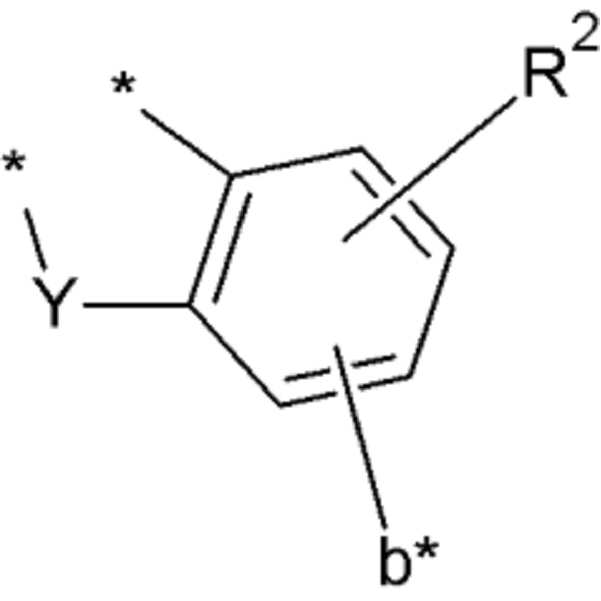
상기 화학식 1 내지 3에서, 상기 X는 O, Se, S, SO2(O=S=O), PO(P=O) 또는 CO(C=O)이고, 상기 Y는 CR'R" 또는 NR*이고, 상기 a*, b*, R', R", R1, R2 및 R*는 서로 동일하거나 상이하며, 독립적으로 수소, 중수소, 할로겐기, 시아노기, 히드록실기, 아미노기, 치환 또는 비치환된 C1 내지 C20 아민기, 니트로기, 치환 또는 비치환된 C2 내지 C10 카르복실기, 치환 또는 비치환된 페로세닐기, 치환 또는 비치환된 C1 내지 C20 알킬기, 치환 또는 비치환된 C6 내지 C30 아릴기, 치환 또는 비치환된 C2 내지 C30 헤테로아릴기, 치환 또는 비치환된 C1 내지 C20 알콕시기, 치환 또는 비치환된 C6 내지 C20 아릴옥시기, 치환 또는 비치환된 C3 내지 C40 실릴옥시기, 치환 또는 비치환된 C1 내지 C20 아실기, 치환 또는 비치환된 C2 내지 C20 알콕시카르보닐기, 치환 또는 비치환된 C2 내지 C20 아실옥시기, 치환 또는 비치환된 C2 내지 C20의 아실아미노기, 치환 또는 비치환된 C2 내지 C20의 알콕시카르보닐아미노기, 치환 또는 비치환된 C7 내지 C20 아릴옥시카르보닐아미노기, 치환 또는 비치환된 C1 내지 C20 술파모일아미노기, 치환 또는 비치환된 C1 내지 C20 술포닐기, 치환 또는 비치환된 C1 내지 C20의 알킬티올기, 치환 또는 비치환된 C6 내지 C20 아릴티올기, 치환 또는 비치환된 C1 내지 C20 헤테로시클로티올기, 치환 또는 비치환된 C1 내지 C20의 우레이드기, 치환 또는 비치환된 C3 내지 C40 실릴기 또는 이들의 조합이고, 상기 화학식 1의 인접한 두 개의 *는, 상기 화학식 2 또는 3의 인접한 두 개의 *와 결합하여 융합고리를 형성하고, 상기 a*, b* 또는 R* 중 적어도 어느 하나는 하기 화학식 4로 표시되는 치환기이고,Wherein X is O, Se, S, SO2 (O = S = O), PO (P = O) or CO (C = O), Y is CR'R " and the a *, b *, R ' , R ", R 1, R 2 , and R * are the same or different, independently represent hydrogen, deuterium, a halogen group, a cyano group, a hydroxyl group, an amino group, a substituted or A substituted or unsubstituted C1 to C20 amine group, a nitro group, a substituted or unsubstituted C2 to C10 carboxyl group, a substituted or unsubstituted ferrocenyl group, a substituted or unsubstituted C1 to C20 alkyl group, a substituted or unsubstituted C6 to C30 aryl A substituted or unsubstituted C2 to C30 heteroaryl group, a substituted or unsubstituted C1 to C20 alkoxy group, a substituted or unsubstituted C6 to C20 aryloxy group, a substituted or unsubstituted C3 to C40 silyloxy group, a substituted Or a substituted or unsubstituted C1 to C20 acyl group, a substituted or unsubstituted C2 to C20 alkoxycarbonyl group, a substituted or unsubstituted C2 to C20 acyloxy group, a substituted Or a substituted or unsubstituted C2 to C20 acylamino group, a substituted or unsubstituted C2 to C20 alkoxycarbonylamino group, a substituted or unsubstituted C7 to C20 aryloxycarbonylamino group, a substituted or unsubstituted C1 to C20 sulfamoylamino group , A substituted or unsubstituted C1 to C20 sulfonyl group, a substituted or unsubstituted C1 to C20 alkylthiol group, a substituted or unsubstituted C6 to C20 arylthiol group, a substituted or unsubstituted C1 to C20 heterocyclothiol group, Substituted or unsubstituted C 1 to C 20 ureide groups, substituted or unsubstituted C 3 to C 40 silyl groups, or combinations thereof. The adjacent two * in the formula (1) At least one of a *, b * and R * is a substituent represented by the following general formula (4)
[화학식 4][Chemical Formula 4]
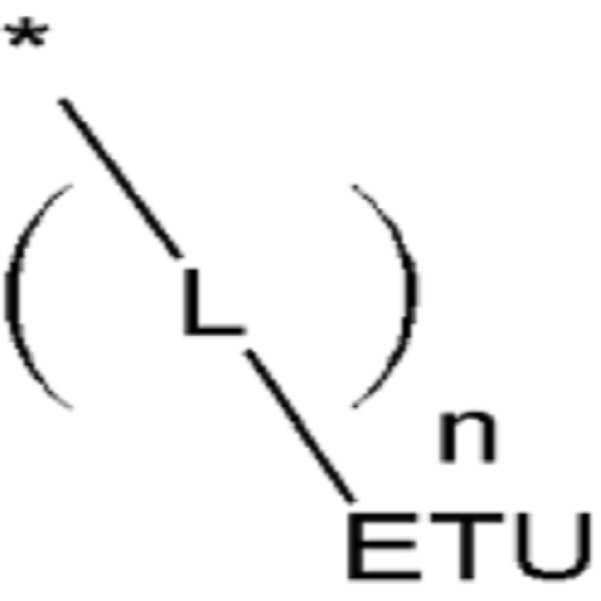
상기 화학식 4에서, 상기 ETU는 전자 특성을 가지는, 치환 또는 비치환된 C6 내지 C30 아릴기; 또는 전자 특성을 가지는, 치환 또는 비치환된 C2 내지 C30 헤테로아릴기이고, 상기 L은 단일결합, 치환 또는 비치환된 C2 내지 C6 알케닐렌기, 치환 또는 비치환된 C2 내지 C6 알키닐렌기, 치환 또는 비치환된 C6 내지 C30 아릴렌기, 치환 또는 비치환된 헤테로아릴렌기 또는 이들의 조합이고, 상기 n은 0 내지 2 중 어느 하나의 정수이다.In Formula 4, the ETU is a substituted or unsubstituted C6 to C30 aryl group having electron characteristics; Or a substituted or unsubstituted C2 to C30 heteroaryl group having an electron characteristic, and L is a single bond, a substituted or unsubstituted C2 to C6 alkenylene group, a substituted or unsubstituted C2 to C6 alkynylene group, a substituted Or an unsubstituted C6 to C30 arylene group, a substituted or unsubstituted heteroarylene group, or a combination thereof, and n is an integer of 0 to 2.
상기 화학식들의 적절한 조합에 의해 발광, 정공 또는 전자 특성, 막 안정성, 열적 안정성 및 높은 3중항 여기에너지(T1)을 가지는 유기광전소자용 화합물을 제조할 수 있다.By appropriate combination of the above formulas, compounds for organic photoelectric devices having luminescence, hole or electron properties, film stability, thermal stability and high triplet excitation energy (T1) can be produced.
상기 유기광전소자용 화합물은 하기 화학식 5로 표시되는 화합물일 수 있다. The compound for organic photoelectric conversion may be a compound represented by the following formula (5).
[화학식 5][Chemical Formula 5]

상기 화학식 5에서, 상기 X는 O, Se, S, SO2(O=S=O), PO(P=O) 또는 CO(C=O)이고, 상기 Y는 CR'R" 또는 NR*이고, 상기 a*, b*, R', R", R1, R2 및 R*는 서로 동일하거나 상이하며, 독립적으로 수소, 중수소, 할로겐기, 시아노기, 히드록실기, 아미노기, 치환 또는 비치환된 C1 내지 C20 아민기, 니트로기, 치환 또는 비치환된 C2 내지 C10 카르복실기, 치환 또는 비치환된 페로세닐기, 치환 또는 비치환된 C1 내지 C20 알킬기, 치환 또는 비치환된 C6 내지 C30 아릴기, 치환 또는 비치환된 C2 내지 C30 헤테로아릴기, 치환 또는 비치환된 C1 내지 C20 알콕시기, 치환 또는 비치환된 C6 내지 C20 아릴옥시기, 치환 또는 비치환된 C3 내지 C40 실릴옥시기, 치환 또는 비치환된 C1 내지 C20 아실기, 치환 또는 비치환된 C2 내지 C20 알콕시카르보닐기, 치환 또는 비치환된 C2 내지 C20 아실옥시기, 치환 또는 비치환된 C2 내지 C20의 아실아미노기, 치환 또는 비치환된 C2 내지 C20의 알콕시카르보닐아미노기, 치환 또는 비치환된 C7 내지 C20 아릴옥시카르보닐아미노기, 치환 또는 비치환된 C1 내지 C20 술파모일아미노기, 치환 또는 비치환된 C1 내지 C20 술포닐기, 치환 또는 비치환된 C1 내지 C20의 알킬티올기, 치환 또는 비치환된 C6 내지 C20 아릴티올기, 치환 또는 비치환된 C1 내지 C20 헤테로시클로티올기, 치환 또는 비치환된 C1 내지 C20의 우레이드기, 치환 또는 비치환된 C3 내지 C40 실릴기 또는 이들의 조합이고, 상기 a*, b* 또는 R* 중 적어도 어느 하나는 하기 화학식 4로 표시되는 치환기이고,Wherein X is O, Se, S, SO 2 (O═S═O), PO (P═O) or CO (C═O), Y is CR'R " Wherein the a *, b *, R ', R ", R 1 , R 2 and R * are the same or different and independently represent hydrogen, deuterium, a halogen group, a cyano group, a hydroxyl group, A substituted or unsubstituted C1 to C20 amine group, a nitro group, a substituted or unsubstituted C2 to C10 carboxyl group, a substituted or unsubstituted ferrocenyl group, a substituted or unsubstituted C1 to C20 alkyl group, a substituted or unsubstituted C6 to C30 aryl group, A substituted or unsubstituted C2 to C30 heteroaryl group, a substituted or unsubstituted C1 to C20 alkoxy group, a substituted or unsubstituted C6 to C20 aryloxy group, a substituted or unsubstituted C3 to C40 silyloxy group, A substituted or unsubstituted C2 to C20 alkoxycarbonyl group, a substituted or unsubstituted C2 to C20 acyloxy group, a substituted or unsubstituted C1 to C20 acyl group, A substituted or unsubstituted C2 to C20 acylamino group, a substituted or unsubstituted C2 to C20 alkoxycarbonylamino group, a substituted or unsubstituted C7 to C20 aryloxycarbonylamino group, a substituted or unsubstituted C1 to C20 sulfamoylamino group, a substituted A substituted or unsubstituted C1 to C20 alkylthiol group, a substituted or unsubstituted C6 to C20 arylthiol group, a substituted or unsubstituted C1 to C20 heterocyclothiol group, a substituted or unsubstituted C1 to C20 alkylsulfinyl group, A substituted or unsubstituted C3 to C40 silyl group, or a combination thereof, and at least one of a *, b *, and R * is a substituent represented by the following formula (4)
[화학식 4][Chemical Formula 4]

상기 화학식 4에서, 상기 ETU는 전자 특성을 가지는, 치환 또는 비치환된 C6 내지 C30 아릴기; 또는 전자 특성을 가지는, 치환 또는 비치환된 C2 내지 C30 헤테로아릴기이고, 상기 L은 단일결합, 치환 또는 비치환된 C2 내지 C6 알케닐렌기, 치환 또는 비치환된 C2 내지 C6 알키닐렌기, 치환 또는 비치환된 C6 내지 C30 아릴렌기, 치환 또는 비치환된 헤테로아릴렌기 또는 이들의 조합이고, 상기 n은 0 내지 2 중 어느 하나의 정수이다.In Formula 4, the ETU is a substituted or unsubstituted C6 to C30 aryl group having electron characteristics; Or a substituted or unsubstituted C2 to C30 heteroaryl group having an electron characteristic, and L is a single bond, a substituted or unsubstituted C2 to C6 alkenylene group, a substituted or unsubstituted C2 to C6 alkynylene group, a substituted Or an unsubstituted C6 to C30 arylene group, a substituted or unsubstituted heteroarylene group, or a combination thereof, and n is an integer of 0 to 2.
상기 치환기의 적절한 조합에 의해 열적 안정성 또는 산화에 대한 저항성이 우수한 구조의 화합물을 제조할 수 있다.By the appropriate combination of the above substituents, it is possible to produce a compound having a structure which is excellent in thermal stability or resistance to oxidation.
상기와 같이 R1 및 R2의 치환기 중 어느 하나가 수소가 아닌 전술한 치환기 중 어느 하나인 경우 치환기가 없는 화합물의 기본적인 특성을 유지하면서 유기광전소자용 재료로서 성능을 최적화하기 위한 전기광학적 특성, 박막 특성을 미세하게 조절할 수 있는 장점이 있다.As described above, R < 1 & When any one of the substituents of R < 2 > is any one of the above-described substituents without hydrogen, the electro-optical characteristics and thin film characteristics for optimizing the performance as a material for an organic photoelectric device can be finely adjusted There are advantages to be able to.
또한, 상기 화학식 5와 같은 구조의 경우 화합물의 합성 측면에서 유리할 수 있으며, 주쇄에 메타로 연결 되어 있기 때문에 삼중항 에너지가 높은 장점이 있다. In addition, the structure of Formula 5 may be advantageous in terms of synthesis of the compound, and the triple energy is advantageous because it is connected to the main chain by a meta.
보다 구체적으로 상기 유기광전소자용 화합물은 하기 화학식 6, 7 또는 8 중 어느 하나로 표시되는 화합물일 수 있다. More specifically, the compound for organic photoelectric conversion may be a compound represented by any one of the following formulas (6), (7), and (8)
[화학식 6][Chemical Formula 6]

[화학식 7](7)

[화학식 8][Chemical Formula 8]

상기 화학식 6, 7 및 8에서, 상기 X는 O, Se, S, SO2(O=S=O), PO(P=O) 또는 CO(C=O)e이고, 상기 Y는 CR'R" 또는 NR*이고, 상기 R', R", R1, R2 및 R*는 서로 동일하거나 상이하며, 독립적으로 수소, 중수소, 할로겐기, 시아노기, 히드록실기, 아미노기, 치환 또는 비치환된 C1 내지 C20 아민기, 니트로기, 치환 또는 비치환된 C2 내지 C10 카르복실기, 치환 또는 비치환된 페로세닐기, 치환 또는 비치환된 C1 내지 C20 알킬기, 치환 또는 비치환된 C6 내지 C30 아릴기, 치환 또는 비치환된 C2 내지 C30 헤테로아릴기, 치환 또는 비치환된 C1 내지 C20 알콕시기, 치환 또는 비치환된 C6 내지 C20 아릴옥시기, 치환 또는 비치환된 C3 내지 C40 실릴옥시기, 치환 또는 비치환된 C1 내지 C20 아실기, 치환 또는 비치환된 C2 내지 C20 알콕시카르보닐기, 치환 또는 비치환된 C2 내지 C20 아실옥시기, 치환 또는 비치환된 C2 내지 C20의 아실아미노기, 치환 또는 비치환된 C2 내지 C20의 알콕시카르보닐아미노기, 치환 또는 비치환된 C7 내지 C20 아릴옥시카르보닐아미노기, 치환 또는 비치환된 C1 내지 C20 술파모일아미노기, 치환 또는 비치환된 C1 내지 C20 술포닐기, 치환 또는 비치환된 C1 내지 C20의 알킬티올기, 치환 또는 비치환된 C6 내지 C20 아릴티올기, 치환 또는 비치환된 C1 내지 C20 헤테로시클로티올기, 치환 또는 비치환된 C1 내지 C20의 우레이드기, 치환 또는 비치환된 C3 내지 C40 실릴기 또는 이들의 조합이고, 상기 ETU는 전자 특성을 가지는, 치환 또는 비치환된 C6 내지 C30 아릴기; 또는 전자 특성을 가지는, 치환 또는 비치환된 C2 내지 C30 헤테로아릴기이고, 상기 L은 단일결합, 치환 또는 비치환된 C2 내지 C6 알케닐렌기, 치환 또는 비치환된 C2 내지 C6 알키닐렌기, 치환 또는 비치환된 C6 내지 C30 아릴렌기, 치환 또는 비치환된 헤테로아릴렌기 또는 이들의 조합이고, 상기 n은 0 내지 2 중 어느 하나의 정수이다.X is O, Se, S, SO2 (O = S = O), PO (P = O) or CO (C = O) e, Y is CR'R " or NR *, wherein R ', and R ", R 1, R 2, and R * are the same or different, a is independently hydrogen, deuterium, a halogen group, a cyano group, a hydroxyl group, an amino group, a substituted or unsubstituted Substituted or unsubstituted C6 to C30 aryl groups, substituted or unsubstituted C6 to C30 aryl groups, substituted or unsubstituted C6 to C30 aryl groups, substituted or unsubstituted C6 to C30 aryl groups, substituted or unsubstituted C6 to C30 aryl groups, substituted or unsubstituted C1 to C20 amino groups, nitro groups, Or a substituted or unsubstituted C2 to C30 heteroaryl group, a substituted or unsubstituted C1 to C20 alkoxy group, a substituted or unsubstituted C6 to C20 aryloxy group, a substituted or unsubstituted C3 to C40 silyloxy group, A substituted or unsubstituted C2 to C20 alkoxycarbonyl group, a substituted or unsubstituted C2 to C20 acyloxy group, a substituted or unsubstituted C1 to C20 acyl group, A substituted or unsubstituted C2 to C20 alkoxycarbonylamino group, a substituted or unsubstituted C7 to C20 aryloxycarbonylamino group, a substituted or unsubstituted C1 to C20 sulfamoylamino group, A substituted or unsubstituted C1 to C20 sulfonyl group, a substituted or unsubstituted C1 to C20 alkylthiol group, a substituted or unsubstituted C6 to C20 arylthiol group, a substituted or unsubstituted C1 to C20 heterocyclothiol group, a substituted Or an unsubstituted C1 to C20 ureide group, a substituted or unsubstituted C3 to C40 silyl group, or a combination thereof, wherein the ETU is a substituted or unsubstituted C6 to C30 aryl group having electronic characteristics; Or a substituted or unsubstituted C2 to C30 heteroaryl group having an electron characteristic, and L is a single bond, a substituted or unsubstituted C2 to C6 alkenylene group, a substituted or unsubstituted C2 to C6 alkynylene group, a substituted Or an unsubstituted C6 to C30 arylene group, a substituted or unsubstituted heteroarylene group, or a combination thereof, and n is an integer of 0 to 2.
상기 화학식 6과 같은 구조로 전자 특성을 가지는 치환기가 결합하는 경우 분자 구조가 구형에 가까워 비결정질의(amorphous) 박막을 잘 만들수 있어 소자 안정성을 높일 수 있는 장점이 있다.When a substituent having an electron characteristic is bonded with the structure of Formula 6, the amorphous thin film can be formed well because the molecular structure is close to a spherical shape, thereby improving the device stability.
상기 화학식 7 및 8과 같은 구조로 전자 특성을 가지는 치환기가 결합하는 경우 전체 분자내 전자 밀도(electron density)에 영향을 많이 줄 수 위치이기 때문에 HOMO 준위과 LUMO 준위를 치환체의 종류 및 크기에 따라 손쉽게 변화를 줄 수 있다. 따라서, 이를 통해서 전기화학적 안정성, 디바이스 효율 및 수명을 향상시킬 수 있는 장점이 있다. When the substituents having the same structure as the above formulas (7) and (8) are bonded, the HOMO level and the LUMO level can be easily changed depending on the type and size of the substituent . Accordingly, there is an advantage that electrochemical stability, device efficiency and lifetime can be improved through the use thereof.
상기 치환기의 적절한 조합에 의해 비대칭 바이폴라(bipolar)특성의 구조를 제조할 수 있으며, 상기 비대칭 바이폴라특성의 구조는 정공과 전자 전달 능력을 향상시켜 소자의 발광효율과 성능 향상을 기대할 수 있다.The asymmetric bipolar structure can improve the luminous efficiency and performance of the device by improving the hole and electron transporting ability.
또한, 치환기의 조절로 화합물의 구조를 벌크하게 제조할 수 있으며, 이로 인해 결정화도를 낮출 수 있다. 화합물의 결정화도가 낮아지게 되면 소자의 수명이 길어질 수 있다.In addition, the structure of the compound can be bulk produced by controlling the substituent, thereby lowering the crystallinity. If the crystallinity of the compound is lowered, the lifetime of the device may be prolonged.
상기 전자 특성을 가지는, 치환 또는 비치환된 C6 내지 C30 아릴기는 치환 또는 비치환된 트리페닐레닐기, 치환 또는 비치환된 플로레닐기, 치환 또는 비치환된 스피로플로레닐기, 치환 또는 비치환된 터페닐기, 치환 또는 비치환된 파이레닐기, 치환 또는 비치환된 페릴레닐기, 치환 또는 비치환된 페난트레닐기 또는 이들의 조합일 수 있다. The substituted or unsubstituted C6 to C30 aryl group having the above-mentioned electronic characteristics is a substituted or unsubstituted triphenylenyl group, a substituted or unsubstituted fluorenyl group, a substituted or unsubstituted spirofluorenyl group, a substituted or unsubstituted terphenyl group , A substituted or unsubstituted pyrenyl group, a substituted or unsubstituted perylenyl group, a substituted or unsubstituted phenanthrenyl group, or a combination thereof.
또한, 상기 전자 특성을 가지는, 치환 또는 비치환된 C2 내지 C30 헤테로아릴기는 치환 또는 비치환된 이미다졸릴기, 치환 또는 비치환된 트리아졸릴기, 치환 또는 비치환된 테트라졸릴기, 치환 또는 비치환된 카바졸릴기, 치환 또는 비치환된 옥사다이아졸릴기, 치환 또는 비치환된 옥사트리아졸릴기, 치환 또는 비치환된 싸이아트리아졸릴기, 치환 또는 비치환된 벤즈이미다졸릴기, 치환 또는 비치환된 벤조트리아졸릴기, 치환 또는 비치환된 피리디닐기, 치환 또는 비치환된 피리미디닐기, 치환 또는 비치환된 트리아지닐기, 치환 또는 비치환된 피라지닐기, 치환 또는 비치환된 피리다지닐기, 치환 또는 비치환된 퓨리닐기, 치환 또는 비치환된 퀴놀리닐기, 치환 또는 비치환된 이소퀴놀리닐기, 치환 또는 비치환된 프탈라지닐기, 치환 또는 비치환된 나프피리디닐기, 치환 또는 비치환된 퀴녹살리닐기, 치환 또는 비치환된 퀴나졸리닐기, 치환 또는 비치환된 아크리디닐기, 치환 또는 비치환된 페난트롤리닐기, 치환 또는 비치환된 페나지닐기 또는 이들의 조합일 수 있다. 다만, 상기 치환기에 제한되는 것은 아니다. The substituted or unsubstituted C2 to C30 heteroaryl group having the above-mentioned electronic characteristics may be a substituted or unsubstituted imidazolyl group, a substituted or unsubstituted triazolyl group, a substituted or unsubstituted tetrazolyl group, Substituted or unsubstituted oxadiazolyl group, substituted or unsubstituted thiadiazolyl group, substituted or unsubstituted benzimidazolyl group, substituted or unsubstituted oxadiazolyl group, substituted or unsubstituted oxadiazolyl group, substituted or unsubstituted oxadiazolyl group, substituted or unsubstituted thiadiazolyl group, A substituted or unsubstituted pyrimidinyl group, a substituted or unsubstituted pyridinyl group, a substituted or unsubstituted pyrazinyl group, a substituted or unsubstituted pyrazinyl group, a substituted or unsubstituted pyridinyl group, a substituted or unsubstituted pyrimidinyl group, A substituted or unsubstituted quinolinyl group, a substituted or unsubstituted isoquinolinyl group, a substituted or unsubstituted phthalazinyl group, a substituted or unsubstituted naphthyl group, a substituted or unsubstituted quinolinyl group, a substituted or unsubstituted quinolinyl group, A substituted or unsubstituted phenanthrolinyl group, a substituted or unsubstituted quinoxalinyl group, a substituted or unsubstituted quinazolinyl group, a substituted or unsubstituted acridinyl group, a substituted or unsubstituted phenanthrolinyl group, Or a combination thereof. However, it is not limited to these substituents.
상기와 같이 Y가 탄소일 경우 플로렌 화화물의 특성을 이용 할 수 있는 장점이 있다.As described above, when Y is carbon, there is an advantage that the properties of the fluorinated compound can be utilized.
상기와 같이 Y가 질소인 경우 카바졸 화합물의 특성을 이용 할 수 있는 장점이 있다.As described above, when Y is nitrogen, there is an advantage that characteristics of the carbazole compound can be utilized.
상기 화학식 4의 L의 길이 조절로 인해 전체의 파이공액길이(π-conjugation length)가 조절되며, 이로 인해 삼중항 에너지 밴드갭을 조절함으로써 인광호스트로 유기광전소자의 발광층에 매우 유용하게 적용될 수 있도록 하는 역할을 할 수 있다. 또한 헤테로아릴기가 도입될 경우 분자구조에 바이폴라 특성이 구현되어 인광호스트로서 고효율을 나타낼 수 있다.
The length of the L in Formula 4 is controlled to control the overall pi-conjugation length. Thus, by controlling the triplet energy bandgap, the phosphorescent host can be very usefully applied to the light emitting layer of the organic photoelectric device Can play a role. In addition, when a heteroaryl group is introduced, the bipolar characteristic can be realized in the molecular structure, which can exhibit high efficiency as a phosphorescent host.
본 발명의 일 구현예에 따른 유기광전소자용 화합물은 상기 유기광전소자용 화합물은 하기 화학식 A-1 내지 A-55 중 어느 하나로 표시될 수 있다. 하기와 같은 구조의 경우 분자 구조가 구형에 가까워 공정 온도를 낮출 수 있고, 비결정질의 박막을 만들수 있어 소자 안정성을 높일 수 있는 장점이 있다. The compound for an organic photoelectric device according to an embodiment of the present invention may be represented by any one of the following formulas A-1 to A-55. In the case of the following structure, the molecular structure is close to a spherical shape, so that the process temperature can be lowered, amorphous thin film can be formed, and the device stability can be improved.
[화학식 A-1] [화학식 A-2] [화학식 A-3][Formula A-1] [Formula A-2] [Formula A-3]

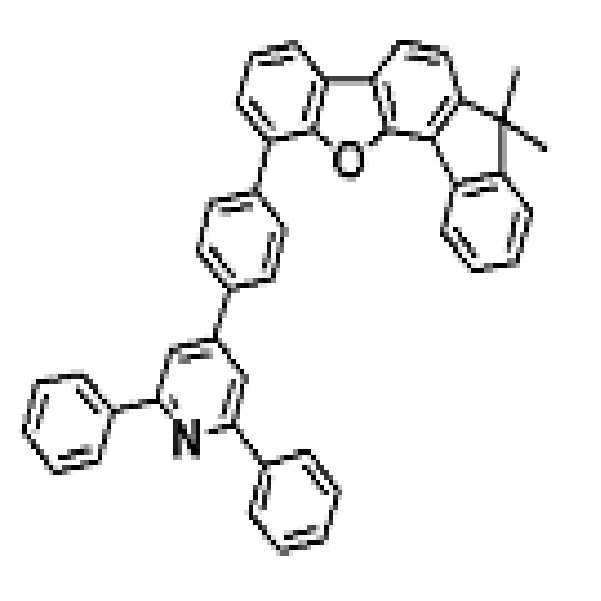

[화학식 A-4] [화학식 A-5] [화학식 A-6][Chemical formula A-4] [Chemical formula A-5] [Chemical formula A-6]
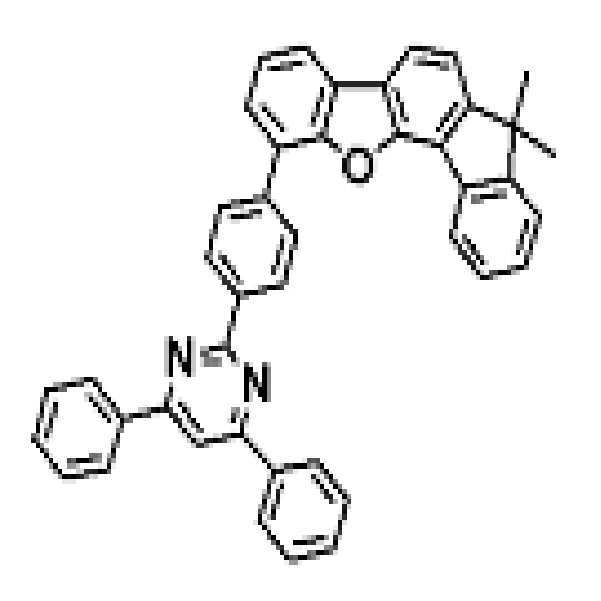
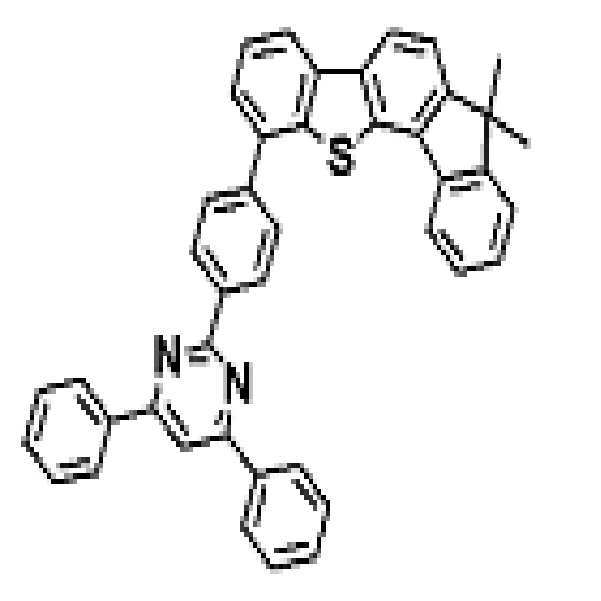

[화학식 A-7] [화학식 A-8] [화학식 A-9][Chemical Formula A-7] [Chemical Formula A-8] [Chemical Formula A-9]

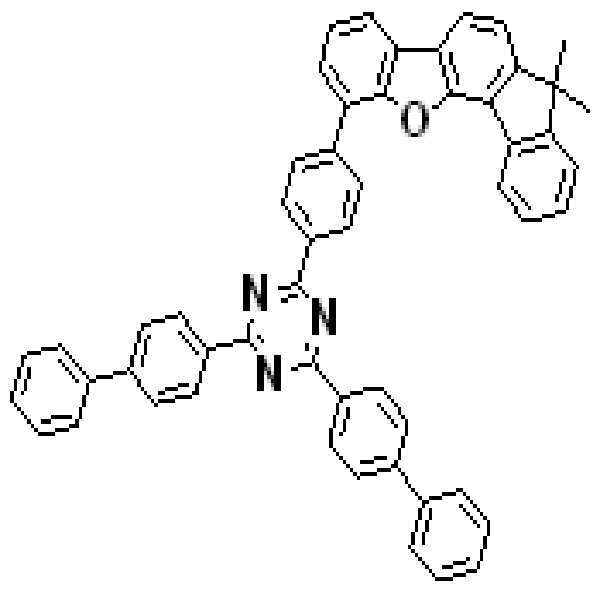
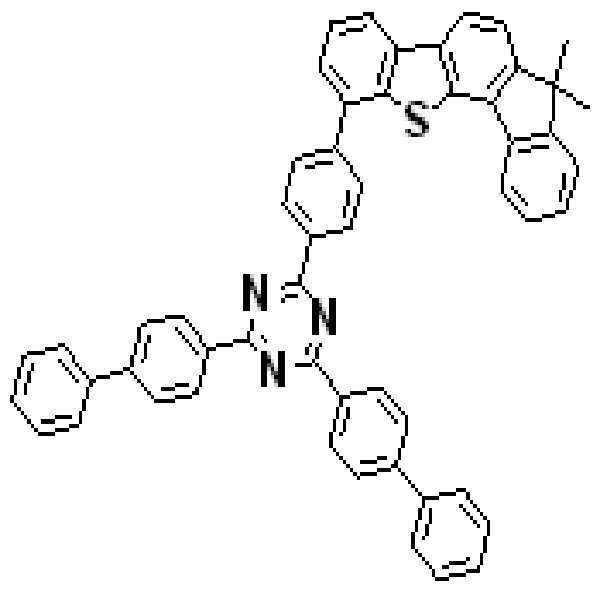
[화학식 A-10] [화학식 A-11] [화학식 A-12][A-10] [Chemical formula A-11] [Chemical formula A-12]

[화학식 A-13] [화학식 A-14] [화학식 A-15][Chemical formula A-13] [Chemical formula A-14] [Chemical formula A-15]

[화학식 A-16] [화학식 A-17] [화학식 A-18][Chemical Formula A-16] [Chemical Formula A-17] [Chemical Formula A-18]


[화학식 A-22] [화학식 A-23] [화학식 A-24][Chemical Formula A-22] [Chemical Formula A-23] [Chemical Formula A-24]
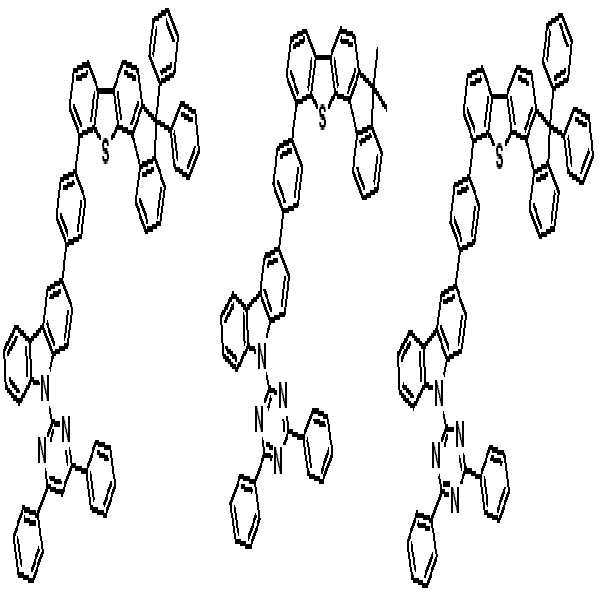
[화학식 A-25] [화학식 A-26] [화학식 A-27][Chemical Formula A-25] [Chemical Formula A-26] [Chemical Formula A-27]

[화학식 A-28] [화학식 A-29] [화학식 A-30][Chemical Formula A-28] [Chemical Formula A-29] [Chemical Formula A-30]

[화학식 A-31] [화학식 A-32] [화학식 A-33][Chemical Formula A-31] [Chemical Formula A-32] [Chemical Formula A-33]

[화학식 A-34] [화학식 A-35] [화학식 A-36][Chemical Formula A-34] [Chemical Formula A-35] [Chemical Formula A-36]

[화학식 A-37] [화학식 A-38] [화학식 A-39][Chemical Formula A-37] [Chemical Formula A-38] [Chemical Formula A-39]

[화학식 A-40] [화학식 A-41] [화학식 A-42][Chemical Formula A-40] [Chemical Formula A-41] [Chemical Formula A-42]

[화학식 A-43] [화학식 A-44] [화학식 A-45][Chemical Formula A-43] [Chemical Formula A-44] [Chemical Formula A-45]

[화학식 A-46] [화학식 A-47] [화학식 A-48][Chemical Formula A-46] [Chemical Formula A-47] [Chemical Formula A-48]
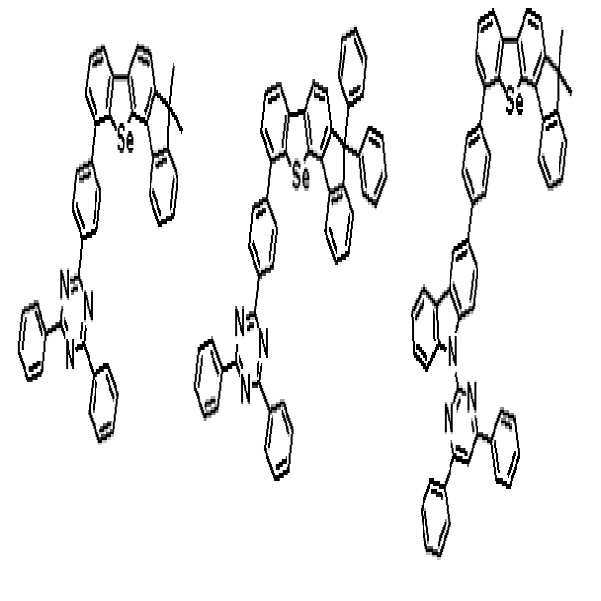
[화학식 A-49] [화학식 A-51] [화학식 A-52][Formula A-49] [Formula A-51] [Formula A-52]
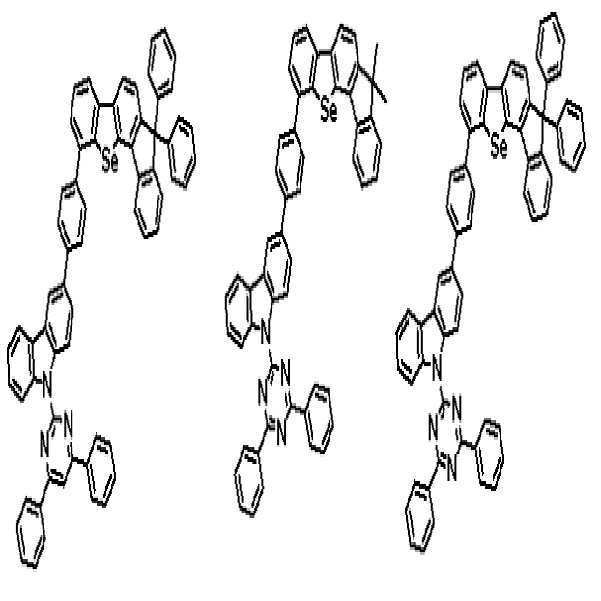
[화학식 A-53] [화학식 A-54] [화학식 A-55][Formula A-53] [Chemical Formula A-54] [Chemical Formula A-55]

본 발명의 일 구현예에 따른 유기광전소자용 화합물은 상기 유기광전소자용 화합물은 하기 화학식 B-1 내지 B-44 중 어느 하나로 표시될 수 있다. 하기와 같은 구조의 경우 HOMO 준위와 LUMO 준위를 치환체의 종류 및 크기에 따라 손쉽게 변화를 줄 수 있어서 전기화학적 안정성, 디바이스 효율 및 수명을 향상시킬 수 있는 장점이 있다. The compound for an organic photoelectric device according to an embodiment of the present invention may be represented by any one of the following formulas B-1 to B-44. In the case of the following structure, the HOMO level and the LUMO level can be easily changed depending on the type and size of the substituent, which can improve electrochemical stability, device efficiency and lifetime.
[화학식 B-1] [화학식 B-2] [화학식 B-3][Formula B-1] [Formula B-2] [Formula B-3]
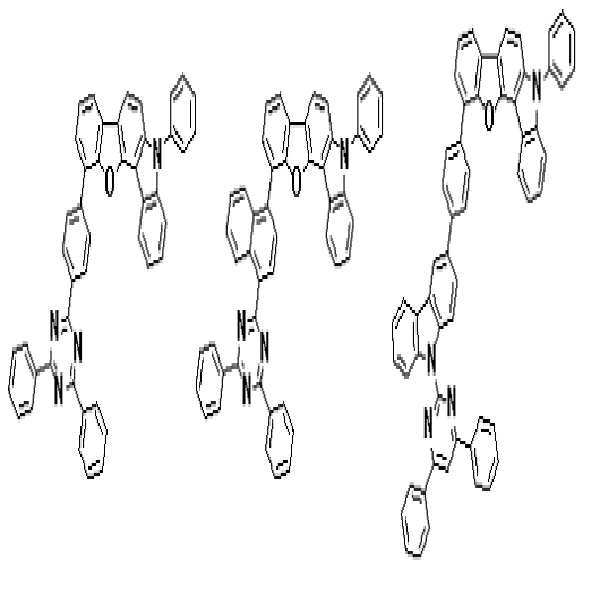
[화학식 B-4] [화학식 B-5] [화학식 B-6][Formula B-4] [Formula B-5] [Formula B-6]
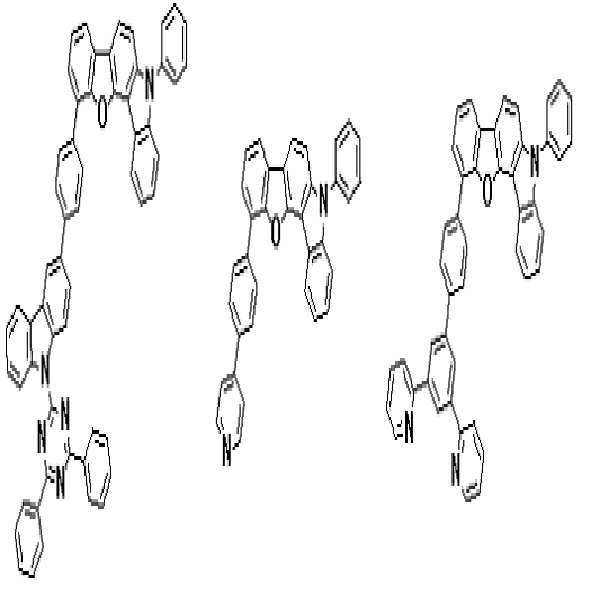
[화학식 B-7] [화학식 B-8] [화학식 B-9][Formula B-7] [Formula B-8] [Formula B-9]
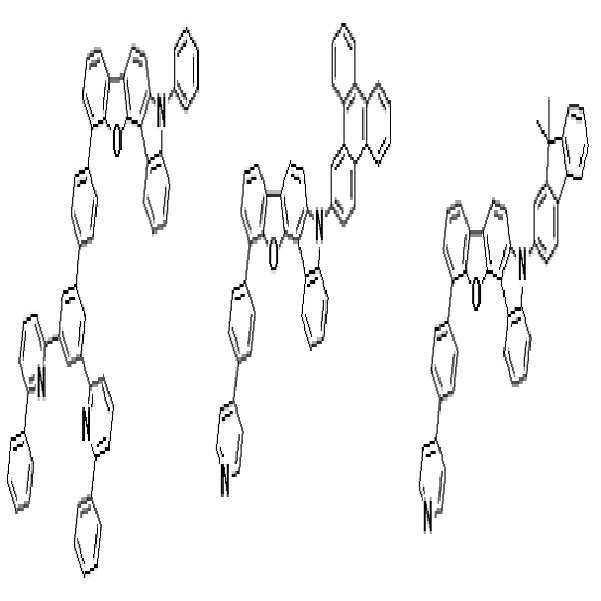
[화학식 B-10] [화학식 B-11] [Chemical formula B-10] [Chemical formula B-11]
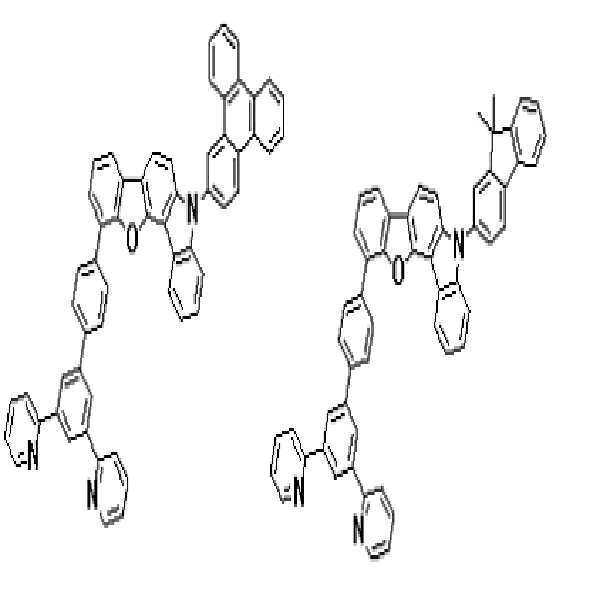
[화학식 B-12] [화학식 B-13] [화학식 B-14][Formula B-12] [Formula B-13] [Formula B-14]

[화학식 B-15] [화학식 B-16] [화학식 B-17][Formula B-15] [Formula B-16] [Formula B-17]

[화학식 B-18] [화학식 B-19] [화학식 B-20][Formula B-18] [Formula B-19] [Formula B-20]

[화학식 B-21] [화학식 B-22][Formula B-21] [Formula B-22]
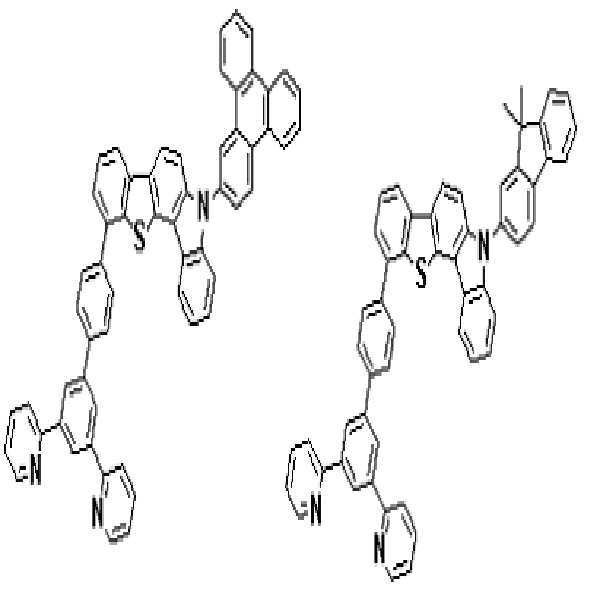
[화학식 B-23] [화학식 B-24] [화학식 B-25][Formula B-23] [Formula B-24] [Formula B-25]
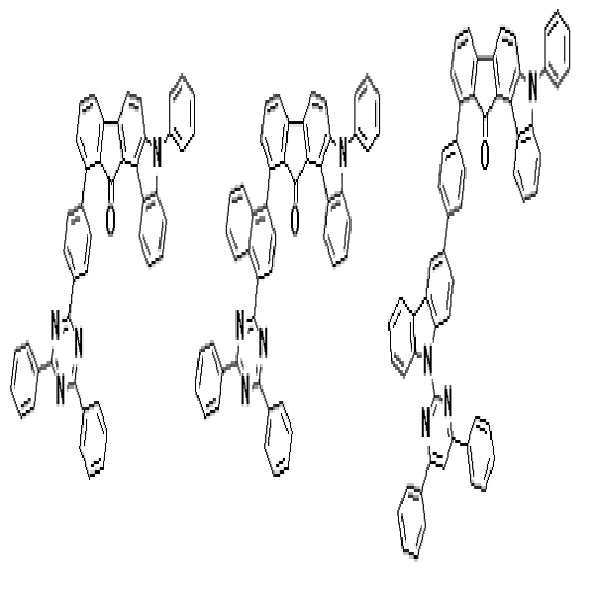
[화학식 B-26] [화학식 B-27] [화학식 B-28][Formula B-26] [Formula B-27] [Formula B-28]

[화학식 B-29] [화학식 B-30] [화학식 B-31][Formula B-29] [Formula B-30] [Formula B-31]

[화학식 B-32] [화학식 B-33] [Formula B-32] [Formula B-33]

[화학식 B-34] [화학식 B-35] [화학식 B-36][Formula B-34] [Formula B-35] [Formula B-36]

[화학식 B-37] [화학식 B-38] [화학식 B-39][Formula B-37] [Formula B-38] [Formula B-39]

[화학식 B-40] [화학식 B-41] [화학식 B-42][Formula B-40] [Formula B-41] [Formula B-42]

[화학식 B-43] [화학식 B-44][Chemical formula B-43] [Chemical formula B-44]

[화학식 B-1] [화학식 B-2] [화학식 B-3][Formula B-1] [Formula B-2] [Formula B-3]

[화학식 B-4] [화학식 B-5] [화학식 B-6][Formula B-4] [Formula B-5] [Formula B-6]
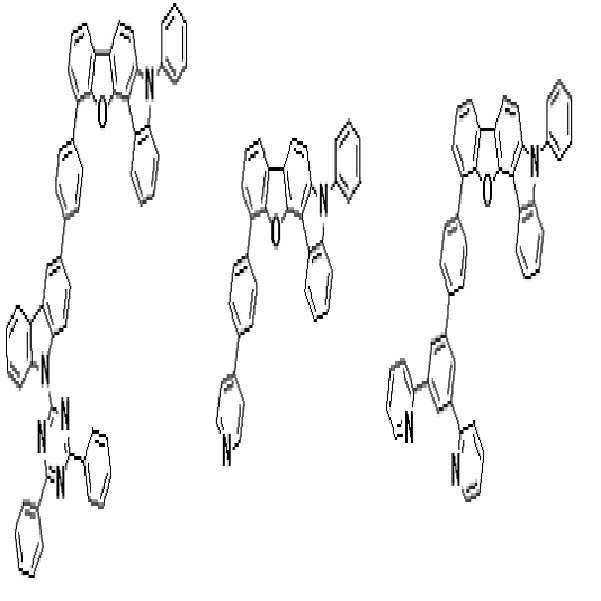
[화학식 B-7] [화학식 B-8] [화학식 B-9][Formula B-7] [Formula B-8] [Formula B-9]

[화학식 B-10] [화학식 B-11] [Chemical formula B-10] [Chemical formula B-11]
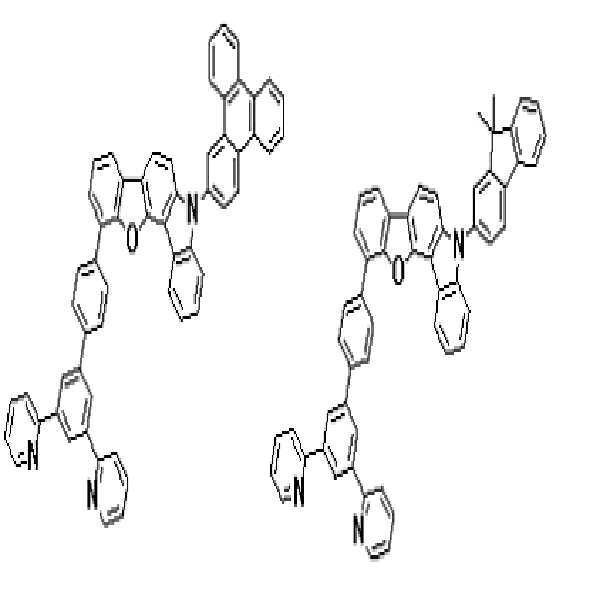
[화학식 B-12] [화학식 B-13] [화학식 B-14][Formula B-12] [Formula B-13] [Formula B-14]
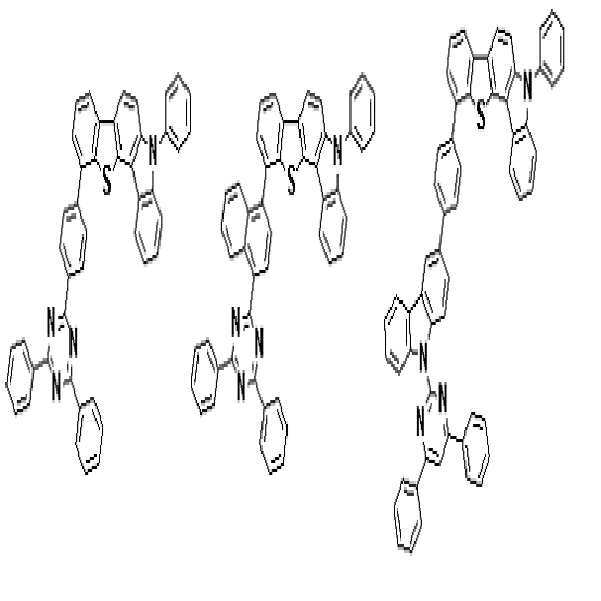
[화학식 B-15] [화학식 B-16] [화학식 B-17][Formula B-15] [Formula B-16] [Formula B-17]

[화학식 B-18] [화학식 B-19] [화학식 B-20][Formula B-18] [Formula B-19] [Formula B-20]
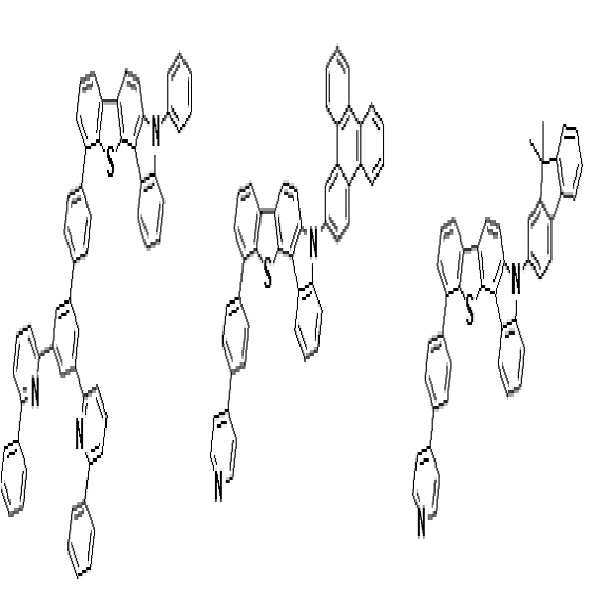
[화학식 B-21] [화학식 B-22][Formula B-21] [Formula B-22]

[화학식 B-23] [화학식 B-24] [화학식 B-25][Formula B-23] [Formula B-24] [Formula B-25]

[화학식 B-26] [화학식 B-27] [화학식 B-28][Formula B-26] [Formula B-27] [Formula B-28]

[화학식 B-29] [화학식 B-30] [화학식 B-31][Formula B-29] [Formula B-30] [Formula B-31]

[화학식 B-32] [화학식 B-33] [Formula B-32] [Formula B-33]
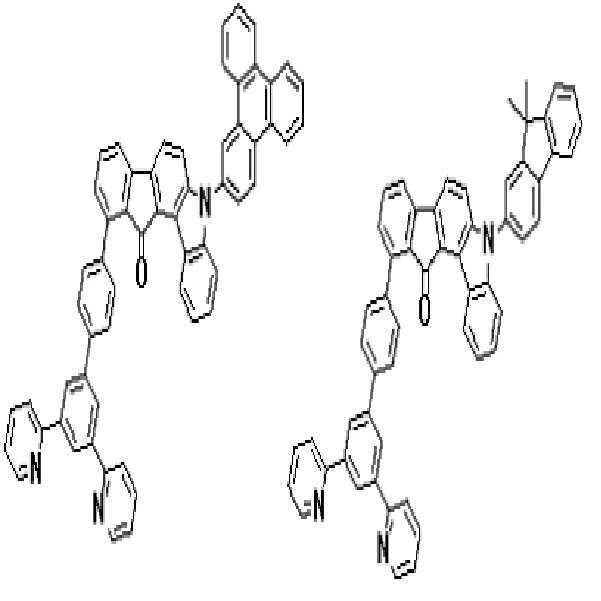
[화학식 B-34] [화학식 B-35] [화학식 B-36][Formula B-34] [Formula B-35] [Formula B-36]

[화학식 B-37] [화학식 B-38] [화학식 B-39][Formula B-37] [Formula B-38] [Formula B-39]

[화학식 B-40] [화학식 B-41] [화학식 B-42][Formula B-40] [Formula B-41] [Formula B-42]

[화학식 B-43] [화학식 B-44][Chemical formula B-43] [Chemical formula B-44]

본 발명의 일 구현예에 따른 유기광전소자용 화합물은 상기 유기광전소자용 화합물은 하기 화학식 C-1 내지 C-12 중 어느 하나로 표시될 수 있다. 하기와 같은 구조의 경우 HOMO 준위와 LUMO 준위를 치환체의 종류 및 크기에 따라 손쉽게 변화를 줄 수 있어서 전기화학적 안정성, 디바이스 효율 및 수명을 향상시킬 수 있는 장점이 있다.The compound for an organic photoelectric device according to an embodiment of the present invention may be represented by any one of the following formulas C-1 to C-12. In the case of the following structure, the HOMO level and the LUMO level can be easily changed depending on the type and size of the substituent, which can improve electrochemical stability, device efficiency and lifetime.
[화학식 C-1] [화학식 C-2] [화학식 C-3][Formula C-1] [Formula C-2] [Formula C-3]
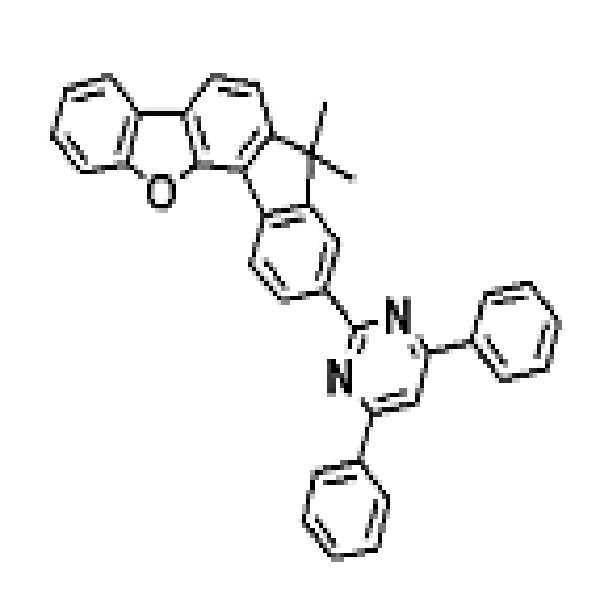


[화학식 C-4] [화학식 C-5] [화학식 C-6][Formula C-4] [Formula C-5] [Formula C-6]


[화학식 C-7] [화학식 C-8] [화학식 C-9][Formula C-7] [Formula C-8] [Formula C-9]

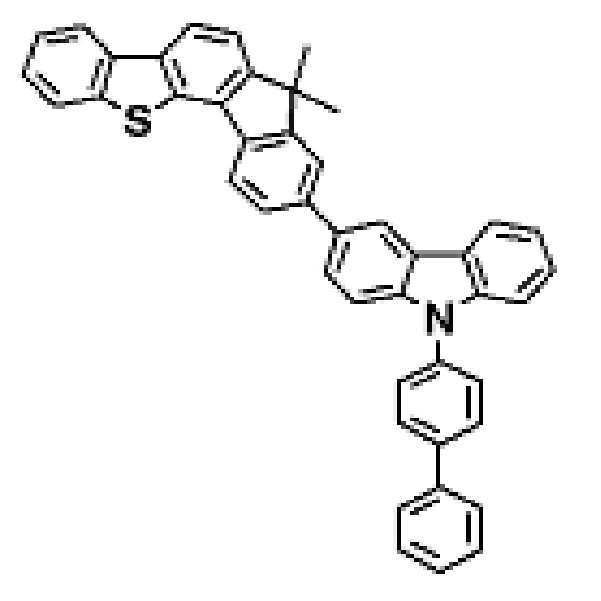

[화학식 C-10] [화학식 C-11] [화학식 C-12][Formula C-10] [Formula C-11] [Formula C-12]

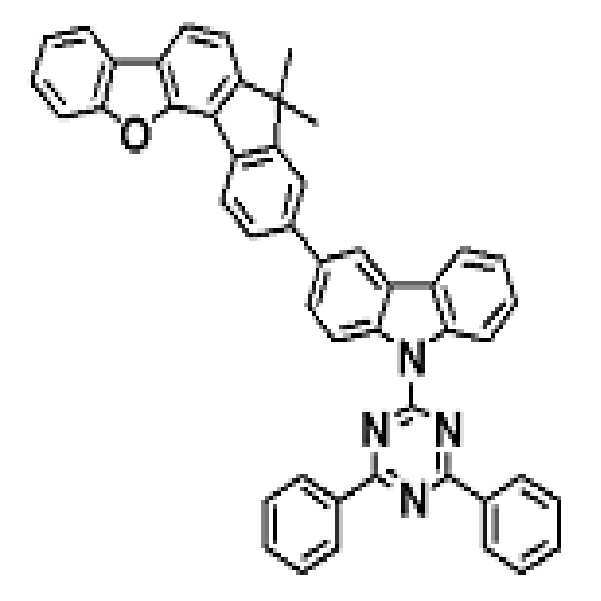

[화학식 C-13] [화학식 C-14] [화학식 C-15][Formula C-13] [Formula C-14] [Formula C-15]
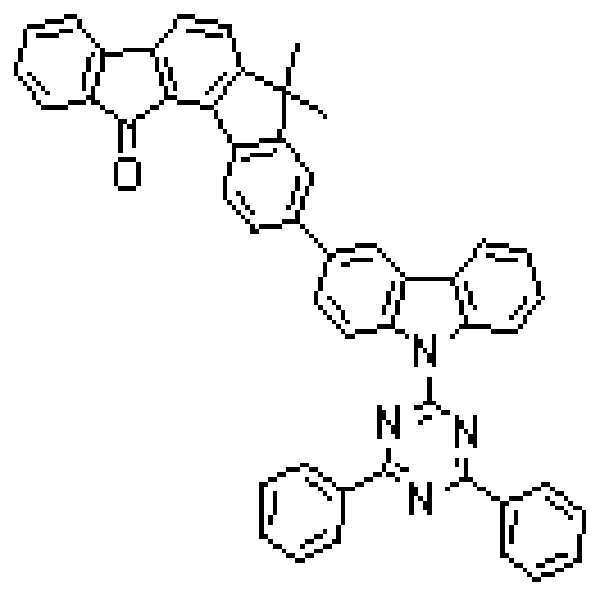


[화학식 C-16] [화학식 C-17] [화학식 C-18][Formula C-16] [Formula C-17] [Formula C-18]


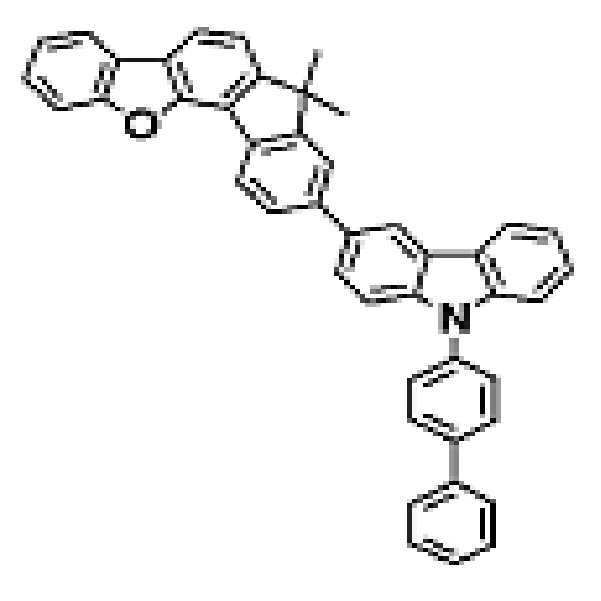
[화학식 C-19] [화학식 C-20] [Chemical formula C-19] [Chemical formula C-20]


본 발명의 일 구현예에 따른 유기광전소자용 화합물은 상기 유기광전소자용 화합물은 하기 화학식 D-1 내지 D-6 중 어느 하나로 표시될 수 있다. 하기와 같은 구조의 경우 HOMO 호모 준위와 LUMO 준위를 치환체의 종류 및 크기에 따라 손쉽게 변화를 줄 수 있어서 전기화학적 안정성, 디바이스 효율 및 수명을 향상시킬 수 있는 장점이 있다. The compound for an organic photoelectric device according to an embodiment of the present invention may be represented by any one of the following formulas D-1 to D-6. In the case of the following structure, HOMO homo-level and LUMO level can be easily changed depending on the type and size of substituent, which can improve electrochemical stability, device efficiency and lifetime.
[화학식 D-1] [화학식 D-2] [화학식 D-3][Formula D-1] [Formula D-2] [Formula D-3]
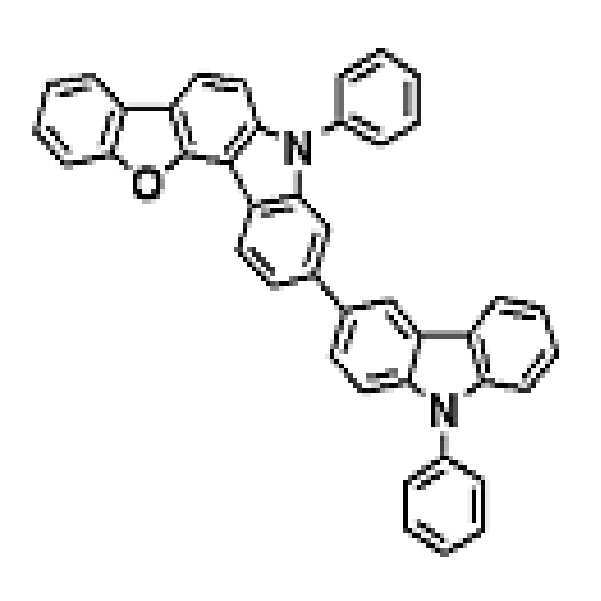


[화학식 D-4] [화학식 D-5] [화학식 D-6][Formula D-4] [Formula D-5] [Formula D-6]

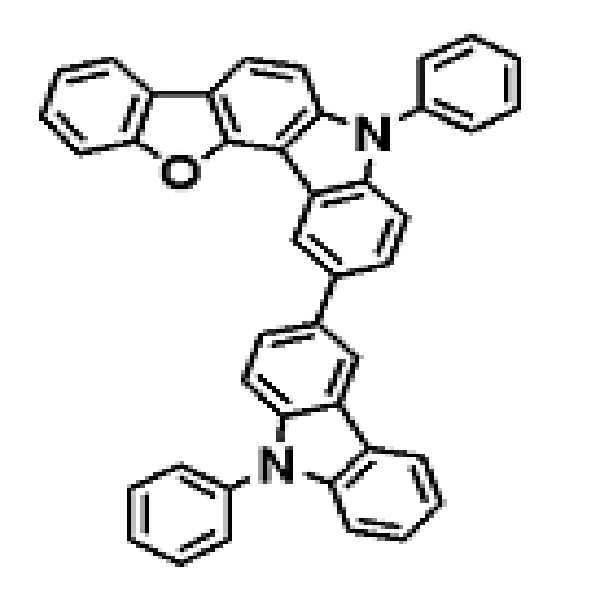

[화학식 D-7] [화학식 D-8] [Formula D-7] [Formula D-8]


본 발명의 일 구현예에 따른 유기광전소자용 화합물은 상기 유기광전소자용 화합물은 하기 화학식 E-1 내지 E-6 중 어느 하나로 표시될 수 있다. 하기와 같은 구조의 경우 HOMO 준위롸 LUMO 준위를 치환체의 종류 및 크기에 따라 손쉽게 변화를 줄 수 있어서 전기화학적 안정성, 디바이스 효율 및 수명을 향상시킬 수 있는 장점이 있다. The compound for an organic photoelectric device according to an embodiment of the present invention may be represented by any one of the following formulas E-1 to E-6. In the case of the following structure, the HOMO level and the LUMO level can be easily changed depending on the type and size of the substituent, thereby improving the electrochemical stability, device efficiency and lifetime.
[화학식 E-1] [화학식 E-2] [화학식 E-3][Formula E-1] [Formula E-2] [Formula E-3]

[화학식 E-4] [화학식 E-5] [화학식 E-6][Formula E-4] [Formula E-5] [Formula E-6]

[화학식 E-7] [화학식 E-8] [Formula E-7] [Formula E-8]

[화학식 E-9] [E-9]

전술한 본 발명의 일 구현예에 따른 화합물이 전자특성, 정공특성 양쪽을 모두 요구하는 경우에는 상기 전자특성을 가지는 작용기를 도입하는 것이 유기발광소자의 수명 향상 및 구동 전압 감소에 효과적이다.In the case where the compound according to one embodiment of the present invention requires both the electronic property and the hole property, it is effective to improve the lifetime of the organic light emitting device and reduce the driving voltage by introducing the functional group having the electron characteristic.
전술한 본 발명의 일 구현예에 따른 유기광전소자용 화합물은 최대 발광 파장이 약 320 내지 500 nm 범위를 나타내고, 3중항 여기에너지(T1)가 2.0 eV 이상, 보다 구체적으로 2.0 내지 4.0 eV 범위인 것으로, 높은 3중항 여기 에너지를 가지는 호스트의 전하가 도판트에 잘 전달되어 도판트의 발광효율을 높일 수 있고, 재료의 호모(HOMO)와 루모(LUMO) 에너지 준위를 자유롭게 조절하여 구동전압을 낮출 수 있는 이점이 있기 때문에 호스트 재료 또는 전하수송재료로 매우 유용하게 사용될 수 있다. The organic optoelectronic device compound according to an embodiment of the present invention has a maximum emission wavelength in a range of about 320 to 500 nm, a triplet excitation energy (T1) in a range of 2.0 eV or more, more specifically 2.0 to 4.0 eV The charge of a host having a high triplet excitation energy can be transferred to the dopant to increase the luminous efficiency of the dopant and freely adjust the HOMO and LUMO energy levels of the material to lower the driving voltage It can be very useful as a host material or a charge transport material.
뿐만 아니라, 상기 유기광전소자용 화합물은 광활성 및 전기적인 활성을 갖고 있으므로, 비선형 광학소재, 전극 재료, 변색재료, 광 스위치, 센서, 모듈, 웨이브 가이드, 유기 트렌지스터, 레이저, 광 흡수체, 유전체 및 분리막(membrane) 등의 재료로도 매우 유용하게 적용될 수 있다. In addition, since the compound for organic optoelectronic devices has a photoactive and electrical activity, it can be used as a nonlinear optical material, an electrode material, a coloring material, an optical switch, a sensor, a module, a waveguide, an organic transistor, it can be very usefully applied to materials such as a membrane.
상기와 같은 화합물을 포함하는 유기광전소자용 화합물은 유리전이온도가 90℃ 이상이며, 열분해온도가 400℃이상으로 열적 안정성이 우수하다. 이로 인해 고효율의 유기광전소자의 구현이 가능하다. The compound for organic optoelectronic devices including the above compound has a glass transition temperature of 90 ° C or higher and a thermal decomposition temperature of 400 ° C or higher, which is excellent in thermal stability. As a result, it is possible to realize a highly efficient organic photoelectric device.
상기와 같은 화합물을 포함하는 유기광전소자용 화합물은 발광, 또는 전자 주입 및/또는 수송역할을 할 수 있으며, 적절한 도판트와 함께 발광 호스트로서의 역할도 할 수 있다. 즉, 상기 유기광전소자용 화합물은 인광 또는 형광의 호스트 재료, 청색의 발광도펀트 재료, 또는 전자수송 재료로 사용될 수 있다.The compound for organic optoelectronic devices including the above compound can play a role of luminescence, electron injection and / or transport, and can function as a luminescent host together with an appropriate dopant. That is, the compound for organic optoelectronic devices can be used as a phosphorescent or fluorescent host material, a blue luminescent dopant material, or an electron transporting material.
본 발명의 일 구현예에 따른 유기광전소자용 화합물은 유기박막층에 사용되어 유기광전소자의 수명 특성, 효율 특성, 전기화학적 안정성 및 열적 안정성을 향상시키며, 구동전압을 낮출 수 있다.The compound for an organic photoelectric device according to an embodiment of the present invention can be used in an organic thin film layer to improve lifetime characteristics, efficiency characteristics, electrochemical stability and thermal stability of an organic photoelectric device, and lower a driving voltage.
이에 따라 본 발명의 일 구현예는 상기 유기광전소자용 화합물을 포함하는 유기광전소자를 제공한다. 이 때, 상기 유기광전소자라 함은 유기발광소자, 유기 태양 전지, 유기 트랜지스터, 유기 감광체 드럼, 유기 메모리 소자 등을 의미한다. 특히, 유기 태양 전지의 경우에는 본 발명의 일 구현예에 따른 유기광전소자용 화합물이 전극이나 전극 버퍼층에 포함되어 양자 효율을 증가시키며, 유기 트랜지스터의 경우에는 게이트, 소스-드레인 전극 등에서 전극 물질로 사용될 수 있다.Accordingly, one embodiment of the present invention provides an organic photoelectric device including the compound for an organic photoelectric device. Here, the organic photovoltaic elements include organic light emitting devices, organic solar cells, organic transistors, organic photoconductive drums, and organic memory devices. In particular, in the case of an organic solar cell, the compound for an organic photoelectric device according to an embodiment of the present invention is included in an electrode or an electrode buffer layer to increase quantum efficiency. In the case of an organic transistor, an electrode material in a gate, a source- Can be used.
이하에서는 유기광전소자에 대하여 구체적으로 설명한다.Hereinafter, the organic photoelectric device will be described in detail.
본 발명의 다른 일 구현예는 양극, 음극 및 상기 양극과 음극 사이에 개재되는 적어도 한 층 이상의 유기박막층을 포함하는 유기발광소자에 있어서, 상기 유기박막층 중 적어도 어느 한 층은 본 발명의 일 구현예에 따른 유기광전소자용 화합물을 포함하는 유기발광소자를 제공한다.Another embodiment of the present invention is an organic light emitting device comprising a cathode, a cathode, and at least one or more organic thin film layers interposed between the anode and the cathode, wherein at least one of the organic thin film layers is an organic thin film And a compound for an organic photoelectric device according to the present invention.
상기 유기광전소자용 화합물을 포함할 수 있는 유기박막층으로는 발광층, 정공수송층, 정공주입층, 전자수송층, 전자주입층, 정공차단층 및 이들의 조합으로 이루어진 군에서 선택되는 층을 포함할 수 있는 바, 이 중에서 적어도 어느 하나의 층은 본 발명에 따른 유기광전소자용 화합물을 포함한다. 특히, 정공수송층 또는 정공주입층에 본 발명의 일 구현예에 따른 유기광전소자용 화합물을 포함할 수 있다. 또한, 상기 유기광전소자용 화합물이 발광층 내에 포함되는 경우 상기 유기광전소자용 화합물은 인광 또는 형광호스트로서 포함될 수 있고, 특히, 형광 청색 도펀트 재료로서 포함될 수 있다.The organic thin film layer that can include the organic photoelectric conversion layer may include a layer selected from the group consisting of a light emitting layer, a hole transport layer, a hole injection layer, an electron transport layer, an electron injection layer, a hole blocking layer, At least one of the layers includes a compound for an organic photoelectric device according to the present invention. In particular, the hole transport layer or the hole injection layer may include the organic photoelectric device compound according to one embodiment of the present invention. When the compound for an organic photoelectric device is contained in the light emitting layer, the compound for organic photoelectric conversion may be included as a phosphorescent or fluorescent host, and in particular, may be included as a fluorescent blue dopant material.
도 1 내지 도 5는 본 발명의 일 구현예에 따른 유기광전소자용 화합물을 포함하는 유기발광소자의 단면도이다.1 to 5 are sectional views of an organic light emitting device including a compound for an organic photoelectric device according to an embodiment of the present invention.
도 1 내지 도 5를 참조하면, 본 발명의 일 구현예에 따른 유기광전소자(100, 200, 300, 400 및 500)는 양극(120), 음극(110) 및 이 양극과 음극 사이에 개재된 적어도 1층의 유기박막층(105)을 포함하는 구조를 갖는다.1 to 5, organic
상기 양극(120)은 양극 물질을 포함하며, 이 양극 물질로는 통상 유기박막층으로 정공주입이 원활할 수 있도록 일함수가 큰 물질이 바람직하다. 상기 양극 물질의 구체적인 예로는 니켈, 백금, 바나듐, 크롬, 구리, 아연, 금과 같은 금속 또는 이들의 합금을 들 수 있고, 아연산화물, 인듐산화물, 인듐주석산화물(ITO), 인듐아연산화물(IZO)과 같은 금속 산화물을 들 수 있고, ZnO와 Al 또는 SnO2와 Sb와 같은 금속과 산화물의 조합을 들 수 있고, 폴리(3-메틸티오펜), 폴리[3,4-(에틸렌-1,2-디옥시)티오펜](polyehtylenedioxythiophene: PEDT), 폴리피롤 및 폴리아닐린과 같은 전도성 고분자 등을 들 수 있으나, 이에 한정되는 것은 아니다. 바람직하게는 상기 양극으로 ITO(indium tin oxide)를 포함하는 투명전극을 사용할 수 있다.The
상기 음극(110)은 음극 물질을 포함하여, 이 음극 물질로는 통상 유기박막층으로 전자주입이 용이하도록 일 함수가 작은 물질인 것이 바람직하다. 음극 물질의 구체적인 예로는 마그네슘, 칼슘, 나트륨, 칼륨, 타이타늄, 인듐, 이트륨, 리튬, 가돌리늄, 알루미늄, 은, 주석, 납, 세슘, 바륨 등과 같은 금속 또는 이들의 합금을 들 수 있고, LiF/Al, LiO2/Al, LiF/Ca, LiF/Al 및 BaF2/Ca과 같은 다층 구조 물질 등을 들 수 있으나, 이에 한정되는 것은 아니다. 바람직하게는 상기 음극으로 알루미늄 등과 같은 금속전극을 사용할 수 있다.The
먼저 도 1을 참조하면, 도 1은 유기박막층(105)으로서 발광층(130)만이 존재하는 유기광전소자(100)를 나타낸 것으로, 상기 유기박막층(105)은 발광층(130)만으로 존재할 수 있다.1 illustrates an organic
도 2를 참조하면, 도 2는 유기박막층(105)으로서 전자수송층을 포함하는 발광층(230)과 정공수송층(140)이 존재하는 2층형 유기광전소자(200)를 나타낸 것으로, 도 2에 나타난 바와 같이, 유기박막층(105)은 발광층(230) 및 정공 수송층(140)을 포함하는 2층형일 수 있다. 이 경우 발광층(130)은 전자 수송층의 기능을 하며, 정공 수송층(140)은 ITO와 같은 투명전극과의 접합성 및 정공수송성을 향상시키는 기능을 한다.2 shows a two-layer type organic
도 3을 참조하면, 도 3은 유기박막층(105)으로서 전자수송층(150), 발광층(130) 및 정공수송층(140)이 존재하는 3층형 유기광전소자(300)로서, 상기 유기박막층(105)에서 발광층(130)은 독립된 형태로 되어 있고, 전자수송성이나 정공수송성이 우수한 막(전자수송층(150) 및 정공수송층(140))을 별도의 층으로 쌓은 형태를 나타내고 있다.3 is a three-layer organic
도 4를 참조하면, 도 4는 유기박막층(105)으로서 전자주입층(160), 발광층(130), 정공수송층(140) 및 정공주입층(170)이 존재하는 4층형 유기광전소자(400)로서, 상기 정공주입층(170)은 양극으로 사용되는 ITO와의 접합성을 향상시킬 수 있다.4, a four-layer type organic
도 5를 참조하면, 도 5는 유기박막층(105)으로서 전자주입층(160), 전자수송층(150), 발광층(130), 정공수송층(140) 및 정공주입층(170)과 같은 각기 다른 기능을 하는 5개의 층이 존재하는 5층형 유기광전소자(500)를 나타내고 있으며, 상기 유기광전소자(500)는 전자주입층(160)을 별도로 형성하여 저전압화에 효과적이다.5, the organic
상기 도 1 내지 도 5에서 상기 유기박막층(105)을 이루는 전자 수송층(150), 전자 주입층(160), 발광층(130, 230), 정공 수송층(140), 정공 주입층(170) 및 이들의 조합으로 이루어진 군에서 선택되는 어느 하나는 상기 유기광전소자용 화합물을 포함한다. 이 때 상기 유기광전소자용 화합물은 상기 전자 수송층(150) 또는 전자주입층(160)을 포함하는 전자수송층(150)에 사용될 수 있으며, 그중에서도 전자수송층에 포함될 경우 정공 차단층(도시하지 않음)을 별도로 형성할 필요가 없어 보다 단순화된 구조의 유기광전소자를 제공할 수 있어 바람직하다.1 to 5, the
또한, 상기 유기 광전 소자용 화합물이 발광층(130, 230) 내에 포함되는 경우 상기 유기 광전 소자용 화합물은 인광 또는 형광호스트로서 포함될 수 있으며, 또는 형광 청색 도펀트로서 포함될 수 있다.When the compound for organic photoelectric conversion is contained in the
상기에서 설명한 유기발광소자는, 기판에 양극을 형성한 후, 진공증착법(evaporation), 스퍼터링(sputtering), 플라즈마 도금 및 이온도금과 같은 건식성막법; 또는 스핀코팅(spin coating), 침지법(dipping), 유동코팅법(flow coating)과 같은 습식성막법 등으로 유기박막층을 형성한 후, 그 위에 음극을 형성하여 제조할 수 있다.The organic light emitting device described above may be formed by a dry film forming method such as evaporation, sputtering, plasma plating, and ion plating after an anode is formed on a substrate; Or a wet film formation method such as spin coating, dipping or flow coating, and then forming a cathode on the organic thin film layer.
본 발명의 또 다른 일 구현예에 따르면, 상기 유기광전소자를 포함하는 표시장치를 제공한다.According to another embodiment of the present invention, there is provided a display device including the organic photoelectric device.
이하에서는 본 발명의 구체적인 실시예들을 제시한다. 다만, 하기에 기재된 실시예들은 본 발명을 구체적으로 예시하거나 설명하기 위한 것에 불과하며, 이로서 본 발명이 제한되어서는 아니된다.
Hereinafter, specific embodiments of the present invention will be described. However, the embodiments described below are only intended to illustrate or explain the present invention, and thus the present invention should not be limited thereto.
(( 유기광전소자용For organic optoelectronic devices 화합물의 제조) Preparation of compounds <
중간체의 합성Synthesis of intermediates
중간체 M-1의 합성Synthesis of intermediate M-1
[반응식 1][Reaction Scheme 1]

(4-디벤조퓨라닐)보론산((4-dibenzofuranyl)boronic acid) 30g (141.5mmol), 메틸-2-브로모-5-클로로벤조에이트(methyl-2-bromo-5-chlorobenzoate) 37.1g (148.6 mmol), 테트라키스트리페닐포스핀팔라듐 8.2 g (7.1 mmol)을 플라스크에 넣고 질소 분위기 하에 톨루엔 550 ml에 용해 시킨 후 포타슘 카보네이트(potassium carbonate) 104.2 g (707.51 mmol) 을 녹인 수용액 353.8 ml를 첨가 시킨 후 12시간 동안 환류 교반 하였다. 반응 종료 후 에틸아세테이트로 추출 후 추출액을 마그네슘 설파이트(magnesium sulphate)로 건조, 여과하고 여과액을 감압 농축하였다. 생성물을 n-헥산/디클로로메탄(7 : 3 부피비)으로 실리카 겔 컬럼 크로마토그래피로 정제하여 목적 화합물인 중간체 M-1을 흰색 고체로 38.2 g (수율 80%) 을 수득 하였다.30 g (141.5 mmol) of (4-dibenzofuranyl) boronic acid and 37.1 g of methyl-2-bromo-5-chlorobenzoate (148.6 mmol) of tetrakistriphenylphosphine palladium and 8.2 g (7.1 mmol) of tetrakistriphenylphosphine palladium were dissolved in 550 ml of toluene under a nitrogen atmosphere, and 353.8 ml of an aqueous solution obtained by dissolving 104.2 g (707.51 mmol) of potassium carbonate And the mixture was refluxed for 12 hours. After completion of the reaction, the reaction mixture was extracted with ethyl acetate. The extract was dried with magnesium sulphate, filtered and the filtrate was concentrated under reduced pressure. The product was purified by silica gel column chromatography with n-hexane / dichloromethane (7: 3 by volume) to give 38.2 g (yield 80%) of intermediate compound M-1 as a white solid.
LC-Mass (이론치: 336.06 g/mol, 측정치: M+1 = 336 g/mol)
LC-Mass (theory: 336.06 g / mol, measured: M + 1 = 336 g / mol)
중간체 M-2의 합성Synthesis of intermediate M-2
[반응식 2][Reaction Scheme 2]
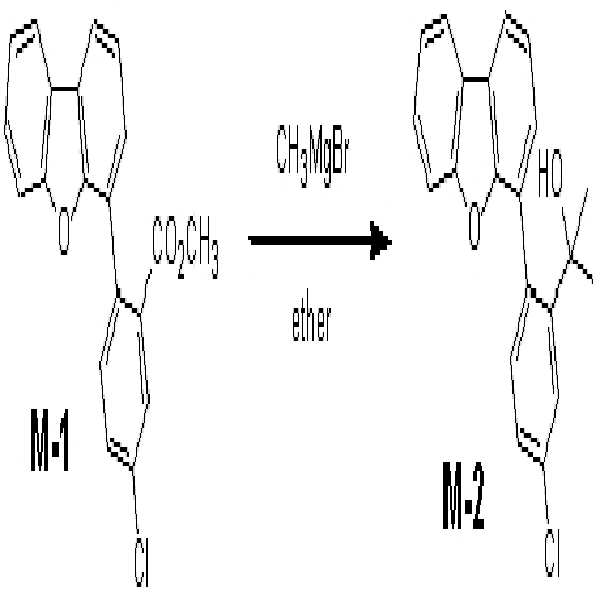
중간체 M-1 38.18 g (113.37mmol)을 플라스크에 넣고 질소 분위기 하에 무수 에테르 500 ml에 용해시킨 후 0℃로 냉각, 교반하였다. 여기에 3M 메틸마그네슘브로마이드 110mL(in diethyl ether, 340.1 mmol)을 천천히 가한 후 상온에서 질소 분위기 하에 5시간 교반하였다. 반응 종료 후 용액을 감압 농축하여 용매를 제거한 후 증류수와 디클로로메탄으로 추출 후 추출액을 무수황산마그네슘으로 건조, 여과하고 여과액을 감압 농축하여 목적화합물인 중간체 M-2을 점성이 큰 액체형태로 수득하였다.
38.18 g (113.37 mmol) of Intermediate M-1 was placed in a flask and dissolved in 500 ml of anhydrous ether under a nitrogen atmosphere, followed by cooling to 0 ° C and stirring. Thereto was slowly added 110 mL of 3M methylmagnesium bromide (in diethyl ether, 340.1 mmol), followed by stirring at room temperature for 5 hours under a nitrogen atmosphere. After completion of the reaction, the solution was concentrated under reduced pressure to remove the solvent, followed by extraction with distilled water and dichloromethane. The extract was dried with anhydrous magnesium sulfate and filtered. The filtrate was concentrated under reduced pressure to obtain Intermediate M-2 as a viscous liquid Respectively.
중간체 M-3의 합성Synthesis of intermediate M-3
[반응식 3][Reaction Scheme 3]

중간체 M-3를 디클로로메탄 250 ml에 용해시킨 후 0℃로 냉각, 교반하였다. 여기에 디클로로메탄 20 mL에 녹인 보로니트릴플루오라이드(borontrifluoride), 디에틸에터(diethyl ether complex) 15.18 g(56.7mmol)을 천천히 가한 후 상온에서 5시간 교반하였다. 반응 종료 후 에틸아세테이트로 추출 후 추출액을 마그네슘 설파이트(magnesium sulphate)로 건조, 여과하고 여과액을 감압 농축하였다. 생성물을 n-Hexane 으로 실리카 겔 컬럼 크로마토그래피로 정제하여 목적 화합물인 중간체 M-3을 흰색 고체로 29 g (수율 80%)을 수득 하였다.Intermediate M-3 was dissolved in 250 ml of dichloromethane, followed by cooling and stirring at 0 占 폚. Boron trifluoride and diethyl ether complex (15.18 g, 56.7 mmol) dissolved in 20 mL of dichloromethane were slowly added thereto, followed by stirring at room temperature for 5 hours. After completion of the reaction, the reaction mixture was extracted with ethyl acetate. The extract was dried with magnesium sulphate, filtered and the filtrate was concentrated under reduced pressure. The product was purified by silica gel column chromatography with n-hexane to obtain 29 g (yield 80%) of intermediate compound M-3 as a white solid.
GC-Mass (이론치: 318.8 g/mol, 측정치: M+1 = 318 g/mol)GC-Mass (theory: 318.8 g / mol, measured: M + 1 = 318 g / mol)
중간체 M-4의 합성Synthesis of intermediate M-4
[반응식 4][Reaction Scheme 4]

중간체 (4-dibenzofuranyl)boronic acid 30g (141.5mmol), 메틸-2-브로모-5-클로로벤조에이트(methyl-2-bromo-5-chlorobenzoate) 37.1 g (148.6 mmol), 테트라키스트리페닐포스핀팔라듐 8.2 g (7.1 mmol)을 플라스크에 넣고 질소 분위기 하에 톨루엔 550 ml에 용해 시킨 후 포타슘 카보네이트(potassium carbonate) 104.2 g (707.51 mmol) 을 녹인 수용액 353.8 ml를 첨가 시킨 후 12시간 동안 환류 교반 하였다. 반응 종료 후 에틸아세테이트로 추출 후 추출액을 마그네슘 설파이트(magnesium sulphate)로 건조, 여과하고 여과액을 감압 농축하였다. 생성물을 n-헥산/디클로로메탄(7 : 3 부피비)으로 실리카 겔 컬럼 크로마토그래피로 정제하여 목적 화합물인 중간체 M-1을 흰색 고체로 38.2 g (수율 80%) 을 수득 하였다.30 g (141.5 mmol) of 4-dibenzofuranyl boronic acid, 37.1 g (148.6 mmol) of methyl-2-bromo-5-chlorobenzoate, 8.2 g (7.1 mmol) of palladium was added to the flask and dissolved in 550 ml of toluene under a nitrogen atmosphere. Then, 353.8 ml of an aqueous solution obtained by dissolving 104.2 g (707.51 mmol) of potassium carbonate was added and the mixture was refluxed with stirring for 12 hours. After completion of the reaction, the reaction mixture was extracted with ethyl acetate. The extract was dried with magnesium sulphate, filtered and the filtrate was concentrated under reduced pressure. The product was purified by silica gel column chromatography with n-hexane / dichloromethane (7: 3 by volume) to give 38.2 g (yield 80%) of intermediate compound M-1 as a white solid.
LC-Mass (이론치: 336.06 g/mol, 측정치: M+1 = 336 g/mol)LC-Mass (theory: 336.06 g / mol, measured: M + 1 = 336 g / mol)
중간체 M-5의 합성Synthesis of intermediate M-5
[반응식 5][Reaction Scheme 5]

중간체 M-4 38.2 g (113.37mmol)을 플라스크에 넣고 질소 분위기 하에 무수 에테르 500 ml에 용해시킨 후 0℃로 냉각, 교반하였다. 여기에 3M 메틸마그네슘브로마이드(methylmagnesiumbromide) 110mL(in diethyl ether, 324.63 mmol)을 천천히 가한 후 상온에서 질소 분위기 하에 5시간 교반하였다. 반응 종료 후 용액을 감압 농축하여 용매를 제거한 후 증류수와 디클로로메탄으로 추출 후 추출액을 마그네슘 설파이트(magnesium sulphate)로 건조, 여과하고 여과액을 감압 농축하여 목적화합물인 중간체 M-2을 점성이 큰 액체형태로 수득하였다.38.2 g (113.37 mmol) of Intermediate M-4 was placed in a flask and dissolved in 500 ml of anhydrous ether under a nitrogen atmosphere, followed by cooling to 0 ° C and stirring. Thereto was slowly added 110 mL of 3M methylmagnesium bromide (in diethyl ether, 324.63 mmol) and the mixture was stirred at room temperature for 5 hours under a nitrogen atmosphere. After completion of the reaction, the solution was concentrated under reduced pressure to remove the solvent, and the mixture was extracted with distilled water and dichloromethane. The extract was dried with magnesium sulphate and filtered. The filtrate was concentrated under reduced pressure to obtain intermediate compound M- Lt; / RTI >
중간체 M-6의 합성Synthesis of intermediate M-6
[반응식 6][Reaction Scheme 6]
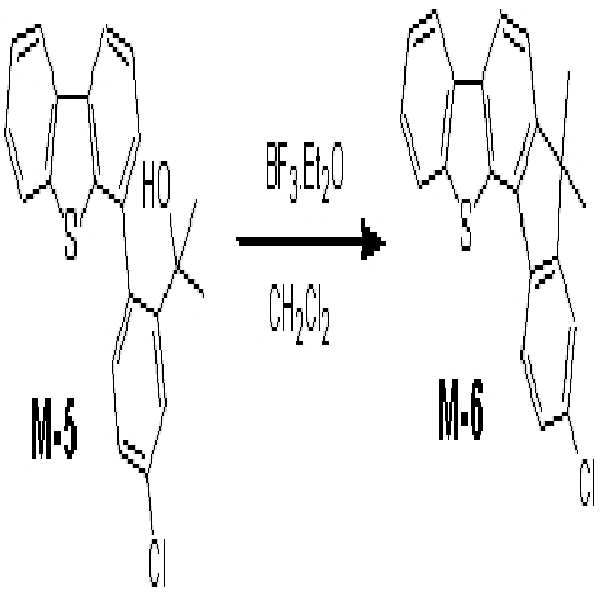
중간체 M-5를 디클로로메탄 250 ml에 용해시킨 후 0℃로 냉각, 교반하였다. 여기에 디클로로메탄 20 mL에 녹인 보로니트릴플루오라이드(borontrifluoride), 디에틸에터(diethyl ether complex) 14.5 g(54.1mmol)을 천천히 가한 후 상온에서 5시간 교반하였다. 반응 종료 후 에틸아세테이트로 추출 후 추출액을 마그네슘 설파이트(magnesium sulphate)로 건조, 여과하고 여과액을 감압 농축하였다. 생성물을 n-Hexane 으로 실리카 겔 컬럼 크로마토그래피로 정제하여 목적 화합물인 중간체 M-6을 흰색 고체로 31 g (수율 85.5%) 을 수득 하였다.Intermediate M-5 was dissolved in 250 ml of dichloromethane, followed by cooling to 0 ° C and stirring. Boron trifluoride and diethyl ether complex (14.5 g, 54.1 mmol) dissolved in 20 mL of dichloromethane were slowly added thereto, followed by stirring at room temperature for 5 hours. After completion of the reaction, the reaction mixture was extracted with ethyl acetate. The extract was dried with magnesium sulphate, filtered and the filtrate was concentrated under reduced pressure. The product was purified by silica gel column chromatography with n-hexane to obtain 31 g (yield: 85.5%) of intermediate compound M-6 as a white solid.
GC-Mass (이론치: 334.86 g/mol, 측정치: 335 g/mol)
GC-Mass (theory: 334.86 g / mol, measured: 335 g / mol)
중간체 M-7의 합성Synthesis of intermediate M-7
[반응식 7][Reaction Scheme 7]

중간체 (4-dibenzofuranyl)boronic acid 23g (108.5 mmol), 메틸-2-브로모-벤조에이트(methyl-2-bromo-benzoate) 24.5 g (113.9 mmol), 테트라키스트리페닐포스핀팔라듐 6.3 g (5.47 mmol)을 플라스크에 넣고 질소 분위기 하에 톨루엔 500 ml에 용해 시킨 후 포타슘 카보네이트(potassium carbonate) 79.9 g (542.4 mmol) 을 녹인 수용액 271.2 ml를 첨가 시킨 후 12시간 동안 환류 교반 하였다. 반응 종료 후 에틸아세테이트로 추출 후 추출액을 마그네슘 설파이트(magnesium sulphate)로 건조, 여과하고 여과액을 감압 농축하였다. 생성물을 n-헥산/디클로로메탄(7 : 3 부피비)으로 실리카 겔 컬럼 크로마토그래피로 정제하여 목적 화합물인 중간체 M-7을 흰색 고체로 31 g (수율 94.5 %) 을 수득 하였다.24.5 g (113.9 mmol) of methyl-2-bromo-benzoate and 6.3 g (5.47 mmol) of tetrakistriphenylphosphine palladium were added to a solution of 23 g (108.5 mmol) of 4-dibenzofuranyl boronic acid, mmol) were dissolved in 500 ml of toluene under a nitrogen atmosphere, 271.2 ml of an aqueous solution containing 79.9 g (542.4 mmol) of potassium carbonate was added, and the mixture was refluxed for 12 hours. After completion of the reaction, the reaction mixture was extracted with ethyl acetate. The extract was dried with magnesium sulphate, filtered and the filtrate was concentrated under reduced pressure. The product was purified by silica gel column chromatography with n-hexane / dichloromethane (7: 3 by volume) to obtain 31 g (yield 94.5%) of intermediate compound M-7 as a white solid.
LC-Mass (이론치: 302.32 g/mol, 측정치: M+1 = 303 g/mol)LC-Mass (theory: 302.32 g / mol, measurement: M + 1 = 303 g / mol)
중간체 M-8의 합성Synthesis of intermediate M-8
[반응식 8][Reaction Scheme 8]
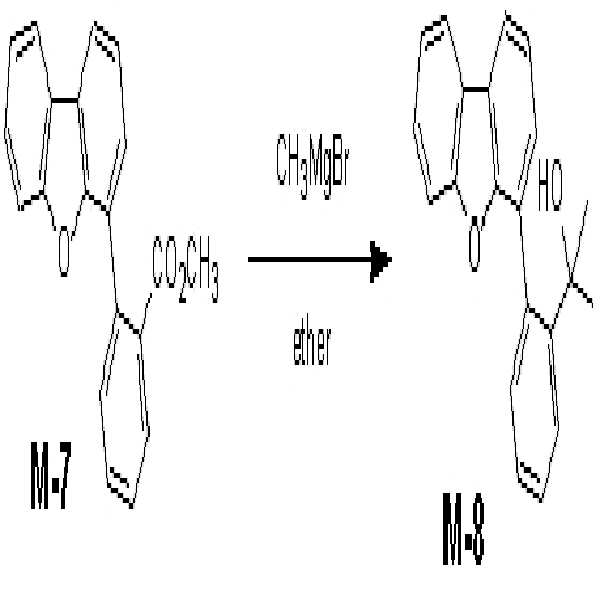
중간체 M-7 29 g (95.92mmol)을 플라스크에 넣고 질소 분위기 하에 무수 테트라히드로퓨란(tetrahydrofuran, THF) 400 ml에 용해시킨 후 0℃로 냉각, 교반하였다. 여기에 3M 메틸마그네슘브로마이드(methylmagnesiumbromide) 95.9mL(in diethyl ether, 287.8 mmol)을 천천히 가한 후 상온에서 질소 분위기 하에 5시간 교반하였다. 반응 종료 후 용액을 감압 농축하여 용매를 제거한 후 증류수와 디클로로메탄으로 추출 후 추출액을 마그네슘 설파이트(magnesium sulphate)로 건조, 여과하고 여과액을 감압 농축하여 목적화합물인 중간체 M-8을 점성이 큰 액체형태로 수득하였다.29 g (95.92 mmol) of Intermediate M-7 was placed in a flask and dissolved in 400 ml of anhydrous tetrahydrofuran (THF) under a nitrogen atmosphere, followed by cooling to 0 ° C and stirring. To this was slowly added 95.9 mL (in diethyl ether, 287.8 mmol) of 3M methylmagnesiumbromide, followed by stirring at room temperature under a nitrogen atmosphere for 5 hours. After completion of the reaction, the solution was concentrated under reduced pressure to remove the solvent. The solvent was then extracted with distilled water and dichloromethane. The extract was dried with magnesium sulphate and filtered. The filtrate was concentrated under reduced pressure to obtain intermediate compound M- Lt; / RTI >
중간체 M-9의 합성Synthesis of intermediate M-9
[반응식 9][Reaction Scheme 9]

중간체 M-8를 디클로로메탄 250 ml에 용해시킨 후 0℃로 냉각, 교반하였다. 여기에 디클로로메탄 20 mL에 녹인 보로니트릴플루오라이드(borontrifluoride), 디에틸에터(diethyl ether complex) 12.84 g(47.5mmol)을 천천히 가한 후 상온에서 5시간 교반하였다. 반응 종료 후 에틸아세테이트로 추출 후 추출액을 마그네슘 설파이트(magnesium sulphate)로 건조, 여과하고 여과액을 감압 농축하였다. 생성물을 n-Hexane 으로 실리카 겔 컬럼 크로마토그래피로 정제하여 목적 화합물인 중간체 M-9을 흰색 고체로 22 g (수율 71.9%) 을 수득 하였다.Intermediate M-8 was dissolved in 250 ml of dichloromethane, followed by cooling to 0 占 폚 and stirring. Boron trifluoride and diethyl ether complex (12.84 g, 47.5 mmol) dissolved in 20 mL of dichloromethane were slowly added thereto, followed by stirring at room temperature for 5 hours. After completion of the reaction, the reaction mixture was extracted with ethyl acetate. The extract was dried with magnesium sulphate, filtered and the filtrate was concentrated under reduced pressure. The product was purified by silica gel column chromatography with n-hexane to obtain 22 g (yield 71.9%) of intermediate compound M-9 as a white solid.
LC-Mass (이론치: 284.35 g/mol, 측정치: M+1 = 284 g/mol)
LC-Mass (theory: 284.35 g / mol, measurement: M + 1 = 284 g / mol)
중간체 M-10의 합성Synthesis of intermediate M-10
[반응식 10][Reaction Scheme 10]

진공 하에서 가열 건조한 2구 둥근 바닥 플라스크에 질소 분위기 하에서 중간체 M-9 10g (59.5mmol)을 넣고 무수 테트라히드로퓨란 119mL를 가하여 용해시킨 후 -40℃로 냉각, 교반하였다. 여기에 1.6M n-부틸리튬 26mL(in Hexane, 65.5mmol)을 천천히 가한 후 상온에서 질소 분위기 하에 5시간 교반하였다. 반응액을 -78℃로 냉각한 후 여기에 무수 테트라히드로퓨란 10mL에 녹인 1,2-디브로모에탄 22.4g (119mmol)을 천천히 가한 후 상온에서 5시간 교반하였다. 반응 종료 후 용액을 감압 농축하여 용매를 제거한 후 증류수와 디클로로메탄으로 추출 후 추출액을 마그네슘 설파이트(magnesium sulphate)로 건조, 여과하고 여과액을 감압 농축하였다. 반응액을 n-헥산으로 재결정하여 목적화합물인 중간체 M-10을 흰색고체로 11g (수율 75%)을 수득하였다.10 g (59.5 mmol) of Intermediate M-9 was added to a 2-necked round-bottomed flask heated and dried in vacuo, and 119 mL of anhydrous tetrahydrofuran was added to dissolve it, followed by cooling to -40 ° C and stirring. To this was slowly added 26 mL of 1.6 M n-butyllithium (in hexane, 65.5 mmol), and the mixture was stirred at room temperature under a nitrogen atmosphere for 5 hours. After the reaction solution was cooled to -78 ° C, 22.4 g (119 mmol) of 1,2-dibromoethane dissolved in 10 mL of anhydrous tetrahydrofuran was slowly added thereto, followed by stirring at room temperature for 5 hours. After completion of the reaction, the solution was concentrated under reduced pressure to remove the solvent. The solvent was then extracted with distilled water and dichloromethane. The extract was dried with magnesium sulphate, filtered and the filtrate was concentrated under reduced pressure. The reaction solution was recrystallized with n-hexane to obtain 11 g (yield 75%) of intermediate compound M-10 as a white solid.
GC-Mass (이론치: 245.97 g/mol, 측정치: 246 g/mol)GC-Mass (calculated 245.97 g / mol, measured: 246 g / mol)
중간체 M-11의 합성Synthesis of intermediate M-11
[반응식 11][Reaction Scheme 11]

중간체 M-10 11g (30.28mmol), 4-클로로페닐보론산(4-chlorophenylboronic acid) 5.0 g (31.8 mmol), 테트라키스트리페닐포스핀팔라듐 1.8 g (1.5 mmol)을 플라스크에 넣고 질소 분위기 하에 톨루엔 120 ml에 용해 시킨 후 포타슘 카보네이트(potassium carbonate) 22.3 g (151.4 mmol) 을 녹인 수용액 75.7ml를 첨가 시킨 후 12시간 동안 환류 교반 하였다. 반응 종료 후 에틸아세테이트로 추출 후 추출액을 마그네슘 설파이트(magnesium sulphate)로 건조, 여과하고 여과액을 감압 농축하였다. 생성물을 n-헥산/디클로로메탄(7 : 3 부피비)으로 실리카 겔 컬럼 크로마토그래피로 정제하여 목적 화합물인 중간체 M-11을 흰색 고체로 8.0 g (수율 66.7%) 을 수득 하였다.11 g (30.28 mmol) of intermediate M-10, 5.0 g (31.8 mmol) of 4-chlorophenylboronic acid and 1.8 g (1.5 mmol) of tetrakistriphenylphosphine palladium were placed in a flask, 75.7 ml of an aqueous solution obtained by dissolving 22.3 g (151.4 mmol) of potassium carbonate was added thereto, followed by stirring under reflux for 12 hours. After completion of the reaction, the reaction mixture was extracted with ethyl acetate. The extract was dried with magnesium sulphate, filtered and the filtrate was concentrated under reduced pressure. The product was purified by silica gel column chromatography with n-hexane / dichloromethane (7: 3 by volume) to obtain 8.0 g (yield 66.7%) of intermediate compound M-11 as a white solid.
GC-Mass (이론치: 394.89 g/mol, 측정치: 395 g/mol)
GC-Mass (calculated: 394.89 g / mol, measured: 395 g / mol)
중간체 M-12의 합성Synthesis of intermediate M-12
[반응식 12][Reaction Scheme 12]

중간체 (4-dibenzothiophenyl)boronic acid 25g (109.62 mmol), 메틸-2-브로모-벤조에이트(methyl-2-bromo-benzoate) 24.8 g (115.1 mmol), 테트라키스트리페닐포스핀팔라듐 6.3 g (5.48 mmol)을 플라스크에 넣고 질소 분위기 하에 톨루엔 500 ml에 용해 시킨 후 포타슘 카보네이트(potassium carbonate) 80.7 g (548.1 mmol) 을 녹인 수용액 274 ml를 첨가 시킨 후 12시간 동안 환류 교반 하였다. 반응 종료 후 에틸아세테이트로 추출 후 추출액을 마그네슘 설파이트(magnesium sulphate)로 건조, 여과하고 여과액을 감압 농축하였다. 생성물을 n-헥산/디클로로메탄(7 : 3 부피비)으로 실리카 겔 컬럼 크로마토그래피로 정제하여 목적 화합물인 중간체 M-12을 흰색 고체로 31 g (수율 88.8 %) 을 수득 하였다.A mixture of 25 g (109.62 mmol) of 4-dibenzothiophenyl boronic acid, 24.8 g (115.1 mmol) of methyl-2-bromo-benzoate and 6.3 g (5.48 mmol) of tetrakistriphenylphosphine palladium mmol) were dissolved in 500 ml of toluene under a nitrogen atmosphere, 274 ml of an aqueous solution containing 80.7 g (548.1 mmol) of potassium carbonate was added, and the mixture was refluxed for 12 hours. After completion of the reaction, the reaction mixture was extracted with ethyl acetate. The extract was dried with magnesium sulphate, filtered and the filtrate was concentrated under reduced pressure. The product was purified by silica gel column chromatography with n-hexane / dichloromethane (7: 3 by volume) to obtain 31 g (yield: 88.8%) of intermediate compound M-12 as a white solid.
GC-Mass (이론치: 318.39 g/mol, 측정치: M+1 = 318 g/mol)
GC-Mass (theory: 318.39 g / mol, measurement: M + 1 = 318 g / mol)
중간체 M-13의 합성Synthesis of intermediate M-13
[반응식 13][Reaction Scheme 13]

중간체 M-12 15.4 g (47.1mmol)을 플라스크에 넣고 질소 분위기 하에 무수 테트라히드로퓨란 400 ml에 용해시킨 후 0℃로 냉각, 교반하였다. 여기에 3M 메틸마그네슘브로마이드(methylmagnesiumbromide) 50mL(in diethyl ether, 141.34 mmol)을 천천히 가한 후 상온에서 질소 분위기 하에 5시간 교반하였다. 반응 종료 후 용액을 감압 농축하여 용매를 제거한 후 증류수와 디클로로메탄으로 추출 후 추출액을 마그네슘 설파이트(magnesium sulphate)로 건조, 여과하고 여과액을 감압 농축하여 목적화합물인 중간체 M-13을 점성이 큰 액체 형태로 수득하였다.15.4 g (47.1 mmol) of Intermediate M-12 was placed in a flask and dissolved in 400 ml of anhydrous tetrahydrofuran under a nitrogen atmosphere, followed by cooling to 0 ° C and stirring. To this was slowly added 50 mL of 3M methylmagnesiumbromide (diethyl ether, 141.34 mmol), and the mixture was stirred at room temperature under a nitrogen atmosphere for 5 hours. After completion of the reaction, the solution was concentrated under reduced pressure to remove the solvent, and the mixture was extracted with distilled water and dichloromethane. The extract was dried with magnesium sulfate and filtered. The filtrate was concentrated under reduced pressure to obtain Intermediate M- Lt; / RTI >
중간체 M-14의 합성Synthesis of intermediate M-14
[반응식 14][Reaction Scheme 14]

중간체 M-13를 디클로로메탄 250 ml에 용해시킨 후 0℃로 냉각, 교반하였다. 여기에 디클로로메탄 20 mL에 녹인 보로니트릴플루오라이드(borontrifluoride), 디에틸에터(diethyl ether complex) 12.6 g(47.1mmol)을 천천히 가한 후 상온에서 5시간 교반하였다. 반응 종료 후 에틸아세테이트로 추출 후 추출액을 마그네슘 설파이트(magnesium sulphate)로 건조, 여과하고 여과액을 감압 농축하였다. 생성물을 n-헥산으로 실리카 겔 컬럼 크로마토그래피로 정제하여 목적 화합물인 중간체 M-14을 흰색 고체로 10.5 g (수율 74.3%) 을 수득 하였다.Intermediate M-13 was dissolved in 250 ml of dichloromethane, followed by cooling to 0 ° C and stirring. 12.6 g (47.1 mmol) of boron trifluoride and diethyl ether complex dissolved in 20 mL of dichloromethane was slowly added thereto, followed by stirring at room temperature for 5 hours. After completion of the reaction, the reaction mixture was extracted with ethyl acetate. The extract was dried with magnesium sulphate, filtered and the filtrate was concentrated under reduced pressure. The product was purified by silica gel column chromatography with n-hexane to obtain 10.5 g (yield 74.3%) of intermediate compound M-14 as a white solid.
LC-Mass (이론치: 300.42 g/mol, 측정치: M+1 = 300 g/mol)LC-Mass (theoretical value: 300.42 g / mol, measurement: M + 1 = 300 g / mol)
중간체 Intermediate M-15M-15 의 합성Synthesis of
[반응식 15][Reaction Scheme 15]
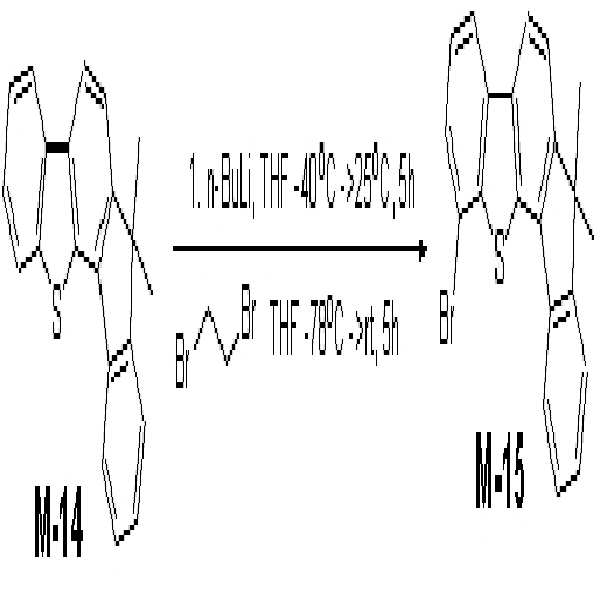
진공 하에서 가열 건조한 2구 둥근 바닥 플라스크에 질소 분위기 하에서 중간체 M14 9.6g (31.79mmol)을 넣고 무수 테트라히드로퓨란 100mL를 가하여 용해시킨 후 40℃로 냉각, 교반하였다. 여기에 1.6M n부틸리튬 20.7mL(in Hexane, 63.6mmol)을 천천히 가한 후 상온에서 질소 분위기 하에 5시간 교반하였다. 반응액을 78℃로 냉각한 후 여기에 무수 테트라히드로퓨란 10mL에 녹인 1,2디브로모에탄 11.9g (63.58mmol)을 천천히 가한 후 상온에서 5시간 교반하였다. 반응 종료 후 용액을 감압 농축하여 용매를 제거한 후 증류수와 디클로로메탄으로 추출 후 추출액을 마그네슘 설파이트(magnesium sulphate)로 건조, 여과하고 여과액을 감압 농축하였다.반응액을 n헥산으로 재결정하여 목적화합물인 중간체 M15을 흰색고체로 9.5g (수율 78.8%)을 수득하였다.9.6 g (31.79 mmol) of Intermediate M14 was added to a 2-necked round-bottomed flask heated and dried under vacuum, dissolved in 100 mL of anhydrous tetrahydrofuran, and cooled to 40 ° C and stirred. 20.7 mL (in Hexane, 63.6 mmol) of 1.6M n-butyllithium was slowly added thereto, followed by stirring at room temperature under a nitrogen atmosphere for 5 hours. After the reaction solution was cooled to 78 ° C, 11.9 g (63.58 mmol) of 1,2-dibromoethane dissolved in 10 mL of anhydrous tetrahydrofuran was slowly added thereto, followed by stirring at room temperature for 5 hours. After completion of the reaction, the solution was concentrated under reduced pressure to remove the solvent, followed by extraction with distilled water and dichloromethane. The extract was dried with magnesium sulphate, filtered and the filtrate was concentrated under reduced pressure. The reaction solution was recrystallized with n- 9.5 g (yield 78.8%) of intermediate M15 as a white solid.
GCMass (이론치: 379.31/mol, 측정치:/mol)GCMass (theory: 379.31 / mol, measurement: / mol)
중간체 M-16의 합성Synthesis of intermediate M-16
[반응식 16][Reaction Scheme 16]

중간체 M-15 9.5g (26.4mmol), 4-클로로페닐보론산(4-chlorophenylboronic acid) 4.3 g (27.7 mmol), 테트라키스트리페닐포스핀팔라듐 1.5 g (1.3 mmol)을 플라스크에 넣고 질소 분위기 하에 톨루엔 150 ml에 용해 시킨 후 포타슘 카보네이트(potassium carbonate) 19.4 g (130.9 mmol) 을 녹인 수용액 64.9 ml를 첨가 시킨 후 12시간 동안 환류 교반 하였다. 반응 종료 후 에틸아세테이트로 추출 후 추출액을 마그네슘 설파이트(magnesium sulphate)로 건조, 여과하고 여과액을 감압 농축하였다. 생성물을 n-헥산/디클로로메탄(7 : 3 부피비)으로 실리카 겔 컬럼 크로마토그래피로 정제하여 목적 화합물인 중간체 M-16을 흰색 고체로 5.3 g (수율 48.5%) 을 수득 하였다.4.3 g (27.7 mmol) of 4-chlorophenylboronic acid and 1.5 g (1.3 mmol) of tetrakis (triphenylphosphine) palladium were placed in a flask, and under a nitrogen atmosphere After dissolving in 150 ml of toluene, 64.9 ml of an aqueous solution obtained by dissolving 19.4 g (130.9 mmol) of potassium carbonate was added and the mixture was refluxed for 12 hours. After completion of the reaction, the reaction mixture was extracted with ethyl acetate. The extract was dried with magnesium sulphate, filtered and the filtrate was concentrated under reduced pressure. The product was purified by silica gel column chromatography with n-hexane / dichloromethane (7: 3 by volume) to obtain 5.3 g (yield 48.5%) of intermediate compound M-16 as a white solid.
GC-Mass (이론치: 394.89 g/mol, 측정치: 395 g/mol)GC-Mass (calculated: 394.89 g / mol, measured: 395 g / mol)
중간체 M-17의 합성Synthesis of intermediate M-17
[반응식 17][Reaction Scheme 17]

500 ㎖의 둥근 바닥 플라스크 질소 분위기에서 물질 디벤조퓨란 보로닉에시드 (15.0 g, 70.7 mmol), 물질 1-브로모-2-니트로 벤젠(19.38 g, 77.83 mmol), 및 테트라키스트리페닐포스핀팔라듐(2.46g, 2.12 mmol)을 200 mL 톨루엔에 녹이고, 포타슘아세테이트 (19.56 g, 141 mmol), 물 70 ㎖을 넣은 다음 90 ℃에서 24 시간 동안 교반시켰다. 반응이 끝나면 반응물을 실온으로 냉각시키고, 톨루엔과 물로 추출한 후 반응물을 무수 황산마그네슘으로 수분을 제거하고 이를 거른 후 용매를 제거하였다. 상기 용매를 제거한 다음 메틸렌클로라이드/헥산(1:1) 혼합 용매로 실리카켈 칼럼을 통해 정제 하여 중간체 M-17를 15 g (수율: 73.3 %) 얻었다.The material dibenzofuran boronic acid (15.0 g, 70.7 mmol), substance 1-bromo-2-nitrobenzene (19.38 g, 77.83 mmol) and tetrakistriphenylphosphine palladium (2.46 g, 2.12 mmol) was dissolved in 200 mL of toluene, potassium acetate (19.56 g, 141 mmol) and water (70 mL) were added, and the mixture was stirred at 90 DEG C for 24 hours. After the reaction was completed, the reaction mixture was cooled to room temperature, extracted with toluene and water, and then the reacted material was dehydrated with anhydrous magnesium sulfate, filtered and the solvent was removed. The solvent was removed, and the residue was purified through a silica gel column with a mixed solvent of methylene chloride / hexane (1: 1) to obtain 15 g (yield: 73.3%) of intermediate M-17.
중간체 M-18의 합성Synthesis of intermediate M-18
[반응식 18][Reaction Scheme 18]
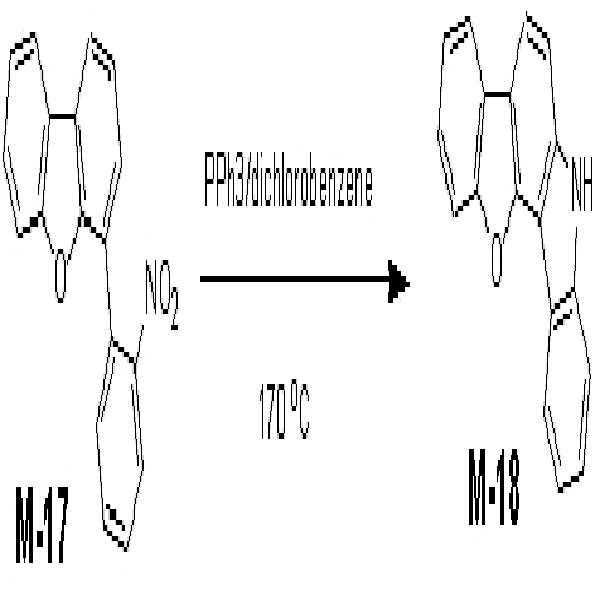
500 ㎖의 둥근 바닥 플라스크 질소 분위기에서 M-17 (15.0 g, 51.8 mmol), 트리페닐포스핀 (36 g, 137.5 mmol)을 디클로로벤젠에 녹인 후 160 ℃에서 24 시간 동안 교반시켰다. 반응이 끝나면 반응물을 실온으로 냉각시키고, 디클로로벤젠을 감압하에서 제거 하였다. 반응물을 메틸렌클로라이드/헥산(1:1) 혼합 용매로 실리카켈 칼럼을 통해 정제 하여 중간체 M-18를 9.1 g (수율: 68.2 %) 얻었다.M-17 (15.0 g, 51.8 mmol) and triphenylphosphine (36 g, 137.5 mmol) were dissolved in dichlorobenzene in a 500 ml round-bottom flask under nitrogen atmosphere, and the mixture was stirred at 160 ° C for 24 hours. At the end of the reaction, the reaction was cooled to room temperature and the dichlorobenzene was removed under reduced pressure. The reaction product was purified through a silica gel column with a mixed solvent of methylene chloride / hexane (1: 1) to obtain 9.1 g (yield: 68.2%) of intermediate M-18.
중간체 M-19의 합성Synthesis of intermediate M-19
[반응식 19][Reaction Scheme 19]

250㎖ 둥근 바닥 플라스크에 질소 분위기 하에서 M-18 (9g, 34.9 mmol), 브로모벤젠 (10.9 g, 69.9 mmol), 염화구리 (1.6g, 17.4 mmol), 포타슘하이드옥사이드 (20g, 356.4 mmol)을 자일렌 100㎖에 녹인 다음 150℃에서 48시간 동안 교반 시킨 다음 반응물을 상온으로 내리고 감압 하에서 자일렌을 제거 한다. 남은 고체를 메틸렌클로라이드에 녹인 다음 물로 여러번 세척 한 다음 무수 황산마그네슘으로 수분을 제거하고 이를 거른 후 용매를 제거한다. 용매를 제거한 다음 핵산/메틸렌클로라이드(1:2) 용매로 실리카겔 칼럼 정제 하여 목적 화합물 M-19을 10 g(86 %) 얻었다.(9 g, 34.9 mmol), bromobenzene (10.9 g, 69.9 mmol), copper chloride (1.6 g, 17.4 mmol) and potassium hydroxide (20 g, 356.4 mmol) were added to a 250 mL round bottom flask under nitrogen atmosphere After dissolving in 100 ml of xylene and stirring at 150 ° C for 48 hours, the reaction mixture is cooled to room temperature and xylene is removed under reduced pressure. The remaining solids are dissolved in methylene chloride and washed several times with water. The water is removed with anhydrous magnesium sulfate, and the solvent is removed by filtration. The solvent was removed and the residue was purified by silica gel column chromatography with a solvent of nucleic acid / methylene chloride (1: 2) to obtain 10 g (86%) of the desired compound M-19.
중간체 M-20의 합성Synthesis of intermediate M-20
[반응식 20][Reaction Scheme 20]

진공 하에서 가열 건조한 2구 둥근 바닥 플라스크에 질소 분위기 하에서 중간체 M-19 10.0g (30.0mmol)을 넣고 무수 테트라하이드로퓨란 100mL를 가하여 용해시킨 후 -40℃로 냉각, 교반하였다. 여기에 1.6M n-부틸리튬 10.4 mL(in Hexane, 31.20mmol)을 천천히 가한 후 상온에서 질소 분위기 하에 5시간 교반하였다. 반응액을 -78℃로 냉각한 후 여기에 무수 테트라히드로퓨란 10mL에 녹인 1,2-dibromoethane 11.3g (60.0mmol)을 천천히 가한 후 상온에서 5시간 교반하였다. 반응 종료 후 용액을 감압 농축하여 용매를 제거한 후 증류수와 디클로로메탄으로 추출 후 추출액을 마그네슘 설파이트(magnesium sulphate)로 건조, 여과하고 여과액을 감압 농축하였다. 반응액을 n-Hexane으로 재결정하여 목적화합물인 중간체 M-20을 흰색고체로 9.7g (수율 78.4%)을 수득하였다.10.0 g (30.0 mmol) of Intermediate M-19 was added to a 2-necked round-bottomed flask heated and dried under vacuum, dissolved in 100 mL of anhydrous tetrahydrofuran and cooled to -40 ° C and stirred. 10.4 mL (in Hexane, 31.20 mmol) of 1.6M n-butyllithium was slowly added thereto, followed by stirring at room temperature under a nitrogen atmosphere for 5 hours. After the reaction solution was cooled to -78 ° C, 11.3 g (60.0 mmol) of 1,2-dibromoethane dissolved in 10 mL of anhydrous tetrahydrofuran was slowly added thereto, followed by stirring at room temperature for 5 hours. After completion of the reaction, the solution was concentrated under reduced pressure to remove the solvent. The solvent was then extracted with distilled water and dichloromethane. The extract was dried with magnesium sulphate, filtered and the filtrate was concentrated under reduced pressure. The reaction solution was recrystallized with n-hexane to obtain 9.7 g (yield 78.4%) of intermediate compound M-20 as a white solid.
GC-Mass (이론치: 412.28 g/mol, 측정치: 412 g/mol)GC-Mass (theory: 412.28 g / mol, measurement: 412 g / mol)
중간체 M-21의 합성Synthesis of intermediate M-21
[반응식 21][Reaction Scheme 21]
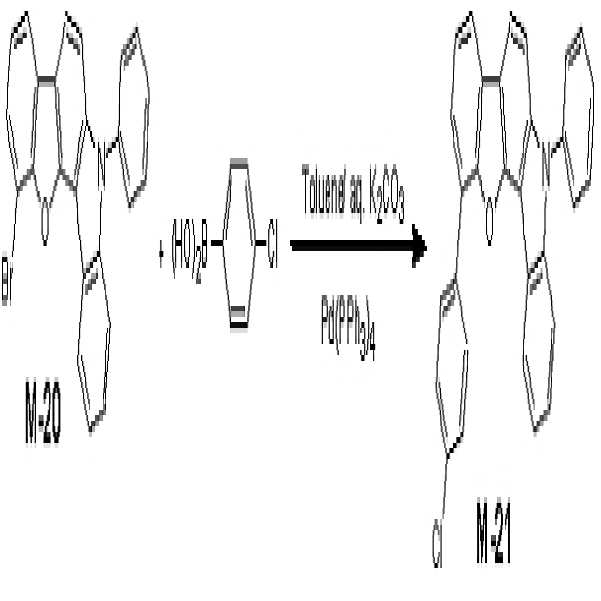
중간체 M-20 9.7g (23.5mmol), 4-클로로페닐보로닉에시드 3.9 g (24.7 mmol), 테트라키스트리페닐포스핀팔라듐 1.4 g (1.2 mmol)을 플라스크에 넣고 질소 분위기 하에 톨로엔 100 ml에 용해 시킨 후 포타슘카보네이트 17.3 g (117.6 mmol) 을 녹인 수용액 58.8 ml를 첨가 시킨 후 12시간 동안 환류 교반 하였다. 반응 종료 후 에틸아세테이트로 추출 후 추출액을 무수황산마그네슘으로 건조, 여과하고 여과액을 감압 농축하였다. 생성물을 노말헥산/메틸렌클로라이드(7 : 3 부피비)으로 실리카켈 컬럼 크로마토그래피로 정제하여 목적 화합물인 중간체 M-21을 흰색 고체로 7.0 g (수율 67.0%) 을 수득 하였다.9.9 g (23.5 mmol) of Intermediate M-20, 3.9 g (24.7 mmol) of 4-chlorophenylboronic acid and 1.4 g (1.2 mmol) of tetrakistriphenylphosphine palladium were placed in a flask and 100 ml And 58.8 ml of an aqueous solution containing 17.3 g (117.6 mmol) of potassium carbonate was added thereto, followed by reflux stirring for 12 hours. After completion of the reaction, the reaction mixture was extracted with ethyl acetate. The extract was dried over anhydrous magnesium sulfate, filtered and the filtrate was concentrated under reduced pressure. The product was purified by silica gel column chromatography with normal hexane / methylene chloride (7: 3 by volume) to obtain 7.0 g (yield 67.0%) of intermediate compound M-21 as a white solid.
GC-Mass (이론치:443.92 g/mol, 측정치: 444 g/mol)GC-Mass (calculated: 443.92 g / mol, measured: 444 g / mol)
중간체 M-22의 합성Synthesis of intermediate M-22
[반응식 22][Reaction Scheme 22]

500 ㎖의 둥근 바닥 플라스크 질소 분위기에서 물질 디벤조퓨란 보로닉에시드 (15.0 g, 65.7 mmol), 물질 1-브로모-2-니트로 벤젠(18.0 g, 72.3 mmol), 및 테트라키스트리페닐포스핀팔라듐(2.3g, 1.97 mmol)을 200 mL 톨루엔에 녹이고, 포타슘아세테이트 (18.2 g, 131.5 mmol), 물 70 ㎖을 넣은 다음 90 ℃에서 24 시간 동안 교반시켰다. 반응이 끝나면 반응물을 실온으로 냉각시키고, 톨루엔과 물로 추출한 후 반응물을 무수 황산마그네슘으로 수분을 제거하고 이를 거른 후 용매를 제거하였다. 상기 용매를 제거한 다음 메틸렌클로라이드/헥산(1:1) 혼합 용매로 실리카켈 칼럼을 통해 정제 하여 중간체 M-22를 14 g (수율: 69.7 %) 얻었다.The material dibenzofuran boronic acid (15.0 g, 65.7 mmol), substance 1-bromo-2-nitrobenzene (18.0 g, 72.3 mmol) and tetrakistriphenylphosphine palladium (2.3 g, 1.97 mmol) was dissolved in 200 mL of toluene, potassium acetate (18.2 g, 131.5 mmol) and water (70 mL) were added, and the mixture was stirred at 90 ° C for 24 hours. After the reaction was completed, the reaction mixture was cooled to room temperature, extracted with toluene and water, and then the reacted material was dehydrated with anhydrous magnesium sulfate, filtered and the solvent was removed. The solvent was removed, and the residue was purified through a silica gel column with a mixed solvent of methylene chloride / hexane (1: 1) to obtain 14 g (yield: 69.7%) of intermediate M-22.
중간체 M-23의 합성Synthesis of intermediate M-23
[반응식 23][Reaction Scheme 23]

500 ㎖의 둥근 바닥 플라스크 질소 분위기에서 M-22 (14.0 g, 45.8 mmol), 트리페닐포스핀 (36 g, 137.5 mmol)을 디클로로벤젠에 녹인 후 160 ℃에서 24 시간 동안 교반시켰다. 반응이 끝나면 반응물을 실온으로 냉각시키고, 디클로로벤젠을 감압하에서 제거 하였다. 반응물을 메틸렌클로라이드/헥산(1:1) 혼합 용매로 실리카켈 칼럼을 통해 정제 하여 중간체 M-23 를 9.7 g (수율: 77.6 %) 얻었다.
M-22 (14.0 g, 45.8 mmol) and triphenylphosphine (36 g, 137.5 mmol) were dissolved in dichlorobenzene in a 500 ml round bottom flask under nitrogen atmosphere and stirred at 160 캜 for 24 hours. At the end of the reaction, the reaction was cooled to room temperature and the dichlorobenzene was removed under reduced pressure. The reaction product was purified through a silica gel column with a mixed solvent of methylene chloride / hexane (1: 1) to obtain 9.7 g (Yield: 77.6%) of intermediate M-23.
중간체 M-24의 합성Synthesis of intermediate M-24
[반응식 24][Reaction Scheme 24]
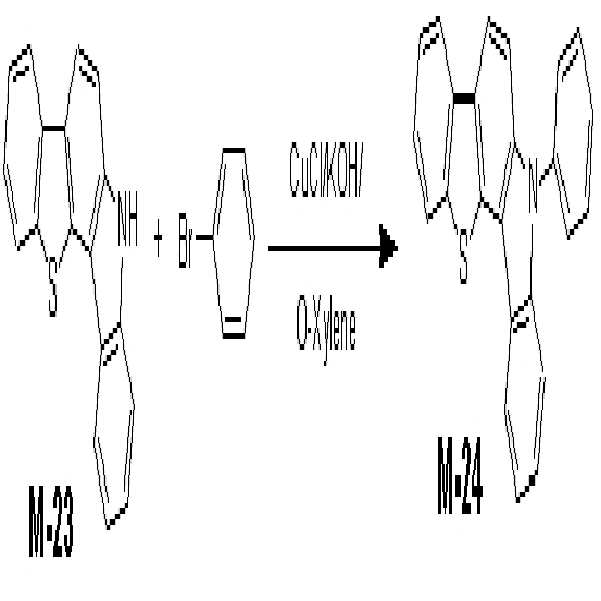
250㎖ 둥근 바닥 플라스크에 질소 분위기 하에서 M-23 (9.7g, 35.4 mmol), 브로모벤젠 (11.1 g, 70.9 mmol), 염화구리 (1.6g, 17.4 mmol), 포타슘하이드옥사이드 (20g, 356.4 mmol)을 자일렌 100㎖에 녹인 다음 150℃에서 48시간 동안 교반 시킨 다음 반응물을 상온으로 내리고 감압 하에서 자일렌을 제거 한다. 남은 고체를 메틸렌클로라이드에 녹인 다음 물로 여러번 세척 한 다음 무수 황산마그네슘으로 수분을 제거하고 이를 거른 후 용매를 제거한다. 용매를 제거한 다음 핵산/메틸렌클로라이드(1:2) 용매로 실리카겔 칼럼 정제 하여 목적 화합물 M-24을 11 g(89 %) 얻었다.(9.7 g, 35.4 mmol), bromobenzene (11.1 g, 70.9 mmol), copper chloride (1.6 g, 17.4 mmol) and potassium hydroxide (20 g, 356.4 mmol) in a 250 mL round bottom flask under nitrogen atmosphere. Is dissolved in 100 ml of xylene and stirred at 150 ° C for 48 hours. Then, the reaction product is cooled to room temperature and xylene is removed under reduced pressure. The remaining solids are dissolved in methylene chloride and washed several times with water. The water is removed with anhydrous magnesium sulfate, and the solvent is removed by filtration. The solvent was removed and the residue was purified by silica gel column chromatography with a solvent of nucleic acid / methylene chloride (1: 2) to obtain 11 g (89%) of the target compound M-24.
중간체 M-25의 합성Synthesis of intermediate M-25
[반응식 25][Reaction Scheme 25]

진공 하에서 가열 건조한 2구 둥근 바닥 플라스크에 질소 분위기 하에서 중간체 M-24 10.0g (28.6mmol)을 넣고 무수 테트라히드로퓨란 100mL를 가하여 용해시킨 후 -40℃로 냉각, 교반하였다. 여기에 1.6M n-부틸리튬 9.92 mL(in Hexane, 29.76mmol)을 천천히 가한 후 상온에서 질소 분위기 하에 5시간 교반하였다. 반응액을 -78℃로 냉각한 후 여기에 무수 테트라히드로퓨란 10mL에 녹인 1,2-디브로모에탄 10.8g (57.2mmol)을 천천히 가한 후 상온에서 5시간 교반하였다. 반응 종료 후 용액을 감압 농축하여 용매를 제거한 후 증류수와 디클로로메탄으로 추출 후 추출액을 마그네슘 설파이트(magnesium sulphate)로 건조, 여과하고 여과액을 감압 농축하였다. 반응액을 n-헥산으로 재결정하여 목적화합물인 중간체 M-25을 흰색고체로 9.8g (수율 79.9%)을 수득하였다.10.0 g (28.6 mmol) of Intermediate M-24 was added to a 2-necked round-bottomed flask heated and dried under vacuum, dissolved in 100 mL of anhydrous tetrahydrofuran, cooled to -40 ° C and stirred. 9.92 mL of 1.6 M n-butyllithium (in hexane, 29.76 mmol) was slowly added thereto, followed by stirring at room temperature under a nitrogen atmosphere for 5 hours. After the reaction solution was cooled to -78 ° C, 10.8 g (57.2 mmol) of 1,2-dibromoethane dissolved in 10 mL of anhydrous tetrahydrofuran was slowly added thereto, followed by stirring at room temperature for 5 hours. After completion of the reaction, the solution was concentrated under reduced pressure to remove the solvent. The solvent was then extracted with distilled water and dichloromethane. The extract was dried with magnesium sulphate, filtered and the filtrate was concentrated under reduced pressure. The reaction solution was recrystallized with n-hexane to obtain 9.8 g (yield 79.9%) of intermediate compound M-25 as a white solid.
GC-Mass (이론치: 428.34 g/mol, 측정치: 428 g/mol)GC-Mass (calculated: 428.34 g / mol, measured: 428 g / mol)
중간체 M-26의 합성Synthesis of intermediate M-26
[반응식 26][Reaction Scheme 26]

중간체 M-25 9.8g (22.9mmol), 4-클로로페닐보론산(4-chlorophenylboronic acid) 3.8 g (24.0 mmol), 테트라키스트리페닐포스핀팔라듐 1.3 g (1.1 mmol)을 플라스크에 넣고 질소 분위기 하에 톨루엔 100 ml에 용해 시킨 후 포타슘 카보네이트(potassium carbonate) 16.8 g (114.4 mmol) 을 녹인 수용액 57.2ml를 첨가 시킨 후 12시간 동안 환류 교반 하였다. 반응 종료 후 에틸아세테이트로 추출 후 추출액을 마그네슘 설파이트(magnesium sulphate)로 건조, 여과하고 여과액을 감압 농축하였다. 생성물을 n-헥산/디클로로메탄(7 : 3 부피비)으로 실리카 겔 컬럼 크로마토그래피로 정제하여 목적 화합물인 중간체 M-26을 흰색 고체로 6.0 g (수율 57.0%) 을 수득 하였다.9.8 g (22.9 mmol) of Intermediate M-25, 3.8 g (24.0 mmol) of 4-chlorophenylboronic acid and 1.3 g (1.1 mmol) of tetrakistriphenylphosphine palladium were placed in a flask, After dissolving in 100 ml of toluene, 57.2 ml of an aqueous solution obtained by dissolving 16.8 g (114.4 mmol) of potassium carbonate was added, followed by reflux stirring for 12 hours. After completion of the reaction, the reaction mixture was extracted with ethyl acetate. The extract was dried with magnesium sulphate, filtered and the filtrate was concentrated under reduced pressure. The product was purified by silica gel column chromatography with n-hexane / dichloromethane (7: 3 by volume) to obtain 6.0 g (yield: 57.0%) of intermediate compound M-26 as a white solid.
GC-Mass (이론치:459.99 g/mol, 측정치: 460 g/mol)GC-Mass (theory: 459.99 g / mol, measured: 460 g / mol)
중간체 M-27의 합성Synthesis of intermediate M-27
[반응식 27][Reaction Scheme 27]

1L의 둥근 바닥 플라스크 질소 분위기에서 물질 디벤조퓨란 보로닉에시드 (20.0 g, 94.3 mmol), 물질 2-브로모-5-클로로나이트로벤젠(24.5 g, 103.7 mmol), 및 테트라키스트리페닐포스핀팔라듐(3.28 g, 2.83 mmol)을 300 mL 톨루엔에 녹이고, 포타슘아세테이트 (26 g, 188.6 mmol), 물 100 ㎖을 넣은 다음 90 ℃에서 24 시간 동안 교반시켰다. 반응이 끝나면 반응물을 실온으로 냉각시키고, 톨루엔과 물로 추출한 후 반응물을 무수 황산마그네슘으로 수분을 제거하고 이를 거른 후 용매를 제거하였다. 상기 용매를 제거한 다음 메틸렌클로라이드/헥산(1:1) 혼합 용매로 실리카켈 칼럼을 통해 정제 하여 중간체 M-27를 20 g (수율: 65.49 %) 얻었다.(20.0 g, 94.3 mmol), substance 2-bromo-5-chloronitrobenzene (24.5 g, 103.7 mmol) and tetrakis triphenylphosphine Palladium (3.28 g, 2.83 mmol) was dissolved in 300 mL of toluene, potassium acetate (26 g, 188.6 mmol) and water (100 mL) were added, and the mixture was stirred at 90 DEG C for 24 hours. After the reaction was completed, the reaction mixture was cooled to room temperature, extracted with toluene and water, and then the reacted material was dehydrated with anhydrous magnesium sulfate, filtered and the solvent was removed. The solvent was removed, and the residue was purified through a silica gel column with a mixed solvent of methylene chloride / hexane (1: 1) to obtain 20 g (yield: 65.49%) of intermediate M-27.
중간체 M-28의 합성Synthesis of intermediate M-28
[반응식 28][Reaction Scheme 28]

500 ㎖의 둥근 바닥 플라스크 질소 분위기에서 M-27 (20.0 g, 61.7 mmol), 트리페닐포스핀 (48.6 g, 185.3 mmol)을 디클로로벤젠에 녹인 후 160 ℃에서 24 시간 동안 교반시켰다. 반응이 끝나면 반응물을 실온으로 냉각시키고, 디클로로벤젠을 감압하에서 제거 하였다. 반응물을 메틸렌클로라이드/헥산(1:1) 혼합 용매로 실리카켈 칼럼을 통해 정제 하여 중간체 M-28 를 14.5 g (수율: 81 %) 얻었다.M-27 (20.0 g, 61.7 mmol) and triphenylphosphine (48.6 g, 185.3 mmol) were dissolved in dichlorobenzene in a 500 ml round bottom flask under nitrogen atmosphere and stirred at 160 ° C for 24 hours. At the end of the reaction, the reaction was cooled to room temperature and the dichlorobenzene was removed under reduced pressure. The reaction product was purified through a silica gel column with a mixed solvent of methylene chloride / hexane (1: 1) to obtain 14.5 g (yield: 81%) of intermediate M-28.
중간체 M-29의 합성Synthesis of intermediate M-29
[반응식 29][Reaction Scheme 29]

250㎖ 둥근 바닥 플라스크에 질소 분위기 하에서 M-28 (14 g, 47.9 mmol), 브로모벤젠 (15 g, 95.9 mmol), 염화구리 (3.2g, 34.8 mmol), 포타슘하이드옥사이드 (30g, 535.7 mmol)을 자일렌 200㎖에 녹인 다음 150℃에서 48시간 동안 교반 시킨 다음 반응물을 상온으로 내리고 감압 하에서 자일렌을 제거 한다. 남은 고체를 메틸렌클로라이드에 녹인 다음 물로 여러번 세척 한 다음 무수 황산마그네슘으로 수분을 제거하고 이를 거른 후 용매를 제거한다. 용매를 제거한 다음 핵산/메틸렌클로라이드(1:2) 용매로 실리카겔 칼럼 정제 하여 목적 화합물 M-29을 14 g(79.5 %) 얻었다.(14 g, 47.9 mmol), bromobenzene (15 g, 95.9 mmol), copper chloride (3.2 g, 34.8 mmol) and potassium hydroxide (30 g, 535.7 mmol) in a 250 mL round bottom flask under a nitrogen atmosphere. Is dissolved in 200 ml of xylene and stirred at 150 DEG C for 48 hours. Then, the reaction product is cooled to room temperature and xylene is removed under reduced pressure. The remaining solids are dissolved in methylene chloride and washed several times with water. The water is removed with anhydrous magnesium sulfate, and the solvent is removed by filtration. The solvent was removed and the residue was purified by silica gel column chromatography with a solvent of nucleic acid / methylene chloride (1: 2) to obtain 14 g (79.5%) of the desired compound M-29.
중간체 M-30의 합성Synthesis of intermediate M-30
[반응식 30][Reaction Scheme 30]

1L의 둥근 바닥 플라스크 질소 분위기에서 물질 디벤조티오펜 보로닉에시드 (20.0 g, 87.6 mmol), 물질 2-브로모-5-클로로나이트로벤젠(22.8 g, 96.4 mmol), 및 테트라키스트리페닐포스핀팔라듐(3 g, 2.63 mmol)을 300 mL 톨루엔에 녹이고, 포타슘아세테이트 (24.2 g, 175.3 mmol), 물 100 ㎖을 넣은 다음 90 ℃에서 24 시간 동안 교반시켰다. 반응이 끝나면 반응물을 실온으로 냉각시키고, 톨루엔과 물로 추출한 후 반응물을 무수 황산마그네슘으로 수분을 제거하고 이를 거른 후 용매를 제거하였다. 상기 용매를 제거한 다음 메틸렌클로라이드/헥산(1:1) 혼합 용매로 실리카켈 칼럼을 통해 정제 하여 중간체 M-27를 23 g (수율: 77.2 %) 얻었다.(20.0 g, 87.6 mmol), substance 2-bromo-5-chloronitrobenzene (22.8 g, 96.4 mmol) and tetrakis triphenylphosphine Fins palladium (3 g, 2.63 mmol) was dissolved in 300 mL toluene, potassium acetate (24.2 g, 175.3 mmol) and water (100 mL) were added and stirred at 90 ° C for 24 hours. After the reaction was completed, the reaction mixture was cooled to room temperature, extracted with toluene and water, and then the reacted material was dehydrated with anhydrous magnesium sulfate, filtered and the solvent was removed. The solvent was removed and the residue was purified through a silica gel column with a mixed solvent of methylene chloride / hexane (1: 1) to obtain 23 g (yield: 77.2%) of intermediate M-27.
중간체 M-31의 합성Synthesis of intermediate M-31
[반응식 31][Reaction Scheme 31]
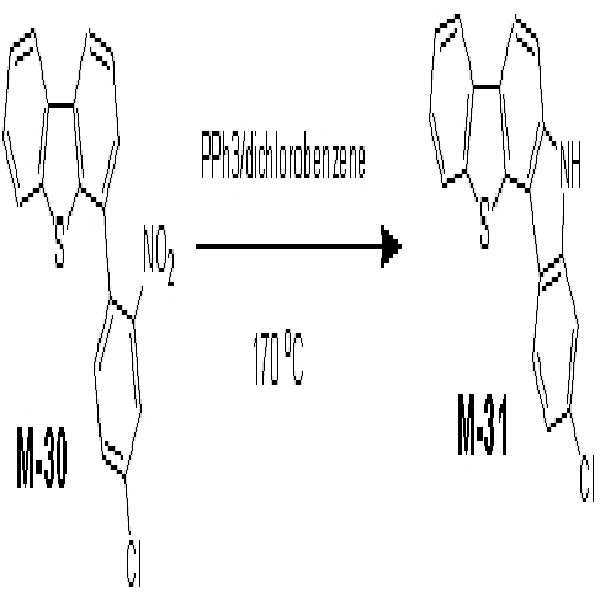
500 ㎖의 둥근 바닥 플라스크 질소 분위기에서 M-30 (20.0 g, 58.8 mmol), 트리페닐포스핀 (48.6 g, 185.3 mmol)을 디클로로벤젠에 녹인 후 160 ℃에서 24 시간 동안 교반시켰다. 반응이 끝나면 반응물을 실온으로 냉각시키고, 디클로로벤젠을 감압하에서 제거 하였다. 반응물을 메틸렌클로라이드/헥산(1:1) 혼합 용매로 실리카켈 칼럼을 통해 정제 하여 중간체 M-31 를 14 g (수율: 77.3%) 얻었다.M-30 (20.0 g, 58.8 mmol) and triphenylphosphine (48.6 g, 185.3 mmol) were dissolved in dichlorobenzene in a 500 ml round bottom flask under nitrogen atmosphere and stirred at 160 ° C for 24 hours. At the end of the reaction, the reaction was cooled to room temperature and the dichlorobenzene was removed under reduced pressure. The reaction product was purified through a silica gel column with a mixed solvent of methylene chloride / hexane (1: 1) to obtain 14 g (yield: 77.3%) of intermediate M-31.
중간체 M-32의 합성Synthesis of intermediate M-32
[반응식 32][Reaction Scheme 32]

250㎖ 둥근 바닥 플라스크에 질소 분위기 하에서 M-31 (14 g, 45.4 mmol), 브로모벤젠 (14.2 g, 90.9 mmol), 염화구리 (3.2g, 34.8 mmol), 포타슘하이드옥사이드 (30g, 535.7 mmol)을 자일렌 200㎖에 녹인 다음 150℃에서 48시간 동안 교반 시킨 다음 반응물을 상온으로 내리고 감압 하에서 자일렌을 제거 한다. 남은 고체를 메틸렌클로라이드에 녹인 다음 물로 여러번 세척 한 다음 무수 황산마그네슘으로 수분을 제거하고 이를 거른 후 용매를 제거한다. 용매를 제거한 다음 핵산/메틸렌클로라이드(1:2) 용매로 실리카겔 칼럼 정제 하여 목적 화합물 M-32을 13 g(74.6 %) 얻었다.(14 g, 45.4 mmol), bromobenzene (14.2 g, 90.9 mmol), copper chloride (3.2 g, 34.8 mmol) and potassium hydroxide (30 g, 535.7 mmol) in a 250 mL round bottom flask under nitrogen atmosphere. Is dissolved in 200 ml of xylene and stirred at 150 DEG C for 48 hours. Then, the reaction product is cooled to room temperature and xylene is removed under reduced pressure. The remaining solids are dissolved in methylene chloride and washed several times with water. The water is removed with anhydrous magnesium sulfate, and the solvent is removed by filtration. The solvent was removed and the residue was purified by silica gel column chromatography with a solvent of nucleic acid / methylene chloride (1: 2) to obtain 13 g (74.6%) of the target compound M-32.
중간체 M-33의 합성Synthesis of intermediate M-33
[반응식 33][Reaction Scheme 33]

1L의 둥근 바닥 플라스크 질소 분위기에서 물질 디벤조퓨란 보로닉에시드 (20.0 g, 94.3 mmol), 물질 2-브로모-5-클로로나이트로벤젠(24.5 g, 103.7 mmol), 및 테트라키스트리페닐포스핀팔라듐(3.28 g, 2.83 mmol)을 300 mL 톨루엔에 녹이고, 포타슘아세테이트 (26 g, 188.6 mmol), 물 100 ㎖을 넣은 다음 90 ℃에서 24 시간 동안 교반시켰다. 반응이 끝나면 반응물을 실온으로 냉각시키고, 톨루엔과 물로 추출한 후 반응물을 무수 황산마그네슘으로 수분을 제거하고 이를 거른 후 용매를 제거하였다. 상기 용매를 제거한 다음 메틸렌클로라이드/헥산(1:1) 혼합 용매로 실리카켈 칼럼을 통해 정제 하여 중간체 M-33을 21 g (수율: 68.7 %) 얻었다.(20.0 g, 94.3 mmol), substance 2-bromo-5-chloronitrobenzene (24.5 g, 103.7 mmol) and tetrakis triphenylphosphine Palladium (3.28 g, 2.83 mmol) was dissolved in 300 mL of toluene, potassium acetate (26 g, 188.6 mmol) and water (100 mL) were added, and the mixture was stirred at 90 DEG C for 24 hours. After the reaction was completed, the reaction mixture was cooled to room temperature, extracted with toluene and water, and then the reacted material was dehydrated with anhydrous magnesium sulfate, filtered and the solvent was removed. The solvent was removed, and the residue was purified through a silica gel column with a mixed solvent of methylene chloride / hexane (1: 1) to obtain 21 g (yield: 68.7%) of intermediate M-33.
중간체 M-34의 합성Synthesis of intermediate M-34
[반응식 34][Reaction Scheme 34]

500 ㎖의 둥근 바닥 플라스크 질소 분위기에서 M-33 (20.0 g, 61.7 mmol), 트리페닐포스핀 (48.6 g, 185.3 mmol)을 디클로로벤젠에 녹인 후 160 ℃에서 24 시간 동안 교반시켰다. 반응이 끝나면 반응물을 실온으로 냉각시키고, 디클로로벤젠을 감압하에서 제거 하였다. 반응물을 메틸렌클로라이드/헥산(1:1) 혼합 용매로 실리카켈 칼럼을 통해 정제 하여 중간체 M-34 를 14 g (수율: 77.7 %) 얻었다.M-33 (20.0 g, 61.7 mmol) and triphenylphosphine (48.6 g, 185.3 mmol) were dissolved in dichlorobenzene in a 500 ml round bottom flask under nitrogen atmosphere and stirred at 160 ° C for 24 hours. At the end of the reaction, the reaction was cooled to room temperature and the dichlorobenzene was removed under reduced pressure. The reaction product was purified through a silica gel column with a mixed solvent of methylene chloride / hexane (1: 1) to obtain 14 g (yield: 77.7%) of intermediate M-34.
중간체 M-35의 합성Synthesis of intermediate M-35
[반응식 35][Reaction Scheme 35]

250㎖ 둥근 바닥 플라스크에 질소 분위기 하에서 M-34 (14 g, 47.9 mmol), 브로모벤젠 (15 g, 95.9 mmol), 염화구리 (3.2g, 34.8 mmol), 포타슘하이드옥사이드 (30g, 535.7 mmol)을 자일렌 200㎖에 녹인 다음 150℃에서 48시간 동안 교반 시킨 다음 반응물을 상온으로 내리고 감압 하에서 자일렌을 제거 한다. 남은 고체를 메틸렌클로라이드에 녹인 다음 물로 여러번 세척 한 다음 무수 황산마그네슘으로 수분을 제거하고 이를 거른 후 용매를 제거한다. 용매를 제거한 다음 핵산/메틸렌클로라이드(1:2) 용매로 실리카겔 칼럼 정제 하여 목적 화합물 M-35을 14.5 g(82.3 %) 얻었다.(14 g, 47.9 mmol), bromobenzene (15 g, 95.9 mmol), copper chloride (3.2 g, 34.8 mmol) and potassium hydroxide (30 g, 535.7 mmol) in a 250 mL round bottom flask under nitrogen atmosphere. Is dissolved in 200 ml of xylene and stirred at 150 DEG C for 48 hours. Then, the reaction product is cooled to room temperature and xylene is removed under reduced pressure. The remaining solids are dissolved in methylene chloride and washed several times with water. The water is removed with anhydrous magnesium sulfate, and the solvent is removed by filtration. The solvent was removed and the residue was purified by silica gel column chromatography with a solvent of nucleic acid / methylene chloride (1: 2) to obtain 14.5 g (82.3%) of the desired compound M-35.
중간체 M-36의 합성Synthesis of intermediate M-36
[반응식 36][Reaction Scheme 36]
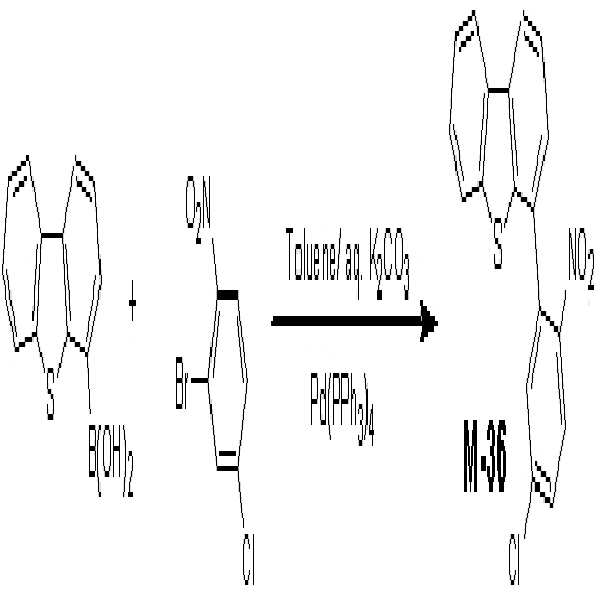
1L의 둥근 바닥 플라스크 질소 분위기에서 물질 디벤조티오펜 보로닉에시드 (20.0 g, 87.6 mmol), 물질 2-브로모-5-클로로나이트로벤젠(22.8 g, 96.4 mmol), 및 테트라키스트리페닐포스핀팔라듐(3 g, 2.63 mmol)을 300 mL 톨루엔에 녹이고, 포타슘아세테이트 (24.2 g, 175.3 mmol), 물 100 ㎖을 넣은 다음 90 ℃에서 24 시간 동안 교반시켰다. 반응이 끝나면 반응물을 실온으로 냉각시키고, 톨루엔과 물로 추출한 후 반응물을 무수 황산마그네슘으로 수분을 제거하고 이를 거른 후 용매를 제거하였다. 상기 용매를 제거한 다음 메틸렌클로라이드/헥산(1:1) 혼합 용매로 실리카켈 칼럼을 통해 정제 하여 중간체 M-36를 22 g (수율: 73.8 %) 얻었다.(20.0 g, 87.6 mmol), substance 2-bromo-5-chloronitrobenzene (22.8 g, 96.4 mmol) and tetrakis triphenylphosphine Fins palladium (3 g, 2.63 mmol) was dissolved in 300 mL toluene, potassium acetate (24.2 g, 175.3 mmol) and water (100 mL) were added and stirred at 90 ° C for 24 hours. After the reaction was completed, the reaction mixture was cooled to room temperature, extracted with toluene and water, and then the reacted material was dehydrated with anhydrous magnesium sulfate, filtered and the solvent was removed. The solvent was removed, and the residue was purified through a silica gel column with a mixed solvent of methylene chloride / hexane (1: 1) to obtain 22 g (yield: 73.8%) of intermediate M-36.
중간체 M-37의 합성Synthesis of intermediate M-37
[반응식 37][Reaction Scheme 37]

500 ㎖의 둥근 바닥 플라스크 질소 분위기에서 M-36 (20.0 g, 58.8 mmol), 트리페닐포스핀 (48.6 g, 185.3 mmol)을 디클로로벤젠에 녹인 후 160 ℃에서 24 시간 동안 교반시켰다. 반응이 끝나면 반응물을 실온으로 냉각시키고, 디클로로벤젠을 감압하에서 제거 하였다. 반응물을 메틸렌클로라이드/헥산(1:1) 혼합 용매로 실리카켈 칼럼을 통해 정제 하여 중간체 M-37 를 14.5 g (수율: 80.5%) 얻었다.M-36 (20.0 g, 58.8 mmol) and triphenylphosphine (48.6 g, 185.3 mmol) were dissolved in dichlorobenzene in a 500 ml round bottom flask under nitrogen atmosphere and stirred at 160 ° C for 24 hours. At the end of the reaction, the reaction was cooled to room temperature and the dichlorobenzene was removed under reduced pressure. The reaction product was purified through a silica gel column with a mixed solvent of methylene chloride / hexane (1: 1) to obtain 14.5 g of Intermediate M-37 (yield: 80.5%).
중간체 M-38의 합성Synthesis of intermediate M-38
[반응식 38][Reaction Scheme 38]

250㎖ 둥근 바닥 플라스크에 질소 분위기 하에서 M-37 (14 g, 45.4 mmol), 브로모벤젠 (14.2 g, 90.9 mmol), 염화구리 (3.2g, 34.8 mmol), 포타슘하이드옥사이드 (30g, 535.7 mmol)을 자일렌 200㎖에 녹인 다음 150℃에서 48시간 동안 교반 시킨 다음 반응물을 상온으로 내리고 감압 하에서 자일렌을 제거 한다. 남은 고체를 메틸렌클로라이드에 녹인 다음 물로 여러번 세척 한 다음 무수 황산마그네슘으로 수분을 제거하고 이를 거른 후 용매를 제거한다. 용매를 제거한 다음 핵산/메틸렌클로라이드(1:2) 용매로 실리카겔 칼럼 정제 하여 목적 화합물 M-38을 13.5 g(77.5 %) 얻었다.(14 g, 45.4 mmol), bromobenzene (14.2 g, 90.9 mmol), copper chloride (3.2 g, 34.8 mmol) and potassium hydroxide (30 g, 535.7 mmol) in a 250 mL round bottom flask under nitrogen atmosphere. Is dissolved in 200 ml of xylene and stirred at 150 DEG C for 48 hours. Then, the reaction product is cooled to room temperature and xylene is removed under reduced pressure. The remaining solids are dissolved in methylene chloride and washed several times with water. The water is removed with anhydrous magnesium sulfate, and the solvent is removed by filtration. The solvent was removed and the residue was purified by silica gel column chromatography with a solvent of nucleic acid / methylene chloride (1: 2) to obtain 13.5 g (77.5%) of the desired compound M-38.
중간체 M-39의 합성Synthesis of intermediate M-39
[반응식 39][Reaction Scheme 39]

메틸마그네슘브로마이드 대신 페닐마그네슘브로마이드를 사용 한 것을 제외하고는 중간체 M-2의 합성법과 동일한 방법에 의해서 목적 화합물 M-39를 합성 하였다.A target compound M-39 was synthesized in the same manner as in the synthesis of Intermediate M-2, except that phenylmagnesium bromide was used instead of methylmagnesium bromide.
중간체 M-40의 합성Synthesis of intermediate M-40
[반응식 40][Reaction Scheme 40]

중간체 M-3과 동일한 방법에 의해 목적 화합물 M-40를 20 g (82 %) 합성하였다.20 g (82%) of the desired compound M-40 was synthesized in the same manner as Intermediate M-3.
중간체 M-41의 합성Synthesis of intermediate M-41
[반응식 41][Reaction Scheme 41]

메틸마그네슘브로마이드 대신 페닐마그네슘브로마이드를 사용 한 것을 제외하고는 중간체 M-5의 합성법과 동일한 방법에 의해서 목적 화합물 M-41를 합성 하였다.A target compound M-41 was synthesized in the same manner as in the synthesis of Intermediate M-5 except that phenylmagnesium bromide was used instead of methylmagnesium bromide.
중간체 M-42의 합성Synthesis of intermediate M-42
[반응식 42][Reaction Scheme 42]

중간체 M-6과 동일한 방법에 의해 목적 화합물 M-42를 22 g (81 %) 합성하였다.
22 g (81%) of the desired compound M-42 was synthesized in the same manner as Intermediate M-6.
중간체 M-43의 합성Synthesis of intermediate M-43
[반응식 42][Reaction Scheme 42]

M-11 M-43 M-11 M-43
250㎖ 둥근 바닥 플라스크에 질소 분위기 하에서 M-11 (10 g, 25.3 mmol)과 I2 10 mg과 마그네슘 (3.0 g, 126.6 mmol)을 THF 50 mL에 넣은 후, 환류기 존재하에서 까지 온도를 올린다. 75 oC에서 약 1시간 정도 교반한 다음 온도를 다시 O oC까지 내린다. O oC에서 Trimethyl borate (2.9 g, 27.9 mmol)를 적가하였다.M-11 (10 g, 25.3 mmol), 10 mg of I 2 and magnesium (3.0 g, 126.6 mmol) were added to 50 mL of THF in a 250 mL round bottom flask under nitrogen atmosphere, and then the temperature was raised to the boiling point in the presence of a reflux condenser. After stirring at 75 ° C for about 1 hour, the temperature is lowered again to 0 ° C. Trimethyl borate (2.9 g, 27.9 mmol) was added dropwise at 0 ° C.
온도를 상온으로 올린 후 약 2시간 교반 한 다음, 반응물에 2N HCl을 적가하여 pH 테스트기를 이용하여 반응액이 산성을 띄는 것을 확인한 후 유기층만을 모아 감압 농축하였다. 이렇게 얻은 반응물을 소량의 메틸렌클로라이드에 녹인 후, 헥산 용매에서 침전을 시켰다. 침전물을 필터하여, 얻은 고체를 헥산/아세톤 조건에서 재결정하여 원하는 목적 화합물 M-43을 7.2g (70.3%) 얻었다.
After the temperature was raised to room temperature and stirred for about 2 hours, 2N HCl was added dropwise to the reaction mixture, and the reaction solution was confirmed to be acidic using a pH tester. Only the organic layer was collected and concentrated under reduced pressure. The reaction product thus obtained was dissolved in a small amount of methylene chloride, and precipitated in a hexane solvent. The precipitate was filtered, and the resulting solid was recrystallized under hexane / acetone to obtain 7.2 g (70.3%) of the desired compound M-43.
중간체 M-44 내지 M-54의 합성Synthesis of intermediates M-44 to M-54
상기 중간체 M-1 내지 M-43의 합성 방법을 이용하고, 출발물질을 하기 표 1과 같이 변경하여 중간체 M-44 내지 M-54를 제조하였다. M-51 내지 M-53의 경우, 디벤조퓨란 또는 디벤조티오펜 을 출발 물질로 하여 합성된 중간체 M-3, M-6, M-34 또는 M-37를 합성하는 방법을 동일하게 사용하여 합성하였다.
Intermediates M-44 to M-54 were prepared by using the synthesis method of Intermediates M-1 to M-43 and changing the starting materials as shown in Table 1 below. In the case of M-51 to M-53, a method of synthesizing intermediates M-3, M-6, M-34 or M-37 synthesized using dibenzofuran or dibenzothiophene as starting materials was used Were synthesized.
Boronic acidproduct
Boronic acid


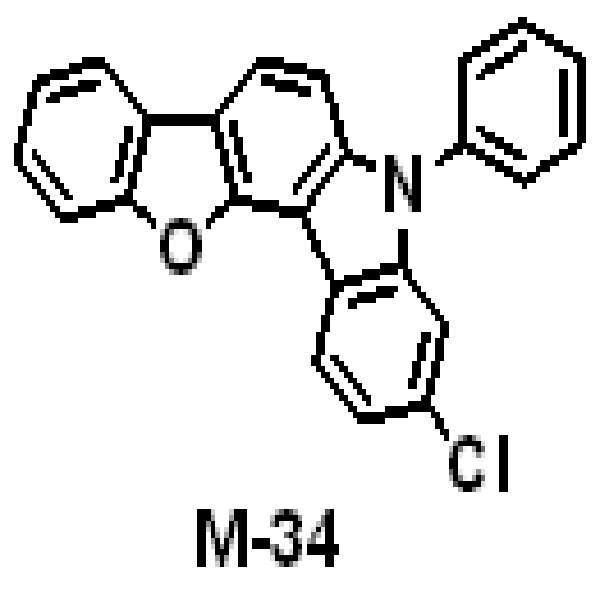


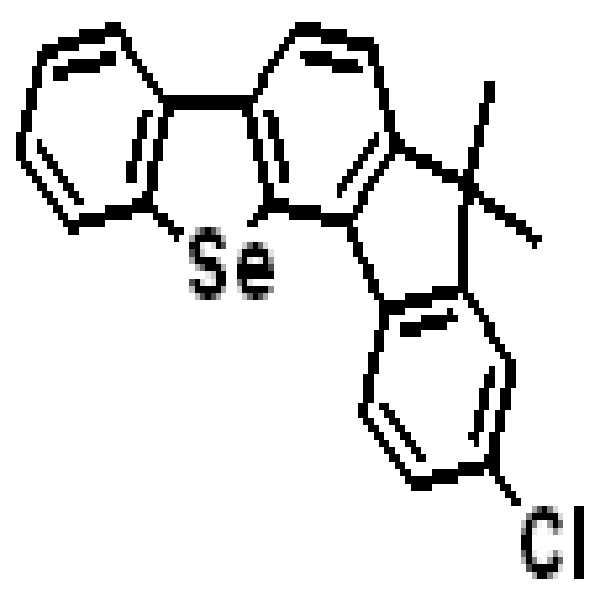
M-51
M-51

M-52
M-52

M-53
M-53
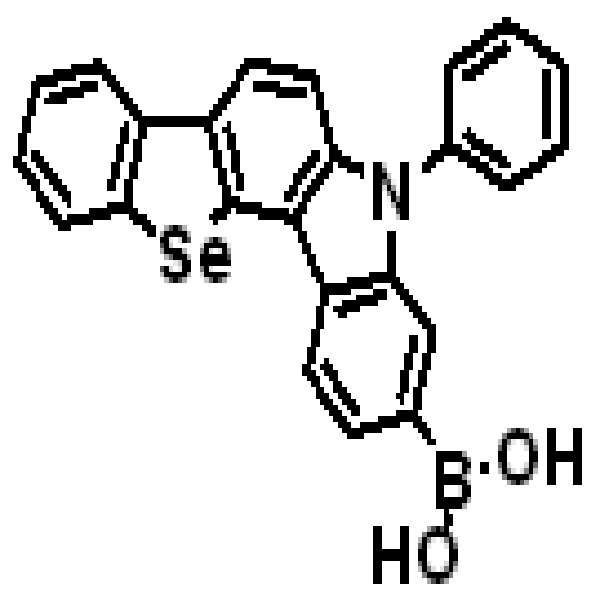
M-54
M-54
실시예Example 1: 화합물 1: Compound A-4 A-4 의 제조Manufacturing
[반응식 43][Reaction Scheme 43]

M-43 W-1 A-4M-43 W-1A-4
250㎖ 둥근 바닥 플라스크에 질소 분위기 하에서 boronic acid인 M-43 (6 g, 14.84 mmol)과 할로겐 화합물 W-1 (4.4 g, 14.84 mmol), Pd2(dba)3 (0.136 g, 1 mol%), KF, potassium fluoride (2.85 g, 48.98 mmol)을 THF 100 mL에 녹인 후, 환류기 존재하에서 P(tBu)3 (0.060 g, 2 mol%)넣은 후 75 oC로 온도를 올린다. 75 oC 에서 약 24시간 정도 교반한 다음, 감압 농축하였다. 남은 고체를 메틸렌클로라이드에 녹인 다음 물로 여러번 세척 한 다음 무수 황산마그네슘으로 수분을 제거하고 이를 거른 후 용매를 제거한다. 용매를 제거한 다음 핵산/메틸렌클로라이드(1:2) 용매로 실리카겔 칼럼 정제 하여 목적 화합물 7 g (88.7%, LC Mass M+H+ = 591.4)을 얻었다.
(4.4 g, 14.84 mmol) and Pd 2 (dba) 3 (0.136 g, 1 mol%) were added to a 250 mL round-bottomed flask under nitrogen atmosphere with a mixture of boronic acid M- , KF and potassium fluoride (2.85 g, 48.98 mmol) were dissolved in 100 mL of THF. P (tBu) 3 (0.060 g, 2 mol%) was added in the presence of a reflux condenser and the temperature was raised to 75 ° C. After stirring at 75 ° C for about 24 hours, the mixture was concentrated under reduced pressure. The remaining solids are dissolved in methylene chloride and washed several times with water. The water is removed with anhydrous magnesium sulfate, and the solvent is removed by filtration. The solvent was removed and the residue was purified by silica gel column chromatography with a solvent of nucleic acid / methylene chloride (1: 2) to obtain the desired compound (7 g, 88.7%, LC Mass M + H + = 591.4).
실시예Example 2 내지 26: 화합물들의 제조 2 to 26: Preparation of compounds
실시예 1의 출발 물질 M-43(하기 표 2의 출발물질 1에 대응)과 W-1(하기 표 2의 출발물질 2에 대응)을 대신 하기 표 2에 나와있는 두 출발물질 사용한 것을 제외하고는 모든 합성 과정을 동일하게 하여 화합물들을 제조하였다.
Except that the two starting materials listed in Table 2 were used instead of the starting material M-43 (corresponding to starting material 1 in Table 2 below) and W-1 (corresponding to starting material 2 in Table 2 below) ≪ / RTI > were prepared in the same manner for all the synthesis procedures.
LC-Mass (M+H+)yield(%)
LC-Mass (M + H & lt ; + & gt ; )
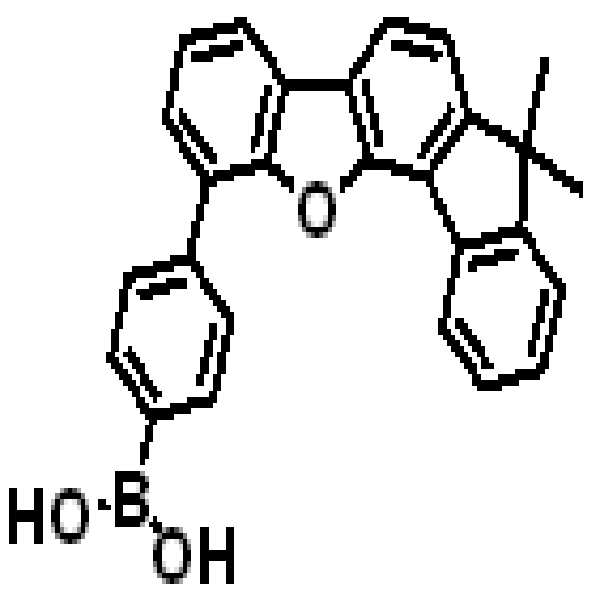

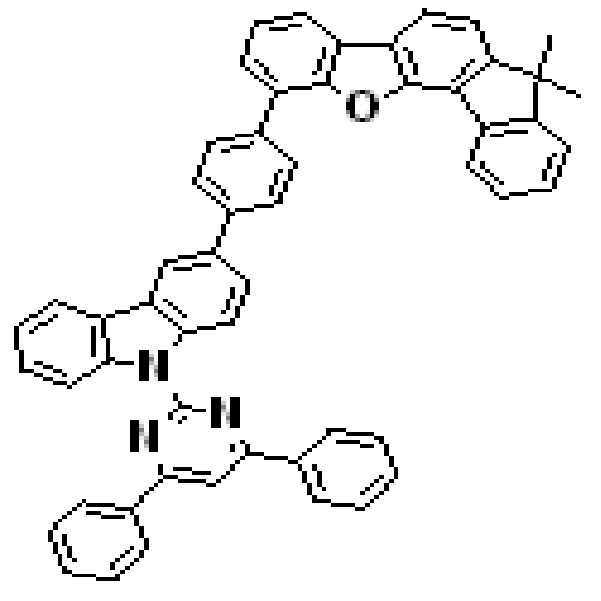
A-12
A-12
756.3178%
756.31
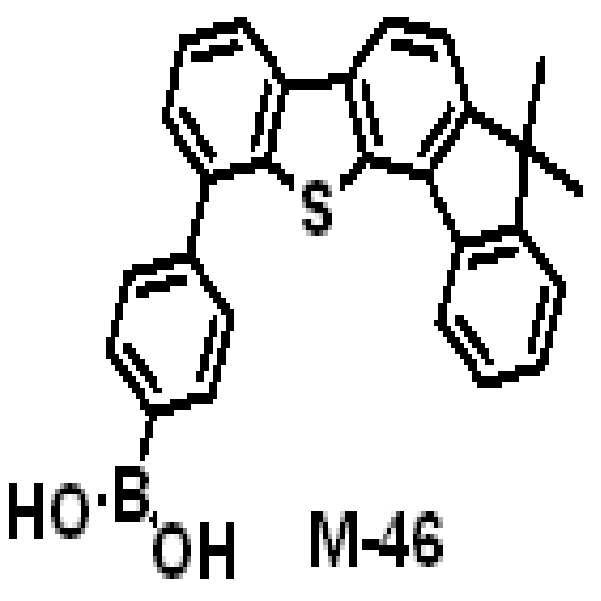

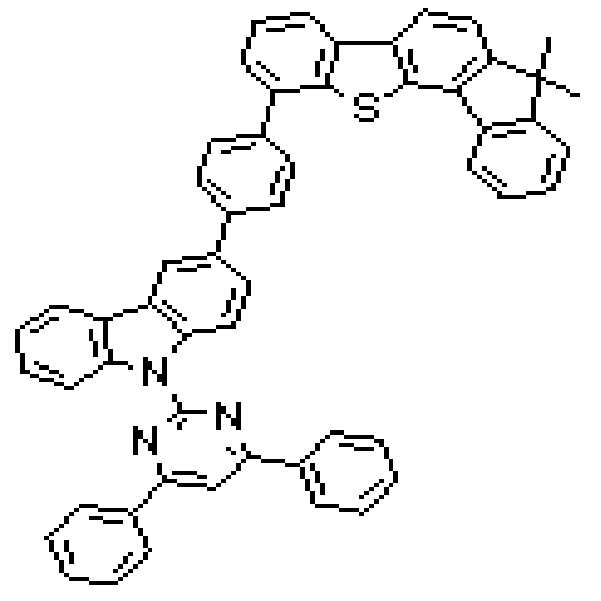
A-21
A-21
772.3080%
772.30


C-9
C-9
680.2775%
680.27


C-10
C-10
696.2568%
696.25
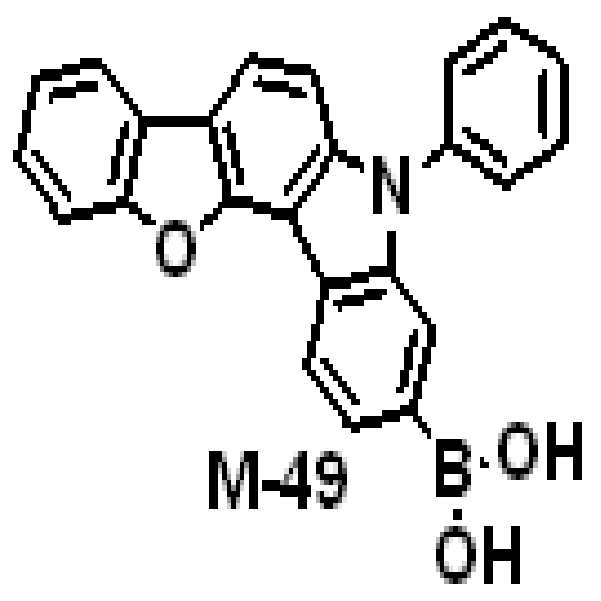


D-3
D-3
729.2766%
729.27


D-4
D-4
744.2478%
744.24

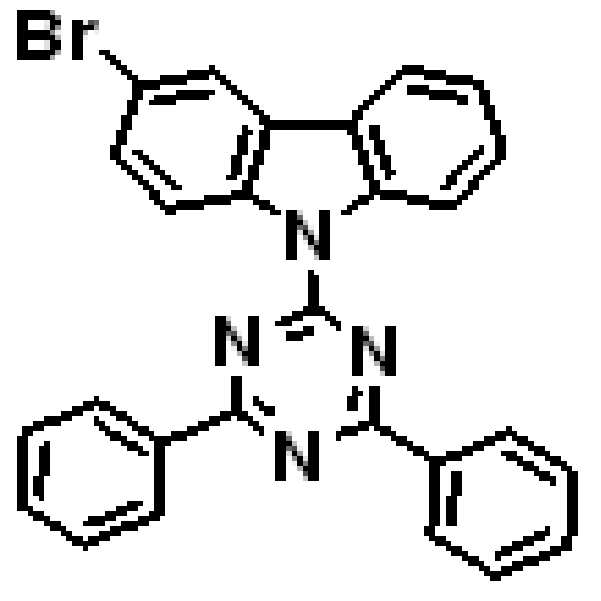
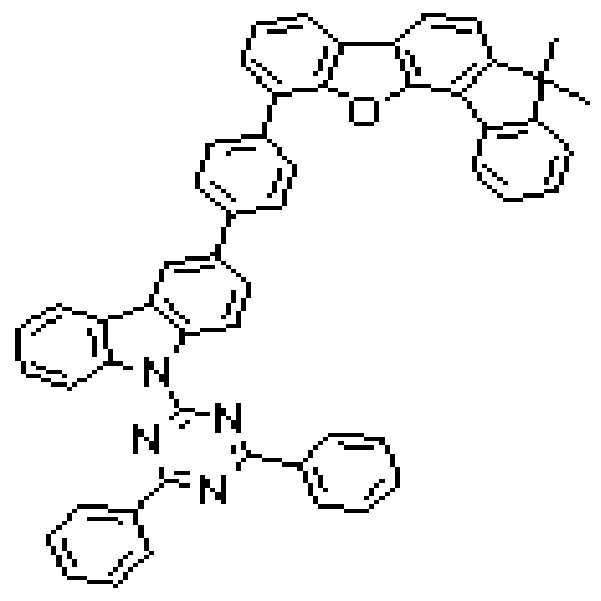
A-14
A-14
756.3080%
756.30


A-23
A-23
773.2882%
773.28
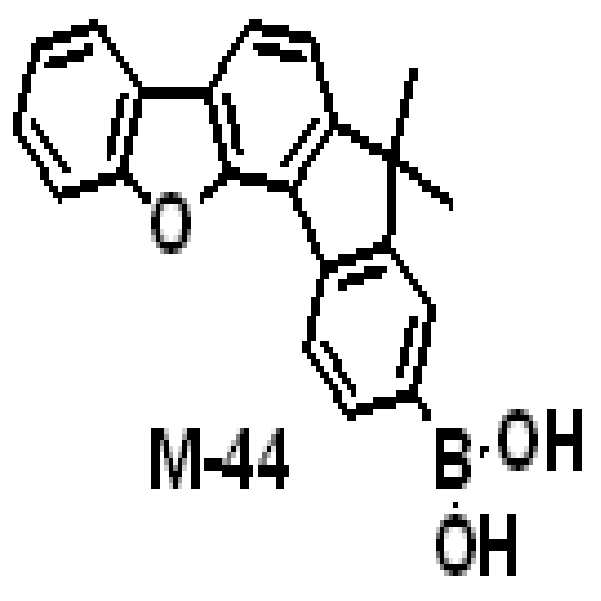

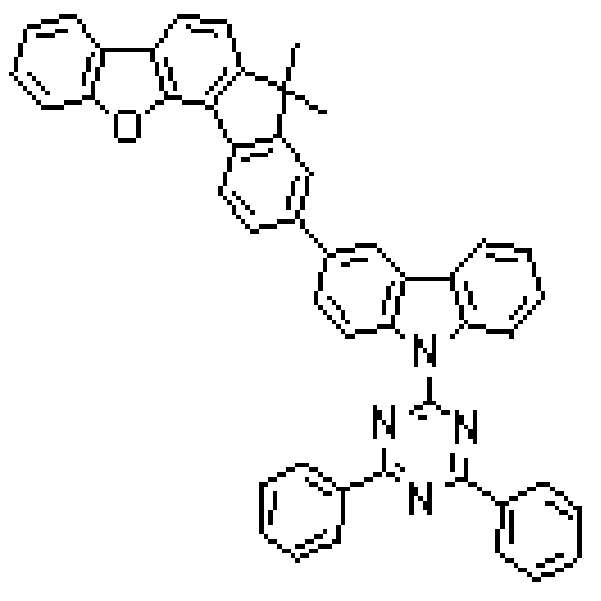
C-11
C-11
681.2780%
681.27


C-12
C-12
697.2475%
697.24


C-13
C-13
693.2756%
693.27

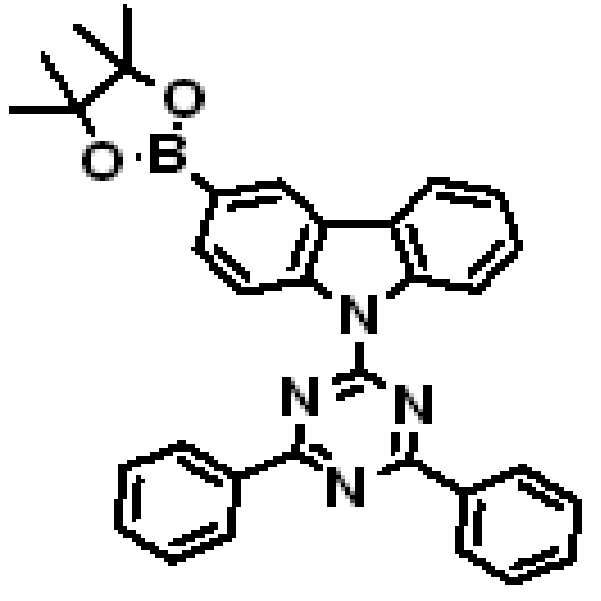

C-14
C-14
712.2460%
712.24
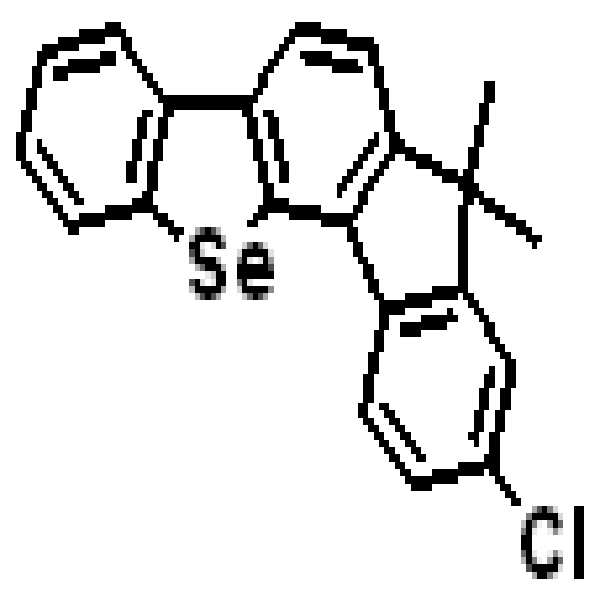


C-15
C-15
745.1967%
745.19


C-16
C-16
511.2191%
511.21


C-17
C-17
756.3185%
756.31


C-18
C-18
602.2578%
602.25


C-19
C-19
618.2372%
618.23


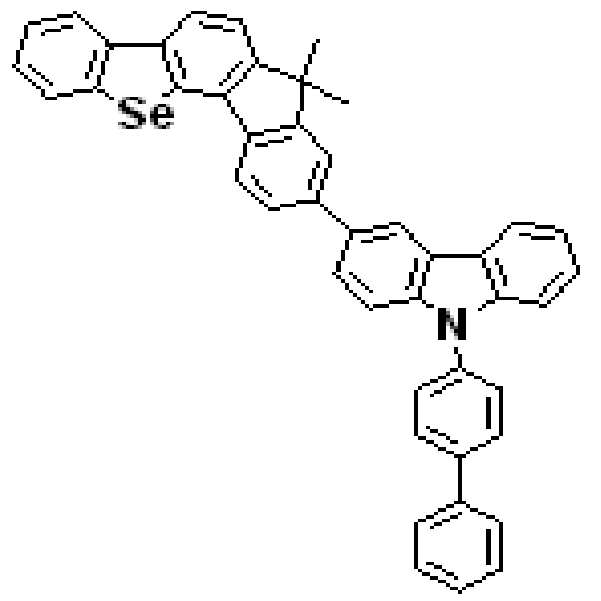
C-20
C-20
665.1670%
665.16


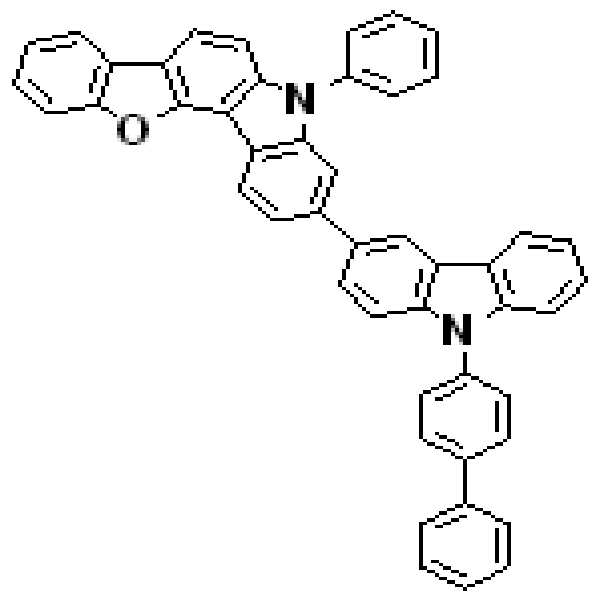
D-7
D-7
651.2575%
651.25


D-8
D-8
667.2277%
667.22


E-1
E-1
729.2780%
729.27


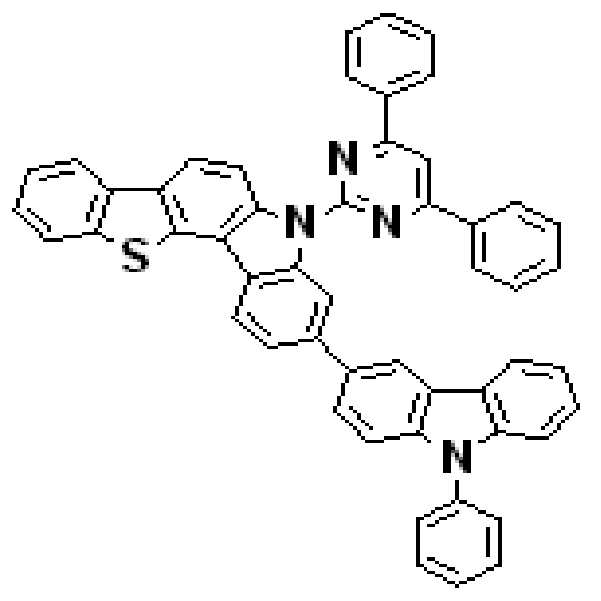
E-5
E-5
745.2475%
745.24


E-9
E-9
793.1982%
793.19


E-3
E-3
745.2477%
745.24


793.1980%
793.19
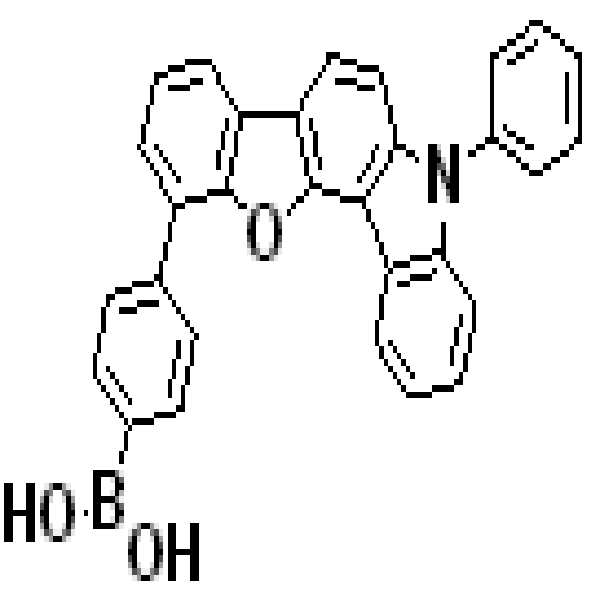

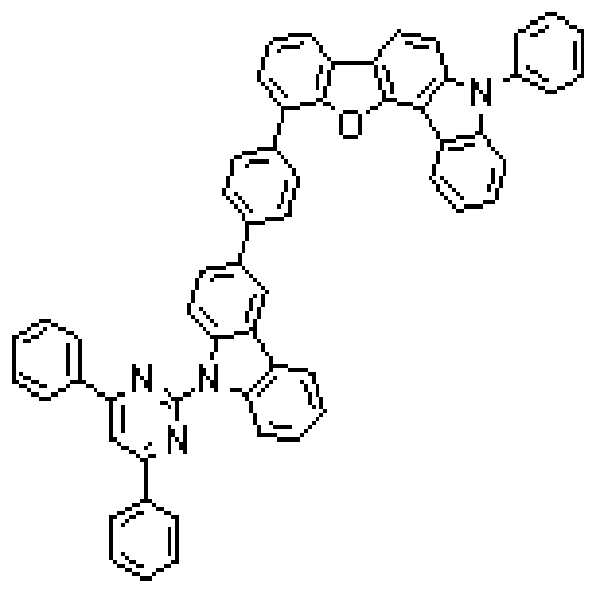
B-3
B-3
805.3087%
805.30
실시예Example 28 : 28: 유기광전소자의Of organic optoelectronic devices 제조 Produce
상기 실시예 2에서 합성된 화합물을 호스트로 사용하고, Ir(PPy)3를 도펀트로 사용하여 유기광전소자를 제작하였다. 양극으로는 ITO를 1000 Å의 두께로 사용하였고, 음극으로는 알루미늄(Al)을 1000 Å의 두께로 사용하였다.An organic photoelectric device was fabricated using the compound synthesized in Example 2 as a host and Ir (PPy) 3 as a dopant. As the anode, ITO was used in a thickness of 1000 Å, and as a cathode, aluminum (Al) was used in a thickness of 1000 Å.
구체적으로, 유기광전소자의 제조방법을 설명하면, 양극은 15 Ω/cm2의 면저항값을 가진 ITO 유리 기판을 50 mm × 50 mm × 0.7 mm의 크기로 잘라서 아세톤과 이소프로필알코올과 순수물 속에서 각 15 분 동안 초음파 세정한 후, 30 분 동안 UV 오존 세정하여 사용하였다.Specifically, a method of manufacturing the organic photoelectric device will be described. An ITO glass substrate having a sheet resistance of Ω / cm 2 was cut into a size of 50 mm × 50 mm × 0.7 mm, ultrasonically cleaned in acetone, isopropyl alcohol and pure water for 15 minutes, and then subjected to UV ozone cleaning Respectively.
상기 기판 상부에 진공도 650×10-7 Pa, 증착속도 0.1 내지 0.3 nm/s의 조건으로 N,N'-디(1-나프틸)-N,N'-디페닐벤지딘 (NPB) (70 nm) 및 4,4',4"-트리(N-카바졸일)트리페닐아민 (TCTA) (10 nm)를 증착하여 800 Å의 정공수송층을 형성하였다.N, N'-di (1-naphthyl) -N, N'-diphenylbenzidine (NPB) (70 nm) was deposited on the substrate at a vacuum degree of 650 × 10 -7 Pa and a deposition rate of 0.1 to 0.3 nm / ) And 4,4 ', 4 "-tri (N-carbazolyl) triphenylamine (TCTA) (10 nm) were deposited to form a 800 Å hole transport layer.
이어서, 동일한 진공 증착조건에서 상기 실시예 1에서 합성된 화합물을 이용하여 막 두께 300 Å의 발광층을 형성하였고, 이 때, 인광 도펀트인 Ir(PPy)3을 동시에 증착하였다. 이 때, 인광 도펀트의 증착속도를 조절하여, 발광층의 전체량을 100 중량%로 하였을 때, 인광 도펀트의 배합량이 7 중량%가 되도록 증착하였다.Subsequently, a light emitting layer having a thickness of 300 Å was formed using the compound synthesized in Example 1 under the same vacuum deposition condition. Ir (PPy) 3 , which is a phosphorescent dopant, was simultaneously deposited thereon. At this time, the deposition rate of the phosphorescent dopant was adjusted so that the phosphorescent dopant content was 7% by weight when the total amount of the light emitting layer was 100% by weight.
상기 발광층 상부에 동일한 진공 증착조건을 이용하여 비스(8-하이드록시-2-메틸퀴놀리나토)-알루미늄비페녹시드(BAlq)를 증착하여 막 두께 50 Å의 정공저지층을 형성하였다. Bis (8-hydroxy-2-methylquinolinato) -aluminum biphenoxide (BAlq) was deposited on the light emitting layer using the same vacuum deposition conditions to form a hole blocking layer having a thickness of 50 Å.
이어서, 동일한 진공 증착조건에서 Alq3를 증착하여, 막 두께 200 Å의 전자수송층을 형성하였다. Subsequently, Alq 3 was deposited under the same vacuum deposition conditions to form an electron transport layer having a thickness of 200 ANGSTROM.
상기 전자수송층 상부에 음극으로서 LiF와 Al을 순차적으로 증착하여 유기광전소자를 제작하였다.LiF and Al were sequentially deposited on the electron transport layer as cathodes to fabricate an organic photoelectric device.
상기 유기광전소자의 구조는 ITO/ NPB (70 nm)/ TCTA (10 nm)/ EML (실시예 1의 화합물(93 중량%) + Ir(PPy)3(7 중량%), 30 nm)/ Balq (5 nm)/ Alq3 (20 nm)/ LiF (1 nm) / Al (100 nm) 의 구조로 제작하였다.
The structure of the organic photoelectric device is ITO / NPB (70 nm) / TCTA (10 nm) / EML ( Example 1, compound (93 wt%) + Ir (PPy) 3 (7 wt%), 30 nm of a) / Balq (5 nm) / Alq 3 (20 nm) / LiF (1 nm) / Al (100 nm).
실시예Example 29 : 29: 유기광전소자의Of organic optoelectronic devices 제조 Produce
상기 실시예 27에서, 실시예 2 대신 실시예 3을 사용한 점을 제외하고는 동일한 방법으로 유기발광소자를 제조하였다.
An organic light emitting device was prepared in the same manner as in Example 27 except that Example 3 was used instead of Example 2. [
실시예Example 30 : 30: 유기광전소자의Of organic optoelectronic devices 제조 Produce
상기 실시예 27에서, 실시예 2 대신 실시예 4을 사용한 점을 제외하고는 동일한 방법으로 유기발광소자를 제조하였다.
An organic light emitting device was prepared in the same manner as in Example 27 except that Example 4 was used instead of Example 2. [
실시예Example 31 : 31: 유기광전소자의Of organic optoelectronic devices 제조 Produce
상기 실시예 27에서, 실시예 2 대신 실시예 5을 사용한 점을 제외하고는 동일한 방법으로 유기발광소자를 제조하였다.
An organic light emitting device was prepared in the same manner as in Example 27 except that Example 5 was used instead of Example 2. [
실시예Example 32 : 32: 유기광전소자의Of organic optoelectronic devices 제조 Produce
상기 실시예 27에서, 실시예 2 대신 실시예 6을 사용한 점을 제외하고는 동일한 방법으로 유기발광소자를 제조하였다.
An organic light emitting device was prepared in the same manner as in Example 27 except that Example 6 was used instead of Example 2. [
실시예Example 33 : 33: 유기광전소자의Of organic optoelectronic devices 제조 Produce
상기 실시예 27에서, 실시예 2 대신 실시예 7을 사용한 점을 제외하고는 동일한 방법으로 유기발광소자를 제조하였다.
An organic light emitting device was prepared in the same manner as in Example 27, except that Example 7 was used instead of Example 2.
실시예Example 34 : 34: 유기광전소자의Of organic optoelectronic devices 제조 Produce
상기 실시예 27에서, 실시예 2 대신 실시예 10을 사용한 점을 제외하고는 동일한 방법으로 유기발광소자를 제조하였다.
An organic light emitting device was prepared in the same manner as in Example 27 except that Example 10 was used instead of Example 2. [
실시예Example 35 : 35: 유기광전소자의Of organic optoelectronic devices 제조 Produce
상기 실시예 27에서, 실시예 2 대신 실시예 11을 사용한 점을 제외하고는 동일한 방법으로 유기발광소자를 제조하였다.
An organic light emitting device was prepared in the same manner as in Example 27 except that Example 11 was used instead of Example 2. [
실시예Example 36 : 36: 유기광전소자의Of organic optoelectronic devices 제조 Produce
상기 실시예 27에서, 실시예 2 대신 실시예 12을 사용한 점을 제외하고는 동일한 방법으로 유기발광소자를 제조하였다.
An organic light emitting device was prepared in the same manner as in Example 27 except that Example 12 was used instead of Example 2. [
실시예Example 37 : 37: 유기광전소자의Of organic optoelectronic devices 제조 Produce
상기 실시예 27에서, 실시예 2 대신 실시예 13을 사용한 점을 제외하고는 동일한 방법으로 유기발광소자를 제조하였다.
An organic light emitting device was prepared in the same manner as in Example 27 except that Example 13 was used instead of Example 2. [
실시예Example 38 : 38: 유기광전소자의Of organic optoelectronic devices 제조 Produce
상기 실시예 27에서, 실시예 2 대신 실시예 14을 사용한 점을 제외하고는 동일한 방법으로 유기발광소자를 제조하였다.
An organic light emitting device was prepared in the same manner as in Example 27 except that Example 14 was used instead of Example 2. [
실시예Example 39 : 39: 유기광전소자의Of organic optoelectronic devices 제조 Produce
상기 실시예 27에서, 실시예 2 대신 실시예 22을 사용한 점을 제외하고는 동일한 방법으로 유기발광소자를 제조하였다.
An organic light emitting device was prepared in the same manner as in Example 27, except that Example 22 was used in place of Example 2.
실시예Example 40 : 40: 유기광전소자의Of organic optoelectronic devices 제조 Produce
상기 실시예 27에서, 실시예 2 대신 실시예 27을 사용한 점을 제외하고는 동일한 방법으로 유기발광소자를 제조하였다.
An organic light emitting device was prepared in the same manner as in Example 27, except that Example 27 was used instead of Example 2.
비교예Comparative Example 1 : One : 유기광전소자의Of organic optoelectronic devices 제조 Produce
상기 실시예 2에서 합성된 화합물을 발광층의 호스트로 사용한 것을 대신하여, 4,4-N,N-다이카바졸바이페닐(CBP)를 발광층의 호스트로 사용한 것을 제외하고는 상기 실시예 27와 동일한 방법으로 유기광전소자를 제작하였다.
Was the same as that of Example 27 except that 4,4-N, N-dicarbazole biphenyl (CBP) was used as a host in the light emitting layer instead of using the compound synthesized in Example 2 as a host in the light emitting layer Organic photovoltaic devices were fabricated.
(유기발광소자의 성능 측정)(Performance Measurement of Organic Light Emitting Device)
상기 실시예 28 내지 40 및 비교예 1에서 제조된 각각의 유기발광소자에 대하여 전압에 따른 전류밀도 변화, 휘도변화 및 발광효율을 측정하였다. 구체적인 측정방법은 하기과 같고, 그 결과는 하기 표 3에 나타내었다
For each of the organic light-emitting devices fabricated in Examples 28 to 40 and Comparative Example 1, a change in current density, a change in luminance, and a luminous efficiency were measured according to a voltage. Specific measurement methods are as follows, and the results are shown in Table 3 below
(1) 전압변화에 따른 전류밀도의 변화 측정(1) Measurement of change in current density with voltage change
제조된 유기발광소자에 대해, 전압을 0 V 부터 10 V까지 상승시키면서 전류-전압계(Keithley 2400)를 이용하여 단위소자에 흐르는 전류값을 측정하고, 측정된 전류값을 면적으로 나누어 결과를 얻었다.
For the organic light emitting device manufactured, the current value flowing through the unit device was measured using a current-voltage meter (Keithley 2400) while raising the voltage from 0 V to 10 V, and the measured current value was divided by the area to obtain the result.
(2) 전압변화에 따른 휘도변화 측정(2) Measurement of luminance change according to voltage change
제조된 유기발광소자에 대해, 전압을 0 V 부터 10 V까지 상승시키면서 휘도계(Minolta Cs-1000A)를 이용하여 그 때의 휘도를 측정하여 결과를 얻었다.
For the organic light emitting device manufactured, the luminance was measured using a luminance meter (Minolta Cs-1000A) while increasing the voltage from 0 V to 10 V, and the result was obtained.
(3) 발광효율 측정(3) Measurement of luminous efficiency
상기(1) 및 (2)로부터 측정된 휘도와 전류밀도 및 전압을 이용하여 동일 전류밀도(10 mA/cm2)의 전류 효율(cd/A) 을 계산하였다.
The current efficiency (cd / A) at the same current density (10 mA / cm 2 ) was calculated using the luminance, current density and voltage measured from the above (1) and (2).
(A-12)The compound of Example 2
(A-12)
(A-21)The compound of Example 3
(A-21)
(C-9)The compound of Example 4
(C-9)
(C-10)The compound of Example 5
(C-10)
(D-3)The compound of Example 6
(D-3)
(D-4)The compound of Example 7
(D-4)
(C-11)The compound of Example 10
(C-11)
(C-12)The compound of Example 11
(C-12)
(C-13)The compound of Example 12
(C-13)
(C-14)The compound of Example 13
(C-14)
(C-15)The compound of Example 14
(C-15)
(E-1)The compound of Example 22
(E-1)
(B-3)The compound of Example 27
(B-3)
상기 표 1을 참조하면, 실시예 27 내지 38의 경우 기준 물질인 CBP 에 비해 구동전압 및 효율에서 더 우수하다는 것을 알 수 있다. 이는 실시예 2 내지 7, 10 내지 14 및 22에서 제조된 화합물이 양호한 유기광전소자용 재료로 사용될 수 있는 가능성을 보여준다.
Referring to Table 1, it can be seen that Examples 27 to 38 are superior in driving voltage and efficiency to CBP, which is a reference material. This shows the possibility that the compounds prepared in Examples 2 to 7, 10 to 14 and 22 can be used as a good organic optoelectronic device material.
본 발명은 상기 실시예들에 한정되는 것이 아니라 서로 다른 다양한 형태로 제조될 수 있으며, 본 발명이 속하는 기술분야에서 통상의 지식을 가진 자는 본 발명의 기술적 사상이나 필수적인 특징을 변경하지 않고서 다른 구체적인 형태로 실시될 수 있다는 것을 이해할 수 있을 것이다. 그러므로 이상에서 기술한 실시예들은 모든 면에서 예시적인 것이며 한정적이 아닌 것으로 이해해야만 한다.
It will be understood by those skilled in the art that various changes in form and details may be made therein without departing from the spirit and scope of the present invention as defined by the following claims. As will be understood by those skilled in the art. It is therefore to be understood that the above-described embodiments are illustrative in all aspects and not restrictive.
100 : 유기광전소자 110 : 음극
120 : 양극 105 : 유기박막층
130 : 발광층 140 : 정공 수송층
150 : 전자수송층 160 : 전자주입층
170 : 정공주입층 230 : 발광층 + 전자수송층100: organic photoelectric device 110: cathode
120: anode 105: organic thin film layer
130: luminescent layer 140: hole transport layer
150: electron transport layer 160: electron injection layer
170: Hole injection layer 230: Emission layer + Electron transport layer
Claims (21)
[화학식 5]

상기 화학식 5에서,
상기 X는 O, Se, S, SO2(O=S=O), PO(P=O) 또는 CO(C=O)이고,
상기 Y는 CR'R" 또는 NR*이고,
상기 a*, b*, R', R", R1, R2 및 R*는 서로 동일하거나 상이하며, 독립적으로 수소, 중수소, 할로겐기, 시아노기, 히드록실기, 아미노기, 치환 또는 비치환된 C1 내지 C20 아민기, 니트로기, 치환 또는 비치환된 C2 내지 C10 카르복실기, 치환 또는 비치환된 페로세닐기, 치환 또는 비치환된 C1 내지 C20 알킬기, 치환 또는 비치환된 C6 내지 C30 아릴기, 치환 또는 비치환된 C2 내지 C30 헤테로아릴기, 치환 또는 비치환된 C1 내지 C20 알콕시기, 치환 또는 비치환된 C6 내지 C20 아릴옥시기, 치환 또는 비치환된 C3 내지 C40 실릴옥시기, 치환 또는 비치환된 C1 내지 C20 아실기, 치환 또는 비치환된 C2 내지 C20 알콕시카르보닐기, 치환 또는 비치환된 C2 내지 C20 아실옥시기, 치환 또는 비치환된 C2 내지 C20의 아실아미노기, 치환 또는 비치환된 C2 내지 C20의 알콕시카르보닐아미노기, 치환 또는 비치환된 C7 내지 C20 아릴옥시카르보닐아미노기, 치환 또는 비치환된 C1 내지 C20 술파모일아미노기, 치환 또는 비치환된 C1 내지 C20 술포닐기, 치환 또는 비치환된 C1 내지 C20의 알킬티올기, 치환 또는 비치환된 C6 내지 C20 아릴티올기, 치환 또는 비치환된 C1 내지 C20 헤테로시클로티올기, 치환 또는 비치환된 C1 내지 C20의 우레이드기, 치환 또는 비치환된 C3 내지 C40 실릴기 또는 이들의 조합이고,
상기 a*, b* 또는 R* 중 적어도 어느 하나는 하기 화학식 4로 표시되는 치환기이고,
[화학식 4]

상기 화학식 4에서,
상기 ETU는 치환 또는 비치환된 이미다졸릴기, 치환 또는 비치환된 트리아졸릴기, 치환 또는 비치환된 테트라졸릴기, 치환 또는 비치환된 옥사다이아졸릴기, 치환 또는 비치환된 옥사트리아졸릴기, 치환 또는 비치환된 싸이아트리아졸릴기, 치환 또는 비치환된 벤즈이미다졸릴기, 치환 또는 비치환된 벤조트리아졸릴기, 치환 또는 비치환된 피리디닐기, 치환 또는 비치환된 피리미디닐기, 치환 또는 비치환된 트리아지닐기, 치환 또는 비치환된 피라지닐기, 치환 또는 비치환된 피리다지닐기, 치환 또는 비치환된 퓨리닐기, 치환 또는 비치환된 퀴놀리닐기, 치환 또는 비치환된 이소퀴놀리닐기, 치환 또는 비치환된 프탈라지닐기, 치환 또는 비치환된 나프피리디닐기, 치환 또는 비치환된 퀴녹살리닐기, 치환 또는 비치환된 퀴나졸리닐기, 치환 또는 비치환된 아크리디닐기, 치환 또는 비치환된 페난트롤리닐기, 치환 또는 비치환된 페나지닐기 또는 이들의 조합이고,
상기 L은 단일결합, 치환 또는 비치환된 C2 내지 C6 알케닐렌기, 치환 또는 비치환된 C2 내지 C6 알키닐렌기, 치환 또는 비치환된 C6 내지 C30 아릴렌기, 치환 또는 비치환된 헤테로아릴렌기 또는 이들의 조합이고,
상기 n은 0 내지 2 중 어느 하나의 정수이다.
A compound for an organic photoelectric device represented by the following Formula 5:
[Chemical Formula 5]
In Formula 5,
Wherein X is O, Se, S, SO2 (O = S = O), PO (P = O)
Y is CR ' R "or NR *
Wherein the a *, b *, R ', R ", R 1 , R 2 and R * are the same or different and independently represent hydrogen, deuterium, a halogen group, a cyano group, a hydroxyl group, A substituted or unsubstituted C1 to C20 amine group, a nitro group, a substituted or unsubstituted C2 to C10 carboxyl group, a substituted or unsubstituted ferrocenyl group, a substituted or unsubstituted C1 to C20 alkyl group, a substituted or unsubstituted C6 to C30 aryl group, A substituted or unsubstituted C2 to C30 heteroaryl group, a substituted or unsubstituted C1 to C20 alkoxy group, a substituted or unsubstituted C6 to C20 aryloxy group, a substituted or unsubstituted C3 to C40 silyloxy group, A substituted or unsubstituted C2 to C20 alkoxycarbonyl group, a substituted or unsubstituted C2 to C20 acyloxy group, a substituted or unsubstituted C2 to C20 acylamino group, a substituted or unsubstituted C2 to C20 acyloxy group, C20 alkoxycarbonylamino group, A substituted or unsubstituted C7 to C20 aryloxycarbonylamino group, a substituted or unsubstituted C1 to C20 sulfamoylamino group, a substituted or unsubstituted C1 to C20 sulfonyl group, a substituted or unsubstituted C1 to C20 alkylthiol group, A substituted or unsubstituted C1 to C20 arylthiol group, a substituted or unsubstituted C1 to C20 heterocyclothiol group, a substituted or unsubstituted C1 to C20 ureide group, a substituted or unsubstituted C3 to C40 silyl group, Lt; / RTI >
At least one of a *, b * and R * is a substituent represented by the following formula (4)
[Chemical Formula 4]
In Formula 4,
The ETU may be a substituted or unsubstituted imidazolyl group, a substituted or unsubstituted triazolyl group, a substituted or unsubstituted tetrazolyl group, a substituted or unsubstituted oxadiazolyl group, a substituted or unsubstituted oxatriazolyl group , A substituted or unsubstituted thiadiazolyl group, a substituted or unsubstituted benzimidazolyl group, a substituted or unsubstituted benzotriazolyl group, a substituted or unsubstituted pyridinyl group, a substituted or unsubstituted pyrimidinyl group , A substituted or unsubstituted thiazinyl group, a substituted or unsubstituted pyrazinyl group, a substituted or unsubstituted pyridazinyl group, a substituted or unsubstituted furyl group, a substituted or unsubstituted quinolinyl group, A substituted or unsubstituted quinazolinyl group, a substituted or unsubstituted quinazolinyl group, a substituted or unsubstituted quinazolinyl group, a substituted or unsubstituted quinazolinyl group, a substituted or unsubstituted quinazolinyl group, a substituted or unsubstituted quinazolinyl group, The arc-piperidinyl group, a substituted or unsubstituted phenanthryl trolley group, a substituted or unsubstituted phenacyl group possess, or a combination thereof,
Wherein L is a single bond, a substituted or unsubstituted C2 to C6 alkenylene group, a substituted or unsubstituted C2 to C6 alkynylene group, a substituted or unsubstituted C6 to C30 arylene group, a substituted or unsubstituted heteroarylene group, A combination thereof,
And n is an integer of 0 to 2.
상기 유기광전소자용 화합물은 하기 화학식 6으로 표시되는 것인 유기광전소자용 화합물:
[화학식 6]

상기 화학식 6에서,
상기 X는 O, Se, S, SO2(O=S=O), PO(P=O) 또는 CO(C=O)이고,
상기 Y는 CR'R" 또는 NR*이고,
상기 R', R", R1, R2 및 R*는 서로 동일하거나 상이하며, 독립적으로 수소, 중수소, 할로겐기, 시아노기, 히드록실기, 아미노기, 치환 또는 비치환된 C1 내지 C20 아민기, 니트로기, 치환 또는 비치환된 C2 내지 C10 카르복실기, 치환 또는 비치환된 페로세닐기, 치환 또는 비치환된 C1 내지 C20 알킬기, 치환 또는 비치환된 C6 내지 C30 아릴기, 치환 또는 비치환된 C2 내지 C30 헤테로아릴기, 치환 또는 비치환된 C1 내지 C20 알콕시기, 치환 또는 비치환된 C6 내지 C20 아릴옥시기, 치환 또는 비치환된 C3 내지 C40 실릴옥시기, 치환 또는 비치환된 C1 내지 C20 아실기, 치환 또는 비치환된 C2 내지 C20 알콕시카르보닐기, 치환 또는 비치환된 C2 내지 C20 아실옥시기, 치환 또는 비치환된 C2 내지 C20의 아실아미노기, 치환 또는 비치환된 C2 내지 C20의 알콕시카르보닐아미노기, 치환 또는 비치환된 C7 내지 C20 아릴옥시카르보닐아미노기, 치환 또는 비치환된 C1 내지 C20 술파모일아미노기, 치환 또는 비치환된 C1 내지 C20 술포닐기, 치환 또는 비치환된 C1 내지 C20의 알킬티올기, 치환 또는 비치환된 C6 내지 C20 아릴티올기, 치환 또는 비치환된 C1 내지 C20 헤테로시클로티올기, 치환 또는 비치환된 C1 내지 C20의 우레이드기, 치환 또는 비치환된 C3 내지 C40 실릴기 또는 이들의 조합이고,
상기 ETU는 치환 또는 비치환된 이미다졸릴기, 치환 또는 비치환된 트리아졸릴기, 치환 또는 비치환된 테트라졸릴기, 치환 또는 비치환된 옥사다이아졸릴기, 치환 또는 비치환된 옥사트리아졸릴기, 치환 또는 비치환된 싸이아트리아졸릴기, 치환 또는 비치환된 벤즈이미다졸릴기, 치환 또는 비치환된 벤조트리아졸릴기, 치환 또는 비치환된 피리디닐기, 치환 또는 비치환된 피리미디닐기, 치환 또는 비치환된 트리아지닐기, 치환 또는 비치환된 피라지닐기, 치환 또는 비치환된 피리다지닐기, 치환 또는 비치환된 퓨리닐기, 치환 또는 비치환된 퀴놀리닐기, 치환 또는 비치환된 이소퀴놀리닐기, 치환 또는 비치환된 프탈라지닐기, 치환 또는 비치환된 나프피리디닐기, 치환 또는 비치환된 퀴녹살리닐기, 치환 또는 비치환된 퀴나졸리닐기, 치환 또는 비치환된 아크리디닐기, 치환 또는 비치환된 페난트롤리닐기, 치환 또는 비치환된 페나지닐기 또는 이들의 조합이고,
상기 L은 단일결합, 치환 또는 비치환된 C2 내지 C6 알케닐렌기, 치환 또는 비치환된 C2 내지 C6 알키닐렌기, 치환 또는 비치환된 C6 내지 C30 아릴렌기, 치환 또는 비치환된 헤테로아릴렌기 또는 이들의 조합이고,
상기 n은 0 내지 2 중 어느 하나의 정수이다.
3. The method of claim 2,
Wherein the compound for an organic photoelectric device is represented by the following Formula 6:
[Chemical Formula 6]
In Formula 6,
Wherein X is O, Se, S, SO2 (O = S = O), PO (P = O)
Y is CR ' R "or NR *
Wherein R ', R ", R 1 , R 2 and R * are the same or different and independently represent hydrogen, deuterium, a halogen group, a cyano group, a hydroxyl group, an amino group, a substituted or unsubstituted C1 to C20 amine group , A nitro group, a substituted or unsubstituted C2 to C10 carboxyl group, a substituted or unsubstituted ferrocenyl group, a substituted or unsubstituted C1 to C20 alkyl group, a substituted or unsubstituted C6 to C30 aryl group, a substituted or unsubstituted C2 A substituted or unsubstituted C1 to C20 alkoxy group, a substituted or unsubstituted C6 to C20 aryloxy group, a substituted or unsubstituted C3 to C40 silyloxy group, a substituted or unsubstituted C1 to C20 acyl group, A substituted or unsubstituted C2 to C20 alkoxycarbonyl group, a substituted or unsubstituted C2 to C20 acyloxy group, a substituted or unsubstituted C2 to C20 acylamino group, a substituted or unsubstituted C2 to C20 alkoxycarbonylamino group , Substitution A substituted or unsubstituted C 1 to C 20 aryloxycarbonylamino group, a substituted or unsubstituted C 1 to C 20 sulfamoylamino group, a substituted or unsubstituted C 1 to C 20 sulfonyl group, a substituted or unsubstituted C 1 to C 20 alkylthiol group, a substituted Or a substituted or unsubstituted C1 to C20 arylthiol group, a substituted or unsubstituted C1 to C20 heterocyclothiol group, a substituted or unsubstituted C1 to C20 ureide group, a substituted or unsubstituted C3 to C40 silyl group, Lt; / RTI &
The ETU may be a substituted or unsubstituted imidazolyl group, a substituted or unsubstituted triazolyl group, a substituted or unsubstituted tetrazolyl group, a substituted or unsubstituted oxadiazolyl group, a substituted or unsubstituted oxatriazolyl group , A substituted or unsubstituted thiadiazolyl group, a substituted or unsubstituted benzimidazolyl group, a substituted or unsubstituted benzotriazolyl group, a substituted or unsubstituted pyridinyl group, a substituted or unsubstituted pyrimidinyl group , A substituted or unsubstituted thiazinyl group, a substituted or unsubstituted pyrazinyl group, a substituted or unsubstituted pyridazinyl group, a substituted or unsubstituted furyl group, a substituted or unsubstituted quinolinyl group, A substituted or unsubstituted quinazolinyl group, a substituted or unsubstituted quinazolinyl group, a substituted or unsubstituted quinazolinyl group, a substituted or unsubstituted quinazolinyl group, a substituted or unsubstituted quinazolinyl group, a substituted or unsubstituted quinazolinyl group, The arc-piperidinyl group, a substituted or unsubstituted phenanthryl trolley group, a substituted or unsubstituted phenacyl group possess, or a combination thereof,
Wherein L is a single bond, a substituted or unsubstituted C2 to C6 alkenylene group, a substituted or unsubstituted C2 to C6 alkynylene group, a substituted or unsubstituted C6 to C30 arylene group, a substituted or unsubstituted heteroarylene group, A combination thereof,
And n is an integer of 0 to 2.
상기 유기광전소자용 화합물은 하기 화학식 7로 표시되는 것인 유기광전소자용 화합물:
[화학식 7]
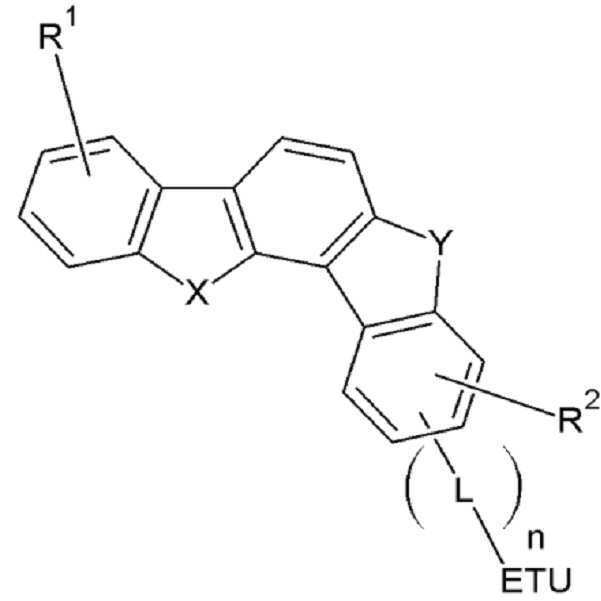
상기 화학식 7에서,
상기 X는 O, Se, S, SO2(O=S=O), PO(P=O) 또는 CO(C=O)이고,
상기 Y는 CR'R" 또는 NR*이고,
상기 R', R", R1, R2 및 R*는 서로 동일하거나 상이하며, 독립적으로 수소, 중수소, 할로겐기, 시아노기, 히드록실기, 아미노기, 치환 또는 비치환된 C1 내지 C20 아민기, 니트로기, 치환 또는 비치환된 C2 내지 C10 카르복실기, 치환 또는 비치환된 페로세닐기, 치환 또는 비치환된 C1 내지 C20 알킬기, 치환 또는 비치환된 C6 내지 C30 아릴기, 치환 또는 비치환된 C2 내지 C30 헤테로아릴기, 치환 또는 비치환된 C1 내지 C20 알콕시기, 치환 또는 비치환된 C6 내지 C20 아릴옥시기, 치환 또는 비치환된 C3 내지 C40 실릴옥시기, 치환 또는 비치환된 C1 내지 C20 아실기, 치환 또는 비치환된 C2 내지 C20 알콕시카르보닐기, 치환 또는 비치환된 C2 내지 C20 아실옥시기, 치환 또는 비치환된 C2 내지 C20의 아실아미노기, 치환 또는 비치환된 C2 내지 C20의 알콕시카르보닐아미노기, 치환 또는 비치환된 C7 내지 C20 아릴옥시카르보닐아미노기, 치환 또는 비치환된 C1 내지 C20 술파모일아미노기, 치환 또는 비치환된 C1 내지 C20 술포닐기, 치환 또는 비치환된 C1 내지 C20의 알킬티올기, 치환 또는 비치환된 C6 내지 C20 아릴티올기, 치환 또는 비치환된 C1 내지 C20 헤테로시클로티올기, 치환 또는 비치환된 C1 내지 C20의 우레이드기, 치환 또는 비치환된 C3 내지 C40 실릴기 또는 이들의 조합이고,
상기 ETU는 치환 또는 비치환된 이미다졸릴기, 치환 또는 비치환된 트리아졸릴기, 치환 또는 비치환된 테트라졸릴기, 치환 또는 비치환된 옥사다이아졸릴기, 치환 또는 비치환된 옥사트리아졸릴기, 치환 또는 비치환된 싸이아트리아졸릴기, 치환 또는 비치환된 벤즈이미다졸릴기, 치환 또는 비치환된 벤조트리아졸릴기, 치환 또는 비치환된 피리디닐기, 치환 또는 비치환된 피리미디닐기, 치환 또는 비치환된 트리아지닐기, 치환 또는 비치환된 피라지닐기, 치환 또는 비치환된 피리다지닐기, 치환 또는 비치환된 퓨리닐기, 치환 또는 비치환된 퀴놀리닐기, 치환 또는 비치환된 이소퀴놀리닐기, 치환 또는 비치환된 프탈라지닐기, 치환 또는 비치환된 나프피리디닐기, 치환 또는 비치환된 퀴녹살리닐기, 치환 또는 비치환된 퀴나졸리닐기, 치환 또는 비치환된 아크리디닐기, 치환 또는 비치환된 페난트롤리닐기, 치환 또는 비치환된 페나지닐기 또는 이들의 조합이고,
상기 L은 단일결합, 치환 또는 비치환된 C2 내지 C6 알케닐렌기, 치환 또는 비치환된 C2 내지 C6 알키닐렌기, 치환 또는 비치환된 C6 내지 C30 아릴렌기, 치환 또는 비치환된 헤테로아릴렌기 또는 이들의 조합이고,
상기 n은 0 내지 2 중 어느 하나의 정수이다.
3. The method of claim 2,
Wherein the compound for an organic photoelectric device is represented by the following formula (7): < EMI ID =
(7)
In Formula 7,
Wherein X is O, Se, S, SO2 (O = S = O), PO (P = O)
Y is CR ' R "or NR *
Wherein R ', R ", R 1 , R 2 and R * are the same or different and independently represent hydrogen, deuterium, a halogen group, a cyano group, a hydroxyl group, an amino group, a substituted or unsubstituted C1 to C20 amine group , A nitro group, a substituted or unsubstituted C2 to C10 carboxyl group, a substituted or unsubstituted ferrocenyl group, a substituted or unsubstituted C1 to C20 alkyl group, a substituted or unsubstituted C6 to C30 aryl group, a substituted or unsubstituted C2 A substituted or unsubstituted C1 to C20 alkoxy group, a substituted or unsubstituted C6 to C20 aryloxy group, a substituted or unsubstituted C3 to C40 silyloxy group, a substituted or unsubstituted C1 to C20 acyl group, A substituted or unsubstituted C2 to C20 alkoxycarbonyl group, a substituted or unsubstituted C2 to C20 acyloxy group, a substituted or unsubstituted C2 to C20 acylamino group, a substituted or unsubstituted C2 to C20 alkoxycarbonylamino group , Substitution A substituted or unsubstituted C 1 to C 20 aryloxycarbonylamino group, a substituted or unsubstituted C 1 to C 20 sulfamoylamino group, a substituted or unsubstituted C 1 to C 20 sulfonyl group, a substituted or unsubstituted C 1 to C 20 alkylthiol group, a substituted Or a substituted or unsubstituted C1 to C20 arylthiol group, a substituted or unsubstituted C1 to C20 heterocyclothiol group, a substituted or unsubstituted C1 to C20 ureide group, a substituted or unsubstituted C3 to C40 silyl group, Lt; / RTI &
The ETU may be a substituted or unsubstituted imidazolyl group, a substituted or unsubstituted triazolyl group, a substituted or unsubstituted tetrazolyl group, a substituted or unsubstituted oxadiazolyl group, a substituted or unsubstituted oxatriazolyl group , A substituted or unsubstituted thiadiazolyl group, a substituted or unsubstituted benzimidazolyl group, a substituted or unsubstituted benzotriazolyl group, a substituted or unsubstituted pyridinyl group, a substituted or unsubstituted pyrimidinyl group , A substituted or unsubstituted thiazinyl group, a substituted or unsubstituted pyrazinyl group, a substituted or unsubstituted pyridazinyl group, a substituted or unsubstituted furyl group, a substituted or unsubstituted quinolinyl group, A substituted or unsubstituted quinazolinyl group, a substituted or unsubstituted quinazolinyl group, a substituted or unsubstituted quinazolinyl group, a substituted or unsubstituted quinazolinyl group, a substituted or unsubstituted quinazolinyl group, a substituted or unsubstituted quinazolinyl group, The arc-piperidinyl group, a substituted or unsubstituted phenanthryl trolley group, a substituted or unsubstituted phenacyl group possess, or a combination thereof,
Wherein L is a single bond, a substituted or unsubstituted C2 to C6 alkenylene group, a substituted or unsubstituted C2 to C6 alkynylene group, a substituted or unsubstituted C6 to C30 arylene group, a substituted or unsubstituted heteroarylene group, A combination thereof,
And n is an integer of 0 to 2.
상기 유기광전소자용 화합물은 하기 화학식 8로 표시되는 것인 유기광전소자용 화합물:
[화학식 8]

상기 화학식 8에서,
상기 X는 O, Se, S, SO2(O=S=O), PO(P=O) 또는 CO(C=O)이고,
상기 Y는 CR'R" 또는 NR*이고,
상기 R', R", R1, R2 및 R*는 서로 동일하거나 상이하며, 독립적으로 수소, 중수소, 할로겐기, 시아노기, 히드록실기, 아미노기, 치환 또는 비치환된 C1 내지 C20 아민기, 니트로기, 치환 또는 비치환된 C2 내지 C10 카르복실기, 치환 또는 비치환된 페로세닐기, 치환 또는 비치환된 C1 내지 C20 알킬기, 치환 또는 비치환된 C6 내지 C30 아릴기, 치환 또는 비치환된 C2 내지 C30 헤테로아릴기, 치환 또는 비치환된 C1 내지 C20 알콕시기, 치환 또는 비치환된 C6 내지 C20 아릴옥시기, 치환 또는 비치환된 C3 내지 C40 실릴옥시기, 치환 또는 비치환된 C1 내지 C20 아실기, 치환 또는 비치환된 C2 내지 C20 알콕시카르보닐기, 치환 또는 비치환된 C2 내지 C20 아실옥시기, 치환 또는 비치환된 C2 내지 C20의 아실아미노기, 치환 또는 비치환된 C2 내지 C20의 알콕시카르보닐아미노기, 치환 또는 비치환된 C7 내지 C20 아릴옥시카르보닐아미노기, 치환 또는 비치환된 C1 내지 C20 술파모일아미노기, 치환 또는 비치환된 C1 내지 C20 술포닐기, 치환 또는 비치환된 C1 내지 C20의 알킬티올기, 치환 또는 비치환된 C6 내지 C20 아릴티올기, 치환 또는 비치환된 C1 내지 C20 헤테로시클로티올기, 치환 또는 비치환된 C1 내지 C20의 우레이드기, 치환 또는 비치환된 C3 내지 C40 실릴기 또는 이들의 조합이고,
상기 ETU는 치환 또는 비치환된 이미다졸릴기, 치환 또는 비치환된 트리아졸릴기, 치환 또는 비치환된 테트라졸릴기, 치환 또는 비치환된 옥사다이아졸릴기, 치환 또는 비치환된 옥사트리아졸릴기, 치환 또는 비치환된 싸이아트리아졸릴기, 치환 또는 비치환된 벤즈이미다졸릴기, 치환 또는 비치환된 벤조트리아졸릴기, 치환 또는 비치환된 피리디닐기, 치환 또는 비치환된 피리미디닐기, 치환 또는 비치환된 트리아지닐기, 치환 또는 비치환된 피라지닐기, 치환 또는 비치환된 피리다지닐기, 치환 또는 비치환된 퓨리닐기, 치환 또는 비치환된 퀴놀리닐기, 치환 또는 비치환된 이소퀴놀리닐기, 치환 또는 비치환된 프탈라지닐기, 치환 또는 비치환된 나프피리디닐기, 치환 또는 비치환된 퀴녹살리닐기, 치환 또는 비치환된 퀴나졸리닐기, 치환 또는 비치환된 아크리디닐기, 치환 또는 비치환된 페난트롤리닐기, 치환 또는 비치환된 페나지닐기 또는 이들의 조합이고,
상기 L은 단일결합, 치환 또는 비치환된 C2 내지 C6 알케닐렌기, 치환 또는 비치환된 C2 내지 C6 알키닐렌기, 치환 또는 비치환된 C6 내지 C30 아릴렌기, 치환 또는 비치환된 헤테로아릴렌기 또는 이들의 조합이고,
상기 n은 0 내지 2 중 어느 하나의 정수이다.
3. The method of claim 2,
Wherein the compound for an organic photoelectric device is represented by the following formula (8): < EMI ID =
[Chemical Formula 8]
In Formula 8,
Wherein X is O, Se, S, SO2 (O = S = O), PO (P = O)
Y is CR ' R "or NR *
Wherein R ', R ", R 1 , R 2 and R * are the same or different and independently represent hydrogen, deuterium, a halogen group, a cyano group, a hydroxyl group, an amino group, a substituted or unsubstituted C1 to C20 amine group , A nitro group, a substituted or unsubstituted C2 to C10 carboxyl group, a substituted or unsubstituted ferrocenyl group, a substituted or unsubstituted C1 to C20 alkyl group, a substituted or unsubstituted C6 to C30 aryl group, a substituted or unsubstituted C2 A substituted or unsubstituted C1 to C20 alkoxy group, a substituted or unsubstituted C6 to C20 aryloxy group, a substituted or unsubstituted C3 to C40 silyloxy group, a substituted or unsubstituted C1 to C20 acyl group, A substituted or unsubstituted C2 to C20 alkoxycarbonyl group, a substituted or unsubstituted C2 to C20 acyloxy group, a substituted or unsubstituted C2 to C20 acylamino group, a substituted or unsubstituted C2 to C20 alkoxycarbonylamino group , Substitution A substituted or unsubstituted C 1 to C 20 aryloxycarbonylamino group, a substituted or unsubstituted C 1 to C 20 sulfamoylamino group, a substituted or unsubstituted C 1 to C 20 sulfonyl group, a substituted or unsubstituted C 1 to C 20 alkylthiol group, a substituted Or a substituted or unsubstituted C1 to C20 arylthiol group, a substituted or unsubstituted C1 to C20 heterocyclothiol group, a substituted or unsubstituted C1 to C20 ureide group, a substituted or unsubstituted C3 to C40 silyl group, Lt; / RTI &
The ETU may be a substituted or unsubstituted imidazolyl group, a substituted or unsubstituted triazolyl group, a substituted or unsubstituted tetrazolyl group, a substituted or unsubstituted oxadiazolyl group, a substituted or unsubstituted oxatriazolyl group , A substituted or unsubstituted thiadiazolyl group, a substituted or unsubstituted benzimidazolyl group, a substituted or unsubstituted benzotriazolyl group, a substituted or unsubstituted pyridinyl group, a substituted or unsubstituted pyrimidinyl group , A substituted or unsubstituted thiazinyl group, a substituted or unsubstituted pyrazinyl group, a substituted or unsubstituted pyridazinyl group, a substituted or unsubstituted furyl group, a substituted or unsubstituted quinolinyl group, A substituted or unsubstituted quinazolinyl group, a substituted or unsubstituted quinazolinyl group, a substituted or unsubstituted quinazolinyl group, a substituted or unsubstituted quinazolinyl group, a substituted or unsubstituted quinazolinyl group, a substituted or unsubstituted quinazolinyl group, The arc-piperidinyl group, a substituted or unsubstituted phenanthryl trolley group, a substituted or unsubstituted phenacyl group possess, or a combination thereof,
Wherein L is a single bond, a substituted or unsubstituted C2 to C6 alkenylene group, a substituted or unsubstituted C2 to C6 alkynylene group, a substituted or unsubstituted C6 to C30 arylene group, a substituted or unsubstituted heteroarylene group, A combination thereof,
And n is an integer of 0 to 2.
상기 유기광전소자용 화합물은 하기 화학식 A-2 내지 A-55 중 어느 하나로 표시되는 유기광전소자용 화합물.
[화학식 A-2] [화학식 A-3]


[화학식 A-4] [화학식 A-5] [화학식 A-6]
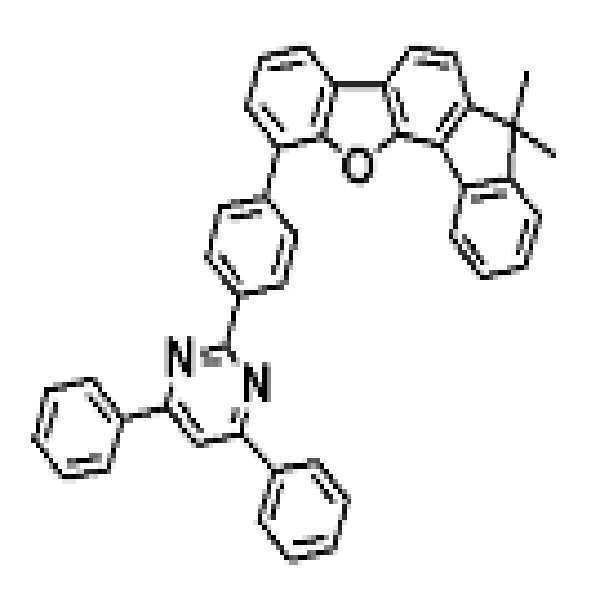

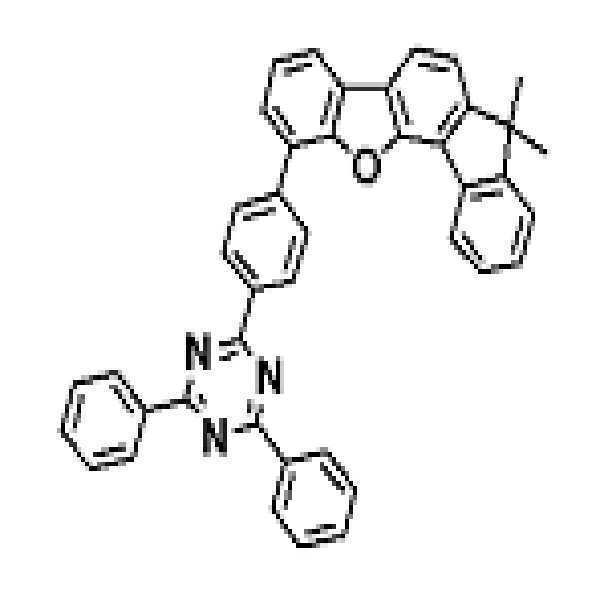
[화학식 A-7] [화학식 A-8] [화학식 A-9]
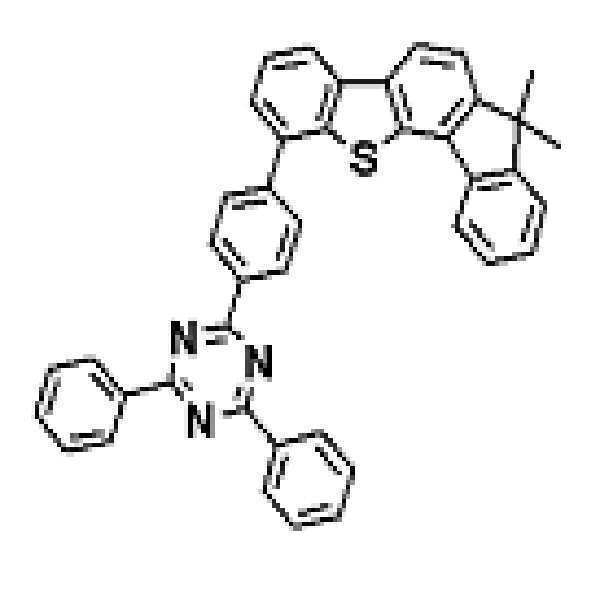


[화학식 A-10] [화학식 A-11] [화학식 A-12]

[화학식 A-13] [화학식 A-14] [화학식 A-15]

[화학식 A-16] [화학식 A-17] [화학식 A-18]


[화학식 A-22] [화학식 A-23] [화학식 A-24]

[화학식 A-25] [화학식 A-26] [화학식 A-27]
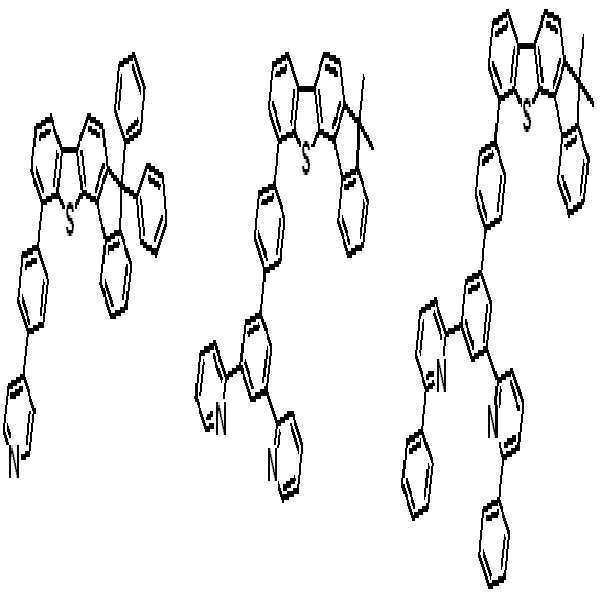
[화학식 A-28] [화학식 A-29] [화학식 A-30]

[화학식 A-31] [화학식 A-32] [화학식 A-33]

[화학식 A-34] [화학식 A-35] [화학식 A-36]
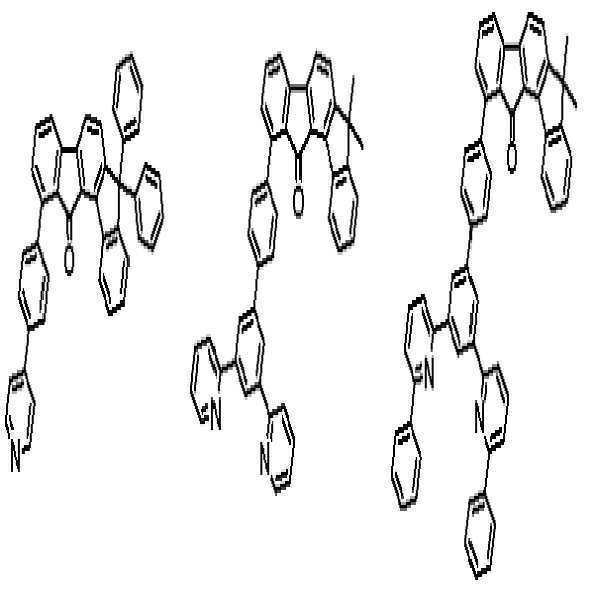
[화학식 A-37] [화학식 A-38] [화학식 A-39]

[화학식 A-40] [화학식 A-41] [화학식 A-42]
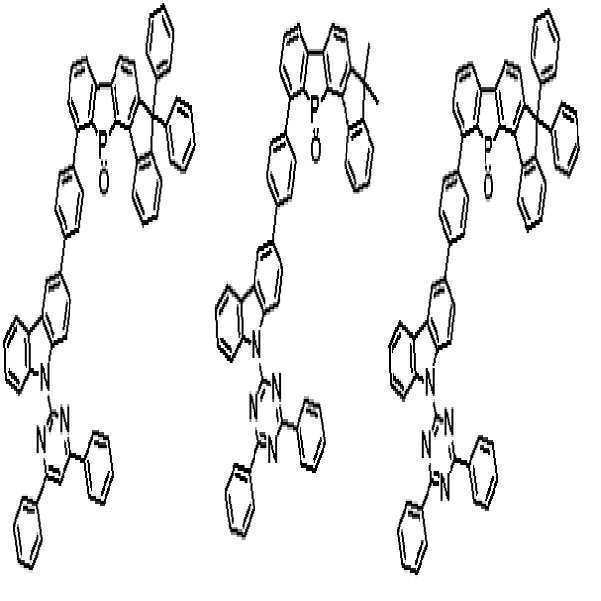
[화학식 A-43] [화학식 A-44] [화학식 A-45]

[화학식 A-46] [화학식 A-47] [화학식 A-48]

[화학식 A-49] [화학식 A-51] [화학식 A-52]
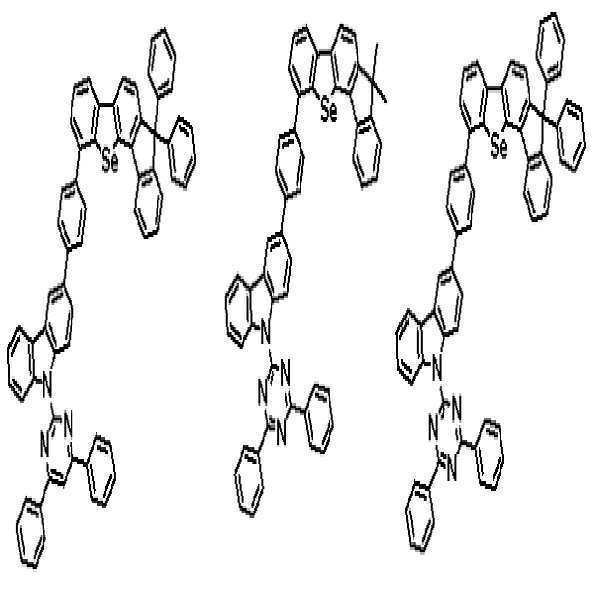
[화학식 A-53] [화학식 A-54] [화학식 A-55]

Wherein the compound for an organic photoelectric device is represented by any one of the following formulas A-2 to A-55.
[Formula A-2] [Formula A-3]
[Chemical formula A-4] [Chemical formula A-5] [Chemical formula A-6]
[Chemical Formula A-7] [Chemical Formula A-8] [Chemical Formula A-9]
[A-10] [Chemical formula A-11] [Chemical formula A-12]
[Chemical formula A-13] [Chemical formula A-14] [Chemical formula A-15]
[Chemical Formula A-16] [Chemical Formula A-17] [Chemical Formula A-18]
[Chemical Formula A-22] [Chemical Formula A-23] [Chemical Formula A-24]
[Chemical Formula A-25] [Chemical Formula A-26] [Chemical Formula A-27]
[Chemical Formula A-28] [Chemical Formula A-29] [Chemical Formula A-30]
[Chemical Formula A-31] [Chemical Formula A-32] [Chemical Formula A-33]
[Chemical Formula A-34] [Chemical Formula A-35] [Chemical Formula A-36]
[Chemical Formula A-37] [Chemical Formula A-38] [Chemical Formula A-39]
[Chemical Formula A-40] [Chemical Formula A-41] [Chemical Formula A-42]
[Chemical Formula A-43] [Chemical Formula A-44] [Chemical Formula A-45]
[Chemical Formula A-46] [Chemical Formula A-47] [Chemical Formula A-48]
[Formula A-49] [Formula A-51] [Formula A-52]
[Formula A-53] [Chemical Formula A-54] [Chemical Formula A-55]
상기 유기광전소자용 화합물은 하기 화학식 B-1 내지 B-44 중 어느 하나로 표시되는 유기광전소자용 화합물.
[화학식 B-1] [화학식 B-2] [화학식 B-3]

[화학식 B-4] [화학식 B-5] [화학식 B-6]

[화학식 B-7] [화학식 B-8] [화학식 B-9]

[화학식 B-10] [화학식 B-11]

[화학식 B-12] [화학식 B-13] [화학식 B-14]

[화학식 B-15] [화학식 B-16] [화학식 B-17]

[화학식 B-18] [화학식 B-19] [화학식 B-20]

[화학식 B-21] [화학식 B-22]
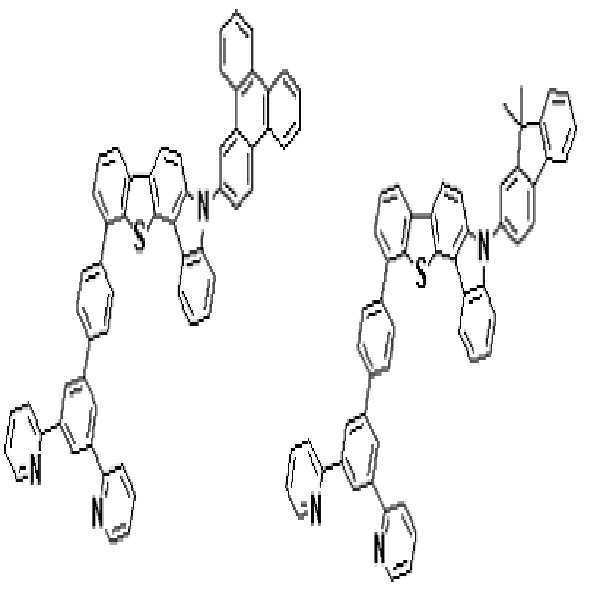
[화학식 B-23] [화학식 B-24] [화학식 B-25]

[화학식 B-26] [화학식 B-27] [화학식 B-28]

[화학식 B-29] [화학식 B-30] [화학식 B-31]

[화학식 B-32] [화학식 B-33]

[화학식 B-34] [화학식 B-35] [화학식 B-36]

[화학식 B-37] [화학식 B-38] [화학식 B-39]

[화학식 B-40] [화학식 B-41] [화학식 B-42]
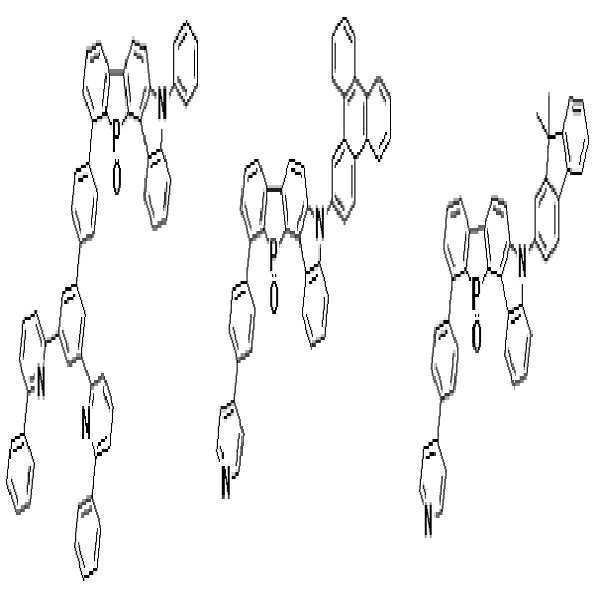
[화학식 B-43] [화학식 B-44]
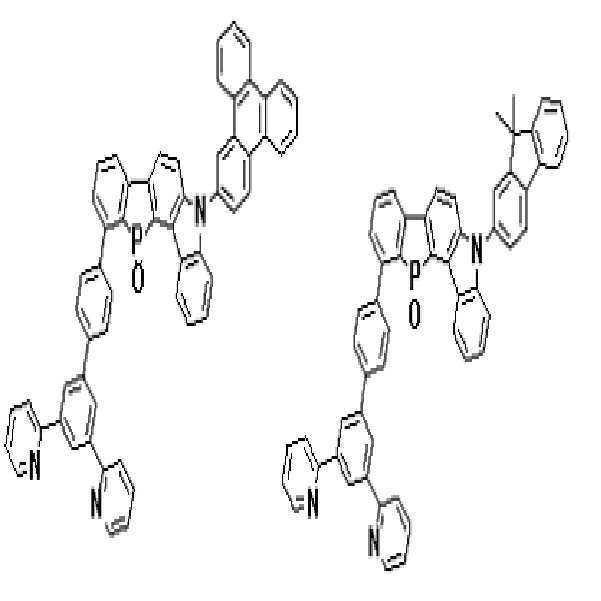
The compound for an organic photoelectric device is represented by any one of the following formulas (B-1) to (B-44).
[Formula B-1] [Formula B-2] [Formula B-3]
[Formula B-4] [Formula B-5] [Formula B-6]
[Formula B-7] [Formula B-8] [Formula B-9]
[Chemical formula B-10] [Chemical formula B-11]
[Formula B-12] [Formula B-13] [Formula B-14]
[Formula B-15] [Formula B-16] [Formula B-17]
[Formula B-18] [Formula B-19] [Formula B-20]
[Formula B-21] [Formula B-22]
[Formula B-23] [Formula B-24] [Formula B-25]
[Formula B-26] [Formula B-27] [Formula B-28]
[Formula B-29] [Formula B-30] [Formula B-31]
[Formula B-32] [Formula B-33]
[Formula B-34] [Formula B-35] [Formula B-36]
[Formula B-37] [Formula B-38] [Formula B-39]
[Formula B-40] [Formula B-41] [Formula B-42]
[Chemical formula B-43] [Chemical formula B-44]
상기 유기광전소자용 화합물은 하기 화학식 C-1 내지 C-4, 및 C-9 내지 C-15 중 어느 하나로 표시되는 유기광전소자용 화합물.
[화학식 C-1] [화학식 C-2] [화학식 C-3]


[화학식 C-4] [화학식 C-9] [화학식 C-10]
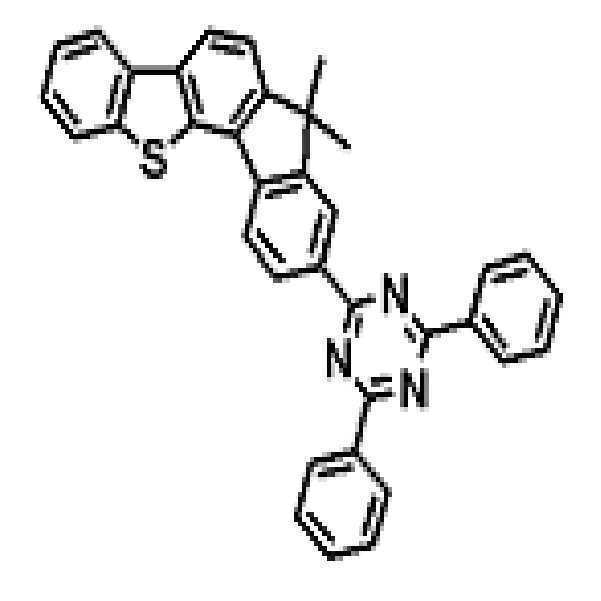

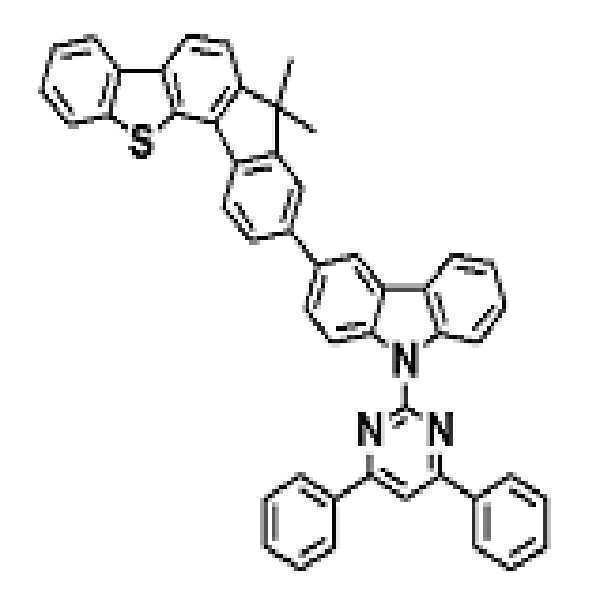
[화학식 C-11] [화학식 C-12]


[화학식 C-13] [화학식 C-14] [화학식 C-15]
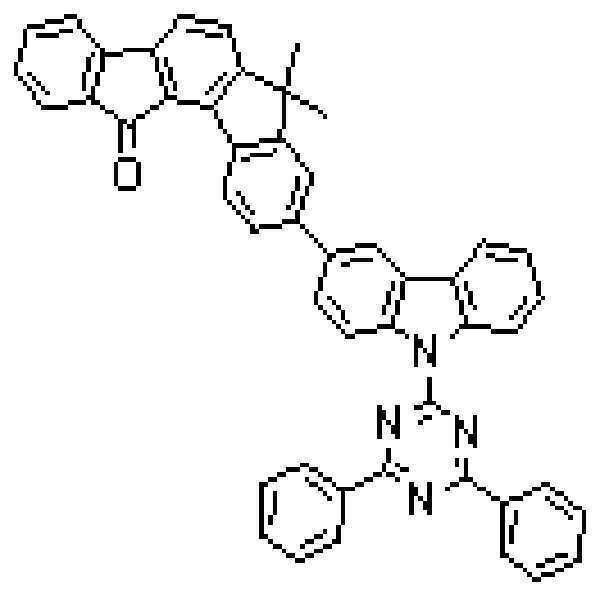


Wherein the compound for organic photoelectric conversion element is represented by any one of the following formulas C-1 to C-4, and C-9 to C-15.
[Formula C-1] [Formula C-2] [Formula C-3]
[Formula C-4] [Formula C-9] [Formula C-10]
[Chemical formula C-11] [Chemical formula C-12]
[Formula C-13] [Formula C-14] [Formula C-15]
상기 유기광전소자용 화합물은 하기 화학식 D-3 또는 D-4로 표시되는 유기광전소자용 화합물.
[화학식 D-3] [화학식 D-4]
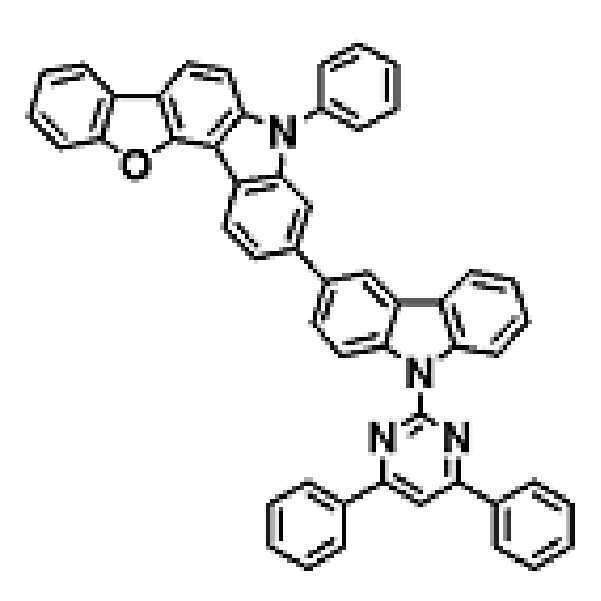

Wherein the compound for organic photoelectric conversion is represented by the following formula (D-3) or (D-4).
[Formula D-3] [Formula D-4]
상기 유기광전소자용 화합물은 하기 화학식 E-1 내지 E-9 중 어느 하나로 표시되는 유기광전소자용 화합물.
[화학식 E-1] [화학식 E-2] [화학식 E-3]
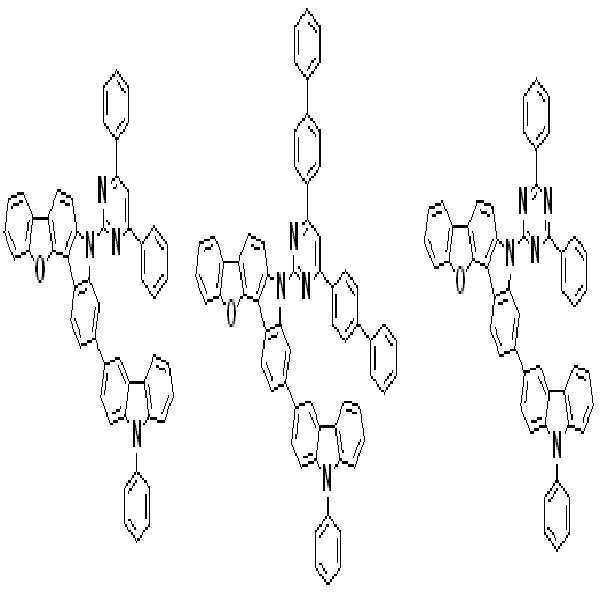
[화학식 E-4] [화학식 E-5] [화학식 E-6]

[화학식 E-7] [화학식 E-8]

[화학식 E-9]

The compound for an organic photoelectric device is represented by any one of the following formulas (E-1) to (E-9).
[Formula E-1] [Formula E-2] [Formula E-3]
[Formula E-4] [Formula E-5] [Formula E-6]
[Formula E-7] [Formula E-8]
[E-9]
상기 유기광전소자용 화합물은 유기발광소자의 발광 재료로 이용될 수 있는 것인 유기광전소자용 화합물.
3. The method of claim 2,
Wherein the compound for an organic photoelectric device can be used as a light emitting material of an organic light emitting device.
상기 유기광전소자용 화합물은 3중항 여기에너지(T1) 2.0eV 이상인 것인 유기광전소자용 화합물.
3. The method of claim 2,
Wherein the compound for an organic photoelectric device has a triplet excitation energy (T1) of 2.0 eV or more.
상기 유기광전소자는 유기발광소자, 유기태양전지, 유기트랜지스터, 유기 감광체 드럼 및 유기메모리소자로 이루어진 군에서 선택되는 것인 유기광전소자용 화합물.
3. The method of claim 2,
Wherein the organic photoelectric device is selected from the group consisting of an organic light emitting device, an organic solar cell, an organic transistor, an organic photoreceptor drum, and an organic memory device.
상기 유기박막층 중 적어도 어느 한 층은 상기 제 2 항 내지 제 5 항, 및 제 8 항 내지 제 15 항 중 어느 한 항에 따른 유기광전소자용 화합물을 포함하는 것인 유기발광소자.
An organic light emitting device comprising an anode, a cathode, and at least one organic thin film layer interposed between the anode and the cathode,
Wherein at least one of the organic thin film layers comprises the compound for organic photoelectric conversion devices according to any one of claims 2 to 5, and 8 to 15.
상기 유기박막층은 발광층, 정공수송층, 정공주입층, 전자수송층, 전자주입층, 정공차단층 및 이들의 조합을 이루어진 군에서 선택되는 것인 유기발광소자.
17. The method of claim 16,
Wherein the organic thin film layer is selected from the group consisting of a light emitting layer, a hole transporting layer, a hole injecting layer, an electron transporting layer, an electron injecting layer, a hole blocking layer, and combinations thereof.
상기 유기광전소자용 화합물은 정공수송층 또는 정공주입층 내에 포함되는 것인 유기발광소자.
17. The method of claim 16,
Wherein the compound for an organic photoelectric device is contained in a hole transporting layer or a hole injecting layer.
상기 유기광전소자용 화합물은 발광층 내에 포함되는 것인 유기발광소자.
17. The method of claim 16,
Wherein the compound for an organic photoelectric conversion element is contained in the light emitting layer.
상기 유기광전소자용 화합물은 발광층 내에 인광 또는 형광 호스트 재료로서 사용되는 것인 유기발광소자.
17. The method of claim 16,
Wherein the compound for organic photoelectric conversion element is used as a phosphorescent or fluorescent host material in the light emitting layer.
A display device comprising the organic light emitting device of claim 16.
Priority Applications (1)
| Application Number | Priority Date | Filing Date | Title |
|---|---|---|---|
| KR20100140562A KR101486561B1 (en) | 2010-12-31 | 2010-12-31 | Compound for organic photoelectric device and organic photoelectric device including the same |
Applications Claiming Priority (1)
| Application Number | Priority Date | Filing Date | Title |
|---|---|---|---|
| KR20100140562A KR101486561B1 (en) | 2010-12-31 | 2010-12-31 | Compound for organic photoelectric device and organic photoelectric device including the same |
Publications (2)
| Publication Number | Publication Date |
|---|---|
| KR20120078301A KR20120078301A (en) | 2012-07-10 |
| KR101486561B1 true KR101486561B1 (en) | 2015-01-26 |
Family
ID=46711674
Family Applications (1)
| Application Number | Title | Priority Date | Filing Date |
|---|---|---|---|
| KR20100140562A Active KR101486561B1 (en) | 2010-12-31 | 2010-12-31 | Compound for organic photoelectric device and organic photoelectric device including the same |
Country Status (1)
| Country | Link |
|---|---|
| KR (1) | KR101486561B1 (en) |
Cited By (3)
| Publication number | Priority date | Publication date | Assignee | Title |
|---|---|---|---|---|
| US20150021563A1 (en) * | 2013-07-16 | 2015-01-22 | Research & Business Foundation Sungkyunkwan University | Compound for organic optoelectronic device, organic light emitting diode including the same and display including the organic light emitting diode |
| US11690288B2 (en) | 2017-07-14 | 2023-06-27 | Samsung Sdi Co., Ltd. | Composition for organic optoelectronic diode, organic optoelectronic diode, and display device |
| US12030894B2 (en) | 2020-09-04 | 2024-07-09 | Samsung Sdi Co., Ltd. | Composition for organic optoelectronic device, organic optoelectronic device and display device |
Families Citing this family (29)
| Publication number | Priority date | Publication date | Assignee | Title |
|---|---|---|---|---|
| KR101887003B1 (en) * | 2011-07-21 | 2018-08-13 | 롬엔드하스전자재료코리아유한회사 | Novel organic electroluminescence compounds and organic electroluminescence device using the same |
| EP2768808B1 (en) * | 2011-10-20 | 2017-11-15 | Merck Patent GmbH | Materials for organic electroluminescent devices |
| KR20130061371A (en) * | 2011-12-01 | 2013-06-11 | 롬엔드하스전자재료코리아유한회사 | Novel organic electroluminescence compounds and organic electroluminescence device using the same |
| KR20130112342A (en) * | 2012-04-03 | 2013-10-14 | 롬엔드하스전자재료코리아유한회사 | Novel carbazole compounds and organic electroluminescence device containing the same |
| WO2013179645A1 (en) * | 2012-05-30 | 2013-12-05 | 出光興産株式会社 | Organic-electroluminescent-element material, and organic electroluminescent element using same |
| CN104583202B (en) * | 2012-08-21 | 2018-08-10 | 第一毛织株式会社 | Compound for organic photoelectric device, the Organic Light Emitting Diode comprising it and the display including Organic Light Emitting Diode |
| KR101537005B1 (en) | 2012-09-28 | 2015-07-20 | 제일모직 주식회사 | Compound for organic optoelectronic device, organic light emitting diode including the same and display including the organic light emitting diode |
| KR101636864B1 (en) * | 2012-10-08 | 2016-07-06 | 제일모직 주식회사 | Compound for organic optoelectronic device, organic light emitting diode including the same and display including the organic light emitting diode |
| KR101627750B1 (en) * | 2013-01-31 | 2016-06-07 | 제일모직 주식회사 | Compound, organic light emitting diode including the same and display including the organic light emitting diode |
| KR101627755B1 (en) * | 2013-06-13 | 2016-06-07 | 제일모직 주식회사 | Organic compound and organic optoelectric device and display device |
| KR101653338B1 (en) | 2013-08-05 | 2016-09-01 | 제일모직 주식회사 | Organic compound and organic optoelectric device and display device |
| KR101686078B1 (en) * | 2013-08-12 | 2016-12-13 | 제일모직 주식회사 | Composition and organic optoelectric device and display device |
| KR102116495B1 (en) * | 2013-08-28 | 2020-06-03 | 삼성디스플레이 주식회사 | Organic light-emitting diode comprising condensed cyclic compound |
| US10297762B2 (en) | 2014-07-09 | 2019-05-21 | Universal Display Corporation | Organic electroluminescent materials and devices |
| KR20160010333A (en) * | 2014-07-17 | 2016-01-27 | 롬엔드하스전자재료코리아유한회사 | Electron transport material and organic electroluminescent device comprising the same |
| US10749113B2 (en) | 2014-09-29 | 2020-08-18 | Universal Display Corporation | Organic electroluminescent materials and devices |
| US10361375B2 (en) | 2014-10-06 | 2019-07-23 | Universal Display Corporation | Organic electroluminescent materials and devices |
| US9406892B2 (en) | 2015-01-07 | 2016-08-02 | Universal Display Corporation | Organic electroluminescent materials and devices |
| KR102424977B1 (en) | 2015-04-14 | 2022-07-26 | 삼성디스플레이 주식회사 | Condensed-cyclic compound and organic light emitting device comprising the same |
| CN104926785B (en) * | 2015-07-06 | 2018-10-09 | 盐城工学院 | A kind of selenium heteroaromatic ring derivative and preparation method thereof |
| US11522140B2 (en) | 2015-08-17 | 2022-12-06 | Universal Display Corporation | Organic electroluminescent materials and devices |
| KR102630644B1 (en) | 2015-12-17 | 2024-01-30 | 삼성디스플레이 주식회사 | Organic light emitting device |
| US11075343B2 (en) * | 2016-01-18 | 2021-07-27 | Sfc Co., Ltd. | Organic light emitting compounds and organic light emitting devices including the same |
| US11476426B2 (en) * | 2016-02-03 | 2022-10-18 | Sfc Co., Ltd. | Organic light emitting compounds and organic light emitting devices including the same |
| KR101928934B1 (en) | 2016-02-23 | 2018-12-13 | 주식회사 엘지화학 | Hetero-cyclic compound and organic light emitting device comprising the same |
| KR101959047B1 (en) * | 2016-07-15 | 2019-03-18 | 주식회사 엘지화학 | Novel hetero-cyclic compound and organic light emitting device comprising the same |
| CN109053745A (en) * | 2018-07-09 | 2018-12-21 | 宇瑞(上海)化学有限公司 | A kind of carbazole simultaneously heterocyclic compound and its application in organic electronic element |
| KR102541446B1 (en) * | 2019-01-22 | 2023-06-09 | 삼성디스플레이 주식회사 | Organic light-emitting device and display including the same |
| CN116283932B (en) * | 2023-03-27 | 2024-11-05 | 阜阳欣奕华新材料科技股份有限公司 | Pyridine-substituted heteroaryl compound and application thereof |
Citations (1)
| Publication number | Priority date | Publication date | Assignee | Title |
|---|---|---|---|---|
| KR20080055891A (en) * | 2005-09-08 | 2008-06-19 | 도레이 가부시끼가이샤 | Light emitting element material and light emitting element |
-
2010
- 2010-12-31 KR KR20100140562A patent/KR101486561B1/en active Active
Patent Citations (1)
| Publication number | Priority date | Publication date | Assignee | Title |
|---|---|---|---|---|
| KR20080055891A (en) * | 2005-09-08 | 2008-06-19 | 도레이 가부시끼가이샤 | Light emitting element material and light emitting element |
Cited By (3)
| Publication number | Priority date | Publication date | Assignee | Title |
|---|---|---|---|---|
| US20150021563A1 (en) * | 2013-07-16 | 2015-01-22 | Research & Business Foundation Sungkyunkwan University | Compound for organic optoelectronic device, organic light emitting diode including the same and display including the organic light emitting diode |
| US11690288B2 (en) | 2017-07-14 | 2023-06-27 | Samsung Sdi Co., Ltd. | Composition for organic optoelectronic diode, organic optoelectronic diode, and display device |
| US12030894B2 (en) | 2020-09-04 | 2024-07-09 | Samsung Sdi Co., Ltd. | Composition for organic optoelectronic device, organic optoelectronic device and display device |
Also Published As
| Publication number | Publication date |
|---|---|
| KR20120078301A (en) | 2012-07-10 |
Similar Documents
| Publication | Publication Date | Title |
|---|---|---|
| KR101486561B1 (en) | Compound for organic photoelectric device and organic photoelectric device including the same | |
| KR101423173B1 (en) | Compound for organic photoelectric device and organic photoelectric device including the same | |
| KR101636864B1 (en) | Compound for organic optoelectronic device, organic light emitting diode including the same and display including the organic light emitting diode | |
| KR101507001B1 (en) | Compound for organic optoelectronic device, organic light emitting diode including the same and display including the organic light emitting diode | |
| KR101497133B1 (en) | Compound for organic OPTOELECTRONIC device, ORGANIC LIGHT EMITTING DIODE INCLUDING THE SAME and DISPLAY INCLUDING THE organic LIGHT EMITTING DIODE | |
| KR101443756B1 (en) | Compound for organic OPTOELECTRONIC device, ORGANIC LIGHT EMITTING DIODE INCLUDING THE SAME and DISPLAY INCLUDING THE organic LIGHT EMITTING DIODE | |
| KR101636848B1 (en) | Compound for organic optoelectronic device, organic light emitting diode including the same and display including the organic light emitting diode | |
| KR101686078B1 (en) | Composition and organic optoelectric device and display device | |
| KR101593182B1 (en) | Compound for organic optoelectronic device, organic light emitting diode including the same and display including the organic light emitting diode | |
| KR101507004B1 (en) | Compound for organic optoelectronic device, organic light emitting diode including the same and display including the organic light emitting diode | |
| KR101453768B1 (en) | Compound for organic photoelectric device and organic photoelectric device including the same | |
| KR101566530B1 (en) | COMPOUND FOR ORGANIC OPTOELECTRONIC DEVICE, ORGANIC LiGHT EMITTING DIODE INCLUDING THE SAME AND DISPLAY INCLUDING THE ORGANIC LiGHT EMITTING DIODE | |
| KR101443755B1 (en) | Compound for organic photoelectric device and organic photoelectric device including the same | |
| KR101474801B1 (en) | COMPOUND FOR ORGANIC OPTOELECTRONIC DEVICE, ORGANIC LIGHT EMITTING DIODE INCLUDING THE SAME and DISPLAY INCLUDING THE ORGANIC LIGHT EMITTING DIODE | |
| KR20130078437A (en) | Compound for organic optoelectronic device, organic light emitting diode including the same and display including the organic light emitting diode | |
| JP2016111346A (en) | Organic photoelectric element and display device | |
| KR20130066554A (en) | Compound for organic optoelectronic device, organic light emitting diode including the same and display including the organic light emitting diode | |
| KR20140087647A (en) | Compound for organic optoelectronic device, organic light emitting diode including the same and display including the organic light emitting diode | |
| KR20140096203A (en) | MATERIAL FOR ORGANIC OPTOELECTRONIC DEVICE, ORGANIC LiGHT EMITTING DIODE INCLUDING THE SAME AND DISPLAY INCLUDING THE ORGANIC LiGHT EMITTING DIODE | |
| KR101507003B1 (en) | Compound for organic optoelectronic device, organic light emitting diode including the same and display including the organic light emitting diode | |
| KR101811327B1 (en) | Compound for organic optoelectronic device, organic light emitting diode including the same and display including the organic light emitting diode | |
| KR101507002B1 (en) | Compound for organic optoelectronic device, organic light emitting diode including the same and display including the organic light emitting diode | |
| KR20160133814A (en) | Compound for ORGANIC OPTOELECTRIC DEVICE, ORGANIC OPTOELECTRIC DEVICE AND DISPLAY DEVICE | |
| KR101515431B1 (en) | Compound for organic optoelectronic device, organic light emitting diode including the same and display including the organic light emitting diode | |
| KR20190001116A (en) | Compound for organic optoelectronic device and composition for organic optoelectronic device and organic optoelectronic device and display device |
Legal Events
| Date | Code | Title | Description |
|---|---|---|---|
| PA0109 | Patent application |
St.27 status event code: A-0-1-A10-A12-nap-PA0109 |
|
| PG1501 | Laying open of application |
St.27 status event code: A-1-1-Q10-Q12-nap-PG1501 |
|
| A201 | Request for examination | ||
| PA0201 | Request for examination |
St.27 status event code: A-1-2-D10-D11-exm-PA0201 |
|
| D13-X000 | Search requested |
St.27 status event code: A-1-2-D10-D13-srh-X000 |
|
| D14-X000 | Search report completed |
St.27 status event code: A-1-2-D10-D14-srh-X000 |
|
| E902 | Notification of reason for refusal | ||
| PE0902 | Notice of grounds for rejection |
St.27 status event code: A-1-2-D10-D21-exm-PE0902 |
|
| PN2301 | Change of applicant |
St.27 status event code: A-3-3-R10-R13-asn-PN2301 St.27 status event code: A-3-3-R10-R11-asn-PN2301 |
|
| E13-X000 | Pre-grant limitation requested |
St.27 status event code: A-2-3-E10-E13-lim-X000 |
|
| P11-X000 | Amendment of application requested |
St.27 status event code: A-2-2-P10-P11-nap-X000 |
|
| P13-X000 | Application amended |
St.27 status event code: A-2-2-P10-P13-nap-X000 |
|
| E902 | Notification of reason for refusal | ||
| PE0902 | Notice of grounds for rejection |
St.27 status event code: A-1-2-D10-D21-exm-PE0902 |
|
| E13-X000 | Pre-grant limitation requested |
St.27 status event code: A-2-3-E10-E13-lim-X000 |
|
| P11-X000 | Amendment of application requested |
St.27 status event code: A-2-2-P10-P11-nap-X000 |
|
| P13-X000 | Application amended |
St.27 status event code: A-2-2-P10-P13-nap-X000 |
|
| E701 | Decision to grant or registration of patent right | ||
| PE0701 | Decision of registration |
St.27 status event code: A-1-2-D10-D22-exm-PE0701 |
|
| GRNT | Written decision to grant | ||
| PR0701 | Registration of establishment |
St.27 status event code: A-2-4-F10-F11-exm-PR0701 |
|
| PR1002 | Payment of registration fee |
St.27 status event code: A-2-2-U10-U11-oth-PR1002 Fee payment year number: 1 |
|
| PG1601 | Publication of registration |
St.27 status event code: A-4-4-Q10-Q13-nap-PG1601 |
|
| P22-X000 | Classification modified |
St.27 status event code: A-4-4-P10-P22-nap-X000 |
|
| FPAY | Annual fee payment |
Payment date: 20171219 Year of fee payment: 4 |
|
| PR1001 | Payment of annual fee |
St.27 status event code: A-4-4-U10-U11-oth-PR1001 Fee payment year number: 4 |
|
| FPAY | Annual fee payment |
Payment date: 20181220 Year of fee payment: 5 |
|
| PR1001 | Payment of annual fee |
St.27 status event code: A-4-4-U10-U11-oth-PR1001 Fee payment year number: 5 |
|
| FPAY | Annual fee payment |
Payment date: 20200103 Year of fee payment: 6 |
|
| PR1001 | Payment of annual fee |
St.27 status event code: A-4-4-U10-U11-oth-PR1001 Fee payment year number: 6 |
|
| PR1001 | Payment of annual fee |
St.27 status event code: A-4-4-U10-U11-oth-PR1001 Fee payment year number: 7 |
|
| PR1001 | Payment of annual fee |
St.27 status event code: A-4-4-U10-U11-oth-PR1001 Fee payment year number: 8 |
|
| P22-X000 | Classification modified |
St.27 status event code: A-4-4-P10-P22-nap-X000 |
|
| P22-X000 | Classification modified |
St.27 status event code: A-4-4-P10-P22-nap-X000 |
|
| PR1001 | Payment of annual fee |
St.27 status event code: A-4-4-U10-U11-oth-PR1001 Fee payment year number: 9 |
|
| PR1001 | Payment of annual fee |
St.27 status event code: A-4-4-U10-U11-oth-PR1001 Fee payment year number: 10 |
|
| P22-X000 | Classification modified |
St.27 status event code: A-4-4-P10-P22-nap-X000 |
|
| PR1001 | Payment of annual fee |
St.27 status event code: A-4-4-U10-U11-oth-PR1001 Fee payment year number: 11 |
|
| P22-X000 | Classification modified |
St.27 status event code: A-4-4-P10-P22-nap-X000 |
|
| PR1001 | Payment of annual fee |
St.27 status event code: A-4-4-U10-U11-oth-PR1001 Fee payment year number: 12 |
|
| U11 | Full renewal or maintenance fee paid |
Free format text: ST27 STATUS EVENT CODE: A-4-4-U10-U11-OTH-PR1001 (AS PROVIDED BY THE NATIONAL OFFICE) Year of fee payment: 12 |