KR101486085B1 - MOLECULES THAT ARE ABLE TO INHIBIT THE BINDING BETWEEN NGF AND THE TrkA RECEPTOR AS ANALGESICS WITH PROLONGED EFFECT - Google Patents
MOLECULES THAT ARE ABLE TO INHIBIT THE BINDING BETWEEN NGF AND THE TrkA RECEPTOR AS ANALGESICS WITH PROLONGED EFFECT Download PDFInfo
- Publication number
- KR101486085B1 KR101486085B1 KR1020087000315A KR20087000315A KR101486085B1 KR 101486085 B1 KR101486085 B1 KR 101486085B1 KR 1020087000315 A KR1020087000315 A KR 1020087000315A KR 20087000315 A KR20087000315 A KR 20087000315A KR 101486085 B1 KR101486085 B1 KR 101486085B1
- Authority
- KR
- South Korea
- Prior art keywords
- ser
- antibody
- ngf
- pain
- val
- Prior art date
- Legal status (The legal status is an assumption and is not a legal conclusion. Google has not performed a legal analysis and makes no representation as to the accuracy of the status listed.)
- Expired - Fee Related
Links
Images


Classifications
-
- C—CHEMISTRY; METALLURGY
- C07—ORGANIC CHEMISTRY
- C07K—PEPTIDES
- C07K16/00—Immunoglobulins [IGs], e.g. monoclonal or polyclonal antibodies
- C07K16/18—Immunoglobulins [IGs], e.g. monoclonal or polyclonal antibodies against material from animals or humans
- C07K16/28—Immunoglobulins [IGs], e.g. monoclonal or polyclonal antibodies against material from animals or humans against receptors, cell surface antigens or cell surface determinants
-
- C—CHEMISTRY; METALLURGY
- C07—ORGANIC CHEMISTRY
- C07K—PEPTIDES
- C07K16/00—Immunoglobulins [IGs], e.g. monoclonal or polyclonal antibodies
- C07K16/18—Immunoglobulins [IGs], e.g. monoclonal or polyclonal antibodies against material from animals or humans
- C07K16/22—Immunoglobulins [IGs], e.g. monoclonal or polyclonal antibodies against material from animals or humans against growth factors ; against growth regulators
-
- A—HUMAN NECESSITIES
- A61—MEDICAL OR VETERINARY SCIENCE; HYGIENE
- A61K—PREPARATIONS FOR MEDICAL, DENTAL OR TOILETRY PURPOSES
- A61K39/00—Medicinal preparations containing antigens or antibodies
- A61K39/395—Antibodies; Immunoglobulins; Immune serum, e.g. antilymphocytic serum
-
- A—HUMAN NECESSITIES
- A61—MEDICAL OR VETERINARY SCIENCE; HYGIENE
- A61P—SPECIFIC THERAPEUTIC ACTIVITY OF CHEMICAL COMPOUNDS OR MEDICINAL PREPARATIONS
- A61P25/00—Drugs for disorders of the nervous system
- A61P25/02—Drugs for disorders of the nervous system for peripheral neuropathies
-
- A—HUMAN NECESSITIES
- A61—MEDICAL OR VETERINARY SCIENCE; HYGIENE
- A61P—SPECIFIC THERAPEUTIC ACTIVITY OF CHEMICAL COMPOUNDS OR MEDICINAL PREPARATIONS
- A61P25/00—Drugs for disorders of the nervous system
- A61P25/04—Centrally acting analgesics, e.g. opioids
-
- A—HUMAN NECESSITIES
- A61—MEDICAL OR VETERINARY SCIENCE; HYGIENE
- A61P—SPECIFIC THERAPEUTIC ACTIVITY OF CHEMICAL COMPOUNDS OR MEDICINAL PREPARATIONS
- A61P29/00—Non-central analgesic, antipyretic or antiinflammatory agents, e.g. antirheumatic agents; Non-steroidal antiinflammatory drugs [NSAID]
-
- A—HUMAN NECESSITIES
- A61—MEDICAL OR VETERINARY SCIENCE; HYGIENE
- A61P—SPECIFIC THERAPEUTIC ACTIVITY OF CHEMICAL COMPOUNDS OR MEDICINAL PREPARATIONS
- A61P43/00—Drugs for specific purposes, not provided for in groups A61P1/00-A61P41/00
-
- C—CHEMISTRY; METALLURGY
- C07—ORGANIC CHEMISTRY
- C07K—PEPTIDES
- C07K16/00—Immunoglobulins [IGs], e.g. monoclonal or polyclonal antibodies
- C07K16/18—Immunoglobulins [IGs], e.g. monoclonal or polyclonal antibodies against material from animals or humans
- C07K16/28—Immunoglobulins [IGs], e.g. monoclonal or polyclonal antibodies against material from animals or humans against receptors, cell surface antigens or cell surface determinants
- C07K16/2863—Immunoglobulins [IGs], e.g. monoclonal or polyclonal antibodies against material from animals or humans against receptors, cell surface antigens or cell surface determinants against receptors for growth factors, growth regulators
-
- A—HUMAN NECESSITIES
- A61—MEDICAL OR VETERINARY SCIENCE; HYGIENE
- A61K—PREPARATIONS FOR MEDICAL, DENTAL OR TOILETRY PURPOSES
- A61K39/00—Medicinal preparations containing antigens or antibodies
- A61K2039/505—Medicinal preparations containing antigens or antibodies comprising antibodies
-
- C—CHEMISTRY; METALLURGY
- C07—ORGANIC CHEMISTRY
- C07K—PEPTIDES
- C07K2317/00—Immunoglobulins specific features
- C07K2317/20—Immunoglobulins specific features characterized by taxonomic origin
- C07K2317/24—Immunoglobulins specific features characterized by taxonomic origin containing regions, domains or residues from different species, e.g. chimeric, humanized or veneered
-
- C—CHEMISTRY; METALLURGY
- C07—ORGANIC CHEMISTRY
- C07K—PEPTIDES
- C07K2317/00—Immunoglobulins specific features
- C07K2317/70—Immunoglobulins specific features characterized by effect upon binding to a cell or to an antigen
- C07K2317/76—Antagonist effect on antigen, e.g. neutralization or inhibition of binding
Landscapes
- Health & Medical Sciences (AREA)
- Chemical & Material Sciences (AREA)
- Organic Chemistry (AREA)
- Life Sciences & Earth Sciences (AREA)
- Medicinal Chemistry (AREA)
- General Health & Medical Sciences (AREA)
- Immunology (AREA)
- Biochemistry (AREA)
- Biophysics (AREA)
- Proteomics, Peptides & Aminoacids (AREA)
- Molecular Biology (AREA)
- Genetics & Genomics (AREA)
- Veterinary Medicine (AREA)
- Public Health (AREA)
- Animal Behavior & Ethology (AREA)
- Pharmacology & Pharmacy (AREA)
- Nuclear Medicine, Radiotherapy & Molecular Imaging (AREA)
- Bioinformatics & Cheminformatics (AREA)
- Engineering & Computer Science (AREA)
- Chemical Kinetics & Catalysis (AREA)
- General Chemical & Material Sciences (AREA)
- Biomedical Technology (AREA)
- Pain & Pain Management (AREA)
- Neurology (AREA)
- Neurosurgery (AREA)
- Rheumatology (AREA)
- Microbiology (AREA)
- Mycology (AREA)
- Epidemiology (AREA)
- Medicines Containing Antibodies Or Antigens For Use As Internal Diagnostic Agents (AREA)
- Peptides Or Proteins (AREA)
- Medicines That Contain Protein Lipid Enzymes And Other Medicines (AREA)
- Preparation Of Compounds By Using Micro-Organisms (AREA)
Abstract
본 발명은 만성 통증을 치료 및/또는 예방하기 위한 약제의 제조를 위한 TrkA의 생리적 활성을 막을 수 있는, NGF와 TrkA 사이의 결합을 억제할 수 있는 항-NGF 항체의 용도로 제공한다.The present invention provides for the use of an anti-NGF antibody capable of inhibiting the binding between NGF and TrkA, which can prevent the physiological activity of TrkA for the manufacture of a medicament for the treatment and / or prevention of chronic pain.
만성통증, 항-NGF 항체, TrkA Chronic pain, anti-NGF antibody, TrkA
Description
본 발명은 NGF와 이것의 TrkA 리셉터 간의 결합을 저해할 수 있는 분자의 용도에 관한 것이다. 특히 본 발명은 NGF의 생물적 활성을 막는 것에 의해 진통제의 연장된 효과를 갖는 두 개의 분자 중 하나에 대한 항체에 관한 것이다. 이의 지속적인 진통 효과 때문에, 이들은 비록 신경병증성 혹은 종양성 통증에 제한되지는 않으나 이러한 통증과 같은 만성 통증으로 알려진 통증의 지속적인 양상을 갖는 병리에 대해 이로운 치료법이다. The present invention relates to the use of molecules capable of inhibiting the binding between NGF and its TrkA receptor. In particular, the present invention relates to an antibody against one of two molecules having an extended effect of analgesic by blocking the biological activity of NGF. Because of its persistent analgesic effects, they are beneficial treatments for pathologies that have a persistent pattern of pain known as chronic pain, although not limited to neuropathic or neoplastic pain.
연수에 구심성인 침해수용성 신호는, 이들(1차 감각 뉴런)의 세포체가 척수 후근 신경절(DRG)에 위치한, Aδ 및 C 섬유들에 의해 전달된다. 1차 감각 뉴론은 흥분 전달물질로서 ATP와 함께 글루타메이트와 P와 CGRP(Calcitonin-gene-related-peptide)와 같은 다양한 다른 물질들을 방출한다(Hunt and Mantyh, 2001). 이러한 흥분전달 물질의 방출은 캅사이신(vanilloid receptor, VR1)에 민감한 것, GABA에 의해 활성화되는 것, ATP 자체에 의해 활성화되는 것 및 칸나비노이드(CB1)에 의해 활성화되는 것을 포함하여 구심 신경 말단에 존재하는 리셉터의 여러 계열에 의해 조절된다(Sivilotti and Nistri, 1991; Hunt and Mantyh, 2001; Khakh, 2001; Morisset et al., 2001). 만성 통증이 발생하는 병태생리학적 기작의 하나가 이질 통(allodynia), 즉, 일반적으로 아프지 않은 자극의 통각으로의 변형을 말한다. 이 현상은 캅사이신 리셉터인 VR1 및 ATP에 대한 이오노트롭 리셉터를 포함하는, 다양한 이온 흐름과 이로 인한 "리간드-게이트(ligand-gated)" 타입의 다양한 채널을 포함한다(Khakh, 2001). 척수의 침해수용성 개재뉴런에서 ATP에 대한 리셉터와 VR1에 대한 리셉터의 동시 활성은 통증적 자극의 전달을 보강하는 것으로 흥분성 시냅스 신호의 상당한 축적을 야기했다(Nakatsuka et al., 2002). 그러므로 이것을 기반으로, ATP 리셉터(특히 P2X3 계통에 속하는 리셉터들)가 통증 경로에서 기본적인 역할을 수행하는 것이 명확하다(Burnstock, 2001). 이러한 리셉터는 통증유발성 자극에 의해 활성화되는 말초신경 말단, DRGs의 뉴론 세포체 및 이의 시냅스 앞부분 말단, 및 천연적으로 연수의 시냅스 후부의 말단에 존재한다(Khakh, 2001). 신경성장인자(NGF)와 이의 고친화 리셉터, TrkA(Levi-Montalcini, 1987; Levi-Montalcini et al., 1996; Frade and Barde, 1998;, 1998)에 의해 구성된 시스템이 "지속적인" 통증의 주요 양상을 기본으로 하는 분자 과정에서 기초적인 역할을 수행한다는 것을 보여주는 상당한 증거가 있다. 이것은 NGF/TrkA 시스템을 막는 항체에 대한 주요 치료 부분(특히 "tonic" 형태라는 통증의 하나)을 가리킨다(Levine, 1998). 신경 침해수용성 뉴런의 발달은 NGF에 많이 의존하고, 성인 침해수용성의 반응들이 같은 인자에 의해 조절된다(Julius and Vasbaum, 2001). 특히, NGF는 캅사이신 통증유발성 자극의 급성 감작을 일으킨다(Shu and Mendell, 1999). 기능적 관점에서 부터, 만성 염증에 이어, 침해수용성 뉴론은 그들의 활성 전위의 빈도 및 지속시간의 변화를 진행시킨다. 만성통증 상태의 전형인 과흥분의 상당한 감소를 이끄는 내인성 NGF를 막아 이러한 현상을 억제한다(Djouhri et al., 2001). 성인 침해수용기에서 통증 역치를 정의하는데 있어 NGF 활성은 TrkA 리셉터에 의해, 또한 침해수용성 말단에 존재하는 VR1 리셉터에 의해 매개되는 반응의 조절을 통해 매개된다. VR1 반응의 TrkA 의존성 상승작용은 포스포리파제 C의 감마 모델의 세포내 형질도입(transduction)통로를 통해 나타나는 것으로 생각된다(PLCgamma, Chuang et al., 2001). 말초 NGF의 수준은 염증과정에서 증가하는 반면, 외인성 NGF의 투여는 랫트에서는 통각과민효과를 가지고 인간에게는 근육통을 야기한다. 더욱이, NGF는 일반적으로 인간 및 포유동물에서 열 자극에 대한 과민성을 야기했다. NGF는 거대세포, 섬유아세포, 및 염증과정이 일어나는 말초부분의 다른 세포 타입에 의해 방출된다. 특히 거대세포는 기본적인 역할을 수행하는 것 같다(Woolf et al.,1996). 이러한 세포가 NGF를 생산하고 동시에 그들 세포 표면에서 기능성 TrkA 리셉터를 발현하므로(Nilsson et al., 1997), 이들은 라이소포스파티딜세린의 존재하에 NGF 그 자체에 반응할 수 있다(Horigome et al., 1993; Kawamoto et al., 2002). 그 결과 NGF/TrkA 시스템은 통증유발 염증 신호의 국부적 증폭을 허용하는 양성피드백 오토크린(autocrine) 기작을 통하여 거대세포 활성을 매개하는 것 같다.The centripetal adult impairment soluble signal is transmitted by Aδ and C fibers, where the cell bodies of these (primary sensory neurons) are located in the spinal cord postural ganglia (DRG). Primary sensory neurons release ATP and a variety of other substances such as glutamate and P and Calcitonin-gene-related-peptide (CGRP) as excitatory transmitters (Hunt and Mantyh, 2001). The release of these excitatory transmitters is mediated by a number of mechanisms, including sensitivity to vanilloid receptors (VR1), activation by GABA, activation by ATP itself, and activation by cannabinoids (CB1) Are controlled by several families of existing receptors (Sivilotti and Nistri, 1991; Hunt and Mantyh, 2001; Khakh, 2001; Morisset et al., 2001). One of the pathophysiological mechanisms by which chronic pain occurs is allodynia, that is, a change in the pain of a generally unaffected stimulus. This phenomenon involves a variety of ionic flows and various channels of the "ligand-gated" type resulting therefrom, including the capsaicin receptors VR1 and the Ion knot receptors for ATP (Khakh, 2001). The simultaneous activation of receptors for ATP and receptors for VR1 in spinal nervous water-borne interstitial neurons, augmented the transmission of painful stimuli, resulted in a significant accumulation of excitatory synaptic signals (Nakatsuka et al., 2002). Based on this, it is clear that ATP receptors (especially receptors belonging to the P2X3 family) play a fundamental role in the pain pathway (Burnstock, 2001). These receptors are located at the distal end of the peripheral nerve that is activated by pain-induced stimulation, the neuronal cell body of DRGs and its synaptic anterior end, and naturally at the posterior end of the synapse of the soft tissue (Khakh, 2001). The system constituted by nerve growth factor (NGF) and its high affinity receptor, TrkA (Levi-Montalcini, 1987; Levi-Montalcini et al., 1996; Frade and Barde, 1998; There is considerable evidence to show that it plays a fundamental role in molecular processes based on This refers to the main therapeutic moiety (particularly one of the "tonic" forms of pain) for antibodies blocking the NGF / TrkA system (Levine, 1998). Neuroinvasion The development of water-soluble neurons is heavily dependent on NGF, and responses to adult invasion-mediated responses are regulated by the same factors (Julius and Vasbaum, 2001). In particular, NGF causes acute sensitization of capsaicin-induced stimuli (Shu and Mendell, 1999). From a functional point of view, following chronic inflammation, invasive, water-soluble neurons advance the frequency and duration of their active potentials. It inhibits this phenomenon by blocking endogenous NGF leading to a significant reduction in the typical painful and excitable state of chronic pain (Djouhri et al., 2001). In defining pain thresholds in adult respiratory receptors, NGF activity is mediated through regulation of the response mediated by the TrkA receptor and also by the VR1 receptor present at the invading water-soluble end. It is believed that the TrkA dependent synergism of the VR1 response appears through the intracellular transduction pathway of the gamma model of phospholipase C (PLCgamma, Chuang et al., 2001). The level of peripheral NGF increases during inflammation, whereas the administration of exogenous NGF causes hyperalgesia in rats and muscle aches in humans. Moreover, NGF has generally caused hypersensitivity to heat stimuli in humans and mammals. NGF is released by giant cells, fibroblasts, and other cell types at the periphery where inflammatory processes occur. In particular, giant cells seem to play a fundamental role (Woolf et al., 1996). Since these cells produce NGF and simultaneously express functional TrkA receptors on their cell surface (Nilsson et al., 1997), they can respond to NGF itself in the presence of lysophosphatidylserine (Horigome et al., 1993 ; Kawamoto et al., 2002). As a result, the NGF / TrkA system seems to mediate giant cell activity through a positive feedback autocrine mechanism that allows for local amplification of the pain-induced inflammatory signal.
높은 수준의 NGF는 또한 뉴론에서도 발견되는데, 이 neurotropin은 통증에 연관된 신경섬유의 변형에 확실히 책임이 있다(Harpf et al., 2002). 어떤 형태의 암에서, 과도한 NGF는 종양성 통증을 야기하는 신경섬유의 성장 및 침윤을 촉진한 다(Zhu et al., 1999). 최근 실험적 연구에서 NGF를 막는 것에 의해, 손상된 뉴론의 세포체를 손상하지 않고, 신경병증성 통증에 책임이 있는 신경종의 형성을 상당히 줄일 수 있음을 보여주었다(Kryger et al., 2001). 이러한 결과는 만성 통증의 치료를 위한 NGF의 효과의 감소를 기반으로 한 치료 접근 방법에 중요한 관심을 이끌어 내었다(Saragovi and Gehring, 2000). 최근, 통증 도입의 분자적 과정에서 NGF/TrkA 시스템의 수반은 유전적인 토대에서 또한 증명되어 왔다. 특히, (염색체 1q21-q22에 위치하는)TrkA 유전자의 돌연변이는 CIPA("congenital insensitivity to pain with anhydrosia")로 알려진 유전성 열성 상염색체 증후군을 담당한다. CIPA는 재관류성 일시적인 열, 발한장애, 통증 유발 자극 반응 결손, 정신 지체와 자해의 경향을 갖는 것이 특징이다(Indo et al., 1996; Saragovi and Gehring, 2000; Indo, 2001; Indo et al., 2001). 침해수용성 반응에서 NGF의 수반이 추가적으로 확인된 것은 최근 항-NGF 유전자 도입 랫트(AD11)의 표현형 특성에 대한 작업으로 얻어졌다. 이러한 동물에서 항-NGF 항체 αD11의 이소성 발현은 성인에서 NGF의 기능적 차단을 발생시킨다. 이 차단은 일관된 방식에서 해로운 열 자극에 대한 반응의 잠복기 증가로 해석된다(Capsoni et al., 2000; Ruberti et al., 2000). 리간드나 리셉터를 막음으로써 NGF/TrkA 시스템의 생물학적 활성을 중화할 수 있는 항체들은 통증 치료에서, 특히 지속적 형태의 통증에서 중요한 요인으로 나타날 수 있다. 이러한 상황에서 가장 최근의 발표물은 항-NGF 항체를 중화하는 것으로 치료하는 것이 쥣과 동물의 종양학적 통증 모델에서 상당한 통증의 감소를 야기한다는 것을 나타낸다(Sevcik et al., 2005). 그럼에도 불구하고, Sevcik et al에 의하여 사용된 투여 프로토콜에서 항-NGF의 마지막 주입과 행동 관찰 사이의 최대 지연시간은 4일을 초과하지 않아, 이것은 장기적인 효과가 없다. High levels of NGF are also found in neurons, which are clearly responsible for pain-related changes in nerve fibers (Harpf et al., 2002). In some types of cancer, excessive NGF promotes growth and invasion of nerve fibers leading to tumorous pain (Zhu et al., 1999). Recent experimental studies have shown that blocking NGF can significantly reduce the formation of neuromas responsible for neuropathic pain without damaging the damaged neuronal cell bodies (Kryger et al., 2001). These results have drawn significant attention to a therapeutic approach based on a reduction in the effect of NGF for the treatment of chronic pain (Saragovi and Gehring, 2000). Recently, the involvement of the NGF / TrkA system in the molecular process of pain induction has also been demonstrated on a genetic basis. In particular, a mutation in the TrkA gene (located on chromosome 1q21-q22) is responsible for inherited recessive chromosomal syndrome known as CIPA ("congenital insensitivity to pain with anhydrosia"). CIPA is characterized by a tendency for reperfusion temporary fever, sweating disorder, pain-induced stimulus deficit, mental retardation and self-harm (Indo et al., 1996; 2001). The additional confirmation of the involvement of NGF in the infiltration-mediated reaction was recently obtained by working on the phenotypic characteristics of the anti-NGF transgenic rat (AD11). Ectopic expression of anti-NGF antibody αD11 in these animals causes functional blockade of NGF in adults. This block is interpreted as a latent increase in response to harmful thermal stimuli in a coherent manner (Capsoni et al., 2000; Ruberti et al., 2000). Antibodies that can neutralize the biological activity of the NGF / TrkA system by blocking ligands or receptors may appear to be important factors in the treatment of pain, especially in persistent forms of pain. In this situation, the most recent announcements indicate that treatment with neutralizing anti-NGF antibodies causes significant pain reduction in oncology models of animals and animals (Sevcik et al., 2005). Nevertheless, in the dosing protocol used by Sevcik et al, the maximum delay time between the last injection of anti-NGF and observation of behavior does not exceed 4 days, which is not a long-term effect.
장기적인 효과는 항체의 마지막 투여 후, 최소 1~2주 동안 지속적으로 확인되는 효과로서 항체 그 자체의 효과 및 혈류농도 간 상호작용이 필요 없음을 의미하는 것으로 정의될 수 있다. 장기적인 효과는 새로운 유전자 발현을 요구할 수 있고 원래의 병태생리학적 상태의 반영구적이거나 연장된 변형을 나타낼 수 있다. 많은 사례에서, 장기간의 효과를 낼 수 있는 약제는 "질병-변형적" 활성 원리로 정의될 수 있는데, 다시 말해 증상에 대해 단순한 약물학적 효과를 나타내는 제품과는 다르게, 병의 경과를 철저하게 개조할 수 있다는 것이다. A long-term effect can be defined as an effect that is continuously observed for at least 1 to 2 weeks after the last administration of the antibody, meaning that the effect of the antibody itself and the interaction between blood flow concentrations are not required. Long-term effects may require new gene expression and may represent semi-permanent or extended deformation of the original pathophysiological state. In many cases, drugs that can produce long-term effects can be defined as "disease-altering" active principles, that is, unlike products that exhibit simple pharmacological effects on symptoms, I can do it.
본 발명자들은 TrkA 리간드에 의해 매개되는 NGF의 생리적 효과를 막을 수 있는 (NGF 리간드에 대한)항체의 패널을 처리했다. 두 개의 시약:αD11(항-NGF) 및 MNAC13 (항-TrkA)이 특히 흥미롭다. 하나는 리간드에 대한 항체와 리셉터에 대한 나머지 항체인 이 두 항체 간의 비교는, NGF 리간드의 저해제가 TrkA 리셉터의 억제에 기능적으로 동등하지 않기 때문에 상당히 중요하다. 사실상 세 가지 점을 고려해야 한다: We have processed a panel of antibodies (against NGF ligands) that can block the physiological effects of NGF mediated by TrkA ligands. Two reagents: αD11 (anti-NGF) and MNAC13 (anti-TrkA) are of particular interest. One is that the comparison between the antibody against the ligand and the two antibodies, the remainder of the antibody to the receptor, is of considerable importance because the inhibitor of the NGF ligand is not functionally equivalent to the inhibition of the TrkA receptor. In fact, three things to consider:
i) 같은 시스템의 맥락에서, 화학량적 근거인 리간드 및 리셉터의 유용성은 시간에 따라, 다른 식으로 다양하고, 상당히 다를 수 있다. i) In the context of the same system, the availability of ligands and receptors as stoichiometry can vary in time, and can vary considerably from time to time.
ii) 모든 신경성장인자에 의해 나누어지고, TrkA에 대한 명확한 생리적 기능을 매개하는 NGF (p75)에 대한 두번째 리셉터 존재(Hempstead, 2002);ii) presence of a second receptor for NGF (p75) mediated by all nerve growth factors and a clear physiological function for TrkA (Hempstead, 2002);
iii) 생리활성의 면에서 독특한 성질과 바람직하게 p75 리셉터에 결합되는 것으로 특성화되는 천연적으로 NGF (pre-pro-NGF)의 "미성숙" 형태로의 존재(Lee et al., 2001).iii) presence in the "immature" form of naturally occurring NGF (pre-pro-NGF) characterized by unique properties in terms of physiological activity and preferably binding to the p75 receptor (Lee et al., 2001).
αD11은 마우스 NGF에 대한 랫트 단일클론의 항체이다(그러나 랫트 및 인간의 NGF도 인식할 수 있음). NGF와 이것의 상호작용은 생리적 활성을 막아 TrkA와의 결합을 억제할 수 있다(Cattaneo et al., 1988). αD11 역시 p75 리셉터로의 NGF의 결합을 억제한다. 이 항-NGF 항체는 인 비트로(in vitro) 및 인 비보(in vivo) 둘 다에서 보여진, 항원(picomolar)과의 결합에 대한 친화성 및 중성화 특성을 통해 (모든 신경성장 인자와 비교하여)이 항원과의 결합의 특이성 면에서 절대적으로 독특하다(Cattaneo et al., 1988; Berardi et al., 1994; Molnar et al., 1997; Molnar et al., 1998). 알파D11 에피토프는 분자의 바깥 부분에 노출되어 있고, 공간적으로 서로 매우 근접한 NGF 루프 I 및/또는 NGF 루프 II의 레벨에 있다. 더욱이 다른 종에서 알파D11의 보존된 반응성은 이러한 두 개의 루프의 아미노산 잔기가 많이 보존되어 있기 때문에 에피토프 할당과 일치한다. 알파D11의 강력한 중화 활성은 인지된 에피토프가 NGF 리셉터 결합 부위에 매우 근접함을 나타낸다. 더욱이 신경성장인자 군의 다른 구성원의 알파D11의 교차 반응성의 부족은 다음을 제시한다: i) 에피토프는 다른 신경성장인자와 공유하지 않는 NGF 영역에 위치한다, ii) 에피토그 그 자체는 NGF-TrkA 인지를 매개하는 "특성화 경로(specificity path)"에 포함될 수 있다. NGF 분자상에서 알파D11 항체에 의해 인지된 에피토프는 NGF 돌연변이체의 광범위한 패널에 대한 항체의 결합 활성을 테스트하여 확인하였다. 이 조직적인 선별을 기본으로, NGF 분자의 영역(aa.41-49, 루프 I)은 NGF 분자 의 꼭대기에서 높게 발현되고 항원에 대한 항체의 결합의 (비록 배타적이지는 않지만)원인이 되는 것으로 확인이 되었다(Gonfloni, 1995). 사실상 NGF aa.영역 23-35(루프II) 역시 이 결합에 기여할 수 있다. αD11 is an antibody of rat monoclonal antibody to mouse NGF (but can also recognize rat and human NGF). Its interaction with NGF can inhibit its binding to TrkA by blocking its physiological activity (Cattaneo et al., 1988). αD11 also inhibits the binding of NGF to the p75 receptor. This anti-NGF antibody has been shown (both in vitro and in vivo) through its affinity and neutralization properties for binding to picomolar (as compared to all nerve growth factors) (Cattaneo et al., 1988; Berardi et al., 1994; Molnar et al., 1997; Molnar et al., 1998). The alpha D11 epitope is at the level of the NGF loop I and / or NGF loop II which are exposed to the outer part of the molecule and spatially close to each other. Moreover, the conserved reactivity of alpha D11 in other species is consistent with the epitope assignment, since many of the amino acid residues of these two loops are conserved. The strong neutralizing activity of alpha D11 indicates that the recognized epitope is very close to the NGF receptor binding site. Furthermore, the lack of cross-reactivity of alpha D11 of other members of the nerve growth factor family suggests that i) the epitope is located in the NGF region that is not shared with other nerve growth factors, ii) the epitope itself is an NGF-TrkA May be included in a "specificity path" The epitope recognized by the alpha D11 antibody on the NGF molecule was tested by testing the binding activity of the antibody against a broad panel of NGF mutants. Based on this systematic selection, the region of the NGF molecule (aa.41-49, loop I) was found to be highly expressed at the top of the NGF molecule and responsible for (though not exclusively) the binding of the antibody to the antigen (Gonfloni, 1995). In fact, NGF aa. Regions 23-35 (loop II) can also contribute to this binding.
MNAC13 항체는 인간 TrkA 리셉터에 대한 마우스 단일클론성 항체로(Cattaneo et al., 1999; Pesavento et al., 2000), 즉, 인 비트로와 인 비보 모두에서 NGF에 의한 TrkA 활성화 과정의 억제와 하류의 생리적 기능의 억제에서 특히 효과적이다(Cattaneo et al., 1999; Pesavento et al., 2000). 항체는 구조 면에서(Covaceuszach et al., 2001), 그리고 TrkA 리셉터와의 분자적 상호작용에서 상세히 특성화되었다(Covaceuszach et al., 2005). The MNAC13 antibody is an inhibitor of TrkA activation by NGF both in murine monoclonal antibodies to human TrkA receptors (Cattaneo et al., 1999; Pesavento et al., 2000), i.e., in vitro and in vivo It is particularly effective in inhibiting physiological function (Cattaneo et al., 1999; Pesavento et al., 2000). Antibodies have been characterized in detail in structure (Covaceuszach et al., 2001) and in molecular interactions with TrkA receptors (Covaceuszach et al., 2005).
이러한 구조에 관한 깊이있는 지식을 기반으로 혁신적인 방법에 의하여, 모체 변형물과 같은 항원 결합 특성을 나타내는 αD11 및 MNAC13의 인간화 변형물(Hu-αD11 및 Hu-MNAC13)이 만들어졌다(특허 출원 WO 05/061540). Based on an in-depth knowledge of this structure, humanized transformants (Hu-αD11 and Hu-MNAC13) of αD11 and MNAC13 exhibiting antigen-binding properties such as matrix modifications have been produced by an innovative method (Patent Application WO 05 / 061540).
신경병성 기원(1차 병변 혹은 신경계의 기능장애에 기인함, 예를 들어, 연수의 병변에 의한 통증)의 통증을 치료하고, 종양적 통증을 치료하고, 그리고 (역시 염증성 특징의) 지속적인 통증의 수많은 다른 형태에 대해 현재 유용한 치료법은 제한적인 효과가 있음을 발견하였다. 그러므로 부작용과 관련된 문제를 해결하기 위해 진통제 활성을 가지고 있으면서, 현재 사용되는 진통제와 비교하여 다른 기작을 통해 작용하는 새로운 분자를 확인하고 개발할 명백한 필요성이 있다. 국제 특허 출원 WO 02/20479는 강력한 진통제 활성을 가지는, TrkA 리셉터를 억제하는 작은 합성 분자를 개시한다. 그럼에도 불구하고, 특정 통증 모델에서 이러한 분자의 효과 가 증명되지 않았다. 더욱이 항체와 비교하여 작은 분자는 심각한 부작용을 일으킬 수 있는 해마토엔세팔릭(haematoencephalic) 막에 쉽게 침투하는 결점이 있다. 사실 알츠하이머를 포함한(Saper et al., 1985) 진행성 신경퇴화의 다양한 형태에 의해 영향을 받는 신경성 개체인 전뇌기저부의 콜린성 뉴론은 TrkA 리셉터를 발현하고 정확한 기능을 위해 NGF에 의존한다(Holtzman et al., 1992). 국제 특허출원 WO 01/78698은 신경병성 혹은 종양성 통증을 제외한, 만성 복통을 치료하거나 예방하기 위한 NGF 길항제의 사용을 제안하였다. 비록 상기 출원은 길항제가 NGF와 TrkA 리셉터 둘 다에 결합할 수 있다고 기재하고 있지만, 이것은 길항제가 TrkA 리셉터에 결합할 때, 이 리셉터가 기능적으로 차단된다는 것을 증명하는 것은 아니다. NGF/TrkA의 생리적 활성을 막는 두 개의 항체 MNAC13과 αD11의 능력을 기반으로 하여, 두 개의 항체 MNAC13 및 αD11 그리고 이들 각각의 인간화 변형물은 지속적인 통증의 다양한(설치류) 동물 모델, 특히 신경병적 특성의 만성 통증의 평가에 유용한 모델 중 하나인 모델 CCI("만성 협색 장애(Chronic Constriction Injury)", 좌골 신경의 만성 협색증)에서 실험되었다(Bennett and Xie, 1988).Treatment of the pain of neuropathic origin (due to primary lesions or dysfunction of the nervous system, for example, pain caused by the lesions of the soft tissues), to treat the ontological pain, and (of the inflammatory features) Currently available therapies for a number of different forms have found limited effectiveness. Therefore, there is a clear need to identify and develop new molecules that have analgesic activity to solve problems associated with side effects, and that work through other mechanisms as compared to currently used analgesics. International patent application WO 02/20479 discloses small synthetic molecules that inhibit TrkA receptors with potent analgesic activity. Nevertheless, the effectiveness of these molecules in specific pain models has not been demonstrated. Moreover, as compared to antibodies, small molecules have the drawback of easily penetrating the haematoencephalic membrane, which can cause serious side effects. In fact, cholinergic neurons in the basal forebrain, which are neurogenic individuals affected by various forms of progressive neurodegeneration, including Alzheimer's (Saper et al., 1985), express TrkA receptors and rely on NGF for correct functioning (Holtzman et al. , 1992). International patent application WO 01/78698 proposes the use of NGF antagonists to treat or prevent chronic abdominal pain, except for neuropathic or neoplastic pain. Although this application describes that antagonists can bind to both NGF and TrkA receptors, it does not prove that the receptor is functionally blocked when the antagonist binds to the TrkA receptor. Based on the ability of two antibodies MNAC13 and alpha D11 to block the physiological activity of NGF / TrkA, two antibodies MNAC13 and alpha D11 and their respective humanized variants were used in a variety of (rodent) animal models of sustained pain, A model CCI ("Chronic Constriction Injury", chronic pyeloarthritis of the sciatic nerve), one of the useful models for evaluating chronic pain, has been tested (Bennett and Xie, 1988).
본 발명의 목적은 만성 통증 치료를 위한 약제의 제조를 위한, NGF와 TrkA간의 결합을 억제할 수 있는 항-NGF의 용도이다. It is an object of the present invention to use anti-NGF which is capable of inhibiting the binding between NGF and TrkA for the manufacture of a medicament for the treatment of chronic pain.
TrkA의 생리적 활성을 막는 항-NGF 분자는 TrkA 리셉터와 결합하는 NGF의 관점에서 길항제로서 작용하는 분자로 정의되며 다음을 포함한다 : 합성 분자 또는 단일클론성의 항체 또는 이들의 생리적/합성 유도체로서:An anti-NGF molecule blocking the physiological activity of TrkA is defined as a molecule that acts as an antagonist in the context of NGF binding to TrkA receptors and includes: synthetic molecules or monoclonal antibodies or their physiological / synthetic derivatives:
i) TrkA에 결합하는 것;i) binding to TrkA;
ii) 살아있는 세포의 표면에 발현되는 "선천적(native)" TrkA 리셉터에 대한 NGF의 결합을 억제하는 것 ("선천적"이란 의미는 "인 비보 형태에서 자연적으로"); 및ii) inhibiting the binding of NGF to a "native" TrkA receptor expressed on the surface of living cells ("innate" means "naturally in vivo form"); And
iii) 같은 TrkA 리셉터와 NGF 결합으로부터 유래하는 생리적 활성을 차단하는 것.iii) block the physiological activity resulting from the same TrkA receptor and NGF binding.
"생리적 활성을 차단하는" 이라는 용어는 "활성" 상태로 리셉터 그 자체가 전환되는 과정을 차단하는 것으로 정의되는, 단순히 리셉터의 활성을 막는다는 것뿐만 아니라, 활성 과정의 하류로 향하는 생리적 결과의 기능적 중화: 제 2 메신저, 새로운 유전자 발현, 표현형적 기능적 변형을 의미한다. 이 분자는 고전적인 인 비트로 테스트(PC12 세포에서 신경염 성장의 테스트) 뿐만 아니라 인 비보 테스트(기저전뇌의 콜린성 뉴론의 기능적 차단과 고전적 "hot plate" 테스트에서 침해수용의 차단)에서도 TrkA를 차단할 수 있다.The term "blocking physiological activity" refers not only to blocking the activity of the receptor, which is defined as blocking the process by which the receptor itself is converted into the "active" state, Neutralization: second messenger, new gene expression, phenotypic functional modification. This molecule can block TrkA in the classical In Vitro test (testing of neurite outgrowth in PC12 cells) as well as in vivo testing (functional blockade of basal forebrain cholinergic neurons and blocking of infiltration in classic "hot plate" testing) .
본 발명의 목적은 만성 통증을 치료 및/또는 예방하기 위한 약제의 제조를 위한, NGF와 TrkA 사이의 결합을 억제할 수 있는 항-NGF 항체의 용도이다. 바람직하기는, 항체는 인간이나 랫트 NGF의 aa.41-49 영역 EVNINNSVF(SEQ ID No.9)을 포함하는 NGF 분자 도메인을 인지하여 결합할 수 있고, 더 바람직하기는 이 도메인이 또한 aa 23-35 영역 GDKTTATDIKGKE(SEQ ID No.10)을 포함하는 것이다. 더 바람직하기는, 상기 항체가 TrkA의 생리적 활성을 차단할 수 있는 것이다.An object of the present invention is the use of an anti-NGF antibody capable of inhibiting the binding between NGF and TrkA for the manufacture of a medicament for the treatment and / or prevention of chronic pain. Preferably, the antibody is capable of recognizing and binding to the NGF molecular domain comprising the aa.41-49 region EVNINNSVF (SEQ ID No. 9) of human or rat NGF, more preferably this domain is also aa 23- 35 region GDKTTATDIKGKE (SEQ ID No. 10). More preferably, the antibody is capable of blocking the physiological activity of TrkA.
본 발명의 한 면에 따르면, 개체의 만성통증을 치료 및/또는 예방하기 위하여 항-NGF 항체의 유효량을 상기 개체에 투여하는 단계를 포함하는 개체의 만성통증을 치료 및/또는 예방하는 방법을 제공한다. 또한, 본 발명은 개체의 만성통증을 치료 및/또는 예방하기 위하여 만성통증을 치료 및/또는 예방할 필요가 있는 개체에 항-NGF 항체를 포함하는 조성물을 투여를 지도하는 지침서와 함께 상기 조성물을 포함하는 키트(kit)를 제공한다.According to one aspect of the present invention there is provided a method of treating and / or preventing chronic pain in an individual comprising administering to said subject an effective amount of an anti-NGF antibody to treat and / or prevent chronic pain of the subject do. The present invention also encompasses such compositions, together with instructions for administering a composition comprising an anti-NGF antibody, to an individual in need of treatment and / or prevention of chronic pain to treat and / or prevent chronic pain of the individual And the like.
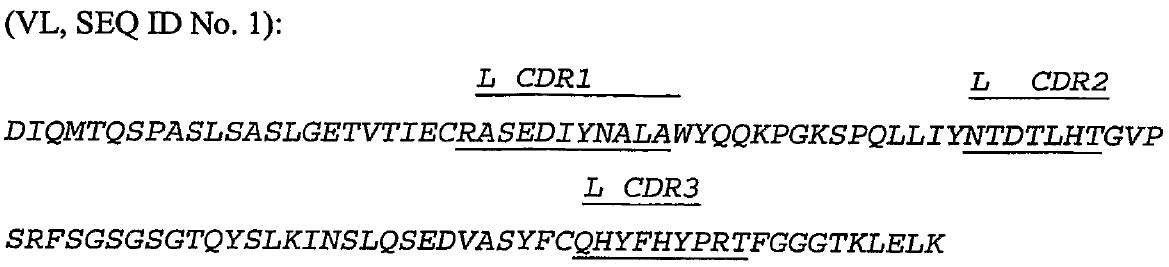
바람직한 면에 있어서 항체 경쇄의 가변 영역은 SEQ ID No. 1의 aa.24에서 aa.34; SEQ ID No. 1의 aa.50에서 aa.56; SEQ ID No. 1의 aa.89에서 aa.97로 부터 선택되는 서열을 갖는 상보성 결정 영역(CDRs) 중 적어도 하나, 더 바람직하게는 두 개, 가장 바람직하게는 세 개를 포함한다. In a preferred aspect, the variable region of the antibody light chain comprises SEQ ID NO. 1 aa.24 to aa.34; SEQ ID NO. 1 aa.50 to aa.56; SEQ ID NO. More preferably two, and most preferably three of the complementarity determining regions (CDRs) having a sequence selected from aa.89 to aa.97 of SEQ ID NO: 1.
추가의 바람직한 면에 있어서, 항체 경쇄의 가변 영역은 본질적으로 SEQ ID No.1의 서열을 포함한다. In a further preferred aspect, the variable region of the antibody light chain essentially comprises the sequence of SEQ ID No.1.
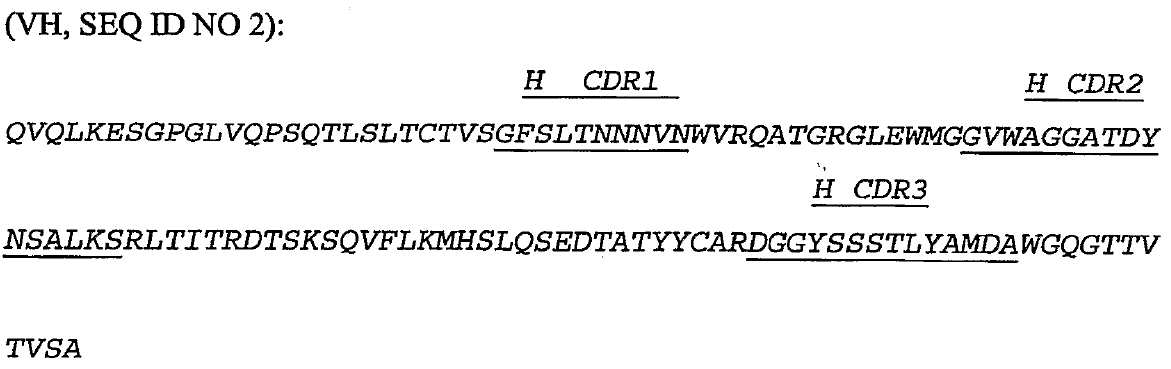
바람직한 면에 있어서, 항체 중쇄의 가변 영역은 SEQ ID No. 2의 aa.26에서 aa.35; SEQ ID No.2의 aa.50에서 aa 65; SEQ ID No.2의 aa.98에서 aa.111로 부터 선택되는 서열을 갖는 상보성 결정 영역(CDRs) 중 적어도 하나, 더 바람직하게는 두 개, 가장 바람직하게는 세 개를 포함한다. In a preferred aspect, the variable region of the antibody heavy chain comprises SEQ ID NO. 2 aa.26 to aa.35; Aa 65 in aa.50 of SEQ ID No.2; More preferably two, and most preferably three of the complementarity determining regions (CDRs) having a sequence selected from aa.98 to aa.111 of SEQ ID No.2.
추가의 바람직한 면에 있어서, 항체 중쇄의 가변 영역은 본질적으로 SEQ ID No.2의 서열을 포함한다. In a further preferred aspect, the variable region of the antibody heavy chain essentially comprises the sequence of SEQ ID No.2.
항체는 단쇄(single chain) 형태일 수 있고, 연결자(linker)에 의해 결합되는 경쇄 가변 영역과 중쇄 가변 영역을 포함한다. The antibody may be in a single chain form and includes a light chain variable region and a heavy chain variable region bound by a linker.
선택적으로, 항체는 두 개의 경쇄 및 두 개의 중쇄를 포함할 수 있다. Optionally, the antibody may comprise two light chains and two heavy chains.
본 발명의 바람직한 면에서, 항-NGF 항체는 인간 또는 인간화된 항체이다. 당업자는 항체를 디자인하기 위해 적절한 인간화 방법을 선택하여야 하며, 바람직한 방법은 WO 2005/061540에 개시된 방법이다. In a preferred aspect of the invention, the anti-NGF antibody is a human or humanized antibody. One skilled in the art should select an appropriate humanization method to design the antibody, and the preferred method is the method disclosed in WO 2005/061540.
간단히 말해, 항체 가면 영역의 "인간화된" 변형물은 인간 면역 글로불린 구조에 랫트 항체의 상보성 결정 영역을 이식하여 얻어졌다. αD11 항체의 Fab 단편에 관한 X-ray 회절 연구로부터 얻어진 완벽한 구조적 정보는 인간 기원의 수용체(acceptor)구조를 선택하는데 공헌하였다. 두 개의 다른 기준은 랫트 αD11 및 수용체 인간 항체 사이의 구조적 차이를 최소화하도록 채택되었다: 1) 일차 구조 상동성 수준, 2) 3차원 구조 유사성 수준. 구조를 선택한 후 랫트 대응물에 의한 인간 잔기의 대체가 얻어진 인간화 항체의 잠재적 면역원성을 낮추기 위해 최소화되었다. Briefly, a "humanized" modification of the antibody mucosal region was obtained by grafting the complementarity determining region of the murine antibody to the human immunoglobulin structure. Complete structural information obtained from X-ray diffraction studies on Fab fragments of the [alpha] D11 antibody contributed to the choice of human acceptor structures. Two different criteria were adopted to minimize structural differences between rat? D11 and receptor human antibodies: 1) primary structural homology levels, and 2) three-dimensional structural similarity levels. After selection of the construct, replacement of human residues by rat counterparts was minimized to lower the potential immunogenicity of the resulting humanized antibodies.
전형적인 인간화 항체는 SEQ ID No 1(랫트 기원 서열)의 인간화 유도체인 경쇄 가변 영역을 포함한다. 전형적인 인간화 항체는 SEQ ID No 2(랫트 기원 서열)의 인간화 유도체인 중쇄 가변 영역을 포함한다. A typical humanized antibody comprises a light chain variable region that is a humanized derivative of SEQ ID No 1 (rat origin sequence). A typical humanized antibody comprises a heavy chain variable region that is a humanized derivative of SEQ ID No 2 (rat origin sequence).
본 발명의 바람직한 면에 있어서, 인간화 항체 경쇄의 가변 영역은 SEQ ID No. 3의 서열을 본질적으로 포함한다. In a preferred aspect of the invention, the variable region of the humanized antibody light chain comprises SEQ ID NO. 3. ≪ / RTI >

인간화 항체 중쇄의 가변 영역은 SEQ ID No.4의 서열을 본질적으로 포함한다.The variable region of the humanized antibody heavy chain essentially comprises the sequence of SEQ ID No.4.

상기한 인간화 가변 영역은 인간 IgG1이나 IgG4 아이소타입 형태의 적절한 발현 벡터로 클론되었고 발현, 정제, 및 약물학적 특성화를 준비하기 위해 포유동물 세포주로 트랜스펙션 되었다. The humanized variable regions were cloned into appropriate expression vectors in human IgG1 or IgG4 isotype form and transfected into mammalian cell lines to prepare for expression, purification, and pharmacological characterization.
Hu-αD11의 다른 변형물(완전한 IgG: 중쇄 + 경쇄)이 최종적으로 생성되었다(다른 불변부분 때문에 구별됨).Other variants of Hu-αD11 (complete IgG: heavy chain + light chain) were eventually generated (distinguished by other invariant moieties).
본 발명의 바람직한 면에 있어서, 인간화 항체 경쇄의 가변 영역은 SEQ ID No 8의 서열을 본질적으로 가진다.In a preferred aspect of the invention, the variable region of the humanized antibody light chain has essentially the sequence of

바람직한 구체예에서, 인간화 항-NGF 중쇄는 본질적으로 다음 3개의 서열 중 하나를 갖는다. In a preferred embodiment, the humanized anti-NGF heavy chain has essentially one of the following three sequences.
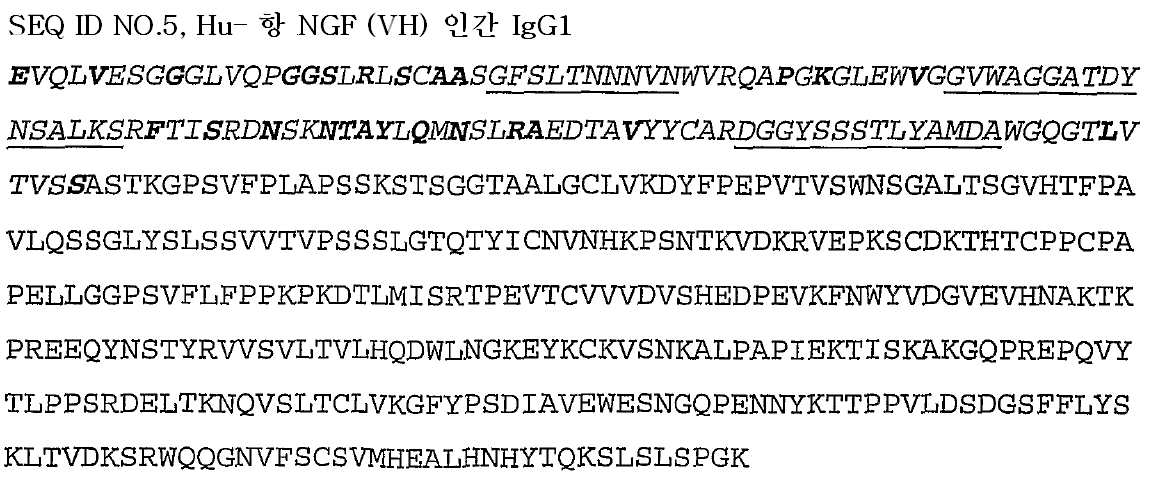
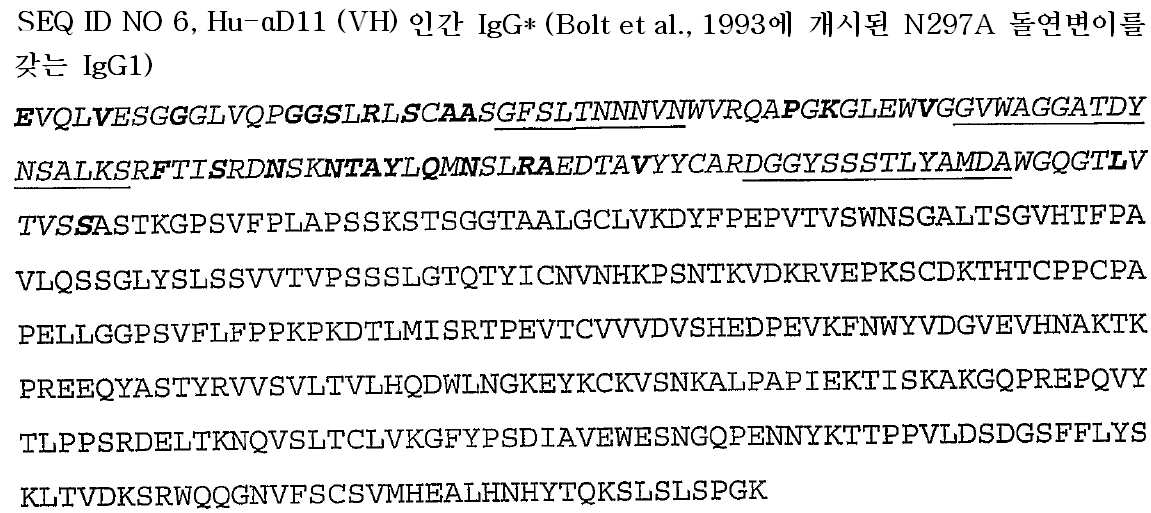

바람직한 면에서, 본 발명의 분자는, 바람직하기는, 췌장염, 신장결석, 두통, 월경불순, 근골격 통증, 염좌, 복부 통증, 난소낭포, 전립선염, 방광염, 간질성 방광염, 수술 후 통증, 편두통, 삼차신경통, 화상 및/또는 상처로 인한 통증, 외상과 관련된 통증, 신경병증성 통증, 근골격계 질환과 관련된 통증, 류마티스 관절염, 골관절염, 강직성 척추염, 관절주위의 질병, 종양성 통증, 골 전이에 의한 통, HIV에 의한 통증으로부터 유발되는 만성 염증 타입의 통증을 위한 약제의 제조를 위해 사용된다. In a preferred aspect the molecules of the invention are preferably selected from the group consisting of pancreatitis, kidney stones, headache, menstrual irregularities, musculoskeletal pain, sprains, abdominal pain, ovarian cysts, prostatitis, cystitis, interstitial cystitis, Neuralgia, pain associated with trauma, neuropathic pain, pain associated with musculoskeletal disorders, rheumatoid arthritis, osteoarthritis, ankylosing spondylitis, periarticular disease, neoplastic pain, bone metastasis , ≪ / RTI > for the manufacture of medicaments for chronic inflammation-type pain caused by pain caused by HIV.
선택적으로, 상기 통증은 신경병증성 통증이나 종양성 통증이다. Alternatively, the pain is neuropathic pain or neoplastic pain.
International Association for the Study of Pain(IASP, www.iasp-pain.org<http://www.iasp-pain.org/>)에 따르면, 통증은 일반적으로 "실질적 또는 잠재적 조직 손상과 관련되거나, 또는 그러한 손상이나 양자 모두의 면으로 설명되는 불쾌한 감각적 그리고 감정적인 경험"으로 정의된다. 통증의 모든 형태에서 기본적인 요소는 잠재적 조직 손상의 유기체를 경고하는 특수화된 높은 역치(threshold) 리셉터 및 신경 섬유의 활성이다. 염증세포의 관여 및 과정은 많은 통증 상태에서 일반적인 요소이다. "급성 통증"이라는 용어는 즉각적인 일반적으로 높은 역치로 절단, 압궤, 화상 혹은 화학적 자극과 같은 상처에 의한 일어나는 통증을 의미한다. 여기에서 사용된 "만성 통증"이라는 용어는 급성 통증 이외의 통증을 의미한다. 만성통증은 종종 상대적으로 길게, 예를 들어 몇 달 혹은 몇 년 동안 지속되고, 지속적이거나 간헐적일 수 있는 것으로 이해된다.According to the International Association for the Study of Pain (IASP, www.iasp-pain.org/), pain is generally associated with "substantial or potential tissue damage, or An unpleasant sensory and emotional experience that is explained in terms of such damage or both ". A fundamental element in all forms of pain is the activity of specialized high threshold receptors and nerve fibers that warn the organism of potential tissue damage. The involvement and process of inflammatory cells is a common factor in many pain states. The term "acute pain" refers to the pain caused by a wound, such as a cut, collapse, burn, or chemical irritation, at an immediate, generally high threshold. As used herein, the term " chronic pain " refers to pain other than acute pain. It is understood that chronic pain often lasts relatively long, for example months or years, and can be persistent or intermittent.
항-NGF 항체는 적절하게 전신적으로 투여된다. 항-NGF 항체의 전신적 투여는 주사, 예를 들어 지속적인 정맥 투여, 약제 정맥 투여, 피하 혹은 정맥내 주사에 의해 수행될 수 있다. 선택적으로, 투여의 다른 형태(예를 들어, 구강, 점막, 흡입, 혀아래 등등) 역시 사용될 수 있다. 항체의 국부 전달은, 예를 들어 병에 걸린 조직의 부근에 관절 강내 투여 혹은 피하, 근육 내 주사와 같은 국부 투여에 의해 수행될 수 있다. Anti-NGF antibodies are suitably administered systemically. Systemic administration of an anti-NGF antibody can be carried out by injection, for example, continuous intravenous administration, intravenous drug administration, subcutaneous or intravenous injection. Alternatively, other forms of administration (e.g., oral, mucosal, inhalation, under the tongue, etc.) may also be used. Local delivery of the antibody can be carried out, for example, by intraarticular administration in the vicinity of diseased tissue or by local administration such as subcutaneous, intramuscular injection.
항-NGF 항체는 의도한 투여 경로에 적합한 약제학적 조성물로 적절하게 제형화될 것이다. 투여용 용액은 적절한 완충액과 몰농도 변형제, 예를 들어 인산염, 염 및/혹은 덱스트로즈가 함유된 수용성 매질(예를 들어 투여용 물)에 녹거나 혹은 분산된 항체를 적절이 함유할 것이다. Anti-NGF antibodies will be suitably formulated as pharmaceutical compositions suitable for the intended route of administration. The solution for administration will suitably contain an antibody dissolved or dispersed in a suitable buffer and a water-soluble medium (for example water for administration) containing a molar concentration modifier, for example a phosphate, a salt and / or dextrose .
치료 처방계획, 즉 투여량, 타이밍과 반복은 선택된 투여 경로에 의해 단일 혹은 반복된 투여(예를 들어, 주사)로 나타낼 수 있다. 약제 투여 간격은 임상 반응의 범위와 기간뿐만 아니라 특정 개인과 개인적 임상 기록이 변형될 수 있다. 적절하게는, 항-NGF 항체는 장기간 지속적인 활성을 갖는다. 특히 항체의 임상적 효과는 투여 후 동물 연구로 부터 결정된 21일 만큼이나 연장된다. 더욱이 예비적 데이타는 항-NGF 항체가, 이것의 투여 후 혈청이나 혈장과 같은 관련있는 생리적 매트릭스에서 확인될 수 있는 이것의 존재보다 오랜 기간 동안 임상적 이득을 나타낸다는 것을 암시한다. 의도된 활성의 장기적 지속의 측면에서 (즉, 최소 한 주 혹은 바람직하기는 최소 2 주, 예컨데 최소 3 주 혹은 최소 4 주 적절하게 지속되는 효과), 적절하게는 항체가 매주 한번 이하의 주기, 예컨데 2주에 한 번 이하, 또는 3주에 한번 또는 4주에 한 번의 주기로 개체에 투여될 수 있다. Therapeutic regimen, i.e. dose, timing and repetition, may be indicated by single or repeated administration (e. G., Injection) by the selected route of administration. The intervals of drug administration can be modified by specific individuals and individual clinical records, as well as the extent and duration of the clinical response. Suitably, the anti-NGF antibody has long-lasting activity. In particular, the clinical effect of the antibody is extended to as much as 21 days as determined from animal studies after administration. Moreover, the preliminary data suggest that the anti-NGF antibody exhibits a clinical benefit over a longer period of time than its presence, which can be confirmed in relevant physiological matrices such as serum or plasma following its administration. (I. E. At least a weekly or preferably at least two weeks, for example at least three weeks or at least four weeks, suitably lasting effect) in the long-term duration of the intended activity, suitably the antibody is administered once a week or less, Once every two weeks, or once every three weeks, or once every four weeks.
항-NGF의 적절한 투여량는 전형적으로 0.1mg/kg에서 10mg/kg 체중의 범위가 될 것이다.A suitable dose of anti-NGF will typically range from 0.1 mg / kg to 10 mg / kg body weight.
여기 개시된 신규한 항체와 이들을 포함하는 조성물은 본 발명의 양상으로서 청구된다.The novel antibodies disclosed herein and compositions comprising them are claimed as aspects of the present invention.
본 발명의 비제한적 구체예는 이제 하기 도면과 특별히 관련되어 기재될 것이다. Non-limiting embodiments of the present invention will now be described with particular reference to the following drawings.
도 1: 마우스 NGF (m-NGF)에 대한 αD11 항-NGF 항체의 결합에 대한 BIAcore 분석과 재조합 마우스 proNGF(rm-proNGF). αD11 항-NGF항체는 흐름 셀(flow cell) 2에 고정되는 반면 흐름 셀 1은 블랭크로 남겨두었다. 각각의 곡선은 셀 2에서 측정된 신호에 (세포 1에서 측정된)주변 신호를 빼서 얻는다. 표면 플라스몬 공명 신호는 각 단계에서 표면-결합 성분의 양을 나타내고, 공명 단위(RU)로 표현된다. Figure 1: BIAcore assay for binding of anti-NGF antibody to mouse NGF (m-NGF) and recombinant mouse proNGF (rm-proNGF). The anti-DGF anti-NGF antibody is immobilized on the
m-NGF 결합을 위해, 항체의 고정화는 패널A의 실험에서 3000 공명 단위(RU)였고 패널B의 실험에서 6000 RU 였다. m-NGF의 주입농도는 각 곡선의 상부에 나타내었다. 결과의 완벽한 분석으로 부터, 친화성 매개변수가 산정되었고 그 결과는 다음과 같다: KA=3,55·1011 1/M; KD=2,81·10-12M (0.123의 chi2 값).For m-NGF binding, the immobilization of the antibody was 3000 resonant units (RU) in the panel A experiment and 6000 RU in the panel B experiment. The injection concentration of m-NGF is shown at the top of each curve. From the complete analysis of the results, the affinity parameters were estimated and the results are as follows: KA = 3,55 · 10 11 1 / M; KD = 2.81 · 10 -12 M (chi 2 value of 0.123).
rm-proNGF 결합(패널C)을 위해, 항체의 고정화는 3000 RU였다. rm-proNGF의 주입 농도는 각 곡선의 상부에 나타내었다. 결과의 속도분석은 다음의 매개변수를 산출하였다: KA=1,2·109 1/M;MD=1,9·10-9M ( 0.09의 chi2 값).For rm-proNGF binding (panel C), the immobilization of antibody was 3000 RU. The injection concentrations of rm-proNGF are shown at the top of each curve. The velocity analysis of the results yielded the following parameters: KA = 1,2 · 10 9 1 / M; MD = 1,9 · 10 -9 M (chi 2 value of 0.09).
도 2: 포르말린 유발 통증에 대한 Fab αD11 (알파D11) 및 Fab Hu-αD11 (Hu-알파D11) 항-NGF 항체의 효과(포르말린 테스트 2단계: 15-40 분. 염증과 관계된 통증에 상응하는 2단계). 마우스들은 오른쪽 뒷발의 등 부분에 5% 포르말린을 피하에 주사했다. Figure 2: Effect of Fab? D11 (alpha D11) and Fab Hu-alpha D11 (Hu-alpha D11) anti-NGF antibodies on formalin-induced pain (Formalin test Step 2: step). Mice injected 5% formalin in the dorsal part of the right hind paw.
항체 주사로 이루어진 치료(Fab 알파D11 또는 Fab Hu-알파D11 vs mock(모조) Fab 또는 식염수)는 포르말린 주사와 시험(각각 항체의 단일 투여량: 12.5 ug)하기 전에 45분(포르말린을 같은 발에)실시하였다. 각 실험 그룹은 최소 8마리로 구성되었다. 결과의 통계적 분석은 통증 반응 (핥는데 소요되는 시간)의 두번째 단계(염증)에 대해 명확하게 특이성이 있는 (항체의 어버이형과 인간화형 모두에 대해) 항-NGF 처리의 상당한 진통 효과를 보여주었다: 항-NGF 항체(어버이형과 인간화형 모두에 대해)의 효과는 통계적으로 식염수(** p<0.01) 혹은 mock Fab 처리 (#p<0.05)에 대해서 달랐다(ANOVA). Antibody injections (Fab alpha D11 or Fab Hu-alpha D11 vs. mock Fab or saline) were administered for 45 minutes (formalin on the same foot) before formalin injection and testing (single antibody dose of 12.5 ug each) ). Each experimental group consisted of at least 8 animals. Statistical analysis of the results showed a significant analgesic effect of the anti-NGF treatment (both for the parental and humanized forms of the antibody) with distinct specificity for the second stage of inflammation (time spent licking) (inflammation) : The effect of anti-NGF antibodies (both parental and humanized) was statistically different for saline (** p <0.01) or mock Fab treatment (#p <0.05) (ANOVA).
도 3: 신경병증성 통증에 대한 항-TrkA 단일 클론성 항체 MNAC13 (1.4 mg/kg) 및 항-NGF 단일 클론성의 항체αD11 (1.4 mg/kg)의 효과: 기계적 이질 통이 발 동세적 각막지도검사기(plantar dynamic aesthesiometer)에 의해 측정되었고; CD1 마우스는 좌골신경의 만성 협심증 처리되었고; 항체는 좌골신경의 병변 후 3, 4, 5, 6일에 복강 내로 주사되었다. 관찰 기간: 3일에서 14일. 음성대조군으로서, 식염수 (sal) 및 마우스 면역글로부린(IgG, 1.4 mg/kg) 둘 다 사용되었다. 결과는 병변에 동측인 뒤쪽 발에 역치힘의 절대 값(그램)으로 나타냈다. 값은 반복된 측정에 하여 분산분석법(ANOVA)에 의하여 통계적으로 분석되었다. 여기서, "치료" 인자 및 반복 측정(일) 둘 다 P<0.01로 유의적이었다. 항-TrkA 혹은 항-NGF로 처리한 동물은 4일에서 14일까지의 대조군과 상당히 달랐다. Figure 3: Effect of anti-TrkA monoclonal antibody MNAC13 (1.4 mg / kg) and anti-NGF monoclonal antibody αD11 (1.4 mg / kg) on neuropathic pain: mechanical heterotrophic corneal map Measured by a plantar dynamic aesthesiometer; CD1 mice were treated with chronic angina of the sciatic nerve; Antibodies were injected intraperitoneally on
도 4: 신경병증성 통증에 대한 항-TrkA 단일 클론성 항체 MNAC13 (1.4 mg/kg) 및 항-NGF αD11 항체 (1.4 mg/kg)의 효과: 기계적 이질통은 발 동세적 각막지도검사기(plantar dynamic aesthesiometer)에 의해 측정되었고; CD1 마우스는 좌골신경의 만성 협심증 처리되었고; 항체는 좌골 신경 병변 후 3, 4, 5, 6일에 복강 내로 주사되었다. 관찰기간: 3일에서 14일. 대조군으로서, 식염수(sal)와 마우스 면역글로부린(IgG, 1.4 mg/kg) 둘 다 사용되었다. 결과는 백분율, %(병변에 동측인 뒤쪽 발의 역치힘과 반대 측 뒷발에 상응하는 힘 사이의 비)로 표현되었다. 상응하는 절대값을 반복된 측정에 대하여 분산분석법(ANOVA)에 하여 통계적으로 분석하였다. 여기서 "치료" 인자와 반복 측정(일) 둘 다 P<0.01(최소)에서 유의적이었다. 항-TrkA 혹은 항-NGF로 처리한 동물은 4일에서 14일까지 대조군과 상당히 달랐다. Figure 4: Effect of anti-TrkA monoclonal antibody MNAC13 (1.4 mg / kg) and anti-NGF aD11 antibody (1.4 mg / kg) on neuropathic pain: mechanical allodynia was assessed by plantar dynamic aesthesiometer); CD1 mice were treated with chronic angina of the sciatic nerve; Antibodies were injected intraperitoneally at 3, 4, 5, and 6 days after sciatic nerve lesion. Observation period: 3 to 14 days. As a control, both saline (sal) and mouse immunoglobulin (IgG, 1.4 mg / kg) were used. The results were expressed as a percentage,% (ratio between the threshold force on the posterior side of the lesion and the corresponding force on the contralateral hindpaw). Corresponding absolute values were analyzed statistically for repeated measurements by ANOVA. Here, both the "treatment" factor and the repeated measures (days) were significant at P <0.01 (min). Animals treated with anti-TrkA or anti-NGF were significantly different from control animals from 4 to 14 days.
도 5: 신경병증성 통증에 대한 항-TrkA 단일 클론성 항체 MNAC13 (2회 투여: 0.9와 2 mg/kg) 및 항-NGF αD11 항체 (2 mg/kg 투여)의 효과 간의 비교: 기계적 이질통은 발 동세적 각막지도검사기에 의해 측정되었고; CD1 마우스는 좌골신경의 만성 협심증 처리되었고; 항체는 좌골 신경 병변 후 3, 4, 5, 6, 7, 8, 9, 10일에 복강 내로 주사되었다. 관찰기간: 3일에서 31일. 대조군으로서, 식염수(sal)와 마우스 면역글로불린(IgG, 2 mg/kg) 둘 다 사용되었다. 결과는 백분율 %(병변에 동측인 뒤쪽 발의 역치힘과 상응하는 힘 사이의 비)로 표현되었다. 상응하는 절대값을 반복된 측정에 대하여 분산분석법(ANOVA)에 하여 통계적으로 분석을 하였다. 여기서 "치료" 인자와 반복 측정(일) 둘 다 P<0.01(최소)에서 유의적이었다. MNAC13을 처리한 동물은 5일(MNAC13의 더 많은 투여량)부터 혹은 7일(MNAC13의 더 적은 투여량)부터 마지막 관찰일(31일)까지 한 대조군과 상당히 달랐다. αD11을 처리한 동물은 마지막 관찰일(31일)까지, 4일부터 14일, 그리고 21일에서 31일까지 대조군과 상당히 달랐다.Figure 5: Comparison between the effects of anti-TrkA monoclonal antibody MNAC13 (2 doses: 0.9 and 2 mg / kg) and anti-NGF aD11 antibody (2 mg / kg dose) on neuropathic pain: Mechanical allodynia Measured by an outpatient corneal map tester; CD1 mice were treated with chronic angina of the sciatic nerve; Antibodies were injected intraperitoneally at 3, 4, 5, 6, 7, 8, 9, and 10 days after sciatic nerve lesion. Observation period: 3 to 31 days. As a control, both saline (sal) and mouse immunoglobulin (IgG, 2 mg / kg) were used. The results were expressed as a percentage (% between the threshold force on the posterior side of the lesion and the corresponding force). Corresponding absolute values were analyzed statistically by repeated analysis of variance (ANOVA). Here, both the "treatment" factor and the repeated measures (days) were significant at P <0.01 (min). Animals treated with MNAC13 were significantly different from the control group from 5 days (more dose of MNAC13) or 7 days (less dose of MNAC13) to the last observation day (31 days). The animals treated with αD11 were significantly different from the control group until the last observation day (31 days), from 4 days to 14 days, and from 21 days to 31 days.
도 6: 신경병증성 통증에 대한 항-NGF 중화 항체 시험된(1 회 투여량: 2mg/Kg)의 어버이형(αD11)와 인간화형 (Hu-αD11, 인간 IgG4 형태) 모델의 효과: 발 동세적 각막지도검사기에 의해 측정되었고; CD1 마우스는 좌골신경의 CCI(만성 협심증) 처리되었고,; 항체는 좌골 신경 병변 후 3, 4, 5, 6, 7, 8, 9, 10일에 복강 내로 주사되었다. 관찰기간: 3일에서 31일. 음성 대조군(IgG, 2mg/kg)이 마우스 면역글로부린이 사용되었다. 결과는 백분율 %(병변에 동측인 뒤쪽 발의 역치힘과 반대 측 뒷발에 상응하는 힘 사이의 비)로 표현되었다. 상응하는 절대값을 반복된 측정에 대하여 분산분석법(ANOVA)에 하여 통계적으로 분석하였다. 여기서 "치료" 인자와 반복된 측정(일) 둘 다 P<0.01(최소)에서 유의적이었다. αD11이나 Hu-αD11가 처리된 동물은 마지막 관찰, 4일부터 14일, 그리고 21일에서 31일까지 대조군과 상당히 달랐다. Figure 6: Effect of parental (αD11) and humanized (Hu-αD11, human IgG4 form) models of anti-NGF neutralizing antibodies tested (neuropathic pain) (single dose: 2 mg / Kg) Was measured by a red corneal map tester; CD1 mice were treated with CCI (chronic angina pectoris) of the sciatic nerve; Antibodies were injected intraperitoneally at 3, 4, 5, 6, 7, 8, 9, and 10 days after sciatic nerve lesion. Observation period: 3 to 31 days. Negative control (IgG, 2 mg / kg) mouse immunoglobulin was used. The results were expressed as a percentage (% between the threshold force on the posterior lateral foot of the lesion and the corresponding force on the contralateral rear foot). Corresponding absolute values were analyzed statistically for repeated measurements by ANOVA. Here, both the "treatment" factor and the repeated measures (days) were significant at P <0.01 (min). The animals treated with αD11 or Hu-αD11 were significantly different from the control group at the last observation, from 4 to 14 days, and from 21 to 31 days.
방법Way
단일클론 항체의 생산Production of monoclonal antibodies
단일클론 항체 MNAC13 및 αD11은 상기의 표준 방법(Galfre and Milstein, 1981; Cattaneo et al., 1988; Cattaneo et al., 1999)에 따른 혼성 종양세포 상층액에서 생산되었다. 각각의 항체를 포함한 상층액을 침전시키고(29% 황산암모늄), PBS 1X(Spectra-Por 12/14K 막, Spectrum 사)로 투석하였다. 그리고 세파로즈 단백질 G 컬럼(4-Fast Flow, Amersham Biosciences 사)로 친화성 크로마토그래피 하였 다. 용출은 수집 후 중성화되는 낮은 pH (HCl 5mM)의 용액에 의해 발생하였다. 최종 용출물은 농축시켜(Amicon Ultra-15, 50K, Millipore사) 1~5mg/ml의 농도로 정제된 항체의 제제를 얻었다.Monoclonal antibodies MNAC13 and aD11 were produced in hybrid tumor cell supernatants according to the standard method described above (Galfre and Milstein, 1981; Cattaneo et al., 1988; Cattaneo et al., 1999). The supernatant containing each antibody was precipitated (29% ammonium sulfate) and dialyzed against PBS 1X (Spectra-Por 12 / 14K membrane, Spectrum). And affinity-chromatographed on a Sepharose Protein G column (4-Fast Flow, Amersham Biosciences). Elution was caused by a solution of low pH (5 mM HCl) which was neutralized after collection. The final eluate was concentrated (Amicon Ultra-15, 50K, Millipore) to obtain a purified antibody preparation at a concentration of 1-5 mg / ml.
αD11 항체의 Fab(Fragments Antigen binding) 버전을 이전에 명시한 바(특허출원 WO 05/061540, Covaceuszach et al., 2004)와 같이 생산하였다. αD11 항-NGF 항체는 NGF와 TrkA 사이의 결합을 억제할 수 있는 항-NGF IgG4 이소타입 항체로, 상기 항체의 경쇄 가변 영역이 다음의 서열들을 갖는 세 개의 상보성 결정 영역들(CDRs) 전부를 포함하고: SEQ ID No.1의 아미노산 24 내지 아미노산 34; SEQ ID No.1의 아미노산 50 내지 아미노산 56; 및 SEQ ID No.1의 아미노산 89 내지 아미노산 97, 그리고 상기 항체의 중쇄 가변 영역이 다음의 서열들을 갖는 세 개의 상보성 결정 영역들(CDRs) 전부를 포함한다: SEQ ID No.2의 아미노산 26 내지 아미노산 35; SEQ ID No.2의 아미노산 50 내지 아미노산 65; 및 SEQ ID No.2의 아미노산 98 내지 아미노산 111. The Fragments Antigen binding (Fab) version of the? D11 antibody was produced as previously described (patent application WO 05/061540, Covaceuszach et al., 2004). anti-NGF antibody is an anti-NGF IgG4 isotype antibody capable of inhibiting the binding between NGF and TrkA, wherein the light chain variable region of the antibody comprises all three complementarity determining regions (CDRs) having the following sequences Amino acid 24 to amino acid 34 of SEQ ID No 1; An
간결하게, Fab 단편은 상응하는 전체 단일클론의 항체(IgG 형태)로 부터 파파인(papain) 단백질 분해에 의해 그리고 이온 교환 크로마토그래피 정제 단계 및 통과물(flow-though)에 모인 Fab 단편의 농축에 의해 얻었다. 여전히 존재하는 꽤 적은 량의 분리되지 않은 IgG로부터 Fab 단편을 분리하기 위해, Superdex G75 컬럼(Pharmacia 사)상의 크기 배제 크로마토그래피를 FPLC 시스템(Pharmacia 사)을 사용하여 수행하고, 마지막 농축 단계를 수행하였다. Briefly, the Fab fragments were purified from the corresponding whole monoclonal antibody (IgG form) by papain proteolysis and by enrichment of the Fab fragments collected in an ion exchange chromatography purification step and flow-though . Size exclusion chromatography on a Superdex G75 column (Pharmacia) was performed using an FPLC system (Pharmacia) and a final concentration step was performed to separate the Fab fragments from the still relatively small amount of isolated IgG .
두 개의 항체(Hu-αD11과 Hu-MNAC13)의 인간화된 버전(IgG1/IgG1*/IgG4)을 고려하는 한, 이들은 또한 안정적으로 트랜스펙션된 세포계의 상층으로부터 시작하여 상기와 같이 정제되었고, 이것은 각각의 항체의 중쇄(pVH/CMV 발현) 및 경쇄(pVL/CMV 발현)에 대한 안정한 공동 트랜스펙션체였다. 사용된 벡터는 이전에 기재되었다(특허출원 WO 05/061540). 안정한 공동트랜스펙션된 클론을 G418과 마이코페놀산의 이중 선택을 통해 얻었다. pVH/CMV 발현 벡터는 인간 IgG1의 불변의 부분을 포함하기 때문에, Hu-αD11의 IgG4 변형체를 생산하기 위해, 이것을 (인간 림프구 RNA로부터 RT-PCR에 의해 클론된) IgG4의 상응하는 Fc 영역으로 대체하였다. IgG1* 변형체(=Bolt et al.,이 설명한 N297A 돌연변이를 갖는 IgG1)을 부위 지향된 돌연변이 유발에 의해 생성하였다. As far as the humanized versions (IgG1 / IgG1 * / IgG4) of the two antibodies (Hu-αD11 and Hu-MNAC13) were considered, they were also purified as described above starting from the upper layer of the stably transfected cell line, Was a stable co-transfectant for the heavy chain (pVH / CMV expression) and light chain (pVL / CMV expression) of each antibody. The vector used was previously described (patent application WO 05/061540). Stable co-transfected clones were obtained through double selection of G418 and mycophenolic acid. Since the pVH / CMV expression vector contains a constant portion of human IgG1, it can be substituted for the corresponding Fc region of IgG4 (cloned by RT-PCR from human lymphocyte RNA) to produce an IgG4 variant of Hu- Respectively. An IgG1 * variant (= Bolt et al., IgG1 with the N297A mutation described above) was generated by site directed mutagenesis.
표면 surface 플라스몬Plasmon 공명 연구 Resonance study
BIAcore 2000기계를 사용하여 아민 커플링을 갖는 CM5 칩에서 연구를 수행하였다. 커플링은 BIAcore에서 구매한 특정 키트로 수행하였고 결합 반응은 제조사 지침에 따라 수행하였다. Studies were performed on a CM5 chip with amine coupling using a BIAcore 2000 machine. Coupling was performed with a specific kit purchased from BIAcore and the binding reaction was performed according to the manufacturer's instructions.
항-NGF 항체는 칩에 고정시킨 반면 마우스 NGF(m-NGF, Alomone 사) 혹은 재조합 마우스 proNGF(rm-proNGF)는 결합 곡선을 얻기 위해 감소된 농도로 투여하였다.Anti-NGF antibody was immobilized on the chip while mouse NGF (m-NGF, Alomone) or recombinant mouse proNGF (rm-proNGF) was administered at a reduced concentration to obtain binding curves.
실험에 사용된 흐름은 다른 언급이 없는 한, 30㎕/분이었다. 칩의 재생을 10 mM 글라이신 pH 1.5의 펄스(10uL)로 모든 경우에서 수행하였다. 수집된 결과를 Package BIAevaluaion 3.0을 사용하여 분석하였다. 겉보기 평형 상수 KD는 ka/kd 비율로 정의된다. The flow used in the experiment was 30 / / min unless otherwise noted. Regeneration of the chip was performed in all cases with a pulse (10 uL) of 10 mM glycine pH 1.5. The collected results were analyzed using Package BIAevaluaion 3.0. The apparent equilibrium constant K D is defined as the ratio k a / k d .
뮤린Murine 통증 모델에서 연구 Research in Pain Model
동물은 연구에서의 동물의 사용에 대한 IASP 윤리위원회의 방침과 이탈리아 국법(DL116/92, European Direction 86/609/EEC)에 맞게 처리되고 다루어졌다. 동물의 통증을 최소화하기 위한 모든 필요한 노력을 하였고, 신뢰성 있는 과학적 결과를 생성하는데 요구되는 동물의 수를 최소화하였다. Animals were handled and handled in accordance with the IASP Ethics Committee's guidelines for the use of animals in research and Italian national legislation (DL116 / 92, European Direction 86/609 / EEC). We made all necessary efforts to minimize animal pain and minimized the number of animals required to produce reliable scientific results.
포르말린 테스트Formalin test
사전의 포르말린 테스트를 위해(Porro and Cavazzuti, 1993), 실험 초기에는 몸무게가 35-40g인 CD1 수컷 마우스들(Charles River Labs, Como, Italy)를 사용하였다. 실험실에 도착한 후(실험 전 적어도 2주), 랫트들을 규칙적인 빛/어둠 스케쥴(빛 7.00-19.00) 하에서, 일정한 온도(22±1℃)와 상대 습도(60%)에서 정해진 표준 투명 플라스틱 우리(한 우리당 4마리)에서 보관하였다. 먹이와 물은 무제한이었다. 실험은 9시에서 14시 사이에 수행하였다. 포르말린 테스트를 위해 한 번에 동물 한 마리를 투명 플렉시 유리 우리(30 x 12 x 13 cm)에 놓고, 테스트 시작 전 30분 동안 자유롭게 움직이도록 하였다. 이 적응기간 후, 포르말린 용액 20 ㎕( 식염수 중 5%)을 26-게이지 바늘이 장착된 초소형 주사기를 이용하여 랫트의 오른쪽 뒷발의 뒤쪽 표면에 피하주사 하고, 관찰 기간을 시작하였다. 거울을 우리 뒤에, 비디오 카메라는 우리 앞에 두어 동물의 뒷발을 보는데 방해받지 않도록 하였다. 핥는 행동, 즉 동물이 핥거나 또는 주사맞은 발을 무는데 보내는 시간의 전체 양을 통증의 지수로서 취하였다. 핥는 행동은 40분 동안 지속적으로 기록되었고, 연속 5분 기간의 블록으로 계산하였다(2단계는 블록 15-40분에 상응하고 염증과 관련된 통증으로 확인될 수 있다). 게다가, 무의식적 행동에 대한 포르말린 투여의 효과에 접근하기 위해, 포르말린 테스트 동안 일반적 행동(걷고, 뒷다리로 서고, 기대는 동안 환경에 노출된 시간) 및 털 다듬기(얼굴과 몸을 깨끗이 하는데 보낸 시간)를 40분 동안 연속적으로 기록하였다. 이러한 매개변수에 대해서 항-NGF 항체 처리에 따른 심각한 차이는 발견되지 않았다. 이 실험 세트에서 항체는 Fabs로 투여되었다(fragments antigen binding; 각 항체의 단일 투여량: 동물 당 12.5 ug). For the formalin test of the dictionary (Porro and Cavazzuti, 1993), CD1 male mice (Charles River Labs, Como, Italy) weighing 35-40 g were used at the beginning of the experiment. After arriving at the laboratory (at least two weeks before the experiment), the rats were placed in a standard transparent plastic weighed at a constant temperature (22 ± 1 ° C) and relative humidity (60%) under a regular light / dark schedule (light 7.00-19.00) 4 per one). The food and water were unlimited. Experiments were performed between 9 and 14 o'clock. One animal at a time for formalin testing was placed in a transparent plexiglass specimen (30 x 12 x 13 cm) and allowed to move freely for 30 min before the start of the test. After this adaptation period, 20 쨉 l of formalin solution (5% in saline) was subcutaneously injected into the posterior surface of the right hind paw of the rats using a micro-syringe equipped with a 26-gauge needle and observation period was started. A mirror was placed behind us, a video camera was placed in front of us so that we would not be disturbed by the animal's hind legs. The licking behavior, the total amount of time that animals spend licking or squatting their shot, was taken as an index of pain. Licking behavior was recorded continuously for 40 minutes and was calculated as a block of five consecutive minutes (
테스트 45분 전에 각각의 마우스의 피하에 어버이 또는 인간화된 항-NGF 항 체 또는 관련없는 Fab를 26-게이지 바늘이 장착된(주입량 = 20㎕) Hamilton 초미세 주사기를 이용하여 오른쪽 뒷발의 등 표면에 투여하였다. 각각의 동물은 오직 하나의 치료만 받았다. 테스트는 주제에 속한 처리 그룹에 대해 선입관 없이 수행했다. 포르말린 테스트를 특징짓는 두 단계를 일방 ANOVAs에 의해 개별적으로 분석하였다. 45 minutes prior to testing, parental or humanized anti-NGF antibodies or unrelated Fabs were subcutaneously injected subcutaneously into each mouse using a Hamilton ultrafine syringe equipped with a 26-gauge needle (injection volume = 20 μl) . Each animal received only one treatment. The tests were conducted without prejudice to the treatment groups belonging to the subject. The two steps characterizing the formalin test were individually analyzed by one-way ANOVAs.
좌골신경 수술Sciatic nerve surgery
중량이 약 35g인 CD1 수컷 마우스들을 마취시키고(500mg/kg 클로랄 하이드레이트로 복강내 주사) 오른쪽 뒷다리의 좌골 신경을 Bennett과 Xie(1988)에 의해 알려진 좌골신경의 만성협심손상 모델(chronic constriction lesion model, CCI)에 따라 박음질 실로 느슨하게 결찰되도록 드러내었다. 윗쪽 허벅지의 수준에서 좌골신경의 느슨한 결찰은 가열성/기계성 이질통 및 통각과민으로 특징되는 말초 단일 신경병증을 초래하였다. 가깝지만 다른 3개의 지점에서 신경의 결찰에 의해, 신경병이 손상에 이어 3일에 완전히 발생되었고 2-3개월 동안 지속되었다. CD1 male mice weighing approximately 35 g were anesthetized (intraperitoneally injected with 500 mg / kg chloral hydrate) and sciatic nerves of the right hind limb were treated with a chronic constriction lesion model known by Bennett and Xie (1988) , CCI) to loosely ligate to the stitching thread. At the level of the upper thigh, loose ligation of the sciatic nerve resulted in peripheral mononeuropathy characterized by heat / mechanical allodynia and hyperalgesia. Neuropathy was completely induced on the third day following injury and continued for 2-3 months, by ligation of the nerve at the other three points.
약물학적 치료Pharmacological treatment
손상 후 셋째 날에 시작된 항-NGF(αD11) 차단 항체 혹은 항-TrkA (MNAC13) 항체들은 표1에 제시된 것과 같이 식염수(매개물)에서 희석되어진 완전 형태(Mab)로 투여하였다. 대조군으로서 마우스 혹은 랫트에 차단 항체로서 동일 용량으로 (만약 2회 투여량이 사용되었다면 더 많은 투여량으로) 영향을 주지 않는 면역글로부린(IgG) 또는 식염수를 사용하였다. 각각의 실험 그룹은 (명백한 다른 언급이 없는 한) N=10 마리를 포함한다. Anti-NGF (αD11) blocking antibodies or anti-TrkA (MNAC13) antibodies, which started on the third day after injury, were administered in a diluted complete form (Mab) in saline (vehicle) as shown in Table 1. As a control, immunoglobulin (IgG) or saline, which does not affect mice or rats at the same dose as the blocking antibody (at higher doses if two doses were used) was used. Each experimental group contains N = 10 animals (unless explicitly stated otherwise).
표 I: 투여 프로토콜과 기계적 이상통증의 측정Table I: Measurement of dosing protocol and mechanical anomalies
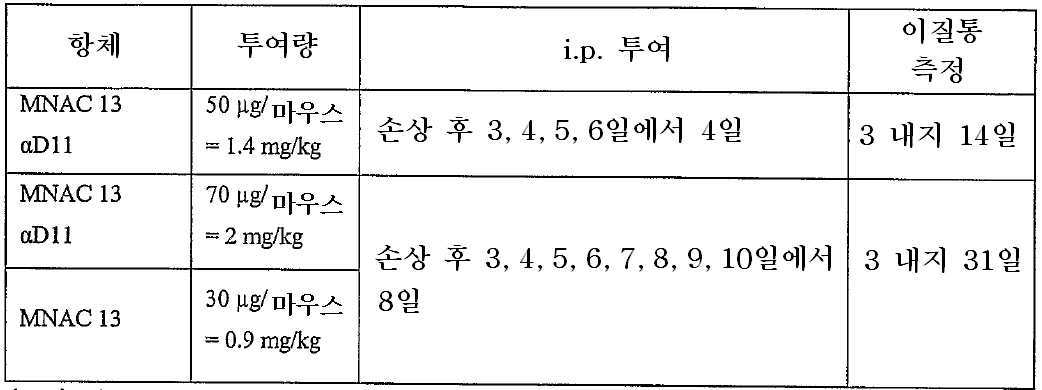
기계적 이상통증은 표 I에 제시된 것과 같이, 발 동세적 각막지도검사기(plantar dynamic aesthesiometer, Ugo Basile 사)에 의해 측정되었다. 3일은 기준선으로 고려된다. Mechanical anomalous pain was measured by a plantar dynamic aesthesiometer (Ugo Basile) as shown in Table I. Three days are considered as baseline.
두 개의 항체 MNAC13 및 αD11의 인간화 모델의 진통제 활동을 평가하기 위해 동일한 프로토콜을 사용하였다. The same protocol was used to evaluate the analgesic activity of the two human antibodies MNAC13 and αD11 in the humanized model.
결과의 통계 분석 (Statistical analysis of results ( CCICCI 실험들) Experiments)
결과를 2개의 다른 방법, 손상부위의 반대인 동물의 뒷다리를 수축시키기에 충분한 역력값(그램으로)의 절대값으로, 또는 뒷 다리(동측성/대측성)의 절대값 간의 비율로서 백분율 값으로 나타내었다. 값을 반복된 측정에 대해 분산분석법 (ANOVA)에 의해 통계분석을 하였다. 그리고 "치료" 인자와 반복된 측정은 모두 p<0.01로 유효하였다. The results are expressed as a percentage value as the ratio between the absolute value of the back force (in grams) sufficient to shrink the animal's hind legs opposite to the injury site, or the absolute value of the hind paw (ipsilateral / contralateral) Respectively. The values were statistically analyzed by repeated analysis (ANOVA) for repeated measurements. The "therapeutic" factor and repeated measures were both valid at p <0.01.
결과result
결합Combination
BIACORE 연구는 마우스 NGF와 재조합한 마우스 pro-NGF에 대한 이 항체의 결합 친화력을 평가함에 αD11 항-NGF 항체(그리고 이것의 인간화된 변형체)의 결합 성질을 더욱 특성화하는 것을 목적으로 수행하였다. 도 1은 이러한 실험의 결과를 나타낸다: αD11 항체는 NGF와 proNGF에서 다른 동역학으로 결합한다. 비슷한 결과가 Hu-αD11에서도 얻어졌다.The BIACORE study was conducted to further characterize the binding properties of the anti-DGF-NGF antibody (and its humanized variants) in evaluating the binding affinity of this antibody to mouse pro-NGF recombined with mouse NGF. Figure 1 shows the results of this experiment: [alpha] D11 antibody binds with different kinetics in NGF and proNGF. Similar results were obtained with Hu-αD11.
NGF로 부터 매우 작은 해리상수는 항체가 이것의 항원에 매우 단단히 결합한다는 것을 나타내고, 항체 결합 동역학 중에서 매우 독특한 예이다. A very small dissociation constant from NGF indicates that the antibody binds very tightly to its antigen and is a very unique example of antibody binding kinetics.
NGF와 proNGF에 대한 항-NGF 항체 결합을 비교함에 의해, 후자의 경우 친화력이 크고 작은 것의 거의 3차수(피코몰 대신 나노몰)임을 알 수 있다. proNGF이 NGF와 오직 추가된 아미노산의 짧은 스트레치만이 다르다는 것을 고려할 때 결합 친화성에서의 이 차이는 전적으로 예측되지 않았고 놀라웠다.By comparing anti-NGF antibody binding to NGF and proNGF, it can be seen that in the latter case, the affinity is large and small, almost the third order (nanomolar instead of picomole). This difference in binding affinity was entirely unpredictable and surprising considering that proNGF is different only in NGF and short stretches of added amino acids only.
성숙한 NGF는 TrkA 리셉터에 대해 높은 친화력을 갖는 반면 proNGF는 바람직하기는 p75에 결합됨에 따라 항-NGF 중성화 항체의 임상적 사용의 견해에서 특이한 타당성을 지닌 현저한 특성인 αD11 및 HuαD11은 TrkA 매개 경로의 새로운 선택적 억제제로 생각될 수 있다. While mature NGF has a high affinity for TrkA receptors, proNGF is preferentially bound to p75 and therefore αD11 and HuαD11, which are distinctive features with particular relevance in the clinical use of anti-NGF neutralizing antibodies, Can be thought of as selective inhibitors.
염증성 통증Inflammatory pain
생체 내 실험에서 첫 번째 세트는 마우스들에서 포르말린-유래 통증(염증성 통증)에 관하여 수행되었고, 다음을 증명하였다:In vivo experiments, the first set was performed on formalin-induced pain (inflammatory pain) in mice and demonstrated the following:
(i) αD11 항-NGF 항체(Fab 형태에서)은 관련없는 Fab와 비교하여, 통증 반 응(포르말린 테스트:2단계)을 상당히 감소시킬 수 있었다. (i) The αD11 anti-NGF antibody (in Fab form) was able to significantly reduce pain response (formalin test: 2 steps) compared to unrelated Fab.
(ii) 같은 결과가 인간화된 변형체(Hu-αD11, 도 2)로 αD11를 대체함에 의해 얻어질 수 있다. (ii) the same result can be obtained by replacing? D11 with a humanized variant (Hu-αD11, FIG. 2).
이것은 Hu-αD11가 염증성 통증에 관련된 모델에서 αD11만큼 강력한 진통제 특성을 보여준다는 것을 의미한다. This implies that Hu-αD11 shows analgesic properties as strong as αD11 in models involving inflammatory pain.
신경병증성Neuropathic 통증 ache
CCI 모델에서의 결과는 두 개의 차단 항체 MNAC13 및 αD11(도 3과 도 4)가 상당한 진통제 효과를 가지는 것을 보여준다. 특히, 1.4 mg/kg의 투여량에서 두 개의 항체에서 비슷한 결과가 발견되었다. 도 3과 도 4에서 보여지는 것과 같이, 이들은 투여 두번째 날(4일)에서 부터 진통제 효과를 가지기 시작하였고, 6일 쯤 최대 효과에 도달하였으며 14일까지 전체 관찰 기간동안 같은 진통 효과를 충분히 유지하였다. 도 4에서와 같이, 결과는 백분율(손상부위의 뒤쪽 발 동측성의 역력과 대측성 뒤쪽 발의 역력 사이의 비율)로 명시되었고, 이것은 두 개의 차단 항체 각각에 대해 최대 백분율 값이 60%정도였고, 대조 그룹(IgG와 식염수)에 대해 대략 40%였다는 것을 나타낸다. The results in the CCI model show that the two blocking antibodies MNAC13 and alpha D11 (Figures 3 and 4) have significant analgesic effects. In particular, similar results were found with two antibodies at a dose of 1.4 mg / kg. As shown in FIGS. 3 and 4, they started to have analgesic effects on the second day of administration (day 4), reached maximal effect on
동물을 4주 동안 최대 31일까지 관찰하였을 때, NGF-TrkA 조직(도 5 및 도 6)을 차단하는 항체의 투여는 2 단계 효과를 나타내었다. 진통제 효과의 첫 번째 단계(3일 부터 17일까지, 즉, 마지막 투여 후 한 주까지)는 대략 11-12일 정도에 최대 효과가 있는 특성이었다. 효과 감소 후(17일까지), 두 번째 진통제 단계가 31일까지 효과 증가와 함께 나타났다. 그러므로 NGF/TrkA 차단 항체의 진통작용에서 두 단계는 구별할 수 있다: 첫 번째("약리학적" 효과), 치료기간과 항체의 마지막 투여 후 첫 번째 주(항체의 혈액의 농도에 동시에 효과가 사라지는 동안의 주)을 포함; 두번째, 장기적인 효과를 확인하는 것으로 아마도 새로운 유전자 발현이 요구될 것이고, 이것은 "질병-개조" 활동 원리인, 즉, 징후에서 단순한 약학적 효과를 증명하는 현재 치료 배경에서 사용되고 있는 상품과는 달리 질병의 경로에서 넓은 범위에 걸쳐 개조될 수 있는 이러한 항체에 독특한 특성(신경병증성 통증의 분야에서)을 준다. 도 5에서 MNAC13 항-TrkA (2와 0.9mg/kg)의 2회 투여의 진통효과를 αD11(2mg/kg)의 것과 비교하였다. 그 결과를 백분율로 나타냈다. αD11 효과의 일시적인 프로파일은 비록 17일에 αD11로 처리한 동물이 대조군(IgG)으로 부터 구별되지 않았지만 MNAC13의 것과 비슷하였다. 반면 MNAC13으로 처리한 모든 동물들은 여전히 상당히 달랐다(p<0.01). 21일부터 αD11가 진통제 효과를 나타내었고, MNAC13 (대조군의 40%와 비교하여, 60%초과)과 비슷한 최종수단(31일)에 도달했다. When the animals were observed for up to 31 days for 4 weeks, administration of the antibody blocking NGF-TrkA tissue (FIG. 5 and FIG. 6) showed a two-step effect. The first phase of the analgesic effect (from 3 to 17 days, ie up to one week after the last dose) was the most effective at approximately 11-12 days. After the reduction of effectiveness (up to 17 days), the second analgesic phase appeared with increased efficacy up to 31 days. Therefore, the two steps in the analgesic action of the NGF / TrkA blocking antibody can be distinguished: first ("pharmacological" effect), the duration of treatment and the first week after the last administration of the antibody During the week); Second, confirming long-term effects will probably require new gene expression, and this is a "disease-remodeling" principle of action, that is, unlike products that are used in the current therapeutic context to demonstrate simple pharmacological effects in the signs, (In the field of neuropathic pain) that can be modified over a wide range in the pathway. In Figure 5, the analgesic effect of two doses of MNAC13 anti-TrkA (2 and 0.9 mg / kg) was compared to that of alpha D11 (2 mg / kg). The results were expressed as a percentage. The temporal profile of the < RTI ID = 0.0 > aD11 < / RTI > effect was similar to that of MNAC13, although the animals treated with αD11 on
실질적으로 상기 설명된 것과 동일한 결과가 αD11항체 대신 이것의 인간화 버전(Hu-αD11)의 변형체가 사용되었을 때(각 항체 당 사용된 복용량: 2mg/kg) 얻어졌고, 후자가 어버이 모델로서 같은 진통제 특성을 갖는다는 것을 확인한다. 항체는 경쇄(SEQ ID No.3) 및 중쇄(SEQ ID No.4) 가변영역 모두에서 WO2005/061540의 방법으로 인간화되었다. 전체 인간화 항체를 구성하기 위해 위에 제시한 대로 (SEQ ID No.5-8) 다른 불변의 영역을 사용하였다. Substantially the same results as described above were obtained when a variant of the humanized version thereof (Hu-aD11) was used (dose used per antibody: 2 mg / kg) instead of the? D11 antibody and the latter was used as the parental model with the same analgesic properties . Antibodies were humanized by the method of WO 2005/061540 in both the light chain (SEQ ID No. 3) and the heavy chain (SEQ ID No. 4) variable region. Other constant regions were used as described above (SEQ ID No. 5-8) to construct whole humanized antibodies.
부모 및 인간화 항체의 진통제 활성(CCI)에 대하여 동등한 전형적인 예로서 도 6에 αD11과 Hu-αD11(IgG4 형태)간의 비교를 나타내었다. A comparative example of the equivalent analgesic activity of parental and humanized antibodies (CCI) is shown in Fig. 6 between aD11 and Hu-aD11 (IgG4 form).
이를 기본으로, Hu-αD11은 이것의 부모 모델과 동일한 장기적인 효과를 갖는다고 말할 수 있다. Based on this, we can say that Hu-αD11 has the same long-term effect as its parental model.
참고문헌 
SEQUENCE LISTING <110> Pavone, Flaminia Martinelli, Sara Cattaneo, Antonino Ugolini, Gabriele <120> Molecules that are able to inhibit the binding between NGF and the TrkA receptor as analgesics with prolonged effect <130> P80563US00 <140> 11921826 <141> 2009-03-05 <150> IT2005RM00290 <151> 2005-06-07 <150> PCT/IT2006/000426 <151> 2006-06-07 <160> 10 <170> PatentIn version 3.3 <210> 1 <211> 107 <212> PRT <213> Artificial Sequence <220> <223> synthetic peptide antibody light chain variable region <400> 1 Asp Ile Gln Met Thr Gln Ser Pro Ala Ser Leu Ser Ala Ser Leu Gly 1 5 10 15 Glu Thr Val Thr Ile Glu Cys Arg Ala Ser Glu Asp Ile Tyr Asn Ala 20 25 30 Leu Ala Trp Tyr Gln Gln Lys Pro Gly Lys Ser Pro Gln Leu Leu Ile 35 40 45 Tyr Asn Thr Asp Thr Leu His Thr Gly Val Pro Ser Arg Phe Ser Gly 50 55 60 Ser Gly Ser Gly Thr Gln Tyr Ser Leu Lys Ile Asn Ser Leu Gln Ser 65 70 75 80 Glu Asp Val Ala Ser Tyr Phe Cys Gln His Tyr Phe His Tyr Pro Arg 85 90 95 Thr Phe Gly Gly Gly Thr Lys Leu Glu Leu Lys 100 105 <210> 2 <211> 122 <212> PRT <213> Artificial Sequence <220> <223> synthetic peptide antibody heavy chain variable region <400> 2 Gln Val Gln Leu Lys Glu Ser Gly Pro Gly Leu Val Gln Pro Ser Gln 1 5 10 15 Thr Leu Ser Leu Thr Cys Thr Val Ser Gly Phe Ser Leu Thr Asn Asn 20 25 30 Asn Val Asn Trp Val Arg Gln Ala Thr Gly Arg Gly Leu Glu Trp Met 35 40 45 Gly Gly Val Trp Ala Gly Gly Ala Thr Asp Tyr Asn Ser Ala Leu Lys 50 55 60 Ser Arg Leu Thr Ile Thr Arg Asp Thr Ser Lys Ser Gln Val Phe Leu 65 70 75 80 Lys Met His Ser Leu Gln Ser Glu Asp Thr Ala Thr Tyr Tyr Cys Ala 85 90 95 Arg Asp Gly Gly Tyr Ser Ser Ser Thr Leu Tyr Ala Met Asp Ala Trp 100 105 110 Gly Gln Gly Thr Thr Val Thr Val Ser Ala 115 120 <210> 3 <211> 107 <212> PRT <213> Artificial Sequence <220> <223> synthetic peptide variable region of the light chain of Hu-alpha D11 <400> 3 Asp Ile Gln Met Thr Gln Ser Pro Ser Ser Leu Ser Ala Ser Val Gly 1 5 10 15 Asp Arg Val Thr Ile Thr Cys Arg Ala Ser Glu Asp Ile Tyr Asn Ala 20 25 30 Leu Ala Trp Tyr Gln Gln Lys Pro Gly Lys Ala Pro Lys Leu Leu Ile 35 40 45 Tyr Asn Thr Asp Thr Leu His Thr Gly Val Pro Ser Arg Phe Ser Gly 50 55 60 Ser Gly Ser Gly Thr Asp Tyr Thr Leu Thr Ile Ser Ser Leu Gln Pro 65 70 75 80 Glu Asp Phe Ala Thr Tyr Phe Cys Gln His Tyr Phe His Tyr Pro Arg 85 90 95 Thr Phe Gly Gln Gly Thr Lys Val Glu Ile Lys 100 105 <210> 4 <211> 122 <212> PRT <213> Artificial Sequence <220> <223> synthetic peptide variable region of the heavy chain of Hu-alpha D11 <400> 4 Glu Val Gln Leu Val Glu Ser Gly Gly Gly Leu Val Gln Pro Gly Gly 1 5 10 15 Ser Leu Arg Leu Ser Cys Ala Ala Ser Gly Phe Ser Leu Thr Asn Asn 20 25 30 Asn Val Asn Trp Val Arg Gln Ala Pro Gly Lys Gly Leu Glu Trp Val 35 40 45 Gly Gly Val Trp Ala Gly Gly Ala Thr Asp Tyr Asn Ser Ala Leu Lys 50 55 60 Ser Arg Phe Thr Ile Ser Arg Asp Asn Ser Lys Asn Thr Ala Tyr Leu 65 70 75 80 Gln Met Asn Ser Leu Arg Ala Glu Asp Thr Ala Val Tyr Tyr Cys Ala 85 90 95 Arg Asp Gly Gly Tyr Ser Ser Ser Thr Leu Tyr Ala Met Asp Ala Trp 100 105 110 Gly Gln Gly Thr Leu Val Thr Val Ser Ser 115 120 <210> 5 <211> 452 <212> PRT <213> Artificial Sequence <220> <223> synthetic peptide humanised anti-NGF <400> 5 Glu Val Gln Leu Val Glu Ser Gly Gly Gly Leu Val Gln Pro Gly Gly 1 5 10 15 Ser Leu Arg Leu Ser Cys Ala Ala Ser Gly Phe Ser Leu Thr Asn Asn 20 25 30 Asn Val Asn Trp Val Arg Gln Ala Pro Gly Lys Gly Leu Glu Trp Val 35 40 45 Gly Gly Val Trp Ala Gly Gly Ala Thr Asp Tyr Asn Ser Ala Leu Lys 50 55 60 Ser Arg Phe Thr Ile Ser Arg Asp Asn Ser Lys Asn Thr Ala Tyr Leu 65 70 75 80 Gln Met Asn Ser Leu Arg Ala Glu Asp Thr Ala Val Tyr Tyr Cys Ala 85 90 95 Arg Asp Gly Gly Tyr Ser Ser Ser Thr Leu Tyr Ala Met Asp Ala Trp 100 105 110 Gly Gln Gly Thr Leu Val Thr Val Ser Ser Ala Ser Thr Lys Gly Pro 115 120 125 Ser Val Phe Pro Leu Ala Pro Ser Ser Lys Ser Thr Ser Gly Gly Thr 130 135 140 Ala Ala Leu Gly Cys Leu Val Lys Asp Tyr Phe Pro Glu Pro Val Thr 145 150 155 160 Val Ser Trp Asn Ser Gly Ala Leu Thr Ser Gly Val His Thr Phe Pro 165 170 175 Ala Val Leu Gln Ser Ser Gly Leu Tyr Ser Leu Ser Ser Val Val Thr 180 185 190 Val Pro Ser Ser Ser Leu Gly Thr Gln Thr Tyr Ile Cys Asn Val Asn 195 200 205 His Lys Pro Ser Asn Thr Lys Val Asp Lys Arg Val Glu Pro Lys Ser 210 215 220 Cys Asp Lys Thr His Thr Cys Pro Pro Cys Pro Ala Pro Glu Leu Leu 225 230 235 240 Gly Gly Pro Ser Val Phe Leu Phe Pro Pro Lys Pro Lys Asp Thr Leu 245 250 255 Met Ile Ser Arg Thr Pro Glu Val Thr Cys Val Val Val Asp Val Ser 260 265 270 His Glu Asp Pro Glu Val Lys Phe Asn Trp Tyr Val Asp Gly Val Glu 275 280 285 Val His Asn Ala Lys Thr Lys Pro Arg Glu Glu Gln Tyr Asn Ser Thr 290 295 300 Tyr Arg Val Val Ser Val Leu Thr Val Leu His Gln Asp Trp Leu Asn 305 310 315 320 Gly Lys Glu Tyr Lys Cys Lys Val Ser Asn Lys Ala Leu Pro Ala Pro 325 330 335 Ile Glu Lys Thr Ile Ser Lys Ala Lys Gly Gln Pro Arg Glu Pro Gln 340 345 350 Val Tyr Thr Leu Pro Pro Ser Arg Asp Glu Leu Thr Lys Asn Gln Val 355 360 365 Ser Leu Thr Cys Leu Val Lys Gly Phe Tyr Pro Ser Asp Ile Ala Val 370 375 380 Glu Trp Glu Ser Asn Gly Gln Pro Glu Asn Asn Tyr Lys Thr Thr Pro 385 390 395 400 Pro Val Leu Asp Ser Asp Gly Ser Phe Phe Leu Tyr Ser Lys Leu Thr 405 410 415 Val Asp Lys Ser Arg Trp Gln Gln Gly Asn Val Phe Ser Cys Ser Val 420 425 430 Met His Glu Ala Leu His Asn His Tyr Thr Gln Lys Ser Leu Ser Leu 435 440 445 Ser Pro Gly Lys 450 <210> 6 <211> 452 <212> PRT <213> Artificial Sequence <220> <223> synthetic peptide humanised Hu-alpha D11 <400> 6 Glu Val Gln Leu Val Glu Ser Gly Gly Gly Leu Val Gln Pro Gly Gly 1 5 10 15 Ser Leu Arg Leu Ser Cys Ala Ala Ser Gly Phe Ser Leu Thr Asn Asn 20 25 30 Asn Val Asn Trp Val Arg Gln Ala Pro Gly Lys Gly Leu Glu Trp Val 35 40 45 Gly Gly Val Trp Ala Gly Gly Ala Thr Asp Tyr Asn Ser Ala Leu Lys 50 55 60 Ser Arg Phe Thr Ile Ser Arg Asp Asn Ser Lys Asn Thr Ala Tyr Leu 65 70 75 80 Gln Met Asn Ser Leu Arg Ala Glu Asp Thr Ala Val Tyr Tyr Cys Ala 85 90 95 Arg Asp Gly Gly Tyr Ser Ser Ser Thr Leu Tyr Ala Met Asp Ala Trp 100 105 110 Gly Gln Gly Thr Leu Val Thr Val Ser Ser Ala Ser Thr Lys Gly Pro 115 120 125 Ser Val Phe Pro Leu Ala Pro Ser Ser Lys Ser Thr Ser Gly Gly Thr 130 135 140 Ala Ala Leu Gly Cys Leu Val Lys Asp Tyr Phe Pro Glu Pro Val Thr 145 150 155 160 Val Ser Trp Asn Ser Gly Ala Leu Thr Ser Gly Val His Thr Phe Pro 165 170 175 Ala Val Leu Gln Ser Ser Gly Leu Tyr Ser Leu Ser Ser Val Val Thr 180 185 190 Val Pro Ser Ser Ser Leu Gly Thr Gln Thr Tyr Ile Cys Asn Val Asn 195 200 205 His Lys Pro Ser Asn Thr Lys Val Asp Lys Arg Val Glu Pro Lys Ser 210 215 220 Cys Asp Lys Thr His Thr Cys Pro Pro Cys Pro Ala Pro Glu Leu Leu 225 230 235 240 Gly Gly Pro Ser Val Phe Leu Phe Pro Pro Lys Pro Lys Asp Thr Leu 245 250 255 Met Ile Ser Arg Thr Pro Glu Val Thr Cys Val Val Val Asp Val Ser 260 265 270 His Glu Asp Pro Glu Val Lys Phe Asn Trp Tyr Val Asp Gly Val Glu 275 280 285 Val His Asn Ala Lys Thr Lys Pro Arg Glu Glu Gln Tyr Ala Ser Thr 290 295 300 Tyr Arg Val Val Ser Val Leu Thr Val Leu His Gln Asp Trp Leu Asn 305 310 315 320 Gly Lys Glu Tyr Lys Cys Lys Val Ser Asn Lys Ala Leu Pro Ala Pro 325 330 335 Ile Glu Lys Thr Ile Ser Lys Ala Lys Gly Gln Pro Arg Glu Pro Gln 340 345 350 Val Tyr Thr Leu Pro Pro Ser Arg Asp Glu Leu Thr Lys Asn Gln Val 355 360 365 Ser Leu Thr Cys Leu Val Lys Gly Phe Tyr Pro Ser Asp Ile Ala Val 370 375 380 Glu Trp Glu Ser Asn Gly Gln Pro Glu Asn Asn Tyr Lys Thr Thr Pro 385 390 395 400 Pro Val Leu Asp Ser Asp Gly Ser Phe Phe Leu Tyr Ser Lys Leu Thr 405 410 415 Val Asp Lys Ser Arg Trp Gln Gln Gly Asn Val Phe Ser Cys Ser Val 420 425 430 Met His Glu Ala Leu His Asn His Tyr Thr Gln Lys Ser Leu Ser Leu 435 440 445 Ser Pro Gly Lys 450 <210> 7 <211> 449 <212> PRT <213> Artificial Sequence <220> <223> synthetic peptide humanised Hu-alpha D11 <400> 7 Glu Val Gln Leu Val Glu Ser Gly Gly Gly Leu Val Gln Pro Gly Gly 1 5 10 15 Ser Leu Arg Leu Ser Cys Ala Ala Ser Gly Phe Ser Leu Thr Asn Asn 20 25 30 Asn Val Asn Trp Val Arg Gln Ala Pro Gly Lys Gly Leu Glu Trp Val 35 40 45 Gly Gly Val Trp Ala Gly Gly Ala Thr Asp Tyr Asn Ser Ala Leu Lys 50 55 60 Ser Arg Phe Thr Ile Ser Arg Asp Asn Ser Lys Asn Thr Ala Tyr Leu 65 70 75 80 Gln Met Asn Ser Leu Arg Ala Glu Asp Thr Ala Val Tyr Tyr Cys Ala 85 90 95 Arg Asp Gly Gly Tyr Ser Ser Ser Thr Leu Tyr Ala Met Asp Ala Trp 100 105 110 Gly Gln Gly Thr Leu Val Thr Val Ser Ser Ala Ser Thr Lys Gly Pro 115 120 125 Ser Val Phe Pro Leu Ala Pro Ser Ser Lys Ser Thr Ser Glu Ser Thr 130 135 140 Ala Ala Leu Gly Cys Leu Val Lys Asp Tyr Phe Pro Glu Pro Val Thr 145 150 155 160 Val Ser Trp Asn Ser Gly Ala Leu Thr Ser Gly Val His Thr Phe Pro 165 170 175 Ala Val Leu Gln Ser Ser Gly Leu Tyr Ser Leu Ser Ser Val Val Thr 180 185 190 Val Pro Ser Ser Ser Leu Gly Thr Lys Thr Tyr Thr Cys Asn Val Asp 195 200 205 His Lys Pro Ser Asn Thr Lys Val Asp Lys Arg Val Glu Ser Lys Tyr 210 215 220 Gly Pro Pro Cys Pro Ser Cys Pro Ala Pro Glu Phe Leu Gly Gly Pro 225 230 235 240 Ser Val Phe Leu Phe Pro Pro Lys Pro Lys Asp Thr Leu Met Ile Ser 245 250 255 Arg Thr Pro Glu Val Thr Cys Val Val Val Asp Val Ser Gln Glu Asp 260 265 270 Pro Glu Val Gln Phe Asn Trp Tyr Val Asp Gly Val Glu Val His Asn 275 280 285 Ala Lys Thr Lys Pro Arg Glu Glu Gln Phe Asn Ser Thr Tyr Arg Val 290 295 300 Val Ser Val Leu Thr Val Leu His Gln Asp Trp Leu Asn Gly Lys Glu 305 310 315 320 Tyr Lys Cys Lys Val Ser Asn Lys Gly Leu Pro Ser Ser Ile Glu Lys 325 330 335 Thr Ile Ser Lys Ala Lys Gly Gln Pro Arg Glu Pro Gln Val Tyr Thr 340 345 350 Leu Pro Pro Ser Gln Glu Glu Met Thr Lys Asn Gln Val Ser Leu Thr 355 360 365 Cys Leu Val Lys Gly Phe Tyr Pro Ser Asp Ile Ala Val Glu Trp Glu 370 375 380 Ser Asn Gly Gln Pro Glu Asn Asn Tyr Lys Thr Thr Pro Pro Val Leu 385 390 395 400 Asp Ser Asp Gly Ser Phe Phe Leu Tyr Ser Arg Leu Thr Val Asp Lys 405 410 415 Ser Arg Trp Gln Glu Gly Asn Val Phe Ser Cys Ser Val Met His Glu 420 425 430 Ala Leu His Asn His Tyr Thr Gln Lys Ser Leu Ser Leu Ser Leu Gly 435 440 445 Lys <210> 8 <211> 214 <212> PRT <213> Artificial Sequence <220> <223> synthetic peptide Humanised Hu-alpha D11 <400> 8 Asp Ile Gln Met Thr Gln Ser Pro Ser Ser Leu Ser Ala Ser Val Gly 1 5 10 15 Asp Arg Val Thr Ile Thr Cys Arg Ala Ser Glu Asp Ile Tyr Asn Ala 20 25 30 Leu Ala Trp Tyr Gln Gln Lys Pro Gly Lys Ala Pro Lys Leu Leu Ile 35 40 45 Tyr Asn Thr Asp Thr Leu His Thr Gly Val Pro Ser Arg Phe Ser Gly 50 55 60 Ser Gly Ser Gly Thr Asp Tyr Thr Leu Thr Ile Ser Ser Leu Gln Pro 65 70 75 80 Glu Asp Phe Ala Thr Tyr Phe Cys Gln His Tyr Phe His Tyr Pro Arg 85 90 95 Thr Phe Gly Gln Gly Thr Lys Val Glu Ile Lys Arg Thr Val Ala Ala 100 105 110 Pro Ser Val Phe Ile Phe Pro Pro Ser Asp Glu Gln Leu Lys Ser Gly 115 120 125 Thr Ala Ser Val Val Cys Leu Leu Asn Asn Phe Tyr Pro Arg Glu Ala 130 135 140 Lys Val Gln Trp Lys Val Asp Asn Ala Leu Gln Ser Gly Asn Ser Gln 145 150 155 160 Glu Ser Val Thr Glu Gln Asp Ser Lys Asp Ser Thr Tyr Ser Leu Ser 165 170 175 Ser Thr Leu Thr Leu Ser Lys Ala Asp Tyr Glu Lys His Lys Val Tyr 180 185 190 Ala Cys Glu Val Thr His Gln Gly Leu Ser Ser Pro Val Thr Lys Ser 195 200 205 Phe Asn Arg Gly Glu Cys 210 <210> 9 <211> 9 <212> PRT <213> Homo sapiens <400> 9 Glu Val Asn Ile Asn Asn Ser Val Phe 1 5 <210> 10 <211> 13 <212> PRT <213> Homo sapiens <400> 10 Gly Asp Lys Thr Thr Ala Thr Asp Ile Lys Gly Lys Glu 1 5 10 SEQUENCE LISTING <110> Pavone, Flaminia Martinelli, Sara Cattaneo, Antonino Ugolini, Gabriele <120> Molecules that are able to inhibit the binding between NGF and the TrkA receptor as analgesics with prolonged effect <130> P80563US00 <140> 11921826 <141> 2009-03-05 <150> IT2005RM00290 <151> 2005-06-07 <150> PCT / IT2006 / 000426 <151> 2006-06-07 <160> 10 <170> PatentIn version 3.3 <210> 1 <211> 107 <212> PRT <213> Artificial Sequence <220> <223> synthetic peptide antibody light chain variable region <400> 1 Asp Ile Gln Met Thr Gln Ser Pro Ala Ser Leu Ser Ala Ser Leu Gly 1 5 10 15 Glu Thr Val Thr Ile Glu Cys Arg Ala Ser Glu Asp Ile Tyr Asn Ala 20 25 30 Leu Ala Trp Tyr Gln Gln Lys Pro Gly Lys Ser Pro Gln Leu Leu Ile 35 40 45 Tyr Asn Thr Asp Thr Leu His Thr Gly Val Pro Ser Arg Phe Ser Gly 50 55 60 Ser Gly Ser Gly Thr Gln Tyr Ser Leu Lys Ile Asn Ser Leu Gln Ser 65 70 75 80 Glu Asp Val Ala Ser Tyr Phe Cys Gln His Tyr Phe His Tyr Pro Arg 85 90 95 Thr Phe Gly Gly Gly Thr Lys Leu Glu Leu Lys 100 105 <210> 2 <211> 122 <212> PRT <213> Artificial Sequence <220> <223> synthetic peptide antibody heavy chain variable region <400> 2 Gln Val Gln Leu Lys Glu Ser Gly Pro Gly Leu Val Gln Pro Ser Gln 1 5 10 15 Thr Leu Ser Leu Thr Cys Thr Val Ser Gly Phe Ser Leu Thr Asn Asn 20 25 30 Asn Val Asn Trp Val Arg Gln Ala Thr Gly Arg Gly Leu Glu Trp Met 35 40 45 Gly Gly Val Trp Ala Gly Gly Ala Thr Asp Tyr Asn Ser Ala Leu Lys 50 55 60 Ser Arg Leu Thr Ile Thr Arg Asp Thr Ser Lys Ser Gln Val Phe Leu 65 70 75 80 Lys Met His Ser Leu Gln Ser Glu Asp Thr Ala Thr Tyr Tyr Cys Ala 85 90 95 Arg Asp Gly Gly Tyr Ser Ser Ser Thr Leu Tyr Ala Met Asp Ala Trp 100 105 110 Gly Gln Gly Thr Thr Val Thr Val Ser Ala 115 120 <210> 3 <211> 107 <212> PRT <213> Artificial Sequence <220> <223> Synthetic peptide variable region of the light chain of Hu-alpha D11 <400> 3 Asp Ile Gln Met Thr Gln Ser Ser Ser Leu Ser Ala Ser Val Gly 1 5 10 15 Asp Arg Val Thr Ile Thr Cys Arg Ala Ser Glu Asp Ile Tyr Asn Ala 20 25 30 Leu Ala Trp Tyr Gln Gln Lys Pro Gly Lys Ala Pro Lys Leu Leu Ile 35 40 45 Tyr Asn Thr Asp Thr Leu His Thr Gly Val Pro Ser Arg Phe Ser Gly 50 55 60 Ser Gly Ser Gly Thr Asp Tyr Thr Leu Thr Ile Ser Ser Leu Gln Pro 65 70 75 80 Glu Asp Phe Ala Thr Tyr Phe Cys Gln His Tyr Phe His Tyr Pro Arg 85 90 95 Thr Phe Gly Gln Gly Thr Lys Val Glu Ile Lys 100 105 <210> 4 <211> 122 <212> PRT <213> Artificial Sequence <220> <223> Synthetic peptide variable region of the heavy chain of Hu-alpha D11 <400> 4 Glu Val Gln Leu Val Glu Ser Gly Gly Gly Leu Val Gln Pro Gly Gly 1 5 10 15 Ser Leu Arg Leu Ser Cys Ala Ala Ser Gly Phe Ser Leu Thr Asn Asn 20 25 30 Asn Val Asn Trp Val Arg Gln Ala Pro Gly Lys Gly Leu Glu Trp Val 35 40 45 Gly Gly Val Trp Ala Gly Gly Ala Thr Asp Tyr Asn Ser Ala Leu Lys 50 55 60 Ser Arg Phe Thr Ile Ser Arg Asp Asn Ser Lys Asn Thr Ala Tyr Leu 65 70 75 80 Gln Met Asn Ser Leu Arg Ala Glu Asp Thr Ala Val Tyr Tyr Cys Ala 85 90 95 Arg Asp Gly Gly Tyr Ser Ser Ser Thr Leu Tyr Ala Met Asp Ala Trp 100 105 110 Gly Gln Gly Thr Leu Val Thr Val Ser Ser 115 120 <210> 5 <211> 452 <212> PRT <213> Artificial Sequence <220> <223> synthetic peptide humanized anti-NGF <400> 5 Glu Val Gln Leu Val Glu Ser Gly Gly Gly Leu Val Gln Pro Gly Gly 1 5 10 15 Ser Leu Arg Leu Ser Cys Ala Ala Ser Gly Phe Ser Leu Thr Asn Asn 20 25 30 Asn Val Asn Trp Val Arg Gln Ala Pro Gly Lys Gly Leu Glu Trp Val 35 40 45 Gly Gly Val Trp Ala Gly Gly Ala Thr Asp Tyr Asn Ser Ala Leu Lys 50 55 60 Ser Arg Phe Thr Ile Ser Arg Asp Asn Ser Lys Asn Thr Ala Tyr Leu 65 70 75 80 Gln Met Asn Ser Leu Arg Ala Glu Asp Thr Ala Val Tyr Tyr Cys Ala 85 90 95 Arg Asp Gly Gly Tyr Ser Ser Ser Thr Leu Tyr Ala Met Asp Ala Trp 100 105 110 Gly Gln Gly Thr Leu Val Thr Val Ser Ser Ala Ser Thr Lys Gly Pro 115 120 125 Ser Val Phe Pro Leu Ala Pro Ser Ser Lys Ser Thr Ser Gly Gly Thr 130 135 140 Ala Ala Leu Gly Cys Leu Val Lys Asp Tyr Phe Pro Glu Pro Val Thr 145 150 155 160 Val Ser Trp Asn Ser Gly Ala Leu Thr Ser Gly Val His Thr Phe Pro 165 170 175 Ala Val Leu Gln Ser Ser Gly Leu Tyr Ser Leu Ser Ser Val Val Thr 180 185 190 Val Ser Ser Ser Leu Gly Thr Gln Thr Tyr Ile Cys Asn Val Asn 195 200 205 His Lys Pro Ser Asn Thr Lys Val Asp Lys Arg Val Glu Pro Lys Ser 210 215 220 Cys Asp Lys Thr His Thr Cys Pro Pro Cys Pro Ala Pro Glu Leu Leu 225 230 235 240 Gly Gly Pro Ser Val Phe Leu Phe Pro Pro Lys Pro Lys Asp Thr Leu 245 250 255 Met Ile Ser Arg Thr Pro Glu Val Thr Cys Val Val Val Asp Val Ser 260 265 270 His Glu Asp Pro Glu Val Lys Phe Asn Trp Tyr Val Asp Gly Val Glu 275 280 285 Val His Asn Ala Lys Thr Lys Pro Arg Glu Glu Gln Tyr Asn Ser Thr 290 295 300 Tyr Arg Val Val Ser Val Leu Thr Val Leu His Gln Asp Trp Leu Asn 305 310 315 320 Gly Lys Glu Tyr Lys Cys Lys Val Ser Asn Lys Ala Leu Pro Ala Pro 325 330 335 Ile Glu Lys Thr Ile Ser Lys Ala Lys Gly Gln Pro Arg Glu Pro Gln 340 345 350 Val Tyr Thr Leu Pro Pro Ser Arg Asp Glu Leu Thr Lys Asn Gln Val 355 360 365 Ser Leu Thr Cys Leu Val Lys Gly Phe Tyr Pro Ser Asp Ile Ala Val 370 375 380 Glu Trp Glu Ser Asn Gly Gln Pro Glu Asn Asn Tyr Lys Thr Thr Pro 385 390 395 400 Pro Val Leu Asp Ser Asp Gly Ser Phe Phe Leu Tyr Ser Lys Leu Thr 405 410 415 Val Asp Lys Ser Arg Trp Gln Gln Gly Asn Val Phe Ser Cys Ser Val 420 425 430 Met His Glu Ala Leu His Asn His Tyr Thr Gln Lys Ser Leu Ser Leu 435 440 445 Ser Pro Gly Lys 450 <210> 6 <211> 452 <212> PRT <213> Artificial Sequence <220> <223> synthetic peptide humanized Hu-alpha D11 <400> 6 Glu Val Gln Leu Val Glu Ser Gly Gly Gly Leu Val Gln Pro Gly Gly 1 5 10 15 Ser Leu Arg Leu Ser Cys Ala Ala Ser Gly Phe Ser Leu Thr Asn Asn 20 25 30 Asn Val Asn Trp Val Arg Gln Ala Pro Gly Lys Gly Leu Glu Trp Val 35 40 45 Gly Gly Val Trp Ala Gly Gly Ala Thr Asp Tyr Asn Ser Ala Leu Lys 50 55 60 Ser Arg Phe Thr Ile Ser Arg Asp Asn Ser Lys Asn Thr Ala Tyr Leu 65 70 75 80 Gln Met Asn Ser Leu Arg Ala Glu Asp Thr Ala Val Tyr Tyr Cys Ala 85 90 95 Arg Asp Gly Gly Tyr Ser Ser Ser Thr Leu Tyr Ala Met Asp Ala Trp 100 105 110 Gly Gln Gly Thr Leu Val Thr Val Ser Ser Ala Ser Thr Lys Gly Pro 115 120 125 Ser Val Phe Pro Leu Ala Pro Ser Ser Lys Ser Thr Ser Gly Gly Thr 130 135 140 Ala Ala Leu Gly Cys Leu Val Lys Asp Tyr Phe Pro Glu Pro Val Thr 145 150 155 160 Val Ser Trp Asn Ser Gly Ala Leu Thr Ser Gly Val His Thr Phe Pro 165 170 175 Ala Val Leu Gln Ser Ser Gly Leu Tyr Ser Leu Ser Ser Val Val Thr 180 185 190 Val Ser Ser Ser Leu Gly Thr Gln Thr Tyr Ile Cys Asn Val Asn 195 200 205 His Lys Pro Ser Asn Thr Lys Val Asp Lys Arg Val Glu Pro Lys Ser 210 215 220 Cys Asp Lys Thr His Thr Cys Pro Pro Cys Pro Ala Pro Glu Leu Leu 225 230 235 240 Gly Gly Pro Ser Val Phe Leu Phe Pro Pro Lys Pro Lys Asp Thr Leu 245 250 255 Met Ile Ser Arg Thr Pro Glu Val Thr Cys Val Val Val Asp Val Ser 260 265 270 His Glu Asp Pro Glu Val Lys Phe Asn Trp Tyr Val Asp Gly Val Glu 275 280 285 Val His Asn Ala Lys Thr Lys Pro Arg Glu Glu Gln Tyr Ala Ser Thr 290 295 300 Tyr Arg Val Val Ser Val Leu Thr Val Leu His Gln Asp Trp Leu Asn 305 310 315 320 Gly Lys Glu Tyr Lys Cys Lys Val Ser Asn Lys Ala Leu Pro Ala Pro 325 330 335 Ile Glu Lys Thr Ile Ser Lys Ala Lys Gly Gln Pro Arg Glu Pro Gln 340 345 350 Val Tyr Thr Leu Pro Pro Ser Arg Asp Glu Leu Thr Lys Asn Gln Val 355 360 365 Ser Leu Thr Cys Leu Val Lys Gly Phe Tyr Pro Ser Asp Ile Ala Val 370 375 380 Glu Trp Glu Ser Asn Gly Gln Pro Glu Asn Asn Tyr Lys Thr Thr Pro 385 390 395 400 Pro Val Leu Asp Ser Asp Gly Ser Phe Phe Leu Tyr Ser Lys Leu Thr 405 410 415 Val Asp Lys Ser Arg Trp Gln Gln Gly Asn Val Phe Ser Cys Ser Val 420 425 430 Met His Glu Ala Leu His Asn His Tyr Thr Gln Lys Ser Leu Ser Leu 435 440 445 Ser Pro Gly Lys 450 <210> 7 <211> 449 <212> PRT <213> Artificial Sequence <220> <223> synthetic peptide humanized Hu-alpha D11 <400> 7 Glu Val Gln Leu Val Glu Ser Gly Gly Gly Leu Val Gln Pro Gly Gly 1 5 10 15 Ser Leu Arg Leu Ser Cys Ala Ala Ser Gly Phe Ser Leu Thr Asn Asn 20 25 30 Asn Val Asn Trp Val Arg Gln Ala Pro Gly Lys Gly Leu Glu Trp Val 35 40 45 Gly Gly Val Trp Ala Gly Gly Ala Thr Asp Tyr Asn Ser Ala Leu Lys 50 55 60 Ser Arg Phe Thr Ile Ser Arg Asp Asn Ser Lys Asn Thr Ala Tyr Leu 65 70 75 80 Gln Met Asn Ser Leu Arg Ala Glu Asp Thr Ala Val Tyr Tyr Cys Ala 85 90 95 Arg Asp Gly Gly Tyr Ser Ser Ser Thr Leu Tyr Ala Met Asp Ala Trp 100 105 110 Gly Gln Gly Thr Leu Val Thr Val Ser Ser Ala Ser Thr Lys Gly Pro 115 120 125 Ser Val Phe Pro Leu Ala Pro Ser Ser Lys Ser Thr Ser Glu Ser Thr 130 135 140 Ala Ala Leu Gly Cys Leu Val Lys Asp Tyr Phe Pro Glu Pro Val Thr 145 150 155 160 Val Ser Trp Asn Ser Gly Ala Leu Thr Ser Gly Val His Thr Phe Pro 165 170 175 Ala Val Leu Gln Ser Ser Gly Leu Tyr Ser Leu Ser Ser Val Val Thr 180 185 190 Val Ser Ser Ser Leu Gly Thr Lys Thr Tyr Thr Cys Asn Val Asp 195 200 205 His Lys Pro Ser Asn Thr Lys Val Asp Lys Arg Val Glu Ser Lys Tyr 210 215 220 Gly Pro Pro Cys Pro Ser Cys Pro Ala Pro Glu Phe Leu Gly Gly Pro 225 230 235 240 Ser Val Phe Leu Phe Pro Pro Lys Pro Lys Asp Thr Leu Met Ile Ser 245 250 255 Arg Thr Pro Glu Val Thr Cys Val Val Val Asp Val Ser Gln Glu Asp 260 265 270 Pro Glu Val Gln Phe Asn Trp Tyr Val Asp Gly Val Glu Val His Asn 275 280 285 Ala Lys Thr Lys Pro Arg Glu Glu Gln Phe Asn Ser Thr Tyr Arg Val 290 295 300 Val Ser Val Leu Thr Val Leu His Gln Asp Trp Leu Asn Gly Lys Glu 305 310 315 320 Tyr Lys Cys Lys Val Ser Asn Lys Gly Leu Pro Ser Ser Ile Glu Lys 325 330 335 Thr Ile Ser Lys Ala Lys Gly Gln Pro Arg Glu Pro Gln Val Tyr Thr 340 345 350 Leu Pro Pro Ser Gln Glu Glu Met Thr Lys Asn Gln Val Ser Leu Thr 355 360 365 Cys Leu Val Lys Gly Phe Tyr Pro Ser Asp Ile Ala Val Glu Trp Glu 370 375 380 Ser Asn Gly Gln Pro Glu Asn Asn Tyr Lys Thr Thr Pro Pro Val Leu 385 390 395 400 Asp Ser Asp Gly Ser Phe Phe Leu Tyr Ser Arg Leu Thr Val Asp Lys 405 410 415 Ser Arg Trp Gln Glu Gly Asn Val Phe Ser Cys Ser Val Met His Glu 420 425 430 Ala Leu His Asn His Tyr Thr Gln Lys Ser Leu Ser Leu Ser Leu Gly 435 440 445 Lys <210> 8 <211> 214 <212> PRT <213> Artificial Sequence <220> <223> synthetic peptide Humanized Hu-alpha D11 <400> 8 Asp Ile Gln Met Thr Gln Ser Ser Ser Leu Ser Ala Ser Val Gly 1 5 10 15 Asp Arg Val Thr Ile Thr Cys Arg Ala Ser Glu Asp Ile Tyr Asn Ala 20 25 30 Leu Ala Trp Tyr Gln Gln Lys Pro Gly Lys Ala Pro Lys Leu Leu Ile 35 40 45 Tyr Asn Thr Asp Thr Leu His Thr Gly Val Pro Ser Arg Phe Ser Gly 50 55 60 Ser Gly Ser Gly Thr Asp Tyr Thr Leu Thr Ile Ser Ser Leu Gln Pro 65 70 75 80 Glu Asp Phe Ala Thr Tyr Phe Cys Gln His Tyr Phe His Tyr Pro Arg 85 90 95 Thr Phe Gly Gln Gly Thr Lys Val Glu Ile Lys Arg Thr Val Ala Ala 100 105 110 Pro Ser Val Phe Ile Phe Pro Pro Ser Asp Glu Gln Leu Lys Ser Gly 115 120 125 Thr Ala Ser Val Val Cys Leu Leu Asn Asn Phe Tyr Pro Arg Glu Ala 130 135 140 Lys Val Gln Trp Lys Val Asp Asn Ala Leu Gln Ser Gly Asn Ser Gln 145 150 155 160 Glu Ser Val Thr Glu Gln Asp Ser Lys Asp Ser Thr Tyr Ser Leu Ser 165 170 175 Ser Thr Leu Thr Leu Ser Lys Ala Asp Tyr Glu Lys His Lys Val Tyr 180 185 190 Ala Cys Glu Val Thr His Gln Gly Leu Ser Ser Pro Val Thr Lys Ser 195 200 205 Phe Asn Arg Gly Glu Cys 210 <210> 9 <211> 9 <212> PRT <213> Homo sapiens <400> 9 Glu Val Asn Ile Asn Asn Ser Val Phe 1 5 <210> 10 <211> 13 <212> PRT <213> Homo sapiens <400> 10 Gly Asp Lys Thr Thr Ala Thr Asp Ile Lys Gly Lys Glu 1 5 10
Claims (27)
Applications Claiming Priority (3)
| Application Number | Priority Date | Filing Date | Title |
|---|---|---|---|
| IT000290A ITRM20050290A1 (en) | 2005-06-07 | 2005-06-07 | USE OF MOLECULES ABLE TO INHIBIT THE BOND BETWEEN NGF AND ITS TRKA RECEPTOR AS AN EXTENDED EFFECT ANALGESICS. |
| ITRM2005A000290 | 2005-06-07 | ||
| PCT/IT2006/000426 WO2006131951A2 (en) | 2005-06-07 | 2006-06-07 | MOLECULES THAT ARE ABLE TO INHIBIT THE BINDING BETWEEN NGF AND THE TrkA RECEPTOR AS ANALGESICS WITH PROLONGED EFFECT |
Publications (2)
| Publication Number | Publication Date |
|---|---|
| KR20080026593A KR20080026593A (en) | 2008-03-25 |
| KR101486085B1 true KR101486085B1 (en) | 2015-01-28 |
Family
ID=37056613
Family Applications (1)
| Application Number | Title | Priority Date | Filing Date |
|---|---|---|---|
| KR1020087000315A Expired - Fee Related KR101486085B1 (en) | 2005-06-07 | 2006-06-07 | MOLECULES THAT ARE ABLE TO INHIBIT THE BINDING BETWEEN NGF AND THE TrkA RECEPTOR AS ANALGESICS WITH PROLONGED EFFECT |
Country Status (14)
| Country | Link |
|---|---|
| US (2) | US9688749B2 (en) |
| EP (3) | EP1890726B1 (en) |
| JP (5) | JP5730464B2 (en) |
| KR (1) | KR101486085B1 (en) |
| CN (1) | CN101277718B (en) |
| AU (1) | AU2006256387B2 (en) |
| CA (2) | CA2610596A1 (en) |
| DK (1) | DK1890726T3 (en) |
| IT (1) | ITRM20050290A1 (en) |
| MX (1) | MX2007015487A (en) |
| NO (1) | NO20080084L (en) |
| NZ (1) | NZ564071A (en) |
| RU (1) | RU2427387C2 (en) |
| WO (2) | WO2006131952A1 (en) |
Families Citing this family (104)
| Publication number | Priority date | Publication date | Assignee | Title |
|---|---|---|---|---|
| ITRM20030601A1 (en) | 2003-12-24 | 2005-06-25 | Lay Line Genomics Spa | METHOD FOR THE HUMANIZATION OF HUMANIZED ANTIBODIES AND ANTIBODIES WITH IT OBTAINED. |
| ITRM20050290A1 (en) | 2005-06-07 | 2006-12-08 | Lay Line Genomics Spa | USE OF MOLECULES ABLE TO INHIBIT THE BOND BETWEEN NGF AND ITS TRKA RECEPTOR AS AN EXTENDED EFFECT ANALGESICS. |
| US20080213282A1 (en) * | 2006-12-21 | 2008-09-04 | Jaby Jacob | Formulations |
| AU2008287037B2 (en) | 2007-08-10 | 2013-10-10 | Regeneron Pharmaceuticals, Inc. | High affinity human antibodies to human nerve growth factor |
| US8309088B2 (en) | 2007-08-10 | 2012-11-13 | Regeneron Pharmaceuticals, Inc. | Method of treating osteoarthritis with an antibody to NGF |
| AU2008337100B2 (en) | 2007-12-17 | 2013-02-28 | Pfizer Limited | Treatment of interstitial cystitis |
| PT2252633E (en) * | 2008-02-04 | 2013-11-19 | Lay Line Genomics Spa | Anti-trka antibodies and derivatives thereof |
| CN102076355B (en) | 2008-04-29 | 2014-05-07 | Abbvie公司 | Dual varistructure domain immunoglobulins and uses thereof |
| US9109026B2 (en) | 2008-06-03 | 2015-08-18 | Abbvie, Inc. | Dual variable domain immunoglobulins and uses thereof |
| TW201008580A (en) | 2008-06-03 | 2010-03-01 | Abbott Lab | Dual variable domain immunoglobulin and uses thereof |
| WO2009150623A1 (en) | 2008-06-13 | 2009-12-17 | Pfizer Inc | Treatment of chronic prostatitis |
| JP5674654B2 (en) | 2008-07-08 | 2015-02-25 | アッヴィ・インコーポレイテッド | Prostaglandin E2 double variable domain immunoglobulin and use thereof |
| EP3329911A1 (en) | 2008-09-19 | 2018-06-06 | Pfizer Inc | Stable liquid antibody formulation |
| CA2952692C (en) | 2008-09-22 | 2020-04-28 | Array Biopharma Inc. | Substituted imidazo[1,2b]pyridazine compounds |
| PT3372605T (en) | 2008-10-22 | 2021-12-09 | Array Biopharma Inc | Substituted pyrazolo[1,5-a]pyrimidine compounds as trk kinase inhibitors |
| RU2586212C2 (en) * | 2008-12-08 | 2016-06-10 | Мандифарма Интернэшнл Корпорейшн Лимитед | Protein tyrosine kinase receptor inhibitor compositions |
| MX2011008697A (en) * | 2009-02-17 | 2011-11-18 | Ucb Pharma Sa | Antibody molecules having specificity for human ox40. |
| CA2761203A1 (en) | 2009-05-04 | 2010-11-11 | Abbott Research B.V. | Antibodies against nerve growth factor (ngf) with enhanced in vivo stability |
| WO2010146511A1 (en) | 2009-06-17 | 2010-12-23 | Pfizer Limited | Treatment of overactive bladder |
| AR077468A1 (en) | 2009-07-09 | 2011-08-31 | Array Biopharma Inc | PIRAZOLO COMPOUNDS (1,5-A) PYRIMIDINE SUBSTITUTED AS TRK-QUINASA INHIBITORS |
| NZ598929A (en) * | 2009-09-01 | 2014-05-30 | Abbvie Inc | Dual variable domain immunoglobulins and uses thereof |
| BR112012008833A2 (en) * | 2009-10-15 | 2015-09-08 | Abbott Lab | double variable domain immunoglobulins and uses thereof |
| UY32979A (en) | 2009-10-28 | 2011-02-28 | Abbott Lab | IMMUNOGLOBULINS WITH DUAL VARIABLE DOMAIN AND USES OF THE SAME |
| EP2547365A1 (en) * | 2010-03-17 | 2013-01-23 | Abbott Research B.V. | Anti-nerve growth factor (ngf) antibody compositions |
| SMT201900203T1 (en) | 2010-05-20 | 2019-05-10 | Array Biopharma Inc | Macrocyclic compounds as trk kinase inhibitors |
| UY33492A (en) * | 2010-07-09 | 2012-01-31 | Abbott Lab | IMMUNOGLOBULINS WITH DUAL VARIABLE DOMAIN AND USES OF THE SAME |
| PE20131412A1 (en) | 2010-08-03 | 2014-01-19 | Abbvie Inc | IMMUNOGLOBULINS WITH DUAL VARIABLE DOMAIN AND USES OF THE SAME |
| LT3333188T (en) | 2010-08-19 | 2022-06-10 | Zoetis Belgium S.A. | Anti-ngf antibodies and their use |
| EP2608803A4 (en) | 2010-08-26 | 2014-01-15 | Abbvie Inc | Dual variable domain immunoglobulins and uses thereof |
| US9078878B2 (en) | 2010-12-01 | 2015-07-14 | Alderbio Holdings Llc | Anti-NGF antibodies that selectively inhibit the association of NGF with TrkA, without affecting the association of NGF with p75 |
| US9539324B2 (en) | 2010-12-01 | 2017-01-10 | Alderbio Holdings, Llc | Methods of preventing inflammation and treating pain using anti-NGF compositions |
| US9067988B2 (en) | 2010-12-01 | 2015-06-30 | Alderbio Holdings Llc | Methods of preventing or treating pain using anti-NGF antibodies |
| US11214610B2 (en) | 2010-12-01 | 2022-01-04 | H. Lundbeck A/S | High-purity production of multi-subunit proteins such as antibodies in transformed microbes such as Pichia pastoris |
| US8911734B2 (en) * | 2010-12-01 | 2014-12-16 | Alderbio Holdings Llc | Methods of preventing or treating pain using anti-NGF antibodies that selectively inhibit the association of NGF with TrkA, without affecting the association of NGF with p75 |
| US9884909B2 (en) | 2010-12-01 | 2018-02-06 | Alderbio Holdings Llc | Anti-NGF compositions and use thereof |
| CA2835094C (en) * | 2011-05-06 | 2020-12-22 | David Gearing | Anti-nerve growth factor antibodies and methods of preparing and using the same |
| ES2704037T3 (en) * | 2011-05-06 | 2019-03-13 | Nexvet Australia Pty Ltd | Antifactor antibodies for nerve growth and procedures for preparing and using them |
| HRP20211869T1 (en) | 2011-05-06 | 2022-03-04 | Zoetis Services Llc | Anti-nerve growth factor antibodies and methods of preparing and using the same |
| AU2012252153B2 (en) * | 2011-05-06 | 2016-07-07 | Zoetis Services Llc | Anti-nerve growth factor antibodies and methods of preparing and using the same |
| GB201114858D0 (en) | 2011-08-29 | 2011-10-12 | Nvip Pty Ltd | Anti-nerve growth factor antibodies and methods of using the same |
| GB2528401A (en) | 2011-05-06 | 2016-01-20 | Nvip Pty Ltd | Anti-nerve growth factor antibodies and methods of preparing and using the same |
| SG10201604040PA (en) | 2011-05-20 | 2016-07-28 | Alderbio Holdings Llc | Anti-cgrp compositions and use thereof |
| DK2709663T3 (en) | 2011-05-20 | 2019-05-20 | Alderbio Holdings Llc | Use of anti-CGRP antibodies and antibody fragments to prevent or inhibit photophobia or aversion to light in individuals in need thereof, especially migraineurs |
| US9855332B2 (en) | 2011-05-20 | 2018-01-02 | Alderbio Holdings Llc | Use of anti-CGRP antibodies and antibody fragments to treat diarrhea in subjects with diseases or treatments that result in elevated CGRP levels |
| WO2013009582A1 (en) | 2011-07-12 | 2013-01-17 | Merck Sharp & Dohme Corp. | TrkA KINASE INHIBITORS, COMPOSITIONS AND METHODS THEREOF |
| US8926978B2 (en) | 2011-10-25 | 2015-01-06 | Anaptysbio, Inc. | Antibodies directed against nerve growth factor (NGF) |
| UA112203C2 (en) | 2011-11-11 | 2016-08-10 | Юсб Фарма С.А. | Fusion protein of a biospecific antibody that binds to human OX40 and serum human albumin |
| UY34558A (en) | 2011-12-30 | 2013-07-31 | Abbvie Inc | DUAL SPECIFIC UNION PROTEINS DIRECTED AGAINST IL-13 AND / OR IL-17 |
| US20130178419A1 (en) * | 2012-01-05 | 2013-07-11 | Beech Tree Labs, Inc. | Method of treating pain by administration of nerve growth factor |
| EP2858501A4 (en) | 2012-05-22 | 2015-12-09 | Merck Sharp & Dohme | TRK-A KINASE INHIBITORS, COMPOSITIONS AND METHODS THEREOF |
| EP2859018B1 (en) | 2012-06-06 | 2021-09-22 | Zoetis Services LLC | Caninized anti-ngf antibodies and methods thereof |
| WO2013183032A2 (en) * | 2012-06-08 | 2013-12-12 | Glenmark Pharmaceuticals S.A. | Anti-trka antibodies with enhanced inhibitory properties and derivatives thereof |
| EP2674439B1 (en) | 2012-06-13 | 2017-02-01 | Rottapharm Biotech S.r.l. | Anti-TrkA antibodies, derivatives and uses thereof |
| KR20190096459A (en) | 2012-11-01 | 2019-08-19 | 애브비 인코포레이티드 | Anti-vegf/dll4 dual variable domain immunoglobulins and uses thereof |
| BR112015023797A2 (en) | 2013-03-15 | 2017-10-24 | Abbvie Inc | dual specificity binding proteins directed against il-1b and / or il-17 |
| US20170114122A1 (en) | 2015-10-23 | 2017-04-27 | Alderbio Holdings Llc | Regulation of glucose metabolism using anti-cgrp antibodies |
| WO2015039334A1 (en) | 2013-09-22 | 2015-03-26 | Merck Sharp & Dohme Corp. | TrkA KINASE INHIBITORS, COMPOSITIONS AND METHODS THEREOF |
| WO2015039333A1 (en) | 2013-09-22 | 2015-03-26 | Merck Sharp & Dohme Corp. | TrkA KINASE INHIBITORS, COMPOSITIONS AND METHODS THEREOF |
| CA2934043C (en) | 2014-02-05 | 2019-03-12 | VM Oncology LLC | Trka receptor tyrosine kinase antagonists and uses thereof |
| WO2015143652A1 (en) | 2014-03-26 | 2015-10-01 | Merck Sharp & Dohme Corp. | TrkA KINASE INHIBITORS,COMPOSITIONS AND METHODS THEREOF |
| WO2015143653A1 (en) | 2014-03-26 | 2015-10-01 | Merck Sharp & Dohme Corp. | TrkA KINASE INHIBITORS,COMPOSITIONS AND METHODS THEREOF |
| WO2015143654A1 (en) | 2014-03-26 | 2015-10-01 | Merck Sharp & Dohme Corp. | TrkA KINASE INHIBITORS,COMPOSITIONS AND METHODS THEREOF |
| CA2967951C (en) | 2014-11-16 | 2023-11-07 | Array Biopharma, Inc. | Crystalline form of (s)-n-(5-((r)-2-(2,5-difluorophenyl)-pyrrolidin-1-yl)-pyrazolo[1,5-a]pyrimidin-3-yl)-3-hydroxypyrrolidine-1-carboxamide hydrogen sulfate |
| MA41097A (en) * | 2014-12-05 | 2017-10-10 | Glenmark Pharmaceuticals Sa | ANTI-TRKA ANTIBODIES WITH ENHANCED INHIBITORAL PROPERTIES AND DERIVATIVES OF SAID ANTIBODIES FOR USE TO TREAT BONE PAIN |
| US10093733B2 (en) | 2014-12-11 | 2018-10-09 | Abbvie Inc. | LRP-8 binding dual variable domain immunoglobulin proteins |
| CN107531589A (en) | 2015-01-23 | 2018-01-02 | Gvk生物科技私人有限公司 | Trka kinase inhibitors |
| WO2016161572A1 (en) | 2015-04-08 | 2016-10-13 | Merck Sharp & Dohme Corp. | TrkA KINASE INHIBITORS, COMPOSITIONS AND METHODS THEREOF |
| KR20180021745A (en) | 2015-06-01 | 2018-03-05 | 록쏘 온콜로지, 인코포레이티드 | How to diagnose and treat cancer |
| TW201710286A (en) | 2015-06-15 | 2017-03-16 | 艾伯維有限公司 | Binding proteins against VEGF, PDGF, and/or their receptors |
| SI3322706T1 (en) | 2015-07-16 | 2021-04-30 | Array Biopharma, Inc. | Substituted pyrazolo(1,5-a)pyridine compounds as ret kinase inhibitors |
| CA3003153A1 (en) | 2015-10-26 | 2017-05-04 | Loxo Oncology, Inc. | Point mutations in trk inhibitor-resistant cancer and methods relating to the same |
| JP7057343B2 (en) | 2016-04-04 | 2022-04-19 | ロクソ オンコロジー, インコーポレイテッド | How to treat childhood cancer |
| PH12018502124B1 (en) | 2016-04-04 | 2024-04-12 | Loxo Oncology Inc | Liquid formulations of (s)-n-(5-((r)-2-(2,5-difluorophenyl)-pyrrolidin-1-yl)-pyrazolo[1,5-a]pyrimidin-3-yl)-3-hydroxypyrrolidine-1-carboxamide |
| US10045991B2 (en) | 2016-04-04 | 2018-08-14 | Loxo Oncology, Inc. | Methods of treating pediatric cancers |
| PT3458456T (en) | 2016-05-18 | 2020-12-07 | Array Biopharma Inc | Preparation of (s)-n-(5-((r)-2-(2,5-difluorophenyl)pyrrolidin-1-yl)pyrazolo[1,5-a]pyrimidin-3-y l)-3-hydroxypyrrolidine-1-carboxamide |
| TWI704148B (en) | 2016-10-10 | 2020-09-11 | 美商亞雷生物製藥股份有限公司 | Substituted pyrazolo[1,5-a]pyridine compounds as ret kinase inhibitors |
| JOP20190077A1 (en) | 2016-10-10 | 2019-04-09 | Array Biopharma Inc | Substituted pyrazolo[1,5-a]pyridine compounds as ret kinase inhibitors |
| JOP20190092A1 (en) | 2016-10-26 | 2019-04-25 | Array Biopharma Inc | PROCESS FOR THE PREPARATION OF PYRAZOLO[1,5-a]PYRIMIDINES AND SALTS THEREOF |
| WO2018136663A1 (en) | 2017-01-18 | 2018-07-26 | Array Biopharma, Inc. | Ret inhibitors |
| CA3049136C (en) | 2017-01-18 | 2022-06-14 | Array Biopharma Inc. | Substituted pyrazolo[1,5-a]pyrazine compounds as ret kinase inhibitors |
| JOP20190213A1 (en) | 2017-03-16 | 2019-09-16 | Array Biopharma Inc | Macrocyclic compounds as ros1 kinase inhibitors |
| TWI791053B (en) | 2017-10-10 | 2023-02-01 | 美商亞雷生物製藥股份有限公司 | Crystalline forms of 6-(2-hydroxy-2-methylpropoxy)-4-(6-(6-((6-methoxypyridin-3-yl)methyl)-3,6-diazabicyclo[3.1.1]heptan-3-yl)pyridin-3-yl)pyrazolo[1,5-a]pyridine-3-carbonitrile and pharmaceutical composition thereof |
| TWI876442B (en) | 2017-10-10 | 2025-03-11 | 美商絡速藥業公司 | Formulations of 6-(2-hydroxy-2-methylpropoxy)-4-(6-(6-((6-methoxypyridin-3-yl)methyl)-3,6-diazabicyclo[3.1.1]heptan-3-yl)pyridin-3-yl)pyrazolo[1,5-a]pyridine-3-carbonitrile |
| US20190247398A1 (en) | 2017-10-26 | 2019-08-15 | Array Biopharma Inc. | Formulations of a macrocyclic trk kinase inhibitor |
| EP3740491A1 (en) | 2018-01-18 | 2020-11-25 | Array Biopharma, Inc. | Substituted pyrrolo[2,3-d]pyrimidines compounds as ret kinase inhibitors |
| JP6997876B2 (en) | 2018-01-18 | 2022-02-04 | アレイ バイオファーマ インコーポレイテッド | Substituted pyrazolyl [4,3-C] pyridine compound as a RET kinase inhibitor |
| US11524963B2 (en) | 2018-01-18 | 2022-12-13 | Array Biopharma Inc. | Substituted pyrazolo[3,4-d]pyrimidines as RET kinase inhibitors |
| AR114110A1 (en) | 2018-02-28 | 2020-07-22 | Lilly Co Eli | ANTI-TRKA ANTIBODY |
| KR20200130696A (en) | 2018-03-12 | 2020-11-19 | 조에티스 서비시즈 엘엘씨 | Anti-NGF antibodies and methods thereof |
| CA3095366A1 (en) | 2018-03-29 | 2019-10-03 | Loxo Oncology, Inc. | Treatment of trk-associated cancers |
| US12109193B2 (en) | 2018-07-31 | 2024-10-08 | Loxo Oncology Inc. | Spray-dried dispersions, formulations, and polymorphs of (s)-5-amino-3-(4-((5-fluoro-2-methoxybenzamido)methyl)phenyl)-1-(1,1,1-trifluoropropan-2-yl)-1H-pyrazole-4-carboxamide |
| ES2922314T3 (en) | 2018-09-10 | 2022-09-13 | Array Biopharma Inc | Fused Heterocyclic Compounds as RET Kinase Inhibitors |
| US12351571B2 (en) | 2018-12-19 | 2025-07-08 | Array Biopharma Inc. | Substituted quinoxaline compounds as inhibitors of FGFR tyrosine kinases |
| JP2022515198A (en) | 2018-12-19 | 2022-02-17 | アレイ バイオファーマ インコーポレイテッド | Substituted pyrazolo [1,5-a] pyridine compound as an inhibitor of FGFR tyrosine kinase |
| CR20210373A (en) | 2019-01-08 | 2021-08-19 | H Lundbeck As | Acute treatment and rapid treatment of headache using anti-cgrp antibodies |
| JP7671699B2 (en) * | 2019-05-30 | 2025-05-02 | サンシャイン・レイク・ファーマ・カンパニー・リミテッド | Anti-TrkA antibodies and uses thereof |
| AU2020202454A1 (en) | 2020-04-06 | 2021-10-21 | H. Lundbeck A/S | Treatment of most bothersome symptom (MBS) associated with migraine using anti-CGRP antibodies |
| AU2020204105B2 (en) * | 2020-06-19 | 2023-06-08 | Dartsbio Pharmaceuticals Ltd. | Anti-human ngf antibodies and methods using same |
| US11655292B2 (en) | 2020-06-23 | 2023-05-23 | Ampsource Biopharma Shanghai Inc. | Anti-human NGF antibodies and methods using same |
| EP4308101A1 (en) * | 2021-04-21 | 2024-01-24 | Redyneuheart S.r.l. | N-acetyl cysteine for neuraxial use as a trka tyrosine kinase receptor inhibitor for the treatment of acute and chronic pain |
| EP4396237A4 (en) * | 2021-08-31 | 2025-11-19 | Scout Bio Inc | ANTIGEN-BINDING MOLECULES AND THEM USES |
| KR20240126872A (en) * | 2021-12-28 | 2024-08-21 | 4비 테크놀로지스 (수저우) 리미티드 | TrkA antibodies and their applications |
| EP4316481A1 (en) | 2022-08-01 | 2024-02-07 | Edmond Pharma S.R.L. | Erdosteine, salts, enantiomers or metabolites thereof for use in the treatment of acute and chronic pain states |
| WO2025079006A1 (en) | 2023-10-13 | 2025-04-17 | Cephalon Llc | Anti-trka antibodies and uses thereof |
Citations (1)
| Publication number | Priority date | Publication date | Assignee | Title |
|---|---|---|---|---|
| WO2005019266A2 (en) | 2003-07-15 | 2005-03-03 | Amgen Inc. | Human anti-ngf neutralizing antibodies as selective ngf pathway inhibitors |
Family Cites Families (56)
| Publication number | Priority date | Publication date | Assignee | Title |
|---|---|---|---|---|
| US4230691A (en) | 1978-05-23 | 1980-10-28 | The Massachusetts General Hospital | Nerve growth factor antibody and process |
| US5530101A (en) | 1988-12-28 | 1996-06-25 | Protein Design Labs, Inc. | Humanized immunoglobulins |
| SE465573B (en) * | 1989-03-14 | 1991-09-30 | Lope Medicine Ab | NERVOUS GROWTH FACTOR Peptides, ANTIBODY CORRESPONDING MATERIALS AND PROCEDURES FOR DETERMINING NATIVE NERVOUS GROWTH FACTORS |
| US5147294A (en) | 1990-10-01 | 1992-09-15 | Trustees Of Boston University | Therapeutic method for reducing chronic pain in a living subject |
| AU9059991A (en) | 1990-11-13 | 1992-06-11 | Children's Medical Center Corporation | Controlling beta-amyloid related neuronal degeneration by antagonizing NGF-effected neuronal activity |
| JPH06503722A (en) | 1990-11-30 | 1994-04-28 | アボット・ラボラトリーズ | Immunoassays and monoclonal antibodies useful for detecting terminally deleted nerve growth factor receptors |
| JP4124480B2 (en) | 1991-06-14 | 2008-07-23 | ジェネンテック・インコーポレーテッド | Immunoglobulin variants |
| WO1993006213A1 (en) | 1991-09-23 | 1993-04-01 | Medical Research Council | Production of chimeric antibodies - a combinatorial approach |
| EP0625201A1 (en) | 1992-02-06 | 1994-11-23 | Schering Corporation | Design, cloning and expression of humanized monoclonal antibodies against human interleukin-5 |
| EP0578515A3 (en) | 1992-05-26 | 1995-05-10 | Bristol Myers Squibb Co | Humanized monoclonal antibodies. |
| US5639641A (en) | 1992-09-09 | 1997-06-17 | Immunogen Inc. | Resurfacing of rodent antibodies |
| GB9402331D0 (en) | 1994-02-07 | 1994-03-30 | Univ Mcgill | Nerve growth factor structural analogs and their uses |
| US5877016A (en) * | 1994-03-18 | 1999-03-02 | Genentech, Inc. | Human trk receptors and neurotrophic factor inhibitors |
| US5747060A (en) | 1996-03-26 | 1998-05-05 | Euro-Celtique, S.A. | Prolonged local anesthesia with colchicine |
| DE19732928C2 (en) | 1997-07-31 | 2000-05-18 | Gruenenthal Gmbh | Use of substituted imidazolidine-2,4-dione compounds as pain relievers |
| US6652864B1 (en) | 1998-12-21 | 2003-11-25 | Asilomar Pharmaceuticals, Inc. | Compounds for intracellular delivery of therapeutic moieties to nerve cells |
| IT1306704B1 (en) | 1999-05-26 | 2001-10-02 | Sirs Societa Italiana Per La R | MONOCLONAL ANTIBODIES AND ITS SYNTHETIC OR BIOTECHNOLOGICAL DERIVATIVES ENABLE TO ACT AS ANTAGONIST MOLECULES FOR NGF. |
| US7273964B1 (en) | 1999-08-06 | 2007-09-25 | Scuola Internazionale Superiore Di Studi Avanzati | Non-human transgenic animals for the study of neurodegenerative syndromes |
| ATE340571T1 (en) * | 2000-01-18 | 2006-10-15 | Univ Mcgill | PHARMACEUTICAL PREPARATIONS CONTAINING BETA-TURN PEPTIDOMIMMETIC CYCLIC SUBSTANCES |
| US6548062B2 (en) | 2000-02-29 | 2003-04-15 | Cephalon, Inc. | Method of treating cancer with anti-neurotrophin agents |
| AU5081401A (en) | 2000-03-16 | 2001-10-03 | Genentech Inc | Anti-tissue factor antibodies with enhanced anticoagulant potency |
| FR2807660A1 (en) | 2000-04-13 | 2001-10-19 | Warner Lambert Co | Use of a nerve growth factor antagonist for the manufacture of a medicament for the prevention or treatment of chronic visceral pain |
| EP1339680A1 (en) | 2000-09-01 | 2003-09-03 | Glaxo Group Limited | Substituted oxindole derivatives as tyrosine kinase inhibitors |
| WO2002096356A2 (en) | 2001-05-25 | 2002-12-05 | Cornell Research Foundation, Inc. | HIGH AFFINITY LIGAND FOR p75 NEUROTROPHIN RECEPTOR |
| BR0210231A (en) | 2001-05-30 | 2004-09-14 | Genentech Inc | Method of controlling nerve growth factor (ngf) related dysfunction, pharmaceutical composition, manufactured article and use of anti-ngf monoclonal antibody |
| SE0102067D0 (en) | 2001-06-11 | 2001-06-11 | A & Science Invest Ab | Prevention of neovascularization of intervertebral discs and / or of tissues with local inflammation |
| CA2454587C (en) | 2001-07-25 | 2012-11-13 | Protein Design Labs, Inc. | Stable lyophilized pharmaceutical formulation of igg antibodies |
| JP3729841B2 (en) * | 2001-10-15 | 2005-12-21 | 麒麟麦酒株式会社 | Use of anti-HLA-DR antibody |
| US6919426B2 (en) | 2002-09-19 | 2005-07-19 | Amgen Inc. | Peptides and related molecules that modulate nerve growth factor activity |
| EP1545615A4 (en) | 2002-10-04 | 2006-03-01 | Rinat Neuroscience Corp | Methods for treating cardiac arrhythmia and preventing death due to cardiac arrhythmia using ngf antagonists |
| UA80447C2 (en) | 2002-10-08 | 2007-09-25 | Methods for treating pain by administering nerve growth factor antagonist and opioid analgesic | |
| US7252822B2 (en) | 2002-10-08 | 2007-08-07 | Rinat Neuroscience Corp. | Methods for treating post-surgical pain by administering an anti-nerve growth factor antagonist |
| WO2005000194A2 (en) | 2002-10-08 | 2005-01-06 | Rinat Neuroscience Corp. | Methods for treating post-surgical pain by administering an anti-nerve growth factor antagonist antibody and compositions containing the same |
| ES2380055T3 (en) | 2002-12-20 | 2012-05-08 | H. Lundbeck A/S | Modulation of neurotrophin activity; scrutiny method |
| EP3539569A1 (en) | 2002-12-24 | 2019-09-18 | Rinat Neuroscience Corp. | Anti-ngf antibodies and methods using the same in treating pain associated with musculo-skeletal disorders |
| US7569364B2 (en) | 2002-12-24 | 2009-08-04 | Pfizer Inc. | Anti-NGF antibodies and methods using same |
| US20040131515A1 (en) | 2003-01-03 | 2004-07-08 | Alexanian Ara J. | Material heat treatment system and method statement regarding federally sponsored research or development |
| WO2004065560A2 (en) | 2003-01-18 | 2004-08-05 | Rinat Neuroscience Corp. | Methods of screening for modulators of nerve growth factor |
| WO2004073653A2 (en) | 2003-02-19 | 2004-09-02 | Rinat Neuroscience Corp. | Methods for treating pain by administering a nerve growth factor antagonist and an nsaid and compositions containing the same |
| EP1682170A2 (en) | 2003-11-07 | 2006-07-26 | Lay Line Genomics SpA | Compositions able to prevent neurodegenerative processes and methods of assaying the same |
| ITRM20030601A1 (en) | 2003-12-24 | 2005-06-25 | Lay Line Genomics Spa | METHOD FOR THE HUMANIZATION OF HUMANIZED ANTIBODIES AND ANTIBODIES WITH IT OBTAINED. |
| US7522822B2 (en) | 2004-01-06 | 2009-04-21 | Robert Trujillo | Halogen lamp assembly with integrated heat sink |
| NZ549990A (en) | 2004-04-07 | 2009-08-28 | Rinat Neuroscience Copr | Methods for treating bone cancer pain by administering a nerve growth factor antagonist |
| ITRM20040212A1 (en) | 2004-04-30 | 2004-07-30 | Lay Line Genomics Spa | NON-HUMAN TRANSGENIC ANIMAL AS A MODEL FOR NEURODEGENERATIVE DISEASES AND THEIR EARLY DIAGNOSIS. |
| ME00226B (en) | 2004-07-15 | 2011-02-10 | Medarex Llc | Human anti-ngf neutralizing antibodies as selective ngf pathway inhibitors |
| JP5096167B2 (en) | 2005-01-24 | 2012-12-12 | メドイミューン リミテッド | Specific binding member for NGF |
| ITRM20050290A1 (en) | 2005-06-07 | 2006-12-08 | Lay Line Genomics Spa | USE OF MOLECULES ABLE TO INHIBIT THE BOND BETWEEN NGF AND ITS TRKA RECEPTOR AS AN EXTENDED EFFECT ANALGESICS. |
| ITRM20050332A1 (en) | 2005-06-24 | 2006-12-25 | Lay Line Genomics Spa | USE OF MOLECULES ABLE TO BLOCK TRKA'S ACTIVITY TO STRENGTHEN THE EFFECTS OF ANALGESIC OPPIACEI ON PAIN. |
| US20080213282A1 (en) | 2006-12-21 | 2008-09-04 | Jaby Jacob | Formulations |
| EP2164873B2 (en) | 2007-05-31 | 2018-09-12 | Genmab A/S | Stable igg4 antibodies |
| US8309088B2 (en) | 2007-08-10 | 2012-11-13 | Regeneron Pharmaceuticals, Inc. | Method of treating osteoarthritis with an antibody to NGF |
| AU2008287037B2 (en) | 2007-08-10 | 2013-10-10 | Regeneron Pharmaceuticals, Inc. | High affinity human antibodies to human nerve growth factor |
| AU2008337100B2 (en) | 2007-12-17 | 2013-02-28 | Pfizer Limited | Treatment of interstitial cystitis |
| PT2252633E (en) | 2008-02-04 | 2013-11-19 | Lay Line Genomics Spa | Anti-trka antibodies and derivatives thereof |
| CN102711519A (en) | 2010-02-03 | 2012-10-03 | 森永乳业株式会社 | Method for manufacturing aloe powder |
| EP2547365A1 (en) | 2010-03-17 | 2013-01-23 | Abbott Research B.V. | Anti-nerve growth factor (ngf) antibody compositions |
-
2005
- 2005-06-07 IT IT000290A patent/ITRM20050290A1/en unknown
-
2006
- 2006-06-07 DK DK06756318.9T patent/DK1890726T3/en active
- 2006-06-07 AU AU2006256387A patent/AU2006256387B2/en not_active Ceased
- 2006-06-07 EP EP06756318.9A patent/EP1890726B1/en active Active
- 2006-06-07 EP EP06756317A patent/EP1893234A2/en not_active Withdrawn
- 2006-06-07 JP JP2008515384A patent/JP5730464B2/en not_active Expired - Fee Related
- 2006-06-07 EP EP11188102A patent/EP2484380A1/en not_active Withdrawn
- 2006-06-07 NZ NZ564071A patent/NZ564071A/en not_active IP Right Cessation
- 2006-06-07 CN CN2006800288760A patent/CN101277718B/en not_active Expired - Fee Related
- 2006-06-07 RU RU2007147625/15A patent/RU2427387C2/en not_active IP Right Cessation
- 2006-06-07 MX MX2007015487A patent/MX2007015487A/en active IP Right Grant
- 2006-06-07 JP JP2008515383A patent/JP5133879B2/en not_active Expired - Fee Related
- 2006-06-07 CA CA002610596A patent/CA2610596A1/en not_active Abandoned
- 2006-06-07 US US11/921,826 patent/US9688749B2/en not_active Expired - Fee Related
- 2006-06-07 WO PCT/IT2006/000427 patent/WO2006131952A1/en not_active Ceased
- 2006-06-07 KR KR1020087000315A patent/KR101486085B1/en not_active Expired - Fee Related
- 2006-06-07 CA CA2611433A patent/CA2611433C/en active Active
- 2006-06-07 US US11/921,398 patent/US8691221B2/en active Active
- 2006-06-07 WO PCT/IT2006/000426 patent/WO2006131951A2/en not_active Ceased
-
2008
- 2008-01-07 NO NO20080084A patent/NO20080084L/en unknown
-
2012
- 2012-05-07 JP JP2012106277A patent/JP2012158604A/en not_active Withdrawn
-
2013
- 2013-02-27 JP JP2013037304A patent/JP2013151509A/en active Pending
-
2014
- 2014-08-11 JP JP2014163809A patent/JP2014218513A/en active Pending
Patent Citations (1)
| Publication number | Priority date | Publication date | Assignee | Title |
|---|---|---|---|---|
| WO2005019266A2 (en) | 2003-07-15 | 2005-03-03 | Amgen Inc. | Human anti-ngf neutralizing antibodies as selective ngf pathway inhibitors |
Also Published As
Similar Documents
| Publication | Publication Date | Title |
|---|---|---|
| KR101486085B1 (en) | MOLECULES THAT ARE ABLE TO INHIBIT THE BINDING BETWEEN NGF AND THE TrkA RECEPTOR AS ANALGESICS WITH PROLONGED EFFECT | |
| US8715666B2 (en) | Method for the potentiation of opioid analgesics effects on pain | |
| EP3318272B1 (en) | Cgrp antibodies | |
| KR101080716B1 (en) | - methods for treating post-surgical pain by administering a nerve growth factor antagonist and compositions containing the same | |
| US20180155415A1 (en) | Molecules that are able to inhibit the binding between ngf and the trka receptor as analgesics with prolonged effect | |
| AU2014277649A1 (en) | Molecules that are able to inhibit the binding between NGF and the TrkA receptor as analgesics with prolonged effect | |
| AU2012201465A1 (en) | Molecules that are able to inhibit the binding between NGF and the TrkA receptor as analgesics with prolonged effect | |
| HK1173087A (en) | Molecules that are able to inhibit the binding between ngf and the trka receptor as analgesics with prolonged effect | |
| HK1121403B (en) | Molecules that are able to inhibit the binding between ngf and the trka receptor as analgesics with prolonged effect | |
| HK1179862B (en) | Cgrp antibodies | |
| HK1179862A (en) | Cgrp antibodies |
Legal Events
| Date | Code | Title | Description |
|---|---|---|---|
| PA0105 | International application |
St.27 status event code: A-0-1-A10-A15-nap-PA0105 |
|
| PN2301 | Change of applicant |
St.27 status event code: A-3-3-R10-R13-asn-PN2301 St.27 status event code: A-3-3-R10-R11-asn-PN2301 |
|
| P11-X000 | Amendment of application requested |
St.27 status event code: A-2-2-P10-P11-nap-X000 |
|
| P13-X000 | Application amended |
St.27 status event code: A-2-2-P10-P13-nap-X000 |
|
| PG1501 | Laying open of application |
St.27 status event code: A-1-1-Q10-Q12-nap-PG1501 |
|
| N231 | Notification of change of applicant | ||
| PN2301 | Change of applicant |
St.27 status event code: A-3-3-R10-R13-asn-PN2301 St.27 status event code: A-3-3-R10-R11-asn-PN2301 |
|
| A201 | Request for examination | ||
| P11-X000 | Amendment of application requested |
St.27 status event code: A-2-2-P10-P11-nap-X000 |
|
| P13-X000 | Application amended |
St.27 status event code: A-2-2-P10-P13-nap-X000 |
|
| PA0201 | Request for examination |
St.27 status event code: A-1-2-D10-D11-exm-PA0201 |
|
| R18-X000 | Changes to party contact information recorded |
St.27 status event code: A-3-3-R10-R18-oth-X000 |
|
| R17-X000 | Change to representative recorded |
St.27 status event code: A-3-3-R10-R17-oth-X000 |
|
| E902 | Notification of reason for refusal | ||
| PE0902 | Notice of grounds for rejection |
St.27 status event code: A-1-2-D10-D21-exm-PE0902 |
|
| T11-X000 | Administrative time limit extension requested |
St.27 status event code: U-3-3-T10-T11-oth-X000 |
|
| E13-X000 | Pre-grant limitation requested |
St.27 status event code: A-2-3-E10-E13-lim-X000 |
|
| P11-X000 | Amendment of application requested |
St.27 status event code: A-2-2-P10-P11-nap-X000 |
|
| P13-X000 | Application amended |
St.27 status event code: A-2-2-P10-P13-nap-X000 |
|
| P11-X000 | Amendment of application requested |
St.27 status event code: A-2-2-P10-P11-nap-X000 |
|
| P13-X000 | Application amended |
St.27 status event code: A-2-2-P10-P13-nap-X000 |
|
| E902 | Notification of reason for refusal | ||
| PE0902 | Notice of grounds for rejection |
St.27 status event code: A-1-2-D10-D21-exm-PE0902 |
|
| T11-X000 | Administrative time limit extension requested |
St.27 status event code: U-3-3-T10-T11-oth-X000 |
|
| P11-X000 | Amendment of application requested |
St.27 status event code: A-2-2-P10-P11-nap-X000 |
|
| P13-X000 | Application amended |
St.27 status event code: A-2-2-P10-P13-nap-X000 |
|
| E701 | Decision to grant or registration of patent right | ||
| PE0701 | Decision of registration |
St.27 status event code: A-1-2-D10-D22-exm-PE0701 |
|
| GRNT | Written decision to grant | ||
| PR0701 | Registration of establishment |
St.27 status event code: A-2-4-F10-F11-exm-PR0701 |
|
| PR1002 | Payment of registration fee |
St.27 status event code: A-2-2-U10-U12-oth-PR1002 Fee payment year number: 1 |
|
| PG1601 | Publication of registration |
St.27 status event code: A-4-4-Q10-Q13-nap-PG1601 |
|
| LAPS | Lapse due to unpaid annual fee | ||
| PC1903 | Unpaid annual fee |
St.27 status event code: A-4-4-U10-U13-oth-PC1903 Not in force date: 20180120 Payment event data comment text: Termination Category : DEFAULT_OF_REGISTRATION_FEE |
|
| PC1903 | Unpaid annual fee |
St.27 status event code: N-4-6-H10-H13-oth-PC1903 Ip right cessation event data comment text: Termination Category : DEFAULT_OF_REGISTRATION_FEE Not in force date: 20180120 |