KR100635690B1 - How to Monitor CDM Load and Frequency Reuse Based on Reverse Link Signal-to-Noise Ratio - Google Patents
How to Monitor CDM Load and Frequency Reuse Based on Reverse Link Signal-to-Noise Ratio Download PDFInfo
- Publication number
- KR100635690B1 KR100635690B1 KR1020017015716A KR20017015716A KR100635690B1 KR 100635690 B1 KR100635690 B1 KR 100635690B1 KR 1020017015716 A KR1020017015716 A KR 1020017015716A KR 20017015716 A KR20017015716 A KR 20017015716A KR 100635690 B1 KR100635690 B1 KR 100635690B1
- Authority
- KR
- South Korea
- Prior art keywords
- frequency reuse
- efficiency value
- reuse efficiency
- communication system
- current frequency
- Prior art date
- Legal status (The legal status is an assumption and is not a legal conclusion. Google has not performed a legal analysis and makes no representation as to the accuracy of the status listed.)
- Expired - Fee Related
Links
Images


Classifications
-
- H—ELECTRICITY
- H04—ELECTRIC COMMUNICATION TECHNIQUE
- H04W—WIRELESS COMMUNICATION NETWORKS
- H04W24/00—Supervisory, monitoring or testing arrangements
-
- H—ELECTRICITY
- H04—ELECTRIC COMMUNICATION TECHNIQUE
- H04W—WIRELESS COMMUNICATION NETWORKS
- H04W16/00—Network planning, e.g. coverage or traffic planning tools; Network deployment, e.g. resource partitioning or cells structures
- H04W16/02—Resource partitioning among network components, e.g. reuse partitioning
- H04W16/04—Traffic adaptive resource partitioning
-
- Y—GENERAL TAGGING OF NEW TECHNOLOGICAL DEVELOPMENTS; GENERAL TAGGING OF CROSS-SECTIONAL TECHNOLOGIES SPANNING OVER SEVERAL SECTIONS OF THE IPC; TECHNICAL SUBJECTS COVERED BY FORMER USPC CROSS-REFERENCE ART COLLECTIONS [XRACs] AND DIGESTS
- Y02—TECHNOLOGIES OR APPLICATIONS FOR MITIGATION OR ADAPTATION AGAINST CLIMATE CHANGE
- Y02D—CLIMATE CHANGE MITIGATION TECHNOLOGIES IN INFORMATION AND COMMUNICATION TECHNOLOGIES [ICT], I.E. INFORMATION AND COMMUNICATION TECHNOLOGIES AIMING AT THE REDUCTION OF THEIR OWN ENERGY USE
- Y02D30/00—Reducing energy consumption in communication networks
- Y02D30/70—Reducing energy consumption in communication networks in wireless communication networks
Landscapes
- Engineering & Computer Science (AREA)
- Computer Networks & Wireless Communication (AREA)
- Signal Processing (AREA)
- Mobile Radio Communication Systems (AREA)
- Monitoring And Testing Of Transmission In General (AREA)
- Noise Elimination (AREA)
- Selective Calling Equipment (AREA)
- Interface Circuits In Exchanges (AREA)
- Maintenance And Management Of Digital Transmission (AREA)
Abstract
본 발명은 기지국(4) 및 다수의 사용자를 갖는 CDMA 통신 시스템(9)상의 로드 모니터링 방법 및 시스템에 관한 것이다. 통신 시스템(9)의 음성 활성도의 측정치가 결정되고 초기의 주파수 재사용 효율값과 같은 값인 현재의 주파수 재사용 효율값이 제공된다. 전력 결정은 측정된 음성 활성도 및 현재의 주파수 재사용 효율값에 따라 이루어진다. 현재의 주파수 재사용 효율값은 새로운 현재의 주파수 재사용 효율값을 제공하기 위해 결정된 전력을 사용하여 업데이팅된다. 상기 전력 결정 및 주파수 재사용 효율값의 업데이트는 수렴된 주파수 재사용 효율값을 제공하기 위해 수렴될 때까지 반복된다. 통신 시스템의 로드는 그후에 수렴된 주파수 재사용 효율값에 따라 결정된다.The present invention relates to a load monitoring method and system on a CDMA communication system 9 having a base station 4 and a plurality of users. A measure of voice activity of the communication system 9 is determined and a current frequency reuse efficiency value is provided that is equal to the initial frequency reuse efficiency value. Power determination is made according to the measured voice activity and the current frequency reuse efficiency value. The current frequency reuse efficiency value is updated using the power determined to provide a new current frequency reuse efficiency value. The power determination and updating of the frequency reuse efficiency value is repeated until converged to provide a converged frequency reuse efficiency value. The load of the communication system is then determined according to the converged frequency reuse efficiency value.
Description
본 발명은 디지털 통신에 관한 것이다. 더 구체적으로, 본 발명은 CDMA 시스템의 로드를 모니터링하는 신규하고 개선된 시스템 및 방법에 관한 것이다.The present invention relates to digital communication. More specifically, the present invention relates to new and improved systems and methods for monitoring the load of CDMA systems.
코드 분할 다중 액세스(CDMA) 무선 통신 분야에서, 광대역 주파수 채널은 상이한 의사랜덤 잡음(PN) 확산 코드를 각각 사용하는 다중 통신 장치에 의해 공유된다. 종래의 CDMA 무선 통신 시스템에서, 제 1 주파수 대역은 순방향 채널 통신(기지국에서 이동국으로)에 사용되고, 상기 제 1 주파수 대역과는 다른 제 2 주파수 대역은 역방향 채널 통신(이동국에서 기지국으로)에 사용된다. 상기 시스템의 예는 본 발명의 양수인에게 양도되고 여기에 참조로 통합되는, 1990년 2월 13일 특허된 "위성 또는 지상 중계기를 사용하는 확산 스펙트럼 다중 액세스 통신 시스템"이란 명칭의 미국 특허 No. 4,901,307에 기술된다.In the field of code division multiple access (CDMA) wireless communications, wideband frequency channels are shared by multiple communication devices, each using a different pseudorandom noise (PN) spreading code. In a conventional CDMA wireless communication system, a first frequency band is used for forward channel communication (base station to mobile station), and a second frequency band different from the first frequency band is used for reverse channel communication (mobile station to base station). . An example of such a system is U.S. Patent No. 1 entitled "Spread Spectrum Multiple Access Communication System Using Satellite or Terrestrial Repeater", filed February 13, 1990, assigned to the assignee of the present invention and incorporated herein by reference. 4,901,307.
상기에 기술된 CDMA 무선 통신 시스템의 시스템 용량을 최대화하는 개념의 근간은 전력 제어 프로세스이다. 가입자 유니트의 출력 전력은 충분한 신호 강도가 기지국에서 수신되도록 보장하고 간섭의 잠재성을 최소화시키면서 우수한 품질의 오디오를 유지하도록 제어되어야 한다. CDMA 광대역 채널은 모든 셀에서 재사용되기 때문에, 동일한 셀의 다른 사용자에 의해 발생되는 자체 간섭 및 다른 셀의 사용자에 의해 발생되는 간섭이 상기 시스템 용량을 제한하는 큰 요인이다. 페이딩 및 다른 채널 손상때문에, 모든 사용자에 대한 신호 대 잡음 비(SNR)가 평균적으로 "수용가능한" 채널 성능을 지원하는데 요구되는 최소 포인트에 있을 때에 최대 용량이 달성된다. 잡음 스펙트럼 밀도는 거의 전적으로 다른 사용자들로부터의 간섭에 의해 발생되기 때문에, 모든 신호는 동일한 평균 전력으로 CDMA 수신기에 도달되어야 한다. 이동 전파 환경에서, 이것은 이동국 트랜시버의 동적인 전력 제어를 제공함으로써 달성된다. 전력 제어는 시스템 로딩, 잼(jam), 채널 조건의 느리고 빠른 변동 및 채널의 갑작스런 개선 또는 품질저하(섀도우현상(shadowing))의 변동을 막는다.The basis of the concept of maximizing the system capacity of the CDMA wireless communication system described above is the power control process. The output power of the subscriber unit must be controlled to ensure that sufficient signal strength is received at the base station and to maintain good quality audio while minimizing the potential for interference. Since CDMA wideband channels are reused in all cells, self-interference caused by other users in the same cell and interference caused by users in other cells is a major factor limiting the system capacity. Because of fading and other channel impairments, maximum capacity is achieved when the signal-to-noise ratio (SNR) for all users is at the minimum point required to support "acceptable" channel performance on average. Since the noise spectral density is generated almost entirely by interference from other users, all signals must reach the CDMA receiver at the same average power. In a mobile propagation environment, this is accomplished by providing dynamic power control of the mobile station transceiver. Power control prevents system loading, jams, slow and fast fluctuations in channel conditions, and sudden improvement or deterioration of the channel (shadowing).
이동국 송신기의 전력 제어는 두 가지 엘리먼트, 즉 이동국에 의한 송신 전력의 개방 루프 추정 및 기지국에 의한 상기 추정 오류의 폐루프 정정으로 이루어진다. 개방 루프 전력 제어에서, 각 이동국은 할당된 CDMA 주파수 채널을 통해 수신된 총 전력을 추정한다. 기지국에 의해 제공된 상기 측정 및 정정에 기초하며, 이동국 송신 전력은 추정된 경로 손실을 매칭시켜 미리 결정된 레벨로 기지국에 도달하도록 조절된다. 모든 이동국은 동일한 프로세스를 사용하고 기지국에 동일한 평균 전력으로 도달한다. 그러나, 이동국의 수신 및 송신 체인의 주파수 차이 및 미스매칭(mismatching)때문에 발생할 수 있는 반대 페이딩과 같이 순방향 및 역방향 채널의 제어되지 않은 차이는 이동국에 의해 추정될 수 없다.Power control of the mobile station transmitter consists of two elements: open loop estimation of transmit power by the mobile station and closed loop correction of the estimation error by the base station. In open loop power control, each mobile station estimates the total power received on the assigned CDMA frequency channel. Based on the measurement and correction provided by the base station, the mobile station transmit power is adjusted to reach the base station at a predetermined level by matching the estimated path loss. All mobile stations use the same process and reach the base station at the same average power. However, uncontrolled differences in the forward and reverse channels, such as reverse fading that may occur due to frequency differences and mismatching of the receive and transmit chains of the mobile station, cannot be estimated by the mobile station.
이러한 잔여 오류들을 감소시키기 위해, 각 이동국은 각 순방향 트래픽 채널로 삽입된 저속 데이터를 통해 기지국에 의해 공급된 폐루프 전력 제어 정보를 통해 자신의 송신 전력을 정정시킨다. 기지국은 각 이동국의 역방향 CDMA 채널 품질을 모니터링함으로써 정정 정보를 유도하고, 상기 측정치를 임계값과 비교하며, 그 결과에 따라 증가 또는 감소를 요청한다. 이런 방법으로, 기지국은 각각의 역방향 채널을 유지하고, 이에 따라 수용가능한 성능을 제공하는데 필요한 최소 수신 전력으로 모든 역방향 채널들을 유지한다. 상기에 기술된 개방 루프 및 폐루프 전력 제어 방법을 사용하는 통신 시스템의 예는 본 발명의 양수인에게 양도되고 여기서 참조로 통합되는 "CDMA 셀룰라 이동 전화 시스템에서 송신 전력을 제어하는 방법 및 장치"란 명칭의 미국 특허 No. 5,056,109에 기술된다.To reduce these residual errors, each mobile station corrects its transmit power via closed loop power control information supplied by the base station via the low speed data inserted into each forward traffic channel. The base station derives correction information by monitoring the reverse CDMA channel quality of each mobile station, compares the measurement with a threshold, and requests an increase or decrease accordingly. In this way, the base station maintains each reverse channel and thus maintains all reverse channels with the minimum received power needed to provide acceptable performance. An example of a communication system using the open loop and closed loop power control methods described above is entitled “Methods and Apparatus for Controlling Transmit Power in a CDMA Cellular Mobile Phone System”, which is assigned to the assignee of the present invention and incorporated herein by reference. US Patent No. 5,056,109.
상기에 기술된 CDMA 무선 통신 시스템에서, 송수신기 및 채널 변조기/복조기 (모뎀)와 같은 미리 결정된 수의 무선 주파수 자원은 각 기지국에 놓여진다. 기지국에 할당된 자원량은 예측된 트래픽 로딩 조건에 따라 다르다. 예를 들어, 지방에 있는 시스템은 각 기지국에 하나의 전방향 안테나만을 가지며 8개의 동시 호출을 지원하기 위한 충분한 채널 모뎀을 가질 수 있다. 반면에, 조밀한 도시 지역에 있는 기지국은 다른 기지국들과 같은 곳에 위치될 수 있고, 각각의 기지국은 여러 개의 고도의 지향성 안테나를 가지며 40개 이상의 동시 호출을 처리하기 위한 충분한 모뎀을 갖는다. 셀 사이트 용량이 프리미엄 상태에 있으며 수용가능한 품질의 통신을 유지하면서도 제한된 자원의 최상의 효율적 할당을 제공하기 위해 정밀하게 모니터링되고 관리되어야 하는 곳은 이러한 더욱 조밀한 도시 지역이다.In the CDMA wireless communication system described above, a predetermined number of radio frequency resources such as a transceiver and a channel modulator / demodulator (modem) are placed in each base station. The amount of resources allocated to the base station depends on the predicted traffic loading conditions. For example, a local system may have only one omni-directional antenna at each base station and have enough channel modems to support eight simultaneous calls. On the other hand, base stations in dense urban areas can be located in the same place as other base stations, with each base station having several highly directional antennas and enough modems to handle more than 40 simultaneous calls. This denser urban area is where cell site capacity is at a premium and must be closely monitored and managed to provide the best efficient allocation of limited resources while maintaining acceptable quality of communication.
섹터/셀 로딩은 상기 섹터의 실제 사용자 수 대 상기 섹터가 지원할 수 있는 최대 이론상의 수의 비이다. 상기 비는 상기 섹터/셀의 수신시 측정된 총 간섭에 비례한다. 섹터/셀이 지원할 수 있는 최대 사용자 수는 신호 대 잡음 비(SNR), 음성 활성율 및 다른 셀로부터의 간섭의 집합 함수이다. 개별 가입자 유니트 SNR은 가입자 유니트 속도, 무선 주파수 전파 환경 및 시스템 사용자 수에 따른다. 다른 셀로부터의 간섭은 상기 셀들의 사용자 수, 무선 주파수 전파 손실 및 사용자들이 분포되는 방식에 따른다. 상기 용량의 일반 계산은 모든 사용자에 대한 동일한 SNR 및 음성 활성율과 다른 셀로부터의 간섭의 공칭 값을 가정한다. 그러나, 실제 시스템에서, SNR은 사용자마다 다르고 주파수 재사용 효율성은 섹터마다 다르다. 따라서, 섹터 또는 셀의 로딩을 지속적으로 모니터링할 필요가 있다.Sector / cell loading is the ratio of the actual number of users of the sector to the maximum theoretical number that the sector can support. The ratio is proportional to the total interference measured upon reception of the sector / cell. The maximum number of users a sector / cell can support is a function of the aggregation of signal-to-noise ratio (SNR), speech activity, and interference from other cells. Individual subscriber unit SNR depends on subscriber unit speed, radio frequency propagation environment and number of system users. Interference from other cells depends on the number of users of the cells, the radio frequency propagation loss and the way users are distributed. The general calculation of the capacity assumes the same SNR and voice activity rates for all users and nominal values of interference from other cells. However, in real systems, SNR varies from user to user and frequency reuse efficiency varies from sector to sector. Thus, there is a need to constantly monitor the loading of sectors or cells.
셀 사이트 로딩 조건을 모니터링하는 종래의 방법은 무선 통신 서비스 제공자에 의해 고용된 사람, 즉 일반적으로 네트워크 엔지니어 또는 기술자가 특별히 설계된 고가의 테스트 장비를 사용하여 셀사이를 이동하면서 로딩 조건을 판독하는 것이다. 로깅된(logged) 데이터는 그후에 사후처리와 분석을 위해 중앙 처리 설비에 리턴된다. 이 방법의 일부 중요한 결함은 데이터가 실시간에 평가될 수 없고, 기지국과 측정 장비간에 전파 효과때문에 중요한 오류가 발생된다는 것이다. 따라서, 상기 모니터링 방법은 장래의 자원 재할당과 같은 정정 동작을 수행하기 위해 시간 지연 방식에서만 사용된다. 상기 방법에서는 서비스 제공자가 로딩 조건을 개선하고 시스템 성능의 효과를 개선하기 위한 어떤 실시간 동작을 수행할 수 없다. 부가적으로, 상기 방법은 사람이 각 사이트를 연속적으로 이동할 것이 요구되며, 따라서 비지트(visit)가 (추정된 것이 아닌)실제 피크 사용 시간에 동시적인지에 따라 피크 로딩 조건 및 그로인한 시스템 성능의 불연속 "히트 또는 누락" 추정을 제공한다.A conventional method of monitoring cell site loading conditions is to read the loading conditions while traveling between cells using expensive test equipment specially designed by a person employed by a wireless communication service provider, generally a network engineer or technician. Logged data is then returned to the central processing facility for post processing and analysis. Some significant drawbacks of this method are that data cannot be evaluated in real time, and significant errors occur because of the propagation effects between the base station and the measurement equipment. Thus, the monitoring method is only used in a time delay scheme to perform corrective operations such as future resource reallocation. In this method, the service provider cannot perform any real time operation to improve the loading condition and improve the effect of system performance. In addition, the method requires a person to move each site continuously, thus discontinuities in peak loading conditions and thereby system performance, depending on whether the visit is concurrent with the actual peak usage time (not estimated). Provide a "hit or missing" estimate.
셀 사이트 로딩 조건을 모니터링하는 또 다른 방법은 기지국 또는 기지국 제어기에 의해 로깅되는 실행 데이터를 액세스하는 것이다. 그러나, 상기 방법은 부족한 기지국 처리 자원이 상기 로딩 데이터를 수집하고 검색하도록 전환될 것을 요구한다. 부가적으로, 상기 방법은 이전에 언급된 비-실시간 사후처리 문제점을 갖는다. 상기 방법 또한 데이터를 검색하기 위해 사람이 각 셀 사이트를 연속적으로 방문할 것을 필요로 한다.Another way to monitor cell site loading conditions is to access execution data logged by the base station or base station controller. However, the method requires that insufficient base station processing resources be diverted to collect and retrieve the loading data. In addition, the method has the previously mentioned non-real time post processing problem. The method also requires a person to visit each cell site continuously to retrieve the data.
종래 기술에 공지된 CDMA 시스템의 로딩을 모니터링하는 하나의 선택적인 방법은 전용 채널을 사용하는 것이다. 그러나, 상기 방법은 전용 채널의 용량이 다른 목적에는 사용될 수 없기 때문에 매우 비용이 많이 든다. 결과적으로, CDMA 통신 시스템의 로딩을 모니터링하기 위한 더 좋은 방법이 요구된다. 상기의 문제점과 결함은 기술분야에서 명백하며 하기에 기술된 방식으로 본 발명에 의해 해결된다.One alternative way to monitor the loading of CDMA systems known in the art is to use a dedicated channel. However, this method is very expensive because the capacity of the dedicated channel cannot be used for other purposes. As a result, there is a need for a better method for monitoring the loading of CDMA communication systems. The above problems and deficiencies are apparent in the art and solved by the present invention in the manner described below.
따라서 기지국이 주파수 대역의 총 간섭량을 결정하고 시스템의 모든 다른 송신기로부터 수신하는 CDMA 시스템의 로드 모니터링을 수행하는 더 우수한 방법을 제공하는 것이 바람직하다. 이 방법으로 수행되는 로드 모니터링은 CDMA 시스템의 동작 및 유지에 있어서 중요한 측면이 될 수 있다. 예를 들어, 로드 모니터링은 근접한 시스템 오버로드를 예측하는데 사용될 수 있다. 상기 모니터링은 시스템의 로딩량을 제어하고 시스템에 사용자를 부가하기 위한 승인 수단을 형성하는데 사용될 수 있다. 상기 승인 방법은 시스템상에 이미 있는 사용자뿐 아니라 새로운 사용자들에게 적용될 수 있으며 어느 한 부류의 사용자에 대한 승인이 시스템 용량 초과를 발생시킬 수 있기 때문에 핸드오프될 수 있다. 사용자의 승인을 제한하는 것 이외에, 단계는 로드 모니터링에 응답하여 더 많은 자원을 할당하도록 수행될 수 있다. 로드 모니터링은 또한 CDMA 시스템에서 피크 시간 활성을 결정하는데 사용될 수 있다.It would therefore be desirable to provide a better way for the base station to determine the total amount of interference in the frequency band and perform load monitoring of the CDMA system receiving from all other transmitters in the system. Load monitoring performed in this way can be an important aspect in the operation and maintenance of a CDMA system. For example, load monitoring can be used to predict close system overload. The monitoring can be used to control the amount of loading of the system and to form authorization means for adding users to the system. The approval method can be applied to new users as well as to users already on the system and can be handed off because the approval for either class of users can cause system capacity overrun. In addition to limiting the user's approval, the step may be performed to allocate more resources in response to load monitoring. Load monitoring can also be used to determine peak time activity in CDMA systems.
본 발명은 기지국과 다수의 사용자를 갖는 CDMA 통신 시스템상의 로드를 모니터링하는 방법 및 장치에 관한 것이다. 통신 시스템에서 음성 활성율의 측정이 결정되고 초기의 주파수 재사용 효율값과 동일한 현재의 주파수 재사용 효율값이 제공된다. 전력 결정은 결정된 음성 활성율 및 현재의 주파수 재사용 효율값에 따라 이루어진다. 현재의 주파수 재사용 효율값은 새로운 현재의 주파수 재사용 효율값을 제공하기 위해 전력 결정을 이용하여 업데이팅된다. 상기 전력 결정 및 주파수 재사용 효율값의 업데이트는 수렴된 주파수 재사용 효율값을 제공하기 위해 수렴할 때까지 반복된다. 통신 시스템의 로드는 수렴된 주파수 재사용 효율값 값에 따라 결정된다.The present invention relates to a method and apparatus for monitoring load on a CDMA communication system having a base station and a plurality of users. A measurement of voice activity rate in a communication system is determined and a current frequency reuse efficiency value is provided that is equal to the initial frequency reuse efficiency value. Power determination is made according to the determined voice activation rate and the current frequency reuse efficiency value. The current frequency reuse efficiency value is updated using power determination to provide a new current frequency reuse efficiency value. The power determination and updating of the frequency reuse efficiency value is repeated until convergence to provide a converged frequency reuse efficiency value. The load of the communication system is determined according to the converged frequency reuse efficiency value.
일 실시예에서, 통신 시스템의 로드가 결정된 후에, 통신 시스템에 대한 새로운 사용자의 승인은 결정된 로드 값을 사용하여 제어된다. 예를 들어, 상기 로드가 임계값 이상일 때 새로운 사용자의 승인이 거부된다. 부가적으로, 본 발명에 따라 계산된 로드 값은 통신 시스템에 관련된 피크 시간 활성율을 수집하기 위해 저장될 수 있다.In one embodiment, after the load of the communication system is determined, the approval of the new user for the communication system is controlled using the determined load value. For example, approval of a new user is denied when the load is above a threshold. Additionally, load values calculated in accordance with the present invention may be stored to collect peak time activity rates related to the communication system.
본 발명의 특징, 목적 및 장점은 유사 참조 부호가 대응요소를 식별하는 도면과 함께 하기의 상세한 설명으로부터 더욱 명백해질 것이다.The features, objects, and advantages of the present invention will become more apparent from the following detailed description taken in conjunction with the drawings in which like reference characters identify corresponding elements.
도 1은 본 발명의 시스템에 대한 고도의 개략도를 도시한다.1 shows a high level schematic diagram of the system of the present invention.
도 2a,b는 CDMA 통신 시스템의 가능한 로딩의 도식적 표현이다.2A and 2B are schematic representations of possible loadings of a CDMA communication system.
도 3은 본 발명의 방법의 흐름도를 도시한다.3 shows a flowchart of the method of the present invention.
도 4는 본 발명의 위치 트래킹 시스템을 실행하는데 사용되는 전형적인 기지국의 소자들을 도시하는 블록선도이다.4 is a block diagram illustrating elements of a typical base station used to implement the location tracking system of the present invention.
도 1을 참조하면, 본 발명의 통신 시스템(9)의 개략도가 도시된다. 통신 시스템(9)은 시스템 로딩의 실시간 모니터링 및 관리를 제공한다. 통신 시스템(9)의 기지국(4)은 안테나(2)에 의해 이동국(1a-d)과 무선 통신한다. 이동국(1a-d)은 기술분야에 공지된 바와 같이 전력 제어된 CDMA 셀룰라 전화기일 수 있다. 기지국 (4)은 또한 상기 기지국(4)내에서 요청된 임의의 모니터링 또는 관리 기능을 수행하는데 필요한 임의의 개인 및 네트워크 컴퓨터를 포함할 수 있는 시스템 관리 센터(5)와 통신한다. 기지국(4) 및 시스템 관리 센터(5)는 기술분야에 공지된 임의의 방법에 의해 통신할 수 있다.1, a schematic diagram of a
시스템(9)의 정상적인 동작에서, 이동국(1a-d)은 호출을 발신하거나 호출을 수신하거나 또는 여러 오버헤드 메세지를 기지국(4)으로 송신하거나 기지국으로부터 수신하기 위해 기지국(4)과 주기적으로 통신한다. 한낮과 같은 피크 사용 시간 동안, 모든 네 개의 이동국(1a-d)은 기지국(4)과 동시 통신할 수 있으며, 그로 인해 시스템 로딩 및 역방향 링크상의 간섭을 증가시킨다. 반대로, 한밤중과 같이 비-피크 사용 시간 동안에는, 더 적은 이 동국들(1a-d)이 아무 때나 기지국(4)과 통신할 수 있으며, 그로 인해 시스템 로딩을 감소시킨다. 기지국(4)의 용량에 따라 기지국(4)과 동시에 통신하는 네 개 미만이거나 그보다 많은 이동국(1a-d)이 있을 수 있다는 것을 이해할 것이다.In normal operation of the
본 발명의 시스템 및 방법을 실행할 때, 활성 CDMA 통신 시스템의 시스템 로딩 및 주파수 재사용 효율성이 모니터링될 수 있다. 시스템 로딩에 대한 정보는 그후에 로딩 제어, 시스템에 대한 승인 방법 형성 및 피크 시간 활성율 수집을 위해 기지국 제어기, 기지국 또는 어떤 다른 제어 장치에 의해 사용될 수 있다. 상기 정보를 획득하고 상기 동작을 수행하기 위해, 셀 사이트 모뎀에 이용가능한 트래픽 채널 SNR 정보가 사용된다. 특히, CDMA 시스템의 섹터 k의 역방향 트래픽 채널 i의 비트 당 에너지(Eb) 대 잡음 전력 스펙트럼 밀도(Nt)가 사용된다. 그것의 크기는 다음과 같이 주어진다.When implementing the systems and methods of the present invention, the system loading and frequency reuse efficiency of an active CDMA communication system can be monitored. The information about the system loading can then be used by the base station controller, base station or any other control device for loading control, forming an authorization method for the system and collecting peak time activity rates. To obtain the information and to perform the operation, traffic channel SNR information available to the cell site modem is used. In particular, the energy per bit (Eb) versus noise power spectral density (Nt) of the reverse traffic channel i of sector k of the CDMA system is used. Its size is given by
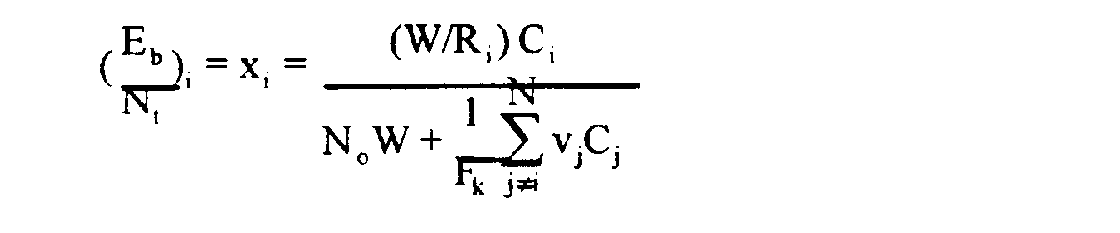
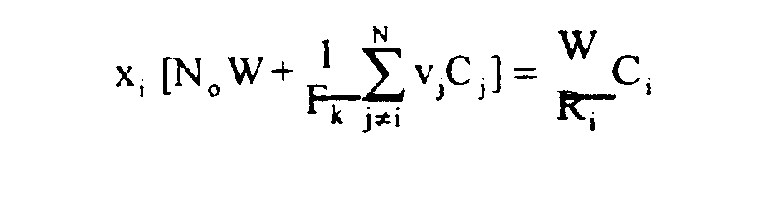



NoW는 열/주변 잡음을 나타내고, Ci는 사용자 i로부터 기지국의 안테나 연결기에 수신된 전력이며, vi는 기지국이 이미 알고 있는 사용자 i의 평균 음성 활성율이며, N은 상기 섹터의 동시 사용자들의 수이며, W는 CDMA 파형의 대역폭이고, Ri는 사용자 i의 데이터 속도이며, Fk는 섹터 k의 주파수 재사용 효율성이다.NoW represents heat / ambient noise, Ci is the power received from user i to the antenna connector of the base station, v i is the average voice activity rate of user i already known to the base station, and N is the number of concurrent users in the sector. Where W is the bandwidth of the CDMA waveform, Ri is the data rate of user i, and Fk is the frequency reuse efficiency of sector k.
하기에 설명된 바와 같이, 음성 활성율 vi는 프레임 기간 동안 이동국으로부터의 트래픽 정보를 송신하는데 사용되는 데이터 속도에 기초한 N 프레임에 걸쳐 계산된다. 예를 들어, 종래의 CDMA 시스템에서 프레임은 네 개 속도(즉, 최대 속도, 1/2 속도, 1/4 속도 및 1/8 속도) 중 하나를 사용하여 기지국에 송신될 수 있다. 상기 시스템에서, 송신 전에, 이동국 인터리버 출력 스트림은 특정 인터리버 출력 심볼의 송신 및 다른 것의 삭제를 허용하도록 타임 게이팅된다. 송신 게이트의 듀티 사이클은 송신 데이터 속도에 따라 변동한다. 송신 속도가 1(최대 속도)이면, 상기 송신 게이트는 모든 인터리브 출력 심볼이 송신되도록 한다. 상기 송신 속도가 1/2이면, 송신 게이트는 인터리버 출력 심볼의 1/2이 송신되도록 한다. 1 속도의 N1 프레임, 1/2 속도의 N2 프레임, 1/4 속도의 N3 프레임 및 1/8 속도의 N4 프레임을 포함하는 정해진 시간 간격 동안(여기서 N = N1 + N2 + N3 + N4), N 프레임에 걸쳐 평균된 음성 활성율 인자(v)는 다음과 같이 계산된다.As described below, the voice activity rate v i is calculated over N frames based on the data rate used to transmit traffic information from the mobile station during the frame period. For example, in a conventional CDMA system, a frame may be transmitted to a base station using one of four speeds (ie, full speed, half speed, quarter speed, and one eighth speed). In the system, prior to transmission, the mobile interleaver output stream is time gated to allow transmission of certain interleaver output symbols and deletion of others. The duty cycle of the transmit gate varies with the transmit data rate. If the transmission rate is 1 (maximum rate), the transmission gate causes all interleaved output symbols to be transmitted. If the transmission rate is 1/2, then the transmission gate causes half of the interleaver output symbols to be transmitted. For a defined time interval (where N = N1 + N2 + N3 + N4), including N1 frames at 1 rate, N2 frames at 1/2 rate, N3 frames at 1/4 rate, and N4 frames at 1/8 rate, where N = N1 + N2 + N3 + N4 The negative activity factor factor, averaged over the frame, is calculated as follows.
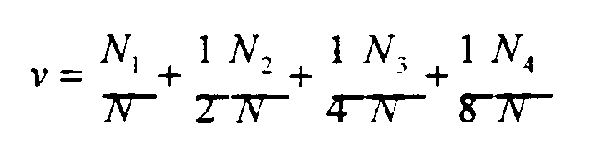
상기에 언급된 주파수 재사용 효율 Fk는 다음과 같이 나타날 수 있다.The above-mentioned frequency reuse efficiency Fk can be expressed as follows.
Fk = 상기 셀 내의 유니트로부터의 간섭 식 (7)Fk = interference equation from the unit in the cell (7)
모든 셀로부터의 총 간섭Total interference from all cells
vi를 곱하고 i의 모든 값에 걸쳐 식 (5)를 합산하면,If you multiply v i and sum Equation (5) over all values of i,

식 (8)은 다음과 같이 다시 표현될 수 있다.Equation (8) can be expressed as follows.
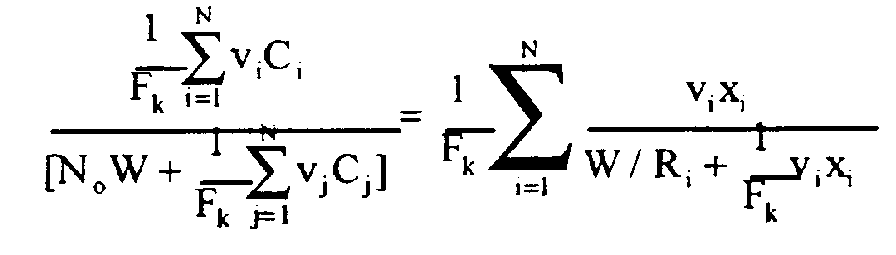
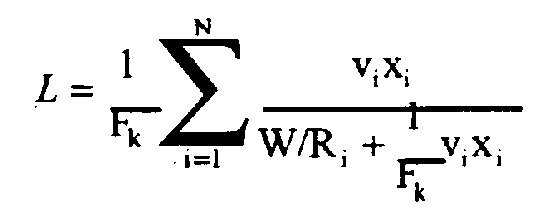
식 (9)의 왼쪽 항은 CDMA 전력 대 총 수신 전력의 비를 나타낸다. 상기 비는 CDMA 통신 시스템의 로딩 퍼센트로서 정의된다. 식 (9)의 오른쪽 항에서, 주파수 재사용 효율 Fk는 추정된 값이다. 식 (9)의 오른쪽 항의 다른 모든 값은 공지되어 있다. 따라서, 주파수 재사용 효율 Fk의 값이 획득되면 통신 시스템의 로딩 퍼센트를 계산할 수 있다.The left term in equation (9) represents the ratio of CDMA power to total received power. The ratio is defined as the loading percentage of the CDMA communication system. In the right term of equation (9), the frequency reuse efficiency Fk is an estimated value. All other values of the right term of equation (9) are known. Thus, once the value of the frequency reuse efficiency Fk is obtained, the loading percentage of the communication system can be calculated.
도 2a,b를 참조하면, 도식적 표현(10, 12)이 나타난다. 도식적 표현(10, 12)은 CDMA 섹터의 가능한 로딩을 표시한다. 도식적 표현(10)에 의해 표시된 CDMA 섹터에서, 수신된 전력의 약 50%는 CDMA 전력이고 총 수신된 전력의 약 50%는 잡음(NoW)이다. 도식적 표현(12)에 의해 표시된 CDMA 섹터에서, 총 수신 전력의 약 75%는 CDMA 전력이고 총 수신 전력의 25%는 잡음(NoW)이다. 따라서, 도 2a, b의 섹터의 로딩 퍼센트는 각각 50%, 75%이다.Referring to Figures 2a, b, a
도 3을 참조하면, 통신 시스템(9) 내의 로드 모니터링 및 주파수 재사용 효율을 결정하는 본 발명의 통신 시스템 제어 방법(50)의 흐름도가 도시된다. 방법(50)은 바람직하게는 고려되는 섹터/셀과 관련된 셀 사이트 모뎀에 연결된 제어기상에서 소프트웨어로 실행된다.Referring to FIG. 3, a flow diagram of a communication
통신 시스템 제어 방법(50)에 따른 역방향 RF 링크 로딩을 모니터링할 때, CDMA 통신 시스템은 블록(52)에 도시된 바와 같이 섹터 k에서 각 역방향 트래픽 채널에 대한 음성 활성율 vi를 추정할 수 있다. 역방향 트래픽 채널이 이동국으로부터 기지국으로 전력 제어 정보를 송신하기 위한 전력 제어 그룹을 포함하는 것은 당업자에게 공지되어 있다. 각 전력 제어 그룹의 말단에서, 이동국 i의 송신기가 전력 제어 그룹의 주기 동안 온인지 오프인지에 대한 결정이 기지국의 채널 엘리먼트 프로세서에 의해 이루어질 수 있다. 상기 정보는 식 (6)에 도시된 바와 같이 트래픽 채널 i상의 음성 활성율을 결정하는데 사용될 수 있다.When monitoring reverse RF link loading according to communication
상기 섹터의 각 역방향 트래픽 채널에 대해, 통신 시스템(9)은 블록(54)에 도시된 바와 같이 비트 당 에너지 대 잡음 전력 스펙트럼 밀도 xi=(Eb/Nt)i를 추정한다. 상기의 실행에 따라, 비트 당 에너지 대 잡음 스펙트럼 밀도 xi=(Eb/Nt)i의 평균 또는 순간 추정치가 사용될 수 있다. CDMA 통신 시스템의 비트 당 에너지 대 잡음 전력 스펙트럼 밀도의 비는 다른 방법으로 결정될 수 있다. 한가지 방법은 Eb/Nt의 순간 값을 사용하는 것이다. 다른 방법은 Eb/Nt의 세트 포인트 값을 사용하는 것과 관련된다. 일반적으로, Eb/Nt의 순간 값은 기지국 제어기로부터 얻어지고 상기 세트 포인트 값은 선택기로부터 얻어진다. 상기 순간 값이 사용되면, 기지국 프로세서는 식 (9)를 사용하여 순간 로딩을 계산할 수 있으며 상기 로딩 정보를 승인 제어 프로세서에 전달할 수 있다. 상기 선택기로부터의 세트 포인트 값이 사용되면, 기지국 제어기는 결정된 세트 포인트에 대응하는 로드를 계산하기 위해 식 (9)를 사용할 수 있다. 사용자 i의 역방향 트래픽 채널상의 특정 프레임 오류 비율을 유지하기 위해 요구되는 비트 당 역방향 링크 에너지 대 잡음 전력 스펙트럼 밀도의 값은 (Eb/Nt)i로서 표시될 수 있다.For each reverse traffic channel of the sector,
총 수신 전력 Total received power

상기 총 수신 전력은 블록(56)에 도시된 대로 측정된다. 상기 총 수신 전력의 크기는 종래의 기지국의 자동 이득 제어 회로로부터 용이하게 이용가능하거나, 대안적으로 기술분야에 공지된 다른 방법으로 측정될 수 있다. 블록(58)에 도시된 바와 같이, 식 (8)은 섹터 k의 CDMA 전력을 계산하기 위해 식 (10A)와 함께 사용된다. 상기 계산은 주파수 재사용 효율 Fk(0)의 추정된 초기 값인 현재 값을 사용하여 식 (10B)에 따라 수행된다. Fk(0)의 양호한 초기 값은 0.66일 수 있다.The total received power is measured as shown in

주파수 재사용 효율은 블록(60)에 도시된 바와 같이 새로운 현재 값을 생성하도록 업데이팅된다. 각각의 반복동안 현재의 주파수 재사용 효율값은 새로운 현재의 주파수 재사용 효율값을 제공하도록 업데이팅된다. 상기 새로운 현재 값은 다음과 같이 계산된다.The frequency reuse efficiency is updated to generate a new current value as shown in

블록(56, 58, 60)의 반복은 Fk의 추정이 다음의 식에 따라 결정 블록(62)에서 결정된 대로 수렴할 때까지 계속된다.
The repetition of
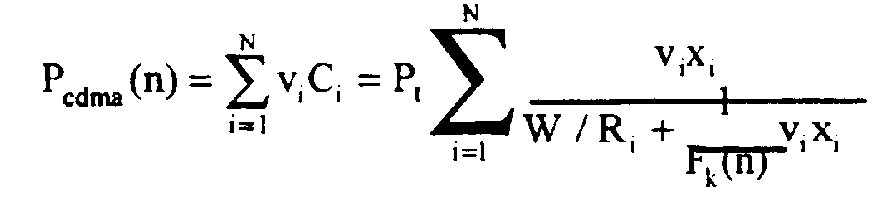
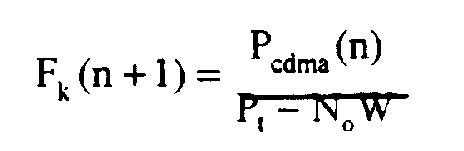
주파수 재사용 효율의 최종 값은 결정(62)에 따라 결정된다. 블록(64)에 도시된 바와 같이 섹터 로딩은 식 (9)에 설명된 방법으로 주파수 재사용 효율을 사용하여 계산된다. 주파수 재사용 효율의 두 연속 계산이 상기 계산을 수행하는 프로세서의 정확도 내에서 동일한 결과를 생성할 때, 또는 주파수 재사용 효율의 두 연속 계산이 서로 미리 결정된 임계값내에 있을 때 블록(64)의 동작이 수행될 수 있다. 상기 CDMA 통신 시스템은 예를 들어, 시스템 로딩, 주파수 재사용 효율 또는 블록(66)에 도시된 바와 같은 통신 시스템 제어 방법(50)을 사용하여 획득된 어떤 다른 값에 따라 기지국 제어기에 의해 제어될 수 있다. 예를 들어, 통신 시스템에 대한 새로운 사용자의 승인은 시스템 로딩에 따라 제어될 수 있다. 선택적으로, 상기 시스템 로딩은 기지국에서 피크 시간 활성율을 반영하는 정보를 수집하기 위해 모니터링될 수 있다.The final value of the frequency reuse efficiency is determined according to
도 4를 참조하면, 본 발명의 로드 모니터링 시스템을 실행하는데 사용되는 전형적인 CDMA 기지국(400)의 소자의 블록선도가 도시된다. 기지국에서, 두 개의 수신기 시스템은 다이버시티 수신을 위해 개별적인 안테나 및 아날로그 수신기를 각각 구비하여 이용된다. 상기 각 수신기 시스템에서, 신호가 다이버시티 결합 프로세스를 받을 때까지 상기 신호는 동일하게 처리된다. 실선내의 엘리먼트는 기지국과 하나의 이동국간의 통신에 대응하는 엘리먼트들에 대응한다. 도 4를 참조하면, 상기 제 1 수신기 시스템은 안테나(460), 아날로그 수신기(462), 탐색자 수신기(464) 및 디지털 데이터 수신기(466, 468)를 포함한다. 제 2 수신기 시스템은 안테나(470), 아날로그 수신기(472), 탐색자 수신기(474) 및 디지털 데이터 수신기(476)를 포함한다. 특히 셀 사이트 제어 프로세서(478)는 신호 처리 및 제어에 사용된다. 셀 사이트 프로세서(478)는 이동국에 송신되고 이동국으로부터 수신된 신호를 모니터링하고 상기에 기술된 로드 모니터링 계산을 수행하기 위해 상기 정보를 사용한다. 따라서, 도 3의 시스템은 바람직하게는 셀 사이트 프로세서(478)상에서 소프트웨어로 실행된다.4, a block diagram of elements of a typical CDMA base station 400 used to implement the load monitoring system of the present invention is shown. At the base station, two receiver systems are used, each with separate antennas and analog receivers for diversity reception. In each of the receiver systems, the signal is processed identically until the signal undergoes a diversity combining process. The elements in the solid line correspond to the elements corresponding to the communication between the base station and one mobile station. Referring to FIG. 4, the first receiver system includes an antenna 460, an
양쪽 수신기 시스템은 다이버시티 결합기 및 디코더 회로(480)에 연결된다. 디지털 링크(482)는 제어 프로세서(478)의 제어하에서 기지국 제어기 또는 데이터 라우터로/로부터 신호를 전달하는데 사용된다. 안테나(460)를 통해 수신된 신호는 아날로그 수신기(462)에 제공되고, 상기 아날로그 수신기(462)에서 상기 신호는 이동국 아날로그 수신기와 관련되어 기술된 것과 동일한 프로세스에서 증폭되고, 주파수 변환되며 디지털화된다. 상기 아날로그 수신기(462)로부터의 출력은 디지털 데이터 수신기(466, 468) 및 탐색자 수신기(464)에 제공된다. 상기 제 2 수신기 시스템(즉, 아날로그 수신기(472), 탐색자 수신기(474) 및 디지털 데이터 수신기(476))은 제 1 수신기 시스템과 유사한 방법으로 수신 신호를 처리한다. 상기 디지털 데이터 수신기(466, 476)의 출력은 디코딩 알고리즘에 따라 신호를 처리하는 다이버시티 결합기 및 디코더 회로(480)에 제공된다. 제 1 및 제 2 수신기 시스템과 다이버시티 결합기 및 디코더(980)의 동작의 상세한 기술은 상기에 통합된 "CDMA 셀룰라 전화 시스템에서 통신 소프트 핸드오프를 제공하는 방법 및 장치"란 명칭의 미국 특허 No. 5,101,501에 기술된다. 이동국에 송신하기 위한 신호는 프로세서(478)의 제어하에서 송신 변조기(484)에 제공된다. 송신 변조기(484)는 지정된 수신 이동국에 송신하기 위한 데이터를 변조시킨다.Both receiver systems are connected to the diversity combiner and decoder circuit 480. Digital link 482 is used to carry signals to / from base station controllers or data routers under control of control processor 478. The signal received via antenna 460 is provided to
바람직한 실시예의 이전 기술은 당업자가 본 발명을 제조하고 사용하도록 제공된다. 상기 실시예에 대한 여러 변형은 당업자에게 명백하고, 여기에 정의된 일반 원리들은 특허 발명의 기능을 사용하지 않고서 다른 실시예에 적용될 수 있다. 따라서, 본 발명은 여기에 도시된 실시예에 제한되지 않으며 여기에 개시된 원리 및 신규한 특징에 따른 최광위의 범위를 제공한다.The prior art of the preferred embodiment is provided to those skilled in the art to make and use the invention. Many variations on the above embodiments are apparent to those skilled in the art, and the generic principles defined herein may be applied to other embodiments without using the functionality of the patent invention. Thus, the present invention is not limited to the embodiments shown herein but provides the widest scope in accordance with the principles and novel features disclosed herein.
Claims (15)

Applications Claiming Priority (2)
| Application Number | Priority Date | Filing Date | Title |
|---|---|---|---|
| US09/327,103 US6356531B1 (en) | 1999-06-07 | 1999-06-07 | Monitoring of CDMA load and frequency reuse based on reverse link signal-to-noise ratio |
| US09/327,103 | 1999-06-07 |
Publications (2)
| Publication Number | Publication Date |
|---|---|
| KR20020008219A KR20020008219A (en) | 2002-01-29 |
| KR100635690B1 true KR100635690B1 (en) | 2006-10-17 |
Family
ID=23275172
Family Applications (1)
| Application Number | Title | Priority Date | Filing Date |
|---|---|---|---|
| KR1020017015716A Expired - Fee Related KR100635690B1 (en) | 1999-06-07 | 2000-06-06 | How to Monitor CDM Load and Frequency Reuse Based on Reverse Link Signal-to-Noise Ratio |
Country Status (15)
| Country | Link |
|---|---|
| US (2) | US6356531B1 (en) |
| EP (1) | EP1190501B1 (en) |
| JP (1) | JP4405700B2 (en) |
| KR (1) | KR100635690B1 (en) |
| CN (1) | CN1148892C (en) |
| AT (1) | ATE406706T1 (en) |
| AU (1) | AU5469700A (en) |
| BR (1) | BR0011360A (en) |
| CY (1) | CY1109136T1 (en) |
| DE (1) | DE60040069D1 (en) |
| DK (1) | DK1190501T3 (en) |
| ES (1) | ES2311460T3 (en) |
| HK (1) | HK1044425B (en) |
| PT (1) | PT1190501E (en) |
| WO (1) | WO2000076086A1 (en) |
Families Citing this family (38)
| Publication number | Priority date | Publication date | Assignee | Title |
|---|---|---|---|---|
| KR100294043B1 (en) * | 1998-04-14 | 2001-07-12 | 윤종용 | A method and an apparatus for optimizing forward link power control parameters using lab. test in pcs cdma system |
| US6356531B1 (en) * | 1999-06-07 | 2002-03-12 | Qualcomm Incorporated | Monitoring of CDMA load and frequency reuse based on reverse link signal-to-noise ratio |
| CA2308651C (en) * | 1999-07-12 | 2010-04-27 | Nortel Networks Corporation | A method of controlling base station transmitting power during soft handoff |
| KR100516690B1 (en) * | 2000-06-09 | 2005-09-22 | 가부시키가이샤 아드반테스트 | Apparatus, method, for displaying waveform quality of cdma signal, and recorded medium storing a program for displaying waveform quality of cdma signal |
| KR100387057B1 (en) * | 2000-07-04 | 2003-06-12 | 삼성전자주식회사 | Method and apparatus for determining reverse data rate in mobile communication system |
| US6584330B1 (en) * | 2000-07-18 | 2003-06-24 | Telefonaktiebolaget Lm Ericsson (Publ) | Adaptive power management for a node of a cellular telecommunications network |
| WO2002052875A2 (en) * | 2000-12-27 | 2002-07-04 | Ensemble Communications, Inc. | Adaptive call admission control for use in a wireless communication system |
| US7227850B2 (en) * | 2001-04-04 | 2007-06-05 | Telefonaktiebolaget Lm Ericsson (Publ) | Cellular radio communication system with frequency reuse |
| US6850500B2 (en) | 2001-05-15 | 2005-02-01 | Interdigital Technology Corporation | Transmission power level estimation |
| US6963755B2 (en) * | 2002-01-09 | 2005-11-08 | Qualcomm, Incorporated | Method and apparatus for coherently combining power control commands to initialize communication |
| US7177293B2 (en) * | 2002-04-30 | 2007-02-13 | Intel Corporation | Terminal assisted scheduling for time coordinated CDMA |
| US20030223396A1 (en) * | 2002-05-31 | 2003-12-04 | Tsai Shiau-He Shawn | Method of indicating the forward link serving sector in high data rate CDMA systems |
| US7136483B2 (en) * | 2002-07-24 | 2006-11-14 | Telefonaictiebolaget Lm Ericsson (Publ) | Mobile terminal mode control in high data rate CDMA system |
| US8504054B2 (en) * | 2002-09-10 | 2013-08-06 | Qualcomm Incorporated | System and method for multilevel scheduling |
| KR100808335B1 (en) * | 2002-12-20 | 2008-02-27 | 엘지노텔 주식회사 | Mobile communication system and its overload prevention method |
| US7773985B2 (en) * | 2003-09-22 | 2010-08-10 | United Parcel Service Of America, Inc. | Symbiotic system for testing electromagnetic signal coverage in areas near transport routes |
| US7660577B2 (en) * | 2003-09-22 | 2010-02-09 | United Parcel Service Of America, Inc. | Network testing systems and methods |
| US9585023B2 (en) * | 2003-10-30 | 2017-02-28 | Qualcomm Incorporated | Layered reuse for a wireless communication system |
| US8526963B2 (en) * | 2003-10-30 | 2013-09-03 | Qualcomm Incorporated | Restrictive reuse for a wireless communication system |
| KR100724989B1 (en) * | 2004-04-14 | 2007-06-04 | 삼성전자주식회사 | Power control apparatus and method in a communication system using orthogonal frequency division multiple access |
| FR2869488B1 (en) * | 2004-04-22 | 2006-07-14 | Weborama Sa | METHOD AND SYSTEM FOR GENERATING A POPULATION REPRESENTATIVE OF A SET OF USERS OF A COMMUNICATION NETWORK |
| US8059589B2 (en) * | 2004-06-09 | 2011-11-15 | Qualcomm Incorporated | Dynamic restrictive reuse scheduler |
| US7257406B2 (en) * | 2004-07-23 | 2007-08-14 | Qualcomm, Incorporated | Restrictive reuse set management |
| US8032145B2 (en) | 2004-07-23 | 2011-10-04 | Qualcomm Incorporated | Restrictive reuse set management algorithm for equal grade of service on FL transmission |
| US7548752B2 (en) * | 2004-12-22 | 2009-06-16 | Qualcomm Incorporated | Feedback to support restrictive reuse |
| US7580712B2 (en) * | 2005-06-03 | 2009-08-25 | Telefonaktiebolaget Lm Ericsson (Publ) | Wireless high-speed data network planning tool |
| US7440730B2 (en) * | 2005-06-30 | 2008-10-21 | Intel Corporation | Device, system and method of multiple transceivers control |
| US7738422B2 (en) * | 2005-08-23 | 2010-06-15 | Alcatel-Lucent Usa Inc. | Interference-reducing method of forward link scheduling for wireless networks |
| CN100421524C (en) * | 2005-12-06 | 2008-09-24 | 华为技术有限公司 | A Method for Optimizing Network Performance |
| US7751823B2 (en) | 2006-04-13 | 2010-07-06 | Atc Technologies, Llc | Systems and methods for controlling a level of interference to a wireless receiver responsive to an activity factor associated with a wireless transmitter |
| US8244292B2 (en) * | 2007-02-23 | 2012-08-14 | Samsung Electronics Co., Ltd | Apparatus and method for power distribution by frequency allocation in multi-frequency allocation broadband wireless communication system |
| KR101364567B1 (en) | 2007-03-23 | 2014-02-19 | 서강대학교산학협력단 | Apparatus and method for opportunistic packet scheduling in wideband wireless access communication system based multi-hop relay |
| KR101364569B1 (en) | 2007-03-23 | 2014-02-19 | 서강대학교산학협력단 | Apparatus and method for opportunistic packet scheduling with frequency reuse and quality of service guarantee in wideband wireless access communication system based multi-hop relay |
| US8204012B2 (en) * | 2007-08-09 | 2012-06-19 | Samsung Electronics Co., Ltd | System and method for using frequency resource in communication system |
| US8358613B1 (en) * | 2009-02-27 | 2013-01-22 | L-3 Communications Corp. | Transmitter-directed security for wireless-communications |
| AU2010319304A1 (en) * | 2009-11-13 | 2012-07-05 | Interdigital Patent Holdings, Inc | Method and apparatus for providing VHT frequency reuse for WLANs |
| US10020901B2 (en) * | 2014-09-29 | 2018-07-10 | Hughes Network Systems, Llc | Inter-gateway interference management and admission control for a CDMA satellite communications system |
| CN111225392B (en) * | 2018-11-27 | 2023-12-15 | 中国移动通信集团辽宁有限公司 | Community load balancing method, device, equipment and computer storage medium |
Family Cites Families (8)
| Publication number | Priority date | Publication date | Assignee | Title |
|---|---|---|---|---|
| US4901307A (en) | 1986-10-17 | 1990-02-13 | Qualcomm, Inc. | Spread spectrum multiple access communication system using satellite or terrestrial repeaters |
| US5056109A (en) | 1989-11-07 | 1991-10-08 | Qualcomm, Inc. | Method and apparatus for controlling transmission power in a cdma cellular mobile telephone system |
| US5710758A (en) * | 1995-09-29 | 1998-01-20 | Qualcomm Incorporated | Wireless network planning tool |
| US6067446A (en) | 1996-07-11 | 2000-05-23 | Telefonaktiebolaget Lm Ericsson | Power presetting in a radio communication system |
| US5859838A (en) | 1996-07-30 | 1999-01-12 | Qualcomm Incorporated | Load monitoring and management in a CDMA wireless communication system |
| FI964707A7 (en) | 1996-11-26 | 1998-05-27 | Nokia Telecommunications Oy | Method for controlling load and radio system |
| US6278701B1 (en) * | 1998-07-10 | 2001-08-21 | Verizon Laboratories Inc. | Capacity enhancement for multi-code CDMA with integrated services through quality of services and admission control |
| US6356531B1 (en) * | 1999-06-07 | 2002-03-12 | Qualcomm Incorporated | Monitoring of CDMA load and frequency reuse based on reverse link signal-to-noise ratio |
-
1999
- 1999-06-07 US US09/327,103 patent/US6356531B1/en not_active Expired - Lifetime
-
2000
- 2000-06-06 JP JP2001502246A patent/JP4405700B2/en not_active Expired - Fee Related
- 2000-06-06 AU AU54697/00A patent/AU5469700A/en not_active Abandoned
- 2000-06-06 AT AT00939640T patent/ATE406706T1/en active
- 2000-06-06 PT PT00939640T patent/PT1190501E/en unknown
- 2000-06-06 DE DE60040069T patent/DE60040069D1/en not_active Expired - Lifetime
- 2000-06-06 KR KR1020017015716A patent/KR100635690B1/en not_active Expired - Fee Related
- 2000-06-06 WO PCT/US2000/015663 patent/WO2000076086A1/en not_active Ceased
- 2000-06-06 BR BR0011360-3A patent/BR0011360A/en not_active IP Right Cessation
- 2000-06-06 HK HK02105875.7A patent/HK1044425B/en not_active IP Right Cessation
- 2000-06-06 EP EP00939640A patent/EP1190501B1/en not_active Expired - Lifetime
- 2000-06-06 DK DK00939640T patent/DK1190501T3/en active
- 2000-06-06 ES ES00939640T patent/ES2311460T3/en not_active Expired - Lifetime
- 2000-06-06 CN CNB008085897A patent/CN1148892C/en not_active Expired - Fee Related
-
2001
- 2001-12-06 US US10/006,075 patent/US20020061006A1/en not_active Abandoned
-
2008
- 2008-11-21 CY CY20081101343T patent/CY1109136T1/en unknown
Also Published As
| Publication number | Publication date |
|---|---|
| HK1044425B (en) | 2005-03-04 |
| PT1190501E (en) | 2008-11-17 |
| CY1109136T1 (en) | 2014-07-02 |
| JP2003501940A (en) | 2003-01-14 |
| KR20020008219A (en) | 2002-01-29 |
| CN1148892C (en) | 2004-05-05 |
| ES2311460T3 (en) | 2009-02-16 |
| EP1190501A1 (en) | 2002-03-27 |
| CN1354920A (en) | 2002-06-19 |
| US6356531B1 (en) | 2002-03-12 |
| WO2000076086A9 (en) | 2002-06-27 |
| DK1190501T3 (en) | 2008-12-15 |
| DE60040069D1 (en) | 2008-10-09 |
| ATE406706T1 (en) | 2008-09-15 |
| US20020061006A1 (en) | 2002-05-23 |
| JP4405700B2 (en) | 2010-01-27 |
| WO2000076086A1 (en) | 2000-12-14 |
| AU5469700A (en) | 2000-12-28 |
| BR0011360A (en) | 2002-04-30 |
| EP1190501B1 (en) | 2008-08-27 |
| HK1044425A1 (en) | 2002-10-18 |
Similar Documents
| Publication | Publication Date | Title |
|---|---|---|
| KR100635690B1 (en) | How to Monitor CDM Load and Frequency Reuse Based on Reverse Link Signal-to-Noise Ratio | |
| US5697053A (en) | Method of power control and cell site selection | |
| JP4558943B2 (en) | Method in communication system | |
| AU730099B2 (en) | Method for optimising forward link coverage in a CDMA network | |
| EP0948869B1 (en) | Load monitoring and management in a cdma wireless communication system | |
| JP3737350B2 (en) | Method for adjusting transmission power level during soft handoff in a wireless communication system | |
| JP2002044013A (en) | Method for detecting and calculating instantaneous external jammer signal power level | |
| JP2005527137A (en) | Method and apparatus for estimating the maximum rate of data in a communication system and for estimating the power required for transmission of data at a certain data rate | |
| US6570862B2 (en) | Method for selecting the way to perform a handover, and a cellular radio system | |
| JP2000224106A (en) | Open loop power control for radio mobile station | |
| US20040185864A1 (en) | Channel rate and physical channel selection in wireless communications networks | |
| US6438116B1 (en) | Adaptive power margin for hard handoffs in code division multiple access based systems | |
| US20050090217A1 (en) | Radio network planning | |
| US6618598B1 (en) | Forward rate determination of high data rate channels in CDMA air interface | |
| Bi et al. | The performance of DS-CDMA for wireless local loop | |
| JP2004072663A (en) | Antenna control device | |
| Dunlop et al. | Estimation of the performance of link adaptation in mobile radio | |
| Kandala et al. | Integrated voice and video services in microcellular CDMA systems—downlink power-based call admission | |
| Sreng et al. | Coverage Enhancement through Peer-to-Peer Relaying in Cellular Radio Networks | |
| Wang et al. | Soft handoff performances of 3-sector and 6-sector multicell CDMA systems | |
| Balachandran et al. | Performance analysis of channel rate selection schemes in systems with tight reuse | |
| Kandala¹ et al. | Sharp Labs of America | |
| Suwa et al. | Radio link design and reverse link capacity on microcellular DS‐CDMA wideband transmission systems | |
| HK1078184B (en) | Method and apparatus for estimating power required for transmission of data at a rate in a communication system | |
| HK1023249B (en) | Load monitoring and management in a cdma wireless communication system |
Legal Events
| Date | Code | Title | Description |
|---|---|---|---|
| PA0105 | International application |
St.27 status event code: A-0-1-A10-A15-nap-PA0105 |
|
| PG1501 | Laying open of application |
St.27 status event code: A-1-1-Q10-Q12-nap-PG1501 |
|
| R18-X000 | Changes to party contact information recorded |
St.27 status event code: A-3-3-R10-R18-oth-X000 |
|
| A201 | Request for examination | ||
| P11-X000 | Amendment of application requested |
St.27 status event code: A-2-2-P10-P11-nap-X000 |
|
| P13-X000 | Application amended |
St.27 status event code: A-2-2-P10-P13-nap-X000 |
|
| PA0201 | Request for examination |
St.27 status event code: A-1-2-D10-D11-exm-PA0201 |
|
| E701 | Decision to grant or registration of patent right | ||
| PE0701 | Decision of registration |
St.27 status event code: A-1-2-D10-D22-exm-PE0701 |
|
| PR1002 | Payment of registration fee |
St.27 status event code: A-2-2-U10-U12-oth-PR1002 Fee payment year number: 1 |
|
| GRNT | Written decision to grant | ||
| PR0701 | Registration of establishment |
St.27 status event code: A-2-4-F10-F11-exm-PR0701 |
|
| PG1601 | Publication of registration |
St.27 status event code: A-4-4-Q10-Q13-nap-PG1601 |
|
| PR1001 | Payment of annual fee |
St.27 status event code: A-4-4-U10-U11-oth-PR1001 Fee payment year number: 4 |
|
| FPAY | Annual fee payment |
Payment date: 20100930 Year of fee payment: 5 |
|
| PR1001 | Payment of annual fee |
St.27 status event code: A-4-4-U10-U11-oth-PR1001 Fee payment year number: 5 |
|
| LAPS | Lapse due to unpaid annual fee | ||
| PC1903 | Unpaid annual fee |
St.27 status event code: A-4-4-U10-U13-oth-PC1903 Not in force date: 20111012 Payment event data comment text: Termination Category : DEFAULT_OF_REGISTRATION_FEE |
|
| PC1903 | Unpaid annual fee |
St.27 status event code: N-4-6-H10-H13-oth-PC1903 Ip right cessation event data comment text: Termination Category : DEFAULT_OF_REGISTRATION_FEE Not in force date: 20111012 |
|
| R18-X000 | Changes to party contact information recorded |
St.27 status event code: A-5-5-R10-R18-oth-X000 |