[go: up one dir, main page]

JPWO2020100528A1 - Solar cell module and its manufacturing method - Google Patents

Solar cell module and its manufacturing method Download PDF

Info

Publication number
JPWO2020100528A1
JPWO2020100528A1 JP2020556736A JP2020556736A JPWO2020100528A1 JP WO2020100528 A1 JPWO2020100528 A1 JP WO2020100528A1 JP 2020556736 A JP2020556736 A JP 2020556736A JP 2020556736 A JP2020556736 A JP 2020556736A JP WO2020100528 A1 JPWO2020100528 A1 JP WO2020100528A1
Authority
JP
Japan
Prior art keywords
solar cell
light receiving
receiving side
wiring
electrically connected
Prior art date
Legal status (The legal status is an assumption and is not a legal conclusion. Google has not performed a legal analysis and makes no representation as to the accuracy of the status listed.)
Granted
Application number
JP2020556736A
Other languages
Japanese (ja)
Other versions
JP7337838B2 (en
Inventor
広平 小島
広平 小島
徹 寺下
徹 寺下
Current Assignee (The listed assignees may be inaccurate. Google has not performed a legal analysis and makes no representation or warranty as to the accuracy of the list.)
Kaneka Corp
Original Assignee
Kaneka Corp
Priority date (The priority date is an assumption and is not a legal conclusion. Google has not performed a legal analysis and makes no representation as to the accuracy of the date listed.)
Filing date
Publication date
Application filed by Kaneka Corp filed Critical Kaneka Corp
Publication of JPWO2020100528A1 publication Critical patent/JPWO2020100528A1/en
Application granted granted Critical
Publication of JP7337838B2 publication Critical patent/JP7337838B2/en
Active legal-status Critical Current
Anticipated expiration legal-status Critical

Links

Images

Classifications

    • HELECTRICITY
    • H10SEMICONDUCTOR DEVICES; ELECTRIC SOLID-STATE DEVICES NOT OTHERWISE PROVIDED FOR
    • H10FINORGANIC SEMICONDUCTOR DEVICES SENSITIVE TO INFRARED RADIATION, LIGHT, ELECTROMAGNETIC RADIATION OF SHORTER WAVELENGTH OR CORPUSCULAR RADIATION
    • H10F19/00Integrated devices, or assemblies of multiple devices, comprising at least one photovoltaic cell covered by group H10F10/00, e.g. photovoltaic modules
    • H10F19/90Structures for connecting between photovoltaic cells, e.g. interconnections or insulating spacers
    • YGENERAL TAGGING OF NEW TECHNOLOGICAL DEVELOPMENTS; GENERAL TAGGING OF CROSS-SECTIONAL TECHNOLOGIES SPANNING OVER SEVERAL SECTIONS OF THE IPC; TECHNICAL SUBJECTS COVERED BY FORMER USPC CROSS-REFERENCE ART COLLECTIONS [XRACs] AND DIGESTS
    • Y02TECHNOLOGIES OR APPLICATIONS FOR MITIGATION OR ADAPTATION AGAINST CLIMATE CHANGE
    • Y02EREDUCTION OF GREENHOUSE GAS [GHG] EMISSIONS, RELATED TO ENERGY GENERATION, TRANSMISSION OR DISTRIBUTION
    • Y02E10/00Energy generation through renewable energy sources
    • Y02E10/50Photovoltaic [PV] energy

Landscapes

  • Photovoltaic Devices (AREA)

Abstract

複数の裏面接合型の太陽電池セル(11)を有する太陽電池ストリング(10)が封止材層に埋め込まれ、太陽電池ストリング(10)の末端の太陽電池セル(11)のストリング端側の端辺部にタブ配線(13)が電気的に接続された太陽電池モジュールの製造方法である。末端の太陽電池セル(11)とタブ配線(13)との電気的接続を、封止材層における太陽電池ストリングよりも受光側部分となる予定の受光側封止材(21’)上で加熱して行う。A solar cell string (10) having a plurality of back-bonded solar cells (11) is embedded in the encapsulant layer, and the end of the solar cell (11) at the end of the solar cell (10). This is a method for manufacturing a solar cell module in which a tab wiring (13) is electrically connected to a side portion. The electrical connection between the terminal solar cell (11) and the tabbed wiring (13) is heated on the light receiving side encapsulant (21'), which will be the light receiving side portion of the encapsulant layer from the solar cell string. And do it.

Description

本発明は、太陽電池モジュール及びその製造方法に関する。 The present invention relates to a solar cell module and a method for manufacturing the same.

裏面接合型(バックコンタクト型)の太陽電池セルは、p型及びn型の両電極が裏面に配置されている。そのため、これを用いた太陽電池モジュールでは、電極が受光側に露出しない意匠性の優れたものとなる。例えば、特許文献1には、そのような裏面接合型の太陽電池セルを用いた太陽電池モジュールが開示されている。 In the back contact type solar cell, both p-type and n-type electrodes are arranged on the back surface. Therefore, in the solar cell module using this, the electrode is not exposed to the light receiving side, and the design is excellent. For example, Patent Document 1 discloses a solar cell module using such a back-bonded solar cell.

国際公開第2014/050410号International Publication No. 2014/050410

本発明は、直列に配置され且つ電気的に接続された複数の裏面接合型の太陽電池セルを有する太陽電池ストリングと、前記太陽電池ストリングが埋め込まれた封止材層とを備え、前記太陽電池ストリングの末端の太陽電池セルのストリング端側の端辺部にタブ配線が電気的に接続された太陽電池モジュールの製造方法であって、前記末端の太陽電池セルと前記タブ配線との電気的接続を、前記封止材層における前記太陽電池ストリングよりも受光側部分となる予定の受光側封止材上で加熱して行うものである。 The present invention comprises a solar cell string having a plurality of back-bonded solar cell cells arranged in series and electrically connected, and a sealing material layer in which the solar cell string is embedded. It is a method of manufacturing a solar cell module in which a tab wiring is electrically connected to an end portion of a solar cell at the end of a string on the string end side, and is an electrical connection between the solar cell at the end and the tab wiring. Is heated on the light receiving side sealing material to be the light receiving side portion of the sealing material layer with respect to the solar cell string.

本発明は、並列に配置され、各々、直列に配置され且つ電気的に接続された複数の裏面接合型の太陽電池セルを有する一対の太陽電池ストリングと、前記一対の太陽電池ストリングが埋め込まれた封止材層とを備え、前記一対の太陽電池ストリングの末端の太陽電池セルに電気的に接続されたタブ配線間が渡り配線で電気的に接続された太陽電池モジュールであって、前記タブ配線及び前記渡り配線は、前者が裏側及び後者が受光側にそれぞれ配置されて重なっている。 In the present invention, a pair of solar cell strings arranged in parallel, each having a plurality of back-joined solar cell cells arranged in series and electrically connected, and the pair of solar cell strings are embedded. A solar cell module comprising a sealing material layer and electrically connected to a solar cell at the end of the pair of solar cell strings by a cross wire, wherein the tab wiring is electrically connected. In the crossover wiring, the former is arranged on the back side and the latter is arranged on the light receiving side and overlaps.

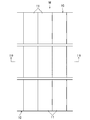
太陽電池モジュールの平面図である。It is a top view of the solar cell module. 図1AのIB-IB断面図である。FIG. 1A is a cross-sectional view taken along the line IB-IB of FIG. 1A. 太陽電池セルの裏面図である。It is a back view of a solar cell. 太陽電池ストリングの第1の態様の断面図である。It is sectional drawing of the 1st aspect of the solar cell string. 太陽電池ストリングの第2の態様の断面図である。It is sectional drawing of the 2nd aspect of the solar cell string. 実施形態1における相互に隣接する一対の太陽電池セル間の電気的接続構造を示す図である。It is a figure which shows the electrical connection structure between a pair of solar cells adjacent to each other in Embodiment 1. FIG. 図4AのIVB-IVB断面図である。FIG. 4A is a cross-sectional view taken along the line IVB-IVB of FIG. 4A. 実施形態1における太陽電池ストリングの裏面図である。It is a back view of the solar cell string in Embodiment 1. 図5AのVB-VB断面図である。It is a VB-VB cross-sectional view of FIG. 5A. 実施形態1における受光側封止材上に複数の太陽電池ストリングを並行に配置した構造を示す図である。It is a figure which shows the structure which arranged a plurality of solar cell strings in parallel on the light receiving side sealing material in Embodiment 1. FIG. 図6AのVIB-VIB断面図である。6A is a cross-sectional view taken along the line VIB-VIB of FIG. 6A. 実施形態1における受光側封止材上に複数の太陽電池ストリングにタブ配線を配置した構造を示す図である。It is a figure which shows the structure which arranged the tab wiring in a plurality of solar cell strings on the light receiving side sealing material in Embodiment 1. FIG. 図7AのVIIB-VIIB断面図である。It is sectional drawing of VIIB-VIIB of FIG. 7A. 実施形態1における末端の太陽電池セルとタブ配線との電気的接続方法を示す図である。It is a figure which shows the electric connection method of the terminal solar cell and a tab wiring in Embodiment 1. FIG. 実施形態1における受光側封止材上の第1及び第2の相互に隣接する一対の太陽電池ストリング間を電気的に接続したときの構造を示す図である。It is a figure which shows the structure when the pair of solar cell strings adjacent to each other on the light receiving side sealing material in Embodiment 1 are electrically connected. 図9AのIXB-IXB断面図である。9A is a cross-sectional view taken along the line IXB-IXB of FIG. 9A. 実施形態1における受光側封止材上のタブ配線と渡り配線との電気的接続構造を示す図である。It is a figure which shows the electrical connection structure of the tab wiring and the crossover wiring on the light receiving side sealing material in Embodiment 1. FIG. 実施形態1における受光側封止材上の第2及び第3の相互に隣接する一対の太陽電池ストリング間を電気的に接続したときの構造を示す図である。It is a figure which shows the structure when the pair of solar cell strings which are adjacent to each other of the 2nd and 3rd on the light receiving side sealing material in Embodiment 1 are electrically connected. 図11AのXIB-XIB断面図である。11A is a cross-sectional view taken along the line XIB-XIB of FIG. 11A. 実施形態1における受光側封止材上の複数の太陽電池ストリングの電気的接続構造を示す図である。It is a figure which shows the electrical connection structure of a plurality of solar cell strings on the light receiving side sealing material in Embodiment 1. FIG. 実施形態1における受光側封止材上の太陽電池ストリング上に裏面側封止材及び裏面側保護部材が順に積層された構造を示す断面図である。FIG. 5 is a cross-sectional view showing a structure in which a back surface side encapsulant and a back surface side protective member are sequentially laminated on a solar cell string on a light receiving side encapsulant according to the first embodiment. 実施形態1における受光側封止材上の太陽電池ストリングにタブ配線を電気的に接続する前の状態を示す断面図である。It is sectional drawing which shows the state before the tab wiring is electrically connected to the solar cell string on the light receiving side sealing material in Embodiment 1. FIG. 実施形態1における受光側封止材上の太陽電池ストリングにタブ配線を電気的に接続した後の状態を示す断面図である。It is sectional drawing which shows the state after the tab wiring is electrically connected to the solar cell string on the light receiving side sealing material in Embodiment 1. FIG. 実施形態2における相互に隣接する一対の太陽電池セル間の電気的接続構造の要部を示す断面図である。FIG. 5 is a cross-sectional view showing a main part of an electrical connection structure between a pair of solar cells adjacent to each other in the second embodiment. 実施形態2における相互に隣接する一対の太陽電池セル間の電気的接続構造の変形例の要部を示す断面図である。FIG. 5 is a cross-sectional view showing a main part of a modified example of an electrical connection structure between a pair of solar cells adjacent to each other in the second embodiment. 太陽電池モジュールの変形例の断面図である。It is sectional drawing of the modification of the solar cell module. 受光側封止材上の複数の太陽電池ストリングの電気的接続構造の変形例を示す図である。It is a figure which shows the modification of the electric connection structure of a plurality of solar cell strings on the light receiving side sealing material.

以下、実施形態に係る太陽電池モジュールの製造方法について図面に基づいて詳細に説明する。なお、本出願では、太陽電池モジュール及び太陽電池セルにおける太陽光を受光する側を「受光側」及びその反対側を「裏側」という。また、受光側の面を「受光面」及び裏側の面を「裏面」という。 Hereinafter, the method for manufacturing the solar cell module according to the embodiment will be described in detail with reference to the drawings. In this application, the side of the solar cell module and the solar cell that receives sunlight is referred to as the "light receiving side" and the opposite side thereof is referred to as the "back side". Further, the surface on the light receiving side is referred to as a "light receiving surface" and the surface on the back side is referred to as a "back surface".

(実施形態1)
図1A及びBは、実施形態1に係る方法で製造する太陽電池モジュールMを示す。
(Embodiment 1)
1A and 1B show a solar cell module M manufactured by the method according to the first embodiment.

この太陽電池モジュールMは、間隔をあけて並列に配置された複数の太陽電池ストリング10と、それらの太陽電池ストリング10が埋め込まれた封止材層20と、封止材層20の受光側及び裏側にそれぞれ積層された受光側保護部材30及び裏側保護部材40とを備える。複数の太陽電池ストリング10のそれぞれは、直列に配置され且つ電気的に接続された複数の裏面接合型の太陽電池セル11を有する。また、それらの複数の太陽電池セル11はシングリング接続されている。 The solar cell module M includes a plurality of solar cell strings 10 arranged in parallel at intervals, a sealing material layer 20 in which the solar cell strings 10 are embedded, a light receiving side of the sealing material layer 20, and a light receiving side of the sealing material layer 20. A light receiving side protective member 30 and a back side protective member 40, which are laminated on the back side, are provided. Each of the plurality of solar cell strings 10 has a plurality of backside bonded solar cells 11 arranged in series and electrically connected. Further, the plurality of solar cell cells 11 are connected to a single ring.

図2は、裏面接合型の太陽電池セル11(以下、単に「太陽電池セル11」ともいう。)の一例を示す。この太陽電池セル11は、長方形状の半導体基板であるセル本体110の裏面に、p型電極及びn型電極のうちの一方の第1電極111と他方の第2電極112とが配置されている。第1電極111及び第2電極112は、各々が櫛形状で且つ互いに櫛歯が噛み合うようにパターニングされている。第1電極111は、複数本の第1電極フィンガー部分111aと、1本の第1電極バスバー部分111bとを有する。複数本の第1電極フィンガー部分111aは、各々がセル本体110の短辺方向に延びるとともに、長辺方向に間隔をあけて並行に延びるように配置されている。第1電極バスバー部分111bは、複数本の第1電極フィンガー部分111aの一端を連結してセル本体110の一方の長辺に沿って長辺方向に延びるように配置されている。第2電極112は、複数本の第2電極フィンガー部分112aと、1本の第2電極バスバー部分112bとを有する。複数本の第2電極フィンガー部分112aは、各々が第1電極フィンガー部分111a間にセル本体110の短辺方向に延びるとともに、長辺方向に間隔をあけて並行に延びるように配置されている。第2電極バスバー部分112bは、複数本の第2電極フィンガー部分112aの一端を連結してセル本体110の他方の長辺に沿って長辺方向に延びるように配置されている。なお、太陽電池セル11の形状や配線パターン等は、これらに限定されるものではない。 FIG. 2 shows an example of a back surface bonded type solar cell 11 (hereinafter, also simply referred to as “solar cell 11”). In the solar cell 11, one of the p-type electrode and the n-type electrode, the first electrode 111 and the other second electrode 112, are arranged on the back surface of the cell body 110, which is a rectangular semiconductor substrate. .. The first electrode 111 and the second electrode 112 are each in the shape of a comb and are patterned so that the comb teeth mesh with each other. The first electrode 111 has a plurality of first electrode finger portions 111a and one first electrode bus bar portion 111b. The plurality of first electrode finger portions 111a are arranged so as to extend in the short side direction of the cell body 110 and extend in parallel at intervals in the long side direction. The first electrode bus bar portion 111b is arranged so as to connect one ends of a plurality of first electrode finger portions 111a and extend in the long side direction along one long side of the cell body 110. The second electrode 112 has a plurality of second electrode finger portions 112a and one second electrode bus bar portion 112b. The plurality of second electrode finger portions 112a are arranged so as to extend between the first electrode finger portions 111a in the short side direction of the cell body 110 and to extend in parallel at intervals in the long side direction. The second electrode bus bar portion 112b is arranged so as to connect one ends of a plurality of second electrode finger portions 112a and extend in the long side direction along the other long side of the cell body 110. The shape, wiring pattern, and the like of the solar cell 11 are not limited to these.

ここで、本出願における「シングリング接続」とは、図3A及びBに示すように、太陽電池ストリング10の複数の太陽電池セル11における任意の連続して配置された第1太陽電池セル11−1、第2太陽電池セル11−2、及び第3太陽電池セル11−3において、図3Aに示すような、第2太陽電池セル11−2の一端部11aが第1太陽電池セル11−1の他端部11bの受光側に配置されて重なっているとともに、第2太陽電池セル11−2の他端部11bが第3太陽電池セル11−3の一端部11aの裏側に配置されて重なっているセル接続構造、又は、図3Bに示すような、第2太陽電池セル11−2の一端部11aが第1太陽電池セル11−1の他端部11bの裏側に配置されて重なっているとともに、第2太陽電池セル11−2の他端部11bが第3太陽電池セル11−3の一端部11aの受光側に配置されて重なっているセル接続構造をいう。 Here, as shown in FIGS. 3A and 3B, the "singling connection" in the present application means an arbitrary continuously arranged first solar cell 11-in a plurality of solar cells 11 of the solar cell string 10. 1. In the second solar cell 11-2 and the third solar cell 11-3, one end 11a of the second solar cell 11-2 as shown in FIG. 3A is the first solar cell 11-1. The other end 11b of the second solar cell 11-2 is arranged on the back side of the one end 11a of the third solar cell 11-3 and overlaps with the other end 11b of the second solar cell 11-2. One end portion 11a of the second solar cell 11-2 is arranged on the back side of the other end portion 11b of the first solar cell 11-1 and overlaps with each other. At the same time, the other end 11b of the second solar cell 11-2 is arranged on the light receiving side of the one end 11a of the third solar cell 11-3 and overlaps with each other.

封止材層20は、その複数の太陽電池ストリング10よりも受光側の受光側部分21と、裏側の裏側部分22とを有する樹脂層である。封止材層20は、受光側部分21となる予定の受光側封止材と、裏側部分22となる予定の裏側封止材とが溶融一体化したものである。これらの受光側封止材及び裏側封止材の形成材料としては、例えば、エチレン酢酸ビニル共重合体樹脂(EVA)、エチレンエチルアクリレート共重合体樹脂(EEA)、エチレンα−オレフィン共重合体樹脂、ポリビニルブチラール樹脂(PVB)、オレフィン系樹脂、アイオノマー系樹脂などを主成分とする熱可塑性樹脂製の板材;アクリル樹脂、エポキシ樹脂、フェノール樹脂などを主成分とするもの等が挙げられる。受光側封止材及び裏側封止材は、形成材料が同一であっても、異なっていても、どちらでもよい。 The encapsulant layer 20 is a resin layer having a light receiving side portion 21 on the light receiving side and a back side portion 22 on the back side of the plurality of solar cell strings 10. The encapsulant layer 20 is formed by melting and integrating the light-receiving side encapsulant, which is planned to be the light-receiving side portion 21, and the back-side encapsulant, which is planned to be the back-side portion 22. Examples of the material for forming the light receiving side sealing material and the back side sealing material include ethylene vinyl acetate copolymer resin (EVA), ethylene ethyl acrylate copolymer resin (EEA), and ethylene α-olefin copolymer resin. , Polyplastic resin plate material mainly composed of polyvinyl butyral resin (PVB), olefin resin, ionomer resin and the like; those containing acrylic resin, epoxy resin, phenol resin and the like as main components and the like can be mentioned. The light-receiving side encapsulant and the back-side encapsulant may be formed of the same material or different materials.

受光側保護部材30としては、例えば、ガラス、アクリル樹脂、ポリカーボネート樹脂等の透明な板材が挙げられる。裏側保護部材40としては、例えば、ポリエチレンテレフタレート樹脂(PET)、ポリエチレン(PE)などのオレフィン系樹脂、含フッ素樹脂、または含シリコーン樹脂等を含むフィルムを積層させた積層体(板材)が挙げられる。 Examples of the light receiving side protective member 30 include a transparent plate material such as glass, acrylic resin, and polycarbonate resin. Examples of the back side protective member 40 include a laminate (plate material) in which a film containing an olefin resin such as polyethylene terephthalate resin (PET) or polyethylene (PE), a fluororesin, or a silicone-containing resin is laminated. ..

実施形態1に係る太陽電池モジュールMの製造方法では、まず、複数の太陽電池セル11をシングリング接続した太陽電池ストリング10を複数作製する。 In the method for manufacturing the solar cell module M according to the first embodiment, first, a plurality of solar cell strings 10 in which a plurality of solar cell cells 11 are connected in a single ring are manufactured.

このとき、図4A及びBに示すように、一対の太陽電池セル11について、それらのうちの一方(図4Aの正面視における右側)の一端部11aと他方(図4Aの正面視における左側)の他端部11bとを、前者が受光側及び後者が裏側に配置されるように重ね、その後、一方の太陽電池セル11の第1電極111の第1電極バスバー部分111bと、他方の太陽電池セル11の第2電極112の第2電極バスバー部分112bとを電気的に接続する。なお、一対の太陽電池セル11について、それらのうちの一方の一端部11aと他方の他端部11bとを、前者が裏側及び後者が受光側に配置されるように重ねてもよい。 At this time, as shown in FIGS. 4A and 4B, with respect to the pair of solar cells 11, one end 11a of one of them (the right side in the front view of FIG. 4A) and the other end (the left side in the front view of FIG. 4A). The other end 11b is overlapped so that the former is arranged on the light receiving side and the latter is arranged on the back side, and then the first electrode bus bar portion 111b of the first electrode 111 of one solar cell 11 and the other solar cell. The second electrode bus bar portion 112b of the second electrode 112 of 11 is electrically connected. Regarding the pair of solar cells 11, one end 11a of one of them and the other end 11b of the other may be overlapped so that the former is arranged on the back side and the latter is arranged on the light receiving side.

この第1電極バスバー部分111bと第2電極バスバー部分112bとの電気的接続は、導電性の電極接続部材12を用い、第1電極バスバー部分111bと電極接続部材12とを半田や導電性接着剤を用いて電気的に接続するとともに、第2電極バスバー部分112bと電極接続部材12とを同様に電気的に接続すればよい。電極接続部材12は、複数箇所に配置することが好ましい。 A conductive electrode connecting member 12 is used for electrical connection between the first electrode bus bar portion 111b and the second electrode bus bar portion 112b, and the first electrode bus bar portion 111b and the electrode connecting member 12 are soldered or a conductive adhesive. The second electrode bus bar portion 112b and the electrode connecting member 12 may be electrically connected in the same manner. It is preferable that the electrode connecting members 12 are arranged at a plurality of locations.

このような一対の太陽電池セル11間の電気的接続を繰り返し行うことにより、図5A及びBに示すように、複数の太陽電池セル11がシングリング接続されるとともに、それらの複数の太陽電池セル11が直列に配置され且つ電気的に接続された太陽電池ストリング10が得られる。 By repeatedly making such an electrical connection between the pair of solar cells 11, as shown in FIGS. 5A and 5B, a plurality of solar cells 11 are connected in a single ring, and the plurality of solar cells are connected. A solar cell string 10 in which 11s are arranged in series and electrically connected is obtained.

太陽電池ストリング10を作製した後、次いで、図6A及びBに示すように、受光側保護部材30及び受光側封止材21’を順に積層し、その上に、複数の太陽電池ストリング10を、それぞれ受光面を受光側封止材21’に対向させるとともに、間隔をあけて並列に配置する。 After producing the solar cell string 10, then, as shown in FIGS. 6A and 6B, the light receiving side protective member 30 and the light receiving side sealing material 21'are laminated in order, and a plurality of solar cell strings 10 are placed on the light receiving side protective member 30 and the light receiving side sealing material 21'. The light-receiving surfaces are opposed to the light-receiving side encapsulant 21'and are arranged in parallel at intervals.

このとき、並列に配置する複数の太陽電池ストリング10について、同一側の末端の太陽電池セル11に関し、太陽電池ストリング10の配置方向に、ストリング端側の端辺部に第1電極バスバー部分111bが配置された太陽電池セル11と、ストリング端側の端辺部に第2電極バスバー部分112bが配置された太陽電池セル11とが交互に配置されるようにする。 At this time, with respect to the plurality of solar cell strings 10 arranged in parallel, the first electrode bus bar portion 111b is provided at the end side of the string end side in the arrangement direction of the solar cell strings 10 with respect to the solar cell 11 at the end on the same side. The arranged solar cells 11 and the solar cells 11 in which the second electrode bus bar portion 112b is arranged on the end side of the string end side are alternately arranged.

次いで、受光側封止材21’上に並列に配置した複数の太陽電池ストリング10のそれぞれについて、図7A及びBに示すように、両末端のそれぞれの太陽電池セル11における隣接セルが存在しないストリング端側の端辺部の側方に引き出すようにタブ配線13を配置し、そのストリング端側の端辺部に配置された長辺方向に延びる第1電極バスバー部分111b又は第2電極バスバー部分112bと、そのタブ配線13とを電気的に接続する。タブ配線13は、複数箇所に配置することが好ましい。 Next, for each of the plurality of solar cell strings 10 arranged in parallel on the light receiving side sealing material 21', as shown in FIGS. 7A and 7B, strings in which adjacent cells in the respective solar cell cells 11 at both ends do not exist. The tab wiring 13 is arranged so as to be pulled out to the side of the end side portion on the end side, and the first electrode bus bar portion 111b or the second electrode bus bar portion 112b arranged in the end side portion on the string end side and extending in the long side direction is arranged. And the tab wiring 13 are electrically connected. The tab wiring 13 is preferably arranged at a plurality of locations.

このとき、末端の太陽電池セル11の第1電極バスバー部分111b又は第2電極バスバー部分112bとタブ配線13との電気的接続を、受光側封止材21’上で熱源50を接触させて加熱することにより行う。また、熱源50により末端の太陽電池セル11を受光側封止材21’に押し付けて面接触させる。この電気的接続を受光側封止材21’上で加熱して行うと、その熱が末端の太陽電池セル11に伝導し、それにより受光側封止材21’が軟化乃至溶融して一端側の末端の太陽電池セル11に融着する。受光側封止材21’の末端の太陽電池セル11への融着状態を容易に調整する観点からは、受光側封止材21’は、再加熱により可塑化する熱可塑性樹脂を含むことが好ましい。 At this time, the electrical connection between the first electrode bus bar portion 111b or the second electrode bus bar portion 112b of the terminal solar cell 11 and the tab wiring 13 is heated by bringing the heat source 50 into contact with the light receiving side sealing material 21'. Do it by doing. Further, the solar cell 11 at the end is pressed against the light receiving side sealing material 21'by the heat source 50 to bring it into surface contact. When this electrical connection is made by heating on the light receiving side encapsulant 21', the heat is conducted to the solar cell 11 at the end, whereby the light receiving side encapsulant 21'softens or melts and ends on one end side. It is fused to the solar cell 11 at the end of the cell. From the viewpoint of easily adjusting the fused state of the end of the light-receiving side encapsulant 21'to the solar cell 11, the light-receiving side encapsulant 21' may contain a thermoplastic resin that is plasticized by reheating. preferable.

ここで、本出願における「受光側封止材21’上で行う電気的接続」とは、受光側封止材21’の対向位置で行う電気的接続を意味する。したがって、例えば受光側封止材21’が立てて配置され、受光側封止材21’の表面が鉛直面である場合も、受光側封止材21’の対向位置で行う電気的接続は、「受光側封止材21’上で行う電気的接続」に含まれる。 Here, the "electrical connection made on the light receiving side sealing material 21'" in the present application means an electrical connection made at a position facing the light receiving side sealing material 21'. Therefore, for example, even when the light-receiving side encapsulant 21'is arranged upright and the surface of the light-receiving side encapsulant 21'is vertically facing, the electrical connection made at the position facing the light-receiving side encapsulant 21'is It is included in "electrical connection made on the light receiving side sealing material 21'".

加熱して行う電気的接続手段としては、例えば、導電性接着剤を用いて行う手段、半田付けによる手段が挙げられる。これらのうち、受光側封止材21’の過剰な溶融及び局所的な硬化により受光側の意匠が損なわれるのを抑制する観点から、比較的低温での加熱で電気的接続する導電性接着剤を用いて行う手段が好ましい。具体的には、例えば、図8に示すように、末端の太陽電池セル11の第1電極バスバー部分111b又は第2電極バスバー部分112b上にペースト状の導電性接着剤14を適量付着させ、更にその上にタブ配線13を配置した後、タブ配線13上に熱源50を接触させて加熱することにより導電性接着剤14を硬化させる。 Examples of the electrical connection means performed by heating include a means using a conductive adhesive and a means by soldering. Of these, a conductive adhesive that is electrically connected by heating at a relatively low temperature from the viewpoint of suppressing damage to the design on the light receiving side due to excessive melting and local curing of the light receiving side encapsulant 21'. Is preferred. Specifically, for example, as shown in FIG. 8, an appropriate amount of a paste-like conductive adhesive 14 is adhered on the first electrode bus bar portion 111b or the second electrode bus bar portion 112b of the terminal solar cell cell 11, and further. After arranging the tab wiring 13 on the tab wiring 13, the conductive adhesive 14 is cured by bringing the heat source 50 into contact with the tab wiring 13 and heating it.

導電性接着剤14は、未硬化のペースト状の熱硬化性樹脂と、それに分散した金属の導電性粒子とを含む。熱硬化性樹脂としては、例えば、エポキシ樹脂、イミド樹脂、フェノール樹脂等が挙げられる。導電性粒子の金属としては、例えば、銀、スズ、ニッケル、銅、若しくは亜鉛等、またはそれらの合金が挙げられる。 The conductive adhesive 14 contains an uncured paste-like thermosetting resin and metallic conductive particles dispersed therein. Examples of the thermosetting resin include epoxy resin, imide resin, phenol resin and the like. Examples of the metal of the conductive particles include silver, tin, nickel, copper, zinc and the like, or alloys thereof.

この末端の太陽電池セル11とタブ配線13との電気的接続における加熱温度は、受光側封止材21’を軟化乃至溶融させて末端の太陽電池セル11への融着を促進する観点から、好ましくは受光側封止材21’の融点よりも50℃高い温度以上である。また、その加熱温度は、受光側封止材21’の過剰な溶融及び局所的な硬化により受光側の意匠が損なわれるのを抑制する観点から、好ましくは受光側封止材21’の融点よりも250℃高い温度以下である。受光側封止材21’の融点は、例えば、エチレン酢酸ビニル共重合体樹脂(EVA)では60〜80℃、オレフィン系樹脂では60〜120℃、アイオノマー系樹脂では90〜100℃である。この受光側封止材21’の融点は、JIS K7121:2012に基づいて示差走査熱量測定(DSC)により測定される融解ピーク温度である。 The heating temperature in the electrical connection between the terminal solar cell 11 and the tab wiring 13 is from the viewpoint of softening or melting the light receiving side encapsulant 21'and promoting fusion to the terminal solar cell 11. The temperature is preferably 50 ° C. or higher than the melting point of the light receiving side encapsulant 21'. Further, the heating temperature is preferably higher than the melting point of the light receiving side encapsulant 21'from the viewpoint of suppressing the design of the light receiving side from being damaged by excessive melting and local curing of the light receiving side encapsulant 21'. Is below 250 ° C. The melting point of the light-receiving side encapsulant 21'is, for example, 60 to 80 ° C. for ethylene-vinyl acetate copolymer resin (EVA), 60 to 120 ° C. for olefin-based resin, and 90 to 100 ° C. for ionomer-based resin. The melting point of the light receiving side encapsulant 21'is the melting peak temperature measured by differential scanning calorimetry (DSC) based on JIS K7121: 2012.

次いで、受光側封止材21’上に並列に配置した複数の太陽電池ストリング10のうちの第1及び第2の相互に隣接する一対の太陽電池ストリング10について、図9A及びBに示すように、第1の太陽電池ストリング10の一端側の第1の末端の太陽電池セル11から延びる第1のタブ配線13と、第2の太陽電池ストリング10の一端側の第2の末端の太陽電池セル11から延びる第2のタブ配線13との間を渡すように渡り配線15を配置する。第1のタブ配線13と渡り配線15とを電気的に接続するとともに、第2のタブ配線13と渡り配線15とを電気的に接続することにより、第1及び第2の末端の太陽電池セル11間を電気的に接続する。この電気的接続も、半田や導電性接着剤を用いて加熱して行うことが好ましい。 Next, as shown in FIGS. 9A and 9B, the first and second pair of solar cell strings 10 adjacent to each other among the plurality of solar cell strings 10 arranged in parallel on the light receiving side sealing material 21' , The first tab wiring 13 extending from the first terminal solar cell 11 on one end side of the first solar cell string 10 and the second terminal solar cell on one end side of the second solar cell string 10. The crossover wiring 15 is arranged so as to pass between the second tab wiring 13 extending from 11 and the second tab wiring 13. By electrically connecting the first tab wiring 13 and the crossover wiring 15 and electrically connecting the second tab wiring 13 and the crossover wiring 15, the solar cells at the first and second ends are electrically connected. 11 are electrically connected. This electrical connection is also preferably made by heating with a solder or a conductive adhesive.

このとき、これらの第1及び第2のタブ配線13と渡り配線15とを加熱により電気的に接続する場合、第1及び第2の太陽電池ストリング10の受光側封止材21’への融着を補助する観点からは、第1及び第2のタブ配線13と渡り配線15とのうちの少なくとも一方を受光側封止材21’に接触させて配置することにより受光側封止材21’に融着させることが好ましく、図10に示すように、面積の大きい渡り配線15を受光側封止材21’に接触させて配置することがより好ましい。また、それらの接続作業性が優れる観点からは、図10に示すように、第1のタブ配線13及び第2のタブ配線13を渡り配線15上、つまり、受光側封止材21’側とは反対側に重ねて配置することが好ましい。この場合、接続後の第1及び第2のタブ配線13と渡り配線15とは、前者が裏側及び後者が受光側にそれぞれ配置されて重なる。 At this time, when the first and second tab wirings 13 and the crossover wirings 15 are electrically connected by heating, the first and second solar cell strings 10 are fused to the light receiving side sealing material 21'. From the viewpoint of assisting the wearing, at least one of the first and second tab wiring 13 and the crossover wiring 15 is arranged in contact with the light receiving side sealing material 21', so that the light receiving side sealing material 21' As shown in FIG. 10, it is more preferable that the crossover wiring 15 having a large area is placed in contact with the light receiving side sealing material 21'. Further, from the viewpoint of excellent connection workability, as shown in FIG. 10, the first tab wiring 13 and the second tab wiring 13 are crossed over the wiring 15, that is, on the light receiving side sealing material 21'side. Is preferably placed on the opposite side. In this case, the first and second tab wirings 13 and the crossover wirings 15 after connection are overlapped with the former arranged on the back side and the latter arranged on the light receiving side.

なお、渡り配線15の受光側封止材21’上への配置は、第1及び第2の太陽電池ストリング10の受光側封止材21’上への配置の前、又は、その後で且つ第1及び第2のタブ配線13の配置の前に行ってもよい。また、第1及び第2のタブ配線13と渡り配線15との電気的接続は、末端の太陽電池セル11とタブ配線13との電気的接続の前に行ってもよく、さらに、その前に受光側封止材21’上以外で行ってもよい。 The arrangement of the crossover wiring 15 on the light receiving side sealing material 21'is before, after, and after the arrangement of the first and second solar cell strings 10 on the light receiving side sealing material 21'. It may be done before the arrangement of the 1st and 2nd tab wiring 13. Further, the electrical connection between the first and second tab wiring 13 and the cross wiring 15 may be performed before the electrical connection between the terminal solar cell 11 and the tab wiring 13, and further, before that. It may be performed on a material other than the light receiving side sealing material 21'.

次いで、図11A及びBに示すように、並列に配置された複数の太陽電池ストリング10のうちの相互に隣接する第2及び第3の一対の太陽電池ストリング10について、同様に、第2の太陽電池ストリング10の他端側の第2の末端の太陽電池セル11から延びる第2のタブ配線13と、第3の太陽電池ストリング10の他端側の第3の末端の太陽電池セル11から延びる第3のタブ配線13との間を渡すように渡り配線15を配置する。第2のタブ配線13と渡り配線15とを電気的に接続するとともに、第3のタブ配線13と渡り配線15とを電気的に接続する。 Then, as shown in FIGS. 11A and 11B, similarly, for the second and third pair of solar cell strings 10 adjacent to each other among the plurality of solar cell strings 10 arranged in parallel, the second sun A second tab wiring 13 extending from the second terminal solar cell 11 on the other end side of the battery string 10 and extending from the third terminal solar cell 11 on the other end side of the third solar cell string 10. The crossover wiring 15 is arranged so as to pass between the third tab wiring and the wiring 13. The second tab wiring 13 and the crossover wiring 15 are electrically connected, and the third tab wiring 13 and the crossover wiring 15 are electrically connected.

続いて、同様に複数の太陽電池ストリング10のうちの相互に隣接する一対の太陽電池ストリング10間を電気的に接続することにより、図12に示すように、これらの複数の太陽電池ストリング10が全体として電気的に直列に接続される。また、電気的に直列に接続された両端の太陽電池ストリング10のそれぞれから延びるタブ配線13には、他のタブ配線13と渡り配線15との電気的接続方法と同様にして、引き出し配線16を電気的に接続する。このとき、それらの接続作業性が優れる観点からは、引き出し配線16の受光側封止材21’側とは反対側にタブ配線13を重ねて配置することが好ましい。 Subsequently, similarly, by electrically connecting a pair of solar cell strings 10 adjacent to each other among the plurality of solar cell strings 10, as shown in FIG. 12, these plurality of solar cell strings 10 are connected. As a whole, they are electrically connected in series. Further, the tab wiring 13 extending from each of the solar cell strings 10 at both ends electrically connected in series is provided with a lead-out wiring 16 in the same manner as in the electrical connection method between the other tab wiring 13 and the cross wiring 15. Connect electrically. At this time, from the viewpoint of excellent connection workability, it is preferable to arrange the tab wiring 13 on the side opposite to the light receiving side sealing material 21'side of the lead wiring 16.

そして、図13に示すように、太陽電池ストリング10上に、裏側封止材22’及び裏側保護部材40を順に積層し、太陽電池ストリング10を受光側封止材21’と裏側封止材22’とで挟み、それらの積層体を、真空排気を行うラミネータ等を用いて、所定の温度及び圧力で加熱及び加圧する。 Then, as shown in FIG. 13, the back side sealing material 22'and the back side protective member 40 are laminated in this order on the solar cell string 10, and the solar cell string 10 is laminated on the light receiving side sealing material 21'and the back side sealing material 22. The laminate is heated and pressurized at a predetermined temperature and pressure using a laminator or the like that performs vacuum exhaust.

このとき、受光側封止材21’及び裏側封止材22’が溶融一体化して並列に配置された状態の複数の太陽電池ストリング10を埋め込んだ封止材層20となるとともに、それが受光側保護部材30及び裏側保護部材40と一体化して太陽電池モジュールMが製造される。また、製造される太陽電池モジュールMは、図10に示すように、渡り配線15上に末端の太陽電池セル11から延びるタブ配線13を重ねて配置して電気的に接続した場合には、タブ配線13及び渡り配線15が、前者が裏側及び後者が受光側にそれぞれ配置されて重なったものとなる。 At this time, the light receiving side sealing material 21'and the back side sealing material 22' are melted and integrated to form a sealing material layer 20 in which a plurality of solar cell strings 10 are arranged in parallel, and the light receiving material layer 20 is received. The solar cell module M is manufactured integrally with the side protection member 30 and the back side protection member 40. Further, as shown in FIG. 10, the manufactured solar cell module M has a tab when the tab wiring 13 extending from the terminal solar cell 11 is arranged on the cross wiring 15 and electrically connected. The wiring 13 and the crossover wiring 15 are overlapped with the former arranged on the back side and the latter arranged on the light receiving side.

ところで、裏面接合型の太陽電池セルには受光側に凸の反りがある場合が多く、それを直列に配置し且つ電気的に接続した太陽電池ストリングでは、その反りが保持される。しかも、太陽電池セルがシングリング接続した構造では、反りが累積されて特に顕著となる。そして、太陽電池モジュールを製造するときには、そのような太陽電池ストリングを、上下から樹脂製の封止材で挟んで加圧することにより封止するが、その際、反りを伸ばす方向に大きな変形が加えられるため、太陽電池ストリング内の太陽電池セルにクラックが生じる虞がある。これに対し、上記のような実施形態1に係る太陽電池モジュールMの製造方法では、受光側封止材21’上に配置した複数の太陽電池ストリング10のそれぞれについて、末端の太陽電池セル11とタブ配線13とを電気的に接続するとき、その電気的接続を受光側封止材21’上で加熱して行う。このとき、その熱が末端の太陽電池セル11に伝導し、受光側封止材21’が軟化乃至溶融して末端の太陽電池セル11に融着する。末端の太陽電池セル11が受光側封止材21’に融着すると、太陽電池ストリング10は、図14Aに示すように、受光側封止材21’上で反りを有した状態から、図14Bに示すように、受光側封止材21’上で伸ばされた状態となる。これにより、太陽電池ストリング10の反りが緩和され、この後、太陽電池ストリング10を受光側封止材21’と裏側封止材22’とで挟んで加圧するとき、太陽電池ストリング10には、反りを伸ばす方向に大きな変形が加わることがない。その結果、太陽電池モジュールMの製造時において、太陽電池ストリング10内の裏面接合型の太陽電池セル11におけるクラックの発生が抑制されることとなり、太陽電池モジュールMの生産性及び歩留まりが高められる。 By the way, the back surface bonded type solar cell often has a convex warp on the light receiving side, and the warp is maintained in the solar cell string in which the warp is arranged in series and electrically connected. Moreover, in the structure in which the solar cells are connected in a single ring, the warpage is accumulated and becomes particularly remarkable. Then, when manufacturing a solar cell module, such a solar cell string is sealed by sandwiching it between upper and lower resin sealing materials and pressurizing it, but at that time, a large deformation is added in the direction of extending the warp. Therefore, there is a possibility that the solar cell in the solar cell string may be cracked. On the other hand, in the method for manufacturing the solar cell module M according to the first embodiment as described above, each of the plurality of solar cell strings 10 arranged on the light receiving side sealing material 21'has a solar cell 11 at the end. When the tab wiring 13 is electrically connected, the electrical connection is made by heating on the light receiving side sealing material 21'. At this time, the heat is conducted to the terminal solar cell 11, and the light receiving side sealing material 21'softens or melts and fuses to the terminal solar cell 11. When the terminal solar cell 11 is fused to the light receiving side sealing material 21', the solar cell string 10 is warped on the light receiving side sealing material 21'as shown in FIG. 14A, and is shown in FIG. 14B. As shown in the above, it is in a stretched state on the light receiving side sealing material 21'. As a result, the warp of the solar cell string 10 is alleviated, and after that, when the solar cell string 10 is sandwiched between the light receiving side sealing material 21'and the back side sealing material 22'and pressed, the solar cell string 10 is pressed. No large deformation is applied in the direction of extending the warp. As a result, at the time of manufacturing the solar cell module M, the occurrence of cracks in the back surface bonded type solar cell 11 in the solar cell string 10 is suppressed, and the productivity and yield of the solar cell module M are improved.

(実施形態2)
実施形態2に係る太陽電池モジュールMの製造方法では、製造する太陽電池モジュールMが備える複数の太陽電池ストリング10のそれぞれが有する複数の太陽電池セル11のうち、いずれの相互に隣接する予定の一対の太陽電池セル11についても、図15に示すように、一対の太陽電池セル11のうちの一端部11aが受光側に配置された一方の太陽電池セル11(図15における右側)の第1電極バスバー部分111bと、他端部11bが裏側に配置された他方の太陽電池セル11(図15における左側)の第2電極バスバー部分112bとの間に渡すように電極接続部材12を配置し、第1電極バスバー部分111bと電極接続部材12との電気的接続、及び第2電極バスバー部分112bと電極接続部材12との電気的接続のそれぞれを受光側封止材21’上で熱源50を接触させて加熱することにより行い、それらの相互に隣接する予定の一対の太陽電池セル11間を電気的に接続する。つまり、受光側封止材21’上で、並列に配置された太陽電池ストリング10を作製する。なお、実施形態1と同一名称の部分は、実施形態1と同一符号を用いて示す。また、製造する太陽電池モジュールMの構成は、実施形態1と同一である。
(Embodiment 2)
In the method for manufacturing the solar cell module M according to the second embodiment, any of the plurality of solar cell cells 11 included in each of the plurality of solar cell strings 10 included in the solar cell module M to be manufactured, whichever is planned to be adjacent to each other. As shown in FIG. 15, the first electrode of one of the pair of solar cells 11 (on the right side in FIG. 15) in which one end 11a of the pair of solar cells 11 is arranged on the light receiving side. The electrode connecting member 12 is arranged so as to pass between the bus bar portion 111b and the second electrode bus bar portion 112b of the other solar cell 11 (left side in FIG. 15) on which the other end 11b is arranged on the back side. The heat source 50 is brought into contact with the light receiving side sealing material 21'for each of the electrical connection between the 1-electrode bus bar portion 111b and the electrode connecting member 12 and the electrical connection between the 2nd electrode bus bar portion 112b and the electrode connecting member 12. The pair of solar cells 11 to be adjacent to each other are electrically connected to each other. That is, the solar cell strings 10 arranged in parallel on the light receiving side sealing material 21'are produced. The part having the same name as that of the first embodiment is shown by using the same reference numeral as that of the first embodiment. Further, the configuration of the solar cell module M to be manufactured is the same as that of the first embodiment.

このとき、まず、一方の太陽電池セル11の第1電極バスバー部分111bと電極接続部材12との電気的接続を受光側封止材21’上で熱源50を接触させて加熱することにより行う。また、熱源50により一方の太陽電池セル11を受光側封止材21’に押し付けて面接触させる。この電気的接続を受光側封止材21’上で加熱して行うと、その熱が一方の太陽電池セル11に伝導し、それにより受光側封止材21’が軟化乃至溶融して一方の太陽電池セル11に融着する。 At this time, first, the electrical connection between the first electrode bus bar portion 111b of one solar cell 11 and the electrode connecting member 12 is performed by bringing the heat source 50 into contact with the light receiving side sealing material 21'and heating the solar cell 11. Further, the heat source 50 presses one of the solar cell 11 against the light receiving side sealing material 21'to bring it into surface contact. When this electrical connection is made by heating on the light-receiving side encapsulant 21', the heat is conducted to one of the solar cell 11, thereby softening or melting the light-receiving side encapsulant 21'and one of them. It is fused to the solar cell 11.

次いで、他方の太陽電池セル11の第2電極バスバー部分112bと電極接続部材12との電気的接続を受光側封止材21’上で熱源50を接触させて加熱することにより行う。また、熱源50により他方の太陽電池セル11を受光側に押し付ける。この電気的接続を受光側封止材21’上で加熱して行うと、その熱が電極接続部材12を通って一方の太陽電池セル11に伝導し、それにより受光側封止材21’が軟化乃至溶融して一方の太陽電池セル11への融着が助長される。受光側封止材21’の一方の太陽電池セル11への融着状態を容易に調整する観点からは、受光側封止材21’は、再加熱により可塑化する熱可塑性樹脂を含むことが好ましい。 Next, the second electrode bus bar portion 112b of the other solar cell 11 and the electrode connecting member 12 are electrically connected by contacting the heat source 50 on the light receiving side sealing material 21'and heating the cells. Further, the heat source 50 presses the other solar cell 11 against the light receiving side. When this electrical connection is made by heating on the light receiving side sealing material 21', the heat is conducted to one solar cell 11 through the electrode connecting member 12, thereby causing the light receiving side sealing material 21'. It softens or melts and promotes fusion to one of the solar cells 11. From the viewpoint of easily adjusting the fused state to one of the solar cell 11 of the light receiving side sealing material 21', the light receiving side sealing material 21' may contain a thermoplastic resin that is plasticized by reheating. preferable.

加熱して行う電気的接続手段としては、例えば、導電性接着剤を用いて行う手段、半田付けによる手段が挙げられる。これらのうち、受光側封止材21’の過剰な溶融及び局所的な硬化により受光側の意匠が損なわれるのを抑制する観点から、比較的低温での加熱で電気的接続する導電性接着剤を用いて行う手段が好ましい。導電性接着剤は、未硬化のペースト状の熱硬化性樹脂と、それに分散した金属の導電性粒子とを含む。熱硬化性樹脂としては、例えば、エポキシ樹脂、イミド樹脂、フェノール樹脂等が挙げられる。導電性粒子の金属としては、例えば、銀、スズ、ニッケル、銅、亜鉛等が挙げられる。 Examples of the electrical connection means performed by heating include a means using a conductive adhesive and a means by soldering. Of these, a conductive adhesive that is electrically connected by heating at a relatively low temperature from the viewpoint of suppressing damage to the design on the light receiving side due to excessive melting and local curing of the light receiving side encapsulant 21'. Is preferred. The conductive adhesive contains an uncured paste-like thermosetting resin and metallic conductive particles dispersed therein. Examples of the thermosetting resin include epoxy resin, imide resin, phenol resin and the like. Examples of the metal of the conductive particles include silver, tin, nickel, copper, zinc and the like.

この相互に隣接する予定の一対の太陽電池セル11間の電気的接続における加熱温度は、受光側封止材21’を軟化乃至溶融させて太陽電池セル11への融着を促進する観点から、好ましくは受光側封止材21’の融点よりも50℃高い温度以上である。また、その加熱温度は、受光側封止材21’の過剰な溶融及び局所的な硬化により受光側の意匠が損なわれるのを抑制する観点から、好ましくは受光側封止材21’の融点よりも250℃高い温度以下である。 The heating temperature in the electrical connection between the pair of solar cells 11 to be adjacent to each other softens or melts the light receiving side encapsulant 21'and promotes fusion to the solar cells 11. The temperature is preferably 50 ° C. or higher than the melting point of the light receiving side encapsulant 21'. Further, the heating temperature is preferably higher than the melting point of the light receiving side encapsulant 21'from the viewpoint of suppressing the design of the light receiving side from being damaged by excessive melting and local curing of the light receiving side encapsulant 21'. Is below 250 ° C.

なお、一方の太陽電池セル11の第1電極バスバー部分111bと電極接続部材12との電気的接続を、他方の太陽電池セル11の第2電極バスバー部分112bと電極接続部材12とを電気的に接続した後に行ってもよい。また、一方の太陽電池セル11の第1電極バスバー部分111bと電極接続部材12との電気的接続を、太陽電池セル11を受光側封止材21’上に配置する前に行っておき、他方の太陽電池セル11の第2電極バスバー部分112bと電極接続部材12との電気的接続のみを受光側封止材21’上で行ってもよい。逆に、他方の太陽電池セル11の第2電極バスバー部分112bと電極接続部材12との電気的接続を、太陽電池セル11を受光側封止材21’上に配置する前に行っておき、一方の太陽電池セル11の第1電極バスバー部分111bと電極接続部材12との電気的接続のみを受光側封止材21’上で行ってもよい。 It should be noted that the first electrode bus bar portion 111b of one solar cell 11 and the electrode connecting member 12 are electrically connected, and the second electrode bus bar portion 112b of the other solar cell 11 and the electrode connecting member 12 are electrically connected. It may be done after connecting. Further, the first electrode bus bar portion 111b of one solar cell 11 and the electrode connecting member 12 are electrically connected before the solar cell 11 is placed on the light receiving side sealing material 21', and the other is made. Only the electrical connection between the second electrode bus bar portion 112b of the solar cell 11 and the electrode connecting member 12 may be made on the light receiving side sealing material 21'. On the contrary, the second electrode bus bar portion 112b of the other solar cell 11 and the electrode connecting member 12 are electrically connected before the solar cell 11 is placed on the light receiving side sealing material 21'. Only the electrical connection between the first electrode bus bar portion 111b of the one solar cell 11 and the electrode connecting member 12 may be made on the light receiving side sealing material 21'.

相互に隣接する予定の一対の太陽電池セル11について、図16に示すように、一対の太陽電池セル11のうちの一方(図16における右側)の第1電極バスバー部分111bと第1電極接続部材121とを電気的に接続するとともに、他方(図16における左側)の第2電極バスバー部分112bと第2電極接続部材122とを電気的に接続し、そして、第1電極接続部材121と第2電極接続部材122とを電気的に接続し、それらの3つの電気的接続のうちの少なくとも1つを受光側封止材21’上で熱源50を接触させて加熱することにより行ってもよい。この場合、これら3つの電気的接続のいずれも受光側封止材21’上で加熱して行うことが好ましい。 As shown in FIG. 16, the first electrode bus bar portion 111b and the first electrode connecting member of one of the pair of solar cell cells 11 (on the right side in FIG. 16) of the pair of solar cell 11s to be adjacent to each other. The 121 is electrically connected, the other (left side in FIG. 16), the second electrode bus bar portion 112b, and the second electrode connecting member 122 are electrically connected, and the first electrode connecting member 121 and the second are connected. This may be done by electrically connecting the electrode connecting member 122 and heating at least one of the three electrical connections by bringing the heat source 50 into contact with the light receiving side sealing material 21'. In this case, it is preferable that all of these three electrical connections are made by heating on the light receiving side sealing material 21'.

この後、受光側封止材21’上に並列に配置されるように作製した複数の太陽電池ストリング10のそれぞれについて、末端の太陽電池セル11とタブ配線13との電気的接続を、同様に、受光側封止材21’上で加熱して行う。また、複数の太陽電池ストリング10のうちの各相互に隣接する一対の太陽電池ストリング10について、一端側又は他端側の末端の太陽電池セル11から延びるタブ配線13と渡り配線15との電気的接続を受光側封止材21’上で行う。 After that, for each of the plurality of solar cell strings 10 produced so as to be arranged in parallel on the light receiving side sealing material 21', the electrical connection between the terminal solar cell 11 and the tab wiring 13 is similarly made. , It is performed by heating on the light receiving side sealing material 21'. Further, for each pair of solar cell strings 10 adjacent to each other among the plurality of solar cell strings 10, the tab wiring 13 extending from the solar cell 11 at the end on one end side or the other end side and the cross wiring 15 are electrically connected. The connection is made on the light receiving side sealing material 21'.

なお、末端の太陽電池セル11とタブ配線13との電気的接続は、太陽電池セル11間の電気的接続前、すなわち、太陽電池ストリング10の作製前に行ってもよい。但し、末端の太陽電池セル11とタブ配線13との電気的接続は、太陽電池ストリング10の反りを抑制する観点から、太陽電池セル11間の電気的接続後、すなわち、太陽電池ストリング10の作製後に行うことが好ましい。 The electrical connection between the terminal solar cell 11 and the tab wiring 13 may be performed before the electrical connection between the solar cells 11, that is, before the production of the solar cell string 10. However, the electrical connection between the terminal solar cell 11 and the tab wiring 13 is after the electrical connection between the solar cells 11 from the viewpoint of suppressing the warp of the solar cell string 10, that is, the production of the solar cell string 10. It is preferable to do it later.

上記のような実施形態2に係る太陽電池モジュールMの製造方法では、製造する太陽電池モジュールMが備える複数の太陽電池ストリング10のそれぞれが有する複数の太陽電池セル11のうち、いずれの相互に隣接する予定の一対の太陽電池セル11についても、それらの間を電気的に接続するとき、太陽電池セル11の第1電極バスバー部分111b又は第2電極バスバー部分112bと電極接続部材12とを、受光側封止材21’上で加熱して電気的に接続する。このとき、その熱が太陽電池セル11に伝導し、受光側封止材21’が軟化乃至溶融して太陽電池セル11に融着する。太陽電池セル11が受光側封止材21’に融着すると、それ自体の反りが緩和され、受光側封止材21’上で作製される太陽電池ストリング10の反りも小さいものとなる。その結果、これに実施形態1に係る太陽電池モジュールMの製造方法における太陽電池ストリング10の反りの緩和効果が加わることから、太陽電池モジュールMの製造時において、太陽電池ストリング10内の裏面接合型の太陽電池セル11におけるクラックの発生がより効果的に抑制されることとなり、太陽電池モジュールMの生産性及び歩留まりが一層高められる。その他の構成及び作用効果は実施形態1と同一である。 In the method for manufacturing the solar cell module M according to the second embodiment as described above, any of the plurality of solar cell cells 11 included in each of the plurality of solar cell strings 10 included in the manufactured solar cell module M is adjacent to each other. When the pair of solar cells 11 to be to be used are also electrically connected to each other, the first electrode bus bar portion 111b or the second electrode bus bar portion 112b of the solar cell 11 and the electrode connecting member 12 receive light. It is heated on the side sealing material 21'and electrically connected. At this time, the heat is conducted to the solar cell 11, and the light receiving side sealing material 21'softens or melts and fuses to the solar cell 11. When the solar cell 11 is fused to the light receiving side sealing material 21', the warp of itself is alleviated, and the warp of the solar cell string 10 produced on the light receiving side sealing material 21'is also small. As a result, since the effect of alleviating the warp of the solar cell string 10 in the method for manufacturing the solar cell module M according to the first embodiment is added to this, the back surface bonding type in the solar cell string 10 is added at the time of manufacturing the solar cell module M. The occurrence of cracks in the solar cell 11 of the above is more effectively suppressed, and the productivity and yield of the solar cell module M are further improved. Other configurations and effects are the same as in the first embodiment.

(その他の実施形態)
実施形態1及び2では、複数の太陽電池セル11がシングリング接続された太陽電池ストリング10を備えた太陽電池モジュールMとしたが、特にこれに限定されるものではなく、図17に示すように、複数の太陽電池セル11が直列に間隔をあけて配置され且つ電気的に接続された太陽電池ストリング10を備えた太陽電池モジュールMであってもよい。
(Other embodiments)
In the first and second embodiments, the solar cell module M includes a solar cell string 10 in which a plurality of solar cell cells 11 are connected in a single ring, but the present invention is not particularly limited to this, and as shown in FIG. , The solar cell module M may include a solar cell string 10 in which a plurality of solar cell cells 11 are arranged in series at intervals and electrically connected.

実施形態1及び2では、複数の太陽電池ストリング10が直列に電気的に接続された太陽電池モジュールMとしたが、特にこれに限定されるものではなく、図18に示すように、太陽電池ストリング10が並列に電気的に接続された部分を含む太陽電池モジュールMであってもよい。 In the first and second embodiments, the solar cell module M in which a plurality of solar cell strings 10 are electrically connected in series is used, but the present invention is not particularly limited to this, and as shown in FIG. 18, the solar cell strings The solar cell module M may include a portion in which 10 is electrically connected in parallel.

図18に示す太陽電池モジュールMにより具体的に説明すると、例えば、並列に配置する第1及び第2行の太陽電池ストリング10について、一端側の末端の太陽電池セル11に関し、太陽電池ストリング10の配置方向に、ストリング端側の端辺部に第1電極バスバー部分111bが配置された太陽電池セル11が配置されるとともに、他端側の末端の太陽電池セル11に関し、太陽電池ストリング10の配置方向に、ストリング端側の端辺部に第2電極バスバー部分112bが配置された太陽電池セル11が配置されるようにする。また、並列に配置する第3及び第4行の太陽電池ストリング10については、逆に、一端側の末端の太陽電池セル11に関し、太陽電池ストリング10の配置方向に、ストリング端側の端辺部に第2電極バスバー部分112bが配置された太陽電池セル11が配置されるとともに、他端側の末端の太陽電池セル11に関し、太陽電池ストリング10の配置方向に、ストリング端側の端辺部に第1電極バスバー部分111bが配置された太陽電池セル11が配置されるようにする。続いて、第1行〜第4行の太陽電池ストリング10について、一端側の末端の太陽電池セル11から延びるタブ配線13間を渡り配線15により電気的に接続する。そして、第1及び第2行の太陽電池ストリング10について、他端側の末端の太陽電池セル11から延びるタブ配線13間を引き出し配線16により電気的に接続する。第3及び第4行の太陽電池ストリング10についても同様に、他端側の末端の太陽電池セル11から延びるタブ配線13間を引き出し配線16により電気的に接続する。以上により、第1及び第2行の太陽電池ストリング10間及び第3及び第4行の太陽電池ストリング10間のそれぞれが並列に電気的に接続されるとともに、第1及び第2行の太陽電池ストリング10間と第3及び第4行の太陽電池ストリング10間とが直列に電気的に接続される。 More specifically with respect to the solar cell module M shown in FIG. 18, for example, with respect to the solar cell strings 10 in the first and second rows arranged in parallel, with respect to the solar cell 11 at the end on one end side, the solar cell string 10 In the arrangement direction, the solar cell 11 in which the first electrode bus bar portion 111b is arranged is arranged at the end side of the string end side, and the solar cell string 10 is arranged with respect to the solar cell cell 11 at the other end side. In the direction, the solar cell 11 in which the second electrode bus bar portion 112b is arranged is arranged on the end side portion on the string end side. Regarding the solar cell strings 10 in the third and fourth rows arranged in parallel, conversely, with respect to the solar cell 11 at the end on one end side, the end portion on the string end side in the arrangement direction of the solar cell string 10. The solar cell 11 in which the second electrode bus bar portion 112b is arranged is arranged, and the solar cell 11 at the end on the other end side is located at the end side of the string end side in the arrangement direction of the solar cell string 10. The solar cell 11 in which the first electrode bus bar portion 111b is arranged is arranged. Subsequently, the solar cell strings 10 in the first to fourth rows are electrically connected by the wiring 15 across the tab wiring 13 extending from the solar cell 11 at the end on one end side. Then, with respect to the solar cell strings 10 in the first and second rows, the tab wirings 13 extending from the solar cell 11 at the end on the other end side are electrically connected by the lead-out wiring 16. Similarly, for the solar cell strings 10 in the third and fourth rows, the tab wirings 13 extending from the solar cell 11 at the end on the other end side are electrically connected by the lead-out wiring 16. As described above, the solar cell strings 10 in the first and second rows and the solar cell strings 10 in the third and fourth rows are electrically connected in parallel, respectively, and the solar cells in the first and second rows are connected. The strings 10 and the solar cell strings 10 in the third and fourth rows are electrically connected in series.

実施形態2では、いずれの相互に隣接する予定の一対の太陽電池セル11についても、それらの電気的接続を受光側封止材21’上で加熱して行うこととしたが、特にこれに限定されるものではなく、複数の太陽電池ストリング10のうちの少なくとも1つが有する複数の太陽電池セル11のうちの少なくとも1組の相互に隣接する予定の一対の太陽電池セル11において、それらの電気的接続を受光側封止材21’上で加熱して行ってもよい。 In the second embodiment, the electrical connection between the pair of solar cells 11 to be adjacent to each other is heated on the light receiving side sealing material 21', but the present invention is particularly limited to this. Not to be done, but in a pair of solar cells 11 that will be adjacent to each other in at least one set of the plurality of solar cells 11 that at least one of the plurality of solar cell strings 10 has, their electrical. The connection may be made by heating on the light receiving side sealing material 21'.

M 太陽電池モジュール
10 太陽電池ストリング
11,11−1〜11−3 (第1〜第3)太陽電池セル
11a 一端部
11b 他端部
110 セル本体
111 第1電極
111a 第1電極フィンガー部分
111b 第1電極バスバー部分
112 第2電極
112a 第2電極フィンガー部分
112b 第2電極バスバー部分
12 電極接続部材
121 第1電極接続部材
122 第2電極接続部材
13 タブ配線
14 導電性接着剤
15 渡り配線
16 引き出し配線
20 封止材層
21 受光側部分
21’ 受光側封止材
22 裏側部分
22’ 裏側封止材
30 受光側保護部材
40 裏側保護部材
50 熱源
M Solar cell module 10 Solar cell strings 11, 11-1 to 11-3 (1st to 3rd) Solar cell 11a One end 11b Other end 110 Cell body 111 First electrode 111a First electrode Finger part 111b First Electrode bus bar portion 112 2nd electrode 112a 2nd electrode finger portion 112b 2nd electrode bus bar portion 12 Electrode connecting member 121 1st electrode connecting member 122 2nd electrode connecting member 13 Tab wiring 14 Conductive adhesive 15 Crossing wiring 16 Pull-out wiring 20 Encapsulant layer 21 Light receiving side part 21'Light receiving side sealing material 22 Back side part 22' Back side sealing material 30 Light receiving side protective member 40 Back side protective member 50 Heat source

Claims (11)

直列に配置され且つ電気的に接続された複数の裏面接合型の太陽電池セルを有する太陽電池ストリングと、前記太陽電池ストリングが埋め込まれた封止材層とを備え、前記太陽電池ストリングの末端の太陽電池セルのストリング端側の端辺部にタブ配線が電気的に接続された太陽電池モジュールの製造方法であって、
前記末端の太陽電池セルと前記タブ配線との電気的接続を、前記封止材層における前記太陽電池ストリングよりも受光側部分となる予定の受光側封止材上で加熱して行う太陽電池モジュールの製造方法。
A solar cell string having a plurality of back-bonded solar cell cells arranged in series and electrically connected, and an encapsulant layer in which the solar cell string is embedded, at the end of the solar cell string. It is a method of manufacturing a solar cell module in which a tab wiring is electrically connected to the end side of the string end side of the solar cell.
A solar cell module in which an electrical connection between the terminal solar cell and the tab wiring is performed by heating on a light receiving side sealing material to be a light receiving side portion of the sealing material layer with respect to the solar cell string. Manufacturing method.
前記太陽電池ストリングが有する前記複数の太陽電池セルのうちの少なくとも1組の相互に隣接する予定の一対の太陽電池セル間の電気的接続を、前記受光側封止材上で加熱して行う、請求項1に記載の太陽電池モジュールの製造方法。 An electrical connection between a pair of solar cells to be adjacent to each other in at least one set of the plurality of solar cells included in the solar cell string is made by heating on the light receiving side sealing material. The method for manufacturing a solar cell module according to claim 1. 前記一対の太陽電池セル間の電気的接続を、熱硬化性樹脂を含む導電性接着剤を用いて行う、請求項2に記載の太陽電池モジュールの製造方法。 The method for manufacturing a solar cell module according to claim 2, wherein the electrical connection between the pair of solar cell cells is performed using a conductive adhesive containing a thermosetting resin. 前記末端の太陽電池セルと前記タブ配線との電気的接続における加熱温度が、前記受光側封止材の融点よりも50℃高い温度以上である、請求項1乃至3のいずれかに記載の太陽電池モジュールの製造方法。 The sun according to any one of claims 1 to 3, wherein the heating temperature in the electrical connection between the terminal solar cell and the tab wiring is 50 ° C. or higher than the melting point of the light receiving side encapsulant. How to manufacture a battery module. 前記末端の太陽電池セルと前記タブ配線との電気的接続における加熱温度が、前記受光側封止材の融点よりも250℃高い温度以下である、請求項1乃至4のいずれかに記載の太陽電池モジュールの製造方法。 The sun according to any one of claims 1 to 4, wherein the heating temperature in the electrical connection between the terminal solar cell and the tab wiring is 250 ° C. higher than the melting point of the light receiving side encapsulant. How to manufacture a battery module. 前記末端の太陽電池セルと前記タブ配線との電気的接続を、熱硬化性樹脂を含む導電性接着剤を用いて行う、請求項1乃至5のいずれかに記載の太陽電池モジュールの製造方法。 The method for manufacturing a solar cell module according to any one of claims 1 to 5, wherein the terminal solar cell and the tab wiring are electrically connected by using a conductive adhesive containing a thermosetting resin. 前記太陽電池ストリングの前記複数の太陽電池セルにおける任意の連続して配置された第1太陽電池セル、第2太陽電池セル、及び第3太陽電池セルにおいて、前記第2太陽電池セルの一端部が前記第1太陽電池セルの他端部の裏側に配置されて重なっているとともに、前記第2太陽電池セルの他端部が前記第3太陽電池セルの一端部の受光側に配置されて重なっている、又は、前記第2太陽電池セルの一端部が前記第1太陽電池セルの他端部の受光側に配置されて重なっているとともに、前記第2太陽電池セルの他端部が前記第3太陽電池セルの一端部の裏側に配置されて重なっている、請求項1乃至6のいずれかに記載の太陽電池モジュールの製造方法。 In any consecutively arranged first solar cell, second solar cell, and third solar cell in the plurality of solar cells of the solar cell string, one end of the second solar cell is The other end of the first solar cell is arranged and overlapped on the back side of the other end of the first solar cell, and the other end of the second solar cell is arranged and overlapped on the light receiving side of one end of the third solar cell. Or, one end of the second solar cell is arranged and overlapped on the light receiving side of the other end of the first solar cell, and the other end of the second solar cell is the third. The method for manufacturing a solar cell module according to any one of claims 1 to 6, wherein the solar cell is arranged on the back side of one end and overlaps with each other. 前記末端の太陽電池セルと前記タブ配線との電気的接続を、前記太陽電池ストリングを作製した後に行う、請求項1乃至7のいずれかに記載の太陽電池モジュールの製造方法。 The method for manufacturing a solar cell module according to any one of claims 1 to 7, wherein the terminal solar cell and the tab wiring are electrically connected after the solar cell string is manufactured. 前記受光側封止材の形成材料が熱可塑性樹脂を主成分として含む、請求項1乃至8のいずれかに記載の太陽電池モジュールの製造方法。 The method for manufacturing a solar cell module according to any one of claims 1 to 8, wherein the material for forming the light receiving side sealing material contains a thermoplastic resin as a main component. 前記太陽電池モジュールは、前記太陽電池ストリングの前記末端の太陽電池セルに電気的に接続された前記タブ配線と、前記太陽電池ストリングと並列に配置された第2の太陽電池ストリングの第2の末端の太陽電池セルに電気的に接続された第2のタブ配線との間が渡り配線で電気的に接続されており、
前記タブ配線と前記渡り配線とを電気的に接続するとともに、前記第2のタブ配線と前記渡り配線とを電気的に接続するとき、前記渡り配線を前記受光側封止材に接触させて配置するとともに、前記タブ配線及び前記第2のタブ配線を前記渡り配線上に配置し、
前記タブ配線と前記渡り配線との電気的接続及び前記第2のタブ配線と前記渡り配線との電気的接続を、前記受光側封止材上で加熱して行う、請求項1乃至9のいずれかに記載の太陽電池モジュールの製造方法。
The solar cell module includes the tab wiring electrically connected to the solar cell at the end of the solar cell string and a second end of a second solar cell string arranged in parallel with the solar cell string. It is electrically connected to the second tab wiring that is electrically connected to the solar cell of the solar cell by a crossover wiring.
When the tab wiring and the crossover wiring are electrically connected and the second tab wiring and the crossover wiring are electrically connected, the crossover wiring is arranged in contact with the light receiving side sealing material. At the same time, the tab wiring and the second tab wiring are arranged on the cross wiring.
Any of claims 1 to 9, wherein the electrical connection between the tab wiring and the crossover wiring and the electrical connection between the second tab wiring and the crossover wiring are performed by heating on the light receiving side sealing material. The method for manufacturing a solar cell module described in the above.
並列に配置され、各々、直列に配置され且つ電気的に接続された複数の裏面接合型の太陽電池セルを有する一対の太陽電池ストリングと、前記一対の太陽電池ストリングが埋め込まれた封止材層とを備え、前記一対の太陽電池ストリングの末端の太陽電池セルに電気的に接続されたタブ配線間が渡り配線で電気的に接続された太陽電池モジュールであって、
前記タブ配線及び前記渡り配線は、前者が裏側及び後者が受光側にそれぞれ配置されて重なっている太陽電池モジュール。
A pair of solar cell strings arranged in parallel, each having a plurality of back-bonded solar cells arranged in series and electrically connected, and an encapsulant layer in which the pair of solar cell strings are embedded. A solar cell module in which the tab wirings electrically connected to the solar cell at the end of the pair of solar cell strings are electrically connected by a crossover wiring.
The tab wiring and the crossover wiring are solar cell modules in which the former is arranged on the back side and the latter is arranged on the light receiving side, respectively.
JP2020556736A 2018-11-13 2019-10-18 Method for manufacturing solar cell module Active JP7337838B2 (en)

Applications Claiming Priority (3)

Application Number Priority Date Filing Date Title
JP2018213112 2018-11-13
PCT/JP2019/041160 WO2020100528A1 (en) 2018-11-13 2019-10-18 Solar cell module and production method therefor

Publications (2)

Publication Number Publication Date
JPWO2020100528A1 true JPWO2020100528A1 (en) 2021-09-30
JP7337838B2 JP7337838B2 (en) 2023-09-04

Family

ID=70732033

Family Applications (1)

Application Number Title Priority Date Filing Date
JP2020556736A Active JP7337838B2 (en) 2018-11-13 2019-10-18 Method for manufacturing solar cell module

Country Status (2)

Country Link
JP (1) JP7337838B2 (en)
WO (1) WO2020100528A1 (en)

Families Citing this family (3)

* Cited by examiner, † Cited by third party
Publication number Priority date Publication date Assignee Title
JP7664255B2 (en) * 2020-07-20 2025-04-17 株式会社カネカ Solar Cell Module
JP7275090B2 (en) * 2020-11-11 2023-05-17 株式会社カネカ Solar cell device and solar cell module
CN115588716B (en) * 2022-11-24 2023-04-07 晶科能源(海宁)有限公司 Manufacturing method of photovoltaic module and photovoltaic module

Citations (8)

* Cited by examiner, † Cited by third party
Publication number Priority date Publication date Assignee Title
JP2013524543A (en) * 2010-04-14 2013-06-17 ローベルト ボツシユ ゲゼルシヤフト ミツト ベシユレンクテル ハフツング Photovoltaic module manufacturing method and photovoltaic module comprising semiconductor cells connected to the back surface
JP2014003064A (en) * 2012-06-15 2014-01-09 Nisshinbo Holdings Inc Method of manufacturing solar battery module, device for manufacturing solar battery module, and coating material for manufacturing solar battery module
JP2015534288A (en) * 2012-11-08 2015-11-26 コジェンラ ソーラー インコーポレイテッド High efficiency configuration for solar array
JP2016525791A (en) * 2013-06-28 2016-08-25 サンパワー コーポレイション Metallization of photovoltaic cells and laminates
US20170256661A1 (en) * 2016-03-02 2017-09-07 Solarcity Corporation Method of manufacturing photovoltaic panels with various geometrical shapes
JP2017534180A (en) * 2014-11-19 2017-11-16 蘇州易益新能源科技有限公司 Production method of solar cell module
KR101816164B1 (en) * 2016-09-22 2018-01-08 엘지전자 주식회사 Solar cell module
JP2018163988A (en) * 2017-03-24 2018-10-18 株式会社カネカ Solar cell module

Patent Citations (8)

* Cited by examiner, † Cited by third party
Publication number Priority date Publication date Assignee Title
JP2013524543A (en) * 2010-04-14 2013-06-17 ローベルト ボツシユ ゲゼルシヤフト ミツト ベシユレンクテル ハフツング Photovoltaic module manufacturing method and photovoltaic module comprising semiconductor cells connected to the back surface
JP2014003064A (en) * 2012-06-15 2014-01-09 Nisshinbo Holdings Inc Method of manufacturing solar battery module, device for manufacturing solar battery module, and coating material for manufacturing solar battery module
JP2015534288A (en) * 2012-11-08 2015-11-26 コジェンラ ソーラー インコーポレイテッド High efficiency configuration for solar array
JP2016525791A (en) * 2013-06-28 2016-08-25 サンパワー コーポレイション Metallization of photovoltaic cells and laminates
JP2017534180A (en) * 2014-11-19 2017-11-16 蘇州易益新能源科技有限公司 Production method of solar cell module
US20170256661A1 (en) * 2016-03-02 2017-09-07 Solarcity Corporation Method of manufacturing photovoltaic panels with various geometrical shapes
KR101816164B1 (en) * 2016-09-22 2018-01-08 엘지전자 주식회사 Solar cell module
JP2018163988A (en) * 2017-03-24 2018-10-18 株式会社カネカ Solar cell module

Also Published As

Publication number Publication date
JP7337838B2 (en) 2023-09-04
WO2020100528A1 (en) 2020-05-22

Similar Documents

Publication Publication Date Title
CN101689576B (en) Solar cell module manufacturing method
JP6307131B2 (en) Solar cell module and manufacturing method thereof
JP6139581B2 (en) Solar cell module
JP5879513B2 (en) Solar cell module
JP7129786B2 (en) SOLAR CELL WITH IMPROVED STRUCTURE AND SOLAR CELL MODULE USING THE SAME
CN102405534A (en) Wiring sheet, solar battery unit with wiring sheet, and solar battery module
US20170373210A1 (en) Solar cell module
JP2020057652A (en) Solar cell module, and manufacturing method of solar cell module
JP7337838B2 (en) Method for manufacturing solar cell module
JP2021082819A (en) Flexible solar array
CN111739969B (en) A kind of photovoltaic module and its series connection method
JPWO2018051658A1 (en) Solar cell module
JP5174226B2 (en) Solar cell module
CN116053346A (en) Double-sided light-receiving solar cell module
JP2018046112A (en) Solar cell module
CN105428446A (en) Photovoltaic Module And Process For Manufacture Thereof
JP6877897B2 (en) Solar cell module
US9117953B2 (en) Solar cell module and solar cell
WO2018142544A1 (en) Solar cell module and method for manufacturing solar cell module
CN111727485B (en) Wiring, and solar cell module using same
JP2014175520A (en) Solar battery module and manufacturing method for the same
US20130122632A1 (en) Method of manufacturing solar cell module
JP4883891B2 (en) Solar cell module
KR101328138B1 (en) Solar cell module and manufacturing method thereof
KR20160034706A (en) Solar cell module and manufacturing method thereof

Legal Events

Date Code Title Description
A621 Written request for application examination

Free format text: JAPANESE INTERMEDIATE CODE: A621

Effective date: 20220823

A131 Notification of reasons for refusal

Free format text: JAPANESE INTERMEDIATE CODE: A131

Effective date: 20230606

A521 Request for written amendment filed

Free format text: JAPANESE INTERMEDIATE CODE: A523

Effective date: 20230721

TRDD Decision of grant or rejection written
A01 Written decision to grant a patent or to grant a registration (utility model)

Free format text: JAPANESE INTERMEDIATE CODE: A01

Effective date: 20230808

A61 First payment of annual fees (during grant procedure)

Free format text: JAPANESE INTERMEDIATE CODE: A61

Effective date: 20230823

R150 Certificate of patent or registration of utility model

Ref document number: 7337838

Country of ref document: JP

Free format text: JAPANESE INTERMEDIATE CODE: R150