JP7670292B2 - Method for producing light-absorbing contact lenses and light-absorbing contact lenses produced thereby - Google Patents
Method for producing light-absorbing contact lenses and light-absorbing contact lenses produced thereby Download PDFInfo
- Publication number
- JP7670292B2 JP7670292B2 JP2020565803A JP2020565803A JP7670292B2 JP 7670292 B2 JP7670292 B2 JP 7670292B2 JP 2020565803 A JP2020565803 A JP 2020565803A JP 2020565803 A JP2020565803 A JP 2020565803A JP 7670292 B2 JP7670292 B2 JP 7670292B2
- Authority
- JP
- Japan
- Prior art keywords
- radiation
- intensity
- curve
- front curve
- base curve
- Prior art date
- Legal status (The legal status is an assumption and is not a legal conclusion. Google has not performed a legal analysis and makes no representation as to the accuracy of the status listed.)
- Active
Links
Images


Classifications
-
- B—PERFORMING OPERATIONS; TRANSPORTING
- B29—WORKING OF PLASTICS; WORKING OF SUBSTANCES IN A PLASTIC STATE IN GENERAL
- B29D—PRODUCING PARTICULAR ARTICLES FROM PLASTICS OR FROM SUBSTANCES IN A PLASTIC STATE
- B29D11/00—Producing optical elements, e.g. lenses or prisms
- B29D11/00009—Production of simple or compound lenses
- B29D11/00038—Production of contact lenses
-
- B—PERFORMING OPERATIONS; TRANSPORTING
- B29—WORKING OF PLASTICS; WORKING OF SUBSTANCES IN A PLASTIC STATE IN GENERAL
- B29D—PRODUCING PARTICULAR ARTICLES FROM PLASTICS OR FROM SUBSTANCES IN A PLASTIC STATE
- B29D11/00—Producing optical elements, e.g. lenses or prisms
- B29D11/00009—Production of simple or compound lenses
- B29D11/00038—Production of contact lenses
- B29D11/00125—Auxiliary operations, e.g. removing oxygen from the mould, conveying moulds from a storage to the production line in an inert atmosphere
- B29D11/00134—Curing of the contact lens material
- B29D11/00153—Differential curing, e.g. by differential radiation
-
- B—PERFORMING OPERATIONS; TRANSPORTING
- B29—WORKING OF PLASTICS; WORKING OF SUBSTANCES IN A PLASTIC STATE IN GENERAL
- B29D—PRODUCING PARTICULAR ARTICLES FROM PLASTICS OR FROM SUBSTANCES IN A PLASTIC STATE
- B29D11/00—Producing optical elements, e.g. lenses or prisms
- B29D11/00009—Production of simple or compound lenses
- B29D11/0048—Moulds for lenses
-
- B—PERFORMING OPERATIONS; TRANSPORTING
- B29—WORKING OF PLASTICS; WORKING OF SUBSTANCES IN A PLASTIC STATE IN GENERAL
- B29D—PRODUCING PARTICULAR ARTICLES FROM PLASTICS OR FROM SUBSTANCES IN A PLASTIC STATE
- B29D11/00—Producing optical elements, e.g. lenses or prisms
- B29D11/00634—Production of filters
-
- B—PERFORMING OPERATIONS; TRANSPORTING
- B29—WORKING OF PLASTICS; WORKING OF SUBSTANCES IN A PLASTIC STATE IN GENERAL
- B29D—PRODUCING PARTICULAR ARTICLES FROM PLASTICS OR FROM SUBSTANCES IN A PLASTIC STATE
- B29D11/00—Producing optical elements, e.g. lenses or prisms
- B29D11/00634—Production of filters
- B29D11/00653—Production of filters photochromic
-
- G—PHYSICS
- G02—OPTICS
- G02C—SPECTACLES; SUNGLASSES OR GOGGLES INSOFAR AS THEY HAVE THE SAME FEATURES AS SPECTACLES; CONTACT LENSES
- G02C7/00—Optical parts
- G02C7/02—Lenses; Lens systems ; Methods of designing lenses
- G02C7/024—Methods of designing ophthalmic lenses
- G02C7/028—Special mathematical design techniques
-
- G—PHYSICS
- G02—OPTICS
- G02C—SPECTACLES; SUNGLASSES OR GOGGLES INSOFAR AS THEY HAVE THE SAME FEATURES AS SPECTACLES; CONTACT LENSES
- G02C7/00—Optical parts
- G02C7/02—Lenses; Lens systems ; Methods of designing lenses
- G02C7/04—Contact lenses for the eyes
-
- G—PHYSICS
- G02—OPTICS
- G02C—SPECTACLES; SUNGLASSES OR GOGGLES INSOFAR AS THEY HAVE THE SAME FEATURES AS SPECTACLES; CONTACT LENSES
- G02C7/00—Optical parts
- G02C7/10—Filters, e.g. for facilitating adaptation of the eyes to the dark; Sunglasses
-
- G—PHYSICS
- G02—OPTICS
- G02C—SPECTACLES; SUNGLASSES OR GOGGLES INSOFAR AS THEY HAVE THE SAME FEATURES AS SPECTACLES; CONTACT LENSES
- G02C7/00—Optical parts
- G02C7/10—Filters, e.g. for facilitating adaptation of the eyes to the dark; Sunglasses
- G02C7/102—Photochromic filters
-
- G—PHYSICS
- G02—OPTICS
- G02C—SPECTACLES; SUNGLASSES OR GOGGLES INSOFAR AS THEY HAVE THE SAME FEATURES AS SPECTACLES; CONTACT LENSES
- G02C7/00—Optical parts
- G02C7/10—Filters, e.g. for facilitating adaptation of the eyes to the dark; Sunglasses
- G02C7/108—Colouring materials
-
- H—ELECTRICITY
- H05—ELECTRIC TECHNIQUES NOT OTHERWISE PROVIDED FOR
- H05B—ELECTRIC HEATING; ELECTRIC LIGHT SOURCES NOT OTHERWISE PROVIDED FOR; CIRCUIT ARRANGEMENTS FOR ELECTRIC LIGHT SOURCES, IN GENERAL
- H05B45/00—Circuit arrangements for operating light-emitting diodes [LED]
- H05B45/10—Controlling the intensity of the light
- H05B45/12—Controlling the intensity of the light using optical feedback
-
- B—PERFORMING OPERATIONS; TRANSPORTING
- B29—WORKING OF PLASTICS; WORKING OF SUBSTANCES IN A PLASTIC STATE IN GENERAL
- B29K—INDEXING SCHEME ASSOCIATED WITH SUBCLASSES B29B, B29C OR B29D, RELATING TO MOULDING MATERIALS OR TO MATERIALS FOR MOULDS, REINFORCEMENTS, FILLERS OR PREFORMED PARTS, e.g. INSERTS
- B29K2033/00—Use of polymers of unsaturated acids or derivatives thereof as moulding material
- B29K2033/04—Polymers of esters
- B29K2033/12—Polymers of methacrylic acid esters, e.g. PMMA, i.e. polymethylmethacrylate
-
- B—PERFORMING OPERATIONS; TRANSPORTING
- B29—WORKING OF PLASTICS; WORKING OF SUBSTANCES IN A PLASTIC STATE IN GENERAL
- B29K—INDEXING SCHEME ASSOCIATED WITH SUBCLASSES B29B, B29C OR B29D, RELATING TO MOULDING MATERIALS OR TO MATERIALS FOR MOULDS, REINFORCEMENTS, FILLERS OR PREFORMED PARTS, e.g. INSERTS
- B29K2033/00—Use of polymers of unsaturated acids or derivatives thereof as moulding material
- B29K2033/26—Polymers of acrylamide or methacrylamide
-
- B—PERFORMING OPERATIONS; TRANSPORTING
- B29—WORKING OF PLASTICS; WORKING OF SUBSTANCES IN A PLASTIC STATE IN GENERAL
- B29K—INDEXING SCHEME ASSOCIATED WITH SUBCLASSES B29B, B29C OR B29D, RELATING TO MOULDING MATERIALS OR TO MATERIALS FOR MOULDS, REINFORCEMENTS, FILLERS OR PREFORMED PARTS, e.g. INSERTS
- B29K2083/00—Use of polymers having silicon, with or without sulfur, nitrogen, oxygen, or carbon only, in the main chain, as moulding material
-
- B—PERFORMING OPERATIONS; TRANSPORTING
- B29—WORKING OF PLASTICS; WORKING OF SUBSTANCES IN A PLASTIC STATE IN GENERAL
- B29K—INDEXING SCHEME ASSOCIATED WITH SUBCLASSES B29B, B29C OR B29D, RELATING TO MOULDING MATERIALS OR TO MATERIALS FOR MOULDS, REINFORCEMENTS, FILLERS OR PREFORMED PARTS, e.g. INSERTS
- B29K2105/00—Condition, form or state of moulded material or of the material to be shaped
- B29K2105/0002—Condition, form or state of moulded material or of the material to be shaped monomers or prepolymers
-
- B—PERFORMING OPERATIONS; TRANSPORTING
- B29—WORKING OF PLASTICS; WORKING OF SUBSTANCES IN A PLASTIC STATE IN GENERAL
- B29K—INDEXING SCHEME ASSOCIATED WITH SUBCLASSES B29B, B29C OR B29D, RELATING TO MOULDING MATERIALS OR TO MATERIALS FOR MOULDS, REINFORCEMENTS, FILLERS OR PREFORMED PARTS, e.g. INSERTS
- B29K2995/00—Properties of moulding materials, reinforcements, fillers, preformed parts or moulds
- B29K2995/0018—Properties of moulding materials, reinforcements, fillers, preformed parts or moulds having particular optical properties, e.g. fluorescent or phosphorescent
-
- B—PERFORMING OPERATIONS; TRANSPORTING
- B29—WORKING OF PLASTICS; WORKING OF SUBSTANCES IN A PLASTIC STATE IN GENERAL
- B29K—INDEXING SCHEME ASSOCIATED WITH SUBCLASSES B29B, B29C OR B29D, RELATING TO MOULDING MATERIALS OR TO MATERIALS FOR MOULDS, REINFORCEMENTS, FILLERS OR PREFORMED PARTS, e.g. INSERTS
- B29K2995/00—Properties of moulding materials, reinforcements, fillers, preformed parts or moulds
- B29K2995/0018—Properties of moulding materials, reinforcements, fillers, preformed parts or moulds having particular optical properties, e.g. fluorescent or phosphorescent
- B29K2995/0026—Transparent
Landscapes
- Ophthalmology & Optometry (AREA)
- Health & Medical Sciences (AREA)
- Physics & Mathematics (AREA)
- Engineering & Computer Science (AREA)
- General Health & Medical Sciences (AREA)
- General Physics & Mathematics (AREA)
- Optics & Photonics (AREA)
- Manufacturing & Machinery (AREA)
- Mechanical Engineering (AREA)
- Mathematical Physics (AREA)
- Eyeglasses (AREA)
- Polymerisation Methods In General (AREA)
- Optical Filters (AREA)
- Casting Or Compression Moulding Of Plastics Or The Like (AREA)
Description
(関連出願の相互参照)
本出願は、2020年3月2日に出願された米国特許出願第16/805,931号及び2019年3月28日に出願された米国特許仮出願第62/825,050号に対する優先権を主張するものであり、それぞれ全体が参照により本明細書に組み込まれる。
CROSS-REFERENCE TO RELATED APPLICATIONS
This application claims priority to U.S. Patent Application No. 16/805,931, filed March 2, 2020, and U.S. Provisional Patent Application No. 62/825,050, filed March 28, 2019, each of which is incorporated by reference in its entirety.
(発明の分野)
本発明は、コンタクトレンズ及びその製造方法に関する。より具体的には、本発明は、高エネルギー可視(HEV)光吸収性化合物又はフォトクロミック化合物などの光吸収性化合物を含有するコンタクトレンズの製造方法に関する。
FIELD OF THEINVENTION
The present invention relates to contact lenses and methods of making same. More specifically, the present invention relates to methods of making contact lenses containing light absorbing compounds, such as high energy visible (HEV) light absorbing compounds or photochromic compounds.
精密分光フィルタは可視線又は紫外線の特定の波長をフィルタする。このことは、例えば眼鏡のような光学製品の製造を可能にし、このような製品は、角膜、レンズ、及び網膜を特定の有害な放射線波長から保護することを含め、異なる用途のために特定の波長を遮断するように調整することができる。例えば、フォトクロミック眼鏡、偏光眼鏡、及び射撃及び釣りなどの特定の活動用の眼鏡を含め、人の眼を強い光から保護するために様々なサングラスが開発されてきた。フォトクロミック眼鏡は、典型的には紫外線(UV)である特定の波長の光に曝露されると暗くなり、紫外線が取り除かれると明るくなる。しばしば、そのようなフォトクロミック眼鏡は視力補正のための処方を含む。 Precision spectral filters filter out specific wavelengths of visible or ultraviolet radiation. This allows for the manufacture of optical products, such as eyeglasses, that can be tailored to block specific wavelengths for different applications, including protecting the cornea, lens, and retina from specific harmful wavelengths of radiation. For example, a variety of sunglasses have been developed to protect the human eye from intense light, including photochromic glasses, polarized glasses, and glasses for specific activities such as shooting and fishing. Photochromic glasses darken when exposed to certain wavelengths of light, typically ultraviolet (UV), and lighten when the UV light is removed. Often, such photochromic glasses include a prescription for vision correction.
フォトクロミック技術を含む特定の技術をコンタクトレンズに適応することは、同じ技術を眼鏡に適応するより困難である。得られるレンズの酸素透過性、快適さ、及び適合性のような付加的因子を考慮しなくてはならない。コンタクトレンズの製造プロセスはまた更に複雑になる。典型的には、コンタクトレンズは1つ以上の重合可能な材料の存在下で光開始剤を照射することによって形成される。フォトクロミックコンタクトレンズの場合、重合されてコンタクトレンズを形成する、光開始剤及び重合可能な材料を含有する反応性混合物にフォトクロミック染料を含めることが望ましい。残念ながら、フォトクロミック染料を含む特定の光吸収性化合物は、光開始剤を活性化するためにそれ以外で必要とされる放射線を吸収する可能性があり、したがって、重合反応を妨げる場合がある。 Applying certain technologies, including photochromic technology, to contact lenses is more difficult than applying the same technologies to eyeglasses. Additional factors such as oxygen permeability, comfort, and fit of the resulting lens must be considered. The manufacturing process for contact lenses is also more complicated. Typically, contact lenses are formed by irradiating a photoinitiator in the presence of one or more polymerizable materials. In the case of photochromic contact lenses, it is desirable to include a photochromic dye in the reactive mixture containing the photoinitiator and the polymerizable materials that are polymerized to form the contact lens. Unfortunately, certain light absorbing compounds, including photochromic dyes, can absorb the radiation otherwise required to activate the photoinitiator, and thus may interfere with the polymerization reaction.
光吸収性化合物をコンタクトレンズに効率的かつ再現可能に組み込むことを可能にする製造方法は、当該分野において有意な進歩になるであろう。 A manufacturing method that allows for the efficient and reproducible incorporation of light absorbing compounds into contact lenses would be a significant advance in the field.
本発明は、光吸収性コンタクトレンズを製造するための方法、及びそのような方法によって生産される光吸収性コンタクトレンズに関する。光吸収性化合物を含有するコンタクトレンズは、本明細書に記載される製造方法によって効率的かつ再現可能に調製され得ることが発見された。コンタクトレンズは、典型的には、レンズ形状の成形型の中で反応性モノマー混合物を重合させることによって製造される。重合反応は、UV又は可視光開始反応或いは熱開始反応などの様々な既知の技術によって開始されてよい。典型的なUV光又は可視光開始反応技術では、反応性モノマー混合物は、一方向からの活性化放射線に曝露される。しかしながら、本発明では、反応性モノマー混合物は、少なくとも2つの方向から活性化放射線に曝露される。更に、活性化放射線の放射エネルギーは2つの方向の間で異なり、本明細書では差別硬化と呼ばれる。結果として、本発明のプロセスは、光吸収性化合物を含有するコンタクトレンズを提供し、その光学パラメータは、片面硬化及び非差別の両面硬化の両方と比較して改善されており、かつそのレンズ特性は、時間、温度、及び照射強度及び波長などの硬化条件にあまり左右されない。 The present invention relates to a method for manufacturing a light absorbing contact lens, and a light absorbing contact lens produced by such a method. It has been discovered that contact lenses containing a light absorbing compound can be efficiently and reproducibly prepared by the manufacturing method described herein. Contact lenses are typically manufactured by polymerizing a reactive monomer mixture in a lens-shaped mold. The polymerization reaction may be initiated by various known techniques, such as UV or visible light initiation or thermal initiation. In a typical UV or visible light initiation technique, the reactive monomer mixture is exposed to activating radiation from one direction. However, in the present invention, the reactive monomer mixture is exposed to activating radiation from at least two directions. Furthermore, the radiant energy of the activating radiation differs between the two directions, referred to herein as differential curing. As a result, the process of the present invention provides contact lenses containing a light absorbing compound, the optical parameters of which are improved compared to both single-sided curing and non-differential double-sided curing, and the lens properties of which are less dependent on the curing conditions, such as time, temperature, and irradiation intensity and wavelength.
したがって、一態様では、本発明は、光吸収性コンタクトレンズを製造するための方法を提供する。本方法は、(a)ベースカーブと、フロントカーブで構成される成形型アセンブリを提供することであって、ベースカーブとフロントカーブは、それらの間に空洞を画定し、これを包囲し、この空洞は反応性混合物を収容しており、反応性混合物は、少なくとも1つの重合性モノマーと、活性化波長で吸収する光開始剤と、活性化波長で吸収を表示する光吸収性化合物と、を含むことと、(b)反応性混合物を活性化波長を含む放射線に曝露することによって、反応性混合物を硬化させて光吸収性コンタクトレンズを形成することであって、放射線が、成形型アセンブリのベースカーブとフロントカーブの両方に向けられ、かつベースカーブにおける放射線の放射エネルギーは、フロントカーブにおける放射線の放射エネルギーより大きいことと、を含む、方法。 Thus, in one aspect, the present invention provides a method for producing a light absorbing contact lens, the method including: (a) providing a mold assembly comprised of a base curve and a front curve, the base curve and the front curve defining and enclosing a cavity therebetween, the cavity containing a reactive mixture, the reactive mixture including at least one polymerizable monomer, a photoinitiator that absorbs at an activation wavelength, and a light absorbing compound that displays absorption at an activation wavelength; and (b) curing the reactive mixture to form a light absorbing contact lens by exposing the reactive mixture to radiation including an activation wavelength, the radiation being directed to both the base curve and the front curve of the mold assembly, and the radiant energy of the radiation at the base curve being greater than the radiant energy of the radiation at the front curve.
別の態様では、本発明は、本明細書に記載の製造方法によって調製された光吸収性コンタクトレンズを提供する。 In another aspect, the present invention provides a light absorbing contact lens prepared by the manufacturing method described herein.
本発明は、以下の説明に記載されている構造又はプロセス工程の詳細に限定されるものではないことを理解されたい。本発明は他の実施形態が可能であり、本明細書に記載の教示を用いた様々な方法によって実行又は実施することが可能である。 It is to be understood that the invention is not limited to the details of structure or process steps set forth in the following description. The invention is capable of other embodiments and of being practiced or carried out in various ways using the teachings set forth herein.
本開示において使用される用語に関しては、以下の定義が提供される。 The following definitions are provided for terms used in this disclosure.
特段の規定がない限り、本明細書で用いられる全ての科学技術用語は、本発明が属する技術分野における当業者が一般に理解するものと同じ意味を有する。ポリマーの定義は、Compendium of Polymer Terminology and Nomenclature,IUPAC Recommendations 2008,edited by:Richard G.Jones,Jaroslav Kahovec,Robert Stepto,Edward S.Wilks,Michael Hess,Tatsuki Kitayama,and W.Val Metanomskiに開示される定義に一致する。本明細書において言及される刊行物、特許出願、特許、及び他の参考文献は全て、参照により本明細書に組み込まれる。 Unless otherwise specified, all scientific and technical terms used herein have the same meaning as commonly understood by one of ordinary skill in the art to which this invention belongs. The definition of polymer is consistent with the definition disclosed in Compendium of Polymer Terminology and Nomenclature, IUPAC Recommendations 2008, edited by: Richard G. Jones, Jaroslav Kahovec, Robert Stepto, Edward S. Wilks, Michael Hess, Tatsuki Kitayama, and W. Val Metanomski. All publications, patent applications, patents, and other references mentioned herein are incorporated herein by reference.
用語「(メタ)」は、任意選択的なメチル置換を指す。したがって、「(メタ)アクリレート」などの用語は、メタクリレート及びアクリレートの両方を意味する。 The term "(meth)" refers to optional methyl substitution. Thus, a term such as "(meth)acrylate" refers to both methacrylate and acrylate.
「コンタクトレンズ」という用語は、個体の眼の角膜上に置くことができる眼科用デバイスを指す。コンタクトレンズは、創傷治癒、薬剤若しくは栄養補助剤の送達、診断的評価若しくはモニタリング、紫外線吸収、可視光若しくはグレアの低減、又はこれらの任意の組み合わせを含む、矯正的、美容的、又は治療的な利益をもたらし得る。コンタクトレンズは、当該技術分野で既知の任意の適切な材料であり得、ソフトレンズ、ハードレンズ、又は弾性率、含水率、光透過、若しくはこれらの組み合わせなどの、異なる物理、機械、若しくは光学特性を有する少なくとも2つの別個の部分を含有するハイブリッドレンズであり得る。 The term "contact lens" refers to an ophthalmic device that can be placed on the cornea of an individual's eye. A contact lens may provide corrective, cosmetic, or therapeutic benefits, including wound healing, delivery of drugs or nutritional supplements, diagnostic evaluation or monitoring, ultraviolet light absorption, visible light or glare reduction, or any combination thereof. A contact lens may be of any suitable material known in the art and may be a soft lens, a hard lens, or a hybrid lens containing at least two separate portions having different physical, mechanical, or optical properties, such as modulus of elasticity, water content, light transmission, or a combination thereof.
「モノマー」は、連鎖成長重合、特にフリーラジカル重合を受け、それによって標的巨大分子の化学構造内に反復単位を作り出すことができる単官能性分子である。本明細書で使用するとき、用語「モノマー」は、小分子、並びにマクロマー、オリゴマー、及びプレポリマーなどのフリーラジカル重合条件下で鎖成長が可能なより大きい分子を包含する。「親水性モノマー」とは、5重量%の濃度において25℃で脱イオン水と混合されたときに、透明な単相溶液が得られるモノマーである。 A "monomer" is a monofunctional molecule capable of undergoing chain growth polymerization, particularly free radical polymerization, thereby creating repeating units within the chemical structure of a target macromolecule. As used herein, the term "monomer" encompasses small molecules as well as larger molecules capable of chain growth under free radical polymerization conditions, such as macromers, oligomers, and prepolymers. A "hydrophilic monomer" is a monomer that, when mixed with deionized water at 25° C. at a concentration of 5% by weight, results in a clear, single-phase solution.
「シリコーン含有成分」は、典型的にはシロキシ基、シロキサン基、カルボシロキサン基、及びこれらの混合物の形態で少なくとも1つのケイ素-酸素結合を有する分子であり、典型にはモノマーである。 A "silicone-containing component" is a molecule, typically a monomer, that contains at least one silicon-oxygen bond, typically in the form of a siloxy group, a siloxane group, a carbosiloxane group, and mixtures thereof.
「開始剤」は、続いてモノマーと反応してフリーラジカル重合反応を開始することができるラジカルに分解可能である分子である。熱開始剤は、温度に応じて特定の速度で分解し、典型例は、1,1’-アゾビスイソブチロニトリル及び4,4’-アゾビス(4-シアノ吉草酸)などのアゾ化合物、ベンゾイルペルオキシド、tert-ブチルペルオキシド、tert-ブチルヒドロペルオキシド、tert-ブチルペルオキシベンゾエート、ジクミルペルオキシド、及びラウロイルペルオキシドなどのペルオキシド、過酢酸及び過硫酸カリウムなどの過酸、並びに様々な酸化還元系である。光開始剤は、光化学プロセスにより分解し、典型例は、ベンジル、ベンゾイン、アセトフェノン、ベンゾフェノン、カンファーキノン、及びこれらの混合物の誘導体、並びに様々なモノアシル及びビスアシルホスフィンオキシド、並びにこれらの組み合わせである。 An "initiator" is a molecule that is decomposable into radicals that can subsequently react with monomers to start a free radical polymerization reaction. Thermal initiators decompose at a specific rate depending on the temperature, and typical examples are azo compounds such as 1,1'-azobisisobutyronitrile and 4,4'-azobis(4-cyanovaleric acid), peroxides such as benzoyl peroxide, tert-butyl peroxide, tert-butyl hydroperoxide, tert-butyl peroxybenzoate, dicumyl peroxide, and lauroyl peroxide, peracids such as peracetic acid and potassium persulfate, and various redox systems. Photoinitiators decompose by a photochemical process, and typical examples are derivatives of benzil, benzoin, acetophenone, benzophenone, camphorquinone, and mixtures thereof, as well as various monoacyl and bisacylphosphine oxides, and combinations thereof.
「反応性混合物」及び「反応性モノマー混合物」という用語は、一緒に混合され、重合条件に曝されたとき、従来の又は本発明のシリコーンヒドロゲルを形成するとともに、そこから作製されるコンタクトレンズを形成する成分(反応性及び非反応性の両方)の混合物を指す。反応性モノマー混合物は、モノマー、架橋剤、及び開始剤などの反応性成分、湿潤剤、離型剤、ポリマー、染料などの添加剤、光吸収性化合物、例えば、UV吸収剤、顔料、染料、及びフォトクロミック化合物(それらのいずれも反応性又は非反応性であってもよいが、得られる生物医学装置内に保持されることが可能である)、並びに医薬化合物及び栄養補助化合物、及び任意の希釈剤を含んでもよい。製造されるコンタクトレンズ及び意図する用途に基づいて、広範囲の添加物が加えられる場合があることが理解されよう。反応性混合物の成分の濃度は、希釈剤を除いて、反応性混合物中の全ての成分の重量百分率として表される。希釈剤が使用される場合、それらの濃度は、反応性混合物中の全ての成分及び希釈剤の量に基づき重量百分率として表される。 The terms "reactive mixture" and "reactive monomer mixture" refer to a mixture of components (both reactive and non-reactive) that, when mixed together and exposed to polymerization conditions, form a conventional or inventive silicone hydrogel and contact lenses made therefrom. The reactive monomer mixture may include reactive components such as monomers, crosslinkers, and initiators, additives such as wetting agents, release agents, polymers, dyes, light absorbing compounds, e.g., UV absorbers, pigments, dyes, and photochromic compounds (any of which may be reactive or non-reactive but capable of being retained in the resulting biomedical device), as well as pharmaceutical and nutraceutical compounds, and an optional diluent. It will be understood that a wide range of additives may be added based on the contact lenses to be produced and the intended use. The concentrations of the components of the reactive mixture are expressed as weight percentages of all components in the reactive mixture, excluding the diluent. If diluents are used, their concentrations are expressed as weight percentages based on the amount of all components and diluent in the reactive mixture.
「従来のヒドロゲル」は、いかなるシロキシ、シロキサン、又はカルボシロキサン基も有しない成分から作製されたポリマーネットワークを指す。従来のヒドロゲルは、親水性モノマーを含む反応性混合物から調製される。例としては、2-ヒドロキシエチルメタクリレート(「HEMA」)、N-ビニルピロリドン(「NVP」)、N,N-ジメチルアクリルアミド(「DMA」)、又は酢酸ビニルが挙げられる。米国特許第4,436,887号、同第4,495,313号、同第4,889,664号、同第5,006,622号、同第5,039459号、同第5,236,969号、同第5,270,418号、同第5,298,533号、同第5,824,719号、同第6,420,453号、同第6,423,761号、同第6,767,979号、同第7,934,830号、同第8,138,290号、及び同第8,389,597号は、従来のヒドロゲルの形成を開示している。従来のヒドロゲルは、ポリビニルアルコールから形成されてもよい。従来のヒドロゲルレンズはコーティングを含んでもよく、コーティングは、基材と同じ材料であっても、異なる材料であってもよい。従来のヒドロゲルとしては、ポリビニルピロリドンなどの添加剤、及びホスホリルコリン、メタクリル酸などを含むコモノマーを含んでもよい。市販の従来のヒドロゲルとしては、エタフィルコン(etafilcon)、ゲンフィルコン(genfilcon)、ヒラフィルコン(hilafilcon)、レネフィルコン(lenefilcon)、ネソフィルコン(nesofilcon)、オマフィルコン(omafilcon)、ポリマコン(polymacon)、及びビフィルコン(vifilcon)(それらの変形の全てを含む)が挙げられるが、これらに限定されない。 "Conventional hydrogel" refers to a polymer network made from components that do not have any siloxy, siloxane, or carbosiloxane groups. Conventional hydrogels are prepared from reactive mixtures that contain hydrophilic monomers. Examples include 2-hydroxyethyl methacrylate ("HEMA"), N-vinylpyrrolidone ("NVP"), N,N-dimethylacrylamide ("DMA"), or vinyl acetate. U.S. Patent Nos. 4,436,887, 4,495,313, 4,889,664, 5,006,622, 5,039,459, 5,236,969, 5,270,418, 5,298,533, 5,824,719, 6,420,453, 6,423,761, 6,767,979, 7,934,830, 8,138,290, and 8,389,597 disclose the formation of conventional hydrogels. Conventional hydrogels may be formed from polyvinyl alcohol. Conventional hydrogel lenses may include a coating, which may be the same material as the substrate or a different material. Conventional hydrogels may include additives such as polyvinylpyrrolidone, and comonomers including phosphorylcholine, methacrylic acid, etc. Commercially available conventional hydrogels include, but are not limited to, etafilcon, genfilcon, hilafilcon, lenefilcon, nesofilcon, omafilcon, polymacon, and vifilcon, including all variations thereof.
「シリコーンヒドロゲル」は、少なくとも1つの親水性成分及び少なくとも1つのシリコーン含有成分から作製されるポリマーネットワークを指す。反応性混合物中に存在し得る親水性成分の適切なファミリーの例としては、(メタ)アクリレート、スチレン、ビニルエーテル、(メタ)アクリルアミド、N-ビニルラクタム、N-ビニルアミド、N-ビニルイミド、N-ビニル尿素、O-ビニルカルバメート、O-ビニルカーボネート、他の親水性ビニル化合物、及びそれらの混合物が挙げられる。シリコーン含有成分はよく知られており、特許文献に広く記載されている。例えば、シリコーン含有成分は、少なくとも1つの重合性基(例えば、(メタ)アクリレート、スチリル、ビニルエーテル、(メタ)アクリルアミド、N-ビニルラクタム、N-ビニルアミド、O-ビニルカルバメート、O-ビニルカーボネート、ビニル基、又は前述の混合物)、少なくとも1つのシロキサン基、及び重合性基(複数可)をシロキサン基(複数可)に接続する1つ又は複数の連結基(化学結合であり得る)を含んでよい。シリコーン含有成分は、例えば、1~220個のシロキサン反復単位を含有してもよい。シリコーン含有成分はまた、少なくとも1つのフッ素原子も含有し得る。シリコーンヒドロゲルレンズはコーティングを含んでもよく、コーティングは、基材と同じ材料であっても、異なる材料であってもよい。 "Silicone hydrogel" refers to a polymer network made from at least one hydrophilic component and at least one silicone-containing component. Examples of suitable families of hydrophilic components that may be present in the reactive mixture include (meth)acrylates, styrenes, vinyl ethers, (meth)acrylamides, N-vinyl lactams, N-vinyl amides, N-vinyl imides, N-vinyl ureas, O-vinyl carbamates, O-vinyl carbonates, other hydrophilic vinyl compounds, and mixtures thereof. Silicone-containing components are well known and have been widely described in the patent literature. For example, the silicone-containing component may include at least one polymerizable group (e.g., (meth)acrylate, styryl, vinyl ether, (meth)acrylamide, N-vinyl lactam, N-vinyl amide, O-vinyl carbamate, O-vinyl carbonate, vinyl group, or mixtures of the foregoing), at least one siloxane group, and one or more linking groups (which may be chemical bonds) connecting the polymerizable group(s) to the siloxane group(s). The silicone-containing component may contain, for example, 1 to 220 siloxane repeating units. The silicone-containing component may also contain at least one fluorine atom. The silicone hydrogel lens may include a coating, which may be the same material as the substrate or a different material.
シリコーンヒドロゲルの例としては、アクアフィルコン(acquafilcon)、アスモフィルコン(asmofilcon)、バラフィルコン(balafilcon)、コムフィルコン(comfilcon)、デレフィルコン(delefilcon)、エンフィルコン(enfilcon)、ファンフィルコン(fanfilcon)、フォルモフィルコン(formofilcon)、ガリフィルコン(galyfilcon)、ロトラフィルコン(lotrafilcon)、ナラフィルコン(narafilcon)、リオフィルコン(riofilcon)、サムフィルコン(samfilcon)、セノフィルコン(senofilcon)、ソモフィルコン(somofilcon)、及びステンフィルコン(stenfilcon)(これらの変形の全てを含む)に加えて、米国特許第4,659,782号、同第4,659,783号、同第5,244,981号、同第5,314,960号、同第5,331,067号、同第5,371,147号、同第5,998,498号、同第6,087,415号、同第5,760,100号、同第5,776,999号、同第5,789,461号、同第5,849,811号、同第5,965,631号、同第6,367,929号、同第6,822,016号、同第6,867,245号、同第6,943,203号、同第7,247,692号、同第7,249,848号、同第7,553,880号、同第7,666,921号、同第7,786,185号、同第7,956,131号、同第8,022,158号、同第8,273,802号、同第8,399,538号、同第8,470,906号、同第8,450,387号、同第8,487,058号、同第8,507,577号、同第8,637,621号、同第8,703,891号、同第8,937,110号、同第8,937,111号、同第8,940,812号、同第9,056,878号、同第9,057,821号、同第9,125,808号、同第9,140,825号、同第9156,934号、同第9,170,349号、同第9,244,196号、同第9,244,197号、同第9,260,544号、同第9,297,928号、同第9,297,929号、並びに国際公開第03/22321号、同第2008/061992号、及び米国特許出願公開第2010/0048847号で調製されるようなシリコーンヒドロゲルが挙げられる。これらの特許は、それら全体が参照により本明細書に組み込まれる。 Examples of silicone hydrogels include acquafilcon, asmofilcon, balafilcon, comfilcon, delefilcon, enfilcon, fanfilcon, formofilcon, galyfilcon, lotrafilcon, narafilcon, riofilcon, In addition to samfilcon, senofilcon, somofilcon, and stenfilcon (including all variations thereof), U.S. Pat. Nos. 4,659,782, 4,659,783, 5,244,981, 5,314,960, 5,331,067, 5,371,147, 5,998,498, 6,087,415, 5,760,100, 5,776,999, 5,789,461, 5,849,811, 5,849,812, 5,850,100, and 5,998,498. 5,965,631, 6,367,929, 6,822,016, 6,867,245, 6,943,203, 7,247,692, 7,249,848, 7,553,880, 7,666,921, 7,786,185, 7,956,131, 8,022,158, 8,273,802, 8,399,538, 8,470,906, 8,470,906, No. 8,450,387, No. 8,487,058, No. 8,507,577, No. 8,637,621, No. 8,703,891, No. 8 Nos. 8,937,110, 8,937,111, 8,940,812, 9,056,878, 9,057,821, 9,125,808, 9,140,825, 9156,934, 9,170,349, 9,244,196, 9,244,197, 9,260,544, 9,297,928, and 9,297,929, as well as silicone hydrogels such as those prepared in WO 03/22321, WO 2008/061992, and U.S. Patent Application Publication No. 2010/0048847. These patents are incorporated herein by reference in their entirety.
本明細書で使用するとき、用語「放射エネルギー」は、反応性モノマー混合物中に存在する光開始剤を活性化するために使用される電磁放射線のエネルギーを意味する。本発明では、放射エネルギーは、放射線の強度、波長、又は強度と波長の両方によって制御される。放射エネルギーは、放射線の強度に正比例し、放射の波長に反比例する(波長が短いほど、より大きな放射エネルギーを提供する)。 As used herein, the term "radiant energy" refers to the energy of electromagnetic radiation used to activate the photoinitiator present in the reactive monomer mixture. In the present invention, the radiant energy is controlled by the intensity, wavelength, or both the intensity and wavelength of the radiation. The radiant energy is directly proportional to the intensity of the radiation and inversely proportional to the wavelength of the radiation (shorter wavelengths provide more radiant energy).
上述のように、本発明は、光吸収性コンタクトレンズ、例えば、フォトクロミック化合物及び/又は高エネルギー可視(HEV)光吸収性化合物を含有するコンタクトレンズを製造するための方法を提供する。コンタクトレンズは、少なくとも1つの重合性モノマーと、活性化波長で吸収する光開始剤と、活性化波長で吸収を表示する光吸収性化合物とを含む反応性混合物から作製される。 As discussed above, the present invention provides a method for producing a light absorbing contact lens, e.g., a contact lens containing a photochromic compound and/or a high energy visible (HEV) light absorbing compound. The contact lens is made from a reactive mixture that includes at least one polymerizable monomer, a photoinitiator that absorbs at an activation wavelength, and a light absorbing compound that displays absorption at the activation wavelength.
同じ反応性混合物中に重なり合う光吸収特性を有する光開始剤と光吸収性化合物の両方が存在することは、光開始剤の制御された活性化を不確かにする可能性がある。特定の理論に拘束されることを望まないが、光開始剤と同じスペクトル領域での光吸収性化合物による吸収によって、光吸収性化合物が光開始剤を少なくとも部分的に「遮蔽」すると考えられている。光吸収性化合物がフォトクロミック化合物である場合、この吸収は、フォトクロミックが少なくとも部分的に活性化されたときに起こり得る。光吸収性化合物による吸収に起因する開始剤の不完全な活性化は、硬化を阻止する、及び/又は、レンズ内に材料の欠陥及び応力を形成させる不均一な若しくは異方性の硬化をもたらすと考えられている。これらの欠陥は、得られるコンタクトレンズの機械的特性及び光学的特性に悪影響を及ぼす。本発明は、以下に更に記載されるように、差別硬化プロセスを提供することによってこれらの問題に対処する。 The presence of both a photoinitiator and a light absorbing compound with overlapping light absorption properties in the same reactive mixture can make controlled activation of the photoinitiator uncertain. Without wishing to be bound by a particular theory, it is believed that absorption by the light absorbing compound in the same spectral region as the photoinitiator causes the light absorbing compound to at least partially "shield" the photoinitiator. If the light absorbing compound is a photochromic compound, this absorption may occur when the photochromic is at least partially activated. Incomplete activation of the initiator due to absorption by the light absorbing compound is believed to result in non-uniform or anisotropic cure that inhibits curing and/or causes material defects and stresses to form in the lens. These defects adversely affect the mechanical and optical properties of the resulting contact lens. The present invention addresses these issues by providing a differential curing process, as described further below.
本発明は、任意の既知のレンズ材料又はこの種のレンズを製造するのに好適な材料でできたハード又はソフトコンタクトレンズを提供するために利用できる。好ましくは、本発明のレンズは約0~約90パーセント又は約20~約75%の含水量を有し得るソフトコンタクトレンズである。本発明のコンタクトレンズは、少なくとも約25%の含水量を有し得る。本発明のレンズは、約200psi未満、又は約150psi未満の引張弾性率などの他の望ましい特性を有し得る。レンズは、約50×10-11(cm2/秒)(ml O2/ml×mmHg)超、又は約75×10-11(cm2/秒)(ml O2/ml×mmHg)超の酸素透過性を有し得る。前述の特性の組み合わせは望ましく、また先に参照された範囲は、任意の組み合わせで組み合わせられ得ることを理解すべきである。 The present invention can be utilized to provide hard or soft contact lenses made of any known lens material or material suitable for producing such lenses. Preferably, the lenses of the present invention are soft contact lenses that may have a water content of about 0 to about 90 percent, or about 20 to about 75%. The contact lenses of the present invention may have a water content of at least about 25%. The lenses of the present invention may have other desirable properties, such as a tensile modulus of less than about 200 psi, or less than about 150 psi. The lenses may have an oxygen permeability of greater than about 50×10 −11 (cm 2 /sec) (ml O 2 /ml×mmHg), or greater than about 75×10 −11 (cm 2 /sec) (ml O 2 /ml×mmHg). It should be understood that combinations of the foregoing properties may be desirable, and that the ranges referenced above may be combined in any combination.
本発明のコンタクトレンズは、従来のヒドロゲルであってもよい。本発明のコンタクトレンズは、シリコーンヒドロゲルであってもよい。コンタクトレンズは、親水性モノマー、シリコーン含有成分、及びそれらの混合物から作製されて、シロキサン、ヒドロゲル、シリコーンヒドロゲル、及びそれらの組み合わせなどのポリマーを形成し得る。本発明のレンズを形成するのに有用な材料は、重合開始剤等の添加剤に加えて、マクロマー、モノマー、及びこれらの組み合わせの混合物を反応させることによって、製造し得る。好適な材料としては、シリコーンマクロマー及び親水性モノマーから作成されるシリコーンヒドロゲルが挙げられるが、これらに限定されない。異なる重合性モノマーの反応性混合物を使用することもでき、その結果、コポリマーが生成される。 The contact lenses of the present invention may be conventional hydrogels. The contact lenses of the present invention may be silicone hydrogels. The contact lenses may be made from hydrophilic monomers, silicone-containing components, and mixtures thereof to form polymers such as siloxanes, hydrogels, silicone hydrogels, and combinations thereof. Materials useful for forming the lenses of the present invention may be produced by reacting mixtures of macromers, monomers, and combinations thereof, along with additives such as polymerization initiators. Suitable materials include, but are not limited to, silicone hydrogels made from silicone macromers and hydrophilic monomers. Reactive mixtures of different polymerizable monomers may also be used, resulting in copolymers.
コンタクトレンズを作製するための反応性混合物はよく知られており、このような混合物の成分は市販されているか、又は当業者によって容易に調製され得る。コンタクトレンズの形成に好適なポリマーの例としては、非限定的に、エタフィルコンA、ゲンフィルコンA、レネフィルコンA、ポリマコン、バラフィルコン、アクアフィルコン、コムフィルコン、ガリフィルコン、セノフィルコン、ナラフィルコン、及びロトラフィルコンが挙げられる。コンタクトレンズ製剤として、例えば、米国特許第5,998,498号で調製されたようなエタフィルコン、セノフィルコン、バラフィルコン、ガリフィルコン、ロトラフィルコン、コフィルコン、フィルコンII 3、アモフィルコンA、及びシリコーンヒドロゲルが挙げられ得る。米国特許出願第09/532,943号、2000年8月30日に出願された米国特許出願第09/532,943号の一部継続出願、及び、米国特許第6,087,415号、同第6,087,415号、同第5,760,100号、同第5,776,999号、同第5,789,461号、同第5,849,811号、同第5,965,631号、同第7,553,880号、国際公開第2008/061992号、米国特許出願第2010/048847号に開示されるものなどのシリコーンヒドロゲル製剤も、使用されてもよい。これらの特許は、その中に含まれるヒドロゲル組成物に関し、参照により本明細書に組み込まれる。 Reactive mixtures for making contact lenses are well known, and the components of such mixtures are commercially available or can be readily prepared by one of ordinary skill in the art. Examples of polymers suitable for forming contact lenses include, but are not limited to, etafilcon A, genfilcon A, lenefilcon A, polymacon, balafilcon, aquafilcon, comfilcon, galyfilcon, senofilcon, narafilcon, and lotrafilcon. Contact lens formulations may include, for example, etafilcon, senofilcon, balafilcon, galyfilcon, lotrafilcon, cofilcon, filcon II 3, amofilcon A, and silicone hydrogels, such as those prepared in U.S. Pat. No. 5,998,498. Silicone hydrogel formulations such as those disclosed in U.S. Patent Application No. 09/532,943, a continuation-in-part of U.S. Patent Application No. 09/532,943 filed Aug. 30, 2000, and U.S. Patent Nos. 6,087,415, 6,087,415, 5,760,100, 5,776,999, 5,789,461, 5,849,811, 5,965,631, 7,553,880, WO 2008/061992, and U.S. Patent Application No. 2010/048847 may also be used. These patents are incorporated herein by reference with respect to the hydrogel compositions contained therein.
本発明の反応性混合物は、参照によりその全体が本明細書に組み込まれる、米国特許第4,680,336号及び同第4,495,313号に開示される、エタフィルコンA Etafilcon Aなどの2-ヒドロキシエチルメタクリレート(HEMA)系ヒドロゲルであってもよく、一般に、主にHEMA及びメタクリル酸(MAA)、並びに架橋剤及び可視性染料などの様々な他の添加剤の製剤である。 The reactive mixtures of the present invention may be 2-hydroxyethyl methacrylate (HEMA) based hydrogels such as Etafilcon A, disclosed in U.S. Pat. Nos. 4,680,336 and 4,495,313, which are incorporated herein by reference in their entireties, and are generally formulations primarily of HEMA and methacrylic acid (MAA), as well as various other additives such as crosslinkers and visibility dyes.
本発明の反応性混合物は、少なくとも1つの親水性モノマー及び少なくとも1つのシリコーン含有成分から作製されたシリコーンヒドロゲルであってもよい。シリコーンヒドロゲルの例としては、アクアフィルコン、アスモフィルコン、バラフィルコン、コフィルコン、デリフィルコン、エンフィルコン、ファンフィルコン、フォーモフィルコン、ガリフィルコン、ロトラフィルコン、ナラフィルコン、リノフィルコン、サマフィルコン、セノフィルコン、ソモフィルコン、及びステンフィルコン、これらの変異体の全てを含めたものが挙げられる。 The reactive mixture of the present invention may be a silicone hydrogel made from at least one hydrophilic monomer and at least one silicone-containing component. Examples of silicone hydrogels include aquafilcon, asmofilcon, balafilcon, cofilcon, delifilcon, enfilcon, funfilcon, formofilcon, galyfilcon, lotrafilcon, narafilcon, rhinofilcon, samafilcon, senofilcon, somofilcon, and stenfilcon, including all of their variants.
好ましい反応性混合物は、N,N-ジメチルアクリルアミド(DMA)、HEMA、及びこれらの混合物から選択される親水性モノマー;2-ヒドロキシ-3-[3-メチル-3,3-ジ(トリメチルシロキシ)シリルプロポキシ]-プロピルメタクリレート(SiMAA)、モノ-メタクリルオキシプロピル末端モノ-n-ブチル末端ポリジメチルシロキサン(mPDMS)、モノ-(2-ヒドロキシ-3-メタクリルオキシプロピル)-プロピルエーテル末端モノ-n-ブチル末端ポリジメチルシロキサン(OH-mPDMS)、及びこれらの混合物から選択されるシリコーン含有成分に基づいてよい。親水性モノマーの場合、DMA及びHEMAの混合物が好ましい。シリコーン含有成分については、SiMAA及びmPDMSの混合物が好ましい。 Preferred reactive mixtures may be based on hydrophilic monomers selected from N,N-dimethylacrylamide (DMA), HEMA, and mixtures thereof; silicone-containing components selected from 2-hydroxy-3-[3-methyl-3,3-di(trimethylsiloxy)silylpropoxy]-propyl methacrylate (SiMAA), mono-methacryloxypropyl terminated mono-n-butyl terminated polydimethylsiloxane (mPDMS), mono-(2-hydroxy-3-methacryloxypropyl)-propyl ether terminated mono-n-butyl terminated polydimethylsiloxane (OH-mPDMS), and mixtures thereof. For hydrophilic monomers, mixtures of DMA and HEMA are preferred. For silicone-containing components, mixtures of SiMAA and mPDMS are preferred.
好ましい反応性混合物は、DMA及びHEMAの混合物を含む親水性モノマー;2から20の繰り返し単位(好ましくは4と15の繰り返し単位)を有するモノ-(2-ヒドロキシ-3-メタクリロキシプロピルオキシ)-プロピル末端モノ-n-ブチル末端ポリジメチルシロキサン(OH-mPDMS)の混合物を含むシリコーン含有成分に基づいてよい。 A preferred reactive mixture may be based on a hydrophilic monomer comprising a mixture of DMA and HEMA; a silicone-containing component comprising a mixture of mono-(2-hydroxy-3-methacryloxypropyloxy)-propyl terminated mono-n-butyl terminated polydimethylsiloxane (OH-mPDMS) having 2 to 20 repeat units (preferably 4 and 15 repeat units).
本発明の方法で使用される反応性混合物は、光開始剤を含有する。光開始剤は、例えばUV波長及び/又は可視波長など、様々な波長の光を吸収することができる(及びそれによって活性化され得る)。好ましくは、本発明の方法の光開始剤は、電磁スペクトルの可視範囲(約380nmから約780nm)内で吸収することができる。適切な可視光光開始剤は当技術分野で知られており、芳香族α-ヒドロキシケトン、アルコキシオキシベンゾイン、アセトフェノン、アシルホスフィンオキシド、ビスアシルホスフィンオキシド、及び第三級アミンとジケトン、それらの混合物などが含まれるが、これらに限定されない。光開始剤の例示的な例は、1-ヒドロキシシクロヘキシルフェニルケトン、2-ヒドロキシ-2-メチル-1-フェニル-プロパン-1-オン、ビス(2,6-ジメトキシベンゾイル)-2,4-4-トリメチルペンチルホスフィンオキシド(DMBAPO)、ビス(2,4,6-トリメチルベンゾイル)-フェニルホスフィンオキシド(Irgacure819)、2,4,6-トリメチルベンジルジフェニルホスフィンオキシド、及び2,4,6-トリメチルベンゾイルジフェニルホスフィンオキシド、ベンゾインメチルエステル、並びに、カンファーキノンとエチル4-(N,N-ジメチルアミノ)ベンゾエートの組み合わせである。市販の可視光開始剤系には、Irgacure819、Irgacure1700、Irgacure1800、Irgacure819、Irgacure1850(いずれもCiba Specialty Chemicalsより)及びLucirinTPO開始剤(BASFより販売)が挙げられる。使用され得るこれら及び他の光開始剤は、Volume III,Photoinitiators for Free Radical Cationic & Anionic Photopolymerization,2nd Edition by J.V.Crivello& K.Dietliker;edited by G.Bradley;John Wiley and Sons;New York;1998に開示され、これは、参照によって本明細書に組み込まれる。Crivello& K.Dietliker;edited by G.Bradley;John Wiley and Sons;New York;1998年。開始剤は、反応性混合物の光重合を開始するのに有効な量、例えば、反応性モノマー混合物の100部当たり約0.1~約2重量部までで、反応性混合物中で使用されてもよい。 The reactive mixture used in the method of the invention contains a photoinitiator. The photoinitiator can absorb (and be activated by) various wavelengths of light, e.g., UV and/or visible wavelengths. Preferably, the photoinitiator of the method of the invention can absorb within the visible range of the electromagnetic spectrum (about 380 nm to about 780 nm). Suitable visible light photoinitiators are known in the art and include, but are not limited to, aromatic α-hydroxyketones, alkoxyoxybenzoins, acetophenones, acylphosphine oxides, bisacylphosphine oxides, and tertiary amines and diketones, mixtures thereof, and the like. Illustrative examples of photoinitiators are 1-hydroxycyclohexyl phenyl ketone, 2-hydroxy-2-methyl-1-phenyl-propan-1-one, bis(2,6-dimethoxybenzoyl)-2,4-4-trimethylpentylphosphine oxide (DMBAPO), bis(2,4,6-trimethylbenzoyl)-phenylphosphine oxide (Irgacure 819), 2,4,6-trimethylbenzyldiphenylphosphine oxide, and 2,4,6-trimethylbenzoyldiphenylphosphine oxide, benzoin methyl ester, and a combination of camphorquinone and ethyl 4-(N,N-dimethylamino)benzoate. Commercially available visible light initiator systems include Irgacure 819, Irgacure 1700, Irgacure 1800, Irgacure 819, Irgacure 1850 (all from Ciba Specialty Chemicals) and Lucirin TPO initiator (sold by BASF). These and other photoinitiators that may be used are described in Volume III, Photoinitiators for Free Radical Cationic & Anionic Photopolymerization, 2nd Edition by J. V. Crivello & K. Dietliker; edited by G. Bradley; John Wiley and Sons; New York; 1998, which is incorporated herein by reference. Crivello & K. Dietliker; edited by G. Bradley; John Wiley and Sons; New York; 1998. The initiator may be used in the reactive mixture in an amount effective to initiate photopolymerization of the reactive mixture, for example, from about 0.1 to about 2 parts by weight per 100 parts of the reactive monomer mixture.
特に好ましい可視光光開始剤としては、CIBAから入手可能なIrgacure(登録商標)(例えば、Irgacure1700又は1800)などのα-ヒドロキシケトン、様々な有機ホスフィンオキシド、2,2’-アゾ-ビス-イソブチロニトリル、ジエトキシアセトフェノン、1-ヒドロキシシクロヘキシルフェニルケトン、2,2-ジメトキシ-2-フェニルアセトフェノン、フェノチアジン、ジイソプロピルキサントゲンジスルフィド、ベンゾイン又はベンゾイン誘導体などが挙げられる。好ましくは、光開始剤は、200から600nm、又は300から500nm、又は350から450nm、又は380から450nm、又は400から450nm、又は430から440nmの範囲を含む波長で活性化される。 Particularly preferred visible light photoinitiators include alpha-hydroxyketones such as Irgacure® available from CIBA (e.g., Irgacure 1700 or 1800), various organic phosphine oxides, 2,2'-azo-bis-isobutyronitrile, diethoxyacetophenone, 1-hydroxycyclohexyl phenyl ketone, 2,2-dimethoxy-2-phenylacetophenone, phenothiazine, diisopropyl xanthogen disulfide, benzoin or benzoin derivatives, and the like. Preferably, the photoinitiator is activated at wavelengths including the ranges of 200 to 600 nm, or 300 to 500 nm, or 350 to 450 nm, or 380 to 450 nm, or 400 to 450 nm, or 430 to 440 nm.
反応性混合物中に存在する光吸収性化合物は、一般に、活性化放射線の少なくとも一部を吸収する化合物である。例えば、このような化合物は、光開始剤を開始するために必要とされる活性化放射線の波長と少なくとも部分的に重なり合う波長のUV光及び又は可視光を吸収し得る。光吸収性化合物は、静的光吸収性化合物であってもよく、これは、その吸収プロファイルが放射線への曝露時に著しく変化しないことを意味する。静的光吸収性化合物は、例えば、非フォトクロミックサングラスで使用される。例としては、UV光及び/又はHEV光(例えば、青色光)を吸収する化合物が挙げられる。 The light absorbing compound present in the reactive mixture is generally a compound that absorbs at least a portion of the activating radiation. For example, such a compound may absorb UV light and/or visible light at wavelengths that at least partially overlap with the wavelength of the activating radiation required to initiate the photoinitiator. The light absorbing compound may be a static light absorbing compound, meaning that its absorption profile does not change significantly upon exposure to radiation. Static light absorbing compounds are used, for example, in non-photochromic sunglasses. Examples include compounds that absorb UV light and/or HEV light (e.g., blue light).
光吸収性化合物は、フォトクロミック染料であってもよい。フォトクロミック染料は、電磁放射線(又は「化学放射線」)の特定の波長の吸収に応答して、第1の「透明な」、「漂白された」又は「活性化されていない」基底状態と、第2の「有色の」、「暗くなった」又は「活性化された」状態との間で変換可能な任意の化合物である。一実施形態では、フォトクロミック染料は活性化された状態のときに電磁スペクトルの可視光域(380nm~780nm)内で吸収する。好適なフォトクロミック染料の例は、当技術分野において既知であり、限定するものではないが、以下のクラスの物質、すなわちナフピラン、ベンゾピラン、インデノナフトピラン及びフェナントロピランなどのクロメン、スピロ(ベンゾインドリン)ナフトピラン、スピロ(インドリン)ベンゾピラン、スピロ(インドリン)ナフトピラン、スピロ(インドリン)キノノン及びスピロ(インドリン)ピラノースなどのスピロピラン、スピロ(インドリン)ナフトオキサジン、スピロ(インドリン)ピリドベンゾオキサジン、スピロ(ベンゾインドリン)ピリダベンゾオキサジン、スピロ(ベンゾインドリン)ナフトオキサジン及びスピロ(インドリン)ベンゾオキサジンなどのオキサジン、水銀ジチゾネート、フルギド、フルギミド、及びこのようなフォトクロミック化合物の混合物が挙げられる。 The light absorbing compound may be a photochromic dye. A photochromic dye is any compound that can be converted between a first "clear," "bleached," or "unactivated" ground state and a second "colored," "darkened," or "activated" state in response to the absorption of specific wavelengths of electromagnetic radiation (or "actinic radiation"). In one embodiment, the photochromic dye absorbs in the visible light region of the electromagnetic spectrum (380 nm to 780 nm) when in the activated state. Examples of suitable photochromic dyes are known in the art and include, but are not limited to, the following classes of materials: chromenes, such as naphpyrans, benzopyrans, indenonaphthopyrans, and phenanthropyrans; spiropyrans, such as spiro(benzoindoline)naphthopyrans, spiro(indoline)benzopyrans, spiro(indoline)naphthopyrans, spiro(indoline)quinonones, and spiro(indoline)pyranoses; oxazines, such as spiro(indoline)naphthoxazines, spiro(indoline)pyridobenzoxazines, spiro(benzoindoline)pyridabenzoxazines, spiro(benzoindoline)naphthoxazines, and spiro(indoline)benzoxazines; mercury dithizonates; fulgides; fulgimides; and mixtures of such photochromic compounds.
追加の好適なフォトクロミック染料としては、限定するものではないが、(アリールアゾ)-チオギ酸アリールヒドラジド、例えば、水銀ジチゾン、並びにフルギド及びフルギミド、ナフトオキサジン、スピロベンゾピラン、重合性スピロベンゾピラン及びスピロベンゾピラン、重合性フルギド、重合性ナフセンジオン、重合性スピロオキサジン、及び重合性ポリアルコキシル化ナプチオランなどの有機金属ジチオゾネートが挙げられる。フォトクロミック染料は単独で使用されても、1つ以上の他のフォトクロミック染料若しくは静的光吸収性化合物との組み合わせとして使用されてもよい。 Additional suitable photochromic dyes include, but are not limited to, (arylazo)-thioformic acid arylhydrazides, e.g., mercuric dithizone, and organometallic dithiozonates such as fulgides and fulgimides, naphthoxazines, spirobenzopyrans, polymeric spirobenzopyrans and spirobenzopyrans, polymeric fulgides, polymeric naphcenediones, polymeric spirooxazines, and polymeric polyalkoxylated naphthiolanes. Photochromic dyes may be used alone or in combination with one or more other photochromic dyes or static light absorbing compounds.
他の好適なフォトクロミック化合物は米国特許第7,556,750号に開示されており、この開示は参考として本明細書に組み込まれる。好適なフォトクロミック染料の非限定的な例としては、表1に示したようなナフトピランが挙げられる。これらの染料は、得られるコンタクトレンズと共重合されるように重合可能な官能基を含んでもよい。重合可能な官能基の例としては(メタ)アクリレート、(メタ)アクリルアミド、ビニルなどが挙げられる。一実施形態では、フォトクロミック染料は、活性化状態のときに可視スペクトルにわたって吸収するが、活性化されていないときは可視スペクトルの約430nm未満、及び約10%未満を吸収するように選択される。 Other suitable photochromic compounds are disclosed in U.S. Patent No. 7,556,750, the disclosure of which is incorporated herein by reference. Non-limiting examples of suitable photochromic dyes include naphthopyrans, as shown in Table 1. These dyes may contain polymerizable functional groups such that they are copolymerized with the resulting contact lens. Examples of polymerizable functional groups include (meth)acrylates, (meth)acrylamides, vinyls, and the like. In one embodiment, the photochromic dye is selected to absorb across the visible spectrum when activated, but absorb less than about 430 nm and less than about 10% of the visible spectrum when unactivated.
更に他の有用なフォトクロミック色素には、インデノ[2’、3’:3,4]ナフト[1,2-b]ピラン及びインデノ[1’,2’:[4,3]ナフコ[2,1-b]ピランから選択されたインデノ縮合ナフトピランが挙げられ、これは、米国特許出願公開第2009/0072206号及び同第2006/0226401号、並びに米国特許第7,364,291号に引用されているもの、並びにその組み合わせにおいてより具体的に開示されている。好ましいフォトクロミック染料は、以下の式1に示される4-[4-[3、13-ジヒドロ-6-メトキシ-13,13-ジメチル-3-フェニル-7-(1-ピペリジニル)ベンゾ[3,4]フルオレノ[2,1-b]ピラン-3-イル]フェニル]-γ-オキソ、2-[(2-メチル-1-オキソ-2-プロペン-1-イル)オキシ]エチルエステル1-ピペラジンブタン酸(登録番号1339922-40-5)である。
Still other useful photochromic dyes include indeno-fused naphthopyrans selected from indeno[2',3':3,4]naphtho[1,2-b]pyran and indeno[1',2':[4,3]naphco[2,1-b]pyran, which are more specifically disclosed in U.S. Patent Application Publication Nos. 2009/0072206 and 2006/0226401, and those cited in U.S. Patent No. 7,364,291, and combinations thereof. A preferred photochromic dye is 4-[4-[3,13-dihydro-6-methoxy-13,13-dimethyl-3-phenyl-7-(1-piperidinyl)benzo[3,4]fluoreno[2,1-b]pyran-3-yl]phenyl]-γ-oxo, 2-[(2-methyl-1-oxo-2-propen-1-yl)oxy]ethyl ester 1-piperazinebutanoic acid (Registry No. 1339922-40-5) shown in the following

コンタクトレンズは、光吸収性化合物、例えば、顔料、染料並びにUV及び/又はHEV吸収化合物を含む他の静的光吸収性化合物と混合した少なくとも1つの光吸収性化合物を含有してよい。好ましいUV及び/又はHEV吸収化合物としては、式2の化合物が挙げられる。 The contact lenses may contain at least one light absorbing compound mixed with other static light absorbing compounds, including light absorbing compounds such as pigments, dyes, and UV and/or HEV absorbing compounds. Preferred UV and/or HEV absorbing compounds include compounds of formula 2:

m及びnは、独立して、0、1、2、3、又は4であり、
Tは、結合、O、又はNRであり、
Xは、O、S、NR、SO、又はSO2であり、
Yは、連結基であり、
Pgは、重合性基であり、
Rは、各出現時において、独立して、H、C1~C6アルキル、シクロアルキル、ヘテロシクロアルキル、アリール、ヘテロアリール、又はY-Pgであり、
R1及びR2は、存在する場合、各出現時において独立して、C1~C6アルキル、C1~C6アルコキシ、C1~C6チオアルキル、C3~C7シクロアルキル、アリール、ハロ、ヒドロキシ、アミノ、NR3R4、若しくはベンジルであり、ここで、R3及びR4は、独立して、H若しくはC1~C6アルキルであるか、又は2つの隣接するR1若しくはR2基は、これらが結合している炭素原子と一緒になって、結合してシクロアルキル若しくはアリール環を形成し、
EWGは、電子求引基である。
m and n are independently 0, 1, 2, 3, or 4;
T is a bond, O, or NR;
X is O, S, NR, SO, or SO2 ;
Y is a linking group;
Pg is a polymerizable group;
R, at each occurrence, is independently H, C 1 -C 6 alkyl, cycloalkyl, heterocycloalkyl, aryl, heteroaryl, or Y- Pg ;
R 1 and R 2 , when present, are independently at each occurrence C 1 -C 6 alkyl, C 1 -C 6 alkoxy, C 1 -C 6 thioalkyl, C 3 -C 7 cycloalkyl, aryl, halo, hydroxy, amino, NR 3 R 4 , or benzyl, where R 3 and R 4 are independently H or C 1 -C 6 alkyl, or two adjacent R 1 or R 2 groups, together with the carbon atom to which they are attached, are joined to form a cycloalkyl or aryl ring;
EWG is an electron withdrawing group.
式2の好ましい化合物には、Yが、各出現時において、独立して、アルキレン、シクロアルキレン、ヘテロシクロアルキレン、アリーレン、ヘテロアリーレン、オキサアルキレン、アルキレン-アミド-アルキレン、アルキレン-アミン-アルキレン、又はこれらの組み合わせであるものが含まれる。
Preferred compounds of
式2の好ましい化合物には、Pgがスチリル、ビニルカーボネート、ビニルエーテル、ビニルカルバメート、N-ビニルラクタム、N-ビニルアミド、(メタ)アクリレート、又は(メタ)アクリルアミドを含むものが含まれる。
Preferred compounds of
式2の好ましい化合物には、XがOであるものが含まれる。
Preferred compounds of
式2の好ましい化合物には、XがSであるものが含まれる。
Preferred compounds of
式2の好ましい化合物には、EWGがシアノ、アミド、エステル、ケト、又はアルデヒドであるものが含まれる。好ましくは、EWGはシアノである。
Preferred compounds of
式2の好ましい化合物には、m及びnがそれぞれゼロであるものが含まれる。
Preferred compounds of
式2の好ましい化合物には、それらの2つ以上の混合物を含む、以下が含まれる、すなわち
2-(2-シアノ-2-(9H-チオキサンテン-9-イリデン)アセトアミド)エチルメタクリレート;
2-(2-シアノ-2-(9H-チオキサンテン-9-イリデン)アセトアミド)エチルアクリレート;
N-(2-(2-シアノ-2-(9H-チオキサンテン-9-イリデン)アセトアミド)エチル)メタクリルアミド;
N-(2-(2-シアノ-2-(9H-チオキサンテン-9-イリデン)アセトアミド)エチル)アクリルアミド;
2-(2-シアノ-N-メチル-2-(9H-チオキサンテン-9-イリデン)アセトアミド)エチルメタクリレート;
2-シアノ-2-(9H-チオキサンテン-9-イリデン)-N-(2-(N-ビニルアセトアミド)エチル)アセトアミド;
2-(2-シアノ-2-(9H-キサンテン-9-イリデン)アセトアミド)エチルメタクリレート;
2-(2-シアノ-2-(9H-キサンテン-9-イリデン)アセトアミド)エチルアクリレート;
N-(2-(2-シアノ-2-(9H-キサンテン-9-イリデン)アセトアミド)エチル)メタクリルアミド;
N-(2-(2-シアノ-2-(9H-キサンテン-9-イリデン)アセトアミド)エチル)アクリルアミド;
2-(2-シアノ-N-メチル-2-(9H-キサンテン-9-イリデン)アセトアミド)エチルメタクリレート;
2-シアノ-N-(2-(N-ビニルアセトアミド)エチル)-2-(9H-キサンテン-9-イリデン)アセトアミド;
2-(2-(アクリジン-9(10H)-イリデン)-2-シアノアセトアミド)エチルアクリレート;
N-(2-(2-(アクリジン-9(10H)-イリデン)-2-シアノアセトアミド)エチル)メタクリルアミド;
N-(2-(2-(アクリジン-9(10H)-イリデン)-2-シアノアセトアミド)エチル)アクリルアミド;
2-(2-(アクリジン-9(10H)-イリデン)-2-シアノ-N-メチルアセトアミド)エチルメタクリレート;
2-(アクリジン-9(10H)-イリデン)-2-シアノ-N-(2-(N-ビニルアセトアミド)エチル)アセトアミド;
2-(2-シアノ-2-(9H-チオキサンテン-9-イリデン)アセトアミド)-2-メチルプロピルメタクリレート;
2-(2-シアノ-2-(9H-キサンテン-9-イリデン)アセトキシ)-2-メチルプロピルアクリレート;
(Z)-2-(2-シアノ-2-(3-ヒドロキシアクリジン-9(10H)-イリデン)アセトアミド)エチルメタクリレート;
2-(2-シアノ-2-(10-メチルアクリジン-9(10H)-イリデン)アセトアミド)エチルメタクリレート;
2-(2-シアノ-2-(3,6-ジヒドロキシアクリジン-9(10H)-イリデン)アセトアミド)エチルメタクリレート;
(E)-2-(2-(7H-ベンゾ[c]キサンテン-7-イリデン)-2-シアノアセトアミド)エチルメタクリレート;
(Z)-2-(2-シアノ-2-(3-メトキシ-9H-キサンテン-9-イリデン)アセトアミド)エチルメタクリレート;
2-(2-シアノ-2-(3,6-ジヒドロキシ-9H-キサンテン-9-イリデン)アセトアミド)エチルメタクリレート;
(E)-2-(2-シアノ-2-(2-メチル-9H-キサンテン-9-イリデン)アセトアミド)エチルメタクリレート;
(E)-2-(2-シアノ-2-(1-ヒドロキシ-9H-キサンテン-9-イリデン)アセトアミド)エチルメタクリレート;
(E)-2-(2-シアノ-2-(2,4-ジクロロ-9H-チオキサンテン-9-イリデン)アセトアミド)エチルメタクリレート;
(E)-2-(2-(2-クロロ-9H-チオキサンテン-9-イリデン)-2-シアノアセトアミド)エチルメタクリレート;
(E)-2-(2-シアノ-2-(2-イソプロピル-9H-チオキサンテン-9-イリデン)アセトアミド)エチルメタクリレート;
(E)-2-(2-シアノ-2-(4-イソプロピル-9H-チオキサンテン-9-イリデン)アセトアミド)エチルメタクリレート;.
2-(3-オキソ-2-(9H-チオキサンテン-9-イリデン)プロパンアミド)エチルメタクリレート;
2-(3-オキソ-2-(9H-チオキサンテン-9-イリデン)ブタンアミド)エチルメタクリレート;
2-(3-メトキシ-3-オキソ-2-(9H-チオキサンテン-9-イリデン)プロパンアミド)エチルメタクリレート;
2-(3-アミノ-3-オキソ-2-(9H-チオキサンテン-9-イリデン)プロパンアミド)エチルメタクリレート;
2-(2-シアノ-2-(10,10-ジオキシド-9H-チオキサンテン-9-イリデン)アセトアミド)エチルメタクリレート;
N-(2-(2-シアノ-2-(10-メチルアクリジン-9(10H)イリデン)アセトアミド)エチル)メタクリルアミド;又は
2-(2-シアノ-2-(9H-チオキサンテン-9-イリデン)アセトキシ)エチルメタクリレート。
Preferred compounds of
2-(2-cyano-2-(9H-thioxanthen-9-ylidene)acetamido)ethyl acrylate;
N-(2-(2-cyano-2-(9H-thioxanthen-9-ylidene)acetamido)ethyl)methacrylamide;
N-(2-(2-cyano-2-(9H-thioxanthen-9-ylidene)acetamido)ethyl)acrylamide;
2-(2-cyano-N-methyl-2-(9H-thioxanthen-9-ylidene)acetamido)ethyl methacrylate;
2-cyano-2-(9H-thioxanthen-9-ylidene)-N-(2-(N-vinylacetamido)ethyl)acetamide;
2-(2-cyano-2-(9H-xanthen-9-ylidene)acetamido)ethyl methacrylate;
2-(2-cyano-2-(9H-xanthen-9-ylidene)acetamido)ethyl acrylate;
N-(2-(2-cyano-2-(9H-xanthen-9-ylidene)acetamido)ethyl)methacrylamide;
N-(2-(2-cyano-2-(9H-xanthen-9-ylidene)acetamido)ethyl)acrylamide;
2-(2-cyano-N-methyl-2-(9H-xanthen-9-ylidene)acetamido)ethyl methacrylate;
2-cyano-N-(2-(N-vinylacetamido)ethyl)-2-(9H-xanthen-9-ylidene)acetamide;
2-(2-(acridin-9(10H)-ylidene)-2-cyanoacetamido)ethyl acrylate;
N-(2-(2-(acridin-9(10H)-ylidene)-2-cyanoacetamido)ethyl)methacrylamide;
N-(2-(2-(acridin-9(10H)-ylidene)-2-cyanoacetamido)ethyl)acrylamide;
2-(2-(acridin-9(10H)-ylidene)-2-cyano-N-methylacetamido)ethyl methacrylate;
2-(acridin-9(10H)-ylidene)-2-cyano-N-(2-(N-vinylacetamido)ethyl)acetamide;
2-(2-cyano-2-(9H-thioxanthen-9-ylidene)acetamido)-2-methylpropyl methacrylate;
2-(2-cyano-2-(9H-xanthen-9-ylidene)acetoxy)-2-methylpropyl acrylate;
(Z)-2-(2-cyano-2-(3-hydroxyacridin-9(10H)-ylidene)acetamido)ethyl methacrylate;
2-(2-cyano-2-(10-methylacridin-9(10H)-ylidene)acetamido)ethyl methacrylate;
2-(2-cyano-2-(3,6-dihydroxyacridin-9(10H)-ylidene)acetamido)ethyl methacrylate;
(E)-2-(2-(7H-benzo[c]xanthen-7-ylidene)-2-cyanoacetamido)ethyl methacrylate;
(Z)-2-(2-cyano-2-(3-methoxy-9H-xanthen-9-ylidene)acetamido)ethyl methacrylate;
2-(2-cyano-2-(3,6-dihydroxy-9H-xanthen-9-ylidene)acetamido)ethyl methacrylate;
(E)-2-(2-cyano-2-(2-methyl-9H-xanthen-9-ylidene)acetamido)ethyl methacrylate;
(E)-2-(2-cyano-2-(1-hydroxy-9H-xanthen-9-ylidene)acetamido)ethyl methacrylate;
(E)-2-(2-cyano-2-(2,4-dichloro-9H-thioxanthen-9-ylidene)acetamido)ethyl methacrylate;
(E)-2-(2-(2-chloro-9H-thioxanthen-9-ylidene)-2-cyanoacetamido)ethyl methacrylate;
(E)-2-(2-cyano-2-(2-isopropyl-9H-thioxanthen-9-ylidene)acetamido)ethyl methacrylate;
(E)-2-(2-cyano-2-(4-isopropyl-9H-thioxanthen-9-ylidene)acetamido)ethyl methacrylate;.
2-(3-oxo-2-(9H-thioxanthen-9-ylidene)propanamido)ethyl methacrylate;
2-(3-oxo-2-(9H-thioxanthen-9-ylidene)butanamido)ethyl methacrylate;
2-(3-methoxy-3-oxo-2-(9H-thioxanthen-9-ylidene)propanamido)ethyl methacrylate;
2-(3-amino-3-oxo-2-(9H-thioxanthen-9-ylidene)propanamido)ethyl methacrylate;
2-(2-cyano-2-(10,10-dioxido-9H-thioxanthen-9-ylidene)acetamido)ethyl methacrylate;
N-(2-(2-cyano-2-(10-methylacridin-9(10H)ylidene)acetamido)ethyl)methacrylamide; or 2-(2-cyano-2-(9H-thioxanthen-9-ylidene)acetoxy)ethyl methacrylate.
使用される光吸収性化合物の量は、選択された光吸収性化合物が活性である特定の波長での透過率の所望の減少を達成するのに有効な量である。例として、量は、反応性混合物(希釈剤を除く)の総重量に基づいて、重量で0.05から10パーセント、又は0.1から5パーセント、又は0.1から3パーセントの範囲であり得る。いくつかの実施形態では、量は、反応性混合物の総重量(希釈剤を除く)に基づいて、0.75から1.25重量%である。 The amount of light absorbing compound used is an amount effective to achieve the desired reduction in transmittance at the particular wavelength at which the selected light absorbing compound is active. By way of example, the amount may range from 0.05 to 10 percent by weight, or 0.1 to 5 percent, or 0.1 to 3 percent, based on the total weight of the reactive mixture (excluding diluents). In some embodiments, the amount is 0.75 to 1.25 percent by weight, based on the total weight of the reactive mixture (excluding diluents).
反応性混合物は、反応性又は非反応性であり得る様々な他の添加剤を含有してもよい。そのような添加剤の例には、架橋剤、湿潤剤、離型剤、ポリマー、染料、UV吸収剤、顔料、医薬化合物、栄養補助食品化合物、希釈剤、又は前述のいずれかの組み合わせなどの他の光吸収性化合物が含まれるが、これらに限定されない。 The reactive mixture may contain various other additives, which may be reactive or non-reactive. Examples of such additives include, but are not limited to, other light absorbing compounds, such as crosslinkers, wetting agents, release agents, polymers, dyes, UV absorbers, pigments, pharmaceutical compounds, nutraceutical compounds, diluents, or combinations of any of the foregoing.
本発明によれば、上記のような反応性混合物は、混合物を成形型アセンブリに分配し、続いて混合物を硬化させることによってコンタクトレンズに形成される。成形型アセンブリは、レンズの後面に接触する成形型の半体であるベースカーブと、前面に接触するフロントカーブで構成される。フロントカーブとベースカーブは、一緒にされると、それらの間に空洞を画定し、これを取り囲み、この空洞は、本発明によれば、反応性混合物を収容する。 In accordance with the present invention, such a reactive mixture is formed into a contact lens by dispensing the mixture into a mold assembly and subsequently curing the mixture. The mold assembly is comprised of a base curve, which is the mold half that contacts the posterior surface of the lens, and a front curve, which contacts the anterior surface. When brought together, the front curve and the base curve define between them and surround a cavity which, in accordance with the present invention, contains the reactive mixture.
本発明で使用される成形型アセンブリを構成する成形型構成要素(フロントカーブ及びベースカーブ)は、使い捨て又は再利用可能な材料を含む様々な材料から作製されてよい。例えば、成形型は、限定するものではないが、ポリエチレン、ポリプロピレン、ホモポリマー、コポリマー、及びターポリマーを含む他のポリオレフィン、ポリスチレン、ポリスチレンコポリマー、ポリ(エチレンテレファタレート)及びポリ(ブチレンテレフタレート)などのポリエステル、ポリアミド、ポリ(ビニルアルコール)及びその誘導体、タフテックなどの水素化スチレンブタジエンブロックコポリマー、Zeonor及びTopas樹脂などの環状オレフィンポリマー、及びそれらの組み合わせを含めた、任意の好適な材料から作製された熱可塑性光学成形型であってよい。成形型は、光開始剤を活性化する波長に対して透明であるか、又はほとんど透明であるように選択されてよく、したがって、フロントカーブ及びベースカーブを通る照射を可能にする。材料は、フロントカーブとベースカーブで同じであってよい、又は違ってもよい。成形型アセンブリのフロントカーブのための好ましい材料は、環状オレフィンポリマーと水素化スチレンブタジエンブロックコポリマーのそれぞれ90:10(w/w)のブレンドである。成形型アセンブリのベースカーブに好ましい材料は、環状オレフィンポリマーとポリプロピレンの90:10(w/w)のブレンドである。他の例示的な材料としては、ベースカーブとフロントカーブのいずれか又はその両方のZeonor及びTuftecのブレンドが挙げられる。ベースカーブ又はフロントカーブ成形型の厚さは、変化し得るが、目標レンズの成形型設計の光学ゾーンの中心で測定される場合、典型的には100から1500ミクロンの間、好ましくは600から800ミクロンの間である。 The mold components (front curve and base curve) that make up the mold assembly used in the present invention may be made from a variety of materials, including disposable or reusable materials. For example, the mold may be a thermoplastic optical mold made from any suitable material, including, but not limited to, polyethylene, polypropylene, other polyolefins including homopolymers, copolymers, and terpolymers, polystyrene, polystyrene copolymers, polyesters such as poly(ethylene terephthalate) and poly(butylene terephthalate), polyamides, poly(vinyl alcohol) and its derivatives, hydrogenated styrene butadiene block copolymers such as Tuftec, cyclic olefin polymers such as Zeonor and Topas resins, and combinations thereof. The mold may be selected to be transparent or nearly transparent to the wavelengths that activate the photoinitiator, thus allowing irradiation through the front curve and base curve. The materials may be the same or different for the front curve and base curve. A preferred material for the front curve of the mold assembly is a 90:10 (w/w) blend of cyclic olefin polymer and hydrogenated styrene butadiene block copolymer, respectively. A preferred material for the base curve of the mold assembly is a 90:10 (w/w) blend of cyclic olefin polymer and polypropylene. Other exemplary materials include blends of Zeonor and Tuftec for either or both of the base and front curves. The thickness of the base curve or front curve mold can vary, but is typically between 100 and 1500 microns, preferably between 600 and 800 microns, as measured at the center of the optical zone of the target lens mold design.
光開始剤を開始するための活性化放射線源には、例えば、そのような開始に適切な波長で光を透過するランプが含まれる。活性化放射線の好ましい供給源は、発光ダイオード(LED)ランプである。好ましいのは、200から600nm、より好ましくは300から500nm、最も好ましくは350から450nmを含む所望される強度及び波長範囲で透過するLEDランプである。 Sources of activation radiation for initiating the photoinitiator include, for example, lamps that transmit light at wavelengths appropriate for such initiation. A preferred source of activation radiation is a light emitting diode (LED) lamp. Preferred are LED lamps that transmit at the desired intensity and wavelength range, including 200 to 600 nm, more preferably 300 to 500 nm, and most preferably 350 to 450 nm.
硬化工程は、活性化波長(光開始剤を活性化するために必要な波長)を含む放射線に反応性混合物を曝露することによって実施される。本発明では、放射線は、成形型アセンブリのベースカーブとフロントカーブの両方に向けられる。更に、放射のベースカーブでの放射エネルギーは、フロントカーブでの放射の放射エネルギーよりも大きくなる。 The curing process is carried out by exposing the reactive mixture to radiation that includes an activating wavelength (the wavelength required to activate the photoinitiator). In the present invention, the radiation is directed to both the base curve and the front curve of the mold assembly. Furthermore, the radiant energy of the radiation at the base curve is greater than the radiant energy of the radiation at the front curve.
放射エネルギーの差は、フロントカーブよりもベースカーブにおいてより高い強度の放射線を使用することによって提供されてよい。放射線強度は、様々な機器によって測定することができる。例えば、実施例に示されるように、好ましい器具は、International Light Technologiesから入手したILT-2400である。 The difference in radiant energy may be provided by using a higher intensity of radiation at the base curve than at the front curve. The radiation intensity can be measured by a variety of instruments. For example, as shown in the examples, a preferred instrument is the ILT-2400 from International Light Technologies.
放射線の強度は、一般に、0.1から25mW/cm2、好ましくは1から15mW/cm2の範囲であってよい。前述のように、ベースカーブでの放射線の強度は、フロントカーブにおける放射線の強度よりも大きい場合がある。放射線は、ベースカーブにおいて、フロントカーブにおける放射線の強度よりも、少なくとも1パーセント、或いは少なくとも5パーセント、或いは少なくとも10パーセント、或いは少なくとも15パーセント、或いは少なくとも20パーセント大きい強度を有し得る。放射線は、ベースカーブにおいて、フロントカーブにおける強度よりも350パーセント未満、或いは最大300パーセント、或いは最大250パーセント、或いは最大200パーセント、或いは最大150パーセント、或いは最大100パーセント、或いは最大90パーセント、或いは最大80パーセント、或いは最大70パーセント、或いは最大60パーセント、或いは最大50パーセント、或いは最大45パーセント、或いは最大40パーセント、或いは最大35パーセント、或いは最大30パーセント大きい強度を有し得る。例えば、放射線は、ベースカーブにおいて、フロントカーブにおける放射線の強度よりも少なくとも1パーセント、かつ350パーセント未満、或いは1から300パーセント、或いは1から250パーセント、或いは1から250パーセント、或いは1から200パーセント、或いは1から150パーセント、或いは1から100パーセント、或いは5から300パーセント、或いは5から250パーセント、或いは5から200パーセント、或いは5から150パーセントパーセント、或いは5から100パーセント、或いは10から300パーセント、或いは10から200パーセント、或いは10から150パーセント、或いは10から100パーセント、或いは20から300パーセント、或いは20から250パーセント或いは、20から200パーセント、或いは20から150パーセント、或いは20~100パーセント大きい強度を有し得る。更なる例として、放射線は、ベースカーブにおいて、フロントカーブにおける放射線の強度よりも少なくとも5%、及び最大100%、或いは5から80%、或いは10から66.7%大きい強度を有してよい。実例として、ベースカーブにおける強度がフロントカーブにおける強度よりも10%大きい場合、ベースカーブの強度が約3.3mW/cm2の場合、フロントカーブにおける放射線の強度は約3.0mW/cm2になる。更に説明するために、ベースカーブにおける強度がフロントカーブでよりも66.7%大きい場合、ベースカーブにおける強度が約4.17mW/cm2である場合、フロントカーブにおける放射線の強度は約2.5mW/cm2である。 The intensity of the radiation may generally range from 0.1 to 25 mW/ cm2 , preferably from 1 to 15 mW/ cm2 . As previously mentioned, the intensity of the radiation at the base curve may be greater than the intensity of the radiation at the front curve. The radiation may have an intensity at the base curve that is at least 1 percent, alternatively at least 5 percent, alternatively at least 10 percent, alternatively at least 15 percent, alternatively at least 20 percent greater than the intensity of the radiation at the front curve. The radiation may have an intensity at the base curve that is less than 350 percent, alternatively at most 300 percent, alternatively at most 250 percent, alternatively at most 200 percent, alternatively at most 150 percent, alternatively at most 100 percent, alternatively at most 90 percent, alternatively at most 80 percent, alternatively at most 70 percent, alternatively at most 60 percent, alternatively at most 50 percent, alternatively at most 45 percent, alternatively at most 40 percent, alternatively at most 35 percent, alternatively at most 30 percent greater than the intensity at the front curve. For example, the radiation may have an intensity at the base curve that is at least 1 percent and less than 350 percent, alternatively 1 to 300 percent, alternatively 1 to 250 percent, alternatively 1 to 250 percent, alternatively 1 to 200 percent, alternatively 1 to 150 percent, alternatively 1 to 100 percent, alternatively 5 to 300 percent, alternatively 5 to 250 percent, alternatively 5 to 200 percent, alternatively 5 to 150 percent, alternatively 5 to 100 percent, alternatively 10 to 300 percent, alternatively 10 to 200 percent, alternatively 10 to 150 percent, alternatively 10 to 100 percent, alternatively 20 to 300 percent, alternatively 20 to 250 percent, alternatively 20 to 200 percent, alternatively 20 to 150 percent, alternatively 20-100 percent. By way of further example, the radiation may have an intensity at the base curve that is at least 5% and up to 100%, alternatively 5 to 80%, alternatively 10 to 66.7% greater than the intensity of the radiation at the front curve. By way of illustration, if the intensity at the base curve is 10% greater than the intensity at the front curve, then when the intensity at the base curve is about 3.3 mW/ cm2 , the intensity of the radiation at the front curve will be about 3.0 mW/ cm2 . To further illustrate, if the intensity at the base curve is 66.7% greater than the intensity at the front curve, then when the intensity at the base curve is about 4.17 mW/ cm2 , the intensity of the radiation at the front curve will be about 2.5 mW/ cm2 .
放射線の強度を使用して、上部カーブと下部カーブで放射エネルギーの差を提供する場合、上部カーブと下部カーブにおける波長は同じであることが好ましい。例えば、波長は、350nmから450nm、又は380nmから450nm、又は400nmから450nm、又は430nmから440nmの範囲であり得る。 When the intensity of radiation is used to provide a difference in radiant energy between the upper and lower curves, it is preferred that the wavelengths in the upper and lower curves are the same. For example, the wavelengths may range from 350 nm to 450 nm, or 380 nm to 450 nm, or 400 nm to 450 nm, or 430 nm to 440 nm.
本発明の方法における放射エネルギーの差は、ベースカーブ及びフロントカーブにおいて異なる波長の放射線を使用することによって提供されてよい。より具体的には、ベースカーブにおける波長は、フロントカーブにおける波長よりも短くてもよい。例えば、ベースカーブにおける波長は、フロントカーブにおける波長よりも少なくとも5nm、又は少なくとも10nm、又は少なくとも20nm短くてもよい。両方の波長とも、光開始剤を活性化することができる。両方の波長が、同じ強度を有してもよい。 The difference in radiation energy in the method of the present invention may be provided by using different wavelengths of radiation in the base curve and the front curve. More specifically, the wavelength in the base curve may be shorter than the wavelength in the front curve. For example, the wavelength in the base curve may be at least 5 nm, or at least 10 nm, or at least 20 nm shorter than the wavelength in the front curve. Both wavelengths are capable of activating the photoinitiator. Both wavelengths may have the same intensity.
本発明の方法における放射エネルギーの差は、ベースカーブ及びフロントカーブで異なる波長及び放射強度の両方を使用することによって提供されてよい。例えば、差は、フロントカーブよりもベースカーブでより短い波長及びより高い強度の放射を使用することによって提供されてもよい。 The difference in radiation energy in the method of the present invention may be provided by using both different wavelengths and radiation intensities in the base curve and the front curve. For example, the difference may be provided by using shorter wavelengths and higher intensity radiation in the base curve than in the front curve.
上述したように、ベースカーブにおける活性化放射線の放射エネルギーがフロントカーブよりも大きいプロセスを使用することにはいくつかの利点がある。例えば、本発明のプロセスは、光吸収性化合物を含有するコンタクトレンズを提供し、その光学パラメータは、片面硬化又は非差別両面硬化と比較して改善されており、そのレンズ特性は、時間、温度、及び照射強度などの硬化条件にあまり左右されない。 As discussed above, there are several advantages to using a process in which the radiant energy of the activating radiation at the base curve is greater than at the front curve. For example, the process of the present invention provides contact lenses containing light absorbing compounds whose optical parameters are improved compared to single-sided curing or non-differential double-sided curing, and whose lens properties are less dependent on curing conditions such as time, temperature, and irradiation intensity.
成形型アセンブリにわたって放射エネルギー差を生み出す方法はいくつかある。1つの方法は、異なる強度、異なる波長、又は異なる強度と波長の両方を有する2つの別個の光源を使用することである。別の方法は、一連のミラー又は反射パレット機能を備えたベースカーブに向けられた単一の光源を使用して、現在強度が低下している照射光の一部をフロントカーブに向けてリダイレクト及び/又は反射することである。 There are several ways to create a radiant energy differential across the mold assembly. One method is to use two separate light sources with different intensities, different wavelengths, or both different intensities and wavelengths. Another method is to use a single light source aimed at the base curve with a series of mirrors or reflective palette features to redirect and/or reflect some of the now reduced intensity irradiating light towards the front curve.
硬化後、レンズを抽出に供して、未反応成分を除去し、レンズをレンズ成形型から取り外してもよい。抽出は、アルコールなどの有機溶媒など、従来の抽出流体を使用して行われてもよいし、又は水溶液を使用して抽出されてもよい。 After curing, the lens may be subjected to extraction to remove unreacted components and to remove the lens from the lens mold. Extraction may be performed using conventional extraction fluids, such as organic solvents, such as alcohol, or may be extracted using an aqueous solution.
水溶液は、水を含む溶液である。本発明の水溶液は、少なくとも約20重量%の水、又は少なくとも約50重量%の水、又は少なくとも約70重量%の水、又は少なくとも約95重量%の水を含み得る。水溶液はまた、無機塩又は離型剤、湿潤剤、スリップ剤、医薬及び栄養補助剤、これらの組み合わせなどの追加の水溶性化合物を含んでもよい。離型剤は、化合物又は化合物の混合物であり、これは、水と組み合わせると、離型剤を含まない水溶液を使用してコンタクトレンズを取り外すのに必要な時間と比較した場合、成形型からコンタクトレンズを取り外すのに必要な時間が減少する。 Aqueous solutions are solutions that include water. Aqueous solutions of the present invention may include at least about 20% water by weight, or at least about 50% water by weight, or at least about 70% water by weight, or at least about 95% water by weight. Aqueous solutions may also include additional water-soluble compounds, such as inorganic salts or release agents, wetting agents, slip agents, pharmaceutical and nutritional supplements, combinations thereof. A release agent is a compound or mixture of compounds that, when combined with water, reduces the time required to remove a contact lens from a mold when compared to the time required to remove a contact lens using an aqueous solution that does not include a release agent.
抽出は、例えば、水溶液中にこのレンズを浸漬すること、又は水溶液の流れにレンズを曝すことを介して行うことができる。抽出はまた、例えば、水溶液を加熱することと、水溶液を撹拌することと、水溶液の離型剤の濃度を、レンズの離型が生じるのに十分なレベルにまで増大させることと、レンズの機械的撹拌又は超音波撹拌と、少なくとも1種の濾過助剤又は抽出助剤を水溶液に取り入れて、未反応成分をレンズから適切に除去することを容易にするのに十分な濃度にすることと、のうちの1つ又は2つ以上を含むことができる。熱、振動又はその両方の追加の有無にかかわらず、前述は、バッチプロセス又は連続プロセスで行われてもよい。 Extraction can occur, for example, via immersion of the lens in an aqueous solution or exposure of the lens to a stream of an aqueous solution. Extraction can also include, for example, one or more of heating the aqueous solution, agitating the aqueous solution, increasing the concentration of a release agent in the aqueous solution to a level sufficient to cause release of the lens, mechanical or ultrasonic agitation of the lens, and incorporating at least one filter aid or extraction aid into the aqueous solution to a concentration sufficient to facilitate adequate removal of unreacted components from the lens. The foregoing may be performed in a batch or continuous process, with or without the addition of heat, vibration, or both.
浸出及び離型を促進するために、物理的撹拌の適用が望ましい場合がある。例えば、レンズが付着しているレンズ成形型部分は、水溶液中で振動させるか又は前後運動させることができる。他の方法には、超音波を水溶液に通すことが含まれてもよい。 The application of physical agitation may be desirable to facilitate leaching and demolding. For example, the lens mold part to which the lens is attached can be vibrated or moved back and forth in the aqueous solution. Other methods may include passing ultrasound through the aqueous solution.
上記のように調製されたレンズは、以下の品質特性を示すことができる。レンズは、ベースカーブ及びフロントカーブでの等しい放射の条件下で作製された、他の点では全く同じレンズと比較して低減された、6.5ミリメートル口径を使用して測定したときの球面度数及び円柱度数並びに除去されたコマ収差を有するレンズ設計目標からの二乗平均平方根光路波面偏差を有してよい。レンズは、ベースカーブ及びフロントカーブでの等しい放射の条件下で作製された、他の点では全く同じレンズと比較して少なくとも3%低減された、6.5ミリメートル口径を使用して測定したときの球面度数及び円柱度数並びに除去されたコマ収差を有するレンズ設計目標からの二乗平均平方根光路波面偏差を有してよい。レンズは、ベースカーブ及びフロントカーブにおいて等しい放射の条件下で作製された、他の点では全く同じレンズと比較して少なくとも0.0020ミクロン低減された、6.5ミリメートル口径を使用して測定したときの球面度数及び円柱度数並びに除去されたコマ収差を有するレンズ設計目標からの二乗平均平方根光路波面偏差を有してよい。 The lenses prepared as described above may exhibit the following quality characteristics: The lenses may have a root-mean-square optical path wavefront deviation from a lens design target having reduced spherical and cylindrical powers and eliminated coma aberrations when measured using a 6.5 millimeter aperture compared to an otherwise identical lens made under conditions of equal radiation at the base curve and front curve. The lenses may have a root-mean-square optical path wavefront deviation from a lens design target having reduced spherical and cylindrical powers and eliminated coma aberrations when measured using a 6.5 millimeter aperture that is at least 3% reduced compared to an otherwise identical lens made under conditions of equal radiation at the base curve and front curve. The lenses may have a root-mean-square optical path wavefront deviation from a lens design target having reduced spherical and cylindrical powers and eliminated coma aberrations when measured using a 6.5 millimeter aperture that is at least 0.0020 microns reduced compared to an otherwise identical lens made under conditions of equal radiation at the base curve and front curve.
以下の項目は、本開示の非限定的な実施形態を列挙する。 The following items list non-limiting embodiments of the present disclosure.
1.光吸収性コンタクトレンズを製造するための方法であって、
(a)ベースカーブと、フロントカーブで構成される成形型アセンブリを提供することであって、ベースカーブとフロントカーブは、それらの間に空洞を画定し、これを包囲し、この空洞は反応性混合物を収容しており、反応性混合物は、少なくとも1つの重合性モノマーと、活性化波長で吸収する光開始剤と、活性化波長で吸収を表示する光吸収性化合物と、を含むことと、
(b)反応性混合物を活性化波長を含む放射線に曝露することによって、反応性混合物を硬化させて光吸収性コンタクトレンズを形成することであって、放射線が、成形型アセンブリのベースカーブとフロントカーブの両方に向けられ、かつ放射線は、ベースカーブにおいて、フロントカーブにおける放射線の強度より大きい強度を有することと、を含む、方法。
1. A method for making a light absorbing contact lens, comprising:
(a) providing a mold assembly comprised of a base curve and a front curve, the base curve and the front curve defining and enclosing a cavity therebetween, the cavity containing a reactive mixture, the reactive mixture including at least one polymerizable monomer, a photoinitiator that absorbs at an activation wavelength, and a light absorbing compound that displays absorption at the activation wavelength;
(b) curing the reactive mixture to form a light absorbing contact lens by exposing the reactive mixture to radiation comprising an activating wavelength, wherein the radiation is directed to both a base curve and a front curve of the mold assembly and wherein the radiation has an intensity at the base curve that is greater than the intensity of the radiation at the front curve.
2.放射線が、ベースカーブにおいて、フロントカーブにおける放射線の強度よりも350パーセント未満大きい強度を有する、項目1に記載の方法。
2. The method of
3.放射線が、ベースカーブにおいて、フロントカーブにおける放射線の強度よりも1%から350%大きい強度を有する、項目1から2のいずれか一項に記載の方法。
3. The method of any one of
4.放射線が、成形型アセンブリのベースカーブに近接する第1の光源と、成形型アセンブリのフロントカーブに近接する第2の光源とによって提供される、項目1から3のいずれか一項に記載の方法。
4. The method of any one of
5.第1の光源が発光ダイオードであり、第2の光源が発光ダイオードである、項目4に記載の方法。 5. The method of claim 4, wherein the first light source is a light emitting diode and the second light source is a light emitting diode.
6.光吸収性化合物が静的光吸収性化合物である、項目1から5のいずれか一項に記載の方法。
6. The method of any one of
7.光吸収性化合物が、高エネルギー可視光吸収剤である、項目1から6のいずれか一項に記載の方法。
7. The method according to any one of
8.光吸収性化合物がフォトクロミック化合物である、項目1から5のいずれか一項に記載の方法。
8. The method according to any one of
9.成形型アセンブリのベースカーブ及びフロントカーブが、ポリエチレン、ポリプロピレン、ポリスチレン、水素化スチレンブタジエンブロックコポリマー、環状オレフィンポリマー、及びこれらの組み合わせで構成される、項目1から8のいずれか一項に記載の方法。
9. The method of any one of
10.ベースカーブにおける放射線の波長がフロントカーブにおける放射線の波長と同じである、項目1から9のいずれか一項に記載の方法。
10. The method according to any one of
11.ベースカーブ及びフロントカーブにおける放射線の波長が350~450nmである、項目1~10のいずれか一項に記載の方法。
11. The method according to any one of
12.ベースカーブ及びフロントカーブにおける放射線の波長が400~450nmである、項目1~11のいずれか一項に記載の方法。
12. The method according to any one of
13.光吸収性コンタクトレンズを製造するための方法であって、
(a)ベースカーブと、フロントカーブで構成される成形型アセンブリを提供することであって、ベースカーブとフロントカーブは、それらの間に空洞を画定し、これを包囲し、この空洞は反応性混合物を収容しており、反応性混合物は、少なくとも1つの重合性モノマーと、活性化波長で吸収する光開始剤と、活性化波長で吸収を表示する光吸収性化合物と、を含むことと、
(b)反応性混合物を活性化波長を含む放射線に曝露することによって、反応性混合物を硬化させて光吸収性コンタクトレンズを形成することであって、放射線が、成形型アセンブリのベースカーブとフロントカーブの両方に向けられ、かつ放射線は、ベースカーブにおいて、フロントカーブにおける放射線の波長より短い波長を有すること、とを含む、方法。
13. A method for producing a light absorbing contact lens, comprising:
(a) providing a mold assembly comprised of a base curve and a front curve, the base curve and the front curve defining and enclosing a cavity therebetween, the cavity containing a reactive mixture, the reactive mixture including at least one polymerizable monomer, a photoinitiator that absorbs at an activation wavelength, and a light absorbing compound that displays absorption at the activation wavelength;
(b) curing the reactive mixture to form a light absorbing contact lens by exposing the reactive mixture to radiation comprising an activating wavelength, wherein the radiation is directed to both a base curve and a front curve of the mold assembly and wherein the radiation has a shorter wavelength at the base curve than the wavelength of the radiation at the front curve.
14.ベースカーブにおける波長がフロントカーブにおける波長よりも少なくとも約10ナノメートル短い、項目13のいずれか一項に記載の方法。 14. The method of any one of claims 13, wherein the wavelength at the base curve is at least about 10 nanometers shorter than the wavelength at the front curve.
15.放射線が、成形型アセンブリのベースカーブに近接する第1の光源と、成形型アセンブリのフロントカーブに近接する第2の光源とによって提供される、項目13から14のいずれか一項に記載の方法。 15. The method of any one of items 13 to 14, wherein the radiation is provided by a first light source proximate a base curve of the mold assembly and a second light source proximate a front curve of the mold assembly.
16.第1の光源が発光ダイオードであり、第2の光源が発光ダイオードである、項目15に記載の方法。 16. The method of claim 15, wherein the first light source is a light emitting diode and the second light source is a light emitting diode.
17.光吸収性化合物が静的光吸収性化合物である、項目13から16のいずれか一項に記載の方法。 17. The method of any one of items 13 to 16, wherein the light absorbing compound is a static light absorbing compound.
18.光吸収性化合物が高エネルギー可視光吸収剤である、項目13から17のいずれか一項に記載の方法。 18. The method of any one of items 13 to 17, wherein the light absorbing compound is a high energy visible light absorber.
19.光吸収性化合物がフォトクロミック化合物である、項目13から18のいずれか一項に記載の方法。 19. The method according to any one of items 13 to 18, wherein the light absorbing compound is a photochromic compound.
20.成形型アセンブリのベースカーブ及びフロントカーブが、ポリエチレン、ポリプロピレン、ポリスチレン、水素化スチレンブタジエンブロックコポリマー、環状オレフィンポリマー、及びそれらの組み合わせで構成される、項目13から19のいずれか一項に記載の方法。 20. The method of any one of claims 13 to 19, wherein the base curve and front curve of the mold assembly are comprised of polyethylene, polypropylene, polystyrene, hydrogenated styrene butadiene block copolymer, cyclic olefin polymer, and combinations thereof.
21.ベースカーブでの放射線の強度が、フロントカーブにおける放射線の強度と同じである、項目13から20のいずれか一項に記載の方法。 21. The method according to any one of items 13 to 20, wherein the intensity of radiation at the base curve is the same as the intensity of radiation at the front curve.
22.ベースカーブ及びフロントカーブにおける放射線の波長が350から450nmである、項目13から21のいずれか一項に記載の方法。 22. The method according to any one of items 13 to 21, wherein the wavelength of radiation in the base curve and the front curve is 350 to 450 nm.
23.ベースカーブ及びフロントカーブにおける放射線の波長が400から450nmである、項目13から22のいずれか一項に記載の方法。 23. The method according to any one of items 13 to 22, wherein the wavelength of radiation in the base curve and the front curve is 400 to 450 nm.
24.項目1~12のいずれか一項に記載の方法によって調製される光吸収性コンタクトレンズ。
24. A light-absorbing contact lens prepared by the method according to any one of
25.レンズは、ベースカーブ及びフロントカーブにおいて等しい放射の条件下で作製された、他の点では全く同じレンズと比較して低減された、6.5ミリメートル口径を使用して測定したときの球面度数及び円柱度数並びに除去されたコマ収差を有するレンズ設計目標からの二乗平均平方根光路波面偏差を有する、項目1から12のいずれか一項に記載の方法又は項目24に記載の光吸収性コンタクトレンズ。
25. The method of any one of
26.6.5ミリメートル口径を使用して測定したときの球面度数及び円柱度数並びに除去されたコマ収差を有するレンズ設計目標からの二乗平均平方根光路波面偏差が、ベースカーブ及びフロントカーブにおける等しい放射エネルギーの条件下で作製された、他の点では全く同じレンズと比較して少なくとも3%低減されている、項目25に記載の方法又はコンタクトレンズ。 26. The method or contact lens according to item 25, in which the root mean square optical path wavefront deviation from the lens design target with spherical and cylindrical powers and coma removed, as measured using a 6.5 millimeter aperture, is reduced by at least 3% compared to an otherwise identical lens made under conditions of equal radiation energy at the base curve and front curve.
27.6.5ミリメートル口径を使用して測定したときの球面度数及び円柱度数並びに除去されたコマ収差を有するレンズ設計目標からの二乗平均平方根光路波面偏差が、ベースカーブ及びフロントカーブにおける等しい放射エネルギーの条件下で作製された、他の点では全く同じレンズと比較して少なくとも0.0020ミクロン低減されている、項目25に記載の方法又はコンタクトレンズ。 27. The method or contact lens of item 25, in which the root-mean-square optical path wavefront deviation from the lens design target with spherical and cylindrical powers and coma removed, as measured using a 6.5 millimeter aperture, is reduced by at least 0.0020 microns compared to an otherwise identical lens made under conditions of equal radiant energy at the base curve and front curve.
28.項目13から23のいずれか一項に記載の方法で調製された光吸収性コンタクトレンズ。 28. A light-absorbing contact lens prepared by the method according to any one of items 13 to 23.
29.ベースカーブ及びフロントカーブにおいて等しい放射エネルギーの条件下で作製された、他の点では全く同じレンズと比較して低減された、6.5ミリメートル口径を使用して測定したときの球面度数及び円柱度数並びに除去されたコマ収差を有するレンズ設計目標からの二乗平均平方根光路波面偏差を有する、項目13から23のいずれか一項に記載の方法、又は項目28に記載の光吸収性コンタクトレンズ。 29. The method of any one of items 13 to 23 or the light-absorbing contact lens of item 28, having reduced root-mean-square optical path wavefront deviations from lens design targets with spherical and cylindrical powers and eliminated coma as measured using a 6.5 millimeter aperture compared to an otherwise identical lens made under conditions of equal radiant energy in the base curve and front curve.
30.6.5ミリメートル口径を使用して測定したときの球面度数及び円柱度数並びに除去されたコマ収差を有するレンズ設計目標からの二乗平均平方根光路波面偏差が、ベースカーブ及びフロントカーブにおける等しい放射エネルギーの条件下で作製された、他の点では全く同じレンズと比較して少なくとも3%低減されている、項目29に記載の方法又はコンタクトレンズ。 30. The method or contact lens according to item 29, in which the root-mean-square optical path wavefront deviation from the lens design target with spherical and cylindrical powers and removed coma aberration when measured using a 6.5 millimeter aperture is reduced by at least 3% compared to an otherwise identical lens made under conditions of equal radiant energy at the base curve and front curve.
31.6.5ミリメートル口径を使用して測定したときの球面度数及び円柱度数並びに除去されたコマ収差を有するレンズ設計目標からの二乗平均平方根光路波面偏差が、ベースカーブ及びフロントカーブにおける等しい放射エネルギーの条件下で作製された、他の点では全く同じレンズと比較して少なくとも0.0020ミクロン低減されている、項目29に記載の方法又はコンタクトレンズ。 31. The method or contact lens according to item 29, in which the root mean square optical path wavefront deviation from the lens design target with spherical and cylindrical powers and coma removed, as measured using a 6.5 millimeter aperture, is reduced by at least 0.0020 microns compared to an otherwise identical lens made under conditions of equal radiant energy at the base curve and front curve.
ここで、本発明のいくつかの実施形態を、以下の実施例にて詳細に記述する。 Some embodiments of the present invention will now be described in detail in the following examples.
充填溶液中のコンタクトレンズパラメータを測定するために、較正された二重干渉法が使用された。これらのパラメータには、複数の開口における等価球面度数(ジオプター又はD)、複数の開口における円柱度数(ジオプター又はD)、直径(ミリメートル又はmm)、中心厚(ミリメートル又はmm)、矢状高さ(ミリメートル又はmm)、及び6.5ミリメートル口径を使用して測定したときの球面/円柱度数及び除去されたコマ収差を有するマイクロメートル又はマイクロメートル(μm)でのレンズ設計目標からの二乗平均二乗(RMS)光路波面偏差が含まれる。この機器は、波面パラメータの測定のためのカスタムのプロピオネート干渉計と、矢状高さ及び中心厚の寸法パラメータの測定のためのLumetrics OptiGauge(登録商標)II低コヒーレンス干渉計とで構成されている。組み合わされた2つの個々の器具は、Lumetrics Clearwave(商標)Plusと同様であり、ソフトウェアは、Lumetrics OptiGauge Control Center v7.0以降に類似している。Clearwave(商標)Plusでは、カメラを使用してレンズ縁部を見つけ、次いでレンズ中心を計算し、次にこれを使用して、矢状高さ及び中心厚を測定するためにレンズ中心に、1310ナノメートル干渉計プローブをレンズ中心に位置合わせする。伝搬された波面も、波面センサ(シャックハルトマンセンサ)を使用して連続して収集される。コンタクトレンズの透過波面からの複数のパラメータが測定され、他のパラメータはこれらの測定値から計算される。 A calibrated dual interferometry method was used to measure contact lens parameters in the filling solution. These parameters included equivalent spherical power (diopters or D) at multiple apertures, cylindrical power (diopters or D) at multiple apertures, diameter (millimeters or mm), central thickness (millimeters or mm), sagittal height (millimeters or mm), and root-mean-square (RMS) optical path wavefront deviation from lens design target in micrometers or micrometers (μm) with sphere/cylinder power and removed coma aberration when measured using a 6.5 mm aperture. The instrumentation consisted of a custom propionate interferometer for measurement of wavefront parameters and a Lumetrics OptiGauge® II low coherence interferometer for measurement of dimensional parameters of sagittal height and central thickness. The two individual instruments combined are similar to the Lumetrics Clearwave™ Plus and the software is similar to the Lumetrics OptiGauge Control Center v7.0 and later. The Clearwave™ Plus uses a camera to find the lens edge and then calculates the lens center, which is then used to align a 1310 nanometer interferometer probe to the lens center to measure sagittal height and central thickness. The transmitted wavefront is also continuously collected using a wavefront sensor (Shack-Hartmann sensor). Multiple parameters from the transmitted wavefront of the contact lens are measured and other parameters are calculated from these measurements.
収集されたデータから、目標からの測定値を比較することによって差異項が計算される。これらには、6.5ミリメートル口径を使用して測定したときのμm単位のレンズ設計目標(球面/円柱度数及び除去されたコマ収差)からの二乗平均平方根光路波面偏差(RMS_65)、5ミリメートルの口径を使用して測定したときのジオプター単位(D)のレンズ設計目標からの第2の等価球面度数偏差(PW2EQD)、mm単位のレンズ設計目標直径からの偏差(DMD)、mm単位のISO18369-3による、測定した矢状高さから計算したときのレンズ設計目標ベースカーブ半径及びレンズ直径からの偏差(BCD)、及びmm単位のレンズ設計目標中心厚からの偏差(CTD)が含まれる。RMS_65、DMD、及びBCDを使用して、光吸収性コンタクトレンズの製造プロセスを開発した。 From the collected data, difference terms are calculated by comparing the measurements from the targets. These include the root mean square path wavefront deviation (RMS_65) from the lens design target (spherical/cylindrical power and removed coma) in μm when measured using a 6.5 mm aperture, the second equivalent spherical power deviation (PW2EQD) from the lens design target in diopters (D) when measured using a 5 mm aperture, the deviation from the lens design target diameter (DMD) in mm, the deviation from the lens design target base curve radius and lens diameter (BCD) calculated from the measured sagittal height according to ISO 18369-3 in mm, and the deviation from the lens design target center thickness (CTD) in mm. The RMS_65, DMD, and BCD were used to develop a manufacturing process for light absorbing contact lenses.
ここで、本発明を以下の実施例を参照しながら説明する。本発明の例示の実施形態をいくつか説明するに先立ち、本発明が以下の説明において明らかにされる構成又は処理工程の詳細に限定されないことが理解されよう。本発明は、他の実施形態が可能であり、かつ様々な手法で実践又は実行できる。 The invention will now be described with reference to the following examples. Before describing certain example embodiments of the invention, it is to be understood that the invention is not limited to the details of construction or process steps set forth in the following description. The invention is capable of other embodiments and of being practiced or carried out in various ways.
以下の略語は、実施例をとおして使用され、以下の意味を有する。
PP:プロピレンのホモポリマーであるポリプロピレン
TT:水添スチレンブタジエンブロックコポリマーであるTuftec(Asahi Kasei Chemicals)
Z:ポリシクロオレフィン熱可塑性ポリマーであるZeonor(Nippon Zeon Co Ltd)
DMA:N,N-ジメチルアクリルアミド(Jarchem)
HEMA:2-ヒドロキシエチルメタクリレート(Bimax)
mPDMS:モノ-n-ブチル末端モノメタクリルオキシプロピル末端ポリジメチルシロキサン(Mn=600~1500ダルトン)(Gelest)
SiMAA:2-プロペン酸、2-メチル-2-ヒドロキシ-3-[3-[1,3,3,3-テトラメチル-1-[(トリメチルシリル)オキシ]ジシロキサニル]プロポキシ]プロピルエステル又は3-(3-(1,1,1,3,5,5,5-ヘプタメチルトリシロキサン-3-イル)プロポキシ)-2-ヒドロキシプロピルメタクリレート(東レ)
Norbloc:2-(2’-ヒドロキシ-5-メタクリリルオキシエチルフェニル)-2H-ベンゾトリアゾール(Janssen)
Blue HEMA:1-アミノ-4-[3-(4-(2-メタクリロイルオキシ-エトキシ)-6-クロロトリアジン-2-イルアミノ)-4-スルホフェニルアミノ]アントラキノン-2-スルホン酸(米国特許第5,944,853号に記載)
式1:4-[4-[3,13-ジヒドロ-6-メトキシ-13,13-ジメチル-3-フェニル-7-(1-ピペリジニル)ベンゾ[3,4]フルオレン[2,1-b]ピラン-3-イル]フェニル]γ-オキソ-,2-[(2-メチル-1-オキソ-2-プロペン-1-イル)オキシ]エチルエステル1-ピペラジブタン酸。
PVP:ポリ(N-ビニルピロリドン)K90(ISP Ashland)
Irgacure 1870:ビス(2,6-ジメトキシベンゾイル)-2,4,4-トリメチルペンチルホスフィンオキシドと1-ヒドロキシシクロヘキシルフェニルケトンとのブレンド(BASF又はCiba Specialty Chemicals)
D3O:3,7-ジメチル-3-オクタノール(Vigon)
LED:発光ダイオード
パッキング又は充填溶液レシピ:18.52グラム(300ミルモル)のホウ酸、3.7グラム(9.7ミリモル)のホウ酸ナトリウム十水和物、及び28グラム(197ミリモル)の硫酸ナトリウムを、2リットルのメスフラスコを満たすのに十分な脱イオン水に溶解させた。
The following abbreviations are used throughout the examples and have the following meanings:
PP: Polypropylene, a homopolymer of propylene TT: Tuftec (Asahi Kasei Chemicals), a hydrogenated styrene-butadiene block copolymer
Z: Zeonor, a polycycloolefin thermoplastic polymer (Nippon Zeon Co., Ltd.)
DMA: N,N-dimethylacrylamide (Jarchem)
HEMA: 2-hydroxyethyl methacrylate (Bimax)
mPDMS: mono-n-butyl terminated monomethacryloxypropyl terminated polydimethylsiloxane (M n =600-1500 Daltons) (Gelest)
SiMAA: 2-propenoic acid, 2-methyl-2-hydroxy-3-[3-[1,3,3,3-tetramethyl-1-[(trimethylsilyl)oxy]disiloxanyl]propoxy]propyl ester or 3-(3-(1,1,1,3,5,5,5-heptamethyltrisiloxane-3-yl)propoxy)-2-hydroxypropyl methacrylate (Toray)
Norbloc: 2-(2'-hydroxy-5-methacrylyloxyethylphenyl)-2H-benzotriazole (Janssen)
Blue HEMA: 1-amino-4-[3-(4-(2-methacryloyloxy-ethoxy)-6-chlorotriazin-2-ylamino)-4-sulfophenylamino]anthraquinone-2-sulfonic acid (described in U.S. Pat. No. 5,944,853)
Formula 1: 4-[4-[3,13-dihydro-6-methoxy-13,13-dimethyl-3-phenyl-7-(1-piperidinyl)benzo[3,4]fluorene[2,1-b]pyran-3-yl]phenyl]γ-oxo-,2-[(2-methyl-1-oxo-2-propen-1-yl)oxy]ethyl ester 1-piperazibutanoic acid.
PVP: Poly(N-vinylpyrrolidone) K90 (ISP Ashland)
Irgacure 1870: A blend of bis(2,6-dimethoxybenzoyl)-2,4,4-trimethylpentylphosphine oxide and 1-hydroxycyclohexyl phenyl ketone (BASF or Ciba Specialty Chemicals)
DO: 3,7-dimethyl-3-octanol (Vigon)
LED: Light Emitting Diode Packing or Filling Solution Recipe: 18.52 grams (300 mmol) of boric acid, 3.7 grams (9.7 mmol) of sodium borate decahydrate, and 28 grams (197 mmol) of sodium sulfate were dissolved in enough deionized water to fill a 2 liter volumetric flask.
(実施例1~36)
コンタクトレンズは、トンネルの上部と底部から照射が発生し得る2ゾーン硬化トンネルで構成されるパイロットライン上に準備された(図2を参照)。8つの成形型アセンブリを収容するパレットは、トンネルを下って移動する。第1のゾーンは、成形型アセンブリを支持するパレット上で測定したときに約1.5mW/cm2の強度を有する435nmのLEDランプを使用した。第2のゾーンは、同じランプを使用したが、成形型アセンブリを支持するパレット上で測定したときに、約5から約10mW/cm2の強度であった。温度は、両方のゾーンにおいて65℃で一定に保たれた。大気もまた、窒素を使用して両方のゾーンにおいて一定に保たれた。低強度の第1のゾーンで費やされた総硬化時間の割合は、総硬化時間の62.5%に固定された。強度比(It/Ib)は、2ゾーン硬化トンネルにおいて変化し、ここでは、Itは、パレット上で測定したときの成形型アセンブリの上面又はベースカーブ側の光強度として定義され、Ibは、パレット上で測定したときの成形型アセンブリの下面又はフロントカーブ側の光強度として定義される。ItとIbが等しい強度である場合、強度比は1に等しくなる(1)。ItがIbよりも高い場合、強度比は1を超える(>1)。ItがIbよりも低い場合、強度比は1未満である(<1)。1を超える強度比は、ベースカーブでの放射エネルギーがフロントカーブでの放射エネルギーよりも大きい実験条件を表す。所与の強度比に関して、第1のゾーンにおける平均強度(0.5*It+0.5*Ib)は、約1.5mW/cm2で一定に保たれた。所与の強度比に関して、第2のゾーンにおける平均のより高い強度は、約5から約10mW/cm2の間で変化した。
(Examples 1 to 36)
The contact lenses were prepared on a pilot line consisting of a two-zone curing tunnel where irradiation could occur from the top and bottom of the tunnel (see FIG. 2). A pallet containing eight mold assemblies moved down the tunnel. The first zone used a 435 nm LED lamp with an intensity of about 1.5 mW/ cm2 as measured on the pallet supporting the mold assemblies. The second zone used the same lamp but with an intensity of about 5 to about 10 mW/ cm2 as measured on the pallet supporting the mold assemblies. The temperature was kept constant at 65° C. in both zones. The atmosphere was also kept constant in both zones using nitrogen. The percentage of the total curing time spent in the first zone at low intensity was fixed at 62.5% of the total curing time. The intensity ratio (I t /I b ) was varied in the two-zone curing tunnel, where I t is defined as the light intensity on the top or base curve side of the mold assembly as measured on the pallet, and I b is defined as the light intensity on the bottom or front curve side of the mold assembly as measured on the pallet. When I t and I b are of equal intensity, the intensity ratio is equal to 1 (1). When I t is higher than I b , the intensity ratio is greater than 1 (>1). When I t is lower than I b , the intensity ratio is less than 1 (<1). An intensity ratio greater than 1 represents an experimental condition where the radiant energy at the base curve is greater than the radiant energy at the front curve. For a given intensity ratio, the average intensity in the first zone (0.5 * I t + 0.5 * I b ) was kept constant at about 1.5 mW/cm 2 . For a given intensity ratio, the average higher intensity in the second zone varied between about 5 and about 10 mW/ cm2 .
使用した硬化光源は、Lumos Solutions Ltdによって製造された、強度が調整可能で発光波長が固定されたLEDパネルであった。各パネルの波長仕様は、ターゲット波長±1nmに等しくなった。各実験設定に関して、パネルの光強度は、XRD340Aセンサを装備したNIST追跡可能放射計モデルILT2400を使用して設定され、そのどちらもInternational Light Technologies Inc.から購入され、較正された。実験のセットアップ中、放射計センサを、上向きの測定(上面強度)の場合は、レンズ型の上部の高さに配置し、下向きの測定(底面強度)の場合は、レンズ型の下部の高さに配置するホルダを使用して、放射計センサが位置決めされた。 The curing light source used was an adjustable intensity, fixed emission wavelength LED panel manufactured by Lumos Solutions Ltd. The wavelength specification for each panel was equal to the target wavelength ±1 nm. For each experimental setup, the light intensity of the panel was set using a NIST traceable radiometer model ILT2400 equipped with an XRD340A sensor, both of which were purchased and calibrated from International Light Technologies Inc. During the experimental setup, the radiometer sensor was positioned using a holder that placed it at the height of the top of the lens mold for upward measurements (top intensity) and at the height of the bottom of the lens mold for downward measurements (bottom intensity).
反応性モノマー混合物(ロット1及び2)は、表1に記載されている成分の混合物と希釈剤(D3O)を組み合わせて調製された。反応性成分と非反応性成分の混合物は、最終反応性モノマー混合物の77重量パーセントを表し、希釈剤D3Oは、最終反応性モノマー混合物の23重量パーセントを表した。最終的な反応性モノマーは、圧力下で3ミクロンの濾紙を通して濾過され、次いで真空下で(約40mmHg)脱気された。約100マイクロリットルのこれらの反応性モノマー混合物がパレットのフロントカーブ成形型に分配された。続いて、ベースカーブ成形型をフロントカーブ成形型の上に置き、機械的に固定した。フロントカーブ成形型は、射出成形によって作製され、90:10(w/w)Zeonor及びTuftecブレンドで構成された。ベースカーブ成形型もまた射出成形され、90:10(w/w)Zeonor及びTuftecブレンドで構成された。成形型は、典型的には射出成形され、ほぼ即座に使用される。成形型はまた、射出成形され、保管され、使用前に少なくとも12時間、酸素ガスの固定量が少ない窒素ガス環境で、平衡化されてもよい。以下の実施例では、使用される成形型は、硬化条件のいずれに対しても較正されておらず、マイナス12ジオプターの球面コンタクトレンズを形成するように設計された。実施例1-36の硬化条件を表2に列挙する。
Reactive monomer mixes (
硬化したレンズは、ほとんどのレンズがフロントカーブ成形型に付着した状態で機械的に型から取り出され、レンズをプロピレングリコールに約2~4時間沈めた後、脱イオン水で2回、合計で少なくとも90分間洗浄することによって離型され、ホウ酸塩緩衝充填溶液で平衡化する。当業者は、正確なレンズ離型プロセスは、レンズの配合、成形型の材料、及び離型溶媒/溶液に応じて変化し得ることを認識している。レンズ離型プロセスの目的は、全てのレンズを欠陥なく離型すること、及び希釈剤で膨潤したネットワークから、充填溶液で膨潤したヒドロゲルに移行させることである。印刷されたレンズをバイアルに移し、続いて、122℃で18分間加圧処理することによって殺菌した。滅菌後、コンタクトレンズを光学的特性評価の前に少なくとも14日間平衡化させた。 The cured lenses are mechanically removed from the mold with most of the lenses still attached to the front curve mold, and demolded by submerging the lenses in propylene glycol for approximately 2-4 hours, followed by washing twice in deionized water for a total of at least 90 minutes, and equilibrating with borate buffer packing solution. Those skilled in the art will recognize that the exact lens demolding process may vary depending on the lens formulation, mold material, and demolding solvent/solution. The objective of the lens demolding process is to demold all lenses without defects and transition from a diluent swollen network to a packing solution swollen hydrogel. The printed lenses were transferred to vials and subsequently sterilized by pressure treatment at 122°C for 18 minutes. After sterilization, the contact lenses were allowed to equilibrate for at least 14 days before optical characterization.
各実施例について、RMS_65、DMD、及びBCDを測定した。RMS_65データが図3に示されている。DMDデータを図4に示し、BCDデータを図5に示す。RMS_65、DMD、及びBCDの手段を表3に列挙する。 For each example, RMS_65, DMD, and BCD were measured. RMS_65 data is shown in Figure 3. DMD data is shown in Figure 4, and BCD data is shown in Figure 5. RMS_65, DMD, and BCD means are listed in Table 3.
図3に示すように、強度比の増大に伴うRMS_65の下降傾向は、レンズの光学品質が改善されたことを示した。図4~図5に示されるように、総硬化時間変動に対するDMD及びBCDの感度は、1又は1未満の強度比と比較して、強度比が1より大きい場合に著しく低下し、それにより、より堅牢な処理ウィンドウが可能になった。パレットの設計により、成形型アセンブリに到達する下部LEDランプからの光の量がすでに減少しているため、これらの結果は予想外であった。1を超える強度比を使用すると、成形型アセンブリに適用されるこのような光のグラデーションは更に増加する。 As shown in Figure 3, the downward trend in RMS_65 with increasing intensity ratio indicated improved optical quality of the lenses. As shown in Figures 4-5, the sensitivity of the DMD and BCD to total cure time variations was significantly reduced for intensity ratios greater than 1 compared to intensity ratios of 1 or less than 1, thereby allowing for a more robust processing window. These results were unexpected as the pallet design already reduces the amount of light from the bottom LED lamp that reaches the mold assembly. Using intensity ratios greater than 1 further increases this gradation of light applied to the mold assembly.


(実施例37~72)
コンタクトレンズは、(1)低強度の第1のゾーンで費やされた総硬化時間の割合が総硬化時間の50%に固定され、(2)ゾーン1及びゾーン2における強度を表4に示すように変化させ、(3)滅菌後、コンタクトレンズを光学特性評価の前に少なくとも14日間平衡化させたこと以外は、表1に列挙したものと同じ製剤の別のバッチを使用し、実施例1-36で説明したのと同じ実験プロトコルに従って作製された。光学的特性評価、すなわち波面測定及びRMS_65平均の計算は、実験条件当たり15枚のレンズのサンプルサイズに基づくものであった。
(Examples 37 to 72)
Contact lenses were made using separate batches of the same formulations listed in Table 1 and following the same experimental protocol as described in Examples 1-36, except that (1) the percentage of the total curing time spent in the first zone of low intensity was fixed at 50% of the total curing time, (2) the intensity in
使用した硬化光源は、Lumos Solutions Ltdによって製造された、強度が調整可能で発光波長が固定されたLEDパネルであった。各パネルの波長仕様は、ターゲット波長±1nmに等しくなった。各実験設定に関して、パネルの光強度は、XRD340Aセンサを装備したNIST追跡可能放射計モデルILT2400を使用して設定され、そのどちらもInternational Light Technologies Inc.から購入され、較正された。実験のセットアップ中、放射計センサを、上向きの測定(上面強度)の場合は、レンズ型の上部の高さに配置し、下向きの測定(底面強度)の場合は、レンズ型の下部の高さに配置するホルダを使用して、放射計センサが位置決めされた。 The curing light source used was an adjustable intensity, fixed emission wavelength LED panel manufactured by Lumos Solutions Ltd. The wavelength specification for each panel was equal to the target wavelength ±1 nm. For each experimental setup, the light intensity of the panel was set using a NIST traceable radiometer model ILT2400 equipped with an XRD340A sensor, both of which were purchased and calibrated from International Light Technologies Inc. During the experimental setup, the radiometer sensor was positioned using a holder that placed it at the height of the top of the lens mold for upward measurements (top intensity) and at the height of the bottom of the lens mold for downward measurements (bottom intensity).
表4及び図6に示すように、強度比の増大に伴うRMS_65の下降傾向は、レンズの光学品質が改善されたことを示した。 As shown in Table 4 and Figure 6, the downward trend in RMS_65 with increasing intensity ratio indicated that the optical quality of the lens improved.

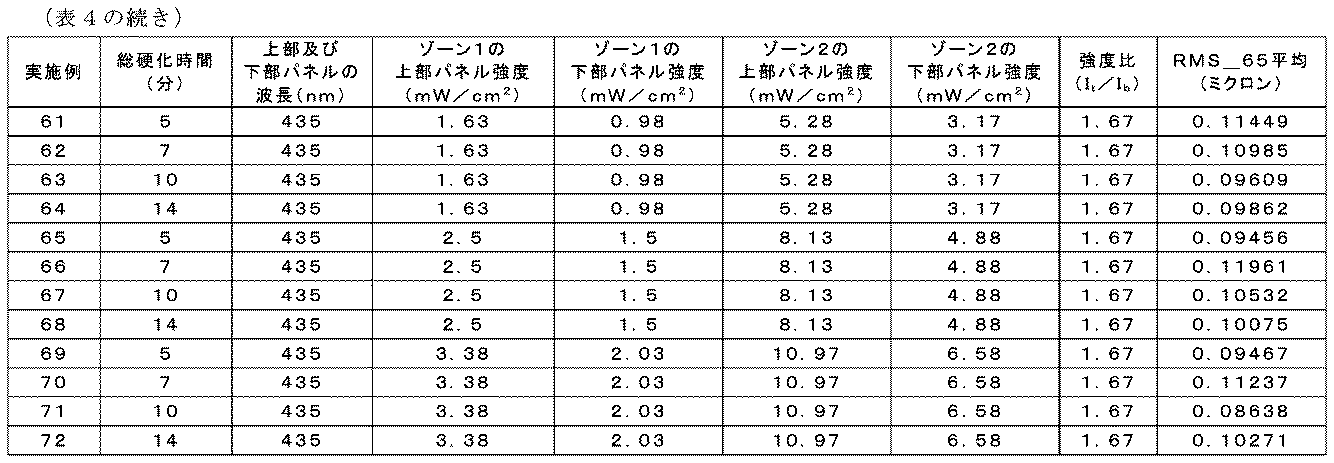
(実施例73~96)
コンタクトレンズは、(1)低強度の第1のゾーンで費やされた総硬化時間の割合が総硬化時間の50%に固定され、(2)上部及び下部強度は、表5に示すように、2つの強度ゾーンのそれぞれの中で等しく(It/Ib=1)、及び(3)上部及び下部LEDパネルのピーク発光波長が表5に列挙されるように変えられたこと以外は、表1に列挙したものと同じ製剤の別のバッチを使用し、実施例1-36について記載したのと同じ実験プロトコルに従って作製された。光学的特性評価、すなわち波面測定及びRMS_65平均の計算は、実験条件当たり15枚のレンズのサンプルサイズに基づくものであった。
(Examples 73 to 96)
Contact lenses were fabricated using separate batches of the same formulations listed in Table 1 and following the same experimental protocol as described for Examples 1-36, except that (1) the percentage of the total curing time spent in the first zone of low intensity was fixed at 50% of the total curing time, (2) the upper and lower intensities were equal within each of the two intensity zones (I t /I b =1), as shown in Table 5, and (3) the peak emission wavelengths of the upper and lower LED panels were varied as listed in Table 5. Optical characterization, i.e., wavefront measurements and RMS_65 average calculations, were based on a sample size of 15 lenses per experimental condition.
波長比(λt/λb)は、2ゾーン硬化トンネルにわたって変化し、ここでは、λtは、成形型アセンブリの上側LED光パネル又はベースカーブ側のピーク発光波長として定義され、λbは、成形型アセンブリの底面LED光パネル又はフロントカーブ面のピーク発光波長として定義される。λtとλbとが等しい場合、波長比は1に等しい(1)。λtがλbより長い場合、波長比は1を超える(>1)。λtがλbよりも短い場合、波長比は1未満である(<1)。波長比が1未満であることは、ベースカーブにおける放射エネルギーがフロントカーブにおける放射エネルギーよりも大きい実験条件を表す。 The wavelength ratio ( λt / λb ) varies across the two-zone cure tunnel, where λt is defined as the peak emission wavelength of the top LED light panel or base curve side of the mold assembly, and λb is defined as the peak emission wavelength of the bottom LED light panel or front curve side of the mold assembly. When λt and λb are equal, the wavelength ratio is equal to one (1). When λt is longer than λb , the wavelength ratio is greater than one (>1). When λt is shorter than λb , the wavelength ratio is less than one (<1). A wavelength ratio less than one represents an experimental condition where the radiant energy at the base curve is greater than the radiant energy at the front curve.
使用した硬化光源は、Lumos Solutions Ltdによって製造された、強度が調整可能で発光波長が固定されたLEDパネルであった。各パネルの波長仕様は、ターゲット波長±1nmに等しくなった。各実験設定に関して、パネルの光強度は、XRD340Aセンサを装備したNIST追跡可能放射計モデルILT2400を使用して設定され、そのどちらもInternational Light Technologies Inc.から購入され、較正された。実験のセットアップ中、放射計センサを、上向きの測定(上面強度)の場合は、レンズ型の上部の高さに配置し、下向きの測定(底面強度)の場合は、レンズ型の下部の高さに配置するホルダを使用して、放射計センサが位置決めされた。 The curing light source used was an adjustable intensity, fixed emission wavelength LED panel manufactured by Lumos Solutions Ltd. The wavelength specification for each panel was equal to the target wavelength ±1 nm. For each experimental setup, the light intensity of the panel was set using a NIST traceable radiometer model ILT2400 equipped with an XRD340A sensor, both of which were purchased and calibrated from International Light Technologies Inc. During the experimental setup, the radiometer sensor was positioned using a holder that placed it at the height of the top of the lens mold for upward measurements (top intensity) and at the height of the bottom of the lens mold for downward measurements (bottom intensity).
表6及び図7に示すように、波長比が1未満である場合、RMS_65平均値は、波長比が1より大きい場合のRMS_65平均値よりも実質的に小さくなり、レンズの光学品質が改善されたことを示した。 As shown in Table 6 and Figure 7, when the wavelength ratio is less than 1, the RMS_65 average value is substantially smaller than the RMS_65 average value when the wavelength ratio is greater than 1, indicating improved optical quality of the lens.


〔実施の態様〕
(1) 光吸収性コンタクトレンズを製造するための方法であって、
(a)ベースカーブと、フロントカーブで構成される成形型アセンブリを提供することであって、前記ベースカーブと前記フロントカーブは、それらの間に空洞を画定し、これを包囲し、前記空洞は反応性混合物を収容しており、前記反応性混合物は、少なくとも1つの重合性モノマーと、活性化波長で吸収する光開始剤と、前記活性化波長で吸収を表示する光吸収性化合物と、を含む、ことと、
(b)前記反応性混合物を、前記活性化波長を含む放射線に曝露することによって、前記反応性混合物を硬化させて前記光吸収性コンタクトレンズを形成することであって、前記放射線が、前記成形型アセンブリの前記ベースカーブ及び前記フロントカーブの両方に向けられ、かつ前記ベースカーブにおける前記放射線の放射エネルギーが、前記フロントカーブにおける前記放射線の放射エネルギーよりも大きい、ことと、を含む、方法。
(2) 前記放射エネルギーが、前記成形型アセンブリの前記ベースカーブに近接する第1の光源と、前記成形型アセンブリの前記フロントカーブに近接する第2の光源とによって提供される、実施態様1に記載の方法。
(3) 前記第1の光源が発光ダイオードであり、前記第2の光源が発光ダイオードである、実施態様2に記載の方法。
(4) 前記光吸収性化合物が静的光吸収性化合物である、実施態様1から3のいずれかに記載の方法。
(5) 前記光吸収性化合物が、高エネルギー可視光吸収体である、実施態様1から4のいずれかに記載の方法。
[Embodiment]
(1) A method for producing a light absorbing contact lens, comprising the steps of:
(a) providing a mold assembly comprised of a base curve and a front curve, the base curve and the front curve defining and enclosing a cavity therebetween, the cavity containing a reactive mixture, the reactive mixture including at least one polymerizable monomer, a photoinitiator that absorbs at an activation wavelength, and a light absorbing compound that displays absorption at the activation wavelength;
(b) curing the reactive mixture to form the light absorbing contact lens by exposing the reactive mixture to radiation comprising an activating wavelength, wherein the radiation is directed to both the base curve and the front curve of the mold assembly, and wherein a radiant energy of the radiation at the base curve is greater than a radiant energy of the radiation at the front curve.
2. The method of
3. The method of
4. The method of any one of
5. The method of any one of
(6) 前記光吸収性化合物がフォトクロミック化合物である、実施態様1から3のいずれかに記載の方法。
(7) 前記成形型アセンブリの前記ベースカーブ及び前記フロントカーブが、ポリエチレン、ポリプロピレン、ポリスチレン、水素化スチレンブタジエンブロックコポリマー、環状オレフィンポリマー、及びそれらの組み合わせから構成される、実施態様1から6のいずれかに記載の方法。
(8) 前記放射エネルギーが、前記放射線の強度、前記放射線の波長、又はこれらの組み合わせによって制御される、実施態様1から7のいずれかに記載の方法。
(9) 前記放射エネルギーが、前記放射線の強度によって制御される、実施態様8に記載の方法。
(10) 前記ベースカーブにおける前記強度が、前記フロントカーブにおける前記強度よりも大きい、実施態様9に記載の方法。
6. The method of any one of
7. The method of any one of
(8) The method of any one of
9. The method of
10. The method of claim 9, wherein the intensity at the base curve is greater than the intensity at the front curve.
(11) 前記ベースカーブにおける前記強度が、前記フロントカーブにおける前記強度より350%未満大きい、実施態様9から10のいずれかに記載の方法。
(12) 前記放射エネルギーが、前記放射線の波長によって制御される、実施態様8に記載の方法。
(13) 前記ベースカーブにおける前記波長が、前記フロントカーブにおける前記波長よりも短い、実施態様12に記載の方法。
(14) 前記ベースカーブにおける前記波長が、前記フロントカーブにおける前記波長より少なくとも約10ナノメートル短い、実施態様12から13のいずれかに記載の方法。
(15) 実施態様1から14のいずれかに記載の方法により調製された光吸収性コンタクトレンズ。
(11) The method according to any one of claims 9 to 10, wherein the strength at the base curve is less than 350% greater than the strength at the front curve.
12. The method of
13. The method of
14. The method of
(15) A light-absorbing contact lens prepared by the method according to any one of the preceding claims.
(16) 前記レンズは、前記ベースカーブ及び前記フロントカーブにおいて等しい放射エネルギーの条件下で作製された、他の点では全く同じレンズと比較して低減された、6.5ミリメートル口径を使用して測定したときの球面度数及び円柱度数並び除去されたコマ収差を有するレンズ設計目標からの二乗平均平方根光路波面偏差を有する、実施態様1から14のいずれかに記載の方法、又は実施態様15に記載の光吸収性コンタクトレンズ。
(17) 6.5ミリメートル口径を使用して測定したときの球面度数及び円柱度数並びに除去されたコマ収差を有するレンズ設計目標からの前記二乗平均平方根光路波面偏差が、前記ベースカーブ及び前記フロントカーブにおいて等しい放射エネルギーの条件下で作製された、他の点では全く同じレンズと比較して少なくとも3%低減されている、実施態様16に記載の方法又はコンタクトレンズ。
(18) 6.5ミリメートル口径を使用して測定したときの球面度数及び円柱度数並びに除去されたコマ収差を有するレンズ設計目標からの前記二乗平均平方根光路波面偏差が、前記ベースカーブ及び前記フロントカーブにおいて等しい放射エネルギーの条件下で作製された、他の点では全く同じレンズと比較して少なくとも0.0020ミクロン低減されている、実施態様16に記載の方法又はコンタクトレンズ。
(16) The method of any one of
(17) The method or contact lens of claim 16, wherein the root-mean-square optical path wavefront deviation from a lens design target having spherical and cylindrical powers and eliminated coma as measured using a 6.5 millimeter aperture is reduced by at least 3% compared to an otherwise identical lens produced under conditions of equal radiant energy at the base curve and the front curve.
18. The method or contact lens of claim 16, wherein the root-mean-square optical path wavefront deviation from a lens design target having spherical and cylindrical powers and coma eliminated as measured using a 6.5 millimeter aperture is reduced by at least 0.0020 microns as compared to an otherwise identical lens produced under conditions of equal radiant energy at the base curve and the front curve.
Claims (11)
(a)ベースカーブと、フロントカーブで構成される成形型アセンブリを提供することであって、前記ベースカーブと前記フロントカーブは、それらの間に空洞を画定し、これを包囲し、前記空洞は反応性混合物を収容しており、前記反応性混合物は、少なくとも1つの重合性モノマーと、活性化波長で吸収する光開始剤と、前記活性化波長で吸収を表示する光吸収性化合物と、を含む、ことと、
(b)前記反応性混合物を、前記活性化波長を含む放射線に曝露することによって、前記反応性混合物を硬化させて前記光吸収性コンタクトレンズを形成することであって、前記放射線が、前記成形型アセンブリの前記ベースカーブ及び前記フロントカーブの両方に向けられ、かつ前記ベースカーブにおける前記放射線の強度が、前記フロントカーブにおける前記放射線の強度よりも大きい、ことと、を含み、
前記ベースカーブにおける前記放射線の前記強度と前記フロントカーブにおける前記放射線の前記強度の差が、前記フロントカーブにおける前記放射線の前記強度の1%以上350%未満であり、
前記ベースカーブにおける前記放射線の前記強度、及び、前記フロントカーブにおける前記放射線の前記強度は、0.1mW/cm2~25mW/cm2であり、
前記ベースカーブにおける前記放射線の前記強度が、前記フロントカーブにおける前記放射線の前記強度より10~66.7%大きい、方法。 1. A method for making a light absorbing contact lens, comprising:
(a) providing a mold assembly comprised of a base curve and a front curve, the base curve and the front curve defining and enclosing a cavity therebetween, the cavity containing a reactive mixture, the reactive mixture including at least one polymerizable monomer, a photoinitiator that absorbs at an activation wavelength, and a light absorbing compound that displays absorption at the activation wavelength;
(b) curing the reactive mixture to form the light absorbing contact lens by exposing the reactive mixture to radiation comprising the activating wavelength, wherein the radiation is directed at both the base curve and the front curve of the mold assembly, and wherein an intensity of the radiation at the base curve is greater than an intensity of the radiation at the front curve;
a difference between the intensity of the radiation at the base curve and the intensity of the radiation at the front curve is 1% or more and less than 350% of the intensity of the radiation at the front curve;
the intensity of the radiation at the base curve and the intensity of the radiation at the front curve are between 0.1 mW/cm 2 and 25 mW/cm 2 ;
The method of claim 1, wherein the intensity of the radiation at the base curve is between 10 and 66.7% greater than the intensity of the radiation at the front curve .
(a)ベースカーブと、フロントカーブで構成される成形型アセンブリを提供することであって、前記ベースカーブと前記フロントカーブは、それらの間に空洞を画定し、これを包囲し、前記空洞は反応性混合物を収容しており、前記反応性混合物は、少なくとも1つの重合性モノマーと、活性化波長で吸収する光開始剤と、前記活性化波長で吸収を表示する光吸収性化合物と、を含む、ことと、(a) providing a mold assembly comprised of a base curve and a front curve, the base curve and the front curve defining and enclosing a cavity therebetween, the cavity containing a reactive mixture, the reactive mixture including at least one polymerizable monomer, a photoinitiator that absorbs at an activation wavelength, and a light absorbing compound that displays absorption at the activation wavelength;
(b)前記反応性混合物を、前記活性化波長を含む放射線に曝露することによって、前記反応性混合物を硬化させて前記光吸収性コンタクトレンズを形成することであって、前記放射線が、前記成形型アセンブリの前記ベースカーブ及び前記フロントカーブの両方に向けられ、かつ前記ベースカーブにおける前記放射線の強度が、前記フロントカーブにおける前記放射線の強度よりも大きい、ことと、を含み、(b) curing the reactive mixture to form the light absorbing contact lens by exposing the reactive mixture to radiation comprising the activating wavelength, wherein the radiation is directed at both the base curve and the front curve of the mold assembly, and wherein an intensity of the radiation at the base curve is greater than an intensity of the radiation at the front curve;
前記ベースカーブにおける前記放射線の前記強度と前記フロントカーブにおける前記放射線の前記強度の差が、前記フロントカーブにおける前記放射線の前記強度の1%以上350%未満であり、a difference between the intensity of the radiation at the base curve and the intensity of the radiation at the front curve is 1% or more and less than 350% of the intensity of the radiation at the front curve;
前記ベースカーブにおける前記放射線の前記強度、及び、前記フロントカーブにおける前記放射線の前記強度は、0.1mW/cmThe intensity of the radiation at the base curve and the intensity of the radiation at the front curve are less than or equal to 0.1 mW/cm 22 ~25mW/cm~25mW/cm 22 であり、and
前記ベースカーブにおける前記放射線の前記強度が、前記フロントカーブにおける前記放射線の前記強度より20~300%大きい、方法。A method, wherein the intensity of the radiation at the base curve is between 20 and 300% greater than the intensity of the radiation at the front curve.
Applications Claiming Priority (5)
| Application Number | Priority Date | Filing Date | Title |
|---|---|---|---|
| US201962825050P | 2019-03-28 | 2019-03-28 | |
| US62/825,050 | 2019-03-28 | ||
| US16/805,931 | 2020-03-02 | ||
| US16/805,931 US11724471B2 (en) | 2019-03-28 | 2020-03-02 | Methods for the manufacture of photoabsorbing contact lenses and photoabsorbing contact lenses produced thereby |
| PCT/IB2020/052307 WO2020194110A1 (en) | 2019-03-28 | 2020-03-13 | Methods for the manufacture of photoabsorbing contact lenses and photoabsorbing contact lenses produced thereby |
Publications (2)
| Publication Number | Publication Date |
|---|---|
| JP2022524664A JP2022524664A (en) | 2022-05-10 |
| JP7670292B2 true JP7670292B2 (en) | 2025-04-30 |
Family
ID=72606927
Family Applications (1)
| Application Number | Title | Priority Date | Filing Date |
|---|---|---|---|
| JP2020565803A Active JP7670292B2 (en) | 2019-03-28 | 2020-03-13 | Method for producing light-absorbing contact lenses and light-absorbing contact lenses produced thereby |
Country Status (8)
| Country | Link |
|---|---|
| US (3) | US11724471B2 (en) |
| EP (1) | EP3946910A1 (en) |
| JP (1) | JP7670292B2 (en) |
| KR (1) | KR20210143640A (en) |
| CN (1) | CN112203834B (en) |
| AU (1) | AU2020245253B2 (en) |
| TW (1) | TWI904086B (en) |
| WO (1) | WO2020194110A1 (en) |
Families Citing this family (7)
| Publication number | Priority date | Publication date | Assignee | Title |
|---|---|---|---|---|
| US8697770B2 (en) | 2010-04-13 | 2014-04-15 | Johnson & Johnson Vision Care, Inc. | Pupil-only photochromic contact lenses displaying desirable optics and comfort |
| US8877103B2 (en) | 2010-04-13 | 2014-11-04 | Johnson & Johnson Vision Care, Inc. | Process for manufacture of a thermochromic contact lens material |
| US11724471B2 (en) * | 2019-03-28 | 2023-08-15 | Johnson & Johnson Vision Care, Inc. | Methods for the manufacture of photoabsorbing contact lenses and photoabsorbing contact lenses produced thereby |
| WO2022090967A1 (en) * | 2020-10-28 | 2022-05-05 | Alcon Inc. | Method for making photochromic contact lenses |
| KR20230131494A (en) | 2021-03-08 | 2023-09-13 | 알콘 인코포레이티드 | Method for manufacturing photofunctional contact lenses |
| US20240399661A1 (en) * | 2023-06-01 | 2024-12-05 | Mohanad Idrees | Additive manufacturing technology for curved fiber composite parts |
| WO2025024631A1 (en) * | 2023-07-27 | 2025-01-30 | Johnson & Johnson Vision Care, Inc. | Supervised machine learning curing systems |
Citations (6)
| Publication number | Priority date | Publication date | Assignee | Title |
|---|---|---|---|---|
| JP2007538113A (en) | 2004-04-21 | 2007-12-27 | ノバルティス アクチエンゲゼルシャフト | Curable colored ink for the production of colored silicone hydrogel lenses |
| JP2009543137A (en) | 2006-06-29 | 2009-12-03 | ジョンソン・アンド・ジョンソン・ビジョン・ケア・インコーポレイテッド | Contact lens with light blocking ring |
| JP2013524297A (en) | 2010-04-13 | 2013-06-17 | ジョンソン・アンド・ジョンソン・ビジョン・ケア・インコーポレイテッド | Contact lenses that reduce indoor glare |
| JP2013524296A (en) | 2010-04-13 | 2013-06-17 | ジョンソン・アンド・ジョンソン・ビジョン・ケア・インコーポレイテッド | Manufacturing process for thermochromic contact lens materials |
| JP2013528826A (en) | 2010-04-13 | 2013-07-11 | ジョンソン・アンド・ジョンソン・ビジョン・ケア・インコーポレイテッド | Dimmable contact lens for pupils showing desirable optics and comfort |
| WO2018207586A1 (en) | 2017-05-10 | 2018-11-15 | 東レ株式会社 | Medical device |
Family Cites Families (254)
| Publication number | Priority date | Publication date | Assignee | Title |
|---|---|---|---|---|
| US999A (en) | 1838-11-03 | Railroad carriage ashd wheel | ||
| US5776A (en) | 1848-09-19 | Improved apparatus for rotting hemp | ||
| US3034403A (en) | 1959-04-03 | 1962-05-15 | Neefe Hamilton Res Company | Contact lens of apparent variable light absorption |
| US3808178A (en) | 1972-06-16 | 1974-04-30 | Polycon Laboratories | Oxygen-permeable contact lens composition,methods and article of manufacture |
| US4073577A (en) | 1973-02-19 | 1978-02-14 | Titmus Eurocon Kontaktlinsen Kg | Contact lenses of hydrophilic polymers made by photopolymerization |
| RU584529C (en) | 1976-02-02 | 1993-12-15 | Предприятие П/Я Р-6496 | Method of manufacturing diffusion chromizing film |
| US4120570A (en) | 1976-06-22 | 1978-10-17 | Syntex (U.S.A.) Inc. | Method for correcting visual defects, compositions and articles of manufacture useful therein |
| CA1099546A (en) | 1976-10-28 | 1981-04-21 | Donald R. Korb | Contact lens |
| US4182822A (en) | 1976-11-08 | 1980-01-08 | Chang Sing Hsiung | Hydrophilic, soft and oxygen permeable copolymer composition |
| US4343927A (en) | 1976-11-08 | 1982-08-10 | Chang Sing Hsiung | Hydrophilic, soft and oxygen permeable copolymer compositions |
| US4390676A (en) | 1976-11-15 | 1983-06-28 | Schering Corporation | Ultraviolet absorbing lenses |
| US4136250A (en) | 1977-07-20 | 1979-01-23 | Ciba-Geigy Corporation | Polysiloxane hydrogels |
| US4189546A (en) | 1977-07-25 | 1980-02-19 | Bausch & Lomb Incorporated | Polysiloxane shaped article for use in biomedical applications |
| US4153641A (en) | 1977-07-25 | 1979-05-08 | Bausch & Lomb Incorporated | Polysiloxane composition and contact lens |
| JPS5455455A (en) | 1977-10-12 | 1979-05-02 | Toyo Contact Lens Co Ltd | Contact lens |
| JPS5466853A (en) | 1977-11-08 | 1979-05-29 | Toyo Contact Lens Co Ltd | Soft contact lens |
| US4330383A (en) | 1978-07-18 | 1982-05-18 | Polymer Technology Corporation | Dimensionally stable oxygen permeable hard contact lens material and method of manufacture |
| US4261875A (en) | 1979-01-31 | 1981-04-14 | American Optical Corporation | Contact lenses containing hydrophilic silicone polymers |
| US4301012A (en) | 1979-04-25 | 1981-11-17 | Purolator Technologies, Inc. | Welded stainless steel mesh cleanable filter |
| US4254248A (en) | 1979-09-13 | 1981-03-03 | Bausch & Lomb Incorporated | Contact lens made from polymers of polysiloxane and polycyclic esters of acrylic acid or methacrylic acid |
| US4276402A (en) | 1979-09-13 | 1981-06-30 | Bausch & Lomb Incorporated | Polysiloxane/acrylic acid/polcyclic esters of methacrylic acid polymer contact lens |
| US4259467A (en) | 1979-12-10 | 1981-03-31 | Bausch & Lomb Incorporated | Hydrophilic contact lens made from polysiloxanes containing hydrophilic sidechains |
| US4260725A (en) | 1979-12-10 | 1981-04-07 | Bausch & Lomb Incorporated | Hydrophilic contact lens made from polysiloxanes which are thermally bonded to polymerizable groups and which contain hydrophilic sidechains |
| US4327203A (en) | 1981-02-26 | 1982-04-27 | Bausch & Lomb Incorporated | Polysiloxane with cycloalkyl modifier composition and biomedical devices |
| US4341889A (en) | 1981-02-26 | 1982-07-27 | Bausch & Lomb Incorporated | Polysiloxane composition and biomedical devices |
| US4355147A (en) | 1981-02-26 | 1982-10-19 | Bausch & Lomb Incorporated | Polysiloxane with polycyclic modifier composition and biomedical devices |
| US4495313A (en) | 1981-04-30 | 1985-01-22 | Mia Lens Production A/S | Preparation of hydrogel for soft contact lens with water displaceable boric acid ester |
| US4436887A (en) | 1981-11-12 | 1984-03-13 | Bausch & Lomb Incorporated | N-Vinyl lactam based biomedical devices |
| US4661575A (en) | 1982-01-25 | 1987-04-28 | Hercules Incorporated | Dicyclopentadiene polymer product |
| US4952046A (en) | 1982-02-26 | 1990-08-28 | Stephens James B | Optical lenses with selective transmissivity functions |
| US4463149A (en) | 1982-03-29 | 1984-07-31 | Polymer Technology Corporation | Silicone-containing contact lens material and contact lenses made thereof |
| US4450264A (en) | 1982-08-09 | 1984-05-22 | Polymatic Investment Corp., N.V. | Siloxane-containing polymers and contact lenses therefrom |
| US4973493A (en) | 1982-09-29 | 1990-11-27 | Bio-Metric Systems, Inc. | Method of improving the biocompatibility of solid surfaces |
| US4486577A (en) | 1982-10-12 | 1984-12-04 | Ciba-Geigy Corporation | Strong, silicone containing polymers with high oxygen permeability |
| JPS59185310A (en) | 1983-04-06 | 1984-10-20 | Toyo Contact Lens Co Ltd | Soft contact lens composition permeable to oxygen |
| US4543398A (en) | 1983-04-28 | 1985-09-24 | Minnesota Mining And Manufacturing Company | Ophthalmic devices fabricated from urethane acrylates of polysiloxane alcohols |
| US4891046A (en) | 1984-03-15 | 1990-01-02 | Coopervision, Inc. | Tinted contact lens and method for preparation with dichlorotriazine reactive dye |
| ZA855083B (en) | 1984-07-05 | 1987-03-25 | Du Pont | Acrylic star polymers |
| US4707236A (en) | 1984-08-03 | 1987-11-17 | Richard Borowsky | Method of farbricating an optically graded light occluding gel |
| US4576453A (en) | 1984-08-03 | 1986-03-18 | Richard Borowsky | Light-occluding contact lens |
| US4605712A (en) | 1984-09-24 | 1986-08-12 | Ciba-Geigy Corporation | Unsaturated polysiloxanes and polymers thereof |
| US4681412A (en) | 1984-10-01 | 1987-07-21 | Lemelson Jerome H | Contact lens containing light sensitive material |
| US4680336A (en) | 1984-11-21 | 1987-07-14 | Vistakon, Inc. | Method of forming shaped hydrogel articles |
| US4711943A (en) | 1985-04-26 | 1987-12-08 | Sola U.S.A. Inc. | Hydrophilic siloxane monomers and dimers for contact lens materials, and contact lenses fabricated therefrom |
| US4669834A (en) | 1985-04-30 | 1987-06-02 | Richter Judy C | Light reflective contact lens |
| JPS6258604A (en) | 1985-09-09 | 1987-03-14 | Mitsui Toatsu Chem Inc | Manufacture of magnetic iron powder for magnetic recording |
| DE3708308A1 (en) | 1986-04-10 | 1987-10-22 | Bayer Ag | CONTACT OPTICAL ITEMS |
| US4725277A (en) | 1986-05-14 | 1988-02-16 | Precision-Cosmet Co., Inc. | Intraocular lens with tapered haptics |
| US4871785A (en) | 1986-08-13 | 1989-10-03 | Michael Froix | Clouding-resistant contact lens compositions |
| US4731079A (en) | 1986-11-26 | 1988-03-15 | Kingston Technologies, Inc. | Intraocular lenses |
| JPS63264719A (en) | 1986-12-08 | 1988-11-01 | Toyo Contact Lens Co Ltd | Method for dyeing soft contact lens |
| JP2699334B2 (en) | 1986-12-25 | 1998-01-19 | 株式会社島津製作所 | contact lens |
| AU616650B2 (en) | 1987-02-02 | 1991-11-07 | Toray Industries, Inc. | Spirooxazine photochromic compounds and resins |
| US5006622A (en) | 1987-04-02 | 1991-04-09 | Bausch & Lomb Incorporated | Polymer compositions for contact lenses |
| US5236969A (en) | 1987-04-02 | 1993-08-17 | Bausch & Lomb Incorporated | Polymer compositions for contact lenses |
| US5270418A (en) | 1987-04-02 | 1993-12-14 | Bausch & Lomb Incorporated | Polymer compositions for contact lenses |
| US4837289A (en) | 1987-04-30 | 1989-06-06 | Ciba-Geigy Corporation | UV- and heat curable terminal polyvinyl functional macromers and polymers thereof |
| US4863464A (en) | 1988-01-26 | 1989-09-05 | The Cooper Companies, Inc. | Intraocular lens |
| US4872876A (en) | 1988-05-11 | 1989-10-10 | Nestle S.A. | Universal fit intraocular lens |
| US4954587A (en) | 1988-07-05 | 1990-09-04 | Ciba-Geigy Corporation | Dimethylacrylamide-copolymer hydrogels with high oxygen permeability |
| DE3837884A1 (en) | 1988-11-08 | 1990-05-10 | Mutzhas Maximilian F | LIGHT FILTER FOR IMPROVING VISION |
| US4889664A (en) | 1988-11-25 | 1989-12-26 | Vistakon, Inc. | Method of forming shaped hydrogel articles including contact lenses |
| US5039459A (en) | 1988-11-25 | 1991-08-13 | Johnson & Johnson Vision Products, Inc. | Method of forming shaped hydrogel articles including contact lenses |
| US4954586A (en) | 1989-01-17 | 1990-09-04 | Menicon Co., Ltd | Soft ocular lens material |
| US5070215A (en) | 1989-05-02 | 1991-12-03 | Bausch & Lomb Incorporated | Novel vinyl carbonate and vinyl carbamate contact lens material monomers |
| US5034461A (en) | 1989-06-07 | 1991-07-23 | Bausch & Lomb Incorporated | Novel prepolymers useful in biomedical devices |
| US5115056A (en) | 1989-06-20 | 1992-05-19 | Ciba-Geigy Corporation | Fluorine and/or silicone containing poly(alkylene-oxide)-block copolymers and contact lenses thereof |
| US5010141A (en) | 1989-10-25 | 1991-04-23 | Ciba-Geigy Corporation | Reactive silicone and/or fluorine containing hydrophilic prepolymers and polymers thereof |
| BR9007801A (en) | 1989-11-01 | 1992-09-01 | Schering Corp | VERY NATURAL COLORED CONTACT LENS |
| US6337040B1 (en) | 1990-01-29 | 2002-01-08 | Pbh, Inc | Colored contact lenses and method of making same |
| US5275838A (en) | 1990-02-28 | 1994-01-04 | Massachusetts Institute Of Technology | Immobilized polyethylene oxide star molecules for bioapplications |
| US4997897A (en) | 1990-04-03 | 1991-03-05 | Bausch & Lomb Incorporated | Polymerizable dye |
| US5057578A (en) | 1990-04-10 | 1991-10-15 | E. I. Du Pont De Nemours And Company | Silicone-containing block copolymers and macromonomers |
| US5314960A (en) | 1990-04-10 | 1994-05-24 | Permeable Technologies, Inc. | Silicone-containing polymers, oxygen permeable hydrophilic contact lenses and methods for making these lenses and treating patients with visual impairment |
| US5244981A (en) | 1990-04-10 | 1993-09-14 | Permeable Technologies, Inc. | Silicone-containing contact lens polymers, oxygen permeable contact lenses and methods for making these lenses and treating patients with visual impairment |
| FR2664991B1 (en) | 1990-07-19 | 1992-11-13 | Capez Pierre | ANTI-GLARE CONTACT LENS. |
| US5371147A (en) | 1990-10-11 | 1994-12-06 | Permeable Technologies, Inc. | Silicone-containing acrylic star polymers, block copolymers and macromonomers |
| GB9023498D0 (en) | 1990-10-29 | 1990-12-12 | Biocompatibles Ltd | Soft contact lens material |
| US5135297A (en) | 1990-11-27 | 1992-08-04 | Bausch & Lomb Incorporated | Surface coating of polymer objects |
| WO1993005085A1 (en) | 1991-09-12 | 1993-03-18 | Bausch & Lomb Incorporated | Wettable silicone hydrogel compositions and methods |
| JP3354571B2 (en) | 1991-11-05 | 2002-12-09 | ボシュ・アンド・ロム・インコーポレイテッド | Wettable silicone hydrogel composition and method for producing the same |
| US5358995A (en) | 1992-05-15 | 1994-10-25 | Bausch & Lomb Incorporated | Surface wettable silicone hydrogels |
| GEP20002074B (en) | 1992-05-19 | 2000-05-10 | Westaim Tech Inc Ca | Modified Material and Method for its Production |
| JP2774233B2 (en) | 1992-08-26 | 1998-07-09 | 株式会社メニコン | Ophthalmic lens materials |
| US5433898A (en) | 1992-09-11 | 1995-07-18 | Pilkington Barnes Hind, Inc. | Method of manufacturing a contact lens |
| US5944853A (en) | 1992-10-26 | 1999-08-31 | Johnson & Johnson Vision Products, Inc. | Method for preparing halotriazine dye- and vinyl sulfone dye-monomer compounds |
| US5298533A (en) | 1992-12-02 | 1994-03-29 | Bausch & Lomb Incorporated | Polymer compositions for contact lenses |
| JP3107121B2 (en) | 1992-12-18 | 2000-11-06 | 矢崎総業株式会社 | Lock structure for flat wires and connectors |
| US5336797A (en) | 1992-12-30 | 1994-08-09 | Bausch & Lomb Incorporated | Siloxane macromonomers |
| WO1994017110A1 (en) | 1993-01-28 | 1994-08-04 | Pilkington Barnes Hind, Inc. | Material in the manufacture of polymeric articles |
| JPH06258604A (en) | 1993-03-03 | 1994-09-16 | Nissha Printing Co Ltd | Contact lens with picture and its production |
| AU4980193A (en) | 1993-08-18 | 1995-03-14 | Gyorgy Abraham | Method and optical means for improving or modifying colour vision and method for making said optical means |
| FR2723218A1 (en) | 1994-07-29 | 1996-02-02 | Essilor Internal Cie Gle Optique | PHOTOCHROMIC COMPOUNDS WITH A SPIRO STRUCTURE (INDOLINE- (2,3 ') - BENZOXAZINE) WITH A CYANO GROUP IN 6', AND THEIR USE IN THE FIELD OF OPHTHALMIC OPTICS |
| US5760100B1 (en) | 1994-09-06 | 2000-11-14 | Ciba Vision Corp | Extended wear ophthalmic lens |
| US7468398B2 (en) | 1994-09-06 | 2008-12-23 | Ciba Vision Corporation | Extended wear ophthalmic lens |
| US5846457A (en) | 1994-10-28 | 1998-12-08 | Hoffman; William C. | Light filtering contact lens method |
| US5617154A (en) | 1994-10-28 | 1997-04-01 | Flexlens | Light filtering contact lens |
| US5645767A (en) | 1994-11-03 | 1997-07-08 | Transitions Optical, Inc. | Photochromic indeno-fused naphthopyrans |
| JP3542425B2 (en) | 1994-11-17 | 2004-07-14 | キヤノン株式会社 | Aqueous dispersion ink for inkjet recording, inkjet recording method using the same, ink cartridge, recording unit, and recording apparatus |
| US5973039A (en) | 1994-12-12 | 1999-10-26 | Corning Incorporated | Temperature stable and sunlight protected photochromic articles |
| EP0807017B1 (en) | 1995-02-02 | 1999-10-20 | Novartis AG | Process for the manufacture of moulded articles that are partly coloured or have regions of different colours |
| TW585882B (en) | 1995-04-04 | 2004-05-01 | Novartis Ag | A method of using a contact lens as an extended wear lens and a method of screening an ophthalmic lens for utility as an extended-wear lens |
| AU5194896A (en) | 1995-05-04 | 1996-11-14 | Johnson & Johnson Vision Products, Inc. | Concentric annular ring lens designs with minimal angles between adjacent annular ring segments |
| US5824719A (en) | 1995-06-07 | 1998-10-20 | Bausch & Lomb Incorporated | Polymer compositions for contact lenses |
| AUPN354595A0 (en) | 1995-06-14 | 1995-07-06 | Ciba-Geigy Ag | Novel materials |
| GB2305256A (en) | 1995-07-19 | 1997-04-02 | Peter John Mckay | Photochromic or polarising contact lens |
| EP0763754B1 (en) | 1995-09-13 | 2003-01-08 | Seikagaku Kogyo Kabushiki Kaisha (Seikagaku Corporation) | Photocured crosslinked-hyaluronic acid contact lens |
| JP4006039B2 (en) | 1995-09-13 | 2007-11-14 | 生化学工業株式会社 | Photocrosslinked hyaluronic acid contact lens |
| CN1084335C (en) | 1995-12-07 | 2002-05-08 | 博士伦公司 | Monomeric units useful for reducing modulus of silicone hydrogels |
| US5714557A (en) | 1995-12-07 | 1998-02-03 | Bausch & Lomb Incorporated | Monomeric units useful for reducing the modulus of low water polymeric silicone compositions |
| FR2743154B1 (en) | 1995-12-29 | 1998-03-06 | Essilor Int | MULTIFOCAL ARTIFICIAL EYE LENS WITH ILLUMINATION TRANSPARENCY |
| US5716540A (en) | 1996-02-09 | 1998-02-10 | Johnson & Johnson Vision Products, Inc. | Apparatus and method for producing center gated lens molds for contact lens manufacture |
| US5779943A (en) | 1996-03-19 | 1998-07-14 | Johnson & Johnson Vision Products, Inc. | Molded polymeric object with wettable surface made from latent-hydrophilic monomers |
| JP2974607B2 (en) | 1996-04-05 | 1999-11-10 | ホーヤ株式会社 | Reactive dye and lens using the same |
| US6022498A (en) | 1996-04-19 | 2000-02-08 | Q2100, Inc. | Methods for eyeglass lens curing using ultraviolet light |
| US5807944A (en) | 1996-06-27 | 1998-09-15 | Ciba Vision Corporation | Amphiphilic, segmented copolymer of controlled morphology and ophthalmic devices including contact lenses made therefrom |
| US6020445A (en) | 1997-10-09 | 2000-02-01 | Johnson & Johnson Vision Products, Inc. | Silicone hydrogel polymers |
| KR100438477B1 (en) | 1997-12-02 | 2004-07-03 | 호야 헬쓰케어 가부시키가이샤 | Intraocular lenses and process for producing molded-in type intraocular lenses |
| FR2772033A1 (en) | 1997-12-05 | 1999-06-04 | Essilor Int | PROCESS FOR PRODUCING A TRANSPARENT POLYMERIC MATERIAL RESISTANT TO THE DEPOSITION OF PROTEINS, MATERIAL OBTAINED BY THIS PROCESS, CONTACT LENSES AND INTRAOCULAR IMPLANTS MADE OF THIS MATERIAL |
| ES1039419Y (en) | 1998-01-19 | 1999-05-16 | Catalan Gutierrez Javier | SOLAR IRIS LENS |
| US6849671B2 (en) | 1998-03-02 | 2005-02-01 | Johnson & Johnson Vision Care, Inc. | Contact lenses |
| US6822016B2 (en) | 2001-09-10 | 2004-11-23 | Johnson & Johnson Vision Care, Inc. | Biomedical devices containing internal wetting agents |
| US5962548A (en) | 1998-03-02 | 1999-10-05 | Johnson & Johnson Vision Products, Inc. | Silicone hydrogel polymers |
| US7052131B2 (en) | 2001-09-10 | 2006-05-30 | J&J Vision Care, Inc. | Biomedical devices containing internal wetting agents |
| US5998498A (en) | 1998-03-02 | 1999-12-07 | Johnson & Johnson Vision Products, Inc. | Soft contact lenses |
| US6367929B1 (en) | 1998-03-02 | 2002-04-09 | Johnson & Johnson Vision Care, Inc. | Hydrogel with internal wetting agent |
| US6943203B2 (en) | 1998-03-02 | 2005-09-13 | Johnson & Johnson Vision Care, Inc. | Soft contact lenses |
| US20030030773A1 (en) | 1998-03-12 | 2003-02-13 | Ocampo Gerardo J. | Colored contact lens with a more natural appearance |
| DE69902654T2 (en) | 1998-05-05 | 2003-04-10 | Bausch & Lomb Inc., Rochester | SURFACE TREATMENT OF SILICONE HYDROGEL CONTACT LENSES BY MEANS OF A PLASMA |
| US6087415A (en) | 1998-06-11 | 2000-07-11 | Johnson & Johnson Vision Care, Inc. | Biomedical devices with hydrophilic coatings |
| EP0980685B1 (en) | 1998-06-17 | 2006-01-25 | Nipro Corporation | Use of a fluid for the manufacture of a dialysis fluid for continuous recirculating peritoneal dialysis |
| US6039913A (en) | 1998-08-27 | 2000-03-21 | Novartis Ag | Process for the manufacture of an ophthalmic molding |
| ES2244213T3 (en) | 1998-09-11 | 2005-12-01 | Transitions Optical, Inc. | POLYMERIZABLE POLYCOXYLATED NAFTOPIRANS. |
| TR200101048T2 (en) | 1998-10-13 | 2001-07-23 | Pharmacia Groningen B.V. | Injectable intraocular lenses |
| SE9803481D0 (en) | 1998-10-13 | 1998-10-13 | Pharmacia & Upjohn Ab | Photocurable siloxane polymers |
| BR9914904A (en) | 1998-10-29 | 2001-08-07 | Allergan Sales Inc | Intraocular lenses made with polymeric compositions |
| US5981675A (en) | 1998-12-07 | 1999-11-09 | Bausch & Lomb Incorporated | Silicone-containing macromonomers and low water materials |
| WO2000035980A1 (en) | 1998-12-11 | 2000-06-22 | Biocompatibles Limited | Crosslinked polymers and refractive devices formed therefrom |
| US6200626B1 (en) | 1999-05-20 | 2001-03-13 | Bausch & Lomb Incorporated | Surface-treatment of silicone medical devices comprising an intermediate carbon coating and graft polymerization |
| US6213604B1 (en) | 1999-05-20 | 2001-04-10 | Bausch & Lomb Incorporated | Plasma surface treatment of silicone hydrogel contact lenses with a flexible carbon coating |
| JP4219485B2 (en) | 1999-05-21 | 2009-02-04 | 株式会社メニコン | Ophthalmic material composed of optical hydrous gel |
| CA2386247A1 (en) | 1999-10-22 | 2001-05-03 | Wesley Jessen Corporation | Sterile photochromic hydrophilic contact lenses |
| AU782256B2 (en) | 1999-11-01 | 2005-07-14 | Praful Doshi | Tinted lenses and methods of manufacture |
| US6305801B1 (en) | 1999-12-02 | 2001-10-23 | Peakvision, Llc | Contact lens with filtering for outdoor sporting and recreational activities |
| CA2394939C (en) | 1999-12-16 | 2007-10-30 | Asahikasei Aime Co., Ltd. | Long-wearable soft contact lens |
| CN1394290A (en) | 2000-01-03 | 2003-01-29 | 威斯利杰森公司 | Contact lens comprising orange colorant |
| US6572794B1 (en) | 2000-07-24 | 2003-06-03 | Essilor International Compagnie Generale D'optique | Method of manufacturing a photochromic molded article |
| EP1312621B1 (en) | 2000-08-11 | 2007-06-06 | Tokuyama Corporation | Process for producing a photochromic cured product |
| ATE392176T1 (en) | 2000-09-26 | 2008-05-15 | Calhoun Vision Inc | PERFORMANCE ADJUSTMENT FOR ADJUSTABLE LENS |
| US6746120B2 (en) | 2000-10-30 | 2004-06-08 | Novartis Ag | Method and system for ordering customized cosmetic contact lenses |
| US6813082B2 (en) | 2000-11-27 | 2004-11-02 | Ophthonix, Inc. | Wavefront aberrator and method of manufacturing |
| KR100781025B1 (en) | 2000-11-29 | 2007-11-29 | 지엠에스, 엘엘씨 | Photochromic article and its manufacturing method |
| US6863843B2 (en) | 2000-12-21 | 2005-03-08 | Vision-Ease Lens, Inc. | Naphthopyran compounds, photoresponsive compositions and lenses |
| CA2440900A1 (en) | 2001-03-16 | 2002-09-26 | Novartis Ag | Colored printing ink for contact lenses |
| DE10122188B4 (en) | 2001-05-08 | 2007-04-12 | Ems-Chemie Ag | Polyamide molding compounds for the production of optical lenses |
| US7241125B2 (en) | 2001-05-25 | 2007-07-10 | Johnson & Johnson Vision Care, Inc. | Center touch method and apparatus for forming contact lenses |
| US20030020870A1 (en) | 2001-06-27 | 2003-01-30 | Zms, Llc | Biomedical molding materials from semi-solid precursors |
| US7879267B2 (en) | 2001-08-02 | 2011-02-01 | J&J Vision Care, Inc. | Method for coating articles by mold transfer |
| CA2461338C (en) | 2001-10-05 | 2011-12-20 | Superior Micropowders, Llc | Low viscosity precursor compositions and methods for the deposition of conductive electronic features |
| US20030103188A1 (en) | 2001-12-04 | 2003-06-05 | Zeltzer Harry I. | Contact lens |
| US7368072B2 (en) | 2001-12-10 | 2008-05-06 | Ppg Industries Ohio, Inc. | Photochromic contact lenses and methods of manufacturing |
| US20050258408A1 (en) | 2001-12-20 | 2005-11-24 | Molock Frank F | Photochromic contact lenses and methods for their production |
| AU2003230919B2 (en) | 2002-04-15 | 2009-04-09 | Solvay Advanced Polymers, Llc | Polysulfone compositions exhibiting very low color and high light transmittance properties and articles made therefrom |
| WO2003099550A1 (en) | 2002-05-27 | 2003-12-04 | Tokuyama Corporation | Process for producing photochromic layered product |
| DE10252838A1 (en) | 2002-11-13 | 2004-06-03 | Wellomer Gmbh | Forming an adhesive bond using a ultraviolet-curable adhesive, especially in medical technology and the electronics industry, comprises using one or more light-emitting diodes as ultraviolet source |
| US7399982B2 (en) * | 2003-01-09 | 2008-07-15 | Con-Trol-Cure, Inc | UV curing system and process with increased light intensity |
| US7175712B2 (en) | 2003-01-09 | 2007-02-13 | Con-Trol-Cure, Inc. | Light emitting apparatus and method for curing inks, coatings and adhesives |
| EP1437392B9 (en) | 2003-01-10 | 2006-08-23 | Wellomer GmbH | Control of curing of radiation-curable adhesives |
| JP4398427B2 (en) | 2003-01-27 | 2010-01-13 | 株式会社メニコン | Photochromic contact lens with excellent color erasability |
| US20040186241A1 (en) | 2003-03-20 | 2004-09-23 | Gemert Barry Van | Photochromic ocular devices |
| US6811257B1 (en) | 2003-04-15 | 2004-11-02 | Douglas Lehat | Contact lens including elements for filtering ultraviolet light, blue light, and polarized light |
| JPWO2005032791A1 (en) | 2003-10-06 | 2007-11-15 | 株式会社メニコン | Manufacturing method of ophthalmic lens article and manufacturing apparatus used therefor |
| US7165839B2 (en) | 2003-12-19 | 2007-01-23 | Novartis Ag | Method for producing tinted contact lenses |
| US7786185B2 (en) | 2004-03-05 | 2010-08-31 | Johnson & Johnson Vision Care, Inc. | Wettable hydrogels comprising acyclic polyamides |
| US8147728B2 (en) | 2004-04-01 | 2012-04-03 | Novartis Ag | Pad transfer printing of silicone hydrogel lenses using colored ink |
| US7278737B2 (en) | 2004-04-30 | 2007-10-09 | Advanced Medical Optics, Inc. | Ophthalmic devices having a highly selective violet light transmissive filter and related methods |
| US7641336B2 (en) | 2004-05-12 | 2010-01-05 | Johnson & Johnson Vision Care, Inc | Tinted contact lenses with combined limbal ring and iris patterns |
| US8133274B2 (en) | 2004-06-18 | 2012-03-13 | Medennium, Inc. | Photochromic intraocular lenses and methods of making the same |
| ATE441125T1 (en) | 2004-07-28 | 2009-09-15 | Novartis Ag | WATER-BASED INKS FOR HYDROGEL LENSES |
| US20060050232A1 (en) | 2004-08-19 | 2006-03-09 | Jerry Dukes | Tinted contact lenses with gradient ring patterns |
| TW200613391A (en) | 2004-09-01 | 2006-05-01 | Novartis Ag | Method for making colored silicone hydrogel contact lenses |
| US7249848B2 (en) | 2004-09-30 | 2007-07-31 | Johnson & Johnson Vision Care, Inc. | Wettable hydrogels comprising reactive, hydrophilic, polymeric internal wetting agents |
| US7247692B2 (en) | 2004-09-30 | 2007-07-24 | Johnson & Johnson Vision Care, Inc. | Biomedical devices containing amphiphilic block copolymers |
| US7473738B2 (en) | 2004-09-30 | 2009-01-06 | Johnson & Johnson Vision Care, Inc. | Lactam polymer derivatives |
| US9297928B2 (en) | 2004-11-22 | 2016-03-29 | Johnson & Johnson Vision Care, Inc. | Ophthalmic compositions comprising polyether substituted polymers |
| US9052438B2 (en) | 2005-04-08 | 2015-06-09 | Johnson & Johnson Vision Care, Inc. | Ophthalmic devices comprising photochromic materials with reactive substituents |
| US20060226402A1 (en) | 2005-04-08 | 2006-10-12 | Beon-Kyu Kim | Ophthalmic devices comprising photochromic materials having extended PI-conjugated systems |
| US7556750B2 (en) | 2005-04-08 | 2009-07-07 | Transitions Optical, Inc. | Photochromic materials with reactive substituents |
| US20060227287A1 (en) | 2005-04-08 | 2006-10-12 | Frank Molock | Photochromic ophthalmic devices made with dual initiator system |
| US7785092B2 (en) | 2005-08-09 | 2010-08-31 | Coopervision International Holding Company, Lp | Systems and methods for producing contact lenses from a polymerizable composition |
| US8360574B2 (en) | 2006-03-20 | 2013-01-29 | High Performance Optics, Inc. | High performance selective light wavelength filtering providing improved contrast sensitivity |
| US8113651B2 (en) | 2006-03-20 | 2012-02-14 | High Performance Optics, Inc. | High performance corneal inlay |
| US20120075577A1 (en) | 2006-03-20 | 2012-03-29 | Ishak Andrew W | High performance selective light wavelength filtering providing improved contrast sensitivity |
| US7717556B1 (en) | 2006-07-05 | 2010-05-18 | Jon Scott Walker | Visual enhancement lens and associated methods |
| JP5070770B2 (en) | 2006-08-30 | 2012-11-14 | トヨタ自動車株式会社 | Exhaust gas purification device for internal combustion engine |
| US7838698B2 (en) | 2006-09-29 | 2010-11-23 | Johnson & Johnson Vision Care, Inc. | Hydrolysis-resistant silicone compounds |
| US8507577B2 (en) | 2006-10-31 | 2013-08-13 | Johnson & Johnson Vision Care, Inc. | Process for forming clear, wettable silicone hydrogel articles |
| GB0623299D0 (en) | 2006-11-22 | 2007-01-03 | Sauflon Cl Ltd | Contact lens |
| ES2944911T3 (en) | 2006-11-28 | 2023-06-27 | High Performance Optics Inc | High performance light wavelength selective filtering provides increased contrast sensitivity |
| EP2098192B1 (en) | 2006-12-27 | 2022-02-09 | Hoya Corporation | Multifocal eye lens |
| EP2130071B1 (en) | 2007-03-05 | 2018-08-29 | Benz Research and Development Corporation | Light filters comprising a naturally occurring chromophore and derivatives thereof |
| UY31056A1 (en) | 2007-05-01 | 2008-10-31 | Alcon Res Ltd | N-HALOGENATED AMINOCIDE FROMULATIONS AND CLEANING AND DISINFECTION METHODS |
| US7759433B2 (en) | 2007-06-20 | 2010-07-20 | Essilor International (Compagnie Generale D'optique) | High adhesion acrylate coating for a photochromic ophthalmic lens |
| US7931369B2 (en) | 2007-07-13 | 2011-04-26 | David Andrew Harris | Tinted lens and method of making same |
| US8317505B2 (en) | 2007-08-21 | 2012-11-27 | Johnson & Johnson Vision Care, Inc. | Apparatus for formation of an ophthalmic lens precursor and lens |
| US8318055B2 (en) | 2007-08-21 | 2012-11-27 | Johnson & Johnson Vision Care, Inc. | Methods for formation of an ophthalmic lens precursor and lens |
| US8974526B2 (en) | 2007-08-27 | 2015-03-10 | Amo Groningen B.V. | Multizonal lens with extended depth of focus |
| KR20090021445A (en) | 2007-08-27 | 2009-03-04 | 하재상 | Discoloration contact lenses |
| JP2009094446A (en) | 2007-09-19 | 2009-04-30 | Toshiba Tec Corp | Pattern forming method and pattern forming apparatus |
| US7934830B2 (en) | 2007-12-03 | 2011-05-03 | Bausch & Lomb Incorporated | High water content silicone hydrogels |
| US8138290B2 (en) | 2008-01-25 | 2012-03-20 | Bausch & Lomb Incorporated | High water content ophthalmic devices |
| WO2009099099A1 (en) | 2008-02-07 | 2009-08-13 | Nippon Steel Chemical Co., Ltd. | Silicone resins and manufacturing method thereof, as well as curable resin compositions that comprise said silicone resins |
| EP2263108B1 (en) * | 2008-03-18 | 2019-11-27 | Novartis AG | Coating process for ophthalmic lenses |
| US20090244479A1 (en) | 2008-03-31 | 2009-10-01 | Diana Zanini | Tinted silicone ophthalmic devices, processes and polymers used in the preparation of same |
| JP2010018686A (en) | 2008-07-09 | 2010-01-28 | Fujifilm Corp | Ultraviolet absorbent and polymeric material containing the same |
| US8470906B2 (en) | 2008-09-30 | 2013-06-25 | Johnson & Johnson Vision Care, Inc. | Ionic silicone hydrogels having improved hydrolytic stability |
| US20100149483A1 (en) | 2008-12-12 | 2010-06-17 | Chiavetta Iii Stephen V | Optical Filter for Selectively Blocking Light |
| US7911676B2 (en) | 2008-12-16 | 2011-03-22 | Transitions Optical, Inc. | Photochromic optical articles prepared with reversible thermochromic materials |
| SG168419A1 (en) | 2009-07-10 | 2011-02-28 | Menicon Co Ltd | Systems and methods for the production of contact lenses |
| GB0917806D0 (en) | 2009-10-12 | 2009-11-25 | Sauflon Cl Ltd | Fluorinated silicone hydrogels |
| DE102009055080B4 (en) | 2009-12-21 | 2019-11-14 | Fraunhofer-Gesellschaft zur Förderung der angewandten Forschung e.V. | Method and device for producing a structure, molding tool |
| MX344720B (en) * | 2010-07-30 | 2017-01-03 | Novartis Ag * | Method for making uv-absorbing ophthalmic lenses. |
| SG192236A1 (en) | 2011-02-28 | 2013-09-30 | Coopervision Int Holding Co Lp | Wettable silicone hydrogel contact lenses |
| US9170349B2 (en) | 2011-05-04 | 2015-10-27 | Johnson & Johnson Vision Care, Inc. | Medical devices having homogeneous charge density and methods for making same |
| US9125808B2 (en) | 2011-12-23 | 2015-09-08 | Johnson & Johnson Vision Care, Inc. | Ionic silicone hydrogels |
| US8937110B2 (en) | 2011-12-23 | 2015-01-20 | Johnson & Johnson Vision Care, Inc. | Silicone hydrogels having a structure formed via controlled reaction kinetics |
| US9140825B2 (en) | 2011-12-23 | 2015-09-22 | Johnson & Johnson Vision Care, Inc. | Ionic silicone hydrogels |
| US9156934B2 (en) | 2011-12-23 | 2015-10-13 | Johnson & Johnson Vision Care, Inc. | Silicone hydrogels comprising n-vinyl amides and hydroxyalkyl (meth)acrylates or (meth)acrylamides |
| US8937111B2 (en) | 2011-12-23 | 2015-01-20 | Johnson & Johnson Vision Care, Inc. | Silicone hydrogels comprising desirable water content and oxygen permeability |
| US8940812B2 (en) | 2012-01-17 | 2015-01-27 | Johnson & Johnson Vision Care, Inc. | Silicone polymers comprising sulfonic acid groups |
| US10209534B2 (en) | 2012-03-27 | 2019-02-19 | Johnson & Johnson Vision Care, Inc. | Increased stiffness center optic in soft contact lenses for astigmatism correction |
| SG10201508107WA (en) | 2012-03-30 | 2015-10-29 | Johnson & Johnson Vision Care | Methods and apparatus for forming a translating multifocal contact lens |
| US9244196B2 (en) | 2012-05-25 | 2016-01-26 | Johnson & Johnson Vision Care, Inc. | Polymers and nanogel materials and methods for making and using the same |
| US9297929B2 (en) | 2012-05-25 | 2016-03-29 | Johnson & Johnson Vision Care, Inc. | Contact lenses comprising water soluble N-(2 hydroxyalkyl) (meth)acrylamide polymers or copolymers |
| EP3233449B1 (en) * | 2014-12-17 | 2019-07-24 | Novartis AG | Reusable lens molds and methods of use thereof |
| WO2017093835A1 (en) | 2015-12-02 | 2017-06-08 | Novartis Ag | Water-soluble uv-absorbing compounds and uses thereof |
| EP3390025B1 (en) | 2015-12-17 | 2023-09-06 | Alcon Inc. | Reusable lens molds and methods of use thereof |
| US11125916B2 (en) * | 2016-07-06 | 2021-09-21 | Johnson & Johnson Vision Care, Inc. | Silicone hydrogels comprising N-alkyl methacrylamides and contact lenses made thereof |
| US11021558B2 (en) * | 2016-08-05 | 2021-06-01 | Johnson & Johnson Vision Care, Inc. | Polymer compositions containing grafted polymeric networks and processes for their preparation and use |
| WO2019043577A1 (en) | 2017-08-29 | 2019-03-07 | Novartis Ag | Cast-molding process for producing contact lenses |
| US11609442B2 (en) | 2017-12-27 | 2023-03-21 | Transitions Optical, Ltd. | System and method for customization of a photochromic article |
| EP3743270B1 (en) | 2018-01-22 | 2022-06-08 | Alcon Inc. | Cast-molding process for producing uv-absorbing contact lenses |
| US10961341B2 (en) | 2018-01-30 | 2021-03-30 | Johnson & Johnson Vision Care, Inc. | Ophthalmic devices derived from grafted polymeric networks and processes for their preparation and use |
| US11034789B2 (en) | 2018-01-30 | 2021-06-15 | Johnson & Johnson Vision Care, Inc. | Ophthalmic devices containing localized grafted networks and processes for their preparation and use |
| WO2019181903A1 (en) | 2018-03-22 | 2019-09-26 | 株式会社トクヤマ | Method for producing plastic lens having coating layer |
| US11029534B2 (en) | 2018-10-08 | 2021-06-08 | Johnson & Johnson Vision Care, Inc. | Multiple-wavelength lens forming system and method |
| US11724471B2 (en) | 2019-03-28 | 2023-08-15 | Johnson & Johnson Vision Care, Inc. | Methods for the manufacture of photoabsorbing contact lenses and photoabsorbing contact lenses produced thereby |
| TWI779275B (en) | 2020-03-31 | 2022-10-01 | 望隼科技股份有限公司 | Anti-blue light contact lens, composition and manufacturing method thereof |
| EP4146461B1 (en) | 2020-05-07 | 2024-03-13 | Alcon Inc. | Method for producing silicone hydrogel contact lenses |
| US11999908B2 (en) | 2020-06-02 | 2024-06-04 | Alcon Inc. | Method for making photochromic contact lenses |
| US11364696B2 (en) | 2020-09-18 | 2022-06-21 | Johnson & Johnson Vision Care, Inc | Apparatus for forming an ophthalmic lens |
| US11886045B2 (en) | 2020-11-04 | 2024-01-30 | Alcon Inc. | Method for making photochromic contact lenses |
| US11975499B2 (en) | 2020-11-04 | 2024-05-07 | Alcon Inc. | Method for making photochromic contact lenses |
| CN116457443B (en) | 2020-11-10 | 2025-07-01 | 光学转变有限公司 | Method for preparing a coated article |
-
2020
- 2020-03-02 US US16/805,931 patent/US11724471B2/en active Active
- 2020-03-13 CN CN202080003006.8A patent/CN112203834B/en active Active
- 2020-03-13 JP JP2020565803A patent/JP7670292B2/en active Active
- 2020-03-13 WO PCT/IB2020/052307 patent/WO2020194110A1/en not_active Ceased
- 2020-03-13 AU AU2020245253A patent/AU2020245253B2/en active Active
- 2020-03-13 KR KR1020207033839A patent/KR20210143640A/en active Pending
- 2020-03-13 EP EP20712054.4A patent/EP3946910A1/en active Pending
- 2020-03-26 TW TW109110152A patent/TWI904086B/en active
-
2023
- 2023-05-19 US US18/320,366 patent/US12128641B2/en active Active
-
2024
- 2024-09-26 US US18/897,041 patent/US20250018666A1/en active Pending
Patent Citations (6)
| Publication number | Priority date | Publication date | Assignee | Title |
|---|---|---|---|---|
| JP2007538113A (en) | 2004-04-21 | 2007-12-27 | ノバルティス アクチエンゲゼルシャフト | Curable colored ink for the production of colored silicone hydrogel lenses |
| JP2009543137A (en) | 2006-06-29 | 2009-12-03 | ジョンソン・アンド・ジョンソン・ビジョン・ケア・インコーポレイテッド | Contact lens with light blocking ring |
| JP2013524297A (en) | 2010-04-13 | 2013-06-17 | ジョンソン・アンド・ジョンソン・ビジョン・ケア・インコーポレイテッド | Contact lenses that reduce indoor glare |
| JP2013524296A (en) | 2010-04-13 | 2013-06-17 | ジョンソン・アンド・ジョンソン・ビジョン・ケア・インコーポレイテッド | Manufacturing process for thermochromic contact lens materials |
| JP2013528826A (en) | 2010-04-13 | 2013-07-11 | ジョンソン・アンド・ジョンソン・ビジョン・ケア・インコーポレイテッド | Dimmable contact lens for pupils showing desirable optics and comfort |
| WO2018207586A1 (en) | 2017-05-10 | 2018-11-15 | 東レ株式会社 | Medical device |
Also Published As
| Publication number | Publication date |
|---|---|
| WO2020194110A1 (en) | 2020-10-01 |
| TWI904086B (en) | 2025-11-11 |
| CN112203834A (en) | 2021-01-08 |
| AU2020245253B2 (en) | 2025-05-22 |
| CN112203834B (en) | 2025-06-27 |
| TW202102354A (en) | 2021-01-16 |
| US20230286232A1 (en) | 2023-09-14 |
| US20250018666A1 (en) | 2025-01-16 |
| JP2022524664A (en) | 2022-05-10 |
| EP3946910A1 (en) | 2022-02-09 |
| US11724471B2 (en) | 2023-08-15 |
| US12128641B2 (en) | 2024-10-29 |
| KR20210143640A (en) | 2021-11-29 |
| AU2020245253A1 (en) | 2020-11-26 |
| US20200307130A1 (en) | 2020-10-01 |
Similar Documents
| Publication | Publication Date | Title |
|---|---|---|
| JP7670292B2 (en) | Method for producing light-absorbing contact lenses and light-absorbing contact lenses produced thereby | |
| US11724472B2 (en) | Process for manufacture of a thermochromic contact lens material | |
| US12517282B2 (en) | Contact lenses containing light absorbing regions and methods for their preparation | |
| US20230176251A1 (en) | Ophthalmic lenses and their manufacture by in-mold modification | |
| RU2779564C1 (en) | Methods for manufacture of photo-absorbing contact lenses, and photo-absorbing contact lenses obtained by means of them | |
| US20230278300A1 (en) | Ophthalmic lenses and their manufacture by in-mold modification | |
| HK1175255B (en) | Process for manufacture of a thermochromic contact lens material | |
| HK1220773B (en) | Process for manufacture of a photochromic contact lens material |
Legal Events
| Date | Code | Title | Description |
|---|---|---|---|
| A621 | Written request for application examination |
Free format text: JAPANESE INTERMEDIATE CODE: A621 Effective date: 20230203 |
|
| A977 | Report on retrieval |
Free format text: JAPANESE INTERMEDIATE CODE: A971007 Effective date: 20230929 |
|
| A131 | Notification of reasons for refusal |
Free format text: JAPANESE INTERMEDIATE CODE: A131 Effective date: 20231003 |
|
| A521 | Request for written amendment filed |
Free format text: JAPANESE INTERMEDIATE CODE: A523 Effective date: 20231219 |
|
| A131 | Notification of reasons for refusal |
Free format text: JAPANESE INTERMEDIATE CODE: A131 Effective date: 20240312 |
|
| A521 | Request for written amendment filed |
Free format text: JAPANESE INTERMEDIATE CODE: A523 Effective date: 20240607 |
|
| A02 | Decision of refusal |
Free format text: JAPANESE INTERMEDIATE CODE: A02 Effective date: 20240910 |
|
| A521 | Request for written amendment filed |
Free format text: JAPANESE INTERMEDIATE CODE: A523 Effective date: 20250108 |
|
| TRDD | Decision of grant or rejection written | ||
| A01 | Written decision to grant a patent or to grant a registration (utility model) |
Free format text: JAPANESE INTERMEDIATE CODE: A01 Effective date: 20250318 |
|
| A61 | First payment of annual fees (during grant procedure) |
Free format text: JAPANESE INTERMEDIATE CODE: A61 Effective date: 20250409 |
|
| R150 | Certificate of patent or registration of utility model |
Ref document number: 7670292 Country of ref document: JP Free format text: JAPANESE INTERMEDIATE CODE: R150 |