JP7604174B2 - Aqueous pharmaceutical composition containing serum albumin and growth hormone fusion protein - Google Patents
Aqueous pharmaceutical composition containing serum albumin and growth hormone fusion protein Download PDFInfo
- Publication number
- JP7604174B2 JP7604174B2 JP2020180998A JP2020180998A JP7604174B2 JP 7604174 B2 JP7604174 B2 JP 7604174B2 JP 2020180998 A JP2020180998 A JP 2020180998A JP 2020180998 A JP2020180998 A JP 2020180998A JP 7604174 B2 JP7604174 B2 JP 7604174B2
- Authority
- JP
- Japan
- Prior art keywords
- hgh
- amino acid
- concentration
- hsa
- fusion protein
- Prior art date
- Legal status (The legal status is an assumption and is not a legal conclusion. Google has not performed a legal analysis and makes no representation as to the accuracy of the status listed.)
- Active
Links
Images


Classifications
-
- A—HUMAN NECESSITIES
- A61—MEDICAL OR VETERINARY SCIENCE; HYGIENE
- A61K—PREPARATIONS FOR MEDICAL, DENTAL OR TOILETRY PURPOSES
- A61K38/00—Medicinal preparations containing peptides
- A61K38/16—Peptides having more than 20 amino acids; Gastrins; Somatostatins; Melanotropins; Derivatives thereof
- A61K38/17—Peptides having more than 20 amino acids; Gastrins; Somatostatins; Melanotropins; Derivatives thereof from animals; from humans
- A61K38/38—Albumins
- A61K38/385—Serum albumin
-
- A—HUMAN NECESSITIES
- A61—MEDICAL OR VETERINARY SCIENCE; HYGIENE
- A61K—PREPARATIONS FOR MEDICAL, DENTAL OR TOILETRY PURPOSES
- A61K38/00—Medicinal preparations containing peptides
- A61K38/16—Peptides having more than 20 amino acids; Gastrins; Somatostatins; Melanotropins; Derivatives thereof
- A61K38/17—Peptides having more than 20 amino acids; Gastrins; Somatostatins; Melanotropins; Derivatives thereof from animals; from humans
- A61K38/22—Hormones
- A61K38/27—Growth hormone [GH], i.e. somatotropin
-
- A—HUMAN NECESSITIES
- A61—MEDICAL OR VETERINARY SCIENCE; HYGIENE
- A61K—PREPARATIONS FOR MEDICAL, DENTAL OR TOILETRY PURPOSES
- A61K47/00—Medicinal preparations characterised by the non-active ingredients used, e.g. carriers or inert additives; Targeting or modifying agents chemically bound to the active ingredient
- A61K47/02—Inorganic compounds
-
- A—HUMAN NECESSITIES
- A61—MEDICAL OR VETERINARY SCIENCE; HYGIENE
- A61K—PREPARATIONS FOR MEDICAL, DENTAL OR TOILETRY PURPOSES
- A61K47/00—Medicinal preparations characterised by the non-active ingredients used, e.g. carriers or inert additives; Targeting or modifying agents chemically bound to the active ingredient
- A61K47/06—Organic compounds, e.g. natural or synthetic hydrocarbons, polyolefins, mineral oil, petrolatum or ozokerite
- A61K47/08—Organic compounds, e.g. natural or synthetic hydrocarbons, polyolefins, mineral oil, petrolatum or ozokerite containing oxygen, e.g. ethers, acetals, ketones, quinones, aldehydes, peroxides
- A61K47/10—Alcohols; Phenols; Salts thereof, e.g. glycerol; Polyethylene glycols [PEG]; Poloxamers; PEG/POE alkyl ethers
-
- A—HUMAN NECESSITIES
- A61—MEDICAL OR VETERINARY SCIENCE; HYGIENE
- A61K—PREPARATIONS FOR MEDICAL, DENTAL OR TOILETRY PURPOSES
- A61K47/00—Medicinal preparations characterised by the non-active ingredients used, e.g. carriers or inert additives; Targeting or modifying agents chemically bound to the active ingredient
- A61K47/06—Organic compounds, e.g. natural or synthetic hydrocarbons, polyolefins, mineral oil, petrolatum or ozokerite
- A61K47/26—Carbohydrates, e.g. sugar alcohols, amino sugars, nucleic acids, mono-, di- or oligo-saccharides; Derivatives thereof, e.g. polysorbates, sorbitan fatty acid esters or glycyrrhizin
-
- A—HUMAN NECESSITIES
- A61—MEDICAL OR VETERINARY SCIENCE; HYGIENE
- A61K—PREPARATIONS FOR MEDICAL, DENTAL OR TOILETRY PURPOSES
- A61K47/00—Medicinal preparations characterised by the non-active ingredients used, e.g. carriers or inert additives; Targeting or modifying agents chemically bound to the active ingredient
- A61K47/50—Medicinal preparations characterised by the non-active ingredients used, e.g. carriers or inert additives; Targeting or modifying agents chemically bound to the active ingredient the non-active ingredient being chemically bound to the active ingredient, e.g. polymer-drug conjugates
- A61K47/51—Medicinal preparations characterised by the non-active ingredients used, e.g. carriers or inert additives; Targeting or modifying agents chemically bound to the active ingredient the non-active ingredient being chemically bound to the active ingredient, e.g. polymer-drug conjugates the non-active ingredient being a modifying agent
- A61K47/62—Medicinal preparations characterised by the non-active ingredients used, e.g. carriers or inert additives; Targeting or modifying agents chemically bound to the active ingredient the non-active ingredient being chemically bound to the active ingredient, e.g. polymer-drug conjugates the non-active ingredient being a modifying agent the modifying agent being a protein, peptide or polyamino acid
- A61K47/64—Drug-peptide, drug-protein or drug-polyamino acid conjugates, i.e. the modifying agent being a peptide, protein or polyamino acid which is covalently bonded or complexed to a therapeutically active agent
- A61K47/643—Albumins, e.g. HSA, BSA, ovalbumin or a Keyhole Limpet Hemocyanin [KHL]
-
- A—HUMAN NECESSITIES
- A61—MEDICAL OR VETERINARY SCIENCE; HYGIENE
- A61K—PREPARATIONS FOR MEDICAL, DENTAL OR TOILETRY PURPOSES
- A61K9/00—Medicinal preparations characterised by special physical form
- A61K9/0012—Galenical forms characterised by the site of application
- A61K9/0019—Injectable compositions; Intramuscular, intravenous, arterial, subcutaneous administration; Compositions to be administered through the skin in an invasive manner
-
- A—HUMAN NECESSITIES
- A61—MEDICAL OR VETERINARY SCIENCE; HYGIENE
- A61K—PREPARATIONS FOR MEDICAL, DENTAL OR TOILETRY PURPOSES
- A61K9/00—Medicinal preparations characterised by special physical form
- A61K9/08—Solutions
-
- A—HUMAN NECESSITIES
- A61—MEDICAL OR VETERINARY SCIENCE; HYGIENE
- A61P—SPECIFIC THERAPEUTIC ACTIVITY OF CHEMICAL COMPOUNDS OR MEDICINAL PREPARATIONS
- A61P3/00—Drugs for disorders of the metabolism
- A61P3/06—Antihyperlipidemics
-
- A—HUMAN NECESSITIES
- A61—MEDICAL OR VETERINARY SCIENCE; HYGIENE
- A61P—SPECIFIC THERAPEUTIC ACTIVITY OF CHEMICAL COMPOUNDS OR MEDICINAL PREPARATIONS
- A61P5/00—Drugs for disorders of the endocrine system
- A61P5/06—Drugs for disorders of the endocrine system of the anterior pituitary hormones, e.g. TSH, ACTH, FSH, LH, PRL, GH
-
- C—CHEMISTRY; METALLURGY
- C07—ORGANIC CHEMISTRY
- C07K—PEPTIDES
- C07K14/00—Peptides having more than 20 amino acids; Gastrins; Somatostatins; Melanotropins; Derivatives thereof
- C07K14/435—Peptides having more than 20 amino acids; Gastrins; Somatostatins; Melanotropins; Derivatives thereof from animals; from humans
- C07K14/575—Hormones
- C07K14/61—Growth hormone [GH], i.e. somatotropin
-
- C—CHEMISTRY; METALLURGY
- C07—ORGANIC CHEMISTRY
- C07K—PEPTIDES
- C07K14/00—Peptides having more than 20 amino acids; Gastrins; Somatostatins; Melanotropins; Derivatives thereof
- C07K14/435—Peptides having more than 20 amino acids; Gastrins; Somatostatins; Melanotropins; Derivatives thereof from animals; from humans
- C07K14/76—Albumins
- C07K14/765—Serum albumin, e.g. HSA
-
- C—CHEMISTRY; METALLURGY
- C07—ORGANIC CHEMISTRY
- C07K—PEPTIDES
- C07K19/00—Hybrid peptides, i.e. peptides covalently bound to nucleic acids, or non-covalently bound protein-protein complexes
-
- C—CHEMISTRY; METALLURGY
- C12—BIOCHEMISTRY; BEER; SPIRITS; WINE; VINEGAR; MICROBIOLOGY; ENZYMOLOGY; MUTATION OR GENETIC ENGINEERING
- C12N—MICROORGANISMS OR ENZYMES; COMPOSITIONS THEREOF; PROPAGATING, PRESERVING, OR MAINTAINING MICROORGANISMS; MUTATION OR GENETIC ENGINEERING; CULTURE MEDIA
- C12N15/00—Mutation or genetic engineering; DNA or RNA concerning genetic engineering, vectors, e.g. plasmids, or their isolation, preparation or purification; Use of hosts therefor
- C12N15/09—Recombinant DNA-technology
- C12N15/11—DNA or RNA fragments; Modified forms thereof; Non-coding nucleic acids having a biological activity
- C12N15/62—DNA sequences coding for fusion proteins
-
- C—CHEMISTRY; METALLURGY
- C07—ORGANIC CHEMISTRY
- C07K—PEPTIDES
- C07K2319/00—Fusion polypeptide
-
- C—CHEMISTRY; METALLURGY
- C07—ORGANIC CHEMISTRY
- C07K—PEPTIDES
- C07K2319/00—Fusion polypeptide
- C07K2319/31—Fusion polypeptide fusions, other than Fc, for prolonged plasma life, e.g. albumin
Landscapes
- Health & Medical Sciences (AREA)
- Chemical & Material Sciences (AREA)
- Life Sciences & Earth Sciences (AREA)
- General Health & Medical Sciences (AREA)
- Medicinal Chemistry (AREA)
- Veterinary Medicine (AREA)
- Public Health (AREA)
- Animal Behavior & Ethology (AREA)
- Pharmacology & Pharmacy (AREA)
- Engineering & Computer Science (AREA)
- Epidemiology (AREA)
- Organic Chemistry (AREA)
- Bioinformatics & Cheminformatics (AREA)
- Endocrinology (AREA)
- Proteomics, Peptides & Aminoacids (AREA)
- Molecular Biology (AREA)
- Biochemistry (AREA)
- Zoology (AREA)
- Genetics & Genomics (AREA)
- General Chemical & Material Sciences (AREA)
- Chemical Kinetics & Catalysis (AREA)
- Gastroenterology & Hepatology (AREA)
- Biophysics (AREA)
- Oil, Petroleum & Natural Gas (AREA)
- Immunology (AREA)
- Toxicology (AREA)
- Diabetes (AREA)
- Nuclear Medicine, Radiotherapy & Molecular Imaging (AREA)
- Biomedical Technology (AREA)
- Obesity (AREA)
- Hematology (AREA)
- Inorganic Chemistry (AREA)
- Biotechnology (AREA)
- General Engineering & Computer Science (AREA)
- Wood Science & Technology (AREA)
- Physics & Mathematics (AREA)
- Plant Pathology (AREA)
- Microbiology (AREA)
- Dermatology (AREA)
- Peptides Or Proteins (AREA)
Description
本発明は,例えば,血清アルブミンと成長ホルモンの融合蛋白質を有効成分として含有する医薬の,溶液状態で貯蔵安定な水性医薬組成物に関し,より詳しくは,安定化剤として,スクロースと非イオン性界面活性剤を更に含有する水性医薬組成物に関する。 The present invention relates to an aqueous pharmaceutical composition that is stable in solution during storage, for example, of a drug containing a fusion protein of serum albumin and growth hormone as an active ingredient, and more specifically, to an aqueous pharmaceutical composition that further contains sucrose and a nonionic surfactant as stabilizers.
ヒト成長ホルモン(hGH)は,視床下部の制御下で下垂体前葉から分泌される蛋白質である。hGHは,軟骨形成促進,蛋白質同化促進等の成長促進活性を示すほか,体組成及び脂質代謝改善作用を示す。hGHの分泌が少ない小児は,健常児と比較して低身長を呈する成長ホルモン分泌不全性低身長症を発症する。 Human growth hormone (hGH) is a protein secreted from the anterior pituitary gland under the control of the hypothalamus. hGH exhibits growth-promoting activities such as promoting cartilage formation and protein assimilation, as well as improving body composition and lipid metabolism. Children with low secretion of hGH develop growth hormone deficiency dwarfism, which results in shorter stature than healthy children.
hGH遺伝子を導入した大腸菌を用いて組換え蛋白質として製造された分子量約22KDのhGHを有効成分として含有する製剤(hGH製剤)が,成長ホルモン分泌不全性低身長症,ターナー症候群における低身長,SGA(Small-for-Gestational Age)性低身長症,ヌーナン症候群における低身長症,慢性腎不全による低身長症,プラダーウィリー症候群における低身長症,軟骨異栄養症における低身長症の治療剤として広く臨床応用されている。hGH製剤は,これら疾患において骨端線閉鎖を伴わない場合において特に効果を奏する。hGH製剤は,皮下又は筋肉内に投与されて血中を循環し,その成長促進活性により患者の成長を促す効果を奏する。また,hGH製剤は,成人成長ホルモン分泌不全症の治療剤としても広く臨床応用されている。成人成長ホルモン分泌不全症の患者では,脂質代謝異常等種々の異常が認められるが,hGH製剤の投与により,患者の脂質代謝が正常化する等,患者のQOLが改善される。成長ホルモン分泌不全性低身長症,成人成長ホルモン分泌不全症等に対するhGH製剤としては,例えば,グロウジェクト(登録商標)がある。 Preparations containing hGH with a molecular weight of about 22 KD as an active ingredient, which is produced as a recombinant protein using Escherichia coli into which the hGH gene has been introduced (hGH preparations), are widely used in clinical applications as treatments for short stature due to growth hormone deficiency, short stature in Turner syndrome, short stature due to SGA (Small-for-Gestational Age), short stature in Noonan syndrome, short stature due to chronic renal failure, short stature in Prader-Willi syndrome, and short stature in chondrodystrophy. hGH preparations are particularly effective in cases where these diseases are not accompanied by epiphyseal closure. hGH preparations are administered subcutaneously or intramuscularly and circulate in the blood, and their growth-promoting activity has the effect of promoting the growth of patients. hGH preparations are also widely used in clinical applications as treatments for adult growth hormone deficiency. Patients with adult growth hormone deficiency have various abnormalities, such as lipid metabolism disorders, but administration of hGH preparations normalizes the lipid metabolism of patients, improving their QOL. An example of an hGH preparation for growth hormone deficiency-related short stature and adult growth hormone deficiency is Growject (registered trademark).
hGHの血漿中における半減期は20分未満とされており,患者に投与されたhGHは,速やかに血中から消失する。このため,hGHの薬効を患者で実質的に発揮させるには,患者にhGHを週に3回筋肉内に又は毎日皮下に投与する必要がある。このような頻繁な投与は患者の負担となっている。従って,hGHの血漿中における安定性を増加させて半減期を延長させることにより患者へのhGHの投与回数を減らすことができれば,患者の負担を軽減させることができ,好ましい。 The half-life of hGH in plasma is less than 20 minutes, and hGH administered to a patient is quickly eliminated from the blood. For this reason, in order for the efficacy of hGH to be substantially exerted in a patient, it is necessary to administer hGH to the patient intramuscularly three times a week or subcutaneously daily. Such frequent administration places a burden on the patient. Therefore, if it were possible to increase the stability of hGH in plasma and extend its half-life, thereby reducing the number of times hGH is administered to patients, this would be preferable as it would reduce the burden on patients.
ヒト血清アルブミン(HSA)は,その成熟型が585個のアミノ酸からなる蛋白質である。HSAは,血漿蛋白質の中では最も量の多い成分で,血漿中での半減期が14~20日と長い。HSAは,血漿の浸透圧の調節に寄与するとともに,血中の陽イオン,脂肪酸,ホルモン類,ビリルビンその他の内因性の物質及び薬剤等の外因性の物質と結合してそれらを運搬する機能を有する。一般に,HSAと結合した物質は,臓器に取り込まれ難くなり,血中をより長時間循環できるようになる。 Human serum albumin (HSA) is a protein whose mature form consists of 585 amino acids. HSA is the most abundant plasma protein and has a long half-life in plasma of 14 to 20 days. HSA contributes to regulating the osmotic pressure of plasma, and also has the function of binding to and transporting cations, fatty acids, hormones, bilirubin, and other endogenous substances in the blood, as well as exogenous substances such as drugs. In general, substances bound to HSA are less likely to be taken up by organs and can circulate in the blood for a longer period of time.
ヒト血清アルブミン(HSA)には,天然のバリアントが複数あることが知られている。ヒト血清アルブミンRedhillはその一つである(非特許文献1,2)。ヒト血清アルブミンRedhillは,585個のアミノ酸からなる上記の通常のヒト血清アルブミンのアミノ酸配列と比べて,そのN末端側から320番目のアミノ酸残基がアラニンでなくトレオニンであり,且つそのN末端にアルギニン残基が一つ付加している点で異なり,586個のアミノ酸からなる。上記アラニンのトレオニンへの変化により,アルブミンRedhillではそのアミノ酸配列中にAsn-Tyr-Thrで表される配列が生じ,この配列中のAsn(アスパラギン)残基がN-結合型グリコシド化される。このためアルブミンRedhillは,上記の通常のヒト血清アルブミンと比較して分子量が2.5kDa程大きく観察される。
It is known that there are several natural variants of human serum albumin (HSA). Human serum albumin Redhill is one of them (Non-Patent
hGHの血漿中での安定性を,hGHにHSAを結合させることによって増加させる方法が報告されている(特許文献1~8)。hGHにHSAを結合させた蛋白質は,hGHをコードする遺伝子とHSAをコードする遺伝子とをインフレームに結合させたDNAを組込んだ発現ベクターを導入した形質転換細胞を作製し,この細胞を培養することにより,培地中又は細胞内に組換え蛋白質として作製される。
Methods have been reported for increasing the stability of hGH in plasma by binding HSA to hGH (
上記背景の下で,本発明の一目的は,ヒトアルブミンとヒト成長ホルモンの融合蛋白質を有効成分として含有する医薬の,市場に流通させることが可能な程度に安定な,水性医薬組成物を提供することである。 In light of the above background, one object of the present invention is to provide an aqueous pharmaceutical composition containing a fusion protein of human albumin and human growth hormone as an active ingredient, which is stable enough to be distributed on the market.
本発明者らは,上記目的に向けた研究において検討を重ねた結果,585個のアミノ酸からなる通常のヒト血清アルブミンと比較してそのN末端から320番目のアミノ酸残基であるアラニンがトレオニンで置き換わっているものであるアミノ酸配列よりなる変異体(ヒト血清アルブミン変異体)をヒト成長ホルモン(hGH)と結合させて得た化合物(ヒト血清アルブミン変異体-hGH融合蛋白質)が,スクロースと非イオン性界面活性剤とを含有する水性医薬組成物中で安定であることを見出し,本発明を完成した。すなわち,本発明は以下を含むものである。
1.ヒト血清アルブミンとヒト成長ホルモンとの融合蛋白質を有効成分として含有してなる水性医薬組成物であって,該融合蛋白質の濃度が10~100mg/mLであり,スクロースの濃度が10~150mg/mLであり,非イオン性界面活性剤の濃度が0.15~10mg/mLであり,防腐剤の濃度が0.5~12mg/mLであり,緩衝剤の濃度が1~30mMであり,pHが5.0~8.0である,水性医薬組成物。
2.該融合蛋白質の濃度が,15~70mg/mLである,上記1に記載の水性医薬組成物。
3.該スクロースの濃度が,50~100mg/mLである,上記1又は2に記載の水性医薬組成物。
4.該非イオン性界面活性剤の濃度が,1.5~4.5mg/mLである,上記1乃至3のいずれかに記載の水性医薬組成物。
5.該非イオン性界面活性剤が,ポリソルベート又はポロキサマーである,上記1乃至4のいずれかに記載の水性医薬組成物。
6.該非イオン性界面活性剤が,ポリソルベート20,ポリソルベート80及びポリオキシエチレン(160)ポリオキシプロピレン(30)グリコールからなる群から選択されるものである,上記1乃至4のいずれかに記載の水性医薬組成物。
7.該防腐剤がフェノールである,上記1乃至6のいずれかに記載の水性医薬組成物。
8.該フェノールの濃度が,3~9mg/mLである,上記7に記載の水性医薬組成物。
9.該緩衝剤がリン酸緩衝剤である,上記1乃至8のいずれかに記載の水性医薬組成物。
10.該リン酸緩衝剤の濃度が,2~20mMである,上記9に記載の水性医薬組成物。
11.該pHが,6.0~7.8である,上記1乃至10のいずれかに記載の水性医薬組成物。
12.該pHが,6.5~7.6である,上記1乃至10のいずれかに記載の水性医薬組成物。
13.該融合蛋白質の濃度が10~100mg/mLであり,該スクロースの濃度が75mg/mLであり,該非イオン性界面活性剤がポリオキシエチレン(160)ポリオキシプロピレン(30)グリコールであって,該ポリオキシエチレン(160)ポリオキシプロピレン(30)グリコールの濃度が3mg/mLであり,該防腐剤がフェノールであって,該フェノールの濃度が6mg/mLであり,該緩衝剤がリン酸緩衝剤であって,該リン酸緩衝剤の濃度が10mMであり,該pHが7.0~7.4である,上記1に記載の水性医薬組成物。
14.該融合蛋白質の濃度が15~70mg/mLであり,該スクロースの濃度が75mg/mLであり,該非イオン性界面活性剤がポリオキシエチレン(160)ポリオキシプロピレン(30)グリコールであって,該ポリオキシエチレン(160)ポリオキシプロピレン(30)グリコールの濃度が3mg/mLであり,該防腐剤がフェノールであって,該フェノールの濃度が6mg/mLであり,該緩衝剤がリン酸緩衝剤であって,該リン酸緩衝剤の濃度が10mMであり,該pHが7.0~7.4である,上記1に記載の水性医薬組成物。
15.該融合蛋白質の濃度が50mg/mLであり,該スクロースの濃度が75mg/mLであり,該非イオン性界面活性剤がポリオキシエチレン(160)ポリオキシプロピレン(30)グリコールであって,該ポリオキシエチレン(160)ポリオキシプロピレン(30)グリコールの濃度が3mg/mLであり,該防腐剤がフェノールであって,該フェノールの濃度が6mg/mLであり,該緩衝剤がリン酸緩衝剤であって,該リン酸緩衝剤の濃度が10mMであり,該pHが7.0~7.4である,上記1に記載の水性医薬組成物。
16.該融合蛋白質のアミノ酸配列が,配列番号11で示されるアミノ酸配列と,85%以上の同一性を有するものである,上記1乃至15のいずれかに記載の水性医薬組成物。
17.該融合蛋白質のアミノ酸配列が,配列番号11で示されるアミノ酸配列と,90%以上の同一性を有するものである,上記1乃至15のいずれかに記載の水性医薬組成物。
18.該融合蛋白質のアミノ酸配列が,配列番号11で示されるアミノ酸配列と,95%以上の同一性を有するものである,上記1乃至15のいずれかに記載の水性医薬組成物。
19.該融合蛋白質のアミノ酸配列が,配列番号11で示されるアミノ酸配列を有するものである,上記1乃至15のいずれかに記載の水性医薬組成物。
As a result of extensive investigations in research aimed at the above object, the present inventors discovered that a compound (human serum albumin variant-hGH fusion protein) obtained by binding a variant (human serum albumin variant) having an amino acid sequence in which, compared with normal human serum albumin consisting of 585 amino acids, the 320th amino acid residue from the N-terminus is replaced with threonine is stable in an aqueous pharmaceutical composition containing sucrose and a nonionic surfactant, thereby completing the present invention. That is, the present invention includes the following.
1. An aqueous pharmaceutical composition comprising a fusion protein of human serum albumin and human growth hormone as an active ingredient, the fusion protein having a concentration of 10-100 mg/mL, a sucrose concentration of 10-150 mg/mL, a nonionic surfactant concentration of 0.15-10 mg/mL, a preservative concentration of 0.5-12 mg/mL, a buffer concentration of 1-30 mM, and a pH of 5.0-8.0.
2. The aqueous pharmaceutical composition according to the above 1, wherein the concentration of the fusion protein is 15 to 70 mg/mL.
3. The aqueous pharmaceutical composition according to the above 1 or 2, wherein the concentration of the sucrose is 50 to 100 mg/mL.
4. The aqueous pharmaceutical composition according to any one of the above 1 to 3, wherein the concentration of the nonionic surfactant is 1.5 to 4.5 mg/mL.
5. The aqueous pharmaceutical composition according to any one of the
6. The aqueous pharmaceutical composition according to any one of the above 1 to 4, wherein the nonionic surfactant is selected from the group consisting of
7. The aqueous pharmaceutical composition according to any one of 1 to 6 above, wherein the preservative is phenol.
8. The aqueous pharmaceutical composition according to the above item 7, wherein the concentration of the phenol is 3 to 9 mg/mL.
9. The liquid pharmaceutical composition according to any one of 1 to 8 above, wherein the buffer is a phosphate buffer.
10. The aqueous pharmaceutical composition according to the above 9, wherein the concentration of the phosphate buffer is 2 to 20 mM.
11. The liquid pharmaceutical composition according to any one of 1 to 10 above, wherein the pH is 6.0 to 7.8.
12. The liquid pharmaceutical composition according to any one of 1 to 10 above, wherein the pH is 6.5 to 7.6.
13. The aqueous pharmaceutical composition according to the above 1, wherein the fusion protein has a concentration of 10-100 mg/mL, the sucrose has a concentration of 75 mg/mL, the nonionic surfactant is polyoxyethylene (160) polyoxypropylene (30) glycol and the polyoxyethylene (160) polyoxypropylene (30) glycol has a concentration of 3 mg/mL, the preservative is phenol and the phenol has a concentration of 6 mg/mL, the buffer is a phosphate buffer and the phosphate buffer has a concentration of 10 mM, and the pH is 7.0-7.4.
14. The aqueous pharmaceutical composition according to the above 1, wherein the fusion protein has a concentration of 15 to 70 mg/mL, the sucrose has a concentration of 75 mg/mL, the nonionic surfactant is polyoxyethylene (160) polyoxypropylene (30) glycol and the polyoxyethylene (160) polyoxypropylene (30) glycol has a concentration of 3 mg/mL, the preservative is phenol and the phenol has a concentration of 6 mg/mL, the buffer is a phosphate buffer and the phosphate buffer has a concentration of 10 mM, and the pH is 7.0 to 7.4.
15. The aqueous pharmaceutical composition according to
16. The liquid pharmaceutical composition according to any one of 1 to 15 above, wherein the amino acid sequence of the fusion protein has 85% or more identity with the amino acid sequence shown in SEQ ID NO:11.
17. The liquid pharmaceutical composition according to any one of 1 to 15 above, wherein the amino acid sequence of the fusion protein has 90% or more identity with the amino acid sequence shown in SEQ ID NO:11.
18. The liquid pharmaceutical composition according to any one of 1 to 15 above, wherein the amino acid sequence of the fusion protein has 95% or more identity with the amino acid sequence shown in SEQ ID NO:11.
19. The liquid pharmaceutical composition according to any one of 1 to 15 above, wherein the amino acid sequence of the fusion protein has the amino acid sequence shown in SEQ ID NO:11.
本発明によれば,例えば,市場に流通させることが可能な程度に,ヒトアルブミンとヒト成長ホルモンが結合した蛋白質を有効成分として含有する医薬を,安定な水性医薬組成物とすることができる。 According to the present invention, for example, a pharmaceutical containing a protein formed by binding human albumin and human growth hormone as an active ingredient can be made into a stable aqueous pharmaceutical composition to the extent that it can be distributed on the market.
本明細書において,単に「ヒト血清アルブミン」又は「HSA」というときは,配列番号1で示される585個のアミノ酸残基からなる通常の野生型のヒト血清アルブミンに加え,血中の内因性の物質及び薬剤等の外因性の物質を結合して運搬する機能等の通常の野生型ヒト血清アルブミンとしての機能を有するものである限り,配列番号1で示されるアミノ酸配列に対し,1個又は複数個のアミノ酸残基が,置換,欠失,及び/又は付加(本明細書において,アミノ酸残基の「付加」は,配列の末端又は内部に残基を追加することを意味する。)されたものに相当するHSAの変異体も特に区別することなく包含する。アミノ酸残基を他のアミノ酸残基で置換する場合,置換するアミノ酸残基の個数は,好ましくは1~10個であり,より好ましくは1~5個であり,更に好ましくは1~3個である。アミノ酸残基を欠失させる場合,欠失させるアミノ酸残基の個数は,好ましくは1~10個であり,より好ましくは1~5個であり,更に好ましくは1~3個である。例えば,配列番号1で示されるアミノ酸配列のN末端又はC末端のアミノ酸残基が欠失した,584個のアミノ酸残基からなる変異体も,ヒト血清アルブミンに含まれる。また,これらアミノ酸残基の置換と欠失を組み合わせてもよい。更に,通常の野生型のHSA又はその変異体のアミノ酸配列中に又は当該アミノ酸配列のN末端側若しくはC末端側に,1個又は複数個のアミノ酸残基が付加されたものであってもよい。このとき付加されるアミノ酸残基の個数は,好ましくは1~10個であり,より好ましくは1~5個であり,更に好ましくは1~3個である。 In this specification, when simply referring to "human serum albumin" or "HSA", in addition to the normal wild-type human serum albumin consisting of 585 amino acid residues as shown in SEQ ID NO: 1, it also includes, without any particular distinction, variants of HSA in which one or more amino acid residues have been substituted, deleted, and/or added (as used herein, "addition" of an amino acid residue means adding a residue to the end or inside of the sequence) to the amino acid sequence as shown in SEQ ID NO: 1, as long as the variant has the functions of normal wild-type human serum albumin, such as the function of binding and transporting endogenous substances in blood and exogenous substances such as drugs. When an amino acid residue is replaced with another amino acid residue, the number of amino acid residues to be replaced is preferably 1 to 10, more preferably 1 to 5, and even more preferably 1 to 3. When an amino acid residue is deleted, the number of amino acid residues to be deleted is preferably 1 to 10, more preferably 1 to 5, and even more preferably 1 to 3. For example, human serum albumin also includes a mutant consisting of 584 amino acid residues, in which amino acid residues at the N-terminus or C-terminus of the amino acid sequence shown in SEQ ID NO:1 are deleted. Substitution and deletion of these amino acid residues may also be combined. Furthermore, one or more amino acid residues may be added to the amino acid sequence of normal wild-type HSA or its mutant, or to the N-terminus or C-terminus of the amino acid sequence. The number of amino acid residues added in this case is preferably 1 to 10, more preferably 1 to 5, and even more preferably 1 to 3.
これらアミノ酸の置換,欠失,及び付加の3種類の変異のうち,少なくとも2種類の変異を組み合わせて導入したHSAの変異体としては,配列番号1で示されるアミノ酸配列に対し,0~10個のアミノ酸残基の欠失と,0~10個のアミノ酸残基の他のアミノ酸残基への置換と,更に0~10個のアミノ酸残基の付加とを行ってなるアミノ酸配列を有するものが好ましい。より好ましくは,配列番号1で示されるアミノ酸配列に対するそれら欠失,置換,及び/又は付加されるアミノ酸残基の個数は,好ましくはそれぞれ5個以下,更に好ましくは3個以下である。 As an HSA mutant that has been introduced by combining at least two of these three types of mutations, amino acid substitution, deletion, and addition, it is preferable to have an amino acid sequence in which 0 to 10 amino acid residues are deleted, 0 to 10 amino acid residues are replaced with other amino acid residues, and 0 to 10 amino acid residues are added to the amino acid sequence shown in SEQ ID NO: 1. More preferably, the number of amino acid residues deleted, substituted, and/or added to the amino acid sequence shown in SEQ ID NO: 1 is preferably 5 or less, and even more preferably 3 or less.
本発明において,「ヒト血清アルブミンRedhill」(HSA-Redhill)の語は,ヒト血清アルブミンのバリアントであって,配列番号2で示される586個のアミノ酸残基からなるものを意味する。ヒト血清アルブミンRedhillは,配列番号1で示される585個のアミノ酸からなる野生型のヒト血清アルブミンのアミノ酸配列に対して,N末端から320番目のアミノ酸残基がアラニンでなくトレオニンであり且つN末端にアルギニン残基が一つ付加したものに相当する。このアラニンのトレオニンへの置換により,アルブミンRedhillではそのアミノ酸配列中にAsn-Tyr-Thrで表される配列部分が生じ,この配列部分中のAsn(アスパラギン)残基がN-結合型グリコシド化されている。このためアルブミンRedhillは,通常の野生型アルブミン(配列番号1)と比較して分子量が2.5kDa程大きく観察される。 In the present invention, the term "human serum albumin Redhill" (HSA-Redhill) refers to a variant of human serum albumin consisting of 586 amino acid residues as shown in SEQ ID NO: 2. Human serum albumin Redhill corresponds to the wild-type human serum albumin consisting of 585 amino acids as shown in SEQ ID NO: 1, in which the 320th amino acid residue from the N-terminus is threonine instead of alanine, and an arginine residue is added to the N-terminus. Due to this substitution of alanine with threonine, a sequence portion represented by Asn-Tyr-Thr is generated in the amino acid sequence of albumin Redhill, and the Asn (asparagine) residue in this sequence portion is N-linked glycosidic. For this reason, albumin Redhill is observed to have a molecular weight approximately 2.5 kDa larger than that of normal wild-type albumin (SEQ ID NO: 1).
本発明において,「ヒト血清アルブミン変異体」(HSA変異体)の語は,通常の野生型HSA(配列番号1)に対する上述の変異体であって,但し配列番号2で示されるバリアント(HSA-Redhill)以外のものをいう。本発明において好ましいHSA変異体は,野生型のHSAのアミノ酸配列のN末端から320番目のアラニンがトレオニンへ置換したものである配列番号3で示されるものに加え,血中の内因性の物質及び薬剤等の外因性の物質を結合して運搬する機能等の通常の野生型ヒト血清アルブミンとしての機能を有するものである限り,配列番号3で示されるアミノ酸配列に対し,1個又は複数個のアミノ酸残基が,他のアミノ酸残基へ置換され,欠失し,或いは付加されたアミノ酸配列であって,但し配列番号3で示されるアミノ酸配列のN末端から318番目のアスパラギン残基及び320番目のトレオニン残基が,これら2残基の間にプロリン以外の単一のアミノ酸残基(X)を介してペプチド結合により連結された状態で保存されているものであるアミノ酸配列を有するものを含む。当該アミノ酸配列中のアミノ酸残基を他のアミノ酸残基で置換する場合,置換するアミノ酸残基の個数は,好ましくは1~10個であり,より好ましくは1~5個であり,更に好ましくは1~3個である。アミノ酸残基を欠失させる場合,欠失させるアミノ酸残基の個数は,好ましくは1~10個であり,より好ましくは1~5個であり,更に好ましくは1~3個である。例えば,配列番号3で示されるアミノ酸配列のN末端又はC末端のアミノ酸残基が欠失した,584個のアミノ酸残基からなる変異体でもよい。また,これらアミノ酸残基の置換と欠失を組み合わせたものであってもよい。更に,それら変異体のアミノ酸配列中に又は当該アミノ酸配列のN末端側若しくはC末端側に,1個又は複数個のアミノ酸残基が付加されたものであってもよい。即ち,配列番号3で示されるアミノ酸配列に対し,アミノ酸の置換及び欠失,及び付加の3種類の変異のうち,少なくとも2種類の変異を組み合わせて導入したものであって,0~10個のアミノ酸残基の欠失と,0~10個のアミノ酸残基の他のアミノ酸残基への置換と,更に0~10個のアミノ酸残基の付加とを行ったものであることができる。但し,配列番号3に示されるアミノ酸配列のN末端から318~320番目のアミノ酸残基はアスパラギン-X-トレオニン(「X」はプロリン以外のアミノ酸残基)でなければならず,好ましくは,アスパラギン-チロシン-トレオニンである。なお,ヒト血清アルブミン変異体は,ヒト血清アルブミンとしての機能を保持する限り,ヒト血清アルブミンに包含される。ここでヒト血清アルブミン変異体のアミノ酸配列は,配列番号1で示される通常の野生型HSAのアミノ酸配列と,好ましくは85%以上の同一性を,より好ましくは90%以上の同一性を,更に好ましくは95%以上の同一性を有するものである。 In the present invention, the term "human serum albumin variant" (HSA variant) refers to the above-mentioned variant of normal wild-type HSA (SEQ ID NO: 1), except for the variant (HSA-Redhill) shown in SEQ ID NO: 2. Preferred HSA variants in the present invention include those shown in SEQ ID NO: 3, in which the alanine at position 320 from the N-terminus of the amino acid sequence of wild-type HSA is replaced with threonine, as well as those having an amino acid sequence in which one or more amino acid residues are replaced, deleted, or added to the amino acid sequence shown in SEQ ID NO: 3, with the proviso that the asparagine residue at position 318 from the N-terminus and the threonine residue at position 320 from the N-terminus of the amino acid sequence shown in SEQ ID NO: 3 are preserved in a state in which they are linked by a peptide bond between these two residues via a single amino acid residue (X) other than proline, as long as they have the functions of normal wild-type human serum albumin, such as the function of binding and transporting endogenous substances in blood and exogenous substances such as drugs. When amino acid residues in the amino acid sequence are replaced with other amino acid residues, the number of amino acid residues to be replaced is preferably 1 to 10, more preferably 1 to 5, and even more preferably 1 to 3. When amino acid residues are deleted, the number of amino acid residues to be deleted is preferably 1 to 10, more preferably 1 to 5, and even more preferably 1 to 3. For example, it may be a mutant consisting of 584 amino acid residues in which amino acid residues at the N-terminus or C-terminus of the amino acid sequence shown in SEQ ID NO: 3 are deleted. It may also be a combination of the substitution and deletion of these amino acid residues. Furthermore, it may be a mutant in which one or more amino acid residues are added to the amino acid sequence of the mutant or to the N-terminus or C-terminus of the amino acid sequence. That is, it may be a mutant in which at least two types of mutations out of the three types of mutations, substitution, deletion, and addition of amino acids, are introduced into the amino acid sequence shown in SEQ ID NO: 3 in combination, and it may be a mutant in which 0 to 10 amino acid residues are deleted, 0 to 10 amino acid residues are replaced with other amino acid residues, and 0 to 10 amino acid residues are added. However, the 318th to 320th amino acid residues from the N-terminus of the amino acid sequence shown in SEQ ID NO:3 must be asparagine-X-threonine (where "X" is an amino acid residue other than proline), and preferably asparagine-tyrosine-threonine. Human serum albumin mutants are included in human serum albumin so long as they retain the function of human serum albumin. Here, the amino acid sequence of the human serum albumin mutant has preferably 85% or more identity, more preferably 90% or more identity, and even more preferably 95% or more identity with the amino acid sequence of normal wild-type HSA shown in SEQ ID NO:1.
本発明において,種々のHSA変異体における通常の野生型HSAと比較したときの各変異の位置及びその形式(欠失,置換,付加)は,両HSAのアミノ酸配列のアラインメントにより,容易に確認することができる。なお,本発明において,野生型HSAのアミノ酸配列と変異を加えたHSAのアミノ酸配列との同一性は,周知の相同性計算アルゴリズムを用いて容易に算出することができる。例えば,そのようなアルゴリズムとして,BLAST(Altschul SF. J Mol. Biol. 215. 403-10, (1990)),Pearson及びLipmanの類似性検索法(Proc. Natl. Acad. Sci. USA. 85. 2444 (1988)),Smith及びWatermanの局所相同性アルゴリズム(Adv. Appl. Math. 2. 482-9(1981))等がある。 In the present invention, the position and type (deletion, substitution, addition) of each mutation in various HSA mutants compared to normal wild-type HSA can be easily confirmed by aligning the amino acid sequences of both HSAs. In the present invention, the identity between the amino acid sequence of wild-type HSA and the amino acid sequence of HSA with mutations can be easily calculated using a well-known homology calculation algorithm. For example, such algorithms include BLAST (Altschul SF. J Mol. Biol. 215. 403-10, (1990)), Pearson and Lipman's similarity search method (Proc. Natl. Acad. Sci. USA. 85. 2444 (1988)), Smith and Waterman's local homology algorithm (Adv. Appl. Math. 2. 482-9 (1981)), etc.
上記のHSAのアミノ酸配列中のアミノ酸の他のアミノ酸による置換は,例えば,アミノ酸のそれらの側鎖及び化学的性質で関連性のあるアミノ酸ファミリー内で起こるものである。このようなアミノ酸ファミリー内での置換は,HSAの機能に大きな変化をもたらさない(即ち,保存的アミノ酸置換である)ことが予測される。かかるアミノ酸ファミリーとしては,例えば以下のものがある:
(1)酸性アミノ酸であるアスパラギン酸とグルタミン酸,
(2)塩基性アミノ酸であるヒスチジン,リシン,及びアルギニン
(3)芳香族アミン酸であるフェニルアラニン,チロシン,トリプトファン,
(4)水酸基を有するアミノ酸(ヒドロキシアミノ酸)であるセリンとトレオニン,
(5)疎水性アミノ酸であるメチオニン,アラニン,バリン,ロイシン,及びイソロイシン,
(6)中性の親水性アミノ酸であるシステイン,セリン,トレオニン,アスパラギン,及びグルタミン,
(7)ペプチド鎖の配向に影響するアミノ酸であるグリシンとプロリン,
(8)アミド型アミノ酸(極性アミノ酸)であるアスパラギンとグルタミン,
(9)脂肪族アミノ酸である,アラニン,ロイシン,イソロイシン,及びバリン,
(10)側鎖の小さいアミノ酸であるアラニン,グリシン,セリン,及びトレオニン,
(11)側鎖の特に小さいアミノ酸であるアラニンとグリシン。
The substitution of amino acids in the above amino acid sequence of HSA with other amino acids occurs within an amino acid family that is related, for example, by their side chains and chemical properties. Substitutions within such an amino acid family are expected not to significantly change the function of HSA (i.e., are conservative amino acid substitutions). Examples of such amino acid families include:
(1) The acidic amino acids aspartic acid and glutamic acid,
(2) The basic amino acids histidine, lysine, and arginine; (3) The aromatic amino acids phenylalanine, tyrosine, tryptophan,
(4) Serine and threonine, which are amino acids having a hydroxyl group (hydroxyamino acids),
(5) the hydrophobic amino acids methionine, alanine, valine, leucine, and isoleucine,
(6) The neutral hydrophilic amino acids cysteine, serine, threonine, asparagine, and glutamine,
(7) Glycine and proline, which are amino acids that affect the orientation of peptide chains.
(8) Asparagine and glutamine, which are amide amino acids (polar amino acids),
(9) The aliphatic amino acids alanine, leucine, isoleucine, and valine,
(10) Amino acids with small side chains: alanine, glycine, serine, and threonine;
(11) Alanine and glycine, which are amino acids with particularly small side chains.
後述の実施例においてヒト成長ホルモンとヒト血清アルブミン変異体とを結合させた蛋白質におけるヒト血清アルブミン変異体(HSA変異体の典型的一例)は,585個のアミノ酸からなる野生型のヒト血清アルブミンのアミノ酸配列(配列番号1)に対し,N末端から320番目のアミノ酸残基がアラニンでなくトレオニンである点においてのみ異なる(配列番号3)。この相違により,当該HSA変異体(「HSA(A320T)」という。)ではそのアミノ酸配列中にAsn-Tyr-Thrで表される配列部分が生じ,この配列部分においてAsn(アスパラギン)残基がN-結合型グリコシド化されることができる。 In the examples described below, the human serum albumin mutant (a typical example of an HSA mutant) in the protein in which human growth hormone and a human serum albumin mutant are bound differs from the amino acid sequence of wild-type human serum albumin consisting of 585 amino acids (SEQ ID NO: 1) only in that the 320th amino acid residue from the N-terminus is threonine rather than alanine (SEQ ID NO: 3). Due to this difference, in the amino acid sequence of the HSA mutant (referred to as "HSA (A320T)"), a sequence portion represented by Asn-Tyr-Thr is generated, and in this sequence portion, the Asn (asparagine) residue can be N-linked glycosidized.
本明細書において,「ヒト血清アルブミンとヒト成長ホルモンの融合蛋白質」又は「ヒト血清アルブミン-hGH融合蛋白質(HSA-hGH融合蛋白質)」とは,HSAと成長ホルモンとを結合させた蛋白質のことをいう。ここで,これらの蛋白質を「結合させる」とは,例えば,これらをペプチド結合により連結させることを含むが,これに限られない。また,これらの蛋白質を「結合させる」とは,一方のN末端と他方のC末端との間を直接にペプチド結合で連結させることのみならず,両蛋白質をリンカーを介して間接的に結合させることをも含む。特に,ヒト血清アルブミンがヒト血清アルブミン変異体であるときは,「ヒト血清アルブミン変異体とヒト成長ホルモンの融合蛋白質」又は「ヒト血清アルブミン変異体-hGH融合蛋白質(HSA変異体-hGH融合蛋白質)」という。つまり,ヒト血清アルブミン変異体-hGH融合蛋白質は,ヒト血清アルブミン-hGH融合蛋白質に包含される。「ヒト血清アルブミンとヒト成長ホルモンの融合蛋白質」は,HSA連結hGHということもできる。 In this specification, "a fusion protein of human serum albumin and human growth hormone" or "human serum albumin-hGH fusion protein (HSA-hGH fusion protein)" refers to a protein in which HSA and growth hormone are bound. Here, "binding" these proteins includes, for example, linking them by a peptide bond, but is not limited to this. Furthermore, "binding" these proteins includes not only directly linking the N-terminus of one protein to the C-terminus of the other protein by a peptide bond, but also indirectly binding both proteins via a linker. In particular, when the human serum albumin is a human serum albumin mutant, it is called a "fusion protein of human serum albumin mutant and human growth hormone" or a "human serum albumin mutant-hGH fusion protein (HSA mutant-hGH fusion protein)." In other words, the human serum albumin mutant-hGH fusion protein is included in the human serum albumin-hGH fusion protein. "Human serum albumin and human growth hormone fusion protein" can also be called HSA-linked hGH.
ここに「リンカー」は,上記2つのポリペプチドの間にあって両者を共有結合で結合する構造部分であり,HSA(HSA変異体を含む)とその結合相手である成長ホルモンの何れの末端にも由来しないものである。リンカーは,両ポリペプチドとペプチド結合した,単一のアミノ酸残基であるか又は2個以上のアミノ酸残基からなるペプチド鎖部分(ペプチドリンカー)であることができ,これら1個以上のアミノ酸残基からなるリンカーを,本明細書において包括的に「ペプチドリンカー」という。また,本明細書において,HSAと成長ホルモンが「ペプチド結合を介して」結合しているというときは,両者が直接ペプチド結合により結合している場合と両者がペプチドリンカーとの結合により結合している場合とを包含する。なお,本明細書において,HSAと成長ホルモンとが直接に又はペプチドリンカーを介して結合している場合,当該化合物である「ヒト血清アルブミン-hGH融合蛋白質(HSA-hGH融合蛋白質)」は,「ヒト血清アルブミン融合hGH(HSA融合hGH)」ということもできる。ヒト血清アルブミン変異体-hGH融合蛋白質(HSA変異体-hGH融合蛋白質)についても同様である。 Here, the "linker" is a structural portion between the two polypeptides that covalently binds them, and is not derived from either the end of HSA (including HSA mutants) or its binding partner growth hormone. The linker can be a single amino acid residue or a peptide chain portion (peptide linker) consisting of two or more amino acid residues that is peptide-bonded to both polypeptides, and linkers consisting of one or more amino acid residues are collectively referred to as "peptide linkers" in this specification. In addition, when it is said that HSA and growth hormone are bonded "through a peptide bond," this includes the case where the two are bonded directly through a peptide bond and the case where the two are bonded through a bond with a peptide linker. In addition, in this specification, when HSA and growth hormone are bonded directly or through a peptide linker, the compound "human serum albumin-hGH fusion protein (HSA-hGH fusion protein)" can also be called "human serum albumin fused hGH (HSA fused hGH)." The same applies to human serum albumin mutant-hGH fusion protein (HSA mutant-hGH fusion protein).
本発明において,HSAと成長ホルモンがペプチドリンカーを介して結合しているとき,そのリンカーは,好ましくは1~50個,より好ましくは1~17個,更に好ましくは1~10個,尚も好ましくは1~6個のアミノ酸残基で構成されており,例えば,2~17個,2~10個,10~40個,20~34個,23~31個又は25~29個のアミノ酸で構成されるものであり,更に例えば,1個のアミノ酸残基のみで,又は2個,3個,5個,6個又は20個のアミノ酸残基から構成されるものである。ペプチドリンカーで結合されたHSA部分がHSAとしての機能を保持し且つ成長ホルモンの部分も生理的条件下で成長ホルモンの生理活性を発揮できる限り,ペプチドリンカーを構成するアミノ酸残基又はアミノ酸配列に限定はないが,好ましくは,グリシンとセリンから構成されるものである。ペプチドリンカーの好適な例として,一つのグリシン,一つのセリン,Gly-Ser,Gly-Gly-Ser,Gly-Gly-Gly-Gly-Ser(配列番号4),Gly-Gly-Gly-Gly-Gly-Ser(配列番号5),及びSer-Gly-Gly-Gly-Gly-Gly(配列番号6)からなるもの,並びにこれらアミノ酸配列を含んでなるものが挙げられる。これらのアミノ酸配列の何れか一種が2~10回,あるいは2~5回連続してなる配列を有するものも,ペプチドリンカーとして好適に使用でき,また,これらのアミノ酸配列の何れかニ種以上が組み合わさって1~10回,あるいは2~5回連続してなる配列を有するものも,ペプチドリンカーとして好適に使用できる。これらのアミノ酸配列の何れかニ種以上が組み合わさったペプチドリンカーの好適なものとして,アミノ酸配列Gly-Serに続いてアミノ酸配列Gly-Gly-Gly-Gly-Gly-Ser(配列番号5)が3個連続してなる計20個のアミノ酸配列を含むものが挙げられる。 In the present invention, when HSA and growth hormone are linked via a peptide linker, the linker is preferably composed of 1 to 50, more preferably 1 to 17, even more preferably 1 to 10, and even more preferably 1 to 6 amino acid residues, for example, 2 to 17, 2 to 10, 10 to 40, 20 to 34, 23 to 31, or 25 to 29 amino acids, and further, for example, composed of only one amino acid residue, or 2, 3, 5, 6, or 20 amino acid residues. As long as the HSA portion linked by the peptide linker retains the function of HSA and the growth hormone portion can exert the physiological activity of growth hormone under physiological conditions, there is no limitation on the amino acid residues or amino acid sequence that constitute the peptide linker, but it is preferably composed of glycine and serine. Preferred examples of peptide linkers include those consisting of one glycine, one serine, Gly-Ser, Gly-Gly-Ser, Gly-Gly-Gly-Gly-Gly-Ser (SEQ ID NO: 4), Gly-Gly-Gly-Gly-Gly-Gly-Ser (SEQ ID NO: 5), and Ser-Gly-Gly-Gly-Gly-Gly-Gly (SEQ ID NO: 6), as well as those containing these amino acid sequences. Those having a sequence in which any one of these amino acid sequences occurs 2 to 10 times or 2 to 5 times in succession can also be preferably used as peptide linkers, and those having a sequence in which any two or more of these amino acid sequences are combined and occur 1 to 10 times or 2 to 5 times in succession can also be preferably used as peptide linkers. A suitable peptide linker that combines two or more of these amino acid sequences is one that contains a total of 20 amino acid sequences consisting of the amino acid sequence Gly-Ser followed by three consecutive amino acid sequences Gly-Gly-Gly-Gly-Gly-Ser (SEQ ID NO: 5).
2つの異なるポリペプチドを結合する方法としては,例えば,一方のポリペプチドをコードする遺伝子の下流に,インフレームで他方のポリペプチドをコードする遺伝子を結合させたDNAを組み込んだ発現ベクターを作製し,この発現ベクターを用いて形質転換させた宿主細胞を培養することにより,組換え融合蛋白質として発現させる方法が一般的であり,本発明において利用できる。 A common method for linking two different polypeptides is, for example, to create an expression vector incorporating DNA in which a gene encoding one polypeptide is linked in-frame downstream of a gene encoding the other polypeptide, and then to express the resulting protein as a recombinant fusion protein by culturing a host cell transformed with this expression vector. This method can be used in the present invention.
組換え体として形質転換細胞に発現させることによりHSA-hGH融合蛋白質を産生させる場合,成長ホルモンのアミノ酸配列を含んでなるポリペプチドが,HSAのアミノ酸配列を含んでなるポリペプチドのN末端又はC末端の何れかに結合された形の融合蛋白質が得られる。遺伝子組換え技術を用いて製造されたHSA-hGH融合蛋白質は,特に,組換えHSA-hGH融合蛋白質という。 When HSA-hGH fusion protein is produced by expressing it as a recombinant in a transformed cell, a fusion protein is obtained in which a polypeptide containing the amino acid sequence of growth hormone is bound to either the N-terminus or C-terminus of a polypeptide containing the amino acid sequence of HSA. HSA-hGH fusion protein produced using gene recombination technology is specifically called recombinant HSA-hGH fusion protein.
HSAのアミノ酸配列を含んでなるポリペプチドのN末端側に成長ホルモンのアミノ酸配列を含んでなるポリペプチドを結合させる場合,成長ホルモンのアミノ酸配列を含んでなるポリペプチドをコードする遺伝子の下流に,HSAのアミノ酸配列を含んでなるポリペプチドをコードする遺伝子をインフレームで結合させたDNAを組み込んだ発現ベクターが用いられる。ペプチドリンカーを介して2つのポリペプチドを間接的に結合させる場合は,2つのポリペプチドをコードする遺伝子の間に,当該リンカーをコードするDNA配列がインフレームで挿入される。 When a polypeptide comprising the amino acid sequence of growth hormone is linked to the N-terminus of a polypeptide comprising the amino acid sequence of HSA, an expression vector is used in which DNA is incorporated in which a gene encoding a polypeptide comprising the amino acid sequence of HSA is linked in-frame downstream of a gene encoding a polypeptide comprising the amino acid sequence of growth hormone. When two polypeptides are indirectly linked via a peptide linker, a DNA sequence encoding the linker is inserted in-frame between the genes encoding the two polypeptides.
HSAのアミノ酸配列を含むポリペプチドのC末端側に成長ホルモンのアミノ酸配列を含むポリペプチドを結合させる場合,成長ホルモンのアミノ酸配列を含むポリペプチドをコードする遺伝子の上流に,HSAのアミノ酸配列を含むポリペプチドをコードする遺伝子をインフレームで結合させたDNAを組み込んだ発現ベクターが用いられる。ペプチドリンカーを介して2つのポリペプチドを間接的に結合させる場合は,2つのポリペプチドをコードする遺伝子の間に,当該リンカーをコードするDNA配列がインフレームで挿入される。 When a polypeptide containing the amino acid sequence of growth hormone is linked to the C-terminus of a polypeptide containing the amino acid sequence of HSA, an expression vector is used in which DNA is incorporated in which a gene encoding a polypeptide containing the amino acid sequence of HSA is linked in-frame upstream of a gene encoding a polypeptide containing the amino acid sequence of growth hormone. When two polypeptides are indirectly linked via a peptide linker, a DNA sequence encoding the linker is inserted in-frame between the genes encoding the two polypeptides.
HSA-hGH融合蛋白質を宿主細胞に産生させるには,それらの何れかをコードするDNAを組み込んだ発現ベクターが宿主細胞に導入される。このために用いることのできる宿主細胞は,そのような発現ベクターを導入することによりHSA-hGH融合蛋白質を発現させることができるものである限り特に制限はなく,哺乳動物細胞,酵母,植物細胞,昆虫細胞等の真核生物細胞,大腸菌,枯草菌等の原核細胞の何れであってもよいが,哺乳動物細胞が特に好適である。但し,糖鎖修飾された蛋白質として発現させる場合の宿主細胞は,哺乳動物細胞,酵母,植物細胞,昆虫細胞等の真核生物細胞から選択される。通常野生型のHSAの320番目のアミノ酸残基がトレオニンとなることにより生じるAsn-Tyr-Thrで表される配列部分のAsn残基,又はAsn-X-Thr(「X」はプロリン以外のアミノ酸残基)で表される配列中のAsn残基は,HSA-hGH融合蛋白質の発現を真核生物細胞で行わせることによりN-結合型グリコシド化される。 To produce HSA-hGH fusion protein in a host cell, an expression vector incorporating DNA encoding any of these is introduced into the host cell. There are no particular limitations on the host cell that can be used for this purpose, as long as it is capable of expressing HSA-hGH fusion protein by introducing such an expression vector, and it may be any of eukaryotic cells such as mammalian cells, yeast, plant cells, and insect cells, and prokaryotic cells such as Escherichia coli and Bacillus subtilis, but mammalian cells are particularly preferred. However, when expressing a glycosylated protein, the host cell is selected from eukaryotic cells such as mammalian cells, yeast, plant cells, and insect cells. The Asn residue in the sequence portion represented by Asn-Tyr-Thr, which is usually generated when the 320th amino acid residue of wild-type HSA becomes threonine, or the Asn residue in the sequence represented by Asn-X-Thr (where "X" is an amino acid residue other than proline), is N-linked glycosylated by expressing HSA-hGH fusion protein in a eukaryotic cell.
哺乳動物細胞を宿主細胞として使用する場合,該哺乳動物細胞の種類について特に限定はないが,ヒト,マウス,チャイニーズハムスター由来の細胞が好ましく,特にチャイニーズハムスター卵巣細胞由来のCHO細胞,又はマウス骨髄腫に由来するNS/0細胞が好ましい。またこのときHSA-hGH融合蛋白質をコードするDNA断片を組み込んで発現させるために用いる発現ベクターは,哺乳動物細胞内に導入したとき該遺伝子の発現をもたらすものであれば特に限定なく用いることができる。発現ベクターに組み込まれた該遺伝子は,哺乳動物細胞内で遺伝子の転写の頻度を調節することができるDNA配列(遺伝子発現制御部位)の下流に配置される。本発明において用いることのできる遺伝子発現制御部位としては,例えば,サイトメガロウイルス由来のプロモーター,SV40初期プロモーター,ヒト伸長因子-1α(EF-1α)プロモーター,ヒトユビキチンCプロモーターが挙げられる。 When mammalian cells are used as host cells, there is no particular limitation on the type of mammalian cell, but cells derived from humans, mice, or Chinese hamsters are preferred, and in particular, CHO cells derived from Chinese hamster ovary cells or NS/0 cells derived from mouse myeloma are preferred. In addition, the expression vector used to incorporate and express the DNA fragment encoding the HSA-hGH fusion protein can be used without particular limitation as long as it brings about expression of the gene when introduced into a mammalian cell. The gene incorporated in the expression vector is placed downstream of a DNA sequence (gene expression control site) that can regulate the frequency of gene transcription in a mammalian cell. Examples of gene expression control sites that can be used in the present invention include a promoter derived from cytomegalovirus, an SV40 early promoter, a human elongation factor-1α (EF-1α) promoter, and a human ubiquitin C promoter.
このような発現ベクターが導入された哺乳動物細胞は,発現ベクターに組み込まれている蛋白質を発現するようになるが,その発現量は個々の細胞により異なり一様ではない。従って,HSA-hGH融合蛋白質を効率よく生産するためには,発現ベクターが導入された哺乳動物細胞から,これらの発現レベルが高い細胞を選択するステップが必要となる。この選択ステップを行うために,発現ベクターには選択マーカーとして働く遺伝子が組み込まれている。 Mammalian cells into which such expression vectors have been introduced begin to express the proteins incorporated in the expression vectors, but the amount of expression varies from cell to cell. Therefore, in order to efficiently produce HSA-hGH fusion protein, a step is required to select cells with high expression levels from among the mammalian cells into which the expression vectors have been introduced. To perform this selection step, a gene that acts as a selection marker is incorporated into the expression vector.
選択マーカーとして最も一般的なものはピューロマイシン,ネオマイシン等の薬剤を分解する酵素(薬剤耐性マーカー)である。哺乳動物細胞は通常一定濃度以上のこれらの薬剤の存在下で死滅する。しかし,薬剤耐性マーカー遺伝子の組み込まれた発現ベクターが導入された哺乳動物細胞は,発現された薬剤耐性マーカーにより上記薬剤を無毒化又は弱毒化することができるため,上記薬剤存在下でも生存可能となる。選択マーカーとして薬剤耐性マーカーが組み込まれた発現ベクターを哺乳動物細胞に導入し,その薬剤耐性マーカーに対応する薬剤を含有する選択培地中で,例えば,その薬剤の濃度を徐々に上昇させながら培養を続けると,より高濃度の薬剤存在下でも増殖可能な細胞が得られる。このようにして選択された細胞では,薬剤耐性マーカーとともに,一般に,発現ベクターに組み込まれた目的の蛋白質をコードする遺伝子の発現量も増加し,結果として当該蛋白質の発現レベルの高い細胞が選択される。 The most common selection markers are enzymes (drug resistance markers) that break down drugs such as puromycin and neomycin. Mammalian cells usually die in the presence of these drugs at a certain concentration or higher. However, mammalian cells that have been introduced with an expression vector incorporating a drug resistance marker gene can detoxify or attenuate the above drugs by the expressed drug resistance marker, and can survive even in the presence of the above drugs. If an expression vector incorporating a drug resistance marker as a selection marker is introduced into mammalian cells and the cells are cultured in a selection medium containing a drug corresponding to the drug resistance marker, for example, while gradually increasing the concentration of the drug, cells that can grow even in the presence of a higher concentration of the drug can be obtained. In cells selected in this way, the expression level of the gene encoding the target protein incorporated in the expression vector generally increases along with the drug resistance marker, and as a result, cells with a high expression level of the protein are selected.
また,選択マーカーとして,グルタミン合成酵素(GS)を用いることもできる。グルタミン合成酵素は,グルタミン酸とアンモニアからグルタミンを合成する酵素である。哺乳動物細胞を,グルタミン合成酵素の阻害剤,例えばL-メチオニンスルホキシミン(MSX)を含有し,且つグルタミンを含有しない選択培地中で培養すると,細胞は通常死滅する。しかし,選択マーカーとしてグルタミン合成酵素が組み込まれた発現ベクターを哺乳動物細胞に導入すると,該細胞では,グルタミン合成酵素の発現レベルが上昇するようになるので,より高濃度のMSX存在下でも増殖可能となる。このとき,MSXの濃度を徐々に上昇させながら培養を続けると,より高濃度のMSX存在下でも増殖可能な細胞が得られる。このようにして選択された細胞では,グルタミン合成酵素とともに,一般に,発現ベクターに組み込んだ目的の蛋白質をコードする遺伝子の発現量も増加し,結果として当該蛋白質の発現レベルの高い細胞が選択される。 Glutamine synthetase (GS) can also be used as a selection marker. Glutamine synthetase is an enzyme that synthesizes glutamine from glutamic acid and ammonia. When mammalian cells are cultured in a selection medium that contains an inhibitor of glutamine synthetase, such as L-methionine sulfoximine (MSX), but does not contain glutamine, the cells usually die. However, when an expression vector incorporating glutamine synthetase as a selection marker is introduced into mammalian cells, the expression level of glutamine synthetase increases in the cells, making them capable of growing even in the presence of higher concentrations of MSX. If the culture is continued while gradually increasing the concentration of MSX, cells capable of growing even in the presence of higher concentrations of MSX can be obtained. In the cells selected in this way, the expression level of the gene encoding the target protein incorporated in the expression vector, together with glutamine synthetase, generally increases, and as a result, cells with a high expression level of the protein are selected.
また,選択マーカーとして,ジヒドロ葉酸レデクターゼ(DHFR)を用いることもできる。DHFRを選択マーカーとして用いる場合,発現ベクターを導入した哺乳動物細胞は,メトトレキセート,アミノプテリン等のDHFR阻害剤を含有する選択培地中で培養される。DHFR阻害剤の濃度を徐々に上昇させながら培養を続けると,より高濃度のDHFR阻害剤存在下でも増殖可能な細胞が得られる。このとき用いられる選択培地は,ヒポキサンチン及びチミジンを含有しないことが好ましい。このようにして選択された細胞では,DHFRとともに,一般に,発現ベクターに組み込んだ目的の蛋白質をコードする遺伝子の発現量も増加し,結果として当該蛋白質の発現レベルの高い細胞が選択される。 Dihydrofolate reductase (DHFR) can also be used as a selection marker. When DHFR is used as a selection marker, mammalian cells into which an expression vector has been introduced are cultured in a selection medium containing a DHFR inhibitor such as methotrexate or aminopterin. By continuing the culture while gradually increasing the concentration of the DHFR inhibitor, cells that can grow even in the presence of a higher concentration of the DHFR inhibitor can be obtained. The selection medium used in this case preferably does not contain hypoxanthine or thymidine. In the cells selected in this manner, the expression level of the gene encoding the target protein incorporated into the expression vector, together with DHFR, generally increases, resulting in the selection of cells with a high expression level of the protein.
目的の蛋白質をコードする遺伝子の下流側に内部リボソーム結合部位(IRES:internal ribosome entry site)を介して,選択マーカーとしてグルタミン合成酵素(GS)を配置した発現ベクターが知られている(国際特許公報WO2012/063799,WO2013/161958)。これら文献に記載された発現ベクターは,HSA-hGH融合蛋白質の製造に特に好適に使用することができる。 Expression vectors are known in which glutamine synthetase (GS) is placed as a selection marker downstream of a gene encoding a target protein via an internal ribosome entry site (IRES) (International Patent Publications WO2012/063799, WO2013/161958). The expression vectors described in these publications are particularly suitable for use in producing HSA-hGH fusion proteins.
例えば,目的の蛋白質を発現させるための発現ベクターであって,第1の遺伝子発現制御部位,並びに,その下流に該蛋白質をコードする遺伝子,更に下流に内部リボソーム結合部位,及び更に下流にグルタミン合成酵素をコードする遺伝子を含み,且つ,上記第1の遺伝子発現制御部位の又はこれとは別の第2の遺伝子発現制御部位の下流にジヒドロ葉酸レダクターゼ遺伝子又は薬剤耐性遺伝子を更に含んでなる発現ベクターは,HSA-hGH融合蛋白質の製造に好適に使用できる。この発現ベクターにおいて,第1の遺伝子発現制御部位又は第2の遺伝子発現制御部位としては,サイトメガロウイルス由来のプロモーター,SV40初期プロモーター,ヒト伸長因子-1αプロモーター(hEF-1αプロモーター),ヒトユビキチンCプロモーターが好適に用いられるが,hEF-1αプロモーターが特に好適である。 For example, an expression vector for expressing a target protein, which comprises a first gene expression control site, a gene encoding the protein downstream of the first gene expression control site, an internal ribosome binding site further downstream, and a gene encoding glutamine synthetase further downstream, and further comprises a dihydrofolate reductase gene or a drug resistance gene downstream of the first gene expression control site or a second gene expression control site different from the first gene expression control site, can be suitably used for producing an HSA-hGH fusion protein. In this expression vector, the first gene expression control site or the second gene expression control site is suitably a promoter derived from cytomegalovirus, an SV40 early promoter, a human elongation factor-1α promoter (hEF-1α promoter), or a human ubiquitin C promoter, with the hEF-1α promoter being particularly suitable.
また,内部リボソーム結合部位としては,ピコルナウイルス科のウイルス,口蹄疫ウイルス,A型肝炎ウイルス,C型肝炎ウイルス,コロナウイルス,ウシ腸内ウイルス,サイラーのネズミ脳脊髄炎ウイルス,コクサッキーB型ウイルスからなる群より選択されるウイルスのゲノム,又はヒト免疫グロブリン重鎖結合蛋白質遺伝子,ショウジョウバエアンテナペディア遺伝子,ショウジョウバエウルトラビトラックス遺伝子からなる群から選択される遺伝子の5’非翻訳領域に由来するものが好適に用いられるが,マウス脳心筋炎ウイルスゲノムの5’非翻訳領域に由来する内部リボソーム結合部位が特に好適である。マウス脳心筋炎ウイルスゲノムの5’非翻訳領域に由来する内部リボソーム結合部位を用いる場合,野生型のもの以外に,野生型の内部リボソーム結合部位に含まれる複数の開始コドンのうちの一部が破壊されたものも好適に使用できる。また,この発現ベクターにおいて,好適に用いられる薬剤耐性遺伝子は,好ましくはピューロマイシン又はネオマイシン耐性遺伝子であり,より好ましくはピューロマイシン耐性遺伝子である。 The internal ribosome binding site is preferably derived from the 5' untranslated region of the genome of a virus selected from the group consisting of Picornaviridae viruses, foot and mouth disease virus, hepatitis A virus, hepatitis C virus, coronavirus, bovine enteric virus, Theiler's murine encephalomyelitis virus, and Coxsackie B virus, or from the 5' untranslated region of a gene selected from the group consisting of the human immunoglobulin heavy chain binding protein gene, the Drosophila antennapedia gene, and the Drosophila ultravithorax gene, but is particularly preferably derived from the 5' untranslated region of the mouse encephalomyocarditis virus genome. When using an internal ribosome binding site derived from the 5' untranslated region of the mouse encephalomyocarditis virus genome, in addition to the wild type, a wild type internal ribosome binding site in which some of the multiple initiation codons contained in the wild type internal ribosome binding site have been destroyed can also be preferably used. In addition, the drug resistance gene preferably used in this expression vector is preferably a puromycin or neomycin resistance gene, and more preferably a puromycin resistance gene.
また,例えば,目的の蛋白質を発現させるための発現ベクターであって,ヒト伸長因子-1αプロモーター,その下流に該蛋白質をコードする遺伝子,更に下流にマウス脳心筋炎ウイルスゲノムの5’非翻訳領域に由来する内部リボソーム結合部位,及び更に下流にグルタミン合成酵素をコードする遺伝子を含み,且つ別の遺伝子発現制御部位及びその下流にジヒドロ葉酸レダクターゼ遺伝子を更に含む発現ベクターであって,該内部リボソーム結合部位が,野生型の内部リボソーム結合部位に含まれる複数の開始コドンのうちの一部が破壊されたものである発現ベクターは,HSA-hGH融合蛋白質の製造に好適に使用できる。このような発現ベクターとして,WO2013/161958に記載された発現ベクターが挙げられる。 For example, an expression vector for expressing a target protein, which comprises a human elongation factor-1α promoter, a gene encoding the protein downstream thereof, an internal ribosome binding site derived from the 5' untranslated region of the mouse encephalomyocarditis virus genome further downstream thereof, and a gene encoding glutamine synthetase further downstream thereof, further comprises another gene expression control site and a dihydrofolate reductase gene downstream thereof, in which the internal ribosome binding site is an internal ribosome binding site in which some of the multiple initiation codons contained in the wild-type internal ribosome binding site have been destroyed, can be suitably used for producing an HSA-hGH fusion protein. Examples of such expression vectors include the expression vectors described in WO2013/161958.
また,例えば,目的の蛋白質を発現させるための発現ベクターであって,ヒト伸長因子-1αプロモーター,その下流に該蛋白質をコードする遺伝子,更に下流にマウス脳心筋炎ウイルスゲノムの5’非翻訳領域に由来する内部リボソーム結合部位,及び更に下流にグルタミン合成酵素をコードする遺伝子を含み,且つ別の遺伝子発現制御部位及びその下流に薬剤耐性遺伝子を更に含む発現ベクターであって,該内部リボソーム結合部位が,野生型の内部リボソーム結合部位に含まれる複数の開始コドンのうちの一部が破壊されたものである発現ベクターは,HSA-hGH融合蛋白質の製造に好適に使用できる。このような発現ベクターとして,WO2012/063799に記載されたpE-mIRES-GS-puro及びWO2013/161958に記載されたpE-mIRES-GS-mNeoが挙げられる。 For example, an expression vector for expressing a target protein, which comprises a human elongation factor-1α promoter, a gene encoding the protein downstream thereof, an internal ribosome binding site derived from the 5' untranslated region of the mouse encephalomyocarditis virus genome further downstream thereof, and a gene encoding glutamine synthetase further downstream thereof, and further comprises another gene expression control site and a drug resistance gene downstream thereof, in which the internal ribosome binding site is an internal ribosome binding site in which a part of the multiple initiation codons contained in the wild-type internal ribosome binding site has been destroyed, can be suitably used for producing an HSA-hGH fusion protein. Examples of such expression vectors include pE-mIRES-GS-puro described in WO2012/063799 and pE-mIRES-GS-mNeo described in WO2013/161958.
野生型のマウス脳心筋炎ウイルスゲノムの5’非翻訳領域に由来する内部リボソーム結合部位の3’末端には,3つの開始コドン(ATG)が存在しており,その3つの開始コドンを含む配列部分は配列番号7(5'-ATGataatATGgccacaaccATG-3':開始コドンのATGを大文字で示す)で示される。この配列部分中の開始コドンのうちの一部が破壊されたものとして,例えば,配列番号8(5'-atgataagcttgccacaaccatg-3')で示されるものがあり,上記のpE-mIRES-GS-puro及びpE-mIRES-GS-mNeoは,配列番号8で示される配列を含むIRESを有する発現ベクターである。 There are three start codons (ATG) at the 3' end of the internal ribosome binding site derived from the 5' untranslated region of the wild-type murine encephalomyocarditis virus genome, and the sequence portion containing the three start codons is shown in SEQ ID NO: 7 (5'-ATGataatATGgccacaaccATG-3': the start codon ATG is shown in uppercase). An example of a sequence portion in which some of the start codons in this sequence have been destroyed is shown in SEQ ID NO: 8 (5'-atgataagcttgccacaaccatg-3'), and the above-mentioned pE-mIRES-GS-puro and pE-mIRES-GS-mNeo are expression vectors having an IRES containing the sequence shown in SEQ ID NO: 8.
本発明において,HSA-hGH融合蛋白質をコードするDNA断片を組み込んだ発現ベクターが導入された哺乳動物細胞は,これらの発現レベルの高い細胞を選択するために,選択培地中で選択培養される。 In the present invention, mammalian cells into which an expression vector incorporating a DNA fragment encoding an HSA-hGH fusion protein has been introduced are selectively cultured in a selective medium to select cells with high expression levels.
選択培養において,DHFRを選択マーカーとして使用する場合,選択培地に含まれるDHFR阻害剤の濃度を段階的に上昇させる。その最大濃度は,DHFR阻害剤がメトトレキセートの場合,好ましくは0.25~5 μMであり,より好ましくは0.5~1.5 μMであり,更に好ましくは約1.0 μMである。 When DHFR is used as a selection marker in selective culture, the concentration of a DHFR inhibitor contained in the selective medium is increased stepwise. When the DHFR inhibitor is methotrexate, the maximum concentration is preferably 0.25 to 5 μM, more preferably 0.5 to 1.5 μM, and even more preferably about 1.0 μM.
GSを選択マーカーとして使用する場合,選択培地に含まれるGS阻害剤の濃度を段階的に上昇させる。その最大濃度は,GS阻害剤がMSXの場合,好ましくは10~1000 μM等であり,例えば,20~500 μM,20~80 μM,20~30 μMである。またこのとき,一般的にグルタミンを含有しない培地が選択培地として用いられる。 When GS is used as a selection marker, the concentration of the GS inhibitor contained in the selection medium is increased stepwise. When the GS inhibitor is MSX, the maximum concentration is preferably 10 to 1000 μM, for example, 20 to 500 μM, 20 to 80 μM, or 20 to 30 μM. In this case, a medium that does not contain glutamine is generally used as the selection medium.
ピューロマイシンを分解する酵素を選択マーカーとして使用する場合,選択培地に含まれるピューロマイシンの最大濃度は,好ましくは3~30 μg/mLであり,より好ましくは5~20 μg/mLであり,更に好ましくは約10 μg/mLである。 When an enzyme that degrades puromycin is used as a selection marker, the maximum concentration of puromycin contained in the selection medium is preferably 3 to 30 μg/mL, more preferably 5 to 20 μg/mL, and even more preferably about 10 μg/mL.
ネオマイシンを分解する酵素を選択マーカーとして使用する場合,選択培地に含まれるG418の最大濃度は,好ましくは0.1~2 mg/mLであり,より好ましくは0.5~1.5 mg/mLであり,更に好ましくは約1 mg/mLである。 When an enzyme that breaks down neomycin is used as a selection marker, the maximum concentration of G418 contained in the selection medium is preferably 0.1 to 2 mg/mL, more preferably 0.5 to 1.5 mg/mL, and even more preferably about 1 mg/mL.
また,哺乳動物細胞の培養のための培地としては,選択培養で用いる培地,後述する組換え蛋白質を生産するために用いる培地(組換え蛋白質生産用培地)ともに,哺乳動物細胞を培養して増殖させることのできるものであれば,特に限定なく用いることができるが,好ましくは無血清培地が用いられる。HSAは血清中に含まれる成分を吸着する性質を有するため,血清を含有する培地を用いてHSAを生産した場合には,血清中の不純物を吸着したHSAが得られることから,その後の工程でこの不純物を除去する必要が生じる。 As for the culture medium for culturing mammalian cells, both the medium used in the selective culture and the medium used to produce recombinant proteins (recombinant protein production medium) described below can be any medium capable of culturing and growing mammalian cells, but a serum-free medium is preferably used. Since HSA has the property of adsorbing components contained in serum, when HSA is produced using a medium containing serum, HSA that has adsorbed impurities in serum is obtained, and it becomes necessary to remove these impurities in a subsequent process.
本発明において,HSA-hGH融合蛋白質は,特に,これらを発現している細胞を無血清培地で培養して得られるものである。無血清培地を用いることにより,HSA-hGH融合蛋白質への不純物の吸着量を低減することができるので,その後の精製工程を簡便化することができる。 In the present invention, the HSA-hGH fusion protein is obtained by culturing cells expressing these proteins in a serum-free medium. By using a serum-free medium, the amount of impurities adsorbed to the HSA-hGH fusion protein can be reduced, simplifying the subsequent purification process.
選択培養により選択されたHSA-hGH融合蛋白質の発現レベルの高い細胞がHSA-hGH融合蛋白質の生産に用いられる(HSA-hGH融合蛋白質産生細胞)。HSA-hGH融合蛋白質の生産は,HSA-hGH融合蛋白質産生細胞をHSA-hGH融合蛋白質生産用培地中で培養することにより行われる。この培養を生産培養という。 Cells with high expression levels of HSA-hGH fusion protein selected by selective culture are used to produce HSA-hGH fusion protein (HSA-hGH fusion protein producing cells). HSA-hGH fusion protein is produced by culturing HSA-hGH fusion protein producing cells in a medium for producing HSA-hGH fusion protein. This culture is called production culture.
本発明において,HSA-hGH融合蛋白質生産用培地として用いられる無血清培地としては,例えば,アミノ酸を3~700 mg/L,ビタミン類を0.001~50 mg/L,単糖類を0.3~10 g/L,無機塩を0.1~10000 mg/L,微量元素を0.001~0.1 mg/L,ヌクレオシドを0.1~50 mg/L,脂肪酸を0.001~10 mg/L,ビオチンを0.01~1 mg/L,ヒドロコルチゾンを0.1~20 μg/L,インシュリンを0.1~20 mg/L,ビタミンB12を0.1~10 mg/L,プトレッシンを0.01~1 mg/L,ピルビン酸ナトリウムを10~500 mg/L,及び水溶性鉄化合物を含有する培地が好適に用いられる。所望により,チミジン,ヒポキサンチン,慣用のpH指示薬及び抗生物質等を培地に添加してもよい。 In the present invention, the serum-free medium used as the medium for producing the HSA-hGH fusion protein is preferably a medium containing, for example, 3 to 700 mg/L of amino acids, 0.001 to 50 mg/L of vitamins, 0.3 to 10 g/L of monosaccharides, 0.1 to 10,000 mg/L of inorganic salts, 0.001 to 0.1 mg/L of trace elements, 0.1 to 50 mg/L of nucleosides, 0.001 to 10 mg/L of fatty acids, 0.01 to 1 mg/L of biotin, 0.1 to 20 μg/L of hydrocortisone, 0.1 to 20 mg/L of insulin, 0.1 to 10 mg/L of vitamin B12, 0.01 to 1 mg/L of putrescine, 10 to 500 mg/L of sodium pyruvate, and a water-soluble iron compound. If desired, thymidine, hypoxanthine, conventional pH indicators, antibiotics, etc. may be added to the medium.
HSA-hGH融合蛋白質生産用培地として用いられる無血清培地として,DMEM/F12培地(DMEMとF12の混合培地)を基本培地として用いてもよく,これら各培地は当業者に周知である。更にまた,無血清培地として,炭酸水素ナトリウム,L-グルタミン,D-グルコース,インスリン,ナトリウムセレナイト,ジアミノブタン,ヒドロコルチゾン,硫酸鉄(II),アスパラギン,アスパラギン酸,セリン及びポリビニルアルコールを含むものである,DMEM(HG)HAM改良型(R5)培地を使用してもよい。更には市販の無血清培地,例えば,CD OptiCHOTM培地,CHO-S-SFM II培地又はCD CHO培地(Thermo Fisher Scientific社),IS cho-VTM 培地(Irvine Scientific社),EX-CELLTM302培地,EX-CELLTM Advanced培地又はEX-CELLTM325-PF培地(SAFC Biosciences社)等を基本培地として使用することもできる。 As a serum-free medium used as a medium for producing HSA-hGH fusion protein, DMEM/F12 medium (mixture of DMEM and F12) may be used as a basal medium, and these media are well known to those skilled in the art. Furthermore, as a serum-free medium, DMEM (HG) HAM modified (R5) medium, which contains sodium bicarbonate, L-glutamine, D-glucose, insulin, sodium selenite, diaminobutane, hydrocortisone, ferrous sulfate (II), asparagine, aspartic acid, serine, and polyvinyl alcohol, may be used. Furthermore, commercially available serum-free media, such as CD OptiCHO ™ medium, CHO-S-SFM II medium, or CD CHO medium (Thermo Fisher Scientific), IS cho-V ™ medium (Irvine Scientific), EX-CELL ™ 302 medium, EX-CELL ™ Advanced medium, or EX-CELL ™ 325-PF medium (SAFC Biosciences), can also be used as the basic medium.
HSA-hGH融合蛋白質生産用培地には,適宜,ダイズ,小麦,イネ等の植物由来の加水分解物を1~50g/L(例えば1~5g/L)を添加することもできる。最も一般的に用いられるものは,ダイズ由来の蛋白質加水分解物である。但し,HSA-hGH融合蛋白質は,HSA-hGH融合蛋白質生産用培地に,イネ等の植物由来の加水分解物,例えばダイズ由来の蛋白質加水分解物を添加することなく製造することができる。 The medium for producing HSA-hGH fusion protein may also be supplemented with 1 to 50 g/L (e.g., 1 to 5 g/L) of hydrolysate derived from plants such as soybean, wheat, rice, etc., as appropriate. Protein hydrolysates derived from soybeans are the most commonly used. However, HSA-hGH fusion protein can be produced without adding hydrolysates derived from plants such as rice, for example, protein hydrolysates derived from soybeans, to the medium for producing HSA-hGH fusion protein.
生産培養終了後の培養液は,HSA-hGH融合蛋白質の精製のためのクロマトグラフィー工程に供される。但し,クロマトグラフィー工程に供されるものは,培養液から細胞等が除去された培養上清である。培養液から培養上清を得る方法としては,膜フィルターによるろ過,遠心分離等がある。 After the production culture is completed, the culture medium is subjected to a chromatography step to purify the HSA-hGH fusion protein. However, what is subjected to the chromatography step is the culture supernatant from which cells and other substances have been removed. Methods for obtaining the culture supernatant from the culture medium include filtration using a membrane filter and centrifugation.
本発明において,HSA-hGH融合蛋白質の精製のためのクロマトグラフィー工程の各々は,必要に応じ,蛋白質の非特異的吸着を防止するため,非イオン性界面活性剤の存在下で行われてよい。どの非イオン性界面活性剤を用いるかについて特段の限定はないが,ポリソルベート系界面活性剤が好ましく用いられ,より好ましくはポリソルベート80又はポリソルベート20である。そのような非イオン性界面活性剤の濃度は,好ましくは0.005% (w/v)~0.1% (w/v)であり,より好ましくは0.005% (w/v)~0.05% (w/v)であり,例えば0.01% (w/v),0.05% (w/v)等である。
In the present invention, each of the chromatographic steps for purifying the HSA-hGH fusion protein may be carried out in the presence of a non-ionic surfactant, if necessary, to prevent non-specific adsorption of the protein. There is no particular limitation on which non-ionic surfactant is used, but polysorbate surfactants are preferably used, more preferably
HSA-hGH融合蛋白質の精製工程は,室温又は低温で行うことができるが,好ましくは低温で,特に1~10℃で行うことができる。 The purification process of the HSA-hGH fusion protein can be carried out at room temperature or at a low temperature, but is preferably carried out at a low temperature, particularly at 1 to 10°C.
本発明の一実施形態において,HSA-hGH融合蛋白質の精製工程は,HSA-hGH融合蛋白質に親和性を有する抗体を結合させた材料を固定相として用いたカラムクロマトグラフィー工程と,リン酸基に対する親和性を有する材料を固定相として用いたカラムクロマトグラフィー工程と,陽イオン交換カラムクロマトグラフィー工程と,及びサイズ排除カラムクロマトグラフィー工程とを含むものである。但し,これらのクロマトグラフィー工程に1又は複数のクロマトグラフィー工程を加えることもできる。かかる追加のクロマトグラフィー工程としては,例えば,HSA-hGH融合蛋白質に親和性を有する抗体を結合させた材料を固定相として用いたカラムクロマトグラフィー工程,リン酸基に対する親和性を有する材料を固定相として用いたカラムクロマトグラフィー工程,陽イオン交換カラムクロマトグラフィー工程,陰イオン交換カラムクロマトグラフィー工程,疎水性カラムクロマトグラフィー工程,色素親和性カラムクロマトグラフィー工程,及びサイズ排除カラムクロマトグラフィー工程が挙げられる。 In one embodiment of the present invention, the purification process of the HSA-hGH fusion protein includes a column chromatography step using, as a stationary phase, a material to which an antibody having affinity for the HSA-hGH fusion protein is bound, a column chromatography step using, as a stationary phase, a material having affinity for phosphate groups, a cation exchange column chromatography step, and a size exclusion column chromatography step. However, one or more chromatography steps can be added to these chromatography steps. Examples of such additional chromatography steps include a column chromatography step using, as a stationary phase, a material to which an antibody having affinity for the HSA-hGH fusion protein is bound, a column chromatography step using, as a stationary phase, a material having affinity for phosphate groups, a cation exchange column chromatography step, an anion exchange column chromatography step, a hydrophobic column chromatography step, a dye affinity column chromatography step, and a size exclusion column chromatography step.
本発明の一実施形態において,HSA-hGH融合蛋白質の精製工程は,HSA-hGH融合蛋白質に親和性を有する抗体を結合させた材料を固定相として用いたカラムクロマトグラフィー工程と,リン酸基に対する親和性を有する材料を固定相として用いたカラムクロマトグラフィー工程と,陽イオン交換カラムクロマトグラフィー工程と,及びサイズ排除カラムクロマトグラフィー工程とを,この順で含むものである。但し,これらのクロマトグラフィー工程に1又は複数のクロマトグラフィー工程を加えることもできる。かかる追加のクロマトグラフィー工程としては,例えば,HSA-hGH融合蛋白質に親和性を有する抗体を結合させた材料を固定相として用いたカラムクロマトグラフィー工程,リン酸基に対する親和性を有する材料を固定相として用いたカラムクロマトグラフィー工程,陽イオン交換カラムクロマトグラフィー工程,陰イオン交換カラムクロマトグラフィー工程,疎水性カラムクロマトグラフィー工程,色素リガンドカラムクロマトグラフィー工程及びサイズ排除カラムクロマトグラフィー工程が挙げられる。追加のクロマトグラフィーは,どの隣接するステップ間に加えても良く,又は,最初のクロマトグラフィー工程,最後のクロマトグラフィー工程として加えても良い。 In one embodiment of the present invention, the purification process of the HSA-hGH fusion protein includes, in this order, a column chromatography step using a material bound to an antibody having affinity for the HSA-hGH fusion protein as a stationary phase, a column chromatography step using a material having affinity for phosphate groups as a stationary phase, a cation exchange column chromatography step, and a size exclusion column chromatography step. However, one or more chromatography steps can be added to these chromatography steps. Examples of such additional chromatography steps include a column chromatography step using a material bound to an antibody having affinity for the HSA-hGH fusion protein as a stationary phase, a column chromatography step using a material having affinity for phosphate groups as a stationary phase, a cation exchange column chromatography step, an anion exchange column chromatography step, a hydrophobic column chromatography step, a dye ligand column chromatography step, and a size exclusion column chromatography step. The additional chromatography step may be added between any adjacent steps, or may be added as the first or last chromatography step.
本発明の一実施形態における,HSA-hGH融合蛋白質に親和性を有する抗体を結合させた材料を固定相として用いたカラムクロマトグラフィー工程と,リン酸基に対する親和性を有する材料を固定相として用いたカラムクロマトグラフィー工程と,陽イオン交換カラムクロマトグラフィー工程と,及びサイズ排除カラムクロマトグラフィー工程とを,この順で含む精製工程について以下に詳述する。 In one embodiment of the present invention, the purification process includes, in this order, a column chromatography step using a material bound to an antibody having affinity for the HSA-hGH fusion protein as the stationary phase, a column chromatography step using a material having affinity for phosphate groups as the stationary phase, a cation exchange column chromatography step, and a size exclusion column chromatography step. The following is a detailed description of the purification process.
第一のカラムクロマトグラフィー工程は,HSA-hGH融合蛋白質に親和性を有する抗体を結合させた材料を固定相として用いたカラムクロマトグラフィーを用いるものである。ここで,抗体は,HSA又はhGHの何れに親和性を有するものであってもよいが,好ましくはhGHに親和性を有するものである。例えば,ヒト成長ホルモンに対する抗体を結合させた担体を含むものである,Capture select Human Growth Hormone Affinity Matrix(Thermo Fisher Scientific社)は,好適に使用することができる。 The first column chromatography step uses column chromatography using a material to which an antibody having affinity for the HSA-hGH fusion protein is bound as a stationary phase. Here, the antibody may have affinity for either HSA or hGH, but is preferably one that has affinity for hGH. For example, Capture select Human Growth Hormone Affinity Matrix (Thermo Fisher Scientific), which contains a carrier to which an antibody against human growth hormone is bound, can be suitably used.
hGHに親和性を有する抗体を結合させた材料を固定相として用いたカラムクロマトグラフィーカラムを用いる場合,HSA-hGH融合蛋白質は,予め緩衝液で平衡化させたカラムに付される。ここで,緩衝液の種類に特に限定は無いが,Tris-HCl緩衝液が好ましく,その濃度は,好ましくは5~50 mMであり,より好ましくは10~30 mMである。また,そのpHは,好ましくは6.7~7.3,より好ましくは6.9~7.1,更に好ましくは約7.0に調整される。カラムからのHSA-hGH融合蛋白質の溶出は,好ましくはグリシン-塩酸を用いて行われる。グリシン-塩酸の濃度は,好ましくは20~100 mMであり,より好ましくは40~60mMであり,更に好ましくは約50 mMである。また,そのpHは好ましくは2.0~4.0,より好ましくは2.8~3.2,そして更に好ましくは約3.0に調整される。溶出液のpHは,直ちに中性付近,例えばpH 6.4~7.0に調整される。 When using a column chromatography column using a material to which an antibody having affinity for hGH is bound as a stationary phase, the HSA-hGH fusion protein is applied to a column that has been previously equilibrated with a buffer solution. There is no particular limitation on the type of buffer solution, but Tris-HCl buffer is preferred, and its concentration is preferably 5 to 50 mM, more preferably 10 to 30 mM. The pH is preferably adjusted to 6.7 to 7.3, more preferably 6.9 to 7.1, and even more preferably about 7.0. The HSA-hGH fusion protein is preferably eluted from the column using glycine-hydrochloric acid. The concentration of glycine-hydrochloric acid is preferably 20 to 100 mM, more preferably 40 to 60 mM, and even more preferably about 50 mM. The pH is preferably adjusted to 2.0 to 4.0, more preferably 2.8 to 3.2, and even more preferably about 3.0. The pH of the eluate is immediately adjusted to near neutral, for example pH 6.4-7.0.
第二のカラムクロマトグラフィー工程は,リン酸基に対する親和性を有する材料を固定相として用いるものである。リン酸基に対する親和性を有する材料を固定相として用いるカラムクロマトグラフィーとして好適なものとして,ハイドロキシアパタイトカラムクロマトグラフィーとフルオロアパタイトカラムクロマトグラフィーが挙げられるが,ハイドロキシアパタイトカラムクロマトグラフィーが特に好ましい。これらは,カルシウムイオンによる金属アフィニティと,リン酸基による陽イオン交換の双方による相互作用を利用して,夾雑物を除去するためのものである。 The second column chromatography step uses a material that has affinity for phosphate groups as the stationary phase. Suitable column chromatography using a material that has affinity for phosphate groups as the stationary phase includes hydroxyapatite column chromatography and fluoroapatite column chromatography, with hydroxyapatite column chromatography being particularly preferred. These methods are intended to remove impurities by utilizing the interactions of both metal affinity due to calcium ions and cation exchange due to phosphate groups.
ハイドロキシアパタイトカラムクロマトグラフィーを用いる場合について,以下に詳述する。ハイドロキシアパタイトクロマトグラフィーに用いる担体については特段の限定は無く,セラミック性であっても,結晶性であってもよいが,特に好ましい担体の1つとして,CHT Type II, 40μm(バイオ・ラッド ラボラトリーズ社)が挙げられる。 The use of hydroxyapatite column chromatography is described in detail below. There are no particular limitations on the carrier used in hydroxyapatite chromatography, and it may be ceramic or crystalline, but one particularly preferred carrier is CHT Type II, 40 μm (Bio-Rad Laboratories).
第一のカラムクロマトグラフィー工程で得られた溶出液は,ハイドロキシアパタイトクロマトグラフィーカラムに付される前に,pHと導電率が調整される。このとき,pHは,好ましくは6.5~7.5,より好ましくは6.8~7.2,更に好ましくは6.9~7.1に調整される。また,導電率は,好ましくは0.4~0.8 S/m,より好ましくは0.5~0.7 S/mに調整される。 The pH and conductivity of the eluate obtained in the first column chromatography step are adjusted before it is applied to the hydroxyapatite chromatography column. At this time, the pH is preferably adjusted to 6.5 to 7.5, more preferably 6.8 to 7.2, and even more preferably 6.9 to 7.1. The conductivity is preferably adjusted to 0.4 to 0.8 S/m, and more preferably 0.5 to 0.7 S/m.
pHと導電率を調整した溶出液は,予め緩衝液で平衡化されたハイドロキシアパタイトクロマトグラフィーカラムに付される。ここで,緩衝液の種類に特に限定は無いが,MES緩衝液が好ましく,その濃度は,好ましくは5~50 mMであり,より好ましくは10~30 mMであり,例えば20 mMである。また,そのpHは,好ましくは6.7~7.3,より好ましくは6.9~7.1,更に好ましくは約7.0に調整される。また,緩衝液はリン酸イオンを含み,その濃度は好ましくは0~3 mMであり,より好ましくは0~2 mMであり,例えば1 mMである。 The eluate with adjusted pH and conductivity is applied to a hydroxyapatite chromatography column that has been previously equilibrated with a buffer solution. There is no particular limitation on the type of buffer solution, but MES buffer solution is preferred, and its concentration is preferably 5 to 50 mM, more preferably 10 to 30 mM, for example 20 mM. The pH is preferably adjusted to 6.7 to 7.3, more preferably 6.9 to 7.1, and even more preferably about 7.0. The buffer solution contains phosphate ions, and its concentration is preferably 0 to 3 mM, more preferably 0 to 2 mM, for example 1 mM.
ハイドロキシアパタイトクロマトグラフィーカラムからのHSA-hGH融合蛋白質の溶出は,リン酸イオンの濃度を高めた緩衝液を用いて行われる。このときのリン酸イオンの濃度は,好ましくは20~50 mMであり,より好ましくは25~40 mMであり,更に好ましくは25~35 mMであり,例えば30 mMである。 The HSA-hGH fusion protein is eluted from the hydroxyapatite chromatography column using a buffer solution with an increased concentration of phosphate ions. The concentration of phosphate ions in this case is preferably 20 to 50 mM, more preferably 25 to 40 mM, and even more preferably 25 to 35 mM, for example 30 mM.
第三のカラムクロマトグラフィー工程は,陽イオン交換カラムクロマトグラフィーを用いるものであり,夾雑蛋白質を除去するためのものである。陽イオン交換カラムクロマトグラフィーにおいてどの陽イオン交換樹脂を用いるかについて特に限定はないが,弱陽イオン交換樹脂が好ましく,より好ましくは,疎水性相互作用及び水素結合形成の双方に基づく選択性を有する弱陽イオン交換樹脂である。例えば,Capto MMC (GE Healthcare)等のような,フェニル基,アミド結合,及びカルボキシル基を有し且つ疎水性相互作用及び水素結合形成に基づく選択性を有する弱陽イオン交換樹脂は好適に用いることができる。 The third column chromatography step uses cation exchange column chromatography to remove contaminating proteins. There is no particular limitation on which cation exchange resin is used in the cation exchange column chromatography, but a weak cation exchange resin is preferred, and more preferably a weak cation exchange resin that has selectivity based on both hydrophobic interactions and hydrogen bond formation. For example, a weak cation exchange resin that has a phenyl group, an amide bond, and a carboxyl group and has selectivity based on hydrophobic interactions and hydrogen bond formation, such as Capto MMC (GE Healthcare), can be suitably used.
第二のカラムクロマトグラフィー工程で得られた溶出液は,陽イオン交換カラムクロマトグラフィーに付される前に,pHと導電率が調整される。このとき,pHは,好ましくは5.3~6.2,より好ましくは5.4~6.1,更に好ましくは5.6~5.8に調整される。また,導電率は,好ましくは0.5~0.9 S/m,より好ましくは0.6~0.8 S/mに調整される。 The pH and conductivity of the eluate obtained in the second column chromatography step are adjusted before it is subjected to cation exchange column chromatography. At this time, the pH is preferably adjusted to 5.3 to 6.2, more preferably 5.4 to 6.1, and even more preferably 5.6 to 5.8. The conductivity is preferably adjusted to 0.5 to 0.9 S/m, and more preferably 0.6 to 0.8 S/m.
pHと導電率を調整した溶出液は,予め緩衝液で平衡化された陽イオン交換カラムクロマトグラフィーに付される。ここで,緩衝液の種類に特に限定は無いが,MES緩衝液が好ましく,その濃度は,好ましくは30~70 mMであり,より好ましくは40~60 mMであり,例えば50 mMである。また,そのpHは,好ましくは5.4~6.0,より好ましくは5.6~5.8,例えば5.7に調整される。また,緩衝液は塩を含み,塩が中性塩であるときの緩衝液中での濃度は好ましくは30~150 mMであり,より好ましくは50~120 mMであり,更に好ましくは80~120 mMであり,例えば100 mMである。このときの中性塩は,好ましくは塩化ナトリウム,塩化カリウムであるが,特に好ましくは塩化ナトリウムである。 The eluate with adjusted pH and conductivity is subjected to cation exchange column chromatography that has been previously equilibrated with a buffer solution. There is no particular limitation on the type of buffer solution, but MES buffer solution is preferred, and its concentration is preferably 30 to 70 mM, more preferably 40 to 60 mM, for example 50 mM. The pH is preferably adjusted to 5.4 to 6.0, more preferably 5.6 to 5.8, for example 5.7. The buffer solution contains a salt, and when the salt is a neutral salt, its concentration in the buffer solution is preferably 30 to 150 mM, more preferably 50 to 120 mM, even more preferably 80 to 120 mM, for example 100 mM. The neutral salt in this case is preferably sodium chloride or potassium chloride, and particularly preferably sodium chloride.
陽イオン交換カラムクロマトグラフィーからのHSA-hGH融合蛋白質の溶出は,中性塩の濃度を高めた緩衝液を用いて行われる。このときの中性塩の濃度は,好ましくは400~600 mMであり,より好ましくは500~600 mMであり,更に好ましくは530~570 mMであり,例えば550 mMである。 The HSA-hGH fusion protein is eluted from the cation exchange column chromatography using a buffer solution containing an increased concentration of neutral salt. The concentration of the neutral salt is preferably 400 to 600 mM, more preferably 500 to 600 mM, and even more preferably 530 to 570 mM, for example 550 mM.
第四のカラムクロマトグラフィー工程は,サイズ排除クロマトグラフィーを用いるものである。サイズ排除クロマトグラフィーは,分子サイズに基づいて,特にエンドトキシン等の低分子の夾雑物,HSA-hGH融合蛋白質の多量体や分解物を除去するためのものである。 The fourth column chromatography step uses size exclusion chromatography, which is used to remove contaminants based on molecular size, particularly small molecular weight contaminants such as endotoxins, multimers and degradation products of the HSA-hGH fusion protein.
サイズ排除クロマトグラフィー工程において,カラムは予め平衡化される。ここで,緩衝液の種類に特に限定は無いが,リン酸緩衝液が好ましく,その濃度は,好ましくは5~20 mMであり,より好ましくは8~12 mMであり,例えば10 mMである。そのpHは,好ましくは6.6~7.4,より好ましくは7.0~7.4,例えば7.2に調整される。また,緩衝液は医薬品添加物として使用し得る二糖を含有するものであってもよい。かかる二糖は,好ましくはショ糖であり,その濃度は,好ましくは60~90 mg/mLであり,より好ましくは70~80 mg/mLであり,例えば75 mg/mLである。この第一から第四のカラムクロマトグラフィー工程により,実質的に純粋なHSA-hGH融合蛋白質が得られる。 In the size exclusion chromatography step, the column is pre-equilibrated. Here, the type of buffer is not particularly limited, but a phosphate buffer is preferred, and its concentration is preferably 5 to 20 mM, more preferably 8 to 12 mM, for example 10 mM. The pH is preferably adjusted to 6.6 to 7.4, more preferably 7.0 to 7.4, for example 7.2. The buffer may also contain a disaccharide that can be used as a pharmaceutical additive. Such a disaccharide is preferably sucrose, and its concentration is preferably 60 to 90 mg/mL, more preferably 70 to 80 mg/mL, for example 75 mg/mL. By the first to fourth column chromatography steps, a substantially pure HSA-hGH fusion protein is obtained.
HSA-hGH融合蛋白質の精製工程において,ウイルス不活化工程を所望により追加することもできる。ウイルス不活化工程は,任意の2つのクロマトグラフィー工程の間で実施してもよく,また,最初のクロマトグラフィー工程の前に,又は最後のクロマトグラフィー工程の後に実施しても良い。また,ウイルス不活化工程はHSA-hGH融合蛋白質の精製工程において,1回実施してもよく,2回実施してもよく,又は3回以上実施してもよい。 In the purification process of HSA-hGH fusion protein, a virus inactivation step can be added as desired. The virus inactivation step can be performed between any two chromatography steps, or can be performed before the first chromatography step or after the last chromatography step. In addition, the virus inactivation step can be performed once, twice, or three or more times in the purification process of HSA-hGH fusion protein.
クロマトグラフィー工程が,HSA-hGH融合蛋白質に親和性を有する抗体を結合させた材料を固定相として用いたカラムクロマトグラフィー工程(第一のカラムクロマトグラフィー工程)と,リン酸基に対する親和性を有する材料を固定相として用いたカラムクロマトグラフィー工程(第二のカラムクロマトグラフィー工程)と,陽イオン交換カラムクロマトグラフィー工程(第三のカラムクロマトグラフィー工程)と,及びサイズ排除カラムクロマトグラフィー工程(第四のカラムクロマトグラフィー工程)とを,この順で含むものである場合,ウイルス不活化工程は,好ましくは,第一のカラムクロマトグラフィー工程と第二のカラムクロマトグラフィー工程の間において,又は/及び第四のカラムクロマトグラフィー工程の後で実施される。如何なるウイルス不活化工程を適用するかについて特に限定はないが,溶媒-界面活性剤法又はフィルターろ過法が好適に適用できる。溶媒-界面活性剤法は,ウイルスを不活化すべき溶液に,有機溶媒と界面活性剤を添加することにより,ウイルスを不活化させる方法である。溶媒-界面活性剤法が適用される場合,HSA-hGH融合蛋白質を含有する溶液に有機溶媒と非イオン性界面活性剤を添加して混合し,この混合液が,例えば3時間を超えてインキュベートされる。溶媒-界面活性剤法において用いられる溶液は,HSA-hGH融合蛋白質が少なくとも2時間安定に保持されるものである限り特に限定はないが,中性付近にpHが調整されたグリシン緩衝液,リン酸緩衝液,MES緩衝液,Tris-HCl緩衝液,又はこれらの混合物に,有機溶媒と非界面活性剤が混合されたものが好適に使用できる。また,どの非イオン性界面活性剤を用いるかについても特に限定はないが,例えば,ポリソルベート20,ポリソルベート80,及びtriton X-100を,単独で又はこれらを任意に組み合わせて用いることができる。ポリソルベート80は特に好適な非イオン性界面活性剤の一つであり,単独で又は他の非イオン性界面活性剤と組み合わせて用いることができる。また,どの有機溶媒を用いるかについても特に限定はないが,例えば,トリ(n-ブチルホスフェート)を用いることができる。ポリソルベート80とトリ(n-ブチルホスフェート)とを組み合わせ用いる場合,混合液中のポリソルベート80の濃度は0.3~2%,例えば1%であり,トリ(n-ブチルホスフェート)の濃度は0.1~0.5%,例えば0.3%であり,混合液は2~5時間,例えば3時間インキュベートされる。
When the chromatography step includes a column chromatography step (first column chromatography step) using a material having an affinity for the HSA-hGH fusion protein bound thereto as a stationary phase, a column chromatography step (second column chromatography step) using a material having an affinity for phosphate groups as a stationary phase, a cation exchange column chromatography step (third column chromatography step), and a size exclusion column chromatography step (fourth column chromatography step) in this order, the virus inactivation step is preferably performed between the first column chromatography step and the second column chromatography step, or/and after the fourth column chromatography step. There is no particular limitation on which virus inactivation step is applied, but the solvent-surfactant method or the filter filtration method can be preferably applied. The solvent-surfactant method is a method in which an organic solvent and a surfactant are added to a solution in which the virus is to be inactivated, thereby inactivating the virus. When the solvent-surfactant method is applied, an organic solvent and a nonionic surfactant are added to a solution containing the HSA-hGH fusion protein, mixed, and the mixture is incubated, for example, for more than 3 hours. The solution used in the solvent-surfactant method is not particularly limited as long as it stably retains the HSA-hGH fusion protein for at least 2 hours, but a glycine buffer, phosphate buffer, MES buffer, Tris-HCl buffer, or a mixture thereof, the pH of which is adjusted to near neutral, mixed with an organic solvent and a non-surfactant, can be suitably used. There is also no particular limitation on which non-ionic surfactant is used, but for example,
フィルターろ過法は,ウイルスを除去すべき溶液を,ウイルスを除去する性能を有するろ過膜(ウイルス除去膜)でろ過して,ウイルスを除去する方法である。フィルターろ過法で用いられるろ過膜は,好ましくは平均孔径が17~21 nmのものであり,その材質は例えば再生セルロースである。フィルターろ過法が適用される場合,HSA-hGH融合蛋白質を含有する溶液をウイルス除去膜に通過させる。例えば,第一のカラムクロマトグラフィー工程と第二のカラムクロマトグラフィー工程の間において溶媒-界面活性剤法によりウイルス不活化を行い,第四のカラムクロマトグラフィー工程の後に,フィルターろ過法によりウイルス不活化を行うことにより,より確実にウイルス除去を行うことができる。 The filter filtration method is a method of removing viruses by filtering a solution from which viruses should be removed through a filtration membrane (virus removal membrane) that has the ability to remove viruses. The filtration membrane used in the filter filtration method preferably has an average pore size of 17 to 21 nm, and is made of, for example, regenerated cellulose. When the filter filtration method is applied, a solution containing HSA-hGH fusion protein is passed through the virus removal membrane. For example, viruses can be more reliably removed by performing virus inactivation using a solvent-surfactant method between the first and second column chromatography steps, and then performing virus inactivation using the filter filtration method after the fourth column chromatography step.
なお,ウイルス除去膜による方法は,ウイルス除去工程ということもできるが,本発明においては,ウイルス不活化工程の一手法ということもできる。 The method using the virus removal membrane can also be called a virus removal process, but in the present invention, it can also be called one method of the virus inactivation process.
本発明において,HSA-hGH融合蛋白質は,HSAが結合していない元の成長ホルモンに比べ,血中での安定性が高まり半減期が長くなる。投与経路や投与量により変動はするが,皮下注射でカニクイザルに投与したときの血中半減期(t1/2β)が例えば5時間以上と,血中で極めて安定になる。例えば,HSA変異体-ヒト成長ホルモン融合蛋白質の血中半減期(t1/2β)は,0.5~10mg/kgの用量で雄性カニクイザルに単回皮下投与したとき,血中半減期(t1/2β)は,5~40時間である。 In the present invention, the HSA-hGH fusion protein has a higher stability in the blood and a longer half-life than the original growth hormone not bound to HSA. Although this varies depending on the administration route and the dosage, the half-life in the blood (t 1/2 β) is, for example, 5 hours or more when administered subcutaneously to cynomolgus monkeys, making it extremely stable in the blood. For example, the half-life in the blood (t 1/2 β) of the HSA mutant-human growth hormone fusion protein is 5 to 40 hours when administered subcutaneously once to male cynomolgus monkeys at a dose of 0.5 to 10 mg /kg.
本発明において,HSA変異体-成長ホルモン融合蛋白質を有効成分として含有してなる医薬は,注射剤として静脈内,筋肉内,腹腔内又は皮下に投与することができる。 In the present invention, a medicine containing an HSA mutant-growth hormone fusion protein as an active ingredient can be administered intravenously, intramuscularly, intraperitoneally, or subcutaneously as an injection.
ヒト成長ホルモンには,主に分子量が22 kDaであるもの(22kDaヒト成長ホルモン,本明細書において22Kヒト成長ホルモン)と20 kDaであるもの(20kDaヒト成長ホルモン,本明細書において20Kヒト成長ホルモン)の分子量の異なる2種類がある。22K成長ホルモンは,配列番号9で示されるアミノ酸配列を有する,191個のアミノ酸から構成される蛋白質である。通常,「ヒト成長ホルモン(又はhGH)」というときは,この22K成長ホルモンのことを意味するが,本明細書において,単に「ヒト成長ホルモン(又はhGH)」というときは,22Kヒト成長ホルモンと20Kヒト成長ホルモンの双方を包含する。 There are two types of human growth hormone, one with a molecular weight of 22 kDa (22kDa human growth hormone, 22K human growth hormone in this specification) and one with a molecular weight of 20 kDa (20kDa human growth hormone, 20K human growth hormone in this specification). 22K growth hormone is a protein consisting of 191 amino acids and has the amino acid sequence shown in SEQ ID NO:9. Usually, when "human growth hormone (or hGH)" is mentioned, this 22K growth hormone is meant, but in this specification, when "human growth hormone (or hGH)" is simply mentioned, it includes both 22K human growth hormone and 20K human growth hormone.
本明細書において,単に「22Kヒト成長ホルモン(又は22KhGH)」というときは,配列番号9で示されるアミノ酸配列を有する野生型の22KhGHに加え,これに対し1個又は複数個のアミノ酸が,置換,欠失及び/又は付加されたものである22KhGH変異体であって成長促進活性を有するものも含まれる。置換,欠失及び/又は付加されてよいアミノ酸の個数は,各変異タイプにつき,好ましくは1~8個であり,より好ましくは1~4個であり,更に好ましくは1~2個である。ここで22KhGH変異体のアミノ酸配列は,配列番号9で示される野生型の22KhGHのアミノ酸配列と,好ましくは85%以上の同一性を,より好ましくは90%以上の同一性を,更に好ましくは95%以上の同一性を有するものである。 In this specification, the term "22K human growth hormone (or 22K hGH)" includes not only wild-type 22K hGH having the amino acid sequence shown in SEQ ID NO:9, but also 22K hGH mutants having growth-promoting activity in which one or more amino acids have been substituted, deleted, and/or added. The number of amino acids that may be substituted, deleted, and/or added is preferably 1 to 8, more preferably 1 to 4, and even more preferably 1 to 2 for each type of mutation. Here, the amino acid sequence of the 22K hGH mutant is preferably 85% or more identical, more preferably 90% or more identical, and even more preferably 95% or more identical to the amino acid sequence of the wild-type 22K hGH shown in SEQ ID NO:9.
野生型の20Kヒト成長ホルモンは,野生型の22K成長ホルモン(配列番号9)を構成する191個のアミノ酸のうちN末端から数えて32番目~46番目の15個のアミノ酸が欠失したものに相当し,176個のアミノ酸から構成されるアミノ酸配列(配列番号10)よりなる,成長促進活性を有する蛋白質である。但し,本明細書において,単に「20Kヒト成長ホルモン(又は20KhGH)」というときは,配列番号10で示される野生型の20KhGHに加え,当該配列に対し,1個又は複数個のアミノ酸が,置換,欠失及び/又は付加されたものに相当する20KhGHの変異体であって成長促進活性を有するものも含まれる。置換,欠失及び/又は付加されてよいアミノ酸の個数は,各変異タイプにつき,好ましくは1~8個であり,より好ましくは1~4個であり,更に好ましくは1~2個である。ここで20KhGH変異体のアミノ酸配列は,配列番号10で示される野生型の20KhGHのアミノ酸配列と,好ましくは85%以上の同一性を,より好ましくは90%以上の同一性を,更に好ましくは95%以上の同一性を有するものである。 Wild-type 20K human growth hormone is a protein with growth-promoting activity, which corresponds to a deletion of 15 amino acids, 32nd to 46th from the N-terminus, out of the 191 amino acids constituting wild-type 22K growth hormone (SEQ ID NO: 9), and is composed of an amino acid sequence (SEQ ID NO: 10) consisting of 176 amino acids. However, in this specification, when simply referring to "20K human growth hormone (or 20K hGH)", in addition to the wild-type 20K hGH shown in SEQ ID NO: 10, it also includes a mutant of 20K hGH that has growth-promoting activity and corresponds to the sequence in which one or more amino acids have been substituted, deleted and/or added. The number of amino acids that may be substituted, deleted and/or added is preferably 1 to 8, more preferably 1 to 4, and even more preferably 1 to 2 for each mutation type. Here, the amino acid sequence of the 20K hGH mutant has preferably 85% or more identity, more preferably 90% or more identity, and even more preferably 95% or more identity with the amino acid sequence of the wild-type 20K hGH shown in SEQ ID NO: 10.
本発明において,種々のhGH変異体における通常の野生型hGHと比較したときの各変異の位置及びその形式(欠失,置換,付加)は,両hGHのアミノ酸配列のアラインメントにより,容易に確認することができる。なお,本発明において,野生型hGHのアミノ酸配列と変異を加えたhGHのアミノ酸配列との同一性は,周知の相同性計算アルゴリズムを用いて容易に算出することができる。例えば,そのようなアルゴリズムとして,BLAST(Altschul SF. J Mol. Biol. 215. 403-10, (1990)),Pearson及びLipmanの類似性検索法(Proc. Natl. Acad. Sci. USA. 85. 2444 (1988)),Smith及びWatermanの局所相同性アルゴリズム(Adv. Appl. Math. 2. 482-9(1981))等がある。 In the present invention, the position and type (deletion, substitution, addition) of each mutation in various hGH mutants compared to normal wild-type hGH can be easily confirmed by aligning the amino acid sequences of both hGH. In the present invention, the identity between the amino acid sequence of wild-type hGH and the amino acid sequence of hGH with mutations can be easily calculated using a well-known homology calculation algorithm. Examples of such algorithms include BLAST (Altschul SF. J Mol. Biol. 215. 403-10, (1990)), Pearson and Lipman's similarity search method (Proc. Natl. Acad. Sci. USA. 85. 2444 (1988)), Smith and Waterman's local homology algorithm (Adv. Appl. Math. 2. 482-9 (1981)), etc.
上記のhGHのアミノ酸配列中のアミノ酸の他のアミノ酸による置換は,例えば,アミノ酸のそれらの側鎖及び化学的性質で関連性のあるアミノ酸ファミリー内で起こるものである。このようなアミノ酸ファミリー内での置換は,hGHの機能に大きな変化をもたらさない(即ち,保存的アミノ酸置換である)ことが予測される。かかるアミノ酸ファミリーとしては,例えば以下のものがある:
(1)酸性アミノ酸であるアスパラギン酸とグルタミン酸,
(2)塩基性アミノ酸であるヒスチジン,リシン,及びアルギニン
(3)芳香族アミン酸であるフェニルアラニン,チロシン,トリプトファン,
(4)水酸基を有するアミノ酸(ヒドロキシアミノ酸)であるセリンとトレオニン,
(5)疎水性アミノ酸であるメチオニン,アラニン,バリン,ロイシン,及びイソロイシン,
(6)中性の親水性アミノ酸であるシステイン,セリン,トレオニン,アスパラギン,及びグルタミン,
(7)ペプチド鎖の配向に影響するアミノ酸であるグリシンとプロリン,
(8)アミド型アミノ酸(極性アミノ酸)であるアスパラギンとグルタミン,
(9)脂肪族アミノ酸である,アラニン,ロイシン,イソロイシン,及びバリン,
(10)側鎖の小さいアミノ酸であるアラニン,グリシン,セリン,及びトレオニン,
(11)側鎖の特に小さいアミノ酸であるアラニンとグリシン。
Substitutions of amino acids in the above amino acid sequence of hGH with other amino acids occur within amino acid families that are related, for example, by their side chains and chemical properties. Substitutions within such amino acid families are not expected to significantly alter the function of hGH (i.e., are conservative amino acid substitutions). Examples of such amino acid families include:
(1) The acidic amino acids aspartic acid and glutamic acid,
(2) The basic amino acids histidine, lysine, and arginine; (3) The aromatic amino acids phenylalanine, tyrosine, tryptophan,
(4) Serine and threonine, which are amino acids having a hydroxyl group (hydroxyamino acids),
(5) the hydrophobic amino acids methionine, alanine, valine, leucine, and isoleucine,
(6) The neutral hydrophilic amino acids cysteine, serine, threonine, asparagine, and glutamine,
(7) Glycine and proline, which are amino acids that affect the orientation of peptide chains.
(8) Asparagine and glutamine, which are amide amino acids (polar amino acids),
(9) The aliphatic amino acids alanine, leucine, isoleucine, and valine,
(10) Amino acids with small side chains: alanine, glycine, serine, and threonine;
(11) Alanine and glycine, which are amino acids with particularly small side chains.
hGH遺伝子を導入した大腸菌を用いて組換え蛋白質として製造された分子量約22KDのhGHを有効成分として含有する製剤(hGH製剤)が,成長ホルモン分泌不全性低身長症,ターナー症候群における低身長,SGA性低身長症,ヌーナン症候群における低身長症,慢性腎不全による低身長症,プラダーウィリー症候群における低身長症,及び軟骨異栄養症における低身長症の治療剤として広く臨床使用されている。hGH製剤は,これら疾患において骨端線閉鎖を伴わない場合において特に効果を奏する。hGH製剤は,皮下又は筋肉内に投与されることで成分のhGHが血中を循環し,その成長促進活性により患者の成長を促進する効果を発揮する。また,hGH製剤は,成人成長ホルモン分泌不全症の治療剤としても広く臨床使用されている。成人成長ホルモン分泌不全症の患者では,脂質代謝異常が認められるが,hGH製剤の投与により,患者の脂質代謝等が正常化し,患者のQOLが改善される。AIDSによる消耗の治療剤としても成長ホルモンは臨床応用されている。成長ホルモン分泌不全性低身長症,成人成長ホルモン分泌不全症等のhGH製剤としては,例えば,グロウジェクト(登録商標)がある。 A preparation containing hGH with a molecular weight of about 22 KD as an active ingredient, which is produced as a recombinant protein using Escherichia coli into which the hGH gene has been introduced (hGH preparation), is widely used clinically as a treatment for short stature due to growth hormone deficiency, short stature in Turner syndrome, short stature due to SGA, short stature in Noonan syndrome, short stature due to chronic renal failure, short stature in Prader-Willi syndrome, and short stature in chondrodystrophy. hGH preparations are particularly effective in cases where epiphyseal closure is not present in these diseases. When administered subcutaneously or intramuscularly, the hGH component circulates in the blood, and its growth-promoting activity has the effect of promoting the growth of the patient. In addition, hGH preparations are widely used clinically as a treatment for adult growth hormone deficiency. Patients with adult growth hormone deficiency have abnormal lipid metabolism, but administration of an hGH preparation normalizes the lipid metabolism of the patient, improving the patient's QOL. Growth hormone is also used clinically as a treatment for AIDS-related wasting. For example, Growject (registered trademark) is an hGH preparation for growth hormone deficiency-related short stature and adult growth hormone deficiency.
HSA変異体とhGHとの融合蛋白質を作製する場合,HSA変異体のアミノ酸配列を含むポリペプチドとhGHのアミノ酸配列を含むポリペプチドとを結合させる具体的方法としては,例えば,一方のポリペプチドをコードする遺伝子の下流に,インフレームで他方のポリペプチドをコードする遺伝子を結合させたDNA断片を組み込んだ発現ベクターを作製し,この発現ベクターを用いて形質転換させた宿主細胞を培養することにより,組換え蛋白質として発現させる方法が一般的であり,本発明において利用できる。 When preparing a fusion protein of an HSA mutant and hGH, a specific method for binding a polypeptide containing the amino acid sequence of an HSA mutant to a polypeptide containing the amino acid sequence of hGH is, for example, to prepare an expression vector incorporating a DNA fragment in which a gene encoding one polypeptide is bound in frame downstream of a gene encoding the other polypeptide, and then to culture a host cell transformed with this expression vector to express it as a recombinant protein, which can be generally used in the present invention.
組換え蛋白質として形質転換細胞に発現させる方法によりHSA変異体とhGHとの融合蛋白質を作製するとき,hGHのアミノ酸配列を含むポリペプチドは,HSA変異体のアミノ酸配列を含むポリペプチドのN末端側又はC末端側の何れかに,直接,又はリンカーを介して間接的に結合される。 When preparing a fusion protein of an HSA mutant with hGH by expressing it as a recombinant protein in a transformed cell, a polypeptide containing the amino acid sequence of hGH is bound directly or indirectly via a linker to either the N-terminus or C-terminus of a polypeptide containing the amino acid sequence of an HSA mutant.
HSA変異体のアミノ酸配列を含むポリペプチドのN末端側にhGHのアミノ酸配列を含むポリペプチドを結合させる場合,hGHのアミノ酸配列を含むポリペプチドをコードする遺伝子の下流に,HSA変異体のアミノ酸配列を含むポリペプチドをコードする遺伝子をインフレームで結合させたDNA断片を組み込んだ発現ベクターが用いられる。2つのポリペプチドをペプチドリンカーを介して間接的に結合させる場合は,2つのポリペプチドをコードする遺伝子の間に,当該リンカーをコードするDNA配列がインフレームで配置される。 When a polypeptide containing the amino acid sequence of hGH is linked to the N-terminus of a polypeptide containing the amino acid sequence of an HSA mutant, an expression vector is used in which a DNA fragment is incorporated in which a gene encoding a polypeptide containing the amino acid sequence of an HSA mutant is linked in-frame downstream of a gene encoding a polypeptide containing the amino acid sequence of hGH. When two polypeptides are indirectly linked via a peptide linker, a DNA sequence encoding the linker is placed in-frame between the genes encoding the two polypeptides.
HSA変異体のアミノ酸配列を含むポリペプチドのC末端側にhGHのアミノ酸配列を含むポリペプチドを結合させる場合,hGHのアミノ酸配列を含むポリペプチドをコードする遺伝子の上流に,HSA変異体のアミノ酸配列を含むポリペプチドをコードする遺伝子をインフレームで結合させたDNA断片を組み込んだ発現ベクターが用いられる。2つのポリペプチドをペプチドリンカーを介して間接的に結合させる場合は,2つのポリペプチドをコードする遺伝子の間に,当該リンカーをコードするDNA配列がインフレームで配置される。 When a polypeptide containing the amino acid sequence of hGH is linked to the C-terminus of a polypeptide containing the amino acid sequence of an HSA mutant, an expression vector is used in which a DNA fragment is incorporated in which a gene encoding a polypeptide containing the amino acid sequence of an HSA mutant is linked in-frame upstream of a gene encoding a polypeptide containing the amino acid sequence of hGH. When two polypeptides are indirectly linked via a peptide linker, a DNA sequence encoding the linker is placed in-frame between the genes encoding the two polypeptides.
本発明において,HSA変異体とhGHの融合蛋白質(HSA-hGH融合蛋白質の一種)の好適な一例として,配列番号3で示されるアミノ酸配列を有するHSA(A320T)のN末端に,リンカーを介さずに,配列番号9で示されるアミノ酸配列を有する22Kヒト成長ホルモンのC末端をペプチド結合により結合させたものである,配列番号11で示されるアミノ酸配列を有するHSA-hGH融合蛋白質が挙げられる。本発明において,この順序でHSA(A320T)と22KhGHとを結合させたものを,「22Kヒト成長ホルモン-mHSA」又は「22KhGH-mHSA」という。同様に,HSA(A320T)のC末端に,リンカーを介さずに,22Kヒト成長ホルモンのN末端がペプチド結合により結合したものを「mHSA-22Kヒト成長ホルモン」又は「mHSA-22KhGH」という。 In the present invention, a preferred example of a fusion protein of an HSA mutant and hGH (a type of HSA-hGH fusion protein) is an HSA-hGH fusion protein having the amino acid sequence shown in SEQ ID NO: 11, in which the C-terminus of 22K human growth hormone having the amino acid sequence shown in SEQ ID NO: 9 is bound by a peptide bond, without a linker, to the N-terminus of HSA (A320T) having the amino acid sequence shown in SEQ ID NO: 3. In the present invention, a product in which HSA (A320T) and 22K hGH are bound in this order is called "22K human growth hormone-mHSA" or "22KhGH-mHSA." Similarly, a product in which the N-terminus of 22K human growth hormone is bound by a peptide bond, without a linker, to the C-terminus of HSA (A320T) is called "mHSA-22K human growth hormone" or "mHSA-22KhGH."
また,配列番号3で示されるアミノ酸配列を有するヒト血清アルブミン(A320T)のN末端に,リンカーを介さずに,配列番号10で示されるアミノ酸配列を有する20Kヒト成長ホルモンのC末端をペプチド結合により結合させたものである,配列番号12で示されるアミノ酸配列を有するHSA-hGH融合蛋白質を,「20Kヒト成長ホルモン-mHSA」又は「20KhGH-mHSA」という。同様に,ヒト血清アルブミン(A320T)のC末端に,リンカーを介さずに,20Kヒト成長ホルモンのN末端がペプチド結合により結合したものを「mHSA-20Kヒト成長ホルモン」又は「mHSA-20KhGH」という。 Also, an HSA-hGH fusion protein having the amino acid sequence shown in SEQ ID NO:12, in which the C-terminus of 20K human growth hormone having the amino acid sequence shown in SEQ ID NO:10 is bound by a peptide bond, without a linker, to the N-terminus of human serum albumin (A320T) having the amino acid sequence shown in SEQ ID NO:3, is called "20K human growth hormone-mHSA" or "20KhGH-mHSA." Similarly, a fusion protein in which the N-terminus of 20K human growth hormone is bound by a peptide bond, without a linker, to the C-terminus of human serum albumin (A320T) is called "mHSA-20K human growth hormone" or "mHSA-20KhGH."
本発明において,HSA-hGH融合蛋白質は,皮下注射でカニクイザルに投与したときの血中半減期(t1/2β)が概ね5時間以上と血中で極めて安定になることを特徴とする。投与量により変動はするが,例えば,4mg/kgの用量で雄性カニクイザルに単回皮下投与したときの,mHSA-22KhGH及び22KhGH-mHSAの血中半減期(t1/2β)は,20~35時間である。 In the present invention, the HSA-hGH fusion protein is characterized in that it is extremely stable in the blood, with a blood half-life (t 1/2 β) of approximately 5 hours or more when administered subcutaneously to cynomolgus monkeys. For example, the blood half-life (t 1/2 β) of mHSA-22KhGH and 22KhGH-mHSA is 20 to 35 hours when administered subcutaneously once to male cynomolgus monkeys at a dose of 4 mg/kg, although this varies depending on the dosage.
本発明におけるHSA-hGH融合蛋白質は,医薬として使用することができる。HSA-hGH融合蛋白質は,ヒト成長ホルモンとHSAの機能を生体内において協働させることができる。 The HSA-hGH fusion protein of the present invention can be used as a medicine. The HSA-hGH fusion protein can coordinate the functions of human growth hormone and HSA in vivo.
本発明におけるHSA-hGH融合蛋白質は,血中で極めて安定である。従って,本発明によればヒト成長ホルモンを血中で安定化させて長時間に渡って活性を保持した状態で血中に留まらせることができる。従って,当該融合蛋白質は,医薬として用いた場合,ヒト成長ホルモンと比較して投与頻度又は/及び投与量を減じることが可能となる。例えば,ヒト成長ホルモンは毎日投与が必要であるが,当該融合蛋白質であれば,投与頻度を例えば3~30日毎とすることも可能となる。また,治療期間中の医薬の総投与量を,例えばモル比で1/3以下(例えば1/3~1/10)にまで減じることも可能となる。 The HSA-hGH fusion protein of the present invention is extremely stable in blood. Therefore, according to the present invention, human growth hormone can be stabilized in blood and allowed to remain in the blood in a state where it retains its activity for a long period of time. Therefore, when the fusion protein is used as a medicine, it becomes possible to reduce the administration frequency and/or dosage compared to human growth hormone. For example, human growth hormone needs to be administered daily, but with the fusion protein, the administration frequency can be reduced to, for example, every 3 to 30 days. In addition, it becomes possible to reduce the total dosage of the medicine during the treatment period, for example, to 1/3 or less (for example, 1/3 to 1/10) in molar ratio.
本発明におけるHSA-hGH融合蛋白質は,成長ホルモン分泌不全性低身長症,ターナー症候群における低身長,慢性腎不全による低身長症,プラダーウィリー症候群における低身長症,軟骨異栄養症における低身長症,SGA性低身長症,又はヌーナン症候群における低身長症を対象疾患とする医薬として使用することができる。hGH製剤は,これら疾患において骨端線閉鎖を伴わない場合において特に効果を奏する。その他,本発明におけるHSA-hGH融合蛋白質は,成人成長ホルモン分泌不全症,AIDSによる消耗,及び拒食症による消耗を対象疾患とする医薬として使用することができるが,これに限らず,成長ホルモンの有する軟骨形成促進,蛋白質同化促進等の成長促進活性,体組成及び脂質代謝改善作用等の生理活性を,長期に渡って作用させることにより症状が改善され得る疾患の治療剤として使用することができる。 The HSA-hGH fusion protein of the present invention can be used as a medicine for diseases including growth hormone deficiency dwarfism, Turner syndrome dwarfism, chronic renal failure dwarfism, Prader-Willi syndrome dwarfism, chondrodystrophy dwarfism, SGA dwarfism, and Noonan syndrome dwarfism. hGH preparations are particularly effective in these diseases without epiphyseal closure. In addition, the HSA-hGH fusion protein of the present invention can be used as a medicine for diseases including adult growth hormone deficiency, wasting due to AIDS, and wasting due to anorexia, but is not limited thereto. It can be used as a therapeutic agent for diseases whose symptoms can be improved by exerting the physiological activities of growth hormone, such as growth promotion activities such as chondrogenesis promotion and protein assimilation promotion, and body composition and lipid metabolism improvement, over a long period of time.
22KhGH-mHSAを治療目的でヒトに投与するときの用法用量に,hGHの薬効が示される限り特に限定はない。22KhGH-mHSAの用法用量を以下に例示するが,用法用量はこれらに限定されるものではない。 There are no particular limitations on the dosage and administration method when 22K hGH-mHSA is administered to humans for therapeutic purposes, as long as the pharmacological effect of hGH is demonstrated. Examples of dosage and administration method for 22K hGH-mHSA are shown below, but the dosage and administration method are not limited to these.
22KhGH-mHSAを,骨端線閉鎖を伴わない成長ホルモン分泌不全性低身長症の患者に投与する場合,1回当たりの好ましい投与量は0.01~0.7 mg/Kg体重である。22KhGH-mHSAを,骨端線閉鎖を伴わないターナー症候群における低身長症の患者に投与する場合,1回当たりの好ましい投与量は0.015~1.4 mg/Kg体重である。22KhGH-mHSAを,骨端線閉鎖を伴わない慢性腎不全による低身長症の患者に投与する場合,1回当たりの好ましい投与量は0.01~1.4 mg/Kg体重である。22KhGH-mHSAを,骨端線閉鎖を伴わないプラダーウィリー症候群における低身長症の患者に投与する場合,1回当たりの好ましい投与量は0.012~0.98 mg/Kg体重である。22KhGH-mHSAを,骨端線閉鎖を伴わない軟骨異栄養症における低身長症の患者に投与する場合,1回当たりの好ましい投与量は0.015~1.4 mg/Kg体重である。22KhGH-mHSAを,骨端線閉鎖を伴わないSGA性低身長症の患者に投与する場合,1回当たりの好ましい投与量は0.012~1.9 mg/Kg体重である。22KhGH-mHSAを,成人成長ホルモン分泌不全症の患者に投与する場合,1回当たりの好ましい投与量は0.001~0.34 mg/Kg体重である。22KhGH-mHSAを,骨端線閉鎖を伴わないヌーナン症候群における低身長症の患者に投与する場合,1回当たりの好ましい投与量は0.013~1.8 mg/Kg体重である。22KhGH-mHSAを,AIDSにより消耗した患者に投与する場合,1回当たりの好ましい投与量は0.005~0.4 mg/Kg体重である。但し,投与量は患者の検査所見等によって,適宜変更されるべきものである。また,これら疾患における,好ましい22KhGH-mHSAの投与間隔は,7~30日毎に1回であり,患者の検査所見等によって,7~14日毎,10~20日毎,又は14~21日毎に1回と適宜変更されるべきものである。また,投与方法は,好ましくは皮下注射,筋肉内注射又は静脈注射であり,より好ましくは皮下注射又は筋肉内注射である。 When 22K hGH-mHSA is administered to a patient with short stature due to growth hormone deficiency without epiphyseal closure, the preferred dose per administration is 0.01 to 0.7 mg/kg body weight. When 22K hGH-mHSA is administered to a patient with short stature due to Turner syndrome without epiphyseal closure, the preferred dose per administration is 0.015 to 1.4 mg/kg body weight. When 22K hGH-mHSA is administered to a patient with short stature due to chronic renal failure without epiphyseal closure, the preferred dose per administration is 0.01 to 1.4 mg/kg body weight. When 22K hGH-mHSA is administered to a patient with short stature due to Prader-Willi syndrome without epiphyseal closure, the preferred dose per administration is 0.012 to 0.98 mg/kg body weight. When 22K hGH-mHSA is administered to a patient suffering from short stature due to chondrodystrophy without epiphyseal closure, the preferred dose per administration is 0.015 to 1.4 mg/kg body weight. When 22K hGH-mHSA is administered to a patient suffering from short stature due to SGA without epiphyseal closure, the preferred dose per administration is 0.012 to 1.9 mg/kg body weight. When 22K hGH-mHSA is administered to a patient suffering from adult growth hormone deficiency, the preferred dose per administration is 0.001 to 0.34 mg/kg body weight. When 22K hGH-mHSA is administered to a patient suffering from short stature due to Noonan syndrome without epiphyseal closure, the preferred dose per administration is 0.013 to 1.8 mg/kg body weight. When 22K hGH-mHSA is administered to a patient who has been wasted due to AIDS, the preferred dosage per administration is 0.005 to 0.4 mg/kg body weight. However, the dosage should be changed as appropriate depending on the patient's test findings, etc. In addition, the preferred administration interval for 22K hGH-mHSA in these diseases is once every 7 to 30 days, and should be changed as appropriate to once every 7 to 14 days, once every 10 to 20 days, or once every 14 to 21 days depending on the patient's test findings, etc. In addition, the administration method is preferably subcutaneous injection, intramuscular injection, or intravenous injection, and more preferably subcutaneous injection or intramuscular injection.
本発明における水性医薬組成物は,有効成分として血清アルブミンと成長ホルモンとを結合させた蛋白質,防腐剤,主に安定化剤としてスクロースと非イオン性界面活性剤,及びpH調整剤として緩衝剤を含有してなるものである。 The aqueous pharmaceutical composition of the present invention contains a protein formed by binding serum albumin and growth hormone as an active ingredient, a preservative, sucrose and a nonionic surfactant as main stabilizers, and a buffer as a pH adjuster.
水性医薬組成物に含まれる血清アルブミンと成長ホルモンとを結合させた蛋白質(特に22KhGH-mHSA)の濃度は,好ましくは10~100 mg/mLであり,より好ましくは15~70 mg/mLであり,更に好ましくは30~65 mg/mLであり,更により好ましくは40~60 mg/mLであり,例えば,50 mg/mLである。 The concentration of the protein (particularly 22K hGH-mHSA) containing serum albumin bound to growth hormone in the aqueous pharmaceutical composition is preferably 10 to 100 mg/mL, more preferably 15 to 70 mg/mL, even more preferably 30 to 65 mg/mL, even more preferably 40 to 60 mg/mL, for example, 50 mg/mL.
水性医薬組成物に含有される防腐剤としては,薬剤学的に許容し得るものである限り特に限定はないが,フェノールが好ましい。防腐剤としてフェノールが使用される場合,水性医薬組成物に含有されるフェノールの濃度は,好ましくは0.5~12 mg/mLであり,より好ましくは3~9 mg/mLであり,更に好ましくは4~8 mg/mLであり,更により好ましくは5~7 mg/mLであり,例えば,6 mg/mLである。 The preservative contained in the aqueous pharmaceutical composition is not particularly limited as long as it is pharma- ceutical acceptable, but phenol is preferred. When phenol is used as a preservative, the concentration of phenol contained in the aqueous pharmaceutical composition is preferably 0.5 to 12 mg/mL, more preferably 3 to 9 mg/mL, even more preferably 4 to 8 mg/mL, even more preferably 5 to 7 mg/mL, for example, 6 mg/mL.
水性医薬組成物に含有されるスクロースの濃度は,好ましくは10~150 mg/mLであり,より好ましくは50~100 mg/mLであり,更に好ましくは60~90 mg/mLであり,更により好ましくは70~80 mg/mLであり,例えば,75 mg/mLである。 The concentration of sucrose contained in the aqueous pharmaceutical composition is preferably 10 to 150 mg/mL, more preferably 50 to 100 mg/mL, even more preferably 60 to 90 mg/mL, even more preferably 70 to 80 mg/mL, for example, 75 mg/mL.
水性医薬組成物に含有される非イオン性界面活性剤としては,ポリソルベートやポロキサマー等を単独で又はこれらを組合わせて使用することができる。ポリソルベートとしてはポリソルベート20,ポリソルベート80が,ポロキサマーとしてはポロキサマー188(ポリオキシエチレン(160)ポリオキシプロピレン(30)グリコール)が特に好適である。また,水性医薬組成物に含有される非イオン性界面活性剤の濃度は,0.15~10 mg/mLであることが好ましく,1.0~4.5 mg/mLであることがより好ましく,1.5~4.5 mg/mLであることが更に好ましく,2~4 mg/mLであることが更により好ましく,2.5~3.5 mg/mLであることが更により好ましく,例えば,3 mg/mLである。
As the nonionic surfactant contained in the aqueous pharmaceutical composition, polysorbates, poloxamers, etc. can be used alone or in combination. As the polysorbates,
水性医薬組成物に含有される緩衝剤は,薬剤学的に許容し得るものである限り特に限定はないが,リン酸緩衝剤が好ましい。緩衝剤としてリン酸緩衝剤が使用される場合,水性医薬組成物に含有されるリン酸緩衝剤の濃度は,好ましくは1~30 mMであり,より好ましくは2~20 mMであり,更に好ましくは5~15 mMであり,例えば,約10 mMである。また,緩衝剤によって調整される水性医薬組成物のpHは,好ましくは5.0~8.0であり,より好ましくは6.0~7.8であり,更に好ましくは6.5~7.6であり,更により好ましくは7.0~7.4であり,例えば7.2である。また,水性医薬組成物の生理食塩水に対する浸透圧比は,例えば1.0~1.3に調整される。 The buffer contained in the aqueous pharmaceutical composition is not particularly limited as long as it is pharma- ceutical acceptable, but a phosphate buffer is preferred. When a phosphate buffer is used as the buffer, the concentration of the phosphate buffer contained in the aqueous pharmaceutical composition is preferably 1 to 30 mM, more preferably 2 to 20 mM, even more preferably 5 to 15 mM, for example, about 10 mM. The pH of the aqueous pharmaceutical composition adjusted by the buffer is preferably 5.0 to 8.0, more preferably 6.0 to 7.8, even more preferably 6.5 to 7.6, even more preferably 7.0 to 7.4, for example, 7.2. The osmotic pressure ratio of the aqueous pharmaceutical composition to physiological saline is adjusted to, for example, 1.0 to 1.3.
本発明の水性医薬組成物の好適な組成として,血清アルブミンと成長ホルモンとを結合させた蛋白質(特に22KhGH-mHSA)の濃度が10~100 mg/mLであり,防腐剤の濃度が0.5~12 mg/mLであり,スクロースの濃度が10~150 mg/mLであり,非イオン性界面活性剤の濃度が0.15~10 mg/mLであり,防腐剤の濃度が0.5~12 mg/mLであり,緩衝剤の濃度が1~30 mMであり,pHが5.0~8.0であるもの,が挙げられる。 Preferred compositions of the aqueous pharmaceutical composition of the present invention include a concentration of the protein (particularly 22K hGH-mHSA) in which serum albumin is bound to growth hormone of 10 to 100 mg/mL, a concentration of the preservative of 0.5 to 12 mg/mL, a concentration of the sucrose of 10 to 150 mg/mL, a concentration of the nonionic surfactant of 0.15 to 10 mg/mL, a concentration of the preservative of 0.5 to 12 mg/mL, a concentration of the buffer of 1 to 30 mM, and a pH of 5.0 to 8.0.
更なる本発明の水性医薬組成物の好適な組成として,血清アルブミンと成長ホルモンとを結合させた蛋白質(特に22KhGH-mHSA)の濃度が10~100 mg/mLであり,スクロースの濃度が7 5mg/mLであり,ポリオキシエチレン(160)ポリオキシプロピレン(30)グリコールの濃度が3 mg/mLであり,フェノールの濃度が6 mg/mLであり,リン酸緩衝剤の濃度が10 mMであり, pHが7.0~7.4であるもの,が挙げられる。各成分の濃度は,上記の好ましい濃度の何れかにそれぞれ変更することが可能である。 Further preferred compositions of the aqueous pharmaceutical composition of the present invention include a concentration of serum albumin and growth hormone bound protein (particularly 22K hGH-mHSA) of 10-100 mg/mL, a concentration of sucrose of 75 mg/mL, a concentration of polyoxyethylene (160) polyoxypropylene (30) glycol of 3 mg/mL, a concentration of phenol of 6 mg/mL, a concentration of phosphate buffer of 10 mM, and a pH of 7.0-7.4. The concentration of each component can be changed to any of the preferred concentrations listed above.
更なる本発明の水性医薬組成物の好適な組成として,血清アルブミンと成長ホルモンとを結合させた蛋白質(特に22KhGH-mHSA)の濃度が15~70 mg/mLであり,スクロースの濃度が75 mg/mLであり,ポリオキシエチレン(160)ポリオキシプロピレン(30)グリコールの濃度が3 mg/mLであり,フェノールの濃度が6 mg/mLであり,リン酸緩衝剤の濃度が10 mMであり,pHが7.0~7.4であるもの,が挙げられる。各成分の濃度は,上記の好ましい濃度の何れかにそれぞれ変更することが可能である。 Further preferred compositions of the aqueous pharmaceutical composition of the present invention include a concentration of serum albumin and growth hormone bound protein (particularly 22K hGH-mHSA) of 15 to 70 mg/mL, a concentration of sucrose of 75 mg/mL, a concentration of polyoxyethylene (160) polyoxypropylene (30) glycol of 3 mg/mL, a concentration of phenol of 6 mg/mL, a concentration of phosphate buffer of 10 mM, and a pH of 7.0 to 7.4. The concentration of each component can be changed to any of the preferred concentrations listed above.
本発明のHSA-hGH融合蛋白質(特に22KhGH-mHSA)を有効成分として含有してなる医薬は,注射剤として静脈内,筋肉内,腹腔内,皮下又は脳室内に投与することができる。それらの注射剤は,凍結乾燥製剤又は水性液剤(水性医薬組成物)として供給することができる。水性液剤とする場合,バイアルに充填した形態としてもよく,注射器に予め充填したものであるプレフィルド型の製剤として供給することもできる。凍結乾燥製剤の場合,使用前に水性媒質に溶解し復元して使用する。 Medicines containing the HSA-hGH fusion protein of the present invention (particularly 22K hGH-mHSA) as an active ingredient can be administered intravenously, intramuscularly, intraperitoneally, subcutaneously, or intracerebroventricularly as injections. These injections can be supplied as lyophilized preparations or aqueous liquid preparations (aqueous pharmaceutical compositions). When used as an aqueous liquid preparation, it may be in the form of a vial filled with the fusion protein, or it can be supplied as a prefilled preparation in which the fusion protein is filled in a syringe beforehand. In the case of lyophilized preparations, they are dissolved in an aqueous medium and reconstituted before use.
以下,実施例を参照して本発明を更に詳細に説明するが,本発明が実施例に限定されることは意図しない。 The present invention will be described in more detail below with reference to examples, but it is not intended that the present invention be limited to these examples.
〔実施例1〕22KhGH-HSA発現用ベクターの構築
22KhGHのC末端と野生型HSA(配列番号1)のN末端とを結合させたものである,配列番号15で示されるアミノ酸配列を有する蛋白質を,22KhGH-HSAとした。配列番号15で示されるアミノ酸配列中,1~191番目のアミノ酸残基が22KhGHのアミノ酸配列に相当し,192~776番目のアミノ酸残基がHSAのアミノ酸配列に相当する。22KhGH-HSAをコードする遺伝子(22KhGH-HSA遺伝子)を含む配列番号16で示される塩基配列を有するDNAを化学的に合成した。この配列において,塩基11~88がhGHのリーダーペプチドを,塩基89~661が成熟型hGHを,塩基662~2416が成熟型HSAを,それぞれコードする。このDNAを制限酵素(MluI及びNotI)で消化し,pE-mIRES-GS-puroのMluI部位とNotI部位の間に組み込むことにより,22KhGH-HSA発現用ベクターであるpE-mIRES-GS-puro(22KhGH-HSA)を構築した。なお,pE-mIRES-GS-puroは,国際特許公報WO2012/063799等に作製方法が記載されており周知のものである。
[Example 1] Construction of a vector for expressing 22K hGH-HSA A protein having the amino acid sequence shown in SEQ ID NO: 15, which is a combination of the C-terminus of 22K hGH and the N-terminus of wild-type HSA (SEQ ID NO: 1), was designated as 22K hGH-HSA. In the amino acid sequence shown in SEQ ID NO: 15, the 1st to 191st amino acid residues correspond to the amino acid sequence of 22K hGH, and the 192nd to 776th amino acid residues correspond to the amino acid sequence of HSA. A DNA having the base sequence shown in SEQ ID NO: 16, which includes a gene (22KhGH-HSA gene) encoding 22K hGH-HSA, was chemically synthesized. In this sequence, bases 11 to 88 code for the leader peptide of hGH, bases 89 to 661 code for mature hGH, and bases 662 to 2416 code for mature HSA. This DNA was digested with restriction enzymes (MluI and NotI) and inserted between the MluI and NotI sites of pE-mIRES-GS-puro to construct pE-mIRES-GS-puro (22KhGH-HSA), a vector for expressing 22K hGH-HSA. Note that the method for constructing pE-mIRES-GS-puro is well known and is described in International Patent Publication WO2012/063799 and the like.
〔実施例2〕22KhGH-mHSA発現用ベクターの構築
22KhGH(配列番号9)のC末端とHSA(A320T)(配列番号3)のN末端とを結合させたものである,配列番号11に示されるアミノ酸配列を有する蛋白質を,22KhGH-mHSAとした。実施例1で作製したpE-mIRES-GS-puro(22KhGH-HSA)を鋳型として,プライマーYA082(配列番号13)及びプライマーYA083(配列番号14)を用いて,PCRにより22KhGH-mHSAをコードする遺伝子を含むDNA断片を増幅した。このDNA断片をセルフアニールさせて,22KhGH-mHSA発現用ベクターであるpE-mIRES-GS-puro(22KhGH-mHSA)を構築した。
[Example 2] Construction of a vector for expressing 22K hGH-mHSA A protein having the amino acid sequence shown in SEQ ID NO: 11, which is a combination of the C-terminus of 22K hGH (SEQ ID NO: 9) and the N-terminus of HSA (A320T) (SEQ ID NO: 3), was designated as 22K hGH-mHSA. Using pE-mIRES-GS-puro (22KhGH-HSA) prepared in Example 1 as a template, and primers YA082 (SEQ ID NO: 13) and YA083 (SEQ ID NO: 14), a DNA fragment containing a gene encoding 22K hGH-mHSA was amplified by PCR. This DNA fragment was self-annealed to construct pE-mIRES-GS-puro (22KhGH-mHSA), which is a vector for expressing 22K hGH-mHSA.
〔実施例3〕22KhGH-mHSA発現細胞株の作製
22KhGH-mHSAを発現させるための細胞を次のようにして作製した。チャイニーズハムスターの卵巣に由来する細胞であるCHO-K1細胞に,Gene Pulser Xcell エレクトロポレーションシステム(Bio Rad社)を用いて,実施例2で作製した,22KhGH-mHSA発現用ベクターであるpE-mIRES-GS-puro(22KhGH-mHSA)を導入した。発現ベクターを導入した細胞を,16 μM チミジン,100 μM ヒポキサンチン,10 mg/L インスリン,L-メチオニンスルホキシミン(SIGMA社)及びピューロマイシン(SIGMA社)を含むCD OptiCHOTM培地(Thermo Fisher Scientific社)を用いて選択培養した。選択培養の際には,L-メチオニンスルホキシミン及びピューロマイシンの濃度を段階的に上昇させて,最終的にL-メチオニンスルホキシミンの濃度を300 μM,ピューロマイシンの濃度を10 μg/mLとして,より高い薬剤耐性を示す細胞を選択的に増殖させた。次いで,限界希釈法により,1ウェルあたり1個以下の細胞が播種されるように,96ウェルプレート上に選択培養で選択された細胞を播種し,単一細胞由来のコロニーが形成されるまで約10日間培養して,細胞をクローン化した。クローン化した細胞を更に培養して増殖させた後,16 μM チミジン,100 μM ヒポキサンチン,300 μM L-メチオニンスルホキシミン,及び10% (v/v) DMSOを含有するCD OptiCHOTM培地に懸濁させてからクライオチューブに分注し,液体窒素中で保存した。この細胞を22KhGH-mHSA発現細胞株とした。
Example 3: Preparation of a cell line expressing 22K hGH-mHSA Cells for expressing 22K hGH-mHSA were prepared as follows. The 22K hGH-mHSA expression vector pE-mIRES-GS-puro (22KhGH-mHSA) prepared in Example 2 was introduced into CHO-K1 cells, which are cells derived from Chinese hamster ovaries, using a Gene Pulser Xcell electroporation system (Bio Rad). The cells introduced with the expression vector were selectively cultured using CD OptiCHO TM medium (Thermo Fisher Scientific) containing 16 μM thymidine, 100 μM hypoxanthine, 10 mg/L insulin, L-methionine sulfoximine (SIGMA) and puromycin (SIGMA). During selective culture, the concentrations of L-methionine sulfoximine and puromycin were gradually increased, and finally, the concentration of L-methionine sulfoximine was set to 300 μM and the concentration of puromycin was set to 10 μg/mL, to selectively grow cells exhibiting higher drug resistance. Next, the cells selected by selective culture were seeded on a 96-well plate by limiting dilution so that one or less cell was seeded per well, and the cells were cloned by culturing for about 10 days until a colony derived from a single cell was formed. After further culturing and growing the cloned cells, they were suspended in CD OptiCHO TM medium containing 16 μM thymidine, 100 μM hypoxanthine, 300 μM L-methionine sulfoximine, and 10% (v/v) DMSO, dispensed into cryotubes, and stored in liquid nitrogen. These cells were used as a 22K hGH-mHSA expressing cell line.
〔実施例4〕22KhGH-mHSA発現細胞の前培養
実施例3で作製した22KhGH-mHSA発現細胞株を,37℃水浴中で融解し,16 μM チミジン,100 μM ヒポキサンチン及び300 μM L-メチオニンスルホキシミンを含む無血清培地のEX-CELL Advanced培地(前培養用培地,SIGMA社)に懸濁させて遠心して細胞を沈殿させ,上清を除去した。沈殿させた細胞を,2×105 個/mL以上の密度で前培養用培地に懸濁し,37℃,5% CO2存在下で2~4日間培養した。細胞数が少なくとも1.0×10¹¹ 個に増殖するまで培養規模を拡大させながら,この培養を繰り返した。
[Example 4] Preculture of 22K hGH-mHSA expressing cells The 22K hGH-mHSA expressing cell line prepared in Example 3 was thawed in a 37°C water bath, suspended in EX-CELL Advanced medium (preculture medium, SIGMA), a serum-free medium containing 16 μM thymidine, 100 μM hypoxanthine, and 300 μM L-methionine sulfoximine, and centrifuged to precipitate the cells, and the supernatant was removed. The precipitated cells were suspended in preculture medium at a density of 2× 10⁵ cells/mL or more and cultured at 37°C in the presence of 5% CO2 for 2 to 4 days. This culture was repeated while expanding the culture scale until the cell number grew to at least 1.0× 10¹¹ cells.
〔実施例5〕22KhGH-mHSA発現細胞の生産培養
前培養で増殖させた細胞を,細胞濃度が4×10⁵ 個/mLの密度で,200 Lの容量の16 μMのチミジン及び100 μMのヒポキサンチンを含む無血清培地であるEX-CELL Advanced培地(生産培養用培地,SIGMA社)に懸濁させた。この懸濁液を,Xcellerex200L培養システム(XDR200)のシングルユース培養槽内で,インペラで100 rpmの速度で撹拌しながら,37℃,溶存酸素量40%,pHを6.9に維持して10日間培養した。
[Example 5] Production culture of 22K hGH-mHSA expressing cells The cells grown in the preculture were suspended in EX-CELL Advanced medium (production culture medium, SIGMA), a serum-free medium containing 16 μM thymidine and 100 μM hypoxanthine, in a volume of 200 L at a cell density of 4 × 10⁵ cells/mL. This suspension was cultured for 10 days in a single-use culture tank of an Xcellerex200L culture system (XDR200) at 37°C, with a dissolved oxygen content of 40% and a pH of 6.9, while stirring with an impeller at a speed of 100 rpm.
〔実施例6〕22KhGH-mHSAの精製
(精製工程1:ハーベスト工程/濃縮1工程)
生産培養終了後,培養液を,Millistak+(登録商標)HCポッドフィルターグレードD0HC(1.1 m2×2,Merck社)を用いてろ過し,次いでMillistak+HCポッドフィルターグレードX0HC(1.1 m2×1,Merck社)を用いてろ過して細胞を除去し,更に,Opticap SHC XL3(孔径:0.5/0.2 μm,Merck社)でろ過して培養上清を得た。得られた培養上清を,予め純水で洗浄した後,PBSで平衡化した分画分子量30 kDaの限外ろ過膜装置(Pellicon3 カセット ウルトラセルPLCTK メンブレン装着 1.14 m2,Merck社)を用いて濃縮した。限外ろ過膜装置から濃縮後の溶液を回収した。更に装置内を,PBSを通して洗浄し,この洗浄液を先に回収した濃縮後の溶液に合わせて重量を約15 kgに調整したものを濃縮培養液とした。次いで,濃縮培養液を,孔径の最大部が0.5 μmであり最小部が0.2 μmである親水性フィルター(Opticap SHC XL600,Merck社)を用いてろ過した。ろ過後,濃縮培養液のpH及び導電率がそれぞれ7.0±0.3,1.2±0.4 S/mであることを確認した。
[Example 6] Purification of 22K hGH-mHSA (purification step 1: harvesting step/concentration step 1)
After the production culture was completed, the culture solution was filtered using Millistak+ (registered trademark) HC pod filter grade D0HC (1.1 m2 x 2, Merck), then filtered using Millistak+HC pod filter grade X0HC (1.1 m2 x 1, Merck) to remove cells, and further filtered using Opticap SHC XL3 (pore size: 0.5/0.2 μm, Merck) to obtain the culture supernatant. The obtained culture supernatant was washed with pure water in advance and then concentrated using an ultrafiltration membrane device (Pellicon3 cassette Ultracell PLCTK membrane installed 1.14 m2 , Merck) with a molecular weight cutoff of 30 kDa equilibrated with PBS. The concentrated solution was recovered from the ultrafiltration membrane device. Furthermore, the inside of the device was washed with PBS, and the weight of this washing solution was adjusted to about 15 kg together with the concentrated solution recovered earlier, and this was used as the concentrated culture solution. The concentrated culture medium was then filtered using a hydrophilic filter (Opticap SHC XL600, Merck) with a pore size of 0.5 μm at the maximum and 0.2 μm at the minimum. After filtration, the pH and electrical conductivity of the concentrated culture medium were confirmed to be 7.0±0.3 and 1.2±0.4 S/m, respectively.
(精製工程2:第一のクロマトグラフィー工程(アフィニティーカラムクロマトグラフィー工程))
Capture select Human Growth Hormone Affinity Matrix(Thermo Fisher Scientific社)を充填したQSカラム(カラム体積:4.2~5.2 L,ベッド高:15.0±1.5 cm,Merck社)を,カラム体積の1倍容の50 mMグリシン塩酸緩衝液(pH 3.0),更にカラム体積の1倍容の0.01 M 水酸化ナトリウム水溶液で洗浄した後,カラム体積の4倍容の20 mM Tris-HCl緩衝液(pH 7.0)で平衡化した。次いで,精製工程1で得られた濃縮培養液の1/4量をカラムに負荷して,22KhGH-mHSAをカラムに吸着させた。次いで,カラム体積の5倍容の200 mM アルギニン及び0.05%(w/v) ポリソルベート80を含有する20 mM Tris-HCl緩衝液(pH7.0),更にカラム体積の5倍容の20 mM Tris-HCl緩衝液(pH 7.0)でカラムを洗浄した。次いで,カラム体積の5倍容の50 mMグリシン塩酸緩衝液(pH 3.0)をカラムに供給して,22KhGH-mHSAを溶出させた。溶出液は,溶出液量の1/5容量の250 mM MES緩衝液(pH7.0)を予め入れた容器に回収してpHが6.7±0.3となるよう直ちに中和した。精製工程2は4~8℃の冷温下で実施し,また,精製工程2の全体を通じてカラムに供給される溶液の線流速は200 cm/時とした。また1 Lのアフィニティーカラム担体あたりに負荷される22KhGH-mHSAの上限は7 gとした。
(Purification step 2: First chromatography step (affinity column chromatography step))
A QS column (column volume: 4.2-5.2 L, bed height: 15.0±1.5 cm, Merck) packed with Capture select Human Growth Hormone Affinity Matrix (Thermo Fisher Scientific) was washed with 50 mM glycine hydrochloride buffer (pH 3.0) of 1 column volume, and then with 0.01 M sodium hydroxide aqueous solution of 1 column volume, and then equilibrated with 20 mM Tris-HCl buffer (pH 7.0) of 4 column volumes. Next, 1/4 of the concentrated culture solution obtained in the
(精製工程3:ウイルス不活化工程)
精製工程2で得られた溶出液を25℃に加温し,この溶出液に,その液量の1/19容量の20.0%(w/v) ポリソルベート80を含有する6.0%(v/v) トリ(nーブチル)ホスフェート水溶液を加え,25℃で3時間撹拌した。
(Purification step 3: Virus inactivation step)
The eluate obtained in purification step 2 was heated to 25°C, and a 6.0% (v/v) aqueous solution of tri(n-butyl)phosphate containing 20.0% (w/v)
(精製工程4:第二のクロマトグラフィー工程(ハイドロキシアパタイトカラムクロマトグラフィー工程))
精製工程3でウイルス不活化処理を行った画分を8℃に冷却し,1 M Tris-HCl緩衝液(pH8.8)と,4 M NaClを含有する20 mM MES緩衝液(pH7.0)とを適量加えてpH及び導電率をそれぞれ7.0±0.1及び0.6±0.1 S/mに調整し,孔径0.2 μmの親水性フィルター(Merck社)を用いてろ過した。次いで,以下のクロマトグラフィーを冷蔵(線流速:200 cm/時)で実施した。
(Purification step 4: Second chromatography step (hydroxyapatite column chromatography step))
The fraction that had been subjected to the virus inactivation treatment in purification step 3 was cooled to 8°C, and the pH and conductivity were adjusted to 7.0±0.1 and 0.6±0.1 S/m, respectively, by adding appropriate amounts of 1 M Tris-HCl buffer (pH 8.8) and 20 mM MES buffer (pH 7.0) containing 4 M NaCl, and the fraction was filtered using a hydrophilic filter with a pore size of 0.2 μm (Merck). The following chromatography was then performed under refrigeration (linear flow rate: 200 cm/h).
ハイドロキシアパタイト担体であるCHT Type II, 40 μm(バイオ・ラッド ラボラトリーズ社)を充填したQSカラム(カラム体積:8.8~10.8 L,ベッド高:20.0±2.0 cm,Merck社)を,200 mM リン酸緩衝液(pH7.0),次いで,1 M NaOH水溶液,更に200 mM リン酸緩衝液(pH7.0)で洗浄した後,4倍容の50 mM NaCl及び1 mM リン酸二水素ナトリウムを含有する20 mM MES緩衝液(pH7.0)で平衡化した。次いで,上記のろ液をカラムに負荷し22KhGH-mHSAをカラムに吸着させた。次いで,3倍容の50 mM NaCl及び1 mM リン酸二水素ナトリウムを含有する20 mM MES緩衝液(pH7.0)でカラムを洗浄した。次いで,50 mM NaCl及び30 mM リン酸二水素ナトリウムを含有する20 mM MES緩衝液(pH7.0)をカラムに供給して22KhGH-mHSAを溶出させた。精製工程4は4~8℃の冷温下で実施し,また,精製工程4の全体を通じてカラムに供給される溶液の線流速は200 cm/時とした。また1 Lのハイドロキシアパタイト担体あたりに負荷される22KhGH-mHSAの上限は13 gとした。 A QS column (column volume: 8.8-10.8 L, bed height: 20.0±2.0 cm, Merck) packed with hydroxyapatite carrier CHT Type II, 40 μm (Bio-Rad Laboratories) was washed with 200 mM phosphate buffer (pH 7.0), then 1 M NaOH aqueous solution, and then 200 mM phosphate buffer (pH 7.0), and then equilibrated with 4 volumes of 20 mM MES buffer (pH 7.0) containing 50 mM NaCl and 1 mM sodium dihydrogen phosphate. The filtrate was then loaded onto the column to adsorb 22K hGH-mHSA onto the column. The column was then washed with 3 volumes of 20 mM MES buffer (pH 7.0) containing 50 mM NaCl and 1 mM sodium dihydrogen phosphate. Next, 20 mM MES buffer (pH 7.0) containing 50 mM NaCl and 30 mM sodium dihydrogen phosphate was supplied to the column to elute 22K hGH-mHSA. Purification step 4 was carried out at a cold temperature of 4 to 8°C, and the linear flow rate of the solution supplied to the column throughout purification step 4 was 200 cm/hour. The upper limit of 22K hGH-mHSA that could be loaded per 1 L of hydroxyapatite carrier was 13 g.
(精製工程5:第三のクロマトグラフィー工程(マルチモーダル弱陽イオン交換カラムクロマトグラフィー工程))
精製工程4で得られた溶出液に,これと同体積の50 mM NaClを含有する20mM MES緩衝液(pH5.7)を添加した後,希塩酸を添加して,pH及び導電率をそれぞれ5.7±0.1,0.7±0.1 S/mに調整した。その後,孔径0.5/0.2 μmの親水性フィルター(Merck社)を用いてろ過した。
(Purification step 5: Third chromatography step (multimodal weak cation exchange column chromatography step))
The eluate obtained in purification step 4 was added with the same volume of 20 mM MES buffer (pH 5.7) containing 50 mM NaCl, and then diluted hydrochloric acid was added to adjust the pH and conductivity to 5.7±0.1 and 0.7±0.1 S/m, respectively. The eluate was then filtered using a hydrophilic filter (Merck) with a pore size of 0.5/0.2 μm.
プレパックカラムRTP Capto MMC 10 L(カラム体積:8.8~10.8 L,ベッド高:20.0±2.0 cm,Merck社)を,1 M NaOH水溶液,次いで1M NaClを含有する50 mMリン酸緩衝液(pH7.0)を用いて洗浄した後,4倍容の100 mM NaClを含有する50 mM MES緩衝液(pH5.7)で平衡化した。次いで上記のろ液をカラムに負荷し22KhGH-mHSAをカラムに吸着させた。次いで,5倍容の100 mM NaClを含有する50 mM MES緩衝液(pH5.7)でカラムを洗浄した。次いで,550 mM NaClを含有する50 mM MES緩衝液(pH5.7)をカラムに供給して22KhGH-mHSAを溶出させた。精製工程5は4~8℃の冷温下で実施し,また,精製工程5の全体を通じてカラムに供給される溶液の線流速は200 cm/時とした。また1 Lのマルチモーダル弱陽イオン交換担体あたりに負荷される22KhGH-mHSAの上限は11.5 gとした。 A prepacked column RTP Capto MMC 10 L (column volume: 8.8-10.8 L, bed height: 20.0±2.0 cm, Merck) was washed with 1 M NaOH aqueous solution, then with 50 mM phosphate buffer (pH 7.0) containing 1 M NaCl, and then equilibrated with 4 volumes of 50 mM MES buffer (pH 5.7) containing 100 mM NaCl. The above filtrate was then loaded onto the column to adsorb 22K hGH-mHSA onto the column. The column was then washed with 5 volumes of 50 mM MES buffer (pH 5.7) containing 100 mM NaCl. 22K hGH-mHSA was then eluted by supplying 50 mM MES buffer (pH 5.7) containing 550 mM NaCl to the column. Purification step 5 was performed at a cold temperature of 4-8°C, and the linear flow rate of the solution supplied to the column throughout purification step 5 was 200 cm/h. In addition, the upper limit of 22K hGH-mHSA that can be loaded per 1 L of multimodal weak cation exchange carrier was set at 11.5 g.
(精製工程6:濃縮2工程)
分画分子量30 kDaの限外ろ過膜(Pellicon3 カセット ウルトラセルPLCTK メンブレン1.14 m2,Merck社)に純水を通液して十分に洗浄した後,75 mg/mL スクロースを含有する10 mM リン酸緩衝液(pH 7.2)で平衡化した。精製工程5で得られた溶出液を,この限外ろ過膜を用いて濃縮した。濃縮後の溶液に75 mg/mL スクロースを含有する10 mM リン酸緩衝液(pH 7.2)を添加して,吸光度(280 nm)を23±3に調整した。この濃縮工程は室温で実施した。
(Purification step 6: Concentration 2 steps)
A 30 kDa molecular weight cut-off ultrafiltration membrane (Pellicon3 Cassette Ultracel PLCTK Membrane 1.14 m2 , Merck) was thoroughly washed with pure water, and then eluted with 10 mM phosphate buffer containing 75 mg/mL sucrose. The eluate obtained in purification step 5 was concentrated using this ultrafiltration membrane. The concentrated solution was diluted with 10 mM phosphate buffer containing 75 mg/mL sucrose. A buffer solution (pH 7.2) was added to adjust the absorbance (280 nm) to 23 ± 3. This concentration step was carried out at room temperature.
(精製工程7:第四のクロマトグラフィー工程(サイズ排除カラムクロマトグラフィー工程))
精製工程6で得られた濃縮液を孔径0.5/0.2 μmの親水性フィルター(Merck社)を用いてろ過した。サイズ排除クロマトグラフィー用の樹脂であるFractogelTM BioSEC樹脂(Merck社)を充填したQSカラム(カラム体積:25.4~31.1 L,ベッド高:40.0±4.0 cm, Merck社)を0.5M NaOH水溶液で洗浄した後,75 mg/mL スクロースを含有する10 mM リン酸緩衝液(pH 7.2)で平衡化した。次いで,上記のろ液をカラムに負荷し,引き続き,75 mg/mL スクロースを含有する10 mM リン酸緩衝液(pH 7.2)を供給した。このとき,サイズ排除カラムからの溶出液の流路に,溶出液の吸光度を連続的に測定するための吸光光度計を配置して,280 nmの吸光度をモニターし,280 nmで吸収ピークを示した画分を,22KhGH-mHSAを含む画分として回収し,これを22KhGH-mHSA精製品とした。精製工程7は室温下で実施し,また,精製工程7の全体を通じてカラムに供給される溶液の線流速は30 cm/時以下とした。またマルチモーダル弱陽イオン交換担体に負荷される22KhGH-mHSAを含有するろ液の液量は,担体の体積の8%以下とした。
(Purification step 7: Fourth chromatography step (size exclusion column chromatography step))
The concentrate obtained in purification step 6 was filtered using a hydrophilic filter with a pore size of 0.5/0.2 μm (Merck). A QS column (column volume: 25.4-31.1 L, bed height: 40.0±4.0 cm, Merck) packed with Fractogel ™ BioSEC resin (Merck), a resin for size exclusion chromatography, was washed with 0.5 M NaOH aqueous solution and then equilibrated with 10 mM phosphate buffer (pH 7.2) containing 75 mg/mL sucrose. The filtrate was then loaded onto the column, followed by the supply of 10 mM phosphate buffer (pH 7.2) containing 75 mg/mL sucrose. At this time, an absorption spectrophotometer for continuously measuring the absorbance of the eluate was placed in the flow path of the eluate from the size exclusion column, and the absorbance at 280 nm was monitored, and the fraction showing an absorption peak at 280 nm was collected as a fraction containing 22K hGH-mHSA, which was used as a purified 22K hGH-mHSA product. Purification step 7 was performed at room temperature, and the linear flow rate of the solution supplied to the column throughout purification step 7 was 30 cm/hour or less. The amount of the filtrate containing 22K hGH-mHSA loaded on the multimodal weak cation exchange carrier was 8% or less of the carrier volume.
(精製工程8:濃縮3工程)
中空糸膜(ReadyToProcess Hollow Fiber Cartridge,分画分子量 30 kDa,GEヘルスケア社)を,75 mg/mL スクロースを含有する10 mM リン酸緩衝液(pH7.2)で平衡化した。この中空糸膜を用いて,精製工程7で得られた22KhGH-mHSA精製品を濃縮し,22KhGH-mHSAの濃度を85 mg/mLに調整した。得られた濃縮液に,その液量の1/29の容量の90 mg/mL ポロキサマー188と75 mg/mL スクロースを含有する10 mM リン酸緩衝液(pH7.2)を添加して混合し,孔径0.5/0.2 μmの親水性フィルター(Merck社)を用いてろ過した。この濃縮工程は室温で実施した。
(Purification step 8: 3 steps of concentration)
A hollow fiber membrane (ReadyToProcess Hollow Fiber Cartridge, molecular weight cutoff 30 kDa, GE Healthcare) was equilibrated with 10 mM phosphate buffer (pH 7.2) containing 75 mg/mL sucrose. The purified 22K hGH-mHSA obtained in purification step 7 was concentrated using 22K hGH-mHSA, and the concentration of 22K hGH-mHSA was adjusted to 85 mg/mL. The mixture was mixed with 10 mM phosphate buffer (pH 7.2) containing 90 mg/mL poloxamer 188 and 75 mg/mL sucrose, and filtered using a hydrophilic filter (Merck) with a pore size of 0.5/0.2 μm. Filtered. This concentration step was carried out at room temperature.
(精製工程9:ウイルス除去工程)
3 mg/mL ポロキサマー188と75 mg/mL スクロースとを含有する10 mM リン酸緩衝液(pH7.2)を作製した。この緩衝液を用いて,ウイルス除去膜(プラノバ20N,膜面積:0.12 m2,材質:再生セルロース,旭化成メディカル社)を平衡化させた。このウイルス除去膜に,圧力98 kPa以下で,精製工程8で得られたろ液を通じてろ過した。このウイルス除去工程は室温で実施した。
(Purification step 9: Virus removal step)
A 10 mM phosphate buffer (pH 7.2) containing 3 mg/mL poloxamer 188 and 75 mg/mL sucrose was prepared. A virus removal membrane (Planova 20N, membrane area: 0.12 m2 , material: regenerated cellulose, Asahi Kasei Medical Co., Ltd.) was equilibrated using this buffer. The filtrate obtained in purification step 8 was passed through this virus removal membrane at a pressure of 98 kPa or less. This virus removal step was carried out at room temperature.
(精製工程10:原薬化工程)
室温で,精製工程9で得られたろ液を孔径0.2 μmの親水性フィルター(Merck社)でろ過し,22KhGH-mHSA原薬とした。
(Purification step 10: drug substance production step)
The filtrate obtained in purification step 9 was filtered at room temperature through a hydrophilic filter (Merck) with a pore size of 0.2 μm to obtain 22K hGH-mHSA bulk drug.
〔実施例7〕22KhGH-mHSAを含有する水性医薬組成物の安定性の検討1
実施例6で得た22KhGH-mHSA原薬を用いて,15 mg/mL 22KhGH-mHSA及び20 mM リン酸緩衝剤を含有し,pHが異なる,表1に示される組成を有する6種類の水性医薬組成物(処方1-1~1-6)を調製した。
[Example 7] Study on the stability of an aqueous pharmaceutical composition containing 22K hGH-
Using the 22K hGH-mHSA bulk drug obtained in Example 6, six types of aqueous pharmaceutical compositions (formulations 1-1 to 1-6) containing 15 mg/mL 22K hGH-mHSA and 20 mM phosphate buffer and differing in pH and having the compositions shown in Table 1 were prepared.

上記6種類の水性医薬組成物をそれぞれ1.5 mLずつガラス製バイアルに充填し,暗所で,5℃で1週間,又は40℃で1週間静置保存した。静置後,各溶液中に含まれる22KhGH-mHSAの単量体,その重合体,及びその分解物である低分子体の比率を,実施例13に示すSE-HPLC分析により測定した。その結果を表2に示す。ここで,暗所で5℃で1週間,及び40℃で1週間静置後の溶液に含まれる重合体及び低分子体の比率が,何れも概ね2%以下であることを,安定な水性医薬組成物の条件と予め定めた。表2の結果は,この測定条件の下では,22KhGH-mHSAの安定な水性医薬組成物を得るためには,pHを6.0以上とすることが好ましく,特にpHを6.5~7.5とすることが好ましいことを示す。 The six types of aqueous pharmaceutical compositions were filled in glass vials in an amount of 1.5 mL each and stored in a dark place at 5°C for one week or at 40°C for one week. After storage, the ratio of 22K hGH-mHSA monomer, its polymer, and its decomposition product, low molecular weight substance, contained in each solution was measured by SE-HPLC analysis as shown in Example 13. The results are shown in Table 2. Here, the condition for a stable aqueous pharmaceutical composition was previously determined to be that the ratio of polymer and low molecular weight substance contained in the solution after storage in a dark place at 5°C for one week and at 40°C for one week is approximately 2% or less. The results in Table 2 show that under these measurement conditions, in order to obtain a stable aqueous pharmaceutical composition of 22K hGH-mHSA, it is preferable to set the pH to 6.0 or higher, and particularly to set the pH to 6.5 to 7.5.

〔実施例8〕22KhGH-mHSAを含有する水性医薬組成物の安定性の検討2
実施例6で得た22KhGH-mHSA原薬を用いて,15 mg/mL 22KhGH-mHSA及び20 mM リン酸緩衝剤を含有し,ショ糖及び塩化ナトリウムの濃度の異なる,表3に示される組成を有する3種類の水性医薬組成物(処方2-1~2-3)を調製した。何れの溶液もpHは7.0に,浸透圧比は約1.0に調整した。蛋白質物性解析装置(Optim1000,AVACTA社)を用い,キュベット(UNi,UNCHAINED LABS社)に測定試料を9 μL入れ,20.0℃から96.0℃まで1℃ずつキュベットを加温して,各温度に対し波長473 nmにおける静的光散乱強度を測定した。
[Example 8] Study on the stability of an aqueous pharmaceutical composition containing 22K hGH-mHSA 2
Using the 22K hGH-mHSA drug substance obtained in Example 6, three types of aqueous pharmaceutical compositions (formulations 2-1 to 2-3) containing 15 mg/mL 22K hGH-mHSA and 20 mM phosphate buffer, with different concentrations of sucrose and sodium chloride, as shown in Table 3, were prepared. The pH of each solution was adjusted to 7.0, and the osmotic pressure ratio was adjusted to about 1.0. Using a protein physical property analyzer (Optim1000, AVACTA), 9 μL of the measurement sample was placed in a cuvette (UNi, UNCHAINED LABS), and the cuvette was heated from 20.0°C to 96.0°C in 1°C increments, and the static light scattering intensity at a wavelength of 473 nm was measured for each temperature.

静的光散乱強度の測定結果のグラフを図1に示す。図1において縦軸が静的光散乱強度を示し,この静的光散乱強度と溶液中に含まれる蛋白質が凝集することにより生じる微粒子の濃度との間には正の相関関係にある。凝集が生じ始める温度は処方2-1~2-3でほぼ同じであるが,温度を上昇させることにより生じる微粒子の量は,塩化ナトリウムの濃度が高いほど多い傾向にある。従って,溶液中に含まれる22KhGH-mHSAの凝集を抑制するためには,水性医薬組成物に添加する賦形剤として塩化ナトリウムよりもショ糖が好ましいといえる。 Figure 1 shows a graph of the static light scattering intensity measurement results. In Figure 1, the vertical axis indicates the static light scattering intensity, and there is a positive correlation between this static light scattering intensity and the concentration of fine particles generated by the aggregation of proteins contained in the solution. The temperature at which aggregation begins to occur is almost the same for Formulations 2-1 to 2-3, but the amount of fine particles generated by increasing the temperature tends to increase with increasing sodium chloride concentration. Therefore, in order to suppress the aggregation of 22K hGH-mHSA contained in the solution, it can be said that sucrose is more preferable than sodium chloride as an excipient to be added to the aqueous pharmaceutical composition.
〔実施例9〕22KhGH-mHSAを含有する水性医薬組成物の安定性の検討3
実施例6で得た22KhGH-mHSA原薬を用いて,35 mg/mL 22KhGH-mHSA,20 mM リン酸緩衝剤,及び70 mg/mL ショ糖を含有し,非イオン性界面活性剤(ポロキサマー188)の濃度の異なる,表4に示される組成を有する6種類の水性医薬組成物(処方3-1~3-6)を調製した。何れの溶液もpHは7.2に,浸透圧比は約1.0に調整した。
[Example 9] Study on the stability of an aqueous pharmaceutical composition containing 22K hGH-mHSA 3
Using the 22K hGH-mHSA bulk drug obtained in Example 6, six types of aqueous pharmaceutical compositions (formulations 3-1 to 3-6) containing 35 mg/mL 22K hGH-mHSA, 20 mM phosphate buffer, and 70 mg/mL sucrose, and differing in the concentration of nonionic surfactant (poloxamer 188), as shown in Table 4, were prepared. The pH of each solution was adjusted to 7.2, and the osmotic pressure ratio was adjusted to about 1.0.

上記6種類の水性医薬組成物をそれぞれ1 mLずつガラス製バイアルに充填し,室温環境下で240 往復/分で24時間振とうした。振とう前及び振とう後における各溶液中に含まれる22KhGH-mHSA全体に占める重合体の比率を,実施例13に示すSE-HPLC分析により測定し,振とう後の重合体含量(%)から振とう前の重合体含量(%)を引いた値を重合体増加量(%)として求めた。その結果を表5に示す。この条件下では,ポロキサマー188の濃度を1.0 mg/mL以上にすることにより重合体の生成を抑制することができ,その濃度を1.5 mg/mL以上にすることにより重合体の生成をほとんど抑制することができる。なお,ポロキサマー188を含まない処方3-1では,重合体が多量に生成したため測定値が得られなかった。 1 mL of each of the six aqueous pharmaceutical compositions was filled into a glass vial and shaken at room temperature for 24 hours at 240 reciprocations/min. The ratio of polymer to the total 22K hGH-mHSA contained in each solution before and after shaking was measured by SE-HPLC analysis as shown in Example 13, and the polymer increase (%) was calculated by subtracting the polymer content (%) before shaking from the polymer content (%) after shaking. The results are shown in Table 5. Under these conditions, polymer formation can be suppressed by increasing the concentration of poloxamer 188 to 1.0 mg/mL or more, and polymer formation can be almost completely suppressed by increasing the concentration to 1.5 mg/mL or more. Note that in formulation 3-1, which does not contain poloxamer 188, a large amount of polymer was formed, so no measurement value could be obtained.

次いで,22KhGH-mHSAの濃度を130 mg/mLとして,20 mM リン酸緩衝剤及び70 mg/mL ショ糖を含有し,非イオン性界面活性剤(ポロキサマー188)の濃度の異なる,表6に示される組成を有する5種類の水性医薬組成物(処方4-1~4-5)を調製した。何れの溶液もpHは7.2に,浸透圧比は約1.0に調整した。 Next, five types of aqueous pharmaceutical compositions (formulations 4-1 to 4-5) were prepared with the composition shown in Table 6, containing 20 mM phosphate buffer, 70 mg/mL sucrose, and different concentrations of nonionic surfactant (poloxamer 188), with a 22K hGH-mHSA concentration of 130 mg/mL. The pH of each solution was adjusted to 7.2, and the osmotic pressure ratio was adjusted to approximately 1.0.

上記5種類の水性医薬組成物をそれぞれ0.8 mLずつガラス製バイアルに充填し,室温環境下で240 往復/分で24時間振とうした。振とう後,各溶液中に含まれる22KhGH-mHSA全体に占める重合体及び低分子体の比率を,実施例13に示すSE-HPLC分析により測定した。その結果を表7に示す。処方4-1~4-5の何れにおいても,重合体含量(%)及び低分子体含量(%)の値は,振とう前の値とほとんど変化はなく(振とう前のデータは示さない),重合体含量(%)及び低分子体含量(%)の値は,全ての処方で同等である。 0.8 mL of each of the five types of aqueous pharmaceutical compositions was filled into a glass vial and shaken at room temperature at 240 reciprocations/min for 24 hours. After shaking, the ratio of polymer and low molecular weight substances to the total 22K hGH-mHSA contained in each solution was measured by SE-HPLC analysis as shown in Example 13. The results are shown in Table 7. In all of Formulations 4-1 to 4-5, the values of the polymer content (%) and low molecular weight substance content (%) were almost unchanged from the values before shaking (data before shaking is not shown), and the values of the polymer content (%) and low molecular weight substance content (%) were equivalent in all formulations.

〔実施例10〕22KhGH-mHSAを含有する水性医薬組成物の安定性の検討4
実施例6で得た22KhGH-mHSA原薬を用いて,35 mg/mL 22KhGH-mHSA,20 mM リン酸緩衝剤, 70 mg/mL ショ糖,1.0 mg/mL 非イオン性界面活性剤(ポロキサマー188)及び防腐剤として3.3 mg/mL フェノールを含有する,表8に示される組成を有する,pHが異なる3種類の水性医薬組成物(処方5-1~5-3)を調製した。
[Example 10] Study on the stability of an aqueous pharmaceutical composition containing 22K hGH-mHSA 4
Using the 22K hGH-mHSA bulk drug obtained in Example 6, three types of aqueous pharmaceutical compositions (formulations 5-1 to 5-3) with different pH values and compositions shown in Table 8 were prepared, containing 35 mg/mL 22K hGH-mHSA, 20 mM phosphate buffer, 70 mg/mL sucrose, 1.0 mg/mL nonionic surfactant (poloxamer 188), and 3.3 mg/mL phenol as a preservative.
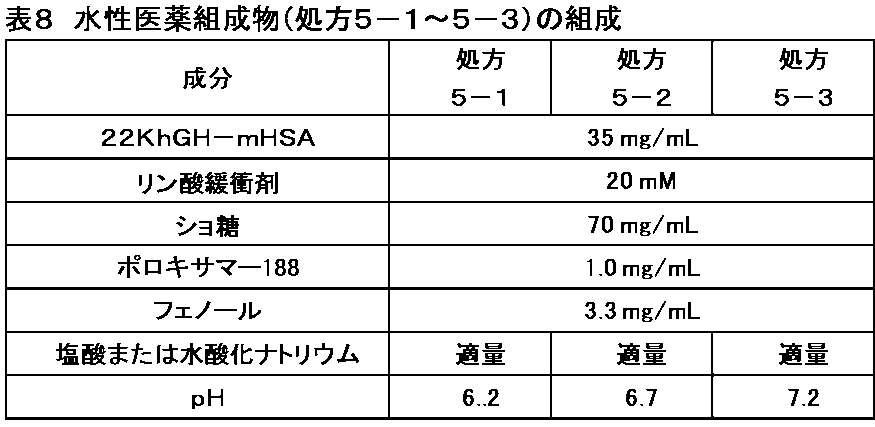
上記3種類の水性医薬組成物をそれぞれ1 mLずつガラス製バイアルに充填し,暗所で5℃又は25℃で2ヶ月静置保存した。5℃で静置したものについては,2週間後,1ヶ月後及び2ヶ月後に,25℃で静置したものについては1ヶ月後及び2ヶ月後に,実施例13に記載のSE-HPLC分析,及び実施例15に記載の微粒子数分析を行った。その結果を表9に示す。 1 mL of each of the three types of aqueous pharmaceutical compositions was filled into glass vials and stored in the dark at 5°C or 25°C for 2 months. The ones stored at 5°C were subjected to the SE-HPLC analysis described in Example 13 and the particle count analysis described in Example 15 after 2 weeks, 1 month, and 2 months, respectively, and the ones stored at 25°C were subjected to the SE-HPLC analysis described in Example 13 and the particle count analysis described in Example 15 after 1 month and 2 months. The results are shown in Table 9.
SE-HPLC測定による重合体含量についてみると,pH 7.2に調整した処方5-3では5℃で1ヶ月間静置した場合,25℃で2ヶ月間静止した場合の何れにおいてもほとんど変化はない。一方,pH 6.2に調整した処方5-1では,5℃で1ヶ月間静置した場合,25℃で2ヶ月間静置した場合の何れにおいても重合体の含量の継時的な増加が観察される。また,pH 6.7に調整した処方5-2では,5℃で1ヶ月間静置した場合には重合体の含量に変化はないが,25℃で2ヶ月間静止した場合には重合体の継時的な増加が観察される。SE-HPLC測定による低分子体含量についてみると,5℃で1ヶ月間静置した場合には,処方5-1~5-3の何れにおいてもほとんど変化はない。一方,25℃で2ヶ月間静置した場合には,何れの処方においても低分子体含量の増加が観察されるが,その程度は軽微である。微粒子数分析についてみると,pH 7.2に調整した処方5-3では,10 μm以上及び25 μm以上の微粒子数が,処方5-1及び5-2と比較して大幅に減少している。 Regarding the polymer content measured by SE-HPLC, in formulation 5-3 adjusted to pH 7.2, there was almost no change when left at 5°C for 1 month or at 25°C for 2 months. On the other hand, in formulation 5-1 adjusted to pH 6.2, an increase in the polymer content was observed over time when left at 5°C for 1 month or at 25°C for 2 months. In formulation 5-2 adjusted to pH 6.7, there was no change in the polymer content when left at 5°C for 1 month, but an increase in the polymer content was observed over time when left at 25°C for 2 months. Regarding the low molecular weight content measured by SE-HPLC, there was almost no change in any of formulations 5-1 to 5-3 when left at 5°C for 1 month. On the other hand, an increase in the low molecular weight content was observed in all formulations when left at 25°C for 2 months, but the increase was slight. In terms of particle count analysis, the number of particles 10 μm or larger and 25 μm or larger was significantly reduced in formulation 5-3, which was adjusted to pH 7.2, compared to formulations 5-1 and 5-2.

〔実施例11〕水性医薬組成物の製剤設計
上記実施例7~10で示した結果より,22KhGH-mHSAを含有する水性医薬組成物の製剤処方の好適なものの一例として,50 mg/mL 22KhGH-mHSA,10 mM リン酸緩衝剤,75 mg/mL ショ糖,3 mg/mLポロキサマー188及び6 mg/mL フェノールを含有し,pHを7.2,浸透圧比を約1.0に調整した,表10に示される組成を有するもの(処方6)が設計し得る。この水性医薬組成物は,0.5~10 mLの液量で,ガラス製又はプラスチック製のバイアル,アンプル,又は注射器に充填・封入することができる。注射器に予め充填したものはプレフィルド型の製剤として供給することもできる。保存温度は2~10℃,例えば4℃が好ましく,温度記録の可能な冷蔵庫中での保存が想定される。
[Example 11] Formulation design of aqueous pharmaceutical composition Based on the results shown in Examples 7 to 10 above, as a suitable example of a formulation of an aqueous pharmaceutical composition containing 22K hGH-mHSA, a formulation having the composition shown in Table 10 (formulation 6) containing 50 mg/mL 22K hGH-mHSA, 10 mM phosphate buffer, 75 mg/mL sucrose, 3 mg/mL poloxamer 188, and 6 mg/mL phenol, adjusted to pH 7.2, and osmotic pressure ratio of about 1.0 can be designed. This aqueous pharmaceutical composition can be filled and sealed in a glass or plastic vial, ampoule, or syringe with a liquid volume of 0.5 to 10 mL. The formulation can also be supplied as a prefilled formulation by filling the syringe in advance. The storage temperature is preferably 2 to 10°C, for example 4°C, and storage in a refrigerator capable of recording temperature is envisaged.
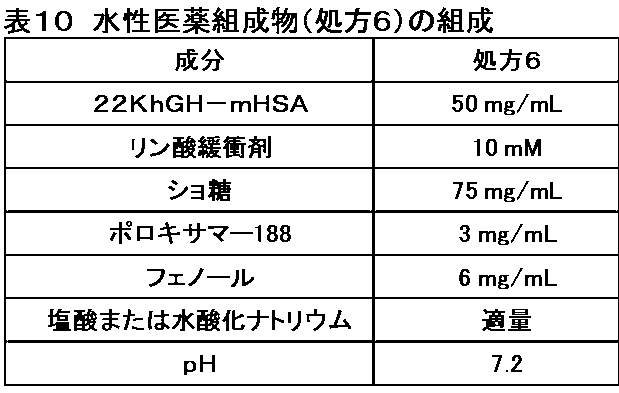
〔実施例12〕22KhGH-mHSAを含有する水性医薬組成物の安定性の検討5
表10に示される組成を有する,処方6の水性医薬組成物を調製し,ほう珪酸ガラス製カートリッジに1.7 mLを充填し,暗所,5℃で12ヶ月静置保存した。3ヶ月後,6ヶ月後,及び12ヶ月後に,実施例14に記載の性状試験,実施例16に記載の不溶性異物検査及びpH測定,実施例13に記載のSE-HPLC分析,実施例15に記載の微粒子数分析,及び実施例17に記載の22KhGH-mHSA定量を行った。その結果を表11に示す。何れの検査値にも大きな変化はなく,処方6は22KhGH-mHSAを含有する水性医薬組成物として少なくとも12ヶ月間は安定であることがわかる。なお,表11中,定量法(対理論値(%))は,処方6を調製時の22KhGH-mHSAの量を100%としたときの,実際の定量値(%)を示す。
[Example 12] Study on the stability of an aqueous pharmaceutical composition containing 22K hGH-mHSA 5
An aqueous pharmaceutical composition of Formulation 6 having the composition shown in Table 10 was prepared, 1.7 mL was filled into a borosilicate glass cartridge, and the composition was stored in the dark at 5°C for 12 months. After 3 months, 6 months, and 12 months, the properties test described in Example 14, the insoluble foreign matter test and pH measurement described in Example 16, the SE-HPLC analysis described in Example 13, the particle number analysis described in Example 15, and the 22K hGH-mHSA quantification described in Example 17 were performed. The results are shown in Table 11. There was no significant change in any of the test values, and it can be seen that Formulation 6 is stable as an aqueous pharmaceutical composition containing 22K hGH-mHSA for at least 12 months. In Table 11, the quantification method (relative to theoretical value (%)) indicates the actual quantification value (%) when the amount of 22K hGH-mHSA at the time of preparation of Formulation 6 is taken as 100%.

〔実施例13〕SE-HPLC分析(SE-HPLCを用いた22KhGH-mHSAの重合体,単量体及び低分子体含量の測定)
リン酸二水素ナトリウム二水和物及び塩化ナトリウムを水に溶解し,リン酸を0.1 M,塩化ナトリウムを0.2 M含有するリン酸塩緩衝液を調製した。また,試験対象であるそれぞれの水性医薬組成物と同組成であり,かつ22KhGH-mHSA及びフェノールを含まない溶液を調製し,これを試料希釈液とした。
[Example 13] SE-HPLC analysis (measurement of polymer, monomer and low molecular weight content of 22K hGH-mHSA using SE-HPLC)
Sodium dihydrogen phosphate dihydrate and sodium chloride were dissolved in water to prepare a phosphate buffer solution containing phosphoric acid at 0.1 M and sodium chloride at 0.2 M. In addition, a solution having the same composition as each of the aqueous pharmaceutical compositions to be tested but not containing 22K hGH-mHSA or phenol was prepared and used as a sample diluent.
試験の対象である水性医薬組成物を,試料希釈液を用いて蛋白質濃度が2.0 mg/mLになるよう調整し,試料溶液とした。 The aqueous pharmaceutical composition to be tested was adjusted to a protein concentration of 2.0 mg/mL using a sample diluent to prepare a sample solution.
HPLC装置(LC-20A,島津製作所社)及びカラム(TSKgel G3000SWXL,東ソー社)を用い,下記の表12に示す条件で測定を行った。但し,流量については必ずしも表12に示した条件に限らず,主ピークの保持時間が12分付近となるよう適宜調整した。代表的なクロマトグラムを図2に示す。試料溶液の測定により得られたクロマトグラム上,保持時間12分付近に検出される主ピークを単量体,主ピークより前に検出されるピークを重合体,主ピークより後に検出されるピークを低分子体とし,各ピークの面積から主ピーク含量(%),重合体含量(%),低分子体含量(%)を算出した。なお,23.5分付近に検出されるピークはフェノール由来であるため,解析から除外した。また,試料希釈液の測定により得られたクロマトグラム上に検出されたピークと同じピークについても,試料溶液の解析から除外した。 The measurement was performed under the conditions shown in Table 12 below using an HPLC system (LC-20A, Shimadzu Corporation) and a column (TSKgel G3000SW XL , Tosoh Corporation). However, the flow rate was not necessarily limited to the conditions shown in Table 12, and was appropriately adjusted so that the retention time of the main peak was around 12 minutes. A representative chromatogram is shown in Figure 2. On the chromatogram obtained by measuring the sample solution, the main peak detected at a retention time of around 12 minutes was taken as monomer, the peak detected before the main peak was taken as polymer, and the peak detected after the main peak was taken as low molecular weight substance. The main peak content (%), polymer content (%), and low molecular weight content (%) were calculated from the area of each peak. Note that the peak detected around 23.5 minutes was excluded from the analysis because it was derived from phenol. In addition, the same peak detected on the chromatogram obtained by measuring the sample dilution solution was also excluded from the analysis of the sample solution.

〔実施例14〕性状試験
色の比較液として,下記を用いた。
(1)Color Reference Solutions Bセット(褐色,シグマアルドリッチ社)
(2)Color Reference Solutions BYセット(帯褐黄色,シグマアルドリッチ社)
(3)Color Reference Solutions Yセット(黄色,シグマアルドリッチ社)
[Example 14] Property test The following liquids were used as color comparison liquids.
(1) Color Reference Solutions B Set (brown, Sigma-Aldrich)
(2) Color Reference Solutions BY set (brownish yellow, Sigma-Aldrich)
(3) Color Reference Solutions Y Set (yellow, Sigma-Aldrich)
試験の対象である水性医薬組成物の入った容器(バイアル等)を,黒色及び白色の背景を用いて容器側面から観察し,色調及び澄明性を確認した。色調の判断にあたっては,色の比較液を使用しても良いこととした。 The containers (vials, etc.) containing the aqueous pharmaceutical composition to be tested were observed from the side using black and white backgrounds to confirm color tone and clarity. A color comparison liquid may be used to judge the color tone.
〔実施例15〕微粒子数の測定
測定条件:フローサイト粒子画像解析装置(FlowCam VS-1,FLUID IMAGING TECHNOLOGIES社)を用い,下記の表13に示す条件で測定を行った。フローセル(FC80FV-5,FLUID IMAGING TECHNOLOGIES社)を使用し,試験の対象である水性医薬組成物に含まれる微粒子数(個/mL)を実施した。微粒子数は,10 μm以上及び25 μm以上の直径を有するものの個数をそれぞれ測定した。
[Example 15] Measurement of the number of microparticles Measurement conditions: Measurement was performed using a flow site particle image analyzer (FlowCam VS-1, FLUID IMAGING TECHNOLOGIES) under the conditions shown in Table 13 below. Using a flow cell (FC80FV-5, FLUID IMAGING TECHNOLOGIES), the number of microparticles (particles/mL) contained in the aqueous pharmaceutical composition to be tested was measured. The number of microparticles with diameters of 10 μm or more and 25 μm or more was measured.

〔実施例16〕不溶性異物検査,pHの測定,及び浸透圧比測定の方法
不溶性異物検査,pHの測定,及び浸透圧比測定については,日本薬局方に定める一般的手法により実施した。なお,不溶性異物検査は,容易く検出される不溶性異物の有無を目視により確認する検査法である。
[Example 16] Methods for insoluble foreign matter inspection, pH measurement, and osmotic pressure ratio measurement Insoluble foreign matter inspection, pH measurement, and osmotic pressure ratio measurement were performed according to the general methods specified in the Japanese Pharmacopoeia. Note that insoluble foreign matter inspection is a method for visually confirming the presence or absence of easily detectable insoluble foreign matter.
〔実施例17〕22KhGH-mHSAの定量(Bradford法)
濃度既知の22KhGH-mHSA溶液を水で希釈し,22KhGH-mHSAをそれぞれ1.0,0.8,0.6,0.4,0.2 mg/mL含有する溶液を調製し,それぞれ標準溶液1~5とした。試験の対象である水性医薬組成物を,蛋白質濃度が0.4~0.8 mg/mLの範囲に入るように水で希釈し,試料溶液とした。
[Example 17] Quantitation of 22K hGH-mHSA (Bradford method)
A 22K hGH-mHSA solution of known concentration was diluted with water to prepare solutions containing 1.0, 0.8, 0.6, 0.4, and 0.2 mg/mL of 22K hGH-mHSA, which were designated as
クーマシー試液による反応:PierceTM Coomassie (Bradford) Protein Assay Kit(ThermoFisher SCIENTIFIC社)に含まれるPierce Coomasie Assay Reagentを,15 mL遠心管に5 mLずつ,測定に必要な本数分採取した。次いで,Pierce Coomasie Assay Reagentを採取した15 mL遠心管にそれぞれ水(ブランク用),標準溶液1~5,及び試料溶液を100 μLずつ添加し,転倒混和した後10分間,室温で静置し反応させた。反応後速やかに,分光光度計(UV-2600,島津製作所社)を用い,測定用セル(キュベット,光路長10 mm,光路幅10 mm,ザルスタット社)に測定試料を2 mL以上入れて波長595 nmで吸光度測定を行った。標準溶液1~5の吸光度をY軸,理論蛋白質濃度をX軸にとり,回帰直線(検量線)を作成して,試料溶液の吸光度から蛋白質濃度を算出した。
Reaction with Coomassie test solution: 5 mL of Pierce Coomassie Assay Reagent included in the Pierce TM Coomassie (Bradford) Protein Assay Kit (ThermoFisher Scientific) was taken into 15 mL centrifuge tubes, the number of tubes required for measurement. Next, 100 μL of water (for blank),
本発明によれば,血清アルブミンと成長ホルモンが連結した蛋白質を有効成分として含有する医薬を,水性医薬組成物の形態で,市場に流通させることができる。 According to the present invention, a pharmaceutical containing as an active ingredient a protein in which serum albumin and growth hormone are linked can be distributed on the market in the form of an aqueous pharmaceutical composition.
配列番号1:野生型のヒト血清アルブミンのアミノ酸配列
配列番号2:ヒト血清アルブミンRedhillのアミノ酸配列
配列番号3:ヒト血清アルブミン変異体(A320T)のアミノ酸配列
配列番号4:リンカーのアミノ酸配列の例1
配列番号5:リンカーのアミノ酸配列の例2
配列番号6:リンカーのアミノ酸配列の例3
配列番号7:野生型マウス脳心筋炎ウイルス由来の内部リボソーム結合部位の部分塩基配列
配列番号8:変異型マウス脳心筋炎ウイルス由来の内部リボソーム結合部位の部分塩基配列,合成
配列番号9:22Kヒト成長ホルモンのアミノ酸配列
配列番号10:20Kヒト成長ホルモンのアミノ酸配列
配列番号11:22KhGH-mHSAのアミノ酸配列
配列番号12:20KhGH-mHSAのアミノ酸配列
配列番号13:プライマーYA082,合成配列
配列番号14:プライマーYA083,合成配列
配列番号15:22KhGH-HSAのアミノ酸配列
配列番号16:22KhGH-HSA遺伝子を含む塩基配列,合成配列
SEQ ID NO: 1: Amino acid sequence of wild-type human serum albumin SEQ ID NO: 2: Amino acid sequence of human serum albumin Redhill SEQ ID NO: 3: Amino acid sequence of human serum albumin mutant (A320T) SEQ ID NO: 4: Example 1 of the amino acid sequence of a linker
SEQ ID NO: 5: Example 2 of the amino acid sequence of the linker
SEQ ID NO: 6: Example 3 of the amino acid sequence of the linker
SEQ ID NO:7: Partial base sequence of the internal ribosome binding site derived from wild-type murine encephalomyocarditis virus SEQ ID NO:8: Partial base sequence of the internal ribosome binding site derived from mutant murine encephalomyocarditis virus, synthetic SEQ ID NO:9: Amino acid sequence of 22K human growth hormone SEQ ID NO:10: Amino acid sequence of 20K human growth hormone SEQ ID NO:11: Amino acid sequence of 22KhGH-mHSA SEQ ID NO:12: Amino acid sequence of 20KhGH-mHSA SEQ ID NO:13: Primer YA082, synthetic sequence SEQ ID NO:14: Primer YA083, synthetic sequence SEQ ID NO:15: Amino acid sequence of 22KhGH-HSA SEQ ID NO:16: Base sequence including 22KhGH-HSA gene, synthetic sequence
Claims (12)
該融合蛋白質の濃度が10~100mg/mLであり,スクロースの濃度が10~150mg/mLであり,ポリオキシエチレン(160)ポリオキシプロピレン(30)グリコールの濃度が0.15~10mg/mLであり,フェノールの濃度が3~9mg/mLであり,リン酸緩衝剤の濃度が1~30mMであり,pHが5.0~8.0であり,
該融合蛋白質のアミノ酸配列が,配列番号11で示されるアミノ酸配列と,90%以上の同一性を有するものである,水性医薬組成物。 An aqueous pharmaceutical composition comprising a fusion protein of human serum albumin and human growth hormone as an active ingredient,
the concentration of the fusion protein is 10-100 mg/mL, the concentration of sucrose is 10-150 mg/mL, the concentration of polyoxyethylene (160) polyoxypropylene (30) glycol is 0.15-10 mg/mL, the concentration of phenol is 3-9 mg/mL, the concentration of phosphate buffer is 1-30 mM, and the pH is 5.0-8.0;
The amino acid sequence of the fusion protein has 90% or more identity with the amino acid sequence shown in SEQ ID NO:11.
Applications Claiming Priority (2)
| Application Number | Priority Date | Filing Date | Title |
|---|---|---|---|
| JP2019197978 | 2019-10-30 | ||
| JP2019197978 | 2019-10-30 |
Publications (2)
| Publication Number | Publication Date |
|---|---|
| JP2021070700A JP2021070700A (en) | 2021-05-06 |
| JP7604174B2 true JP7604174B2 (en) | 2024-12-23 |
Family
ID=75713571
Family Applications (1)
| Application Number | Title | Priority Date | Filing Date |
|---|---|---|---|
| JP2020180998A Active JP7604174B2 (en) | 2019-10-30 | 2020-10-29 | Aqueous pharmaceutical composition containing serum albumin and growth hormone fusion protein |
Country Status (7)
| Country | Link |
|---|---|
| US (1) | US20220378882A1 (en) |
| EP (1) | EP4059512A4 (en) |
| JP (1) | JP7604174B2 (en) |
| KR (1) | KR20220095204A (en) |
| CN (1) | CN114728043B (en) |
| TW (1) | TWI897893B (en) |
| WO (1) | WO2021085518A1 (en) |
Families Citing this family (3)
| Publication number | Priority date | Publication date | Assignee | Title |
|---|---|---|---|---|
| JP2021066730A (en) * | 2019-10-17 | 2021-04-30 | Jcrファーマ株式会社 | Method for producing fusion protein of serum albumin and growth hormone |
| WO2023096475A1 (en) * | 2021-11-26 | 2023-06-01 | 주식회사 제넥신 | High concentration administration formulation of hgh fusion protein |
| CN115845079B (en) * | 2022-11-24 | 2023-07-18 | 武汉禾元生物科技股份有限公司 | A conjugate of recombinant human serum albumin and recombinant human growth hormone and its preparation method |
Citations (3)
| Publication number | Priority date | Publication date | Assignee | Title |
|---|---|---|---|---|
| JP2000502901A (en) | 1995-12-30 | 2000-03-14 | デルタ、バイオテクノロジー、リミテッド | Recombinant fusion proteins for growth hormone and serum albumin |
| WO2017159540A1 (en) | 2016-03-14 | 2017-09-21 | Jcrファーマ株式会社 | Serum albumin-20 k growth hormone fusion protein |
| JP2019500390A (en) | 2015-12-30 | 2019-01-10 | ハンミ ファーマシューティカル カンパニー リミテッド | A novel liquid formulation of sustained human growth hormone conjugate |
Family Cites Families (16)
| Publication number | Priority date | Publication date | Assignee | Title |
|---|---|---|---|---|
| JP3723857B2 (en) * | 1998-02-04 | 2005-12-07 | 日本ケミカルリサーチ株式会社 | Aqueous pharmaceutical composition containing human growth hormone |
| WO2001077137A1 (en) | 2000-04-12 | 2001-10-18 | Human Genome Sciences, Inc. | Albumin fusion proteins |
| EP2277889B1 (en) | 2001-12-21 | 2014-07-09 | Human Genome Sciences, Inc. | Fusion proteins of albumin and interferon beta |
| WO2004004780A1 (en) * | 2002-07-09 | 2004-01-15 | Sandoz Ag | Liquid formulations with high concentration of human growth hormone (hgh) comprising phenol |
| US7998930B2 (en) | 2004-11-04 | 2011-08-16 | Hanall Biopharma Co., Ltd. | Modified growth hormones |
| WO2011015649A1 (en) | 2009-08-06 | 2011-02-10 | Novo Nordisk Health Care Ag | Growth hormones with prolonged in-vivo efficacy |
| KR101813595B1 (en) | 2010-01-22 | 2017-12-29 | 노보 노르디스크 헬스 케어 악티엔게젤샤프트 | Growth hormones with prolonged in-vivo efficacy |
| KR101337797B1 (en) * | 2010-07-14 | 2013-12-06 | 한미사이언스 주식회사 | A liquid formulation of long acting human growth hormone conjugate |
| CN103201382A (en) | 2010-11-08 | 2013-07-10 | 日本化学研究株式会社 | Novel expression vector |
| WO2013161958A1 (en) | 2012-04-27 | 2013-10-31 | 日本ケミカルリサーチ株式会社 | Novel expression vector |
| US20160015789A1 (en) * | 2014-07-17 | 2016-01-21 | Teva Pharmaceutical Industries, Ltd. | FORMULATIONS OF AN ALBUMIN hGH FUSION PROTEIN |
| KR102360744B1 (en) * | 2015-09-08 | 2022-02-08 | 제이씨알 파마 가부시키가이샤 | Novel human serum albumin variants |
| WO2017154869A1 (en) | 2016-03-09 | 2017-09-14 | Jcrファーマ株式会社 | Method for producing mutant human erythropoietin |
| EP3679945A4 (en) * | 2017-09-07 | 2021-06-16 | JCR Pharmaceuticals Co., Ltd. | AQUEOUS PHARMACEUTICAL COMPOSITION |
| CN109851674B (en) * | 2018-10-26 | 2022-02-15 | 天津林达生物科技有限公司 | A kind of preparation and purification method of recombinant human serum albumin/growth hormone fusion protein for treating short stature in children |
| JP2021066730A (en) * | 2019-10-17 | 2021-04-30 | Jcrファーマ株式会社 | Method for producing fusion protein of serum albumin and growth hormone |
-
2020
- 2020-10-29 JP JP2020180998A patent/JP7604174B2/en active Active
- 2020-10-29 US US17/772,908 patent/US20220378882A1/en active Pending
- 2020-10-29 EP EP20881312.1A patent/EP4059512A4/en active Pending
- 2020-10-29 WO PCT/JP2020/040560 patent/WO2021085518A1/en not_active Ceased
- 2020-10-29 CN CN202080076140.0A patent/CN114728043B/en active Active
- 2020-10-29 KR KR1020227017996A patent/KR20220095204A/en active Pending
- 2020-10-30 TW TW109137787A patent/TWI897893B/en active
Patent Citations (3)
| Publication number | Priority date | Publication date | Assignee | Title |
|---|---|---|---|---|
| JP2000502901A (en) | 1995-12-30 | 2000-03-14 | デルタ、バイオテクノロジー、リミテッド | Recombinant fusion proteins for growth hormone and serum albumin |
| JP2019500390A (en) | 2015-12-30 | 2019-01-10 | ハンミ ファーマシューティカル カンパニー リミテッド | A novel liquid formulation of sustained human growth hormone conjugate |
| WO2017159540A1 (en) | 2016-03-14 | 2017-09-21 | Jcrファーマ株式会社 | Serum albumin-20 k growth hormone fusion protein |
Also Published As
| Publication number | Publication date |
|---|---|
| KR20220095204A (en) | 2022-07-06 |
| EP4059512A4 (en) | 2023-12-06 |
| US20220378882A1 (en) | 2022-12-01 |
| EP4059512A1 (en) | 2022-09-21 |
| JP2021070700A (en) | 2021-05-06 |
| WO2021085518A1 (en) | 2021-05-06 |
| TW202131944A (en) | 2021-09-01 |
| CN114728043A (en) | 2022-07-08 |
| TWI897893B (en) | 2025-09-21 |
| CN114728043B (en) | 2024-04-16 |
Similar Documents
| Publication | Publication Date | Title |
|---|---|---|
| US10772963B2 (en) | Etanercept formulations stabilized with xylitol | |
| EA014232B1 (en) | Stable protein formulations | |
| US11000588B2 (en) | Etanercept formulations stabilized with sodium chloride | |
| JP7604174B2 (en) | Aqueous pharmaceutical composition containing serum albumin and growth hormone fusion protein | |
| JP2025108612A (en) | Method for producing serum albumin and growth hormone fusion protein | |
| TWI891671B (en) | Method for producing fusion protein of serum albumin and growth hormone | |
| HK1200720B (en) | Etanercept formulations stabilized with combinations of sugars and polyols |
Legal Events
| Date | Code | Title | Description |
|---|---|---|---|
| RD03 | Notification of appointment of power of attorney |
Free format text: JAPANESE INTERMEDIATE CODE: A7423 Effective date: 20220502 |
|
| A621 | Written request for application examination |
Free format text: JAPANESE INTERMEDIATE CODE: A621 Effective date: 20230913 |
|
| A521 | Request for written amendment filed |
Free format text: JAPANESE INTERMEDIATE CODE: A523 Effective date: 20231025 |
|
| A131 | Notification of reasons for refusal |
Free format text: JAPANESE INTERMEDIATE CODE: A131 Effective date: 20240903 |
|
| A521 | Request for written amendment filed |
Free format text: JAPANESE INTERMEDIATE CODE: A523 Effective date: 20241010 |
|
| A131 | Notification of reasons for refusal |
Free format text: JAPANESE INTERMEDIATE CODE: A131 Effective date: 20241126 |
|
| A521 | Request for written amendment filed |
Free format text: JAPANESE INTERMEDIATE CODE: A523 Effective date: 20241127 |
|
| TRDD | Decision of grant or rejection written | ||
| A01 | Written decision to grant a patent or to grant a registration (utility model) |
Free format text: JAPANESE INTERMEDIATE CODE: A01 Effective date: 20241210 |
|
| A61 | First payment of annual fees (during grant procedure) |
Free format text: JAPANESE INTERMEDIATE CODE: A61 Effective date: 20241211 |
|
| R150 | Certificate of patent or registration of utility model |
Ref document number: 7604174 Country of ref document: JP Free format text: JAPANESE INTERMEDIATE CODE: R150 |