CN103201382A - Novel expression vector - Google Patents
Novel expression vector Download PDFInfo
- Publication number
- CN103201382A CN103201382A CN2011800536564A CN201180053656A CN103201382A CN 103201382 A CN103201382 A CN 103201382A CN 2011800536564 A CN2011800536564 A CN 2011800536564A CN 201180053656 A CN201180053656 A CN 201180053656A CN 103201382 A CN103201382 A CN 103201382A
- Authority
- CN
- China
- Prior art keywords
- gene
- expression vector
- internal ribosome
- ribosome entry
- entry site
- Prior art date
- Legal status (The legal status is an assumption and is not a legal conclusion. Google has not performed a legal analysis and makes no representation as to the accuracy of the status listed.)
- Pending
Links
Images


Classifications
-
- C—CHEMISTRY; METALLURGY
- C12—BIOCHEMISTRY; BEER; SPIRITS; WINE; VINEGAR; MICROBIOLOGY; ENZYMOLOGY; MUTATION OR GENETIC ENGINEERING
- C12N—MICROORGANISMS OR ENZYMES; COMPOSITIONS THEREOF; PROPAGATING, PRESERVING, OR MAINTAINING MICROORGANISMS; MUTATION OR GENETIC ENGINEERING; CULTURE MEDIA
- C12N15/00—Mutation or genetic engineering; DNA or RNA concerning genetic engineering, vectors, e.g. plasmids, or their isolation, preparation or purification; Use of hosts therefor
- C12N15/09—Recombinant DNA-technology
- C12N15/63—Introduction of foreign genetic material using vectors; Vectors; Use of hosts therefor; Regulation of expression
-
- C—CHEMISTRY; METALLURGY
- C12—BIOCHEMISTRY; BEER; SPIRITS; WINE; VINEGAR; MICROBIOLOGY; ENZYMOLOGY; MUTATION OR GENETIC ENGINEERING
- C12N—MICROORGANISMS OR ENZYMES; COMPOSITIONS THEREOF; PROPAGATING, PRESERVING, OR MAINTAINING MICROORGANISMS; MUTATION OR GENETIC ENGINEERING; CULTURE MEDIA
- C12N15/00—Mutation or genetic engineering; DNA or RNA concerning genetic engineering, vectors, e.g. plasmids, or their isolation, preparation or purification; Use of hosts therefor
- C12N15/09—Recombinant DNA-technology
- C12N15/63—Introduction of foreign genetic material using vectors; Vectors; Use of hosts therefor; Regulation of expression
- C12N15/67—General methods for enhancing the expression
-
- C—CHEMISTRY; METALLURGY
- C12—BIOCHEMISTRY; BEER; SPIRITS; WINE; VINEGAR; MICROBIOLOGY; ENZYMOLOGY; MUTATION OR GENETIC ENGINEERING
- C12N—MICROORGANISMS OR ENZYMES; COMPOSITIONS THEREOF; PROPAGATING, PRESERVING, OR MAINTAINING MICROORGANISMS; MUTATION OR GENETIC ENGINEERING; CULTURE MEDIA
- C12N15/00—Mutation or genetic engineering; DNA or RNA concerning genetic engineering, vectors, e.g. plasmids, or their isolation, preparation or purification; Use of hosts therefor
- C12N15/09—Recombinant DNA-technology
- C12N15/63—Introduction of foreign genetic material using vectors; Vectors; Use of hosts therefor; Regulation of expression
- C12N15/79—Vectors or expression systems specially adapted for eukaryotic hosts
- C12N15/85—Vectors or expression systems specially adapted for eukaryotic hosts for animal cells
-
- C—CHEMISTRY; METALLURGY
- C12—BIOCHEMISTRY; BEER; SPIRITS; WINE; VINEGAR; MICROBIOLOGY; ENZYMOLOGY; MUTATION OR GENETIC ENGINEERING
- C12N—MICROORGANISMS OR ENZYMES; COMPOSITIONS THEREOF; PROPAGATING, PRESERVING, OR MAINTAINING MICROORGANISMS; MUTATION OR GENETIC ENGINEERING; CULTURE MEDIA
- C12N5/00—Undifferentiated human, animal or plant cells, e.g. cell lines; Tissues; Cultivation or maintenance thereof; Culture media therefor
- C12N5/10—Cells modified by introduction of foreign genetic material
-
- C—CHEMISTRY; METALLURGY
- C12—BIOCHEMISTRY; BEER; SPIRITS; WINE; VINEGAR; MICROBIOLOGY; ENZYMOLOGY; MUTATION OR GENETIC ENGINEERING
- C12N—MICROORGANISMS OR ENZYMES; COMPOSITIONS THEREOF; PROPAGATING, PRESERVING, OR MAINTAINING MICROORGANISMS; MUTATION OR GENETIC ENGINEERING; CULTURE MEDIA
- C12N2840/00—Vectors comprising a special translation-regulating system
- C12N2840/20—Vectors comprising a special translation-regulating system translation of more than one cistron
- C12N2840/203—Vectors comprising a special translation-regulating system translation of more than one cistron having an IRES
Landscapes
- Health & Medical Sciences (AREA)
- Genetics & Genomics (AREA)
- Engineering & Computer Science (AREA)
- Life Sciences & Earth Sciences (AREA)
- Chemical & Material Sciences (AREA)
- Wood Science & Technology (AREA)
- Organic Chemistry (AREA)
- Biotechnology (AREA)
- Biomedical Technology (AREA)
- Zoology (AREA)
- Bioinformatics & Cheminformatics (AREA)
- General Engineering & Computer Science (AREA)
- General Health & Medical Sciences (AREA)
- Microbiology (AREA)
- Biochemistry (AREA)
- Plant Pathology (AREA)
- Physics & Mathematics (AREA)
- Molecular Biology (AREA)
- Biophysics (AREA)
- Cell Biology (AREA)
- Micro-Organisms Or Cultivation Processes Thereof (AREA)
- Preparation Of Compounds By Using Micro-Organisms (AREA)
Abstract
Description
技术领域technical field
本发明涉及用于使重组体蛋白质在哺乳动物细胞内高效地表达的新表达载体,具体涉及包括基因表达调控位点、位于其下游的编码所需蛋白质的基因、进一步位于下游的内部核糖体进入位点和进一步位于下游的编码谷氨酰胺合成酶的基因的表达载体。The present invention relates to novel expression vectors for efficient expression of recombinant proteins in mammalian cells, in particular to a gene expression regulatory site comprising a gene encoding a desired protein downstream of it, an internal ribosome entry further downstream. site and an expression vector for a gene encoding glutamine synthetase located further downstream.
背景技术Background technique
使用通过整合有编码所需蛋白质的基因的表达载体转化的哺乳动物细胞来制造重组体蛋白质的方法是在医药品制造等工业领域中广泛普及的技术,α-半乳糖苷酶A、艾杜糖醛酸-2-硫酸酯酶、葡糖脑苷脂酶、加硫酶、α-L-艾杜糖醛酸酶、酸性α-葡糖苷酶等溶酶体酶、组织型纤溶酶原激活物(t-PA)、凝血因子Ⅶ、凝血因子Ⅷ、凝血因子Ⅸ等凝血因子、红细胞生成素、干扰素、血栓调节蛋白、卵泡刺激素、粒细胞集落刺激因子(G-CSF)、各种抗体药物等使用该技术制造,作为医药品在市场上销售。The method of producing a recombinant protein using mammalian cells transformed with an expression vector incorporating a gene encoding a desired protein is a widely used technique in pharmaceutical manufacturing and other industrial fields. α-galactosidase A, idose Lysosomal enzymes such as aldo-2-sulfatase, glucocerebrosidase, sulfurase, α-L-iduronidase, acid α-glucosidase, tissue plasminogen activation coagulation factor VII, coagulation factor VIII, coagulation factor IX and other coagulation factors, erythropoietin, interferon, thrombomodulin, follicle stimulating hormone, granulocyte colony stimulating factor (G-CSF), various Antibody drugs and the like are manufactured using this technology and marketed as pharmaceuticals.
这时,作为表达载体,一般采用在诱导强基因表达的基因调控位点、例如来源于巨细胞病毒(CMV)的启动子、SV40初期启动子、延伸因子1α(EF-1)启动子等的下游整合有编码所需蛋白质的基因的表达载体。导入了这样的表达载体的哺乳动物细胞可表达整合至表达载体的所需蛋白质,其表达量根据各个细胞而不同,并不一致。因此,为了高效地生产重组体蛋白质,需要从导入了表达载体的哺乳动物细胞中筛选所需蛋白质的表达水平高的细胞的步骤。为了进行该筛选,表达载体整合有起到筛选标记物的作用的基因。In this case, as an expression vector, a gene regulatory site that induces strong gene expression, such as a cytomegalovirus (CMV)-derived promoter, SV40 initial promoter, elongation factor 1α (EF-1) promoter, etc., is generally used. An expression vector with a gene encoding the desired protein is integrated downstream. Mammalian cells into which such an expression vector has been introduced can express the desired protein incorporated into the expression vector, and the expression level thereof varies from cell to cell and is not uniform. Therefore, in order to efficiently produce a recombinant protein, a step of selecting cells expressing a desired protein at a high level from among mammalian cells into which an expression vector has been introduced is required. For this selection, expression vectors incorporate genes that function as selection markers.
作为筛选标记物,最一般的是分解嘌呤霉素、新霉素等药剂的酶(耐药性标记物)。哺乳动物细胞在一定浓度以上的上述药剂的存在下死亡。但是,导入了表达载体的哺乳动物细胞可通过整合至表达载体中的药剂筛选标记物分解上述药剂,将其无毒化或低毒化,所以在上述药剂的存在下也可生存。因此,如果在含有一定浓度的上述药剂的培养基中培养导入了表达载体的细胞,仅以高水平表达药剂筛选标记物的细胞增殖,结果筛选出那些细胞。以高水平表达药剂筛选标记物的细胞存在同时整合至表达载体中的编码所需蛋白质的基因也以高水平表达的倾向,所以结果获得以高水平表达所需蛋白质的哺乳动物细胞。The most common selection markers are enzymes that decompose drugs such as puromycin and neomycin (drug resistance markers). Mammalian cells die in the presence of the above-mentioned agents above a certain concentration. However, mammalian cells into which an expression vector has been introduced can decompose and detoxify or reduce toxicity of the above-mentioned drug by the drug-selectable marker incorporated into the expression vector, so they can survive in the presence of the above-mentioned drug. Therefore, if the expression vector-introduced cells are cultured in a medium containing a certain concentration of the above-mentioned drug, only cells expressing the drug selection marker at a high level proliferate, and those cells are selected out as a result. A cell expressing a marker for drug selection at a high level tends to also express a gene encoding a desired protein integrated into an expression vector at a high level, and as a result, a mammalian cell expressing a desired protein at a high level is obtained.
作为筛选标记物,还已知使用谷氨酰胺合成酶(GS)的表达载体(参照专利文献1、2)。谷氨酰胺合成酶是由谷氨酸和氨合成谷氨酰胺的酶。如果将哺乳动物细胞在作为谷氨酰胺合成酶的抑制剂的一定浓度的蛋氨酸磺酸盐(MSX)的存在下用谷氨酰胺缺陷培养基进行培养,则细胞死亡。但是,如果将作为筛选标记物整合了谷氨酰胺合成酶的表达载体导入哺乳动物细胞,则该细胞中谷氨酰胺合成酶的表达水平上升,所以在更高浓度的MSX的存在下也可增殖。这时,如果使MSX的浓度逐渐上升的同时继续培养,则可获得在更高浓度的MSX的存在下也可增殖的细胞。该现象被认为是因整合至哺乳动物细胞的基因组内的该表达载体在基因组内进行复制来增加拷贝数而引发。即,由于拷贝数增加,一个细胞中的基因组内存在的药剂筛选标记物的基因数增加,基因的表达量相对增加。这时,整合至表达载体中的编码所需蛋白质的基因的拷贝数也复制而增加,所以可获得以高水平表达所需蛋白质的哺乳动物细胞。例如,专利文献1中记载,通过使用GS表达载体和蛋氨酸磺酸盐(MSX),与使用DHFP(二氢叶酸还原酶)/MTX(甲氨蝶呤)的情况相比,可实现更高的拷贝数。此外,专利文献2中记载,通过使用GS基因和MSX,宿主细胞的DNA中,随着GS基因的拷贝数的增加,也可以使与之不同的异型基因的拷贝数也增加,由此可增加所需多肽的生产水平。An expression vector using glutamine synthetase (GS) is also known as a selection marker (see
如上所述,含筛选标记物的表达载体适合于效率良好的重组体蛋白质的制造,得到广泛应用。表达载体上,编码所需蛋白质的基因和编码筛选标记物的基因一般分别整合至不同的基因调控位点下(参照专利文献3)。但是,还已知一个基因调控位点下串联整合编码所需蛋白质和筛选标记物的基因使其表达的方法(参照专利文献4、5、6、7),这时在编码所需蛋白质和筛选标记物的基因之间插入有内部核糖体进入位点(IRES:internal ribosome entry site)等,由此可由一个基因调控位点表达2个基因。内部核糖体进入位点已知有多种,有来源于例如微小核糖核酸病毒、脊髓灰质炎病毒、脑心肌炎病毒、鸡传染性法氏囊病病毒的位点(参照专利文献8、9、10)。As described above, expression vectors containing selectable markers are suitable for efficient production of recombinant proteins and are widely used. On the expression vector, the gene encoding the desired protein and the gene encoding the screening marker are generally integrated into different gene regulatory sites (refer to Patent Document 3). However, there is also known a method for expressing a gene encoding a desired protein and a selection marker in tandem at a gene regulatory site (see
作为应用内部核糖体进入位点的表达载体,已知在内部核糖体进入位点的下游作为筛选标记物整合有单纯疱疹病毒胸苷激酶的表达载体(参照专利文献11)、使用2个以上的内部核糖体进入位点结合有3种以上的基因的表达载体(参照专利文献12)。As an expression vector using an internal ribosome entry site, an expression vector in which herpes simplex virus thymidine kinase is integrated as a selection marker downstream of the internal ribosome entry site is known (see Patent Document 11). An expression vector in which three or more genes are bound to an internal ribosome entry site (see Patent Document 12).
如上所述,通过各种表达载体的开发,使用哺乳动物细胞制造重组体蛋白质的方法在红细胞生成素等医药品的制造中得到实用化,为了降低其制造成本,始终要求效率更高的表达载体的开发。As mentioned above, through the development of various expression vectors, the method of producing recombinant protein using mammalian cells has been put into practical use in the production of pharmaceuticals such as erythropoietin, and in order to reduce the production cost, more efficient expression vectors are always required development.
现有技术文献prior art literature
专利文献patent documents
专利文献1:日本专利特表昭63-502955号公报Patent Document 1: Japanese Patent Application Publication No. 63-502955
专利文献2:日本专利特表平5-504050号公报Patent Document 2: Japanese Patent Application Laid-Open No. 5-504050
专利文献3:日本专利特开2009-273427号公报Patent Document 3: Japanese Patent Application Laid-Open No. 2009-273427
专利文献4:日本专利特开昭59-173096号公报Patent Document 4: Japanese Patent Laid-Open No. 59-173096
专利文献5:日本专利特开昭60-199387号公报Patent Document 5: Japanese Patent Laid-Open No. 60-199387
专利文献6:日本专利特表平4-500004号公报Patent Document 6: Japanese Patent Application Laid-Open No. 4-500004
专利文献7:日本专利特开平8-256776号公报Patent Document 7: Japanese Patent Laid-Open No. 8-256776
专利文献8:日本专利特表平6-509713号公报Patent Document 8: Japanese Patent Application Laid-Open No. 6-509713
专利文献9:日本专利特表平8-502644号公报Patent Document 9: Japanese Patent Application Laid-Open No. 8-502644
专利文献10:日本专利特开平10-327871号公报Patent Document 10: Japanese Patent Laid-Open No. H10-327871
专利文献11:日本专利特表2008-539785号公报Patent Document 11: Japanese Patent Application Publication No. 2008-539785
专利文献12:日本专利特表2004-520016号公报Patent Document 12: Japanese Patent Application Publication No. 2004-520016
发明的概要Summary of the invention
发明所要解决的技术问题The technical problem to be solved by the invention
本发明的目的在于提供用于使重组体蛋白质在哺乳动物细胞内高效地表达的新表达载体、通过该载体转化的哺乳动物细胞及该哺乳动物细胞的制造方法。An object of the present invention is to provide a novel expression vector for efficiently expressing a recombinant protein in mammalian cells, a mammalian cell transformed with the vector, and a method for producing the mammalian cell.
解决技术问题所采用的技术方案Technical solutions adopted to solve technical problems
为了上述目的的研究中,本发明人发现通过使用整合有基因表达调控位点以及位于其下游的编码人葡糖脑苷脂酶等所需蛋白质的基因、进一步位于下游的内部核糖体进入位点和进一步位于下游的编码谷氨酰胺合成酶的基因的表达载体使哺乳动物细胞转化,可使编码该蛋白质的基因以高水平表达,从而完成了本发明。即,本发明提供以下的发明。In studies for the above purpose, the present inventors found that by using a gene encoding a desired protein such as human glucocerebrosidase, which is integrated with a gene expression regulatory site and downstream of it, and a further downstream internal ribosome entry site The present invention has been accomplished by transforming mammalian cells with an expression vector for a gene encoding glutamine synthetase located further downstream to express the gene encoding the protein at a high level. That is, the present invention provides the following inventions.
[1]表达载体,它是用于使蛋白质表达的表达载体,其中,包括基因表达调控位点以及位于其下游的编码该蛋白质的基因、进一步位于下游的内部核糖体进入位点和进一步位于下游的编码谷氨酰胺合成酶的基因。[1] An expression vector, which is an expression vector for expressing a protein, which includes a gene expression regulatory site and a gene encoding the protein located downstream thereof, an internal ribosome entry site located further downstream, and a further downstream internal ribosome entry site The gene encoding glutamine synthetase.
[2]如上述[1]的表达载体,其中,该基因表达调控位点选自来源于巨细胞病毒的启动子、SV40初期启动子、延伸因子1启动子。[2] The expression vector according to the above [1], wherein the gene expression regulation site is selected from a cytomegalovirus-derived promoter, an SV40 initial promoter, and an
[3]如上述[1]或[2]的表达载体,其中,该内部核糖体进入位点来源于选自微小核糖核酸病毒科的病毒、口蹄疫病毒、甲型肝炎病毒、丙型肝炎病毒、冠状病毒、牛肠道病毒、泰勒氏小鼠脑脊髓炎病毒(Theiler's murineencephalomyelitis virus)、柯萨奇病毒B型病毒、人免疫球蛋白重链结合蛋白基因、果蝇触角足(Antennapedia)基因、果蝇超双胸(Ultrabithorax)基因的病毒或基因的5’非翻译区。[3] The expression vector according to [1] or [2] above, wherein the internal ribosome entry site is derived from a virus selected from Picornaviridae, foot-and-mouth disease virus, hepatitis A virus, hepatitis C virus, Coronavirus, bovine enterovirus, Theiler's murine encephalomyelitis virus, Coxsackie virus type B virus, human immunoglobulin heavy chain binding protein gene, Drosophila Antennapedia gene, fruit fly Viral or 5' untranslated region of the fly Ultrabithorax gene.
[4]如上述[1]或[2]的表达载体,其中,该内部核糖体进入位点来源于微小核糖核酸病毒科的病毒的5’非翻译区。[4] The expression vector of [1] or [2] above, wherein the internal ribosome entry site is derived from the 5' untranslated region of a virus of the family Picornaviridae.
[5]如上述[1]或[2]的表达载体,其中,该内部核糖体进入位点来源于小鼠脑心肌炎病毒的5’非翻译区。[5] The expression vector according to the above-mentioned [1] or [2], wherein the internal ribosome entry site is derived from the 5' untranslated region of mouse encephalomyocarditis virus.
[6]如上述[1]~[5]中的任一项的表达载体,其中,该内部核糖体进入位点是在野生型的内部核糖体进入位点的碱基序列中加入了1个或2个以上的突变的位点。[6] The expression vector according to any one of [1] to [5] above, wherein the internal ribosome entry site is a base sequence of the wild-type internal ribosome entry site with one added Or two or more mutation sites.
[7]如上述[6]的表达载体,其中,在该内部核糖体进入位点存在多个起始密码子,其中的一部分被破坏。[7] The expression vector according to [6] above, wherein a plurality of initiation codons are present at the internal ribosome entry site, some of which are disrupted.
[8]如上述[5]的表达载体,其中,该内部核糖体进入位点包含序列编号1的碱基序列。[8] The expression vector according to the above [5], wherein the internal ribosome entry site includes the nucleotide sequence of SEQ ID NO: 1.
[9]如上述[5]的表达载体,其中,该内部核糖体进入位点包含序列编号2的碱基序列。[9] The expression vector according to the above [5], wherein the internal ribosome entry site includes the nucleotide sequence of SEQ ID NO: 2.
[10]如上述[5]的表达载体,其中,该内部核糖体进入位点包含序列编号3的碱基序列。[10] The expression vector according to the above [5], wherein the internal ribosome entry site includes the nucleotide sequence of SEQ ID NO: 3.
[11]如上述[5]的表达载体,其中,该内部核糖体进入位点包含序列编号4的碱基序列。[11] The expression vector according to the above [5], wherein the internal ribosome entry site includes the nucleotide sequence of SEQ ID NO: 4.
[12]如上述[5]的表达载体,其中,该内部核糖体进入位点包含序列编号5的碱基序列。[12] The expression vector according to the above [5], wherein the internal ribosome entry site includes the nucleotide sequence of SEQ ID NO: 5.
[13]如上述[5]的表达载体,其中,该内部核糖体进入位点包含序列编号6的碱基序列。[13] The expression vector according to the above [5], wherein the internal ribosome entry site includes the nucleotide sequence of SEQ ID NO: 6.
[14]如上述[1]~[13]中的任一项的表达载体,其中,在编码蛋白质的该基因与该内部核糖体进入位点之间的区域或编码谷氨酰胺合成酶的该基因的下游区域,除该内部核糖体进入位点之外,还包含其它内部核糖体进入位点及位于其下游的耐药性基因。[14] The expression vector according to any one of the above-mentioned [1] to [13], wherein the region between the protein-encoding gene and the internal ribosome entry site or the glutamine synthetase-encoding The downstream region of the gene, in addition to the internal ribosome entry site, also contains other internal ribosome entry sites and drug resistance genes located downstream of them.
[15]如上述[1]~[13]中的任一项的表达载体,其中,除该基因表达调控位点之外,还包含其它基因表达调控位点及位于其下游的耐药性基因。[15] The expression vector according to any one of the above [1] to [13], wherein, in addition to the gene expression regulatory site, it also contains other gene expression regulatory sites and drug resistance genes located downstream thereof .
[16]如上述[14]或上述[15]的表达载体,其中,该耐药性基因为嘌呤霉素抗性基因或新霉素抗性基因。[16] The expression vector according to the above [14] or the above [15], wherein the drug resistance gene is a puromycin resistance gene or a neomycin resistance gene.
[17]如上述[1]~[16]中的任一项的表达载体,其中,编码蛋白质的该基因为来源于人的基因。[17] The expression vector according to any one of [1] to [16] above, wherein the gene encoding the protein is a human-derived gene.
[18]如上述[17]的表达载体,其中,来源于人的基因选自编码溶酶体酶、组织型纤溶酶原激活物(t-PA)、凝血因子、红细胞生成素、干扰素、血栓调节蛋白、卵泡刺激素、粒细胞集落刺激因子(G-CSF)和抗体的基因。[18] The expression vector of [17] above, wherein the human-derived gene is selected from the group consisting of genes encoding lysosomal enzymes, tissue plasminogen activator (t-PA), blood coagulation factors, erythropoietin, and interferon , thrombomodulin, follicle stimulating hormone, granulocyte colony stimulating factor (G-CSF) and antibody genes.
[19]如上述[17]的表达载体,其中,来源于人的基因为编码溶酶体酶的基因。[19] The expression vector according to [17] above, wherein the human-derived gene is a gene encoding a lysosomal enzyme.
[20]如上述[19]的表达载体,其中,该溶酶体酶选自α-半乳糖苷酶A、艾杜糖醛酸-2-硫酸酯酶、葡糖脑苷脂酶、加硫酶、α-L-艾杜糖醛酸酶、酸性α-葡糖苷酶。[20] The expression vector of [19] above, wherein the lysosomal enzyme is selected from the group consisting of α-galactosidase A, iduronic acid-2-sulfatase, glucocerebrosidase, sulfur Enzymes, α-L-iduronidase, acid α-glucosidase.
[21]如上述[17]的表达载体,其中,来源于人的基因为编码红细胞生成素的基因。[21] The expression vector according to [17] above, wherein the human-derived gene is a gene encoding erythropoietin.
[22]哺乳动物细胞,其中,通过上述[1]~[21]中的任一项的表达载体进行了转化。[22] A mammalian cell transformed with the expression vector of any one of the above-mentioned [1] to [21].
[23]如上述[22]的细胞,其中,该哺乳动物细胞为CHO细胞。[23] The cell according to [22] above, wherein the mammalian cell is a CHO cell.
[24]使编码蛋白质的基因表达的转化细胞的制造方法,其中,包括:将上述[1]~[21]中的任一项的表达载体导入哺乳动物细胞的步骤;将导入了该表达载体的哺乳动物细胞在谷氨酰胺合成酶抑制剂的存在下或者谷氨酰胺合成酶抑制剂和与耐药性基因对应的药剂的存在下进行筛选培养的步骤。[24] A method for producing a transformed cell expressing a gene encoding a protein, comprising: introducing the expression vector of any one of [1] to [21] into mammalian cells; introducing the expression vector into The step of selecting and culturing mammalian cells in the presence of a glutamine synthetase inhibitor or a glutamine synthetase inhibitor and a drug corresponding to a drug resistance gene.
发明的效果The effect of the invention
如果采用本发明,则可获得用于在哺乳动物细胞内使所需重组体蛋白质高效地表达的表达载体。通过将该表达载体导入哺乳动物细胞,再进行筛选培养,可获得高效地生产该重组体蛋白质的转化细胞。如果使用这样得到的转化细胞,则可大幅降低该重组体蛋白质的制造成本。According to the present invention, an expression vector for efficiently expressing a desired recombinant protein in mammalian cells can be obtained. By introducing the expression vector into mammalian cells, followed by selection and culture, transformed cells that can efficiently produce the recombinant protein can be obtained. Using the transformed cells obtained in this way can greatly reduce the production cost of the recombinant protein.
附图的简单说明A brief description of the drawings
图1-1是表示pE-neo载体的构建方法的流程的图。Fig. 1-1 is a diagram showing the flow of the construction method of pE-neo vector.
图1-2是表示pE-neo载体的构建方法的流程的图。1-2 are diagrams showing the flow of the construction method of pE-neo vector.
图2-1是表示pE-hygr载体的构建方法的流程的图。Fig. 2-1 is a diagram showing the flow of the construction method of the pE-hygr vector.
图2-2是表示pE-hygr载体的构建方法的流程的图。Fig. 2-2 is a diagram showing the flow of the construction method of the pE-hygr vector.
图2-3是表示pE-hygr载体的构建方法的流程的图。2-3 are diagrams showing the flow of the construction method of the pE-hygr vector.
图3-1是表示pE-IRES-GS-puro的构建方法的流程的图。Fig. 3-1 is a diagram showing the flow of the construction method of pE-IRES-GS-puro.
图3-2是表示pE-IRES-GS-puro的构建方法的流程的图。Fig. 3-2 is a diagram showing the flow of the construction method of pE-IRES-GS-puro.
图3-3是表示pE-IRES-GS-puro的构建方法的流程的图。Fig. 3-3 is a diagram showing the flow of the construction method of pE-IRES-GS-puro.
图3-4是表示pE-IRES-GS-puro的构建方法的流程的图。3-4 are diagrams showing the flow of the construction method of pE-IRES-GS-puro.
图3-5是表示pE-IRES-GS-puro的构建方法的流程的图。3-5 are diagrams showing the flow of the construction method of pE-IRES-GS-puro.
图3-6是表示pE-IRES-GS-puro的构建方法的流程的图。3-6 are diagrams showing the flow of the construction method of pE-IRES-GS-puro.
图3-7是表示pE-IRES-GS-puro的构建方法的流程的图。3-7 are diagrams showing the flow of the construction method of pE-IRES-GS-puro.
图3-8是表示pE-IRES-GS-puro的构建方法的流程的图。3-8 are diagrams showing the flow of the construction method of pE-IRES-GS-puro.
图3-9是表示pE-IRES-GS-puro的构建方法的流程的图。3-9 are diagrams showing the flow of the construction method of pE-IRES-GS-puro.
图4是表示pE-mIRES-GS-puro的构建方法的流程的图。Fig. 4 is a diagram showing the flow of the construction method of pE-mIRES-GS-puro.
图5是表示pE-mIRES-GS的构建方法的流程的图。Fig. 5 is a diagram showing the flow of the construction method of pE-mIRES-GS.
图6-1是表示用表达载体(pE-mIRES-GS(GBA))转化的hGBA表达细胞的活细胞密度的图。Fig. 6-1 is a graph showing the viable cell density of hGBA-expressing cells transformed with the expression vector (pE-mIRES-GS(GBA)).
图6-2是表示用表达载体(pE-mIRES-GS(GBA))转化的hGBA表达细胞的葡糖脑苷脂酶的表达量(GBA活性)的图。Fig. 6-2 is a graph showing the expression level of glucocerebrosidase (GBA activity) in hGBA-expressing cells transformed with an expression vector (pE-mIRES-GS(GBA)).
图7-1是表示用表达载体(pE-IRES-GS-puro(GBA)和pE-mIRES-GS-puro(GBA))转化的hGBA表达细胞的活细胞密度的图。Fig. 7-1 is a graph showing the viable cell density of hGBA-expressing cells transformed with expression vectors (pE-IRES-GS-puro(GBA) and pE-mIRES-GS-puro(GBA)).
图7-2是表示用表达载体(pE-IRES-GS-puro(GBA)和pE-mIRES-GS-puro(GBA))转化的hGBA表达细胞的人葡糖脑苷脂酶的表达量(GBA活性)的图。Figure 7-2 shows the expression level (GBA) of human glucocerebrosidase in hGBA expressing cells transformed with expression vectors (pE-IRES-GS-puro (GBA) and pE-mIRES-GS-puro (GBA)) activity) graph.
图8-1是表示用表达载体(pE-IRES-GS-puro(EPO)和pE-mIRES-GS-puro(EPO))转化的hEPO表达细胞的活细胞密度的图。Fig. 8-1 is a graph showing the viable cell density of hEPO-expressing cells transformed with expression vectors (pE-IRES-GS-puro(EPO) and pE-mIRES-GS-puro(EPO)).
图8-2是表示用表达载体(pE-IRES-GS-puro(EPO)和pE-mIRES-GS-puro(EPO))转化的hEPO表达细胞的人红细胞生成素的表达量的图。Fig. 8-2 is a graph showing the expression level of human erythropoietin in hEPO-expressing cells transformed with expression vectors (pE-IRES-GS-puro (EPO) and pE-mIRES-GS-puro (EPO)).
实施发明的方式Ways of Carrying Out the Invention
本发明中,“基因表达调控位点”是指可调节存在于其下游的基因的转录频率的DNA上的区域,一般被称为启动子或启动子基因。基因表达调控位点存在于生物体内进行表达的几乎所有的基因的上游侧,调节其转录频率,其碱基序列多样。本发明中可使用的基因表达调控位点只要能在哺乳动物细胞内强力诱导整合于其下游的基因的转录即可,无特别限定,较好是来源于巨细胞病毒(SMV)的启动子、SV40初期启动子等来源于病毒的启动子和延伸因子1α(EF-1)启动子等。In the present invention, a "gene expression regulatory site" refers to a region on DNA that can regulate the transcription frequency of a gene present downstream thereof, and is generally called a promoter or a promoter gene. Gene expression regulatory sites exist upstream of almost all genes expressed in vivo, regulate their transcription frequency, and have various base sequences. The gene expression regulatory site that can be used in the present invention is not particularly limited as long as it can strongly induce the transcription of a gene integrated downstream of it in mammalian cells, and is preferably derived from a cytomegalovirus (SMV) promoter, The SV40 initial promoter and the like are derived from viral promoters, the elongation factor 1α (EF-1) promoter and the like.
本发明中,“内部核糖体进入位点”是指存在于mRNA链内部的核糖体直接结合且可不依存于帽结构开始翻译的区域(结构)或者通过转录生成该区域的DNA链的区域(结构)。此外,本发明中,“编码内部核糖体进入位点的基因”是指通过转录生成该区域的DNA链的区域(结构)。内部核糖体进入位点一般被称为IRES(internal ribosome entry site),在微小核糖核酸病毒科的病毒(脊髓灰质炎病毒、鼻病毒、小鼠脑心肌炎病毒等)、口蹄疫病毒、甲型肝炎病毒、丙型肝炎病毒、冠状病毒、牛肠道病毒、泰勒氏小鼠脑脊髓炎病毒、柯萨奇病毒B型等病毒的5’非翻译区和人免疫球蛋白重链结合蛋白、果蝇触角足、果蝇超双胸等基因的5’非翻译区中被发现。微小核糖核酸病毒的情况下,其IRES是由存在于mRNA的5’非翻译区的约450bp形成的区域。在这里,“病毒的5’非翻译区”是指病毒的mRNA的5’非翻译区或通过转录生成该区域的DNA链的区域(结构)。In the present invention, "internal ribosome entry site" refers to the region (structure) where ribosomes present inside the mRNA chain directly bind and can start translation independent of the cap structure, or the region (structure) of the DNA chain that generates this region by transcription ). In addition, in the present invention, the "gene encoding an internal ribosome entry site" refers to a region (structure) of a DNA chain that generates this region by transcription. The internal ribosome entry site is generally called IRES (internal ribosome entry site). , hepatitis C virus, coronavirus, bovine enterovirus, Theiler's murine encephalomyelitis virus, Coxsackie virus type B and other viruses' 5'untranslated regions and human immunoglobulin heavy chain binding proteins, Drosophila antennae It was found in the 5' untranslated region of genes such as foot and Drosophila superdigestion. In the case of picornaviruses, the IRES is a region formed by about 450 bp present in the 5' untranslated region of mRNA. Here, the "5' untranslated region of virus" refers to the 5' untranslated region of viral mRNA or the region (structure) of the DNA strand that generates this region by transcription.
本发明中,内部核糖体进入位点只要在哺乳动物细胞内、特别是来源于中国仓鼠的卵巢的细胞(CHO细胞)内起到内部核糖体进入位点的作用即可,无特别限定,可以使用任一种位点。其中,可优选例举来源于病毒的5’非翻译区的内部核糖体进入位点,更优选例举来源于微小核糖核酸病毒科的病毒的5’非翻译区的内部核糖体进入位点,进一步更优选例举来源于小鼠脑心肌炎病毒的5’非翻译区的内部核糖体进入位点。In the present invention, the internal ribosome entry site is not particularly limited as long as it functions as an internal ribosome entry site in mammalian cells, especially cells derived from Chinese hamster ovaries (CHO cells), and may be Use either site. Among them, preferably an internal ribosome entry site derived from the 5' untranslated region of a virus, more preferably an internal ribosome entry site derived from a 5' untranslated region of a virus of the family Picornaviridae, Still more preferably, an internal ribosome entry site derived from the 5' untranslated region of mouse encephalomyocarditis virus is exemplified.
本发明中,内部核糖体进入位点可直接使用具有野生型的碱基序列的位点。此外,这些野生型的内部核糖体进入位点的碱基序列中加入了1个或2个以上的突变(指例如置换、缺失或/和插入等)的突变型的内部核糖体进入位点也只要在哺乳动物细胞内(特别是CHO细胞内)起到内部核糖体进入位点的作用,可以使用任一种位点。此外,还可以使用融合了2个以上的内部核糖体进入位点的嵌合体型的内部核糖体进入位点。In the present invention, as the internal ribosome entry site, a site having a wild-type nucleotide sequence can be used as it is. In addition, the nucleotide sequence of these wild-type internal ribosome entry sites has added one or more mutations (referring to, for example, substitutions, deletions, or/and insertions, etc.) mutant internal ribosome entry sites. Any site can be used as long as it functions as an internal ribosome entry site in mammalian cells (especially CHO cells). In addition, a chimera-type internal ribosome entry site in which two or more internal ribosome entry sites are fused can also be used.
此外,本发明中,通过在内部核糖体进入位点的控制下配置编码谷氨酰胺合成酶的基因(GS基因),可调节GS基因的表达量。如果通过所述调节将GS基因的表达量调节至筛选培养中可获得足够的选择压力的一定范围内的量,如后所述,可筛选出以高水平表达重组体蛋白质的哺乳动物细胞。Furthermore, in the present invention, the expression level of the GS gene can be adjusted by arranging the gene encoding glutamine synthetase (GS gene) under the control of the internal ribosome entry site. If the expression level of the GS gene is adjusted to an amount within a certain range at which sufficient selection pressure can be obtained in the selection culture through such regulation, mammalian cells expressing the recombinant protein at a high level can be selected as described later.
调节GS基因的表达量的情况下,通过从各种内部核糖体进入位点中适当选择使GS基因的表达量进一步增加或进一步减少的内部核糖体进入位点使用,可实现该目的。此外,通过在内部核糖体进入位点中加入突变,也可实现该目的。该情况下,对加入该突变的位置等无特别限定,只要可将存在于内部核糖体进入位点的下游的GS基因的表达量调节至一定范围内的量即可,可以是任意条件。When regulating the expression level of the GS gene, this can be achieved by appropriately selecting and using an internal ribosome entry site that further increases or decreases the expression level of the GS gene from various internal ribosome entry sites. Alternatively, this can be achieved by incorporating mutations in the internal ribosome entry site. In this case, the position where the mutation is added is not particularly limited, and any conditions may be used as long as the expression level of the GS gene present downstream of the internal ribosome entry site can be adjusted within a certain range.
例如,为了使GS基因的表达量减少而加入突变的情况下,存在于野生型的内部核糖体进入位点的能用作翻译起点的多个起始密码子(ATG)可成为靶位。例如,通过突变破坏这些起始密码子,可使整合至与这些起始密码子同一阅读框内的GS基因的表达量减少。在这里,“破坏”是指通过向某一基因序列中加入突变而使该基因序列本来具有的功能无法发挥。例如,在野生型的小鼠脑心肌炎病毒的内部核糖体进入位点的3’末端存在3个起始密码子(ATG),将其序列示于序列编号1(5’-ATGataatATGgccacaaccATG-3’:起始密码子为了明确表示而以大写字母表示)。使该存在于内部核糖体进入位点的下游的GS基因的表达量减少的情况下,加入突变破坏的起始密码子较好是自5’侧第2个和第3个的起始密码子,更好是第2个起始密码子。因此,作为这样的加入了突变的内部核糖体进入位点,可例举例如其3’末端为序列编号2(5’-atgataatnnngccacaaccnnn-3’:n为任意的碱基)或序列编号32(5’-atgataannnngccacaaccnnn-3’:n为任意的碱基)的碱基序列或者序列编号3(5’-atgataatnnngccacaaccatg-3’:n为任意的碱基)或序列编号33(5’-atgataannnngccacaaccatg-3’:n为任意的碱基)的碱基序列。更具体为其3’末端为序列编号4(5’-atgataagcttgccacaaccatg-3’)的碱基序列的内部核糖体进入位点,自5’侧第2个的起始密码子通过突变被破坏。For example, when a mutation is added to reduce the expression level of the GS gene, multiple initiation codons (ATG) present in the internal ribosome entry site of the wild type and which can serve as translation initiation sites can be targeted. For example, destroying these start codons by mutation can reduce the expression level of the GS gene integrated into the same reading frame as these start codons. Here, "destruction" refers to making the original function of a gene sequence unable to perform by adding a mutation to a gene sequence. For example, there are 3 initiation codons (ATG) at the 3' end of the internal ribosome entry site of the wild-type mouse encephalomyocarditis virus, and its sequence is shown in SEQ ID NO: 1 (5'-ATGataatATGgccacaaccATG-3': Initiation codons are capitalized for clarity). In the case of reducing the expression level of the GS gene downstream of the internal ribosome entry site, the start codons to be destroyed by adding mutations are preferably the second and third start codons from the 5' side , preferably the second start codon. Therefore, as such an internal ribosome entry site to which a mutation has been added, for example, its 3' end is SEQ ID NO: 2 (5'-atgataatnnngccacaaccnnn-3': n is an arbitrary base) or SEQ ID NO: 32 (5' -atgataannnngccacaaccnnn-3': n is any base) base sequence or sequence number 3 (5'-atgataatnnngccacaaccatg-3': n is any base) or sequence number 33 (5'-atgataannnngccacaaccatg-3': n is an arbitrary base) base sequence. More specifically, its 3' end is the internal ribosome entry site of the base sequence numbered 4 (5'-atgataagcttgccacaaccatg-3'), and the second start codon from the 5' side is destroyed by mutation.
更具体来说,野生型的小鼠脑心肌炎病毒的内部核糖体进入位点包含序列编号5(5’-cccccccccctctccctcccccccccctaacgttactggccgaagccgcttggaataaggccggtgtgcgtttgtctatatgttattttccaccatattgccgtcttttggcaatgtgagggcccggaaacctggccctgtcttcttgacgagcattcctaggggtctttcccctctcgccaaaggaatgcaaggtctgttgaatgtcgtgaaggaagcagttcctctggaagcttcttgaagacaaacaacgtctgtagcgaccctttgcaggcagcggaaccccccacctggcgacaggtgcctctgcggccaaaagccacgtgtataagatacacctgcaaaggcggcacaaccccagtgccacgttgtgagttggatagttgtggaaagagtcaaatggctctcctcaagcgtattcaacaaggggctgaaggatgcccagaaggtaccccattgtatgggatctgatctggggcctcggtgcacatgctttacatgtgtttagtcgaggttaaaaaaacgtctaggccccccgaaccacggggacgtggttttcctttgaaaaacacgatgataatatggccacaaccatg-3’)的碱基序列。此外,作为在该碱基序列中加入了突变的序列,可例举序列编号6(5’-cccccccccctctccctcccccccccctaacgttactggccgaagccgcttggaataaggccggtgtgcgtttgtctatatgttattttccaccatattgccgtcttttggcaatgtgagggcccggaaacctggccctgtcttcttgacgagcattcctaggggtctttcccctctcgccaaaggaatgcaaggtctgttgaatgtcgtgaaggaagcagttcctctggaagcttcttgaagacaaacaacgtctgtagcgaccctttgcaggcagcggaaccccccacctggcgacaggtgcctctgcggccaaaagccacgtgtataagatacacctgcaaaggcggcacaaccccagtgccacgttgtgagttggatagttgtggaaagagtcaaatggctctcctcaagcgtattcaacaaggggctgaaggatgcccagaaggtaccccattgtatgggatctgatctggggcctcggtgcacatgctttacatgtgtttagtcgaggttaaaaaaacgtctaggccccccgaaccacggggacgtggttttcctttgaaaaacacgatgataagcttgccacaaccatg-3’)的碱基序列。更具体来说,野生型的小鼠脑心肌炎病毒的内部核糖体进入位点包含序列编号5(5’-cccccccccctctccctcccccccccctaacgttactggccgaagccgcttggaataaggccggtgtgcgtttgtctatatgttattttccaccatattgccgtcttttggcaatgtgagggcccggaaacctggccctgtcttcttgacgagcattcctaggggtctttcccctctcgccaaaggaatgcaaggtctgttgaatgtcgtgaaggaagcagttcctctggaagcttcttgaagacaaacaacgtctgtagcgaccctttgcaggcagcggaaccccccacctggcgacaggtgcctctgcggccaaaagccacgtgtataagatacacctgcaaaggcggcacaaccccagtgccacgttgtgagttggatagttgtggaaagagtcaaatggctctcctcaagcgtattcaacaaggggctgaaggatgcccagaaggtaccccattgtatgggatctgatctggggcctcggtgcacatgctttacatgtgtttagtcgaggttaaaaaaacgtctaggccccccgaaccacggggacgtggttttcctttgaaaaacacgatgataatatggccacaaccatg-3’)的碱基序列。此外,作为在该碱基序列中加入了突变的序列,可例举序列编号6(5’-cccccccccctctccctcccccccccctaacgttactggccgaagccgcttggaataaggccggtgtgcgtttgtctatatgttattttccaccatattgccgtcttttggcaatgtgagggcccggaaacctggccctgtcttcttgacgagcattcctaggggtctttcccctctcgccaaaggaatgcaaggtctgttgaatgtcgtgaaggaagcagttcctctggaagcttcttgaagacaaacaacgtctgtagcgaccctttgcaggcagcggaaccccccacctggcgacaggtgcctctgcggccaaaagccacgtgtataagatacacctgcaaaggcggcacaaccccagtgccacgttgtgagttggatagttgtggaaagagtcaaatggctctcctcaagcgtattcaacaaggggctgaaggatgcccagaaggtaccccattgtatgggatctgatctggggcctcggtgcacatgctttacatgtgtttagtcgaggttaaaaaaacgtctaggccccccgaaccacggggacgtggttttcctttgaaaaacacgatgataagcttgccacaaccatg-3’)的碱基序列。
此外,也可以通过其它方法调节存在于野生型和/或突变型的内部核糖体进入位点的下游的GS基因的表达量。例如,使GS基因的表达量减少的情况下,通过将GS基因整合至与这些内部核糖体进入位点的起始密码子同一阅读框或者将抑制转录或翻译的碱基序列导入内部核糖体进入位点与存在于其下游的GS基因之间,也可以使该基因的表达量减少。抑制转录的碱基序列只要抑制整合至内部核糖体进入位点的下游的GS基因的转录的序列即可,无特别限定,例如有聚合酶加尾信号(5’-aataaa-3’)等。此外,抑制翻译的碱基序列只要是抑制整合至内部核糖体进入位点的下游的该基因的翻译的序列即可,无特别限定,例如有诱导通读的终止密码子等妨碍正确翻译的序列等。In addition, the expression level of the GS gene downstream of the wild-type and/or mutant internal ribosome entry site can also be regulated by other methods. For example, in the case of reducing the expression level of the GS gene, the GS gene can be integrated into the same reading frame as the start codon of these internal ribosome entry sites, or a nucleotide sequence that inhibits transcription or translation is introduced into the internal ribosome entry site. The expression of the gene can also be reduced between the site and the downstream GS gene. The transcription-inhibiting nucleotide sequence is not particularly limited as long as it inhibits the transcription of the GS gene integrated downstream of the internal ribosome entry site, for example, a polymerase tailing signal (5'-aataaa-3') and the like. In addition, the base sequence that inhibits translation is not particularly limited as long as it is a sequence that inhibits the translation of the gene integrated downstream of the internal ribosome entry site, for example, there are sequences that prevent correct translation, such as stop codons that induce read-through. .
本发明中,提到“谷氨酰胺合成酶”时,只要是可由谷氨酸和氨合成谷氨酰胺的酶即可,无特别限定,可以是来源于包括哺乳动物、爬虫类、鸟类、两栖类、属于鳞翅目(Lepidoptera)的蚕蛾(Bombyx mori)、草地夜蛾(Spodopterafrugiperda)、尺蠖(Geometridae)等、属于双翅目(Diptera)的果蝇(Drosophila)等昆虫、原核生物、线虫、酵母、放线菌、丝状菌、子囊菌、担子菌和植物在内的任何生物,较好是哺乳动物的谷氨酰胺合成酶,可优选使用来源于人或中国仓鼠的谷氨酰胺合成酶(特别是来源于CHO细胞的谷氨酰胺合成酶)。In the present invention, when "glutamine synthetase" is mentioned, as long as it is an enzyme that can synthesize glutamine from glutamic acid and ammonia, it is not particularly limited, and it can be derived from mammals, reptiles, birds, Amphibians, Bombyx mori belonging to Lepidoptera, Spodoptera frugiperda, Geometridae, etc., insects such as Drosophila belonging to Diptera, prokaryotes, nematodes , yeast, actinomycetes, filamentous fungi, ascomycetes, basidiomycetes and any organisms including plants, preferably mammalian glutamine synthetase, can preferably use glutamine synthesis derived from humans or Chinese hamsters Enzymes (especially glutamine synthetase from CHO cells).
此外,提到“谷氨酰胺合成酶抑制剂”时,只要可抑制上述谷氨酰胺合成酶的活性即可,无特别限定,可使用任一种酶,可优选例举蛋氨酸磺酸盐(MSX)。In addition, when referring to "glutamine synthetase inhibitor", as long as it can inhibit the activity of the above-mentioned glutamine synthetase, there is no particular limitation, and any enzyme can be used, and methionine sulfonate (MSX ).
本发明中,表达载体中除GS基因外可导入追加的筛选标记物基因。该追加的筛选标记物基因是可赋予导入表达载体的哺乳动物细胞以耐药性的基因(耐药性基因)。本发明中,可用作耐药性基因的基因只要是可赋予哺乳动物细胞以耐药性的基因即可,无特别限定,较好是可赋予细胞以对于嘌呤霉素、潮霉素、杀稻瘟素、新霉素等药剂的抗性的基因。其中,嘌呤霉素、潮霉素、杀稻瘟素、新霉素等药剂分别为“与耐药性基因对应的药剂”。这些耐药性基因中,可更优选例举嘌呤霉素抗性基因、潮霉素抗性基因、杀稻瘟素抗性基因、新霉素抗性基因。In the present invention, in addition to the GS gene, an additional selection marker gene can be introduced into the expression vector. The additional selection marker gene is a gene capable of imparting drug resistance (drug resistance gene) to mammalian cells into which the expression vector has been introduced. In the present invention, the gene that can be used as a drug resistance gene is not particularly limited as long as it is a gene that can impart drug resistance to mammalian cells. Genes for resistance to chemicals such as blasticin and neomycin. Among them, agents such as puromycin, hygromycin, blasticidin, and neomycin are respectively "agents corresponding to drug resistance genes". Among these drug resistance genes, more preferable examples include puromycin resistance gene, hygromycin resistance gene, blasticidin resistance gene, and neomycin resistance gene.
本发明中,对于耐药性基因,通过设置与重组体蛋白质受到其控制的基因表达调控位点不同的其它基因表达调控位点(第二基因表达调控位点)并整合至其下游,可控制表达量。该情况下,该第二基因表达调控位点可使用能将耐药性基因的表达量调节至筛选培养中可获得足够的选择压力的一定范围内的量。即,通过相对抑制耐药性基因的表达量,可提高通过表达载体转化了的哺乳动物细胞对药剂的感受性,由此可筛选出以高水平表达编码所需蛋白质的基因而以高水平生产该重组体蛋白质的哺乳动物细胞。In the present invention, for the drug resistance gene, by setting other gene expression regulatory sites (second gene expression regulatory sites) different from the gene expression regulatory sites controlled by the recombinant protein and integrating them downstream, it is possible to control expression volume. In this case, the second gene expression regulatory site can be used at an amount capable of regulating the expression level of the drug resistance gene to a certain range within which sufficient selection pressure can be obtained in selection culture. That is, by relatively suppressing the expression level of the drug-resistant gene, the sensitivity of the mammalian cells transformed with the expression vector to the drug can be improved, whereby the gene encoding the desired protein can be screened for high-level expression and high-level production of the drug. Mammalian cells for recombinant proteins.
此外,本发明中,耐药性基因可介以位于其上游的第二内部核糖体进入位点整合至编码重组体蛋白质的基因与内部核糖体进入位点之间的区域或GS基因的下游的区域。由此,可通过第二内部核糖体进入位点控制耐药性基因的表达量。该情况下,作为第二内部核糖体进入位点,可使用与GS基因的上游的内部核糖体进入位点相同的位点,也可使用其它位点。此外,第二内部核糖体进入位点可从上述各种内部核糖体进入位点任意选择。对于第二内部核糖体进入位点,如上所述,可通过选择适当的位点或加入突变等来调节耐药性基因的表达量。In addition, in the present invention, the drug resistance gene can be integrated into the region between the gene encoding the recombinant protein and the internal ribosome entry site or downstream of the GS gene via the second internal ribosome entry site located upstream thereof. area. Thus, the expression level of the drug resistance gene can be controlled by the second internal ribosome entry site. In this case, as the second internal ribosome entry site, the same site as the upstream internal ribosome entry site of the GS gene may be used, or another site may be used. In addition, the second internal ribosome entry site can be arbitrarily selected from various internal ribosome entry sites described above. For the second internal ribosome entry site, as described above, the expression level of the drug resistance gene can be adjusted by selecting an appropriate site or adding a mutation.
本发明中,对于整合至表达载体的编码重组体蛋白质的基因的动物种类,包含来源于包括人的哺乳动物的基因,无特别限定。例如,将本发明的载体用于医疗用医药品的制造时,该基因基本上来源于人,用于家畜用医药品的制造时,基本上是来源于作为治疗对象的家畜的基因。此外,对该编码所需蛋白质的基因的种类也无特别限定,较好是编码α-半乳糖苷酶A、艾杜糖醛酸-2-硫酸酯酶、葡糖脑苷脂酶、加硫酶、α-L-艾杜糖醛酸酶、酸性α-葡糖苷酶等溶酶体酶、组织型纤溶酶原激活物(t-PA)、凝血因子Ⅶ、凝血因子Ⅷ、凝血因子Ⅸ等凝血因子、红细胞生成素、干扰素、血栓调节蛋白、卵泡刺激素、粒细胞集落刺激因子(G-CSF)或者各种抗体药品的基因,更好是编码溶酶体酶和红细胞生成素的基因,进一步更好是编码葡糖脑苷脂酶和红细胞生成素的基因。In the present invention, the animal species of the gene encoding the recombinant protein integrated into the expression vector includes genes derived from mammals including humans, and is not particularly limited. For example, when the vector of the present invention is used in the production of a drug for medical use, the gene is basically derived from humans, and when it is used in the production of a drug for livestock, it is basically a gene derived from a domestic animal to be treated. In addition, the type of gene encoding the desired protein is not particularly limited, but preferably encoding α-galactosidase A, iduronate-2-sulfatase, glucocerebrosidase, Enzymes, lysosomal enzymes such as α-L-iduronidase, acid α-glucosidase, tissue plasminogen activator (t-PA), coagulation factor VII, coagulation factor VIII, coagulation factor IX coagulation factors, erythropoietin, interferon, thrombomodulin, follicle-stimulating hormone, granulocyte colony-stimulating factor (G-CSF) or genes of various antibody drugs, preferably encoding lysosomal enzymes and erythropoietin A gene, more preferably a gene encoding glucocerebrosidase and erythropoietin.
本发明中,导入表达载体的哺乳动物细胞只要可表达目标重组体蛋白质即可,无特别限定,可以是从取自生物体的脏器、肌肉组织、皮肤组织、结缔组织、神经组织、血液、骨髓等采集的细胞的初代培养细胞、继代培养细胞和即使继代培养也性状稳定而形成细胞株的细胞中的任一种。此外,细胞可以是正常细胞、癌细胞中的任一种。可特别优选使用的细胞是来源于中国仓鼠的卵巢的CHO细胞、来源于人的成纤维细胞和非洲绿猴的肾成纤维细胞的COS细胞。In the present invention, the mammalian cells into which the expression vector is introduced are not particularly limited as long as they can express the target recombinant protein, and may be obtained from organs, muscle tissue, skin tissue, connective tissue, nerve tissue, blood, Any of primary cultured cells, subcultured cells, and cells whose properties are stable even after subcultured to form a cell line from cells collected from bone marrow or the like. In addition, the cells may be either normal cells or cancer cells. Particularly preferably used cells are Chinese hamster ovary-derived CHO cells, human fibroblasts, and African green monkey kidney fibroblasts-derived COS cells.
本发明中,表达载体向哺乳动物细胞的导入为了使编码重组体蛋白质的基因在哺乳动物细胞内表达而进行,只要可实现该目的,可使用任何的方法。表达载体通常为环状的质粒,它可以直接呈环状或用限制酶剪切成直线状后导入细胞。In the present invention, the introduction of the expression vector into mammalian cells is carried out in order to express the gene encoding the recombinant protein in mammalian cells, and any method can be used as long as this purpose can be achieved. The expression vector is usually a circular plasmid, which can be directly circular or cut into a linear shape with restriction enzymes and then introduced into cells.
导入了表达载体的哺乳动物细胞(表达载体导入细胞)在添加了谷氨酰胺合成酶抑制剂(例如MSX等)的不含谷氨酰胺的培养基或低谷氨酰胺培养基(该情况下,进一步添加了与耐药性基因对应的药剂(例如抗生素等)的培养基)中培养,仅选择出细胞内GS基因(该情况下,耐药性基因)(所谓的筛选标记物)表达的细胞。将其称为筛选培养,这时使用的培养基称为筛选培养基。Mammalian cells into which the expression vector has been introduced (expression vector-introduced cells) are added to a glutamine-free medium or a low-glutamine medium (in this case, further The cells are cultured in a medium supplemented with a drug corresponding to the drug resistance gene (for example, antibiotics, etc.), and only cells expressing the intracellular GS gene (in this case, the drug resistance gene) (so-called selection marker) are selected. This is called screening culture, and the medium used at this time is called screening medium.
筛选培养中,表达的筛选标记物的量与所添加的GS抑制剂或药剂的量等相比过多的情况下,无法产生足够的选择压力,无法获得重组体蛋白质的表达量相对较多的表达载体导入细胞;另一方面,表达的筛选标记物的量极端过少的情况下,细胞死亡或无法充分增殖,还是无法获得表达量相对较多的表达载体导入细胞。但是,如果可通过将表达的筛选标记物的量调节至一定范围内的量而提高对GS抑制剂或药剂的感受性获得足够的选择压力,则如下所述,可获得重组体蛋白质的表达量相对较多的表达载体导入细胞。In the selection culture, if the amount of the expressed selection marker is too large compared with the amount of the added GS inhibitor or drug, sufficient selection pressure cannot be generated, and a relatively high expression level of the recombinant protein cannot be obtained. On the other hand, when the amount of the expressed screening marker is extremely small, the cells die or cannot proliferate sufficiently, and it is still impossible to obtain the expression vector-introduced cells with a relatively large expression amount. However, if sufficient selection pressure can be obtained by increasing the susceptibility to GS inhibitors or agents by adjusting the amount of the expressed screening marker to a certain range, then as described below, the expression amount of the recombinant protein can be obtained relative to More expression vectors were introduced into cells.
即,将表达的筛选标记物的量调节至一定范围内的量而使得在筛选培养中可获得足够的选择压力后,通过使添加至筛选培养基中的GS抑制剂的浓度(该情况下,进一步为与耐药性基因对应的药剂的浓度)分阶段上升,可筛选出筛选标记物的表达量更多的表达载体导入细胞。这是由于筛选培养的过程中,表达载体导入细胞的基因组中整合的筛选标记物的数量通过复制而增加,仅筛选标记物的表达量相对增加了的表达载体导入细胞选择性增殖等原因。这时,整合至表达载体的编码重组体蛋白质的基因的拷贝数也增加,所以该基因的表达量也增加。因此,通过像这样筛选培养表达载体导入细胞,可筛选出所需重组体蛋白质的表达量相对较多的表达载体导入细胞。本说明书中,将这样筛选出的表达载体导入细胞称为转化细胞。That is, after adjusting the amount of the expressed selection marker to an amount within a certain range so that sufficient selection pressure can be obtained in the selection culture, the concentration of the GS inhibitor added to the selection medium (in this case, Further, the concentration of the drug corresponding to the drug resistance gene) is increased in stages, and the expression vector-introduced cells with higher expression levels of the selection marker can be screened out. This is because during the selection culture process, the number of integrated selection markers in the genome of the expression vector-introduced cells increases by replication, and only the expression vector-introduced cells with relatively increased expression of the selection markers selectively proliferate. At this time, the copy number of the gene encoding the recombinant protein integrated into the expression vector also increases, so the expression level of the gene also increases. Therefore, by screening and culturing expression vector-introduced cells in this way, expression vector-introduced cells expressing a relatively large amount of the desired recombinant protein can be selected. In this specification, the expression vectors thus selected into cells are referred to as transformed cells.
本发明中,将作为筛选标记物整合了GS基因以及耐药性基因的表达载体导入哺乳动物细胞的情况下,可筛选出表达量比仅整合了GS基因的情况更多的转化细胞。In the present invention, when an expression vector incorporating a GS gene and a drug resistance gene as a selectable marker is introduced into mammalian cells, transformed cells can be screened for expression levels greater than when only the GS gene is integrated.
本发明中,使添加至筛选培养基中的GS抑制剂或与耐药性基因对应的药剂的浓度分阶段上升的情况下,例如GS抑制剂为蛋氨酸磺酸盐时,其最大浓度较好是100~1000μM,更好是200~500μM,进一步更好是约300μM。或者,药剂为嘌呤霉素时,其最大浓度较好是3~30μM,更好是5~20μM,进一步更好是约10μM。In the present invention, when increasing the concentration of the GS inhibitor or the drug corresponding to the drug resistance gene added to the selection medium in stages, for example, when the GS inhibitor is methionine sulfonate, the maximum concentration is preferably 100 to 1000 μM, more preferably 200 to 500 μM, more preferably about 300 μM. Alternatively, when the agent is puromycin, the maximum concentration thereof is preferably from 3 to 30 μM, more preferably from 5 to 20 μM, further preferably about 10 μM.
实施例Example
以下,参照实施例对本发明进行更详细的说明,但本发明并不限定于实施例。Hereinafter, the present invention will be described in more detail with reference to examples, but the present invention is not limited to the examples.
[pE-neo载体和pE-hygr载体的构建][Construction of pE-neo vector and pE-hygr vector]
将pEF/myc/nuc载体(英杰公司(インビトロジェン社))用KpnⅠ和NcoⅠ进行消化,切出包含EF-1启动子及其第一内含子的区域,将其用T4DNA聚合酶进行平端化处理。将pCI-neo(英杰公司)用BglⅡ和EcoRⅠ进行消化,切除包含CMV的增强子/启动子和内含子的区域后,用T4DNA聚合酶进行平端化处理。向其中插入上述的包含EF-1α启动子及其第一内含子的区域,构筑pE-neo载体(图1-1和图1-2)。The pEF/myc/nuc vector (Invitrogen) was digested with KpnI and NcoI, and the region including the EF-1 promoter and its first intron was excised, and blunt-ended with T4 DNA polymerase . pCI-neo (Invitrogen) was digested with BglII and EcoRI, and the region containing the CMV enhancer/promoter and intron was excised, and then blunt-ended with T4 DNA polymerase. The above-mentioned region containing the EF-1α promoter and its first intron was inserted thereinto to construct the pE-neo vector (Fig. 1-1 and Fig. 1-2).
将pE-neo载体用SfiⅠ和BstXⅠ进行消化,切除包含新霉素抗性基因的约1kbp的区域(图2-1)。将pcDNA3.1/Hygro(+)(英杰公司)作为模板用引物Hyg-Sfi5’(5’-gaggccgcctcggcctctga-3’,序列编号7)和引物Hyg-BstⅩ3’(5’-aaccatcgtgatgggtgctattcctttgc-3’,序列编号8),通过PCR反应扩增潮霉素基因(图2-2)。将扩增得到的潮霉素基因用SfiⅠ和BstⅪ进行消化,插入上述的pE-neo载体中,构建pE-hygr载体(图2-3)。The pE-neo vector was digested with SfiI and BstXI, and a region of about 1 kbp containing the neomycin resistance gene was excised (Fig. 2-1). Using pcDNA3.1/Hygro (+) (Invitrogen) as a template, primer Hyg-Sfi5' (5'-gaggccgcctcggcctctga-3', sequence number 7) and primer Hyg-BstX3' (5'-aaccatcgtgatgggtgctattcctttgc-3', sequence No. 8), the hygromycin gene was amplified by PCR reaction (Fig. 2-2). The amplified hygromycin gene was digested with SfiI and BstXI, and inserted into the above-mentioned pE-neo vector to construct the pE-hygr vector (Fig. 2-3).
[pE-IRES-GS-puro的构建][Construction of pE-IRES-GS-puro]
将表达载体pPGKIH(Miyahara M.等,J.Biol.Chem.275,613-618(2000))用限制酶(XhoⅠ和BamHⅠ)进行消化,切出包含来源于小鼠脑心肌炎病毒(EMCV)的内部核糖体进入位点(IRES)、潮霉素抗性基因(Hygr基因)和小鼠磷酸甘油酸激酶(mPGK)的聚腺苷酸化区域(mPGKpA)的碱基序列IRES-Hygr-mPGKpA(5’-CTCGAGgaattcactccttcaggtgcaggcttgcctatcagaaggtggtggctggtgtggccaactggctcacaaataccactgagatcgacggtatcgataagcttgatatcgaattcCGCCCCCCCCCCCTCTCCCTCCCCCCCCCCTAACGTTACTGGCCGAAGCCGCTTGGAATAAGGCCGGTGTGCGTTTGTCTATATGTTATTTTCCACCATATTGCCGTCTTTTGGCAATGTGAGGGCCCGGAAACCTGGCCCTGTCTTCTTGACGAGCATTCCTAGGGGTCTTTCCCCTCTCGCCAAAGGAATGCAAGGTCTGTTGAATGTCGTGAAGGAAGCAGTTCCTCTGGAAGCTTCTTGAAGACAAACAACGTCTGTAGCGACCCTTTGCAGGCAGCGGAACCCCCCACCTGGCGACAGGTGCCTCTGCGGCCAAAAGCCACGTGTATAAGATACACCTGCAAAGGCGGCACAACCCCAGTGCCACGTTGTGAGTTGGATAGTTGTGGAAAGAGTCAAATGGCTCTCCTCAAGCGTATTCAACAAGGGGCTGAAGGATGCCCAGAAGGTACCCCATTGTATGGGATCTGATCTGGGGCCTCGGTGCACATGCTTTACATGTGTTTAGTCGAGGTTAAAAAAACGTCTAGGCCCCCCGAACCACGGGGACGTGGTTTTCCTTTGAAAAACACGATGATAATATGGCCACAACCatgaaaaagcctgaactcaccgcgacgtctgtcgagaagtttctgatcgaaaagttcgacagcgtctccgacctgatgcagctctcggagggcgaagaatctcgtgctttcagcttcgatgtaggagggcgtggatatgtcctgcgggtaaatagctgcgccgatggtttctacaaagatcgttatgttcatcggcactttgcatcggccgcgctcccgattccggaagtgcttgacattggggaattcagcgagagcctgacctattgcatctcccgccgtgcacagggtgtcacgttgcaagacctgcctgaaaccgaactgcccgctgttctgcagccggtcgcggaggccatggatgcgatcgctgcggccgatcttagccagacgagcgggttcggcccattcggaccgcaaggaatcggtcaatacactacgtggcgtgatttcatatgcgcgattgctgatccccatgtgtatcactggcaaactgtgatggacgacaccgtcagtgcgtccgtcgcgcaggctctcgatgagctgatgctttgggccgaggactgccccgaagtccggcacctcgtgcacgcggatttcggctccaacaatgtcctgacggacaatggccgcataacagcggtcattgactggagcgaggcgatgttcggggattcccaatacgaggtcgccaacatcttcttctggaggccgtggttggcttgtatggagcagcagacgcgctacttcgagcggaggcatccggagcttgcaggatcgccgcggctccgggcgtatatgctccgcattggtcttgaccaactctatcagagcttggttgacggcaatttcgatgatgcagcttgggcgcagggtcgatgcgacgcaatcgtccgatccggagccgggactgtcgggcgtacacaaatcgcccgcagaagcgcggccgtctggaccgatggctgtgtagaagtactcgccgatagtggaaaccgacgccccagcactcgtccgagggcaaaggaatagTCGAGaaattgatgatctattaagcaataaagacgtccactaaaatggaagtttttcctgtcatactttgttaagaagggtgagaacagagtacctacattttgaatggaaggattggagctacgggggtgggggtggggtgggattagataaatgcctgctctttactgaaggctctttactattgctttatgataatgtttcatagttggatatcataatttaaacaagcaaaaccaaattaagggccagctcattcctccactcacgatctatagatccactagcttggcgtaatcatggtcatagctgtttcctgtgtgaaattgttatccgctcacaattccacacaacatacgagccggaagcataaagtgtaaagcctggggtgcctaatgagtgagctaactcacattaattgcgttgcgctcactgcccgctttccagtcgggaaacctgtcgtgccagcGGATCC-3’,序列编号9;5’端的以大写字母表示的序列CTCGAG为“XhoⅠ位点”,其后由以大写字母表示的自CGC开始的序列及接着该序列的3个小写字母(atg)形成的区域为“包含来源于小鼠脑心肌炎病毒的5’非翻译区的内部核糖体进入位点的碱基序列”,自该atg开始以小写字母表示的区域为“编码潮霉素抗性基因的碱基序列”,其后的以小写字母表示的自aaa开始的区域为“包含小鼠磷酸甘油酸激酶(mPGK)的聚腺苷酸化区域的碱基序列”,以及3’端的以大写字母表示的序列GGATCC为“BamHⅠ位点”的DNA片段(与Hygr基因对应的氨基酸序列以序列编号10表示)。将该DNA片段插入pBluescript SK(-)(斯垂塔基因公司(Stratagene社))的XhoⅠ和BamHⅠ之间,将其记作pBSK(IRES-Hygr-mPGKpA)(图3-1)。The expression vector pPGKIH (Miyahara M. et al., J. Biol. Chem. 275, 613-618 (2000)) was digested with restriction enzymes (XhoI and BamHI), and the internal ribose containing the mouse encephalomyocarditis virus (EMCV) was cut out Base sequence IRES-Hygr-mPGKpA (5'- tctcgtgctttcagcttcgatgtaggagggcgtggatatgtcctgcgggtaaatagctgcgccgatggtttctacaaagatcgttatgttcatcggcactttgcatcggccgcgctcccgattccggaagtgcttgacattggggaattcagcgagagcctgacctattgcatctcccgccgtgcacagggtgtcacgttgcaagacctgcctgaaaccgaactgcccgctgttctgcagccggtcgcggaggccatggatgcgatcgctgcggccgatcttagccagacgagcgggttcggcccattcggaccgcaaggaatcggtcaatacactacgtggcgtgatttcatatgcgcgattgctgatccccatgtgtatcactggcaaactgtgatggacgacaccgtcagtgcgtccgtcgcgcaggctctcgatgagctgatgctttgggccgaggactgccccgaagtccggcacctcgtgcacgcggatttcggctccaacaatgtcctgacggacaatggccgcataacagcggtcattgactggagcgaggcgatgttcggggattcccaatacgaggtcgccaacatcttcttctggaggccgtggttggcttgtatggagcagcagacgcgctacttcgagcggaggcatccggagcttgcaggatcgccgcggctccgggcgtatatgctccgcattggtcttgaccaactctatcagagcttggttgacggcaatttcgatgatgcagcttgggcgcagggtcgatgcgacgcaatcgtccgatccggagccgggactgtcgggcgtacacaaatcgcccgcagaagcgcggccgtctggaccgatggctgtgtagaagtactcgccgatagtggaaaccgacgccccagcactcgtccgagggcaaaggaatagTCGAGaaattgatgatctattaagcaataaagacgtccactaaaatggaagtttttcctgtcatactttgtta agaagggtgagaacagagtacctacattttgaatggaaggattggagctacgggggtgggggtggggtgggattagataaatgcctgctctttactgaaggctctttactattgctttatgataatgtttcatagttggatatcataatttaaacaagcaaaaccaaattaagggccagctcattcctccactcacgatctatagatccactagcttggcgtaatcatggtcatagctgtttcctgtgtgaaattgttatccgctcacaattccacacaacatacgagccggaagcataaagtgtaaagcctggggtgcctaatgagtgagctaactcacattaattgcgttgcgctcactgcccgctttccagtcgggaaacctgtcgtgccagcGGATCC-3',序列编号9;5'端的以大写字母表示的序列CTCGAG为“XhoⅠ位点”,其后由以大写字母表示的自CGC开始的序列及接着该序列的3个小写字母(atg ) is the "base sequence of the internal ribosome entry site containing the 5' untranslated region derived from mouse encephalomyocarditis virus", and the region starting from the atg in lowercase letters is "encoding hygromycin resistance The base sequence of the sex gene", the following region starting from aaa in lowercase letters is "the base sequence including the polyadenylation region of mouse phosphoglycerate kinase (mPGK)", and the 3' end with The sequence GGATCC represented by capital letters is the DNA fragment of "BamHI site" (the amino acid sequence corresponding to the Hygr gene is represented by sequence number 10). This DNA fragment was inserted between XhoI and BamHI of pBluescript SK(-) (Stratagene), and it was designated as pBSK(IRES-Hygr-mPGKpA) (Fig. 3-1).
将pBSK(IRES-Hygr-mPGKpA)作为模板用引物IRES5’(5’-caactcgagcggccgccccccccccctctccctcccccccccctaacgttact-3’,序列编号11)和引物IRES3’(5’-caagaagcttccagaggaactg-3’,序列编号12)通过PCR使包含EMCV的IRES的一部分的DNA片段扩增。将该DNA片段用限制酶(XhoⅠ和HindⅢ)进行消化,插入pBSK(IRES-Hygr-mPGKpA)的XhoⅠ和HindⅢ之间,将其记作pBSK(NotI-IRES-Hygr-mPGKpA)(图3-2)。Using pBSK (IRES-Hygr-mPGKpA) as a template, primer IRES5' (5'-caactcgagcggccgccccccccccctctccctcccccccccctaacgttact-3', SEQ ID NO: 11) and primer IRES3' (5'-caagaagcttccagaggaactg-3', SEQ ID NO: 12) were used to make EMCV-containing The DNA fragments that are part of the IRES are amplified. This DNA fragment was digested with restriction enzymes (XhoI and HindIII), and inserted between XhoI and HindIII of pBSK (IRES-Hygr-mPGKpA), which was designated as pBSK (NotI-IRES-Hygr-mPGKpA) (Figure 3-2 ).
将pBSK(NotI-IRES-Hygr-mPGKpA)用限制酶(NotⅠ和BamHⅠ)进行消化,插入pE-hygr载体的NotⅠ和BamHⅠ之间,将其记作质粒pE-IRES-Hygr(图3-3)。Digest pBSK (NotI-IRES-Hygr-mPGKpA) with restriction enzymes (NotI and BamHI), insert it between NotI and BamHI of the pE-hygr vector, and designate it as plasmid pE-IRES-Hygr (Figure 3-3) .
将表达载体pPGKIH作为模板用引物mPGKP5’(5’-gcgagatcttaccgggtaggggaggcgctt-3’,序列编号13)和引物mPGKP3’(5’-gaggaattcgatgatcggtcgaaaggcccg-3’,序列编号14)通过PCR使包含mPGK的启动子区域(mPGKp)的碱基序列(5’-GCGagatctTACCGGGTAGGGGAGGCGCTTTTCCCAAGGCAGTCTGGAGCATGCGCTTTAGCAGCCCCGCTGGGCACTTGGCGCTACACAAGTGGCCTCTGGCCTCGCACACATTCCACATCCACCGGTAGGCGCCAACCGGCTCCGTTCTTTGGTGGCCCCTTCGCGCCACCTTCTACTCCTCCCCTAGTCAGGAAGTTCCCCCCCGCCCCGCAGCTCGCGTCGTGCAGGACGTGACAAATGGAAGTAGCACGTCTCACTAGTCTCGTGCAGATGGACAGCACCGCTGAGCAATGGAAGCGGGTAGGCCTTTGGGGCAGCGGCCAATAGCAGCTTTGCTCCTTCGCTTTCTGGGCTCAGAGGCTGGGAAGGGGTGGGTCCGGGGGCGGGCTCAGGGGCGGGCTCAGGGGCGGGGCGGGCGCCCGAAGGTCCTCCGGAGGCCCGGCATTCTGCACGCTTCAAAAGCGCACGTCTGCCGCGCTGTTCTCCTCTTCCTCATCTCCGGGCCTTTCGACCgatcatcGAATTCctc-3’,序列编号15;自5’末端起最初以小写字母表示的序列agatct为“BglⅡ位点”,接在其后的以大写字母表示的自TAC开始的序列为“包含小鼠磷酸甘油酸激酶基因的启动子区域的碱基序列”,以及其后以大写字母表示的序列GAATTC为“EcoRⅠ位点”)的DNA片段扩增。将该DNA片段用限制酶(BglⅡ和EcoRⅠ)进行消化,插入pCI-neo(普洛麦格公司(Promega社))的BglⅡ和EcoRⅠ之间,将其记作pPGK-neo(图3-4)。The expression vector pPGKIH was used as a template using primer mPGKP5' (5'-gcgagatcttaccgggtaggggaggcgctt-3', sequence number 13) and primer mPGKP3' (5'-gaggaattcgatgatcggtcgaaaggcccg-3', sequence number 14) to make the promoter region containing mPGK ( mPGKp) base sequence (5'--3', sequence number 15; the sequence agatct initially expressed in lowercase letters from the 5' end is "BglⅡ site", followed by the self-TAC expressed in uppercase letters Amplified DNA fragments starting with the "base sequence including the promoter region of the mouse phosphoglycerate kinase gene" and the sequence GAATTC in capital letters thereafter being "EcoRI site"). This DNA fragment was digested with restriction enzymes (BglII and EcoRI), and inserted between BglII and EcoRI of pCI-neo (Promega), which was designated as pPGK-neo (Fig. 3-4) .
将pE-IRES-Hygr用限制酶(NotⅠ和BamHⅠ)进行消化而切出DNA片段(IRES-Hygr),插入pPGK-neo的NotⅠ和BamHⅠ之间,将其记作pPGK-IRES-Hygr(图3-5)。Digest pE-IRES-Hygr with restriction enzymes (NotI and BamHI) to cut out a DNA fragment (IRES-Hygr), insert it between NotI and BamHI of pPGK-neo, and denote it as pPGK-IRES-Hygr (Figure 3 -5).
由CHO-K1细胞制备cDNA,将其作为模板用引物GS5’(5’-aatatggccacaaccatggcgacctcagcaagttcc-3’,序列编号16)和引物GS3’(5’-ggaggatccctcgagttagtttttgtattggaagggct-3’,序列编号17)通过PCR使包含GS基因的DNA片段扩增。将该DNA片段用限制酶(BalⅠ和BamHⅠ)进行消化,插入pPGK-IRES-Hygr的BalⅠ和BamHⅠ之间,将其记作pPGK-IRES-GS-ΔpolyA(图3-6)。cDNA was prepared from CHO-K1 cells, which was used as a template using primer GS5' (5'-aatatggccacaaccatggcgacctcagcaagttcc-3', SEQ ID NO: 16) and primer GS3' (5'-ggaggatccctcgagttagtttttgtattggaagggct-3', SEQ ID NO: 17) to make the containing DNA fragment amplification of the GS gene. This DNA fragment was digested with restriction enzymes (BalI and BamHI), inserted between BalI and BamHI of pPGK-IRES-Hygr, and designated as pPGK-IRES-GS-ΔpolyA (Fig. 3-6).
将pCAGIPuro(Miyahara M.等,J.Biol.Chem.275,613-618(2000))作为模板用引物puro5’(5’-gcttaagatgaccgagtacaagcccacg-3’,序列编号18)和引物puro3’(5’-cccatcgtgatggtcaggcaccgggcttgc-3’,序列编号19)通过PCR使包含嘌呤霉素抗性基因(puro基因)的碱基序列(5’-GcttaagATGACCGAGTACAAGCCCACGGTGCGCCTCGCCACCCGCGACGACGTCCCCAGGGCCGTACGCACCCTCGCCGCCGCGTTCGCCGACTACCCCGCCACGCGCCACACCGTCGATCCGGACCGCCACATCGAGCGGGTCACCGAGCTGCAAGAACTCTTCCTCACGCGCGTCGGGCTCGACATCGGCAAGGTGTGGGTCGCGGACGACGGCGCCGCGGTGGCGGTCTGGACCACGCCGGAGAGCGTCGAAGCGGGGGCGGTGTTCGCCGAGATCGGCCCGCGCATGGCCGAGTTGAGCGGTTCCCGGCTGGCCGCGCAGCAACAGATGGAAGGCCTCCTGGCGCCGCACCGGCCCAAGGAGCCCGCGTGGTTCCTGGCCACCGTCGGCGTCTCGCCCGACCACCAGGGCAAGGGTCTGGGCAGCGCCGTCGTGCTCCCCGGAGTGGAGGCGGCCGAGCGCGCCGGGGTGCCCGCCTTCCTGGAGACCTCCGCGCCCCGCAACCTCCCCTTCTACGAGCGGCTCGGCTTCACCGTCACCGCCGACGTCGAGGTGCCCGAAGGACCGCGCACCTGGTGCATGACCCGCAAGCCCGGTGCCTGAccatcacgatggG-3’,序列编号20;自5’端起最初以小写字母表示的序列cttaag为“AflⅡ位点”,接在其后的以大写字母表示的自ATG开始的序列为“编码嘌呤霉素抗性基因(puro基因)的碱基序列”,其后以小写字母表示的序列为“BstⅪ位点”)的DNA片段扩增(与puro基因对应的氨基酸序列以序列编号21表示)。将该DNA片段用限制酶(AflⅡ和BstⅪ)进行消化,插入表达载体pE-neo的AflⅡ和BstⅪ之间,将其记作pE-puro(图3-7)。Using pCAGIPuro (Miyahara M. et al., J. Biol. Chem. 275, 613-618 (2000)) as a template, primer puro5' (5'-gcttaagatgaccgagtacaagcccacg-3', SEQ ID NO: 18) and primer puro3' (5'-cccatcgtgatggtcaggcaccgggcttgc- 3', SEQ ID NO: 19) The nucleotide sequence (5'--3', SEQ ID NO: 20) comprising the puromycin resistance gene (puro gene) was made by PCR; the sequence cttaag initially expressed in lowercase letters from the 5' end It is "AflⅡ site", followed by the sequence starting from ATG represented by capital letters as "base sequence encoding puromycin resistance gene (puro gene)", and the sequence represented by lowercase letters thereafter is Amplification of the DNA fragment of "BstXI site") (the amino acid sequence corresponding to the puro gene is represented by SEQ ID NO: 21). This DNA fragment was digested with restriction enzymes (AflII and BstXI), and inserted between AflII and BstXI of the expression vector pE-neo, which was designated as pE-puro (Fig. 3-7).
将pE-puro作为模板用引物SV40polyA5’(5’-caacaagcggccgccctcgagttccctttagtgagggttaatgc-3’,序列编号22)和引物SV40polyA3’(5’-cccctgaacctgaaacataaaatg-3’,序列编号23)通过PCR使包含SV40后期聚腺苷酸化区域的DNA片段扩增。将该DNA片段用限制酶(NotⅠ和HpaⅠ)进行消化,插入表达载体pE-puro的NotⅠ和HpaⅠ之间,将其记作pE-puro(XhoⅠ)(图3-8)。Using pE-puro as a template, primers SV40polyA5' (5'-caacaagcggccgccctcgagttccctttagtgagggttaatgc-3', SEQ ID NO: 22) and primer SV40polyA3' (5'-cccctgaacctgaaacataaaatg-3', SEQ ID NO: 23) were used to polyadenylate polyadenylated polyadenylation group containing SV40 by PCR. Regions of DNA fragments are amplified. This DNA fragment was digested with restriction enzymes (NotI and HpaI), and inserted between NotI and HpaI of the expression vector pE-puro, which was designated as pE-puro(XhoI) (Fig. 3-8).
将pPGK-IRES-GS-ΔpolyA用限制酶(NotⅠ和XhoⅠ)进行消化,切出包含IRES-GS区域的DNA片段,将其插入表达载体pE-puro(XhoⅠ)的NotⅠ和XhoⅠ之间,将其记作pE-IRES-GS-puro(图3-9)。Digest pPGK-IRES-GS-ΔpolyA with restriction enzymes (NotI and XhoI), cut out the DNA fragment containing the IRES-GS region, insert it into the expression vector pE-puro (XhoI) between NotI and XhoI, and insert it into Denote it as pE-IRES-GS-puro (Fig. 3-9).
[pE-mIRES-GS-puro的构建][Construction of pE-mIRES-GS-puro]
将表达载体pE-IRES-GS-puro作为模板用引物mIRES-GS5’(5’-acacgatgataagcttgccacaacc-3’,序列编号24)和引物mIRES-GS3’(5’-ctccacgatatccctgccata-3’,序列编号25)通过PCR使EMCV的自IRES至GS的区域扩增,使在EMCV的位于自IRES的5’侧第2个的起始密码子(ATG)加入突变而破坏的DNA片段扩增。将表达载体pE-IRES-GS-puro作为模板,使用该DNA片段和上述的引物IRES5’通过PCR使包括自IRES至GS区域的DNA片段扩增。将该DNA片段用限制酶(NotⅠ和PstⅠ)进行消化,将所切出的DNA片段插入表达载体pE-IRES-GS-puro的NotⅠ和PstⅠ之间,将其记作pE-mIRES-GS-puro(图4)。Using the expression vector pE-IRES-GS-puro as a template, use primer mIRES-GS5' (5'-acacgatgataagcttgccacaacc-3', SEQ ID NO: 24) and primer mIRES-GS3' (5'-ctccacgatatccctgccata-3', SEQ ID NO: 25) The region from IRES to GS of EMCV was amplified by PCR, and a DNA fragment disrupted by adding a mutation to the start codon (ATG) located second to the 5' side of EMCV from IRES was amplified. Using the expression vector pE-IRES-GS-puro as a template, the DNA fragment including the region from IRES to GS was amplified by PCR using this DNA fragment and the above-mentioned primer IRES5'. The DNA fragment was digested with restriction enzymes (NotI and PstI), and the excised DNA fragment was inserted between NotI and PstI of the expression vector pE-IRES-GS-puro, which was designated as pE-mIRES-GS-puro (Figure 4).
[pE-mIRES-GS的构建][Construction of pE-mIRES-GS]
将表达载体pE-neo作为模板用引物SV40polyA5’(5’-actaactcgagttccctttagtg-3’,序列编号26)和引物SV40polyA3’(5’-aacggatccttatcggattttaccac-3’,序列编号27)通过PCR使包含SV40polyA区域的DNA片段扩增。将该DNA片段用限制酶(XhoⅠ和BamHⅠ)进行消化,插入pE-mIRES-GS-puro的XhoⅠ和BamHⅠ之间,将其记作pE-mIRES-GS(图5)。Using the expression vector pE-neo as a template, the primer SV40polyA5' (5'-actaactcgagttccctttagtg-3', SEQ ID NO: 26) and the primer SV40polyA3' (5'-aacggatccttatcggattttaccac-3', SEQ ID NO: 27) were used to make the DNA containing the SV40polyA region by PCR Fragment amplification. This DNA fragment was digested with restriction enzymes (XhoI and BamHI), and inserted between XhoI and BamHI of pE-mIRES-GS-puro, which was designated as pE-mIRES-GS (Fig. 5).
[人葡糖脑苷脂酶(hGBA)表达载体的构建][Construction of human glucocerebrosidase (hGBA) expression vector]
将人肝脏快速克隆(Quick Clone)cDNA(克隆泰克公司(Clontech社))作为模板用引物hGBA5’(5’-gcaatacgcgtccgccaccatggagttttcaagtccttccagagagg-3’,序列编号28)和引物hGBA3’(5’-ggacgcggccgcgagctctcactggcgacgccacaggtagg-3’,序列编号29)通过PCR使包含人葡糖脑苷脂酶基因(hGBA基因)的DNA片段扩增。将该DNA片段用限制酶(MluⅠ和NotⅠ)进行消化,插入pE-IRES-GS-puro、pE-mIRES-GS和pE-mIRES-GS-puro的MluⅠ和NotⅠ之间,分别记作GBA表达载体pE-IRES-GS-puro(GBA)、pE-mIRES-GS(GBA)和pE-mIRES-GS-puro(GBA)。Using human liver Quick Clone cDNA (Clontech) as a template, primer hGBA5' (5'-gcaatacgcgtccgccaccatggagttttcaagtccttccagagagg-3', sequence number 28) and primer hGBA3' (5'-ggacgcggccgcgagctctcactggcgacgccacaggtagg-3' , SEQ ID NO: 29) amplifies the DNA fragment containing the human glucocerebrosidase gene (hGBA gene) by PCR. The DNA fragments were digested with restriction enzymes (MluI and NotI), inserted between MluI and NotI of pE-IRES-GS-puro, pE-mIRES-GS and pE-mIRES-GS-puro, and were designated as GBA expression vectors pE-IRES-GS-puro(GBA), pE-mIRES-GS(GBA) and pE-mIRES-GS-puro(GBA).
[人红细胞生成素(hEPO)表达载体的构建][Construction of Human Erythropoietin (hEPO) Expression Vector]
将pCI-neo(EPO)作为模板用引物hEPO5’(5’-aagacgcgtcgccaccatgggggtgcacgaatgtcctgc-3’,序列编号30)和引物hEPO3’(5’-aagagcggccgctcatctgtcccctgtcctgcagg-3’,序列编号31)通过PCR使包含hEPO基因的DNA片段扩增。将该DNA片段用限制酶(MluⅠ和NotⅠ)进行消化,插入pE-IRES-GS-puro和pE-mIRES-GS-puro的MluⅠ和NotⅠ之间,分别记作hEPO表达载体pE-IRES-GS-puro(EPO)和pE-mIRES-GS-puro(EPO)。Using pCI-neo (EPO) as a template, the primer hEPO5' (5'-aagacgcgtcgccaccatgggggtgcacgaatgtcctgc-3', SEQ ID NO: 30) and the primer hEPO3' (5'-aagagcggccgctcatctgtcccctgtcctgcagg-3', SEQ ID NO: 31) were used to make the gene containing hEPO Amplification of DNA fragments. The DNA fragment was digested with restriction enzymes (MluI and NotI), and inserted between MluI and NotI of pE-IRES-GS-puro and pE-mIRES-GS-puro, respectively denoted as hEPO expression vector pE-IRES-GS- puro(EPO) and pE-mIRES-GS-puro(EPO).
[hGBA表达细胞和hEPO表达细胞的制备][Preparation of hGBA-expressing cells and hEPO-expressing cells]
向来源于中国仓鼠的卵巢的CHO-K1细胞中使用Lipofectamine2000试剂(英杰公司(Invitrogen社))分别导入pE-IRES-GS-puro(GBA)、pE-mIRES-GS(GBA)、pE-mIRES-GS-puro(GBA)、pE-IRES-GS-puro(EPO)和pE-mIRES-GS-puro(EPO)。将这些细胞用筛选培养基进行筛选培养,获得hGBA表达转化细胞和hEPO表达转化细胞。Into CHO-K1 cells derived from Chinese hamster ovary, pE-IRES-GS-puro(GBA), pE-mIRES-GS(GBA), pE-mIRES- GS-puro(GBA), pE-IRES-GS-puro(EPO) and pE-mIRES-GS-puro(EPO). These cells were selected and cultured with a selection medium to obtain hGBA-expressing transformed cells and hEPO-expressed transformed cells.
这时,导入了pE-IRES-GS-puro(GBA)、pE-mIRES-GS-puro(GBA)、pE-IRES-GS-puro(EPO)和pE-mIRES-GS-puro(EPO)的细胞的筛选培养中使用含蛋氨酸磺酸盐(西格玛公司(SIGMA社))和嘌呤霉素(西格玛公司)的CD Opti CHO培养基(英杰公司)作为筛选培养基,导入了pE-mIRES-GS(GBA)的细胞的筛选培养中使用含蛋氨酸磺酸盐(西格玛公司)的CD Opti CHO培养基(英杰公司)作为筛选培养基。筛选培养时,使蛋氨酸磺酸盐和嘌呤霉素的浓度分阶段上升,最终使蛋氨酸磺酸盐的浓度为300μM,嘌呤霉素的浓度为10μg/mL,使呈现耐药性的细胞选择性增殖。通过该筛选培养获得3种hGBA表达转化细胞和2种hEPO表达转化细胞。At this time, cells into which pE-IRES-GS-puro(GBA), pE-mIRES-GS-puro(GBA), pE-IRES-GS-puro(EPO) and pE-mIRES-GS-puro(EPO) were introduced In the screening culture, CD Opti CHO medium (Invitrogen) containing methionine sulfonate (Sigma (SIGMA)) and puromycin (Sigma) was used as the selection medium, and pE-mIRES-GS (GBA ) in the selection culture of cells using CD Opti CHO medium (Invitrogen) containing methionine sulfonate (Sigma) as the selection medium. During the selection culture, the concentration of methionine sulfonate and puromycin was increased in stages, and finally the concentration of methionine sulfonate was 300 μM, and the concentration of puromycin was 10 μg/mL, so that the cells showing drug resistance could selectively proliferate . Three types of hGBA-expressing transformed cells and two types of hEPO-expressing transformed cells were obtained by this screening culture.
[hGBA表达细胞的培养和细胞密度的测定][Cultivation of hGBA-expressing cells and measurement of cell density]
将筛选培养得到的转化细胞以2×10⁵个/mL的细胞密度用含300μM蛋氨酸磺酸盐和10μg/mL嘌呤霉素的5mL CD Opti CHO培养基在5%CO2存在下培养12天。培养温度自培养开始至第3天为止设定为37℃,然后设定为30℃。在培养的第4、7、10和12天对培养上清进行采样,测定细胞密度。其中,导入pE-mIRES-GS(GBA)得到的hGBA表达转化细胞的培养使用含300μM蛋氨酸磺酸盐的5mL CD Opti CHO培养基进行。The transformed cells obtained from the screening culture were cultured at a cell density of 2×10 5 cells/mL in 5 mL CD Opti CHO medium containing 300 μM methionine sulfonate and 10 μg/mL puromycin in the presence of 5% CO 2 for 12 days. The culture temperature was set at 37°C from the start of the culture until the third day, and then at 30°C. The culture supernatant was sampled on the 4th, 7th, 10th and 12th day of culture, and the cell density was measured. Here, hGBA-expressing transformed cells obtained by introducing pE-mIRES-GS (GBA) were cultured using 5 mL of CD Opti CHO medium containing 300 μM methionine sulfonate.
[hEPO表达细胞的培养和细胞密度的测定][Cultivation of hEPO-expressing cells and measurement of cell density]
将筛选培养得到的转化细胞以2×10⁵个/mL的细胞密度用含300μM蛋氨酸磺酸盐和10μg/mL嘌呤霉素的5mL CD Opti CHO培养基在5%CO2存在下培养7天。培养温度自培养开始至第3天为止设定为37℃,然后设定为30℃。在培养的第7天对培养上清进行采样,测定细胞密度。The transformed cells obtained from the screening culture were cultured at a cell density of 2×10 5 cells/mL in 5 mL CD Opti CHO medium containing 300 μM methionine sulfonate and 10 μg/mL puromycin in the presence of 5% CO 2 for 7 days. The culture temperature was set at 37°C from the start of the culture until the third day, and then at 30°C. The culture supernatant was sampled on the 7th day of culture, and the cell density was measured.
[hGBA的活性测定][Assay of activity of hGBA]
GBA活性测定将Pasmanik-Chor M.等,Biochem J317,81-88(1996)中记载的方法作为参考实施。将磷酸-4-甲基伞形酮酯(4-MUF,西格玛化学公司(Sigma Chemical Co.)制)溶解于稀释用缓冲液(含0.125%牛磺胆酸钠、0.15%Triton X-100、0.1%牛血清白蛋白的100mM磷酸钾缓冲液(pH5.96))后,进行梯度稀释,制成200、100、50、25、12.5、6.25和3.125mM浓度的标准溶液。将4-甲基伞形酮-β-D-吡喃葡糖苷(西格玛化学公司制)按照4mM的浓度溶解于稀释用缓冲液,将其作为底物溶液。检测样本根据需要在测定前用稀释用缓冲液稀释。向Fluoroplate F96中分别加入10μL4MUF标准溶液或检测标本后,加入70μL底物溶液混合。在37℃反应1小时后,向各孔中分别加入200μL作为反应终止液的50mM甘氨酸-NaOH缓冲液(pH10.6)后,用Fluoroplate读板机以激发波长355nm、检测波长460nm的条件测定荧光强度。根据4-MUF标准溶液的荧光强度绘制校正曲线,将各检测样本的荧光强度内插至校正曲线中,算出活性(nmol/h/mL)。The GBA activity measurement was carried out with reference to the method described in Pasmanik-Chor M. et al., Biochem J317, 81-88 (1996). 4-Methylumbelliferyl phosphate (4-MUF, manufactured by Sigma Chemical Co.) was dissolved in a dilution buffer (containing 0.125% sodium taurocholate, 0.15% Triton X-100, 0.1% bovine serum albumin in 100 mM potassium phosphate buffer (pH 5.96)), and serially diluted to prepare standard solutions with concentrations of 200, 100, 50, 25, 12.5, 6.25 and 3.125 mM. 4-Methylumbelliferone-β-D-glucopyranoside (manufactured by Sigma Chemical Co., Ltd.) was dissolved in a dilution buffer at a concentration of 4 mM, and this was used as a substrate solution. The test sample is diluted with a dilution buffer before measurement as necessary. After adding 10 μL of 4MUF standard solution or test sample to Fluoroplate F96, add 70 μL of substrate solution and mix. After reacting at 37°C for 1 hour, add 200 μL of 50 mM glycine-NaOH buffer solution (pH 10.6) as the reaction stop solution to each well, and then use a Fluoroplate plate reader to measure the fluorescence under the conditions of excitation wavelength 355 nm and detection wavelength 460 nm strength. Draw a calibration curve based on the fluorescence intensity of the 4-MUF standard solution, interpolate the fluorescence intensity of each test sample into the calibration curve, and calculate the activity (nmol/h/mL).
[采用ELISA法的hEPO的定量][Quantification of hEPO by ELISA method]
由用重组体hEPO免疫了的兔的血液通过常规方法获得兔抗hEPO抗体溶液。重组体hEPO将国际公开公报(WO2008/068879)中所记载的方法作为参考制成。将兔抗hEPO抗体溶液以每孔100μL加入96孔板,在4℃静置1小时使抗体固定于板。弃去液体后,将含0.075%吐温20的1%BSA/TBS-T溶液(Tris:0.005M,NaCl:0.138M,KCl:0.0027M,pH8.0)以每孔100μL加入板中,在4℃静置1小时对板进行封闭。弃去液体,将板用含0.075%吐温20的TBS-T溶液清洗3次后,将稀释至适当浓度的检测标本以每孔100μL加入板中,在37℃静置1小时。这时,将通过Lowry法定量的自制的hEPO稀释至1~16ng/mL的浓度的溶液作为标准溶液,与检测标本同样加入板中静置。弃去液体,与上述同样清洗板后,将HRP标记的小鼠抗hEPO单克隆抗体(安迪生物科技公司(R&D社)制)作为二次抗体以每孔100μL加入板中,在37℃静置1小时。与上述同样清洗板后,加入HRP底物(普洛麦格公司(プロメガ社)),在37℃静置15分钟后,加入盐酸停止反应。通过微孔板阅读仪测定450nm的吸光度,根据与标准溶液的吸光度的比较求出检测标本的hEPO浓度。A rabbit anti-hEPO antibody solution was obtained by a conventional method from the blood of rabbits immunized with recombinant hEPO. The recombinant hEPO was prepared by referring to the method described in International Publication (WO2008/068879). The rabbit anti-hEPO antibody solution was added to a 96-well plate at 100 μL per well, and left at 4°C for 1 hour to immobilize the antibody on the plate. After the liquid was discarded, 1% BSA/TBS-T solution (Tris: 0.005M, NaCl: 0.138M, KCl: 0.0027M, pH8.0) containing 0.075% Tween 20 was added to the plate at 100 μL per well, and Plates were blocked by standing at 4°C for 1 hour. Discard the liquid, wash the plate three times with TBS-T solution containing 0.075% Tween 20, add the test sample diluted to an appropriate concentration into the plate at 100 μL per well, and let it stand at 37°C for 1 hour. At this time, a solution obtained by diluting self-produced hEPO quantified by the Lowry method to a concentration of 1 to 16 ng/mL was used as a standard solution, which was added to the plate in the same manner as the test specimen and left to stand. Discard the liquid, wash the plate in the same manner as above, add HRP-labeled mouse anti-hEPO monoclonal antibody (manufactured by Andy Biotechnology Co., Ltd. (R&D)) as a secondary antibody to the plate at 100 μL per well, and incubate at 37°C. Leave for 1 hour. After the plate was washed in the same manner as above, HRP substrate (Promega) was added, and after standing at 37° C. for 15 minutes, hydrochloric acid was added to stop the reaction. The absorbance at 450nm was measured by a microplate reader, and the hEPO concentration of the test sample was calculated based on the comparison with the absorbance of the standard solution.
[结果][result]
如上所述,将导入了作为依次整合有作为基因表达调控位点的延伸因子1α启动子(EF-1p)、作为编码蛋白质的基因的人葡糖脑苷脂酶(hGBA)基因、作为内部核糖体进入位点的含示于序列编号4的碱基序列的来源于突变型小鼠脑心肌炎病毒的内部核糖体进入位点(EMCV-mIRES)和编码谷氨酰胺合成酶的基因(GS基因)的表达载体的pE-mIRES-GS(GBA)的CHO细胞用筛选培养基进行培养,测定培养基中的hGBA的活性,并测定细胞密度。实验独立进行4次(细胞团1~4)。细胞密度在4次中都在培养第7天达到约2.5×10⁶个/mL(图6-1)。另一方面,对于培养基中的hGBA活性,可知细胞团2在培养第10天达到30μmol/h/mL(图6-2),使用pE-mIRES-GS(GBA)转化CHO细胞,从而获得以高水平表达hGBA的细胞。但是,细胞团1和3中,培养基中的hGBA的活性极低,提示使用pE-mIRES-GS(GBA)的情况下,用筛选培养基培养后的细胞中以相当大的比例包含hGBA的表达量低的细胞。As described above, the human glucocerebrosidase (hGBA) gene, which is the gene encoding protein, was introduced as the elongation factor 1α promoter (EF-1p) as the gene expression regulation site, and the internal ribose The internal ribosome entry site (EMCV-mIRES) of mutant mouse encephalomyocarditis virus containing the nucleotide sequence shown in SEQ ID NO: 4 and the gene (GS gene) encoding glutamine synthetase The CHO cells expressing the vector pE-mIRES-GS (GBA) were cultured with the selection medium, the activity of hGBA in the medium was determined, and the cell density was measured. The experiments were performed independently 4 times (cell clusters 1-4). The cell density reached about 2.5×10 6 cells/mL on the seventh day of culture in all four times (Fig. 6-1). On the other hand, the activity of hGBA in the culture medium was found to reach 30 μmol/h/mL in
接着,将导入了作为依次整合有作为基因表达调控位点的EF-1p、作为编码蛋白质的基因的hGBA基因、作为内部核糖体进入位点的含示于序列编号1的碱基序列的来源于野生型小鼠脑心肌炎病毒的内部核糖体进入位点(EMCV-IRES)和GS基因以及作为耐药性基因的嘌呤霉素抗性基因(puro基因)的表达载体的pE-IRES-GS-puro(GBA)的CHO细胞用筛选培养基进行培养,测定培养基中的hGBA的活性,并测定细胞密度。实验独立进行3次(细胞团1~3)。细胞密度在3次中都在培养第7天达到约3~4×10⁶个/mL,特别是细胞团3超过了4×106个/mL(图7-1右侧)。另一方面,对于培养基中的hGBA活性,可知3次都在培养第10天达到5~10μmol/h/mL(图7-2右侧),使用pE-IRES-GS-puro(GBA)转化CHO细胞,从而获得以高水平表达hGBA的细胞。Next, a source containing the nucleotide sequence shown in SEQ ID NO: 1 was introduced as EF-1p as a gene expression regulatory site, hGBA gene as a gene encoding protein, and as an internal ribosome entry site. The expression vector pE-IRES-GS-puro of the internal ribosome entry site (EMCV-IRES) and GS gene of wild-type mouse encephalomyocarditis virus and the puromycin resistance gene (puro gene) as a drug resistance gene (GBA) CHO cells were cultured with the selection medium, the activity of hGBA in the medium was measured, and the cell density was measured. The experiments were performed independently three times (cell clusters 1-3). The cell density reached about 3-4×10 6 cells/mL on the 7th day of culture in all three cases, especially the
接着,将导入了作为依次整合有作为基因表达调控位点的EF-1p、作为编码蛋白质的基因的hGBA基因、作为内部核糖体进入位点的EMCV-mIRES和GS基因以及作为耐药性基因的puro基因的表达载体的pE-mIRES-GS-puro(GBA)的CHO细胞用筛选培养基进行培养,测定培养基中的hGBA的活性,并测定细胞密度。实验独立进行3次(细胞团1~3)。细胞密度在3次中都在培养第7天达到约2~3×10⁶个/mL(图7-1左侧)。另一方面,对于培养基中的hGBA活性,可知3次都在培养第10天达到15~25μmol/h/mL(图7-2左侧),其表达量与使用pE-IRES-GS-puro(GBA)转化的CHO细胞的hGBA的表达量相比也明显更高,通过使用pE-mIRES-GS-puro(GBA)转化CHO细胞,可获得以极高水平表达hGBA的细胞。特别是细胞团3,在培养第12天hGBA的活性超过35μmol/h/mL,呈现极高水平的hGBA的表达。Next, the gene into which EF-1p as a gene expression regulation site, hGBA gene as a gene encoding a protein, EMCV-mIRES and GS genes as an internal ribosome entry site, and a drug resistance gene were sequentially integrated was introduced. The CHO cells of pE-mIRES-GS-puro (GBA), which is the expression vector of the puro gene, were cultured with the screening medium, and the activity of hGBA in the medium was measured, and the cell density was measured. The experiments were performed independently three times (cell clusters 1-3). The cell density reached about 2-3×10 6 cells/mL on the 7th day of culture in all three times (left side of Fig. 7-1). On the other hand, regarding the hGBA activity in the culture medium, it can be seen that the hGBA activity reached 15-25 μmol/h/mL on the 10th day of culture (left side of Fig. The expression level of hGBA in CHO cells transformed with (GBA) is also significantly higher. By transforming CHO cells with pE-mIRES-GS-puro (GBA), cells expressing hGBA at a very high level can be obtained. Especially in
接着,将导入了作为依次整合有作为基因表达调控位点的EF-1p、作为编码蛋白质的基因的人红细胞生成素(hEPO基因)、作为内部核糖体进入位点的EMCV-IRES和GS基因以及作为耐药性基因的puro基因的表达载体的pE-IRES-GS-puro(EPO)的CHO细胞用筛选培养基进行培养,测定培养基中的hEPO的浓度,并测定细胞密度。Next, EF-1p as a gene expression regulatory site, human erythropoietin (hEPO gene) as a gene encoding a protein, EMCV-IRES and GS genes as an internal ribosome entry site, and CHO cells of pE-IRES-GS-puro (EPO), which is an expression vector of the puro gene of the drug resistance gene, were cultured in the selection medium, and the concentration of hEPO in the medium was measured to measure the cell density.
实验独立进行2次(细胞团1~2)。细胞密度在2次中都在培养第7天达到约2~3×10⁶个/mL(图8-1右侧)。另一方面,对于培养基中的hEPO浓度,可知在培养第7天hEPO的活性达到8~18μg/mL(图8-2右侧),使用pE-IRES-GS-puro(EPO)转化CHO细胞,从而获得以高水平表达hEPO的细胞。The experiment was carried out twice independently (cell clusters 1-2). The cell density reached about 2 to 3×10 6 cells/mL on the seventh day of culture in both cases (right side of Fig. 8-1). On the other hand, regarding the concentration of hEPO in the medium, it was found that the activity of hEPO reached 8 to 18 μg/mL on the seventh day of culture (right side of Figure 8-2), and CHO cells were transformed with pE-IRES-GS-puro (EPO) , thereby obtaining cells expressing hEPO at high levels.
接着,将导入了作为依次整合有作为基因表达调控位点的EF-1p、作为编码蛋白质的基因的hEPO基因、作为内部核糖体进入位点的EMCV-mIRES和GS基因以及作为耐药性基因的puro基因的表达载体的pE-mIRES-GS-puro(EPO)的哺乳动物细胞用筛选培养基进行培养,测定培养基中的hEPO的浓度,并测定细胞密度。实验独立进行2次(细胞团1~2)。细胞密度在2次中都在培养第7天达到约2.5~3×10⁶个/mL(图8-1左侧)。另一方面,对于培养基中的hGBA浓度,可知2次都在培养第7天hEPO的活性达到约63μg/mL(图8-2左侧),其表达量与使用pE-IRES-GS-puro(EPO)转化的CHO细胞的hGBA的表达量相比也明显更高,通过使用pE-mIRES-GS-puro(EPO)转化CHO细胞,可获得以极高水平表达hEPO的细胞。Next, the gene into which EF-1p as a gene expression regulation site, hEPO gene as a gene encoding a protein, EMCV-mIRES and GS genes as an internal ribosome entry site, and a drug resistance gene were sequentially integrated was introduced. Mammalian cells of puro gene expression vector pE-mIRES-GS-puro (EPO) were cultured with selection medium, and the concentration of hEPO in the medium was measured, and the cell density was measured. The experiment was carried out twice independently (cell clusters 1-2). The cell density reached about 2.5-3×10 6 cells/mL on the seventh day of culture in both cases (left side of Fig. 8-1). On the other hand, regarding the concentration of hGBA in the culture medium, it can be seen that the activity of hEPO reached about 63 μg/mL on the seventh day of culture in both cases (left side of Figure 8-2), and the expression level was the same as that using pE-IRES-GS-puro The expression level of hGBA in CHO cells transformed with (EPO) is also significantly higher. By transforming CHO cells with pE-mIRES-GS-puro (EPO), cells expressing hEPO at a very high level can be obtained.
这些结果表示依次在基因表达调控位点的下游整合有编码所需蛋白质的基因、具有序列编号1或4的碱基序列的内部核糖体进入位点、谷氨酰胺合成酶的表达载体或者依次在基因表达调控位点的下游整合有编码所需蛋白质的基因、具有序列编号1或4的碱基序列的内部核糖体进入位点、谷氨酰胺合成酶以及耐药性基因的表达载体为使编码这些蛋白质的基因以高水平表达的表达载体。特别是表示依次在延伸因子1α启动子的下游整合有编码蛋白质的基因、具有序列编号4的碱基序列的内部核糖体进入位点、谷氨酰胺合成酶以及作为耐药性基因的嘌呤霉素抗性基因的表达载体为使编码该蛋白质的该基因以高水平表达的表达载体。These results indicate that the gene encoding the desired protein, the internal ribosome entry site with the base sequence of
产业上利用的可能性Possibility of industrial use
如果采用本发明,则可使用哺乳动物细胞使重组体蛋白质以高水平表达,所以,例如可大幅降低含重组体蛋白质的医疗用医药品的制造成本。According to the present invention, recombinant proteins can be expressed at a high level using mammalian cells, and therefore, for example, the production cost of pharmaceuticals for medical use containing recombinant proteins can be greatly reduced.
符号的说明Explanation of symbols
1 LacZ启动子1 LacZ promoter
2 mPGK启动子2 mPGK promoter
3 含示于序列编号1的碱基序列的来源于野生型小鼠脑心肌炎病毒的内部核糖体进入位点(EMCV-IRES)3 The internal ribosome entry site (EMCV-IRES) derived from wild-type mouse encephalomyocarditis virus containing the base sequence shown in SEQ ID NO: 1
3a 含示于序列编号4的碱基序列的来源于突变型小鼠脑心肌炎病毒的内部核糖体进入位点(EMCV-mIRES)3a contains the base sequence shown in SEQ ID NO: 4 derived from the internal ribosome entry site (EMCV-mIRES) of mutant mouse encephalomyocarditis virus
4 mPGK的聚腺苷酸化区域(mPGKpA)4 The polyadenylation region of mPGK (mPGKpA)
5 含EF-1p和第一内含子的碱基序列5 base sequence containing EF-1p and the first intron
6 SV40后期聚聚腺苷酸化区域6 SV40 late polyadenylation region
7 含SV40初期启动子的区域7 The region containing the early promoter of SV40
8 合成聚聚腺苷酸化区域8 Synthetic polyadenylation region
9 含巨细胞病毒启动子的区域9 Region containing cytomegalovirus promoter
10 谷氨酰胺合成酶基因10 glutamine synthetase gene
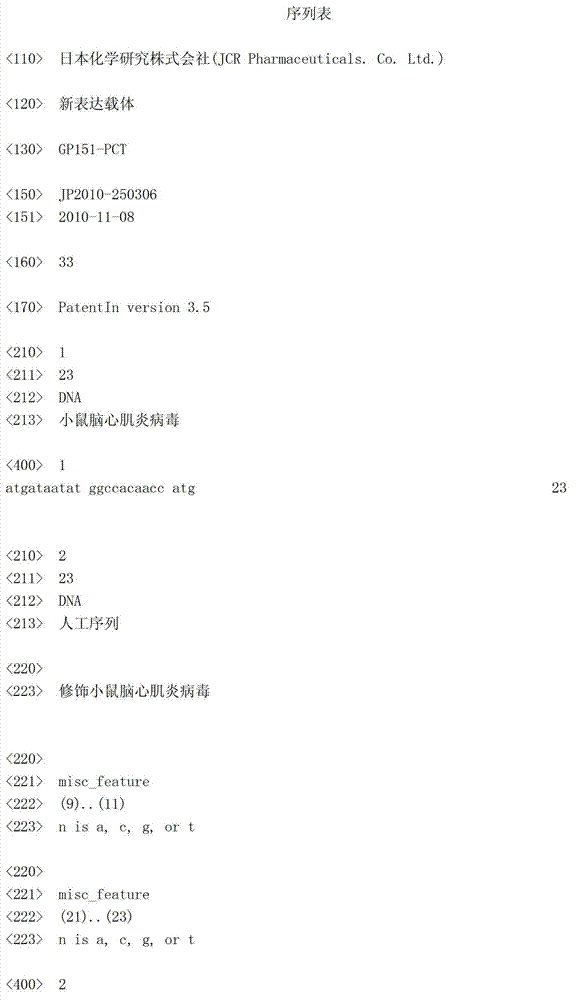
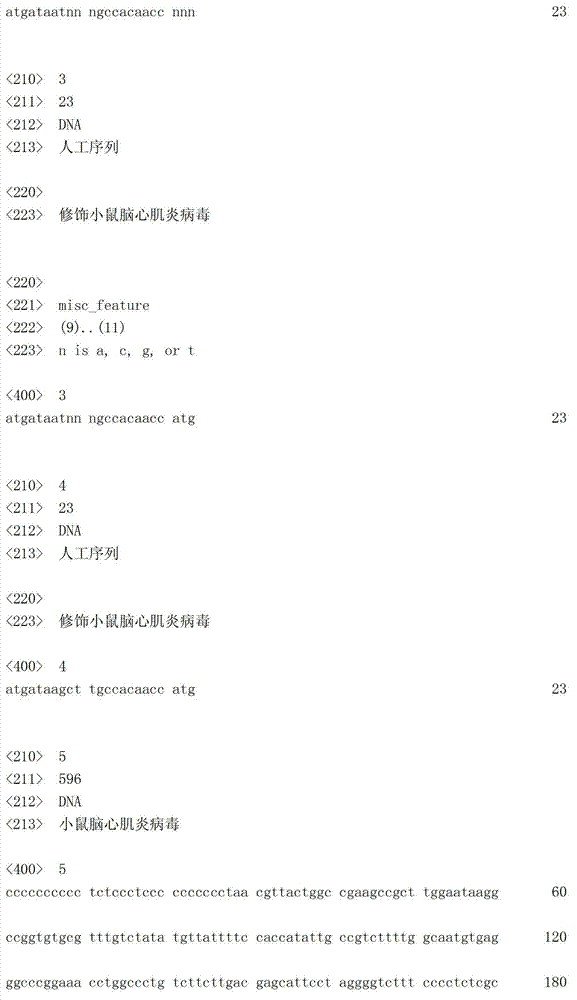

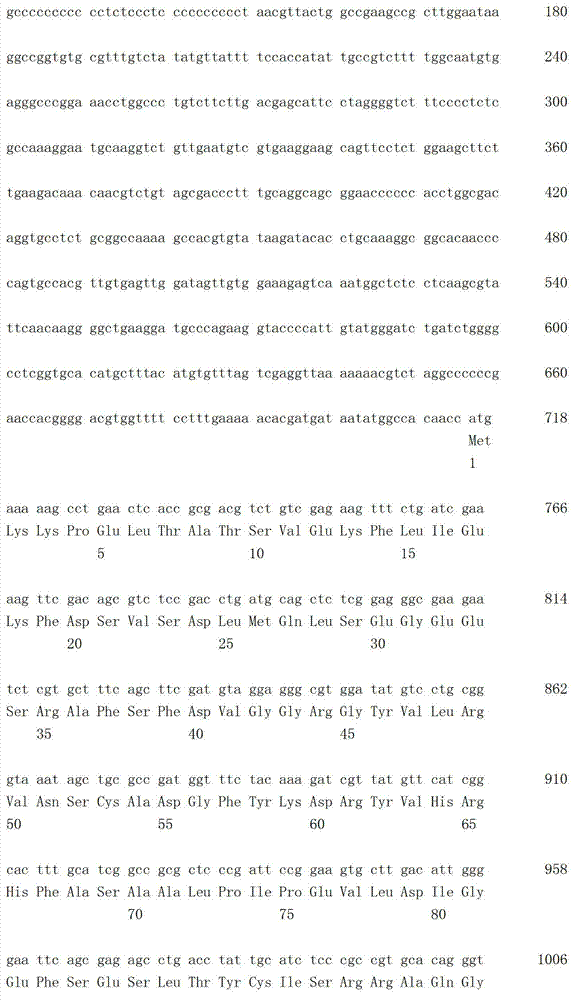
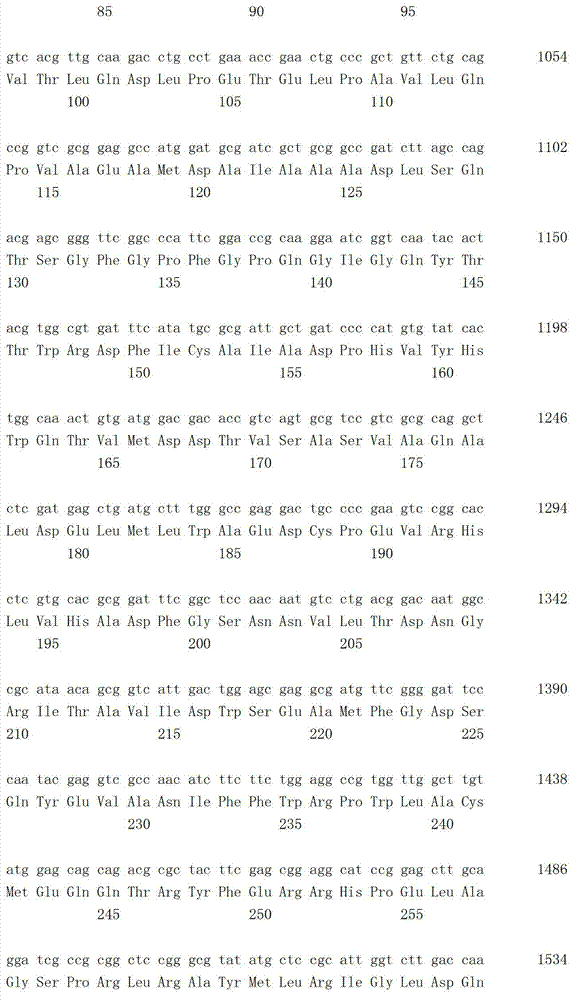

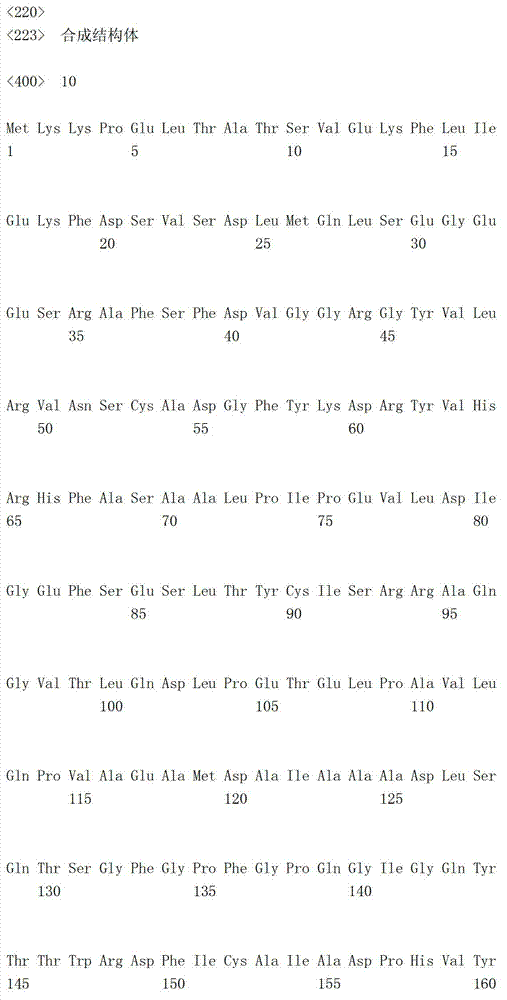


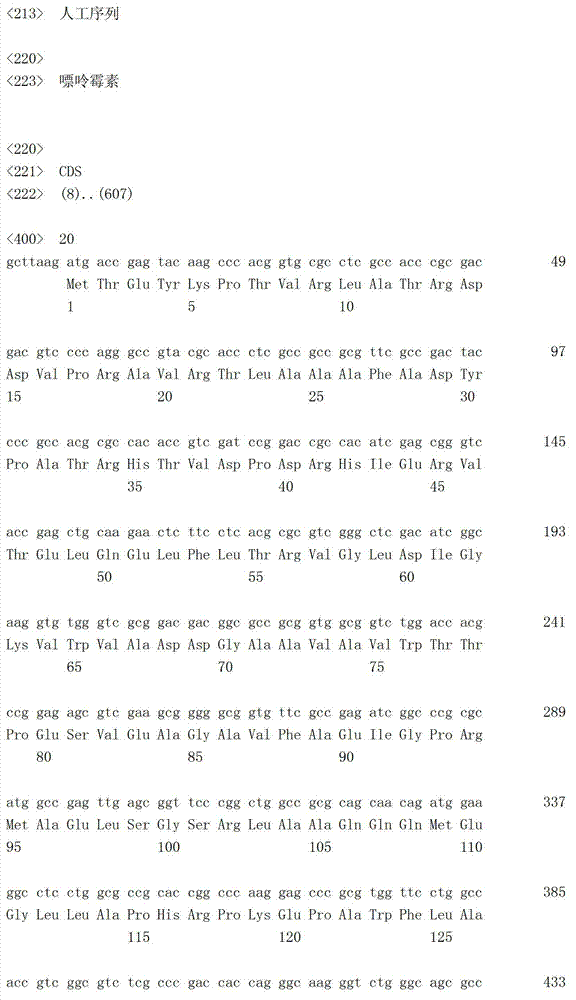
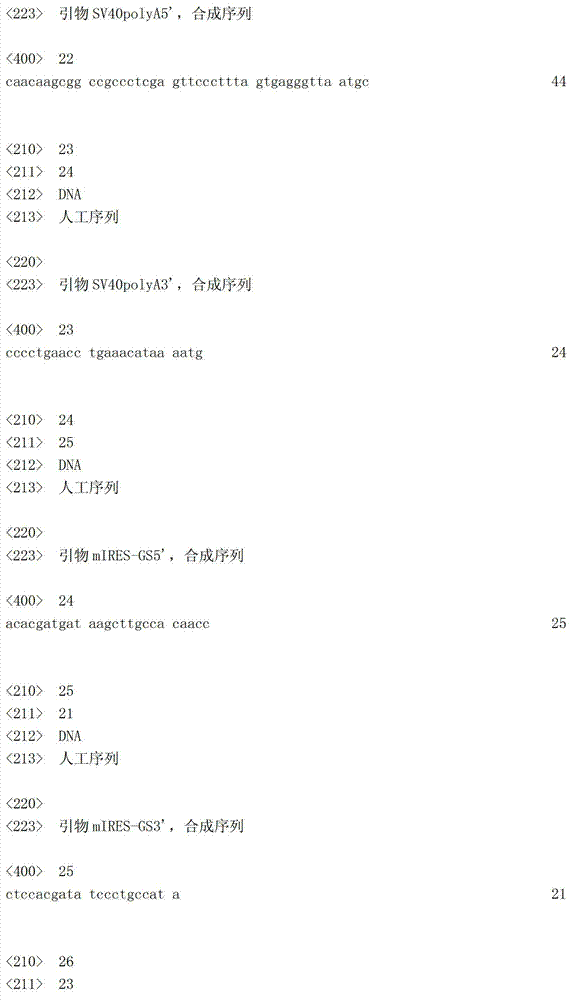

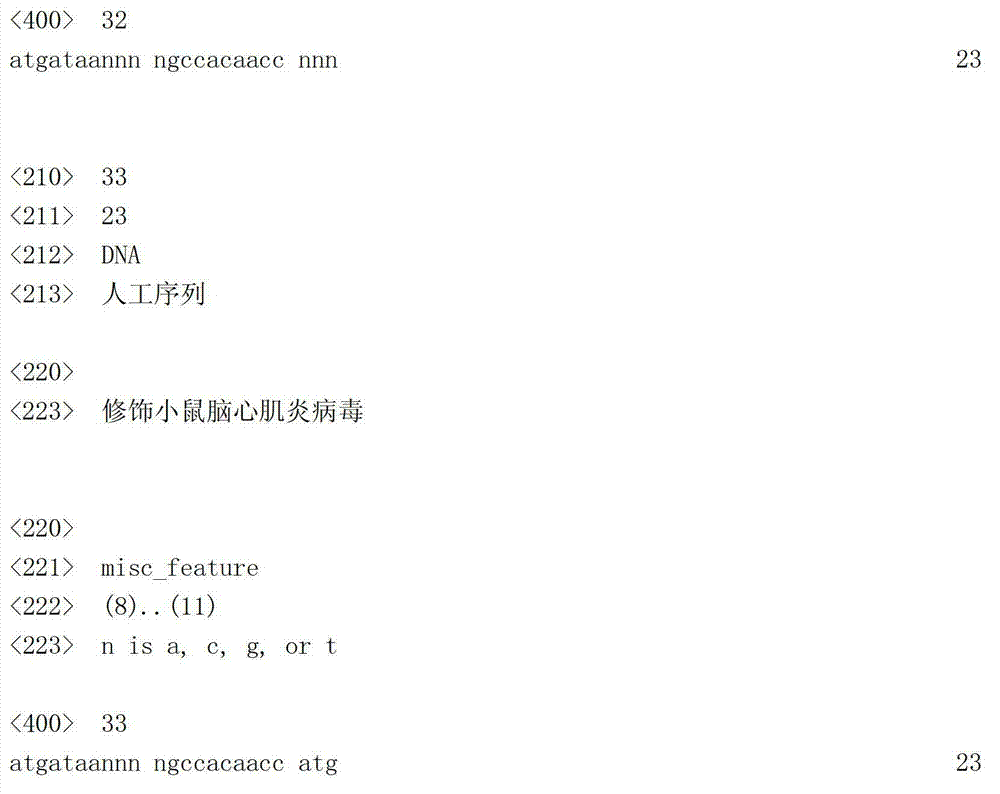
Claims (24)
Applications Claiming Priority (3)
| Application Number | Priority Date | Filing Date | Title |
|---|---|---|---|
| JP2010-250306 | 2010-11-08 | ||
| JP2010250306 | 2010-11-08 | ||
| PCT/JP2011/075670 WO2012063799A1 (en) | 2010-11-08 | 2011-11-08 | Novel expression vector |
Publications (1)
| Publication Number | Publication Date |
|---|---|
| CN103201382A true CN103201382A (en) | 2013-07-10 |
Family
ID=46050942
Family Applications (1)
| Application Number | Title | Priority Date | Filing Date |
|---|---|---|---|
| CN2011800536564A Pending CN103201382A (en) | 2010-11-08 | 2011-11-08 | Novel expression vector |
Country Status (6)
| Country | Link |
|---|---|
| US (1) | US20130244231A1 (en) |
| EP (1) | EP2639303B1 (en) |
| JP (1) | JP5913122B2 (en) |
| KR (1) | KR101890446B1 (en) |
| CN (1) | CN103201382A (en) |
| WO (1) | WO2012063799A1 (en) |
Cited By (1)
| Publication number | Priority date | Publication date | Assignee | Title |
|---|---|---|---|---|
| CN113430227A (en) * | 2020-03-23 | 2021-09-24 | 佛山汉腾生物科技有限公司 | Method for preparing stable cell pool, protein expression method and kit |
Families Citing this family (18)
| Publication number | Priority date | Publication date | Assignee | Title |
|---|---|---|---|---|
| WO2013161958A1 (en) * | 2012-04-27 | 2013-10-31 | 日本ケミカルリサーチ株式会社 | Novel expression vector |
| JP6071018B2 (en) | 2014-10-31 | 2017-02-01 | Jcrファーマ株式会社 | Method for producing recombinant human DNase I |
| MY187033A (en) | 2015-06-24 | 2021-08-27 | Japan Chem Res | Anti-human transferrin receptor antibody permeating blood-brain barrier |
| KR102360744B1 (en) | 2015-09-08 | 2022-02-08 | 제이씨알 파마 가부시키가이샤 | Novel human serum albumin variants |
| WO2017197098A1 (en) * | 2016-05-11 | 2017-11-16 | Amgen Inc. | Direct selection of cells expressing high levels of heteromeric proteins using glutamine synthetase intragenic complementation vectors |
| TWI833178B (en) | 2016-12-26 | 2024-02-21 | 日商Jcr製藥股份有限公司 | Novel anti-human transferrin receptor antibodies cross the blood-brain barrier |
| JP7072524B2 (en) | 2016-12-26 | 2022-05-20 | Jcrファーマ株式会社 | Fusion protein containing BDNF |
| MA50746A (en) | 2017-10-02 | 2020-08-12 | Denali Therapeutics Inc | FUSION PROTEINS INCLUDING SUBSTITUTIVE ENZYMOTHERAPY ENZYMES |
| JP7173980B2 (en) * | 2017-10-23 | 2022-11-17 | 日本たばこ産業株式会社 | Constructs for expressing G protein-coupled receptors or subunits thereof and uses thereof |
| AU2019215782A1 (en) | 2018-02-05 | 2020-07-16 | Jcr Pharmaceuticals Co., Ltd. | Method for delivering drug to muscle |
| JP2021066730A (en) | 2019-10-17 | 2021-04-30 | Jcrファーマ株式会社 | Method for producing fusion protein of serum albumin and growth hormone |
| JP7604174B2 (en) | 2019-10-30 | 2024-12-23 | Jcrファーマ株式会社 | Aqueous pharmaceutical composition containing serum albumin and growth hormone fusion protein |
| TW202227630A (en) | 2020-08-28 | 2022-07-16 | 日商Jcr製藥股份有限公司 | Mutant of [alpha]-N-acetylglucosaminidase |
| EP4299756A4 (en) | 2021-03-09 | 2025-03-12 | JCR Pharmaceuticals Co., Ltd. | Method for producing antibody-lysosomal enzyme fusion protein |
| AU2022390281A1 (en) | 2021-11-19 | 2024-06-13 | Jcr Pharmaceuticals Co., Ltd. | Peptide having affinity for human transferrin receptor |
| EP4512892A1 (en) | 2022-04-19 | 2025-02-26 | JCR Pharmaceuticals Co., Ltd. | Glycoprotein having reduced number of mannose-6-phosphates |
| US20250333481A1 (en) | 2022-10-11 | 2025-10-30 | Jcr Pharmaceuticals Co., Ltd. | Fusion protein of serum albumin and physiologically-active protein |
| TW202436352A (en) | 2023-02-07 | 2024-09-16 | 日商Jcr製藥股份有限公司 | Human ferritin receptor affinity peptide |
Citations (2)
| Publication number | Priority date | Publication date | Assignee | Title |
|---|---|---|---|---|
| US6632637B1 (en) * | 1999-10-13 | 2003-10-14 | Immunex Corporation | Vectors and methods for recombinant protein expression |
| CN101597616A (en) * | 2008-06-04 | 2009-12-09 | 上海同科生物科技有限公司 | A kind of method that improves expression quantity of gene recombinant human coagulation factor 8 |
Family Cites Families (4)
| Publication number | Priority date | Publication date | Assignee | Title |
|---|---|---|---|---|
| BR0107943A (en) * | 2000-01-28 | 2003-01-28 | Scripps Research Inst | Synthetic Internal Ribosome Entry Sites and Methods of Identifying Them |
| WO2002094989A2 (en) * | 2001-05-18 | 2002-11-28 | The Scripps Research Institute | Retroviral vectors and methods of using same |
| US20100136616A1 (en) | 2004-11-08 | 2010-06-03 | Chromagenics B.V. | Selection of Host Cells Expressing Protein at High Levels |
| SG173456A1 (en) * | 2009-02-27 | 2011-09-29 | Novartis Ag | Expression vector system comprising two selection markers |
-
2011
- 2011-11-08 CN CN2011800536564A patent/CN103201382A/en active Pending
- 2011-11-08 US US13/883,599 patent/US20130244231A1/en not_active Abandoned
- 2011-11-08 WO PCT/JP2011/075670 patent/WO2012063799A1/en not_active Ceased
- 2011-11-08 KR KR1020137014500A patent/KR101890446B1/en not_active Expired - Fee Related
- 2011-11-08 JP JP2012542921A patent/JP5913122B2/en active Active
- 2011-11-08 EP EP11839803.1A patent/EP2639303B1/en active Active
Patent Citations (2)
| Publication number | Priority date | Publication date | Assignee | Title |
|---|---|---|---|---|
| US6632637B1 (en) * | 1999-10-13 | 2003-10-14 | Immunex Corporation | Vectors and methods for recombinant protein expression |
| CN101597616A (en) * | 2008-06-04 | 2009-12-09 | 上海同科生物科技有限公司 | A kind of method that improves expression quantity of gene recombinant human coagulation factor 8 |
Non-Patent Citations (2)
| Title |
|---|
| HAIFENG PU ET AL.: "Rapid Establishment of High-Producing Cell Lines Using Dicistronic Vectors with Glutamine Synthetase as the Selection Marker", 《MOLECULAR BIOTECHNOLOGY》, vol. 10, 31 December 1998 (1998-12-31), pages 17 - 25 * |
| PATRICK MARTIN ET AL.: "Development of a new bicistronic retroviral vector with strong IRES activity", 《BMC BIOTECHNOLOGY》, vol. 6, no. 4, 12 January 2006 (2006-01-12), pages 1 * |
Cited By (1)
| Publication number | Priority date | Publication date | Assignee | Title |
|---|---|---|---|---|
| CN113430227A (en) * | 2020-03-23 | 2021-09-24 | 佛山汉腾生物科技有限公司 | Method for preparing stable cell pool, protein expression method and kit |
Also Published As
| Publication number | Publication date |
|---|---|
| WO2012063799A1 (en) | 2012-05-18 |
| JP5913122B2 (en) | 2016-04-27 |
| EP2639303B1 (en) | 2017-06-07 |
| EP2639303A1 (en) | 2013-09-18 |
| KR20130100182A (en) | 2013-09-09 |
| KR101890446B1 (en) | 2018-08-21 |
| US20130244231A1 (en) | 2013-09-19 |
| JPWO2012063799A1 (en) | 2014-05-12 |
| EP2639303A4 (en) | 2014-05-28 |
Similar Documents
| Publication | Publication Date | Title |
|---|---|---|
| CN103201382A (en) | Novel expression vector | |
| JP6279466B2 (en) | New expression vector | |
| ES2840725T3 (en) | Production procedure | |
| Lanza et al. | Evaluating the influence of selection markers on obtaining selected pools and stable cell lines in human cells | |
| JP5835636B2 (en) | Expression vector and antibody high productivity cell for establishment of antibody high productivity cell | |
| CN102648288B (en) | Inhibition-based high-throughput screening method for cell clones | |
| Fan et al. | The use of glutamine synthetase as a selection marker: recent advances in Chinese hamster ovary cell line generation processes | |
| CN108138147B (en) | Expression of Fc-containing proteins | |
| JP2010512776A (en) | Highly transcriptionally active cell lines for producing proteins known for their high therapeutic applicability | |
| JP2020536513A (en) | Cell lines and methods for increasing protein production | |
| JPH04502254A (en) | Expression induction method using mutant DHFR gene | |
| JP4568378B2 (en) | Gene expression stabilizing element | |
| RU2656142C1 (en) | Recombinant plasmid dna pbipr-abiga1fi6-ht for obtaining recombinant immunoglobulin a igoth iga1 | |
| JP4547643B1 (en) | Expression vector optimized for cloning | |
| JP2015519899A (en) | Ribosomal polynucleotides and related expression systems | |
| JP6005421B2 (en) | Expression vector for the establishment of highly productive cells containing drug-selective fusion genes | |
| RU2671477C2 (en) | RECOMBINANT PLASMID DNA OF pBiPr-ABIgA2m1F16-ht TO OBTAIN RECOMBINANT IMMUNOGLOBULIN A OF ISOTYPE IgA2m1 | |
| RU2664184C2 (en) | RECOMBINANT PLASMID DNA pBiIPr-ABIgA1FI6-INTHT FOR OBTAINING RECOMBINANT IGA1 ISOTYPE IMMUNOGLOBULIN | |
| US8367404B2 (en) | Chimeral internal ribosomal entry site sequence and uses thereof | |
| TWI412590B (en) | A chimeral internal ribosomal entry site sequence and uses thereof | |
| JP5811321B2 (en) | Novel protein expression method | |
| WO2019225372A1 (en) | Novel vector and use thereof | |
| JPH1094393A (en) | Targeting vector for producing physiologically active substance |
Legal Events
| Date | Code | Title | Description |
|---|---|---|---|
| C06 | Publication | ||
| PB01 | Publication | ||
| C10 | Entry into substantive examination | ||
| SE01 | Entry into force of request for substantive examination | ||
| C02 | Deemed withdrawal of patent application after publication (patent law 2001) | ||
| WD01 | Invention patent application deemed withdrawn after publication |
Application publication date: 20130710 |