JP7522106B2 - Pharmaceutical compositions comprising bispecific anti-CD37 antibodies - Google Patents
Pharmaceutical compositions comprising bispecific anti-CD37 antibodies Download PDFInfo
- Publication number
- JP7522106B2 JP7522106B2 JP2021518667A JP2021518667A JP7522106B2 JP 7522106 B2 JP7522106 B2 JP 7522106B2 JP 2021518667 A JP2021518667 A JP 2021518667A JP 2021518667 A JP2021518667 A JP 2021518667A JP 7522106 B2 JP7522106 B2 JP 7522106B2
- Authority
- JP
- Japan
- Prior art keywords
- seq
- antibody
- set forth
- igg1
- antibodies
- Prior art date
- Legal status (The legal status is an assumption and is not a legal conclusion. Google has not performed a legal analysis and makes no representation as to the accuracy of the status listed.)
- Active
Links
- 239000008194 pharmaceutical composition Substances 0.000 title claims description 133
- 230000027455 binding Effects 0.000 claims description 307
- 230000035772 mutation Effects 0.000 claims description 170
- 239000000427 antigen Substances 0.000 claims description 135
- 108091007433 antigens Proteins 0.000 claims description 135
- 102000036639 antigens Human genes 0.000 claims description 135
- 230000003993 interaction Effects 0.000 claims description 117
- 102100035360 Cerebellar degeneration-related antigen 1 Human genes 0.000 claims description 112
- 101100112922 Candida albicans CDR3 gene Proteins 0.000 claims description 83
- 102100035361 Cerebellar degeneration-related protein 2 Human genes 0.000 claims description 83
- 101000737793 Homo sapiens Cerebellar degeneration-related antigen 1 Proteins 0.000 claims description 83
- 101000737796 Homo sapiens Cerebellar degeneration-related protein 2 Proteins 0.000 claims description 83
- 210000003719 b-lymphocyte Anatomy 0.000 claims description 71
- 230000002708 enhancing effect Effects 0.000 claims description 68
- 239000000203 mixture Substances 0.000 claims description 64
- FAPWRFPIFSIZLT-UHFFFAOYSA-M Sodium chloride Chemical compound [Na+].[Cl-] FAPWRFPIFSIZLT-UHFFFAOYSA-M 0.000 claims description 50
- HNDVDQJCIGZPNO-UHFFFAOYSA-N histidine Natural products OC(=O)C(N)CC1=CN=CN1 HNDVDQJCIGZPNO-UHFFFAOYSA-N 0.000 claims description 44
- 235000010482 polyoxyethylene sorbitan monooleate Nutrition 0.000 claims description 44
- 229920000053 polysorbate 80 Polymers 0.000 claims description 44
- 239000000244 polyoxyethylene sorbitan monooleate Substances 0.000 claims description 43
- 229940068968 polysorbate 80 Drugs 0.000 claims description 43
- 208000010839 B-cell chronic lymphocytic leukemia Diseases 0.000 claims description 40
- 206010028980 Neoplasm Diseases 0.000 claims description 40
- 229930006000 Sucrose Natural products 0.000 claims description 37
- 239000003814 drug Substances 0.000 claims description 37
- 239000005720 sucrose Substances 0.000 claims description 37
- CZMRCDWAGMRECN-UGDNZRGBSA-N Sucrose Chemical compound O[C@H]1[C@H](O)[C@@H](CO)O[C@@]1(CO)O[C@@H]1[C@H](O)[C@@H](O)[C@H](O)[C@@H](CO)O1 CZMRCDWAGMRECN-UGDNZRGBSA-N 0.000 claims description 35
- 101710117290 Aldo-keto reductase family 1 member C4 Proteins 0.000 claims description 29
- 239000000872 buffer Substances 0.000 claims description 29
- 238000011282 treatment Methods 0.000 claims description 29
- 239000004475 Arginine Substances 0.000 claims description 27
- 230000010056 antibody-dependent cellular cytotoxicity Effects 0.000 claims description 27
- ODKSFYDXXFIFQN-UHFFFAOYSA-N arginine Natural products OC(=O)C(N)CCCNC(N)=N ODKSFYDXXFIFQN-UHFFFAOYSA-N 0.000 claims description 27
- 101000897405 Homo sapiens B-lymphocyte antigen CD20 Proteins 0.000 claims description 25
- 101100495232 Homo sapiens MS4A1 gene Proteins 0.000 claims description 25
- 239000011780 sodium chloride Substances 0.000 claims description 25
- 102100022005 B-lymphocyte antigen CD20 Human genes 0.000 claims description 24
- 201000003444 follicular lymphoma Diseases 0.000 claims description 24
- 208000031671 Large B-Cell Diffuse Lymphoma Diseases 0.000 claims description 23
- 208000025205 Mantle-Cell Lymphoma Diseases 0.000 claims description 23
- 206010012818 diffuse large B-cell lymphoma Diseases 0.000 claims description 23
- 229960002450 ofatumumab Drugs 0.000 claims description 22
- 229940124597 therapeutic agent Drugs 0.000 claims description 21
- AOJJSUZBOXZQNB-TZSSRYMLSA-N Doxorubicin Chemical compound O([C@H]1C[C@@](O)(CC=2C(O)=C3C(=O)C=4C=CC=C(C=4C(=O)C3=C(O)C=21)OC)C(=O)CO)[C@H]1C[C@H](N)[C@H](O)[C@H](C)O1 AOJJSUZBOXZQNB-TZSSRYMLSA-N 0.000 claims description 20
- 229960004641 rituximab Drugs 0.000 claims description 20
- 208000015914 Non-Hodgkin lymphomas Diseases 0.000 claims description 19
- 239000012636 effector Substances 0.000 claims description 19
- 238000004519 manufacturing process Methods 0.000 claims description 19
- 201000011510 cancer Diseases 0.000 claims description 16
- 208000031223 plasma cell leukemia Diseases 0.000 claims description 16
- 229920005862 polyol Polymers 0.000 claims description 16
- 150000003077 polyols Chemical class 0.000 claims description 16
- FBPFZTCFMRRESA-FSIIMWSLSA-N D-Glucitol Natural products OC[C@H](O)[C@H](O)[C@@H](O)[C@H](O)CO FBPFZTCFMRRESA-FSIIMWSLSA-N 0.000 claims description 15
- FBPFZTCFMRRESA-KVTDHHQDSA-N D-Mannitol Chemical compound OC[C@@H](O)[C@@H](O)[C@H](O)[C@H](O)CO FBPFZTCFMRRESA-KVTDHHQDSA-N 0.000 claims description 15
- 229930195725 Mannitol Natural products 0.000 claims description 15
- 239000000594 mannitol Substances 0.000 claims description 15
- 235000010355 mannitol Nutrition 0.000 claims description 15
- 239000000600 sorbitol Substances 0.000 claims description 15
- 230000036210 malignancy Effects 0.000 claims description 14
- CMSMOCZEIVJLDB-UHFFFAOYSA-N Cyclophosphamide Chemical compound ClCCN(CCCl)P1(=O)NCCCO1 CMSMOCZEIVJLDB-UHFFFAOYSA-N 0.000 claims description 11
- FBPFZTCFMRRESA-JGWLITMVSA-N D-glucitol Chemical compound OC[C@H](O)[C@@H](O)[C@H](O)[C@H](O)CO FBPFZTCFMRRESA-JGWLITMVSA-N 0.000 claims description 11
- 239000002177 L01XE27 - Ibrutinib Substances 0.000 claims description 11
- 229960004397 cyclophosphamide Drugs 0.000 claims description 11
- XYFPWWZEPKGCCK-GOSISDBHSA-N ibrutinib Chemical compound C1=2C(N)=NC=NC=2N([C@H]2CN(CCC2)C(=O)C=C)N=C1C(C=C1)=CC=C1OC1=CC=CC=C1 XYFPWWZEPKGCCK-GOSISDBHSA-N 0.000 claims description 11
- 229960001507 ibrutinib Drugs 0.000 claims description 11
- -1 100-250 mM Chemical compound 0.000 claims description 10
- YTKUWDBFDASYHO-UHFFFAOYSA-N bendamustine Chemical compound ClCCN(CCCl)C1=CC=C2N(C)C(CCCC(O)=O)=NC2=C1 YTKUWDBFDASYHO-UHFFFAOYSA-N 0.000 claims description 10
- 229960002707 bendamustine Drugs 0.000 claims description 10
- JCKYGMPEJWAADB-UHFFFAOYSA-N chlorambucil Chemical compound OC(=O)CCCC1=CC=C(N(CCCl)CCCl)C=C1 JCKYGMPEJWAADB-UHFFFAOYSA-N 0.000 claims description 10
- 229960004630 chlorambucil Drugs 0.000 claims description 10
- 229960004679 doxorubicin Drugs 0.000 claims description 10
- 229960000390 fludarabine Drugs 0.000 claims description 10
- GIUYCYHIANZCFB-FJFJXFQQSA-N fludarabine phosphate Chemical compound C1=NC=2C(N)=NC(F)=NC=2N1[C@@H]1O[C@H](COP(O)(O)=O)[C@@H](O)[C@@H]1O GIUYCYHIANZCFB-FJFJXFQQSA-N 0.000 claims description 10
- 229960004528 vincristine Drugs 0.000 claims description 10
- OGWKCGZFUXNPDA-XQKSVPLYSA-N vincristine Chemical compound C([N@]1C[C@@H](C[C@]2(C(=O)OC)C=3C(=CC4=C([C@]56[C@H]([C@@]([C@H](OC(C)=O)[C@]7(CC)C=CCN([C@H]67)CC5)(O)C(=O)OC)N4C=O)C=3)OC)C[C@@](C1)(O)CC)CC1=C2NC2=CC=CC=C12 OGWKCGZFUXNPDA-XQKSVPLYSA-N 0.000 claims description 10
- OGWKCGZFUXNPDA-UHFFFAOYSA-N vincristine Natural products C1C(CC)(O)CC(CC2(C(=O)OC)C=3C(=CC4=C(C56C(C(C(OC(C)=O)C7(CC)C=CCN(C67)CC5)(O)C(=O)OC)N4C=O)C=3)OC)CN1CCC1=C2NC2=CC=CC=C12 OGWKCGZFUXNPDA-UHFFFAOYSA-N 0.000 claims description 10
- 108010006654 Bleomycin Proteins 0.000 claims description 9
- DLGOEMSEDOSKAD-UHFFFAOYSA-N Carmustine Chemical compound ClCCNC(=O)N(N=O)CCCl DLGOEMSEDOSKAD-UHFFFAOYSA-N 0.000 claims description 9
- 206010020751 Hypersensitivity Diseases 0.000 claims description 9
- 206010052779 Transplant rejections Diseases 0.000 claims description 9
- 230000007815 allergy Effects 0.000 claims description 9
- 229960001561 bleomycin Drugs 0.000 claims description 9
- OYVAGSVQBOHSSS-UAPAGMARSA-O bleomycin A2 Chemical compound N([C@H](C(=O)N[C@H](C)[C@@H](O)[C@H](C)C(=O)N[C@@H]([C@H](O)C)C(=O)NCCC=1SC=C(N=1)C=1SC=C(N=1)C(=O)NCCC[S+](C)C)[C@@H](O[C@H]1[C@H]([C@@H](O)[C@H](O)[C@H](CO)O1)O[C@@H]1[C@H]([C@@H](OC(N)=O)[C@H](O)[C@@H](CO)O1)O)C=1N=CNC=1)C(=O)C1=NC([C@H](CC(N)=O)NC[C@H](N)C(N)=O)=NC(N)=C1C OYVAGSVQBOHSSS-UAPAGMARSA-O 0.000 claims description 9
- 229960005243 carmustine Drugs 0.000 claims description 9
- DQLATGHUWYMOKM-UHFFFAOYSA-L cisplatin Chemical compound N[Pt](N)(Cl)Cl DQLATGHUWYMOKM-UHFFFAOYSA-L 0.000 claims description 9
- 229960004316 cisplatin Drugs 0.000 claims description 9
- 208000024893 Acute lymphoblastic leukemia Diseases 0.000 claims description 8
- 208000023275 Autoimmune disease Diseases 0.000 claims description 7
- 208000027866 inflammatory disease Diseases 0.000 claims description 6
- 239000007864 aqueous solution Substances 0.000 claims description 3
- 125000000185 sucrose group Chemical group 0.000 claims description 2
- 210000004027 cell Anatomy 0.000 description 239
- 101000777628 Homo sapiens Leukocyte antigen CD37 Proteins 0.000 description 227
- 102100031586 Leukocyte antigen CD37 Human genes 0.000 description 205
- 241000282414 Homo sapiens Species 0.000 description 127
- 230000004540 complement-dependent cytotoxicity Effects 0.000 description 116
- 235000001014 amino acid Nutrition 0.000 description 105
- 229940024606 amino acid Drugs 0.000 description 70
- 150000001413 amino acids Chemical class 0.000 description 68
- KDXKERNSBIXSRK-UHFFFAOYSA-N Lysine Natural products NCCCCC(N)C(O)=O KDXKERNSBIXSRK-UHFFFAOYSA-N 0.000 description 65
- 238000000034 method Methods 0.000 description 60
- 238000006467 substitution reaction Methods 0.000 description 59
- 125000003275 alpha amino acid group Chemical group 0.000 description 51
- 108090000623 proteins and genes Proteins 0.000 description 42
- 210000004881 tumor cell Anatomy 0.000 description 38
- 125000003295 alanine group Chemical group N[C@@H](C)C(=O)* 0.000 description 37
- XUJNEKJLAYXESH-REOHCLBHSA-N L-Cysteine Chemical compound SC[C@H](N)C(O)=O XUJNEKJLAYXESH-REOHCLBHSA-N 0.000 description 34
- ZDXPYRJPNDTMRX-VKHMYHEASA-N L-glutamine Chemical compound OC(=O)[C@@H](N)CCC(N)=O ZDXPYRJPNDTMRX-VKHMYHEASA-N 0.000 description 33
- 238000009472 formulation Methods 0.000 description 33
- 238000000684 flow cytometry Methods 0.000 description 32
- 235000018102 proteins Nutrition 0.000 description 32
- 102000004169 proteins and genes Human genes 0.000 description 32
- 208000031422 Lymphocytic Chronic B-Cell Leukemia Diseases 0.000 description 31
- 208000032852 chronic lymphocytic leukemia Diseases 0.000 description 30
- 230000009089 cytolysis Effects 0.000 description 30
- 210000004369 blood Anatomy 0.000 description 29
- 239000008280 blood Substances 0.000 description 29
- 230000014509 gene expression Effects 0.000 description 29
- 230000003389 potentiating effect Effects 0.000 description 28
- 108060003951 Immunoglobulin Proteins 0.000 description 25
- 102000018358 immunoglobulin Human genes 0.000 description 25
- 241000282567 Macaca fascicularis Species 0.000 description 23
- 230000001404 mediated effect Effects 0.000 description 23
- 239000013598 vector Substances 0.000 description 23
- 230000000694 effects Effects 0.000 description 22
- 102000048426 human CD37 Human genes 0.000 description 22
- 238000002474 experimental method Methods 0.000 description 21
- 241000283973 Oryctolagus cuniculus Species 0.000 description 19
- 229960003121 arginine Drugs 0.000 description 19
- 230000001939 inductive effect Effects 0.000 description 19
- 108091003079 Bovine Serum Albumin Proteins 0.000 description 18
- ODKSFYDXXFIFQN-BYPYZUCNSA-N L-arginine Chemical group OC(=O)[C@@H](N)CCCN=C(N)N ODKSFYDXXFIFQN-BYPYZUCNSA-N 0.000 description 18
- 229940098773 bovine serum albumin Drugs 0.000 description 18
- 230000009977 dual effect Effects 0.000 description 18
- 238000000338 in vitro Methods 0.000 description 18
- 150000007523 nucleic acids Chemical group 0.000 description 18
- 125000000539 amino acid group Chemical group 0.000 description 17
- 238000001943 fluorescence-activated cell sorting Methods 0.000 description 17
- 239000012634 fragment Substances 0.000 description 17
- 241000699666 Mus <mouse, genus> Species 0.000 description 16
- 235000004279 alanine Nutrition 0.000 description 15
- 230000015572 biosynthetic process Effects 0.000 description 15
- 230000004927 fusion Effects 0.000 description 15
- 238000005516 engineering process Methods 0.000 description 14
- 239000013604 expression vector Substances 0.000 description 14
- 239000012528 membrane Substances 0.000 description 14
- 102000039446 nucleic acids Human genes 0.000 description 14
- 108020004707 nucleic acids Proteins 0.000 description 14
- 230000000295 complement effect Effects 0.000 description 13
- 230000006870 function Effects 0.000 description 13
- 229960003347 obinutuzumab Drugs 0.000 description 13
- 229920001184 polypeptide Polymers 0.000 description 13
- 102000004196 processed proteins & peptides Human genes 0.000 description 13
- 108090000765 processed proteins & peptides Proteins 0.000 description 13
- 239000000243 solution Substances 0.000 description 13
- 238000003556 assay Methods 0.000 description 12
- 230000003013 cytotoxicity Effects 0.000 description 12
- 231100000135 cytotoxicity Toxicity 0.000 description 12
- 231100000673 dose–response relationship Toxicity 0.000 description 12
- 238000011534 incubation Methods 0.000 description 12
- 201000000596 systemic lupus erythematosus Diseases 0.000 description 12
- 108010047041 Complementarity Determining Regions Proteins 0.000 description 11
- 210000004602 germ cell Anatomy 0.000 description 11
- 239000000047 product Substances 0.000 description 11
- 230000002829 reductive effect Effects 0.000 description 11
- 239000000523 sample Substances 0.000 description 11
- 206010003246 arthritis Diseases 0.000 description 10
- 208000003950 B-cell lymphoma Diseases 0.000 description 9
- QNAYBMKLOCPYGJ-REOHCLBHSA-N L-alanine Chemical compound C[C@H](N)C(O)=O QNAYBMKLOCPYGJ-REOHCLBHSA-N 0.000 description 9
- 238000006243 chemical reaction Methods 0.000 description 9
- 238000013207 serial dilution Methods 0.000 description 9
- 230000008685 targeting Effects 0.000 description 9
- 108010054477 Immunoglobulin Fab Fragments Proteins 0.000 description 8
- 102000001706 Immunoglobulin Fab Fragments Human genes 0.000 description 8
- 241000699670 Mus sp. Species 0.000 description 8
- 239000006146 Roswell Park Memorial Institute medium Substances 0.000 description 8
- QHNORJFCVHUPNH-UHFFFAOYSA-L To-Pro-3 Chemical compound [I-].[I-].S1C2=CC=CC=C2[N+](C)=C1C=CC=C1C2=CC=CC=C2N(CCC[N+](C)(C)C)C=C1 QHNORJFCVHUPNH-UHFFFAOYSA-L 0.000 description 8
- 230000008859 change Effects 0.000 description 8
- 238000005259 measurement Methods 0.000 description 8
- 102100024222 B-lymphocyte antigen CD19 Human genes 0.000 description 7
- 101000980825 Homo sapiens B-lymphocyte antigen CD19 Proteins 0.000 description 7
- 241001465754 Metazoa Species 0.000 description 7
- 239000004793 Polystyrene Substances 0.000 description 7
- 239000012980 RPMI-1640 medium Substances 0.000 description 7
- 210000004978 chinese hamster ovary cell Anatomy 0.000 description 7
- 235000018417 cysteine Nutrition 0.000 description 7
- 230000001965 increasing effect Effects 0.000 description 7
- 230000003211 malignant effect Effects 0.000 description 7
- 229920002223 polystyrene Polymers 0.000 description 7
- 238000011533 pre-incubation Methods 0.000 description 7
- 238000003860 storage Methods 0.000 description 7
- 239000006228 supernatant Substances 0.000 description 7
- 230000003442 weekly effect Effects 0.000 description 7
- 102100022002 CD59 glycoprotein Human genes 0.000 description 6
- VYZAMTAEIAYCRO-BJUDXGSMSA-N Chromium-51 Chemical compound [51Cr] VYZAMTAEIAYCRO-BJUDXGSMSA-N 0.000 description 6
- 102100025680 Complement decay-accelerating factor Human genes 0.000 description 6
- IAZDPXIOMUYVGZ-UHFFFAOYSA-N Dimethylsulphoxide Chemical compound CS(C)=O IAZDPXIOMUYVGZ-UHFFFAOYSA-N 0.000 description 6
- 201000005569 Gout Diseases 0.000 description 6
- 101000897400 Homo sapiens CD59 glycoprotein Proteins 0.000 description 6
- 101000856022 Homo sapiens Complement decay-accelerating factor Proteins 0.000 description 6
- 101000961414 Homo sapiens Membrane cofactor protein Proteins 0.000 description 6
- 102100039373 Membrane cofactor protein Human genes 0.000 description 6
- 238000011579 SCID mouse model Methods 0.000 description 6
- PXIPVTKHYLBLMZ-UHFFFAOYSA-N Sodium azide Chemical compound [Na+].[N-]=[N+]=[N-] PXIPVTKHYLBLMZ-UHFFFAOYSA-N 0.000 description 6
- 238000004458 analytical method Methods 0.000 description 6
- 238000010790 dilution Methods 0.000 description 6
- 239000012895 dilution Substances 0.000 description 6
- 239000002609 medium Substances 0.000 description 6
- 239000013642 negative control Substances 0.000 description 6
- 201000008482 osteoarthritis Diseases 0.000 description 6
- 210000003819 peripheral blood mononuclear cell Anatomy 0.000 description 6
- 206010039073 rheumatoid arthritis Diseases 0.000 description 6
- 239000012906 subvisible particle Substances 0.000 description 6
- 108020004414 DNA Proteins 0.000 description 5
- 125000000174 L-prolyl group Chemical group [H]N1C([H])([H])C([H])([H])C([H])([H])[C@@]1([H])C(*)=O 0.000 description 5
- 108060001084 Luciferase Proteins 0.000 description 5
- 239000005089 Luciferase Substances 0.000 description 5
- 230000029918 bioluminescence Effects 0.000 description 5
- 238000005415 bioluminescence Methods 0.000 description 5
- 239000003638 chemical reducing agent Substances 0.000 description 5
- UFULAYFCSOUIOV-UHFFFAOYSA-N cysteamine Chemical compound NCCS UFULAYFCSOUIOV-UHFFFAOYSA-N 0.000 description 5
- 201000010099 disease Diseases 0.000 description 5
- 208000037265 diseases, disorders, signs and symptoms Diseases 0.000 description 5
- 238000002296 dynamic light scattering Methods 0.000 description 5
- 210000003743 erythrocyte Anatomy 0.000 description 5
- 239000013628 high molecular weight specie Substances 0.000 description 5
- 210000004408 hybridoma Anatomy 0.000 description 5
- 230000006698 induction Effects 0.000 description 5
- 239000013627 low molecular weight specie Substances 0.000 description 5
- 229960003151 mercaptamine Drugs 0.000 description 5
- 239000013612 plasmid Substances 0.000 description 5
- 238000012216 screening Methods 0.000 description 5
- 210000002966 serum Anatomy 0.000 description 5
- UCSJYZPVAKXKNQ-HZYVHMACSA-N streptomycin Chemical compound CN[C@H]1[C@H](O)[C@@H](O)[C@H](CO)O[C@H]1O[C@@H]1[C@](C=O)(O)[C@H](C)O[C@H]1O[C@@H]1[C@@H](NC(N)=N)[C@H](O)[C@@H](NC(N)=N)[C@H](O)[C@H]1O UCSJYZPVAKXKNQ-HZYVHMACSA-N 0.000 description 5
- 238000012360 testing method Methods 0.000 description 5
- 230000001225 therapeutic effect Effects 0.000 description 5
- 230000004614 tumor growth Effects 0.000 description 5
- 239000012905 visible particle Substances 0.000 description 5
- 239000012103 Alexa Fluor 488 Substances 0.000 description 4
- IJGRMHOSHXDMSA-UHFFFAOYSA-N Atomic nitrogen Chemical compound N#N IJGRMHOSHXDMSA-UHFFFAOYSA-N 0.000 description 4
- 206010018634 Gouty Arthritis Diseases 0.000 description 4
- 101000946889 Homo sapiens Monocyte differentiation antigen CD14 Proteins 0.000 description 4
- 208000022559 Inflammatory bowel disease Diseases 0.000 description 4
- 206010059176 Juvenile idiopathic arthritis Diseases 0.000 description 4
- 239000004472 Lysine Substances 0.000 description 4
- 102100035877 Monocyte differentiation antigen CD14 Human genes 0.000 description 4
- 108091028043 Nucleic acid sequence Proteins 0.000 description 4
- 206010037575 Pustular psoriasis Diseases 0.000 description 4
- 210000001744 T-lymphocyte Anatomy 0.000 description 4
- 230000001154 acute effect Effects 0.000 description 4
- 208000026935 allergic disease Diseases 0.000 description 4
- 210000001185 bone marrow Anatomy 0.000 description 4
- 210000004899 c-terminal region Anatomy 0.000 description 4
- 230000030833 cell death Effects 0.000 description 4
- 238000005119 centrifugation Methods 0.000 description 4
- 230000001684 chronic effect Effects 0.000 description 4
- 230000004186 co-expression Effects 0.000 description 4
- 238000004132 cross linking Methods 0.000 description 4
- 150000001945 cysteines Chemical class 0.000 description 4
- 230000001419 dependent effect Effects 0.000 description 4
- UVCJGUGAGLDPAA-UHFFFAOYSA-N ensulizole Chemical compound N1C2=CC(S(=O)(=O)O)=CC=C2N=C1C1=CC=CC=C1 UVCJGUGAGLDPAA-UHFFFAOYSA-N 0.000 description 4
- 238000011156 evaluation Methods 0.000 description 4
- RWSXRVCMGQZWBV-WDSKDSINSA-N glutathione Chemical compound OC(=O)[C@@H](N)CCC(=O)N[C@@H](CS)C(=O)NCC(O)=O RWSXRVCMGQZWBV-WDSKDSINSA-N 0.000 description 4
- 239000000833 heterodimer Substances 0.000 description 4
- 238000013371 image capillary electrophoresis Methods 0.000 description 4
- 230000003053 immunization Effects 0.000 description 4
- 238000001727 in vivo Methods 0.000 description 4
- 201000002215 juvenile rheumatoid arthritis Diseases 0.000 description 4
- 230000002147 killing effect Effects 0.000 description 4
- 125000003588 lysine group Chemical group [H]N([H])C([H])([H])C([H])([H])C([H])([H])C([H])([H])C([H])(N([H])[H])C(*)=O 0.000 description 4
- 239000002245 particle Substances 0.000 description 4
- 229920009537 polybutylene succinate adipate Polymers 0.000 description 4
- 239000004175 ponceau 4R Substances 0.000 description 4
- XJMOSONTPMZWPB-UHFFFAOYSA-M propidium iodide Chemical compound [I-].[I-].C12=CC(N)=CC=C2C2=CC=C(N)C=C2[N+](CCC[N+](C)(CC)CC)=C1C1=CC=CC=C1 XJMOSONTPMZWPB-UHFFFAOYSA-M 0.000 description 4
- 201000010914 pustulosis of palm and sole Diseases 0.000 description 4
- 208000011797 pustulosis palmaris et plantaris Diseases 0.000 description 4
- 238000011002 quantification Methods 0.000 description 4
- 229960005322 streptomycin Drugs 0.000 description 4
- KZNICNPSHKQLFF-UHFFFAOYSA-N succinimide Chemical compound O=C1CCC(=O)N1 KZNICNPSHKQLFF-UHFFFAOYSA-N 0.000 description 4
- YXHLJMWYDTXDHS-IRFLANFNSA-N 7-aminoactinomycin D Chemical compound C[C@H]1OC(=O)[C@H](C(C)C)N(C)C(=O)CN(C)C(=O)[C@@H]2CCCN2C(=O)[C@@H](C(C)C)NC(=O)[C@H]1NC(=O)C1=C(N)C(=O)C(C)=C2OC(C(C)=C(N)C=C3C(=O)N[C@@H]4C(=O)N[C@@H](C(N5CCC[C@H]5C(=O)N(C)CC(=O)N(C)[C@@H](C(C)C)C(=O)O[C@@H]4C)=O)C(C)C)=C3N=C21 YXHLJMWYDTXDHS-IRFLANFNSA-N 0.000 description 3
- 108700012813 7-aminoactinomycin D Proteins 0.000 description 3
- 208000028564 B-cell non-Hodgkin lymphoma Diseases 0.000 description 3
- 208000011691 Burkitt lymphomas Diseases 0.000 description 3
- 102000007625 Hirudins Human genes 0.000 description 3
- 108010007267 Hirudins Proteins 0.000 description 3
- 102000006496 Immunoglobulin Heavy Chains Human genes 0.000 description 3
- 108010019476 Immunoglobulin Heavy Chains Proteins 0.000 description 3
- DCXYFEDJOCDNAF-REOHCLBHSA-N L-asparagine Chemical compound OC(=O)[C@@H](N)CC(N)=O DCXYFEDJOCDNAF-REOHCLBHSA-N 0.000 description 3
- 125000000510 L-tryptophano group Chemical group [H]C1=C([H])C([H])=C2N([H])C([H])=C(C([H])([H])[C@@]([H])(C(O[H])=O)N([H])[*])C2=C1[H] 0.000 description 3
- 241001436793 Meru Species 0.000 description 3
- 241001529936 Murinae Species 0.000 description 3
- MUBZPKHOEPUJKR-UHFFFAOYSA-N Oxalic acid Chemical compound OC(=O)C(O)=O MUBZPKHOEPUJKR-UHFFFAOYSA-N 0.000 description 3
- 206010036105 Polyneuropathy Diseases 0.000 description 3
- 240000004808 Saccharomyces cerevisiae Species 0.000 description 3
- 108010003723 Single-Domain Antibodies Proteins 0.000 description 3
- PZBFGYYEXUXCOF-UHFFFAOYSA-N TCEP Chemical compound OC(=O)CCP(CCC(O)=O)CCC(O)=O PZBFGYYEXUXCOF-UHFFFAOYSA-N 0.000 description 3
- 238000012867 alanine scanning Methods 0.000 description 3
- 230000000259 anti-tumor effect Effects 0.000 description 3
- 229940049595 antibody-drug conjugate Drugs 0.000 description 3
- 238000013459 approach Methods 0.000 description 3
- 230000001580 bacterial effect Effects 0.000 description 3
- 238000012575 bio-layer interferometry Methods 0.000 description 3
- 238000004364 calculation method Methods 0.000 description 3
- 210000000170 cell membrane Anatomy 0.000 description 3
- 230000024203 complement activation Effects 0.000 description 3
- 239000000562 conjugate Substances 0.000 description 3
- XUJNEKJLAYXESH-UHFFFAOYSA-N cysteine Natural products SCC(N)C(O)=O XUJNEKJLAYXESH-UHFFFAOYSA-N 0.000 description 3
- 238000002784 cytotoxicity assay Methods 0.000 description 3
- 231100000263 cytotoxicity test Toxicity 0.000 description 3
- 238000009792 diffusion process Methods 0.000 description 3
- VHJLVAABSRFDPM-QWWZWVQMSA-N dithiothreitol Chemical compound SC[C@@H](O)[C@H](O)CS VHJLVAABSRFDPM-QWWZWVQMSA-N 0.000 description 3
- 239000003623 enhancer Substances 0.000 description 3
- 230000007717 exclusion Effects 0.000 description 3
- 230000002349 favourable effect Effects 0.000 description 3
- 230000012010 growth Effects 0.000 description 3
- 238000005734 heterodimerization reaction Methods 0.000 description 3
- WQPDUTSPKFMPDP-OUMQNGNKSA-N hirudin Chemical compound C([C@@H](C(=O)N[C@@H](CCC(O)=O)C(=O)N[C@@H](CCC(O)=O)C(=O)N[C@@H]([C@@H](C)CC)C(=O)N1[C@@H](CCC1)C(=O)N[C@@H](CCC(O)=O)C(=O)N[C@@H](CCC(O)=O)C(=O)N[C@@H](CC=1C=CC(OS(O)(=O)=O)=CC=1)C(=O)N[C@@H](CC(C)C)C(=O)N[C@@H](CCC(N)=O)C(O)=O)NC(=O)[C@H](CC(O)=O)NC(=O)CNC(=O)[C@H](CC(O)=O)NC(=O)[C@H](CC(N)=O)NC(=O)[C@H](CC=1NC=NC=1)NC(=O)[C@H](CO)NC(=O)[C@H](CCC(N)=O)NC(=O)[C@H]1N(CCC1)C(=O)[C@H](CCCCN)NC(=O)[C@H]1N(CCC1)C(=O)[C@@H](NC(=O)CNC(=O)[C@H](CCC(O)=O)NC(=O)CNC(=O)[C@@H](NC(=O)[C@@H](NC(=O)[C@H]1NC(=O)[C@H](CCC(N)=O)NC(=O)[C@H](CC(N)=O)NC(=O)[C@H](CCCCN)NC(=O)[C@H](CCC(O)=O)NC(=O)CNC(=O)[C@H](CC(O)=O)NC(=O)[C@H](CO)NC(=O)CNC(=O)[C@H](CC(C)C)NC(=O)[C@H]([C@@H](C)CC)NC(=O)[C@@H]2CSSC[C@@H](C(=O)N[C@@H](CCC(O)=O)C(=O)NCC(=O)N[C@@H](CO)C(=O)N[C@@H](CC(N)=O)C(=O)N[C@H](C(=O)N[C@H](C(NCC(=O)N[C@@H](CCC(N)=O)C(=O)NCC(=O)N[C@@H](CC(N)=O)C(=O)N[C@@H](CCCCN)C(=O)N2)=O)CSSC1)C(C)C)NC(=O)[C@H](CC(C)C)NC(=O)[C@H]1NC(=O)[C@H](CC(C)C)NC(=O)[C@H](CC(N)=O)NC(=O)[C@H](CCC(N)=O)NC(=O)CNC(=O)[C@H](CO)NC(=O)[C@H](CCC(O)=O)NC(=O)[C@H]([C@@H](C)O)NC(=O)[C@@H](NC(=O)[C@H](CC(O)=O)NC(=O)[C@@H](NC(=O)[C@H](CC=2C=CC(O)=CC=2)NC(=O)[C@@H](NC(=O)[C@@H](N)C(C)C)C(C)C)[C@@H](C)O)CSSC1)C(C)C)[C@@H](C)O)[C@@H](C)O)C1=CC=CC=C1 WQPDUTSPKFMPDP-OUMQNGNKSA-N 0.000 description 3
- 229940006607 hirudin Drugs 0.000 description 3
- 210000000987 immune system Anatomy 0.000 description 3
- 238000002649 immunization Methods 0.000 description 3
- 229940072221 immunoglobulins Drugs 0.000 description 3
- 238000001990 intravenous administration Methods 0.000 description 3
- 239000003068 molecular probe Substances 0.000 description 3
- 239000000178 monomer Substances 0.000 description 3
- 239000000546 pharmaceutical excipient Substances 0.000 description 3
- 230000008569 process Effects 0.000 description 3
- 239000012088 reference solution Substances 0.000 description 3
- 238000001542 size-exclusion chromatography Methods 0.000 description 3
- 210000001082 somatic cell Anatomy 0.000 description 3
- 229960001183 venetoclax Drugs 0.000 description 3
- LQBVNQSMGBZMKD-UHFFFAOYSA-N venetoclax Chemical compound C=1C=C(Cl)C=CC=1C=1CC(C)(C)CCC=1CN(CC1)CCN1C(C=C1OC=2C=C3C=CNC3=NC=2)=CC=C1C(=O)NS(=O)(=O)C(C=C1[N+]([O-])=O)=CC=C1NCC1CCOCC1 LQBVNQSMGBZMKD-UHFFFAOYSA-N 0.000 description 3
- 238000005406 washing Methods 0.000 description 3
- 240000005020 Acaciella glauca Species 0.000 description 2
- 206010002556 Ankylosing Spondylitis Diseases 0.000 description 2
- 206010003267 Arthritis reactive Diseases 0.000 description 2
- DCXYFEDJOCDNAF-UHFFFAOYSA-N Asparagine Natural products OC(=O)C(N)CC(N)=O DCXYFEDJOCDNAF-UHFFFAOYSA-N 0.000 description 2
- 101100476210 Caenorhabditis elegans rnt-1 gene Proteins 0.000 description 2
- 241000283707 Capra Species 0.000 description 2
- VYZAMTAEIAYCRO-UHFFFAOYSA-N Chromium Chemical compound [Cr] VYZAMTAEIAYCRO-UHFFFAOYSA-N 0.000 description 2
- 208000006545 Chronic Obstructive Pulmonary Disease Diseases 0.000 description 2
- 108091026890 Coding region Proteins 0.000 description 2
- 206010009900 Colitis ulcerative Diseases 0.000 description 2
- 102000000503 Collagen Type II Human genes 0.000 description 2
- 108010041390 Collagen Type II Proteins 0.000 description 2
- 208000011231 Crohn disease Diseases 0.000 description 2
- 206010012438 Dermatitis atopic Diseases 0.000 description 2
- 206010012442 Dermatitis contact Diseases 0.000 description 2
- 206010014989 Epidermolysis bullosa Diseases 0.000 description 2
- 208000009386 Experimental Arthritis Diseases 0.000 description 2
- 206010018364 Glomerulonephritis Diseases 0.000 description 2
- 208000035895 Guillain-Barré syndrome Diseases 0.000 description 2
- HTTJABKRGRZYRN-UHFFFAOYSA-N Heparin Chemical compound OC1C(NC(=O)C)C(O)OC(COS(O)(=O)=O)C1OC1C(OS(O)(=O)=O)C(O)C(OC2C(C(OS(O)(=O)=O)C(OC3C(C(O)C(O)C(O3)C(O)=O)OS(O)(=O)=O)C(CO)O2)NS(O)(=O)=O)C(C(O)=O)O1 HTTJABKRGRZYRN-UHFFFAOYSA-N 0.000 description 2
- 241000282412 Homo Species 0.000 description 2
- 208000010159 IgA glomerulonephritis Diseases 0.000 description 2
- 206010021263 IgA nephropathy Diseases 0.000 description 2
- 102000008394 Immunoglobulin Fragments Human genes 0.000 description 2
- 108010021625 Immunoglobulin Fragments Proteins 0.000 description 2
- 108010067060 Immunoglobulin Variable Region Proteins 0.000 description 2
- 102000017727 Immunoglobulin Variable Region Human genes 0.000 description 2
- 208000004575 Infectious Arthritis Diseases 0.000 description 2
- XEEYBQQBJWHFJM-UHFFFAOYSA-N Iron Chemical compound [Fe] XEEYBQQBJWHFJM-UHFFFAOYSA-N 0.000 description 2
- 208000003456 Juvenile Arthritis Diseases 0.000 description 2
- CKLJMWTZIZZHCS-REOHCLBHSA-N L-aspartic acid Chemical group OC(=O)[C@@H](N)CC(O)=O CKLJMWTZIZZHCS-REOHCLBHSA-N 0.000 description 2
- WHUUTDBJXJRKMK-VKHMYHEASA-N L-glutamic acid Chemical group OC(=O)[C@@H](N)CCC(O)=O WHUUTDBJXJRKMK-VKHMYHEASA-N 0.000 description 2
- 208000016604 Lyme disease Diseases 0.000 description 2
- 206010025323 Lymphomas Diseases 0.000 description 2
- 241000282560 Macaca mulatta Species 0.000 description 2
- 206010049567 Miller Fisher syndrome Diseases 0.000 description 2
- 108010021466 Mutant Proteins Proteins 0.000 description 2
- 102000008300 Mutant Proteins Human genes 0.000 description 2
- 239000002033 PVDF binder Substances 0.000 description 2
- 241000721454 Pemphigus Species 0.000 description 2
- 229930182555 Penicillin Natural products 0.000 description 2
- JGSARLDLIJGVTE-MBNYWOFBSA-N Penicillin G Chemical compound N([C@H]1[C@H]2SC([C@@H](N2C1=O)C(O)=O)(C)C)C(=O)CC1=CC=CC=C1 JGSARLDLIJGVTE-MBNYWOFBSA-N 0.000 description 2
- 206010036030 Polyarthritis Diseases 0.000 description 2
- ONIBWKKTOPOVIA-UHFFFAOYSA-N Proline Natural products OC(=O)C1CCCN1 ONIBWKKTOPOVIA-UHFFFAOYSA-N 0.000 description 2
- 108010029485 Protein Isoforms Proteins 0.000 description 2
- 102000001708 Protein Isoforms Human genes 0.000 description 2
- 108010076504 Protein Sorting Signals Proteins 0.000 description 2
- 201000004681 Psoriasis Diseases 0.000 description 2
- 201000001263 Psoriatic Arthritis Diseases 0.000 description 2
- 208000036824 Psoriatic arthropathy Diseases 0.000 description 2
- 208000003782 Raynaud disease Diseases 0.000 description 2
- 208000012322 Raynaud phenomenon Diseases 0.000 description 2
- 241000239226 Scorpiones Species 0.000 description 2
- UIIMBOGNXHQVGW-UHFFFAOYSA-M Sodium bicarbonate Chemical compound [Na+].OC([O-])=O UIIMBOGNXHQVGW-UHFFFAOYSA-M 0.000 description 2
- 108700042805 TRU-015 Proteins 0.000 description 2
- GLNADSQYFUSGOU-GPTZEZBUSA-J Trypan blue Chemical compound [Na+].[Na+].[Na+].[Na+].C1=C(S([O-])(=O)=O)C=C2C=C(S([O-])(=O)=O)C(/N=N/C3=CC=C(C=C3C)C=3C=C(C(=CC=3)\N=N\C=3C(=CC4=CC(=CC(N)=C4C=3O)S([O-])(=O)=O)S([O-])(=O)=O)C)=C(O)C2=C1N GLNADSQYFUSGOU-GPTZEZBUSA-J 0.000 description 2
- 201000006704 Ulcerative Colitis Diseases 0.000 description 2
- 238000002835 absorbance Methods 0.000 description 2
- 208000026816 acute arthritis Diseases 0.000 description 2
- 238000001042 affinity chromatography Methods 0.000 description 2
- 230000002776 aggregation Effects 0.000 description 2
- 238000004220 aggregation Methods 0.000 description 2
- 230000001093 anti-cancer Effects 0.000 description 2
- 230000009830 antibody antigen interaction Effects 0.000 description 2
- 230000005888 antibody-dependent cellular phagocytosis Effects 0.000 description 2
- 230000001640 apoptogenic effect Effects 0.000 description 2
- 230000006907 apoptotic process Effects 0.000 description 2
- 229960001230 asparagine Drugs 0.000 description 2
- 235000009582 asparagine Nutrition 0.000 description 2
- 201000008937 atopic dermatitis Diseases 0.000 description 2
- 239000011324 bead Substances 0.000 description 2
- 230000000903 blocking effect Effects 0.000 description 2
- 229960000455 brentuximab vedotin Drugs 0.000 description 2
- 238000004422 calculation algorithm Methods 0.000 description 2
- 238000004113 cell culture Methods 0.000 description 2
- 239000003795 chemical substances by application Substances 0.000 description 2
- 229910052804 chromium Inorganic materials 0.000 description 2
- 239000011651 chromium Substances 0.000 description 2
- 230000002759 chromosomal effect Effects 0.000 description 2
- 208000019069 chronic childhood arthritis Diseases 0.000 description 2
- 238000010367 cloning Methods 0.000 description 2
- 230000004154 complement system Effects 0.000 description 2
- 239000002299 complementary DNA Substances 0.000 description 2
- 208000010247 contact dermatitis Diseases 0.000 description 2
- 125000000151 cysteine group Chemical group N[C@@H](CS)C(=O)* 0.000 description 2
- 231100000433 cytotoxic Toxicity 0.000 description 2
- 230000001472 cytotoxic effect Effects 0.000 description 2
- 238000012217 deletion Methods 0.000 description 2
- 230000037430 deletion Effects 0.000 description 2
- 238000000432 density-gradient centrifugation Methods 0.000 description 2
- 206010012601 diabetes mellitus Diseases 0.000 description 2
- CEJLBZWIKQJOAT-UHFFFAOYSA-N dichloroisocyanuric acid Chemical compound ClN1C(=O)NC(=O)N(Cl)C1=O CEJLBZWIKQJOAT-UHFFFAOYSA-N 0.000 description 2
- VHJLVAABSRFDPM-ZXZARUISSA-N dithioerythritol Chemical compound SC[C@H](O)[C@H](O)CS VHJLVAABSRFDPM-ZXZARUISSA-N 0.000 description 2
- 229940079593 drug Drugs 0.000 description 2
- 239000000975 dye Substances 0.000 description 2
- 230000003628 erosive effect Effects 0.000 description 2
- 125000001495 ethyl group Chemical group [H]C([H])([H])C([H])([H])* 0.000 description 2
- 230000001747 exhibiting effect Effects 0.000 description 2
- 238000013467 fragmentation Methods 0.000 description 2
- 238000006062 fragmentation reaction Methods 0.000 description 2
- SDUQYLNIPVEERB-QPPQHZFASA-N gemcitabine Chemical compound O=C1N=C(N)C=CN1[C@H]1C(F)(F)[C@H](O)[C@@H](CO)O1 SDUQYLNIPVEERB-QPPQHZFASA-N 0.000 description 2
- 229960005277 gemcitabine Drugs 0.000 description 2
- 102000034356 gene-regulatory proteins Human genes 0.000 description 2
- 108091006104 gene-regulatory proteins Proteins 0.000 description 2
- 125000000404 glutamine group Chemical group N[C@@H](CCC(N)=O)C(=O)* 0.000 description 2
- 229960003180 glutathione Drugs 0.000 description 2
- 229960002897 heparin Drugs 0.000 description 2
- 229920000669 heparin Polymers 0.000 description 2
- 238000004128 high performance liquid chromatography Methods 0.000 description 2
- 239000000710 homodimer Substances 0.000 description 2
- 238000009396 hybridization Methods 0.000 description 2
- 238000003384 imaging method Methods 0.000 description 2
- 230000005847 immunogenicity Effects 0.000 description 2
- 230000001976 improved effect Effects 0.000 description 2
- 230000002757 inflammatory effect Effects 0.000 description 2
- 230000002401 inhibitory effect Effects 0.000 description 2
- 238000002347 injection Methods 0.000 description 2
- 239000007924 injection Substances 0.000 description 2
- 238000010253 intravenous injection Methods 0.000 description 2
- 238000002372 labelling Methods 0.000 description 2
- 201000011486 lichen planus Diseases 0.000 description 2
- 229950001237 lilotomab Drugs 0.000 description 2
- 239000007788 liquid Substances 0.000 description 2
- 230000007774 longterm Effects 0.000 description 2
- 210000004962 mammalian cell Anatomy 0.000 description 2
- ANZJBCHSOXCCRQ-FKUXLPTCSA-N mertansine Chemical compound CO[C@@H]([C@@]1(O)C[C@H](OC(=O)N1)[C@@H](C)[C@@H]1O[C@@]1(C)[C@@H](OC(=O)[C@H](C)N(C)C(=O)CCS)CC(=O)N1C)\C=C\C=C(C)\CC2=CC(OC)=C(Cl)C1=C2 ANZJBCHSOXCCRQ-FKUXLPTCSA-N 0.000 description 2
- 238000012986 modification Methods 0.000 description 2
- 230000004048 modification Effects 0.000 description 2
- 201000006417 multiple sclerosis Diseases 0.000 description 2
- 206010028417 myasthenia gravis Diseases 0.000 description 2
- 229910052757 nitrogen Inorganic materials 0.000 description 2
- 229950009090 ocaratuzumab Drugs 0.000 description 2
- 229950005751 ocrelizumab Drugs 0.000 description 2
- 238000006384 oligomerization reaction Methods 0.000 description 2
- 238000001543 one-way ANOVA Methods 0.000 description 2
- 230000014207 opsonization Effects 0.000 description 2
- 229950000121 otlertuzumab Drugs 0.000 description 2
- 230000037361 pathway Effects 0.000 description 2
- 229940049954 penicillin Drugs 0.000 description 2
- 210000005259 peripheral blood Anatomy 0.000 description 2
- 239000011886 peripheral blood Substances 0.000 description 2
- 230000007824 polyneuropathy Effects 0.000 description 2
- 229920002981 polyvinylidene fluoride Polymers 0.000 description 2
- 231100001271 preclinical toxicology Toxicity 0.000 description 2
- XOFYZVNMUHMLCC-ZPOLXVRWSA-N prednisone Chemical compound O=C1C=C[C@]2(C)[C@H]3C(=O)C[C@](C)([C@@](CC4)(O)C(=O)CO)[C@@H]4[C@@H]3CCC2=C1 XOFYZVNMUHMLCC-ZPOLXVRWSA-N 0.000 description 2
- 229960004618 prednisone Drugs 0.000 description 2
- 238000002360 preparation method Methods 0.000 description 2
- 230000000861 pro-apoptotic effect Effects 0.000 description 2
- 230000000750 progressive effect Effects 0.000 description 2
- 230000035755 proliferation Effects 0.000 description 2
- 125000001500 prolyl group Chemical group [H]N1C([H])(C(=O)[*])C([H])([H])C([H])([H])C1([H])[H] 0.000 description 2
- 230000001737 promoting effect Effects 0.000 description 2
- 238000000746 purification Methods 0.000 description 2
- 208000002574 reactive arthritis Diseases 0.000 description 2
- 238000010188 recombinant method Methods 0.000 description 2
- 230000010076 replication Effects 0.000 description 2
- 230000003248 secreting effect Effects 0.000 description 2
- 238000000926 separation method Methods 0.000 description 2
- 201000001223 septic arthritis Diseases 0.000 description 2
- 238000002741 site-directed mutagenesis Methods 0.000 description 2
- 241000894007 species Species 0.000 description 2
- 201000005671 spondyloarthropathy Diseases 0.000 description 2
- 238000007920 subcutaneous administration Methods 0.000 description 2
- 239000000126 substance Substances 0.000 description 2
- 229960002317 succinimide Drugs 0.000 description 2
- 210000001519 tissue Anatomy 0.000 description 2
- 230000009261 transgenic effect Effects 0.000 description 2
- 230000010474 transient expression Effects 0.000 description 2
- 108091005703 transmembrane proteins Proteins 0.000 description 2
- 102000035160 transmembrane proteins Human genes 0.000 description 2
- 238000004704 ultra performance liquid chromatography Methods 0.000 description 2
- 229950000815 veltuzumab Drugs 0.000 description 2
- HDTRYLNUVZCQOY-UHFFFAOYSA-N α-D-glucopyranosyl-α-D-glucopyranoside Natural products OC1C(O)C(O)C(CO)OC1OC1C(O)C(O)C(O)C(CO)O1 HDTRYLNUVZCQOY-UHFFFAOYSA-N 0.000 description 1
- ZTOJFFHGPLIVKC-YAFCTCPESA-N (2e)-3-ethyl-2-[(z)-(3-ethyl-6-sulfo-1,3-benzothiazol-2-ylidene)hydrazinylidene]-1,3-benzothiazole-6-sulfonic acid Chemical compound S\1C2=CC(S(O)(=O)=O)=CC=C2N(CC)C/1=N/N=C1/SC2=CC(S(O)(=O)=O)=CC=C2N1CC ZTOJFFHGPLIVKC-YAFCTCPESA-N 0.000 description 1
- QZNNVYOVQUKYSC-JEDNCBNOSA-N (2s)-2-amino-3-(1h-imidazol-5-yl)propanoic acid;hydron;chloride Chemical group Cl.OC(=O)[C@@H](N)CC1=CN=CN1 QZNNVYOVQUKYSC-JEDNCBNOSA-N 0.000 description 1
- FPVKHBSQESCIEP-UHFFFAOYSA-N (8S)-3-(2-deoxy-beta-D-erythro-pentofuranosyl)-3,6,7,8-tetrahydroimidazo[4,5-d][1,3]diazepin-8-ol Natural products C1C(O)C(CO)OC1N1C(NC=NCC2O)=C2N=C1 FPVKHBSQESCIEP-UHFFFAOYSA-N 0.000 description 1
- HNSDLXPSAYFUHK-UHFFFAOYSA-N 1,4-bis(2-ethylhexyl) sulfosuccinate Chemical compound CCCCC(CC)COC(=O)CC(S(O)(=O)=O)C(=O)OCC(CC)CCCC HNSDLXPSAYFUHK-UHFFFAOYSA-N 0.000 description 1
- WLKSPGHQGFFKGE-UHFFFAOYSA-N 1-chloropropan-2-yl n-(3-chlorophenyl)carbamate Chemical compound ClCC(C)OC(=O)NC1=CC=CC(Cl)=C1 WLKSPGHQGFFKGE-UHFFFAOYSA-N 0.000 description 1
- UEJJHQNACJXSKW-UHFFFAOYSA-N 2-(2,6-dioxopiperidin-3-yl)-1H-isoindole-1,3(2H)-dione Chemical compound O=C1C2=CC=CC=C2C(=O)N1C1CCC(=O)NC1=O UEJJHQNACJXSKW-UHFFFAOYSA-N 0.000 description 1
- JKMHFZQWWAIEOD-UHFFFAOYSA-N 2-[4-(2-hydroxyethyl)piperazin-1-yl]ethanesulfonic acid Chemical compound OCC[NH+]1CCN(CCS([O-])(=O)=O)CC1 JKMHFZQWWAIEOD-UHFFFAOYSA-N 0.000 description 1
- OGMADIBCHLQMIP-UHFFFAOYSA-N 2-aminoethanethiol;hydron;chloride Chemical compound Cl.NCCS OGMADIBCHLQMIP-UHFFFAOYSA-N 0.000 description 1
- ZTOJFFHGPLIVKC-UHFFFAOYSA-N 3-ethyl-2-[(3-ethyl-6-sulfo-1,3-benzothiazol-2-ylidene)hydrazinylidene]-1,3-benzothiazole-6-sulfonic acid Chemical compound S1C2=CC(S(O)(=O)=O)=CC=C2N(CC)C1=NN=C1SC2=CC(S(O)(=O)=O)=CC=C2N1CC ZTOJFFHGPLIVKC-UHFFFAOYSA-N 0.000 description 1
- 229940127148 AGS67E Drugs 0.000 description 1
- 206010069754 Acquired gene mutation Diseases 0.000 description 1
- 108010025188 Alcohol oxidase Proteins 0.000 description 1
- 206010002091 Anaesthesia Diseases 0.000 description 1
- 108010032595 Antibody Binding Sites Proteins 0.000 description 1
- 208000004736 B-Cell Leukemia Diseases 0.000 description 1
- MLDQJTXFUGDVEO-UHFFFAOYSA-N BAY-43-9006 Chemical compound C1=NC(C(=O)NC)=CC(OC=2C=CC(NC(=O)NC=3C=C(C(Cl)=CC=3)C(F)(F)F)=CC=2)=C1 MLDQJTXFUGDVEO-UHFFFAOYSA-N 0.000 description 1
- 241000894006 Bacteria Species 0.000 description 1
- PKWRMUKBEYJEIX-DXXQBUJASA-N Birinapant Chemical compound CN[C@@H](C)C(=O)N[C@@H](CC)C(=O)N1C[C@@H](O)C[C@H]1CC1=C(C2=C(C3=CC=C(F)C=C3N2)C[C@H]2N(C[C@@H](O)C2)C(=O)[C@H](CC)NC(=O)[C@H](C)NC)NC2=CC(F)=CC=C12 PKWRMUKBEYJEIX-DXXQBUJASA-N 0.000 description 1
- 102100024217 CAMPATH-1 antigen Human genes 0.000 description 1
- 101150066967 CD37 gene Proteins 0.000 description 1
- 108010065524 CD52 Antigen Proteins 0.000 description 1
- 241000256135 Chironomus thummi Species 0.000 description 1
- PTOAARAWEBMLNO-KVQBGUIXSA-N Cladribine Chemical compound C1=NC=2C(N)=NC(Cl)=NC=2N1[C@H]1C[C@H](O)[C@@H](CO)O1 PTOAARAWEBMLNO-KVQBGUIXSA-N 0.000 description 1
- 241000557626 Corvus corax Species 0.000 description 1
- 102000008130 Cyclic AMP-Dependent Protein Kinases Human genes 0.000 description 1
- 108010049894 Cyclic AMP-Dependent Protein Kinases Proteins 0.000 description 1
- UHDGCWIWMRVCDJ-CCXZUQQUSA-N Cytarabine Chemical compound O=C1N=C(N)C=CN1[C@H]1[C@@H](O)[C@H](O)[C@@H](CO)O1 UHDGCWIWMRVCDJ-CCXZUQQUSA-N 0.000 description 1
- IGXWBGJHJZYPQS-SSDOTTSWSA-N D-Luciferin Chemical compound OC(=O)[C@H]1CSC(C=2SC3=CC=C(O)C=C3N=2)=N1 IGXWBGJHJZYPQS-SSDOTTSWSA-N 0.000 description 1
- BWGNESOTFCXPMA-UHFFFAOYSA-N Dihydrogen disulfide Chemical compound SS BWGNESOTFCXPMA-UHFFFAOYSA-N 0.000 description 1
- 101100012887 Drosophila melanogaster btl gene Proteins 0.000 description 1
- 101100012878 Drosophila melanogaster htl gene Proteins 0.000 description 1
- KCXVZYZYPLLWCC-UHFFFAOYSA-N EDTA Chemical compound OC(=O)CN(CC(O)=O)CCN(CC(O)=O)CC(O)=O KCXVZYZYPLLWCC-UHFFFAOYSA-N 0.000 description 1
- 238000002965 ELISA Methods 0.000 description 1
- 102000000579 Epigen Human genes 0.000 description 1
- 108010016906 Epigen Proteins 0.000 description 1
- 241000588724 Escherichia coli Species 0.000 description 1
- OTMSDBZUPAUEDD-UHFFFAOYSA-N Ethane Chemical compound CC OTMSDBZUPAUEDD-UHFFFAOYSA-N 0.000 description 1
- HKVAMNSJSFKALM-GKUWKFKPSA-N Everolimus Chemical compound C1C[C@@H](OCCO)[C@H](OC)C[C@@H]1C[C@@H](C)[C@H]1OC(=O)[C@@H]2CCCCN2C(=O)C(=O)[C@](O)(O2)[C@H](C)CC[C@H]2C[C@H](OC)/C(C)=C/C=C/C=C/[C@@H](C)C[C@@H](C)C(=O)[C@H](OC)[C@H](O)/C(C)=C/[C@@H](C)C(=O)C1 HKVAMNSJSFKALM-GKUWKFKPSA-N 0.000 description 1
- 108091006020 Fc-tagged proteins Proteins 0.000 description 1
- 241000282326 Felis catus Species 0.000 description 1
- 229920001917 Ficoll Polymers 0.000 description 1
- GHASVSINZRGABV-UHFFFAOYSA-N Fluorouracil Chemical compound FC1=CNC(=O)NC1=O GHASVSINZRGABV-UHFFFAOYSA-N 0.000 description 1
- 239000012743 FreeStyle Max reagent Substances 0.000 description 1
- 108010024636 Glutathione Proteins 0.000 description 1
- 108090000288 Glycoproteins Proteins 0.000 description 1
- 102000003886 Glycoproteins Human genes 0.000 description 1
- 239000007995 HEPES buffer Substances 0.000 description 1
- 238000011993 High Performance Size Exclusion Chromatography Methods 0.000 description 1
- 101000690301 Homo sapiens Aldo-keto reductase family 1 member C4 Proteins 0.000 description 1
- 101000945318 Homo sapiens Calponin-1 Proteins 0.000 description 1
- 101001116548 Homo sapiens Protein CBFA2T1 Proteins 0.000 description 1
- 101000738771 Homo sapiens Receptor-type tyrosine-protein phosphatase C Proteins 0.000 description 1
- 101000652736 Homo sapiens Transgelin Proteins 0.000 description 1
- 101000830565 Homo sapiens Tumor necrosis factor ligand superfamily member 10 Proteins 0.000 description 1
- 101000851376 Homo sapiens Tumor necrosis factor receptor superfamily member 8 Proteins 0.000 description 1
- 102000009490 IgG Receptors Human genes 0.000 description 1
- 108010073807 IgG Receptors Proteins 0.000 description 1
- 108010058683 Immobilized Proteins Proteins 0.000 description 1
- 102000018071 Immunoglobulin Fc Fragments Human genes 0.000 description 1
- 108010091135 Immunoglobulin Fc Fragments Proteins 0.000 description 1
- 102000012745 Immunoglobulin Subunits Human genes 0.000 description 1
- 108010079585 Immunoglobulin Subunits Proteins 0.000 description 1
- 102000014150 Interferons Human genes 0.000 description 1
- 108010050904 Interferons Proteins 0.000 description 1
- PIWKPBJCKXDKJR-UHFFFAOYSA-N Isoflurane Chemical compound FC(F)OC(Cl)C(F)(F)F PIWKPBJCKXDKJR-UHFFFAOYSA-N 0.000 description 1
- 239000004201 L-cysteine Substances 0.000 description 1
- 235000013878 L-cysteine Nutrition 0.000 description 1
- 229930182816 L-glutamine Natural products 0.000 description 1
- FBOZXECLQNJBKD-ZDUSSCGKSA-N L-methotrexate Chemical compound C=1N=C2N=C(N)N=C(N)C2=NC=1CN(C)C1=CC=C(C(=O)N[C@@H](CCC(O)=O)C(O)=O)C=C1 FBOZXECLQNJBKD-ZDUSSCGKSA-N 0.000 description 1
- OUYCCCASQSFEME-QMMMGPOBSA-N L-tyrosine Chemical compound OC(=O)[C@@H](N)CC1=CC=C(O)C=C1 OUYCCCASQSFEME-QMMMGPOBSA-N 0.000 description 1
- 239000002147 L01XE04 - Sunitinib Substances 0.000 description 1
- 239000005511 L01XE05 - Sorafenib Substances 0.000 description 1
- 241000254158 Lampyridae Species 0.000 description 1
- 101710146560 Leukocyte antigen CD37 Proteins 0.000 description 1
- 102100029193 Low affinity immunoglobulin gamma Fc region receptor III-A Human genes 0.000 description 1
- 101710099301 Low affinity immunoglobulin gamma Fc region receptor III-A Proteins 0.000 description 1
- 229910052765 Lutetium Inorganic materials 0.000 description 1
- 108010052285 Membrane Proteins Proteins 0.000 description 1
- 241000713333 Mouse mammary tumor virus Species 0.000 description 1
- ZDZOTLJHXYCWBA-VCVYQWHSSA-N N-debenzoyl-N-(tert-butoxycarbonyl)-10-deacetyltaxol Chemical compound O([C@H]1[C@H]2[C@@](C([C@H](O)C3=C(C)[C@@H](OC(=O)[C@H](O)[C@@H](NC(=O)OC(C)(C)C)C=4C=CC=CC=4)C[C@]1(O)C3(C)C)=O)(C)[C@@H](O)C[C@H]1OC[C@]12OC(=O)C)C(=O)C1=CC=CC=C1 ZDZOTLJHXYCWBA-VCVYQWHSSA-N 0.000 description 1
- 108091061960 Naked DNA Proteins 0.000 description 1
- 229920002274 Nalgene Polymers 0.000 description 1
- 102000003729 Neprilysin Human genes 0.000 description 1
- 108090000028 Neprilysin Proteins 0.000 description 1
- 206010029240 Neuritis Diseases 0.000 description 1
- 229930012538 Paclitaxel Natural products 0.000 description 1
- 108090000526 Papain Proteins 0.000 description 1
- 206010035226 Plasma cell myeloma Diseases 0.000 description 1
- 241000276498 Pollachius virens Species 0.000 description 1
- 229920001213 Polysorbate 20 Polymers 0.000 description 1
- 239000004365 Protease Substances 0.000 description 1
- LCTONWCANYUPML-UHFFFAOYSA-M Pyruvate Chemical compound CC(=O)C([O-])=O LCTONWCANYUPML-UHFFFAOYSA-M 0.000 description 1
- 108091034057 RNA (poly(A)) Proteins 0.000 description 1
- 102100037422 Receptor-type tyrosine-protein phosphatase C Human genes 0.000 description 1
- 241000283984 Rodentia Species 0.000 description 1
- MTCFGRXMJLQNBG-UHFFFAOYSA-N Serine Natural products OCC(N)C(O)=O MTCFGRXMJLQNBG-UHFFFAOYSA-N 0.000 description 1
- 102000043977 Tetraspanins Human genes 0.000 description 1
- 108700031126 Tetraspanins Proteins 0.000 description 1
- 102100031013 Transgelin Human genes 0.000 description 1
- 108700019146 Transgenes Proteins 0.000 description 1
- HDTRYLNUVZCQOY-WSWWMNSNSA-N Trehalose Natural products O[C@@H]1[C@@H](O)[C@@H](O)[C@@H](CO)O[C@@H]1O[C@@H]1[C@H](O)[C@@H](O)[C@@H](O)[C@@H](CO)O1 HDTRYLNUVZCQOY-WSWWMNSNSA-N 0.000 description 1
- 239000007983 Tris buffer Substances 0.000 description 1
- 229920004890 Triton X-100 Polymers 0.000 description 1
- 102100036857 Tumor necrosis factor receptor superfamily member 8 Human genes 0.000 description 1
- IXKSXJFAGXLQOQ-XISFHERQSA-N WHWLQLKPGQPMY Chemical compound C([C@@H](C(=O)N[C@@H](CC=1C2=CC=CC=C2NC=1)C(=O)N[C@@H](CC(C)C)C(=O)N[C@@H](CCC(N)=O)C(=O)N[C@@H](CC(C)C)C(=O)N1CCC[C@H]1C(=O)NCC(=O)N[C@@H](CCC(N)=O)C(=O)N[C@@H](CC(O)=O)C(=O)N1CCC[C@H]1C(=O)N[C@@H](CCSC)C(=O)N[C@@H](CC=1C=CC(O)=CC=1)C(O)=O)NC(=O)[C@@H](N)CC=1C2=CC=CC=C2NC=1)C1=CNC=N1 IXKSXJFAGXLQOQ-XISFHERQSA-N 0.000 description 1
- IEDXPSOJFSVCKU-HOKPPMCLSA-N [4-[[(2S)-5-(carbamoylamino)-2-[[(2S)-2-[6-(2,5-dioxopyrrolidin-1-yl)hexanoylamino]-3-methylbutanoyl]amino]pentanoyl]amino]phenyl]methyl N-[(2S)-1-[[(2S)-1-[[(3R,4S,5S)-1-[(2S)-2-[(1R,2R)-3-[[(1S,2R)-1-hydroxy-1-phenylpropan-2-yl]amino]-1-methoxy-2-methyl-3-oxopropyl]pyrrolidin-1-yl]-3-methoxy-5-methyl-1-oxoheptan-4-yl]-methylamino]-3-methyl-1-oxobutan-2-yl]amino]-3-methyl-1-oxobutan-2-yl]-N-methylcarbamate Chemical compound CC[C@H](C)[C@@H]([C@@H](CC(=O)N1CCC[C@H]1[C@H](OC)[C@@H](C)C(=O)N[C@H](C)[C@@H](O)c1ccccc1)OC)N(C)C(=O)[C@@H](NC(=O)[C@H](C(C)C)N(C)C(=O)OCc1ccc(NC(=O)[C@H](CCCNC(N)=O)NC(=O)[C@@H](NC(=O)CCCCCN2C(=O)CCC2=O)C(C)C)cc1)C(C)C IEDXPSOJFSVCKU-HOKPPMCLSA-N 0.000 description 1
- 229950009821 acalabrutinib Drugs 0.000 description 1
- WDENQIQQYWYTPO-IBGZPJMESA-N acalabrutinib Chemical compound CC#CC(=O)N1CCC[C@H]1C1=NC(C=2C=CC(=CC=2)C(=O)NC=2N=CC=CC=2)=C2N1C=CN=C2N WDENQIQQYWYTPO-IBGZPJMESA-N 0.000 description 1
- 239000002253 acid Substances 0.000 description 1
- 150000007513 acids Chemical class 0.000 description 1
- 230000004913 activation Effects 0.000 description 1
- 230000002411 adverse Effects 0.000 description 1
- 238000001261 affinity purification Methods 0.000 description 1
- 229960000548 alemtuzumab Drugs 0.000 description 1
- HDTRYLNUVZCQOY-LIZSDCNHSA-N alpha,alpha-trehalose Chemical compound O[C@@H]1[C@@H](O)[C@H](O)[C@@H](CO)O[C@@H]1O[C@@H]1[C@H](O)[C@@H](O)[C@H](O)[C@@H](CO)O1 HDTRYLNUVZCQOY-LIZSDCNHSA-N 0.000 description 1
- XAGFODPZIPBFFR-UHFFFAOYSA-N aluminium Chemical compound [Al] XAGFODPZIPBFFR-UHFFFAOYSA-N 0.000 description 1
- 229910052782 aluminium Inorganic materials 0.000 description 1
- 230000037005 anaesthesia Effects 0.000 description 1
- 239000012491 analyte Substances 0.000 description 1
- 238000010171 animal model Methods 0.000 description 1
- 239000000611 antibody drug conjugate Substances 0.000 description 1
- 229960003589 arginine hydrochloride Drugs 0.000 description 1
- 125000000613 asparagine group Chemical group N[C@@H](CC(N)=O)C(=O)* 0.000 description 1
- 208000037979 autoimmune inflammatory disease Diseases 0.000 description 1
- 229950009579 axicabtagene ciloleucel Drugs 0.000 description 1
- 229960003094 belinostat Drugs 0.000 description 1
- NCNRHFGMJRPRSK-MDZDMXLPSA-N belinostat Chemical compound ONC(=O)\C=C\C1=CC=CC(S(=O)(=O)NC=2C=CC=CC=2)=C1 NCNRHFGMJRPRSK-MDZDMXLPSA-N 0.000 description 1
- 230000009286 beneficial effect Effects 0.000 description 1
- 230000008901 benefit Effects 0.000 description 1
- 238000012742 biochemical analysis Methods 0.000 description 1
- 230000003115 biocidal effect Effects 0.000 description 1
- 230000004071 biological effect Effects 0.000 description 1
- 229950004237 birinapant Drugs 0.000 description 1
- 108010063132 birinapant Proteins 0.000 description 1
- 210000000601 blood cell Anatomy 0.000 description 1
- 238000010241 blood sampling Methods 0.000 description 1
- 239000003618 borate buffered saline Substances 0.000 description 1
- GXJABQQUPOEUTA-RDJZCZTQSA-N bortezomib Chemical compound C([C@@H](C(=O)N[C@@H](CC(C)C)B(O)O)NC(=O)C=1N=CC=NC=1)C1=CC=CC=C1 GXJABQQUPOEUTA-RDJZCZTQSA-N 0.000 description 1
- 229960001467 bortezomib Drugs 0.000 description 1
- 239000012888 bovine serum Substances 0.000 description 1
- 229920005557 bromobutyl Polymers 0.000 description 1
- 238000011088 calibration curve Methods 0.000 description 1
- 238000013368 capillary electrophoresis sodium dodecyl sulfate analysis Methods 0.000 description 1
- 229960004562 carboplatin Drugs 0.000 description 1
- 190000008236 carboplatin Chemical compound 0.000 description 1
- 239000005018 casein Substances 0.000 description 1
- BECPQYXYKAMYBN-UHFFFAOYSA-N casein, tech. Chemical compound NCCCCC(C(O)=O)N=C(O)C(CC(O)=O)N=C(O)C(CCC(O)=N)N=C(O)C(CC(C)C)N=C(O)C(CCC(O)=O)N=C(O)C(CC(O)=O)N=C(O)C(CCC(O)=O)N=C(O)C(C(C)O)N=C(O)C(CCC(O)=N)N=C(O)C(CCC(O)=N)N=C(O)C(CCC(O)=N)N=C(O)C(CCC(O)=O)N=C(O)C(CCC(O)=O)N=C(O)C(COP(O)(O)=O)N=C(O)C(CCC(O)=N)N=C(O)C(N)CC1=CC=CC=C1 BECPQYXYKAMYBN-UHFFFAOYSA-N 0.000 description 1
- 235000021240 caseins Nutrition 0.000 description 1
- 230000015556 catabolic process Effects 0.000 description 1
- 230000010261 cell growth Effects 0.000 description 1
- 230000022534 cell killing Effects 0.000 description 1
- 230000006037 cell lysis Effects 0.000 description 1
- 239000006285 cell suspension Substances 0.000 description 1
- 238000012512 characterization method Methods 0.000 description 1
- 239000003153 chemical reaction reagent Substances 0.000 description 1
- 238000004587 chromatography analysis Methods 0.000 description 1
- 229960002436 cladribine Drugs 0.000 description 1
- 238000003776 cleavage reaction Methods 0.000 description 1
- 238000002648 combination therapy Methods 0.000 description 1
- 108010047295 complement receptors Proteins 0.000 description 1
- 102000006834 complement receptors Human genes 0.000 description 1
- 150000001875 compounds Chemical class 0.000 description 1
- 230000021615 conjugation Effects 0.000 description 1
- 238000007796 conventional method Methods 0.000 description 1
- 238000001816 cooling Methods 0.000 description 1
- 229950002550 copanlisib Drugs 0.000 description 1
- PZBCKZWLPGJMAO-UHFFFAOYSA-N copanlisib Chemical compound C1=CC=2C3=NCCN3C(NC(=O)C=3C=NC(N)=NC=3)=NC=2C(OC)=C1OCCCN1CCOCC1 PZBCKZWLPGJMAO-UHFFFAOYSA-N 0.000 description 1
- 230000009260 cross reactivity Effects 0.000 description 1
- 239000012228 culture supernatant Substances 0.000 description 1
- 229960000684 cytarabine Drugs 0.000 description 1
- 230000001086 cytosolic effect Effects 0.000 description 1
- 238000007405 data analysis Methods 0.000 description 1
- 238000006731 degradation reaction Methods 0.000 description 1
- 238000004925 denaturation Methods 0.000 description 1
- 230000036425 denaturation Effects 0.000 description 1
- 210000004443 dendritic cell Anatomy 0.000 description 1
- 238000011033 desalting Methods 0.000 description 1
- 238000013461 design Methods 0.000 description 1
- 239000003599 detergent Substances 0.000 description 1
- UREBDLICKHMUKA-CXSFZGCWSA-N dexamethasone Chemical compound C1CC2=CC(=O)C=C[C@]2(C)[C@]2(F)[C@@H]1[C@@H]1C[C@@H](C)[C@@](C(=O)CO)(O)[C@@]1(C)C[C@@H]2O UREBDLICKHMUKA-CXSFZGCWSA-N 0.000 description 1
- 229960003957 dexamethasone Drugs 0.000 description 1
- 230000029087 digestion Effects 0.000 description 1
- 239000000539 dimer Substances 0.000 description 1
- 238000006471 dimerization reaction Methods 0.000 description 1
- 238000000375 direct analysis in real time Methods 0.000 description 1
- 238000010494 dissociation reaction Methods 0.000 description 1
- 230000005593 dissociations Effects 0.000 description 1
- 229960003668 docetaxel Drugs 0.000 description 1
- 238000012063 dual-affinity re-targeting Methods 0.000 description 1
- 229920001971 elastomer Polymers 0.000 description 1
- 238000010828 elution Methods 0.000 description 1
- 230000002255 enzymatic effect Effects 0.000 description 1
- 229960005420 etoposide Drugs 0.000 description 1
- VJJPUSNTGOMMGY-MRVIYFEKSA-N etoposide Chemical compound COC1=C(O)C(OC)=CC([C@@H]2C3=CC=4OCOC=4C=C3[C@@H](O[C@H]3[C@@H]([C@@H](O)[C@@H]4O[C@H](C)OC[C@H]4O3)O)[C@@H]3[C@@H]2C(OC3)=O)=C1 VJJPUSNTGOMMGY-MRVIYFEKSA-N 0.000 description 1
- 229960005167 everolimus Drugs 0.000 description 1
- 239000012997 ficoll-paque Substances 0.000 description 1
- 238000001914 filtration Methods 0.000 description 1
- MHMNJMPURVTYEJ-UHFFFAOYSA-N fluorescein-5-isothiocyanate Chemical compound O1C(=O)C2=CC(N=C=S)=CC=C2C21C1=CC=C(O)C=C1OC1=CC(O)=CC=C21 MHMNJMPURVTYEJ-UHFFFAOYSA-N 0.000 description 1
- 229960002949 fluorouracil Drugs 0.000 description 1
- 238000007710 freezing Methods 0.000 description 1
- 230000008014 freezing Effects 0.000 description 1
- 238000002523 gelfiltration Methods 0.000 description 1
- 239000011521 glass Substances 0.000 description 1
- 102000005396 glutamine synthetase Human genes 0.000 description 1
- 108020002326 glutamine synthetase Proteins 0.000 description 1
- 125000003712 glycosamine group Chemical group 0.000 description 1
- 235000019410 glycyrrhizin Nutrition 0.000 description 1
- 210000003714 granulocyte Anatomy 0.000 description 1
- 102000054751 human RUNX1T1 Human genes 0.000 description 1
- 102000044949 human TNFSF10 Human genes 0.000 description 1
- 229960003445 idelalisib Drugs 0.000 description 1
- YKLIKGKUANLGSB-HNNXBMFYSA-N idelalisib Chemical compound C1([C@@H](NC=2[C]3N=CN=C3N=CN=2)CC)=NC2=CC=CC(F)=C2C(=O)N1C1=CC=CC=C1 YKLIKGKUANLGSB-HNNXBMFYSA-N 0.000 description 1
- HOMGKSMUEGBAAB-UHFFFAOYSA-N ifosfamide Chemical compound ClCCNP1(=O)OCCCN1CCCl HOMGKSMUEGBAAB-UHFFFAOYSA-N 0.000 description 1
- 229960001101 ifosfamide Drugs 0.000 description 1
- 238000005286 illumination Methods 0.000 description 1
- 230000002519 immonomodulatory effect Effects 0.000 description 1
- 230000001900 immune effect Effects 0.000 description 1
- 230000028993 immune response Effects 0.000 description 1
- 230000016784 immunoglobulin production Effects 0.000 description 1
- 238000000126 in silico method Methods 0.000 description 1
- 238000010348 incorporation Methods 0.000 description 1
- 230000006882 induction of apoptosis Effects 0.000 description 1
- 210000005007 innate immune system Anatomy 0.000 description 1
- 238000003780 insertion Methods 0.000 description 1
- 230000037431 insertion Effects 0.000 description 1
- 229940004975 interceptor Drugs 0.000 description 1
- 229940079322 interferon Drugs 0.000 description 1
- 238000007918 intramuscular administration Methods 0.000 description 1
- 229960004768 irinotecan Drugs 0.000 description 1
- UWKQSNNFCGGAFS-XIFFEERXSA-N irinotecan Chemical compound C1=C2C(CC)=C3CN(C(C4=C([C@@](C(=O)OC4)(O)CC)C=4)=O)C=4C3=NC2=CC=C1OC(=O)N(CC1)CCC1N1CCCCC1 UWKQSNNFCGGAFS-XIFFEERXSA-N 0.000 description 1
- 229910052742 iron Inorganic materials 0.000 description 1
- 229960002725 isoflurane Drugs 0.000 description 1
- 238000002955 isolation Methods 0.000 description 1
- 238000006317 isomerization reaction Methods 0.000 description 1
- 229960004942 lenalidomide Drugs 0.000 description 1
- GOTYRUGSSMKFNF-UHFFFAOYSA-N lenalidomide Chemical compound C1C=2C(N)=CC=CC=2C(=O)N1C1CCC(=O)NC1=O GOTYRUGSSMKFNF-UHFFFAOYSA-N 0.000 description 1
- 238000002898 library design Methods 0.000 description 1
- 239000003446 ligand Substances 0.000 description 1
- 238000012538 light obscuration Methods 0.000 description 1
- 239000012669 liquid formulation Substances 0.000 description 1
- 230000004807 localization Effects 0.000 description 1
- 210000001165 lymph node Anatomy 0.000 description 1
- 210000004698 lymphocyte Anatomy 0.000 description 1
- 230000000527 lymphocytic effect Effects 0.000 description 1
- 239000006166 lysate Substances 0.000 description 1
- 239000012139 lysis buffer Substances 0.000 description 1
- 210000002540 macrophage Anatomy 0.000 description 1
- 238000013507 mapping Methods 0.000 description 1
- 239000003550 marker Substances 0.000 description 1
- 239000000463 material Substances 0.000 description 1
- 210000003519 mature b lymphocyte Anatomy 0.000 description 1
- 230000007246 mechanism Effects 0.000 description 1
- 230000010534 mechanism of action Effects 0.000 description 1
- 229960005558 mertansine Drugs 0.000 description 1
- 229960000485 methotrexate Drugs 0.000 description 1
- KKZJGLLVHKMTCM-UHFFFAOYSA-N mitoxantrone Chemical compound O=C1C2=C(O)C=CC(O)=C2C(=O)C2=C1C(NCCNCCO)=CC=C2NCCNCCO KKZJGLLVHKMTCM-UHFFFAOYSA-N 0.000 description 1
- 229960001156 mitoxantrone Drugs 0.000 description 1
- 238000002156 mixing Methods 0.000 description 1
- 238000010369 molecular cloning Methods 0.000 description 1
- 238000003032 molecular docking Methods 0.000 description 1
- 239000012514 monoclonal antibody product Substances 0.000 description 1
- 210000001616 monocyte Anatomy 0.000 description 1
- 108010093470 monomethyl auristatin E Proteins 0.000 description 1
- 210000005087 mononuclear cell Anatomy 0.000 description 1
- 210000000066 myeloid cell Anatomy 0.000 description 1
- 201000000050 myeloid neoplasm Diseases 0.000 description 1
- 231100000065 noncytotoxic Toxicity 0.000 description 1
- 239000002773 nucleotide Substances 0.000 description 1
- 125000003729 nucleotide group Chemical group 0.000 description 1
- 230000006548 oncogenic transformation Effects 0.000 description 1
- 235000006408 oxalic acid Nutrition 0.000 description 1
- DWAFYCQODLXJNR-BNTLRKBRSA-L oxaliplatin Chemical compound O1C(=O)C(=O)O[Pt]11N[C@@H]2CCCC[C@H]2N1 DWAFYCQODLXJNR-BNTLRKBRSA-L 0.000 description 1
- 229960001756 oxaliplatin Drugs 0.000 description 1
- 238000001139 pH measurement Methods 0.000 description 1
- 229960001592 paclitaxel Drugs 0.000 description 1
- 229940055729 papain Drugs 0.000 description 1
- 235000019834 papain Nutrition 0.000 description 1
- 238000007911 parenteral administration Methods 0.000 description 1
- 239000013610 patient sample Substances 0.000 description 1
- FPVKHBSQESCIEP-JQCXWYLXSA-N pentostatin Chemical compound C1[C@H](O)[C@@H](CO)O[C@H]1N1C(N=CNC[C@H]2O)=C2N=C1 FPVKHBSQESCIEP-JQCXWYLXSA-N 0.000 description 1
- 229960002340 pentostatin Drugs 0.000 description 1
- 238000010647 peptide synthesis reaction Methods 0.000 description 1
- 230000002093 peripheral effect Effects 0.000 description 1
- 210000001322 periplasm Anatomy 0.000 description 1
- 238000002823 phage display Methods 0.000 description 1
- 230000004962 physiological condition Effects 0.000 description 1
- 230000035479 physiological effects, processes and functions Effects 0.000 description 1
- 230000006461 physiological response Effects 0.000 description 1
- 230000036470 plasma concentration Effects 0.000 description 1
- 239000013600 plasmid vector Substances 0.000 description 1
- 210000004180 plasmocyte Anatomy 0.000 description 1
- 229920000642 polymer Polymers 0.000 description 1
- 208000019629 polyneuritis Diseases 0.000 description 1
- 239000000256 polyoxyethylene sorbitan monolaurate Substances 0.000 description 1
- 235000010486 polyoxyethylene sorbitan monolaurate Nutrition 0.000 description 1
- 208000006473 polyradiculopathy Diseases 0.000 description 1
- OGSBUKJUDHAQEA-WMCAAGNKSA-N pralatrexate Chemical compound C1=NC2=NC(N)=NC(N)=C2N=C1CC(CC#C)C1=CC=C(C(=O)N[C@@H](CCC(O)=O)C(O)=O)C=C1 OGSBUKJUDHAQEA-WMCAAGNKSA-N 0.000 description 1
- 229960000214 pralatrexate Drugs 0.000 description 1
- 238000012910 preclinical development Methods 0.000 description 1
- 125000002924 primary amino group Chemical group [H]N([H])* 0.000 description 1
- 239000012602 primary packaging material Substances 0.000 description 1
- 238000000159 protein binding assay Methods 0.000 description 1
- 239000013636 protein dimer Substances 0.000 description 1
- 230000020978 protein processing Effects 0.000 description 1
- 230000002685 pulmonary effect Effects 0.000 description 1
- 206010061928 radiculitis Diseases 0.000 description 1
- 229940051022 radioimmunoconjugate Drugs 0.000 description 1
- 238000002708 random mutagenesis Methods 0.000 description 1
- 230000009257 reactivity Effects 0.000 description 1
- 238000006722 reduction reaction Methods 0.000 description 1
- 239000012087 reference standard solution Substances 0.000 description 1
- 230000001105 regulatory effect Effects 0.000 description 1
- 238000011160 research Methods 0.000 description 1
- 230000004044 response Effects 0.000 description 1
- 230000000717 retained effect Effects 0.000 description 1
- 229960003452 romidepsin Drugs 0.000 description 1
- OHRURASPPZQGQM-GCCNXGTGSA-N romidepsin Chemical compound O1C(=O)[C@H](C(C)C)NC(=O)C(=C/C)/NC(=O)[C@H]2CSSCC\C=C\[C@@H]1CC(=O)N[C@H](C(C)C)C(=O)N2 OHRURASPPZQGQM-GCCNXGTGSA-N 0.000 description 1
- OHRURASPPZQGQM-UHFFFAOYSA-N romidepsin Natural products O1C(=O)C(C(C)C)NC(=O)C(=CC)NC(=O)C2CSSCCC=CC1CC(=O)NC(C(C)C)C(=O)N2 OHRURASPPZQGQM-UHFFFAOYSA-N 0.000 description 1
- 108010091666 romidepsin Proteins 0.000 description 1
- 239000012488 sample solution Substances 0.000 description 1
- 238000003118 sandwich ELISA Methods 0.000 description 1
- 210000003752 saphenous vein Anatomy 0.000 description 1
- 230000007017 scission Effects 0.000 description 1
- 230000028327 secretion Effects 0.000 description 1
- 238000012163 sequencing technique Methods 0.000 description 1
- 235000017557 sodium bicarbonate Nutrition 0.000 description 1
- 229910000030 sodium bicarbonate Inorganic materials 0.000 description 1
- 239000002904 solvent Substances 0.000 description 1
- 238000000638 solvent extraction Methods 0.000 description 1
- 230000037439 somatic mutation Effects 0.000 description 1
- 229960003787 sorafenib Drugs 0.000 description 1
- 230000009870 specific binding Effects 0.000 description 1
- 210000004989 spleen cell Anatomy 0.000 description 1
- 230000002269 spontaneous effect Effects 0.000 description 1
- 238000013112 stability test Methods 0.000 description 1
- 238000012430 stability testing Methods 0.000 description 1
- 238000010186 staining Methods 0.000 description 1
- 239000011550 stock solution Substances 0.000 description 1
- 210000002536 stromal cell Anatomy 0.000 description 1
- 239000000758 substrate Substances 0.000 description 1
- 229960001796 sunitinib Drugs 0.000 description 1
- WINHZLLDWRZWRT-ATVHPVEESA-N sunitinib Chemical compound CCN(CC)CCNC(=O)C1=C(C)NC(\C=C/2C3=CC(F)=CC=C3NC\2=O)=C1C WINHZLLDWRZWRT-ATVHPVEESA-N 0.000 description 1
- 239000004094 surface-active agent Substances 0.000 description 1
- 230000004083 survival effect Effects 0.000 description 1
- 239000000725 suspension Substances 0.000 description 1
- 208000024891 symptom Diseases 0.000 description 1
- 238000003786 synthesis reaction Methods 0.000 description 1
- RCINICONZNJXQF-MZXODVADSA-N taxol Chemical compound O([C@@H]1[C@@]2(C[C@@H](C(C)=C(C2(C)C)[C@H](C([C@]2(C)[C@@H](O)C[C@H]3OC[C@]3([C@H]21)OC(C)=O)=O)OC(=O)C)OC(=O)[C@H](O)[C@@H](NC(=O)C=1C=CC=CC=1)C=1C=CC=CC=1)O)C(=O)C1=CC=CC=C1 RCINICONZNJXQF-MZXODVADSA-N 0.000 description 1
- 229960003433 thalidomide Drugs 0.000 description 1
- 238000010257 thawing Methods 0.000 description 1
- 229960000303 topotecan Drugs 0.000 description 1
- UCFGDBYHRUNTLO-QHCPKHFHSA-N topotecan Chemical compound C1=C(O)C(CN(C)C)=C2C=C(CN3C4=CC5=C(C3=O)COC(=O)[C@]5(O)CC)C4=NC2=C1 UCFGDBYHRUNTLO-QHCPKHFHSA-N 0.000 description 1
- 231100000331 toxic Toxicity 0.000 description 1
- 230000002588 toxic effect Effects 0.000 description 1
- 238000001890 transfection Methods 0.000 description 1
- 230000014723 transformation of host cell by virus Effects 0.000 description 1
- 238000011830 transgenic mouse model Methods 0.000 description 1
- 239000013638 trimer Substances 0.000 description 1
- LENZDBCJOHFCAS-UHFFFAOYSA-N tris Chemical compound OCC(N)(CO)CO LENZDBCJOHFCAS-UHFFFAOYSA-N 0.000 description 1
- 241000701447 unidentified baculovirus Species 0.000 description 1
- 239000013603 viral vector Substances 0.000 description 1
- 210000002845 virion Anatomy 0.000 description 1
- 230000003612 virological effect Effects 0.000 description 1
- 229960000237 vorinostat Drugs 0.000 description 1
- WAEXFXRVDQXREF-UHFFFAOYSA-N vorinostat Chemical compound ONC(=O)CCCCCCC(=O)NC1=CC=CC=C1 WAEXFXRVDQXREF-UHFFFAOYSA-N 0.000 description 1
- XLYOFNOQVPJJNP-UHFFFAOYSA-N water Substances O XLYOFNOQVPJJNP-UHFFFAOYSA-N 0.000 description 1
- 238000002424 x-ray crystallography Methods 0.000 description 1
- 210000005253 yeast cell Anatomy 0.000 description 1
- DGVVWUTYPXICAM-UHFFFAOYSA-N β‐Mercaptoethanol Chemical compound OCCS DGVVWUTYPXICAM-UHFFFAOYSA-N 0.000 description 1
Images


Classifications
-
- A—HUMAN NECESSITIES
- A61—MEDICAL OR VETERINARY SCIENCE; HYGIENE
- A61K—PREPARATIONS FOR MEDICAL, DENTAL OR TOILETRY PURPOSES
- A61K39/00—Medicinal preparations containing antigens or antibodies
- A61K39/395—Antibodies; Immunoglobulins; Immune serum, e.g. antilymphocytic serum
- A61K39/39591—Stabilisation, fragmentation
-
- A—HUMAN NECESSITIES
- A61—MEDICAL OR VETERINARY SCIENCE; HYGIENE
- A61K—PREPARATIONS FOR MEDICAL, DENTAL OR TOILETRY PURPOSES
- A61K47/00—Medicinal preparations characterised by the non-active ingredients used, e.g. carriers or inert additives; Targeting or modifying agents chemically bound to the active ingredient
- A61K47/02—Inorganic compounds
-
- A—HUMAN NECESSITIES
- A61—MEDICAL OR VETERINARY SCIENCE; HYGIENE
- A61K—PREPARATIONS FOR MEDICAL, DENTAL OR TOILETRY PURPOSES
- A61K47/00—Medicinal preparations characterised by the non-active ingredients used, e.g. carriers or inert additives; Targeting or modifying agents chemically bound to the active ingredient
- A61K47/06—Organic compounds, e.g. natural or synthetic hydrocarbons, polyolefins, mineral oil, petrolatum or ozokerite
- A61K47/16—Organic compounds, e.g. natural or synthetic hydrocarbons, polyolefins, mineral oil, petrolatum or ozokerite containing nitrogen, e.g. nitro-, nitroso-, azo-compounds, nitriles, cyanates
- A61K47/18—Amines; Amides; Ureas; Quaternary ammonium compounds; Amino acids; Oligopeptides having up to five amino acids
- A61K47/183—Amino acids, e.g. glycine, EDTA or aspartame
-
- A—HUMAN NECESSITIES
- A61—MEDICAL OR VETERINARY SCIENCE; HYGIENE
- A61K—PREPARATIONS FOR MEDICAL, DENTAL OR TOILETRY PURPOSES
- A61K47/00—Medicinal preparations characterised by the non-active ingredients used, e.g. carriers or inert additives; Targeting or modifying agents chemically bound to the active ingredient
- A61K47/06—Organic compounds, e.g. natural or synthetic hydrocarbons, polyolefins, mineral oil, petrolatum or ozokerite
- A61K47/22—Heterocyclic compounds, e.g. ascorbic acid, tocopherol or pyrrolidones
-
- A—HUMAN NECESSITIES
- A61—MEDICAL OR VETERINARY SCIENCE; HYGIENE
- A61K—PREPARATIONS FOR MEDICAL, DENTAL OR TOILETRY PURPOSES
- A61K47/00—Medicinal preparations characterised by the non-active ingredients used, e.g. carriers or inert additives; Targeting or modifying agents chemically bound to the active ingredient
- A61K47/06—Organic compounds, e.g. natural or synthetic hydrocarbons, polyolefins, mineral oil, petrolatum or ozokerite
- A61K47/26—Carbohydrates, e.g. sugar alcohols, amino sugars, nucleic acids, mono-, di- or oligo-saccharides; Derivatives thereof, e.g. polysorbates, sorbitan fatty acid esters or glycyrrhizin
-
- A—HUMAN NECESSITIES
- A61—MEDICAL OR VETERINARY SCIENCE; HYGIENE
- A61P—SPECIFIC THERAPEUTIC ACTIVITY OF CHEMICAL COMPOUNDS OR MEDICINAL PREPARATIONS
- A61P35/00—Antineoplastic agents
-
- A—HUMAN NECESSITIES
- A61—MEDICAL OR VETERINARY SCIENCE; HYGIENE
- A61P—SPECIFIC THERAPEUTIC ACTIVITY OF CHEMICAL COMPOUNDS OR MEDICINAL PREPARATIONS
- A61P35/00—Antineoplastic agents
- A61P35/02—Antineoplastic agents specific for leukemia
-
- C—CHEMISTRY; METALLURGY
- C07—ORGANIC CHEMISTRY
- C07K—PEPTIDES
- C07K16/00—Immunoglobulins [IGs], e.g. monoclonal or polyclonal antibodies
- C07K16/18—Immunoglobulins [IGs], e.g. monoclonal or polyclonal antibodies against material from animals or humans
- C07K16/28—Immunoglobulins [IGs], e.g. monoclonal or polyclonal antibodies against material from animals or humans against receptors, cell surface antigens or cell surface determinants
- C07K16/2887—Immunoglobulins [IGs], e.g. monoclonal or polyclonal antibodies against material from animals or humans against receptors, cell surface antigens or cell surface determinants against CD20
-
- C—CHEMISTRY; METALLURGY
- C07—ORGANIC CHEMISTRY
- C07K—PEPTIDES
- C07K16/00—Immunoglobulins [IGs], e.g. monoclonal or polyclonal antibodies
- C07K16/18—Immunoglobulins [IGs], e.g. monoclonal or polyclonal antibodies against material from animals or humans
- C07K16/28—Immunoglobulins [IGs], e.g. monoclonal or polyclonal antibodies against material from animals or humans against receptors, cell surface antigens or cell surface determinants
- C07K16/2896—Immunoglobulins [IGs], e.g. monoclonal or polyclonal antibodies against material from animals or humans against receptors, cell surface antigens or cell surface determinants against molecules with a "CD"-designation, not provided for elsewhere
-
- A—HUMAN NECESSITIES
- A61—MEDICAL OR VETERINARY SCIENCE; HYGIENE
- A61K—PREPARATIONS FOR MEDICAL, DENTAL OR TOILETRY PURPOSES
- A61K39/00—Medicinal preparations containing antigens or antibodies
- A61K2039/505—Medicinal preparations containing antigens or antibodies comprising antibodies
-
- A—HUMAN NECESSITIES
- A61—MEDICAL OR VETERINARY SCIENCE; HYGIENE
- A61K—PREPARATIONS FOR MEDICAL, DENTAL OR TOILETRY PURPOSES
- A61K39/00—Medicinal preparations containing antigens or antibodies
- A61K2039/505—Medicinal preparations containing antigens or antibodies comprising antibodies
- A61K2039/507—Comprising a combination of two or more separate antibodies
-
- A—HUMAN NECESSITIES
- A61—MEDICAL OR VETERINARY SCIENCE; HYGIENE
- A61K—PREPARATIONS FOR MEDICAL, DENTAL OR TOILETRY PURPOSES
- A61K39/00—Medicinal preparations containing antigens or antibodies
- A61K2039/545—Medicinal preparations containing antigens or antibodies characterised by the dose, timing or administration schedule
-
- C—CHEMISTRY; METALLURGY
- C07—ORGANIC CHEMISTRY
- C07K—PEPTIDES
- C07K2317/00—Immunoglobulins specific features
- C07K2317/20—Immunoglobulins specific features characterized by taxonomic origin
- C07K2317/24—Immunoglobulins specific features characterized by taxonomic origin containing regions, domains or residues from different species, e.g. chimeric, humanized or veneered
-
- C—CHEMISTRY; METALLURGY
- C07—ORGANIC CHEMISTRY
- C07K—PEPTIDES
- C07K2317/00—Immunoglobulins specific features
- C07K2317/30—Immunoglobulins specific features characterized by aspects of specificity or valency
- C07K2317/31—Immunoglobulins specific features characterized by aspects of specificity or valency multispecific
-
- C—CHEMISTRY; METALLURGY
- C07—ORGANIC CHEMISTRY
- C07K—PEPTIDES
- C07K2317/00—Immunoglobulins specific features
- C07K2317/30—Immunoglobulins specific features characterized by aspects of specificity or valency
- C07K2317/34—Identification of a linear epitope shorter than 20 amino acid residues or of a conformational epitope defined by amino acid residues
-
- C—CHEMISTRY; METALLURGY
- C07—ORGANIC CHEMISTRY
- C07K—PEPTIDES
- C07K2317/00—Immunoglobulins specific features
- C07K2317/50—Immunoglobulins specific features characterized by immunoglobulin fragments
- C07K2317/52—Constant or Fc region; Isotype
-
- C—CHEMISTRY; METALLURGY
- C07—ORGANIC CHEMISTRY
- C07K—PEPTIDES
- C07K2317/00—Immunoglobulins specific features
- C07K2317/50—Immunoglobulins specific features characterized by immunoglobulin fragments
- C07K2317/52—Constant or Fc region; Isotype
- C07K2317/526—CH3 domain
-
- C—CHEMISTRY; METALLURGY
- C07—ORGANIC CHEMISTRY
- C07K—PEPTIDES
- C07K2317/00—Immunoglobulins specific features
- C07K2317/70—Immunoglobulins specific features characterized by effect upon binding to a cell or to an antigen
- C07K2317/72—Increased effector function due to an Fc-modification
-
- C—CHEMISTRY; METALLURGY
- C07—ORGANIC CHEMISTRY
- C07K—PEPTIDES
- C07K2317/00—Immunoglobulins specific features
- C07K2317/70—Immunoglobulins specific features characterized by effect upon binding to a cell or to an antigen
- C07K2317/73—Inducing cell death, e.g. apoptosis, necrosis or inhibition of cell proliferation
- C07K2317/732—Antibody-dependent cellular cytotoxicity [ADCC]
-
- C—CHEMISTRY; METALLURGY
- C07—ORGANIC CHEMISTRY
- C07K—PEPTIDES
- C07K2317/00—Immunoglobulins specific features
- C07K2317/70—Immunoglobulins specific features characterized by effect upon binding to a cell or to an antigen
- C07K2317/73—Inducing cell death, e.g. apoptosis, necrosis or inhibition of cell proliferation
- C07K2317/734—Complement-dependent cytotoxicity [CDC]
-
- C—CHEMISTRY; METALLURGY
- C07—ORGANIC CHEMISTRY
- C07K—PEPTIDES
- C07K2317/00—Immunoglobulins specific features
- C07K2317/90—Immunoglobulins specific features characterized by (pharmaco)kinetic aspects or by stability of the immunoglobulin
- C07K2317/92—Affinity (KD), association rate (Ka), dissociation rate (Kd) or EC50 value
Landscapes
- Health & Medical Sciences (AREA)
- Chemical & Material Sciences (AREA)
- Life Sciences & Earth Sciences (AREA)
- Organic Chemistry (AREA)
- Medicinal Chemistry (AREA)
- General Health & Medical Sciences (AREA)
- Immunology (AREA)
- Pharmacology & Pharmacy (AREA)
- Veterinary Medicine (AREA)
- Public Health (AREA)
- Animal Behavior & Ethology (AREA)
- Biochemistry (AREA)
- Molecular Biology (AREA)
- Proteomics, Peptides & Aminoacids (AREA)
- Biophysics (AREA)
- Genetics & Genomics (AREA)
- General Chemical & Material Sciences (AREA)
- Chemical Kinetics & Catalysis (AREA)
- Epidemiology (AREA)
- Engineering & Computer Science (AREA)
- Nuclear Medicine, Radiotherapy & Molecular Imaging (AREA)
- Oil, Petroleum & Natural Gas (AREA)
- Bioinformatics & Cheminformatics (AREA)
- Oncology (AREA)
- Hematology (AREA)
- Inorganic Chemistry (AREA)
- Microbiology (AREA)
- Mycology (AREA)
- Medicines Containing Antibodies Or Antigens For Use As Internal Diagnostic Agents (AREA)
- Peptides Or Proteins (AREA)
- Medicinal Preparation (AREA)
- Medicines That Contain Protein Lipid Enzymes And Other Medicines (AREA)
- Pharmaceuticals Containing Other Organic And Inorganic Compounds (AREA)
- Acyclic And Carbocyclic Compounds In Medicinal Compositions (AREA)
Description
発明の分野
本発明は、ヒトCD37抗原に特異的に結合する二重特異性抗体を含む医薬組成物に関する。本発明は、特に、ヒトCD37抗原の異なるエピトープに結合するCD37特異的二重特異性抗体分子を含む医薬組成物であって、該二重特異性抗体分子が、細胞表面上のCD37への結合時に増強されたFc-Fc相互作用を有し、ひいては、増強されたエフェクター機能を有する、医薬組成物に関する。本発明はまた、それらの分子を含有する医薬組成物の、がんおよび他の疾患の治療のための使用に関する。
FIELD OF THEINVENTION The present invention relates to pharmaceutical compositions comprising bispecific antibodies that specifically bind to the human CD37 antigen. The present invention particularly relates to pharmaceutical compositions comprising CD37-specific bispecific antibody molecules that bind to different epitopes of the human CD37 antigen, which bispecific antibody molecules have enhanced Fc-Fc interactions upon binding to CD37 on the cell surface and thus enhanced effector functions. The present invention also relates to the use of pharmaceutical compositions containing these molecules for the treatment of cancer and other diseases.
発明の背景
白血球抗原CD37「CD37」(GP52-40、テトラスパニン-26、またはTSPAN26とも知られる)は、テトラスパニンスーパーファミリーの膜貫通タンパク質である(Maecker et al., FASEB J. 1997;11:428-442(非特許文献1))。正常な生理において、CD37は、前B~末梢成熟B細胞期中、B細胞上で発現されるが、形質細胞上には存在しないと報告されている(Link et al., J Pathol. 1987;152:12-21(非特許文献2))。CD37抗原は、T細胞ならびに骨髄性細胞、例えば単球、マクロファージ、樹状細胞、および顆粒球上では弱くしか発現しない(Schwartz-Albiez et al., J. Immunol 1988;140(3):905-914(非特許文献3))。CD37は、非ホジキンリンパ腫(NHL)および慢性リンパ性白血病(CLL)をはじめとする多様なB細胞白血病およびリンパ腫において悪性細胞上で広く発現する(Moore et al. J Immunol. 1986;137(9):3013(非特許文献4))。
2. Background of the Invention Leukocyte antigen CD37 "CD37" (also known as GP52-40, tetraspanin-26, or TSPAN26) is a transmembrane protein of the tetraspanin superfamily (Maecker et al., FASEB J. 1997;11:428-442 (Non-Patent Document 1)). In normal physiology, CD37 is reported to be expressed on B cells during the pre-B to peripheral mature B cell stage, but is absent on plasma cells (Link et al., J Pathol. 1987;152:12-21 (Non-Patent Document 2)). The CD37 antigen is only weakly expressed on T cells and myeloid cells, such as monocytes, macrophages, dendritic cells, and granulocytes (Schwartz-Albiez et al., J. Immunol 1988;140(3):905-914 (Non-Patent Document 3)). CD37 is widely expressed on malignant cells in a variety of B-cell leukemias and lymphomas, including non-Hodgkin's lymphoma (NHL) and chronic lymphocytic leukemia (CLL) (Moore et al. J Immunol. 1986;137(9):3013 (Non-Patent Document 4)).
いくつかの抗体ベースのCD37ターゲティング剤が、B細胞悪性腫瘍および他の悪性腫瘍のための潜在的な治療剤として評価されている。これらは、例えば、ラジオイムノコンジュゲート、例えばBetalutin(登録商標)、抗体薬物コンジュゲート、例えばIMGN529およびAGS-67E、ならびに再構成またはFc改変抗体、例えばオトレルツズマブおよびBI 836826(Robak and Robak, Expert Opin Biol Ther 2014;14(5):651-61(非特許文献5))を含む。抗CD37抗体は、上記および他のフォーマットで治療剤としての使用に提案されている(例えば、WO2012/135740(特許文献1)、WO2012/007576(特許文献2)、WO2011/112978(特許文献3)、WO2009/126944(特許文献4)、WO2011/112978(特許文献5)およびEP2241577(特許文献6)を参照)。 Several antibody-based CD37 targeting agents are being evaluated as potential therapeutics for B cell and other malignancies. These include, for example, radioimmunoconjugates such as Betalutin®, antibody-drug conjugates such as IMGN529 and AGS-67E, and reshaped or Fc-modified antibodies such as otlertuzumab and BI 836826 (Robak and Robak, Expert Opin Biol Ther 2014;14(5):651-61). Anti-CD37 antibodies have been proposed for use as therapeutic agents in these and other formats (see, e.g., WO2012/135740 (Patent Document 1), WO2012/007576 (Patent Document 2), WO2011/112978 (Patent Document 3), WO2009/126944 (Patent Document 4), WO2011/112978 (Patent Document 5) and EP2241577 (Patent Document 6)).
Betalutinは、マウス抗CD37抗体リロトマブ(以前はHH1/テツロマブ)が177-ルテチウムにコンジュゲートしたものである。Betalutinは急速に細胞内移行し、インビトロでB細胞成長を阻害し、静脈内Daudi-SCIDモデルにおいて生存を延ばす(Dahle et al 2013, Anticancer Res 33:85-96(非特許文献6))。 Betalutin is the murine anti-CD37 antibody rilotomab (previously HH1/tetulomab) conjugated to 177-lutetium. Betalutin is rapidly internalized, inhibits B cell growth in vitro, and extends survival in the intravenous Daudi-SCID model (Dahle et al 2013, Anticancer Res 33:85-96).
IMGN529は、SMCCリンカーを介してメイタンシノイドDM1にコンジュゲートしたK7153A抗体からなるADCである。K7153抗体は、架橋の非存在下で、Ramos細胞を発現するCD37においてアポトーシスを誘導することが報告されている。また、バーキットリンパ腫細胞株においてCDCおよびADCCを誘導したが、CDCを誘導する能力は、リツキシマブと比べて、ずっと低かった(Deckert et al, Blood 2013; 122(20):3500-10(非特許文献7))。K7153AのこれらのFc媒介エフェクター機能はDM-1コンジュゲート抗体において保持されている。 IMGN529 is an ADC consisting of the K7153A antibody conjugated to the maytansinoid DM1 via an SMCC linker. The K7153 antibody has been reported to induce apoptosis in CD37 expressing Ramos cells in the absence of cross-linking. It also induced CDC and ADCC in Burkitt's lymphoma cell lines, but its ability to induce CDC was much less than that of rituximab (Deckert et al, Blood 2013; 122(20):3500-10). These Fc-mediated effector functions of K7153A are retained in the DM-1 conjugated antibody.
Agensysは、AGS-67E(モノメチルアウリスタチンEにコンジュゲートしたヒト抗CD37 IgG2 mAb)を開発中である。AGS67Eは強力な細胞傷害作用およびアポトーシスを誘導する(Pereira et al, Mol Cancer Ther 2015; 14(7): 1650-1660(非特許文献8))。 Agensys is developing AGS-67E, a human anti-CD37 IgG2 mAb conjugated to monomethyl auristatin E. AGS67E induces potent cytotoxicity and apoptosis (Pereira et al, Mol Cancer Ther 2015; 14(7): 1650-1660 (Non-Patent Document 8)).
オトレルツズマブ(元はTRU-016として知られる)はSMIP(小モジュラー免疫薬製品)である。SMIPは、1つの抗原結合VH/VL、接続ヒンジ領域、およびFc(結晶性断片)領域(CH2-CH3)で構成された一本鎖タンパク質がジスルフィド結合により連結した二量体である。その作用機序は、アポトーシスおよびADCCの誘導であり、CDCの誘導ではない(Zhao et al 2007, Blood 110(7), 2569-2577(非特許文献9))。 Otlertuzumab (originally known as TRU-016) is a SMIP (small modular immunopharmaceutical product). SMIPs are disulfide-linked single-chain protein dimers consisting of one antigen-binding VH/VL, a connecting hinge region, and an Fc (fragment crystallizable) region (CH2-CH3). Its mechanism of action is the induction of apoptosis and ADCC, but not CDC (Zhao et al 2007, Blood 110(7), 2569-2577).
mAb37.1/BI 836826は、FcγRIIIa(CD16a)への高親和性結合のために改変されたキメラ抗体である(Heider et al 2011, Blood 118: 4159-4168(非特許文献10))。これは、IgG Fc架橋とは関係なくアポトーシス促進活性を有するが、アポトーシス促進活性は架橋によって増強される。これは、CD37+B細胞株および初代CLL細胞において強力なADCCを示す。 mAb37.1/BI 836826 is a chimeric antibody engineered for high affinity binding to FcγRIIIa (CD16a) (Heider et al 2011, Blood 118: 4159-4168). It has proapoptotic activity independent of IgG Fc cross-linking, but the proapoptotic activity is enhanced by cross-linking. It shows potent ADCC in CD37 + B cell lines and primary CLL cells.
しかし、当技術分野におけるこれらおよび他の進歩にもかかわらず、がんおよび他の疾患の治療のための、改良された抗CD37抗体およびその安定な医薬製剤のニーズが依然として存在する。 Despite these and other advances in the art, however, there remains a need for improved anti-CD37 antibodies and stable pharmaceutical formulations thereof for the treatment of cancer and other diseases.
参照により本明細書に組み入れられるPCT/EP2018/058479(未公開)は、CD37上の異なるエピトープに結合する2つの親抗体から得られる結合アームを有する二重特異性抗体であって、該異なるエピトープに結合する2つの親モノクローナル抗体の組み合わせおよび/またはいずれかの親モノクローナル抗体単独と比べて増強されたCDCおよび/またはADCCを有する二重特異性抗体を含む、がんおよび/または他の疾患の治療のための抗CD37抗体を提供する。さらに、PCT/EP2018/058479は、CD37上の2つの異なるエピトープに結合する二重特異性抗体であって、該二重特異性抗体と同じアイソタイプの、かつ同一の結合アームを有する二重特異性抗体と比べて増強された、細胞膜上のCD37への結合時のFc-Fc相互作用を有する、二重特異性抗体を提供する。 PCT/EP2018/058479 (unpublished), which is incorporated herein by reference, provides anti-CD37 antibodies for the treatment of cancer and/or other diseases, including bispecific antibodies having binding arms derived from two parent antibodies that bind to different epitopes on CD37, the bispecific antibodies having enhanced CDC and/or ADCC compared to a combination of two parent monoclonal antibodies that bind to the different epitopes and/or either parent monoclonal antibody alone. PCT/EP2018/058479 further provides bispecific antibodies that bind to two different epitopes on CD37, the bispecific antibodies having enhanced Fc-Fc interactions upon binding to CD37 on the cell membrane compared to a bispecific antibody of the same isotype and having the same binding arms as the bispecific antibody.
本発明は、CD37上の異なるエピトープに結合する結合アームを有する二重特異性抗体を含む、安定な医薬組成物を提供する。 The present invention provides a stable pharmaceutical composition comprising a bispecific antibody having binding arms that bind to different epitopes on CD37.
したがって、一局面において、本発明は、
a)二重特異性抗体、
b)ヒスチジン緩衝液、
c)50~300 mMの糖および/または50~300 mMのポリオール、ならびに
d)0.01~0.1%のポリソルベート80
を含む医薬組成物であって、
該組成物のpHが4.5~6.8であり、かつ
該二重特異性抗体が、SEQ ID NO: 62の配列を有するヒトCD37に結合する第一および第二の抗原結合領域、ならびにヒト免疫グロブリンの第一および第二のFc領域を含み、該第一および第二のFc領域が1つまたは複数のアミノ酸変異を含み、該変異が、膜結合標的(膜に結合している標的)への結合時の二重特異性抗体間のFc-Fc相互作用を、該変異を有しない二重特異性抗体間のFc-Fc相互作用と比べて増強し、
該第一の抗原結合領域が、CDR配列:
SEQ ID NO: 16に記載のVH CDR1配列、
SEQ ID NO: 17に記載のVH CDR2配列、
SEQ ID NO: 18に記載のVH CDR3配列、
SEQ ID NO: 20に記載のVL CDR1配列、
KASであるVL CDR2配列、および
SEQ ID NO: 21に記載のVL CDR3配列
を含み、かつ該第二の抗原結合領域が、CDR配列:
SEQ ID NO: 23に記載のVH CDR1配列、
SEQ ID NO: 24に記載のVH CDR2配列、
SEQ ID NO: 25に記載のVH CDR3配列、
SEQ ID NO: 27に記載のVL CDR1配列、
YASであるVL CDR2配列、および
SEQ ID NO: 31に記載のVL CDR3配列
を含む、前記医薬組成物に関する。
Thus, in one aspect, the present invention provides a method for producing a composition comprising:
a) bispecific antibodies;
b) histidine buffer;
c) 50-300 mM sugar and/or 50-300 mM polyol, and
d) 0.01 to 0.1%
A pharmaceutical composition comprising:
the pH of the composition is between 4.5 and 6.8; and the bispecific antibody comprises a first and a second antigen-binding region that binds to human CD37 having the sequence of SEQ ID NO: 62, and a first and a second Fc region of a human immunoglobulin, the first and the second Fc region comprising one or more amino acid mutations that enhance the Fc-Fc interaction between the bispecific antibodies upon binding to a membrane-bound target compared to the Fc-Fc interaction between the bispecific antibodies not comprising the mutations;
The first antigen binding region comprises the CDR sequence:
VH CDR1 sequence as set forth in SEQ ID NO: 16;
VH CDR2 sequence as set forth in SEQ ID NO: 17;
VH CDR3 sequence as set forth in SEQ ID NO: 18;
The VL CDR1 sequence according to SEQ ID NO: 20;
a VL CDR2 sequence that is a KAS, and
The second antigen-binding region comprises a VL CDR3 sequence as set forth in SEQ ID NO: 21, and the second antigen-binding region comprises the CDR sequence:
VH CDR1 sequence as set forth in SEQ ID NO: 23;
VH CDR2 sequence as set forth in SEQ ID NO: 24;
VH CDR3 sequence as set forth in SEQ ID NO: 25;
The VL CDR1 sequence set forth in SEQ ID NO: 27;
a VL CDR2 sequence which is YAS, and
The pharmaceutical composition comprises the VL CDR3 sequence set forth in SEQ ID NO: 31.
本発明の一態様において、医薬組成物は、
e)二重特異性抗体、
f)ヒスチジン緩衝液、
g)50~300 mMの糖および/または50~300 mMのポリオール、ならびに
h)0.01~0.1%のポリソルベート80
を含み、
該組成物のpHは、4.5~6.8であり、かつ
該二重特異性抗体は、SEQ ID NO: 124に記載の重鎖およびSEQ ID NO: 119に記載の軽鎖を含む第一の抗原結合領域、ならびにSEQ ID NO: 125に記載の重鎖およびSEQ ID NO: 126に記載の軽鎖を含む第二の抗原結合領域を含む。
In one aspect of the invention, the pharmaceutical composition comprises:
e) bispecific antibodies;
f) histidine buffer;
g) 50-300 mM sugar and/or 50-300 mM polyol, and
h) 0.01 to 0.1%
Including,
The pH of the composition is between 4.5 and 6.8; and the bispecific antibody comprises a first antigen-binding region comprising a heavy chain set forth in SEQ ID NO:124 and a light chain set forth in SEQ ID NO:119, and a second antigen-binding region comprising a heavy chain set forth in SEQ ID NO:125 and a light chain set forth in SEQ ID NO:126.
本発明はまた、CD37に結合する結合アームを有する抗体を含む、安定な医薬組成物も提供する。 The present invention also provides a stable pharmaceutical composition comprising an antibody having a binding arm that binds to CD37.
したがって、一局面において、本発明は、
a)抗体、
b)ヒスチジン緩衝液、
c)50~300 mMの糖および/または50~300 mMのポリオール、ならびに
d)0.01~0.1%のポリソルベート80
を含む医薬組成物であって、
該組成物のpHが4.5~6.8であり、かつ
該抗体が、SEQ ID NO: 62の配列を有するヒトCD37に結合する第一の抗原結合領域、ならびにヒト免疫グロブリンの第一および第二のFc領域を含み、該第一および第二のFc領域が1つまたは複数のアミノ酸変異を含み、該変異が、膜結合標的への結合時の抗体間のFc-Fc相互作用を、該変異を有しない二重特異性抗体間のFc-Fc相互作用と比べて増強し、該第一の抗原結合領域が、CDR配列:
SEQ ID NO: 16に記載のVH CDR1配列、
SEQ ID NO: 17に記載のVH CDR2配列、
SEQ ID NO: 18に記載のVH CDR3配列、
SEQ ID NO: 20に記載のVL CDR1配列、
KASであるVL CDR2配列、および
SEQ ID NO: 21に記載のVL CDR3配列
を含む、前記医薬組成物に関する。
Thus, in one aspect, the present invention provides a method for producing a composition comprising:
a) an antibody;
b) histidine buffer;
c) 50-300 mM sugar and/or 50-300 mM polyol, and
d) 0.01 to 0.1%
A pharmaceutical composition comprising:
the antibody comprises a first antigen-binding region that binds human CD37 having the sequence of SEQ ID NO: 62, and a first and a second Fc region of a human immunoglobulin, the first and second Fc regions comprising one or more amino acid mutations that enhance Fc-Fc interactions between the antibodies upon binding to a membrane-bound target compared to Fc-Fc interactions between bispecific antibodies not having the mutations, the first antigen-binding region comprising the CDR sequence:
VH CDR1 sequence as set forth in SEQ ID NO: 16;
VH CDR2 sequence as set forth in SEQ ID NO: 17;
VH CDR3 sequence as set forth in SEQ ID NO: 18;
The VL CDR1 sequence according to SEQ ID NO: 20;
a VL CDR2 sequence that is a KAS, and
The pharmaceutical composition comprises the VL CDR3 sequence set forth in SEQ ID NO: 21.
さらなる局面において、本発明は、
e)抗体、
f)ヒスチジン緩衝液、
g)50~300 mMの糖および/または50~300 mMのポリオール、ならびに
h)0.01~0.1%のポリソルベート80
を含む医薬組成物であって、
該組成物のpHが4.5~6.8であり、かつ
該抗体が、SEQ ID NO: 62の配列を有するヒトCD37に結合する第二の抗原結合領域、ならびにヒト免疫グロブリンの第一および第二のFc領域を含み、該第一および第二のFc領域が1つまたは複数のアミノ酸変異を含み、該変異が、膜結合標的への結合時の抗体間のFc-Fc相互作用を、該変異を有しない二重特異性抗体間のFc-Fc相互作用と比べて増強し、該第二の抗原結合領域が、CDR配列:
SEQ ID NO: 23に記載のVH CDR1配列、
SEQ ID NO: 24に記載のVH CDR2配列、
SEQ ID NO: 25に記載のVH CDR3配列、
SEQ ID NO: 27に記載のVL CDR1配列、
YASであるVL CDR2配列、および
SEQ ID NO: 31に記載のVL CDR3配列
を含む、前記医薬組成物に関する。
In a further aspect, the present invention provides a method for producing a method for treating a cancer cell comprising the steps of:
e) antibodies,
f) histidine buffer;
g) 50-300 mM sugar and/or 50-300 mM polyol, and
h) 0.01 to 0.1
A pharmaceutical composition comprising:
the antibody comprises a second antigen-binding region that binds human CD37 having the sequence of SEQ ID NO: 62, and a first and a second Fc region of a human immunoglobulin, the first and second Fc regions comprising one or more amino acid mutations that enhance Fc-Fc interactions between the antibodies upon binding to a membrane-bound target compared to Fc-Fc interactions between bispecific antibodies not having the mutations, the second antigen-binding region comprising the CDR sequence:
VH CDR1 sequence as set forth in SEQ ID NO: 23;
VH CDR2 sequence as set forth in SEQ ID NO: 24;
VH CDR3 sequence as set forth in SEQ ID NO: 25;
The VL CDR1 sequence set forth in SEQ ID NO: 27;
a VL CDR2 sequence which is YAS, and
The pharmaceutical composition comprises the VL CDR3 sequence set forth in SEQ ID NO: 31.
他の局面において、本発明は、医薬を製造するための本発明の医薬組成物の使用、および本発明の医薬組成物の投与を含む治療の方法に関する。
[本発明1001]
a)二重特異性抗体、
b)ヒスチジン緩衝液、
c)50~300 mMの糖および/または50~300 mMのポリオール、ならびに
d)0.01~0.1%のポリソルベート80
を含む医薬組成物であって、
該組成物のpHが4.5~6.8であり、かつ
該二重特異性抗体が、SEQ ID NO: 62の配列を有するヒトCD37に結合する第一および第二の抗原結合領域、ならびにヒト免疫グロブリンの第一および第二のFc領域を含み、該第一および第二のFc領域が1つまたは複数のアミノ酸変異を含み、該変異が、膜結合標的への結合時の該二重特異性抗体間のFc-Fc相互作用を、該変異を有しない二重特異性抗体間のFc-Fc相互作用と比べて増強し、該第一の抗原結合領域が、CDR配列:
SEQ ID NO: 16に記載のVH CDR1配列、
SEQ ID NO: 17に記載のVH CDR2配列、
SEQ ID NO: 18に記載のVH CDR3配列、
SEQ ID NO: 20に記載のVL CDR1配列、
KASであるVL CDR2配列、および
SEQ ID NO: 21に記載のVL CDR3配列
を含み、かつ該第二の抗原結合領域が、CDR配列:
SEQ ID NO: 23に記載のVH CDR1配列、
SEQ ID NO: 24に記載のVH CDR2配列、
SEQ ID NO: 25に記載のVH CDR3配列、
SEQ ID NO: 27に記載のVL CDR1配列、
YASであるVL CDR2配列、および
SEQ ID NO: 31に記載のVL CDR3配列
を含む、前記医薬組成物。
[本発明1002]
a)抗体、
b)ヒスチジン緩衝液、
c)50~300 mMの糖および/または50~300 mMのポリオール、ならびに
d)0.01~0.1%のポリソルベート80
を含む医薬組成物であって、
該組成物のpHが4.5~6.8であり、かつ
該抗体が、SEQ ID NO: 62の配列を有するヒトCD37に結合する第一の抗原結合領域、ならびにヒト免疫グロブリンの第一および第二のFc領域を含み、該第一および第二のFc領域が1つまたは複数のアミノ酸変異を含み、該変異が、膜結合標的への結合時の抗体間のFc-Fc相互作用を、該変異を有しない二重特異性抗体間のFc-Fc相互作用と比べて増強し、該第一の抗原結合領域が、CDR配列:
SEQ ID NO: 16に記載のVH CDR1配列、
SEQ ID NO: 17に記載のVH CDR2配列、
SEQ ID NO: 18に記載のVH CDR3配列、
SEQ ID NO: 20に記載のVL CDR1配列、
KASであるVL CDR2配列、および
SEQ ID NO: 21に記載のVL CDR3配列
を含む、前記医薬組成物。
[本発明1003]
a)抗体、
b)ヒスチジン緩衝液、
c)50~300 mMの糖および/または50~300 mMのポリオール、ならびに
d)0.01~0.1%のポリソルベート80
を含む医薬組成物であって、
該組成物のpHが4.5~6.8であり、かつ
該抗体が、SEQ ID NO: 62の配列を有するヒトCD37に結合する第二の抗原結合領域、ならびにヒト免疫グロブリンの第一および第二のFc領域を含み、該第一および第二のFc領域が1つまたは複数のアミノ酸変異を含み、該変異が、膜結合標的への結合時の抗体間のFc-Fc相互作用を、該変異を有しない二重特異性抗体間のFc-Fc相互作用と比べて増強し、該第二の抗原結合領域が、CDR配列:
SEQ ID NO: 23に記載のVH CDR1配列、
SEQ ID NO: 24に記載のVH CDR2配列、
SEQ ID NO: 25に記載のVH CDR3配列、
SEQ ID NO: 27に記載のVL CDR1配列、
YASであるVL CDR2配列、および
SEQ ID NO: 31に記載のVL CDR3配列
を含む、前記医薬組成物。
[本発明1004]
5~100 mg/mLの二重特異性抗体、例えば10~50 mg/mL、例えば10~30 mg/mL、例えば20 mg/mLの二重特異性抗体を含む、本発明1001の医薬組成物。
[本発明1005]
5~100 mg/mLの抗体、例えば10~50 mg/mL、例えば10~30 mg/mL、例えば20 mg/mLの抗体を含む、本発明1002または1003の医薬組成物。
[本発明1006]
10~100 mMのヒスチジン、例えば10~50 mM、例えば10~30 mM、例えば20 mMのヒスチジンを含む、前記本発明のいずれかの医薬組成物。
[本発明1007]
スクロースである糖を含み、かつ、好ましくは、75~275 mMのスクロース、例えば100~250 mM、例えば100 mMのスクロースまたは250 mMのスクロースを含む、前記本発明のいずれかの医薬組成物。
[本発明1008]
ポリオールを含まない、本発明1007の医薬組成物。
[本発明1009]
ソルビトールまたはマンニトールであるポリオールを含み、好ましくは、75~275 mMのソルビトールまたは75~275 mMのマンニトール、例えば100~250 mMのソルビトールまたは100~250 mMのマンニトール、例えば、100 mMのソルビトールまたは100 mMのマンニトールまたは250 mMのソルビトールまたは100 mMのマンニトールを含む、本発明1001~1007のいずれかの医薬組成物。
[本発明1010]
0.01~0.05%のポリソルベート80、例えば0.01%~0.04%、例えば0.02%または0.04%のポリソルベート80を含む、前記本発明のいずれかの医薬組成物。
[本発明1011]
前記pHが、5.5~6.5、例えば5.5または6.5である、前記本発明のいずれかの医薬組成物。
[本発明1012]
塩化ナトリウム、例えば25~250 mMの塩化ナトリウム、例えば100~150 mMの塩化ナトリウム、例えば100 mMまたは150 mMの塩化ナトリウムをさらに含む、前記本発明のいずれかの医薬組成物。
[本発明1013]
アルギニン、例えば25~200 mMのアルギニン、例えば50~100 mMのアルギニン、例えば75 mMのアルギニンをさらに含む、前記本発明のいずれかの医薬組成物。
[本発明1014]
a)pH 5.5~6.5で、20 mg/mLの二重特異性抗体、20 mMのヒスチジン、250 mMのスクロース、および0.02%もしくは0.04%のポリソルベート80を含む、または
b)pH 5.5~6.5で、20 mg/mLの二重特異性抗体、20 mMのヒスチジン、100 mMのスクロース、0.02%もしくは0.04%のポリソルベート80、および100~150 mM、好ましくは100 mMの塩化ナトリウムを含む、または
c)pH 5.5~6.5で、20 mg/mLの二重特異性抗体、20 mMのヒスチジン、100 mMのスクロース、0.02%もしくは0.04%のポリソルベート80、75 mMのアルギニン、および100~150 mM、好ましくは100 mMの塩化ナトリウムを含む、または
d)pH 5.5~6.5で、20 mg/mLの二重特異性抗体、20 mMのヒスチジン、100 mMのスクロース、0.02%もしくは0.04%のポリソルベート80、および75 mMのアルギニンを含む
前記本発明のいずれかの医薬組成物。
[本発明1015]
水溶液中:
a)pH 5.5~6.5で、20 mg/mLの二重特異性抗体、20 mMのヒスチジン、250 mMのスクロース、および0.02%もしくは0.04%のポリソルベート80からなる、または
b)pH 5.5~6.5で、20 mg/mLの二重特異性抗体、20 mMのヒスチジン、100 mMのスクロース、0.02%もしくは0.04%のポリソルベート80、および100~150 mM、好ましくは100 mMの塩化ナトリウムからなる、または
c)pH 5.5~6.5で、20 mg/mLの二重特異性抗体、20 mMのヒスチジン、100 mMのスクロース、0.02%もしくは0.04%のポリソルベート80、75 mMのアルギニン、および100~150 mM、好ましくは100 mMの塩化ナトリウムからなる、または
d)pH 5.5~6.5で、20 mg/mLの二重特異性抗体、20 mMのヒスチジン、100 mMのスクロース、0.02%もしくは0.04%のポリソルベート80、および75 mMのアルギニンからなる
前記本発明のいずれかの医薬組成物。
[本発明1016]
前記第一の抗原結合領域が、以下のVHおよびVL配列:
a)SEQ ID NO: 15に記載のVH配列、およびSEQ ID NO: 19に記載のVL配列、または
b)該第一の抗原結合領域のVH CDR1、VH CDR2、VH CDR3、VL CDR1、VL CDR2、およびVL CDR3の配列が、本発明1001および1002において定義される通りのままであるという条件で、SEQ ID NO: 15および19のVH配列およびVL配列に対して、少なくとも90%の同一性、例えば少なくとも95%の同一性、例えば少なくとも98%の同一性、例えば少なくとも99%の同一性を有するVH配列、および少なくとも90%の同一性、例えば少なくとも95%の同一性、例えば少なくとも98%の同一性、例えば少なくとも99%の同一性を有するVL配列
を含む、前記本発明のいずれかの医薬組成物。
[本発明1017]
前記第一の抗原結合領域が、以下のVHおよびVL配列:
a)SEQ ID NO: 15に記載のVH配列、およびSEQ ID NO: 127に記載のVL配列、または
b)該第一の抗原結合領域のVH CDR1、VH CDR2、VH CDR3、VL CDR1、VL CDR2、およびVL CDR3の配列が、本発明1001および1002において定義される通りのままであるという条件で、SEQ ID NO: 15および127のVH配列およびVL配列に対して、少なくとも90%の同一性、例えば少なくとも95%の同一性、例えば少なくとも98%の同一性、例えば少なくとも99%の同一性を有するVH配列、および少なくとも90%の同一性、例えば少なくとも95%の同一性、例えば少なくとも98%の同一性、例えば少なくとも99%の同一性を有するVL配列
を含む、前記本発明のいずれかの医薬組成物。
[本発明1018]
前記第二の抗原結合領域が、
a)SEQ ID NO: 22に記載のVH配列、およびSEQ ID NO: 29に記載のVL配列、または
b)該第二の抗原結合領域のVH CDR1、VH CDR2、VH CDR3、VL CDR1、VL CDR2、およびVL CDR3の配列が、本発明1001および1003において定義される通りのままであるという条件で、SEQ ID NO: 22および29のVH配列およびVL配列に対して、少なくとも90%の同一性、例えば少なくとも95%の同一性、例えば少なくとも98%の同一性、例えば少なくとも99%の同一性を有するVH配列、および少なくとも90%の同一性、例えば少なくとも95%の同一性、例えば少なくとも98%の同一性、例えば少なくとも99%の同一性を有するVL配列
を含む群より選択されるVHおよびVL配列を含む、前記本発明のいずれかの医薬組成物。
[本発明1019]
前記第一および第二のFc領域中の1つまたは複数のFc-Fc相互作用増強変異が、アミノ酸置換である、前記本発明のいずれかの医薬組成物。
[本発明1020]
前記第一および第二のFc領域中の1つまたは複数のFc-Fc相互作用増強変異が、ヒトIgG1中のEUナンバリングシステムを使用する場合のアミノ酸位置430、440、および345に対応する1つまたは複数の位置におけるアミノ酸置換である、前記本発明のいずれかの医薬組成物。
[本発明1021]
E430G、E345K、E430S、E430F、E430T、E345Q、E345R、E345Y、S440Y、およびS440Wを含む群より選択される、前記第一および第二のFc領域中の少なくとも1つの置換を含む、前記本発明のいずれかの医薬組成物。
[本発明1022]
E430GまたはE345Kより選択され、好ましくはE430Gである、前記第一および第二のFc領域中の少なくとも1つの置換を含む、前記本発明のいずれかの医薬組成物。
[本発明1023]
前記第一および第二のFc領域中の前記Fc-Fc相互作用増強変異が、前記第一および第二のFc領域中の同一の置換である、前記本発明のいずれかの医薬組成物。
[本発明1024]
前記二重特異性抗体が、IgG1、IgG2、IgG3、もしくはIgG4アイソタイプ、またはそれらの組み合わせであり、好ましくはIgG1アイソタイプである、前記本発明のいずれかの医薬組成物。
[本発明1025]
前記二重特異性抗体が完全長抗体である、前記本発明のいずれかの医薬組成物。
[本発明1026]
前記二重特異性抗体が、ヒト抗体、ヒト化抗体、もしくはキメラ抗体、またはそれらの組み合わせである、前記本発明のいずれかの医薬組成物。
[本発明1027]
a)前記第一のFc領域が、ヒトIgG1中のEUナンバリングを使用する場合のF405Lに対応するさらなる変異を含み、かつ前記第二のFc領域が、ヒトIgG1中のEUナンバリングを使用する場合のK409Rに対応するさらなる変異を含むか、または
b)前記第二のFc領域が、ヒトIgG1中のEUナンバリングを使用する場合のF405Lに対応するさらなる変異を含み、かつ前記第一のFc領域が、ヒトIgG1中のEUナンバリングを使用する場合のK409Rに対応するさらなる変異を含む、
前記本発明のいずれかの医薬組成物。
[本発明1028]
前記二重特異性抗体が、SEQ ID NO: 118および120に記載の重鎖、ならびにSEQ ID NO: 119および121に記載の軽鎖からなり、SEQ ID NO: 118に記載の重鎖が、SEQ ID NO: 119に記載の軽鎖と共に抗原結合領域を形成し、かつSEQ ID NO: 120に記載の重鎖が、SEQ ID NO: 121に記載の軽鎖と共に抗原結合領域を形成する、前記本発明のいずれかの医薬組成物。
[本発明1029]
前記二重特異性抗体が、SEQ ID NO: 124および125に記載の重鎖、ならびにSEQ ID NO: 119および126に記載の軽鎖からなり、SEQ ID NO: 124に記載の重鎖が、SEQ ID NO: 119に記載の軽鎖と共に抗原結合領域を形成し、かつSEQ ID NO: 125に記載の重鎖が、SEQ ID NO: 126に記載の軽鎖と共に抗原結合領域を形成する、前記本発明のいずれかの医薬組成物。
[本発明1030]
Fc-Fc相互作用増強変異を有しない同一の二重特異性分子と比べて、増強されたCDC、または増強されたCDCおよびADCCエフェクター機能を有する、前記本発明のいずれかの医薬組成物。
[本発明1031]
医薬としての使用のための、前記本発明のいずれかの医薬組成物。
[本発明1032]
がんまたは自己免疫疾患または炎症性障害の治療における使用のための、前記本発明のいずれかの医薬組成物。
[本発明1033]
アレルギー、移植片拒絶、またはB細胞悪性腫瘍、例えば、非ホジキンリンパ腫(NHL)、慢性リンパ球性白血病(CLL)、ろ胞性リンパ腫(FL)、マントル細胞リンパ腫(MCL)、形質細胞性白血病(PCL)、びまん性大B細胞リンパ腫(DLBCL)、または急性リンパ芽球性白血病(ALL)の治療における使用のための、前記本発明のいずれかの医薬組成物。
[本発明1034]
非経口的に、例えば、皮下に、筋肉内に、または静脈内に投与される、本発明1031~1033のいずれかの使用のための医薬組成物。
[本発明1035]
1つまたは複数のさらなる治療剤との組み合わせでの、本発明1031~1034のいずれかの使用のための医薬組成物。
[本発明1036]
前記1つまたは複数のさらなる治療剤が、ドキソルビシン、シスプラチン、ブレオマイシン、カルムスチン、シクロホスファミド、クロラムブシル、ベンダムスチン、ビンクリスチン、フルダラビン、イブルチニブ、および抗CD20抗体、例えばリツキシマブまたはオファツムマブを含む群より選択される、本発明1031~1035のいずれかの使用のための医薬組成物。
[本発明1037]
前記さらなる治療剤が、
i)SEQ ID NO: 75に記載のVH CDR1配列、
SEQ ID NO: 76に記載のVH CDR2配列、
SEQ ID NO: 77に記載のVH CDR3配列、
SEQ ID NO: 79に記載のVL CDR1配列、
DASであるVL CDR2配列、および
SEQ ID NO: 80に記載のVL CDR3配列;
ii)SEQ ID NO: 82に記載のVH CDR1配列、
SEQ ID NO: 83に記載のVH CDR2配列、
SEQ ID NO: 84に記載のVH CDR3配列、
SEQ ID NO: 85に記載のVL CDR1配列、
DASであるVL CDR2配列、および
SEQ ID NO: 86に記載のVL CDR3配列;
iii)SEQ ID NO: 95に記載のVH CDR1配列、
SEQ ID NO: 96に記載のVH CDR2配列、
SEQ ID NO: 97に記載のVH CDR3配列、
SEQ ID NO: 99に記載のVL CDR1配列、
ATSであるVL CDR2配列、および
SEQ ID NO: 100に記載のVL CDR3配列;
iv)SEQ ID NO: 88に記載のVH CDR1配列、
SEQ ID NO: 89に記載のVH CDR2配列、
SEQ ID NO: 90に記載のVH CDR3配列、
SEQ ID NO: 92に記載のVL CDR1配列、
DASであるVL CDR2配列、および
SEQ ID NO: 93に記載のVL CDR3配列;ならびに
v)SEQ ID NO: 102に記載のVH CDR1配列、
SEQ ID NO: 103に記載のVH CDR2配列、
SEQ ID NO: 104に記載のVH CDR3配列、
SEQ ID NO: 106に記載のVL CDR1配列、
QMSであるVL CDR2配列、および
SEQ ID NO: 107に記載のVL CDR3配列
からなる群より選択されるCDR配列を含む、ヒトCD20に結合することができる抗CD20抗体である、本発明1035または本発明1036の使用のための医薬組成物。
[本発明1038]
医薬を製造するための、本発明1001~1030のいずれかの医薬組成物の使用。
[本発明1039]
がん、自己免疫疾患、または炎症性疾患の治療のための医薬を製造するための、本発明1038の使用。
[本発明1040]
アレルギー、移植片拒絶、またはB細胞悪性腫瘍、例えば、非ホジキンリンパ腫(NHL)、慢性リンパ球性白血病(CLL)、ろ胞性リンパ腫(FL)、マントル細胞リンパ腫(MCL)、形質細胞性白血病(PCL)、びまん性大B細胞リンパ腫(DLBCL)、または急性リンパ芽球性白血病(ALL)の治療のための医薬を製造するための、本発明1038の使用。
[本発明1041]
前記医薬組成物が、非経口的に、例えば、皮下に、筋肉内に、または静脈内に投与される、本発明1038~1040のいずれかの使用。
[本発明1042]
1つまたは複数のさらなる治療剤との組み合わせでの、本発明1038~1041のいずれかの使用。
[本発明1043]
前記1つまたは複数のさらなる治療剤が、ドキソルビシン、シスプラチン、ブレオマイシン、カルムスチン、シクロホスファミド、クロラムブシル、ベンダムスチン、ビンクリスチン、フルダラビン、イブルチニブ、および抗CD20抗体、例えばリツキシマブまたはオファツムマブを含む群より選択される、本発明1042の使用。
[本発明1044]
CD37を発現する腫瘍細胞の細胞死を誘導する、または該細胞の成長および/もしくは増殖を阻害する方法であって、それを必要とする個体に、有効量の本発明1001~1030のいずれかの医薬組成物を投与する工程を含む、前記方法。
[本発明1045]
アレルギー、自己免疫疾患、炎症性疾患、移植片拒絶、またはB細胞悪性腫瘍、例えば、非ホジキンリンパ腫(NHL)、慢性リンパ球性白血病(CLL)、ろ胞性リンパ腫(FL)、マントル細胞リンパ腫(MCL)、形質細胞性白血病(PCL)、びまん性大B細胞リンパ腫(DLBCL)、または急性リンパ芽球性白血病(ALL)を有する個体を治療する方法であって、該個体に、有効量の本発明1001~1026のいずれかの医薬組成物を投与する工程を含む、前記方法。
[本発明1046]
前記医薬組成物が、非経口的に、例えば、皮下に、筋肉内に、または静脈内に投与される、本発明1041または本発明1042の方法。
[本発明1047]
前記医薬組成物と組み合わせて1つまたは複数のさらなる治療剤を投与する工程を含む、本発明1044~1046のいずれかの方法。
[本発明1048]
前記1つまたは複数のさらなる治療剤が、ドキソルビシン、シスプラチン、ブレオマイシン、カルムスチン、シクロホスファミド、クロラムブシル、ベンダムスチン、ビンクリスチン、フルダラビン、イブルチニブ、および抗CD20抗体、例えばリツキシマブまたはオファツムマブを含む群より選択される、本発明1047の方法。
In other aspects, the present invention relates to the use of a pharmaceutical composition of the present invention for the manufacture of a medicament, and to methods of treatment comprising administering a pharmaceutical composition of the present invention.
[The present invention 1001]
a) bispecific antibodies;
b) histidine buffer;
c) 50-300 mM sugar and/or 50-300 mM polyol, and
d) 0.01 to 0.1
A pharmaceutical composition comprising:
The composition has a pH of 4.5 to 6.8; and
The bispecific antibody comprises first and second antigen-binding regions that bind human CD37 having the sequence of SEQ ID NO: 62, and first and second Fc regions of a human immunoglobulin, the first and second Fc regions comprising one or more amino acid mutations that enhance Fc-Fc interaction between the bispecific antibodies upon binding to a membrane-bound target compared to Fc-Fc interaction between bispecific antibodies not having the mutations, and the first antigen-binding region comprises the CDR sequence:
VH CDR1 sequence as set forth in SEQ ID NO: 16;
VH CDR2 sequence as set forth in SEQ ID NO: 17;
VH CDR3 sequence as set forth in SEQ ID NO: 18;
The VL CDR1 sequence according to SEQ ID NO: 20;
a VL CDR2 sequence that is a KAS, and
VL CDR3 sequence as set forth in SEQ ID NO: 21
and the second antigen binding region comprises the CDR sequence:
VH CDR1 sequence as set forth in SEQ ID NO: 23;
VH CDR2 sequence as set forth in SEQ ID NO: 24;
VH CDR3 sequence as set forth in SEQ ID NO: 25;
The VL CDR1 sequence set forth in SEQ ID NO: 27;
a VL CDR2 sequence which is YAS, and
VL CDR3 sequence as set forth in SEQ ID NO: 31
The pharmaceutical composition comprising:
[The present invention 1002]
a) an antibody;
b) histidine buffer;
c) 50-300 mM sugar and/or 50-300 mM polyol, and
d) 0.01 to 0.1
A pharmaceutical composition comprising:
The composition has a pH of 4.5 to 6.8; and
The antibody comprises a first antigen-binding region that binds human CD37 having the sequence of SEQ ID NO: 62, and a first and a second Fc region of a human immunoglobulin, the first and second Fc regions comprising one or more amino acid mutations that enhance Fc-Fc interactions between the antibodies upon binding to a membrane-bound target compared to Fc-Fc interactions between bispecific antibodies not having the mutations, and the first antigen-binding region comprises the CDR sequence:
VH CDR1 sequence as set forth in SEQ ID NO: 16;
VH CDR2 sequence as set forth in SEQ ID NO: 17;
VH CDR3 sequence as set forth in SEQ ID NO: 18;
The VL CDR1 sequence according to SEQ ID NO: 20;
a VL CDR2 sequence that is a KAS; and
VL CDR3 sequence according to SEQ ID NO: 21
The pharmaceutical composition comprising:
[The present invention 1003]
a) an antibody;
b) histidine buffer;
c) 50-300 mM sugar and/or 50-300 mM polyol, and
d) 0.01 to 0.1
A pharmaceutical composition comprising:
The composition has a pH of 4.5 to 6.8; and
The antibody comprises a second antigen-binding region that binds human CD37 having the sequence of SEQ ID NO: 62, and a first and a second Fc region of a human immunoglobulin, the first and second Fc regions comprising one or more amino acid mutations that enhance Fc-Fc interactions between the antibodies upon binding to a membrane-bound target compared to Fc-Fc interactions between bispecific antibodies not having the mutations, and the second antigen-binding region comprises the CDR sequence:
VH CDR1 sequence as set forth in SEQ ID NO: 23;
VH CDR2 sequence as set forth in SEQ ID NO: 24;
VH CDR3 sequence as set forth in SEQ ID NO: 25;
The VL CDR1 sequence set forth in SEQ ID NO: 27;
a VL CDR2 sequence which is YAS, and
VL CDR3 sequence as set forth in SEQ ID NO: 31
The pharmaceutical composition comprising:
[The present invention 1004]
The pharmaceutical composition of the
[The present invention 1005]
The pharmaceutical composition of the invention 1002 or 1003, comprising 5-100 mg/mL of the antibody, such as 10-50 mg/mL, such as 10-30 mg/mL, such as 20 mg/mL of the antibody.
[The present invention 1006]
Any of the aforementioned pharmaceutical compositions according to the invention comprising 10 to 100 mM histidine, such as 10 to 50 mM, such as 10 to 30 mM, such as 20 mM histidine.
[The present invention 1007]
Any of the preceding pharmaceutical compositions of the invention which comprise a sugar which is sucrose and preferably comprises 75-275 mM sucrose, such as 100-250 mM, such as 100 mM sucrose or 250 mM sucrose.
[The present invention 1008]
1007. A pharmaceutical composition according to the present invention, which does not contain a polyol.
[The present invention 1009]
8. The pharmaceutical composition of any of claims 1001-1007, comprising a polyol which is sorbitol or mannitol, preferably comprising 75-275 mM sorbitol or 75-275 mM mannitol, such as 100-250 mM sorbitol or 100-250 mM mannitol, for example 100 mM sorbitol or 100 mM mannitol or 250 mM sorbitol or 100 mM mannitol.
[The present invention 1010]
Any of the aforementioned pharmaceutical compositions according to the invention comprising 0.01 to 0.05
[The present invention 1011]
Any of the aforementioned pharmaceutical compositions of the invention, wherein the pH is between 5.5 and 6.5, such as 5.5 or 6.5.
[The present invention 1012]
Any of the above pharmaceutical compositions of the invention further comprising sodium chloride, such as 25 to 250 mM sodium chloride, such as 100 to 150 mM sodium chloride, such as 100 mM or 150 mM sodium chloride.
[The present invention 1013]
Any of the aforementioned pharmaceutical compositions of the invention further comprising arginine, such as 25 to 200 mM arginine, such as 50 to 100 mM arginine, such as 75 mM arginine.
[The present invention 1014]
a) 20 mg/mL bispecific antibody, 20 mM histidine, 250 mM sucrose, and 0.02% or 0.04
b) 20 mg/mL of bispecific antibody, 20 mM histidine, 100 mM sucrose, 0.02% or 0.04
c) 20 mg/mL of bispecific antibody, 20 mM histidine, 100 mM sucrose, 0.02% or 0.04
d) pH 5.5-6.5, containing 20 mg/mL bispecific antibody, 20 mM histidine, 100 mM sucrose, 0.02% or 0.04
Any of the pharmaceutical compositions of the present invention.
[The present invention 1015]
In aqueous solution:
a) 20 mg/mL bispecific antibody, 20 mM histidine, 250 mM sucrose, and 0.02% or 0.04
b) 20 mg/mL of bispecific antibody, 20 mM histidine, 100 mM sucrose, 0.02% or 0.04
c) 20 mg/mL of bispecific antibody, 20 mM histidine, 100 mM sucrose, 0.02% or 0.04
d) 20 mg/mL bispecific antibody, 20 mM histidine, 100 mM sucrose, 0.02% or 0.04
Any of the pharmaceutical compositions of the present invention.
[The present invention 1016]
The first antigen-binding region has the following VH and VL sequences:
a) the VH sequence set forth in SEQ ID NO: 15 and the VL sequence set forth in SEQ ID NO: 19, or
b) a VH sequence having at least 90% identity, such as at least 95% identity, such as at least 98% identity, such as at least 99% identity, and a VL sequence having at least 90% identity, such as at least 95% identity, such as at least 98% identity, such as at least 99% identity, to the VH and VL sequences of SEQ ID NOs: 15 and 19, provided that the sequences of VH CDR1, VH CDR2, VH CDR3, VL CDR1, VL CDR2 and VL CDR3 of said first antigen-binding region remain as defined in
Any of the pharmaceutical compositions of the present invention comprising:
[The present invention 1017]
The first antigen-binding region has the following VH and VL sequences:
a) the VH sequence set forth in SEQ ID NO: 15 and the VL sequence set forth in SEQ ID NO: 127, or
b) a VH sequence having at least 90% identity, such as at least 95% identity, such as at least 98% identity, such as at least 99% identity, and a VL sequence having at least 90% identity, such as at least 95% identity, such as at least 98% identity, such as at least 99% identity, to the VH and VL sequences of SEQ ID NOs: 15 and 127, provided that the sequences of VH CDR1, VH CDR2, VH CDR3, VL CDR1, VL CDR2 and VL CDR3 of said first antigen-binding region remain as defined in
Any of the pharmaceutical compositions of the present invention comprising:
[The present invention 1018]
the second antigen-binding region
a) the VH sequence set forth in SEQ ID NO: 22 and the VL sequence set forth in SEQ ID NO: 29, or
b) a VH sequence having at least 90% identity, such as at least 95% identity, such as at least 98% identity, such as at least 99% identity, and a VL sequence having at least 90% identity, such as at least 95% identity, such as at least 98% identity, such as at least 99% identity, to the VH and VL sequences of SEQ ID NOs: 22 and 29, provided that the sequences of VH CDR1, VH CDR2, VH CDR3, VL CDR1, VL CDR2 and VL CDR3 of said second antigen-binding region remain as defined in
Any of the aforementioned pharmaceutical compositions of the invention comprising a VH and VL sequence selected from the group comprising:
[The present invention 1019]
Any of the aforementioned pharmaceutical compositions of the present invention, wherein one or more of the Fc-Fc interaction enhancing mutations in the first and second Fc regions are amino acid substitutions.
[The present invention 1020]
Any of the aforementioned pharmaceutical compositions of the invention, wherein the one or more Fc-Fc interaction enhancing mutations in the first and second Fc regions are amino acid substitutions at one or more positions corresponding to amino acid positions 430, 440, and 345 in human IgG1 using the EU numbering system.
[The present invention 1021]
Any of the aforementioned pharmaceutical compositions of the present invention, comprising at least one substitution in said first and second Fc regions selected from the group including E430G, E345K, E430S, E430F, E430T, E345Q, E345R, E345Y, S440Y, and S440W.
[The present invention 1022]
Any of the aforementioned pharmaceutical compositions of the invention comprising at least one substitution in said first and second Fc regions selected from E430G or E345K, preferably E430G.
[The present invention 1023]
Any of the pharmaceutical compositions of the present invention, wherein the Fc-Fc interaction enhancing mutations in the first and second Fc regions are identical substitutions in the first and second Fc regions.
[The present invention 1024]
Any of the aforementioned pharmaceutical compositions of the invention, wherein the bispecific antibody is of the IgG1, IgG2, IgG3, or IgG4 isotype, or a combination thereof, preferably of the IgG1 isotype.
[The present invention 1025]
Any of the aforementioned pharmaceutical compositions of the present invention, wherein the bispecific antibody is a full-length antibody.
[The present invention 1026]
Any of the aforementioned pharmaceutical compositions of the present invention, wherein the bispecific antibody is a human antibody, a humanized antibody, or a chimeric antibody, or a combination thereof.
[The present invention 1027]
a) the first Fc region comprises an additional mutation corresponding to F405L when using EU numbering in human IgG1, and the second Fc region comprises an additional mutation corresponding to K409R when using EU numbering in human IgG1, or
b) the second Fc region comprises an additional mutation corresponding to F405L when using EU numbering in human IgG1, and the first Fc region comprises an additional mutation corresponding to K409R when using EU numbering in human IgG1;
Any of the pharmaceutical compositions of the present invention.
[The present invention 1028]
Any of the aforementioned pharmaceutical compositions of the invention, wherein the bispecific antibody consists of a heavy chain set forth in SEQ ID NOs: 118 and 120 and a light chain set forth in SEQ ID NOs: 119 and 121, wherein the heavy chain set forth in SEQ ID NO: 118 forms an antigen-binding region with the light chain set forth in SEQ ID NO: 119, and the heavy chain set forth in SEQ ID NO: 120 forms an antigen-binding region with the light chain set forth in SEQ ID NO: 121.
[The present invention 1029]
Any of the aforementioned pharmaceutical compositions of the invention, wherein the bispecific antibody consists of a heavy chain set forth in SEQ ID NOs: 124 and 125 and a light chain set forth in SEQ ID NOs: 119 and 126, wherein the heavy chain set forth in SEQ ID NO: 124 forms an antigen-binding region with the light chain set forth in SEQ ID NO: 119, and the heavy chain set forth in SEQ ID NO: 125 forms an antigen-binding region with the light chain set forth in SEQ ID NO: 126.
[The present invention 1030]
Any of the preceding pharmaceutical compositions of the invention having enhanced CDC, or enhanced CDC and ADCC effector function, compared to the same bispecific molecule not having the Fc-Fc interaction enhancing mutation.
[The present invention 1031]
Any of the pharmaceutical compositions according to the invention for use as a medicament.
[The present invention 1032]
Any of the preceding pharmaceutical compositions of the invention for use in the treatment of cancer or an autoimmune disease or an inflammatory disorder.
[The present invention 1033]
Any of the preceding pharmaceutical compositions of the present invention for use in the treatment of allergies, transplant rejection, or B-cell malignancies, such as non-Hodgkin's lymphoma (NHL), chronic lymphocytic leukemia (CLL), follicular lymphoma (FL), mantle cell lymphoma (MCL), plasma cell leukemia (PCL), diffuse large B-cell lymphoma (DLBCL), or acute lymphoblastic leukemia (ALL).
[The present invention 1034]
A pharmaceutical composition for use according to any of claims 1031-1033 which is administered parenterally, for example subcutaneously, intramuscularly or intravenously.
[The present invention 1035]
A pharmaceutical composition for use according to any of claims 1031-1034 in combination with one or more further therapeutic agents.
[The present invention 1036]
The pharmaceutical composition for use according to any of claims 1031 to 1035, wherein said one or more further therapeutic agents are selected from the group comprising doxorubicin, cisplatin, bleomycin, carmustine, cyclophosphamide, chlorambucil, bendamustine, vincristine, fludarabine, ibrutinib, and anti-CD20 antibodies, such as rituximab or ofatumumab.
[The present invention 1037]
The additional therapeutic agent is
i) the VH CDR1 sequence set forth in SEQ ID NO: 75;
VH CDR2 sequence as set forth in SEQ ID NO: 76;
VH CDR3 sequence as set forth in SEQ ID NO: 77;
The VL CDR1 sequence set forth in SEQ ID NO: 79;
a VL CDR2 sequence which is a DAS, and
VL CDR3 sequence as set forth in SEQ ID NO: 80;
ii) the VH CDR1 sequence set forth in SEQ ID NO: 82;
VH CDR2 sequence as set forth in SEQ ID NO: 83;
VH CDR3 sequence as set forth in SEQ ID NO: 84;
VL CDR1 sequence as set forth in SEQ ID NO: 85;
a VL CDR2 sequence which is a DAS, and
VL CDR3 sequence as set forth in SEQ ID NO: 86;
iii) the VH CDR1 sequence set forth in SEQ ID NO: 95;
VH CDR2 sequence as set forth in SEQ ID NO: 96;
VH CDR3 sequence as set forth in SEQ ID NO: 97;
VL CDR1 sequence as set forth in SEQ ID NO: 99;
a VL CDR2 sequence which is an ATS, and
VL CDR3 sequence as set forth in SEQ ID NO: 100;
iv) the VH CDR1 sequence set forth in SEQ ID NO: 88;
VH CDR2 sequence as set forth in SEQ ID NO: 89;
VH CDR3 sequence as set forth in SEQ ID NO: 90;
VL CDR1 sequence as set forth in SEQ ID NO: 92;
a VL CDR2 sequence which is a DAS, and
The VL CDR3 sequence set forth in SEQ ID NO: 93; and
v) the VH CDR1 sequence set forth in SEQ ID NO: 102;
VH CDR2 sequence as set forth in SEQ ID NO: 103;
VH CDR3 sequence as set forth in SEQ ID NO: 104;
The VL CDR1 sequence set forth in SEQ ID NO: 106;
a VL CDR2 sequence that is QMS, and
VL CDR3 sequence set forth in SEQ ID NO: 107
A pharmaceutical composition for use in accordance with the present invention 1035 or 1036, which is an anti-CD20 antibody capable of binding to human CD20, comprising a CDR sequence selected from the group consisting of:
[The present invention 1038]
Use of any of the pharmaceutical compositions according to
[The present invention 1039]
The use of the compound of the present invention 1038 for the manufacture of a medicament for the treatment of cancer, an autoimmune disease, or an inflammatory disease.
[The present invention 1040]
Use of 1038 of the present invention for the manufacture of a medicament for the treatment of allergies, transplant rejection, or B-cell malignancies, such as non-Hodgkin's lymphoma (NHL), chronic lymphocytic leukemia (CLL), follicular lymphoma (FL), mantle cell lymphoma (MCL), plasma cell leukemia (PCL), diffuse large B-cell lymphoma (DLBCL), or acute lymphoblastic leukemia (ALL).
[The present invention 1041]
The use of any of claims 1038 to 1040, wherein said pharmaceutical composition is administered parenterally, for example subcutaneously, intramuscularly or intravenously.
[The present invention 1042]
The use of any of 1038-1041 in combination with one or more further therapeutic agents.
[The present invention 1043]
The use of the present invention 1042, wherein said one or more further therapeutic agents are selected from the group comprising doxorubicin, cisplatin, bleomycin, carmustine, cyclophosphamide, chlorambucil, bendamustine, vincristine, fludarabine, ibrutinib, and anti-CD20 antibodies, such as rituximab or ofatumumab.
[The present invention 1044]
A method for inducing cell death or inhibiting the growth and/or proliferation of tumor cells expressing CD37, comprising administering to an individual in need thereof an effective amount of any of the pharmaceutical compositions of the present inventions 1001-1030.
[The present invention 1045]
A method for treating an individual having allergy, an autoimmune disease, an inflammatory disease, transplant rejection, or a B-cell malignancy, such as non-Hodgkin's lymphoma (NHL), chronic lymphocytic leukemia (CLL), follicular lymphoma (FL), mantle cell lymphoma (MCL), plasma cell leukemia (PCL), diffuse large B-cell lymphoma (DLBCL), or acute lymphoblastic leukemia (ALL), comprising administering to the individual an effective amount of any of the pharmaceutical compositions of the present invention 1001-1026.
[The present invention 1046]
The method of claim 1041 or 1042, wherein said pharmaceutical composition is administered parenterally, for example subcutaneously, intramuscularly or intravenously.
[The present invention 1047]
The method of any of claims 1044 to 1046, comprising administering in combination with said pharmaceutical composition one or more additional therapeutic agents.
[The present invention 1048]
The method of claim 1047, wherein said one or more further therapeutic agents are selected from the group comprising doxorubicin, cisplatin, bleomycin, carmustine, cyclophosphamide, chlorambucil, bendamustine, vincristine, fludarabine, ibrutinib, and anti-CD20 antibodies, such as rituximab or ofatumumab.
発明の詳細な説明
定義
本明細書において使用される語「CD37」とは、4つの膜貫通ドメイン(TM)、1つの小さな細胞外ドメイン、および1つの大きな細胞外ドメインを有する、重度にグリコシル化された膜貫通タンパク質である、GP52-40、テトラスパニン-26、およびTSPAN26とも呼ばれる白血球抗原CD37をいう。Homo sapiensすなわちヒトのCD37タンパク質は、SEQ ID NO: 62(ヒトCD37タンパク質:UniprotKB/Swissprot P11049)に示されるアミノ酸配列をコードする核酸配列によってコードされる。このアミノ酸配列中、112~241番目の残基が大きな細胞外ドメインに相当し、39~59番目の残基が小さな細胞外ドメインに相当し、残りの残基は膜貫通ドメインおよび細胞質ドメインに相当する。Macaca fascicularisすなわちカニクイザルのCD37タンパク質は、SEQ ID NO: 63(カニクイザルCD37タンパク質:Genbankアクセッション番号XP_005589942)に示されるアミノ酸配列をコードする核酸配列によってコードされる。文脈と矛盾しない限り、語「CD37」は「ヒトCD37」を意味する。語「CD37」は、腫瘍細胞をはじめとする細胞によって天然に発現される、またはCD37遺伝子もしくはcDNAをトランスフェクトされた細胞上に発現する、CD37の任意のバリアント、アイソフォーム、および相同分子種を含む。
Detailed Description of the Invention
Definition
As used herein, the term "CD37" refers to the leukocyte antigen CD37, also known as GP52-40, tetraspanin-26, and TSPAN26, which is a heavily glycosylated transmembrane protein with four transmembrane domains (TM), one small extracellular domain, and one large extracellular domain. Homo sapiens or human CD37 protein is encoded by a nucleic acid sequence that encodes the amino acid sequence shown in SEQ ID NO: 62 (human CD37 protein: UniprotKB/Swissprot P11049). In this amino acid sequence, residues 112-241 correspond to the large extracellular domain, residues 39-59 correspond to the small extracellular domain, and the remaining residues correspond to the transmembrane and cytoplasmic domains. Macaca fascicularis or cynomolgus monkey CD37 protein is encoded by a nucleic acid sequence that encodes the amino acid sequence set forth in SEQ ID NO: 63 (cynomolgus monkey CD37 protein; Genbank Accession No. XP_005589942). Unless contradicted by context, the term "CD37" refers to "human CD37." The term "CD37" includes any variants, isoforms, and orthologues of CD37 that are naturally expressed by cells, including tumor cells, or expressed on cells transfected with the CD37 gene or cDNA.
語「ヒトCD20」または「CD20」とは、ヒトCD20(UniProtKB/Swiss-Prot No P11836)を指し、腫瘍細胞をはじめとする細胞によって天然に発現される、またはCD20遺伝子もしくはcDNAをトランスフェクトされた細胞上に発現する、CD20の任意のバリアント、アイソフォーム、および相同分子種を含む。相同分子種は、アカゲザルCD20(macaca mulatta;UniProtKB/Swiss-Prot No H9YXP1)およびカニクイザルCD20(Macaca fascicularis)を含む。 The term "human CD20" or "CD20" refers to human CD20 (UniProtKB/Swiss-Prot No P11836) and includes any variants, isoforms, and orthologues of CD20 naturally expressed by cells, including tumor cells, or expressed on cells transfected with the CD20 gene or cDNA. Orthologues include rhesus monkey CD20 (macaca mulatta; UniProtKB/Swiss-Prot No H9YXP1) and cynomolgus monkey CD20 (Macaca fascicularis).
本明細書において互換的に使用され得る語「CD37に結合する抗体」、「抗CD37抗体」、「CD37結合抗体」、「CD37特異的抗体」、「CD37抗体」とは、CD37の細胞外部分上のエピトープに結合する任意の抗体をいう。 The terms "antibody that binds to CD37," "anti-CD37 antibody," "CD37-binding antibody," "CD37-specific antibody," and "CD37 antibody," which may be used interchangeably herein, refer to any antibody that binds to an epitope on the extracellular portion of CD37.
本発明に関連する語「抗体(Ab)」とは、一般的な生理学的条件下で、有意な期間の半減期、例えば、少なくとも約30分、少なくとも約45分、少なくとも約1時間、少なくとも約2時間、少なくとも約4時間、少なくとも約8時間、少なくとも約12時間、約24時間もしくはより多く、約48時間もしくはより多く、約3日、4日、5日、6日、7日、またはより多くの日数など、あるいは任意の他の関連する機能的に決定される期間(例えば、抗原への抗体の結合と関連する生理学的反応を誘導、促進、増強、および/もしくはモジュレートするのに十分な期間、ならびに/または抗体がエフェクター活性を動員するのに十分な期間)、抗原に特異的に結合する能力を有する、免疫グロブリン分子、免疫グロブリン分子の断片、またはそれらのいずれかの誘導体をいう。免疫グロブリン分子の重鎖および軽鎖の可変領域は、抗原と相互作用する結合ドメインを含む。抗体(Ab)の定常領域は、免疫系の様々な細胞(例えばエフェクター細胞)および補体系の成分、例えばC1q(補体活性化の古典経路における第一成分)を含む、宿主組織または因子への免疫グロブリンの結合を媒介し得る。先に示したように、本明細書における語「抗体」は、別段の記述がない限り、または文脈と明らかに矛盾しない限り、抗原結合断片である、すなわち、抗原に特異的に結合する能力を保持する、抗体の断片を含む。抗体の抗原結合機能は完全長抗体の断片によって発揮され得ることが示されている。語「抗体」に包含される抗原結合断片の例は、(i)VL、VH、CL、およびCH1ドメインからなる一価断片であるFab'もしくはFab断片、またはWO2007059782(Genmab)に記載されている一価抗体;(ii)ヒンジ領域においてジスルフィド架橋によって連結された2つのFab断片を含む二価断片であるF(ab')2断片;(iii)本質的にVHおよびCH1ドメインのみからなるFd断片;(iv)本質的に抗体の単一のアームのVLおよびVHドメインのみからなるFv断片;(v)本質的にVHドメインのみからなり、ドメイン抗体とも呼ばれる(Holt et al; Trends Biotechnol. 2003 Nov;21(11):484-90)dAb断片(Ward et al., Nature 341, 544-546 (1989));(vi)ラクダ科またはナノボディ(Revets et al; Expert Opin Biol Ther. 2005 Jan;5(1):111-24)および(vii)単離された相補性決定領域(CDR)を含む。さらには、Fv断片の2つのドメインVLおよびVHは別々の遺伝子によってコードされているが、それらは、組換え法を使用して、それらが単一のタンパク質鎖(VLおよびVH領域が対を成して一価分子を形成する)として作られることを可能にする合成リンカーによってつながれてもよい(一本鎖抗体または一本鎖Fv(scFv)として知られる。例えば、Bird et al., Science 242, 423-426 (1988)およびHuston et al., PNAS USA 85, 5879-5883 (1988)を参照)。そのような一本鎖抗体は、別段の記載がない、または文脈によって明確に示されていない限り、語「抗体」に包含される。そのような断片は概して抗体の意味に含まれるが、それらは、集合的に、またそれぞれ独立して、本発明に特有の特徴であり、様々な生物学的性質および有用性を示す。本発明に関するこれらおよび他の有用な抗体断片ならびにそのような断片の二重特異性フォーマットが本明細書においてさらに説明される。本発明の医薬組成物に含まれる二重特異性抗体の場合、そのような断片はFcドメインに連結されている。また、語「抗体」は、別段の指定がない限り、ポリクローナル抗体、モノクローナル抗体(mAb)、抗体様ポリペプチド、例えばキメラ抗体およびヒト化抗体、ならびに任意の公知の技術、例えば酵素的切断、ペプチド合成、および組換え技術によって提供される、抗原に特異的に結合する能力を保持する抗体断片(抗原結合断片)をも含むことが理解されるべきである。生成される抗体は任意のアイソタイプを有することができる。 The term "antibody (Ab)" in the context of the present invention refers to an immunoglobulin molecule, a fragment of an immunoglobulin molecule, or any derivative thereof, that has the ability to specifically bind to an antigen under typical physiological conditions with a half-life of a significant period, e.g., at least about 30 minutes, at least about 45 minutes, at least about 1 hour, at least about 2 hours, at least about 4 hours, at least about 8 hours, at least about 12 hours, about 24 hours or more, about 48 hours or more, about 3 days, 4 days, 5 days, 6 days, 7 days, or more days, or any other relevant functionally determined period (e.g., a period sufficient to induce, promote, enhance, and/or modulate a physiological response associated with the binding of the antibody to the antigen and/or a period sufficient for the antibody to mobilize an effector activity). The variable regions of the heavy and light chains of an immunoglobulin molecule contain the binding domains that interact with the antigen. The constant region of antibody (Ab) can mediate the binding of immunoglobulin to host tissues or factors, including various cells of the immune system (e.g., effector cells) and components of the complement system, such as C1q (the first component in the classical pathway of complement activation).As indicated above, the term "antibody" as used herein includes fragments of antibodies that are antigen-binding fragments, i.e., retain the ability to specifically bind to antigen, unless otherwise stated or clearly contradicted by the context.It has been shown that the antigen-binding function of antibody can be exerted by fragments of full-length antibodies. Examples of antigen-binding fragments encompassed by the term "antibody" are: (i) a Fab' or Fab fragment, which is a monovalent fragment consisting of the VL , VH , CL , and CHI domains, or a monovalent antibody as described in WO2007059782 (Genmab); (ii) a F(ab') 2 fragment, which is a bivalent fragment comprising two Fab fragments linked by a disulfide bridge at the hinge region; (iii) an Fd fragment, which consists essentially of the VH and CHI domains; (iv) an Fv fragment, which consists essentially of the VL and VH domains of a single arm of an antibody; (v) a dAb fragment, which consists essentially of the VH domain, also called a domain antibody (Holt et al; Trends Biotechnol. 2003 Nov; 21 (11):484-90) (Ward et al., Nature 341 , 544-546 (1989)); (vi) a camelid or nanobody (Revets et al; Expert Opin Biol Ther. 2005 Jan; 5 (1):111-24) and (vii) isolated complementarity determining regions (CDRs). Furthermore, although the two domains VL and VH of the Fv fragment are encoded by separate genes, they may be linked by a synthetic linker that allows them to be made as a single protein chain ( the VL and VH domains pair to form a monovalent molecule) using recombinant techniques (known as single chain antibodies or single chain Fvs (scFvs). See, for example, Bird et al., Science 242 , 423-426 (1988) and Huston et al., PNAS USA 85 , 5879-5883 (1988)). Such single chain antibodies are encompassed by the term "antibody" unless otherwise stated or clearly indicated by the context. Although such fragments are generally included in the meaning of antibodies, they collectively and each independently are unique features of the present invention and exhibit various biological properties and usefulness. These and other useful antibody fragments and bispecific formats of such fragments in the context of the present invention are further described herein. In the case of bispecific antibodies contained in the pharmaceutical compositions of the present invention, such fragments are linked to the Fc domain. The term "antibody" should also be understood to include polyclonal antibodies, monoclonal antibodies (mAbs), antibody-like polypeptides, such as chimeric antibodies and humanized antibodies, as well as antibody fragments (antigen-binding fragments) that retain the ability to specifically bind to an antigen, provided by any known technique, such as enzymatic cleavage, peptide synthesis, and recombinant techniques, unless otherwise specified. The antibody generated can have any isotype.
語「二重特異性抗体」とは、少なくとも2つの異なる、一般的には重複しないエピトープに対する特異性を有する抗体をいう。そのようなエピトープは、同じ標的上にあってもよいし、異なる標的上にあってもよい。本発明に関して、エピトープは同じ標的(すなわちCD37)上にある。Fc領域を含む様々なクラスの二重特異性抗体の例には、非対称二重特異性分子、例えば、相補的CH3ドメインを有するIgG様分子;および対称二重特異性分子、例えば組換えIgG様二重ターゲティング分子(分子の各抗原結合領域が少なくとも2つの異なるエピトープに結合する)が含まれるが、これらに限定されない。 The term "bispecific antibody" refers to an antibody having specificity for at least two different, generally non-overlapping epitopes. Such epitopes may be on the same target or on different targets. In the context of the present invention, the epitopes are on the same target (i.e., CD37). Examples of different classes of bispecific antibodies that contain an Fc region include, but are not limited to, asymmetric bispecific molecules, e.g., IgG-like molecules with complementary CH3 domains; and symmetric bispecific molecules, e.g., recombinant IgG-like dual targeting molecules, in which each antigen-binding region of the molecule binds to at least two different epitopes.
二重特異性分子の例には、Triomab(登録商標)(Trion Pharma/Fresenius Biotech、WO/2002/020039)、Knobs-into-Holes(Genentech、WO1998/50431)、CrossMAbs(Roche、WO2009/080251、WO2009/080252、WO2009/080253)、静電気的にマッチしたFcヘテロ二量体分子(Amgen、EP1870459およびWO2009089004;Chugai、US201000155133;Oncomed、WO2010/129304)、LUZ-Y(Genentech)、DIG-body、PIG-bodyおよびTIG-body(Pharmabcine)、Strand Exchange Engineered Domain body(SEEDbody)(EMD Serono、WO2007110205)、二重特異性IgG1およびIgG2(Pfizer/Rinat、WO2011/143545)、Azymetric足場(Zymeworks/Merck、WO2012058768)、mAb-Fv(Xencor、WO2011/028952)、XmAb(Xencor)、二価二重特異性抗体(Roche、WO2009/080254)、二重特異性IgG(Eli Lilly)、DuoBody(登録商標)分子(Genmab A/S、WO2011/131746)、DuetMab(Medimmune、US2014/0348839)、Biclonics(Merus、WO2013/157953)、NovImmune(κλBodies、WO2012/023053)、FcΔAdp(Regeneron、WO2010/151792)、(DT)-Ig(GSK/Domantis)、Two-in-one AntibodyまたはDual Action Fabs(Genentech、Adimab)、mAb2(F-Star、WO2008/003116)、Zybody(商標)分子(Zyngenia)、CovX-body(CovX/Pfizer)、FynomAbs(Covagen/Janssen Cilag)、DutaMab(Dutalys/Roche)、iMab(MedImmune)、Dual Variable Domain (DVD)-IgTM(Abbott)、デュアルドメインダブルヘッド抗体(Unilever;Sanofi Aventis、WO2010/0226923)、Ts2Ab(MedImmune/AZ)、BsAb(Zymogenetics)、HERCULES(Biogen Idec、US7,951,918)、scFv融合体(Genentech/Roche、Novartis、Immunomedics、Changzhou Adam Biotech Inc、CN102250246)、TvAb(Roche、WO2012/025525、WO2012/025530)、ScFv/Fc融合体、SCORPION(Emergent BioSolutions/Trubion、Zymogenetics/BMS)、Interceptor(Emergent)、Dual Affinity Retargeting Technology(Fc-DARTTM)(MacroGenics、WO2008/157379、WO2010/080538)、BEAT(Glenmark)、Di-Diabody(Imclone/Eli Lilly)および化学的に架橋したmAb(Karmanos Cancer Center)ならびに共有結合的に融合したmAb(AIMM therapeutics)が含まれるが、これらに限定されない。 Examples of bispecific molecules include Triomab® (Trion Pharma/Fresenius Biotech, WO/2002/020039), Knobs-into-Holes (Genentech, WO1998/50431), CrossMAbs (Roche, WO2009/080251, WO2009/080252, WO2009/080253), electrostatically matched Fc heterodimer molecules (Amgen, EP1870459 and WO2009089004; Chugai, US201000155133; Oncomed, WO2010/129304), LUZ-Y (Genentech), DIG-body, PIG-body and TIG-body (Pharmabcine), Strand Exchange Engineered Domain body (SEEDbody) (EMD Serono, WO2007110205), bispecific IgG1 and IgG2 (Pfizer/Rinat, WO2011/143545), Azymetric scaffolds (Zymeworks/Merck, WO2012058768), mAb-Fv (Xencor, WO2011/028952), XmAb (Xencor), bivalent bispecific antibodies (Roche, WO20 09/080254), bispecific IgG (Eli Lilly), DuoBody® molecule (Genmab A/S, WO2011/131746), DuetMab (Medimmune, US2014/0348839), Biclonics (Merus, WO2013/157953), NovImmune (κλBodies, WO2012/023053), FcΔAdp (Regeneron, WO2010/151792), (DT)-Ig (GSK/Domantis), Two-in-one Antibody or Dual Action Fabs (Genentech, Adimab), mAb2 (F-Star, WO2008/003116), Zybody™ molecules (Zygenia), CovX-body (CovX/Pfizer), FynomAbs (Covagen/Janssen Cilag), DutaMab (Dutalys/Roche), iMab (MedImm une), Dual Variable Domain (DVD)-IgTM (Abbott), Dual Domain Double Head Antibody (Unilever; Sanofi Aventis, WO2010/0226923), Ts2Ab (MedImmune/AZ), BsAb (Zymogenetics), HERCULES (Biogen Idec, US7,951,918), scFv fusions (Genentech/Roche, Novartis, Immunomedics, Changzhou Adam Biotech Inc, CN102250246), TvAb (Roche, WO2012/025525, WO2012/025530), ScFv/Fc fusions, SCORPION (Emergent BioSolutions/Trubion, Zymogenetics/BMS), Interceptor (Emergent), Dual Affinity Retargeting These include, but are not limited to, Fc-DART™ Technology (MacroGenics, WO2008/157379, WO2010/080538), BEAT (Glenmark), Di-Diabody (Imclone/Eli Lilly) and chemically cross-linked mAbs (Karmanos Cancer Center) and covalently fused mAbs (AIMM therapeutics).
本明細書において使用される語「完全長抗体」とは、そのクラスまたはアイソタイプの野生型抗体において普通に見られるものに対応するすべての重鎖および軽鎖定常および可変ドメインを含む抗体(例えば親またはバリアント抗体)をいう。 As used herein, the term "full-length antibody" refers to an antibody (e.g., a parent or variant antibody) that contains all the heavy and light chain constant and variable domains that correspond to those normally found in a wild-type antibody of that class or isotype.
本明細書において使用される語「キメラ抗体」とは、可変領域が非ヒト種(例えば、げっ歯類)に由来し、定常領域が異なる種(例えば、ヒト)に由来する抗体をいう。キメラ抗体は、抗体エンジニアリングによって生成され得る。「抗体エンジニアリング」とは、当業者には周知のプロセスである、様々な種類の抗体改変のために総称的に使用される語である。特に、キメラ抗体は、Sambrook et al., 1989, Molecular Cloning: A laboratory Manual, New York: Cold Spring Harbor Laboratory Press, Ch. 15に記載されているような標準的なDNA技術を使用することによって生成され得る。したがって、キメラ抗体は、遺伝子的または酵素的に改変された組換え抗体であり得る。キメラ抗体を生成することは当業者の知識の範囲内であり、したがって、キメラ抗体の生成は、本明細書に記載される以外の方法によって実施されてもよい。抗体の免疫原性を低減させるために治療用途のキメラモノクローナル抗体が開発されている。そのような抗体は一般的に、対象の抗原に特異的である非ヒト(例えば、マウス)可変領域と、ヒト定常抗体重鎖および軽鎖ドメインとを含み得る。キメラ抗体に関して使用される語「可変領域」または「可変ドメイン」とは、免疫グロブリンの重鎖および軽鎖両方のCDRおよびフレームワーク領域を含む領域をいう。 The term "chimeric antibody" as used herein refers to an antibody whose variable region is derived from a non-human species (e.g., rodent) and whose constant region is derived from a different species (e.g., human). Chimeric antibodies can be produced by antibody engineering. "Antibody engineering" is a term used collectively for various types of antibody modifications, a process well known to those skilled in the art. In particular, chimeric antibodies can be produced by using standard DNA techniques such as those described in Sambrook et al., 1989, Molecular Cloning: A laboratory Manual, New York: Cold Spring Harbor Laboratory Press, Ch. 15. Thus, chimeric antibodies can be genetically or enzymatically modified recombinant antibodies. Producing chimeric antibodies is within the knowledge of those skilled in the art, and thus, the production of chimeric antibodies may be performed by methods other than those described herein. Chimeric monoclonal antibodies for therapeutic use have been developed to reduce the immunogenicity of the antibody. Such antibodies generally may contain a non-human (e.g., mouse) variable region specific for an antigen of interest and human constant antibody heavy and light chain domains. The term "variable region" or "variable domain" as used with respect to chimeric antibodies refers to the region that contains the CDR and framework regions of both the heavy and light immunoglobulin chains.
本明細書において使用される語「オリゴマー」とは、少なくとも原則的には無限数のモノマーからなるポリマーとは対照的に、1よりも多い、ただし限られた数のモノマー単位(例えば抗体)からなる分子をいう。例示的なオリゴマーは、二量体、三量体、四量体、五量体、および六量体である。同様に、本明細書において使用される「オリゴマー化」、例えば「六量体化」は、標的結合領域を含む抗体および/または他の二量体タンパク質の配分が増してオリゴマー、例えば六量体になることを意味する。六量体などのオリゴマーの形成の増加は、膜結合標的への結合後のFc-Fc相互作用の増大によるものである。 As used herein, the term "oligomer" refers to a molecule that is composed of more than one, but limited, number of monomeric units (e.g., an antibody), as opposed to a polymer that is composed of, at least in principle, an infinite number of monomers. Exemplary oligomers are dimers, trimers, tetramers, pentamers, and hexamers. Similarly, as used herein, "oligomerization," e.g., "hexamerization," refers to the increased partitioning of antibodies and/or other dimeric proteins that contain a target binding region into oligomers, e.g., hexamers. The increased formation of oligomers, such as hexamers, is due to increased Fc-Fc interactions following binding to membrane-bound targets.
本明細書において使用される語「抗原結合領域」、「結合領域」、または「抗原結合ドメイン」とは、抗体の、抗原に結合することができる領域をいう。この結合領域は一般的に抗体のVHおよびVLドメインによって画定され、これらのドメインはさらに、フレームワーク領域(FR)と呼ばれる、より保存的である領域の間に散在する、相補性決定領域(CDR)とも呼ばれる超可変性の領域(または、構造的に画定されたループの配列および/または形態において超可変性であり得る超過変性領域)へと細分化され得る。抗原は、例えば細胞上、細菌上、もしくはビリオン上、または溶液中に存在する任意の分子、例えばポリペプチドであることができる。語「抗原」および「標的」は、文脈と矛盾しない限り、本発明に関しては互換的に使用され得る。 As used herein, the terms "antigen-binding region", "binding region", or "antigen-binding domain" refer to the region of an antibody capable of binding to an antigen. This binding region is generally defined by the VH and VL domains of the antibody, which may be further subdivided into regions of hypervariability (or hypervariable regions that may be hypervariable in the sequence and/or shape of structurally defined loops), also called complementarity determining regions (CDRs), interspersed between more conserved regions called framework regions (FRs). An antigen can be any molecule, e.g., a polypeptide, present, for example, on a cell, on a bacterium, or on a virion, or in solution. The terms "antigen" and "target" may be used interchangeably with respect to the present invention, unless the context is inconsistent.
本明細書において使用される語「標的」とは、抗体の抗原結合領域が結合する分子をいう。標的は、産生される抗体が標的とする任意の抗原を含む。語「抗原」および「標的」は、抗体に対しては互換的に使用され、本発明の任意の局面または態様に関して同じ意味および趣旨を成し得る。 As used herein, the term "target" refers to a molecule to which the antigen-binding region of an antibody binds. Targets include any antigen against which an antibody is generated. The terms "antigen" and "target" are used interchangeably with respect to antibodies and may have the same meaning and intent with respect to any aspect or embodiment of the present invention.
本明細書において使用される語「ヒト化抗体」とは、ヒト抗体定常ドメインと、ヒト可変ドメインに対して高いレベルの配列相同性を含むように改変された非ヒト可変ドメインとを含有する、遺伝子操作された非ヒト抗体をいう。これは、いっしょになって抗原結合部位を形成する6つの非ヒト抗体相補性決定領域(CDR)を相同なヒトアクセプターフレームワーク領域(FR)にグラフトすることによって達成することができる(W092/22653およびEP0629240を参照)。親抗体の結合親和性および特異性を十分に再構成するためには、親抗体(すなわち非ヒト抗体)由来のフレームワーク残基をヒトフレームワーク領域に置換すること(復帰変異)が必要となり得る。構造相同性モデリングが、フレームワーク領域中の、抗体の結合性に重要であるアミノ酸残基の同定を支援し得る。したがって、ヒト化抗体は、非ヒトCDR配列と、任意で非ヒトアミノ酸配列への1つまたは複数のアミノ酸復帰変異を含む、主にヒトのフレームワーク領域と、完全にヒトの定常領域とを含み得る。任意で、好ましい特性、例えば親和性および生化学的性質を有するヒト化抗体を得るために、必ずしも復帰変異ではないさらなるアミノ酸改変が適用されてもよい。 The term "humanized antibody" as used herein refers to a genetically engineered non-human antibody containing a human antibody constant domain and a non-human variable domain that has been modified to contain a high level of sequence homology to the human variable domain. This can be achieved by grafting the six non-human antibody complementarity determining regions (CDRs) that together form the antigen binding site into a homologous human acceptor framework region (FR) (see W092/22653 and EP0629240). Substitution of framework residues from the parent antibody (i.e., non-human antibody) into human framework regions (backmutations) may be required to fully reconstitute the binding affinity and specificity of the parent antibody. Structural homology modeling can aid in the identification of amino acid residues in the framework regions that are important for antibody binding. Thus, a humanized antibody may contain primarily human framework regions, including non-human CDR sequences and, optionally, one or more amino acid backmutations to non-human amino acid sequences, and a fully human constant region. Optionally, further amino acid modifications, not necessarily back mutations, may be applied to obtain a humanized antibody with favorable properties, such as affinity and biochemical properties.
ヒト化抗体は、免疫化されたウサギ、生殖細胞系ヒト化(CDRグラフト)技術を使用するウサギ抗体のヒト化、および、必要ならば、抗体結合性にとって決定的であり得る残基(構造モデリングにおいて同定される)をウサギ残基に復帰変異させることによって生成することができる。潜在的なT細胞エピトープのスクリーニングを適用することができる。 Humanized antibodies can be generated by immunizing rabbits, humanizing the rabbit antibodies using germline humanization (CDR grafting) techniques, and, if necessary, backmutating residues that may be critical for antibody binding (identified in structural modeling) to rabbit residues. Screening for potential T-cell epitopes can be applied.
本明細書において使用される語「ヒト抗体」とは、ヒト生殖細胞系免疫グロブリン配列に由来する可変および定常領域を有する抗体をいう。ヒト抗体は、ヒト生殖細胞系免疫グロブリン配列によってコードされないアミノ酸残基(例えば、インビトロでランダムまたは部位特異的変異誘発によって、またはインビボで体細胞変異によって導入された変異)を含み得る。しかし、本明細書において使用される語「ヒト抗体」は、別の哺乳動物種、例えばマウスの生殖細胞系に由来するCDR配列がヒトフレームワーク配列にグラフトされている抗体を含むことを意図しない。ヒトモノクローナル抗体は、従来のモノクローナル抗体法、例えば、Kohler and Milstein, Nature 256: 495 (1975)の標準的な体細胞ハイブリダイゼーション技術をはじめとする多様な技術によって作製することができる。体細胞ハイブリダイゼーション手法が好ましいが、原則的には、モノクローナル抗体を作製するための他の技術、例えばBリンパ球のウイルスもしくは発がん性形質転換またはヒト抗体遺伝子のライブラリーを使用するファージディスプレイ技術を用いることもできる。 The term "human antibody" as used herein refers to an antibody having variable and constant regions derived from human germline immunoglobulin sequences. Human antibodies may contain amino acid residues not encoded by human germline immunoglobulin sequences (e.g., mutations introduced by random or site-specific mutagenesis in vitro or by somatic mutation in vivo). However, the term "human antibody" as used herein is not intended to include antibodies in which CDR sequences derived from the germline of another mammalian species, e.g., a mouse, have been grafted onto human framework sequences. Human monoclonal antibodies can be produced by a variety of techniques, including conventional monoclonal antibody techniques, e.g., the standard somatic cell hybridization technique of Kohler and Milstein, Nature 256: 495 (1975). Although somatic cell hybridization procedures are preferred, in principle other techniques for producing monoclonal antibodies can also be used, e.g., viral or oncogenic transformation of B lymphocytes or phage display techniques using libraries of human antibody genes.
ヒトモノクローナル抗体を分泌するハイブリドーマを調製するのに適当な動物系はマウス系である。マウスにおけるハイブリドーマ作製は非常によく確立された手法である。融合のための免疫化された脾臓細胞の単離のための免疫化プロトコルおよび技術は当技術分野において公知である。融合パートナ(例えばマウス骨髄腫細胞)および融合手法もまた公知である。 A suitable animal system for preparing hybridomas secreting human monoclonal antibodies is the murine system. Hybridoma production in the mouse is a very well established procedure. Immunization protocols and techniques for isolation of immunized spleen cells for fusion are known in the art. Fusion partners (e.g., murine myeloma cells) and fusion procedures are also known.
ヒトモノクローナル抗体は、例えば、マウスまたはウサギ系ではなくヒト免疫系の一部を有するトランスジェニックまたはトランスクロモソームマウスまたはウサギを使用して生成することができる。 Human monoclonal antibodies can be produced, for example, using transgenic or transchromosomal mice or rabbits that have parts of the human immune system rather than the mouse or rabbit system.
語「免疫グロブリン」とは、二対のポリペプチド鎖、すなわち一対の低分子量軽(L)鎖および一対の重(H)鎖からなり、4本の鎖すべてがジスルフィド結合によって相互接続されている、構造的に関連した糖タンパク質のクラスをいう。免疫グロブリンの構造は十分に特徴づけされている。例えば、Fundamental Immunology Ch. 7(Paul, W., ed., 2nd ed. Raven Press, N.Y. (1989))を参照すること。簡潔にいうと、各重鎖は一般的に重鎖可変領域(本明細書においてはVHまたはVHと略す)および重鎖定常領域(本明細書においてはCHまたはCHと略す)で構成されている。重鎖定常領域は一般的に、3つのドメインCH1、CH2およびCH3で構成されている。各軽鎖は一般的に軽鎖可変領域(本明細書においてはVLまたはVLと略す)および軽鎖定常領域(本明細書においてはCLまたはCLと略す)で構成されている。軽鎖定常領域は一般的に1つのドメインCLで構成されている。VHおよびVL領域はさらに、フレームワーク領域(FR)と呼ばれる、より保存的である領域の間に散在する、相補性決定領域(CDR)とも呼ばれる超可変性の領域(または、構造的に画定されたループの配列および/または形態において超可変性であり得る超可変性領域)へと細分化され得る。各VHおよびVLは一般的に、アミノ末端からカルボキシ末端まで順序:FR1、CDR1、FR2、CDR2、FR3、CDR3、FR4で配置された3つのCDRおよび4つのFRで構成されている(また、Chothia and Lesk J. Mol. Biol. 196, 901-917 (1987)を参照)。別段の記述がない、または文脈と矛盾しない限り、本明細書におけるCDR配列は、IMGT規則(Brochet X., Nucl Acids Res. 2008;36:W503-508およびLefranc MP., Nucleic Acids Research 1999;27:209-212;また、インタネットhttpアドレスhttp://www.imgt.org/を参照)にしたがって同定される。別段の記述がない、または文脈と矛盾しない限り、本発明における定常領域中のアミノ酸位置の参照は、EUナンバリング(Edelman et al., Proc Natl Acad Sci U S A. 1969 May;63(1):78-85;Kabat et al., Sequences of Proteins of Immunological Interest, Fifth Edition. 1991 NIH Publication No. 91-3242)に準ずる。 The term "immunoglobulin" refers to a class of structurally related glycoproteins that consist of two pairs of polypeptide chains, a pair of low molecular weight light (L) chains and a pair of heavy (H) chains, all four chains interconnected by disulfide bonds. The structure of immunoglobulins has been well characterized. See, for example, Fundamental Immunology Ch. 7 (Paul, W., ed., 2nd ed. Raven Press, NY (1989)). Briefly, each heavy chain generally consists of a heavy chain variable region (abbreviated herein as VH or VH) and a heavy chain constant region (abbreviated herein as CH or CH). The heavy chain constant region generally consists of three domains, CH1 , CH2 , and CH3 . Each light chain generally consists of a light chain variable region (abbreviated herein as VL or VL) and a light chain constant region (abbreviated herein as CL or CL). The light chain constant region generally consists of one domain, CL . The VH and VL regions can be further subdivided into regions of hypervariability, also called complementarity determining regions (CDRs) (or hypervariable regions that may be hypervariable in the sequence and/or configuration of structurally defined loops), interspersed between more conserved regions, called framework regions (FRs). Each VH and VL is generally composed of three CDRs and four FRs, arranged from amino-terminus to carboxy-terminus in the following order: FR1, CDR1, FR2, CDR2, FR3, CDR3, FR4 (see also Chothia and Lesk J. Mol. Biol. 196 , 901-917 (1987)). Unless otherwise stated or contradicted by the context, CDR sequences herein are identified according to the IMGT rules (Brochet X., Nucl Acids Res. 2008;36:W503-508 and Lefranc MP., Nucleic Acids Research 1999;27:209-212; see also the internet http address http://www.imgt.org/). Unless otherwise stated or contradicted by the context, references to amino acid positions in the constant regions of the present invention are according to EU numbering (Edelman et al., Proc Natl Acad Sci US A. 1969 May;63(1):78-85; Kabat et al., Sequences of Proteins of Immunological Interest, Fifth Edition. 1991 NIH Publication No. 91-3242).
文脈と矛盾しない限り、本明細書において使用される語「Fabアーム」または「アーム」とは、1つの重鎖-軽鎖対を指し、本明細書における「半分子」と互換的に使用される。したがって、「Fabアーム」は、重鎖および軽鎖の可変領域ならびに軽鎖の定常領域および重鎖の定常領域を含み、それが免疫グロブリンのCH1領域、ヒンジ、CH2領域およびCH3領域を含む。「CH1領域」とは、例えば、ヒトIgG1抗体の、EUナンバリングにしたがってアミノ酸118~215に対応する領域をいう。したがって、Fab断片は免疫グロブリンの結合領域を含む。 Unless contradicted by context, the term "Fab arm" or "arm" as used herein refers to one heavy-light chain pair and is used interchangeably with "half molecule" herein. Thus, a "Fab arm" includes the variable regions of the heavy and light chains and the constant region of the light chain and the constant region of the heavy chain, which includes the CH1, hinge, CH2 and CH3 regions of an immunoglobulin. "CH1 region" refers, for example, to the region of a human IgG1 antibody corresponding to amino acids 118-215 according to EU numbering. Thus, a Fab fragment includes the binding region of an immunoglobulin.
本明細書において互換的に使用され得る語「結晶性断片領域」、「Fc領域」、「Fc断片」または「Fcドメイン」とは、アミノ末端からカルボキシ末端まで配置された、少なくともヒンジ領域、CH2ドメインおよびCH3ドメインを含む抗体領域をいう。IgG1抗体のFc領域は、例えば、パパインによるIgG1抗体の消化によって生成することができる。抗体のFc領域は、免疫系の様々な細胞(例えばエフェクター細胞)および補体系の成分、例えばC1q(補体活性化の古典経路中の第一成分)を含む、宿主組織または因子への免疫グロブリンの結合を媒介し得る。本明細書において使用される語「ヒンジ領域」は、免疫グロブリン重鎖のヒンジ領域を指すことを意図する。したがって、例えば、ヒトIgG1抗体のヒンジ領域は、EUナンバリングにしたがってアミノ酸216~230に対応する。 The terms "fragment crystallizable region", "Fc region", "Fc fragment" or "Fc domain", which may be used interchangeably herein, refer to an antibody region that includes at least the hinge region, CH2 domain and CH3 domain arranged from the amino terminus to the carboxy terminus. The Fc region of an IgG1 antibody can be generated, for example, by digestion of an IgG1 antibody with papain. The Fc region of an antibody can mediate binding of the immunoglobulin to host tissues or factors, including various cells of the immune system (e.g., effector cells) and components of the complement system, such as C1q (the first component in the classical pathway of complement activation). The term "hinge region" as used herein is intended to refer to the hinge region of an immunoglobulin heavy chain. Thus, for example, the hinge region of a human IgG1 antibody corresponds to amino acids 216-230 according to EU numbering.
本明細書において使用される語「コアヒンジ」または「コアヒンジ領域」とは、ヒトIgG1抗体の位置226~229に対応する4つのアミノ酸をいう。 As used herein, the term "core hinge" or "core hinge region" refers to the four amino acids corresponding to positions 226-229 of a human IgG1 antibody.
本明細書において使用される語「CH2領域」または「CH2ドメイン」は、免疫グロブリン重鎖のCH2領域を指すことを意図する。したがって、例えば、ヒトIgG1抗体のCH2領域は、EUナンバリングにしたがってアミノ酸231~340に対応する。しかし、CH2領域はまた、本明細書に記載される他のアイソタイプまたはアロタイプのいずれかでもあり得る。 The term "CH2 region" or "CH2 domain" as used herein is intended to refer to the CH2 region of an immunoglobulin heavy chain. Thus, for example, the CH2 region of a human IgG1 antibody corresponds to amino acids 231-340 according to EU numbering. However, the CH2 region can also be of any of the other isotypes or allotypes described herein.
本明細書において使用される語「CH3領域」または「CH3ドメイン」は、免疫グロブリン重鎖のCH3領域を指すことを意図する。したがって、例えば、ヒトIgG1抗体のCH3領域は、EUナンバリングにしたがってアミノ酸341~447に対応する。しかし、CH3領域はまた、本明細書に記載される他のアイソタイプまたはアロタイプのいずれかでもあり得る。 As used herein, the term "CH3 region" or "CH3 domain" is intended to refer to the CH3 region of an immunoglobulin heavy chain. Thus, for example, the CH3 region of a human IgG1 antibody corresponds to amino acids 341-447 according to EU numbering. However, the CH3 region can also be of any of the other isotypes or allotypes described herein.
本明細書において使用される語「アイソタイプ」とは、重鎖定常領域遺伝子によってコードされる免疫グロブリンクラス(例えば、IgG1、IgG2、IgG3、IgG4、IgD、IgA、IgE、またはIgM)をいう。 As used herein, the term "isotype" refers to the immunoglobulin class (e.g., IgG1, IgG2, IgG3, IgG4, IgD, IgA, IgE, or IgM) encoded by heavy chain constant region genes.
本発明に関して、語「一価抗体」とは、抗体分子が単一の抗原分子にしか結合することができず、したがって、抗原架橋することができないことをいう。 In the context of the present invention, the term "monovalent antibody" refers to an antibody molecule that can only bind to a single antigen molecule and is therefore incapable of antigen cross-linking.
「CD37抗体」または「抗CD37抗体」とは、抗原CD37に特異的に結合する、上記のような抗体である。 A "CD37 antibody" or "anti-CD37 antibody" is an antibody as described above that specifically binds to the antigen CD37.
「CD37×CD37抗体」または「抗CD37×CD37抗体」とは、2つの異なる抗原結合領域(1つは抗原CD37上の第一のエピトープに特異的に結合し、もう1つはCD37上の異なるエピトープに特異的に結合する)を含む二重特異性抗体である。 A "CD37xCD37 antibody" or "anti-CD37xCD37 antibody" is a bispecific antibody that contains two different antigen-binding regions, one that specifically binds to a first epitope on the antigen CD37 and the other that specifically binds to a different epitope on CD37.
一態様において、本発明の医薬組成物に含まれる二重特異性抗体は単離されている。本明細書において使用される「単離された二重特異性抗体」は、異なる抗原特異性を有する他の抗体を実質的に有しない二重特異性抗体を指すことを意図する(例えば、CD37に特異的に結合する単離された二重特異性抗体は、CD37に特異的に結合する単一特異性抗体を実質的に有しない)。 In one embodiment, the bispecific antibody included in the pharmaceutical composition of the invention is isolated. As used herein, "isolated bispecific antibody" is intended to refer to a bispecific antibody that is substantially free of other antibodies having different antigen specificities (e.g., an isolated bispecific antibody that specifically binds to CD37 is substantially free of monospecific antibodies that specifically bind to CD37).
語「エピトープ」とは、抗体の抗原結合領域(「パラトープ」)に結合することができるタンパク質決定基をいう。エピトープは通常、アミノ酸または糖側鎖のような分子の表面集団からなり、通常、特異的な三次元構造的特徴および特異的な電荷特性を有する。立体構造エピトープと非立体構造エピトープとは、変性溶媒の存在下で前者への結合は失われるが後者への結合は失われない、という点で区別される。エピトープマッピング技術によって「構造的エピトープ」または「機能的エピトープ」を決定することができる。構造的エピトープは、構造内の、抗体と直接接触している残基と定義され、例えば、構造ベースの方法、例えばX線結晶構造解析法によって評価することができる。構造的エピトープは、抗体の結合に直接的に関与するアミノ酸残基、および結合に直接は関与しない他のアミノ酸残基、例えば抗体によって効果的に遮断または隠蔽されるアミノ酸残基を含み得る(換言するならば、当該アミノ酸残基は抗体のフットプリント内にある)。機能的エピトープは、抗原-抗体結合相互作用にエネルギー的に寄与する残基と定義され、例えば、アラニンスキャニングなどの部位特異的変異誘発によって評価することができる(Cunningham, B. C, & Wells, J. A. (1993) Journal of Molecular Biology;Clackson, T., & Wells, J. (1995) Science, 267(5196), 383-386)。機能的エピトープは、抗体の結合に直接的に関与するアミノ酸残基、および結合に直接は関与しない他のアミノ酸残基、例えば、直接的な相互作用に関与する残基の位置に対する立体構造的変化を生じさせるアミノ酸残基を含み得る(Greenspan, N. S., & Di Cera, E. (1999) Nature Biotechnology, 17(10), 936-937)。抗原-抗体相互作用の場合、機能的エピトープを使用して抗体分子を互いに区別し得る。機能的エピトープは、実施例17に記載されているアラニンスキャニング法を用いて決定され得る。したがって、タンパク質中のアミノ酸がアラニンに置換されて、それにより、一連の変異体タンパク質が生成され得、変異体タンパク質への抗体の抗原結合領域の結合が野生型タンパク質と比べて減少し;結合の減少は、実施例17に記載されるように、前記抗体の結合における標準化されたlog(倍率変化)(zスコアとして表す)が-1.5未満であるとして決定される。 The term "epitope" refers to a protein determinant capable of binding to the antigen-binding region ("paratope") of an antibody. Epitopes usually consist of surface groupings of molecules such as amino acids or sugar side chains and usually have specific three-dimensional structural features and specific charge characteristics. Conformational and non-conformational epitopes are distinguished in that the binding to the former but not the latter is lost in the presence of denaturing solvents. "Structural epitopes" or "functional epitopes" can be determined by epitope mapping techniques. Structural epitopes are defined as residues in the structure that are in direct contact with the antibody and can be evaluated, for example, by structure-based methods such as X-ray crystallography. Structural epitopes can include amino acid residues that are directly involved in antibody binding and other amino acid residues that are not directly involved in binding, for example amino acid residues that are effectively blocked or hidden by the antibody (in other words, the amino acid residues are in the footprint of the antibody). Functional epitopes are defined as residues that contribute energetically to antigen-antibody binding interactions and can be assessed, for example, by site-directed mutagenesis such as alanine scanning (Cunningham, B. C, & Wells, J. A. (1993) Journal of Molecular Biology; Clackson, T., & Wells, J. (1995) Science, 267(5196), 383-386). Functional epitopes can include amino acid residues that are directly involved in antibody binding and other amino acid residues that are not directly involved in binding, for example, amino acid residues that cause conformational changes to the positions of residues involved in direct interactions (Greenspan, N. S., & Di Cera, E. (1999) Nature Biotechnology, 17(10), 936-937). In the case of antigen-antibody interactions, functional epitopes can be used to distinguish antibody molecules from each other. Functional epitopes can be determined using the alanine scanning method described in Example 17. Thus, amino acids in a protein can be substituted with alanine to generate a series of mutant proteins, which have reduced binding of the antigen-binding region of an antibody to the mutant proteins compared to the wild-type protein; reduced binding is determined as a normalized log(fold change) in binding of the antibody (expressed as a z-score) of less than -1.5, as described in Example 17.
本明細書において使用される語「モノクローナル抗体」とは、分子組成が本質的に単一である抗体分子の調製物をいう。モノクローナル抗体組成物は、特定のエピトープに対する単一の結合特異性および親和性を示す。したがって、語「ヒトモノクローナル抗体」とは、ヒト生殖細胞系免疫グロブリン配列に由来する可変領域および定常領域を有する、単一の結合特異性を示す抗体をいう。ヒトモノクローナル抗体は、不死化細胞に融合された、ヒト重鎖導入遺伝子および軽鎖導入遺伝子を含むゲノムを有するトランスジェニックまたはトランスクロモソーム非ヒト動物、例えばトランスジェニックマウスから得られるB細胞を含む、ハイブリドーマによって生成され得る。 As used herein, the term "monoclonal antibody" refers to a preparation of antibody molecules that are essentially uniform in molecular composition. A monoclonal antibody composition exhibits a single binding specificity and affinity for a particular epitope. Thus, the term "human monoclonal antibody" refers to an antibody exhibiting a single binding specificity having variable and constant regions derived from human germline immunoglobulin sequences. Human monoclonal antibodies can be produced by hybridomas, which include B cells obtained from a transgenic or transchromosomal non-human animal, e.g., a transgenic mouse, whose genome includes human heavy and light chain transgenes, fused to an immortalized cell.
本明細書において使用される、所定の抗原への抗体の結合に関する語「結合」とは、一般的に、例えば、抗体をリガンドとして使用し、抗原を分析対象物として使用して、Octet HTX計器にてBioLayer Interferometry(BLI)技術により決定される場合、約10-6M以下、例えば約10-7M以下、例えば約10-8M以下、例えば約10-9M以下、約10-10M以下、または約10-11M以下のKDに相当する親和性での結合であり、抗体は、所定の抗原または近い関係の抗原以外の非特異的抗原(例えばBSA、カゼイン)への結合のKDの少なくとも10倍の低さ、例えば少なくとも100倍の低さ、例えば少なくとも1,000倍の低さ、例えば少なくとも10,000倍の低さ、例えば少なくとも100,000倍の低さであるKDに相当する親和性で所定の抗原に結合する。結合のKDがどれだけ低いかは抗体のKDに依存し、したがって、抗体のKDが非常に低い場合、抗原への結合のKDは、非特異的抗原への結合のKDよりも少なくとも10,000倍低い場合がある(すなわち、当該抗体の特異性は高い)。 As used herein, the term "binding" in reference to the binding of an antibody to a predetermined antigen generally refers to binding with an affinity corresponding to a K D of about 10 −6 M or less, such as about 10 −7 M or less, such as about 10 −8 M or less, such as about 10 −9 M or less, about 10 −10 M or less, or about 10 −11 M or less, e.g., as determined by BioLayer Interferometry (BLI) technology on an Octet HTX instrument using the antibody as the ligand and the antigen as the analyte, and the antibody binds to the predetermined antigen with an affinity corresponding to a K D that is at least 10 -fold lower, such as at least 100 - fold lower, such as at least 1,000-fold lower, such as at least 10,000-fold lower, such as at least 100,000-fold lower, for example at least 100,000-fold lower, than the K D for binding to a non-specific antigen other than the predetermined antigen or a closely related antigen (e.g., BSA, casein ) . How low the KD of binding is depends on the KD of the antibody, thus, if the KD of an antibody is very low, the KD of binding to an antigen may be at least 10,000 times lower than the KD of binding to a non-specific antigen (i.e., the antibody is highly specific).
本明細書において使用される語「KD」(M)とは、特定の抗体-抗原相互作用の解離平衡定数をいう。 The term "K D " (M) as used herein refers to the dissociation equilibrium constant of a particular antibody-antigen interaction.
本明細書において使用される「親和性」と「KD」とは逆相関する。すなわち、より高い親和性はより低いKDを指すことを意図し、より低い親和性はより高いKDを指すことを意図する。 As used herein, "affinity" and " KD " are inversely related, i.e., a higher affinity is intended to refer to a lower KD and a lower affinity is intended to refer to a higher KD .
本明細書において使用される、別の抗体(すなわち参照抗体)と「競合する」または「交差競合する」抗体は、「遮断」または「交差遮断」する抗体と互換的に使用され、例えば、本明細書において実施例7に記載されるアッセイで決定されるように、抗体と参照抗体とがヒトCD37への結合に関して競合することを意味する。一態様において、抗体は、競合する参照抗体の存在下では、その最大結合の50%未満、例えば20%未満、例えば15%未満で結合する。 As used herein, an antibody that "competes" or "cross-competes" with another antibody (i.e., a reference antibody) is used interchangeably with an antibody that "blocks" or "cross-blocks," and means that the antibody and the reference antibody compete for binding to human CD37, e.g., as determined in the assay described in Example 7 herein. In one embodiment, the antibody binds at less than 50%, e.g., less than 20%, e.g., less than 15%, of its maximal binding in the presence of the competing reference antibody.
本明細書において使用される、別の抗体(すなわち参照抗体)と「競合しない」または「交差競合しない」または「遮断しない」抗体とは、本明細書において実施例7に記載されるアッセイで決定されるように、抗体と参照抗体とがヒトCD37への結合に関して競合しないことを意味する。抗体と参照抗体とのいくつかの対については、実施例7のアッセイにおける非競合が、一方の抗体が細胞上の抗原に結合しておりかつ他方の抗体が競合のために使用される場合にのみ認められ、その逆の場合には認められない。本明細書において使用される語「~と競合しない」または「非競合」または「非遮断」はまた、抗体のそのような組み合わせを包含することを意図する。一態様において、抗体は、参照抗体の存在下では、その最大結合の少なくとも75%、例えば少なくとも80%、例えば少なくとも85%で結合する。 As used herein, an antibody that "does not compete" or "cross-compete" or "does not block" another antibody (i.e., a reference antibody) means that the antibody and the reference antibody do not compete for binding to human CD37 as determined in the assay described in Example 7 herein. For some pairs of antibodies and reference antibodies, non-competition in the assay of Example 7 is observed only when one antibody is binding to an antigen on a cell and the other antibody is used to compete, and not vice versa. The terms "does not compete with" or "non-competing" or "non-blocking" as used herein are also intended to encompass such combinations of antibodies. In one embodiment, the antibody binds at least 75%, e.g., at least 80%, e.g., at least 85%, of its maximum binding in the presence of the reference antibody.
本明細書において使用される語「Fc-Fc相互作用増強変異」とは、細胞表面標的に結合している隣接するIgG抗体間のFc-Fc相互作用を強化する、IgG抗体における変異をいう。これは、いずれも参照により本明細書に組み入れられるWO2013/004842およびWO2014/108198に記載されているように、抗体分子が溶液中では単量体のままであるが、標的との結合時の抗体の増強されたオリゴマー形成(例えば六量体化)を生じさせ得る。 As used herein, the term "Fc-Fc interaction enhancing mutation" refers to a mutation in an IgG antibody that enhances the Fc-Fc interaction between adjacent IgG antibodies that are bound to a cell surface target. This can result in enhanced oligomerization (e.g., hexamerization) of the antibody upon binding to a target, although the antibody molecule remains monomeric in solution, as described in WO2013/004842 and WO2014/108198, both of which are incorporated herein by reference.
本明細書において使用される語「Fcエフェクター機能」または「Fc媒介エフェクター機能」は、ポリペプチドまたは抗体の、細胞膜上のその標的(例えば抗原)への結合およびその後のIgG Fcドメインと生来の免疫系の分子(例えば可溶性分子または膜結合分子)との相互作用の結果である機能を指すことを意図する。Fcエフェクター機能の例には、(i)C1q結合、(ii)補体活性化、(iii)補体依存性細胞傷害作用(CDC)、(iv)抗体依存性細胞傷害作用(ADCC)、(v)Fc-γ受容体結合、(vi)抗体依存性細胞貪食作用(ADCP)、(vii)補体依存性細胞傷害作用(CDCC)、(viii)補体増強細胞傷害作用、(ix)抗体によって媒介されるオプソニン化抗体の補体受容体への結合、(x)オプソニン化、および(xi)(i)~(x)のいずれかの組み合わせが含まれる。 As used herein, the term "Fc effector function" or "Fc-mediated effector function" is intended to refer to a function that is a result of the binding of a polypeptide or antibody to its target (e.g., an antigen) on a cell membrane and the subsequent interaction of the IgG Fc domain with molecules of the innate immune system (e.g., soluble or membrane-bound molecules). Examples of Fc effector functions include (i) C1q binding, (ii) complement activation, (iii) complement-dependent cytotoxicity (CDC), (iv) antibody-dependent cellular cytotoxicity (ADCC), (v) Fc-gamma receptor binding, (vi) antibody-dependent cellular phagocytosis (ADCP), (vii) complement-dependent cytotoxicity (CDCC), (viii) complement-enhanced cytotoxicity, (ix) antibody-mediated opsonization (binding of an antibody to a complement receptor), (x) opsonization, and (xi) any combination of (i)-(x).
本明細書において使用される語「第一および第二のCH3領域の間のヘテロ二量体相互作用」とは、第一のCH3/第二のCH3ヘテロ二量体タンパク質における第一のFc領域の第一のCH3領域と第二のFc領域の第二のCH3領域との間の相互作用をいう。二重特異性抗体がヘテロ二量体タンパク質の例である。 As used herein, the term "heterodimeric interaction between the first and second CH3 regions" refers to the interaction between the first CH3 region of the first Fc region and the second CH3 region of the second Fc region in a first CH3/second CH3 heterodimeric protein. Bispecific antibodies are an example of heterodimeric proteins.
本明細書において使用される語「第一および第二のCH3領域のホモ二量体相互作用」とは、第一のCH3/第一のCH3ホモ二量体タンパク質における第一のCH3領域と別の第一のCH3領域との間の相互作用、および第二のCH3/第二のCH3ホモ二量体タンパク質における第二のCH3領域と別の第二のCH3領域との間の相互作用をいう。モノクローナル抗体がホモ二量体タンパク質の例である。 As used herein, the term "homodimeric interaction of a first and second CH3 region" refers to an interaction between a first CH3 region and another first CH3 region in a first CH3/first CH3 homodimeric protein, and an interaction between a second CH3 region and another second CH3 region in a second CH3/second CH3 homodimeric protein. A monoclonal antibody is an example of a homodimeric protein.
語「還元条件」または「還元環境」とは、基質、例えば抗体のヒンジ領域中のシステイン残基が酸化されるよりも還元される可能性が高い条件または環境をいう。 The term "reducing conditions" or "reducing environment" refers to conditions or circumstances in which a substrate, such as a cysteine residue in the hinge region of an antibody, is more likely to be reduced than oxidized.
本発明はまた、実施例の二重特異性抗体のVL領域またはVH領域の機能的バリアントである二重特異性抗体を含む医薬組成物を提供する。二重特異性抗体に関して使用されるVL、VH、またはCDRの機能的バリアントは、二重特異性抗体の各アームが親二重特異性抗体の親和性および/または特異性/選択性の少なくとも実質的な割合(少なくとも約50%、60%、70%、80%、90%、95%、またはより多く)を保持することをなおも許し、いくつかの場合、そのような二重特異性抗体は、親二重特異性抗体よりも高い親和性、選択性、および/または特異性と関連し得る。そのような機能的バリアントは概して、親二重特異性抗体との間で有意な配列同一性を保持する。2つの配列の間の同一性(%)は、2つの配列の最適なアラインメントのために導入される必要があるギャップの数および各ギャップの長さを考慮しながら、両配列によって共有される同一位置の数の関数である(すなわち、相同性(%)=同一位置の数/位置の総数×100)。2つのヌクレオチドまたはアミノ酸配列の間の同一性(%)は、例えば、ALIGNプログラム(バージョン2.0)に組み込まれた、E. Meyers and W. Miller, Comput. Appl. Biosci 4, 11-17 (1988)のアルゴリズムを使用して、PAM120ウエイト残基表、ギャップ長ペナルティ12、およびギャップペナルティ4を使用して決定され得る。加えて、2つのアミノ酸配列の間の同一性(%)は、Needleman and Wunsch, J. Mol. Biol. 48, 444-453 (1970)アルゴリズムを使用して決定されてもよい。
The present invention also provides pharmaceutical compositions comprising bispecific antibodies that are functional variants of the VL or VH regions of the bispecific antibodies of the examples. Functional variants of VL , VH , or CDRs used in the context of bispecific antibodies still allow each arm of the bispecific antibody to retain at least a substantial proportion (at least about 50%, 60%, 70%, 80%, 90%, 95% or more) of the affinity and/or specificity/selectivity of the parent bispecific antibody, and in some cases such bispecific antibodies may be associated with higher affinity, selectivity, and/or specificity than the parent bispecific antibody. Such functional variants generally retain significant sequence identity with the parent bispecific antibody. The percent identity between two sequences is a function of the number of identical positions shared by both sequences (i.e., percent homology = number of identical positions/total number of positions x 100), taking into account the number of gaps and the length of each gap that need to be introduced for optimal alignment of the two sequences. The percent identity between two nucleotide or amino acid sequences can be determined, for example, using the algorithm of E. Meyers and W. Miller, Comput. Appl.
例示的なバリアントは、主に保存的置換によって親二重特異性抗体配列のVHおよび/またはVLおよび/またはCDR領域とは異なるバリアントを含む。例えば、バリアントにおける置換のうちの10個、例えば9個、8個、7個、6個、5個、4個、3個、2個、または1個が保存的アミノ酸残基置換である。好ましくは、バリアントは、親抗体のVHおよび/またはVL領域中に多くて10個のアミノ酸置換、例えば多くて9個、8個、7個、6個、5個、4個、3個、2個、または多くて1個のアミノ酸置換を含む。好ましくは、そのような置換は保存的置換であり、CDR配列中にある場合は、特にそうである。 Exemplary variants include variants that differ from the VH and/or VL and/or CDR regions of the parent bispecific antibody sequence primarily by conservative substitutions. For example, 10, e.g., 9, 8, 7, 6, 5, 4, 3, 2, or 1 of the substitutions in the variant are conservative amino acid residue substitutions. Preferably, the variant contains at most 10 amino acid substitutions, e.g., at most 9, 8, 7, 6, 5, 4, 3, 2, or at most 1 amino acid substitution, in the VH and/or VL regions of the parent antibody. Preferably, such substitutions are conservative substitutions, especially when in the CDR sequences.
本発明に関して、保存的置換は、以下の表に示されているアミノ酸クラス内での置換によって定義され得る。 For the purposes of the present invention, conservative substitutions may be defined as substitutions within the amino acid classes set forth in the table below.
保存的置換のアミノ酸残基クラス
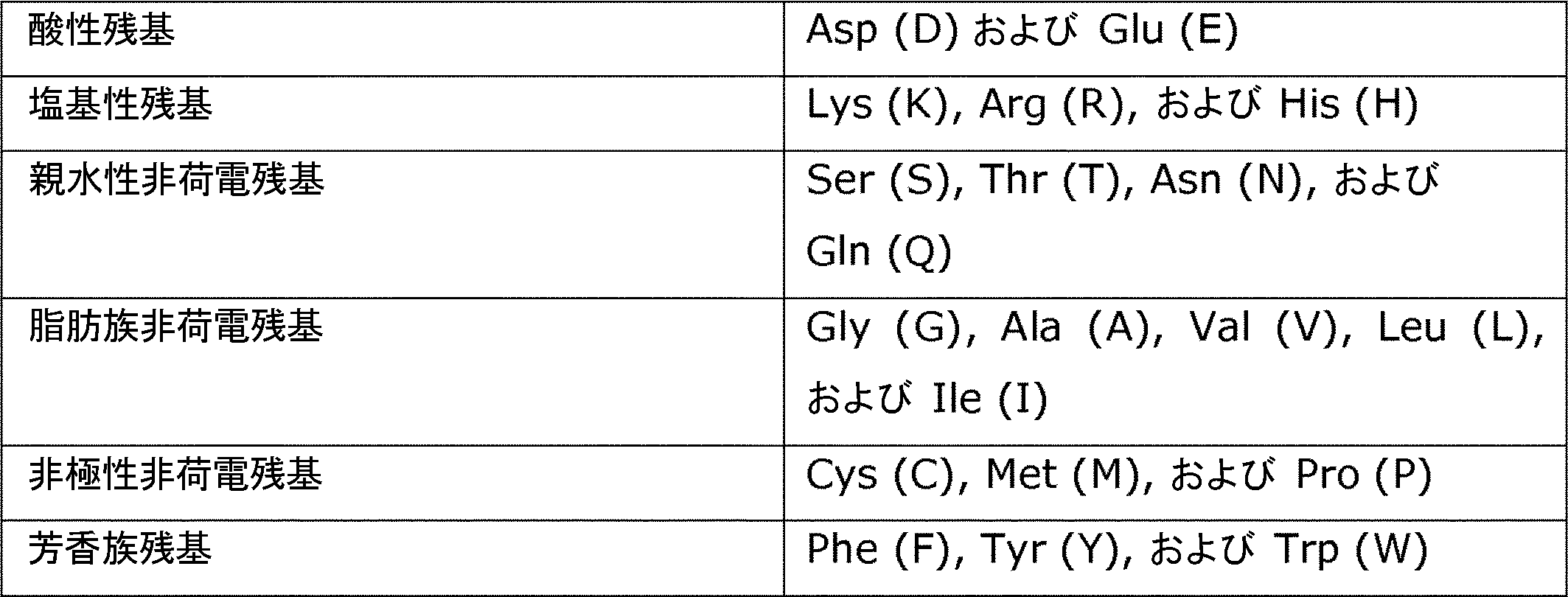
本発明に関して、別段の指示がない限り、変異を説明するために以下の表記が使用される。i)所与の位置のアミノ酸の置換は、例えばK409Rのように記される(位置409のリシンのアルギニンによる置換を意味する);ii)特定のバリアントの場合、任意のアミノ酸残基を示すために指定の3または1文字コード、例えばコードXaaおよびXが使用される。例えば、位置409のリシンのアルギニンによる置換はK409Rと指定され;位置409のリシンの任意のアミノ酸残基による置換はK409Xと指定される。位置409のリシンの欠失の場合、それはK409*によって示される。 In the context of the present invention, unless otherwise indicated, the following notations are used to describe mutations: i) substitution of an amino acid at a given position is noted, for example, K409R (meaning substitution of lysine at position 409 with arginine); ii) in the case of a particular variant, a designated three- or one-letter code is used to indicate any amino acid residue, for example the codes Xaa and X. For example, substitution of lysine at position 409 with arginine is designated K409R; substitution of lysine at position 409 with any amino acid residue is designated K409X. In case of deletion of lysine at position 409, it is indicated by K409*.
本明細書において使用される語「組換え宿主細胞」(または単に「宿主細胞」)は、発現ベクター、例えば本発明において用いられる抗体をコードする発現ベクターが中に導入された細胞を指すことを意図する。組換え宿主細胞は、例えば、トランスフェクトーマ、例えばCHO、CHO-S、HEK、HEK293、HEK-293F、Expi293F、PER.C6、またはNS0細胞およびリンパ球細胞を含む。 As used herein, the term "recombinant host cell" (or simply "host cell") is intended to refer to a cell into which an expression vector has been introduced, such as an expression vector encoding an antibody used in the present invention. Recombinant host cells include, for example, transfectomas, such as CHO, CHO-S, HEK, HEK293, HEK-293F, Expi293F, PER.C6, or NS0 cells, and lymphocytic cells.
語「治療」とは、症状または疾患状態を緩和する、改善する、抑制する、または根絶する(治癒する)目的をもって、有効量の本発明の医薬組成物を投与することをいう。 The term "treatment" refers to the administration of an effective amount of a pharmaceutical composition of the present invention with the intent to alleviate, ameliorate, inhibit, or eradicate (cure) a symptom or disease state.
語「有効量」または「治療有効量」とは、必要な用量および期間で所望の治療結果を達成するのに有効な量をいう。二重特異性抗体の治療有効量は、疾患状態、個体の年齢、性別、および体重、ならびに個体において所望の反応を誘発する二重特異性抗体の能力などの要因にしたがって異なり得る。治療有効量はまた、抗体または抗体部分の任意の毒性または有害作用よりも治療的に有益な効果が勝る量である。 The term "effective amount" or "therapeutically effective amount" refers to an amount effective to achieve a desired therapeutic result at the dosage and duration required. A therapeutically effective amount of a bispecific antibody may vary according to factors such as the disease state, the age, sex, and weight of the individual, and the ability of the bispecific antibody to elicit a desired response in the individual. A therapeutically effective amount is also an amount in which any toxic or adverse effects of the antibody or antibody portion are outweighed by the therapeutically beneficial effects.
発明の態様
上記のように、主要な局面において、本発明は、
a)二重特異性抗体、
b)ヒスチジン緩衝液、
c)50~300 mMの糖および/または50~300 mMのポリオール、ならびに
d)0.01~0.1%のポリソルベート80
を含む医薬組成物であって、
該組成物のpHが4.5~6.8であり、かつ
該二重特異性抗体が、SEQ ID NO: 62の配列を有するヒトCD37に結合する第一および第二の抗原結合領域、ならびにヒト免疫グロブリンの第一および第二のFc領域を含み、該第一および第二のFc領域が1つまたは複数のアミノ酸変異を含み、該変異が、膜結合標的への結合時の二重特異性抗体間のFc-Fc相互作用を、該変異を有しない二重特異性抗体間のFc-Fc相互作用と比べて増強し、該第一の抗原結合領域が、CDR配列:
SEQ ID NO: 16に記載のVH CDR1配列、
SEQ ID NO: 17に記載のVH CDR2配列、
SEQ ID NO: 18に記載のVH CDR3配列、
SEQ ID NO: 20に記載のVL CDR1配列、
KASであるVL CDR2配列、および
SEQ ID NO: 21に記載のVL CDR3配列
を含み、かつ該第二の抗原結合領域が、CDR配列:
SEQ ID NO: 23に記載のVH CDR1配列、
SEQ ID NO: 24に記載のVH CDR2配列、
SEQ ID NO: 25に記載のVH CDR3配列、
SEQ ID NO: 27に記載のVL CDR1配列、
YASであるVL CDR2配列、および
SEQ ID NO: 31に記載のVL CDR3配列
を含む、前記医薬組成物に関する。
As described above, in a main aspect, the present invention provides a method for producing a method for the treatment of a pulmonary arthritis, comprising:
a) bispecific antibodies;
b) histidine buffer;
c) 50-300 mM sugar and/or 50-300 mM polyol, and
d) 0.01 to 0.1
A pharmaceutical composition comprising:
the pH of the composition is between 4.5 and 6.8; and the bispecific antibody comprises first and second antigen-binding regions that bind human CD37 having the sequence of SEQ ID NO: 62, and first and second Fc regions of a human immunoglobulin, the first and second Fc regions comprising one or more amino acid mutations that enhance Fc-Fc interactions between the bispecific antibodies upon binding to a membrane-bound target compared to Fc-Fc interactions between bispecific antibodies not comprising the mutations, and the first antigen-binding region comprises the CDR sequence:
VH CDR1 sequence as set forth in SEQ ID NO: 16;
VH CDR2 sequence as set forth in SEQ ID NO: 17;
VH CDR3 sequence as set forth in SEQ ID NO: 18;
The VL CDR1 sequence according to SEQ ID NO: 20;
a VL CDR2 sequence that is a KAS; and
The second antigen-binding region comprises a VL CDR3 sequence as set forth in SEQ ID NO: 21, and the second antigen-binding region comprises the CDR sequence:
VH CDR1 sequence as set forth in SEQ ID NO: 23;
VH CDR2 sequence as set forth in SEQ ID NO: 24;
VH CDR3 sequence as set forth in SEQ ID NO: 25;
The VL CDR1 sequence set forth in SEQ ID NO: 27;
a VL CDR2 sequence which is YAS, and
The pharmaceutical composition comprises the VL CDR3 sequence set forth in SEQ ID NO: 31.
本発明の医薬組成物に含まれる二重特異性抗CD37抗体は、CD37上の2つの異なるエピトープに結合する。2つのエピトープは、両方の結合アームが同じタンパク質分子に結合することができ、したがって、各結合アームが、二重特異性分子の他方のアームの結合を遮断しない、かつ/または結合に関して二重特異性分子の他方の結合アームと競合しないようなエピトープである。また、二重特異性抗体は、2つ以上の二重特異性抗体分子の間のFc-Fc相互作用を増強する変異を含む。これは、二重特異性分子が、標的細胞の細胞膜上に発現したCD37への結合時にオリゴマーを形成する効果を有する。Fc-Fc相互作用は、変異を除いては同一である分子と比べて増強される。好ましくは、変異は、二重特異性分子のFc領域にある。一態様において、それは、二重特異性分子のFc領域中の単一のアミノ酸置換である。それは、好ましくは対称な置換であり、これは、両方の半分子(親抗体)が変異を有することを意味する。本二重特異性抗体のさらなる利点は、それが、Fc-Fc相互作用増強変異を有しない同一の二重特異性分子と比べて増強されたCDCおよび/またはADCCエフェクター機能を有するということである。驚くことに、二重特異性分子はまた、増強されたFc-Fc相互作用を有するように変異した2つの親モノクローナル抗CD37抗体の組み合わせと比べて改善されたCDCおよび/またはADCCを有し、かつ、増強されたFc-Fc相互作用を有するように変異したいずれかの親モノクローナル抗CD37抗体単独と比べても、改善されたCDCおよび/またはADCCを有する。したがって、二重特異性抗体は、CDCおよび/またはADCCの誘導において、第一の抗原結合領域を有する抗体と、第二の抗原結合領域を有する第二の抗体との組み合わせ(両抗体はFc-Fc相互作用増強変異を含む)よりも、または、第一もしくは第二の抗原結合領域を有し、Fc-Fc相互作用増強変異を含む単一のモノクローナル抗CD37抗体と比べて、より強力である。 The bispecific anti-CD37 antibody contained in the pharmaceutical composition of the present invention binds to two different epitopes on CD37. The two epitopes are such that both binding arms can bind to the same protein molecule and thus each binding arm does not block the binding of the other arm of the bispecific molecule and/or does not compete with the other binding arm of the bispecific molecule for binding. The bispecific antibody also contains a mutation that enhances the Fc-Fc interaction between two or more bispecific antibody molecules. This has the effect that the bispecific molecule forms an oligomer upon binding to CD37 expressed on the cell membrane of the target cell. The Fc-Fc interaction is enhanced compared to a molecule that is identical except for the mutation. Preferably, the mutation is in the Fc region of the bispecific molecule. In one embodiment, it is a single amino acid substitution in the Fc region of the bispecific molecule. It is preferably a symmetric substitution, which means that both half molecules (parent antibodies) have the mutation. A further advantage of the bispecific antibody is that it has enhanced CDC and/or ADCC effector function compared to the same bispecific molecule without the Fc-Fc interaction enhancing mutation. Surprisingly, the bispecific molecule also has improved CDC and/or ADCC compared to the combination of two parent monoclonal anti-CD37 antibodies mutated to have enhanced Fc-Fc interactions, and also compared to either parent monoclonal anti-CD37 antibody alone mutated to have enhanced Fc-Fc interactions. Thus, the bispecific antibody is more potent in inducing CDC and/or ADCC than a combination of an antibody having a first antigen binding region and a second antibody having a second antigen binding region, both antibodies containing Fc-Fc interaction enhancing mutations, or compared to a single monoclonal anti-CD37 antibody having either the first or second antigen binding region and containing Fc-Fc interaction enhancing mutations.
本発明はまた、CD37に結合する結合アームを有する抗体を含む、安定な医薬組成物も提供する。 The present invention also provides a stable pharmaceutical composition comprising an antibody having a binding arm that binds to CD37.
したがって、一局面において、本発明は、
i)抗体、
j)ヒスチジン緩衝液、
k)50~300 mMの糖および/または50~300 mMのポリオール、ならびに
l)0.01~0.1%のポリソルベート80
を含む医薬組成物であって、
該組成物のpHが4.5~6.8であり、かつ
該抗体が、SEQ ID NO: 62の配列を有するヒトCD37に結合する第一の抗原結合領域、ならびにヒト免疫グロブリンの第一および第二のFc領域を含み、該第一および第二のFc領域が1つまたは複数のアミノ酸変異を含み、該変異が、膜結合標的への結合時の抗体間のFc-Fc相互作用を、該変異を有しない二重特異性抗体間のFc-Fc相互作用と比べて増強し、該第一の抗原結合領域が、CDR配列:
SEQ ID NO: 16に記載のVH CDR1配列、
SEQ ID NO: 17に記載のVH CDR2配列、
SEQ ID NO: 18に記載のVH CDR3配列、
SEQ ID NO: 20に記載のVL CDR1配列、
KASであるVL CDR2配列、および
SEQ ID NO: 21に記載のVL CDR3配列
を含む、前記医薬組成物に関する。
Thus, in one aspect, the present invention provides a method for producing a composition comprising:
i) antibodies,
j) histidine buffer;
k) 50-300 mM sugar and/or 50-300 mM polyol, and
l) 0.01-0.1
A pharmaceutical composition comprising:
the antibody comprises a first antigen-binding region that binds human CD37 having the sequence of SEQ ID NO: 62, and a first and a second Fc region of a human immunoglobulin, the first and second Fc regions comprising one or more amino acid mutations that enhance Fc-Fc interactions between the antibodies upon binding to a membrane-bound target compared to Fc-Fc interactions between bispecific antibodies not having the mutations, the first antigen-binding region comprising the CDR sequence:
VH CDR1 sequence as set forth in SEQ ID NO: 16;
VH CDR2 sequence as set forth in SEQ ID NO: 17;
VH CDR3 sequence as set forth in SEQ ID NO: 18;
The VL CDR1 sequence according to SEQ ID NO: 20;
a VL CDR2 sequence that is a KAS, and
The pharmaceutical composition comprises the VL CDR3 sequence set forth in SEQ ID NO: 21.
さらなる局面において、本発明は、
m)抗体、
n)ヒスチジン緩衝液、
o)50~300 mMの糖および/または50~300 mMのポリオール、ならびに
p)0.01~0.1%のポリソルベート80
を含む医薬組成物であって、
該組成物のpHが4.5~6.8であり、かつ
該抗体が、SEQ ID NO: 62の配列を有するヒトCD37に結合する第二の抗原結合領域、ならびにヒト免疫グロブリンの第一および第二のFc領域を含み、該第一および第二のFc領域が1つまたは複数のアミノ酸変異を含み、該変異が、膜結合標的への結合時の抗体間のFc-Fc相互作用を、該変異を有しない二重特異性抗体間のFc-Fc相互作用と比べて増強し、該第二の抗原結合領域が、CDR配列:
SEQ ID NO: 23に記載のVH CDR1配列、
SEQ ID NO: 24に記載のVH CDR2配列、
SEQ ID NO: 25に記載のVH CDR3配列、
SEQ ID NO: 27に記載のVL CDR1配列、
YASであるVL CDR2配列、および
SEQ ID NO: 31に記載のVL CDR3配列
を含む、前記医薬組成物に関する。
In a further aspect, the present invention provides a method for producing a method for treating a cancer cell comprising the steps of:
m) antibodies,
n) histidine buffer;
o) 50-300 mM sugar and/or 50-300 mM polyol, and
p) 0.01 to 0.1
A pharmaceutical composition comprising:
the antibody comprises a second antigen-binding region that binds human CD37 having the sequence of SEQ ID NO: 62, and a first and a second Fc region of a human immunoglobulin, the first and second Fc regions comprising one or more amino acid mutations that enhance Fc-Fc interactions between the antibodies upon binding to a membrane-bound target compared to Fc-Fc interactions between bispecific antibodies not having the mutations, the second antigen-binding region comprising the CDR sequence:
VH CDR1 sequence as set forth in SEQ ID NO: 23;
VH CDR2 sequence as set forth in SEQ ID NO: 24;
VH CDR3 sequence as set forth in SEQ ID NO: 25;
The VL CDR1 sequence set forth in SEQ ID NO: 27;
a VL CDR2 sequence which is YAS, and
The pharmaceutical composition comprises the VL CDR3 sequence set forth in SEQ ID NO: 31.
一態様において、本発明の医薬組成物は、5~100 mg/mLの二重特異性抗体、例えば10~50 mg/mLの二重特異性抗体、例えば10~30 mg/mLの二重特異性抗体、例えば20 mg/mLの二重特異性抗体を含む。 In one embodiment, the pharmaceutical composition of the invention comprises 5-100 mg/mL of the bispecific antibody, such as 10-50 mg/mL of the bispecific antibody, such as 10-30 mg/mL of the bispecific antibody, such as 20 mg/mL of the bispecific antibody.
一態様において、本発明の医薬組成物は、5~100 mg/mLの抗体、例えば10~50 mg/mLの抗体、例えば10~30 mg/mLの抗体、例えば20 mg/mLの抗体を含む。 In one embodiment, the pharmaceutical composition of the invention comprises 5-100 mg/mL of antibody, e.g., 10-50 mg/mL of antibody, e.g., 10-30 mg/mL of antibody, e.g., 20 mg/mL of antibody.
一態様において、本発明の医薬組成物は、10~100 mMのヒスチジン、例えば10~50 mMのヒスチジン、例えば10~30 mMのヒスチジン、例えば20 mMのヒスチジンを含む。一態様において、ヒスチジンはヒスチジン-HClである。 In one embodiment, the pharmaceutical composition of the invention comprises 10-100 mM histidine, such as 10-50 mM histidine, such as 10-30 mM histidine, such as 20 mM histidine. In one embodiment, the histidine is histidine-HCl.
一態様において、本発明の医薬組成物は、スクロースまたはトレハロースなどの糖を含む。一態様において、糖はスクロースであり、医薬組成物は、75~275 mMのスクロース、例えば100~250 mM、例えば100 mMのスクロースまたは250 mMのスクロースを含む。そのさらなる態様において、医薬組成物はポリオールを含まない。 In one embodiment, the pharmaceutical composition of the invention comprises a sugar such as sucrose or trehalose. In one embodiment, the sugar is sucrose and the pharmaceutical composition comprises 75-275 mM sucrose, such as 100-250 mM, such as 100 mM sucrose or 250 mM sucrose. In a further embodiment thereof, the pharmaceutical composition does not comprise a polyol.
別の態様において、発明の医薬組成物は、ソルビトールまたはマンニトールであるポリオールを含み、該医薬組成物は、好ましくは、75~275 mMのソルビトールまたは75~275 mMのマンニトール、例えば100~250 mMのソルビトールまたは100~250 mMのマンニトール、例えば、100 mMのソルビトールまたは100 mMのマンニトールまたは250 mMのソルビトールまたは100 mMのマンニトールを含む。そのさらなる態様において、医薬組成物は糖を含まない。 In another embodiment, the pharmaceutical composition of the invention comprises a polyol which is sorbitol or mannitol, the pharmaceutical composition preferably comprising 75-275 mM sorbitol or 75-275 mM mannitol, such as 100-250 mM sorbitol or 100-250 mM mannitol, such as 100 mM sorbitol or 100 mM mannitol or 250 mM sorbitol or 100 mM mannitol. In a further embodiment thereof, the pharmaceutical composition does not comprise a sugar.
一態様において、本発明の医薬組成物は、0.01~0.05%のポリソルベート80(Tween 80)、例えば0.01%~0.04%のポリソルベート80、例えば0.02%のポリソルベート80または0.04%のポリソルベート80を含む。
In one embodiment, the pharmaceutical composition of the invention comprises 0.01-0.05% polysorbate 80 (Tween 80), e.g., 0.01%-0.04
一態様において、本発明の医薬組成物は、5.5~6.5、例えば5.5または6.5のpHを有する。 In one embodiment, the pharmaceutical composition of the present invention has a pH of 5.5 to 6.5, for example 5.5 or 6.5.
一態様において、本発明の医薬組成物は、5.5~6.5、例えば5.6~6.4または5.7~6.3など、例えば5.8~6.2、例えば5.9~6.1のpHを有する。 In one embodiment, the pharmaceutical composition of the invention has a pH of 5.5 to 6.5, such as 5.6 to 6.4 or 5.7 to 6.3, for example 5.8 to 6.2, such as 5.9 to 6.1.
一態様において、本発明の医薬組成物は、約6のpHを有する。 In one embodiment, the pharmaceutical composition of the present invention has a pH of about 6.
一態様において、本発明の医薬組成物、組成物は、塩化ナトリウム、例えば25~250 mMの塩化ナトリウム、例えば100~150 mMの塩化ナトリウム、例えば100 mMまたは150 mMの塩化ナトリウムをさらに含む。 In one embodiment, the pharmaceutical composition of the present invention, the composition further comprises sodium chloride, for example 25 to 250 mM sodium chloride, for example 100 to 150 mM sodium chloride, for example 100 mM or 150 mM sodium chloride.
一態様において、本発明の医薬組成物は、アルギニン、例えば25~200 mMのアルギニン、例えば50~100 mMのアルギニン、例えば75 mMのアルギニンをさらに含む。一態様において、アルギニンはアルギニン-HClである。 In one embodiment, the pharmaceutical composition of the invention further comprises arginine, e.g., 25-200 mM arginine, e.g., 50-100 mM arginine, e.g., 75 mM arginine. In one embodiment, the arginine is arginine-HCl.
一態様において、本発明の医薬組成物は、
a)pH 5.5~6.5で、20 mg/mLの二重特異性抗体、20 mMのヒスチジン、250 mMのスクロース、および0.02%もしくは0.04%のポリソルベート80を含む、または
b)pH 5.5~6.5で、20 mg/mLの二重特異性抗体、20 mMのヒスチジン、100 mMのスクロース、0.02%もしくは0.04%のポリソルベート80、および100~150 mM、好ましくは100 mMの塩化ナトリウムを含む、または
c)pH 5.5~6.5で、20 mg/mLの二重特異性抗体、20 mMのヒスチジン、100 mMのスクロース、0.02%もしくは0.04%のポリソルベート80、75 mMのアルギニン、および100~150 mM、好ましくは100 mMの塩化ナトリウムを含む、または
d)pH 5.5~6.5で、20 mg/mLの二重特異性抗体、20 mMのヒスチジン、100 mMのスクロース、0.02%もしくは0.04%のポリソルベート80、および75 mMのアルギニンを含む。
In one embodiment, the pharmaceutical composition of the present invention comprises:
a) 20 mg/mL bispecific antibody, 20 mM histidine, 250 mM sucrose, and 0.02% or 0.04
b) 20 mg/mL of bispecific antibody, 20 mM histidine, 100 mM sucrose, 0.02% or 0.04
c) 20 mg/mL of bispecific antibody, 20 mM histidine, 100 mM sucrose, 0.02% or 0.04
d) 20 mg/mL bispecific antibody, 20 mM histidine, 100 mM sucrose, 0.02% or 0.04
さらなる態様において、本発明の医薬組成物は、水溶液中の以下の成分からなる:
a)pH 5.5~6.5で、20 mg/mLの二重特異性抗体、20 mMのヒスチジン、250 mMのスクロース、および0.02%もしくは0.04%のポリソルベート80、または
b)pH 5.5~6.5で、20 mg/mLの二重特異性抗体、20 mMのヒスチジン、100 mMのスクロース、0.02%もしくは0.04%のポリソルベート80、および100~150 mM、好ましくは100 mMの塩化ナトリウム、または
c)pH 5.5~6.5で、20 mg/mLの二重特異性抗体、20 mMのヒスチジン、100 mMのスクロース、0.02%もしくは0.04%のポリソルベート80、75 mMのアルギニン、および100~150 mM、好ましくは100 mMの塩化ナトリウム、または
d)pH 5.5~6.5で、20 mg/mLの二重特異性抗体、20 mMのヒスチジン、100 mMのスクロース、0.02%もしくは0.04%のポリソルベート80、および75 mMのアルギニン。
In a further embodiment, the pharmaceutical composition of the invention consists of the following components in aqueous solution:
a) 20 mg/mL bispecific antibody, 20 mM histidine, 250 mM sucrose, and 0.02% or 0.04
b) 20 mg/mL bispecific antibody, 20 mM histidine, 100 mM sucrose, 0.02% or 0.04
c) 20 mg/mL bispecific antibody, 20 mM histidine, 100 mM sucrose, 0.02% or 0.04
d) 20 mg/mL bispecific antibody, 20 mM histidine, 100 mM sucrose, 0.02% or 0.04
本発明のさらなる態様において、二重特異性抗体の第一の抗原結合領域は、以下のVHおよびVL配列:
i)SEQ ID NO: 15に記載のVH配列、およびSEQ ID NO: 19に記載のVL配列、または
ii)該第一の抗原結合領域のVH CDR1、VH CDR2、VH CDR3、VL CDR1、VL CDR2、およびVL CDR3の配列が、
SEQ ID NO: 16に記載のVH CDR1配列、
SEQ ID NO: 17に記載のVH CDR2配列、
SEQ ID NO: 18に記載のVH CDR3配列、
SEQ ID NO: 20に記載のVL CDR1配列、
KASであるVL CDR2配列、および
SEQ ID NO: 21に記載のVL CDR3配列
のままであるという条件で、SEQ ID NO: 15および19のVH配列およびVL配列に対して、少なくとも90%の同一性、例えば少なくとも95%の同一性、例えば少なくとも98%の同一性、例えば少なくとも99%の同一性を有するVH配列、および少なくとも90%の同一性、例えば少なくとも95%の同一性、例えば少なくとも98%の同一性、例えば少なくとも99%の同一性を有するVL配列
を含む。
In a further embodiment of the invention, the first antigen-binding region of the bispecific antibody has the following VH and VL sequences:
i) the VH sequence set forth in SEQ ID NO: 15 and the VL sequence set forth in SEQ ID NO: 19, or
ii) the sequences of the VH CDR1, VH CDR2, VH CDR3, VL CDR1, VL CDR2, and VL CDR3 of the first antigen-binding region are
VH CDR1 sequence as set forth in SEQ ID NO: 16;
VH CDR2 sequence as set forth in SEQ ID NO: 17;
VH CDR3 sequence as set forth in SEQ ID NO: 18;
The VL CDR1 sequence according to SEQ ID NO: 20;
a VL CDR2 sequence that is a KAS, and
Provided that the VL CDR3 sequence as set forth in SEQ ID NO:21 remains the VH sequence having at least 90% identity, such as at least 95% identity, such as at least 98% identity, such as at least 99% identity, and the VL sequence having at least 90% identity, such as at least 95% identity, such as at least 98% identity, such as at least 99% identity, to the VH and VL sequences of SEQ ID NO:15 and 19,
本発明の別の態様において、二重特異性抗体の第一の抗原結合領域は、以下のVHおよびVL配列:
iii)SEQ ID NO: 15に記載のVH配列、およびSEQ ID NO: 127に記載のVL配列、または
iv)該第一の抗原結合領域のVH CDR1、VH CDR2、VH CDR3、VL CDR1、VL CDR2、およびVL CDR3の配列が、
SEQ ID NO: 16に記載のVH CDR1配列、
SEQ ID NO: 17に記載のVH CDR2配列、
SEQ ID NO: 18に記載のVH CDR3配列、
SEQ ID NO: 20に記載のVL CDR1配列、
KASであるVL CDR2配列、および
SEQ ID NO: 21に記載のVL CDR3配列
のままであるという条件で、SEQ ID NO: 15および19のVH配列およびVL配列に対して、少なくとも90%の同一性、例えば少なくとも95%の同一性、例えば少なくとも98%の同一性、例えば少なくとも99%の同一性を有するVH配列、および少なくとも90%の同一性、例えば少なくとも95%の同一性、例えば少なくとも98%の同一性、例えば少なくとも99%の同一性を有するVL配列
を含む。
In another embodiment of the invention, the first antigen-binding region of the bispecific antibody has the following VH and VL sequences:
iii) the VH sequence set forth in SEQ ID NO: 15 and the VL sequence set forth in SEQ ID NO: 127; or
iv) the sequences of the VH CDR1, VH CDR2, VH CDR3, VL CDR1, VL CDR2, and VL CDR3 of the first antigen-binding region are
VH CDR1 sequence as set forth in SEQ ID NO: 16;
VH CDR2 sequence as set forth in SEQ ID NO: 17;
VH CDR3 sequence as set forth in SEQ ID NO: 18;
The VL CDR1 sequence according to SEQ ID NO: 20;
a VL CDR2 sequence that is a KAS, and
Provided that the VL CDR3 sequence as set forth in SEQ ID NO:21 remains the VH sequence having at least 90% identity, such as at least 95% identity, such as at least 98% identity, such as at least 99% identity, and the VL sequence having at least 90% identity, such as at least 95% identity, such as at least 98% identity, such as at least 99% identity, to the VH and VL sequences of SEQ ID NO:15 and 19,
本発明のさらなる態様において、二重特異性抗体の第二の抗原結合領域は、
(i)SEQ ID NO: 22に記載のVH配列、およびSEQ ID NO: 29に記載のVL配列、または
(ii)該第二の抗原結合領域のVH CDR1、VH CDR2、VH CDR3、VL CDR1、VL CDR2、およびVL CDR3の配列が、
SEQ ID NO: 23に記載のVH CDR1配列、
SEQ ID NO: 24に記載のVH CDR2配列、
SEQ ID NO: 25に記載のVH CDR3配列、
SEQ ID NO: 27に記載のVL CDR1配列、
YASであるVL CDR2配列、および
SEQ ID NO: 31に記載のVL CDR3配列
のままであるという条件で、SEQ ID NO: 22および29のVH配列およびVL配列に対して、少なくとも90%の同一性、例えば少なくとも95%の同一性、例えば少なくとも98%の同一性、例えば少なくとも99%の同一性を有するVH配列、および少なくとも90%の同一性、例えば少なくとも95%の同一性、例えば少なくとも98%の同一性、例えば少なくとも99%の同一性を有するVL配列
を含む群より選択されるVHおよびVL配列を含む。
In a further embodiment of the invention, the second antigen-binding region of the bispecific antibody comprises
(i) the VH sequence set forth in SEQ ID NO: 22, and the VL sequence set forth in SEQ ID NO: 29; or (ii) the sequences of the VH CDR1, VH CDR2, VH CDR3, VL CDR1, VL CDR2, and VL CDR3 of the second antigen-binding region are
VH CDR1 sequence as set forth in SEQ ID NO: 23;
VH CDR2 sequence as set forth in SEQ ID NO: 24;
VH CDR3 sequence as set forth in SEQ ID NO: 25;
The VL CDR1 sequence set forth in SEQ ID NO: 27;
a VL CDR2 sequence which is YAS, and
The present invention also includes VH and VL sequences selected from the group comprising VH sequences having at least 90% identity, such as at least 95% identity, such as at least 98% identity, such as at least 99% identity, and VL sequences having at least 90% identity, such as at least 95% identity, such as at least 98% identity, such as at least 99% identity, to the VH and VL sequences of SEQ ID NOs: 22 and 29, provided that the VL CDR3 sequence as set forth in SEQ ID NO: 31 remains the same.
したがって、本発明の別の態様において、二重特異性抗体は、第一および第二の抗原結合領域を含み、該二重特異性抗体の第一の抗原結合領域は、抗体010のVHおよびVL配列(すなわちSEQ ID NO: 15および19)を含み、かつ該二重特異性抗体の第二の抗原結合領域は、抗体016のVHおよびVL配列(すなわちSEQ ID NO: 22および29)を含む。 Thus, in another embodiment of the invention, a bispecific antibody comprises a first and a second antigen-binding region, the first antigen-binding region of the bispecific antibody comprises the VH and VL sequences of antibody 010 (i.e., SEQ ID NOs: 15 and 19), and the second antigen-binding region of the bispecific antibody comprises the VH and VL sequences of antibody 016 (i.e., SEQ ID NOs: 22 and 29).
本発明の一態様において、二重特異性抗体は、第一および第二の抗原結合領域を含み、該二重特異性抗体の第一の抗原結合領域は、抗体010のVHおよびVL配列(すなわちSEQ ID NO: 15および127)を含み、かつ該二重特異性抗体の第二の抗原結合領域は、抗体016のVHおよびVL配列(すなわちSEQ ID NO: 22および29)を含む。 In one embodiment of the invention, a bispecific antibody comprises a first and a second antigen-binding region, the first antigen-binding region of the bispecific antibody comprises the VH and VL sequences of antibody 010 (i.e., SEQ ID NOs: 15 and 127), and the second antigen-binding region of the bispecific antibody comprises the VH and VL sequences of antibody 016 (i.e., SEQ ID NOs: 22 and 29).
本発明の好ましい態様において、二重特異性抗体は、第一および第二の抗原結合領域を含み、該二重特異性抗体の第一の抗原結合領域は、それぞれSEQ ID NO: 15および127に記載のVHおよびVL配列を含み、かつ該二重特異性抗体の第二の抗原結合領域は、それぞれSEQ ID NO: 22および29に記載のVHおよびVL配列を含む。 In a preferred embodiment of the invention, the bispecific antibody comprises a first and a second antigen-binding region, the first antigen-binding region of the bispecific antibody comprises the VH and VL sequences set forth in SEQ ID NOs: 15 and 127, respectively, and the second antigen-binding region of the bispecific antibody comprises the VH and VL sequences set forth in SEQ ID NOs: 22 and 29, respectively.
一態様において、二重特異性抗体の第一の抗原結合領域は、SEQ ID NO: 62(CD37)のアミノ酸Y182、D189、T191、I192、D194、K195、V196、I197、およびP199のうちの1つまたは複数を含む機能的エピトープを有する。別の態様において、前記第一の抗原結合領域は、SEQ ID NO: 62(CD37)のY182、D189、T191、I192、D194、K195、V196、I197、およびP199からなる群より選択されるアミノ酸のうちの1つまたは複数を含む機能的エピトープに結合する。さらなる態様において、二重特異性抗体の第一の抗原結合領域は、CD37上の機能的エピトープに結合し、SEQ ID NO: 62(CD37)の位置Y182、D189、T191、I192、D194、K195、V196、I197、およびP199に対応する位置のアミノ酸残基のうちの任意の1つまたは複数がアラニンで置換されている変異体CD37への結合は、SEQ ID NO: 62に記載のアミノ酸配列を有する野生型CD37と比べて減少し;結合の減少は、前記抗体の結合におけるzスコア(倍率変化)が-1.5未満であるとして決定され、結合におけるzスコア(倍率変化)は、実施例17に記されるように計算される。 In one embodiment, the first antigen-binding region of the bispecific antibody has a functional epitope comprising one or more of the amino acids Y182, D189, T191, I192, D194, K195, V196, I197, and P199 of SEQ ID NO: 62 (CD37). In another embodiment, the first antigen-binding region binds to a functional epitope comprising one or more of the amino acids selected from the group consisting of Y182, D189, T191, I192, D194, K195, V196, I197, and P199 of SEQ ID NO: 62 (CD37). In a further embodiment, the first antigen-binding region of the bispecific antibody binds to a functional epitope on CD37, and binding to a mutant CD37 in which any one or more of the amino acid residues at positions corresponding to positions Y182, D189, T191, I192, D194, K195, V196, I197, and P199 of SEQ ID NO: 62 (CD37) are substituted with alanine is reduced compared to wild-type CD37 having the amino acid sequence set forth in SEQ ID NO: 62; the reduced binding is determined as a z-score (fold change) in binding of the antibody being less than -1.5, and the z-score (fold change) in binding is calculated as described in Example 17.
本発明の一態様において、二重特異性抗体の第二の抗原結合領域は、SEQ ID NO: 62(CD37)のアミノ酸E124、F162、Q163、V164、L165、およびH175のうちの1つまたは複数を含む機能的エピトープを有する。別の態様において、前記第二の抗原結合領域は、SEQ ID NO: 62(CD37)のE124、F162、Q163、V164、L165、およびH175からなる群より選択されるアミノ酸のうちの1つまたは複数を含む機能的エピトープに結合する。さらなる態様において、二重特異性抗体の第二の抗原結合領域は、CD37上の機能的エピトープに結合し、SEQ ID NO: 62(CD37)の位置E124、F162、Q163、V164、L165、およびH175に対応する位置のアミノ酸残基のうちの任意の1つまたは複数がアラニンで置換されている変異体CD37への結合は、SEQ ID NO: 62に記載のアミノ酸配列を有する野生型CD37と比べて減少し;結合の減少は、前記抗体の結合におけるzスコア(倍率変化)が-1.5未満であるとして決定され、結合におけるzスコア(倍率変化)は、実施例17に記されるように計算される。 In one embodiment of the invention, the second antigen-binding region of the bispecific antibody has a functional epitope comprising one or more of the amino acids E124, F162, Q163, V164, L165, and H175 of SEQ ID NO: 62 (CD37). In another embodiment, the second antigen-binding region binds to a functional epitope comprising one or more of the amino acids selected from the group consisting of E124, F162, Q163, V164, L165, and H175 of SEQ ID NO: 62 (CD37). In a further embodiment, the second antigen-binding region of the bispecific antibody binds to a functional epitope on CD37 and has reduced binding to a mutant CD37 in which any one or more of the amino acid residues at positions corresponding to positions E124, F162, Q163, V164, L165, and H175 of SEQ ID NO: 62 (CD37) are substituted with alanine compared to wild-type CD37 having the amino acid sequence set forth in SEQ ID NO: 62; the reduced binding is determined as a z-score (fold change) in binding of the antibody being less than -1.5, and the z-score (fold change) in binding is calculated as described in Example 17.
Fc-Fc増強変異
本発明の一態様において、二重特異性抗体の前記第一および第二のFc領域中の1つまたは複数のFc-Fc相互作用増強変異はアミノ酸置換である。二重特異性抗体のFc領域は、2つの異なるFc領域(それぞれの親抗CD37抗体から1つずつ)を含むということができる。二重特異性抗体は、各半分子中に1つまたは複数のFc-Fc相互作用増強変異を含み得る。一態様において、Fc-Fc相互作用増強変異は対称である、すなわち2つのFc領域中に同一の変異が生じている。
Fc-Fc enhancing mutations In one embodiment of the present invention, one or more of the Fc-Fc interaction enhancing mutations in the first and second Fc regions of the bispecific antibody are amino acid substitutions. The Fc region of the bispecific antibody can be said to comprise two different Fc regions, one from each parent anti-CD37 antibody. The bispecific antibody can comprise one or more Fc-Fc interaction enhancing mutations in each half molecule. In one embodiment, the Fc-Fc interaction enhancing mutations are symmetric, i.e., the same mutations occur in the two Fc regions.
一態様において、本発明の医薬組成物は、前記第一および第二のFc領域中の1つまたは複数のFc-Fc相互作用増強変異が、ヒトIgG1中のEUナンバリングシステムを使用する場合のアミノ酸位置430、440、および345に対応する1つまたは複数の位置におけるアミノ酸置換である、二重特異性抗体を含む。一態様において、本発明の医薬組成物は、前記第一および第二のFc領域中の1つまたは複数のFc-Fc相互作用増強変異が、ヒトIgG1中のEUナンバリングシステムを使用する場合のアミノ酸位置430、440、および345に対応する1つまたは複数の位置におけるアミノ酸置換であり、ただし440における置換は440Yまたは440Wである、二重特異性抗体を含む。 In one embodiment, the pharmaceutical composition of the invention comprises a bispecific antibody, wherein the one or more Fc-Fc interaction enhancing mutations in the first and second Fc regions are amino acid substitutions at one or more positions corresponding to amino acid positions 430, 440, and 345 in human IgG1 using the EU numbering system. In one embodiment, the pharmaceutical composition of the invention comprises a bispecific antibody, wherein the one or more Fc-Fc interaction enhancing mutations in the first and second Fc regions are amino acid substitutions at one or more positions corresponding to amino acid positions 430, 440, and 345 in human IgG1 using the EU numbering system, with the proviso that the substitution at 440 is 440Y or 440W.
別の態様において、本発明の医薬組成物は、前記第一および第二のFc領域中に、E430G、E345K、E430S、E430F、E430T、E345Q、E345R、E345Y、S440Y、およびS440Wを含む群より選択される少なくとも1つの置換を含む二重特異性抗体を含む。特に好ましい態様において、二重特異性抗体は、前記第一および第二のFc領域中に、E430GまたはE345Kより選択され、好ましくはE430Gである少なくとも1つの置換を含む。本明細書により、前記変異を有する異なる抗体の間で増強されたFc-Fc相互作用を有する二重特異性抗体が提供される。この変異が、標的細胞上で抗体のオリゴマーを形成させ、それによってCDCを増強すると考えられる。 In another embodiment, the pharmaceutical composition of the present invention comprises a bispecific antibody comprising at least one substitution in the first and second Fc regions selected from the group comprising E430G, E345K, E430S, E430F, E430T, E345Q, E345R, E345Y, S440Y, and S440W. In a particularly preferred embodiment, the bispecific antibody comprises at least one substitution in the first and second Fc regions selected from E430G or E345K, preferably E430G. Hereby, a bispecific antibody is provided having enhanced Fc-Fc interactions between different antibodies having said mutations. It is believed that this mutation allows the formation of oligomers of antibodies on target cells, thereby enhancing CDC.
前記第一および第二のFc領域中のFc-Fc相互作用増強変異は同一の置換であることが好ましい。したがって、好ましい一態様において、二重特異性抗体は、両Fc領域中に同じFc-Fc相互作用増強変異を有する。Fc領域はFc鎖と記すこともでき、抗体は、その抗体の共通のFc領域を構成する2本のFc鎖を有する。したがって、好ましい態様において、2本のFc鎖それぞれは、ヒトIgG1中のEUナンバリングシステムを使用する場合のアミノ酸位置430、440、および345に対応する位置の群より選択される位置の置換を含む。一態様において、2本のFc鎖はそれぞれE430G置換を含み、その結果、二重特異性抗体は2つのE430G置換を含む。別の態様において、2本のFc鎖はそれぞれE345K置換を含み、その結果、二重特異性抗体は2つのE345K置換を含む。 The Fc-Fc interaction enhancing mutations in the first and second Fc regions are preferably identical substitutions. Thus, in a preferred embodiment, the bispecific antibody has the same Fc-Fc interaction enhancing mutations in both Fc regions. The Fc region can also be described as Fc chain, and the antibody has two Fc chains that constitute the common Fc region of the antibody. Thus, in a preferred embodiment, each of the two Fc chains comprises a substitution at a position selected from the group of positions corresponding to amino acid positions 430, 440, and 345 when using the EU numbering system in human IgG1. In one embodiment, each of the two Fc chains comprises an E430G substitution, such that the bispecific antibody comprises two E430G substitutions. In another embodiment, each of the two Fc chains comprises an E345K substitution, such that the bispecific antibody comprises two E345K substitutions.
本発明の態様において、二重特異性抗体はIgG1アイソタイプである。 In an embodiment of the invention, the bispecific antibody is of the IgG1 isotype.
本発明の態様において、二重特異性抗体はIgG2アイソタイプである。 In an embodiment of the invention, the bispecific antibody is of the IgG2 isotype.
本発明の態様において、二重特異性抗体はIgG3アイソタイプである。 In an embodiment of the invention, the bispecific antibody is of the IgG3 isotype.
本発明の態様において、二重特異性抗体はIgG4アイソタイプである。 In an embodiment of the invention, the bispecific antibody is of the IgG4 isotype.
本発明の態様において、二重特異性抗体はIgGアイソタイプである。 In an embodiment of the invention, the bispecific antibody is of the IgG isotype.
本発明の一態様において、二重特異性抗体は、アイソタイプIgG1、IgG2、IgG3、およびIgG4の組み合わせである。例えば、第一の親抗体から得られる第一の半抗体がIgG1アイソタイプであり得、第二の親抗体から得られる第二の半抗体がIgG4アイソタイプであり得、その結果、その二重特異性抗体はIgG1とIgG4との組み合わせである。別の態様において、二重特異性抗体はIgG1とIgG2との組み合わせである。別の態様において、二重特異性抗体はIgG1とIgG3との組み合わせである。別の態様において、二重特異性抗体はIgG2とIgG3との組み合わせである。別の態様において、二重特異性抗体はIgG2とIgG4との組み合わせである。別の態様において、二重特異性抗体はIgG3とIgG4との組み合わせである。一般的に、コアヒンジは、配列CPPCを有するIgG1タイプコアヒンジであるが、Fabアームがインビボで交換することを許さない(配列CPSCを有するIgG4コアヒンジの場合に当てはまる)安定な他のヒンジであることもできる。 In one embodiment of the invention, the bispecific antibody is a combination of isotypes IgG1, IgG2, IgG3, and IgG4. For example, the first half antibody obtained from the first parent antibody may be of IgG1 isotype and the second half antibody obtained from the second parent antibody may be of IgG4 isotype, so that the bispecific antibody is a combination of IgG1 and IgG4. In another embodiment, the bispecific antibody is a combination of IgG1 and IgG2. In another embodiment, the bispecific antibody is a combination of IgG1 and IgG3. In another embodiment, the bispecific antibody is a combination of IgG2 and IgG3. In another embodiment, the bispecific antibody is a combination of IgG2 and IgG4. In another embodiment, the bispecific antibody is a combination of IgG3 and IgG4. Generally, the core hinge is an IgG1 type core hinge with the sequence CPPC, but can also be other stable hinges that do not allow the Fab arms to exchange in vivo (as is the case for IgG4 core hinges with the sequence CPSC).
好ましい態様において、二重特異性抗体は完全長抗体である。 In a preferred embodiment, the bispecific antibody is a full-length antibody.
本発明のさらに別の態様において、二重特異性抗体はヒト抗体である。本発明のさらに別の態様において、二重特異性抗体はヒト化抗体である。本発明のさらに別の態様において、二重特異性抗体はキメラ抗体である。本発明の態様において、二重特異性抗体は、ヒト、ヒト化およびキメラの組み合わせである。例えば、第一の親抗体から得られる第一の半抗体はヒト抗体であり得、第二の親抗体から得られる第二の半抗体はヒト化抗体であり得、その結果、二重特異性抗体はヒトとヒト化との組み合わせである。 In yet another embodiment of the invention, the bispecific antibody is a human antibody. In yet another embodiment of the invention, the bispecific antibody is a humanized antibody. In yet another embodiment of the invention, the bispecific antibody is a chimeric antibody. In an embodiment of the invention, the bispecific antibody is a combination of human, humanized and chimeric. For example, a first half antibody derived from a first parent antibody can be a human antibody and a second half antibody derived from a second parent antibody can be a humanized antibody, such that the bispecific antibody is a combination of human and humanized.
本発明の好ましい態様において、二重特異性抗体は、それぞれSEQ ID NO: 62および63に記載の配列を有するヒトおよびカニクイザル両方のCD37に結合する。これは、同じ二重特異性分子を用いて前臨床毒性試験をカニクイザルにおいて実施し、それを後にヒトで試験することを可能にするため、好都合である。ヒト標的に対する抗体が動物モデルでは標的に結合しない場合、規制当局によって求められている、分子の前臨床毒性試験および非臨床安全性プロフィールを実施することは非常に困難である。 In a preferred embodiment of the invention, the bispecific antibody binds to both human and cynomolgus monkey CD37 having the sequences set forth in SEQ ID NOs: 62 and 63, respectively. This is advantageous as it allows preclinical toxicology studies to be performed in cynomolgus monkeys with the same bispecific molecule, which can then be tested in humans. If an antibody against a human target does not bind to the target in an animal model, it is very difficult to perform preclinical toxicology studies and nonclinical safety profiles of the molecule as required by regulatory authorities.
二重特異性抗体フォーマット
本発明は、CD37発現腫瘍細胞、例えばB細胞由来の腫瘍のCDCおよび/またはADCC媒介死滅を効率的に促進する二重特異性CD37×CD37抗体を含む医薬組成物を提供する。特定の使用に望まれる機能的性質に依存して、本明細書に記載されている抗体または抗原結合領域のセットから特定の抗原結合領域を選択することができる。二重特異性抗体の多くの異なるフォーマットおよび使用が当技術分野において公知であり、Kontermann; Drug Discov Today, 2015 Jul;20(7):838-47およびMAbs, 2012 Mar-Apr;4(2):182-97によって考察されている。
Bispecific antibody formats The present invention provides pharmaceutical compositions comprising bispecific CD37xCD37 antibodies that efficiently promote CDC and/or ADCC-mediated killing of CD37-expressing tumor cells, such as tumors of B-cell origin. Depending on the functional properties desired for a particular use, a particular antigen-binding region can be selected from the set of antibodies or antigen-binding regions described herein. Many different formats and uses of bispecific antibodies are known in the art and are discussed by Kontermann; Drug Discov Today, 2015 Jul;20(7):838-47 and MAbs, 2012 Mar-Apr;4(2):182-97.
本発明に関連する二重特異性抗体は、任意の特定の二重特異性フォーマットまたはその作製方法に限定されないが、当該二重特異性抗体は、増強されたFc-Fc相互作用を誘導するためにインタクトなFcドメインを有するべきである。 The bispecific antibodies related to the present invention are not limited to any particular bispecific format or method of production thereof, but the bispecific antibodies should have an intact Fc domain to induce enhanced Fc-Fc interactions.
本発明に使用され得る二重特異性抗体分子の例には、(i)異なる抗原結合領域を含む2つのアームを有する単一の抗体;(ii)各軽鎖および重鎖が短いペプチド結合を介して2つの可変ドメインを縦一列に含む二重可変ドメイン抗体(DVD-Ig)(Wu et al., Generation and Characterization of a Dual Variable Domain Immunoglobulin (DVD-IgTM) Molecule, In: Antibody Engineering, Springer Berlin Heidelberg (2010));(iii)プロテインキナーゼAにおける「二量体化およびドッキングドメイン」に基づくいわゆる「dock and lock」分子が含まれる。 Examples of bispecific antibody molecules that can be used in the present invention include: (i) a single antibody having two arms containing different antigen-binding regions; (ii) dual variable domain antibodies (DVD-Ig), in which each light and heavy chain contains two variable domains in tandem arranged via a short peptide bond (Wu et al., Generation and Characterization of a Dual Variable Domain Immunoglobulin (DVD-Ig ™ ) Molecule, In: Antibody Engineering, Springer Berlin Heidelberg (2010)); and (iii) so-called "dock and lock" molecules based on the "dimerization and docking domain" in protein kinase A.
一態様において、二重特異性抗体は、クロスボディ、すなわち、制御されたFabアーム交換を介して得られる二重特異性抗体である(例えば、WO2011131746(Genmab)に記載)。 In one embodiment, the bispecific antibody is a crossbody, i.e. a bispecific antibody obtained via controlled Fab arm exchange (e.g. as described in WO2011131746 (Genmab)).
二重特異性抗体の様々なクラスの例には、(i)ヘテロ二量体化を強いるための相補的CH3ドメインを有するIgG様分子;(ii)分子の2つの側それぞれが少なくとも2つの異なる抗体のFab断片またはFab断片の一部を含む組換えIgG様二重ターゲティング分子;(iii)完全長IgG抗体が余分なFab断片またはFab断片の一部に融合しているIgG融合分子;(iv)一本鎖Fv分子または安定化されたダイアボディが重鎖定常ドメイン、Fc領域またはその一部に融合しているFc融合分子;(v)異なるFab断片が互いに融合し、重鎖定常ドメイン、Fc領域またはその一部に融合しているFab融合分子;および(vi)異なる一本鎖Fv分子または異なるダイアボディまたは異なる重鎖抗体(例えばドメイン抗体、ナノボディ)がFc-に融合しているscFvおよびダイアボディベースの重鎖抗体(例えばドメイン抗体、ナノボディなど)が含まれるが、これらに限定されない。 Examples of different classes of bispecific antibodies include, but are not limited to, (i) IgG-like molecules with complementary CH3 domains to force heterodimerization; (ii) recombinant IgG-like dual targeting molecules, in which each of the two sides of the molecule contains a Fab fragment or a portion of a Fab fragment of at least two different antibodies; (iii) IgG fusion molecules, in which a full-length IgG antibody is fused to an extra Fab fragment or a portion of a Fab fragment; (iv) Fc fusion molecules, in which a single chain Fv molecule or a stabilized diabody is fused to a heavy chain constant domain, Fc region or a portion thereof; (v) Fab fusion molecules, in which different Fab fragments are fused to each other and to a heavy chain constant domain, Fc region or a portion thereof; and (vi) scFv and diabody-based heavy chain antibodies (e.g., domain antibodies, nanobodies, etc.) in which different single chain Fv molecules or different diabodies or different heavy chain antibodies (e.g., domain antibodies, nanobodies) are fused to the Fc-.
相補的CH3ドメインを有するIgG様分子の例には、Triomab/Quadroma分子(Trion Pharma/Fresenius Biotech;Roche、WO2011069104)、いわゆるKnobs-into-Holes分子(Genentech、WO9850431)、CrossMAb(Roche、WO2011117329)および静電操舵分子(Amgen、EP1870459およびWO2009089004;Chugai、US201000155133;Oncomed、WO2010129304)、LUZ-Y分子(Genentech、Wranik et al. J. Biol. Chem. 2012, 287(52): 43331-9, doi:10.1074/jbc.M112.397869. Epub 2012 Nov 1)、DIG-bodyおよびPIG-body分子(Pharmabcine、WO2010134666、WO2014081202)、Strand Exchange Engineered Domainボディ(SEEDbody)分子(EMD Serono、WO2007110205)、Biclonics分子(Merus、WO2013157953)、FcΔAdp分子(Regeneron、WO201015792)、ヒンジ操作二重特異性IgG1およびIgG2分子(Pfizer/Rinat、WO11143545)、Azymetric足場分子(Zymeworks/Merck、WO2012058768)、mAb-Fv分子(Xencor、WO2011028952)、二価二重特異性抗体(WO2009080254)およびDuoBody(登録商標)分子(Genmab A/S、WO2011131746)が含まれるが、これらに限定されない。 Examples of IgG-like molecules with complementary CH3 domains include Triomab/Quadroma molecules (Trion Pharma/Fresenius Biotech; Roche, WO2011069104), so-called Knobs-into-Holes molecules (Genentech, WO9850431), CrossMAb (Roche, WO2011117329) and electrostatic steering molecules (Amgen, EP1870459 and WO2009089004; Chugai, US201000155133; Oncomed, WO2010129304), LUZ-Y molecules (Genentech, Wranik et al. J. Biol. Chem. 2012, 287(52): 43331-9, doi:10.1074/jbc.M112.397869. Epub 2012 Nov 1), DIG-body and PIG-body molecules (Pharmabcine, WO2010134666, WO2014081202), Strand Exchange Engineered Domain body (SEEDbody) molecules (EMD Serono, WO2007110205), Biclonics molecules (Merus, WO2013157953), FcΔAdp molecules (Regeneron, WO201015792), hinge-engineered bispecific IgG1 and IgG2 molecules (Pfizer/Rinat, WO11143545), Azymetric scaffold molecules (Zymeworks/Merck, WO2012058768), mAb-Fv molecules (Xencor, WO2011028952), bivalent bispecific antibodies (WO2009080254) and DuoBody® molecules (Genmab A/S, WO2011131746).
組換えIgG様二重ターゲティング分子の例には、二重ターゲティング(DT)-Ig分子(WO2009058383)、Two-in-one Antibody(Genentech;Bostrom, et al 2009. Science 323, 1610-1614)、Cross-linked Mab(Karmanos Cancer Center)、mAb2(F-Star、WO2008003116)、Zybody分子(Zyngenia;LaFleur et al. MAbs. 2013 Mar-Apr;5(2):208-18)、共通の軽鎖を用いるアプローチ(Crucell/Merus、US7,262,028)、κλBodies(NovImmune、WO2012023053)およびCovX-body(CovX/Pfizer;Doppalapudi, V.R., et al 2007. Bioorg. Med. Chem. Lett. 17,501-506)が含まれるが、これらに限定されない。 Examples of recombinant IgG-like dual targeting molecules include dual targeting (DT)-Ig molecules (WO2009058383), Two-in-one Antibodies (Genentech; Bostrom, et al 2009. Science 323, 1610-1614), Cross-linked Mabs (Karmanos Cancer Center), mAb2 (F-Star, WO2008003116), Zybody molecules (Zyngenia; LaFleur et al. MAbs. 2013 Mar-Apr;5(2):208-18), common light chain approaches (Crucell/Merus, US7,262,028), κλBodies (NovImmune, WO2012023053) and CovX-body (CovX/Pfizer; Doppalapudi, V.R., et al 2007. Bioorg. Med. Chem. Lett. 17,501-506), but are not limited to these.
IgG融合分子の例には、Dual Variable Domain(DVD)-Ig分子(Abbott、US7,612,181)、Dualドメインダブルヘッド抗体(Unilever;Sanofi Aventis、WO2010/0226923)、IgG様Bispecific分子(ImClone/Eli Lilly、Lewis et al. Nat Biotechnol. 2014 Feb;32(2):191-8)、Ts2Ab(MedImmune/AZ;Dimasi et al. J Mol Biol. 2009 Oct 30;393(3):672-92)およびBsAb分子(Zymogenetics、WO2010111625)、HERCULES分子(Biogen Idec、US007951918)、scFv融合分子(Novartis)、scFv融合分子(Changzhou Adam Biotech Inc、CN102250246)ならびにTvAb分子(Roche、WO2012025525、WO2012025530)が含まれるが、これらに限定されない。
Examples of IgG fusion molecules include Dual Variable Domain (DVD)-Ig molecules (Abbott, US7,612,181), Dual Domain Double Headed Antibodies (Unilever; Sanofi Aventis, WO2010/0226923), IgG-like Bispecific molecules (ImClone/Eli Lilly, Lewis et al. Nat Biotechnol. 2014 Feb;32(2):191-8), Ts2Ab (MedImmune/AZ; Dimasi et al. J Mol Biol. 2009
Fc融合分子の例には、ScFv/Fc Fusions(Pearce et al., Biochem Mol Biol Int. 1997 Sep;42(6):1179-88)、SCORPION分子(Emergent BioSolutions/Trubion、Blankenship JW, et al. AACR 100th Annual meeting 2009 (Abstract #5465);Zymogenetics/BMS、WO2010111625)、Dual Affinity Retargeting Technology(Fc-DART)分子(MacroGenics、WO2008157379、WO2010080538)およびDual(ScFv)2-Fab分子(National Research Center for Antibody Medicine‐China)が含まれるが、これらに限定されない。 Examples of Fc fusion molecules include, but are not limited to, ScFv/Fc Fusions (Pearce et al., Biochem Mol Biol Int. 1997 Sep;42(6):1179-88), SCORPION molecules (Emergent BioSolutions/Trubion, Blankenship JW, et al. AACR 100th Annual meeting 2009 (Abstract #5465); Zymogenetics/BMS, WO2010111625), Dual Affinity Retargeting Technology (Fc-DART) molecules (MacroGenics, WO2008157379, WO2010080538) and Dual(ScFv)2-Fab molecules (National Research Center for Antibody Medicine‐China).
Fab融合二重特異性抗体の例には、F(ab)2分子(Medarex/AMGEN;Deo et al J Immunol. 1998 Feb 15;160(4):1677-86)、Dual-ActionまたはBis-Fab分子(Genentech、Bostrom, et al 2009. Science 323, 1610-1614)、Dock-and-Lock(DNL)分子(ImmunoMedics、WO2003074569、WO2005004809)、Bivalent Bispecific分子(Biotecnol、Schoonjans, J Immunol. 2000 Dec 15;165(12):7050-7)およびFab-Fv分子(UCB-Celltech, WO2009040562A1)が含まれるが、これらに限定されない。
Examples of Fab fusion bispecific antibodies include, but are not limited to, F(ab)2 molecules (Medarex/AMGEN; Deo et al J Immunol. 1998
scFvに基づく抗体、ダイアボディに基づく抗体、およびドメイン抗体の例には、Dual Affinity Retargeting Technology(DART)分子(MacroGenics、WO2008157379、WO2010080538)、COMBODY分子(Epigen Biotech、Zhu et al. Immunol Cell Biol. 2010 Aug;88(6):667-75)および二重ターゲティングナノボディ(Ablynx、Hmila et al., FASEB J. 2010)が含まれるが、これらに限定されない。 Examples of scFv-based antibodies, diabody-based antibodies, and domain antibodies include, but are not limited to, Dual Affinity Retargeting Technology (DART) molecules (MacroGenics, WO2008157379, WO2010080538), COMBODY molecules (Epigen Biotech, Zhu et al. Immunol Cell Biol. 2010 Aug;88(6):667-75), and dual targeting nanobodies (Ablynx, Hmila et al., FASEB J. 2010).
一局面において、本発明の医薬組成物に含まれる二重特異性抗体は、第一のCH3領域を含む第一のFc領域と、第二のCH3領域を含む第二のFc領域とを含み、第一および第二のCH3領域の配列が異なり、前記第一および第二のCH3領域の間のヘテロ二量体相互作用が前記第一および第二のCH3領域それぞれのホモ二量体相互作用よりも強いようなものである。これらの相互作用およびそれらを達成することができる方法に関するさらなる詳細は、参照により本明細書に組み入れられるWO2011131746およびWO2013060867(Genmab)に提供されている。 In one aspect, the bispecific antibody comprised in the pharmaceutical composition of the present invention comprises a first Fc region comprising a first CH3 region and a second Fc region comprising a second CH3 region, wherein the sequences of the first and second CH3 regions are distinct such that the heterodimeric interaction between said first and second CH3 regions is stronger than the homodimeric interaction of said first and second CH3 regions, respectively. Further details regarding these interactions and how they may be achieved are provided in WO2011131746 and WO2013060867 (Genmab), which are incorporated herein by reference.
本明細書にさらに記載されるように、1つのホモ二量体出発CD37抗体と、CH3領域中に少数のかなり保存的な非対称変異を含む別のホモ二量体出発CD37抗体とに基づく特定の方法を使用して、安定な二重特異性CD37×CD37抗体を高い収率で得ることができる。非対称変異とは、前記第一および第二のCH3領域の配列が非同一位置にアミノ酸置換を含み、その結果、第一および第二のCH3領域が異なるアミノ酸配列を有することを意味する。 As further described herein, a particular method based on one homodimeric starting CD37 antibody and another homodimeric starting CD37 antibody containing a small number of fairly conservative asymmetric mutations in the CH3 region can be used to obtain stable bispecific CD37xCD37 antibodies in high yields. Asymmetric mutations mean that the sequences of the first and second CH3 regions contain amino acid substitutions at non-identical positions, such that the first and second CH3 regions have different amino acid sequences.
一局面において、二重特異性抗体は第一および第二のFc領域を含み、前記第一および第二のFc領域それぞれが少なくともヒンジ領域、CH2領域およびCH3領域を含み、前記第一のFc領域中、ヒトIgG1重鎖中のT366、L368、K370、D399、F405、Y407、およびK409からなる群より選択される位置に対応する位置のアミノ酸の少なくとも1つが置換されており、前記第二のFc領域中、ヒトIgG1重鎖中のT366、L368、K370、D399、F405、Y407、およびK409からなる群より選択される位置に対応する位置のアミノ酸の少なくとも1つが置換されており、前記第一および第二のFc領域は同じ位置では置換されていない。 In one aspect, the bispecific antibody comprises a first and a second Fc region, each of the first and second Fc regions comprising at least a hinge region, a CH2 region and a CH3 region, wherein at least one amino acid in the first Fc region is substituted at a position corresponding to a position selected from the group consisting of T366, L368, K370, D399, F405, Y407 and K409 in a human IgG1 heavy chain, and wherein at least one amino acid in the second Fc region is substituted at a position corresponding to a position selected from the group consisting of T366, L368, K370, D399, F405, Y407 and K409 in a human IgG1 heavy chain, and wherein the first and second Fc regions are not substituted at the same position.
したがって、本発明の好ましい態様において、二重特異性抗体の第一のFc領域は、ヒトIgG1における位置F405に対応するアミノ酸の変異を含み、二重特異性抗体の第二のFc領域は、ヒトIgG1における位置K409に対応するアミノ酸のさらなる変異を含む。したがって、これらの変異は、上述のFc-Fc相互作用増強変異と比べて非対称である。 Thus, in a preferred embodiment of the invention, the first Fc region of the bispecific antibody comprises a mutation at an amino acid corresponding to position F405 in human IgG1, and the second Fc region of the bispecific antibody comprises a further mutation at an amino acid corresponding to position K409 in human IgG1. These mutations are therefore asymmetric compared to the Fc-Fc interaction enhancing mutations described above.
一態様において、第一のFc領域は位置366にアミノ酸置換を有し、前記第二のFc領域は、368、370、399、405、407、および409からなる群より選択される位置にアミノ酸置換を有する。一態様において、位置366のアミノ酸はAla、Asp、Glu、His、Asn、ValまたはGlnより選択される。 In one embodiment, the first Fc region has an amino acid substitution at position 366 and the second Fc region has an amino acid substitution at a position selected from the group consisting of 368, 370, 399, 405, 407, and 409. In one embodiment, the amino acid at position 366 is selected from Ala, Asp, Glu, His, Asn, Val, or Gln.
一態様において、第一のFc領域は位置368にアミノ酸置換を有し、前記第二のFc領域は、366、370、399、405、407、および409からなる群より選択される位置にアミノ酸置換を有する。 In one embodiment, the first Fc region has an amino acid substitution at position 368 and the second Fc region has an amino acid substitution at a position selected from the group consisting of 366, 370, 399, 405, 407, and 409.
一態様において、第一のFc領域は位置370にアミノ酸置換を有し、前記第二のFc領域は、366、368、399、405、407、および409からなる群より選択される位置にアミノ酸置換を有する。 In one embodiment, the first Fc region has an amino acid substitution at position 370 and the second Fc region has an amino acid substitution at a position selected from the group consisting of 366, 368, 399, 405, 407, and 409.
一態様において、第一のFc領域は位置399にアミノ酸置換を有し、前記第二のFc領域は、366、368、370、405、407、および409からなる群より選択される位置にアミノ酸置換を有する。 In one embodiment, the first Fc region has an amino acid substitution at position 399 and the second Fc region has an amino acid substitution at a position selected from the group consisting of 366, 368, 370, 405, 407, and 409.
一態様において、第一のFc領域は位置405にアミノ酸置換を有し、前記第二のFc領域は、366、368、370、399、407、および409からなる群より選択される位置にアミノ酸置換を有する。 In one embodiment, the first Fc region has an amino acid substitution at position 405 and the second Fc region has an amino acid substitution at a position selected from the group consisting of 366, 368, 370, 399, 407, and 409.
一態様において、第一のFc領域は位置407にアミノ酸置換を有し、前記第二のFc領域は、366、368、370、399、405および409からなる群より選択される位置にアミノ酸置換を有する。 In one embodiment, the first Fc region has an amino acid substitution at position 407 and the second Fc region has an amino acid substitution at a position selected from the group consisting of 366, 368, 370, 399, 405 and 409.
一態様において、第一のFc領域は位置409にアミノ酸置換を有し、前記第二のFc領域は、366、368、370、399、405および407からなる群より選択される位置にアミノ酸置換を有する。 In one embodiment, the first Fc region has an amino acid substitution at position 409 and the second Fc region has an amino acid substitution at a position selected from the group consisting of 366, 368, 370, 399, 405 and 407.
したがって、一態様において、前記第一および第二のFc領域の配列は、非対称変異、すなわち、2つのFc領域中の異なる位置における変異、例えば一方のFc領域中の位置405における変異および他方のFc領域中の位置409における変異を含む。 Thus, in one embodiment, the sequences of the first and second Fc regions contain asymmetric mutations, i.e., mutations at different positions in the two Fc regions, e.g., a mutation at position 405 in one Fc region and a mutation at position 409 in the other Fc region.
一態様において、第一のFc領域は、Lys、LeuまたはMet以外のアミノ酸、例えばGly、Ala、Val、Ile、Ser、Thr、Phe、Arg、His、Asp、Asn、Glu、Gln、Pro、Trp、TyrまたはCysを位置409に有し、前記第二のFc領域は、366、368、370、399、405および407からなる群より選択される位置にアミノ酸置換を有する。1つのそのような態様において、前記第一のFc領域は、Lys、LeuまたはMet以外のアミノ酸、例えばGly、Ala、Val、Ile、Ser、Thr、Phe、Arg、His、Asp、Asn、Glu、Gln、Pro、Trp、TyrまたはCysを位置409に有し、前記第二のFc領域は、Phe以外のアミノ酸、例えばGly、Ala、Val、Ile、Ser、Thr、Lys、Arg、His、Asp、Asn、Glu、Gln、Pro、Trp、Tyr、Cys、LysまたはLeuを位置405に有する。そのさらなる態様において、前記第一のFc領域は、Lys、LeuまたはMet以外のアミノ酸、例えばGly、Ala、Val、Ile、Ser、Thr、Phe、Arg、His、Asp、Asn、Glu、Gln、Pro、Trp、TyrまたはCysを位置409に有し、前記第二のFc領域は、Phe、ArgまたはGly以外のアミノ酸、例えばLeu、Ala、Val、Ile、Ser、Thr、Met、Lys、His、Asp、Asn、Glu、Gln、Pro、Trp、TyrまたはCysを位置405に有する。 In one embodiment, the first Fc region has an amino acid other than Lys, Leu or Met, e.g., Gly, Ala, Val, Ile, Ser, Thr, Phe, Arg, His, Asp, Asn, Glu, Gln, Pro, Trp, Tyr or Cys, at position 409, and the second Fc region has an amino acid substitution at a position selected from the group consisting of 366, 368, 370, 399, 405 and 407. In one such embodiment, the first Fc region has an amino acid other than Lys, Leu or Met at position 409, e.g., Gly, Ala, Val, Ile, Ser, Thr, Phe, Arg, His, Asp, Asn, Glu, Gln, Pro, Trp, Tyr or Cys, and the second Fc region has an amino acid other than Phe at position 405, e.g., Gly, Ala, Val, Ile, Ser, Thr, Lys, Arg, His, Asp, Asn, Glu, Gln, Pro, Trp, Tyr, Cys, Lys or Leu. In a further embodiment thereof, the first Fc region has an amino acid other than Lys, Leu or Met, e.g., Gly, Ala, Val, Ile, Ser, Thr, Phe, Arg, His, Asp, Asn, Glu, Gln, Pro, Trp, Tyr or Cys, at position 409, and the second Fc region has an amino acid other than Phe, Arg or Gly, e.g., Leu, Ala, Val, Ile, Ser, Thr, Met, Lys, His, Asp, Asn, Glu, Gln, Pro, Trp, Tyr or Cys, at position 405.
別の態様において、前記第一のFc領域は、Pheを位置405に含み、Lys、LeuまたはMet以外のアミノ酸、例えばGly、Ala、Val、Ile、Ser、Thr、Phe、Arg、His、Asp、Asn、Glu、Gln、Pro、Trp、TyrまたはCysを位置409に含み、前記第二のFc領域は、Phe以外のアミノ酸、例えばGly、Ala、Val、Ile、Ser、Thr、Lys、Arg、His、Asp、Asn、Glu、Gln、Pro、Trp、Tyr、Leu、MetまたはCysを位置405に含み、Lysを位置409に含む。そのさらなる態様において、前記第一のFc領域は、Pheを位置405に含み、Lys、LeuまたはMet以外のアミノ酸、例えばGly、Ala、Val、Ile、Ser、Thr、Phe、Arg、His、Asp、Asn、Glu、Gln、Pro、Trp、TyrまたはCysを位置409に含み、前記第二のFc領域は、Phe、ArgまたはGly以外のアミノ酸、例えばLeu、Ala、Val、Ile、Ser、Thr、Met、Lys、His、Asp、Asn、Glu、Gln、Pro、Trp、TyrまたはCysを位置405に含み、Lysを位置409に含む。 In another embodiment, the first Fc region comprises Phe at position 405 and an amino acid other than Lys, Leu or Met, e.g., Gly, Ala, Val, Ile, Ser, Thr, Phe, Arg, His, Asp, Asn, Glu, Gln, Pro, Trp, Tyr or Cys, at position 409, and the second Fc region comprises an amino acid other than Phe, e.g., Gly, Ala, Val, Ile, Ser, Thr, Lys, Arg, His, Asp, Asn, Glu, Gln, Pro, Trp, Tyr, Leu, Met or Cys, at position 405 and Lys at position 409. In a further embodiment thereof, the first Fc region comprises Phe at position 405 and an amino acid other than Lys, Leu or Met, e.g., Gly, Ala, Val, Ile, Ser, Thr, Phe, Arg, His, Asp, Asn, Glu, Gln, Pro, Trp, Tyr or Cys, at position 409, and the second Fc region comprises an amino acid other than Phe, Arg or Gly, e.g., Leu, Ala, Val, Ile, Ser, Thr, Met, Lys, His, Asp, Asn, Glu, Gln, Pro, Trp, Tyr or Cys, at position 405 and Lys at position 409.
別の態様において、前記第一のFc領域は、Pheを位置405に含み、Lys、LeuまたはMet以外のアミノ酸、例えばGly、Ala、Val、Ile、Ser、Thr、Phe、Arg、His、Asp、Asn、Glu、Gln、Pro、Trp、TyrまたはCysを位置409に含み、前記第二のFc領域は、Leuを位置405に含み、Lysを位置409に含む。そのさらなる態様において、前記第一のFc領域は、Pheを位置405に有し、Argsを位置409に含み、前記第二のFc領域は、Phe、ArgまたはGly以外のアミノ酸、例えばLeu、Ala、Val、Ile、Ser、Thr、Lys、Met、His、Asp、Asn、Glu、Gln、Pro、Trp、TyrまたはCysを位置405に含み、Lysを位置409に含む。別の態様において、前記第一のFc領域は、Pheを位置405に含み、Argを位置409に含み、前記第二のFc領域は、Leuを位置405に含み、Lysを位置409に含む。 In another embodiment, the first Fc region comprises Phe at position 405 and an amino acid other than Lys, Leu or Met at position 409, e.g., Gly, Ala, Val, Ile, Ser, Thr, Phe, Arg, His, Asp, Asn, Glu, Gln, Pro, Trp, Tyr or Cys, and the second Fc region comprises Leu at position 405 and Lys at position 409. In a further embodiment thereof, the first Fc region has Phe at position 405 and includes Args at position 409, and the second Fc region includes an amino acid other than Phe, Arg, or Gly, e.g., Leu, Ala, Val, Ile, Ser, Thr, Lys, Met, His, Asp, Asn, Glu, Gln, Pro, Trp, Tyr, or Cys at position 405 and includes Lys at position 409. In another embodiment, the first Fc region includes Phe at position 405 and Arg at position 409, and the second Fc region includes Leu at position 405 and Lys at position 409.
さらなる態様において、前記第一のFc領域は、Lys、LeuまたはMet以外のアミノ酸、例えばGly、Ala、Val、Ile、Ser、Thr、Phe、Arg、His、Asp、Asn、Glu、Gln、Pro、Trp、TyrまたはCysを位置409に含み、前記第二のFc領域は、Lysを位置409に含み、Thrを位置370に含み、Leuを位置405に含む。さらなる態様において、前記第一のFc領域は、Argを位置409に含み、前記第二のFc領域は、Lysを位置409に含み、Thrを位置370に含み、Leuを位置405に含む。 In a further embodiment, the first Fc region comprises an amino acid other than Lys, Leu or Met, e.g., Gly, Ala, Val, Ile, Ser, Thr, Phe, Arg, His, Asp, Asn, Glu, Gln, Pro, Trp, Tyr or Cys, at position 409, and the second Fc region comprises Lys at position 409, Thr at position 370, and Leu at position 405. In a further embodiment, the first Fc region comprises Arg at position 409, and the second Fc region comprises Lys at position 409, Thr at position 370, and Leu at position 405.
なおさらなる態様において、前記第一のFc領域は、Lysを位置370に含み、Pheを位置405に含み、Argを位置409に含み、前記第二のFc領域は、Lysを位置409に含み、Thrを位置370に含み、Leuを位置405に含む。 In yet a further embodiment, the first Fc region comprises Lys at position 370, Phe at position 405, and Arg at position 409, and the second Fc region comprises Lys at position 409, Thr at position 370, and Leu at position 405.
別の態様において、前記第一のFc領域は、Lys、LeuまたはMet以外のアミノ酸、例えばGly、Ala、Val、Ile、Ser、Thr、Phe、Arg、His、Asp、Asn、Glu、Gln、Pro、Trp、TyrまたはCysを位置409に含み、前記第二のFc領域は、Lysを位置409に含み、a)Ileを位置350に含み、Leuを位置405に含む、またはb)Thrを位置370に含み、Leuを位置405に含む。 In another embodiment, the first Fc region comprises an amino acid other than Lys, Leu or Met at position 409, e.g., Gly, Ala, Val, Ile, Ser, Thr, Phe, Arg, His, Asp, Asn, Glu, Gln, Pro, Trp, Tyr or Cys, and the second Fc region comprises Lys at position 409, a) Ile at position 350 and Leu at position 405, or b) Thr at position 370 and Leu at position 405.
別の態様において、前記第一のFc領域は、Argを位置409に含み、前記第二のFc領域は、Lysを位置409に含み、a)Ileを位置350に含み、Leuを位置405に含む、またはb)Thrを位置370に含み、Leuを位置405に含む。 In another embodiment, the first Fc region comprises Arg at position 409 and the second Fc region comprises Lys at position 409 and a) Ile at position 350 and Leu at position 405, or b) Thr at position 370 and Leu at position 405.
別の態様において、前記第一のFc領域は、Thrを位置350に含み、Lysを位置370に含み、Pheを位置405に含み、Argを位置409に含み、前記第二のFc領域は、Lysを位置409に含み、a)Ileを位置350に含み、Leuを位置405に含む、またはb)Thrを位置370に含み、Leuを位置405に含む。 In another embodiment, the first Fc region comprises Thr at position 350, Lys at position 370, Phe at position 405, and Arg at position 409, and the second Fc region comprises Lys at position 409, a) Ile at position 350 and Leu at position 405, or b) Thr at position 370 and Leu at position 405.
別の態様において、前記第一のFc領域は、Thrを位置350に含み、Lysを位置370に含み、Pheを位置405に含み、Argを位置409に含み、前記第二のFc領域は、Ileを位置350に含み、Thrを位置370に含み、Leuを位置405に含み、Lysを位置409に含む。 In another embodiment, the first Fc region comprises Thr at position 350, Lys at position 370, Phe at position 405, and Arg at position 409, and the second Fc region comprises Ile at position 350, Thr at position 370, Leu at position 405, and Lys at position 409.
一態様において、前記第一のFc領域は、Lys、LeuまたはMet以外のアミノ酸を位置409に有し、前記第二のFc領域は、Phe以外のアミノ酸、例えばPhe、ArgまたはGly以外のアミノ酸を位置405に有する;または、前記第一のCH3領域は、Lys、LeuまたはMet以外のアミノ酸を位置409に有し、前記第二のCH3領域は、Tyr、Asp、Glu、Phe、Lys、Gln、Arg、SerまたはThr以外のアミノ酸を位置407に有する。 In one embodiment, the first Fc region has an amino acid other than Lys, Leu or Met at position 409 and the second Fc region has an amino acid other than Phe, e.g., other than Phe, Arg or Gly, at position 405; or the first CH3 region has an amino acid other than Lys, Leu or Met at position 409 and the second CH3 region has an amino acid other than Tyr, Asp, Glu, Phe, Lys, Gln, Arg, Ser or Thr at position 407.
一態様において、二重特異性抗体は、Lys、LeuまたはMet以外のアミノ酸を位置409に有する第一のFc領域と、Tyr、Asp、Glu、Phe、Lys、Gln、Arg、SerまたはThr以外のアミノ酸を位置407に有する第二のFc領域とを含む。 In one embodiment, the bispecific antibody comprises a first Fc region having an amino acid at position 409 other than Lys, Leu or Met, and a second Fc region having an amino acid at position 407 other than Tyr, Asp, Glu, Phe, Lys, Gln, Arg, Ser or Thr.
一態様において、二重特異性抗体は、Tyrを位置407に有し、Lys、LeuまたはMet以外のアミノ酸を位置409に有する第一のFc領域と、Tyr、Asp、Glu、Phe、Lys、Gln、Arg、SerまたはThr以外のアミノ酸を位置407に有し、Lysを位置409に有する第二のFc領域とを含む。 In one embodiment, the bispecific antibody comprises a first Fc region having Tyr at position 407 and an amino acid other than Lys, Leu or Met at position 409, and a second Fc region having an amino acid other than Tyr, Asp, Glu, Phe, Lys, Gln, Arg, Ser or Thr at position 407 and Lys at position 409.
一態様において、二重特異性抗体は、Tyrを位置407に有し、Argを位置409に有する第一のFc領域と、Tyr、Asp、Glu、Phe、Lys、Gln、Arg、SerまたはThr以外のアミノ酸を位置407に有し、Lysを位置409に有する第二のFc領域とを含む。 In one embodiment, the bispecific antibody comprises a first Fc region having Tyr at position 407 and Arg at position 409, and a second Fc region having an amino acid other than Tyr, Asp, Glu, Phe, Lys, Gln, Arg, Ser, or Thr at position 407 and Lys at position 409.
別の態様において、前記第一のFc領域は、Lys、LeuまたはMet以外のアミノ酸、例えばGly、Ala、Val、Ile、Ser、Thr、Phe、Arg、His、Asp、Asn、Glu、Gln、Pro、Trp、TyrまたはCysを位置409に有し、前記第二のFc領域は、Tyr、Asp、Glu、Phe、Lys、Gln、Arg、SerまたはThr以外のアミノ酸、例えばLeu、Met、Gly、Ala、Val、Ile、His、Asn、Pro、TrpまたはCysを位置に407に有する。別の態様において、前記第一のFc領域は、Lys、LeuまたはMet以外のアミノ酸、例えばGly、Ala、Val、Ile、Ser、Thr、Phe、Arg、His、Asp、Asn、Glu、Gln、Pro、Trp、TyrまたはCysを位置409に有し、前記第二のFc領域は、Ala、Gly、His、Ile、Leu、Met、Asn、ValまたはTrpを位置407に有する。 In another embodiment, the first Fc region has an amino acid other than Lys, Leu or Met at position 409, e.g., Gly, Ala, Val, Ile, Ser, Thr, Phe, Arg, His, Asp, Asn, Glu, Gln, Pro, Trp, Tyr or Cys, and the second Fc region has an amino acid other than Tyr, Asp, Glu, Phe, Lys, Gln, Arg, Ser or Thr at position 407, e.g., Leu, Met, Gly, Ala, Val, Ile, His, Asn, Pro, Trp or Cys. In another embodiment, the first Fc region has an amino acid other than Lys, Leu or Met, e.g., Gly, Ala, Val, Ile, Ser, Thr, Phe, Arg, His, Asp, Asn, Glu, Gln, Pro, Trp, Tyr or Cys, at position 409, and the second Fc region has Ala, Gly, His, Ile, Leu, Met, Asn, Val or Trp at position 407.
別の態様において、前記第一のFc領域は、Lys、LeuまたはMet以外のアミノ酸、例えばGly、Ala、Val、Ile、Ser、Thr、Phe、Arg、His、Asp、Asn、Glu、Gln、Pro、Trp、TyrまたはCysを位置409に有し、前記第二のFc領域は、Gly、Leu、Met、AsnまたはTrpを位置407に有する。 In another embodiment, the first Fc region has an amino acid other than Lys, Leu or Met, e.g., Gly, Ala, Val, Ile, Ser, Thr, Phe, Arg, His, Asp, Asn, Glu, Gln, Pro, Trp, Tyr or Cys, at position 409, and the second Fc region has Gly, Leu, Met, Asn or Trp at position 407.
別の態様において、前記第一のFc領域は、Tyrを位置407に有し、Lys、LeuまたはMet以外のアミノ酸、例えばGly、Ala、Val、Ile、Ser、Thr、Phe、Arg、His、Asp、Asn、Glu、Gln、Pro、Trp、TyrまたはCysを位置409に有し、前記第二のFc領域は、Tyr、Asp、Glu、Phe、Lys、Gln、Arg、SerまたはThr以外のアミノ酸、例えばLeu、Met、Gly、Ala、Val、Ile、His、Asn、Pro、TrpまたはCysを位置407に有し、Lysを位置409に有する。 In another embodiment, the first Fc region has Tyr at position 407 and an amino acid other than Lys, Leu or Met, e.g., Gly, Ala, Val, Ile, Ser, Thr, Phe, Arg, His, Asp, Asn, Glu, Gln, Pro, Trp, Tyr or Cys, at position 409, and the second Fc region has an amino acid other than Tyr, Asp, Glu, Phe, Lys, Gln, Arg, Ser or Thr, e.g., Leu, Met, Gly, Ala, Val, Ile, His, Asn, Pro, Trp or Cys, at position 407 and Lys at position 409.
別の態様において、前記第一のFc領域は、Tyrを407に有し、Lys、LeuまたはMet以外のアミノ酸、例えばGly、Ala、Val、Ile、Ser、Thr、Phe、Arg、His、Asp、Asn、Glu、Gln、Pro、Trp、TyrまたはCysを位置409に有し、前記第二のFc領域は、Ala、Gly、His、Ile、Leu、Met、Asn、ValまたはTrpを位置407に有し、Lysを409に有する。 In another embodiment, the first Fc region has Tyr at 407 and an amino acid other than Lys, Leu or Met, e.g., Gly, Ala, Val, Ile, Ser, Thr, Phe, Arg, His, Asp, Asn, Glu, Gln, Pro, Trp, Tyr or Cys, at position 409, and the second Fc region has Ala, Gly, His, Ile, Leu, Met, Asn, Val or Trp at position 407 and Lys at 409.
別の態様において、前記第一のFc領域は、Tyrを位置407に有し、Lys、LeuまたはMet以外のアミノ酸、例えばGly、Ala、Val、Ile、Ser、Thr、Phe、Arg、His、Asp、Asn、Glu、Gln、Pro、Trp、TyrまたはCysを位置409に有し、前記第二のFc領域は、Gly、Leu、Met、AsnまたはTrpを位置407に有し、Lysを位置409に有する。 In another embodiment, the first Fc region has Tyr at position 407 and an amino acid other than Lys, Leu or Met, e.g., Gly, Ala, Val, Ile, Ser, Thr, Phe, Arg, His, Asp, Asn, Glu, Gln, Pro, Trp, Tyr or Cys, at position 409, and the second Fc region has Gly, Leu, Met, Asn or Trp at position 407 and Lys at position 409.
別の態様において、前記第一のFc領域は、Tyrを位置407に有し、Argを位置409に有し、前記第二のFc領域は、Tyr、Asp、Glu、Phe、Lys、Gln、Arg、SerまたはThr以外のアミノ酸、例えばLeu、Met、Gly、Ala、Val、Ile、His、Asn、Pro、TrpまたはCysを位置407に有し、Lysを位置409に有する。 In another embodiment, the first Fc region has Tyr at position 407 and Arg at position 409, and the second Fc region has an amino acid other than Tyr, Asp, Glu, Phe, Lys, Gln, Arg, Ser or Thr, e.g., Leu, Met, Gly, Ala, Val, Ile, His, Asn, Pro, Trp or Cys, at position 407 and Lys at position 409.
別の態様において、前記第一のFc領域は、Tyrを位置407に有し、Argを位置409に有し、前記第二のFc領域は、Ala、Gly、His、Ile、Leu、Met、Asn、ValまたはTrpを位置407に有し、Lysを位置409に有する。 In another embodiment, the first Fc region has Tyr at position 407 and Arg at position 409, and the second Fc region has Ala, Gly, His, Ile, Leu, Met, Asn, Val or Trp at position 407 and Lys at position 409.
別の態様において、前記第一のFc領域は、Tyrを位置407に有し、Argを位置409に有し、前記第二のFc領域は、Gly、Leu、Met、AsnまたはTrpを位置407に有し、Lysを位置409に有する。 In another embodiment, the first Fc region has Tyr at position 407 and Arg at position 409, and the second Fc region has Gly, Leu, Met, Asn or Trp at position 407 and Lys at position 409.
別の態様において、第一のFc領域は、Lys、LeuまたはMet以外のアミノ酸、例えばGly、Ala、Val、Ile、Ser、Thr、Phe、Arg、His、Asp、Asn、Glu、Gln、Pro、Trp、TyrまたはCysを位置409に有し、第二のFc領域は、
(i)Phe、LeuおよびMet以外のアミノ酸、例えばGly、Ala、Val、Ile、Ser、Thr、Lys、Arg、His、Asp、Asn、Glu、Gln、Pro、Trp、TyrまたはCysを位置368に有する、または
(ii)Trpを位置370に有する、または
(iii)Asp、Cys、Pro、GluまたはGln以外のアミノ酸、例えばPhe、Leu、Met、Gly、Ala、Val、Ile、Ser、Thr、Lys、Arg、His、Asn、Trp、TyrまたはCysを位置399に有する、または
(iv)Lys、Arg、Ser、ThrまたはTrp以外のアミノ酸、例えばPhe、Leu、Met、Ala、Val、Gly、Ile、Asn、His、Asp、Glu、Gln、Pro、TyrまたはCysを位置366に有する。
In another embodiment, the first Fc region has an amino acid other than Lys, Leu or Met, e.g., Gly, Ala, Val, Ile, Ser, Thr, Phe, Arg, His, Asp, Asn, Glu, Gln, Pro, Trp, Tyr or Cys, at position 409, and the second Fc region has
(i) having an amino acid other than Phe, Leu and Met at position 368, such as Gly, Ala, Val, Ile, Ser, Thr, Lys, Arg, His, Asp, Asn, Glu, Gln, Pro, Trp, Tyr or Cys, or (ii) having Trp at position 370, or (iii) having an amino acid other than Asp, Cys, Pro, Glu or Gln at position 399, such as Phe, Leu, Met, Gly, Ala, Val, Ile, Ser, Thr, Lys, Arg, His, Asn, Trp, Tyr or Cys, or (iv) having an amino acid other than Lys, Arg, Ser, Thr or Trp at position 366, e.g., Phe, Leu, Met, Ala, Val, Gly, Ile, Asn, His, Asp, Glu, Gln, Pro, Tyr or Cys.
一態様において、第一のFc領域は、Arg、Ala、HisまたはGlyを位置409に有し、第二のFc領域は、
(i)Lys、Gln、Ala、Asp、Glu、Gly、His、Ile、Asn、Arg、Ser、Thr、ValまたはTrpを位置368に有する、または
(ii)Trpを位置370に有する、または
(iii)Ala、Gly、Ile、Leu、Met、Asn、Ser、Thr、Trp、Phe、His、Lys、ArgまたはTyrを位置399に有する、または
(iv)Ala、Asp、Glu、His、Asn、Val、Gln、Phe、Gly、Ile、Leu、MetまたはTyrを位置366に有する。
In one embodiment, the first Fc region has an Arg, Ala, His or Gly at position 409 and the second Fc region has
(i) having Lys, Gln, Ala, Asp, Glu, Gly, His, Ile, Asn, Arg, Ser, Thr, Val or Trp at position 368, or (ii) having Trp at position 370, or (iii) having Ala, Gly, Ile, Leu, Met, Asn, Ser, Thr, Trp, Phe, His, Lys, Arg or Tyr at position 399, or (iv) having Ala, Asp, Glu, His, Asn, Val, Gln, Phe, Gly, Ile, Leu, Met or Tyr at position 366.
一態様において、第一のFc領域は、Argを位置409に有し、第二のFc領域は、
(i)Asp、Glu、Gly、Asn、Arg、Ser、Thr、ValまたはTrpを位置368に有する、または
(ii)Trpを位置370に有する、または
(iii)Phe、His、Lys、ArgまたはTyrを位置399に有する、または
(iv)Ala、Asp、Glu、His、Asn、Val、Glnを位置366に有する。
In one embodiment, the first Fc region has an Arg at position 409 and the second Fc region has
(i) having Asp, Glu, Gly, Asn, Arg, Ser, Thr, Val or Trp at position 368, or (ii) having Trp at position 370, or (iii) having Phe, His, Lys, Arg or Tyr at position 399, or (iv) having Ala, Asp, Glu, His, Asn, Val, Gln at position 366.
先に指定したアミノ酸置換に加えて、前記第一および第二のFc領域は、野生型Fc配列に対してさらなるアミノ酸置換、欠失または挿入を含んでもよい。 In addition to the amino acid substitutions specified above, the first and second Fc regions may contain further amino acid substitutions, deletions or insertions relative to the wild-type Fc sequence.
本発明の好ましい態様において、二重特異性抗体の第二のFc領域は、ヒトIgG1中のEUナンバリングを使用する場合のF405に対応する変異を含み、第一のFc領域は、ヒトIgG1中のK409に対応する変異を含む。 In a preferred embodiment of the present invention, the second Fc region of the bispecific antibody contains a mutation corresponding to F405 in human IgG1 when using EU numbering, and the first Fc region contains a mutation corresponding to K409 in human IgG1.
一態様において、位置F405およびK409における変異は置換である。特定の態様において、位置F405における置換はF405L置換である。別の態様において、位置K409における置換はK409R置換である。 In one embodiment, the mutations at positions F405 and K409 are substitutions. In a particular embodiment, the substitution at position F405 is a F405L substitution. In another embodiment, the substitution at position K409 is a K409R substitution.
好ましい態様において、
a)第一のFc領域は、ヒトIgG1中のEUナンバリングを使用する場合のF405Lに対応するさらなる変異を含み、かつ第二のFc領域は、ヒトIgG1中のEUナンバリングを使用する場合のK409Rに対応するさらなる変異を含むか、または
b)第二のFc領域は、ヒトIgG1中のEUナンバリングを使用する場合のF405Lに対応するさらなる変異を含み、かつ第一のFc領域は、ヒトIgG1中のEUナンバリングを使用する場合のK409Rに対応するさらなる変異を含む。
In a preferred embodiment,
a) the first Fc region comprises an additional mutation corresponding to F405L when using EU numbering in human IgG1, and the second Fc region comprises an additional mutation corresponding to K409R when using EU numbering in human IgG1, or
b) the second Fc region comprises an additional mutation corresponding to F405L when using EU numbering in human IgG1, and the first Fc region comprises an additional mutation corresponding to K409R when using EU numbering in human IgG1.
二重特異性抗体がIgG4アイソタイプである態様において、第一のFc領域はさらに、F405L置換およびR409K置換を含み得る。そのような態様において、第二のFc領域は、405および409アミノ酸位置のいずれにおいても置換されていない。 In embodiments in which the bispecific antibody is an IgG4 isotype, the first Fc region may further comprise an F405L substitution and an R409K substitution. In such embodiments, the second Fc region is not substituted at either the 405 or 409 amino acid positions.
別段の明白な記述がない限り、開示された位置における前記アミノ酸変異はすべて、EUナンバリングシステムを使用するナンバリングについてヒトIgG1を使用する、ヒトIgG1に対する変異であることが理解されよう。 Unless expressly stated otherwise, it will be understood that all of the amino acid mutations at the disclosed positions are mutations relative to human IgG1, using human IgG1 for numbering using the EU numbering system.
発明の一態様において、第一または第二のFc領域は、SEQ ID NO: 128、SEQ ID NO: 129、SEQ ID NO: 130、SEQ ID NO: 131、SEQ ID NO: 132、SEQ ID NO: 133、SEQ ID NO: 134、およびSEQ ID NO: 135からなる群より選択される配列を含む。発明の一態様において、第一および第二のFc領域は、SEQ ID NO: 128、SEQ ID NO: 129、SEQ ID NO: 130、SEQ ID NO: 131、SEQ ID NO: 132、SEQ ID NO: 133、SEQ ID NO: 134、およびSEQ ID NO: 135からなる群より選択される配列を含む。 In one embodiment of the invention, the first or second Fc region comprises a sequence selected from the group consisting of SEQ ID NO: 128, SEQ ID NO: 129, SEQ ID NO: 130, SEQ ID NO: 131, SEQ ID NO: 132, SEQ ID NO: 133, SEQ ID NO: 134, and SEQ ID NO: 135. In one embodiment of the invention, the first and second Fc regions comprise a sequence selected from the group consisting of SEQ ID NO: 128, SEQ ID NO: 129, SEQ ID NO: 130, SEQ ID NO: 131, SEQ ID NO: 132, SEQ ID NO: 133, SEQ ID NO: 134, and SEQ ID NO: 135.
発明の一態様において、第一のFc領域は、SEQ ID NO: 128に記載の配列を含み、かつ第二のFc領域は、SEQ ID NO: 129に記載の配列を含むか、またはその逆である。発明の一態様において、第一のFc領域は、SEQ ID NO: 130に記載の配列を含み、かつ第二のFc領域は、SEQ ID NO: 133に記載の配列を含むか、またはその逆である。発明の一態様において、第一のFc領域は、SEQ ID NO: 131に記載の配列を含み、かつ第二のFc領域は、SEQ ID NO: 134に記載の配列を含むか、またはその逆である。発明の一態様において、第一のFc領域は、SEQ ID NO: 132に記載の配列を含み、かつ第二のFc領域は、SEQ ID NO: 135に記載の配列を含むか、またはその逆である。 In one embodiment of the invention, the first Fc region comprises the sequence set forth in SEQ ID NO: 128 and the second Fc region comprises the sequence set forth in SEQ ID NO: 129, or vice versa. In one embodiment of the invention, the first Fc region comprises the sequence set forth in SEQ ID NO: 130 and the second Fc region comprises the sequence set forth in SEQ ID NO: 133, or vice versa. In one embodiment of the invention, the first Fc region comprises the sequence set forth in SEQ ID NO: 131 and the second Fc region comprises the sequence set forth in SEQ ID NO: 134, or vice versa. In one embodiment of the invention, the first Fc region comprises the sequence set forth in SEQ ID NO: 132 and the second Fc region comprises the sequence set forth in SEQ ID NO: 135, or vice versa.
一態様において、前記第一または前記第二のFc領域のいずれも、コアヒンジ領域中にCys-Pro-Ser-Cys配列を含まない。 In one embodiment, neither the first nor the second Fc region contains a Cys-Pro-Ser-Cys sequence in the core hinge region.
さらなる態様において、前記第一および前記第二のFc領域はいずれも、コアヒンジ領域中にCys-Pro-Pro-Cys配列を含む。 In a further embodiment, both the first and second Fc regions contain a Cys-Pro-Pro-Cys sequence in the core hinge region.
本明細書により、高い収率で作製することができ、かつインビボで安定である二重特異性抗体が提供される。 The present specification provides a bispecific antibody that can be produced with high yield and is stable in vivo.
別の態様において、二重特異性抗体は、Fc-Fc相互作用増強変異を有しない同一の二重特異性抗体と比べて増強されたCDCおよび/またはADCCエフェクター機能を有する。別の態様において、本発明に使用される二重特異性抗体は、二重特異性抗体の第一または第二の結合領域いずれかの結合領域を有する、および本発明に使用される二重特異性抗体と同一のFc-Fc増強変異を有するモノクローナル親抗体と比べて増強されたCDCおよび/またはADCCエフェクター機能を有する。 In another embodiment, the bispecific antibody has enhanced CDC and/or ADCC effector function compared to the same bispecific antibody without the Fc-Fc interaction enhancing mutations. In another embodiment, the bispecific antibody used in the present invention has enhanced CDC and/or ADCC effector function compared to a parent monoclonal antibody having either the first or second binding domain of the bispecific antibody and having the same Fc-Fc interaction enhancing mutations as the bispecific antibody used in the present invention.
本発明の医薬組成物の一態様において、前記二重特異性抗体は、SEQ ID NO: 118および120に記載の重鎖、ならびにSEQ ID NO: 119および121に記載の軽鎖からなり、SEQ ID NO: 118に記載の重鎖は、SEQ ID NO: 119に記載の軽鎖と共に抗原結合領域を形成し、かつSEQ ID NO: 120に記載の重鎖は、SEQ ID NO: 121に記載の軽鎖と共に抗原結合領域を形成する。 In one embodiment of the pharmaceutical composition of the present invention, the bispecific antibody comprises a heavy chain as set forth in SEQ ID NOs: 118 and 120 and a light chain as set forth in SEQ ID NOs: 119 and 121, wherein the heavy chain as set forth in SEQ ID NO: 118 forms an antigen-binding region together with the light chain as set forth in SEQ ID NO: 119, and the heavy chain as set forth in SEQ ID NO: 120 forms an antigen-binding region together with the light chain as set forth in SEQ ID NO: 121.
本発明の医薬組成物の好ましい態様において、前記二重特異性抗体は、SEQ ID NO: 124および125に記載の重鎖、ならびにSEQ ID NO: 119および126に記載の軽鎖からなり、SEQ ID NO: 124に記載の重鎖は、SEQ ID NO: 119に記載の軽鎖と共に抗原結合領域を形成し、かつSEQ ID NO: 125に記載の重鎖は、SEQ ID NO: 126に記載の軽鎖と共に抗原結合領域を形成する。 In a preferred embodiment of the pharmaceutical composition of the present invention, the bispecific antibody comprises a heavy chain as set forth in SEQ ID NOs: 124 and 125 and a light chain as set forth in SEQ ID NOs: 119 and 126, wherein the heavy chain as set forth in SEQ ID NO: 124 forms an antigen-binding region together with the light chain as set forth in SEQ ID NO: 119, and the heavy chain as set forth in SEQ ID NO: 125 forms an antigen-binding region together with the light chain as set forth in SEQ ID NO: 126.
二重特異性抗体を調製する方法
本発明の医薬組成物に含まれる二重特異性抗体の調製には、ハイブリッドハイブリドーマおよび化学コンジュゲーション法(Marvin and Zhu (2005) Acta Pharmacol Sin 26:649)などの従来の方法を使用することができる。異なる重および軽鎖からなる2つの抗体の宿主細胞中の共発現が、所望の二重特異性抗体に加えて、可能な抗体産物の混合物を生じさせ、それを、例えばアフィニティークロマトグラフィーまたは類似の方法によって単離することができる。
Methods for Preparing Bispecific Antibodies Conventional methods such as hybrid hybridoma and chemical conjugation methods (Marvin and Zhu (2005) Acta Pharmacol Sin 26:649) can be used to prepare the bispecific antibodies contained in the pharmaceutical compositions of the invention. Co-expression in a host cell of two antibodies consisting of different heavy and light chains gives rise to a mixture of possible antibody products in addition to the desired bispecific antibody, which can be isolated, for example, by affinity chromatography or similar methods.
また、異なる抗体構築物の共発現による機能的二重特異性産物の形成に好都合な戦略、例えば、Lindhoferらによって記載された方法(1995 J Immunol 155:219)を使用することもできる。異なる抗体を産生するラットおよびマウスハイブリドーマの融合は、選好的な種限定的重/軽鎖ペアリングのせいで、限られた数のヘテロ二量体タンパク質しか生じさせない。ホモ二量体を上回るヘテロ二量体の形成を促進するための別の戦略が、突出部を第一の重鎖ポリペプチドに導入し、対応する空所を第二の重鎖ポリペプチドに導入して、突出部がこれらの2つの重鎖の界面で空所の中に配置されて、ヘテロ二量体形成を促進し、ホモ二量体形成を妨げるようにする「knob-into-hole」戦略である。「突出部」は、第一のポリペプチドの界面からの小さなアミノ酸側鎖をより大きな側鎖で置換することによって構築される。突出部と同一または類似のサイズの相補的な「空所」は、大きなアミノ酸側鎖をより小さいもので置換することにより、第二のポリペプチドの界面中に創出される(米国特許第5,731,168号)。EP1870459(Chugai)およびWO2009089004(Amgen)は、宿主細胞中の異なる抗体ドメインの共発現によるヘテロ二量体形成に好都合な他の戦略を記載している。これらの方法においては、両CH3ドメイン中のCH3-CH3界面を構成する1つまたは複数の残基を荷電アミノ酸で置換して、ホモ二量体形成が静電的に不都合になり、ヘテロ二量体化が静電的に好都合になるようにする。WO2007110205(Merck)は、IgAとIgGとのCH3ドメインの差異を利用してヘテロ二量体化を促進する、さらに別の戦略を記載している。 Strategies that favor the formation of functional bispecific products by co-expression of different antibody constructs can also be used, such as the method described by Lindhofer et al. (1995 J Immunol 155:219). Fusion of rat and mouse hybridomas producing different antibodies results in only a limited number of heterodimeric proteins due to preferential species-restricted heavy/light chain pairing. Another strategy to promote heterodimer formation over homodimers is the "knob-into-hole" strategy, in which a protrusion is introduced into a first heavy chain polypeptide and a corresponding cavity is introduced into a second heavy chain polypeptide, such that the protrusion is positioned into the cavity at the interface of these two heavy chains, promoting heterodimer formation and preventing homodimer formation. The "protrusion" is constructed by replacing a small amino acid side chain from the interface of the first polypeptide with a larger side chain. A complementary "cavity" of the same or similar size as the protrusion is created in the interface of the second polypeptide by replacing large amino acid side chains with smaller ones (US Pat. No. 5,731,168). EP1870459 (Chugai) and WO2009089004 (Amgen) describe other strategies to favor heterodimer formation by co-expression of different antibody domains in a host cell. In these methods, one or more residues constituting the CH3-CH3 interface in both CH3 domains are replaced with charged amino acids such that homodimer formation is electrostatically unfavorable and heterodimerization is electrostatically favored. WO2007110205 (Merck) describes yet another strategy that exploits the differences in the CH3 domains of IgA and IgG to promote heterodimerization.
二重特異性抗体を作製するための別のインビトロ法がWO2008119353(Genmab)に記載されており、この方法では、還元条件下でのインキュベーションにより、2つの単一特異性IgG4またはIgG4様抗体の間での「Fabアーム」または「半分子」交換(重鎖および結合した軽鎖の交換)によって二重特異性抗体が形成される。結果的に得られる産物は、異なる配列を含み得る2つのFabアームを有する二重特異性抗体である。 Another in vitro method for making bispecific antibodies is described in WO2008119353 (Genmab), in which bispecific antibodies are formed by "Fab arm" or "half molecule" exchange (exchange of heavy chains and associated light chains) between two monospecific IgG4 or IgG4-like antibodies by incubation under reducing conditions. The resulting product is a bispecific antibody with two Fab arms that may contain different sequences.
二重特異性CD37×CD37抗体を調製するための好ましい方法は、WO2011131746およびWO2013060867(Genmab)に記載された方法であって、以下の工程:
a)第一のCH3領域を含むFc領域を含む第一の抗体を提供する工程;
b)第二のCH3領域を含む第二のFc領域を含む第二の抗体を提供する工程(第一の抗体はCD37抗体であり、第二の抗体は異なるCD37抗体であり;前記第一および第二のCH3領域の配列は異なり、その結果、前記第一および第二のCH3領域の間のヘテロ二量体相互作用は前記第一および第二のCH3領域それぞれのホモ二量体相互作用よりも強い);
c)還元条件下で前記第一の抗体を前記第二の抗体とともにインキュベートする工程;および
d)前記二重特異性抗体を得る工程
を含む方法を含む。
A preferred method for preparing a bispecific CD37xCD37 antibody is the method described in WO2011131746 and WO2013060867 (Genmab), comprising the following steps:
a) providing a first antibody comprising an Fc region that comprises a first CH3 region;
b) providing a second antibody comprising a second Fc region comprising a second CH3 region, wherein the first antibody is a CD37 antibody and the second antibody is a different CD37 antibody; and wherein the sequences of the first and second CH3 regions are different such that a heterodimeric interaction between the first and second CH3 regions is stronger than a homodimeric interaction of each of the first and second CH3 regions;
c) incubating the first antibody with the second antibody under reducing conditions; and
d) obtaining the bispecific antibody.
一態様において、前記第一の抗体と前記第二の抗体とは、ヒンジ領域中のシステインがジスルフィド結合異性化を受けることを許すのに十分な還元条件下でインキュベートされ、結果的に得られるヘテロ二量体抗体中の前記第一および第二の抗体の間のヘテロ二量体相互作用は、0.5mM GSHで、37℃で24時間後、Fabアーム交換が起こらないようなものである。 In one embodiment, the first antibody and the second antibody are incubated under reducing conditions sufficient to allow cysteines in the hinge region to undergo disulfide bond isomerization, and the heterodimeric interaction between the first and second antibodies in the resulting heterodimeric antibody is such that no Fab arm exchange occurs after 24 hours at 37°C with 0.5 mM GSH.
理論によって拘束されることなく、工程c)で、親抗体のヒンジ領域中の重鎖ジスルフィド結合が還元され、結果的に得られるシステインは、別の親抗体分子(元々は異なる特異性を有する)のシステイン残基とで重鎖間ジスルフィド結合を形成することができる。この方法の一態様において、工程c)における還元条件は、還元剤、例えば、2-メルカプトエチルアミン(2-MEA)、ジチオトレイトール(DTT)、ジチオエリトリトール(DTE)、グルタチオン、トリス(2-カルボキシエチル)ホスフィン(TCEP)、L-システインおよびベータ-メルカプトエタノールからなる群より選択される還元剤、好ましくは、2-メルカプトエチルアミン、ジチオトレイトールおよびトリス(2-カルボキシエチル)ホスフィンからなる群より選択される還元剤の添加を含む。さらなる態様において、工程c)は、例えば、例えば脱塩による還元剤の除去によって条件を非還元性またはより低還元性に戻す工程を含む。 Without being bound by theory, in step c) the heavy chain disulfide bonds in the hinge region of the parent antibody are reduced and the resulting cysteines can form inter-heavy chain disulfide bonds with cysteine residues of another parent antibody molecule (originally with a different specificity). In one embodiment of the method, the reducing conditions in step c) comprise the addition of a reducing agent, e.g. a reducing agent selected from the group consisting of 2-mercaptoethylamine (2-MEA), dithiothreitol (DTT), dithioerythritol (DTE), glutathione, tris(2-carboxyethyl)phosphine (TCEP), L-cysteine and beta-mercaptoethanol, preferably a reducing agent selected from the group consisting of 2-mercaptoethylamine, dithiothreitol and tris(2-carboxyethyl)phosphine. In a further embodiment, step c) comprises a step of returning the conditions to non-reducing or less reducing, e.g. by removal of the reducing agent, e.g. by desalting.
この方法の場合、第一および/または第二のFc領域を含む第一および第二のCD37抗体を含む、本明細書に記載されるCD37抗体のいずれを使用してもよい。そのような第一および第二のFc領域の例は、そのような第一および第二のFc領域の組み合わせをも含め、本明細書に記載されるもののいずれをも含み得る。 In this method, any of the CD37 antibodies described herein may be used, including first and second CD37 antibodies comprising a first and/or second Fc region. Examples of such first and second Fc regions may include any of those described herein, including combinations of such first and second Fc regions.
この方法の一態様において、第一および/または第二の抗体は完全長抗体である。 In one embodiment of this method, the first and/or second antibody is a full-length antibody.
第一および第二の抗体のFc領域は、IgG1、IgG2、IgG3、またはIgG4をはじめとする、任意のアイソタイプであり得る。この方法の一態様において、前記第一および前記第二の抗体両方のFc領域はIgG1アイソタイプである。別の態様において、前記抗体のFc領域の一方はIgG1アイソタイプであり、他方はIgG4アイソタイプである。後者の態様において、結果的に得られる二重特異性抗体はIgG1のFc領域およびIgG4のFc領域を含み、したがって、エフェクター機能の活性化に関連して興味深い中間的な性質を有し得る。 The Fc regions of the first and second antibodies can be of any isotype, including IgG1, IgG2, IgG3, or IgG4. In one embodiment of this method, the Fc regions of both the first and second antibodies are of IgG1 isotype. In another embodiment, one of the antibody Fc regions is of IgG1 isotype and the other is of IgG4 isotype. In the latter embodiment, the resulting bispecific antibody contains an IgG1 Fc region and an IgG4 Fc region and may therefore have interesting intermediate properties with respect to activation of effector functions.
さらなる態様において、出発抗体タンパク質の一方は、プロテインAと結合せず、したがって、産物をプロテインAカラムに通すことによって前記ホモ二量体出発タンパク質からヘテロ二量体タンパク質を分離することを可能にする操作されている。 In a further embodiment, one of the starting antibody proteins is engineered not to bind Protein A, thus allowing separation of the heterodimeric protein from the homodimeric starting protein by passing the product through a Protein A column.
上記のように、ホモ二量体出発抗体(親抗体)の第一および第二のCH3領域の配列は異なり、前記第一および第二のCH3領域の間のヘテロ二量体相互作用が前記第一および第二のCH3領域それぞれのホモ二量体相互作用よりも強いようなものである。これらの相互作用およびそれらを達成することができる方法に関するさらなる詳細は、全体として参照により本明細書に組み入れられるWO2011131746およびWO2013060867(Genmab)に提供されている。 As noted above, the sequences of the first and second CH3 regions of the homodimeric starting antibody (parent antibody) are different such that the heterodimeric interaction between the first and second CH3 regions is stronger than the homodimeric interaction of the first and second CH3 regions, respectively. Further details regarding these interactions and how they can be achieved are provided in WO2011131746 and WO2013060867 (Genmab), which are incorporated herein by reference in their entirety.
特に、CD37の異なるエピトープに結合し、CH3領域中に少数のかなり保存的な非対称変異を含む2つのホモ二量体出発抗体に基づく上記方法を使用して、安定な二重特異性CD37×CD37抗体を高い収率で得ることができる。非対称変異とは、前記第一および第二のCH3領域の配列が非同一位置にアミノ酸置換を含むことを意味する。 In particular, stable bispecific CD37xCD37 antibodies can be obtained in high yields using the above method based on two homodimeric starting antibodies that bind to different epitopes of CD37 and contain a small number of fairly conservative asymmetric mutations in the CH3 regions. By asymmetric mutations, it is meant that the sequences of the first and second CH3 regions contain amino acid substitutions at non-identical positions.
また、二重特異性抗体は、単一細胞中、第一および第二のポリペプチドをコードする構築物の共発現によって得てもよい。そのような方法は、以下の工程を含み得る:
a)第一の抗体重鎖の第一のFc領域(第一のCH3領域を含む)および第一の抗原結合領域を含む第一のポリペプチドをコードする第一の核酸構築物を提供する工程;
b)第二の抗体重鎖の第二のFc領域(第二のCH3領域を含む)および第二の抗原結合領域を含む第二のポリペプチドをコードする第二の核酸構築物を提供する工程(前記第一および第二のCH3領域の配列は異なり、その結果、前記第一および第二のCH3領域の間のヘテロ二量体相互作用は前記第一および第二のCH3領域それぞれのホモ二量体相互作用よりも強く、任意で、前記第一および第二の核酸構築物は前記第一および第二の抗体の軽鎖配列をコードする);
c)前記第一および第二の核酸構築物を宿主細胞中で共発現させる工程;および
d)前記ヘテロ二量体タンパク質を細胞培養物から得る工程。
Bispecific antibodies may also be obtained by co-expression in a single cell of constructs encoding the first and second polypeptides. Such a method may comprise the following steps:
a) providing a first nucleic acid construct encoding a first polypeptide comprising a first Fc region (including a first CH3 region) and a first antigen-binding region of a first antibody heavy chain;
b) providing a second nucleic acid construct encoding a second polypeptide comprising a second Fc region (including a second CH3 region) and a second antigen-binding region of a second antibody heavy chain, wherein the sequences of said first and second CH3 regions are different such that a heterodimeric interaction between said first and second CH3 regions is stronger than a homodimeric interaction of said first and second CH3 regions, respectively, and optionally said first and second nucleic acid constructs encoding light chain sequences of said first and second antibodies;
c) co-expressing the first and second nucleic acid constructs in a host cell; and
d) Obtaining said heterodimeric protein from the cell culture.
一態様において、本明細書に開示される態様のいずれかにおいて定義される二重特異性抗体は第一のFc領域および第二のFc領域を含み、前記第一または第二のFc領域はいずれもヒンジ領域中にCys-Pro-Ser-Cys配列を含まない。 In one embodiment, a bispecific antibody as defined in any of the embodiments disclosed herein comprises a first Fc region and a second Fc region, wherein neither the first nor the second Fc region comprises a Cys-Pro-Ser-Cys sequence in the hinge region.
一態様において、本明細書に開示される態様のいずれかにおいて定義される二重特異性抗体は第一のFc領域および第二のFc領域を含み、前記第一および前記第二のFc領域はいずれもヒンジ領域中にCys-Pro-Pro-Cys配列を含む。 In one embodiment, a bispecific antibody as defined in any of the embodiments disclosed herein comprises a first Fc region and a second Fc region, both of which comprise a Cys-Pro-Pro-Cys sequence in the hinge region.
一態様において、本明細書に開示される態様のいずれかにおいて定義される二重特異性抗体は第一のFc領域および第二のFc領域を含み、第一および第二のFc領域はヒト抗体Fc領域である。 In one embodiment, a bispecific antibody as defined in any of the embodiments disclosed herein comprises a first Fc region and a second Fc region, wherein the first and second Fc regions are human antibody Fc regions.
一態様において、本明細書に開示される態様のいずれかにおいて定義される二重特異性抗体は第一のFc領域および第二のFc領域を含み、第一および第二の抗原結合領域はヒト抗体VH配列および任意でヒト抗体VL配列を含む。 In one embodiment, a bispecific antibody as defined in any of the embodiments disclosed herein comprises a first Fc region and a second Fc region, and the first and second antigen-binding regions comprise a human antibody VH sequence and optionally a human antibody VL sequence.
一態様において、本明細書に開示される態様のいずれかにおいて定義される二重特異性抗体は第一のFc領域および第二のFc領域を含み、第一および第二の抗原結合領域は第一および第二の軽鎖を含む。 In one embodiment, a bispecific antibody as defined in any of the embodiments disclosed herein comprises a first Fc region and a second Fc region, and the first and second antigen-binding regions comprise first and second light chains.
抗体の産生に適した発現ベクター(プロモーター、エンハンサーなどを含む)および宿主細胞は、当技術分野において周知である。宿主細胞の例には、酵母細胞、細菌細胞、および哺乳動物細胞(例えば、CHO細胞またはHEK細胞)が含まれる。 Expression vectors (including promoters, enhancers, etc.) and host cells suitable for producing antibodies are well known in the art. Examples of host cells include yeast cells, bacterial cells, and mammalian cells (e.g., CHO cells or HEK cells).
したがって、本発明に関連する発現ベクターは、染色体、非染色体および合成核酸ベクター(発現制御エレメントの適当なセットを含む核酸配列)を含む任意の適当なベクターであり得る。そのようなベクターの例には、SV40の誘導体、細菌プラスミド、ファージDNA、バキュロウイルス、酵母プラスミド、プラスミドとファージDNAとの組み合わせに由来するベクターおよびウイルス核酸(RNAまたはDNA)ベクターが含まれる。一態様において、CD37抗体をコードする核酸は、例えば直鎖発現エレメントを含む裸のDNAまたはRNAベクター(例えばSykes and Johnston, Nat Biotech 17, 355 59 (1997)に記載)、圧縮核酸ベクター(例えばUS6,077,835および/またはWO00/70087に記載)、プラスミドベクター、例えばpBR322、pUC19/18またはpUC118/119、「midge」最小サイズ核酸ベクター(例えばSchakowski et al., Mol Ther 3, 793 800 (2001)に記載)の中に含まれる、または沈殿核酸ベクター構築物、例えばCaPO4沈殿構築物(例えばWO200046147、Benvenisty and Reshef, PNAS USA 83, 9551 55 (1986)、Wigler et al., Cell 14, 725 (1978)およびCoraro and Pearson, Somatic Cell Genetics 7, 603 (1981)に記載)として含まれる。そのような核酸ベクターおよびそれらの利用は当技術分野において周知である(例えばUS5,589,466およびUS5,973,972を参照)。
Thus, an expression vector in the context of the present invention can be any suitable vector, including chromosomal, non-chromosomal and synthetic nucleic acid vectors (nucleic acid sequences that include an appropriate set of expression control elements). Examples of such vectors include derivatives of SV40, bacterial plasmids, phage DNA, baculovirus, yeast plasmids, vectors derived from combinations of plasmids and phage DNA, and viral nucleic acid (RNA or DNA) vectors. In one embodiment, the nucleic acid encoding the CD37 antibody is comprised within, for example, a naked DNA or RNA vector comprising a linear expression element (e.g., as described in Sykes and Johnston, Nat Biotech 17, 355 59 (1997)), a compacted nucleic acid vector (e.g., as described in US 6,077,835 and/or WO 00/70087), a plasmid vector, e.g., pBR322, pUC19/18 or pUC118/119, a "midge" minimum size nucleic acid vector (e.g., as described in Schakowski et al.,
ベクターは、細菌細胞における抗体の発現に適しているものであってもよい。そのようなベクターの例には、発現ベクター、例えばBlueScript(Stratagene)、pINベクター(Van Heeke & Schuster, J Biol Chem 264, 5503 5509 (1989)、pETベクター(Novagen, Madison WI)などが含まれる。 The vector may be suitable for expression of the antibody in bacterial cells. Examples of such vectors include expression vectors such as BlueScript (Stratagene), pIN vectors (Van Heeke & Schuster, J Biol Chem 264, 5503 5509 (1989)), pET vectors (Novagen, Madison WI), etc.
同様にまたは代替的に、発現ベクターは、酵母系中の発現に適したベクターであってもよい。酵母系中の発現に適した任意のベクターを用い得る。適当なベクターは、例えば、構成的または誘導性プロモーター、例えばアルファ因子、アルコールオキシダーゼおよびPGHを含むベクターを含む(F. Ausubel et al., ed. Current Protocols in Molecular Biology, Greene Publishing and Wiley InterScience New York (1987)およびGrant et al., Methods in Enzymol 153, 516 544 (1987)において考察)。 Also or alternatively, the expression vector may be a vector suitable for expression in a yeast system. Any vector suitable for expression in a yeast system may be used. Suitable vectors include, for example, vectors containing constitutive or inducible promoters, such as alpha factor, alcohol oxidase, and PGH (reviewed in F. Ausubel et al., ed. Current Protocols in Molecular Biology, Greene Publishing and Wiley InterScience New York (1987) and Grant et al., Methods in Enzymol 153, 516 544 (1987)).
同様にまたは代替的に、発現ベクターは、哺乳動物細胞中の発現に適したベクター、例えば、選択マーカーとしてグルタミンシンテターゼを含むベクター、例えば、Bebbington (1992) Biotechnology (NY) 10:169-175に記載されているベクターであってもよい。 Also or alternatively, the expression vector may be a vector suitable for expression in mammalian cells, e.g., a vector containing glutamine synthetase as a selection marker, e.g., a vector described in Bebbington (1992) Biotechnology (NY) 10:169-175.
核酸および/またはベクターはまた、ポリペプチド(例えば新生ポリペプチド鎖)をペリプラズム空間または細胞培地中へと導くことができる分泌/局在化配列をコードする核酸配列を含み得る。そのような配列は当技術分野において公知であり、分泌リーダまたはシグナルペプチドを含む。 The nucleic acid and/or vector may also include a nucleic acid sequence encoding a secretion/localization sequence capable of directing a polypeptide (e.g., a nascent polypeptide chain) into the periplasmic space or into the cell medium. Such sequences are known in the art and include secretory leaders or signal peptides.
発現ベクターは、任意の適したプロモーター、エンハンサーおよび他の発現促進エレメントを含み得る、またはそれらと会合し得る。そのようなエレメントの例には、強発現プロモーター(例えばヒトCMV IEプロモーター/エンハンサーならびにRSV、SV40、SL3 3、MMTVおよびHIV LTRプロモーター)、有効なポリ(A)終結配列、大腸菌中のプラスミド産物のための複製起点、選択マーカーとしての抗生物質耐性遺伝子および/または好都合なクローニングサイト(例えばポリリンカー)が含まれる。核酸はまた、CMV IEなどの構成的プロモーターとは違い、誘導性プロモーターを含んでもよい。 The expression vector may contain or be associated with any suitable promoter, enhancer and other expression promoting elements. Examples of such elements include strong expression promoters (e.g., human CMV IE promoter/enhancer and RSV, SV40, SL33, MMTV and HIV LTR promoters), efficient poly(A) termination sequences, an origin of replication for the plasmid product in E. coli, antibiotic resistance genes as selectable markers and/or convenient cloning sites (e.g., polylinkers). The nucleic acid may also contain an inducible promoter as opposed to a constitutive promoter such as CMV IE.
一態様において、CD37抗体をコードする発現ベクターは、ウイルスベクターを介して宿主細胞内または宿主動物内に配置および/または送達され得る。 In one embodiment, an expression vector encoding a CD37 antibody can be placed and/or delivered into a host cell or animal via a viral vector.
本発明のさらなる態様
別の態様において、本発明は、本発明の二重特異性抗体を含み、さらに、単一特異性抗CD37抗体、好ましくは、二重特異性抗体の第一または第二の抗原結合領域いずれかの抗原結合領域を有する抗CD37抗体を含む組成物に関する。
Further aspects of the invention In another aspect, the invention relates to a composition comprising a bispecific antibody of the invention and further comprising a monospecific anti-CD37 antibody, preferably an anti-CD37 antibody having an antigen-binding region of either the first or the second antigen-binding region of the bispecific antibody.
別の態様において、本発明は、医薬として使用するための本発明の組成物に関する。 In another aspect, the present invention relates to a composition of the present invention for use as a medicament.
一態様において、本発明は、がん、自己免疫疾患、または炎症性障害の治療に使用するための本発明の医薬組成物に関する。 In one aspect, the present invention relates to a pharmaceutical composition of the present invention for use in treating cancer, an autoimmune disease, or an inflammatory disorder.
別の態様において、本発明は、アレルギー、移植片拒絶、またはB細胞悪性腫瘍、例えば、非ホジキンリンパ腫(NHL)、慢性リンパ球性白血病(CLL)、ろ胞性リンパ腫(FL)、マントル細胞リンパ腫(MCL)、形質細胞性白血病(PCL)、びまん性大B細胞リンパ腫(DLBCL)または急性リンパ芽球性白血病(ALL)の治療に使用するための本発明の医薬組成物に関する。 In another aspect, the present invention relates to a pharmaceutical composition of the present invention for use in the treatment of allergy, graft rejection, or B-cell malignancies, such as non-Hodgkin's lymphoma (NHL), chronic lymphocytic leukemia (CLL), follicular lymphoma (FL), mantle cell lymphoma (MCL), plasma cell leukemia (PCL), diffuse large B-cell lymphoma (DLBCL) or acute lymphoblastic leukemia (ALL).
一態様において、本発明に従って使用するための医薬組成物は、非経口投与、例えば皮下投与、筋肉内投与、または静脈内投与される。 In one embodiment, the pharmaceutical compositions for use according to the invention are administered parenterally, e.g., subcutaneously, intramuscularly, or intravenously.
別の態様において、本発明は、リウマチ性関節炎、例えば急性関節炎、慢性関節リウマチ、痛風または痛風性関節炎、急性痛風性関節炎、急性免疫性関節炎、慢性炎症性関節炎、変性関節炎、II型コラーゲン誘発関節炎、感染性関節炎、ライム関節炎、増殖性関節炎、乾癬性関節炎、スティル病、脊椎関節炎および若年性関節リウマチ、変形性関節症、進行性慢性関節炎、変形性関節炎、原発性慢性多発性関節炎、反応性関節炎および強直性脊椎炎、全身性エリテマトーデス(SLE)、例えば皮膚SLEまたは亜急性皮膚SLE、新生児ループス症候群(NLE)および播種性エリテマトーデス、多発性硬化症、潰瘍性大腸炎およびクローン病を含む炎症性腸疾患(IBD)、慢性閉塞性肺疾患(COPD)、乾癬、IgA腎症、IgM多発神経障害、重症筋無力症、糖尿病、レイノー症候群および糸球体腎炎、掌蹠膿疱症(PPP)、びらん性扁平苔癬、水疱性天疱瘡、表皮水疱症、接触性皮膚炎およびアトピー性皮膚炎、ギランバレー症候群を含む多発神経炎の治療に使用するための本発明の医薬組成物に関する。 In another aspect, the present invention relates to a method for treating rheumatoid arthritis, such as acute arthritis, chronic rheumatoid arthritis, gout or gouty arthritis, acute gouty arthritis, acute immune-mediated arthritis, chronic inflammatory arthritis, degenerative arthritis, type II collagen-induced arthritis, infectious arthritis, Lyme arthritis, proliferative arthritis, psoriatic arthritis, Still's disease, spondyloarthritis and juvenile rheumatoid arthritis, osteoarthritis, progressive chronic arthritis, osteoarthritis, primary chronic polyarthritis, reactive arthritis and ankylosing spondylitis, systemic lupus erythematosus (SLE), such as cutaneous SLE or relates to the pharmaceutical composition of the present invention for use in the treatment of subacute cutaneous SLE, neonatal lupus syndrome (NLE) and disseminated lupus erythematosus, multiple sclerosis, inflammatory bowel diseases (IBD) including ulcerative colitis and Crohn's disease, chronic obstructive pulmonary disease (COPD), psoriasis, IgA nephropathy, IgM polyneuropathy, myasthenia gravis, diabetes mellitus, Raynaud's syndrome and glomerulonephritis, palmoplantar pustulosis (PPP), erosive lichen planus, bullous pemphigus, epidermolysis bullosa, contact dermatitis and atopic dermatitis, polyneuritis including Guillain-Barre syndrome.
別の態様において、本発明は、アレルギー、移植片拒絶、またはB細胞悪性腫瘍の治療に使用するための本発明の医薬組成物に関する。 In another aspect, the present invention relates to a pharmaceutical composition of the present invention for use in treating allergy, transplant rejection, or B-cell malignancies.
別の態様において、本発明は、1つまたは複数のさらなる治療剤と組み合わせて使用するための本発明の医薬組成物に関する。1つまたは複数のさらなる治療剤は、例えば、ドキソルビシン、シスプラチン、ブレオマイシン、カルムスチン、シクロホスファミド、クロラムブシル、ベンダムスチン、ビンクリスチン、フルダラビン、イブルチニブ、および抗CD20抗体(例えば、リツキシマブ、オファツムマブ、オビヌツズマブ、ベルツズマブ、オカラツズマブ、オクレリズマブ、またはTRU-015)を含む群より選択され得る。 In another aspect, the present invention relates to a pharmaceutical composition of the present invention for use in combination with one or more additional therapeutic agents. The one or more additional therapeutic agents may be selected from the group including, for example, doxorubicin, cisplatin, bleomycin, carmustine, cyclophosphamide, chlorambucil, bendamustine, vincristine, fludarabine, ibrutinib, and anti-CD20 antibodies (e.g., rituximab, ofatumumab, obinutuzumab, veltuzumab, ocaratuzumab, ocrelizumab, or TRU-015).
好ましい態様において、さらなる治療剤は抗CD20抗体である。一態様において、抗CD20抗体は、SEQ ID NO: 72に記載の配列を有するヒトCD20に結合することができる。一態様において、抗CD20抗体は、SEQ ID NO: 73に記載の配列を有するカニクイザルCD20に結合することができる。一態様において、抗CD20抗体は、それぞれSEQ ID NO: 72および73に記載の配列を有するヒトおよびカニクイザルCD20に結合することができる。 In a preferred embodiment, the additional therapeutic agent is an anti-CD20 antibody. In one embodiment, the anti-CD20 antibody is capable of binding to human CD20 having the sequence set forth in SEQ ID NO: 72. In one embodiment, the anti-CD20 antibody is capable of binding to cynomolgus CD20 having the sequence set forth in SEQ ID NO: 73. In one embodiment, the anti-CD20 antibody is capable of binding to human and cynomolgus CD20 having the sequences set forth in SEQ ID NOs: 72 and 73, respectively.
一態様において、抗CD20抗体は、SEQ ID NO: 72の、アミノ酸残基、位置170のアラニンまたは位置172のプロリンを含まない、または必要としないが、アミノ酸残基、位置163のアスパラギンおよび位置166のアスパラギンを含む、または必要とする、ヒトCD20上のエピトープに結合することができる。そのような抗体の例は、WO2004035607(Genmab)に開示されている、2F2および7D8と指定された抗体ならびにWO2005103081(Genmab)に開示されている、2C6と指定された抗体である。7D8のCDR配列が表1に開示されている。 In one embodiment, the anti-CD20 antibody is capable of binding to an epitope on human CD20 that does not include or require amino acid residues alanine at position 170 or proline at position 172, but does include or require amino acid residues asparagine at position 163 and asparagine at position 166 of SEQ ID NO: 72. Examples of such antibodies are the antibodies designated 2F2 and 7D8, disclosed in WO2004035607 (Genmab), and the antibody designated 2C6, disclosed in WO2005103081 (Genmab). The CDR sequences of 7D8 are disclosed in Table 1.
一態様において、抗CD20抗体は、SEQ ID NO: 72の、アミノ酸残基、位置170のアラニンまたは位置172のプロリンを含まない、または必要としない、ヒトCD20上のエピトープに結合することができる。そのような抗体の例は、WO2004035607(Genmab)に開示されている11B8である。11B8のCDR配列が表1に開示されている。 In one embodiment, the anti-CD20 antibody can bind to an epitope on human CD20 that does not include or require amino acid residues alanine at position 170 or proline at position 172 of SEQ ID NO: 72. An example of such an antibody is 11B8, disclosed in WO2004035607 (Genmab). The CDR sequences of 11B8 are disclosed in Table 1.
一態様において、抗CD20抗体は、ヒトCD20上の不連続エピトープに結合することができ、エピトープは、第一の小さな細胞外ループの一部および第二の細胞外ループの一部を含む。 In one embodiment, the anti-CD20 antibody can bind to a discontinuous epitope on human CD20, the epitope comprising a portion of the first small extracellular loop and a portion of the second extracellular loop.
一態様において、抗CD20抗体は、ヒトCD20上の不連続エピトープに結合することができ、エピトープは、第一の小さな細胞外ループの残基AGIYAPおよび第二の細胞外ループの残基MESLNFIRAHTPYを有する。 In one embodiment, the anti-CD20 antibody can bind to a discontinuous epitope on human CD20, the epitope having residues AGIYAP in the first small extracellular loop and residues MESLNFIRAHTPY in the second extracellular loop.
抗CD20抗体は、I型およびII型抗CD20抗体として特徴付け得る。I型抗CD20抗体は、高いCDCおよびADCC活性を有するが、アポトーシス活性が低く(例えばオファツムマブ(2F2)およびリツキシマブ)、II型CD20抗体は、CDC活性が低い、または無であるが、高いADCCおよびアポトーシス活性を有する(例えばオビヌツズマブおよび11B8)。また、I型抗体は、CD20を誘導して、大きな界面活性剤耐性マイクロドメイン(rafts)中に再分布させるが、II型抗体はそれをしない。 Anti-CD20 antibodies can be characterized as type I and type II anti-CD20 antibodies. Type I anti-CD20 antibodies have high CDC and ADCC activity but low apoptotic activity (e.g., ofatumumab (2F2) and rituximab), whereas type II CD20 antibodies have low or no CDC activity but high ADCC and apoptotic activity (e.g., obinutuzumab and 11B8). Type I antibodies also induce CD20 to redistribute into large detergent-resistant microdomains (rafts), whereas type II antibodies do not.
一態様において、抗CD20抗体は、ヒトCD20に結合することができる抗原結合領域を含み、抗原結合領域は、ヒトCD20への結合に関し、それぞれSEQ ID NO: 74およびSEQ ID NO: 78に記載の可変重鎖(VH)配列および可変軽鎖(VL)を含む抗CD20抗体と競合する。 In one embodiment, the anti-CD20 antibody comprises an antigen-binding region capable of binding to human CD20, and the antigen-binding region competes for binding to human CD20 with an anti-CD20 antibody comprising a variable heavy chain (VH) sequence and a variable light chain (VL) sequence set forth in SEQ ID NO: 74 and SEQ ID NO: 78, respectively.
一態様において、抗CD20抗体は、ヒトCD20に結合することができる抗原結合領域を含み、抗原結合領域は、ヒトCD20への結合に関し、それぞれSEQ ID NO: 81およびSEQ ID NO: 109に記載の可変重鎖(VH)配列および可変軽鎖(VL)を含む抗CD20抗体と競合する。 In one embodiment, the anti-CD20 antibody comprises an antigen-binding region capable of binding to human CD20, and the antigen-binding region competes for binding to human CD20 with an anti-CD20 antibody comprising a variable heavy chain (VH) sequence and a variable light chain (VL) sequence set forth in SEQ ID NO: 81 and SEQ ID NO: 109, respectively.
一態様において、抗CD20抗体は、ヒトCD20に結合することができる抗原結合領域を含み、抗原結合領域は、ヒトCD20への結合に関し、それぞれSEQ ID NO: 94およびSEQ ID NO: 98に記載の可変重鎖(VH)配列および可変軽鎖(VL)を含む抗CD20抗体と競合する。 In one embodiment, the anti-CD20 antibody comprises an antigen-binding region capable of binding to human CD20, and the antigen-binding region competes for binding to human CD20 with an anti-CD20 antibody comprising a variable heavy chain (VH) sequence and a variable light chain (VL) sequence set forth in SEQ ID NO: 94 and SEQ ID NO: 98, respectively.
一態様において、抗CD20抗体は、ヒトCD20に結合することができる抗原結合領域を含み、抗原結合領域は、ヒトCD20への結合に関し、それぞれSEQ ID NO: 87およびSEQ ID NO: 91に記載の可変重鎖(VH)配列および可変軽鎖(VL)を含む抗CD20抗体と競合する。 In one embodiment, the anti-CD20 antibody comprises an antigen-binding region capable of binding to human CD20, and the antigen-binding region competes for binding to human CD20 with an anti-CD20 antibody comprising a variable heavy chain (VH) sequence and a variable light chain (VL) sequence set forth in SEQ ID NO: 87 and SEQ ID NO: 91, respectively.
一態様において、抗CD20抗体は、ヒトCD20に結合することができる抗原結合領域を含み、抗原結合領域は、ヒトCD20への結合に関し、それぞれSEQ ID NO: 101およびSEQ ID NO: 105に記載の可変重鎖(VH)配列および可変軽鎖(VL)を含む抗CD20抗体と競合する。 In one embodiment, the anti-CD20 antibody comprises an antigen-binding region capable of binding to human CD20, and the antigen-binding region competes for binding to human CD20 with an anti-CD20 antibody comprising a variable heavy chain (VH) sequence and a variable light chain (VL) sequence set forth in SEQ ID NO: 101 and SEQ ID NO: 105, respectively.
一態様において、抗CD20抗体は、CDR配列:
SEQ ID NO: 75に記載のVH CDR1配列、
SEQ ID NO: 76に記載のVH CDR2配列、
SEQ ID NO: 77に記載のVH CDR3配列、
SEQ ID NO: 79に記載のVL CDR1配列、
DASであるVL CDR2配列、および
SEQ ID NO: 80に記載のVL CDR3配列[7D8]
を含むヒトCD20に結合することができる抗原結合領域を含む。
In one embodiment, the anti-CD20 antibody has the CDR sequence:
VH CDR1 sequence as set forth in SEQ ID NO: 75;
VH CDR2 sequence as set forth in SEQ ID NO: 76;
VH CDR3 sequence as set forth in SEQ ID NO: 77;
The VL CDR1 sequence set forth in SEQ ID NO: 79;
a VL CDR2 sequence which is a DAS, and
VL CDR3 sequence according to SEQ ID NO: 80 [7D8]
The antigen-binding region capable of binding to human CD20 comprises:
一態様において、抗CD20抗体は、CDR配列:
SEQ ID NO: 82に記載のVH CDR1配列、
SEQ ID NO: 83に記載のVH CDR2配列、
SEQ ID NO: 84に記載のVH CDR3配列、
SEQ ID NO: 85に記載のVL CDR1配列、
DASであるVL CDR2配列、および
SEQ ID NO: 86に記載のVL CDR3配列[118B]
を含むヒトCD20に結合することができる抗原結合領域を含む。
In one embodiment, the anti-CD20 antibody has the CDR sequence:
VH CDR1 sequence as set forth in SEQ ID NO: 82;
VH CDR2 sequence as set forth in SEQ ID NO: 83;
VH CDR3 sequence as set forth in SEQ ID NO: 84;
VL CDR1 sequence as set forth in SEQ ID NO: 85;
a VL CDR2 sequence which is a DAS, and
VL CDR3 sequence according to SEQ ID NO: 86 [118B]
The antigen-binding region capable of binding to human CD20 comprises:
一態様において、抗CD20抗体は、CDR配列:
SEQ ID NO: 95に記載のVH CDR1配列、
SEQ ID NO: 96に記載のVH CDR2配列、
SEQ ID NO: 97に記載のVH CDR3配列、
SEQ ID NO: 99に記載のVL CDR1配列、
ATSであるVL CDR2配列、および
SEQ ID NO: 100に記載のVL CDR3配列
を含むヒトCD20に結合することができる抗原結合領域を含む。[リツキシマブ]
In one embodiment, the anti-CD20 antibody has the CDR sequence:
VH CDR1 sequence as set forth in SEQ ID NO: 95;
VH CDR2 sequence as set forth in SEQ ID NO: 96;
VH CDR3 sequence as set forth in SEQ ID NO: 97;
VL CDR1 sequence as set forth in SEQ ID NO: 99;
a VL CDR2 sequence that is an ATS, and
It comprises an antigen-binding region capable of binding to human CD20 comprising the VL CDR3 sequence set forth in SEQ ID NO: 100. [Rituximab]
一態様において、抗CD20抗体は、CDR配列:
SEQ ID NO: 88に記載のVH CDR1配列、
SEQ ID NO: 89に記載のVH CDR2配列、
SEQ ID NO: 90に記載のVH CDR3配列、
SEQ ID NO: 92に記載のVL CDR1配列、
DASであるVL CDR2配列、および
SEQ ID NO: 93に記載のVL CDR3配列
を含むヒトCD20に結合することができる抗原結合領域を含む。[オファツムマブ]
In one embodiment, the anti-CD20 antibody has the CDR sequence:
VH CDR1 sequence as set forth in SEQ ID NO: 88;
VH CDR2 sequence as set forth in SEQ ID NO: 89;
VH CDR3 sequence as set forth in SEQ ID NO: 90;
VL CDR1 sequence as set forth in SEQ ID NO: 92;
a VL CDR2 sequence which is a DAS, and
Ofatumumab comprises an antigen-binding region capable of binding to human CD20 comprising the VL CDR3 sequence set forth in SEQ ID NO: 93.
一態様において、抗CD20抗体は、CDR配列:
SEQ ID NO: 102に記載のVH CDR1配列、
SEQ ID NO: 103に記載のVH CDR2配列、
SEQ ID NO: 104に記載のVH CDR3配列、
SEQ ID NO: 106に記載のVL CDR1配列、
QMSであるVL CDR2配列、および
SEQ ID NO: 107に記載のVL CDR3配列
を含むヒトCD20に結合することができる抗原結合領域を含む。[オビヌツズマブ]
In one embodiment, the anti-CD20 antibody has the CDR sequence:
VH CDR1 sequence as set forth in SEQ ID NO: 102;
VH CDR2 sequence as set forth in SEQ ID NO: 103;
VH CDR3 sequence as set forth in SEQ ID NO: 104;
The VL CDR1 sequence set forth in SEQ ID NO: 106;
a VL CDR2 sequence that is QMS, and
It comprises an antigen-binding region capable of binding to human CD20 comprising the VL CDR3 sequence set forth in SEQ ID NO: 107. [Obinutuzumab]
一態様において、抗CD20抗体は、
i)SEQ ID NO: 75に記載のVH CDR1配列、
SEQ ID NO: 76に記載のVH CDR2配列、
SEQ ID NO: 77に記載のVH CDR3配列、
SEQ ID NO: 79に記載のVL CDR1配列、
DASであるVL CDR2配列、および
SEQ ID NO: 80に記載のVL CDR3配列[7D8];
ii)SEQ ID NO: 82に記載のVH CDR1配列、
SEQ ID NO: 83に記載のVH CDR2配列、
SEQ ID NO: 84に記載のVH CDR3配列、
SEQ ID NO: 85に記載のVL CDR1配列、
DASであるVL CDR2配列、および
SEQ ID NO: 86に記載のVL CDR3配列[118B];
iii)SEQ ID NO: 95に記載のVH CDR1配列、
SEQ ID NO: 96に記載のVH CDR2配列、
SEQ ID NO: 97に記載のVH CDR3配列、
SEQ ID NO: 99に記載のVL CDR1配列、
ATSであるVL CDR2配列、および
SEQ ID NO: 100に記載のVL CDR3配列[リツキシマブ];
iv)SEQ ID NO: 88に記載のVH CDR1配列、
SEQ ID NO: 89に記載のVH CDR2配列、
SEQ ID NO: 90に記載のVH CDR3配列、
SEQ ID NO: 92に記載のVL CDR1配列、
DASであるVL CDR2配列、および
SEQ ID NO: 93に記載のVL CDR3配列[オファツムマブ];ならびに
v)SEQ ID NO: 102に記載のVH CDR1配列、
SEQ ID NO: 103に記載のVH CDR2配列、
SEQ ID NO: 104に記載のVH CDR3配列、
SEQ ID NO: 106に記載のVL CDR1配列、
QMSであるVL CDR2配列、および
SEQ ID NO: 107に記載のVL CDR3配列[オビヌツズマブ]
からなる群より選択されるCDR配列を含むヒトCD20に結合することができる抗原結合領域を含む。
In one embodiment, the anti-CD20 antibody is
i) the VH CDR1 sequence set forth in SEQ ID NO: 75;
VH CDR2 sequence as set forth in SEQ ID NO: 76;
VH CDR3 sequence as set forth in SEQ ID NO: 77;
The VL CDR1 sequence set forth in SEQ ID NO: 79;
a VL CDR2 sequence which is a DAS, and
VL CDR3 sequence set forth in SEQ ID NO: 80 [7D8];
ii) the VH CDR1 sequence set forth in SEQ ID NO: 82;
VH CDR2 sequence as set forth in SEQ ID NO: 83;
VH CDR3 sequence as set forth in SEQ ID NO: 84;
VL CDR1 sequence as set forth in SEQ ID NO: 85;
a VL CDR2 sequence which is a DAS, and
VL CDR3 sequence set forth in SEQ ID NO: 86 [118B];
iii) the VH CDR1 sequence set forth in SEQ ID NO: 95;
VH CDR2 sequence as set forth in SEQ ID NO: 96;
VH CDR3 sequence as set forth in SEQ ID NO: 97;
VL CDR1 sequence as set forth in SEQ ID NO: 99;
a VL CDR2 sequence which is an ATS, and
VL CDR3 sequence set forth in SEQ ID NO: 100 [rituximab];
iv) the VH CDR1 sequence set forth in SEQ ID NO: 88;
VH CDR2 sequence as set forth in SEQ ID NO: 89;
VH CDR3 sequence as set forth in SEQ ID NO: 90;
VL CDR1 sequence as set forth in SEQ ID NO: 92;
a VL CDR2 sequence which is a DAS, and
VL CDR3 sequence set forth in SEQ ID NO: 93 [ofatumumab]; and
v) the VH CDR1 sequence set forth in SEQ ID NO: 102;
VH CDR2 sequence as set forth in SEQ ID NO: 103;
VH CDR3 sequence as set forth in SEQ ID NO: 104;
The VL CDR1 sequence set forth in SEQ ID NO: 106;
a VL CDR2 sequence that is QMS, and
VL CDR3 sequence according to SEQ ID NO: 107 [obinutuzumab]
The antibody comprises an antigen-binding region capable of binding to human CD20, the antigen-binding region comprising a CDR sequence selected from the group consisting of:
別の局面において、本発明は、医薬を製造するための本発明の医薬組成物の使用に関する。その別の態様において、使用は、がん、自己免疫疾患、または炎症性障害、例えばアレルギー、移植片拒絶、またはB細胞悪性腫瘍、例えば、非ホジキンリンパ腫(NHL)、慢性リンパ球性白血病(CLL)、ろ胞性リンパ腫(FL)、マントル細胞リンパ腫(MCL)、形質細胞性白血病(PCL)、びまん性大B細胞リンパ腫(DLBCL)または急性リンパ芽球性白血病(ALL)、リウマチ性関節炎、例えば急性関節炎、慢性関節リウマチ、痛風または痛風性関節炎、急性痛風性関節炎、急性免疫性関節炎、慢性炎症性関節炎、変性関節炎、II型コラーゲン誘発関節炎、感染性関節炎、ライム関節炎、増殖性関節炎、乾癬性関節炎、スティル病、脊椎関節炎および若年性関節リウマチ、変形性関節症、進行性慢性関節炎、変形性関節炎、原発性慢性多発性関節炎、反応性関節炎および強直性脊椎炎、全身性エリテマトーデス(SLE)、例えば皮膚SLEまたは亜急性皮膚SLE、新生児ループス症候群(NLE)および播種性エリテマトーデス、多発性硬化症、潰瘍性大腸炎およびクローン病を含む炎症性腸疾患(IBD)、慢性閉塞性肺疾患(COPD)、乾癬、IgA腎症、IgM多発神経障害、重症筋無力症、糖尿病、レイノー症候群および糸球体腎炎、掌蹠膿疱症(PPP)、びらん性扁平苔癬、水疱性天疱瘡、表皮水疱症、接触性皮膚炎およびアトピー性皮膚炎、ギランバレー症候群を含む多発神経根炎の治療のための医薬を製造するための使用である。 In another aspect, the present invention relates to the use of the pharmaceutical composition of the present invention for the manufacture of a medicament. In another aspect thereof, the use is directed to the treatment of cancer, autoimmune diseases, or inflammatory disorders, such as allergies, graft rejection, or B-cell malignancies, such as non-Hodgkin's lymphoma (NHL), chronic lymphocytic leukemia (CLL), follicular lymphoma (FL), mantle cell lymphoma (MCL), plasma cell leukemia (PCL), diffuse large B-cell lymphoma (DLBCL) or acute lymphoblastic leukemia (ALL), rheumatoid arthritis, such as acute arthritis, chronic rheumatoid arthritis, gout or gouty arthritis, acute gouty arthritis, acute immune arthritis, chronic inflammatory arthritis, degenerative arthritis, type II collagen-induced arthritis, infectious arthritis, Lyme arthritis, proliferative arthritis, psoriatic arthritis, Still's disease, spondyloarthritis and juvenile rheumatoid arthritis. Use for the manufacture of a medicament for the treatment of arthritis, osteoarthritis, progressive chronic arthritis, osteoarthritis, primary chronic polyarthritis, reactive arthritis and ankylosing spondylitis, systemic lupus erythematosus (SLE), e.g. cutaneous SLE or subacute cutaneous SLE, neonatal lupus syndrome (NLE) and disseminated lupus erythematosus, multiple sclerosis, inflammatory bowel disease (IBD) including ulcerative colitis and Crohn's disease, chronic obstructive pulmonary disease (COPD), psoriasis, IgA nephropathy, IgM polyneuropathy, myasthenia gravis, diabetes, Raynaud's syndrome and glomerulonephritis, palmoplantar pustulosis (PPP), erosive lichen planus, bullous pemphigus, epidermolysis bullosa, contact dermatitis and atopic dermatitis, polyradiculitis including Guillain-Barre syndrome.
本発明のこれらの使用の一態様において、医薬組成物は、非経口投与、例えば、皮下投与、筋肉内投与、または静脈内投与のためである。 In one embodiment of these uses of the invention, the pharmaceutical composition is for parenteral administration, e.g., subcutaneous, intramuscular, or intravenous administration.
本発明のこれらの使用のさらなる態様において、治療は、例えば、ドキソルビシン、シスプラチン、ブレオマイシン、カルムスチン、シクロホスファミド、クロラムブシル、ベンダムスチン、ビンクリスチン、フルダラビン、イブルチニブ、および抗CD20抗体、例えばリツキシマブまたはオファツムマブを含む群より選択される、1つまたは複数のさらなる治療剤との併用療法を含む。 In further embodiments of these uses of the invention, the treatment comprises combination therapy with one or more further therapeutic agents, for example selected from the group including doxorubicin, cisplatin, bleomycin, carmustine, cyclophosphamide, chlorambucil, bendamustine, vincristine, fludarabine, ibrutinib, and anti-CD20 antibodies, for example rituximab or ofatumumab.
別の局面において、本発明は、CD37を発現する腫瘍細胞の細胞死を誘導する、または該細胞の成長および/もしくは増殖を阻害する方法であって、それを必要とする個体に対し、有効量の本発明の医薬組成物を投与する工程を含む方法に関する。特定の態様において、方法は、アレルギー、移植片拒絶、またはB細胞悪性腫瘍、例えば、非ホジキンリンパ腫(NHL)、慢性リンパ球性白血病(CLL)、ろ胞性リンパ腫(FL)、マントル細胞リンパ腫(MCL)、形質細胞性白血病(PCL)、びまん性大B細胞リンパ腫(DLBCL)または急性リンパ芽球性白血病(ALL)を有する個体を治療する方法であって、前記個体に対し、有効量の本発明の医薬組成物を投与する工程を含む方法である。特定の態様において、方法は、1つまたは複数のさらなる治療剤、例えばドキソルビシン、シスプラチン、ブレオマイシン、カルムスチン、シクロホスファミド、クロラムブシル、ベンダムスチン、ビンクリスチン、フルダラビン、イブルチニブ、または抗CD20抗体(例えばリツキシマブ、オファツムマブ、オビヌツズマブ、ベルツズマブ、オカラツズマブ、オクレリズマブ、もしくはTRU-015)を前記抗体または前記二重特異性抗体と組み合わせて投与する工程を含む。 In another aspect, the present invention relates to a method for inducing cell death or inhibiting growth and/or proliferation of tumor cells expressing CD37, comprising administering to an individual in need thereof an effective amount of a pharmaceutical composition of the present invention. In a particular embodiment, the method is a method for treating an individual having allergy, graft rejection, or a B-cell malignancy, such as non-Hodgkin's lymphoma (NHL), chronic lymphocytic leukemia (CLL), follicular lymphoma (FL), mantle cell lymphoma (MCL), plasma cell leukemia (PCL), diffuse large B-cell lymphoma (DLBCL) or acute lymphoblastic leukemia (ALL), comprising administering to the individual an effective amount of a pharmaceutical composition of the present invention. In certain embodiments, the method includes administering one or more additional therapeutic agents, such as doxorubicin, cisplatin, bleomycin, carmustine, cyclophosphamide, chlorambucil, bendamustine, vincristine, fludarabine, ibrutinib, or an anti-CD20 antibody (e.g., rituximab, ofatumumab, obinutuzumab, veltuzumab, ocaratuzumab, ocrelizumab, or TRU-015) in combination with the antibody or bispecific antibody.
一態様において、医薬組成物は、非経口投与、例えば、皮下投与、筋肉内投与、または静脈内投与される。 In one embodiment, the pharmaceutical composition is administered parenterally, e.g., subcutaneously, intramuscularly, or intravenously.
本発明の一態様において、さらなる治療剤は、シクロホスファミド、クロラムブシル、ベンダムスチン、イホスファミド、シスプラチン、カルボプラチン、オキサリプラチン、カルムスチン、プレドニゾン、デキサメタゾン、フルダラビン、ペントスタチン、クラドリビン、フルオロウラシル、ゲムシタビン、シタラビン、メトトレキサート、プララトレキサート、ゲムシタビン、ビンクリスチン、パクリタキセル、ドセタキセル、ドキソルビシン、ミトキサントロン、エトポシド、トポテカン、イリノテカン、ブレオマイシン、CD20特異的なリツキシマブ、オビヌツズマブ、およびオファツムマブ、CD52特異的なアレムツズマブ、CD30特異的なブレンツキシマブ、JNJ-63709178、JNJ-64007957、HuMax-IL8、抗DR5、抗VEGF、抗CD38、抗PD-1、抗PD-L1、抗CTLA4、抗CD40、抗CD137、抗GITR、抗VISTA、他の免疫調節標的に特異的な抗体、ブレンツキシマブベドチン、HuMax-TAC-ADC、インターフェロン、サリドマイド、レナリドマイド、アキシカブタゲンシロロイセル、ボルテゾミブ、ロミデプシン、ベリノスタット、ボリノスタット、イブルチニブ、アカラブルチニブ、イデラリシブ、コパンリシブ、ソラフェニブ、スニチニブ、エベロリムス、組換えヒトTRAIL、ビリナパント、およびベネトクラックスを含む群より選択される。 In one embodiment of the invention, the further therapeutic agent is selected from the group consisting of cyclophosphamide, chlorambucil, bendamustine, ifosfamide, cisplatin, carboplatin, oxaliplatin, carmustine, prednisone, dexamethasone, fludarabine, pentostatin, cladribine, fluorouracil, gemcitabine, cytarabine, methotrexate, pralatrexate, gemcitabine, vincristine, paclitaxel, docetaxel, doxorubicin, mitoxantrone, etoposide, topotecan, irinotecan, bleomycin, CD20-specific rituximab, obinutuzumab, and ofatumumab, CD52-specific alemtuzumab, and CD30-specific brentuximab. , JNJ-63709178, JNJ-64007957, HuMax-IL8, anti-DR5, anti-VEGF, anti-CD38, anti-PD-1, anti-PD-L1, anti-CTLA4, anti-CD40, anti-CD137, anti-GITR, anti-VISTA, antibodies specific for other immune-modulatory targets, brentuximab vedotin, HuMax-TAC-ADC, interferon, thalidomide, lenalidomide, axicabtagene ciloleucel, bortezomib, romidepsin, belinostat, vorinostat, ibrutinib, acalabrutinib, idelalisib, copanlisib, sorafenib, sunitinib, everolimus, recombinant human TRAIL, birinapant, and venetoclax.
本発明の一態様において、さらなる治療剤は、イブルチニブ、リツキシマブ、ベネトクラックス、CHOP(シクロホスファミド、ドキソルビシン、ビンクリスチンおよびプレドニゾン)、ベンダムスチン、フルダラビン、シクロホスファミド、およびクロラムブシルを含む群より選択される。 In one embodiment of the invention, the further therapeutic agent is selected from the group including ibrutinib, rituximab, venetoclax, CHOP (cyclophosphamide, doxorubicin, vincristine and prednisone), bendamustine, fludarabine, cyclophosphamide, and chlorambucil.
本発明の一態様において、さらなる治療剤は、イブルチニブ、リツキシマブ、およびベネトクラックスを含む群より選択される。 In one embodiment of the invention, the further therapeutic agent is selected from the group including ibrutinib, rituximab, and venetoclax.
配列
(表1)

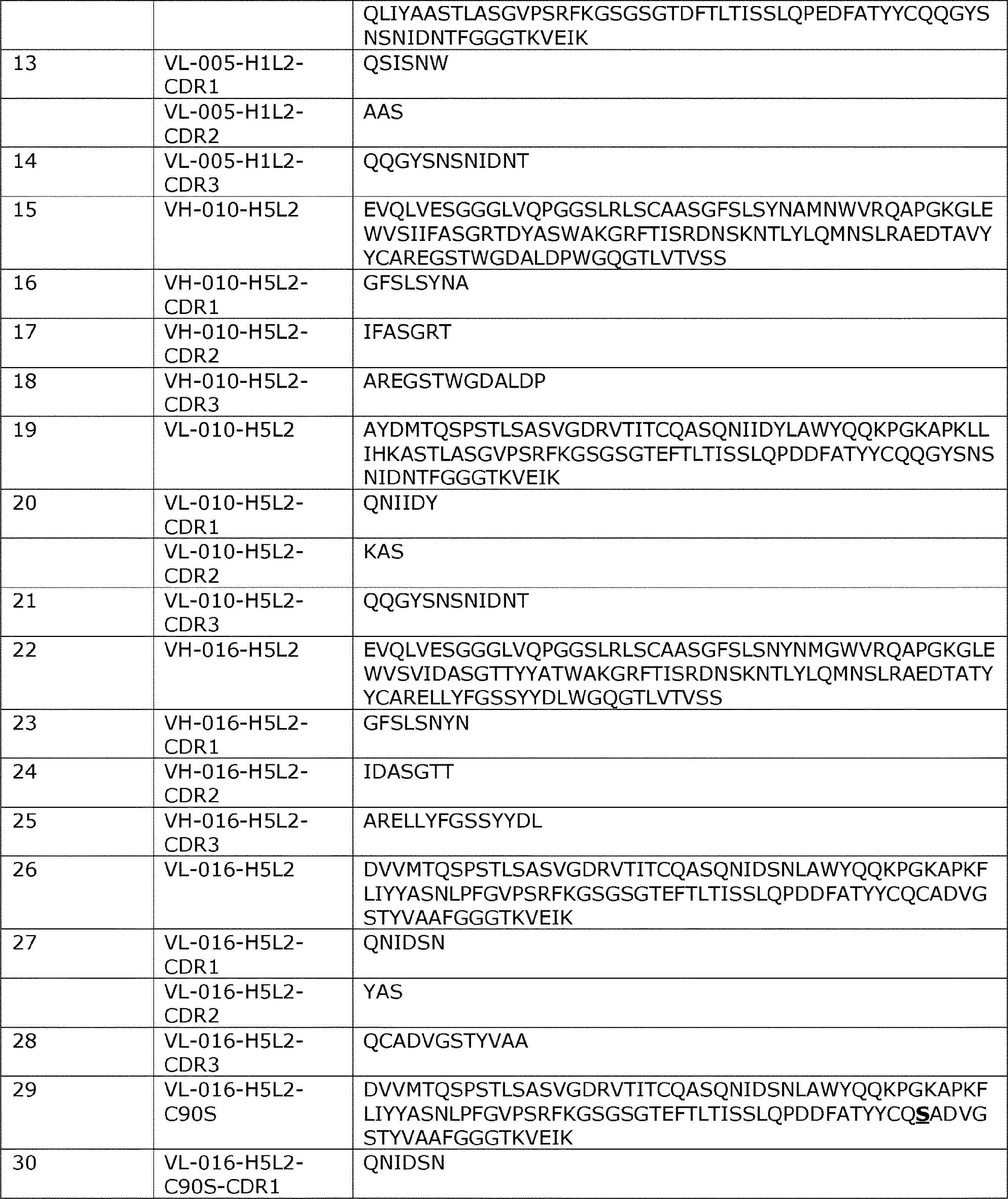
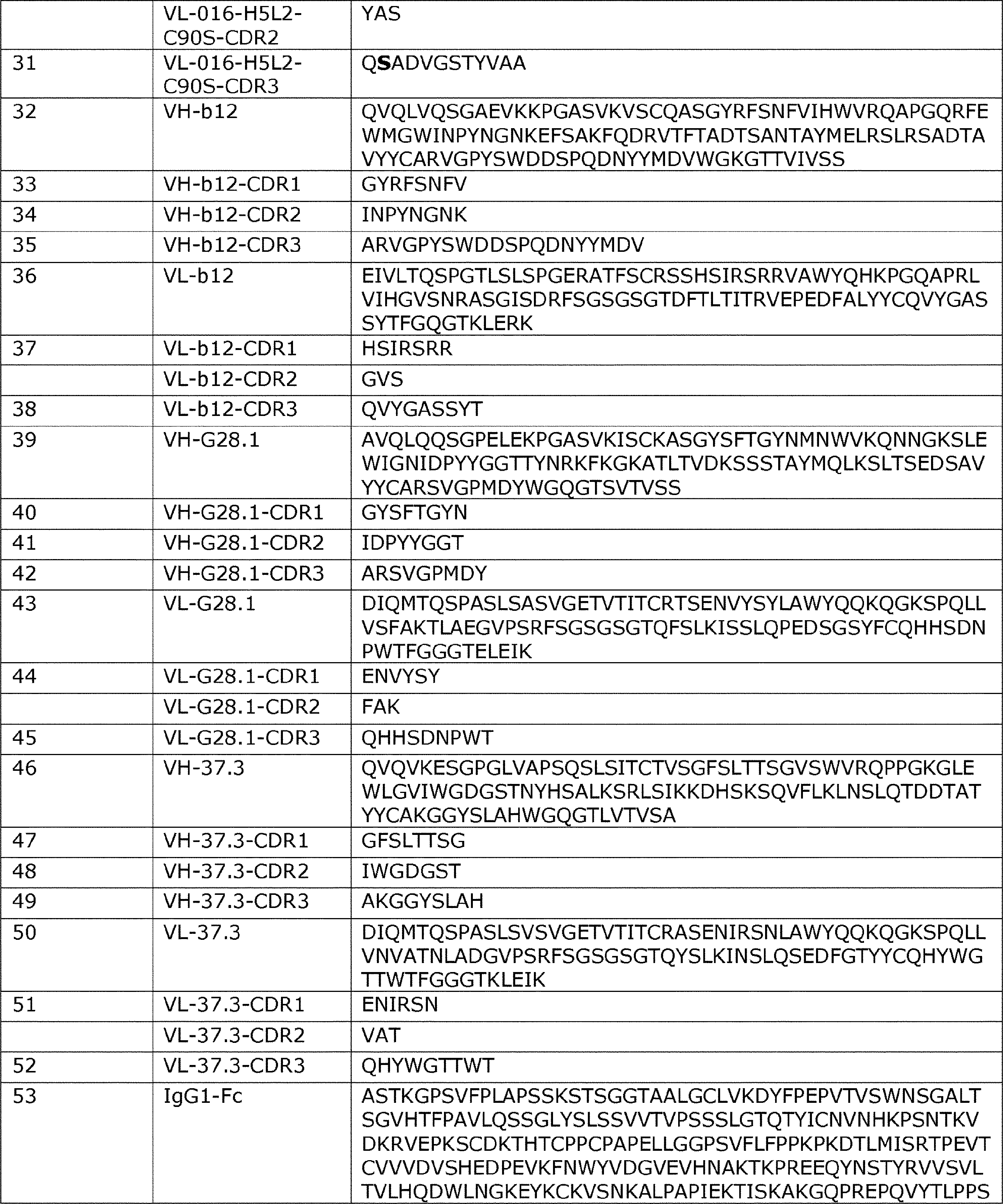

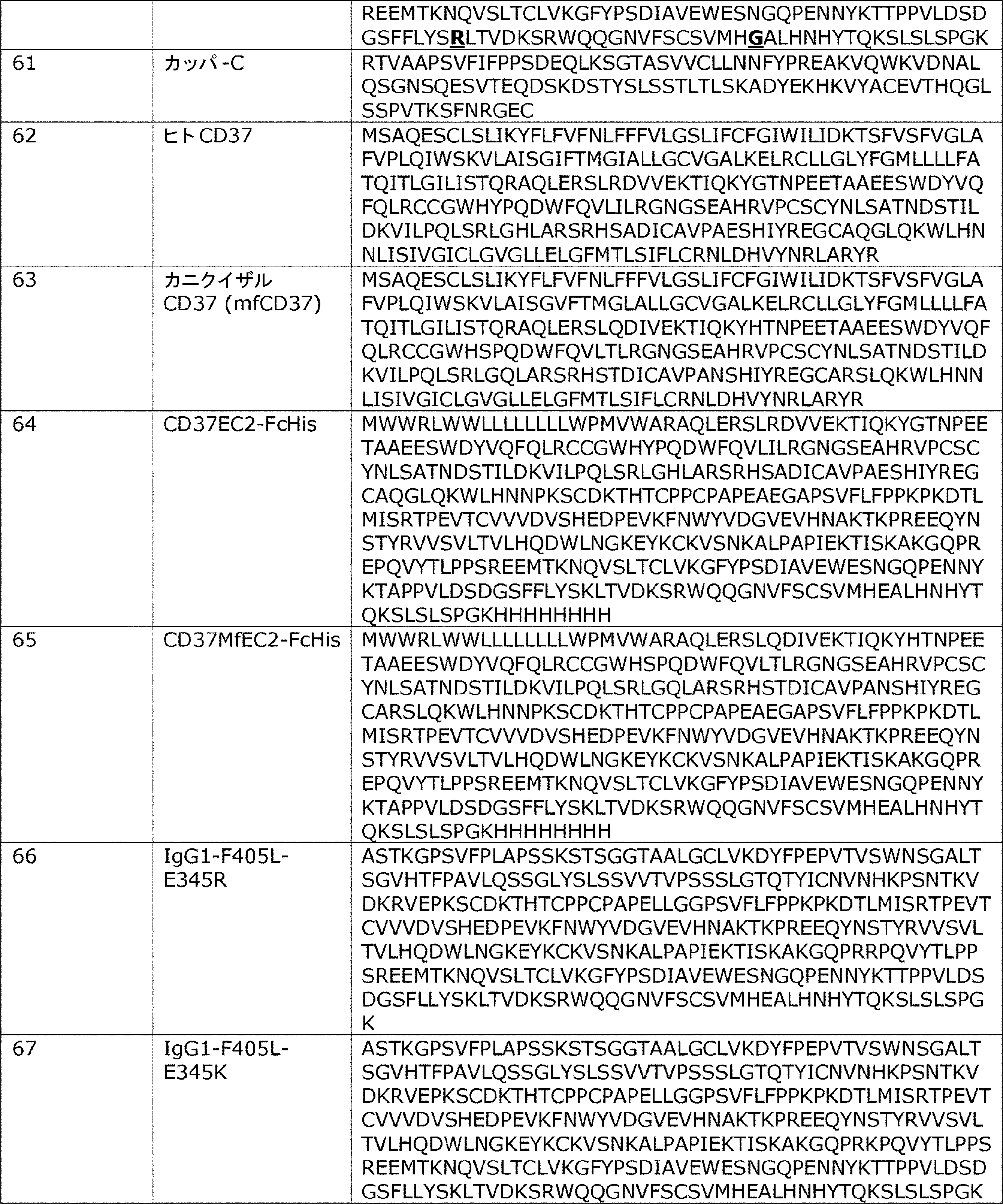
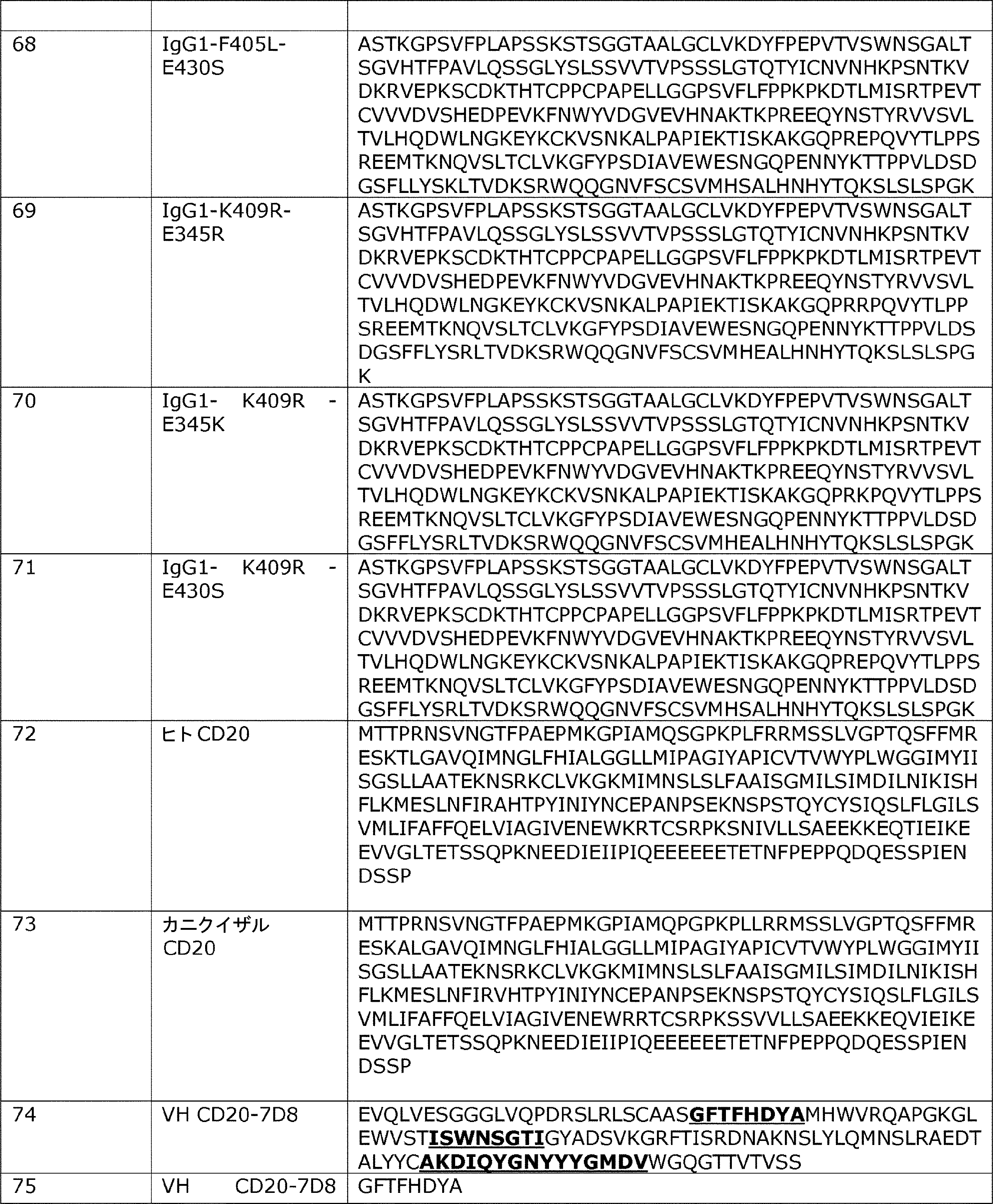
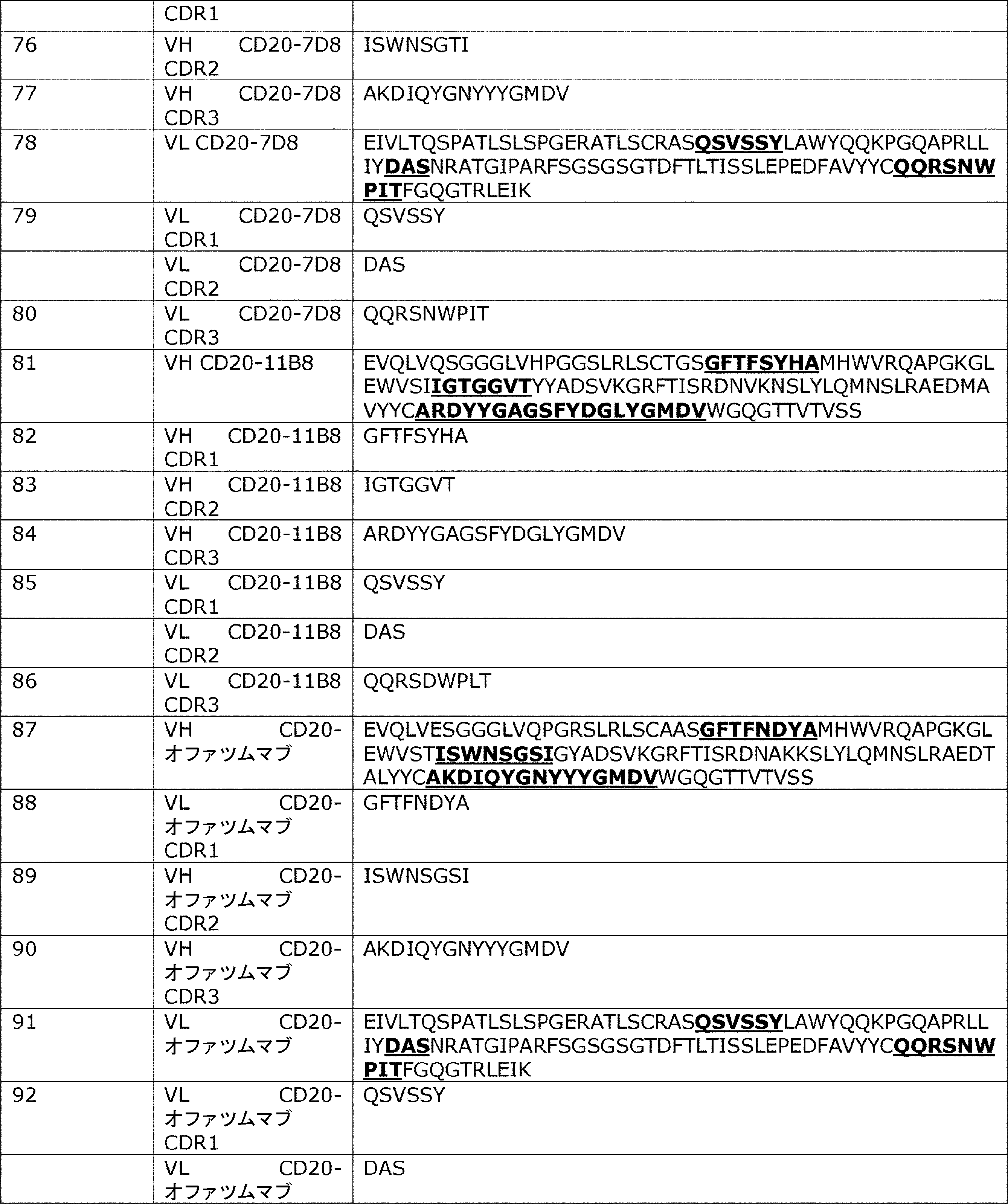
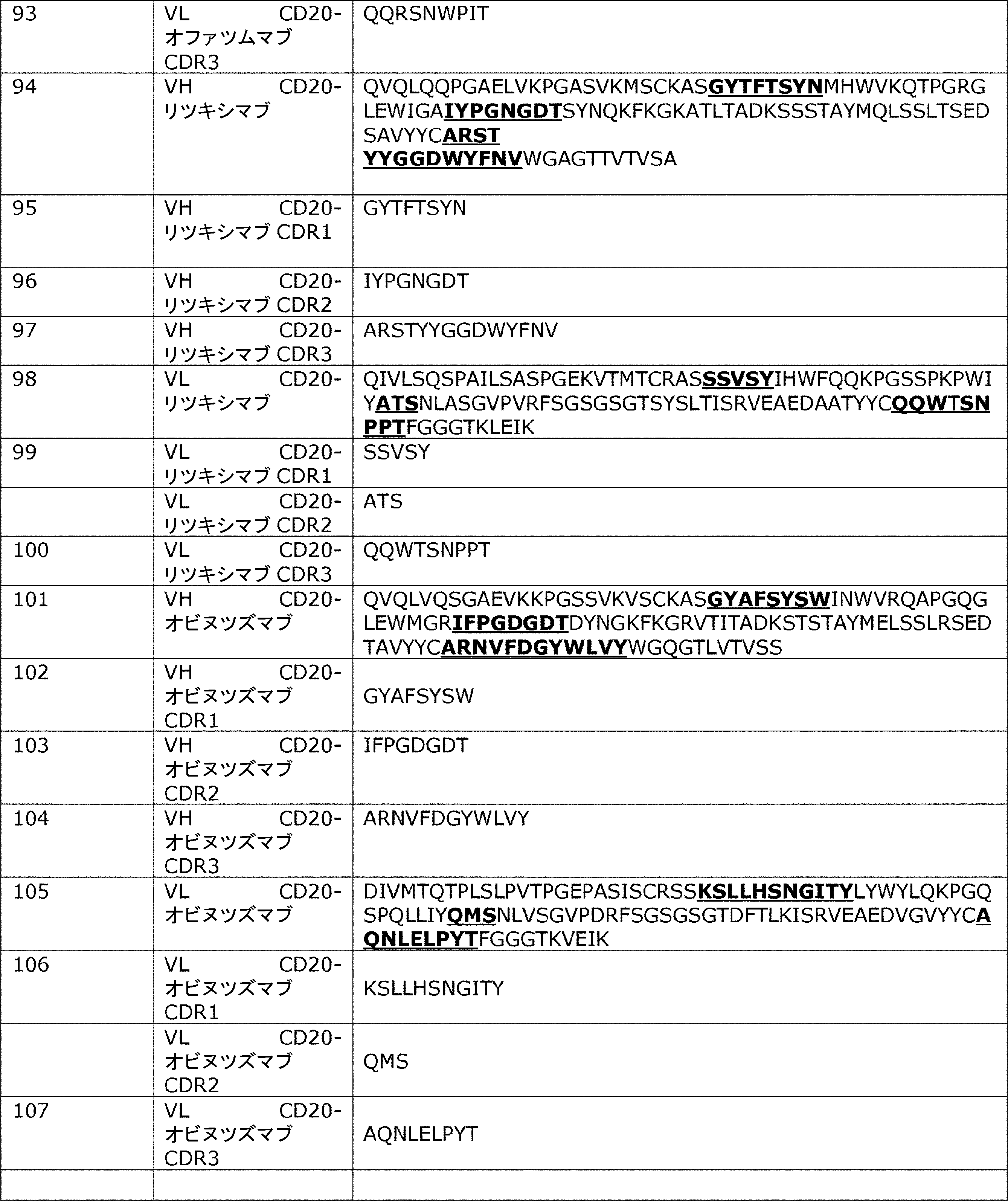
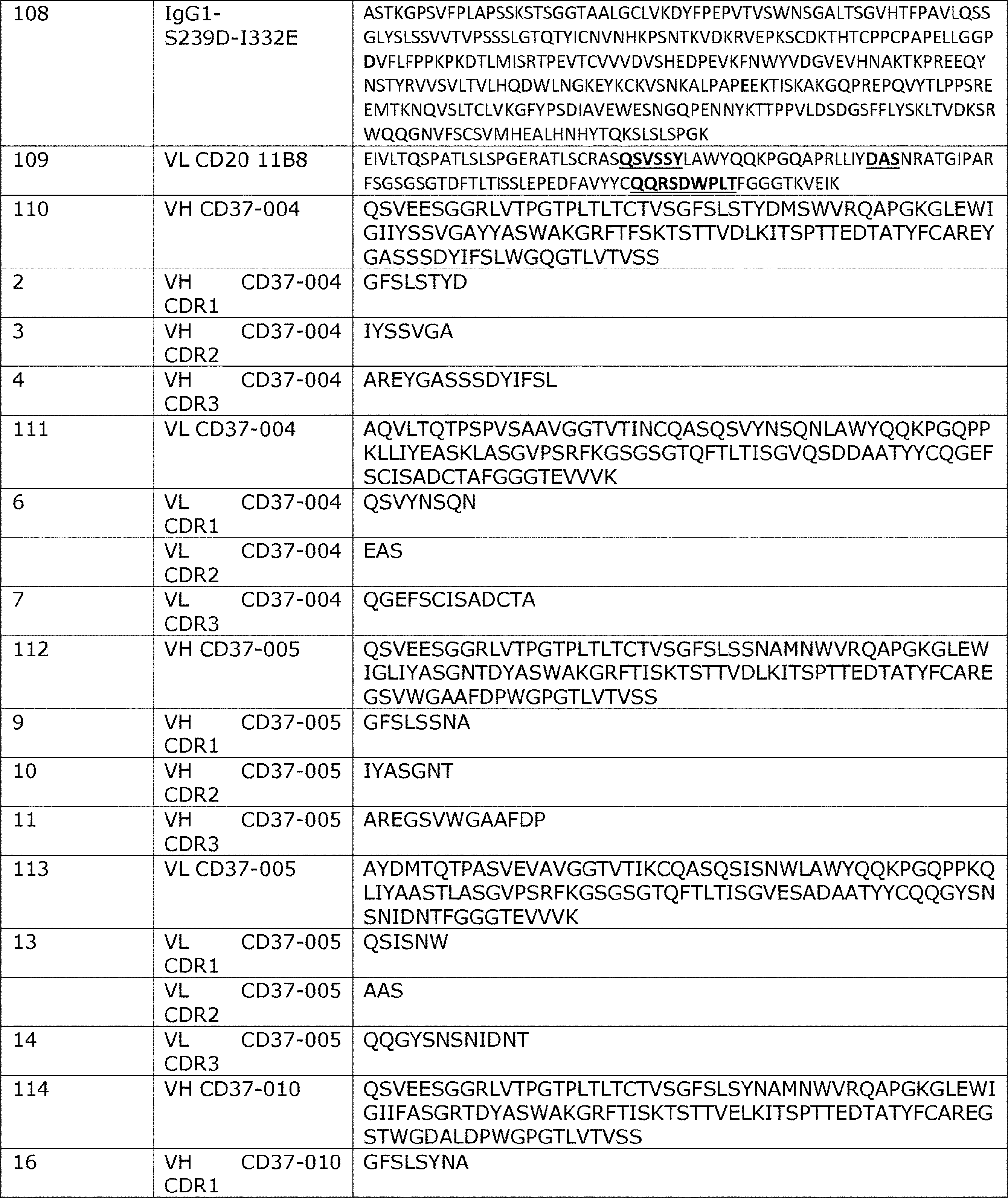
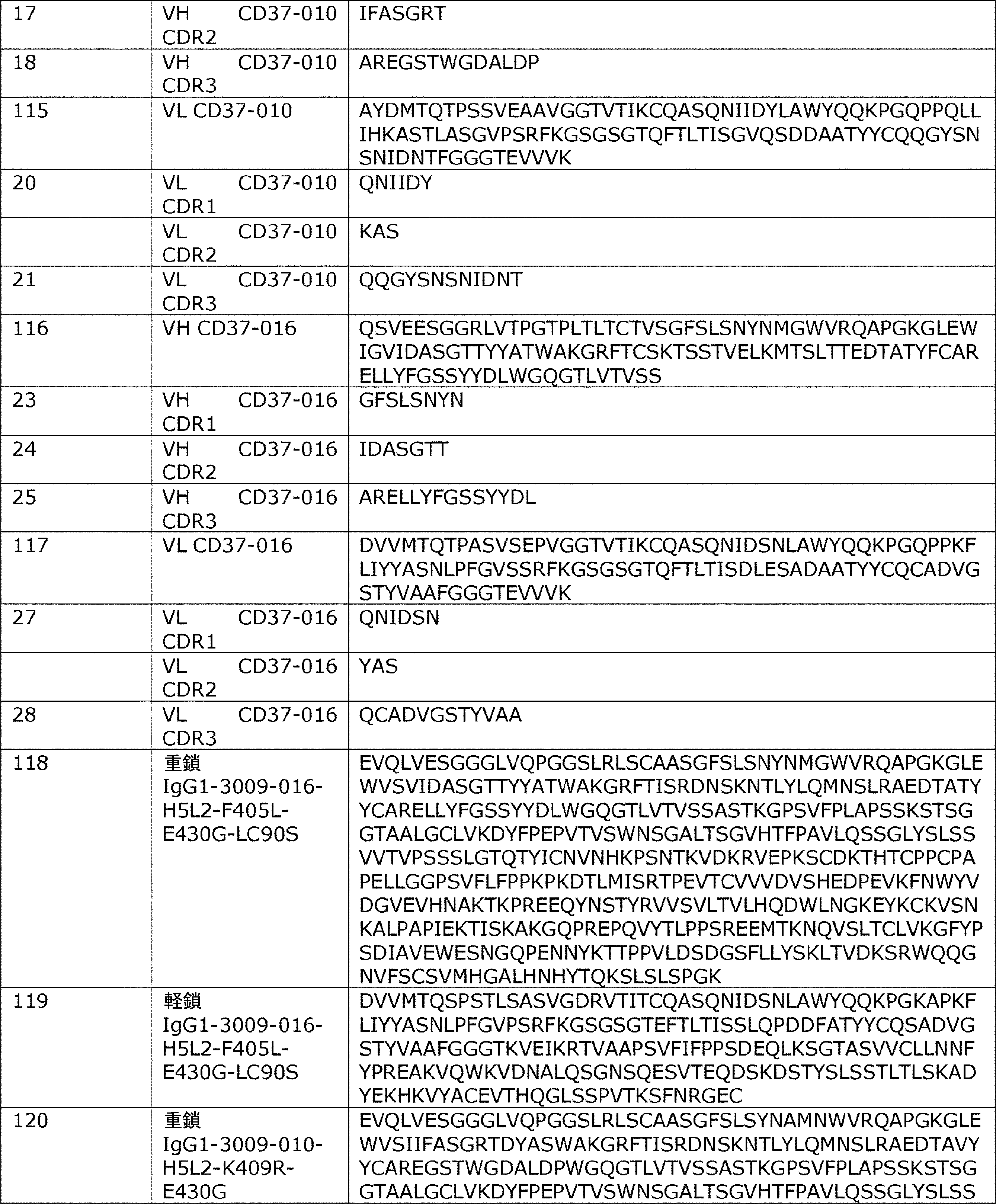
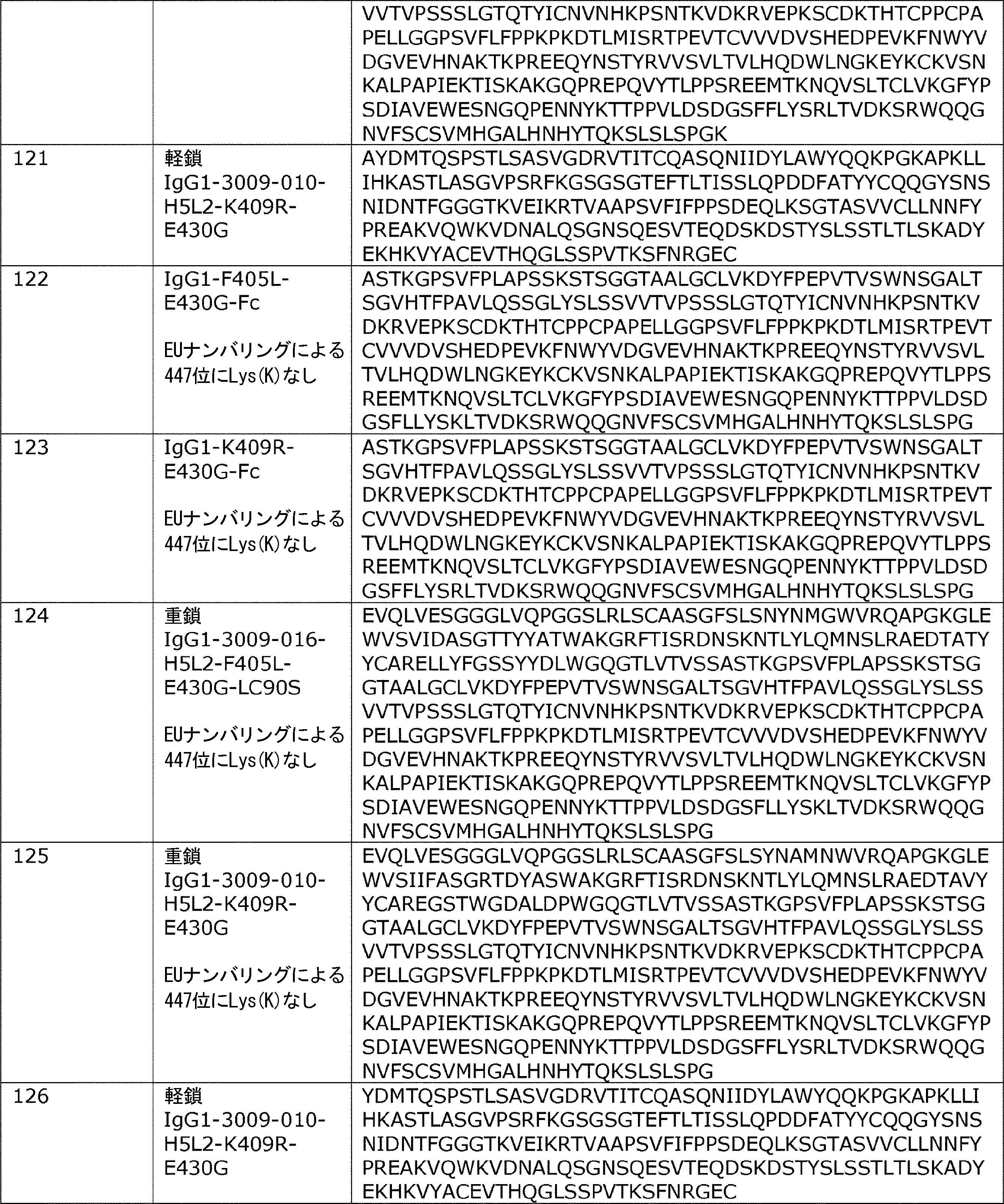
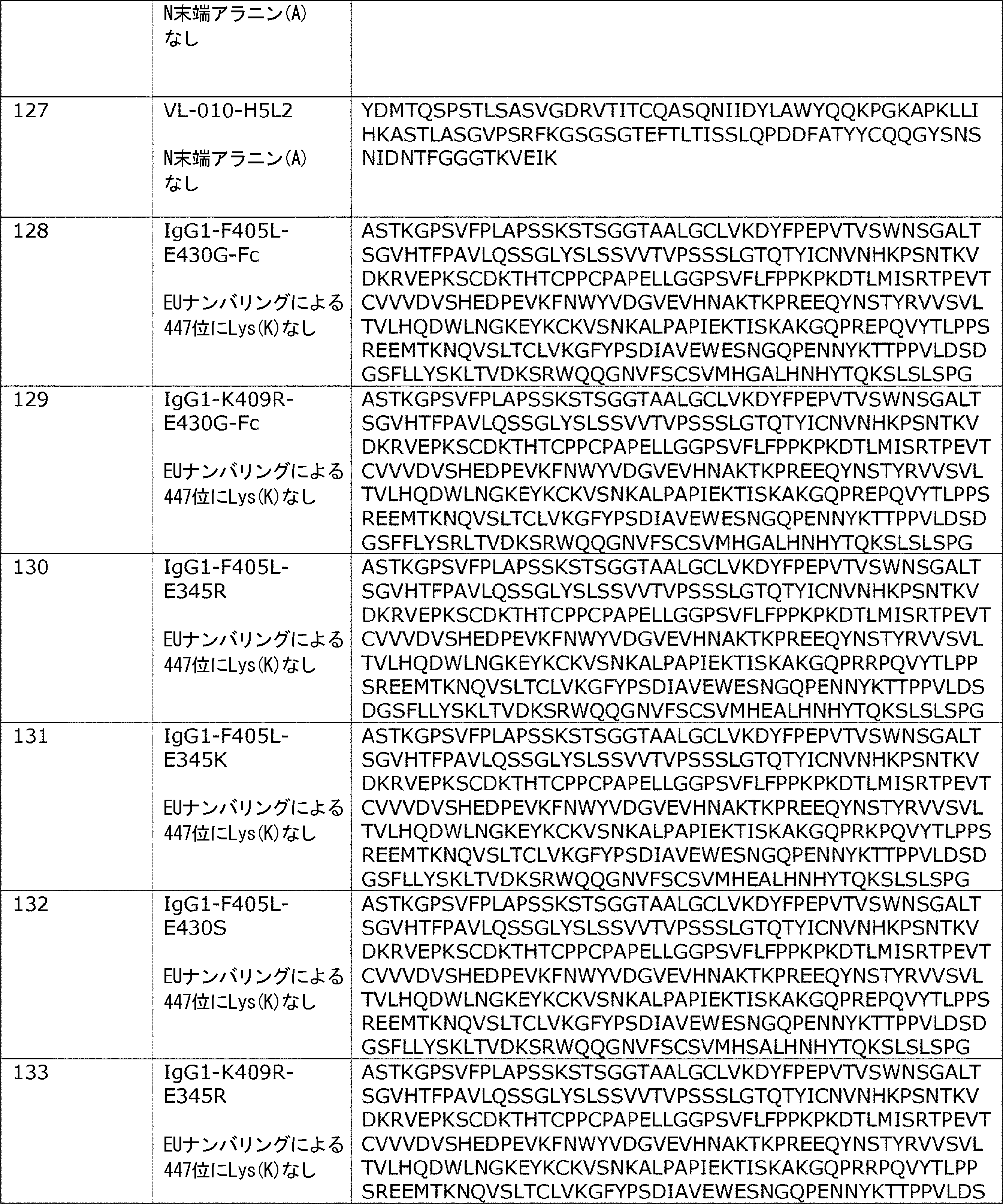

実施例1:ウサギにおけるCD37特異的抗体の生成
CD37のための発現構築物
完全長CD37バリアントの発現のために以下のコドン最適化構築物を生成した:ヒト(Homo sapiens)CD37(Genbankアクセッション番号NP_001765)(SEQ ID NO: 62)、カニクイザル(Macaca fascicularis)CD37(mfCD37)(SEQ ID NO: 63)。加えて、様々なCD37 ECDバリアントの発現のために以下のコドン最適化構築物を生成した:C末端Hisタグを有するヒトIgGのFc(CH2-CH3)ドメインに融合したヒトCD37の第二の細胞外ドメイン(EC2)(aa 112~241)が続くシグナルペプチドコード配列(CD37EC2-FcHis、SEQ ID NO: 64)およびmfCD37についての類似の構築物(CD37mfEC2-FcHis、SEQ ID NO: 65)。構築物は、クローニングのための適当な制限部位および最適なKozak(GCCGCCACC)配列[Kozak et al. (1999) Gene 234: 187-208]を含むものであった。構築物を哺乳動物発現ベクターpcDNA3.3(Invitrogen)または同等なベクター中にクローニングした。
Example 1: Generation of CD37-specific antibodies in rabbits
Expression construct for CD37
The following codon-optimized constructs were generated for the expression of full-length CD37 variants: human (Homo sapiens) CD37 (Genbank accession number NP_001765) (SEQ ID NO: 62), cynomolgus monkey (Macaca fascicularis) CD37 (mfCD37) (SEQ ID NO: 63). In addition, the following codon-optimized constructs were generated for the expression of various CD37 ECD variants: a signal peptide coding sequence followed by the second extracellular domain (EC2) (aa 112-241) of human CD37 fused to the Fc (CH2-CH3) domain of human IgG with a C-terminal His tag (CD37EC2-FcHis, SEQ ID NO: 64) and a similar construct for mfCD37 (CD37mfEC2-FcHis, SEQ ID NO: 65). The constructs contained appropriate restriction sites for cloning and an optimal Kozak (GCCGCCACC) sequence [Kozak et al. (1999) Gene 234: 187-208]. The constructs were cloned into the mammalian expression vector pcDNA3.3 (Invitrogen) or an equivalent vector.
CHO細胞およびHEK細胞における一過性発現
基本的には製造元によって記載されるように293fectin(Life technologies)を使用してFreestyle 293-F(HEK293F)細胞(Life technologies、USA)において、または、基本的には製造元によって記載されるようにFreestyle Max試薬(Life technologies)を使用してFreesyle CHO-S細胞(CHO)(Life technologies)において、膜タンパク質を一過的に発現させた。基本的には製造元によって記載されるようにExpiFectamine 293試薬(Life technologies)を使用してExpi293細胞(Life technologies)において、可溶性タンパク質を一過的に発現させた。
Transient expression in CHO and HEK cells Membrane proteins were transiently expressed in Freestyle 293-F (HEK293F) cells (Life technologies, USA) using 293fectin (Life technologies) essentially as described by the manufacturer, or in Freesyle CHO-S cells (CHO) (Life technologies) using Freestyle Max reagent (Life technologies) essentially as described by the manufacturer. Soluble proteins were transiently expressed in Expi293 cells (Life technologies) using ExpiFectamine 293 reagent (Life technologies) essentially as described by the manufacturer.
プロテインAアフィニティークロマトグラフィーを使用して、細胞培養上清からFc融合タンパク質(CD37mfEC2-FcHisおよびCD37EC2-FcHis)を精製した。 Fc fusion proteins (CD37mfEC2-FcHis and CD37EC2-FcHis) were purified from cell culture supernatants using protein A affinity chromatography.
ウサギの免疫化
MAB Discovery GMBH(Neuried, Germany)においてウサギの免疫化を実施した。ウサギを、CD37EC2-FcHisとCD37mfEC2-FcHisとの混合物またはヒトもしくはmfCD37を一過性に発現するHEK293F細胞で繰り返し免疫化した。これらのウサギの血液を採取し、Bリンパ球を単離した。MAB Discovery専有のプロセスを使用して、単一B細胞をマイクロタイタプレートのウェル中にソートし、さらに増殖させた。これらの単一B細胞の上清を、CD37を一過性に発現するCHO-S細胞(CHO-CD37)およびmfCD37を一過性に発現するCHO-S細胞(CHO-mfCD37)への特異的結合に関して分析した。
Immunization of rabbits
Immunization of rabbits was performed at MAB Discovery GMBH (Neuried, Germany). Rabbits were repeatedly immunized with a mixture of CD37EC2-FcHis and CD37mfEC2-FcHis or HEK293F cells transiently expressing human or mfCD37. Blood of these rabbits was collected and B lymphocytes were isolated. Single B cells were sorted into wells of microtiter plates using a proprietary process of MAB Discovery and further expanded. Supernatants of these single B cells were analyzed for specific binding to CHO-S cells transiently expressing CD37 (CHO-CD37) and CHO-S cells transiently expressing mfCD37 (CHO-mfCD37).
組換え抗体産生
一次スクリーニング結果を分析したところで、配列決定、組換えmAb産生および精製のための一次ヒットを選択した。特有の可変重鎖(VH)および軽鎖(VL)コード領域を遺伝子合成し、ヒトIgG1定常領域コード配列(Igカッパ鎖およびE430G変異(EUナンバリング)重鎖を含むIgG1アロタイプG1m(f))を含む哺乳動物発現ベクター中にクローニングした。このプロセス中、一部の抗体軽鎖中の望ましくない不対システインをセリンによって置換した。
Recombinant antibody production Primary screening results were analyzed and primary hits were selected for sequencing, recombinant mAb production and purification. Unique variable heavy (VH) and light (VL) chain coding regions were gene synthesized and cloned into mammalian expression vectors containing human IgG1 constant region coding sequences (IgG1 allotype G1m(f) with Ig kappa chain and E430G mutation (EU numbering) heavy chain). During this process, undesired unpaired cysteines in some antibody light chains were replaced by serine.
Tecan Freedom Evoプラットフォーム上で自動化手法を使用して重鎖(HC)および軽鎖(LC)コード発現ベクターを一過性にコトランスフェクトすることにより、HEK293細胞中で組換えキメラ抗体を産生した。Dionex Ultimate 3000 HPLCシステム上でアフィニティー精製(プロテインA)を使用して、細胞上清から免疫グロブリンを精製した。
Recombinant chimeric antibodies were produced in HEK293 cells by transiently co-transfecting heavy chain (HC) and light chain (LC) encoding expression vectors using an automated approach on a Tecan Freedom Evo platform. Immunoglobulins were purified from cell supernatants using affinity purification (Protein A) on a
変異E430Gを含む産生されたキメラ(VHウサギ、Fcヒト)モノクローナル抗体(mAb)の反応性を、CHO-CD37またはCHO-mfCD37細胞への結合に関して再び分析した。加えて、ヒトリンパ腫細胞株Daudiへの結合およびDaudi細胞に対するCDCアッセイにおける機能性を分析した。 The reactivity of the produced chimeric (VH rabbit, Fc human) monoclonal antibodies (mAbs) containing the mutation E430G was analyzed again for binding to CHO-CD37 or CHO-mfCD37 cells. In addition, binding to the human lymphoma cell line Daudi and functionality in a CDC assay on Daudi cells were analyzed.
実施例2:ウサギキメラ抗体のヒト化
ヒト化抗体配列の生成
Antitope(Cambridge, UK)において、ウサギ抗体、ウサギ抗CD37-004、-005、-010および-016からヒト化抗体配列を生成した。ヒト化抗体配列は、生殖細胞系ヒト化(CDRグラフト)技術を使用して生成した。ウサギおよびマウス抗体のVHおよびVκアミノ酸配列とで最大の相同性を有するヒト生殖細胞系配列に基づいてヒト化V領域遺伝子を設計した。各ウサギ抗体に関し、4~6つの一連のVHおよび4または5つの一連のVκ(VL)生殖細胞系ヒト化V領域遺伝子を設計した。
Example 2: Humanization of a rabbit chimeric antibody
Generation of humanized antibody sequences
Humanized antibody sequences were generated from rabbit antibodies, rabbit anti-CD37-004, -005, -010 and -016 at Antitope (Cambridge, UK). Humanized antibody sequences were generated using germline humanization (CDR grafting) technology. Humanized V-region genes were designed based on human germline sequences with maximum homology to the VH and Vκ amino acid sequences of rabbit and mouse antibodies. For each rabbit antibody, a set of four to six VH and a set of four or five Vκ (VL) germline humanized V-region genes were designed.
Swiss PDBを使用してウサギ抗体V領域の構造モデルを作製し、それを分析して、抗体の結合性にとって重要であり得るV領域フレームワーク中のアミノ酸を同定した。これらのアミノ酸を、1つまたは複数のバリアントCDRグラフト抗体への組み込みに関して留意した。 A structural model of a rabbit antibody V-region was generated using the Swiss PDB and analyzed to identify amino acids in the V-region framework that may be important for antibody binding. These amino acids were noted for incorporation into one or more variant CDR-grafted antibodies.
重鎖および軽鎖V領域アミノ酸配列をヒト生殖細胞系VおよびJセグメント配列のデータベースに対して比較して、ヒト可変ドメインフレームワークとして使用するための、最大の相同度を有する重および軽鎖ヒト配列を同定した。ヒト化デザインの基礎として使用した生殖細胞系配列を表2に示す。 The heavy and light chain V region amino acid sequences were compared against a database of human germline V and J segment sequences to identify heavy and light chain human sequences with the greatest degree of homology for use as human variable domain frameworks. The germline sequences used as the basis for the humanization design are shown in Table 2.
(表2)最大にマッチするヒト生殖細胞系VセグメントおよびJセグメント配列
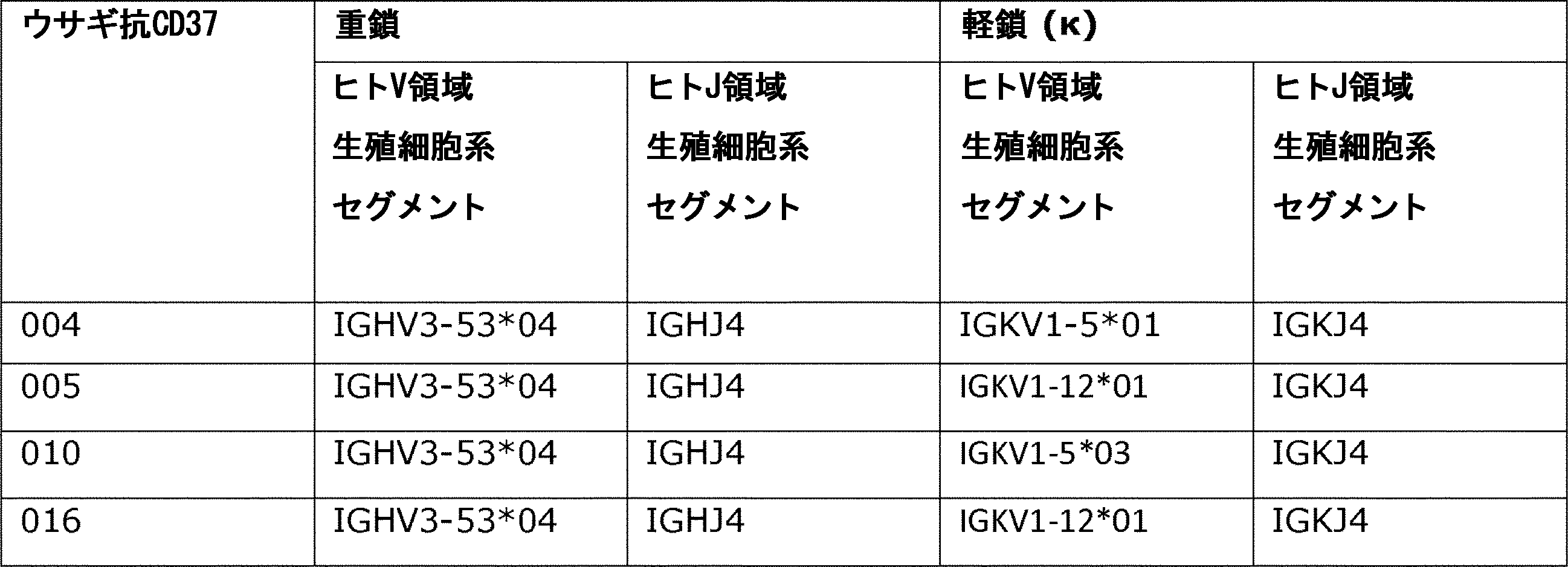
次いで、CDRをフレームワークにグラフトし、必要ならば、抗体結合性にとって重要であり得る残基(構造モデリングによって同定される)をウザギ残基へ復帰変異させることにより、一連のヒト化重および軽鎖V領域をデザインした。次いで、Antitope専有のインシリコ技術iTope(商標)およびTCED(商標)(T Cell Epitope Database)(Perry, L.C.A, Jones, T.D. and Baker, M.P. New Approaches to Prediction of Immune Responses to Therapeutic Proteins during Preclinical Development (2008). Drugs in R&D 9(6): 385-396;Bryson, C.J., Jones, T.D. and Baker, M.P. Prediction of Immunogenicity of Therapeutic Proteins (2010). Biodrugs 24(1):1-8)を使用して、潜在的T細胞エピトープの出現率が最低であるバリアント配列を選択した。最後に、デザインされたバリアントのヌクレオチド配列をコドン最適化した。 A series of humanized heavy and light chain V regions were then designed by grafting the CDRs onto the framework and, if necessary, backmutating residues that may be important for antibody binding (identified by structural modeling) to rabbit residues. The variant sequences with the lowest occurrence of potential T cell epitopes were then selected using Antitope's proprietary in silico technology iTope™ and TCED™ (T Cell Epitope Database) (Perry, L.C.A, Jones, T.D. and Baker, M.P. New Approaches to Prediction of Immune Responses to Therapeutic Proteins during Preclinical Development (2008). Drugs in R&D 9(6): 385-396; Bryson, C.J., Jones, T.D. and Baker, M.P. Prediction of Immunogenicity of Therapeutic Proteins (2010). Biodrugs 24(1):1-8). Finally, the nucleotide sequences of the designed variants were codon-optimized.
抗体IgG1-016-H5L2の場合、遊離システインを置換するために可変ドメイン中に点変異を有するバリアントを生成した:IgG1-016-H5L2-LC90S(また、さらなるF405LおよびE430G変異でも生成した)。この変異体は遺伝子合成(Geneart)によって生成した。 For the antibody IgG1-016-H5L2, a variant was generated with a point mutation in the variable domain to replace the free cysteine: IgG1-016-H5L2-LC90S (also with the additional mutations F405L and E430G). This variant was generated by gene synthesis (Geneart).
ヒト化CD37抗体の可変領域配列は本明細書における配列リストおよび上記表1に示されている。 The variable region sequences of the humanized CD37 antibodies are shown in the sequence listing herein and in Table 1 above.
実施例3:二重特異性抗体の生成
制御された還元条件下で、Fabアーム交換によって二重特異性IgG1抗体を生成した。この方法の基礎は、WO2011/131746に記載されている特定のアッセイ条件下でヘテロ二量体の形成を促進する相補的CH3ドメインの使用である。F405LおよびK409R(EUナンバリング)変異をCD37抗体に導入して、相補的CH3ドメインを有する抗体対を創出した。特定の場合、F405LおよびK409RをE430G変異と組み合わせた。
Example 3: Generation of bispecific antibodies Bispecific IgG1 antibodies were generated by Fab arm exchange under controlled reducing conditions.The basis of this method is the use of complementary CH3 domains to promote the formation of heterodimers under specific assay conditions described in WO2011/131746.F405L and K409R (EU numbering) mutations were introduced into CD37 antibody to create antibody pairs with complementary CH3 domains.In a specific case, F405L and K409R were combined with E430G mutation.
二重特異性抗体を生成するために、2つの親相補的抗体(それぞれ最終濃度0.5mg/mL)を75mMの2-メルカプトエチルアミンHCl(2-MEA)とともに総量100μLのTE中31℃で5時間インキュベートした。スピンカラム(Microcon遠心フィルタ、30k、Millipore)を製造元のプロトコルにしたがって使用して還元剤2-MEAを除くことにより、還元反応を停止させた。 To generate bispecific antibodies, the two parental complementary antibodies (each at a final concentration of 0.5 mg/mL) were incubated with 75 mM 2-mercaptoethylamine HCl (2-MEA) in a total volume of 100 μL TE for 5 h at 31 °C. The reduction reaction was stopped by removing the reducing agent 2-MEA using a spin column (Microcon centrifugal filter, 30k, Millipore) according to the manufacturer's protocol.
実施例4:抗体のための発現構築物、一過性発現および精製
抗体発現のために、VHおよびVL配列を、VHの場合には適切な定常重鎖(HC)領域を含み、特定の場合にはF405LまたはK409R変異および/またはE345RまたはE430G変異を含み、VLの場合には軽鎖(LC)領域を含む発現ベクター(pcDNA3.3)中にクローニングした。
Example 4: Expression constructs for antibodies, transient expression and purification For antibody expression, the VH and VL sequences were cloned into an expression vector (pcDNA3.3) containing the appropriate constant heavy chain (HC) region in the case of VH, in certain cases the F405L or K409R mutation and/or the E345R or E430G mutation, and the light chain (LC) region in the case of VL.
抗体をIgG1κとして発現させた。抗体の重および軽鎖両方をコードするプラスミドDNA混合物を、293fectin(Life technologies)を使用して、基本的にはVinkら(Vink et al., Methods, 65(1), 5-10 2014)によって記載されているように、Expi293F細胞(Life technologies、USA)中に一過性にトランスフェクトした。次に、固定化プロテインGクロマトグラフィーによって抗体を精製した。 The antibodies were expressed as IgG1κ. Plasmid DNA mixtures encoding both the heavy and light chains of the antibodies were transiently transfected into Expi293F cells (Life technologies, USA) using 293fectin (Life technologies) essentially as described by Vink et al. (Vink et al., Methods, 65(1), 5-10 2014). The antibodies were then purified by immobilized protein G chromatography.
以下の抗体を実施例に使用した。 The following antibodies were used in the examples:
野生型IgG1抗体:
IgG1-004-H5L2(SEQ ID NO: 1およびSEQ ID NO: 5に記載のVHおよびVL配列を有する)
IgG1-005-H1L2(SEQ ID NO: 8およびSEQ ID NO: 12に記載のVHおよびVL配列を有する)
IgG1-010-H5L2(SEQ ID NO: 15およびSEQ ID NO: 19に記載のVHおよびVL配列を有する)
IgG1-016-H5L2(SEQ ID NO: 22およびSEQ ID NO: 26に記載のVHおよびVL配列を有する)
IgG1-G28.1(SEQ ID NO: 39およびSEQ ID NO: 43に記載のVHおよびVL配列を有する―EP2241577のSEQ ID NO: 1および3に基づく)
IgG1-G28.1-K409R-delK(C末端重鎖変異445-PG-446をも含む)
IgG1-37.3(SEQ ID NO: 46およびSEQ ID NO: 50に記載のVHおよびVL配列を有する―WO2011/112978のSEQ ID NO: 55および72に基づく)
IgG1-b12(SEQ ID NO: 32およびSEQ ID NO: 36に記載のVHおよびVL配列を有する―gp120特異的抗体b12[Barbas, CF. J Mol Biol. 1993 Apr 5;230(3):812-23]に基づく)
Wild-type IgG1 antibodies:
IgG1-004-H5L2 (having the VH and VL sequences set forth in SEQ ID NO: 1 and SEQ ID NO: 5)
IgG1-005-H1L2 (having the VH and VL sequences set forth in SEQ ID NO: 8 and SEQ ID NO: 12)
IgG1-010-H5L2 (having the VH and VL sequences set forth in SEQ ID NO: 15 and SEQ ID NO: 19)
IgG1-016-H5L2 (having the VH and VL sequences set forth in SEQ ID NO: 22 and SEQ ID NO: 26)
IgG1-G28.1 (having VH and VL sequences as set forth in SEQ ID NO: 39 and SEQ ID NO: 43 - based on SEQ ID NOs: 1 and 3 of EP2241577)
IgG1-G28.1-K409R-delK (also contains the C-terminal heavy chain mutation 445-PG-446)
IgG1-37.3 (having VH and VL sequences as set forth in SEQ ID NO: 46 and SEQ ID NO: 50 - based on SEQ ID NOs: 55 and 72 of WO2011/112978)
IgG1-b12 (having the VH and VL sequences set forth in SEQ ID NO: 32 and SEQ ID NO: 36 - based on the gp120-specific antibody b12 [Barbas, CF. J Mol Biol. 1993
Fc-Fc相互作用増強変異E430Gを有するIgG1抗体:
IgG1-004-H5L2-E430G
IgG1-005-H1L2-E430G
IgG1-010-H5L2-E430G
IgG1-016-H5L2-E430G
IgG1-G28.1-E430G
IgG1-37.3-E430G
IgG1-b12-E430G
IgG1-005-H1L2-K409R-E430G
IgG1-010-H5L2-K409R-E430G
IgG1-016-H5L2-F405L-E430G
IgG1-016-H5L2-LC90S-F405L-E430G
IgG1-004-E430G
IgG1-005-E430G
IgG1-010-E430G
IgG1-016-E430G
IgG1 antibody with Fc-Fc interaction enhancing mutation E430G:
IgG1-004-H5L2-E430G
IgG1-005-H1L2-E430G
IgG1-010-H5L2-E430G
IgG1-016-H5L2-E430G
IgG1-G28.1-E430G
IgG1-37.3-E430G
IgG1-b12-E430G
IgG1-005-H1L2-K409R-E430G
IgG1-010-H5L2-K409R-E430G
IgG1-016-H5L2-F405L-E430G
IgG1-016-H5L2-LC90S-F405L-E430G
IgG1-004-E430G
IgG1-005-E430G
IgG1-010-E430G
IgG1-016-E430G
Fc-Fc相互作用増強変異E430Sを有するIgG1抗体:
IgG1-010-H5L2-K409R-E430S
IgG1-016-H5L2-F405L-E430S
IgG1 antibody with the Fc-Fc interaction enhancing mutation E430S:
IgG1-010-H5L2-K409R-E430S
IgG1-016-H5L2-F405L-E430S
Fc-Fc相互作用増強変異E345Kを有するIgG1抗体:
IgG1-010-H5L2-K409R-E345K
IgG1-016-H5L2-F405L-E345K
IgG1 antibody with Fc-Fc interaction enhancing mutation E345K:
IgG1-010-H5L2-K409R-E345K
IgG1-016-H5L2-F405L-E345K
Fc-Fc相互作用増強変異E345Rを有するIgG1抗体:
IgG1-G28.1-E345R
IgG1-b12-E345R
IgG1-010-H5L2-K409R-E345R
IgG1-016-H5L2-F405L-E345R
IgG1 antibody with Fc-Fc interaction enhancing mutation E345R:
IgG1-G28.1-E345R
IgG1-b12-E345R
IgG1-010-H5L2-K409R-E345R
IgG1-016-H5L2-F405L-E345R
二重特異性抗体
bsIgG1-016-H5L2-F405L×IgG1-005-H1L2-K409R
bsIgG1-016-H5L2-F405L×IgG1-010-H5L2-K409R
Bispecific antibodies
bsIgG1-016-H5L2-F405L×IgG1-005-H1L2-K409R
bsIgG1-016-H5L2-F405L×IgG1-010-H5L2-K409R
Fc-Fc相互作用増強変異E430Gを有する二重特異性抗体:
bsIgG1-016-H5L2-LC90S-F405L-E430G×005-H1L2-K409R-E430G
bsIgG1-016-H5L2-LC90S-F405L-E430G×010-H5L2-K409R-E430G
bsIgG1-016-H5L2-LC90S-F405L-E430G×b12-K409R-E430G
bsIgG1-b12-F405L-E430G×010-H5L2-K409R-E430G
bsIgG1-b12-F405L-E430G×005-H1L2-K409R-E430G
Bispecific antibody with Fc-Fc interaction enhancing mutation E430G:
bsIgG1-016-H5L2-LC90S-F405L-E430G×005-H1L2-K409R-E430G
bsIgG1-016-H5L2-LC90S-F405L-E430G×010-H5L2-K409R-E430G
bsIgG1-016-H5L2-LC90S-F405L-E430G×b12-K409R-E430G
bsIgG1-b12-F405L-E430G×010-H5L2-K409R-E430G
bsIgG1-b12-F405L-E430G×005-H1L2-K409R-E430G
FcγR相互作用増強変異S239D-I332Eを有するIgG1抗体:
IgG1-G28.1-S239D-I332E
IgG1 antibody with the FcγR interaction enhancing mutation S239D-I332E:
IgG1-G28.1-S239D-I332E
実施例5:CD37抗体へのFc-Fc相互作用増強変異の導入は、補体依存性細胞傷害作用(CDC)を誘導する増強された新たな能力を生じさせる
補体依存性細胞傷害作用(CDC)の決定
第一の実験において、未処置CLL患者由来の腫瘍細胞(AllCells、California, USA)を、0.2% BSA(ウシ血清アルブミン)を含有するRPMIに再懸濁させ、0.2×10⁵個/ウェル(40μL/ウェル)の密度でポリスチレン96ウェル丸底プレート(Greiner bio-one Cat # 650101)に播種し、IgG1-G28.1-K409R-delK、IgG1-G28.1-E345RまたはIgG1-b12-E345Rの濃度系列(0.003~10μg/mL最終抗体濃度)40μLを加えた。IgG1-b12-E345R(gp120特異的抗体b12[Barbas, CF. J Mol Biol. 1993 Apr 5;230(3):812-23]に基づく)をネガティブコントロールとして使用した。IgG1-G28.1-K409R-delKの場合、K409R変異は、結合能力またはCDC誘導能力に対して影響を及ぼさないことが留意されるべきである。同様に、生化学的分析を容易にするために抗体に導入しておいたdelK(445-PG-446)変異は、標的結合能力またはCDC誘導能力に影響しなかった(以下参照)。
Example 5: Introduction of Fc-Fc interaction enhancing mutations into CD37 antibodies results in a new enhanced ability to induce complement dependent cytotoxicity (CDC)
Determination of complement-dependent cytotoxicity (CDC)
In the first experiment, tumor cells from untreated CLL patients (AllCells, California, USA) were resuspended in RPMI containing 0.2% BSA (bovine serum albumin) and seeded at a density of 0.2x10⁵ cells/well (40μL/well) in polystyrene 96-well round-bottom plates (Greiner bio-one Cat # 650101) and 40μL of a concentration series of IgG1-G28.1-K409R-delK, IgG1-G28.1-E345R or IgG1-b12-E345R (0.003-10μg/mL final antibody concentration) was added. IgG1-b12-E345R (based on the gp120-specific antibody b12 [Barbas, CF. J Mol Biol. 1993
インキュベーション(振とうしながら室温で10分)後、プールされた正常ヒト血清(NHS Cat # M0008 Sanquin、Amsterdam, The Netherlands)20μLを補体ソースとして各ウェルに加え、プレートを37℃で45分間インキュベートした。プレートを氷で冷やすことにより、反応を停止させた。次に、ヨウ化プロピジウム(PI;10μg/mL溶液10μL;Sigma-Aldrich Chemie B.V.、Zwijndrecht, The Netherlands)を加え、フローサイトメトリー(FACS Canto II;BD Biosciences)による死細胞(PI陽性細胞に相当)の割合の計測によって溶解を検出した。GraphPad Prism V6.04ソフトウェア(GraphPad Software、San Diego, CA, USA)中、対数変換濃度との非線形用量反応フィットのベストフィット値を使用してグラフを生成した。 After incubation (10 min at room temperature with shaking), 20 μL of pooled normal human serum (NHS Cat # M0008 Sanquin, Amsterdam, The Netherlands) was added to each well as a complement source, and the plate was incubated at 37°C for 45 min. The reaction was stopped by chilling the plate on ice. Propidium iodide (PI; 10 μL of a 10 μg/mL solution; Sigma-Aldrich Chemie B.V., Zwijndrecht, The Netherlands) was then added, and lysis was detected by measuring the percentage of dead cells (corresponding to PI-positive cells) by flow cytometry (FACS Canto II; BD Biosciences). Graphs were generated using best-fit values of a nonlinear dose-response fit with log-transformed concentrations in GraphPad Prism V6.04 software (GraphPad Software, San Diego, CA, USA).
第二の実験において、別の未処置CLL患者由来の腫瘍細胞(AllCells、California, USA)を、0.2% BSAを含有するRPMIに再懸濁させ、0.5×10⁵個/ウェル(30μL/ウェル)の密度でポリスチレン96ウェル丸底プレート(Greiner bio-one Cat # 650101)に播種し、IgG1-G28.1、IgG1-G28.1-E430GまたはIgG1-b12の濃度系列(3.33×段階希釈物中0.003~10μg/mL最終抗体濃度)50μLを加えた。インキュベーション(室温で15分)後、プールされた正常ヒト血清(NHS Cat # M0008 Sanquin、Amsterdam, The Netherlands)20μLを補体ソースとして各ウェルに加え、プレートを37℃で45分間インキュベートした。プレートを氷で冷やすことにより、反応を停止させた。次に、ヨウ化プロピジウム(PI;10μg/mL溶液20μL;Sigma-Aldrich Chemie B.V., Zwijndrecht, The Netherlands)を加え、フローサイトメトリー(FACS Canto II;BD Biosciences)による死細胞(PI陽性細胞に相当)の割合の計測によって溶解を検出した。GraphPad Prism V6.04ソフトウェア(GraphPad Software、San Diego, CA, USA)中、対数変換濃度との非線形用量反応フィットのベストフィット値を使用してグラフを生成した。 In a second experiment, tumor cells from another untreated CLL patient (AllCells, California, USA) were resuspended in RPMI containing 0.2% BSA and seeded at a density of 0.5x10⁵ cells/well (30μL/well) into polystyrene 96-well round-bottom plates (Greiner bio-one Cat # 650101) and 50μL of a concentration series of IgG1-G28.1, IgG1-G28.1-E430G or IgG1-b12 (0.003-10μg/mL final antibody concentration in 3.33x serial dilutions) was added. After incubation (15 min at room temperature), 20μL of pooled normal human serum (NHS Cat # M0008 Sanquin, Amsterdam, The Netherlands) was added to each well as a complement source and the plates were incubated at 37°C for 45 min. The reaction was stopped by cooling the plates on ice. Propidium iodide (PI; 20 μL of a 10 μg/mL solution; Sigma-Aldrich Chemie BV, Zwijndrecht, The Netherlands) was then added and lysis was detected by measuring the percentage of dead cells (corresponding to PI-positive cells) by flow cytometry (FACS Canto II; BD Biosciences). Graphs were generated using best-fit values from a nonlinear dose-response fit with log-transformed concentrations in GraphPad Prism V6.04 software (GraphPad Software, San Diego, CA, USA).
図1AおよびBは、Fc-Fc相互作用増強性E345RまたはE430G変異を有しないCD37抗体G28.1(IgG1-G28.1またはIgG1-G28.1-K409R-delK)はCLL患者由来の初代腫瘍細胞においてCDCを誘導しなかったが、Fc-Fc相互作用増強変異E345RまたはE430Gを有するG28.1(IgG1-G28.1-E345RまたはIgG1-G28.1-E430G)は初代CLL細胞において深い用量依存性CDCを誘導したことを示している。 Figures 1A and B show that the CD37 antibody G28.1 without the Fc-Fc interaction-enhancing E345R or E430G mutations (IgG1-G28.1 or IgG1-G28.1-K409R-delK) did not induce CDC in primary tumor cells from CLL patients, whereas G28.1 with the Fc-Fc interaction-enhancing mutations E345R or E430G (IgG1-G28.1-E345R or IgG1-G28.1-E430G) induced profound dose-dependent CDC in primary CLL cells.
フローサイトメトリー(Qifi)による細胞表面抗原の定量的測定
Human IgG Calibrator Kit(Biocytix Cat # CP010)を使用して、CLL腫瘍細胞上のCD37および膜補体調節タンパク質(mCRP;CD46、CD55およびCD59)発現レベルを測定した。簡潔にいうと、0.2% BSAを含有するRPMIに再懸濁させたCLL患者由来の腫瘍細胞(上記第一の実験におけるような)を、0.5×10⁵個/ウェル(30μL/ウェル)の密度でポリスチレン96ウェル丸底プレート(Greiner bio-one Cat # 650101)に播種し、遠心処理し、CD37(Abcam、cat. no. 76522)またはコントロールマウス抗体(Purified Mouse IgG1κ Isotype Control, Clone MOPC-21;BD cat. no. 555746)50μLを加えた。インキュベーション(4℃で30分)後、キャリブレーションビーズ50μLを別々のウェルに加えた。ビーズおよび細胞を二回洗浄した後(FACSバッファ150μL、洗浄工程の合間に300×g、4℃で3分間遠心処理)、Human IgG Calibrator Kit中に提供されている二次抗体(FITCコンジュゲート)希釈物を50μL/ウェルで加えた。暗所でのインキュベーション(4℃で45分)後、細胞をFACSバッファで二回洗浄し、FACSバッファ35μLに再懸濁させ、フローサイトメトリー(Intellicyt iQue(商標)スクリーナ)によって分析した。製造元のガイドラインにしたがってキャリブレーションカーブに基づいて抗体結合能を計算することにより、抗原量を測定した。
Quantitative measurement of cell surface antigens by flow cytometry (Qifi)
The Human IgG Calibrator Kit (Biocytix Cat # CP010) was used to measure CD37 and membrane complement regulatory protein (mCRP; CD46, CD55, and CD59) expression levels on CLL tumor cells. Briefly, tumor cells from CLL patients (as in the first experiment above) resuspended in RPMI containing 0.2% BSA were seeded into polystyrene 96-well round-bottom plates (Greiner bio-one Cat # 650101) at a density of 0.5 x 10⁵ cells/well (30 μL/well), centrifuged, and 50 μL of CD37 (Abcam, cat. no. 76522) or control mouse antibody (Purified Mouse IgG1κ Isotype Control, Clone MOPC-21; BD cat. no. 555746) was added. After incubation (30 min at 4°C), 50 μL of calibration beads were added to separate wells. After washing the beads and cells twice (150 μL FACS buffer, centrifugation at 300×g at 4° C. for 3 min between washing steps), 50 μL/well of the secondary antibody (FITC conjugate) dilution provided in the Human IgG Calibrator Kit was added. After incubation in the dark (4° C. for 45 min), the cells were washed twice with FACS buffer, resuspended in 35 μL FACS buffer, and analyzed by flow cytometry (Intellicyt iQue™ Screener). The amount of antigen was determined by calculating the antibody binding capacity based on the calibration curve according to the manufacturer's guidelines.
図2は、このCLL患者に由来する初代腫瘍細胞においてCD37が高度に発現していたことを示している。患者は正常なmCRP発現レベルを示した。 Figure 2 shows that CD37 was highly expressed in primary tumor cells from this CLL patient. The patient showed normal mCRP expression levels.
実施例6:細胞表面発現CD37へのCD37抗体およびそのバリアントの結合
細胞表面発現CD37(Daudi細胞、カニクイザルCD37を発現するCHO細胞)への結合をフローサイトメトリーによって測定した。0.2% BSAを含有するRPMIに再懸濁させた細胞を、100,000個/ウェルでポリスチレン96ウェル丸底プレート(Greiner bio-one Cat # 650101)に播種し、300×g、4℃で3分間遠心処理した。CD37またはコントロール抗体の段階希釈物(3.33×段階希釈物中0.003~10μg/mL最終抗体濃度)を加え、細胞を4℃で30分間インキュベートした。FACSバッファ(PBS/0.1% BSA/0.01%アジ化ナトリウム)を使用してプレートを二回洗浄/遠心処理した。次に、細胞を、PBS/0.1% BSA/0.01%アジ化ナトリウム中で1/100に希釈したR-フィコエリスリン(PE)コンジュゲートヤギ抗ヒトIgG F(ab')2(Jackson ImmunoResearch Laboratories, Inc.、West Grove, PA;cat #: 109-116-098)とともに4℃で30分間インキュベートした。FACSバッファを使用して細胞を二回洗浄/遠心処理し、FACSバッファ30μLに再懸濁させ、Intellicyt iQue(商標)スクリーナ(Westburg)を使用して平均蛍光強度を測定することによって分析した。GraphPad Prism V6.04ソフトウェア(GraphPad Software、San Diego, CA, USA)内で非線形回帰(シグモイド型用量反応、可変傾斜)分析を使用して結合曲線を生成した。
Example 6: Binding of CD37 antibodies and variants to cell surface expressed CD37 Binding to cell surface expressed CD37 (Daudi cells, CHO cells expressing cynomolgus monkey CD37) was measured by flow cytometry. Cells resuspended in RPMI containing 0.2% BSA were plated at 100,000 cells/well in polystyrene 96-well round bottom plates (Greiner bio-one Cat # 650101) and centrifuged at 300×g for 3 minutes at 4° C. Serial dilutions of CD37 or control antibodies (0.003-10 μg/mL final antibody concentration in 3.33× serial dilutions) were added and cells were incubated for 30 minutes at 4° C. Plates were washed twice with FACS buffer (PBS/0.1% BSA/0.01% sodium azide) and centrifuged. The cells were then incubated with R-phycoerythrin (PE)-conjugated goat anti-human IgG F(ab')2 (Jackson ImmunoResearch Laboratories, Inc., West Grove, PA; cat #: 109-116-098) diluted 1/100 in PBS/0.1% BSA/0.01% sodium azide for 30 min at 4°C. The cells were washed/spun twice using FACS buffer, resuspended in 30 μL FACS buffer, and analyzed by measuring mean fluorescence intensity using an Intellicyt iQue™ screener (Westburg). Binding curves were generated using nonlinear regression (sigmoidal dose-response, variable slope) analysis within GraphPad Prism V6.04 software (GraphPad Software, San Diego, CA, USA).
Daudi細胞への結合
図3は、ヒト化CD37抗体IgG1-004-H5L2、IgG1-005-H1L2、IgG1-010-H5L2およびIgG1-016-H5L2がDaudi細胞への用量依存性結合を示したことを示している。これらの抗体へのFc-Fc相互作用増強性E430G変異の導入および、IgG1-005-H1L2の場合には、さらにK409R変異の導入は、結合に影響しなかった。
Binding to Daudi cells Figure 3 shows that the humanized CD37 antibodies IgG1-004-H5L2, IgG1-005-H1L2, IgG1-010-H5L2 and IgG1-016-H5L2 showed dose-dependent binding to Daudi cells. Introduction of the Fc-Fc interaction enhancing E430G mutation into these antibodies and, in the case of IgG1-005-H1L2, additionally the K409R mutation did not affect binding.
図4は、IgG1-G28.1またはIgG1-37.3へのE430G変異の導入がDaudi細胞への結合に影響しなかったことを示している。 Figure 4 shows that introduction of the E430G mutation into IgG1-G28.1 or IgG1-37.3 did not affect binding to Daudi cells.
抗体IgG1-016-H5L2の場合、軽鎖中の遊離システインを置換するために可変ドメイン中に点変異を有するバリアント:IgG1-016-H5L2-LC90Sを生成した。また、このバリアントを、標的結合特性に影響しないことが以前に示されているさらなるF405LおよびE430G変異でも生成した。図5は、IgG1-016-H5L2、IgG1-016-H5L2-E430G、IgG1-016-H5L2-F405L-E430GおよびIgG1-016-H5L2-LC90S-F405L-E430GがすべてDaudi細胞への同等な結合を示したこと、ひいてはLC90S変異が結合に影響しなかったことを示している。 For antibody IgG1-016-H5L2, a variant was generated with a point mutation in the variable domain to replace a free cysteine in the light chain: IgG1-016-H5L2-LC90S. This variant was also generated with the additional F405L and E430G mutations, which have previously been shown not to affect target binding properties. Figure 5 shows that IgG1-016-H5L2, IgG1-016-H5L2-E430G, IgG1-016-H5L2-F405L-E430G and IgG1-016-H5L2-LC90S-F405L-E430G all showed comparable binding to Daudi cells, thus indicating that the LC90S mutation did not affect binding.
カニクイザルCD37を発現するCHO細胞への結合
カニクイザルCD37を発現するCHO細胞への結合を、上記方法を使用するフローサイトメトリーによって測定した。図6は、IgG1-004-H5L2-E430G、IgG1-005-H1L2-E430G、IgG1-010-H5L2-E430GおよびIgG1-016-H5L2-E430Gが、カニクイザルCD37を発現するCHO細胞への用量依存性結合を示したことを示している。IgG1-G28.1およびIgG1-28.1-E430Gは、カニクイザルCD37を発現するCHO細胞に結合しなかった。
Binding to CHO cells expressing cynomolgus monkey CD37 Binding to CHO cells expressing cynomolgus monkey CD37 was measured by flow cytometry using the method described above. Figure 6 shows that IgG1-004-H5L2-E430G, IgG1-005-H1L2-E430G, IgG1-010-H5L2-E430G and IgG1-016-H5L2-E430G showed dose-dependent binding to CHO cells expressing cynomolgus monkey CD37. IgG1-G28.1 and IgG1-28.1-E430G did not bind to CHO cells expressing cynomolgus monkey CD37.
実施例7:CD37への結合に関して競合しないCD37抗体の同定
結合競合(の欠如)―フローサイトメトリーによって測定
CD37抗体をAlexa Fluor 488 NHS Ester(スクシンイミジルエステル)で標識した。CD37抗体(PBS中に溶解)1mgを1mlマイクロ遠心バイアル(反応バイアル)に移した。10体積%の1M炭酸水素ナトリウムバッファ(pH9)の添加によってpHを高めた。使用の直前に、Alexa Fluor 488 NHS Ester(室温に調節)1mgをDMSO 100μL中に溶解させた。抗体1mgあたり10μLの新鮮なAlexa色素溶液の添加によって標識反応を開始させた。反応バイアルに蓋をし、逆さにしてやさしく混合した。室温で1時間のインキュベーションの後、1Mトリス50μLを各反応バイアルに加えることによって反応物を急冷した。ホウ酸緩衝食塩水で平衡化したBioRad PDP10カラムを使用するゲルろ過により、製造元の指示にしたがってAlexa標識抗体から未反応色素を除去した。Alexa標識抗体を4℃で貯蔵し、光から防護した。
Example 7: Identification of CD37 antibodies that do not compete for binding to CD37
(Lack of) binding competition – measured by flow cytometry
CD37 antibody was labeled with Alexa Fluor 488 NHS Ester (succinimidyl ester). 1 mg of CD37 antibody (dissolved in PBS) was transferred to a 1 ml microcentrifuge vial (reaction vial). The pH was increased by adding 10% by volume of 1 M sodium bicarbonate buffer (pH 9). Immediately prior to use, 1 mg of Alexa Fluor 488 NHS Ester (adjusted to room temperature) was dissolved in 100 μL of DMSO. The labeling reaction was initiated by the addition of 10 μL of fresh Alexa dye solution per mg of antibody. The reaction vials were capped and mixed gently by inversion. After 1 h of incubation at room temperature, the reactions were quenched by adding 50 μL of 1 M Tris to each reaction vial. Unreacted dye was removed from the Alexa-labeled antibodies by gel filtration using a BioRad PDP10 column equilibrated with borate-buffered saline according to the manufacturer's instructions. The Alexa-labeled antibodies were stored at 4°C and protected from light.
異なるCD37抗体の間の結合競合をフローサイトメトリーによって測定した。Raji細胞(ATCC、CCL-86)を、1×10⁷個/mLの濃度でRaji培地(RPMI 1640、10% FBS、100U/mLペニシリン、100μg/mLストレプトマイシン、10mM HEPES、および1mMピルビン酸塩)に再懸濁させた。次に、細胞懸濁液のアリコート30μLを非標識抗体溶液のアリコート30μL(40μg/mL最終濃度)とともにFACSチューブに移した。混合物を、やさしく振とうしながら37℃で15分間インキュベートした。次に、A488標識抗体希釈物を調製し、インキュべーション後、標識抗体10μL(最終濃度4μg/mL)を、非標識抗体および細胞を含むFACSチューブに移した。混合物を、やさしく振とうしながら37℃で15分間インキュベートした。インキュべーション後、氷冷PBS4mlを加えることによって試料を急冷し、4℃、2000rpmで3分間遠心処理し、二回吸引し、その後、PBS 125μLに再懸濁させた。BD FACSCalibur(BD Biosciences)を使用して平均蛍光強度を測定することにより、結合競合を分析した。定量化のために、蛍光強度をMESF(可溶性蛍光分子数)に換算した。
Binding competition between different CD37 antibodies was measured by flow cytometry. Raji cells (ATCC, CCL-86) were resuspended in Raji medium (
図7Aおよび図8は、IgG1-005-H1L2-E430GおよびIgG1-010-H5L2-E430GとのRaji細胞のプレインキュベーションが、IgG1-005-H1L2-E430GおよびIgG1-010-H5L2E430Gのその後の結合を遮断したが、IgG1-37.3-E430G、IgG1-G28.1-E430G、IgG1-004-H5L2-E430G、およびIgG1-016-H5L2-E430Gのその後の結合を遮断しなかったことを示している。 Figures 7A and 8 show that preincubation of Raji cells with IgG1-005-H1L2-E430G and IgG1-010-H5L2-E430G blocked subsequent binding of IgG1-005-H1L2-E430G and IgG1-010-H5L2E430G, but did not block subsequent binding of IgG1-37.3-E430G, IgG1-G28.1-E430G, IgG1-004-H5L2-E430G, and IgG1-016-H5L2-E430G.
IgG1-004-H5L2-E430GとのRaji細胞のプレインキュベーションは、IgG1-37.3-E430G、IgG1-G28.1-E430G、IgG1-004-H5L2-E430G、およびIgG1-016-H5L2-E430Gのその後の結合を実質的に低減させたが、IgG1-005-H1L2-E430G、およびIgG1-010-H5L2-E430Gのその後の結合を低減させなかった。 Preincubation of Raji cells with IgG1-004-H5L2-E430G substantially reduced the subsequent binding of IgG1-37.3-E430G, IgG1-G28.1-E430G, IgG1-004-H5L2-E430G, and IgG1-016-H5L2-E430G, but did not reduce the subsequent binding of IgG1-005-H1L2-E430G, and IgG1-010-H5L2-E430G.
IgG1-016-H5L2-E430GとのRaji細胞のプレインキュベーションは、IgG1-37.3-E430G、IgG1-G28.1-E430G、IgG1-004-H5L2-E430G、およびIgG1-016-H5L2-E430Gのその後の結合を遮断したが、IgG1-005-H1L2-E430GおよびIgG1-010-H5L2-E430Gのその後の結合を遮断しなかった。 Preincubation of Raji cells with IgG1-016-H5L2-E430G blocked subsequent binding of IgG1-37.3-E430G, IgG1-G28.1-E430G, IgG1-004-H5L2-E430G, and IgG1-016-H5L2-E430G, but did not block subsequent binding of IgG1-005-H1L2-E430G and IgG1-010-H5L2-E430G.
IgG1-37.3-E430Gとの細胞のプレインキュベーションは、試験したすべての抗体のその後の結合を遮断した。しかし、上記のように、IgG1-005-H1L2-E430GまたはIgG1-010-H5L2-E430GのいずれかとのプレインキュベーションはIgG1-37.3-E430Gの結合を遮断しなかった。 Preincubation of cells with IgG1-37.3-E430G blocked subsequent binding of all antibodies tested. However, as shown above, preincubation with either IgG1-005-H1L2-E430G or IgG1-010-H5L2-E430G did not block binding of IgG1-37.3-E430G.
IgG1-G28.1-E430Gとの細胞のプレインキュベーションは、IgG1-37.3-E430G、IgG1-G28.1-E430G、IgG1-004-H5L2-E430G、およびIgG1-016-H5L2-E430Gのその後の結合を遮断したが、IgG1-005-H1L2-E430GおよびIgG1-010-H5L2-E430Gのその後の結合を遮断しなかった。 Preincubation of cells with IgG1-G28.1-E430G blocked subsequent binding of IgG1-37.3-E430G, IgG1-G28.1-E430G, IgG1-004-H5L2-E430G, and IgG1-016-H5L2-E430G, but did not block subsequent binding of IgG1-005-H1L2-E430G and IgG1-010-H5L2-E430G.
結合競合(の欠如)―CDCアッセイを使用する機能スクリーニングによって測定
非交差遮断CD37抗体が組み合わされたときに増強されたCDCを示すかどうかを判定するため、および非交差遮断CD37抗体どうしを機能的に組み合わせる可能性を確認するために、個々のCD37抗体およびそれらの組み合わせを使用してCDCアッセイを実施した。
(Lack of) Binding Competition - Measured by Functional Screening Using CDC Assays To determine whether non-cross-blocking CD37 antibodies exhibit enhanced CDC when combined and to confirm the feasibility of functionally combining non-cross-blocking CD37 antibodies, CDC assays were performed using individual CD37 antibodies and their combinations.
0.2% BSAを含有するRPMIに再懸濁させたRaji細胞を、1×10⁵個/ウェル(30μL/ウェル)の密度でポリスチレン96ウェル丸底プレート(Greiner bio-one Cat # 650101)に播種し、ヒト化CD37抗体、それらのバリアント、それらの組み合わせ、またはコントロール抗体IgG1-b12を50μL加えた(最終抗体濃度10μg/mL、組み合わせ:5+5μg/mL)。(振とうしながら室温で15分)インキュベーション後、プールされた正常ヒト血清(NHS Cat # M0008 Sanquin、Amsterdam, The Netherlands)20μLを各ウェルに加え、プレートを37℃で45分間インキュベートした。プレートを遠心処理し(3分、1200rpm)、上清を捨てた。ヨウ化プロピジウム(PI;1.67μg/mL溶液30μL;Sigma-Aldrich Chemie B.V.、Zwijndrecht, The Netherlands)を加え、フローサイトメトリー(Intellicyt iQue(商標)スクリーナ、Westburg)による死細胞(PI陽性細胞に相当)の割合の計測によって溶解を検出した。GraphPad Prismソフトウェア(GraphPad Software、San Diego, CA, USA)を使用してデータを解析した。 Raji cells, resuspended in RPMI containing 0.2% BSA, were seeded in polystyrene 96-well round-bottom plates (Greiner bio-one Cat # 650101) at a density of 1x10⁵ cells/well (30μL/well) and 50μL of humanized CD37 antibodies, their variants, their combinations, or the control antibody IgG1-b12 was added (final antibody concentration 10μg/mL, combination: 5+5μg/mL). After incubation (15 min at room temperature with shaking), 20μL of pooled normal human serum (NHS Cat # M0008 Sanquin, Amsterdam, The Netherlands) was added to each well and the plates were incubated at 37°C for 45 min. The plates were centrifuged (3 min, 1200 rpm) and the supernatant was discarded. Propidium iodide (PI; 30 μL of a 1.67 μg/mL solution; Sigma-Aldrich Chemie BV, Zwijndrecht, The Netherlands) was added and lysis was detected by measuring the percentage of dead cells (corresponding to PI-positive cells) by flow cytometry (Intellicyt iQue™ screener, Westburg). Data were analyzed using GraphPad Prism software (GraphPad Software, San Diego, CA, USA).
図7BおよびCは、IgG1-004-H5L2+IgG1-010-H5L2の組み合わせ(E430G変異を有する、または有しない)およびIgG1-005-H1L2+IgG1-016-H5L2の組み合わせ(E430G変異を有する、または有しない)が、それらの個々の対応物と比べて増強されたCDCを誘導したことを示している。IgG1-004-H5L2+IgG1-016-H5L2の組み合わせ(E430G変異を有する、または有しない)は、それらの個々の対応物と比べて増強されたCDCを誘導しなかった。 Figures 7B and C show that the combinations IgG1-004-H5L2 + IgG1-010-H5L2 (with or without the E430G mutation) and IgG1-005-H1L2 + IgG1-016-H5L2 (with or without the E430G mutation) induced enhanced CDC compared to their individual counterparts. The combinations IgG1-004-H5L2 + IgG1-016-H5L2 (with or without the E430G mutation) did not induce enhanced CDC compared to their individual counterparts.
図7DおよびEは、IgG1-004-H5L2+IgG1-005-H1L2の組み合わせ(E430G変異を有する、または有しない)およびIgG1-010-H5L2+IgG1-016-H5L2の組み合わせ(E430G変異を有する、または有しない)が、それらの個々の対応物と比べて増強されたCDCを誘導したことを示している。IgG1-005-H1L2+IgG1-010-H5L2の組み合わせ(E430G変異を有する、または有しない)は、それらの個々の対応物と比べて増強されたCDCを誘導しなかった。 Figures 7D and E show that the combinations IgG1-004-H5L2 + IgG1-005-H1L2 (with or without the E430G mutation) and IgG1-010-H5L2 + IgG1-016-H5L2 (with or without the E430G mutation) induced enhanced CDC compared to their individual counterparts. The combinations IgG1-005-H1L2 + IgG1-010-H5L2 (with or without the E430G mutation) did not induce enhanced CDC compared to their individual counterparts.
図7FおよびGは、IgG1-37.3+IgG1-005-H1L2の組み合わせ(E430G変異を有する、または有しない)およびIgG1-37.3+IgG1-010-H5L2の組み合わせ(E430G変異を有する、または有しない)が、それらの個々の対応物と比べて増強されたCDCを誘導したことを示している。 Figures 7F and G show that the combinations IgG1-37.3 + IgG1-005-H1L2 (with or without the E430G mutation) and IgG1-37.3 + IgG1-010-H5L2 (with or without the E430G mutation) induced enhanced CDC compared to their individual counterparts.
よって、機能組み合わせ試験によって、記載されたCD37に関する結合競合試験の結果が確認され、非交差遮断CD37抗体どうしを機能的に組み合わせることができることが示された。 Thus, functional combination studies confirmed the results of the described binding competition studies with CD37 and demonstrated that non-cross-blocking CD37 antibodies can be functionally combined.
実施例8:ヒト化CD37抗体へのFc-Fc相互作用増強変異の導入は、補体依存性細胞傷害作用(CDC)を誘導する増強された新たな能力を生じさせる
0.2% BSAを含有するRPMIに再懸濁させたDaudi細胞を、1×10⁵個/ウェル(30μL/ウェル)の密度でポリスチレン96ウェル丸底プレート(Greiner bio-one Cat # 650101)に播種し、ヒト化CD37抗体およびそれらのバリアントまたはコントロール抗体IgG1-b12の濃度系列(3.33×段階希釈物中0.003~10μg/mL最終抗体濃度)50μLを加えた。インキュベーション(室温で15分)後、プールされた正常ヒト血清(NHS Cat # M0008 Sanquin、Amsterdam, The Netherlands)20μLを各ウェルに加え、プレートを37℃で45分間インキュベートした。プレートを遠心処理し(3分、1200rpm)、上清を捨てた。ヨウ化プロピジウム(PI;1.67μg/mL溶液30μL;Sigma-Aldrich Chemie B.V.、Zwijndrecht, The Netherlands)を加え、フローサイトメトリー(Intellicyt iQue(商標)スクリーナ、Westburg)による死細胞(PI陽性細胞に相当)の割合の計測によって溶解を検出した。GraphPad Prism V6.04ソフトウェア(GraphPad Software、San Diego, CA, USA)中、対数変換濃度との非線形用量反応フィットのベストフィット値を使用してグラフを生成した。
Example 8: Introduction of Fc-Fc interaction enhancing mutations into a humanized CD37 antibody results in a new enhanced ability to induce complement dependent cytotoxicity (CDC)
Daudi cells, resuspended in RPMI containing 0.2% BSA, were seeded into polystyrene 96-well round-bottom plates (Greiner bio-one Cat # 650101) at a density of 1 x 10⁵ cells/well (30 μL/well) and 50 μL of a concentration series of humanized CD37 antibodies and their variants or the control antibody IgG1-b12 (0.003-10 μg/mL final antibody concentration in 3.33x serial dilutions) was added. After incubation (15 min at room temperature), 20 μL of pooled normal human serum (NHS Cat # M0008 Sanquin, Amsterdam, The Netherlands) was added to each well and the plates were incubated at 37°C for 45 min. The plates were centrifuged (3 min, 1200 rpm) and the supernatant was discarded. Propidium iodide (PI; 30 μL of a 1.67 μg/mL solution; Sigma-Aldrich Chemie BV, Zwijndrecht, The Netherlands) was added and lysis was detected by measuring the percentage of dead cells (corresponding to PI-positive cells) by flow cytometry (Intellicyt iQue™ screener, Westburg). Graphs were generated using best-fit values from a nonlinear dose-response fit with log-transformed concentrations in GraphPad Prism V6.04 software (GraphPad Software, San Diego, CA, USA).
図9は、IgG1-004-H5L2、IgG1-005-H1L2、IgG1-010-H5L2およびIgG1-016-H5L2がDaudi細胞においてCDCを誘導しなかったことを示している。Fc-Fc相互作用増強性E430G変異を導入すると、これらの抗体(IgG1-004-H5L2-E430G、IgG1-005-H1L2-E430G、IgG1-010-H5L2-E430GおよびIgG1-016-H5L2-E430G)はDaudi細胞において深い用量依存性CDCを誘導した。 Figure 9 shows that IgG1-004-H5L2, IgG1-005-H1L2, IgG1-010-H5L2 and IgG1-016-H5L2 did not induce CDC in Daudi cells. Upon introduction of the Fc-Fc interaction-enhancing E430G mutation, these antibodies (IgG1-004-H5L2-E430G, IgG1-005-H1L2-E430G, IgG1-010-H5L2-E430G and IgG1-016-H5L2-E430G) induced profound dose-dependent CDC in Daudi cells.
図10Aは、IgG1-G28.1およびIgG1-37.3がDaudi細胞においてCDCを誘導しなかったことを示している。Fc-Fc相互作用増強性E430G変異を導入すると、これらの抗体(IgG1-G28.1-E430GおよびIgG1-37.3-E430G)はDaudi細胞の深い用量依存性CDCを誘導した。 Figure 10A shows that IgG1-G28.1 and IgG1-37.3 did not induce CDC in Daudi cells. When the Fc-Fc interaction-enhancing E430G mutation was introduced, these antibodies (IgG1-G28.1-E430G and IgG1-37.3-E430G) induced profound dose-dependent CDC in Daudi cells.
抗体IgG1-016-H5L2の場合、軽鎖中の遊離システインを置換するために可変ドメイン中に点変異を有するバリアントを生成した:IgG1-016-H5L2-LC90S。加えて、このバリアントを、F405L変異(標的結合またはCDCに影響しないことが以前に示されている)およびFc-Fc相互作用増強性E430G変異でも生成した。図11は、IgG1-016-H5L2-E430G、IgG1-016-H5L2-F405L-E430GおよびIgG1-016-H5L2-LC90S-F405L-E430GはすべてインビトロCDCアッセイにおいて同等な活性を示し、したがって、LC90S変異が、CDCを誘発する能力に影響しなかったことを示している。IgG1-016-H5L2はDaudi細胞においてCDCを誘導しなかった。 For antibody IgG1-016-H5L2, a variant with a point mutation in the variable domain to replace a free cysteine in the light chain was generated: IgG1-016-H5L2-LC90S. In addition, this variant was also generated with the F405L mutation (previously shown not to affect target binding or CDC) and the Fc-Fc interaction enhancing E430G mutation. Figure 11 shows that IgG1-016-H5L2-E430G, IgG1-016-H5L2-F405L-E430G and IgG1-016-H5L2-LC90S-F405L-E430G all showed comparable activity in the in vitro CDC assay, thus indicating that the LC90S mutation did not affect the ability to induce CDC. IgG1-016-H5L2 did not induce CDC in Daudi cells.
また、IgG1-010-H5L2およびIgG1-016-H5L2への他のFc-Fc相互作用増強変異E345K、E345R、E430SおよびRRGYの導入がDaudi細胞において深いCDCを生じさせた。図10BおよびCは、試験したすべてのFc-Fc相互作用増強変異に関してDaudi細胞の最大溶解が同等であったことを示している。 Introduction of other Fc-Fc interaction enhancing mutations E345K, E345R, E430S and RRGY into IgG1-010-H5L2 and IgG1-016-H5L2 also caused profound CDC in Daudi cells. Figures 10B and C show that the maximal lysis of Daudi cells was comparable for all Fc-Fc interaction enhancing mutations tested.
実施例9:Fc-Fc相互作用増強変異を有する二重特異性CD37抗体は、一価結合および二重エピトープターゲティングのため、CDC誘導において、Fc-Fc相互作用増強変異を有する単一特異性二価CD37抗体よりも強力である
F405LまたはK409R変異を、E430G変異を含むヒト化CD37抗体に導入して、CD37への結合に関して競合しない2つのCD37特異的Fabアームを有する二重特異性抗体(bsIgG1)の生成を可能にした。E430G変異を含む二重特異性CD37抗体がCDCを誘導する能力を上記のように測定し、E430G変異を含むCD37単一特異性二価抗体、CD37への結合に関して競合しない、E430G変異を含む2つのCD37単一特異性二価抗体の組み合わせ(組み合わせた抗体の最終濃度は個々の二重特異性抗体の濃度と同一である)、E430G変異を含む一価CD37抗体(すなわち、1つのCD37特異的Fabアームと、IgG1-b12に由来する1つの非結合性Fabアームとを含み、E430G変異を含む、二重特異性抗体)またはCD37への結合に関して競合しない、E430G変異を含む2つの一価CD37抗体の組み合わせの能力と比較した。
Example 9: Bispecific CD37 antibodies with Fc-Fc interaction enhancing mutations are more potent at inducing CDC than monospecific bivalent CD37 antibodies with Fc-Fc interaction enhancing mutations due to monovalent binding and dual epitope targeting
The F405L or K409R mutation was introduced into a humanized CD37 antibody containing an E430G mutation to allow the generation of a bispecific antibody (bsIgG1) with two CD37-specific Fab arms that do not compete for binding to CD37. The ability of the bispecific CD37 antibody containing an E430G mutation to induce CDC was measured as described above and compared to the ability of a CD37 monospecific bivalent antibody containing an E430G mutation, a combination of two CD37 monospecific bivalent antibodies containing an E430G mutation that do not compete for binding to CD37 (the final concentration of the combined antibodies is the same as the concentration of the individual bispecific antibodies), a monovalent CD37 antibody containing an E430G mutation (i.e. a bispecific antibody that contains one CD37-specific Fab arm and one non-binding Fab arm derived from IgG1-b12 and contains an E430G mutation) or a combination of two monovalent CD37 antibodies containing an E430G mutation that do not compete for binding to CD37.
Daudi細胞におけるCDC
図12Aは、bsIgG1-016-H5L2-LC90S-F405L-E430G×005-H1L2-K409R-E430Gが、Daudi細胞におけるCDC誘導において、IgG1-005-H1L2-E430GまたはIgG1-016-H5L2-E430Gのいずれよりも強力であったことを示している。二重特異性bsIgG1-016-H5L2-LC90S-F405L-E430G×005-H1L2-K409R-E430Gはまた、IgG1-005-H1L2-K409R-E430G+IgG1-016-H5L2-F405L-E430Gの組み合わせよりも強力であった。一価CD37結合抗体bsIgG1-b12-F405L-E430G×005-H1L2-K409R-E430GおよびbsIgG1-016-H5L2-LC90S-F405L-E430G×b12-K409R-E430Gもまた、Daudi細胞においてCDCを誘導したが、それにおいてはbsIgG1-016-H5L2-LC90S-F405L-E430G×005-H1L2-K409R-E430Gよりも低効率であった。
CDC in Daudi cells
Figure 12A shows that bsIgG1-016-H5L2-LC90S-F405L-E430Gx005-H1L2-K409R-E430G was more potent than either IgG1-005-H1L2-E430G or IgG1-016-H5L2-E430G in inducing CDC in Daudi cells. The bispecific bsIgG1-016-H5L2-LC90S-F405L-E430Gx005-H1L2-K409R-E430G was also more potent than the combination of IgG1-005-H1L2-K409R-E430G + IgG1-016-H5L2-F405L-E430G. The monovalent CD37-binding antibodies bsIgG1-b12-F405L-E430Gx005-H1L2-K409R-E430G and bsIgG1-016-H5L2-LC90S-F405L-E430Gxb12-K409R-E430G also induced CDC in Daudi cells, but less efficiently than bsIgG1-016-H5L2-LC90S-F405L-E430Gx005-H1L2-K409R-E430G.
図12Bは、bsIgG1-016-H5L2-LC90S-F405L-E430G×010-H5L2-K409R-E430Gが、Daudi細胞におけるCDC誘導において、IgG1-010-H5L2-E430GまたはIgG1-016-H5L2-E430Gのいずれよりも強力であったことを示している。二重特異性bsIgG1-016-H5L2-LC90S-F405L-E430G×010-H5L2-K409R-E430Gはまた、IgG1-010-H5L2-E430G+IgG1-016-H5L2-E430Gの組み合わせよりも強力であった。一価結合抗体bsIgG1-016-H5L2-LC90S-F405L-E430G×b12-K409R-E430GおよびbsIgG1-b12-F405L-E430G×010-H5L2-K409R-E430Gもまた、Daudi細胞においてCDCを誘導したが、bsIgG1-b12-F405L-E430G×010-H5L2-K409R-E430Gは、bsIgG1-016-H5L2-LC90S-F405L-E430G×010-H5L2-K409R-E430Gと比べてそれほど強力ではなく、bsIgG1-016-H5L2-LC90S-F405L-E430G×b12-K409R-E430Gは、bsIgG1-016-H5L2-LC90S-F405L-E430G×010-H5L2-K409R-E430Gと比べて同等に強力であった。 Figure 12B shows that bsIgG1-016-H5L2-LC90S-F405L-E430G x 010-H5L2-K409R-E430G was more potent than either IgG1-010-H5L2-E430G or IgG1-016-H5L2-E430G in inducing CDC in Daudi cells. The bispecific bsIgG1-016-H5L2-LC90S-F405L-E430G x 010-H5L2-K409R-E430G was also more potent than the combination of IgG1-010-H5L2-E430G + IgG1-016-H5L2-E430G. The monovalent binding antibodies bsIgG1-016-H5L2-LC90S-F405L-E430G×b12-K409R-E430G and bsIgG1-b12-F405L-E430G×010-H5L2-K409R-E430G also induced CDC in Daudi cells, whereas bsIgG1-b12-F405L-E430G×010-H5L2-K409R-E430G was significantly more potent than bsIgG1-016-H5L2-LC90S-F405L-E430G×b12-K409R-E430G. It was less potent than 6-H5L2-LC90S-F405L-E430G×010-H5L2-K409R-E430G, and bsIgG1-016-H5L2-LC90S-F405L-E430G×b12-K409R-E430G was equally potent as bsIgG1-016-H5L2-LC90S-F405L-E430G×010-H5L2-K409R-E430G.
また、E430G変異を含む二重特異性CD37抗体によってCDCを誘導する能力を、E430G変異を有しない二重特異性CD37抗体の能力と比較した。図13は、bsIgG1-016-H5L2-F405L×005-H1L2-K409RおよびbsIgG1-016-H5L2-F405L×010-H5L2-K409RはDaudi細胞においてCDCを誘導することができたが、それらのE430G含有対応物bsIgG1-016-H5L2-LC90S-F405L-E430G×005-H1L2-K409R-E430GおよびbsIgG1-016-H5L2-LC90S-F405L-E430G×010-H5L2-K409R-E430Gと比べ、それにおいてそれほど強力ではなったことを示している。 We also compared the ability of bispecific CD37 antibodies containing the E430G mutation to induce CDC with that of bispecific CD37 antibodies without the E430G mutation. FIG. 13 shows that bsIgG1-016-H5L2-F405L×005-H1L2-K409R and bsIgG1-016-H5L2-F405L×010-H5L2-K409R were able to induce CDC in Daudi cells, but were less potent at doing so compared to their E430G-containing counterparts bsIgG1-016-H5L2-LC90S-F405L-E430G×005-H1L2-K409R-E430G and bsIgG1-016-H5L2-LC90S-F405L-E430G×010-H5L2-K409R-E430G.
OCI-Ly-7細胞におけるCDC
図12Cは、OCI-Ly-7細胞におけるCDCの誘導において、一価結合抗体bsIgG1-016-H5L2-LC90S-F405L-E430G×b12-K409R-E430GおよびbsIgG1-b12-F405L-E430G×010-H5L2-K409R-E430Gが、それらの単一特異性二価結合対応物IgG1-016-H5L2-E430GおよびIgG1-010-H5L2-E430Gと比べ、より強力であったことを示している。一価結合抗体(bsIgG1-016-H5L2-LC90S-F405L-E430G×b12-K409R-E430G+bsIgG1-b12-F405L-E430G×010-H5L2-K409R-E430G)は、2つの独立実験における一貫してより低いEC50によって実証されるように(図12D)、二価抗体の組み合わせ(IgG1-010-H5L2-E430G+IgG1-016-H5L2-E430G)よりも強力であった。また、bsIgG1-016-H5L2-LC90S-F405L-E430G×010-H5L2-K409R-E430Gは、3つの独立実験における一貫してより低いEC50によって実証されるように(図12E)、OCI-Ly-7細胞におけるCDCの誘導において、二価抗体の組み合わせ(IgG1-010-H5L2-E430G+IgG1-016-H5L2-E430G)よりも強力であった。
CDC in OCI-Ly-7 cells
FIG. 12C shows that the monovalent binding antibodies bsIgG1-016-H5L2-LC90S-F405L-E430G×b12-K409R-E430G and bsIgG1-b12-F405L-E430G×010-H5L2-K409R-E430G were more potent in inducing CDC in OCI-Ly-7 cells compared to their monospecific bivalent binding counterparts IgG1-016-H5L2-E430G and IgG1-010-H5L2-E430G. The monovalent binding antibody (bsIgG1-016-H5L2-LC90S-F405L-E430G x b12-K409R-E430G + bsIgG1-b12-F405L-E430G x 010-H5L2-K409R-E430G) was more potent than the bivalent antibody combination (IgG1-010-H5L2-E430G + IgG1-016-H5L2-E430G), as demonstrated by consistently lower EC50s in two independent experiments (Figure 12D). Furthermore, bsIgG1-016-H5L2-LC90S-F405L-E430G × 010-H5L2-K409R-E430G was more potent than the bivalent antibody combination (IgG1-010-H5L2-E430G + IgG1-016-H5L2-E430G) in inducing CDC in OCI-Ly-7 cells, as demonstrated by consistently lower EC50s in three independent experiments (Figure 12E).
一価結合抗体の組み合わせ(bsIgG1-016-H5L2-LC90S-F405L-E430G×b12-K409R-E430G+bsIgG1-b12-F405L-E430G×010-H5L2-K409R-E430G)の、OCI-Ly-7細胞においてCDCを誘導する能力は、bsIgG1-016-H5L2-LC90S-F405L-E430G×010-H5L2-K409R-E430Gの能力と同等であった。 The ability of the monovalent binding antibody combination (bsIgG1-016-H5L2-LC90S-F405L-E430G x b12-K409R-E430G + bsIgG1-b12-F405L-E430G x 010-H5L2-K409R-E430G) to induce CDC in OCI-Ly-7 cells was comparable to that of bsIgG1-016-H5L2-LC90S-F405L-E430G x 010-H5L2-K409R-E430G.
初代CLL腫瘍細胞におけるCDC
E430G変異を含む二重特異性CD37抗体がCLL患者由来の腫瘍細胞においてCDCを誘導する能力を上記のように測定し、E430G変異を含むCD37抗体またはE430G変異を含むCD37抗体の組み合わせまたはE430G変異を含む一価CD37抗体の能力と比較した。
CDC in primary CLL tumor cells
The ability of bispecific CD37 antibodies containing the E430G mutation to induce CDC in tumor cells from CLL patients was measured as described above and compared with the ability of CD37 antibodies containing the E430G mutation or combinations of CD37 antibodies containing the E430G mutation or monovalent CD37 antibodies containing the E430G mutation.
図14Aは、初代CLL腫瘍細胞におけるCDCの誘導において、bsIgG1-016-H5L2-LC90S-F405L-E430G×005-H1L2-K409R-E430Gが、IgG1-005-H1L2-K409R-E430GまたはIgG1-016-H5L2-F405L-E430Gのいずれよりも強力であったことを示している。二重特異性bsIgG1-016-H5L2-LC90S-F405L-E430G×005-H1L2-K409R-E430Gはまた、IgG1-005-H1L2-K409R-E430G+IgG1-016-H5L2-F405L-E430Gの組み合わせよりも強力であった。一価結合抗体bsIgG1-b12-F405L-E430G×005-H1L2-K409R-E430GおよびbsIgG1-016-H5L2-LC90S-F405L-E430G×b12-K409R-E430Gもまた、初代CLL腫瘍細胞においてCDCを誘導したが、それにおいてはbsIgG1-016-H5L2-LC90S-F405L-E430G×005-H1L2-K409R-E430Gよりも低効率であった。 Figure 14A shows that bsIgG1-016-H5L2-LC90S-F405L-E430G×005-H1L2-K409R-E430G was more potent than either IgG1-005-H1L2-K409R-E430G or IgG1-016-H5L2-F405L-E430G in inducing CDC in primary CLL tumor cells. The bispecific bsIgG1-016-H5L2-LC90S-F405L-E430G×005-H1L2-K409R-E430G was also more potent than the combination of IgG1-005-H1L2-K409R-E430G + IgG1-016-H5L2-F405L-E430G. The monovalent binding antibodies bsIgG1-b12-F405L-E430G×005-H1L2-K409R-E430G and bsIgG1-016-H5L2-LC90S-F405L-E430G×b12-K409R-E430G also induced CDC in primary CLL tumor cells, but less efficiently than bsIgG1-016-H5L2-LC90S-F405L-E430G×005-H1L2-K409R-E430G.
図14Bは、初代CLL腫瘍細胞におけるCDC誘導において、bsIgG1-016-H5L2-LC90S-F405L-E430G×010-H5L2-K409R-E430Gが、IgG1-010-H5L2-E430GまたはIgG1-016-H5L2-E430Gのいずれよりも強力であったことを示している。二重特異性bsIgG1-016-H5L2-LC90S-F405L-E430G×010-H5L2-K409R-E430Gはまた、IgG1-010-H5L2-E430G+IgG1-016-H5L2-E430Gの組み合わせよりも強力であった。一価結合抗体bsIgG1-016-H5L2-LC90S-F405L-E430G×b12-K409R-E430GおよびbsIgG1-b12-F405L-E430G×010-H5L2-K409R-E430Gもまた、初代CLL腫瘍細胞においてCDCを誘導したが、bsIgG1-b12-F405L-E430G×010-H5L2-K409R-E430Gは、bsIgG1-016-H5L2-LC90S-F405L-E430G×010-H5L2-K409R-E430Gと比べてそれほど強力ではなく、bsIgG1-016-H5L2-LC90S-F405L-E430G×b12-K409R-E430Gは、bsIgG1-016-H5L2-LC90S-F405L-E430G×010-H5L2-K409R-E430Gと比べて同等に強力であった。 Figure 14B shows that bsIgG1-016-H5L2-LC90S-F405L-E430G×010-H5L2-K409R-E430G was more potent than either IgG1-010-H5L2-E430G or IgG1-016-H5L2-E430G in inducing CDC in primary CLL tumor cells. The bispecific bsIgG1-016-H5L2-LC90S-F405L-E430G×010-H5L2-K409R-E430G was also more potent than the combination of IgG1-010-H5L2-E430G + IgG1-016-H5L2-E430G. The monovalent binding antibodies bsIgG1-016-H5L2-LC90S-F405L-E430G×b12-K409R-E430G and bsIgG1-b12-F405L-E430G×010-H5L2-K409R-E430G also induced CDC in primary CLL tumor cells, whereas bsIgG1-b12-F405L-E430G×010-H5L2-K409R-E430G was significantly lower than bsIgG1-0 It was less potent than 16-H5L2-LC90S-F405L-E430G×010-H5L2-K409R-E430G, and bsIgG1-016-H5L2-LC90S-F405L-E430G×b12-K409R-E430G was equally potent as bsIgG1-016-H5L2-LC90S-F405L-E430G×010-H5L2-K409R-E430G.
実施例10:Fc-Fc相互作用増強変異を有する二重特異性CD37抗体は、広い範囲のCD37発現を示す多様なB細胞リンパ腫細胞株においてCDCを誘導する
多様なB細胞リンパ腫サブタイプに由来するさまざまなB細胞リンパ腫細胞株においてbsIgG1-016-H5L2-LC90S-F405L-E430G×010-H5L2-K409R-E430Gが10μg/mLの濃度でCDCを誘導する能力を測定した(上記のように)。これらの細胞株の細胞表面上のCD37分子の発現レベルを上記のような定量的フローサイトメトリーによって測定した。
Example 10: Bispecific CD37 antibodies with Fc-Fc interaction enhancing mutations induce CDC in various B cell lymphoma cell lines exhibiting a broad range of CD37 expression The ability of bsIgG1-016-H5L2-LC90S-F405L-E430Gx010-H5L2-K409R-E430G to induce CDC at a concentration of 10 μg/mL in various B cell lymphoma cell lines derived from various B cell lymphoma subtypes was measured (as described above). The expression levels of CD37 molecules on the cell surface of these cell lines were measured by quantitative flow cytometry as described above.
表3は、試験した細胞株の概要を記す。 Table 3 provides an overview of the cell lines tested.
(表3)B細胞リンパ腫細胞株
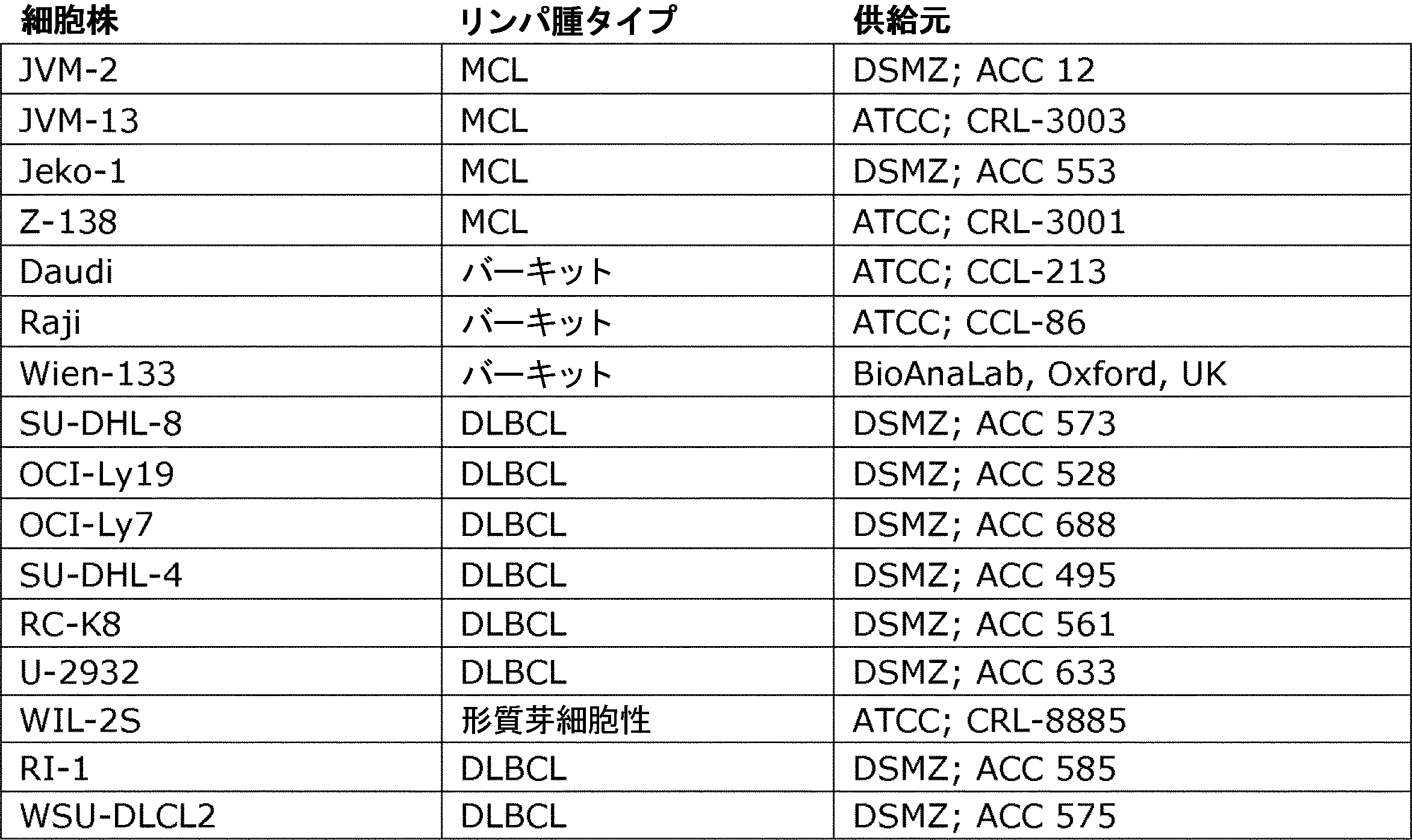
図15は、bsIgG1-016-H5L2-LC90S-F405L-E430G×010-H5L2-K409R-E430Gが、様々なB細胞リンパ腫タイプに由来する広い範囲のB細胞リンパ腫細胞株においてCDCを誘導したことを示している。 Figure 15 shows that bsIgG1-016-H5L2-LC90S-F405L-E430G×010-H5L2-K409R-E430G induced CDC in a broad range of B cell lymphoma cell lines derived from different B cell lymphoma types.
実施例11:Fc-Fc相互作用増強変異を有する二重特異性CD37抗体は、抗体依存性細胞傷害作用(ADCC)の誘導においてより強力である
標的細胞の標識
ADCCを誘導するCD37抗体の能力をクロムリリースアッセイによって測定した。培地(鉄を含む10%ドナーウシ血清(DBSI;ThermoFischer、Cat # 10371029)およびペニシリンストレプトマイシン混合物(pen/strep)で補足されたRPMI 1640に100μCiの51Cr(Chromium-51;PerkinElmer、Cat # NEZ030005MC)を加えたもの)1mL中にDaudiまたはRaji細胞を捕集した(5×10⁶個/mL)。細胞を、37℃の水浴中、振とうしながら1時間インキュベートした。細胞の洗浄(PBS中で二回、1500rpm、5分)後、細胞をRPMI 1640/10% DBSI/pen/strepに再懸濁させ、トリパンブルー色素排除試験法によって計数した。細胞を1×105個/mLの密度まで希釈した。
Example 11: Bispecific CD37 antibodies with Fc-Fc interaction enhancing mutations are more potent in inducing antibody-dependent cellular cytotoxicity (ADCC)
Labeling of target cells
The ability of CD37 antibodies to induce ADCC was measured by chromium release assay. Daudi or Raji cells were harvested (5x10⁶ cells/mL) in 1mL of medium (RPMI 1640 supplemented with 10% donor bovine serum with iron (DBSI; ThermoFischer, Cat # 10371029) and penicillin- streptomycin mixture (pen/strep) plus 100 μCi of 51Cr (Chromium-51; PerkinElmer, Cat # NEZ030005MC). Cells were incubated for 1 hour with shaking in a 37°C water bath. After washing the cells (twice in PBS, 1500 rpm, 5 min), the cells were resuspended in RPMI 1640/10% DBSI/pen/strep and counted by trypan blue exclusion test. Cells were diluted to a density of 1x10⁵ cells/mL.
エフェクター細胞の調製
健康ボランティア由来の末梢血単核細胞(Sanquin、Amsterdam, The Netherlands)を、抜き取ったばかりのヘパリン血(軟膜)45mLから、Ficoll密度勾配遠心法(Bio Whittaker;リンパ球分離媒体、cat 17-829E)により、製造元の指示にしたがって単離した。細胞をRPMI 1640/10% DBSI/pen/strepに再懸濁させた後、トリパンブルー色素排除試験法によって計数し、1×107個/mLの密度まで希釈した。
Preparation of effector cells. Peripheral blood mononuclear cells (Sanquin, Amsterdam, The Netherlands) from healthy volunteers were isolated from 45 mL of freshly drawn heparinized blood (buffy coat) by Ficoll density gradient centrifugation (Bio Whittaker; Lymphocyte Separation Medium, cat 17-829E) according to the manufacturer's instructions. Cells were resuspended in RPMI 1640/10% DBSI/pen/strep, counted by trypan blue exclusion, and diluted to a density of 1 x 10⁷ cells/mL.
ADCCアッセイ手順
51Cr標識標的細胞50μLを96ウェル丸底マイクロタイタプレート(Greiner Bio-One;Cat # 650101)の中にピペット移送し、RPMI 1640/10% DBSI/pen/strep中に希釈したCD37またはコントロール抗体の濃度系列(3倍希釈物中1.5~5,000ng/mL最終濃度)50μLを加えた。細胞を室温(RT)で15分間インキュベートし、エフェクター細胞50μLを加えて、100:1のエフェクター:標的比を生じさせた。細胞を37℃および5%C02で4時間インキュベートした。最大溶解の測定のために、51Cr標識Daudi細胞50μL(5.000個)を5% Triton-X100 100μLとともにインキュベートし;自然発生的溶解(バックグラウンド溶解)の測定のために、51Cr標識Daudi細胞5,000個を、培地150μL中、任意の抗体またはエフェクター細胞なしでインキュベートした。Daudi細胞5,000個をPBMC500,000個とともに抗体なしでインキュベートすることにより、抗体非依存性細胞溶解のレベルを測定した。プレートを遠心処理し(1200rpm、10分)、上清25μLを、96ウェルプレート中のMicroscint-40溶液(Packard, Cat # 6013641)100μLに移した。プレートを密封し、800rpmで15分間振とうし、放出された51Crをシンチレーションカウンタ(TopCount(登録商標)、PerkinElmer)によって計数した。特異的溶解率(%)を以下のように計算した:
特異的溶解率(%)=(試料のcpm-自然発生的溶解のcpm)/(最大溶解のcpm-自然発生的溶解のcpm)(式中、cpmは毎分計数値である)。
ADCC assay procedure
Fifty microliters of 51Cr -labeled target cells were pipetted into a 96-well round-bottom microtiter plate (Greiner Bio-One; Cat # 650101) and 50 μL of a concentration series of CD37 or control antibodies (1.5-5,000 ng/mL final concentration in 3-fold dilutions) in RPMI 1640/10% DBSI/pen/strep was added. Cells were incubated for 15 min at room temperature (RT) and 50 μL of effector cells were added to yield an effector:target ratio of 100:1. Cells were incubated for 4 h at 37°C and 5% CO2. For the measurement of maximum lysis, 50 μL (5.000 cells) of 51Cr-labeled Daudi cells were incubated with 100 μL of 5% Triton-X100; for the measurement of spontaneous lysis (background lysis), 5,000 51Cr-labeled Daudi cells were incubated in 150 μL of medium without any antibody or effector cells. The level of antibody-independent cell lysis was measured by incubating 5,000 Daudi cells with 500,000 PBMCs without antibody. The plates were centrifuged (1200 rpm, 10 min) and 25 μL of the supernatant was transferred to 100 μL of Microscint-40 solution (Packard, Cat # 6013641) in a 96-well plate. The plates were sealed and shaken at 800 rpm for 15 min, and the released 51Cr was counted by a scintillation counter (TopCount®, PerkinElmer). The specific lysis percentage was calculated as follows:
% specific lysis=(sample cpm−spontaneous lysis cpm)/(maximal lysis cpm−spontaneous lysis cpm), where cpm is counts per minute.
図16Aは、bsIgG1-016-H5L2-LC90S-F405L-E430G×005-H1L2-K409R-E430Gが、Daudi細胞におけるADCC誘導において、IgG1-005-H1L2-K409R-E430GまたはIgG1-016-H5L2-F409L-E430GいずれかまたはIgG1-005-H1L2-K409R-E430G+IgG1-016-H5L2-F405L-E430Gの組み合わせよりも強力であったことを示している。 Figure 16A shows that bsIgG1-016-H5L2-LC90S-F405L-E430G x 005-H1L2-K409R-E430G was more potent than either IgG1-005-H1L2-K409R-E430G or IgG1-016-H5L2-F409L-E430G or the combination of IgG1-005-H1L2-K409R-E430G + IgG1-016-H5L2-F405L-E430G in inducing ADCC in Daudi cells.
図16Bは、bsIgG1-016-H5L2-LC90S-F405L-E430G×010-H5L2-K409R-E430Gが、Daudi細胞におけるADCC誘導において、IgG1-010-H5L2-E430GまたはIgG1-016-H5L2-E430GいずれかまたはIgG1-010-H5L2-E430G+IgG1-016-H5L2-E430Gの組み合わせよりも強力であったことを示している。 Figure 16B shows that bsIgG1-016-H5L2-LC90S-F405L-E430G × 010-H5L2-K409R-E430G was more potent than either IgG1-010-H5L2-E430G or IgG1-016-H5L2-E430G or the combination of IgG1-010-H5L2-E430G + IgG1-016-H5L2-E430G in inducing ADCC in Daudi cells.
図16Cは、異なるドナーに由来するPBMCに関して図16Bと類似の結果を示し、加えて、bsIgG1-016-H5L2-LC90S-F405L-E430G×010-H5L2-K409R-E430Gが、Raji細胞におけるADCC誘導において、一価結合抗体bsIgG1-016-H5L2-LC90S-F405L-E430G×b12-K409R-E430GおよびbsIgG1-b12-F405L-E430G×010-H5L2-K409R-E430Gよりも強力であったことを示している。 Figure 16C shows similar results to Figure 16B for PBMCs from different donors and additionally shows that bsIgG1-016-H5L2-LC90S-F405L-E430G×010-H5L2-K409R-E430G was more potent in inducing ADCC in Raji cells than the monovalent binding antibodies bsIgG1-016-H5L2-LC90S-F405L-E430G×b12-K409R-E430G and bsIgG1-b12-F405L-E430G×010-H5L2-K409R-E430G.
実施例12:Fc-Fc相互作用増強変異を有する二重特異性CD37抗体は、様々なB細胞悪性腫瘍を有する患者に由来する初代腫瘍細胞において強力なエクスビボCDCを誘導する
5つの異なるB細胞悪性腫瘍:慢性リンパ球性白血病(CLL)、ろ胞性リンパ腫(FL)、びまん性大B細胞リンパ腫(DLBCL)、マントル細胞リンパ腫(MCL)、および非ホジキンリンパ腫(さらなる特定はされていない)からの患者由来初代腫瘍細胞を使用して、bsIgG1-016-H5L2-LC90S-F405L×010-H5L2-K409R-E430GのCDC効力を分析した。ヘルシンキ宣言にしたがって、VUmc医学倫理委員会によって認められたプロトコルを使用して、書面でのインフォームドコンセントの後、すべての患者試料を得、貯蔵した。密度勾配遠心法(Ficoll-Paque PLUS、GE Healthcare)により、患者の骨髄穿刺液または末梢血試料から患者骨髄単核細胞(BMNC)または末梢血単核細胞(PBMC)を単離した。細胞は、ただちに使用したか、さらなる使用まで液体窒素中に貯蔵した。
Example 12: Bispecific CD37 antibodies with Fc-Fc interaction enhancing mutations induce potent ex vivo CDC in primary tumor cells derived from patients with various B cell malignancies
The CDC potency of bsIgG1-016-H5L2-LC90S-F405L×010-H5L2-K409R-E430G was analyzed using patient-derived primary tumor cells from five different B-cell malignancies: chronic lymphocytic leukemia (CLL), follicular lymphoma (FL), diffuse large B-cell lymphoma (DLBCL), mantle cell lymphoma (MCL), and non-Hodgkin's lymphoma (not further specified). All patient samples were obtained and stored after written informed consent, using protocols approved by the VUmc Medical Ethics Committee, in accordance with the Declaration of Helsinki. Patient bone marrow mononuclear cells (BMNCs) or peripheral blood mononuclear cells (PBMCs) were isolated from patients' bone marrow aspirates or peripheral blood samples by density gradient centrifugation (Ficoll-Paque PLUS, GE Healthcare). Cells were used immediately or stored in liquid nitrogen until further use.
患者リンパ節組織を小さな断片へと切り分け、1%ペニシリンストレプトマイシン、0.2%ヘパリンおよび5%血小板溶解物を含むα-MEM培地(ThermoFischer Scientific、Waltham, MA)中に捕集し、37℃で一晩放置した。インキュべーション後、上清(腫瘍細胞を含む非間質細胞区画)を捕集し、70μM Easy Strainer(Greiner Bio-one)を使用して細胞をろ過した。細胞を計数し、25%熱不活性化FBSおよび10%DMSOを含むRPMI1640培地に再懸濁させ、さらなる使用まで液体窒素中に冷凍した。 Patient lymph node tissue was cut into small pieces and collected in α-MEM medium (ThermoFischer Scientific, Waltham, MA) containing 1% penicillin-streptomycin, 0.2% heparin, and 5% platelet lysate, and left at 37°C overnight. After incubation, the supernatant (non-stromal cell compartment containing tumor cells) was collected, and cells were strained using a 70 μM Easy Strainer (Greiner Bio-one). Cells were counted, resuspended in RPMI1640 medium containing 25% heat-inactivated FBS and 10% DMSO, and frozen in liquid nitrogen until further use.
QifiKit(DAKO、cat. no. K007811)を使用して、単離された患者細胞上のCD37および膜補体調節タンパク質(mCRP;CD46、CD55およびCD59)発現レベルを測定した。細胞を、精製された抗体CD37(BD、cat. no. 555456)、CD46(BioLegend、cat. no. 352404)、CD55(BioLegend、cat. no. 311302)、CD59(BioLegend、cat. no. 304702)およびb12(Genmab)とともに4℃で30分間インキュベートした。この後、QifiKit製造元によって提供される方法を使用した。Qifiキット手順の最終工程の後、細胞をリンパ腫細胞特異的マーカーとともにインキュベートして、腫瘍細胞同定を可能にした。図17は、適応症ごとの発現レベルを示している。 The QifiKit (DAKO, cat. no. K007811) was used to measure CD37 and membrane complement regulatory protein (mCRP; CD46, CD55 and CD59) expression levels on isolated patient cells. Cells were incubated with purified antibodies CD37 (BD, cat. no. 555456), CD46 (BioLegend, cat. no. 352404), CD55 (BioLegend, cat. no. 311302), CD59 (BioLegend, cat. no. 304702) and b12 (Genmab) for 30 min at 4°C. After this, the method provided by the QifiKit manufacturer was used. After the final step of the Qifi Kit procedure, cells were incubated with lymphoma cell specific markers to allow tumor cell identification. Figure 17 shows the expression levels per indication.
患者由来の腫瘍細胞を10μg/mLまたは100μg/mLのbsIgG1-016-H5L2-LC90S-F405L×010-H5L2-K409R-E430Gでオプソニン化し、20%のプールされたNHSの存在下で、CDC誘導を評価した。異なる細胞集団を同定するために以下の細胞マーカーを使用した:CD45-KO(Beckman Coulter B36294)、CD19-PC7(Beckman Coulter、cat. no. IM3628)、CD3-V450(BD、cat. no. 560365)、CD5-APC(BD、cat. no. 345783)、CD5-PE(DAKO、cat. no. R084201)、CD10-APC-H7(BD、cat. no. 655404)、CD10-PE(DAKO、cat. no. R084201)、CD23-FITC(Biolegend、cat. no. 338505)、ラムダ-APC-H7(BD、cat. no. 656648)、カッパ-PE(DAKO、cat. no. R043601)およびラムダ-FITC(Emelca Bioscience CYT-LAMBF)。CD45+細胞集団内で、適応症に依存する異なるマーカーによって悪性B細胞を決定した:CD3-/CD19+/CD5+(CLL)、CD3-/CD19+/CD10+(FL、DLBCL)、CD3-/CD19+/CD5+/CD23-(MCL)。これらのマーカーに基づいて悪性B細胞を同定することができなかった場合、悪性腫瘍細胞は、カッパ/ラムダ染色を使用してクローン性に基づいて同定した。また、いくつかの試料において、悪性B細胞は、クローン性に基づいて同定することができなかった。そのような場合、正常B細胞と悪性B細胞との区別なく全B細胞集団を評価した。LSRFortessaフローサイトメータ(BD Biosciences、San Jose, CA)によって測定される7-アミノアクチノマイシンD(7-AAD;BD、cat. no. 555816)陽性悪性B細胞の分画(%)として死滅を計算した。 Patient-derived tumor cells were opsonized with bsIgG1-016-H5L2-LC90S-F405L×010-H5L2-K409R-E430G at 10 μg/mL or 100 μg/mL, and CDC induction was assessed in the presence of 20% pooled NHS. The following cell markers were used to identify the different cell populations: CD45-KO (Beckman Coulter B36294), CD19-PC7 (Beckman Coulter, cat. no. IM3628), CD3-V450 (BD, cat. no. 560365), CD5-APC (BD, cat. no. 345783), CD5-PE (DAKO, cat. no. R084201), CD10-APC-H7 (BD, cat. no. 655404), CD10-PE (DAKO, cat. no. R084201), CD23-FITC (Biolegend, cat. no. 338505), lambda-APC-H7 (BD, cat. no. 656648), kappa-PE (DAKO, cat. no. R043601) and lambda-FITC (Emelca Bioscience CYT-LAMBF). Within the CD45+ cell population, malignant B cells were determined by different markers depending on the indication: CD3-/CD19+/CD5+ (CLL), CD3-/CD19+/CD10+ (FL, DLBCL), CD3-/CD19+/CD5+/CD23- (MCL). If malignant B cells could not be identified based on these markers, malignant tumor cells were identified based on clonality using kappa/lambda staining. Also, in some samples, malignant B cells could not be identified based on clonality. In such cases, the total B cell population was evaluated without distinguishing between normal and malignant B cells. Killing was calculated as the fraction (%) of 7-aminoactinomycin D (7-AAD; BD, cat. no. 555816) positive malignant B cells measured by an LSRFortessa flow cytometer (BD Biosciences, San Jose, CA).
図18は、bsIgG1-016-H5L2-LC90S-F405L×010-H5L2-K409R-E430Gが、CLL、FL、MCL、DLBCLまたはB-NHL(これ以上は特定せず)患者由来の腫瘍細胞におけるCDC誘導において非常に強力(50%超の溶解)であったことを示している。再発性/難治性FLの患者1名に由来する細胞において、bsIgG1-016-H5L2-LC90S-F405L×010-H5L2-K409R-E430Gは、CDCを誘導する能力が低かった。 Figure 18 shows that bsIgG1-016-H5L2-LC90S-F405Lx010-H5L2-K409R-E430G was highly potent (>50% lysis) in inducing CDC in tumor cells from patients with CLL, FL, MCL, DLBCL or B-NHL (not further specified). In cells from one patient with relapsed/refractory FL, bsIgG1-016-H5L2-LC90S-F405Lx010-H5L2-K409R-E430G had a low ability to induce CDC.
実施例13:全血中のヒトまたはカニクイザルB細胞への、Fc-Fc相互作用増強変異を有する二重特異性CD37抗体の結合および全血中のB細胞における細胞傷害作用の誘導
ヒトまたはカニクイザルB細胞への結合
全血結合アッセイにおいてヒトまたはカニクイザルB細胞への結合を測定した。健康ボランティア由来のヘパリン処理したヒト血液をUMC Utrecht(Utrecht, The Netherlands)から得、カニクイザル由来のヒルジン処理血液をCovance(Munster, Germany)から得た。血液を96ウェル丸底プレート(Greiner Bio-one、cat. no. 65010)のウェルに分取した(35μL/ウェル)。RBC溶解バッファ(10mM KHC03[Sigma P9144]、0.1mM EDTA[Fluka 03620]および0.15mM NH4CL[Sigma A5666])100μLの添加によって赤血球(RBC)を溶解させ、RBC溶解が完了するまで氷上でインキュベートした。300×Gで3分間の遠心処理の後、細胞を、Alexa-488標識bsIgG1-016-H5L2-LC90S-F405L-E430G×010-H5L2-K409R-E430GまたはAlexa-488標識コントロールIgG1(IgG1-b12)および直接標識抗体の段階希釈物(3×段階希釈物中0.014~30μg/mL最終抗体濃度)とともに4℃で30分間インキュベートしてB細胞を同定した(血液細胞サブセットをさらに同定するために、抗体の混合物の中で)。
Example 13: Binding of bispecific CD37 antibodies with Fc-Fc interaction enhancing mutations to human or cynomolgus monkey B cells in whole blood and induction of cytotoxicity in B cells in whole blood
Binding to human or cynomolgus monkey B cells
Binding to human or cynomolgus B cells was measured in a whole blood binding assay. Heparinized human blood from healthy volunteers was obtained from UMC Utrecht (Utrecht, The Netherlands) and hirudin-treated blood from cynomolgus monkeys was obtained from Covance (Munster, Germany). Blood was aliquoted (35 μL/well) into wells of a 96-well round-bottom plate (Greiner Bio-one, cat. no. 65010). Red blood cells (RBCs) were lysed by the addition of 100 μL of RBC lysis buffer (10 mM KHC0 3 [Sigma P9144], 0.1 mM EDTA [Fluka 03620] and 0.15 mM NH 4 CL [Sigma A5666]) and incubated on ice until RBC lysis was complete. After centrifugation at 300×G for 3 min, cells were incubated for 30 min at 4°C with Alexa-488-labeled bsIgG1-016-H5L2-LC90S-F405L-E430G×010-H5L2-K409R-E430G or Alexa-488-labeled control IgG1 (IgG1-b12) and serial dilutions of directly labeled antibodies (0.014-30 μg/mL final antibody concentration in 3× serial dilutions) to identify B cells (in a mixture of antibodies to further identify blood cell subsets).
ヒト血液B細胞の場合、以下の抗体を使用した。

カニクイザル血液B細胞の場合、以下の抗体を使用した。

細胞をペレット化し、FACSバッファ150μL中で二回洗浄し、TO-PRO-3(最終濃度0.2μM;Molecular Probes、cat no. T3605)150μLに再懸濁させた。LSRFortessaフローサイトメータを使用するフローサイトメトリーによって試料を計測した。結合は、生存TO-PRO-3-/CD14-/CD19+B細胞(ヒト)または生存TO-PRO-3-/CD14-/CD19+/CD20+B細胞(カニクイザル)の場合のA488蛍光強度の幾何平均として表す。GraphPad PRISM中、非線形用量反応フィットのベストフィット値を使用して対数変換データを解析した。 Cells were pelleted, washed twice in 150 μL FACS buffer, and resuspended in 150 μL TO-PRO-3 (final concentration 0.2 μM; Molecular Probes, cat no. T3605). Samples were measured by flow cytometry using an LSRFortessa flow cytometer. Binding is expressed as the geometric mean of A488 fluorescence intensity for live TO-PRO-3 − /CD14 − /CD19 + B cells (human) or live TO-PRO-3 − /CD14 − /CD19 + /CD20 + B cells (cynomolgus monkey). Log-transformed data were analyzed using best fit values of a nonlinear dose-response fit in GraphPad PRISM.
図19は、1つの代表的なドナー/動物としての(A)ヒトおよび(B)カニクイザルの血液中のB細胞へのbsIgG1-016-H5L2-LC90S-F405L-E430G×010-H5L2-K409R-E430Gの濃度依存的な結合を示している。ヒトおよびカニクイザルB細胞への結合の平均EC50値は同じ範囲内であり(それぞれ[6名のヒトドナー由来の血液中のB細胞への結合に基づいて0.85μg/mL±0.284]および[4匹のカニクイザル由来の血液中のB細胞への結合に基づいて0.63μg/mL±0.228])、bsIgG1-016-H5L2-LC90S-F405L-E430G×010-H5L2-K409R-E430GがヒトおよびカニクイザルCD37への同等な結合を示すことを示した。 Figure 19 shows the concentration-dependent binding of bsIgG1-016-H5L2-LC90S-F405L-E430Gx010-H5L2-K409R-E430G to blood B cells from (A) human and (B) cynomolgus monkeys as one representative donor/animal. The mean EC50 values for binding to human and cynomolgus B cells were in the same range (0.85μg/mL±0.284 based on binding to blood B cells from 6 human donors and 0.63μg/mL±0.228 based on binding to blood B cells from 4 cynomolgus monkeys, respectively), indicating that bsIgG1-016-H5L2-LC90S-F405L-E430Gx010-H5L2-K409R-E430G shows comparable binding to human and cynomolgus CD37.
ヒトまたはカニクイザルB細胞への細胞傷害作用
全血細胞傷害アッセイにおいてヒトまたはカニクイザルB細胞に対する細胞傷害作用を測定した。健康ボランティア由来のヒルジン処理されたヒト血液をUMC Utrecht(Utrecht, The Netherlands)から得、カニクイザル由来のヒルジン処理血液をCovance(Munster, Germany)から得た。血液を96ウェル丸底プレートのウェルに35μL/ウェルで分取した。
Cytotoxicity against human or cynomolgus B cells Cytotoxicity against human or cynomolgus B cells was measured in a whole blood cytotoxicity assay. Hirudin-treated human blood from healthy volunteers was obtained from UMC Utrecht (Utrecht, The Netherlands) and hirudin-treated blood from cynomolgus monkeys was obtained from Covance (Munster, Germany). Blood was aliquoted into wells of a 96-well round-bottom plate at 35 μL/well.
bsIgG1-016-H5L2-LC90S-F405L-E430G×010-H5L2-K409R-E430GまたはIgG1-b12の段階希釈物(3×段階希釈物中0.0005~10μg/mL最終抗体濃度;最終量100μL/ウェル)を加えた。ヒト全血を使用する細胞傷害アッセイにおいては、モノクローナルFcγR相互作用増強CD37特異的抗体IgG1-G28.1-S239D-I332Eを参照として含めた。試料を37℃で4時間インキュベートした。その後、上記のように赤血球を溶解させ、上記のように試料を染色してB細胞を同定した。細胞をペレット化し、FACSバッファ150μL中で二回洗浄し、TO-PRO-3(最終濃度0.2μM;Molecular Probes、cat no. T3605)150μLに再懸濁させた。LSRFortessaフローサイトメータを使用するフローサイトメトリーによって試料を計測した。ダブレットの排除後、生存TO-PRO-3-/CD14-/CD19+B細胞(ヒト)または生存TO-PRO-3-/CD14-/CD19+/CD20+B細胞(カニクイザル)の割合を測定した。B細胞枯渇率(%)を以下のように計算した:B細胞枯渇率(%)=100×[(AbなしコントロールのB細胞% - 試料のB細胞%)/(AbなしコントロールのB細胞%)]。GraphPad PRISM中、非線形用量反応フィットのベストフィット値を使用して対数変換データを解析した。
Serial dilutions of bsIgG1-016-H5L2-LC90S-F405L-E430Gx010-H5L2-K409R-E430G or IgG1-b12 (0.0005-10 μg/mL final antibody concentration in 3x serial dilutions;
図20は、1つの代表的なドナー/動物としての(A)ヒトおよび(B)カニクイザルの血液中のB細胞に対するbsIgG1-016-H5L2-LC90S-F405L-E430G×010-H5L2-K409R-E430Gの濃度依存性細胞傷害作用を示している。 Figure 20 shows the concentration-dependent cytotoxicity of bsIgG1-016-H5L2-LC90S-F405L-E430G×010-H5L2-K409R-E430G against blood B cells from (A) humans and (B) cynomolgus monkeys as one representative donor/animal.
EC50に基づくと、細胞傷害作用を誘導するbsIgG1-016-H5L2-LC90S-F405L-E430G×010-H5L2-K409R-E430Gの能力は、ヒトB細胞とカニクイザルB細胞とで同等であった。ヒトB細胞(6名のドナー由来の血液中)に対する細胞傷害作用の平均EC50は0.077μg/mL±0.039であり;カニクイザルB細胞(4匹からの血液中)に対する細胞傷害作用の平均EC50は0.043μg/mL±0.019であった。 Based on EC50 , the ability of bsIgG1-016-H5L2-LC90S-F405L-E430Gx010-H5L2-K409R-E430G to induce cytotoxicity was comparable between human and cynomolgus B cells. The mean EC50 of cytotoxicity against human B cells (in blood from six donors) was 0.077 μg/mL ± 0.039; the mean EC50 of cytotoxicity against cynomolgus B cells (in blood from four animals) was 0.043 μg/mL ± 0.019.
図20Aはまた、bsIgG1-016-H5L2-LC90S-F405L-E430G×010-H5L2-K409R-E430Gよりも低い細胞傷害作用を示した、代表的な応答ドナーの場合のヒトB細胞に対するFcγR相互作用増強モノクローナルCD37抗体IgG1-G28.1-S239D-I332Eの細胞傷害作用を示している。3名の応答ドナー由来のB細胞においては、IgG1-G28.1-S239D-I332Eによる50%の最大B細胞枯渇が計測されたが、他3名のドナー由来のB細胞においては、この抗体によるB細胞に対する細胞傷害作用は計測されなかった。bsIgG1-016-H5L2-LC90S-F405L-E430G×010-H5L2-K409R-E430Gは、6/6ドナー中のB細胞の93~99%において細胞傷害作用を誘導した。Daudi細胞上に発現したCD37へのIgG1-G28.1-S239D-I332Eの結合はbsIgG1-016-H5L2-LC90S-F405L-E430G×010-H5L2-K409R-E430Gの結合と同等であった(データは示さず)。 Figure 20A also shows the cytotoxic effect of the monoclonal CD37 antibody IgG1-G28.1-S239D-I332E with enhanced FcγR interactions against human B cells in a representative responding donor, which showed a lower cytotoxic effect than bsIgG1-016-H5L2-LC90S-F405L-E430G×010-H5L2-K409R-E430G. A maximum B cell depletion of 50% was measured with IgG1-G28.1-S239D-I332E in B cells from three responding donors, whereas no cytotoxic effect was measured against B cells by this antibody in B cells from the other three donors. bsIgG1-016-H5L2-LC90S-F405L-E430G×010-H5L2-K409R-E430G induced cytotoxicity in 93-99% of B cells in 6/6 donors. Binding of IgG1-G28.1-S239D-I332E to CD37 expressed on Daudi cells was comparable to that of bsIgG1-016-H5L2-LC90S-F405L-E430G×010-H5L2-K409R-E430G (data not shown).
実施例14:Fc-Fc相互作用増強変異を有する二重特異性CD37抗体とCD20特異的抗体との組み合わせによる強力なCDC活性
bsIgG1-016-H5L2-LC90S-F405L-E430G×010-H5L2-K409R-E430Gと抗CD20抗体(IgG1-CD20-ofa;オファツムマブ)との組み合わせに関し、ConversantBio(Huntsville, Alabama, USA)から得られた患者由来CLL腫瘍細胞においてCDCを誘導する能力を試験した。患者由来のPBMCを、0.2% BSA(ウシ血清アルブミン)含有RPMIに再懸濁させ、ポリスチレン96ウェル丸底プレート(Greiner bio-one Cat # 650101)中に0.1×10⁶個/ウェル(30μL/ウェル)の密度で播種し、bsIgG1-016-H5L2-LC90S-F405L-E430G×010-H5L2-K409R-E430G(0.0625~0.05μg/mL)およびIgG1-CD20-ofa(1~8μg/mL)の濃度系列50μLを2倍希釈で加えた。bsIgG1-016-H5L2-LC90S-F405L-E430G×010-H5L2-K409R-E430GとIgG1-CD20-ofaとを、各抗体の相対効力(EC50の差)に基づく抗体濃度で、平均すると別々に同じ効果に達するであろう2つの濃度を混合することにより、合わせた。IgG1-b12をネガティブコントロールとして使用した。
Example 14: Potent CDC activity by combination of a bispecific CD37 antibody with an Fc-Fc interaction enhancing mutation and a CD20-specific antibody
The combination of bsIgG1-016-H5L2-LC90S-F405L-E430G×010-H5L2-K409R-E430G with an anti-CD20 antibody (IgG1-CD20-ofa; ofatumumab) was tested for its ability to induce CDC in patient-derived CLL tumor cells obtained from ConversantBio (Huntsville, Alabama, USA). PBMCs from patients were resuspended in RPMI containing 0.2% BSA (bovine serum albumin) and plated at a density of 0.1x10⁶ cells/well (30μL/well) in polystyrene 96-well round bottom plates (Greiner bio-one Cat # 650101) and 50μL of a concentration series of bsIgG1-016-H5L2-LC90S-F405L-E430Gx010-H5L2-K409R-E430G (0.0625-0.05μg/mL) and IgG1-CD20-ofa (1-8μg/mL) were added in 2-fold dilutions. bsIgG1-016-H5L2-LC90S-F405L-E430Gx010-H5L2-K409R-E430G and IgG1-CD20-ofa were combined by mixing two concentrations that would reach the same effect on average separately, with the antibody concentration based on the relative potency (EC50 difference) of each antibody. IgG1-b12 was used as a negative control.
インキュベーション(振とうしながら室温で15分)後、プールされた正常ヒト血清(NHS Cat # M0008 Sanquin、Amsterdam, The Netherlands)20μLを補体ソースとして各ウェルに加え、プレートを37℃で45分間インキュベートした。プレートを氷で冷やすことにより、反応を停止させた。300×gで3分間遠心処理した後、細胞をFACSバッファ150μLで二回洗浄し、R-フィコエリスリン(PE)標識マウス抗ヒトIgG1-CD19抗体(クローンJ3-119、Beckman Coulter、cat no. A07769、原液から1:50希釈)とともに4℃で30分間インキュベートして、死細胞の同定のために腫瘍B細胞およびTO-PRO-3(最終濃度0.2μM;Molecular Probes、cat no. T3605)を測定した。細胞をペレット化し、FACSバッファ150μL中で二回洗浄し、LSRFortessaフローサイトメータを使用するフローサイトメトリーによって計測した。生存細胞の割合を以下のように計算した:生存細胞(%)=100×(TO-PRO-3陰性イベント数)/(全イベント数)。 After incubation (15 min at room temperature with shaking), 20 μL of pooled normal human serum (NHS Cat # M0008 Sanquin, Amsterdam, The Netherlands) was added to each well as a complement source and the plate was incubated at 37°C for 45 min. The reaction was stopped by chilling the plate on ice. After centrifugation at 300 × g for 3 min, the cells were washed twice with 150 μL of FACS buffer and incubated with R-phycoerythrin (PE)-conjugated mouse anti-human IgG1-CD19 antibody (clone J3-119, Beckman Coulter, cat no. A07769, diluted 1:50 from stock solution) for 30 min at 4°C to measure tumor B cells and TO-PRO-3 (final concentration 0.2 μM; Molecular Probes, cat no. T3605) for identification of dead cells. Cells were pelleted, washed twice in 150 μL of FACS buffer, and counted by flow cytometry using an LSRFortessa flow cytometer. The percentage of viable cells was calculated as follows: % viable cells = 100 x (number of TO-PRO-3 negative events)/(total number of events).
図21A~Dは、bsIgG1-016-H5L2-LC90S-F405L-E430G×010-H5L2-K409R-E430Gおよびオファツムマブの両方が2名のCLL患者由来の腫瘍細胞においてCDCを誘導し、用量レベルの増加とともにCDC活性が増強されることを示している。bsIgG1-016-H5L2-LC90S-F405L-E430G×010-H5L2-K409R-E430Gをオファツムマブと合わせると、試験したすべての濃度で、試験した両CLL患者においてCDC活性の増強が得られたが、これらの効果は、単独の作用物質によってほぼ完全な細胞死が誘導される高めの抗体濃度ではそれほど顕著ではなかった(図21AおよびB)。これらの結果は、bsIgG1-016-H5L2-LC90S-F405L-E430G×010-H5L2-K409R-E430Gへのオファツムマブの添加が、CLL患者から得られた悪性B細胞においてCDC媒介腫瘍細胞死を改善することができることを示している。 Figures 21A-D show that both bsIgG1-016-H5L2-LC90S-F405L-E430G×010-H5L2-K409R-E430G and ofatumumab induced CDC in tumor cells from two CLL patients, with enhanced CDC activity with increasing dose levels. Combining bsIgG1-016-H5L2-LC90S-F405L-E430G×010-H5L2-K409R-E430G with ofatumumab resulted in enhanced CDC activity in both CLL patients tested at all concentrations tested, although these effects were less pronounced at higher antibody concentrations where single agents induced nearly complete cell death (Figures 21A and B). These results indicate that the addition of ofatumumab to bsIgG1-016-H5L2-LC90S-F405L-E430G×010-H5L2-K409R-E430G can improve CDC-mediated tumor cell death in malignant B cells obtained from CLL patients.
実施例15:B細胞悪性腫瘍の異種移植モデルにおけるFc-Fc相互作用増強変異を有する二重特異性CD37抗体の抗腫瘍活性
皮下JVM-3ヒト慢性B細胞白血病異種移植モデルにおける抗腫瘍活性
JVM-3細胞(1×10⁷個)をCB17.SCIDマウスの右脇腹に接種し、腫瘍が約158mm3の平均体積に達したところで抗体処置(0.1、0.3、1、3、または10mg/kgの用量の週1回静脈内注射を三回;IgG1-b12をネガティブコントロールとして使用し、10mg/kgで投与)を開始した。週二回、ノギスを使用して腫瘍体積を二次元計測し、式:V=(L×W×W)/2を使用して体積をmm3単位で表した(式中、Vは腫瘍体積であり、Lは腫瘍長さ(最長腫瘍寸法)であり、Wは腫瘍幅(Lに対して垂直な最長腫瘍寸法)である)。
Example 15: Antitumor activity of bispecific CD37 antibodies with Fc-Fc interaction enhancing mutations in xenograft models of B cell malignancies
Antitumor activity in a subcutaneous JVM-3 human chronic B-cell leukemia xenograft model
JVM-3 cells ( 1x10⁷ ) were inoculated into the right flank of CB17.SCID mice and antibody treatment (three weekly intravenous injections at doses of 0.1, 0.3, 1, 3, or 10 mg/kg; IgG1-b12 was used as a negative control and given at 10 mg/kg) was initiated when tumors reached an average volume of approximately 158 mm3. Tumor volumes were measured twice weekly in two dimensions using calipers and expressed in mm3 using the formula: V = (L x W x W)/2, where V is tumor volume, L is tumor length (longest tumor dimension), and W is tumor width (longest tumor dimension perpendicular to L).
図22Aは、投与グループごとの腫瘍体積を時間とともに示し、図22Bは、すべてのグループがまだ1匹も欠けていなかった25日目での投与グループごとのマウス1匹あたりの腫瘍体積を示している。1、3、または10mg/kgでのbsIgG1-016-H5L2-LC90S-F405L-E430G×010-H5L2-K409R-E430Gの週1回投与を三回行ったところ、JVM-3細胞腫瘍成長が有意に減少したが、0.1または0.3mg/kgでの投与は腫瘍成長に影響しなかった(マン・ホイットニー検定、p<0.01)。
Figure 22A shows tumor volume over time per treatment group, and Figure 22B shows tumor volume per mouse per treatment group at
静脈内Daudi-lucバーキットリンパ腫異種移植モデルにおける抗腫瘍活性
0日目、SCIDマウス(C.B-17/IcrHan(登録商標)Hsd-Prkdcscid;Harlan)に対し、Daudi-luc(ルシフェラーゼトラスフェクトDaudi細胞、2.5×106個/マウス)を静脈内注射した。14、21および28日目、マウスに対し、bsIgG1-016-H5L2-LC90S-F405L-E430G×010-H5L2-K409R-E430Gを0.1、0.3、1、3または10mg/kgで腹腔内注射した。IgG1-b12をネガティブコントロール抗体として使用し、10mg/kgで投与した。毎週(2日目から開始)、バイオルミネセンスイメージング(BLI)によって腫瘍成長を評価した。マウスに対し、ホタルD-ルシフェリン(30mg/mL;Caliper LifeSciences、cat. no. 119222)100μLを腹腔内注射し、イソフルラン麻酔下でBiospace Bioluminescence Imaging System(PerkinElmer;マウスを背側から撮影)を使用してバイオルミネセンス(p/s/cm2/sr[光子数/秒/cm2/平方ラジアン]単位の放射輝度)を計測した。
Antitumor activity in an intravenous Daudi-luc Burkitt's lymphoma xenograft model
On
図23Aは、投与グループごとのルシフェラーゼ活性(バイオルミネセンス、腫瘍体積の尺度として)を時間とともに示す。図23Bは、すべてのグループがまだ1匹も欠けていなかった36日目での投与グループごとのマウス1匹あたりのルシフェラーゼ活性を示している。0.1、0.3、1、3、または10mg/kgでのbsIgG1-016-H5L2-LC90S-F405L-E430G×010-H5L2-K409R-E430Gの週1回投与を三回行ったところ、Daudi-luc細胞のインビボ成長が有意に減少した(一元配置分散分析、補正なしのフィッシャーのLSD)。 Figure 23A shows luciferase activity (bioluminescence, as a measure of tumor volume) over time per treatment group. Figure 23B shows luciferase activity per mouse per treatment group at day 36, when all groups were still intact. Three weekly doses of bsIgG1-016-H5L2-LC90S-F405L-E430G×010-H5L2-K409R-E430G at 0.1, 0.3, 1, 3, or 10 mg/kg significantly reduced the in vivo growth of Daudi-luc cells (one-way ANOVA, Fisher's LSD uncorrected).
実施例16:SCIDマウスにおけるFc-Fc相互作用増強変異を有する二重特異性CD37抗体の血漿クリアランスの評価
11~12週齢の雌SCIDマウス(C.B-17/IcrHan(登録商標)Hsd-Prkdcscid;Harlan)(1グループ3匹)に対し、100μg(5mg/kg)または500μg(25mg/kg)のbsIgG1-016-H5L2-LC90S-F405L-E430G×010-H5L2-K409R-E430GまたはIgG1-b12を1回、静脈内(i.v.)注射した。bsIgG1-016-H5L2-LC90S-F405L-E430G×010-H5L2-K409R-E430GおよびIgG1-b12のいずれもマウスと交差反応性を示さないため、この実験は、標的媒介クリアランスが無い場合の抗体クリアランスを試験するように設定された。
Example 16: Evaluation of plasma clearance of bispecific CD37 antibodies with Fc-Fc interaction enhancing mutations in SCID mice
Female SCID mice (CB-17/IcrHan® Hsd-Prkdcscid; Harlan) aged 11-12 weeks (3 mice per group) were injected intravenously (iv) once with 100 μg (5 mg/kg) or 500 μg (25 mg/kg) of bsIgG1-016-H5L2-LC90S-F405L-E430G×010-H5L2-K409R-E430G or IgG1-b12. As neither bsIgG1-016-H5L2-LC90S-F405L-E430G×010-H5L2-K409R-E430G nor IgG1-b12 showed cross-reactivity with mice, this experiment was designed to test antibody clearance in the absence of target-mediated clearance.
抗体投与から10分、4時間、24時間、2日、7または8日、14日および21日後、血液試料50~100μLを伏在静脈から捕集した。血液をヘパリン含有バイアル中に捕集し、10,000gで5分間遠心処理した。血漿試料を、5mg/kgを投与されたマウスの場合には1:50に希釈し(PBSA(0.2%ウシ血清アルブミン(BSA)で補足されたPBS)980μL中試料20μL)、25mg/kgを投与されたマウスの場合には1:20に希釈し(PBSA380μL中試料20μL)、mAb濃度の測定まで-20℃で貯蔵した。 50-100 μL blood samples were collected from the saphenous vein at 10 min, 4 h, 24 h, 2 days, 7 or 8 days, 14 days, and 21 days after antibody administration. Blood was collected into heparin-containing vials and centrifuged at 10,000 g for 5 min. Plasma samples were diluted 1:50 (20 μL sample in 980 μL PBSA (PBS supplemented with 0.2% bovine serum albumin (BSA))) for mice administered 5 mg/kg and 1:20 (20 μL sample in 380 μL PBSA) for mice administered 25 mg/kg and stored at −20°C until measurement of mAb concentration.
サンドイッチELISAを使用してヒトIgG濃度を測定した。96ウェルMicrolon ELISAプレート(Greiner、Germany)に100μLを4℃で一晩コートしたマウスmAb抗ヒトIgGカッパクローンMH16(CLB Sanquin、The Netherlands;cat. no. M 1268)を2μg/mLの濃度で捕獲抗体として使用した。プレートをPBSAで室温(RT)で1時間遮断した後、試料を加え、PBSA中に段階希釈し、プレートシェーカ上、RTで1時間インキュベートした。プレートをPBST(0.05%Tween 20で補足されたPBS)300μLで三回洗浄し、その後、ヤギ抗ヒトIgG免疫グロブリン(Jackson、West Grace, PA;cat. no. 109-035-098;0.2% BSAで補足されたPBST中1:10.000)とともにRTで1時間インキュベートした。プレートを再びPBST300μLで三回洗浄した後、光防護状態で2,2'-アジノ-ビス(3-エチルベンズチアゾリン-6-スルホン酸)(ABTS;Roche、Mannheim, Germany)とともにインキュベートした。2%シュウ酸100μLを加えることにより、反応を停止させた。マイクロプレートリーダ(Biotek、Winooski, VT)中、405nmで吸光度を計測した。注射した物質を参照カーブとして使用することにより、ヒトIgG濃度を計算した。プレートコントロールとして、精製ヒトIgG1(The binding site、cat. no. BP078)を含めた。ヒトIgG濃度(μg/mL単位)をプロットし(図24AおよびC)、Graphpad prism 6.0を使用してAUC(曲線下面積)を計算した。式D*1.000/AUC(式中、Dは注入量(1mg/kg)である)により、血液試料採取の最終日(21日目)までのIgGクリアランスを測定した(図24BおよびD)。
Human IgG concentrations were measured using a sandwich ELISA. Mouse mAb anti-human IgG kappa clone MH16 (CLB Sanquin, The Netherlands; cat. no. M 1268) was used as capture antibody at a concentration of 2 μg/mL, with 100 μL coated overnight at 4°C on 96-well Microlon ELISA plates (Greiner, Germany). After blocking the plates with PBSA for 1 h at room temperature (RT), samples were added, serially diluted in PBSA, and incubated for 1 h at RT on a plate shaker. Plates were washed three times with 300 μL PBST (PBS supplemented with 0.05% Tween 20) and then incubated with goat anti-human IgG immunoglobulins (Jackson, West Grace, PA; cat. no. 109-035-098; 1:10.000 in PBST supplemented with 0.2% BSA) for 1 h at RT. Plates were washed again three times with 300 μL PBST and then incubated with 2,2'-azino-bis(3-ethylbenzthiazoline-6-sulfonic acid) (ABTS; Roche, Mannheim, Germany) under light protection. The reaction was stopped by adding 100
bsIgG1-016-H5L2-LC90S-F405L-E430G×010-H5L2-K409R-E430GとIgG1-b12との間で血漿クリアランス速度の実質的な差はなく、bsIgG1-016-H5L2-LC90S-F405L-E430G×010-H5L2-K409R-E430Gが標的結合の非存在下において野生型ヒトIgG1と同等な薬物動態プロフィールを示すことを実証した。 There was no substantial difference in plasma clearance rates between bsIgG1-016-H5L2-LC90S-F405L-E430G×010-H5L2-K409R-E430G and IgG1-b12, demonstrating that bsIgG1-016-H5L2-LC90S-F405L-E430G×010-H5L2-K409R-E430G exhibits a pharmacokinetic profile comparable to wild-type human IgG1 in the absence of target binding.
実施例17:アラニンスキャニングを使用するCD37抗体の結合に対するCD37アミノ酸残基の貢献度の測定
ライブラリーデザイン
すでにアラニンまたはシステインを含む位置を除き、ヒトCD37(Uniprot P11049)の細胞外ドメイン中のすべてのアミノ酸(aa)残基を個々にアラニンに変異させたCD37単一残基アラニンライブラリーを合成した(Geneart)。システインは、抗原の構造崩壊を可能性を最小限にするために、変異させなかった。ライブラリーを、CMV/TK-ポリA発現カセット、Amp耐性遺伝子およびpBR322複製起点を含むpMAC発現ベクター中にクローニングした。
Example 17: Determining the contribution of CD37 amino acid residues to binding of CD37 antibodies using alanine scanning
Library Design
A CD37 single residue alanine library was synthesized (Geneart) in which all amino acid (aa) residues in the extracellular domain of human CD37 (Uniprot P11049) were individually mutated to alanine, except for positions that already contained an alanine or cysteine. Cysteines were not mutated to minimize potential disruption of the antigen's structure. The library was cloned into a pMAC expression vector containing a CMV/TK-polyA expression cassette, an Amp resistance gene, and a pBR322 origin of replication.
ライブラリー作製およびスクリーニング
製造元(Thermo Scientific)の指示にしたがって、野生型CD37およびアラニン変異体をFreestyle HEK293細胞中に個々に発現させた。トランスフェクションから1日目後、細胞を収穫した。約100,000個の細胞を、Alexa488コンジュゲートbsIgG1-b12-F405L-E430G×010-H5L2-K409R-E430G(一価結合010)またはAlexa488コンジュゲートbsIgG1-016-H5L2-LC90S-F405L-E430G×b12-K409R-E430G(一価結合016)20μLとともに、FACSバッファ(PBS+0.1%(w/v)ウシ血清アルブミン(BSA)+0.02%(w/v)アジ化ナトリウム)中、3μg/mLの濃度でインキュベートした。細胞を室温で1時間インキュベートした。その後、FACSバッファ150μLを加え、遠心処理後に上清を除去することにより、細胞を二回洗浄した。細胞を新鮮なFACSバッファ20μLに再懸濁させ、iQueスクリーナ(IntelliCyt)を使用するフローサイトメトリーによる分析まで4℃で貯蔵した。実験全体を二回実施した。
Library generation and screening Wild-type CD37 and alanine mutants were individually expressed in Freestyle HEK293 cells according to the manufacturer's instructions (Thermo Scientific). One day after transfection, cells were harvested. Approximately 100,000 cells were incubated with 20 μL of Alexa488-conjugated bsIgG1-b12-F405L-E430Gx010-H5L2-K409R-E430G (monovalent conjugate 010) or Alexa488-conjugated bsIgG1-016-H5L2-LC90S-F405L-E430Gxb12-K409R-E430G (monovalent conjugate 016) at a concentration of 3 μg/mL in FACS buffer (PBS + 0.1% (w/v) bovine serum albumin (BSA) + 0.02% (w/v) sodium azide). The cells were incubated for 1 hour at room temperature. Afterwards, the cells were washed twice by adding 150 μL of FACS buffer and removing the supernatant after centrifugation. The cells were resuspended in 20 μL of fresh FACS buffer and stored at 4° C. until analysis by flow cytometry using an iQue screener (IntelliCyt). The entire experiment was performed in duplicate.
データ解析
試料ごとに、細胞1個あたりの平均抗体結合を、ゲーティングされない細胞集団の蛍光強度の幾何平均(gMFI)として測定した。gMFIは、CD37変異体に対する抗体の親和性および細胞1個あたりのCD37変異体の発現レベルによって影響される。特定のアラニン変異が変異型CD37の表面発現レベルに影響することができるため、また、概してCD37変異体ごとの発現差を補正するためにも、非競合CD37特異的コントロール抗体(この例においては、一価結合抗体010および一価結合抗体016は非競合抗体であり、一方の抗体を他方の抗体のコントロールとして使用した)の結合強度に対してデータを正規化した。以下の式を使用した:

抗体結合性の喪失または獲得を表すために、以下の計算にしたがって標準スコアを決定した:

多くの場合の結合性の獲得は、特定のala変異体に対する参照抗体の結合性の喪失によって生じる。これらの計算を使用すると、アミノ酸をアラニンで置換した場合の特定の抗体による結合性の喪失または獲得がないアミノ酸位置はzスコア「0」を出し、結合性の獲得は「zスコア>0」を出し、結合性の喪失は「zスコア<0」を出す。試料間のばらつきを補正するために、zスコアが-1.5未満であったCD37アミノ酸残基だけを「結合性喪失変異体」と考慮した。特定のCD37変異体のコントロール抗体のgMFIが平均gMFIコントロールAbの平均gMFI-2.5×SD未満であった場合、データを解析から除外した(そのようなCD37変異体に関しては、発現レベルが不十分であるとみなした)。 Gains in binding in many cases result from loss of binding of the reference antibody to the particular ala variant. Using these calculations, amino acid positions where there is no loss or gain of binding by a particular antibody when the amino acid is replaced with alanine will receive a z-score of "0", gains in binding will receive a "z-score >0", and losses in binding will receive a "z-score <0". To correct for sample-to-sample variability, only CD37 amino acid residues with z-scores below -1.5 were considered as "loss-of-binding variants". Data were excluded from the analysis if the gMFI of the control antibody for a particular CD37 variant was below the mean gMFI control Ab mean gMFI - 2.5 x SD (such CD37 variants were considered to have insufficient expression levels).
図25は、位置42~131(SEQ ID NO: 94に準ずる)にala変異を有するCD37バリアントに対するCD37抗体の「zスコア(倍率変化)」を示している。結果は以下を示す:
・抗体010の結合は少なくともヒトCD37のaa Y182、D189、T191、I192、D194、K195、V196、I197、およびP199に依存し、
・抗体016の結合は少なくともヒトCD37のaa E124、F162、Q163、V164、L165、およびH175に依存する。
Figure 25 shows the "z-score (fold change)" of CD37 antibodies against CD37 variants with ala mutations at positions 42-131 (according to SEQ ID NO: 94). The results show:
the binding of
- Binding of antibody 016 is dependent on at least aa E124, F162, Q163, V164, L165, and H175 of human CD37.
要約
要約すると、Fc-Fc相互作用増強変異を有する、標的への結合に関して競合しない2つのCD37特異的抗体で構成された二重特異性抗体は、CD37陽性腫瘍細胞においてCDC効力とADCC効力とのもっとも好ましい組み合わせを示した。両方のエフェクター機序に関して、Fc-Fc相互作用増強変異を有する二重特異性抗体は、Fc-Fc相互作用増強変異を含む2つの非競合性CD37抗体の組み合わせまたはFc-Fc相互作用増強変異を有する単独のCD37抗体と比べて優れた効力を示した。
In summary, bispecific antibodies composed of two non-competing CD37-specific antibodies with Fc-Fc interaction enhancing mutations for binding to the target showed the most favorable combination of CDC and ADCC potency in CD37-positive tumor cells. With regard to both effector mechanisms, bispecific antibodies with Fc-Fc interaction enhancing mutations showed superior potency compared to the combination of two non-competing CD37 antibodies containing Fc-Fc interaction enhancing mutations or to a single CD37 antibody with an Fc-Fc interaction enhancing mutation.
実施例18:Raji細胞に対する、新規な六量体化増強CD37抗体と臨床的に確立されたCD20抗体製品との混合物のCDC活性のインビトロ評価
Fc-Fc相互作用増強変異を有するCD37抗体IgG1-37.3-E430G、IgG1-G28.1-E430G、IgG1-004-E430G、IgG1-005-E430G、IgG1-010-E430GおよびIgG1-016-E430G(後者4つはキメラウサギ/ヒト抗体である)+臨床的に確立されたCD20ターゲティングモノクローナル抗体製品MabThera(リツキシマブ;Roche、H0124B08)、Arzerra(オファツムマブ;Novartis;C656294)およびGazyva(オビヌツズマブ、GA101;Roche、D287-41A GACD20)の混合物のCDC活性を、バーキットリンパ腫Raji細胞を使用してインビトロで試験した。Raji細胞(ATCC、Cat No. CCL-86)を、10%熱不活性化FBS、1U/mLペニシリン、1μg/mLストレプトマイシンおよび4mM L-グルタミンで補足されたRPMI 1640中で培養した。0.1×10⁶個のRaji細胞を、抗体とともに、1ウェルあたり合計量80μLのRPMI/0.2% BSA中、シェーカ上、室温で15分間プレインキュベートした。次に、プレインキュベートした細胞にNHSを最終量100μLまで加え(最終抗体濃度10μg/mL;20% NHS)、37℃で45分間インキュベートした。試験したすべての全抗体濃度に関し、混合物中の2つの抗体の異なる比率(1:0-3:1-1:1-1:3-0:1)を試験した。プレートを遠心処理し、細胞をPI30μLに再懸濁させた(2μg/mL)。iQueスクリーナ(IntelliCyt)上でのフローサイトメトリーによって測定されるPI陽性細胞の分画(%)として死滅を計算した。GraphPad Prismソフトを使用してデータを解析し、プロットした。
Example 18: In vitro evaluation of the CDC activity of a mixture of a novel hexamerization-enhanced CD37 antibody and a clinically established CD20 antibody product on Raji cells
The CDC activity of a mixture of CD37 antibodies IgG1-37.3-E430G, IgG1-G28.1-E430G, IgG1-004-E430G, IgG1-005-E430G, IgG1-010-E430G and IgG1-016-E430G (the latter four are chimeric rabbit/human antibodies) with Fc-Fc interaction enhancing mutations plus the clinically established CD20 targeting monoclonal antibody products MabThera (rituximab; Roche, H0124B08), Arzerra (ofatumumab; Novartis; C656294) and Gazyva (obinutuzumab, GA101; Roche, D287-41A GACD20) was tested in vitro using Burkitt's lymphoma Raji cells. Raji cells (ATCC, Cat No. CCL-86) were cultured in RPMI 1640 supplemented with 10% heat-inactivated FBS, 1 U/mL penicillin, 1 μg/mL streptomycin and 4 mM L-glutamine. 0.1× 10⁶ Raji cells were preincubated with antibodies in a total volume of 80 μL per well in RPMI/0.2% BSA for 15 min on a shaker at room temperature. NHS was then added to the preincubated cells to a final volume of 100 μL (
Fc-Fc相互作用増強変異を有する試験したCD37抗体と臨床的に確立されたCD20抗体製品との混合物は、Raji細胞に対し、同じ濃度の単独の抗体と比べて増強された用量依存性CDC活性を示した(図8)。混合物中の2つの抗体の異なる試験比(1:3、1:1または3:1)で、CDC活性の差はほとんどなかった。これらのデータは、Fc-Fc相互作用増強変異を有する六量体化増強されたCD37抗体+臨床的に確立されたCD20抗体製品、例えばMabThera、Arzerra(I型CD20抗体)またはGazyva(II型CD20抗体)の混合物が、単独の標準的なCD20ターゲティング処置に対しては難治性になることが多いB細胞悪性腫瘍の患者のための治療能力を改善し得ることを示している。 The mixture of the tested CD37 antibodies with Fc-Fc interaction enhancing mutations and clinically established CD20 antibody products showed enhanced dose-dependent CDC activity against Raji cells compared to the same concentration of the antibodies alone (Figure 8). There was little difference in CDC activity at the different tested ratios of the two antibodies in the mixture (1:3, 1:1 or 3:1). These data indicate that a mixture of hexamerization-enhanced CD37 antibodies with Fc-Fc interaction enhancing mutations + clinically established CD20 antibody products, such as MabThera, Arzerra (type I CD20 antibodies) or Gazyva (type II CD20 antibodies), may improve therapeutic potential for patients with B-cell malignancies that are often refractory to standard CD20 targeting treatments alone.
実施例19:抗体製剤化試験
以下の組成を有する3つの異なる製剤において、抗体IgG1-010-H5L2-K409R-E430G(E1)およびIgG1-016-H5L2-LC90S-F405L-E430G(D1)を各々製剤化した。
Example 19: Antibody formulation studies Antibodies IgG1-010-H5L2-K409R-E430G (E1) and IgG1-016-H5L2-LC90S-F405L-E430G (D1) were each formulated in three different formulations with the following compositions:
(表4)

pH値の測定は、USP <791> pHにしたがって行った。これらの製剤の各々のうち、1.95 mlをNalgene cryo-tubeに移して、-65℃で12時間の凍結およびその後の25℃で12時間の融解からなる、2回の凍結融解サイクルに供した。試料を、時間0および2回の凍結/融解サイクル後に試験した。
pH measurements were performed according to USP <791> pH. Of each of these formulations, 1.95 ml was transferred to a Nalgene cryo-tube and subjected to two freeze-thaw cycles consisting of freezing at -65°C for 12 hours and then thawing at 25°C for 12 hours. Samples were tested at
目に見える粒子
目に見える粒子の計数を、2000~3750ルクスの最小輝度の照明で、黒色背景に対しておよび白色背景に対して行った。
Visible Particles Visible particle counts were performed against a black background and against a white background with illumination of minimum luminance between 2000 and 3750 lux.
2つの抗体の各々の3つの製剤はすべて、時間0および凍結融解サイクル後の両方で、目に見える粒子がほとんどなかった(0~3粒子/ml)。したがって、試料は、目に見える粒子の形成に関して安定であった。
All three formulations of each of the two antibodies were nearly free of visible particles (0-3 particles/ml) both at
濁度
濁度試験を、濁度計を用いた局方参照標準溶液に対する測定によって行った。(比濁法濁度単位(NTU)での)試料溶液の結果を、最も近い参照溶液の結果と比較した。試料の結果がそれぞれの参照溶液のNTU値の[-10%~+10%]以内であった場合に、参照溶液と同等として結果を報告した。
Turbidity Turbidity testing was performed by measurement against a pharmacopoeia reference standard solution using a turbidimeter. Sample solution results (in Nephelometric Turbidity Units (NTU)) were compared to those of the closest reference solution. Results were reported as equivalent to the reference solutions if the sample results were within [-10% to +10%] of the NTU value of the respective reference solution.
2回の凍結融解サイクル後に測定した濁度値を、図27に示す。濁度値はすべて低く、参照懸濁液IIおよびIII以内であった。F1は、最低の濁度を示し、F1における抗体IgG1-016-H5L2-LC90S-F405L-E430G(D1)の濁度は、抗体IgG1-010-H5L2-K409R-E430G(E1)の濁度よりもわずかに高かった。濁度は、NaClの増加とともにわずかに増大した。 Turbidity values measured after two freeze-thaw cycles are shown in Figure 27. All turbidity values were low and within reference suspensions II and III. F1 showed the lowest turbidity, with the turbidity of antibody IgG1-016-H5L2-LC90S-F405L-E430G (D1) in F1 being slightly higher than that of antibody IgG1-010-H5L2-K409R-E430G (E1). Turbidity increased slightly with increasing NaCl.
サブビジブル粒子
2回の凍結融解サイクル後のサブビジブル粒子を、HIAC計器を用いた光遮蔽の原理によって検出した。2、5、10、または25マイクロメートルよりも大きい粒子を計数した。
Subvisible Particles
Subvisible particles after two freeze-thaw cycles were detected by the light obscuration principle using the HIAC instrument. Particles larger than 2, 5, 10, or 25 micrometers were counted.
図28は、両方の抗体についての3つの製剤がすべて、少数のサブビジブル粒子しか含有せず、特に10または25マイクロメートルを上回る粒子はほとんど含有しなかったことを示す。サブビジブル粒子の数は、製剤F2において最小であった。 Figure 28 shows that all three formulations for both antibodies contained only a small number of subvisible particles, especially very few particles larger than 10 or 25 micrometers. The number of subvisible particles was smallest in formulation F2.
サイズ排除クロマトグラフィー(SEC)
サイズ排除UPLC(SE-UPLC)を用いて、試料中に存在する単量体、高分子量種(HMWS/凝集物)、および低分子量種(LMWS/断片)の量を測定した。方法は、(U)HPLCシステムに接続されたAcquity UPLC Protein BEH SECまたは等価のカラム上で行った。溶出ピークを、280 nmでの吸光度によって検出した。メインピーク、HMWS、およびLMWSを、相対ピーク面積のパーセンテージ(%)として表す。
Size Exclusion Chromatography (SEC)
Size-exclusion UPLC (SE-UPLC) was used to measure the amount of monomer, high molecular weight species (HMWS/aggregates), and low molecular weight species (LMWS/fragments) present in the samples. The method was performed on an Acquity UPLC Protein BEH SEC or equivalent column connected to a (U)HPLC system. Elution peaks were detected by absorbance at 280 nm. The main peak, HMWS, and LMWS are expressed as percentages (%) of relative peak areas.
データを、以下の表に示す(LOQは定量下限未満を示す)。 The data are shown in the table below (LOQ indicates below the limit of quantification).
(表5)

(表6)
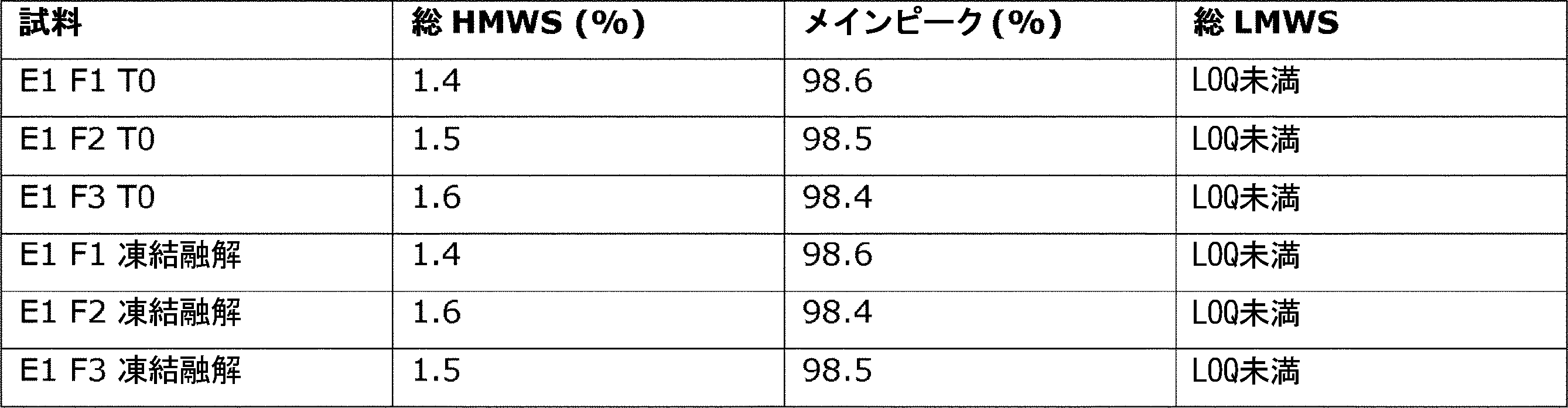
データは、総HMWSおよび総LMWSが両方の抗体について低かったこと、ならびに、HMWSおよびLMWSのいかなる有意な増加も、凍結融解の2回のサイクル後に見出されなかったことを示した。3つの製剤の間に大きな差はなかった。 The data showed that total HMWS and total LMWS were low for both antibodies, and no significant increase in HMWS and LMWS was found after two cycles of freeze-thaw. There were no significant differences between the three formulations.
動的光散乱(DLS)
拡散相互作用パラメータkD(ml/g)の評価を、384ウェルプレートにおいてDynaPro Plate Reader II(ソフトウェアDynamics;Wyattを伴う)を用いた動的光散乱(DLS)を介して行った。多様な緩衝液におけるタンパク質の段階希釈物を調製した。Dm(m2/s;DLS由来の相互拡散係数)を、タンパク質濃度c(g/mL)に対してプロットした。kDは、線形フィットから計算された傾きをD0(m2/s;無限溶質濃度での拡散係数)である切片で割ると、得られる。
Dm=D0(1+kD*c)
試料(2回の凍結融解サイクルを受けていない)のkD値を、以下の表に示す。
Dynamic Light Scattering (DLS)
The evaluation of the diffusion interaction parameter kD (ml/g) was performed via dynamic light scattering (DLS) using a DynaPro Plate Reader II (with software Dynamics; Wyatt) in 384-well plates. Serial dilutions of the proteins in various buffers were prepared. Dm ( m2 /s; DLS-derived mutual diffusion coefficient) was plotted against the protein concentration c (g/mL). kD is obtained by dividing the slope calculated from the linear fit by the intercept, which is D0 ( m2 /s; diffusion coefficient at infinite solute concentration).
Dm = D0 (1 + kD*c)
The kD values of the samples (not subjected to two freeze-thaw cycles) are shown in the table below.
(表7)

データは、3つの製剤における抗体のわずかに誘引性の挙動のみを示す。 The data show only slightly attractive behavior of the antibody in the three formulations.
全体的に、両方の抗体の3つの製剤は、薬学的用途に適した特徴を示した。 Overall, the three formulations of both antibodies showed suitable characteristics for pharmaceutical use.
実施例20:ストレス条件下でのpH、賦形剤、および界面活性剤の評価
異なるpHおよびイオン強度を有する6つの製剤(F4~F9)のpHおよび賦形剤のスクリーニングを評価した。
Example 20: Evaluation of pH, excipients and surfactants under stress conditions pH and excipient screening of six formulations (F4-F9) with different pH and ionic strength were evaluated.
化学物質および賦形剤 Chemicals and excipients
(表8)
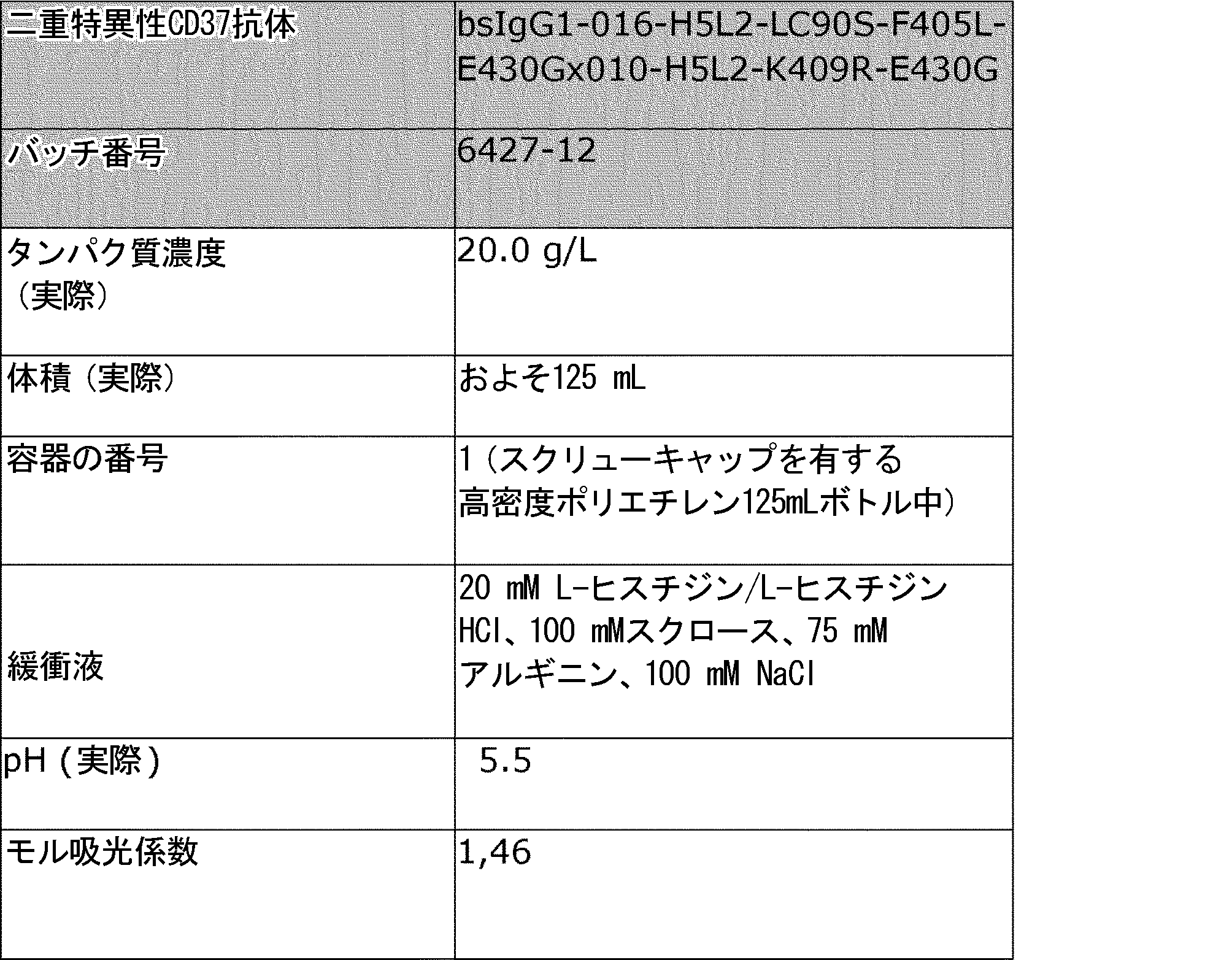
(表9)
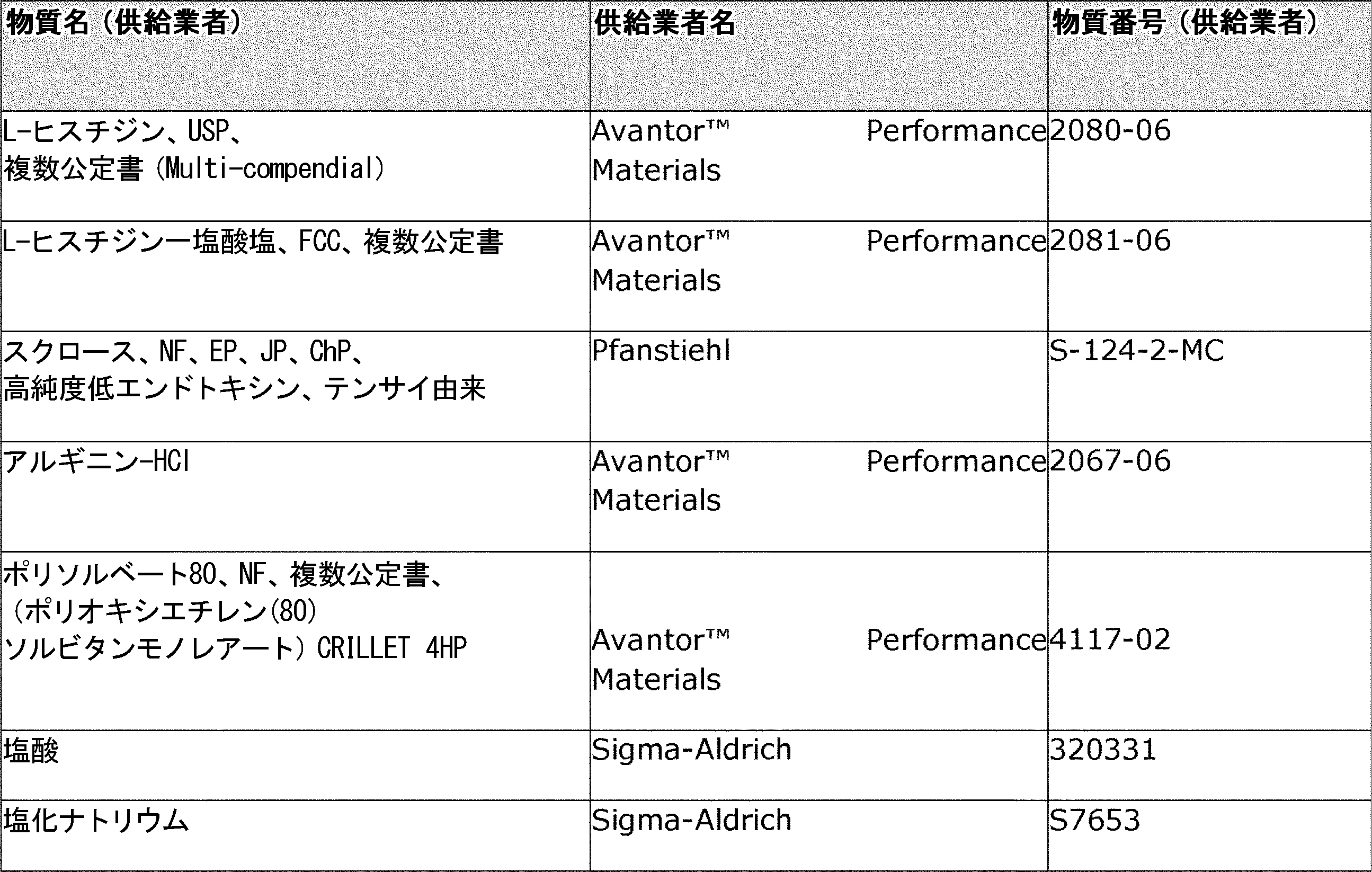
以下の表は、評価した製剤を列記する。 The table below lists the formulations evaluated.
(表10)
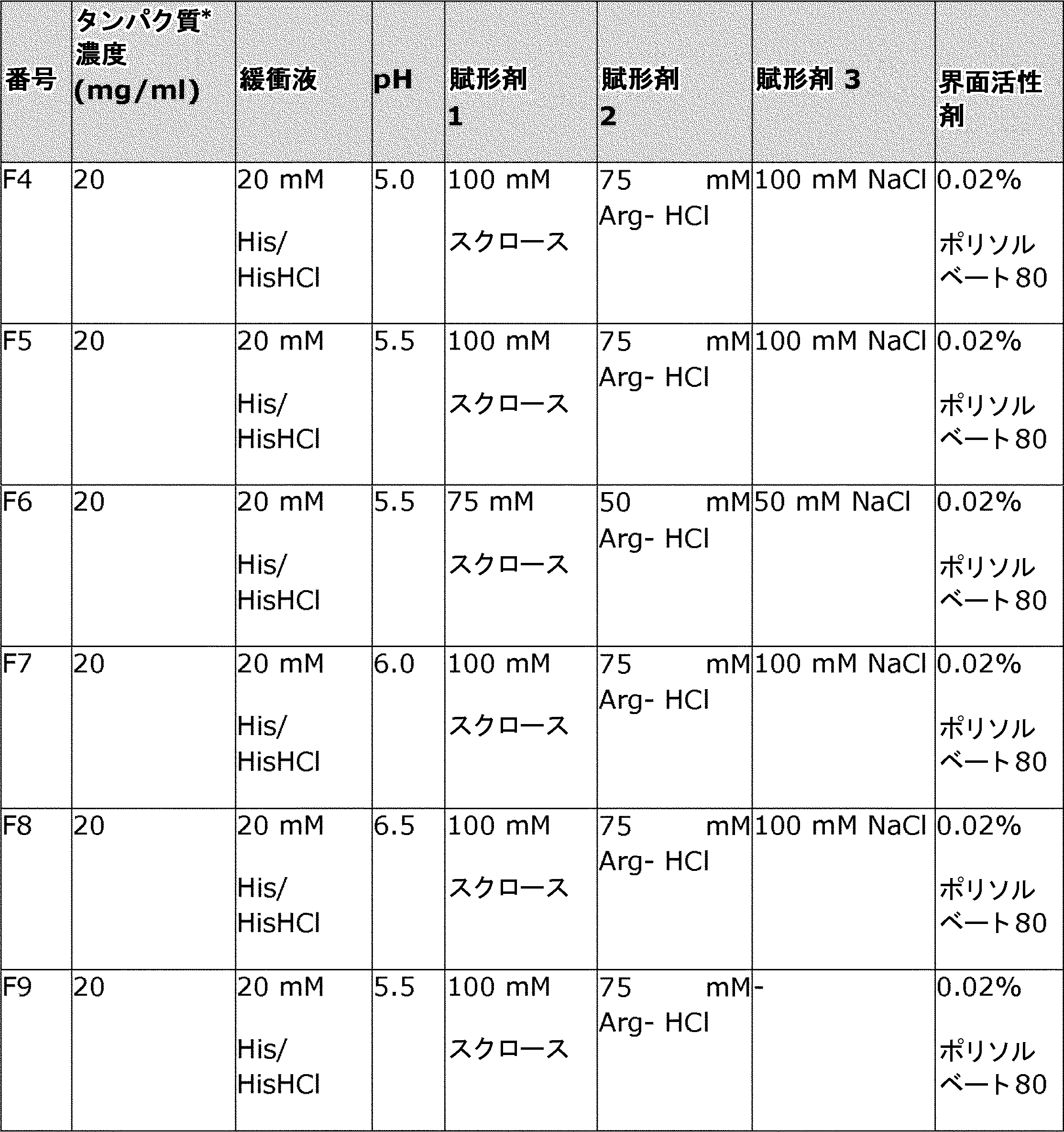
方法
表20.1において指定されるような二重特異性CD37抗体を、緩衝液交換および濃縮(upconcentration)に供して、表20.3に列記された製剤を作製した。1)標的緩衝液濃度およびpHを達成するための緩衝液交換、ならびにその後の2)標的濃度を上回る濃縮によって、製剤を製造した。標準的な希釈手順を用いることにより、タンパク質濃度、pH値、および密度を、タンパク質の加工処理時に測定し、必要とされる各製剤の計算に利用した。最終的に調合した溶液のタンパク質濃度およびpHを、測定して確認した。製剤溶液はすべて、0.22μmフッ化ポリビニリデン(PVDF)膜フィルターを用いてろ過した。
Methods Bispecific CD37 antibodies as specified in Table 20.1 were subjected to buffer exchange and upconcentration to generate the formulations listed in Table 20.3. The formulations were produced by 1) buffer exchange to achieve the target buffer concentration and pH, followed by 2) concentration above the target concentration. By using standard dilution procedures, protein concentration, pH value, and density were measured during protein processing and utilized in the calculation of each formulation required. Protein concentration and pH of the final formulated solutions were measured and confirmed. All formulation solutions were filtered using 0.22 μm polyvinylidene fluoride (PVDF) membrane filters.
最初のパッケージング物質を、適切なように調製し、各製剤を、無菌技術にしたがって、2.4 mLの標的充填体積で6R/20 mmのガラスタイプIバイアル中に手動で充填し、20 mmのブロモブチルゴムストッパー(注射用ストッパー)で栓をして、20 mmのアルミニウムフリップオフシールでシールした。製剤すべての試料に標識をして、安定性試験のために各条件で保管した。 Primary packaging material was prepared as appropriate and each formulation was manually filled into 6R/20 mm glass Type I vials using aseptic technique with a target fill volume of 2.4 mL, stoppered with 20 mm bromobutyl rubber stoppers (injection stoppers) and sealed with 20 mm aluminum flip-off seals. Samples of all formulations were labeled and stored at each condition for stability testing.
ろ過後の製剤
ろ過後の液体製剤(F4~F9)について調合した溶液のpH、タンパク質濃度、および浸透圧を測定した。短期安定性試験中の初期の時点でUV分光光度計(A280)によって測定したタンパク質濃度もまた、含めた。
Post-filtered formulations The pH, protein concentration, and osmolality of the formulated solutions for the post-filtered liquid formulations (F4-F9) were measured. Protein concentrations measured by UV spectrophotometer (A280) at early time points during short-term stability studies were also included.
調合した溶液は、ろ過後に目に見える粒子がなかった。 The prepared solution was free of visible particles after filtration.
短期安定性試験
2週間の保管後の解析の結果:
製剤すべてについて良好な安定性が、長期条件(2~8℃)で観察され、加速条件(25℃)では、2週間までの保管後に変性が観察され、ストレス条件(40℃)ではより有意であった。最も有意に影響を受けた品質特性は、電荷不均一性およびHP-SECによる単量体含有量であった。また、軽微なクリッピングが、ストレス条件での2週間の保管後に、Caliper CE-SDSの結果において観察された。
Short-term stability test
Analysis after 2 weeks of storage:
Good stability for all formulations was observed at long-term conditions (2-8°C), with denaturation observed after up to 2 weeks of storage at accelerated conditions (25°C) and more significant at stressed conditions (40°C). The most significantly affected quality attributes were charge heterogeneity and monomer content by HP-SEC. Minor clipping was also observed in the Caliper CE-SDS results after 2 weeks of storage at stressed conditions.
製剤はすべて、ストレス条件で、凝集物含有量の増加を示した。例外的に高いレベルの凝集物が、F4について観察された。断片の軽微な増加もまた、ストレス保管後に製剤すべてについて観察された。 All formulations showed an increase in aggregate content under stress conditions. Exceptionally high levels of aggregates were observed for F4. A slight increase in fragmentation was also observed for all formulations after stress storage.
電荷バリアントにおける変化が、ストレス条件で観察された。低いpHは、塩基性バリアント増加の速度を低下させるようであるが、製剤F4(pH 5.0)のT0試料と比べて10%の増加が、依然として観察された。最高の塩基性バリアント含有量は、F7(pH 6.0)において観察された。 Changes in charge variants were observed under stress conditions. Low pH seemed to slow down the rate of basic variant increase, but a 10% increase was still observed in formulation F4 (pH 5.0) compared to the TO sample. The highest basic variant content was observed in F7 (pH 6.0).
4週間の保管後の解析の結果:
2週間保管した試料において観察された傾向を、確認することができた。電荷バリアントについては、具体的に、塩基性バリアントは、明らかなpH依存性を示し、pH 5.0のF4は、最小の塩基性バリアント形成を示した。しかし、凝集およびクリッピングなどの他の品質特性においては、F4製剤は好都合ではなかった。pH6.0以上を有する製剤は、高い塩基性バリアント形成を示した。
Analysis after 4 weeks of storage:
The trend observed in the samples stored for 2 weeks could be confirmed. For charge variants, specifically, basic variants showed a clear pH dependency, with F4 at pH 5.0 showing the least basic variant formation. However, other quality attributes such as aggregation and clipping were not favorable for the F4 formulation. Formulations with pH 6.0 or higher showed high basic variant formation.
pH 5.5を有する製剤は、許容される品質特性を示し、その中で、製剤F5は、最低の塩基性バリアント形成を示した。 Formulations with pH 5.5 showed acceptable quality characteristics, among which formulation F5 showed the lowest basic variant formation.
BsIgG1-016-H5L2-LC90S-F405L-E430G×010-H5L2-K409R-E430Gは、スクシンイミドに対して配列ライアビリティ(liability)を有する。長期保存条件下で二重特異性CD37抗体を分解から保護するであろう製剤を開発するように、本試験において努力した。8つの試験からの結果は、(安定性試料における塩基性電荷バリアントの増加として反映される)スクシンイミド形成についてpH依存性を示すことができ、pH 5.0製剤(F4)が、保管時間に伴う塩基性バリアント含有量の最小の増加を示した。しかし、この製剤は、凝集および断片化などの特性に関する不良な安定性挙動のために、不適当であると考えられた。さらに、結果は、より高いpH、例えばpH 5.5を有する製剤は、試験した品質特性すべてにおいてより良好な安定性を提供することを示す。 BsIgG1-016-H5L2-LC90S-F405L-E430G x 010-H5L2-K409R-E430G has sequence liability for succinimide. Efforts were made in this study to develop a formulation that would protect the bispecific CD37 antibody from degradation under long-term storage conditions. Results from eight studies could show a pH dependency for succinimide formation (reflected as an increase in basic charge variants in the stability samples), with the pH 5.0 formulation (F4) showing the smallest increase in basic variant content with storage time. However, this formulation was considered unsuitable due to poor stability behavior with respect to properties such as aggregation and fragmentation. Furthermore, the results show that formulations with higher pH, e.g. pH 5.5, provide better stability in all the quality attributes tested.
実施例20の安定性試験からの結果を、以下の表11~18に示す。The results from the stability study of Example 20 are shown below in Tables 11-18.
(表11)
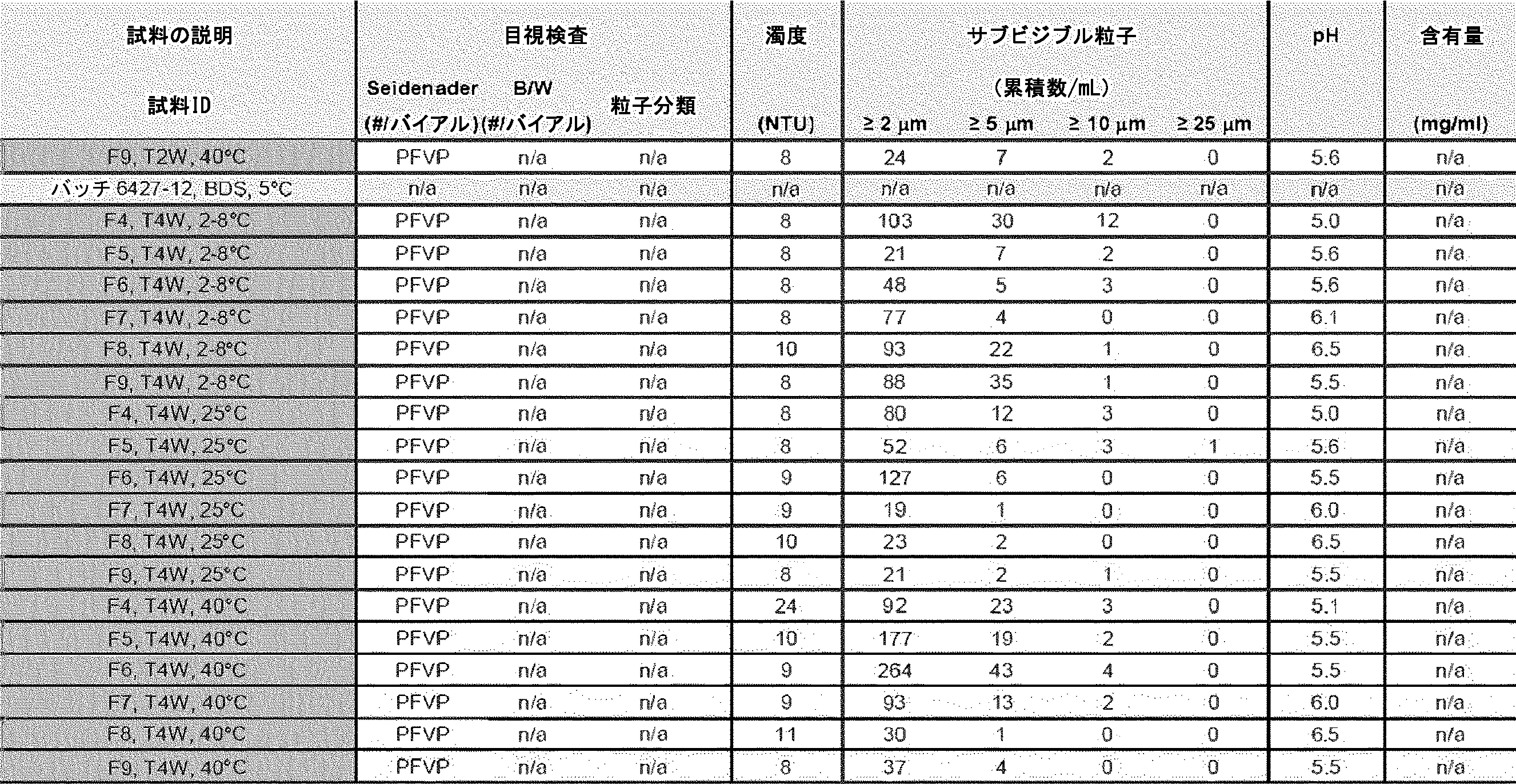
(表12)

(表13)
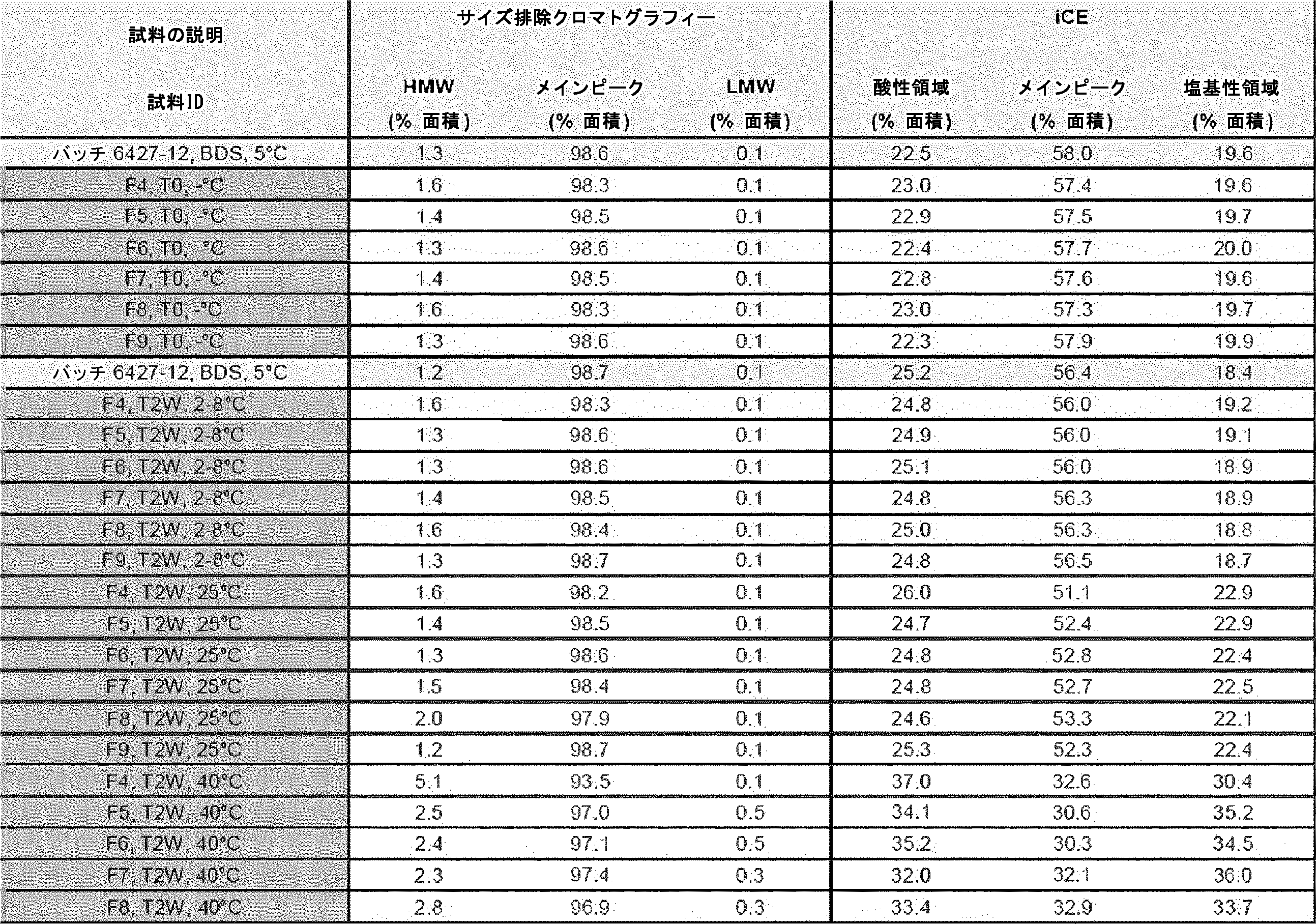
(表14)
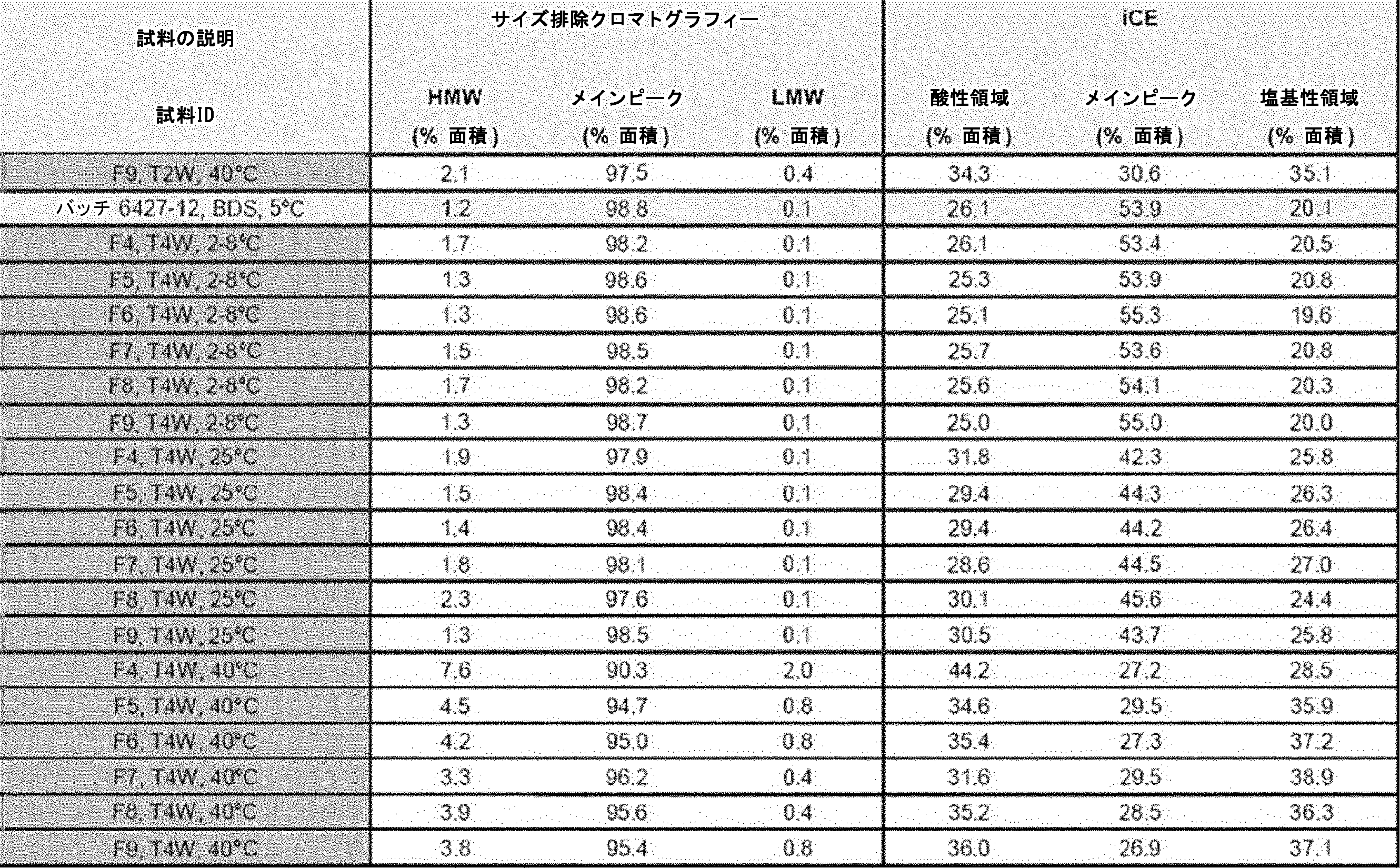
(表15)
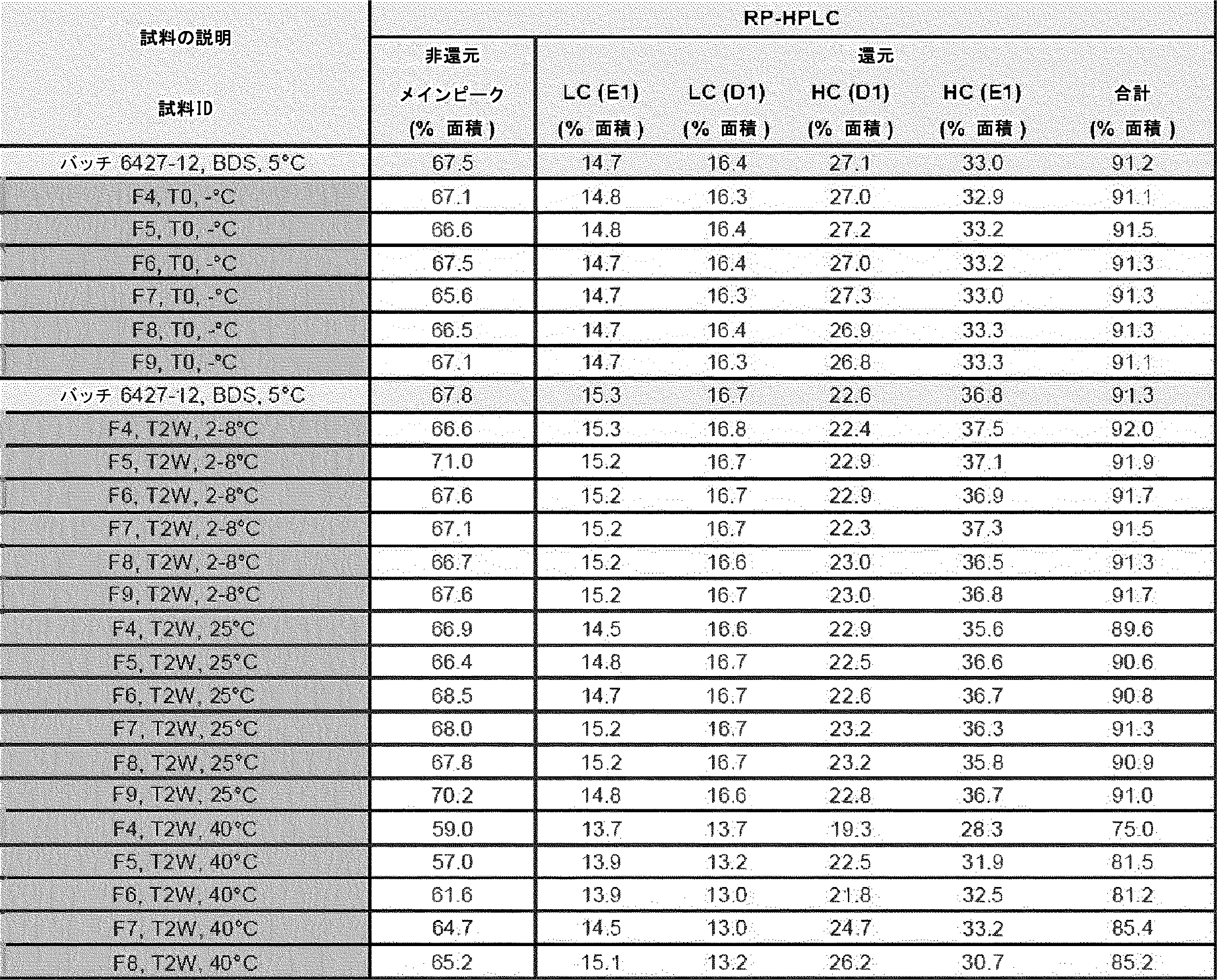
(表16)
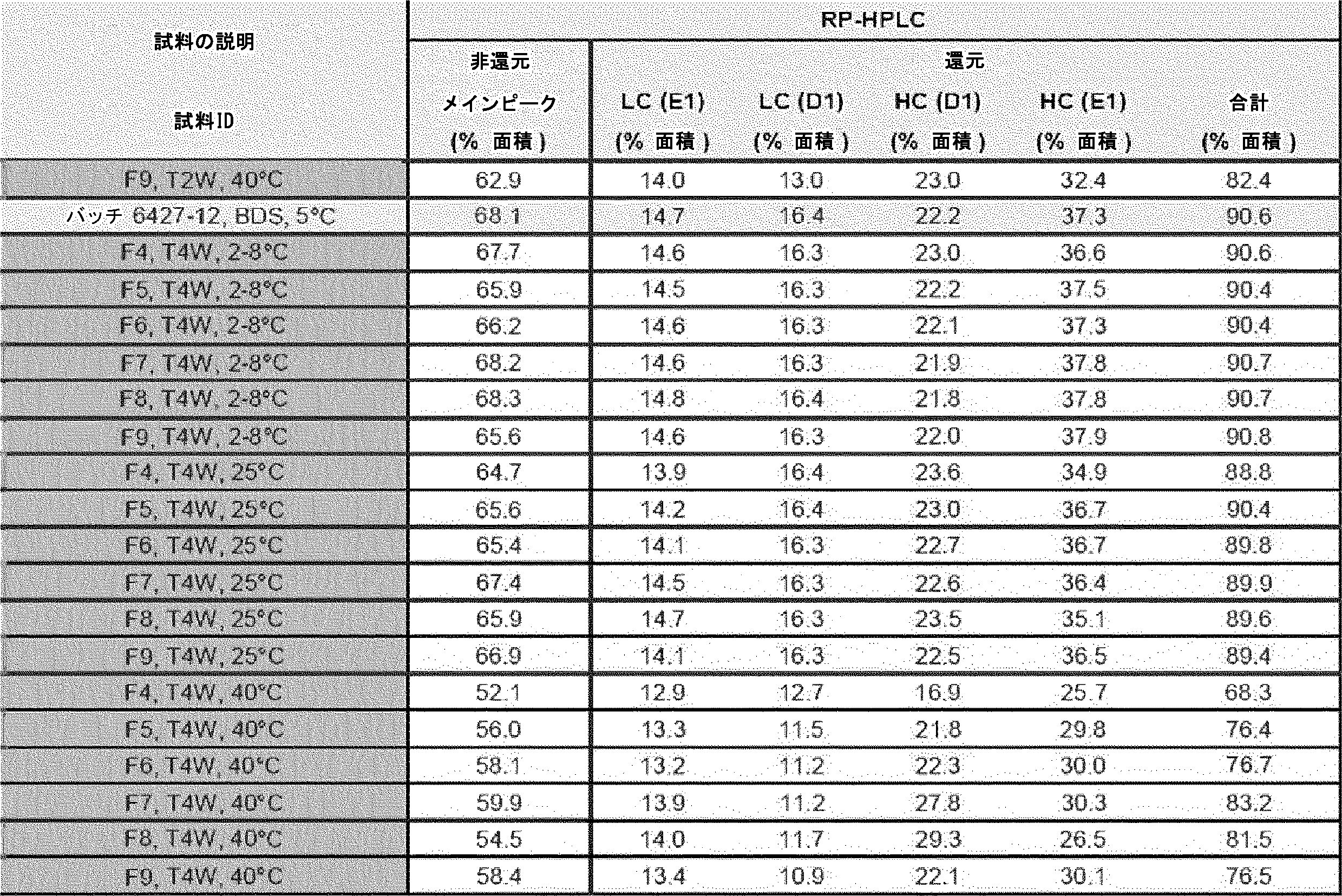
(表17)
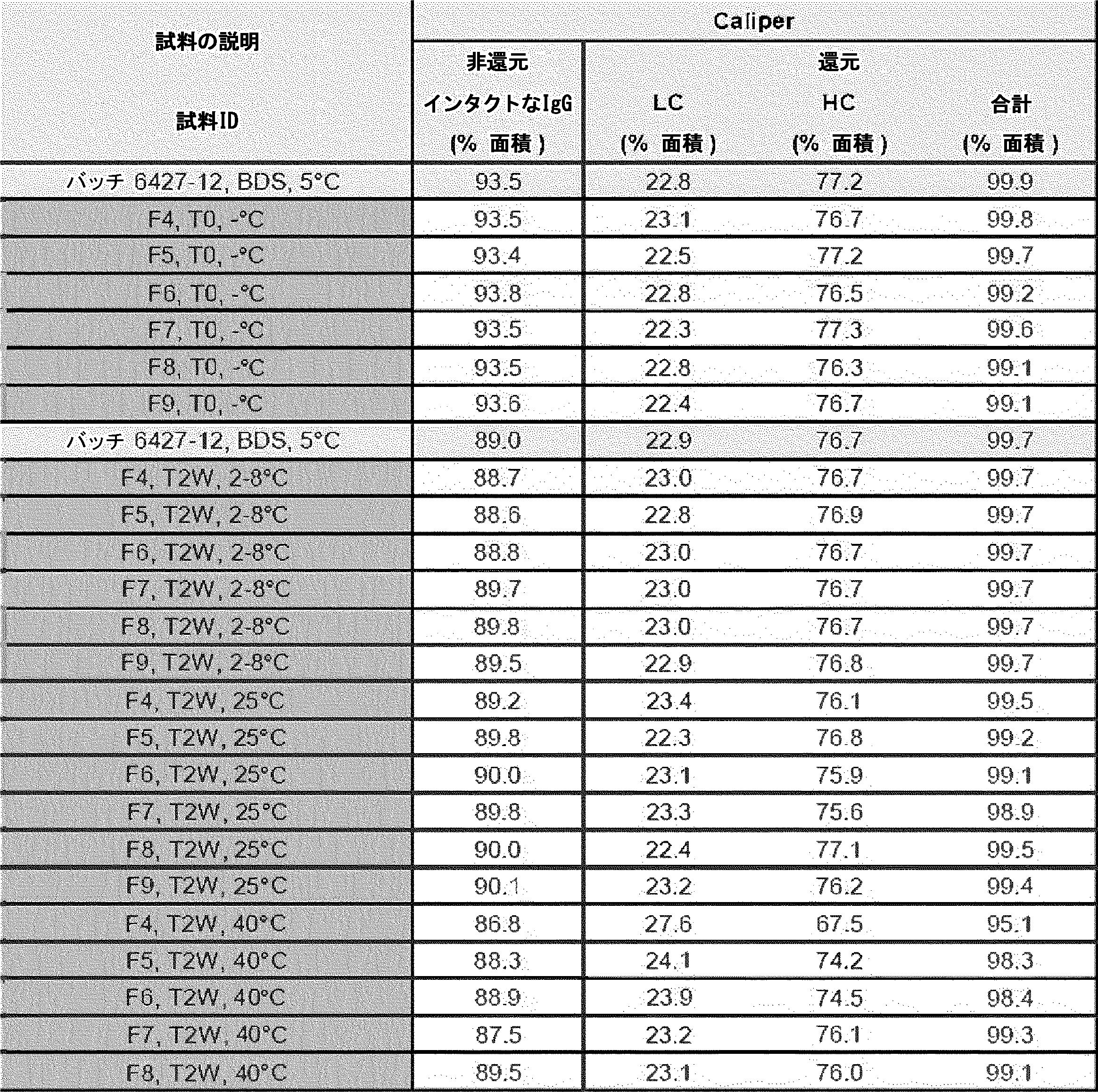
(表18)
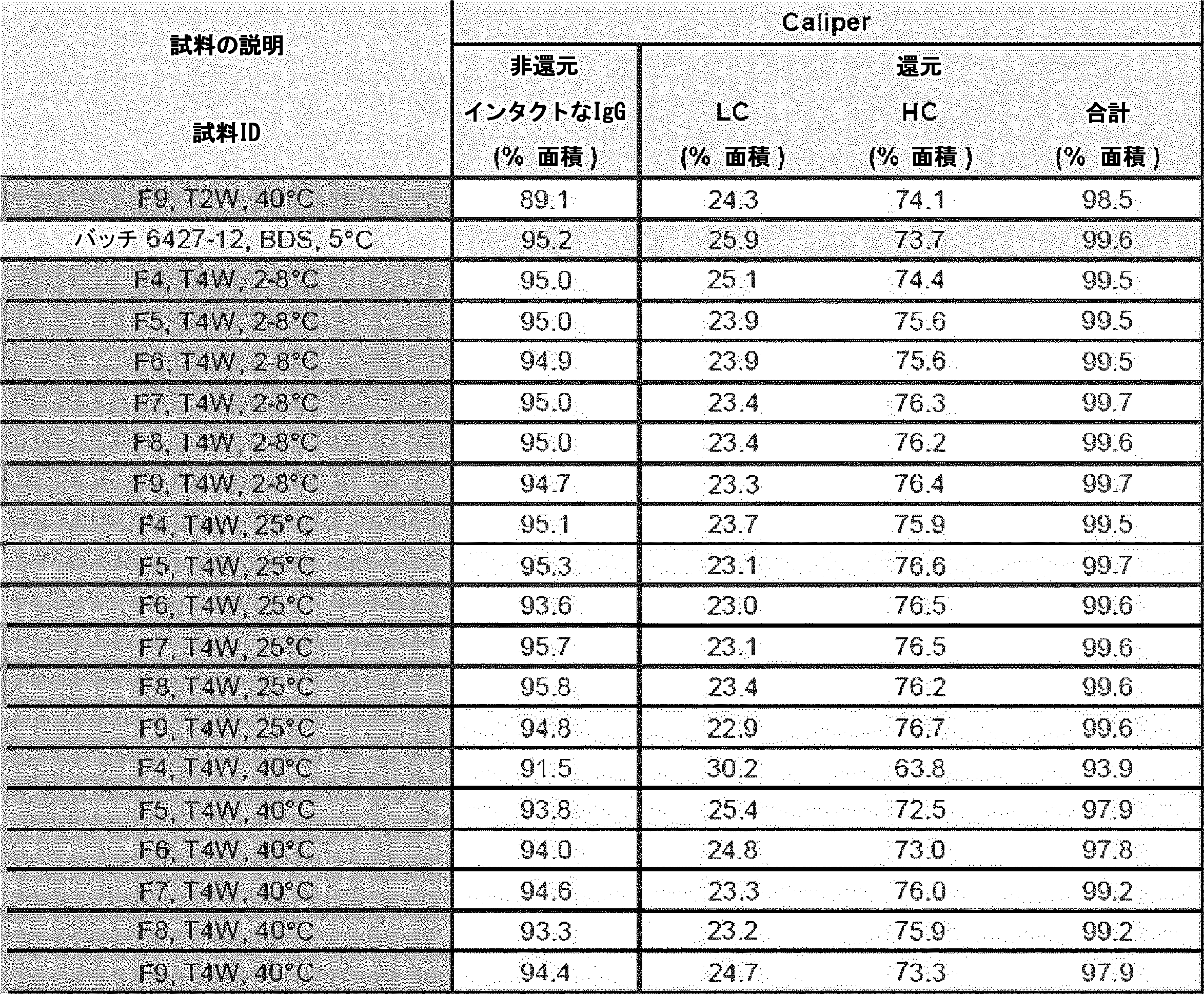
Claims (26)
b)ヒスチジン緩衝液、
c)50~300 mMの糖および/または50~300 mMのポリオール、ならびに
d)0.01~0.1%のポリソルベート80
を含む医薬組成物であって、
該組成物のpHが4.5~6.8であり、かつ
該二重特異性抗体が、SEQ ID NO: 124および125に記載の重鎖、ならびにSEQ ID NO: 119および126に記載の軽鎖を含み、ここで、SEQ ID NO: 124に記載の重鎖が、SEQ ID NO: 119に記載の軽鎖と共に抗原結合領域を形成し、かつSEQ ID NO: 125に記載の重鎖が、SEQ ID NO: 126に記載の軽鎖と共に抗原結合領域を形成する、
前記医薬組成物。 a) bispecific antibodies;
b) histidine buffer;
c) 50-300 mM sugar and/or 50-300 mM polyol, and
d) 0.01 to 0.1% polysorbate 80
A pharmaceutical composition comprising:
the pH of the composition is between 4.5 and 6.8; and the bispecific antibody comprises a heavy chain set forth in SEQ ID NOs: 124 and 125 and a light chain set forth in SEQ ID NOs: 119 and 126, wherein the heavy chain set forth in SEQ ID NO: 124 forms an antigen-binding region with the light chain set forth in SEQ ID NO: 119, and the heavy chain set forth in SEQ ID NO: 125 forms an antigen-binding region with the light chain set forth in SEQ ID NO: 126.
The pharmaceutical composition.
b)pH 5.5~6.5で、20 mg/mLの二重特異性抗体、20 mMのヒスチジン、100 mMのスクロース、0.02%もしくは0.04%のポリソルベート80、および100~150 mM、好ましくは100 mMの塩化ナトリウムを含む、または
c)pH 5.5~6.5で、20 mg/mLの二重特異性抗体、20 mMのヒスチジン、100 mMのスクロース、0.02%もしくは0.04%のポリソルベート80、75 mMのアルギニン、および100~150 mM、好ましくは100 mMの塩化ナトリウムを含む、または
d)pH 5.5~6.5で、20 mg/mLの二重特異性抗体、20 mMのヒスチジン、100 mMのスクロース、0.02%もしくは0.04%のポリソルベート80、および75 mMのアルギニンを含む
前記請求項のいずれか一項記載の医薬組成物。 a) 20 mg/mL bispecific antibody, 20 mM histidine, 250 mM sucrose, and 0.02% or 0.04% polysorbate 80 at pH 5.5-6.5; or
b) 20 mg/mL of bispecific antibody, 20 mM histidine, 100 mM sucrose, 0.02% or 0.04% polysorbate 80, and 100-150 mM, preferably 100 mM, sodium chloride at pH 5.5-6.5; or
c) 20 mg/mL of bispecific antibody, 20 mM histidine, 100 mM sucrose, 0.02% or 0.04% polysorbate 80, 75 mM arginine, and 100-150 mM, preferably 100 mM, sodium chloride at pH 5.5-6.5; or
d) A pharmaceutical composition according to any one of the preceding claims comprising 20 mg/mL of the bispecific antibody, 20 mM histidine, 100 mM sucrose, 0.02% or 0.04% polysorbate 80, and 75 mM arginine at pH 5.5-6.5.
a)pH 5.5~6.5で、20 mg/mLの二重特異性抗体、20 mMのヒスチジン、250 mMのスクロース、および0.02%もしくは0.04%のポリソルベート80からなる、または
b)pH 5.5~6.5で、20 mg/mLの二重特異性抗体、20 mMのヒスチジン、100 mMのスクロース、0.02%もしくは0.04%のポリソルベート80、および100~150 mM、好ましくは100 mMの塩化ナトリウムからなる、または
c)pH 5.5~6.5で、20 mg/mLの二重特異性抗体、20 mMのヒスチジン、100 mMのスクロース、0.02%もしくは0.04%のポリソルベート80、75 mMのアルギニン、および100~150 mM、好ましくは100 mMの塩化ナトリウムからなる、または
d)pH 5.5~6.5で、20 mg/mLの二重特異性抗体、20 mMのヒスチジン、100 mMのスクロース、0.02%もしくは0.04%のポリソルベート80、および75 mMのアルギニンからなる
前記請求項のいずれか一項記載の医薬組成物。 In aqueous solution:
a) 20 mg/mL bispecific antibody, 20 mM histidine, 250 mM sucrose, and 0.02% or 0.04% polysorbate 80 at pH 5.5-6.5; or
b) 20 mg/mL of bispecific antibody, 20 mM histidine, 100 mM sucrose, 0.02% or 0.04% polysorbate 80, and 100-150 mM, preferably 100 mM, sodium chloride at pH 5.5-6.5; or
c) 20 mg/mL of bispecific antibody, 20 mM histidine, 100 mM sucrose, 0.02% or 0.04% polysorbate 80, 75 mM arginine, and 100-150 mM, preferably 100 mM, sodium chloride at pH 5.5-6.5; or
d) The pharmaceutical composition according to any one of the preceding claims, consisting of 20 mg/mL of the bispecific antibody, 20 mM histidine, 100 mM sucrose, 0.02% or 0.04% polysorbate 80, and 75 mM arginine at pH 5.5-6.5.
i)SEQ ID NO: 75に記載のVH CDR1配列、
SEQ ID NO: 76に記載のVH CDR2配列、
SEQ ID NO: 77に記載のVH CDR3配列、
SEQ ID NO: 79に記載のVL CDR1配列、
DASであるVL CDR2配列、および
SEQ ID NO: 80に記載のVL CDR3配列;
ii)SEQ ID NO: 82に記載のVH CDR1配列、
SEQ ID NO: 83に記載のVH CDR2配列、
SEQ ID NO: 84に記載のVH CDR3配列、
SEQ ID NO: 85に記載のVL CDR1配列、
DASであるVL CDR2配列、および
SEQ ID NO: 86に記載のVL CDR3配列;
iii)SEQ ID NO: 95に記載のVH CDR1配列、
SEQ ID NO: 96に記載のVH CDR2配列、
SEQ ID NO: 97に記載のVH CDR3配列、
SEQ ID NO: 99に記載のVL CDR1配列、
ATSであるVL CDR2配列、および
SEQ ID NO: 100に記載のVL CDR3配列;
iv)SEQ ID NO: 88に記載のVH CDR1配列、
SEQ ID NO: 89に記載のVH CDR2配列、
SEQ ID NO: 90に記載のVH CDR3配列、
SEQ ID NO: 92に記載のVL CDR1配列、
DASであるVL CDR2配列、および
SEQ ID NO: 93に記載のVL CDR3配列;ならびに
v)SEQ ID NO: 102に記載のVH CDR1配列、
SEQ ID NO: 103に記載のVH CDR2配列、
SEQ ID NO: 104に記載のVH CDR3配列、
SEQ ID NO: 106に記載のVL CDR1配列、
QMSであるVL CDR2配列、および
SEQ ID NO: 107に記載のVL CDR3配列
からなる群より選択されるCDR配列を含む、ヒトCD20に結合することができる抗CD20抗体である、請求項18または請求項19記載の使用のための医薬組成物。 The additional therapeutic agent is
i) the VH CDR1 sequence set forth in SEQ ID NO: 75;
VH CDR2 sequence as set forth in SEQ ID NO: 76;
VH CDR3 sequence as set forth in SEQ ID NO: 77;
The VL CDR1 sequence set forth in SEQ ID NO: 79;
a VL CDR2 sequence which is a DAS, and
VL CDR3 sequence as set forth in SEQ ID NO: 80;
ii) the VH CDR1 sequence set forth in SEQ ID NO: 82;
VH CDR2 sequence as set forth in SEQ ID NO: 83;
VH CDR3 sequence as set forth in SEQ ID NO: 84;
VL CDR1 sequence as set forth in SEQ ID NO: 85;
a VL CDR2 sequence which is a DAS, and
VL CDR3 sequence as set forth in SEQ ID NO: 86;
iii) the VH CDR1 sequence set forth in SEQ ID NO: 95;
VH CDR2 sequence as set forth in SEQ ID NO: 96;
VH CDR3 sequence as set forth in SEQ ID NO: 97;
VL CDR1 sequence as set forth in SEQ ID NO: 99;
a VL CDR2 sequence which is an ATS, and
VL CDR3 sequence as set forth in SEQ ID NO: 100;
iv) the VH CDR1 sequence set forth in SEQ ID NO: 88;
VH CDR2 sequence as set forth in SEQ ID NO: 89;
VH CDR3 sequence as set forth in SEQ ID NO: 90;
VL CDR1 sequence as set forth in SEQ ID NO: 92;
a VL CDR2 sequence which is a DAS, and
The VL CDR3 sequence set forth in SEQ ID NO: 93; and
v) the VH CDR1 sequence set forth in SEQ ID NO: 102;
VH CDR2 sequence as set forth in SEQ ID NO: 103;
VH CDR3 sequence as set forth in SEQ ID NO: 104;
The VL CDR1 sequence set forth in SEQ ID NO: 106;
a VL CDR2 sequence that is QMS, and
20. The pharmaceutical composition for use according to claim 18 or claim 19 , which is an anti-CD20 antibody capable of binding to human CD20, comprising a CDR sequence selected from the group consisting of the VL CDR3 sequences set forth in SEQ ID NO: 107.
Applications Claiming Priority (5)
| Application Number | Priority Date | Filing Date | Title |
|---|---|---|---|
| US201862741267P | 2018-10-04 | 2018-10-04 | |
| US62/741,267 | 2018-10-04 | ||
| US201962875180P | 2019-07-17 | 2019-07-17 | |
| US62/875,180 | 2019-07-17 | ||
| PCT/EP2019/076965 WO2020070313A1 (en) | 2018-10-04 | 2019-10-04 | Pharmaceutical compositions comprising bispecific anti-cd37 antibodies |
Publications (2)
| Publication Number | Publication Date |
|---|---|
| JP2022512608A JP2022512608A (en) | 2022-02-07 |
| JP7522106B2 true JP7522106B2 (en) | 2024-07-24 |
Family
ID=68172200
Family Applications (1)
| Application Number | Title | Priority Date | Filing Date |
|---|---|---|---|
| JP2021518667A Active JP7522106B2 (en) | 2018-10-04 | 2019-10-04 | Pharmaceutical compositions comprising bispecific anti-CD37 antibodies |
Country Status (13)
| Country | Link |
|---|---|
| US (1) | US20240252635A1 (en) |
| EP (1) | EP3860715A1 (en) |
| JP (1) | JP7522106B2 (en) |
| KR (1) | KR20210116429A (en) |
| CN (1) | CN113365698A (en) |
| AU (1) | AU2019354105A1 (en) |
| BR (1) | BR112021006055A2 (en) |
| CA (1) | CA3115163A1 (en) |
| IL (1) | IL281958A (en) |
| MA (1) | MA53812A (en) |
| MX (1) | MX2021003756A (en) |
| SG (1) | SG11202103100SA (en) |
| WO (1) | WO2020070313A1 (en) |
Families Citing this family (3)
| Publication number | Priority date | Publication date | Assignee | Title |
|---|---|---|---|---|
| JP7513530B2 (en) | 2018-06-22 | 2024-07-09 | ジェンマブ ホールディング ビー.ブイ. | Anti-CD37 and Anti-CD20 Antibodies, Compositions, and Methods of Use Thereof |
| CN117582496A (en) * | 2020-12-18 | 2024-02-23 | 美勒斯公司 | Antibody compositions |
| KR102851939B1 (en) | 2023-07-17 | 2025-09-01 | 중경기술주식회사 | Fire hose connection valve |
Citations (4)
| Publication number | Priority date | Publication date | Assignee | Title |
|---|---|---|---|---|
| JP2013515754A (en) | 2009-12-29 | 2013-05-09 | エフ・ホフマン−ラ・ロシュ・アクチェンゲゼルシャフト | Novel antibody formulation |
| JP2016505633A (en) | 2013-01-24 | 2016-02-25 | グラクソスミスクライン、インテレクチュアル、プロパティー、ディベロップメント、リミテッドGlaxosmithkline Intellectual Property Development Limited | TNFα antigen binding protein |
| JP2016509476A (en) | 2013-01-10 | 2016-03-31 | ゲンマブ ビー.ブイ. | Human IgG1 Fc region variants and uses thereof |
| JP2016104715A (en) | 2014-10-18 | 2016-06-09 | ファイザー・インク | Anti-IL-7R antibody composition |
Family Cites Families (60)
| Publication number | Priority date | Publication date | Assignee | Title |
|---|---|---|---|---|
| US835A (en) | 1838-07-12 | X i i i x | ||
| US6077A (en) | 1849-01-30 | Improved hinged claw-wrench | ||
| US5703055A (en) | 1989-03-21 | 1997-12-30 | Wisconsin Alumni Research Foundation | Generation of antibodies through lipid mediated DNA delivery |
| JP4124480B2 (en) | 1991-06-14 | 2008-07-23 | ジェネンテック・インコーポレーテッド | Immunoglobulin variants |
| GB9203459D0 (en) | 1992-02-19 | 1992-04-08 | Scotgen Ltd | Antibodies with germ-line variable regions |
| US5731168A (en) | 1995-03-01 | 1998-03-24 | Genentech, Inc. | Method for making heteromultimeric polypeptides |
| KR970029803A (en) | 1995-11-03 | 1997-06-26 | 김광호 | Precharge Circuit of Semiconductor Memory Device |
| IL132560A0 (en) | 1997-05-02 | 2001-03-19 | Genentech Inc | A method for making multispecific antibodies having heteromultimeric and common components |
| PT1150918E (en) | 1999-02-03 | 2005-01-31 | Biosante Pharmaceuticals Inc | METHOD OF MANUFACTURE OF CALCIUM PHOSPHATE THERAPEUTIC PARTICLES |
| US6281005B1 (en) | 1999-05-14 | 2001-08-28 | Copernicus Therapeutics, Inc. | Automated nucleic acid compaction device |
| DE10043437A1 (en) | 2000-09-04 | 2002-03-28 | Horst Lindhofer | Use of trifunctional bispecific and trispecific antibodies for the treatment of malignant ascites |
| US20100081792A1 (en) | 2001-06-28 | 2010-04-01 | Smithkline Beecham Corporation | Ligand |
| EP1487879B1 (en) | 2002-03-01 | 2012-12-26 | Immunomedics, Inc. | Bispecific antibody point mutations for enhancing rate of clearance |
| CA2872136C (en) | 2002-07-18 | 2017-06-20 | Merus B.V. | Recombinant production of mixtures of antibodies |
| NZ568769A (en) | 2002-10-17 | 2010-04-30 | Genmab As | Human monoclonal antibodies against CD20 |
| WO2005004809A2 (en) | 2003-07-01 | 2005-01-20 | Immunomedics, Inc. | Multivalent carriers of bi-specific antibodies |
| JP5848861B2 (en) | 2004-04-20 | 2016-01-27 | ジェンマブ エー/エスGenmab A/S | Human monoclonal antibody against CD20 |
| US7741568B2 (en) | 2005-01-13 | 2010-06-22 | The Wiremold Company | Downward facing receptacle assembly for cable raceway |
| WO2006106905A1 (en) | 2005-03-31 | 2006-10-12 | Chugai Seiyaku Kabushiki Kaisha | Process for production of polypeptide by regulation of assembly |
| WO2008157379A2 (en) | 2007-06-21 | 2008-12-24 | Macrogenics, Inc. | Covalent diabodies and uses thereof |
| US7612181B2 (en) | 2005-08-19 | 2009-11-03 | Abbott Laboratories | Dual variable domain immunoglobulin and uses thereof |
| WO2007059782A1 (en) | 2005-11-28 | 2007-05-31 | Genmab A/S | Recombinant monovalent antibodies and methods for production thereof |
| NZ591252A (en) | 2006-03-17 | 2012-06-29 | Biogen Idec Inc | Methods of designing antibody or antigen binding fragments thereof with substituted non-covarying amino acids |
| PT1999154E (en) | 2006-03-24 | 2013-01-24 | Merck Patent Gmbh | Engineered heterodimeric protein domains |
| AT503902B1 (en) | 2006-07-05 | 2008-06-15 | F Star Biotech Forsch & Entw | METHOD FOR MANIPULATING IMMUNE LOBULINS |
| MX2009010282A (en) | 2007-03-29 | 2009-10-12 | Genmab As | Bispecific antibodies and methods for production thereof. |
| PE20090499A1 (en) | 2007-08-09 | 2009-05-18 | Boehringer Ingelheim Int | ANTI-CD37 ANTIBODIES |
| ES2667729T3 (en) | 2007-09-26 | 2018-05-14 | Ucb Biopharma Sprl | Fusions of antibodies with double specificity |
| EP2050764A1 (en) | 2007-10-15 | 2009-04-22 | sanofi-aventis | Novel polyvalent bispecific antibody format and uses thereof |
| US9266967B2 (en) | 2007-12-21 | 2016-02-23 | Hoffmann-La Roche, Inc. | Bivalent, bispecific antibodies |
| US8242247B2 (en) | 2007-12-21 | 2012-08-14 | Hoffmann-La Roche Inc. | Bivalent, bispecific antibodies |
| US20090162359A1 (en) | 2007-12-21 | 2009-06-25 | Christian Klein | Bivalent, bispecific antibodies |
| US8227577B2 (en) | 2007-12-21 | 2012-07-24 | Hoffman-La Roche Inc. | Bivalent, bispecific antibodies |
| SI2235064T1 (en) | 2008-01-07 | 2016-04-29 | Amgen Inc. | Method for making antibody fc-heterodimeric molecules using electrostatic steering effects |
| NZ603059A (en) | 2008-04-11 | 2014-07-25 | Emergent Product Dev Seattle | Cd37 immunotherapeutic and combination with bifunctional chemotherapeutic thereof |
| WO2010015792A1 (en) | 2008-08-06 | 2010-02-11 | Argenta Discovery Limited | Nitrogen containing heterocyclic compounds useful as bifunctional modulators of m3 receptors and beta-2 receptors |
| KR20110104032A (en) | 2008-12-19 | 2011-09-21 | 마크로제닉스, 인크. | Covalently Bonded Diabodies and Their Uses |
| JP2012521768A (en) | 2009-03-27 | 2012-09-20 | ジモジェネティクス・インコーポレイテッド | Compositions and methods for using multispecific binding proteins comprising antibody-receptor combinations |
| WO2010129304A2 (en) | 2009-04-27 | 2010-11-11 | Oncomed Pharmaceuticals, Inc. | Method for making heteromultimeric molecules |
| KR101224468B1 (en) | 2009-05-20 | 2013-01-23 | 주식회사 파멥신 | Bispecific antibody having a novel form and use thereof |
| CA2766220C (en) | 2009-06-26 | 2021-02-09 | Regeneron Pharmaceuticals, Inc. | Readily isolated bispecific antibodies with native immunoglobulin format |
| WO2011028952A1 (en) | 2009-09-02 | 2011-03-10 | Xencor, Inc. | Compositions and methods for simultaneous bivalent and monovalent co-engagement of antigens |
| EP3778917A3 (en) | 2009-12-04 | 2021-06-09 | F. Hoffmann-La Roche AG | Multispecific antibodies, antibody analogs, compositions, and methods |
| CN106046159B (en) | 2010-03-12 | 2020-06-16 | 德彪发姆国际有限公司 | CD37 binding molecules and immunoconjugates thereof |
| TWI426920B (en) | 2010-03-26 | 2014-02-21 | Hoffmann La Roche | Bispecific, bivalent anti-VEGF/anti-ANG-2 antibody |
| ES2989108T3 (en) | 2010-04-20 | 2024-11-25 | Genmab As | Proteins containing heterodimeric antibody FC and methods for producing the same |
| US9527926B2 (en) | 2010-05-14 | 2016-12-27 | Rinat Neuroscience Corp. | Heterodimeric proteins and methods for producing and purifying them |
| US20120189618A1 (en) | 2010-07-16 | 2012-07-26 | Boehringer Ingelheim International Gmbh | Superior efficacy of cd37 antibodies in cll blood samples |
| CA2808482C (en) | 2010-08-16 | 2021-10-26 | Novimmune S.A. | Methods for the generation of multispecific and multivalent antibodies |
| EP2609111B1 (en) | 2010-08-24 | 2017-11-01 | F. Hoffmann-La Roche AG | Bispecific antibodies comprising a disulfide stabilized-fv fragment |
| KR101612999B1 (en) | 2010-08-24 | 2016-04-15 | 로슈 글리카트 아게 | Activatable bispecific antibodies |
| AU2011325833C1 (en) | 2010-11-05 | 2017-07-13 | Zymeworks Bc Inc. | Stable heterodimeric antibody design with mutations in the Fc domain |
| KR20140031883A (en) | 2011-04-01 | 2014-03-13 | 이뮤노젠 아이엔씨 | Cd37-binding molecules and immunoconjugates thereof |
| CN102250246A (en) | 2011-06-10 | 2011-11-23 | 常州亚当生物技术有限公司 | Bispecific antibody to VEGF/PDGFR beta and application thereof |
| SG10201805291TA (en) | 2011-10-27 | 2018-08-30 | Genmab As | Production of heterodimeric proteins |
| DK2794905T3 (en) | 2011-12-20 | 2020-07-06 | Medimmune Llc | MODIFIED POLYPEPTIDES FOR BISPECIFIC ANTIBODY BASIC STRUCTURES |
| CN114163530B (en) | 2012-04-20 | 2025-04-29 | 美勒斯公司 | Methods and means for producing immunoglobulin-like molecules |
| KR101569083B1 (en) | 2012-11-21 | 2015-11-16 | 주식회사 파멥신 | Bispecific Antibody Targeting VEGFR-2 and DLL4, and Pharmaceutical Composition Comprising Thereof |
| CN105073128A (en) * | 2013-04-03 | 2015-11-18 | Ibc药品公司 | Combination therapy for inducing an immune response to disease |
| US20200270359A1 (en) * | 2017-03-31 | 2020-08-27 | Genmab Holding B.V. | Bispecific anti-cd37 antibodies, monoclonal anti-cd37 antibodies and methods of use thereof |
-
2019
- 2019-10-04 MA MA053812A patent/MA53812A/en unknown
- 2019-10-04 KR KR1020217013018A patent/KR20210116429A/en not_active Ceased
- 2019-10-04 AU AU2019354105A patent/AU2019354105A1/en active Pending
- 2019-10-04 WO PCT/EP2019/076965 patent/WO2020070313A1/en not_active Ceased
- 2019-10-04 US US17/281,724 patent/US20240252635A1/en not_active Abandoned
- 2019-10-04 MX MX2021003756A patent/MX2021003756A/en unknown
- 2019-10-04 SG SG11202103100SA patent/SG11202103100SA/en unknown
- 2019-10-04 CA CA3115163A patent/CA3115163A1/en active Pending
- 2019-10-04 BR BR112021006055-3A patent/BR112021006055A2/en unknown
- 2019-10-04 CN CN201980076229.4A patent/CN113365698A/en active Pending
- 2019-10-04 JP JP2021518667A patent/JP7522106B2/en active Active
- 2019-10-04 EP EP19784030.9A patent/EP3860715A1/en not_active Withdrawn
-
2021
- 2021-04-01 IL IL281958A patent/IL281958A/en unknown
Patent Citations (4)
| Publication number | Priority date | Publication date | Assignee | Title |
|---|---|---|---|---|
| JP2013515754A (en) | 2009-12-29 | 2013-05-09 | エフ・ホフマン−ラ・ロシュ・アクチェンゲゼルシャフト | Novel antibody formulation |
| JP2016509476A (en) | 2013-01-10 | 2016-03-31 | ゲンマブ ビー.ブイ. | Human IgG1 Fc region variants and uses thereof |
| JP2016505633A (en) | 2013-01-24 | 2016-02-25 | グラクソスミスクライン、インテレクチュアル、プロパティー、ディベロップメント、リミテッドGlaxosmithkline Intellectual Property Development Limited | TNFα antigen binding protein |
| JP2016104715A (en) | 2014-10-18 | 2016-06-09 | ファイザー・インク | Anti-IL-7R antibody composition |
Non-Patent Citations (1)
| Title |
|---|
| Hexamerization-enhanced CD37 and CD20 antibodies synergize in CDC to kill patient-derived CLL cells with unprecedented potency,Molecular Immunology,2018年,Vol. 102,p. 218, No. 207,https://doi.org/10.1016/j.molimm.2018.06.222 |
Also Published As
| Publication number | Publication date |
|---|---|
| CN113365698A (en) | 2021-09-07 |
| MA53812A (en) | 2021-08-11 |
| US20240252635A1 (en) | 2024-08-01 |
| MX2021003756A (en) | 2021-08-11 |
| BR112021006055A2 (en) | 2021-07-20 |
| JP2022512608A (en) | 2022-02-07 |
| CA3115163A1 (en) | 2020-04-09 |
| AU2019354105A1 (en) | 2021-04-29 |
| IL281958A (en) | 2021-05-31 |
| EP3860715A1 (en) | 2021-08-11 |
| SG11202103100SA (en) | 2021-04-29 |
| WO2020070313A1 (en) | 2020-04-09 |
| KR20210116429A (en) | 2021-09-27 |
Similar Documents
| Publication | Publication Date | Title |
|---|---|---|
| JP7680501B2 (en) | Bispecific anti-CD37 antibodies, monoclonal anti-CD37 antibodies, and methods of use thereof | |
| EP3233907B1 (en) | Rodent bispecific heterodimeric proteins | |
| US20230399414A1 (en) | Bispecific anti-cd37 antibodies, monoclonal anti-cd37 antibodies and methods of use thereof | |
| WO2016110576A1 (en) | Bispecific antibodies against cd3 and cd20 | |
| JP2024129084A (en) | Anti-CD37 and Anti-CD20 Antibodies, Compositions, and Methods of Use Thereof | |
| JP7522106B2 (en) | Pharmaceutical compositions comprising bispecific anti-CD37 antibodies | |
| HK40122797A (en) | Bispecific anti-cd37 antibodies, monoclonal anti-cd37 antibodies and methods of use thereof |
Legal Events
| Date | Code | Title | Description |
|---|---|---|---|
| A621 | Written request for application examination |
Free format text: JAPANESE INTERMEDIATE CODE: A621 Effective date: 20221003 |
|
| RD04 | Notification of resignation of power of attorney |
Free format text: JAPANESE INTERMEDIATE CODE: A7424 Effective date: 20230816 |
|
| A131 | Notification of reasons for refusal |
Free format text: JAPANESE INTERMEDIATE CODE: A131 Effective date: 20230824 |
|
| A977 | Report on retrieval |
Free format text: JAPANESE INTERMEDIATE CODE: A971007 Effective date: 20230830 |
|
| A601 | Written request for extension of time |
Free format text: JAPANESE INTERMEDIATE CODE: A601 Effective date: 20231117 |
|
| A521 | Request for written amendment filed |
Free format text: JAPANESE INTERMEDIATE CODE: A523 Effective date: 20240222 |
|
| TRDD | Decision of grant or rejection written | ||
| A01 | Written decision to grant a patent or to grant a registration (utility model) |
Free format text: JAPANESE INTERMEDIATE CODE: A01 Effective date: 20240520 |
|
| A601 | Written request for extension of time |
Free format text: JAPANESE INTERMEDIATE CODE: A601 Effective date: 20240618 |
|
| A61 | First payment of annual fees (during grant procedure) |
Free format text: JAPANESE INTERMEDIATE CODE: A61 Effective date: 20240711 |
|
| R150 | Certificate of patent or registration of utility model |
Ref document number: 7522106 Country of ref document: JP Free format text: JAPANESE INTERMEDIATE CODE: R150 |