JP7405820B2 - Self-assembling retention devices and related methods - Google Patents
Self-assembling retention devices and related methods Download PDFInfo
- Publication number
- JP7405820B2 JP7405820B2 JP2021202475A JP2021202475A JP7405820B2 JP 7405820 B2 JP7405820 B2 JP 7405820B2 JP 2021202475 A JP2021202475 A JP 2021202475A JP 2021202475 A JP2021202475 A JP 2021202475A JP 7405820 B2 JP7405820 B2 JP 7405820B2
- Authority
- JP
- Japan
- Prior art keywords
- structures
- self
- retention device
- item
- assembling
- Prior art date
- Legal status (The legal status is an assumption and is not a legal conclusion. Google has not performed a legal analysis and makes no representation as to the accuracy of the status listed.)
- Active
Links
Images


Classifications
-
- A—HUMAN NECESSITIES
- A61—MEDICAL OR VETERINARY SCIENCE; HYGIENE
- A61M—DEVICES FOR INTRODUCING MEDIA INTO, OR ONTO, THE BODY; DEVICES FOR TRANSDUCING BODY MEDIA OR FOR TAKING MEDIA FROM THE BODY; DEVICES FOR PRODUCING OR ENDING SLEEP OR STUPOR
- A61M31/00—Devices for introducing or retaining media, e.g. remedies, in cavities of the body
- A61M31/002—Devices for releasing a drug at a continuous and controlled rate for a prolonged period of time
-
- A—HUMAN NECESSITIES
- A61—MEDICAL OR VETERINARY SCIENCE; HYGIENE
- A61K—PREPARATIONS FOR MEDICAL, DENTAL OR TOILETRY PURPOSES
- A61K9/00—Medicinal preparations characterised by special physical form
- A61K9/0012—Galenical forms characterised by the site of application
- A61K9/0053—Mouth and digestive tract, i.e. intraoral and peroral administration
- A61K9/0065—Forms with gastric retention, e.g. floating on gastric juice, adhering to gastric mucosa, expanding to prevent passage through the pylorus
-
- A—HUMAN NECESSITIES
- A61—MEDICAL OR VETERINARY SCIENCE; HYGIENE
- A61K—PREPARATIONS FOR MEDICAL, DENTAL OR TOILETRY PURPOSES
- A61K31/00—Medicinal preparations containing organic active ingredients
- A61K31/33—Heterocyclic compounds
- A61K31/335—Heterocyclic compounds having oxygen as the only ring hetero atom, e.g. fungichromin
- A61K31/357—Heterocyclic compounds having oxygen as the only ring hetero atom, e.g. fungichromin having two or more oxygen atoms in the same ring, e.g. crown ethers, guanadrel
-
- A—HUMAN NECESSITIES
- A61—MEDICAL OR VETERINARY SCIENCE; HYGIENE
- A61K—PREPARATIONS FOR MEDICAL, DENTAL OR TOILETRY PURPOSES
- A61K31/00—Medicinal preparations containing organic active ingredients
- A61K31/65—Tetracyclines
-
- A—HUMAN NECESSITIES
- A61—MEDICAL OR VETERINARY SCIENCE; HYGIENE
- A61K—PREPARATIONS FOR MEDICAL, DENTAL OR TOILETRY PURPOSES
- A61K31/00—Medicinal preparations containing organic active ingredients
- A61K31/70—Carbohydrates; Sugars; Derivatives thereof
- A61K31/7042—Compounds having saccharide radicals and heterocyclic rings
- A61K31/7048—Compounds having saccharide radicals and heterocyclic rings having oxygen as a ring hetero atom, e.g. leucoglucosan, hesperidin, erythromycin, nystatin, digitoxin or digoxin
-
- A—HUMAN NECESSITIES
- A61—MEDICAL OR VETERINARY SCIENCE; HYGIENE
- A61K—PREPARATIONS FOR MEDICAL, DENTAL OR TOILETRY PURPOSES
- A61K47/00—Medicinal preparations characterised by the non-active ingredients used, e.g. carriers or inert additives; Targeting or modifying agents chemically bound to the active ingredient
- A61K47/06—Organic compounds, e.g. natural or synthetic hydrocarbons, polyolefins, mineral oil, petrolatum or ozokerite
- A61K47/08—Organic compounds, e.g. natural or synthetic hydrocarbons, polyolefins, mineral oil, petrolatum or ozokerite containing oxygen, e.g. ethers, acetals, ketones, quinones, aldehydes, peroxides
- A61K47/10—Alcohols; Phenols; Salts thereof, e.g. glycerol; Polyethylene glycols [PEG]; Poloxamers; PEG/POE alkyl ethers
-
- A—HUMAN NECESSITIES
- A61—MEDICAL OR VETERINARY SCIENCE; HYGIENE
- A61K—PREPARATIONS FOR MEDICAL, DENTAL OR TOILETRY PURPOSES
- A61K47/00—Medicinal preparations characterised by the non-active ingredients used, e.g. carriers or inert additives; Targeting or modifying agents chemically bound to the active ingredient
- A61K47/30—Macromolecular organic or inorganic compounds, e.g. inorganic polyphosphates
-
- A—HUMAN NECESSITIES
- A61—MEDICAL OR VETERINARY SCIENCE; HYGIENE
- A61K—PREPARATIONS FOR MEDICAL, DENTAL OR TOILETRY PURPOSES
- A61K47/00—Medicinal preparations characterised by the non-active ingredients used, e.g. carriers or inert additives; Targeting or modifying agents chemically bound to the active ingredient
- A61K47/30—Macromolecular organic or inorganic compounds, e.g. inorganic polyphosphates
- A61K47/32—Macromolecular compounds obtained by reactions only involving carbon-to-carbon unsaturated bonds, e.g. carbomers, poly(meth)acrylates, or polyvinyl pyrrolidone
-
- A—HUMAN NECESSITIES
- A61—MEDICAL OR VETERINARY SCIENCE; HYGIENE
- A61K—PREPARATIONS FOR MEDICAL, DENTAL OR TOILETRY PURPOSES
- A61K47/00—Medicinal preparations characterised by the non-active ingredients used, e.g. carriers or inert additives; Targeting or modifying agents chemically bound to the active ingredient
- A61K47/30—Macromolecular organic or inorganic compounds, e.g. inorganic polyphosphates
- A61K47/34—Macromolecular compounds obtained otherwise than by reactions only involving carbon-to-carbon unsaturated bonds, e.g. polyesters, polyamino acids, polysiloxanes, polyphosphazines, copolymers of polyalkylene glycol or poloxamers
-
- A—HUMAN NECESSITIES
- A61—MEDICAL OR VETERINARY SCIENCE; HYGIENE
- A61K—PREPARATIONS FOR MEDICAL, DENTAL OR TOILETRY PURPOSES
- A61K47/00—Medicinal preparations characterised by the non-active ingredients used, e.g. carriers or inert additives; Targeting or modifying agents chemically bound to the active ingredient
- A61K47/30—Macromolecular organic or inorganic compounds, e.g. inorganic polyphosphates
- A61K47/36—Polysaccharides; Derivatives thereof, e.g. gums, starch, alginate, dextrin, hyaluronic acid, chitosan, inulin, agar or pectin
- A61K47/38—Cellulose; Derivatives thereof
-
- A—HUMAN NECESSITIES
- A61—MEDICAL OR VETERINARY SCIENCE; HYGIENE
- A61K—PREPARATIONS FOR MEDICAL, DENTAL OR TOILETRY PURPOSES
- A61K47/00—Medicinal preparations characterised by the non-active ingredients used, e.g. carriers or inert additives; Targeting or modifying agents chemically bound to the active ingredient
- A61K47/30—Macromolecular organic or inorganic compounds, e.g. inorganic polyphosphates
- A61K47/36—Polysaccharides; Derivatives thereof, e.g. gums, starch, alginate, dextrin, hyaluronic acid, chitosan, inulin, agar or pectin
- A61K47/40—Cyclodextrins; Derivatives thereof
-
- A—HUMAN NECESSITIES
- A61—MEDICAL OR VETERINARY SCIENCE; HYGIENE
- A61K—PREPARATIONS FOR MEDICAL, DENTAL OR TOILETRY PURPOSES
- A61K47/00—Medicinal preparations characterised by the non-active ingredients used, e.g. carriers or inert additives; Targeting or modifying agents chemically bound to the active ingredient
- A61K47/30—Macromolecular organic or inorganic compounds, e.g. inorganic polyphosphates
- A61K47/42—Proteins; Polypeptides; Degradation products thereof; Derivatives thereof, e.g. albumin, gelatin or zein
-
- A—HUMAN NECESSITIES
- A61—MEDICAL OR VETERINARY SCIENCE; HYGIENE
- A61K—PREPARATIONS FOR MEDICAL, DENTAL OR TOILETRY PURPOSES
- A61K47/00—Medicinal preparations characterised by the non-active ingredients used, e.g. carriers or inert additives; Targeting or modifying agents chemically bound to the active ingredient
- A61K47/50—Medicinal preparations characterised by the non-active ingredients used, e.g. carriers or inert additives; Targeting or modifying agents chemically bound to the active ingredient the non-active ingredient being chemically bound to the active ingredient, e.g. polymer-drug conjugates
- A61K47/51—Medicinal preparations characterised by the non-active ingredients used, e.g. carriers or inert additives; Targeting or modifying agents chemically bound to the active ingredient the non-active ingredient being chemically bound to the active ingredient, e.g. polymer-drug conjugates the non-active ingredient being a modifying agent
- A61K47/56—Medicinal preparations characterised by the non-active ingredients used, e.g. carriers or inert additives; Targeting or modifying agents chemically bound to the active ingredient the non-active ingredient being chemically bound to the active ingredient, e.g. polymer-drug conjugates the non-active ingredient being a modifying agent the modifying agent being an organic macromolecular compound, e.g. an oligomeric, polymeric or dendrimeric molecule
- A61K47/58—Medicinal preparations characterised by the non-active ingredients used, e.g. carriers or inert additives; Targeting or modifying agents chemically bound to the active ingredient the non-active ingredient being chemically bound to the active ingredient, e.g. polymer-drug conjugates the non-active ingredient being a modifying agent the modifying agent being an organic macromolecular compound, e.g. an oligomeric, polymeric or dendrimeric molecule obtained by reactions only involving carbon-to-carbon unsaturated bonds, e.g. poly[meth]acrylate, polyacrylamide, polystyrene, polyvinylpyrrolidone, polyvinylalcohol or polystyrene sulfonic acid resin
-
- A—HUMAN NECESSITIES
- A61—MEDICAL OR VETERINARY SCIENCE; HYGIENE
- A61K—PREPARATIONS FOR MEDICAL, DENTAL OR TOILETRY PURPOSES
- A61K47/00—Medicinal preparations characterised by the non-active ingredients used, e.g. carriers or inert additives; Targeting or modifying agents chemically bound to the active ingredient
- A61K47/50—Medicinal preparations characterised by the non-active ingredients used, e.g. carriers or inert additives; Targeting or modifying agents chemically bound to the active ingredient the non-active ingredient being chemically bound to the active ingredient, e.g. polymer-drug conjugates
- A61K47/69—Medicinal preparations characterised by the non-active ingredients used, e.g. carriers or inert additives; Targeting or modifying agents chemically bound to the active ingredient the non-active ingredient being chemically bound to the active ingredient, e.g. polymer-drug conjugates the conjugate being characterised by physical or galenical forms, e.g. emulsion, particle, inclusion complex, stent or kit
- A61K47/6901—Conjugates being cells, cell fragments, viruses, ghosts, red blood cells or viral vectors
-
- A—HUMAN NECESSITIES
- A61—MEDICAL OR VETERINARY SCIENCE; HYGIENE
- A61K—PREPARATIONS FOR MEDICAL, DENTAL OR TOILETRY PURPOSES
- A61K9/00—Medicinal preparations characterised by special physical form
- A61K9/0012—Galenical forms characterised by the site of application
- A61K9/0053—Mouth and digestive tract, i.e. intraoral and peroral administration
-
- A—HUMAN NECESSITIES
- A61—MEDICAL OR VETERINARY SCIENCE; HYGIENE
- A61K—PREPARATIONS FOR MEDICAL, DENTAL OR TOILETRY PURPOSES
- A61K9/00—Medicinal preparations characterised by special physical form
- A61K9/48—Preparations in capsules, e.g. of gelatin, of chocolate
-
- C—CHEMISTRY; METALLURGY
- C08—ORGANIC MACROMOLECULAR COMPOUNDS; THEIR PREPARATION OR CHEMICAL WORKING-UP; COMPOSITIONS BASED THEREON
- C08G—MACROMOLECULAR COMPOUNDS OBTAINED OTHERWISE THAN BY REACTIONS ONLY INVOLVING UNSATURATED CARBON-TO-CARBON BONDS
- C08G18/00—Polymeric products of isocyanates or isothiocyanates
- C08G18/06—Polymeric products of isocyanates or isothiocyanates with compounds having active hydrogen
- C08G18/28—Polymeric products of isocyanates or isothiocyanates with compounds having active hydrogen characterised by the compounds used containing active hydrogen
- C08G18/40—High-molecular-weight compounds
- C08G18/42—Polycondensates having carboxylic or carbonic ester groups in the main chain
- C08G18/4266—Polycondensates having carboxylic or carbonic ester groups in the main chain prepared from hydroxycarboxylic acids and/or lactones
- C08G18/4269—Lactones
- C08G18/4277—Caprolactone and/or substituted caprolactone
-
- C—CHEMISTRY; METALLURGY
- C08—ORGANIC MACROMOLECULAR COMPOUNDS; THEIR PREPARATION OR CHEMICAL WORKING-UP; COMPOSITIONS BASED THEREON
- C08G—MACROMOLECULAR COMPOUNDS OBTAINED OTHERWISE THAN BY REACTIONS ONLY INVOLVING UNSATURATED CARBON-TO-CARBON BONDS
- C08G18/00—Polymeric products of isocyanates or isothiocyanates
- C08G18/06—Polymeric products of isocyanates or isothiocyanates with compounds having active hydrogen
- C08G18/70—Polymeric products of isocyanates or isothiocyanates with compounds having active hydrogen characterised by the isocyanates or isothiocyanates used
- C08G18/72—Polyisocyanates or polyisothiocyanates
- C08G18/73—Polyisocyanates or polyisothiocyanates acyclic
-
- C—CHEMISTRY; METALLURGY
- C08—ORGANIC MACROMOLECULAR COMPOUNDS; THEIR PREPARATION OR CHEMICAL WORKING-UP; COMPOSITIONS BASED THEREON
- C08G—MACROMOLECULAR COMPOUNDS OBTAINED OTHERWISE THAN BY REACTIONS ONLY INVOLVING UNSATURATED CARBON-TO-CARBON BONDS
- C08G63/00—Macromolecular compounds obtained by reactions forming a carboxylic ester link in the main chain of the macromolecule
- C08G63/02—Polyesters derived from hydroxycarboxylic acids or from polycarboxylic acids and polyhydroxy compounds
- C08G63/06—Polyesters derived from hydroxycarboxylic acids or from polycarboxylic acids and polyhydroxy compounds derived from hydroxycarboxylic acids
- C08G63/08—Lactones or lactides
-
- C—CHEMISTRY; METALLURGY
- C08—ORGANIC MACROMOLECULAR COMPOUNDS; THEIR PREPARATION OR CHEMICAL WORKING-UP; COMPOSITIONS BASED THEREON
- C08G—MACROMOLECULAR COMPOUNDS OBTAINED OTHERWISE THAN BY REACTIONS ONLY INVOLVING UNSATURATED CARBON-TO-CARBON BONDS
- C08G83/00—Macromolecular compounds not provided for in groups C08G2/00 - C08G81/00
- C08G83/002—Dendritic macromolecules
- C08G83/005—Hyperbranched macromolecules
- C08G83/006—After treatment of hyperbranched macromolecules
-
- C—CHEMISTRY; METALLURGY
- C08—ORGANIC MACROMOLECULAR COMPOUNDS; THEIR PREPARATION OR CHEMICAL WORKING-UP; COMPOSITIONS BASED THEREON
- C08L—COMPOSITIONS OF MACROMOLECULAR COMPOUNDS
- C08L33/00—Compositions of homopolymers or copolymers of compounds having one or more unsaturated aliphatic radicals, each having only one carbon-to-carbon double bond, and only one being terminated by only one carboxyl radical, or of salts, anhydrides, esters, amides, imides or nitriles thereof; Compositions of derivatives of such polymers
- C08L33/02—Homopolymers or copolymers of acids; Metal or ammonium salts thereof
-
- C—CHEMISTRY; METALLURGY
- C08—ORGANIC MACROMOLECULAR COMPOUNDS; THEIR PREPARATION OR CHEMICAL WORKING-UP; COMPOSITIONS BASED THEREON
- C08L—COMPOSITIONS OF MACROMOLECULAR COMPOUNDS
- C08L33/00—Compositions of homopolymers or copolymers of compounds having one or more unsaturated aliphatic radicals, each having only one carbon-to-carbon double bond, and only one being terminated by only one carboxyl radical, or of salts, anhydrides, esters, amides, imides or nitriles thereof; Compositions of derivatives of such polymers
- C08L33/04—Homopolymers or copolymers of esters
- C08L33/06—Homopolymers or copolymers of esters of esters containing only carbon, hydrogen and oxygen, which oxygen atoms are present only as part of the carboxyl radical
- C08L33/08—Homopolymers or copolymers of acrylic acid esters
-
- C—CHEMISTRY; METALLURGY
- C08—ORGANIC MACROMOLECULAR COMPOUNDS; THEIR PREPARATION OR CHEMICAL WORKING-UP; COMPOSITIONS BASED THEREON
- C08L—COMPOSITIONS OF MACROMOLECULAR COMPOUNDS
- C08L33/00—Compositions of homopolymers or copolymers of compounds having one or more unsaturated aliphatic radicals, each having only one carbon-to-carbon double bond, and only one being terminated by only one carboxyl radical, or of salts, anhydrides, esters, amides, imides or nitriles thereof; Compositions of derivatives of such polymers
- C08L33/04—Homopolymers or copolymers of esters
- C08L33/14—Homopolymers or copolymers of esters of esters containing halogen, nitrogen, sulfur, or oxygen atoms in addition to the carboxy oxygen
-
- C—CHEMISTRY; METALLURGY
- C08—ORGANIC MACROMOLECULAR COMPOUNDS; THEIR PREPARATION OR CHEMICAL WORKING-UP; COMPOSITIONS BASED THEREON
- C08G—MACROMOLECULAR COMPOUNDS OBTAINED OTHERWISE THAN BY REACTIONS ONLY INVOLVING UNSATURATED CARBON-TO-CARBON BONDS
- C08G2230/00—Compositions for preparing biodegradable polymers
-
- C—CHEMISTRY; METALLURGY
- C08—ORGANIC MACROMOLECULAR COMPOUNDS; THEIR PREPARATION OR CHEMICAL WORKING-UP; COMPOSITIONS BASED THEREON
- C08L—COMPOSITIONS OF MACROMOLECULAR COMPOUNDS
- C08L2203/00—Applications
- C08L2203/02—Applications for biomedical use
-
- Y—GENERAL TAGGING OF NEW TECHNOLOGICAL DEVELOPMENTS; GENERAL TAGGING OF CROSS-SECTIONAL TECHNOLOGIES SPANNING OVER SEVERAL SECTIONS OF THE IPC; TECHNICAL SUBJECTS COVERED BY FORMER USPC CROSS-REFERENCE ART COLLECTIONS [XRACs] AND DIGESTS
- Y02—TECHNOLOGIES OR APPLICATIONS FOR MITIGATION OR ADAPTATION AGAINST CLIMATE CHANGE
- Y02A—TECHNOLOGIES FOR ADAPTATION TO CLIMATE CHANGE
- Y02A50/00—TECHNOLOGIES FOR ADAPTATION TO CLIMATE CHANGE in human health protection, e.g. against extreme weather
- Y02A50/30—Against vector-borne diseases, e.g. mosquito-borne, fly-borne, tick-borne or waterborne diseases whose impact is exacerbated by climate change
Landscapes
- Health & Medical Sciences (AREA)
- Chemical & Material Sciences (AREA)
- Medicinal Chemistry (AREA)
- Life Sciences & Earth Sciences (AREA)
- Animal Behavior & Ethology (AREA)
- Veterinary Medicine (AREA)
- Public Health (AREA)
- General Health & Medical Sciences (AREA)
- Pharmacology & Pharmacy (AREA)
- Epidemiology (AREA)
- Chemical Kinetics & Catalysis (AREA)
- Polymers & Plastics (AREA)
- Organic Chemistry (AREA)
- Engineering & Computer Science (AREA)
- Inorganic Chemistry (AREA)
- Bioinformatics & Cheminformatics (AREA)
- Nutrition Science (AREA)
- Physiology (AREA)
- Hematology (AREA)
- Proteomics, Peptides & Aminoacids (AREA)
- Molecular Biology (AREA)
- Cell Biology (AREA)
- Virology (AREA)
- Biomedical Technology (AREA)
- Heart & Thoracic Surgery (AREA)
- Anesthesiology (AREA)
- General Chemical & Material Sciences (AREA)
- Oil, Petroleum & Natural Gas (AREA)
- Medicinal Preparation (AREA)
- Pharmaceuticals Containing Other Organic And Inorganic Compounds (AREA)
- Medicines That Contain Protein Lipid Enzymes And Other Medicines (AREA)
- Acyclic And Carbocyclic Compounds In Medicinal Compositions (AREA)
- Compositions Of Macromolecular Compounds (AREA)
- Addition Polymer Or Copolymer, Post-Treatments, Or Chemical Modifications (AREA)
- Prostheses (AREA)
- Apparatus Associated With Microorganisms And Enzymes (AREA)
- Medicines Containing Material From Animals Or Micro-Organisms (AREA)
Description
関連出願
この出願は、米国特許法§119(e)の下、2014年6月11日に出願された同時係属中の米国仮出願第62/010,992号(この内容は、全ての目的のためにその全体が参考として本明細書に援用される)に対する優先権を主張する。
RELATED APPLICATIONS This application is filed under 35 U.S.C. (herein incorporated by reference in its entirety).
政府の支援についての声明
この発明は、National Institutes of Healthによって付与された助成金番号5T32HL007604-28の下、政府の支援を受けてなされた。政府は、本発明に一定の権利を有する。
Statement of Government Support This invention was made with government support under Grant No. 5T32HL007604-28 awarded by the National Institutes of Health. The Government has certain rights in this invention.
開示実施形態は、自己集合滞留デバイスおよび関連方法に関する。 The disclosed embodiments relate to self-assembling retention devices and related methods.
長期間または不定期間にわたる自己投与治療薬および診断薬投与計画に対する患者の順守は良くない場合が多く、慢性無症候性状態の経口治療に対する順守率は50%未満であると推定されている。低順守の問題は、予防または処置される疾患が多くの場合無症候性であり、治療により、すぐには明白な利益が得られない一次および二次予防適用において最も大きい。投与レジメンのコスト、アクセス、副作用、および不都合、などの多くの因子が低順守に関与する。 Patient compliance with self-administered therapeutic and diagnostic regimens over long or irregular periods is often poor, with compliance rates for oral treatment of chronic asymptomatic conditions estimated to be less than 50%. The problem of low compliance is greatest in primary and secondary prevention applications where the disease being prevented or treated is often asymptomatic and treatment does not provide an immediately obvious benefit. Many factors contribute to low adherence, such as cost, access, side effects, and inconvenience of the dosing regimen.
順守への現在の手法には、教育的介入、電話によるカウンセリング、健康情報技術ソリューション(health information technology solution)、インタラクティブ調剤ツール(interactive pharmacy tool)、および心筋梗塞後のコペイメント不要プランなどの医療費支払いモデルの変更が含まれる。これらのいずれの手法の場合も、わずかな改善が達成されるに過ぎない。一方、順守問題に対する薬理的解決策は、侵襲的送達デバイスおよび持続放出用に処方された薬理作用物質のサブセットに限定される。持続放出薬理システムにおける最近の進歩は、主に、皮下、経皮、膣内、および外科インプラントに限られている。実証された解決策には、外科インプラント(例えば、MicroCHIPS,Inc.(Lexington,MA)から入手可能な無線によるプログラム可能なデバイスを含む)などの侵襲的方式または産児調節(例えば、NuvaRing(登録商標)およびImplanon(登録商標)(両方ともMerck & Co.,Inc.(Whitehouse Station,NJ)から入手可能)を含む)などの特殊用途に限定された方式が含まれる。MicoCHIPSのようなデバイスはまた、高い効力を有する治療薬の送達に限定される。なぜなら、それらの治療薬は、マイクログラムまたはそれ未満の量でしか投与することができないためである。 Current approaches to adherence include educational interventions, telephone counseling, health information technology solutions, interactive pharmacy tools, and medical cost reductions such as post-myocardial infarction copayment-free plans. Includes changes to payment models. Only small improvements are achieved with either of these approaches. On the other hand, pharmacological solutions to compliance problems are limited to invasive delivery devices and a subset of pharmacological agents formulated for sustained release. Recent advances in sustained release pharmacological systems are primarily limited to subcutaneous, transdermal, intravaginal, and surgical implants. Proven solutions include invasive methods such as surgical implants (e.g., wirelessly programmable devices available from MicroCHIPS, Inc. (Lexington, Mass.)) or birth control (e.g., NuvaRing® ) and Implanon® (both available from Merck & Co., Inc., Whitehouse Station, NJ). Devices like MicoCHIPS are also limited to the delivery of therapeutic agents with high potency. This is because these therapeutic agents can only be administered in microgram or less amounts.
経口投与は最も広範囲の患者が受け入れる可能性を有する。しかし、経口送達システムでは、いくつかの基本的な障壁のために経口経路を介した持続放出を可能とすることが示されてこなかった。第一に、食物のボーラスの、例えば、ヒト胃腸管を通る通過時間は急速で、通常、約24~48時間持続する。この滞留時間には、胃中での約1~2時間、小腸での約3時間、および大腸での約6~12時間が含まれる。したがって、長期間治療薬送達のための1つの戦略は、経口投与治療薬(食物は除いて)の通過時間を延長することであろう。ベゾアールおよび肥満学用デバイス(bariatric device)でも示されているような、胃腸管のいくつかのセグメントで、胃中滞留および/または遅延通過が試みられ得る、および/または耐容され得る。ベゾアール(すなわち、胃腸系中に
捕捉されて見つかる塊)は、不消化性の種々の物質(食物凝集体および毛髪など)から形成される場合があり、数百グラムの大きさになった場合にのみ臨床的にヒト成人で明らかになる場合が多い。内視鏡下で投与される胃内バルーンなどの肥満学用デバイスを使って、患者の胃の一部を満たし、体重減量のための非侵襲的胃縮小を達成することができる。薬物送達のための胃中滞留に関する以前の試みには、粘膜接着、胃膨潤、および胃液上の浮遊が含まれる。しかし、これらの手法のいずれも、臨床用途に進めることはむろんのこと、24時間を超える胃中滞留を実証しなかった。
Oral administration has the potential to be accepted by the widest range of patients. However, oral delivery systems have not been shown to enable sustained release via the oral route due to several fundamental barriers. First, the transit time of a bolus of food, eg, through the human gastrointestinal tract, is rapid, typically lasting about 24-48 hours. This residence time includes about 1-2 hours in the stomach, about 3 hours in the small intestine, and about 6-12 hours in the large intestine. Therefore, one strategy for long-term therapeutic delivery would be to prolong the transit time of orally administered therapeutics (with the exception of food). Gastric retention and/or delayed transit may be attempted and/or tolerated in some segments of the gastrointestinal tract, as also indicated with bezoar and bariatric devices. Bezoars (i.e., clumps found trapped in the gastrointestinal system) can be formed from a variety of indigestible materials (such as food aggregates and hair) and can grow up to hundreds of grams in size. It is often only clinically apparent in adult humans. Bariatric devices, such as endoscopically administered intragastric balloons, can be used to partially fill a patient's stomach to achieve non-invasive gastric reduction for weight loss. Previous attempts at gastric retention for drug delivery include mucoadhesion, gastric swelling, and suspension on gastric fluids. However, none of these approaches demonstrated gastric retention for more than 24 hours, let alone progressing to clinical use.
一実施形態では、滞留デバイスは複数の自己集合性構造体を含む。複数の構造体のそれぞれの構造体は、第1の面上に第1の結合点を含む。第1の結合点は、複数の構造体の別の構造体上の第2の結合点に結合する。第1の結合点と第2の結合点との間の結合は、複数の構造体がインビボに置かれた場合、一定期間後に分解する。 In one embodiment, the retention device includes a plurality of self-assembling structures. Each structure of the plurality of structures includes a first bond point on a first surface. The first bond point couples to a second bond point on another structure of the plurality of structures. The bond between the first point of attachment and the second point of attachment degrades after a period of time when the structures are placed in vivo.
別の実施形態では、滞留デバイスは複数の自己集合性構造体を含む。複数の構造体のそれぞれの構造体は、第1の面上に第1の結合点を含む。第1の結合点は、複数の構造体の別の構造体上の第2の結合点に結合する。複数の構造体は、凝集構造体をインビボで形成するサイズおよび形状にされ、また、凝集構造体は、内部開口部に対する凝集構造体のインビボでの位置を維持するサイズおよび形状にされている。 In another embodiment, the residence device includes a plurality of self-assembling structures. Each structure of the plurality of structures includes a first bond point on a first surface. The first bond point couples to a second bond point on another structure of the plurality of structures. The plurality of structures are sized and shaped to form a cohesive structure in vivo, and the cohesive structure is sized and shaped to maintain the in vivo position of the cohesive structure relative to the internal opening.
さらに別の実施形態では、滞留デバイスを投与する方法は、被験体に複数の自己集合性構造体を投与することを含む。複数の構造体のそれぞれの構造体は、複数の構造体の別の構造体上の第2の結合点に結合するための第1の結合点を有する第1の面を有する。方法は、一定期間後、第1の結合点と第2の結合点との間の結合を分解することをさらに含む。 In yet another embodiment, a method of administering a retention device includes administering to a subject a plurality of self-assembling structures. Each structure of the plurality of structures has a first surface having a first bond point for coupling to a second bond point on another structure of the plurality of structures. The method further includes dissolving the bond between the first bond point and the second bond point after a period of time.
さらなる実施形態では、滞留デバイスを投与する方法は、被験体に複数の自己集合性構造体を投与することを含む。複数の構造体のそれぞれの構造体は、複数の構造体の別の構造体上の第2の結合点に結合するための第1の結合点を有する第1の面を有する。方法は、インビボで凝集構造体を形成することをさらに含む。凝集構造体は、内部開口部に対する凝集構造体のインビボでの位置を維持するサイズおよび形状にされている。 In further embodiments, a method of administering a retention device includes administering to a subject a plurality of self-assembling structures. Each structure of the plurality of structures has a first surface having a first bond point for coupling to a second bond point on another structure of the plurality of structures. The method further includes forming the aggregated structure in vivo. The aggregated structure is sized and shaped to maintain the in vivo position of the aggregated structure relative to the internal opening.
前述の概念、および以下で考察する追加の概念は、本開示がこの点に限定されないので、任意の好適な組み合わせで配置してよいことが理解されるべきである。さらに、本開示のその他の利点および新規特徴は、添付図面と併せて考察する場合、種々の非制限的実施形態の下記の詳細な説明から明らかとなろう。 It should be understood that the aforementioned concepts, and additional concepts discussed below, may be arranged in any suitable combination as the present disclosure is not limited in this respect. Additionally, other advantages and novel features of the present disclosure will become apparent from the following detailed description of various non-limiting embodiments when considered in conjunction with the accompanying drawings.
本明細書および参照によって組み込まれた文献が、相反および/または矛盾する開示を含む場合には、本明細書が優先されるものとする。参照によって組み込まれる2種またはそれを超える文献が、相互に相反および/または矛盾する開示を含む場合には、後の有効日付の文献が支配するものとする。
例えば、本発明は以下の項目を提供する。
(項目1)
複数の自己集合性構造体を含む、滞留デバイスであって、
前記複数の構造体のうちのそれぞれの構造体は、
第1の面と、
前記第1の面上の第1の結合点とを含み、ここで前記第1の結合点が前記複数の構造体の別の構造体上の第2の結合点に結合し、前記第1の結合点と前記第2の結合点との間の結合が、前記複数の構造体がインビボに置かれた場合、一定期間後に分解する、滞留デバイス。
(項目2)
前記結合の分解が、前記結合の生分解および前記構造体の少なくとも1つの膨潤のうちの少なくとも1つによって起こる、項目1に記載の滞留デバイス。
(項目3)
前記複数の構造体のうちの少なくとも1つの構造体が、活性物質を含む、項目1に記載の滞留デバイス。
(項目4)
前記活性物質が治療薬である、項目3に記載の滞留デバイス。
(項目5)
前記複数の構造体のそれぞれの構造体が、ポリカプロラクトン、ポリ(エチレン-co-酢酸ビニル)、ポリエチレングリコール、食品等級架橋ポリマー、および腸溶性エラストマーのうちの少なくとも1種を含む、項目1に記載の滞留デバイス。
(項目6)
前記第1の結合点および前記第2の結合点が、磁石、タンパク質-リガンド複合体、およびホスト-ゲスト複合体のうちの少なくとも1種を含む、項目1に記載の滞留デバイス。
(項目7)
タンパク質-リガンド複合体が、ビオチンおよびストレプトアビジンを含む、項目6に記載の滞留デバイス。
(項目8)
ホスト-ゲスト複合体が、シクロデキストリンおよびアダマンタン(adamantine)を含む、項目6に記載の滞留デバイス。
(項目9)
前記複数の構造体のそれぞれの構造体が、多角形の形状を有する外表面をさらに含む、項目1に記載の滞留デバイス。
(項目10)
前記多角形の形状が、三角形、正方形、長方形、および五角形のうちの少なくとも1種である、項目9に記載の滞留デバイス。
(項目11)
前記複数の構造体のそれぞれの構造体が、内表面と前記内表面の反対側にある外表面とをさらに含み、前記第1の面が前記内表面と前記外表面との間に延び、前記第1の面が前記外表面に対して約58.3°~約66°の角度で方向付けられている、項目1に記載の滞留デバイス。
(項目12)
前記第1の面が、前記外表面に対して約62°~約63.5°の角度で方向付けられている、項目11に記載の滞留デバイス。
(項目13)
前記複数の構造体のそれぞれの構造体が、約0.6cm~約1.7cmの外接半径を有する、項目1に記載の滞留デバイス。
(項目14)
前記複数の構造体のそれぞれの構造体が、約300mm3~約1300mm3の体積を占める、項目1に記載の滞留デバイス。
(項目15)
前記複数の構造体のそれぞれの構造体が、摂取および経口投与のうちの少なくとも一種を行われるように構成される、項目1に記載の滞留デバイス。
(項目16)
前記複数の構造体が、内部開口部に対するインビボでの位置を維持するサイズおよび形状にされる凝集構造体を形成するようなサイズおよび形状にされている、項目1に記載の滞留デバイス。
(項目17)
前記内部開口部が胃幽門口である、項目16に記載の滞留デバイス。
(項目18)
複数の自己集合性構造体を含む、滞留デバイスであって、
前記複数の構造体のそれぞれの構造体は、
第1の面と、
前記第1の面上の第1の結合点とを含み、ここで前記第1の結合点が前記複数の構造体の別の構造体上の第2の結合点に結合し、前記複数の構造体が凝集構造体をインビボで形成するサイズおよび形状にされ、前記凝集構造体が、内部開口部に対する前記凝集構造体のインビボでの位置を維持するサイズおよび形状にされている、滞留デバイス。
(項目19)
前記複数の構造体のうちの少なくとも1つの構造体が、活性物質を含む、項目18に記載の滞留デバイス。
(項目20)
前記活性物質が治療薬である、項目19に記載の滞留デバイス。
(項目21)
前記凝集構造体が多面体の少なくとも一部である、項目18に記載の滞留デバイス。
(項目22)
前記多面体が、四面体、立方体、八面体、十二面体、および二十面体のうちの少なくとも1種である、項目21に記載の滞留デバイス。
(項目23)
前記複数の構造体のそれぞれの構造体が、ポリカプロラクトン、ポリ(エチレン-co-酢酸ビニル)、ポリエチレングリコール、食品等級架橋ポリマー、および腸溶性エラストマーのうちの少なくとも1種を含む、項目18に記載の滞留デバイス。
(項目24)
前記第1の結合点および前記第2の結合点が、磁石、タンパク質-リガンド複合体、およびホスト-ゲスト複合体のうちの少なくとも1種を含む、項目18に記載の滞留デバイス。
(項目25)
タンパク質-リガンド複合体が、ビオチンおよびストレプトアビジンを含む、項目24に記載の滞留デバイス。
(項目26)
ホスト-ゲスト複合体が、シクロデキストリンおよびアダマンタンを含む、項目23に記載の滞留デバイス。
(項目27)
前記複数の構造体のそれぞれの構造体が、多角形の形状を有する第1の表面をさらに含む、項目18に記載の滞留デバイス。
(項目28)
前記多角形の形状が、三角形、正方形、および五角形のうちの少なくとも1種である、項目27に記載の滞留デバイス。
(項目29)
前記複数の構造体のそれぞれの構造体が、内表面と前記内表面の反対側にある外表面とをさらに含み、前記第1の面が前記内表面と前記外表面との間に延び、前記第1の面が前記外表面に対して約58.3°~約66°の角度で方向付けられている、項目18に記載の滞留デバイス。
(項目30)
前記第1の面が、前記外表面に対して約62°~約63.5°の角度で方向付けられている、項目29に記載の滞留デバイス。
(項目31)
前記複数の構造体のそれぞれの構造体が、約0.6cm~約1.7cmの外接半径を有する、項目18に記載の滞留デバイス。
(項目32)
サブ構造体のそれぞれが、約300mm3~約1300mm3の体積を占める、項目18に記載の滞留デバイス。
(項目33)
前記複数の構造体のそれぞれの構造体が、摂取および経口投与のうちの少なくとも一種を行われるように構成される、項目18に記載の滞留デバイス。
(項目34)
前記凝集構造体が約5Nの圧縮強さを有する、項目18に記載の滞留デバイス。
(項目35)
前記内部開口部が胃幽門口である、項目18に記載の滞留デバイス。
(項目36)
滞留デバイスを投与する方法であって、
複数の自己集合性構造体を被験体に投与するステップであって、ここで前記複数の構造体のそれぞれの構造体が、前記複数の構造体の別の構造体上の第2の結合点に結合するための第1の結合点を有する第1の面を有する、ステップ、および
一定期間後、前記第1の結合点と前記第2の結合点との間の結合を分解するステップ、を含む、方法。
(項目37)
前記複数の構造体のうちの少なくとも1つの構造体が、活性物質を含む、項目36に記載の方法。
(項目38)
前記活性物質が治療薬である、項目37に記載の方法。
(項目39)
前記活性物質を放出するステップをさらに含む、項目37に記載の方法。
(項目40)
前記第1の結合点と前記第2の結合点との間の前記結合を分解するステップが、前記結合を生分解することまたは少なくとも1つの前記構造体を膨潤させることのうちの少なくとも1種を含む、項目36に記載の方法。
(項目41)
前記第1の結合点および前記第2の結合点が、磁石、タンパク質-リガンド複合体、およびホスト-ゲスト複合体のうちの少なくとも1種を含む、項目36に記載の方法。
(項目42)
前記複数の自己集合性構造体を投与するステップが、摂取および経口投与のうちの少なくとも一種を行うことを含む、項目36に記載の方法。
(項目43)
前記方法が、凝集構造体をインビボで形成するステップをさらに含み、前記凝集構造体が内部開口部に対するインビボでの位置を維持するサイズおよび形状にされている、項目36に記載の方法。
(項目44)
前記内部開口部が胃幽門口である、項目43に記載の方法。
(項目45)
前記結合を分解するステップが、前記凝集構造体をバラバラにすることを引き起こす、項目43に記載の方法。
(項目46)
滞留デバイスを投与する方法であって、
複数の自己集合性構造体を被験体に投与するステップであって、ここで前記複数の構造体のそれぞれの構造体は、前記複数の構造体の別の構造体上の第2の結合点に結合するための第1の結合点を有する第1の面を有する、ステップ、および
凝集構造体をインビボで形成するステップであって、ここで前記凝集構造体は、内部開口部に対する前記凝集構造体のインビボでの位置を維持するサイズおよび形状にされている、ステップ
を含む、方法。
(項目47)
前記複数の構造体のうちの少なくとも1つの構造体が、活性物質を含む、項目46に記載の方法。
(項目48)
前記活性物質が治療薬である、項目47に記載の方法。
(項目49)
前記活性物質を放出するステップをさらに含む、項目47に記載の方法。
(項目50)
前記凝集構造体が多面体の少なくとも一部である、項目46に記載の方法。
(項目51)
前記多面体が、四面体、立方体、八面体、十二面体、および二十面体のうちの少なくとも1種である、項目50に記載の方法。
(項目52)
前記第1の結合点と前記第2の結合点との間の結合を分解するステップが、前記結合を生分解することまたは少なくとも1つの前記構造体を膨潤させることのうちの少なくとも1種を含む、項目46に記載の方法。
(項目53)
前記第1の結合点および前記第2の結合点が、磁石、タンパク質-リガンド複合体、およびホスト-ゲスト複合体のうちの少なくとも1種を含む、項目46に記載の方法。
(項目54)
前記複数の自己集合性構造体を投与するステップが、摂取および経口投与のうちの少なくとも一種を行うことを含む、項目46に記載の方法。
(項目55)
前記内部開口部が前記胃幽門口である、項目46に記載の方法。
(項目56)
前記方法が、一定期間後、前記第1の結合点と前記第2の結合点との間の結合を分解するステップをさらに含み、前記結合を分解するステップが、前記凝集構造体をバラバラにすることを引き起こす、項目46に記載の方法。
To the extent that the present specification and any document incorporated by reference contain conflicting and/or contradictory disclosures, the present specification shall control. If two or more documents incorporated by reference contain mutually contradictory and/or contradictory disclosures, the later effective date of the document shall control.
For example, the present invention provides the following items.
(Item 1)
A retention device comprising a plurality of self-assembling structures, the retention device comprising:
Each structure among the plurality of structures is
a first side;
a first bonding point on the first surface, wherein the first bonding point couples to a second bonding point on another structure of the plurality of structures; A retention device, wherein the bond between the point of attachment and the second point of attachment degrades after a period of time when the plurality of structures is placed in vivo.
(Item 2)
Retention device according to item 1, wherein degradation of the bond occurs by at least one of biodegradation of the bond and swelling of at least one of the structure.
(Item 3)
2. The retention device of item 1, wherein at least one structure of the plurality of structures includes an active agent.
(Item 4)
4. A retention device according to item 3, wherein the active agent is a therapeutic agent.
(Item 5)
Item 1, wherein each structure of the plurality of structures comprises at least one of polycaprolactone, poly(ethylene-co-vinyl acetate), polyethylene glycol, food grade crosslinked polymer, and enteric elastomer. retention device.
(Item 6)
The retention device of item 1, wherein the first point of attachment and the second point of attachment include at least one of a magnet, a protein-ligand complex, and a host-guest complex.
(Item 7)
7. The retention device of item 6, wherein the protein-ligand complex comprises biotin and streptavidin.
(Item 8)
The residence device of item 6, wherein the host-guest complex comprises cyclodextrin and adamantine.
(Item 9)
2. The retention device of item 1, wherein each structure of the plurality of structures further includes an outer surface having a polygonal shape.
(Item 10)
The retention device according to item 9, wherein the polygon shape is at least one of a triangle, a square, a rectangle, and a pentagon.
(Item 11)
each structure of the plurality of structures further includes an inner surface and an outer surface opposite the inner surface, the first surface extending between the inner surface and the outer surface, and the first surface extending between the inner surface and the outer surface; The retention device of item 1, wherein the first surface is oriented at an angle of about 58.3° to about 66° relative to the outer surface.
(Item 12)
12. The retention device of item 11, wherein the first surface is oriented at an angle of about 62° to about 63.5° with respect to the outer surface.
(Item 13)
The retention device of item 1, wherein each structure of the plurality of structures has a circumscribing radius of about 0.6 cm to about 1.7 cm.
(Item 14)
The retention device of item 1, wherein each structure of the plurality of structures occupies a volume of about 300 mm 3 to about 1300 mm 3 .
(Item 15)
2. The retention device of item 1, wherein each structure of the plurality of structures is configured for at least one of ingestion and oral administration.
(Item 16)
2. The retention device of item 1, wherein the plurality of structures are sized and shaped to form a cohesive structure that is sized and shaped to maintain in vivo position relative to the internal opening.
(Item 17)
17. The retention device of item 16, wherein the internal opening is a gastric pyloric orifice.
(Item 18)
A retention device comprising a plurality of self-assembling structures, the retention device comprising:
Each structure of the plurality of structures is
a first side;
a first bond point on the first surface, wherein the first bond point couples to a second bond point on another structure of the plurality of structures; A retention device, wherein the body is sized and shaped to form a cohesive structure in vivo, the cohesive structure being sized and shaped to maintain the in vivo position of the cohesive structure relative to an internal opening.
(Item 19)
19. The retention device of item 18, wherein at least one structure of the plurality of structures includes an active agent.
(Item 20)
20. A retention device according to item 19, wherein the active agent is a therapeutic agent.
(Item 21)
19. A retention device according to item 18, wherein the agglomerated structure is at least a portion of a polyhedron.
(Item 22)
22. The retention device according to item 21, wherein the polyhedron is at least one of a tetrahedron, a cube, an octahedron, a dodecahedron, and an icosahedron.
(Item 23)
Item 18, wherein each structure of the plurality of structures comprises at least one of polycaprolactone, poly(ethylene-co-vinyl acetate), polyethylene glycol, food grade crosslinked polymer, and enteric elastomer. retention device.
(Item 24)
19. The retention device of item 18, wherein the first point of attachment and the second point of attachment include at least one of a magnet, a protein-ligand complex, and a host-guest complex.
(Item 25)
25. The retention device of item 24, wherein the protein-ligand complex comprises biotin and streptavidin.
(Item 26)
24. The residence device of item 23, wherein the host-guest complex comprises cyclodextrin and adamantane.
(Item 27)
19. The retention device of item 18, wherein each structure of the plurality of structures further includes a first surface having a polygonal shape.
(Item 28)
28. The retention device according to item 27, wherein the polygon shape is at least one of a triangle, a square, and a pentagon.
(Item 29)
each structure of the plurality of structures further includes an inner surface and an outer surface opposite the inner surface, the first surface extending between the inner surface and the outer surface, and the first surface extending between the inner surface and the outer surface; 19. The retention device of item 18, wherein the first surface is oriented at an angle of about 58.3° to about 66° relative to the outer surface.
(Item 30)
30. The retention device of item 29, wherein the first surface is oriented at an angle of about 62° to about 63.5° with respect to the outer surface.
(Item 31)
19. The retention device of item 18, wherein each structure of the plurality of structures has a circumscribing radius of about 0.6 cm to about 1.7 cm.
(Item 32)
19. The retention device of item 18, wherein each of the substructures occupies a volume of about 300 mm 3 to about 1300 mm 3 .
(Item 33)
19. The retention device of item 18, wherein each structure of the plurality of structures is configured for at least one of ingestion and oral administration.
(Item 34)
19. The retention device of item 18, wherein the agglomerated structure has a compressive strength of about 5N.
(Item 35)
19. The retention device of item 18, wherein the internal opening is a gastric pyloric orifice.
(Item 36)
A method of administering a retention device, the method comprising:
administering to a subject a plurality of self-assembling structures, wherein each structure of the plurality of structures is attached to a second point of attachment on another structure of the plurality of structures; having a first surface having a first bonding point for bonding; and, after a period of time, dissolving the bond between the first bonding point and the second bonding point. ,Method.
(Item 37)
37. The method of item 36, wherein at least one structure of the plurality of structures includes an active agent.
(Item 38)
38. The method of item 37, wherein the active agent is a therapeutic agent.
(Item 39)
38. The method of item 37, further comprising the step of releasing said active substance.
(Item 40)
Degrading the bond between the first point of attachment and the second point of attachment comprises at least one of biodegrading the bond or swelling the at least one structure. The method according to item 36, comprising:
(Item 41)
37. The method of item 36, wherein the first point of attachment and the second point of attachment include at least one of a magnet, a protein-ligand complex, and a host-guest complex.
(Item 42)
37. The method of item 36, wherein administering the plurality of self-assembling structures includes at least one of ingestion and oral administration.
(Item 43)
37. The method of item 36, wherein the method further comprises forming a cohesive structure in vivo, the cohesive structure being sized and shaped to maintain its position in vivo relative to the internal opening.
(Item 44)
44. The method of item 43, wherein the internal opening is the gastric pyloric orifice.
(Item 45)
44. The method of item 43, wherein the step of breaking the bonds causes the aggregated structure to break apart.
(Item 46)
A method of administering a retention device, the method comprising:
administering to a subject a plurality of self-assembling structures, wherein each structure of the plurality of structures is attached to a second point of attachment on another structure of the plurality of structures; forming a cohesive structure in vivo, wherein the cohesive structure has a first surface having a first attachment point for bonding, the cohesive structure forming a cohesive structure in vivo, The method includes the steps of: maintaining the in vivo position of the sized and shaped body.
(Item 47)
47. The method of item 46, wherein at least one structure of the plurality of structures includes an active agent.
(Item 48)
48. The method of item 47, wherein the active agent is a therapeutic agent.
(Item 49)
48. The method of item 47, further comprising the step of releasing the active substance.
(Item 50)
47. The method of item 46, wherein the agglomerated structure is at least a portion of a polyhedron.
(Item 51)
51. The method according to item 50, wherein the polyhedron is at least one of a tetrahedron, a cube, an octahedron, a dodecahedron, and an icosahedron.
(Item 52)
Degrading the bond between the first point of attachment and the second point of attachment includes at least one of biodegrading the bond or swelling the at least one structure. , the method described in item 46.
(Item 53)
47. The method of item 46, wherein the first point of attachment and the second point of attachment include at least one of a magnet, a protein-ligand complex, and a host-guest complex.
(Item 54)
47. The method of item 46, wherein administering the plurality of self-assembling structures includes at least one of ingestion and oral administration.
(Item 55)
47. The method of item 46, wherein the internal opening is the gastric pyloric orifice.
(Item 56)
The method further includes the step of disassembling the bond between the first bond point and the second bond point after a period of time, and the step of disassembling the bond disintegrates the aggregated structure. The method according to item 46, which causes
添付図は一定の縮尺で描くことを意図していない。図中では、種々の図に示されているそれぞれの同一またはほぼ同一の要素は、同様の数字で表され得る。明確にするために、各図で全ての要素に符号付けはしないものとする。図中: The accompanying figures are not intended to be drawn to scale. In the figures, each identical or nearly identical element that is illustrated in different figures may be represented by a like numeral. For clarity, not all elements are numbered in each figure. In the diagram:
一般に、滞留デバイス、および関連方法が記載される。特定の実施形態は、滞留デバイスが放出される前に、被験体の内部位置で特定期間(例えば、少なくとも約24時間)保持されるように、滞留デバイスを被験体(例えば、患者)に投与すること(例えば、経口で)を含む。滞留デバイスは、いくつかの事例では、胃中滞留デバイスであってよい。いくつかの実施形態では、本明細書で記載のデバイスおよびシステムは、高レベルの活性物質(例えば、治療薬)充填、酸性環境下での高い活性物質および/またはデバイス安定性、内部開口部(例えば、胃腔)中での機械的可撓性および強度、所望の内部開口部(例えば、胃腔)への送達までの胃腸管の容易な通過、および/または生理的環境(例えば、腸環境)中でのおよび/または化学的刺激薬(例えば、急速溶解/分解を誘発する溶液の摂取)に応答しての急速溶解/分解のために構成された1種またはそれを超える材料を含む。特定の実施形態では、デバイスは、治療薬、診断薬および/または強化剤の制御放出が可能な1種またはそれを超える材料、ならびに胃中滞留に必要であるが、保持形状の完全性が失われてデバイスを胃腔から排出させる時間を決定するように制御されたおよび/または調整可能な分解/溶解が可能な構造材料を含む。例えば、特定の実施形態では、滞留デバイスは、インビボで凝集構造体を形成するように構成された複数の自己集合性構造体を含む。いくつかの実施形態では、凝集構造体は、活性物質(例えば、治療薬)を放出するように構成されてよい。さらに、いくつかのこのような実施形態では、凝集構造体は、所定の時間後、分解して滞留デバイスがバラバラになり、被験体内部の位置から放出されるように構成されてよい。 Generally, residence devices and related methods are described. Certain embodiments administer the retention device to a subject (e.g., a patient) such that the retention device is retained in a location within the subject for a specified period of time (e.g., at least about 24 hours) before being released. (e.g., orally). The retention device may be a gastroretention device in some cases. In some embodiments, the devices and systems described herein have high levels of active agent (e.g., therapeutic agent) loading, high active agent and/or device stability under acidic environments, internal openings ( mechanical flexibility and strength in the gastric cavity), easy passage through the gastrointestinal tract until delivery to the desired internal opening (e.g., the gastric cavity), and/or physiological environment (e.g., the intestinal environment). ) and/or in response to a chemical irritant (eg, ingestion of a solution that induces rapid dissolution/degradation). In certain embodiments, the device includes one or more materials capable of controlled release of therapeutic, diagnostic, and/or potentiating agents, as well as gastroretentive materials that are required for gastric retention, but that retain shape integrity is compromised. and a structural material that is capable of controlled and/or adjustable disassembly/dissolution to determine the time for evacuation of the device from the gastric cavity. For example, in certain embodiments, a residence device includes a plurality of self-assembling structures configured to form a cohesive structure in vivo. In some embodiments, the aggregate structure may be configured to release an active agent (eg, a therapeutic agent). Additionally, in some such embodiments, the agglomerated structure may be configured to disintegrate after a predetermined period of time, causing the retention device to break apart and be released from the location within the subject.
本明細書で記載の特定のデバイス、および方法は、例えば、治療薬、診断薬、および/または強化剤の長期間のインビボ滞留および投与のために、経口投与経由の胃中滞留および/または遅い通過の達成に有用であり得る。本明細書で記載のデバイスは、従来の滞留デバイスおよび/または経口投与されるデバイスおよびシステムに比較して、例えば、被験体により摂取されるのに充分小さい形状および/またはサイズをとる能力、胃腔中でさらに先まで(例えば、胃本体から幽門へ)通過するのを遅らせるまたは阻止する形状および/またはサイズをとる能力、治療薬、診断薬、および/または強化剤を高レベル(例えば、高質量)で充填する能力、バースト放出の可能性が低い~バースト放出の可能性がなく、治療薬、診断薬、および/または強化剤の制御放出を行う能力、胃中環境などの有害な環境中で長期間にわたり治療薬、診断薬、および/または強化剤の安定性を維持する能力、胃または腸閉塞および/または穿孔の可能性が低い~それらの可能性がなく安全性を維持する能力、および/または胃腸管を通過することが可能な1つまたはそれを超える形態に分解、溶解、および/または解離する能力などのいくつかの利点を提供し得る。特定の実施形態では、本明細書で記載のデバイスおよびシステムは、少なくとも24時間より長い、最長1年またはそれを超えて続く、持続性のある滞留時間を有するように構成されてよい。いくつかの実施形態では、本明細書で記載のシステム、デバイス、および方法は、限定されないが、ヒトおよび非ヒト動物を含む被験体と適合性である。さらなる実施形態では、システムおよびデバイスは、多種多様の治療薬、診断薬、および/または強化剤を送達し、それにより、順守率を高めること、さらにはそれを最大化することを可能とするように構成することができる。 Certain devices and methods described herein can be used to improve gastric retention and/or slow gastric retention via oral administration, e.g., for long-term in vivo retention and administration of therapeutics, diagnostics, and/or potentiators. Can be useful in achieving passage. The devices described herein have the ability to assume a shape and/or size small enough to be ingested by a subject, for example, the ability to assume a shape and/or size small enough to be ingested by a subject, gastric ability to assume a shape and/or size that retards or prevents passage further into the cavity (e.g., from the body of the stomach to the pylorus); low potential for burst release to no potential for burst release and the ability to provide controlled release of therapeutic, diagnostic, and/or potentiating agents in hazardous environments such as the gastric environment. the ability to maintain the stability of therapeutic, diagnostic, and/or potentiating agents over long periods of time; the ability to maintain safety without the possibility of gastric or intestinal obstruction and/or perforation; and It may offer several advantages, such as the ability to degrade, dissolve, and/or dissociate into one or more forms that can pass through the gastrointestinal tract. In certain embodiments, the devices and systems described herein may be configured to have a sustained residence time lasting longer than at least 24 hours and up to a year or more. In some embodiments, the systems, devices, and methods described herein are compatible with subjects including, but not limited to, humans and non-human animals. In further embodiments, the systems and devices are capable of delivering a wide variety of therapeutics, diagnostics, and/or enhancers, thereby increasing or even maximizing compliance rates. It can be configured as follows.
本開示の一態様では、滞留デバイスは、インビボで自己集合する複数の構造体から形成されてよい。例えば、いくつかの実施形態では、それぞれの構造体は、複数の構造体の他の構造体上の結合点に結合する、構造体の面上の1つまたはそれを超える結合点を含んでよい。このようにして、個々の構造体は、相互に結合して、内部開口部に対してインビボ位置を維持するサイズ、形状にされ、また、充分頑丈におよび/または安定である凝集構造体の形態の滞留デバイスを形成する。いくつかの実施形態では、自己集合性構造体の結合点間の結合は、一定期間(例えば、保持または滞留期間)後、分解して凝集構造体がバラバラになるようになってよい。バラバラになった後、個々の構造体は内部開口部を通過するようなサイズになってよい。 In one aspect of the disclosure, a retention device may be formed from a plurality of structures that self-assemble in vivo. For example, in some embodiments, each structure may include one or more attachment points on the face of the structure that couple to attachment points on other structures of the plurality of structures. . In this way, the individual structures are sized, shaped, and sufficiently robust and/or stable to bond to each other and maintain in vivo position relative to the internal opening in the form of a cohesive structure. form a retention device. In some embodiments, the bonds between the attachment points of the self-assembling structure may break down after a period of time (eg, a holding or residence period) such that the aggregated structure falls apart. After breaking apart, the individual structures may be sized to pass through the internal openings.
上述のように、滞留デバイスは、滞留期間中、被験体の内部位置を維持し、その後、結合が分解してよい。用語「滞留期間」は通常、本明細書に記載の滞留デバイスが被験体の内部位置に滞留する時間の長さを意味する。この期間は、滞留デバイスが最初に被験体の内部位置に存在する時間から、例えば、被験体の内部位置からのデバイスの少なくとも一部が分解、溶解、および/または排出されることによりデバイスがもはや内部位置に存在しない時間までを測定してよい。例示的実施形態では、内部開口部を通過する前に、デバイスが被験体の内部位置に一定時間にわたり滞留するように、デバイスを経口投与してよい。例えば、このような一実施形態では、滞留デバイスは幽門の上部の胃に入り、幽門を通って腸に(例えば、デバイスの少なくとも一部の分解後に)排出される。このような実施形態では、滞留期間は、デバイスが最初に胃中に滞留したときと、デバイスが幽門を通って排出されるときとの間の時間の長さとして測定される。 As mentioned above, the residence device maintains the internal position of the subject during the residence period, after which the bond may disintegrate. The term "residence period" generally refers to the length of time that a retention device described herein resides in an internal location of a subject. This period extends from the time the residence device is initially present in the subject's internal location until the device is no longer present, for example due to disassembly, dissolution, and/or expulsion of at least a portion of the device from the subject's internal location. It is possible to measure up to a time that does not exist at an internal position. In an exemplary embodiment, the device may be administered orally such that the device remains in the subject's internal location for a period of time before passing through the internal opening. For example, in one such embodiment, the retention device enters the stomach above the pylorus and exits through the pylorus (eg, after disassembly of at least a portion of the device) into the intestine. In such embodiments, the residence period is measured as the length of time between when the device first resides in the stomach and when the device is expelled through the pylorus.
いくつかの実施形態では、滞留デバイスの滞留期間は、約24時間以上、48時間、3日間、7日間、1ヶ月間、6ヶ月間、1年間、または任意の他の所望の期間である。したがって、滞留期間は、約2年間以下、1年間、6ヶ月間、1ヶ月間、7日間、3日間、48時間、または任意の他の所望の期間である。上記参照範囲の組み合わせも可能である(例えば、約24時間~2年、約24時間~1年、約48時間~7日間、約3日間~1ヶ月間、約7日間~6ヶ月間、約1ヶ月間~1年間)。他の範囲も企画される。 In some embodiments, the residence period of the residence device is about 24 hours or more, 48 hours, 3 days, 7 days, 1 month, 6 months, 1 year, or any other desired period. Thus, the residence period is about 2 years or less, 1 year, 6 months, 1 month, 7 days, 3 days, 48 hours, or any other desired period. Combinations of the above reference ranges are also possible (e.g., about 24 hours to 2 years, about 24 hours to 1 year, about 48 hours to 7 days, about 3 days to 1 month, about 7 days to 6 months, about (1 month to 1 year). Other ranges are also planned.
いくつかの実施形態では、複数の自己集合性構造体が順序づけられた凝集構造体を形成してよい。例えば、自己集合性構造体は、四面体、立方体、八面体、十二面体、または二十面体などの多面体の少なくとも一部に集合するように構成されてよい。本開示はこの方式に限定していないので、他の多面体構造体などの任意のその他の適切な形状または構造体が好適であってもよいことを理解されたい。いくつかの実施形態では、多面体の凝集構造体は、プラトン立体である。 In some embodiments, a plurality of self-assembled structures may form an ordered cohesive structure. For example, the self-assembling structure may be configured to assemble into at least a portion of a polyhedron, such as a tetrahedron, cube, octahedron, dodecahedron, or icosahedron. It should be understood that any other suitable shape or structure may be suitable, such as other polyhedral structures, as the present disclosure is not limited to this scheme. In some embodiments, the polyhedral aggregate structure is a Platonic solid.
特定の実施形態では、多面体の凝集構造体は中空内部を有してよい。このような実施形態では、自己集合性構造体は、この構造体が多面体の表面を形成するように、多角形の形状を有する板状構造体であってよい。例えば、四面体凝集構造体は、4個の三角形構造体から形成され得、立方体は6個の正方形構造体から形成され得、八面体は8個の三角形構造体から形成され得、十二面体は12個の五角形構造体から形成され、または二十面体は、20個の三角形構造体から形成され得るが、その他の可能な構造体も同様に意図されている。さらに、いくつかの実施形態では、異なる自己集合性構造体が、異なるサイズおよび/または形状を有してよく、また、本開示は正多角形に限定していないので、正多角形の形状を形成しなくてもよい。このような実施形態では、これらの構造体は、正多面体構造体を形成するように集合しなくてもよい。したがって、多面体の凝集構造体は、多面体構造体の任意の部分を形成するように結合される、任意の好適な数の多角形自己集合性構造体を含んでよい。 In certain embodiments, the polyhedral aggregate structure may have a hollow interior. In such embodiments, the self-assembling structure may be a plate-like structure having a polygonal shape, such that the structure forms the surface of a polyhedron. For example, a tetrahedral agglomerated structure can be formed from four triangular structures, a cube can be formed from six square structures, an octahedron can be formed from eight triangular structures, and a dodecahedron can be formed from eight triangular structures. may be formed from 12 pentagonal structures, or an icosahedron may be formed from 20 triangular structures, although other possible structures are contemplated as well. Additionally, in some embodiments, different self-assembling structures may have different sizes and/or shapes, and since the present disclosure is not limited to regular polygons, the shapes of regular polygons may be It does not need to be formed. In such embodiments, these structures may not assemble to form regular polyhedral structures. Accordingly, the polyhedral aggregate structure may include any suitable number of polygonal self-assembling structures that are combined to form any portion of the polyhedral structure.
板状構造体が使用される実施形態を含むいくつかの実施形態では、多角形自己集合性構造体は、それらの各側面に沿って結合し、多面体の凝集構造体を形成し得る。例えば、いくつかの実施形態では、それぞれの多角形構造体は、凝集構造体に集合する場合に外側を向く外表面、凝集構造体に集合する場合に内側を向く反対側の内表面、および外表面および内表面の間に延びる1つまたはそれを超える面を有してよい。1つまたはそれを超える離散性の結合点が、面上、または面内に配置され、他の多角形の構造体上の対応する結合点への結合を容易にする。特定の実施形態では、面は、ゼロ、1つ、2つ、3つまたはそれを超える結合点を含む任意の適切な数の結合点を有してよい。さらに、単一の自己集合性構造体上の異なる面は、異なる数の結合点を有してよい。いくつかの実施形態では、本開示はいずれの特定の結合点配置に限定されないので、結合点は通常、面の中心にあってよく、または他の実施形態では、結合点は稜の近くに、面の長さに沿って均一に分布するか、または面に沿ってランダムに分布して配置されてよい。自己集合性構造体の異なる面はまた、相互に対し、同じまたは異なるように配置された結合点を有してもよい。さらに、いくつかの実施形態では、結合点は離散点である必要はなく、その代わりに、面の一部、または全体に沿って分布してもよい。例えば、一実施形態では、構造体の1つの面全体が、結合点に相当してもよい。上記を考慮すると、面は任意の好適な数の結合点を有してよく、結合点は任意の好適な方式で面上に配置してよいことを理解されたい。 In some embodiments, including embodiments where plate-like structures are used, the polygonal self-assembling structures may be joined along each of their sides to form a polyhedral cohesive structure. For example, in some embodiments, each polygonal structure has an outer surface that faces outward when assembled into a cohesive structure, an opposite inner surface that faces inward when assembled into a cohesive structure, and an outer surface that faces inward when assembled into a cohesive structure. It may have one or more surfaces extending between the surface and the inner surface. One or more discrete bond points are placed on or in the plane to facilitate bonding to corresponding bond points on other polygonal structures. In certain embodiments, a surface may have any suitable number of bond points, including zero, one, two, three, or more bond points. Additionally, different faces on a single self-assembling structure may have different numbers of attachment points. In some embodiments, the bond point may be typically at the center of the face, as the present disclosure is not limited to any particular bond point placement, or in other embodiments, the bond point may be near the edge, They may be uniformly distributed along the length of the surface or randomly distributed along the surface. Different sides of the self-assembling structure may also have attachment points arranged the same or differently with respect to each other. Furthermore, in some embodiments, the bond points need not be discrete points, but may instead be distributed along a portion or the entire surface. For example, in one embodiment, one entire surface of the structure may represent a bond point. In view of the above, it should be understood that a surface may have any suitable number of bond points, and the bond points may be arranged on the surface in any suitable manner.
特定の実施形態では、複数の構造体の自己集合は、構造体上の結合点に位置する2種またはそれを超える要素の相互作用により支配される。例えば、要素には、相互作用して隣接する構造体間で結合を形成する相補的な要素を含んでよい。いくつかの実施形態では、結合点は、磁石の北極または南極が構造体の表面にて結合点に位置するように配置された磁石を含んでよい。このような実施形態では、1つの構造体上の1つの結合点での磁石の北極が、別の構造体上の結合点での磁石の南極と相互作用し得る。いくつかの実施形態では、同じまたは異なる磁気配向(magnetic orientation)を有する複数の磁石が、構造体の単一面上に位置し、複数の結合点を形成してよい。あるいは、いくつかの実施形態では、構造体間の結合が、磁気相互作用ではなく、化学的相互作用を使って形成されてもよい。このような一実施形態では、結合点はタンパク質/リガンド複合体を含んでよい。例えば、異なる結合点の対応する部分がインビボで相互に接近している場合、第1の結合点はビオチンを含み、第2の結合点は相互に結合するストレプトアビジンを含んでよい。さらに別の実施形態では、ゲスト/ホスト複合体、例えば、アダマンタン(adamantine)-シクロデキストリン(cyclodextrine)複合体を使って、2つの構造体間で結合が形成される。上記を考慮すると、本開示はこの方式に限定していないので、2つの構造体をインビボで一緒に結合することが可能な2つの結合点間の任意の好適な相互作用を使って、複数の自己集合性構造体の自己集合を制御してよいことを理解されるべきである。 In certain embodiments, self-assembly of the plurality of structures is governed by the interaction of two or more elements located at points of attachment on the structures. For example, elements may include complementary elements that interact to form bonds between adjacent structures. In some embodiments, the bond point may include a magnet positioned such that the north or south pole of the magnet is located at the bond point at the surface of the structure. In such embodiments, the north pole of a magnet at one point of attachment on one structure may interact with the south pole of a magnet at a point of attachment on another structure. In some embodiments, multiple magnets with the same or different magnetic orientations may be located on a single face of the structure, forming multiple attachment points. Alternatively, in some embodiments, bonds between structures may be formed using chemical interactions rather than magnetic interactions. In one such embodiment, the point of attachment may include a protein/ligand complex. For example, if corresponding portions of different attachment points are in close proximity to each other in vivo, the first attachment point may include biotin and the second attachment point may include streptavidin binding to each other. In yet another embodiment, a bond is formed between two structures using a guest/host complex, such as an adamantine-cyclodextrine complex. In view of the above, any suitable interaction between two attachment points capable of binding two structures together in vivo can be used to connect multiple It should be understood that the self-assembly of the self-assembling structure may be controlled.
いくつかの実施形態では、1つまたはそれを超える自己集合性構造体は、例えば、0.6cm~1.7cmの外接半径、および例えば、300mm3~1,300mm3の体積を有する。しかし、本開示はそのように限定していないので、異なるサイズおよび外接半径を有する構造体も好適であることを理解されたい。 In some embodiments, the one or more self-assembled structures have a circumscribed radius of, for example, 0.6 cm to 1.7 cm, and a volume of, for example, 300 mm 3 to 1,300 mm 3 . However, it is to be understood that structures having different sizes and circumscribed radii are also suitable, as the present disclosure is not so limited.
いくつかの実施形態では、凝集構造体は、一般に凝集構造体がインビボ環境で受け得る最大圧力より大きい、またはそれとほぼ等しい圧縮強さを有する。例えば、一実施形態では、十二面体構造体、またはその他の構造体は、約5Nの圧縮強さを有し、この圧縮強さはヒト胃食道括約筋で作用する最大圧力の推定値に相当する。しかし、いくつかの実施形態では、凝集構造体は5Nより大きい、または5N未満の強度を有してよいことを理解されたい。例えば、凝集構造体は約4N~6N、5N~10N、または本開示はこのような範囲に限定していないので、任意のその他の範囲の力の圧縮強さを有してもよい。 In some embodiments, the aggregated structure has a compressive strength that is generally greater than or approximately equal to the maximum pressure that the aggregated structure can undergo in an in vivo environment. For example, in one embodiment, the dodecahedral structure, or other structure, has a compressive strength of about 5N, which corresponds to an estimate of the maximum pressure exerted in the human gastroesophageal sphincter. . However, it is to be understood that in some embodiments, the aggregate structure may have a strength greater than or less than 5N. For example, the aggregate structure may have a compressive strength of about 4N to 6N, 5N to 10N, or any other range of forces as this disclosure is not limited to such ranges.
いくつかの実施形態では、滞留デバイスは、複数の自己集合性構造体を投与することにより、被験体に投与してよい。構造体は、多面体などの順序づけられた構造体(ordered structure)、または本明細書で考察したように、半順序構造体を形成するように構成されてよい。複数の構造体は、異なる構造体の結合点が相互に接近してそれらの間で結合を形成する確率過程によりインビボで自己集合し得る。個々の構造体の間の結合過程は継続するので、結果的により大きくなった凝集構造体が形成される。最終的に得られた1つまたはそれを超える凝集構造体は、内部開口部に対する凝集構造体のインビボ位置を維持するサイズおよび/または形状を有し得る。いくつかの実施形態では、滞留デバイスは、活性物質を放出するが、以下でより詳細に記載するように、内部位置で維持されてよい。一定期間(例えば、滞留時間)後、上記で考察したように、凝集構造体は、例えば、自己集合性構造体上の結合点間での結合の分解によりバラバラになってよい。あるいは、いくつかの実施形態では、結合および/または自己集合性構造体を能動的に分解する材料がインビボ環境中に導入されるまで、凝集構造体は分解を受けなくてよい。例えば、以下でさらに詳述されるように、重炭酸ナトリウムなどのアルカリ性材料が摂取されて胃中環境のpHを変え、凝集構造体の急速分解を誘発する可能性がある。凝集構造体は充分に分解された後で、内部開口部を通過可能なより小さい断片および/または個々の構造体にバラバラになってよい。 In some embodiments, a retention device may be administered to a subject by administering a plurality of self-assembled structures. The structures may be configured to form ordered structures, such as polyhedra, or, as discussed herein, semi-ordered structures. Multiple structures can self-assemble in vivo by a stochastic process in which attachment points of different structures approach each other and form bonds between them. The bonding process between the individual structures continues, resulting in the formation of larger aggregated structures. The final resultant one or more aggregated structures may have a size and/or shape that maintains the in vivo position of the aggregated structure relative to the internal opening. In some embodiments, the retention device releases the active agent but may be maintained in an internal position, as described in more detail below. After a period of time (eg, residence time), the aggregated structure may break apart, for example, by disintegration of bonds between bonding points on the self-assembling structure, as discussed above. Alternatively, in some embodiments, the aggregated structure may not undergo degradation until a material that actively degrades the binding and/or self-assembling structure is introduced into the in vivo environment. For example, as discussed in further detail below, alkaline materials such as sodium bicarbonate may be ingested to alter the pH of the gastric environment and induce rapid disintegration of aggregated structures. After the agglomerated structure has been sufficiently degraded, it may be broken up into smaller pieces and/or individual structures that can be passed through the internal openings.
凝集構造体の形成を容易にするために、いくつかの実施形態では、多角形の自己集合性構造体の面は、構造体の外表面または内表面に対し、ある角度で方向付けられてもよい。このような角度は、構造体が集合して凝集多面体構造体の一部を形成する場合、構造体により形成される二面角を規定するものであってよい。特に、自己集合性構造体の1つの面と外表面との間で形成される内角は、二面角の半分を規定してよく、それにより、2つの構造体がそれらの面に沿って結合する場合、それぞれの構造体の内表面と外表面は、多面体の本来の二面角で方向付けられる。特定の角度は、多角形構造体が所望の多面体を形成するように選択してよい。例えば、三角形の自己集合性構造体は、四面体、八面体、または二十面体構造体に集合するのを容易にするために、異なる角度で方向付けられた面を有する。 To facilitate formation of a cohesive structure, in some embodiments, the faces of the polygonal self-assembling structure may be oriented at an angle with respect to the outer or inner surface of the structure. good. Such an angle may define a dihedral angle formed by the structures when they collectively form part of an agglomerated polyhedral structure. In particular, the interior angle formed between one face and the outer surface of the self-assembling structure may define half of the dihedral angle, thereby allowing the two structures to join along their faces. , the inner and outer surfaces of each structure are oriented at the natural dihedral angles of the polyhedron. The particular angle may be selected such that the polygonal structure forms the desired polyhedron. For example, triangular self-assembling structures have faces oriented at different angles to facilitate assembly into tetrahedral, octahedral, or icosahedral structures.
いくつかの実施形態では、1つの面が、集合多面体がその本来の二面角で方向付けられて正確な幾何学的はめ合い(geometric fit)を形成する表面を有してよい。例えば、一実施形態では、十二面体を形成するように構成された五角形構造体は、集合十二面体の表面により形成される二面角が約116.6°となるように、外表面に対し約58.3°の角度で方向付けられた面を含んでよい。あるいは、面は、得られた多面体が隣接する表面間で正確な幾何学的はめ合いに対応しない二面角を特徴とするように方向付けられてもよい。例えば、いくつかの実施形態では、十二面体を形成するように構成された五角形構造体は、得られた二面角がそれぞれ約116.6°~約132°、または約124°~約127°となるように、外表面に対し、約58.3°~約66°、または約62°~約63.5°の角度で方向付けられた面を有してもよい。いくつかの実施形態では、単一多角形自己集合性構造体上の全ての面が、外表面に対し同じ角度を形成してよい。あるいは、集合多面体が可変的な二面角を特徴とするように、異なる面が異なる角度を形成してもよい。さらに、上記では特定の幾何に対し特定の角度が与えられているが、任意の所望の幾何に対し、任意の適切な角度を使用してよいことを理解されたい。例えば、一実施形態では、面は、得られた二面角が生じた多面体構造体の本来の二面角より約5°~10°大きいかまたは小さいように角度付けされてよい。 In some embodiments, one face may have a surface on which the aggregate polyhedron is oriented at its natural dihedral angle to form a precise geometric fit. For example, in one embodiment, a pentagonal structure configured to form a dodecahedron has an outer surface such that the dihedral angle formed by the surfaces of the assembled dodecahedron is approximately 116.6°. may include a surface oriented at an angle of approximately 58.3 degrees to the surface. Alternatively, the faces may be oriented such that the resulting polyhedron is characterized by dihedral angles that do not correspond to a precise geometric fit between adjacent surfaces. For example, in some embodiments, a pentagonal structure configured to form a dodecahedron has an obtained dihedral angle of about 116.6° to about 132°, or about 124° to about 127°, respectively. The surface may have a surface oriented at an angle of about 58.3° to about 66°, or about 62° to about 63.5°, relative to the outer surface so that the angle is about 62° to about 63.5°. In some embodiments, all faces on a single polygonal self-assembling structure may form the same angle with the outer surface. Alternatively, different faces may form different angles, such that the aggregate polyhedron features variable dihedral angles. Furthermore, although particular angles are given above for particular geometries, it should be understood that any suitable angles may be used for any desired geometry. For example, in one embodiment, the faces may be angled such that the resulting dihedral angle is approximately 5° to 10° greater or less than the original dihedral angle of the resulting polyhedral structure.
ここで図を見ると、いくつかの非制限的実施形態がより詳細に記載されている。本開示は、本明細書で記載され、かつ示されたこれらの特定の実施形態のみには限定されないので、図に関して記載された種々の要素、特徴、および方法は、任意の望ましい方式で組み合わせてよいことを理解されたい。 Turning now to the figures, several non-limiting embodiments are described in more detail. The various elements, features, and methods described with respect to the figures may be combined in any desired manner, as this disclosure is not limited to the specific embodiments described and illustrated herein. I hope you understand that this is a good thing.
自己集合性多角形構造体の1つの例示的実施形態を図1A~1Dに示す。示した実施形態では、自己集合性構造体100は、内表面106と外表面108との間に延びる3つの面102を含む三角形板状形状を有する。2つまたはそれを超える結合点104aは通常、面の中心に置かれる。しかし、上記のように、面は任意の好適な方式で配置された任意の好適な数の結合点を有してよい。図1Cは、構造体の断面図であり、面が外表面108に対し内角αを形成することを示している。αの特定の値に応じて、三角形構造体は、四面体、八面体、二十面体、または任意の他の適切な構造体に集合し得る。図1Dは、4個の集合した三角形構造体100から形成された凝集四面体構造体110の一例を示す。三角形構造体の外表面108は、四面体の外表面を形成する。
One exemplary embodiment of a self-assembling polygonal structure is shown in FIGS. 1A-1D. In the embodiment shown, self-assembling
図2A~2Dは、上記三角形構造体に類似の自己集合性構造体および得られた四面体凝集体の別の例示的実施形態を示す。この実施形態では、自己集合性構造体200は、内表面206と外表面208との間に延びる5つの面202を含む五角形板状形状を有する。上述した実施形態と同様に、面202は、2つの結合点204aを含む。面はまた、図2Dに示すように、五角形構造体が集合して十二面体構造体210を形成するように、外表面208に対し角度βで方向付けられる。上述のように、角度βは、十二面体の二面角が正確な幾何学的はめ合いに対応する本来の二面角と同じであっても、または同じでなくてもよいように選択されてよい。
2A-2D illustrate another exemplary embodiment of a self-assembled structure similar to the triangular structure described above and the resulting tetrahedral aggregate. In this embodiment, self-assembling
上述のように、いくつかの実施形態では、複数の自己集合性構造体が、順序づけられた凝集構造体、例えば多面体を形成しなくてもよい。その代わりに、自己集合性構造体は、規定された形状を有さないように、「半順序」配置で結合してよい。例えば、一実施形態では、自己集合性構造体は、多面体の少なくとも3つの表面上に結合点を含む、立方体などの多面体として形成されてもよい。このような実施形態では、多面体が相互に任意の配向で結合するのが望ましい場合がある。したがって、いくつかの実施形態では、結合点は相互に対し選択的ではない。 As mentioned above, in some embodiments, the plurality of self-assembled structures may not form ordered cohesive structures, such as polyhedra. Alternatively, the self-assembling structures may be combined in a "partially ordered" arrangement such that they do not have a defined shape. For example, in one embodiment, the self-assembling structure may be formed as a polyhedron, such as a cube, including attachment points on at least three surfaces of the polyhedron. In such embodiments, it may be desirable for the polyhedra to bond to each other in any orientation. Thus, in some embodiments, the attachment points are not selective with respect to each other.
図3A~3Bは、半順序凝集構造体310を形成する立方体300に対応する自己集合性多面体の1つの例示的実施形態の略図を示す。立方体は、6つの表面302を含み、結合点304がこれらの表面の少なくとも3つに提供される。示した実施形態では、立方体は6つの表面のそれぞれに結合表面を含む。投与時には、複数の立方体、またはその他の構造体が摂取されるか、または別の方法で被験体に投与される。インビボでは、異なる立方体の結合点が、ランダム確率過程で相互に接近し、近くの結合点の結合を生じる。この過程では、身体中の所望の開口部での通過を回避するのに充分な大きさの最終凝集構造体を形成するまで、徐々により大きな凝集構造体へと相互の結合を継続する。上述の板状多角形形状から形成される順序づけられた構造体は、被験体に投与され、インビボで集合する場合には、類似の過程を経る。
3A-3B show schematic diagrams of one exemplary embodiment of a self-assembled polyhedron corresponding to a
上記実施形態では立方体が記載されているが、その他の形状も意図されていることを理解されたい。本開示は形状について限定していないので、自己集合性構造体は、例えば、球体、長方形角柱(rectangular prism)、四面体、八面体、または任意の他の三次元形状として形成されてよい。さらに、自己集合性構造体は、任意の好適な構成で配置された結合点を含んでよい。例えば、示した実施形態では、少なくとも3つの結合点304が相互に直角である表面302上に位置している。別の実施形態では、構造体は、相互に非平行であるかまたは他に整列されていない法線方向を有する構造体の異なる表面上に位置する、少なくとも2つ、3つ、または任意の数の結合点を含んでよい。例えば、結合点は、4つの異なる非平行の法線方向を有し、相互に直角でもない4つの別々の表面を含む四面体の表面上に位置してよい。さらに、図3Bでは、密に詰め込まれた凝集構造体310が示されているが、該構造体は任意の三次元配置に集合され得、この配置は、空洞または他の開放空間を含んでも、含まなくてもよく、また、実質的に非対称であってもよい。
Although a cube is described in the above embodiments, it should be understood that other shapes are also contemplated. The self-assembling structures may be formed as, for example, spheres, rectangular prisms, tetrahedra, octahedrons, or any other three-dimensional shape, as the present disclosure is not limiting as to shape. Additionally, the self-assembling structure may include attachment points arranged in any suitable configuration. For example, in the embodiment shown, at least three
いくつかの実施形態では、隣接する結合点間で形成される結合は、インビボでの一定期間後、分解されてよい。結合の分解が、凝集構造体をバラバラにさせてもよい。分解過程の継続に伴い、得られたバラバラになった構造体は、滞留デバイスがもはや被験体中の内部位置に維持できないように、内部開口部を通過するのに充分小さいサイズおよび/または形状を有してよい。特定の実施形態では、自己集合性構造体は、インビボ環境中に置かれた場合、一定期間にわたり膨潤する材料から作製されてよい。他の実施形態では、結合の分解が、タンパク質/リガンドまたはゲスト/ホスト複合体などの化学結合の生分解により引き起こされてよい。あるいは、自己集合性構造体それ自体が、凝集構造体が構造的安定性を失うように、インビボ環境中で時間をわたって分解されてよい。このような実施形態では、自己集合性構造体が分解すると、凝集構造体はバラバラになり始め得る。上記を考慮すると、本開示はそのように限定していないので、集合した凝集構造体から形成される滞留デバイスは、任意の好適な機序を使って、任意の好適な方式にてインビボでバラバラになり得ることを理解されたい。 In some embodiments, bonds formed between adjacent points of attachment may be degraded after a period of time in vivo. Breaking the bonds may cause the aggregated structure to break apart. As the disassembly process continues, the resulting disjointed structure becomes sufficiently small in size and/or shape to pass through the internal opening such that the retention device can no longer be maintained in internal position within the subject. may have. In certain embodiments, self-assembling structures may be made from materials that swell over a period of time when placed in an in vivo environment. In other embodiments, bond degradation may be caused by biodegradation of a chemical bond, such as a protein/ligand or guest/host complex. Alternatively, the self-assembled structure itself may degrade over time in an in vivo environment such that the aggregated structure loses structural stability. In such embodiments, as the self-assembling structure disintegrates, the cohesive structure may begin to fall apart. In view of the above, retention devices formed from assembled cohesive structures can be disassembled in vivo in any suitable manner using any suitable mechanism, as the present disclosure is not so limited. I want you to understand that it can be.
上述のように、いくつかの実施形態では、結合は、所望の滞留期間にわたる活性物質の送達後に、滞留デバイスがバラバラになるタイミングを制御するように選択される。例えば、いくつかの実施形態では、約24時間、48時間、1週間、1ヶ月間、または任意のその他の所望の期間後に、結合は充分に分解されて、凝集構造体をバラバラにし得る。凝集構造体がバラバラとなった後に、得られた断片、または個々の構造体は、胃腔の内部開口部を通って、被験体の下部腸管へ安全に通過するのに充分に小さいサイズおよび形状である。再度、結合の分解は、幽門などの内部開口部の通過に耐える滞留デバイスの能力が、時間をわたって低減されるように、生分解、自己集合性構造体の膨潤、または任意のその他の適切な機序を使って達成し得る。 As discussed above, in some embodiments, the bonds are selected to control when the retention device falls apart after delivery of the active agent for the desired retention period. For example, in some embodiments, after about 24 hours, 48 hours, one week, one month, or any other desired period of time, the bonds are sufficiently degraded to allow the aggregated structure to break apart. After the aggregated structures are broken apart, the resulting fragments, or individual structures, are small enough in size and shape to safely pass through the internal opening of the gastric cavity and into the lower intestinal tract of the subject. It is. Again, bond disassembly may occur due to biodegradation, swelling of the self-assembling structure, or any other suitable method such that the ability of the retention device to withstand passage through an internal orifice such as the pylorus is reduced over time. This can be achieved using a mechanism.
図3Cは、インビボ環境中で膨潤する立方体自己集合性構造体300の一実施形態の略図を示す。点線は、立方体の元のサイズを示し、これは、結合点304の物理的位置に対応する。立方体が膨潤するに伴い、隣接する構造体上の結合点間の間隔が大きくなるように、立方体の表面302は外に広がる。このような構造体の膨潤は、隣接する結合点の物理的分離を生じさせ、結合点間の結合を弱め、最終的には破壊し得る。例えば、結合点として磁石を採用している実施形態では、個々の構造体の膨潤により、磁石が相互にさらに変位するので、磁気の相互作用が弱くなりすぎて、凝集構造体の構造的完全性を維持できなくなり得る。
FIG. 3C shows a schematic diagram of one embodiment of a cubic self-assembling
いくつかの実施形態では、複数の自己集合性構造体は、単一集団内でのみ相互作用するように構成された結合点を有する、2種またはそれを超える別の構造体集団を含んでもよい。例えば、一実施形態では、自己集合性構造体の2種の集団は、相互に混合した場合、完全な凝集構造体を形成しない磁気配向の配置を有する磁気の結合点を含む。換言すれば、それぞれの集団の結合点は、結合点がその集団の他の構造体とのみ完全な凝集構造体を形成できるように構成されている。このような実施形態は、結合点が異なるサイズおよび/または形状を有してもよい複数の独立した凝集構造体の形成を可能とし得、異なる活性物質を含み得、かつ/または被験体の内部に異なる期間にわたり保持され得るので、好都合な場合がある。このような一実施形態では、第1の集団は、第1のセットの磁気配向を有する結合点の配置を有してよく、第2の集団は、逆セットの磁気配向を有する結合点の配置を有してよい。別の実施形態では、結合点は、各面の中心に沿って結合点を有する1つの集団と、面の隅または中心でない位置に結合点を有するもう一方の集団などの構造体上の異なる位置に置かれてよい。磁気に基づかない結合が使用される場合には、類似の戦略を使用するか、または集団がもう一方の集団で使われる化合物に結合しない異なる化合物を含んでよい。 In some embodiments, the plurality of self-assembling structures may include two or more separate populations of structures with attachment points configured to interact only within a single population. . For example, in one embodiment, two populations of self-assembled structures include magnetic attachment points that have a configuration of magnetic orientations that do not form a fully cohesive structure when mixed with each other. In other words, the attachment points of each population are configured such that the attachment points can only form complete cohesive structures with other structures of that population. Such embodiments may allow for the formation of multiple independent aggregate structures in which the points of attachment may have different sizes and/or shapes, may contain different active agents, and/or may be internal to the subject. may be advantageous because they can be kept for different periods of time. In one such embodiment, the first population may have an arrangement of bond points with a first set of magnetic orientations, and the second population may have an arrangement of bond points with an opposite set of magnetic orientations. may have. In another embodiment, the bond points are located at different locations on the structure, such as one population with bond points along the center of each face and another population with bond points at corners or non-center locations of the face. may be placed in If non-magnetic-based binding is used, a similar strategy may be used or the populations may contain different compounds that do not bind to the compounds used in the other population.
図4は、相互に集合しない2種の集団の一実施形態を示す。図に示されるように、構造体400aの第1の集団は、集合して、部分的に形成された十二面体構造体410を形成する。構造体400aは、第1の磁気配向配置を有する磁気結合点404aを含む。構造体400bは、構造体400bが凝集構造体410上に集合し得ないように、第1の磁気配向とは逆の第2セットの磁気配向を有する磁気結合点404bを含む。上述のように、異なる集団に対する自己集合制御の他の配置およびタイプを使用してよい。 FIG. 4 depicts one embodiment of two populations that do not aggregate with each other. As shown, the first population of structures 400a collectively form a partially formed dodecahedral structure 410. Structure 400a includes a magnetic coupling point 404a having a first magnetic orientation configuration. Structure 400b includes magnetic coupling points 404b having a second set of magnetic orientations that are opposite to the first magnetic orientation such that structures 400b cannot aggregate onto aggregated structure 410. As mentioned above, other arrangements and types of self-assembly controls for different populations may be used.
胃内バルーンなどの、当該技術分野において既知の典型的な滞留デバイスは通常、被験体において少なくとも部分的な胃排出口の閉塞を生ずる。したがって、いくつかの実施形態では、食物が凝集構造体を通過することができることが望ましいであろう。食物が凝集構造体を通過することができることにより、このようなデバイスは、デバイスが内部開口部に位置する場合に、部分的または完全な胃排出口の閉塞を避けるのに有用であり得る。このような一実施形態では、凝集構造体の形成に使用される1つまたはそれを超える自己集合性構造体は、充分な隙間、貫通孔/開窓部、または消化できない物質を含む食材が凝集構造体を通過するのを可能にする他の適切な構造を有するようなサイズおよび形状にされてよい。図4を再度参照すると、1つのこのようなデバイスの例示的実施形態は、複数の自己集合性構造体を含み、それぞれの構造体は、食物およびその他の物質が凝集構造体を通過し得るように、貫通孔412(または、開窓部として知られる)を含む。いくつかの事例では、示した貫通孔などの特徴はまた、構造体の接近可能な表面積を増やすことにより、滞留デバイスが活性薬剤を放出する能力を向上させてもよい。示した実施形態では、単一円形貫通孔が図示されている。しかし、本開示はそのように限定していないので、その他の形状、複数の貫通孔、および異なるサイズの貫通孔を使用してもよいことを理解されたい。 Typical retention devices known in the art, such as intragastric balloons, typically result in at least partial gastric outlet occlusion in a subject. Therefore, in some embodiments it may be desirable to be able to pass food through the aggregation structure. By allowing food to pass through the aggregation structure, such devices may be useful in avoiding partial or complete gastric outlet occlusion when the device is located in an internal opening. In one such embodiment, the one or more self-assembling structures used to form the aggregated structure have sufficient interstices, perforations/fenestrations, or material that contains non-digestible materials to aggregate. It may be sized and shaped to have other suitable structures to permit passage through the structure. Referring again to FIG. 4, one exemplary embodiment of such a device includes a plurality of self-assembling structures, each structure configured to allow food and other substances to pass through the aggregate structure. includes a through hole 412 (also known as a fenestration). In some cases, features such as the illustrated through-holes may also improve the ability of the retention device to release active agent by increasing the accessible surface area of the structure. In the embodiment shown, a single circular through hole is illustrated. However, it should be understood that other shapes, multiple numbers of through holes, and different sizes of through holes may be used as the present disclosure is not so limited.
いくつかの実施形態では、複数の自己集合性構造体のそれぞれの構造体が、弾性ポリマーを含んでもよい。特定の実施形態では、弾性ポリマーの使用により、特定の機械的性質を自己集合滞留デバイスに付与してもよい。例えば、いくつかの事例では、デバイスは、デバイスが破壊しないおよび/または被験体の内部の位置(例えば、幽門などの開口部またはその上部に)に保持されるように比較的大きな圧縮力(例えば、圧縮力は被験体の胃および/または腸内に存在する)を受けることが可能であってよい。特定の実施形態では、自己集合構造体は、折り畳まれる(例えば、折り畳まれる際に破壊されない)ことが可能であってよい。例えば、弾性ポリマーを含む自己集合性構造体は、壊れずにおよび/または顕著に永久変形をすることなく、比較的高レベルの曲げ応力を受けることが可能であってよい。いくつかの実施形態では、弾性ポリマーおよび/または自己集合性構造体は、実質的な跳ね返ることが可能であってよい。すなわち、弾性ポリマーおよび/または弾性ポリマーを含む自己集合性構造体を機械的に変形させた後、機械的変形が適用される前の元の構成に実質的に戻り得る(例えば、構造体は、実質的に最小限のクリープおよび/または塑性変形を受けてよい)。 In some embodiments, each structure of the plurality of self-assembled structures may include an elastic polymer. In certain embodiments, the use of elastomeric polymers may impart certain mechanical properties to the self-assembled retention device. For example, in some cases, the device may require relatively large compressive forces (e.g., , the compressive force may be present in the subject's stomach and/or intestines). In certain embodiments, a self-assembled structure may be capable of folding (eg, not collapsing upon folding). For example, a self-assembled structure comprising an elastic polymer may be capable of undergoing relatively high levels of bending stress without breaking and/or undergoing significant permanent deformation. In some embodiments, the elastic polymer and/or self-assembled structure may be capable of substantial bounce. That is, after mechanically deforming an elastic polymer and/or a self-assembled structure comprising an elastic polymer, the structure can substantially return to its original configuration before the mechanical deformation was applied (e.g., the structure can may undergo substantially minimal creep and/or plastic deformation).
いくつかの選別試験を使って、好適な材料を決定してよい。例えば、弾性ポリマーを含む構造体は、少なくとも約45度、少なくとも約60度、少なくとも約90度、少なくとも約120度、少なくとも約150度、または約180度の機械的曲げ変形を壊れずに受けることが可能であってよい。特定の実施形態では、構造体は、約180度以下、約150度以下、約120度以下、約90度以下、または約60度以下の機械的曲げ変形を壊れずに受けることが可能であってよい。上記参照範囲の組み合わせも可能である(例えば、約45度~約180度、約60度~約180度、約60度~約120度、約90度~約180度)。他の範囲も企画される。 Several screening tests may be used to determine suitable materials. For example, a structure comprising an elastic polymer can undergo mechanical bending deformation of at least about 45 degrees, at least about 60 degrees, at least about 90 degrees, at least about 120 degrees, at least about 150 degrees, or about 180 degrees without failure. may be possible. In certain embodiments, the structure is capable of undergoing mechanical bending deformation of no more than about 180 degrees, no more than about 150 degrees, no more than about 120 degrees, no more than about 90 degrees, or no more than about 60 degrees without failure. It's fine. Combinations of the above reference ranges are also possible (eg, about 45 degrees to about 180 degrees, about 60 degrees to about 180 degrees, about 60 degrees to about 120 degrees, about 90 degrees to about 180 degrees). Other ranges are also planned.
いくつかの事例では、弾性ポリマーを含む自己集合性構造体は、比較的長期間にわたり変形された構成(例えば、少なくとも約45度の機械的曲げ変形)で残存することが可能であってよい。例えば、いくつかの実施形態では、自己集合性構造体は、変形された構成(例えば、少なくとも約45度の機械的曲げ変形)で、少なくとも約24時間、1週間、1ヶ月間、1年間、2年間、または任意の他の適切な時間の貯蔵寿命を有し、その変形前の構成に実質的に戻る(すなわち、跳ね返る)ことが可能である。特定の実施形態では、構造体は、変形された構成での約3年間、2年間、1年間、1ヶ月、1週間以下、または任意のその他の適切な時間の貯蔵寿命を有し、その変形前の構成に実質的に戻る(すなわち、跳ね返る)ことが可能である。上記参照範囲の組み合わせも可能である(例えば、約24時間~約3年間、約1週間~1年間、約1年間~3年間)。他の範囲も可能である。 In some cases, self-assembled structures comprising elastic polymers may be capable of remaining in a deformed configuration (eg, mechanical bending deformation of at least about 45 degrees) for relatively long periods of time. For example, in some embodiments, the self-assembled structure is maintained in the deformed configuration (e.g., mechanical bending deformation of at least about 45 degrees) for at least about 24 hours, one week, one month, one year. It has a shelf life of two years, or any other suitable time, and is capable of substantially returning to its pre-deformed configuration (ie, springing back). In certain embodiments, the structure has a shelf life of less than or equal to about 3 years, 2 years, 1 year, 1 month, 1 week, or any other suitable time in the deformed configuration; It is possible to substantially return to the previous configuration (ie, bounce back). Combinations of the above reference ranges are also possible (eg, about 24 hours to about 3 years, about 1 week to 1 year, about 1 year to 3 years). Other ranges are also possible.
いくつかの実施形態では、弾性ポリマーを含む自己集合性構造体は、比較的可撓性である。特定の実施形態では、弾性ポリマーは、構造体が、顕著な非弾性変形を受けることなく、比較的長い期間にわたり大きな角度の変形を受けることが可能となるように選択されてよい。いくつかのこのような実施形態では、弾性ポリマーを含む自己集合性構造体は、機械的変形の解放後、約30分未満以内、10分、5分、1分、または任意の他の適切な時間以内に、その変形前の形状に構造体を実質的に戻すのに充分な跳ね返り強度を有してよい。当業者により、その変形前の形状へ戻すことは、数学的定義の形状に絶対的に一致する必要はないと理解されるべきであるが、むしろ、当業者によりこのような主題に最も密接に関係していると理解されるとして特徴付けられる主題に対し可能な程度に数学的定義の形状に一致することを示すと理解されるべきであることがわかるであろう。 In some embodiments, self-assembled structures comprising elastic polymers are relatively flexible. In certain embodiments, the elastic polymer may be selected to allow the structure to undergo large angular deformations over relatively long periods of time without undergoing significant inelastic deformations. In some such embodiments, the self-assembled structure comprising an elastic polymer is assembled for less than about 30 minutes, 10 minutes, 5 minutes, 1 minute, or any other suitable time after release of mechanical deformation. It may have sufficient rebound strength to substantially return the structure to its pre-deformed shape within a period of time. It should be understood by those skilled in the art that reverting to its pre-deformed shape need not correspond absolutely to the mathematically defined shape, but rather as defined by those skilled in the art as most closely related to such subject matter. It will be appreciated that this is to be understood as indicating a conformity to the shape of a mathematical definition to the extent possible for the subject matter characterized as being understood to be related.
いくつかの実施形態では、弾性ポリマーは特定の弾性係数を有する。いくつかの実施形態では、弾性ポリマーの弾性係数は、約0.1MPa~約30MPaの範囲である。いくつかの実施形態では、弾性係数は、少なくとも約0.1MPa、少なくとも約0.2MPa、少なくとも約0.3MPa、少なくとも約0.5MPa、少なくとも約1MPa、少なくとも約2MPa、少なくとも約5MPa、少なくとも約10MPa、少なくとも約20MPa、または少なくとも約25MPaである。特定の実施形態では、弾性ポリマーの弾性係数は、約30MPa以下、約25MPa以下、約20MPa以下、約10MPa以下、約5MPa以下、約2MPa以下、約1MPa以下、約0.5MPa以下、約0.3MPa以下、または約0.2MPa以下である。上記参照範囲の組み合わせも可能である(例えば、約0.1MPa~約30MPa、約0.3MPa~約10MPa)。他の範囲も可能である。当業者なら、例えば、ASTM D638の下での引張機械的特徴付けおよび/またはASTM D575の下での圧縮機械的特徴付けを含むポリマー要素の弾性係数を決定する適切な方法を選択することができるであろう。 In some embodiments, the elastic polymer has a particular modulus of elasticity. In some embodiments, the elastic modulus of the elastic polymer ranges from about 0.1 MPa to about 30 MPa. In some embodiments, the modulus of elasticity is at least about 0.1 MPa, at least about 0.2 MPa, at least about 0.3 MPa, at least about 0.5 MPa, at least about 1 MPa, at least about 2 MPa, at least about 5 MPa, at least about 10 MPa. , at least about 20 MPa, or at least about 25 MPa. In certain embodiments, the elastic modulus of the elastic polymer is about 30 MPa or less, about 25 MPa or less, about 20 MPa or less, about 10 MPa or less, about 5 MPa or less, about 2 MPa or less, about 1 MPa or less, about 0.5 MPa or less, about 0. 3 MPa or less, or about 0.2 MPa or less. Combinations of the above reference ranges are also possible (eg, from about 0.1 MPa to about 30 MPa, from about 0.3 MPa to about 10 MPa). Other ranges are also possible. One skilled in the art can select an appropriate method for determining the elastic modulus of a polymeric element, including, for example, tensile mechanical characterization under ASTM D638 and/or compressive mechanical characterization under ASTM D575. Will.
いくつかの実施形態では、弾性ポリマーを含む自己集合性構造体は、機械的変形中に比較的小量のクリープを受ける。例えば、特定の実施形態では、構造体は、約0.3mm/mm/hr、0.2mm/mm/hr、0.1mm/mm/hr、0.08mm/mm/hr、0.05mm/mm/hr、0.03mm/mm/hr、または0.02mm/mm/hr以下の最小クリープ速度を有する。特定の実施形態では、構造体は、少なくとも約0.01mm/mm/hr、0.02mm/mm/hr、0.03mm/mm/hr、0.05mm/mm/hr、0.08mm/mm/hr、0.1mm/mm/hr、または0.2mm/mm/hrの最小クリープ速度を有する。上記参照範囲の組み合わせも可能である(例えば、約0.01mm/mm/hr~約0.3mm/mm/hr、約0.02mm/mm/hr~約0.1mm/mm/hr、約0.02mm/mm/hr~約0.05mm/mm/hr、約0.05mm/mm/hr~約0.3mm/mm/hr)。他の範囲も可能である。いくつかの実施形態では、ASTM D-638に準拠して最小クリープ速度を決定することができる。簡単に説明すると、弾性ポリマー材料のシートを調製し、標準的ダンベルダイを使って切り出す。試験片をインストロン材料試験機のグリップに装着し、ゲージ長をデジタルマイクロメーターで測定することができる。各材料の極限引張強さの30%に相当する一定の応力を一定温度(例えば、室温)で60分間試験片に加えてよく、クリープ(mm/mm)対時間(時間)をプロットすることができる。最小クリープ速度は、クリープ対時間曲線の2次クリープ前の傾きである。 In some embodiments, self-assembled structures comprising elastic polymers undergo a relatively small amount of creep during mechanical deformation. For example, in certain embodiments, the structure has a diameter of about 0.3 mm/mm/hr, 0.2 mm/mm/hr, 0.1 mm/mm/hr, 0.08 mm/mm/hr, 0.05 mm/mm /hr, 0.03 mm/mm/hr, or 0.02 mm/mm/hr. In certain embodiments, the structure is at least about 0.01 mm/mm/hr, 0.02 mm/mm/hr, 0.03 mm/mm/hr, 0.05 mm/mm/hr, 0.08 mm/mm/hr. hr, 0.1 mm/mm/hr, or 0.2 mm/mm/hr. Combinations of the above reference ranges are also possible (e.g., about 0.01 mm/mm/hr to about 0.3 mm/mm/hr, about 0.02 mm/mm/hr to about 0.1 mm/mm/hr, about 0 .02mm/mm/hr to about 0.05mm/mm/hr, about 0.05mm/mm/hr to about 0.3mm/mm/hr). Other ranges are also possible. In some embodiments, the minimum creep rate can be determined according to ASTM D-638. Briefly, a sheet of elastic polymeric material is prepared and cut using a standard dumbbell die. The specimen can be attached to the grip of an Instron material testing machine and the gauge length can be measured with a digital micrometer. A constant stress corresponding to 30% of the ultimate tensile strength of each material may be applied to the specimen for 60 minutes at a constant temperature (e.g., room temperature), and the creep (mm/mm) versus time (hours) may be plotted. can. The minimum creep rate is the slope of the creep versus time curve before quadratic creep.
当業者なら、例えば、モノマーおよび/またはポリマー単位のモル比を変えることにより(例えば、弾性ポリマー要素に使用される高分子量ポリカプロラクトンまたはその他のポリマーの量を増やすことにより)、ポリマーの架橋結合密度を変えることにより、ポリマーの形成に使用される架橋剤の濃度を変えることにより、ポリマーの結晶化度を変えることにより(例えば、ポリマーの結晶質と非晶質領域の比率を変えることにより)、および/または追加のまたは代替の材料を使用することにより(例えば、ビス(イソシアナトメチル)-シクロヘキサンなどの材料を組み込むことにより)、弾性ポリマー要素の機械的性質(例えば、弾性係数、クリープ挙動)を調整する適切な方法を決定することができるであろう。 Those skilled in the art will appreciate that the crosslink density of the polymer can be adjusted, for example, by varying the molar ratio of monomer and/or polymer units (e.g., by increasing the amount of high molecular weight polycaprolactone or other polymer used in the elastomeric polymer element). By changing the concentration of the crosslinking agent used to form the polymer; By changing the crystallinity of the polymer (e.g. by changing the ratio of crystalline to amorphous regions of the polymer). and/or by using additional or alternative materials (e.g., by incorporating materials such as bis(isocyanatomethyl)-cyclohexane) to improve the mechanical properties (e.g., elastic modulus, creep behavior) of the elastic polymer element. will be able to determine the appropriate way to adjust the
いくつかの実施形態では、弾性ポリマーを含む自己集合性構造体は通常、生体適合性である。本明細書で使用される場合、用語「生体適合性」は、生物体(例えば、哺乳動物)、組織培養物または細胞収集物に由来する有害反応(例えば、免疫応答)を誘導しない、または有害反応が実際に起こった場合、許容可能なレベルを超えないポリマーを意味する。いくつかの実施形態では、自己集合性構造体は、ポリマー、ポリマーのネットワーク、および/または、例えば、限定されないが、ポリカプロラクトン、ポリ(フマル酸プロピレン)、ポリ(セバシン酸グリセロール)、ポリ(ラクチド)、ポリ(グリコール酸)、ポリ(乳酸-グリコール酸)、ポリブチレート、およびポリヒドロキシアルカノエートなどのポリエステル;限定されないが、ポリ(エチレンオキシド)およびポリ(プロピレンオキシド)などのポリエーテル;限定されないが、ポリ(ジメチルシロキサン)などのポリシロキサン;限定されないが、ポリ(カプロラクタム)などのポリアミド;限定されないが、ポリエチレンなどのポリオレフィン;限定されないが、ポリ(プロピレンオキシド)などのポリカーボネート;ポリケタール;ポリビニルアルコール;ポリオキセタン;限定されないが、ポリ(メタクリル酸メチル)およびポリ(エチルビニルアセテート)などのポリアクリレート/メタクリレート;ポリ無水物;およびポリウレタンのマルチブロックの組み合わせを含む。いくつかの実施形態では、ポリマーは架橋している。いくつかの実施形態では、自己集合性構造体は、2種またはそれを超える化学的に類似のポリマーまたは2種またはそれを超える化学的に異なるポリマーを含むポリマー複合材料を含む。 In some embodiments, self-assembled structures comprising elastic polymers are typically biocompatible. As used herein, the term "biocompatible" means not inducing an adverse reaction (e.g., an immune response) from an organism (e.g., mammal), tissue culture, or cell collection, or It refers to polymers that do not exceed acceptable levels if the reaction does occur. In some embodiments, the self-assembled structure is a polymer, a network of polymers, and/or a polymer, such as, but not limited to, polycaprolactone, poly(propylene fumarate), poly(glycerol sebacate), poly(lactide). ), poly(glycolic acid), poly(lactic-glycolic acid), polybutyrate, and polyhydroxyalkanoate; polyethers such as, but not limited to, poly(ethylene oxide) and poly(propylene oxide); polysiloxanes such as, but not limited to, poly(dimethylsiloxane); polyamides, such as, but not limited to, poly(caprolactam); polyolefins, such as, but not limited to, polyethylene; polycarbonates, such as, but not limited to, poly(propylene oxide); polyketals; polyvinyl alcohol; Oxetanes; polyacrylates/methacrylates such as, but not limited to, poly(methyl methacrylate) and poly(ethyl vinyl acetate); polyanhydrides; and multi-block combinations of polyurethanes. In some embodiments, the polymer is crosslinked. In some embodiments, the self-assembled structure comprises a polymer composite that includes two or more chemically similar polymers or two or more chemically different polymers.
いくつかの実施形態では、自己集合性構造体は腸溶性ポリマーを含む。用語「腸溶性」は通常、比較的高度に酸性のpH条件(例えば、約5.5未満のpH)で安定であり、比較的アルカリ性のpH条件(例えば、約6~約9のpH)で溶解に対して感受性である材料を記述するために使用される。いくつかの実施形態では、腸溶性ポリマーには、限定されないが、酢酸フタル酸セルロース(CAP)、ヒプロメロース(INN)ヒドロキシプロピルメチルセルロース(HPMC)、および/またはポリ(メタクリル酸-co-アクリル酸エチル)(例えば、Evonik Industries AG(Essen,Germany)から入手可能なオイドラギット(登録商標))が挙げられる。 In some embodiments, the self-assembling structure comprises an enteric polymer. The term "enteric" generally refers to a compound that is stable at relatively highly acidic pH conditions (e.g., a pH of less than about 5.5) and relatively alkaline pH conditions (e.g., a pH of about 6 to about 9). Used to describe materials that are susceptible to dissolution. In some embodiments, enteric polymers include, but are not limited to, cellulose acetate phthalate (CAP), hypromellose (INN) hydroxypropyl methylcellulose (HPMC), and/or poly(methacrylate-co-ethyl acrylate). (eg Eudragit® available from Evonik Industries AG, Essen, Germany).
いくつかの実施形態では、腸溶性ポリマーの溶解は、例えば、アルカリ溶液の摂取によって誘発され得る。いくつかの実施形態では、腸溶性ポリマーは、約4~8のpHで溶解する。いくつかの実施形態では、腸溶性ポリマーは、腸溶性ポリマーが酸性の胃中環境(すなわち、pH1~pH4)中で安定であるが、幽門遠位の胃腸管のよりアルカリ性の領域(すなわち、5.5より大きいpHの領域)で溶解し、自己集合性構造体として機能することができるように選択される。 In some embodiments, dissolution of the enteric polymer can be induced, for example, by ingestion of an alkaline solution. In some embodiments, the enteric polymer dissolves at a pH of about 4-8. In some embodiments, the enteric polymer is stable in the acidic gastric environment (i.e., pH 1 to pH 4), but is stable in the more alkaline region of the gastrointestinal tract distal to the pylorus (i.e., pH 5. .5) and are selected to be able to function as self-assembling structures.
例えば、特定の実施形態では、腸溶性ポリマーは約1~約5のpH範囲で実質的に分解しない。いくつかの実施形態では、腸溶性ポリマーは、少なくとも約1、少なくとも約2、少なくとも約3、少なくとも約4、または少なくとも約4.5のpHで、実質的に分解しない。特定の実施形態では、腸溶性ポリマーは、約5以下、約4.5以下、約4以下、約3以下、または約2以下のpHで実質的に分解しない。上記参照範囲の組み合わせも可能である(例えば、約1~約4.5、約1~約5、約1~約4)。他の範囲も可能である。 For example, in certain embodiments, the enteric polymer does not substantially degrade over a pH range of about 1 to about 5. In some embodiments, the enteric polymer does not substantially degrade at a pH of at least about 1, at least about 2, at least about 3, at least about 4, or at least about 4.5. In certain embodiments, the enteric polymer does not substantially degrade at a pH of about 5 or less, about 4.5 or less, about 4 or less, about 3 or less, or about 2 or less. Combinations of the above reference ranges are also possible (eg, about 1 to about 4.5, about 1 to about 5, about 1 to about 4). Other ranges are also possible.
特定の実施形態では、腸溶性ポリマーは約4~約8のpH範囲で実質的に分解する。いくつかの実施形態では、腸溶性ポリマーは、少なくとも約4、少なくとも約5、少なくとも約6、少なくとも約6.5、少なくとも約7、または少なくとも約7.5のpHで、実質的に分解する。特定の実施形態では、腸溶性ポリマーは、約8以下、約7.5以下、約7以下、約6.5以下、約6以下、または約5以下のpHで実質的に分解する。上記参照範囲の組み合わせ(Accommodation)も可能である(例えば、約4~約8、約5~約8、約6.5~約7.5)。他の範囲も可能である。 In certain embodiments, the enteric polymer substantially degrades in a pH range of about 4 to about 8. In some embodiments, the enteric polymer substantially degrades at a pH of at least about 4, at least about 5, at least about 6, at least about 6.5, at least about 7, or at least about 7.5. In certain embodiments, the enteric polymer substantially degrades at a pH of about 8 or less, about 7.5 or less, about 7 or less, about 6.5 or less, about 6 or less, or about 5 or less. Accommodations of the above reference ranges are also possible (eg, about 4 to about 8, about 5 to about 8, about 6.5 to about 7.5). Other ranges are also possible.
当業者なら、本明細書の教示に基づいて、約2日~40日の期間にわたり体温(例えば、約35℃~約38℃)で測定して、約3未満のpHを有する水溶液中の腸溶性ポリマーの溶解度を決定すること、および/または約6以上のpHを有する水溶液中に腸溶性ポリマーを溶解することを含む、腸溶性ポリマーの分解を決定する好適な方法を選択することができるであろう。 One of ordinary skill in the art will know, based on the teachings herein, that the intestine in an aqueous solution having a pH of less than about 3, as measured at body temperature (e.g., about 35° C. to about 38° C.) over a period of about 2 days to 40 days. Any suitable method of determining the degradation of the enteric polymer can be selected, including determining the solubility of the soluble polymer and/or dissolving the enteric polymer in an aqueous solution having a pH of about 6 or higher. Probably.
いくつかの実施形態では、デバイスは腸閉塞および/または穿孔の可能性が低い~それらの可能性がなく安全性を維持するように構成される。制御分解は、いくつかの事例では、胃腸管閉塞のリスクを軽減するために重要である。いくつかの実施形態では、自己集合性構造体は幽門の遠位で溶解するように構成される。上記で考察したように、いくつかの実施形態では、自己集合した凝集構造体を含む滞留デバイスは、1つまたはそれを超える自己集合性構造体の分解/溶解時に、デバイスは、閉塞することなく胃腸管を通過する(例えば、回盲弁を横断して)ことができるより小さい構造体に破壊される。例示的実施形態では、自己集合性構造体は、被験体の胃中(例えば、約1~約5の範囲のpHを有する)に位置する場合は、実質的に溶解および/または分解せず、腸中(例えば、約6.7~約7.4の範囲のpHを有する)に位置する(例えば、幽門を通過後)場合、実質的に分解する。 In some embodiments, the device is configured to maintain safety with low to no potential for intestinal obstruction and/or perforation. Controlled degradation is important in some cases to reduce the risk of gastrointestinal obstruction. In some embodiments, the self-assembling structure is configured to dissolve distal to the pylorus. As discussed above, in some embodiments, a retention device that includes self-assembled aggregate structures is configured such that upon disassembly/dissolution of one or more self-assembled structures, the device can It breaks down into smaller structures that can pass through the gastrointestinal tract (eg, across the ileocecal valve). In an exemplary embodiment, the self-assembling structure does not substantially dissolve and/or degrade when placed in a subject's stomach (e.g., having a pH in the range of about 1 to about 5); When located in the intestine (eg, having a pH in the range of about 6.7 to about 7.4) (eg, after passing through the pylorus), it is substantially degraded.
特定の実施形態では、腸溶性エラストマーは、その初期長さの50%から1500%まで伸長されると、可逆的伸びを示すことができる。例えば、いくつかの実施形態では、腸溶性エラストマーは、その初期長さの少なくとも約50%、少なくとも約100%、少なくとも約200%、少なくとも約400%、少なくとも約500%、少なくとも約1000%、少なくとも約1200%、または少なくとも約1400%伸長される場合、可逆的伸びを示すことができる。すなわち、いくつかの実施形態では、腸溶性エラストマーは、約10%未満、約5%未満、約2%未満、または約1%未満の変形後対変形前(例えば、伸長前後)の平均長さの差異を有する。特定の実施形態では、腸溶性エラストマーは、その初期長さの約1500%以下、約1400%以下、約1200%以下、約1000%以下、約500%以下、約400%以下、約200%以下、または約100%以下伸長される場合、可逆的伸びを示すことができる。いずれかの上記参照範囲内に終了点を有するいずれかのおよび全ての閉区間も可能である(例えば、約50%~約1500%、約100%~約1500%、約200%~約1000%、約500%~約1400%)。他の範囲も可能である。 In certain embodiments, the enteric elastomer can exhibit reversible elongation when stretched from 50% to 1500% of its initial length. For example, in some embodiments, the enteric elastomer has at least about 50%, at least about 100%, at least about 200%, at least about 400%, at least about 500%, at least about 1000%, at least Reversible elongation can be exhibited when elongated by about 1200%, or at least about 1400%. That is, in some embodiments, the enteric elastomer has an average length after deformation versus before deformation (e.g., before and after elongation) of less than about 10%, less than about 5%, less than about 2%, or less than about 1%. There is a difference between In certain embodiments, the enteric elastomer has less than about 1500%, less than about 1400%, less than about 1200%, less than about 1000%, less than about 500%, less than about 400%, less than about 200% of its initial length. , or can exhibit reversible elongation when elongated by about 100% or less. Any and all closed intervals having endpoints within any of the above reference ranges are also possible (e.g., about 50% to about 1500%, about 100% to about 1500%, about 200% to about 1000%). , about 500% to about 1400%). Other ranges are also possible.
特定の実施形態では、腸溶性エラストマーは、約0.1MPa~約100MPaの範囲の弾性係数を有する。いくつかの実施形態では、腸溶性エラストマーの弾性係数は、少なくとも約0.1MPa、少なくとも約0.2MPa、少なくとも約0.3MPa、少なくとも約0.5MPa、少なくとも約1MPa、少なくとも約2MPa、少なくとも約5MPa、少なくとも約10MPa、少なくとも約25MPa、または少なくとも約50MPaである。特定の実施形態では、腸溶性エラストマーの弾性係数は、約100MPa以下、約50MPa以下、約25MPa以下、約10MPa以下、約5MPa以下、約2MPa以下、約1MPa以下、約0.5MPa以下、約0.3MPa以下、または約0.2MPa以下である。上記参照範囲の組み合わせも可能である(例えば、約0.1MPa~約100MPa、約0.3MPa~約10MPa)。他の範囲も可能である。当業者なら、例えば、ASTM D638の下での引張機械的特徴付けおよび/またはASTM D575の下での圧縮機械的特徴付けを含む腸溶性エラストマーの弾性係数を決定する好適な方法を選択することができるであろう。 In certain embodiments, the enteric elastomer has a modulus of elasticity ranging from about 0.1 MPa to about 100 MPa. In some embodiments, the enteric elastomer has a modulus of elasticity of at least about 0.1 MPa, at least about 0.2 MPa, at least about 0.3 MPa, at least about 0.5 MPa, at least about 1 MPa, at least about 2 MPa, at least about 5 MPa. , at least about 10 MPa, at least about 25 MPa, or at least about 50 MPa. In certain embodiments, the elastic modulus of the enteric elastomer is about 100 MPa or less, about 50 MPa or less, about 25 MPa or less, about 10 MPa or less, about 5 MPa or less, about 2 MPa or less, about 1 MPa or less, about 0.5 MPa or less, about 0 .3 MPa or less, or about 0.2 MPa or less. Combinations of the above reference ranges are also possible (eg, from about 0.1 MPa to about 100 MPa, from about 0.3 MPa to about 10 MPa). Other ranges are also possible. Those skilled in the art will be able to select suitable methods for determining the elastic modulus of enteric elastomers, including, for example, tensile mechanical characterization under ASTM D638 and/or compression mechanical characterization under ASTM D575. It will be possible.
特定の実施形態では、腸溶性エラストマーは、種々の比率のポリ(アクリロイル-6-アミノカプロン酸)およびポリ(メタクリル酸-co-アクリル酸エチル)のポリマー混合物を含む。 In certain embodiments, the enteric elastomer comprises a polymer mixture of poly(acryloyl-6-aminocaproic acid) and poly(methacrylic acid-co-ethyl acrylate) in various ratios.
いくつかの実施形態では、腸溶性エラストマーは、アクリロイルアミノアルキレン酸モノマーのポリマーまたはその塩を含む。いくつかの実施形態では、ポリマー複合材料は、アクリロイルアミノアルキレン酸モノマー、(メタ)アクリロイルアミノアルキレン酸モノマーのポリマー、またはそれらの塩を含む。特定の実施形態では、アクリロイルアミノアルキレン酸モノマーは、アクリロイル-5-アミノペンタン酸、アクリロイル-6-アミノカプロン酸、アクリロイル-7-アミノヘプタン酸、アクリロイル-8-アミノオクタン酸、アクリロイル-9-アミノノナン酸、アクリロイル-10-アミノデカン酸、アクリロイル-11-アミノウンデカン酸、アクリロイル-12-アミノドデカン酸、メタクリロイル-5-アミノペンタン酸、メタクリロイル-6-アミノカプロン酸、メタクリロイル-7-アミノヘプタン酸、メタクリロイル-8-アミノオクタン酸、メタクリロイル-9-アミノノナン酸、メタクリロイル-10-アミノデカン酸、メタクリロイル-11-アミノウンデカン酸、メタクリロイル-12-アミノドデカン酸、これらの塩、およびこれらの組み合わせからなる群より選択される。 In some embodiments, the enteric elastomer comprises a polymer of acryloylaminoalkylene acid monomer or a salt thereof. In some embodiments, the polymer composite comprises an acryloylaminoalkylene acid monomer, a polymer of (meth)acryloylaminoalkylene acid monomer, or a salt thereof. In certain embodiments, the acryloyl-aminoalkylene acid monomer is acryloyl-5-aminopentanoic acid, acryloyl-6-aminocaproic acid, acryloyl-7-aminoheptanoic acid, acryloyl-8-aminooctanoic acid, acryloyl-9-aminononanoic acid. , acryloyl-10-aminodecanoic acid, acryloyl-11-aminoundecanoic acid, acryloyl-12-aminododecanoic acid, methacryloyl-5-aminopentanoic acid, methacryloyl-6-aminocaproic acid, methacryloyl-7-aminoheptanoic acid, methacryloyl-8 - selected from the group consisting of aminooctanoic acid, methacryloyl-9-aminononanoic acid, methacryloyl-10-aminodecanoic acid, methacryloyl-11-aminoundecanoic acid, methacryloyl-12-aminododecanoic acid, salts thereof, and combinations thereof. .
特定の実施形態では、腸溶性エラストマーは、アクリロイル-6-アミノカプロン酸のホモポリマーまたはその塩を含む。いくつかの実施形態では、腸溶性エラストマーは、アクリロイル-6-アミノカプロン酸のコポリマーまたはその塩を含む。特定の実施形態では、腸溶性エラストマーは、ポリ(メタクリル酸-co-アクリル酸エチル)またはその塩を含む。いくつかの事例では、ポリ(メタクリル酸-co-アクリル酸エチル)は、約1:1のメタクリル酸モノマー単位の、アクリル酸エチルモノマー単位に対するモル比を有する。 In certain embodiments, the enteric elastomer comprises a homopolymer of acryloyl-6-aminocaproic acid or a salt thereof. In some embodiments, the enteric elastomer comprises a copolymer of acryloyl-6-aminocaproic acid or a salt thereof. In certain embodiments, the enteric elastomer comprises poly(methacrylic acid-co-ethyl acrylate) or a salt thereof. In some cases, the poly(methacrylate-co-ethyl acrylate) has a molar ratio of methacrylic acid monomer units to ethyl acrylate monomer units of about 1:1.
いくつかの実施形態では、腸溶性エラストマーは、ブレンドである。例えば、特定の実施形態では、腸溶性エラストマーは、第1の腸溶性ポリマー(例えば、ポリ(アクリロイル-6-アミノカプロン酸))および第2の腸溶性ポリマー(例えば、ポリ(メタクリル酸-co-アクリル酸エチル))を含む。いくつかのこのような実施形態では、第1のポリマーの、第2のポリマーに対する重量比は、約1:6~約6:1の範囲である。特定の実施形態では、第1ポリマーの第2ポリマーに対する重量比は、少なくとも約1:6、少なくとも約1:5、少なくとも約1:4、少なくとも約1:3、少なくとも約1:2、少なくとも約1:1、少なくとも約2:1、少なくとも約3:1、少なくとも約4:1、または少なくとも約5:1である。いくつかの実施形態では、第1ポリマーの第2ポリマーに対する重量比は、約6:1以下、約5:1以下、約4:1以下、3:1、約2:1以下、約1:1以下、約1:2以下、約1:3以下、約1:4以下、または約1:5以下である。上記参照範囲の組み合わせも可能である(例えば、約1:6~約6:1、約1:4~約4:1、約1:3~約3:1、約1:2~約2:1、約1:3~約1:1、約1:1~約3:1)。他の範囲も可能である。 In some embodiments, the enteric elastomer is a blend. For example, in certain embodiments, the enteric elastomer comprises a first enteric polymer (e.g., poly(acryloyl-6-aminocaproic acid)) and a second enteric polymer (e.g., poly(methacrylic acid-co-acrylic acid)). Contains ethyl acid)). In some such embodiments, the weight ratio of the first polymer to the second polymer ranges from about 1:6 to about 6:1. In certain embodiments, the weight ratio of the first polymer to the second polymer is at least about 1:6, at least about 1:5, at least about 1:4, at least about 1:3, at least about 1:2, at least about 1:1, at least about 2:1, at least about 3:1, at least about 4:1, or at least about 5:1. In some embodiments, the weight ratio of the first polymer to the second polymer is about 6:1 or less, about 5:1 or less, about 4:1 or less, 3:1, about 2:1 or less, about 1: 1 or less, about 1:2 or less, about 1:3 or less, about 1:4 or less, or about 1:5 or less. Combinations of the above reference ranges are also possible (e.g., about 1:6 to about 6:1, about 1:4 to about 4:1, about 1:3 to about 3:1, about 1:2 to about 2: 1, about 1:3 to about 1:1, about 1:1 to about 3:1). Other ranges are also possible.
いくつかの実施形態では、腸溶性エラストマーは、含水率40%以下のポリマーゲルである。例えば、いくつかの実施形態では、ポリマー複合材料は、約40重量%以下、約30重量%以下、約20重量%以下、または約10重量%以下の含水率を有する。いくつかの実施形態では、ポリマー複合材料は、約5重量%を超える、約10重量%を超える、約20重量%を超える、または約30重量%を超える含水率を有する。上記参照範囲の組み合わせも可能である(例えば、約5重量%~約40重量%)。 In some embodiments, the enteric elastomer is a polymer gel with a water content of 40% or less. For example, in some embodiments, the polymer composite has a moisture content of about 40% by weight or less, about 30% by weight or less, about 20% by weight or less, or about 10% by weight or less. In some embodiments, the polymer composite has a moisture content greater than about 5%, greater than about 10%, greater than about 20%, or greater than about 30% by weight. Combinations of the above reference ranges are also possible (eg, from about 5% to about 40% by weight).
腸溶性エラストマーは、材料プラットフォームとして使用することができる。いくつかの実施形態では、本材料プラットフォームは、調整可能なエラストマー特性を特徴とし、酸性環境中で安定であり、および/またはよりアルカリ性の環境中で溶解可能である。したがって、腸溶性エラストマー材料プラットフォームは、酸性の胃中環境に適合し、小腸/結腸環境中における標的化された溶解のための能力を有する。いくつかの実施形態では、腸溶性エラストマー材料プラットフォームは、限定されないが、胃腸管構造体製造、および幽門を超えての標的化放出による胃腸管特異的薬物送達などの多くの適用に有用である。 Enteric elastomers can be used as material platforms. In some embodiments, the material platform features tunable elastomeric properties and is stable in acidic environments and/or soluble in more alkaline environments. Thus, the enteric elastomeric material platform is compatible with the acidic gastric environment and has the capacity for targeted dissolution in the small intestine/colon environment. In some embodiments, enteric-coated elastomeric material platforms are useful for many applications, including, but not limited to, gastrointestinal construct fabrication and gastrointestinal tract-specific drug delivery by targeted release beyond the pylorus.
例えば、胃腔中のデバイスに結合したおよび/または組み込まれた1つまたはそれを超える腸溶性エラストマーポリマーは、幽門通過時の1つまたはそれを超える自己集合性構造体の急速溶解により、凝集構造体がより小さい構造体に縮小するために、閉塞および/または穿通を誘導し得る凝集構造体の偶発的通過のリスクを緩和するであろう。 For example, one or more enteric-coated elastomeric polymers bound and/or incorporated into a device in the gastric cavity may form an aggregated structure due to rapid dissolution of the one or more self-assembled structures upon passage through the pylorus. Because the body is reduced to smaller structures, it will reduce the risk of accidental passage of aggregated structures that could induce occlusion and/or penetration.
腸溶性エラストマーと結合した構造体は、アルカリ環境の存在下で溶解に供される。したがって、インビボで滞留し、腸溶性エラストマーを含む胃中デバイスの場合には、被験体がアルカリ溶液(例えば、重炭酸ナトリウム)を摂取して、いくつかの実施形態に従ってデバイスの分解を可能とするように腸溶性エラストマーの溶解を生じさせる場合に、デバイスの通過を誘発することができる。 The enteric elastomer bonded structure is subjected to dissolution in the presence of an alkaline environment. Thus, in the case of a gastric device that remains in vivo and includes an enteric-coated elastomer, the subject ingests an alkaline solution (e.g., sodium bicarbonate) to enable disassembly of the device according to some embodiments. Passage through the device can be induced if this causes dissolution of the enteric elastomer.
いくつかの実施形態では、腸溶性エラストマーは、大きな可撓性を有する。可撓性により、本明細書に記載のように、例えば、経口投与用のカプセルまたは内視鏡配置のためにカテーテルなどの密閉された/予め画定された容器に適合させるように構造体の詰め込みおよび/または折り畳みを可能にすることができる。いくつかの実施形態では、腸溶性エラストマーは、180度までの可撓性を有し、密なおよび/または最大の詰め込みおよび/または折り畳みを可能とする。 In some embodiments, the enteric elastomer has great flexibility. Flexibility allows packaging of the structure to fit into a sealed/predefined container, such as a capsule for oral administration or a catheter for endoscopic placement, as described herein, for example. and/or may allow folding. In some embodiments, the enteric elastomer has a flexibility of up to 180 degrees, allowing for tight and/or maximum packing and/or folding.
いくつかの実施形態では、1つまたはそれを超える要素は、食品等級架橋(FGC)ポリマーを含み得る。例えば、特定の実施形態では、1つまたはそれを超える自己集合性構造体は、食品等級触媒により触媒されたポリマーを含む。いくつかの実施形態では、食品等級架橋ポリマーは、食品等級触媒を使った架橋および/または重合された食品等級成分を含む。食品等級架橋ポリマーは通常、機械的強度、生体適合性および/または成形性などの有利な特性の組み合わせを有し得る。いくつかの事例では、FGCポリマーは、好都合にも、治療薬の制御放出を可能とすることができると同時に、場合によっては毒性作用物質になり得る補助材料(例えば、溶媒、触媒、賦形剤)をほとんど~全く含まない。いくつかの実施形態では、FGCポリマーは、食品等級触媒の存在下で1種またはそれを超えるモノマーの反応により形成される。FGCポリマーを形成するための食品等級触媒の使用により、例えば、FDA承認成分を主に(またはそれのみを)含む要素の形成、および生体適合性などのいくつかの利点を得ることができる。特定の実施形態では、FGCポリマーは、例えば、FGCポリマーが生理的条件下で分解可能となるようにエステル結合を含む。FGCポリマーが、エポキシ樹脂の強度および完全性、ヒドロゲルの生物医学的な適用性、および/またはビトリマー(vitrimer)の成形性を有するポリマー材料(例えば、熱硬化性ポリマー材料)を含んでよいのは好都合である。 In some embodiments, one or more elements may include food grade cross-linked (FGC) polymers. For example, in certain embodiments, one or more self-assembled structures include a polymer catalyzed by a food grade catalyst. In some embodiments, the food grade crosslinked polymer comprises food grade components that are crosslinked and/or polymerized using a food grade catalyst. Food grade crosslinked polymers typically may have a combination of advantageous properties such as mechanical strength, biocompatibility and/or moldability. In some cases, FGC polymers can advantageously allow controlled release of therapeutic agents, while at the same time containing auxiliary materials (e.g., solvents, catalysts, excipients, etc.) that can potentially be toxic agents. ) Contains little to no In some embodiments, the FGC polymer is formed by reaction of one or more monomers in the presence of a food grade catalyst. The use of food grade catalysts to form FGC polymers can provide several advantages, such as, for example, the formation of elements containing primarily (or only) FDA-approved ingredients, and biocompatibility. In certain embodiments, the FGC polymer includes ester linkages such that, for example, the FGC polymer is degradable under physiological conditions. The FGC polymer may include a polymeric material (e.g., a thermoset polymeric material) that has the strength and integrity of an epoxy resin, the biomedical applicability of a hydrogel, and/or the moldability of a vitrimer. It's convenient.
いくつかの実施形態では、FGCポリマーは架橋している。特定の実施形態では、FGCポリマーは実質的に非晶質である。一実施形態では、FGCポリマーは、感受性治療薬の包含を妨げない反応(例えば、活性物質はFGCポリマー中に直接充填および放出され得る)を介して架橋を受けたオリゴマーまたはポリマーストランドまたは鎖から誘導される。FGCポリマーは、従来の硬化樹脂よりも柔らかくてよく、従来の硬化樹脂より低いヤング率と架橋密度により特徴付けられ得る。伸長されたまたは他の方法で応力を加えられた後で、その元の形状に概ね戻る形状記憶ポリマーとは対照的に、FGCポリマーは、新しい位置に成形された後で、その新しい形状で固定されたまま残る。 In some embodiments, the FGC polymer is crosslinked. In certain embodiments, the FGC polymer is substantially amorphous. In one embodiment, the FGC polymer is derived from oligomeric or polymeric strands or chains that have undergone crosslinking through reactions that do not prevent the incorporation of sensitive therapeutic agents (e.g., the active agent can be loaded and released directly into the FGC polymer). be done. FGC polymers may be softer than conventional cured resins and may be characterized by a lower Young's modulus and crosslink density than conventional cured resins. In contrast to shape memory polymers, which generally return to their original shape after being stretched or otherwise stressed, FGC polymers lock in their new shape after being molded into a new position. It remains as it was.
いくつかの実施形態では、FGCポリマーは、2種またはそれを超える多官能性モノマー(例えば、第1の多官能性モノマーおよび第2の多官能性モノマー)の反応により形成される。特定の実施形態では、FGCポリマーは、2つまたはそれを超える、3つまたはそれを超える、4つまたはそれを超える、または5つまたはそれを超える多官能性モノマーの反応により形成される。いくつかの実施形態では、それぞれの多官能性モノマーは、反応性官能基を含む。特定の実施形態では、2種またはそれを超える反応性官能基は、相互に共有結合を形成してもよい。例えば、いくつかの事例では、第1の反応性官能基と第2の反応性官能基との反応により、第1の反応性官能基と第2の反応性官能基との間で共有結合が形成される。他の実施形態では、2種またはそれを超える反応性官能基間での反応は、マイケル付加である。他の実施形態では、2種またはそれを超える反応性官能基間の反応は、付加環化反応、特にディールスアルダー反応である。 In some embodiments, the FGC polymer is formed by the reaction of two or more polyfunctional monomers (eg, a first polyfunctional monomer and a second polyfunctional monomer). In certain embodiments, the FGC polymer is formed by the reaction of two or more, three or more, four or more, or five or more polyfunctional monomers. In some embodiments, each multifunctional monomer includes a reactive functional group. In certain embodiments, two or more reactive functional groups may form covalent bonds with each other. For example, in some cases, the reaction between the first reactive functional group and the second reactive functional group creates a covalent bond between the first reactive functional group and the second reactive functional group. It is formed. In other embodiments, the reaction between two or more reactive functional groups is a Michael addition. In other embodiments, the reaction between two or more reactive functional groups is a cycloaddition reaction, particularly a Diels-Alder reaction.
いくつかの実施形態では、1種またはそれを超える多官能性モノマーは二官能性である。特定の実施形態では、1種またはそれを超える多官能性モノマーは三官能性である。いくつかの事例では、1種またはそれを超える多官能性モノマーは、四官能性、五官能性、六官能性であってよく、またはより高次の官能性を有してよい。特定の実施形態では、FGCポリマーは、1種またはそれを超える二官能性モノマーと、1種またはそれを超える三官能性モノマーの反応により形成される。 In some embodiments, the one or more polyfunctional monomers are difunctional. In certain embodiments, the one or more polyfunctional monomers are trifunctional. In some cases, the one or more polyfunctional monomers may be tetrafunctional, pentafunctional, hexafunctional, or have higher functionality. In certain embodiments, the FGC polymer is formed by the reaction of one or more difunctional monomers with one or more trifunctional monomers.
一実施形態では、FGCポリマーは、式(I):

いくつかの実施形態では、1種またはそれを超える多官能性モノマーはオリゴマーの部分を含む。特定の実施形態では、式(I)のFGCポリマーは、さらに、架橋結合を形成することが可能な少なくとも2つの反応性基の存在を特徴とする。 In some embodiments, the one or more polyfunctional monomers include oligomeric moieties. In certain embodiments, the FGC polymer of formula (I) is further characterized by the presence of at least two reactive groups capable of forming crosslinks.
特定の実施形態では、式(I)の化合物は、2種またはそれを超える多官能性モノマーを組み合わせて、その後、その混合物を重合を開始させてゲル化点に達するのに十分な温度でインキュベートすることにより調製される。いくつかの実施形態では、2種またはそれを超える多官能性モノマーが触媒の存在下で組み合わされる。特定の実施形態では、2種またはそれを超える多官能性モノマーがサブユニット化合物の存在下で、活性物質の存在下で、またはこれら両方の存在下で組み合わされる。 In certain embodiments, compounds of formula (I) are prepared by combining two or more polyfunctional monomers and then incubating the mixture at a temperature sufficient to initiate polymerization and reach the gel point. It is prepared by In some embodiments, two or more polyfunctional monomers are combined in the presence of a catalyst. In certain embodiments, two or more polyfunctional monomers are combined in the presence of a subunit compound, in the presence of an active agent, or in the presence of both.
いくつかの実施形態では、多官能性モノマーは、式(II):
Q1-L-Q2 (II)
におけるような構造を有し、式中、Q1およびQ2は同じまたは異なる反応性官能基であり、Lは、式(III):


Q 1 -L-Q 2 (II)
wherein Q 1 and Q 2 are the same or different reactive functional groups, and L is of formula (III):
いくつかの実施形態では、多官能性モノマーは:

いくつかの実施形態では、X1、X2、およびX3は、同じまたは異なり、存在しないかまたは(CR1R2)m、ヘテロ原子、アルケニル、アルキニル、シクロアルキル、アリール、ヘテロ環式基、ヘテロアリール基、およびオリゴマーの基からなる群より選択される。特定の実施形態では、X1、X2、および/またはX3は存在しない。 In some embodiments, X 1 , X 2 , and X 3 are the same or different and are absent or (CR 1 R 2 ) m , a heteroatom, alkenyl, alkynyl, cycloalkyl, aryl, heterocyclic group , heteroaryl groups, and oligomeric groups. In certain embodiments, X 1 , X 2 , and/or X 3 are absent.
特定の実施形態では、mはゼロまたは任意の整数である。例えば、いくつかの実施形態では、mは0である。特定の実施形態では、mは、1~3、2~4、3~6、4~8、5~10、8~16、12~24、20~30、25~50、40~60、50~100、75~150、125~200、150~300、250~500、400~600、500~800、または750~1500である。いくつかの事例では、mは1~3である。特定の実施形態では、mは2~4である。いくつかの事例では、mは4~8である。いくつかの実施形態では、mは8~16である。mの値は、FGCポリマーに特定の特性(例えば、架橋密度、ヤングの弾性率)を付与するように選択してよい。 In certain embodiments, m is zero or any integer. For example, in some embodiments m is 0. In certain embodiments, m is 1-3, 2-4, 3-6, 4-8, 5-10, 8-16, 12-24, 20-30, 25-50, 40-60, 50 ~100, 75-150, 125-200, 150-300, 250-500, 400-600, 500-800, or 750-1500. In some cases, m is 1-3. In certain embodiments, m is 2-4. In some cases, m is 4-8. In some embodiments, m is 8-16. The value of m may be selected to impart particular properties to the FGC polymer (eg, crosslink density, Young's modulus).
いくつかの実施形態では、yはゼロまたは任意の整数である。例えば、いくつかの実施形態では、yは0である。特定の実施形態では、yは、1~3、2~4、3~6、4~8、5~10、8~16、12~24、20~30、25~50、40~60、50~100、75~150、125~200、150~300、250~500、400~600、500~800、または750~1500である。いくつかの事例では、yは1~3である。特定の実施形態では、yは2~4である。いくつかの事例では、yは4~8である。いくつかの実施形態では、yは8~16である。yの値は、FGCポリマーに特定の特性(例えば、架橋密度、ヤングの弾性率)を付与するように選択してよい。 In some embodiments, y is zero or any integer. For example, in some embodiments y is 0. In certain embodiments, y is 1-3, 2-4, 3-6, 4-8, 5-10, 8-16, 12-24, 20-30, 25-50, 40-60, 50 ~100, 75-150, 125-200, 150-300, 250-500, 400-600, 500-800, or 750-1500. In some cases, y is 1-3. In certain embodiments, y is 2-4. In some cases, y is 4-8. In some embodiments, y is 8-16. The value of y may be selected to impart particular properties to the FGC polymer (eg, crosslink density, Young's modulus).
特定の実施形態では、zはゼロまたは任意の整数である。例えば、いくつかの実施形態では、zは0である。特定の実施形態では、zは、1~3、2~4、3~6、4~8、5~10、8~16、12~24、20~30、25~50、40~60、50~100、75~150、125~200、150~300、250~500、400~600、500~800、または750~1500である。いくつかの事例では、zは1~3である。特定の実施形態では、zは2~4である。いくつかの事例では、zは4~8である。いくつかの実施形態では、zは、8~16である。zの値は、FGCポリマーに特定の特性(例えば、架橋密度、ヤングの弾性率)を付与するように選択してよい。 In certain embodiments, z is zero or any integer. For example, in some embodiments z is 0. In certain embodiments, z is 1-3, 2-4, 3-6, 4-8, 5-10, 8-16, 12-24, 20-30, 25-50, 40-60, 50 ~100, 75-150, 125-200, 150-300, 250-500, 400-600, 500-800, or 750-1500. In some cases, z is 1-3. In certain embodiments, z is 2-4. In some cases, z is 4-8. In some embodiments, z is 8-16. The value of z may be selected to impart particular properties to the FGC polymer (eg, crosslink density, Young's modulus).
特定の実施形態では、m+y+zはゼロである。特定の実施形態では、m+y+zは1である。いくつかの事例では、m+y+zは整数であり、2またはそれより大きい。 In certain embodiments, m+y+z is zero. In certain embodiments, m+y+z is 1. In some cases, m+y+z is an integer and is greater than or equal to 2.
いくつかの実施形態では、各R1およびR2は、同じまたは異なり、水素、脂肪族基、ハロゲン、ヒドロキシル、カルボニル、チオカルボニル、オキソ、アルコキシ、エポキシ、ホスホリル、ホスフェート、ホスホネート、ホスフィネート、アミノ、アミド、アミジン、イミン、シアノ、ニトロ、アジド、チオール、アルキルチオ、サルフェート、スルホネート、スルファモイル、スルホンアミド、スルホニル、シクロアルキル、ヘテロシクリル、アラルキル、および芳香族またはヘテロ芳香族またはマイケル受容体からなる群より選択され、R1およびR2の内の任意の2つまたはそれを超える基は、環系を形成するように互いに結合してもよい。特定の実施形態では、各R1および/またはR2は、Q3(すなわち、反応性官能基)であってよい。 In some embodiments, each R 1 and R 2 are the same or different and are hydrogen, aliphatic, halogen, hydroxyl, carbonyl, thiocarbonyl, oxo, alkoxy, epoxy, phosphoryl, phosphate, phosphonate, phosphinate, amino, selected from the group consisting of amido, amidine, imine, cyano, nitro, azide, thiol, alkylthio, sulfate, sulfonate, sulfamoyl, sulfonamide, sulfonyl, cycloalkyl, heterocyclyl, aralkyl, and aromatic or heteroaromatic or Michael acceptor and any two or more of R 1 and R 2 may be bonded to each other to form a ring system. In certain embodiments, each R 1 and/or R 2 can be Q 3 (ie, a reactive functional group).
代表的実施形態では、多官能性モノマーは、式(IV):

モノマーは:


本明細書で記載の多官能性モノマーは、少なくとも2つの、少なくとも3つの、少なくとも4つの、または少なくとも5つの反応性官能基を含んでよい。例えば、いくつかの実施形態では、Q1、Q2、およびQ3は同じまたは異なる、求電子性官能基または求核性官能基であってよい。 The multifunctional monomers described herein may include at least 2, at least 3, at least 4, or at least 5 reactive functional groups. For example, in some embodiments, Q 1 , Q 2 , and Q 3 can be the same or different electrophilic or nucleophilic functional groups.
いくつかの実施形態では、1つまたはそれを超える反応性基(例えば、Q1、Q2、および/またはQ3)は、求電子性官能基である。例えば、モノマーは、少なくとも2つの、少なくとも3つの、少なくとも4つの、または少なくとも5つの求電子性官能基を含んでよい。好適な求電子性官能基の非限定的例には、アルケン、アルキン、エステル(例えば、N-ヒドロキシスクシンイミドエステル)、アクリレート、メタクリレート、ハロゲン化アシル、アシルニトリル、ハロゲン化アルキル、アルデヒド、ケトン、スルホン酸アルキル、無水物、エポキシド、ハロアセトアミド、アジリジン、およびジアゾアルカンが挙げられる。 In some embodiments, one or more reactive groups (eg, Q 1 , Q 2 , and/or Q 3 ) are electrophilic functional groups. For example, the monomer may include at least 2, at least 3, at least 4, or at least 5 electrophilic functional groups. Non-limiting examples of suitable electrophilic functional groups include alkenes, alkynes, esters (e.g., N-hydroxysuccinimide ester), acrylates, methacrylates, acyl halides, acyl nitriles, alkyl halides, aldehydes, ketones, sulfones. Included are alkyl acids, anhydrides, epoxides, haloacetamides, aziridines, and diazoalkanes.
特定の実施形態では、1つまたはそれを超える反応性官能基(例えば、Q1、Q2、および/またはQ3)は、求核性官能基である。例えば、モノマーは、少なくとも2つの、少なくとも3つの、少なくとも4つの、または少なくとも5つの求核反応性官能基を含んでよい。好適な求核性官能基の非限定的例には、アルコール、アミン、アニリン、フェノール、ヒドラジン、ヒドキシルアミン、カルボン酸、アルコキシド塩、アルケン、チオール、およびグリコールが挙げられる。 In certain embodiments, one or more reactive functional groups (eg, Q 1 , Q 2 , and/or Q 3 ) are nucleophilic functional groups. For example, the monomer may include at least 2, at least 3, at least 4, or at least 5 nucleophilic reactive functional groups. Non-limiting examples of suitable nucleophilic functional groups include alcohols, amines, anilines, phenols, hydrazines, hydroxylamines, carboxylic acids, alkoxide salts, alkenes, thiols, and glycols.
本明細書で記載の多官能性モノマーは、少なくとも1つの求電子性官能基および少なくとも1つの求核性官能基を含んでよい。例えば、代表的実施形態では、第1の多官能性モノマーは、求電子性官能基および求核性官能基の両方を含む。特定の実施形態では、第1の多官能性モノマーは、2つまたはそれを超える求電子性官能基を含み、第2の多官能性モノマーは、2つまたはそれを超える求核性官能基を含む。 The multifunctional monomers described herein may include at least one electrophilic functional group and at least one nucleophilic functional group. For example, in representative embodiments, the first multifunctional monomer includes both electrophilic and nucleophilic functional groups. In certain embodiments, the first polyfunctional monomer comprises two or more electrophilic functional groups and the second polyfunctional monomer comprises two or more nucleophilic functional groups. include.
いくつかの事例では、求電子性官能基と求核性官能基の反応により、エステル結合、エーテル結合、アミド結合、アミン結合、またはチオエーテル結合などの生体応答性結合が形成される。例えば、特定の実施形態では、FGCポリマーは、求電子性官能基と求核性官能基との反応により形成されたエステル結合を含む。いくつかの実施形態では、FGCポリマーは、求電子性官能基と求核性官能基との反応により形成されたエーテル結合を含む。他の結合も可能である。 In some cases, the reaction of an electrophilic functional group with a nucleophilic functional group forms a bioresponsive bond, such as an ester, ether, amide, amine, or thioether bond. For example, in certain embodiments, the FGC polymer includes ester linkages formed by reaction of electrophilic and nucleophilic functional groups. In some embodiments, the FGC polymer includes ether linkages formed by reaction of electrophilic and nucleophilic functional groups. Other combinations are also possible.
いくつかの実施形態では、FGCポリマーは、2種またはそれを超える多官能性モノマーと追加のモノマー単位との反応により形成される。いくつかの実施形態では、追加のモノマー単位は、1種またはそれを超えるカルボン酸誘導体を含む化合物を含む。いくつかの実施形態では、追加のモノマー単位は、少なくとも1つのエステル、アミドもしくはチオエステル基を含む単一の化合物、または少なくとも1つのエステル、アミドまたはチオエステルを含む化合物の混合物である。特定の実施形態では、追加のモノマー単位は、ラクトン、ラクタムまたはチオラクトン基を含む化合物である。特定の実施形態では、追加のモノマー単位は、天然に存在するラクトンまたはラクタムである。別の実施形態では、追加のモノマー単位のラクトン含有またはラクタム含有化合物は、FDAの「Generally Recognized as Safe」物質データベースおよび/または21 C.F.R 182に挙げられているものから選択される。特定の実施形態では、追加のモノマー単位は、選択されたγ-デカラクトン、δ-デカラクトン、ω-ペンタデカラクトン、カプロラクタム、およびこれらの混合物である。 In some embodiments, the FGC polymer is formed by the reaction of two or more polyfunctional monomers with additional monomer units. In some embodiments, the additional monomer units include compounds that include one or more carboxylic acid derivatives. In some embodiments, the additional monomer unit is a single compound that includes at least one ester, amide, or thioester group, or a mixture of compounds that includes at least one ester, amide, or thioester group. In certain embodiments, the additional monomer unit is a compound containing a lactone, lactam or thiolactone group. In certain embodiments, the additional monomer unit is a naturally occurring lactone or lactam. In another embodiment, the additional monomer unit lactone-containing or lactam-containing compound is included in the FDA's "Generally Recognized as Safe" substance database and/or 21 C.I. F. selected from those listed in R 182. In certain embodiments, the additional monomer units are selected γ-decalactone, δ-decalactone, ω-pentadecalactone, caprolactam, and mixtures thereof.
特定の実施形態では、追加のモノマー単位は、一級または二級アミン部分を含まない。 In certain embodiments, the additional monomer units do not include primary or secondary amine moieties.
いくつかの実施形態では、第1の多官能性モノマー(例えば、求電子性反応性基を含む)の、追加の多官能性モノマー(例えば、求核性反応性基を含む)および/または追加のモノマー単位の混合物に対するモル比は、約10:1~約1:10の範囲である。代表的実施形態では、第1の多官能性モノマーの、追加の多官能性モノマーおよび/またはモノマー単位の混合物に対するモル比は、約1:1である。特定の実施形態では、第1の多官能性モノマーの、追加の多官能性モノマーおよび/またはモノマー単位の混合物に対するモル比は、約10:1未満、約8:1未満、約6:1未満、約4:1未満、約2:1未満、約1.5:1未満、約1:1未満、約1.5:1未満、約1:2未満、約1:4未満、約1:6未満、または約1:8未満である。いくつかの実施形態では、第1の多官能性モノマーの、追加の多官能性モノマーおよび/またはモノマー単位の混合物に対するモル比は、約1:10以上、約1:8以上、約1:6以上、約1:4以上、約1:2以上、約1:1.5以上、約1:1以上、約1:1.5以上、約2:1以上、約4:1以上、約6:1以上、または約8:1以上である。上記参照範囲の組み合わせも可能である(例えば、約10:1~約1:10、約1:4~約4:1、約1:2~約2:1)。 In some embodiments, additional polyfunctional monomers (e.g., containing nucleophilic reactive groups) and/or additional The molar ratio of monomer units to the mixture ranges from about 10:1 to about 1:10. In an exemplary embodiment, the molar ratio of the first polyfunctional monomer to the additional polyfunctional monomer and/or mixture of monomer units is about 1:1. In certain embodiments, the molar ratio of the first multifunctional monomer to the additional multifunctional monomer and/or mixture of monomer units is less than about 10:1, less than about 8:1, less than about 6:1. , less than about 4:1, less than about 2:1, less than about 1.5:1, less than about 1:1, less than about 1.5:1, less than about 1:2, less than about 1:4, about 1: less than 6, or less than about 1:8. In some embodiments, the molar ratio of the first multifunctional monomer to the additional multifunctional monomer and/or mixture of monomer units is about 1:10 or more, about 1:8 or more, about 1:6 or more, about 1:4 or more, about 1:2 or more, about 1:1.5 or more, about 1:1 or more, about 1:1.5 or more, about 2:1 or more, about 4:1 or more, about 6 :1 or more, or about 8:1 or more. Combinations of the above reference ranges are also possible (eg, about 10:1 to about 1:10, about 1:4 to about 4:1, about 1:2 to about 2:1).
いくつかのこのような実施形態では、第2の多官能性モノマーは、少なくとも約10mol%、少なくとも約20mol%、少なくとも約25mol%、少なくとも約50mol%、少なくとも約75mol%、少なくとも約90mol%、または少なくとも約99mol%の量で、追加の多官能性モノマーおよび/またはモノマー単位の混合物中に存在する。特定の実施形態では、第2の多官能性モノマーは、約99.9mol%以下、約99mol%以下、約90mol%以下、約75mol%以下、約50mol%以下、約25mol%以下、または約20mol%以下の量で、追加の多官能性モノマーおよび/またはモノマー単位の混合物中に存在する。いずれかの上記参照範囲の組み合わせも可能である(例えば、約25mol%~約99.9mol%)。他の範囲も可能である。 In some such embodiments, the second multifunctional monomer is at least about 10 mol%, at least about 20 mol%, at least about 25 mol%, at least about 50 mol%, at least about 75 mol%, at least about 90 mol%, or Additional polyfunctional monomers and/or monomer units are present in the mixture in an amount of at least about 99 mol%. In certain embodiments, the second multifunctional monomer is about 99.9 mol% or less, about 99 mol% or less, about 90 mol% or less, about 75 mol% or less, about 50 mol% or less, about 25 mol% or less, or about 20 mol% % of additional polyfunctional monomers and/or monomer units are present in the mixture. Combinations of any of the above reference ranges are also possible (eg, from about 25 mol% to about 99.9 mol%). Other ranges are also possible.
上述のように、いくつかの実施形態では、2種またはそれを超える多官能性モノマーが触媒の存在下で組み合わされる(すなわち、反応させられる)。 As mentioned above, in some embodiments, two or more polyfunctional monomers are combined (ie, reacted) in the presence of a catalyst.
いくつかの実施形態では、触媒は、求核試薬である。特定の実施形態では、触媒は塩基(例えば、中等度の塩基、弱塩基)である。特定の実施形態では、触媒は金属塩である。いくつかの実施形態では、触媒は、亜鉛の硫酸塩、例えば、ZnSO4およびその水和物である。 In some embodiments, the catalyst is a nucleophile. In certain embodiments, the catalyst is a base (eg, a moderate base, a weak base). In certain embodiments, the catalyst is a metal salt. In some embodiments, the catalyst is a sulfate of zinc, such as ZnSO4 and its hydrates.
いくつかの実施形態では、触媒は、FDAの「Generally Recognized as Safe」物質データベースおよび/または21 C.F.R 182に挙げられている触媒から選択される。特定の実施形態では、触媒は食品等級および/または食物由来触媒である。 In some embodiments, the catalyst is listed in the FDA's "Generally Recognized as Safe" substance database and/or 21 C.I. F. selected from the catalysts listed in R 182. In certain embodiments, the catalyst is a food grade and/or food derived catalyst.
特定の実施形態では、触媒は有機アミンである。いくつかの実施形態では、触媒は、三級アミンである。いくつかの事例では、三級アミン触媒は、いかなるアミノN-HもNH2官能基も全く含まない。 In certain embodiments, the catalyst is an organic amine. In some embodiments, the catalyst is a tertiary amine. In some cases, the tertiary amine catalyst does not contain any amino NH or NH2 functionality.
いくつかの実施形態では、触媒は、アルカロイド化合物である。特定の実施形態では、触媒はプリン塩基である。プリン塩基の非限定的例には、プリン、アデニン、グアニン、ヒポキサンチン、キサンチン、テオブロミン、カフェイン、尿酸およびイソグアニンが挙げられる。代表的実施形態では、触媒はカフェインである。 In some embodiments, the catalyst is an alkaloid compound. In certain embodiments, the catalyst is a purine base. Non-limiting examples of purine bases include purine, adenine, guanine, hypoxanthine, xanthine, theobromine, caffeine, uric acid and isoguanine. In an exemplary embodiment, the catalyst is caffeine.
通常、カフェインなどの食品等級触媒の使用により、FDA承認、低細胞傷害性、および/または重合後触媒を除去する必要性が低減される(または実質的にその必要性がなくなる)などの、従来の触媒に優る多くの利点が得られる。 The use of food grade catalysts, such as caffeine, typically provides FDA approval, low cytotoxicity, and/or reduces (or substantially eliminates) the need to remove the catalyst after polymerization, etc. Many advantages over conventional catalysts are obtained.
いくつかの実施形態では、触媒(例えば、食品等級触媒)は、FGCポリマーの形成後にFGCポリマー中に0.01mol%~約25mol%の範囲の量で存在する。例えば、いくつかの実施形態では、FGCポリマーは、FGCポリマーの形成後に、実質的に触媒を含まない。特定の実施形態では、触媒は、FGCポリマーの形成後にFGCポリマー中に、少なくとも約0.01mol%、少なくとも約0.05mol%、少なくとも約0.1mol%、少なくとも約0.5mol%、少なくとも約1mol%、少なくとも約2mol%、少なくとも約5mol%、少なくとも約10mol%、または少なくとも約20mol%の量で存在する。特定の実施形態では、触媒は、約25mol%以下、約20mol%以下、約10mol%以下、約5mol%以下、約2mol%以下、約1mol%以下、約0.5mol%以下、約0.1mol%以下、または約0.05mol%以下の量で、FGCポリマーの形成後にFGCポリマー中に存在する。いずれかの上記参照範囲の組み合わせも可能である(例えば、約1mol%~25mol%、約0.01mol%~5mol%)。他の範囲も可能である。 In some embodiments, the catalyst (eg, food grade catalyst) is present in the FGC polymer in an amount ranging from 0.01 mol% to about 25 mol% after formation of the FGC polymer. For example, in some embodiments, the FGC polymer is substantially free of catalyst after formation of the FGC polymer. In certain embodiments, the catalyst comprises at least about 0.01 mol%, at least about 0.05 mol%, at least about 0.1 mol%, at least about 0.5 mol%, at least about 1 mol% in the FGC polymer after formation of the FGC polymer. %, at least about 2 mol%, at least about 5 mol%, at least about 10 mol%, or at least about 20 mol%. In certain embodiments, the catalyst is about 25 mol% or less, about 20 mol% or less, about 10 mol% or less, about 5 mol% or less, about 2 mol% or less, about 1 mol% or less, about 0.5 mol% or less, about 0.1 mol% % or less, or about 0.05 mol % or less, in the FGC polymer after formation of the FGC polymer. Combinations of any of the above reference ranges are also possible (eg, about 1 mol% to 25 mol%, about 0.01 mol% to 5 mol%). Other ranges are also possible.
上述のように、いくつかの実施形態では、FGCポリマーは3種以上の多官能性モノマーを使って形成され得る。代表的反応では、ポリプロピレンオキシドが、クエン酸、メルカプトコハク酸、およびPPO-ジメタクリレートと、カフェインの存在下で、マイケル付加により反応させられて、分岐FGCポリマーが形成される。 As mentioned above, in some embodiments, FGC polymers can be formed using three or more polyfunctional monomers. In a typical reaction, polypropylene oxide is reacted with citric acid, mercaptosuccinic acid, and PPO-dimethacrylate in the presence of caffeine via Michael addition to form a branched FGC polymer.
いくつかの実施形態では、滞留デバイス、およびそのサブ構造体(例えば、複数の自己集合性構造体または凝集構造体)は、治療薬、診断薬、および/または強化剤などの活性物質で事前充填される。いくつかの実施形態では、デバイスは、長期間にわたる適さない生理的環境(例えば、胃中環境)中で、治療薬、診断薬、および/または強化剤の安定性を維持するように構成される。さらなる実施形態では、デバイスは、バースト放出の可能性が低い~バースト放出の可能性がなく、治療薬、診断薬、および/または強化剤の放出を制御するように構成される。いくつかの実施形態では、デバイスは、活性物質の組み合わせで事前充填される。例えば、特定の実施形態では、デバイスは1種またはそれを超える、2種またはそれを超える、3種またはそれを超える、4種またはそれを超える、または任意の他の適切な数の活性物質を含む。いくつかの実施形態では、複数の自己集合性構造体の異なる構造体が、異なる活性物質を含んでもよい。 In some embodiments, the residence device, and its substructures (e.g., multiple self-assembled or aggregated structures), are pre-filled with active agents, such as therapeutic agents, diagnostic agents, and/or enhancing agents. be done. In some embodiments, the device is configured to maintain stability of the therapeutic, diagnostic, and/or potentiating agent in an unfavorable physiological environment (e.g., gastric environment) for extended periods of time. . In further embodiments, the device is configured to control the release of the therapeutic, diagnostic, and/or potentiating agent with low to no potential for burst release. In some embodiments, the device is pre-filled with a combination of active agents. For example, in certain embodiments, the device contains one or more, two or more, three or more, four or more, or any other suitable number of active agents. include. In some embodiments, different structures of the plurality of self-assembling structures may include different active materials.
治療薬、診断薬、および/または強化剤は、限定されないが、粉末混合、直接添加、溶媒充填、融解充填、物理的ブレンド、超臨界二酸化炭素、およびエステル結合およびアミド結合などの抱合反応などの標準的方法により、ポリマー材料およびその他の薬物送達材料に充填することができる。その後、治療薬、診断薬、および/または強化剤の放出は、限定されないが、ポリマーマトリックス材料を含む要素の溶解、マトリックス材料の分解、マトリックス材料の膨潤、薬剤の拡散、加水分解、および/または抱合結合の化学的または酵素的開裂などの方法により行うことができる。いくつかの実施形態では、活性物質は、ポリマー要素のポリマーマトリックスに共有結合している(例えば、ポリマーマトリックスが分解すると放出される)。 Therapeutic agents, diagnostic agents, and/or enhancers can be produced using methods such as, but not limited to, powder mixing, direct addition, solvent filling, melt filling, physical blending, supercritical carbon dioxide, and conjugation reactions such as ester and amide linkages. Polymeric materials and other drug delivery materials can be loaded by standard methods. Thereafter, release of the therapeutic, diagnostic, and/or enhancing agent may occur through, but is not limited to, dissolution of the element including the polymeric matrix material, degradation of the matrix material, swelling of the matrix material, drug diffusion, hydrolysis, and/or This can be accomplished by methods such as chemical or enzymatic cleavage of conjugation bonds. In some embodiments, the active agent is covalently bound to the polymeric matrix of the polymeric element (eg, released upon degradation of the polymeric matrix).
特定の実施形態では、要素は、要素(単一または複数)から活性物質を放出するように構築され、配置される。このような実施形態は薬物送達の文脈において有用であろう。他の実施形態では、活性物質は、要素に永久に固定される。このような実施形態は分子認識および精製の状況下で有用であろう。特定の実施形態では、活性物質は、要素内に埋め込まれる。いくつかの実施形態では、活性物質は、イオン結合、共有結合、水素結合、ファンデルワールス相互作用などの結合の形成により、要素に結合される。共有結合は、例えば、炭素-炭素、炭素-酸素、酸素-ケイ素、硫黄-硫黄、リン-窒素、炭素-窒素、金属-酸素、またはその他の共有結合であってよい。水素結合は、例えば、ヒドロキシル、アミン、カルボキシル、チオール、および/または類似の官能基間であってよい。 In certain embodiments, the elements are constructed and arranged to release the active agent from the element(s). Such embodiments would be useful in the context of drug delivery. In other embodiments, the active agent is permanently affixed to the element. Such embodiments would be useful in the context of molecular recognition and purification. In certain embodiments, the active agent is embedded within the element. In some embodiments, the active agent is attached to the element through the formation of bonds, such as ionic bonds, covalent bonds, hydrogen bonds, van der Waals interactions. The covalent bond may be, for example, carbon-carbon, carbon-oxygen, oxygen-silicon, sulfur-sulfur, phosphorus-nitrogen, carbon-nitrogen, metal-oxygen, or other covalent bonds. Hydrogen bonds may be, for example, between hydroxyl, amine, carboxyl, thiol, and/or similar functional groups.
いくつかの実施形態では、本明細書で記載のシステム、デバイス、および方法は、1種またはそれを超える治療薬、診断薬、および/または強化剤、例えば、薬物、栄養素、微生物、インビボセンサーおよびトレーサーと適合性である。いくつかの実施形態では、活性物質は、治療薬、栄養補助食品(nutraceutical)、予防薬または診断薬である。活性物質は、ポリマーマトリックス内に封入されてもよく、またはポリマーマトリックス中の1つまたはそれを超える原子に化学結合により直接結合してもよい。特定の実施形態では、活性物質は、ポリマーマトリックスに共有結合される。いくつかの実施形態では、活性物質は、カルボン酸誘導体を介して、ポリマーマトリックスに結合する。いくつかの事例では、カルボン酸誘導体が、エステル結合であってよい。 In some embodiments, the systems, devices, and methods described herein contain one or more therapeutic agents, diagnostic agents, and/or enhancers, such as drugs, nutrients, microorganisms, in vivo sensors, and Compatible with tracers. In some embodiments, the active agent is a therapeutic, nutraceutical, prophylactic or diagnostic agent. The active agent may be encapsulated within the polymer matrix or may be directly attached via a chemical bond to one or more atoms within the polymer matrix. In certain embodiments, the active agent is covalently bound to the polymer matrix. In some embodiments, the active agent is attached to the polymer matrix via a carboxylic acid derivative. In some cases, the carboxylic acid derivative may be an ester linkage.
薬剤には、限定されないが、被験体(例えば、ヒトまたは非ヒト動物)に投与時に、局所的および/または全身性作用により所望の薬理的、免疫原性、および/または生理的効果を誘発する、任意の合成または天然に存在する生物学的に活性な化合物または物質の組成物が挙げられる。例えば、特定の実施形態の文脈内で有用な、または潜在的に有用なものは、従来から薬物、ワクチン、およびバイオ医薬品と見なされている化合物または化学物質であり、特定のこのような薬剤には、限定されないが、疾患または疾病の医学または獣医学処置、予防、診断、および/または緩和を含む、治療、診断、および/または強化分野で使用するための、タンパク質、ペプチド、ホルモン、核酸、遺伝子構築物など(例えばロスバスタチンなどのHMG co-A還元酵素阻害剤(スタチン)、メロキシカムなどの非ステロイド性抗炎症薬、エスシタロプラムなどの選択的セロトニン再取り込み阻害剤、クロピドグレルなどの抗凝血剤(blood thinning agent)、プレドニゾンなどのステロイド、アリピプラゾールやリスペリドンなどの抗精神病薬、ブプレノルフィンなどの鎮痛剤、ナロキソン、モンテルカスト、およびメマンチンなどのアンタゴニスト、ジゴキシンなどの強心配糖体、タムスロシンなどのアルファ遮断薬、エゼチミブなどのコレステロール吸収阻害剤、コルヒチンなどの代謝物、ロラタジンやセチリジンなどの抗ヒスタミン剤、ロペラミドなどのオピオイド、オメプラゾールなどのプロトンポンプ阻害剤、エンテカビルなどの抗ウイルス剤、ドキシサイクリン、シプロフロキサシンおよびアジスロマイシンなどの抗生物質、抗マラリア剤、ならびにシントロイド(synthroid)/レボチロキシン);薬物乱用処置(substance abuse treatment)(例えば、メサドンおよびバレニクリン);家族計画(例えば、ホルモン不妊法);能力増強(performance enhancement)(例えば、カフェインなどの刺激薬);ならびに栄養および栄養補助剤(supplement)(例えば、タンパク質、葉酸、カルシウム、ヨウ素、鉄、亜鉛、チアミン、ナイアシン、ビタミンC、ビタミンD、およびその他のビタミンまたはミネラル栄養補助剤)などの分子を含めてよい。 Agents include, but are not limited to, inducing desired pharmacological, immunogenic, and/or physiological effects by local and/or systemic action upon administration to a subject (e.g., human or non-human animal). , any synthetic or naturally occurring biologically active compound or composition of matter. For example, useful or potentially useful within the context of certain embodiments are compounds or chemicals traditionally considered drugs, vaccines, and biopharmaceuticals; proteins, peptides, hormones, nucleic acids, for use in the therapeutic, diagnostic, and/or enhancement field, including, but not limited to, medical or veterinary treatment, prevention, diagnosis, and/or alleviation of disease or disease. genetic constructs such as HMG co-A reductase inhibitors (statins) such as rosuvastatin, non-steroidal anti-inflammatory drugs such as meloxicam, selective serotonin reuptake inhibitors such as escitalopram, anticoagulants (blood thinning agents), steroids such as prednisone, antipsychotics such as aripiprazole and risperidone, pain relievers such as buprenorphine, antagonists such as naloxone, montelukast, and memantine, cardiac glycosides such as digoxin, alpha blockers such as tamsulosin, ezetimibe such as cholesterol absorption inhibitors, metabolites such as colchicine, antihistamines such as loratadine and cetirizine, opioids such as loperamide, proton pump inhibitors such as omeprazole, antivirals such as entecavir, doxycycline, ciprofloxacin and azithromycin. antibiotics, antimalarials, and synthroid/levothyroxine); substance abuse treatments (e.g., methadone and varenicline); family planning (e.g., hormonal infertility); performance enhancement (e.g., hormonal infertility); stimulants such as caffeine); and nutrients and supplements (e.g. protein, folic acid, calcium, iodine, iron, zinc, thiamin, niacin, vitamin C, vitamin D, and other vitamins or minerals); may include molecules such as nutritional supplements).
いくつかの実施形態では、活性物質は、タングステンカーバイドまたは硫酸バリウムなどの放射線不透過性材料である。 In some embodiments, the active agent is a radiopaque material such as tungsten carbide or barium sulfate.
特定の実施形態では、活性物質は、1種またはそれを超える特定の治療薬である。本明細書で使用される場合、「治療薬」または「薬物」とも称される用語は、疾患、障害、またはその他の臨床的に認識される状態を処置するために、または予防目的のために被験体に投与され、また、臨床的に意味のある効果を被験体の身体に与えて、疾患、障害、または状態を処置および/または予防する作用物質を意味する。既知の治療薬例のリストは、例えば、米国薬局方(USP)、Goodman and Gilman’s The Pharmacological Basis of Therapeutics,10th Ed.,McGraw Hill,2001;Katzung,B.(ed.)Basic and Clinical Pharmacology,McGraw-Hill/Appleton & Lange;8th edition(September 21,2000);Physician’s Desk Reference(Thomson Publishing)、および/またはThe Merck Manual of Diagnosis and Therapy,17th ed.(1999)もしくはその出版後の18th ed.(2006)、Mark H. Beers and Robert Berkow (eds.), Merck Publishing Group、または、動物の場合には、The Merck Veterinary Manual,9th ed.,Kahn,C.A.(ed.),Merck Publishing Group,2005;および米国食品医薬品局(F.D.A)出版の“Approved Drug Products with Therapeutic Equivalence and Evaluations,”(「オレンジブック」)に見出すことができる。ヒトの使用に対し承認された薬物の例は、FDAによる、21 C.F.R 330.5、331~361、および440~460にリストされている(参照により本明細書に組み込まれる);獣医学使用に対する薬物は、FDAによる、21 C.F.R 500~589にリストされている(参照により本明細書に組み込まれる)。特定の実施形態では、治療薬は小分子である。代表的種類の治療薬には、限定されないが、鎮痛剤、抗鎮痛剤(anti-analgesic)、抗炎症薬、解熱剤、抗うつ剤、抗てんかん薬、抗精神病薬、神経保護薬、抗癌剤などの抗増殖剤、抗ヒスタミン剤、抗片頭痛薬、ホルモン、プロスタグランジン、抗菌剤(例えば、抗生物質、抗真菌薬、抗ウイルス薬、抗寄生生物薬)、抗ムスカリン薬、抗不安薬(anxioltyics)、静菌薬、免疫抑制剤、鎮静薬、催眠薬、抗精神病薬、気管支拡張剤、抗ぜんそく薬、心血管薬物、麻酔剤、抗凝固剤、酵素阻害剤、ステロイド剤、ステロイドまたは非ステロイド抗炎症剤、コルチコステロイド、ドーパミン作動薬、電解質、胃腸薬、筋弛緩剤、栄養剤、ビタミン、副交感神経作動薬、刺激薬、食欲抑制薬および抗ナルコレプシー薬(anti-narcoleptic)が挙げられる。栄養補助食品を薬物送達デバイス中に組み込むこともできる。これらは、ビタミン、カルシウムまたはビオチンなどの栄養補助剤、または植物抽出物もしくは植物ホルモンなどの天然成分であってよい。 In certain embodiments, the active agent is one or more specific therapeutic agents. As used herein, the term "therapeutic agent" or "drug" is used to treat a disease, disorder, or other clinically recognized condition, or for prophylactic purposes. Refers to an agent that is administered to a subject and has a clinically meaningful effect on the subject's body to treat and/or prevent a disease, disorder, or condition. A list of examples of known therapeutic agents can be found, for example, in the United States Pharmacopeia (USP), Goodman and Gilman's The Pharmacological Basis of Therapeutics, 10th Ed. , McGraw Hill, 2001; Katzung, B. (ed.) Basic and Clinical Pharmacology, McGraw-Hill/Appleton &Lange; 8th edition (September 21, 2000); Physician’s Desk Reference ( Thomson Publishing) and/or The Merck Manual of Diagnosis and Therapy, 17th ed. (1999) or its subsequent 18th ed. (2006), Mark H. Beers and Robert Berkow (eds.), Merck Publishing Group, or, in the case of animals, The Merck Veterinary Manual, 9th ed. , Kahn, C. A. (ed.), Merck Publishing Group, 2005; and “Approved Drug Products with Therapeutic Equivalence and Evaluations,” published by the U.S. Food and Drug Administration (Orange Book ”). Examples of drugs approved for human use are 21 C. F. R 330.5, 331-361, and 440-460 (incorporated herein by reference); drugs for veterinary use are listed in 21 C.I. F. R 500-589 (incorporated herein by reference). In certain embodiments, the therapeutic agent is a small molecule. Typical types of therapeutic drugs include, but are not limited to, analgesics, anti-analgesics, anti-inflammatory drugs, antipyretics, antidepressants, antiepileptic drugs, antipsychotics, neuroprotective drugs, and anticancer drugs. antiproliferative agents, antihistamines, antimigraine agents, hormones, prostaglandins, antibacterial agents (e.g., antibiotics, antifungals, antivirals, antiparasitic agents), antimuscarinics, anxioltyics, Bacteriostatics, immunosuppressants, sedatives, hypnotics, antipsychotics, bronchodilators, antiasthmatics, cardiovascular drugs, anesthetics, anticoagulants, enzyme inhibitors, steroids, steroids or non-steroidal anti-inflammatory drugs agents, corticosteroids, dopaminergic agents, electrolytes, gastrointestinal agents, muscle relaxants, nutritional agents, vitamins, parasympathomimetic agents, stimulants, appetite suppressants, and anti-narcoleptics. Nutraceuticals can also be incorporated into drug delivery devices. These may be nutritional supplements such as vitamins, calcium or biotin, or natural ingredients such as plant extracts or plant hormones.
いくつかの実施形態では、治療薬は1種またはそれを超える抗マラリア薬である。代表的抗マラリア薬には、キニーネ、ルメファントリン、クロロキン、アモジアキン、ピリメタミン、プログアニル、クロルプログアニル-ダプソン、スルファドキシンおよびスルファメトキシピリダジンなどのスルホンアミド、メフロキン、アトバクオン、プリマキン、ハロファントリン、ドキシサイクリン、クリンダマイシン、アルテミシニン、およびアルテミシニン誘導体が挙げられる。いくつかの実施形態では、抗マラリア薬は、アルテミシニンまたはその誘導体である。代表的アルテミシニン誘導体には、アーテメータ、ジヒドロアルテミシニン、アルテテルおよびアルテスナートが挙げられる。特定の実施形態では、アルテミシニン誘導体はアルテスナートである。 In some embodiments, the therapeutic agent is one or more antimalarials. Typical antimalarial drugs include quinine, lumefantrine, chloroquine, amodiaquine, pyrimethamine, proguanil, chlorproguanil-dapsone, sulfonamides such as sulfadoxine and sulfamethoxypyridazine, mefloquine, atovaquone, primaquine, and halofan. These include torine, doxycycline, clindamycin, artemisinin, and artemisinin derivatives. In some embodiments, the antimalarial drug is artemisinin or a derivative thereof. Representative artemisinin derivatives include artemeta, dihydroartemisinin, arteter, and artesunate. In certain embodiments, the artemisinin derivative is artesunate.
カルボン酸基を含む活性物質は、さらなる修飾を必要とせずに、エステルおよびヒドロキシル基を含むポリマーマトリックス中に直接組み込み得る。アルコールを含む活性物質は、最初にコハク酸またはフマル酸モノエステルとして誘導体化された後に、ポリマーマトリックス中に組み込み得る。チオールを含む活性物質は、硫黄-エン反応を介してオレフィンまたはアセチレン含有マトリックス中に組み込み得る。他の実施形態では、1種またはそれを超える薬剤は、非共有結合でポリマーマトリックスに結合される(例えば、マトリックス中に分散または封入される)。 Active substances containing carboxylic acid groups can be incorporated directly into polymeric matrices containing ester and hydroxyl groups without the need for further modification. Alcohol-containing active agents can be first derivatized as succinic or fumaric acid monoesters and then incorporated into the polymer matrix. Thiol-containing active substances can be incorporated into olefin- or acetylene-containing matrices via sulfur-ene reactions. In other embodiments, one or more agents are non-covalently bound to the polymer matrix (eg, dispersed or encapsulated within the matrix).
他の実施形態では、活性物質は、タンパク質またはその他の生体高分子である。このような物質は、利用可能なカルボキシレート含有アミノ酸を使って、エステル結合によりポリマーマトリックスに共有結合し得る、またはチオール-エン型反応を使って、オレフィンまたはアセチレン部分を含むポリマー材料中に組み込まれ得る。いくつかの事例では、活性物質は、エポキシド官能基と反応してアミドまたはエステル結合を形成することが可能なアミン官能基を含む。他の実施形態では、活性物質は、非共有結合でポリマーマトリックスに結合する。いくつかのこのような実施形態では、活性物質は、親水性力(hydrophilic force)および/または疎水性力(hydrophobic force)により内部に分散または封入され得る。 In other embodiments, the active agent is a protein or other biopolymer. Such materials may be covalently attached to the polymer matrix by ester linkages using available carboxylate-containing amino acids, or incorporated into polymeric materials containing olefinic or acetylene moieties using thiol-ene type reactions. obtain. In some cases, the active agent includes an amine functionality that can react with an epoxide functionality to form an amide or ester bond. In other embodiments, the active agent is non-covalently attached to the polymer matrix. In some such embodiments, the active agent may be dispersed or encapsulated therein by hydrophilic and/or hydrophobic forces.
いくつかの事例では、ポリマー材料中での活性物質の分配係数を、調整することができる。例えば、活性物質が疎水性の場合には、いくつかの事例では、疎水性のポリマー材料骨格が水溶液中への放出を遅らせ得るが、親水性ポリマー材料骨格は、放出を加速するはずである。さらに、親水性ポリマー材料骨格は、いくつかの事例では、材料中への吸水速度を高め、ポリマー材料を膨張(例えば、膨潤)させて、放出速度を加速する。いくつかの実施形態では、遊離反応性基が水性媒体の存在下で電荷を持つようになるイオン化可能部分を含む条件下では、材料の膨張と溶解が増加するであろう。いくつかのこのような実施形態では、イオン性反発により材料が崩壊するに伴い、拡散を介した内容物の放出速度が増加する、および/または切断可能な結合へのより良好なアクセスが与えられるであろう。当業者なら、活性物質の分配係数を決定する適切な方法、例えば、高速液体クロマトグラフィー(HPLC)などを選択することができるであろう。 In some cases, the distribution coefficient of the active agent within the polymeric material can be adjusted. For example, if the active agent is hydrophobic, in some cases a hydrophobic polymeric material backbone may retard release into aqueous solution, whereas a hydrophilic polymeric material backbone should accelerate release. Additionally, the hydrophilic polymeric material backbone, in some cases, increases the rate of water absorption into the material and causes the polymeric material to swell (eg, swell), accelerating the rate of release. In some embodiments, swelling and dissolution of the material will be increased under conditions involving ionizable moieties whose free reactive groups become charged in the presence of an aqueous medium. In some such embodiments, as the material collapses due to ionic repulsion, the rate of release of the contents via diffusion increases and/or provides better access to scissile bonds. Will. A person skilled in the art will be able to select an appropriate method for determining the partition coefficient of an active substance, such as high performance liquid chromatography (HPLC).
活性物質は、任意の好適な量で、ポリマーマトリックスに結合する、および/または要素中に存在してよい。いくつかの実施形態では、活性物質は、要素中に、合計要素重量に対して約0.01重量%~約50重量%の範囲の量で存在する。いくつかの実施形態では、活性物質は、合計要素重量の少なくとも約0.01重量%、少なくとも約0.05重量%、少なくとも約0.1重量%、少なくとも約0.5重量%、少なくとも約1重量%、少なくとも約2重量%、少なくとも約3重量%、少なくとも約5重量%、少なくとも約10重量%、少なくとも約20重量%、少なくとも約30重量%、少なくとも約40重量%の量で要素中に存在する。特定の実施形態では、活性物質は、約50重量%以下、約40重量%以下、約30重量%以下、約20重量%以下、約10重量%以下、約5重量%以下、約3重量%以下、約2重量%以下、約1重量%以下、約0.5重量%以下、約0.1重量%以下、または約0.05重量%以下の量で要素中に存在する。上記参照範囲の組み合わせも可能である(例えば、約0.01重量%~約50重量%)。他の範囲も可能である。 The active agent may be attached to the polymer matrix and/or present in the element in any suitable amount. In some embodiments, the active agent is present in the element in an amount ranging from about 0.01% to about 50% by weight based on the total weight of the element. In some embodiments, the active agent comprises at least about 0.01%, at least about 0.05%, at least about 0.1%, at least about 0.5%, at least about 1%, by weight of the total component weight. %, at least about 2%, at least about 3%, at least about 5%, at least about 10%, at least about 20%, at least about 30%, at least about 40% by weight. exist. In certain embodiments, the active agent comprises up to about 50%, up to about 40%, up to about 30%, up to about 20%, up to about 10%, up to about 5%, up to about 3% by weight. No more than about 2%, no more than about 1%, no more than about 0.5%, no more than about 0.1%, or no more than about 0.05% by weight are present in the element. Combinations of the above reference ranges are also possible (eg, from about 0.01% to about 50% by weight). Other ranges are also possible.
好都合にも、本明細書で記載のポリマー要素は、ヒドロゲルなどのその他のポリマーに比べて、より高い濃度(重量パーセント)の治療薬などの活性物質をポリマー要素中に組み込むのを可能とし得る。いくつかの実施形態では、活性物質(例えば、活性物質)は、要素から放出され得る。特定の実施形態では、活性物質は、要素から拡散により放出される。いくつかの実施形態では、活性物質は、要素の分解(例えば、生分解、酵素分解、加水分解)により放出される。いくつかの実施形態では、活性物質は、要素から特定の速度で放出される。当業者なら、放出速度は、いくつかの実施形態では、要素が暴露されている媒体、例えば胃液などの生理学的流体中の活性物質の溶解度に依存する場合があることを理解するであろう。活性物質の放出および/または放出速度に関して含まれる範囲と記述は通常、模擬胃液(例えば、米国薬局方(USP)で定義されている)中の親水性、疎水性、および/または親油性の活性物質に関してのものである。模擬胃液は当技術分野において既知であり、当業者なら、本明細書の教示に基づいて適切な模擬胃液を選択することができるであろう。 Advantageously, the polymeric elements described herein may allow higher concentrations (weight percent) of active agents, such as therapeutic agents, to be incorporated into the polymeric element compared to other polymers such as hydrogels. In some embodiments, an active agent (eg, an active agent) can be released from the element. In certain embodiments, the active agent is released from the element by diffusion. In some embodiments, the active agent is released by degradation of the element (eg, biodegradation, enzymatic degradation, hydrolysis). In some embodiments, the active agent is released from the element at a specific rate. Those skilled in the art will appreciate that the rate of release may, in some embodiments, depend on the solubility of the active agent in the medium to which the element is exposed, for example a physiological fluid such as gastric fluid. The ranges and statements included regarding the release and/or rate of release of the active substance typically include hydrophilic, hydrophobic, and/or lipophilic activity in simulated gastric fluid (e.g., as defined in the United States Pharmacopeia (USP)). It is about matter. Simulated gastric fluids are known in the art, and one of ordinary skill in the art will be able to select an appropriate simulated gastric fluid based on the teachings herein.
いくつかの実施形態では、0.05重量%~99重量%の活性物質が、24時間~1年間で放出される。いくつかの実施形態では、約0.05重量%~約99.0重量%の活性物質が一定の時間後に、要素から放出される。いくつかの実施形態では、要素に結合している活性物質の少なくとも約0.05重量%、少なくとも約0.1重量%、少なくとも約0.5重量%、少なくとも約1重量%、少なくとも約5重量%、少なくとも約10重量%、少なくとも約20重量%、少なくとも約50重量%、少なくとも約75重量%、少なくとも約90重量%、少なくとも約95重量%、または少なくとも約98重量%が、約24時間後(after about after about)に、約32時間後に、約72時間後に、約96時間後に、または約192時間後に、その要素から放出される。特定の実施形態では、ポリマー要素に結合している活性物質の少なくとも約0.05重量%、少なくとも約0.1重量%、少なくとも約0.5重量%、少なくとも約1重量%、少なくとも約5重量%、少なくとも約10重量%、少なくとも約20重量%、少なくとも約50重量%、少なくとも約75重量%、少なくとも約90重量%、少なくとも約95重量%、または少なくとも約98重量%が、約1日後に、約5日後に、約30日後に、約60日後に、約120日後に、または約365日後に、その要素から放出される。例えば、いくつかの事例では、ポリマー要素に結合している活性物質の少なくとも約90重量%が約120日後にその要素から放出される。 In some embodiments, 0.05% to 99% by weight of active agent is released in 24 hours to 1 year. In some embodiments, from about 0.05% to about 99.0% by weight of the active material is released from the element after a period of time. In some embodiments, at least about 0.05%, at least about 0.1%, at least about 0.5%, at least about 1%, at least about 5% by weight of the active agent bound to the element. %, at least about 10%, at least about 20%, at least about 50%, at least about 75%, at least about 90%, at least about 95%, or at least about 98% after about 24 hours. (after about after about), about 32 hours, about 72 hours, about 96 hours, or about 192 hours. In certain embodiments, at least about 0.05%, at least about 0.1%, at least about 0.5%, at least about 1%, at least about 5% by weight of the active agent bound to the polymeric element. %, at least about 10%, at least about 20%, at least about 50%, at least about 75%, at least about 90%, at least about 95%, or at least about 98% after about 1 day. , after about 5 days, after about 30 days, after about 60 days, after about 120 days, or after about 365 days. For example, in some cases, at least about 90% by weight of the active agent bound to the polymeric element is released from the element after about 120 days.
いくつかの実施形態では、活性物質が、最初の24時間の放出(例えば、内部開口部などの被験体の内部の所望の位置での活性物質の放出)で決定される特定の初期平均速度で要素から放出される。特定の実施形態では、活性物質は、最初の24時間の放出後の24時間の期間にわたり、初期平均速度の少なくとも約1%、少なくとも約2%、少なくとも約5%、少なくとも約10%、少なくとも約20%、少なくとも約30%、少なくとも約50%、少なくとも約75%、少なくとも約80%、少なくとも約90%、少なくとも約95%、または少なくとも約98%の平均速度で放出される。いくつかの実施形態では、活性物質は、最初の24時間の放出後の24時間の期間にわたり、初期平均速度の約99%以下、約98%以下、約95%以下、約90%以下、約80%以下、約75%以下、約50%以下、約%以下、約30%以下、約20%以下、約10%以下、約5%以下、または約2%以下の平均速度で放出される。上記参照範囲の組み合わせも可能である(例えば、24時間にわたり、約1%~約99%、約1%~約98%、約2%~約95%、約10%~約30%、約20%~約50%、約30%~約80%、および約50%~約99%)。他の範囲も可能である。 In some embodiments, the active agent is released at a certain initial average rate determined during the first 24 hours of release (e.g., release of the active agent at a desired location inside the subject, such as an internal opening). emitted by the element. In certain embodiments, the active agent increases the initial average rate by at least about 1%, at least about 2%, at least about 5%, at least about 10%, at least about Released at an average rate of 20%, at least about 30%, at least about 50%, at least about 75%, at least about 80%, at least about 90%, at least about 95%, or at least about 98%. In some embodiments, the active agent has an initial average rate of less than about 99%, less than about 98%, less than about 95%, less than about 90%, less than about Released at an average rate of 80% or less, about 75% or less, about 50% or less, about % or less, about 30% or less, about 20% or less, about 10% or less, about 5% or less, or about 2% or less . Combinations of the above reference ranges are also possible (e.g., about 1% to about 99%, about 1% to about 98%, about 2% to about 95%, about 10% to about 30%, about 20% over 24 hours). % to about 50%, about 30% to about 80%, and about 50% to about 99%). Other ranges are also possible.
活性物質は、初期放出後、48時間~約1年間(例えば、48時間~1週間、3日~1ヶ月、1週間~1ヶ月、1ヶ月~6ヶ月、3ヶ月~1年間、6ヶ月~2年間)、初期平均放出速度(最初の24時間の放出中に測定)の約1%~約99%の24時間にわたる平均速度で放出されてよい。 The active substance may be administered for a period of from 48 hours to about 1 year (e.g., from 48 hours to 1 week, from 3 days to 1 month, from 1 week to 1 month, from 1 month to 6 months, from 3 months to 1 year, from 6 months to about 1 year) after the initial release. 2 years), with an average rate over 24 hours of about 1% to about 99% of the initial average release rate (measured during the first 24 hours of release).
例えば、いくつかの事例では、活性物質は、放出の2日目に、放出の3日目に、放出の4日目に、放出の5日目に、放出の6日目に、および/または放出の7日目に、初速度の約1%~約99%の速度で放出されてよい。 For example, in some cases, the active agent is present on the second day of release, on the third day of release, on the fourth day of release, on the fifth day of release, on the sixth day of release, and/or On the seventh day of release, it may be released at a rate of about 1% to about 99% of the initial rate.
活性物質は通常、要素からのバースト放出として放出されることはない。例示的実施形態では、少なくとも約0.05重量%の活性物質が24時間後に要素から放出され、約0.05重量%~約99重量%が放出の最初の日中に放出され(例えば、被験体の内部の位置で)、そして約0.05重量%~約99重量%が放出の2日目中に放出される。当業者なら、要素および/または活性物質の特性に応じて、3日目、4日目、5日目などに、類似の量で活性物質がさらに放出され得ることを理解するであろう。 The active substance is not normally released as a burst release from the element. In an exemplary embodiment, at least about 0.05% by weight of the active agent is released from the element after 24 hours, and from about 0.05% to about 99% by weight is released during the first day of release (e.g., (inside the body) and from about 0.05% to about 99% by weight are released during the second day of release. Those skilled in the art will understand that additional active substances may be released in similar amounts on days 3, 4, 5, etc., depending on the properties of the ingredients and/or the active substances.
特定の実施形態では、活性物質は、パルス放出として放出されてもよい。例えば、いくつかの実施形態では、活性物質は、放出の最初の日および、3日目、4日目、または5日目中に開始するなどの別の24時間中に放出されるが、別の日には放出されない可能性がある。当業者なら、その他の日および/またはパルスおよび放出の組み合わせも可能であることを理解するであろう。 In certain embodiments, the active agent may be released as a pulsatile release. For example, in some embodiments, the active agent is released during the first day of release and during another 24-hour period, such as starting during the third, fourth, or fifth day, but separately. There is a possibility that it will not be released on the day of. Those skilled in the art will appreciate that other days and/or combinations of pulses and releases are possible.
活性物質は少なくとも約24時間にわたり、比較的一定の平均速度(例えば、実質的にゼロ次平均放出速度)で放出される。特定の実施形態では、活性物質は、少なくとも約24時間にわたり、1次放出速度(例えば、活性物質の放出速度は通常、活性物質の濃度に比例する)で放出される。 The active agent is released at a relatively constant average rate (eg, a substantially zero-order average release rate) over at least about 24 hours. In certain embodiments, the active agent is released at a first order release rate (eg, the release rate of the active agent is typically proportional to the concentration of the active agent) over at least about 24 hours.
いくつかの実施形態では、デバイス中に充填された活性物質の少なくとも一部は、滞留期間にわたり連続的に(例えば、様々な速度で)放出される。 In some embodiments, at least a portion of the active agent loaded into the device is released continuously (eg, at varying rates) over the residence period.
本明細書に記載のように、いくつかの実施形態では、デバイスは、被験体への経口投与および/または被験体による摂取に適合する形状および/またはサイズをとるように構成される。いくつかの実施形態では、1つまたはそれを超える自己集合性構造体は安定なカプセル化形態に折り畳みおよび/または詰め込む能力を備えた形状を有する。例えば、いくつかの実施形態では、自己集合性構造体は、カプセルまたはその他の可溶性容器(例えば、収容構造体)を最大限に詰め込み、かつ満たすように設計される。いくつかの実施形態では、自己集合性構造体は、カプセルまたはその他の可溶性容器を最大限に満たし、かつ/または詰め込む形状を有する。実施形態に応じて、カプセルまたはその他の容器は、1つまたはそれを超える自己集合性構造体を含むように構成されてよい。 As described herein, in some embodiments, the device is configured to assume a shape and/or size that is compatible with oral administration to and/or ingestion by a subject. In some embodiments, the one or more self-assembling structures have a shape with the ability to fold and/or pack into a stable encapsulated form. For example, in some embodiments, the self-assembling structure is designed to maximally pack and fill a capsule or other soluble container (eg, containment structure). In some embodiments, the self-assembling structure has a shape that maximally fills and/or packs a capsule or other soluble container. Depending on the embodiment, a capsule or other container may be configured to include one or more self-assembling structures.
適用によっては、カプセルは特定の仕様、または限定されないが、000、00、0、1、2、3、4、および5、ならびにより大きな獣医学カプセルSu07、7、10、12el、11、12、13、110ml、90ml、および36mlなどの標準的サイズに製造されてよい。いくつかの実施形態では、構造体は、コーティングした、またはコーティングなしのカプセルで提供してよい。カプセル材料は、硬質でも軟質でもよく、また、当業者には理解されるように、通常、無味で投与が容易な水溶性の化合物、例えば、ゼラチン、デンプンまたはセルロース系材料が含まれる。 Depending on the application, the capsules may be of specific specifications, or may include, but are not limited to, 13, 110 ml, 90 ml, and 36 ml. In some embodiments, the structure may be provided in a coated or uncoated capsule. Capsule materials may be hard or soft and, as will be appreciated by those skilled in the art, typically include tasteless and easily administered water-soluble compounds, such as gelatin, starch or cellulosic materials.
他の実施形態では、1つまたはそれを超える自己集合性構造体は、帯または外科用の糸などの可溶性保持要素により詰め込まれた形状に保持される。いくつかの実施形態では、自己集合デバイスは、高弾性係数および低弾性係数の材料の最適な組み合わせを含み、可溶性容器および/または可溶性保持要素が除去されると、デバイスに形状および/またはサイズを変える能力を与える。 In other embodiments, one or more self-assembled structures are held in a packed configuration by a soluble retention element such as a band or surgical thread. In some embodiments, the self-assembled device includes an optimal combination of high and low modulus materials to give the device a shape and/or size when the soluble container and/or soluble retention element is removed. Gives you the ability to change.
本明細書で使用される場合、例えば、1つまたはそれを超える物品、組成物、構造体、材料および/またはそれらの下位要素および/またはこれらの組み合わせの、またはこれらの間の形状、配向、整列化(alignment)、および/または幾何学的関係、および/またはこのような用語による特徴付けに適合する上記で列挙されていないあらゆる他の有形または無形の要素に関連するいずれかの用語は、他に定義も指示もない限り、必ずしもこのような用語の数学的定義に絶対的に一致することが必要とされないと理解されるべきだが、むしろ、当業者により、このような主題に最も密接に関連すると理解されるとして特徴付けられる主題に対し可能な程度にこのような用語の数学的定義に一致することを示すものと理解されるものとする。形状、配向、および/または幾何学的関係に関連するこのような用語の例としては、形状を記述している用語-例えば、丸い、正方形、円形の/円形、長方形の/長方形、三角形の/三角形、円柱の/円柱、楕円の(elipitical)/楕円、(n)角形の/(n)角形、など;角度方向を記述している用語-例えば、垂直の、直交する、平行の、垂直の、水平の、共線の、など;輪郭および/または軌跡を記述している用語-例えば、平面/平面の、共平面の、半球形の、準半球状の、直線/直線の、双曲線の、放物線の、平坦な、曲線状の、真っ直ぐな、弓状の、正弦波形状の、接線の/正接の、など;表面および/またはバルク材料特性および/または空間/時間的分解(resolution)および/または分布を記述している用語-例えば、スムーズな、反射性の、透過性の、透明な、不透明の、剛性の、不透過性の、均一な(均一に)、不活性の、非湿潤性の、不溶性の、定常の、不変の、一定の、均一の、など;ならびに当業者に明らかである多くの他のものを記述している用語が挙げられるが、これらに限定されない。一例として、本明細書で「正方形」として記載されるであろう製造物品は、このような製品が完全に平面または直線であり、および正確に90度の角度で交差する表面または辺を有することを必要とせず(実際に、このような物品は数学的抽象概念としてのみ存在することができる)、むしろ、このような製品の形状は、数学で定義される「正方形」を、当業者によって理解されるかまたは具体的に記載される、言及される製造技術について、典型的に達成可能なおよび達成される程度に近似させるように解釈されるべきである。 As used herein, for example, the shape, orientation, Any terms relating to alignment, and/or geometric relationships, and/or any other tangible or intangible elements not listed above that are compatible with characterization by such terms: It is to be understood that, unless otherwise defined or indicated, it is not necessary to absolutely conform to the mathematical definition of such terms, but rather to shall be understood to indicate agreement with the mathematical definitions of such terms to the extent possible for the subject matter characterized as being understood to be relevant. Examples of such terms relating to shape, orientation, and/or geometric relationships include terms describing shapes - for example, round, square, circular/circular, rectangular/rectangular, triangular/ Triangular, cylindrical, elliptical, (n)gonal, etc.; terms describing angular orientation - e.g., perpendicular, orthogonal, parallel, perpendicular , horizontal, collinear, etc.; terms describing contours and/or trajectories - for example, planar/planar, coplanar, hemispherical, quasi-hemispherical, straight/straight, hyperbolic, parabolic, flat, curved, straight, arcuate, sinusoidal, tangential/tangent, etc.; surface and/or bulk material properties and/or spatial/temporal resolution and/or or terms describing a distribution - for example, smooth, reflective, transparent, transparent, opaque, rigid, impermeable, uniform, inert, non-wetting Examples include, but are not limited to, descriptive terms such as, insoluble, constant, unchanging, constant, uniform, and the like; as well as many others that will be apparent to those skilled in the art. As an example, an article of manufacture that would be described herein as "square" means that such an article is completely flat or straight, and has surfaces or sides that intersect at exactly 90 degree angles. (indeed, such an article can only exist as a mathematical abstraction); rather, the shape of such a product is defined in mathematics as a "square", as understood by those skilled in the art. The manufacturing techniques mentioned, which are described or specifically described, should be construed to approximate the extent to which they are typically achievable and achievable.
本明細書で使用される場合、用語の「被験体」は、ヒトまたは動物などの個別の生物体を意味する。いくつかの実施形態では、被験体は哺乳動物(例えば、ヒト、非ヒト霊長類、または非ヒト哺乳動物)、脊椎動物、実験動物、家畜、農業用動物、または伴侶動物である。いくつかの実施形態では、被験体は、ヒトである。いくつかの実施形態では、被験体は、齧歯類、マウス、ラット、ハムスター、ウサギ、イヌ、ネコ、ウシ、ヤギ、ヒツジまたはブタである。 As used herein, the term "subject" refers to an individual living organism, such as a human or an animal. In some embodiments, the subject is a mammal (eg, a human, a non-human primate, or a non-human mammal), a vertebrate, a laboratory animal, a livestock animal, an agricultural animal, or a companion animal. In some embodiments, the subject is a human. In some embodiments, the subject is a rodent, mouse, rat, hamster, rabbit, dog, cat, cow, goat, sheep, or pig.
本明細書で使用される場合、用語の「求電子試薬」は、電子に引き付けられ、求核試薬に結合するために電子対を受け入れることにより化学反応に関与する官能性を意味する。 As used herein, the term "electrophile" refers to a functionality that is attracted to electrons and participates in chemical reactions by accepting a pair of electrons to bond to a nucleophile.
本明細書で使用される場合、用語の「求核試薬」は、求電子試薬に結合するために求電子試薬に電子対を供与する官能性を意味する。 As used herein, the term "nucleophile" refers to a functionality that donates a pair of electrons to an electrophile for binding to the electrophile.
本明細書で使用される場合、「反応させる」または「反応すること」という用語は、2種またはそれを超える要素間に結合を形成し、安定で単離可能な化合物を生成することを意味する。例えば、第1の要素および第2の要素を反応させて、共有結合により連結された第1の要素および第2の要素を含む1種の反応生成物を形成してよい。用語の「反応すること」はまた、溶媒、触媒、塩基、リガンド、または要素(単一または複数)間の反応の発生を促進する役割をし得るその他の材料の使用を含んでよい。「安定な単離可能な化合物」は、単離された反応生成物を意味し、不安定な中間体または遷移状態を意味しない。 As used herein, the terms "react" or "reacting" mean forming a bond between two or more elements to produce a stable, isolable compound. do. For example, a first element and a second element may be reacted to form a reaction product comprising the first element and the second element covalently linked. The term "reacting" may also include the use of solvents, catalysts, bases, ligands, or other materials that can serve to facilitate the occurrence of a reaction between the element(s). "Stable isolatable compound" refers to an isolated reaction product and not an unstable intermediate or transition state.
用語の「アルキル」は、直鎖アルキル基、分岐鎖アルキル基、シクロアルキル(脂環式)基、アルキル置換シクロアルキル基、およびシクロアルキル置換アルキル基を含む飽和脂肪族基のラジカルを意味する。アルキル基は、以降でより完全に記載されるように、任意に置換されてもよい。アルキル基の例としては、限定されないが、メチル、エチル、プロピル、イソプロピル、ブチル、イソブチル、tert-ブチル、2-エチルヘキシル、シクロプロピル、シクロブチル、シクロペンチル、シクロヘキシル、などが挙げられる。「ヘテロアルキル」基は、少なくとも1つの原子がヘテロ原子(例えば、酸素、硫黄、窒素、リン、など)であり、残りの原子が炭素原子であるアルキル基である。ヘテロアルキル基の例としては、アルコキシ、ポリ(エチレングリコール)-、アルキル-置換アミノ、テトラヒドロフラニル、ピペリジニル、モルフォリニル、などが挙げられるが、これらに限定されない。 The term "alkyl" refers to a radical of saturated aliphatic groups, including straight-chain alkyl groups, branched-chain alkyl groups, cycloaliphatic groups, alkyl-substituted cycloalkyl groups, and cycloalkyl-substituted alkyl groups. Alkyl groups may be optionally substituted as described more fully below. Examples of alkyl groups include, but are not limited to, methyl, ethyl, propyl, isopropyl, butyl, isobutyl, tert-butyl, 2-ethylhexyl, cyclopropyl, cyclobutyl, cyclopentyl, cyclohexyl, and the like. A "heteroalkyl" group is an alkyl group in which at least one atom is a heteroatom (eg, oxygen, sulfur, nitrogen, phosphorus, etc.) and the remaining atoms are carbon atoms. Examples of heteroalkyl groups include, but are not limited to, alkoxy, poly(ethylene glycol)-, alkyl-substituted amino, tetrahydrofuranyl, piperidinyl, morpholinyl, and the like.
用語の「アルケニル」および「アルキニル」は、上記のアルキル基に類似するが、少なくとも1つの二重結合または三重結合をそれぞれ含む不飽和の脂肪族基を意味する。「ヘテロアルケニル」および「ヘテロアルキニル」は、1つまたはそれを超える原子がヘテロ原子(例えば、酸素、窒素、硫黄、など)である本明細書に記載のアルケニルおよびアルキニル基を意味する。 The terms "alkenyl" and "alkynyl" refer to unsaturated aliphatic groups analogous to the alkyl groups described above, but containing at least one double or triple bond, respectively. "Heteroalkenyl" and "heteroalkynyl" refer to alkenyl and alkynyl groups as described herein in which one or more atoms are heteroatoms (eg, oxygen, nitrogen, sulfur, etc.).
用語の「アリール」は、単環(例えば、フェニル)、複数環(例えば、ビフェニル)、または少なくとも1つが芳香族である複数縮合環(例えば、1,2,3,4-テトラヒドロナフチル、ナフチル、アントリル、またはフェナントリル)を有する芳香族炭素環式基を意味し、全て任意に置換されてもよい。「ヘテロアリール」基は、芳香環中の少なくとも1つの環原子がヘテロ原子であり、残りの環原子が炭素原子であるアリール基である。ヘテロアリール基の例には、フラニル、チエニル、ピリジル、ピロリル、N低級アルキルピロリル、ピリジルNオキシド、ピリミジル、ピラジニル、イミダゾリル、インドリルなどが含まれ、全て任意に置換されてもよい。 The term "aryl" refers to a single ring (e.g., phenyl), multiple rings (e.g., biphenyl), or multiple fused rings, at least one of which is aromatic (e.g., 1,2,3,4-tetrahydronaphthyl, naphthyl, means an aromatic carbocyclic group having an anthryl or phenanthryl), all of which may be optionally substituted. A "heteroaryl" group is an aryl group in which at least one ring atom in the aromatic ring is a heteroatom and the remaining ring atoms are carbon atoms. Examples of heteroaryl groups include furanyl, thienyl, pyridyl, pyrrolyl, N lower alkylpyrrolyl, pyridyl N oxide, pyrimidyl, pyrazinyl, imidazolyl, indolyl, and the like, all of which may be optionally substituted.
用語の「アミン」および「アミノ」は、未置換および置換アミンの両方、例えば、一般式:N(R’)(R”)(R’”)によって表すことができる部分を意味し、式中、R’、R”、およびR’”は、それぞれ独立に、原子価規則により許容される基を表す。 The terms "amine" and "amino" refer to both unsubstituted and substituted amines, e.g. moieties which may be represented by the general formula: N(R')(R")(R'"), in which , R', R'', and R''' each independently represent a group permitted by the valence rules.
用語の「アシル」、「カルボキシル基」、または「カルボニル基」は、当該技術分野において理解されており、一般式:
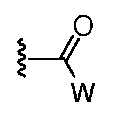
本明細書で使用される場合、「ヘテロ芳香族」または「ヘテロアリール」という用語は、炭素原子環員および1つまたはそれを超えるヘテロ原子環員(例えば、酸素、硫黄または窒素)を含む単環式または多環式芳香族ヘテロ環(またはそのラジカル)を意味する。通常、芳香族ヘテロ環は5~約14環員を有し、その中の少なくとも1つの環員は酸素、硫黄、および窒素から選択されるヘテロ原子である。別の実施形態では、芳香族ヘテロ環は、5または6員環であり、1~約4個のヘテロ原子を含んでよい。別の実施形態では、芳香族ヘテロ環系は、7~14環員であり、1~約7個のヘテロ原子を含んでよい。代表的ヘテロアリールには、ピリジル、フリル、チエニル、ピロリル、オキサゾリル、イミダゾリル、インドリジニル、チアゾリル、イソオキサゾリル、ピラゾリル、イソチアゾリル、ピリダジニル、ピリミジニル、ピラジニル、トリアジニル、トリアゾリル、ピリジニル、チアジアゾリル、ピラジニル、キノリル、イソキノリル、インダゾリル、ベンゾオキサゾリル、ベンゾフリル、ベンゾチアゾリル、インドリジニル、イミダゾピリジニル、イソチアゾリル、テトラゾリル、ベンズイミダゾリル、ベンゾオキサゾリル、ベンゾチアゾリル、ベンゾチアジアゾリル、ベンゾオキサジアゾリル、カルバゾリル、インドリル、テトラヒドロインドリル、アザインドリル、イミダゾピリジル、キナゾリニル(qunizaolinyl)、プリニル、ピロロ[2,3]ピリミジル、ピラゾロ[3,4]ピリミジル、ベンゾ(b)チエニル、などが挙げられる。これらのヘテロアリール基は、1つまたはそれを超える置換基により任意に置換されてもよい。 As used herein, the term "heteroaromatic" or "heteroaryl" refers to a monomer containing a carbon atom ring member and one or more heteroatom ring members (e.g., oxygen, sulfur or nitrogen). Refers to a cyclic or polycyclic aromatic heterocycle (or a radical thereof). Typically, aromatic heterocycles have from 5 to about 14 ring members, in which at least one ring member is a heteroatom selected from oxygen, sulfur, and nitrogen. In another embodiment, the aromatic heterocycle is a 5- or 6-membered ring and may contain 1 to about 4 heteroatoms. In another embodiment, the aromatic heterocyclic ring system may have 7 to 14 ring members and contain 1 to about 7 heteroatoms. Representative heteroaryls include pyridyl, furyl, thienyl, pyrrolyl, oxazolyl, imidazolyl, indolizinyl, thiazolyl, isoxazolyl, pyrazolyl, isothiazolyl, pyridazinyl, pyrimidinyl, pyrazinyl, triazinyl, triazolyl, pyridinyl, thiadiazolyl, pyrazinyl, quinolyl, isoquinolyl, indazolyl. , benzoxazolyl, benzofuryl, benzothiazolyl, indolizinyl, imidazopyridinyl, isothiazolyl, tetrazolyl, benzimidazolyl, benzoxazolyl, benzothiazolyl, benzothiadiazolyl, benzoxadiazolyl, carbazolyl, indolyl, tetrahydroindolyl, azaindolyl , imidazopyridyl, quinazolinyl, purinyl, pyrrolo[2,3]pyrimidyl, pyrazolo[3,4]pyrimidyl, benzo(b)thienyl, and the like. These heteroaryl groups may be optionally substituted with one or more substituents.
用語の「置換された」は、有機化合物の全ての許容可能な置換基を含み、「許容可能な」は、当業者に既知の原子価の化学的規則の文脈におけるものであることを企図する。いくつかの事例では、「置換された」は通常、水素の、本明細書に記載の置換基による置換を意味する。しかし、本明細書で使用される場合、「置換された」は、分子が特定される重要な官能基の置換および/または変更(例えば、「置換される」官能基が、置換により、異なる官能基になるような)を包含しない。例えば、「置換フェニル」は、依然としてフェニル部分を含んでいる必要があり、この定義では、置換により、例えば、ピリジンなどのヘテロアリール基となるように変更され得ない。広義の態様では、許容可能な置換基には、有機化合物の非環式と環式、分岐と非分岐、炭素環式とヘテロ環式、芳香族と非芳香族置換基が含まれる。例示的置換基には、例えば、本明細書で記載のものが含まれる。許容可能な置換基は、適切な有機化合物に対し、1つまたはそれを超えるおよび同じまたは異なる置換基とすることができる。本開示の目的のために、窒素などのヘテロ原子は、ヘテロ原子の原子価を満たす、水素置換基および/または本明細書で記載の有機化合物の任意の許容可能な置換基を有してよい。本開示は、有機化合物の許容可能な置換基により何らかの形で限定することを意図するものではない。 The term "substituted" includes all permissible substituents of organic compounds, and "acceptable" is intended to be in the context of the chemical rules of valence known to those skilled in the art. . In some cases, "substituted" generally refers to replacement of hydrogen with a substituent group as described herein. However, as used herein, "substituted" refers to the substitution and/or modification of key functional groups with which the molecule is specified (e.g., the functional group being "substituted" is (such as the underlying). For example, a "substituted phenyl" must still contain the phenyl moiety and cannot, by this definition, be modified by substitution to become a heteroaryl group, such as pyridine. In broad aspects, permissible substituents include acyclic and cyclic, branched and unbranched, carbocyclic and heterocyclic, aromatic and non-aromatic substituents of organic compounds. Exemplary substituents include, for example, those described herein. The permissible substituents can be one or more and the same or different substituents for appropriate organic compounds. For purposes of this disclosure, a heteroatom such as nitrogen may have hydrogen substituents and/or any permissible substituents of organic compounds described herein that satisfy the valence of the heteroatom. . This disclosure is not intended to be limited in any way by the permissible substituents of organic compounds.
置換基の例には、アルキル、アリール、アラルキル、環式アルキル、ヘテロシクロアルキル、ヒドロキシ、アルコキシ、アリールオキシ、ペルハロアルコキシ、アラルコキシ、ヘテロアリール、ヘテロアリールオキシ、ヘテロアリールアルキル、ヘテロアラルコキシ、アジド、アミノ、ハロゲン、アルキルチオ、オキソ、アシル、アシルアルキル、カルボキシエステル、カルボキシル、カルボキサミド、ニトロ、アシルオキシ、アミノアルキル、アルキルアミノアリール、アルキルアリール、アルキルアミノアルキル、アルコキシアリール、アリールアミノ、アラルキルアミノ、アルキルスルホニル、カルボキサミドアルキルアリール、カルボキサミドアリール、ヒドロキシアルキル、ハロアルキル、アルキルアミノアルキルカルボキシ、アミノカルボキサミドアルキル、アルコキシアルキル、ペルハロアルキル、アリールアルキルオキシアルキル、などが挙げられるが、これらに限定されない。 Examples of substituents include alkyl, aryl, aralkyl, cyclic alkyl, heterocycloalkyl, hydroxy, alkoxy, aryloxy, perhaloalkoxy, aralkoxy, heteroaryl, heteroaryloxy, heteroarylalkyl, heteroaralkoxy, Azide, amino, halogen, alkylthio, oxo, acyl, acylalkyl, carboxyester, carboxyl, carboxamide, nitro, acyloxy, aminoalkyl, alkylaminoaryl, alkylaryl, alkylaminoalkyl, alkoxyaryl, arylamino, aralkylamino, alkyl Examples include, but are not limited to, sulfonyl, carboxamidoalkylaryl, carboxamidoaryl, hydroxyalkyl, haloalkyl, alkylaminoalkylcarboxy, aminocarboxamidoalkyl, alkoxyalkyl, perhaloalkyl, arylalkyloxyalkyl, and the like.
本明細書で使用される場合、「ネットワーク」という用語は、架橋により相互に接続されたオリゴマーまたはポリマー鎖を有する3次元物質を意味する。 As used herein, the term "network" refers to a three-dimensional material having oligomer or polymer chains interconnected by crosslinks.
本明細書で使用される場合、「鎖」という用語は、1つのモノマー単位のオリゴマーもしくはポリマー鎖、または2種もしくはそれを超える異なるモノマー単位のオリゴマーもしくはポリマー鎖を意味する。 As used herein, the term "chain" refers to an oligomeric or polymeric chain of one monomer unit, or an oligomeric or polymeric chain of two or more different monomer units.
本明細書で使用される場合、「骨格」という用語は、モノマー単位が一緒に結合されている原子および結合を意味する。本明細書で使用される場合、「プレポリマー」という用語は、ネットワーク形成のために架橋されていないオリゴマーまたはポリマー鎖を意味する。 As used herein, the term "backbone" refers to the atoms and bonds by which monomer units are joined together. As used herein, the term "prepolymer" means an oligomer or polymer chain that has not been crosslinked to form a network.
本明細書で使用される場合、「架橋」という用語は、2つの鎖の間の連結を意味する。架橋は、化学結合、単一原子、または複数の原子のいずれであってもよい。架橋は1つの鎖のペンダント基の異なる鎖の骨格との反応により、または1つのペンダント基と別のペンダント基の反応により形成されてよい。架橋は、別の鎖分子間に存在してよく、また、同じ鎖の異なる点の間に存在してもよい。 As used herein, the term "crosslinking" means a link between two chains. The bridge may be a chemical bond, a single atom, or multiple atoms. Crosslinks may be formed by reaction of pendant groups of one chain with the backbone of a different chain or by reaction of one pendant group with another. Crosslinks may exist between molecules of separate chains or between different points on the same chain.
本明細書で使用される場合、「活性物質」という用語は、生物学的基質の変化を引き起こす化合物または化合物の混合物を意味する。医学および生物学分野における代表的な活性物質の種類には、治療薬、予防薬および診断薬が含まれる。活性物質は、小分子薬物、ビタミン、栄養素、生物学的薬物、ワクチン、タンパク質、抗体またはその他の生体高分子であってよい。活性物質は、化合物の上に列挙した種類のいずれかの混合物であってよい。 As used herein, the term "active agent" refers to a compound or mixture of compounds that causes a change in a biological matrix. Typical active substance types in the medical and biological fields include therapeutic, prophylactic and diagnostic agents. The active substance may be a small molecule drug, vitamin, nutrient, biological drug, vaccine, protein, antibody or other biological macromolecule. The active substance may be a mixture of any of the above listed types of compounds.
「免疫抑制剤」は、被験体中の異物に対する免疫応答を阻害または防止する薬剤を意味する。免疫抑制剤は通常、T細胞活性化を阻害する、増殖を中断させる、または炎症を抑制することにより作用する。 "Immunosuppressant" refers to an agent that inhibits or prevents the immune response to a foreign substance in a subject. Immunosuppressants usually act by inhibiting T cell activation, disrupting proliferation, or suppressing inflammation.
本明細書で使用される場合、「オリゴマー」および「ポリマー」という用語は、それぞれ、モノマーサブユニットを繰り返した化合物を意味する。一般的に言って、「オリゴマー」は、「ポリマー」より少ないモノマー単位を含む。当業者なら、特定の化合物がオリゴマーと指定されるかまたはポリマーと指定されるかは、化合物の正体およびそれが使われる文脈に依存することを理解するであろう。 As used herein, the terms "oligomer" and "polymer" each refer to a compound of repeating monomer subunits. Generally speaking, an "oligomer" contains fewer monomer units than a "polymer." Those skilled in the art will understand that whether a particular compound is designated as an oligomer or a polymer depends on the identity of the compound and the context in which it is used.
当業者なら、多くのオリゴマーおよびポリマー化合物が異なる数のモノマーを含む複数の化合物から構成されることを理解するであろう。このような混合物は、混合物中のオリゴマーまたはポリマー化合物の平均分子量によって指定されることが多い。本明細書で使用される場合、オリゴマーまたはポリマー化合物に関連して、単数形の「化合物(compound)」の使用は、このような混合物を含む。 Those skilled in the art will appreciate that many oligomeric and polymeric compounds are composed of multiple compounds containing different numbers of monomers. Such mixtures are often specified by the average molecular weight of the oligomeric or polymeric compounds in the mixture. As used herein, the use of the singular "compound" in reference to oligomeric or polymeric compounds includes such mixtures.
本明細書で使用される場合、さらなる調整剤(modifier)を含まない任意のオリゴマーまたはポリマー材料への言及は、任意の平均分子量を有する前記オリゴマーまたはポリマー材料を含む。例えば、用語の「ポリエチレングリコール」および「ポリプロピレングリコール」は、さらなる調整剤なしで使用される場合、任意の平均分子量のポリエチレングリコールおよびポリプロピレングリコールを含む。 As used herein, reference to any oligomeric or polymeric material without further modifiers includes said oligomeric or polymeric material having any average molecular weight. For example, the terms "polyethylene glycol" and "polypropylene glycol" when used without further modifiers include polyethylene glycol and polypropylene glycol of any average molecular weight.
本明細書で使用される場合、「マイケル受容体」という用語は、炭素-炭素二重結合または三重結合を有する官能基を意味し、ここで、炭素原子のうちの少なくとも1つは、さらにカルボニル基またはイミン、オキシム、およびチオカルボニルなどのカルボニル類似体に結合している。マイケル受容体と求核試薬との間の反応により、求核試薬と、カルボニル基またはカルボニル類似体に直接接続していない炭素原子との間で共有結合が形成される。マイケル受容体と求核試薬との間の反応は、「マイケル付加」と呼ばれることもある。 As used herein, the term "Michael acceptor" refers to a functional group having a carbon-carbon double or triple bond, where at least one of the carbon atoms is further carbonyl attached to groups or carbonyl analogs such as imines, oximes, and thiocarbonyls. The reaction between the Michael acceptor and the nucleophile results in the formation of a covalent bond between the nucleophile and a carbon atom that is not directly connected to the carbonyl group or carbonyl analog. The reaction between a Michael acceptor and a nucleophile is sometimes referred to as a "Michael addition."
用語の「脂肪族基」は、直鎖、分岐鎖、または環状脂肪族炭化水素基を意味し、アルキル基、アルケニル基、およびアルキニル基などの飽和および不飽和の脂肪族基を含む。 The term "aliphatic group" means a straight, branched, or cyclic aliphatic hydrocarbon group, and includes saturated and unsaturated aliphatic groups such as alkyl, alkenyl, and alkynyl groups.
用語の「アルコキシ」は、結合した酸素原子を有する、上記で定義されたアルキル基を意味する。代表的アルコキシ基には、メトキシ、エトキシ、プロピルオキシ、およびtert-ブトキシが挙げられる。「エーテル」は、酸素により共有結合された2つの炭化水素である。 The term "alkoxy" means an alkyl group as defined above having an attached oxygen atom. Representative alkoxy groups include methoxy, ethoxy, propyloxy, and tert-butoxy. An "ether" is two hydrocarbons covalently bonded by oxygen.
用語の「アルキルチオ」は、結合された硫黄原子を有する上記で定義されたアルキル基を意味する。いくつかの実施形態では、「アルキルチオ」部分は、-S-アルキル、-S-アルケニル、および-S-アルキニルの内の1つにより表される。代表的アルキルチオ基には、メチルチオおよびエチルチオが挙げられる。 The term "alkylthio" means an alkyl group as defined above having an attached sulfur atom. In some embodiments, the "alkylthio" moiety is represented by one of -S-alkyl, -S-alkenyl, and -S-alkynyl. Representative alkylthio groups include methylthio and ethylthio.
用語の「アミド」は、カルボニル基により置換されたアミノとして当該分野で認められている。 The term "amide" is art-recognized as an amino substituted with a carbonyl group.
本明細書で使用される場合、用語「アラルキル」は、アリール基で置換されたアルキル基を意味する。本明細書で使用される場合、用語「ヘテロアラルキル」は、ヘテロアリール基で置換されたアルキル基を意味する。 As used herein, the term "aralkyl" refers to an alkyl group substituted with an aryl group. As used herein, the term "heteroaralkyl" refers to an alkyl group substituted with a heteroaryl group.
本明細書で使用される場合、用語の「ヘテロ原子」は、炭素または水素以外の任意の元素の原子を意味する。代表的(Examplary)ヘテロ原子は窒素、酸素、および硫黄を含む。 As used herein, the term "heteroatom" means an atom of any element other than carbon or hydrogen. Example heteroatoms include nitrogen, oxygen, and sulfur.
本明細書で使用される場合、「チオール」という用語は、-SHを意味し、用語の「ヒドロキシル」は-OHを意味し、用語の「スルホニル」は-SO2-を意味する。 As used herein, the term "thiol" refers to -SH, the term "hydroxyl" refers to -OH, and the term "sulfonyl" refers to -SO 2 -.
本明細書で使用される場合、「オキソ」という用語は、カルボニル酸素原子を意味する。 As used herein, the term "oxo" means a carbonyl oxygen atom.
本明細書で使用される場合、「アルカロイド」という用語は、少なくとも1つの非ペプチド性窒素原子を含む天然に存在する有機化合物を意味する。 As used herein, the term "alkaloid" means a naturally occurring organic compound that contains at least one non-peptidic nitrogen atom.
(実施例) (Example)
次の実施例は、その性質上、例示することを意図している。したがって、実施例は、本開示の全範囲を例示するものと解釈されるべきでではなく、それよりも本開示の全範囲は明細書および図を考慮して全体として解釈されるべきものである。 The following examples are intended to be illustrative in nature. Accordingly, the examples should not be construed as exemplifying the full scope of the disclosure, but rather the full scope of the disclosure should be construed as a whole in light of the specification and figures. .
実施例1-自己集合構造体の効率 Example 1 - Efficiency of self-assembled structures
異なるプラトン立体のセンチメートル規模の形態の自己集合の効率を試験し、結果を図5A~5Fに示す。インビトロ自己集合モデルを、ヒトの胃に基づいて大まかに開発した。モデルは、可変回転速度にてスキュー軸(skewed axis)上で穏やかに回転するように構成された250mlの密閉プラスチック容器からなった。図5Aに示す5種のプラトン立体のそれぞれに対応する多角形の自己集合性構造体を、三次元印刷を使用して生成した。それぞれのサブ構造体の外接半径を1cmで一定にした。サブ構造体が相互作用して多面体を形成するように、1/16インチの直径のネオジム磁石を、所定の北-南配向で、それぞれの構造体の稜に彫り込んだ孔中に挿入した。集合多面体の外接半径Rとして定義される有効半径は、自己集合性構造体の特定の形状に関連する。モデル中で1分当たり10回転(rpm)で最大30分間回転させることにより、それぞれの多面体の表面Nの数に等しい数の構造体を、集合効率に関して評価した。5分、10分、20分、および30分で、正確に形成された最大の凝集体を特定し、構造体(表面)の数を計数した。最終的な構造体は、集合した凝集構造体の内部に頻繁に捕捉され、また、全体の集合体の安定性にとって重要ではないので、自己集合の効率は、N-1個の構造体が正確に一体化(come together)したかどうかを決定することにより計算した。図5Bのチャートは、5分および30分での多面体の自己集合確率を示す。これは、立方体および十二面体凝集構造体の、四面体、八面体、または二十面体に対する自己集合効率が相対的に増加したという予想外の差異を示している。 The efficiency of self-assembly of centimeter-scale forms of different Platonic solids was tested and the results are shown in Figures 5A-5F. An in vitro self-assembly model was developed loosely based on the human stomach. The model consisted of a 250 ml sealed plastic container configured to rotate gently on a skewed axis at variable rotational speeds. Polygonal self-assembling structures corresponding to each of the five Platonic solids shown in Figure 5A were generated using three-dimensional printing. The circumscribed radius of each substructure was kept constant at 1 cm. A 1/16 inch diameter neodymium magnet was inserted into a hole carved into the edge of each structure in a predetermined north-south orientation so that the substructures interacted to form a polyhedron. The effective radius, defined as the circumscribed radius R of the assembled polyhedron, is related to the particular shape of the self-assembling structure. A number of structures equal to the number of surfaces N of each polyhedron were evaluated for assembly efficiency by rotating in the model at 10 revolutions per minute (rpm) for up to 30 minutes. At 5, 10, 20, and 30 minutes, the largest aggregates formed were accurately determined and the number of structures (surfaces) was counted. The efficiency of self-assembly is such that N-1 structures are exactly It was calculated by determining whether the two came together. The chart in FIG. 5B shows the self-assembly probability of polyhedra at 5 and 30 minutes. This indicates an unexpected difference in the relative increased self-assembly efficiency of cubic and dodecahedral aggregate structures to tetrahedra, octahedrons, or icosahedrons.
予想外の自己集合効率およびより大きな有効サイズのため、さらなる調査のために、十二面体を選択した。図5Cのチャートは、最大の集合十二面体と磁石分離との間の時間をわたっての関係を示す。サブ構造体のそれぞれの稜上の反対の磁気配向(すなわち、北南軸を相互に反対にした)を有する2つの逆転磁石の間の分離距離を2.5mmから6mmまで変えることにより、磁気相互作用を実験的に変化させた。10rpmで回転中のそれぞれの時点で正確に集合した最大の構造体により測定した場合、集合効率に有意差は認められなかった。 Dodecahedrons were chosen for further investigation because of their unexpected self-assembly efficiency and larger effective size. The chart in FIG. 5C shows the relationship between maximum aggregate dodecahedron and magnet separation over time. By varying the separation distance between two reversing magnets with opposite magnetic orientations (i.e., north-south axes opposite each other) on each edge of the substructure from 2.5 mm to 6 mm, the magnetic reciprocal The effect was experimentally changed. No significant differences in assembly efficiency were observed as measured by the largest structure correctly assembled at each time point during rotation at 10 rpm.
図5Dのチャートは、最大の集合片と二面角(すなわち、2つのサブ構造体間で形成される角度)との間の時間をわたっての関係をさらに示す。幾何学的な正確なはめ合いは、十二面体では、約116.6°の二面角で起こる。これらの実験では、116.6°から最大132°の範囲の二面角を与えるサブ構造体を生成し、上述と同じように集合効率を評価した。チャートは、集合効率がほぼ逆U曲線で変化し、最適集合効率が予想外に中間的二面角で生じることを示す。二面角が幾何学的正確なはめ合いから増加するに伴い、二面角が約127°~132°に増加するまで集合効率が高くなり、その点で、完全な集合を行うには整合不良(misalignment)の程度が大きくなりすぎるために、自己集合効率が減少し始める。 The chart in FIG. 5D further shows the relationship over time between the largest aggregate piece and the dihedral angle (ie, the angle formed between two substructures). A geometrically accurate fit occurs at a dihedral angle of about 116.6° for a dodecahedron. In these experiments, substructures giving dihedral angles ranging from 116.6° up to 132° were generated and assembly efficiency was evaluated as described above. The chart shows that the aggregation efficiency varies approximately in an inverted U curve, with the optimal aggregation efficiency unexpectedly occurring at intermediate dihedral angles. As the dihedral angle increases from a geometrically exact fit, the assembly efficiency increases until the dihedral angle increases from approximately 127° to 132°, at which point the mismatch is insufficient for perfect assembly. The self-assembly efficiency begins to decrease because the degree of misalignment becomes too large.
正確な幾何学的はめ合いから逸脱した二面角を有する十二面体の安定性を評価するために、圧縮分析を行って、完全に形成された十二面体を圧縮するのに必要な最大力を見い出した。図5Eのチャートは、12片(自己集合性構造体)を含む十二面体に対する最大力と二面角との間の関係を示す。最大力は、約124°より大きい二面角で顕著に減少する。11片(自己集合性構造体)のみを含む不完全に集合した十二面体についても、この構造体が頻繁に観察されたので、同じ分析を行った。十二面体の欠損構造体(表面)は、圧縮の軸から離れて方向付けられた。図5Fのチャートは、11片に対する最大力と二面角との間の関係を示す。類似のパターンの二面角の変化が認められ、わずかに低下した圧縮圧力が必要であった。約0.5cm2の表面積を有する十二面体構造体を圧縮するために必要な最大力は、それぞれの構成についておよそ5Nであった。これは、ヒト胃食道括約筋で発揮される最大圧力の推定値に匹敵する。 To assess the stability of dodecahedrons with dihedral angles that deviate from the exact geometric fit, a compression analysis is performed to determine the maximum force required to compress a fully formed dodecahedron. I found out. The chart in FIG. 5E shows the relationship between maximum force and dihedral angle for a dodecahedron containing 12 pieces (self-assembling structure). The maximum force decreases significantly for dihedral angles greater than about 124°. The same analysis was performed on an incompletely assembled dodecahedron containing only 11 pieces (a self-assembling structure) since this structure was frequently observed. The dodecahedral defect structure (surface) was oriented away from the axis of compression. The chart in Figure 5F shows the relationship between maximum force and dihedral angle for 11 pieces. A similar pattern of dihedral angle changes was observed, requiring slightly reduced compression pressures. The maximum force required to compress the dodecahedral structure with a surface area of approximately 0.5 cm was approximately 5 N for each configuration. This is comparable to estimates of the maximum pressure exerted in the human gastroesophageal sphincter.
様々な条件下での十二面体集合体の頑強性を、上記のモデルを使って評価し、結果を図6に示す。集合効率は、システムに適用される動力学的エネルギーで変化することが知られている。容器の回転速度は2.5rpm~40rpmまで変化したので、集合が起こるために必要な平均時間、ならびに全体の集合効率は、図6Aに示すように、回転速度と共に増加した。5rpmを超える回転速度では、自己集合は効率的で、85%を超える事例で11または12個の自己集合性構造体が正確な集合したことに達した。図6Bに示すように、10rpmの回転速度で、過剰なサブ構造体、例えば、12、13、14、および16個のサブ構造体の添加は、統計的に有意な量で集合速度の低下を生じさせなかった。しかし、過剰なサブ構造体は、少なくとも若干好ましくないであろうことを示唆する弱い傾向があった。 The robustness of the dodecahedral assembly under various conditions was evaluated using the above model, and the results are shown in Figure 6. Collective efficiency is known to vary with the kinetic energy applied to the system. As the vessel rotation speed was varied from 2.5 rpm to 40 rpm, the average time required for aggregation to occur, as well as the overall aggregation efficiency, increased with rotation speed, as shown in Figure 6A. At rotation speeds above 5 rpm, self-assembly was efficient, reaching accurate assembly of 11 or 12 self-assembled structures in more than 85% of cases. As shown in Figure 6B, at a rotation speed of 10 rpm, addition of excess substructures, e.g., 12, 13, 14, and 16 substructures, decreases the assembly rate by a statistically significant amount. did not occur. However, there was a weak tendency to suggest that an excess of substructures would be at least slightly undesirable.
250mlの容器中の種々の量の水が十二面体集合体に与える影響も評価した。図6Cに示すように、25mlを超える水では、十二面体の自己集合の効率が統計的に有意な量で低減するように見えた。直径1cmのゴムボールを容器に加え、胃中の固形食物ボーラスをシミュレーションし、集合効率に対する影響がないことが観察された。さらに、ゴムボールの添加は、25mlを超える水の有害作用を無効にする(rescue)ことができなかった。 The effect of various amounts of water in a 250 ml container on the dodecahedral aggregates was also evaluated. As shown in Figure 6C, above 25 ml of water, the efficiency of dodecahedral self-assembly appeared to be reduced by a statistically significant amount. A 1 cm diameter rubber ball was added to the container to simulate a solid food bolus in the stomach and no effect on assembly efficiency was observed. Furthermore, the addition of rubber balls could not rescue the deleterious effects of more than 25 ml of water.
実施例2-自己集合のインビボ評価 Example 2 - In vivo evaluation of self-assembly
図7は、55kgのブタの胃中で維持される自己集合十二面体凝集構造体の実施形態を示す。五角形構造体を、胃洗浄を介して胃中に置いた。数分以内に、サブ構造体が相互作用し、インビボで半順序凝集体を形成した。十二面体凝集構造体が、24時間保持され、これは、成分であるPEG系材料の分解速度のみによって制限された。 FIG. 7 shows an embodiment of a self-assembled dodecahedral aggregate structure maintained in the stomach of a 55 kg pig. The pentagonal construct was placed into the stomach via gastric lavage. Within minutes, the substructures interacted and formed semi-ordered aggregates in vivo. The dodecahedral aggregate structure was maintained for 24 hours, limited only by the degradation rate of the component PEG-based material.
実施例3-半順序凝集構造体 Example 3 - Partially ordered aggregate structure
図8Aは、半順序凝集構造体を形成するために使用し得る立方体自己集合性構造体の略図を示す。図に示すように、立方体は、該立方体が半順序凝集構造体に集合するように構成された、交互になった磁気配向を有する磁石を含む。立方体はまた、酸性環境中で時間をわたって膨潤するように適合されたコーティングを含む。膨潤は時間をわたって立方体を離すように押し、磁気結合の分解を容易にする。 FIG. 8A shows a schematic diagram of a cubic self-assembling structure that can be used to form a semi-ordered aggregated structure. As shown, the cubes include magnets with alternating magnetic orientations configured such that the cubes assemble into a semi-ordered agglomerated structure. The cube also includes a coating adapted to swell over time in an acidic environment. Swelling pushes the cubes apart over time, facilitating the breakdown of magnetic bonds.
図8Bに示すように、磁石が立方体構造体に対応する6つの方向に沿って配置されるように、磁石を保持するように配置された構造体中に磁石を挿入することにより、自己集合性立方体を形成することができる。追加の材料を添加して、磁石が立方体表面と同一平面となる(flush with)立方体形状を形成する。図8Cは、例示的な自己集合凝集構造体を示す。 Self-assembly is achieved by inserting the magnets into a structure arranged to hold the magnets such that the magnets are arranged along six directions corresponding to the cubic structure, as shown in Figure 8B. A cube can be formed. Additional material is added to form a cube shape where the magnet is flush with the cube surface. FIG. 8C shows an exemplary self-assembled aggregate structure.
三次元印刷により調製された27個の自己集合性立方体構造体を乾式ミキサー中に置き、ミキサーを5分間回転させることにより、立方体構造体の集合体を評価した。立方体構造体に対応する3つの直交方向のそれぞれに沿った立方体の最大数を測定し、結果を図8Dに示す。最大寸法に加えて、コア寸法を測定した。これは、欠けたユニットの全くない、観察された構造体内に含まれる完全に形成された最大の立方体構造体を反映している。 The assembly of cubic structures was evaluated by placing 27 self-assembled cubic structures prepared by three-dimensional printing in a dry mixer and rotating the mixer for 5 minutes. The maximum number of cubes along each of the three orthogonal directions corresponding to the cubic structure was measured and the results are shown in Figure 8D. In addition to the largest dimension, the core dimension was measured. This reflects the largest fully formed cubic structure contained within the observed structure, with no missing units.
実施例4-半順序構造体の胃中保持 Example 4 - Gastric retention of partially ordered structures
図9Aは、0日目に複数の自己集合性構造体を摂取した後で、自己集合過程が起こった後のヨークシャーブタ中で形成された半順序凝集構造体を示す。凝集構造体は、胃腔内で凝集構造体の位置を維持するのに充分に大きい。2日後、図9Bに示すように、別の自己集合構造体間の結合が分解し始めた。それに対応して、半順序凝集構造体が2つのより小さい断片/凝集構造体に分裂した。しかし、得られた断片は依然として、胃腔中に保持されるには充分に大きい。図には示されていないが、この分解過程は、凝集構造体の得られた断片が開口部を通過して胃腔から出るには充分小さくなるまで続くであろう。 FIG. 9A shows partially ordered aggregated structures formed in Yorkshire pigs after ingestion of multiple self-assembled structures on day 0 and after the self-assembly process has occurred. The aggregate structure is large enough to maintain its position within the gastric cavity. After 2 days, the bonds between the other self-assembled structures began to break down, as shown in Figure 9B. Correspondingly, the partially ordered aggregate structure split into two smaller fragments/aggregate structures. However, the resulting fragments are still large enough to be retained in the gastric cavity. Although not shown in the figure, this disintegration process will continue until the resulting fragments of aggregate structure are small enough to pass through the opening and exit the gastric cavity.
図10A~10Eは、複数の自己集合性立方体構造体をヨークシャーブタへ投与した2日後に行われた剖検由来の画像を示す。図10A~10Bは、胃腔中に保持されていることが確認された半順序凝集構造体を示す。図10C~10Dは、剖検中に胃腔から取り出された2つの半順序凝集構造体を示す。 FIGS. 10A-10E show images from a necropsy performed two days after administering multiple self-assembled cubic structures to Yorkshire pigs. Figures 10A-10B show semi-ordered aggregate structures found to be retained in the gastric cavity. Figures 10C-10D show two semi-ordered aggregate structures removed from the gastric cavity during necropsy.
実施例5-半順序構造体のインビボ集合 Example 5 - In vivo assembly of partially ordered structures
図11Aは、0日目に、ヨークシャーブタの胃中に摂取された複数の自己集合性立方体構造体を示す。先に記載したように、ネオジム磁石を、該磁石を所定位置に保持するように設計された内部三次元構造体に置き、構造体を形成し、さらに、結晶質粉末状ドキシサイクリンハイクラート(doxycycline hyclate)と混合したポリカプロラクトンからなる磁石ホルダーの周囲に構造体を埋め込んで、自己集合性立方体構造体を形成した。76%w/wのポリカプロラクトン(MW45,000)中の4%w/wのプルロニックP407と共に、20%w/wのドキシサイクリンを、融解および機械的混合により充填した。融解混合物をPDMS型中に置き、その中に、磁石が露出されるように磁石ホルダーを埋め込んだ。図に示すように、20分未満以内に、自己集合性構造体が、複数の自己集合性(self-asssembling)からインビボで形成された半順序凝集構造体を形成した。図11Bに示すように、1日後、凝集構造体はより密になり、より均一な形状を形成した。 FIG. 11A shows multiple self-assembled cubic structures ingested into the stomach of a Yorkshire pig on day 0. As previously described, a neodymium magnet is placed in an internal three-dimensional structure designed to hold the magnet in place to form the structure, and a neodymium magnet is placed in an internal three-dimensional structure designed to hold the magnet in place. A self-assembled cubic structure was formed by embedding the structure around a magnet holder made of polycaprolactone mixed with ). 20% w/w doxycycline was loaded with 4% w/w Pluronic P407 in 76% w/w polycaprolactone (MW 45,000) by melting and mechanical mixing. The molten mixture was placed into a PDMS mold, into which a magnet holder was embedded so that the magnet was exposed. As shown in the figure, within less than 20 minutes, the self-assembled structures formed semi-ordered aggregated structures formed in vivo from multiple self-assemblings. As shown in FIG. 11B, after one day, the aggregated structures became denser and formed a more uniform shape.
図12は、図11A~11Cに記載の自己集合性立方体の投与前後の、示した時点でのブタの静脈カニューレ挿入から得られた血清で測定したドキシサイクリンのレベルを示す。血清をLC/LC-MSで分析し、ドキシサイクリンの濃度を決定した。 FIG. 12 shows the levels of doxycycline measured in serum obtained from venous cannulation of pigs at the indicated time points before and after administration of the self-assembling cubes described in FIGS. 11A-11C. Serum was analyzed by LC/LC-MS to determine the concentration of doxycycline.
いくつかの本開示の実施形態が本明細書で説明され、例示されてきたが、当業者なら、本明細書で記載の機能を実施するおよび/または結果および/または1つまたはそれを超える利点を得るための種々のその他の手段および/または構造体を容易に予測すると思われるが、それぞれのこのような変形および/または修正は本開示の範囲内に入ると見なされる。さらに一般的には、当業者なら、本明細書で記載のすべてのパラメータ、寸法、材料、および構成は、例示的であることが意図されていること、および実際のパラメータ、寸法、材料、および/または構成は、本開示の教示が使用される具体的な用途(単一または複数)に依存するであろうことを容易に理解するであろう。当業者なら、単に定型の実験を使うだけで、本明細書で記載の特定の本開示の実施形態に対する多くの等価物を認める、または確認することができるであろう。したがって、前述の実施形態は、例示の目的のみで提示されていること、および添付の特許請求の範囲およびそれらの等価物の範囲内で、特に記載および請求されている以外の方法で本開示を実施し得ることが理解されよう。本開示は、それぞれ本明細書で記載の個別の特徴、システム、物品、材料、キット、および/または方法に関する。さらに、2種またはそれを超えるこのような特徴、システム、物品、材料、キット、および/または方法の任意の組み合わせは、このような特徴、システム、物品、材料、キット、および/または方法が相互に矛盾しない場合には、本開示の範囲内に包含される。 While several embodiments of the present disclosure have been described and illustrated herein, it is difficult for those skilled in the art to perform the functions and/or the results and/or one or more advantages described herein. Various other means and/or structures for obtaining the same may be readily envisaged, and each such variation and/or modification is considered to be within the scope of this disclosure. More generally, those skilled in the art will appreciate that all parameters, dimensions, materials, and configurations set forth herein are intended to be exemplary, and that actual parameters, dimensions, materials, and It will be readily appreciated that the configuration and/or configuration will depend on the specific application(s) in which the teachings of this disclosure are used. Those skilled in the art will recognize, or be able to ascertain using no more than routine experimentation, many equivalents to the specific embodiments of the disclosure described herein. It is therefore important to note that the embodiments described above are presented by way of example only, and that within the scope of the appended claims and their equivalents, this disclosure may be otherwise than as specifically described and claimed. It will be understood that this may be implemented. This disclosure relates to each individual feature, system, article, material, kit, and/or method described herein. Additionally, any combination of two or more such features, systems, articles, materials, kits, and/or methods may be used to ensure that such features, systems, articles, materials, kits, and/or methods are mutually exclusive. If it is not inconsistent with the above, it is included within the scope of the present disclosure.
本明細書および特許請求の範囲で使用される場合、特に明示的に相反して示されない限り、不定冠詞の「1つ(a)」および「1つ(an)」は、「少なくとも1つの」を意味するものと理解されるべきである。 As used in this specification and the claims, unless expressly indicated to the contrary, the indefinite articles "a" and "an" refer to "at least one" should be understood to mean.
本明細書および特許請求の範囲で使用される場合、語句の「および/または(and/or)」は、このように結合された要素の「一方または両方」、すなわち、いくつかの事例では接続的に存在する要素、その他の事例では離接的に存在する要素を意味すると理解されるべきである。語句「および/または」により具体的に特定された要素以外の、その他の要素は、特に明示的に相反して示されない限り、特に特定されたこれらの要素に関連してもまたは非関連であっても、任意に存在してよい。したがって、非限定的例として、「Aおよび/またはB」への言及は、「含む」などのオープンエンド用語と共に使用される場合、一実施形態では、BのないA(任意選択で、B以外の要素を含む);別の実施形態では、AのないB(任意選択で、A以外の要素を含む);さらに別の実施形態では、AおよびBの両方(任意選択で、その他の要素を含む);などを意味することができる。 As used in this specification and in the claims, the phrase "and/or" refers to "one or both" of the elements so conjoined, i.e., in some cases the connection It should be understood to mean elements that exist separately, and in other cases disjunctively. Other elements, other than those specifically identified by the phrase "and/or," may be referred to as related or unrelated to those specifically identified elements, unless expressly indicated to the contrary. May be optionally present. Thus, as a non-limiting example, references to "A and/or B" when used with open-ended terms such as "comprising" include, in one embodiment, A without B (optionally, other than B). in another embodiment, B without A (optionally including elements other than A); in yet another embodiment, both A and B (optionally including other elements); (including); etc.
本明細書および特許請求の範囲で使用される場合、「または(or)」は、上記で定義の「および/または」と同じを意味するものと理解されるべきである。例えば、リスト中の項目を分離する場合、「または(or)」または「および/または」は、包括的であると解釈されるべきである、すなわち、少なくとも1つの数の要素またはリストの要素を含むと解釈されるべきであるが、また2つ以上の数の要素またはリストの要素、および任意選択で、追加の非リスト項目を含むと解釈されるべきである。明確に相反して示された用語に限り、例えば、「ただ1つの」または「正確に1つの」、または特許請求の範囲で使用される場合の「からなる(consisting of)」は、要素のいくつかまたはリストの内の正確に1つを含むこと意味することになる。一般に、本明細書で使用される場合、用語の「または(or)」は、「どちらか」、「~の1つ」、「~の1つのみ」、または「正確に1つの」などの排他的用語が先行する場合、排他的選択肢(すなわち、「一方または他方であるが両方ではない」)を示すとのみ解釈されるものとする。特許請求の範囲で使われる場合、「本質的になる」は、特許法の分野で使用されるその通常の意味を有するものとする。 As used herein and in the claims, "or" is to be understood to mean the same as "and/or" as defined above. For example, when separating items in a list, "or" or "and/or" should be interpreted as inclusive, i.e. at least one number element or element of the list. shall be construed as including, but also as including two or more number elements or elements of a list, and optionally additional non-list items. Only terms clearly indicated to the contrary, such as "only one" or "exactly one" or "consisting of" when used in the claims, refer to elements It would be meant to include exactly one of several or a list. Generally, as used herein, the term "or" includes "either," "one of," "only one of," or "exactly one." When preceded by an exclusive term, it shall only be construed as indicating an exclusive alternative (i.e., "one or the other, but not both"). As used in the claims, "consisting of" shall have its ordinary meaning as used in the field of patent law.
本明細書および特許請求の範囲で使用される場合、1つまたはそれを超える要素のリストに関連して、語句の「少なくとも1つの」は、要素のリスト中のいずれか1つまたはそれを超える要素から選択される少なくとも1つの要素を意味するが、要素のリスト内に具体的にリストされた各要素および全要素の少なくとも1つを必ずしも含むとは限らず、要素のリスト中の要素の任意の組み合わせを排除しないと理解されるべきである。この定義はまた、語句の「少なくとも1つの」が指す要素リスト内で具体的に特定された要素以外の要素が、これらの具体的に特定された要素に関連するまたは関連しないに関わらず、任意選択で存在してもよいことを許容する。したがって、非限定的例として、「AおよびBの少なくとも1つ」(または、同じ意味で、「AまたはBの少なくとも1つ」、または同じ意味で、「Aおよび/またはBの少なくとも1つ」)は、一実施形態では、少なくとも1つの、任意選択で、2つ以上のAを含みBが存在しない(および任意選択でB以外の要素を含む)を意味し;別の実施形態では、少なくとも1つの、任意選択で2つ以上のBを含みAが存在しない(および任意選択でA以外の要素を含む);さらに別の実施形態では、少なくとも1つの、任意選択で2つ以上の、Aを含み、および少なくとも1つの、任意選択で、2つ以上のB(および任意選択でその他の要素を含む)を含む;などを意味することができる。 As used herein and in the claims, the phrase "at least one" in reference to a list of one or more elements refers to any one or more of the list of elements. means at least one element selected from the list of elements, but does not necessarily include at least one of each and every element specifically listed in the list of elements, and any of the elements in the list of elements. It should be understood that this does not exclude combinations of. This definition also means that any element other than those specifically identified in the list of elements to which the phrase "at least one" refers, whether or not related to those specifically identified elements, Allow it to exist by choice. Thus, by way of non-limiting example, "at least one of A and B" (or, equivalently, "at least one of A or B", or, equivalently, "at least one of A and/or B") ) means in one embodiment at least one, optionally more than one A and no B (and optionally including elements other than B); in another embodiment at least one, optionally more than one B, and no A (and optionally containing an element other than A); in yet another embodiment, at least one, optionally more than one, A; and at least one, optionally two or more B (and optionally other elements); and so on.
特許請求の範囲ならびに上記明細書では、全ての移行句、例えば、「含む(comprising)」、「含む(including)」、「保有する(carrying)」、「有する(having)」、「含む(containing)」、「含む(involving)」、「保持する(holding)」などは、オープンエンドである、すなわち、含むがそれに限定されないを意味する、と理解されるべきである。米国特許庁特許審査手続マニュアル第2111.03に記載のように、移行句「からなる(consisting of)」および「から本質的になる(consisting essentially of)」のみをそれぞれ制限的または半制限的移行句とする。 In the claims and the above specification, all transitional phrases, e.g. "comprising", "including", "carrying", "having", "containing" ), "involving," "holding," etc. should be understood to be open-ended, meaning including, but not limited to. As described in U.S. Patent Office Patent Examination Procedure Manual No. 2111.03, only the transitional phrases "consisting of" and "consisting essentially of" are considered limited or semi-restrictive transitions, respectively. Let it be a phrase.
Claims (13)
前記複数の分離した自己集合性板状構造体のうちのそれぞれの板状構造体は、
第1の面と、
前記第1の面上の第1の結合点とを含み、ここで前記第1の結合点が前記複数の分離した自己集合性板状構造体の別の板状構造体上の第2の結合点にインビボで結合するように構成され、
前記複数の分離した自己集合性板状構造体が、内部開口部に対するインビボでの位置を維持するサイズおよび形状にされる凝集構造体を形成するようなサイズおよび形状にされており、
前記第1の結合点と前記第2の結合点との間の結合が、前記複数の分離した自己集合性板状構造体がインビボに置かれた場合、一定期間後に分解し、それによって前記滞留デバイスの少なくとも一部が前記内部開口部を通過することができ、
前記結合の分解が、前記結合の生分解および前記分離した自己集合性板状構造体の少なくとも1つの膨潤のうちの少なくとも1つによって起こり、
前記複数の分離した自己集合性板状構造体のうちのそれぞれの板状構造体は、前記構造体の厚み寸法よりも大きい長手方向寸法を有する、滞留デバイス。 A retention device comprising a plurality of separate self-assembling plate-like structures, the retention device comprising:
Each of the plurality of separate self-assembling plate-like structures has
a first side;
a first bonding point on the first surface, wherein the first bonding point is a second bonding point on another plate-like structure of the plurality of separate self-assembled plate-like structures. configured to bind in vivo to a point;
the plurality of discrete self-assembled plate-like structures are sized and shaped to form a cohesive structure that is sized and shaped to maintain in vivo position relative to the internal opening;
The bond between the first attachment point and the second attachment point disintegrates after a period of time when the plurality of discrete self-assembled plate-like structures are placed in vivo, thereby causing the retention at least a portion of the device can pass through the internal opening;
disassembly of the bond occurs by at least one of biodegradation of the bond and swelling of at least one of the separated self-assembled plate-like structures;
Each plate-like structure of the plurality of separate self-assembling plate-like structures has a longitudinal dimension that is larger than a thickness dimension of the structure.
Applications Claiming Priority (4)
| Application Number | Priority Date | Filing Date | Title |
|---|---|---|---|
| US201462010992P | 2014-06-11 | 2014-06-11 | |
| US62/010,992 | 2014-06-11 | ||
| JP2016572439A JP2017519003A (en) | 2014-06-11 | 2015-06-11 | Self-assembled dwell device and related methods |
| JP2020074561A JP7337746B2 (en) | 2014-06-11 | 2020-04-20 | SELF-ASSEMBLED DEMAND DEVICES AND RELATED METHODS |
Related Parent Applications (1)
| Application Number | Title | Priority Date | Filing Date |
|---|---|---|---|
| JP2020074561A Division JP7337746B2 (en) | 2014-06-11 | 2020-04-20 | SELF-ASSEMBLED DEMAND DEVICES AND RELATED METHODS |
Publications (2)
| Publication Number | Publication Date |
|---|---|
| JP2022031924A JP2022031924A (en) | 2022-02-22 |
| JP7405820B2 true JP7405820B2 (en) | 2023-12-26 |
Family
ID=54834353
Family Applications (9)
| Application Number | Title | Priority Date | Filing Date |
|---|---|---|---|
| JP2017517216A Active JP6681390B2 (en) | 2014-06-11 | 2015-06-11 | Enteric Elastomer |
| JP2016572439A Pending JP2017519003A (en) | 2014-06-11 | 2015-06-11 | Self-assembled dwell device and related methods |
| JP2016572445A Active JP6666858B2 (en) | 2014-06-11 | 2015-06-11 | Stagnation structure and related method |
| JP2020000278A Pending JP2020056042A (en) | 2014-06-11 | 2020-01-06 | Enteric elastomer |
| JP2020028439A Withdrawn JP2020097623A (en) | 2014-06-11 | 2020-02-21 | Retention structure and related methods |
| JP2020074561A Active JP7337746B2 (en) | 2014-06-11 | 2020-04-20 | SELF-ASSEMBLED DEMAND DEVICES AND RELATED METHODS |
| JP2021202475A Active JP7405820B2 (en) | 2014-06-11 | 2021-12-14 | Self-assembling retention devices and related methods |
| JP2022197093A Active JP7629898B2 (en) | 2014-06-11 | 2022-12-09 | Retention structures and related methods |
| JP2024227227A Pending JP2025041821A (en) | 2014-06-11 | 2024-12-24 | Residence structure and related method |
Family Applications Before (6)
| Application Number | Title | Priority Date | Filing Date |
|---|---|---|---|
| JP2017517216A Active JP6681390B2 (en) | 2014-06-11 | 2015-06-11 | Enteric Elastomer |
| JP2016572439A Pending JP2017519003A (en) | 2014-06-11 | 2015-06-11 | Self-assembled dwell device and related methods |
| JP2016572445A Active JP6666858B2 (en) | 2014-06-11 | 2015-06-11 | Stagnation structure and related method |
| JP2020000278A Pending JP2020056042A (en) | 2014-06-11 | 2020-01-06 | Enteric elastomer |
| JP2020028439A Withdrawn JP2020097623A (en) | 2014-06-11 | 2020-02-21 | Retention structure and related methods |
| JP2020074561A Active JP7337746B2 (en) | 2014-06-11 | 2020-04-20 | SELF-ASSEMBLED DEMAND DEVICES AND RELATED METHODS |
Family Applications After (2)
| Application Number | Title | Priority Date | Filing Date |
|---|---|---|---|
| JP2022197093A Active JP7629898B2 (en) | 2014-06-11 | 2022-12-09 | Retention structures and related methods |
| JP2024227227A Pending JP2025041821A (en) | 2014-06-11 | 2024-12-24 | Residence structure and related method |
Country Status (19)
| Country | Link |
|---|---|
| US (16) | US10413507B2 (en) |
| EP (5) | EP3154622B1 (en) |
| JP (9) | JP6681390B2 (en) |
| KR (2) | KR102704895B1 (en) |
| CN (4) | CN106573015B (en) |
| AU (6) | AU2015274453A1 (en) |
| BR (2) | BR122021018078B1 (en) |
| CA (3) | CA2951909C (en) |
| DK (2) | DK3155024T4 (en) |
| ES (2) | ES2832334T5 (en) |
| FI (2) | FI3725357T3 (en) |
| IL (1) | IL249435B (en) |
| MX (2) | MX2016016406A (en) |
| NZ (1) | NZ727659A (en) |
| PL (1) | PL3725357T3 (en) |
| RU (1) | RU2766335C2 (en) |
| SG (2) | SG10201912100SA (en) |
| WO (3) | WO2015191920A1 (en) |
| ZA (1) | ZA201608889B (en) |
Families Citing this family (72)
| Publication number | Priority date | Publication date | Assignee | Title |
|---|---|---|---|---|
| CN103948557A (en) | 2014-04-08 | 2014-07-30 | 闻晓光 | Novel controlled release tablet |
| KR20170015389A (en) | 2014-06-02 | 2017-02-08 | 테바 파마슈티컬 인더스트리즈 리미티드 | Expandable gastroretentive dosage form |
| AU2015274453A1 (en) | 2014-06-11 | 2017-01-12 | Massachusetts Institute Of Technology | Enteric elastomers |
| US20170266112A1 (en) | 2014-06-11 | 2017-09-21 | Massachusetts Institute Of Technology | Residence structures and related methods |
| CA2964900C (en) | 2014-09-25 | 2023-02-21 | Progenity, Inc. | Electromechanical pill device with localization capabilities |
| EP3288604B1 (en) | 2015-05-01 | 2021-11-17 | Massachusetts Institute of Technology | Triggerable shape memory induction devices |
| EP3153137A1 (en) * | 2015-10-06 | 2017-04-12 | Li Galli B.V. | Vaginal drug delivery device and vaginal diagnostic device |
| US10939865B2 (en) * | 2015-10-06 | 2021-03-09 | Ligalli B.V. | Vaginal drug delivery device and vaginal diagnostic device |
| WO2017070612A1 (en) | 2015-10-23 | 2017-04-27 | Lyndra, Inc. | Gastric residence systems for sustained release of therapeutic agents and methods of use thereof |
| CA3006999A1 (en) * | 2015-12-01 | 2017-06-08 | Clexio Biosciences Ltd. | Gastric retentive devices |
| ES2963058T3 (en) * | 2015-12-08 | 2024-03-25 | Lyndra Therapeutics Inc | Geometric configurations for gastric residence systems |
| EP3393537B1 (en) | 2015-12-22 | 2024-05-22 | Access Vascular, Inc. | High strength biomedical materials |
| US10470799B2 (en) * | 2016-04-21 | 2019-11-12 | Massachusetts Institute Of Technology | Origami robots, systems, and methods of treatment |
| US12109305B2 (en) | 2016-05-27 | 2024-10-08 | Lyndra Therapeutics, Inc. | Materials architecture for gastric residence systems |
| EP4091538B1 (en) | 2016-09-09 | 2024-11-06 | Biora Therapeutics, Inc. | Electromechanical ingestible device for delivery of a dispensable substance |
| EP3518902A4 (en) * | 2016-09-30 | 2020-07-08 | Lyndra, Inc. | STOMACH RESTORATION SYSTEMS FOR RETARD RELEASE OF ACTIVE SUBSTANCES |
| EP3320898A1 (en) | 2016-11-11 | 2018-05-16 | ratiopharm GmbH | Dosage form comprising a carrier structure and method for manufacturing the dosage form |
| JP7071748B2 (en) * | 2016-12-02 | 2022-05-19 | クレキシオ バイオサイエンシーズ エルティーディー. | Gastric retention system |
| EP4252629A3 (en) | 2016-12-07 | 2023-12-27 | Biora Therapeutics, Inc. | Gastrointestinal tract detection methods, devices and systems |
| EP3597258B1 (en) * | 2017-03-16 | 2025-09-03 | Terumo Kabushiki Kaisha | Catheter assembly |
| DK3600009T3 (en) | 2017-03-31 | 2021-01-18 | Progenity Inc | Eatable device with locating properties |
| IL270449B2 (en) | 2017-05-17 | 2025-02-01 | Massachusetts Inst Technology | Self-righting systems, methods, and related components |
| US11541015B2 (en) | 2017-05-17 | 2023-01-03 | Massachusetts Institute Of Technology | Self-righting systems, methods, and related components |
| AU2018279853B2 (en) * | 2017-06-09 | 2024-07-04 | Nortiva Bio, Inc. | Gastric residence systems with release rate-modulating films |
| CN110997026A (en) | 2017-06-21 | 2020-04-10 | 阿塞斯血管有限公司 | High strength porous materials incorporating water soluble polymers |
| US11865145B2 (en) | 2017-08-07 | 2024-01-09 | Finch Therapeutics Holdings Llc | Compositions and methods for maintaining and restoring a healthy gut barrier |
| CN107773554A (en) * | 2017-09-07 | 2018-03-09 | 华南农业大学 | A kind of ivermectin slow-releasing microcapsule and its preparation method and application |
| AU2018337837B2 (en) * | 2017-09-20 | 2024-03-07 | Nortiva Bio, Inc. | Encapsulation of gastric residence systems |
| WO2019083483A2 (en) * | 2017-10-11 | 2019-05-02 | Ege Universitesi | VAGINAL IMPLANT |
| TWI837082B (en) * | 2017-11-22 | 2024-04-01 | 美商萊恩卓治療公司 | Materials architecture for gastric residence systems |
| CN111587088A (en) * | 2017-11-28 | 2020-08-25 | 麻省理工学院 | Stomach resident electronic device |
| US11547839B2 (en) | 2017-12-04 | 2023-01-10 | Clexio Biosciences Ltd. | Long acting gastric residence system |
| CA3100710A1 (en) | 2018-05-17 | 2019-11-21 | Massachusetts Institute Of Technology | Systems for electrical stimulation |
| US20190365645A1 (en) * | 2018-05-31 | 2019-12-05 | Massachusetts Institute Of Technology | Drug delivery articles for gram-level dosing |
| US20210196627A1 (en) * | 2018-08-15 | 2021-07-01 | Lyndra, Inc. | Systems for enteric delivery of therapeutic agents |
| US11648381B2 (en) | 2018-11-15 | 2023-05-16 | Massachusetts Institute Of Technology | Thermally controlled residence devices |
| US20220008701A1 (en) * | 2018-11-15 | 2022-01-13 | Massachusetts Institute Of Technology | Millineedle systems for esophageal drug delivery |
| AU2019380225A1 (en) * | 2018-11-15 | 2020-11-26 | Massachusetts Institute Of Technology | Actuating components and related methods |
| US20220249814A1 (en) * | 2018-11-19 | 2022-08-11 | Progenity, Inc. | Methods and devices for treating a disease with biotherapeutics |
| WO2020117855A1 (en) | 2018-12-03 | 2020-06-11 | Lyndra, Inc. | Stomach simulating device |
| JP2022514368A (en) * | 2018-12-19 | 2022-02-10 | アクセス・バスキュラー・インコーポレイテッド | High-strength porous material for emission control |
| CN113993560B (en) | 2019-02-01 | 2024-05-07 | 麻省理工学院 | Systems and methods for fluid injection |
| US20220192995A1 (en) * | 2019-03-20 | 2022-06-23 | Lyndra Therapeutics, Inc. | Coatings for gastric residence dosage forms |
| WO2020191229A1 (en) | 2019-03-20 | 2020-09-24 | Lyndra, Inc. | Capsules and capsule coatings for gastric residence dosage forms |
| WO2020257017A1 (en) * | 2019-06-18 | 2020-12-24 | Progenity, Inc. | Ingestible device with component capable of residing in the gastrointestinal tract |
| CN110591125B (en) * | 2019-07-31 | 2021-01-26 | 北京理工大学 | Soluble three-dimensional crosslinked elastomer and preparation and treatment method thereof |
| JP2022550361A (en) * | 2019-10-01 | 2022-12-01 | ラニ セラピューティクス, エルエルシー | A self-sizing device for delivering formulations to the lumen wall |
| CN114945355B (en) * | 2019-11-08 | 2025-11-21 | 林德拉治疗公司 | Gastric retention system with filaments for improved gastric retention |
| WO2021092484A1 (en) * | 2019-11-08 | 2021-05-14 | Lyndra, Inc. | Gastric residence systems having arms with controlled stiffness for improved gastric residence |
| MX2022005494A (en) * | 2019-11-08 | 2022-08-11 | Lyndra Therapeutics Inc | Gastric residence systems for administration of active agents. |
| CA3160660A1 (en) * | 2019-11-08 | 2021-05-14 | Lyndra Therapeutics, Inc. | Formulations for release-rate modulating films for gastric residence systems |
| MX2022005592A (en) * | 2019-11-08 | 2022-08-22 | Lyndra Therapeutics Inc | Polymeric linkers for a gastric residence system. |
| US11541216B2 (en) | 2019-11-21 | 2023-01-03 | Massachusetts Institute Of Technology | Methods for manufacturing tissue interfacing components |
| EP4309722A3 (en) | 2019-12-13 | 2024-08-07 | Biora Therapeutics, Inc. | Ingestible device for delivery of therapeutic agent to the gastrointestinal tract |
| WO2021178785A1 (en) * | 2020-03-06 | 2021-09-10 | Access Vascular, Inc. | Packaging for hydrated articles and related methods |
| US11744866B2 (en) | 2020-03-18 | 2023-09-05 | Sabine Hazan | Methods of preventing and treating COVID-19 infection with probiotics |
| US11253534B2 (en) | 2020-03-23 | 2022-02-22 | Sabine Hazan | Method of preventing COVID-19 infection |
| US11278520B2 (en) | 2020-03-31 | 2022-03-22 | Sabine Hazan | Method of preventing COVID-19 infection |
| WO2021231411A1 (en) * | 2020-05-12 | 2021-11-18 | Massachusetts Institute Of Technology | Gastroretentive articles for alcohol sensing |
| CN115989054A (en) | 2020-06-30 | 2023-04-18 | 阿塞斯血管有限公司 | Articles of manufacture comprising markings and related methods |
| JP2023536456A (en) * | 2020-07-29 | 2023-08-25 | ザ・セカント・グループ・エルエルシー | Shape-induced controlled release and retention comprising structures containing cross-linked poly(glycerol sebacate) |
| CN117615754A (en) * | 2021-05-05 | 2024-02-27 | 林德拉治疗公司 | Gastric-resident system containing buprenorphine and naloxone |
| WO2023021480A1 (en) | 2021-08-19 | 2023-02-23 | Clexio Biosciences Ltd. | Method of treating parkinson's disease |
| AU2023354428A1 (en) * | 2022-09-30 | 2025-04-17 | Nortiva Bio, Inc. | Risperidone dosage regimens with gastric residence systems |
| WO2024081793A1 (en) | 2022-10-12 | 2024-04-18 | Massachusetts Institute Of Technology | Ingestible in vivo-assembling drug release formulations and methods |
| WO2024249946A2 (en) * | 2023-06-02 | 2024-12-05 | Lyndra Therapeutics, Inc. | Manufacturing methods for gastric residence systems |
| WO2025090468A1 (en) * | 2023-10-24 | 2025-05-01 | Soane Pharma LLC | Orally ingestible delivery system |
| CN119971273A (en) * | 2024-01-09 | 2025-05-13 | 厦门君德医药科技有限公司 | A gastric retention device |
| KR20250121713A (en) * | 2024-02-05 | 2025-08-12 | 재단법인대구경북과학기술원 | Collection module delivery capsule for multiple collection of intestinal biological material |
| US20250295901A1 (en) * | 2024-03-19 | 2025-09-25 | Lyndra Therapeutics, Inc. | Flexible line configurations for gastric residence systems |
| CN120154807B (en) * | 2024-03-22 | 2025-11-21 | 厦门君德医药科技有限公司 | A gastric retention device |
| WO2025222033A1 (en) * | 2024-04-18 | 2025-10-23 | The Regents Of The University Of California | Time-controlled payload release capsules |
Citations (3)
| Publication number | Priority date | Publication date | Assignee | Title |
|---|---|---|---|---|
| US20030021822A1 (en) | 2001-07-25 | 2003-01-30 | Lloyd Greg A. | Method and apparatus for treating obesity and for delivering time-released medicaments |
| US20130045530A1 (en) | 2010-04-27 | 2013-02-21 | The John Hopkins University | Self-folding sub-centimeter structures |
| JP2013527157A (en) | 2010-04-15 | 2013-06-27 | ワシントン・ユニバーシティ | Prodrug composition, prodrug nanoparticles and methods of use thereof |
Family Cites Families (134)
| Publication number | Priority date | Publication date | Assignee | Title |
|---|---|---|---|---|
| US415671A (en) * | 1889-11-19 | harris | ||
| US3154461A (en) * | 1960-03-07 | 1964-10-27 | Minnesota Mining & Mfg | Matte-finish polymeric film and method of forming the same |
| AU449029B2 (en) | 1969-08-28 | 1974-04-17 | Commonwealth Scientific And Industrial Research Organisation | Device for administration to ruminants |
| JPS5512411B2 (en) | 1974-03-12 | 1980-04-02 | ||
| US4199561A (en) * | 1979-02-26 | 1980-04-22 | The Dow Chemical Company | Coated nutrients and medicaments for veterinary use |
| US4451260A (en) | 1982-03-26 | 1984-05-29 | Minnesota Mining And Manufacturing Company | Sustained release oral medicinal delivery device |
| US4676507A (en) | 1985-05-06 | 1987-06-30 | Patterson Bruce D | Puzzles forming platonic solids |
| EP0202159B1 (en) | 1985-05-10 | 1991-07-03 | Merck & Co. Inc. | Drug delivery device which can be retained in the stomach for a controlled period of time |
| US4735804A (en) | 1985-05-10 | 1988-04-05 | Merck & Co., Inc. | Drug delivery device which can be retained in the stomach for a controlled period of time |
| JPS6226215A (en) * | 1985-05-10 | 1987-02-04 | メルク エンド カムパニ− インコ−ポレ−テツド | Drug transmission device keeping in stomach during controlled time |
| US4767627A (en) | 1985-05-29 | 1988-08-30 | Merck & Co., Inc. | Drug delivery device which can be retained in the stomach for a controlled period of time |
| US4758436A (en) | 1985-05-29 | 1988-07-19 | Merck & Co., Inc. | Drug delivery device which can be retained in the stomach for a controlled period of time |
| EP0253554A3 (en) * | 1986-07-15 | 1988-07-20 | Pfizer Inc. | Controlled release drug-containing fibers |
| IL87710A (en) | 1987-09-18 | 1992-06-21 | Ciba Geigy Ag | Covered floating retard form for controlled release in gastric juice |
| EP0406315B1 (en) | 1988-03-24 | 1992-11-11 | Bukh Meditec A/S | Controlled release composition |
| US5002772A (en) | 1988-05-31 | 1991-03-26 | Pfizer Inc. | Gastric retention system for controlled drug release |
| NZ228382A (en) * | 1989-03-17 | 1992-08-26 | Carter Holt Harvey Plastic Pro | Drug administering coil-like device for insertion in body cavity of animal |
| US5007790A (en) | 1989-04-11 | 1991-04-16 | Depomed Systems, Inc. | Sustained-release oral drug dosage form |
| JPH03163011A (en) | 1989-08-31 | 1991-07-15 | Yamanouchi Pharmaceut Co Ltd | Device stayed in stomach |
| US5047464A (en) | 1989-09-20 | 1991-09-10 | Merck & Co., Inc. | Bioerodible thermoset elastomers |
| US5369142A (en) * | 1993-01-15 | 1994-11-29 | The Ohio State University | Water soluble polymers containing amino acid residues for dental restoratives |
| WO1995003558A1 (en) * | 1993-07-19 | 1995-02-02 | Reflexite Corporation | Retroreflective structure |
| DE4406424A1 (en) | 1994-02-28 | 1995-08-31 | Bayer Ag | Expandable dosage forms |
| US6962579B2 (en) | 1995-03-23 | 2005-11-08 | Advanced Animal Technology Limited | Substance delivery device |
| EP0820258B1 (en) | 1995-03-23 | 2002-10-09 | Advanced Animal Technology Limited | Substance delivery device |
| TW354451B (en) | 1995-09-18 | 1999-03-11 | Ibm | Method of fabricating cross-linked biobased materials and structures fabricated therewith a method comprising the step of: forming the mixture of polymer and cross-linked agent |
| US5840332A (en) | 1996-01-18 | 1998-11-24 | Perio Products Ltd. | Gastrointestinal drug delivery system |
| WO1997038969A1 (en) | 1996-04-12 | 1997-10-23 | Japan Atomic Energy Research Institute | pH-SENSITIVE POLYMERS |
| GB9616267D0 (en) | 1996-08-02 | 1996-09-11 | Ranier Ltd | Balloon catheter |
| ATE285226T1 (en) | 1997-08-11 | 2005-01-15 | Alza Corp | GASTRIC RETENTION FORM FOR PROLONGED RELEASE OF AN ACTIVE INGREDIENT |
| DE19850309A1 (en) | 1998-10-30 | 2000-05-04 | Lohmann Therapie Syst Lts | Expandable gastroretensive therapy system with extended stomach stay |
| IL133196A0 (en) | 1999-11-29 | 2001-03-19 | Yissum Res Dev Co | Gastroretentive controlled release pharmaceutical dosage forms |
| US20020022048A1 (en) | 2000-05-26 | 2002-02-21 | Bromberg Lev E. | Composite wafer for controlled drug delivery |
| US6488962B1 (en) | 2000-06-20 | 2002-12-03 | Depomed, Inc. | Tablet shapes to enhance gastric retention of swellable controlled-release oral dosage forms |
| US8158143B2 (en) | 2000-07-14 | 2012-04-17 | Helmholtz-Zentrum Geesthacht Zentrum Fuer Material- Und Kuestenforschung Gmbh | Systems for releasing active ingredients, based on biodegradable or biocompatible polymers with a shape memory effect |
| US7803392B2 (en) | 2000-12-27 | 2010-09-28 | University Of Kentucky Research Foundation | pH-Sensitive mucoadhesive film-forming gels and wax-film composites suitable for topical and mucosal delivery of molecules |
| JP2005501097A (en) * | 2001-08-16 | 2005-01-13 | ザ ステイト オブ オレゴン アクティング バイ アンド スルー ザ ステイト ボード オブ ハイアー エデュケイション、 オン ビハーフ オブ オレゴン ステイト ユニバーシティー | Inflatable gastric retention device |
| US20040219186A1 (en) * | 2001-08-16 | 2004-11-04 | Ayres James W. | Expandable gastric retention device |
| CA2409552A1 (en) * | 2001-10-25 | 2003-04-25 | Depomed, Inc. | Gastric retentive oral dosage form with restricted drug release in the lower gastrointestinal tract |
| US20030152622A1 (en) * | 2001-10-25 | 2003-08-14 | Jenny Louie-Helm | Formulation of an erodible, gastric retentive oral diuretic |
| KR100417163B1 (en) | 2001-11-12 | 2004-02-05 | 한국과학기술연구원 | Micro capsule robot |
| EP1503717A1 (en) * | 2002-01-23 | 2005-02-09 | The UAB Research Foundation | Glass-ionomer cements containing amino acids |
| WO2003089506A1 (en) * | 2002-04-22 | 2003-10-30 | Purdue Research Foundation | Hydrogels having enhanced elasticity and mechanical strength properties |
| DE10224352A1 (en) | 2002-06-01 | 2003-12-11 | Mueller Schulte Detlef | Thermosensitive polymer carrier with changeable physical structure for biochemical analysis, diagnostics and therapy |
| GB0214013D0 (en) | 2002-06-18 | 2002-07-31 | Euro Celtique Sa | Pharmaceutical product |
| TWI336260B (en) | 2002-07-25 | 2011-01-21 | Glaxo Group Ltd | Dosage form suitable for retaining drug substance |
| US20040180086A1 (en) | 2002-10-11 | 2004-09-16 | Zebunnissa Ramtoola | Gastro-retentive levodopa delivery form |
| WO2004073690A1 (en) | 2003-02-19 | 2004-09-02 | Mnemoscience Gmbh | Self-expanding device for the gastrointestinal or urogenital area |
| JP4497833B2 (en) | 2003-04-21 | 2010-07-07 | 富士フイルム株式会社 | Positive lithographic printing plate precursor |
| US7662864B2 (en) * | 2003-06-04 | 2010-02-16 | Rutgers, The State University Of New Jersey | Solution polymerization processes to prepare a polymer that degrades to release a physiologically active agent |
| WO2004110313A1 (en) | 2003-06-13 | 2004-12-23 | Mnemoscience Gmbh | Stents |
| WO2004112755A1 (en) | 2003-06-18 | 2004-12-29 | John Michael Newton | Controlled release devices with lumens |
| US8048169B2 (en) * | 2003-07-28 | 2011-11-01 | Baronova, Inc. | Pyloric valve obstructing devices and methods |
| US20090259236A2 (en) | 2003-07-28 | 2009-10-15 | Baronova, Inc. | Gastric retaining devices and methods |
| US7790141B2 (en) * | 2003-08-11 | 2010-09-07 | Pathak Holdings, Llc | Radio-opaque compounds, compositions containing same and methods of their synthesis and use |
| US6825308B1 (en) * | 2003-10-29 | 2004-11-30 | Council Of Scientific And Industrial Research | Copolymers and preparation thereof |
| AU2004296404A1 (en) | 2003-12-09 | 2005-06-23 | Spherics, Inc. | Bioadhesive polymers with catechol functionality |
| US20080089933A1 (en) | 2006-10-16 | 2008-04-17 | Amir Alon | Device and method for reducing calorie intake |
| JP2008500364A (en) * | 2004-05-25 | 2008-01-10 | キメラコア, インコーポレイテッド | Self-assembling nanoparticle drug delivery system |
| DE102004047076A1 (en) | 2004-09-28 | 2006-04-06 | Zimmer Ag | Process for the preparation of polyesters |
| IL166183A0 (en) | 2005-01-06 | 2006-01-15 | Yissum Res Dev Co | Novel diagnostic and imaging techniques of the gi tract |
| CA2596529C (en) * | 2005-01-27 | 2014-08-19 | Corium International, Inc. | Hydrophilic biocompatible adhesive formulations and uses |
| US20080153779A1 (en) | 2005-02-01 | 2008-06-26 | Jun Liao | Gastric Retention and Controlled Release Delivery System |
| US7785291B2 (en) | 2005-03-01 | 2010-08-31 | Tulip Medical Ltd. | Bioerodible self-deployable intragastric implants |
| US7699863B2 (en) * | 2005-03-01 | 2010-04-20 | Tulip Medical Ltd. | Bioerodible self-deployable intragastric implants |
| JP2006323082A (en) * | 2005-05-18 | 2006-11-30 | Canon Inc | Developer supply container |
| US8021384B2 (en) | 2005-07-26 | 2011-09-20 | Ram Weiss | Extending intrabody capsule |
| EP1911518A1 (en) | 2005-08-05 | 2008-04-16 | Shiga Prefecture | Material for transfer of substance in liquid comprising polymer blend |
| US20070048383A1 (en) * | 2005-08-25 | 2007-03-01 | Helmus Michael N | Self-assembled endovascular structures |
| EP1957052A2 (en) | 2005-10-25 | 2008-08-20 | Pharmascience Inc. | A gastric retention drug delivery system |
| WO2007072495A2 (en) * | 2005-11-03 | 2007-06-28 | Sun Pharmaceutical Industries Limited | Coated tablets having prolonged gastric retention |
| US7674396B2 (en) | 2005-11-08 | 2010-03-09 | Plensat Llc | Method and system for treatment of eating disorders |
| US8298574B2 (en) | 2006-01-18 | 2012-10-30 | Intec Pharma Ltd. | Method and apparatus for forming delivery devices for oral intake of an agent |
| CA2642479C (en) | 2006-02-15 | 2014-08-19 | Intec Pharma Ltd. | A gastro-retentive system for the delivery of macromolecules |
| US20090246142A1 (en) * | 2006-03-10 | 2009-10-01 | Massachusetts Institute Of Technology | Triggered Self-Assembly of Nanoparticles In Vivo |
| US7691151B2 (en) | 2006-03-31 | 2010-04-06 | Spiration, Inc. | Articulable Anchor |
| US20070264307A1 (en) | 2006-05-15 | 2007-11-15 | Medtronic Vascular, Inc. | Biodegradable Modified Caprolactone Polymers for Fabricating and Coating Medical Devices |
| EP1886665A1 (en) | 2006-08-01 | 2008-02-13 | Boehringer Ingelheim Pharma GmbH & Co. KG | Gastro retentive delivery system |
| BRPI0716481A2 (en) | 2006-09-04 | 2014-03-18 | Panacea Biotec Ltd | PROGRAMMABLE FLOATING RELEASE TECHNOLOGY |
| US20080075766A1 (en) | 2006-09-25 | 2008-03-27 | Shun-Por Li | Multi-core dosage form having transparent outer coating |
| AU2007338631A1 (en) * | 2006-12-22 | 2008-07-03 | Combinatorx, Incorporated | Pharmaceutical compositions for treatment of parkinson's disease and related disorders |
| WO2008111077A2 (en) * | 2007-03-13 | 2008-09-18 | Technion Research & Development Foundation Ltd. | Self-assembled polyhedral multimeric chemical structures |
| US8507778B2 (en) * | 2007-03-13 | 2013-08-13 | Arthur J. Olson | Self-assembled polyhedra |
| US20080249156A1 (en) * | 2007-04-09 | 2008-10-09 | Palepu Nageswara R | Combinations of statins and anti-obesity agent and glitazones |
| JP2010527712A (en) * | 2007-05-25 | 2010-08-19 | ゴーラム エンタープライゼス エルエルシー | Magnetic device for obesity and method for manufacturing the same |
| WO2008153611A2 (en) | 2007-05-25 | 2008-12-18 | Qlt Usa, Inc. | Sustained delivery formulations of risperidone compounds |
| US8303573B2 (en) * | 2007-10-17 | 2012-11-06 | The Invention Science Fund I, Llc | Medical or veterinary digestive tract utilization systems and methods |
| US8038659B2 (en) | 2007-10-17 | 2011-10-18 | The Invention Science Fund I, Llc | Disintegrating digestive tract interaction system |
| WO2009114648A1 (en) | 2008-03-11 | 2009-09-17 | Depomed Inc. | Gastric retentive extended-release dosage forms comprising combinations of a non-opioid analgesic and an opioid analgesic |
| US20130273135A1 (en) | 2008-03-25 | 2013-10-17 | University Of Utah Research Foundation | Controlled Release Combination Biomaterials |
| DK2276473T3 (en) | 2008-04-18 | 2017-01-09 | Intec Pharma Ltd | GASTRORETENTIV drug TO carbidopa / levodopa |
| US9066877B2 (en) | 2008-04-28 | 2015-06-30 | Eat Little Inc. | Bezoar-forming units for weight control |
| US20100256342A1 (en) * | 2008-08-12 | 2010-10-07 | Francis Raymond Salemme | Protein nodes for controlled nanoscale assembly |
| KR20110042366A (en) | 2008-08-18 | 2011-04-26 | 팀 아카데미 오브 파마슈티컬 사이언스 | Gastrointestinal drug delivery systems, methods of manufacture and their use |
| PL2349222T3 (en) | 2008-09-10 | 2017-08-31 | Sandoz Ag | Capsule with soluble blocking element |
| US20110268666A1 (en) | 2008-09-29 | 2011-11-03 | Yissum Research Development Company of the Research University of Jerusalem, Ltd. | Novel gastroretentive delivery system |
| CA2745741A1 (en) | 2008-12-04 | 2010-06-10 | Intec Pharma Ltd. | Zaleplon gastroretentive drug delivery system |
| CN102939052A (en) * | 2008-12-27 | 2013-02-20 | 钱德拉·S·道基莱拉 | Device for treating obesity and method of using same |
| EP2401225B1 (en) | 2009-02-26 | 2014-10-22 | The Regents of The University of California | A supramolecular approach for preparation of size controllable nanoparticles |
| US8414559B2 (en) | 2009-05-07 | 2013-04-09 | Rainbow Medical Ltd. | Gastroretentive duodenal pill |
| DE102009028076A1 (en) | 2009-07-29 | 2011-02-03 | Evonik Röhm Gmbh | Coating composition for dip coating of capsule halves |
| US20110052497A1 (en) * | 2009-08-27 | 2011-03-03 | Taris Biomedical, Inc. | Minimally Invasive Systems and Methods for In Vivo Testing of Materials |
| US20110052700A1 (en) | 2009-08-31 | 2011-03-03 | Depomed, Inc. | Gastric retentive pharmaceutical compositions for immediate and extended release of levosulpiride |
| WO2011032087A2 (en) | 2009-09-11 | 2011-03-17 | Replication Medical Inc. | Swellable polymeric device for dietary regulation |
| WO2011048494A2 (en) | 2009-10-19 | 2011-04-28 | Intec Pharma Ltd. | Novel gastroretentive dosage forms of poorly soluble drugs |
| US9421169B2 (en) | 2009-11-20 | 2016-08-23 | Covidien Lp | Oral dosage forms for delivery of therapeutic agents |
| CN101711752B (en) | 2009-11-26 | 2011-09-21 | 中国科学院上海药物研究所 | Controlled release preparation of benzo-isoxazole derivant and preparation method thereof |
| ES2804716T3 (en) * | 2009-12-24 | 2021-02-09 | Rani Therapeutics Llc | Swallowable device for drug administration |
| BRPI1002601E2 (en) * | 2010-06-01 | 2020-06-30 | Embrapa Pesquisa Agropecuaria | nanostructured composition for veterinary use for drug administration |
| US20120165792A1 (en) | 2010-12-22 | 2012-06-28 | Ethicon Endo-Surgery, Inc. | Pill Catchers |
| US20120165793A1 (en) | 2010-12-22 | 2012-06-28 | Ethicon Endo-Surgery, Inc. | Pill Catchers |
| US20120165794A1 (en) | 2010-12-22 | 2012-06-28 | Ethicon Endo-Surgery, Inc. | Pill Catchers |
| EP2670398B1 (en) | 2011-02-04 | 2017-06-07 | TARIS Biomedical LLC | Implantable device for controlled release of low solubility drug |
| WO2014014348A1 (en) | 2012-07-16 | 2014-01-23 | APET Holding B.V. | Gastro-retentive drug delivery system |
| US9228859B2 (en) | 2011-09-26 | 2016-01-05 | Northeastern University | Customizable embedded sensors |
| US8835507B2 (en) | 2012-02-21 | 2014-09-16 | Vymed Corporation | Adamantane derivatives possessing anti-viral and anti-microbial activity |
| US8986337B2 (en) | 2012-02-24 | 2015-03-24 | Elwha Llc | Devices, systems, and methods to control stomach volume |
| US9307966B2 (en) | 2012-08-15 | 2016-04-12 | St. Jude Medical Puerto Rico Llc | Vascular closure device anchor |
| IN2015DN01023A (en) | 2012-08-16 | 2015-06-26 | Teva Pharma | |
| US8746339B2 (en) * | 2012-09-27 | 2014-06-10 | Halliburton Energy Services, Inc. | Triggerable lost circulation material and method of use |
| US10441760B2 (en) | 2013-03-01 | 2019-10-15 | The Johns Hopkins University | Self-actuating chemomechanical devices for delivery and extended release of therapeutic agents in the gastrointestinal tract |
| CN103654903A (en) * | 2013-11-27 | 2014-03-26 | 西安交通大学 | Magnetic biodegradable device for human digestive tract anastomosis |
| BR112016012615B1 (en) | 2013-12-05 | 2023-02-07 | Epitomee Medical Ltd | SYSTEMS, AND KIT |
| US20170051099A1 (en) | 2014-04-29 | 2017-02-23 | The Brigham And Women's Hospital, Inc. | Polymeric materials for bio-applications |
| WO2015181059A1 (en) | 2014-05-26 | 2015-12-03 | Grünenthal GmbH | Multiparticles safeguarded against ethanolic dose-dumping |
| KR20170015389A (en) | 2014-06-02 | 2017-02-08 | 테바 파마슈티컬 인더스트리즈 리미티드 | Expandable gastroretentive dosage form |
| AU2015274453A1 (en) | 2014-06-11 | 2017-01-12 | Massachusetts Institute Of Technology | Enteric elastomers |
| US20170266112A1 (en) | 2014-06-11 | 2017-09-21 | Massachusetts Institute Of Technology | Residence structures and related methods |
| EP3288604B1 (en) | 2015-05-01 | 2021-11-17 | Massachusetts Institute of Technology | Triggerable shape memory induction devices |
| WO2017070612A1 (en) | 2015-10-23 | 2017-04-27 | Lyndra, Inc. | Gastric residence systems for sustained release of therapeutic agents and methods of use thereof |
| ES2963058T3 (en) | 2015-12-08 | 2024-03-25 | Lyndra Therapeutics Inc | Geometric configurations for gastric residence systems |
| US12109305B2 (en) | 2016-05-27 | 2024-10-08 | Lyndra Therapeutics, Inc. | Materials architecture for gastric residence systems |
| EP3518902A4 (en) | 2016-09-30 | 2020-07-08 | Lyndra, Inc. | STOMACH RESTORATION SYSTEMS FOR RETARD RELEASE OF ACTIVE SUBSTANCES |
| AU2022210426A1 (en) * | 2021-01-19 | 2023-08-24 | Nortiva Bio, Inc. | Gastric residence systems for administration of risperidone |
-
2015
- 2015-06-11 AU AU2015274453A patent/AU2015274453A1/en not_active Abandoned
- 2015-06-11 CA CA2951909A patent/CA2951909C/en active Active
- 2015-06-11 FI FIEP20160645.6T patent/FI3725357T3/en active
- 2015-06-11 FI FIEP15806017.8T patent/FI3155024T4/en active
- 2015-06-11 NZ NZ727659A patent/NZ727659A/en unknown
- 2015-06-11 EP EP15805932.9A patent/EP3154622B1/en active Active
- 2015-06-11 US US15/317,601 patent/US10413507B2/en active Active
- 2015-06-11 WO PCT/US2015/035423 patent/WO2015191920A1/en not_active Ceased
- 2015-06-11 AU AU2015274451A patent/AU2015274451C1/en active Active
- 2015-06-11 PL PL20160645.6T patent/PL3725357T3/en unknown
- 2015-06-11 CN CN201580038072.8A patent/CN106573015B/en active Active
- 2015-06-11 AU AU2015274456A patent/AU2015274456B2/en active Active
- 2015-06-11 CA CA2951902A patent/CA2951902C/en active Active
- 2015-06-11 JP JP2017517216A patent/JP6681390B2/en active Active
- 2015-06-11 BR BR122021018078-4A patent/BR122021018078B1/en active IP Right Grant
- 2015-06-11 CN CN202211697823.5A patent/CN116370644A/en active Pending
- 2015-06-11 JP JP2016572439A patent/JP2017519003A/en active Pending
- 2015-06-11 EP EP15806483.2A patent/EP3154553B1/en active Active
- 2015-06-11 RU RU2017100273A patent/RU2766335C2/en active
- 2015-06-11 SG SG10201912100SA patent/SG10201912100SA/en unknown
- 2015-06-11 WO PCT/US2015/035425 patent/WO2015191922A1/en not_active Ceased
- 2015-06-11 ES ES15806017T patent/ES2832334T5/en active Active
- 2015-06-11 SG SG11201610246PA patent/SG11201610246PA/en unknown
- 2015-06-11 US US15/317,566 patent/US10182985B2/en active Active
- 2015-06-11 US US15/317,628 patent/US10849853B2/en active Active
- 2015-06-11 EP EP24211120.1A patent/EP4516322A3/en active Pending
- 2015-06-11 DK DK15806017.8T patent/DK3155024T4/en active
- 2015-06-11 DK DK20160645.6T patent/DK3725357T3/en active
- 2015-06-11 WO PCT/US2015/035429 patent/WO2015191925A1/en not_active Ceased
- 2015-06-11 EP EP15806017.8A patent/EP3155024B2/en active Active
- 2015-06-11 JP JP2016572445A patent/JP6666858B2/en active Active
- 2015-06-11 KR KR1020227040906A patent/KR102704895B1/en active Active
- 2015-06-11 ES ES20160645T patent/ES3001020T3/en active Active
- 2015-06-11 CA CA2951884A patent/CA2951884A1/en active Pending
- 2015-06-11 EP EP20160645.6A patent/EP3725357B1/en active Active
- 2015-06-11 BR BR112016028957-9A patent/BR112016028957B1/en active IP Right Grant
- 2015-06-11 CN CN201580038008.XA patent/CN106573999A/en active Pending
- 2015-06-11 KR KR1020177000698A patent/KR102471095B1/en active Active
- 2015-06-11 MX MX2016016406A patent/MX2016016406A/en unknown
- 2015-06-11 CN CN201580038062.4A patent/CN106714893B/en active Active
-
2016
- 2016-12-07 IL IL249435A patent/IL249435B/en active IP Right Grant
- 2016-12-09 MX MX2023005223A patent/MX2023005223A/en unknown
- 2016-12-22 ZA ZA2016/08889A patent/ZA201608889B/en unknown
-
2018
- 2018-11-01 US US16/177,670 patent/US10532027B2/en active Active
- 2018-11-01 US US16/177,687 patent/US20190070108A1/en not_active Abandoned
- 2018-11-01 US US16/177,704 patent/US10610482B2/en active Active
-
2019
- 2019-02-15 US US16/277,516 patent/US10517819B2/en active Active
- 2019-04-09 US US16/379,727 patent/US10517820B2/en active Active
- 2019-07-31 US US16/528,197 patent/US11083690B2/en active Active
- 2019-09-19 AU AU2019232862A patent/AU2019232862A1/en not_active Abandoned
- 2019-11-22 US US16/693,149 patent/US10716752B2/en active Active
- 2019-11-22 US US16/693,121 patent/US10716751B2/en active Active
-
2020
- 2020-01-06 JP JP2020000278A patent/JP2020056042A/en active Pending
- 2020-01-17 AU AU2020200346A patent/AU2020200346B2/en active Active
- 2020-02-21 JP JP2020028439A patent/JP2020097623A/en not_active Withdrawn
- 2020-04-20 JP JP2020074561A patent/JP7337746B2/en active Active
- 2020-06-11 US US16/899,447 patent/US11246829B2/en active Active
- 2020-12-18 US US17/126,786 patent/US11077056B2/en active Active
- 2020-12-18 US US17/126,835 patent/US11389399B2/en active Active
-
2021
- 2021-02-12 US US17/174,458 patent/US11357723B2/en active Active
- 2021-05-14 AU AU2021203086A patent/AU2021203086B2/en active Active
- 2021-12-14 JP JP2021202475A patent/JP7405820B2/en active Active
-
2022
- 2022-06-09 US US17/836,972 patent/US20230039421A1/en active Pending
- 2022-12-09 JP JP2022197093A patent/JP7629898B2/en active Active
-
2024
- 2024-12-24 JP JP2024227227A patent/JP2025041821A/en active Pending
Patent Citations (3)
| Publication number | Priority date | Publication date | Assignee | Title |
|---|---|---|---|---|
| US20030021822A1 (en) | 2001-07-25 | 2003-01-30 | Lloyd Greg A. | Method and apparatus for treating obesity and for delivering time-released medicaments |
| JP2013527157A (en) | 2010-04-15 | 2013-06-27 | ワシントン・ユニバーシティ | Prodrug composition, prodrug nanoparticles and methods of use thereof |
| US20130045530A1 (en) | 2010-04-27 | 2013-02-21 | The John Hopkins University | Self-folding sub-centimeter structures |
Also Published As
Similar Documents
| Publication | Publication Date | Title |
|---|---|---|
| JP7405820B2 (en) | Self-assembling retention devices and related methods | |
| US20170266112A1 (en) | Residence structures and related methods | |
| HK1235722B (en) | Self-assembled residence devices and related methods | |
| HK1235722A1 (en) | Self-assembled residence devices and related methods | |
| HK40036859A (en) | Residence structures and related methods |
Legal Events
| Date | Code | Title | Description |
|---|---|---|---|
| A521 | Request for written amendment filed |
Free format text: JAPANESE INTERMEDIATE CODE: A523 Effective date: 20220106 |
|
| A621 | Written request for application examination |
Free format text: JAPANESE INTERMEDIATE CODE: A621 Effective date: 20220106 |
|
| A131 | Notification of reasons for refusal |
Free format text: JAPANESE INTERMEDIATE CODE: A131 Effective date: 20221227 |
|
| A521 | Request for written amendment filed |
Free format text: JAPANESE INTERMEDIATE CODE: A523 Effective date: 20230327 |
|
| A131 | Notification of reasons for refusal |
Free format text: JAPANESE INTERMEDIATE CODE: A131 Effective date: 20230615 |
|
| A521 | Request for written amendment filed |
Free format text: JAPANESE INTERMEDIATE CODE: A523 Effective date: 20230913 |
|
| TRDD | Decision of grant or rejection written | ||
| A01 | Written decision to grant a patent or to grant a registration (utility model) |
Free format text: JAPANESE INTERMEDIATE CODE: A01 Effective date: 20231206 |
|
| A61 | First payment of annual fees (during grant procedure) |
Free format text: JAPANESE INTERMEDIATE CODE: A61 Effective date: 20231214 |
|
| R150 | Certificate of patent or registration of utility model |
Ref document number: 7405820 Country of ref document: JP Free format text: JAPANESE INTERMEDIATE CODE: R150 |