JP2023536456A - Shape-induced controlled release and retention comprising structures containing cross-linked poly(glycerol sebacate) - Google Patents
Shape-induced controlled release and retention comprising structures containing cross-linked poly(glycerol sebacate) Download PDFInfo
- Publication number
- JP2023536456A JP2023536456A JP2023505833A JP2023505833A JP2023536456A JP 2023536456 A JP2023536456 A JP 2023536456A JP 2023505833 A JP2023505833 A JP 2023505833A JP 2023505833 A JP2023505833 A JP 2023505833A JP 2023536456 A JP2023536456 A JP 2023536456A
- Authority
- JP
- Japan
- Prior art keywords
- controlled release
- release device
- pgs
- delivery system
- pgsu
- Prior art date
- Legal status (The legal status is an assumption and is not a legal conclusion. Google has not performed a legal analysis and makes no representation as to the accuracy of the status listed.)
- Pending
Links
Images






Classifications
-
- A—HUMAN NECESSITIES
- A61—MEDICAL OR VETERINARY SCIENCE; HYGIENE
- A61K—PREPARATIONS FOR MEDICAL, DENTAL OR TOILETRY PURPOSES
- A61K9/00—Medicinal preparations characterised by special physical form
- A61K9/48—Preparations in capsules, e.g. of gelatin, of chocolate
- A61K9/4841—Filling excipients; Inactive ingredients
- A61K9/4866—Organic macromolecular compounds
-
- A—HUMAN NECESSITIES
- A61—MEDICAL OR VETERINARY SCIENCE; HYGIENE
- A61K—PREPARATIONS FOR MEDICAL, DENTAL OR TOILETRY PURPOSES
- A61K9/00—Medicinal preparations characterised by special physical form
- A61K9/0012—Galenical forms characterised by the site of application
- A61K9/0053—Mouth and digestive tract, i.e. intraoral and peroral administration
- A61K9/0065—Forms with gastric retention, e.g. floating on gastric juice, adhering to gastric mucosa, expanding to prevent passage through the pylorus
-
- A—HUMAN NECESSITIES
- A61—MEDICAL OR VETERINARY SCIENCE; HYGIENE
- A61K—PREPARATIONS FOR MEDICAL, DENTAL OR TOILETRY PURPOSES
- A61K31/00—Medicinal preparations containing organic active ingredients
- A61K31/33—Heterocyclic compounds
- A61K31/395—Heterocyclic compounds having nitrogen as a ring hetero atom, e.g. guanethidine or rifamycins
- A61K31/41—Heterocyclic compounds having nitrogen as a ring hetero atom, e.g. guanethidine or rifamycins having five-membered rings with two or more ring hetero atoms, at least one of which being nitrogen, e.g. tetrazole
- A61K31/415—1,2-Diazoles
- A61K31/4152—1,2-Diazoles having oxo groups directly attached to the heterocyclic ring, e.g. antipyrine, phenylbutazone, sulfinpyrazone
-
- A—HUMAN NECESSITIES
- A61—MEDICAL OR VETERINARY SCIENCE; HYGIENE
- A61K—PREPARATIONS FOR MEDICAL, DENTAL OR TOILETRY PURPOSES
- A61K31/00—Medicinal preparations containing organic active ingredients
- A61K31/33—Heterocyclic compounds
- A61K31/395—Heterocyclic compounds having nitrogen as a ring hetero atom, e.g. guanethidine or rifamycins
- A61K31/495—Heterocyclic compounds having nitrogen as a ring hetero atom, e.g. guanethidine or rifamycins having six-membered rings with two or more nitrogen atoms as the only ring heteroatoms, e.g. piperazine or tetrazines
- A61K31/505—Pyrimidines; Hydrogenated pyrimidines, e.g. trimethoprim
- A61K31/519—Pyrimidines; Hydrogenated pyrimidines, e.g. trimethoprim ortho- or peri-condensed with heterocyclic rings
- A61K31/52—Purines, e.g. adenine
- A61K31/522—Purines, e.g. adenine having oxo groups directly attached to the heterocyclic ring, e.g. hypoxanthine, guanine, acyclovir
-
- A—HUMAN NECESSITIES
- A61—MEDICAL OR VETERINARY SCIENCE; HYGIENE
- A61K—PREPARATIONS FOR MEDICAL, DENTAL OR TOILETRY PURPOSES
- A61K31/00—Medicinal preparations containing organic active ingredients
- A61K31/70—Carbohydrates; Sugars; Derivatives thereof
- A61K31/7042—Compounds having saccharide radicals and heterocyclic rings
- A61K31/7052—Compounds having saccharide radicals and heterocyclic rings having nitrogen as a ring hetero atom, e.g. nucleosides, nucleotides
- A61K31/706—Compounds having saccharide radicals and heterocyclic rings having nitrogen as a ring hetero atom, e.g. nucleosides, nucleotides containing six-membered rings with nitrogen as a ring hetero atom
- A61K31/7064—Compounds having saccharide radicals and heterocyclic rings having nitrogen as a ring hetero atom, e.g. nucleosides, nucleotides containing six-membered rings with nitrogen as a ring hetero atom containing condensed or non-condensed pyrimidines
- A61K31/7076—Compounds having saccharide radicals and heterocyclic rings having nitrogen as a ring hetero atom, e.g. nucleosides, nucleotides containing six-membered rings with nitrogen as a ring hetero atom containing condensed or non-condensed pyrimidines containing purines, e.g. adenosine, adenylic acid
-
- A—HUMAN NECESSITIES
- A61—MEDICAL OR VETERINARY SCIENCE; HYGIENE
- A61K—PREPARATIONS FOR MEDICAL, DENTAL OR TOILETRY PURPOSES
- A61K45/00—Medicinal preparations containing active ingredients not provided for in groups A61K31/00 - A61K41/00
- A61K45/06—Mixtures of active ingredients without chemical characterisation, e.g. antiphlogistics and cardiaca
-
- A—HUMAN NECESSITIES
- A61—MEDICAL OR VETERINARY SCIENCE; HYGIENE
- A61K—PREPARATIONS FOR MEDICAL, DENTAL OR TOILETRY PURPOSES
- A61K47/00—Medicinal preparations characterised by the non-active ingredients used, e.g. carriers or inert additives; Targeting or modifying agents chemically bound to the active ingredient
- A61K47/30—Macromolecular organic or inorganic compounds, e.g. inorganic polyphosphates
- A61K47/34—Macromolecular compounds obtained otherwise than by reactions only involving carbon-to-carbon unsaturated bonds, e.g. polyesters, polyamino acids, polysiloxanes, polyphosphazines, copolymers of polyalkylene glycol or poloxamers
-
- A—HUMAN NECESSITIES
- A61—MEDICAL OR VETERINARY SCIENCE; HYGIENE
- A61K—PREPARATIONS FOR MEDICAL, DENTAL OR TOILETRY PURPOSES
- A61K9/00—Medicinal preparations characterised by special physical form
- A61K9/48—Preparations in capsules, e.g. of gelatin, of chocolate
- A61K9/4808—Preparations in capsules, e.g. of gelatin, of chocolate characterised by the form of the capsule or the structure of the filling; Capsules containing small tablets; Capsules with outer layer for immediate drug release
-
- A—HUMAN NECESSITIES
- A61—MEDICAL OR VETERINARY SCIENCE; HYGIENE
- A61K—PREPARATIONS FOR MEDICAL, DENTAL OR TOILETRY PURPOSES
- A61K9/00—Medicinal preparations characterised by special physical form
- A61K9/70—Web, sheet or filament bases ; Films; Fibres of the matrix type containing drug
Landscapes
- Health & Medical Sciences (AREA)
- Life Sciences & Earth Sciences (AREA)
- Chemical & Material Sciences (AREA)
- Animal Behavior & Ethology (AREA)
- Public Health (AREA)
- Pharmacology & Pharmacy (AREA)
- Epidemiology (AREA)
- Medicinal Chemistry (AREA)
- Veterinary Medicine (AREA)
- General Health & Medical Sciences (AREA)
- Bioinformatics & Cheminformatics (AREA)
- Engineering & Computer Science (AREA)
- Molecular Biology (AREA)
- Proteomics, Peptides & Aminoacids (AREA)
- Inorganic Chemistry (AREA)
- Nutrition Science (AREA)
- Physiology (AREA)
- Medicinal Preparation (AREA)
- Medicines That Contain Protein Lipid Enzymes And Other Medicines (AREA)
Abstract

架橋ポリ(セバシン酸グリセロール)(PGS)または他のグリセロールエステル、および制御放出化合物を含む制御放出デバイスを含む送達システムであって、制御放出デバイスは、収縮状態で提供され、標的位置で三次元に拡張された状態に拡張可能である、送達システムが記載される。送達システムは、有効成分が担持された、拡張可能な、可撓性の生分解性エラストマーを提供して、消化管を経て送達される、in vivoにおけるヒトまたは動物のいずれかの健康製品用に、種々の剤形のための延長放出を可能にする。
【選択図】図1
A delivery system comprising a controlled release device comprising cross-linked poly(glycerol sebacate) (PGS) or other glycerol ester and a controlled release compound, wherein the controlled release device is provided in a contracted state and expands in three dimensions at a target location. A delivery system is described that is expandable to an expanded state. The delivery system provides an expandable, flexible, biodegradable elastomer loaded with active ingredients for use in either human or animal health products in vivo delivered through the gastrointestinal tract. , allowing extended release for a variety of dosage forms.
[Selection drawing] Fig. 1
Description
関連出願
[0001]本出願は、2020年7月29日に出願された米国特許出願第63/057,952号の利益および優先権を主張し、その全体が参照により本明細書に組み込まれる。
Related application
[0001] This application claims the benefit of and priority to U.S. Patent Application No. 63/057,952, filed July 29, 2020, which is hereby incorporated by reference in its entirety.
[0002]本開示は、全般に、制御放出デバイスに関する。より詳細には、本開示は、形状誘導型制御放出およびポリ(セバシン酸グリセロール)(PGS)を含む保持構造に関する。 [0002] This disclosure relates generally to controlled release devices. More particularly, the present disclosure relates to shape-induced controlled release and retention structures comprising poly(glycerol sebacate) (PGS).
[0003]胃内滞留性デバイスは、薬物の延長放出のために、胃の中に長期間、物理的に留まるように設計される。しかしながら、最終的に、胃内滞留性デバイスが、胃および最終的には個体の身体から出ていく安全な機構が存在しなければならない。典型的には、これは、胃内滞留性デバイスが、デバイスのより小さい部分が消化管の残りの部分を物理的に通過することができるまで分解されることにより起こる。 [0003] Gastric retentive devices are designed to physically remain in the stomach for extended periods of time for extended release of drugs. Ultimately, however, there must be a safe mechanism for the gastroretentive device to exit the stomach and ultimately the individual's body. Typically, this occurs by the gastroretentive device degrading until smaller portions of the device can physically pass through the rest of the gastrointestinal tract.
[0004]ポリ(乳酸-co-グリコール酸)(PLGA)のような生分解性ポリマーは、酸性分解下で促進された分解を示し、このバルク分解機構は、PLGAが、バルク分解の膨潤およびポリマー鎖切断中に、その機械的完全性を急速に失うという結果をもたらす。この分解挙動は、デバイスが早期に幽門括約筋を通過して小腸内へ入るのを妨げるために必要な大きい形状が、良好にまたはそれほど長い間維持され得ないため、胃内滞留性デバイスとしては、PLGA、ポリ乳酸(PLA)、およびポリ(グリコール酸)PGAを除外すると考えられる。 [0004] Biodegradable polymers such as poly(lactic-co-glycolic acid) (PLGA) exhibit accelerated degradation under acidic degradation, and this mechanism of bulk degradation suggests that PLGA is responsible for bulk degradation swelling and polymer It results in a rapid loss of its mechanical integrity during strand scission. This dissolution behavior is associated with gastroretentive devices because the large shape necessary to prevent the device from prematurely passing through the pyloric sphincter into the small intestine cannot be maintained well or for very long. PLGA, polylactic acid (PLA), and poly(glycolic acid) PGA are considered to be excluded.
[0005]その上、ポリカプロラクトン(PCL)およびPLGAなどの市販の生分解性ポリマーは、薬物送達のために拡散に依存し、したがって1次放出を示す。その結果、それらは、50%w/wを超える高担持において、放出を持続させる困難性に直面する。消化器系薬物送達は、初回通過代謝中に、多量の医薬有効成分(API)が肝臓に到達するために効率的ではなく、ポリマーデバイス内での高薬物担持への需要が高まる。 [0005] Moreover, commercially available biodegradable polymers such as polycaprolactone (PCL) and PLGA rely on diffusion for drug delivery and thus exhibit first order release. As a result, they face difficulties in sustaining release at high loadings of over 50% w/w. Gastrointestinal drug delivery is not efficient due to the large amount of active pharmaceutical ingredients (APIs) reaching the liver during first-pass metabolism, increasing the demand for high drug loading within polymeric devices.
[0006]公知の多構成部分の複合胃内滞留性デバイスは、エラストマーの中心ハブ、およびハブから外側に突出する多数の薬物担持されたポリマーアームを含む。胃内滞留性デバイスのアームは、生分解性リンカーにより中心ハブに連結する。ひとたび生分解性リンカーが破壊されると、薬物担持されたポリマーアームは脱落して遊離浮動するようになり、次に、全ての破片は、幽門括約筋を通過して小腸内へ入るのに十分なほど小さくなり、最終的に腸を通過して糞便となる。薬物担持されたポリマーは、PCLなどの堅い熱可塑性物質である。PCLが、複数週の安定した薬物放出を提供し得る一方、PCLなどの堅いポリマーは、胃の中および下流腸管中で、腸を通過するポリマーアームによる閉塞または穿孔の可能性、同様に高担持における放出に関して既に記載したようなPCLの他の欠点などの問題を引き起こす。 [0006] Known multi-component composite gastroretentive devices include an elastomeric central hub and a number of drug-loaded polymeric arms projecting outwardly from the hub. The arms of the gastroretentive device are connected to the central hub by biodegradable linkers. Once the biodegradable linker is broken, the drug-loaded polymer arms slough off and become free-floating, and all debris then passes through the pyloric sphincter and into the small intestine. becomes smaller and eventually passes through the intestines to become faeces. Drug-loaded polymers are rigid thermoplastics such as PCL. While PCL can provide stable drug release for multiple weeks, rigid polymers such as PCL have high loading in the stomach and in the downstream intestinal tract, as well as the potential for obstruction or perforation by the polymer arms passing through the intestine. poses problems such as other drawbacks of PCL as already described for release in .
[0007]薬物の持続的保持および持続的制御放出を提供し、消化管全体を通して安全な移動を可能にする方法で生分解する胃内滞留性デバイスに対する必要性がある。 [0007] There is a need for a gastroretentive device that provides sustained retention and sustained controlled release of drugs and biodegrades in a manner that allows safe movement throughout the gastrointestinal tract.
[0008]高いレベルでは、開示される技術の態様は、消化管を経て送達される、in vivoにおけるヒトまたは動物のいずれかの健康製品用に、薬物送達用途において異なる剤形からの制御放出を提供する、ポリ(セバシン酸グリセロール)ウレタン(PGSU)または別の架橋PGS変種などの架橋グリセロールエステルに関する。 [0008] At a high level, aspects of the disclosed technology provide controlled release from different dosage forms in drug delivery applications for either human or animal health products delivered through the gastrointestinal tract. Provided are crosslinked glycerol esters such as poly(glycerol sebacate)urethane (PGSU) or another crosslinked PGS variant.
[0009]一態様では、送達系(送達システム)は、架橋PGSおよび制御放出化合物を含む制御放出デバイスを含む。例示的実施形態では、PGSは、例えば、PGSUを形成するウレタン化学により;熱硬化により;ポリ(セバシン酸グリセロール)アクリレート(PGSA)を形成するアクリレート化学により;または光重合化学によるなどで架橋される。制御放出デバイスは、収縮状態で提供され、標的位置で三次元に拡張された状態に拡張する。 [0009] In one aspect, the delivery system (delivery system) comprises a controlled release device comprising a crosslinked PGS and a controlled release compound. In exemplary embodiments, the PGS is crosslinked, such as by urethane chemistry to form PGSU; by thermal curing; by acrylate chemistry to form poly(glycerol sebacate) acrylate (PGSA); or by photopolymerization chemistry, for example. . The controlled release device is provided in a contracted state and expands to a three-dimensionally expanded state at the target location.
[0010]別の態様では、送達系を形成する方法は、三次元に拡張された状態に拡張可能な制御放出デバイスを形成するステップを含む。制御放出デバイスは、架橋PGSおよび制御放出化合物を含む。該方法は、送達媒体中の制御放出デバイスを収縮状態に制限して、送達系を形成するステップをさらに含む。 [0010] In another aspect, a method of forming a delivery system includes forming a controlled release device expandable to a three-dimensionally expanded state. A controlled release device comprises a crosslinked PGS and a controlled release compound. The method further includes confining the controlled release device in the delivery vehicle to a contracted state to form a delivery system.
[0011]また別の態様では、処置方法は、送達系を、それを必要とする患者に経口投与するステップを含む。送達系は、架橋PGSおよび制御放出化合物を含む制御放出デバイスを含む。制御放出デバイスは、収縮状態で提供され、患者の胃の中で三次元に拡張された状態に拡張する。制御放出デバイスは、初期には、腸管を介して胃を通過することができるよりも大きい三次元に拡張された状態の形状によって、胃の中に保持される。送達系は、患者に直接的な胃への送達を提供する。 [0011] In yet another aspect, the method of treatment comprises orally administering the delivery system to a patient in need thereof. Delivery systems include controlled release devices comprising a crosslinked PGS and a controlled release compound. The controlled release device is provided in a contracted state and expands to a three-dimensionally expanded state within the patient's stomach. The controlled release device is initially retained in the stomach by a three-dimensionally expanded shape that is larger than it can pass through the stomach through the intestinal tract. The delivery system provides direct gastric delivery to the patient.
[0012]本明細書に記載の送達系は、患者のより大きい快適性および改善された患者の安全性を提供し、正常な消化機能の維持を可能にし、同時に生分解性および可撓性であり、最終的に消化管全体を経て安全な移動を可能にしながら、薬物の持続的保持および持続的制御放出を提供する制御放出ポリマーに関する当技術分野の空白を克服する、完全に可撓性のデバイスを可能にする。 [0012] The delivery systems described herein provide greater patient comfort and improved patient safety, allow maintenance of normal digestive function, while being biodegradable and flexible. fully flexible, overcoming the void in the art for controlled-release polymers that provide sustained retention and sustained controlled release of drugs while ultimately allowing safe transit throughout the gastrointestinal tract. enable the device.
[0013]胃内滞留性デバイスは、可撓性、生分解性で、放出を持続させることが可能でなければならず、例示的な実施形態は、胃内滞留性デバイス用の単一ポリマー成分内で、これらの3つの特色全てを達成することができる。したがって、一部の実施形態では、胃内滞留性および他の制御放出デバイスは、他のポリマーを必要とすることなく、架橋PGS(PGSUなど)および目的の薬物からなるか、または本質的にこれらからなることができる。これはまた、単一部分を鋳造または成形することによるなどの、簡素化製造プロセスも可能にし得る。 [0013] The gastroretentive device should be flexible, biodegradable, and capable of sustained release, and an exemplary embodiment is a single polymer component for the gastroretentive device. All three of these peculiarities can be achieved within the Thus, in some embodiments, gastroretentive and other controlled release devices consist of or consist essentially of crosslinked PGS (such as PGSU) and the drug of interest without the need for other polymers. can consist of This may also allow for simplified manufacturing processes, such as by casting or molding a single part.
[0014]例えば、本開示の実施形態は、本明細書に開示される1つまたは複数の特色が欠如している概念と比較して、弾性のある制御放出デバイスを提供し、制御放出デバイスの標的送達を提供し、制御放出デバイスの保持を提供し、制御放出化合物の持続的制御放出を提供し、胃内滞留性の制御放出デバイスの安全な生分解を提供し、カスタマイズ可能な送達系、またはこれらの組合せを提供する。 [0014] For example, embodiments of the present disclosure provide a resilient controlled release device, compared to concepts lacking one or more features disclosed herein, and the controlled release device providing targeted delivery, providing retention of controlled release devices, providing sustained controlled release of controlled release compounds, providing safe biodegradation of gastroretentive controlled release devices, customizable delivery systems, or provide a combination of these.
[0015]本概要は、本開示によりさらに記載される簡略化された形式における概念の選択を導入することを意図する。本概要は、特許請求される主題の重要なまたは本質的な特色を特定することを意図するものではなく、また、特許請求される主題の範囲の決定における助けとなることを意図するものでもない。本発明のさまざまな特色および利点は、本発明の本質を一例として示す添付の図と関連して、以下のより詳細な説明から明白となるであろう。 [0015] This summary is intended to introduce a selection of concepts in a simplified form that are further described by this disclosure. This Summary is not intended to identify key or essential features of the claimed subject matter, nor is it intended to be an aid in determining the scope of the claimed subject matter. . Various features and advantages of the present invention will become apparent from the following more detailed description, taken in conjunction with the accompanying drawings which illustrate, by way of example, the nature of the invention.
[0048]可能であれば、同じ参照番号は、図全体を通して同じ部分を表すために使用される。 [0048] Wherever possible, the same reference numbers are used throughout the figures to represent the same parts.
[0049]例示的な実施形態では、有効成分が担持された架橋グリセロールエステルの、拡張可能な、可撓性の生分解性エラストマーは、例えば消化管を経て送達される、in vivoにおけるヒトまたは動物のいずれかの健康製品用に、薬物送達用途において異なる剤形からの制御放出を提供する。 [0049] In an exemplary embodiment, the active ingredient-loaded crosslinked glycerol ester expandable, flexible, biodegradable elastomer is delivered to humans or animals in vivo, e.g., through the gastrointestinal tract. provide controlled release from different dosage forms in drug delivery applications for health products of any of
[0050]例示的な実施形態では、超長期作用性放出(例えば、典型的には、少なくとも複数日および複数月まで耐久性のある薬物放出を意図する)は、経口的に摂取され、ひとたび胃の内部に入るとより大きいサイズに拡張する胃内滞留性デバイスによりもたらされる。そのサイズは、制御放出デバイスを胃の中に長期間保持することが意図され、この期間にわたり、その薬物ペイロードの放出を可能にする。制御放出デバイスは、完全に、または腸管に入って通過するのに十分なほど小さい破片のいずれかに、最終的に生分解されることが意図される。例示的な実施形態が、超長期作用性放出に特に適している一方、即時放出(<1時間)または延長放出(<24時間)の剤形もまた、それらの代わりにまたはそれらと組み合わせて企図されることが理解されよう。 [0050] In an exemplary embodiment, ultra-long acting release (e.g., typically intended for sustained drug release up to at least multiple days and months) is taken orally and once in the stomach. It is provided by a gastroretentive device that expands to a larger size once inside the gastrointestinal tract. Its size is intended for long-term retention of the controlled release device in the stomach, allowing release of its drug payload over this period of time. A controlled release device is intended to eventually biodegrade either completely or into fragments small enough to enter and pass through the intestinal tract. While exemplary embodiments are particularly suited for ultra-long acting release, immediate release (<1 hour) or extended release (<24 hours) dosage forms are also contemplated in lieu thereof or in combination therewith. It will be understood that
[0051]図1を全般に参照すると、一態様を全般に例示する時間経過による図式は、送達系10が最初に胃12内に摂取されて示される。送達系10は、相対的に短時間で溶解する制御放出化合物を含有する収縮された制御放出デバイス16を含有する、カプセル形態の送達媒体14を含み、収縮された制御放出デバイス16が、弾性回復力を介して、胃の中に保持されるのに十分な大きさである、その拡張された小型化前の形状にはね返って戻ることを可能にする。拡張された制御放出デバイス18は、架橋PGS材料を含み、長期間にわたり表面侵食を受け;表面侵食は、デバイスが最終的に著しく十分に侵食され、幽門括約筋を通過して小腸内へ入る小粒子20に破壊されるまで、拡張された制御放出デバイス18が、その流体力学半径を維持する結果をもたらす。
[0051] Referring generally to FIG. 1, a time course diagram generally illustrating one aspect is shown with
[0052]本明細書で使用される場合、用語「収縮された制御放出デバイス」は、収縮状態における制御放出デバイスを指す。 [0052] As used herein, the term "contracted controlled release device" refers to a controlled release device in a contracted state.
[0053]本明細書で使用される場合、用語「拡張された制御放出デバイス」は、拡張状態における制御放出デバイスを指す。一部の実施形態では、収縮状態から拡張状態への移行は、制御放出デバイスの形状を抑制する送達媒体の分解により起こる。一部の実施形態では、収縮状態から拡張状態への移行は、制御放出デバイスの一部または全体の膨潤により起こる。 [0053] As used herein, the term "expanded controlled release device" refers to a controlled release device in an expanded state. In some embodiments, the transition from the contracted state to the expanded state occurs through degradation of the delivery vehicle that constrains the shape of the controlled release device. In some embodiments, the transition from the contracted state to the expanded state occurs through swelling of part or all of the controlled release device.
[0054]本明細書で使用される場合、用語「流体力学半径」は、制御放出デバイスに適用される場合、デバイスが、力学的に回転し、変形し、またはその拡張状態におけるその立体構造への変化を経験する際に、デバイスにより占有される有効空間に最も合致する球体に対応する直径を指す。制御放出デバイスが球体または対称的ではない場合があるため、3D構造の2D投影は、観察者に対するデバイスの配置に基づいて変化する。所与のデバイス形状に関して、他の全ての2D投影図と比較して、最短長さを有する2D投影されたフットプリントが存在し得る。制御放出デバイスは、この最短長さと等しい直径を有する円形開口部を通過することができる可能性がある。本開示の目的上、制御放出デバイスの流体力学半径は、最長長さ寸法の半分として記載され、それと対応して、拡張状態の直径は、最長長さ寸法に等しい。 [0054] As used herein, the term "hydrodynamic radius", when applied to a controlled release device, means that the device is Refers to the diameter corresponding to the sphere that best matches the effective space occupied by the device when undergoing changes in . Because the controlled release device may not be spherical or symmetrical, the 2D projection of the 3D structure will change based on the placement of the device relative to the viewer. For a given device shape, there may be a 2D projected footprint with the shortest length compared to all other 2D projections. A controlled release device could potentially pass through a circular opening with a diameter equal to this shortest length. For the purposes of this disclosure, the hydrodynamic radius of a controlled release device is described as half the longest length dimension, and correspondingly the diameter in the expanded state is equal to the longest length dimension.
[0055]本明細書で使用される場合、用語「曲げ半径」は、制御放出デバイスが、可塑的に形を損なうかまたは損傷をこうむることなく、弾性回復力を維持しながら曲げることができる最小半径を指す。曲げ半径は、曲げの内部曲率に対して測定される。 [0055] As used herein, the term "bend radius" is the smallest radius that a controlled release device can bend while maintaining elastic recovery without plastically losing shape or suffering damage. point radius. Bend radius is measured against the internal curvature of the bend.
[0056]例示的な実施形態では、送達系は、ポリ(セバシン酸グリセロール)(ポリ(グリセロールセバケート))(PGS)ポリマーなどの架橋グリセロールエステルポリマーおよび制御放出化合物を含む制御放出デバイスを含む。本明細書で使用される場合、PGS樹脂組成物は、グリセロールおよびセバシン酸から作製される任意のオリゴマーまたはポリマーを含み得る。PGS樹脂組成物は、制御放出デバイスの好ましい特性に基づいて、グリセロールとセバシン酸の異なる化学量論比、異なる分子量、異なる分岐度、および異なる多分散性を含み得る。例示的な実施形態では、PGS樹脂組成物は、本明細書に参照により組み込まれる、2016年6月7日に発行された米国特許第9,359,472号に記載されるなどの、水媒介合成プロセスにより形成される。 [0056] In an exemplary embodiment, the delivery system comprises a controlled release device comprising a crosslinked glycerol ester polymer such as poly(glycerol sebacate) (poly(glycerol sebacate)) (PGS) polymer and a controlled release compound. As used herein, a PGS resin composition can include any oligomer or polymer made from glycerol and sebacic acid. The PGS resin composition may contain different stoichiometric ratios of glycerol and sebacic acid, different molecular weights, different degrees of branching, and different polydispersities based on the desired properties of the controlled release device. In an exemplary embodiment, the PGS resin composition is a water-borne Formed by a synthetic process.
[0057]PGS化学は、制御放出デバイスの所望の特性に応じて、PGSベースのポリマーが、高セバシン酸含有量から高グリセロール含有量までの広い範囲内で選択され得るグリセロール:セバシン酸の比を有することを可能にする。PGS樹脂は、1:0.25~1:2の間、あるいは1:0.5~1:1.5の間、あるいは1:0.75~1:1.25の間、またはその間の任意の値、範囲、もしくは部分範囲のグリセロール:セバシン酸の化学量論比を含み得る。例えば、グリセロール:セバシン酸の比の調整は、制御放出化合物の溶解性および/または透過性を強化し得る。PGSベースのポリマーの使用は、消化管の生物学的利用能を改善するために従来の経口剤形の配合物に頻繁に含まれる、溶解性および/または透過性の増強剤を含むことを不要とし得る。 [0057] PGS chemistry suggests that PGS-based polymers can be selected within a wide range of high sebacic acid content to high glycerol content, depending on the desired properties of the controlled release device. Allows you to have The PGS resin is between 1:0.25 and 1:2, alternatively between 1:0.5 and 1:1.5, alternatively between 1:0.75 and 1:1.25, or any values, ranges, or subranges of glycerol:sebacic acid stoichiometric ratios. For example, adjusting the glycerol:sebacic acid ratio can enhance the solubility and/or permeability of the controlled release compound. The use of PGS-based polymers avoids the inclusion of solubility and/or permeability enhancers, which are often included in conventional oral formulations to improve gastrointestinal bioavailability. can be
[0058]PGSは架橋可能でエラストマーを形成し、生体適合性かつ生分解性であり、炎症を低減し、治癒を改善し、抗菌特性を有し、これら全ては、PGSを本明細書に記載の用途に有用なものとする。 [0058] PGS is crosslinkable and elastomer-forming, biocompatible and biodegradable, reduces inflammation, improves healing, and has antimicrobial properties, all of which PGS is described herein. shall be useful for the purposes of
[0059]一実施形態では、PGSまたは他のグリセロールエステルポリマーは、PGSがウレタン化学により架橋されてPGSUを形成する、ポリ(セバシン酸グリセロール)ウレタン(ポリ(グリセロールセバケート)ウレタン)(PGSU)などのように架橋される。架橋はまた、熱硬化により、ポリ(セバシン酸グリセロール)アクリレート(ポリ(グリセロールセバケート)アクリレート)(PGSA)を形成するPGSを用いるアクリレート化学により、光重合化学により、またはこれらの組合せで起こり得る。 [0059] In one embodiment, PGS or other glycerol ester polymers are poly(glycerol sebacate) urethane (poly(glycerol sebacate) urethane) (PGSU), where PGS is crosslinked by urethane chemistry to form PGSU. is crosslinked as Crosslinking can also occur by thermal curing, by acrylate chemistry using PGS to form poly(glycerol sebacate) acrylate (poly(glycerol sebacate) acrylate) (PGSA), by photopolymerization chemistry, or a combination thereof.
[0060]制御放出デバイスは、送達のために収縮状態で提供され、標的位置で三次元に拡張された状態に拡張する。 [0060] The controlled release device is provided in a contracted state for delivery and expands to a three-dimensionally expanded state at the target location.
[0061]例示的な実施形態では、送達系を形成する方法は、三次元に拡張された状態に拡張可能な制御放出デバイスを形成するステップを含む。該方法は、送達媒体中の制御放出デバイスを収縮状態に制限して、送達系を形成するステップをさらに含む。 [0061] In an exemplary embodiment, a method of forming a delivery system includes forming a controlled release device expandable into a three-dimensionally expanded state. The method further includes confining the controlled release device in the delivery vehicle to a contracted state to form a delivery system.
[0062]例示的な実施形態では、処置方法は、例示的な実施形態による送達系を、それを必要とする患者に経口投与するステップを含む。送達系は、患者の胃の中で三次元に拡張された状態に拡張する、収縮状態における制御放出デバイスを提供することを含む。制御放出デバイスは、三次元に拡張された状態の形状により、胃の中に保持される。送達系は、患者に直接的な胃への供給を提供する。患者は、例えば、嚥下障害患者、未熟児、意識不明の患者、手術の結果の易感染性患者、または外傷による損傷を受けた患者であり得る。 [0062] In an exemplary embodiment, a method of treatment comprises orally administering a delivery system according to an exemplary embodiment to a patient in need thereof. The delivery system includes providing the controlled release device in a contracted state that expands to a three-dimensional expanded state within the patient's stomach. The controlled release device is retained in the stomach by its three-dimensionally expanded shape. The delivery system provides direct gastric feeding to the patient. The patient can be, for example, a dysphagic patient, a premature infant, an unconscious patient, an immunocompromised patient as a result of surgery, or a patient who has suffered traumatic injury.
[0063]送達系は、経口投与経路を経て嚥下され、送達媒体は、ひとたび胃の内部に入ると迅速に崩壊する。ひとたび送達媒体が破壊されると、制御放出デバイスは迅速にはじけて開き、形状回復効果を介して、その元の形状に拡張する。 [0063] The delivery system is swallowed via the oral route of administration, and the delivery vehicle rapidly disintegrates once inside the stomach. Once the delivery vehicle is broken, the controlled release device rapidly pops open and expands to its original shape via a shape recovery effect.
[0064]制御放出デバイスは、架橋PGSの分解速度に影響を及ぼす胃の酸性環境で、表面侵食を経て分解し始める。制御放出デバイスの寸法および形状もまた、架橋PGSの分解速度に影響を及ぼす。侵食の全体を通して、制御放出化合物は制御された方法で放出される。架橋PGSポリマーは、直線的な、ゼロ次放出動態をもたらす表面侵食を受ける。ポリマー表面積は、表面侵食主導の薬物放出を制御するのに重要なパラメータであり得る。バルク侵食を経て分解する、PLGA、PLA、PGA、PCL、およびポリエチレングリコール(PEG)などの、これら全てが分解中に柔らかくパルプ様になるポリマーに対して、架橋PGSの表面侵食は、制御放出デバイスが、サイズは大きいままであり、損傷されず、構造的完全性を伴うことを可能にする。 [0064] Controlled release devices begin to degrade via surface erosion in the acidic environment of the stomach, which affects the rate of degradation of crosslinked PGS. The size and shape of the controlled release device also affect the degradation rate of crosslinked PGS. Throughout erosion, the controlled release compound is released in a controlled manner. Crosslinked PGS polymers undergo surface erosion leading to linear, zero-order release kinetics. Polymer surface area can be an important parameter in controlling surface erosion driven drug release. In contrast to polymers such as PLGA, PLA, PGA, PCL, and polyethylene glycol (PEG), which all degrade via bulk erosion and become soft and pulp-like during degradation, surface erosion of crosslinked PGS is useful in controlled release devices. However, it remains large in size, undamaged, and allows for structural integrity.
[0065]例示的な実施形態では、拡張された制御放出デバイスのサイズは、初期も経時的にもその両方で、少なくとも1日以上、例えば2日、3日、4日、5日、6日、1週間、複数の週、1か月、または特定の用途のために所望ならば複数の月まで、一般に、必ずしも必要ではないが6か月未満などの所定の期間、胃の内部に留まり保持されるのに十分な大きさである。所定の長さの期間後、制御放出デバイスは最終的に柔らかくなり、多くの小粒子に分解するが、機械的特性におけるこの損失は、バルク分解するポリマーのように規則的な低下ではなく、むしろ突然の減少である。分解プロファイルと機械的強度プロファイルの組合せは、熱可塑性と熱硬化性のエラストマーの両方として形成され得るPGSエラストマーにより示される表面侵食に少なくとも一部起因し得ると考えられる。 [0065] In an exemplary embodiment, the size of the extended controlled release device, both initially and over time, is at least 1 day or more, e.g., 2 days, 3 days, 4 days, 5 days, 6 days. , one week, several weeks, one month, or up to several months if desired for a particular application, generally but not necessarily less than six months. is large enough to be After a given length of time, the controlled release device eventually softens and degrades into many small particles, but this loss in mechanical properties is not a regular decline as in bulk degrading polymers, but rather It is a sudden decrease. It is believed that the combination of degradation and mechanical strength profiles can be attributed, at least in part, to surface erosion exhibited by PGS elastomers, which can be formed as both thermoplastic and thermoset elastomers.
[0066]架橋PGSのエラストマー可撓性はまた、体の動き、食物摂取、食物消化、および腸管を通る食物移動中の、胃の中での患者の快適性をより良好なものとする。架橋PGSが、剛性ポリマーで作製された従来の胃内滞留性デバイスで起こり得る閉塞または胃内壁を刺激もしくは穿孔するリスクを低減するため、患者の安全性もまた改善される。制御放出デバイスが胃から出ることができる場所で、架橋PGSが分解した後、これらの同じ理由から、消化管を通過する際に、粒子および破片の可撓性もまた、患者にとって快適およびより安全なものである。 [0066] The elastomeric flexibility of crosslinked PGS also provides better patient comfort in the stomach during body movements, food intake, food digestion, and food movement through the intestinal tract. Patient safety is also improved because the cross-linked PGS reduces the risk of obstruction or irritation or perforation of the stomach lining that can occur with conventional gastroretentive devices made of rigid polymers. For these same reasons, the flexibility of the particles and debris as they pass through the gastrointestinal tract is also more comfortable and safer for the patient, after degradation of the cross-linked PGS, where the controlled release device can exit the stomach. It is.
[0067]例示的な実施形態では、送達系は、架橋PGSと、有効成分、栄養分、医薬品、または治療的原料などの制御放出化合物とを組み合わせて含む制御放出デバイスを含む。制御放出化合物は、架橋PGSに担持される。制御放出された化合物は、デバイスを形成する前もしくは形成中にポリマーと混合することによるか、または架橋PGSに化学的に結合することによるいずれかで担持され得る。 [0067] In an exemplary embodiment, the delivery system comprises a controlled release device comprising a crosslinked PGS in combination with a controlled release compound such as an active ingredient, nutrient, pharmaceutical agent, or therapeutic ingredient. A controlled release compound is supported on the crosslinked PGS. Controlled-release compounds can be loaded either by mixing with the polymer before or during formation of the device, or by chemically bonding to the cross-linked PGS.
[0068]一部の実施形態では、制御放出デバイスは、1つまたは複数の制御放出化合物が担持された架橋PGSから本質的になる。すなわち、一部の実施形態では、制御放出デバイスは、非PGSベースである任意の第2のポリマー成分を除外する。一部の実施形態では、制御放出デバイスは、全体を通して、架橋PGSの均一な架橋密度を含む。制御放出デバイスのポリマー部分が、完全にエラストマーPGSUである場合、制御放出デバイス全体は可撓性であり、撚り合わせ、折り重ね、曲げ、および/または巻き付けを通して、経口送達媒体内に適合するように処理され得る。 [0068] In some embodiments, the controlled release device consists essentially of crosslinked PGS loaded with one or more controlled release compounds. That is, in some embodiments the controlled release device excludes any second polymeric component that is non-PGS based. In some embodiments, the controlled release device comprises a uniform crosslink density of crosslinked PGS throughout. When the polymer portion of the controlled release device is entirely elastomeric PGSU, the entire controlled release device is flexible and can be twisted, folded, bent, and/or wrapped to fit within the oral delivery vehicle. can be processed.
[0069]例示的な実施形態では、制御放出デバイスは、架橋PGSおよび制御放出化合物を、拡張状態の形状に射出成形することにより形成される。制御放出デバイスは、送達媒体からの放出後、拡張状態に弾性的に戻る。 [0069] In an exemplary embodiment, the controlled release device is formed by injection molding a crosslinked PGS and a controlled release compound into an expanded state shape. A controlled release device elastically returns to an expanded state after release from a delivery vehicle.
[0070]これまで論じた通り、一部の実施形態では、架橋PGSは好ましくはPGSUである。PGSUは、PGS樹脂とイソシアネートを架橋することにより形成される。適切なイソシアネートは、脂肪族または芳香族の構造であり得て、ヘキサメチレンジイソシアネート(HDI)、メチレンジフェニルジイソシアネート(MDI)、トルエンジイソシアネート(TDI)、イソホロンジイソシアネート(IPDI)、メチレンビス(シクロヘキシルイソシアネート)(HMDI)、テトラメチルキシレンジイソシアネート(TMXDI)、脂肪族イソシアネート、芳香族イソシアネート、脂肪族-芳香族組合せのイソシアネート、および/またはブロックイソシアネートを含み得るが、これらに限定されない。 [0070] As discussed above, in some embodiments, the crosslinked PGS is preferably PGSU. PGSU is formed by cross-linking PGS resin and isocyanate. Suitable isocyanates can be of aliphatic or aromatic structure and include hexamethylene diisocyanate (HDI), methylene diphenyl diisocyanate (MDI), toluene diisocyanate (TDI), isophorone diisocyanate (IPDI), methylene bis(cyclohexyl isocyanate) (HMDI). ), tetramethylxylene diisocyanate (TMXDI), aliphatic isocyanates, aromatic isocyanates, combined aliphatic-aromatic isocyanates, and/or blocked isocyanates.
[0071]制御放出化合物が担持されたPGSUの制御放出デバイスは、PGSUの架橋密度に応じて、複数週の間、さらに1年より長く、安定した制御放出を達成することができる。PGSUは表面侵食するので、バルク侵食するポリマーより長い期間、機械的完全性を失うことなく、その機械的形態を維持することが可能である。PGSUはまた、制御放出化合物の80%w/wまでの担持における制御放出と同様に、優れた可撓性を維持し、半分に曲げて、測定可能な塑性変形もなく十分な弾力性ではね返って戻ることができる。この弾性のある復元力、表面侵食、および高薬物担持は、担持された制御放出化合物の長い持続時間にわたる安定した放出と共に、PGSUを本明細書に記載の送達系に好ましい材料とする。制御放出デバイスの一部が、腸管内を通過する小片に分解した場合でさえ、破片は、消化管および腸を通過するのに、従来の胃内滞留性デバイスの破片より可撓性で、患者にとってより快適、より安全である。 [0071] A controlled release device of PGSU loaded with a controlled release compound can achieve stable controlled release for multiple weeks and even longer than a year, depending on the crosslink density of the PGSU. Because PGSU surface erodes, it is able to maintain its mechanical morphology for longer periods than bulk eroding polymers without losing its mechanical integrity. PGSU also maintained excellent flexibility, bending in half and rebounding with sufficient elasticity without measurable plastic deformation, as well as controlled release at loadings of up to 80% w/w of the controlled release compound. can be returned. This elastic resilience, surface erosion, and high drug loading, along with long-lasting, stable release of the loaded controlled-release compound, make PGSU a preferred material for the delivery systems described herein. Even if a portion of the controlled release device breaks down into small pieces that pass through the intestinal tract, the pieces are more flexible to pass through the gastrointestinal tract and bowel than the pieces of conventional gastroretentive devices, allowing the patient to more comfortable and safer for
[0072]一態様によれば、制御放出デバイスは、1~30MPa、あるいは1~12MPaの間、場合により10MPa未満の曲げ弾性率を伴うポリマー成分を有する(本明細書で使用される場合、曲げ弾性率は3点曲げ法により定量化される)。加えて、薬物担持されたポリマーを含む制御放出デバイスは、ポリマー成分単独より高度の堅さを示し、1~100MPa、あるいは1~50MPaの間、場合により10MPa未満の曲げ弾性率を有し得る。曲げ弾性率は、主に組成に関連し、配合物内の薬物担持ならびに粒径および形態構造などの薬物粒子特性により著しく影響され得る。対照的に、曲げ半径は、部分の組成および幾何学的寸法の両方に依存する。一態様では、5ミリメートル(mm)未満、あるいは4mm未満、場合により3mm未満の曲げ半径を有する制御放出デバイスが好適な場合がある。 [0072] According to one aspect, the controlled release device has a polymer component with a flexural modulus of between 1 and 30 MPa, alternatively between 1 and 12 MPa, optionally less than 10 MPa (as used herein, flexural The elastic modulus is quantified by the three-point bending method). Additionally, a controlled release device comprising a drug-loaded polymer may exhibit a higher degree of stiffness than the polymer component alone, having a flexural modulus between 1 and 100 MPa, alternatively between 1 and 50 MPa, and in some cases less than 10 MPa. Flexural modulus is primarily composition-related and can be significantly influenced by drug loading within the formulation and drug particle properties such as particle size and morphology. In contrast, the bend radius depends on both the composition and the geometrical dimensions of the part. In one aspect, controlled release devices having bend radii of less than 5 millimeters (mm), alternatively less than 4 mm, and even less than 3 mm may be suitable.
[0073]例示的な実施形態では、制御放出デバイス全体は、ハブまたは生分解性リンカーを必要とせず、制御放出化合物が担持されたPGSUの単一成分で構成される。例示的な実施形態では、PGSUは、PGS樹脂出発物質から、射出成形により、所望の形状、成分、またはデバイスに製造される。例示的な実施形態では、制御放出デバイスは、経口送達に続いて、in vivo制御放出をもたらす。 [0073] In an exemplary embodiment, the entire controlled release device does not require a hub or biodegradable linker and is composed of a single component of PGSU loaded with a controlled release compound. In an exemplary embodiment, PGSU is manufactured from a PGS resin starting material by injection molding into a desired shape, composition, or device. In an exemplary embodiment, the controlled release device provides oral delivery followed by in vivo controlled release.
[0074]PGSUは、1:0.25~1:4、1:0.25~1:2の間、あるいは1:0.25~1:1.5の間、あるいは1:0.25~1:1.25の間、またはその間の任意の値、範囲、もしくは部分範囲のイソシアネート対ヒドロキシルの化学量論比で配合され得る。詳細には、1:1~1:4の間、あるいは1:1~1:2の間、またあるいは1:1~1:1.25の間の範囲は、デバイスに可撓性を付与するために、詳細には高薬物担持においてさえも好適な可撓性を提供するために、特に好適であり得る。PGSUは、本明細書に参照により組み込まれる、2020年2月27日に公表された米国特許出願公開第2020/0061240号に記載されるなどの、その分子量、多分散指数、反応プロセス、分岐度、酸価、ヒドロキシル価、およびグリセロール対セバシン酸の化学量論比に関して選択されるPGS樹脂から形成され得る。 [0074] PGSU is between 1:0.25 and 1:4, 1:0.25 and 1:2, alternatively between 1:0.25 and 1:1.5, alternatively between 1:0.25 and It can be formulated with a stoichiometric ratio of isocyanate to hydroxyl of between 1:1.25, or any value, range, or subrange therebetween. Specifically, a range between 1:1 and 1:4, alternatively between 1:1 and 1:2, alternatively between 1:1 and 1:1.25 imparts flexibility to the device. It may be particularly suitable for this purpose, particularly for providing suitable flexibility even at high drug loadings. PGSU has its molecular weight, polydispersity index, reaction process, degree of branching, such as described in U.S. Patent Application Publication No. 2020/0061240, published Feb. 27, 2020, which is incorporated herein by reference. , a PGS resin selected for acid number, hydroxyl number, and stoichiometric ratio of glycerol to sebacic acid.
[0075]架橋PGS材料を生成するためのPGS樹脂出発物質は、高分岐の構造様式を有してもよく、またはより直線的であってもよい。PGS樹脂は、治療剤の架橋または複合化などのために、化学的部位で官能基化されてもよい。PGS樹脂は、架橋を補助するかまたは反応時間を促進するなどのために、触媒を含有してもよい。PGS樹脂は、可撓性を改善するために、加工助剤、可塑剤、溶媒、賦形剤、PGSオリゴマー、遊離グリセロール、または遊離セバシン酸を含有してもよい。一部の実施形態では、PGS樹脂出発物質は、高分岐であり、7~12の範囲の多分散指数を有し、13,000~19,000Daの範囲の分子量を有し、1:1のグリセロール対セバシン酸の化学量論比を有し、160~240の範囲のヒドロキシル価、またはこれらの組合せを有する。 [0075] PGS resin starting materials for producing crosslinked PGS materials may have a highly branched structural pattern or may be more linear. PGS resins may be functionalized with chemical moieties, such as for cross-linking or conjugation of therapeutic agents. The PGS resin may contain a catalyst, such as to aid cross-linking or accelerate reaction time. PGS resins may contain processing aids, plasticizers, solvents, excipients, PGS oligomers, free glycerol, or free sebacic acid to improve flexibility. In some embodiments, the PGS resin starting material is highly branched, has a polydispersity index in the range of 7-12, has a molecular weight in the range of 13,000-19,000 Da, and has a 1:1 It has a stoichiometric ratio of glycerol to sebacic acid and has a hydroxyl number in the range of 160-240, or a combination thereof.
[0076]一部の実施形態では、PGSエラストマー組成物は、生分解時間、機械的堅さ、pH依存の分解性、およびAPI放出動態を次々に増大し得る、異なる架橋密度を含む。 [0076] In some embodiments, the PGS elastomeric composition comprises different crosslink densities that can in turn increase biodegradation time, mechanical stiffness, pH-dependent degradability, and API release kinetics.
[0077]一部の例示的な実施形態では、制御放出デバイスは、溶媒和されるかまたは溶媒無含有のいずれかの状態で、PGS樹脂出発物質を用いて射出成形により製造され得る。溶媒には、アセトン、酢酸プロピル、酢酸エチル、テトラヒドロフラン、アセトニトリル、ジメチルスルホキシド、ジメチルホルムアミド、クロロホルム、ジクロロメタン、四塩化炭素、メタノール、エタノール、ブタノール、またはこれらの溶媒の1つまたは複数の組合せが含まれるが、これらに限定されない。上に列記した溶媒中の30%~90%または40%~80%w/wの範囲のPGS溶液は、好適な可撓性を有するPGSU送達デバイスを製造するのに好適であり得る。好ましいPGS溶液は、1:1w:wのアセトン:酢酸プロピルの比における、40%~60%w/wの間の範囲である。溶媒は、PGSU硬化後に加工後処理において、例えば、40℃および10トールで6日間の蒸発で蒸発され得る。蒸発速度および蒸発にさらされる表面積もまた、可撓性に影響し得る。例えば、制限された空気界面にわたる、制御された遅い蒸発速度は、より可撓性のPGSUを提供し得るが、一方、広い空気界面にわたる、非制御の速い蒸発速度は、より壊れやすいPGSUを提供し得る。 [0077] In some exemplary embodiments, the controlled release device may be manufactured by injection molding using a PGS resin starting material, either solvated or solvent-free. Solvents include acetone, propyl acetate, ethyl acetate, tetrahydrofuran, acetonitrile, dimethylsulfoxide, dimethylformamide, chloroform, dichloromethane, carbon tetrachloride, methanol, ethanol, butanol, or combinations of one or more of these solvents. but not limited to these. PGS solutions ranging from 30% to 90% or 40% to 80% w/w in the solvents listed above may be suitable for manufacturing PGSU delivery devices with suitable flexibility. Preferred PGS solutions range between 40% and 60% w/w in a ratio of acetone:propyl acetate of 1:1 w:w. Solvents can be evaporated in a post-processing treatment after PGSU curing, eg, 6 days of evaporation at 40° C. and 10 torr. Evaporation rate and surface area exposed to evaporation can also affect flexibility. For example, a controlled slow evaporation rate over a limited air interface can provide a more flexible PGSU, while an uncontrolled fast evaporation rate over a wide air interface provides a more fragile PGSU. can.
[0078]PGSUは、最低限の膨潤(例えば、約1~3%w/w、場合により1%w/w未満など)を示し、それは、分解プロセスに寄与する、その種のポリマーを超長期の放出用途に好適ではないものとする機構としてより大きい膨潤を示すPLGAのようなより親水性のポリマーよりも、多くの実施形態において有利である。 [0078] PGSU exhibits minimal swelling (e.g., about 1-3% w/w, sometimes less than 1% w/w, etc.), which contributes to degradation processes, making such polymers very long-lasting. is advantageous in many embodiments over more hydrophilic polymers such as PLGA, which exhibit greater swelling as a mechanism that renders them less suitable for release applications.
[0079]PGSUはまた液体不透過であり、これはデバイスの横断面の中心にある活性薬物ペイロードを、胃の過酷な酸性環境から保護する。これは、ペプチド、タンパク質、または他の生物製剤などの敏感なまたは不安定なAPIペイロードにとって特に有用であり得る。 [0079] PGSU is also liquid impermeable, which protects the active drug payload in the center of the cross-section of the device from the harsh acidic environment of the stomach. This can be particularly useful for sensitive or labile API payloads such as peptides, proteins, or other biologics.
[0080]PGSUなどの架橋PGS組成物はまた、酸性条件で著しい自己触媒分解を示すPLGAと比較して、胃の酸性環境でより残存可能である。PGSUは、PLGAおよびPCLのようなこれらの従来の生分解性ポリエステルより、酸性または塩基性のpHに対してより堅牢性を持ち、PGSU分解が、酸性または塩基性のpH中でより遅くかつ制御されることを意味する。したがって、PGSUは、他の生分解性ポリエステルPLGAおよびPCLとは異なり、表面侵食を経て分解するため、PGSUは酸性または塩基性の分解中に、機械的完全性および形状設計された流体力学半径を維持する。 [0080] Crosslinked PGS compositions such as PGSU are also more survivable in the acidic environment of the stomach compared to PLGA, which exhibits significant autocatalytic degradation in acidic conditions. PGSU is more robust to acidic or basic pH than these conventional biodegradable polyesters such as PLGA and PCL, and PGSU degradation is slower and more controlled in acidic or basic pH. means to be Therefore, PGSU degrades via surface erosion, unlike other biodegradable polyesters PLGA and PCL, so that PGSU retains its mechanical integrity and shape-engineered hydrodynamic radius during acidic or basic degradation. maintain.
[0081]例示的な実施形態による制御放出デバイスは、室内の温度および湿度において、少なくとも1年間、貯蔵安定性であり得て、PGSUは、この点に関して、PLGAなどの他のポリエステルより利点を有する。PGSUの吸湿性もまた、その最低限の膨潤性と同様に、他のポリエステルより改善されている。 [0081] Controlled release devices according to exemplary embodiments can be storage stable for at least one year at room temperature and humidity, with PGSU having advantages over other polyesters such as PLGA in this regard. . The hygroscopicity of PGSU is also improved over other polyesters, as is its minimal swelling.
[0082]注目すべきことに、室内の温度および湿度において貯蔵安定性であるPGSU架橋配合物は、非経口的に、特に厚い形状で埋め込まれた場合、非常にゆっくりと分解する。例えば、2~3mmの直径を有し、架橋時に非常に可撓性のロッドを生成する、薬物担持を伴わない円筒形ロッドは、ラットの皮下モデルでin vitroおよびin vivoの両方において、3か月目におよそ3%のみの質量損失を示すことが観察された。より高度に架橋され、より堅い円筒形ロッドは、再び薬物担持を伴わず、2~3mmの直径を有し、ラットの皮下モデルでin vivoにおいて、8か月目に同様に最低限の質量損失を示した。これは、一部の用途では有利であり得る一方、これらの分解時間は、一部の胃内滞留性用途に所望されるものより遅い場合がある。胃内滞留性デバイスは、少なくとも1週間から約12か月まで、あるいは約6か月まで、あるいは約3か月まで、あるいは約1か月まで、またはその間の任意の範囲または副範囲の間、胃の中に留まることが望ましい場合がある。例えば、人的要因およびユースケース評価に基づき、胃内滞留性デバイスが、胃の中に6か月を超えて留まることが望まれない理由があり得る。したがって、PGSU配合物が、胃内で6か月内に完全に分解することが望ましい場合がある。 [0082] Notably, PGSU crosslinked formulations that are storage stable at room temperature and humidity degrade very slowly when implanted parenterally, especially in thicker forms. For example, cylindrical rods without drug loading, which have diameters of 2-3 mm and produce highly flexible rods upon cross-linking, have been shown to be effective in both in vitro and in vivo rat subcutaneous models. It was observed to show a mass loss of only approximately 3% on the first month. The more highly cross-linked, stiffer cylindrical rods, again without drug loading, had diameters of 2-3 mm and similarly minimal mass loss at 8 months in vivo in a rat subcutaneous model. showed that. While this may be advantageous for some applications, these degradation times may be slower than desired for some gastroretentive applications. gastroretentive devices for at least 1 week to about 12 months, alternatively up to about 6 months, alternatively up to about 3 months, alternatively up to about 1 month, or any range or subrange therebetween; It may be desirable to remain in the stomach. For example, based on human factors and use case evaluations, there may be reasons why a gastroretentive device is not desired to remain in the stomach for more than 6 months. Therefore, it may be desirable for the PGSU formulation to completely degrade in the stomach within 6 months.
[0083]PGSU分解を促進する1つの方法は、より低度に架橋されたPGSU配合物を使用することである。より低度の架橋範囲(例えば、イソシアネート対ヒドロキシルの1:2未満の化学量論比、例えば、1:3、1:4、1:8、1:10以下など)は、室内の温度および湿度において貯蔵安定性ではない場合があり、埋め込み型製品は、周囲条件で保存された場合、曇りおよび硬化の問題があり得る。したがって、より速い分解速度に到達するまで、PGSU架橋密度を単純に低下させることは実際的ではない場合がある。しかしながら、中性pHと比較して、低pHおよび高pHの条件では、PGS熱硬化性物質、PGSU、および他のPGSベース架橋化学物質はより迅速に分解する。貯蔵安定性の架橋を有するPGSU配合物は、胃と同様の酸性条件で、同じように腸管と同様の塩基性条件で、より迅速に分解し得ることもまた実証された。このpH感受性に影響を与えることが、そうでない場合に貯蔵安定性の架橋PGSUで見られる所望されない遅い分解の可能性に対する解決策をもたらす。 [0083] One way to accelerate PGSU degradation is to use less crosslinked PGSU formulations. A lower degree of crosslinking (e.g., a stoichiometric ratio of isocyanate to hydroxyl of less than 1:2, e.g., 1:3, 1:4, 1:8, 1:10, etc.) may not be storage stable at low temperatures, and implantable products can have problems with fogging and hardening when stored at ambient conditions. Therefore, it may not be practical to simply decrease the PGSU crosslink density until a faster degradation rate is reached. However, PGS thermosets, PGSU, and other PGS-based cross-linking chemicals degrade more rapidly at low and high pH conditions compared to neutral pH. It was also demonstrated that PGSU formulations with storage-stable crosslinks can degrade more rapidly under acidic conditions similar to the stomach and under basic conditions similar to the intestinal tract. Affecting this pH sensitivity provides a solution to the potential for undesired slow degradation seen in otherwise shelf-stable crosslinked PGSU.
[0084]PGSU分解を促進する別の方法は、PGSUの表面積を増加させることであり、これは表面侵食の速度を増す。これは、配備の開始時および使用中の胃の中での滞在全体を通して、制御放出デバイスの形状、寸法、および/または多孔度を設計および制御することにより達成され得る。PGSUにおける多孔度を達成する方法として、異なる形態構造および異なる担持のポロゲン、ならびに対応する異なる程度の相互連結性が含まれ得る。水はイソシアネートと反応して、気泡形態の二酸化炭素を生成するため、配合および/または成形中に、PGSに水が加えられて、多孔質のPGSU発泡体を達成することができる。あるいは、配合および/または成形中に、PGS内に気体が流入または導入されて、PGSU発泡体を達成することができる。あるいは、配合および/または成形中に、PGSに発泡剤または物理的発泡剤が組み込まれて、連続気泡または独立気泡の構造様式を有するPGSUの発泡体またはスポンジを達成することができる。連続気泡の発泡体は、液体と接触すると膨張し得て、一方、独立気泡発泡体は、圧縮に抵抗し得る。PGSUは、連続気泡の構造様式、多面的特色、および/または薄壁を有する複雑な形状に鋳造されて、表面積の増加を達成することができる。薬物放出は、例えば、100マイクロメートル(μm)の壁厚を有するPGSUに担持された1~10μmの粒径を有するAPIなどの、PGSU壁厚に関連してAPIの粒径および形態構造を選択することにより、依然として持続され得る。あるいは、エステル結合、イオン性錯体、またはその他のものなどの、より速く分解する架橋単位は、ウレタンリンクなどのより遅く分解する架橋部位に加えてまたはその代わりに含まれ得る。 [0084] Another method of promoting PGSU degradation is to increase the surface area of PGSU, which increases the rate of surface erosion. This can be achieved by designing and controlling the shape, size and/or porosity of the controlled release device at the beginning of deployment and throughout its stay in the stomach during use. Methods of achieving porosity in PGSU can include different morphologies and different loadings of porogens, and correspondingly different degrees of interconnectivity. Since water reacts with isocyanate to produce carbon dioxide in the form of bubbles, water can be added to PGS during compounding and/or molding to achieve porous PGSU foams. Alternatively, gas can be flowed or introduced into the PGS during compounding and/or molding to achieve a PGSU foam. Alternatively, a blowing agent or physical blowing agent can be incorporated into the PGS during compounding and/or molding to achieve a PGSU foam or sponge with an open or closed cell structure. Open-cell foams may expand upon contact with liquids, while closed-cell foams may resist compression. PGSU can be cast into complex shapes with open-cell structural modalities, multifaceted features, and/or thin walls to achieve increased surface area. Drug release selects API particle size and morphology in relation to PGSU wall thickness, such as API with a particle size of 1-10 μm loaded on a PGSU with a wall thickness of 100 micrometers (μm). can still be sustained by Alternatively, faster degrading cross-linking units such as ester bonds, ionic complexes, or the like may be included in addition to or instead of slower degrading cross-linking sites such as urethane links.
[0085]例示的な実施形態では、制御放出デバイスは、物理的混合によりPGS内に被包され得る制御放出化合物が担持される。あるいは、PGS樹脂組成物は、配合物に含まれるか、またはポリマー生成中にポリマー骨格もしくは末端基との共有結合によりPGSと複合体化され得る制御放出化合物を含む、異なる機能部位を有し得る。 [0085] In an exemplary embodiment, the controlled release device carries a controlled release compound that can be encapsulated within the PGS by physical admixture. Alternatively, the PGS resin composition can have different functional moieties, including controlled release compounds that can be included in the formulation or complexed with the PGS through covalent bonding to the polymer backbone or end groups during polymer formation. .
[0086]適切な制御放出化合物は、栄養分ドープ剤/生物活性剤、API、生物製剤、治療剤、薬物、ワクチン、遺伝子および細胞移動技術剤、小糖、炭水化物、コレステロール、脂質、ビタミン、ミネラル、金属、栄養サプリメント、栄養補助剤、造影剤、診断用薬剤、放射性薬剤、予防剤、疼痛制御剤、耽溺性制御剤、植物もしくは薬草抽出物、またはこれらの組合せを含み得るが、これらに限定されない。適切なAPIは、抗生物質、抗ウイルス剤、抗酸化剤、抗炎症薬、非ステロイド性抗炎症薬(NSAID)、オピオイド、抗うつ薬、統合失調症治療薬、インスリン、ホルモン、カンナビジオール(CBD)、テトラヒドロカンナビノール(THC)、小分子、大分子、ペプチド、タンパク質、酵素、増殖因子、核酸、低分子干渉リボ核酸(siRNA)、RNA干渉(RNAi)、マイクロRNA、メッセンジャーRNA(mRNA)、プラスミド、ウイルスベクター、ワクチン成分、不活化ウイルス物質、抗原、免疫成分、アジュバント、増殖アジュバント、または抗原を含み得るが、これらに限定されない。 [0086] Suitable controlled release compounds include nutrient dopants/bioactive agents, APIs, biologics, therapeutic agents, drugs, vaccines, gene and cell transfer technology agents, small sugars, carbohydrates, cholesterol, lipids, vitamins, minerals, May include, but is not limited to, metals, nutritional supplements, nutraceuticals, contrast agents, diagnostic agents, radiopharmaceuticals, prophylactic agents, pain control agents, addiction control agents, plant or herbal extracts, or combinations thereof. . Suitable APIs include antibiotics, antivirals, antioxidants, anti-inflammatory drugs, nonsteroidal anti-inflammatory drugs (NSAIDs), opioids, antidepressants, antipsychotics, insulin, hormones, cannabidiol (CBD ), tetrahydrocannabinol (THC), small molecules, large molecules, peptides, proteins, enzymes, growth factors, nucleic acids, small interfering ribonucleic acids (siRNA), RNA interference (RNAi), microRNAs, messenger RNAs (mRNAs), It may include, but is not limited to, plasmids, viral vectors, vaccine components, inactivated viral material, antigens, immune components, adjuvants, growth adjuvants, or antigens.
[0087]架橋PGS材料に使用される制御放出化合物の量は、多様な要因に応じて変化し得る。担持は、総埋め込み重量に対して、合計約80%w/wまでの活性薬物または他の制御放出化合物であり得る。一態様では、架橋PGSの薬物担持は、5%~80%w/wの範囲である。一態様では、一部のPGSU用途に関して、20%~70%w/wの範囲の担持、あるいは30%~60%w/wの担持における薬物担持が好ましい場合がある。薬物担持は、薬物放出性能の持続および胃内滞留に好適な可撓性の機械的特性をもたらす量で達成される。他の架橋PGS化学物質は、異なる好ましい範囲の薬物担持を示し得て、5%~80%w/wの薬物担持範囲が依然として達成可能であると期待される。 [0087] The amount of controlled release compound used in the crosslinked PGS material can vary depending on a variety of factors. The load may total up to about 80% w/w of active drug or other controlled release compound relative to the total implant weight. In one aspect, the drug loading of the crosslinked PGS ranges from 5% to 80% w/w. In one aspect, drug loading in the range of 20% to 70% w/w loading, alternatively 30% to 60% w/w loading, may be preferred for some PGSU applications. Drug loading is achieved in an amount that provides sustained drug release performance and flexible mechanical properties suitable for gastric retention. Other crosslinked PGS chemistries may exhibit different preferred ranges of drug loading, and it is expected that a drug loading range of 5%-80% w/w will still be achievable.
[0088]制御放出化合物の物理的特性は、デバイスの放出速度および可撓性に影響を及ぼし得る。制御放出化合物は、1~100μm、あるいは1~50μmの範囲、あるいは10μm未満の粒径を有し得て、一態様では、2~5μmの範囲である。制御放出化合物は、結晶、半結晶、または非晶質形態であり得る。制御放出化合物の形態構造もまた、デバイスの放出速度および可撓性に影響を及ぼし得て、針様の薬物粒子は、顆粒様の薬物粒子と異なり、相互連結性ネットワークを形成し得て、それが高可溶性薬物の放出速度に影響し得ることが理解されよう。あるいは、デバイス中にその非晶質形態で担持される制御放出化合物は、水に難溶性の薬物の放出を促進し得る。制御放出化合物の形態構造もまた、薬物が、ポリマー内で応力分布および亀裂伝搬を変える充填材として作用するため、可撓性に影響し得る。 [0088] The physical properties of the controlled release compound can affect the release rate and flexibility of the device. The controlled release compound may have a particle size in the range 1-100 μm, alternatively 1-50 μm, alternatively less than 10 μm, and in one aspect in the range 2-5 μm. Controlled-release compounds may be in crystalline, semi-crystalline, or amorphous form. The morphology of the controlled-release compound can also affect the release rate and flexibility of the device, and needle-like drug particles can form interconnected networks, unlike granule-like drug particles. can affect the release rate of highly soluble drugs. Alternatively, a controlled-release compound carried in its amorphous form in the device may facilitate the release of poorly water-soluble drugs. The morphology of the controlled-release compound can also affect flexibility as the drug acts as a filler that alters stress distribution and crack propagation within the polymer.
[0089]架橋PGSおよび制御放出化合物の配合組成物は、拡張された三次元形状を有する制御放出デバイスに形成されるが、それは摂取用に折り畳まれた状態を形成することが可能である。一般に、9.5mmの横断面直径を有するカプセル内に適合することが可能な折り畳まれた状態、および15mm以上の最小流体力学半径(30mmの直径)を有する拡張状態が、胃内滞留用途に好適である。幽門括約筋の生理機能がより小さい可能性がある小児用に、より小さい寸法が好適な場合がある。消化管の生理機能が大きく異なる可能性がある異なる種の動物用に、異なる寸法が好適な場合がある。 [0089] The combined composition of crosslinked PGS and controlled release compound is formed into a controlled release device having an expanded three-dimensional shape, which is capable of forming a collapsed state for ingestion. Generally, a collapsed state capable of fitting within a capsule with a cross-sectional diameter of 9.5 mm and an expanded state with a minimum hydrodynamic radius of 15 mm or greater (30 mm diameter) are suitable for gastric retention applications. is. A smaller size may be preferred for children where the physiology of the pyloric sphincter may be smaller. Different dimensions may be suitable for different species of animals whose gut physiology may vary widely.
[0090]一部の例示的な実施形態では、制御放出デバイスは、鋳造および形成により、好ましくは射出成形により、所望の拡張された形状に事前形成された管または他の成形品を介して、所定の形状に作製される。一部の実施形態では、射出成形は、反応性射出成形である。他の実施形態では、制御放出デバイスは、制御放出化合物を含有する架橋PGSエラストマーの鋳造シート材料から、切断または型押しされ得る。付加的にまたは代替的に、加法的製造または減法的製造方法もまた、制御放出デバイスに、工学的形状を課した設計の利点をもたらし得る。 [0090] In some exemplary embodiments, the controlled release device is formed via a tube or other molding preformed into the desired expanded shape by casting and forming, preferably by injection molding. It is produced in a predetermined shape. In some embodiments, injection molding is reactive injection molding. In other embodiments, the controlled release device may be cut or stamped from a cast sheet material of crosslinked PGS elastomer containing the controlled release compound. Additionally or alternatively, additive or subtractive manufacturing methods may also provide controlled release devices with engineering shape-imposed design advantages.
[0091]一部の例示的な実施形態では、デバイス形成中の鋳型への材料流が、デバイスの可撓性に利益を付与する。より詳細には、薬物とPGS樹脂の配合ブレンドが、鋳型に流入される(PGSUを形成する場合、典型的には、イソシアネートおよび触媒と共に)際に、ポリマー鎖は、液体流動の移動前面に沿って配向し得る。同様に、薬物粒子は、液体流動の移動前面に沿って配向し得る。ポリマー鎖および/または薬物粒子の配列は、最終的なデバイスに、より大きい可撓性をもたらし得る。これは、リング形状の鋳型への押出充填材の複数の円形通過により形成されるPGSUリングを、管形状の鋳型への単一押出により形成されるPGSUロッドに対して比較した場合に観察された。2つの形状および2つの製作方法は、それ以外は同じ薬物担持された配合物および同じ横断面寸法で構成されるが、ロッドがより大きい可撓性を実証する。 [0091] In some exemplary embodiments, material flow into the mold during device formation benefits device flexibility. More specifically, as the compounded blend of drug and PGS resin is flowed into the mold (typically with isocyanate and catalyst when forming PGSU), the polymer chains are forced along the moving front of the liquid flow. can be oriented Similarly, drug particles may be oriented along the moving front of the liquid flow. The alignment of polymer chains and/or drug particles can provide greater flexibility to the final device. This was observed when comparing a PGSU ring formed by multiple circular passes of extruded filler through a ring-shaped mold to a PGSU rod formed by a single extrusion into a tubular-shaped mold. . The two geometries and two methods of fabrication demonstrate greater rod flexibility, although otherwise constructed with the same drug-loaded formulation and the same cross-sectional dimensions.
[0092]形成されたままのエラストマー材料は、小型のオリフィスを通って送達を提供するように圧縮可能であるが、また拡張可能であり、形状回復をもたらす幾何学的設計および材料特性を有する可撓性の制御放出デバイスを形成する。その結果、デバイスは、折り畳まれ、体腔への送達のために送達媒体中に含有された後、初期の形成されたままの立体構造にはね返って戻り、続いて胃などの腔内にいったん滞在した送達媒体から遊離する。そこで、デバイスは、その初期の容積の大きい形状に戻って維持し、所定の長期間にわたり、制御放出化合物の制御放出を提供する。例示的な実施形態では、可撓性の制御放出デバイスのはね返って戻る挙動は、少なくとも1年間、棚保存後に安定であり、回復可能である。 [0092] As-formed elastomeric materials are compressible to provide delivery through small orifices, but are also expandable, and may have geometric designs and material properties that provide shape recovery. A flexible controlled release device is formed. As a result, the device, after being folded and contained in a delivery vehicle for delivery to a body cavity, rebounded back to its initial as-formed conformation and subsequently resided once within a cavity such as the stomach. Release from the delivery vehicle. The device then returns and maintains its initial bulky shape to provide controlled release of the controlled release compound over a predetermined extended period of time. In exemplary embodiments, the rebound behavior of the flexible controlled release device is stable and recoverable after shelf storage for at least one year.
[0093]胃内滞留性デバイスとしての使用のための経口送達に関して主に記載したが、非経口的送達、腟内送達、眼性送達、または泌尿生殖器、直腸、耳、もしくは鼻咽頭を含むが、これらに限定されない中空管腔構造への任意の他の送達を含み得るが、これらに限定されない代替の投与経路と組み合わせて、例示的な実施形態が使用され得ることが理解されよう。 [0093] Although described primarily with respect to oral delivery for use as a gastroretentive device, including parenteral, vaginal, ocular, or genitourinary, rectal, ear, or nasopharyngeal delivery. It will be appreciated that the exemplary embodiments may be used in combination with alternative routes of administration, which may include, but are not limited to, delivery to hollow lumen structures.
[0094]一部の実施形態では、拡張された制御放出デバイス18は、図2Aおよび図2Bに例示されるように、それぞれ円形および長方形のリングを示すリングの形状を有する。拡張された制御放出デバイス18のリングは、それぞれ、図2Cおよび2Dに例示されるように、船の舵輪またはハンドルと同様に、リングから外側または内側に拡張するアーム22を有し得る。
[0094] In some embodiments, the extended controlled
[0095]他の実施形態では、拡張された制御放出デバイス18は、図3Aに例示されるようなコイル、図3Bに例示されるようなロッド、または渦巻き線などの細長い構造を有する。制御放出デバイスが細長い構造である実施形態では、直線的構造は、意図される滞在時間より前に、胃または他の体腔から出る位置で尽きる場合があるため、曲線状またはコイル状の幾何学形状を提供することが好ましい。
[0095] In other embodiments, the extended controlled
[0096]拡張状態における制御放出デバイスに適切な他の形状は、星形もしくはアステリスクなどの多肢型もしくは多葉型のデバイス、または配備される体腔内での保持を確実にする助けとなる大きい流体力学半径を有する任意の他の形状を含み得るが、これらに限定されない。制御放出デバイスは、対称的形状であってもまたは非対称的形状であってもよい。 [0096] Other shapes suitable for the controlled release device in its expanded state are multi-limbed or multi-lobed devices such as a star or asterisk, or a large shape to help ensure retention within the body cavity in which it is deployed. It may include, but is not limited to, any other shape with a hydrodynamic radius. Controlled release devices may be symmetrically shaped or asymmetrically shaped.
[0097]一部の現在好まれる実施形態では、拡張された制御放出デバイス18は、リングの形状を有する。リングは、図2Aから図2Dに例示されるような閉じた連続ループであってもよく、またはリングは、図2Eに例示されるように、その外辺部に沿った一点で単一の完全分断部を含有してもよい。分断部は、2つの側面が依然として互いに物理的に接触するような切断部であってもよく、または総外辺長の約2分の1まで、典型的には総外辺長の3分の1以下、総外辺長の約20パーセント以下、場合により10パーセントもしくは5パーセント以下などの外辺部に沿った欠落部を含む分断部を含み得る。一部の実施形態では、単一の完全分断部を含有するリングは、続いてより詳細に記載するように、送達媒体内での制御放出デバイスの圧縮のための折り重ね性の補助となり得る。リング立体構造における分断部は、ひとたび標的の体腔内に入り、送達媒体から遊離すると、リングがより容易にその拡張された形状にはね返って戻る補助となり得る。
[0097] In some presently preferred embodiments, the extended controlled
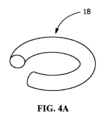
[0098]拡張された制御放出デバイス18は、図4Aに例示されるように、円形断面を有する環状体形状を有するリングの形状を有し得る。他の実施形態では、横断面形状は、図4Bに示される長方形の横断面などの非円形である。長方形の横断面形状を有する、特に高アスペクト比を有する拡張された制御放出デバイス18は、表面積がリング壁の半径に2乗の関係で比例するため、侵食されると、より著しい寸法を示す円形断面と異なり、表面積がリング壁の厚さに直線関係で比例するため、ポリマーが侵食されると、配備中に制御放出化合物の直線的放出を提供するという付加的な利点を有する。長方形横断面のアスペクト比は変化し得て;一部の実施形態では、横断面は正方形であってもよい。他の実施形態では、横断面の幅26は、幅広のゴム輪と同様に、厚さ28より数倍大きくてもよく、高アスペクト比をもたらす。
[0098] The expanded controlled
[0099]一部の実施形態では、リングの形態における拡張された制御放出デバイス18は、円形横断面に関して直径において2mm~4mmなどの0.5~4.5mmの断面直径を有する。一部の実施形態では、長方形横断面は、厚さ方向で約0.75mm~2mm、および幅方向で約3mm~約6mmであるが、より大きいおよびより小さい横断面寸法が企図される。より広い横断面を有する長方形横断面はまた、可撓性における、かつより狭い曲げ半径を達成するさらなる助けとなり得る。特定の用途のための特別な寸法は、曲げ、応力分布、および亀裂伝搬に対応するように調節され得る。例えば、曲げ中の慣性モーメントおよびせん断応力に関する理論的関係において明らかなように、円形横断面は他の横断面形状より柔軟であり得る。図5Aは、厚さより幅が大きい長方形横断面を有する、リングの形態の拡張された制御放出デバイス18を例示し、実施形態が、拡張された幾何学的立体構造の一部として、送達系製造中にカプセル内への挿入と関連する操作中に付与される任意の撚り合わせまたは折り重ねから独立した、1つまたは複数の撚り合わせを有して製造され得ることをさらに例示する。
[0099] In some embodiments, the expanded controlled
[0100]一部の実施形態では、制御放出デバイス設計は、曲げおよび折り重ねの強化のために、角部、頂点、または平坦区域、撚り合わせ、または多孔質の区域を含み得る。図5Bは、リングの形態の、より詳細には星形の形態の拡張された制御放出デバイス18を例示する。4頂点を有して示されるが、星形は、任意の数の頂点、例えば、5つ、6つまたはそれ以上などの頂点を含んでもよく、そのいずれも、1つまたは複数の内角部および外角部の頂点で折り重ねられ得て、ロッドまたはより長いセグメントを完全に180度曲げる場合と比較して、曲げ頂点において角歪が低減されて折り畳まれた状態と推定されることが理解されよう。頂点の内角30は、約25度などの約10~45度で変化し得て、各頂点に関して同じまたは異なってもよく、一方、アーム間の外角32は、アーム数に依存し得るが、例えば約75度~約145度の間で変化し得て、制御放出されるアーム間でも同じまたは異なってもよい。例えば、4頂点の星形は、約115度の外角32を有し得て、5頂点の星形は、約92度の外角32を有し得て、一方、6頂点の星形は、約80度の外角32を有し得る。
[0100] In some embodiments, the controlled release device design may include corners, vertices, or flat areas, twists, or porous areas for enhanced bending and folding. Figure 5B illustrates an extended controlled
[0101]例示的な実施形態は射出成形され得るため、多種多様な形状が形成され得る。したがって、開口中心を有する全体的に平坦な制御放出デバイスに関して主に示して記載したが、デバイスが、依然として、送達媒体に適合するように小型化され、続いてひとたび標的位置に来ると、弾性回復力を介してその拡張された立体構造に戻ることができるという条件で、連続固体表面を有する立体構造もまた利用され得ることが理解されよう。図5Cは、管状に巻き込むことができる平板シート形態の拡張された制御放出デバイス18を例示し、一方、図5Dは、直線的ロッドを完全に180度曲げた場合と比較して、曲げ頂点において低減された角歪を有する四面体を例示する。あるいは、長方形、平行四辺形、多角形、四面体、星形、ジグザグ形、網状線、またはアコーディオン形などの角を有する他の形状は全て使用され得て、同様に小区域としてこれまでに述べた1つまたは複数の形状を含む、より大きい複雑性のある設計も使用され得る。
[0101] Because the exemplary embodiments can be injection molded, a wide variety of shapes can be formed. Thus, although shown and described primarily in terms of a generally flat controlled release device with an open center, the device can still be miniaturized to fit the delivery vehicle, followed by elastic recovery once at the target location. It will be appreciated that a conformation having a continuous solid surface may also be utilized, provided it can return to its expanded conformation via a force. FIG. 5C illustrates an expanded controlled
[0102]横断面形状および拡張状態における形状を変化させることに加えて、曲げ半径もまた、制御放出デバイスの横断面厚さを変化させることにより特定の用途のために調整され得る。特定の配合および形状のために、カプセルまたは他の格納システム内で折り畳まれ、適合するような最適容量を達成するために、拡張状態におけるデバイス横断面厚さと、折り畳まれた状態における最も狭い全体寸法との比は、1:5~1:9、またあるいは1:2~1:5、またあるいは1:7.5~1:20、またあるいは1:1~1:95の範囲内に収まるようにしなければならない。例えば、9.5mm直径のサイズ000カプセルの内部に適合するように折り畳むことが可能なデバイスでは、拡張状態におけるデバイス横断面厚さは、1.0~1.9mm、またあるいは1.9~4.75mm、またあるいは0.5~1.3mm、またあるいは0.1~9.5mmであり得る。PGSUが、連続気泡または独立気泡のいずれかの構造様式を有する発泡体である一実施形態では、デバイス寸法は、カプセル寸法より大きくてもよいが、PGSU構造は、内部に適合するように弾性的に圧縮され得る。 [0102] In addition to varying the cross-sectional shape and shape in the expanded state, the bend radius can also be tailored for a particular application by varying the cross-sectional thickness of the controlled release device. For a particular formulation and shape, the device cross-sectional thickness in the expanded state and the narrowest overall dimension in the collapsed state to achieve optimum capacity as it folds and fits within a capsule or other containment system. The ratio of the must be For example, for a device that can be folded to fit inside a 9.5 mm diameter size 000 capsule, the device cross-sectional thickness in the expanded state is 1.0-1.9 mm, or alternatively 1.9-4 mm. .75 mm, alternatively 0.5-1.3 mm, alternatively 0.1-9.5 mm. In one embodiment, where the PGSU is a foam with either an open-celled or closed-cell structure modality, the device dimensions may be larger than the capsule dimensions, but the PGSU structure is elastic to fit inside. can be compressed to
[0103]一部の実施形態では、図6に例示されるように、制御放出デバイスは、異なる制御放出化合物および/または異なる架橋密度における架橋PGSを含有する異なる区分を含み、拡張された制御放出デバイス18のリングは、第1の区分40および第2の区分42を有する。そのような実施形態では、制御放出デバイスは、例えば、避妊薬および抗HIV予防薬または他の有効成分の組合せなどの二重送達を提供し、これらは、異なる溶解度を有し、異なる放出動態を必要とし、したがって、異なる速度における送達のための異なるポリマーマトリックスから利益を得る場合がある。2つの異なる制御放出化合物は、同じ担持または異なる担持であってもよい。
[0103] In some embodiments, as illustrated in FIG. 6, the controlled release device comprises different compartments containing different controlled release compounds and/or crosslinked PGS at different crosslinking densities to provide extended controlled release The ring of
[0104]これらの異なる区分40、42は、射出成形中の単一プロセスで、例えば、鋳型を充填している間に、第1の制御放出化合物配合物から第2の制御放出化合物配合物に供給流を切り替えることによるなどで製造され得る。制御放出化合物が、混合およびフィラメント押出のバレル上流に担持され、押出途中で異なる制御放出化合物間で切り替える能力がないため、ホットメルト押出のような熱可塑性の製造技術を使用してこの設計自由度は得られない。
[0104] These
[0105]一部の実施形態では、区分40、42は、同じPGSUポリマーであるが、異なる架橋密度である。これらの区分は、射出成形中の単一プロセスで、例えば、反応射出成形中に、ポリオールとイソシアネート成分との混合比を変化させることによるなどで製造され得る。
[0105] In some embodiments,
[0106]一部の実施形態では、混合比は、鋳型を充填している間に、プロセス途中で調節されて、示差的なPGSU架橋の領域を可能にする。示差的なPGSU架橋は、示差的な放出速度および示差的な可撓性を可能にする。PGSUは、高度な可撓性からある程度の堅さまでの範囲にわたり架橋され得る。一部の実施形態では、制御放出デバイスは、したがって、架橋PGS中に架橋勾配を含み、それにより、制御放出デバイスの一端が最初に制御放出化合物を放出することを可能にする分解勾配をもたらし、より良好なサイズ制御をさらにもたらす。 [0106] In some embodiments, the mix ratio is adjusted mid-process to allow regions of differential PGSU cross-linking while filling the mold. Differential PGSU cross-linking allows for differential release rates and differential flexibility. PGSU can be crosslinked ranging from highly flexible to moderately rigid. In some embodiments, the controlled release device thus comprises a cross-linking gradient in the cross-linked PGS, thereby providing a degradation gradient that allows one end of the controlled release device to release the controlled release compound first, It also provides better size control.
[0107]一部の実施形態では、区分40、42は、同じまたは異なる架橋密度における同じPGSUポリマーであるが、異なる薬物担持における同じ制御放出化合物を含有する。これらの区分は、射出成形中の単一プロセスで、例えば、制御放出化合物を供給する供給流を変化させることによるなどで製造され得る。
[0107] In some embodiments,
[0108]あるいは、異なる区分に、2つの異なるポリマーが使用されてもよい。例えば、場合により、薬剤をより迅速に腸に送達するために、破壊される1つのリングセグメントまたは単一アームに、PGAまたは他の迅速に崩壊するポリマーを導入し、一方、デバイスのより大きい残部は胃の中に滞在することが望ましい場合がある。これらの実施形態では、異なる区分用の配合は、1つの区分が胃の酸性pHに基づいて分解し、一方、他の区分は腸のpHに基づいて分解するようにさらに調節され得る。 [0108] Alternatively, two different polymers may be used in different segments. For example, one optionally introduces PGA or other rapidly disintegrating polymer into one ring segment or single arm that is destroyed to deliver the drug to the intestine more quickly, while the larger remainder of the device may be desired to remain in the stomach. In these embodiments, the formulations for the different compartments may be further adjusted such that one compartment degrades based on the acidic pH of the stomach, while the other compartment degrades based on the pH of the intestine.
[0109]したがって、一部の実施形態では、送達系は、PGSU、任意のPGSベースポリマー、または任意のpH感受性ポリマーを、コーティングまたは充填材粒子として含み、消化管に沿った時空間的放出を達成する成分として含む。これは、経口薬物送達において、送達媒体がヒトまたは動物の消化管を経て移動する際に、24~48時間などのより速い放出をもたらし得る。 [0109] Thus, in some embodiments, the delivery system comprises PGSU, any PGS-based polymer, or any pH-sensitive polymer as a coating or filler particles to effect spatiotemporal release along the gastrointestinal tract. Including as an ingredient to achieve. In oral drug delivery, this can result in faster release, such as 24-48 hours, as the delivery vehicle travels through the human or animal gastrointestinal tract.
[0110]一部の実施形態では、反応射出成形は、より複雑な幾何学形状および2つ以上の制御放出化合物-ポリマー配合物から作製された部分を含むデバイスを提供するオーバーモールドを可能にする。 [0110] In some embodiments, reaction injection molding allows overmolding to provide more complex geometries and devices containing portions made from two or more controlled release compound-polymer formulations. .
[0111]さらに、組成に加えて、制御放出デバイスの寸法が変更され得ることが理解されよう。図7に例示されるように、拡張された制御放出デバイス18は、厚い側部46および薄い角部48を有する長方形のリングを含み、これは、薬物ペイロードの増加のためのより厚いセグメントおよび折り重ね性の増加のためのより薄いセグメントで、総薬物担持を依然として達成する一方、曲げまたは圧縮における補助となり得る。そのような場合、より薄い角部48が、全体的な分解プロファイルのバランスを取るために、壁部より高い架橋密度であることが望ましい場合がある。より薄いセグメントは、加えてまたは代替的に、より短い分解または胃内滞在時間を提供し得る。薬物担持レベルが異なるセグメントにおいて変化し得るが、全てのセグメントが、薬物担持を含有することが好ましい。折り重ね性を助けるためのより薄いセグメントは、より厚い区分と同じまたは異なる横断面形状のものであってもよい。例えば、角部48の折り重ね可能な区分は、長方形の横断面で厚さ0.8~1.2mmおよび幅3~4mmであり得て、一方、側部46のペイロード最大化区分は、円形横断面で直径4mmであり得て、一方、デバイス全体は、40%~60%w/w薬物担持される。角部48の折り重ね可能なセグメントは、側部46のペイロード最大化セグメントより短い長さで示される。折り重ね可能なセグメントは、曲げモーメントが最も薄い寸法を屈曲し、最も狭い曲げ半径を可能にするように折り重ねられる。
[0111] Further, it will be appreciated that in addition to the composition, the dimensions of the controlled release device may be varied. As illustrated in FIG. 7, the expanded controlled
[0112]他の実施形態では、リングまたは他の芯部に結合した、複数のペンダントアーム(例えば、図2Cに示されるアーム22)を有するアステリスク、星形、または他の幾何学形状などの複数アームの幾何学形状を有するデバイスは、アームまたはリンクのサイズおよび/または特定の幾何学形状に応じて、個々のアームを放出するように構成され得る。そのような実施形態では、1つまたは複数のアームは、アームを連結するリンクの分解に基づいて選択的に放出され得て、芯部および他のアームが胃の中に留まる間に、幽門括約筋を通過することを可能にする。一部の実施形態では、アームは、1つまたは複数の制御放出化合物が担持される。一部の実施形態では、各アームは、同じ制御放出化合物が担持される。一部の実施形態では、各アームは、異なる制御放出化合物が担持される。
[0112] In other embodiments, multiple arms such as asterisks, stars, or other geometric shapes having multiple pendant arms (eg,
[0113]例示的な実施形態では、分解可能なリンクは、表面侵食性エラストマーで構成され、リンクが、アームの時限放出と、同様にアームを中に折り重ねる可撓性の両方を提供することを可能にする。例示的な実施形態では、リンクは、多くのアームに結合する単一成分として成形され、特定のアーム用のリンクはより小さい断面積であり、最初にそのアームの完全な侵食および放出に至る。リンクは、制御放出化合物を含んでもよく、または制御放出化合物を無含有でもよい。リンクは、アームと同じ配合物であっても、または異なる配合物であってもよい。 [0113] In an exemplary embodiment, the degradable links are constructed of a surface erodible elastomer, such that the links provide both timed release of the arms as well as the flexibility to fold the arms in. enable In an exemplary embodiment, the link is molded as a single component that attaches to many arms, with the link for a particular arm having a smaller cross-sectional area, leading to complete erosion and expulsion of that arm first. The link may contain a controlled release compound or may be free of a controlled release compound. The link may be of the same formulation as the arm or of a different formulation.
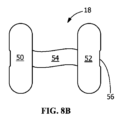
[0114]さらに別の態様では、図8Aは、送達媒体14内部に適合するようなサイズの、2つの固体カプセル形状の二分割体50、52の収縮された制御放出デバイス16を例示し、2つの二分割体50、52は、一体型のロッドまたはシートのセグメントなどの連結部54によりリンクされる。図8Bおよび図8Cに示されるように、各二分割体50、52は、1つの平面および1つの半円筒面を有し、連結部54を1つまたは両方の二分割カプセル50、52の外表面の周りで開くことにより、巻き物のように共に広げられて、拡張された制御放出デバイス18を形成する。連結部54の巻かれたシートを切取り部56中に位置づけするなどにより、連結部54は全体寸法に最小限の追加となるような方法で外表面の周りに巻き付けられ得て、2つの二分割体50、52の外表面が同一面となる。配備時に、2つの二分割カプセル50、52は、弾性回復力を介して胃液中で、それらの初期の分離した立体構造まで離れるが、連結部54の広がったシートにより互いに繋ぎ止められたままである。この実施形態は、送達媒体14の内腔を十分に充填し、デバイス体積および薬物ペイロードを最大化することができるが、一方、折り畳まれた構造(configuration)と拡張された構造との間の移行に必要とされる曲げ半径を最小化する。
[0114] In yet another aspect, FIG. 8A illustrates a deflated controlled
[0115]制御放出デバイスが単一成分として成形される場合、1つまたは複数の保護コーティングは、そのそれぞれが異なる厚さであってもよく、リンクに適用されて得て、各リンクを加水分解から保護し、異なる特定の時間に特定のアームの放出を可能にする。異なる厚さの保護コーティングはまた、アーム自体に適用され得て、コーティングが分解する際に、放出を増大させるかまたは遅延させる。リンクまたはアームが別々に形成される場合、異なる侵食速度を達成するために、例えば、出発PGS樹脂のグリセロール:セバシン酸の比を変化させ、出発PGS樹脂の分子量を変化させ、熱硬化性エラストマーの架橋密度を変化させるか、または熱硬化性エラストマーの硬化化学を変化させるなどの、異なるPGS化学物質が利用されてもよい。したがって、調整可能なPGS化学は、非常に多用途の方法を可能にし、架橋PGS制御放出デバイスを形成する。 [0115] When the controlled release device is molded as a single component, one or more protective coatings, each of which may be of a different thickness, may be applied to the links to hydrolyze each link. and allow release of specific arms at different specific times. A protective coating of different thickness can also be applied to the arm itself to increase or delay release as the coating degrades. When the links or arms are formed separately, different erosion rates can be achieved by, for example, varying the glycerol:sebacic acid ratio of the starting PGS resin, varying the molecular weight of the starting PGS resin, and the thermoset elastomer. Different PGS chemistries may be utilized, such as varying the crosslink density or varying the cure chemistry of the thermoset elastomer. Tunable PGS chemistry therefore enables a very versatile method to form cross-linked PGS controlled release devices.
[0116]一部の実施形態では、熱硬化性のPGSベース部分は、別々に成形され、PGSベースの接着剤をタイコートとして使用して、互いに溶着可能である。一部の実施形態では、方法は、射出成形中に、異なる配合物間で供給流を切り替えるステップを含み、複数の形成体を不連続領域に含有するデバイスを達成する。一部の実施形態では、異なる範囲の鋳型は、接着剤を必要とすることなく、異なる区域間の結合を強化するために、硬化の前に異なる化学物質で充填される。 [0116] In some embodiments, the thermosetting PGS base portions can be molded separately and welded together using a PGS-based adhesive as a tie coat. In some embodiments, the method includes switching the feed stream between different formulations during injection molding to achieve a device containing multiple forming bodies in discontinuous regions. In some embodiments, different areas of the mold are filled with different chemicals prior to curing to enhance bonding between different areas without the need for adhesives.
[0117]一部の実施形態では、PGS配合物またはPGS架橋プロファイルは、例えば、ヒドラゾンのような酸不安定なリンカーなどの、分解を促進する酸性環境に応答性である化学物質を含み、ヒドラゾン:ウレタンの架橋比は、分解速度を調整するために事前に選択される。一部の実施形態では、他の酸感受性の架橋剤、および/または開裂可能なペプチド配列もしくは低pHで分離する化学結合などの制御放出化合物テザーは、複合化のためにヒドラジンに加えてまたは関連して使用される。 [0117] In some embodiments, the PGS formulation or PGS cross-linking profile comprises chemicals that are responsive to an acidic environment to promote degradation, such as, for example, acid-labile linkers such as hydrazones. : The crosslink ratio of the urethane is preselected to tune the degradation rate. In some embodiments, other acid-sensitive cross-linkers and/or controlled-release compound tethers, such as cleavable peptide sequences or chemical bonds that dissociate at low pH, are used in addition to or in conjunction with hydrazine for conjugation. used as
[0118]デバイスは、形成後にコーティングされてもよいことがさらに理解されよう。一部の実施形態では、成形された部分は、例えばスプレーコーティングまたは浸漬コーティングを使用して、担持されていないポリマー、薬物担持されたポリマー、または他の制御放出化合物-ポリマー配合物を適用するために、加工後にコーティングされてもよい。一部の実施形態では、プロセスは、二重供給ノズルを装備したスプレーコーティング機を使用して、制御放出デバイスをPGSUでコーティングするステップを含み、コーティング溶液は、有機溶媒中の1%~20%w/wのPGS溶液で構成され、コーティング溶液は、可溶化形態の制御放出化合物を含有してもよく、または含有しなくてもよい。別の実施形態では、制御放出デバイスは、浸漬コーティングを使用してPGSUでコーティングされ、コーティング溶液は、有機溶媒中の5%~60%w/wのPGS溶液で構成され、コーティング溶液は、可溶化形態または結晶体の制御放出化合物を含有してもよく、または含有しなくてもよい。PGSU鞘部が担持されず、芯部が薬物担持されたPGSUである芯鞘型幾何学形状は、芯部からのバースト放出を低減する。これは、不透過性PGSUコーティングは、コーティングが部分的または完全に分解され、薬物の通過および放出が可能になるまで、芯部に担持された制御放出化合物と、外部の水性環境間の接触を妨げるためである。鞘部が制御放出化合物で担持された芯鞘型幾何学形状は、架橋、幾何学形状、およびコーティング厚さなどのPGSUパラメータを調節することにより、所望ならば異なる速度で、1つは芯部成分から、1つは鞘部成分からの異なる制御放出化合物の二重送達を可能にする。 [0118] It will be further appreciated that the device may be coated after formation. In some embodiments, the molded part is used for applying unloaded polymers, drug-loaded polymers, or other controlled release compound-polymer formulations using, for example, spray coating or dip coating. In addition, it may be coated after processing. In some embodiments, the process comprises coating the controlled release device with PGSU using a spray coater equipped with a dual feed nozzle, wherein the coating solution is 1% to 20% Consisting of a w/w PGS solution, the coating solution may or may not contain the controlled release compound in solubilized form. In another embodiment, the controlled release device is coated with PGSU using dip coating, the coating solution is comprised of a 5%-60% w/w PGS solution in an organic solvent, and the coating solution is It may or may not contain the controlled-release compound in solubilized or crystalline form. The core-sheath geometry, in which the PGSU sheath is unloaded and the core is drug-loaded PGSU, reduces burst release from the core. This is because the impermeable PGSU coating prevents contact between the core-loaded controlled release compound and the external aqueous environment until the coating is partially or completely degraded, allowing passage and release of the drug. to prevent it. Core-sheath geometries, in which the sheath is loaded with a controlled-release compound, can be controlled at different rates if desired by adjusting PGSU parameters such as cross-linking, geometry, and coating thickness. From the components, one allows dual delivery of different controlled release compounds from the sheath component.
[0119]ひとたび形成されると、その所定の拡張された形状を有する制御放出デバイスは、送達媒体への挿入のため圧縮され、身体内で摂取されるかまたはそうでない場合は標的位置まで輸送され得る送達系を形成する。 [0119] Once formed, the controlled release device with its predetermined expanded shape is compressed for insertion into a delivery vehicle and ingested within the body or otherwise transported to a target location. form the delivery system obtained.
[0120]拡張状態18におけるリングまたはループの形態のデバイスに関して、制御放出デバイスは、収縮状態16のために、図9に見られるように平坦化されるかまたは二重らせんに撚り合わせられてもよい。同様に、ロッド、渦巻き線またはらせんは、その収縮状態に曲げられても、またはさらにコイル状にされてもよい。図10は、折り重ねられた、収縮された制御放出デバイス16を例示し、これは厚さより大きい幅を有する長方形横断面を有するリングに関して特に有利な収縮状態16であり得る。収縮状態16を達成するために、折り重ねおよび撚り合わせは、必要に応じて組み合わせて使用され得ることが理解されよう。
[0120] For a device in the form of a ring or loop in the expanded
[0121]送達媒体に担持するために、デバイスを収縮または圧縮する手法は、破損することなくカプセルへの担持を成功させて送達系を形成するために、制御放出デバイスの拡張された立体構造に応じてわずかに変えてもよい。一部のデバイス立体構造は、撚り合わせまたはねじりの動きを受けて収縮状態になり得るが、他のデバイス立体構造は、折り重ねまたは曲げの動きを受けて収縮状態になり得る。他のデバイス立体構造は、撚り合わせと折り重ねの組合せを利用してもよい。一部の配合物および形状は、ねじり力に対してより修正可能であり得るが、一方、他の配合物および形状は、弯曲力により応じ易い場合がある。加えて、収縮状態への圧縮のために撚り合わせを受ける制御放出デバイスは、送達媒体内である場合、軸方向外向きの力を発揮し得るが、一方、折り重ねを受けるデバイスは、送達媒体内である場合、半径方向外向きの力を発揮し得る。制御放出デバイスが送達媒体の内部に加える力は、十分に内包されたデバイスの使用中の性能、安定性、および保存に密接な関係があり得る。 [0121] The technique of contracting or compressing the device to load the delivery vehicle may affect the expanded conformation of the controlled release device for successful loading into the capsule without failure to form a delivery system. It may be slightly changed accordingly. Some device conformations may undergo a twisting or twisting motion into a contracted state, while other device conformations may undergo a folding or bending movement into a contracted state. Other device configurations may utilize a combination of twisting and folding. Some formulations and shapes may be more amenable to torsional forces, while other formulations and shapes may be more amenable to bending forces. In addition, a controlled release device that undergoes twisting due to compression into a contracted state may exert an axially outward force when within a delivery vehicle, whereas a device that undergoes folding may If so, it may exert a radially outward force. The force that a controlled release device exerts inside the delivery vehicle can have implications for the in-use performance, stability, and storage of a well-encapsulated device.
[0122]例えば、半径方向外向きの力は、特に棚保存中、経時的に、2つのカプセル二分割体を互いに固定して閉じて保つために、軸方向の力より好ましい場合がある。対照的に、半径方向外向きの力は、経時的にカプセル亀裂のより高いリスクを起こし得る。発揮された力は、配合物依存性および/または形状依存性であり得る。発揮された力はまた、長期安定性にも影響し得て、デバイス内で経験され得る残留応力を経るなどで、応力緩和またはクリープのような所望されない影響をもたらし得る。発揮された力は、デバイスが、使用中の配備時の形状に、いかに良好にまたはいかに迅速に弾性的にはね返って戻るかにも影響し得る。 [0122] For example, a radially outward force may be preferred over an axial force to keep the two capsule halves securely closed together over time, especially during shelf storage. In contrast, a radially outward force may cause a higher risk of capsule cracking over time. The force exerted can be formulation dependent and/or shape dependent. The forces exerted can also affect long-term stability and can lead to undesirable effects such as stress relaxation or creep, such as through residual stresses that can be experienced within the device. The force exerted can also affect how well or how quickly the device springs back elastically to its deployed shape during use.
[0123]制御放出デバイスの圧縮後または圧縮中に、収縮された制御放出デバイスは、デバイスを送達のために圧縮された形成に一時的に保持するように処理される。図9および図10を再び参照すると、一部の実施形態では、収縮された制御放出デバイス16は、送達媒体である第1のカプセル二分割体60に挿入され、次に送達媒体である他のカプセル二分割体62を、カプセルを閉じるように配置し、そこに収縮された制御放出デバイス16を詰め込んだ摂取用の送達系10を形成する。カプセル二分割体60、62の配置は、手動操作によってもよく、または粉末をそのようなカプセルに計量および分注するために使用されるものと同様の自動機器を使用してもよい。
[0123] After or during compression of the controlled release device, the deflated controlled release device is treated to temporarily hold the device in a compressed configuration for delivery. 9 and 10, in some embodiments, the deflated controlled
[0124]制御放出デバイス用の送達媒体は、標的位置への送達の前に、制御放出デバイスを収縮状態または折り畳まれた状態に維持するが、標的位置への到着時に、制御放出デバイスを三次元(3D)拡張状態に迅速に変換することが可能である。適切な送達媒体は、非ゼラチンカプセル、硬シェルゼラチンカプセル、軟シェルゼラチンカプセル(ゲルキャップ)、カプレット、錠剤、コーティング、食品、供給構築体、またはフィルムを含むが、これらに限定されない。一態様では、サイズ00またはサイズ0カプセルなどのより容易な嚥下を可能にする、より小さいカプセルも可能であるが、サイズ000硬シェルゼラチンカプセルが、ヒト成人に好ましいカプセルサイズおよび種類である。対応する制御放出デバイスは、次にカプセル内に適合するように、より小さいことが必要な場合があることが理解されよう。
[0124] The delivery vehicle for the controlled release device maintains the controlled release device in a contracted or folded state prior to delivery to the target location, but upon arrival at the target location, folds the controlled release device into three dimensions. It is possible to quickly transform to the (3D) dilated state. Suitable delivery vehicles include, but are not limited to, non-gelatin capsules, hard shell gelatin capsules, soft shell gelatin capsules (gelcaps), caplets, tablets, coatings, food products, delivery constructs, or films. In one aspect, size 000 hard shell gelatin capsules are the preferred capsule size and type for human adults, although smaller capsules that allow for easier swallowing such as size 00 or
[0125]送達媒体は、時間遅延、即時、延長、拍動性、または超長期持続性の放出を提供し得る。すなわち、制御放出デバイスにより達成される放出に加えて、送達媒体もまた、所定の時点で制御放出デバイスをそれ自体さらすように工学設計され得る。言及したように、配備が胃内である実施形態に関して、送達媒体が胃を通過して腸に入る前に配備が起こり得るように、時間はより早くなると考えられる。 [0125] The delivery vehicle may provide time-delayed, immediate, extended, pulsatile, or ultra long-lasting release. That is, in addition to the release achieved by the controlled release device, the delivery vehicle can also be engineered to expose itself to the controlled release device at predetermined times. As noted, for embodiments in which deployment is intragastric, the time is believed to be earlier so that deployment can occur before the delivery vehicle has passed through the stomach and into the intestine.
[0126]送達媒体は、酸性の胃または塩基性の腸の中で、崩壊してかつ時限放出することを可能にするpH依存性分解を有し得る。送達媒体に適切な組成物は、ゼラチン、セルロース、Eudragit(登録商標)ポリマー(Evonik Rohm GmbH、Darmstadt、ドイツ)、デンプン、糖、PGS、PGSU、PGSA、またはPEGを含み得るが、これらに限定されない。送達媒体はまた、二重薬物送達および種々の放出動態のための制御放出化合物を含有し得る。 [0126] The delivery vehicle may have pH-dependent degradation that allows for disintegration and timed release in the acidic stomach or basic intestine. Compositions suitable for delivery vehicles may include, but are not limited to, gelatin, cellulose, Eudragit® polymer (Evonik Rohm GmbH, Darmstadt, Germany), starch, sugar, PGS, PGSU, PGSA, or PEG. . Delivery vehicles can also contain controlled release compounds for dual drug delivery and different release kinetics.
[0127]一部の実施形態では、送達媒体は、例えば、錠剤、カプレット、カプセル、またはゲルキャップ(軟ゲル)などの従来の経口剤形上にPGSベースのコーティングを含む。そのようなコーティングは、例えば、胃、小腸、または大腸などの消化管の異なる領域のpH条件にカスタマイズされた時間調節および標的送達のために、pH依存性の分解および薬物放出を提供するように選択され得る。例えば、APIは、小腸または大腸を標的とし、デバイスが胃環境で持ちこたえることが必要とされる場合もあり、その逆もまた同様である。 [0127] In some embodiments, the delivery vehicle comprises a PGS-based coating, eg, on a conventional oral dosage form such as a tablet, caplet, capsule, or gelcap (soft gel). Such coatings provide pH-dependent degradation and drug release for timed and targeted delivery customized to the pH conditions of different regions of the gastrointestinal tract, e.g., the stomach, small intestine, or large intestine. can be selected. For example, an API may target the small or large intestine and require the device to survive the gastric environment, or vice versa.
[0128]例示的な実施形態では、送達媒体は、その存続期間を長びかせ、制御放出を補助するために、PGS、PGSU、もしくはPGSAの保護コーティング、ゲルキャップ、カプセル、または例えば、PGA、PLA、PLGA、PCL、もしくはPEGなどのバルク分解するポリマーにもしくは周囲に適用された埋め込みを含む。この二次的なPGSベースの層は、制御放出化合物が担持されてもよく、または担持されなくてもよい。 [0128] In an exemplary embodiment, the delivery vehicle includes protective coatings of PGS, PGSU, or PGSA, gelcaps, capsules, or, for example, PGA, to prolong its lifetime and aid in controlled release. Including implants applied to or around bulk degrading polymers such as PLA, PLGA, PCL, or PEG. This secondary PGS-based layer may or may not be loaded with a controlled release compound.
[0129]一部の例示的な実施形態では、方法は、制御放出デバイスの周りに直接、ゲルキャップ(軟ゲル)を形成または鋳造するステップを含み、それは従来のゲルキャップ成形および溶着の製造プロセスを利用し得る。例示的な実施形態では、事前形成された制御放出デバイスは、オープンフェースの鋳型内に適合されかつ配置されて、液体を注ぐかまたは上部から流し、鋳型腔内でゲルキャップを形成する。 [0129] In some exemplary embodiments, the method includes forming or casting a gelcap (soft gel) directly around the controlled release device, which is similar to conventional gelcap molding and welding manufacturing processes. can be used. In an exemplary embodiment, a pre-formed controlled release device is fitted and placed within an open-faced mold to pour or top-flow liquid to form a gel cap within the mold cavity.
[0130]一部の実施形態では、制御放出デバイスは、ゲルキャップの1つの二分割体内に完全に含有され、その結果、ゲルキャップの他方の二分割体は制御放出デバイスを含有せず、2つの二分割体は、熱、圧力、または2つの二分割体を密封するための別の形態のエネルギーを使用して共に溶合される。他の実施形態では、制御放出デバイスは、1つの二分割体が最初に成形される、ゲルキャップの二分割体の両方に広がる。制御放出デバイスは、第1の二分割体を超えて突き出し、第2の二分割体は、さらされた制御放出デバイスの周りに二次的に成形される。 [0130] In some embodiments, the controlled release device is contained entirely within one half of the gelcap, such that the other half of the gelcap does not contain the controlled release device and the two halves of the gelcap The two halves are fused together using heat, pressure, or another form of energy to seal the two halves. In other embodiments, the controlled release device spans both halves of the gelcap, with one half molded first. The controlled release device protrudes beyond the first half and the second half is secondarily molded around the exposed controlled release device.
[0131]例示的な実施形態では、事前形成される制御放出デバイスは、ゲルキャップを形成するために液体を流入または注入するための孔を鋳型中に有する、閉式2部型の鋳型内に適合されかつ配置される。従来的に、ゲルキャップは、それぞれ外部シェルの二分割体の1つをなす、2つのリボンの可撓性材料を使用して形成され、その中に液体材料が充填される。例示的な実施形態では、事前形成される制御放出デバイスは、液体充填のために2つのリボンを集合させる前に、リボン上またはシェル内部に適合されかつ配置されて、続いて熱および/または圧力で密封する。一部の実施形態では、事前形成される制御放出デバイスは、液体充填ステップにおいて、リボンの間または2つのシェル二分割体内に射出されるかまたは押し込まれる。 [0131] In an exemplary embodiment, the preformed controlled release device fits within a closed two-part mold having holes in the mold for the entry or injection of liquids to form the gelcap. and placed. Conventionally, gelcaps are formed using two ribbons of flexible material, each forming one of the halves of the outer shell, into which is filled a liquid material. In an exemplary embodiment, the preformed controlled release device is fitted and placed on the ribbon or inside the shell prior to assembling the two ribbons for liquid filling followed by heat and/or pressure. Seal with In some embodiments, the preformed controlled release device is injected or pushed between the ribbons or into the two shell halves in the liquid filling step.
[0132]例示的な実施形態では、制御放出デバイスはまだ固化されておらず、液体充填中に、ゲルキャップシェル二分割体内に、制御放出液体配合物を注入することにより形成される。事前形成されるゲルキャップシェル内の内部構造様式は、鋳型として作用し得て、ひとたびゲルキャップが溶解すると、容易にはね返って開く制御放出デバイス形状を生成する。 [0132] In an exemplary embodiment, the controlled release device is not yet solidified and is formed by injecting the controlled release liquid formulation into the gelcap shell halves during liquid filling. The internal structural modalities within the pre-formed gelcap shell can act as a template to create a controlled release device shape that readily springs open once the gelcap has dissolved.
[0133]一部の実施形態では、送達系は、1つまたは複数の繊維を含み、それは制御放出デバイスまたは送達媒体の一部であり得る。繊維材料は、生分解性であってもまたは非生分解性であってもよい。繊維は、制御放出化合物が担持されるかもしくは注ぎ込まれてもよく、または制御放出化合物を無含有でもよい。繊維は、中心核または複数の接合点において共に結びつけられてもよい。繊維は、織り、編み、または組み込まれて布地構築体となり得る。布地構築体は、多様な構造様式および細孔構造を有し得る。図11は、送達媒体への挿入のために小型化され得る、拡張された制御放出デバイス18としての格子状の繊維の一例を示す。
[0133] In some embodiments, the delivery system comprises one or more fibers, which can be part of a controlled release device or delivery vehicle. The fibrous material may be biodegradable or non-biodegradable. The fibers may be loaded or infused with a controlled release compound, or may be free of controlled release compound. The fibers may be tied together at a central core or at multiple junctions. Fibers can be woven, knitted, or incorporated into textile constructions. The fabric construction can have a wide variety of structural styles and pore structures. FIG. 11 shows an example of a lattice of fibers as an expanded controlled
[0134]一部の実施形態では、送達系は、1つまたは複数の布地を含み、それは制御放出デバイスまたは送達媒体の一部であり得る。布地材料は、生分解性であってもまたは非生分解性であってもよい。布地繊維または糸条は、制御放出化合物が担持されるかもしくは注ぎ込まれてもよく、または制御放出化合物を無含有でもよい。 [0134] In some embodiments, the delivery system comprises one or more fabrics, which can be part of a controlled release device or delivery vehicle. The textile material may be biodegradable or non-biodegradable. The textile fibers or threads may be loaded or infused with a controlled release compound, or may be free of controlled release compound.
[0135]例示的な実施形態では、制御放出デバイスは、折り重ね可能、折り畳み可能、撚り合わせ可能、または圧縮可能であり、次に折り重ねを開き、撚り合わせを戻し、および/または拡張することによりはね返って戻る布地幾何学形状を含む。適切な二次元(2D)および3Dの幾何学形状は、折り紙2Dおよび3D設計、Hoberman構造、Buckyボール構造、表面積増加のための花弁を有する花形状、パラシュート形、傘形、翼形、星形、車輪形、リング、渦巻き線、球体、錐体、楕円形、ディスク形、多面的3D形状、多面的圧縮可能な3D表面(図12に示す)、布地シート、成分、および/または支柱間の圧縮可能なスペーサー布帛、折り重ね可能な翼を有する五角錐、折り重ねおよび折り重ねを開く補助となる異なる剛性および/または厚さのシートを有する多層布地シート、または折り畳み可能かつ拡張可能である他の布地の幾何学形状設計を含み得るが、これらに限定されない。 [0135] In exemplary embodiments, the controlled release device is foldable, collapsible, twistable, or compressible and then unfolds, untwists, and/or expands. Contains fabric geometry that bounces back. Suitable two-dimensional (2D) and 3D geometries include origami 2D and 3D designs, Hoberman structures, Bucky ball structures, flower shapes with petals for increased surface area, parachutes, umbrellas, airfoils, stars. , wheels, rings, spirals, spheres, cones, ellipsoids, discs, multi-faceted 3D shapes, multi-faceted compressible 3D surfaces (shown in FIG. 12), fabric sheets, components, and/or between struts. Compressible spacer fabrics, pentagonal pyramids with foldable wings, multi-layered fabric sheets with sheets of different stiffness and/or thickness to aid in folding and unfolding, or others that are foldable and expandable fabric geometry design, but not limited to:
[0136]例示的な実施形態では、制御放出デバイスは、形状化および/または多葉状の横断面および/または伸展性を有する布地繊維を含む。図12を参照すると、一実施形態では、圧縮可能な三次元布地の拡張された制御放出デバイス18が提供され、これは熱形成を用いることなく生成され得る。この実施形態では、布地デバイス18は、2つの面70および高圧縮可能特徴を有するように機械により形成された1つの連結層72を有する、二重針棒編みされたスペーサー布帛である。連結層72は、各面の間に特定の距離を構造的に維持する、z次元における連動層を生成する、弾力的モノフィラメントまたはマルチフィラメントの糸条から形成される。一部の実施形態では、z方向の連結層72は圧縮され、ひとたび放出されると、機械的にはね返って元の編み構造に戻る。一部の実施形態では、z方向の開放空間は、PGSUまたは別のエラストマー圧縮性ポリマーで充填される。z方向の糸条は、制御放出デバイスの収縮状態への圧縮可能性を可能にする。
[0136] In an exemplary embodiment, the controlled release device comprises fabric fibers having a shaped and/or multilobal cross-section and/or extensibility. Referring to FIG. 12, in one embodiment, a compressible three-dimensional fabric expanded controlled
[0137]布地デバイス18の外面は、布地加工されたマルチフィラメント糸条、モール、またはブークレから作製され得て、布地の表面が、胃内で粘膜付着性物質として役立つ突出した軟質繊維を有することを可能とする。
[0137] The outer surface of the
[0138]例示的な実施形態では、制御放出デバイスは、毛管作用および糸条内に共に束ねられた場合に形状化された繊維間に形成される空間のための膨潤により、ウィッキングを増大かつ制御するように形状化された横断面を有する繊維から作製される布地糸条を含み、したがって、制御放出デバイスの流体の取り込みおよびそれに続く分解、表面侵食、膨潤、ならびに薬物放出動態を制御する。 [0138] In an exemplary embodiment, the controlled release device increases and It contains textile threads made from fibers with cross-sections shaped to control, thus controlling fluid uptake and subsequent degradation, surface erosion, swelling, and drug release kinetics of the controlled release device.
[0139]一部の実施形態では、制御放出デバイスは、例えば、PGS、PGSU、またはPGSAエラストマー熱硬化性物質から作製される繊維などの生分解性繊維で形成された布地を含む。他の実施形態では、生分解性繊維は、アルギネートが存在し得るか、またあるいはアルギネートが初期の加工支持体として作用するが後で除去されるアルギネート鞘部と、PGSU芯部から作製される。他の実施形態では、制御放出デバイスは、生分解性繊維および個々の繊維PGA、PLA、PLGA、PCL、またはPEG熱可塑性物質から作製される布地構築体を含む。別の実施形態では、布地構築体は、「多重」糸条から設計され、それにより糸条繊維の束が混合されて単一の糸条として共押出される。そのような多重糸条は、例えば、1糸条当たり56細繊維を有し、高速、中程度、および長期の分解プロファイルを含む糸条細繊維の混合を有するように製作される。そのような糸条または複数の糸条は、急速放出および制御放出の統合を含む、布地に関する時間的および完全性の選択肢を提供する。例えば、多重56フィラメント糸条は、複数の独立した糸条で布地を設計して構築体を達成するのではなく、制御放出の期間にわたり完全性を維持する、PGS、PGA、PLA、およびPLGAの混合ポリマーフィラメント組成物を有し得る。 [0139] In some embodiments, the controlled release device comprises a fabric formed of biodegradable fibers, eg, fibers made from PGS, PGSU, or PGSA elastomeric thermosets. In other embodiments, the biodegradable fiber is made from an alginate sheath and a PGSU core, where alginate may be present or otherwise acts as an initial processing support but is later removed. In other embodiments, the controlled release device comprises a fabric construct made from biodegradable fibers and individual fibers PGA, PLA, PLGA, PCL, or PEG thermoplastics. In another embodiment, the fabric construction is designed from "multiple" yarns whereby bundles of yarn fibers are mixed and co-extruded as a single yarn. Such multiple yarns, for example, have 56 fines per yarn and are made to have a mixture of yarn fines including high speed, medium and long term degradation profiles. Such a yarn or yarns provide temporal and integrity options for the fabric, including rapid release and controlled release integration. For example, the multiple 56-filament yarns of PGS, PGA, PLA, and PLGA maintain their integrity over the period of controlled release, rather than designing the fabric with multiple independent yarns to achieve a construct. It may have a mixed polymer filament composition.
[0140]多重糸条は、混合された生分解性および非分解性の細繊維の束を含み得る。例示的な実施形態では、送達媒体は、ポリエチレンテレフタレート(PET)またはポリプロピレン(PP)熱可塑性物質から作製される非生分解性繊維および布地構築体を含み、これらは消化管を通過するのに十分なほど安全かつ可撓性である。多重糸条は、同時に、分解可能かつ非分解性のポリマー細繊維を含み得る。非分解性ポリマーは、動物飼料に従来的に使用されるポリマー充填材と同様に、PPまたはポリエチレン(PE)であってもよい。例示的な実施形態では、制御放出デバイスは、PPおよびPEなどの生分解性および非生分解性の布地成分の組合せを含み、これらは、例えば、胃内で可撓性の布地破片に破壊され、最終的に腸を通過し得る。例示的な実施形態では、送達媒体は、複合構造としてPGS、PGSU、またはPGSAでコーティングされた、熱可塑性の繊維および布地構築体を含む。熱可塑性物質は、例えば、不織、織り、編み、または組込みにより、三次元布地構築体に形成され得る。 [0140] The multiple strands may comprise bundles of mixed biodegradable and non-degradable fine fibers. In an exemplary embodiment, the delivery vehicle comprises non-biodegradable fibers and fabric constructs made from polyethylene terephthalate (PET) or polypropylene (PP) thermoplastics, which are sufficient to pass through the gastrointestinal tract. safe and flexible. Multiple threads may simultaneously contain degradable and non-degradable polymeric fibrils. The non-degradable polymer may be PP or polyethylene (PE), similar to polymeric fillers conventionally used in animal feed. In an exemplary embodiment, the controlled release device comprises a combination of biodegradable and non-biodegradable textile components, such as PP and PE, which are broken into flexible textile fragments, e.g., in the stomach. , can eventually pass through the intestine. In an exemplary embodiment, the delivery vehicle comprises a thermoplastic fiber and fabric construct coated with PGS, PGSU, or PGSA as a composite structure. Thermoplastics can be formed into three-dimensional textile constructs, for example, by non-woven, woven, knitted, or incorporated.
[0141]例示的な実施形態では、熱可塑性布地は、形状設定技術を利用することにより、最終成分の形状転換を推進する。例示的な実施形態では、三次元構造は、例えば、先細のマンドレルもしくはステップダウン幾何学形状のマンドレルまたは他の鋳型形状への形状設定などの、より複雑かつより容積の大きい幾何学形状にヒートセット、熱成形、または溶接される。例示的な実施形態では、これらの形状設定された布地構築体は、例えば、カテーテルを通る挿入用、経口カプセルへの内包用、またはバイオプロセス処理のためのバイオプロセス格納容器内へのオリフィスを通る挿入用などの小開口部を経て、送達のために小さい寸法に折り畳まれる。締め付けられた後、配備された構築体は、例えば、経口カプセルの崩壊または誘導カテーテルの除去を経るなど、ひとたび締め付け力が取り除かれると、その設定形状にはね返って戻る。例示的な実施形態では、織り、組込み、または編み構造は、緩んだ状態で複雑な三次元形状に形成され、送達系内で小型化され、次に配備後にその機能的形状に回復する。 [0141] In an exemplary embodiment, the thermoplastic fabric facilitates shape transformation of the final component by utilizing shape-setting techniques. In an exemplary embodiment, the three-dimensional structure is heat set to more complex and bulkier geometries, such as, for example, tapered or step-down geometry shape setting onto mandrels or other mold shapes. , thermoformed, or welded. In exemplary embodiments, these shape-set fabric constructs are passed through an orifice into a bioprocess containment vessel for, for example, insertion through a catheter, inclusion in an oral capsule, or bioprocess treatment. Collapsed to a small size for delivery through a small opening such as for insertion. After being clamped, the deployed construct springs back to its set shape once the clamping force is removed, eg, through collapse of an oral capsule or removal of a guiding catheter. In an exemplary embodiment, the woven, embedded, or braided structure is formed into a complex three-dimensional shape in a relaxed state, miniaturized within the delivery system, and then restored to its functional shape after deployment.
[0142]一部の実施形態では、送達系は、絡み合うPGSU繊維またはフィラメントを含み、一部の繊維またはフィラメントは、異なる架橋密度を有し、および/または異なる制御放出化合物を含有する。繊維またはフィラメントはまた、二重薬物送達および変化し得る放出動態のために芯部-鞘部設計を有し得る。繊維またはフィラメントはまた、従来の「ユークリッド」円柱を超え、例えば、正方形、アステリスク、プラス記号、H形状、または多葉形状などの独特の構造様式の横断面幾何学形状を有し得て、異なる表面積および表面積-対-体積の比を達成し、表面侵食される制御放出化合物放出を増大させる。ストランドは長くてもよく、折り重ねられて経口カプセル、ゲルキャップ、カプレット、または錠剤内に内包されてもよく、ひとたび胃に入ると、数時間から数日または数週間の任意の所定の滞在時間で長いストランドに拡張されて戻る。 [0142] In some embodiments, the delivery system comprises intertwined PGSU fibers or filaments, some of which have different crosslink densities and/or contain different controlled release compounds. Fibers or filaments can also have a core-sheath design for dual drug delivery and variable release kinetics. Fibers or filaments also go beyond traditional "Euclidean" cylinders and may have cross-sectional geometries of unique structural modes such as square, asterisk, plus sign, H-shaped, or multi-lobed, for example, to provide different The surface area and surface area-to-volume ratio are achieved to enhance the release of surface eroded controlled release compounds. The strands may be long, may be folded and enclosed within oral capsules, gelcaps, caplets, or tablets, and once in the stomach, may have any predetermined residence time of hours to days or weeks. At the back extended into long strands.
[0143]例示的な実施形態では、送達媒体は、ポリマーコーティングされるかまたはポリマー充填された布地を含み、例えば、温度、pH、酵素結合、ヒドロゲル形成、または他の刺激などを通して、刺激でポリマー形状回復を作動させ、形状保持性の三次元布地ベースの構造を生成する。 [0143] In an exemplary embodiment, the delivery vehicle comprises a polymer-coated or polymer-filled fabric, which upon stimulation, such as through temperature, pH, enzyme conjugation, hydrogel formation, or other stimuli, or the like. Activate shape recovery to create a shape-retaining three-dimensional fabric-based structure.
[0144]例示的な実施形態では、制御放出デバイスは、例えば、熱、レーザー、超音波、または高周波(RF)によるなどで、最適化された滞在結合のための、さまざまな数の従属物および滑らかな端部を有する多葉設計を含む複雑な形状にさらに切断される、熱可塑性物質ベースの布地構造を含む。 [0144] In an exemplary embodiment, the controlled release device includes various numbers of subordinates and It includes thermoplastic-based fabric structures that are further cut into complex shapes, including multi-leaf designs with smooth edges.
[0145]例示的な実施形態では、送達媒体は、PGSベースまたは非PGSベースの布地上のPGSベースのコーティングという複合構造を含む。コーティングは、制御放出化合物が担持されるかもしくは注ぎ込まれてもよく、または制御放出化合物を無含有でもよい。 [0145] In an exemplary embodiment, the delivery vehicle comprises a composite structure of a PGS-based coating on a PGS-based or non-PGS-based fabric. The coating may be loaded or infused with a controlled release compound, or may be free of a controlled release compound.
[0146]例示的な実施形態では、送達系は、本明細書に参照により組み込まれる、2020年2月11日に発行された米国特許第10,556,217号に記載されるように形成されるPGSベースの粒子を含む。例示的な実施形態では、送達媒体は、1mm未満の直径を有するPGSベースのミクロ球体を含む。例示的な実施形態では、送達媒体は、1μm未満の直径を有するPGSベースのナノ球体を含む。例示的な実施形態では、送達媒体は、1mm未満の直径を有するPGSベースのビーズを含む。そのような球体は、従来の経口剤形内に収容されてもよく、またあるいは液体配合物中にあってもよい。そのような球体は、胃、小腸の異なる区域、および大腸の異なる区域などの消化管の異なる領域への時限送達のために、異なる架橋度、pH依存性分解、および薬物放出を有し得る。 [0146] In an exemplary embodiment, the delivery system is formed as described in US Pat. No. 10,556,217, issued Feb. 11, 2020, which is incorporated herein by reference. containing PGS-based particles. In exemplary embodiments, the delivery vehicle comprises PGS-based microspheres having a diameter of less than 1 mm. In an exemplary embodiment, the delivery vehicle comprises PGS-based nanospheres with a diameter of less than 1 μm. In exemplary embodiments, the delivery vehicle comprises PGS-based beads having a diameter of less than 1 mm. Such spheres may be contained within conventional oral dosage forms or may be in liquid formulations. Such spheres can have different degrees of cross-linking, pH-dependent degradation, and drug release for timed delivery to different regions of the gastrointestinal tract, such as the stomach, different regions of the small intestine, and different regions of the large intestine.
[0147]一部の実施形態では、送達系は、調整可能な放出プロファイルおよび分解速度のために、ポリマーでコーティングされたPGSUまたは任意の他のPGSベースのミクロ球体またはビーズを含む。コーティングは、PGS、PGSU、キトサン、ヒアルロン酸、デキストラン、またはEudragit(登録商標)ポリマー(Evonik Rohm GmbH、Darmstadt、ドイツ)を含み得るが、これらに限定されない。コーティングは、制御放出化合物を含有してもよく、または含有しなくてもよい。コーティングプロセスは、流動床コーティング、パンコーティング、またはスプレーコーティングを含み得るが、これらに限定されない。 [0147] In some embodiments, the delivery system comprises polymer-coated PGSU or any other PGS-based microspheres or beads for tunable release profiles and degradation rates. Coatings may include, but are not limited to, PGS, PGSU, chitosan, hyaluronic acid, dextran, or Eudragit® polymers (Evonik Rohm GmbH, Darmstadt, Germany). The coating may or may not contain a controlled release compound. Coating processes may include, but are not limited to, fluid bed coating, pan coating, or spray coating.
[0148]一部の例示的な実施形態では、送達系は、単独でまたは拡張可能な制御放出デバイスと組み合わせてカプセル内に担持される、PGSUまたは他のPGSベースのミクロ球体を含む。カプセルからの放出時に、ミクロ球体は、胃液中で浮遊し得て、胃での保持時間を増加させて、制御放出化合物の制御放出を可能にする。浮遊を達成するために、PGSUミクロ球体は、ミクロ球体が液気界面で共に固まって浮遊体を形成するように、疎水性度、表面張力、または自己凝集傾向を有して作られ得る。ミクロ球体凝集は、ミクロ球体間に閉じ込められた、浮遊を補助する気体を含有し得る。ミクロ球体サイズは、この挙動を補助するために、例えば、凝集して水-空気界面に浮遊する傾向がある、0.1mm未満の直径を有するミクロ球体などが選択され得る。ミクロ球体は、全体が均一に架橋されるか、または芯-シェル構造を有して架橋され得る。制御放出化合物は、芯、シェル、またはミクロ球体内に均質に担持され得る。あるいは、浮遊を達成するために、PGSUミクロ球体は、中空または多孔質であるように作られ得る。中空ミクロ球体用の製造技術は、エマルジョン-溶媒拡散、エマルジョン-溶媒蒸発、噴霧乾燥、沈殿、相分離-液滴形成、または球体化の方法を含み得るが、これらに限定されない。制御放出化合物は、ミクロ球体のシェル中に担持されてもよい。ミクロ球体のシェルは、異なる架橋度、異なる厚さ、および制御放出化合物の異なる担持を有し得る。 [0148] In some exemplary embodiments, the delivery system comprises PGSU or other PGS-based microspheres carried within a capsule, either alone or in combination with an expandable controlled release device. Upon release from the capsule, the microspheres can float in gastric fluids, increasing gastric retention time and allowing controlled release of the controlled release compound. To achieve flotation, PGSU microspheres can be made with hydrophobicity, surface tension, or a propensity to self-aggregate such that the microspheres clump together at the liquid-air interface to form a suspension. Microsphere agglomerates may contain gas entrapped between the microspheres to aid in flotation. Microsphere size can be selected to aid in this behavior, eg, microspheres with a diameter of less than 0.1 mm that tend to clump together and float at the water-air interface. The microspheres can be uniformly crosslinked throughout or crosslinked with a core-shell structure. The controlled-release compound can be homogeneously loaded within the core, shell, or microspheres. Alternatively, to achieve flotation, PGSU microspheres can be made to be hollow or porous. Manufacturing techniques for hollow microspheres can include, but are not limited to, emulsion-solvent diffusion, emulsion-solvent evaporation, spray drying, precipitation, phase separation-droplet formation, or spheronization methods. A controlled release compound may be carried in the shell of the microspheres. The shells of the microspheres can have different degrees of cross-linking, different thicknesses, and different loadings of controlled release compounds.
[0149]一部の例示的な実施形態では、ミクロ球体またはビーズに適切な送達媒体は、カプセル、錠剤、コーティングまたはヒドロゲルを含み得るが、これらに限定されない。送達媒体は、所望の放出プロファイル、分解速度およびそれに続く消化管からの除去を得るために、異なるサイズ、異なる架橋、異なる制御放出化合物の含有、異なる薬物担持、異なるポリマー、全体的に架橋されるかまたは芯-シェルミクロ球体のミクロ球体を含有し得る。 [0149] In some exemplary embodiments, suitable delivery vehicles for microspheres or beads may include, but are not limited to, capsules, tablets, coatings or hydrogels. Delivery vehicles may be of different sizes, different cross-linking, contain different controlled release compounds, different drug loadings, different polymers, cross-linked overall to obtain the desired release profile, rate of degradation and subsequent elimination from the gastrointestinal tract. or may contain core-shell microsphere microspheres.
[0150]熱成形または布地の実施形態で使用される架橋PGSは、本明細書に参照により組み込まれる、2020年1月7日に発行された米国特許第10,525,140号に記載されるなどの、異なる架橋度で硬化され得るPGSベースのクリオミリング加工された微粒粉体の充填材を含む複合PGSであってもよい。一部の実施形態では、プロセスは、PGSU複合体を生成するステップを含み、クリオミリングにより生成されたPGSU充填材は、PGSUを結合マトリックスとして使用して、PGSUデバイスに混合される。充填材およびマトリックスは、同じまたは異なる制御放出化合物を含有してもよい。充填材およびマトリックスは、同じまたは異なる架橋密度を含有してもよい。結合マトリックスの分解速度は、複合体の、腸管内を通過するのに十分なほど小さい粒子への破壊を制御する。例示的な実施形態では、PGSベースの充填材は、例えば、相排除粘弾性熱球体化(phase exclusion viscoelastic thermal sphericalization)、マイクロ波照射、または溶蝕プロセスにより、滑らかなミクロ球体へと球体化される。 [0150] Crosslinked PGS for use in thermoform or fabric embodiments are described in U.S. Patent No. 10,525,140, issued Jan. 7, 2020, which is incorporated herein by reference. It may also be a composite PGS comprising a PGS-based cryo-milled particulate powder filler that can be cured with different degrees of cross-linking, such as. In some embodiments, the process includes producing a PGSU composite, wherein the PGSU filler produced by cryomilling is mixed into the PGSU device using PGSU as a binding matrix. The filler and matrix may contain the same or different controlled release compounds. The filler and matrix may contain the same or different crosslink densities. The degradation rate of the binding matrix controls the breakdown of the complex into particles small enough to pass through the intestinal tract. In an exemplary embodiment, the PGS-based filler is spheronized into smooth microspheres by, for example, phase exclusion viscoelastic thermal sphericalization, microwave irradiation, or an erosion process. .
[0151]一実施形態では、送達媒体は、胃内滞留性デバイスと共成形された、PGSベースのコーティング、PGSベースの粉体、およびPGSベースの球体を含む。 [0151] In one embodiment, the delivery vehicle comprises a PGS-based coating, a PGS-based powder, and a PGS-based sphere co-molded with a gastroretentive device.
[0152]例示的な実施形態では、送達媒体は、侵食性のPGSベースの結合マトリックスに包埋され、マトリックス分解後に放出される、侵食性のPGS充填材および/またはPGSベースの球体を含む。例示的な実施形態では、結合マトリックスは、分解速度を制御し、それにより複合材料の破壊およびPGS充填材粒子の放出を制御し、したがって腸管内への通過を可能にする。 [0152] In an exemplary embodiment, the delivery vehicle comprises erodible PGS fillers and/or PGS-based spheres embedded in an erodible PGS-based binding matrix and released after matrix degradation. In exemplary embodiments, the binding matrix controls the rate of degradation, thereby controlling the breakdown of the composite material and the release of the PGS filler particles, thus allowing passage into the intestinal tract.
[0153]一部の実施形態では、送達媒体は、弾性的に拡張状態に戻るのではなく、胃の中で長期間、滞在するのに十分なほど大きいサイズまで初期に膨潤するPGSベースの形成体を含む。一部の実施形態では、送達媒体または制御放出デバイスは、PGSUまたは、例えば、PEG、アルギネート、またはゼラチンなどの膨潤剤を含有する任意のPGSベースのポリマーを含む。一部の実施形態では、プロセスは、ポロゲン、発泡剤、物理発泡剤の含有により、または発泡プロセスによるなどで、ひとたび配備されると膨潤および水取り込みを強化するために、製造中にポリマー内に細孔を導入する。そのような実施形態では、組成物は、消費後、長期間にわたり胃の中に留まるのに十分なほど大きいサイズまで膨潤する。一部の実施形態では、膨潤した材料は、その分解中に機械的完全性を維持する。一部の実施形態では、送達媒体の膨潤可能部分は、芯部-鞘部設計における芯部または鞘部を作り出す。一部の実施形態では、膨潤可能部分は、制御放出化合物を制御速度で送達する。 [0153] In some embodiments, the delivery vehicle initially swells to a size large enough to stay in the stomach for an extended period of time rather than elastically returning to an expanded state, forming a PGS-based Including body. In some embodiments, the delivery vehicle or controlled release device comprises PGSU or any PGS-based polymer containing swelling agents such as PEG, alginate, or gelatin. In some embodiments, the process incorporates additives into the polymer during manufacturing to enhance swelling and water uptake once deployed, such as by the inclusion of porogens, blowing agents, physical blowing agents, or by a foaming process. Introduce pores. In such embodiments, the composition swells to a size large enough to remain in the stomach for an extended period of time after consumption. In some embodiments, the swollen material maintains mechanical integrity during its degradation. In some embodiments, the swellable portion of the delivery vehicle creates the core or sheath in a core-sheath design. In some embodiments, the swellable portion delivers the controlled release compound at a controlled rate.
[0154]一部の実施形態はまた、錠剤圧縮製造プロセス中に、PGS充填材を粉体として組み込んでもよい。例示的な実施形態では、エラストマー粉体は、圧縮可能性、結合、または滑沢性を含み得るが、これらに限定されない、錠剤小型化中の利益をもたらす。エラストマー粉体は、結合しなくてもよく、または他の賦形剤とブレンドされてもよい。例示的な実施形態では、エラストマー粉体は、動物飼料に使用される。PGSおよびAPIの配合された微粒子粉体は、PGSが、最終形態に加工する未精製の飼料に対して、結合剤または流動制御剤として作用するように、食物および飼料と圧縮共加工または乾燥ブレンドされ得る。そのような組込みは、結合剤または流動剤としてと、飼料粒子構造内に包埋された制御放出ポリマーとしての両方で作用する。そのような圧縮構造は、複数の幾何学形状、一時的消化プロファイルおよびin vivoで結合するかまたは相互作用するプロドラッグ成分を組み込む能力を含み得る。PGS粉体は、動物飼料の貯蔵寿命および使用寿命を延長し得る抗菌特性を有し、動物の健康を確実にする耐汚染性を飼料にもたらす。 [0154] Some embodiments may also incorporate the PGS filler as a powder during the tablet compression manufacturing process. In exemplary embodiments, elastomeric powders provide benefits during tablet miniaturization that may include, but are not limited to, compressibility, binding, or lubricity. Elastomer powders may be unbound or blended with other excipients. In an exemplary embodiment, the elastomer powder is used in animal feed. PGS and API formulated microparticle powders are compacted co-processed or dry blended with food and feed such that the PGS acts as a binder or flow control agent for the crude feed processed into final form. can be Such incorporation acts both as a binder or flow agent and as a controlled release polymer embedded within the feed particle structure. Such compact structures may incorporate multiple geometries, temporal digestion profiles and the ability to bind or interact with prodrug moieties in vivo. PGS powder has antimicrobial properties that can extend the shelf-life and use-life of animal feed, and provides contamination resistance to the feed that ensures animal health.
[0155]例示的な実施形態では、制御放出デバイスは、経口消費用に錠剤、カプレット、ゴム状物質、カプセル、またはゲルキャップに含有され、ひとたび胃に入ると自己凝集する、PGSベースのビーズ、ミクロ球体、またはナノ球体を含む。一部の実施形態では、適用されたコーティングは、自己凝集を起こす。一部の実施形態では、適用されたコーティングは、例えばキサンタンガム、アラビアガム、ゼラチン、またはアルギネートなどの多糖類を例えば配合することによるなどで、湿った場合に粘着性になり得る。一部の実施形態では、表面化学および/または表面粗さは、例えば、他のビーズ、ミクロ球体、またはナノ球体と強い水素結合を形成する表面などと凝集を起こす。一部の実施形態では、凝集は、pH依存性である。一部の実施形態では、凝集は、親水性-疎水性反発により推進される。一部の実施形態では、凝集は、咀嚼中に唾液中の酵素により引き起こされる。一部の実施形態では、凝集は、放出されたブルーム添加剤、グリセロール、セバシン酸、またはPGSオリゴマーにより引き起こされる。一部の実施形態では、凝集された材料は、分解中に機械的完全性を有する。 [0155] In an exemplary embodiment, the controlled release device contains PGS-based beads that self-aggregate once in the stomach, contained in tablets, caplets, gummies, capsules, or gelcaps for oral consumption, Including microspheres, or nanospheres. In some embodiments, the applied coating undergoes self-aggregation. In some embodiments, the applied coating may become tacky when wet, such as by incorporating polysaccharides such as xanthan gum, gum arabic, gelatin, or alginate. In some embodiments, the surface chemistry and/or surface roughness causes agglomeration, such as surfaces that form strong hydrogen bonds with other beads, microspheres, or nanospheres. In some embodiments, aggregation is pH dependent. In some embodiments, aggregation is driven by hydrophilic-hydrophobic repulsion. In some embodiments, aggregation is caused by enzymes in saliva during chewing. In some embodiments, aggregation is caused by released bloom additives, glycerol, sebacic acid, or PGS oligomers. In some embodiments, the aggregated material has mechanical integrity during degradation.
[0156]例示的な実施形態では、制御放出デバイスは、経口消費用のゼラチンカプセル中に含有される、例えば、リング、星形、車輪形、コイル状、球体、ビーズ、ミクロ球体、ナノ球体、または他の前述された形状などの3D構造の形態におけるPGSベースのヒドロゲルを含む。例示的な実施形態では、ヒドロゲルは、消費後に、長期間にわたり胃の中に留まるのに十分なほど大きいサイズまで膨潤する。あるいは、または関連して、送達媒体は、膨潤した塊に凝集して、保持をもたらし得る。一部の実施形態では、膨潤は凝集を引き起こす。一部の実施形態では、膨潤はpH依存性である。一部の実施形態では、膨潤は、咀嚼中に唾液中の酵素により引き起こされる。一部の実施形態では、膨潤は、凝集を引き起こすブルーム添加剤、グリセロール、セバシン酸、またはPGSオリゴマーを放出する。一部の実施形態では、膨潤した材料は、分解中に機械的完全性を有する。一部の実施形態では、送達媒体の膨潤可能部分は、芯部-鞘部設計における芯部または鞘部を作り出す。一部の実施形態では、膨潤可能部分は、薬物を制御速度で送達する。 [0156] In an exemplary embodiment, the controlled release device is contained in a gelatin capsule for oral consumption, e.g., rings, stars, wheels, coils, spheres, beads, microspheres, nanospheres, or PGS-based hydrogels in the form of 3D structures, such as the other previously described shapes. In an exemplary embodiment, the hydrogel swells to a size large enough to remain in the stomach for an extended period of time after consumption. Alternatively, or in conjunction, the delivery vehicle may aggregate into a swollen mass to provide retention. In some embodiments, swelling causes aggregation. In some embodiments, swelling is pH dependent. In some embodiments, swelling is caused by enzymes in saliva during chewing. In some embodiments, swelling releases bloom additives, glycerol, sebacic acid, or PGS oligomers that cause aggregation. In some embodiments, the swollen material has mechanical integrity during degradation. In some embodiments, the swellable portion of the delivery vehicle creates the core or sheath in a core-sheath design. In some embodiments, the swellable portion delivers the drug at a controlled rate.
[0157]例示的な実施形態では、そのような膨潤可能設計は、食物の塊が4つの胃を経て移動し、2回咀嚼される、ウシなどの反芻動物に有用である。瘤胃での処理後、食物は、網胃に移動し、処理される。食物は、次に第2の咀嚼のために食道に上り、続いて食道を下って葉胃、皺胃、最終的に腸へと移動する。 [0157] In an exemplary embodiment, such a swellable design is useful for ruminant animals, such as cows, where a bolus of food travels through four stomachs and is chewed twice. After processing in the rumen, the food moves to the reticulum and is processed. The food then travels up the esophagus for a second mastication and then down the esophagus into the lobe, abomasum and finally the intestine.
[0158]一部の実施形態では、膨潤可能な性質は、最初は瘤胃および網胃で付加的な保持をもたらし、次に第2の咀嚼のために著しく増加した体積をもたらし、そこで材料は、葉胃および皺胃におけるさらなる放出のために、より小さい部分にさらに破壊される。一部の実施形態では、非膨潤PGS結合マトリックスは、瘤胃および網胃に滞在中に咀嚼されかつ薬物を送達し、第2の咀嚼時に、これまで保護されたPGSミクロ球体を、水および胃液にさらす。例示的な実施形態では、さらされたPGSミクロ球体は、次に胃での保持を伴いまたは伴わず、拡張し、凝集し、膨潤し、および/または分解し、同じまたは異なる薬物を、葉胃、皺胃、および下流の腸内に放出する。一部の実施形態では、方法は、PGSUヒドロゲルおよびセルロースベースの材料を層化するステップを含み、そこでPGSUヒドロゲルは、1つまたは複数の制御放出化合物が担持される。そのような実施形態では、反芻動物は、飼料を2回以上消化し、送達媒体が、複数の消化サイクル中に異なる胃区画で制御放出化合物を放出することを可能にする。例示的な実施形態では、送達媒体は、摂取され、噛み砕かれて、瘤胃へと移動する。例示的な実施形態では、セルロースベースの層は、瘤胃および網胃で消化され、次のPGSUヒドロゲル層を露出させ、PGSUヒドロゲル層が膨潤し、送達媒体が口に帰ってくるまで、その制御放出化合物を放出することを可能にする。送達媒体は再び咀嚼され、葉胃へ移動し、そこで次のセルロース層が消化され、そのすぐ下のPGSUヒドロゲルが膨潤のためにさらされる。例示的な実施形態では、反芻サイクルの数は、PGSUヒドロゲルおよびセルロースの層の数により制御される。 [0158] In some embodiments, the swellable properties provide additional retention, initially in the rumen and reticulum, and then significantly increased volume for secondary chewing, where the material is: It is further broken into smaller pieces for further release in the lobe and abomasum. In some embodiments, the non-swollen PGS-bound matrix is chewed and delivers drug during lodging in the rumen and reticulum, and upon a second chew, the previously protected PGS microspheres are exposed to water and gastric fluids. expose. In an exemplary embodiment, the exposed PGS microspheres then expand, aggregate, swell, and/or degrade, with or without gastric retention, and release the same or different drugs into the stomach. , abomasum, and downstream into the intestine. In some embodiments, the method includes layering a PGSU hydrogel and a cellulose-based material, wherein the PGSU hydrogel is loaded with one or more controlled release compounds. In such embodiments, the ruminant will digest the feed more than once, allowing the delivery vehicle to release the controlled release compound in different gastric compartments during multiple digestion cycles. In an exemplary embodiment, the delivery vehicle is ingested, chewed, and travels to the rumen. In an exemplary embodiment, the cellulose-based layer is digested in the rumen and reticulum, exposing the next PGSU hydrogel layer until the PGSU hydrogel layer swells and the delivery vehicle returns to the mouth for its controlled release. Allowing the compound to be released. The delivery vehicle is chewed again and travels to the stomach, where the next cellulose layer is digested, exposing the PGSU hydrogel just below for swelling. In an exemplary embodiment, the number of rumination cycles is controlled by the number of layers of PGSU hydrogel and cellulose.
[0159]例示的な実施形態では、送達系は、粘膜付着性設計を含み、粘膜付着性質は、制御放出デバイスの付加的な保持をもたらす。布地の幾何学形状は、例えば、中央で切断された、胃粘膜に粘膜付着性物質として役立つベロアまたは二重針棒などのパイル構造を含み得る。 [0159] In an exemplary embodiment, the delivery system comprises a mucoadhesive design, the mucoadhesive properties providing additional retention of the controlled release device. The fabric geometry can include, for example, a centrally cut pile structure such as velor or a double needle bar that serves as a mucoadhesive to the gastric mucosa.
[0160]例示的な実施形態では、送達媒体は、ベロア表面の触感を有する食用の布地設計を含み、そこで材料は、最初に咀嚼され、摂取されて、ベロア表面は、保持強化のために、瘤胃および網胃の組織ライニングに接着する。次に、咀嚼の第2の段階で、布地設計は、依然として粘膜付着性であるさらに小さい成分に破壊されるか、またあるいは、第2の咀嚼は、化学的または機械的のいずれかの手段を経て、新しい粘膜付着性区域を暴露し、その結果、葉胃および皺胃中での保持がさらに強化される。 [0160] In an exemplary embodiment, the delivery vehicle comprises an edible fabric design having the texture of a velor surface, where the material is first chewed and ingested and the velor surface is reinforced for enhanced retention. Adheres to the tissue lining of the rumen and reticulum. Then, in a second stage of mastication, the fabric design breaks down into smaller components that are still mucoadhesive, or alternatively, a second mastication uses either chemical or mechanical means. Over time, it exposes new mucoadhesive areas, resulting in further enhanced retention in the abomasum and abomasum.
[0161]一部の実施形態では、非経口的送達は、従来のワクチン注射または圧縮バイオマス製剤の代替として、抗原の、例えば、4~6週間などの期間にわたる、送達媒体から非経口的空間への制御放出を含む。一部の実施形態では、送達媒体は、水の攻撃に抵抗し、および/または水の取り込み、それに続く加水分解、表面侵食、および薬物放出動態を制御するために、例えば、蜜ロウなどの疎水性原料を有する配合物を含む。一部の実施形態では、送達媒体は、制御放出化合物を担持されたPGSU層と蜜ロウ層とを交互に積層した多層構築体を含む。そのような実施形態では、第1のPGSU層は表面侵食を経て分解して、その薬物ペイロードを放出するが、その下にある蜜ロウ層は、疎水性障壁を提供し、送達媒体の残りの部分への水の浸入および水の接近を停止させ、したがって、薬物放出の休止または失速をもたらす。しばらくして、ひとたび蜜ロウが破壊されると、次に制御放出化合物を担持したPGSU層がさらされ、その薬物ペイロードを放出し始め、それは同じまたは異なる制御放出化合物のいずれであってもよい。したがって、そのような送達媒体は、拍動性放出を達成する。一部の実施形態では、送達媒体は腸管外空間に配置され、ワクチンおよびそれに続くワクチン追加免疫を送達し、ワクチン追加免疫間に時折り必要とされる複数週のスペーシングを達成する。 [0161] In some embodiments, parenteral delivery, as an alternative to conventional vaccination or compressed biomass formulations, involves the delivery of antigen from the delivery vehicle to the parenteral space over a period of time, such as 4-6 weeks. Includes controlled release of In some embodiments, the delivery vehicle is a hydrophobic compound such as, for example, beeswax, to resist water attack and/or control water uptake followed by hydrolysis, surface erosion, and drug release kinetics. Contains formulations with sexual ingredients. In some embodiments, the delivery vehicle comprises a multi-layer construct of alternating layers of PGSU loaded with a controlled release compound and layers of beeswax. In such embodiments, the first PGSU layer degrades via surface erosion to release its drug payload, while the underlying beeswax layer provides a hydrophobic barrier, leaving the rest of the delivery vehicle Stops water ingress and access to the part, thus resulting in cessation or stalling of drug release. After some time, once the beeswax is broken, the PGSU layer loaded with the controlled release compound is then exposed and begins to release its drug payload, which may be the same or a different controlled release compound. Such delivery vehicles thus achieve a pulsatile release. In some embodiments, the delivery vehicle is placed in the extra-intestinal space to deliver the vaccine and subsequent vaccine boosts to achieve the multi-week spacing sometimes required between vaccine boosts.
[0162]送達系は、例えば、感染症、炎症、免疫炎症、関節炎、疼痛管理、オピオイド依存、ヒト免疫不全ウイルス(HIV)予防、HIV処置、避妊、腫瘍、認知症、アルツハイマー病、パーキンソン病、双極性障害、抑うつ、不安、注意欠陥多動障害(ADHD)、統合失調症、精神障害、勃起障害、糖尿病、肥満、眼科学、食事の栄養補助、体重増加、または腸内マイクロバイオーム健康などの任意の関連性のある治療分野のための制御放出を提供し得る。ほとんどの場合、これらの病気は、経口投与を経て処置され得る。場合により、これらの病気は、例えば、眼内、子宮内、または腟内への送達などの局所投与を必要とし得る。 [0162] Delivery systems include, for example, infectious diseases, inflammation, immune inflammation, arthritis, pain management, opioid dependence, human immunodeficiency virus (HIV) prophylaxis, HIV treatment, contraception, tumors, dementia, Alzheimer's disease, Parkinson's disease, Bipolar disorder, depression, anxiety, attention deficit hyperactivity disorder (ADHD), schizophrenia, psychiatric disorders, erectile dysfunction, diabetes, obesity, ophthalmology, dietary supplementation, weight gain, or gut microbiome health. It can provide controlled release for any relevant therapeutic area. In most cases these diseases can be treated via oral administration. In some cases, these conditions may require topical administration, eg, intraocular, intrauterine, or intravaginal delivery.
[0163]例示的な実施形態では、PGSベースのポリマーは、糖尿病の処置および維持のために、グリセロール(glyercol):セバシン酸の比を変えることにより、高セバシン酸含有量を含む。中鎖ジカルボン酸は、糖尿病栄養分、エネルギー利用、代謝、および治療における有望な代替のエネルギー基剤である。セバシン酸のようなジカルボン酸の経口送達は、インスリン感受性を強化することによると考えられ、II型糖尿病を有する動物およびヒトにおける血糖コントロールを改善することに成功し、肝性糖新生およびグルコース産生を低減した。その上、双極性障害は、II型糖尿病の公知の併存症であり、双極性障害のための1つの一般的な抗痙攣薬物は、脂肪酸、バルプロ酸である。一部の実施形態では、送達媒体は、セバシン酸の送達を強化し、最適化し、または支持するPGSの配合物を含む。そのようなデバイスは、代替的に、幼児または嚥下障害、意識不明、易感染性、もしくは外傷による損傷を受けた患者への、直接的な胃への供給により、セバシン酸(および/または制御放出化合物)送達を提供し得る。 [0163] In an exemplary embodiment, the PGS-based polymer comprises a high sebacic acid content by varying the glycercol:sebacic acid ratio for the treatment and maintenance of diabetes. Medium-chain dicarboxylic acids are promising alternative energy bases in diabetes nutrition, energy utilization, metabolism, and therapy. Oral delivery of dicarboxylic acids, such as sebacic acid, is thought to enhance insulin sensitivity, has been successful in improving glycemic control in animals and humans with type II diabetes, and increases hepatic gluconeogenesis and glucose production. reduced. Moreover, bipolar disorder is a known comorbidity of type II diabetes and one common anticonvulsant drug for bipolar disorder is the fatty acid, valproic acid. In some embodiments, the delivery vehicle comprises a formulation of PGS that enhances, optimizes or supports the delivery of sebacic acid. Such devices may alternatively be used by direct gastric delivery to infants or patients with dysphagia, unconsciousness, immunocompromise, or trauma damage to sebacic acid (and/or controlled-release compound) delivery.
[0164]例示的な実施形態では、送達媒体は、例えば、短腸症候群、ヒルシュスプルング病、または過敏性腸症候群などの消化管疾患を処置するための制御放出を提供する。 [0164] In exemplary embodiments, the delivery vehicle provides controlled release for treating gastrointestinal disorders such as, for example, short bowel syndrome, Hirschsprung's disease, or irritable bowel syndrome.
[0165]例示的な実施形態では、送達媒体は、例えば、発情制御、受精能管理、畜産、または不妊化などのヒトおよび動物における避妊のための制御放出を提供する。 [0165] In exemplary embodiments, the delivery vehicle provides controlled release for contraception in humans and animals, eg, for estrus control, fertility management, animal husbandry, or sterilization.
[0166]他の実施形態では、可撓性の制御放出デバイスは、ex vivoバイオプロセス製品のための制御放出を提供する。そのような用途は、バイオプロセス格納容器内に制御放出デバイスを含み得る。バイオプロセス格納容器は、ポリマーバッグ、血液および体液収集、保存、および送達バッグ、バイオ反応器、バイオ反応器ライナーバッグ、カートリッジ、間葉系幹細胞(MSC)増殖もしくは分化システム、キメラ抗原受容体T細胞(CAR-T細胞)増殖、活性化、形質導入、もしくは遺伝子導入システム、またはフロースルーシステムを含むが、これらに限定されない。これらのバイオプロセス格納容器に収容される制御放出デバイスは、同様に、圧縮可能、小さいオリフィスを経て送達可能、かつひとたびバイオプロセス格納容器に入ると拡張可能である、設計および幾何学形状からの利益を得る場合がある。大きい、拡張された形状は、同様に、制御放出デバイスが、バイオプロセス処理中に早期に洗い流されるかまたは流れ出すことを防ぐ。 [0166] In other embodiments, the flexible controlled release device provides controlled release for ex vivo bioprocess products. Such applications may include controlled release devices within bioprocess containment vessels. Bioprocess containment vessels include polymeric bags, blood and fluid collection, storage and delivery bags, bioreactors, bioreactor liner bags, cartridges, mesenchymal stem cell (MSC) expansion or differentiation systems, chimeric antigen receptor T cells (CAR-T cells) including but not limited to expansion, activation, transduction, or gene transfer systems, or flow-through systems. Controlled release devices housed in these bioprocess containments also benefit from designs and geometries that are compressible, deliverable through small orifices, and expandable once in bioprocess containment. can be obtained. The large, expanded shape also prevents the controlled release device from prematurely washing out or draining during bioprocessing.
[0167]バイオプロセス格納容器は、試料採取、空気入口、空気出口、フィルター、チェックバルブ、流体輸送、カップリング、取付け、配管、ルアーロック、キャップ、およびプラグ用の複数のポートを有することが多い。場合により、試料採取ポートはそれを経て制御放出デバイスを導入するために適切なオリフィスである。そのような用途は、「常駐する状態」のライフサイクルの送達またはバイオプロセス処理段階の処理手順を含み得るが、これらに限定されず、それにより、活性化または形質導入などの処理のための細胞が、初期の単回使用のバイオプロセス容器(SUB)から、継続するバイオプロセス処理のために、下流SUBへ除去または移動される必要がない。例えば、拡張可能なデバイス内に組み込まれる生物製剤および栄養剤は、活性剤および栄養成分の連続的な段階的導入として、圧縮可能な送達デバイスを介してSUBに連続的に添加され得る。 [0167] Bioprocess containments often have multiple ports for sampling, air inlets, air outlets, filters, check valves, fluid transfer, couplings, attachments, plumbing, luer locks, caps, and plugs. . Optionally, the sampling port is an orifice suitable for introducing a controlled release device therethrough. Such applications may include, but are not limited to, delivery of the "resident state" life cycle or bioprocessing step procedures, whereby cells for processing such as activation or transduction need not be removed or transferred from the initial single-use bioprocess container (SUB) to a downstream SUB for continued bioprocess processing. For example, biologics and nutrients incorporated within an expandable device can be added continuously to the SUB via a compressible delivery device as a continuous stepwise introduction of active agents and nutritional ingredients.
[0168]例示的な実施形態では、送達媒体用の組成物は、例えば、PEGのような合成ポリマー、またはゼラチン、コラーゲン、フィブリン、エラスチン、プロテオグリカンのような天然ポリマー、またはキトサン、アルギネート、グリコサミノグリカン、および/もしくはヒアルロン酸のような多糖類を含むヒドロゲル配合物などの、PGSのヒドロゲル配合物を含む。例示的な実施形態では、制御放出デバイスは、高度に膨潤可能性であるPGSのヒドロゲル配合物を、300~500%w/wの範囲で含む。例示的な実施形態では、膨潤可能性は、形状はね返りの代替として、胃での保持を提供する。一部の実施形態では、組成物は、少なくとも50%w/wの複数アームPEGベースの化合物、質量で4:1~10:1の間のポリオール:ジイソシアネートの比を有する、30%w/w未満のPGSを含有する。一部の実施形態では、イソシアネートは、ヘキサメチレンジイソシアネート(HDI)である。 [0168] In an exemplary embodiment, the composition for the delivery vehicle includes, for example, synthetic polymers such as PEG, or natural polymers such as gelatin, collagen, fibrin, elastin, proteoglycans, or chitosan, alginates, glycosamines. Including hydrogel formulations of PGS, such as hydrogel formulations containing polysaccharides such as noglycan and/or hyaluronic acid. In an exemplary embodiment, the controlled release device comprises a highly swellable hydrogel formulation of PGS in the range of 300-500% w/w. In an exemplary embodiment, swellability provides gastric retention as an alternative to shape rebound. In some embodiments, the composition has at least 50% w/w multi-arm PEG-based compound, 30% w/w with a polyol:diisocyanate ratio of between 4:1 and 10:1 by weight. Contains less than PGS. In some embodiments, the isocyanate is hexamethylene diisocyanate (HDI).
[0169]例示的な実施形態では、制御放出デバイス用の組成物は、より小さい二酸および多官能性酸を有する配合物を含む。これらの酸は、PGSと共有結合していることが好ましいが、有機酸と混合したPGSを、共有結合したPGS付加結合剤と組み合わせて使用して配合される組成物が好ましい場合がある。そのような酸は、クエン酸、アジピン酸、デカン酸、ステアリン酸、ミリスチン酸、またはオレイン酸を含み得るが、これらに限定されない。これらの酸は、例えば、PGS材料をさらに架橋するか、もしくはより短時間で架橋するために、または胃の中でより加水分解しやすい架橋を提供するために含まれ得る。 [0169] In an exemplary embodiment, the composition for a controlled release device comprises a formulation with a smaller diacid and a multifunctional acid. These acids are preferably covalently bound to PGS, although compositions formulated using PGS mixed with organic acids in combination with covalently bound PGS adducts may be preferred. Such acids may include, but are not limited to, citric acid, adipic acid, decanoic acid, stearic acid, myristic acid, or oleic acid. These acids may be included, for example, to crosslink the PGS material more or for a shorter period of time, or to provide crosslinks that are more susceptible to hydrolysis in the stomach.
[0170]例示的な実施形態では、制御放出デバイス用の組成物は、例えば、スズまたは白金などの重金属を含むもの、ならびに、例えばクエン酸または酒石酸、および酸の塩形態などの酸を含むものなどの異なる触媒を用いた配合物を含む。これらの触媒は、PGSU形成プロセス中に使用され得て、イソシアネートとPGS樹脂ポリオールとの間の反応を触媒する。これらの触媒はまた、PGS樹脂の合成またはPGS熱硬化性物質の形成中に、PGS重縮合反応を促進するために使用されてもよい。これらの触媒はまた、他のPGS架橋化学物質にも使用され得て、異なる反応動態およびポリマーマトリックス配合物を製作する。これらの触媒は、典型的には、最終硬化PGSベースの剤形中に残留するため、触媒濃度は、in vivoにおける安全性のため、許容できる限度内に収まるように選択される。 [0170] In exemplary embodiments, compositions for controlled release devices include heavy metals, such as tin or platinum, and acids, such as citric or tartaric acid, and salt forms of the acids. including formulations with different catalysts such as These catalysts can be used during the PGSU formation process to catalyze the reaction between isocyanates and PGS resin polyols. These catalysts may also be used to promote PGS polycondensation reactions during the synthesis of PGS resins or the formation of PGS thermosets. These catalysts can also be used with other PGS cross-linking chemistries to produce different reaction kinetics and polymer matrix formulations. Because these catalysts typically remain in the final cured PGS-based dosage form, catalyst concentrations are chosen to fall within acceptable limits for in vivo safety.
[0171]例示的な実施形態では、送達媒体または制御放出デバイス用の組成物は、例えば、酸素、二酸化炭素、または窒素などの気体の送達用の配合物を含む。そのような気体は、マクロ気泡、ミクロ気泡またはナノ気泡のいずれかとして、ポリマーマトリックス内に含有され得る。そのような実施形態では、ポリマーが侵食され、気体のポケットを放出するまで、ポリマーマトリックスを通る気体不透過性は、気体を内部に含有するように維持される。他の実施形態では、ポリマーデバイスは、気体がデバイスの内側と外側で平衡状態にあり、気体漏出のリスクが低減されるように、封入される同じ気体中に保存される。他の実施形態では、例えば、CaO2またはMgO2などの金属過酸化物の組込みを介して、ポリマーからの酸素発生がもたらされる場合がある。一部の実施形態では、炭酸水素塩配合物を使用する送達媒体または制御放出デバイスから、二酸化炭素が放出される。 [0171] In exemplary embodiments, compositions for delivery vehicles or controlled release devices include formulations for the delivery of gases such as, for example, oxygen, carbon dioxide, or nitrogen. Such gases can be contained within the polymer matrix either as macrobubbles, microbubbles or nanobubbles. In such embodiments, gas impermeability through the polymer matrix is maintained to contain the gas therein until the polymer erodes and releases pockets of gas. In other embodiments, the polymeric device is stored in the same enclosed gas such that the gas is in equilibrium inside and outside the device, reducing the risk of gas leakage. In other embodiments, oxygen evolution from the polymer may be provided, for example, through the incorporation of metal peroxides such as CaO2 or MgO2 . In some embodiments, carbon dioxide is released from a delivery vehicle or controlled release device using a bicarbonate formulation.
[0172]そのような気体は、身体の細胞もしくは組織、バイオ格納器、またはバイオ反応器に送達される場合、治療または栄養となり得る。酸素は、生命体の発生中に、遺伝子制御もする強力な生化学的シグナル伝達分子である。酸素送達は、治癒を助長し、遺伝経路を制御し、低酸素症を処置し、または単に適切な酸素レベルを維持するために使用され得る。逆に、低酸素圧は、本来の間葉系幹細胞(MSC)骨髄の微小環境において重要である。2~3%の酸素の生理学的関連の低酸素状態は、20~21%酸素の正常酸素状態と比較して、MSCの増殖および可塑性を誘起することが公知である。酸素を、クエンチ、隔離、捕捉、吸収、または反応させる気体または物質は、本来のin vivoにおける適所であってもまたはin vitro培養であっても、酸素濃度を低下させ、かつMSC治療的挙動を強化するために、MSCに送達され得る。酸素と結合するそのような物質の一例は、例えば、コバルトおよび鉄などの遷移金属である。一実施形態では、該物質は、架橋PGSマトリックス中に包埋された白金またはパラジウムのナノ粒子である。5%の二酸化炭素などの特定の二酸化炭素レベルはまた、例えば、バイオ反応器、バイオ格納、または細胞培養などの特定のシステムにおいて細胞生存率を維持するために重要である。二酸化炭素ガスは、水が存在する場合のPGSU反応の副生成物であり、架橋中にPGSUネットワークに取り込まれ始める。水の意図的な添加は、二酸化炭素の送達またはPGSU発泡体の形成を可能にし得る。 [0172] Such gases can be therapeutic or nutritious when delivered to cells or tissues of the body, biocontainers, or bioreactors. Oxygen is a powerful biochemical signaling molecule that also regulates genes during the development of organisms. Oxygen delivery can be used to promote healing, control genetic pathways, treat hypoxia, or simply maintain adequate oxygen levels. Conversely, hypoxia is important in the native mesenchymal stem cell (MSC) bone marrow microenvironment. Physiologically relevant hypoxia of 2-3% oxygen is known to induce proliferation and plasticity of MSCs compared to normoxia of 20-21% oxygen. Gases or substances that quench, sequester, scavenge, absorb, or react with oxygen, either in situ in situ in vivo or in vitro culture, reduce oxygen levels and enhance MSC therapeutic behavior. It can be delivered to the MSC for enrichment. One example of such substances that bind oxygen are transition metals such as cobalt and iron. In one embodiment, the material is platinum or palladium nanoparticles embedded in a crosslinked PGS matrix. Certain carbon dioxide levels, such as 5% carbon dioxide, are also important for maintaining cell viability in certain systems such as, for example, bioreactors, biocontainment, or cell cultures. Carbon dioxide gas is a by-product of the PGSU reaction when water is present and begins to be incorporated into the PGSU network during cross-linking. Intentional addition of water may enable delivery of carbon dioxide or formation of PGSU foam.
[0173]同様に、例えば、抗酸化剤またはフェノールなどの、活性酸素フリーラジカルを捕捉またはクエンチし、酸化ストレスを妨げる他の物質の送達もまた可能である。 [0173] Similarly, delivery of other substances that scavenge or quench reactive oxygen free radicals and prevent oxidative stress, such as, for example, antioxidants or phenols, is also possible.
[0174]例示的な実施形態では、制御放出デバイス用の組成物は、例えば、湿気のある不衛生な環境に耐汚染性をもたらすことにより、動物飼料の貯蔵寿命および使用寿命を長くする抗菌性能を示すPGSベースの配合物を含む。 [0174] In an exemplary embodiment, the composition for a controlled release device has antimicrobial properties that extend the shelf-life and use-life of animal feed, for example, by providing resistance to contamination in moist and unsanitary environments. including PGS-based formulations that exhibit
[0175]例示的な実施形態では、送達媒体用の組成物は、変動する親水性または疎水性のPGSを含み、それはPGSと制御放出化合物の適合性、PGSに混合され組み込まれる制御放出化合物、PGS内で達成可能な制御放出化合物の担持レベル、ポリマーマトリックスからの制御放出化合物の放出、およびPGS分解に影響する。変動する親水性または疎水性はまた、動物飼料の貯蔵寿命および耐汚染性にも影響する。加えて、異なる種類の動物飼料は、異なるレベルの乾燥性または湿潤性を必要とし、それはPGS配合物内の親水性および疎水性の寄与のバランスを取ることにより達成され得る。 [0175] In an exemplary embodiment, the composition for the delivery vehicle comprises PGS of varying hydrophilicity or hydrophobicity, including the compatibility of the PGS with the controlled release compound, the controlled release compound mixed and incorporated into the PGS, It affects the loading level of the controlled release compound achievable within the PGS, the release of the controlled release compound from the polymer matrix, and the PGS degradation. Varying hydrophilicity or hydrophobicity also affects the shelf life and contamination resistance of animal feeds. In addition, different types of animal feed require different levels of dryness or wettability, which can be achieved by balancing hydrophilic and hydrophobic contributions within the PGS formulation.
[0176]例示的な実施形態では、送達系は、PGSベースの噛み砕けるゴム状物質を含む。例示的な実施形態では、送達系は、PGSベースの嚥下可能なゴム状物質を含む。そのようなゴム状製品は、ビタミンおよびミネラルの送達用などの既存のゴム状製品の代替物であり得るが、より高い担持、消化管全体にわたるより遅い分解、pH標的分解、胃または腸への送達、および/または長期の放出動態を有する。別の実施形態では、架橋PGSは、チューインガム中の原料として使用され、より容易に消化可能で、摂取用により安全であるチューインガムを生成する。そのようなチューインガムは、糖、甘味料、メントール、ミント品種、香味料、および/またはニコチンなどの経口送達用の高担持の原料を有し得る。そのようなチューインガムは、長期の放出動態および唾液による酵素分解に対する抵抗性を提供し得る。 [0176] In an exemplary embodiment, the delivery system comprises a PGS-based chewable gum. In an exemplary embodiment, the delivery system comprises a PGS-based swallowable gum. Such gummous products can be alternatives to existing gummies such as for delivery of vitamins and minerals, but with higher loading, slower degradation throughout the gastrointestinal tract, pH-targeted degradation, gastric or intestinal delivery and/or have prolonged release kinetics. In another embodiment, crosslinked PGS is used as an ingredient in chewing gum to produce a chewing gum that is more readily digestible and safer for consumption. Such chewing gums may have high loading ingredients for oral delivery such as sugars, sweeteners, menthol, mint varieties, flavors, and/or nicotine. Such chewing gums can provide long-term release kinetics and resistance to enzymatic degradation by saliva.
[0177]例示的な実施形態では、送達系は、付加的製造を全体的にまたは部分的に使用して作られる形態を含む。架橋PGSに適切な付加的製造方法は、化学、粘度、および重合動態に応じて、溶融堆積モデリング、選択的レーザー焼結、材料押出、バイオ印刷、立体リソグラフィー、デジタル光処理、デジタル光合成(連続液境界面製造)、インクジェット印刷、または材料噴射を含み得るが、これらに限定されない。一部の実施形態では、制御放出デバイスまたは送達系の全体は、付加的製造により製造される。付加的製造中にプリントヘッドを変更することは、印刷を経る制御放出デバイス経路の配合に対する変更を可能にする。例えば、同じ部分内の異なった領域は、異なる架橋密度のPGSUを用いて、および/または同様に異なる濃度の制御放出化合物を用いて印刷され得る。 [0177] In exemplary embodiments, the delivery system includes forms that are made wholly or in part using additive manufacturing. Depending on chemistry, viscosity, and polymerization kinetics, additional manufacturing methods suitable for crosslinked PGS include fused deposition modeling, selective laser sintering, material extrusion, bioprinting, stereolithography, digital light processing, digital photosynthesis (continuous liquid interface fabrication), inkjet printing, or material jetting, but are not limited to these. In some embodiments, the entire controlled release device or delivery system is manufactured by additive manufacturing. Changing the printhead during additive manufacturing allows changes to the formulation of the controlled release device pathway through printing. For example, different regions within the same part can be printed with different crosslink densities of PGSU and/or with different concentrations of controlled release compounds as well.
[0178]一部の実施形態では、二重バレル3Dプリンターは、層押出前のノズルにおいて、PGS-制御放出化合物-触媒のブレンドと、HDIとを組み合わせる。一部の実施形態では、3Dプリンターは、二重バレルシリンジおよび混合ノズルチップを経る空気圧駆動押出を備える。一部の実施形態では、単一バレル3Dプリンターは、例えば、10ccのシリンジ容積に対して20分などの、バレル体積全体を印刷するのに必要な時間より長い作業時間でPGSU配合物に対する。充填材、溶媒、および/または可塑剤は、PGSU配合物の粘度を修正するために含まれ得て、制御放出化合物の組込みも同様にレオロジーに影響し得る。PGSUの付加的製造は、例えば、患者特異的な埋め込み型の製品および設計、内部支柱および空隙を有する複雑な幾何学形状、安定性試験負担および装備費用を低減するためのオンデマンド製造、ならびに調整したPGSU配合物とは異なる放出動態を有する複数の制御放出化合物の共送達を伴う多材料構築体などの多くの可能性を開く。 [0178] In some embodiments, a dual barrel 3D printer combines a PGS-controlled release compound-catalyst blend with HDI in the nozzle prior to layer extrusion. In some embodiments, the 3D printer comprises a dual barrel syringe and pneumatically driven extrusion through a mixing nozzle tip. In some embodiments, the single-barrel 3D printer is for PGSU formulations with a longer run time than required to print the entire barrel volume, for example, 20 minutes for a 10 cc syringe volume. Fillers, solvents, and/or plasticizers may be included to modify the viscosity of the PGSU formulation, and incorporation of controlled release compounds may affect rheology as well. Additive manufacturing of PGSU includes, for example, patient-specific implantable products and designs, complex geometries with internal struts and voids, on-demand manufacturing to reduce stability testing burden and equipment costs, and tailoring It opens up many possibilities such as multi-material constructs with co-delivery of multiple controlled-release compounds with release kinetics different from the PGSU formulations designed.
[0179]例えば、構造は、表面積および可撓性を増加させるために、多くの複雑なまたは込み入った翼状特色を含むように、付加的製造により形成され得る。 [0179] For example, structures may be formed by additive manufacturing to include many intricate or intricate wing-like features to increase surface area and flexibility.
[0180]本発明は、限定するものではなく例示として示される以下の実施例の文脈においてさらに説明される。 [0180] The invention is further described in the context of the following examples, which are given by way of illustration and not limitation.
実施例1
[0181]単一成分の2mm直径のPGSUロッドを、溶媒無含有の、PGS樹脂(The Secant Group、LLC、Telford、PAから入手可能なREGENEREZ(登録商標)樹脂)およびHDIを、3.5:1のPGS:HDIw:wの比において使用して、反応性射出成形を介して作製した。PGS樹脂およびHDIを、スズ触媒と真空下で混合し、次にブレンド材料を鋳型に注入し、室温で硬化させた。得られたPGSUロッドは、収縮状態で、硬シェルゼラチンカプセル内への挿入のために曲げるのに十分な可撓性であることが見出された。カプセルは、pH1.2を有し、23℃の温度の模擬胃液(SGF)中で崩壊した。ロッドは、その元の拡張状態に弾性的に回復した。
Example 1
[0181] A
実施例2
[0182]実施例1と同じ樹脂およびHDIの組合せを使用して、単一成分の円形リングを射出成型した。リングは、直径32mmおよび2mmの円形横断面直径を有し、硬シェル000ゼラチンカプセル内への挿入のために二重らせんに撚り合わせるのに十分な可撓性であった。カプセルは、SGF中で崩壊し、その時にリングが拡張されてその元の拡張状態に戻った。
Example 2
[0182] Using the same resin and HDI combination as in Example 1, a single component circular ring was injection molded. The rings had circular cross-sectional diameters of 32 mm and 2 mm in diameter and were flexible enough to be twisted into a double helix for insertion into hard shell 000 gelatin capsules. The capsule collapsed in SGF, at which time the ring expanded and returned to its original expanded state.
実施例3
[0183]直径35mmのリングが3.5mmの円形横断面直径を有して製作されたことを除いて、実施例2と同じ様式で、単一成分の円形リングを射出成型し、ゼラチンカプセルに挿入するのに十分な可撓性を実証した。
Example 3
[0183] Single-component circular rings were injection molded into gelatin capsules in the same manner as in Example 2, except that the 35 mm diameter rings were fabricated with a circular cross-sectional diameter of 3.5 mm. Demonstrated sufficient flexibility for insertion.
実施例4
[0184]付加的成分を添加して50%w/wのフェナゾンが担持されたリングを提供したことを除いて、実施例3と同じ手法および寸法でリングを作製した。得られたリングは、依然としてゼラチンカプセルに挿入するのに十分な可撓性を実証した。
Example 4
[0184] Rings were made in the same manner and dimensions as in Example 3, except that additional ingredients were added to provide 50% w/w phenazone loaded rings. The resulting ring still demonstrated sufficient flexibility for insertion into a gelatin capsule.
実施例5
[0185]実施例4と同じ手法であるが、2.5mmの円形横断面直径を有する別のリングを作製した。再び、リングは、ゼラチンカプセルへの挿入に良好な可撓性を実証した。
Example 5
[0185] Another ring was made in the same manner as in Example 4, but with a circular cross-sectional diameter of 2.5 mm. Again, the rings demonstrated good flexibility for insertion into gelatin capsules.
実施例6
[0186]図5Bに示す、25°の内角30および115°の外角32を有する4頂点の星形を、50:50w:wのアセトン:酢酸プロピル溶媒中のPGS樹脂(REGENEREZ(登録商標)樹脂)の60%溶液、およびHDIを、3.5:1のPGS:HDIw:wの比において、フェナゾンと共に射出成形により生成し、40%w/wのフェナゾンを有する制御放出デバイスを形成した。星形は、計測して2mmの側面を有する正方形横断面形状を有した。星形状の制御放出デバイスを、折り重ね、000硬ゼラチンカプセルに挿入し、SGFに入れて、カプセルが溶解した後、その元の拡張された星形状に回復した。
Example 6
[0186] A four-pointed star with 25°
実施例7
[0187]計測して幅20mm、長さ40mm、および厚さ0.8mmの薄シートを、実施例6と同じ配合物、同じ担持量のフェナゾンを使用して成形した。シートを管状に巻き込み、000硬ゼラチンカプセルに挿入し、SGFに入れて、カプセルが溶解した後、その元の拡張されたシート形態に回復した。
Example 7
[0187] A thin sheet measuring 20 mm wide, 40 mm long, and 0.8 mm thick was molded using the same formulation as in Example 6 and the same loading of phenazone. The sheet was rolled into a tube, inserted into a 000 hard gelatin capsule, placed in an SGF, and recovered to its original expanded sheet form after the capsule dissolved.
実施例8
[0188]50:50w:wのアセトン:酢酸プロピル溶媒中のPGS樹脂(REGENEREZ(登録商標)樹脂)の30%溶液、およびHDIを、3.5:1のPGS:HDIw:wの比において、微粉化ラクトースと組み合わせて使用して、80%w/wのラクトースを有する直径300μmの繊維を成形した。微粉化ラクトースは、d50≦5μmおよびd90≦10μmの粒径を有した。
Example 8
[0188] A 30% solution of PGS resin (REGENEREZ® resin) in 50:50 w:w acetone:propyl acetate solvent and HDI at a ratio of 3.5:1 PGS:HDI w:w, Used in combination with micronized lactose, 300 μm diameter fibers with 80% w/w lactose were formed. The micronized lactose had a particle size of d50≦5 μm and d90≦10 μm.
実施例9
[0189]図12に示す、折り畳み可能な花弁を有し、二重針棒スペーサー布帛により連結された2面で構成される星/花形状のPET布地を生成し、硬シェルゼラチンカプセルへの挿入のために収縮状態に圧縮した。カプセルは、酸性環境において崩壊し、布地はその元の拡張状態に拡張されて戻った。布地の直径は30mmであり、厚さは4mmであった。
Example 9
[0189] A two-sided star/flower shaped PET fabric with foldable petals and connected by a double needle bar spacer fabric, shown in Figure 12, was produced and inserted into a hard shell gelatin capsule. compressed to a contracted state for The capsule collapsed in an acidic environment and the fabric expanded back to its original expanded state. The fabric had a diameter of 30 mm and a thickness of 4 mm.
実施例10
[0190]40%w/wのカフェインを担持された単一成分のPGSUロッドからの制御放出化合物の質量損失および放出を、37℃における模擬胃液中での薬物放出試験全体を通して定量化した。2つの異なるPGS:HDIw:wの比、3.5:1(公称架橋)および2:1(高架橋)における溶媒無含有の組成物を混合して、2種の異なったPGSU架橋密度を生成した。それぞれの場合に、鋳型を使用して3mmの横断面直径を有するロッドを製作すること以外は、実施例1に記載したものと同じ手法で射出成形によりロッドを生成した。
Example 10
[0190] The mass loss and release of controlled release compounds from single component PGSU rods loaded with 40% w/w caffeine were quantified throughout the drug release study in simulated gastric fluid at 37°C. The solvent-free compositions at two different PGS:HDI w:w ratios, 3.5:1 (nominal crosslink) and 2:1 (high crosslink), were mixed to produce two different PGSU crosslink densities. . In each case, rods were produced by injection molding in the same manner as described in Example 1, except that the mold was used to fabricate rods with a cross-sectional diameter of 3 mm.
[0191]累積質量損失およびカフェイン放出を、1週間、2週間、3週間、4週間、および5週間後に決定した。カフェイン放出データを、図13に例示する。 [0191] Cumulative mass loss and caffeine release were determined after 1, 2, 3, 4, and 5 weeks. Caffeine release data are illustrated in FIG.
[0192]初期状態およびSGF中での5週間後までの薬物放出試験全体を通して、2つの異なったPGSU架橋密度における、カフェインを担持された単一成分PGSUロッドの表面分解を示す走査型電子顕微鏡(SEM)画像を得た。図14は、高架橋ロッドの、37℃のSGF中での、ゼロ週間、1週間および5週間後のSEM画像を示す。 [0192] Scanning electron microscopy showing surface degradation of caffeine-loaded monocomponent PGSU rods at two different PGSU cross-linking densities throughout initial conditions and drug release studies after up to 5 weeks in SGF. (SEM) images were obtained. Figure 14 shows SEM images of the viaduct rods after 0, 1 and 5 weeks in SGF at 37°C.
実施例11
[0193]3mmの横断面直径を有するPGSUロッドを、3.5:1のPGS:HDIw:wにおいて、溶媒和組成物と溶媒無含有組成物の両方を使用して射出成型し、酸性(胃)と塩基性(腸)の両方の環境で、質量損失を経時的に判定した。前述のSGFを酸性環境に使用し、一方、11.44のpHを有するトリエチルアミン溶液を塩基性環境に使用した。各液体を70℃に加熱し、分解速度を促進させた。
Example 11
[0193] PGSU rods with a cross-sectional diameter of 3 mm were injection molded using both solvated and solvent-free compositions in 3.5:1 PGS:HDI w:w, acidified (gastric ) and basic (intestinal) environments, mass loss was determined over time. The aforementioned SGF was used for the acidic environment, while a triethylamine solution with a pH of 11.44 was used for the basic environment. Each liquid was heated to 70° C. to accelerate the decomposition rate.
[0194]図15Aおよび図15Bは、それぞれ酸性および塩基性環境に対する、1週間および3週間後に見られた表面侵食のSEMである。図16Aおよび図16Bは、それぞれ酸性および塩基性環境に対する質量損失を経時的にグラフで示し、全ての例が、5週目と7週間目の間に、100%の質量損失(すなわち、完全侵食)を示す。
[0194] Figures 15A and 15B are SEMs of surface erosion seen after 1 week and 3 weeks for acidic and basic environments, respectively. Figures 16A and 16B graphically illustrate mass loss over time for acidic and basic environments, respectively, with all examples showing 100% mass loss (i.e., complete erosion) between
実施例12
[0195]3mmの横断面直径を有する単一成分PGSUロッドを、実施例1に関して記載した手法で作製したが、モデル薬物として2’-デオキシアデノシンを担持させた。ロッドは、溶媒無含有の組成物を使用して、50%または60%w/wのいずれかの薬物を担持させた。両方の担持のロッドを、次に37℃のSGFに入れた。図17に示すように、累積放出を経時的に決定し、PGSUなどの架橋PGSが、高度に酸性の胃環境中で、制御放出性能または機械的完全性を損なうことなく、高可溶性の薬物を持続放出できることを実証している。
Example 12
[0195] Single-component PGSU rods with a cross-sectional diameter of 3 mm were fabricated as described for Example 1, but loaded with 2'-deoxyadenosine as a model drug. Rods were loaded with either 50% or 60% w/w drug using solvent-free compositions. Both loaded rods were then placed in SGF at 37°C. Cumulative release was determined over time, as shown in Figure 17, to demonstrate that cross-linked PGSs such as PGSU are capable of producing highly soluble drug in the highly acidic gastric environment without compromising controlled release performance or mechanical integrity. It has been demonstrated that sustained release is possible.
[0196]図18は、50%w/wの担持におけるロッドのSEM画像を、0日、1日、7日、および22日における時間の相関関係として示す。端部に残る多孔度により、高可溶性の薬物のもろいリングの拡散を、外縁辺りで観察することができる。外縁部の表面積の増加が、表面侵食を促進する。非常に可溶性の薬物を高担持で用いてPGSUを配合する場合、拡散および侵食が同時に起こり、薬物ペイロード枯渇後すぐに、直径の低減、最終的にPGSUの完全分解に至る。 [0196] Figure 18 shows SEM images of the rods at 50% w/w loading as a function of time at 0, 1, 7 and 22 days. Due to the porosity remaining at the edge, diffusion of the friable ring of highly soluble drug can be observed around the outer edge. The increased surface area of the outer edge promotes surface erosion. When formulating PGSU with high loading of a highly soluble drug, diffusion and erosion occur simultaneously, leading to diameter reduction and ultimately complete degradation of PGSU shortly after drug payload depletion.
実施例13~18
[0197]3mmの円形横断面直径を有するPGSUロッドを、溶媒和組成物と溶媒無含有組成物の両方を使用して、異なる架橋密度において、HDIを架橋剤として使用し、有効成分の異なる担持において射出成型した。それぞれの曲げ弾性率を、ASTM D790に従って3点曲げ試験を使用して測定した。それぞれの組成を表1に示し、結果を図19に示すグラフに反映する。
Examples 13-18
[0197] PGSU rods with a circular cross-sectional diameter of 3 mm were tested using both solvated and solvent-free compositions at different cross-linking densities using HDI as a cross-linking agent and different loadings of the active ingredient. Injection molded at The flexural modulus of each was measured using a 3-point bend test according to ASTM D790. Each composition is shown in Table 1, and the results are reflected in the graph shown in FIG.

実施例19
[0198]高さ9mmおよび厚さ2mmの長方形横断面を有する、17.5mmの流体力学半径(35mmの直径)のPGSUリングを、3.5:1のPGS:HDIw:wの比および50%w/wのフェナゾン担持を有する溶媒無含有組成物を使用して射出成型した。得られた薬物担持されたPGSUリングは、収縮状態で、硬シェルゼラチンカプセル内への挿入のために曲げるのに十分な可撓性であることが見出された。
Example 19
[0198] A PGSU ring of 17.5 mm hydrodynamic radius (35 mm diameter) with a rectangular cross-section of 9 mm height and 2 mm thickness was prepared with a PGS:HDI w:w ratio of 3.5:1 and 50% Injection molding was performed using a solvent-free composition with w/w phenazone loading. The resulting drug-loaded PGSU rings were found to be flexible enough in the contracted state to bend for insertion into hard shell gelatin capsules.
実施例20
[0199]高さ9mmおよび厚さ1.2mmの長方形横断面を有する、22.5mmの流体力学半径(45mmの直径)のPGSUリングを、60%w/wのPGS溶液およびHDIの溶媒和組成物を、3.5:1のPGS:HDIw:wの比において使用して、40%w/wの2’-デオキシアデノシン担持を伴い射出成型した。得られた担持されたPGSUリングは、収縮状態で、硬シェルゼラチンカプセル内への挿入のために曲げるのに十分な可撓性であることが見出された。
Example 20
[0199] A PGSU ring of 22.5 mm hydrodynamic radius (45 mm diameter) with a rectangular cross-section of 9 mm height and 1.2 mm thickness was prepared with a solvation composition of 60% w/w PGS solution and HDI. Articles were injection molded with 40% w/w 2'-deoxyadenosine loading using a PGS:HDI w:w ratio of 3.5:1. The resulting supported PGSU rings were found to be flexible enough in the contracted state to bend for insertion into hard shell gelatin capsules.
[0200]実施例以外で、または別段の指示がない限り、量を表す全ての数は、全ての場合において、示した数の10%内を意味する用語「約」により修飾されると理解されるべきである(例えば「約10%」は9%~11%を意味し、「約2%」は、1.8%~2.2%を意味する)。 [0200] Except in the examples or unless otherwise indicated, all numbers expressing quantities are understood to be modified by the term "about" in all instances to mean within 10% of the indicated number. (eg "about 10%" means 9% to 11%, "about 2%" means 1.8% to 2.2%).
[0201]本明細書で与えられる全ての範囲および量は、開示された任意の点を端点として使用する副範囲および量を含むことを意図する。したがって、「1%~10%、例えば2%~8%など、3%~5%など」の範囲は、「1%~8%」、「1%~5%」、「2%~10%」などの範囲を包含することを意図する。全ての数、量、範囲などは、明示的に記述されてもまたはされなくても、用語「約」により修飾されることを意図する。同様に、「約1%~10%」と与えられる範囲は、1%と10%の端点の両方を修飾する用語「約」を有することを意図する。 [0201] All ranges and amounts given herein are intended to include subranges and amounts using any of the disclosed points as endpoints. Therefore, the range of "1% to 10%, such as 2% to 8%, 3% to 5%, etc." is intended to encompass ranges such as All numbers, amounts, ranges, etc., whether explicitly stated or not, are intended to be modified by the term "about." Similarly, a range given "about 1% to 10%" is intended to have the term "about" qualifying both the 1% and 10% endpoints.
[0202]上述の全ての参考文献は、参照により本明細書に組み込まれる。 [0202] All references mentioned above are incorporated herein by reference.
[0203]本発明は、1つまたは複数の例示的な実施形態に関連して記載されてきたが、本発明の範囲から逸脱することなく、さまざまな変更がなされ得て、均等物が本発明の要素と置き換えられ得ることが当業者により理解されるであろう。加えて、本発明の本質的な範囲から逸脱することなく、本発明の教示に特定の状況または材料を適合させるために、多くの修正がなされ得る。したがって、本発明は、本発明を実行するために企図された最良のモードとして開示された特定の実施形態に限定されず、本発明は、添付の特許請求の範囲内に収まる全ての実施形態を含むことを意図する。加えて、詳細な説明で定義された全ての数値は、正確な値および近似値が両方とも明示的に定義されているかの如く理解されるものとする。 [0203] While the invention has been described in connection with one or more exemplary embodiments, various changes can be made and equivalents can be made without departing from the scope of the invention. It will be understood by those skilled in the art that the elements of In addition, many modifications may be made to adapt a particular situation or material to the teachings of the invention without departing from its essential scope. Therefore, it is intended that the invention not be limited to the particular embodiment disclosed as the best mode contemplated for carrying out the invention, but that the invention encompasses all embodiments falling within the scope of the appended claims. intended to include Additionally, all numerical values defined in the detailed description should be understood as if both exact and approximate values were explicitly defined.
Claims (34)
架橋ポリ(セバシン酸グリセロール)(PGS)および制御放出化合物を含む制御放出デバイスを含み、
前記制御放出デバイスが、標的位置で三次元に拡張された状態に拡張可能である収縮状態で提供される、送達システム。 A delivery system,
a controlled release device comprising crosslinked poly(glycerol sebacate) (PGS) and a controlled release compound;
A delivery system wherein said controlled release device is provided in a contracted state that is expandable to a three-dimensionally expanded state at a target location.
三次元に拡張された状態に拡張可能な制御放出デバイスを形成するステップであって、前記制御放出デバイスは、架橋ポリ(セバシン酸グリセロール)(PGS)および制御放出化合物を含む、ステップ;および
送達媒体中の前記制御放出デバイスを収縮状態に制限して、前記送達システムを形成するステップ
を含む方法。 A method of forming a delivery system comprising:
forming a controlled release device expandable into a three-dimensionally expanded state, said controlled release device comprising crosslinked poly(glycerol sebacate) (PGS) and a controlled release compound; and a delivery vehicle. restricting the controlled release device therein to a contracted state to form the delivery system.
送達システムを、それを必要とする患者に経口的に投与するステップを含み、
前記送達システムが、架橋ポリ(セバシン酸グリセロール)(PGS)および制御放出化合物を含む制御放出デバイスを含み、前記制御放出デバイスが、収縮状態で提供され、前記患者の胃の中で三次元に拡張された状態に拡張し、
前記制御放出デバイスが、前記三次元に拡張された状態の形状により、前記胃の中に保持され;
前記送達システムが、前記患者に直接的な胃への供給を提供し;
前記患者が、嚥下障害患者、未熟児、意識不明の患者、手術の結果の易感染性患者、および外傷による損傷を受けた患者からなる群から選択される、処置方法。 A method of treatment comprising:
orally administering the delivery system to a patient in need thereof;
The delivery system comprises a controlled release device comprising crosslinked poly(glycerol sebacate) (PGS) and a controlled release compound, wherein the controlled release device is provided in a contracted state and expands in three dimensions within the patient's stomach. expanded to the state
said controlled release device is retained within said stomach by said three-dimensionally expanded configuration;
said delivery system providing direct gastric feeding to said patient;
A method of treatment wherein said patient is selected from the group consisting of dysphagia patients, premature infants, unconscious patients, immunocompromised patients as a result of surgery, and patients with traumatic injuries.
Applications Claiming Priority (3)
| Application Number | Priority Date | Filing Date | Title |
|---|---|---|---|
| US202063057952P | 2020-07-29 | 2020-07-29 | |
| US63/057,952 | 2020-07-29 | ||
| PCT/US2021/040079 WO2022026116A1 (en) | 2020-07-29 | 2021-07-01 | Shape-guided controlled release and retention with structures including crosslinked poly(glycerol sebacate) |
Publications (1)
| Publication Number | Publication Date |
|---|---|
| JP2023536456A true JP2023536456A (en) | 2023-08-25 |
Family
ID=77104147
Family Applications (1)
| Application Number | Title | Priority Date | Filing Date |
|---|---|---|---|
| JP2023505833A Pending JP2023536456A (en) | 2020-07-29 | 2021-07-01 | Shape-induced controlled release and retention comprising structures containing cross-linked poly(glycerol sebacate) |
Country Status (6)
| Country | Link |
|---|---|
| US (1) | US12144894B2 (en) |
| EP (1) | EP4188323A1 (en) |
| JP (1) | JP2023536456A (en) |
| CN (1) | CN116234540A (en) |
| CA (1) | CA3187537A1 (en) |
| WO (1) | WO2022026116A1 (en) |
Families Citing this family (3)
| Publication number | Priority date | Publication date | Assignee | Title |
|---|---|---|---|---|
| US20230265249A1 (en) * | 2022-02-24 | 2023-08-24 | The Secant Group, Llc | Urethane-crosslinked polymeric microparticles and processes of manufacturing the same |
| CN120076796A (en) * | 2022-10-18 | 2025-05-30 | 南京三迭纪医药科技有限公司 | Oral pharmaceutical dosage form for gastric retention |
| CN118445987B (en) * | 2024-04-29 | 2024-12-17 | 浙江元盛塑业股份有限公司 | Method for detecting and analyzing ageing resistance of glass fiber reinforced PP plastic automobile parts |
Citations (3)
| Publication number | Priority date | Publication date | Assignee | Title |
|---|---|---|---|---|
| JP2005533783A (en) * | 2002-06-18 | 2005-11-10 | ユーロセルティック ソシエテ アノニム | Gastric retention drug delivery system comprising an extruded hydratable polymer |
| JP2017518308A (en) * | 2014-06-02 | 2017-07-06 | テバ ファーマシューティカル インダストリーズ リミティド | Inflatable gastroretentive dosage form |
| JP2017524662A (en) * | 2014-06-11 | 2017-08-31 | マサチューセッツ インスティテュート オブ テクノロジー | Residence structure and related methods |
Family Cites Families (26)
| Publication number | Priority date | Publication date | Assignee | Title |
|---|---|---|---|---|
| US7674396B2 (en) * | 2005-11-08 | 2010-03-09 | Plensat Llc | Method and system for treatment of eating disorders |
| EP2004106B1 (en) * | 2006-03-29 | 2012-05-30 | Eatlittle Inc. | Ingestible implement for weight control |
| US9066877B2 (en) * | 2008-04-28 | 2015-06-30 | Eat Little Inc. | Bezoar-forming units for weight control |
| US10035871B2 (en) | 2011-08-26 | 2018-07-31 | Massachusetts Institute Of Technology | Urethane-crosslinked biodegradable elastomers |
| EP3139972B1 (en) * | 2014-05-08 | 2020-04-29 | The Secant Group, LLC | Composite lumen with reinforcing textile and matrix |
| CA2950132C (en) | 2014-05-30 | 2022-01-18 | The Secant Group, Llc | Water-mediated preparations of polymeric materials |
| WO2016196719A2 (en) | 2015-06-02 | 2016-12-08 | The Secant Group, Llc | Hyperthermia targeting compositions, devices, and methods for cancer therapy |
| WO2017070612A1 (en) | 2015-10-23 | 2017-04-27 | Lyndra, Inc. | Gastric residence systems for sustained release of therapeutic agents and methods of use thereof |
| ES2963058T3 (en) | 2015-12-08 | 2024-03-25 | Lyndra Therapeutics Inc | Geometric configurations for gastric residence systems |
| US10525140B2 (en) | 2016-02-25 | 2020-01-07 | The Secant Group, Llc | Composite containing poly(glycerol sebacate) filler |
| US12109305B2 (en) | 2016-05-27 | 2024-10-08 | Lyndra Therapeutics, Inc. | Materials architecture for gastric residence systems |
| US20180035871A1 (en) | 2016-08-02 | 2018-02-08 | Microline Surgical, Inc. | Laparoscopic instrument with recessed seal |
| EP3518902A4 (en) | 2016-09-30 | 2020-07-08 | Lyndra, Inc. | STOMACH RESTORATION SYSTEMS FOR RETARD RELEASE OF ACTIVE SUBSTANCES |
| CA3057869A1 (en) | 2017-03-31 | 2018-10-04 | The Secant Group, Llc | Cured biodegradable microparticles and scaffolds and methods of making and using the same |
| AU2018279853B2 (en) | 2017-06-09 | 2024-07-04 | Nortiva Bio, Inc. | Gastric residence systems with release rate-modulating films |
| AU2018337837B2 (en) | 2017-09-20 | 2024-03-07 | Nortiva Bio, Inc. | Encapsulation of gastric residence systems |
| US20210196627A1 (en) | 2018-08-15 | 2021-07-01 | Lyndra, Inc. | Systems for enteric delivery of therapeutic agents |
| EP3840732A1 (en) * | 2018-08-21 | 2021-06-30 | The Secant Group, LLC | Controlled-release urethane-elastomers for use in implantable products |
| WO2020117855A1 (en) | 2018-12-03 | 2020-06-11 | Lyndra, Inc. | Stomach simulating device |
| US20220192995A1 (en) | 2019-03-20 | 2022-06-23 | Lyndra Therapeutics, Inc. | Coatings for gastric residence dosage forms |
| WO2020191229A1 (en) | 2019-03-20 | 2020-09-24 | Lyndra, Inc. | Capsules and capsule coatings for gastric residence dosage forms |
| MX2022005592A (en) | 2019-11-08 | 2022-08-22 | Lyndra Therapeutics Inc | Polymeric linkers for a gastric residence system. |
| CN114945355B (en) | 2019-11-08 | 2025-11-21 | 林德拉治疗公司 | Gastric retention system with filaments for improved gastric retention |
| CA3160660A1 (en) | 2019-11-08 | 2021-05-14 | Lyndra Therapeutics, Inc. | Formulations for release-rate modulating films for gastric residence systems |
| WO2021092484A1 (en) | 2019-11-08 | 2021-05-14 | Lyndra, Inc. | Gastric residence systems having arms with controlled stiffness for improved gastric residence |
| MX2022005494A (en) | 2019-11-08 | 2022-08-11 | Lyndra Therapeutics Inc | Gastric residence systems for administration of active agents. |
-
2021
- 2021-07-01 JP JP2023505833A patent/JP2023536456A/en active Pending
- 2021-07-01 EP EP21746872.7A patent/EP4188323A1/en active Pending
- 2021-07-01 WO PCT/US2021/040079 patent/WO2022026116A1/en not_active Ceased
- 2021-07-01 CN CN202180065428.2A patent/CN116234540A/en active Pending
- 2021-07-01 CA CA3187537A patent/CA3187537A1/en active Pending
- 2021-07-01 US US17/365,139 patent/US12144894B2/en active Active
Patent Citations (3)
| Publication number | Priority date | Publication date | Assignee | Title |
|---|---|---|---|---|
| JP2005533783A (en) * | 2002-06-18 | 2005-11-10 | ユーロセルティック ソシエテ アノニム | Gastric retention drug delivery system comprising an extruded hydratable polymer |
| JP2017518308A (en) * | 2014-06-02 | 2017-07-06 | テバ ファーマシューティカル インダストリーズ リミティド | Inflatable gastroretentive dosage form |
| JP2017524662A (en) * | 2014-06-11 | 2017-08-31 | マサチューセッツ インスティテュート オブ テクノロジー | Residence structure and related methods |
Non-Patent Citations (3)
| Title |
|---|
| ADVANCED MATERIALS, vol. 25, JPN6025026235, 2012, pages 1209 - 1215, ISSN: 0005628301 * |
| NATURE BIOTECHNOLOGY, vol. 20, JPN6025026233, 2002, pages 602 - 606, ISSN: 0005628302 * |
| POLYMERS, vol. 11, no. 2113, JPN6025026234, 2019, pages 1 - 26, ISSN: 0005628303 * |
Also Published As
| Publication number | Publication date |
|---|---|
| WO2022026116A1 (en) | 2022-02-03 |
| CN116234540A (en) | 2023-06-06 |
| US20220031624A1 (en) | 2022-02-03 |
| US12144894B2 (en) | 2024-11-19 |
| EP4188323A1 (en) | 2023-06-07 |
| CA3187537A1 (en) | 2022-02-03 |
Similar Documents
| Publication | Publication Date | Title |
|---|---|---|
| US12144894B2 (en) | Shape-guided controlled release and retention with structures including crosslinked poly(glycerol sebacate) | |
| AU642932B2 (en) | Protein microspheres and methods of using them | |
| CA2951902C (en) | Enteric elastomers | |
| EP2635254B1 (en) | Compositions and methods relating to reduced mucoadhesion | |
| EP1898878B1 (en) | Drug/polymer composite materials and methods of making the same | |
| US20230380768A1 (en) | Gastric resident electronics | |
| CN112584822A (en) | Controlled release urethane elastomers for use in implantable products | |
| CN114980861A (en) | Sustained release drug delivery device | |
| US20020001610A1 (en) | Active ingredient delivery systems and devices based on porous matrices | |
| Sahu et al. | Nanofibers in drug delivery | |
| Jain et al. | Particulate systems of PLA and its copolymers | |
| GB2623366A (en) | Drug delivery device | |
| KR20140057357A (en) | Self-expandable biodegradable stent made of clad radiopaque fibers covered with biodegradable elastic foil and therapeutic agent and method of preparation thereof | |
| Pathak et al. | Polysaccharides for drug delivery | |
| EP4458381A1 (en) | Biocompatible three-dimensional scaffold for tissue restoration | |
| WO2025219707A1 (en) | Drug-eluting device | |
| CN120827647A (en) | A 4D printed esophageal stent and its preparation method | |
| Bansal et al. | Global patent and technological status of biodegradable polymers in drug delivery and tissue engineering | |
| 박천권 | A NANOFIBER-STRUCTURED BIOPOLYMER FOR ADVANCED DRUG DELIVERY SYSTEMS | |
| Shilpi et al. | Biodegradable Polymers: Drug Delivery Applications | |
| HK1235314A1 (en) | Enteric elastomers | |
| HK1235314B (en) | Enteric elastomers |
Legal Events
| Date | Code | Title | Description |
|---|---|---|---|
| A621 | Written request for application examination |
Free format text: JAPANESE INTERMEDIATE CODE: A621 Effective date: 20240626 |
|
| A131 | Notification of reasons for refusal |
Free format text: JAPANESE INTERMEDIATE CODE: A131 Effective date: 20250626 |
|
| A977 | Report on retrieval |
Free format text: JAPANESE INTERMEDIATE CODE: A971007 Effective date: 20250630 |
|
| A601 | Written request for extension of time |
Free format text: JAPANESE INTERMEDIATE CODE: A601 Effective date: 20250925 |
|
| A521 | Request for written amendment filed |
Free format text: JAPANESE INTERMEDIATE CODE: A523 Effective date: 20251217 |