JP7307231B2 - Antibody drug conjugates (ADCs) with enzymatically cleavable groups - Google Patents
Antibody drug conjugates (ADCs) with enzymatically cleavable groups Download PDFInfo
- Publication number
- JP7307231B2 JP7307231B2 JP2022072343A JP2022072343A JP7307231B2 JP 7307231 B2 JP7307231 B2 JP 7307231B2 JP 2022072343 A JP2022072343 A JP 2022072343A JP 2022072343 A JP2022072343 A JP 2022072343A JP 7307231 B2 JP7307231 B2 JP 7307231B2
- Authority
- JP
- Japan
- Prior art keywords
- antibody
- antibodies
- tpp
- seq
- antigen
- Prior art date
- Legal status (The legal status is an assumption and is not a legal conclusion. Google has not performed a legal analysis and makes no representation as to the accuracy of the status listed.)
- Active
Links
Images




Classifications
-
- A—HUMAN NECESSITIES
- A61—MEDICAL OR VETERINARY SCIENCE; HYGIENE
- A61K—PREPARATIONS FOR MEDICAL, DENTAL OR TOILETRY PURPOSES
- A61K47/00—Medicinal preparations characterised by the non-active ingredients used, e.g. carriers or inert additives; Targeting or modifying agents chemically bound to the active ingredient
- A61K47/50—Medicinal preparations characterised by the non-active ingredients used, e.g. carriers or inert additives; Targeting or modifying agents chemically bound to the active ingredient the non-active ingredient being chemically bound to the active ingredient, e.g. polymer-drug conjugates
- A61K47/51—Medicinal preparations characterised by the non-active ingredients used, e.g. carriers or inert additives; Targeting or modifying agents chemically bound to the active ingredient the non-active ingredient being chemically bound to the active ingredient, e.g. polymer-drug conjugates the non-active ingredient being a modifying agent
- A61K47/62—Medicinal preparations characterised by the non-active ingredients used, e.g. carriers or inert additives; Targeting or modifying agents chemically bound to the active ingredient the non-active ingredient being chemically bound to the active ingredient, e.g. polymer-drug conjugates the non-active ingredient being a modifying agent the modifying agent being a protein, peptide or polyamino acid
- A61K47/65—Peptidic linkers, binders or spacers, e.g. peptidic enzyme-labile linkers
-
- A—HUMAN NECESSITIES
- A61—MEDICAL OR VETERINARY SCIENCE; HYGIENE
- A61K—PREPARATIONS FOR MEDICAL, DENTAL OR TOILETRY PURPOSES
- A61K47/00—Medicinal preparations characterised by the non-active ingredients used, e.g. carriers or inert additives; Targeting or modifying agents chemically bound to the active ingredient
- A61K47/50—Medicinal preparations characterised by the non-active ingredients used, e.g. carriers or inert additives; Targeting or modifying agents chemically bound to the active ingredient the non-active ingredient being chemically bound to the active ingredient, e.g. polymer-drug conjugates
- A61K47/51—Medicinal preparations characterised by the non-active ingredients used, e.g. carriers or inert additives; Targeting or modifying agents chemically bound to the active ingredient the non-active ingredient being chemically bound to the active ingredient, e.g. polymer-drug conjugates the non-active ingredient being a modifying agent
- A61K47/68—Medicinal preparations characterised by the non-active ingredients used, e.g. carriers or inert additives; Targeting or modifying agents chemically bound to the active ingredient the non-active ingredient being chemically bound to the active ingredient, e.g. polymer-drug conjugates the non-active ingredient being a modifying agent the modifying agent being an antibody, an immunoglobulin or a fragment thereof, e.g. an Fc-fragment
-
- A—HUMAN NECESSITIES
- A61—MEDICAL OR VETERINARY SCIENCE; HYGIENE
- A61K—PREPARATIONS FOR MEDICAL, DENTAL OR TOILETRY PURPOSES
- A61K47/00—Medicinal preparations characterised by the non-active ingredients used, e.g. carriers or inert additives; Targeting or modifying agents chemically bound to the active ingredient
- A61K47/50—Medicinal preparations characterised by the non-active ingredients used, e.g. carriers or inert additives; Targeting or modifying agents chemically bound to the active ingredient the non-active ingredient being chemically bound to the active ingredient, e.g. polymer-drug conjugates
- A61K47/51—Medicinal preparations characterised by the non-active ingredients used, e.g. carriers or inert additives; Targeting or modifying agents chemically bound to the active ingredient the non-active ingredient being chemically bound to the active ingredient, e.g. polymer-drug conjugates the non-active ingredient being a modifying agent
- A61K47/68—Medicinal preparations characterised by the non-active ingredients used, e.g. carriers or inert additives; Targeting or modifying agents chemically bound to the active ingredient the non-active ingredient being chemically bound to the active ingredient, e.g. polymer-drug conjugates the non-active ingredient being a modifying agent the modifying agent being an antibody, an immunoglobulin or a fragment thereof, e.g. an Fc-fragment
- A61K47/6801—Drug-antibody or immunoglobulin conjugates defined by the pharmacologically or therapeutically active agent
- A61K47/6803—Drugs conjugated to an antibody or immunoglobulin, e.g. cisplatin-antibody conjugates
-
- A—HUMAN NECESSITIES
- A61—MEDICAL OR VETERINARY SCIENCE; HYGIENE
- A61K—PREPARATIONS FOR MEDICAL, DENTAL OR TOILETRY PURPOSES
- A61K47/00—Medicinal preparations characterised by the non-active ingredients used, e.g. carriers or inert additives; Targeting or modifying agents chemically bound to the active ingredient
- A61K47/50—Medicinal preparations characterised by the non-active ingredients used, e.g. carriers or inert additives; Targeting or modifying agents chemically bound to the active ingredient the non-active ingredient being chemically bound to the active ingredient, e.g. polymer-drug conjugates
- A61K47/51—Medicinal preparations characterised by the non-active ingredients used, e.g. carriers or inert additives; Targeting or modifying agents chemically bound to the active ingredient the non-active ingredient being chemically bound to the active ingredient, e.g. polymer-drug conjugates the non-active ingredient being a modifying agent
- A61K47/68—Medicinal preparations characterised by the non-active ingredients used, e.g. carriers or inert additives; Targeting or modifying agents chemically bound to the active ingredient the non-active ingredient being chemically bound to the active ingredient, e.g. polymer-drug conjugates the non-active ingredient being a modifying agent the modifying agent being an antibody, an immunoglobulin or a fragment thereof, e.g. an Fc-fragment
- A61K47/6835—Medicinal preparations characterised by the non-active ingredients used, e.g. carriers or inert additives; Targeting or modifying agents chemically bound to the active ingredient the non-active ingredient being chemically bound to the active ingredient, e.g. polymer-drug conjugates the non-active ingredient being a modifying agent the modifying agent being an antibody, an immunoglobulin or a fragment thereof, e.g. an Fc-fragment the modifying agent being an antibody or an immunoglobulin bearing at least one antigen-binding site
- A61K47/6849—Medicinal preparations characterised by the non-active ingredients used, e.g. carriers or inert additives; Targeting or modifying agents chemically bound to the active ingredient the non-active ingredient being chemically bound to the active ingredient, e.g. polymer-drug conjugates the non-active ingredient being a modifying agent the modifying agent being an antibody, an immunoglobulin or a fragment thereof, e.g. an Fc-fragment the modifying agent being an antibody or an immunoglobulin bearing at least one antigen-binding site the antibody targeting a receptor, a cell surface antigen or a cell surface determinant
-
- A—HUMAN NECESSITIES
- A61—MEDICAL OR VETERINARY SCIENCE; HYGIENE
- A61K—PREPARATIONS FOR MEDICAL, DENTAL OR TOILETRY PURPOSES
- A61K47/00—Medicinal preparations characterised by the non-active ingredients used, e.g. carriers or inert additives; Targeting or modifying agents chemically bound to the active ingredient
- A61K47/50—Medicinal preparations characterised by the non-active ingredients used, e.g. carriers or inert additives; Targeting or modifying agents chemically bound to the active ingredient the non-active ingredient being chemically bound to the active ingredient, e.g. polymer-drug conjugates
- A61K47/51—Medicinal preparations characterised by the non-active ingredients used, e.g. carriers or inert additives; Targeting or modifying agents chemically bound to the active ingredient the non-active ingredient being chemically bound to the active ingredient, e.g. polymer-drug conjugates the non-active ingredient being a modifying agent
- A61K47/68—Medicinal preparations characterised by the non-active ingredients used, e.g. carriers or inert additives; Targeting or modifying agents chemically bound to the active ingredient the non-active ingredient being chemically bound to the active ingredient, e.g. polymer-drug conjugates the non-active ingredient being a modifying agent the modifying agent being an antibody, an immunoglobulin or a fragment thereof, e.g. an Fc-fragment
- A61K47/6835—Medicinal preparations characterised by the non-active ingredients used, e.g. carriers or inert additives; Targeting or modifying agents chemically bound to the active ingredient the non-active ingredient being chemically bound to the active ingredient, e.g. polymer-drug conjugates the non-active ingredient being a modifying agent the modifying agent being an antibody, an immunoglobulin or a fragment thereof, e.g. an Fc-fragment the modifying agent being an antibody or an immunoglobulin bearing at least one antigen-binding site
- A61K47/6851—Medicinal preparations characterised by the non-active ingredients used, e.g. carriers or inert additives; Targeting or modifying agents chemically bound to the active ingredient the non-active ingredient being chemically bound to the active ingredient, e.g. polymer-drug conjugates the non-active ingredient being a modifying agent the modifying agent being an antibody, an immunoglobulin or a fragment thereof, e.g. an Fc-fragment the modifying agent being an antibody or an immunoglobulin bearing at least one antigen-binding site the antibody targeting a determinant of a tumour cell
- A61K47/6855—Medicinal preparations characterised by the non-active ingredients used, e.g. carriers or inert additives; Targeting or modifying agents chemically bound to the active ingredient the non-active ingredient being chemically bound to the active ingredient, e.g. polymer-drug conjugates the non-active ingredient being a modifying agent the modifying agent being an antibody, an immunoglobulin or a fragment thereof, e.g. an Fc-fragment the modifying agent being an antibody or an immunoglobulin bearing at least one antigen-binding site the antibody targeting a determinant of a tumour cell the tumour determinant being from breast cancer cell
-
- A—HUMAN NECESSITIES
- A61—MEDICAL OR VETERINARY SCIENCE; HYGIENE
- A61K—PREPARATIONS FOR MEDICAL, DENTAL OR TOILETRY PURPOSES
- A61K47/00—Medicinal preparations characterised by the non-active ingredients used, e.g. carriers or inert additives; Targeting or modifying agents chemically bound to the active ingredient
- A61K47/50—Medicinal preparations characterised by the non-active ingredients used, e.g. carriers or inert additives; Targeting or modifying agents chemically bound to the active ingredient the non-active ingredient being chemically bound to the active ingredient, e.g. polymer-drug conjugates
- A61K47/51—Medicinal preparations characterised by the non-active ingredients used, e.g. carriers or inert additives; Targeting or modifying agents chemically bound to the active ingredient the non-active ingredient being chemically bound to the active ingredient, e.g. polymer-drug conjugates the non-active ingredient being a modifying agent
- A61K47/68—Medicinal preparations characterised by the non-active ingredients used, e.g. carriers or inert additives; Targeting or modifying agents chemically bound to the active ingredient the non-active ingredient being chemically bound to the active ingredient, e.g. polymer-drug conjugates the non-active ingredient being a modifying agent the modifying agent being an antibody, an immunoglobulin or a fragment thereof, e.g. an Fc-fragment
- A61K47/6889—Conjugates wherein the antibody being the modifying agent and wherein the linker, binder or spacer confers particular properties to the conjugates, e.g. peptidic enzyme-labile linkers or acid-labile linkers, providing for an acid-labile immuno conjugate wherein the drug may be released from its antibody conjugated part in an acidic, e.g. tumoural or environment
-
- A—HUMAN NECESSITIES
- A61—MEDICAL OR VETERINARY SCIENCE; HYGIENE
- A61P—SPECIFIC THERAPEUTIC ACTIVITY OF CHEMICAL COMPOUNDS OR MEDICINAL PREPARATIONS
- A61P35/00—Antineoplastic agents
-
- A—HUMAN NECESSITIES
- A61—MEDICAL OR VETERINARY SCIENCE; HYGIENE
- A61P—SPECIFIC THERAPEUTIC ACTIVITY OF CHEMICAL COMPOUNDS OR MEDICINAL PREPARATIONS
- A61P43/00—Drugs for specific purposes, not provided for in groups A61P1/00-A61P41/00
-
- C—CHEMISTRY; METALLURGY
- C07—ORGANIC CHEMISTRY
- C07K—PEPTIDES
- C07K16/00—Immunoglobulins [IGs], e.g. monoclonal or polyclonal antibodies
- C07K16/18—Immunoglobulins [IGs], e.g. monoclonal or polyclonal antibodies against material from animals or humans
- C07K16/28—Immunoglobulins [IGs], e.g. monoclonal or polyclonal antibodies against material from animals or humans against receptors, cell surface antigens or cell surface determinants
- C07K16/2803—Immunoglobulins [IGs], e.g. monoclonal or polyclonal antibodies against material from animals or humans against receptors, cell surface antigens or cell surface determinants against the immunoglobulin superfamily
- C07K16/2827—Immunoglobulins [IGs], e.g. monoclonal or polyclonal antibodies against material from animals or humans against receptors, cell surface antigens or cell surface determinants against the immunoglobulin superfamily against B7 molecules, e.g. CD80, CD86
-
- C—CHEMISTRY; METALLURGY
- C07—ORGANIC CHEMISTRY
- C07K—PEPTIDES
- C07K16/00—Immunoglobulins [IGs], e.g. monoclonal or polyclonal antibodies
- C07K16/18—Immunoglobulins [IGs], e.g. monoclonal or polyclonal antibodies against material from animals or humans
- C07K16/28—Immunoglobulins [IGs], e.g. monoclonal or polyclonal antibodies against material from animals or humans against receptors, cell surface antigens or cell surface determinants
- C07K16/2863—Immunoglobulins [IGs], e.g. monoclonal or polyclonal antibodies against material from animals or humans against receptors, cell surface antigens or cell surface determinants against receptors for growth factors, growth regulators
-
- C—CHEMISTRY; METALLURGY
- C07—ORGANIC CHEMISTRY
- C07K—PEPTIDES
- C07K16/00—Immunoglobulins [IGs], e.g. monoclonal or polyclonal antibodies
- C07K16/18—Immunoglobulins [IGs], e.g. monoclonal or polyclonal antibodies against material from animals or humans
- C07K16/28—Immunoglobulins [IGs], e.g. monoclonal or polyclonal antibodies against material from animals or humans against receptors, cell surface antigens or cell surface determinants
- C07K16/2866—Immunoglobulins [IGs], e.g. monoclonal or polyclonal antibodies against material from animals or humans against receptors, cell surface antigens or cell surface determinants against receptors for cytokines, lymphokines, interferons
-
- C—CHEMISTRY; METALLURGY
- C07—ORGANIC CHEMISTRY
- C07K—PEPTIDES
- C07K16/00—Immunoglobulins [IGs], e.g. monoclonal or polyclonal antibodies
- C07K16/18—Immunoglobulins [IGs], e.g. monoclonal or polyclonal antibodies against material from animals or humans
- C07K16/28—Immunoglobulins [IGs], e.g. monoclonal or polyclonal antibodies against material from animals or humans against receptors, cell surface antigens or cell surface determinants
- C07K16/2878—Immunoglobulins [IGs], e.g. monoclonal or polyclonal antibodies against material from animals or humans against receptors, cell surface antigens or cell surface determinants against the NGF-receptor/TNF-receptor superfamily, e.g. CD27, CD30, CD40, CD95
-
- C—CHEMISTRY; METALLURGY
- C07—ORGANIC CHEMISTRY
- C07K—PEPTIDES
- C07K16/00—Immunoglobulins [IGs], e.g. monoclonal or polyclonal antibodies
- C07K16/18—Immunoglobulins [IGs], e.g. monoclonal or polyclonal antibodies against material from animals or humans
- C07K16/32—Immunoglobulins [IGs], e.g. monoclonal or polyclonal antibodies against material from animals or humans against translation products of oncogenes
-
- A—HUMAN NECESSITIES
- A61—MEDICAL OR VETERINARY SCIENCE; HYGIENE
- A61K—PREPARATIONS FOR MEDICAL, DENTAL OR TOILETRY PURPOSES
- A61K39/00—Medicinal preparations containing antigens or antibodies
- A61K2039/505—Medicinal preparations containing antigens or antibodies comprising antibodies
-
- C—CHEMISTRY; METALLURGY
- C07—ORGANIC CHEMISTRY
- C07K—PEPTIDES
- C07K2317/00—Immunoglobulins specific features
- C07K2317/20—Immunoglobulins specific features characterized by taxonomic origin
- C07K2317/24—Immunoglobulins specific features characterized by taxonomic origin containing regions, domains or residues from different species, e.g. chimeric, humanized or veneered
Landscapes
- Health & Medical Sciences (AREA)
- Chemical & Material Sciences (AREA)
- Life Sciences & Earth Sciences (AREA)
- General Health & Medical Sciences (AREA)
- Medicinal Chemistry (AREA)
- Immunology (AREA)
- Bioinformatics & Cheminformatics (AREA)
- Engineering & Computer Science (AREA)
- Organic Chemistry (AREA)
- Pharmacology & Pharmacy (AREA)
- Animal Behavior & Ethology (AREA)
- Public Health (AREA)
- Veterinary Medicine (AREA)
- Epidemiology (AREA)
- Proteomics, Peptides & Aminoacids (AREA)
- Genetics & Genomics (AREA)
- Molecular Biology (AREA)
- Biophysics (AREA)
- Biochemistry (AREA)
- General Chemical & Material Sciences (AREA)
- Chemical Kinetics & Catalysis (AREA)
- Nuclear Medicine, Radiotherapy & Molecular Imaging (AREA)
- Cell Biology (AREA)
- Oncology (AREA)
- Peptides Or Proteins (AREA)
- Medicines Containing Antibodies Or Antigens For Use As Internal Diagnostic Agents (AREA)
- Medicinal Preparation (AREA)
- Pharmaceuticals Containing Other Organic And Inorganic Compounds (AREA)
- Medicines That Contain Protein Lipid Enzymes And Other Medicines (AREA)
Description
本発明は、改善された特性を有する新規な結合剤-薬物コンジュゲート(ADC)、これらのADCの活性代謝産物、およびその調製方法に関する。本発明はさらに、疾患を治療および/または予防するためのこれらのコンジュゲートの使用、ならびに疾患、特に、例えばがん疾患などの過剰増殖性および/または血管新生障害を治療および/または予防するための医薬品を調製するためのこれらのコンジュゲートの使用に関する。このような治療は、単独療法として、または他の医薬品もしくはさらなる治療手段と組み合わせて行うことができる。本発明によると、結合剤は好ましくは抗体である。 The present invention relates to novel binder-drug conjugates (ADCs) with improved properties, active metabolites of these ADCs, and methods for their preparation. The invention further provides the use of these conjugates for treating and/or preventing diseases, and for treating and/or preventing diseases, in particular hyperproliferative and/or angiogenic disorders such as cancer diseases. of these conjugates for the preparation of medicaments. Such treatment can be administered as monotherapy or in combination with other pharmaceutical agents or additional therapeutic measures. According to the invention the binding agent is preferably an antibody.
がんは、最も多様な組織の制御されない細胞増殖の結果である。多くの場合、新たな細胞が既存の組織に侵入する(侵入性増殖)、または遠隔器官に転移する。がんは多種多様な器官に発生し、しばしば組織特異的経過をたどる。したがって、一般的な用語としての「がん」という用語は、様々な器官、組織および細胞型の定義された疾患の大きなグループを記載する。 Cancer is the result of uncontrolled cell proliferation in most diverse tissues. New cells often invade existing tissues (invasive growth) or metastasize to distant organs. Cancer arises in a wide variety of organs and often follows a tissue-specific course. The term “cancer” as a general term thus describes a large group of defined diseases of various organs, tissues and cell types.
初期段階のいくつかの腫瘍は、外科的処置および放射線療法の処置によって除去することができる。転移した腫瘍は、原則として、化学療法剤によって緩和的に治療することができるにすぎない。ここでの目的は、生活の質の向上と延命の最適な組み合わせを達成することである。 Some early stage tumors can be removed by surgical and radiation therapy treatments. Metastatic tumors can in principle only be treated palliatively with chemotherapeutic agents. The aim here is to achieve an optimal combination of quality of life improvement and life extension.
特に、腫瘍関連抗原に対する内在化抗体がリンカーを介して細胞傷害剤と共有結合している抗体薬物コンジュゲート(ADC)の形態の、結合剤タンパク質と1つまたは複数の薬物分子のコンジュゲートが知られている。ADCの腫瘍細胞への導入およびその後のコンジュゲートの解離の後、細胞傷害剤自体またはそこから形成される細胞傷害性代謝産物のいずれかが腫瘍細胞内に放出され、その中で作用を直接および選択的に展開することができる。このようにして、従来のがん化学療法とは対照的に、正常な組織への損傷が、かなり狭い限度に抑制される[例えば、J.M.Lambert、Curr.Opin.Pharmacol.5、543~549(2005);A.M.WuおよびP.D.Senter、Nat.Biotechnol.23、1137~1146(2005);P.D.Senter、Curr.Opin.Chem.Biol.13、235~244(2009);L.DucryおよびB.Stump、Bioconjugate Chem.21、5~13(2010)参照]。例えば、国際公開第2012/171020号パンフレットは、複数の担毒体分子がポリマーリンカーを介して抗体と結合しているADCを記載している。可能性のある担毒体として、国際公開第2012/171020号パンフレットには、とりわけ、物質SB743921、SB715992(イスピネシブ)、MK-0371、AZD8477、AZ3146およびARRY-520が挙げられている。 In particular, conjugates of binding agent proteins and one or more drug molecules are known, in the form of antibody drug conjugates (ADCs), in which an internalizing antibody against a tumor-associated antigen is covalently attached to a cytotoxic agent via a linker. It is After introduction of the ADC into tumor cells and subsequent dissociation of the conjugate, either the cytotoxic agent itself or the cytotoxic metabolites formed therefrom are released into the tumor cells, where they exert their actions directly and Can be selectively deployed. In this way, in contrast to conventional cancer chemotherapy, damage to normal tissue is limited to a fairly narrow limit [eg J. M. Lambert, Curr. Opin. Pharmacol. 5, 543-549 (2005); M. Wu and P. D. Senter, Nat. Biotechnol. 23, 1137-1146 (2005); D. Senter, Curr. Opin. Chem. Biol. 13, 235-244 (2009); Ducry and B. Stump, Bioconjugate Chem. 21, 5-13 (2010)]. For example, WO 2012/171020 describes ADCs in which multiple toxacid carrier molecules are attached to an antibody via polymeric linkers. As potential toxogens, WO 2012/171020 mentions, inter alia, the substances SB743921, SB715992 (ispinesib), MK-0371, AZD8477, AZ3146 and ARRY-520.
最後に挙げられた物質は、キネシンスピンドルタンパク質阻害剤である。キネシンスピンドルタンパク質(KSP、Eg5、HsEg5、KNSL1またはKIF11としても知られている)は、双極性紡錘体が機能するために不可欠なキネシン様モータータンパク質である。KSPの阻害は有糸分裂停止をもたらし、比較的長期にわたって、アポトーシスをもたらす(Taoら、Cancer Cell 2005年7月8(1)、39~59)。最初の細胞透過性KSP阻害剤であるモナストロールの発見後、KSP阻害剤は、新規な化学療法剤のクラスとして確立しており(Mayerら、Science 286:971~974、1999)、これらはいくつかの特許出願の主題である(例えば、国際公開第2006/044825号パンフレット;国際公開第2006/002236号パンフレット;国際公開第2005/051922号パンフレット;国際公開第2006/060737号パンフレット;国際公開第03/060064号パンフレット;国際公開第03/040979号パンフレット;および国際公開第03/049527号パンフレット)。しかしながら、KSPは、有糸分裂期の間の比較的短期間にのみ活性であるので、KSP阻害剤は、この期の間に十分に高い濃度で存在しなければならない。国際公開第2014/151030号パンフレットは、一定のKSP阻害剤を含むADCを開示している。しかしながら、最適な活性プロファイルを有さない酵素的に切断可能なリンカーも含むKSP阻害剤を有するADCは、特許出願、国際公開第2015/096982号パンフレットおよび国際公開第2016/096610号パンフレットに既に開示されている。 The last substances mentioned are kinesin spindle protein inhibitors. Kinesin spindle protein (also known as KSP, Eg5, HsEg5, KNSL1 or KIF11) is a kinesin-like motor protein that is essential for bipolar spindle function. Inhibition of KSP leads to mitotic arrest and, over a relatively long period of time, to apoptosis (Tao et al. Cancer Cell 2005 July 8(1), 39-59). After the discovery of the first cell-permeable KSP inhibitor, monastrol, KSP inhibitors have established themselves as a class of novel chemotherapeutic agents (Mayer et al., Science 286:971-974, 1999), of which several Is the subject of a patent application (e.g., WO 2006/044825; WO 2006/002236; WO 2005/051922; WO 2006/060737; WO 2006/060737; WO 2006/002236; WO 03/060064; WO 03/040979; and WO 03/049527). However, since KSP is active only for a relatively short period during the mitotic phase, KSP inhibitors must be present at sufficiently high concentrations during this phase. WO2014/151030 discloses ADCs comprising certain KSP inhibitors. However, ADCs with KSP inhibitors that also contain enzymatically cleavable linkers without optimal activity profiles have already been disclosed in patent applications WO2015/096982 and WO2016/096610. It is
レグマインは、腫瘍関連アスパラギニルエンドペプチダーゼであり(S.Ishii、Methods Enzymol.1994、244、604;J.M.ChenらJ.Biol.Chem.1997、272、8090)、例えば中でもドキソルビシンおよびエトポシド誘導体といった小型細胞傷害性分子のプロドラッグの処理に利用されてきた(W.WuらCancer Res.2006、66、970;L.SternらBioconjugate Chem.2009、20、500;K.M.BajjuriらChemMedChem 2011、6、54)。 Legumain is a tumor-associated asparaginyl endopeptidase (S. Ishii, Methods Enzymol. 1994, 244, 604; JM Chen et al. J. Biol. Chem. 1997, 272, 8090), e.g. doxorubicin and etoposide among others. It has been used to process prodrugs of small cytotoxic molecules such as derivatives (W. Wu et al. Cancer Res. 2006, 66, 970; L. Stern et al. Bioconjugate Chem. 2009, 20, 500; KM Bajjuri et al. ChemMedChem 2011, 6, 54).
他のリソソーム酵素は、例えば、カテプシンまたはグリコシダーゼ、例えばβ-グルクロニダーゼであり、これらもプロドラッグの酵素的切断による活性化合物の放出に利用されてきた。インビボで酵素的に切断可能な基は、特に2~8-オリゴペプチド基またはグリコシドである。ペプチド切断部位は、Bioconjugate Chem.2002、13、855~869およびBioorganic&Medicinal Chemistry Letters 8(1998)3341~3346およびまたBioconjugate Chem.1998、9、618~626に開示されている。これらには、例えば、バリン-アラニン、バリン-リジン、バリン-シトルリン、アラニン-リジンおよびフェニルアラニン-リジン(場合により追加のアミド基を有する)が含まれる。 Other lysosomal enzymes, such as cathepsins or glycosidases, such as β-glucuronidase, have also been utilized for enzymatic cleavage of prodrugs to release active compounds. In vivo enzymatically cleavable groups are in particular 2-8-oligopeptide groups or glycosides. Peptide cleavage sites are described in Bioconjugate Chem. 2002, 13, 855-869 and Bioorganic & Medicinal Chemistry Letters 8 (1998) 3341-3346 and also Bioconjugate Chem. 1998, 9, 618-626. These include, for example, valine-alanine, valine-lysine, valine-citrulline, alanine-lysine and phenylalanine-lysine (optionally with additional amide groups).
先行技術は、酵素的に切断可能なリンカーを有する種々の抗体-薬物コンジュゲートを開示しているが、これらは、例えば、様々な細胞に対するそれらの広い活性に関して、最適な活性プロファイルを有していない。したがって、比較的低濃度で投与した後に、持続性アポトーシス作用を示し、したがってがん治療に有益である、より有効な化合物を提供することが本発明の目的である。一方、ここでは、ADCから細胞内に放出された代謝産物のプロファイルが重要な役割を果たしている。しばしば、ADCから形成される代謝産物は排出ポンプの基質である、および/または高い細胞膜透過性を有する。両現象が、腫瘍細胞における短い滞留時間、ひいては最適以下のアポトーシス作用に寄与し得る。 The prior art discloses various antibody-drug conjugates with enzymatically cleavable linkers, which have optimal activity profiles, e.g., in terms of their broad activity against various cells. do not have. It is therefore an object of the present invention to provide more effective compounds that exhibit sustained apoptotic effects after administration at relatively low concentrations and are therefore beneficial in cancer therapy. On the other hand, the profiles of metabolites released into cells from ADCs play an important role here. Often metabolites formed from ADCs are substrates for efflux pumps and/or have high cell membrane permeability. Both phenomena may contribute to short residence times in tumor cells and thus suboptimal apoptotic effects.
したがって、本発明は、抗体と関連して、効力および活性スペクトルに関して特に興味深い活性プロファイルを有する特定の担毒体-リンカー組成物を有する結合剤-薬物コンジュゲート(ADC)を提供する。ADCおよびその代謝産物の腫瘍選択性をさらに改善するために、結合剤コンジュゲートは、レグマインまたはカテプシンなどのリソソーム腫瘍関連酵素によって放出され得るペプチドリンカーを備えている。したがって、腫瘍選択性は、抗体の選択だけでなく、さらにペプチド誘導体の酵素的切断、例えばレグマインなどの腫瘍関連酵素によっても決定される。さらに、本発明による結合剤-薬物コンジュゲート(ADC)から腫瘍細胞に放出される代謝産物は、特に興味深い特性プロファイルによって区別される。これらは腫瘍細胞からの低い流出を示し、腫瘍における高い活性化合物曝露をもたらす。したがって、腫瘍細胞で高い活性が達成される一方で、低い透過性のために、低い全身細胞傷害活性しかなく、もたらされる非特異的毒性が低い。 Accordingly, the present invention provides binding agent-drug conjugates (ADCs) with specific toxoid-linker compositions that have activity profiles of particular interest in terms of potency and spectrum of activity in the context of antibodies. To further improve the tumor selectivity of the ADC and its metabolites, the binding agent conjugates are equipped with peptide linkers that can be released by lysosomal tumor-associated enzymes such as legumain or cathepsins. Tumor selectivity is therefore determined not only by the choice of antibody, but also by enzymatic cleavage of the peptide derivative, eg tumor-associated enzymes such as legumain. Furthermore, the metabolites released into tumor cells from binding agent-drug conjugates (ADCs) according to the invention are distinguished by a particularly interesting property profile. They exhibit low efflux from tumor cells, resulting in high active compound exposure in tumors. Thus, while high activity is achieved in tumor cells, low permeability results in low systemic cytotoxic activity and low non-specific toxicity.
本発明によって使用されるキネシンスピンドルタンパク質阻害剤は、その効果に必須のアミノ基を有する。このアミノ基をペプチド誘導体で修飾することによって、キネシンスピンドルタンパク質に関する効果が遮断され、それ故に細胞傷害性効果の発生も抑制される。これらのペプチド誘導体はまた、抗体に対するリンカーの成分でもあり得る。しかしながら、このペプチド残基またはペプチドリンカーが、レグマインまたはカテプシンなどの腫瘍関連酵素によって活性化合物から放出され得る場合、その効果は腫瘍組織において制御された様式で再確立され得る。腫瘍中で形成される代謝産物の特定の特性プロファイルは、分子中のアミノ基とは異なる位置でのキネシンスピンドルタンパク質阻害剤のさらなる修飾によって保証されるが、これは標的における高い効力に悪影響を及ぼさない。 The kinesin spindle protein inhibitors used according to the invention have amino groups essential for their effect. Modification of this amino group with a peptide derivative blocks the effect on the kinesin spindle protein and thus also prevents the occurrence of cytotoxic effects. These peptide derivatives can also be components of linkers for antibodies. However, if this peptide residue or peptide linker can be released from the active compound by tumor-associated enzymes such as legumain or cathepsins, its effects can be re-established in tumor tissue in a controlled manner. A specific characteristic profile of metabolites formed in tumors is ensured by further modifications of kinesin spindle protein inhibitors at positions different from amino groups in the molecule, but this does not adversely affect high potency at targets. do not have.
さらに、本発明によるADCの構造は、一定の実施形態について、抗体の高負荷(DAR、薬物対抗体比と呼ばれる)を可能にし、これは驚くべきことに、ADCの物理化学的および薬物動態学的挙動に悪影響を及ぼさない。 Furthermore, the structure of ADCs according to the invention allows for certain embodiments a high loading of antibodies (called DAR, drug-to-antibody ratio), which surprisingly improves the physico-chemical and pharmacokinetic properties of ADCs. does not adversely affect behavior.
驚くべきことに、ここで、式(I)の結合剤-薬物コンジュゲート

X1はNを表し、
X2はNを表し、
X3はCを表す;
または
X1はNを表し、
X2はCを表し、
X3はNを表す;
または
X1はCHもしくはCFを表し、
X2はCを表し、
X3はNを表す;
または
X1はNHを表し、
X2はCを表し、
X3はCを表す;
または
X1はCHを表し、
X2はNを表し、
X3はCを表し、
R1は水素またはメチルを表し、
R2はメチル、エチル、-CH2-CH(CH3)2、-CH2-C(=O)OHまたはイソプロピルを表し、
R3はメチル、エチル、-CH2-CH(CH3)2または-CH2-C(=O)-NH2を表し、
Mは
#-C(=O)-CH(CH3)-NH-C(=O)-CH2-NH-C(=O)-CH2-CH(##)-COOH、
#-C(=O)-CH(CH3)-NH-C(=O)-CH2-NH-C(=O)-CH(##)-CH2-COOH、
#-C(=O)-CH(CH3)-NH-C(=O)-CH2-W、
#-C(=O)-CH2-NH-C(=O)-CH2-CH(##)-COOH、
#-C(=O)-CH2-NH-C(=O)-CH(##)-CH2-COOH、
#-C(=O)-CH2-W、
#-C(=O)-CH(CH3)-NH-C(=O)-(CH2)2~8-C(=O)-###、
#-C(=O)-(CH2)3-C(=O)-###、
#-C(=O)-CH(CH3)-NH-C(=O)-(CH2)5-W、
#-C(=O)-CH(CH3)-NH-C(=O)-(CH2)-##または
#-C(=O)-CH(CH3)-NH-C(=O)-(CH2-CH2-O)1~8-(CH2)2-NH-C(=O)-CH2-##
基を表し、
Wは

nは1~50の数を表し、
AKは結合剤またはその誘導体、好ましくは抗体または抗原結合フラグメントを表し、
#は化合物との結合を表し、
##は結合剤のシステイン側鎖の硫黄原子との結合を表し、
###は結合剤のリジン側鎖の窒素原子との結合を表す)
ならびにその塩、溶媒和物および溶媒和物の塩が、公知のコンジュゲートと比較して優れた特性を有することが分かった。
Surprisingly, here binding agent-drug conjugates of formula (I)
X 1 represents N,
X2 stands for N,
X 3 represents C;
or
X 1 represents N,
X2 represents C,
X 3 represents N;
or
X 1 represents CH or CF,
X2 represents C,
X 3 represents N;
or
X 1 represents NH,
X2 represents C,
X 3 represents C;
or
X 1 represents CH,
X2 stands for N,
X3 represents C,
R 1 represents hydrogen or methyl,
R2 represents methyl, ethyl, -CH2 -CH( CH3 ) 2 , -CH2 -C(=O)OH or isopropyl;
R3 represents methyl, ethyl, -CH2 -CH( CH3 ) 2 or -CH2 -C(=O) -NH2 ,
M is #-C(=O)-CH( CH3 )-NH-C(=O)-CH2 - NH-C(=O) -CH2 -CH(##)-COOH,
#-C(=O)-CH( CH3 )-NH-C(=O)-CH2 - NH-C(=O)-CH(##)- CH2 -COOH,
#-C(=O)-CH( CH3 )-NH-C(=O)-CH2 - W,
#-C(=O)-CH2 -NH -C(=O) -CH2 -CH(##)-COOH,
#-C(=O)-CH2- NH -C(=O)-CH(##)- CH2 -COOH,
#-C(=O) -CH2 -W,
#-C(=O)-CH( CH3 )-NH-C(=O)-( CH2 ) 2-8 -C(=O)-###,
#-C(=O)-( CH2 ) 3 -C(=O)-###,
#-C(=O)-CH( CH3 )-NH-C(=O)-( CH2 ) 5 -W,
#-C(=O)-CH( CH3 )-NH-C(=O)-( CH2 )-## or #-C(=O)-CH( CH3 )-NH-C(=O )-( CH2 - CH2 -O) 1-8- ( CH2 ) 2 -NH-C(=O) -CH2 -##
represents the group,
W is
n represents a number from 1 to 50,
AK represents a binding agent or derivative thereof, preferably an antibody or antigen-binding fragment;
# represents a bond with a compound,
## represents the bond with the sulfur atom of the cysteine side chain of the binding agent,
### represents the bond with the nitrogen atom of the lysine side chain of the binder)
and salts, solvates and salts of solvates thereof have been found to have superior properties compared to known conjugates.
X1がCHを表し、
X2がCを表し、
X3がNを表し、
R1が水素またはメチルを表し、
R2がメチル、-CH2-CH(CH3)2、-CH2-C(=O)OHまたはイソプロピルを表し、
R3がメチル、-CH2-CH(CH3)2または-CH2-C(=O)-NH2を表し、
Mが
#-C(=O)-CH(CH3)-NH-C(=O)-CH2-NH-C(=O)-CH2-CH(##)-COOH、
#-C(=O)-CH(CH3)-NH-C(=O)-CH2-NH-C(=O)-CH(##)-CH2-COOH、
#-C(=O)-CH(CH3)-NH-C(=O)-CH2-W、
#-C(=O)-CH2-NH-C(=O)-CH2-CH(##)-COOH、
#-C(=O)-CH2-NH-C(=O)-CH(##)-CH2-COOH、
#-C(=O)-CH2-W、
#-C(=O)-CH(CH3)-NH-C(=O)-(CH2)3-C(=O)-###、
#-C(=O)-(CH2)3-C(=O)-###、
#-C(=O)-CH(CH3)-NH-C(=O)-(CH2)5-W、
#-C(=O)-CH(CH3)-NH-C(=O)-(CH2)-##または
#-C(=O)-CH(CH3)-NH-C(=O)-(CH2-CH2-O)4-(CH2)2-NH-C(=O)-CH2-##
基を表し、
Wが

nが1~50の数を表し、
AKが結合剤またはその誘導体、好ましくは抗体または抗原結合フラグメントを表し、
#が化合物との結合を表し、
##が結合剤のシステイン側鎖の硫黄原子との結合を表し、
###が結合剤のリジン側鎖の窒素原子との結合を表す、
式(I)の結合剤-薬物コンジュゲートならびにその塩、溶媒和物およびこれらの溶媒和物の塩が好ましい。
X 1 represents CH,
X 2 represents C,
X 3 represents N,
R 1 represents hydrogen or methyl,
R 2 represents methyl, —CH 2 —CH(CH 3 ) 2 , —CH 2 —C(=O)OH or isopropyl;
R3 represents methyl, -CH2 -CH( CH3 ) 2 or -CH2 -C(=O) -NH2 ,
M is #-C(=O)-CH( CH3 )-NH-C(=O)-CH2 - NH-C(=O) -CH2 -CH(##)-COOH,
#-C(=O)-CH( CH3 )-NH-C(=O)-CH2 - NH-C(=O)-CH(##)- CH2 -COOH,
#-C(=O)-CH( CH3 )-NH-C(=O)-CH2 - W,
#-C(=O)-CH2 -NH -C(=O) -CH2 -CH(##)-COOH,
#-C(=O)-CH2- NH -C(=O)-CH(##)- CH2 -COOH,
#-C(=O) -CH2 -W,
#-C(=O)-CH( CH3 )-NH-C(=O)-( CH2 ) 3 -C(=O)-###,
#-C(=O)-( CH2 ) 3 -C(=O)-###,
#-C(=O)-CH( CH3 )-NH-C(=O)-( CH2 ) 5 -W,
#-C(=O)-CH( CH3 )-NH-C(=O)-( CH2 )-## or #-C(=O)-CH( CH3 )-NH-C(=O )-( CH2 - CH2 -O) 4- ( CH2 ) 2 -NH-C(=O) -CH2 -##
represents the group,
W is
n represents a number from 1 to 50,
AK represents a binding agent or derivative thereof, preferably an antibody or antigen-binding fragment;
# represents the bond with the compound,
## represents the bond with the sulfur atom of the cysteine side chain of the binding agent,
### represents the bond with the nitrogen atom of the lysine side chain of the binder,
Binder-drug conjugates of formula (I) and their salts, solvates and salts of these solvates are preferred.
R1が水素またはメチルを表し、
R2がメチルまたはイソプロピルを表し、
R3がメチルまたは-CH2-C(=O)-NH2を表し、
Mが
#-C(=O)-CH(CH3)-NH-C(=O)-(CH2)3-C(=O)-###
基を表し、
nが1~50の数を表し、
AKが結合剤またはその誘導体、好ましくは抗体または抗原結合フラグメントを表し、
#が化合物との結合を表し、
###が結合剤のリジン側鎖の窒素原子との結合を表す、
式(I)の結合剤-薬物コンジュゲートならびにその塩、溶媒和物およびこれらの溶媒和物の塩が特に好ましい。
R 1 represents hydrogen or methyl,
R 2 represents methyl or isopropyl,
R3 represents methyl or -CH2 -C(=O) -NH2 ,
M is #-C(=O)-CH( CH3 )-NH-C(=O)-( CH2 ) 3 -C(=O)-###
represents the group,
n represents a number from 1 to 50,
AK represents a binding agent or derivative thereof, preferably an antibody or antigen-binding fragment;
# represents the bond with the compound,
### represents the bond with the nitrogen atom of the lysine side chain of the binder,
Binder-drug conjugates of formula (I) and their salts, solvates and salts of these solvates are particularly preferred.
R1がメチルを表し、
R2がメチルを表し、
R3が-CH2-C(=O)-NH2を表し、
Mが
#-C(=O)-CH(CH3)-NH-C(=O)-(CH2)3-C(=O)-###
基を表し、
nが1~50の数を表し、
AKが結合剤またはその誘導体、好ましくは抗体または抗原結合フラグメントを表し、
#が化合物との結合を表し、
###が結合剤のリジン側鎖の窒素原子との結合を表す、
式(I)の結合剤-薬物コンジュゲートならびにその塩、溶媒和物およびこれらの溶媒和物の塩が極めて特に好ましい。
R 1 represents methyl,
R 2 represents methyl,
R3 represents -CH2 - C(=O) -NH2 ,
M is #-C(=O)-CH( CH3 )-NH-C(=O)-( CH2 ) 3 -C(=O)-###
represents the group,
n represents a number from 1 to 50,
AK represents a binding agent or derivative thereof, preferably an antibody or antigen-binding fragment;
# represents the bond with the compound,
### represents the bond with the nitrogen atom of the lysine side chain of the binder,
Very particular preference is given to binder-drug conjugates of formula (I) and salts, solvates and salts of these solvates.
R1がメチルを表し、
R2がメチルを表し、
R3が-CH2-C(=O)-NH2を表し、
Mが
#-C(=O)-CH(CH3)-NH-C(=O)-(CH2)3-C(=O)-###
基を表し、
nが1~20の数を表し、
AKが結合剤またはその誘導体、好ましくは抗体または抗原結合フラグメントを表し、
#が化合物との結合を表し、
###が結合剤のリジン側鎖の窒素原子との結合を表す、
式(I)の結合剤-薬物コンジュゲートならびにその塩、溶媒和物およびこれらの溶媒和物の塩が特別に好ましい。
R 1 represents methyl,
R 2 represents methyl,
R3 represents -CH2 - C(=O) -NH2 ,
M is #-C(=O)-CH( CH3 )-NH-C(=O)-( CH2 ) 3 -C(=O)-###
represents the group,
n represents a number from 1 to 20,
AK represents a binding agent or derivative thereof, preferably an antibody or antigen-binding fragment;
# represents the bond with the compound,
### represents the bond with the nitrogen atom of the lysine side chain of the binder,
Binder-drug conjugates of formula (I) and their salts, solvates and salts of these solvates are particularly preferred.
R1がメチルを表し、
R2がメチルを表し、
R3が-CH2-C(=O)-NH2を表し、
Mが
#-C(=O)-CH(CH3)-NH-C(=O)-(CH2)3-C(=O)-###
基を表し、
nが1~20の数を表し、
AKが抗CD123抗体、抗CXCR5抗体、抗B7H3抗体、抗TWEAKR抗体、抗Her2抗体もしくは抗EGFR抗体を表す、またはこれらの抗原結合抗体フラグメントを表し、
#が化合物との結合を表し、
###が抗体(AK)またはその抗原結合抗体フラグメントのリジン側鎖の窒素原子との結合を表す、
式(I)の結合剤-薬物コンジュゲートならびにその塩、溶媒和物およびこれらの溶媒和物の塩が選択される。
R 1 represents methyl,
R 2 represents methyl,
R3 represents -CH2 - C(=O) -NH2 ,
M is #-C(=O)-CH( CH3 )-NH-C(=O)-( CH2 ) 3 -C(=O)-###
represents the group,
n represents a number from 1 to 20,
AK represents an anti-CD123 antibody, an anti-CXCR5 antibody, an anti-B7H3 antibody, an anti-TWEAKR antibody, an anti-Her2 antibody or an anti-EGFR antibody, or an antigen-binding antibody fragment thereof;
# represents the bond with the compound,
### represents the bond to the nitrogen atom of the lysine side chain of the antibody (AK) or antigen-binding antibody fragment thereof,
Binder-drug conjugates of formula (I) and salts, solvates and salts of these solvates are selected.
R1がメチルを表し、
R2がメチルを表し、
R3が-CH2-C(=O)-NH2を表し、
Mが
#-C(=O)-CH(CH3)-NH-C(=O)-(CH2)3-C(=O)-###
基を表し、
nが1~20の数を表し、
AKが、TPP-9476、TPP-8988、TPP-8987およびTPP-6013からなる群から選択される抗CD123抗体を表す、TPP-9574およびTPP-9580からなる群から選択される抗CXCR5抗体を表す、抗B7H3抗体TPP-8382を表す、TPP-7006およびTPP-7007からなる群から選択される抗TWEAKR抗体を表す、抗Her2抗体TPP-1015を表す、もしくは抗EGFR抗体TPP-981を表す、またはこれらの抗原結合抗体フラグメントを表し、
#が化合物との結合を表し、
###が抗体(AK)またはその抗原結合抗体フラグメントのリジン側鎖の窒素原子との結合を表す、
式(I)の結合剤-薬物コンジュゲートならびにその塩、溶媒和物およびこれらの溶媒和物の塩が選択される。
R 1 represents methyl,
R 2 represents methyl,
R3 represents -CH2 - C(=O) -NH2 ,
M is #-C(=O)-CH( CH3 )-NH-C(=O)-( CH2 ) 3 -C(=O)-###
represents the group,
n represents a number from 1 to 20,
AK represents an anti-CD123 antibody selected from the group consisting of TPP-9476, TPP-8988, TPP-8987 and TPP-6013, represents an anti-CXCR5 antibody selected from the group consisting of TPP-9574 and TPP-9580 , represents anti-B7H3 antibody TPP-8382, represents an anti-TWEAKR antibody selected from the group consisting of TPP-7006 and TPP-7007, represents anti-Her2 antibody TPP-1015, or represents anti-EGFR antibody TPP-981, or represents these antigen-binding antibody fragments,
# represents the bond with the compound,
### represents the bond to the nitrogen atom of the lysine side chain of the antibody (AK) or antigen-binding antibody fragment thereof,
Binder-drug conjugates of formula (I) and salts, solvates and salts of these solvates are selected.
AKが細胞外がん標的分子に特異的に結合する結合剤を表す、上記の式の結合剤-薬物コンジュゲートが好ましい。好ましい実施形態では、結合剤が、標的細胞上のその細胞外標的分子に結合した後、結合を通して標的細胞によって内在化される。好ましくは、結合剤が抗体または抗原結合フラグメントである。 Preferred are binder-drug conjugates of the formula above, wherein AK represents a binder that specifically binds to an extracellular cancer target molecule. In preferred embodiments, a binding agent is internalized by the target cell through binding after binding to its extracellular target molecule on the target cell. Preferably the binding agent is an antibody or antigen binding fragment.
本発明の好ましい主題では、細胞外がん標的分子が、がん標的分子EGFR、CD123、HER2、B7H3、TWEAKRおよびCXCR5からなる群から選択され;CD123、CXCR5およびB7H3が特に好ましい。 In a preferred subject of the invention, the extracellular cancer target molecule is selected from the group consisting of cancer target molecules EGFR, CD123, HER2, B7H3, TWEAKR and CXCR5; CD123, CXCR5 and B7H3 are particularly preferred.
本発明の好ましい主題では、結合剤AKが、抗CD123抗体、抗CXCR5抗体、抗B7H3抗体、抗TWEAKR抗体、抗Her2抗体もしくは抗EGFR抗体、またはこれらの抗原結合抗体フラグメントである。 In a preferred subject of the invention the binding agent AK is an anti-CD123 antibody, an anti-CXCR5 antibody, an anti-B7H3 antibody, an anti-TWEAKR antibody, an anti-Her2 antibody or an anti-EGFR antibody, or an antigen-binding antibody fragment thereof.
AK(AK1、AK2)がTPP-8382(抗B7H3)、TPP-6013(抗CD123)、TPP-8987(抗CD123)、TPP-8988(抗CD123)、TPP9476(抗CD123)、TPP-9574(抗CXCR5)およびTPP9580(抗CXCR5)またはこれらの抗原結合フラグメントからなる群から選択される抗体を表す、言及される式の結合剤-薬物コンジュゲートが特に好ましい。ここでは、抗体TPP-6013、TPP-8987、TPP-8988およびTPP-9476(各場合で抗CD123)が好ましい。これらの抗体の正確な構造(配列)は以下の表:抗体のタンパク質配列、この表に続く文章および配列表に見出すことができる。 AK (AK1, AK2) is TPP-8382 (anti-B7H3), TPP-6013 (anti-CD123), TPP-8987 (anti-CD123), TPP-8988 (anti-CD123), TPP9476 (anti-CD123), TPP-9574 (anti-CD123) CXCR5) and TPP9580 (anti-CXCR5), or binding agent-drug conjugates of the mentioned formulas representing antibodies selected from the group consisting of antigen-binding fragments thereof are particularly preferred. The antibodies TPP-6013, TPP-8987, TPP-8988 and TPP-9476 (in each case anti-CD123) are preferred here. The exact structures (sequences) of these antibodies can be found in the table below: Protein Sequences of Antibodies, the text following this table and the sequence listing.
AKがTPP-8382(抗B7H3)、TPP-6013(抗CD123)、TPP-8987(抗CD123)、TPP-8988(抗CD123)、TPP9476(抗CD123)、TPP-9574(抗CXCR5)およびTPP9580(抗CXCR5)からなる群から選択される抗体を表す、式(I)の結合剤-薬物コンジュゲートが特に好ましい。ここでは、抗体(AK)TPP-6013、TPP-8987、TPP-8988およびTPP-9476(各場合で抗CD123)が好ましい。 AK was associated with TPP-8382 (anti-B7H3), TPP-6013 (anti-CD123), TPP-8987 (anti-CD123), TPP-8988 (anti-CD123), TPP9476 (anti-CD123), TPP-9574 (anti-CXCR5) and TPP9580 (anti-CD123) Particularly preferred are binder-drug conjugates of formula (I) representing an antibody selected from the group consisting of anti-CXCR5). The antibodies (AK) TPP-6013, TPP-8987, TPP-8988 and TPP-9476 (in each case anti-CD123) are preferred here.
本発明は、結合剤またはその誘導体と1種または複数のキネシンスピンドルタンパク質阻害剤(KSP阻害剤)である薬物分子のコンジュゲートを提供する。 The present invention provides conjugates of a binding agent or derivative thereof and one or more drug molecules that are kinesin spindle protein inhibitors (KSP inhibitors).
制限なく組み合わせて使用することができる本発明により使用することができる結合剤、本発明により使用することができるそのKSP阻害剤、および本発明により使用することができるリンカーを以下に記載する。特に、各場合で好ましいまたは特に好ましいとして表される結合剤を、場合により各場合で好ましいまたは特に好ましいとして表されるリンカーと組み合わせて、各場合で好ましいまたは特に好ましいとして表されるKSP阻害剤と組み合わせて使用することができる。 Binding agents that can be used according to the invention, their KSP inhibitors that can be used according to the invention, and linkers that can be used according to the invention, which can be used in combination without limitation, are described below. In particular, a binding agent indicated as preferred or particularly preferred in each case, optionally in combination with a linker indicated as preferred or particularly preferred in each case, with a KSP inhibitor indicated as preferred or particularly preferred in each case. Can be used in combination.
特に好ましいKSP-阻害剤コンジュゲート(結合剤-薬物コンジュゲート)
本発明によると、AK(AK1、AK2)が結合剤またはその誘導体(好ましくは抗体)を表し、nが1~20、好ましくは1~8、より好ましくは4~8の数を表す、以下のKSP阻害剤コンジュゲートが特に好ましい。AK1は、好ましくはシステイン残基を介してKSP阻害剤と結合した抗体を表し;AK2は、好ましくはリジン残基を介してKSP阻害剤と結合した抗体を表す。ここで使用される結合剤または抗体は、好ましくは本明細書で好ましいとして記載される結合剤および抗体である。
Particularly preferred KSP-inhibitor conjugates (binder-drug conjugates)
According to the present invention, AK (AK 1 , AK 2 ) represents a binding agent or derivative thereof (preferably an antibody) and n represents a number from 1 to 20, preferably from 1 to 8, more preferably from 4 to 8, The following KSP inhibitor conjugates are particularly preferred. AK 1 represents an antibody bound to a KSP inhibitor preferably through a cysteine residue; AK 2 represents an antibody bound to a KSP inhibitor preferably through a lysine residue. The binding agents or antibodies used herein are preferably the binding agents and antibodies described as preferred herein.
ここで、以下の結合剤-薬物コンジュゲートが特に好ましい:


AK(AK1、AK2)が細胞外がん標的分子に特異的に結合する結合剤を表す、言及される式の結合剤-薬物コンジュゲートが好ましい。好ましい実施形態では、結合剤が、標的細胞上のその細胞外標的分子に結合した後、結合を通して標的細胞によって内在化される。 Preferred are binder-drug conjugates of the formulas mentioned, wherein AK (AK1, AK2) represents a binder that specifically binds to an extracellular cancer target molecule. In preferred embodiments, a binding agent is internalized by the target cell through binding after binding to its extracellular target molecule on the target cell.
本発明の好ましい主題では、細胞外がん標的分子が、がん標的分子EGFR、CD123、Her2、B7H3、TWEAKRおよびCXCR5、特にCD123、CXCR5およびB7H3からなる群から選択される。 In a preferred subject of the invention, the extracellular cancer target molecule is selected from the group consisting of cancer target molecules EGFR, CD123, Her2, B7H3, TWEAKR and CXCR5, especially CD123, CXCR5 and B7H3.
本発明の好ましい主題では、結合剤AK(AK1、AK2)が、抗CD123抗体、抗CXCR5抗体、抗B7H3抗体、抗TWEAKR抗体、抗Her2抗体もしくは抗EGFR抗体、またはこれらの抗原結合抗体フラグメントである。 In a preferred subject of the invention the binding agent AK ( AK1 , AK2 ) is an anti-CD123 antibody, an anti-CXCR5 antibody, an anti-B7H3 antibody, an anti-TWEAKR antibody, an anti-Her2 antibody or an anti-EGFR antibody, or an antigen-binding antibody fragment thereof is.
AK(AK1、AK2)がTPP-8382(抗B7H3)、TPP-6013(抗CD123)、TPP-8987(抗CD123)、TPP-8988(抗CD123)、TPP-9476(抗CD123)、TPP-9574(抗CXCR5)およびTPP-9580(抗CXCR5)またはこれらの抗原結合フラグメントからなる群から選択される抗体を表す、言及される式の結合剤-薬物コンジュゲートが特に好ましい。ここでは、抗体TPP-6013、TPP-8987、TPP-8988およびTPP-9476(各場合で抗CD123)が好ましい。これらの抗体の正確な構造(配列)は以下の表:抗体のタンパク質配列、この表に続く文章および配列表に見出すことができる。 AK (AK1, AK2) are TPP-8382 (anti-B7H3), TPP-6013 (anti-CD123), TPP-8987 (anti-CD123), TPP-8988 (anti-CD123), TPP-9476 (anti-CD123), TPP-9574 Particularly preferred are binder-drug conjugates of the formulas mentioned representing an antibody selected from the group consisting of (anti-CXCR5) and TPP-9580 (anti-CXCR5) or antigen-binding fragments thereof. The antibodies TPP-6013, TPP-8987, TPP-8988 and TPP-9476 (in each case anti-CD123) are preferred here. The exact structures (sequences) of these antibodies can be found in the table below: Protein Sequences of Antibodies, the text following this table and the sequence listing.
KSP阻害剤-リンカー中間体およびコンジュゲートの調製
本発明によるコンジュゲートは、最初にその低分子量KSP阻害剤にリンカーを提供することによって調製される。次いで、このようにして得られた中間体を結合剤(好ましくは抗体)と反応させる。
PREPARATION OF KSP INHIBITOR-LINKER INTERMEDIATES AND CONJUGATES Conjugates according to the invention are prepared by first providing the small molecular weight KSP inhibitor with a linker. The intermediate thus obtained is then reacted with a binding agent (preferably an antibody).
リジン残基とカップリングし、その後抗体とカップリングする中間体については、反応を以下のように例示することができる:

上記反応スキームにおいて、X1、X2、X3、R1、R2、R3およびAK2は式(I)で与えられる意味を有し、ここでR4はメチルを表し、nは0または1を表す。 In the above reaction scheme, X 1 , X 2 , X 3 , R 1 , R 2 , R 3 and AK 2 have the meanings given in formula (I), wherein R 4 represents methyl and n is 0. or represents 1.
構築ブロックAの合成は、国際公開第2015/096982号パンフレットに記載されている。ペプチド誘導体BおよびCは、古典的なペプチド化学の方法によって調製された。中間体CおよびDは、室温で、N,N-ジイソプロピルエチルアミンの存在下、DMF中HATUを使用してカップリングした。その後、ベンジルオキシカルボニル保護基とベンジルエステルの両方を10%パラジウム活性炭上で水素化分解的に除去した。次いで、完全に脱保護した中間体を、N,N-ジイソプロピルエチルアミンの存在下、室温で、DMF中で1,1’-[(1,5-ジオキソペンタン-1,5-ジイル)ビス(オキシ)]ジピロリジン-2,5-ジオンと反応させて、ADC前駆体分子Eを得た。次いで、この活性化エステルを、第B-5章に記載されるそれぞれの抗体とカップリングさせた。 The synthesis of building block A is described in WO2015/096982. Peptide derivatives B and C were prepared by classical peptide chemistry methods. Intermediates C and D were coupled using HATU in DMF in the presence of N,N-diisopropylethylamine at room temperature. Both the benzyloxycarbonyl protecting group and the benzyl ester were then hydrogenolytically removed over 10% palladium on activated carbon. The fully deprotected intermediate was then converted to 1,1′-[(1,5-dioxopentane-1,5-diyl)bis( oxy)]dipyrrolidine-2,5-dione to give ADC precursor molecule E. This activated ester was then coupled to each antibody described in Section B-5.
システイン残基とカップリングし、その後抗体とカップリングする中間体については、反応を以下のように例示することができる:

上記反応スキームにおいて、X1、X2、X3、R1、R2、R3およびAK1は式(I)で与えられる意味を有し、ここでR4はメチルを表し、nは1を表す。 In the above reaction scheme, X 1 , X 2 , X 3 , R 1 , R 2 , R 3 and AK 1 have the meanings given in formula (I), wherein R 4 represents methyl and n is 1 represents
類似の手順を用いて、nが0を表す化合物を調製することも可能である。 Compounds in which n represents 0 can also be prepared using analogous procedures.
構築ブロックAの合成は、国際公開第2015/096982号パンフレットに記載されている。ペプチド誘導体BおよびCは、古典的なペプチド化学の方法によって調製された。中間体CおよびDは、室温で、N,N-ジイソプロピルエチルアミンの存在下、DMF中HATUを使用してカップリングした。その後、ベンジルオキシカルボニル保護基とベンジルエステルの両方を10%パラジウム活性炭上で水素化分解的に除去した。次いで、完全に脱保護した中間体を、N,N-ジイソプロピルエチルアミンの存在下、室温で、DMF中で1-{6-[(2,5-ジオキソピロリジン-1-イル)オキシ]-6-オキソヘキシル}-1H-ピロール-2,5-ジオンと反応させて、ADC前駆体分子Eを得た。次いで、このマレイミド誘導体を、第B-4章に記載されるそれぞれの抗体とカップリングさせた。 The synthesis of building block A is described in WO2015/096982. Peptide derivatives B and C were prepared by classical peptide chemistry methods. Intermediates C and D were coupled using HATU in DMF in the presence of N,N-diisopropylethylamine at room temperature. Both the benzyloxycarbonyl protecting group and the benzyl ester were then hydrogenolytically removed over 10% palladium on activated carbon. The fully deprotected intermediate was then converted to 1-{6-[(2,5-dioxopyrrolidin-1-yl)oxy]-6 in DMF at room temperature in the presence of N,N-diisopropylethylamine. -oxohexyl}-1H-pyrrole-2,5-dione to give ADC precursor molecule E. This maleimide derivative was then coupled to each antibody described in Section B-4.
リンカーに応じて、スクシンイミド結合ADCを、コンジュゲーション後、開鎖スクシンアミドに変換することができ、これは有利な安定性プロファイルを有する。 Depending on the linker, a succinimide-linked ADC can be converted to an open-chain succinamide after conjugation, which has a favorable stability profile.
この反応(開環)は、pH7.5~9、好ましくはpH8で、25℃~37℃の温度で、例えば撹拌によって行うことができる。好ましい撹拌時間は8~30時間である。 This reaction (ring opening) can be carried out at pH 7.5-9, preferably pH 8, at a temperature between 25°C and 37°C, eg by stirring. A preferred stirring time is 8 to 30 hours.
システイン残基とカップリングし、その後抗体とカップリングし、引き続いてスクシンイミド環が開環する中間体については、反応を以下のように例示することができる:

上記反応スキームにおいて、X1、X2、X3、R1、R2、R3およびAK1は式(I)で与えられる意味を有し、ここでR4はメチルを表し、nは0または1を表す。 In the above reaction scheme, X 1 , X 2 , X 3 , R 1 , R 2 , R 3 and AK 1 have the meanings given in formula (I), wherein R 4 represents methyl and n is 0. or represents 1.
構築ブロックAの合成は、国際公開第2015/096982号パンフレットに記載されている。ペプチド誘導体BおよびCは、古典的なペプチド化学の方法によって調製された。中間体CおよびDは、室温で、N,N-ジイソプロピルエチルアミンの存在下、DMF中HATUを使用してカップリングした。その後、ベンジルオキシカルボニル保護基とベンジルエステルの両方を10%パラジウム活性炭上で水素化分解的に除去した。次いで、完全に脱保護した中間体を、N,N-ジイソプロピルエチルアミンの存在下、室温で、1-{2-[(2,5-ジオキソピロリジン-1-イル)オキシ]-2-オキソエチル}-1H-ピロール-2,5-ジオンと反応させて、ADC前駆体分子Eを得た。次いで、このマレイミド誘導体を、小規模カップリングまたは中規模カップリングで第B-4章に記載されるそれぞれの抗体とカップリングさせた。 The synthesis of building block A is described in WO2015/096982. Peptide derivatives B and C were prepared by classical peptide chemistry methods. Intermediates C and D were coupled using HATU in DMF in the presence of N,N-diisopropylethylamine at room temperature. Both the benzyloxycarbonyl protecting group and the benzyl ester were then hydrogenolytically removed over 10% palladium on activated carbon. The fully deprotected intermediate was then converted to 1-{2-[(2,5-dioxopyrrolidin-1-yl)oxy]-2-oxoethyl} in the presence of N,N-diisopropylethylamine at room temperature. ADC precursor molecule E was obtained by reacting with -1H-pyrrole-2,5-dione. This maleimide derivative was then coupled to each of the antibodies described in Section B-4 in small scale coupling or medium scale coupling.
結合剤
最も広い意味では、「結合剤」という用語は、結合剤-薬物コンジュゲートによって対処されるべき一定の標的細胞集団に存在する標的分子に結合する分子を意味すると理解される。結合剤という用語は、その最も広い意味で理解されるべきであり、例えばレクチン、一定の糖鎖に結合することができるタンパク質、またはリン脂質結合タンパク質も含む。このような結合剤には、例えば、高分子量タンパク質(結合タンパク質)、ポリペプチドまたはペプチド(結合ペプチド)、非ペプチド(例えば、アプタマー(米国特許第5270163号明細書)、Keefe AD.ら、Nat.Rev.Drug Discov.2010;9:537~550による概説)またはビタミン)、および他の全ての細胞結合分子または物質が含まれる。結合タンパク質は、例えば、抗体および抗体フラグメントまたは抗体模倣物、例えば、アフィボディ、アドネクチン、アンチカリン(登録商標)、DARPins、アビマー、ナノボディである(Gebauer M.ら、Curr.Opinion in Chem.Biol.2009;13:245~255;Nuttall S.D.ら、Curr.Opinion in Pharmacology 2008;8:608~617による概説)。結合ペプチドは、例えば、リガンド/受容体ペアのリガンド、例えばリガンド/受容体ペアVEGF/KDRのVEGF、例えばリガンド/受容体ペアトランスフェリン/トランスフェリン受容体のトランスフェリン、またはサイトカイン/サイトカイン受容体、例えばリガンド/受容体ペアTNFα/TNFα受容体のTNFαである。
Binding Agent In its broadest sense, the term “binding agent” is understood to mean a molecule that binds to a target molecule present in a given target cell population to be addressed by the binding agent-drug conjugate. The term binding agent should be understood in its broadest sense and also includes, for example, lectins, proteins capable of binding certain carbohydrate chains, or phospholipid binding proteins. Such binding agents include, for example, high molecular weight proteins (binding proteins), polypeptides or peptides (binding peptides), non-peptides (eg, aptamers (US Pat. No. 5,270,163), Keefe AD. et al., Nat. Rev. Drug Discov. 2010;9:537-550) or vitamins), and all other cell-binding molecules or substances. Binding proteins are, for example, antibodies and antibody fragments or antibody mimetics, such as affibodies, adnectins, anticalins, DARPins, avimers, nanobodies (Gebauer M. et al., Curr. Opinion in Chem. Biol. 2009;13:245-255; reviewed by Nuttall S.D. et al., Curr Opinion in Pharmacology 2008;8:608-617). The binding peptide may be, for example, a ligand of a ligand/receptor pair, such as VEGF of the ligand/receptor pair VEGF/KDR, such as transferrin of the ligand/receptor pair transferrin/transferrin receptor, or a cytokine/cytokine receptor, such as ligand/ TNFα of the receptor pair TNFα/TNFα receptor.
結合剤は結合タンパク質であり得る。結合剤の好ましい実施形態は、抗体、抗原結合抗体フラグメント、多重特異性抗体または抗体模倣物である。 A binding agent can be a binding protein. Preferred embodiments of binding agents are antibodies, antigen-binding antibody fragments, multispecific antibodies or antibody mimetics.
文献はまた、有機分子と結合剤、特に抗体の共有結合(コンジュゲーション)の種々の選択肢を開示している。本発明によると、抗体のシステイン残基の1個または複数の硫黄原子を介したおよび/または抗体のリジン残基の1個または複数のNH基を介した、担毒体と抗体のコンジュゲーションが好ましい。しかしながら、抗体の遊離カルボキシル基を介してまたは糖残基を介して、担毒体を抗体に結合させることも可能である。 The literature also discloses various options for covalent conjugation of organic molecules and binding agents, especially antibodies. According to the present invention, the conjugation of the toxoid with the antibody is via one or more sulfur atoms of the cysteine residues of the antibody and/or via one or more NH groups of the lysine residues of the antibody. preferable. However, it is also possible to attach the toxophore to the antibody via the free carboxyl groups of the antibody or via the sugar residues.
最も広い意味での「標的分子」は、標的細胞集団中に存在し、タンパク質(例えば、成長因子の受容体)または非ペプチド性分子(例えば、糖もしくはリン脂質)であり得る分子を意味すると理解される。標的分子は、好ましくは受容体または抗原である。 A "target molecule" in its broadest sense is understood to mean a molecule that is present in a target cell population and can be a protein (e.g. a receptor for a growth factor) or a non-peptidic molecule (e.g. a sugar or phospholipid). be done. Target molecules are preferably receptors or antigens.
「細胞外」標的分子という用語は、細胞の外側に位置する細胞に付着した標的分子、または細胞の外側に位置する標的分子の一部を記載するものである、すなわち結合剤はその細胞外標的分子に無傷細胞上で結合し得る。細胞外標的分子は、細胞膜に固定されてもよく、または細胞膜の構成要素であってもよい。当業者であれば細胞外標的分子を識別する方法を知っている。タンパク質の場合、これは、1個または複数の膜貫通ドメインおよび膜中のタンパク質の配向を決定することにより得る。これらのデータは通常、タンパク質データベース(例えば、SwissProt)に寄託されている。 The term "extracellular" target molecule describes a target molecule attached to a cell located outside the cell, or a part of a target molecule located outside the cell, i.e. the binding agent Molecules can bind on intact cells. Extracellular targeting molecules may be anchored to the cell membrane or may be a component of the cell membrane. A person skilled in the art knows how to identify extracellular target molecules. For proteins, this is obtained by determining one or more transmembrane domains and the orientation of the protein in the membrane. These data are usually deposited in protein databases (eg SwissProt).
「がん標的分子」という用語は、同じ組織型の非がん細胞よりも1つまたは複数のがん細胞種上に豊富に存在する標的分子を記載する。好ましくは、がん標的分子は、同じ組織型の非がん細胞と比較して1つまたは複数のがん細胞種上に選択的に存在し、選択的にとは同じ組織型の非がん細胞と比較してがん細胞上に少なくとも2倍豊富であることを記載する(「選択的がん標的分子」)。がん標的分子の使用により、本発明によるコンジュゲートを使用したがん細胞の選択的治療が可能になる。 The term "cancer target molecule" describes a target molecule that is more abundant on one or more cancer cell types than non-cancer cells of the same tissue type. Preferably, the cancer targeting molecule is selectively present on one or more cancer cell types relative to non-cancer cells of the same tissue type and selectively present on non-cancer cells of the same tissue type. It is described to be at least 2-fold more abundant on cancer cells compared to cells (“Selective Cancer Targeting Molecules”). The use of cancer targeting molecules allows selective treatment of cancer cells using the conjugates according to the invention.
結合剤を、結合を介してリンカーに結合させることができる。結合剤を、結合剤のヘテロ原子によって連結させることができる。結合のために使用することができる結合剤の本発明によるヘテロ原子は、硫黄(一実施形態では、結合剤のスルフヒドリル基を介して)、酸素(本発明によると、結合剤のカルボキシルまたはヒドロキシル基によって)および窒素(一実施形態では、結合剤の第一級または第二級アミン基またはアミド基を介して)である。これらのヘテロ原子は、天然結合剤中に存在してもよく、または化学的方法もしくは分子生物学の方法によって導入される。本発明によると、結合剤の担毒体への結合は、標的分子に対する結合剤の結合活性にわずかな影響しか及ぼさない。好ましい実施形態では、結合が、標的分子に対する結合剤の結合活性に全く影響を及ぼさない。 A binding agent can be attached to a linker via a bond. The binding agents can be linked through a heteroatom of the binding agent. The heteroatoms of the binder according to the invention that can be used for binding are sulfur (in one embodiment via a sulfhydryl group of the binder), oxygen (according to the invention, a carboxyl or hydroxyl group of the binder). by) and nitrogen (in one embodiment, through a primary or secondary amine or amide group of the binder). These heteroatoms may be present in the natural binder or introduced by chemical or molecular biology methods. According to the invention, binding of the binding agent to the toxophore has only a minor effect on the binding activity of the binding agent to the target molecule. In preferred embodiments, the binding has no effect on the binding activity of the binding agent for the target molecule.
本発明によると、「抗体」という用語は、その最も広い意味で理解されるべきであり、免疫グロブリン分子、例えばインタクトまたは改変モノクローナル抗体、ポリクローナル抗体または多重特異性抗体(例えば二重特異性抗体)を含む。免疫グロブリン分子は、好ましくは、典型的にはジスルフィド架橋によって連結された4本のポリペプチド鎖である2本の重鎖(H鎖)および2本の軽鎖(L鎖)を有する分子を含む。各重鎖は、重鎖の可変ドメイン(略してVH)および重鎖の定常ドメインを含む。重鎖の定常ドメインは、例えば、3つのドメインCH1、CH2およびCH3を含み得る。各軽鎖は、可変ドメイン(略してVL)および定常ドメインを含む。軽鎖の定常ドメインは、ドメイン(略してCL)を含む。VHおよびVLドメインは、相補性決定領域(略してCDR)とも呼ばれる超可変性を有する領域および低配列可変性を有する領域(フレームワーク領域、略してFR)にさらに細分され得る。典型的には、各VHおよびVL領域は、3つのCDRおよび最大4つのFRで構成される。例えば、アミノ末端からカルボキシ末端まで、以下の順:FR1、CDR1、FR2、CDR2、FR3、CDR3、FR4である。抗体は、任意の適切な種、例えば、ウサギ、ラマ、ラクダ、マウスまたはラットから得ることができる。一実施形態では、抗体がヒトまたはマウス由来である。抗体は、例えば、ヒト、ヒト化またはキメラであり得る。 According to the invention, the term "antibody" is to be understood in its broadest sense and refers to immunoglobulin molecules such as intact or modified monoclonal antibodies, polyclonal antibodies or multispecific antibodies (e.g. bispecific antibodies). including. An immunoglobulin molecule preferably comprises a molecule having two heavy chains (H chains) and two light chains (L chains), typically four polypeptide chains linked by disulfide bridges. . Each heavy chain comprises a heavy chain variable domain (abbreviated VH) and a heavy chain constant domain. A heavy chain constant domain may, for example, comprise the three domains CH1, CH2 and CH3. Each light chain comprises a variable domain (VL for short) and a constant domain. The constant domain of the light chain comprises the domain (abbreviated CL). VH and VL domains can be further subdivided into regions with hypervariability, also called complementarity determining regions (CDRs for short), and regions with low sequence variability (framework regions, FR for short). Typically each VH and VL region is composed of 3 CDRs and up to 4 FRs. For example, from amino-terminus to carboxy-terminus, in the following order: FR1, CDR1, FR2, CDR2, FR3, CDR3, FR4. Antibodies can be obtained from any suitable species, eg rabbit, llama, camel, mouse or rat. In one embodiment, the antibody is of human or murine origin. An antibody can be, for example, human, humanized or chimeric.
「モノクローナル」抗体という用語は、実質的に均質な抗体の集団から得られた抗体を指す。すなわち、集団の個々の抗体が、天然に存在する突然変異を除いて同一であり、その数は少数であり得る。モノクローナル抗体は、高い特異性で単一の抗原結合部位を認識する。モノクローナル抗体という用語は、特定の調製方法を指さない。 The term "monoclonal" antibody refers to an antibody obtained from a substantially homogeneous population of antibodies. That is, the individual antibodies of a population may be identical except for naturally occurring mutations and may be minor in number. Monoclonal antibodies recognize a single antigen-binding site with high specificity. The term monoclonal antibody does not refer to a specific method of preparation.
「インタクト」抗体という用語は、抗原結合ドメインと軽鎖および重鎖の定常ドメインの両方を含む抗体を指す。定常ドメインは、天然に存在するドメインまたはいくつかの改変されたアミノ酸位置を有するその変異体であり得、非グリコシル化(aglycosylated)であってもよい。 The term "intact" antibody refers to an antibody that contains both an antigen-binding domain and light and heavy chain constant domains. The constant domains may be naturally occurring domains or variants thereof with some altered amino acid positions, and may be aglycosylated.
「改変されたインタクト」抗体という用語は、抗体に由来しないさらなるポリペプチドまたはタンパク質と共有結合(例えば、ペプチド結合)によってそのアミノ末端またはカルボキシ末端を介して融合されたインタクト抗体を指す。さらに、抗体は、規定された位置で、反応性システインを導入して担毒体とのカップリングを促進するように改変され得る(Junutulaら、Nat Biotechnol.2008年8月;26(8):925~32参照)。 The term "modified intact" antibody refers to an intact antibody that is fused via its amino- or carboxy-terminus to an additional polypeptide or protein not derived from an antibody by covalent linkage (eg, peptide bond). In addition, antibodies can be modified to introduce reactive cysteines at defined positions to facilitate coupling to toxophores (Junutula et al., Nat Biotechnol. 2008 Aug;26(8): 925-32).
ここでの「アミノ酸改変」または「突然変異」は、ポリペプチド配列中のアミノ酸の置換、挿入および/または欠失を意味する。ここでの好ましいアミノ酸改変は置換である。ここでの「アミノ酸置換」または「置換」は、タンパク質配列中の所与の位置にあるアミノ酸の別のアミノ酸への交換を意味する。例えば、置換Y50Wは、50位のチロシンがトリプトファンと交換されている親ポリペプチドの変異体を記載している。ポリペプチドの「変異体」は、参照ポリペプチド、典型的には天然または「親」ポリペプチドと実質的に同一のアミノ酸配列を有するポリペプチドを表す。ポリペプチド変異体が、天然アミノ酸配列の特定の位置に1つまたは複数のアミノ酸交換、欠失および/または挿入を有していてもよい。 By "amino acid alteration" or "mutation" herein is meant an amino acid substitution, insertion and/or deletion in a polypeptide sequence. Preferred amino acid alterations herein are substitutions. By "amino acid substitution" or "substitution" herein is meant the replacement of an amino acid at a given position in a protein sequence with another amino acid. For example, the substitution Y50W describes a variant of the parent polypeptide in which tyrosine at position 50 has been replaced with tryptophan. A "variant" of a polypeptide refers to a polypeptide having substantially the same amino acid sequence as a reference polypeptide, typically a native or "parent" polypeptide. A polypeptide variant may have one or more amino acid exchanges, deletions and/or insertions at particular positions in the native amino acid sequence.
「ヒト」抗体という用語は、ヒトから得ることができる、または合成ヒト抗体である抗体を指す。「合成」ヒト抗体は、ヒト抗体配列の分析に基づく合成配列から、インシリコで部分的または完全に得ることができる抗体である。ヒト抗体は、例えば、ヒト由来の抗体配列のライブラリーから単離された核酸によってコードされ得る。このような抗体の例は、Soderlindら、Nature Biotech.2000、18:853~856に見出すことができる。このような「ヒト」および「合成」抗体には、PNGaseFによる脱グリコシル化または重鎖のN297(Kabat番号付け)の任意の他のアミノ酸への突然変異のいずれかによって産生された非グリコシル化変異体も含まれる。 The term "human" antibody refers to antibodies that are obtainable from humans or that are synthetic human antibodies. A "synthetic" human antibody is an antibody that is partially or wholly derived in silico from synthetic sequences based on analysis of human antibody sequences. A human antibody can be encoded, for example, by nucleic acid isolated from a library of human-derived antibody sequences. Examples of such antibodies are found in Soderlind et al., Nature Biotech. 2000, 18:853-856. Such "human" and "synthetic" antibodies include non-glycosylation mutations produced by either deglycosylation by PNGaseF or mutation of the heavy chain at N297 (Kabat numbering) to any other amino acid. It also includes the body.
「ヒト化」または「キメラ」抗体という用語は、非ヒト部分およびヒト部分の配列からなる抗体を記載する。これらの抗体では、ヒト免疫グロブリン(レシピエント)の配列の一部が、非ヒト免疫グロブリン(ドナー)の配列部分によって置き換えられる。多くの場合、ドナーはマウス免疫グロブリンである。ヒト化抗体の場合、レシピエントのCDRのアミノ酸が、ドナーのアミノ酸によって置き換えられる。時折、フレームワークのアミノ酸も、ドナーの対応するアミノ酸によって置き換えられる。場合によっては、ヒト化抗体は、抗体の最適化の間に導入された、レシピエントにもドナーにも存在しないアミノ酸を含む。キメラ抗体の場合、ドナー免疫グロブリンの可変ドメインが、ヒト抗体の定常領域と融合される。このような「ヒト化」および「キメラ」抗体には、PNGaseFによる脱グリコシル化または重鎖のN297(Kabat番号付け)の任意の他のアミノ酸への突然変異のいずれかによって産生された非グリコシル化変異体も含まれる。 The term "humanized" or "chimeric" antibody describes an antibody that consists of sequences of non-human and human portions. In these antibodies, portions of the human immunoglobulin (recipient) sequence are replaced by portions of the non-human immunoglobulin (donor) sequence. Often the donor is mouse immunoglobulin. In the case of humanized antibodies, amino acids in the recipient's CDRs are replaced by donor amino acids. Occasionally, framework amino acids are also replaced by the corresponding amino acids of the donor. In some instances, humanized antibodies comprise amino acids found in neither the recipient nor the donor that were introduced during antibody optimization. In chimeric antibodies, the variable domains of a donor immunoglobulin are fused with the constant regions of a human antibody. Such "humanized" and "chimeric" antibodies include aglycosylation produced by either deglycosylation by PNGaseF or mutation of the heavy chain at N297 (Kabat numbering) to any other amino acid. Mutants are also included.
本明細書で使用される相補性決定領域(CDR)という用語は、抗原との結合に必要とされる可変抗体ドメインのアミノ酸を指す。典型的には、各可変領域が、CDR1、CDR2およびCDR3と呼ばれる3つのCDR領域を有する。各CDR領域は、Kabatの定義によるアミノ酸および/またはChotiaによって定義される超可変ループのアミノ酸を包含し得る。Kabatによる定義は、例えば、およそ可変軽鎖/ドメイン(VL)のアミノ酸位置24~34(CDR1)、50~56(CDR2)および89~97(CDR3)と可変重鎖/ドメイン(VH)の31~35(CDR1)、50~65(CDR2)および95~102(CDR3)の領域を含む(Kabatら、Sequences of Proteins of Immunological Interest、第5版Public Health Service、National Institutes of Health、Bethesda、MD.(1991))。Chotiaによる定義は、例えば、およそ可変軽鎖(VL)の約アミノ酸位置26~32(CDR1)、50~52(CDR2)および91~96(CDR3)と可変重鎖(VH)の26~32(CDR1)、53~55(CDR2)および96~101(CDR3)の領域を含む(ChothiaおよびLesk;J Mol Biol 196:901~917(1987))。場合によっては、CDRは、KabatおよびChotiaによって定義されるCDR領域由来のアミノ酸を含み得る。 The term complementarity determining region (CDR) as used herein refers to the amino acids of a variable antibody domain that are required for antigen binding. Each variable region typically has three CDR regions, designated CDR1, CDR2 and CDR3. Each CDR region may encompass amino acids as defined by Kabat and/or amino acids of hypervariable loops as defined by Chotia. The definition according to Kabat, for example, is about amino acid positions 24-34 (CDR1), 50-56 (CDR2) and 89-97 (CDR3) of the variable light chain/domain (VL) and 31 of the variable heavy chain/domain (VH). Includes regions of ~35 (CDR1), 50-65 (CDR2) and 95-102 (CDR3) (Kabat et al., Sequences of Proteins of Immunological Interest, 5th ed. Public Health Service, National Institutes of Health, Bethesda, MD. (1991)). Chotia defines, for example, about amino acid positions 26-32 (CDR1), 50-52 (CDR2) and 91-96 (CDR3) of the variable light chain (VL) and 26-32 (CDR3) of the variable heavy chain (VH). CDR1), 53-55 (CDR2) and 96-101 (CDR3) regions (Chothia and Lesk; J Mol Biol 196:901-917 (1987)). Optionally, the CDRs may include amino acids from the CDR regions defined by Kabat and Chotia.
重鎖の定常ドメインのアミノ酸配列に応じて、抗体を異なるクラスに分類することができる。インタクト抗体には5つの主なクラス:IgA、IgD、IgE、IgGおよびIgMがあり、これらのいくつかをさらなるサブクラス(アイソタイプ)、例えばIgG1、IgG2、IgG3、IgG4、IgA1およびIgA2に分けることができる。様々なクラスに対応する重鎖の定常ドメインは、[アルファ/α]、[デルタ/δ]、[イプシロン/ε]、[ガンマ/γ]および[ミュー/μ]と呼ばれる。抗体の三次元構造とサブユニット構造の両方が知られている。 Depending on the amino acid sequence of the constant domain of their heavy chains, antibodies can be assigned to different classes. There are five main classes of intact antibodies: IgA, IgD, IgE, IgG and IgM, some of which can be divided into further subclasses (isotypes) such as IgG1, IgG2, IgG3, IgG4, IgA1 and IgA2. . The heavy-chain constant domains that correspond to the different classes are called [alpha/alpha], [delta/delta], [epsilon/epsilon], [gamma/gamma] and [mu/mu]. Both the three-dimensional structure and subunit structure of antibodies are known.
抗体/免疫グロブリンの「機能的断片」または「抗原結合抗体断片」という用語は、抗体/免疫グロブリンの抗原結合ドメインを依然として含む抗体/免疫グロブリンの断片(例えば、IgGの可変ドメイン)として定義される。抗体の「抗原結合ドメイン」は、典型的には、抗体の1つまたは複数の超可変領域、例えばCDR、CDR2および/またはCDR3領域を含む。しかしながら、抗体の「フレームワーク」または「骨格」領域もまた、抗体と抗原の結合の間に役割を果たし得る。フレームワーク領域は、CDRの骨格を形成する。好ましくは、抗原結合ドメインは、少なくとも可変軽鎖のアミノ酸4~103と可変重鎖のアミノ酸5~109、より好ましくは可変軽鎖のアミノ酸3~107と可変軽鎖の4~111、特に好ましくは完全可変軽鎖と完全可変重鎖、すなわちVLのアミノ酸1~109とVHの1~113(国際公開第97/08320号パンフレットによる番号付け)を含む。 The term "functional fragment" or "antigen-binding antibody fragment" of an antibody/immunoglobulin is defined as a fragment of an antibody/immunoglobulin (e.g., the variable domain of IgG) that still contains the antigen-binding domain of the antibody/immunoglobulin. . An "antigen-binding domain" of an antibody typically comprises one or more hypervariable regions of an antibody, such as the CDR, CDR2 and/or CDR3 regions. However, the "framework" or "scaffold" regions of an antibody can also play a role during the binding of antibody and antigen. Framework regions form the backbone of the CDRs. Preferably, the antigen binding domain comprises at least amino acids 4-103 of the variable light chain and amino acids 5-109 of the variable heavy chain, more preferably amino acids 3-107 of the variable light chain and amino acids 4-111 of the variable light chain, most preferably It comprises a complete variable light chain and a complete variable heavy chain, ie amino acids 1-109 of VL and 1-113 of VH (numbering according to WO 97/08320).
本発明の「機能的断片」または「抗原結合抗体断片」は、Fab、Fab’、F(ab’)2およびFvフラグメント、ダイアボディ、単一ドメイン抗体(DAb)、線状抗体、抗体の個々の鎖(一本鎖Fv、略してscFv);および多重特異性抗体、例えば抗体断片C.A.K Borrebaeck編(1995)Antibody Engineering(Breakthroughs in Molecular Biology)、Oxford University Press;R.Kontermann&S.Duebel編(2001)Antibody Engineering(Springer Laboratory Manual)、Springer Verlagから形成される二重および三重特異性抗体を非決定的に包含する。「多重特異性」または「多機能性」抗体以外の抗体は、同一の結合部位を有する抗体である。多重特異性抗体は、抗原の異なるエピトープに特異的であり得る、または2つ以上の抗原のエピトープに特異的であり得る(例えば、国際公開第93/17715号パンフレット;国際公開第92/08802号パンフレット;国際公開第91/00360号パンフレット;国際公開第92/05793号パンフレット;Tuttら、1991、J.Immunol.14760 69;米国特許第4474893号明細書;同第4714681号明細書;同第4925648号明細書;同第5573920号明細書;同第5601819号明細書;またはKostelnyら、1992、J.Immunol.148 1547 1553参照)。Ch1ドメインとCLドメインとの間に生じる分子間ジスルフィド相互作用の数を減らすことができる、または完全に防ぐことができるように、F(ab’)2またはFab分子を構築することができる。 "Functional fragments" or "antigen-binding antibody fragments" of the present invention include Fab, Fab', F(ab') 2 and Fv fragments, diabodies, single domain antibodies (DAbs), linear antibodies, individual antibodies (single-chain Fv, abbreviated scFv); and multispecific antibodies, such as antibody fragments C. A. K Borrebaeck, ed. (1995) Antibody Engineering (Breakthroughs in Molecular Biology), Oxford University Press; Kontermann & S. Duebel, ed. (2001) Antibody Engineering (Springer Laboratory Manual), non-critically encompassing bi- and trispecific antibodies generated from Springer Verlag. Antibodies other than "multispecific" or "multifunctional" antibodies are antibodies that have identical binding sites. Multispecific antibodies can be specific for different epitopes on an antigen, or can be specific for epitopes on more than one antigen (e.g., WO 93/17715; WO 92/08802 WO 91/00360, WO 92/05793, Tutt et al., 1991, J. Immunol.14760 69, U.S. Pat. 5573920; 5601819; or Kostelny et al., 1992, J. Immunol. 148 1547 1553). F(ab′) 2 or Fab molecules can be constructed such that the number of intermolecular disulfide interactions that occur between the Ch1 and CL domains can be reduced or prevented altogether.
「エピトープ」とは、免疫グロブリンまたはT細胞受容体に特異的に結合することができるタンパク質決定基を指す。エピトープ決定基は、通常、アミノ酸もしくは糖側鎖またはその組み合わせなどの分子の化学的に活性な表面基からなり、通常、特異的三次元構造特性および特異的電荷特性も有する。 "Epitope" refers to a protein determinant capable of specific binding to an immunoglobulin or T-cell receptor. Epitopic determinants usually consist of chemically active surface groupings of molecules such as amino acids or sugar side chains or combinations thereof, and usually also have specific three dimensional structural characteristics, as well as specific charge characteristics.
「機能的断片」または「抗原結合抗体断片」は、共有結合(例えば、ペプチド結合)によって、そのアミノ末端またはカルボキシル末端を介して、抗体に由来しない別のポリペプチドまたはタンパク質と融合され得る。さらに、担毒体とのカップリングを促進するために、抗体および抗原結合フラグメントを、規定された位置に反応性システインを導入することによって改変することができる(Junutulaら、Nat Biotechnol.2008年8月;26(8):925~32参照)。 A "functional fragment" or "antigen-binding antibody fragment" can be fused via its amino or carboxyl terminus to another polypeptide or protein not derived from an antibody by a covalent bond (e.g., a peptide bond). Additionally, antibodies and antigen-binding fragments can be modified by introducing reactive cysteines at defined positions to facilitate coupling to toxophores (Junutula et al., Nat Biotechnol. 2008 8). Mon;26(8):925-32).
ポリクローナル抗体は、当業者に公知の方法によって調製することができる。モノクローナル抗体は、当業者に公知の方法(KohlerおよびMilstein、Nature、256、495-497、1975)によって調製することができる。ヒトおよびヒト化モノクローナル抗体は、当業者に公知の方法(Olssonら、Meth Enzymol.92、3~16またはCabillyらの米国特許第4816567号明細書またはBossらの米国特許第4,816,397号明細書)によって調製することができる。 Polyclonal antibodies can be prepared by methods known to those skilled in the art. Monoclonal antibodies can be prepared by methods known to those skilled in the art (Kohler and Milstein, Nature, 256, 495-497, 1975). Human and humanized monoclonal antibodies can be prepared by methods known to those of skill in the art (Olsson et al., Meth Enzymol. 92, 3-16 or Cabilly et al., US Pat. No. 4,816,567 or Boss et al., US Pat. No. 4,816,397). specification).
当業者であれば、例えば、トランスジェニックマウス(N LonbergおよびD Huszar、Int Rev Immunol.1995;13(1):65~93)またはファージディスプレイ技術(Clacksonら、Nature.1991年8月15日;352(6336):624~8)によって、ヒト抗体およびその断片を調製する多様な方法を認識している。本発明の抗体は、例えば多数の健康なボランティアから集められた多数の抗体のアミノ酸配列からなる組換え抗体ライブラリーから得ることができる。抗体を、公知の組換えDNA技術によって産生することもできる。抗体の核酸配列は、日常的な配列決定によって得ることができる、または公的に入手可能なデータベースから入手可能である。 Those skilled in the art are familiar with, for example, transgenic mice (N Lonberg and D Huszar, Int Rev Immunol. 1995; 13(1):65-93) or phage display technology (Clackson et al., Nature. Aug. 15, 1991; 352(6336):624-8) recognize various methods for preparing human antibodies and fragments thereof. Antibodies of the invention can be obtained, for example, from a recombinant antibody library consisting of the amino acid sequences of a large number of antibodies collected from a large number of healthy volunteers. Antibodies can also be produced by known recombinant DNA techniques. Antibody nucleic acid sequences can be obtained by routine sequencing or are available from publicly available databases.
「単離された」抗体または結合剤は、細胞の他の成分を除去するために精製されている。診断的または治療的使用を妨害し得る細胞の汚染成分は、例えば、酵素、ホルモン、または細胞の他のペプチド性もしくは非ペプチド性成分である。好ましい抗体または結合剤は、抗体または結合剤に関して、95重量%超の程度まで精製されたものである(例えば、ローリー法、UV-Vis分光法またはSDSキャピラリーゲル電気泳動によって測定される)。さらに、アミノ末端もしくは内部アミノ酸配列の少なくとも15個のアミノ酸を決定することが可能である程度に精製された、または均質性まで精製された抗体(均質性は還元または非還元条件下SDS-PAGEによって決定される(検出は、クマシーブルー染色によって、または好ましくは銀着色によって測定され得る))。しかしながら、抗体は、通常、1つまたは複数の精製ステップによって調製される。 An "isolated" antibody or binding agent has been purified to remove other cellular components. Contaminant components of cells that may interfere with diagnostic or therapeutic uses are, for example, enzymes, hormones, or other peptidic or non-peptidic components of cells. Preferred antibodies or binding agents are purified to an extent of greater than 95% by weight of the antibody or binding agent (eg, as determined by the Lowry method, UV-Vis spectroscopy or SDS capillary gel electrophoresis). In addition, antibodies purified to the extent that at least 15 amino acids of the amino-terminal or internal amino acid sequence can be determined, or purified to homogeneity (homology determined by SDS-PAGE under reducing or non-reducing conditions). (detection may be measured by Coomassie blue staining or preferably by silver staining)). Antibodies, however, are usually prepared by one or more purification steps.
「特異的結合」または「特異的に結合する」という用語は、所定の抗原/標的分子に結合する抗体または結合剤を指す。抗体または結合剤の特異的結合は、典型的には、少なくとも10-7M(Kd値として、すなわち好ましくは10-7Mより小さいKd値を有するもの)の親和性を有する抗体または結合剤を記載し、抗体または結合剤は、所定の抗原/標的分子または密接に関連する抗原/標的分子ではない非特異的抗原/標的分子(例えば、ウシ血清アルブミンまたはカゼイン)よりも、所定の抗原/標的分子に対して少なくとも2倍高い親和性を有する。抗体または結合剤の特異的結合は、複数の抗原/標的分子(例えば、異なる種のオルソログ)への抗体または結合剤の結合を排除するものではない。抗体は、好ましくは、少なくとも10-7M(Kd値として、換言すれば好ましくは10-7Mより小さいKd値を有するもの)、好ましくは少なくとも10-8M、より好ましくは10-9M~10-11Mの範囲の親和性を有する。Kd値は、例えば、表面プラズモン共鳴分光法によって測定することができる。 The term "specific binding" or "binds specifically" refers to an antibody or binding agent that binds to a given antigen/target molecule. Specific binding of an antibody or binding agent typically involves an antibody or binding agent having an affinity of at least 10 −7 M (as a Kd value, ie preferably one having a Kd value of less than 10 −7 M). described, the antibody or binding agent is more likely to bind to the given antigen/target than to a non-specific antigen/target molecule (e.g., bovine serum albumin or casein) that is not the given antigen/target molecule or a closely related antigen/target molecule. It has at least a two-fold higher affinity for the molecule. Specific binding of an antibody or binding agent does not exclude binding of the antibody or binding agent to multiple antigen/target molecules (eg, orthologs of different species). Antibodies are preferably at least 10 −7 M (as Kd values, in other words those with Kd values preferably less than 10 −7 M), preferably at least 10 −8 M, more preferably from 10 −9 M to It has an affinity in the 10-11M range. Kd values can be measured, for example, by surface plasmon resonance spectroscopy.
本発明の抗体-薬物コンジュゲートも同様にこれらの範囲の親和性を示す。親和性は、好ましくは、薬物のコンジュゲーションによって実質的に影響されない(一般に、親和性は、1桁未満低下し、換言すれば、例えば、最大で10-8Mから10-7Mである)。 Antibody-drug conjugates of the invention also exhibit affinities in these ranges. Affinity is preferably substantially unaffected by conjugation of the drug (generally affinity is reduced by less than an order of magnitude, in other words e.g. maximally 10 −8 M to 10 −7 M). .
本発明によって使用される抗体はまた、好ましくは高い選択性のために注目に値する。本発明の抗体が、独立した他の抗原、例えばヒト血清アルブミンよりも、少なくとも2倍、好ましくは5倍、より好ましくは10倍優れた標的タンパク質に対する親和性を示す場合に、高い選択性が存在する(親和性は、例えば、表面プラズモン共鳴分光法によって測定することができる)。 The antibodies used according to the invention are also notable for their preferably high selectivity. High selectivity exists when an antibody of the invention exhibits an affinity for a target protein that is at least 2-fold, preferably 5-fold, more preferably 10-fold better than independent other antigens, such as human serum albumin. (affinity can be measured, for example, by surface plasmon resonance spectroscopy).
さらに、使用される本発明の抗体は、好ましくは交差反応性である。前臨床研究、例えば、毒物学的研究または活性研究(例えば、異種移植マウスにおける)を容易にし、より良く解釈できるようにするために、本発明により使用される抗体がヒト標的タンパク質に結合するだけでなく、研究に使用される種の種標的タンパク質にも結合する場合が有利である。一実施形態では、本発明により使用される抗体が、ヒト標的タンパク質に加えて、少なくとも1つのさらなる種の標的タンパク質に対して交差反応性である。毒物学的研究および活性研究のために、げっ歯類、イヌおよび非ヒト霊長類の科の種を使用することが好ましい。好ましいげっ歯類種はマウスおよびラットである。好ましい非ヒト霊長類は、アカゲザル、チンパンジーおよび尾長マカクである。 Furthermore, the antibodies of the invention used are preferably cross-reactive. To facilitate and better interpret preclinical studies, such as toxicological studies or activity studies (e.g. in xenograft mice), the antibodies used according to the invention only bind to human target proteins. It would be advantageous if it also binds to the species target protein of the species used in the study, rather than to the species target protein. In one embodiment, the antibodies used according to the invention are cross-reactive to at least one additional species of target protein in addition to the human target protein. For toxicological and activity studies, it is preferred to use species from the rodent, canine and non-human primate families. Preferred rodent species are mice and rats. Preferred non-human primates are rhesus monkeys, chimpanzees and long-tailed macaques.
一実施形態では、本発明により使用される抗体が、ヒト標的タンパク質に加えて、マウス、ラットおよび尾長マカク(カニクイザル(Macaca fascicularis))からなる種の群から選択される少なくとも1つのさらなる種の標的タンパク質に対して交差反応性である。ヒト標的タンパク質に加えて、少なくともマウス標的タンパク質に対して交差反応性である、本発明により使用される抗体が特に好ましい。さらなる非ヒト種の標的タンパク質に対する親和性が、ヒト標的タンパク質に対する親和性と50倍以下、さらに特に10倍以下異なる交差反応性抗体が好ましい。 In one embodiment, the antibodies used according to the invention target, in addition to the human target protein, at least one further species selected from the group of species consisting of mouse, rat and long-tailed macaque (Macaca fascicularis). Cross-reactive with proteins. Antibodies for use according to the invention that are cross-reactive with at least mouse target proteins in addition to human target proteins are particularly preferred. Preferred are cross-reactive antibodies whose affinity for a target protein of a further non-human species differs from that for a human target protein by no more than 50-fold, more particularly no more than 10-fold.
がん標的分子に対する抗体
結合剤、例えば抗体またはその抗原結合断片が向けられる標的分子は、好ましくはがん標的分子である。「がん標的分子」という用語は、同じ組織型の非がん細胞よりも1つまたは複数のがん細胞種上に豊富に存在する標的分子を記載する。好ましくは、がん標的分子は、同じ組織型の非がん細胞と比較して1つまたは複数のがん細胞種上に選択的に存在し、選択的にとは同じ組織型の非がん細胞と比較してがん細胞上に少なくとも2倍豊富であることを記載する(「選択的がん標的分子」)。がん標的分子の使用により、本発明によるコンジュゲートを使用したがん細胞の選択的治療が可能になる。
The target molecule to which the antibody- binding agent, eg, an antibody or antigen-binding fragment thereof, to a cancer-targeting molecule is directed is preferably a cancer-targeting molecule. The term "cancer target molecule" describes a target molecule that is more abundant on one or more cancer cell types than non-cancer cells of the same tissue type. Preferably, the cancer targeting molecule is selectively present on one or more cancer cell types relative to non-cancer cells of the same tissue type and selectively present on non-cancer cells of the same tissue type. It is described to be at least 2-fold more abundant on cancer cells compared to cells (“Selective Cancer Targeting Molecules”). The use of cancer targeting molecules allows selective treatment of cancer cells using the conjugates according to the invention.
抗原、例えばがん細胞抗原に対して特異的な抗体は、当業者が精通している方法(例えば、組換え発現など)によって当業者によって調製され得る、または商業的に獲得され得る(例えばドイツのMerck KGaAから)。がん治療において知られている市販の抗体の例は、Erbitux(登録商標)(セツキシマブ、Merck KGaA)、Avastin(登録商標)(ベバシズマブ、Roche)およびHerceptin(登録商標)(トラスツズマブ、Genentech)である。トラスツズマブは、細胞ベースのアッセイ(Kd=5nM)においてヒト上皮成長受容体の細胞外ドメインに高い親和性で結合するIgG1κ型の組換えヒト化モノクローナル抗体である。抗体はCHO細胞中で組換え的に産生される。これらの抗体は全て、PNGase Fによる脱グリコシル化または重鎖のN297(Kabat番号付け)の任意のアミノ酸への突然変異のいずれかによって、これらの抗体の非グリコシル化変異体としても産生され得る。 Antibodies specific for antigens, such as cancer cell antigens, can be prepared by those skilled in the art by methods familiar to those skilled in the art (e.g., recombinant expression, etc.) or can be obtained commercially (e.g., Germany from Merck KGaA). Examples of commercially available antibodies known in cancer therapy are Erbitux® (cetuximab, Merck KGaA), Avastin® (bevacizumab, Roche) and Herceptin® (trastuzumab, Genentech). . Trastuzumab is a recombinant humanized monoclonal antibody of the IgG1κ type that binds with high affinity to the extracellular domain of human epidermal growth receptor in a cell-based assay (Kd=5 nM). Antibodies are produced recombinantly in CHO cells. All of these antibodies can also be produced as non-glycosylated variants of these antibodies, either by deglycosylation with PNGase F or by mutation of the heavy chain at N297 (Kabat numbering) to any amino acid.
好ましい実施形態では、標的分子が選択的がん標的分子である。 In preferred embodiments, the targeting molecule is a selective cancer targeting molecule.
特に好ましい実施形態では、標的分子がタンパク質である。 In particularly preferred embodiments, the target molecule is a protein.
一実施形態では、標的分子が細胞外標的分子である。好ましい実施形態では、細胞外標的分子がタンパク質である。 In one embodiment the target molecule is an extracellular target molecule. In preferred embodiments, the extracellular targeting molecule is a protein.
がん標的分子は当業者に公知である。これらの例を以下に列挙する。 Cancer targeting molecules are known to those of skill in the art. Examples of these are listed below.
がん標的分子の例は以下である:
(1)EGFR(EGF受容体、NCBI参照配列NP_005219.2、NCBI遺伝子ID:1956)
(2)メソテリン(SwissProt参照Q13421-3)、メソテリンはアミノ酸296~598によってコードされる。アミノ酸37~286は巨核球増強因子をコードする。メソテリンは、GPIアンカーによって細胞膜に固定されており、細胞外に局在化している。
(3)カルボアンヒドラーゼIX(CA9、SwissProt参照Q16790)、NCBI遺伝子ID:768)
(4)C4.4a(NCBI参照配列NP_055215.2;同義語LYPD3、NCBI遺伝子ID:27076)
(5)CD52(NCBI参照配列NP_001794.2)
(6)Her2(ERBB2;NCBI参照配列NP_004439.2;NCBI遺伝子ID:2064)
(7)CD20(NCBI参照配列NP_068769.2)
(8)リンパ球活性化抗原CD30(SwissProt ID P28908)
(9)リンパ球接着分子CD22(SwissProt ID P20273;NCBI遺伝子ID:933)
(10)骨髄細胞表面抗原CD33(SwissProt ID P20138;NCBI遺伝子ID:945)
(11)膜貫通型糖タンパク質NMB(GPNMB、SwissProt ID Q14956、NCBI遺伝子ID:10457)
(12)接着分子CD56(SwissProt ID P13591)
(13)表面分子CD70(SwissProt ID P32970、NCBI遺伝子ID:970)。
(14)表面分子CD74(SwissProt ID P04233、NCBI遺伝子ID:972)。
(15)Bリンパ球抗原CD19(SwissProt ID P15391、NCBI遺伝子ID:930)
(16)表面タンパク質ムチン-1(MUC1、SwissProt ID P15941、NCBI遺伝子ID:4582)。
(17)表面タンパク質CD138(SwissProt ID P18827)
(18)インテグリンαV(NCBI参照配列:NP_002201.1、NCBI遺伝子ID:3685)
(19)奇形癌腫由来増殖因子1タンパク質TDGF1(NCBI参照配列:NP_003203.1、NCBI遺伝子ID:6997)
(20)前立腺特異的膜抗原PSMA(Swiss Prot ID:Q04609;NCBI遺伝子ID:2346)。
(21)チロシンプロテインキナーゼEPHA2(Swiss Prot ID:P29317、NCBI遺伝子ID:1969)。
(22)表面タンパク質SLC44A4(NCBI参照配列:NP_001171515.1、NCBI遺伝子ID:80736)
(23)表面タンパク質BMPR1B(SwissProt:O00238)
(24)輸送タンパク質SLC7A5(SwissProt:Q01650)
(25)上皮前立腺抗原STEAP1(SwissProt:Q9UHE8、遺伝子ID:26872)
(26)卵巣癌抗原MUC16(SwissProt:Q8WXI7、遺伝子ID:94025)。
(27)輸送タンパク質SLC34A2(SwissProt:O95436、遺伝子ID:10568)
(28)表面タンパク質SEMA5b(SwissProt:Q9P283)
(29)表面タンパク質LYPD1(SwissProt:Q8N2G4)
(30)エンドセリン受容体B型EDNRB(SwissProt:P24530、NCBI遺伝子ID:1910)。
(31)RINGフィンガータンパク質RNF43(SwissProt:Q68DV7)
(32)前立腺癌関連タンパク質STEAP2(SwissProt:Q8NFT2)
(33)陽イオンチャネルTRPM4(SwissProt:Q8TD43)
(34)補体受容体CD21(SwissProt:P20023)
(35)B細胞抗原受容体複合体関連タンパク質CD79b(SwissProt:P40259、NCBI遺伝子ID:974)
(36)細胞接着抗原CEACAM6(SwissProt:P40199)
(37)ジペプチダーゼDPEP1(SwissProt:P16444)
(38)インターロイキン受容体IL20Rα(SwissProt:Q9UHF4、NCBI遺伝子ID:3559)
(39)プロテオグリカンBCAN(SwissProt:Q96GW7)
(40)エフリン受容体EPHB2(SwissProt:P29323)
(41)前立腺幹細胞関連タンパク質PSCA(NCBI参照配列:NP_005663.2)
(42)表面タンパク質LHFPL3(SwissProt:Q86UP9)
(43)受容体タンパク質TNFRSF13C(SwissProt:Q96RJ3)
(44)B細胞抗原受容体複合体関連タンパク質CD79a(SwissProt:P11912)
(45)受容体タンパク質CXCR5(CD185;SwissProt:P32302;NCBI遺伝子ID643、NCBI参照配列:NP_001707.1)
(46)イオンチャネルP2X5(SwissProt:Q93086)
(47)リンパ球抗原CD180(SwissProt:Q99467)
(48)受容体タンパク質FCRL1(SwissProt:Q96LA6)
(49)受容体タンパク質FCRL5(SwissProt:Q96RD9)
(50)MHCクラスII分子Ia抗原HLA-DOB(NCBI参照配列:NP_002111.1)
(51)T細胞タンパク質VTCN1(SwissProt:Q7Z7D3)
(52)TWEAKR(FN14、TNFRSF12A、NCBI参照配列:NP_057723.1、NCBI遺伝子ID:51330)
(53)リンパ球抗原CD37(Swiss Prot:P11049、NCBI遺伝子ID:951)
(54)FGF受容体2;FGFR2(NCBI遺伝子ID:2263;正式記号:FGFR2)。FGFR2受容体は様々なスプライス変異体(α、β、IIIb、IIIc)に存在する。全てのスプライス変異体が標的分子として作用することができる。
(55)膜貫通糖タンパク質B7H3(CD276;NCBI遺伝子ID:80381 NCBI参照配列:NP_001019907.1、Swiss Prot:Q5ZPR3-1)。
(56)B細胞受容体BAFFR(CD268;NCBI遺伝子ID:115650)
(57)受容体タンパク質ROR 1(NCBI遺伝子ID:4919)
(58)表面受容体CD123(IL3RA;NCBI遺伝子ID:3563;NCBI参照配列:NP_002174.1;Swiss-Prot:P26951)
(59)受容体タンパク質シンシチン(NCBI遺伝子ID 30816)
(60)アスパラギン酸β-ヒドロキシラーゼ(ASPH;NCBI遺伝子ID 444)
(61)細胞表面糖タンパク質CD44(NCBI遺伝子ID:960)
(62)CDH15(カドヘリン15、NCBI遺伝子ID:1013)
(63)細胞表面糖タンパク質CEACAM5(NCBI遺伝子ID:1048)
(64)細胞接着分子L1様(CHL1、NCBI遺伝子ID:10752)
(65)受容体チロシンキナーゼc-Met(NCBI遺伝子ID:4233)
(66)ノッチリガンドDLL3(NCBI遺伝子ID:10683)
(67)エフリンA4(EFNA4、NCBI遺伝子ID:1945)
(68)エクトヌクレオチドピロホスファターゼ/ホスホジエステラーゼ3(ENPP3、NCBI遺伝子ID:5169)
(69)凝固因子III(F3、NCBI遺伝子ID:2152)
(70)FGF受容体3(FGFR3、NCBI遺伝子ID:2261)
(71)葉酸ヒドロラーゼFOLH1(NCBI遺伝子ID:2346)
(72)葉酸受容体1(FOLR1;NCBI遺伝子ID:2348)
(73)グアニル酸シクラーゼ2C(GUCY2C、NCBI遺伝子ID:2984)
(74)KIT癌原遺伝子受容体チロシンキナーゼ(NCBI遺伝子ID:3815)
(75)リソソーム関連膜タンパク質1(LAMP1、NCBI遺伝子ID:3916)
(76)リンパ球抗原6複合体、遺伝子座E(LY6E、NCBI遺伝子ID:4061)
(77)タンパク質NOTCH3(NCBI遺伝子ID:4854)
(78)タンパク質チロシンキナーゼ7(PTK7、NCBI遺伝子ID:5754)
(79)ネクチン細胞接着分子4(PVRL4、NECTIN4、NCBI遺伝子ID:81607)
(80)膜貫通タンパク質シンデカン1(SDC1、NCBI遺伝子ID:6382)
(81)SLAMファミリーメンバー7(SLAMF7、NCBI遺伝子ID:57823)
(82)輸送タンパク質SLC39A6(NCBI遺伝子ID:25800)
(83)SLIT様およびNTRK様ファミリーメンバー6(SLITRK6、NCBI遺伝子ID:84189)
(84)細胞表面受容体TACSTD2(NCBI遺伝子ID:4070)
(85)受容体タンパク質TNFRSF8(NCBI遺伝子ID:943)
(86)受容体タンパク質TNFSF13B(NCBI遺伝子ID:10673)
(87)糖タンパク質TPBG(NCBI遺伝子ID:7162)
(88)細胞表面受容体TROP2(TACSTD2、NCBI遺伝子ID:4070)
(89)ガラニン様Gタンパク質共役受容体KISS1R(GPR54、NCBI遺伝子ID:84634)
(90)輸送タンパク質SLAMF6(NCBI遺伝子ID:114836)
Examples of cancer targeting molecules are:
(1) EGFR (EGF receptor, NCBI reference sequence NP_005219.2, NCBI gene ID: 1956)
(2) mesothelin (SwissProt reference Q13421-3), mesothelin is encoded by amino acids 296-598; Amino acids 37-286 encode megakaryocyte-enhancing factor. Mesothelin is anchored to the cell membrane by a GPI anchor and localized extracellularly.
(3) carboanhydrase IX (CA9, SwissProt reference Q16790), NCBI gene ID: 768)
(4) C4.4a (NCBI reference sequence NP_055215.2; synonym LYPD3, NCBI gene ID: 27076)
(5) CD52 (NCBI reference sequence NP_001794.2)
(6) Her2 (ERBB2; NCBI reference sequence NP_004439.2; NCBI gene ID: 2064)
(7) CD20 (NCBI reference sequence NP_068769.2)
(8) Lymphocyte activation antigen CD30 (SwissProt ID P28908)
(9) Lymphocyte adhesion molecule CD22 (SwissProt ID P20273; NCBI gene ID: 933)
(10) myeloid cell surface antigen CD33 (SwissProt ID P20138; NCBI gene ID: 945)
(11) transmembrane glycoprotein NMB (GPNMB, SwissProt ID Q14956, NCBI gene ID: 10457)
(12) adhesion molecule CD56 (SwissProt ID P13591)
(13) the surface molecule CD70 (SwissProt ID P32970, NCBI gene ID: 970);
(14) the surface molecule CD74 (SwissProt ID P04233, NCBI gene ID: 972).
(15) B lymphocyte antigen CD19 (SwissProt ID P15391, NCBI gene ID: 930)
(16) Surface protein mucin-1 (MUC1, SwissProt ID P15941, NCBI gene ID: 4582).
(17) surface protein CD138 (SwissProt ID P18827)
(18) Integrin αV (NCBI Reference Sequence: NP_002201.1, NCBI Gene ID: 3685)
(19) Teratocarcinoma-derived
(20) prostate-specific membrane antigen PSMA (Swiss Prot ID: Q04609; NCBI gene ID: 2346).
(21) Tyrosine protein kinase EPHA2 (Swiss Prot ID: P29317, NCBI gene ID: 1969).
(22) surface protein SLC44A4 (NCBI reference sequence: NP_001171515.1, NCBI gene ID: 80736)
(23) surface protein BMPR1B (SwissProt: O00238)
(24) transport protein SLC7A5 (SwissProt: Q01650)
(25) Epithelial prostate antigen STEAP1 (SwissProt: Q9UHE8, Gene ID: 26872)
(26) Ovarian cancer antigen MUC16 (SwissProt: Q8WXI7, Gene ID: 94025).
(27) Transport protein SLC34A2 (SwissProt: O95436, Gene ID: 10568)
(28) surface protein SEMA5b (SwissProt: Q9P283)
(29) surface protein LYPD1 (SwissProt: Q8N2G4)
(30) Endothelin receptor type B EDNRB (SwissProt: P24530, NCBI gene ID: 1910).
(31) RING finger protein RNF43 (SwissProt: Q68DV7)
(32) prostate cancer-associated protein STEAP2 (SwissProt: Q8NFT2)
(33) cation channel TRPM4 (SwissProt: Q8TD43)
(34) Complement Receptor CD21 (SwissProt: P20023)
(35) B cell antigen receptor complex-associated protein CD79b (SwissProt: P40259, NCBI gene ID: 974)
(36) cell adhesion antigen CEACAM6 (SwissProt: P40199)
(37) dipeptidase DPEP1 (SwissProt: P16444)
(38) interleukin receptor IL20Rα (SwissProt: Q9UHF4, NCBI gene ID: 3559)
(39) proteoglycan BCAN (SwissProt: Q96GW7)
(40) ephrin receptor EPHB2 (SwissProt: P29323)
(41) prostate stem cell-associated protein PSCA (NCBI reference sequence: NP_005663.2)
(42) surface protein LHFPL3 (SwissProt: Q86UP9)
(43) receptor protein TNFRSF13C (SwissProt: Q96RJ3)
(44) B cell antigen receptor complex-associated protein CD79a (SwissProt: P11912)
(45) Receptor protein CXCR5 (CD185; SwissProt: P32302; NCBI gene ID643, NCBI reference sequence: NP_001707.1)
(46) ion channel P2X5 (SwissProt: Q93086)
(47) lymphocyte antigen CD180 (SwissProt: Q99467)
(48) receptor protein FCRL1 (SwissProt: Q96LA6)
(49) receptor protein FCRL5 (SwissProt: Q96RD9)
(50) MHC class II molecule Ia antigen HLA-DOB (NCBI reference sequence: NP_002111.1)
(51) T cell protein VTCN1 (SwissProt: Q7Z7D3)
(52) TWEAKR (FN14, TNFRSF12A, NCBI Reference Sequence: NP_057723.1, NCBI Gene ID: 51330)
(53) lymphocyte antigen CD37 (Swiss Prot: P11049, NCBI gene ID: 951)
(54) FGF receptor 2; FGFR2 (NCBI gene ID: 2263; full designation: FGFR2). The FGFR2 receptor exists in various splice variants (α, β, IIIb, IIIc). All splice variants can act as target molecules.
(55) Transmembrane glycoprotein B7H3 (CD276; NCBI Gene ID: 80381 NCBI Reference Sequence: NP_001019907.1, Swiss Prot: Q5ZPR3-1).
(56) B cell receptor BAFFR (CD268; NCBI gene ID: 115650)
(57) receptor protein ROR 1 (NCBI gene ID: 4919)
(58) surface receptor CD123 (IL3RA; NCBI gene ID: 3563; NCBI reference sequence: NP_002174.1; Swiss-Prot: P26951)
(59) receptor protein syncytin (NCBI gene ID 30816)
(60) Aspartate beta-hydroxylase (ASPH; NCBI gene ID 444)
(61) cell surface glycoprotein CD44 (NCBI gene ID: 960)
(62) CDH15 (cadherin 15, NCBI gene ID: 1013)
(63) cell surface glycoprotein CEACAM5 (NCBI gene ID: 1048)
(64) cell adhesion molecule L1-like (CHL1, NCBI gene ID: 10752)
(65) receptor tyrosine kinase c-Met (NCBI gene ID: 4233)
(66) Notch ligand DLL3 (NCBI gene ID: 10683)
(67) EphrinA4 (EFNA4, NCBI Gene ID: 1945)
(68) Ectonucleotide pyrophosphatase/phosphodiesterase 3 (ENPP3, NCBI gene ID: 5169)
(69) Clotting factor III (F3, NCBI gene ID: 2152)
(70) FGF receptor 3 (FGFR3, NCBI gene ID: 2261)
(71) folate hydrolase FOLH1 (NCBI gene ID: 2346)
(72) folate receptor 1 (FOLR1; NCBI gene ID: 2348)
(73) Guanylate Cyclase 2C (GUCY2C, NCBI Gene ID: 2984)
(74) KIT proto-oncogene receptor tyrosine kinase (NCBI gene ID: 3815)
(75) lysosome-associated membrane protein 1 (LAMP1, NCBI gene ID: 3916)
(76) lymphocyte antigen-6 complex, locus E (LY6E, NCBI gene ID: 4061)
(77) protein NOTCH3 (NCBI gene ID: 4854)
(78) protein tyrosine kinase 7 (PTK7, NCBI gene ID: 5754)
(79) Nectin cell adhesion molecule 4 (PVRL4, NECTIN4, NCBI gene ID: 81607)
(80) transmembrane protein syndecan 1 (SDC1, NCBI gene ID: 6382)
(81) SLAM family member 7 (SLAMF7, NCBI gene ID: 57823)
(82) transport protein SLC39A6 (NCBI gene ID: 25800)
(83) SLIT-like and NTRK-like family member 6 (SLITRK6, NCBI gene ID: 84189)
(84) cell surface receptor TACSTD2 (NCBI gene ID: 4070)
(85) receptor protein TNFRSF8 (NCBI gene ID: 943)
(86) receptor protein TNFSF13B (NCBI gene ID: 10673)
(87) glycoprotein TPBG (NCBI gene ID: 7162)
(88) cell surface receptor TROP2 (TACSTD2, NCBI gene ID: 4070)
(89) galanin-like G protein-coupled receptor KISS1R (GPR54, NCBI gene ID: 84634)
(90) transport protein SLAMF6 (NCBI gene ID: 114836)
本発明の好ましい主題では、がん標的分子が、がん標的分子EGFR、CD123、Her2、B7H3、TWEAKRおよびCXCR5、特にCD123、CXCR5およびB7H3からなる群から選択される。 In a preferred subject of the invention the cancer targeting molecule is selected from the group consisting of the cancer targeting molecules EGFR, CD123, Her2, B7H3, TWEAKR and CXCR5, especially CD123, CXCR5 and B7H3.
本発明のさらに特に好ましい主題では、結合剤が、がん標的分子EGFR、CD123、Her2、B7H3、TWEAKRおよびCXCR5、特にCD123、CXCR5およびB7H3からなる群から選択される細胞外がん標的分子に結合する。 In a further particularly preferred subject of the invention the binding agent binds to an extracellular cancer target molecule selected from the group consisting of the cancer target molecules EGFR, CD123, Her2, B7H3, TWEAKR and CXCR5, especially CD123, CXCR5 and B7H3 do.
本発明のさらに特に好ましい主題では、結合剤が、がん標的分子EGFR、CD123、Her2、B7H3、TWEAKRおよびCXCR5、特にCD123、CXCR5およびB7H3からなる群から選択される細胞外がん標的分子に特異的に結合する。好ましい実施形態では、結合剤が、標的細胞上のその細胞外標的分子に結合した後、結合を通して標的細胞によって内在化される。これにより、結合剤-薬物コンジュゲート(免疫コンジュゲートまたはADCであり得る)が標的細胞に取り込まれる。次いで、結合剤が、好ましくは細胞内で、好ましくはリソソームで処理される。 In a further particularly preferred subject of the invention the binding agent is specific for an extracellular cancer target molecule selected from the group consisting of the cancer target molecules EGFR, CD123, Her2, B7H3, TWEAKR and CXCR5, especially CD123, CXCR5 and B7H3. physically connect. In preferred embodiments, a binding agent is internalized by the target cell through binding after binding to its extracellular target molecule on the target cell. This allows the binding agent-drug conjugate (which can be an immunoconjugate or ADC) to be taken up by target cells. The binding agent is then processed, preferably intracellularly, preferably lysosomal.
一実施形態では、結合剤が結合タンパク質である。好ましい実施形態では、結合剤が抗体、抗原結合抗体フラグメント、多重特異性抗体または抗体模倣物である。 In one embodiment the binding agent is a binding protein. In preferred embodiments, the binding agent is an antibody, antigen-binding antibody fragment, multispecific antibody or antibody mimetic.
好ましい抗体模倣物は、アフィボディ、アドネクチン、アンチカリン(登録商標)、DARPins、アビマーまたはナノボディである。好ましい多重特異性抗体は二重特異性抗体および三重特異性抗体である。 Preferred antibody mimetics are affibodies, adnectins, anticalins®, DARPins, avimers or nanobodies. Preferred multispecific antibodies are bispecific and trispecific antibodies.
好ましい実施形態では、結合剤が抗体または抗原結合抗体フラグメント、より好ましくは単離抗体または単離抗原結合抗体フラグメントである。 In preferred embodiments, the binding agent is an antibody or antigen-binding antibody fragment, more preferably an isolated antibody or antigen-binding antibody fragment.
好ましい抗原結合抗体フラグメントは、Fab、Fab’、F(ab’)2およびFvフラグメント、ダイアボディ、DAb、線状抗体およびscFvである。Fab、ダイアボディおよびscFvが特に好ましい。 Preferred antigen-binding antibody fragments are Fab, Fab', F(ab')2 and Fv fragments, diabodies, DAbs, linear antibodies and scFv. Fabs, diabodies and scFv are particularly preferred.
特に好ましい実施形態では、結合剤が抗体である。モノクローナル抗体またはその抗原結合抗体フラグメントが特に好ましい。ヒト抗体、ヒト化抗体もしくはキメラ抗体またはこれらの抗原結合抗体フラグメントがさらに特に好ましい。 In particularly preferred embodiments, the binding agent is an antibody. Monoclonal antibodies or antigen-binding antibody fragments thereof are particularly preferred. Human, humanized or chimeric antibodies or antigen-binding antibody fragments thereof are more particularly preferred.
がん標的分子に結合する抗体または抗原結合抗体フラグメントは、例えば化学合成または組換え発現などの公知の方法を使用して当業者によって調製され得る。がん標的分子のための結合剤は、商業的に獲得され得る、または例えば化学合成もしくは組換え発現などの公知の方法を使用して当業者によって調製され得る。抗体または抗原結合抗体断片を調製するさらなる方法は、国際公開第2007/070538号パンフレット(22頁の「抗体」参照)に記載されている。当業者であれば、どのようにファージディスプレイライブラリー(例えば、Morphosys HuCAL Gold)などの方法を編集して、抗体または抗原結合抗体断片を発見するために使用することができるか知っている(国際公開第2007/070538号パンフレット、24ff頁および70頁のAK実施例1、72頁のAK実施例2参照)。B細胞からのDNAライブラリーを使用する抗体を調製するさらなる方法は、例えば26頁に記載されている(国際公開第2007/070538号パンフレット)。抗体をヒト化する方法は、国際公開第2007070538号パンフレットの30~32頁およびQueenら、Pros.Natl.Acad.Sci.USA 8610029~10033、1989または国際公開第90/0786号パンフレットに詳細に記載されている。さらに、一般にタンパク質および特に抗体の組換え発現のための方法は、当業者に公知である(例えば、BergerおよびKimrnel(Guide to Molecular Cloning Techniques、Methods in Enzymology、第152巻、Academic Press,Inc.);Sambrookら(Molecular Cloning A Laboratory Manual(第2版、Cold Spring Harbor Laboratory Press;Cold Spring Harbor、N.Y.;1989)第1~3巻);Current Protocols in Molecular Biology、(F.M.Ausabelら[編]、Current Protocols、Green Publishing Associates、Inc./John Wiley&Sons,Inc.);Harlowら(Monoclonal Antibodies A Laboratory Manual、Cold Spring Harbor Laboratory Press(19881、Paul[編]);Fundamental Immunology、(Lippincott Williams&Wilkins(1998));およびHarlowら(Using Antibodies A Laboratory Manual、Cold Spring Harbor Laboratory Press(1998)参照)。当業者であれば、タンパク質/抗体の発現に必要な対応するベクター、プロモーターおよびシグナルペプチドを知っている。一般的な方法は、国際公開第2007/070538号パンフレットの41~45頁にも記載されている。IgG1抗体を調製する方法は、例えば、国際公開第2007/070538号パンフレットの74ff頁の実施例6に記載されている。その抗原に結合した後の抗体の内在化の決定を可能にする方法は当業者に公知であり、例えば国際公開第2007/070538号パンフレットの80頁に記載されている。当業者であれば、異なる標的分子特異性を有する抗体の調製と同様に、カルボアンヒドラーゼIX(Mn)抗体を調製するために使用されている国際公開第2007/070538号パンフレットに記載される方法を使用することができる。 Antibodies or antigen-binding antibody fragments that bind cancer target molecules can be prepared by those skilled in the art using known methods such as, for example, chemical synthesis or recombinant expression. Binding agents for cancer targeting molecules can be obtained commercially or prepared by those skilled in the art using known methods such as chemical synthesis or recombinant expression. Additional methods for preparing antibodies or antigen-binding antibody fragments are described in WO 2007/070538 (see "Antibodies" on page 22). Those skilled in the art know how methods such as phage display libraries (e.g. Morphosys HuCAL Gold) can be compiled and used to discover antibodies or antigen-binding antibody fragments (International See Publication No. 2007/070538, AK Example 1 at pages 24ff and 70, AK Example 2 at page 72). Further methods of preparing antibodies using DNA libraries from B cells are described, for example, on page 26 (WO 2007/070538). Methods for humanizing antibodies are described in WO2007070538, pages 30-32 and Queen et al., Pros. Natl. Acad. Sci. USA 8610029-10033, 1989 or WO 90/0786. Moreover, methods for recombinant expression of proteins in general and antibodies in particular are known to those of skill in the art (see, eg, Berger and Kimrnel (Guide to Molecular Cloning Techniques, Methods in Enzymology, Vol. 152, Academic Press, Inc.). Sambrook et al. (Molecular Cloning A Laboratory Manual (2nd ed., Cold Spring Harbor Laboratory Press; Cold Spring Harbor, NY; 1989) vols. 1-3); Current Protocols in Molecular Biology, (FM Ausabel); [eds.] Current Protocols, Green Publishing Associates, Inc./John Wiley & Sons, Inc.); Harlow et al. (Monoclonal Antibodies A Laboratory Manual, Cold Spring Harbor Laboratory Press (19881, Paul [eds]); Williams & Wilkins (1998));and Harlow et al.(See Using Antibodies A Laboratory Manual, Cold Spring Harbor Laboratory Press (1998). Those skilled in the art are familiar with the corresponding vectors, promoters and signal peptides required for protein/antibody expression. General methods are also described in WO 2007/070538, pages 41-45.Methods for preparing IgG1 antibodies are described, for example, in WO 2007/070538 at 74ff. Example 6 on page 6. Methods that allow determination of internalization of an antibody after binding to its antigen are known to those skilled in the art, for example on page 80 of WO 2007/070538. Those skilled in the art will be familiar with WO 2007/070538, which has been used to prepare carboanhydrase IX (Mn) antibodies, as well as the preparation of antibodies with different target molecule specificities. Methods described in brochures can be used.
細菌発現
当業者であれば、抗体、その抗原結合フラグメントまたはその変異体を細菌発現の助けを借りて産生することができる方法を知っている。
Bacterial Expression Those skilled in the art know how antibodies, antigen-binding fragments thereof or variants thereof can be produced with the aid of bacterial expression.
所望のタンパク質の細菌発現に適した発現ベクターは、適切な翻訳開始シグナルおよび翻訳終結シグナル、ならびに機能的プロモーターと共に、機能的リーディングフレーム内に所望のタンパク質をコードするDNA配列の挿入によって構築される。ベクターは、ベクターの保持、および所望であれば宿主内でのその増幅を可能にするために、1つまたは複数の表現型選択マーカーおよび複製起点を含む。形質転換に適した原核宿主には、それだけに限らないが、大腸菌(E.coli)、枯草菌(Bacillus subtilis)、ネズミチフス菌(Salmonella typhimurium)ならびにシュードモナス属(Pseudomonas)、ストレプトミセス属(Streptomyces)およびブドウ球菌属(Staphylococcus)の種々の種が含まれる。細菌ベクターは、例えばバクテリオファージ、プラスミド、またはファージミドに基づき得る。これらのベクターは、市販のプラスミドに由来する選択マーカーおよび細菌複製起点を含み得る。多くの市販のプラスミドは、典型的には周知のクローニングベクターpBR322(ATCC 37017)の要素を含む。細菌系では、発現させるタンパク質の意図する使用に基づいて、いくつかの有利な発現ベクターを選択することができる。 Expression vectors suitable for bacterial expression of the desired protein are constructed by inserting a DNA sequence encoding the desired protein in a functional reading frame, with appropriate translation initiation and termination signals, and a functional promoter. A vector includes one or more phenotypic selectable markers and an origin of replication to allow for vector retention and, if desired, its amplification within a host. Suitable prokaryotic hosts for transformation include, but are not limited to, E. coli, Bacillus subtilis, Salmonella typhimurium and Pseudomonas, Streptomyces and Grapevine. Various species of the genus Staphylococcus are included. Bacterial vectors can be based, for example, on bacteriophages, plasmids, or phagemids. These vectors may contain selectable markers and bacterial origins of replication derived from commercially available plasmids. A number of commercially available plasmids typically contain elements of the well-known cloning vector pBR322 (ATCC 37017). In bacterial systems, a number of advantageous expression vectors can be selected based on the intended use of the protein to be expressed.
適切な宿主株の形質転換および宿主株の適切な細胞密度への増殖の後、選択されたプロモーターを、適切な手段(例えば、温度変化または化学的誘導)によって再プライミング/誘導し、細胞をさらなる期間培養する。細胞を、典型的には遠心分離によって収穫し、必要であれば、物理的様式または化学的手段で消化し、得られた生抽出物をさらなる精製のために保持する。 After transformation of a suitable host strain and growth of the host strain to a suitable cell density, the selected promoter is re-primed/induced by suitable means (e.g., temperature change or chemical induction) to allow the cells to undergo further growth. Incubate for a period of time. Cells are typically harvested by centrifugation, digested by physical or chemical means if necessary, and the resulting raw extract retained for further purification.
したがって、本発明のさらなる実施形態は、本発明の新規な抗体をコードする核酸を含む発現ベクターである。 A further embodiment of the invention is therefore an expression vector comprising a nucleic acid encoding the novel antibody of the invention.
本発明の抗体またはその抗原結合フラグメントには、天然の精製産物、化学合成に由来する産物、ならびに原核宿主、例えば大腸菌(E.coli)、枯草菌(Bacillus subtilis)、ネズミチフス菌(Salmonella typhimurium)ならびにシュードモナス属(Pseudomonas)、ストレプトミセス属(Streptomyces)およびブドウ球菌属(Staphylococcus)の種々の種、好ましくは大腸菌(E.coli)で組換え技術によって産生された産物が含まれる。 Antibodies or antigen-binding fragments thereof of the present invention include naturally occurring purified products, products derived from chemical synthesis, as well as prokaryotic hosts such as E. coli, Bacillus subtilis, Salmonella typhimurium and Included are products produced by recombinant technology in various species of Pseudomonas, Streptomyces and Staphylococcus, preferably E. coli.
哺乳動物細胞発現
当業者であれば、抗体、その抗原結合フラグメントまたはその変異体を哺乳動物細胞発現の助けを借りて産生することができる方法を知っている。
Mammalian Cell Expression Those skilled in the art know how antibodies, antigen-binding fragments thereof or variants thereof can be produced with the aid of mammalian cell expression.
哺乳動物細胞宿主における発現のための好ましい調節配列には、哺乳動物細胞中での高い発現をもたらすウイルスエレメント、例えばサイトメガロウイルス(CMV)(expression amplifier)(CMVプロモーター/エンハンサーなど)、シミアンウイルス40(SV40)(SV40プロモーター/エンハンサーなど)、アデノウイルス(例えば、アデノウイルス主要後期プロモーター(AdMLP))およびポリオーマ由来のプロモーターおよび/または発現増幅因子が含まれる。抗体の発現は、構成的であっても調節されていてもよい(例えば、Tet系と併せてテトラサイクリンなどの小分子誘導物質の添加または除去により誘導)。 Preferred regulatory sequences for expression in mammalian cell hosts include viral elements that provide high expression in mammalian cells, such as cytomegalovirus (CMV) (expression amplifier) (CMV promoter/enhancer, etc.), simian virus 40 (SV40) (such as the SV40 promoter/enhancer), adenoviruses (eg, adenovirus major late promoter (AdMLP)) and promoters and/or expression amplifiers from polyoma. Antibody expression can be constitutive or regulated (eg, induced by the addition or removal of small molecule inducers such as tetracycline in conjunction with the Tet system).
ウイルス調節エレメントおよびその配列のさらなる説明については、例えば、Stinskiによる米国特許第5168062号明細書、Bellらによる米国特許第4510245号明細書およびSchaffnerらによる米国特許第4968615号明細書が参照される。組換え発現ベクターはまた、複製起点および選択マーカーを含むことができる(例えば、米国特許第4399216号明細書、同第4634665号明細書および米国特許第5179017号明細書参照)。適切な選択マーカーには、ベクターが細胞に導入されると、G418、ピューロマイシン、ハイグロマイシン、ブラストサイジン、ゼオシン/ブレオマイシンもしくはメトトレキサートなどの薬剤に対する耐性を付与する遺伝子またはグルタミン合成酵素などの宿主の栄養要求性をもたらす選択マーカーが含まれる(Bebbingtonら、Biotechnology(N Y).1992年2月;10(2):169~75)。 See, eg, US Pat. No. 5,168,062 to Stinski, US Pat. No. 4,510,245 to Bell et al. and US Pat. No. 4,968,615 to Schaffner et al. for further description of viral regulatory elements and their sequences. A recombinant expression vector can also include an origin of replication and a selectable marker (see, eg, US Pat. Nos. 4,399,216, 4,634,665 and 5,179,017). Suitable selectable markers include genes that confer resistance to drugs such as G418, puromycin, hygromycin, blasticidin, zeocin/bleomycin or methotrexate, or genes such as glutamine synthetase that confer resistance to drugs such as G418, puromycin, hygromycin, blasticidin, zeocin/bleomycin or methotrexate once the vector has been introduced into the cell. Included are selectable markers that confer auxotrophy (Bebbington et al., Biotechnology (NY). 1992 Feb;10(2):169-75).
例えば、ジヒドロ葉酸レダクターゼ(DHFR)遺伝子はメトトレキサートに対する耐性を付与し、neo遺伝子はG418に対する耐性を付与し、アスペルギルス・テレウス(Aspergillus terreus)由来のbsd遺伝子はブラストサイジンに対する耐性を付与し、ピューロマイシンN-アセチルトランスフェラーゼはピューロマイシンに対する耐性を付与し、Sh ble遺伝子産物はゼオシンへの耐性を付与し、ハイグロマイシンに対する耐性は、大腸菌(E.coli)ハイグロマイシン耐性遺伝子(hygまたはhph)によって付与される。DHFRまたはグルタミンシンターゼなどの選択マーカーも、MTXおよびMSXと併せて増幅技術に有用である。 For example, the dihydrofolate reductase (DHFR) gene confers resistance to methotrexate, the neo gene confers resistance to G418, the bsd gene from Aspergillus terreus confers resistance to blasticidin, and puromycin. N-acetyltransferase confers resistance to puromycin, the Sh ble gene product confers resistance to zeocin, and resistance to hygromycin is conferred by the E. coli hygromycin resistance gene (hyg or hph). be. Selectable markers such as DHFR or glutamine synthase are also useful in amplification techniques in conjunction with MTX and MSX.
発現ベクターの宿主細胞へのトランスフェクションは、電気穿孔、ヌクレオフェクション(nucleofection)、リン酸カルシウム沈殿、リポフェクション、ポリカチオンベースのトランスフェクション(ポリエチレンイミン(PEI)ベースのトランスフェクションなど)およびDEAE-デキストラントランスフェクションを含む標準的な技術を用いて行うことができる。 Transfection of expression vectors into host cells includes electroporation, nucleofection, calcium phosphate precipitation, lipofection, polycation-based transfection (such as polyethyleneimine (PEI)-based transfection) and DEAE-dextran transfection. can be performed using standard techniques, including
抗体、その抗原結合フラグメントまたはその変異体を発現するのに適した哺乳動物宿主細胞には、チャイニーズハムスター卵巣(CHO細胞)、例えばCHO-K1、CHO-S、CHO-K1SV[R.J.KaufmanおよびP.A.Sharp(1982)Mol.Biol.159:601~621に記載されるDHFR選択マーカーと共に使用される、UrlaubおよびChasin、(1980)Proc.Natl.Acad.Sci.USA 77:4216~4220およびUrlaubら、Cell.1983年6月;33(2):405~12に記載されるDHFR-CHO細胞;およびFanら、Biotechnol Bioeng.2012年4月109(4):1007~15に例示される他のノックアウト細胞を含む]、NS0骨髄腫細胞、COS細胞、HEK293細胞、HKB11細胞、BHK21細胞、CAP細胞、EB66細胞およびSP2細胞が含まれる。 Suitable mammalian host cells for expressing antibodies, antigen-binding fragments thereof or variants thereof include Chinese Hamster Ovary (CHO cells) such as CHO-K1, CHO-S, CHO-K1SV [R. J. Kaufman and P.S. A. Sharp (1982) Mol. Biol. Urlaub and Chasin, (1980) Proc. Natl. Acad. Sci. USA 77:4216-4220 and Urlaub et al., Cell. 1983 Jun;33(2):405-12; and Fan et al., Biotechnol Bioeng. 2012 Apr 109(4):1007-15], NS0 myeloma cells, COS cells, HEK293 cells, HKB11 cells, BHK21 cells, CAP cells, EB66 cells and SP2 cells. included.
抗体、その抗原結合フラグメントまたはその変異体発現はまた、HEK293、HEK293T、HEK293-EBNA、HEK293E、HEK293-6E、HEK293-Freestyle、HKB11、Expi293F、293EBNALT75、CHO Freestyle、CHO-S、CHO-K1、CHO-K1SV、CHOEBNALT85、CHOS-XE、CHO-3E7またはCAP-T細胞などの発現系において一過性または半安定性であり得る(例えば、Durocherら、Nucleic Acids Res.2002年1月15日;30(2):E9)などの発現系で一過性または半安定様式で行われ得る。 Antibodies, antigen-binding fragments thereof, or variants thereof expressed also include HEK293, HEK293T, HEK293-EBNA, HEK293E, HEK293-6E, HEK293-Freestyle, HKB11, Expi293F, 293EBNALT75, CHO Freestyle, CHO-S, CHO-K1, CHO - can be transient or semi-stable in expression systems such as K1SV, CHOEBNALT85, CHOS-XE, CHO-3E7 or CAP-T cells (e.g. Durocher et al., Nucleic Acids Res. 2002 Jan. 15; 30 (2): can be performed in a transient or semi-stable manner in expression systems such as E9).
いくつかの実施形態では、発現されるタンパク質が宿主細胞が増殖している細胞培養培地に分泌されるように、発現ベクターが構築される。抗体、その抗原結合フラグメントまたはその変異体を、当業者に知られているタンパク質精製法を用いて細胞培養培地から得ることができる。 In some embodiments, expression vectors are constructed such that the expressed protein is secreted into the cell culture medium in which the host cell is growing. Antibodies, antigen-binding fragments thereof, or variants thereof can be obtained from cell culture medium using protein purification methods known to those of skill in the art.
精製
抗体、その抗原結合フラグメントまたはその変異体は、例として硫酸アンモニウムまたはエタノール沈殿、酸抽出、プロテインAクロマトグラフィー、プロテインGクロマトグラフィー、陰イオンまたは陽イオン交換クロマトグラフィー、ホスホセルロースクロマトグラフィー、疎水性相互作用クロマトグラフィー(HIC)、アフィニティークロマトグラフィー、ヒドロキシアパタイトクロマトグラフィーおよびレクチンクロマトグラフィーが挙げられる周知の方法によって組換え細胞培養物から回収および精製することができる。高速液体クロマトグラフィー(「HPLC」)も同様に精製に使用することができる。例えば、Colligan、Current Protocols in Immunology、またはCurrent Protocols in Protein Science、John Wiley&Sons、NY、N.Y.、(1997~2001)、例えば、第1、4、6、8、9、10章を参照されたい。
Purified antibodies, antigen-binding fragments thereof or variants thereof may be purified by, for example, ammonium sulfate or ethanol precipitation, acid extraction, protein A chromatography, protein G chromatography, anion or cation exchange chromatography, phosphocellulose chromatography, hydrophobic interaction It can be recovered and purified from recombinant cell culture by well-known methods including action chromatography (HIC), affinity chromatography, hydroxyapatite chromatography and lectin chromatography. High performance liquid chromatography (“HPLC”) can also be used for purification. See, eg, Colligan, Current Protocols in Immunology, or Current Protocols in Protein Science, John Wiley & Sons, NY, N.W. Y. , (1997-2001), eg,
本発明の抗体またはその抗原結合フラグメントまたはその変異体には、天然精製産物、化学合成法からの産物、および原核生物または真核生物の宿主細胞において組換え技術を用いて産生される産物が含まれる。真核生物宿主には、例えば、酵母細胞、高等植物細胞、昆虫細胞および哺乳動物細胞が含まれる。組換え発現のために選択された宿主細胞に応じて、発現されるタンパク質はグリコシル化形態または非グリコシル化形態であり得る。 Antibodies or antigen-binding fragments thereof or variants thereof of the present invention include naturally purified products, products from chemical synthetic methods, and products produced using recombinant techniques in prokaryotic or eukaryotic host cells. be Eukaryotic hosts include, for example, yeast cells, higher plant cells, insect cells and mammalian cells. Depending on the host cell chosen for recombinant expression, the expressed protein may be in glycosylated or non-glycosylated form.
好ましい実施形態では、抗体が、(1)例えばローリー法、UV-vis分光法もしくはSDSキャピラリーゲル電気泳動(例えば、Caliper LabChip GXII、GX 90もしくはBiorad Bioanalyzer機器で)によって測定される95重量%超の程度まで、より好ましい実施形態では、99重量%超まで、(2)N末端もしくは内部アミノ酸配列の少なくとも15残基を決定するのに適した程度まで、または(3)クーマシーブルーもしくは好ましくは銀染色を用いて還元もしくは非還元条件下でSDS-PAGEによって決定される均質性まで、精製される。 In a preferred embodiment, the antibody contains (1) more than 95% by weight of (2) to an extent suitable for determining at least 15 residues of the N-terminal or internal amino acid sequence, or (3) Coomassie blue or, preferably, silver Staining is used to purify to homogeneity as determined by SDS-PAGE under reducing or non-reducing conditions.
通常、単離抗体は少なくとも1つのタンパク質精製ステップを用いて得られる。 Ordinarily, isolated antibody is obtained using at least one protein purification step.
抗CD123抗体
本発明によると、抗CD123抗体を使用することが可能である。
Anti-CD123 Antibodies According to the present invention, it is possible to use anti-CD123 antibodies.
「抗CD123抗体」または「CD123に特異的に結合する抗体」という表現は、がん標的分子CD123(IL3RA;NCBI遺伝子ID:3563;NCBI参照配列:NP_002174.1;Swiss-Prot:P26951;配列番号111)に、好ましくは診断および/または治療用途に十分な親和性で結合する抗体に関する。特定の実施形態では、抗体が、≦1μM、≦100nM、≦10nM、≦1nM、≦0.1nM、≦0.01nMまたは≦0.001nMの解離定数(KD)でCD123に結合する。 The expression "anti-CD123 antibody" or "antibody that specifically binds to CD123" refers to the cancer target molecule CD123 (IL3RA; NCBI Gene ID: 3563; NCBI Reference Sequence: NP_002174.1; Swiss-Prot: P26951; SEQ ID NO: 111) preferably relates to antibodies that bind with sufficient affinity for diagnostic and/or therapeutic applications. In certain embodiments, the antibody binds CD123 with a dissociation constant (K D ) of ≦1 μM, ≦100 nM, ≦10 nM, ≦1 nM, ≦0.1 nM, ≦0.01 nM, or ≦0.001 nM.
Sunら(Sunら、1996、Blood 87(1):83~92)は、IL-3Rα、CD123のN末端ドメインに結合するモノクローナル抗体7G3の作製および特性を記載している。米国特許第6,177,078号明細書(Lopez)は、抗CD123抗体7G3に関する。この抗体のキメラ変異体(CSL360)は、国際公開第2009/070844号パンフレットに記載されており、ヒト化バージョン(CSL362)は、国際公開第2012/021934号パンフレットに記載されている。7G3抗体の配列は、欧州特許第2426148号明細書に開示されている。この配列は、CDR移植によって得られたヒト化抗体の出発点を構成する。 Sun et al. (Sun et al., 1996, Blood 87(1):83-92) describe the generation and characterization of monoclonal antibody 7G3, which binds to the N-terminal domain of IL-3Rα, CD123. US Pat. No. 6,177,078 (Lopez) relates to anti-CD123 antibody 7G3. A chimeric variant of this antibody (CSL360) is described in WO2009/070844 and a humanized version (CSL362) is described in WO2012/021934. The sequence of the 7G3 antibody is disclosed in EP2426148. This sequence constitutes the starting point for humanized antibodies obtained by CDR grafting.
細胞表面抗原結合後に特に良好に内在化される抗体は、Kuoら(Kuoら、2009、Bioconjug Chem.20(10):1975~82)によって開示されている抗CD123抗体12F1である。抗体12F1は、抗体7G3よりもCD123に高い親和性で結合し、細胞表面抗原結合後、7G3よりも著しく早く内在化される。12F1に基づく二重特異性scFv免疫融合タンパク質は、国際公開第2013/173820号パンフレットに開示されている。抗体TPP-6013は12F1のキメラ変異体である。 An antibody that internalizes particularly well following cell surface antigen binding is the anti-CD123 antibody 12F1 disclosed by Kuo et al. (Kuo et al., 2009, Bioconjug Chem. 20(10):1975-82). Antibody 12F1 binds CD123 with higher affinity than antibody 7G3 and is internalized significantly faster than 7G3 after cell surface antigen binding. Bispecific scFv immunofusion proteins based on 12F1 are disclosed in WO2013/173820. Antibody TPP-6013 is a chimeric variant of 12F1.
本発明は、特に、マウスに由来する抗体7G3(Sunら、1996、Blood 87(1):83~92)および12F1(Kuoら、2009、Bioconjug Chem.20(10):1975~82)から誘導された抗体もしくはその抗原結合抗体断片もしくはその変異体を含むコンジュゲート、またはマウスに由来する抗体12F1(Kuoら、2009、Bioconjug Chem.20(10):1975~82)から誘導された抗体もしくはその抗原結合抗体断片もしくはその変異体を含むコンジュゲートに関する。 The invention derives in particular from the murine-derived antibodies 7G3 (Sun et al., 1996, Blood 87(1):83-92) and 12F1 (Kuo et al., 2009, Bioconjug Chem. 20(10):1975-82). or an antibody derived from mouse-derived antibody 12F1 (Kuo et al., 2009, Bioconjug Chem. 20(10):1975-82). It relates to a conjugate comprising an antigen-binding antibody fragment or variant thereof.
マウス7G3抗体およびマウス12F1抗体のヒト化変異体は、ヒトフレームワークへのCDR移植およびその後の最適化によって作製され、本発明の文脈における好ましい例である。 Humanized variants of the murine 7G3 and murine 12F1 antibodies, generated by CDR-grafting into human frameworks and subsequent optimization, are preferred examples in the context of the present invention.
本発明の文脈において、抗CD123抗体TPP-9476、TPP-8988、TPP-8987およびTPP-6013が特に好ましい。 Particularly preferred in the context of the present invention are the anti-CD123 antibodies TPP-9476, TPP-8988, TPP-8987 and TPP-6013.
抗CXCR5抗体
本発明によると、抗CXCR5抗体を使用することが可能である。
Anti-CXCR5 Antibodies According to the present invention, it is possible to use anti-CXCR5 antibodies.
「抗CXCR5抗体」または「CXCR5に特異的に結合する抗体」という表現は、がん標的分子CXCR5(NCBI参照配列:NP_001707.1;配列番号112)に、好ましくは診断および/または治療用途に十分な親和性で結合する抗体に関する。特定の実施形態では、抗体が、≦1μM、≦100nM、≦10nM、≦1nM、≦0.1nM、≦0.01nMまたは≦0.001nMの解離定数(KD)でCXCR5に結合する。 The expression "anti-CXCR5 antibody" or "antibody that specifically binds to CXCR5" refers to the cancer target molecule CXCR5 (NCBI Reference Sequence: NP_001707.1; SEQ ID NO: 112), preferably sufficient for diagnostic and/or therapeutic use. It relates to antibodies that bind with good affinity. In certain embodiments, the antibody binds CXCR5 with a dissociation constant (K D ) of ≦1 μM, ≦100 nM, ≦10 nM, ≦1 nM, ≦0.1 nM, ≦0.01 nM, or ≦0.001 nM.
CXCR5に結合する抗体および抗原結合フラグメントの例は当業者に知られており、例えば欧州特許第2195023号明細書に記載されている。 Examples of antibodies and antigen binding fragments that bind to CXCR5 are known to those of skill in the art and are described, for example, in EP2195023.
ラット抗体RF8B2(ACC2153)のハイブリドーマ細胞をDSMZから購入し、抗体の配列を標準的な方法によって識別した。この配列は、CDR移植によって得られたヒト化抗体の出発点を構成する。 Hybridoma cells for rat antibody RF8B2 (ACC2153) were purchased from DSMZ and the antibody sequences were identified by standard methods. This sequence constitutes the starting point for humanized antibodies obtained by CDR grafting.
この抗体のヒト化変異体を生殖系列配列へのCDR移植によって作製した。 A humanized variant of this antibody was generated by CDR-grafting into the germline sequence.
これらの抗体および抗原結合フラグメントを本発明の文脈において使用することができる。 These antibodies and antigen-binding fragments can be used in the context of the present invention.
本発明の文脈において、抗CXCR5抗体TPP-9574およびTPP-9580が特に好ましい。 Particularly preferred in the context of the present invention are the anti-CXCR5 antibodies TPP-9574 and TPP-9580.
抗B7H3抗体
本発明によると、抗B7H3抗体を使用することが可能である。
Anti-B7H3 Antibodies According to the present invention, it is possible to use anti-B7H3 antibodies.
「抗B7H3抗体」または「B7H3に特異的に結合する抗体」という表現は、がん標的分子B7H3(NCBI参照配列:NP_001019907.1配列番号113)に、好ましくは診断および/または治療用途に十分な親和性で結合する抗体に関する。特定の実施形態では、抗体が、≦1μM、≦100nM、≦10nM、≦1nM、≦0.1nM、≦0.01nMまたは≦0.001nMの解離定数(KD)でB7H3に結合する。 The phrase "anti-B7H3 antibody" or "antibody that specifically binds to B7H3" refers to the cancer target molecule B7H3 (NCBI Reference Sequence: NP_001019907.1 SEQ ID NO: 113), preferably sufficient for diagnostic and/or therapeutic use. It relates to antibodies that bind with affinity. In certain embodiments, the antibody binds B7H3 with a dissociation constant (K D ) of ≦1 μM, ≦100 nM, ≦10 nM, ≦1 nM, ≦0.1 nM, ≦0.01 nM, or ≦0.001 nM.
B7H3に結合する抗体および抗原結合フラグメントの例は当業者に知られており、例えば国際公開第201109400号パンフレット、欧州特許第1773884号明細書および国際公開第2014061277号パンフレットに記載されている。欧州特許第2121008号明細書は抗B7H3抗体8H9およびそのCDR配列を記載している。 Examples of antibodies and antigen-binding fragments that bind to B7H3 are known to those of skill in the art and are described, for example, in WO201109400, EP1773884 and WO2014061277. EP2121008 describes the anti-B7H3 antibody 8H9 and its CDR sequences.
これらの抗体および抗原結合フラグメントを本発明の文脈において使用することができる。 These antibodies and antigen-binding fragments can be used in the context of the present invention.
抗B7H3抗体の好ましい実施形態は、組換えマウスB7H3(マウスCD276;遺伝子ID:102657)およびヒトB7H3(ヒトCD276;遺伝子ID:80381)を発現する細胞について抗体ファージディスプレイライブラリーをスクリーニングすることによって得られた。得られた抗体をヒトIgG1フォーマットに形質転換した。抗B7H3抗体TPP-8382が好ましい例である。 Preferred embodiments of anti-B7H3 antibodies are obtained by screening antibody phage display libraries for cells expressing recombinant mouse B7H3 (mouse CD276; gene ID: 102657) and human B7H3 (human CD276; gene ID: 80381). was taken. The resulting antibody was transformed into human IgG1 format. The anti-B7H3 antibody TPP-8382 is a preferred example.
本発明の文脈において、抗B7H3抗体TPP-8382が特に好ましい。 In the context of the present invention the anti-B7H3 antibody TPP-8382 is particularly preferred.
抗TWEAKR抗体
本発明によると、抗TWEAKR抗体を使用することが可能である。
Anti-TWEAKR Antibodies According to the present invention, it is possible to use anti-TWEAKR antibodies.
「抗TWEAKR抗体」または「TWEAKRに特異的に結合する抗体」という表現は、がん標的分子TWEAKR(NCBI参照配列:NP_057723.1配列番号114)に、好ましくは診断および/または治療用途に十分な親和性で結合する抗体に関する。特定の実施形態では、抗体が、≦1μM、≦100nM、≦10nM、≦1nM、≦0.1nM、≦0.01nMまたは≦0.001nMの解離定数(KD)でTWEAKRに結合する。 The expression "anti-TWEAKR antibody" or "antibody that specifically binds to TWEAKR" refers to the cancer target molecule TWEAKR (NCBI Reference Sequence: NP_057723.1 SEQ ID NO: 114), preferably a antibody sufficient for diagnostic and/or therapeutic use. It relates to antibodies that bind with affinity. In certain embodiments, the antibody binds TWEAKR with a dissociation constant (K D ) of ≦1 μM, ≦100 nM, ≦10 nM, ≦1 nM, ≦0.1 nM, ≦0.01 nM, or ≦0.001 nM.
TWEAKRに結合する抗体の例は、例えば、国際公開第2009/020933号パンフレット、国際公開第2009/140177号パンフレット、国際公開第2014/198817号パンフレットおよび国際公開第2015/189143号パンフレットに開示されている。これらの抗体および抗原結合フラグメントを本発明の文脈において使用することができる。 Examples of antibodies that bind to TWEAKR are disclosed, for example, in WO2009/020933, WO2009/140177, WO2014/198817 and WO2015/189143. there is These antibodies and antigen-binding fragments can be used in the context of the present invention.
ITEM-4は、Nakayamaら(Nakayamaら、2003、Biochem Biophy Res Comm、306:819~825)によって記載された抗TWEAKR抗体である。CDR移植に基づくこの抗体のヒト化変異体は、Zhouら(Zhouら、2013、J Invest Dermatol.133(4):1052~62)および国際公開第2009/020933号パンフレットに記載されている。これらの抗体および抗原結合フラグメントを本発明の文脈において使用することができる。 ITEM-4 is an anti-TWEAKR antibody described by Nakayama et al. (Nakayama et al., 2003, Biochem Biophy Res Comm. 306:819-825). A humanized variant of this antibody based on CDR grafting is described in Zhou et al. (Zhou et al., 2013, J Invest Dermatol. 133(4):1052-62) and WO2009/020933. These antibodies and antigen-binding fragments can be used in the context of the present invention.
本発明の文脈において、抗TWEAKR抗体TPP-7006およびTPP-7007が特に好ましい。これらは抗体ITEM-4のヒト化変異体である。これらの抗体および抗原結合フラグメントを本発明の文脈において好ましく使用することができる。 Particularly preferred in the context of the present invention are the anti-TWEAKR antibodies TPP-7006 and TPP-7007. These are humanized variants of antibody ITEM-4. These antibodies and antigen-binding fragments can preferably be used in the context of the present invention.
抗HER2抗体:
本発明によると、抗HER2抗体を使用することが可能である。
Anti-HER2 antibody:
According to the invention, it is possible to use anti-HER2 antibodies.
「抗HER2抗体」または「HER2に特異的に結合する抗体」という表現は、がん標的分子HER2(NCBI参照配列:NP_004439.2配列番号115)に、好ましくは診断および/または治療用途に十分な親和性で結合する抗体に関する。特定の実施形態では、抗体が、≦1μM、≦100nM、≦10nM、≦1nM、≦0.1nM、≦0.01nMまたは≦0.001nMの解離定数(KD)でHER2に結合する。 The expression "anti-HER2 antibody" or "antibody that specifically binds to HER2" refers to the cancer target molecule HER2 (NCBI Reference Sequence: NP_004439.2 SEQ ID NO: 115), preferably to antibodies sufficient for diagnostic and/or therapeutic use. It relates to antibodies that bind with affinity. In certain embodiments, the antibody binds HER2 with a dissociation constant (K D ) of ≦1 μM, ≦100 nM, ≦10 nM, ≦1 nM, ≦0.1 nM, ≦0.01 nM, or ≦0.001 nM.
がん標的分子Her2に結合する抗体の例は、トラスツズマブ(Genentech)である。トラスツズマブは、とりわけ乳がんの治療に使用されるヒト化抗体である。特に好ましい実施形態では、抗HER2抗体がTPP-1015(トラスツズマブ類似体)である。 An example of an antibody that binds to the cancer target molecule Her2 is Trastuzumab (Genentech). Trastuzumab is a humanized antibody used, among other things, to treat breast cancer. In a particularly preferred embodiment, the anti-HER2 antibody is TPP-1015 (trastuzumab analogue).
HER2に結合する抗体のさらなる例は、トラスツズマブ(INN 7637、CAS番号:RN:180288-69-1)およびペルツズマブ(CAS番号:380610-27-5)に加えて、国際公開第2009/123894号パンフレット、国際公開第200/8140603号パンフレットまたは国際公開第2011/044368号パンフレットに開示されている抗体である。抗HER2コンジュゲートの例はトラスツズマブ-エムタンシン(INN番号9295)である。これらの抗体および抗原結合フラグメントを本発明の文脈において使用することができる。 Further examples of antibodies that bind to HER2 are Trastuzumab (INN 7637, CAS Number: RN: 180288-69-1) and Pertuzumab (CAS Number: 380610-27-5), as well as WO 2009/123894. , WO200/8140603 or WO2011/044368. An example of an anti-HER2 conjugate is trastuzumab-emtansine (INN #9295). These antibodies and antigen-binding fragments can be used in the context of the present invention.
本発明の文脈において、抗HER2抗体TPP-1015(トラスツズマブに類似)が特に好ましい。 In the context of the present invention, the anti-HER2 antibody TPP-1015 (analogous to trastuzumab) is particularly preferred.
抗EGFR抗体
本発明によると、抗EGFR抗体を使用することが可能である。
Anti-EGFR Antibodies According to the present invention, it is possible to use anti-EGFR antibodies.
「抗EGFR抗体」または「EGFRに特異的に結合する抗体」という表現は、がん標的分子EGFR(NCBI参照配列:NP_005219.2配列番号116)に、好ましくは診断および/または治療用途に十分な親和性で結合する抗体に関する。特定の実施形態では、抗体が、≦1μM、≦100nM、≦10nM、≦1nM、≦0.1nM、≦0.01nMまたは≦0.001nMの解離定数(KD)でEGFRに結合する。 The expression "anti-EGFR antibody" or "antibody that specifically binds to EGFR" refers to the cancer target molecule EGFR (NCBI Reference Sequence: NP_005219.2 SEQ ID NO: 116), preferably to antibodies sufficient for diagnostic and/or therapeutic use. It relates to antibodies that bind with affinity. In certain embodiments, the antibody binds EGFR with a dissociation constant (K D ) of ≦1 μM, ≦100 nM, ≦10 nM, ≦1 nM, ≦0.1 nM, ≦0.01 nM, or ≦0.001 nM.
好ましい実施形態では、抗EGFR抗体が、TPP-981、セツキシマブ、パニツムマブ、ニモツズマブからなる群から選択される。特に好ましい実施形態では、抗EGFR抗体がTPP-981である。 In preferred embodiments, the anti-EGFR antibody is selected from the group consisting of TPP-981, cetuximab, panitumumab, nimotuzumab. In particularly preferred embodiments, the anti-EGFR antibody is TPP-981.
EGFR抗体のさらなる実施形態は以下の通りである:
・ザルツムマブ/2F8/HuMax-EGFr、Genmab A/S製(国際公開第02/100348号パンフレット、国際公開第2004/056847号パンフレット、INN番号8605)
・ネシツムマブ/11F8、ImClone/IMC-11F8、ImClone Systems Inc.[Eli Lilly&Co]製[(国際公開第2005/090407号パンフレット(欧州特許第01735348号明細書、米国特許出願公開第2007/0264253号明細書、米国特許第7598350号明細書、国際公開第2005/090407号パンフレット)、INN番号9083)
・マツズマブ/抗EGFR MAb、Merck KGaA/抗EGFR MAb、Takeda/EMD 72000/EMD-6200/EMD-72000およびEMD-55900/MAb 425/モノクローナル抗体425、Merck KGaA/Takeda製(国際公開第92/15683号パンフレット、INN番号8103(マツズマブ))
・RG-7160/GA-201/GA 201/R-7160/R7160/RG 7160/RO-4858696/RO-5083945/RO-48838696/RO 5083945、Glycart Biotechnology AG製(Roche Holding AG)(国際公開第2010/112413号パンフレット、国際公開第2010/115554号パンフレット)
・GT-MAB 5.2-GEX/CetuGEX、Glycotope GmbH製(国際公開第2008/028686号パンフレット(欧州特許第01900750号明細書、欧州特許第01911766号明細書、欧州特許第02073842号明細書、米国特許出願公開第2010/0028947号明細書)
・ISU-101、Isu Abxis Inc(ISU Chemical Co.Ltd)/Scancell製(国際公開第2008/004834号パンフレット)
・ABT-806/mAb-806/ch-806/抗EGFRモノクローナル抗体806、Ludwig Institute for Cancer Research/Abbott/Life Science Pharmaceuticals製(国際公開第02/092771号パンフレット、国際公開第2005/081854号パンフレットおよび国際公開第2009/023265号パンフレット)
・SYM-004(2つのキメラIgG1抗体(992および1024)からなる)、Symphogen A/S製(国際公開第2010/022736号パンフレット)
・MR1-1/MR1-1KDEL、IVAX Corp(Teva Pharmaceutical Industries Ltd)(Duke大学)製(特許:国際公開第2001/062931号パンフレット)
・欠失突然変異体、EGFRvIIIに対する抗体、Amgen/Abgenix製(国際公開第2005/010151号パンフレット、米国特許第7628986号明細書)
・SC-100、Scancell Ltd製(国際公開第01/088138号パンフレット)
・MDX-447/EMD 82633/BAB-447/H 447/MAb、EGFR、Medarex/Merck KgaA、Bristol-Myers Squibb(米国)/Merck KGaA(ドイツ)/Takeda(日本)製(国際公開第91/05871号パンフレット、国際公開第92/15683号パンフレット)
・抗EGFR-Mab、Xencor製(国際公開第2005/056606号パンフレット)
・DXL-1218/抗EGFRモノクローナル抗体(がん)、InNexus、InNexus Biotechnology Inc製、Pharmaprojects PH048638
Further embodiments of EGFR antibodies are as follows:
・Zaltumumab/2F8/HuMax-EGFr, manufactured by Genmab A/S (International Publication No. 02/100348, International Publication No. 2004/056847, INN No. 8605)
・Necitumumab/11F8, ImClone/IMC-11F8, ImClone Systems Inc. [Eli Lilly & Co] [(International Publication No. 2005/090407 Pamphlet (European Patent No. 01735348, US Patent Application Publication No. 2007/0264253, US Patent No. 7598350, International Publication No. 2005/090407 pamphlet), INN number 9083)
- Matuzumab/anti-EGFR MAb, Merck KGaA/anti-EGFR MAb, Takeda/EMD 72000/EMD-6200/EMD-72000 and EMD-55900/MAb 425/monoclonal antibody 425, Merck KGaA/Takeda (International Publication No. 92/15683 pamphlet, INN number 8103 (matuzumab))
・RG-7160/GA-201/GA 201/R-7160/R7160/RG 7160/RO-4858696/RO-5083945/RO-48838696/RO 5083945, manufactured by Glycart Biotechnology AG (Roche Holding AG) (International Publication No. 2010 / 112413 Pamphlet, International Publication No. 2010/115554 Pamphlet)
· GT-MAB 5.2-GEX / CetuGEX, manufactured by Glycotope GmbH (International Publication No. 2008/028686 Pamphlet (European Patent No. 01900750, European Patent No. 01911766, European Patent No. 02073842, USA Patent Application Publication No. 2010/0028947)
・ISU-101, manufactured by Isu Abxis Inc (ISU Chemical Co. Ltd) / Scancell (International Publication No. 2008/004834 pamphlet)
・ ABT-806 / mAb-806 / ch-806 / anti-EGFR monoclonal antibody 806, manufactured by Ludwig Institute for Cancer Research / Abbott / Life Science Pharmaceuticals (International Publication No. 02 / 092771 pamphlet, International Publication No. 2005 / 081854 pamphlet and International Publication No. 2009/023265 Pamphlet)
・SYM-004 (composed of two chimeric IgG1 antibodies (992 and 1024)), manufactured by Symphogen A/S (International Publication No. 2010/022736 pamphlet)
・ MR1-1 / MR1-1KDEL, IVAX Corp (Teva Pharmaceutical Industries Ltd) (Duke University) (Patent: International Publication No. 2001/062931 pamphlet)
・Deletion mutant, antibody against EGFRvIII, manufactured by Amgen/Abgenix (International Publication No. 2005/010151, US Patent No. 7628986)
・SC-100, manufactured by Scancell Ltd (International Publication No. 01/088138 pamphlet)
・MDX-447/EMD 82633/BAB-447/H 447/MAb, EGFR, Medarex/Merck KgaA, Bristol-Myers Squibb (USA)/Merck KGaA (Germany)/Takeda (Japan) (International Publication No. 91/05871) No. pamphlet, International Publication No. 92/15683 pamphlet)
・Anti-EGFR-Mab, manufactured by Xencor (International Publication No. 2005/056606 pamphlet)
・ DXL-1218 / anti-EGFR monoclonal antibody (cancer), InNexus, manufactured by InNexus Biotechnology Inc, Pharmaprojects PH048638
抗カルボアンヒドラーゼIX抗体
がん標的分子カルボアンヒドラーゼIXに結合する抗体の例は、国際公開第2007/070538号パンフレットに記載されている(例えば、請求項1~16)。
Anti-Carboanhydrase IX Antibodies Examples of antibodies that bind to the cancer target molecule carboanhydrase IX are described in WO 2007/070538 (eg, claims 1-16).
抗C4.4a抗体:
C4.4a抗体および抗原結合フラグメントの例は、国際公開第2012/143499号パンフレットに記載されている。抗体の配列は、国際公開第2012/143499号パンフレットの表1に示されており、各行は、列1に列挙される抗体の可変軽鎖または可変重鎖のそれぞれのCDRアミノ酸配列を示している。
Anti-C4.4a antibody:
Examples of C4.4a antibodies and antigen-binding fragments are described in WO2012/143499. The sequences of the antibodies are shown in Table 1 of WO2012/143499, with each row showing the CDR amino acid sequence of each variable light or variable heavy chain of the antibodies listed in
抗CD20抗体:
がん標的分子CD20に結合する抗体の例は、リツキシマブ(Genentech)である。リツキシマブ(CAS番号:174722-31-7)は、非ホジキンリンパ腫の治療に使用されるキメラ抗体である。これらの抗体およびその抗原結合フラグメントを本発明の文脈において使用することができる。
Anti-CD20 antibody:
An example of an antibody that binds to the cancer target molecule CD20 is Rituximab (Genentech). Rituximab (CAS number: 174722-31-7) is a chimeric antibody used for the treatment of non-Hodgkin's lymphoma. These antibodies and antigen-binding fragments thereof can be used in the context of the present invention.
抗CD52抗体:
がん標的分子CD52に結合する抗体の例はアレムツズマブ(Genzyme)である。アレムツズマブ(CAS番号:216503-57-0)は、慢性リンパ性白血病の治療に使用されるヒト化抗体である。これらの抗体およびその抗原結合フラグメントを本発明の文脈において使用することができる。
Anti-CD52 antibody:
An example of an antibody that binds to the cancer target molecule CD52 is alemtuzumab (Genzyme). Alemtuzumab (CAS number: 216503-57-0) is a humanized antibody used for the treatment of chronic lymphocytic leukemia. These antibodies and antigen-binding fragments thereof can be used in the context of the present invention.
抗メソテリン抗体:
抗メソテリン抗体の例は、例えば、国際公開第2009/068204号パンフレットに記載されている。国際公開第2009/068204号パンフレットに開示されている抗体および抗原結合フラグメントは全て、本明細書に開示される本発明の文脈において使用することができる。より好ましくは、国際公開第2009/068204号パンフレットに開示されている抗体はMF-Tである。
Anti-mesothelin antibody:
Examples of anti-mesothelin antibodies are described, for example, in WO2009/068204. All of the antibodies and antigen-binding fragments disclosed in WO2009/068204 can be used in the context of the invention disclosed herein. More preferably, the antibody disclosed in WO2009/068204 is MF-T.
抗CD30抗体
がん標的分子CD30に結合し、がん、例えばホジキンリンパ腫の治療に使用することができる抗体の例は、ブレンツキシマブ、イラツムマブ、および国際公開第2008/092117号パンフレット、国際公開第2008/036688号パンフレットまたは国際公開第2006/089232号パンフレットに開示されている抗体である。抗CD30コンジュゲートの例は、ブレンツキシマブベドチン(INN番号9144)である。これらの抗体およびその抗原結合フラグメントを本発明の文脈において使用することができる。
Anti-CD30 antibodies Examples of antibodies that bind the cancer target molecule CD30 and can be used to treat cancer, such as Hodgkin's lymphoma, are brentuximab, iratumumab, and WO2008/092117, WO2008/092117. The antibody disclosed in 2008/036688 or WO2006/089232. An example of an anti-CD30 conjugate is brentuximab vedotin (INN number 9144). These antibodies and antigen-binding fragments thereof can be used in the context of the present invention.
抗CD22抗体
がん標的分子CD22に結合し、がん、例えばリンパ腫の治療に使用することができる抗体の例は、イノツズマブおよびエプラツズマブである。抗CD22コンジュゲートの例は、イノツズマブオザガマイシン(INN番号8574)または抗CD22-MMAEおよび抗CD22-MC-MMAE(それぞれCAS RN:139504-50-0および474645-27-7)である。これらの抗体およびその抗原結合フラグメントを本発明の文脈において使用することができる。
Anti-CD22 Antibodies Examples of antibodies that bind to the cancer target molecule CD22 and can be used to treat cancers, such as lymphomas, are inotuzumab and epratuzumab. Examples of anti-CD22 conjugates are inotuzumab ozagamicin (INN #8574) or anti-CD22-MMAE and anti-CD22-MC-MMAE (CAS RN: 139504-50-0 and 474645-27-7 respectively) . These antibodies and antigen-binding fragments thereof can be used in the context of the present invention.
抗CD33抗体
がん標的分子CD33に結合し、がん、例えば白血病の治療に使用することができる抗体の例は、ゲムツズマブおよびリンツズマブ(INN 7580)である。抗CD33コンジュゲートの例は、ゲムツズマブ-オザガマイシンである。これらの抗体および抗原結合フラグメントを本発明の文脈において使用することができる。
Anti-CD33 Antibodies Examples of antibodies that bind to the cancer target molecule CD33 and can be used to treat cancer, such as leukemia, are gemtuzumab and lintuzumab (INN 7580). An example of an anti-CD33 conjugate is gemtuzumab-ozagamicin. These antibodies and antigen-binding fragments can be used in the context of the present invention.
抗NMB抗体
がん標的分子NMBに結合し、がん、例えば黒色腫または乳がんの治療に使用することができる抗体の例は、グレンバツムマブ(INN 9199)である。抗NMBコンジュゲートの例は、グレンバツマムベドチン(CAS RN:474645-27-7)である。これらの抗体およびその抗原結合フラグメントを本発明の文脈において使用することができる。
Anti-NMB Antibodies An example of an antibody that binds to the cancer targeting molecule NMB and can be used to treat cancer, such as melanoma or breast cancer, is glenbatumumab (INN 9199). An example of an anti-NMB conjugate is Glenbathumvedotin (CAS RN: 474645-27-7). These antibodies and antigen-binding fragments thereof can be used in the context of the present invention.
抗CD56抗体
がん標的分子CD56に結合し、がん、例えば多発性骨髄腫、小細胞肺癌、MCCまたは卵巣癌の治療に使用することができる抗体の例は、ロルボツズマブ(lorvotuzumab)である。抗CD57コンジュゲートの例は、ロルボツズマブメルタンシン(lorvotuzumab mertansine)(CAS RN:139504-50-0)である。これらの抗体および抗原結合フラグメントを本発明の文脈において使用することができる。
Anti-CD56 Antibodies An example of an antibody that binds to the cancer target molecule CD56 and can be used to treat cancers such as multiple myeloma, small cell lung cancer, MCC or ovarian cancer is lorvotuzumab. An example of an anti-CD57 conjugate is lorvotuzumab mertansine (CAS RN: 139504-50-0). These antibodies and antigen-binding fragments can be used in the context of the present invention.
抗CD70抗体
がん標的分子CD70に結合し、がん、例えば、非ホジキンリンパ腫または腎細胞がんの治療に使用することができる抗体の例は、国際公開第2007/038637号パンフレットおよび国際公開第2008/070593号パンフレットに開示されている。抗CD70コンジュゲートの例はSGN-75(CD70 MMAF)である。これらの抗体および抗原結合フラグメントを本発明の文脈において使用することができる。
Examples of anti-CD70 antibodies that bind the cancer target molecule CD70 and can be used to treat cancers, such as non-Hodgkin's lymphoma or renal cell carcinoma, are described in WO2007/038637 and WO2007/038637. It is disclosed in pamphlet 2008/070593. An example of an anti-CD70 conjugate is SGN-75 (CD70 MMAF). These antibodies and antigen-binding fragments can be used in the context of the present invention.
抗CD74抗体
がん標的分子CD74に結合し、がん、例えば多発性骨髄腫の治療に使用することができる抗体の例は、ミラツズマブである。抗CD74コンジュゲートの例は、ミラツズマブ-ドキソルビシン(CAS RN:23214-92-8)である。これらの抗体および抗原結合フラグメントを本発明の文脈において使用することができる。
Anti-CD74 Antibodies An example of an antibody that binds to the cancer targeting molecule CD74 and can be used to treat cancer, such as multiple myeloma, is miratuzumab. An example of an anti-CD74 conjugate is miratuzumab-doxorubicin (CAS RN: 23214-92-8). These antibodies and antigen-binding fragments can be used in the context of the present invention.
抗CD19抗体
がん標的分子CD19に結合し、がん、例えば非ホジキンリンパ腫の治療に使用することができる抗体の例は、国際公開第2008/031056号パンフレットに開示されている。さらなる抗体および抗CD19コンジュゲート(SAR3419)の例は、国際公開第2008/047242号パンフレットに開示されている。これらの抗体およびその抗原結合フラグメントを本発明の文脈において使用することができる。
Anti-CD19 Antibodies Examples of antibodies that bind to the cancer target molecule CD19 and can be used to treat cancer, such as non-Hodgkin's lymphoma, are disclosed in WO2008/031056. Further examples of antibodies and anti-CD19 conjugates (SAR3419) are disclosed in WO2008/047242. These antibodies and antigen-binding fragments thereof can be used in the context of the present invention.
抗ムチン抗体
がん標的分子ムチン-1に結合し、がん、例えば非ホジキンリンパ腫の治療に使用することができる抗体の例は、クリバツズマブおよび国際公開第2003/106495号パンフレット、国際公開第2008/028686号パンフレットに開示されている抗体である。抗ムチンコンジュゲートの例は、国際公開第2005/009369号パンフレットに開示されている。これらの抗体およびその抗原結合フラグメントを本発明の文脈において使用することができる。
Anti-mucin antibodies Examples of antibodies that bind to the cancer target molecule mucin-1 and can be used to treat cancers, such as non-Hodgkin's lymphoma, are clivatuzumab and WO2003/106495, WO2008/ It is the antibody disclosed in pamphlet No. 028686. Examples of anti-mucin conjugates are disclosed in WO2005/009369. These antibodies and antigen-binding fragments thereof can be used in the context of the present invention.
抗CD138抗体
がん標的分子CD138およびそのコンジュゲートに結合し、がん、例えば多発性骨髄腫の治療に使用することができる抗体の例は、国際公開第2009/080829号パンフレット、国際公開第2009/080830号パンフレットに開示されている。これらの抗体およびその抗原結合フラグメントを本発明の文脈において使用することができる。
Anti-CD138 Antibodies Examples of antibodies that bind to the cancer targeting molecule CD138 and its conjugates and that can be used to treat cancer, such as multiple myeloma, are described in WO2009/080829, WO2009 /080830 pamphlet. These antibodies and antigen-binding fragments thereof can be used in the context of the present invention.
抗インテグリン-αV抗体
がん標的分子インテグリンαVに結合し、がん、例えば黒色腫、肉腫または癌腫の治療に使用することができる抗体の例は、インテツムマブ(CAS RN:725735-28-4)、アブシキシマブ(CAS RN:143653-53-6)、エタラシズマブ(CAS RN:892553-42-3)ならびに米国特許第7465449号明細書、欧州特許第719859号明細書、国際公開第2002/012501号パンフレットおよび国際公開第2006/062779号パンフレットに開示される抗体である。抗インテグリンαVコンジュゲートの例は、インテツムマブ-DM 4および国際公開第2007/024536号パンフレットに開示されている他のADCである。これらの抗体およびその抗原結合フラグメントを本発明の文脈において使用することができる。
Anti-Integrin-αV Antibodies Examples of antibodies that bind to the cancer target molecule Integrin αV and can be used to treat cancers such as melanoma, sarcoma or carcinoma are intetumumab (CAS RN: 725735-28-4), Abciximab (CAS RN: 143653-53-6), Etaracizumab (CAS RN: 892553-42-3) and US Pat. Antibodies disclosed in Publication No. 2006/062779. Examples of anti-integrin αV conjugates are intetumumab-DM 4 and other ADCs disclosed in WO2007/024536. These antibodies and antigen-binding fragments thereof can be used in the context of the present invention.
抗TDGF1抗体
がん標的分子TDGF1に結合し、がんの治療に使用することができる抗体の例は、国際公開第02/077033号パンフレット、米国特許第7318924号明細書、国際公開2003/083041号パンフレットおよび国際公開第2002/088170号パンフレットに開示される抗体である。抗TDGF1コンジュゲートの例は、国際公開第2002/088170号パンフレットに開示されている。これらの抗体およびその抗原結合フラグメントを本発明の文脈において使用することができる。
Anti-TDGF1 antibodies Examples of antibodies that bind to the cancer target molecule TDGF1 and can be used to treat cancer are WO 02/077033, US 7318924, WO 2003/083041 Antibodies disclosed in brochures and WO 2002/088170. Examples of anti-TDGF1 conjugates are disclosed in WO2002/088170. These antibodies and antigen-binding fragments thereof can be used in the context of the present invention.
抗PSMA抗体
がん標的分子PSMAに結合し、がん、例えば前立腺癌の治療に使用することができる抗体の例は、国際公開第97/35616号パンフレット、国際公開第99/47554号パンフレット、国際公開第01/009192号パンフレットおよび国際公開第2003/034903号パンフレットに開示される抗体である。抗PSMAコンジュゲートの例は、国際公開第2009/026274号パンフレットおよび国際公開第2007/002222号パンフレットに開示されている。これらの抗体および抗原結合フラグメントを本発明の文脈において使用することができる。
Examples of anti-PSMA antibodies that bind to the cancer targeting molecule PSMA and can be used to treat cancer, such as prostate cancer, are described in WO 97/35616, WO 99/47554, WO 99/47554, WO 99/47554, Antibodies disclosed in Publication No. 01/009192 and WO2003/034903. Examples of anti-PSMA conjugates are disclosed in WO2009/026274 and WO2007/002222. These antibodies and antigen-binding fragments can be used in the context of the present invention.
抗EPHA2抗体
がん標的分子EPHA2に結合し、コンジュゲートを調製するためおよびがんの治療に使用することができる抗体の例は、国際公開第2004/091375号パンフレットに開示されている。これらの抗体および抗原結合フラグメントを本発明の文脈において使用することができる。
Anti-EPHA2 Antibodies Examples of antibodies that bind to the cancer target molecule EPHA2 and can be used for preparing conjugates and for treating cancer are disclosed in WO2004/091375. These antibodies and antigen-binding fragments can be used in the context of the present invention.
抗SLC44A4抗体
がん標的分子SLC44A4に結合し、コンジュゲートを調製するためおよびがん、例えば膵臓または前立腺癌の治療に使用することができる抗体の例は、国際公開第2009/033094号パンフレットおよび米国特許出願公開第2009/0175796号明細書に開示されている。これらの抗体およびその抗原結合フラグメントを本発明の文脈において使用することができる。
Examples of antibodies that bind to the anti-SLC44A4 antibody cancer targeting molecule SLC44A4 and that can be used to prepare conjugates and to treat cancer, such as pancreatic or prostate cancer, are described in WO 2009/033094 and US It is disclosed in Patent Application Publication No. 2009/0175796. These antibodies and antigen-binding fragments thereof can be used in the context of the present invention.
抗HLA-DOB抗体
がん標的分子HLA-DOBに結合する抗体の例は、がん、例えば非ホジキンリンパ腫の治療に使用することができる抗体Lym-1(CAS RN:301344-99-0)である。抗HLA-DOBコンジュゲートの例は、例えば、国際公開第2005/081711号パンフレットに開示されている。これらの抗体およびその抗原結合フラグメントを本発明の文脈において使用することができる。
Anti-HLA-DOB Antibodies An example of an antibody that binds to the cancer target molecule HLA-DOB is the antibody Lym-1 (CAS RN: 301344-99-0), which can be used to treat cancer, such as non-Hodgkin's lymphoma. be. Examples of anti-HLA-DOB conjugates are disclosed, for example, in WO2005/081711. These antibodies and antigen-binding fragments thereof can be used in the context of the present invention.
抗VTCN1抗体
がん標的分子VTCN1に結合し、コンジュゲートを調製するためおよびがん、例えば卵巣癌、膵臓がん、肺がんまたは乳がんの治療に使用することができる抗体の例は、国際公開第2006/074418号パンフレットに開示されている。これらの抗体およびその抗原結合フラグメントを本発明の文脈において使用することができる。
Examples of anti-VTCN1 antibodies that bind to the cancer targeting molecule VTCN1 and can be used to prepare conjugates and treat cancers, such as ovarian, pancreatic, lung or breast cancer, are described in WO 2006 /074418 pamphlet. These antibodies and antigen-binding fragments thereof can be used in the context of the present invention.
抗FGFR2抗体
抗FGFR2抗体および抗原結合フラグメントの例は、国際公開第2013076186号パンフレットに記載されている。抗体の配列は、国際公開第2013076186号パンフレットの表9および表10に示されている。M048-D01およびM047-D08と呼ばれる抗体に由来する抗体、抗原結合フラグメントおよび抗体の変異体が好ましい。
Anti-FGFR2 Antibodies Examples of anti-FGFR2 antibodies and antigen-binding fragments are described in WO2013076186. The antibody sequences are shown in Tables 9 and 10 of WO2013076186. Antibodies, antigen-binding fragments and antibody variants derived from antibodies designated M048-D01 and M047-D08 are preferred.
本発明による結合剤-薬物コンジュゲートのための好ましい抗体および抗原結合抗体フラグメント
本出願において、結合剤-薬物コンジュゲートの文脈において、以下の表に示される以下の好ましい抗体が参照される:TPP-981、TPP-1015、TPP-6013、TPP-7006、TPP-7007、TPP-8382、TPP-8987、TPP-8988、TPP-9476、TPP-9574およびTPP-9580。
Preferred Antibodies and Antigen-Binding Antibody Fragments for Binding Agent-Drug Conjugates According to the Invention In this application, reference is made in the context of binding agent-drug conjugates to the following preferred antibodies shown in the table below: TPP- 981, TPP-1015, TPP-6013, TPP-7006, TPP-7007, TPP-8382, TPP-8987, TPP-8988, TPP-9476, TPP-9574 and TPP-9580.

TPP-981、TPP-1015、TPP-6013、TPP-7006、TPP-7007、TPP-8382、TPP-8987、TPP-8988、TPP-9476、TPP-9574およびTPP-9580は、重鎖可変領域(VH)または軽鎖可変領域(VL)中に上記の表に特定されるCDR配列(H-CDR1、H-CDR2、H-CDR3、L-CDR1、L-CDR2、L-CDR3)の1つまたは複数を含む抗体である。好ましくは、抗体は、特定の重鎖可変領域(VH)および/または軽鎖可変領域(VL)を含む。好ましくは、抗体は、重鎖の特定の領域(IgG重鎖)および/または軽鎖の特定の領域(IgG軽鎖)を含む。 TPP-981, TPP-1015, TPP-6013, TPP-7006, TPP-7007, TPP-8382, TPP-8987, TPP-8988, TPP-9476, TPP-9574 and TPP-9580 are heavy chain variable regions ( VH) or one of the CDR sequences specified in the table above (H-CDR1, H-CDR2, H-CDR3, L-CDR1, L-CDR2, L-CDR3) in the light chain variable region (VL) or Antibodies containing multiple. Preferably, the antibody comprises a specific heavy chain variable region (VH) and/or light chain variable region (VL). Preferably, the antibody comprises a specific region of the heavy chain (IgG heavy chain) and/or a specific region of the light chain (IgG light chain).
TPP-981は、配列番号2によって示される重鎖の可変CDR1配列(H-CDR1)、配列番号3によって示される重鎖の可変CDR2配列(H-CDR2)および配列番号4によって示される重鎖の可変CDR3配列(H-CDR3)を含む重鎖の可変領域(VH)と配列番号6によって示される軽鎖の可変CDR1配列(L-CDR1)、配列番号7によって示される軽鎖の可変CDR2配列(L-CDR2)および配列番号8によって示される軽鎖の可変CDR3配列(L-CDR3)を含む軽鎖の可変領域(VL)を含む抗EGFR抗体である。 TPP-981 has a heavy chain variable CDR1 sequence (H-CDR1) represented by SEQ ID NO:2, a heavy chain variable CDR2 sequence (H-CDR2) represented by SEQ ID NO:3 and a heavy chain variable CDR2 sequence (H-CDR2) represented by SEQ ID NO:4. A heavy chain variable region (VH) comprising a variable CDR3 sequence (H-CDR3) and a light chain variable CDR1 sequence (L-CDR1) represented by SEQ ID NO: 6, a light chain variable CDR2 sequence represented by SEQ ID NO: 7 ( L-CDR2) and a light chain variable region (VL) comprising the light chain variable CDR3 sequence (L-CDR3) shown by SEQ ID NO:8.
TPP-1015は、配列番号12によって示される重鎖の可変CDR1配列(H-CDR1)、配列番号13によって示される重鎖の可変CDR2配列(H-CDR2)および配列番号14によって示される重鎖の可変CDR3配列(H-CDR3)を含む重鎖の可変領域(VH)と配列番号16によって示される軽鎖の可変CDR1配列(L-CDR1)、配列番号17によって示される軽鎖の可変CDR2配列(L-CDR2)および配列番号18によって示される軽鎖の可変CDR3配列(L-CDR3)を含む軽鎖の可変領域(VL)を含む抗HER2抗体である。 TPP-1015 has a heavy chain variable CDR1 sequence (H-CDR1) represented by SEQ ID NO: 12, a heavy chain variable CDR2 sequence (H-CDR2) represented by SEQ ID NO: 13 and a heavy chain A heavy chain variable region (VH) comprising a variable CDR3 sequence (H-CDR3) and a light chain variable CDR1 sequence (L-CDR1) represented by SEQ ID NO: 16, a light chain variable CDR2 sequence represented by SEQ ID NO: 17 ( L-CDR2) and a light chain variable region (VL) comprising the light chain variable CDR3 sequence (L-CDR3) shown by SEQ ID NO: 18.
TPP-6013は、配列番号22によって示される重鎖の可変CDR1配列(H-CDR1)、配列番号23によって示される重鎖の可変CDR2配列(H-CDR2)および配列番号24によって示される重鎖の可変CDR3配列(H-CDR3)を含む重鎖の可変領域(VH)と配列番号26によって示される軽鎖の可変CDR1配列(L-CDR1)、配列番号27によって示される軽鎖の可変CDR2配列(L-CDR2)および配列番号28によって示される軽鎖の可変CDR3配列(L-CDR3)を含む軽鎖の可変領域(VL)を含む抗CD123抗体である。 TPP-6013 has a heavy chain variable CDR1 sequence (H-CDR1) represented by SEQ ID NO:22, a heavy chain variable CDR2 sequence (H-CDR2) represented by SEQ ID NO:23 and a heavy chain variable CDR2 sequence (H-CDR2) represented by SEQ ID NO:24. A heavy chain variable region (VH) comprising a variable CDR3 sequence (H-CDR3) and a light chain variable CDR1 sequence (L-CDR1) represented by SEQ ID NO: 26, a light chain variable CDR2 sequence represented by SEQ ID NO: 27 ( L-CDR2) and a light chain variable region (VL) comprising the light chain variable CDR3 sequence (L-CDR3) shown by SEQ ID NO:28.
TPP-7006は、配列番号32によって示される重鎖の可変CDR1配列(H-CDR1)、配列番号33によって示される重鎖の可変CDR2配列(H-CDR2)および配列番号34によって示される重鎖の可変CDR3配列(H-CDR3)を含む重鎖の可変領域(VH)と配列番号36によって示される軽鎖の可変CDR1配列(L-CDR1)、配列番号37によって示される軽鎖の可変CDR2配列(L-CDR2)および配列番号38によって示される軽鎖の可変CDR3配列(L-CDR3)を含む軽鎖の可変領域(VL)を含む抗TWEAKR抗体である。 TPP-7006 has a heavy chain variable CDR1 sequence (H-CDR1) represented by SEQ ID NO:32, a heavy chain variable CDR2 sequence (H-CDR2) represented by SEQ ID NO:33 and a heavy chain variable CDR2 sequence represented by SEQ ID NO:34. A heavy chain variable region (VH) comprising a variable CDR3 sequence (H-CDR3) and a light chain variable CDR1 sequence (L-CDR1) represented by SEQ ID NO: 36, a light chain variable CDR2 sequence represented by SEQ ID NO: 37 ( L-CDR2) and a light chain variable region (VL) comprising the light chain variable CDR3 sequence (L-CDR3) shown by SEQ ID NO:38.
TPP-7007は、配列番号42によって示される重鎖の可変CDR1配列(H-CDR1)、配列番号43によって示される重鎖の可変CDR2配列(H-CDR2)および配列番号44によって示される重鎖の可変CDR3配列(H-CDR3)を含む重鎖の可変領域(VH)と配列番号46によって示される軽鎖の可変CDR1配列(L-CDR1)、配列番号47によって示される軽鎖の可変CDR2配列(L-CDR2)および配列番号48によって示される軽鎖の可変CDR3配列(L-CDR3)を含む軽鎖の可変領域(VL)を含む抗TWEAKR抗体である。 TPP-7007 has a heavy chain variable CDR1 sequence (H-CDR1) represented by SEQ ID NO:42, a heavy chain variable CDR2 sequence (H-CDR2) represented by SEQ ID NO:43 and a heavy chain variable CDR2 sequence represented by SEQ ID NO:44. A heavy chain variable region (VH) comprising a variable CDR3 sequence (H-CDR3) and a light chain variable CDR1 sequence (L-CDR1) represented by SEQ ID NO: 46, a light chain variable CDR2 sequence represented by SEQ ID NO: 47 ( L-CDR2) and a light chain variable region (VL) comprising the light chain variable CDR3 sequence (L-CDR3) shown by SEQ ID NO:48.
TPP-8382は、配列番号52によって示される重鎖の可変CDR1配列(H-CDR1)、配列番号53によって示される重鎖の可変CDR2配列(H-CDR2)および配列番号54によって示される重鎖の可変CDR3配列(H-CDR3)を含む重鎖の可変領域(VH)と配列番号56によって示される軽鎖の可変CDR1配列(L-CDR1)、配列番号57によって示される軽鎖の可変CDR2配列(L-CDR2)および配列番号58によって示される軽鎖の可変CDR3配列(L-CDR3)を含む軽鎖の可変領域(VL)を含む抗B7H3抗体である。 TPP-8382 has a heavy chain variable CDR1 sequence (H-CDR1) represented by SEQ ID NO:52, a heavy chain variable CDR2 sequence (H-CDR2) represented by SEQ ID NO:53, and a heavy chain variable CDR2 sequence (H-CDR2) represented by SEQ ID NO:54. A heavy chain variable region (VH) comprising a variable CDR3 sequence (H-CDR3) and a light chain variable CDR1 sequence (L-CDR1) represented by SEQ ID NO: 56, a light chain variable CDR2 sequence represented by SEQ ID NO: 57 ( L-CDR2) and a light chain variable region (VL) comprising the light chain variable CDR3 sequence (L-CDR3) shown by SEQ ID NO:58.
TPP-8987は、配列番号62によって示される重鎖の可変CDR1配列(H-CDR1)、配列番号63によって示される重鎖の可変CDR2配列(H-CDR2)および配列番号64によって示される重鎖の可変CDR3配列(H-CDR3)を含む重鎖の可変領域(VH)と配列番号66によって示される軽鎖の可変CDR1配列(L-CDR1)、配列番号67によって示される軽鎖の可変CDR2配列(L-CDR2)および配列番号68によって示される軽鎖の可変CDR3配列(L-CDR3)を含む軽鎖の可変領域(VL)を含む抗CD123抗体である。 TPP-8987 has a heavy chain variable CDR1 sequence (H-CDR1) represented by SEQ ID NO:62, a heavy chain variable CDR2 sequence (H-CDR2) represented by SEQ ID NO:63 and a heavy chain variable CDR2 sequence (H-CDR2) represented by SEQ ID NO:64. A heavy chain variable region (VH) comprising a variable CDR3 sequence (H-CDR3) and a light chain variable CDR1 sequence (L-CDR1) represented by SEQ ID NO: 66, a light chain variable CDR2 sequence represented by SEQ ID NO: 67 ( L-CDR2) and a light chain variable region (VL) comprising the light chain variable CDR3 sequence (L-CDR3) shown by SEQ ID NO:68.
TPP-8988は、配列番号72によって示される重鎖の可変CDR1配列(H-CDR1)、配列番号73によって示される重鎖の可変CDR2配列(H-CDR2)および配列番号74によって示される重鎖の可変CDR3配列(H-CDR3)を含む重鎖の可変領域(VH)と配列番号76によって示される軽鎖の可変CDR1配列(L-CDR1)、配列番号77によって示される軽鎖の可変CDR2配列(L-CDR2)および配列番号78によって示される軽鎖の可変CDR3配列(L-CDR3)を含む軽鎖の可変領域(VL)を含む抗CD123抗体である。 TPP-8988 has a heavy chain variable CDR1 sequence (H-CDR1) represented by SEQ ID NO:72, a heavy chain variable CDR2 sequence (H-CDR2) represented by SEQ ID NO:73 and a heavy chain variable CDR2 sequence represented by SEQ ID NO:74. A heavy chain variable region (VH) comprising a variable CDR3 sequence (H-CDR3) and a light chain variable CDR1 sequence (L-CDR1) represented by SEQ ID NO: 76, a light chain variable CDR2 sequence represented by SEQ ID NO: 77 ( L-CDR2) and a light chain variable region (VL) comprising the light chain variable CDR3 sequence (L-CDR3) shown by SEQ ID NO:78.
TPP-9476は、配列番号82によって示される重鎖の可変CDR1配列(H-CDR1)、配列番号83によって示される重鎖の可変CDR2配列(H-CDR2)および配列番号84によって示される重鎖の可変CDR3配列(H-CDR3)を含む重鎖の可変領域(VH)と配列番号86によって示される軽鎖の可変CDR1配列(L-CDR1)、配列番号87によって示される軽鎖の可変CDR2配列(L-CDR2)および配列番号88によって示される軽鎖の可変CDR3配列(L-CDR3)を含む軽鎖の可変領域(VL)を含む抗CD123抗体である。 TPP-9476 has a heavy chain variable CDR1 sequence (H-CDR1) represented by SEQ ID NO:82, a heavy chain variable CDR2 sequence (H-CDR2) represented by SEQ ID NO:83 and a heavy chain variable CDR2 sequence represented by SEQ ID NO:84. A heavy chain variable region (VH) comprising a variable CDR3 sequence (H-CDR3) and a light chain variable CDR1 sequence (L-CDR1) represented by SEQ ID NO: 86, a light chain variable CDR2 sequence represented by SEQ ID NO: 87 ( L-CDR2) and a light chain variable region (VL) comprising the light chain variable CDR3 sequence (L-CDR3) shown by SEQ ID NO:88.
TPP-9574は、配列番号92によって示される重鎖の可変CDR1配列(H-CDR1)、配列番号93によって示される重鎖の可変CDR2配列(H-CDR2)および配列番号94によって示される重鎖の可変CDR3配列(H-CDR3)を含む重鎖の可変領域(VH)と配列番号96によって示される軽鎖の可変CDR1配列(L-CDR1)、配列番号97によって示される軽鎖の可変CDR2配列(L-CDR2)および配列番号98によって示される軽鎖の可変CDR3配列(L-CDR3)を含む軽鎖の可変領域(VL)を含む抗CXCR5抗体である。 TPP-9574 has a heavy chain variable CDR1 sequence (H-CDR1) set forth by SEQ ID NO:92, a heavy chain variable CDR2 sequence (H-CDR2) set forth by SEQ ID NO:93 and a heavy chain A heavy chain variable region (VH) comprising a variable CDR3 sequence (H-CDR3) and a light chain variable CDR1 sequence (L-CDR1) represented by SEQ ID NO:96, a light chain variable CDR2 sequence represented by SEQ ID NO:97 ( L-CDR2) and a light chain variable region (VL) comprising the light chain variable CDR3 sequence (L-CDR3) shown by SEQ ID NO:98.
TPP-9580は、配列番号102によって示される重鎖の可変CDR1配列(H-CDR1)、配列番号103によって示される重鎖の可変CDR2配列(H-CDR2)および配列番号104によって示される重鎖の可変CDR3配列(H-CDR3)を含む重鎖の可変領域(VH)と配列番号106によって示される軽鎖の可変CDR1配列(L-CDR1)、配列番号107によって示される軽鎖の可変CDR2配列(L-CDR2)および配列番号108によって示される軽鎖の可変CDR3配列(L-CDR3)を含む軽鎖の可変領域(VL)を含む抗CXCR5抗体である。 TPP-9580 has a heavy chain variable CDR1 sequence (H-CDR1) represented by SEQ ID NO: 102, a heavy chain variable CDR2 sequence (H-CDR2) represented by SEQ ID NO: 103 and a heavy chain variable CDR2 sequence represented by SEQ ID NO: 104. A heavy chain variable region (VH) comprising a variable CDR3 sequence (H-CDR3) and a light chain variable CDR1 sequence (L-CDR1) represented by SEQ ID NO: 106, a light chain variable CDR2 sequence represented by SEQ ID NO: 107 ( L-CDR2) and a light chain variable region (VL) comprising a light chain variable CDR3 sequence (L-CDR3) set forth by SEQ ID NO:108.
TPP-981は、好ましくは配列番号1に示される重鎖の可変領域(VH)および配列番号5に示される軽鎖の可変領域(VL)を含む抗EGFR抗体である。 TPP-981 is an anti-EGFR antibody preferably comprising a heavy chain variable region (VH) shown in SEQ ID NO:1 and a light chain variable region (VL) shown in SEQ ID NO:5.
TPP-1015は、好ましくは配列番号11に示される重鎖の可変領域(VH)および配列番号15に示される軽鎖の可変領域(VL)を含む抗HER2抗体である。 TPP-1015 is an anti-HER2 antibody preferably comprising a heavy chain variable region (VH) shown in SEQ ID NO:11 and a light chain variable region (VL) shown in SEQ ID NO:15.
TPP-6013は、好ましくは配列番号21に示される重鎖の可変領域(VH)および配列番号25に示される軽鎖の可変領域(VL)を含む抗CD123抗体である。 TPP-6013 is an anti-CD123 antibody preferably comprising a heavy chain variable region (VH) shown in SEQ ID NO:21 and a light chain variable region (VL) shown in SEQ ID NO:25.
TPP-7006は、好ましくは配列番号31に示される重鎖の可変領域(VH)および配列番号35に示される軽鎖の可変領域(VL)を含む抗TWEAKR抗体である。 TPP-7006 is an anti-TWEAKR antibody preferably comprising a heavy chain variable region (VH) shown in SEQ ID NO:31 and a light chain variable region (VL) shown in SEQ ID NO:35.
TPP-7007は、好ましくは配列番号41に示される重鎖の可変領域(VH)および配列番号45に示される軽鎖の可変領域(VL)を含む抗TWEAKR抗体である。 TPP-7007 is an anti-TWEAKR antibody preferably comprising a heavy chain variable region (VH) shown in SEQ ID NO:41 and a light chain variable region (VL) shown in SEQ ID NO:45.
TPP-8382は、好ましくは配列番号51に示される重鎖の可変領域(VH)および配列番号55に示される軽鎖の可変領域(VL)を含む抗B7H3抗体である。 TPP-8382 is an anti-B7H3 antibody preferably comprising a heavy chain variable region (VH) shown in SEQ ID NO:51 and a light chain variable region (VL) shown in SEQ ID NO:55.
TPP-8987は、好ましくは配列番号61に示される重鎖の可変領域(VH)および配列番号65に示される軽鎖の可変領域(VL)を含む抗CD123抗体である。 TPP-8987 is an anti-CD123 antibody preferably comprising a heavy chain variable region (VH) shown in SEQ ID NO:61 and a light chain variable region (VL) shown in SEQ ID NO:65.
TPP-8988は、好ましくは配列番号71に示される重鎖の可変領域(VH)および配列番号75に示される軽鎖の可変領域(VL)を含む抗CD123抗体である。 TPP-8988 is an anti-CD123 antibody preferably comprising a heavy chain variable region (VH) shown in SEQ ID NO:71 and a light chain variable region (VL) shown in SEQ ID NO:75.
TPP-9476は、好ましくは配列番号81に示される重鎖の可変領域(VH)および配列番号85に示される軽鎖の可変領域(VL)を含む抗CD123抗体である。 TPP-9476 is an anti-CD123 antibody preferably comprising a heavy chain variable region (VH) shown in SEQ ID NO:81 and a light chain variable region (VL) shown in SEQ ID NO:85.
TPP-9574は、好ましくは配列番号91に示される重鎖の可変領域(VH)および配列番号95に示される軽鎖の可変領域(VL)を含む抗CXCR5抗体である。 TPP-9574 is an anti-CXCR5 antibody preferably comprising a heavy chain variable region (VH) shown in SEQ ID NO:91 and a light chain variable region (VL) shown in SEQ ID NO:95.
TPP-9580は、好ましくは配列番号101に示される重鎖の可変領域(VH)および配列番号105に示される軽鎖の可変領域(VL)を含む抗CXCR5抗体である。 TPP-9580 is an anti-CXCR5 antibody preferably comprising a heavy chain variable region (VH) shown in SEQ ID NO:101 and a light chain variable region (VL) shown in SEQ ID NO:105.
TPP-981は、好ましくは配列番号9に示される重鎖の領域および配列番号10に示される軽鎖の領域を含む抗EGFR抗体である。 TPP-981 is an anti-EGFR antibody preferably comprising the heavy chain region shown in SEQ ID NO:9 and the light chain region shown in SEQ ID NO:10.
TPP-1015は、好ましくは配列番号19に示される重鎖の領域および配列番号20に示される軽鎖の領域を含む抗HER2抗体である。 TPP-1015 is an anti-HER2 antibody preferably comprising the heavy chain region shown in SEQ ID NO:19 and the light chain region shown in SEQ ID NO:20.
TPP-6013は、好ましくは配列番号29に示される重鎖の領域および配列番号30に示される軽鎖の領域を含む抗CD123抗体である。 TPP-6013 is an anti-CD123 antibody preferably comprising the heavy chain region shown in SEQ ID NO:29 and the light chain region shown in SEQ ID NO:30.
TPP-7006は、好ましくは配列番号39に示される重鎖の領域および配列番号40に示される軽鎖の領域を含む抗TWEAKR抗体である。 TPP-7006 is an anti-TWEAKR antibody preferably comprising the heavy chain region shown in SEQ ID NO:39 and the light chain region shown in SEQ ID NO:40.
TPP-7007は、好ましくは配列番号49に示される重鎖の領域および配列番号50に示される軽鎖の領域を含む抗TWEAKR抗体である。 TPP-7007 is an anti-TWEAKR antibody preferably comprising the heavy chain region shown in SEQ ID NO:49 and the light chain region shown in SEQ ID NO:50.
TPP-8382は、好ましくは配列番号59に示される重鎖の領域および配列番号60に示される軽鎖の領域を含む抗B7H3抗体である。 TPP-8382 is an anti-B7H3 antibody that preferably comprises the heavy chain region shown in SEQ ID NO:59 and the light chain region shown in SEQ ID NO:60.
TPP-8987は、好ましくは配列番号69に示される重鎖の領域および配列番号70に示される軽鎖の領域を含む抗CD123抗体である。 TPP-8987 is an anti-CD123 antibody preferably comprising the heavy chain region shown in SEQ ID NO:69 and the light chain region shown in SEQ ID NO:70.
TPP-8988は、好ましくは配列番号79に示される重鎖の領域および配列番号80に示される軽鎖の領域を含む抗CD123抗体である。 TPP-8988 is an anti-CD123 antibody preferably comprising the heavy chain region shown in SEQ ID NO:79 and the light chain region shown in SEQ ID NO:80.
TPP-9476は、好ましくは配列番号89に示される重鎖の領域および配列番号90に示される軽鎖の領域を含む抗CD123抗体である。 TPP-9476 is an anti-CD123 antibody preferably comprising the heavy chain region shown in SEQ ID NO:89 and the light chain region shown in SEQ ID NO:90.
TPP-9574は、好ましくは配列番号99に示される重鎖の領域および配列番号100に示される軽鎖の領域を含む抗CXCR5抗体である。 TPP-9574 is an anti-CXCR5 antibody that preferably comprises the heavy chain region shown in SEQ ID NO:99 and the light chain region shown in SEQ ID NO:100.
TPP-9580は、好ましくは配列番号109に示される重鎖の領域および配列番号110に示される軽鎖の領域を含む抗CXCR5抗体である。 TPP-9580 is an anti-CXCR5 antibody that preferably comprises the heavy chain region shown in SEQ ID NO:109 and the light chain region shown in SEQ ID NO:110.
同位体、塩、溶媒和物、同位体変種
本発明はまた、本発明の化合物の全ての適当な同位体変種も包含する。本発明の化合物の同位体変種は、ここでは、本発明の化合物中の少なくとも1個の原子が同じ原子番号であるが通常または主に自然に生じる原子質量とは異なる原子質量を有する別の原子と交換された化合物を意味すると理解される。本発明の化合物に組み込まれ得る同位体の例としては、水素、炭素、窒素、酸素、リン、硫黄、フッ素、塩素、臭素およびヨウ素の同位体、例えば、2H(重水素)、3H(トリチウム)、13C、14C、15N、17O、18O、32P、33P、33S、34S、35S、36S、18F、36Cl、82Br、123I、124I、129Iおよび131Iがある。本発明による化合物の特定の同位体変種、特に1種または複数の放射性同位元素が組み込まれたものは、例えば、体内での作用機構または有効成分分布の調査に有益となり得、比較的容易な調製性および検出性のために、特に3Hまたは14Cで標識された化合物がこの目的に適している。さらに、同位体、例えば、重水素の組込みにより、化合物のより大きな代謝安定性の結果としての特定の治療上の利益、例えば、体内での半減期の延長または要求される活性剤用量の減少がもたらされ得るので、本発明による化合物のこのような修飾も、いくつかの場合、本発明の好ましい実施形態を構成し得る。本発明による化合物の同位体変種は、当業者に既知の方法、例えば、以下にさらに記載される方法および実施例に記載の手順によって、それぞれの試薬および/または出発化合物の対応する同位体修飾を用いることにより調製することができる。
Isotopes, Salts, Solvates, Isotopic Variants The present invention also includes all suitable isotopic variations of the compounds of the invention. An isotopic variant of a compound of the invention herein refers to another atom wherein at least one atom in the compound of the invention has the same atomic number but an atomic mass different from its normal or predominantly naturally occurring atomic mass. is understood to mean a compound exchanged with Examples of isotopes that can be incorporated into the compounds of the invention include isotopes of hydrogen, carbon, nitrogen, oxygen, phosphorus, sulfur, fluorine, chlorine, bromine and iodine, such as 2 H (deuterium), 3 H ( tritium), 13 C, 14 C, 15 N, 17 O, 18 O, 32 P, 33 P, 33 S, 34 S, 35 S, 36 S, 18 F, 36 Cl, 82 Br, 123 I, 124 I , 129 I and 131 I. Certain isotopic variants of the compounds according to the invention, particularly those incorporating one or more radioactive isotopes, may be useful, for example, for investigating mechanisms of action or active ingredient distribution in the body, and may be relatively easy to prepare. In particular, 3 H- or 14 C-labeled compounds are suitable for this purpose due to their sensitivity and detectability. Furthermore, incorporation of isotopes, such as deuterium, may provide certain therapeutic benefits as a result of greater metabolic stability of the compound, such as increased half-life in the body or reduced required dose of active agent. As such modifications of the compounds according to the invention may also in some cases constitute preferred embodiments of the invention. Isotopic variations of the compounds according to the invention can be obtained by corresponding isotopic modifications of the respective reagents and/or starting compounds by methods known to those skilled in the art, such as the methods described further below and the procedures described in the Examples. It can be prepared by using
本発明の文脈において好ましい塩は、本発明の化合物の生理学的に許容される塩である。それ自体が製薬用途に適していないが、例えば、本発明の化合物を単離または精製するために使用することができる塩も包含される。 Preferred salts in the context of the present invention are physiologically acceptable salts of the compounds of the invention. Also included are salts which are not themselves suitable for pharmaceutical use, but which can be used, for example, to isolate or purify the compounds of the invention.
本発明による化合物の生理学的に許容される塩には、鉱酸、カルボン酸およびスルホン酸の酸付加塩、例えば、塩酸、臭化水素酸、硫酸、リン酸、メタンスルホン酸、エタンスルホン酸、ベンゼンスルホン酸、トルエンスルホン酸、ナフタレンジスルホン酸、酢酸、トリフルオロ酢酸、プロピオン酸、乳酸、酒石酸、リンゴ酸、クエン酸、フマル酸、マレイン酸および安息香酸の塩が含まれる。 Physiologically acceptable salts of the compounds according to the invention include acid addition salts of mineral, carboxylic and sulfonic acids, for example hydrochloric, hydrobromic, sulfuric, phosphoric, methanesulfonic, ethanesulfonic, Included are salts of benzenesulfonic acid, toluenesulfonic acid, naphthalenedisulfonic acid, acetic acid, trifluoroacetic acid, propionic acid, lactic acid, tartaric acid, malic acid, citric acid, fumaric acid, maleic acid and benzoic acid.
本発明による化合物の生理学的に許容される塩には、従来の塩基の塩、例としておよび好ましくは、アルカリ金属塩(例えば、ナトリウムおよびカリウム塩)、アルカリ土類金属塩(例えば、カルシウムおよびマグネシウム塩)、およびアンモニアまたは1~16個の炭素原子を有する有機アミンに由来するアンモニウム塩、例としておよび好ましくは、エチルアミン、ジエチルアミン、トリエチルアミン、エチルジイソプロピルアミン、モノエタノールアミン、ジエタノールアミン、トリエタノールアミン、ジシクロヘキシルアミン、ジメチルアミノエタノール、プロカイン、ジベンジルアミン、N-メチルピペリジン、N-メチルモルホリン、アルギニン、リジンおよび1,2-エチレンジアミンも含まれる。 Physiologically acceptable salts of the compounds according to the invention include salts of conventional bases, for example and preferably alkali metal salts such as sodium and potassium salts, alkaline earth metal salts such as calcium and magnesium salts. salts), and ammonium salts derived from ammonia or organic amines having 1 to 16 carbon atoms, for example and preferably ethylamine, diethylamine, triethylamine, ethyldiisopropylamine, monoethanolamine, diethanolamine, triethanolamine, dicyclohexyl Also included are amines, dimethylaminoethanol, procaine, dibenzylamine, N-methylpiperidine, N-methylmorpholine, arginine, lysine and 1,2-ethylenediamine.
本発明の文脈における溶媒和物は、溶媒分子による配位によって固体または液体状態で錯体を形成する本発明の化合物の形態として記載される。水和物は、配位が水によるものである溶媒和物の特別な形態である。水和物が本発明の文脈において好まれる溶媒和物である。 Solvates in the context of the invention describe those forms of the compounds of the invention which form a complex in the solid or liquid state upon coordination with solvent molecules. Hydrates are a special form of solvates in which the coordination is with water. Hydrates are the preferred solvates in the context of the present invention.
治療上の使用
その治療に本発明による化合物が使用され得る過増殖性疾患には、特に、がんおよび腫瘍疾患の群が含まれる。本発明の文脈において、これらは、それだけに限らないが、以下の疾患を特に意味すると理解される:乳癌および乳腫瘍(乳腺管および小葉形態、原位置も含む乳癌)、気道の腫瘍(小細胞および非小細胞癌、気管支癌)、脳腫瘍(例えば、脳幹および視床下部のもの、星細胞腫、上衣腫、膠芽腫、神経膠腫、髄芽腫、髄膜腫および神経外胚葉性腫瘍および松果体腫瘍)、消化器官の腫瘍(食道、胃、胆嚢、小腸、大腸、直腸の癌および肛門癌)、肝臓腫瘍(とりわけ、肝細胞癌、胆管癌および混合肝細胞性胆管癌)、頭頸部領域の腫瘍(喉頭、下咽頭、上咽頭、中喉頭、口唇および口腔癌、口腔黒色腫)、皮膚腫瘍(基底細胞腫、棘細胞癌、扁平上皮細胞癌、カポジ肉腫、悪性黒色腫、非黒色腫性皮膚がん、メルケル細胞皮膚がん、肥満細胞腫瘍)、結合組織の腫瘍(とりわけ、軟組織肉腫、骨肉腫、悪性線維性組織球腫、軟骨肉腫、線維肉腫、血管肉腫、平滑筋肉腫、脂肪肉腫、リンパ肉腫および横紋筋肉腫)、眼の腫瘍(とりわけ、眼内黒色腫および網膜芽細胞腫)、内分泌腺および外分泌腺の腫瘍(例えば、甲状腺および副甲状腺、膵臓および唾液腺癌、腺癌)、尿路の腫瘍(膀胱、陰茎、腎臓、腎盂および尿管の腫瘍)ならびに生殖器官の腫瘍(女性の子宮内膜、子宮頸部、卵巣、膣、外陰および子宮ならびに男性の前立腺および精巣の癌)。これらにはまた、固形および循環細胞としての血液、リンパ系および脊髄の増殖性疾患、例えば、白血病、リンパ腫および骨髄増殖性疾患、例えば急性骨髄性、急性リンパ芽球性、慢性リンパ球性、慢性骨髄性および有毛細胞白血病ならびにAIDS関連リンパ腫、ホジキンリンパ腫、非ホジキンリンパ腫、皮膚T細胞リンパ腫、バーキットリンパ腫および中枢神経系のリンパ腫も含まれる。
Therapeutic Use Hyperproliferative diseases in which the compounds according to the invention can be used include in particular the group of cancer and tumor diseases. In the context of the present invention, these are understood to mean in particular, but not exclusively, the following diseases: breast cancer and breast tumors (ductal and lobular morphology, also breast cancer in situ), tumors of the respiratory tract (small cell and non-small cell carcinoma, bronchial carcinoma), brain tumors (e.g. brainstem and hypothalamic, astrocytoma, ependymoma, glioblastoma, glioma, medulloblastoma, meningioma and neuroectodermal tumors and pine tumors) (carcinoma of the esophagus, stomach, gallbladder, small intestine, colon, rectum and anus), liver tumors (especially hepatocellular carcinoma, cholangiocarcinoma and mixed hepatocellular cholangiocarcinoma), head and neck Regional tumors (larynx, hypopharynx, nasopharynx, middle laryngeal, lip and mouth cancer, oral melanoma), cutaneous tumors (basal cell carcinoma, spinous cell carcinoma, squamous cell carcinoma, Kaposi's sarcoma, malignant melanoma, nonmelanoma) malignant skin cancer, Merkel cell skin cancer, mast cell tumor), connective tissue tumors (especially soft tissue sarcoma, osteosarcoma, malignant fibrous histiocytoma, chondrosarcoma, fibrosarcoma, angiosarcoma, leiomyosarcoma, liposarcoma, lymphosarcoma and rhabdomyosarcoma), ocular tumors (especially intraocular melanoma and retinoblastoma), endocrine and exocrine tumors (e.g. thyroid and parathyroid, pancreatic and salivary gland carcinoma, glandular cancer), urinary tract tumors (bladder, penile, kidney, renal pelvis and ureter tumors) and reproductive tract tumors (endometrium, cervix, ovary, vagina, vulva and uterus in women and prostate and testis in men) cancer). These also include blood as solid and circulating cells, lymphatic and spinal proliferative diseases such as leukemia, lymphoma and myeloproliferative diseases such as acute myelogenous, acute lymphoblastic, chronic lymphocytic, chronic Also included are myeloid and hairy cell leukemia as well as AIDS-related lymphoma, Hodgkin's lymphoma, non-Hodgkin's lymphoma, cutaneous T-cell lymphoma, Burkitt's lymphoma and lymphomas of the central nervous system.
ヒトにおけるこれらの十分に特徴付けられた疾患はまた、他の哺乳動物においても同等の病因で生じ得るので、そこでも同様に本発明の化合物で治療され得る。 These well-characterized diseases in humans can also occur with comparable etiology in other mammals and can be treated there with the compounds of the invention as well.
本明細書に記載されCD123に対する結合剤-または抗体-薬物コンジュゲート(ADC)は、好ましくはCD123発現がん疾患などのCD123発現障害の治療に使用することができる。典型的には、このようながん細胞は、タンパク質(例えば、免疫測定法を使用して)またはRNAレベルで測定される測定可能な量のCD123を示す。これらのがん組織のいくつかは、好ましくは同じ患者において測定された、同じ型の非癌性組織と比較して上昇したレベルのCD123を示す。場合により、CD123含量を、本発明による抗体-薬物コンジュゲート(ADC)を用いたがん治療の開始前に測定する(患者層別化)。CD123に対する結合剤-薬物コンジュゲート(ADC)は、好ましくは造血およびリンパ組織の腫瘍または造血およびリンパ性悪性腫瘍などのCD123発現がん疾患などのCD123発現障害の治療に使用することができる。CD123発現に関連するがん疾患の例としては、急性骨髄性白血病(AML)および骨髄異形成症候群(MDS)などの骨髄疾患が挙げられる。他の種類のがんには、B細胞急性リンパ芽球性白血病(B-ALL)、有毛細胞白血病、芽球性形質細胞様樹状細胞腫瘍(BPDCN)、ホジキンリンパ腫、未成熟T細胞急性リンパ芽球性白血病(未成熟T-ALL)、バーキットリンパ腫、濾胞性リンパ腫、慢性リンパ球性白血病(CLL)、マントル細胞リンパ腫(MCL)が含まれる。記載される発明の方法は、CD123発現がんを患っている患者の治療を含み、該方法は本発明による抗体-薬物コンジュゲート(ADC)の投与を含む。 Binding agents-or antibody-drug conjugates (ADCs) directed against CD123 as described herein can preferably be used to treat disorders of CD123 expression, such as CD123-expressing cancer diseases. Typically, such cancer cells exhibit measurable amounts of CD123 measured at the protein (eg, using immunoassays) or RNA level. Some of these cancer tissues show elevated levels of CD123 compared to non-cancerous tissues of the same type, preferably measured in the same patient. Optionally, CD123 content is measured prior to initiation of cancer therapy with an antibody-drug conjugate (ADC) according to the invention (patient stratification). Binding agent-drug conjugates (ADCs) against CD123 can preferably be used to treat disorders of CD123 expression, such as CD123-expressing cancer diseases, such as hematopoietic and lymphoid tissue tumors or hematopoietic and lymphoid malignancies. Examples of cancer diseases associated with CD123 expression include bone marrow diseases such as acute myelogenous leukemia (AML) and myelodysplastic syndrome (MDS). Other types of cancer include B-cell acute lymphoblastic leukemia (B-ALL), hairy cell leukemia, blastic plasmacytoid dendritic cell neoplasm (BPDCN), Hodgkin lymphoma, immature T-cell acute Includes lymphoblastic leukemia (immature T-ALL), Burkitt's lymphoma, follicular lymphoma, chronic lymphocytic leukemia (CLL), and mantle cell lymphoma (MCL). The methods of the described invention include treatment of patients suffering from CD123-expressing cancer, the methods comprising administration of an antibody-drug conjugate (ADC) according to the invention.
本発明による化合物を用いた上記のがん疾患の治療は、固形腫瘍の治療とその転移形態または循環形態の治療の両方を含む。 Treatment of the aforementioned cancer diseases with the compounds according to the invention includes both treatment of solid tumors and treatment of metastatic or circulating forms thereof.
本発明の文脈において、「治療」または「治療する」という用語は、慣用的な意味で使用され、疾患または健康異常に対抗する、これを低減する、減弱するまたは緩和する目的で患者に接する、患者を世話する、および患者を介護する、ならびに例えば、がんイベントのように、この疾患によって損なわれる生活状態を改善することを意味する。 In the context of the present invention, the term "treatment" or "treating" is used in its conventional sense to treat a patient with the purpose of combating, reducing, attenuating or alleviating a disease or health condition; It means caring for and caring for patients and improving the living conditions that are compromised by the disease, for example cancer events.
よって、本発明はさらに、障害、特に上記障害を治療および/または予防するための本発明の化合物の使用を提供する。 The invention therefore further provides the use of the compounds of the invention for the treatment and/or prevention of disorders, in particular the disorders mentioned above.
本発明はさらに、障害、特に上記障害を治療および/または予防するための医薬品を製造するための本発明の化合物の使用を提供する。 The invention further provides the use of the compounds of the invention for the manufacture of a medicament for treating and/or preventing disorders, in particular the disorders mentioned above.
本発明はさらに、障害、特に上記障害を治療および/または予防する方法における本発明の化合物の使用を提供する。 The invention further provides the use of the compounds of the invention in methods of treating and/or preventing disorders, in particular the disorders mentioned above.
本発明はさらに、有効量の本発明の化合物の少なくとも1種を使用して、障害、特に上記障害を治療および/または予防する方法を提供する。 The invention further provides methods of treating and/or preventing disorders, particularly the disorders described above, using an effective amount of at least one of the compounds of the invention.
本発明の化合物は、単独で、または必要に応じて、1種または複数の他の薬理学的に活性な物質と組み合わせて使用することができ、ただし、この組み合わせは望ましくないおよび許容できない副作用をもたらさない。そのため、本発明は、特に上記障害を治療および/または予防するための、本発明の化合物の少なくとも1種と、1種または複数のさらなる薬物とを含む医薬品を提供する。 The compounds of the present invention can be used alone or, if desired, in combination with one or more other pharmacologically active substances, provided that the combination may produce undesirable and unacceptable side effects. does not bring The invention therefore provides a medicament comprising at least one compound of the invention and one or more additional drugs, especially for treating and/or preventing the disorders mentioned above.
例えば、本発明の化合物を、がん疾患を治療するために公知の抗過剰増殖、細胞増殖抑制性、細胞傷害性または免疫療法物質と組み合わせることができる。適切な組み合わせ薬物の例としては以下が挙げられる:
131I-chTNT、アバレリクス、アビラテロン、アクラルビシン、アダリムマブ、Ado-トラスツズマブ・エムタンシン、アファチニブ、アフリベルセプト、アルデスロイキン、アレムツズマブ、アレンドロン酸、アリトレチノイン、アルトレタミン、アミホスチン、アミノグルテチミド、ヘキシル-5-アミノレブリン酸、アムルビシン、アムサクリン、アナストロゾール、アンセスチム、アネトールジチオールチオン、アネツマブ・ラブタンシン、アンギオテンシンII、アンチトロンビンIII、アプレピタント、アルシツモマブ、アルグラビン、三酸化ヒ素、アスパラギナーゼ、アテゾリズマブ、アベルマブ、アキシチニブ、アザシチジン、ベロテカン、ベンダムスチン、ベシレソマブ、ベリノスタット、ベバシズマブ、ベキサロテン、ビカルタミド、ビサントレン、ブレオマイシン、ブリナツモマブ、ボルテゾミブ、ブセレリン、ボスチニブ、ブレンツキシマブベドチン、ブスルファン、カバジタキセル、カボザンチニブ、カルシトニン、ホリナートカルシウム、レボホリナートカルシウム、カペシタビン、カプロマブ、カルボマゼピン、カルボプラチン、カルボコン、カーフィルゾミブ、カルモフール、カルムスチン、カツマキソマブ、セレコキシブ、セルモロイキン、セリチニブ、セツキシマブ、クロラムブシル、クロルマジノン、クロルメチン、シドフォビル、シナカルセト、シスプラチン、クラドリビン、クロドロン酸、クロファラビン、コビメチニブ、コパンリシブ、クリサンタスパーゼ、クリゾチニブ、シクロホスファミド、シプロテロン、シタラビン、ダカルバジン、ダクチノマイシン、ダラツムマブ、ダブラフェニブ、ダロルタミド、ダサチニブ、ダウノルビシン、デシタビン、デガレリクス、デニロイキンジフチトクス、デノスマブ、デプレオチド、デスロレリン、デクスラゾキサン、塩化ジブロスピジウム、ジアンヒドロガラクチトール、ジクロフェナク、ドセタキセル、ドラセトロン、ドキシフルリジン、ドキソルビシン、ドキソルビシン+エストロン、ドロナビノール、デュルバルマブ、エドレコロマブ、酢酸エリプチニウム、エンドスタチン、エノシタビン、エンザルタミド、エパカドスタット、エピルビシン、エピチオスタノール、エポエチンα、エポエチンβ、エポエチンζ、エプタプラチン、エリブリン、エルロチニブ、エソメプラゾール、エストラムスチン、エトポシド、エチニルエストラジオール、エベロリムス、エキセメスタン、ファドロゾール、フェンタニル、フルオキシメステロン、フロクスウリジン、フルダラビン、フルオロウラシル、フルタミド、葉酸、フォルメスタン、ホスアプレピタント、フォテムスチン、フルベストラント、ガドブトロール、ガドテリドール、ガドテル酸メグルミン塩、ガドベルセタミド、ガドキセト酸二ナトリウム塩(gd-EOB-DTPA二ナトリウム塩)、硝酸ガリウム、ガニレリクス、ゲフィチニブ、ゲムシタビン、ゲムツズマブ、グルカルピダーゼ、グルトキシム、ゴセレリン、グラニセトロン、顆粒球コロニー刺激因子(G-CSF)、顆粒球マクロファージコロニー刺激因子(GM-CSF)、ヒスタミン二塩酸塩、ヒストレリン、ヒドロキシカルバミド、I-125種、イバンドロン酸、イブリツモマブ・チウキセタン、イブルチニブ、イダルビシン、イホスファミド、イマチニブ、イミキモド、インプロスルファン、インジセトロン、インカドロン酸、インゲノールメブテート、インターフェロンα、インターフェロンβ、インターフェロンγ、イオビトリドール、イオベングアン(123I)、イオメプロール、イピリムマブ、イリノテカン、イトラコナゾール、イクサベピロン、イキサゾミブ、ランレオチド、ランソプラゾール、ラパチニブ、ラソコリン、レナリドミド、レンバチニブ、レノグラスチム、レンチナン、レトロゾール、リュープロレリン、レバミソール、レボノルゲストレル、レボチロキシンナトリウム、リペグフィルグラスチム、リスリド、ロバプラチン、ロムスチン、ロニダミン、マソプロコール、メドロキシプロゲステロン、メゲストロール、メラルソプロール、メルファラン、メピチオスタン、メルカプトプリン、メスナ、メタドン、メトトレキサート、メトキサレン、アミノレブリン酸メチル、メチルプレドニゾロン、メチルテストステロン、メチロシン、ミファムルチド、ミルテフォシン、ミリプラチン、ミトブロニトール、ミトグアゾン、ミトラクトール、マイトマイシン、ミトタン、ミトキサントロン、モガムリズマブ、モルグラモスチム、モピダモール、塩酸モルヒネ、硫酸モルヒネ、ナビロン、ナビキシモルス、ナファレリン、ナロキソン+ペンタゾシン、ナルトレキソン、ナルトグラスチム、ネシツムマブ、ネダプラチン、ネララビン、ネリドロン酸、ネツピタント/パロノセトロン、ニボルマブ、ニボルマブ、ペンテトレオチド、ニロチニブ、ニルタミド、ニモラゾール、ニモツズマブ、ニムスチン、ニンテダニブ、ニトラクリン、ニボルマブ、オビヌツズマブ、オクトレオチド、オファツムマブ、オラパリブ、オララツマブ、オマセタキシン・メペサクシネート、オメプラゾール、オンダンセトロン、オルゴテイン、オリロチモド、オシメルチニブ、オキサリプラチン、オキシコドン、オキシメトロン、オゾガマイシン、p53遺伝子療法、パクリタキセル、パルボシクリブ、パリフェルミン、パラジウム103種、パロノセトロン、パミドロン酸、パニツムマブ、パノビノスタット、パントプラゾール、パゾパニブ、ペガスパルガーゼ、ペンブロリズマブ、ペグインターフェロンα-2b、ペンブロリズマブ、ペメトレキセド、ペントスタチン、ペプロマイシン、ペルフルブタン、ペルホスファミド、ペルツズマブ、ピシバニール、ピロカルピン、ピラルビシン、ピキサントロン、プレリキサフォール、プリカマイシン、ポリグルサム、リン酸ポリエストラジオール、ポリビニルピロリドン+ヒアルロン酸ナトリウム、ポリサッカリド-K、ポマリドマイド、ポナチニブ、ポルフィマーナトリウム、プララトレキサート、プレドニムスチン、プレドニゾン、プロカルバジン、プロコダゾール、プロプラノロール、キナゴリド、ラベプラゾール、ラコツモマブ、塩化ラジウム-223、ラドチニブ、ラロキシフェン、ラルチトレキセド、ラモセトロン、ラムシルマブ、ラニムスチン、ラスブリカーゼ、ラゾキサン、レファメチニブ、レゴラフェニブ、リセドロン酸、レニウム-186エチドロネート、リツキシマブ、ロガラチニブ、ロラピタント、ロミデプシン、ロムルチド、ロニシクリブ、サマリウム(153Sm)レキシドロナム、サツモマブ、セクレチン、シルツキシマブ、シプレウセル-T、シゾフィラン、ソブゾキサン、グリシダゾールナトリウム、ソニデジブ、ソラフェニブ、スタノゾロール、ストレプトゾシン、スニチニブ、タラポルフィン、タリモジーン・ラハーパレプベック、タミバロテン、タモキシフェン、タペンタドール、タソネルミン、テセロイキン、テクネチウム(99mTc)ノフェツモマブメルペンタン、99mTc-HYNIC-[Tyr3]-オクトレオチド、テガフール、テガフール+ギメラシル+オテラシル、テモポルフィン、テモゾロミド、テムシロリムス、テニポシド、テストステロン、テトロフォスミン、サリドマイド、チオテパ、チマルファシン、サイロトロピンα、チオグアニン、トシリズマブ、トポテカン、トレミフェン、トシツモマブ、トラベクテジン、トラメチニブ、トラマドール、トラスツズマブ、トレオスルファン、トレチノイン、トリフルリジン+チピラシル、トラメチニブ、トリロスタン、トリプトレリン、トロホスファミド、トロンボポエチン、ウベニメクス、バルルビシン、バンデタニブ、バプレオチド、バタラニブ、ベムラフェニブ、ビンブラスチン、ビンクリスチン、ビンデシン、ビンフルニン、ビノレルビン、ビスモデギブ、ボリノスタット、イットリウム90ガラスマイクロビーズ、ジノスタチン、ジノスタチンスチマラマー、ゾレドロン酸、ゾルビシン。
For example, the compounds of the invention can be combined with known anti-hyperproliferative, cytostatic, cytotoxic or immunotherapeutic agents to treat cancer diseases. Examples of suitable combination drugs include:
131I-chTNT, abarelix, abiraterone, aclarubicin, adalimumab, Ado-trastuzumab/emtansine, afatinib, aflibercept, aldesleukin, alemtuzumab, alendronate, alitretinoin, altretamine, amifostine, aminoglutethimide, hexyl-5-aminolevulin acid, amrubicin, amsacrine, anastrozole, ancestim, anetholedithiolthione, anezumab-rabtansine, angiotensin II, antithrombin III, aprepitant, architumomab, argravin, arsenic trioxide, asparaginase, atezolizumab, avelumab, axitinib, azacitidine, berotecan, bendamustine , besilesomab, belinostat, bevacizumab, bexarotene, bicalutamide, bisantrene, bleomycin, blinatumomab, bortezomib, buserelin, bosutinib, brentuximab vedotin, busulfan, cabazitaxel, cabozantinib, calcitonin, calcium folinate, calcium levofolinate, capecitabine, capromab, calcitonin vomazepine, carboplatin , carbocone, carfilzomib, carmofur, carmustine, catumaxomab, celecoxib, thermoleukin, ceritinib, cetuximab, chlorambucil, chlormadinone, chlormethine, cidofovir, cinacalcet, cisplatin, cladribine, clodronic acid, clofarabine, cobimetinib, copanlisib, crisantaspase, crizotinib, Cyclophosphamide, cyproterone, cytarabine, dacarbazine, dactinomycin, daratumumab, dabrafenib, darolutamide, dasatinib, daunorubicin, decitabine, degarelix, denileukin diftitox, denosumab, depreotide, deslorelin, dexrazoxane, dibrospidium chloride, dianhydro Galactitol, diclofenac, docetaxel, dolasetron, doxfluridine, doxorubicin, doxorubicin + estrone, dronabinol, durvalumab, edrecolomab, elliptinium acetate, endostatin, enocitabine, enzalutamide, epacadostat, epirubicin, epithiostanol, epoetin α, epoetin β, epoetin ζ, Eptaplatin, eribulin, erlotinib, esomeprazole, estramustine, etoposide, ethinyl estradiol, everolimus, exemestane, fadrozole, fentanyl, fluoxymesterone, floxuridine, fludarabine, fluorouracil, flutamide, folic acid, formestane, fosaprepitant , fotemustine, fulvestrant, gadobutrol, gadoteridol, gadoteric acid meglumine, gadoversetamide, gadoxetate disodium salt (gd-EOB-DTPA disodium salt), gallium nitrate, ganirelix, gefitinib, gemcitabine, gemtuzumab, glucarpidase, glutoxime, goserelin , granisetron, granulocyte colony-stimulating factor (G-CSF), granulocyte-macrophage colony-stimulating factor (GM-CSF), histamine dihydrochloride, histrelin, hydroxycarbamide, class I-125, ibandronic acid, ibritumomab tiuxetan, ibrutinib, idarubicin, ifosfamide, imatinib, imiquimod, improsulfan, indisetron, incadronic acid, ingenol mebutate, interferon-alpha, interferon-beta, interferon-gamma, iobitridol, iobenguane (123I), iomeprol, ipilimumab, irinotecan, itraconazole, ixabepilone , ixazomib, lanreotide, lansoprazole, lapatinib, lasocoline, lenalidomide, lenvatinib, lenograstim, lentinan, letrozole, leuprorelin, levamisole, levonorgestrel, levothyroxine sodium, lipegfilgrastim, lisuride, lobaplatin, lomustine, lonidamine, masoprocol , medroxyprogesterone, megestrol, melarsoprol, melphalan, mepitiostane, mercaptopurine, mesna, methadone, methotrexate, methoxsalen, methyl aminolevulinate, methylprednisolone, methyltestosterone, methyrosine, mifamurtide, miltefosine, miriplatin, mitobronitol, mitoxazone , mitractol, mitomycin, mitotane, mitoxantrone, mogamulizumab, molgramostim, mopidamole, morphine hydrochloride, morphine sulfate, nabilone, naviximols, nafarelin, naloxone + pentazocine, naltrexone, naltograstim, necitumumab, nedaplatin, nerarabine, neridronic acid, netupitant/ palonosetron, nivolumab, nivolumab, pentetreotide, nilotinib, nilutamide, nimorazole, nimotuzumab, nimustine, nintedanib, nitracrine, nivolumab, obinutuzumab, octreotide, ofatumumab, olaparib, olalatumab, omacetaxine mepesuccinate, omeprazole, ondansetron, orgo tein, orilotimod, osimertinib, oxaliplatin, oxycodone, oxymetholone, ozogamicin, p53 gene therapy, paclitaxel, palbociclib, palyfermin, palladium-103, palonosetron, pamidronic acid, panitumumab, panobinostat, pantoprazole, pazopanib, pegaspargase, pembrolizumab, peginterferon alpha-2b , pembrolizumab, pemetrexed, pentostatin, peplomycin, perflubutane, perfosfamide, pertuzumab, picibanil, pilocarpine, pirarubicin, pixantrone, plelixafor, plicamycin, polyglutam, polyestradiol phosphate, polyvinylpyrrolidone + sodium hyaluronate, polysaccharide-K, Pomalidomide, ponatinib, porfimer sodium, pralatrexate, prednimustine, prednisone, procarbazine, procodazole, propranolol, quinagolide, rabeprazole, racotsumomab, radium-223 chloride, radtinib, raloxifene, raltitrexed, ramosetron, ramucirumab, lanimustine, rasburicase, razoxane, lefa Metinib , regorafenib, risedronic acid, rhenium-186 etidronate, rituximab, rogaratinib, lorapitant, romidepsin, romurtide, roniciclib, samarium (153Sm), lexidronam, satumomab, secretin, siltuximab, cypreucel-T, schizofiran, sobuzoxane, glycidazole sodium, sonidezib, sorafe nib , stanozolol, streptozocin, sunitinib, talaporfin, talimogen laharparepvec, tamibarotene, tamoxifen, tapentadol, tasonermin, teceleukin, technetium (99mTc) nofetumomab merpentane, 99mTc-HYNIC-[Tyr3]-octreotide, Tegafur, tegafur + gimeracil + oteracil, temoporfin, temozolomide, temsirolimus, teniposide, testosterone, tetrofosmin, thalidomide, thiotepa, thymalfasin, thyrotropin α, thioguanine, tocilizumab, topotecan, toremifene, tositumomab, trabectedin, trametinib, tramadol, trastuzumab, tre OSUL fan, tretinoin, trifluridine + tipiracil, trametinib, trilostane, triptorelin, trophosphamide, thrombopoietin, ubenimex, valrubicin, vandetanib, vapreotide, vatalanib, vemurafenib, vinblastine, vincristine, vindesine, vinflunine, vinorelbine, vismodegib, vorinostat, yttrium-90 glass microbeads , dinostatin, dinostatin stimaramer, zoledronic acid, zorubicin.
さらに、本発明の化合物を、例えば、例として、以下の標的:OX-40、CD137/4-1BB、DR3、IDO1/IDO2、LAG-3、CD40に結合することができる結合剤(例えば、抗体)と組み合わせることができる。 Further, the compounds of the invention can be used, for example, as binding agents (e.g., antibodies ) can be combined with
結合剤-薬物コンジュゲート(ADC)の非細胞透過性担毒体代謝産物は、適応免疫系の細胞に対して有害な効果を及ぼさないはずであるので、本発明はさらに、本発明による結合剤-薬物コンジュゲート(ADC)とがんまたは腫瘍の治療に使用するためのがん免疫療法の組み合わせを提供する。細胞傷害性結合剤-薬物コンジュゲートの固有の作用機序は、腫瘍細胞の細胞死の直接的な誘発、したがって免疫応答を刺激し得る腫瘍抗原の放出を含む。さらに、KSP阻害剤担毒体クラスがインビトロで免疫原性細胞死(ICD)のマーカーを誘導する兆しがある。したがって、本発明の結合剤-薬物コンジュゲート(ADC)と、1つまたは複数のがん免疫療法の治療アプローチまたは1つまたは複数の活性化合物、好ましくはがん免疫療法の分子標的に対する抗体の組み合わせは、がんまたは腫瘍を治療する好ましい方法となる。i)がん免疫療法の治療アプローチの例としては、免疫調節性モノクローナル抗体およびがん免疫療法の標的に対する低分子量物質、ワクチン、CAR T細胞、二重特異性T細胞動員抗体、腫瘍溶解性ウイルス、細胞ベースのワクチン接種アプローチが挙げられる。ii)免疫調節モノクローナル抗体に適したがん免疫療法の選択された標的の例としては、CTLA-4、PD-1/PDL-1、OX-40、CD137、DR3、IDO1、IDO2、TDO2、LAG-3、TIM-3 CD40、ICOS/ICOSL、TIGIT;GITR/GITRL、VISTA、CD70、CD27、HVEM/BTLA、CEACAM1、CEACAM6、ILDR2、CD73、CD47、B7H3、TLRが挙げられる。したがって、本発明による結合剤-薬物コンジュゲート(ADC)とがん免疫療法との組み合わせは、一方では、弱い免疫原性特性を有する腫瘍をより免疫原性にし、がん免疫療法の有効性を高め、さらに長期持続性の治療作用を展開することができるだろう。 Since the non-cell permeable toxophore metabolites of binding agent-drug conjugates (ADCs) should not have detrimental effects on cells of the adaptive immune system, the present invention further provides binding agents according to the invention. - To provide a combination drug conjugate (ADC) and cancer immunotherapy for use in the treatment of cancer or tumors. The unique mechanism of action of cytotoxic binding agent-drug conjugates involves the direct induction of cell death of tumor cells, thus releasing tumor antigens that can stimulate an immune response. In addition, there are indications that the KSP inhibitor toxophore class induces markers of immunogenic cell death (ICD) in vitro. Thus, the binding agent-drug conjugate (ADC) of the invention in combination with one or more cancer immunotherapy therapeutic approaches or one or more active compounds, preferably antibodies against cancer immunotherapy molecular targets. would be a preferred method of treating cancer or tumors. i) Examples of cancer immunotherapy therapeutic approaches include immunomodulatory monoclonal antibodies and low molecular weight agents against cancer immunotherapy targets, vaccines, CAR T cells, bispecific T cell engaging antibodies, oncolytic viruses , cell-based vaccination approaches. ii) Selected targets for cancer immunotherapy suitable for immunomodulatory monoclonal antibodies include CTLA-4, PD-1/PDL-1, OX-40, CD137, DR3, IDO1, IDO2, TDO2, LAG -3, TIM-3 CD40, ICOS/ICOSL, TIGIT; GITR/GITRL, VISTA, CD70, CD27, HVEM/BTLA, CEACAM1, CEACAM6, ILDR2, CD73, CD47, B7H3, TLR. Therefore, the combination of a binding agent-drug conjugate (ADC) according to the present invention with cancer immunotherapy may, on the one hand, render tumors with weak immunogenic properties more immunogenic and enhance the efficacy of cancer immunotherapy. enhanced, and could develop a long-lasting therapeutic effect.
さらに、本発明による化合物を放射線療法および/または外科的介入と組み合わせて使用することもできる。 Furthermore, the compounds according to the invention can also be used in combination with radiotherapy and/or surgical intervention.
一般に、以下の目的を、本発明の化合物と他の細胞増殖抑制活性剤、細胞傷害活性剤または免疫療法活性剤との組み合わせによって追求することができる:
・個々の有効成分による治療と比較して、腫瘍の成長を遅くし、そのサイズを縮小し、またはそれを完全に排除する有効性の改善;
・単独療法の場合よりも低投与量で使用される化学療法剤を使用する可能性;
・個々の投与と比較してより少ない副作用でのより耐容性のある療法の可能性;
・より広範囲の新生物障害の治療の可能性;
・療法に対するより高い反応率の達成;
・現在の標準療法と比較してより長い患者の生存時間。
In general, the following objectives may be pursued by combining the compounds of the present invention with other cytostatic, cytotoxic or immunotherapeutically active agents:
- improved efficacy in slowing tumor growth, reducing its size, or eliminating it entirely compared to treatment with the individual active ingredients;
the possibility of using chemotherapeutic agents that are used at lower doses than in monotherapy;
• Potential for more tolerable therapy with fewer side effects compared to individual administration;
- Potential treatment of a wider range of neoplastic disorders;
Achieving higher response rates to therapy;
• Longer patient survival times compared to the current standard of care.
さらに、本発明による化合物を放射線療法および/または外科的介入と組み合わせて使用することもできる。 Furthermore, the compounds according to the invention can also be used in combination with radiotherapy and/or surgical intervention.
本発明はさらに、典型的には1種または複数の不活性で、非毒性の、薬学的に適した賦形剤と共に少なくとも1種の本発明の化合物を含む医薬品、および上記目的のためのその使用を提供する。 The invention further provides medicaments comprising at least one compound of the invention, typically together with one or more inert, non-toxic, pharmaceutically suitable excipients, and pharmaceuticals thereof for the above purposes. provide use.
本発明の化合物は全身的におよび/または局所的に作用することができる。この目的のために、これらを適切な様式で、例えば非経口的に、おそらく吸入により、またはインプラントもしくはステントとして投与することができる。 The compounds of the invention can act systemically and/or locally. For this purpose they can be administered in a suitable manner, eg parenterally, possibly by inhalation or as implants or stents.
本発明の化合物をこれらの投与経路に適した投与形態で投与することができる。 The compounds of the invention can be administered in dosage forms suitable for these administration routes.
非経口投与は、吸収ステップを迂回することができる(例えば、静脈内、動脈内、心臓内、脊髄内または腰椎内)または吸収を含むことができる(例えば、筋肉内、皮下、皮内、経皮または腹腔内)。非経口投与に適した投与形態には、液剤、懸濁剤、乳剤または凍結乾燥物の形態の注射および注入用製剤が含まれる。非経口投与、特に、静脈内投与が好ましい。 Parenteral administration can bypass an absorption step (e.g., intravenous, intraarterial, intracardiac, intraspinal or intralumbar) or can include absorption (e.g., intramuscular, subcutaneous, intradermal, transdermal). cutaneous or intraperitoneal). Dosage forms suitable for parenteral administration include injection and infusion preparations in the form of solutions, suspensions, emulsions or lyophilizates. Parenteral administration, especially intravenous administration, is preferred.
一般に、非経口投与の場合、有効な結果を達成するために、約0.1~20mg/kg、好ましくは約0.3~7mg/kg体重の量を投与することが有利であることが分かった。 In general, for parenteral administration, it has been found advantageous to administer amounts of about 0.1 to 20 mg/kg, preferably about 0.3 to 7 mg/kg body weight, in order to achieve effective results. rice field.
それにもかかわらず、具体的には体重、投与経路、有効成分に対する個体の反応、製剤の性質および投与が行われる時間または間隔の関数として言及する量から逸脱することが必要となり得る場合もある。したがって、上記最小量未満で間に合わせることで十分となり得る場合がある一方で、言及する上限を超過しなければならない場合がある。より多くの量を投与する場合は、それを1日に数回の個別の用量に分割することが得策であり得る。 Nevertheless, it may be necessary to deviate from the amounts stated, in particular as a function of body weight, route of administration, individual response to the active ingredient, the nature of the formulation and the time or interval at which administration takes place. Thus, in some cases it may be sufficient to make do with less than the above minimum amount, while in other cases the upper limit mentioned must be exceeded. When administering larger amounts, it may be advisable to divide them into several individual doses per day.
実施例
以下の実施例は、本発明を例示する。本発明はこれらの実施例に制限されない。
EXAMPLES The following examples illustrate the invention. The invention is not restricted to these examples.
特に明言しない限り、以下の試験および実施例中の百分率は、重量百分率であり、部は重量部である。溶媒比、希釈比および液体/液体溶液の濃度データは各場合において体積に基づく。 Unless stated otherwise, the percentages in the following tests and examples are percentages by weight and parts are parts by weight. Solvent ratios, dilution ratios and concentration data for liquid/liquid solutions are in each case based on volume .
合成経路:
実施例の例として、以下のスキームは、実施例に至る例示的合成経路を示す:
スキーム1:レグマイン切断可能リンカーを用いたリジン結合ADCの合成

By way of illustration, the following schemes show exemplary synthetic routes leading to the Examples:
Scheme 1: Synthesis of lysine-linked ADCs with legumain-cleavable linkers
a):HATU、DMF、N,N-ジイソプロピルエチルアミン、室温;b)H2、10%Pd-C、メタノール1.5時間、室温;c)1,1’-[(1,5-ジオキソペンタン-1,5-ジイル)ビス(オキシ)]ジピロリジン-2,5-ジオン、N,N-ジイソプロピルエチルアミン、DMF、室温で一晩撹拌;d)PBS中AK2、アルゴン下、DMSOに溶解した3~5当量の活性エステルを添加し、アルゴン下室温で60分間撹拌し、DMSOに溶解したさらに3~5当量の活性エステルを添加し、アルゴン下室温で60分間撹拌し、次いで、PBS緩衝液(pH7.2)(Sephadex(登録商標)G-25、GE Healthcare)で平衡化したPD10カラムによって精製し、その後、超遠心分離によって濃縮し、PBS緩衝液(pH7.2)で所望の濃度に設定する]。インビボバッチの場合、これに場合により滅菌濾過が続く。 a): HATU, DMF, N,N-diisopropylethylamine, room temperature; b) H2 , 10% Pd-C, methanol 1.5 hours, room temperature; c) 1,1'-[(1,5-dioxo Pentane-1,5-diyl)bis(oxy)]dipyrrolidine-2,5-dione, N,N-diisopropylethylamine, DMF, stirring overnight at room temperature; d) AK2 in PBS, 3 dissolved in DMSO under argon. Add ~5 equivalents of active ester and stir at room temperature under argon for 60 minutes, add a further 3-5 equivalents of active ester dissolved in DMSO, stir at room temperature under argon for 60 minutes, then add PBS buffer ( pH 7.2) (Sephadex® G-25, GE Healthcare), then concentrated by ultracentrifugation and set to desired concentration with PBS buffer (pH 7.2). do]. For in vivo batches, this is optionally followed by sterile filtration.
スキーム2:システイン結合ADCの合成

a):HATU、DMF、N,N-ジイソプロピルエチルアミン、室温;b):塩化亜鉛、トリフルオロエタノール、50℃、EDTA c):HATU、DMF、N,N-ジイソプロピルエチルアミン、室温;d)H2、10%Pd-C、メタノール、1.5時間、室温;e)1-{6-[(2,5-ジオキソピロリジン-1-イル)オキシ]-6-オキソヘキシル}-1H-ピロール-2,5-ジオン、N,N-ジイソプロピルエチルアミン、DMF、室温で撹拌;f)AK1をPBSに溶解し、PBS緩衝液中3~4当量のTCEPをアルゴン下で添加し、室温で約30分間撹拌し、次いで、DMSOに溶解した5~10当量の化合物Eを添加し、室温で約90分間撹拌し、次いで、PBS緩衝液(pH7.2)(Sephadex(登録商標)G-25、GE Healthcare)で平衡化したPD10カラムを用いて精製し、その後、超遠心分離によって濃縮し、PBS緩衝液(pH7.2)で所望の濃度に設定する]。インビボバッチの場合、これに場合により滅菌濾過が続く。 a): HATU, DMF, N,N-diisopropylethylamine, room temperature; b): zinc chloride, trifluoroethanol, 50°C, EDTA c): HATU, DMF, N,N-diisopropylethylamine, room temperature; d) H2 , 10% Pd—C, methanol, 1.5 h, room temperature; e) 1-{6-[(2,5-dioxopyrrolidin-1-yl)oxy]-6-oxohexyl}-1H-pyrrole- 2,5-dione, N,N-diisopropylethylamine, DMF, stirring at room temperature; f) Dissolve AK1 in PBS and add 3-4 equivalents of TCEP in PBS buffer under argon for about 30 minutes at room temperature. Stir, then add 5-10 equivalents of Compound E dissolved in DMSO, stir at room temperature for about 90 minutes, then add PBS buffer (pH 7.2) (Sephadex® G-25, GE Healthcare ), then concentrated by ultracentrifugation and set to the desired concentration with PBS buffer (pH 7.2)]. For in vivo batches, this is optionally followed by sterile filtration.
スキーム3:開環スクシンイミドを介したシステイン結合ADCの合成

a):HATU、DMF、N,N-ジイソプロピルエチルアミン、室温;b)塩化亜鉛、トリフルオロエタノール、50℃、EDTA c):HATU、DMF、N,N-ジイソプロピルエチルアミン、室温;d)H2、10%Pd-C、メタノール、1.5時間、室温;e):1-{2-[(2,5-ジオキソピロリジン-1-イル)オキシ]-2-オキソエチル}-1H-ピロール-2,5-ジオン、N,N-ジイソプロピルエチルアミン、DMF、室温で撹拌;f)AK1をPBSに溶解し、PBS緩衝液中3~4当量のTCEPをアルゴン下で添加し、室温で約30分間撹拌し、次いで、DMSOに溶解した5~10当量の化合物Eを添加し、室温で約90分間撹拌し、次いで、PBS緩衝液(pH8)(Sephadex(登録商標)G-25、GE Healthcare)で平衡化したPD10カラムを用いてpH8に再緩衝化し、次いで、室温で一晩撹拌し、次いで、場合によりPBS緩衝液(pH7.2)(Sephadex(登録商標)G-25、GE Healthcare)で平衡化したPD10カラムを用いて精製し、その後、超遠心分離によって濃縮し、PBS緩衝液(pH7.2)で所望の濃度に設定する]。インビボバッチの場合、これに場合により滅菌濾過が続く。 a): HATU, DMF, N,N-diisopropylethylamine, room temperature; b) zinc chloride, trifluoroethanol, 50°C, EDTA c): HATU, DMF, N,N-diisopropylethylamine, room temperature; d) H2 , 10% Pd—C, methanol, 1.5 h, room temperature; e): 1-{2-[(2,5-dioxopyrrolidin-1-yl)oxy]-2-oxoethyl}-1H-pyrrole-2 ,5-dione, N,N-diisopropylethylamine, DMF, stirring at room temperature; f) Dissolving AK1 in PBS and adding 3-4 equivalents of TCEP in PBS buffer under argon and stirring at room temperature for about 30 minutes. and then 5-10 equivalents of Compound E dissolved in DMSO was added, stirred at room temperature for about 90 minutes, and then equilibrated with PBS buffer (pH 8) (Sephadex® G-25, GE Healthcare). Re-buffered to pH 8 using a PD10 column, then stirred overnight at room temperature, then optionally equilibrated with PBS buffer (pH 7.2) (Sephadex® G-25, GE Healthcare). PD10 column, followed by concentration by ultracentrifugation and set to desired concentration with PBS buffer (pH 7.2)]. For in vivo batches, this is optionally followed by sterile filtration.
A.実施例
略語および頭字語:
ABCB1 ATP結合カセットサブファミリーBメンバー1(P-gpおよびMDR1の同義語)
abs. 無水
Ac アセチル
ACN アセトニトリル
aq. 水性、水溶液
ATP アデノシン三リン酸
BCRP 乳がん耐性タンパク質、流出輸送体
BEP 2-ブロモ-1-エチルピリジニウムテトラフルオロボレート
Boc tert-ブトキシカルボニル
br. ブロードな(NMRにおける)
Ex. 実施例
BxPC3 ヒト腫瘍細胞株
C 濃度
ca. およそ、約
CI 化学イオン化(MSにおける)
DAR 薬物対抗体比
d 二重項(NMRにおける)
d 日
TLC 薄層クロマトグラフィー
DCI 直接化学イオン化(MSにおける)
DCM ジクロロメタン
dd 二重項の二重項(NMRにおける)
DMAP 4-N,N-ジメチルアミノピリジン
DME 1,2-ジメトキシエタン
DMEM ダルベッコ改変イーグル培地(細胞培養のための標準栄養培地)
DMF N,N-ジメチルホルムアミド
DMSO ジメチルスルホキシド
D/P 色素(蛍光色素)/タンパク質比
DPBS,D-PBS, ダルベッコリン酸緩衝塩溶液
DSMZ Deutsche Sammlung von Mikroorganismen und Zellkulturen(ドイツ微生物細胞培養コレクション)
PBS PBS=DPBS=D-PBS、pH7.4、Sigma、番号D8537
組成:
KCl 0.2g
KH2PO4(無水物) 0.2g
NaCl 8.0g
Na2HPO4(無水物) 1.15g
H2Oを用いて1lにした
dt 三重項の二重項(NMRにおける)
DTT DL-ジチオトレイトール
EDC N’-(3-ジメチルアミノプロピル)-N-エチルカルボジイミド塩酸塩
EGFR 上皮成長因子受容体
EI 電子衝突イオン化(MSにおける)
ELISA 酵素結合免疫吸着測定法
eq. 当量
ESI エレクトロスプレーイオン化(MSにおける)
ESI-MicroTofq ESI-MicroTofq(Tof=飛行時間およびq=四重極による質量分析計の名称)
FCS ウシ胎仔血清
Fmoc (9H-フルオレン-9-イルメトキシ)カルボニル
sat. 飽和
GTP グアノシン-5’-三リン酸
H 時間
HATU O-(7-アザベンゾトリアゾール-1-イル)-N,N,N’,N’-テトラメチルウロニウムヘキサフルオロホスフェート
HEPES 4-(2-ヒドロキシエチル)ピペラジン-1-エタンスルホン酸
HOAc 酢酸
HOAt 1-ヒドロキシ-7-アザベンゾトリアゾール
HOBt 1-ヒドロキシ-1H-ベンゾトリアゾール水和物
HOSu N-ヒドロキシスクシンイミド
HPLC 高圧、高速液体クロマトグラフィー
IC50 最大半数阻害濃度
i.m. 筋肉内、筋肉への投与
i.v. 静脈内、静脈内への投与
conc. 濃縮
KPL-4 ヒト腫瘍細胞株
KU-19-19 ヒト腫瘍細胞株
LC-MS 液体クロマトグラフィー結合質量分析
LLC-PK1 cells ルイス肺癌ブタ腎臓細胞株
L-MDR ヒトMDR1トランスフェクトLLC-PK1細胞
LoVo ヒト腫瘍細胞株
M 多重項(NMRにおける)
Me メチル
MDR1 多剤耐性タンパク質1
MeCN アセトニトリル
min 分
MOLM-13 ヒト腫瘍細胞株
MS 質量分析
MTT 3-(4,5-ジメチルチアゾール-2-イル)-2,5-ジフェニル-2H-テトラゾリウムブロミド
MV-4-11 ヒト腫瘍細胞株
NB4 ヒト腫瘍細胞株
NCI-H292 ヒト腫瘍細胞株
NMM N-メチルモルホリン
NMP N-メチル-2-ピロリジノン
NMR 核磁気共鳴分光法
NMRI 海軍医学研究所(NMRI)に由来するマウス系統
Nude mice 実験動物
NSCLC 非小細胞肺がん
PBS リン酸緩衝塩溶液
Pd/C パラジウム活性炭
P-gp P-糖タンパク質、トランスポータータンパク質
PNGaseF 糖を切断する酵素
quant. 定量的(収率における)
quart 四重項(NMRにおける)
quint 五重項(NMRにおける)
Rec-1 ヒト腫瘍細胞株
Rf 保持指数(TLCにおける)
RT 室温
Rt 保持時間(HPLCにおける)
s 一重項(NMRにおける)
s.c. 皮下投与、皮膚下への投与
SCID mice 重度の複合免疫不全を有する試験マウス
SK-HEP-1 ヒト腫瘍細胞株
t 三重項(NMRにおける)
TBAF テトラ-n-ブチルアンモニウムフルオリド
TCEP トリス(2-カルボキシエチル)ホスフィン
TEMPO (2,2,6,6-テトラメチルピペリジン-1-イル)オキシル
Teoc トリメチルシリルエトキシカルボニル
tert 第三級
TFA トリフルオロ酢酸
THF テトラヒドロフラン
T3P(登録商標) 2,4,6-トリプロピル-1,3,5,2,4,6-トリオキサトリホスフィナン2,4,6-トリオキシド
U251 ヒト腫瘍細胞株
UV 紫外分光法
v/v (溶液の)体積対体積の比
Z ベンジルオキシカルボニル
A. Example
Abbreviations and acronyms:
ABCB1 ATP-binding cassette subfamily B member 1 (synonym for P-gp and MDR1)
abs. anhydrous
Ac acetyl
ACN Acetonitrile
aq. aqueous, aqueous solution
ATP adenosine triphosphate
BCRP breast cancer resistance protein, efflux transporter
BEP 2-bromo-1-ethylpyridinium tetrafluoroborate
Boc tert-butoxycarbonyl
br. broad (in NMR)
Ex. Example
BxPC3 human tumor cell line
C concentration
ca. about, about
CI chemical ionization (in MS)
DAR drug-to-antibody ratio
d doublet (in NMR)
d day
TLC thin layer chromatography
DCI direct chemical ionization (in MS)
DCM Dichloromethane
dd doublet doublet (in NMR)
DMAP 4-N,N-dimethylaminopyridine
DMEM Dulbecco's Modified Eagle Medium (standard nutrient medium for cell culture)
DMF N,N-dimethylformamide
DMSO dimethyl sulfoxide
D/P dye (fluorochrome)/protein ratio
DPBS, D-PBS, Dulbecco's phosphate buffered saline
DSMZ Deutsche Sammlung von Mikroorganismen und Zellkulturen (German collection of microbial cell cultures)
PBS PBS = DPBS = D-PBS, pH 7.4, Sigma, number D8537
composition:
KCl 0.2g
KH2PO4 (anhydrous) 0.2g
NaCl 8.0 g
Na2HPO4 (anhydrous) 1.15g
Make up to 1 liter with H2O
dt triplet doublet (in NMR)
DTT DL-dithiothreitol
EDC N'-(3-dimethylaminopropyl)-N-ethylcarbodiimide hydrochloride
EGFR epidermal growth factor receptor
EI electron impact ionization (in MS)
ELISA enzyme-linked immunosorbent assay
eq. equivalent
ESI electrospray ionization (in MS)
ESI-MicroTofq ESI-MicroTofq (name of mass spectrometer with Tof = time of flight and q = quadrupole)
FCS fetal bovine serum
Fmoc (9H-fluoren-9-ylmethoxy)carbonyl
sat. saturation
GTP guanosine-5'-triphosphate
H-hour
HATU O-(7-azabenzotriazol-1-yl)-N,N,N',N'-tetramethyluronium hexafluorophosphate
HEPES 4-(2-hydroxyethyl)piperazine-1-ethanesulfonic acid
HOAc acetic acid
HOAt 1-hydroxy-7-azabenzotriazole
HOBt 1-hydroxy-1H-benzotriazole hydrate
HOSu N-Hydroxysuccinimide
HPLC high pressure, high performance liquid chromatography
IC50 half maximal inhibitory concentration
i. m. Intramuscular, intramuscular administration
i. v. Intravenous, intravenous administration
conc. concentrated
KPL-4 human tumor cell line
KU-19-19 human tumor cell line
LC-MS liquid chromatography coupled mass spectrometry
LLC-PK1 cells Lewis lung carcinoma porcine kidney cell line
L-MDR human MDR1-transfected LLC-PK1 cells
LoVo human tumor cell line
M multiplet (in NMR)
Me methyl
MDR1 multidrug
MeCN Acetonitrile
min minutes
MOLM-13 human tumor cell line
MS-mass spectrometry
MTT 3-(4,5-dimethylthiazol-2-yl)-2,5-diphenyl-2H-tetrazolium bromide
MV-4-11 human tumor cell line
NB4 human tumor cell line
NCI-H292 human tumor cell line
NMM N-methylmorpholine
NMP N-methyl-2-pyrrolidinone
NMR nuclear magnetic resonance spectroscopy
Mouse strains derived from NMRI Naval Medical Research Institute (NMRI)
Nude mice Experimental animals
NSCLC non-small cell lung cancer
PBS phosphate buffered saline
Pd/C Palladium activated carbon
P-gp P-glycoprotein, transporter protein
PNGaseF Enzyme that cleaves sugars
quant. quantitative (in yield)
quart quartet (in NMR)
quint quintet (in NMR)
Rec-1 human tumor cell line
Rf retention index (in TLC)
room temperature
Rt retention time (in HPLC)
s singlet (in NMR)
s. c. subcutaneous administration, administration under the skin
SCID mice test mice with severe combined immunodeficiency
SK-HEP-1 human tumor cell line
t triplet (in NMR)
TBAF Tetra-n-butylammonium fluoride
TCEP tris(2-carboxyethyl)phosphine
TEMPO (2,2,6,6-tetramethylpiperidin-1-yl)oxyl
Teoc trimethylsilylethoxycarbonyl
tert tertiary
TFA trifluoroacetic acid
THF Tetrahydrofuran
T3P® 2,4,6-tripropyl-1,3,5,2,4,6-trioxatriphosphinane 2,4,6-trioxide
U251 human tumor cell line
UV ultraviolet spectroscopy
v/v volume-to-volume ratio (of a solution)
Z benzyloxycarbonyl
HPLCおよびLC-MS法:
方法1(LC-MS):
機器:Waters ACQUITY SQD UPLCシステム;カラム:Waters Acquity UPLC HSS T3 1.8μ5 0×1mm;移動相A:水1l+99%濃度ギ酸0.25ml;移動相B:アセトニトリル1l+99%濃度ギ酸0.25ml;勾配:0.0分90%A→1.2分5%A→2.0分5%A;オーブン:50℃;流量:0.40ml/分;UV検出:208~400nm。
HPLC and LC-MS methods:
Method 1 (LC-MS) :
Instrument: Waters ACQUITY SQD UPLC system; Column: Waters Acquity UPLC HSS T3 1.8μ5 0x1mm; Mobile phase A: 1 l water + 0.25 ml 99% formic acid; Mobile phase B: 1 l acetonitrile + 0.25 ml 99% formic acid; Gradient: 0.0 min 90% A→1.2 min 5% A→2.0 min 5% A; oven: 50° C.; flow rate: 0.40 ml/min; UV detection: 208-400 nm.
方法2(LC-MS):
MS機器型:Waters Synapt G2S;UPLC機器型:Waters Acquity I-CLASS;カラム:Waters、BEH300、2.1×150mm、C18 1.7μm;移動相A:水1l+0.01%ギ酸;移動相B:アセトニトリル1l+0.01%ギ酸;勾配:0.0分2%B→1.5分2%B→8.5分95%B→10.0分95%B;オーブン:50℃;流量:0.50ml/分;UV検出:220nm
Method 2 (LC-MS):
MS instrument type: Waters Synapt G2S; UPLC instrument type: Waters Acquity I-CLASS; Column: Waters, BEH300, 2.1×150 mm, C18 1.7 μm; Mobile phase A: 1 l water + 0.01% formic acid; Mobile phase B: 1 l of acetonitrile + 0.01% formic acid; Gradient: 0.0 min 2% B → 1.5 min 2% B → 8.5 min 95% B → 10.0 min 95% B; Oven: 50°C; 50ml/min; UV detection: 220nm
方法3(LC-MS):
MS機器:Waters(Micromass)QM;HPLC機器:Agilent 1100シリーズ;カラム:Agilent ZORBAX Extend-C18 3.0×50mm 3.5ミクロン;移動相A:水1l+0.01molの炭酸アンモニウム、移動相B:アセトニトリル1l;勾配:0.0分98%A→0.2分98%A→3.0分5%A→4.5分5%A;オーブン:40℃;流量:1.75ml/分;UV検出:210nm
Method 3 (LC-MS):
MS instrument: Waters (Micromass) QM; HPLC instrument: Agilent 1100 series; Column: Agilent ZORBAX Extend-C18 3.0 x 50 mm 3.5 microns; Mobile phase A: 1 l water + 0.01 mol ammonium carbonate, mobile phase B: acetonitrile. Gradient: 0.0 min 98% A → 0.2 min 98% A → 3.0 min 5% A → 4.5 min 5% A; Oven: 40°C; Flow rate: 1.75 ml/min; UV Detection: 210nm
方法4(LC-MS):
MS機器型:Waters Synapt G2S;UPLC機器型:Waters Acquity I-CLASS;カラム:Waters、HSST3、2.1×50mm、C18 1.8μm;移動相A:水1l+0.01%ギ酸;移動相B:アセトニトリル1l+0.01%ギ酸;勾配:0.0分10%B→0.3分10%B→1.7分95%B→2.5分95%B;オーブン:50℃;流量:1.20ml/分;UV検出:210nm
Method 4 (LC-MS) :
MS instrument type: Waters Synapt G2S; UPLC instrument type: Waters Acquity I-CLASS; Column: Waters, HSST3, 2.1 x 50 mm, C18 1.8 µm; Mobile phase A: 1 l water + 0.01% formic acid; Mobile phase B: 1 l of acetonitrile + 0.01% formic acid; Gradient: 0.0 min 10% B → 0.3 min 10% B → 1.7 min 95% B → 2.5 min 95% B; Oven: 50°C; 20ml/min; UV detection: 210nm
方法5(LC-MS):
機器:Waters ACQUITY SQD UPLCシステム;カラム:Waters Acquity UPLC HSS T3 1.8μ 50×1mm;移動相A:水1l+99%濃度ギ酸0.25ml;移動相B:アセトニトリル1l+99%濃度ギ酸0.25ml;勾配:0.0分95%A→6.0分5%A→7.5分5%A;オーブン:50℃;流量:0.35ml/分;UV検出:210~400nm。
Method 5 (LC-MS):
Instrument: Waters ACQUITY SQD UPLC system; Column: Waters Acquity UPLC HSS T3 1.8μ 50 x 1 mm; Mobile phase A: 1 l water + 0.25 ml 99% formic acid; Mobile phase B: 1 l acetonitrile + 0.25 ml 99% formic acid; Gradient: 0.0 min 95% A→6.0 min 5% A→7.5 min 5% A; oven: 50° C.; flow rate: 0.35 ml/min; UV detection: 210-400 nm.
方法6(LC-MS):
機器:Micromass Quattro Premier with Waters UPLC Acquity;カラム:Thermo Hypersil GOLD 1.9μ、50×1mm;移動相A:水1l+50%濃度ギ酸0.5ml;移動相B:アセトニトリル1l+50%濃度ギ酸0.5ml;勾配:0.0分97%A→0.5分97%A→3.2分5%A→4.0分5%Aオーブン:50℃;流量:0.3ml/分;UV検出:210nm。
Method 6 (LC-MS) :
Instrument: Micromass Quattro Premier with Waters UPLC Acquity; Column: Thermo Hypersil GOLD 1.9μ, 50 x 1 mm; Mobile phase A: 1 l water + 0.5 ml 50% formic acid; Mobile phase B: 1 l acetonitrile + 0.5 ml 50% formic acid; : 0.0 min 97% A → 0.5 min 97% A → 3.2 min 5% A → 4.0 min 5% A Oven: 50°C; flow rate: 0.3 ml/min; UV detection: 210 nm.
方法7(LC-MS):
機器:Agilent MS Quad 6150;HPLC:Agilent 1290;カラム:Waters Acquity UPLC HSS T3 1.8μ50×2.1mm;移動相A:水1l+99%濃度ギ酸0.25ml;移動相B:アセトニトリル1l+99%濃度ギ酸0.25ml;勾配:0.0分90%A→0.3分90%A→1.7分5%A→3.0分5%A オーブン:50℃;流量:1.20ml/分;UV検出:205~305nm。
Method 7 (LC-MS):
Instrument: Agilent MS Quad 6150; HPLC: Agilent 1290; Column: Waters Acquity UPLC HSS T3 1.8 μ50×2.1 mm; Mobile phase A: 1 l water + 0.25 ml 99% formic acid; Mobile phase B: 1 l acetonitrile + 0 99% formic acid Gradient: 0.0 min 90% A → 0.3 min 90% A → 1.7 min 5% A → 3.0 min 5% A Oven: 50°C; Detection: 205-305nm.
方法8(LC-MS):
MS機器型:Waters Synapt G2S;UPLC機器型:Waters Acquity I-CLASS;カラム:Waters、HSST3、2.1×50mm、C18 1.8μm;移動相A:水1l+0.01%ギ酸;移動相B:アセトニトリル1l+0.01%ギ酸;勾配:0.0分2%B→2.0分2%B→13.0分90%B→15.0分90%B;オーブン:50℃;流量:1.20ml/分;UV検出:210nm。
Method 8 (LC-MS) :
MS instrument type: Waters Synapt G2S; UPLC instrument type: Waters Acquity I-CLASS; Column: Waters, HSST3, 2.1 x 50 mm, C18 1.8 µm; Mobile phase A: 1 l water + 0.01% formic acid; Mobile phase B: Acetonitrile 1 l + 0.01% formic acid; Gradient: 0.0 min 2% B → 2.0 min 2% B → 13.0 min 90% B → 15.0 min 90% B; Oven: 50°C; 20 ml/min; UV detection: 210 nm.
方法9:(LC-MS分取精製法)
MS機器:Waters;HPLC機器:Waters(カラムWaters X-Bridge C18、19mm×50mm、5μm、溶離液A:水+0.05%アンモニア、移動相B:アセトニトリル(ULC)、勾配;流量:40ml/分;UV検出:DAD;210~400nm)
または
MS機器:Waters、HPLC機器:Waters(カラムPhenomenex Luna 5μC18(2)100A、AXIA Tech.50×21.2mm、溶離液A:水+0.05%ギ酸、溶離液B:アセトニトリル(ULC)、勾配;流量:40ml/分;UV検出:DAD;210~400nm)。
Method 9 : (LC-MS preparative purification method)
MS instrument: Waters; HPLC instrument: Waters (column Waters X-Bridge C18, 19 mm x 50 mm, 5 μm, eluent A: water + 0.05% ammonia, mobile phase B: acetonitrile (ULC), gradient; flow rate: 40 ml/min ; UV detection: DAD; 210-400 nm)
or
MS instrument: Waters, HPLC instrument: Waters (column Phenomenex Luna 5 μC18(2) 100A, AXIA Tech. 50×21.2 mm, eluent A: water + 0.05% formic acid, eluent B: acetonitrile (ULC), gradient; Flow rate: 40 ml/min; UV detection: DAD; 210-400 nm).
方法10:(LC-MS分析法)
MS機器:Waters SQD;HPLC機器:Waters UPLC;カラム:Zorbax SB-Aq(Agilent)、50mm×2.1mm、1.8μm;移動相A:水+0.025%ギ酸、溶離液B:アセトニトリル(ULC)+0.025%ギ酸;勾配:0.0分98%A-0.9分25%A-1.0分5%A-1.4分5%A-1.41分98%A-1.5分98%A;オーブン:40℃;流量:0.600ml/分;UV検出:DAD;210nm。
Method 10 : (LC-MS analytical method)
MS instrument: Waters SQD; HPLC instrument: Waters UPLC; Column: Zorbax SB-Aq (Agilent), 50 mm x 2.1 mm, 1.8 µm; Mobile phase A: water + 0.025% formic acid, eluent B: acetonitrile (ULC ) + 0.025% formic acid; Gradient: 0.0 min 98% A - 0.9 min 25% A - 1.0 min 5% A - 1.4 min 5% A - 1.41 min 98% A - 1 .5 min 98% A; Oven: 40°C; Flow rate: 0.600 ml/min; UV detection: DAD;
方法11(HPLC):
機器:HP1100シリーズ
カラム:Merck Chromolith SpeedROD RP-18e、50~4.6mm、カタログ番号1.51450.0001、プレカラムChromolith Guardカートリッジキット、RP-18e、5~4.6mm、カタログ番号1.51470.0001
勾配:流量5ml/分
注入体積5μl
溶媒A:水中HClO4(70%)(4ml/l)
溶媒B:アセトニトリル
開始20%B
0.50分20%B
3.00分90%B
3.50分90%B
3.51分20%B
4.00分20%B
カラム温度:40℃
波長:210nm
Method 11 (HPLC):
Instrument: HP1100 Series Column: Merck Chromolith SpeedROD RP-18e, 50-4.6mm, Catalog No. 1.51450.0001, Precolumn Chromolith Guard Cartridge Kit, RP-18e, 5-4.6mm, Catalog No. 1.51470.0001
Gradient: flow rate 5 ml/min injection volume 5 μl
Solvent A: HClO4 (70%) in water (4ml/l)
Solvent B: Acetonitrile starting 20%B
0.50 minutes 20% B
3.00 min 90% B
3. 50 minutes 90% B
3.51 min 20%B
4.00 min 20% B
Column temperature: 40℃
Wavelength: 210nm
方法12(LC-MS):
MS機器型:Thermo Scientific FT-MS;機器型:UHPLC+:Thermo Scientific UltiMate 3000;カラム:Waters、HSST3、2.1×75mm、C18 1.8μm;移動相A:水1l+0.01%ギ酸;移動相B:アセトニトリル1l+0.01%ギ酸;勾配:0.0分10%B→2.5分95%B→3.5分95%B;オーブン:50℃;流量:0.90ml/分;UV検出:210nm/最適積分路210~300nm。
Method 12 (LC-MS):
MS instrument type: Thermo Scientific FT-MS; Instrument type: UHPLC+: Thermo Scientific UltiMate 3000; Column: Waters, HSST3, 2.1 × 75 mm, C18 1.8 μm; Mobile phase A: 1 l water + 0.01% formic acid; B: 1 l of acetonitrile + 0.01% formic acid; gradient: 0.0 min 10% B → 2.5 min 95% B → 3.5 min 95% B; oven: 50°C; flow rate: 0.90 ml/min; UV detection : 210 nm/optimal integration path 210-300 nm.
方法13:(LC-MS):
MS機器:Waters(Micromass)Quattro Micro;機器Waters UPLC Acquity;カラム:Waters BEH C18 1.7μ50×2.1mm;移動相A:水1l+0.01molのギ酸アンモニウム、移動相B:アセトニトリル1l;勾配:0.0分95%A→0.1分95%A→2.0分15%A→2.5分15%A→2.51分10%A→3.0分10%A;オーブン:40℃;流量:0.5ml/分;UV検出:210nm。
Method 13 : (LC-MS):
MS instrument: Waters (Micromass) Quattro Micro; instrument Waters UPLC Acquity; column: Waters BEH C18 1.7μ50 x 2.1 mm; mobile phase A: 1 l water + 0.01 mol ammonium formate, mobile phase B: 1 l acetonitrile; 0 min 95% A → 0.1 min 95% A → 2.0 min 15% A → 2.5 min 15% A → 2.51 min 10% A → 3.0 min 10% A; °C; flow rate: 0.5 ml/min; UV detection: 210 nm.
方法14:(LC-MS)(MCW-LTQ-POROSHELL-TFA98-10分)
MS機器型:ThermoFisherScientific LTQ-Orbitrap-XL;HPLC機器型:Agilent 1200SL;カラム:Agilent、POROSHELL 120、3×150mm、SB-C18 2.7μm;移動相A:水1l+0.1%トリフルオロ酢酸;移動相B:アセトニトリル1l+0.1%トリフルオロ酢酸;勾配:0.0分2%B→0.3分2%B→5.0分95%B→10.0分95%B;オーブン:40℃;流量:0.75ml/分;UV検出:210nm
Method 14: (LC-MS) (MCW-LTQ-POROSHELL-TFA98-10 min)
MS instrument type: ThermoFisherScientific LTQ-Orbitrap-XL; HPLC instrument type: Agilent 1200SL; Column: Agilent, POROSHELL 120, 3×150 mm, SB-C18 2.7 μm; Mobile phase A: 1 l water + 0.1% trifluoroacetic acid; Phase B: 1 l of acetonitrile + 0.1% trifluoroacetic acid; Gradient: 0.0 min 2% B → 0.3 min 2% B → 5.0 min 95% B → 10.0 min 95% B; Oven: 40°C flow rate: 0.75 ml/min; UV detection: 210 nm
その調製が以下で明示的に記載されていない全ての反応物質または試薬は、一般的に利用可能な供給業者から商業的に購入した。同様にその調製が以下で記載されておらず、商業的に入手可能でなく一般的に利用可能でない供給業者から得た全ての他の反応物質または試薬については、その調製が記載されている公開参考文献を参照する。 All reactants or reagents whose preparation is not explicitly described below were purchased commercially from commonly available suppliers. Likewise, for all other reactants or reagents whose preparation is not described below and obtained from suppliers that are not commercially available and not generally available, the publication whose preparation is described See references.
出発化合物および中間体:
中間体C52
(1R)-1-[1-ベンジル-4-(2,5-ジフルオロフェニル)-1H-ピロール-2-イル]-2,2-ジメチルプロパン-1-アミン

Intermediate C52
(1R)-1-[1-benzyl-4-(2,5-difluorophenyl)-1H-pyrrol-2-yl]-2,2-dimethylpropan-1-amine
2つの合わせた反応物を分取RP-HPLC(カラム:Daiso 300x100;10μ、流量:250ml/分、MeCN/水)によって精製した。溶媒を減圧下で蒸発させ、残渣を高真空下で乾燥させた。これにより、化合物メチル1-ベンジル-4-ブロモ-1H-ピロール-2-カルボキシレート125.15g(理論値の87%)が得られた。
LC-MS(方法1):Rt=1.18分;MS(ESIpos):m/z=295[M+H]+。
The two combined reactions were purified by preparative RP-HPLC (column: Daiso 300x100; 10μ, flow rate: 250ml/min, MeCN/water). The solvent was evaporated under reduced pressure and the residue was dried under high vacuum. This gave 125.15 g (87% of theory) of the compound methyl 1-benzyl-4-bromo-1H-pyrrole-2-carboxylate.
LC-MS (Method 1): R t =1.18 min; MS (ESIpos): m/z = 295 [M+H] + .
アルゴン下で、メチル1-ベンジル-4-ブロモ-1H-ピロール-2-カルボキシレート4.80g(16.32mmol)を最初にDMFに装入し、(2,5-ジフルオロフェニル)ボロン酸3.61g(22.85mmol)、飽和炭酸ナトリウム溶液19.20mlおよび[1,1’-ビス(ジフェニルホスフィノ)フェロセン]-ジクロロパラジウム(II):ジクロロメタン1.33g(1.63mmol)を添加した。反応混合物を85℃で一晩撹拌した。反応混合物をCelite(登録商標)に通して濾過し、濾過ケークを酢酸エチルで洗浄した。有機相を水で抽出し、次いで、飽和NaCl溶液で洗浄した。有機相を硫酸マグネシウム上で乾燥させ、溶媒を減圧下で蒸発させた。残渣をシリカゲルで精製した(移動相シクロヘキサン/酢酸エチル100:3)。溶媒を減圧下で蒸発させ、残渣を高真空下で乾燥させた。これにより、化合物メチル1-ベンジル-4-(2,5-ジフルオロフェニル)-1H-ピロール-2-カルボキシレート3.60g(理論値の67%)が得られた。
LC-MS(方法7):Rt=1.59分;MS(ESIpos):m/z=328[M+H]+。
Under argon, 4.80 g (16.32 mmol) of methyl 1-benzyl-4-bromo-1H-pyrrole-2-carboxylate are initially charged in DMF and (2,5-difluorophenyl)boronic acid3. 61 g (22.85 mmol), 19.20 ml saturated sodium carbonate solution and [1,1′-bis(diphenylphosphino)ferrocene]-dichloropalladium(II):1.33 g (1.63 mmol) dichloromethane are added. The reaction mixture was stirred overnight at 85°C. The reaction mixture was filtered through Celite® and the filter cake was washed with ethyl acetate. The organic phase was extracted with water and then washed with saturated NaCl solution. The organic phase was dried over magnesium sulphate and the solvent was evaporated under reduced pressure. The residue was purified on silica gel (mobile phase cyclohexane/ethyl acetate 100:3). The solvent was evaporated under reduced pressure and the residue was dried under high vacuum. This gave 3.60 g (67% of theory) of the compound methyl 1-benzyl-4-(2,5-difluorophenyl)-1H-pyrrole-2-carboxylate.
LC-MS (Method 7): R t =1.59 min; MS (ESIpos): m/z = 328 [M+H] + .
メチル1-ベンジル-4-(2,5-ジフルオロフェニル)-1H-ピロール-2-カルボキシレート3.60g(11.00mmol)を最初にTHF 90.0mlに装入し、水素化アルミニウムリチウム1.04g(27.50mmol)(THF中2.4M)を0℃で添加した。反応混合物を0℃で30分間撹拌した。飽和酒石酸カリウムナトリウム溶液を0℃で添加し、反応混合物を酢酸エチルと混和した。有機相を飽和酒石酸ナトリウムカリウム溶液で3回抽出した。有機相を飽和NaCl溶液で1回洗浄し、硫酸マグネシウム上で乾燥させた。溶媒を減圧下で蒸発させ、残渣をジクロロメタン30.0mlに溶解した。酸化マンガン(IV)3.38g(32.99mmol)を添加し、混合物を室温で48時間撹拌した。酸化マンガン(IV)さらに2.20g(21.47mmol)を添加し、混合物を室温で一晩撹拌した。反応混合物をCelite(登録商標)に通して濾過し、濾過ケークをジクロロメタンで洗浄した。溶媒を減圧下で蒸発させ、残渣(1-ベンジル-4-(2,5-ジフルオロフェニル)-1H-ピロール-2-カルバルデヒド)2.80gをさらに精製することなく合成の次のステップに使用した。
LC-MS(方法7):Rt=1.48分;MS(ESIpos):m/z=298[M+H]+。
3.60 g (11.00 mmol) of methyl 1-benzyl-4-(2,5-difluorophenyl)-1H-pyrrole-2-carboxylate are initially charged in 90.0 ml of THF and treated with lithium aluminum hydride1. 04g (27.50mmol) (2.4M in THF) was added at 0°C. The reaction mixture was stirred at 0° C. for 30 minutes. Saturated potassium sodium tartrate solution was added at 0° C. and the reaction mixture was admixed with ethyl acetate. The organic phase was extracted three times with saturated sodium potassium tartrate solution. The organic phase was washed once with saturated NaCl solution and dried over magnesium sulphate. The solvent was evaporated under reduced pressure and the residue dissolved in 30.0 ml of dichloromethane. 3.38 g (32.99 mmol) of manganese(IV) oxide were added and the mixture was stirred at room temperature for 48 hours. Another 2.20 g (21.47 mmol) of manganese(IV) oxide was added and the mixture was stirred overnight at room temperature. The reaction mixture was filtered through Celite® and the filter cake was washed with dichloromethane. The solvent was evaporated under reduced pressure and 2.80 g of the residue (1-benzyl-4-(2,5-difluorophenyl)-1H-pyrrole-2-carbaldehyde) was used without further purification in the next step of the synthesis. bottom.
LC-MS (Method 7): R t =1.48 min; MS (ESIpos): m/z = 298 [M+H] + .
1-ベンジル-4-(2,5-ジフルオロフェニル)-1H-ピロール-2-カルバルデヒド28.21g(94.88mmol)を、(R)-2-メチルプロパン-2-スルフィンアミド23.00g(189.77mmol)と共に最初に無水THF403.0mlに装入し、チタン(IV)イソプロポキシド67.42g(237.21mmol)を添加し、混合物を室温で一晩撹拌した。飽和NaCl溶液500mlおよび酢酸エチル1000.0mlを添加し、混合物を室温で1時間撹拌した。混合物を珪藻土に通して濾過し、濾液を飽和NaCl溶液で2回洗浄した。有機相を硫酸マグネシウム上で乾燥させ、溶媒を減圧下で蒸発させ、残渣をBiotage Isolera(シリカゲル、カラム1500+340g SNAP、流量200ml/分、酢酸エチル/シクロヘキサン1:10)を用いて精製した。
LC-MS(方法7):Rt=1.63分;MS(ESIpos):m/z=401[M+H]+。
28.21 g (94.88 mmol) of 1-benzyl-4-(2,5-difluorophenyl)-1H-pyrrole-2-carbaldehyde and 23.00 g of (R)-2-methylpropane-2-sulfinamide ( 189.77 mmol) was initially charged in 403.0 ml of anhydrous THF, 67.42 g (237.21 mmol) of titanium(IV) isopropoxide were added and the mixture was stirred overnight at room temperature. 500 ml of saturated NaCl solution and 1000.0 ml of ethyl acetate were added and the mixture was stirred at room temperature for 1 hour. The mixture was filtered through diatomaceous earth and the filtrate was washed twice with saturated NaCl solution. The organic phase was dried over magnesium sulphate, the solvent was evaporated under reduced pressure and the residue was purified using Biotage Isolera (silica gel, column 1500 + 340 g SNAP, flow rate 200 ml/min, ethyl acetate/cyclohexane 1:10).
LC-MS (Method 7): R t =1.63 min; MS (ESIpos): m/z = 401 [M+H] + .
(R)-N-{(E/Z)-[1-ベンジル-4-(2,5-ジフルオロフェニル)-1H-ピロール-2-イル]メチレン}-2-メチルプロパン-2-スルフィンアミド25.00g(62.42mmol)を最初にアルゴン下、無水THFに装入し、-78℃に冷却した。次いで、tert-ブチルリチウム(ペンタン中1.7M溶液)12.00g(187.27mmol)を-78℃で添加し、混合物をこの温度で3時間撹拌した。次いで、-78℃で、メタノール71.4mlおよび飽和塩化アンモニウム溶液214.3mlを連続で添加し、反応混合物を室温に加温させ、室温で1時間撹拌した。混合物を酢酸エチルで希釈し、水で洗浄した。有機相を硫酸マグネシウム上で乾燥させ、溶媒を減圧下で蒸発させた。残渣(R)-N-{(1R)-1-[1-ベンジル-4-(2,5-ジフルオロフェニル)-1H-ピロール-2-イル]-2,2-ジメチルプロピル}-2-メチルプロパン-2-スルフィンアミドをさらに精製することなく合成の次のステップに使用した。
LC-MS(方法6):Rt=2.97分;MS(ESIpos):m/z=459[M+H]+。
(R)-N-{(E/Z)-[1-benzyl-4-(2,5-difluorophenyl)-1H-pyrrol-2-yl]methylene}-2-methylpropane-2-sulfinamide 25 .00 g (62.42 mmol) was initially charged in anhydrous THF under argon and cooled to -78°C. 12.00 g (187.27 mmol) of tert-butyl lithium (1.7 M solution in pentane) were then added at -78°C and the mixture was stirred at this temperature for 3 hours. Then at −78° C., 71.4 ml of methanol and 214.3 ml of saturated ammonium chloride solution were added successively, the reaction mixture was allowed to warm to room temperature and stirred at room temperature for 1 hour. The mixture was diluted with ethyl acetate and washed with water. The organic phase was dried over magnesium sulphate and the solvent was evaporated under reduced pressure. Residue (R)-N-{(1R)-1-[1-benzyl-4-(2,5-difluorophenyl)-1H-pyrrol-2-yl]-2,2-dimethylpropyl}-2-methyl Propane-2-sulfinamide was used in the next step of synthesis without further purification.
LC-MS (Method 6): R t =2.97 min; MS (ESIpos): m/z = 459 [M+H] + .
(R)-N-{(1R)-1-[1-ベンジル-4-(2,5-ジフルオロフェニル)-1H-ピロール-2-イル]-2,2-ジメチルプロピル}-2-メチルプロパン-2-スルフィンアミド28.00g(61.05mmol)を最初に1,4-ジオキサン186.7mlに装入し、次いで、1,4-ジオキサン中HCl溶液(4.0M)45.8mlを添加した。反応混合物を室温で2時間撹拌し、溶媒を減圧下で蒸発させた。残渣を分取HPLC(カラム:Kinetix 100x30;流量:60ml/分、MeCN/水)によって精製した。アセトニトリルを減圧下で蒸発させ、ジクロロメタンを水性残渣に添加した。有機相を重炭酸ナトリウム溶液で洗浄し、硫酸マグネシウム上で乾燥させた。溶媒を減圧下で蒸発させ、残渣を高真空下で乾燥させた。これにより、標記化合物16.2g(理論値の75%)が得られた。
LC-MS(方法6):Rt=2.10分;MS(ESIpos):m/z=338[M-NH2]+、709[2M+H]+。
1H-NMR(400 MHz,DMSO-d6):δ[ppm]=0.87(s,9H),1.53(s,2H),3.59(s,1H),5.24(d,2H),6.56(s,1H),6.94(m,1H),7.10(d,2H),7.20(m,1H),7.26(m,2H),7.34(m,2H),7.46(m,1H).
(R)-N-{(1R)-1-[1-benzyl-4-(2,5-difluorophenyl)-1H-pyrrol-2-yl]-2,2-dimethylpropyl}-2-methylpropane -28.00 g (61.05 mmol) of 2-sulfinamide was first charged into 186.7 ml of 1,4-dioxane, then 45.8 ml of HCl solution (4.0 M) in 1,4-dioxane was added. . The reaction mixture was stirred at room temperature for 2 hours and the solvent was evaporated under reduced pressure. The residue was purified by preparative HPLC (column: Kinetix 100x30; flow rate: 60 ml/min, MeCN/water). Acetonitrile was evaporated under reduced pressure and dichloromethane was added to the aqueous residue. The organic phase was washed with sodium bicarbonate solution and dried over magnesium sulfate. The solvent was evaporated under reduced pressure and the residue was dried under high vacuum. This gave 16.2 g (75% of theory) of the title compound.
LC-MS (Method 6): Rt = 2.10 min; MS (ESIpos): m/z = 338 [M- NH2 ] + , 709 [2M+H] + .
1 H-NMR (400 MHz, DMSO-d 6 ): δ [ppm] = 0.87 (s, 9H), 1.53 (s, 2H), 3.59 (s, 1H), 5.24 ( d, 2H), 6.56 (s, 1H), 6.94 (m, 1H), 7.10 (d, 2H), 7.20 (m, 1H), 7.26 (m, 2H), 7.34 (m, 2H), 7.46 (m, 1H).
中間体C58
(2S)-4-[{(1R)-1-[1-ベンジル-4-(2,5-ジフルオロフェニル)-1H-ピロール-2-イル]-2,2-ジメチルプロピル}(グリコロイル)アミノ]-2-({[2-(トリメチルシリル)エトキシ]カルボニル}アミノ)ブタン酸

LC-MS(方法12)Rt=1.97分;MS(ESIpos):m/z=614(M+H)+。
Intermediate C58
(2S)-4-[{(1R)-1-[1-benzyl-4-(2,5-difluorophenyl)-1H-pyrrol-2-yl]-2,2-dimethylpropyl}(glycoloyl)amino ]-2-({[2-(trimethylsilyl)ethoxy]carbonyl}amino)butanoic acid
LC-MS (Method 12) Rt = 1.97 min; MS (ESIpos): m/z = 614 (M+H) + .
この中間体2.06g(3.36mmol)を最初にDCM76mlに装入し、トリエチルアミン2.1mlの存在下、2-クロロ-2-オキソエチルアセテート0.81ml(7.17mmol)でアシル化した。室温で20時間撹拌した後、2-クロロ-2-オキソエチルアセテート0.36mlおよびトリエチルアミン0.94mlを添加し、反応物を室温でさらに15分間撹拌した。次いで、混合物を酢酸エチル500mlで希釈し、5%クエン酸300mlで2回、飽和炭酸水素ナトリウム溶液300mlで2回および飽和塩化ナトリウム溶液100mlで1回連続で抽出し、次いで、硫酸マグネシウム上で乾燥させ、濃縮した。高真空下で乾燥させると、保護された中間体2.17g(理論値の79%)が得られた。
LC-MS(方法1)Rt=1.48分;MS(ESIpos):m/z=714(M+H)+。
2.06 g (3.36 mmol) of this intermediate were initially charged in 76 ml DCM and acylated with 0.81 ml (7.17 mmol) 2-chloro-2-oxoethylacetate in the presence of 2.1 ml triethylamine. After stirring for 20 hours at room temperature, 0.36 ml of 2-chloro-2-oxoethylacetate and 0.94 ml of triethylamine were added and the reaction was stirred for another 15 minutes at room temperature. The mixture was then diluted with 500 ml of ethyl acetate, extracted successively twice with 300 ml of 5% citric acid, twice with 300 ml of saturated sodium bicarbonate solution and once with 100 ml of saturated sodium chloride solution, then dried over magnesium sulfate. and concentrated. Drying under high vacuum gave 2.17 g (79% of theory) of the protected intermediate.
LC-MS (Method 1) Rt = 1.48 min; MS (ESIpos): m/z = 714 (M+H) + .
この中間体2.17mg(2.64mmol)をTHF54mlおよび水27mlに溶解し、2モル濃度水酸化リチウム溶液26mlを添加した。混合物を室温で30分間撹拌し、次いで、TFA1.4mlを用いてpH3~4に調整した。混合物を減圧下で濃縮した。THFの大部分を留去したら、水溶液をDCMで2回抽出し、次いで、減圧下で濃縮乾固した。残渣を分取HPLC(カラム:Chromatorex C18)によって精製した。適切な画分を合わせた後、溶媒を減圧下で蒸発させ、残渣をアセトニトリル/水から凍結乾燥させた。これにより、標記化合物1.1g(理論値の63%)が得られた。
LC-MS(方法1):Rt=1.34分;MS(ESIpos):m/z=656(M-H)-。
1H-NMR(400 MHz,DMSO-d6):δ[ppm]=0.03(s,9H),0.58(m,1H),0.74-0.92(m,11H),1.40(m,1H),3.3(m,2H),3.7(m,1H),3.8-4.0(m,2H),4.15(q,2H),4.9 and 5.2(2d,2H),5.61(s,1H),6.94(m,2H),7.13-7.38(m,7H),7.48(s,1H),7.60(m,1H),12.35(s,1H).
2.17 mg (2.64 mmol) of this intermediate were dissolved in 54 ml THF and 27 ml water and 26 ml 2 molar lithium hydroxide solution were added. The mixture was stirred at room temperature for 30 minutes and then adjusted to pH 3-4 with 1.4 ml of TFA. The mixture was concentrated under reduced pressure. Once most of the THF had evaporated, the aqueous solution was extracted twice with DCM and then concentrated to dryness under reduced pressure. The residue was purified by preparative HPLC (column: Chromatorex C18). After combining the appropriate fractions, the solvent was evaporated under reduced pressure and the residue was lyophilized from acetonitrile/water. This gave 1.1 g (63% of theory) of the title compound.
LC-MS (Method 1): Rt = 1.34 min; MS (ESIpos): m/z = 656 (MH) - .
1 H-NMR (400 MHz, DMSO-d 6 ): δ [ppm] = 0.03 (s, 9H), 0.58 (m, 1H), 0.74-0.92 (m, 11H), 1.40 (m, 1H), 3.3 (m, 2H), 3.7 (m, 1H), 3.8-4.0 (m, 2H), 4.15 (q, 2H), 4 .9 and 5.2 (2d, 2H), 5.61 (s, 1H), 6.94 (m, 2H), 7.13-7.38 (m, 7H), 7.48 (s, 1H ), 7.60 (m, 1H), 12.35 (s, 1H).
中間体C61
N-[(2S)-4-[{(1R)-1-[1-ベンジル-4-(2,5-ジフルオロフェニル)-1H-ピロール-2-イル]-2,2-ジメチルプロピル}(グリコロイル)アミノ]-2-({[2-(トリメチルシリル)エトキシ]カルボニル}アミノ)ブタノイル]-β-アラニン
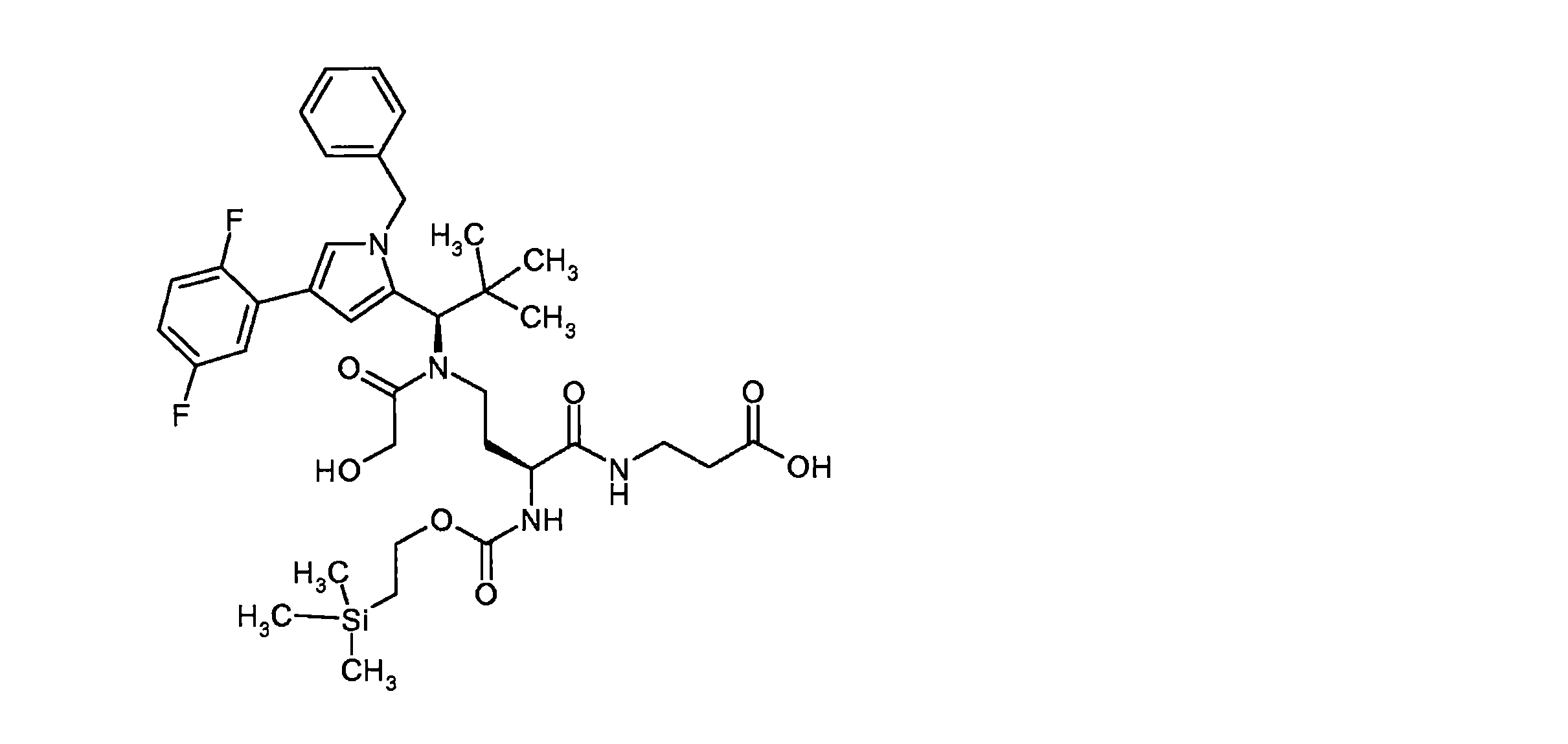
LC-MS(方法1):Rt=1.29分;MS(ESIpos):m/z=729(M+H)+。
Intermediate C61
N-[(2S)-4-[{(1R)-1-[1-benzyl-4-(2,5-difluorophenyl)-1H-pyrrol-2-yl]-2,2-dimethylpropyl}( glycoloyl)amino]-2-({[2-(trimethylsilyl)ethoxy]carbonyl}amino)butanoyl]-β-alanine
LC-MS (Method 1): R t =1.29 min; MS (ESIpos): m/z = 729 (M+H) + .
中間体C102
(2S)-4-[{(1R)-1-[1-ベンジル-4-(2,5-ジフルオロフェニル)-1H-ピロール-2-イル]-2,2-ジメチルプロピル}(グリコロイル)アミノ)-2-{[(ベンジルオキシ)カルボニル]アミノ}ブタン酸

LC-MS(方法1):Rt=1.31分;MS(ESIpos):m/z=646(M-H)-。
Intermediate C102
(2S)-4-[{(1R)-1-[1-benzyl-4-(2,5-difluorophenyl)-1H-pyrrol-2-yl]-2,2-dimethylpropyl}(glycoloyl)amino )-2-{[(benzyloxy)carbonyl]amino}butanoic acid
LC-MS (Method 1): Rt = 1.31 min; MS (ESIpos): m/z = 646 (MH) - .
中間体C110(D)
ジベンジルN-{(2S)-2-アミノ-4-[{(1R)-1-[1-ベンジル-4-(2,5-ジフルオロフェニル)-1H-ピロール-2-イル]-2,2-ジメチルプロピル{(グリコロイル)アミノ]ブタノイル}-β-アラニル-D-グルタメート

LC-MS(方法1):Rt=1.08分;MS(ESIpos):m/z=894[M+H]+。
Intermediate C110 (D)
Dibenzyl N-{(2S)-2-amino-4-[{(1R)-1-[1-benzyl-4-(2,5-difluorophenyl)-1H-pyrrol-2-yl]-2,2 -dimethylpropyl {(glycoloyl)amino]butanoyl}-β-alanyl-D-glutamate
LC-MS (Method 1): R t =1.08 min; MS (ESIpos): m/z = 894 [M+H] + .
中間体C111
ジ-tert-ブチルN-{(2S)-2-アミノ-4-[{(1R)-1-[1-ベンジル-4-(2,5-ジフルオロフェニル)-1H-ピロール-2-イル]-2,2-ジメチルプロピル{(グリコロイル)アミノ]ブタノイル}-β-アラニル-D-グルタメート

LC-MS(方法1):Rt=1.06分;MS(ESIpos):m/z=826[M+H]+。
Intermediate C111
Di-tert-butyl N-{(2S)-2-amino-4-[{(1R)-1-[1-benzyl-4-(2,5-difluorophenyl)-1H-pyrrol-2-yl] -2,2-dimethylpropyl{(glycoloyl)amino]butanoyl}-β-alanyl-D-glutamate
LC-MS (Method 1): R t =1.06 min; MS (ESIpos): m/z = 826 [M+H] + .
中間体C117
トリフルオロ酢酸ジベンジルN-{(2S)-2-(L-アスパラギニルアミノ)-4-[{(1R)-1-[1-ベンジル-4-(2,5-ジフルオロフェニル)-1H-ピロール-2-イル]-2,2-ジメチルプロピル}(グリコロイル)アミノ]ブタノイル}-β-アラニル-D-グルタミン酸塩

Dibenzyl trifluoroacetate N-{(2S)-2-(L-asparaginylamino)-4-[{(1R)-1-[1-benzyl-4-(2,5-difluorophenyl)-1H- Pyrrol-2-yl]-2,2-dimethylpropyl}(glycoloyl)amino]butanoyl}-β-alanyl-D-glutamate
得られた中間体(578mg、52μmol)をトリフルオロエタノール20.0mlに溶解した。反応混合物を塩化亜鉛(426mg、3.13mmol)と混和し、50℃で40分間撹拌した。混合物をエチレンジアミン-N,N,N’,N’-四酢酸(914 mg、3.13 mmol)と混和し、水20 mlで希釈し、TFA(200μl)を添加し、混合物を短時間撹拌した。混合物を濾過し、分取RP-HPLC(カラム:Chromatorex C18-5;125×40、流量:100ml/分、MeCN/水、0.1%TFA勾配)によって精製した。凍結乾燥によって標記化合物が得られた。 The intermediate obtained (578 mg, 52 μmol) was dissolved in 20.0 ml of trifluoroethanol. The reaction mixture was admixed with zinc chloride (426 mg, 3.13 mmol) and stirred at 50° C. for 40 minutes. The mixture was admixed with ethylenediamine-N,N,N',N'-tetraacetic acid (914 mg, 3.13 mmol), diluted with 20 ml water, TFA (200 μl) was added and the mixture was briefly stirred. . The mixture was filtered and purified by preparative RP-HPLC (Column: Chromatorex C18-5; 125×40, flow rate: 100 ml/min, MeCN/water, 0.1% TFA gradient). Lyophilization gave the title compound.
中間体L57
メチル(2S)-4-オキソ-2-({[2-(トリメチルシリル)エトキシ]カルボニル}アミノ)ブタノエート

LC-MS(方法1):Rt=0.89分;MS(ESIneg):m/z=290(M-H)-。
Intermediate L57
Methyl (2S)-4-oxo-2-({[2-(trimethylsilyl)ethoxy]carbonyl}amino)butanoate
LC-MS (Method 1): Rt = 0.89 min; MS (ESIneg): m/z = 290 (MH) - .
(3S)-4-メトキシ-4-オキソ-3-({[2-(トリメチルシリル)エトキシ]カルボニル}アミノ)ブタン酸592.9mgを最初に1,2-ジメトキシエタン10.0mlに装入し、混合物を-15℃に冷却し、4-メチルモルホリン205.8mg(2.04mmol)およびイソブチルクロロホルメート277.9mg(2.04mmol)を添加した。沈殿を15分後に吸引濾別し、それぞれ1,2-ジメトキシエタン10.0mlで2回濾別した。濾液を-10℃に冷却し、水10mlに溶解した水素化ホウ素ナトリウム115.5mg(3.05mmol)を激しく撹拌しながら添加した。相を分離し、有機相を飽和炭酸水素ナトリウム溶液および飽和NaCl溶液でそれぞれ1回洗浄した。有機相を硫酸マグネシウム上で乾燥させ、溶媒を減圧下で蒸発させ、残渣を高真空下で乾燥させた。これにより、化合物メチルN-{[2-(トリメチルシリル)エトキシ]カルボニル}-L-ホモセリネート515.9mg(理論値の91%)が得られた。
LC-MS(方法1)Rt=0.87分;MS(ESIpos):m/z=278(M+H)+。
592.9 mg of (3S)-4-methoxy-4-oxo-3-({[2-(trimethylsilyl)ethoxy]carbonyl}amino)butanoic acid are initially charged in 10.0 ml of 1,2-dimethoxyethane, The mixture was cooled to −15° C. and 205.8 mg (2.04 mmol) 4-methylmorpholine and 277.9 mg (2.04 mmol) isobutyl chloroformate were added. The precipitate was filtered off with suction after 15 minutes and filtered off twice with 10.0 ml of 1,2-dimethoxyethane each time. The filtrate was cooled to −10° C. and 115.5 mg (3.05 mmol) of sodium borohydride dissolved in 10 ml of water were added with vigorous stirring. The phases were separated and the organic phase was washed once each with saturated sodium bicarbonate solution and saturated NaCl solution. The organic phase was dried over magnesium sulphate, the solvent was evaporated under reduced pressure and the residue was dried under high vacuum. This gave 515.9 mg (91% of theory) of the compound methyl N-{[2-(trimethylsilyl)ethoxy]carbonyl}-L-homoselinate.
LC-MS (Method 1) R t = 0.87 min; MS (ESIpos): m/z = 278 (M+H) + .
メチルN-{[2-(トリメチルシリル)エトキシ]カルボニル}-L-ホモセリネート554.9mg(2.00mmol)を最初にジクロロメタン30.0mlに装入し、Dess-Martinペルヨージナン1.27g(3.0mmol)およびピリジン474.7mg(6.00mmol)を添加した。混合物を室温で一晩撹拌した。4時間後、反応物をジクロロメタンで希釈し、有機相を10%濃度のNa2S2O3溶液、10%濃度のクエン酸溶液および飽和炭酸水素ナトリウム溶液でそれぞれ3回洗浄した。有機相を硫酸マグネシウム上で乾燥させ、溶媒を減圧下で蒸発させた。これにより、標記化合物565.7mg(理論値の97%)が得られた。
1H-NMR(400 MHz,DMSO-d6):δ[ppm]=0.03(s,9H),0.91(m,2H),2.70-2.79(m,1H),2.88(dd,1H),3.63(s,3H),4.04(m,2H),4.55(m,1H),7.54(d,1H),9.60(t,1H).
554.9 mg (2.00 mmol) of methyl N-{[2-(trimethylsilyl)ethoxy]carbonyl}-L-homoserinate was initially charged in 30.0 ml of dichloromethane and 1.27 g (3.0 mmol) of Dess-Martin periodinane. and 474.7 mg (6.00 mmol) of pyridine were added. The mixture was stirred overnight at room temperature. After 4 hours, the reaction was diluted with dichloromethane and the organic phase was washed three times each with 10% strength Na 2 S 2 O 3 solution, 10% strength citric acid solution and saturated sodium hydrogen carbonate solution. The organic phase was dried over magnesium sulphate and the solvent was evaporated under reduced pressure. This gave 565.7 mg (97% of theory) of the title compound.
1 H-NMR (400 MHz, DMSO-d 6 ): δ [ppm] = 0.03 (s, 9H), 0.91 (m, 2H), 2.70-2.79 (m, 1H), 2.88 (dd, 1H), 3.63 (s, 3H), 4.04 (m, 2H), 4.55 (m, 1H), 7.54 (d, 1H), 9.60 (t , 1H).
中間体L95
N-[(ベンジルオキシ)カルボニル]-L-バリル-L-アラニン

LC-MS(方法12):Rt=1.34分;MS(ESIpos):m/z=323.16(M+H)+。
Intermediate L95
N-[(benzyloxy)carbonyl]-L-valyl-L-alanine
LC-MS (Method 12): R t =1.34 min; MS (ESIpos): m/z = 323.16 (M+H) + .
中間体L103
N-(ピリジン-4-イルアセチル)-L-アラニル-L-アラニル-L-アスパラギントリフルオロアセテート

LC-MS(方法1):Rt=0.15分;MS(ESIpos):m/z=394(M+H)+。
Intermediate L103
N-(pyridin-4-ylacetyl)-L-alanyl-L-alanyl-L-asparagine trifluoroacetate
LC-MS (Method 1): R t =0.15 min; MS (ESIpos): m/z = 394 (M+H) + .
中間体L116
N-[(ベンジルオキシ)カルボニル]-L-アラニル-N-メチル-L-アラニン
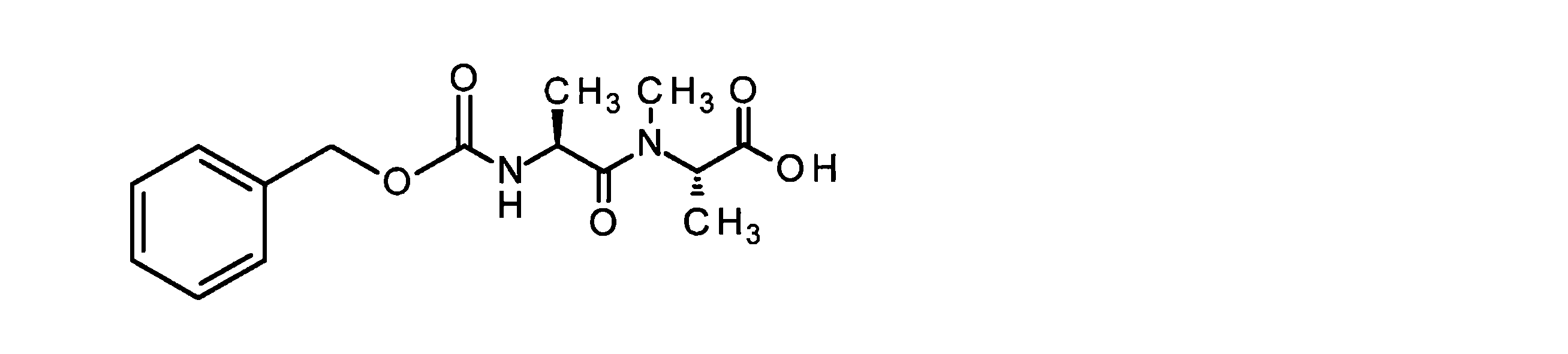
LC-MS(方法1):Rt=0.68分;MS(ESIpos):m/z=309[M+H]+。
Intermediate L116
N-[(benzyloxy)carbonyl]-L-alanyl-N-methyl-L-alanine
LC-MS (Method 1): R t =0.68 min; MS (ESIpos): m/z = 309 [M+H] + .
中間体L117
N-[(ベンジルオキシ)カルボニル]-L-アラニル-N-メチル-L-アラニル-L-アスパラギントリフルオロ酢酸塩

LC-MS(方法1):Rt=0.57分;MS(ESIneg):m/z=421[M-H]-。
Intermediate L117
N-[(benzyloxy)carbonyl]-L-alanyl-N-methyl-L-alanyl-L-asparagine trifluoroacetate
LC-MS (Method 1): R t =0.57 min; MS (ESIneg): m/z = 421 [M−H] − .
中間体L118
N-[(ベンジルオキシ)カルボニル]-L-アラニル-N-メチル-L-アラニル-L-アラニン

LC-MS(方法12):Rt=1.25分;MS(ESIneg):m/z=378[M-H]-。
Intermediate L118
N-[(benzyloxy)carbonyl]-L-alanyl-N-methyl-L-alanyl-L-alanine
LC-MS (Method 12): R t =1.25 min; MS (ESIneg): m/z = 378 [M−H] − .
中間体L121
N-[(ベンジルオキシ)カルボニル]-L-アラニル-N-メチル-L-アラニル-L-ロイシン

LC-MS(方法12):Rt=0.83分;MS(ESIneg):m/z=420[M-H]-。
Intermediate L121
N-[(benzyloxy)carbonyl]-L-alanyl-N-methyl-L-alanyl-L-leucine
LC-MS (Method 12): Rt = 0.83 min; MS (ESIneg): m/z = 420 [M-H] - .
中間体L122
(5S,8S,11S)-11-(2-アミノ-2-オキソエチル)-8-[2-(ベンジルオキシ)-2-オキソエチル]-5-メチル-3,6,9-トリオキソ-1-フェニル-2-オキサ-4,7,10-トリアザドデカン-12-酸

LC-MS(方法1):Rt=0.76分;MS(ESIpos):m/z=543[M+H]+。
Intermediate L122
(5S,8S,11S)-11-(2-amino-2-oxoethyl)-8-[2-(benzyloxy)-2-oxoethyl]-5-methyl-3,6,9-trioxo-1-phenyl -2-oxa-4,7,10-triazadodecane-12-acid
LC-MS (Method 1): R t =0.76 min; MS (ESIpos): m/z = 543 [M+H] + .
中間体L138
1-ブロモ-2-オキソ-6,9,12,15-テトラオキサ-3-アザオクタデカン-18-酸

LC-MS(方法5):Rt=1.05分;MS(ESIpos):m/z=386および388(M+H)+。
Intermediate L138
1-bromo-2-oxo-6,9,12,15-tetraoxa-3-azaoctadecane-18-acid
LC-MS (Method 5): R t =1.05 min; MS (ESIpos): m/z = 386 and 388 (M+H) + .
中間体Q1
N-[(2,5-ジオキソ-2,5-ジヒドロ-1H-ピロール-1-イル)アセチル]-L-アラニル-N-メチル-L-アラニル-N1-{(2S)-4-[{(1R)-1-[1-ベンジル-4-(2,5-ジフルオロフェニル)-1H-ピロール-2-イル]-2,2-ジメチルプロピル}(グリコロイル)アミノ]-1-[(3-{[(1R)-1,3-ジカルボキシプロピル]アミノ}-3-オキソプロピル)アミノ]-1-オキソブタン-2-イル}-L-アスパルトアミド

LC-MS(方法12):Rt=1.66分;MS(ESIneg):m/z=1119[M-H]-。
Intermediate Q1
N-[(2,5-dioxo-2,5-dihydro-1H-pyrrol-1-yl)acetyl]-L-alanyl-N-methyl-L-alanyl-N 1 -{(2S)-4-[ {(1R)-1-[1-benzyl-4-(2,5-difluorophenyl)-1H-pyrrol-2-yl]-2,2-dimethylpropyl}(glycoloyl)amino]-1-[(3 -{[(1R)-1,3-dicarboxypropyl]amino}-3-oxopropyl)amino]-1-oxobutan-2-yl}-L-aspartamide
LC-MS (Method 12): R t =1.66 min; MS (ESIneg): m/z = 1119 [M−H] − .
中間体Q2
N-{5-[(2,5-ジオキソピロリジン-1-イル)オキシ]-5-オキソペンタノイル}-L-アラニル-N-メチル-L-アラニル-N1-{(2S)-4-[{(1R)-1-[1-ベンジル-4-(2,5-ジフルオロフェニル)-1H-ピロール-2-イル]-2,2-ジメチルプロピル}(グリコロイル)アミノ]-1-[(3-{[(1R)-1,3-ジカルボキシプロピル]アミノ}-3-オキソプロピル)アミノ]-1-オキソブタン-2-イル}-L-アスパルトアミド

LC-MS(方法1):Rt=0.93分;MS(ESIpos):m/z=1195[M+H]+。
Intermediate Q2
N-{5-[(2,5-dioxopyrrolidin-1-yl)oxy]-5-oxopentanoyl}-L-alanyl-N-methyl-L-alanyl-N 1 -{(2S)-4 -[{(1R)-1-[1-benzyl-4-(2,5-difluorophenyl)-1H-pyrrol-2-yl]-2,2-dimethylpropyl}(glycoloyl)amino]-1-[ (3-{[(1R)-1,3-dicarboxypropyl]amino}-3-oxopropyl)amino]-1-oxobutan-2-yl}-L-aspartamide
LC-MS (Method 1): R t =0.93 min; MS (ESIpos): m/z = 1195 [M+H] + .
中間体Q3
N-{5-[(2,5-ジオキソピロリジン-1-イル)オキシ]-5-オキソペンタノイル}-L-アラニル-L-アラニル-N1-{(2S)-4-[{(1R)-1-[1-ベンジル-4-(2,5-ジフルオロフェニル)-1H-ピロール-2-イル]-2,2-ジメチルプロピル}(グリコロイル)アミノ]-1-[(3-{[(1R)-1,3-ジカルボキシプロピル]アミノ}-3-オキソプロピル)アミノ]-1-オキソブタン-2-イル}-L-アスパルトアミド

LC-MS(方法1):Rt=0.90分;MS(ESIneg):m/z=1181[M-H]-。
Intermediate Q3
N-{5-[(2,5-dioxopyrrolidin-1-yl)oxy]-5-oxopentanoyl}-L-alanyl-L-alanyl-N 1 -{(2S)-4-[{( 1R)-1-[1-benzyl-4-(2,5-difluorophenyl)-1H-pyrrol-2-yl]-2,2-dimethylpropyl}(glycoloyl)amino]-1-[(3-{ [(1R)-1,3-dicarboxypropyl]amino}-3-oxopropyl)amino]-1-oxobutan-2-yl}-L-aspartamide
LC-MS (Method 1): Rt = 0.90 min; MS (ESIneg): m/z = 1181 [M-H] - .
中間体Q4
N-[(2,5-ジオキソ-2,5-ジヒドロ-1H-ピロール-1-イル)ヘキサノイル]-L-アラニル-N-メチル-L-アラニル-N1-{(2S)-4-[{(1R)-1-[1-ベンジル-4-(2,5-ジフルオロフェニル)-1H-ピロール-2-イル]-2,2-ジメチルプロピル}(グリコロイル)アミノ]-1-[(3-{[(1R)-1,3-ジカルボキシプロピル]アミノ}-3-オキソプロピル)アミノ]-1-オキソブタン-2-イル}-L-アスパルトアミド

LC-MS(方法1):Rt=3.2分;MS(ESIpos):m/z=1177[M+H]+。
Intermediate Q4
N-[(2,5-dioxo-2,5-dihydro-1H-pyrrol-1-yl)hexanoyl]-L-alanyl-N-methyl-L-alanyl-N 1 -{(2S)-4-[ {(1R)-1-[1-benzyl-4-(2,5-difluorophenyl)-1H-pyrrol-2-yl]-2,2-dimethylpropyl}(glycoloyl)amino]-1-[(3 -{[(1R)-1,3-dicarboxypropyl]amino}-3-oxopropyl)amino]-1-oxobutan-2-yl}-L-aspartamide
LC-MS (Method 1): R t =3.2 min; MS (ESIpos): m/z = 1177 [M+H] + .
中間体Q5
N-{5-[(2,5-ジオキソピロリジン-1-イル)オキシ]-5-オキソペンタノイル}-L-アラニル-N-メチル-L-アラニル-N-{(2S)-4-[{(1R)-1-[1-ベンジル-4-(2,5-ジフルオロフェニル)-1H-ピロール-2-イル]-2,2-ジメチルプロピル}(グリコロイル)アミノ]-1-[(3-{[(1R)-1,3-ジカルボキシプロピル]アミノ}-3-オキソプロピル)アミノ]-1-オキソブタン-2-イル}-L-アラニンアミド

LC-MS(方法1):Rt=0.96分;MS(ESIpos):m/z=1152[M+H]+。
Intermediate Q5
N-{5-[(2,5-dioxopyrrolidin-1-yl)oxy]-5-oxopentanoyl}-L-alanyl-N-methyl-L-alanyl-N-{(2S)-4- [{(1R)-1-[1-benzyl-4-(2,5-difluorophenyl)-1H-pyrrol-2-yl]-2,2-dimethylpropyl}(glycoloyl)amino]-1-[( 3-{[(1R)-1,3-dicarboxypropyl]amino}-3-oxopropyl)amino]-1-oxobutan-2-yl}-L-alaninamide
LC-MS (Method 1): R t =0.96 min; MS (ESIpos): m/z = 1152 [M+H] + .
中間体Q6
N-{(2S)-4-[{(1R)-1-[1-ベンジル-4-(2,5-ジフルオロフェニル)-1H-ピロール-2-イル]-2,2-ジメチルプロピル}(グリコロイル)アミノ]-2-[(N-{5-[(2,5-ジオキソピロリジン-1-イル)オキシ]-5-オキソペンタノイル}-L-バリル-L-アラニル)アミノ]ブタノイル}-β-アラニル-D-グルタミン酸
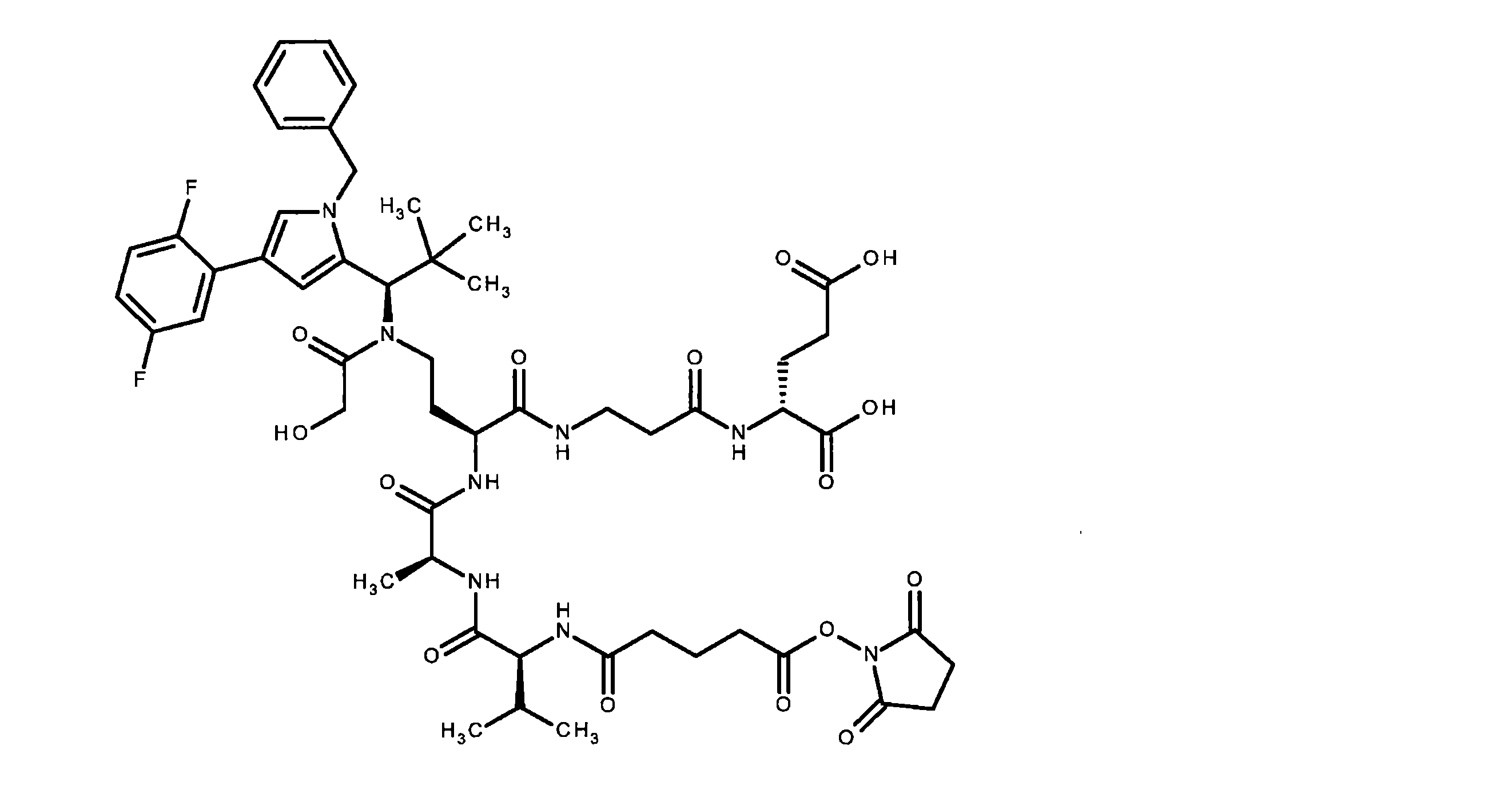
LC-MS(方法1):Rt=0.98分;MS(ESIpos):m/z=1095[M+H]+。
Intermediate Q6
N-{(2S)-4-[{(1R)-1-[1-benzyl-4-(2,5-difluorophenyl)-1H-pyrrol-2-yl]-2,2-dimethylpropyl}( glycoloyl)amino]-2-[(N-{5-[(2,5-dioxopyrrolidin-1-yl)oxy]-5-oxopentanoyl}-L-valyl-L-alanyl)amino]butanoyl} -β-alanyl-D-glutamic acid
LC-MS (Method 1): R t =0.98 min; MS (ESIpos): m/z = 1095 [M+H] + .
中間体Q7
N-[(2S)-4-[{(1R)-1-[1-ベンジル-4-(2,5-ジフルオロフェニル)-1H-ピロール-2-イル]-2,2-ジメチルプロピル}(グリコロイル)アミノ]-2-({N-[(2,5-ジオキソ-2,5-ジヒドロ-1H-ピロール-1-イル)アセチル]-L-バリル-L-アラニル}アミノ)ブタノイル]-β-アラニル-D-グルタミン酸

LC-MS(方法1):Rt=0.98分;MS(ESIpos):m/z=1021[M+H]+。
Intermediate Q7
N-[(2S)-4-[{(1R)-1-[1-benzyl-4-(2,5-difluorophenyl)-1H-pyrrol-2-yl]-2,2-dimethylpropyl}( glycoloyl)amino]-2-({N-[(2,5-dioxo-2,5-dihydro-1H-pyrrol-1-yl)acetyl]-L-valyl-L-alanyl}amino)butanoyl]-β -alanyl-D-glutamic acid
LC-MS (Method 1): R t =0.98 min; MS (ESIpos): m/z = 1021 [M+H] + .
中間体Q8
N-{5-[(2,5-ジオキソピロリジン-1-イル)オキシ]-5-オキソペンタノイル}-L-アラニル-N-メチル-L-アラニル-N1-{(2S)-4-[{(1R)-1-[1-ベンジル-4-(2,5-ジフルオロフェニル)-1H-ピロール-2-イル]-2,2-ジメチルプロピル}(グリコロイル)アミノ]-1-[(3-{[(1R)-1,3-ジカルボキシプロピル]アミノ}-3-オキソプロピル)アミノ]-1-オキソブタン-2-イル}-L-ロイシンアミド

LC-MS(方法1):Rt=1.02分;MS(ESIpos):m/z=1194[M+H]+。
Intermediate Q8
N-{5-[(2,5-dioxopyrrolidin-1-yl)oxy]-5-oxopentanoyl}-L-alanyl-N-methyl-L-alanyl-N 1 -{(2S)-4 -[{(1R)-1-[1-benzyl-4-(2,5-difluorophenyl)-1H-pyrrol-2-yl]-2,2-dimethylpropyl}(glycoloyl)amino]-1-[ (3-{[(1R)-1,3-dicarboxypropyl]amino}-3-oxopropyl)amino]-1-oxobutan-2-yl}-L-leucinamide
LC-MS (Method 1): R t =1.02 min; MS (ESIpos): m/z = 1194 [M+H] + .
中間体Q9
N-{5-[(2,5-ジオキソピロリジン-1-イル)オキシ]-5-オキソペンタノイル}-L-アラニル-N-メチル-L-α-アスパルチル-N1-{(2S)-4-[{(1R)-1-[1-ベンジル-4-(2,5-ジフルオロフェニル)-1H-ピロール-2-イル]-2,2-ジメチルプロピル}(グリコロイル)アミノ]-1-[(3-{[(1R)-1,3-ジカルボキシプロピル]アミノ}-3-オキソプロピル)アミノ]-1-オキソブタン-2-イル}-L-アスパルトアミド

LC-MS(方法1):Rt=0.89分;MS(ESIpos):m/z=1225[M+H]+。
Intermediate Q9
N-{5-[(2,5-dioxopyrrolidin-1-yl)oxy]-5-oxopentanoyl}-L-alanyl-N-methyl-L-α-aspartyl-N 1 -{(2S) -4-[{(1R)-1-[1-benzyl-4-(2,5-difluorophenyl)-1H-pyrrol-2-yl]-2,2-dimethylpropyl}(glycoloyl)amino]-1 -[(3-{[(1R)-1,3-dicarboxypropyl]amino}-3-oxopropyl)amino]-1-oxobutan-2-yl}-L-aspartamide
LC-MS (Method 1): R t =0.89 min; MS (ESIpos): m/z = 1225 [M+H] + .
中間体Q10
N-(ブロモアセチル)-L-アラニル-N-メチル-L-アラニル-N1-{(2S)-4-[{(1R)-1-[1-ベンジル-4-(2,5-ジフルオロフェニル)-]-1H-ピロール-2-イル]-2,2-ジメチルプロピル}(グリコロイル)アミノ]-1-[(3-{[(1R)-1,3-ジカルボキシプロピル]アミノ}-3-オキソプロピル)アミノ]-1-オキソブタン-2-イル}-L-アスパルトアミド

LC-MS(方法1):Rt=0.95分;MS(ESIpos):m/z=1104および1106[M+H]+。
Intermediate Q10
N-(bromoacetyl)-L-alanyl-N-methyl-L-alanyl-N 1 -{(2S)-4-[{(1R)-1-[1-benzyl-4-(2,5-difluoro Phenyl)-]-1H-pyrrol-2-yl]-2,2-dimethylpropyl}(glycoloyl)amino]-1-[(3-{[(1R)-1,3-dicarboxypropyl]amino}- 3-Oxopropyl)amino]-1-oxobutan-2-yl}-L-aspartamide
LC-MS (Method 1): R t =0.95 min; MS (ESIpos): m/z = 1104 and 1106 [M+H] + .
中間体Q11
N-(18-ブロモ-17-オキソ-4,7,10,13-テトラオキサ-16-アザオクタデカン-1-オイル)-L-アラニル-N-メチル-L-アラニル-N1-{(2S)-4-[{(1R)-1-[1-ベンジル-4-(2,5-ジフルオロフェニル)-1H-ピロール-2-イル]-2,2-ジメチルプロピル}(グリコロイル)アミノ]-1-[(3-{[(1R)-1,3-ジカルボキシプロピル]アミノ}-3-オキソプロピル)アミノ]-1-オキソブタン-2-イル}-L-アスパルトアミド

LC-MS(方法8):Rt=4.06分;MS(ESI-pos):m/z=1353[M+H]+。
Intermediate Q11
N-(18-bromo-17-oxo-4,7,10,13-tetraoxa-16-azaoctadecane-1-oyl)-L-alanyl-N-methyl-L-alanyl-N 1 -{(2S) -4-[{(1R)-1-[1-benzyl-4-(2,5-difluorophenyl)-1H-pyrrol-2-yl]-2,2-dimethylpropyl}(glycoloyl)amino]-1 -[(3-{[(1R)-1,3-dicarboxypropyl]amino}-3-oxopropyl)amino]-1-oxobutan-2-yl}-L-aspartamide
LC-MS (Method 8): R t =4.06 min; MS (ESI-pos): m/z = 1353 [M+H] + .
B:抗体-薬物コンジュゲート(ADC)の調製
B-1.抗体作製の一般的方法
使用した抗体、例えばTPP-981、TPP-1015、TPP-6013、TPP-7006、TPP-7007、TPP-8382、TPP-8987、TPP-8988、TPP-9476、TPP-9574およびTPP-9580のタンパク質配列(アミノ酸配列)を、当業者に公知の方法によって対応するタンパク質をコードするDNA配列に変換し、一過性哺乳動物細胞培養に適した発現ベクターに挿入する(Tomら、Methods Express:Expression Systemsの第12章、Michael R.DysonおよびYves Durocher編、Scion Publishing Ltd、2007に記載されているように)。
B: Preparation of antibody-drug conjugate (ADC)
B-1. General Method of Making Antibodies Antibodies used such as TPP-981, TPP-1015, TPP-6013, TPP-7006, TPP-7007, TPP-8382, TPP-8987, TPP-8988, TPP-9476, TPP-9574 and TPP-9580 protein sequences (amino acid sequences) are converted into DNA sequences encoding the corresponding proteins by methods known to those skilled in the art and inserted into expression vectors suitable for transient mammalian cell culture (Tom et al. , Methods Express: Chapter 12 of Expression Systems, Michael R. Dyson and Yves Durocher, eds., Scion Publishing Ltd, 2007).
B-2.哺乳動物細胞で抗体を発現させるための一般的方法
抗体、例えばTPP-981、TPP-1015、TPP-6013、TPP-7006、TPP-7007、TPP-8382、TPP-8987、TPP-8988、TPP-9476、TPP-9574およびTPP-9580を、Tomら、Methods Express:Expression Systemsの第12章、Michael R.DysonおよびYves Durocher編、Scion Publishing Ltd、2007に記載されるように、一過性哺乳動物細胞培養で作製した。
B-2. General methods for expressing antibodies in
B-3.細胞上清から抗体を精製するための一般的な方法
抗体、例えばTPP-981、TPP-1015、TPP-6013、TPP-7006、TPP-7007、TPP-8382、TPP-8987、TPP-8988、TPP-9476、TPP-9574およびTPP-9580を、細胞培養物上清から得た。細胞上清を細胞の遠心分離によって清澄化した。次いで、細胞上清を、MabSelect Sure(GE Healthcare)クロマトグラフィーカラムでのアフィニティークロマトグラフィーによって精製した。この目的のために、カラムをDPBS pH7.4(Sigma/Aldrich)で平衡化し、細胞上清をアプライし、カラムを約10カラム容量のDPBS pH7.4+500mM塩化ナトリウムで洗浄した。抗体を50mM酢酸ナトリウムpH3.5+500mM塩化ナトリウムに溶出し、次いで、DPBS pH7.4中Superdex 200カラム(GE Healthcare)でゲル濾過クロマトグラフィーによってさらに精製した。
B-3. A general method for purifying antibodies from cell supernatants
Antibodies such as TPP-981, TPP-1015, TPP-6013, TPP-7006, TPP-7007, TPP-8382, TPP-8987, TPP-8988, TPP-9476, TPP-9574 and TPP-9580 were isolated in cell culture obtained from the supernatant. Cell supernatants were clarified by centrifugation of the cells. Cell supernatants were then purified by affinity chromatography on MabSelect Sure (GE Healthcare) chromatography columns. For this purpose the column was equilibrated with DPBS pH 7.4 (Sigma/Aldrich), the cell supernatant was applied and the column was washed with approximately 10 column volumes of DPBS pH 7.4 + 500 mM sodium chloride. Antibodies were eluted in 50 mM sodium acetate pH 3.5 + 500 mM sodium chloride and then further purified by gel filtration chromatography on a Superdex 200 column (GE Healthcare) in DPBS pH 7.4.
市販の抗体を、市販品から標準的なクロマトグラフィー法(プロテインAクロマトグラフィー、分取ゲル濾過クロマトグラフィー(SEC-サイズ排除クロマトグラフィー))によって精製した。 Commercially available antibodies were purified from commercial sources by standard chromatographic methods (protein A chromatography, preparative gel filtration chromatography (SEC-size exclusion chromatography)).
B-4.システイン側鎖へのカップリングのための一般的方法
以下の抗体をカップリング反応に使用した:
実施例a:TPP-981セツキシマブ(抗EGFR AK)
実施例c:TPP-6013(抗CD123 AK)
TPP-8987(抗CD123 AK)
TPP-8988(抗CD123 AK)
TPP-9476(抗CD123 AK)
実施例h:TPP-8382(抗B7H3 AK)
実施例e:TPP-1015(抗Her2 AK)
実施例k:TPP-7006(抗TWEAKR AK)
TPP-7007(抗TWEAKR AK)
実施例x:TPP-9574(抗CXCR5 AK)
TPP-9580(抗CXCR5 AK)
カップリング反応は、通常、アルゴン下で実施した。
B-4. General Method for Coupling to Cysteine Side Chains The following antibodies were used in the coupling reactions:
Example a: TPP-981 Cetuximab (Anti-EGFR AK)
Example c: TPP-6013 (Anti-CD123 AK)
TPP-8987 (anti-CD123 AK)
TPP-8988 (anti-CD123 AK)
TPP-9476 (anti-CD123 AK)
Example h: TPP-8382 (Anti-B7H3 AK)
Example e: TPP-1015 (Anti-Her2 AK)
Example k: TPP-7006 (Anti-TWEAKR AK)
TPP-7007 (anti-TWEAKR AK)
Example x: TPP-9574 (anti-CXCR5 AK)
TPP-9580 (anti-CXCR5 AK)
Coupling reactions were typically performed under argon.
PBS緩衝液に溶解した2~5当量のトリス(2-カルボキシエチル)ホスフィン塩酸塩(TCEP)を、適切な抗体のPBS緩衝液中溶液に、1mg/ml~20mg/mlの濃度範囲、好ましくは約10mg/ml~15mg/mlの範囲で添加し、混合物を室温で1時間撹拌した。この目的のために、使用されるそれぞれの抗体の溶液を、実施例で明言される濃度で使用することができる、または場合によっては、これが好ましい濃度範囲に入るためにPBS緩衝液で明言される出発濃度の約半分に希釈してもよい。その後、意図する充填に応じて、2~12当量、好ましくは約5~10当量のカップリングするマレイミド前駆体化合物またはハロゲン化前駆体化合物をDMSO中溶液として添加した。ここで、DMSOの量は全体積の10%を超えるべきでない。混合物をマレイミド前駆体の場合には室温で60~240分間、ハロゲン化物前駆体の場合には室温で8~24時間撹拌し、次いで、PBS平衡化PD 10カラム(Sephadex(登録商標)G-25、GE Healthcare)にかけ、PBS緩衝液で溶出した。一般に、特に指示しない限り、PBS緩衝液中の当の抗体5mgを還元およびその後のカップリングに使用した。したがって、各場合で、PD10カラムでの精製により、それぞれのADCのPBS緩衝液3.5ml中の溶液が得られた。次いで、試料を超遠心分離によって濃縮し、場合によりPBS緩衝液で再希釈した。必要に応じて、低分子量成分をより良く除去するために、PBS緩衝液で再希釈した後、限外濾過による濃縮を繰り返した。生物学的試験のために、必要に応じて、最終的なADC試料の濃度を、場合により再希釈によって0.5~15mg/mlの範囲に調整した。ADC溶液の実施例で明言されるそれぞれのタンパク質濃度を決定した。さらに、抗体負荷(薬物/mAb比)を、B-6に記載される方法を使用して決定した。 2-5 equivalents of tris(2-carboxyethyl)phosphine hydrochloride (TCEP) dissolved in PBS buffer are added to a solution of the appropriate antibody in PBS buffer in a concentration range of 1 mg/ml to 20 mg/ml, preferably A range of about 10 mg/ml to 15 mg/ml was added and the mixture was stirred at room temperature for 1 hour. For this purpose, the solutions of each antibody used can be used at the concentrations specified in the examples, or in some cases specified in PBS buffer in order for this to fall within the preferred concentration range. It may be diluted to about half the starting concentration. Thereafter, depending on the intended loading, 2-12 equivalents, preferably about 5-10 equivalents of the coupling maleimide or halogenated precursor compound were added as a solution in DMSO. Here, the amount of DMSO should not exceed 10% of the total volume. The mixture was stirred at room temperature for 60-240 minutes for the maleimide precursors and 8-24 hours for the halide precursors and then applied to a PBS-equilibrated PD 10 column (Sephadex® G-25). GE Healthcare) and eluted with PBS buffer. Generally, 5 mg of the antibody in question in PBS buffer was used for reduction and subsequent coupling unless otherwise indicated. Thus, in each case purification on PD10 columns resulted in a solution of the respective ADC in 3.5 ml of PBS buffer. Samples were then concentrated by ultracentrifugation and optionally rediluted with PBS buffer. If necessary, concentration by ultrafiltration was repeated after redilution with PBS buffer for better removal of low molecular weight components. For biological testing, the final ADC sample concentration was optionally adjusted by redilution to the range of 0.5-15 mg/ml, if necessary. Each protein concentration specified in the ADC solution examples was determined. Additionally, antibody loading (drug/mAb ratio) was determined using the method described in B-6.
リンカーに応じて、実施例に示されるADCはまた、抗体に結合した加水分解開鎖スクシンアミドの形態で、より低い程度またはより高い程度で存在してもよい。 Depending on the linker, the ADCs shown in the examples may also be present to a lesser or greater extent in the form of hydrolyzed open-chain succinamide attached to the antibody.
特に、リンカー部分構造

#1は抗とへの硫黄架橋を表し、#2は修飾KSP阻害剤との結合点を表す。 #1 represents the sulfur bridge to and #2 the point of attachment to the modified KSP inhibitor.
リンカーが加水分解開鎖スクシンアミドを通して抗体に結合しているこのようなADCは、場合により例としてここに示される小規模および大規模カップリングによって選択的に調製することもできる。 Such ADCs, in which the linker is attached to the antibody through a hydrolytically open-chain succinamide, optionally can also be selectively prepared by small-scale and large-scale couplings shown here by way of example.
PBS緩衝液に溶解した2~7当量のトリス(2-カルボキシエチル)ホスフィン塩酸塩(TCEP)を、適切な抗体2~5mgのPBS緩衝液中溶液に、1mg/ml~20mg/mlの濃度範囲、好ましくは約5mg/ml~15mg/mlの範囲で添加し、混合物を室温で30分~1時間撹拌した。その後、意図する充填に応じて、2~20当量、好ましくは約5~10当量のカップリングするマレイミド前駆体化合物をDMSO中溶液として添加した。より高いDARを達成するために、15~20当量を使用することも可能である。ここで、DMSOの量は全体積の10%を超えるべきでない。混合物を室温で60~240分間撹拌した。溶出液をPBS緩衝液pH8で1~5mg/mlの濃度に希釈し、次いで、PBS緩衝液pH8で平衡化したPD 10カラム(Sephadex(登録商標)G-25、GE Healthcare)に通過させ、PBS緩衝液pH 8で溶出した。溶出液をアルゴン下室温で一晩撹拌した。その後、溶液を超遠心分離によって濃縮し、PBS緩衝液(pH7.2)で再希釈した。 2-7 equivalents of tris(2-carboxyethyl)phosphine hydrochloride (TCEP) in PBS buffer to a solution of 2-5 mg of the appropriate antibody in PBS buffer at concentrations ranging from 1 mg/ml to 20 mg/ml. , preferably in the range of about 5 mg/ml to 15 mg/ml, and the mixture was stirred at room temperature for 30 minutes to 1 hour. Thereafter, depending on the intended loading, 2-20 equivalents, preferably about 5-10 equivalents of the coupling maleimide precursor compound were added as a solution in DMSO. It is also possible to use 15-20 equivalents to achieve higher DARs. Here, the amount of DMSO should not exceed 10% of the total volume. The mixture was stirred at room temperature for 60-240 minutes. The eluate was diluted with PBS buffer pH 8 to a concentration of 1-5 mg/ml and then passed through a PD 10 column (Sephadex® G-25, GE Healthcare) equilibrated with PBS buffer pH 8, followed by PBS. Eluted with buffer pH 8. The eluate was stirred overnight at room temperature under argon. The solution was then concentrated by ultracentrifugation and rediluted with PBS buffer (pH 7.2).
中規模カップリング:
アルゴン下で、PBS緩衝液中2~7当量、好ましくは3当量のTCEP溶液(c約0.2~0.8mg/ml、好ましくは0.5mg/ml)を、PBS緩衝液中当の抗体20~200mg(c約5~15mg/ml)に添加した。混合物を室温で30分間撹拌し、次いで、DMSOに溶解した2~20当量、好ましくは5~10当量のマレイミド前駆体化合物を添加した。より高いDARを達成するために、15~20当量を使用することも可能である。室温でさらに1.5時間~2時間撹拌した後、混合物を予めpH8に調整したPBS緩衝液で希釈した。次いで、この溶液を、PBS緩衝液pH8で平衡化したPD10カラム(Sephadex(登録商標)G-25、GE Healthcare)にアプライし、PBS緩衝液pH8で溶出した。溶出液をPBS緩衝液pH8で2~7mg/mlの濃度に希釈した。この溶液をアルゴン下室温で一晩撹拌した。次いで、必要であれば、溶液をpH7.2に再緩衝化した。ADC溶液を超遠心分離によって濃縮し、PBS緩衝液(pH7.2)で再希釈し、次いで、場合により再び約10mg/mlの濃度に濃縮した。
Medium Coupling:
Under argon, add 2-7 equivalents, preferably 3 equivalents of TCEP solution (c about 0.2-0.8 mg/ml, preferably 0.5 mg/ml) in PBS buffer to the antibody in question in PBS buffer. 20-200 mg (c about 5-15 mg/ml) was added. The mixture was stirred at room temperature for 30 minutes, then 2-20 equivalents, preferably 5-10 equivalents of maleimide precursor compound dissolved in DMSO were added. It is also possible to use 15-20 equivalents to achieve higher DARs. After stirring for an additional 1.5-2 hours at room temperature, the mixture was diluted with PBS buffer previously adjusted to pH8. This solution was then applied to a PD10 column (Sephadex® G-25, GE Healthcare) equilibrated with PBS buffer pH8 and eluted with PBS buffer pH8. The eluate was diluted with PBS buffer pH 8 to a concentration of 2-7 mg/ml. The solution was stirred overnight at room temperature under argon. The solution was then re-buffered to pH 7.2 if necessary. ADC solutions were concentrated by ultracentrifugation, rediluted with PBS buffer (pH 7.2) and then optionally concentrated again to a concentration of approximately 10 mg/ml.
示される構造式において、AK1は以下の意味を有することができる
実施例a:TPP-981セツキシマブ(部分還元)-S§1
実施例c:TPP-6013(抗CD123 AK)(部分還元)-S§1
TPP-8987(抗CD123 AK)(部分還元)-S§1
TPP-8988(抗CD123 AK)(部分還元)-S§1
TPP-9476(抗CD123 AK)(部分還元)-S§1
実施例e:TPP-1015(抗Her2 AK)(部分還元)-S§1
実施例h:TPP-8382(抗B7H3 AK)(部分還元)-S§1
実施例k:TPP-7006(抗TWEAKR)(部分還元)-S§1
TPP-7007(抗TWEAKR)(部分還元)-S§1
実施例x:TPP-9574(抗CXCR5 AK)(部分還元)-S§1
TPP-9580(抗CXCR5 AK)(部分還元)-S§1
(式中、
§1は、スクシンイミド基または任意の異性体加水分解開鎖スクシンアミドまたはそれから生じるアルキレン基との結合を表し、
Sは部分還元抗体のシステイン残基の硫黄原子を表す)。
In the structural formulas shown, AK 1 can have the following meanings Example a: TPP-981 Cetuximab (partially reduced) - S§1
Example c: TPP-6013 (anti-CD123 AK) (partial reduction) - S§1
TPP-8987 (anti-CD123 AK) (partial reduction) - S§ 1
TPP-8988 (anti-CD123 AK) (partial reduction) - S§ 1
TPP-9476 (anti-CD123 AK) (partial reduction) - S§ 1
Example e: TPP-1015 (anti-Her2 AK) (partial reduction) - S§ 1
Example h: TPP-8382 (anti-B7H3 AK) (partial reduction) - S§1
Example k: TPP-7006 (anti-TWEAKR) (partial reduction) - S§ 1
TPP-7007 (anti-TWEAKR) (partial reduction) - S§ 1
Example x: TPP-9574 (anti-CXCR5 AK) (partial reduction) - S§ 1
TPP-9580 (anti-CXCR5 AK) (partial reduction) - S§ 1
(In the formula,
§ 1 represents a bond with a succinimide group or any isomeric hydrolytic open-chain succinamide or alkylene group resulting therefrom,
S represents the sulfur atom of the cysteine residue of the partially reduced antibody).
B-5.リジン側鎖へのカップリングのための一般的方法
以下の抗体をカップリング反応に使用した:
実施例a:TPP-981セツキシマブ(抗EGFR AK)
実施例c:TPP-6013(抗CD123 AK)
TPP-8987(抗CD123 AK)
TPP-8988(抗CD123 AK)
TPP-9476(抗CD123 AK)
実施例e:TPP-1015(抗Her2 AK)
実施例k:TPP-7006(抗TWEAKR AK)
TPP-7007(抗TWEAKR AK)
実施例x:TPP-9574(抗CXCR5 AK)
TPP-9580(抗CXCR5 AK)
カップリング反応は、通常、アルゴン下で実施した。
B-5. General Method for Coupling to Lysine Side Chains The following antibodies were used in the coupling reactions:
Example a: TPP-981 Cetuximab (Anti-EGFR AK)
Example c: TPP-6013 (Anti-CD123 AK)
TPP-8987 (anti-CD123 AK)
TPP-8988 (anti-CD123 AK)
TPP-9476 (anti-CD123 AK)
Example e: TPP-1015 (Anti-Her2 AK)
Example k: TPP-7006 (Anti-TWEAKR AK)
TPP-7007 (anti-TWEAKR AK)
Example x: TPP-9574 (anti-CXCR5 AK)
TPP-9580 (anti-CXCR5 AK)
Coupling reactions were typically performed under argon.
2~8当量のカップリングする前駆体化合物を、意図する充填に応じて、1mg/ml~20mg/ml、好ましくは約10mg/mlの濃度範囲で、当の抗体のPBS緩衝液中溶液にDMSO中溶液として添加した。室温で30分~6時間撹拌した後、DMSO中同量の前駆体化合物を再び添加した。ここで、DMSOの量は全体積の10%を超えるべきでない。室温でさらに30分~6時間撹拌した後、混合物をPBSで平衡化したPD10カラム(Sephadex(登録商標)G-25、GE Healthcare)にアプライし、PBS緩衝液で溶出した。よって、PD10カラムでの精製により、各場合で、それぞれのADCのPBS緩衝液中溶液が得られた。次いで、試料を超遠心分離によって濃縮し、場合によりPBS緩衝液で再希釈した。必要に応じて、低分子量成分をより良く除去するために、PBS緩衝液で再希釈した後、限外濾過による濃縮を繰り返した。生物学的試験のために、必要に応じて、最終的なADC試料の濃度を、場合により再希釈によって0.5~15mg/mlの範囲に調整した。 2-8 equivalents of the coupling precursor compound are added to a solution of the antibody of interest in PBS buffer at concentrations ranging from 1 mg/ml to 20 mg/ml, preferably about 10 mg/ml, depending on the intended loading, in DMSO. added as a medium solution. After stirring for 30 minutes to 6 hours at room temperature, the same amount of precursor compound in DMSO was added again. Here, the amount of DMSO should not exceed 10% of the total volume. After stirring for an additional 30 minutes to 6 hours at room temperature, the mixture was applied to a PD10 column (Sephadex® G-25, GE Healthcare) equilibrated with PBS and eluted with PBS buffer. Purification on PD10 columns thus yielded in each case a solution of the respective ADC in PBS buffer. Samples were then concentrated by ultracentrifugation and optionally rediluted with PBS buffer. If necessary, concentration by ultrafiltration was repeated after redilution with PBS buffer for better removal of low molecular weight components. For biological testing, the final ADC sample concentration was optionally adjusted by redilution to the range of 0.5-15 mg/ml, if necessary.
ADC溶液の実施例で明言されるそれぞれのタンパク質濃度を決定した。さらに、抗体負荷(薬物/mAb比)を、B-6に記載される方法を使用して決定した。 Each protein concentration specified in the ADC solution examples was determined. Additionally, antibody loading (drug/mAb ratio) was determined using the method described in B-6.
示される構造式において、AK2は以下の意味を有する
実施例a:TPP-981セツキシマブ(抗EGFR AK)-NH§2
実施例c:TPP-6013(抗CD123 AK)-NH§2
TPP-8987(抗CD123 AK)-NH§2
TPP-8988(抗CD123 AK)-NH§2
TPP-9476(抗CD123 AK)-NH§2
実施例e:TPP-1015(抗Her2 AK)-NH§2
実施例k:TPP-7006(抗TWEAKR AK)-NH§2
TPP-7007(抗TWEAKR AK)-NH§2
実施例x:TPP-9574(抗CXCR5 AK)-NH§2
TPP-9580(抗CXCR5 AK)-NH§2
(式中、
§2はカルボニル基との結合を表し、
NHは抗体のリジン残基の側鎖アミノ基を表す)。
In the structural formulas shown, AK 2 has the following meaning Example a: TPP-981 cetuximab (anti-EGFR AK) - NH§2
Example c: TPP-6013 (anti-CD123 AK) - NH§2
TPP-8987 (anti-CD123 AK) - NH§2
TPP-8988 (anti-CD123 AK) - NH§2
TPP-9476 (anti-CD123 AK) -NH§2
Example e: TPP-1015 (anti-Her2 AK) - NH§2
Example k: TPP-7006 (Anti-TWEAKR AK) - NH§2
TPP-7007 (Anti-TWEAKR AK) -NH§2
Example x: TPP-9574 (anti-CXCR5 AK) - NH§2
TPP-9580 (anti-CXCR5 AK) -NH§2
(In the formula,
§ 2 represents a bond with a carbonyl group,
NH represents the side chain amino group of the lysine residue of the antibody).
本発明によるコンジュゲートのさらなる精製および特徴付け
反応後、場合によって、反応混合物を、例えば限外濾過によって濃縮し、次いで、例えばSephadex(登録商標)G-25カラムを使用してクロマトグラフィーによって脱塩および精製した。溶出を、例えば、リン酸緩衝生理食塩水(PBS)を用いて行った。次いで、溶液を滅菌濾過し、凍結させた。あるいは、コンジュゲートを凍結乾燥することができる。
Further purification and characterization of conjugates according to the invention After the reaction, the reaction mixture is optionally concentrated, for example by ultrafiltration, and then desalted by chromatography, for example using a Sephadex® G-25 column. and purified. Elution was performed using, for example, phosphate buffered saline (PBS). The solution was then sterile filtered and frozen. Alternatively, the conjugate can be lyophilized.
B-6.抗体、担毒体負荷および開いたシステイン付加物の割合の決定
脱グリコシル化および/または変性後の分子量決定に加えてタンパク質識別のために、トリプシン消化を行って、変性、還元および誘導体化後に、発見されたトリプシン性ペプチドを介したタンパク質の識別を確認した。
B-6. Determination of percentage of antibody, toxophore loading and open cysteine adducts. For protein identification in addition to molecular weight determination after deglycosylation and/or denaturation, trypsin digestion was performed to perform denaturation, reduction and derivatization followed by Identification of proteins via the discovered tryptic peptides was confirmed.
実施例に記載されるコンジュゲートの得られたPBS緩衝液の担毒体負荷(表中、DAR、薬物対抗体比と称される)を以下のように決定した:
個々のコンジュゲート種の分子量の質量分析測定によって、リジン結合ADCの担毒体負荷の決定を行った。ここで、抗体コンジュゲートをまずPNGaseFで脱グリコシル化し、試料を酸性化し、HPLC分離/脱塩後、ESI-MicroTofQ(Bruker Daltonik)を用いた質量分析によって分析した。TIC(全イオンクロマトグラム)中のシグナル上の全てのスペクトルを加え、MaxEnt逆重畳積分に基づいて異なるコンジュゲート種の分子量を計算した。次いで、DAR(=薬物/抗体比)を、異なる種のシグナル積分後に計算した。この目的のために、担毒体数によって重み付けされた全ての種についての積分結果の合計を、全ての種について単純に重み付けされた積分結果の合計で割った。
The toxogen loading (referred to as DAR, drug-to-antibody ratio in the tables) of the resulting PBS buffer of the conjugates described in the Examples was determined as follows:
Determination of toxophore loading of lysine-conjugated ADCs was performed by mass spectrometric determination of the molecular weight of individual conjugate species. Here, antibody conjugates were first deglycosylated with PNGaseF, samples were acidified and analyzed by mass spectrometry using an ESI-MicroTof Q (Bruker Daltonik) after HPLC separation/desalting. All spectra on the signal in the TIC (Total Ion Chromatogram) were added and the molecular weights of different conjugate species were calculated based on MaxEnt deconvolution. The DAR (=drug/antibody ratio) was then calculated after signal integration for different species. For this purpose, the sum of the integration results for all species weighted by the number of toxogens was divided by the sum of the integration results simply weighted for all species.
還元および変性ADCの逆相クロマトグラフィーによって、システイン結合コンジュゲートの担毒体負荷を決定した。グアニジニウム塩酸塩(GuHCl)(28.6mg)およびDL-ジチオトレイトール(DTT)(500mM、3μl)の溶液を、ADC溶液(1mg/ml、50μl)に添加した。混合物を55℃で1時間インキュベートし、HPLCによって分析した。 The toxophore loading of cysteine-linked conjugates was determined by reverse-phase chromatography of reduced and denatured ADCs. A solution of guanidinium hydrochloride (GuHCl) (28.6 mg) and DL-dithiothreitol (DTT) (500 mM, 3 μl) was added to the ADC solution (1 mg/ml, 50 μl). The mixture was incubated at 55°C for 1 hour and analyzed by HPLC.
220nmでの検出を伴うAgilent 1260HPLCシステムでHPLC分析を行った。Polymer Laboratories PLRP-Sポリマー逆相カラム(カタログ番号PL1912-3802)(2.1×150mm、粒径8μm、1000Å)を、以下の勾配:0分、25%B;3分、25%B;28分、50%Bで、1ml/分の流量で使用した。溶離液Aは水中0.05%トリフルオロ酢酸(TFA)からなり、溶離液Bはアセトニトリル中0.05%トリフルオロ酢酸からなっていた。 HPLC analysis was performed on an Agilent 1260 HPLC system with detection at 220 nm. Polymer Laboratories PLRP-S polymer reversed-phase column (catalog number PL1912-3802) (2.1 x 150 mm, 8 µm particle size, 1000 Å) was run with the following gradients: 0 min, 25% B; 3 min, 25% B; min, 50% B and a flow rate of 1 ml/min was used. Eluent A consisted of 0.05% trifluoroacetic acid (TFA) in water and eluent B consisted of 0.05% trifluoroacetic acid in acetonitrile.
検出されたピークを、非コンジュゲート抗体の軽鎖(L0)および重鎖(H0)との保持時間比較によって割り当てた。もっぱらコンジュゲート試料中で検出されたピークを、1つの担毒体を有する軽鎖(L1)、ならびに1、2および3つの担毒体を有する重鎖(H1、H2、H3)に割り当てた。 Detected peaks were assigned by retention time comparison to the light (L0) and heavy (H0) chains of the unconjugated antibody. Peaks detected exclusively in the conjugate samples were assigned to light chains with one toxophore (L1) and heavy chains with one, two and three toxophores (H1, H2, H3).
抗体の担毒体による平均負荷(DAR、薬物対抗体比と称される)を、HC負荷とLC負荷の和の2倍として積分によって決定されるピーク面積から計算した(LC負荷は全LCピークの担毒体数平均重量積分結果の和÷全LCピークの単一重量積分結果の和から計算され、HC負荷は全HCピークの担毒体数平均重量積分結果の和÷全HCピークの単一重量積分結果の和から計算される)。個々の場合で、いくつかのピークの共溶出のために、担毒体負荷を正確に決定することは不可能であった可能性があった。 The average toxophore load (DAR, termed drug-to-antibody ratio) of the antibody was calculated from the peak area determined by integration as twice the sum of the HC load and the LC load (LC load is the total LC peak The HC load is calculated as the sum of the weight integration results for all HC peaks divided by the sum of weight integration results for all LC peaks. (calculated from the sum of the single-weight integration results). In individual cases, it may not have been possible to accurately determine the toxophore load due to co-elution of some peaks.
軽鎖および重鎖をHPLCによって十分に分離できなかった場合、軽鎖および重鎖での個々のコンジュゲート種の分子量の質量分析決定によって、システイン結合コンジュゲートの担毒体負荷の決定を行った。 If the light and heavy chains could not be sufficiently separated by HPLC, the toxophore loading of the cysteine-linked conjugates was determined by mass spectrometric determination of the molecular weights of the individual conjugate species on the light and heavy chains. .
この目的のために、グアニジニウム塩酸塩(GuHCl)(28.6mg)およびDL-ジチオトレイトール(DTT)(500mM、3μl)の溶液を、ADC溶液(1mg/ml、50μl)に添加した。混合物を55℃で1時間インキュベートし、ESI-MicroTofQ(Bruker Daltonik)を用いてオンライン脱塩後の質量分析によって分析した。 For this purpose, a solution of guanidinium hydrochloride (GuHCl) (28.6 mg) and DL-dithiothreitol (DTT) (500 mM, 3 μl) was added to the ADC solution (1 mg/ml, 50 μl). The mixture was incubated at 55° C. for 1 hour and analyzed by mass spectrometry after on-line desalting using an ESI-MicroTofQ (Bruker Daltonik).
DAR(薬物対抗体比)決定のために、全スペクトルをTIC(全イオンクロマトグラム)のシグナルに加え、MaxEnt逆重畳積分に基づいて軽鎖および重鎖での異なるコンジュゲート種の分子量を計算した。抗体の担毒体による平均負荷を、HC負荷とLC負荷の合計の2倍として積分によって決定されたピーク面積から決定した。これに関連して、LC負荷を、担毒体数によって重み付けされた全てのLCピークについての積分結果の合計÷全てのLCピークについての単純に重み付けされた積分結果合計から計算し、HC負荷を、担毒体数によって重み付けされた全てのHCピークについての積分結果の合計÷全てのHCピークについての単純に重み付けされた積分結果合計から計算する。 For DAR (drug-to-antibody ratio) determination, the full spectrum was added to the signal of the TIC (total ion chromatogram) and the molecular weights of the different conjugated species on the light and heavy chains were calculated based on MaxEnt deconvolution. . The average toxophore load of the antibody was determined from the peak area determined by integration as twice the sum of the HC and LC loads. In this context, the LC load is calculated from the sum of the integration results over all LC peaks weighted by the number of toxogens divided by the simple weighted sum of integration results over all LC peaks, and the HC load is calculated as , is calculated from the sum of integration results for all HC peaks weighted by the number of toxogens divided by the simple weighted sum of integration results for all HC peaks.
開いた構築物の場合、開いたシステイン付加物の割合を決定するために、全ての単一コンジュゲート軽鎖および重鎖変異体の閉じたシステイン付加物と開いたシステイン付加物の分子量面積比(分子量δ18ダルトン)を決定した。全ての変異体の平均により、開いたシステイン付加物の割合を得た。 For open constructs, to determine the proportion of open cysteine adducts, the molecular weight area ratio (molecular weight δ18 Dalton) was determined. The average of all mutants gave the percentage of open cysteine adducts.
B-7.ADCの抗原結合の検証
カップリングが行われた後、結合剤が標的分子に結合する能力を確認した。当業者であれば、この目的のために使用することができる種々の方法に精通している;例えば、コンジュゲートの親和性を、ELISA技術または表面プラズモン共鳴分析(BIAcore(商標)測定)を用いて確認することができる。コンジュゲート濃度は、例えばタンパク質決定によって抗体コンジュゲートのための慣用的な方法を用いて当業者によって測定され得る(Doroninaら;Nature Biotechnol.2003;21:778~784およびPolsonら、Blood 2007;1102:616~623も参照)。
B-7. Validation of ADC Antigen Binding After coupling was performed, the ability of the binder to bind to the target molecule was confirmed. A person skilled in the art is familiar with various methods that can be used for this purpose; can be confirmed by Conjugate concentrations can be determined by those skilled in the art using routine methods for antibody conjugation, eg, by protein determination (Doronina et al.; Nature Biotechnol. 2003;21:778-784 and Polson et al., Blood 2007; 1102 :616-623).
代謝産物の実施例
実施例M1
N-{(2S)-2-アミノ-4-[{(1R)-1-[1-ベンジル-4-(2,5-ジフルオロフェニル)-1H-ピロール-2-イル]-2,2-ジメチルプロピル}(グリコロイル)アミノ]ブタノイル}-β-アラニル-D-グルタミン酸
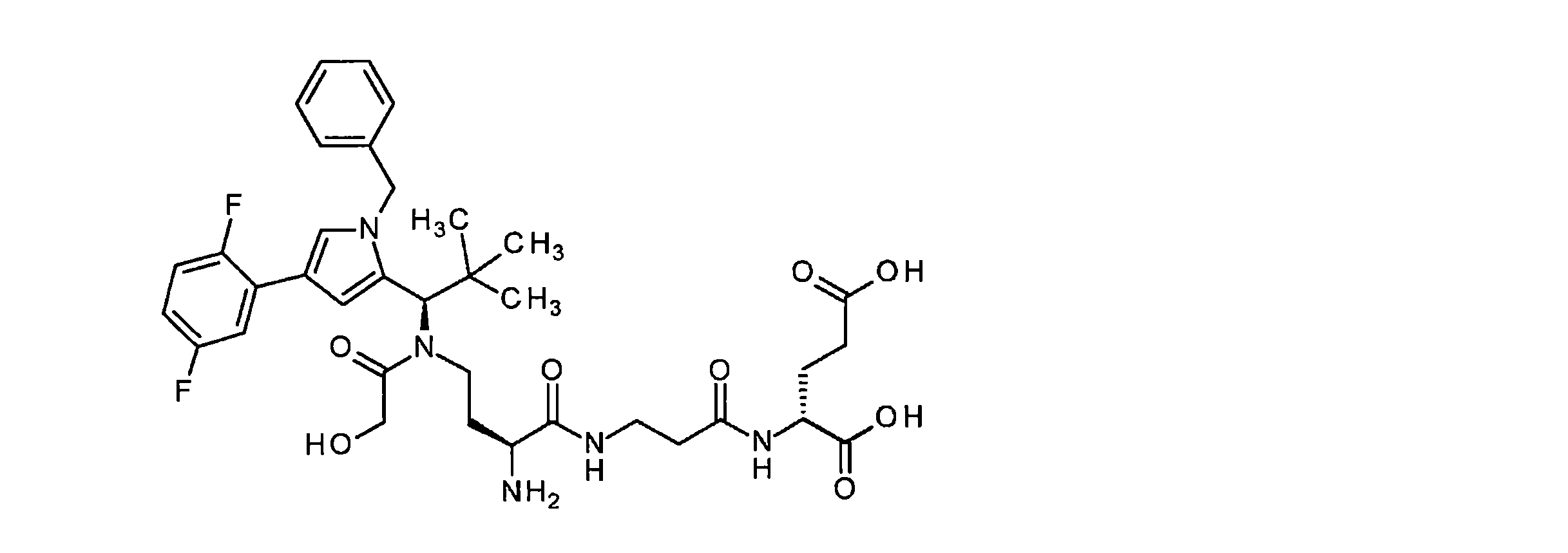
LC-MS(方法1):Rt=1.78分;MS(ESIpos):m/z=714[M+H]+。
Examples of metabolites
Example M1
N-{(2S)-2-amino-4-[{(1R)-1-[1-benzyl-4-(2,5-difluorophenyl)-1H-pyrrol-2-yl]-2,2- Dimethylpropyl}(glycoloyl)amino]butanoyl}-β-alanyl-D-glutamic acid
LC-MS (Method 1): R t =1.78 min; MS (ESIpos): m/z = 714 [M+H] + .
例示的に以下に示されるADCは、好ましい薬理学的特性を有する好ましい代謝産物M1を放出することができる。 The exemplary ADCs shown below are capable of releasing preferred metabolites M1 with preferred pharmacological properties.
実施例ADC
マレイミド基を介して抗体のシステイン側鎖にカップリングした実施例の構造式に示されるADCは、リンカーおよびカップリング手順に応じて、主に各場合に示される開環または閉環形態で存在する。しかしながら、調製物は、少量のそれぞれの他の形態を含んでもよい。
Example ADC
The ADCs shown in the structural formulas of the examples coupled to the cysteine side chains of the antibodies via maleimide groups exist predominantly in the open or closed form shown in each case, depending on the linker and coupling procedure. However, the preparations may also contain minor amounts of each other form.
カップリング反応はアルゴン下で実施した。インビボ試験用のより大きなバッチ全てを調製の最後に滅菌濾過した。 Coupling reactions were carried out under argon. All larger batches for in vivo testing were sterile filtered at the end of preparation.
実施例1

アルゴン下、TCEP0.029mgのPBS緩衝液0.05ml中溶液を、PBS0.5ml中当の抗体5mg(c=10mg/ml)に添加した。混合物を室温で30分間撹拌し、次いで、DMSO50μlに溶解した中間体Q1 0.26mg(0.00023mmol)を添加した。室温でさらに90分間撹拌した後、混合物を予めpH8に調整したPBS緩衝液で2.5ml容量に希釈し、次いで、PBS緩衝液pH8で平衡化したPD10カラム(Sephadex(登録商標)G-25、GE Healthcare)を通過させ、PBS緩衝液pH8で溶出した。溶出液をアルゴン下室温で一晩撹拌した。これに続いて超遠心分離による濃縮およびPBS緩衝液(pH7.2)による再希釈を行った。
Example 1
Under argon, a solution of 0.029 mg TCEP in 0.05 ml PBS buffer was added to 5 mg of the corresponding antibody in 0.5 ml PBS (c=10 mg/ml). The mixture was stirred at room temperature for 30 minutes, then 0.26 mg (0.00023 mmol) of intermediate Q1 dissolved in 50 μl of DMSO was added. After stirring for an additional 90 minutes at room temperature, the mixture was diluted with PBS buffer previously adjusted to pH 8 to a volume of 2.5 ml and then applied to a PD10 column (Sephadex® G-25, GE Healthcare) and eluted with PBS buffer pH8. The eluate was stirred overnight at room temperature under argon. This was followed by concentration by ultracentrifugation and redilution with PBS buffer (pH 7.2).
代表的な手順B:
アルゴン下、TCEP0.172mgのPBS緩衝液0.3ml中溶液を、PBS3ml中当の抗体30mg(c=10mg/ml)に添加した。混合物を室温で30分間撹拌し、次いで、DMSO300μlに溶解した中間体Q1 1.57mg(0.0014mmol)を添加した。室温でさらに90分間撹拌した後、混合物を予めpH8に調整したPBS緩衝液で5ml容量に希釈し、次いで、PBS緩衝液pH8で平衡化したPD10カラム(Sephadex(登録商標)G-25、GE Healthcare)を通過させ、PBS緩衝液pH8で溶出した。溶出液をPBS緩衝液pH8で7.5ml容量に希釈し、アルゴン下室温で一晩撹拌した。次いで、この溶液を、PBS緩衝液pH7.2で平衡化したPD10カラム(Sephadex(登録商標)G-25、GE Healthcare)にアプライし、PBS緩衝液pH7.2で溶出した。次いで、溶出液を超遠心分離によって濃縮し、PBS緩衝液(pH7.2)で再希釈し、再濃縮し、再び滅菌濾過した。
Representative Procedure B:
Under argon, a solution of 0.172 mg TCEP in 0.3 ml PBS buffer was added to 30 mg of the antibody in question in 3 ml PBS (c=10 mg/ml). The mixture was stirred at room temperature for 30 minutes, then 1.57 mg (0.0014 mmol) of intermediate Q1 dissolved in 300 μl DMSO was added. After stirring for an additional 90 minutes at room temperature, the mixture was diluted with PBS buffer previously adjusted to pH 8 to a volume of 5 ml and then applied to a PD10 column (Sephadex® G-25, GE Healthcare) equilibrated with PBS buffer pH 8. ) and eluted with PBS buffer pH 8. The eluate was diluted with PBS buffer pH 8 to a volume of 7.5 ml and stirred overnight at room temperature under argon. This solution was then applied to a PD10 column (Sephadex® G-25, GE Healthcare) equilibrated with PBS buffer pH 7.2 and eluted with PBS buffer pH 7.2. The eluate was then concentrated by ultracentrifugation, re-diluted with PBS buffer (pH 7.2), re-concentrated and sterile filtered again.
以下のADCをこれらの手順と同様に調製し、表に示されるように特徴付けた: The following ADCs were prepared analogously to these procedures and characterized as shown in the table:

実施例2

アルゴン下で、DMSO50μlに溶解した5当量(0.2mg)の中間体Q2をPBS0.5ml中の当の抗体5mgに添加した(c=10mg/ml)。室温で1時間撹拌した後、再び同量を添加し、混合物を室温でさらに1時間撹拌した。その後、反応混合物をPBS緩衝液(pH7.2)で2.5mlに希釈し、Sephadexカラムで精製し、次いで、超遠心分離によって濃縮し、PBS(pH7.2)で再希釈した。
Example 2
Under argon, 5 equivalents (0.2 mg) of intermediate Q2 dissolved in 50 μl of DMSO were added to 5 mg of the corresponding antibody in 0.5 ml of PBS (c=10 mg/ml). After stirring for 1 hour at room temperature, the same amount was added again and the mixture was stirred for another hour at room temperature. The reaction mixture was then diluted to 2.5 ml with PBS buffer (pH 7.2), purified on a Sephadex column, then concentrated by ultracentrifugation and rediluted with PBS (pH 7.2).
代表的な手順B:
アルゴン下で、DMSO50μlに溶解した4当量(1mg)の中間体Q2をPBS緩衝液(pH7.2)3ml中の当の抗体30mgに添加した(c=10mg/ml)。室温で1時間撹拌した後、再び同量を添加し、混合物を室温でさらに1時間撹拌した。次いで、混合物をPBS緩衝液(pH7.2)で5mlに希釈し、Sephadexカラムで精製し、次いで、超遠心分離によって濃縮し、PBS(pH7.2)で再希釈し、再濃縮し、再び滅菌濾過した。
Representative Procedure B:
Under argon, 4 equivalents (1 mg) of intermediate Q2 dissolved in 50 μl of DMSO were added to 30 mg of the corresponding antibody in 3 ml of PBS buffer (pH 7.2) (c=10 mg/ml). After stirring for 1 hour at room temperature, the same amount was added again and the mixture was stirred for another hour at room temperature. The mixture was then diluted to 5 ml with PBS buffer (pH 7.2), purified on a Sephadex column, then concentrated by ultracentrifugation, rediluted with PBS (pH 7.2), re-concentrated and sterilized again. filtered.
代表的な手順C:
アルゴン下で、DMSO250μlに溶解した2.5当量(1mg)の中間体Q2をPBS緩衝液(pH7.2)5ml中の当の抗体50mgに添加した(c=10mg/ml)。室温で1時間撹拌した後、再び同量を添加し、混合物を室温でさらに1時間撹拌した。次いで、混合物をPBS緩衝液(pH7.2)で7.5mlに希釈し、Sephadexカラムで精製し、次いで、超遠心分離によって濃縮し、PBS(pH7.2)で再希釈し、再濃縮し、再び滅菌濾過した。
Representative Procedure C:
Under argon, 2.5 equivalents (1 mg) of intermediate Q2 dissolved in 250 μl of DMSO were added to 50 mg of the corresponding antibody in 5 ml of PBS buffer (pH 7.2) (c=10 mg/ml). After stirring for 1 hour at room temperature, the same amount was added again and the mixture was stirred for another hour at room temperature. The mixture was then diluted to 7.5 ml with PBS buffer (pH 7.2), purified on a Sephadex column, then concentrated by ultracentrifugation, re-diluted with PBS (pH 7.2), re-concentrated, Sterile filtered again.
代表的な手順D:
アルゴン下で、DMSO7.5mlに溶解した4.5当量(36mg)の中間体Q2をPBS緩衝液(pH7.2)150ml中の当の抗体1000mgに添加した(c=6.7mg/ml)。
Representative Procedure D:
Under argon, 4.5 equivalents (36 mg) of intermediate Q2 dissolved in 7.5 ml of DMSO were added to 1000 mg of the corresponding antibody in 150 ml of PBS buffer (pH 7.2) (c=6.7 mg/ml).
室温で1時間撹拌した後、再び同量を添加し、混合物を室温でさらに1時間撹拌した。次いで、バッチをクロスフロー濾過によって精製し、濃縮し、滅菌濾過した。 After stirring for 1 hour at room temperature, the same amount was added again and the mixture was stirred for another hour at room temperature. The batch was then purified by cross-flow filtration, concentrated and sterile filtered.

実施例3

アルゴン下で、DMSO50μlに溶解した5当量(0.2mg)の中間体Q3をPBS0.5ml中の当の抗体5mgに添加した(c=10mg/ml)。室温で1時間撹拌した後、再び同量を添加し、混合物を室温でさらに1時間撹拌した。その後、反応混合物をPBS緩衝液(pH7.2)で2.5mlに希釈し、Sephadexカラムで精製し、次いで、超遠心分離によって濃縮し、PBS(pH7.2)で再希釈した。
Example 3
Under argon, 5 equivalents (0.2 mg) of intermediate Q3 dissolved in 50 μl of DMSO were added to 5 mg of the corresponding antibody in 0.5 ml of PBS (c=10 mg/ml). After stirring for 1 hour at room temperature, the same amount was added again and the mixture was stirred for another hour at room temperature. The reaction mixture was then diluted to 2.5 ml with PBS buffer (pH 7.2), purified on a Sephadex column, then concentrated by ultracentrifugation and rediluted with PBS (pH 7.2).
代表的な手順B:
アルゴン下で、DMSO50μlに溶解した4当量(1mg)の中間体Q3をPBS緩衝液(pH7.2)3ml中の当の抗体30mgに添加した(c=10mg/ml)。室温で1時間撹拌した後、再び同量を添加し、混合物を室温でさらに1時間撹拌した。次いで、混合物をPBS緩衝液(pH7.2)で2.5mlに希釈し、Sephadexカラムで精製し、次いで、超遠心分離によって濃縮し、PBS(pH7.2)で再希釈し、再濃縮し、再び滅菌濾過した。
Representative Procedure B:
Under argon, 4 equivalents (1 mg) of intermediate Q3 dissolved in 50 μl of DMSO were added to 30 mg of the corresponding antibody in 3 ml of PBS buffer (pH 7.2) (c=10 mg/ml). After stirring for 1 hour at room temperature, the same amount was added again and the mixture was stirred for another hour at room temperature. The mixture was then diluted to 2.5 ml with PBS buffer (pH 7.2), purified on a Sephadex column, then concentrated by ultracentrifugation, re-diluted with PBS (pH 7.2), re-concentrated, Sterile filtered again.

実施例4

アルゴン下、TCEP0.029mgのPBS緩衝液0.05ml中溶液を、PBS緩衝液(pH7.2)0.4ml中当の抗体5mg(c=12.5mg/ml)に添加した。混合物を室温で30分間撹拌し、次いで、DMSO50μlに溶解した中間体Q4 0.275mg(0.00023mmol)を添加した。室温でさらに90分間撹拌した後、反応物をPBS緩衝液で総容量2.5mlに希釈した。次いで、この溶液を、PBS緩衝液(pH7.2)で平衡化したPD10カラム(Sephadex(登録商標)G-25、GE Healthcare)にアプライし、PBS緩衝液(pH7.2)で溶出した。これに続いて超遠心分離による濃縮およびPBS緩衝液(pH7.2)による再希釈を行った。
Example 4
Under argon, a solution of 0.029 mg TCEP in 0.05 ml PBS buffer was added to 5 mg (c=12.5 mg/ml) of the corresponding antibody in 0.4 ml PBS buffer (pH 7.2). The mixture was stirred at room temperature for 30 minutes, then 0.275 mg (0.00023 mmol) of intermediate Q4 dissolved in 50 μl of DMSO was added. After stirring for an additional 90 minutes at room temperature, the reaction was diluted with PBS buffer to a total volume of 2.5 ml. This solution was then applied to a PD10 column (Sephadex® G-25, GE Healthcare) equilibrated with PBS buffer (pH 7.2) and eluted with PBS buffer (pH 7.2). This was followed by concentration by ultracentrifugation and redilution with PBS buffer (pH 7.2).

実施例5

アルゴン下で、DMSO50μlに溶解した5当量(0.2mg)の中間体Q5をPBS0.5ml中の当の抗体5mgに添加した(c=10mg/ml)。室温で1時間撹拌した後、再び同量を添加し、混合物を室温でさらに1時間撹拌した。その後、反応混合物をPBS緩衝液(pH7.2)で2.5mlに希釈し、Sephadexカラムで精製し、次いで、超遠心分離によって濃縮し、PBS(pH7.2)で再希釈した。
Example 5
Under argon, 5 equivalents (0.2 mg) of intermediate Q5 dissolved in 50 μl of DMSO were added to 5 mg of the antibody in question in 0.5 ml of PBS (c=10 mg/ml). After stirring for 1 hour at room temperature, the same amount was added again and the mixture was stirred for another hour at room temperature. The reaction mixture was then diluted to 2.5 ml with PBS buffer (pH 7.2), purified on a Sephadex column, then concentrated by ultracentrifugation and rediluted with PBS (pH 7.2).

実施例6

アルゴン下で、DMSO50μlに溶解した5当量(0.18mg)の中間体Q6をPBS0.4ml中の当の抗体5mgに添加した(c=12.5mg/ml)。室温で1時間撹拌した後、再び同量を添加し、混合物を室温でさらに1時間撹拌した。その後、反応混合物をPBS緩衝液(pH7.2)で2.5mlに希釈し、Sephadexカラムで精製し、次いで、超遠心分離によって濃縮し、PBS(pH7.2)で再希釈した。
Example 6
Under argon, 5 equivalents (0.18 mg) of intermediate Q6 dissolved in 50 μl of DMSO were added to 5 mg of the corresponding antibody in 0.4 ml of PBS (c=12.5 mg/ml). After stirring for 1 hour at room temperature, the same amount was added again and the mixture was stirred for another hour at room temperature. The reaction mixture was then diluted to 2.5 ml with PBS buffer (pH 7.2), purified on a Sephadex column, then concentrated by ultracentrifugation and rediluted with PBS (pH 7.2).

実施例7

アルゴン下、TCEP0.029mgのPBS緩衝液0.05ml中溶液を、PBS0.4ml中当の抗体5mg(c=12.5mg/ml)に添加した。混合物を室温で30分間撹拌し、次いで、DMSO50μlに溶解した中間体Q7 0.24mg(0.00023mmol)を添加した。室温でさらに90分間撹拌した後、混合物を予めpH8に調整したPBS緩衝液で2.5ml容量に希釈し、次いで、PBS緩衝液pH8で平衡化したPD10カラム(Sephadex(登録商標)G-25、GE Healthcare)を通過させ、PBS緩衝液pH8で溶出した。溶出液をアルゴン下室温で一晩撹拌した。これに続いて超遠心分離による濃縮およびPBS緩衝液(pH7.2)による再希釈を行った。
Example 7
Under argon, a solution of 0.029 mg TCEP in 0.05 ml PBS buffer was added to 5 mg of the corresponding antibody in 0.4 ml PBS (c=12.5 mg/ml). The mixture was stirred at room temperature for 30 minutes, then 0.24 mg (0.00023 mmol) of intermediate Q7 dissolved in 50 μl of DMSO was added. After stirring for an additional 90 minutes at room temperature, the mixture was diluted with PBS buffer previously adjusted to pH 8 to a volume of 2.5 ml and then applied to a PD10 column (Sephadex® G-25, GE Healthcare) and eluted with PBS buffer pH8. The eluate was stirred overnight at room temperature under argon. This was followed by concentration by ultracentrifugation and redilution with PBS buffer (pH 7.2).

実施例8

アルゴン下で、DMSO50μlに溶解した5当量(0.2mg)の中間体Q8をPBS0.5ml中の当の抗体5mgに添加した(c=10mg/ml)。室温で1時間撹拌した後、再び同量を添加し、混合物を室温でさらに1時間撹拌した。その後、反応混合物をPBS緩衝液(pH7.2)で2.5mlに希釈し、Sephadexカラムで精製し、次いで、超遠心分離によって濃縮し、PBS(pH7.2)で再希釈した。
Example 8
Under argon, 5 equivalents (0.2 mg) of intermediate Q8 dissolved in 50 μl of DMSO were added to 5 mg of the antibody in question in 0.5 ml of PBS (c=10 mg/ml). After stirring for 1 hour at room temperature, the same amount was added again and the mixture was stirred for another hour at room temperature. The reaction mixture was then diluted to 2.5 ml with PBS buffer (pH 7.2), purified on a Sephadex column, then concentrated by ultracentrifugation and rediluted with PBS (pH 7.2).

実施例9

アルゴン下で、DMSO50μlに溶解した5当量(0.2mg)の中間体Q9をPBS0.5ml中の当の抗体5mgに添加した(c=10mg/ml)。室温で1時間撹拌した後、再び同量を添加し、混合物を室温でさらに1時間撹拌した。その後、反応混合物をPBS緩衝液(pH7.2)で2.5mlに希釈し、Sephadexカラムで精製し、次いで、超遠心分離によって濃縮し、PBS(pH7.2)で再希釈した。
Example 9
Under argon, 5 equivalents (0.2 mg) of intermediate Q9 dissolved in 50 μl of DMSO were added to 5 mg of the antibody in question in 0.5 ml of PBS (c=10 mg/ml). After stirring for 1 hour at room temperature, the same amount was added again and the mixture was stirred for another hour at room temperature. The reaction mixture was then diluted to 2.5 ml with PBS buffer (pH 7.2), purified on a Sephadex column, then concentrated by ultracentrifugation and rediluted with PBS (pH 7.2).

実施例10

アルゴン下、TCEP0.029mgのPBS緩衝液0.05ml中溶液を、PBS緩衝液(pH7.2)0.5ml中当の抗体5mg(c=10mg/ml)に添加した。混合物を室温で30分間撹拌し、次いで、DMSO50μlに溶解した中間体Q10 0.295mg(0.00023mmol)を添加した。室温でさらに20時間撹拌した後、反応物をPBS緩衝液で総容量2.5mlに希釈した。次いで、この溶液を、PBS緩衝液(pH7.2)で平衡化したPD10カラム(Sephadex(登録商標)G-25、GE Healthcare)にアプライし、PBS緩衝液(pH7.2)で溶出した。これに続いて超遠心分離による濃縮およびPBS緩衝液(pH7.2)による再希釈を行った。
Example 10
Under argon, a solution of 0.029 mg TCEP in 0.05 ml PBS buffer was added to 5 mg (c=10 mg/ml) of the corresponding antibody in 0.5 ml PBS buffer (pH 7.2). The mixture was stirred at room temperature for 30 minutes, then 0.295 mg (0.00023 mmol) of intermediate Q10 dissolved in 50 μl of DMSO was added. After stirring for an additional 20 hours at room temperature, the reaction was diluted with PBS buffer to a total volume of 2.5 ml. This solution was then applied to a PD10 column (Sephadex® G-25, GE Healthcare) equilibrated with PBS buffer (pH 7.2) and eluted with PBS buffer (pH 7.2). This was followed by concentration by ultracentrifugation and redilution with PBS buffer (pH 7.2).
より高いDARを得るための代表的な手順C:
アルゴン下、TCEP0.057mgのPBS緩衝液0.05ml中溶液を、PBS緩衝液(pH7.2)0.5ml中当の抗体5mg(c=10mg/ml)に添加した。混合物を室温で30分間撹拌し、次いで、DMSO50μlに溶解した中間体Q10 0.59mg(0.00053mmol)を添加した。室温でさらに20時間撹拌した後、反応物をPBS緩衝液で総容量2.5mlに希釈した。次いで、この溶液を、PBS緩衝液(pH7.2)で平衡化したPD10カラム(Sephadex(登録商標)G-25、GE Healthcare)にアプライし、PBS緩衝液(pH7.2)で溶出した。これに続いて超遠心分離による濃縮およびPBS緩衝液(pH7.2)による再希釈を行った。
Representative procedure C for obtaining higher DAR:
Under argon, a solution of 0.057 mg TCEP in 0.05 ml PBS buffer was added to 5 mg (c=10 mg/ml) of the corresponding antibody in 0.5 ml PBS buffer (pH 7.2). The mixture was stirred at room temperature for 30 minutes, then 0.59 mg (0.00053 mmol) of intermediate Q10 dissolved in 50 μl of DMSO was added. After stirring for an additional 20 hours at room temperature, the reaction was diluted with PBS buffer to a total volume of 2.5 ml. This solution was then applied to a PD10 column (Sephadex® G-25, GE Healthcare) equilibrated with PBS buffer (pH 7.2) and eluted with PBS buffer (pH 7.2). This was followed by concentration by ultracentrifugation and redilution with PBS buffer (pH 7.2).

実施例11

アルゴン下、TCEP0.029mgのPBS緩衝液0.05ml中溶液を、PBS緩衝液(pH7.2)0.4ml中当の抗体5mg(c=12.5mg/ml)に添加した。混合物を室温で30分間撹拌し、次いで、DMSO50μlに溶解した中間体Q11 0.32mg(0.00023mmol)を添加した。室温でさらに20時間撹拌した後、反応物をPBS緩衝液で総容量2.5mlに希釈した。次いで、この溶液を、PBS緩衝液(pH7.2)で平衡化したPD10カラム(Sephadex(登録商標)G-25、GE Healthcare)にアプライし、PBS緩衝液(pH7.2)で溶出した。これに続いて超遠心分離による濃縮およびPBS緩衝液(pH7.2)による再希釈を行った。
Example 11
Under argon, a solution of 0.029 mg TCEP in 0.05 ml PBS buffer was added to 5 mg (c=12.5 mg/ml) of the corresponding antibody in 0.4 ml PBS buffer (pH 7.2). The mixture was stirred at room temperature for 30 minutes, then 0.32 mg (0.00023 mmol) of intermediate Q11 dissolved in 50 μl of DMSO was added. After stirring for an additional 20 hours at room temperature, the reaction was diluted with PBS buffer to a total volume of 2.5 ml. This solution was then applied to a PD10 column (Sephadex® G-25, GE Healthcare) equilibrated with PBS buffer (pH 7.2) and eluted with PBS buffer (pH 7.2). This was followed by concentration by ultracentrifugation and redilution with PBS buffer (pH 7.2).

比較のために、以下のADCを調製した:
参照実施例R1:

Reference Example R1:

参照実施例R2:


参照実施例R1については、国際公開第2015/096982号パンフレットに、それに由来する代謝産物実施例98が記載されている。参照実施例R2については、国際公開第2016/096610号パンフレットに、同一の代謝産物である実施例M9が記載されており、これは本明細書中で参照実施例R3Mとして列挙されている。 For Reference Example R1, WO2015/096982 describes metabolite Example 98 derived therefrom. For Reference Example R2, WO2016/096610 describes the same metabolite Example M9, which is listed herein as Reference Example R3M.
参照実施例R3M:
N-(3-アミノプロピル)-N-{(1R)-1-[1-ベンジル-4-(2,5-ジフルオロフェニル)-1H-ピロール-2-イル]-2,2-ジメチルプロピル}-2-ヒドロキシアセトアミド

N-(3-aminopropyl)-N-{(1R)-1-[1-benzyl-4-(2,5-difluorophenyl)-1H-pyrrol-2-yl]-2,2-dimethylpropyl} -2-hydroxyacetamide
前記出願に開示されているこれらの参照化合物についてのまたは新規の参照化合物について得られた生物学的データを、C章に記載する。 Biological data obtained for these reference compounds disclosed in said application or for novel reference compounds are described in Section C.
C:生物学的有効性の評価
本発明による化合物の生物学的活性を以下に記載されるアッセイで示すことができる:
a.C-1a ADCの細胞傷害性効果の決定
ADCの細胞傷害効果の分析を、種々の細胞株を用いて行った:
NCI-H292:ヒト粘表皮肺癌細胞、ATCC-CRL-1848、標準培地:RPMI 1640(Biochrom;番号FG1215、stab.グルタミン)+10%FCS(Sigma;番号F2442)、TWEAKR陽性;EGFR陽性。
C: Assessment of biological effectiveness
The biological activity of the compounds according to the invention can be demonstrated in the assays described below:
a. Determination of cytotoxic effect of C-1a ADC
Analysis of the cytotoxic effect of ADC was performed using various cell lines:
NCI-H292: human mucoepidermoid lung cancer cells, ATCC-CRL-1848, standard medium: RPMI 1640 (Biochrom; number FG1215, stab. glutamine) + 10% FCS (Sigma; number F2442), TWEAKR positive; EGFR positive.
BxPC3:ヒト膵臓癌細胞、ATCC-CRL-1687、標準培地:RPMI 1640(Biochrom;番号FG1215、stab.グルタミン)+10%FCS(Sigma;番号F2442)、TWEAKR陽性。 BxPC3: human pancreatic cancer cells, ATCC-CRL-1687, standard medium: RPMI 1640 (Biochrom; number FG1215, stab. glutamine) + 10% FCS (Sigma; number F2442), TWEAKR positive.
LoVo:ヒト結腸直腸がん細胞、ATCC番号CCL-229、MTTアッセイのための培養:標準培地:Kaighn’s+L-グルタミン(Invitrogen 21127)+10%熱不活性化FCS(Gibco製、番号10500-064)。CTGアッセイのための培養:RPMI 1640(Biochrom;番号FG1215、stab.グルタミン)+10%FCS(Sigma番号F2442)。TWEAKR陽性。 LoVo: human colorectal cancer cells, ATCC number CCL-229, culture for MTT assay: standard medium: Kaighn's + L-glutamine (Invitrogen 21127) + 10% heat-inactivated FCS (Gibco, #10500-064) . Culture for CTG assay: RPMI 1640 (Biochrom; #FG1215, stab. glutamine) + 10% FCS (Sigma #F2442). TWEAKR positive.
KPL4:ヒト乳がん細胞株、Bayer Pharma AG(DSMZで2012年7月19日に同一性を検査および確認)、標準培地:RPMI 1640(Gibco製;番号21875-059、stab.L-グルタミン)+10%熱不活性化FCS(Gibco、番号10500-064);HER2陽性。 KPL4: human breast cancer cell line, Bayer Pharma AG (identity tested and confirmed at DSMZ July 19, 2012), standard medium: RPMI 1640 (Gibco; number 21875-059, stab. L-glutamine) + 10% Heat-inactivated FCS (Gibco, #10500-064); HER2 positive.
SK-HEP-1:ヒト肝細胞癌細胞株、ATCC番号HTB-52、標準培地:アール塩を含むMEM+Glutamax I(Invitrogen 41090)+10%熱不活性化FCS(Gibco製、番号10500-064);EGFR陽性、TWEAKR陽性 SK-HEP-1: human hepatocellular carcinoma cell line, ATCC number HTB-52, standard medium: MEM with Earle's salts + Glutamax I (Invitrogen 41090) + 10% heat-inactivated FCS (Gibco, number 10500-064); EGFR positive, TWEAKR positive
MOLM-13:ヒト急性単球性白血病細胞(AML-M5a)、DSMZ、番号ACC554、標準培地:RPMI1640(Gibco製;番号21875-059、stab.L-グルタミン)+20%熱不活性化FCS(Gibco、番号10500-064);CD123陽性。 MOLM-13: human acute monocytic leukemia cells (AML-M5a), DSMZ, number ACC554, standard medium: RPMI1640 (Gibco; number 21875-059, stab. L-glutamine) + 20% heat-inactivated FCS (Gibco , number 10500-064); CD123 positive.
MV-4-11:末梢血から得たヒト二重表現型(biphenotypic)B骨髄単球性白血病細胞、ATCC-CRL-9591、標準培地:IMDM(ATCC:30-2005)+10%熱不活性化FCS(Gibco、番号10500-064);CD123陽性。 MV-4-11: human biphenotypic B myelomonocytic leukemia cells from peripheral blood, ATCC-CRL-9591, standard medium: IMDM (ATCC: 30-2005) + 10% heat inactivation FCS (Gibco, #10500-064); CD123 positive.
NB4:骨髄から得たヒト急性前骨髄球性白血病細胞、DSMZ、番号ACC 207、標準培地:RPMI 1640+GlutaMAX I(Invitrogen 61870)+10%熱不活性化FCS(Gibco、番号10500-064)+グルコース2.5g(20%グルコース溶液、Gibco、番号19002)+10mM Hepes(Invitrogen 15630)+1mMピルビン酸ナトリウム(Invitrogen 11360);CD123陰性 NB4: Human acute promyelocytic leukemia cells from bone marrow, DSMZ, #ACC 207, standard medium: RPMI 1640 + GlutaMAX I (Invitrogen 61870) + 10% heat-inactivated FCS (Gibco, #10500-064) + glucose2. 5 g (20% glucose solution, Gibco, #19002) + 10 mM Hepes (Invitrogen 15630) + 1 mM sodium pyruvate (Invitrogen 11360); CD123 negative
Rec-1:ヒトマントル細胞リンパ腫細胞(B細胞非ホジキンリンパ腫)ATCC CRL-3004、標準培地:RPMI 1640+GlutaMAX I(Invitrogen 61870)+10%熱不活性化FCS(Gibco、番号10500-064)+10mM)CXCR 5陽性 Rec-1: human mantle cell lymphoma cells (B-cell non-Hodgkin's lymphoma) ATCC CRL-3004, standard medium: RPMI 1640 + GlutaMAX I (Invitrogen 61870) + 10% heat-inactivated FCS (Gibco, #10500-064) + 10 mM) CXCR 5 positive
U251:ヒト神経膠芽腫細胞、標準培地:RPMI 1640(Biochrom;番号FG1215、stab.グルタミン)+10%FCS(Biochrom;番号S0415)、B7H3陽性。 U251: human glioblastoma cells, standard medium: RPMI 1640 (Biochrom; #FG1215, stab. glutamine) + 10% FCS (Biochrom; #S0415), positive for B7H3.
HBL-1:ヒトB細胞リンパ腫細胞(びまん性大細胞型B細胞リンパ腫)ATT CRL-RRID(資源識別イニシアチブ):CVCL_4213、最初にAbeらCancer 61:483~490(1988)に記載され、Lenz教授、ミュンスター大学から得られた;標準培地:RPMI 1640(Biochrom;版ふぉうFG1215、stab.グルタミン)+10%FCS(Biochrom;番号S0415)、Rec-1細胞と同様の培養;CXCR5陽性 HBL-1: Human B-cell lymphoma cells (diffuse large B-cell lymphoma) ATT CRL-RRID (Resource Identification Initiative): CVCL_4213, originally described in Abe et al. Cancer 61:483-490 (1988), Prof. Lenz , obtained from the University of Münster; standard medium: RPMI 1640 (Biochrom; plateau FG1215, stab. glutamine) + 10% FCS (Biochrom; number S0415), cultured as for Rec-1 cells; CXCR5 positive
当の細胞株について、アメリカ培養細胞系統保存機関(ATCC)またはLeibniz-Institut DSMZ-Deutsche Sammlung von Mikroorganismen und Zellkulturen GmbH(DSMZ)によって明言されている標準的方法によって細胞を培養した。 For the cell lines in question, the cells were cultured by standard methods as specified by the American Type Culture Collection (ATCC) or the Leibniz-Institut DSMZ-Deutsche Sammlung von Mikroorganismen und Zellkulturen GmbH (DSMZ).
CTGアッセイ
細胞を、C-1に指定されている増殖培地を用いて標準的な方法によって培養した。トリプシン(0.05%)およびEDTA(0.02%)のPBS(Biochrom AG番号L2143)中溶液で細胞を剥離し、ペレット化し、培養培地に再懸濁し、計数し、白色底の96ウェル培養プレート(Costar番号3610)に播種し(75μl/ウェルで、1ウェルあたり以下の細胞数である:NCI-H292:2500細胞/ウェル、BxPC3 2500細胞/ウェル、LoVo 3000細胞/ウェル)、37℃および5%二酸化炭素でインキュベーター中でインキュベートすることによって、試験を行った。懸濁細胞を計数し、白色底を有する96ウェル培養プレート(Costar番号3610)(75μl/ウェル、1ウェル当たり以下の細胞数:Rec-1:3000細胞/ウェル、HBL-1:6000細胞/ウェル)に播種した。24時間後、抗体薬物コンジュゲートを、25μlの培養培地(4倍濃縮)中細胞に添加して、細胞上3×10-7M~3×10-11Mの最終抗体薬物コンジュゲート濃度を得た(3連)。次いで、細胞を37℃および5%二酸化炭素のインキュベーター内でインキュベートした。並列プレート上で、薬物処理開始時(0日目)の細胞活性を、Cell Titer Glow(CTG)発光細胞生存率アッセイ(Promega番号G7573および番号G7571)を使用して決定した。この目的のために、1細胞バッチ当たり100μlの基質を添加し、次いで、プレートをアルミ箔で覆い、プレートシェーカー上180rpmで2分間振盪し、実験室ベンチに8分間放置し、次いで、ルミノメーター(Victor X2、Perkin Elmer)を使用して測定した。基質は、その強度が細胞の生存率に正比例する発光シグナルを生成する生細胞中のATP含量を検出する。次いで、抗体薬物コンジュゲートとの72時間のインキュベーション後、これらの細胞の生存率も、上記のCell Titer Glow発光細胞生存率アッセイを使用して決定した。測定されたデータから、増殖阻害のIC50を、0日目と比較して、DRC(用量反応曲線)分析スプレッドシートおよび4パラメータ当てはめを使用して計算した。DRC分析スプレッドシートは、IDBS E-WorkBook Suiteプラットフォーム(IDBS:ID Business Solutions Ltd.、Guildford、英国)でBayer Pharma AGおよびBayer Business Servicesによって開発されたバイオブックスプレッドシートである。
CTG Assay Cells were cultured by standard methods using growth medium designated C-1. Cells were detached with a solution of trypsin (0.05%) and EDTA (0.02%) in PBS (Biochrom AG #L2143), pelleted, resuspended in culture medium, counted and plated in white-bottom 96-well cultures. Plates (Costar #3610) were seeded (75 μl/well with the following cell numbers per well: NCI-H292: 2500 cells/well, BxPC3 2500 cells/well, LoVo 3000 cells/well) at 37° C. and Testing was done by incubating in an incubator with 5% carbon dioxide. Suspended cells were counted, 96-well culture plate with white bottom (Costar #3610) (75 μl/well, the following cell numbers per well: Rec-1: 3000 cells/well, HBL-1: 6000 cells/well ). After 24 hours, the antibody-drug conjugate was added to the cells in 25 μl of culture medium (4-fold concentrated) to give a final antibody-drug conjugate concentration on the cells of 3×10 −7 M to 3×10 −11 M. (three consecutive). Cells were then incubated in an incubator at 37°C and 5% carbon dioxide. On parallel plates, cell activity at the start of drug treatment (day 0) was determined using the Cell Titer Glow (CTG) Luminescent Cell Viability Assay (Promega #G7573 and #G7571). For this purpose, 100 μl of substrate was added per cell batch, then the plate was covered with aluminum foil, shaken on a plate shaker at 180 rpm for 2 minutes, left on the laboratory bench for 8 minutes, then placed on a luminometer ( Victor X2, Perkin Elmer). The substrate detects ATP content in living cells producing a luminescent signal whose intensity is directly proportional to cell viability. The viability of these cells was then also determined using the Cell Titer Glow Luminescent Cell Viability Assay described above after 72 hours of incubation with antibody drug conjugates. From the measured data, the IC50 for growth inhibition was calculated compared to day 0 using a DRC (dose-response curve) analysis spreadsheet and a 4-parameter fit. The DRC analysis spreadsheet is a biobook spreadsheet developed by Bayer Pharma AG and Bayer Business Services on the IDBS E-WorkBook Suite platform (IDBS: ID Business Solutions Ltd., Guildford, UK).
MTTアッセイ
細胞を、C-1に指定されている増殖培地を用いて標準的な方法によって培養した。細胞をAccutase(登録商標)のPBS中溶液(Biochrom AG製 番号L2143)で剥離し、ペレット化し、培養培地に再懸濁し、計数し、白色底の96ウェル培養プレート(Costar製 番号3610)に播種することによって(NCI H292:2500細胞/ウェル;SK-HEP-1:1000細胞/ウェル;KPL-4:1200細胞/ウェル;総容量100μl)、試験を行った。次いで、細胞を37℃および5%二酸化炭素のインキュベーター内でインキュベートした。48時間後、培地を交換した。次いで、10-5M~10-13Mの濃度の培養培地10μl中の抗体薬物コンジュゲートを細胞にピペットで分注し(3連で)、次いで、アッセイを37℃および5%二酸化炭素のインキュベーター内でインキュベートした。懸濁細胞を計数し、白色底の96ウェルプレート(Costar製 番号3610)(番号3610)に播種した(総容量100μl中MOLM-13:2000細胞/ウェル;NB4:7000細胞/ウェル;MV-4-11:5000細胞/ウェル)。37℃および5%二酸化炭素で6時間インキュベートした後、培地を交換し、抗体-薬物コンジュゲートまたは代謝産物を、90μl中細胞に(3連)、10-5M~10-13Mの濃度で培養培地10μlにピペットによって添加した。バッチをインキュベーター中、37℃および5%二酸化炭素でインキュベートした。96時間後、MTTアッセイ(ATCC、Manassas、Virginia、米国、カタログ番号30-1010K)を用いて細胞増殖を検出した。この目的のために、MTT試薬を細胞と共に4時間インキュベートし、引き続いて界面活性剤を添加して細胞を一晩溶解させた。形成された色素を570nmで検出した(Infinite M1000 pro、Tecan)。測定したデータを使用して、DRC(用量応答曲線)を用いて増殖阻害のIC50を計算した。試験物質で処理しなかったが、それ以外は同様に処理した細胞の増殖を100%の数値として定義した。
MTT Assay Cells were cultured by standard methods using growth medium designated C-1. Cells were detached with a solution of Accutase® in PBS (Biochrom AG #L2143), pelleted, resuspended in culture medium, counted and plated in white bottom 96-well culture plates (Costar #3610). (NCI H292: 2500 cells/well; SK-HEP-1: 1000 cells/well; KPL-4: 1200 cells/well; total volume 100 μl). Cells were then incubated in an incubator at 37°C and 5% carbon dioxide. After 48 hours, medium was changed. Antibody-drug conjugates in 10 μl of culture medium at concentrations of 10 −5 M to 10 −13 M were then pipetted onto the cells (in triplicate), and the assay was then placed in an incubator at 37° C. and 5% carbon dioxide. incubated in Suspended cells were counted and seeded in white-bottomed 96-well plates (Costar #3610) (MOLM-13: 2000 cells/well; NB4: 7000 cells/well; MV-4 in a total volume of 100 μl). -11: 5000 cells/well). After 6 hours of incubation at 37°C and 5% carbon dioxide, the medium was changed and antibody-drug conjugates or metabolites were added to the cells in 90 μl (triplicates) at concentrations of 10 −5 M to 10 −13 M. Added by pipette to 10 μl of culture medium. Batches were incubated in an incubator at 37°C and 5% carbon dioxide. After 96 hours, cell proliferation was detected using the MTT assay (ATCC, Manassas, Virginia, USA, catalog number 30-1010K). For this purpose, the MTT reagent was incubated with the cells for 4 hours, followed by the addition of detergent to lyse the cells overnight. The dye formed was detected at 570 nm (Infinite M1000 pro, Tecan). The measured data were used to calculate the IC50 for growth inhibition using DRC (dose response curve). Proliferation of cells not treated with the test substance but otherwise treated identically was defined as the value of 100%.
以下の表1aおよび1bは、これらのアッセイからの代表的な実施例についてのIC50値を示す: Tables 1a and 1b below show IC50 values for representative examples from these assays:


以下の表1cは、これらのアッセイからの参照実施例についてのIC50値を列挙する。 Table 1c below lists the IC50 values for the Reference Examples from these assays.

報告される活性データは、薬物/mAB比が示される本実験節に記載される実施例に関連する。この値は、薬物/mAB比が異なる場合に逸脱する可能性がある。IC50値は、いくつかの独立した実験または個々の値の平均である。抗体薬物コンジュゲートの作用は、それぞれのリンカーおよび担毒体を含むそれぞれのアイソタイプ対照に対して選択的であった。CD123に対するADCについて、CD123陰性細胞で試験することによって標的特異性をさらに実証した。 The activity data reported relate to the examples described in this experimental section where drug/mAB ratios are presented. This value may deviate for different drug/mAB ratios. IC50 values are the average of several independent experiments or individual values. The action of the antibody-drug conjugates was selective to their respective isotype controls, including their respective linkers and toxophores. Target specificity was further demonstrated for ADCs against CD123 by testing on CD123-negative cells.
一般に、本発明によるADCは、対応する参照実施例と比較して有意に改善した細胞傷害性効果を示す。 In general, the ADCs according to the invention show significantly improved cytotoxic effects compared to the corresponding reference examples.
C-1b 選択された実施例によるキネシンスピンドルタンパク質KSP/Eg5の阻害の測定
ヒトキネシンスピンドルタンパク質KSP/Eg5(tebu-bio/Cytoskeleton Inc、番号027EG01-XL)のモータードメインを、10nMの濃度で、50μg/mlのタキソール(Sigma番号T7191-5MG)で安定化した微小管(ウシまたはブタ、tebu-bio/Cytoskeleton Inc)と共に、15mM PIPES、pH6.8(5mM MgCl2および10mM DTT、Sigma)中室温で5分間インキュベートした。新たに調製した混合物を、384MTP(Corning製)に等分した。次いで、1.0×10⁻⁶M~1.0×10⁻¹³Mの濃度で試験する阻害剤およびATP(最終濃度500μM、Sigma)を添加した。インキュベーションを室温で2時間行った。マラカイトグリーン(Biomol)を用いて形成された無機リン酸塩を検出することによってATPアーゼ活性を検出した。試薬の添加後、アッセイを室温で50分間インキュベートした後、620nmの波長での吸収を検出した。使用した陽性対照は、モナストロール(Sigma、M8515-1mg)およびイスピネシブ(AdooQ Bioscience A10486)であった。用量-活性曲線の個々のデータは、8倍の測定値である。IC50値は、2つの独立した実験の平均である。100%対照は阻害剤で処理しなかった試料とした。
C-1b Determination of Kinesin Spindle Protein KSP/Eg5 Inhibition by Selected Examples Motor domain of human kinesin spindle protein KSP/Eg5 (tebu-bio/Cytoskeleton Inc, number 027EG01-XL) at 50 μg at a concentration of 10 nM /ml Taxol (Sigma #T7191-5MG) stabilized microtubules (bovine or porcine, tebu-bio/Cytoskeleton Inc) in 15 mM PIPES, pH 6.8 (5 mM MgCl 2 and 10 mM DTT, Sigma) at room temperature. Incubated for 5 minutes. The freshly prepared mixture was aliquoted into 384MTP (from Corning). Inhibitors to be tested at concentrations from 1.0×10 −6 M to 1.0×10 −13 M and ATP (500 μM final concentration, Sigma) were then added. Incubation was carried out at room temperature for 2 hours. ATPase activity was detected by detecting inorganic phosphate formed using malachite green (Biomol). After addition of reagents, the assay was incubated at room temperature for 50 minutes before detecting absorbance at a wavelength of 620 nm. Positive controls used were monastrol (Sigma, M8515-1 mg) and ispinesib (AdooQ Bioscience A10486). Individual data for dose-activity curves are 8-fold measurements. IC50 values are the average of two independent experiments. The 100% control was a sample not treated with inhibitor.
以下の表2は、記載されるアッセイからの代表的な実施例のIC50値を列挙し、対応する細胞傷害性データ(MTTアッセイ)を要約している: Table 2 below lists representative example IC50 values from the assays described and summarizes the corresponding cytotoxicity data (MTT assay):

報告される活性データは、本実験節に記載される実施例に関連する。 Activity data reported relate to the examples described in this experimental section.
C-1c酵素アッセイ
a:カテプシンBアッセイ
試験する全てのカテプシンB切断可能プロドラッグについて、混合物を微小反応容器(0.5ml、エッペンドルフ製)で作製した。ここで使用した酵素はヒト肝組織から得た。2μgのカテプシンB(Sigma C8571 25μg)を最初に装入し、200μlの50mMリン酸Na緩衝液、pH6.0、2mM DTTで総容量200μlにした。次いで、試験する基質溶液50μlをピペットで入れた。混合物をサーモブロック(Thermo Fisher Scientific製)中、40℃で300rpmで一定撹拌しながらインキュベートした。酵素反応を速度論的に制御した。このために、10μlの試料を様々な時間に採取した。酵素反応を停止させるために、採取した試料を直ちに20μlの氷冷メタノールと混和し、次いで、-20℃で凍結した。サンプリングのために選択した時間は、10分後、2時間後、4時間後および24時間後であった。試料をRP-HPLC分析(逆相HPLC、Agilent Technologies 1200シリーズ)によって調べた。放出された担毒体の決定によって、酵素反応の半減期t1/2の決定が可能になった。
C-1c enzyme assay
a: Cathepsin B Assay For all cathepsin B cleavable prodrugs to be tested, mixtures were made in microreaction vessels (0.5 ml, Eppendorf). The enzyme used here was obtained from human liver tissue. 2 μg Cathepsin B (Sigma C8571 25 μg) was initially charged and brought to a total volume of 200 μl with 200 μl 50 mM Na phosphate buffer, pH 6.0, 2 mM DTT. 50 μl of the substrate solution to be tested was then pipetted. The mixture was incubated in a thermoblock (Thermo Fisher Scientific) at 40° C. with constant agitation at 300 rpm. The enzymatic reaction was kinetically controlled. For this, 10 μl samples were taken at various times. To stop the enzymatic reaction, the collected samples were immediately mixed with 20 µl of ice-cold methanol and then frozen at -20°C. The times chosen for sampling were 10 minutes, 2 hours, 4 hours and 24 hours. Samples were examined by RP-HPLC analysis (reversed phase HPLC, Agilent Technologies 1200 series). Determination of the released toxophore allowed determination of the half-life t 1/2 of the enzymatic reaction.
b:レグマインアッセイ
組換えヒト酵素を用いてレグマインアッセイを行った。レグマイン酵素溶液(カタログ番号2199-CY、R&D Systems)を50mM酢酸ナトリウム緩衝液/100mM NaCl、pH4.0に所望の濃度に希釈し、37℃で2時間プレインキュベートした。次いで、rhレグマインを、50mM MES緩衝液、250mM NaCl、pH5.0中1ng/μlの最終濃度に調整した。試験する全てのレグマイン切断可能プロドラッグについて、混合物を微小反応容器(0.5ml、エッペンドルフ製)で作製した。このために、基質溶液を50mM MES緩衝液、250mM NaCl、pH5.0で所望の濃度(2倍濃度)に調整した。酵素反応の速度論的測定のために、250μlのレグマイン溶液を最初に装入し、250μlの基質溶液を添加することによって酵素反応を開始した(最終濃度:単一濃度;3μM)。種々の時点で、50μlの試料を採取した。直ちに、酵素反応を停止させるために100μlの氷冷メタノールをこの試料に添加、次いで、試料を-20℃で凍結した。サンプリングのために選択した時間は、0.5時間後、1時間後、3時間後および24時間後であった。次いで、試料をRP-HPLC分析およびLC-MS分析によって分析した。放出された担毒体の決定によって、酵素反応の半減期t1/2の決定が可能になった。
b: Legumain Assay Legumain assay was performed using recombinant human enzyme. A legumain enzyme solution (catalog number 2199-CY, R&D Systems) was diluted to the desired concentration in 50 mM sodium acetate buffer/100 mM NaCl, pH 4.0 and preincubated at 37° C. for 2 hours. rhlegumain was then adjusted to a final concentration of 1 ng/μl in 50 mM MES buffer, 250 mM NaCl, pH 5.0. For all legumain cleavable prodrugs tested, mixtures were made in microreaction vessels (0.5 ml, Eppendorf). For this, the substrate solution was adjusted to the desired concentration (double concentration) with 50 mM MES buffer, 250 mM NaCl, pH 5.0. For kinetic measurements of the enzymatic reaction, 250 μl of legumain solution was initially charged and the enzymatic reaction was initiated by adding 250 μl of substrate solution (final concentration: single concentration; 3 μM). 50 μl samples were taken at various time points. Immediately, 100 μl of ice-cold methanol was added to the sample to stop the enzymatic reaction, then the sample was frozen at -20°C. The times chosen for sampling were 0.5 hours, 1 hour, 3 hours and 24 hours. Samples were then analyzed by RP-HPLC analysis and LC-MS analysis. Determination of the released toxophore allowed determination of the half-life t 1/2 of the enzymatic reaction.
レグマイン媒介切断を示すための代表例として、レグマインアッセイで生成された基質はモデル化合物AおよびBであった。 As representative examples to demonstrate legumain-mediated cleavage, the substrates generated in the legumain assay were model compounds A and B.
参照実施例モデル化合物A
N-(ピリジン-4-イルアセチル)-L-アラニル-L-アラニル-N1-[(2S)-4-[{(1R)-1-[1-ベンジル-4-(2,5-ジフルオロフェニル)-1H-ピロール-2-イル]-2,2-ジメチルプロピル}(グリコロイル)アミノ]-1-(メチルアミノ)-1-オキソブタン-2-イル]-L-アスパルトアミド

LC-MS(方法1):Rt=0.86分;MS(ESIpos):m/z=902[M+H]+。
Reference Example Model Compound A
N-(pyridin-4-ylacetyl)-L-alanyl-L-alanyl-N 1 -[(2S)-4-[{(1R)-1-[1-benzyl-4-(2,5-difluorophenyl )-1H-pyrrol-2-yl]-2,2-dimethylpropyl}(glycoloyl)amino]-1-(methylamino)-1-oxobutan-2-yl]-L-aspartamide
LC-MS (Method 1): R t =0.86 min; MS (ESIpos): m/z = 902 [M+H] + .
参照実施例モデル化合物B
N-(ピリジン-4-イルアセチル)-L-アラニル-N-メチル-L-アラニル-N1-[(2S)-4-[{(1R)-1-[1-ベンジル-4-(2,5-ジフルオロフェニル)-1H-ピロール-2-イル]-2,2-ジメチルプロピル}(グリコロイル)アミノ]-1-(メチルアミノ)-1-オキソブタン-2-イル]-L-アスパルトアミド

LC-MS(方法1):Rt=0.83分;MS(ESIpos):m/z=916[M+H]+。
Reference Example Model Compound B
N-(pyridin-4-ylacetyl)-L-alanyl-N-methyl-L-alanyl-N 1 -[(2S)-4-[{(1R)-1-[1-benzyl-4-(2, 5-difluorophenyl)-1H-pyrrol-2-yl]-2,2-dimethylpropyl}(glycoloyl)amino]-1-(methylamino)-1-oxobutan-2-yl]-L-aspartamide
LC-MS (Method 1): R t =0.83 min; MS (ESIpos): m/z = 916 [M+H] + .
モデル化合物Aを、レグマインについて上記の条件下で、0.4時間の半減期で標的化合物に切断した。

モデル化合物Bを、レグマインについて上記の条件下で、0.5時間の半減期で標的化合物に切断した。

C-2内在化アッセイ
内在化は、抗体薬物コンジュゲート(ADC)を介した抗原発現がん細胞における細胞傷害性ペイロードの特異的かつ効率的な提供を可能にする重要な過程である。この過程を、特異的抗体の蛍光標識およびアイソタイプ対照抗体を介して監視する。まず、蛍光色素を抗体のリジンにコンジュゲートした。コンジュゲーションは、2倍~10倍モル過剰のCypHer 5EモノNHSエステル(バッチ357392、GE Healthcare)を用いてpH8.3で行った。カップリング後、反応混合物をゲルクロマトグラフィー(Zeba Spin Desalting Columns、40K、Thermo Scientific、番号87768;溶出緩衝液:ダルベッコPBS、Sigma-Aldrich、番号D8537)によって精製して、過剰の色素を除去し、pHを調整した。タンパク質溶液をVIVASPIN 500カラム(Sartorius stedim biotec)を用いて濃縮した。抗体の色素負荷を、分光光度分析(NanoDrop製)およびその後の計算(D/P=A色素εタンパク質:(A280-0.16A色素)ε色素)によって決定した。
C-2 Internalization Assay Internalization is a key process that enables the specific and efficient delivery of cytotoxic payloads in antigen-expressing cancer cells via antibody-drug conjugates (ADCs). This process is monitored via fluorescent labeling of specific antibodies and isotype control antibodies. First, a fluorescent dye was conjugated to the lysines of the antibody. Conjugation was performed at pH 8.3 using a 2- to 10-fold molar excess of CypHer 5E mono-NHS ester (batch 357392, GE Healthcare). After coupling, the reaction mixture was purified by gel chromatography (Zeba Spin Desalting Columns, 40K, Thermo Scientific, #87768; elution buffer: Dulbecco's PBS, Sigma-Aldrich, #D8537) to remove excess dye, pH was adjusted. Protein solutions were concentrated using VIVASPIN 500 columns (Sartorius stedim biotec). Antibody dye loading was determined by spectrophotometric analysis (NanoDrop) and subsequent calculation (D/P = A dye ε protein : (A 280 - 0.16A dye ) ε dye ).
ここで試験する抗体およびアイソタイプ対照の色素負荷は同程度であった。細胞結合アッセイで、カップリングが抗体の親和性の変化をもたらさないことが確認された。 Antibodies and isotype controls tested here had comparable dye loading. A cell binding assay confirmed that the coupling did not change the affinity of the antibody.
標識抗体を内在化アッセイに使用した。処理開始前に、細胞(2×10⁴/ウェル)を96ウェルMTP(脂肪、黒色、透明底番号4308776、Applied Biosystems製)中の100μl培地に播種した。37℃/5%CO2で18時間インキュベートした後、培地を交換し、標識抗体を様々な濃度(10、5、2.5、1、0.1μg/ml)で添加した。標識アイソタイプ対照(陰性対照)にも同じ処理プロトコルを適用した。選択したインキュベーション時間は、0時間、0.25時間、0.5時間、1時間、1.5時間、2時間、3時間、6時間および24時間であった。蛍光測定を、InCellAnalyzer 1000(GE Healthcare製)を用いて行った。これに続いて、顆粒数/細胞および総顆粒強度/細胞のパラメータの測定を介した速度論的評価を行った。 Labeled antibodies were used for internalization assays. Cells (2×10 4 /well) were seeded in 96-well MTP (fat, black, clear bottom number 4308776, Applied Biosystems) in 100 μl medium before the start of treatment. After 18 hours of incubation at 37°C/5% CO2 , the medium was changed and labeled antibody was added at various concentrations (10, 5, 2.5, 1, 0.1 µg/ml). The same treatment protocol was applied to the labeled isotype control (negative control). The incubation times chosen were 0, 0.25, 0.5, 1, 1.5, 2, 3, 6 and 24 hours. Fluorescence measurements were performed using InCellAnalyzer 1000 (manufactured by GE Healthcare). This was followed by kinetic assessment through measurement of the parameters granule number/cell and total granule strength/cell.
受容体への結合後、抗体をそれらの内在化能力について調査した。この目的のために、様々な受容体発現レベルを有する細胞を選択した。標的媒介の特異的な内在化が抗体で観察されたが、アイソタイプ対照は内在化を示さなかった。 After binding to the receptor, the antibodies were examined for their internalizing ability. For this purpose, cells with various receptor expression levels were selected. Specific target-mediated internalization was observed with the antibody, whereas the isotype control showed no internalization.
C-2b懸濁細胞を用いた内在化アッセイ
蛍光色素のカップリングを、C2に記載されるように行った。調査する抗原を造血懸濁細胞によって発現させる;結果として、内在化をFACSベースの内在化アッセイで調査した。
Internalization Assay with C-2b Suspension Cells Coupling of fluorochromes was performed as described in C2. Antigens to be investigated were expressed by hematopoietic suspension cells; consequently, internalization was investigated in a FACS-based internalization assay.
様々な標的発現レベルを有する細胞を調査した。細胞(5×10⁴個/ウェル)を96-MTP(Greiner bio-one、CELLSTAR、650 180、U底)中に全量100μlで播種した。標的特異的抗体を最終濃度10μg/mlで添加した後、バッチを様々な期間(3連で1時間、2時間、6時間)、37℃でインキュベートした。アイソタイプ対照を同一条件下で処理した。並行バッチを処理し、絶えず4℃でインキュベートした(陰性対照)。Guavaフローサイトメーター(Millipore)を用いてFACS分析を行った。蛍光強度を測定することによって速度論的評価を行い、評価をguavaSoft 2.6ソフトウェア(Millipore)を用いて行った。ここで記載される標的および標的特異的抗体については、有意で特異的な内在化が種々の細胞において検出された;アイソタイプ対照は内在化を示さなかった。 Cells with various target expression levels were investigated. Cells (5×10 4 /well) were seeded in 96-MTP (Greiner bio-one, CELLSTAR, 650 180, U bottom) in a total volume of 100 μl. After addition of target-specific antibody at a final concentration of 10 μg/ml, batches were incubated at 37° C. for various periods (1 hour, 2 hours, 6 hours in triplicate). Isotype controls were processed under identical conditions. Parallel batches were processed and constantly incubated at 4°C (negative control). FACS analysis was performed using a Guava flow cytometer (Millipore). Kinetic evaluation was performed by measuring fluorescence intensity and evaluation was performed using guavaSoft 2.6 software (Millipore). For the targets and target-specific antibodies described here, significant and specific internalization was detected in a variety of cells; isotype controls showed no internalization.
C-2c抗CD123抗体の共局在化アッセイ
リンカーのおかげで、抗体-薬物コンジュゲートの活性代謝産物がリソソーム分解によって産生される。したがって、内在化が起こった後の細胞内輸送は本質的に重要である。リソソームオルガネラに特異的な標識(例えば、表面分子または小型GTPアーゼ)を用いた抗体の共局在化に関する研究により、所望のプロファイルを有する抗体の選択が可能になる。この目的のために、全量100μlの標的陽性細胞(5×10⁴/ウェル)を96-MTP(Greiner bio-one、CELLSTAR、650 180、U底)に播種した。CypHer5E標識抗標的抗体(最終濃度20μg/ml)を添加した後、バッチ(1時点あたり複製)をインキュベーター(5%CO2)内で37℃で30分間、2時間および6時間インキュベートした。選択されたインキュベーション時間の終了の30分前に、リソソーム特異的標識を試験するバッチに添加した。CytoPainter LysoGreen指示薬(最終濃度1:2000;abcam、ab176826)を用いて、リソソームを染色した。インキュベーション後、氷冷FACS緩衝液200μl(ダルベッコPBS、Sigma-Aldrich、番号D8537+3%FBS熱不活性化FBS、Gibco、番号10500-064)を添加し、細胞懸濁液を400×gおよび4℃で5分間遠心分離した。細胞ペレットを氷冷FACS緩衝液300μlに再懸濁し、再度遠心分離した(4分間、4℃で400×g)。遠心分離後、上清を捨て、細胞ペレットを氷冷FACS緩衝液30μlに溶解した。次いで、試料を直ちにFACS/画像分析(FlowSight amnis、Millipore)に供した。特別なソフトウェア(共局在ソフトウェアIDEAS Application v6.1)を用いて共局在を評価した。表3は、抗CD123抗体について例示的な方法でこのアッセイからの結果を要約している。
Thanks to the co-localization assay linker of the C-2c anti-CD123 antibody , the active metabolite of the antibody-drug conjugate is produced by lysosomal degradation. Therefore, intracellular trafficking after internalization has occurred is of essential importance. Studies on the co-localization of antibodies with lysosomal organelle-specific labels (eg, surface molecules or small GTPases) allow selection of antibodies with desired profiles. For this purpose, a total volume of 100 μl target-positive cells (5×10 4 /well) were seeded in 96-MTP (Greiner bio-one, CELLSTAR, 650 180, U-bottom). After addition of CypHer5E-labeled anti-target antibody (20 μg/ml final concentration), batches (replicates per time point) were incubated in an incubator (5% CO 2 ) at 37° C. for 30 minutes, 2 hours and 6 hours. Lysosome-specific labels were added to the batches to be tested 30 minutes before the end of the selected incubation time. CytoPainter LysoGreen indicator (final concentration 1:2000; abcam, ab176826) was used to stain lysosomes. After incubation, 200 μl of ice-cold FACS buffer (Dulbecco's PBS, Sigma-Aldrich, #D8537 + 3% FBS heat-inactivated FBS, Gibco, #10500-064) was added and the cell suspension was incubated at 400 xg and 4°C. Centrifuged for 5 minutes. Cell pellets were resuspended in 300 μl of ice-cold FACS buffer and centrifuged again (400×g at 4° C. for 4 minutes). After centrifugation, the supernatant was discarded and the cell pellet was dissolved in 30 μl of ice-cold FACS buffer. Samples were then immediately subjected to FACS/image analysis (FlowSight amnis, Millipore). Colocalization was assessed using special software (colocalization software IDEAS Application v6.1). Table 3 summarizes the results from this assay in an exemplary manner for anti-CD123 antibodies.

ヒト化抗体TPP-9476およびTPP-8987は、親マウス抗体と比較して著しく改善したプロファイルを示す。 Humanized antibodies TPP-9476 and TPP-8987 show significantly improved profiles compared to the parental murine antibody.
C-3細胞透過性を決定するためのインビトロ試験
Caco-2細胞を用いるフラックスアッセイでのインビトロ試験によって、物質の細胞透過性を調査することができる[M.D.TroutmanおよびD.R.Thakker、Pharm.Res.20(8)、1210~1224(2003)]。この目的のために、細胞を24ウェルフィルタープレート上で15~16日間培養した。透過性を測定するために、それぞれの試験物質をHEPES緩衝液中で細胞に頂端に(A)または基底に(B)適用し、2時間インキュベートした。0時間後および2時間後、試料をシスおよびトランス区画から採取した。試料を逆相カラムを用いてHPLC(Agilent 1200、Boblingen、ドイツ)によって分離した。HPLCシステムを、ターボイオンスプレーインターフェースを介してトリプル四重極質量分析計API 4000(AB SCIEX Deutschland GmbH、Darmstadt、ドイツ)に連結した。透過性を、Schwabら[D.Schwabら、J.Med.Chem.46、1716~1725(2003)]によって公開された式を用いて計算したPapp値に基づいて評価した。Papp(B-A)とPapp(A-B)の比(流出比)が2超または0.5未満である場合、物質が能動的に輸送されたと分類した。
In vitro test to determine C-3 cell permeability
Cell-permeability of substances can be investigated by in vitro testing in a flux assay using Caco-2 cells [M. D. Troutman and D. R. Thakker, Pharm. Res. 20(8), 1210-1224 (2003)]. For this purpose, cells were cultured on 24-well filterplates for 15-16 days. To measure permeability, each test substance was applied apically (A) or basolaterally (B) to cells in HEPES buffer and incubated for 2 hours. After 0 and 2 hours samples were taken from the cis and trans compartments. Samples were separated by HPLC (Agilent 1200, Boblingen, Germany) using a reverse-phase column. The HPLC system was coupled to a triple quadrupole mass spectrometer API 4000 (AB SCIEX Deutschland GmbH, Darmstadt, Germany) via a turboionspray interface. Permeability was measured according to Schwab et al. [D. Schwab et al., J. Med. Chem. 46, 1716-1725 (2003)]. A substance was classified as actively transported if the ratio of P app (B−A) to P app (AB) (efflux ratio) was greater than 2 or less than 0.5.
細胞内に放出される担毒体にとって非常に重要なのは、BからAへの透過性[Papp(B-A)]およびPapp(B-A)とPapp(A-B)の比(流出率)である:この透過性が低いほど、Caco-2細胞の単層を通した物質の能動的および受動的輸送過程が遅くなり、結果として物質は、細胞内放出後、細胞内に長く残る。代謝産物が細胞内に長く留まる結果として、生化学的標的(ここではキネシンスピンドルタンパク質KSP/Eg5)との相互作用の可能性が高まり、細胞傷害作用が改善される。 Of great importance for intracellularly released toxogens are the permeability from B to A [P app (B - A)] and the ratio of P app (B - A) to P app (A - B) ( efflux rate): the lower this permeability, the slower the processes of active and passive transport of substances across the Caco-2 cell monolayer, and as a result, the substance stays inside the cell longer after intracellular release. remain. Longer intracellular retention of metabolites results in increased potential for interaction with biochemical targets (here the kinesin spindle protein KSP/Eg5) and improved cytotoxicity.
以下の表4は、このアッセイからの代表的な実施例についての透過性データを示す: Table 4 below shows permeability data for representative examples from this assay:

本発明による結合剤-薬物コンジュゲートから形成され得る代謝産物M1は、参照実施例2の結合剤-薬物コンジュゲートから形成され得る参照代謝産物R3Mと比較して、細胞からの輸送の減少と排出比の低下の両方を示す。 The metabolite M1, which can be formed from the binding agent-drug conjugate according to the invention, exhibits reduced transport and excretion from cells compared to the reference metabolite R3M, which can be formed from the binding agent-drug conjugate of Reference Example 2. Both ratio drops are shown.
C-4 P-糖タンパク質(P-gp)の基質特性を決定するためのインビトロ試験
多くの腫瘍細胞は薬物のためにトランスポータータンパク質を発現し、これはしばしば細胞増殖抑制剤に対する耐性の発達を伴う。したがって、例えば、P-糖タンパク質(P-gp)またはBCRPなどの、このようなトランスポータータンパク質の基質ではない物質は、改善された活性プロファイルを示すことができるだろう。
In vitro studies to determine the substrate properties of C-4 P-glycoprotein (P-gp) Many tumor cells express transporter proteins for drugs, which often lead to the development of resistance to cytostatics. Accompany. Substances that are not substrates of such transporter proteins, such as eg P-glycoprotein (P-gp) or BCRP, could therefore show an improved activity profile.
P-gpを過剰発現するLLC-PK1細胞(L-MDR1細胞)を用いた流出アッセイによって[A.H.Schinkelら、J.Clin.Invest.96、1698~1705(1995)]、P-gp(ABCB1)についての物質の基質特性を決定した。この目的のために、LLC-PK1細胞またはL-MDR1細胞を96ウェルフィルタープレート上で3~4日間培養した。透過性を測定するために、それぞれの試験物質を、単独でまたは阻害剤(例えば、イベルメクチンもしくはベラパミルなど)の存在下で、HEPES緩衝液中で細胞に頂端に(A)または基底に(B)適用し、2時間インキュベートした。0時間後および2時間後、試料をシスおよびトランス区画から採取した。試料を逆相カラムを用いてHPLCによって分離した。HPLCシステムを、ターボイオンスプレーインターフェースを介してAPI 3000トリプル四重極質量分析計(Applied Biosystems Applera、Darmstadt、ドイツ)に連結した。透過性を、Schwabら[D.Schwabら、J.Med.Chem.46、1716~1725(2003)]によって公開された式を用いて計算したPapp値に基づいて評価した。Papp(B-A)とPapp(A-B)の流出比が2超である場合、物質をP-gp基質と分類した。 By efflux assay using LLC-PK1 cells overexpressing P-gp (L-MDR1 cells) [A. H. Schinkel et al., J. Clin. Invest. 96, 1698-1705 (1995)], the substrate properties of the material for P-gp (ABCB1) were determined. For this purpose, LLC-PK1 cells or L-MDR1 cells were cultured on 96-well filterplates for 3-4 days. To measure permeability, the respective test substance, alone or in the presence of an inhibitor (such as ivermectin or verapamil), is applied apically (A) or basolaterally (B) to cells in HEPES buffer. applied and incubated for 2 hours. After 0 and 2 hours samples were taken from the cis and trans compartments. Samples were separated by HPLC using a reverse phase column. The HPLC system was coupled to an API 3000 triple quadrupole mass spectrometer (Applied Biosystems Applera, Darmstadt, Germany) via a turbo ionspray interface. Permeability was measured according to Schwab et al. [D. Schwab et al., J. Med. Chem. 46, 1716-1725 (2003)]. Substances were classified as P-gp substrates if the efflux ratio of P app (B−A) to P app (AB) was >2.
P-gp基質特性を評価するためのさらなる基準として、L-MDR1およびLLC-PK1細胞における流出比または阻害剤の存在下もしくは非存在下での流出比を比較することができる。これらの値が2倍超異なる場合、当の物質はP-gp基質である。 As a further measure to assess P-gp substrate properties, the efflux ratios in L-MDR1 and LLC-PK1 cells or in the presence or absence of inhibitors can be compared. If these values differ by more than 2-fold, the substance in question is a P-gp substrate.
C-5薬物動態
5mg/kgの実施例2c-9476(DAR6.3)および実施例2c-9476(DAR3.4)の雄ウィスターラットへの静脈内投与後に、ADCの血漿濃度をELISAによって測定し、クリアランス(CL)、曲線下面積(AUC)および半減期(t1/2)などの薬物動態パラメータを計算した。
C-5 pharmacokinetics
Plasma concentrations of ADC were measured by ELISA and cleared (CL) after intravenous administration of 5 mg/kg Example 2c-9476 (DAR 6.3) and Example 2c-9476 (DAR 3.4) to male Wistar rats. , area under the curve (AUC) and half-life (t 1/2 ) were calculated.
表5は、DAR 6.3およびDAR 3.4.を用いた実施例2c-9476の薬物動態パラメータを要約している。 Table 5 shows DAR 6.3 and DAR 3.4. summarizes the pharmacokinetic parameters of Example 2c-9476 using

ラットに対するこの探索的PK試験では、両方の実施例について、静脈内投与後に典型的なIgGプロファイルが観察された。DAR6.3を用いた実施例2c-9476とDAR3.4を用いた実施例2c-9476との間に有意な差は観察されなかった。 In this exploratory PK study on rats, typical IgG profiles were observed after intravenous administration for both Examples. No significant difference was observed between Example 2c-9476 with DAR 6.3 and Example 2c-9476 with DAR 3.4.
使用するADCの定量のための分析
ADCの抗体部分を、血漿試料および腫瘍溶解液中の全IgG濃度として、リガンド結合アッセイ(ELISA)を用いて測定した。ここでは、サンドイッチELISAフォーマットを使用した。このELISAは、血漿および腫瘍試料における測定のために適格であり、有効であった。ELISAプレートを抗ヒトヤギIgG Fc抗体でコーティングした。試料とのインキュベーションの後、プレートを洗浄し、サル抗ヒトIgG(H+L)抗体および西洋ワサビペルオキシダーゼ(HRP)の検出コンジュゲートとインキュベートした。さらなる洗浄ステップの後、HRP基質をOPDに添加し、発色を490nmでの吸収を介して監視した。既知のIgG濃度を有する標準試料を、4パラメータ方程式を用いて当てはめた。定量下限(LLOQ)および上限(ULOQ)内で、未知の濃度を内挿によって決定した。
Analysis for quantification of ADC used
The antibody portion of ADC was measured as total IgG concentrations in plasma samples and tumor lysates using a ligand binding assay (ELISA). Here, a sandwich ELISA format was used. This ELISA was qualified and valid for measurements in plasma and tumor samples. ELISA plates were coated with anti-human goat IgG Fc antibody. After incubation with the samples, the plates were washed and incubated with a monkey anti-human IgG (H+L) antibody and a detection conjugate of horseradish peroxidase (HRP). After an additional washing step, HRP substrate was added to the OPD and color development was monitored via absorbance at 490 nm. Standard samples with known IgG concentrations were fitted using a four parameter equation. Within the lower limit of quantitation (LLOQ) and upper limit of quantification (ULOQ), unknown concentrations were determined by interpolation.
C5a:インビトロでの内在化後のADC代謝産物の識別
方法の説明:
イムノコンジュゲート(immunoconjugate)による内在化試験を行って、細胞内で形成される代謝産物を分析する。この目的のために、ヒト肺腫瘍細胞NCI H292(3×10⁵個/ウェル)を6ウェルプレートに播種し、一晩(37℃、5%CO2)インキュベートする。細胞を、10μg/ml(66nM)の試験するADCで処理する。内在化を、37℃および5%CO2で行った。細胞試料を種々の時点(0、4、24、48、72時間)でさらなる分析のために採取する。まず、上清(約5ml)を収穫し、遠心分離(2分間、室温、1000rpm、Heraeus Variofuge 3.0R)後、-80℃で保存する。細胞をPBSで洗浄し、Accutase(登録商標)で剥離し、細胞数を決定する。さらなる洗浄後、規定の数の細胞(2×10⁵個)を溶解緩衝液100ml(Mammalian Cell Lysis Kit(Sigma MCL1))で処理し、連続振盪(Thermomixer、15分間、4℃、650rpm)しながら、Protein LoBindチューブ(Eppendorfカタログ番号0030 108.116)中でインキュベートする。インキュベーション後、溶解液を遠心分離し(10分間、4℃、12000g、eppendorf 5415R)、上清を収穫する。得られた上清を-80℃で保存する。次いで、全ての試料を以下のように分析する。
C5a: Description of how to identify ADC metabolites after internalization in vitro :
Internalization studies with immunoconjugates are performed to analyze metabolites formed within cells. For this purpose, human lung tumor cells NCI H292 (3×10 5 /well) are seeded in 6-well plates and incubated overnight (37° C., 5% CO 2 ). Cells are treated with 10 μg/ml (66 nM) of the ADC to be tested. Internalization was performed at 37° C. and 5% CO 2 . Cell samples are taken at various time points (0, 4, 24, 48, 72 hours) for further analysis. First, the supernatant (about 5 ml) is harvested and stored at -80°C after centrifugation (2 minutes, room temperature, 1000 rpm, Heraeus Variofuge 3.0R). Cells are washed with PBS, detached with Accutase®, and cell number determined. After further washing, a defined number of cells (2×10 5 ) were treated with 100 ml lysis buffer (Mammalian Cell Lysis Kit (Sigma MCL1)) with continuous shaking (Thermomixer, 15 min, 4° C., 650 rpm). , in Protein LoBind tubes (Eppendorf Cat. No. 0030 108.116). After incubation, the lysate is centrifuged (10 min, 4° C., 12000 g, eppendorf 5415R) and the supernatant is harvested. The resulting supernatant is stored at -80°C. All samples are then analyzed as follows.
培養上清/細胞溶解液50μlの精密検査のために、沈殿試薬(メタノール)150μlを添加し、混合物を10秒間振盪する。沈殿試薬は、適切な濃度(一般に20~100μg/lの範囲内)の内部標準(ISTD)を含有する。1881gで10分間遠心分離した後、上清をオートサンプラーバイアルに移し、溶離液に合わせた緩衝液300μlで構成し、再度振盪し、1881gで10分間遠心分離する。 For workup of 50 μl of culture supernatant/cell lysate, 150 μl of precipitation reagent (methanol) is added and the mixture is shaken for 10 seconds. The precipitation reagent contains an internal standard (ISTD) at an appropriate concentration (generally in the range 20-100 μg/l). After centrifugation at 1881 g for 10 minutes, the supernatant is transferred to an autosampler vial, made up with 300 μl buffer matched to the eluent, shaken again and centrifuged at 1881 g for 10 minutes.
細胞溶解液および上清試料を、AB SCIEX Deutschland GmbH製のHPLC連結API6500トリプル四重極質量分析計を使用して最後に分析する。 Cell lysate and supernatant samples are finally analyzed using an HPLC coupled API6500 triple quadrupole mass spectrometer from AB SCIEX Deutschland GmbH.
較正のために、ブランク溶解液またはブランク上清を適切な濃度(0.1~1000μg/l)で混和する。検出限界(LLOQ)は約0.2μg/lである。 For calibration, blank lysates or blank supernatants are mixed at appropriate concentrations (0.1-1000 μg/l). The limit of detection (LLOQ) is about 0.2 μg/l.
妥当性を試験するための品質管理には、4μg/lおよび40μg/lが含まれる。 Quality controls to test adequacy include 4 μg/l and 40 μg/l.
C5b:インビボでのADC代謝物の識別
3~30mg/kgの様々なADCの静脈内投与後に、ADCおよび生じる任意の代謝産物の血漿および腫瘍濃度を測定することができ、クリアランス(CL)、曲線下面積(AUC)および半減期(t1/2)などの薬物動態パラメータを計算することができる。
C5b: Identification of ADC metabolites in vivo
Plasma and tumor concentrations of ADCs and any resulting metabolites can be measured following intravenous administration of various ADCs from 3 to 30 mg/kg, and clearance (CL), area under the curve (AUC) and half-life (t 1/2 ) can be calculated.
潜在的代謝産物の定量のための分析
血漿、腫瘍、肝臓および腎臓中の化合物の分析は、トリプル四重極質量分析計(MS)に連結された高圧液体クロマトグラフィー(HPLC)によって、一般的にメタノールによるタンパク質の沈殿後に行われる。
Analysis for Quantitation of Potential Metabolites Analysis of compounds in plasma, tumor, liver and kidney is generally performed by high pressure liquid chromatography (HPLC) coupled to a triple quadrupole mass spectrometer (MS). It is performed after precipitation of proteins with methanol.
血漿50μlの精密検査のために、沈殿試薬(一般にメタノール)150μlを添加し、混合物を10秒間振盪する。沈殿試薬は、適切な濃度(一般に20~100μg/lの範囲内)の内部標準(ISTD)を含有する。1881gで10分間遠心分離した後、上清をオートサンプラーバイアルに移し、溶離液に合わせた緩衝液300μlで構成し、再度振盪する。 For work-up of 50 μl of plasma, 150 μl of precipitation reagent (typically methanol) is added and the mixture is shaken for 10 seconds. The precipitation reagent contains an internal standard (ISTD) at an appropriate concentration (generally in the range 20-100 μg/l). After centrifugation at 1881 g for 10 minutes, the supernatant is transferred to an autosampler vial, made up with 300 μl of buffer matched to the eluent and shaken again.
腫瘍または臓器材料の精密検査では、特定の材料を3~20倍量の抽出緩衝液と混合する。抽出緩衝液は、組織タンパク質抽出試薬50ml(Pierce、Rockford、IL)、2ペレットの完全プロテアーゼ阻害剤カクテル(Roche Diagnostics GmbH、Mannheim、ドイツ)および最終濃度1mMのフェニルメチルスルホニルフルオリド(Sigma、St.Louis、MO)を含有する。組織の種類(硬い:腫瘍、柔らかい:肝臓、腎臓)に従って、Prescellys 24溶解およびホモジナイゼーションシステム(Bertin Technologies)の溶解およびホモジナイゼーションプログラムを選択する(www.prescellys.com)。ホモジナイズした試料を4℃で一晩放置する。ホモジネート50μlをオートサンプラーバイアルに移し、ISTDを含むメタノール150μlで構成し、10秒間撹拌し、次いで、5分間放置する。酢酸アンモニウム緩衝液(pH6.8)300μlを添加し、短時間撹拌した後、試料を1881 gで10分間遠心分離する。 For workup of tumor or organ material, the particular material is mixed with 3-20 volumes of extraction buffer. The extraction buffer consisted of 50 ml tissue protein extraction reagent (Pierce, Rockford, Ill.), 2 pellets of complete protease inhibitor cocktail (Roche Diagnostics GmbH, Mannheim, Germany) and a final concentration of 1 mM phenylmethylsulfonyl fluoride (Sigma, St. Louis, MO). Lysis and homogenization programs of the Prescellys 24 Lysis and Homogenization System (Bertin Technologies) are selected according to tissue type (hard: tumor, soft: liver, kidney) (www.prescellys.com). The homogenized sample is left overnight at 4°C. Transfer 50 μl of homogenate to an autosampler vial, make up with 150 μl of methanol containing ISTD, vortex for 10 seconds, then allow to stand for 5 minutes. After adding 300 μl of ammonium acetate buffer (pH 6.8) and stirring briefly, the sample is centrifuged at 1881 g for 10 minutes.
較正のために、血漿試料用の血漿および組織試料用の対応するブランクマトリックスを0.6~1000μg/lの濃度で混和する。試料の種類または組織の種類に応じて、検出限界(LOQ)は1~20μg/lとなる。 For calibration, plasma for plasma samples and corresponding blank matrices for tissue samples are mixed at concentrations between 0.6 and 1000 μg/l. Depending on the sample type or tissue type, the limit of detection (LOQ) will be 1-20 μg/l.
血漿およびマトリックス試料を、AB SCIEX Deutschland GmbH製のHPLC連結API4500トリプル四重極質量分析計を使用して最後に分析する。 Plasma and matrix samples are finally analyzed using an HPLC coupled API4500 triple quadrupole mass spectrometer from AB SCIEX Deutschland GmbH.
妥当性を試験するための品質管理には、4、40および400μg/lが含まれる。 Quality controls to test adequacy include 4, 40 and 400 μg/l.
表6は、5mg/kgの実施例2c-9476からのADCの投与の24時間後の、腫瘍、肝臓、腎臓および血漿中で測定されたMOLM-13異種移植マウスモデルにおける代謝産物濃度を示す(n=3)。測定した代謝産物は代謝産物M1であった。n.c.=計算されていない;LOQ:定量下限 Table 6 shows metabolite concentrations in the MOLM-13 xenograft mouse model measured in tumor, liver, kidney and plasma 24 hours after administration of ADC from Example 2c-9476 at 5 mg/kg ( n=3). The metabolite measured was metabolite M1. n. c. = not calculated; LOQ: lower limit of quantitation

レグマイン切断可能リンカーを有する本発明による実施例2c-9476のADCの投与は、他の健康な器官/組織と比較して標的組織(腫瘍)での活性化合物の著しく選択的な濃縮をもたらす。 Administration of the ADC of Example 2c-9476 according to the present invention with a legumain cleavable linker results in a significantly selective concentration of the active compound in the target tissue (tumor) compared to other healthy organs/tissues.
C-6インビボでの活性試験
本発明によるコンジュゲートの活性を、例えば異種移植片モデルを用いてインビボで試験した。当業者であれば、本発明による化合物の活性を試験することを可能にする先行技術の方法に精通している(例えば、国際公開第2005/081711号パンフレット;Polsonら、Cancer Res.2009年3月15日;69(6):2358-64参照)。この目的のために、結合剤の標的分子を発現する腫瘍細胞株をげっ歯類(例えばマウス)に接種した。次いで、本発明によるコンジュゲート、アイソタイプ抗体対照コンジュゲート、対照抗体または等張食塩水を接種動物に投与した。投与を2回以上行った。数日のインキュベーション期間後、コンジュゲート処置動物と対照群を比較することによって、腫瘍サイズを決定した。コンジュゲート処置動物はより小さい腫瘍サイズを示した。
C-6 In Vivo Activity Testing The activity of the conjugates according to the invention was tested in vivo using, for example, a xenograft model. The person skilled in the art is familiar with prior art methods that make it possible to test the activity of compounds according to the invention (e.g. WO 2005/081711; Polson et al., Cancer Res. 2009 3). 15 May; 69(6):2358-64). For this purpose, tumor cell lines expressing the binding agent's target molecule were inoculated into rodents (eg mice). A conjugate according to the invention, an isotype antibody control conjugate, a control antibody or isotonic saline was then administered to the inoculated animals. Dosing was performed more than once. After an incubation period of several days, tumor size was determined by comparing conjugate-treated animals to control groups. Conjugate-treated animals exhibited smaller tumor sizes.
C-6a.マウスにおける実験腫瘍の増殖阻害/退行
抗体-薬物コンジュゲートの抗原を発現するヒト腫瘍細胞を、免疫抑制マウス、例えばNMRiヌードマウスまたはSCIDマウスの側腹部に皮下接種する。100万~1000万個の細胞を細胞培養液から剥離し、遠心分離し、培地または培地/matrigelに再懸濁する。細胞懸濁液をマウスの皮下に注射する。
C-6a. Experimental Tumor Growth Inhibition/Regression in Mice Human tumor cells expressing the antigen of the antibody-drug conjugate are inoculated subcutaneously into the flank of immunosuppressed mice, eg, NMRi nude mice or SCID mice. 1-10 million cells are detached from the cell culture, centrifuged and resuspended in medium or medium/matrigel. The cell suspension is injected subcutaneously into mice.
数日以内に、腫瘍が成長する。腫瘍が確立された後、約40mm2の腫瘍サイズで処置を開始する。より大きな腫瘍への効果を調べるために、処置を50~100mm2の腫瘍サイズでのみ開始してもよい。 Within days, the tumor grows. Treatment is initiated at a tumor size of approximately 40 mm 2 after tumors are established. To examine effects on larger tumors, treatment may be initiated only with tumor sizes of 50-100 mm 2 .
APDCおよびADCによる処置を、マウスの尾静脈への静脈内(i.v.)経路を介して行う。ADCを5ml/kgの容量で投与する。 Treatment with APDCs and ADCs is performed via the intravenous (i.v.) route into the tail vein of mice. ADC is administered in a volume of 5 ml/kg.
処置プロトコルは抗体の薬物動態に依存する。本発明によるコンジュゲートでは、処置を標準として週1回、2週間または3週間行う。素早い評価のためには、単一処置によるプロトコルもまた適切であり得る。しかしながら、処置を継続してもよく、または3処置日の第2のサイクルが後に続いてもよい。 The treatment protocol will depend on the pharmacokinetics of the antibody. With conjugates according to the invention, treatment is typically carried out weekly, for two or three weeks. For rapid assessment, single-treatment protocols may also be appropriate. However, treatment may be continued or may be followed by a second cycle of 3 treatment days.
標準として、1処置群あたり8匹の動物を使用する。活性物質が投与される群に加えて、1つの群を、同じプロトコルに従って、緩衝液のみを用いる対照群として処置する。 As a standard, 8 animals are used per treatment group. In addition to the groups to which the active substance is administered, one group is treated according to the same protocol as a control group using buffer alone.
実験中、ノギスを用いて腫瘍面積を二次元(長さ/幅)で定期的に測定する。腫瘍面積を長さ×幅として決定する。処置群の平均腫瘍面積と対照群の平均腫瘍面積の比を、T/C面積として記載する。 Tumor area is measured in two dimensions (length/width) periodically during the experiment using vernier calipers. Tumor area is determined as length x width. The ratio of the mean tumor area of the treatment group to the mean tumor area of the control group is described as the T/C area.
処置終了後、実験の全ての群を同時に終了したら、腫瘍を取り出し、秤量することができる。処置群の平均腫瘍重量と対照群の平均腫瘍重量の比を、T/C重量として記載する。 After termination of treatment, tumors can be removed and weighed once all groups of the experiment are terminated at the same time. The ratio of the mean tumor weight of the treatment group to the mean tumor weight of the control group is described as the T/C weight.
C-6b.種々の腫瘍モデルにおける本発明によるADCの有効性
腫瘍細胞(例えば、NCI-H292、REC-1、MOLM-13およびMV-4-11)を雌NMRIヌードマウス(Janvier)の側腹部に皮下接種する。約40mm2の腫瘍サイズで、抗体-薬物コンジュゲートを用いて静脈内処置を行う。処置後、適切ならば腫瘍増殖の監視を続ける。
C-6b. Efficacy of ADCs according to the invention in various tumor models Tumor cells (eg NCI-H292, REC-1, MOLM-13 and MV-4-11) are inoculated subcutaneously into the flank of female NMRI nude mice (Janvier). . Intravenous treatment is performed with the antibody-drug conjugate at a tumor size of approximately 40 mm 2 . Post-treatment, continue to monitor tumor growth if appropriate.
本発明によるADCによる処置は、対照群およびコンジュゲートアイソタイプ対照抗体と比較して腫瘍増殖の明確である場合には長期持続性の阻害をもたらす。表7は、処置の開始から計算された、実験の終了のそれぞれの日に腫瘍面積について決定されたT/C値を示す。 Treatment with an ADC according to the invention results in a distinct, long-lasting inhibition of tumor growth compared to controls and conjugated isotype control antibodies. Table 7 shows the T/C values determined for tumor area on each day of the end of the experiment, calculated from the start of treatment.

Claims (9)
配列番号92によって示される重鎖の可変CDR1配列、配列番号93によって示される重鎖の可変CDR2配列、および配列番号94によって示される重鎖の可変CDR3配列を含む可変重鎖、ならびに配列番号96によって示される軽鎖の可変CDR1配列、配列番号97によって示される軽鎖の可変CDR2配列、および配列番号98によって示される軽鎖の可変CDR3配列を含む可変軽鎖を含む、抗体又は抗原結合抗体フラグメント。 An antibody or antigen-binding antibody fragment that binds to CXCR5,
a variable heavy chain comprising a heavy chain variable CDR1 sequence set forth by SEQ ID NO:92, a heavy chain variable CDR2 sequence set forth by SEQ ID NO:93, and a heavy chain variable CDR3 sequence set forth by SEQ ID NO:94; An antibody or antigen-binding antibody fragment comprising a variable light chain comprising a light chain variable CDR1 sequence shown, a light chain variable CDR2 sequence shown by SEQ ID NO:97, and a light chain variable CDR3 sequence shown by SEQ ID NO:98.
Applications Claiming Priority (4)
| Application Number | Priority Date | Filing Date | Title |
|---|---|---|---|
| EP16205868 | 2016-12-21 | ||
| EP16205868.9 | 2016-12-21 | ||
| JP2019533395A JP7066714B2 (en) | 2016-12-21 | 2017-12-14 | Antibody drug conjugate (ADC) with an enzymatically cleavable group |
| PCT/EP2017/082789 WO2018114578A1 (en) | 2016-12-21 | 2017-12-14 | Antibody drug conjugates (adcs) having enzymatically cleavable groups |
Related Parent Applications (1)
| Application Number | Title | Priority Date | Filing Date |
|---|---|---|---|
| JP2019533395A Division JP7066714B2 (en) | 2016-12-21 | 2017-12-14 | Antibody drug conjugate (ADC) with an enzymatically cleavable group |
Publications (2)
| Publication Number | Publication Date |
|---|---|
| JP2022093432A JP2022093432A (en) | 2022-06-23 |
| JP7307231B2 true JP7307231B2 (en) | 2023-07-11 |
Family
ID=57614197
Family Applications (2)
| Application Number | Title | Priority Date | Filing Date |
|---|---|---|---|
| JP2019533395A Active JP7066714B2 (en) | 2016-12-21 | 2017-12-14 | Antibody drug conjugate (ADC) with an enzymatically cleavable group |
| JP2022072343A Active JP7307231B2 (en) | 2016-12-21 | 2022-04-26 | Antibody drug conjugates (ADCs) with enzymatically cleavable groups |
Family Applications Before (1)
| Application Number | Title | Priority Date | Filing Date |
|---|---|---|---|
| JP2019533395A Active JP7066714B2 (en) | 2016-12-21 | 2017-12-14 | Antibody drug conjugate (ADC) with an enzymatically cleavable group |
Country Status (14)
| Country | Link |
|---|---|
| US (3) | US11660351B2 (en) |
| EP (1) | EP3558388A1 (en) |
| JP (2) | JP7066714B2 (en) |
| KR (3) | KR102556826B1 (en) |
| CN (2) | CN110312534B (en) |
| AR (1) | AR110418A1 (en) |
| AU (3) | AU2017380871C1 (en) |
| CA (1) | CA3047489A1 (en) |
| IL (3) | IL291308B2 (en) |
| MX (3) | MX2019007641A (en) |
| PE (1) | PE20191235A1 (en) |
| RU (1) | RU2761390C2 (en) |
| TW (2) | TWI781125B (en) |
| WO (1) | WO2018114578A1 (en) |
Families Citing this family (19)
| Publication number | Priority date | Publication date | Assignee | Title |
|---|---|---|---|---|
| WO2016207089A1 (en) | 2015-06-22 | 2016-12-29 | Bayer Pharma Aktiengesellschaft | Antibody drug conjugates (adcs) and antibody prodrug conjugates (apdcs) with enzymatically cleavable groups |
| US10973923B2 (en) | 2015-06-23 | 2021-04-13 | Bayer Pharma Aktiengesellschaft | Site specific homogeneous with KSP inhibitors |
| CA2990398A1 (en) | 2015-06-23 | 2016-12-29 | Bayer Pharma Aktiengesellschaft | Antibody drug conjugates of kinesin spindel protein (ksp) inhibitors with anti-cd123-antibodies |
| KR20180123047A (en) | 2016-03-24 | 2018-11-14 | 바이엘 파마 악티엔게젤샤프트 | Prodrugs of cytotoxic activators with enzymatically cleavable groups |
| WO2017216028A1 (en) | 2016-06-15 | 2017-12-21 | Bayer Pharma Aktiengesellschaft | Specific antibody-drug-conjugates (adcs) with ksp inhibitors and anti-cd123-antibodies |
| US12059472B2 (en) | 2016-12-21 | 2024-08-13 | Bayer Aktiengesellschaft | Prodrugs of cytotoxic active agents having enzymatically cleavable groups |
| WO2018114578A1 (en) | 2016-12-21 | 2018-06-28 | Bayer Pharma Aktiengesellschaft | Antibody drug conjugates (adcs) having enzymatically cleavable groups |
| CA3047522A1 (en) | 2016-12-21 | 2018-06-28 | Bayer Pharma Aktiengesellschaft | Specific antibody drug conjugates (adcs) having ksp inhibitors |
| EP3658172A4 (en) | 2017-07-25 | 2021-05-05 | TrueBinding, Inc. | CANCER TREATMENT BY BLOCKING THE INTERACTION OF TIM-3 AND ITS LIGAND |
| KR102804751B1 (en) * | 2017-08-23 | 2025-05-13 | 막스-델부뤽-센트럼 퓌어 몰레쿨라레 메디친 인 데어 헬름홀츠-게마인샤프트 | Chimeric antigen receptors and CAR-T cells that bind to CXCR5 |
| WO2019243159A1 (en) * | 2018-06-18 | 2019-12-26 | Bayer Aktiengesellschaft | Binder-drug conjugates directed against cxcr5, having enzymatically cleavable linkers and improved activity profile |
| CN120058944A (en) | 2019-01-30 | 2025-05-30 | 真和制药有限公司 | Anti-GAL3 antibodies and uses thereof |
| MX2022014786A (en) | 2020-05-26 | 2023-01-16 | Truebinding Inc | Methods of treating inflammatory diseases by blocking galectin-3. |
| WO2022175595A1 (en) * | 2021-02-16 | 2022-08-25 | Glykos Finland Oy | Linker-payloads and conjugates thereof |
| TW202320857A (en) | 2021-07-06 | 2023-06-01 | 美商普方生物製藥美國公司 | Linkers, drug linkers and conjugates thereof and methods of using the same |
| WO2024105205A1 (en) | 2022-11-17 | 2024-05-23 | Bayer Aktiengesellschaft | Antibody-drug conjugates (a2dcs) with enzymatically cleavable groups |
| WO2025027529A1 (en) | 2023-07-31 | 2025-02-06 | Advesya | Anti-il-1rap antibody drug conjugates and methods of use thereof |
| TW202530255A (en) | 2023-12-15 | 2025-08-01 | 法商亞維西亞有限公司 | Anti il-1rap binding domains and antibody-drug conjugates thereof |
| WO2025149667A1 (en) | 2024-01-12 | 2025-07-17 | Pheon Therapeutics Ltd | Antibody drug conjugates and uses thereof |
Citations (3)
| Publication number | Priority date | Publication date | Assignee | Title |
|---|---|---|---|---|
| JP2010537636A (en) | 2007-08-29 | 2010-12-09 | サノフィ−アベンティス | Humanized anti-CXCR5 antibodies, derivatives thereof and uses thereof |
| WO2012010582A1 (en) | 2010-07-21 | 2012-01-26 | Roche Glycart Ag | Anti-cxcr5 antibodies and methods of use |
| JP2016524595A (en) | 2013-05-02 | 2016-08-18 | アレス トレーディング ソシエテ アノニム | Monoclonal antibody against CXCR5 |
Family Cites Families (149)
| Publication number | Priority date | Publication date | Assignee | Title |
|---|---|---|---|---|
| CU22545A1 (en) | 1994-11-18 | 1999-03-31 | Centro Inmunologia Molecular | OBTAINING A CHEMICAL AND HUMANIZED ANTIBODY AGAINST THE RECEPTOR OF THE EPIDERMAL GROWTH FACTOR FOR DIAGNOSTIC AND THERAPEUTIC USE |
| US5179017A (en) | 1980-02-25 | 1993-01-12 | The Trustees Of Columbia University In The City Of New York | Processes for inserting DNA into eucaryotic cells and for producing proteinaceous materials |
| US4634665A (en) | 1980-02-25 | 1987-01-06 | The Trustees Of Columbia University In The City Of New York | Processes for inserting DNA into eucaryotic cells and for producing proteinaceous materials |
| US4399216A (en) | 1980-02-25 | 1983-08-16 | The Trustees Of Columbia University | Processes for inserting DNA into eucaryotic cells and for producing proteinaceous materials |
| US4714681A (en) | 1981-07-01 | 1987-12-22 | The Board Of Reagents, The University Of Texas System Cancer Center | Quadroma cells and trioma cells and methods for the production of same |
| US4474893A (en) | 1981-07-01 | 1984-10-02 | The University of Texas System Cancer Center | Recombinant monoclonal antibodies |
| US4510245A (en) | 1982-11-18 | 1985-04-09 | Chiron Corporation | Adenovirus promoter system |
| GB8308235D0 (en) | 1983-03-25 | 1983-05-05 | Celltech Ltd | Polypeptides |
| US4816567A (en) | 1983-04-08 | 1989-03-28 | Genentech, Inc. | Recombinant immunoglobin preparations |
| US5168062A (en) | 1985-01-30 | 1992-12-01 | University Of Iowa Research Foundation | Transfer vectors and microorganisms containing human cytomegalovirus immediate-early promoter-regulatory DNA sequence |
| US4968615A (en) | 1985-12-18 | 1990-11-06 | Ciba-Geigy Corporation | Deoxyribonucleic acid segment from a virus |
| DE8808645U1 (en) | 1988-07-06 | 1988-08-25 | Hofer, Daniel, 7730 Villingen-Schwenningen | Display device for fire extinguishers |
| US4925648A (en) | 1988-07-29 | 1990-05-15 | Immunomedics, Inc. | Detection and treatment of infectious and inflammatory lesions |
| US5601819A (en) | 1988-08-11 | 1997-02-11 | The General Hospital Corporation | Bispecific antibodies for selective immune regulation and for selective immune cell binding |
| ES2096590T3 (en) | 1989-06-29 | 1997-03-16 | Medarex Inc | BI-SPECIFIC REAGENTS FOR AIDS THERAPY. |
| DK0595798T3 (en) | 1989-10-20 | 1999-09-27 | Medarex Inc | Bispecific hetero antibodies with dual effector functions |
| US5270163A (en) | 1990-06-11 | 1993-12-14 | University Research Corporation | Methods for identifying nucleic acid ligands |
| CA2093022C (en) | 1990-10-05 | 2005-02-22 | Michael W. Fanger | Targeted immunostimulation with bispecific reagents |
| EP0557300B1 (en) | 1990-10-29 | 1997-11-19 | Chiron Corporation | Bispecific antibodies, method of production, and uses thereof |
| DE69233153T2 (en) | 1991-03-06 | 2004-05-27 | Merck Patent Gmbh | HUMANIZED MONOCLONAL ANTIBODIES |
| WO1992019973A1 (en) | 1991-04-26 | 1992-11-12 | Surface Active Limited | Novel antibodies, and methods for their use |
| ES2193143T3 (en) | 1992-03-05 | 2003-11-01 | Univ Texas | USE OF IMMUNOCONJUGADOS FOR THE DIAGNOSIS AND / OR THERAPY OF VASCULARIZA TUMORS. |
| ATE188874T1 (en) | 1992-08-18 | 2000-02-15 | Centro Inmunologia Molecular | MONOCLONAL ANTIBODIES AGAINST THE EPIDERMAL GROWTH FACTOR RECEPTOR, CELLS AND METHODS FOR THE PRODUCTION THEREOF AND COMPOSITIONS CONTAINING THEM |
| DE69531187T2 (en) | 1994-12-20 | 2004-04-22 | Merck Patent Gmbh | Monoclonal antibody against the Alpha-V integrin |
| DK1143006T3 (en) | 1995-08-18 | 2008-07-14 | Morphosys Ip Gmbh | Vectors / DNA sequences from human combinatorial antibody libraries |
| WO1997024373A1 (en) | 1995-12-29 | 1997-07-10 | Medvet Science Pty. Limited | Monoclonal antibody antagonists to haemopoietic growth factors |
| AU725583B2 (en) | 1996-03-25 | 2000-10-12 | E. R. Squibb & Sons, L.L.C. | Monoclonal antibodies specific for the extracellular domain of prostate specific membrane antigen |
| US6150508A (en) | 1996-03-25 | 2000-11-21 | Northwest Biotherapeutics, Inc. | Monoclonal antibodies specific for the extracellular domain of prostate-specific membrane antigen |
| NZ517331A (en) | 1999-07-29 | 2004-02-27 | Medarex Inc | Human monoclonal antibodies to prostate specific membrane antigen and a transgenic mouse to produce the antibody |
| SK12232002A3 (en) | 2000-02-25 | 2003-03-04 | The Government Of The United States, As Represented By The | Anti-EGFRvIII scFv with improved cytotoxicity and yield, immunotoxins based thereon, and methods of use thereof |
| JP2003533987A (en) | 2000-05-19 | 2003-11-18 | イス ケミカル カンパニー リミテッド | Humanized antibodies against epidermal growth factor receptor |
| US6884446B1 (en) | 2000-07-27 | 2005-04-26 | Red Arrow Products Co., Llc | Article for browning and flavoring foodstuffs |
| US7288390B2 (en) | 2000-08-07 | 2007-10-30 | Centocor, Inc. | Anti-dual integrin antibodies, compositions, methods and uses |
| AUPR395801A0 (en) | 2001-03-26 | 2001-04-26 | Austin Research Institute, The | Antibodies against cancer |
| HUP0501113A3 (en) | 2001-04-26 | 2007-12-28 | Biogen Idec Inc | Cripto blocking antibodies and uses thereof |
| PT1392359E (en) | 2001-05-11 | 2010-01-27 | Ludwig Inst For Cancer Res Ltd | Specific binding proteins and uses thereof |
| US7595378B2 (en) | 2001-06-13 | 2009-09-29 | Genmab A/S | Human monoclonal antibodies to epidermal growth factor receptor (EGFR) |
| CN100497389C (en) | 2001-06-13 | 2009-06-10 | 根马布股份公司 | Human monoclonal antibodies to epidermal growth factor receptor (EGFR) |
| WO2003060064A2 (en) | 2001-07-12 | 2003-07-24 | Incyte Genomics, Inc. | Intracellular signaling molecules |
| SG114505A1 (en) | 2001-10-17 | 2005-09-28 | First Cube Pte Ltd | System and method for facilitating delivery and return service |
| EP2360169B1 (en) | 2001-10-23 | 2015-10-14 | Psma Development Company, L.L.C. | PSMA antibodies |
| DE60232994D1 (en) | 2001-12-06 | 2009-08-27 | Merck & Co Inc | INHIBITORS OF MITOTIC KINESINE |
| US20080193445A1 (en) | 2002-01-18 | 2008-08-14 | Liliane Goetsch | Novel anti-IGF-IR antibodies and uses thereof |
| US7282567B2 (en) | 2002-06-14 | 2007-10-16 | Immunomedics, Inc. | Monoclonal antibody hPAM4 |
| CA2478833C (en) | 2002-03-13 | 2015-11-10 | Biogen, Inc. | Anti-.alpha.v.beta.6 antibodies |
| EP1494693B1 (en) | 2002-03-22 | 2010-12-08 | Biogen Idec MA Inc. | Cripto-specific antibodies |
| MXPA05003830A (en) | 2002-10-11 | 2005-06-23 | Cytokinetics Inc | Compounds, compositions, and methods. |
| US8658377B2 (en) * | 2002-11-15 | 2014-02-25 | Morehouse School Of Medicine | Detecting cancer with anti-CCL25 and anti-CCR9 antibodies |
| US8512701B2 (en) * | 2002-11-15 | 2013-08-20 | Morehouse School Of Medicine | Anti-CXCL13 and anti-CXCR5 antibodies for the prevention and treatment of cancer and cancer cell migration |
| JP2006524693A (en) | 2003-04-11 | 2006-11-02 | メディミューン,インコーポレーテッド | EphA2 and non-neoplastic hyperproliferative cell disorders |
| WO2004100873A2 (en) | 2003-05-07 | 2004-11-25 | Cytokinetics, Inc. | Compounds, compositions, and methods |
| BRPI0411803A (en) | 2003-06-27 | 2006-05-23 | Abgenix Inc | antibodies directed to epidermal growth factor receptor deletion mutants and their uses |
| FR2857811A1 (en) | 2003-07-16 | 2005-01-21 | St Microelectronics Sa | Compressed audio/video data flow encrypting method for wireless transmission system, involves encrypting part of packet bits of audio or video data that are defined by two consecutive timing marks, by random pseudo flow |
| WO2005009369A2 (en) | 2003-07-21 | 2005-02-03 | Immunogen, Inc. | A ca6 antigen-specific cytotoxic conjugate and methods of using the same |
| PT2489364E (en) | 2003-11-06 | 2015-04-16 | Seattle Genetics Inc | Monomethylvaline compounds conjugated to antibodies |
| KR20060127413A (en) | 2003-11-25 | 2006-12-12 | 카이론 코포레이션 | Quinazolinone Compounds as Anticancer Agents |
| EP1701979A2 (en) | 2003-12-03 | 2006-09-20 | Xencor, Inc. | Optimized antibodies that target the epidermal growth factor receptor |
| US7662581B1 (en) | 2003-12-18 | 2010-02-16 | Novartis Vaccines And Diagnostics, Inc. | Eg5 co-crystals |
| US7767792B2 (en) | 2004-02-20 | 2010-08-03 | Ludwig Institute For Cancer Research Ltd. | Antibodies to EGF receptor epitope peptides |
| US7598350B2 (en) | 2004-03-19 | 2009-10-06 | Imclone Llc | Human anti-epidermal growth factor receptor antibody |
| KR101170925B1 (en) | 2004-06-18 | 2012-08-07 | 노바티스 백신즈 앤드 다이아그노스틱스 인코포레이티드 | N-1-1-benzyl-4-phenyl-1h-imidazol-2-yl-2,2-dimethylpropylbenzamide derivatives and related compounds as kinesin spindle protein ksp inhibitors for the treatment of cancer |
| EP1773884B1 (en) | 2004-08-03 | 2012-03-07 | Innate Pharma | Therapeutic and diagnostic methods and compositions targeting 4ig-b7-h3 and its counterpart nk cell receptor |
| US7449486B2 (en) | 2004-10-19 | 2008-11-11 | Array Biopharma Inc. | Mitotic kinesin inhibitors and methods of use thereof |
| US20100093767A1 (en) | 2004-12-03 | 2010-04-15 | Takeda San Diego, Inc. | Mitotic Kinase Inhibitors |
| EA013323B1 (en) | 2004-12-09 | 2010-04-30 | Сентокор, Инк. | Anti-integrin immunoconjugates, methods and uses |
| GB0428250D0 (en) | 2004-12-23 | 2005-01-26 | Novartis Ag | Organic compounds |
| EP2230517A1 (en) | 2005-01-07 | 2010-09-22 | Diadexus, Inc. | OVR110 antibody compositions and methods of use |
| US8207303B2 (en) | 2005-02-18 | 2012-06-26 | Medarex, Inc. | Monoclonal antibodies against CD30 lacking in fucosyl residues |
| GB0505969D0 (en) | 2005-03-23 | 2005-04-27 | Novartis Ag | Organic compounds |
| CN103127523A (en) | 2005-06-20 | 2013-06-05 | Psma开发有限公司 | Psma antibody-drug conjugates |
| TW200800951A (en) | 2005-08-09 | 2008-01-01 | Novartis Ag | Substituted imidazole compounds as KSP inhibitors |
| CA2893252C (en) | 2005-08-24 | 2018-05-29 | Immunogen, Inc. | Process for preparing antibody maytansinoid conjugates |
| EA016186B1 (en) | 2005-09-26 | 2012-03-30 | Медарекс, Инк. | Human monoclonal antibodies to cd70 and use thereof |
| EP1790664A1 (en) | 2005-11-24 | 2007-05-30 | Ganymed Pharmaceuticals AG | Monoclonal antibodies against claudin-18 for treatment of cancer |
| CN101374856A (en) * | 2005-11-29 | 2009-02-25 | 斯克里普斯研究学院 | Inhibit tumor cell invasion, metastasis and angiogenesis |
| DOP2006000277A (en) | 2005-12-12 | 2007-08-31 | Bayer Pharmaceuticals Corp | ANTI MN ANTIBODIES AND METHODS FOR USE |
| WO2008004834A1 (en) | 2006-07-06 | 2008-01-10 | Isu Abxis Co., Ltd | Humanized monoclonal antibody highly binding to epidermal growth factor receptor, egf receptor |
| EP2066349B1 (en) | 2006-09-08 | 2012-03-28 | MedImmune, LLC | Humanized anti-cd19 antibodies and their use in treatment of tumors, transplantation and autoimmune diseases |
| AU2007294122B2 (en) | 2006-09-10 | 2013-03-07 | Glycotope Gmbh | Use of human cells of myeloid leukaemia origin for expression of antibodies |
| EP1900750A1 (en) | 2006-09-18 | 2008-03-19 | Glycotope Gmbh | Fully human high yield production system for improved antibodies |
| EP1911766A1 (en) | 2006-10-13 | 2008-04-16 | Glycotope Gmbh | Use of human cells of myeloid leukaemia origin for expression of antibodies |
| WO2008036688A2 (en) | 2006-09-18 | 2008-03-27 | Xencor, Inc. | Optimized antibodies that target hm1.24 |
| EP1914242A1 (en) | 2006-10-19 | 2008-04-23 | Sanofi-Aventis | Novel anti-CD38 antibodies for the treatment of cancer |
| PT2099823E (en) | 2006-12-01 | 2014-12-22 | Seattle Genetics Inc | Variant target binding agents and uses thereof |
| WO2008140603A2 (en) | 2006-12-08 | 2008-11-20 | Macrogenics, Inc. | METHODS FOR THE TREATMENT OF DISEASE USING IMMUNOGLOBULINS HAVING FC REGIONS WITH ALTERED AFFINITIES FOR FCγR ACTIVATING AND FCγR INHIBITING |
| GEP20125415B (en) | 2007-01-05 | 2012-03-12 | Novartis Ag | Imidazole derivatives as kinesin spindle protein inhibitors (eg-5) |
| WO2008092117A2 (en) | 2007-01-25 | 2008-07-31 | Xencor, Inc. | Immunoglobulins with modifications in the fcr binding region |
| US20100143245A1 (en) | 2007-03-22 | 2010-06-10 | Sloan-Kettering Institute For Cancer Research | Uses of monoclonal antibody 8h9 |
| KR20090122403A (en) | 2007-03-29 | 2009-11-27 | 노파르티스 아게 | 3-imidazolyl-indole for the treatment of proliferative disease |
| US8163279B2 (en) | 2007-04-13 | 2012-04-24 | Stemline Therapeutics, Inc. | IL3Rα antibody conjugates and uses thereof |
| NZ556142A (en) | 2007-06-25 | 2009-11-27 | Novartis Ag | Animal remedy dispensing means |
| KR20100029099A (en) | 2007-06-28 | 2010-03-15 | 톰슨 라이센싱 | Dual use video mixer crosspoint matrix |
| JP5409628B2 (en) | 2007-08-03 | 2014-02-05 | アッヴィ・バイオセラピューティクス・インコーポレイテッド | Therapeutic use of anti-TWEAK receptor antibodies |
| JP5532486B2 (en) | 2007-08-14 | 2014-06-25 | ルードヴィッヒ インスティテュート フォー キャンサー リサーチ | Monoclonal antibody 175 targeting EGF receptor and derivatives and uses thereof |
| US8865875B2 (en) | 2007-08-22 | 2014-10-21 | Medarex, L.L.C. | Site-specific attachment of drugs or other agents to engineered antibodies with C-terminal extensions |
| HRP20130649T1 (en) | 2007-09-07 | 2013-08-31 | Agensys, Inc. | Antibodies and related molecules that bind to 24p4c12 proteins |
| US8039597B2 (en) | 2007-09-07 | 2011-10-18 | Agensys, Inc. | Antibodies and related molecules that bind to 24P4C12 proteins |
| US9023351B2 (en) | 2007-11-26 | 2015-05-05 | Bayer Intellectual Property Gmbh | Anti-mesothelin antibodies and uses thereof |
| EA201070687A1 (en) | 2007-12-06 | 2010-12-30 | Си Эс Эл ЛИМИТЕД | METHOD OF INHIBITING LEUKINE STEM CELLS |
| US8252832B2 (en) | 2007-12-14 | 2012-08-28 | Novartis Ag | Kinesin inhibitors as cancer therapeutics |
| ES2526433T3 (en) | 2007-12-26 | 2015-01-12 | Biotest Ag | Immunoconjugates directed to CD138 and uses thereof |
| EP2238168B8 (en) | 2007-12-26 | 2014-07-23 | Biotest AG | Agents targeting cd138 and uses thereof |
| AU2009231991B2 (en) | 2008-04-02 | 2014-09-25 | Macrogenics, Inc. | HER2/neu-specific antibodies and methods of using same |
| CA2723973A1 (en) | 2008-05-15 | 2009-11-19 | Biogen Idec Ma Inc. | Anti-fn14 antibodies and uses thereof |
| EP2331577B1 (en) | 2008-08-29 | 2017-06-07 | Symphogen A/S | Recombinant anti-epidermal growth factor receptor antibody compositions |
| WO2010084186A1 (en) | 2009-01-26 | 2010-07-29 | Novartis Ag | Salts and polymorphs of a kinesin inhibitor compound |
| SG174963A1 (en) | 2009-03-31 | 2011-11-28 | Roche Glycart Ag | Treatment of cancer with a humanized anti-egfr igg1 antibody and irinotecan |
| AR075982A1 (en) | 2009-03-31 | 2011-05-11 | Roche Glycart Ag | COMBINATION THERAPY OF A AFUCOSILATED ANTIBODY AND ONE OR MORE OF THE SELECTED CYTOKINS OF GM-CSF HUMAN, M-CSF HUMAN AND / OR IL-3 HUMAN AND COMPOSITION |
| EP2426148B1 (en) | 2009-04-27 | 2015-08-05 | Kyowa Hakko Kirin Co., Ltd. | Anti-il-3ra antibody for use in treatment of blood tumor |
| CN101959216B (en) | 2009-07-20 | 2014-06-18 | 电信科学技术研究院 | Method, system and device for enhancing CELL_FACH (Cell Forward Access Channel) by carrier wave configuration |
| PL2486141T3 (en) | 2009-10-07 | 2018-07-31 | Macrogenics, Inc. | Fc region-containing polypeptides that exhibit improved effector function due to alterations of the extent of fucosylation, and methods for their use |
| NZ604510A (en) | 2010-08-17 | 2013-10-25 | Csl Ltd | Dilutable biocidal compositions and methods of use |
| AR086363A1 (en) | 2011-04-21 | 2013-12-11 | Bayer Ip Gmbh | CONJUGATES OF ACTIVE-BINDING PRINCIPLE (ADC) AND THE USE OF THE SAME |
| KR102087854B1 (en) | 2011-06-10 | 2020-03-12 | 메르사나 테라퓨틱스, 인코포레이티드 | Protein-Polymer-Drug Conjugates |
| US9726666B2 (en) * | 2011-06-13 | 2017-08-08 | Tla Targeted Immunotherapies Ab | Diagnosing and treating inflammatory diseases |
| AR088941A1 (en) | 2011-11-23 | 2014-07-16 | Bayer Ip Gmbh | ANTI-FGFR2 ANTIBODIES AND THEIR USES |
| UA112096C2 (en) | 2011-12-12 | 2016-07-25 | Байєр Інтеллектуал Проперті Гмбх | SUBSTITUTED TRIASOLOPYRIDINES AND THEIR APPLICATIONS AS TTK INHIBITORS |
| AU2013222935B2 (en) * | 2012-02-24 | 2016-03-10 | Alteogen Inc. | Modified antibody in which motif comprising cysteine residue is bound, modified antibody-drug conjugate comprising the modified antibody, and production method for same |
| PT2850106T (en) | 2012-05-18 | 2022-07-18 | Aptevo Res & Development Llc | Bispecific scfv immunofusion (bif) |
| WO2014061277A1 (en) | 2012-10-19 | 2014-04-24 | 第一三共株式会社 | Antibody-drug conjugate produced by binding through linker having hydrophilic structure |
| WO2014093640A1 (en) | 2012-12-12 | 2014-06-19 | Mersana Therapeutics,Inc. | Hydroxy-polmer-drug-protein conjugates |
| TW201437211A (en) | 2013-03-01 | 2014-10-01 | Bayer Pharma AG | Substituted imidazolium |
| US9498532B2 (en) | 2013-03-13 | 2016-11-22 | Novartis Ag | Antibody drug conjugates |
| US9498540B2 (en) | 2013-03-15 | 2016-11-22 | Novartis Ag | Cell proliferation inhibitors and conjugates thereof |
| CN105451773A (en) * | 2013-03-15 | 2016-03-30 | 诺华股份有限公司 | Cell proliferation inhibitors and conjugates thereof |
| CN105308070A (en) | 2013-06-14 | 2016-02-03 | 拜耳制药股份公司 | Anti-tweakr antibodies and uses thereof |
| KR102087850B1 (en) | 2013-10-11 | 2020-03-12 | 메르사나 테라퓨틱스, 인코포레이티드 | Protein-Polymer-Drug Conjugates |
| CA2932476A1 (en) | 2013-12-12 | 2015-06-18 | Stemcentrx, Inc. | Novel anti-dpep3 antibodies and methods of use |
| KR102329024B1 (en) | 2013-12-23 | 2021-11-19 | 바이엘 파마 악티엔게젤샤프트 | Antibody drug conjugates (adcs) with kinesin spindel protein (ksp) |
| AU2015229463A1 (en) | 2014-03-12 | 2016-09-15 | Novartis Ag | Specific sites for modifying antibodies to make immunoconjugates |
| WO2015189143A1 (en) | 2014-06-12 | 2015-12-17 | Bayer Pharma Aktiengesellschaft | Aglycosyl anti-tweakr antibodies and uses thereof |
| US10786578B2 (en) | 2014-08-05 | 2020-09-29 | Novartis Ag | CKIT antibody drug conjugates |
| JP2017525710A (en) | 2014-08-22 | 2017-09-07 | ソレント・セラピューティクス・インコーポレイテッドSorrento Therapeutics, Inc. | Antigen binding protein that binds to CXCR5 |
| MX2017003123A (en) * | 2014-09-12 | 2017-05-12 | Genentech Inc | Cysteine engineered antibodies and conjugates. |
| JP6743015B2 (en) | 2014-12-15 | 2020-08-19 | バイエル ファーマ アクチエンゲゼルシャフト | Antibody drug conjugates (ADCs) with deglycosylated anti-TWEAKR antibody of KSP inhibitor |
| TW201709932A (en) | 2015-06-12 | 2017-03-16 | 西雅圖遺傳學公司 | CD123 antibody and its conjugate |
| WO2016207089A1 (en) | 2015-06-22 | 2016-12-29 | Bayer Pharma Aktiengesellschaft | Antibody drug conjugates (adcs) and antibody prodrug conjugates (apdcs) with enzymatically cleavable groups |
| US10973923B2 (en) * | 2015-06-23 | 2021-04-13 | Bayer Pharma Aktiengesellschaft | Site specific homogeneous with KSP inhibitors |
| CN108025085A (en) | 2015-06-23 | 2018-05-11 | 拜耳制药股份公司 | Antibody drug conjugate (ADC) of KSP inhibitor and anti-B7H3 antibody |
| JP2018525334A (en) | 2015-06-23 | 2018-09-06 | バイエル ファーマ アクチエンゲゼルシャフト | Antibody drug complex of kinesin spindle protein (KSP) inhibitor with anti-TWEAKR antibody |
| CA2990411A1 (en) | 2015-06-23 | 2016-12-29 | Bayer Pharma Aktiengesellschaft | Antibody drug conjugates of kinesin spindel protein (ksp) inhibitors with anti-b7h3-antibodies |
| CA2990398A1 (en) | 2015-06-23 | 2016-12-29 | Bayer Pharma Aktiengesellschaft | Antibody drug conjugates of kinesin spindel protein (ksp) inhibitors with anti-cd123-antibodies |
| KR20180123047A (en) | 2016-03-24 | 2018-11-14 | 바이엘 파마 악티엔게젤샤프트 | Prodrugs of cytotoxic activators with enzymatically cleavable groups |
| WO2017216028A1 (en) | 2016-06-15 | 2017-12-21 | Bayer Pharma Aktiengesellschaft | Specific antibody-drug-conjugates (adcs) with ksp inhibitors and anti-cd123-antibodies |
| CA3047522A1 (en) | 2016-12-21 | 2018-06-28 | Bayer Pharma Aktiengesellschaft | Specific antibody drug conjugates (adcs) having ksp inhibitors |
| WO2018114578A1 (en) | 2016-12-21 | 2018-06-28 | Bayer Pharma Aktiengesellschaft | Antibody drug conjugates (adcs) having enzymatically cleavable groups |
| US12059472B2 (en) | 2016-12-21 | 2024-08-13 | Bayer Aktiengesellschaft | Prodrugs of cytotoxic active agents having enzymatically cleavable groups |
| WO2019243159A1 (en) | 2018-06-18 | 2019-12-26 | Bayer Aktiengesellschaft | Binder-drug conjugates directed against cxcr5, having enzymatically cleavable linkers and improved activity profile |
| IL282748B2 (en) | 2018-11-05 | 2025-07-01 | Bayer Pharma AG | Cytostatic conjugates with integrin ligands |
-
2017
- 2017-12-14 WO PCT/EP2017/082789 patent/WO2018114578A1/en not_active Ceased
- 2017-12-14 EP EP17837949.1A patent/EP3558388A1/en active Pending
- 2017-12-14 MX MX2019007641A patent/MX2019007641A/en unknown
- 2017-12-14 JP JP2019533395A patent/JP7066714B2/en active Active
- 2017-12-14 IL IL291308A patent/IL291308B2/en unknown
- 2017-12-14 KR KR1020197020706A patent/KR102556826B1/en active Active
- 2017-12-14 KR KR1020237018668A patent/KR102583006B1/en active Active
- 2017-12-14 CN CN201780087040.6A patent/CN110312534B/en active Active
- 2017-12-14 US US16/472,749 patent/US11660351B2/en active Active
- 2017-12-14 CN CN202310307417.1A patent/CN116327974A/en active Pending
- 2017-12-14 PE PE2019001293A patent/PE20191235A1/en unknown
- 2017-12-14 RU RU2019122802A patent/RU2761390C2/en active
- 2017-12-14 AU AU2017380871A patent/AU2017380871C1/en active Active
- 2017-12-14 KR KR1020237018663A patent/KR102628678B1/en active Active
- 2017-12-14 CA CA3047489A patent/CA3047489A1/en active Pending
- 2017-12-19 TW TW106144529A patent/TWI781125B/en active
- 2017-12-19 TW TW111134796A patent/TWI823564B/en active
- 2017-12-21 AR ARP170103619A patent/AR110418A1/en unknown
-
2019
- 2019-06-18 IL IL267473A patent/IL267473B/en unknown
- 2019-06-21 MX MX2024008464A patent/MX2024008464A/en unknown
- 2019-06-21 MX MX2023009205A patent/MX2023009205A/en unknown
-
2021
- 2021-09-01 US US17/464,565 patent/US11478554B2/en active Active
-
2022
- 2022-04-26 JP JP2022072343A patent/JP7307231B2/en active Active
-
2023
- 2023-03-10 US US18/182,093 patent/US20230338559A1/en active Pending
-
2024
- 2024-01-31 IL IL310558A patent/IL310558B2/en unknown
- 2024-09-27 AU AU2024220179A patent/AU2024220179A1/en active Pending
- 2024-09-27 AU AU2024220178A patent/AU2024220178A1/en active Pending
Patent Citations (3)
| Publication number | Priority date | Publication date | Assignee | Title |
|---|---|---|---|---|
| JP2010537636A (en) | 2007-08-29 | 2010-12-09 | サノフィ−アベンティス | Humanized anti-CXCR5 antibodies, derivatives thereof and uses thereof |
| WO2012010582A1 (en) | 2010-07-21 | 2012-01-26 | Roche Glycart Ag | Anti-cxcr5 antibodies and methods of use |
| JP2016524595A (en) | 2013-05-02 | 2016-08-18 | アレス トレーディング ソシエテ アノニム | Monoclonal antibody against CXCR5 |
Also Published As
Similar Documents
| Publication | Publication Date | Title |
|---|---|---|
| JP7307231B2 (en) | Antibody drug conjugates (ADCs) with enzymatically cleavable groups | |
| US11806404B2 (en) | Site specific homogeneous with KSP inhibitors | |
| US12059472B2 (en) | Prodrugs of cytotoxic active agents having enzymatically cleavable groups | |
| KR20210033470A (en) | Enzymatically cleavable linker and binding agent-drug conjugates directed against CXCR5 with improved activity profile | |
| HK40096469A (en) | Antibody drug conjugates (adcs) having enzymatically cleavable groups | |
| BR112019012883B1 (en) | ANTIBODY-DRUG CONJUGATES, THEIR USE AND PHARMACEUTICAL COMPOSITION | |
| HK40016986A (en) | Antibody drug conjugates (adcs) having enzymatically cleavable groups | |
| HK40016986B (en) | Antibody drug conjugates (adcs) having enzymatically cleavable groups |
Legal Events
| Date | Code | Title | Description |
|---|---|---|---|
| A621 | Written request for application examination |
Free format text: JAPANESE INTERMEDIATE CODE: A621 Effective date: 20220427 |
|
| A131 | Notification of reasons for refusal |
Free format text: JAPANESE INTERMEDIATE CODE: A131 Effective date: 20230410 |
|
| A521 | Request for written amendment filed |
Free format text: JAPANESE INTERMEDIATE CODE: A523 Effective date: 20230524 |
|
| TRDD | Decision of grant or rejection written | ||
| A01 | Written decision to grant a patent or to grant a registration (utility model) |
Free format text: JAPANESE INTERMEDIATE CODE: A01 Effective date: 20230605 |
|
| A61 | First payment of annual fees (during grant procedure) |
Free format text: JAPANESE INTERMEDIATE CODE: A61 Effective date: 20230629 |
|
| R150 | Certificate of patent or registration of utility model |
Ref document number: 7307231 Country of ref document: JP Free format text: JAPANESE INTERMEDIATE CODE: R150 |