JP7263836B2 - black polyimide adhesive tape - Google Patents
black polyimide adhesive tape Download PDFInfo
- Publication number
- JP7263836B2 JP7263836B2 JP2019032725A JP2019032725A JP7263836B2 JP 7263836 B2 JP7263836 B2 JP 7263836B2 JP 2019032725 A JP2019032725 A JP 2019032725A JP 2019032725 A JP2019032725 A JP 2019032725A JP 7263836 B2 JP7263836 B2 JP 7263836B2
- Authority
- JP
- Japan
- Prior art keywords
- black
- layer
- resin
- adhesive tape
- parts
- Prior art date
- Legal status (The legal status is an assumption and is not a legal conclusion. Google has not performed a legal analysis and makes no representation as to the accuracy of the status listed.)
- Active
Links
Landscapes
- Laminated Bodies (AREA)
- Adhesive Tapes (AREA)
- Inks, Pencil-Leads, Or Crayons (AREA)
- Adhesives Or Adhesive Processes (AREA)
Description
本発明は、例えば携帯用電子機器内の部品(グラファイトシートや磁性シート)のカバー用途において好適に使用できる黒色ポリイミド粘着テープに関する。 TECHNICAL FIELD The present invention relates to a black polyimide pressure-sensitive adhesive tape that can be suitably used, for example, for covering parts (graphite sheets and magnetic sheets) in portable electronic devices.
着色された粘着テープは、装飾、表示、隠蔽、絶縁などの目的で各種産業分野に使用されている。特に、パソコン、デジタルビデオカメラ、電子手帳、携帯電話、PHS、スマートフォン、ゲーム機器、電子書籍などの電子機器において、黒く着色された粘着テープが隠蔽、絶縁の点から好まれて使用されている。近年、貼付される部品の高性能化から発熱量が上昇し、高耐熱であるポリイミドフィルムのテープの需要が増加している。しかし、ポリイミドは黄色く着色されているため、透明なPETと違い、被着体に貼付した際の色目の管理が困難であるという問題を有しているが、当該色管理の適正化は今まで知られていなかった(特許文献1)。 Colored adhesive tapes are used in various industrial fields for purposes such as decoration, display, concealment, and insulation. In particular, in electronic devices such as personal computers, digital video cameras, electronic notebooks, mobile phones, PHS, smart phones, game machines, and electronic books, black-colored adhesive tapes are preferred and used from the standpoint of concealment and insulation. In recent years, the amount of heat generated has increased due to the high performance of parts to which they are attached, and the demand for highly heat-resistant polyimide film tapes is increasing. However, since polyimide is colored yellow, unlike transparent PET, it has the problem that it is difficult to manage the color when it is attached to an adherend. It was not known (Patent Document 1).
本発明はこのような事情のもとで、ポリイミドの基材厚みと黒色着色層の厚みと艶消し層の厚みとCIEカラー値を適正化することで、携帯用電子機器内の部品(グラファイトシートや磁性シート)のカバーに用いられる耐熱性かつ高意匠な薄型黒色ポリイミド粘着テープを実現したものである。 Under such circumstances, the present invention has been made by optimizing the thickness of the base material of polyimide, the thickness of the black colored layer, the thickness of the matte layer, and the CIE color value, thereby producing parts (graphite sheets) in portable electronic devices. We realized a thin black polyimide adhesive tape with high heat resistance and high design, which is used for the cover of magnetic sheets).
本発明者らは上記の目的を達成するために鋭意検討した結果、特定の基材厚み、印刷厚み、透過率をもつ印刷基材および特定のゲル分率、分子量をもつ粘着剤を使用することで、本目的を達成できることを見出し、本発明を完成するに至った。 As a result of intensive studies by the present inventors in order to achieve the above objects, it was found that a printing substrate having a specific substrate thickness, printing thickness, and transmittance, and a specific gel fraction and molecular weight pressure-sensitive adhesive can be used. The inventors have found that the object can be achieved, and completed the present invention.
すなわち、本発明は、厚さが1.0~15.0μmのポリイミドフィルム層と、厚さが1.5~3.0μmの黒色着色層と、厚さが1.0~5.0μmの艶消し層とを有する着色基材及び粘着剤層を有し、CIEカラー値(L*、a*、b*)が下記の範囲にあることを特徴とする、厚さ5.0~30.0μmの黒色ポリイミド粘着テープを提供する。 That is, the present invention comprises a polyimide film layer with a thickness of 1.0 to 15.0 μm, a black colored layer with a thickness of 1.5 to 3.0 μm, and a glossy layer with a thickness of 1.0 to 5.0 μm. 5.0 to 30.0 μm in thickness, characterized by having a colored substrate having an erasing layer and an adhesive layer, and having CIE color values (L*, a*, b*) in the following ranges black polyimide adhesive tape.
本発明によれば、携帯用電子機器内の部品(グラファイトシートや磁性シート)のカバーに用いられる高意匠性であり、耐熱性に優れる黒色ポリイミド粘着テープを提供することができる。 INDUSTRIAL APPLICABILITY According to the present invention, it is possible to provide a black polyimide pressure-sensitive adhesive tape that is used as a cover for parts (graphite sheets and magnetic sheets) in portable electronic devices and has excellent design and excellent heat resistance.
(ポリイミドフィルム層)
本発明の着色基材が有するポリイミドフィルムは、厚さが1.0~15.0μmであるが、より好ましくは2.0~12.5μmであり、さらに好ましくは3.0~7.5μmである。当該厚さのフィルムを使用することで、極薄型の構成であっても好適な印刷適性と耐熱性を実現しやすく、携帯用電子機器内の部品(グラファイトシートや磁性シート)のカバー用に適した黒色ポリイミド粘着テープが得られる。
(polyimide film layer)
The polyimide film of the colored substrate of the present invention has a thickness of 1.0 to 15.0 μm, more preferably 2.0 to 12.5 μm, still more preferably 3.0 to 7.5 μm. be. By using a film of this thickness, it is easy to achieve suitable printability and heat resistance even with an ultra-thin structure, and it is suitable for covering parts (graphite sheets and magnetic sheets) in portable electronic devices. A black polyimide adhesive tape is obtained.
当該ポリイミドフィルム層を構成するポリイミドフィルムとしては粘着テープの基材として使用されるポリイミドフィルムを使用できる。なかでも、引張強さが100MPa~1000MPaのポリイミドフィルムが極薄型の構成においても切断しにくいため好ましく、より好ましくは150MPa~800MPaであり、さらに好ましくは200MPa~500MPaである。 As a polyimide film constituting the polyimide film layer, a polyimide film used as a base material for adhesive tapes can be used. Among them, a polyimide film having a tensile strength of 100 MPa to 1000 MPa is preferable because it is difficult to cut even in an ultra-thin structure, more preferably 150 MPa to 800 MPa, and still more preferably 200 MPa to 500 MPa.
また、当該ポリイミドフィルム層を構成するポリイミドフィルムには、各種黒色着色顔料を混合させても良いが、好適な検品性を実現するためには透明樹脂フィルムであることが好ましい。また、着色顔料を使用しない透明フィルムを使用することで、極薄型の構成であっても高い強度を実現しやすくなる。
ポリイミドフィルムは寸法安定性・強度の観点から二軸延伸したフィルムが好ましい。
Various black coloring pigments may be mixed in the polyimide film constituting the polyimide film layer, but a transparent resin film is preferable in order to realize suitable inspection properties. In addition, by using a transparent film that does not use a coloring pigment, it becomes easy to achieve high strength even with an ultra-thin structure.
The polyimide film is preferably a biaxially stretched film from the viewpoint of dimensional stability and strength.
なお、ポリイミドフィルム層の表面は、樹脂フィルム層上に形成される着色層や粘着剤層などとの密着性を高めるため、慣用の表面処理、例えば、クロム酸処理、オゾン暴露、火炎暴露、高圧電撃暴露、イオン化放射線処理等の化学的又は物理的方法による酸化処理等が施されていてもよく、下塗り剤によるコーティング処理等が施されていてもよい。 In addition, the surface of the polyimide film layer is subjected to a conventional surface treatment such as chromic acid treatment, ozone exposure, flame exposure, high pressure treatment, etc., in order to improve adhesion with the colored layer or adhesive layer formed on the resin film layer. It may be oxidized by a chemical or physical method such as electric shock exposure or ionizing radiation treatment, or may be coated with a primer.
(黒色着色層)
本発明の着色基材が有する黒色着色層は黒色ポリイミド粘着テープのCIEカラー値(L*、a*、b*)及び光透過率を所定の範囲に調整する層である。後述するインキを塗工することで調製することができる。
(Black colored layer)
The black colored layer of the colored substrate of the present invention is a layer that adjusts the CIE color values (L*, a*, b*) and light transmittance of the black polyimide adhesive tape within a predetermined range. It can be prepared by applying an ink to be described later.
前記黒色着色層は、その厚さが1.5~3.0μm、好ましくは1.5~2.5μmである。黒色着色層を当該範囲とすることで、極薄型の構成でありながら、好適な隠蔽性と検品性と意匠性を高度に両立できる。 The black colored layer has a thickness of 1.5 to 3.0 μm, preferably 1.5 to 2.5 μm. By setting the black colored layer to this range, it is possible to achieve a high degree of compatibility between suitable concealing properties, inspection properties, and design properties in spite of the ultra-thin structure.
また、前記黒色着色層の光透過率は、着色基材とした際の光透過率が0.1~10%となる範囲であればよいが、透明樹脂フィルム層との組み合わせに際しては当該黒色着色層の光透過率が0.1~10%であることが好ましく、0.3~8%がより好ましく、0.4~5%であることがさらに好ましい。なお、本願における光透過率とは、JIS K7105に従い測定される光透過率Ttをいう。 In addition, the light transmittance of the black colored layer may be in a range where the light transmittance when used as a colored substrate is 0.1 to 10%, but when combined with the transparent resin film layer, the black colored layer The light transmittance of the layer is preferably 0.1 to 10%, more preferably 0.3 to 8%, even more preferably 0.4 to 5%. In addition, the light transmittance in this application means the light transmittance Tt measured according to JIS K7105.
前記黒色着色層は、特に限定されるものではないが、黒色インキからなる層であることが好ましい。黒色インキ層としてはガラス転移温度(Tg)が-30~10℃のウレタン系樹脂を主たるバインダー成分とするウレタン系インキからなる層であることが好ましい。ウレタン系インキはポリエステル系やアクリル系インキに比べ、薄いフィルムであってもカールが発生しにくく、また顔料を高濃度に分散できる。 Although the black colored layer is not particularly limited, it is preferably a layer made of black ink. The black ink layer is preferably a layer made of urethane-based ink containing a urethane-based resin having a glass transition temperature (Tg) of -30 to 10°C as a main binder component. Compared to polyester-based or acrylic-based inks, urethane-based inks are less likely to curl even with thin films, and can disperse pigments at high concentrations.
黒色インキ層は樹脂フィルム上に、ダイレクトグラビア印刷、リバースグラビア印刷、小径グラビア印刷等の公知の印刷方法で設けられる。そのなかでも薄型の樹脂フィルムでも破れにくく、印刷適性に優れるダイレクトグラビア印刷が好ましい A black ink layer is provided on the resin film by a known printing method such as direct gravure printing, reverse gravure printing, or small-diameter gravure printing. Among them, direct gravure printing is preferable because even thin resin films are difficult to tear and have excellent printability.
黒色インキの組成としては、ポリ(メタ)アクリル酸系樹脂、ポリエステル樹脂、ポリ酢酸ビニル樹脂、ポリ塩化ビニル樹脂、ポリビニルブチラール樹脂、セルロース系樹脂、ポリスチレン/ポリブタジエン樹脂、ポリウレタン樹脂、アルキド樹脂、アクリル樹脂、不飽和ポリエステル樹脂、エポキシエステル樹脂、エポキシ樹脂、エポキシアクリレート系樹脂、ウレタンアクリレート系樹脂、ポリエステルアクリレート系樹脂、ポリエーテルアクリレート系樹脂、フェノール系樹脂、メラミン系樹脂、尿素系樹脂、ジアリルフタレート系樹脂などの熱可塑性または熱硬化性樹脂が挙げられ、これらの1種又は2種以上を混合して用いることもできる。そのなかでもポリエステルウレタン系のものが好ましい。またポリエステルウレタン系樹脂は、そのガラス転移温度が-30~10℃であることが好ましい。当該ポリエステルウレタン系樹脂を使用することで、極薄型の粘着テープ構成とした際にも薄いフィルムにコートしてもカールが少なく、コロナ処理等の易接着処理が困難な薄い樹脂フィルムにも強固に密着し、また、良好な接着性やリワーク性を実現できる。より好ましくは-25℃~0℃であり、特に好ましくは-20℃~-5℃である。なお、ポリエステルウレタン系樹脂のガラス転度は、下記にて測定される周波数1Hzでの動的粘弾性スペクトルのtanδのピーク温度である。 The composition of black ink includes poly(meth)acrylic resin, polyester resin, polyvinyl acetate resin, polyvinyl chloride resin, polyvinyl butyral resin, cellulose resin, polystyrene/polybutadiene resin, polyurethane resin, alkyd resin, and acrylic resin. , unsaturated polyester resin, epoxy ester resin, epoxy resin, epoxy acrylate resin, urethane acrylate resin, polyester acrylate resin, polyether acrylate resin, phenol resin, melamine resin, urea resin, diallyl phthalate resin and thermoplastic or thermosetting resins such as , and these can be used singly or in combination of two or more. Among them, the polyester urethane type is preferable. Further, the polyester urethane resin preferably has a glass transition temperature of -30 to 10°C. By using this polyester urethane-based resin, even when an ultra-thin adhesive tape is configured and a thin film is coated, there is little curling, and even thin resin films that are difficult to be easily adhered to, such as corona treatment, can be used firmly. Adhesion can be achieved, and good adhesiveness and reworkability can be achieved. More preferably -25°C to 0°C, particularly preferably -20°C to -5°C. The glass transition degree of the polyester urethane resin is the peak temperature of tan δ in the dynamic viscoelasticity spectrum at a frequency of 1 Hz measured below.
ポリエステルウレタン樹脂は、ジイソシアネート化合物とポリエステルポリオール化合物及び低分子量の鎖伸長剤等の縮重合反応により得られ、分子内にウレタン結合を多数持った柔軟性、弾性に富んだ樹脂である。ポリエステルポリオール化合物はモノマー成分としてジカルボン酸を含有し、前記ジカルボン酸中の芳香族ジカルボン酸を30~90質量%とすることがポリエステルウレタン樹脂のtanδのピーク温度を上記範囲に制御しやすいため好ましい。またポリエステルポリオールの分子量は、特に限定されないが、数平均分子量で800~6,000であることが好ましい。ポリエステルポリオールの数平均分子量が800以上であると、得られるポリエステルウレタン樹脂の印刷適性やコーティング適性が好適になりやすく、6,000以下とすることで、乾燥性および耐ブロッキング性が向上しやすくなる。ポリエステルウレタン系樹脂としては、質量平均分子量1,000~500,000のものが好ましく、より好ましくは20,000~150,000である。 A polyester urethane resin is obtained by a polycondensation reaction of a diisocyanate compound, a polyester polyol compound, a low-molecular-weight chain extender, etc., and is a flexible and elastic resin having many urethane bonds in the molecule. The polyester polyol compound contains a dicarboxylic acid as a monomer component, and the aromatic dicarboxylic acid in the dicarboxylic acid is preferably 30 to 90% by mass because it is easy to control the tan δ peak temperature of the polyester urethane resin within the above range. The molecular weight of the polyester polyol is not particularly limited, but the number average molecular weight is preferably 800 to 6,000. When the number average molecular weight of the polyester polyol is 800 or more, the resulting polyester urethane resin tends to have favorable printability and coatability, and when it is 6,000 or less, drying property and blocking resistance tend to be improved. . The polyester urethane resin preferably has a mass average molecular weight of 1,000 to 500,000, more preferably 20,000 to 150,000.
上記黒色インキは、乾燥厚み1.0μmに印刷した際に、CIEカラー値(L*、a*、b*)が下記の範囲にあることが好ましい。
即ち、16≦ L* ≦34、-3≦ a* ≦ 3、-5≦ b* ≦1。
より好ましくは、18≦ L* ≦32、-2≦ a* ≦ 2、-4≦ b* ≦ 0.5であり、更に好ましくは20≦ L* ≦30、-1≦ a* ≦ 1、-3≦ b* ≦ 0である。
The black ink preferably has CIE color values (L*, a*, b*) within the following ranges when printed at a dry thickness of 1.0 μm.
That is, 16≦L*≦34, −3≦a*≦3, −5≦b*≦1.
More preferably, 18≦L*≦32, −2≦a*≦2, −4≦b*≦0.5, and still more preferably 20≦L*≦30, −1≦a*≦1, − 3≤b*≤0.
前記平均質量分子量は、ゲルパーミエーションクロマトグラフィー(GPC)による標準ポリスチレン換算である。測定条件として、カラムはTSKgel GMHXL[東ソー製]を用い、カラム温度40℃、溶離液はテトラヒドロフラン、流量は1.0mL/分とし、標準ポリスチレンはTSK標準ポリスチレンを用いる。 The said average mass molecular weight is standard polystyrene conversion by a gel permeation chromatography (GPC). As measurement conditions, a TSKgel GMHXL column (manufactured by Tosoh Corporation) is used, the column temperature is 40° C., the eluent is tetrahydrofuran, the flow rate is 1.0 mL/min, and the standard polystyrene is TSK standard polystyrene.
黒色着色層に使用する黒色インキはバインダー樹脂と着色材料とを含有する。着色材料としては、ハロゲンを含まない公知慣用の顔料や染料を使用することができ、黒の場合はカーボンブラック、アセチレンブラック、ランプブラック、ボーンブラック、黒鉛、鉄黒、ミネラルブラック、アニリンブラック、シアニンブラック等を使用することができる。なかでもカーボンブラックが耐候性・耐熱性・インキ樹脂に対する分散性から好ましい。 The black ink used for the black colored layer contains a binder resin and a coloring material. As the coloring material, conventional halogen-free pigments and dyes can be used. In the case of black, carbon black, acetylene black, lamp black, bone black, graphite, iron black, mineral black, aniline black, cyanine. Black or the like can be used. Of these, carbon black is preferred because of its weather resistance, heat resistance, and dispersibility in ink resins.
着色材料の添加量としては、用途等に応じて適宜調整すればよく、着色材料を含むインキ固形分中の10~70質量%が好ましい。より好ましくは20~60質量%、さらに好ましくは35~50質量%である。10質量%以上あれば、好適に隠蔽性を示し、70質量%以下であれば、分散が良好となる。 The amount of the coloring material to be added may be appropriately adjusted depending on the application, and is preferably 10 to 70% by mass based on the solid content of the ink containing the coloring material. More preferably 20 to 60 mass %, still more preferably 35 to 50 mass %. If the content is 10% by mass or more, the masking property is suitably exhibited, and if it is 70% by mass or less, the dispersion is good.
(艶消し層)
本発明の着色基材が有する艶消し層は粒子を含有する。前記艶消し層は前記黒色着色層の上部に積層されているのが好ましい。前記艶消し層が前記黒色着色層とは別に、黒色着色層の外側にあることにより、高い意匠性と耐指紋性、耐傷付き性が得られる。なお、前記艶消し層は、前記黒色着色層上に直接積層されていてもよいし、上記黒色着色層との間に他の層を介して積層されても良い。
(Matte layer)
The matte layer of the colored substrate of the present invention contains particles. The matte layer is preferably laminated on top of the black colored layer. By providing the matte layer on the outside of the black colored layer separately from the black colored layer, high designability, fingerprint resistance, and scratch resistance can be obtained. The matte layer may be directly laminated on the black colored layer, or may be laminated with the black colored layer via another layer.
艶消し層が含有する粒子としては、例えば、有機粒子及び無機粒子が挙げられる。傷を目立たせない観点からは、有機粒子が好ましい。また、硬度及び耐熱性の観点からは、無機粒子が好ましい。 Particles contained in the matte layer include, for example, organic particles and inorganic particles. Organic particles are preferred from the standpoint of inconspicuous scratches. In addition, from the viewpoint of hardness and heat resistance, inorganic particles are preferred.
前記有機粒子は特に限定されず、例えば、ポリメチルメタクリレート粒子等のアクリル樹脂粒子、ポリスチレン粒子、ポリカーボネート粒子、ウレタン樹脂ビーズ、エポキシ樹脂ビーズ、ポリエステル樹脂ビーズ、ポリエステルウレタン樹脂ビーズ等が挙げられる。これらは単独で用いられてもよく、2種類以上が併用されてもよい。なかでも、柔軟性が優れていることから、ウレタン樹脂ビーズが好ましい。 The organic particles are not particularly limited, and examples thereof include acrylic resin particles such as polymethyl methacrylate particles, polystyrene particles, polycarbonate particles, urethane resin beads, epoxy resin beads, polyester resin beads, and polyester urethane resin beads. These may be used alone, or two or more of them may be used in combination. Among them, urethane resin beads are preferable because of their excellent flexibility.
前記無機粒子は特に限定されず、例えば、二酸化ケイ素、二酸化チタン、硫酸バリウム、シリカ、炭酸カルシウム等からなる粒子が挙げられる。これらは単独で用いられてもよく、2種類以上が併用されてもよい。なかでも、粒度調整の容易さ、及び、入手の容易さから、シリカ粒子が好ましい。 The inorganic particles are not particularly limited, and examples thereof include particles made of silicon dioxide, titanium dioxide, barium sulfate, silica, calcium carbonate, and the like. These may be used alone, or two or more of them may be used in combination. Among these, silica particles are preferable because of ease of particle size adjustment and availability.
シリカ粒子のコールカウンター法による平均粒子径は2.0μm~6.0μmであるのが好ましい。さらに好ましくは2.3μm~5.0μmであり、もっとも好ましくは3.0μm~4.5μmである。シリカ粒子の平均粒子径が上記範囲であることで、耐指紋性と密着性とを高度に両立できる。 The silica particles preferably have an average particle size of 2.0 μm to 6.0 μm as measured by the coal counter method. It is more preferably 2.3 μm to 5.0 μm, most preferably 3.0 μm to 4.5 μm. When the average particle size of the silica particles is within the above range, both anti-fingerprint property and adhesiveness can be highly achieved.
シリカ粒子の含有量はバインダー樹脂100質量部に対して10~80質量部であるのが好ましい。さらに好ましくは20~75質量部であり、最も好ましくは30~60質量部である。上記範囲にあると耐指紋性と密着性とスクラッチ性を高度に両立できる。 The content of silica particles is preferably 10 to 80 parts by mass with respect to 100 parts by mass of the binder resin. More preferably 20 to 75 parts by mass, most preferably 30 to 60 parts by mass. Within the above range, it is possible to achieve a high level of both fingerprint resistance, adhesion and scratch resistance.
シリカ粒子は沈殿法シリカ、ゲル法シリカ、乾燥シリカ、コロイダルシリカ等の各種シリカを使用することができる。その中でも沈殿法シリカや単分散のコロイダルシリカが好ましい。 Various types of silica such as precipitation silica, gel silica, dry silica, and colloidal silica can be used as silica particles. Among them, precipitated silica and monodisperse colloidal silica are preferable.
シリカ表面には疎水処理(シランカップリング処理やシリコーンオイル等を化学結合させ表面を処理)・有機処理(ワックスでシリカ表面を処理)・無機処理等の各種処理がされたものが耐指紋性に特に優れるために好ましく、シランカップリング処理されたものが特に好ましい。 Anti-fingerprints are obtained by various treatments such as hydrophobic treatment (silane coupling treatment and surface treatment by chemically bonding silicone oil, etc.), organic treatment (treatment of silica surface with wax), inorganic treatment, etc. on the silica surface. Since it is particularly excellent, it is preferable, and one subjected to silane coupling treatment is particularly preferable.
バインダー樹脂の組成としては、ポリ(メタ)アクリル酸系樹脂、ポリエステル樹脂、ポリ酢酸ビニル樹脂、ポリ塩化ビニル樹脂、ポリビニルブチラール樹脂、セルロース系樹脂、ポリスチレン/ポリブタジエン樹脂、ポリウレタン樹脂、アルキド樹脂、アクリル樹脂、不飽和ポリエステル樹脂、エポキシエステル樹脂、エポキシ樹脂、エポキシアクリレート系樹脂、ウレタンアクリレート系樹脂、ポリエステルアクリレート系樹脂、ポリエーテルアクリレート系樹脂、フェノール系樹脂、メラミン系樹脂、尿素系樹脂、ジアリルフタレート系樹脂などの熱可塑性または熱硬化性樹脂が挙げられ、これらの1種又は2種以上を混合して用いることもできる。なお、艶消し層のバインダー樹脂と黒色着色層のバインダー樹脂の組成を同じとすることで、艶消し層と黒色着色層の好適な密着性を実現できる。 The composition of the binder resin includes poly(meth)acrylic acid resin, polyester resin, polyvinyl acetate resin, polyvinyl chloride resin, polyvinyl butyral resin, cellulose resin, polystyrene/polybutadiene resin, polyurethane resin, alkyd resin, and acrylic resin. , unsaturated polyester resin, epoxy ester resin, epoxy resin, epoxy acrylate resin, urethane acrylate resin, polyester acrylate resin, polyether acrylate resin, phenol resin, melamine resin, urea resin, diallyl phthalate resin and thermoplastic or thermosetting resins such as , and these can be used singly or in combination of two or more. By making the composition of the binder resin for the matte layer and the binder resin for the black colored layer the same, suitable adhesion between the matte layer and the black colored layer can be realized.
(着色基材)
本発明に使用する着色基材は、上記厚さが1.0~15.0μmのポリイミドフィルム層と、厚さが1.5~3.0μmの黒色着色層と、厚さが1.0~5.0μmの艶消し層とを有する着色基材である。前記着色基材の光透過率が0.1~10%が好ましく、0.1~8%がより好ましく、更に好ましくは0.1~5.0%である。当該範囲の着色基材を使用することで、得られる着色粘着テープは極薄型でありながら好適な意匠性と隠蔽性と検品性とを実現でき、また貼り付け時にもシワが生じにくい好適な貼り付け性を実現できる。
(Colored base material)
The colored substrate used in the present invention includes a polyimide film layer having a thickness of 1.0 to 15.0 μm, a black colored layer having a thickness of 1.5 to 3.0 μm, and a thickness of 1.0 to It is a pigmented substrate with a matte layer of 5.0 μm. The light transmittance of the colored substrate is preferably 0.1 to 10%, more preferably 0.1 to 8%, still more preferably 0.1 to 5.0%. By using a colored base material within this range, the resulting colored pressure-sensitive adhesive tape can achieve suitable design properties, concealment properties, and inspection properties while being extremely thin, and is suitable for sticking with less wrinkles during sticking. Attachability can be achieved.
着色基材としての厚さは、3.5~15.5μmであることが好ましく、4~14μmであることがより好ましく、5~13μmであることが特に好ましい。着色基材の厚さを当該範囲とすることで、貼り付け時のシワの抑制や切断耐性が特に好適となる。 The thickness of the colored substrate is preferably 3.5 to 15.5 μm, more preferably 4 to 14 μm, particularly preferably 5 to 13 μm. By setting the thickness of the colored base material within this range, wrinkle suppression and cut resistance during application are particularly suitable.
着色基材の光透過率は0.1~10%であり、好ましくは0.2~8%、より好ましくは0.3~5%である。当該光透過率とすることで、極薄型でも好適な隠蔽性と検品性を実現できる。 The light transmittance of the colored substrate is 0.1-10%, preferably 0.2-8%, more preferably 0.3-5%. With such a light transmittance, suitable concealability and inspection property can be realized even with an ultra-thin type.
着色基材の構成は、上記ポリイミドフィルム層と黒色着色層と艶消し層とを有する構成であればよく、必要に応じてポリイミドフィルム層に易接着処理を施したり、プライマー層等の他の層を設けてもよい。また、着色基材は上記光透過率を有するものであればよいが、透明樹脂フィルム層と、光透過率が0.1~10%の着色層との組み合わせであることが、特に隠蔽性と検品性を両立させやすいため好ましい。 The structure of the colored base material may be a structure having the above polyimide film layer, a black colored layer and a matte layer, and if necessary, the polyimide film layer may be subjected to an easy adhesion treatment, or other layers such as a primer layer may be provided. In addition, the colored substrate may be one having the above light transmittance, but a combination of a transparent resin film layer and a colored layer having a light transmittance of 0.1 to 10% is particularly suitable for hiding properties. It is preferable because it is easy to achieve both inspection performance.
着色基材の色調はL*a*b*表色系で規定される。L*(明度)は18≦L*≦36が好ましい。より好ましくは20≦L*≦30、もっとも好ましくは22≦L*≦26である。a*(色度)は-3≦a*≦3が好ましい。より好ましくは-2≦a*≦2、もっとも好ましくは-1≦a*≦1である。b*(色度)は-3≦b*≦3が好ましい。より好ましくは-2≦b*≦2、もっとも好ましくは-1≦b*≦0である。以上の範囲を満たすことが、特に意匠性と隠蔽性を両立させやすいため好ましい。 The color tone of the colored substrate is defined by the L*a*b* color system. L* (lightness) is preferably 18≦L*≦36. More preferably 20≤L*≤30, most preferably 22≤L*≤26. a* (chromaticity) is preferably −3≦a*≦3. More preferably -2≤a*≤2, most preferably -1≤a*≤1. b* (chromaticity) is preferably −3≦b*≦3. More preferably -2≤b*≤2, most preferably -1≤b*≤0. Satisfying the above range is preferable because it is particularly easy to achieve both designability and concealability.
着色基材の光沢度はJIS Z 8741で規定される。光沢度(グロス:Gu)は0≦Gu≦10が好ましい。より好ましくは0≦Gu≦6、もっとも好ましくは0≦Gu≦4である。以上の範囲を満たすことが、意匠性を向上させる。 JIS Z 8741 defines the glossiness of a colored substrate. The glossiness (gloss: Gu) is preferably 0≦Gu≦10. More preferably 0≦Gu≦6, and most preferably 0≦Gu≦4. Satisfying the above range improves designability.
黒色着色層と艶消し層の厚みの比率は黒色着色層が1に対し、艶消し層は1以上が好ましい。さらに好ましくは黒色着色層が1に対し、艶消し層は1.5以上となることが好ましく、2以上となることが好ましい。比率を上記範囲とすることで意匠性を向上させやすくできる。 The thickness ratio of the black colored layer and the matte layer is preferably 1 for the black colored layer and 1 or more for the matte layer. More preferably, the ratio of the black colored layer is 1, and the ratio of the matte layer is 1.5 or more, preferably 2 or more. By setting the ratio within the above range, the design can be easily improved.
(粘着剤層)
本発明の粘着剤層の厚みは、1~6μmであることが好ましく、2~5μmであることがより好ましく、2.5~4μmであることがさらに好ましい。上記範囲にあることで極薄型の構成とした際にも良好な接着物性を実現できる。特に1μm未満である場合は、接着力が著しく低下し、被着体への貼付け性に劣る。
(Adhesive layer)
The thickness of the pressure-sensitive adhesive layer of the present invention is preferably 1 to 6 μm, more preferably 2 to 5 μm, even more preferably 2.5 to 4 μm. By being in the above range, it is possible to achieve good adhesive physical properties even when an extremely thin structure is used. In particular, when the thickness is less than 1 μm, the adhesive strength is remarkably lowered, resulting in poor adhesion to adherends.
本発明の粘着剤層を形成する粘着剤としては、特に制限されず、例えば、アクリル系粘着剤、ゴム系粘着剤、シリコーン系粘着剤、ウレタン系粘着剤、ポリエステル系粘着剤、スチレン-ジエンブロック共重合体系粘着剤、ビニルアルキルエーテル系粘着剤、ポリアミド系粘着剤、フッ素系粘着剤、クリ-プ特性改良型粘着剤、放射線硬化型粘着剤などの公知の粘着剤から適宜選択して用いることができる。粘着剤は単独で又は2種以上組み合わせて使用することができる。 The adhesive that forms the adhesive layer of the present invention is not particularly limited, and examples thereof include acrylic adhesives, rubber adhesives, silicone adhesives, urethane adhesives, polyester adhesives, and styrene-diene blocks. The adhesive may be appropriately selected from known adhesives such as copolymer-based adhesives, vinyl alkyl ether-based adhesives, polyamide-based adhesives, fluorine-based adhesives, creep property-improved adhesives, and radiation-curable adhesives. can be done. An adhesive can be used individually or in combination of 2 or more types.
粘着剤としては、特にアクリル系粘着剤が、接着信頼性が高いことから好適に用いることができる。アクリル系粘着剤は、アクリル系ポリマーを粘着性成分又は主剤とし、これに必要に応じて、架橋剤、粘着付与剤、軟化剤、可塑剤、充填剤、老化防止剤、着色剤などの適宜な添加剤が含まれている。アクリル系ポリマーは、(メタ)アクリル酸アルキルエステルを単量体主成分とするポリマーであり、必要に応じて(メタ)アルキルエステルに対して共重合が可能な単量体(共重合性単量体)を用いることにより調製されている。(メタ)アクリル酸アルキルエステルとしては、例えば、(メタ)アクリル酸メチル、(メタ)アクリル酸エチル、(メタ)アクリル酸プロピル、(メタ)アクリル酸イソプロピル、(メタ)アクリル酸ブチル、(メタ)アクリル酸イソブチル、(メタ)アクリル酸s-ブチル、(メタ)アクリル酸t-ブチル、(メタ)アクリル酸ペンチル、(メタ)アクリル酸ヘキシル、(メタ)アクリル酸ヘプチル、(メタ)アクリル酸オクチル、(メタ)アクリル酸2-エチルヘキシル、(メタ)アクリル酸イソオクチル、(メタ)アクリル酸ノニル、(メタ)アクリル酸イソノニル、(メタ)アクリル酸デシル、(メタ)アクリル酸イソデシル、(メタ)アクリル酸ウンデシル、(メタ)アクリル酸ドデシル、(メタ)アクリル酸トリデシル、(メタ)アクリル酸テトラデシル、(メタ)アクリル酸ペンタデシル、(メタ)アクリル酸ヘキサデシル、(メタ)アクリル酸ヘプタデシル、(メタ)アクリル酸オクタデシル、(メタ)アクリル酸ノナデシル、(メタ)アクリル酸エイコシルなどの(メタ)アクリル酸C1-20アルキルエステル[好ましくは(メタ)アクリル酸C4-18アルキル(直鎖状又は分岐鎖状のアルキル)エステル]などが挙げられる。(メタ)アクリル酸アルキルエステルは、目的とする粘着性などに応じて適宜選択することができる。(メタ)アクリル酸アルキルエステルは単独で又は2種以上組み合わせて使用することができる。 As the adhesive, an acrylic adhesive is particularly suitable because of its high adhesion reliability. Acrylic pressure-sensitive adhesives have an acrylic polymer as an adhesive component or main agent, and if necessary, appropriate additives such as cross-linking agents, tackifiers, softeners, plasticizers, fillers, anti-aging agents, and colorants. Contains additives. An acrylic polymer is a polymer whose main monomer component is a (meth)acrylic acid alkyl ester, and if necessary, a monomer (copolymerizable monomer body). Examples of (meth)acrylic acid alkyl esters include methyl (meth)acrylate, ethyl (meth)acrylate, propyl (meth)acrylate, isopropyl (meth)acrylate, butyl (meth)acrylate, and (meth)acrylate. isobutyl acrylate, s-butyl (meth)acrylate, t-butyl (meth)acrylate, pentyl (meth)acrylate, hexyl (meth)acrylate, heptyl (meth)acrylate, octyl (meth)acrylate, 2-ethylhexyl (meth)acrylate, isooctyl (meth)acrylate, nonyl (meth)acrylate, isononyl (meth)acrylate, decyl (meth)acrylate, isodecyl (meth)acrylate, undecyl (meth)acrylate , dodecyl (meth)acrylate, tridecyl (meth)acrylate, tetradecyl (meth)acrylate, pentadecyl (meth)acrylate, hexadecyl (meth)acrylate, heptadecyl (meth)acrylate, octadecyl (meth)acrylate, C1-20 alkyl (meth)acrylate such as nonadecyl (meth)acrylate and eicosyl (meth)acrylate [preferably C4-18 alkyl (linear or branched chain alkyl) (meth)acrylate] etc. The (meth)acrylic acid alkyl ester can be appropriately selected according to the desired adhesiveness and the like. (Meth)acrylic acid alkyl esters may be used alone or in combination of two or more.
また、前記(メタ)アルキルエステルに対して共重合可能な共重合性単量体としては、例えば、(メタ)アクリル酸、イタコン酸、マレイン酸、フマル酸、クロトン酸、イソクロトン酸などのカルボキシル基含有単量体又はその無水物;ビニルスルホン酸ナトリウムなどのスルホン酸基含有単量体;スチレン、置換スチレンなどの芳香族ビニル化合物;アクリロニトリルなどのシアノ基含有単量体;エチレン、プロピレン、ブタジエンなどのオレフィン類;酢酸ビニルなどのビニルエステル類;塩化ビニル;アクリルアミド、メタアクリルアミド、N-ビニルピロリドン、N,N-ジメチル(メタ)アクリルアミドなどのアミド基含有単量体;(メタ)アクリル酸ヒドロキシアルキル、グリセリンジメタクリレートなどのヒドロキシル基含有単量体;(メタ)アクリル酸アミノエチル、(メタ)アクリロイルモルホリンなどのアミノ基含有単量体;シクロヘキシルマレイミド、イソプロピルマレイミドなどのイミド基含有単量体;(メタ)アクリル酸グリシジル、(メタ)アクリル酸メチルグリシジルなどのエポキシ基含有単量体;2-メタクリロイルオキシエチルイソシアネートなどのイソシアネート基含有単量体の他、トリエチレングリコールジ(メタ)アクリレート、ジエチレングリコールジ(メタ)アクリレート、エチレングリコールジ(メタ)アクリレート、テトラエチレングリコールジ(メタ)アクリレート、ネオペンチルグリコールジ(メタ)アクリレート、1,6-ヘキサンジオールジ(メタ)アクリレート、トリメチロールプロパントリ(メタ)アクリレート、ペンタエリスリトールトリ(メタ)アクリレート、ジペンタエリスリトールヘキサ(メタ)アクリレート、ジビニルベンゼンなどの多官能性の共重合性単量体(多官能モノマー)などが挙げられる。共重合性単量体は単独で又は2種以上組み合わせて使用することができる。共重合性単量体としては、カルボキシル基などの官能基を有する改質用モノマーを好適に用いることができる。 Examples of copolymerizable monomers copolymerizable with the (meth)alkyl ester include carboxyl groups such as (meth)acrylic acid, itaconic acid, maleic acid, fumaric acid, crotonic acid, and isocrotonic acid. containing monomers or anhydrides thereof; sulfonic acid group-containing monomers such as sodium vinylsulfonate; aromatic vinyl compounds such as styrene and substituted styrene; cyano group-containing monomers such as acrylonitrile; ethylene, propylene, butadiene, etc. olefins; vinyl esters such as vinyl acetate; vinyl chloride; amide group-containing monomers such as acrylamide, methacrylamide, N-vinylpyrrolidone, N,N-dimethyl (meth)acrylamide; hydroxyalkyl (meth)acrylate , hydroxyl group-containing monomers such as glycerin dimethacrylate; amino group-containing monomers such as aminoethyl (meth) acrylate and (meth) acryloylmorpholine; Epoxy group-containing monomers such as meth)glycidyl acrylate and methylglycidyl (meth)acrylate; isocyanate group-containing monomers such as 2-methacryloyloxyethyl isocyanate, triethylene glycol di(meth)acrylate, diethylene glycol di (Meth)acrylate, ethylene glycol di(meth)acrylate, tetraethylene glycol di(meth)acrylate, neopentyl glycol di(meth)acrylate, 1,6-hexanediol di(meth)acrylate, trimethylolpropane tri(meth) Polyfunctional copolymerizable monomers (polyfunctional monomers) such as acrylates, pentaerythritol tri(meth)acrylate, dipentaerythritol hexa(meth)acrylate, divinylbenzene, and the like are included. A copolymerizable monomer can be used individually or in combination of 2 or more types. A modifying monomer having a functional group such as a carboxyl group can be suitably used as the copolymerizable monomer.
アクリル系ポリマーの質量平均分子量(Mw)は好ましくは50万~120万である。さらに好ましくは60万~120万である。最も好ましくは70万~120万である。上記範囲にあることで、薄膜であっても充分な接着性・耐熱性を発現しやすい。分子量はGPCによってスチレン換算で測定される。 The weight average molecular weight (Mw) of the acrylic polymer is preferably 500,000 to 1,200,000. More preferably, it is 600,000 to 1,200,000. Most preferably 700,000 to 1,200,000. Within the above range, even a thin film is likely to exhibit sufficient adhesiveness and heat resistance. The molecular weight is measured in terms of styrene by GPC.
本発明においては、粘着剤層の粘着力を向上させるため、粘着付与樹脂を添加することも好ましい。また、これら粘着付与樹脂を添加することで、引張強度や引張破断強度を高くすることができることから、使用するアクリル系共重合体に応じて、粘着付与樹脂を適宜添加することで、引張強度や引張破断強度を調整できる。本発明の両面粘着テープの粘着剤層に添加する粘着付与樹脂としては、例えば、ロジンやロジンのエステル化合物等のロジン系樹脂;ジテルペン重合体やα-ピネン-フェノール共重合体等のテルペン系樹脂;脂肪族系(C5系)や芳香族系(C9)等の石油樹脂;その他、スチレン系樹脂、フェノール系樹脂、キシレン樹脂等が挙げられる。そのなかでもn-ブチル(メタ)アクリレートを主たるモノマー成分とするアクリル系共重合体を使用した粘着剤組成物においては、薄型で粘着力と耐熱性を両立させるに際し、ロジン系樹脂とスチレン系樹脂を混合して使用することが好ましい。 In the present invention, it is also preferable to add a tackifying resin in order to improve the adhesive strength of the adhesive layer. Also, by adding these tackifying resins, it is possible to increase the tensile strength and tensile strength at break. The tensile breaking strength can be adjusted. The tackifier resin added to the adhesive layer of the double-sided pressure-sensitive adhesive tape of the present invention includes, for example, rosin-based resins such as rosin and ester compounds of rosin; terpene-based resins such as diterpene polymers and α-pinene-phenol copolymers. petroleum resins such as aliphatic (C5) and aromatic (C9); other resins include styrene resins, phenol resins, and xylene resins. Among them, in a pressure-sensitive adhesive composition using an acrylic copolymer containing n-butyl (meth)acrylate as a main monomer component, when achieving both thinness and adhesive strength and heat resistance, rosin-based resin and styrene-based resin It is preferable to use a mixture of
また初期接着力を上げるため、常温で液状の粘着付与樹脂を混合して使用することが好ましい。常温で液状の粘着付与樹脂としては、例えば、前記した常温で固体の粘着付与樹脂の液状樹脂や、プロセスオイル、ポリエステル系可塑剤、ポリブテン等の低分子量の液状ゴムが挙げられる。特にテルペンフェノール樹脂が好ましい。市販品としてはヤスハラケミカル社製YP-90L等がある。液晶粘着付与樹脂の添加量はアクリル系共重合体100質量部に対して1~20質量部を添加するのが好ましい。 Further, in order to increase the initial adhesive strength, it is preferable to mix and use a tackifying resin that is liquid at room temperature. Examples of the tackifying resin that is liquid at room temperature include liquid resins such as the tackifying resins that are solid at room temperature, process oils, polyester plasticizers, and low-molecular-weight liquid rubbers such as polybutene. A terpene phenol resin is particularly preferred. Commercially available products include YP-90L manufactured by Yasuhara Chemical Co., Ltd., and the like. The amount of the liquid crystal tackifying resin to be added is preferably 1 to 20 parts by weight per 100 parts by weight of the acrylic copolymer.
粘着付与樹脂の添加量としては、アクリル系共重合体100質量部に対して20~60質量部を添加するのが好ましい。より好ましくは30~50質量部である。粘着付与樹脂を添加することにより粘着力を向上させることができる。 The amount of the tackifying resin to be added is preferably 20 to 60 parts by mass with respect to 100 parts by mass of the acrylic copolymer. More preferably, it is 30 to 50 parts by mass. Adhesion can be improved by adding a tackifying resin.
粘着剤のゲル分率は特に制限されるものではないが、5~50%であることが薄膜であっても充分な接着性・耐熱性を発現しやすいため好ましく、10~30%であることがより好ましく、さらに好ましくは15~25%である。ゲル分率は、養生後の粘着剤層をトルエン中に浸漬し、24時間放置後に残った不溶分の乾燥後の質量を測定し、元の質量に対する百分率で表す。
ゲル分率=[(粘着剤層のトルエン浸漬後質量)/(粘着剤層のトルエン浸漬前質量)]×100
The gel fraction of the adhesive is not particularly limited, but it is preferable that it is 5 to 50% because it is easy to develop sufficient adhesiveness and heat resistance even if it is a thin film, and it is 10 to 30%. is more preferred, and more preferably 15 to 25%. The gel fraction is obtained by immersing the adhesive layer after curing in toluene, measuring the weight of the remaining insoluble matter after drying for 24 hours, and expressing it as a percentage of the original weight.
Gel fraction = [(mass of adhesive layer after toluene immersion)/(mass of adhesive layer before toluene immersion)] x 100
意匠性や隠蔽性をあげるため、粘着剤に顔料を混合させることも可能である。顔料としては黒色が好ましくカーボンブラック、アセチレンブラック、ランプブラック、ボーンブラック、黒鉛、鉄黒、ミネラルブラック、アニリンブラック、シアニンブラック等を使用することができる。なかでも、前記顔料としては、それが比較的均一に分散した粘着剤層を形成するうえで、カーボンブラックを使用することが最も好ましい。 In order to improve the design and concealability, it is possible to mix a pigment with the pressure-sensitive adhesive. As the pigment, black is preferable, and carbon black, acetylene black, lamp black, bone black, graphite, iron black, mineral black, aniline black, cyanine black, etc. can be used. Among them, carbon black is most preferably used as the pigment in order to form a pressure-sensitive adhesive layer in which the pigment is dispersed relatively uniformly.
アクリル系ポリマーは、溶液重合法、エマルション重合法、紫外線照射重合法等の慣用の重合方法により調製することができる。 Acrylic polymers can be prepared by conventional polymerization methods such as solution polymerization, emulsion polymerization, and ultraviolet irradiation polymerization.
(着色粘着テープ)
本発明の黒色ポリイミド粘着テープは、着色基材の着色層と逆面に粘着剤層を有しその総厚みが5~20μmの着色粘着テープである。このように本発明の黒色ポリイミド粘着テープはきわめて薄く、スペースの少ない電子機器、特に携帯用電子機器に使用される部品の保護において好適に使用できる。また基材が着色されている為、視認性・隠蔽性・意匠性に優れる。なお、本発明の着色粘着テープの厚さ範囲内であれば、各層は複数の層が積層されている構成であっても、各層間に他の機能性層が含まれる構成であってもよい。
(colored adhesive tape)
The black polyimide pressure-sensitive adhesive tape of the present invention is a colored pressure-sensitive adhesive tape having a pressure-sensitive adhesive layer on the reverse side of the colored layer of the colored substrate and having a total thickness of 5 to 20 μm. As described above, the black polyimide pressure-sensitive adhesive tape of the present invention is extremely thin and can be suitably used for protecting parts used in electronic equipment with limited space, especially portable electronic equipment. In addition, since the base material is colored, it has excellent visibility, concealability, and design. In addition, within the thickness range of the colored pressure-sensitive adhesive tape of the present invention, each layer may have a configuration in which a plurality of layers are laminated, or may have a configuration in which another functional layer is included between each layer. .
着色粘着テープの光透過率は、0.1~10%であることが好ましく、0.3~8%がより好ましく、さらに好ましくは0.4~5%である。 The light transmittance of the colored adhesive tape is preferably 0.1 to 10%, more preferably 0.3 to 8%, still more preferably 0.4 to 5%.
着色粘着テープの色調はL*a*b*表色系で規定される。L*(明度)は18≦L*≦36が好ましい。より好ましくは20≦L*≦30、もっとも好ましくは22≦L*≦26である。a*(色度)は-3≦a*≦3が好ましい。より好ましくは-2≦a*≦2、もっとも好ましくは-1≦a*≦1である。b*(色度)は-3≦b*≦3が好ましい。より好ましくは-2≦b*≦2、もっとも好ましくは-1≦b*≦0である。以上の範囲を満たすことが、特に意匠性と隠蔽性を両立させやすいため好ましい。 The color tone of the colored adhesive tape is defined by the L*a*b* color system. L* (lightness) is preferably 18≦L*≦36. More preferably 20≤L*≤30, most preferably 22≤L*≤26. a* (chromaticity) is preferably −3≦a*≦3. More preferably -2≤a*≤2, most preferably -1≤a*≤1. b* (chromaticity) is preferably −3≦b*≦3. More preferably -2≤b*≤2, most preferably -1≤b*≤0. Satisfying the above range is preferable because it is particularly easy to achieve both designability and concealability.
着色粘着テープの光沢度はJIS Z 8741で規定される。光沢度(グロス:Gu)は0≦Gu≦10が好ましい。より好ましくは0≦Gu≦6、もっとも好ましくは0≦Gu≦4である。以上の範囲を満たすことが、意匠性を向上させる。 JIS Z 8741 defines the glossiness of the colored pressure-sensitive adhesive tape. The glossiness (gloss: Gu) is preferably 0≦Gu≦10. More preferably 0≦Gu≦6, and most preferably 0≦Gu≦4. Satisfying the above range improves designability.
黒色着色層と艶消し層の厚みの比率は黒色着色層が1に対し、艶消し層は1以上が好ましい。さらに好ましくは黒色着色層が1に対し、艶消し層は2以上となることが意匠性を向上させやすいため好ましい。 The thickness ratio of the black colored layer and the matte layer is preferably 1 for the black colored layer and 1 or more for the matte layer. More preferably, the number of black colored layers is 1 and the number of matte layers is 2 or more, since the design is easily improved.
(剥離ライナー)
本発明の粘着テープは、粘着剤層を保護するために、粘着剤層表面に剥離ライナーが設けられていても良い。当該剥離ライナーとしては、公知の剥離ライナーを適宜選択して使用すればよい。樹脂フィルムに離形処理したものが平滑性に優れ、好ましい。そのなかでも耐熱性に優れるポリエステルフィルムに離形処理したものが好ましい。なお、本発明でいう着色粘着テープの総厚みとは、当該剥離ライナーを含まない粘着テープ自体の厚みをいう。
(Release liner)
The pressure-sensitive adhesive tape of the present invention may be provided with a release liner on the surface of the pressure-sensitive adhesive layer in order to protect the pressure-sensitive adhesive layer. As the release liner, a known release liner may be appropriately selected and used. A resin film subjected to release treatment is preferable because of its excellent smoothness. Among them, a release-treated polyester film having excellent heat resistance is preferable. The total thickness of the colored adhesive tape as used in the present invention means the thickness of the adhesive tape itself without the release liner.
これら剥離ライナーの表面は、易剥離性を付与するために剥離処理層が設けられていることが好ましい。剥離処理層としては、両面粘着テープの剥離ライナー用に使用される各種の剥離処理剤により形成することができ、このような剥離処理剤としては、例えば、シリコーン系、フッ素系、長鎖アルキル系剥離処理剤等を好ましく使用できる。また、剥離処理層は、上記の樹脂フィルム上に、ラミネートやコーティングにより形成されていてもよい。 The surface of these release liners is preferably provided with a release treated layer in order to impart easy peelability. The release treatment layer can be formed from various release treatment agents used for release liners of double-sided adhesive tapes. A peeling treatment agent or the like can be preferably used. Moreover, the release treatment layer may be formed by lamination or coating on the resin film.
剥離ライナーの剥離力は、使用態様等に応じて適宜調整すればよいが、粘着剤層に対する剥離力が0.01~2N/20mm、好ましくは0.05~0.15N/20mmとすることで、剥離ライナーを剥離する際に、両面粘着テープの変形を抑制しやすくなるため好ましい。剥離力は剥離ライナー又は50μm厚さのPET裏打ちした粘着剤層を0.3~10m/minの速度で180°方向に剥離して測定できる。 The release force of the release liner may be appropriately adjusted according to the mode of use and the like. , is preferred because deformation of the double-sided pressure-sensitive adhesive tape can be easily suppressed when the release liner is peeled off. The release force can be measured by peeling a release liner or a 50 μm thick PET-backed pressure-sensitive adhesive layer at a speed of 0.3 to 10 m/min in a 180° direction.
以下に実施例及び比較例を挙げて本発明を具体的に説明するが、本発明はこれらの実施例に何ら限定されるものではない。
(粘着剤Aの調製)
n-ブチルアクリレート:97.98部と、アクリル酸:2部と、4-ヒドロキシブチルアクリレート:0.02部とを、アゾビスイソブチロニトリル:0.2部を重合開始剤として、酢酸エチル溶液中で、80℃で8時間溶液重合を行って、重量平均分子量:90万のアクリル系ポリマーを得た。該アクリル系ポリマー:100部に、重合ロジンエステル(商品名「D-135」荒川化学社製):5部と、不均化ロジンエステル(商品名「KE-100」荒川化学社製):20部、石油樹脂(商品名「FTR6100」:25部)を加えて、酢酸エチルを加え、固形分40%の粘着剤溶液を調整した。さらにイソシアネート系架橋剤(商品名「NC40」DIC社製):0.8部を加えて、均一になるように撹拌して混合することにより、粘着剤Aを調製した。ゲル分率は20%、25℃の貯蔵弾性率は9×10⁴Paであった。
EXAMPLES The present invention will be specifically described below with reference to Examples and Comparative Examples, but the present invention is not limited to these Examples.
(Preparation of adhesive A)
n-butyl acrylate: 97.98 parts, acrylic acid: 2 parts, 4-hydroxybutyl acrylate: 0.02 parts, azobisisobutyronitrile: 0.2 parts as a polymerization initiator, ethyl acetate Solution polymerization was carried out in the solution at 80° C. for 8 hours to obtain an acrylic polymer with a weight average molecular weight of 900,000. The acrylic polymer: 100 parts, a polymerized rosin ester (trade name “D-135” manufactured by Arakawa Chemical Co., Ltd.): 5 parts, and a disproportionated rosin ester (trade name “KE-100” manufactured by Arakawa Chemical Co., Ltd.): 20 25 parts of petroleum resin (trade name “FTR6100”: 25 parts) and ethyl acetate were added to prepare an adhesive solution having a solid content of 40%. Furthermore, an isocyanate-based cross-linking agent (trade name “NC40” manufactured by DIC): 0.8 parts was added, and the mixture was uniformly mixed by stirring to prepare an adhesive A. The gel fraction was 20% and the storage elastic modulus at 25°C was 9 x 10⁴Pa .
(粘着剤Bの調整)
n-ブチルアクリレート:93.4部と、アクリル酸:3.5部と、酢酸ビニル:3部と、βヒドロキシエチルアクリレート:0.1部とを、アゾビスイソブチロニトリル:0.2部を重合開始剤として、酢酸エチル溶液中で、80℃で8時間溶液重合を行って、重量平均分子量:80万のアクリル系ポリマーを得た。該アクリル系ポリマー:100部に、重合ロジンエステル(商品名「D-135」荒川化学社製):10部と、不均化ロジンエステル(商品名「A-100」荒川化学社製):10部を加えて、酢酸エチルを加え、固形分38%の粘着剤溶液を調整した。さらにイソシアネート系架橋剤(商品名「NC40」DIC社製):1.3部を加えて、均一になるように撹拌して混合することにより、粘着剤Bを調製した。ゲル分率は45%、25℃の貯蔵弾性率は105Paであった。
(Adjustment of adhesive B)
n-butyl acrylate: 93.4 parts, acrylic acid: 3.5 parts, vinyl acetate: 3 parts, β-hydroxyethyl acrylate: 0.1 parts, azobisisobutyronitrile: 0.2 parts was used as a polymerization initiator, solution polymerization was carried out in an ethyl acetate solution at 80°C for 8 hours to obtain an acrylic polymer having a weight average molecular weight of 800,000. The acrylic polymer: 100 parts, polymerized rosin ester (trade name “D-135” manufactured by Arakawa Chemical Co., Ltd.): 10 parts, and disproportionated rosin ester (trade name “A-100” manufactured by Arakawa Chemical Co., Ltd.): 10 Part was added, and ethyl acetate was added to prepare an adhesive solution having a solid content of 38%. Further, 1.3 parts of an isocyanate-based cross-linking agent (trade name “NC40” manufactured by DIC) was added, and the mixture was uniformly mixed by stirring to prepare an adhesive B. The gel fraction was 45% and the storage modulus at 25°C was 10 5 Pa.
(粘着剤Cの調整)
n-ブチルアクリレート:97.98部と、アクリル酸:2部と、4-ヒドロキシブチルアクリレート:0.02部とを、アゾビスイソブチロニトリル:0.2部を重合開始剤として、酢酸エチル溶液中で、80℃で8時間溶液重合を行って、重量平均分子量:90万のアクリル系ポリマーを得た。該アクリル系ポリマー:100部に、重合ロジンエステル(商品名「D-135」荒川化学社製):5部と、不均化ロジンエステル(商品名「KE-100」荒川化学社製):20部、石油樹脂(商品名「FTR6100」:25部)を加えて、酢酸エチルを加え、固形分40%の粘着剤溶液を調整した。次にDIC製黒色着色剤「DICTONクロAR8555」(カーボンブラック含有量:45%(固形分比)、樹脂固形分濃度49%)を10部添加し、攪拌機で均一に混合した。さらにイソシアネート系架橋剤(商品名「NC40」DIC社製):1.2部を加えて、均一になるように撹拌して混合することにより、粘着剤Cを調製した。ゲル分率は20%、25℃の貯蔵弾性率は8×10⁴Paであった。
(Adjustment of Adhesive C)
n-butyl acrylate: 97.98 parts, acrylic acid: 2 parts, 4-hydroxybutyl acrylate: 0.02 parts, azobisisobutyronitrile: 0.2 parts as a polymerization initiator, ethyl acetate Solution polymerization was carried out in the solution at 80° C. for 8 hours to obtain an acrylic polymer with a weight average molecular weight of 900,000. The acrylic polymer: 100 parts, a polymerized rosin ester (trade name “D-135” manufactured by Arakawa Chemical Co., Ltd.): 5 parts, and a disproportionated rosin ester (trade name “KE-100” manufactured by Arakawa Chemical Co., Ltd.): 20 25 parts of petroleum resin (trade name “FTR6100”: 25 parts) and ethyl acetate were added to prepare an adhesive solution having a solid content of 40%. Next, 10 parts of DIC's black colorant "DICTON Black AR8555" (carbon black content: 45% (solid content ratio), resin solid content concentration: 49%) was added and uniformly mixed with a stirrer. Further, 1.2 parts of an isocyanate-based cross-linking agent (trade name “NC40” manufactured by DIC) was added, and the mixture was uniformly mixed by stirring to prepare an adhesive C. The gel fraction was 20% and the storage elastic modulus at 25°C was 8 x 10⁴Pa .
(粘着剤Dの調整)
n-ブチルアクリレート:93.4部と、アクリル酸:3.5部と、酢酸ビニル:3部と、βヒドロキシエチルアクリレート:0.1部とを、アゾビスイソブチロニトリル:0.2部を重合開始剤として、酢酸エチル溶液中で、80℃で8時間溶液重合を行って、重量平均分子量:45万のアクリル系ポリマーを得た。該アクリル系ポリマー:100部に、重合ロジンエステル(商品名「D-135」荒川化学社製):10部と、不均化ロジンエステル(商品名「A-100」荒川化学社製):10部を加えて、酢酸エチルを加え、固形分38%の粘着剤溶液を調整した。さらにイソシアネート系架橋剤(商品名「NC40」DIC社製):0.5部を加えて、均一になるように撹拌して混合することにより、粘着剤Dを調製した。ゲル分率は4.5%、25℃の貯蔵弾性率は4×10⁴Paであった。
(Adjustment of Adhesive D)
n-butyl acrylate: 93.4 parts, acrylic acid: 3.5 parts, vinyl acetate: 3 parts, β-hydroxyethyl acrylate: 0.1 parts, azobisisobutyronitrile: 0.2 parts was used as a polymerization initiator, solution polymerization was carried out in an ethyl acetate solution at 80°C for 8 hours to obtain an acrylic polymer having a weight average molecular weight of 450,000. The acrylic polymer: 100 parts, polymerized rosin ester (trade name “D-135” manufactured by Arakawa Chemical Co., Ltd.): 10 parts, and disproportionated rosin ester (trade name “A-100” manufactured by Arakawa Chemical Co., Ltd.): 10 Part was added, and ethyl acetate was added to prepare an adhesive solution having a solid content of 38%. Furthermore, an isocyanate-based cross-linking agent (trade name “NC40” manufactured by DIC): 0.5 parts was added, and the mixture was uniformly mixed by stirring to prepare an adhesive D. The gel fraction was 4.5% and the storage elastic modulus at 25°C was 4 x 10⁴Pa .
[黒色インキAの製造]
攪拌機,温度計,還流冷却器および窒素ガス導入管を備えた四つロフラスコにアジピン酸/テレフタル酸=50/50なる酸成分と3一メチル‐1,5ペンタンジオールから得られる数平均分子量(以下Mnという)2,000のポリエステルジオール256.3部とイソホロンジイソシアネート36.5部を仕込み、窒素気流下に90℃で15時間反応させた。次いでイソホロンジアミン5.0部、ジ‐n‐ブチルアミン2.2部、トルエン175部、メチルエチルケトン350部、イソプロピレンアルコール175部を添加し、攪枠下に40℃で3時間反応させ、樹脂固形分濃度30.0%、ガードナー粘度U-V(25℃)、アミン価=0、質量平均分子量(以下Mwという)67,000のポリエステルウレタン樹脂Aを得た。得られた樹脂のtanδのピーク温度は-8℃であった。
[Production of Black Ink A]
In a four-necked flask equipped with a stirrer, thermometer, reflux condenser and nitrogen gas inlet tube, the acid component of adipic acid/terephthalic acid = 50/50 and the number average molecular weight obtained from 3-methyl-1,5-pentanediol (hereinafter referred to as 256.3 parts of a polyester diol having an Mn of 2,000 and 36.5 parts of isophorone diisocyanate were charged and reacted at 90° C. for 15 hours under a nitrogen stream. Then, 5.0 parts of isophorone diamine, 2.2 parts of di-n-butylamine, 175 parts of toluene, 350 parts of methyl ethyl ketone and 175 parts of isopropylene alcohol are added and reacted at 40° C. for 3 hours under stirring to obtain a resin solid content. A polyester urethane resin A having a concentration of 30.0%, a Gardner viscosity UV (25° C.), an amine value of 0 and a mass average molecular weight (hereinafter referred to as Mw) of 67,000 was obtained. The tan δ peak temperature of the resulting resin was -8°C.
デグサ社製「カーボンスペシャル250P」4部、ポリエステルウレタン樹脂A(tanδピーク温度=-8℃)を40部、メチルエチルケトンを23部、トルエンを13部、酢酸エチルを6部、N-プロピルアセテートを3部、イソプロピルアルコール3部を添加し、サンドミルで約1時間湿式分散した物に、DIC社製硬化剤「KR90」(ヘキサメチレンジジイソシアネートのビウレット体)を4部、DIC社製希釈剤「ダイレジューサーV No.20」を35部添加して黒色インキAを製造した。黒色インキ固形分中のカーボンブラック含有量は25重量%であった。 4 parts of "Carbon Special 250P" manufactured by Degussa, 40 parts of polyester urethane resin A (tan δ peak temperature = -8 ° C.), 23 parts of methyl ethyl ketone, 13 parts of toluene, 6 parts of ethyl acetate, 3 parts of N-propyl acetate and 3 parts of isopropyl alcohol are added and wet-dispersed in a sand mill for about 1 hour. A black ink A was prepared by adding 35 parts of V No. 20. The carbon black content in the black ink solid content was 25% by weight.
[黒色インキBの製造]
デグサ社製「カーボンスペシャル250P」の配合量を4部の代わりに8部に変更した以外は黒色インキAと同様に黒色インキBを製造した。黒色インキ固形分中のカーボンブラック含有量は40重量%であった。
[Production of Black Ink B]
Black ink B was produced in the same manner as black ink A except that the amount of "Carbon Special 250P" manufactured by Degussa was changed from 4 parts to 8 parts. The carbon black content in the black ink solid content was 40% by weight.
[黒色インキCの製造]
デグサ社製「カーボンスペシャル250P」の配合量を4部の代わりに6部に変更した以外は黒色インキAと同様に黒色インキCを製造した。黒色インキ固形分中のカーボンブラック含有量は33重量%であった。
[Production of Black Ink C]
Black ink C was produced in the same manner as black ink A except that the amount of "Carbon Special 250P" manufactured by Degussa was changed from 4 parts to 6 parts. The carbon black content in the black ink solid content was 33% by weight.
[黒色インキDの製造]
ポリエステルウレタン樹脂Aの代わりにアクリル樹脂(質量平均分子量45,000、Tanδのピーク温度50度、三菱ケミカル(株)製「ダイヤナールBR116」、固形分30重量%)に変更した以外は黒色インキBと同様に黒色インキDを作製した。黒色インキ固形分中のカーボンブラックの含有量は40重量%であった。
[黒色インキEの製造]
デグサ社製「カーボンスペシャル250P」4部の代わりに、大日精化製「A1103」に変更した以外は黒色インキAと同様に黒色インキEを作製した。黒色インキ固形分中のカーボンブラックの含有量は40重量%であった。
[Production of black ink D]
Black ink B except that the polyester urethane resin A was replaced with an acrylic resin (mass average molecular weight 45,000, Tan δ peak temperature 50 degrees, "Dianal BR116" manufactured by Mitsubishi Chemical Corporation, solid content 30% by weight) A black ink D was prepared in the same manner. The carbon black content in the black ink solids was 40% by weight.
[Production of black ink E]
Black ink E was prepared in the same manner as black ink A except that 4 parts of "Carbon Special 250P" manufactured by Degussa was replaced with "A1103" manufactured by Dainichiseika. The carbon black content in the black ink solids was 40% by weight.
[マットインキAの製造]
デグサ社製「カーボンスペシャル250P」を使用せず、富士シリシア社製「サイリシア440」(未処理シリカ:コールカウンター法による平均粒子径3.5μm)を使用した以外は黒色インキAと同様にマットインキAを作成した。
[Production of matte ink A]
Matte ink in the same manner as black ink A except that instead of using Degussa's "Carbon Special 250P", Fuji Silysia Co., Ltd.'s "Sylysia 440" (untreated silica: average particle size by the coal counter method: 3.5 μm) was used. created an A.
[マットインキBの製造]
デグサ社製「カーボンスペシャル250P」を使用せず、富士シリシア社製「サイロホービック704」(シランカップリング処理::コールカウンター法による平均粒子径3.5μm)を使用し、配合量を4部の代わりに8部に変更した以外は黒色インキAと同様にマットインキBを作成した。
[Production of matte ink B]
Instead of using Degussa's "Carbon Special 250P", use Fuji Silysia's "Silophobic 704" (silane coupling treatment: average particle size 3.5 μm by the coal counter method), and the amount of 4 parts Matte Ink B was prepared in the same manner as Black Ink A except that 8 parts were used instead of .
[マットインキCの製造]
デグサ社製「カーボンスペシャル250P」を使用せず、富士シリシア社製「サイリシア440」(未処理シリカ:コールカウンター法による平均粒子径3.5μm)を使用し、配合量を4部の代わりに8部に変更した以外は黒色インキAと同様にマットインキCを作成した。
[Production of matte ink C]
Instead of using Degussa's "Carbon Special 250P", use Fuji Silysia's "Sylysia 440" (untreated silica: average particle size 3.5 μm by the call counter method), and change the blending amount from 4 parts to 8 A matte ink C was prepared in the same manner as the black ink A, except that the black ink was changed to .
[マットインキDの製造]
ポリエステルウレタン樹脂Aの代わりにアクリル樹脂(質量平均分子量45,000、Tanδのピーク温度50度、三菱ケミカル(株)製「ダイヤナールBR116」、固形分30重量%)に変更し、デグサ社製「カーボンスペシャル250P」を使用せず、富士シリシア社製「サイリシア440」(未処理シリカ:コールカウンター法による平均粒子径3.5μm)を使用し、配合量を4部の代わりに8部に変更した以外は黒色インキAと同様にマットインキDを作成した。
[Production of matte ink D]
Instead of polyester urethane resin A, acrylic resin (mass average molecular weight 45,000, Tan δ peak temperature 50 degrees, "Dianal BR116" manufactured by Mitsubishi Chemical Corporation, solid content 30% by weight) was changed, and Degussa ""Carbon Special 250P" was not used, and "Sylysia 440" manufactured by Fuji Silysia Co., Ltd. (untreated silica: average particle size 3.5 μm by the call counter method) was used, and the amount was changed from 4 parts to 8 parts. A matte ink D was prepared in the same manner as the black ink A except for the above.
(着色基材の作成)
(黒インキコートフィルムA)
東レデュポン製ポリイミドフィルムカプトン30EN(厚み:7.5μm、引張強さ:307MPa)に黒インキAを乾燥厚み2.0μmとなるようグラビアコートし、100℃で1分乾燥した。
次に上記の着色層側にマットインキAを乾燥厚み1.0μmになるようグラビアコートし、100℃で1分乾燥した。
次に上記の着色層と艶消し層側にマットインキBを乾燥厚み1.0μmになるようにグラビアコートし、100℃で1分乾燥後、40℃で1日エージングして黒インキコートフィルムAを得た。
(Creation of colored base material)
(Black ink coated film A)
Polyimide film Kapton 30EN (thickness: 7.5 μm, tensile strength: 307 MPa) manufactured by Toray DuPont was gravure-coated with black ink A to a dry thickness of 2.0 μm, and dried at 100° C. for 1 minute.
Next, the colored layer was gravure-coated with matte ink A to a dry thickness of 1.0 μm, and dried at 100° C. for 1 minute.
Next, the matte ink B was gravure-coated on the colored layer and the matte layer side so that the dry thickness was 1.0 μm, dried at 100° C. for 1 minute, and aged at 40° C. for 1 day to form a black ink coated film A. got
(黒インキコートフィルムB)
黒インキAの代わりに黒インキBを用い、乾燥厚み1.0μmのマットインキAと乾燥厚み1.0μmのマットインキBの代わりに乾燥厚み4.0μmのマットインキCを用いた以外は黒インキコートフィルムAと同様に黒インキコートフィルムBを得た。
(Black ink coated film B)
Black ink was used except that black ink B was used instead of black ink A, matte ink A with a dry thickness of 1.0 μm was used, and matte ink C with a dry thickness of 4.0 μm was used instead of matte ink B with a dry thickness of 1.0 μm. A black ink-coated film B was obtained in the same manner as the coated film A.
(黒インキコートフィルムC)
黒インキAの代わりに黒インキCを用い、乾燥厚み1.0μmのマットインキAと乾燥厚み1.0μmのマットインキBの代わりに乾燥厚み4.0μmのマットインキCを用いた以外は黒インキコートフィルムAと同様に黒インキコートフィルムCを得た。
(Black ink coated film C)
Black ink was used except that black ink C was used instead of black ink A, matte ink A with a dry thickness of 1.0 μm was used, and matte ink C with a dry thickness of 4.0 μm was used instead of matte ink B with a dry thickness of 1.0 μm. A black ink-coated film C was obtained in the same manner as the coated film A.
(黒インキコートフィルムD)
東レデュポン製ポリイミドフィルムカプトン30ENの代わりに厚み3.0μmのポリイミドフィルムを用い、乾燥厚み2.0μmの黒インキAの代わりに乾燥厚み1.5μmの黒インキCを用い、乾燥厚み1.0μmのマットインキAと乾燥厚み1.0μmのマットインキBの代わりに乾燥厚み2.5μmのマットインキCを用いた以外は黒インキコートフィルムAと同様に黒インキコートフィルムDを得た。
(Black ink coated film D)
A polyimide film with a thickness of 3.0 μm was used instead of Dupont Toray polyimide film Kapton 30EN, a black ink C with a dry thickness of 1.5 μm was used instead of black ink A with a dry thickness of 2.0 μm, and a dry thickness of 1.0 μm was used. A black ink-coated film D was obtained in the same manner as the black ink-coated film A except that the matte ink A and the matte ink B having a dry thickness of 1.0 μm were replaced with the matte ink C having a dry thickness of 2.5 μm.
(黒インキコートフィルE)
東レデュポン製ポリイミドフィルムカプトン30ENの代わりに東レデュポン製ポリイミドフィルムカプトン20EN(厚み:5.0μm、引張強さ:311MPa)を用い、
乾燥厚み1.0μmのマットインキAと乾燥厚み1.0μmのマットインキBの代わりに乾燥厚み2.0μmのマットインキAを用いた以外は黒インキコートフィルムAと同様に黒インキコートフィルムEを得た。
(Black ink coat fill E)
DuPont Toray polyimide film Kapton 20EN (thickness: 5.0 μm, tensile strength: 311 MPa) was used instead of DuPont Toray polyimide film Kapton 30EN,
Black ink-coated film E was prepared in the same manner as black ink-coated film A except that matte ink A with a dry thickness of 1.0 μm and matte ink B with a dry thickness of 1.0 μm were replaced with matte ink A with a dry thickness of 2.0 μm. Obtained.
(黒インキコートフィルムF)
東レデュポン製ポリイミドフィルムカプトン30ENの代わりに東レデュポン製ポリイミドフィルムカプトン20EN(厚み:5.0μm、引張強さ:311MPa)を用い、乾燥厚み2.0μmの黒インキAの代わりに乾燥厚み1.5μmの黒インキDを用い、
乾燥厚み1.0μmのマットインキAと乾燥厚み1.0μmのマットインキBの代わりに乾燥厚み2.0μmのマットインキDを用いた以外は黒インキコートフィルムAと同様に黒インキコートフィルムFを得た。
(Black ink coated film F)
DuPont Toray polyimide film Kapton 20EN (thickness: 5.0 μm, tensile strength: 311 MPa) was used instead of Toray DuPont polyimide film Kapton 30EN, and dry thickness 1.5 μm instead of black ink A with a dry thickness of 2.0 μm. Using black ink D of
Black ink-coated film F was prepared in the same manner as black ink-coated film A except that matte ink A with a dry thickness of 1.0 μm and matte ink D with a dry thickness of 2.0 μm were used instead of matte ink B with a dry thickness of 1.0 μm. Obtained.
(黒インキコートフィルムG)
東レデュポン製ポリイミドフィルムカプトン30ENの代わりに東レデュポン製ポリイミドフィルムカプトン20EN(厚み:5.0μm、引張強さ:311MPa)を用い、
乾燥厚み2.0μmの黒インキAの代わりに乾燥厚み1.5μmの黒インキEを用い、乾燥厚み1.0μmのマットインキAと乾燥厚み1.0μmのマットインキBの代わりに乾燥厚み1.0μmのマットインキAを用いた以外は黒インキコートフィルムAと同様に黒インキコートフィルムGを得た。
(Black ink coated film G)
DuPont Toray polyimide film Kapton 20EN (thickness: 5.0 μm, tensile strength: 311 MPa) was used instead of DuPont Toray polyimide film Kapton 30EN,
Black ink E with a dry thickness of 1.5 μm was used instead of black ink A with a dry thickness of 2.0 μm, and matte ink A with a dry thickness of 1.0 μm and matte ink B with a dry thickness of 1.0 μm were replaced with a dry thickness of 1.0 μm. A black ink-coated film G was obtained in the same manner as the black ink-coated film A except that the 0 μm matte ink A was used.
(黒インキコートフィルムH)
黒インキAの乾燥厚みを2.0μmから1.0μmに変更し、乾燥厚み1.0μmのマットインキAと乾燥厚み1.0μmのマットインキBの代わりに乾燥厚み2.0μmのマットインキAを用いた以外は黒インキコートフィルムAと同様に黒インキコートフィルムHを得た。
(Black ink coated film H)
The dry thickness of black ink A was changed from 2.0 μm to 1.0 μm, and instead of matte ink A with a dry thickness of 1.0 μm and matte ink B with a dry thickness of 1.0 μm, matte ink A with a dry thickness of 2.0 μm was used. A black ink-coated film H was obtained in the same manner as the black ink-coated film A, except that it was used.
(黒インキコートフィルムI)
黒インキAの乾燥厚みを2.0μmから1.5μmに変更し、乾燥厚み1.0μmのマットインキAと乾燥厚み1.0μmのマットインキBの代わりに乾燥厚み3.0μmのマットインキCを用いた以外は黒インキコートフィルムAと同様に黒インキコートフィルムIを得た。
(Black ink coated film I)
The dry thickness of black ink A was changed from 2.0 μm to 1.5 μm, and instead of matte ink A with a dry thickness of 1.0 μm and matte ink B with a dry thickness of 1.0 μm, matte ink C with a dry thickness of 3.0 μm was used. A black ink-coated film I was obtained in the same manner as the black ink-coated film A, except that it was used.
(黒インキコートフィルムJ)
黒インキAの乾燥厚みを2.0μmから3.0μmに変更し、乾燥厚み1.0μmのマットインキAと乾燥厚み1.0μmのマットインキBの代わりに乾燥厚み0.5μmのマットインキCを用いた以外は黒インキコートフィルムAと同様に黒インキコートフィルムJを得た。
(Black ink coated film J)
The dry thickness of black ink A was changed from 2.0 μm to 3.0 μm, and instead of matte ink A with a dry thickness of 1.0 μm and matte ink B with a dry thickness of 1.0 μm, matte ink C with a dry thickness of 0.5 μm was used. A black ink-coated film J was obtained in the same manner as the black ink-coated film A except that it was used.
(実施例1)
先ず、剥離フィルム(ニッパ社製「PET38×1A3」)に前記粘着剤Aを乾燥厚みが2.0μmとなるようロールコーターにて塗工し、100℃で1分乾燥し、これを基材である黒インキコートフィルムAのポリイミド面に貼り合せ、さらに40℃で2日エージングした。
(Example 1)
First, the adhesive A was applied to a release film (“PET38×1A3” manufactured by Nippa Co., Ltd.) with a roll coater so that the dry thickness was 2.0 μm, dried at 100° C. for 1 minute, and applied as a base material. It was attached to the polyimide surface of a black ink-coated film A and aged at 40° C. for 2 days.
(実施例2)
黒インキコートフィルムAの代わりに黒インキコートフィルムBを用いた以外、実施例1と同様に実施例2の粘着テープを得た。
(Example 2)
A pressure-sensitive adhesive tape of Example 2 was obtained in the same manner as in Example 1, except that the black ink-coated film B was used instead of the black ink-coated film A.
(実施例3)
黒インキコートフィルムAの代わりに黒インキコートフィルムCを用い、粘着剤Aの代わりに粘着剤Bを用いた以外、実施例1と同様に実施例3の粘着テープを得た。
(Example 3)
An adhesive tape of Example 3 was obtained in the same manner as in Example 1 except that black ink coated film C was used instead of black ink coated film A and adhesive B was used instead of adhesive A.
(実施例4)
黒インキコートフィルムAの代わりに黒インキコートフィルムDを用い、粘着剤Aの代わりに粘着剤Bを用いた以外、実施例1と同様に実施例4の粘着テープを得た。
(Example 4)
An adhesive tape of Example 4 was obtained in the same manner as in Example 1 except that black ink coated film D was used instead of black ink coated film A and adhesive B was used instead of adhesive A.
(実施例5)
黒インキコートフィルムAの代わりに黒インキコートフィルムEを用い、粘着剤Aの代わりに粘着剤Cを用いた以外、実施例1と同様に実施例5の粘着テープを得た。
(Example 5)
An adhesive tape of Example 5 was obtained in the same manner as in Example 1 except that black ink coated film E was used instead of black ink coated film A and adhesive C was used instead of adhesive A.
(実施例6)
黒インキコートフィルムAの代わりに黒インキコートフィルムFを用い、粘着剤Aの代わりに粘着剤Cを用い、乾燥厚みを2μmから4μmに変更した以外、実施例1と同様に実施例6の粘着テープを得た。
(Example 6)
The adhesive of Example 6 in the same manner as in Example 1 except that black ink coated film F was used instead of black ink coated film A, adhesive C was used instead of adhesive A, and the dry thickness was changed from 2 μm to 4 μm. got the tape.
(実施例7)
黒インキコートフィルムAの代わりに黒インキコートフィルムEを用い、実施例1と同様に実施例7の粘着テープを得た。
( Example 7 )
A pressure-sensitive adhesive tape of Example 7 was obtained in the same manner as in Example 1 except that black ink-coated film E was used instead of black ink-coated film A.
(比較例2)
黒インキコートフィルムAの代わりに黒インキコートフィルムHを用い、粘着剤Aの代わりに粘着剤Bを用い、乾燥厚みを2μmから4μmに変更した以外、実施例1と同様に比較例1の粘着テープを得た。
(Comparative example 2)
Adhesion of Comparative Example 1 in the same manner as in Example 1 except that black ink coated film H was used instead of black ink coated film A, adhesive B was used instead of adhesive A, and the dry thickness was changed from 2 μm to 4 μm. got the tape.
(比較例3)
粘着剤Aの代わりに粘着剤Dを用いた以外、実施例1と同様に比較例1の粘着テープを得た。
(Comparative Example 3)
A pressure-sensitive adhesive tape of Comparative Example 1 was obtained in the same manner as in Example 1, except that the pressure-sensitive adhesive D was used instead of the pressure-sensitive adhesive A.
(比較例4)
粘着剤Aの代わりに粘着剤Dを用い、乾燥厚みを2μmから4μmに変更した以外、実施例1と同様に比較例1の粘着テープを得た。
(Comparative Example 4)
A pressure-sensitive adhesive tape of Comparative Example 1 was obtained in the same manner as in Example 1, except that the pressure-sensitive adhesive D was used instead of the pressure-sensitive adhesive A and the dry thickness was changed from 2 μm to 4 μm.
実施例、比較例の粘着テープについて、テープ厚み、グロス(60°)、L*a*b*表色系で規定されるL*a*b*、保持力、透過率を評価した。結果は表1、表2に示した。 The adhesive tapes of Examples and Comparative Examples were evaluated for tape thickness, gloss (60°), L*a*b* defined by the L*a*b* color system, holding power, and transmittance. The results are shown in Tables 1 and 2.
(厚みの測定)
ニコン社製「デジマイクロMF-501」「MCF-101」「MS-31G」を用い、0.1μm単位で厚みを測定した。
(Thickness measurement)
The thickness was measured in units of 0.1 μm using “Digimicro MF-501”, “MCF-101” and “MS-31G” manufactured by Nikon Corporation.
(光沢度(グロス:Gu)の測定)
KONICA MINOLTA社製「MINOLTA Multi-Gloss 268」を用い、JIS Z8741に準じて、60°の設定角度で測定される光沢度Guを測定した。
(Measurement of glossiness (gloss: Gu))
Using "MINOLTA Multi-Gloss 268" manufactured by KONICA MINOLTA, the glossiness Gu measured at a set angle of 60° was measured according to JIS Z8741.
(L*、a*、b*の測定)
KONICA MINOLTA社製「SPECTROPHOTOMETER CM-5」を用い、Cスペクトルが10°の測定基準でJIS Z 8781に準じて、L*a*b*表色系で規定されるL*、a*、b*を測定した。
(Measurement of L*, a*, b*)
L*, a*, b* defined by the L*a*b* color system according to JIS Z 8781 with a measurement standard of 10° C spectrum using KONICA MINOLTA's "SPECTROPHOTOMETER CM-5" was measured.
(保持力の評価)
粘着テープを25mm幅に切断し、JIS Z0237に準じて、鉛直方向に150g(25mm×25mm)の荷重をかけ、150℃雰囲気下で24時間放置した際のズレ距離(mm)を測定した。
(Evaluation of holding force)
The adhesive tape was cut into a width of 25 mm, and a load of 150 g (25 mm × 25 mm) was applied in the vertical direction according to JIS Z0237.
(全光線透過率)
黒色ポリイミド粘着テープの全光線透過率TtをJIS K7105に準じ、村上色彩技術研究所製「HR-100」を測定した。
(Total light transmittance)
The total light transmittance Tt of the black polyimide adhesive tape was measured according to JIS K7105 with "HR-100" manufactured by Murakami Color Research Laboratory.
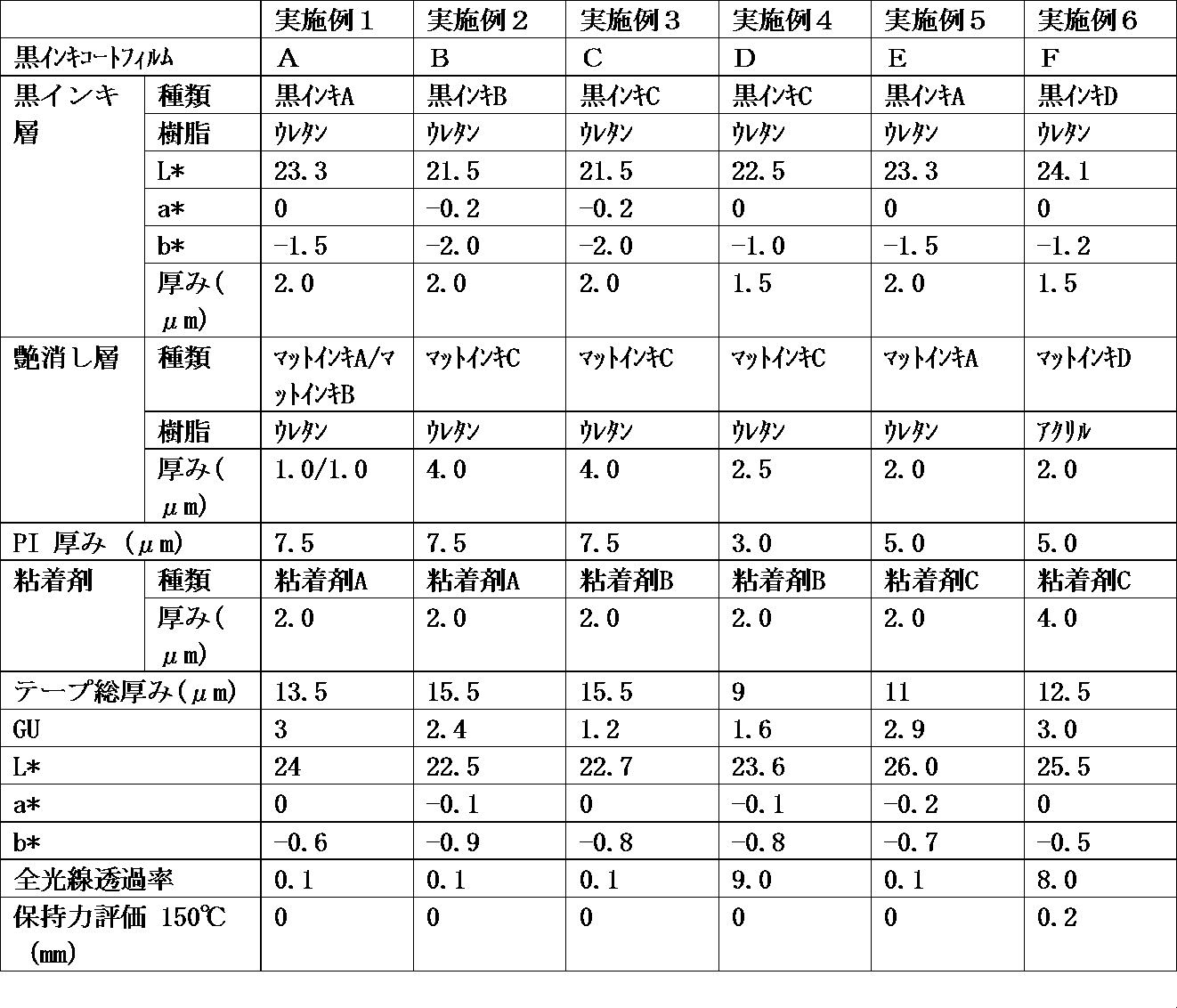
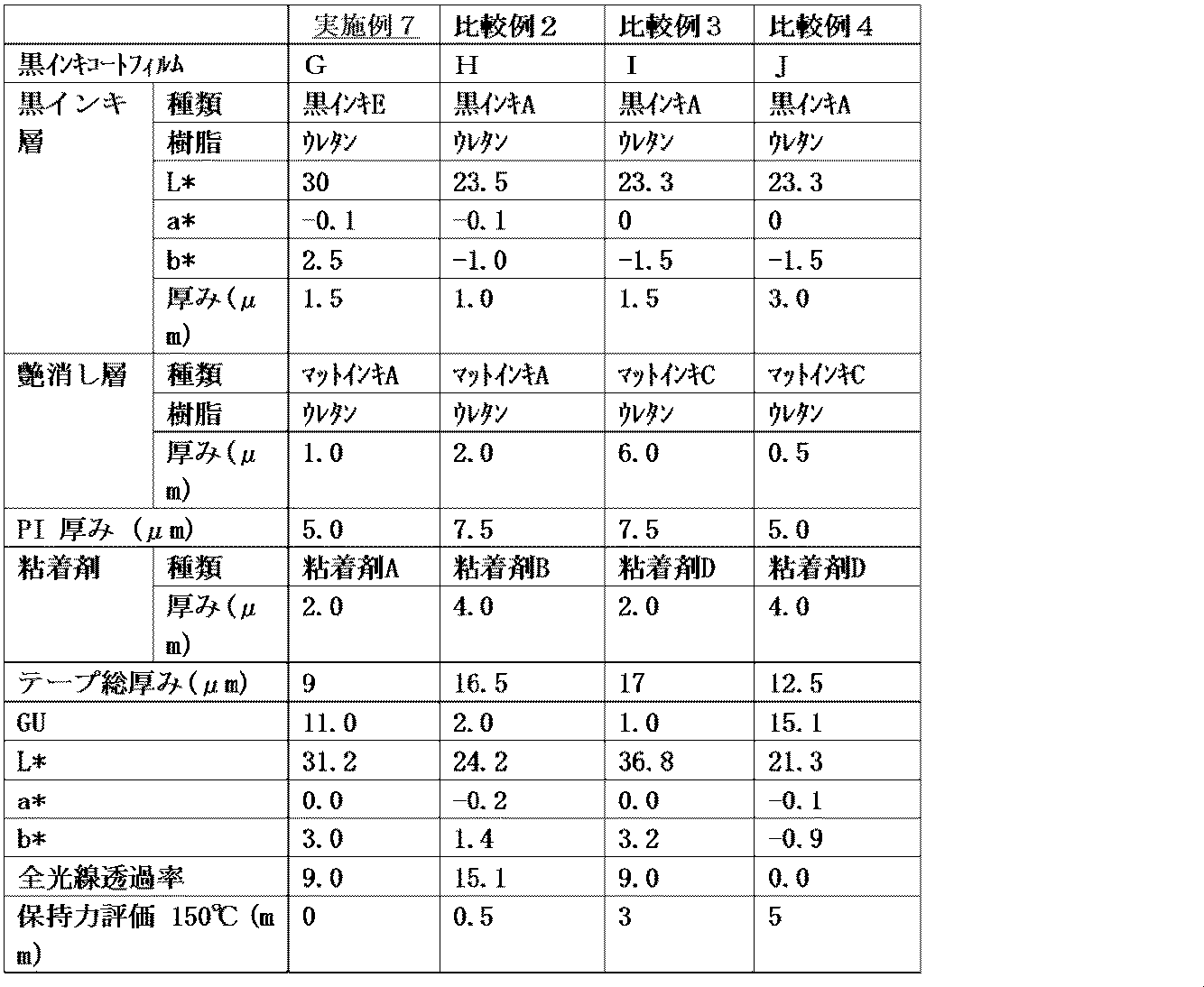
Claims (6)
18 ≦ L* ≦ 36
-3 ≦ a* ≦ 3
-3 ≦ b* ≦ 3 Coloring having a polyimide film layer with a thickness of 1.0-15.0 μm, a black colored layer with a thickness of 1.5-3.0 μm, and a matte layer with a thickness of 1.0-5.0 μm It has a substrate and an adhesive layer, has CIE color values (L*, a*, b*) within the following ranges, the adhesive layer is made of an acrylic adhesive, and the adhesive layer has a gel fraction of 5. 5.0-30.0 μm thick black polyimide adhesive tape, characterized by ˜50%.
18 ≤ L* ≤ 36
-3 ≤ a* ≤ 3
-3 ≤ b* ≤ 3
0 ≦ Gu ≦ 10 2. The pressure-sensitive adhesive tape according to claim 1, wherein the glossiness Gu measured at a set angle of 60[deg.] according to JIS Z8741 is within the following range.
0≦Gu≦10
Priority Applications (1)
| Application Number | Priority Date | Filing Date | Title |
|---|---|---|---|
| JP2019032725A JP7263836B2 (en) | 2019-02-26 | 2019-02-26 | black polyimide adhesive tape |
Applications Claiming Priority (1)
| Application Number | Priority Date | Filing Date | Title |
|---|---|---|---|
| JP2019032725A JP7263836B2 (en) | 2019-02-26 | 2019-02-26 | black polyimide adhesive tape |
Publications (2)
| Publication Number | Publication Date |
|---|---|
| JP2020131686A JP2020131686A (en) | 2020-08-31 |
| JP7263836B2 true JP7263836B2 (en) | 2023-04-25 |
Family
ID=72262057
Family Applications (1)
| Application Number | Title | Priority Date | Filing Date |
|---|---|---|---|
| JP2019032725A Active JP7263836B2 (en) | 2019-02-26 | 2019-02-26 | black polyimide adhesive tape |
Country Status (1)
| Country | Link |
|---|---|
| JP (1) | JP7263836B2 (en) |
Citations (12)
| Publication number | Priority date | Publication date | Assignee | Title |
|---|---|---|---|---|
| JP2010517817A (en) | 2007-02-05 | 2010-05-27 | ピーピージー インダストリーズ オハイオ インコーポレーテツド | Cold and dark coating system |
| US20110076463A1 (en) | 2009-09-29 | 2011-03-31 | Sumitomo Chemical Company, Limited | Matte resin film |
| JP2011522910A (en) | 2008-05-07 | 2011-08-04 | テイオキサイド・ユーロプ・リミテツド | titanium dioxide |
| CN102952428A (en) | 2011-08-21 | 2013-03-06 | 比亚迪股份有限公司 | Printing ink composition, method for forming near-infrared light antireflection layer on substrate surface, and near-infrared light antireflection material |
| JP2013144376A (en) | 2012-01-13 | 2013-07-25 | Dic Corp | Colored film and colored adhesive tape |
| JP2013227173A (en) | 2012-04-26 | 2013-11-07 | Dainichiseika Color & Chem Mfg Co Ltd | Infrared reflective black pigment and method for producing the same |
| CN103458607A (en) | 2012-06-05 | 2013-12-18 | 昆山雅森电子材料科技有限公司 | Extinction stiffening plate used for printed circuit board |
| US20170029635A1 (en) | 2014-04-11 | 2017-02-02 | Sun Chemical Corporation | Pigments for filtering the solar spectrum |
| JP2017508637A (en) | 2013-12-13 | 2017-03-30 | イー・アイ・デュポン・ドウ・ヌムール・アンド・カンパニーE.I.Du Pont De Nemours And Company | Multilayer film |
| JP2017115042A (en) | 2015-12-24 | 2017-06-29 | 日東電工株式会社 | Adhesive sheet for graphite sheet |
| US20170240459A1 (en) | 2016-02-18 | 2017-08-24 | Prince Minerals Italy S.R.L. | Ceramic ink for automotive glass |
| JP2019026731A (en) | 2017-07-28 | 2019-02-21 | リンテック株式会社 | Adhesive film and graphite sheet laminate |
-
2019
- 2019-02-26 JP JP2019032725A patent/JP7263836B2/en active Active
Patent Citations (12)
| Publication number | Priority date | Publication date | Assignee | Title |
|---|---|---|---|---|
| JP2010517817A (en) | 2007-02-05 | 2010-05-27 | ピーピージー インダストリーズ オハイオ インコーポレーテツド | Cold and dark coating system |
| JP2011522910A (en) | 2008-05-07 | 2011-08-04 | テイオキサイド・ユーロプ・リミテツド | titanium dioxide |
| US20110076463A1 (en) | 2009-09-29 | 2011-03-31 | Sumitomo Chemical Company, Limited | Matte resin film |
| CN102952428A (en) | 2011-08-21 | 2013-03-06 | 比亚迪股份有限公司 | Printing ink composition, method for forming near-infrared light antireflection layer on substrate surface, and near-infrared light antireflection material |
| JP2013144376A (en) | 2012-01-13 | 2013-07-25 | Dic Corp | Colored film and colored adhesive tape |
| JP2013227173A (en) | 2012-04-26 | 2013-11-07 | Dainichiseika Color & Chem Mfg Co Ltd | Infrared reflective black pigment and method for producing the same |
| CN103458607A (en) | 2012-06-05 | 2013-12-18 | 昆山雅森电子材料科技有限公司 | Extinction stiffening plate used for printed circuit board |
| JP2017508637A (en) | 2013-12-13 | 2017-03-30 | イー・アイ・デュポン・ドウ・ヌムール・アンド・カンパニーE.I.Du Pont De Nemours And Company | Multilayer film |
| US20170029635A1 (en) | 2014-04-11 | 2017-02-02 | Sun Chemical Corporation | Pigments for filtering the solar spectrum |
| JP2017115042A (en) | 2015-12-24 | 2017-06-29 | 日東電工株式会社 | Adhesive sheet for graphite sheet |
| US20170240459A1 (en) | 2016-02-18 | 2017-08-24 | Prince Minerals Italy S.R.L. | Ceramic ink for automotive glass |
| JP2019026731A (en) | 2017-07-28 | 2019-02-21 | リンテック株式会社 | Adhesive film and graphite sheet laminate |
Also Published As
| Publication number | Publication date |
|---|---|
| JP2020131686A (en) | 2020-08-31 |
Similar Documents
| Publication | Publication Date | Title |
|---|---|---|
| JP5903984B2 (en) | Colored adhesive tape and graphite composite sheet | |
| JP5896208B2 (en) | Colored film and colored adhesive tape | |
| JP6003037B2 (en) | Colored adhesive tape | |
| JP5891663B2 (en) | Colored adhesive tape | |
| JP5970821B2 (en) | Colored film and colored adhesive tape | |
| CN106957611B (en) | Single-sided Adhesive Adhesive Sheet | |
| CN101835826B (en) | (meth)acrylic film and marking film using same | |
| KR102404382B1 (en) | Adhesive sheet for graphite sheet | |
| EP3521395A1 (en) | Pressure-sensitive adhesive sheet having first and second release films having different elastic muduli | |
| JP6789013B2 (en) | Adhesive sheet | |
| JP2007290382A (en) | Decorative sheet for steel plate and decorative steel plate using the same | |
| JP2017052818A (en) | Decorative adhesive film | |
| JP2016215672A (en) | Graphic film for license plate, and license plate comprising graphic film and manufacturing method therefor | |
| JP6094664B2 (en) | Colored film and colored adhesive tape | |
| JP7022496B2 (en) | Graphics structure and its manufacturing method, as well as lighting system | |
| JP5541552B2 (en) | Adhesive tape | |
| JP7263836B2 (en) | black polyimide adhesive tape | |
| JP5760574B2 (en) | Colored adhesive tape | |
| JP2022131877A (en) | Laminate manufacturing method | |
| JP7327376B2 (en) | Colored film and colored adhesive tape | |
| JP2015189855A (en) | Active energy ray-curable resin composition | |
| JP7321344B1 (en) | Adhesive sheet | |
| TWI908881B (en) | Adhesive sheet | |
| JP2022066786A (en) | Metallic decorative film | |
| JP2023074354A (en) | Decorative laminate comprising metallic layer and adhesive layer |
Legal Events
| Date | Code | Title | Description |
|---|---|---|---|
| RD04 | Notification of resignation of power of attorney |
Free format text: JAPANESE INTERMEDIATE CODE: A7424 Effective date: 20190624 |
|
| A621 | Written request for application examination |
Free format text: JAPANESE INTERMEDIATE CODE: A621 Effective date: 20211216 |
|
| A977 | Report on retrieval |
Free format text: JAPANESE INTERMEDIATE CODE: A971007 Effective date: 20220915 |
|
| A131 | Notification of reasons for refusal |
Free format text: JAPANESE INTERMEDIATE CODE: A131 Effective date: 20221011 |
|
| A521 | Request for written amendment filed |
Free format text: JAPANESE INTERMEDIATE CODE: A523 Effective date: 20221206 |
|
| TRDD | Decision of grant or rejection written | ||
| A01 | Written decision to grant a patent or to grant a registration (utility model) |
Free format text: JAPANESE INTERMEDIATE CODE: A01 Effective date: 20230314 |
|
| A61 | First payment of annual fees (during grant procedure) |
Free format text: JAPANESE INTERMEDIATE CODE: A61 Effective date: 20230327 |
|
| R151 | Written notification of patent or utility model registration |
Ref document number: 7263836 Country of ref document: JP Free format text: JAPANESE INTERMEDIATE CODE: R151 |