JP7132249B2 - Cells containing chimeric antigen receptors (CAR) - Google Patents
Cells containing chimeric antigen receptors (CAR) Download PDFInfo
- Publication number
- JP7132249B2 JP7132249B2 JP2019563057A JP2019563057A JP7132249B2 JP 7132249 B2 JP7132249 B2 JP 7132249B2 JP 2019563057 A JP2019563057 A JP 2019563057A JP 2019563057 A JP2019563057 A JP 2019563057A JP 7132249 B2 JP7132249 B2 JP 7132249B2
- Authority
- JP
- Japan
- Prior art keywords
- domain
- cell
- car
- cells
- nucleic acid
- Prior art date
- Legal status (The legal status is an assumption and is not a legal conclusion. Google has not performed a legal analysis and makes no representation as to the accuracy of the status listed.)
- Active
Links
- 108010019670 Chimeric Antigen Receptors Proteins 0.000 title claims description 229
- 210000004027 cell Anatomy 0.000 claims description 229
- 238000006471 dimerization reaction Methods 0.000 claims description 134
- 150000007523 nucleic acids Chemical group 0.000 claims description 114
- 230000027455 binding Effects 0.000 claims description 93
- 239000012528 membrane Substances 0.000 claims description 77
- 108091028043 Nucleic acid sequence Proteins 0.000 claims description 57
- 239000013598 vector Substances 0.000 claims description 54
- 238000000034 method Methods 0.000 claims description 53
- 239000003795 chemical substances by application Substances 0.000 claims description 51
- 239000000427 antigen Substances 0.000 claims description 49
- 102000036639 antigens Human genes 0.000 claims description 49
- 108091007433 antigens Proteins 0.000 claims description 49
- QFJCIRLUMZQUOT-HPLJOQBZSA-N sirolimus Chemical compound C1C[C@@H](O)[C@H](OC)C[C@@H]1C[C@@H](C)[C@H]1OC(=O)[C@@H]2CCCCN2C(=O)C(=O)[C@](O)(O2)[C@H](C)CC[C@H]2C[C@H](OC)/C(C)=C/C=C/C=C/[C@@H](C)C[C@@H](C)C(=O)[C@H](OC)[C@H](O)/C(C)=C/[C@@H](C)C(=O)C1 QFJCIRLUMZQUOT-HPLJOQBZSA-N 0.000 claims description 45
- 229960002930 sirolimus Drugs 0.000 claims description 42
- 230000001404 mediated effect Effects 0.000 claims description 41
- 108020004707 nucleic acids Proteins 0.000 claims description 40
- 102000039446 nucleic acids Human genes 0.000 claims description 40
- ZAHRKKWIAAJSAO-UHFFFAOYSA-N rapamycin Natural products COCC(O)C(=C/C(C)C(=O)CC(OC(=O)C1CCCCN1C(=O)C(=O)C2(O)OC(CC(OC)C(=CC=CC=CC(C)CC(C)C(=O)C)C)CCC2C)C(C)CC3CCC(O)C(C3)OC)C ZAHRKKWIAAJSAO-UHFFFAOYSA-N 0.000 claims description 40
- 239000008194 pharmaceutical composition Substances 0.000 claims description 34
- 201000010099 disease Diseases 0.000 claims description 32
- 208000037265 diseases, disorders, signs and symptoms Diseases 0.000 claims description 32
- 239000003814 drug Substances 0.000 claims description 28
- 230000004068 intracellular signaling Effects 0.000 claims description 28
- 230000004913 activation Effects 0.000 claims description 26
- 231100000419 toxicity Toxicity 0.000 claims description 24
- 230000001988 toxicity Effects 0.000 claims description 24
- 230000005754 cellular signaling Effects 0.000 claims description 23
- 101000606506 Homo sapiens Receptor-type tyrosine-protein phosphatase eta Proteins 0.000 claims description 21
- 102100039808 Receptor-type tyrosine-protein phosphatase eta Human genes 0.000 claims description 21
- 102000004160 Phosphoric Monoester Hydrolases Human genes 0.000 claims description 20
- 108090000608 Phosphoric Monoester Hydrolases Proteins 0.000 claims description 20
- 102100021657 Tyrosine-protein phosphatase non-receptor type 6 Human genes 0.000 claims description 19
- 210000000170 cell membrane Anatomy 0.000 claims description 19
- 102100033019 Tyrosine-protein phosphatase non-receptor type 11 Human genes 0.000 claims description 17
- 108010027179 Tacrolimus Binding Proteins Proteins 0.000 claims description 16
- 102000018679 Tacrolimus Binding Proteins Human genes 0.000 claims description 16
- 101710116241 Tyrosine-protein phosphatase non-receptor type 11 Proteins 0.000 claims description 15
- OUYCCCASQSFEME-QMMMGPOBSA-N L-tyrosine Chemical compound OC(=O)[C@@H](N)CC1=CC=C(O)C=C1 OUYCCCASQSFEME-QMMMGPOBSA-N 0.000 claims description 14
- 108091000080 Phosphotransferase Proteins 0.000 claims description 14
- 102100040678 Programmed cell death protein 1 Human genes 0.000 claims description 14
- 102000020233 phosphotransferase Human genes 0.000 claims description 14
- OUYCCCASQSFEME-UHFFFAOYSA-N tyrosine Natural products OC(=O)C(N)CC1=CC=C(O)C=C1 OUYCCCASQSFEME-UHFFFAOYSA-N 0.000 claims description 14
- 101000884305 Homo sapiens B-cell receptor CD22 Proteins 0.000 claims description 13
- 101710128901 Tyrosine-protein phosphatase non-receptor type 6 Proteins 0.000 claims description 13
- 206010028980 Neoplasm Diseases 0.000 claims description 12
- 238000004519 manufacturing process Methods 0.000 claims description 12
- 102100038080 B-cell receptor CD22 Human genes 0.000 claims description 11
- 230000006806 disease prevention Effects 0.000 claims description 11
- 230000005764 inhibitory process Effects 0.000 claims description 11
- 101000738771 Homo sapiens Receptor-type tyrosine-protein phosphatase C Proteins 0.000 claims description 10
- 102100037422 Receptor-type tyrosine-protein phosphatase C Human genes 0.000 claims description 10
- 230000007498 myristoylation Effects 0.000 claims description 10
- 102100039498 Cytotoxic T-lymphocyte protein 4 Human genes 0.000 claims description 9
- 208000032672 Histiocytosis haematophagic Diseases 0.000 claims description 8
- 108010017736 Leukocyte Immunoglobulin-like Receptor B1 Proteins 0.000 claims description 8
- 102100025584 Leukocyte immunoglobulin-like receptor subfamily B member 1 Human genes 0.000 claims description 8
- 208000004987 Macrophage activation syndrome Diseases 0.000 claims description 8
- 108010065917 TOR Serine-Threonine Kinases Proteins 0.000 claims description 8
- 102000013530 TOR Serine-Threonine Kinases Human genes 0.000 claims description 8
- 239000000203 mixture Substances 0.000 claims description 8
- 230000002463 transducing effect Effects 0.000 claims description 8
- 102100029822 B- and T-lymphocyte attenuator Human genes 0.000 claims description 7
- 101000864344 Homo sapiens B- and T-lymphocyte attenuator Proteins 0.000 claims description 7
- 101000863882 Homo sapiens Sialic acid-binding Ig-like lectin 7 Proteins 0.000 claims description 7
- 101000863883 Homo sapiens Sialic acid-binding Ig-like lectin 9 Proteins 0.000 claims description 7
- 102100024616 Platelet endothelial cell adhesion molecule Human genes 0.000 claims description 7
- 102000001253 Protein Kinase Human genes 0.000 claims description 7
- 102100029946 Sialic acid-binding Ig-like lectin 7 Human genes 0.000 claims description 7
- 102100029965 Sialic acid-binding Ig-like lectin 9 Human genes 0.000 claims description 7
- 201000011510 cancer Diseases 0.000 claims description 7
- 108060006633 protein kinase Proteins 0.000 claims description 7
- 101000971533 Homo sapiens Killer cell lectin-like receptor subfamily G member 1 Proteins 0.000 claims description 6
- 102100021457 Killer cell lectin-like receptor subfamily G member 1 Human genes 0.000 claims description 6
- 108010069381 Platelet Endothelial Cell Adhesion Molecule-1 Proteins 0.000 claims description 6
- 206010052015 cytokine release syndrome Diseases 0.000 claims description 6
- 239000000411 inducer Substances 0.000 claims description 6
- 108091008042 inhibitory receptors Proteins 0.000 claims description 6
- 108010021064 CTLA-4 Antigen Proteins 0.000 claims description 5
- 229940045513 CTLA4 antagonist Drugs 0.000 claims description 5
- 239000000539 dimer Substances 0.000 claims description 5
- 108010054814 DNA Gyrase Proteins 0.000 claims description 4
- 229930191978 Gibberellin Natural products 0.000 claims description 4
- 206010029350 Neurotoxicity Diseases 0.000 claims description 4
- 101100282746 Oryza sativa subsp. japonica GID1 gene Proteins 0.000 claims description 4
- 101100156295 Saccharomyces cerevisiae (strain ATCC 204508 / S288c) VID30 gene Proteins 0.000 claims description 4
- 206010044221 Toxic encephalopathy Diseases 0.000 claims description 4
- IXORZMNAPKEEDV-UHFFFAOYSA-N gibberellic acid GA3 Natural products OC(=O)C1C2(C3)CC(=C)C3(O)CCC2C2(C=CC3O)C1C3(C)C(=O)O2 IXORZMNAPKEEDV-UHFFFAOYSA-N 0.000 claims description 4
- 239000003448 gibberellin Substances 0.000 claims description 4
- 231100000228 neurotoxicity Toxicity 0.000 claims description 4
- 230000007135 neurotoxicity Effects 0.000 claims description 4
- 239000000126 substance Substances 0.000 claims description 4
- WTIJXIZOODAMJT-WBACWINTSA-N [(3r,4s,5r,6s)-5-hydroxy-6-[4-hydroxy-3-[[5-[[4-hydroxy-7-[(2s,3r,4s,5r)-3-hydroxy-5-methoxy-6,6-dimethyl-4-(5-methyl-1h-pyrrole-2-carbonyl)oxyoxan-2-yl]oxy-8-methyl-2-oxochromen-3-yl]carbamoyl]-4-methyl-1h-pyrrole-3-carbonyl]amino]-8-methyl-2-oxochromen- Chemical compound O([C@@H]1[C@H](C(O[C@H](OC=2C(=C3OC(=O)C(NC(=O)C=4C(=C(C(=O)NC=5C(OC6=C(C)C(O[C@@H]7[C@@H]([C@H](OC(=O)C=8NC(C)=CC=8)[C@@H](OC)C(C)(C)O7)O)=CC=C6C=5O)=O)NC=4)C)=C(O)C3=CC=2)C)[C@@H]1O)(C)C)OC)C(=O)C1=CC=C(C)N1 WTIJXIZOODAMJT-WBACWINTSA-N 0.000 claims description 3
- 229950001513 coumamycin Drugs 0.000 claims description 3
- 238000000338 in vitro Methods 0.000 claims description 2
- 238000010922 spray-dried dispersion Methods 0.000 description 69
- 210000001744 T-lymphocyte Anatomy 0.000 description 68
- 108090000623 proteins and genes Proteins 0.000 description 48
- 102000004169 proteins and genes Human genes 0.000 description 43
- 235000018102 proteins Nutrition 0.000 description 42
- 108090000765 processed proteins & peptides Proteins 0.000 description 40
- 230000011664 signaling Effects 0.000 description 37
- YBJHBAHKTGYVGT-ZKWXMUAHSA-N (+)-Biotin Chemical compound N1C(=O)N[C@@H]2[C@H](CCCCC(=O)O)SC[C@@H]21 YBJHBAHKTGYVGT-ZKWXMUAHSA-N 0.000 description 34
- 102100031167 Tyrosine-protein kinase CSK Human genes 0.000 description 27
- 108010069682 CSK Tyrosine-Protein Kinase Proteins 0.000 description 25
- 238000001994 activation Methods 0.000 description 25
- 108091005804 Peptidases Proteins 0.000 description 24
- 102000035195 Peptidases Human genes 0.000 description 24
- 239000004365 Protease Substances 0.000 description 24
- 108010090804 Streptavidin Proteins 0.000 description 23
- 235000019419 proteases Nutrition 0.000 description 23
- 229940079593 drug Drugs 0.000 description 21
- 239000004098 Tetracycline Substances 0.000 description 20
- 229960002180 tetracycline Drugs 0.000 description 20
- 229930101283 tetracycline Natural products 0.000 description 20
- 235000019364 tetracycline Nutrition 0.000 description 20
- 108700020534 tetracycline resistance-encoding transposon repressor Proteins 0.000 description 20
- 150000003522 tetracyclines Chemical class 0.000 description 20
- 150000001413 amino acids Chemical class 0.000 description 19
- 102000004196 processed proteins & peptides Human genes 0.000 description 19
- 125000006850 spacer group Chemical group 0.000 description 18
- 102100027913 Peptidyl-prolyl cis-trans isomerase FKBP1A Human genes 0.000 description 17
- 108010006877 Tacrolimus Binding Protein 1A Proteins 0.000 description 17
- 229960002685 biotin Drugs 0.000 description 16
- 235000020958 biotin Nutrition 0.000 description 16
- 239000011616 biotin Substances 0.000 description 16
- 235000001014 amino acid Nutrition 0.000 description 15
- 238000003776 cleavage reaction Methods 0.000 description 15
- 102000005962 receptors Human genes 0.000 description 15
- 108020003175 receptors Proteins 0.000 description 15
- 230000007017 scission Effects 0.000 description 15
- 108091008874 T cell receptors Proteins 0.000 description 14
- 102000016266 T-Cell Antigen Receptors Human genes 0.000 description 14
- 102000002727 Protein Tyrosine Phosphatase Human genes 0.000 description 13
- 102000014400 SH2 domains Human genes 0.000 description 13
- 108050003452 SH2 domains Proteins 0.000 description 13
- 230000000694 effects Effects 0.000 description 13
- 229920001184 polypeptide Polymers 0.000 description 13
- 108020000494 protein-tyrosine phosphatase Proteins 0.000 description 13
- 102100024222 B-lymphocyte antigen CD19 Human genes 0.000 description 12
- 101000980825 Homo sapiens B-lymphocyte antigen CD19 Proteins 0.000 description 12
- 230000003834 intracellular effect Effects 0.000 description 12
- 210000000822 natural killer cell Anatomy 0.000 description 12
- 101000611936 Homo sapiens Programmed cell death protein 1 Proteins 0.000 description 11
- 241000723792 Tobacco etch virus Species 0.000 description 11
- 210000003289 regulatory T cell Anatomy 0.000 description 11
- 230000006044 T cell activation Effects 0.000 description 10
- 230000020411 cell activation Effects 0.000 description 10
- 230000001687 destabilization Effects 0.000 description 10
- 230000001965 increasing effect Effects 0.000 description 10
- 239000003446 ligand Substances 0.000 description 10
- 150000003384 small molecules Chemical class 0.000 description 10
- 101000834898 Homo sapiens Alpha-synuclein Proteins 0.000 description 9
- 101000652359 Homo sapiens Spermatogenesis-associated protein 2 Proteins 0.000 description 9
- 101000914514 Homo sapiens T-cell-specific surface glycoprotein CD28 Proteins 0.000 description 9
- 101000818543 Homo sapiens Tyrosine-protein kinase ZAP-70 Proteins 0.000 description 9
- 108010076504 Protein Sorting Signals Proteins 0.000 description 9
- 102100027213 T-cell-specific surface glycoprotein CD28 Human genes 0.000 description 9
- 102100021125 Tyrosine-protein kinase ZAP-70 Human genes 0.000 description 9
- 230000033228 biological regulation Effects 0.000 description 9
- 230000004048 modification Effects 0.000 description 9
- 238000012986 modification Methods 0.000 description 9
- 102000009076 src-Family Kinases Human genes 0.000 description 9
- 108010087686 src-Family Kinases Proteins 0.000 description 9
- 206010061818 Disease progression Diseases 0.000 description 8
- 230000000368 destabilizing effect Effects 0.000 description 8
- 230000005750 disease progression Effects 0.000 description 8
- 230000002147 killing effect Effects 0.000 description 8
- 101000617285 Homo sapiens Tyrosine-protein phosphatase non-receptor type 6 Proteins 0.000 description 7
- 102000004022 Protein-Tyrosine Kinases Human genes 0.000 description 7
- 108090000412 Protein-Tyrosine Kinases Proteins 0.000 description 7
- 238000007792 addition Methods 0.000 description 7
- 238000010586 diagram Methods 0.000 description 7
- 230000004807 localization Effects 0.000 description 7
- 230000026731 phosphorylation Effects 0.000 description 7
- 238000006366 phosphorylation reaction Methods 0.000 description 7
- -1 BTLA4 Proteins 0.000 description 6
- 108091007741 Chimeric antigen receptor T cells Proteins 0.000 description 6
- 241000710198 Foot-and-mouth disease virus Species 0.000 description 6
- TUNFSRHWOTWDNC-UHFFFAOYSA-N Myristic acid Natural products CCCCCCCCCCCCCC(O)=O TUNFSRHWOTWDNC-UHFFFAOYSA-N 0.000 description 6
- 238000003556 assay Methods 0.000 description 6
- 230000002401 inhibitory effect Effects 0.000 description 6
- 230000003993 interaction Effects 0.000 description 6
- 108091033319 polynucleotide Proteins 0.000 description 6
- 102000040430 polynucleotide Human genes 0.000 description 6
- 239000002157 polynucleotide Substances 0.000 description 6
- 230000013823 prenylation Effects 0.000 description 6
- SGKRLCUYIXIAHR-AKNGSSGZSA-N (4s,4ar,5s,5ar,6r,12ar)-4-(dimethylamino)-1,5,10,11,12a-pentahydroxy-6-methyl-3,12-dioxo-4a,5,5a,6-tetrahydro-4h-tetracene-2-carboxamide Chemical compound C1=CC=C2[C@H](C)[C@@H]([C@H](O)[C@@H]3[C@](C(O)=C(C(N)=O)C(=O)[C@H]3N(C)C)(O)C3=O)C3=C(O)C2=C1O SGKRLCUYIXIAHR-AKNGSSGZSA-N 0.000 description 5
- FFTVPQUHLQBXQZ-KVUCHLLUSA-N (4s,4as,5ar,12ar)-4,7-bis(dimethylamino)-1,10,11,12a-tetrahydroxy-3,12-dioxo-4a,5,5a,6-tetrahydro-4h-tetracene-2-carboxamide Chemical compound C1C2=C(N(C)C)C=CC(O)=C2C(O)=C2[C@@H]1C[C@H]1[C@H](N(C)C)C(=O)C(C(N)=O)=C(O)[C@@]1(O)C2=O FFTVPQUHLQBXQZ-KVUCHLLUSA-N 0.000 description 5
- 108010065323 Tumor Necrosis Factor Ligand Superfamily Member 13 Proteins 0.000 description 5
- 210000004899 c-terminal region Anatomy 0.000 description 5
- 230000001276 controlling effect Effects 0.000 description 5
- 229960003722 doxycycline Drugs 0.000 description 5
- 239000012634 fragment Substances 0.000 description 5
- 230000006870 function Effects 0.000 description 5
- IPCSVZSSVZVIGE-UHFFFAOYSA-N hexadecanoic acid Chemical compound CCCCCCCCCCCCCCCC(O)=O IPCSVZSSVZVIGE-UHFFFAOYSA-N 0.000 description 5
- 230000028993 immune response Effects 0.000 description 5
- 210000003071 memory t lymphocyte Anatomy 0.000 description 5
- 229960004023 minocycline Drugs 0.000 description 5
- 230000026792 palmitoylation Effects 0.000 description 5
- 210000005259 peripheral blood Anatomy 0.000 description 5
- 239000011886 peripheral blood Substances 0.000 description 5
- 230000035755 proliferation Effects 0.000 description 5
- 230000004850 protein–protein interaction Effects 0.000 description 5
- 230000002829 reductive effect Effects 0.000 description 5
- 230000001105 regulatory effect Effects 0.000 description 5
- 230000004083 survival effect Effects 0.000 description 5
- 230000002588 toxic effect Effects 0.000 description 5
- 230000005945 translocation Effects 0.000 description 5
- 108010016306 Glycylpeptide N-tetradecanoyltransferase Proteins 0.000 description 4
- 101000889276 Homo sapiens Cytotoxic T-lymphocyte protein 4 Proteins 0.000 description 4
- 108010076818 TEV protease Proteins 0.000 description 4
- 210000003719 b-lymphocyte Anatomy 0.000 description 4
- 239000011230 binding agent Substances 0.000 description 4
- 230000022534 cell killing Effects 0.000 description 4
- 239000002131 composite material Substances 0.000 description 4
- 210000000805 cytoplasm Anatomy 0.000 description 4
- 230000003247 decreasing effect Effects 0.000 description 4
- 238000010494 dissociation reaction Methods 0.000 description 4
- 230000005593 dissociations Effects 0.000 description 4
- 239000012636 effector Substances 0.000 description 4
- 238000005734 heterodimerization reaction Methods 0.000 description 4
- 230000002209 hydrophobic effect Effects 0.000 description 4
- 230000001939 inductive effect Effects 0.000 description 4
- 210000004698 lymphocyte Anatomy 0.000 description 4
- 238000012544 monitoring process Methods 0.000 description 4
- 230000035772 mutation Effects 0.000 description 4
- 230000002441 reversible effect Effects 0.000 description 4
- 239000000758 substrate Substances 0.000 description 4
- 239000006228 supernatant Substances 0.000 description 4
- 208000024891 symptom Diseases 0.000 description 4
- 210000000225 synapse Anatomy 0.000 description 4
- 238000012546 transfer Methods 0.000 description 4
- 108091032973 (ribonucleotides)n+m Proteins 0.000 description 3
- 102100026205 1-phosphatidylinositol 4,5-bisphosphate phosphodiesterase gamma-1 Human genes 0.000 description 3
- 208000023275 Autoimmune disease Diseases 0.000 description 3
- 108090000695 Cytokines Proteins 0.000 description 3
- 102000004127 Cytokines Human genes 0.000 description 3
- 108020004414 DNA Proteins 0.000 description 3
- 102000004190 Enzymes Human genes 0.000 description 3
- 108090000790 Enzymes Proteins 0.000 description 3
- 101000691599 Homo sapiens 1-phosphatidylinositol 4,5-bisphosphate phosphodiesterase gamma-1 Proteins 0.000 description 3
- 101000922131 Homo sapiens Tyrosine-protein kinase CSK Proteins 0.000 description 3
- 101001087416 Homo sapiens Tyrosine-protein phosphatase non-receptor type 11 Proteins 0.000 description 3
- YNAVUWVOSKDBBP-UHFFFAOYSA-N Morpholine Chemical group C1COCCN1 YNAVUWVOSKDBBP-UHFFFAOYSA-N 0.000 description 3
- 101001045447 Synechocystis sp. (strain PCC 6803 / Kazusa) Sensor histidine kinase Hik2 Proteins 0.000 description 3
- 102100022153 Tumor necrosis factor receptor superfamily member 4 Human genes 0.000 description 3
- 101710165473 Tumor necrosis factor receptor superfamily member 4 Proteins 0.000 description 3
- 230000003213 activating effect Effects 0.000 description 3
- 230000015556 catabolic process Effects 0.000 description 3
- 239000011651 chromium Substances 0.000 description 3
- 150000001875 compounds Chemical class 0.000 description 3
- 230000001461 cytolytic effect Effects 0.000 description 3
- 210000005220 cytoplasmic tail Anatomy 0.000 description 3
- 238000006731 degradation reaction Methods 0.000 description 3
- 238000013461 design Methods 0.000 description 3
- 238000011161 development Methods 0.000 description 3
- 230000018109 developmental process Effects 0.000 description 3
- 235000014113 dietary fatty acids Nutrition 0.000 description 3
- 230000004069 differentiation Effects 0.000 description 3
- 230000000447 dimerizing effect Effects 0.000 description 3
- 229930195729 fatty acid Natural products 0.000 description 3
- 239000000194 fatty acid Substances 0.000 description 3
- 150000004665 fatty acids Chemical class 0.000 description 3
- 230000004927 fusion Effects 0.000 description 3
- 230000005934 immune activation Effects 0.000 description 3
- 210000002865 immune cell Anatomy 0.000 description 3
- 238000001727 in vivo Methods 0.000 description 3
- 238000001802 infusion Methods 0.000 description 3
- 150000002632 lipids Chemical class 0.000 description 3
- 210000002540 macrophage Anatomy 0.000 description 3
- 239000000178 monomer Substances 0.000 description 3
- 125000001419 myristoyl group Chemical group O=C([*])C([H])([H])C([H])([H])C([H])([H])C([H])([H])C([H])([H])C([H])([H])C([H])([H])C([H])([H])C([H])([H])C([H])([H])C([H])([H])C([H])([H])C([H])([H])[H] 0.000 description 3
- 125000003729 nucleotide group Chemical group 0.000 description 3
- 239000000816 peptidomimetic Substances 0.000 description 3
- 125000001844 prenyl group Chemical group [H]C([*])([H])C([H])=C(C([H])([H])[H])C([H])([H])[H] 0.000 description 3
- 230000008569 process Effects 0.000 description 3
- 230000004044 response Effects 0.000 description 3
- 238000006467 substitution reaction Methods 0.000 description 3
- 210000001541 thymus gland Anatomy 0.000 description 3
- 239000013603 viral vector Substances 0.000 description 3
- TWJNQYPJQDRXPH-UHFFFAOYSA-N 2-cyanobenzohydrazide Chemical compound NNC(=O)C1=CC=CC=C1C#N TWJNQYPJQDRXPH-UHFFFAOYSA-N 0.000 description 2
- 206010001052 Acute respiratory distress syndrome Diseases 0.000 description 2
- OYPRJOBELJOOCE-UHFFFAOYSA-N Calcium Chemical compound [Ca] OYPRJOBELJOOCE-UHFFFAOYSA-N 0.000 description 2
- 102100024746 Dihydrofolate reductase Human genes 0.000 description 2
- 108091006027 G proteins Proteins 0.000 description 2
- 102000030782 GTP binding Human genes 0.000 description 2
- 108091000058 GTP-Binding Proteins 0.000 description 2
- 101001027081 Homo sapiens Killer cell immunoglobulin-like receptor 2DL1 Proteins 0.000 description 2
- 101000945331 Homo sapiens Killer cell immunoglobulin-like receptor 2DL4 Proteins 0.000 description 2
- 101000945337 Homo sapiens Killer cell immunoglobulin-like receptor 2DL5A Proteins 0.000 description 2
- 101000945335 Homo sapiens Killer cell immunoglobulin-like receptor 2DL5B Proteins 0.000 description 2
- 101000945351 Homo sapiens Killer cell immunoglobulin-like receptor 3DL1 Proteins 0.000 description 2
- 101000945493 Homo sapiens Killer cell immunoglobulin-like receptor 3DL3 Proteins 0.000 description 2
- 101001138062 Homo sapiens Leukocyte-associated immunoglobulin-like receptor 1 Proteins 0.000 description 2
- 101000623857 Homo sapiens Serine/threonine-protein kinase mTOR Proteins 0.000 description 2
- 108010043610 KIR Receptors Proteins 0.000 description 2
- 102000002698 KIR Receptors Human genes 0.000 description 2
- 102100037363 Killer cell immunoglobulin-like receptor 2DL1 Human genes 0.000 description 2
- 102100033633 Killer cell immunoglobulin-like receptor 2DL4 Human genes 0.000 description 2
- 102100033628 Killer cell immunoglobulin-like receptor 2DL5B Human genes 0.000 description 2
- 102100033627 Killer cell immunoglobulin-like receptor 3DL1 Human genes 0.000 description 2
- 102100034834 Killer cell immunoglobulin-like receptor 3DL3 Human genes 0.000 description 2
- 102000017578 LAG3 Human genes 0.000 description 2
- 101150030213 Lag3 gene Proteins 0.000 description 2
- 102100020943 Leukocyte-associated immunoglobulin-like receptor 1 Human genes 0.000 description 2
- 108010052285 Membrane Proteins Proteins 0.000 description 2
- 235000021360 Myristic acid Nutrition 0.000 description 2
- 235000021314 Palmitic acid Nutrition 0.000 description 2
- 102000045595 Phosphoprotein Phosphatases Human genes 0.000 description 2
- 108700019535 Phosphoprotein Phosphatases Proteins 0.000 description 2
- 101710089372 Programmed cell death protein 1 Proteins 0.000 description 2
- 102000003923 Protein Kinase C Human genes 0.000 description 2
- 108090000315 Protein Kinase C Proteins 0.000 description 2
- 208000013616 Respiratory Distress Syndrome Diseases 0.000 description 2
- 102000000395 SH3 domains Human genes 0.000 description 2
- 108050008861 SH3 domains Proteins 0.000 description 2
- 230000024932 T cell mediated immunity Effects 0.000 description 2
- 230000006052 T cell proliferation Effects 0.000 description 2
- QJJXYPPXXYFBGM-LFZNUXCKSA-N Tacrolimus Chemical compound C1C[C@@H](O)[C@H](OC)C[C@@H]1\C=C(/C)[C@@H]1[C@H](C)[C@@H](O)CC(=O)[C@H](CC=C)/C=C(C)/C[C@H](C)C[C@H](OC)[C@H]([C@H](C[C@H]2C)OC)O[C@@]2(O)C(=O)C(=O)N2CCCC[C@H]2C(=O)O1 QJJXYPPXXYFBGM-LFZNUXCKSA-N 0.000 description 2
- 229930003756 Vitamin B7 Natural products 0.000 description 2
- DZBUGLKDJFMEHC-UHFFFAOYSA-N acridine Chemical group C1=CC=CC2=CC3=CC=CC=C3N=C21 DZBUGLKDJFMEHC-UHFFFAOYSA-N 0.000 description 2
- OIRDTQYFTABQOQ-KQYNXXCUSA-N adenosine Chemical compound C1=NC=2C(N)=NC=NC=2N1[C@@H]1O[C@H](CO)[C@@H](O)[C@H]1O OIRDTQYFTABQOQ-KQYNXXCUSA-N 0.000 description 2
- 230000002411 adverse Effects 0.000 description 2
- 210000000612 antigen-presenting cell Anatomy 0.000 description 2
- 238000013459 approach Methods 0.000 description 2
- 230000035578 autophosphorylation Effects 0.000 description 2
- 239000011575 calcium Substances 0.000 description 2
- 229910052791 calcium Inorganic materials 0.000 description 2
- 230000004663 cell proliferation Effects 0.000 description 2
- 230000004186 co-expression Effects 0.000 description 2
- 230000008045 co-localization Effects 0.000 description 2
- 230000000295 complement effect Effects 0.000 description 2
- 230000000139 costimulatory effect Effects 0.000 description 2
- 235000018417 cysteine Nutrition 0.000 description 2
- XUJNEKJLAYXESH-UHFFFAOYSA-N cysteine Natural products SCC(N)C(O)=O XUJNEKJLAYXESH-UHFFFAOYSA-N 0.000 description 2
- 210000001151 cytotoxic T lymphocyte Anatomy 0.000 description 2
- 231100000135 cytotoxicity Toxicity 0.000 description 2
- 230000003013 cytotoxicity Effects 0.000 description 2
- 108020001096 dihydrofolate reductase Proteins 0.000 description 2
- 239000003085 diluting agent Substances 0.000 description 2
- 239000003937 drug carrier Substances 0.000 description 2
- 238000009472 formulation Methods 0.000 description 2
- 102000037865 fusion proteins Human genes 0.000 description 2
- 108020001507 fusion proteins Proteins 0.000 description 2
- 230000014509 gene expression Effects 0.000 description 2
- 102000044389 human CD22 Human genes 0.000 description 2
- 230000002519 immonomodulatory effect Effects 0.000 description 2
- 230000001900 immune effect Effects 0.000 description 2
- 210000000987 immune system Anatomy 0.000 description 2
- 230000003259 immunoinhibitory effect Effects 0.000 description 2
- 210000002602 induced regulatory T cell Anatomy 0.000 description 2
- 208000015181 infectious disease Diseases 0.000 description 2
- 238000001990 intravenous administration Methods 0.000 description 2
- 230000029226 lipidation Effects 0.000 description 2
- 238000012423 maintenance Methods 0.000 description 2
- 210000004962 mammalian cell Anatomy 0.000 description 2
- 230000007246 mechanism Effects 0.000 description 2
- 229940105132 myristate Drugs 0.000 description 2
- WQEPLUUGTLDZJY-UHFFFAOYSA-N n-Pentadecanoic acid Natural products CCCCCCCCCCCCCCC(O)=O WQEPLUUGTLDZJY-UHFFFAOYSA-N 0.000 description 2
- 239000002773 nucleotide Substances 0.000 description 2
- 230000036961 partial effect Effects 0.000 description 2
- 230000037361 pathway Effects 0.000 description 2
- 210000003819 peripheral blood mononuclear cell Anatomy 0.000 description 2
- 239000000546 pharmaceutical excipient Substances 0.000 description 2
- 108091005981 phosphorylated proteins Proteins 0.000 description 2
- 230000000865 phosphorylative effect Effects 0.000 description 2
- DCWXELXMIBXGTH-UHFFFAOYSA-N phosphotyrosine Chemical compound OC(=O)C(N)CC1=CC=C(OP(O)(O)=O)C=C1 DCWXELXMIBXGTH-UHFFFAOYSA-N 0.000 description 2
- 230000003389 potentiating effect Effects 0.000 description 2
- 230000001177 retroviral effect Effects 0.000 description 2
- 102200001904 rs104894321 Human genes 0.000 description 2
- 238000005204 segregation Methods 0.000 description 2
- 210000000130 stem cell Anatomy 0.000 description 2
- QJJXYPPXXYFBGM-SHYZHZOCSA-N tacrolimus Natural products CO[C@H]1C[C@H](CC[C@@H]1O)C=C(C)[C@H]2OC(=O)[C@H]3CCCCN3C(=O)C(=O)[C@@]4(O)O[C@@H]([C@H](C[C@H]4C)OC)[C@@H](C[C@H](C)CC(=C[C@@H](CC=C)C(=O)C[C@H](O)[C@H]2C)C)OC QJJXYPPXXYFBGM-SHYZHZOCSA-N 0.000 description 2
- 230000001225 therapeutic effect Effects 0.000 description 2
- 210000001519 tissue Anatomy 0.000 description 2
- 238000010361 transduction Methods 0.000 description 2
- 230000026683 transduction Effects 0.000 description 2
- IEDVJHCEMCRBQM-UHFFFAOYSA-N trimethoprim Chemical compound COC1=C(OC)C(OC)=CC(CC=2C(=NC(N)=NC=2)N)=C1 IEDVJHCEMCRBQM-UHFFFAOYSA-N 0.000 description 2
- 108010087967 type I signal peptidase Proteins 0.000 description 2
- 235000011912 vitamin B7 Nutrition 0.000 description 2
- 239000011735 vitamin B7 Substances 0.000 description 2
- MTCFGRXMJLQNBG-REOHCLBHSA-N (2S)-2-Amino-3-hydroxypropansäure Chemical compound OC[C@H](N)C(O)=O MTCFGRXMJLQNBG-REOHCLBHSA-N 0.000 description 1
- 102220470089 60S ribosomal protein L21_F15S_mutation Human genes 0.000 description 1
- 208000032116 Autoimmune Experimental Encephalomyelitis Diseases 0.000 description 1
- 102100022005 B-lymphocyte antigen CD20 Human genes 0.000 description 1
- 108010016529 Bacillus amyloliquefaciens ribonuclease Proteins 0.000 description 1
- 206010005003 Bladder cancer Diseases 0.000 description 1
- 206010006187 Breast cancer Diseases 0.000 description 1
- 208000026310 Breast neoplasm Diseases 0.000 description 1
- 239000002126 C01EB10 - Adenosine Substances 0.000 description 1
- 108700012439 CA9 Proteins 0.000 description 1
- 238000011357 CAR T-cell therapy Methods 0.000 description 1
- 102100027207 CD27 antigen Human genes 0.000 description 1
- 210000001266 CD8-positive T-lymphocyte Anatomy 0.000 description 1
- 102000004631 Calcineurin Human genes 0.000 description 1
- 108010042955 Calcineurin Proteins 0.000 description 1
- 101710167800 Capsid assembly scaffolding protein Proteins 0.000 description 1
- 102100024423 Carbonic anhydrase 9 Human genes 0.000 description 1
- 102100026550 Caspase-9 Human genes 0.000 description 1
- 108090000566 Caspase-9 Proteins 0.000 description 1
- 102000003727 Caveolin 1 Human genes 0.000 description 1
- 108090000026 Caveolin 1 Proteins 0.000 description 1
- VYZAMTAEIAYCRO-UHFFFAOYSA-N Chromium Chemical compound [Cr] VYZAMTAEIAYCRO-UHFFFAOYSA-N 0.000 description 1
- 108090000227 Chymases Proteins 0.000 description 1
- 102000003858 Chymases Human genes 0.000 description 1
- 235000008733 Citrus aurantifolia Nutrition 0.000 description 1
- 108700010070 Codon Usage Proteins 0.000 description 1
- 206010009944 Colon cancer Diseases 0.000 description 1
- 208000035473 Communicable disease Diseases 0.000 description 1
- 206010010144 Completed suicide Diseases 0.000 description 1
- 206010010356 Congenital anomaly Diseases 0.000 description 1
- 108091035707 Consensus sequence Proteins 0.000 description 1
- 102000001493 Cyclophilins Human genes 0.000 description 1
- 108010068682 Cyclophilins Proteins 0.000 description 1
- 102000005927 Cysteine Proteases Human genes 0.000 description 1
- 108010005843 Cysteine Proteases Proteins 0.000 description 1
- 206010050685 Cytokine storm Diseases 0.000 description 1
- 230000004568 DNA-binding Effects 0.000 description 1
- 101150046623 Dab2 gene Proteins 0.000 description 1
- 101100015729 Drosophila melanogaster drk gene Proteins 0.000 description 1
- 238000002965 ELISA Methods 0.000 description 1
- 206010014733 Endometrial cancer Diseases 0.000 description 1
- 206010014759 Endometrial neoplasm Diseases 0.000 description 1
- 241000588724 Escherichia coli Species 0.000 description 1
- 101150027879 FOXP3 gene Proteins 0.000 description 1
- 108010007508 Farnesyltranstransferase Proteins 0.000 description 1
- 102000007317 Farnesyltranstransferase Human genes 0.000 description 1
- 102100027581 Forkhead box protein P3 Human genes 0.000 description 1
- 102100023413 GRB2-related adapter protein Human genes 0.000 description 1
- 102220541496 Geminin_N18T_mutation Human genes 0.000 description 1
- 102100033067 Growth factor receptor-bound protein 2 Human genes 0.000 description 1
- 101000897405 Homo sapiens B-lymphocyte antigen CD20 Proteins 0.000 description 1
- 101000914511 Homo sapiens CD27 antigen Proteins 0.000 description 1
- 101000861452 Homo sapiens Forkhead box protein P3 Proteins 0.000 description 1
- 101000829735 Homo sapiens GRB2-related adapter protein Proteins 0.000 description 1
- 101000871017 Homo sapiens Growth factor receptor-bound protein 2 Proteins 0.000 description 1
- 101001057504 Homo sapiens Interferon-stimulated gene 20 kDa protein Proteins 0.000 description 1
- 101001055144 Homo sapiens Interleukin-2 receptor subunit alpha Proteins 0.000 description 1
- 101000934338 Homo sapiens Myeloid cell surface antigen CD33 Proteins 0.000 description 1
- 101000692259 Homo sapiens Phosphoprotein associated with glycosphingolipid-enriched microdomains 1 Proteins 0.000 description 1
- 101000863880 Homo sapiens Sialic acid-binding Ig-like lectin 6 Proteins 0.000 description 1
- 101000863884 Homo sapiens Sialic acid-binding Ig-like lectin 8 Proteins 0.000 description 1
- 101000688930 Homo sapiens Signaling threshold-regulating transmembrane adapter 1 Proteins 0.000 description 1
- 101000740162 Homo sapiens Sodium- and chloride-dependent transporter XTRP3 Proteins 0.000 description 1
- 101000934341 Homo sapiens T-cell surface glycoprotein CD5 Proteins 0.000 description 1
- 101000845170 Homo sapiens Thymic stromal lymphopoietin Proteins 0.000 description 1
- 101000795167 Homo sapiens Tumor necrosis factor receptor superfamily member 13B Proteins 0.000 description 1
- 101000801234 Homo sapiens Tumor necrosis factor receptor superfamily member 18 Proteins 0.000 description 1
- 101000851376 Homo sapiens Tumor necrosis factor receptor superfamily member 8 Proteins 0.000 description 1
- 206010020751 Hypersensitivity Diseases 0.000 description 1
- 102100022297 Integrin alpha-X Human genes 0.000 description 1
- 102000008070 Interferon-gamma Human genes 0.000 description 1
- 108010074328 Interferon-gamma Proteins 0.000 description 1
- 108010002350 Interleukin-2 Proteins 0.000 description 1
- 102100026878 Interleukin-2 receptor subunit alpha Human genes 0.000 description 1
- 108090001005 Interleukin-6 Proteins 0.000 description 1
- 208000008839 Kidney Neoplasms Diseases 0.000 description 1
- ROHFNLRQFUQHCH-YFKPBYRVSA-N L-leucine Chemical compound CC(C)C[C@H](N)C(O)=O ROHFNLRQFUQHCH-YFKPBYRVSA-N 0.000 description 1
- ROHFNLRQFUQHCH-UHFFFAOYSA-N Leucine Natural products CC(C)CC(N)C(O)=O ROHFNLRQFUQHCH-UHFFFAOYSA-N 0.000 description 1
- 206010058467 Lung neoplasm malignant Diseases 0.000 description 1
- 102000036243 Lymphocyte Specific Protein Tyrosine Kinase p56(lck) Human genes 0.000 description 1
- 108010002481 Lymphocyte Specific Protein Tyrosine Kinase p56(lck) Proteins 0.000 description 1
- 102000043129 MHC class I family Human genes 0.000 description 1
- 108091054437 MHC class I family Proteins 0.000 description 1
- 102000043131 MHC class II family Human genes 0.000 description 1
- 108091054438 MHC class II family Proteins 0.000 description 1
- 108010061593 Member 14 Tumor Necrosis Factor Receptors Proteins 0.000 description 1
- 102000018697 Membrane Proteins Human genes 0.000 description 1
- 241001465754 Metazoa Species 0.000 description 1
- 102100025243 Myeloid cell surface antigen CD33 Human genes 0.000 description 1
- 208000015914 Non-Hodgkin lymphomas Diseases 0.000 description 1
- 102220486989 Olfactory receptor 2T1_H25R_mutation Human genes 0.000 description 1
- 108091034117 Oligonucleotide Proteins 0.000 description 1
- 240000007594 Oryza sativa Species 0.000 description 1
- 235000007164 Oryza sativa Nutrition 0.000 description 1
- 102000005327 Palmitoyl protein thioesterase Human genes 0.000 description 1
- 108020002591 Palmitoyl protein thioesterase Proteins 0.000 description 1
- 108020002230 Pancreatic Ribonuclease Proteins 0.000 description 1
- 206010061902 Pancreatic neoplasm Diseases 0.000 description 1
- 102000005891 Pancreatic ribonuclease Human genes 0.000 description 1
- 102000018546 Paxillin Human genes 0.000 description 1
- ACNHBCIZLNNLRS-UHFFFAOYSA-N Paxilline 1 Natural products N1C2=CC=CC=C2C2=C1C1(C)C3(C)CCC4OC(C(C)(O)C)C(=O)C=C4C3(O)CCC1C2 ACNHBCIZLNNLRS-UHFFFAOYSA-N 0.000 description 1
- 108010056751 Phospholipase C gamma Proteins 0.000 description 1
- 102000004422 Phospholipase C gamma Human genes 0.000 description 1
- 102100026066 Phosphoprotein associated with glycosphingolipid-enriched microdomains 1 Human genes 0.000 description 1
- 108010039918 Polylysine Chemical group 0.000 description 1
- 101710130420 Probable capsid assembly scaffolding protein Proteins 0.000 description 1
- 206010060862 Prostate cancer Diseases 0.000 description 1
- 208000000236 Prostatic Neoplasms Diseases 0.000 description 1
- 206010038389 Renal cancer Diseases 0.000 description 1
- 208000006265 Renal cell carcinoma Diseases 0.000 description 1
- 108010083644 Ribonucleases Proteins 0.000 description 1
- 102000006382 Ribonucleases Human genes 0.000 description 1
- 102000038012 SFKs Human genes 0.000 description 1
- 108091008118 SFKs Proteins 0.000 description 1
- 102000001332 SRC Human genes 0.000 description 1
- 101710204410 Scaffold protein Proteins 0.000 description 1
- 101710184528 Scaffolding protein Proteins 0.000 description 1
- MTCFGRXMJLQNBG-UHFFFAOYSA-N Serine Natural products OCC(N)C(O)=O MTCFGRXMJLQNBG-UHFFFAOYSA-N 0.000 description 1
- 102100023085 Serine/threonine-protein kinase mTOR Human genes 0.000 description 1
- 108010047827 Sialic Acid Binding Immunoglobulin-like Lectins Proteins 0.000 description 1
- 102000007073 Sialic Acid Binding Immunoglobulin-like Lectins Human genes 0.000 description 1
- 102100027164 Sialic acid-binding Ig-like lectin 10 Human genes 0.000 description 1
- 101710143293 Sialic acid-binding Ig-like lectin 10 Proteins 0.000 description 1
- 102100029957 Sialic acid-binding Ig-like lectin 5 Human genes 0.000 description 1
- 101710110535 Sialic acid-binding Ig-like lectin 5 Proteins 0.000 description 1
- 102100029947 Sialic acid-binding Ig-like lectin 6 Human genes 0.000 description 1
- 102100029964 Sialic acid-binding Ig-like lectin 8 Human genes 0.000 description 1
- 102100024453 Signaling threshold-regulating transmembrane adapter 1 Human genes 0.000 description 1
- 241000700584 Simplexvirus Species 0.000 description 1
- 241000186983 Streptomyces avidinii Species 0.000 description 1
- 101000987219 Sus scrofa Pregnancy-associated glycoprotein 1 Proteins 0.000 description 1
- 101001086866 Sus scrofa Pulmonary surfactant-associated protein B Proteins 0.000 description 1
- 229940100514 Syk tyrosine kinase inhibitor Drugs 0.000 description 1
- 230000005867 T cell response Effects 0.000 description 1
- 102100025244 T-cell surface glycoprotein CD5 Human genes 0.000 description 1
- 108700031954 Tgfb1i1/Leupaxin/TGFB1I1 Proteins 0.000 description 1
- RYYWUUFWQRZTIU-UHFFFAOYSA-N Thiophosphoric acid Chemical group OP(O)(S)=O RYYWUUFWQRZTIU-UHFFFAOYSA-N 0.000 description 1
- 108010022394 Threonine synthase Proteins 0.000 description 1
- 102100031294 Thymic stromal lymphopoietin Human genes 0.000 description 1
- 102000006601 Thymidine Kinase Human genes 0.000 description 1
- 108020004440 Thymidine kinase Proteins 0.000 description 1
- 208000024770 Thyroid neoplasm Diseases 0.000 description 1
- 235000011941 Tilia x europaea Nutrition 0.000 description 1
- 206010052779 Transplant rejections Diseases 0.000 description 1
- 108060008683 Tumor Necrosis Factor Receptor Proteins 0.000 description 1
- 102100029675 Tumor necrosis factor receptor superfamily member 13B Human genes 0.000 description 1
- 102100028785 Tumor necrosis factor receptor superfamily member 14 Human genes 0.000 description 1
- 102100033728 Tumor necrosis factor receptor superfamily member 18 Human genes 0.000 description 1
- 102100036857 Tumor necrosis factor receptor superfamily member 8 Human genes 0.000 description 1
- 108091005906 Type I transmembrane proteins Proteins 0.000 description 1
- 101710098414 Tyrosine-protein phosphatase Proteins 0.000 description 1
- 208000007097 Urinary Bladder Neoplasms Diseases 0.000 description 1
- 102000008790 VE-cadherin Human genes 0.000 description 1
- 208000036142 Viral infection Diseases 0.000 description 1
- NMFHJNAPXOMSRX-PUPDPRJKSA-N [(1r)-3-(3,4-dimethoxyphenyl)-1-[3-(2-morpholin-4-ylethoxy)phenyl]propyl] (2s)-1-[(2s)-2-(3,4,5-trimethoxyphenyl)butanoyl]piperidine-2-carboxylate Chemical compound C([C@@H](OC(=O)[C@@H]1CCCCN1C(=O)[C@@H](CC)C=1C=C(OC)C(OC)=C(OC)C=1)C=1C=C(OCCN2CCOCC2)C=CC=1)CC1=CC=C(OC)C(OC)=C1 NMFHJNAPXOMSRX-PUPDPRJKSA-N 0.000 description 1
- JLCPHMBAVCMARE-UHFFFAOYSA-N [3-[[3-[[3-[[3-[[3-[[3-[[3-[[3-[[3-[[3-[[3-[[5-(2-amino-6-oxo-1H-purin-9-yl)-3-[[3-[[3-[[3-[[3-[[3-[[5-(2-amino-6-oxo-1H-purin-9-yl)-3-[[5-(2-amino-6-oxo-1H-purin-9-yl)-3-hydroxyoxolan-2-yl]methoxy-hydroxyphosphoryl]oxyoxolan-2-yl]methoxy-hydroxyphosphoryl]oxy-5-(5-methyl-2,4-dioxopyrimidin-1-yl)oxolan-2-yl]methoxy-hydroxyphosphoryl]oxy-5-(6-aminopurin-9-yl)oxolan-2-yl]methoxy-hydroxyphosphoryl]oxy-5-(6-aminopurin-9-yl)oxolan-2-yl]methoxy-hydroxyphosphoryl]oxy-5-(6-aminopurin-9-yl)oxolan-2-yl]methoxy-hydroxyphosphoryl]oxy-5-(6-aminopurin-9-yl)oxolan-2-yl]methoxy-hydroxyphosphoryl]oxyoxolan-2-yl]methoxy-hydroxyphosphoryl]oxy-5-(5-methyl-2,4-dioxopyrimidin-1-yl)oxolan-2-yl]methoxy-hydroxyphosphoryl]oxy-5-(4-amino-2-oxopyrimidin-1-yl)oxolan-2-yl]methoxy-hydroxyphosphoryl]oxy-5-(5-methyl-2,4-dioxopyrimidin-1-yl)oxolan-2-yl]methoxy-hydroxyphosphoryl]oxy-5-(5-methyl-2,4-dioxopyrimidin-1-yl)oxolan-2-yl]methoxy-hydroxyphosphoryl]oxy-5-(6-aminopurin-9-yl)oxolan-2-yl]methoxy-hydroxyphosphoryl]oxy-5-(6-aminopurin-9-yl)oxolan-2-yl]methoxy-hydroxyphosphoryl]oxy-5-(4-amino-2-oxopyrimidin-1-yl)oxolan-2-yl]methoxy-hydroxyphosphoryl]oxy-5-(4-amino-2-oxopyrimidin-1-yl)oxolan-2-yl]methoxy-hydroxyphosphoryl]oxy-5-(4-amino-2-oxopyrimidin-1-yl)oxolan-2-yl]methoxy-hydroxyphosphoryl]oxy-5-(6-aminopurin-9-yl)oxolan-2-yl]methoxy-hydroxyphosphoryl]oxy-5-(4-amino-2-oxopyrimidin-1-yl)oxolan-2-yl]methyl [5-(6-aminopurin-9-yl)-2-(hydroxymethyl)oxolan-3-yl] hydrogen phosphate Polymers Cc1cn(C2CC(OP(O)(=O)OCC3OC(CC3OP(O)(=O)OCC3OC(CC3O)n3cnc4c3nc(N)[nH]c4=O)n3cnc4c3nc(N)[nH]c4=O)C(COP(O)(=O)OC3CC(OC3COP(O)(=O)OC3CC(OC3COP(O)(=O)OC3CC(OC3COP(O)(=O)OC3CC(OC3COP(O)(=O)OC3CC(OC3COP(O)(=O)OC3CC(OC3COP(O)(=O)OC3CC(OC3COP(O)(=O)OC3CC(OC3COP(O)(=O)OC3CC(OC3COP(O)(=O)OC3CC(OC3COP(O)(=O)OC3CC(OC3COP(O)(=O)OC3CC(OC3COP(O)(=O)OC3CC(OC3COP(O)(=O)OC3CC(OC3COP(O)(=O)OC3CC(OC3COP(O)(=O)OC3CC(OC3COP(O)(=O)OC3CC(OC3CO)n3cnc4c(N)ncnc34)n3ccc(N)nc3=O)n3cnc4c(N)ncnc34)n3ccc(N)nc3=O)n3ccc(N)nc3=O)n3ccc(N)nc3=O)n3cnc4c(N)ncnc34)n3cnc4c(N)ncnc34)n3cc(C)c(=O)[nH]c3=O)n3cc(C)c(=O)[nH]c3=O)n3ccc(N)nc3=O)n3cc(C)c(=O)[nH]c3=O)n3cnc4c3nc(N)[nH]c4=O)n3cnc4c(N)ncnc34)n3cnc4c(N)ncnc34)n3cnc4c(N)ncnc34)n3cnc4c(N)ncnc34)O2)c(=O)[nH]c1=O JLCPHMBAVCMARE-UHFFFAOYSA-N 0.000 description 1
- 239000012190 activator Substances 0.000 description 1
- 230000001154 acute effect Effects 0.000 description 1
- 230000010933 acylation Effects 0.000 description 1
- 238000005917 acylation reaction Methods 0.000 description 1
- 102000035181 adaptor proteins Human genes 0.000 description 1
- 108091005764 adaptor proteins Proteins 0.000 description 1
- 238000007259 addition reaction Methods 0.000 description 1
- 229960005305 adenosine Drugs 0.000 description 1
- 230000007815 allergy Effects 0.000 description 1
- 238000004873 anchoring Methods 0.000 description 1
- 230000001580 bacterial effect Effects 0.000 description 1
- 210000000941 bile Anatomy 0.000 description 1
- 230000005540 biological transmission Effects 0.000 description 1
- 229960000074 biopharmaceutical Drugs 0.000 description 1
- 230000015572 biosynthetic process Effects 0.000 description 1
- 210000001185 bone marrow Anatomy 0.000 description 1
- 108010018828 cadherin 5 Proteins 0.000 description 1
- 229910052799 carbon Inorganic materials 0.000 description 1
- 150000001732 carboxylic acid derivatives Chemical class 0.000 description 1
- 230000024245 cell differentiation Effects 0.000 description 1
- 230000012292 cell migration Effects 0.000 description 1
- 230000001413 cellular effect Effects 0.000 description 1
- 230000033077 cellular process Effects 0.000 description 1
- 230000008859 change Effects 0.000 description 1
- 238000006243 chemical reaction Methods 0.000 description 1
- 231100000045 chemical toxicity Toxicity 0.000 description 1
- 229910052804 chromium Inorganic materials 0.000 description 1
- 208000032852 chronic lymphocytic leukemia Diseases 0.000 description 1
- 208000029742 colonic neoplasm Diseases 0.000 description 1
- 230000001447 compensatory effect Effects 0.000 description 1
- 230000009137 competitive binding Effects 0.000 description 1
- 108091036078 conserved sequence Proteins 0.000 description 1
- 125000000151 cysteine group Chemical group N[C@@H](CS)C(=O)* 0.000 description 1
- 230000009089 cytolysis Effects 0.000 description 1
- 210000000172 cytosol Anatomy 0.000 description 1
- 230000001086 cytosolic effect Effects 0.000 description 1
- 230000034994 death Effects 0.000 description 1
- 231100000517 death Toxicity 0.000 description 1
- 238000012217 deletion Methods 0.000 description 1
- 230000037430 deletion Effects 0.000 description 1
- 210000004443 dendritic cell Anatomy 0.000 description 1
- 102000004419 dihydrofolate reductase Human genes 0.000 description 1
- 230000003467 diminishing effect Effects 0.000 description 1
- PSLNMAUXUJLNBW-OUPLBGLBSA-N dnc008570 Chemical compound C1C[C@@H](O)[C@H](OC)C[C@@H]1C[C@@H](C)[C@H]1OC(=O)[C@@H]2CCCCN2C(=O)C(=O)[C@](O)(O2)[C@H](C)CC[C@H]2C[C@H](C=2C3=CC=CC(C)=C3NC=2)/C(C)=C/C=C/C=C/[C@@H](C)C[C@@H](C)[C@H](O)[C@H](OC)[C@H](O)/C(C)=C/[C@@H](C)[C@@H](O)C1 PSLNMAUXUJLNBW-OUPLBGLBSA-N 0.000 description 1
- 231100000673 dose–response relationship Toxicity 0.000 description 1
- 238000001647 drug administration Methods 0.000 description 1
- 238000002651 drug therapy Methods 0.000 description 1
- 230000009977 dual effect Effects 0.000 description 1
- 210000003162 effector t lymphocyte Anatomy 0.000 description 1
- 210000002472 endoplasmic reticulum Anatomy 0.000 description 1
- 238000005516 engineering process Methods 0.000 description 1
- 208000012997 experimental autoimmune encephalomyelitis Diseases 0.000 description 1
- 125000004030 farnesyl group Chemical group [H]C([*])([H])C([H])=C(C([H])([H])[H])C([H])([H])C([H])([H])C([H])=C(C([H])([H])[H])C([H])([H])C([H])([H])C([H])=C(C([H])([H])[H])C([H])([H])[H] 0.000 description 1
- 125000001924 fatty-acyl group Chemical group 0.000 description 1
- 238000002376 fluorescence recovery after photobleaching Methods 0.000 description 1
- IRSCQMHQWWYFCW-UHFFFAOYSA-N ganciclovir Chemical compound O=C1NC(N)=NC2=C1N=CN2COC(CO)CO IRSCQMHQWWYFCW-UHFFFAOYSA-N 0.000 description 1
- 229960002963 ganciclovir Drugs 0.000 description 1
- 238000001415 gene therapy Methods 0.000 description 1
- 230000002068 genetic effect Effects 0.000 description 1
- 125000002686 geranylgeranyl group Chemical group [H]C([*])([H])/C([H])=C(C([H])([H])[H])/C([H])([H])C([H])([H])/C([H])=C(C([H])([H])[H])/C([H])([H])C([H])([H])/C([H])=C(C([H])([H])[H])/C([H])([H])C([H])([H])C([H])=C(C([H])([H])[H])C([H])([H])[H] 0.000 description 1
- 108010050749 geranylgeranyltransferase type-I Proteins 0.000 description 1
- 150000002339 glycosphingolipids Chemical class 0.000 description 1
- 125000003630 glycyl group Chemical group [H]N([H])C([H])([H])C(*)=O 0.000 description 1
- 101150098203 grb2 gene Proteins 0.000 description 1
- 210000002443 helper t lymphocyte Anatomy 0.000 description 1
- 210000003958 hematopoietic stem cell Anatomy 0.000 description 1
- 238000011134 hematopoietic stem cell transplantation Methods 0.000 description 1
- 230000013632 homeostatic process Effects 0.000 description 1
- 239000000710 homodimer Substances 0.000 description 1
- 102000044858 human PTPN11 Human genes 0.000 description 1
- 102000044716 human PTPN6 Human genes 0.000 description 1
- 210000005260 human cell Anatomy 0.000 description 1
- 230000037417 hyperactivation Effects 0.000 description 1
- 230000037189 immune system physiology Effects 0.000 description 1
- 230000036039 immunity Effects 0.000 description 1
- 210000000428 immunological synapse Anatomy 0.000 description 1
- 230000001506 immunosuppresive effect Effects 0.000 description 1
- 230000007688 immunotoxicity Effects 0.000 description 1
- 231100000386 immunotoxicity Toxicity 0.000 description 1
- 230000000415 inactivating effect Effects 0.000 description 1
- 230000006698 induction Effects 0.000 description 1
- 239000003112 inhibitor Substances 0.000 description 1
- 210000005007 innate immune system Anatomy 0.000 description 1
- 210000004692 intercellular junction Anatomy 0.000 description 1
- 230000002452 interceptive effect Effects 0.000 description 1
- 229960003130 interferon gamma Drugs 0.000 description 1
- 230000009878 intermolecular interaction Effects 0.000 description 1
- 230000008863 intramolecular interaction Effects 0.000 description 1
- PGHMRUGBZOYCAA-ADZNBVRBSA-N ionomycin Chemical compound O1[C@H](C[C@H](O)[C@H](C)[C@H](O)[C@H](C)/C=C/C[C@@H](C)C[C@@H](C)C(/O)=C/C(=O)[C@@H](C)C[C@@H](C)C[C@@H](CCC(O)=O)C)CC[C@@]1(C)[C@@H]1O[C@](C)([C@@H](C)O)CC1 PGHMRUGBZOYCAA-ADZNBVRBSA-N 0.000 description 1
- PGHMRUGBZOYCAA-UHFFFAOYSA-N ionomycin Natural products O1C(CC(O)C(C)C(O)C(C)C=CCC(C)CC(C)C(O)=CC(=O)C(C)CC(C)CC(CCC(O)=O)C)CCC1(C)C1OC(C)(C(C)O)CC1 PGHMRUGBZOYCAA-UHFFFAOYSA-N 0.000 description 1
- 150000002500 ions Chemical class 0.000 description 1
- 230000006122 isoprenylation Effects 0.000 description 1
- 201000010982 kidney cancer Diseases 0.000 description 1
- 210000003292 kidney cell Anatomy 0.000 description 1
- 208000032839 leukemia Diseases 0.000 description 1
- 210000000265 leukocyte Anatomy 0.000 description 1
- 239000004571 lime Substances 0.000 description 1
- 210000004072 lung Anatomy 0.000 description 1
- 201000005202 lung cancer Diseases 0.000 description 1
- 208000020816 lung neoplasm Diseases 0.000 description 1
- 210000001165 lymph node Anatomy 0.000 description 1
- 210000003738 lymphoid progenitor cell Anatomy 0.000 description 1
- 230000002101 lytic effect Effects 0.000 description 1
- 239000003120 macrolide antibiotic agent Substances 0.000 description 1
- 229940041033 macrolides Drugs 0.000 description 1
- 208000015486 malignant pancreatic neoplasm Diseases 0.000 description 1
- 239000000463 material Substances 0.000 description 1
- 230000035800 maturation Effects 0.000 description 1
- 201000001441 melanoma Diseases 0.000 description 1
- 210000001806 memory b lymphocyte Anatomy 0.000 description 1
- 108020004999 messenger RNA Proteins 0.000 description 1
- YACKEPLHDIMKIO-UHFFFAOYSA-N methylphosphonic acid Chemical compound CP(O)(O)=O YACKEPLHDIMKIO-UHFFFAOYSA-N 0.000 description 1
- 238000013508 migration Methods 0.000 description 1
- 230000000394 mitotic effect Effects 0.000 description 1
- 238000003032 molecular docking Methods 0.000 description 1
- 210000004897 n-terminal region Anatomy 0.000 description 1
- 230000006548 oncogenic transformation Effects 0.000 description 1
- 210000002741 palatine tonsil Anatomy 0.000 description 1
- 125000001312 palmitoyl group Chemical group O=C([*])C([H])([H])C([H])([H])C([H])([H])C([H])([H])C([H])([H])C([H])([H])C([H])([H])C([H])([H])C([H])([H])C([H])([H])C([H])([H])C([H])([H])C([H])([H])C([H])([H])C([H])([H])[H] 0.000 description 1
- 201000002528 pancreatic cancer Diseases 0.000 description 1
- 208000008443 pancreatic carcinoma Diseases 0.000 description 1
- 230000001717 pathogenic effect Effects 0.000 description 1
- ACNHBCIZLNNLRS-UBGQALKQSA-N paxilline Chemical compound N1C2=CC=CC=C2C2=C1[C@]1(C)[C@@]3(C)CC[C@@H]4O[C@H](C(C)(O)C)C(=O)C=C4[C@]3(O)CC[C@H]1C2 ACNHBCIZLNNLRS-UBGQALKQSA-N 0.000 description 1
- 230000002688 persistence Effects 0.000 description 1
- 230000002085 persistent effect Effects 0.000 description 1
- 238000002823 phage display Methods 0.000 description 1
- 125000002467 phosphate group Chemical group [H]OP(=O)(O[H])O[*] 0.000 description 1
- 150000003905 phosphatidylinositols Chemical class 0.000 description 1
- 150000003904 phospholipids Chemical class 0.000 description 1
- 239000013612 plasmid Substances 0.000 description 1
- 210000004180 plasmocyte Anatomy 0.000 description 1
- 229920000656 polylysine Chemical group 0.000 description 1
- 125000002924 primary amino group Chemical group [H]N([H])* 0.000 description 1
- 239000000047 product Substances 0.000 description 1
- 230000000750 progressive effect Effects 0.000 description 1
- 230000000770 proinflammatory effect Effects 0.000 description 1
- 230000000069 prophylactic effect Effects 0.000 description 1
- 230000007115 recruitment Effects 0.000 description 1
- 230000000754 repressing effect Effects 0.000 description 1
- 230000000717 retained effect Effects 0.000 description 1
- 235000009566 rice Nutrition 0.000 description 1
- 102200015453 rs121912293 Human genes 0.000 description 1
- 102220005320 rs33945546 Human genes 0.000 description 1
- 102220049017 rs587784387 Human genes 0.000 description 1
- 102200087321 rs864309648 Human genes 0.000 description 1
- QSHGUCSTWRSQAF-FJSLEGQWSA-N s-peptide Chemical compound C([C@@H](C(=O)N[C@@H](CC(O)=O)C(=O)N[C@@H]([C@@H](C)CC)C(=O)N[C@@H](CC(N)=O)C(=O)N[C@@H](CC=1C=CC(OS(O)(=O)=O)=CC=1)C(=O)N[C@@H](CC=1C=CC(O)=CC=1)C(=O)N[C@@H]([C@@H](C)O)C(=O)N[C@@H](CO)C(=O)N[C@@H](CCC(O)=O)C(=O)N1[C@@H](CCC1)C(=O)N[C@@H](CO)C(=O)N[C@@H](CCC(N)=O)C(=O)N[C@@H](CCCCN)C(O)=O)NC(=O)[C@@H](NC(=O)[C@H]1N(CCC1)C(=O)[C@H](CO)NC(=O)[C@H](CO)NC(=O)[C@@H](NC(=O)[C@H](CCC(N)=O)NC(=O)[C@H](CC=1C=CC(O)=CC=1)NC(=O)[C@H](CC(O)=O)NC(=O)[C@@H](N)CCSC)C(C)C)[C@@H](C)CC)C1=CC=C(OS(O)(=O)=O)C=C1 QSHGUCSTWRSQAF-FJSLEGQWSA-N 0.000 description 1
- 230000028327 secretion Effects 0.000 description 1
- 238000000926 separation method Methods 0.000 description 1
- 210000002966 serum Anatomy 0.000 description 1
- 230000019491 signal transduction Effects 0.000 description 1
- 238000003567 signal transduction assay Methods 0.000 description 1
- 210000000952 spleen Anatomy 0.000 description 1
- 230000002269 spontaneous effect Effects 0.000 description 1
- 230000002459 sustained effect Effects 0.000 description 1
- 208000011580 syndromic disease Diseases 0.000 description 1
- 238000003786 synthesis reaction Methods 0.000 description 1
- 230000009885 systemic effect Effects 0.000 description 1
- 229960001967 tacrolimus Drugs 0.000 description 1
- 230000008685 targeting Effects 0.000 description 1
- 229940124597 therapeutic agent Drugs 0.000 description 1
- 125000000341 threoninyl group Chemical group [H]OC([H])(C([H])([H])[H])C([H])(N([H])[H])C(*)=O 0.000 description 1
- 201000002510 thyroid cancer Diseases 0.000 description 1
- 238000001890 transfection Methods 0.000 description 1
- 238000012250 transgenic expression Methods 0.000 description 1
- 102000035160 transmembrane proteins Human genes 0.000 description 1
- 108091005703 transmembrane proteins Proteins 0.000 description 1
- 229960001082 trimethoprim Drugs 0.000 description 1
- 210000004881 tumor cell Anatomy 0.000 description 1
- 102000003298 tumor necrosis factor receptor Human genes 0.000 description 1
- 125000001493 tyrosinyl group Chemical group [H]OC1=C([H])C([H])=C(C([H])=C1[H])C([H])([H])C([H])(N([H])[H])C(*)=O 0.000 description 1
- 230000003827 upregulation Effects 0.000 description 1
- 201000005112 urinary bladder cancer Diseases 0.000 description 1
- 230000009385 viral infection Effects 0.000 description 1
Images




Classifications
-
- A—HUMAN NECESSITIES
- A61—MEDICAL OR VETERINARY SCIENCE; HYGIENE
- A61K—PREPARATIONS FOR MEDICAL, DENTAL OR TOILETRY PURPOSES
- A61K31/00—Medicinal preparations containing organic active ingredients
- A61K31/33—Heterocyclic compounds
- A61K31/335—Heterocyclic compounds having oxygen as the only ring hetero atom, e.g. fungichromin
- A61K31/34—Heterocyclic compounds having oxygen as the only ring hetero atom, e.g. fungichromin having five-membered rings with one oxygen as the only ring hetero atom, e.g. isosorbide
- A61K31/343—Heterocyclic compounds having oxygen as the only ring hetero atom, e.g. fungichromin having five-membered rings with one oxygen as the only ring hetero atom, e.g. isosorbide condensed with a carbocyclic ring, e.g. coumaran, bufuralol, befunolol, clobenfurol, amiodarone
-
- A—HUMAN NECESSITIES
- A61—MEDICAL OR VETERINARY SCIENCE; HYGIENE
- A61K—PREPARATIONS FOR MEDICAL, DENTAL OR TOILETRY PURPOSES
- A61K31/00—Medicinal preparations containing organic active ingredients
- A61K31/33—Heterocyclic compounds
- A61K31/395—Heterocyclic compounds having nitrogen as a ring hetero atom, e.g. guanethidine or rifamycins
- A61K31/40—Heterocyclic compounds having nitrogen as a ring hetero atom, e.g. guanethidine or rifamycins having five-membered rings with one nitrogen as the only ring hetero atom, e.g. sulpiride, succinimide, tolmetin, buflomedil
- A61K31/4025—Heterocyclic compounds having nitrogen as a ring hetero atom, e.g. guanethidine or rifamycins having five-membered rings with one nitrogen as the only ring hetero atom, e.g. sulpiride, succinimide, tolmetin, buflomedil not condensed and containing further heterocyclic rings, e.g. cromakalim
-
- A—HUMAN NECESSITIES
- A61—MEDICAL OR VETERINARY SCIENCE; HYGIENE
- A61K—PREPARATIONS FOR MEDICAL, DENTAL OR TOILETRY PURPOSES
- A61K31/00—Medicinal preparations containing organic active ingredients
- A61K31/33—Heterocyclic compounds
- A61K31/395—Heterocyclic compounds having nitrogen as a ring hetero atom, e.g. guanethidine or rifamycins
- A61K31/435—Heterocyclic compounds having nitrogen as a ring hetero atom, e.g. guanethidine or rifamycins having six-membered rings with one nitrogen as the only ring hetero atom
- A61K31/4353—Heterocyclic compounds having nitrogen as a ring hetero atom, e.g. guanethidine or rifamycins having six-membered rings with one nitrogen as the only ring hetero atom ortho- or peri-condensed with heterocyclic ring systems
- A61K31/436—Heterocyclic compounds having nitrogen as a ring hetero atom, e.g. guanethidine or rifamycins having six-membered rings with one nitrogen as the only ring hetero atom ortho- or peri-condensed with heterocyclic ring systems the heterocyclic ring system containing a six-membered ring having oxygen as a ring hetero atom, e.g. rapamycin
-
- A—HUMAN NECESSITIES
- A61—MEDICAL OR VETERINARY SCIENCE; HYGIENE
- A61K—PREPARATIONS FOR MEDICAL, DENTAL OR TOILETRY PURPOSES
- A61K39/00—Medicinal preparations containing antigens or antibodies
- A61K39/395—Antibodies; Immunoglobulins; Immune serum, e.g. antilymphocytic serum
-
- A—HUMAN NECESSITIES
- A61—MEDICAL OR VETERINARY SCIENCE; HYGIENE
- A61K—PREPARATIONS FOR MEDICAL, DENTAL OR TOILETRY PURPOSES
- A61K40/00—Cellular immunotherapy
- A61K40/10—Cellular immunotherapy characterised by the cell type used
- A61K40/11—T-cells, e.g. tumour infiltrating lymphocytes [TIL] or regulatory T [Treg] cells; Lymphokine-activated killer [LAK] cells
-
- A—HUMAN NECESSITIES
- A61—MEDICAL OR VETERINARY SCIENCE; HYGIENE
- A61K—PREPARATIONS FOR MEDICAL, DENTAL OR TOILETRY PURPOSES
- A61K40/00—Cellular immunotherapy
- A61K40/30—Cellular immunotherapy characterised by the recombinant expression of specific molecules in the cells of the immune system
- A61K40/31—Chimeric antigen receptors [CAR]
-
- A—HUMAN NECESSITIES
- A61—MEDICAL OR VETERINARY SCIENCE; HYGIENE
- A61K—PREPARATIONS FOR MEDICAL, DENTAL OR TOILETRY PURPOSES
- A61K40/00—Cellular immunotherapy
- A61K40/40—Cellular immunotherapy characterised by antigens that are targeted or presented by cells of the immune system
- A61K40/41—Vertebrate antigens
- A61K40/42—Cancer antigens
- A61K40/4202—Receptors, cell surface antigens or cell surface determinants
- A61K40/421—Immunoglobulin superfamily
- A61K40/4211—CD19 or B4
-
- A—HUMAN NECESSITIES
- A61—MEDICAL OR VETERINARY SCIENCE; HYGIENE
- A61K—PREPARATIONS FOR MEDICAL, DENTAL OR TOILETRY PURPOSES
- A61K40/00—Cellular immunotherapy
- A61K40/40—Cellular immunotherapy characterised by antigens that are targeted or presented by cells of the immune system
- A61K40/41—Vertebrate antigens
- A61K40/42—Cancer antigens
- A61K40/4202—Receptors, cell surface antigens or cell surface determinants
- A61K40/4214—Receptors for cytokines
- A61K40/4215—Receptors for tumor necrosis factors [TNF], e.g. lymphotoxin receptor [LTR], CD30
-
- C—CHEMISTRY; METALLURGY
- C07—ORGANIC CHEMISTRY
- C07K—PEPTIDES
- C07K14/00—Peptides having more than 20 amino acids; Gastrins; Somatostatins; Melanotropins; Derivatives thereof
- C07K14/415—Peptides having more than 20 amino acids; Gastrins; Somatostatins; Melanotropins; Derivatives thereof from plants
-
- C—CHEMISTRY; METALLURGY
- C07—ORGANIC CHEMISTRY
- C07K—PEPTIDES
- C07K14/00—Peptides having more than 20 amino acids; Gastrins; Somatostatins; Melanotropins; Derivatives thereof
- C07K14/435—Peptides having more than 20 amino acids; Gastrins; Somatostatins; Melanotropins; Derivatives thereof from animals; from humans
- C07K14/705—Receptors; Cell surface antigens; Cell surface determinants
- C07K14/70503—Immunoglobulin superfamily
-
- C—CHEMISTRY; METALLURGY
- C07—ORGANIC CHEMISTRY
- C07K—PEPTIDES
- C07K14/00—Peptides having more than 20 amino acids; Gastrins; Somatostatins; Melanotropins; Derivatives thereof
- C07K14/435—Peptides having more than 20 amino acids; Gastrins; Somatostatins; Melanotropins; Derivatives thereof from animals; from humans
- C07K14/705—Receptors; Cell surface antigens; Cell surface determinants
- C07K14/70503—Immunoglobulin superfamily
- C07K14/7051—T-cell receptor (TcR)-CD3 complex
-
- C—CHEMISTRY; METALLURGY
- C07—ORGANIC CHEMISTRY
- C07K—PEPTIDES
- C07K14/00—Peptides having more than 20 amino acids; Gastrins; Somatostatins; Melanotropins; Derivatives thereof
- C07K14/435—Peptides having more than 20 amino acids; Gastrins; Somatostatins; Melanotropins; Derivatives thereof from animals; from humans
- C07K14/705—Receptors; Cell surface antigens; Cell surface determinants
- C07K14/70503—Immunoglobulin superfamily
- C07K14/70521—CD28, CD152
-
- C—CHEMISTRY; METALLURGY
- C07—ORGANIC CHEMISTRY
- C07K—PEPTIDES
- C07K14/00—Peptides having more than 20 amino acids; Gastrins; Somatostatins; Melanotropins; Derivatives thereof
- C07K14/435—Peptides having more than 20 amino acids; Gastrins; Somatostatins; Melanotropins; Derivatives thereof from animals; from humans
- C07K14/705—Receptors; Cell surface antigens; Cell surface determinants
- C07K14/7056—Lectin superfamily, e.g. CD23, CD72
-
- C—CHEMISTRY; METALLURGY
- C07—ORGANIC CHEMISTRY
- C07K—PEPTIDES
- C07K14/00—Peptides having more than 20 amino acids; Gastrins; Somatostatins; Melanotropins; Derivatives thereof
- C07K14/435—Peptides having more than 20 amino acids; Gastrins; Somatostatins; Melanotropins; Derivatives thereof from animals; from humans
- C07K14/705—Receptors; Cell surface antigens; Cell surface determinants
- C07K14/70589—CD45
-
- C—CHEMISTRY; METALLURGY
- C07—ORGANIC CHEMISTRY
- C07K—PEPTIDES
- C07K14/00—Peptides having more than 20 amino acids; Gastrins; Somatostatins; Melanotropins; Derivatives thereof
- C07K14/435—Peptides having more than 20 amino acids; Gastrins; Somatostatins; Melanotropins; Derivatives thereof from animals; from humans
- C07K14/705—Receptors; Cell surface antigens; Cell surface determinants
- C07K14/70596—Molecules with a "CD"-designation not provided for elsewhere
-
- C—CHEMISTRY; METALLURGY
- C07—ORGANIC CHEMISTRY
- C07K—PEPTIDES
- C07K16/00—Immunoglobulins [IGs], e.g. monoclonal or polyclonal antibodies
- C07K16/18—Immunoglobulins [IGs], e.g. monoclonal or polyclonal antibodies against material from animals or humans
- C07K16/28—Immunoglobulins [IGs], e.g. monoclonal or polyclonal antibodies against material from animals or humans against receptors, cell surface antigens or cell surface determinants
- C07K16/30—Immunoglobulins [IGs], e.g. monoclonal or polyclonal antibodies against material from animals or humans against receptors, cell surface antigens or cell surface determinants from tumour cells
- C07K16/3076—Immunoglobulins [IGs], e.g. monoclonal or polyclonal antibodies against material from animals or humans against receptors, cell surface antigens or cell surface determinants from tumour cells against structure-related tumour-associated moieties
- C07K16/3084—Immunoglobulins [IGs], e.g. monoclonal or polyclonal antibodies against material from animals or humans against receptors, cell surface antigens or cell surface determinants from tumour cells against structure-related tumour-associated moieties against tumour-associated gangliosides
-
- C—CHEMISTRY; METALLURGY
- C12—BIOCHEMISTRY; BEER; SPIRITS; WINE; VINEGAR; MICROBIOLOGY; ENZYMOLOGY; MUTATION OR GENETIC ENGINEERING
- C12N—MICROORGANISMS OR ENZYMES; COMPOSITIONS THEREOF; PROPAGATING, PRESERVING, OR MAINTAINING MICROORGANISMS; MUTATION OR GENETIC ENGINEERING; CULTURE MEDIA
- C12N5/00—Undifferentiated human, animal or plant cells, e.g. cell lines; Tissues; Cultivation or maintenance thereof; Culture media therefor
- C12N5/06—Animal cells or tissues; Human cells or tissues
- C12N5/0602—Vertebrate cells
- C12N5/0634—Cells from the blood or the immune system
- C12N5/0636—T lymphocytes
-
- A—HUMAN NECESSITIES
- A61—MEDICAL OR VETERINARY SCIENCE; HYGIENE
- A61K—PREPARATIONS FOR MEDICAL, DENTAL OR TOILETRY PURPOSES
- A61K39/00—Medicinal preparations containing antigens or antibodies
- A61K2039/505—Medicinal preparations containing antigens or antibodies comprising antibodies
-
- A—HUMAN NECESSITIES
- A61—MEDICAL OR VETERINARY SCIENCE; HYGIENE
- A61K—PREPARATIONS FOR MEDICAL, DENTAL OR TOILETRY PURPOSES
- A61K2239/00—Indexing codes associated with cellular immunotherapy of group A61K40/00
- A61K2239/27—Indexing codes associated with cellular immunotherapy of group A61K40/00 characterized by targeting or presenting multiple antigens
- A61K2239/29—Multispecific CARs
-
- C—CHEMISTRY; METALLURGY
- C07—ORGANIC CHEMISTRY
- C07K—PEPTIDES
- C07K16/00—Immunoglobulins [IGs], e.g. monoclonal or polyclonal antibodies
- C07K16/18—Immunoglobulins [IGs], e.g. monoclonal or polyclonal antibodies against material from animals or humans
- C07K16/28—Immunoglobulins [IGs], e.g. monoclonal or polyclonal antibodies against material from animals or humans against receptors, cell surface antigens or cell surface determinants
- C07K16/2803—Immunoglobulins [IGs], e.g. monoclonal or polyclonal antibodies against material from animals or humans against receptors, cell surface antigens or cell surface determinants against the immunoglobulin superfamily
-
- C—CHEMISTRY; METALLURGY
- C07—ORGANIC CHEMISTRY
- C07K—PEPTIDES
- C07K2319/00—Fusion polypeptide
-
- C—CHEMISTRY; METALLURGY
- C07—ORGANIC CHEMISTRY
- C07K—PEPTIDES
- C07K2319/00—Fusion polypeptide
- C07K2319/01—Fusion polypeptide containing a localisation/targetting motif
- C07K2319/03—Fusion polypeptide containing a localisation/targetting motif containing a transmembrane segment
-
- C—CHEMISTRY; METALLURGY
- C07—ORGANIC CHEMISTRY
- C07K—PEPTIDES
- C07K2319/00—Fusion polypeptide
- C07K2319/70—Fusion polypeptide containing domain for protein-protein interaction
Landscapes
- Health & Medical Sciences (AREA)
- Life Sciences & Earth Sciences (AREA)
- Chemical & Material Sciences (AREA)
- Organic Chemistry (AREA)
- General Health & Medical Sciences (AREA)
- Immunology (AREA)
- Medicinal Chemistry (AREA)
- Genetics & Genomics (AREA)
- Biochemistry (AREA)
- Zoology (AREA)
- Cell Biology (AREA)
- Biophysics (AREA)
- Molecular Biology (AREA)
- Proteomics, Peptides & Aminoacids (AREA)
- Gastroenterology & Hepatology (AREA)
- Animal Behavior & Ethology (AREA)
- Epidemiology (AREA)
- Public Health (AREA)
- Veterinary Medicine (AREA)
- Toxicology (AREA)
- Engineering & Computer Science (AREA)
- Biomedical Technology (AREA)
- Bioinformatics & Cheminformatics (AREA)
- Biotechnology (AREA)
- Pharmacology & Pharmacy (AREA)
- Wood Science & Technology (AREA)
- Microbiology (AREA)
- Hematology (AREA)
- Botany (AREA)
- General Engineering & Computer Science (AREA)
- Mycology (AREA)
- Medicines Containing Material From Animals Or Micro-Organisms (AREA)
- Micro-Organisms Or Cultivation Processes Thereof (AREA)
- Medicines Containing Antibodies Or Antigens For Use As Internal Diagnostic Agents (AREA)
- Medicinal Preparation (AREA)
- Developmental Biology & Embryology (AREA)
- Virology (AREA)
Description
本発明は、キメラ抗原受容体(CAR)を含む細胞に関する。 The present invention relates to cells containing chimeric antigen receptors (CARs).
伝統的に、抗原特異的T細胞は、標的抗原に生来的に特異的な末梢血T細胞の選択的な拡大増殖により生成されてきた。しかしながら、ほとんどのがん抗原に特異的な多数のT細胞を選択および拡大増殖することは難しく、かなり多くの場合に不可能である。キメラ抗原受容体(CAR)のトランスジェニック発現は、末梢血T細胞のバルク集団のex vivoウイルスベクター形質導入により任意の表面抗原に特異的な多数のT細胞の生成を可能とするので、組込みベクターを用いる遺伝子療法はこの問題に対して解決策を与える。 Traditionally, antigen-specific T cells have been generated by selective expansion of peripheral blood T cells naturally specific for target antigens. However, it is difficult and quite often impossible to select and expand large numbers of T cells specific for most cancer antigens. Transgenic expression of chimeric antigen receptors (CARs) allows generation of large numbers of T cells specific for any surface antigen by ex vivo viral vector transduction of bulk populations of peripheral blood T cells, thus integrating vectors Gene therapy using the offers a solution to this problem.
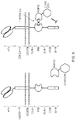
キメラ抗原受容体は、T細胞のエフェクター機能にモノクローナル抗体(mAb)の特異性をグラフトするタンパク質である。それらの通常の形態は、T細胞生存および活性化シグナルを伝達する複合エンドドメインにいずれも接続された抗原認識アミノ末端、スペーサー、膜貫通ドメインを有するI型膜貫通ドメインタンパク質の形態である(図1Aを参照)。 Chimeric antigen receptors are proteins that graft the specificity of monoclonal antibodies (mAbs) to the effector functions of T cells. Their common form is that of type I transmembrane domain proteins with an antigen-recognizing amino terminus, a spacer, and a transmembrane domain all connected to composite endodomains that transmit T cell survival and activation signals (Fig. 1A).
これらの分子の最も一般的な形態は、スペーサーおよび膜貫通ドメインを介してシグナル伝達エンドドメインに融合した、標的抗原を認識するモノクローナル抗体に由来する単鎖可変断片(scFv)の融合物である。そのような分子は、その標的のscFvによる認識に応答してT細胞の活性化を結果としてもたらす。T細胞がそのようなCARを発現する場合、それらは、標的抗原を発現する標的細胞を認識して殺傷する。いくつものCARが腫瘍関連抗原に対して開発されており、そのようなCAR発現T細胞を使用する養子導入アプローチは現在、様々ながんの処置のための臨床試験が為されている。 The most common form of these molecules are fusions of single-chain variable fragments (scFv) derived from monoclonal antibodies that recognize target antigens, fused via a spacer and a transmembrane domain to a signaling endodomain. Such molecules result in activation of T cells in response to recognition of their targets by the scFv. When T cells express such CARs, they recognize and kill target cells expressing the target antigen. A number of CARs have been developed against tumor-associated antigens, and adoptive transfer approaches using such CAR-expressing T cells are currently undergoing clinical trials for the treatment of various cancers.
多数の毒性がCAR研究から報告されており、追加の理論的な毒性が存在する。そのような毒性としては、マクロファージ活性化症候群(MAS)および「オンターゲットオフ腫瘍」毒性、すなわち、正常組織上の標的抗原の認識を結果としてもたらすCAR T細胞の持続した強い活性化により引き起こされる免疫学的毒性が挙げられる。 Numerous toxicities have been reported from CAR studies, and additional theoretical toxicities exist. Such toxicities include macrophage activation syndrome (MAS) and 'on-target off-tumor' toxicities, i.e., immunity caused by sustained and strong activation of CAR T cells resulting in recognition of target antigens on normal tissues. chemical toxicity.
MASは、T細胞の持続性の抗原に駆動される活性化および増殖により引き起こされると推定され、次いでT細胞は、多量の炎症性サイトカインを放出して、マクロファージの過剰活性化および免疫活性化のフィードフォワードサイクルに繋がる。血清IL-6における大きなスパイクは特徴的であり、症候群は、ICUへの入院を必要とする重篤な全身性の病気を結果としてもたらし得る。 MAS is presumed to be caused by persistent antigen-driven activation and proliferation of T cells, which then release large amounts of pro-inflammatory cytokines leading to hyperactivation of macrophages and immune activation. It leads to a feedforward cycle. Large spikes in serum IL-6 are characteristic, and the syndrome can result in severe systemic illness requiring admission to the ICU.
オンターゲットオフ腫瘍毒性が他のCARと共に報告されており、例えば、腎細胞癌抗原CAIXに対してCARを用いて処置された患者の群は、予想外で処置制限性の胆汁毒性を発症した。2人の死者がCAR研究と共に報告されており、1人の患者は、大用量の第三世代抗ERBB2 CAR T細胞の注入直後に起こった呼吸窮迫症候群により死亡し、さらなる患者は、異なる試験において、第二世代抗CD19 CARを用いたCLLの処置後に起こった可能性があるサイトカインストーム後に死亡した。 On-target off-tumor toxicity has been reported with other CARs, for example, a group of patients treated with CAR against the renal cell carcinoma antigen CAIX developed unexpected and treatment-limiting biliary toxicity. Two deaths have been reported with the CAR study, one patient died from respiratory distress syndrome that occurred shortly after infusion of large doses of third-generation anti-ERBB2 CAR T cells, and an additional patient died in a different trial. , died after a cytokine storm that may have occurred after treatment of CLL with a second-generation anti-CD19 CAR.
これらの毒性は、詳細な動物研究または非ヒト霊長動物研究を以ってしても予測が非常に難しい。極めて重大なことに、小分子および生物学的製剤とは異なり、CAR T細胞は半減期を有さず、投与を中止して薬剤が破壊される/排出されることを待つことができない。CAR T細胞は自律的であり、生着および増殖し得る。したがって、毒性は進行性および電撃性であり得る。 These toxicities are very difficult to predict even with detailed animal or non-human primate studies. Most importantly, unlike small molecules and biologics, CAR T cells do not have a half-life and cannot be withdrawn and waited for the drug to be destroyed/cleared. CAR T cells are autonomous and can engraft and proliferate. Toxicity can therefore be progressive and contagious.
自殺遺伝子は、それらを発現する細胞を条件的に破壊し得る遺伝学的に発現されるエレメントである。例としては、ガンシクロビルに対して細胞を感受性にする単純ヘルペスウイルスチミジンキナーゼ;小分子ホモ二量体化因子(homodimerizer)およびCD20に対して細胞を感受性にする誘導性カスパーゼ9ならびにリツキシマブに対して細胞を感受性にするRQR8が挙げられる。
Suicide genes are genetically expressed elements that can conditionally destroy the cells that express them. Examples include herpes simplex virus thymidine kinase, which sensitizes cells to ganciclovir;
この技術は、ある特定の程度の安全性をCAR T細胞療法に加えるが、制限がある。第一に、それは、全てのCAR T細胞が自殺剤の添加により破壊される二元的アプローチである。加えて、薬物治療は、多くの場合、治療ウインドウを有する。自殺遺伝子を用いる場合、製造物の効力は、忍容できる毒性と共に有効性を達成できるように調整することができない。第二に、自殺遺伝子が上記される免疫毒性の一部を助けるかどうかが明確でなく、例えば、マクロファージ活性化症候群が誘発される時点までにはCAR T細胞の永続はもはや必要でなくなっていることがあり、自殺遺伝子はもはや役に立たない。より急性のサイトカイン放出症候群の発生は恐らく、自殺遺伝子が働くには急速過ぎる。 Although this technology adds a certain degree of safety to CAR T cell therapy, it has limitations. First, it is a dual approach in which all CAR T cells are destroyed by the addition of suicide agents. Additionally, drug therapy often has a therapeutic window. When using suicide genes, product potency cannot be tailored to achieve efficacy with tolerable toxicity. Second, it is unclear whether the suicide gene aids in some of the immunotoxicities described above, e.g., by the time macrophage activation syndrome is induced, CAR T cell persistence is no longer required. Sometimes, the suicide gene is no longer useful. The development of the more acute cytokine release syndrome is probably too rapid for the suicide gene to act.
したがって、上述した欠点を伴わない、CAR T細胞を制御するための代替的な機構の必要性が存在する。 Therefore, there is a need for alternative mechanisms for regulating CAR T cells that do not suffer from the drawbacks mentioned above.
本発明者らは、薬剤を用いて制御可能なCARシグナル伝達システムを開発した。シグナル伝達システムは、CAR媒介性細胞シグナル伝達を阻害するシグナル減弱ドメインを含む。これは、薬剤の投与によりCAR媒介性細胞シグナル伝達を低減(または増大)させて、例えばCAR関連毒性の事象において、制御のための機構を提供できることを意味する。第1の態様では、本発明は、
(i)抗原結合ドメインと細胞内シグナル伝達ドメインとを含むキメラ抗原受容体(CAR);
(ii)第1の二量体化ドメインを含む膜テザリング成分;および
(iii)シグナル減弱ドメイン(SDD)と、膜テザリング成分の第1の二量体化ドメインに特異的に結合する第2の二量体化ドメインとを含むシグナル減弱成分(SDC)
を含む、細胞を提供する。
The present inventors have developed a CAR signaling system that can be controlled using drugs. Signal transduction systems include signal attenuation domains that inhibit CAR-mediated cell signaling. This means that drug administration can reduce (or increase) CAR-mediated cell signaling, providing a mechanism for regulation, eg, in the event of CAR-associated toxicity. In a first aspect, the invention provides:
(i) a chimeric antigen receptor (CAR) comprising an antigen-binding domain and an intracellular signaling domain;
(ii) a membrane tethering component comprising a first dimerization domain; and (iii) a signal attenuation domain (SDD) and a second dimerization domain that specifically binds to the first dimerization domain of the membrane tethering component. a signal attenuation component (SDC) comprising a dimerization domain
providing a cell comprising
SDDは、CARの細胞内シグナル伝達ドメインを阻害し得る。 SDD can inhibit the intracellular signaling domain of CAR.
SDDは、免疫受容体チロシン活性化モチーフ(ITAM)を脱リン酸化することができるホスファターゼドメインを含み得る。 SDDs may contain a phosphatase domain that can dephosphorylate immunoreceptor tyrosine activation motifs (ITAMs).
SDDは、CD148またはCD45のエンドドメインを含み得る。 The SDD may contain the endodomain of CD148 or CD45.
SDDは、SHP-1またはSHP-2のホスファターゼドメインを含み得る。 The SDD may contain the phosphatase domain of SHP-1 or SHP-2.
SDDは、免疫受容体チロシン阻害モチーフ(ITIM)を含み得る。 An SDD may contain an immunoreceptor tyrosine inhibition motif (ITIM).
SDDは、以下の阻害性受容体:PD1、BTLA、2B4、CTLA-4、GP49B、Lair-1、Pir-B、PECAM-1、CD22、シグレック7、シグレック9、KLRG1、ILT2、CD94-NKG2AおよびCD5のうちの1つからのエンドドメインを含み得る。
SDD is an inhibitory receptor for the following: PD1, BTLA, 2B4, CTLA-4, GP49B, Lair-1, Pir-B, PECAM-1, CD22, Siglec 7,
SDDは、Srcプロテインキナーゼを阻害し得る。 SDD can inhibit Src protein kinase.
SDDは、Lckを阻害し得る。 SDD can inhibit Lck.
SDDは、CSKのキナーゼドメインを含み得る。 SDD may contain the kinase domain of CSK.
SDDは、CARの細胞内シグナル伝達ドメインの除去を引き起こし得る。例えば、SDDは、プロテアーゼを含み得、CARは、プロテアーゼ切断部位を含み得る。 SDD can cause removal of the intracellular signaling domain of CAR. For example, SDD may contain a protease and CAR may contain a protease cleavage site.
SDDは、タバコエッチウイルスプロテアーゼ(TeV)を含み得る。 The SDD may contain tobacco etch virus protease (TeV).
第1および第2の二量体化ドメインの結合は、薬剤の存在または非存在により制御可能であり得る。 Binding of the first and second dimerization domains may be controllable by the presence or absence of an agent.
第1の実施形態では、第1および第2の二量体化ドメインの結合は、二量体化の化学的誘導剤(CID)の存在により誘導され得る。 In a first embodiment, the binding of the first and second dimerization domains can be induced by the presence of a chemical inducer of dimerization (CID).
これに関して、一方の二量体化ドメインは、FK506結合タンパク質(FKBP)を含み得、他方の二量体化ドメインは、mTORのFRBドメインを含み得、CIDは、ラパマイシンまたはラパマイシンアナログであり得る。 In this regard, one dimerization domain may comprise the FK506 binding protein (FKBP), the other dimerization domain may comprise the FRB domain of mTOR, and the CID may be rapamycin or a rapamycin analogue.
あるいは、第1および第2の二量体化ドメインは、FK506結合タンパク質(FKBP)を含み得、CIDは、FK1012であり得る。 Alternatively, the first and second dimerization domains may comprise FK506 binding protein (FKBP) and the CID may be FK1012.
あるいは、第1および第2の二量体化ドメインは、GyrBを含み得、CIDは、クーママイシンまたはその誘導体であり得る。 Alternatively, the first and second dimerization domains may comprise GyrB and the CID may be Coumamycin or a derivative thereof.
あるいは、一方の二量体化ドメインは、GAIを含み得、他方の二量体化ドメインは、GID1を含み得、CIDは、ジベレリンまたはその誘導体であり得る。 Alternatively, one dimerization domain may comprise GAI, the other dimerization domain may comprise GID1, and the CID may be gibberellin or a derivative thereof.
第2の実施形態では、薬剤の存在は、第1および第2の二量体化ドメインの結合を破壊する。 In a second embodiment, the presence of the agent disrupts binding of the first and second dimerization domains.
これに関して、一方の二量体化ドメインは、Tetリプレッサー(TetR)を含み得、他方の二量体化ドメインは、TetR相互作用タンパク質(TiP)を含み得、薬剤は、テトラサイクリン、ドキシサイクリン、ミノサイクリンまたはこれらのアナログであり得る。 In this regard, one dimerization domain may contain the Tet repressor (TetR) and the other dimerization domain may contain the TetR-interacting protein (TiP), the agents being tetracycline, doxycycline, minocycline or analogs thereof.
膜テザリング成分は、膜貫通ドメインまたはミリストイル化配列を含み得る。 A membrane tethering component can include a transmembrane domain or a myristoylation sequence.
第2の態様では、本発明は、
(i)本発明の第1の態様に定義されるキメラ抗原受容体(CAR)をコードする第1の核酸配列;
(ii)本発明の第1の態様に定義される膜テザリング成分(MTC)をコードする第2の核酸配列;および
(iii)本発明の第1の態様に定義されるシグナル減弱成分(SDC)をコードする第3の核酸配列
を含む、核酸構築物を提供する。
In a second aspect, the invention provides
(i) a first nucleic acid sequence encoding a chimeric antigen receptor (CAR) as defined in the first aspect of the invention;
(ii) a second nucleic acid sequence encoding a membrane tethering component (MTC) as defined in the first aspect of the invention; and (iii) a signal attenuation component (SDC) as defined in the first aspect of the invention. A nucleic acid construct is provided comprising a third nucleic acid sequence encoding
第3の態様では、本発明は、
(i)本発明の第1の態様に定義されるキメラ抗原受容体(CAR)をコードする第1の核酸配列;
(ii)本発明の第1の態様に定義される膜テザリング成分(MTC)をコードする第2の核酸配列;および
(ii)本発明の第1の態様に定義されるシグナル減弱成分(SDC)をコードする第3の核酸配列
を含む、核酸配列のキットを提供する。
In a third aspect, the invention provides
(i) a first nucleic acid sequence encoding a chimeric antigen receptor (CAR) as defined in the first aspect of the invention;
(ii) a second nucleic acid sequence encoding a membrane tethering component (MTC) as defined in the first aspect of the invention; and (ii) a signal attenuation component (SDC) as defined in the first aspect of the invention. A kit of nucleic acid sequences is provided, comprising a third nucleic acid sequence that encodes a.
第4の態様では、本発明は、本発明の第2の態様による核酸構築物を含む、ベクターを提供する。 In a fourth aspect the invention provides a vector comprising the nucleic acid construct according to the second aspect of the invention.
第5の態様では、本発明は、
(i)本発明の第1の態様に定義されるキメラ抗原受容体(CAR)をコードする核酸配列を含む第1のベクター;
(ii)本発明の第1の態様に定義される膜テザリング成分(MTC)をコードする核酸配列を含む第2のベクター;および
(ii)本発明の第1の態様に定義されるシグナル減弱成分(SDC)をコードする核酸配列を含む第3のベクター
を含む、ベクターのキットを提供する。
In a fifth aspect, the invention provides
(i) a first vector comprising a nucleic acid sequence encoding a chimeric antigen receptor (CAR) as defined in the first aspect of the invention;
(ii) a second vector comprising a nucleic acid sequence encoding a membrane tethering component (MTC) as defined in the first aspect of the invention; and (ii) a signal attenuation component as defined in the first aspect of the invention. Kits of vectors are provided that include a third vector comprising a nucleic acid sequence encoding (SDC).
第6の態様では、本発明は、本発明の第1の態様による複数の細胞を含む、医薬組成物を提供する。 In a sixth aspect the invention provides a pharmaceutical composition comprising a plurality of cells according to the first aspect of the invention.
第7の態様では、本発明は、疾患の処置および/または予防において使用するための、本発明の第6の態様による医薬組成物を提供する。 In a seventh aspect the invention provides a pharmaceutical composition according to the sixth aspect of the invention for use in the treatment and/or prevention of disease.
第7の態様では、本発明の第6の態様による医薬組成物を被験体に投与するステップを含む、疾患を処置および/または予防するための方法が提供される。 In a seventh aspect there is provided a method for treating and/or preventing a disease comprising administering to a subject a pharmaceutical composition according to the sixth aspect of the invention.
方法は、
(i)細胞含有試料を単離するステップ;
(ii)本発明の第2の態様による核酸構築物、本発明の第3の態様による核酸配列のキット;本発明の第4の態様によるベクターまたは本発明の第5の態様によるベクターのキットで、細胞を形質導入またはトランスフェクトするステップ;および
(iii)(ii)からの細胞を被験体に投与するステップ
を含み得る。
The method is
(i) isolating a cell-containing sample;
(ii) a nucleic acid construct according to the second aspect of the invention, a kit of nucleic acid sequences according to the third aspect of the invention; a vector according to the fourth aspect of the invention or a kit of vectors according to the fifth aspect of the invention; and (iii) administering the cells from (ii) to the subject.
第8の態様では、本発明は、第1および第2の二量体化ドメインの結合または解離を制御する薬剤を被験体に投与するステップを含む、被験体において本発明の第1の態様による細胞の活性化を制御するための方法を提供する。 In an eighth aspect, the invention provides a method according to the first aspect of the invention in a subject, comprising administering to the subject an agent that controls the association or dissociation of the first and second dimerization domains. Methods are provided for controlling cell activation.
第9の態様では、本発明は、第1および第2の結合ドメインの結合を誘導する薬剤を被験体に投与するステップを含む、本発明の第1の態様による細胞を含む被験体においてCAR関連毒性を処置するための方法を提供する。 In a ninth aspect, the invention provides a CAR-associated protein in a subject comprising a cell according to the first aspect of the invention, comprising administering to the subject an agent that induces binding of the first and second binding domains. Methods for treating toxicity are provided.
CAR関連毒性は、例えば、サイトカイン放出症候群、マクロファージ活性化症候群、または神経毒性であり得る。 CAR-related toxicity can be, for example, cytokine release syndrome, macrophage activation syndrome, or neurotoxicity.
第10の態様では、本発明は、疾患の処置および/または予防のための医薬の製造における、本発明の第1の態様による医薬組成物の使用を提供する。 In a tenth aspect the invention provides the use of a pharmaceutical composition according to the first aspect of the invention in the manufacture of a medicament for the treatment and/or prevention of disease.
疾患は、がんであり得る。 The disease can be cancer.
第11の態様では、本発明は、本発明の第2の態様による核酸構築物、本発明の第3の態様による核酸配列のキット;本発明の第4の態様によるベクター、または本発明の第5の態様によるベクターのキットを細胞に導入するステップを含む、本発明の第1の態様による細胞を製造するための方法を提供する。 In an eleventh aspect the invention provides a nucleic acid construct according to the second aspect of the invention, a kit of nucleic acid sequences according to the third aspect of the invention; a vector according to the fourth aspect of the invention or a fifth aspect of the invention. There is provided a method for producing a cell according to the first aspect of the invention, comprising introducing into the cell a kit of vectors according to the aspect of .
細胞は、被験体から単離された試料からのものであり得る。 A cell can be from a sample isolated from a subject.
図8~11に示す本発明の「融合二量体化減弱因子(fused dimerising dampener)」の実施形態に関する本発明の追加の態様は、以下の番号付けされたパラグラフA1~A34において要約される。 Additional aspects of the invention relating to the "fused dimerizing dampener" embodiment of the invention shown in Figures 8-11 are summarized in numbered paragraphs A1-A34 below.
A1.(i)抗原結合ドメイン、膜貫通ドメイン、第1の二量体化ドメインおよび細胞内シグナル伝達ドメインを含むキメラ抗原受容体(CAR);ならびに
(ii)シグナル減弱ドメイン(SDD)と、CARの第1の二量体化ドメインに特異的に結合する第2の二量体化ドメインとを含むシグナル減弱成分(SDC)
を含む、細胞。
A1. (i) a chimeric antigen receptor (CAR) comprising an antigen-binding domain, a transmembrane domain, a first dimerization domain and an intracellular signaling domain; A signal attenuation component (SDC) comprising a second dimerization domain that specifically binds to one dimerization domain
containing, cells.
A2.SDDが、CARの細胞内シグナル伝達ドメインを阻害する、パラグラフA1に記載の細胞。 A2. The cell of paragraph A1, wherein the SDD inhibits the intracellular signaling domain of CAR.
A3.SDDが、免疫受容体チロシン活性化モチーフ(ITAM)を脱リン酸化することができるホスファターゼドメインを含む、パラグラフA2に記載の細胞。 A3. The cell of paragraph A2, wherein the SDD comprises a phosphatase domain capable of dephosphorylating an immunoreceptor tyrosine activation motif (ITAM).
A4.SDDが、CD148またはCD45のエンドドメインを含む、パラグラフA3に記載の細胞。 A4. The cell of paragraph A3, wherein the SDD comprises a CD148 or CD45 endodomain.
A5.SDDが、SHP-1またはSHP-2のホスファターゼドメインを含む、パラグラフA3に記載の細胞。 A5. The cell of paragraph A3, wherein the SDD comprises the phosphatase domain of SHP-1 or SHP-2.
A6.SDDが、免疫受容体チロシン阻害モチーフ(ITIM)を含む、パラグラフA2に記載の細胞。 A6. The cell of paragraph A2, wherein the SDD comprises an immunoreceptor tyrosine inhibition motif (ITIM).
A7.SDDが、以下の阻害性受容体:PD1、BTLA、2B4、CTLA-4、GP49B、Lair-1、Pir-B、PECAM-1、CD22、シグレック7、シグレック9、KLRG1、ILT2、CD94-NKG2AおよびCD5のうちの1つからのエンドドメインを含む、パラグラフA6に記載の細胞。
A7. SDD inhibits the following receptors: PD1, BTLA, 2B4, CTLA-4, GP49B, Lair-1, Pir-B, PECAM-1, CD22, Siglec 7,
A8.SDDが、Srcプロテインキナーゼを阻害する、パラグラフA2に記載の細胞。 A8. The cell of paragraph A2, wherein SDD inhibits Src protein kinase.
A9.SDDが、Lckを阻害する、パラグラフA8に記載の細胞。 A9. The cell of paragraph A8, wherein SDD inhibits Lck.
A10.CSKのキナーゼドメインを含む、パラグラフA8またはA9に記載の細胞。 A10. The cell of paragraph A8 or A9, comprising the kinase domain of CSK.
A11.SDDが、CARの細胞内シグナル伝達ドメインの除去を引き起こす、パラグラフA1に記載の細胞。 A11. The cell of paragraph A1, wherein SDD causes removal of the intracellular signaling domain of CAR.
A12.SDDが、プロテアーゼを含み、CARが、プロテアーゼ切断部位を含む、パラグラフA11に記載の細胞。 A12. The cell of paragraph A11, wherein the SDD comprises a protease and the CAR comprises a protease cleavage site.
A13.SDDが、タバコエッチウイルスプロテアーゼ(TeV)を含む、パラグラフA12に記載の細胞。 A13. The cell of paragraph A12, wherein the SDD comprises tobacco etch virus protease (TeV).
A14.第1および第2の二量体化ドメインの結合が、薬剤の存在または非存在により制御可能である、任意の先行するパラグラフに記載の細胞。 A14. The cell of any preceding paragraph, wherein binding of the first and second dimerization domains is controllable by the presence or absence of an agent.
A15.第1および第2の二量体化ドメインの結合が、二量体化の化学的誘導剤(CID)の存在により誘導される、パラグラフA14に記載の細胞。 A15. The cell of paragraph A14, wherein binding of the first and second dimerization domains is induced by the presence of a chemical inducer of dimerization (CID).
A16.一方の二量体化ドメインが、FK506結合タンパク質(FKBP)を含み、他方の二量体化ドメインが、mTORのFRBドメインを含み、CIDが、ラパマイシンまたはラパマイシンアナログである、パラグラフA15に記載の細胞。 A16. The cell of paragraph A15, wherein one dimerization domain comprises an FK506 binding protein (FKBP), the other dimerization domain comprises the FRB domain of mTOR, and the CID is rapamycin or a rapamycin analogue. .
A17.第1および第2の二量体化ドメインが、FK506結合タンパク質(FKBP)を含み、CIDが、FK1012である、パラグラフA15に記載の細胞。 A17. The cell of paragraph A15, wherein the first and second dimerization domains comprise an FK506 binding protein (FKBP) and the CID is FK1012.
A18.第1および第2の二量体化ドメインが、GyrBを含み、CIDが、クーママイシンまたはその誘導体である、パラグラフA15に記載の細胞。 A18. The cell of paragraph A15, wherein the first and second dimerization domains comprise GyrB and the CID is Coumamycin or a derivative thereof.
A19.一方の二量体化ドメインが、GAIを含み、他方の二量体化ドメインが、GID1を含み、CIDが、ジベレリンまたはその誘導体である、パラグラフA15に記載の細胞。 A19. The cell of paragraph A15, wherein one dimerization domain comprises GAI, the other dimerization domain comprises GID1, and CID is gibberellin or a derivative thereof.
A20.薬剤が、第1および第2の二量体化ドメインの結合を破壊する、パラグラフA14に記載の細胞。 A20. The cell of paragraph A14, wherein the agent disrupts binding of the first and second dimerization domains.
A21.一方の二量体化ドメインが、Tetリプレッサー(TetR)を含み、他方の二量体化ドメインが、TetR相互作用タンパク質(TiP)を含み、薬剤が、テトラサイクリン、ドキシサイクリン、ミノサイクリンまたはこれらのアナログである、パラグラフA20に記載の細胞。 A21. one dimerization domain contains the Tet repressor (TetR), the other dimerization domain contains the TetR-interacting protein (TiP), and the agent is tetracycline, doxycycline, minocycline, or analogs thereof A cell according to paragraph A20.
A22.(i)任意の先行するパラグラフに定義されるキメラ抗原受容体(CAR)をコードする第1の核酸配列;および
(ii)任意の先行するパラグラフに定義されるシグナル減弱成分(SDC)をコードする第2の核酸配列
を含む、核酸構築物。
A22. (i) a first nucleic acid sequence encoding a chimeric antigen receptor (CAR) as defined in any preceding paragraph; and (ii) encoding a signal attenuation component (SDC) as defined in any preceding paragraph. A nucleic acid construct comprising a second nucleic acid sequence.
A23.以下の構造:
AgBD-TM-DD1-endo-coexpr-SDD-DD2;
AgBD-TM-endo-DD1-coexpr-SDD-DD2;
SDD-DD2-coexpr-AgBD-TM-DD1-endo;
SDD-DD2-coexpr-AgBD-TM-endo-DD1;
AgBD-TM-DD1-endo-coexpr-DD2-SDD;
AgBD-TM-endo-DD1-coexpr-DD2-SDD;
DD2-SDD-coexpr-AgBD-TM-DD1-endo;および
DD2-SDD-coexpr-AgBD-TM-endo-DD1のうちの1つを有し、
AgBDは、CARの抗原結合ドメインをコードする配列であり、
TMは、CARの膜貫通ドメインをコードする配列であり、
DD1は、第1の二量体化ドメインをコードする配列であり、
Endoは、CARの細胞内シグナル伝達ドメインをコードする配列であり、
Coexprは、CARおよびSDCの共発現を可能とする配列であり、
SDDは、SDCのシグナル減弱ドメインをコードする配列であり、
DD2は、第2の二量体化ドメインをコードする配列である、
パラグラフ22に記載の核酸構築物。
A23. The structure below:
AgBD-TM-DD1-endo-coexpr-SDD-DD2;
AgBD-TM-endo-DD1-coexpr-SDD-DD2;
SDD-DD2-coexpr-AgBD-TM-DD1-endo;
SDD-DD2-coexpr-AgBD-TM-endo-DD1;
AgBD-TM-DD1-endo-coexpr-DD2-SDD;
AgBD-TM-endo-DD1-coexpr-DD2-SDD;
DD2-SDD-coexpr-AgBD-TM-DD1-endo; and DD2-SDD-coexpr-AgBD-TM-endo-DD1;
AgBD is the sequence encoding the antigen-binding domain of CAR;
TM is the sequence encoding the transmembrane domain of CAR;
DD1 is a sequence encoding the first dimerization domain;
Endo is a sequence encoding the intracellular signaling domain of CAR;
Coexpr is a sequence that allows co-expression of CAR and SDC;
SDD is the sequence encoding the signal attenuation domain of SDC;
DD2 is a sequence encoding a second dimerization domain;
23. A nucleic acid construct according to paragraph 22.
A24.(i)パラグラフA1~A21のいずれかに定義されるキメラ抗原受容体(CAR)をコードする第1の核酸配列;および
(ii)パラグラフA1~A21のいずれかに定義されるシグナル減弱成分(SDC)をコードする第2の核酸配列
を含む、核酸配列のキット。
A24. (i) a first nucleic acid sequence encoding a chimeric antigen receptor (CAR) as defined in any of paragraphs A1-A21; and (ii) a signal attenuation component (SDC) as defined in any of paragraphs A1-A21 A kit of nucleic acid sequences comprising a second nucleic acid sequence encoding ).
A25.パラグラフA22またはA23に記載の核酸構築物を含む、ベクター。 A25. A vector comprising the nucleic acid construct of paragraph A22 or A23.
A26.(i)パラグラフA1~A21のいずれかに定義されるキメラ抗原受容体(CAR)をコードする核酸配列を含む第1のベクター;および
(ii)パラグラフA1~A21のいずれかに定義されるシグナル減弱成分(SDC)をコードする核酸配列を含む第2のベクター
を含む、ベクターのキット。
A26. (i) a first vector comprising a nucleic acid sequence encoding a chimeric antigen receptor (CAR) as defined in any of paragraphs A1-A21; and (ii) signal attenuation as defined in any of paragraphs A1-A21. A vector kit comprising a second vector comprising a nucleic acid sequence encoding a component (SDC).
A27.パラグラフ1~20のいずれかに記載の複数の細胞を含む、医薬組成物。 A27. A pharmaceutical composition comprising a plurality of cells according to any of paragraphs 1-20.
A28.疾患の処置および/または予防において使用するための、パラグラフA27に記載の医薬組成物。 A28. A pharmaceutical composition according to paragraph A27 for use in the treatment and/or prevention of disease.
A29.パラグラフA27に記載の医薬組成物を被験体に投与するステップを含む、疾患を処置および/または予防するための方法。 A29. A method for treating and/or preventing a disease comprising administering to a subject the pharmaceutical composition of paragraph A27.
A30.(i)細胞含有試料を単離するステップ;
(ii)パラグラフA22またはA23に記載の核酸構築物、パラグラフA24に記載の核酸配列のキット;パラグラフA25に記載のベクターまたはパラグラフA26に記載のベクターのキットで、細胞を形質導入またはトランスフェクトするステップ;および
(iii)(ii)からの細胞を被験体に投与するステップ
を含む、パラグラフ28に記載の方法。
A30. (i) isolating a cell-containing sample;
(ii) transducing or transfecting a cell with a nucleic acid construct according to paragraph A22 or A23, a kit of nucleic acid sequences according to paragraph A24; a vector according to paragraph A25 or a kit of vectors according to paragraph A26; and (iii) administering the cells from (ii) to the subject.
A31.第1および第2の二量体化ドメインの結合または解離を制御する薬剤を被験体に投与するステップを含む、被験体においてパラグラフA1~A21のいずれかに記載の細胞の活性化を制御するための方法。 A31. for controlling activation of a cell according to any of paragraphs A1-A21 in a subject, comprising administering to the subject an agent that controls the association or dissociation of the first and second dimerization domains the method of.
A32.疾患の処置および/または予防のための医薬の製造における、パラグラフA27に記載の医薬組成物の使用。 A32. Use of a pharmaceutical composition according to paragraph A27 in the manufacture of a medicament for the treatment and/or prevention of disease.
A33.疾患ががんである、パラグラフA28に記載の使用のための医薬組成物、パラグラフA29またはA30に記載の方法、あるいはパラグラフA32に記載の使用。 A33. A pharmaceutical composition for use according to paragraph A28, a method according to paragraph A29 or A30, or a use according to paragraph A32, wherein the disease is cancer.
A34.パラグラフA22またはA23に記載の核酸構築物、パラグラフA24に記載の核酸配列のキット;パラグラフA25に記載のベクターまたはパラグラフA26に記載のベクターのキットを細胞に導入するステップを含む、パラグラフ1~20のいずれかに記載の細胞を製造するための方法。 A34. any of paragraphs 1-20, comprising introducing into a cell a nucleic acid construct according to paragraph A22 or A23, a kit of nucleic acid sequences according to paragraph A24; a vector according to paragraph A25 or a kit of vectors according to paragraph A26. 3. A method for producing the cell of claim 1.
A35.細胞が、被験体から単離された試料からのものである、パラグラフA34に記載の方法。 A35. The method of paragraph A34, wherein the cells are from a sample isolated from the subject.
図12に示す本発明の「不安定化ドメイン減弱因子(destabilisation domain dampener)」の実施形態に関する本発明の追加の態様は、以下の番号付けされたパラグラフB1~B29に要約される。 Additional aspects of the invention relating to the “destabilization domain dampener” embodiment of the invention shown in FIG. 12 are summarized in numbered paragraphs B1-B29 below.
B1.(i)抗原結合ドメインおよび細胞内シグナル伝達ドメインを含むキメラ抗原受容体(CAR);ならびに
(iii)シグナル減弱ドメイン(SDD)および不安定化ドメインを含む膜にテザリングされたシグナル減弱成分(SDC)
を含む、細胞。
B1. (i) a chimeric antigen receptor (CAR) comprising an antigen binding domain and an intracellular signaling domain; and (iii) a membrane-tethered signal attenuation component (SDC) comprising a signal attenuation domain (SDD) and a destabilization domain.
containing, cells.
B2.SDDが、CARの細胞内シグナル伝達ドメインを阻害する、パラグラフB1に記載の細胞。 B2. The cell of paragraph B1, wherein the SDD inhibits the intracellular signaling domain of CAR.
B3.SDDが、免疫受容体チロシン活性化モチーフ(ITAM)を脱リン酸化することができるホスファターゼドメインを含む、パラグラフB2に記載の細胞。 B3. The cell of paragraph B2, wherein the SDD comprises a phosphatase domain capable of dephosphorylating an immunoreceptor tyrosine activation motif (ITAM).
B4.SDDが、CD148またはCD45のエンドドメインを含む、パラグラフB3に記載の細胞。 B4. The cell of paragraph B3, wherein the SDD comprises a CD148 or CD45 endodomain.
B5.SDDが、SHP-1またはSHP-2のホスファターゼドメインを含む、パラグラフB3に記載の細胞。 B5. The cell of paragraph B3, wherein the SDD comprises the phosphatase domain of SHP-1 or SHP-2.
B6.SDDが、免疫受容体チロシン阻害モチーフ(ITIM)を含む、パラグラフB2に記載の細胞。 B6. The cell of paragraph B2, wherein the SDD comprises an immunoreceptor tyrosine inhibition motif (ITIM).
B7.SDDが、以下の阻害性受容体:PD1、BTLA、2B4、CTLA-4、GP49B、Lair-1、Pir-B、PECAM-1、CD22、シグレック7、シグレック9、KLRG1、ILT2、CD94-NKG2AおよびCD5のうちの1つからのエンドドメインを含む、パラグラフB6に記載の細胞。
B7. SDD inhibits the following receptors: PD1, BTLA, 2B4, CTLA-4, GP49B, Lair-1, Pir-B, PECAM-1, CD22, Siglec 7,
B8.SDDが、Srcプロテインキナーゼを阻害する、パラグラフB2に記載の細胞。 B8. The cell of paragraph B2, wherein SDD inhibits Src protein kinase.
B9.SDDが、Lckを阻害する、パラグラフB8に記載の細胞。 B9. The cell of paragraph B8, wherein SDD inhibits Lck.
B10.CSKのキナーゼドメインを含む、パラグラフB8またはB9に記載の細胞。 B10. The cell of paragraph B8 or B9, comprising the kinase domain of CSK.
B11.SDDが、CARの細胞内シグナル伝達ドメインの除去を引き起こすパラグラフ1に記載の細胞。 B11. The cell of paragraph 1, wherein SDD causes removal of the intracellular signaling domain of CAR.
B12.SDDが、プロテアーゼを含み、CARが、プロテアーゼ切断部位を含む、パラグラフB11に記載の細胞。 B12. The cell of paragraph B11, wherein the SDD comprises a protease and the CAR comprises a protease cleavage site.
B13.SDDが、タバコエッチウイルスプロテアーゼ(TeV)を含む、パラグラフB12に記載の細胞。 B13. The cell of paragraph B12, wherein the SDD comprises tobacco etch virus protease (TeV).
B14.薬剤の存在下でSDCのレベルが細胞膜において増加するように、不安定化ドメインが薬剤の存在により安定化される、任意の先行するパラグラフに記載の細胞。 B14. A cell according to any preceding paragraph, wherein the destabilizing domain is stabilized by the presence of the agent such that the level of SDC is increased at the cell membrane in the presence of the agent.
B15.不安定化ドメインが、変異体FRBを含み、薬剤が、ラパマイシンである、パラグラフB14に記載の細胞。 B15. The cell of paragraph B14, wherein the destabilizing domain comprises mutant FRB and the agent is rapamycin.
B16.膜にテザリングされたSDCが、膜貫通ドメインまたはミリストイル化配列を含む、任意の先行するパラグラフに記載の細胞。 B16. The cell of any preceding paragraph, wherein the membrane-tethered SDC comprises a transmembrane domain or a myristoylation sequence.
B17.(i)任意の先行するパラグラフに定義されるキメラ抗原受容体(CAR)をコードする第1の核酸配列;および
(ii)任意の先行するパラグラフに定義される膜にテザリングされたシグナル減弱成分(SDC)をコードする第2の核酸配列
を含む、核酸構築物。
B17. (i) a first nucleic acid sequence encoding a chimeric antigen receptor (CAR) as defined in any preceding paragraph; and (ii) a membrane-tethered signal attenuation component as defined in any preceding paragraph ( A nucleic acid construct comprising a second nucleic acid sequence encoding SDC).
B18.(i)パラグラフB1~B16のいずれかに定義されるキメラ抗原受容体(CAR)をコードする第1の核酸配列;
(ii)パラグラフB1~B16のいずれかに定義される膜にテザリングされたシグナル減弱成分(SDC)をコードする第2の核酸配列
を含む、核酸配列のキット。
B18. (i) a first nucleic acid sequence encoding a chimeric antigen receptor (CAR) as defined in any of paragraphs B1-B16;
(ii) A kit of nucleic acid sequences comprising a second nucleic acid sequence encoding a membrane-tethered signal-attenuating component (SDC) as defined in any of paragraphs B1-B16.
B19.パラグラフB17に記載の核酸構築物を含む、ベクター。 B19. A vector comprising the nucleic acid construct of paragraph B17.
B20.(i)パラグラフB1~B16のいずれかに定義されるキメラ抗原受容体(CAR)をコードする核酸配列を含む第1のベクター;
(ii)パラグラフB1~B16のいずれかに定義される膜にテザリングされたシグナル減弱成分(SDC)をコードする核酸配列を含む第2のベクター
を含む、ベクターのキット。
B20. (i) a first vector comprising a nucleic acid sequence encoding a chimeric antigen receptor (CAR) as defined in any of paragraphs B1-B16;
(ii) a vector kit comprising a second vector comprising a nucleic acid sequence encoding a membrane-tethered signal attenuation component (SDC) as defined in any of paragraphs B1-B16.
B21.パラグラフB1~B16のいずれかに記載の複数の細胞を含む、医薬組成物。 B21. A pharmaceutical composition comprising a plurality of cells according to any of paragraphs B1-B16.
B22.疾患の処置および/または予防において使用するための、パラグラフB21に記載の医薬組成物。 B22. A pharmaceutical composition according to paragraph B21 for use in the treatment and/or prevention of disease.
B23.パラグラフB21に記載の医薬組成物を被験体に投与するステップを含む、疾患を処置および/または予防するための方法。 B23. A method for treating and/or preventing a disease comprising administering to a subject the pharmaceutical composition of paragraph B21.
B24.(i)細胞含有試料を単離するステップ;
(ii)パラグラフB17に記載の核酸構築物、パラグラフB18に記載の核酸配列のキット;パラグラフB19に記載のベクターまたはパラグラフB20に記載のベクターのキットで、細胞を形質導入またはトランスフェクトするステップ;および
(iii)(ii)からの細胞を被験体に投与するステップ
を含む、パラグラフB23に記載の方法。
B24. (i) isolating a cell-containing sample;
(ii) transducing or transfecting a cell with a nucleic acid construct according to paragraph B17, a kit of nucleic acid sequences according to paragraph B18; a vector according to paragraph B19 or a kit of vectors according to paragraph B20; and ( iii) The method of paragraph B23, comprising administering the cells from (ii) to the subject.
B25.不安定化ドメインを安定化させる薬剤を被験体に投与するステップを含む、被験体においてパラグラフB1~B16のいずれかに記載の細胞のCAR媒介性活性化を減弱させる方法。 B25. A method of attenuating CAR-mediated activation of cells according to any of paragraphs B1-B16 in a subject, comprising administering to the subject an agent that stabilizes the destabilizing domain.
B26.薬剤が、ラパマイシンである、パラグラフB25に記載の方法。 B26. The method of paragraph B25, wherein the drug is rapamycin.
B27.疾患の処置および/または予防のための医薬の製造における、パラグラフB21に記載の医薬組成物の使用。 B27. Use of a pharmaceutical composition according to paragraph B21 in the manufacture of a medicament for the treatment and/or prevention of disease.
B28.疾患ががんである、パラグラフB22に記載の使用のための医薬組成物、パラグラフB23またはB24に記載の方法、パラグラフB27に記載の使用。 B28. A pharmaceutical composition for use according to paragraph B22, a method according to paragraph B23 or B24, a use according to paragraph B27, wherein the disease is cancer.
B29.パラグラフB17に記載の核酸構築物、パラグラフB18に記載の核酸配列のキット;パラグラフB19に記載のベクターまたはパラグラフB20に記載のベクターのキットを細胞に導入するステップを含む、パラグラフB1~B16のいずれかに記載の細胞を製造するための方法。 B29. any of paragraphs B1-B16, comprising introducing into a cell the nucleic acid construct of paragraph B17, the kit of nucleic acid sequences of paragraph B18; the vector of paragraph B19 or the kit of vectors of paragraph B20. A method for producing the described cells.
B30.細胞が、被験体から単離された試料からのものである、パラグラフB29に記載の方法。 B30. The method of paragraph B29, wherein the cells are from a sample isolated from the subject.
キメラ抗原受容体(CAR)
図1に図式的に示す古典的なCARは、キメラI型膜貫通タンパク質であり、細胞外抗原認識ドメイン(結合因子)を細胞内シグナル伝達ドメイン(エンドドメイン)に接続する。結合因子は、典型的に、モノクローナル抗体(mAb)に由来する単鎖可変断片(scFv)であるが、抗体様抗原結合部位を含む他のフォーマットまたは標的抗原のリガンドに基づき得る。スペーサードメインは、膜から結合因子を単離し、好適な配向とさせるために必要なことがある。使用される一般的なスペーサードメインは、IgG1のFcである。抗原に応じて、より小型のスペーサー、例えば、CD8αからのストーク(stalk)およびさらにはIgG1ヒンジ単独でさえも充分なことがある。膜貫通ドメインは、細胞膜中にタンパク質を係留し、スペーサーをエンドドメインに接続する。
chimeric antigen receptor (CAR)
Classical CARs, shown schematically in FIG. 1, are chimeric type I transmembrane proteins that connect an extracellular antigen-recognition domain (binding factor) to an intracellular signaling domain (endodomain). Binding agents are typically single-chain variable fragments (scFv) derived from monoclonal antibodies (mAbs), but may be based on other formats containing antibody-like antigen-binding sites or ligands of the target antigen. A spacer domain may be necessary to isolate and orient the binding agent from the membrane. A common spacer domain used is the Fc of IgG1. Depending on the antigen, smaller spacers such as the stalk from CD8α and even the IgG1 hinge alone may be sufficient. The transmembrane domain anchors the protein in the cell membrane and connects the spacer to the endodomain.
初期のCAR設計は、FcεR1のγ鎖またはCD3ζのいずれかの細胞内部分に由来するエンドドメインを有していた。結果として、これらの第一世代の受容体は免疫シグナル1を伝達し、これは同族標的細胞のT細胞殺傷を誘発するために充分であったが、増殖および生存するようにT細胞を完全に活性化させることはなかった。この制限を克服するために、複合エンドドメインが構築され、T細胞共刺激分子の細胞内部分のCD3ζのそれへの融合は、抗原認識後に活性化シグナルおよび共刺激シグナルを同時に伝達することができる第二世代の受容体を結果としてもたらす。最も一般的に使用される共刺激ドメインは、CD28のものである。これは、T細胞増殖を誘発する最も強力な共刺激シグナル、すなわち免疫シグナル2を与える。生存シグナルを伝達する密接に関連したOX40および41BBのようなTNF受容体ファミリーエンドドメインを含む一部の受容体もまた記載されている。活性化、増殖および生存シグナルを伝達することができるエンドドメインを有するよりいっそう強力な第三世代のCARが今では記載されている。 Early CAR designs had endodomains derived from either the γ chain of FcεR1 or the intracellular portion of CD3ζ. As a result, these first-generation receptors transduced immune signal 1, which was sufficient to induce T-cell killing of cognate target cells, but completely inhibited T-cell proliferation and survival. I never activated it. To overcome this limitation, composite endodomains have been constructed in which fusion of the intracellular portion of the T cell costimulatory molecule, CD3ζ, to that of CD3ζ can simultaneously transmit activating and costimulatory signals following antigen recognition. Resulting in second generation receptors. The most commonly used co-stimulatory domain is that of CD28. This provides the most potent co-stimulatory signal, immune signal 2, to induce T cell proliferation. Some receptors that contain TNF receptor family endodomains, such as the closely related OX40 and 41BB, that transduce survival signals have also been described. Even more potent third generation CARs with endodomains capable of transducing activation, proliferation and survival signals have now been described.
例えばレトロウイルスベクターを使用して、CARをコードする核酸をT細胞に移入することができる。このようにして、多数の抗原特異的なT細胞を養子細胞移入のために生成することができる。CARが標的抗原に結合する時に、これは、それを発現するT細胞への活性化シグナルの伝達を結果としてもたらす。したがって、CARは、T細胞の特異性および細胞傷害を、標的化された抗原を発現する細胞に方向付ける。 For example, retroviral vectors can be used to transfer CAR-encoding nucleic acids into T cells. In this way, large numbers of antigen-specific T cells can be generated for adoptive cell transfer. When the CAR binds to its target antigen, it results in transmission of an activating signal to the T cells expressing it. Thus, CAR directs T cell specificity and cytotoxicity to cells expressing targeted antigens.
抗原結合ドメイン
抗原結合ドメインは、抗原を認識する古典的なCARの部分である。
Antigen Binding Domain The antigen binding domain is the part of classical CAR that recognizes antigen.
抗体、抗体模倣物、およびT細胞受容体の抗原結合部位に基づくものなどの多数の抗原結合ドメインが当該技術分野において公知である。例えば、抗原結合ドメインは、モノクローナル抗体に由来する単鎖可変断片(scFv);標的抗原の天然リガンド;標的に対して充分な親和性を有するペプチド;ラクダ科動物のような単一ドメイン結合因子;Darpinのような単一の人工的結合因子;またはT細胞受容体に由来する一本鎖を含み得る。 Numerous antigen binding domains are known in the art, such as those based on antibodies, antibody mimetics, and T cell receptor antigen binding sites. For example, antigen-binding domains may be single-chain variable fragments (scFv) derived from monoclonal antibodies; natural ligands for the target antigen; peptides with sufficient affinity for the target; single-domain binding agents such as camelids; A single artificial binding agent such as Darpin; or a single chain derived from the T-cell receptor.
以下の表1に示すように、様々な腫瘍関連抗原(TAA)が公知である。本発明において使用される抗原結合ドメインは、表1に指し示すようなTAAに結合することができるドメインであり得る。

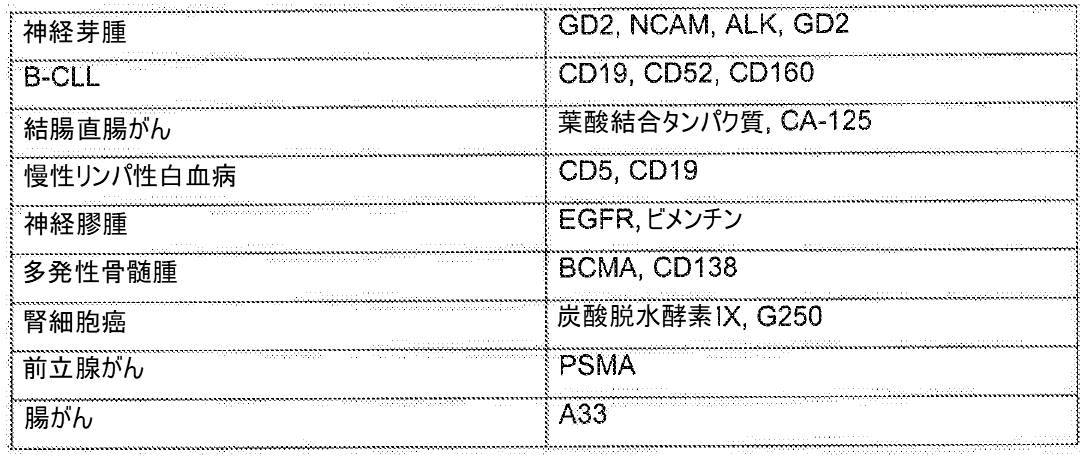
抗原結合ドメインは、B細胞膜抗原(BCMA)ならびに膜貫通活性化因子およびカルシウムモジュレーターおよびシクロフィリンリガンド相互作用因子(TACI)に結合する増殖誘導リガンド(proliferation-inducing ligand)(APRIL)を含み得る。APRILベースの抗原結合ドメインを含むCARはWO2015/052538に記載されている。 Antigen-binding domains can include B-cell membrane antigens (BCMA) and proliferation-inducing ligands (APRIL) that bind to transmembrane activators and calcium modulators and cyclophilin ligand-interacting factors (TACI). CARs containing APRIL-based antigen binding domains are described in WO2015/052538.
膜貫通ドメイン
膜貫通ドメインは、膜を通過する古典的なCARの配列である。それは疎水性アルファヘリックスを含み得る。膜貫通ドメインは、CD28に由来するものであってよく、これは良好な受容体安定性を与える。
Transmembrane Domain The transmembrane domain is the sequence of classical CAR that crosses the membrane. It may contain a hydrophobic alpha helix. The transmembrane domain may be derived from CD28, which confers good receptor stability.
シグナルペプチド
CARは、シグナルペプチドを含んでよく、それにより、T細胞のような細胞中で発現された時に、新生タンパク質は小胞体およびその後に細胞表面に方向付けられ、そこで発現される。
Signal Peptides CARs may contain a signal peptide by which, when expressed in a cell such as a T cell, the nascent protein is directed to the endoplasmic reticulum and subsequently to the cell surface where it is expressed.
シグナルペプチドのコアは、単一のアルファヘリックスを形成する傾向を有する疎水性アミノ酸の長いストレッチを含有し得る。シグナルペプチドは、アミノ酸の正に荷電した短いストレッチで始まることがあり、これは、トランスロケーションの間のポリペプチドの適切なトポロジーの強化を助ける。シグナルペプチドの終わりに、シグナルペプチダーゼにより認識されて切断されるアミノ酸のストレッチが典型的に存在する。シグナルペプチダーゼは、トランスロケーションの間またはその完了後のいずれかにおいて切断を行って、遊離のシグナルペプチドおよび成熟タンパク質を生成させ得る。次いで、遊離のシグナルペプチドは、特異的プロテアーゼにより消化される。 The core of the signal peptide may contain long stretches of hydrophobic amino acids that tend to form single alpha helices. A signal peptide may begin with a short, positively charged stretch of amino acids that help enforce proper topology of the polypeptide during translocation. At the end of the signal peptide there is typically a stretch of amino acids that is recognized and cleaved by the signal peptidase. A signal peptidase can cleave either during translocation or after its completion to generate a free signal peptide and mature protein. The free signal peptide is then digested by specific proteases.
スペーサードメイン
CARは、抗原結合ドメインを膜貫通ドメインと接続するスペーサー配列を含み得る。柔軟なスペーサーは、抗原結合ドメインが異なる方向に配向して結合を促進することを可能とする。
Spacer Domain The CAR may contain a spacer sequence connecting the antigen binding domain with the transmembrane domain. A flexible spacer allows the antigen binding domains to be oriented in different directions to facilitate binding.
スペーサー配列は、例えば、IgG1 Fc領域、IgG1ヒンジまたはヒトCD8ストークまたはマウスCD8ストークを含み得る。あるいは、スペーサーは、IgG1 Fc領域、IgG1ヒンジまたはCD8ストークと類似の長さおよび/またはドメインスペーシング特性を有する代替的なリンカー配列を含み得る。ヒトIgG1スペーサーは、Fc結合モチーフを除去するように変更され得る。 Spacer sequences can include, for example, an IgG1 Fc region, an IgG1 hinge or a human or mouse CD8 stalk. Alternatively, the spacer may comprise alternative linker sequences with similar length and/or domain spacing properties to IgG1 Fc regions, IgG1 hinges or CD8 stalks. A human IgG1 spacer can be altered to remove the Fc binding motif.
細胞内シグナル伝達ドメイン
細胞内シグナル伝達ドメインは、古典的なCARのシグナル伝達部分である。
Intracellular Signaling Domain The intracellular signaling domain is the signaling portion of classical CARs.
最も一般的に使用されるシグナル伝達ドメイン成分は、3つのITAMを含有するCD3-ゼータエンドドメインのものである。これは、抗原が結合した後に活性化シグナルをT細胞に伝達する。CD3-ゼータは、完全にコンピテントな活性化シグナルを提供しないことがあり、追加の共刺激シグナル伝達が必要とされることがある。例えば、増殖/生存シグナルを伝達するためにキメラCD28およびOX40をCD3-ゼータと共に使用することができ、または3つ全てを一緒に使用することができる(図1Bに示される)。 The most commonly used signaling domain component is that of the CD3-zeta endodomain, which contains three ITAMs. It transmits an activating signal to T cells after antigen binding. CD3-zeta may not provide a fully competent activation signal and additional co-stimulatory signaling may be required. For example, chimeric CD28 and OX40 can be used together with CD3-zeta to transmit proliferation/survival signals, or all three can be used together (shown in FIG. 1B).
CARは、配列番号1、2もしくは3として示される配列または少なくとも80%の配列同一性を有するその改変体を含み得る。
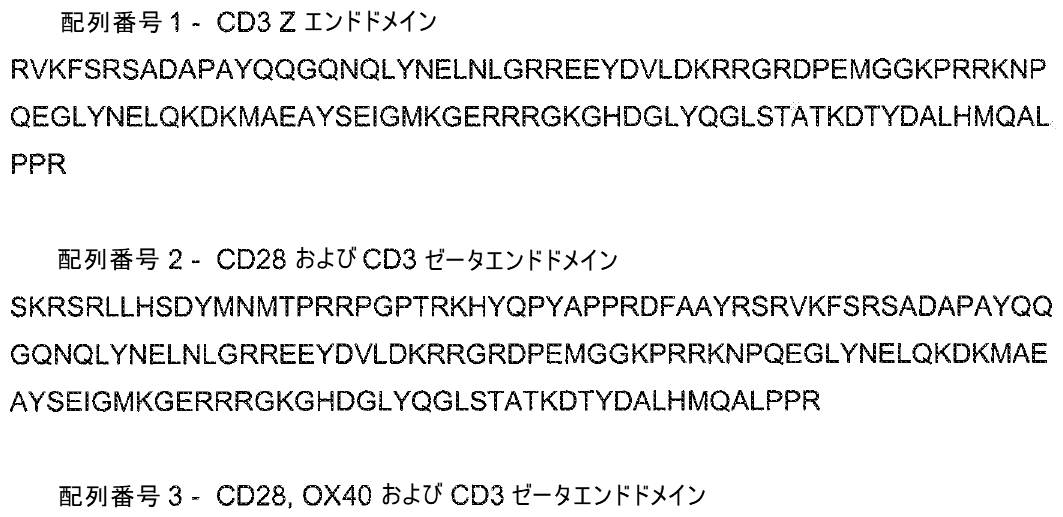

改変体配列は、効果的な細胞内シグナル伝達ドメインを提供する限り、配列番号1、2または3に対して少なくとも80%、85%、90%、95%、98%または99%の配列同一性を有し得る。 Variant sequences have at least 80%, 85%, 90%, 95%, 98% or 99% sequence identity to SEQ ID NO: 1, 2 or 3 as long as they provide an effective intracellular signaling domain can have
膜テザリング成分(MTC)
成分である膜テザリング成分はアンカーとして作用し、第1の二量体化ドメインおよびしたがってシグナル減弱成分を細胞膜の細胞内表面にテザリングさせる。
Membrane Tethering Component (MTC)
The component membrane tethering component acts as an anchor, tethering the first dimerization domain and thus the signal attenuation component to the intracellular surface of the cell membrane.
膜テザリング成分は、シグナル減弱成分上の相反ドメイン(reciprocal domain)と相互作用する第1のヘテロ二量体化ドメインを含む。 The membrane tethering component contains a first heterodimerization domain that interacts with a reciprocal domain on the signal attenuation component.
膜テザリング成分は、膜局在化ドメインを含み得る。これは、第1の二量体化ドメインが形質膜の近位の位置において取り付けられまたは保持されることを引き起こす任意の配列であり得る。 A membrane tethering component can include a membrane localization domain. This can be any sequence that causes the first dimerization domain to be attached or retained at a location proximal to the plasma membrane.
膜局在化ドメインは、新生ポリペプチドが最初にER膜に取り付けられることを引き起こす配列であり得るかまたは該配列を含み得る。膜材料はERからゴルジに、そして最後に形質膜に「流れる」ので、タンパク質は、合成/トランスロケーションプロセスの終わりにおいて膜と会合したままとなる。 A membrane localization domain may be or include a sequence that causes the nascent polypeptide to initially attach to the ER membrane. Proteins remain membrane-associated at the end of the synthesis/translocation process, as membrane material "flows" from the ER to the Golgi and finally to the plasma membrane.
膜局在化ドメインは、例えば、膜貫通配列、移行停止配列、GPIアンカーまたはミリストイル化/プレニル化/パルミトイル化部位を含み得る。 A membrane localization domain can include, for example, a transmembrane sequence, a translocation stop sequence, a GPI anchor or a myristoylation/prenylation/palmitoylation site.
あるいは、膜局在化ドメインは、膜テザリング成分を、例えば膜の近位の実体への結合により、細胞膜に位置するタンパク質または他の実体に方向付け得る。膜テザリング成分は、例えば、TCR/CD3、CD4またはCD8のような免疫シナプスに関与する分子に結合するドメインを含み得る。 Alternatively, the membrane localization domain may direct the membrane tethering component to a protein or other entity located at the cell membrane, eg, by binding to a membrane-proximal entity. Membrane tethering components can include, for example, domains that bind molecules involved in immune synapses such as TCR/CD3, CD4 or CD8.
ミリストイル化は、ミリスチン酸に由来するミリストイル基がN末端グリシン残基のアルファ-アミノ基にアミド結合により共有結合する脂質化修飾である。ミリスチン酸は、n-テトラデカン酸としても公知の14炭素の飽和脂肪酸である。修飾は、翻訳と同時または翻訳後のいずれかにおいて付加され得る。N-ミリストイルトランスフェラーゼ(NMT)は、細胞の細胞質においてミリスチン酸付加反応を触媒する。疎水性のミリストイル基は細胞膜中のリン脂質と相互作用するので、ミリストイル化は、それが取り付けられたタンパク質の膜標的化を引き起こす。 Myristoylation is a lipidation modification in which the myristoyl group derived from myristic acid is covalently attached to the alpha-amino group of the N-terminal glycine residue via an amide bond. Myristic acid is a 14-carbon saturated fatty acid, also known as n-tetradecanoic acid. Modifications can be added either co-translationally or post-translationally. N-myristoyltransferase (NMT) catalyzes the myristate addition reaction in the cytoplasm of cells. Myristoylation causes membrane targeting of the protein to which it is attached, as the hydrophobic myristoyl group interacts with phospholipids in cell membranes.
本発明の膜テザリング成分は、NMT酵素によりミリストイル化されることができる配列を含み得る。本発明の細胞の膜テザリング成分は、細胞中で発現された時にミリストイル基を含み得る。 A membrane tethering component of the invention may comprise a sequence capable of being myristoylated by an NMT enzyme. The membrane tethering component of the cells of the invention may contain a myristoyl group when expressed in the cell.
膜テザリング成分は、NMT酵素により認識されるNH2-G1-X2-X3-X4-S5-X6-X7-X8のようなコンセンサス配列を含み得る。 Membrane tethering components can include consensus sequences such as NH2-G1-X2-X3-X4-S5-X6-X7-X8 that are recognized by NMT enzymes.
パルミトイル化は、タンパク質のシステイン、より低い頻度ではセリンおよびスレオニン残基へのパルミチン酸のような脂肪酸の共有結合である。パルミトイル化は、タンパク質の疎水性を増進させ、膜会合を誘導するために使用され得る。プレニル化およびミリストイル化とは対照的に、パルミトイル化は、通常、可逆的である(パルミチン酸とタンパク質との結合は多くの場合にチオエステル結合であるため)。逆反応は、パルミトイルタンパク質チオエステラーゼにより触媒される。 Palmitoylation is the covalent attachment of fatty acids such as palmitic acid to cysteine and, less frequently, serine and threonine residues of proteins. Palmitoylation increases the hydrophobicity of proteins and can be used to induce membrane association. In contrast to prenylation and myristoylation, palmitoylation is usually reversible (since the bond between palmitic acid and proteins is often a thioester bond). The reverse reaction is catalyzed by palmitoyl protein thioesterase.
Gタンパク質を介するシグナル伝達において、αサブユニットのパルミトイル化、γサブユニットのプレニル化、およびミリストイル化は、Gタンパク質がその受容体と相互作用できるようにGタンパク質を形質膜の内側表面にテザリングさせることを伴う。 In signaling through G proteins, palmitoylation of the α subunit, prenylation of the γ subunit, and myristoylation tether the G protein to the inner surface of the plasma membrane so that it can interact with its receptor. accompanied by
膜テザリング成分は、パルミトイル化されることができる配列を含み得る。膜テザリング成分は、膜局在化を引き起こす細胞中で発現される時に追加の脂肪酸を含み得る。 A membrane tethering component may contain a sequence that can be palmitoylated. Membrane tethering components may contain additional fatty acids when expressed in cells that cause membrane localization.
プレニル化(イソプレニル化または脂質化としても公知)は、タンパク質または化学的化合物への疎水性分子の付加である。プレニル基(3-メチル-ブタ-2-エン-1-イル)は、GPIアンカーのような脂質アンカーと類似して、細胞膜への取付けを促進する。 Prenylation (also known as isoprenylation or lipidation) is the addition of hydrophobic molecules to proteins or chemical compounds. The prenyl group (3-methyl-but-2-en-1-yl) facilitates attachment to cell membranes, analogous to lipid anchors such as GPI anchors.
タンパク質プレニル化は、標的タンパク質のC末端システインへのファルネシルまたはゲラニル-ゲラニル部分のいずれかの移行を伴う。細胞中でプレニル化を実行する3つの酵素があり、それらは、ファルネシルトランスフェラーゼ、CaaxプロテアーゼおよびゲラニルゲラニルトランスフェラーゼIである。 Protein prenylation involves the transfer of either farnesyl or geranyl-geranyl moieties to the C-terminal cysteine of the target protein. There are three enzymes that carry out prenylation in the cell, farnesyltransferase, Caax protease and geranylgeranyltransferase I.
膜テザリング成分は、プレニル化されることができる配列を含み得る。膜テザリング成分は、膜局在化を引き起こす細胞中で発現される時に1つまたは複数のプレニル基を含み得る。 A membrane tethering component may contain a sequence that can be prenylated. Membrane tethering components may contain one or more prenyl groups when expressed in cells that cause membrane localization.
シグナル減弱成分
本発明の細胞のシグナル減弱成分(SDC)は、シグナル減弱ドメイン(SDD)および第2の二量体化ドメインを含む。第2の二量体化ドメインは、膜テザリング成分の第1の二量体化ドメインに特異的に結合する。
Signal Attenuating Component The signal attenuating component (SDC) of the cells of the invention comprises a signal attenuating domain (SDD) and a second dimerization domain. The second dimerization domain specifically binds to the first dimerization domain of the membrane tethering component.
シグナル減弱ドメインは、細胞膜の細胞内側に位置した時、およびしたがってCARエンドドメインの近位に位置した時にCAR媒介性細胞シグナル伝達を阻害する。 The signal-attenuating domain inhibits CAR-mediated cell signaling when located intracellularly at the cell membrane and thus proximal to the CAR endodomain.
シグナル減弱ドメインは、CAR媒介性細胞シグナル伝達を完全に阻害し、CAR媒介性細胞活性化を効果的に「遮断」することができる。あるいは、SDDは、部分的な阻害を引き起こし、CAR媒介性細胞シグナル伝達を効果的に「低減」することができる。 Signal-attenuating domains can completely inhibit CAR-mediated cell signaling and effectively "block" CAR-mediated cell activation. Alternatively, SDD can cause partial inhibition, effectively "reducing" CAR-mediated cell signaling.
シグナル減弱ドメインの存在は、シグナル減弱ドメインの非存在下で起こるシグナル伝達の2分の1、5分の1、10分の1、50分の1、100分の1、1,000分の1または10,000分の1である、シグナル伝達成分を通じたシグナル伝達を結果としてもたらし得る。 The presence of a signal-attenuating domain is 2-fold, 5-fold, 10-fold, 50-fold, 100-fold, 1,000-fold less signaling than occurs in the absence of a signal-attenuating domain or 10,000-fold less signaling through the signaling component.
CAR媒介性シグナル伝達は、当該技術分野において公知の様々な方法により決定され得る。そのような方法としては、例えば、特定のタンパク質チロシンキナーゼ(PTK)のレベル、ホスファチジルイノシトール4,5-ビスリン酸(biphosphate)(PIP2)の分解、プロテインキナーゼC(PKC)の活性化および細胞内カルシウムイオン濃度の上昇のアッセイといったシグナル伝達のアッセイが挙げられる。T細胞のクローン拡大増殖、細胞表面上の活性化マーカーの上方調節、エフェクター細胞への分化および細胞傷害またはサイトカイン(例えば、IL-2)分泌の誘導のような機能的なリードアウトもまた利用され得る。 CAR-mediated signaling can be determined by various methods known in the art. Such methods include, for example, levels of certain protein tyrosine kinases (PTKs), degradation of phosphatidylinositol 4,5-biphosphate (PIP2), activation of protein kinase C (PKC) and intracellular calcium Signal transduction assays, such as assays of increased ion concentration, are included. Functional readouts such as clonal expansion of T cells, upregulation of activation markers on the cell surface, differentiation into effector cells and induction of cytotoxicity or cytokine (eg, IL-2) secretion are also utilized. obtain.
T細胞シグナル伝達の制御
T細胞活性化の最初のステップは、TCRによる標的細胞上のペプチドMHC複合体の認識である。この初期事象は、TCR複合体中のCD3-ゼータの細胞質テールとのLckキナーゼの密接な会合を引き起こす。次いで、Lckは、CD3-ゼータの細胞質テール中の免疫受容体チロシン活性化モチーフ(ITAM)をリン酸化し、ZAP70の動員を可能とする。ZAP70は、TCRの係合後のT細胞活性化において極めて重要な役割を果たすSH2含有キナーゼである。ZAP70中のタンデムなSH2ドメインは、リン酸化されたCD3に結合して、ZAP70がリン酸化され、Lckまたは他のZAP70分子によりトランスで活性化されることを結果としてもたらす。次いで、活性のZAP70は、下流の膜タンパク質、その中でも特に重要なものとして活性化T細胞のリンカー(LAT)タンパク質をリン酸化することができる。LATはスキャフォールドタンパク質であり、複数の残基におけるそのリン酸化により、LATは、Grb2、PLC-gおよびGrapなどのいくつもの他のSH2ドメイン含有タンパク質と相互作用することができ、これらのタンパク質は、LATにおけるリン酸化ペプチドを認識してT細胞活性化シグナルを下流に伝達し、最終的に一連のT細胞応答を結果としてもたらす。このプロセスは図7Aに要約される。
Regulation of T cell signaling The first step in T cell activation is the recognition of peptide MHC complexes on target cells by the TCR. This early event causes the tight association of Lck kinase with the cytoplasmic tail of CD3-zeta in the TCR complex. Lck then phosphorylates immunoreceptor tyrosine activation motifs (ITAMs) in the cytoplasmic tail of CD3-zeta, allowing ZAP70 recruitment. ZAP70 is an SH2-containing kinase that plays a pivotal role in T cell activation after TCR engagement. The tandem SH2 domains in ZAP70 bind phosphorylated CD3, resulting in ZAP70 being phosphorylated and activated in trans by Lck or other ZAP70 molecules. Active ZAP70 can then phosphorylate downstream membrane proteins, most notably the linker of activated T cells (LAT) protein among them. LAT is a scaffold protein and its phosphorylation at multiple residues allows it to interact with a number of other SH2 domain-containing proteins such as Grb2, PLC-g and Grap, which proteins are , recognize phosphorylated peptides in the LAT and transmit T cell activation signals downstream, ultimately resulting in a series of T cell responses. This process is summarized in FIG. 7A.
T細胞活性化は、速度論的分離またはT細胞:標的細胞シナプスにおける分子により制御される。基底状態において、T細胞膜上のシグナル伝達成分は動的なホメオスタシスにあり、それにより、脱リン酸化されたITAMはリン酸化されたITAMよりも有利に働く。これは、lckのような膜にテザリングされたキナーゼに対して膜貫通CD45/CD148ホスファターゼの活性がより大きいことに起因する。T細胞が同族抗原のT細胞受容体(またはCAR)認識を通じて標的細胞に係合した時に、緊密な免疫学的シナプスが形成される。T細胞および標的膜のこの密接な並置は、シナプスにフィットし得ないそれらの大きいエクトドメインに起因してCD45/CD148を除外する。ホスファターゼの非存在下において、シナプスにおける高濃度のT細胞受容体会合ITAMおよびキナーゼの分離は、リン酸化されたITAMが有利に働く状態に繋がる。ZAP70は、リン酸化されたITAMの閾値を認識し、T細胞活性化シグナルを伝播する。 T cell activation is controlled by kinetic segregation or molecules at the T cell:target cell synapse. In the basal state, the signaling components on the T cell membrane are in dynamic homeostasis, thereby favoring dephosphorylated ITAM over phosphorylated ITAM. This is due to the greater activity of transmembrane CD45/CD148 phosphatases relative to membrane-tethered kinases such as lck. A tight immunological synapse is formed when a T cell engages a target cell through T cell receptor (or CAR) recognition of its cognate antigen. This close juxtaposition of T cell and target membranes excludes CD45/CD148 due to their large ectodomains that cannot fit synapses. In the absence of phosphatases, the segregation of high concentrations of T-cell receptor-associated ITAMs and kinases at synapses leads to conditions in which phosphorylated ITAMs are favored. ZAP70 recognizes phosphorylated ITAM thresholds and propagates T cell activation signals.
in vivoにおいて、CTLA4、PD-1、LAG-3、2B4またはBTLA1のような膜結合型免疫阻害受容体もまたT細胞活性化を阻害する。図7Bに図式的に示すように、PD1のような阻害性免疫受容体は、T細胞活性化プロセスの第1のステップを効果的に逆転させる。PD1は、SHP-1またはSHP-2のSH2ドメインにより認識されるITIMをそのエンドドメイン中に有する。認識されると、SHP-1および/またはSHP-2は膜近傍領域に動員され、その後にそのホスファターゼドメインは、ITAMドメインを脱リン酸化して免疫活性化を阻害する。 Membrane-bound immunoinhibitory receptors such as CTLA4, PD-1, LAG-3, 2B4 or BTLA1 also inhibit T cell activation in vivo. As shown schematically in Figure 7B, inhibitory immunoreceptors such as PD1 effectively reverse the first step of the T cell activation process. PD1 has an ITIM in its endodomain that is recognized by the SH2 domain of SHP-1 or SHP-2. Upon recognition, SHP-1 and/or SHP-2 are recruited to the juxtamembrane region, after which their phosphatase domain dephosphorylates the ITAM domain, inhibiting immune activation.
ホスファターゼ
シグナル減弱成分のシグナル減弱ドメインは、ITAMを脱リン酸化することができるホスファターゼのようなホスファターゼを含み得る。
Phosphatases The signal-attenuating domain of the signal-attenuating component may comprise a phosphatase, such as a phosphatase capable of dephosphorylating ITAM.
シグナル減弱成分のシグナル減弱ドメインは、受容体様チロシンホスファターゼの一部または全体を含み得る。ホスファターゼは、PLCγ1および/またはLATのようなT細胞シグナル伝達に関与するエレメントのリン酸化および/または機能に干渉し得る。 The signal-attenuating domain of the signal-attenuating component may comprise part or all of a receptor-like tyrosine phosphatase. Phosphatases can interfere with the phosphorylation and/or function of elements involved in T cell signaling such as PLCγ1 and/or LAT.
シグナル減弱ドメインは、CD148、CD45、SHP-1またはSHP-2のようなT細胞活性化の制御に関与する1つまたは複数のホスファターゼのホスファターゼドメインを含み得る。 A signal attenuation domain may comprise the phosphatase domain of one or more phosphatases involved in regulating T cell activation such as CD148, CD45, SHP-1 or SHP-2.
CD148
CD148は、PLCγ1およびLATのリン酸化および機能に干渉することによりTCRシグナル伝達を負に調節する受容体様タンパク質チロシンホスファターゼである。
CD148
CD148 is a receptor-like protein tyrosine phosphatase that negatively regulates TCR signaling by interfering with the phosphorylation and function of PLCγ1 and LAT.
CD148のエンドドメインを配列番号4に示す。
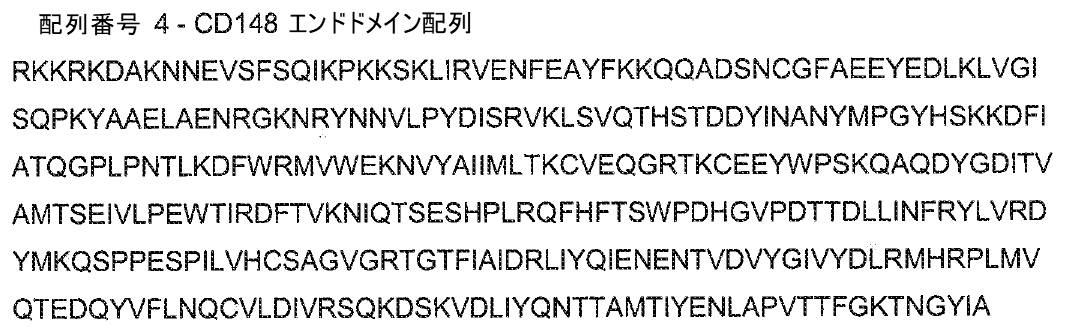
CD45
全ての造血細胞上に存在するCD45は、これもまたPLCγ1をリン酸化することにより、シグナル伝達および機能的な応答を調節することができるタンパク質チロシンホスファターゼである。
CD45
CD45, present on all hematopoietic cells, is a protein tyrosine phosphatase that can also regulate signaling and functional responses by phosphorylating PLCγ1.
CD45のエンドドメインを配列番号5に示す。
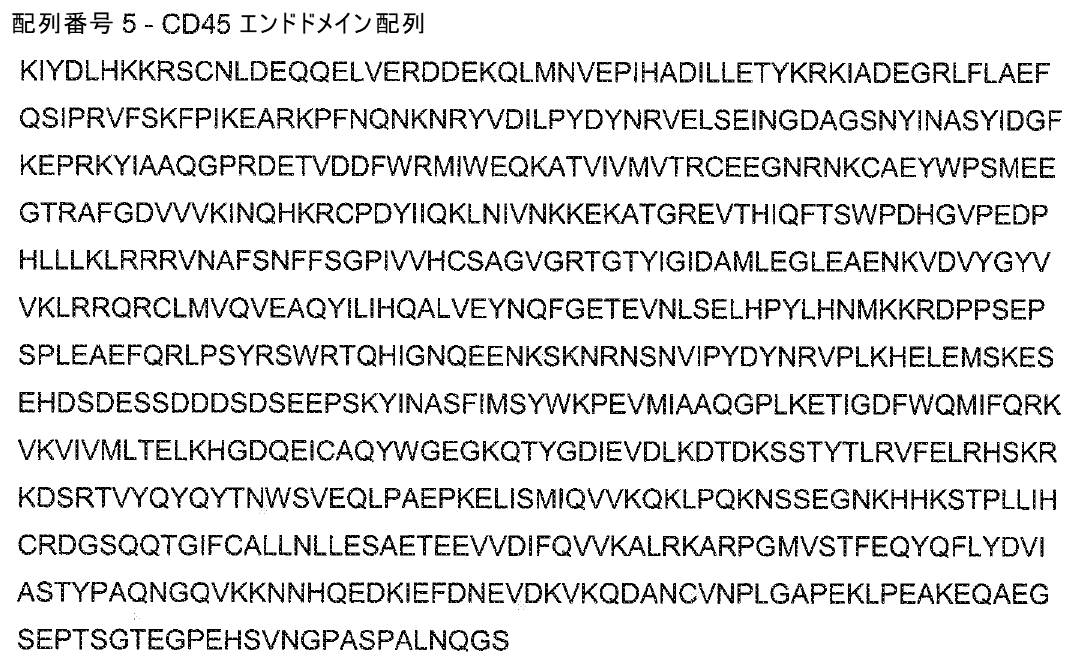
SHP1/SHP2
Src相同性領域2ドメイン含有ホスファターゼ-1(SHP-1、PTPN6としても公知)は、タンパク質チロシンホスファターゼファミリーのメンバーである。
SHP1/SHP2
Src homology region 2 domain-containing phosphatase-1 (SHP-1, also known as PTPN6) is a member of the protein tyrosine phosphatase family.
SHP-1のN末端領域は、PTPN6とその基質との相互作用を媒介する2つのタンデムなSH2ドメインを含有する。C末端領域は、チロシン-タンパク質ホスファターゼドメインを含有する。 The N-terminal region of SHP-1 contains two tandem SH2 domains that mediate the interaction of PTPN6 with its substrates. The C-terminal region contains a tyrosine-protein phosphatase domain.
SHP-1は、PD1、PDCD1、BTLA4、LILRB1、LAIR1、CTLA4、KIR2DL1、KIR2DL4、KIR2DL5、KIR3DL1およびKIR3DL3のような多数の阻害性免疫受容体またはITIM含有受容体に結合してそれからのシグナルを伝播することができる。 SHP-1 binds to and propagates signals from numerous inhibitory immunoreceptors or ITIM-containing receptors such as PD1, PDCD1, BTLA4, LILRB1, LAIR1, CTLA4, KIR2DL1, KIR2DL4, KIR2DL5, KIR3DL1 and KIR3DL3. can do.
ヒトSHP-1タンパク質はUniProtKBアクセッション番号P29350を有する。 The human SHP-1 protein has UniProtKB accession number P29350.
SHP-1のタンパク質チロシンホスファターゼ(PTP)ドメインを配列番号6として以下に示す。


SHP-2
PTPN11、PTP-1DおよびPTP-2Cとしても公知のSHP-2は、タンパク質チロシンホスファターゼ(PTP)ファミリーのメンバーである。PTPN6と同様に、SHP-2は、そのN末端における2つのタンデムなSH2ドメインおよびその後ろのタンパク質チロシンホスファターゼ(PTP)ドメインからなるドメイン構造を有する。不活性状態において、N末端SH2ドメインは、PTPドメインに結合して活性部位への潜在的な基質の接近を遮断する。したがって、SHP-2は自己阻害される。標的ホスホチロシル残基に結合すると、N末端SH2ドメインはPTPドメインから解放され、自己阻害を緩和することにより酵素を触媒的に活性化させる。
SHP-2
SHP-2, also known as PTPN11, PTP-1D and PTP-2C, is a member of the protein tyrosine phosphatase (PTP) family. Similar to PTPN6, SHP-2 has a domain structure consisting of two tandem SH2 domains at its N-terminus followed by a protein tyrosine phosphatase (PTP) domain. In the inactive state, the N-terminal SH2 domain binds to the PTP domain and blocks access of potential substrates to the active site. Therefore, SHP-2 is autoinhibited. Upon binding to the target phosphotyrosyl residue, the N-terminal SH2 domain is released from the PTP domain and catalytically activates the enzyme by relieving autoinhibition.
ヒトSHP-2は、UniProtKBアクセッション番号P35235-1を有する。 Human SHP-2 has UniProtKB accession number P35235-1.
SHP-2のタンパク質チロシンホスファターゼ(PTP)ドメインを配列番号7として以下に示す。

シグナル減弱ドメインは、配列番号4、5、6もしくは7のホスファターゼドメインまたはその改変体を含み得る。改変体は、改変体配列がCAR媒介性細胞シグナル伝達を減弱させることができる限り、例えば、少なくとも80、85、90、95、98または99%の配列同一性を有し得る。改変体ホスファターゼは、1つまたは複数のITAMを脱リン酸化することができるものであり得る。 A signal attenuation domain may comprise the phosphatase domain of SEQ ID NO: 4, 5, 6 or 7 or a variant thereof. Variants can have, for example, at least 80, 85, 90, 95, 98, or 99% sequence identity, as long as the variant sequence is capable of attenuating CAR-mediated cell signaling. A variant phosphatase can be one that is capable of dephosphorylating one or more ITAMs.
免疫調節分子からのエンドドメイン
シグナル減弱成分のシグナル減弱ドメインは、T細胞シグナル伝達を阻害する免疫調節分子のエンドドメインの全体または部分を含み得る。例えば、シグナル減弱ドメインは、T細胞活性化を阻害する免疫阻害受容体からのエンドドメインを含み得る。阻害性受容体は、CTLA4、PD-1、LAG-3、2B4、BTLA 1、CD28、ICOS、CD33、CD31、CD27、CD30、GITRまたはHVEMまたはシグレック-5、6、7、8、9、10もしくは11のようなCD28またはシグレックファミリーのメンバーであり得る。
Endodomains from Immunomodulatory Molecules The signal-attenuating domain of the signal-attenuating component can comprise all or part of an endodomain of an immunomodulatory molecule that inhibits T-cell signaling. For example, a signal attenuation domain can include an endodomain from an immunoinhibitory receptor that inhibits T cell activation. Inhibitory receptors are CTLA4, PD-1, LAG-3, 2B4, BTLA 1, CD28, ICOS, CD33, CD31, CD27, CD30, GITR or HVEM or Siglec-5, 6, 7, 8, 9, 10 or CD28, such as 11, or a member of the Siglec family.
シグナル減弱ドメインは、1つまたは複数の免疫受容体チロシン阻害モチーフ(ITIM)を含み得る。 A signal attenuation domain may comprise one or more immunoreceptor tyrosine inhibition motifs (ITIMs).
ITIMは、免疫系の多くの阻害性受容体の細胞質テールにおいて見出されるアミノ酸の保存された配列(S/I/V/LxYxxI/V/L)である。ITIM含有阻害性受容体がそれらのリガンドと相互作用した後に、それらのITIMモチーフはSrcキナーゼの酵素によりリン酸化される。 ITIMs are conserved sequences of amino acids (S/I/V/LxYxxI/V/L) found in the cytoplasmic tails of many inhibitory receptors of the immune system. After ITIM-containing inhibitory receptors interact with their ligands, their ITIM motifs are phosphorylated by the enzyme Src kinase.
PD1、PDCD1、BTLA4、LILRB1、LAIR1、CTLA4、2B4、GP49B、Pir-B、PECAM-1、CD22、シグレック7、シグレック9、KLRG1、ILT2、CD94-NKG2A、CD5ならびにKIR2DL1、KIR2DL4、KIR2DL5、KIR3DL1およびKIR3DL3などのキラー阻害受容体ファミリー(KIR)のような免疫阻害性受容体は、ITIMを含有する。
PD1, PDCD1, BTLA4, LILRB1, LAIR1, CTLA4, 2B4, GP49B, Pir-B, PECAM-1, CD22, Siglec 7,
シグナル減弱ドメインは、配列番号8~24として示す配列のうちの1つまたは複数を含み得る。
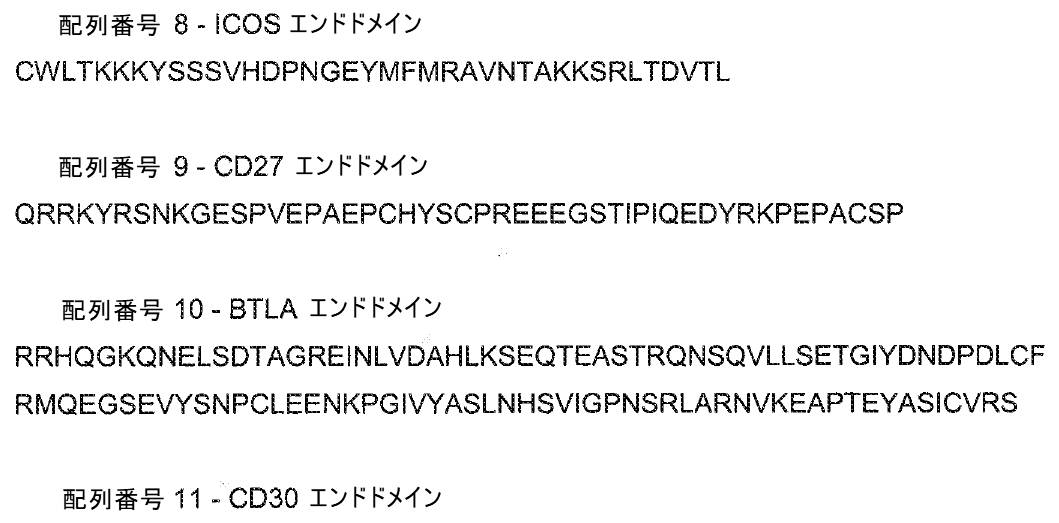
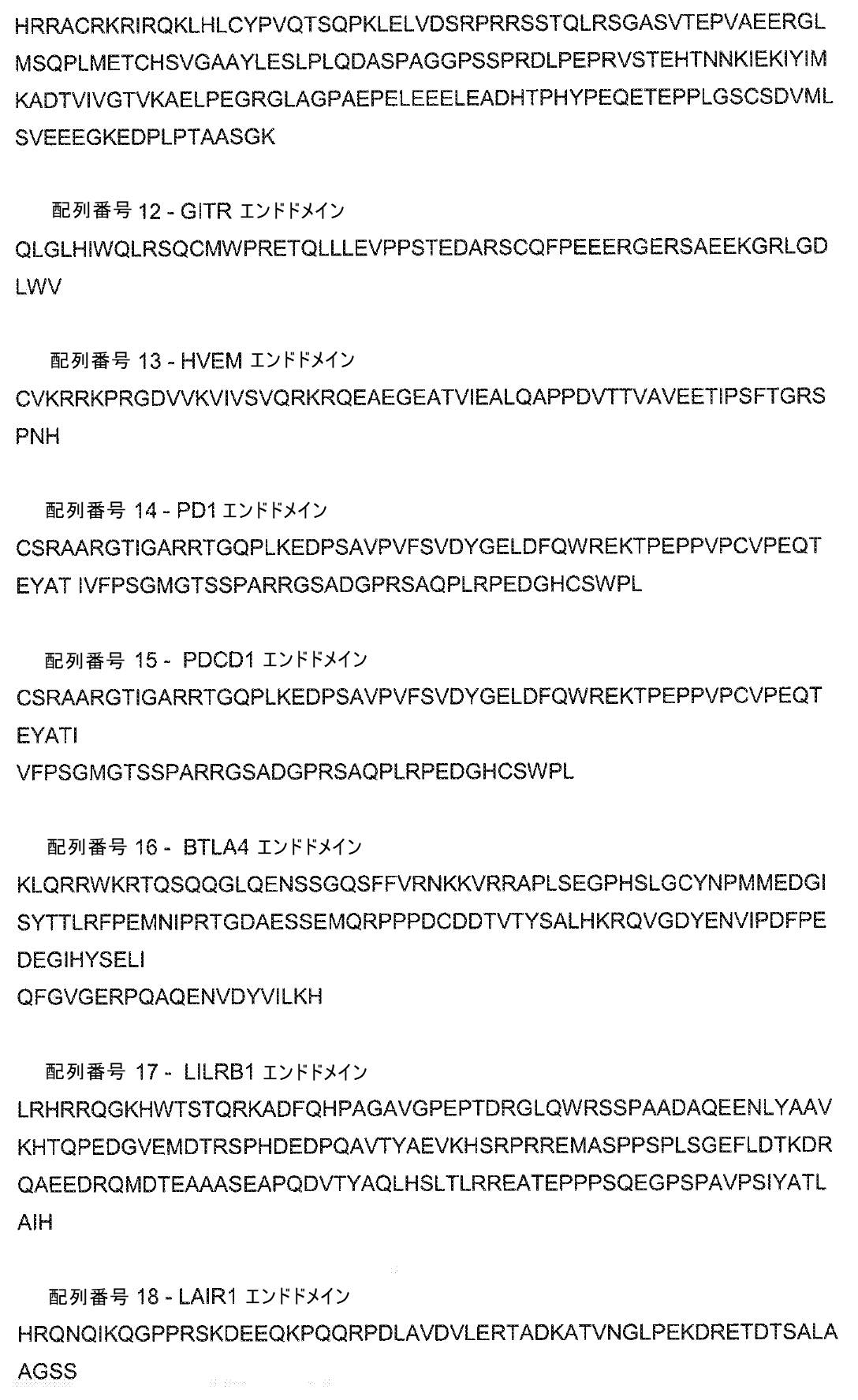

シグナル減弱ドメインは、少なくとも80%、85%、90%、95%、98%または99%の配列同一性を有する配列番号8~24として示す配列のうちの1つの改変体を含み得る。改変体配列は、SHP-1および/またはSHP-2を細胞膜に動員することが可能であり得る。改変体配列は、1つまたは複数のITIMを含み得る。 A signal attenuation domain may comprise a variant of one of the sequences set forth as SEQ ID NOs:8-24 with at least 80%, 85%, 90%, 95%, 98% or 99% sequence identity. Variant sequences may be capable of recruiting SHP-1 and/or SHP-2 to the cell membrane. A variant sequence may contain one or more ITIMs.
CSKエンドドメイン
タンパク質チロシンキナーゼ(PTK)は、細胞増殖、分化、有糸分裂サイクル、および発がん性形質転換などの様々な細胞プロセスを調節するシグナル伝達分子である。非受容体(または細胞質)PTKのN末端部分は、2つのタンデムなSrcホモログ(SH2)ドメインを含有し、これらは、タンパク質ホスホチロシン結合ドメインとして作用し、このPTKのその基質との相互作用を媒介する。チロシンプロテインキナーゼはプロテインキナーゼのサブクラスであり、リン酸基がタンパク質上のアミノ酸チロシンに取り付けられる。
CSK endodomain Protein tyrosine kinases (PTKs) are signaling molecules that regulate a variety of cellular processes such as cell proliferation, differentiation, mitotic cycle, and oncogenic transformation. The N-terminal portion of the non-receptor (or cytoplasmic) PTK contains two tandem Src homolog (SH2) domains, which act as protein phosphotyrosine binding domains and mediate the interaction of this PTK with its substrates. do. Tyrosine protein kinases are a subclass of protein kinases in which a phosphate group is attached to the amino acid tyrosine on proteins.
チロシン-プロテインキナーゼCSK(C末端Srcキナーゼ)は、SRC、HCK、FYN、LYNおよび特にLCKのようなSrc-ファミリーキナーゼ(SFK)のC末端に位置するチロシン残基をリン酸化する酵素である(UniProt ID:P41240[http://www.uniprot.org/uniprot/P41240])。CSKは主に、肺およびマクロファージの他にいくつもの他の組織において発現される。チロシン-キナーゼCSKは主に細胞質中に存在するが、細胞間ジャンクションを作る脂質ラフト中にも見出される。 Tyrosine-protein kinase CSK (C-terminal Src kinase) is an enzyme that phosphorylates tyrosine residues located at the C-terminus of Src-family kinases (SFKs) such as SRC, HCK, FYN, LYN and especially LCK ( UniProt ID: P41240 [http://www.uniprot.org/uniprot/P41240]). CSK is primarily expressed in lungs and macrophages as well as in several other tissues. The tyrosine-kinase CSK resides primarily in the cytoplasm, but is also found in lipid rafts that make intercellular junctions.
CSKは、50kDaの分子量を有する非受容体チロシン-プロテインキナーゼである。CSKは、細胞増殖、分化、遊走および免疫応答の調節において重要な役割を果たす。CSKは、保存されたC末端テール部位におけるファミリーメンバーのリン酸化によりSFKの活性を抑制することにより作用する。 CSK is a non-receptor tyrosine-protein kinase with a molecular weight of 50 kDa. CSK plays an important role in regulating cell proliferation, differentiation, migration and immune response. CSKs act by repressing the activity of SFKs by phosphorylation of family members at the conserved C-terminal tail site.
CSKは、そのN末端においてSH3およびSH2ドメインならびにそのC末端においてキナーゼドメインを含有する。一次構造内の機能ドメインのこの配置はSFKのそれに類似しているが、CSKはN末端脂肪酸アシル化部位、活性化ループ中の自己リン酸化部位、およびC末端の負の調節部位を欠いており、これらの全ては、SFKタンパク質の間で保存され、それらの適切な調節のために極めて重要である。活性化ループ中の自己リン酸化の非存在は、CSKを区別する特徴である。CSK構造の最も際立った特徴は、SFKにおける状況とは異なり、SH3およびSH2ドメインの結合ポケットが外側に向かって配向しており、他の分子との分子間相互作用を可能とすることである。活性の分子において、SH2-キナーゼおよびSH2-SH3リンカーは、活性のコンホメーションを安定化させるためにキナーゼドメインのN末端ローブに緊密に結合しており、SH2ドメインとキナーゼドメインとの間に直接的な連結が存在する。不活性の分子において、SH2ドメインは、キナーゼドメインへの連結を破壊するように回転している。 CSK contains SH3 and SH2 domains at its N-terminus and a kinase domain at its C-terminus. This arrangement of functional domains within the primary structure resembles that of SFKs, but CSKs lack an N-terminal fatty acid acylation site, an autophosphorylation site in the activation loop, and a C-terminal negative regulatory site. , all of which are conserved among SFK proteins and are crucial for their proper regulation. The absence of autophosphorylation in the activation loop is a distinguishing feature of CSK. The most distinguishing feature of the CSK structure is that the binding pockets of the SH3 and SH2 domains are oriented outwards, allowing intermolecular interactions with other molecules, unlike the situation in SFKs. In the active molecule, the SH2-kinase and SH2-SH3 linkers are tightly bound to the N-terminal lobe of the kinase domain to stabilize the active conformation, directly between the SH2 and kinase domains. There is a definite connection. In the inactive molecule, the SH2 domain rotates to break the linkage to the kinase domain.
他のキナーゼによりリン酸化されると、Src-ファミリーメンバーは、ホスホチロシンテールとSH2ドメインとの分子内相互作用において係合し、不活性のコンホメーションを結果としてもたらす。SFKを阻害するために、CSKは、膜貫通タンパク質または形質膜の近くに位置するアダプタータンパク質への結合を介して形質膜に動員され、最終的に、不活性のいくつものエフェクター分子をリン酸化し維持することによりT細胞受容体(TCR)などの様々な表面受容体を通じたシグナル伝達を抑制する。 Upon phosphorylation by other kinases, Src-family members engage in intramolecular interactions between the phosphotyrosine tail and the SH2 domain, resulting in an inactive conformation. To inhibit SFKs, CSKs are recruited to the plasma membrane via binding to transmembrane proteins or adapter proteins located near the plasma membrane, ultimately phosphorylating a number of inactive effector molecules. Maintenance suppresses signaling through various surface receptors such as the T cell receptor (TCR).
Cskは膜貫通ドメインおよび脂肪酸アシル修飾を欠いているので、大部分はサイトゾルに存在する一方、その基質SFKは、それらのN末端ミリステートおよびパルミテート部分を介して膜に係留される。したがって、SFKが活性化される膜へのCSKのトランスロケーションは、CSK調節の極めて重要なステップであると考えられている。これまで、例えば、カベオリン-1、パキシリン、Dab2、VE-カドヘリン、IGF-1R、IR、LIME、およびSIT1といったいくつものスカフォールディングタンパク質が、CSKの膜アンカーの他に、内在性リン酸化タンパク質Cbp/PAG1(Csk結合タンパク質/スフィンゴ糖脂質に富む膜に会合したリン酸化タンパク質)として同定されてきた。Cbpは、そのN末端において単一の膜貫通ドメインおよび膜貫通ドメインのすぐC末端側において2つのパルミトイル修飾部位を有し、それを通じて、Cbpは排他的に脂質ラフトに局在する。 Since Csks lack transmembrane domains and fatty acyl modifications, they reside mostly in the cytosol, while their substrates SFKs are membrane-tethered via their N-terminal myristate and palmitate moieties. Therefore, translocation of CSK to membranes where SFKs are activated is believed to be a crucial step in CSK regulation. To date, several scaffolding proteins, for example caveolin-1, paxillin, Dab2, VE-cadherin, IGF-1R, IR, LIME, and SIT1, have been identified in addition to the membrane anchor of CSK by the endogenous phosphorylated protein Cbp/ It has been identified as PAG1, a Csk-associated protein/phosphorylated protein associated with glycosphingolipid-rich membranes. Cbp has a single transmembrane domain at its N-terminus and two palmitoyl modification sites immediately C-terminal to the transmembrane domain, through which it localizes exclusively to lipid rafts.
CSKエンドドメインは、CSKの全て(配列番号25)またはチロシンキナーゼドメイン(配列番号26)のみを含み得る。
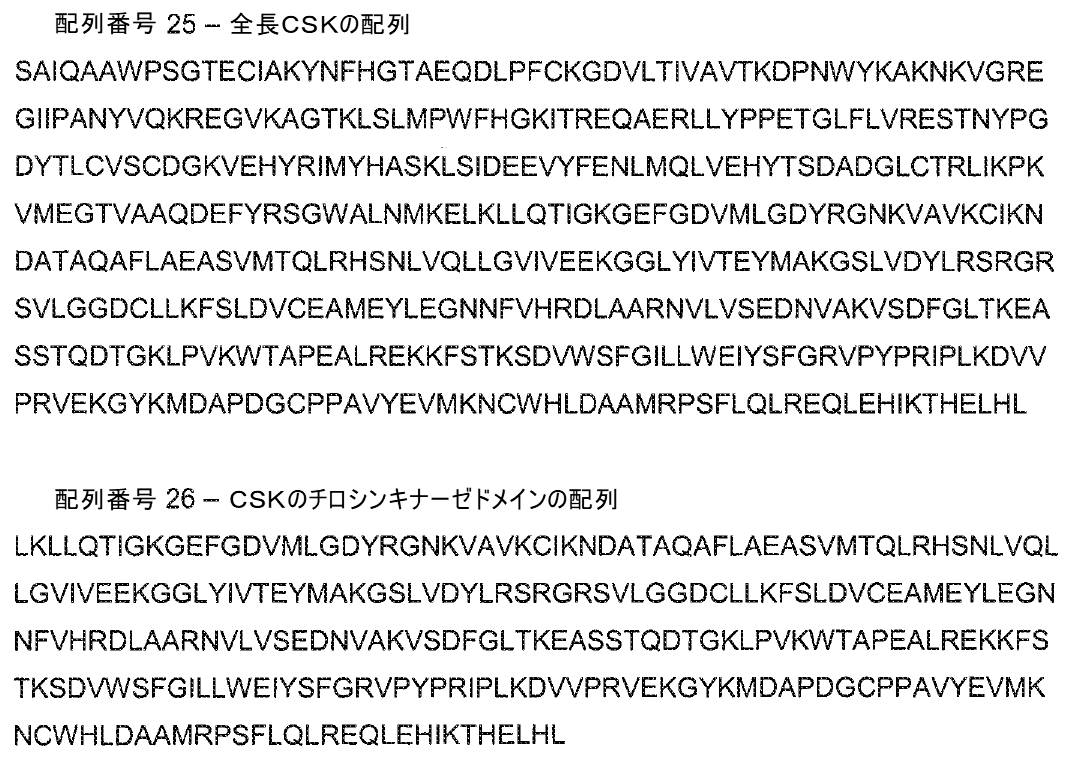
CSKエンドドメインは、改変体が、CARの付近に置かれた時にCARによるT細胞シグナル伝達を阻害する能力を保持する限り、少なくとも80%の配列同一性を有する配列番号25もしくは26として示す配列またはその部分の改変体を含み得る。 The CSK endodomain is a sequence shown as SEQ ID NO: 25 or 26 with at least 80% sequence identity or Variants of that portion may be included.
細胞内シグナル伝達ドメインの除去
シグナル減弱ドメインは、CARの細胞内シグナル伝達ドメインの完全または部分的な除去を引き起こすことによりCAR媒介性のCARシグナル伝達を妨げ得るか、低減させ得るかまたは遮断し得る。
Removal of Intracellular Signaling Domain Signal-attenuating domains may prevent, reduce or block CAR-mediated CAR signaling by causing complete or partial removal of the intracellular signaling domain of CAR. .
例えば、SDDは、プロテアーゼを含み得、CARは、例えば、膜貫通ドメインと細胞内シグナル伝達ドメインとの間に;または細胞内シグナル伝達ドメイン内に、プロテアーゼ切断部位を含み得、それにより、切断は、細胞内シグナル伝達ドメインの細胞シグナル伝達能力を低減させるかまたは除去する。 For example, the SDD may contain a protease and the CAR may contain a protease cleavage site, e.g., between the transmembrane domain and the intracellular signaling domain; or within the intracellular signaling domain, whereby cleavage , reduces or eliminates the cell signaling ability of the intracellular signaling domain.
プロテアーゼドメイン
プロテアーゼドメインは、例えば、特定の認識配列において切断することができる任意のプロテアーゼであり得る。そのため、プロテアーゼドメインは、特定の標的配列における切断を介して単一の標的ポリペプチドを2つの別個のポリペプチドに分離することを可能とする任意のプロテアーゼであり得る。
Protease Domain The protease domain can be, for example, any protease capable of cleaving at a particular recognition sequence. As such, a protease domain can be any protease that allows the separation of a single target polypeptide into two separate polypeptides through cleavage at a specific target sequence.
プロテアーゼドメインは、タバコエッチウイルス(TeV)プロテアーゼドメインであり得る。 The protease domain can be a tobacco etch virus (TeV) protease domain.
TeVプロテアーゼは、キモトリプシン様プロテアーゼである高度に配列特異的なシステインプロテアーゼである。それは、その標的切断部位に非常に特異的であり、したがって、in vitroおよびin vivoの両方において融合タンパク質の制御された切断のために頻繁に使用される。コンセンサスTeV切断部位は、ENLYFQ\S(「\」は切断されるペプチド結合を表す)である。ヒト細胞のような哺乳動物細胞は、内因性のTeVプロテアーゼを発現しない。 TeV protease is a highly sequence-specific cysteine protease that is a chymotrypsin-like protease. It is highly specific for its target cleavage site and is therefore frequently used for controlled cleavage of fusion proteins both in vitro and in vivo. The consensus TeV cleavage site is ENLYFQ\S ("\" represents the peptide bond that is cleaved). Mammalian cells, such as human cells, do not express endogenous TeV protease.
TeV切断認識部位を配列番号27に示す。
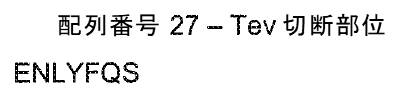
TeVプロテアーゼドメインを配列番号28に示す。
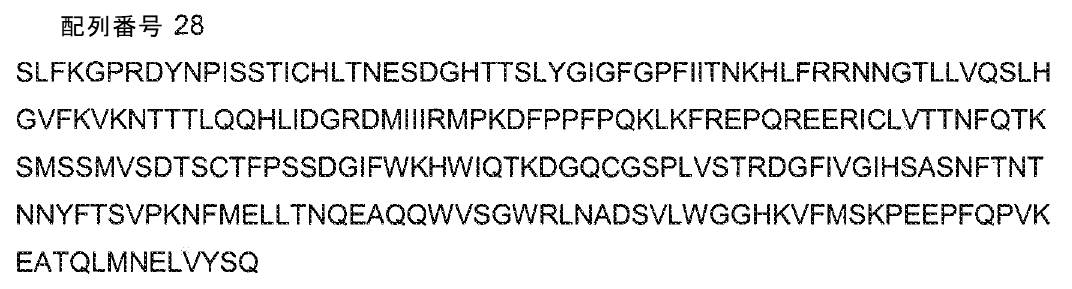
プロテアーゼドメインは、配列番号28として示す配列、または配列が効果的なプロテアーゼ機能を提供する限り、少なくとも80、85、90、95、98もしくは99%の配列同一性を有するその改変体であり得るかまたはそれを含み得る。 The protease domain can be the sequence shown as SEQ ID NO: 28 or a variant thereof with at least 80, 85, 90, 95, 98 or 99% sequence identity, so long as the sequence provides effective protease function. or may contain it.
二量体化ドメイン
本発明の細胞において、膜テザリング成分は、第1の二量体化ドメインを含み、シグナル減弱成分は、第2の二量体化ドメインを含み、第1および第2の二量体化ドメインは、特異的に会合することができる。
Dimerization Domain In the cell of the present invention, the membrane tethering component comprises a first dimerization domain and the signal attenuation component comprises a second dimerization domain, the first and second two. A merization domain can specifically associate.
第1および第2の二量体化ドメインは、相互作用して細胞膜における膜テザリング成分およびシグナル減弱成分の共局在化を結果としてもたらすドメインの任意の組合せであり得る。 The first and second dimerization domains can be any combination of domains that interact to result in co-localization of the membrane tethering component and the signal attenuation component at the cell membrane.
第1および第2の二量体化ドメインは、互いと自発的に二量体化することができるものであり得る。この実施形態では、二量体化は、二量体化の「誘導因子」として作用するいかなる別個の分子を必要とすることなく、第1および第2のヘテロ二量体化ドメイン単独で起こる。 The first and second dimerization domains may be capable of spontaneously dimerizing with each other. In this embodiment, dimerization occurs at the first and second heterodimerization domains alone, without the need for any separate molecule to act as an "inducer" of dimerization.
自発的に二量体化することができる様々な二量体化ドメインが当該技術分野において公知であり、これには、ロイシンジッパー;二量体化およびドッキングドメイン(DDD1)およびアンカリングドメイン(AD1);細菌リボヌクレアーゼ(バルナーゼ)およびバルンスター(Barnstar)ペプチド;ならびにヒト膵臓リボヌクレアーゼおよびS-ペプチドが含まれる。これらの二量体化システムに関するさらなる詳細は、WO2016/124930に見出すことができる。 Various dimerization domains capable of spontaneous dimerization are known in the art, including leucine zippers; dimerization and docking domains (DDD1) and anchoring domains (AD1 ); bacterial ribonuclease (barnase) and Barnstar peptide; and human pancreatic ribonuclease and S-peptide. Further details regarding these dimerization systems can be found in WO2016/124930.
薬剤に媒介される二量体化
第2の実施形態では、第1および第2の二量体化ドメインは、薬剤、すなわち、二量体化の「誘導因子」として作用する別個の分子の存在下でのみ二量体化することができる。
Drug-Mediated Dimerization In a second embodiment, the first and second dimerization domains are mediated by the presence of a drug, i.e., a separate molecule that acts as an "inducer" of dimerization. can only dimerize under
マクロライドのラパマイシンおよびFK506は、細胞タンパク質のヘテロ二量体化を誘導することにより作用する。各薬物は、FKBP12タンパク質に対して高親和性で結合し、薬物-タンパク質複合体を生成し、これはその後にそれぞれmTOR/FRAPおよびカルシニューリンに結合して不活性化させる。mTORのFKBP-ラパマイシン結合(FRB)ドメインは、目的のタンパク質に融合することができる単離された89アミノ酸のタンパク質部分として定義および適用されている。次いで、ラパマイシンは、FKBP12またはFKBP12と融合したタンパク質へのFRBの融合物の近似を誘導し得る。 The macrolides rapamycin and FK506 act by inducing heterodimerization of cellular proteins. Each drug binds with high affinity to the FKBP12 protein, creating a drug-protein complex, which then binds and inactivates mTOR/FRAP and calcineurin, respectively. The FKBP-rapamycin binding (FRB) domain of mTOR has been defined and applied as an isolated 89 amino acid protein portion that can be fused to a protein of interest. Rapamycin can then induce the approximation of the FRB fusion to FKBP12 or a protein fused with FKBP12.
本発明の文脈において、二量体化ドメインの一方は、FRBまたはその改変体を含み得、他方の二量体化ドメインは、FKBP12またはその改変体を含み得る。 In the context of the present invention, one of the dimerization domains may contain FRB or a variant thereof and the other dimerization domain may contain FKBP12 or a variant thereof.
二量体化ドメインは、配列番号29~配列番号33として示す配列の1つであり得るかまたは該配列を含み得る。
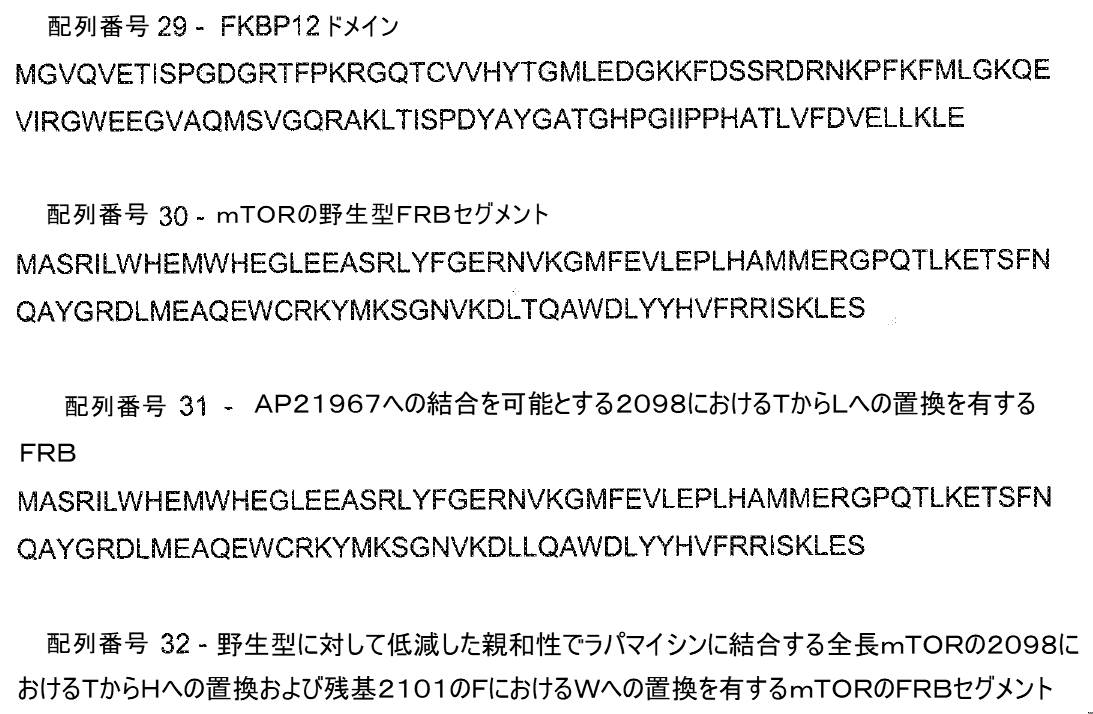
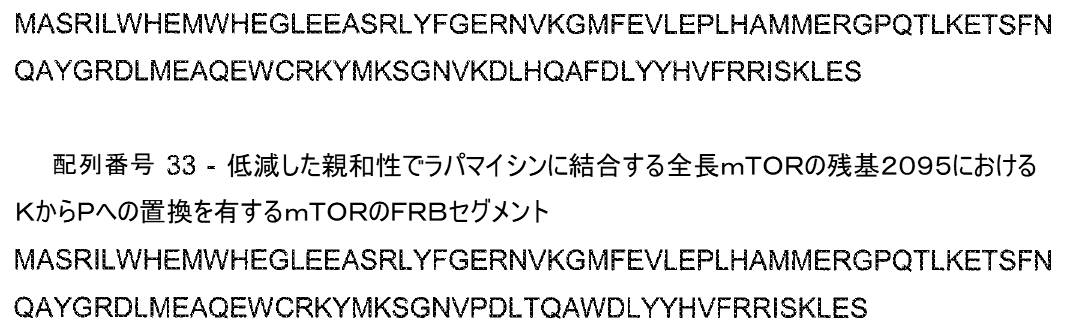
改変体配列は、配列が効果的な二量体化システムを提供する限り、すなわち、配列が細胞膜における膜テザリング成分およびシグナル減弱成分の共局在化を促進する限り、配列番号29~33に対して少なくとも80%、85%、90%、95%、98%または99%の配列同一性を有し得る。 Variant sequences are relative to SEQ ID NOS: 29-33 as long as the sequences provide an effective dimerization system, i. can have at least 80%, 85%, 90%, 95%, 98% or 99% sequence identity.
配列番号30として示す「野生型」FRBドメインは、ヒトmTORのアミノ酸2025~2114を含む。ヒトmTORのアミノ酸ナンバリングシステムを使用して、FRB配列は、以下の位置:2095、2098、2101の1つまたは複数においてアミノ酸置換を含み得る。 The "wild-type" FRB domain shown as SEQ ID NO:30 comprises amino acids 2025-2114 of human mTOR. Using the amino acid numbering system of human mTOR, the FRB sequence may contain amino acid substitutions at one or more of the following positions: 2095, 2098, 2101.
改変体FRBは、位置2095、2098および2101において以下のアミノ酸のうちの1つを含み得る:
2095:K、P、TまたはA
2098:T、L、HまたはF
2101:WまたはF。
A variant FRB may contain one of the following amino acids at positions 2095, 2098 and 2101:
2095: K, P, T or A
2098: T, L, H or F
2101: W or F.
Bayleら(Chem Bio;2006年;13巻;99~107頁)は、位置2095、2098および2101におけるアミノ酸にしたがって注釈された以下のFRB改変体を記載している(表1を参照):KTW、PLF、KLW、PLW、TLW、ALW、PTF、ATF、TTF、KLF、PLF、TLF、ALF、KTF、KHF、KFF、KLF。Bayleらの表1および図5Aに示されるように、これらの改変体は、異なる程度でラパマイシンおよびラパログに結合することができる。本発明の細胞のMTCまたはSDCは、これらのFRB改変体のうちの1つを含み得る。 Bayle et al. (Chem Bio; 2006; 13; 99-107) describe the following FRB variants annotated according to amino acids at positions 2095, 2098 and 2101 (see Table 1): KTW , PLF, KLW, PLW, TLW, ALW, PTF, ATF, TTF, KLF, PLF, TLF, ALF, KTF, KHF, KFF, KLF. As shown in Table 1 of Bayle et al. and Figure 5A, these variants are able to bind rapamycin and rapalogs to different extents. The MTC or SDC of the cells of the invention may contain one of these FRB variants.
ラパマイシンが内因性mTORに結合してそれを不活性化することを防止するために、FRBと接触するラパマイシンの表面を改変することができる。「隆起した」(bumped)ラパマイシンを収容する表面(burface)を形成するFRBドメインの補償的な変異は、FRB変異体との二量体化相互作用のみを回復させ、内因性のmTORタンパク質に対しては回復させない。 To prevent rapamycin from binding to and inactivating endogenous mTOR, the surface of rapamycin that contacts FRB can be modified. Compensatory mutations in the FRB domain, which forms a 'bumped' rapamycin-accommodating burface, restores only the dimerization interaction with the FRB mutant, allowing the endogenous mTOR protein to will not recover.
Bayleら(上記)は、様々なラパマイシンアナログ、または「ラパログ」およびそれらの対応する改変されたFRB結合ドメインを記載している。例えば、それぞれについて各々の相補的な結合ドメインと組み合わせて図3に示すように、C-20-メタアリルラパマイシン(methyllyrlrapamycin)(MaRap)、C16(S)-ブチルスルホンアミドラパマイシン(C16-BS-Rap)およびC16-(S)-7-メチルインドールラパマイシン(AP21976/C16-AiRap)。他のラパマイシン/ラパログとしては、シロリムスおよびタクロリムスが挙げられる。 Bayle et al. (supra) describe various rapamycin analogs, or "rapalogs," and their corresponding modified FRB binding domains. For example, C-20-methyllyrlrapamycin (MaRap), C16(S)-butylsulfonamiderapamycin (C16-BS-Rap), as shown in FIG. 3 in combination with their respective complementary binding domains for each. ) and C16-(S)-7-methylindolerapamycin (AP21976/C16-AiRap). Other rapamycin/rapalogs include sirolimus and tacrolimus.
薬剤に破壊される二量体化
第3の実施形態では、第1および第2の二量体化ドメインは、薬剤の非存在下でのみ二量体化することができる。この実施形態では、第1の二量体化ドメインと第2の二量体化ドメインとの二量体化は、薬剤の存在により破壊される。したがって、薬剤は、膜テザリング成分およびシグナル減弱成分が解離することを引き起こす。
Agent Disrupted Dimerization In a third embodiment, the first and second dimerization domains are capable of dimerizing only in the absence of an agent. In this embodiment, dimerization between the first dimerization domain and the second dimerization domain is disrupted by the presence of the agent. The agent thus causes the membrane tethering component and the signal attenuation component to dissociate.
薬剤は、第1の二量体化ドメインと第2の二量体化ドメインとの結合より高い親和性において第1の二量体化ドメインまたは第2の二量体化ドメインに特異的に結合することができる分子、例えば小分子であり得る。 The agent specifically binds the first dimerization domain or the second dimerization domain with a higher affinity than the binding of the first dimerization domain and the second dimerization domain It can be a molecule, eg, a small molecule.
例えば、結合システムは、ペプチド:ペプチド結合ドメインシステムに基づき得る。第1または第2の結合ドメインは、ペプチド結合ドメインを含み得、他の結合ドメインは、ペプチドより低い親和性でペプチド結合ドメインに結合するペプチド模倣体を含み得る。薬剤としてのペプチドの使用は、競合結合を通じたペプチド結合ドメインへのペプチド模倣体の結合を破壊する。ペプチド模倣体は、「野生型」ペプチドと類似のアミノ酸配列を有し得るが、ペプチド結合ドメインに対する結合親和性を低減させる1つまたは複数のアミノ酸変化を有し得る。 For example, the binding system can be based on a peptide:peptide binding domain system. The first or second binding domain may comprise a peptide binding domain and the other binding domain may comprise a peptidomimetic that binds the peptide binding domain with lower affinity than the peptide. The use of peptides as agents disrupts binding of the peptidomimetic to the peptide binding domain through competitive binding. A peptidomimetic can have an amino acid sequence similar to a "wild-type" peptide, but have one or more amino acid changes that reduce binding affinity for the peptide binding domain.
この実施形態では、薬剤は、第1の結合ドメインと第2の結合ドメインとの間の親和性より少なくとも10、20、50、100、1000または10000倍高い親和性で第1の結合ドメインまたは第2の結合ドメインに結合し得る。 In this embodiment, the agent binds to the first binding domain or the second binding domain with an affinity that is at least 10, 20, 50, 100, 1000 or 10000 times greater than the affinity between the first binding domain and the second binding domain. It can bind to two binding domains.
タンパク質-タンパク質相互作用を破壊する小分子剤は、薬学的な目的のために長い間開発されてきた(Vassilevら; Small-Molecule Inhibitors of Protein-Protein Interactions ISBN:978-3-642-17082-9により総説されている)。その相互作用が破壊されるタンパク質またはペプチド(またはこれらのタンパク質の関連する断片)は、第1および/または第2の二量体化ドメインとして使用することができ、小分子は、薬剤として使用され得る。 Small molecule agents that disrupt protein-protein interactions have long been developed for pharmaceutical purposes (Vassilev et al.; Small-Molecule Inhibitors of Protein-Protein Interactions ISBN: 978-3-642-17082-9 (reviewed by). Proteins or peptides (or related fragments of these proteins) whose interactions are disrupted can be used as first and/or second dimerization domains, and small molecules can be used as agents. obtain.
小分子のような薬剤を使用してその相互作用が破壊可能なタンパク質/ペプチドのリストを表2に与える。これらの議論され得るタンパク質-タンパク質相互作用(PPI)は、本発明の減弱可能なCARシステムにおいて使用され得る。これらのPPIに関するさらなる情報は、Whiteら、2008年(Expert Rev. Mol. Med. 10巻:e8)から入手可能である。

Tetリプレッサー(TetR)システム
例えば、Tetリプレッサー(TetR)、TetR相互作用タンパク質(TiP)、テトラサイクリンシステムといった、ペプチドの共局在化を制御するための他の小分子システムが当該技術分野において公知である。
Tet Repressor (TetR) System Other small molecule systems for controlling peptide co-localization are known in the art, such as the Tet repressor (TetR), the TetR-interacting protein (TiP), the tetracycline system. is.
Tetオペロンは、哺乳動物細胞において使用するために適応されてきた周知の生物学的オペロンである。TetRは、ホモ二量体としてテトラサイクリンに結合し、次いでTetR分子のDNA結合をモジュレートするコンホメーション変化を起こす。Klotzscheら(上記)は、TetRを活性化させるファージディスプレイ由来のペプチドを記載している。このタンパク質(TetR相互作用タンパク質/TiP)は、テトラサイクリン結合部位と重なり合うが同一ではないTetR中の結合部位を有する。したがって、TiPおよびテトラサイクリンは、TetRの結合について競合する。 The Tet operon is a well-known biological operon that has been adapted for use in mammalian cells. TetR binds tetracycline as a homodimer and then undergoes a conformational change that modulates DNA binding of the TetR molecule. Klotzsche et al. (supra) describe phage display-derived peptides that activate TetR. This protein (TetR-interacting protein/TiP) has a binding site in TetR that overlaps, but is not identical to, the tetracycline binding site. TiP and tetracycline therefore compete for the binding of TetR.
本発明の細胞において、膜テザリング成分の第1の二量体化ドメインは、TetRまたはTiPであり得、シグナル減弱成分の第2の二量体化ドメインは、対応する相補的な結合パートナーであり得る。 In the cells of the invention, the first dimerization domain of the membrane tethering component can be TetR or TiP and the second dimerization domain of the signal attenuation component is the corresponding complementary binding partner. obtain.
TetRおよびTIPのアミノ酸配列をそれぞれ配列番号34または配列番号35として以下に示す。
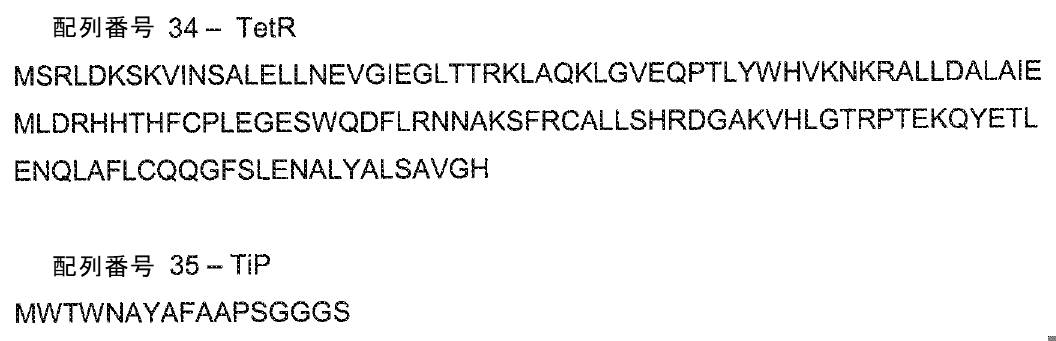
第1および第2の二量体化ドメインがTetRまたはTiPである場合、薬剤は、テトラサイクリン、ドキシサイクリン、ミノサイクリンまたはこれらのアナログであり得る。アナログは、TetRに特異的に結合する能力を保持するテトラサイクリン、ドキシサイクリンまたはミノサイクリンの改変体を指す。 When the first and second dimerization domains are TetR or TiP, the agent can be tetracycline, doxycycline, minocycline or analogs thereof. Analogs refer to variants of tetracycline, doxycycline or minocycline that retain the ability to specifically bind TetR.
ストレプトアビジン結合エピトープ
第1または第2の二量体化ドメインは、1つまたは複数のストレプトアビジン結合エピトープを含み得る。他の結合ドメインは、ビオチン模倣体を含み得る。
Streptavidin Binding Epitopes The first or second dimerization domain may comprise one or more streptavidin binding epitopes. Other binding domains may contain biotin mimetics.
ストレプトアビジンは、細菌Streptomyces avidiniiからの52.8kDaのタンパク質である。ストレプトアビジンホモ四量体は、約10-15Mの解離定数(Kd)を有してビオチン(ビタミンB7またはビタミンH)に対して非常に高い親和性を有する。ビオチン模倣体は、野生型ビオチンよりストレプトアビジンに対して低い親和性を有するため、ビオチン自体を、ストレプトアビジンドメインとビオチン模倣体ドメインとのヘテロ二量体化を破壊または防止するための薬剤として使用することができる。ビオチン模倣体は、例えば1nM~100uMのKdでストレプトアビジンに結合し得る。 Streptavidin is a 52.8 kDa protein from the bacterium Streptomyces avidinii. Streptavidin homotetramers have a very high affinity for biotin (vitamin B7 or vitamin H) with a dissociation constant (Kd) of approximately 10 −15 M. Biotin mimetics have a lower affinity for streptavidin than wild-type biotin, so biotin itself is used as an agent to disrupt or prevent heterodimerization between the streptavidin domain and the biotin mimetic domain. can do. A biotin mimetic can bind streptavidin with a Kd of, for example, 1 nM to 100 uM.
「ビオチン模倣体」ドメインは、例えば、ストレプトアビジンに特異的に結合する短いペプチド配列(例えば、6~20、6~18、8~18または8~15アミノ酸)を含み得る。 A "biotin mimetic" domain can include, for example, a short peptide sequence (eg, 6-20, 6-18, 8-18 or 8-15 amino acids) that specifically binds streptavidin.
ビオチン模倣体は、表1に示すような配列を含み得る。
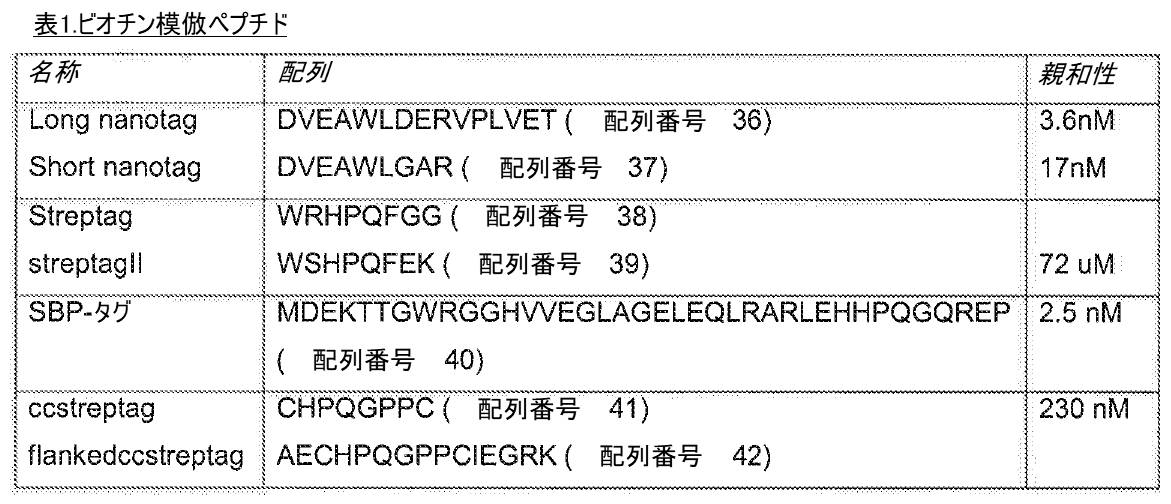
ビオチン模倣体は、以下の群:StreptagII、Flankedccstreptagおよびccstreptagから選択され得る。 Biotin mimetics may be selected from the following groups: StreptagII, Flankedccstreptag and ccstreptag.
ストレプトアビジンドメインは、配列番号43として示す配列を有するストレプトアビジンまたはビオチンに結合する能力を保持するその断片もしくは改変体を含み得る。 The streptavidin domain may comprise streptavidin having the sequence shown as SEQ ID NO:43 or a fragment or variant thereof that retains the ability to bind biotin.
全長ストレプトアビジンは159アミノ酸を有する。159残基の全長タンパク質のNおよびC末端はプロセシングされて、通常、残基13~139から構成されるより短い「コア」ストレプトアビジンを与え、NおよびC末端の除去が高いビオチン結合親和性のために必要である。 Full-length streptavidin has 159 amino acids. The N- and C-termini of the 159-residue full-length protein are processed to give a shorter "core" streptavidin, usually composed of residues 13-139, with removal of the N- and C-termini resulting in high biotin-binding affinity. is necessary for
「コア」ストレプトアビジン(残基13~139)の配列を配列番号43として示す。

ストレプトアビジンは、生来、ホモ四量体として存在する。ストレプトアビジン単量体の二次構造は、フォールディングして逆平行ベータバレル三次構造を与える8つの逆平行βストランドから構成される。ビオチン結合部位は、各β-バレルの1つの末端に位置する。4つの同一のストレプトアビジン単量体(すなわち、4つの同一のβ-バレル)は会合して、ストレプトアビジンの四量体四次構造を与える。各バレル中のビオチン結合部位は、隣り合うサブユニットからの保存されたTrp120と共に、バレルの内側からの残基からなる。このようにして、各サブユニットは、隣り合うサブユニット上の結合部位に寄与するので、四量体はまた、機能的な二量体の二量体と考えることができる。 Streptavidin naturally exists as a homotetramer. The secondary structure of streptavidin monomers consists of eight antiparallel β-strands that fold to give an antiparallel beta-barrel tertiary structure. A biotin binding site is located at one end of each β-barrel. Four identical streptavidin monomers (ie, four identical β-barrels) associate to give the tetrameric quaternary structure of streptavidin. The biotin binding site in each barrel consists of residues from the inside of the barrel with the conserved Trp120 from adjacent subunits. In this way, each subunit contributes a binding site on the adjacent subunit, so the tetramer can also be considered a dimer of functional dimers.
ストレプトアビジンドメインは、ストレプトアビジン単量体、二量体または四量体から本質的になるものであり得る。 A streptavidin domain may consist essentially of streptavidin monomers, dimers or tetramers.
改変体ストレプトアビジン配列は、配列番号43またはその機能的な部分に対して少なくとも70、80、90、95または99%の同一性を有し得る。改変体ストレプトアビジンは、ビオチン結合に関与する以下のアミノ酸のうちの1つまたは複数を含み得る:残基Asn23、Tyr43、Ser27、Ser45、Asn49、Ser88、Thr90およびAsp128。改変体ストレプトアビジンは、例えば、これらの残基の8つ全てを含み得る。改変体ストレプトアビジンが二量体または四量体として結合ドメイン中に存在する場合、それはまた、隣り合うサブユニットによるビオチン結合に関与するTrp120を含み得る。 A variant streptavidin sequence may have at least 70, 80, 90, 95 or 99% identity to SEQ ID NO:43 or a functional portion thereof. A variant streptavidin may contain one or more of the following amino acids involved in biotin binding: residues Asn23, Tyr43, Ser27, Ser45, Asn49, Ser88, Thr90 and Asp128. A variant streptavidin can include, for example, all eight of these residues. When variant streptavidin is present in the binding domain as a dimer or tetramer, it may also contain Trp120, which is involved in biotin binding by neighboring subunits.
不安定化ドメイン
シグナル減弱成分はまた、不安定化ドメインを含む。タンパク質中の不安定化ドメインの存在は、タンパク質の安定性が小分子のような薬剤の存在に依存することを意味する。薬剤が存在する時にドメインは安定化され、タンパク質は正常なものとして発現される。薬剤の非存在下で、ドメインは不安定であり、タンパク質が不安定となることを引き起こし、それにより、それは崩壊し、かつ/または分解される。
Destabilization Domain The signal-attenuating component also contains a destabilization domain. The presence of destabilizing domains in proteins means that protein stability depends on the presence of drugs such as small molecules. When the drug is present the domain is stabilized and the protein is expressed as normal. In the absence of the drug, the domain is unstable, causing the protein to become unstable, whereby it collapses and/or is degraded.
不安定化ドメインは、FK506-ラパマイシン結合(FRB)ドメインの分解しやすい変異体を含み得る。例えば、T2098L点変異を有するFRBは、ラパマイシンの非存在下で不安定であるが、ラパマイシンを加えた時に安定である。 A destabilizing domain may comprise a degradable mutant of the FK506-rapamycin binding (FRB) domain. For example, FRB with the T2098L point mutation is unstable in the absence of rapamycin, but is stable when rapamycin is added.
本発明のSDCは、Stankunasら(2007年;ChemBioChem、8巻:1162~1169頁)に記載される変異体の1つのようなFRBの分解しやすい変異体である不安定化ドメインを含み得る。 An SDC of the invention may comprise a destabilizing domain that is a degradable variant of FRB, such as one of the variants described in Stakunas et al. (2007; ChemBioChem 8:1162-1169).
不安定化ドメインは、配列番号57として示すアミノ酸配列を含み得る。

発現されると分解されるFKBP12の変異体バージョンもまた記載されている(Banaszynskiら(2006年)、Cell 126巻:995~1004頁)。不安定化ドメインに結合する合成リガンドの添加は、それを分解から保護し、不安定化ドメインを含むタンパク質が発現されることを可能とする。 A mutant version of FKBP12 that is degraded upon expression has also been described (Banaszynski et al. (2006) Cell 126:995-1004). Addition of a synthetic ligand that binds to the destabilization domain protects it from degradation and allows the protein containing the destabilization domain to be expressed.
不安定化ドメインは、以下の点変異:F15S、V24A、H25R、E60G、L106Pのうちの1つを有する配列番号58として示すFKBP12 F36V配列の変異体を含み得る。

不安定化ドメインは、配列番号59として示すアミノ酸配列を有するFKBP12 L106Pを含み得る。

FKPB12の変異体バージョンを安定化させるリガンドは、カルボン酸がモルホリン基で置き換えられたSLF*の誘導体である。この分子は、モルホリン含有リガンドShield-1(Shld1)として公知である(上記のBanaszynskiら(2006年))。 A ligand that stabilizes the mutant version of FKPB12 is a derivative of SLF* in which the carboxylic acid is replaced by a morpholine group. This molecule is known as the morpholine-containing ligand Shield-1 (Shld1) (Banaszynski et al. (2006), supra).
E.coliジヒドロ葉酸レダクターゼ(ecDHFR)の変異体もまた、分解されるように操作されており、この不安定化ドメインを目的のタンパク質に融合させた時に、融合したタンパク質にその不安定性が付与されて、融合タンパク質全体の迅速な分解を結果としてもたらすことが示されている(Iwamotoら(2010年)、17巻:981~988頁)。小分子リガンドのトリメトプリム(TMP)は、迅速、可逆的、および用量依存的な様式で不安定化ドメインを安定化させ、TMPの非存在下でのタンパク質レベルはほとんど検出不能であることが示された。 E. Mutants of E. coli dihydrofolate reductase (ecDHFR) have also been engineered to be degraded, and when this destabilization domain is fused to a protein of interest, the fused protein is endowed with its instability, It has been shown to result in rapid degradation of the entire fusion protein (Iwamoto et al. (2010) 17:981-988). The small molecule ligand trimethoprim (TMP) has been shown to stabilize the destabilizing domain in a rapid, reversible, and dose-dependent manner, with almost undetectable protein levels in the absence of TMP. rice field.
本発明のSDCは、DHFR F103L;R12Y/Y100IまたはN18T/A19Vのような変異体DHFR配列を含み得る。 SDCs of the invention may comprise mutant DHFR sequences such as DHFR F103L; R12Y/Y100I or N18T/A19V.
核酸構築物
本発明は、上記に定義されるようなキメラ抗原受容体(CAR);膜テザリング成分(MTC);およびシグナル減弱成分(SDC)のうちの1つまたは複数をコードする核酸配列を提供する。
Nucleic Acid Constructs The present invention provides nucleic acid sequences encoding one or more of a chimeric antigen receptor (CAR) as defined above; a membrane tethering component (MTC); and a signal attenuation component (SDC). .
CARをコードする核酸配列は、以下の構造を有し得る:
AgB-スペーサー-TM-endo
(AgBは、抗原結合ドメインをコードする核酸配列であり;
スペーサーは、スペーサーをコードする核酸配列であり;
TM1は、膜貫通ドメインをコードする核酸配列であり;
endoは、細胞内シグナル伝達ドメインをコードする核酸配列である。)
A nucleic acid sequence encoding a CAR can have the following structure:
AgB-spacer-TM-endo
(AgB is a nucleic acid sequence encoding an antigen binding domain;
the spacer is a nucleic acid sequence encoding a spacer;
TM1 is a nucleic acid sequence encoding a transmembrane domain;
Endo is a nucleic acid sequence that encodes an intracellular signaling domain. )
膜テザリング成分をコードする核酸は、以下の構造を有し得る:
MLD-DD1;または
DD1-MLD
(MLDは、膜局在化ドメインをコードする核酸配列であり;
DD1は、第1の二量体化ドメインをコードする核酸配列である。)
A nucleic acid encoding a membrane tethering component can have the following structure:
MLD-DD1; or DD1-MLD
(MLD is a nucleic acid sequence encoding a membrane localization domain;
DD1 is a nucleic acid sequence encoding the first dimerization domain. )
シグナル減弱成分をコードする核酸配列は、以下の構造を有し得る:
SDD-DD2;または
DD2-SDD
(SDDは、シグナル減弱ドメインをコードする核酸配列であり;
DD2は、第2の二量体化ドメインをコードする核酸配列である。)
A nucleic acid sequence encoding a signal-attenuating component can have the following structure:
SDD-DD2; or DD2-SDD
(SDD is a nucleic acid sequence encoding a signal attenuation domain;
DD2 is a nucleic acid sequence encoding a second dimerization domain. )
本発明は、
(i)キメラ抗原受容体(CAR)をコードする第1の核酸配列;
(ii)膜テザリング成分(MTC)をコードする第2の核酸配列;および
(iii)シグナル減弱成分(SDC)をコードする第3の核酸配列
を含む、核酸構築物を提供する。
The present invention
(i) a first nucleic acid sequence encoding a chimeric antigen receptor (CAR);
(ii) a second nucleic acid sequence encoding a membrane tethering component (MTC); and (iii) a third nucleic acid sequence encoding a signal attenuation component (SDC).
第1、第2および第3の核酸配列は、構築物中に任意の順序、すなわち:
CAR-MTC-SDC;
CAR-SDC-MTC;
MTC-CAR-SDC;
MTC-SDC-CAR;
SDC-CAR-MTC;または
SDC-MTC-CAR
で存在してよい。
The first, second and third nucleic acid sequences may be in any order in the construct, i.e.:
CAR-MTC-SDC;
CAR-SDC-MTC;
MTC-CAR-SDC;
MTC-SDC-CAR;
SDC-CAR-MTC; or SDC-MTC-CAR
may exist in
構築物中、核酸配列は、別個のポリペプチドとしてCAR、MTCおよびSDCの共発現を可能とする配列により接続され得る。例えば、核酸は、成分のうちの2つの間の切断部位;または2つの切断部位をコードして、別個のポリペプチドとしての3つ全ての成分の製造を可能とし得る。切断部位は、複合ポリペプチドが製造された時に、いかなる外的な切断活性も必要とせずにそれが別個の成分に直ちに切断されるように、自己切断性であり得る。 In the construct, the nucleic acid sequences may be joined by sequences that allow co-expression of CAR, MTC and SDC as separate polypeptides. For example, the nucleic acid may encode a cleavage site between two of the components; or two cleavage sites to allow production of all three components as separate polypeptides. The cleavage site can be self-cleaving so that when the composite polypeptide is produced it is immediately cleaved into separate components without the need for any external cleavage activity.
以下の配列:
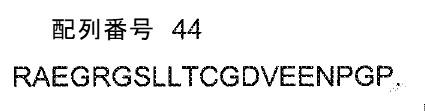
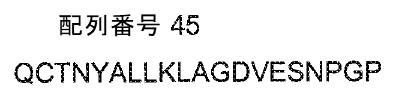
共発現配列は、内部リボソーム進入配列(IRES)であり得る。共発現配列は、内部プロモーターであり得る。 A co-expressed sequence can be an internal ribosome entry sequence (IRES). A co-expressed sequence can be an internal promoter.
核酸構築物は、例えば、以下をコードし得る:
SFGmR.V5_タグ-CD22(2Ig)-CD19tm-RL-FRB-2A-FKBP12-L-CD148endo-2A-CAR
(「SFGmR」は、配列:

「V5_タグ-」は、配列:

「CD22(2Ig)」は、配列:

「CD19tm」は、配列:

「RL」は、配列:

「FRB」は、配列:

「2A」は、配列:

「FKBP12」は、配列:

「L」は、配列:

「CD148endo」は、配列:
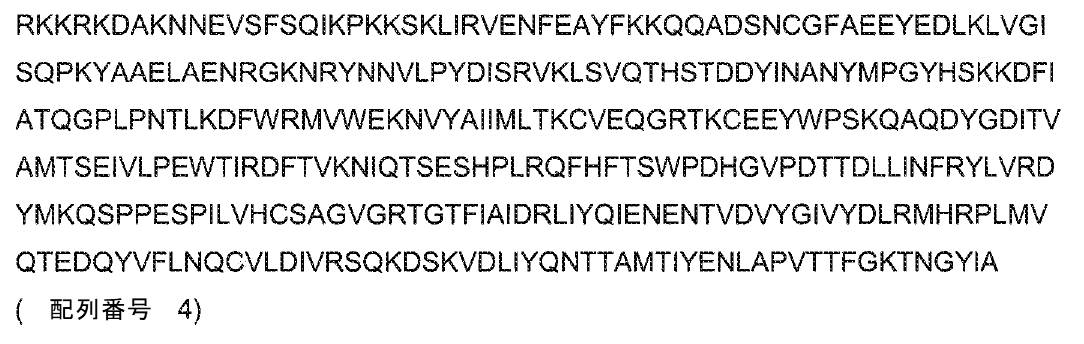
「2A」は、配列:

「CAR」は、CD28-ゼータエンドドメインを有する第二世代抗CD19 CARであり、CARは、配列:
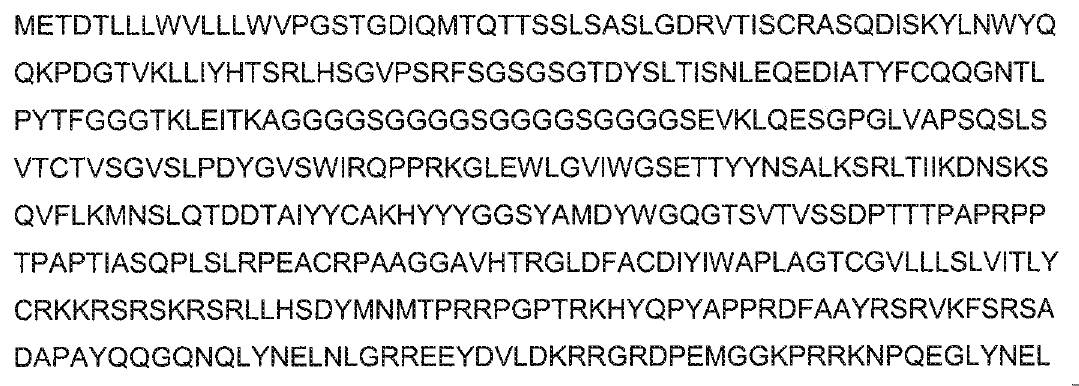

SFGmR. V5_tag-CD22(2Ig)-CD19tm-RL-FRB-2A-FKBP12-L-CD148endo-2A-CAR
(“SFGmR” is the sequence:
"V5_tag-" is the sequence:
"CD22(2Ig)" has the sequence:
"CD19tm" has the sequence:
"RL" is the sequence:
"FRB" is the array:
"2A" is the sequence:
"FKBP12" has the sequence:
"L" is the array:
"CD148endo" has the sequence:
"2A" is the sequence:
"CAR" is a second generation anti-CD19 CAR with a CD28-zeta endodomain, the CAR having the sequence:
この構築物が細胞中で発現される場合、FKBP12含有シグナル減弱成分とのFRB含有膜テザリング成分の二量体化を誘導するためにラパマイシンまたはそのアナログを使用して、CAR媒介性細胞シグナル伝達の減弱を引き起こすことができる(図3を参照)。 Attenuation of CAR-mediated cell signaling using rapamycin or its analogues to induce dimerization of the FRB-containing membrane tethering component with the FKBP12-containing signal-attenuating component when this construct is expressed in cells. (see Figure 3).
代替的な例として、核酸構築物は、以下をコードし得る:
SFG.TIP-L(16aa)-CD148endo-2A-V5-タグ-CD22(2Ig)-CD19tm-RL-TetRB-2A-CAR
(「SFG」は、配列:

「TIP」は、配列:

「L」は、配列:

「CD148endo」は、配列:
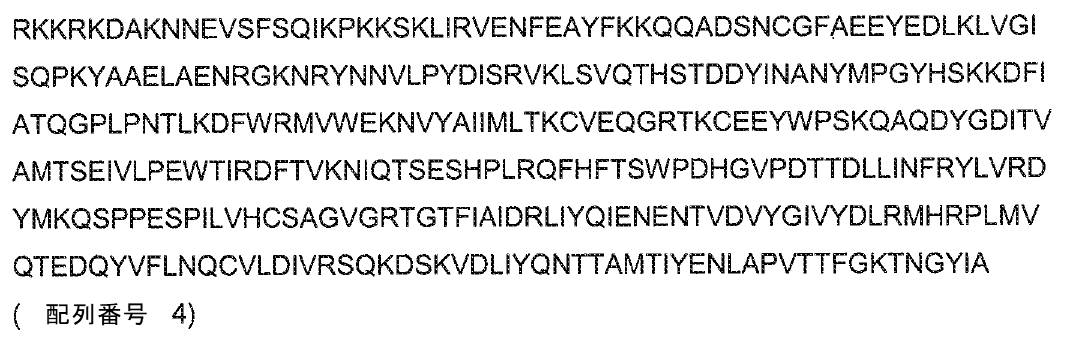
「2A」は、配列:

「V5_タグ-」は、配列:

「CD22(2Ig)」は、配列:

「CD19tm」は、配列:

「RL」は、配列:

TetRBは、配列:

「2A」は、配列:

「CAR」は、CD28-ゼータエンドドメインを有する第二世代抗CD19 CARであり、CARは、配列:


SFG. TIP-L(16aa)-CD148endo-2A-V5-tag-CD22(2Ig)-CD19tm-RL-TetRB-2A-CAR
(“SFG” is the sequence:
"TIP" is the sequence:
"L" is the array:
"CD148endo" has the sequence:
"2A" is the sequence:
"V5_tag-" is the sequence:
"CD22(2Ig)" has the sequence:
"CD19tm" has the sequence:
"RL" is the sequence:
TetRB is the sequence:
"2A" is the sequence:
"CAR" is a second generation anti-CD19 CAR with a CD28-zeta endodomain, the CAR having the sequence:
この構築物が細胞中で発現される場合、TiP含有シグナル減弱成分とのTetRB含有膜テザリング成分の二量体化を破壊するためにテトラサイクリンまたはそのアナログを使用することができる。これは、シグナル減弱ドメインの減弱効果からCARを解放し、すなわち、CAR媒介性シグナル伝達が起こり得る(図4~6を参照)。 When this construct is expressed in cells, tetracycline or its analogs can be used to disrupt the dimerization of the TetRB-containing membrane tethering component with the TiP-containing signal attenuation component. This releases the CAR from the attenuation effect of the signal attenuation domain, ie CAR-mediated signaling can occur (see Figures 4-6).
本明細書で使用される場合、「ポリヌクレオチド」、「ヌクレオチド」、および「核酸」という用語は、互いに同義であることが意図される。 As used herein, the terms "polynucleotide," "nucleotide," and "nucleic acid" are intended to be synonymous with each other.
多数の異なるポリヌクレオチドおよび核酸が、遺伝コードの縮重の結果として同じポリペプチドをコードできることが当業者により理解されるであろう。加えて、当業者は、常用の技術を使用して、ポリペプチドが発現される任意の特定の宿主生物のコドン使用を反映するように本明細書に記載されるポリヌクレオチドによりコードされるポリペプチド配列に影響しないヌクレオチド置換を行ってもよいことが理解されるべきである。 It will be understood by those skilled in the art that many different polynucleotides and nucleic acids can encode the same polypeptide as a result of the degeneracy of the genetic code. In addition, those skilled in the art, using routine techniques, will be able to identify the polypeptide encoded by the polynucleotides described herein to reflect the codon usage of any particular host organism in which the polypeptide is to be expressed. It should be understood that nucleotide substitutions may be made that do not affect the sequence.
本発明による核酸は、DNAまたはRNAを含み得る。それらは、一本鎖または二本鎖であり得る。それらはまた、それらの中に合成または修飾ヌクレオチドを含むポリヌクレオチドであり得る。オリゴヌクレオチドに対する多数の異なる種類の修飾が当該技術分野において公知である。これらとしては、メチルホスホネートおよびホスホロチオエート骨格、分子の3’および/または5’末端におけるアクリジンまたはポリリジン鎖の付加が挙げられる。本明細書に記載される使用の目的のために、ポリヌクレオチドは、当該技術分野において利用可能な任意の方法により修飾され得ることが理解されるべきである。そのような修飾は、目的のポリヌクレオチドのin vivoでの活性または寿命を増進させるために実行され得る。 Nucleic acids according to the invention may comprise DNA or RNA. They can be single-stranded or double-stranded. They may also be polynucleotides containing within them synthetic or modified nucleotides. Many different types of modifications to oligonucleotides are known in the art. These include methylphosphonate and phosphorothioate backbones, addition of acridine or polylysine chains at the 3' and/or 5' ends of the molecule. It should be understood that the polynucleotides may be modified by any method available in the art for the purposes of the uses described herein. Such modifications can be carried out to enhance the in vivo activity or life span of the polynucleotide of interest.
ヌクレオチド配列に関する「改変体」、「ホモログ」または「誘導体」という用語は、配列の1つ(または複数)の核酸に対する任意の置換、バリエーション、修飾、置換え、欠失または付加を含む。 The terms "variants", "homologues" or "derivatives" with respect to nucleotide sequences include any substitutions, variations, modifications, replacements, deletions or additions to one (or more) nucleic acids of the sequence.
本発明はまた、キメラ抗原受容体(CAR)をコードする第1の核酸配列;膜テザリング成分(MTC)をコードする第2の核酸配列;およびシグナル減弱成分(SDC)をコードする第3の核酸配列を含む、キットを提供する。 The invention also provides a first nucleic acid sequence encoding a chimeric antigen receptor (CAR); a second nucleic acid sequence encoding a membrane tethering component (MTC); and a third nucleic acid sequence encoding a signal attenuation component (SDC). Kits are provided that contain the sequences.
ベクター
本発明はまた、本発明の1つまたは複数の核酸配列を含むベクター、またはベクターのキットを提供する。そのようなベクターは、宿主細胞が上記に定義されるようなCAR、MTCおよび/またはSDCを発現するように宿主細胞中に核酸配列を導入するために使用され得る。
Vectors The invention also provides vectors, or kits of vectors, comprising one or more nucleic acid sequences of the invention. Such vectors can be used to introduce nucleic acid sequences into host cells such that the host cells express CAR, MTC and/or SDC as defined above.
ベクターは、例えば、プラスミドまたはウイルスベクター、例えば、レトロウイルスベクターもしくはレンチウイルスベクター、またはトランスポゾンベースのベクターまたは合成mRNAであり得る。 Vectors can be, for example, plasmids or viral vectors, such as retroviral or lentiviral vectors, or transposon-based vectors or synthetic mRNAs.
ベクターは、T細胞またはNK細胞をトランスフェクトまたは形質導入することができるものであり得る。 The vector may be capable of transfecting or transducing T cells or NK cells.
細胞
本発明は、減弱可能なCARシステムを含む細胞に関する。
Cells The present invention relates to cells containing an attenuable CAR system.
細胞は、本発明の核酸またはベクターを含み得る。 A cell may contain a nucleic acid or vector of the invention.
細胞は、細胞溶解性免疫細胞のような免疫細胞であり得る。細胞溶解性免疫細胞は、細胞媒介性の免疫において中心的役割を果たすリンパ球の一種であるT細胞またはTリンパ球であり得る。それらは、細胞表面上のT細胞受容体(TCR)の存在によりB細胞およびナチュラルキラー細胞(NK細胞)のような他のリンパ球から区別され得る。以下に要約するように、様々な種類のT細胞が存在する。 The cells can be immune cells, such as cytolytic immune cells. Cytolytic immune cells can be T cells or T lymphocytes, a type of lymphocyte that plays a central role in cell-mediated immunity. They can be distinguished from other lymphocytes such as B cells and natural killer cells (NK cells) by the presence of T cell receptors (TCR) on their cell surface. There are different types of T cells, summarized below.
ヘルパーTヘルパー細胞(TH細胞)は、形質細胞およびメモリーB細胞へのB細胞の成熟、ならびに細胞傷害性T細胞およびマクロファージの活性化などの免疫学的プロセスにおいて他の白血球を補助する。TH細胞は、それらの表面上にCD4を発現する。TH細胞は、抗原提示細胞(APC)の表面上のMHCクラスII分子によりペプチド抗原を提示された時に活性化される。これらの細胞は、異なるサイトカインを分泌して異なる種類の免疫応答を促進するTH1、TH2、TH3、TH17、Th9、またはTFHなどのいくつものサブタイプのうちの1つに分化することができる。 Helper T helper cells (TH cells) assist other leukocytes in immunological processes such as maturation of B cells into plasma cells and memory B cells, and activation of cytotoxic T cells and macrophages. TH cells express CD4 on their surface. TH cells are activated when presented with peptide antigens by MHC class II molecules on the surface of antigen presenting cells (APCs). These cells can differentiate into one of several subtypes such as TH1, TH2, TH3, TH17, Th9, or TFH that secrete different cytokines and promote different types of immune responses.
細胞溶解性T細胞(TC細胞、またはCTL)は、ウイルス感染した細胞および腫瘍細胞を破壊し、移植拒絶にも関与する。CTLは、それらの表面においてCD8を発現する。これらの細胞は、全ての有核細胞の表面上に存在するMHCクラスIと関連付けられる抗原に結合することによりそれらの標的を認識する。制御性T細胞により分泌されるIL-10、アデノシンおよび他の分子を通じて、CD8+細胞はアネルギー状態まで不活性化されることができ、それにより、実験的自己免疫性脳脊髄炎のような自己免疫疾患が予防される。 Cytolytic T cells (TC cells, or CTLs) destroy virus-infected cells and tumor cells and are also involved in transplant rejection. CTLs express CD8 on their surface. These cells recognize their targets by binding to antigens associated with MHC class I that are present on the surface of all nucleated cells. Through IL-10, adenosine and other molecules secreted by regulatory T cells, CD8+ cells can be inactivated to an anergic state, thereby leading to autoimmune diseases such as experimental autoimmune encephalomyelitis. Disease is prevented.
メモリーT細胞は、感染が消散した後に長期間持続する抗原特異的T細胞のサブセットである。それらは、それらの同族抗原に再曝露されると多数のエフェクターT細胞に急速に拡大増殖し、したがって、過去の感染に対する「記憶」を有する免疫系を提供する。メモリーT細胞は、セントラルメモリーT細胞(TCM細胞)および2種類のエフェクターメモリーT細胞(TEM細胞およびTEMRA細胞)という3つのサブタイプを含む。メモリー細胞は、CD4+またはCD8+のいずれかであり得る。メモリーT細胞は、典型的に、細胞表面タンパク質CD45ROを発現する。 Memory T cells are a subset of antigen-specific T cells that persist long after infection has resolved. They rapidly expand into large numbers of effector T cells upon re-exposure to their cognate antigen, thus providing the immune system with a "memory" for past infections. Memory T cells include three subtypes: central memory T cells (TCM cells) and two types of effector memory T cells (TEM cells and TEMRA cells). Memory cells can be either CD4+ or CD8+. Memory T cells typically express the cell surface protein CD45RO.
かつてはサプレッサーT細胞として公知であった制御性T細胞(Treg細胞)は、免疫学的寛容の維持のために極めて重要である。それらの大きな役割は、免疫反応の終わりに向けてT細胞媒介性の免疫をシャットダウンすることおよび胸腺における陰性選択のプロセスを免れた自己反応性T細胞を抑制することである。 Regulatory T cells (Treg cells), formerly known as suppressor T cells, are crucial for the maintenance of immunological tolerance. Their major role is to shut down T cell-mediated immunity towards the end of the immune response and to suppress autoreactive T cells that have escaped the process of negative selection in the thymus.
天然に存在するTreg細胞および適応Treg細胞という2つの主要なクラスのCD4+Treg細胞が記載されている。 Two major classes of CD4+ Treg cells have been described, naturally occurring Treg cells and adaptive Treg cells.
天然に存在するTreg細胞(CD4+CD25+FoxP3+Treg細胞としても公知)は、胸腺において生じ、TSLPで活性化された骨髄性(CD11c+)および形質細胞様(CD123+)の両方の樹状細胞との発生するT細胞の相互作用に関連付けられている。天然に存在するTreg細胞は、FoxP3と呼ばれる細胞内分子の存在により他のT細胞から区別することができる。FOXP3遺伝子の変異は、制御性T細胞の発生を防止することがあり、致死性の自己免疫疾患IPEXを引き起こし得る。 Naturally occurring Treg cells (also known as CD4+CD25+FoxP3+ Treg cells) arise in the thymus and are associated with developing T cells with both TSLP-activated myeloid (CD11c+) and plasmacytoid (CD123+) dendritic cells. Associated with interactions. Naturally occurring Treg cells can be distinguished from other T cells by the presence of an intracellular molecule called FoxP3. Mutations in the FOXP3 gene can prevent the development of regulatory T cells and can lead to the fatal autoimmune disease IPEX.
適応Treg細胞(Tr1細胞またはTh3細胞としても公知)は、正常な免疫応答の間に生じ得る。 Adaptive Treg cells (also known as Tr1 cells or Th3 cells) can arise during normal immune responses.
ナチュラルキラー細胞(またはNK細胞)は、自然免疫系の部分を形成する細胞溶解性細胞の一種である。NK細胞は、MHCと独立した様式でウイルス感染した細胞からの先天的なシグナルに対する迅速な応答を提供する。 Natural killer cells (or NK cells) are a class of cytolytic cells that form part of the innate immune system. NK cells provide rapid responses to innate signals from virus-infected cells in an MHC-independent manner.
NK細胞(先天的なリンパ系細胞の群に属する)は、大顆粒リンパ球(LGL)として定義され、BおよびTリンパ球を生成する共通のリンパ系前駆体から分化した3つ目の種類の細胞を構成する。NK細胞は、骨髄、リンパ節、脾臓、扁桃および胸腺において分化および成熟し、その後に循環に入ることが公知である。 NK cells (belonging to the group of congenital lymphoid cells) are defined as large granular lymphocytes (LGLs), a third type differentiated from common lymphoid progenitors that generate B and T lymphocytes. make up the cell. NK cells are known to differentiate and mature in bone marrow, lymph nodes, spleen, tonsil and thymus before entering circulation.
本発明のCAR発現細胞は、上記した細胞種のいずれかであり得る。 CAR-expressing cells of the invention can be any of the cell types described above.
TまたはNK細胞のようなCAR発現細胞は、患者自身の末梢血から(ファーストパーティー)、またはドナー末梢血からの造血幹細胞移植の状況のいずれかで(セカンドパーティー)作製されるか、または繋がりのないドナーからの末梢血から(サードパーティー)ex vivoで作製されるかのいずれであってもよい。 CAR-expressing cells, such as T or NK cells, are generated either from the patient's own peripheral blood (first party) or in the context of hematopoietic stem cell transplantation from donor peripheral blood (second party), It may either be made ex vivo (third party) from peripheral blood from a non-human donor.
あるいは、CAR発現細胞は、誘導前駆細胞または胚性前駆細胞のT細胞へのex vivo分化に由来し得る。あるいは、溶解機能を保持し、治療剤として作用し得る不死化されたT細胞株が使用され得る。 Alternatively, CAR-expressing cells may be derived from ex vivo differentiation of induced progenitor cells or embryonic progenitor cells into T cells. Alternatively, immortalized T cell lines that retain lytic function and can act as therapeutic agents can be used.
全てのこれらの実施形態では、CAR細胞は、ウイルスベクターを用いる形質導入、DNAまたはRNAを用いるトランスフェクションなどの多くの手段のうちの1つにより受容体成分およびシグナル伝達成分をコードするDNAまたはRNAを導入することにより生成される。 In all of these embodiments, the CAR cells are transduced with DNA or RNA encoding receptor and signaling components by one of a number of means, including transduction with viral vectors, transfection with DNA or RNA. is generated by introducing
本発明のCAR細胞は、被験体からのex vivoのTまたはNK細胞であり得る。TまたはNK細胞は、末梢血単核細胞(PBMC)試料からのものであり得る。TまたはNK細胞は、本発明の第1の態様によるCARシステムを提供する分子をコードする核酸で形質導入される前に、例えば、抗CD3モノクローナル抗体を用いる処理により、活性化および/または拡大増殖され得る。 The CAR cells of the invention can be ex vivo T or NK cells from a subject. T or NK cells can be from a peripheral blood mononuclear cell (PBMC) sample. The T or NK cells are activated and/or expanded, for example by treatment with an anti-CD3 monoclonal antibody, prior to being transduced with a nucleic acid encoding a molecule providing the CAR system according to the first aspect of the invention. can be
本発明の細胞は、
(i)上記にリストされる被験体または他の供給源からの細胞含有試料を単離するステップ;および
(ii)上記に定義されるような1つまたは複数の核酸配列または核酸構築物で、細胞を形質導入またはトランスフェクトするステップ
により製造され得る。
The cells of the present invention are
(i) isolating a cell-containing sample from a subject or other source listed above; and (ii) cells with one or more nucleic acid sequences or nucleic acid constructs as defined above. can be produced by transducing or transfecting the
次いで、細胞は、精製され、例えば、抗原結合ポリペプチドの抗原結合ドメインの発現に基づいて選択され得る。 Cells can then be purified and selected, eg, based on expression of the antigen binding domain of the antigen binding polypeptide.
医薬組成物
本発明はまた、本発明の複数の細胞を含有する医薬組成物に関する。医薬組成物は、追加的に、薬学的に許容される担体、希釈剤または賦形剤を含み得る。医薬組成物は、必要に応じて、1つまたは複数のさらなる薬学的に活性のポリペプチドおよび/または化合物を含み得る。そのような処方物は、例えば、静脈内注入のために好適な形態であり得る。
Pharmaceutical Compositions The present invention also relates to pharmaceutical compositions containing a plurality of cells of the invention. A pharmaceutical composition may additionally comprise a pharmaceutically acceptable carrier, diluent or excipient. A pharmaceutical composition may optionally comprise one or more additional pharmaceutically active polypeptides and/or compounds. Such formulations may be in a form suitable for intravenous infusion, for example.
処置方法
本発明は、(例えば、上記されるような医薬組成物中の)本発明の細胞を被験体に投与するステップを含む、疾患を処置および/または予防するための方法を提供する。
Methods of Treatment The invention provides methods for treating and/or preventing disease comprising administering cells of the invention (eg, in a pharmaceutical composition as described above) to a subject.
疾患を処置するための方法は、本発明の細胞の処置的使用に関する。これに関して、細胞は、疾患と関連付けられる少なくとも1つの症状を減少させ、低減させもしくは改善するためおよび/または疾患の進行を減速させ、低減させもしくは遮断するために既存の疾患または状態を有する被験体に投与され得る。 Methods for treating disease relate to therapeutic uses of the cells of the invention. In this regard, cells are used in subjects with an existing disease or condition to reduce, reduce or ameliorate at least one symptom associated with the disease and/or to slow, reduce or block progression of the disease. can be administered to
疾患を予防するための方法は、本発明の細胞の予防的使用に関する。これに関して、細胞は、疾患の原因を予防しもしくは損なわせるためまたは疾患と関連付けられる少なくとも1つの症状の発症を低減もしくは予防するために疾患にまだかかっていない、かつ/または疾患のいかなる症状も示していない被験体に投与され得る。被験体は、疾患の素因を有し得るか、または疾患を発症するリスクがあると考えられる被験体であり得る。 Methods for preventing disease relate to prophylactic use of the cells of the invention. In this regard, the cells are not yet diseased and/or exhibit any symptoms of the disease to prevent or impair the cause of the disease or to reduce or prevent the development of at least one symptom associated with the disease. can be administered to subjects who are not A subject may be predisposed to a disease or may be a subject considered at risk for developing a disease.
方法は、
(i)細胞含有試料を単離するステップ;
(ii)そのような細胞を、本発明により提供される核酸配列またはベクターで形質導入またはトランスフェクトするステップ;
(iii)(ii)からの細胞を被験体に投与するステップ
を伴い得る。
The method is
(i) isolating a cell-containing sample;
(ii) transducing or transfecting such cells with a nucleic acid sequence or vector provided by the invention;
(iii) may involve administering the cells from (ii) to the subject.
疾患を処置するための本発明により提供される方法は、疾患の進行および任意の毒性の活性をモニターすることならびに薬剤を投与または除去してCARシグナル伝達を阻害し、それにより任意の有害な毒性効果を低減または減少させることを伴い得る。 The methods provided by the present invention for treating disease involve monitoring disease progression and the activity of any toxicity and administering or removing agents to inhibit CAR signaling and thereby cause any adverse toxicity. It may involve reducing or diminishing the effect.
疾患を処置するための本発明により提供される方法は、疾患の進行をモニターすることおよび任意の毒性の活性をモニターすることならびに被験体に投与される薬剤の用量を調整して疾患進行および毒性の活性の許容されるレベルを提供することを伴い得る。 The methods provided by the present invention for treating disease include monitoring disease progression and monitoring the activity of any toxicity and adjusting the dose of the drug administered to the subject to control disease progression and toxicity. providing an acceptable level of activity of
疾患の進行をモニターすることは、疾患と関連付けられる症状を経時的に評価して、それらが低減/改善または増加/悪化しているかどうかを決定することを意味する。 Monitoring disease progression means evaluating symptoms associated with the disease over time to determine if they are decreasing/improving or increasing/worse.
本発明はまた、第1および第2の二量体化ドメインの結合または解離を制御する薬剤を被験体に投与するステップを含む、被験体において本発明の細胞の活性化を制御するための方法を提供する。 The invention also provides a method for controlling activation of a cell of the invention in a subject, comprising administering to the subject an agent that controls the binding or dissociation of the first and second dimerization domains. I will provide a.
本発明はまた、第1および第2の結合ドメインの結合を誘導する薬剤を被験体に投与するステップを含む、本発明の細胞を含む被験体においてCAR関連毒性を処置するための方法を提供する。 The invention also provides a method for treating CAR-associated toxicity in a subject comprising a cell of the invention comprising administering to the subject an agent that induces binding of the first and second binding domains. .
毒性の活性は、本発明のCAR細胞の被験体への投与後の該細胞により引き起こされる有害効果に関する。毒性の活性としては、例えば、免疫学的毒性、胆汁毒性および呼吸窮迫症候群、サイトカイン放出症候群、マクロファージ活性化症候群、または神経毒性を挙げることができる。 Toxic activity relates to adverse effects caused by the CAR cells of the invention after administration of the cells to a subject. Toxic activity can include, for example, immunological toxicity, bile toxicity and respiratory distress syndrome, cytokine release syndrome, macrophage activation syndrome, or neurotoxicity.
CARを通じたシグナル伝達のレベルおよびしたがってCAR発現細胞の活性化のレベルは、存在する薬剤の量、または薬剤が存在する時間の量を変化させることにより調整され得る。 The level of signaling through the CAR and thus the level of activation of CAR-expressing cells can be modulated by varying the amount of drug present or the amount of time the drug is present.
薬剤がSDCとMTCとの二量体化を誘導する場合、CAR細胞活性化のレベルは、被験体に投与される薬剤の用量を減少させることまたはその投与の頻度を減少させることにより増大し得る。反対に、CAR細胞活性化のレベルは、薬剤の用量、または被験体への投与の頻度を増加させることにより低減され得る。 If the agent induces dimerization of SDC and MTC, the level of CAR cell activation can be increased by decreasing the dose of the agent administered to the subject or decreasing the frequency of its administration. . Conversely, the level of CAR cell activation can be reduced by increasing the dose of the agent or frequency of administration to the subject.
薬剤がSDCとMTCとの二量体化を破壊する場合、CAR細胞活性化のレベルは、被験体に投与される薬剤の用量を増加させることまたはその投与の頻度を増加させることにより増大し得る。反対に、CAR細胞活性化のレベルは、薬剤の用量、または被験体への投与の頻度を減少させることにより低減され得る。 If the drug disrupts the dimerization of SDC and MTC, the level of CAR cell activation can be increased by increasing the dose of the drug administered to the subject or by increasing the frequency of its administration. . Conversely, the level of CAR cell activation can be reduced by decreasing the dose of the agent or the frequency of administration to the subject.
より高レベルのCAR細胞活性化は、低減された疾患進行であるが、増加した毒性の活性と関連付けられる可能性がある一方、より低レベルのCAR細胞活性化は、増加した疾患進行であるが、低減された毒性の活性と関連付けられる可能性がある。 Higher levels of CAR cell activation are associated with reduced disease progression but increased toxic activity, whereas lower levels of CAR cell activation are associated with increased disease progression. , may be associated with reduced toxic activity.
本発明はまた、薬剤を被験体に投与するステップを含む、本発明の細胞を含む被験体において疾患を処置および/または予防するための方法を提供する。そのため、この方法は、好適な薬剤を本発明のCAR発現細胞を既に含む被験体に投与することを伴う。 The invention also provides methods for treating and/or preventing disease in a subject comprising the cells of the invention comprising administering an agent to the subject. As such, the method involves administering a suitable agent to a subject already containing the CAR-expressing cells of the invention.
そのため、被験体に投与される薬剤の用量、または投与の頻度は、許容されるレベルの疾患進行および毒性の活性の両方を提供するために変更され得る。「許容される」と決定される疾患進行および毒性の活性の具体的なレベルは、具体的な状況にしたがって異なり、そのような基準に基づいて評価されるべきである。本発明は、この適切なレベルを達成するために細胞中のCARの活性化レベルを変化させる方法を提供する。 As such, the dose of an agent administered to a subject, or the frequency of administration, may be varied to provide both acceptable levels of disease progression and toxic activity. The specific level of disease progression and toxicity activity that is determined to be "acceptable" will vary according to the specific circumstances and should be evaluated on the basis of such criteria. The present invention provides methods for altering the activation level of CAR in cells to achieve this appropriate level.
薬剤は、医薬組成物の形態で投与され得る。医薬組成物は、追加的に、薬学的に許容される担体、希釈剤または賦形剤を含み得る。医薬組成物は、必要に応じて、1つまたは複数のさらなる薬学的に活性のポリペプチドおよび/または化合物を含み得る。そのような処方物は、例えば、静脈内注入のために好適な形態であり得る。 Agents can be administered in the form of pharmaceutical compositions. A pharmaceutical composition may additionally comprise a pharmaceutically acceptable carrier, diluent or excipient. A pharmaceutical composition may optionally comprise one or more additional pharmaceutically active polypeptides and/or compounds. Such formulations may be in a form suitable for intravenous infusion, for example.
本発明は、疾患の処置および/または予防において使用するための、本発明のCAR細胞を提供する。 The invention provides the CAR cells of the invention for use in treating and/or preventing disease.
本発明はまた、疾患の処置および/または予防のための医薬の製造における、本発明のCAR細胞の使用に関する。 The invention also relates to the use of the CAR cells of the invention in the manufacture of medicaments for the treatment and/or prevention of diseases.
本発明はまた、疾患の処置および/または予防において使用するための、本発明による細胞におけるCAR媒介性シグナル伝達を減弱させるための薬剤を提供する。 The invention also provides agents for attenuating CAR-mediated signaling in cells according to the invention for use in treating and/or preventing disease.
本発明はまた、疾患の処置および/または予防において使用するための、本発明による細胞におけるCAR媒介性シグナル伝達の減弱を低減または除去するための薬剤を提供する。 The invention also provides agents for reducing or eliminating attenuation of CAR-mediated signaling in cells according to the invention for use in the treatment and/or prevention of disease.
本発明はまた、本発明による細胞におけるCAR媒介性シグナル伝達の減弱において使用するための薬剤を提供する。 The invention also provides agents for use in attenuating CAR-mediated signaling in cells according to the invention.
本発明はまた、本発明による細胞におけるCAR媒介性シグナル伝達の減弱の低減または除去において使用するための薬剤を提供する。 The invention also provides agents for use in reducing or eliminating attenuation of CAR-mediated signaling in cells according to the invention.
本発明の方法により処置および/または予防される疾患は、ウイルス感染症のような感染症であり得る。 Diseases treated and/or prevented by the methods of the invention can be infectious diseases, such as viral infections.
本発明の方法はまた、例えば、自己免疫疾患、アレルギーおよび移植片対宿主拒絶における、病原性免疫応答の制御のためのものであり得る。 The methods of the invention can also be for the control of pathogenic immune responses, eg, in autoimmune diseases, allergies and graft-versus-host rejection.
方法は、膀胱がん、乳がん、結腸がん、子宮内膜がん、腎臓がん(腎臓細胞)、白血病、肺がん、黒色腫、非ホジキンリンパ腫、膵臓がん、前立腺がんおよび甲状腺がんのようながん性疾患の処置のためのものであり得る。 Methods include bladder cancer, breast cancer, colon cancer, endometrial cancer, renal cancer (kidney cell), leukemia, lung cancer, melanoma, non-Hodgkin's lymphoma, pancreatic cancer, prostate cancer and thyroid cancer. for the treatment of cancerous diseases such as
本発明をこれより実施例によりさらに説明し、実施例は、当業者による本発明の実行を補助するために役立つことを目的とし、いかなる意味でも本発明の範囲を限定することを意図しない。 The present invention will now be further described by examples, which are intended to help assist those skilled in the art in practicing the invention and are not intended to limit the scope of the invention in any way.
(実施例1 ラパ-オフ(Rapa-Off)減弱システムの機能性)
3シストロン性の構築物を、構造:
SFGmR.V5_タグ-CD22(2Ig)-CD19tm-RL-FRB-2A-FKBP12-L-CD148endo-2A-CAR
を有する単一の転写物として発現させる。
(Example 1 Rapa-Off attenuation system functionality)
The tricistronic construct has the structure:
SFGmR. V5_tag-CD22(2Ig)-CD19tm-RL-FRB-2A-FKBP12-L-CD148endo-2A-CAR
is expressed as a single transcript with
これは2A部位において、FKBP12含有シグナル減弱成分、膜貫通ドメインおよび細胞内FRBドメインを含む膜テザリング成分、ならびに抗CD19第二世代CARに自己切断する。 It self-cleaves at the 2A site into a FKBP12-containing signal attenuation component, a membrane tethering component containing transmembrane and intracellular FRB domains, and an anti-CD19 second generation CAR.
構築物をBW5細胞中で発現させる。SupT1細胞(CD19陰性)を操作してCD19陽性とし、可能な限り類似した標的陰性細胞株および標的陽性細胞株を得る。3人のドナーからの初代ヒトT細胞に2つのCAR構築物:(i)「古典的」な抗CD19 CAR;(ii)上記した3シストロン性の「減弱可能」なCD19 CARシステムを形質導入する。非形質導入T細胞および異なるCAR構築物を形質導入したT細胞を、異なる濃度のラパマイシンの存在下でSupT1細胞またはSupT1.CD19細胞のいずれかを用いて1:1で攻撃する。上清を攻撃の48時間後にサンプリングする。バックグラウンド(T細胞単独)、および最大(PMA/イオノマイシンを用いて刺激したT細胞)からの上清もまたサンプリングする。ELISAにより上清中のインターフェロン-ガンマを測定する。 Constructs are expressed in BW5 cells. SupT1 cells (CD19 negative) are engineered to be CD19 positive to obtain as similar target negative and target positive cell lines as possible. Primary human T cells from three donors are transduced with two CAR constructs: (i) the 'classical' anti-CD19 CAR; (ii) the tricistronic 'attenuable' CD19 CAR system described above. Non-transduced T cells and T cells transduced with different CAR constructs were treated with SupT1 cells or SupT1. Challenge 1:1 with either CD19 cells. Supernatants are sampled 48 hours after challenge. Supernatants from background (T cells alone) and maximum (T cells stimulated with PMA/ionomycin) are also sampled. Interferon-gamma is measured in the supernatant by ELISA.
クロム放出アッセイを使用して標的細胞の殺傷もまた実証する。SupT1およびSupT1.CD19細胞に51Crを負荷し、対照およびTet-CAR T細胞と共にラパマイシンの存在下または非存在下で4時間インキュベートする。上清中の51Crを計数することにより標的細胞の溶解を決定する。 Target cell killing is also demonstrated using a chromium release assay. SupT1 and SupT1. CD19 cells are loaded with 51 Cr and incubated with control and Tet-CAR T cells in the presence or absence of rapamycin for 4 hours. Lysis of target cells is determined by counting 51 Cr in the supernatant.
図3に示すように、ラパマイシンの非存在下での「ラパ-オフ」減弱システムにおいて、シグナル減弱成分は細胞質中を自由に拡散し、CAR媒介性シグナル伝達が起こり得る。ラパマイシンの存在下で、シグナル減弱成分は膜テザリング成分と共に二量体化して、CD148をCARの細胞内シグナル伝達ドメインと近接させ、細胞シグナル伝達を減弱させる。したがって、CAR媒介性活性化は、ラパマイシンの存在により「低減」または「遮断」される。 As shown in FIG. 3, in the 'rapa-off' attenuation system in the absence of rapamycin, the signal attenuation components diffuse freely in the cytoplasm and CAR-mediated signaling can occur. In the presence of rapamycin, the signal-attenuating component dimerizes with the membrane tethering component, bringing CD148 into close proximity with the CAR's intracellular signaling domain and attenuating cell signaling. Thus, CAR-mediated activation is "reduced" or "blocked" by the presence of rapamycin.
(実施例2 Tet-ON減弱システムの機能性)
3シストロン性の構築物を、構造:
SFG.TIP-L(16aa)-CD148endo-2A-V5-タグ-CD22(2Ig)-CD19tm-RL-TetRB-2A-CAR
を有する単一の転写物として発現させる。
(Example 2 Functionality of Tet-ON attenuation system)
The tricistronic construct has the structure:
SFG. TIP-L(16aa)-CD148endo-2A-V5-tag-CD22(2Ig)-CD19tm-RL-TetRB-2A-CAR
is expressed as a single transcript with
これは2A部位において、TiP含有シグナル減弱成分、膜貫通ドメインおよび細胞内TetRBドメインを含む膜テザリング成分、ならびに抗CD19第二世代CARに自己切断する。 It self-cleaves at the 2A site into a TiP-containing signal attenuation component, a membrane tethering component containing a transmembrane domain and an intracellular TetRB domain, and an anti-CD19 second generation CAR.
構築物をBW5細胞中で発現させ、次いで該細胞を、実施例1に記載した方法論を使用してテトラサイクリンの存在下または非存在下において、野生型SupT1細胞またはCD19を発現するように操作したSupT1細胞を用いて攻撃する。 The constructs were expressed in BW5 cells, which were then either wild-type SupT1 cells or SupT1 cells engineered to express CD19 in the presence or absence of tetracycline using the methodology described in Example 1. to attack.
図5および図6に示すように、テトラサイクリンの存在下での「Tet-ON」減弱システムにおいて、シグナル減弱成分は細胞質中を自由に拡散し、CAR媒介性シグナル伝達が起こり得る。テトラサイクリンの非存在下で、シグナル減弱成分は膜テザリング成分と共に二量体化して、CD148をCARの細胞内シグナル伝達ドメインと近接させ、細胞シグナル伝達を減弱させる。したがって、CAR媒介性活性化は、テトラサイクリンの存在により「上昇」または「オン」にされる。 As shown in Figures 5 and 6, in the 'Tet-ON' attenuation system in the presence of tetracycline, the signal-attenuating components diffuse freely in the cytoplasm and CAR-mediated signaling can occur. In the absence of tetracycline, the signal attenuation component dimerizes with the membrane tethering component, bringing CD148 into close proximity with the intracellular signaling domain of CAR and attenuating cell signaling. Thus, CAR-mediated activation is "raised" or "turned on" by the presence of tetracycline.
(実施例3 抗BCMA CARを有するラパ-オフ減弱システムの機能性)
3シストロン性の構築物を、構造:
SFGmR.V5_タグ-CD22(2Ig)-TM-FRB-2A-FKBP12-CD148endo-2A-CAR
を有する単一の転写物として発現させた。
(Example 3 Functionality of Rappa-off attenuation system with anti-BCMA CAR)
The tricistronic construct has the structure:
SFGmR. V5_tag-CD22(2Ig)-TM-FRB-2A-FKBP12-CD148endo-2A-CAR
was expressed as a single transcript with
これは2A部位において、FKBP12含有シグナル減弱成分、膜貫通ドメインおよび細胞内FRBドメインを含む膜テザリング成分、ならびにBCMAの天然リガンドである増殖誘導リガンド(APRIL)に基づく抗原結合部位を有する抗BCMA第三世代CARに自己切断する。 At the 2A site, it has an FKBP12-containing signal-attenuating component, a membrane-tethering component that includes a transmembrane domain and an intracellular FRB domain, and an anti-BCMA tertiary antigen binding site based on BCMA's natural ligand, proliferation-inducing ligand (APRIL). Self-cleave to generation CAR.
構築物をBW5細胞中で発現させた。標的細胞として使用するために、BCMA陽性となるようにSKOV3細胞を操作した。2人のドナーからの初代ヒトT細胞に2つのCAR構築物:(i)「古典的」な抗BCMA CAR;(ii)上記した3シストロン性の「減弱可能」なBCMA CARシステムを形質導入した。非形質導入T細胞および異なるCAR構築物を形質導入したT細胞を、異なる濃度のラパマイシンの存在下でSKOV3_BCMA細胞を用いて8:1で攻撃し、incucyteアッセイを使用して標的細胞殺傷を調べた。結果を図13に示す。 Constructs were expressed in BW5 cells. SKOV3 cells were engineered to be BCMA positive for use as target cells. Primary human T cells from two donors were transduced with two CAR constructs: (i) the 'classical' anti-BCMA CAR; (ii) the tricistronic 'attenuable' BCMA CAR system described above. Untransduced T cells and T cells transduced with different CAR constructs were challenged 8:1 with SKOV3_BCMA cells in the presence of different concentrations of rapamycin and target cell killing was examined using the incucyte assay. The results are shown in FIG.
ラパマイシンの存在下で、CAR、膜テザリング成分およびシグナル減弱成分を発現するT細胞による標的細胞の殺傷は、有意に阻害されることが判明した。阻害は、ラパマイシンの濃度に応じて滴定可能であることが判明した。72時間の時点において、CAR、膜テザリング成分およびシグナル減弱成分を発現するT細胞による標的細胞の殺傷は、0.82μMより高いラパマイシンの試験した濃度において有意に阻害された(図13B)。 In the presence of rapamycin, killing of target cells by T cells expressing CAR, membrane tethering and signal attenuation components was found to be significantly inhibited. Inhibition was found to be titratable depending on the concentration of rapamycin. At 72 hours, killing of target cells by T cells expressing CAR, membrane tethering and signal attenuation components was significantly inhibited at tested concentrations of rapamycin higher than 0.82 μM (FIG. 13B).
(実施例4 抗CD19 CARを有するラパ-オフ減弱システムの機能性)
3シストロン性の構築物を、構造:
SFGmR.V5_タグ-CD22(2Ig)-TM-FRB-2A-FKBP12-CD148endo-2A-CAR
を有する単一の転写物として発現させた。
(Example 4 Functionality of Rappa-off attenuation system with anti-CD19 CAR)
The tricistronic construct has the structure:
SFGmR. V5_tag-CD22(2Ig)-TM-FRB-2A-FKBP12-CD148endo-2A-CAR
was expressed as a single transcript with
これは2A部位において、FKBP12含有シグナル減弱成分、膜貫通ドメインおよび細胞内FRBドメインを含む膜テザリング成分、ならびに抗体fmc63に基づく抗原結合部位を有する抗CD19第二世代CARに自己切断する。 It self-cleaves at the 2A site into an anti-CD19 second generation CAR with an FKBP12-containing signal attenuation component, a membrane tethering component containing transmembrane and intracellular FRB domains, and an antigen binding site based on the antibody fmc63.
構築物をBW5細胞中で発現させた。標的細胞として使用するために、CD19陽性となるようにSKOV3細胞を操作した。2人のドナーからの初代ヒトT細胞に2つのCAR構築物:(i)「古典的」な抗BCMA CAR;(ii)上記した3シストロン性の「減弱可能」な抗CD19 CARシステムを形質導入した。非形質導入T細胞および異なるCAR構築物を形質導入したT細胞を、異なる濃度のラパマイシンの存在下でSKOV3_BCMA細胞を用いて4:1で攻撃し、incucyteアッセイを使用して標的細胞殺傷を調べた。結果を図14に示す。 Constructs were expressed in BW5 cells. SKOV3 cells were engineered to be CD19 positive for use as target cells. Primary human T cells from two donors were transduced with two CAR constructs: (i) the "classical" anti-BCMA CAR; (ii) the tricistronic "attenuable" anti-CD19 CAR system described above. . Untransduced T cells and T cells transduced with different CAR constructs were challenged 4:1 with SKOV3_BCMA cells in the presence of different concentrations of rapamycin and target cell killing was examined using the incucyte assay. The results are shown in FIG.
ラパマイシンの存在下で、CAR、膜テザリング成分およびシグナル減弱成分を発現するT細胞による標的細胞の殺傷は、有意に阻害された。50時間の時点において、対照CARは標的細胞をほぼ完全に殺傷した一方、減弱因子と共にCARを共発現するT細胞について、標的細胞の約50%が生存していた。 In the presence of rapamycin, killing of target cells by T cells expressing CAR, membrane tethering and signal attenuation components was significantly inhibited. At the 50 hour time point, control CAR killed target cells almost completely, while approximately 50% of target cells survived for T cells co-expressing CAR with an attenuating factor.
本明細書において上記した全ての刊行物は、参照することにより本明細書に組み込まれる。本発明の記載した方法およびシステムの様々な改変およびバリエーションが、本発明の範囲および精神から離れることなく当業者に明らかとなるであろう。本発明を特定の好ましい実施形態と結び付けて記載してきたが、特許請求の範囲に記載の本発明は、そのような特定の実施形態に不当に限定されるべきでないことが理解されるべきである。実際、分子生物学または関連分野の当業者に自明である本発明を実行するための記載した態様の様々な改変は、以下の特許請求の範囲に含まれることが意図される。
本発明は、例えば以下の項目を提供する。
(項目1)
(i)抗原結合ドメインと細胞内シグナル伝達ドメインとを含むキメラ抗原受容体(CAR);
(ii)第1の二量体化ドメインを含む膜テザリング成分;および
(iii)シグナル減弱ドメイン(SDD)と、前記膜テザリング成分の前記第1の二量体化ドメインに特異的に結合する第2の二量体化ドメインとを含むシグナル減弱成分(SDC)
を含む、細胞。
(項目2)
前記SDDが、前記CARの前記細胞内シグナル伝達ドメインを阻害する、項目1に記載の細胞。
(項目3)
前記SDDが、免疫受容体チロシン活性化モチーフ(ITAM)を脱リン酸化することができるホスファターゼドメインを含む、項目2に記載の細胞。
(項目4)
前記SDDが、CD148またはCD45のエンドドメインを含む、項目3に記載の細胞。
(項目5)
前記SDDが、SHP-1またはSHP-2のホスファターゼドメインを含む、項目3に記載の細胞。
(項目6)
前記SDDが、免疫受容体チロシン阻害モチーフ(ITIM)を含む、項目2に記載の細胞。
(項目7)
前記SDDが、以下の阻害性受容体:PD1、BTLA、2B4、CTLA-4、GP49B、Lair-1、Pir-B、PECAM-1、CD22、シグレック7、シグレック9、KLRG1、ILT2、CD94-NKG2AおよびCD5のうちの1つからのエンドドメインを含む、項目6に記載の細胞。
(項目8)
前記SDDが、Srcプロテインキナーゼを阻害する、項目2に記載の細胞。
(項目9)
前記SDDが、Lckを阻害する、項目8に記載の細胞。
(項目10)
CSKのキナーゼドメインを含む、項目8または9に記載の細胞。
(項目11)
前記SDDが、前記CARの前記細胞内シグナル伝達ドメインの除去を引き起こす、項目1に記載の細胞。
(項目12)
前記SDDが、プロテアーゼを含み、前記CARが、プロテアーゼ切断部位を含む、項目11に記載の細胞。
(項目13)
前記SDDが、タバコエッチウイルスプロテアーゼ(TeV)を含む、項目12に記載の細胞。
(項目14)
前記第1の二量体化ドメインと前記第2の二量体化ドメインとの結合が、薬剤の存在または非存在により制御可能である、先行するいずれかの項目に記載の細胞。
(項目15)
前記第1の二量体化ドメインと前記第2の二量体化ドメインとの結合が、二量体化の化学的誘導剤(CID)の存在により誘導される、項目14に記載の細胞。
(項目16)
一方の二量体化ドメインが、FK506結合タンパク質(FKBP)を含み、他方の二量体化ドメインが、mTORのFRBドメインを含み、前記CIDが、ラパマイシンまたはラパマイシンアナログである、項目15に記載の細胞。
(項目17)
前記第1の二量体化ドメインおよび前記第2の二量体化ドメインが、FK506結合タンパク質(FKBP)を含み、前記CIDが、FK1012である、項目15に記載の細胞。
(項目18)
前記第1の二量体化ドメインおよび前記第2の二量体化ドメインが、GyrBを含み、前記CIDが、クーママイシンまたはその誘導体である、項目15に記載の細胞。
(項目19)
一方の二量体化ドメインが、GAIを含み、他方の二量体化ドメインが、GID1を含み、前記CIDが、ジベレリンまたはその誘導体である、項目15に記載の細胞。
(項目20)
前記薬剤が、前記第1の二量体化ドメインと前記第2の二量体化ドメインとの結合を破壊する、項目14に記載の細胞。
(項目21)
一方の二量体化ドメインが、Tetリプレッサー(TetR)を含み、他方の二量体化ドメインが、TetR相互作用タンパク質(TiP)を含み、前記薬剤が、テトラサイクリン、ドキシサイクリン、ミノサイクリンまたはこれらのアナログである、項目20に記載の細胞。
(項目22)
前記膜テザリング成分が、膜貫通ドメインまたはミリストイル化配列を含む、先行するいずれかの項目に記載の細胞。
(項目23)
(i)先行するいずれかの項目に定義されるキメラ抗原受容体(CAR)をコードする第1の核酸配列;
(ii)先行するいずれかの項目に定義される膜テザリング成分(MTC)をコードする第2の核酸配列;および
(iii)先行するいずれかの項目に定義されるシグナル減弱成分(SDC)をコードする第3の核酸配列
を含む、核酸構築物。
(項目24)
(i)項目1~22のいずれかに定義されるキメラ抗原受容体(CAR)をコードする第1の核酸配列;
(ii)項目1~22のいずれかに定義される膜テザリング成分(MTC)をコードする第2の核酸配列;および
(ii)項目1~22のいずれかに定義されるシグナル減弱成分(SDC)をコードする第3の核酸配列
を含む、核酸配列のキット。
(項目25)
項目23に記載の核酸構築物を含む、ベクター。
(項目26)
(i)項目1~22のいずれかに定義されるキメラ抗原受容体(CAR)をコードする核酸配列を含む第1のベクター;
(ii)項目1~22のいずれかに定義される膜テザリング成分(MTC)をコードする核酸配列を含む第2のベクター;および
(ii)項目1~22のいずれかに定義されるシグナル減弱成分(SDC)をコードする核酸配列を含む第3のベクターを含む、ベクターのキット。
(項目27)
項目1~22のいずれかに記載の複数の細胞を含む、医薬組成物。
(項目28)
疾患の処置および/または予防において使用するための、項目27に記載の医薬組成物。
(項目29)
項目27に記載の医薬組成物を被験体に投与するステップを含む、疾患を処置および/または予防するための方法。
(項目30)
(i)細胞含有試料を単離するステップ;
(ii)項目23に記載の核酸構築物、項目24に記載の核酸配列のキット;項目25に記載のベクターまたは項目26に記載のベクターのキットで、前記細胞を形質導入またはトランスフェクトするステップ;および
(iii)(ii)からの前記細胞を被験体に投与するステップ
を含む、項目29に記載の方法。
(項目31)
被験体において項目1~22のいずれかに記載の細胞の活性化を制御するための方法であって、第1の二量体化ドメインと第2の二量体化ドメインとの結合または解離を制御する薬剤を前記被験体に投与するステップを含む、方法。
(項目32)
項目1~22のいずれかに記載の細胞を含む、被験体においてCAR関連毒性を処置するための方法であって、第1の結合ドメインと第2の結合ドメインとの結合を誘導する薬剤を前記被験体に投与するステップを含む、方法。
(項目33)
前記CAR関連毒性が、サイトカイン放出症候群、マクロファージ活性化症候群、または神経毒性である、項目32に記載の方法。
(項目34)
疾患の処置および/または予防のための医薬の製造における、項目27に記載の医薬組成物の使用。
(項目35)
前記疾患ががんである、項目28に記載の使用のための医薬組成物、項目29または30に記載の方法、あるいは項目34に記載の使用。
(項目36)
項目1~22のいずれかに記載の細胞を製造するための方法であって、項目23に記載の核酸構築物、項目24に記載の核酸配列のキット;項目25に記載のベクターまたは項目26に記載のベクターのキットを細胞に導入するステップを含む、方法。
(項目37)
前記細胞が、被験体から単離された試料からのものである、項目36に記載の方法。
All publications mentioned above in this specification are herein incorporated by reference. Various modifications and variations of the described method and system of the invention will be apparent to those skilled in the art without departing from the scope and spirit of the invention. Although the invention has been described in connection with specific preferred embodiments, it should be understood that the invention as claimed should not be unduly limited to such specific embodiments. . Indeed, various modifications of the described modes for carrying out the invention which are obvious to those skilled in molecular biology or related fields are intended to be within the scope of the following claims.
The present invention provides, for example, the following items.
(Item 1)
(i) a chimeric antigen receptor (CAR) comprising an antigen-binding domain and an intracellular signaling domain;
(ii) a membrane tethering component comprising a first dimerization domain; and
(iii) a signal attenuation domain (SDD) and a second dimerization domain that specifically binds to said first dimerization domain of said membrane tethering component (SDC)
containing, cells.
(Item 2)
2. The cell of item 1, wherein said SDD inhibits said intracellular signaling domain of said CAR.
(Item 3)
3. The cell of item 2, wherein said SDD comprises a phosphatase domain capable of dephosphorylating an immunoreceptor tyrosine activation motif (ITAM).
(Item 4)
4. The cell of item 3, wherein said SDD comprises a CD148 or CD45 endodomain.
(Item 5)
4. The cell of item 3, wherein said SDD comprises the phosphatase domain of SHP-1 or SHP-2.
(Item 6)
3. The cell of item 2, wherein said SDD comprises an immunoreceptor tyrosine inhibition motif (ITIM).
(Item 7)
The SDD is an inhibitory receptor of the following: PD1, BTLA, 2B4, CTLA-4, GP49B, Lair-1, Pir-B, PECAM-1, CD22, Siglec 7,
(Item 8)
3. The cell of item 2, wherein said SDD inhibits Src protein kinase.
(Item 9)
9. The cell of
(Item 10)
10. A cell according to
(Item 11)
The cell of item 1, wherein said SDD causes removal of said intracellular signaling domain of said CAR.
(Item 12)
12. The cell of item 11, wherein the SDD comprises a protease and the CAR comprises a protease cleavage site.
(Item 13)
13. The cell of item 12, wherein said SDD comprises tobacco etch virus protease (TeV).
(Item 14)
The cell of any preceding item, wherein binding between said first dimerization domain and said second dimerization domain is controllable by the presence or absence of an agent.
(Item 15)
15. The cell of item 14, wherein binding between said first dimerization domain and said second dimerization domain is induced by the presence of a chemical inducer of dimerization (CID).
(Item 16)
16. The method of item 15, wherein one dimerization domain comprises an FK506 binding protein (FKBP), the other dimerization domain comprises the FRB domain of mTOR, and the CID is rapamycin or a rapamycin analogue. cell.
(Item 17)
16. The cell of item 15, wherein said first dimerization domain and said second dimerization domain comprise FK506 binding protein (FKBP) and said CID is FK1012.
(Item 18)
16. The cell of item 15, wherein said first dimerization domain and said second dimerization domain comprise GyrB and said CID is Coomamycin or a derivative thereof.
(Item 19)
16. The cell of item 15, wherein one dimerization domain comprises GAI, the other dimerization domain comprises GID1, and said CID is gibberellin or a derivative thereof.
(Item 20)
15. The cell of item 14, wherein said agent disrupts binding between said first dimerization domain and said second dimerization domain.
(Item 21)
one dimerization domain contains the Tet repressor (TetR) and the other dimerization domain contains the TetR-interacting protein (TiP) and the agent is tetracycline, doxycycline, minocycline or analogs thereof 21. The cell of
(Item 22)
A cell according to any preceding item, wherein said membrane tethering component comprises a transmembrane domain or a myristoylation sequence.
(Item 23)
(i) a first nucleic acid sequence encoding a chimeric antigen receptor (CAR) as defined in any preceding item;
(ii) a second nucleic acid sequence encoding a membrane tethering component (MTC) as defined in any preceding item; and
(iii) a third nucleic acid sequence encoding a signal attenuation component (SDC) as defined in any preceding item;
A nucleic acid construct.
(Item 24)
(i) a first nucleic acid sequence encoding a chimeric antigen receptor (CAR) as defined in any of items 1-22;
(ii) a second nucleic acid sequence encoding a membrane tethering component (MTC) as defined in any of items 1-22; and
(ii) a third nucleic acid sequence encoding a signal attenuation component (SDC) as defined in any of items 1-22
A kit of nucleic acid sequences comprising:
(Item 25)
A vector comprising the nucleic acid construct of item 23.
(Item 26)
(i) a first vector comprising a nucleic acid sequence encoding a chimeric antigen receptor (CAR) as defined in any of items 1-22;
(ii) a second vector comprising a nucleic acid sequence encoding a membrane tethering component (MTC) as defined in any of items 1-22; and
(ii) a vector kit comprising a third vector comprising a nucleic acid sequence encoding a signal attenuation component (SDC) as defined in any of items 1-22.
(Item 27)
A pharmaceutical composition comprising a plurality of cells according to any one of items 1-22.
(Item 28)
A pharmaceutical composition according to item 27, for use in the treatment and/or prevention of disease.
(Item 29)
A method for treating and/or preventing a disease comprising administering the pharmaceutical composition of item 27 to a subject.
(Item 30)
(i) isolating a cell-containing sample;
(ii) transducing or transfecting said cell with a nucleic acid construct according to item 23, a kit of nucleic acid sequences according to item 24; a vector according to
(iii) administering said cells from (ii) to a subject
30. The method of item 29, comprising
(Item 31)
23. A method for regulating cell activation in a subject according to any one of items 1 to 22, comprising binding or dissociating the first dimerization domain and the second dimerization domain A method comprising administering a controlling agent to said subject.
(Item 32)
23. A method for treating CAR-related toxicity in a subject comprising the cell of any of items 1-22, wherein an agent that induces binding between the first binding domain and the second binding domain is added. A method comprising administering to a subject.
(Item 33)
33. The method of item 32, wherein the CAR-related toxicity is cytokine release syndrome, macrophage activation syndrome, or neurotoxicity.
(Item 34)
Use of a pharmaceutical composition according to item 27 in the manufacture of a medicament for the treatment and/or prevention of diseases.
(Item 35)
A pharmaceutical composition for use according to item 28, a method according to
(Item 36)
A method for producing a cell according to any one of items 1 to 22, comprising a nucleic acid construct according to item 23, a kit of nucleic acid sequences according to item 24; a vector according to
(Item 37)
37. The method of item 36, wherein said cells are from a sample isolated from a subject.
Claims (30)
(ii)第1の二量体化ドメインを含む膜テザリング成分;および
(iii)前記CARの前記細胞内シグナル伝達ドメインを阻害するシグナル減弱ドメイン(SDD)と、前記膜テザリング成分の前記第1の二量体化ドメインに特異的に結合する第2の二量体化ドメインとを含むシグナル減弱成分(SDC)
を含む、細胞であって、
前記第1の二量体化ドメインと前記第2の二量体化ドメインとの結合が、二量体化の化学的誘導剤(CID)の存在により誘導され、
その結果、前記CIDの非存在下では、前記SDCが、前記細胞内を自由に動き、CAR媒介性細胞シグナル伝達に影響しない一方で、前記CIDの存在下では、前記第1の二量体化ドメインと前記第2の二量体化ドメインとが結合して、前記SDCを細胞膜に運び、前記SDDは、前記CARの前記細胞内シグナル伝達ドメインを阻害し、かつ、CAR媒介性細胞シグナル伝達を減弱させる、細胞。 (i) a chimeric antigen receptor (CAR) comprising an antigen-binding domain and an intracellular signaling domain;
(ii) a membrane tethering component comprising a first dimerization domain; and (iii) a signal attenuation domain (SDD) that inhibits said intracellular signaling domain of said CAR and said first dimerization domain of said membrane tethering component. a signal attenuation component (SDC) comprising a second dimerization domain that specifically binds to the dimerization domain
A cell comprising
binding between the first dimerization domain and the second dimerization domain is induced by the presence of a chemical inducer of dimerization (CID);
Consequently, in the absence of the CID, the SDC is free to move within the cell and does not affect CAR-mediated cell signaling, whereas in the presence of the CID, the first dimerization When the domain and said second dimerization domain combine to transport said SDC to the cell membrane, said SDD inhibits said intracellular signaling domain of said CAR and inhibits CAR-mediated cell signaling. Attenuate, cells.
(ii)請求項1~14のいずれか一項に定義される膜テザリング成分(MTC)をコードする第2の核酸配列;および
(iii)請求項1~14のいずれか一項に定義されるシグナル減弱成分(SDC)をコードする第3の核酸配列
を含む、核酸構築物。 (i) a first nucleic acid sequence encoding a chimeric antigen receptor (CAR) as defined in any one of claims 1-14;
(ii) a second nucleic acid sequence encoding a membrane tethering component (MTC) as defined in any one of claims 1-14; and (iii) as defined in any one of claims 1-14. A nucleic acid construct comprising a third nucleic acid sequence encoding a signal attenuation component (SDC).
(ii)請求項1~14のいずれかに定義される膜テザリング成分(MTC)をコードする第2の核酸配列を含む第2の核酸;および
(ii)請求項1~14のいずれかに定義されるシグナル減弱成分(SDC)をコードする第3の核酸配列を含む第3の核酸
を含む、核酸のキット。 (i) a first nucleic acid comprising a first nucleic acid sequence encoding a chimeric antigen receptor (CAR) as defined in any of claims 1-14;
(ii) a second nucleic acid comprising a second nucleic acid sequence encoding a membrane tethering component (MTC) as defined in any one of claims 1-14; and (ii) as defined in any one of claims 1-14. a kit of nucleic acids comprising a third nucleic acid comprising a third nucleic acid sequence encoding a signal-attenuating component (SDC).
(ii)請求項1~14のいずれかに定義される膜テザリング成分(MTC)をコードする核酸配列を含む第2のベクター;および
(ii)請求項1~14のいずれかに定義されるシグナル減弱成分(SDC)をコードする核酸配列を含む第3のベクター
を含む、ベクターのキット。 (i) a first vector comprising a nucleic acid sequence encoding a chimeric antigen receptor (CAR) as defined in any of claims 1-14;
(ii) a second vector comprising a nucleic acid sequence encoding a membrane tethering component (MTC) as defined in any one of claims 1-14; and (ii) a signal as defined in any one of claims 1-14. A vector kit comprising a third vector comprising a nucleic acid sequence encoding an attenuation component (SDC).
(i)細胞含有試料を単離するステップ;
(ii)請求項15に記載の核酸構築物、請求項16に記載の核酸のキット;請求項17に記載のベクターまたは請求項18に記載のベクターのキットで、前記細胞を形質導入またはトランスフェクトするステップ;および
(iii)(ii)からの前記細胞を被験体に投与するステップ
を含む、請求項21に記載の医薬組成物。 said method comprising:
(i) isolating a cell-containing sample;
(ii) transducing or transfecting said cell with a nucleic acid construct according to claim 15, a kit of nucleic acids according to claim 16; a vector according to claim 17 or a kit of vectors according to claim 18; and (iii) administering said cells from (ii) to a subject.
Applications Claiming Priority (7)
| Application Number | Priority Date | Filing Date | Title |
|---|---|---|---|
| GBGB1707780.1A GB201707780D0 (en) | 2017-05-15 | 2017-05-15 | Cell |
| GB1707780.1 | 2017-05-15 | ||
| GBGB1707781.9A GB201707781D0 (en) | 2017-05-15 | 2017-05-15 | Cell |
| GB1707781.9 | 2017-05-15 | ||
| GB1707782.7 | 2017-05-15 | ||
| GBGB1707782.7A GB201707782D0 (en) | 2017-05-15 | 2017-05-15 | Cell |
| PCT/GB2018/051293 WO2018211244A1 (en) | 2017-05-15 | 2018-05-14 | A cell comprising a chimeric antigen receptor (car) |
Publications (3)
| Publication Number | Publication Date |
|---|---|
| JP2020520236A JP2020520236A (en) | 2020-07-09 |
| JP2020520236A5 JP2020520236A5 (en) | 2021-04-22 |
| JP7132249B2 true JP7132249B2 (en) | 2022-09-06 |
Family
ID=62196641
Family Applications (1)
| Application Number | Title | Priority Date | Filing Date |
|---|---|---|---|
| JP2019563057A Active JP7132249B2 (en) | 2017-05-15 | 2018-05-14 | Cells containing chimeric antigen receptors (CAR) |
Country Status (7)
| Country | Link |
|---|---|
| US (1) | US20200188434A1 (en) |
| EP (1) | EP3634989A1 (en) |
| JP (1) | JP7132249B2 (en) |
| CN (1) | CN110621694A (en) |
| AU (1) | AU2018270078A1 (en) |
| CA (1) | CA3062727A1 (en) |
| WO (1) | WO2018211244A1 (en) |
Families Citing this family (10)
| Publication number | Priority date | Publication date | Assignee | Title |
|---|---|---|---|---|
| GB201805918D0 (en) | 2018-04-10 | 2018-05-23 | Autolus Ltd | Cell |
| US20220281971A1 (en) * | 2019-07-17 | 2022-09-08 | National University Of Singapore | Functional Binders Synthesized and Secreted by Immune Cells |
| AU2020401315B2 (en) | 2019-12-11 | 2023-11-09 | A2 Biotherapeutics, Inc. | LILRB1-based chimeric antigen receptor |
| JP7621461B2 (en) | 2020-08-20 | 2025-01-24 | エー2 バイオセラピューティクス, インコーポレイテッド | Compositions and methods for treating EGFR positive cancer |
| MX2023002017A (en) | 2020-08-20 | 2023-04-28 | A2 Biotherapeutics Inc | COMPOSITIONS AND METHODS FOR TREATING CEACAM POSITIVE CANCERS. |
| CA3188862A1 (en) | 2020-08-20 | 2022-02-24 | Carl Alexander Kamb | Compositions and methods for treating mesothelin positive cancers |
| WO2024091694A1 (en) * | 2022-10-28 | 2024-05-02 | Mary Hitchcock Memorial Hospital, For Itself And On Behalf Of Dartmouth-Hitchcock Clinic | Chimeric human receptor for pathogenic viruses |
| WO2024102436A1 (en) * | 2022-11-10 | 2024-05-16 | The Johns Hopkins University | System for modulating receptor tyrosine kinase signaling and methods of use thereof |
| CN116376844B (en) * | 2023-05-31 | 2023-08-11 | 四川大学华西医院 | CAR-T targeting HER2-positive tumors comprising SHP2 SH2 domain and its preparation method and application |
| CN116355859B (en) * | 2023-05-31 | 2023-08-11 | 四川大学华西医院 | HER2 positive tumor targeting CAR-T containing SHP 2N-SH 2 domain, preparation method and application |
Citations (4)
| Publication number | Priority date | Publication date | Assignee | Title |
|---|---|---|---|---|
| WO2016030691A1 (en) | 2014-08-29 | 2016-03-03 | Ucl Business Plc | Signalling system |
| WO2016055551A1 (en) | 2014-10-07 | 2016-04-14 | Cellectis | Method for modulating car-induced immune cells activity |
| WO2016193696A1 (en) | 2015-06-01 | 2016-12-08 | Ucl Business Plc | Cell |
| JP2016538854A (en) | 2013-11-21 | 2016-12-15 | ユーシーエル ビジネス ピーエルシー | cell |
Family Cites Families (6)
| Publication number | Priority date | Publication date | Assignee | Title |
|---|---|---|---|---|
| KR102332790B1 (en) * | 2013-02-15 | 2021-12-01 | 더 리젠츠 오브 더 유니버시티 오브 캘리포니아 | Chimeric Antigen Receptor and Methods of Use Thereof |
| WO2015142661A1 (en) * | 2014-03-15 | 2015-09-24 | Novartis Ag | Regulatable chimeric antigen receptor |
| GB201405845D0 (en) * | 2014-04-01 | 2014-05-14 | Ucl Business Plc | Signalling system |
| GB201501936D0 (en) * | 2015-02-05 | 2015-03-25 | Ucl Business Plc | Signalling system |
| GB201507119D0 (en) * | 2015-04-27 | 2015-06-10 | Ucl Business Plc | Nucleic Acid Construct |
| GB201610515D0 (en) * | 2016-06-16 | 2016-08-03 | Autolus Ltd | Cell |
-
2018
- 2018-05-14 JP JP2019563057A patent/JP7132249B2/en active Active
- 2018-05-14 CA CA3062727A patent/CA3062727A1/en active Pending
- 2018-05-14 EP EP18725625.0A patent/EP3634989A1/en not_active Withdrawn
- 2018-05-14 AU AU2018270078A patent/AU2018270078A1/en not_active Abandoned
- 2018-05-14 US US16/613,343 patent/US20200188434A1/en not_active Abandoned
- 2018-05-14 CN CN201880031745.0A patent/CN110621694A/en active Pending
- 2018-05-14 WO PCT/GB2018/051293 patent/WO2018211244A1/en not_active Ceased
Patent Citations (4)
| Publication number | Priority date | Publication date | Assignee | Title |
|---|---|---|---|---|
| JP2016538854A (en) | 2013-11-21 | 2016-12-15 | ユーシーエル ビジネス ピーエルシー | cell |
| WO2016030691A1 (en) | 2014-08-29 | 2016-03-03 | Ucl Business Plc | Signalling system |
| WO2016055551A1 (en) | 2014-10-07 | 2016-04-14 | Cellectis | Method for modulating car-induced immune cells activity |
| WO2016193696A1 (en) | 2015-06-01 | 2016-12-08 | Ucl Business Plc | Cell |
Also Published As
| Publication number | Publication date |
|---|---|
| JP2020520236A (en) | 2020-07-09 |
| AU2018270078A1 (en) | 2019-11-07 |
| WO2018211244A1 (en) | 2018-11-22 |
| CA3062727A1 (en) | 2018-11-22 |
| CN110621694A (en) | 2019-12-27 |
| EP3634989A1 (en) | 2020-04-15 |
| US20200188434A1 (en) | 2020-06-18 |
Similar Documents
| Publication | Publication Date | Title |
|---|---|---|
| JP7132249B2 (en) | Cells containing chimeric antigen receptors (CAR) | |
| AU2016272457B2 (en) | Cell | |
| KR102222615B1 (en) | Signalling system | |
| US12187769B2 (en) | Cell | |
| EP3126380B1 (en) | Chimeric antigen receptor (car) signalling system | |
| JP2019535292A (en) | Signaling modified protein | |
| US20200338124A1 (en) | Cell | |
| WO2019162695A1 (en) | Cell | |
| JP2024036532A (en) | engineered cytolytic immune cells | |
| US20230233606A1 (en) | Cell | |
| NZ737662B2 (en) | Cell | |
| HK1246825B (en) | Cell |
Legal Events
| Date | Code | Title | Description |
|---|---|---|---|
| A521 | Request for written amendment filed |
Free format text: JAPANESE INTERMEDIATE CODE: A523 Effective date: 20210315 |
|
| A621 | Written request for application examination |
Free format text: JAPANESE INTERMEDIATE CODE: A621 Effective date: 20210315 |
|
| A977 | Report on retrieval |
Free format text: JAPANESE INTERMEDIATE CODE: A971007 Effective date: 20211124 |
|
| A131 | Notification of reasons for refusal |
Free format text: JAPANESE INTERMEDIATE CODE: A131 Effective date: 20211129 |
|
| A601 | Written request for extension of time |
Free format text: JAPANESE INTERMEDIATE CODE: A601 Effective date: 20220225 |
|
| A521 | Request for written amendment filed |
Free format text: JAPANESE INTERMEDIATE CODE: A523 Effective date: 20220426 |
|
| A131 | Notification of reasons for refusal |
Free format text: JAPANESE INTERMEDIATE CODE: A131 Effective date: 20220603 |
|
| A521 | Request for written amendment filed |
Free format text: JAPANESE INTERMEDIATE CODE: A523 Effective date: 20220808 |
|
| TRDD | Decision of grant or rejection written | ||
| A01 | Written decision to grant a patent or to grant a registration (utility model) |
Free format text: JAPANESE INTERMEDIATE CODE: A01 Effective date: 20220823 |
|
| A61 | First payment of annual fees (during grant procedure) |
Free format text: JAPANESE INTERMEDIATE CODE: A61 Effective date: 20220825 |
|
| R150 | Certificate of patent or registration of utility model |
Ref document number: 7132249 Country of ref document: JP Free format text: JAPANESE INTERMEDIATE CODE: R150 |