JP7114595B2 - Aging-resistant mixed oxide for automotive catalytic converters made from cerium, zirconium, aluminum and lanthanum - Google Patents
Aging-resistant mixed oxide for automotive catalytic converters made from cerium, zirconium, aluminum and lanthanum Download PDFInfo
- Publication number
- JP7114595B2 JP7114595B2 JP2019534180A JP2019534180A JP7114595B2 JP 7114595 B2 JP7114595 B2 JP 7114595B2 JP 2019534180 A JP2019534180 A JP 2019534180A JP 2019534180 A JP2019534180 A JP 2019534180A JP 7114595 B2 JP7114595 B2 JP 7114595B2
- Authority
- JP
- Japan
- Prior art keywords
- mixed oxide
- cerium
- lanthanum
- rare earth
- zirconium
- Prior art date
- Legal status (The legal status is an assumption and is not a legal conclusion. Google has not performed a legal analysis and makes no representation as to the accuracy of the status listed.)
- Active
Links
Images


Classifications
-
- B—PERFORMING OPERATIONS; TRANSPORTING
- B01—PHYSICAL OR CHEMICAL PROCESSES OR APPARATUS IN GENERAL
- B01J—CHEMICAL OR PHYSICAL PROCESSES, e.g. CATALYSIS OR COLLOID CHEMISTRY; THEIR RELEVANT APPARATUS
- B01J23/00—Catalysts comprising metals or metal oxides or hydroxides, not provided for in group B01J21/00
- B01J23/002—Mixed oxides other than spinels, e.g. perovskite
-
- B—PERFORMING OPERATIONS; TRANSPORTING
- B01—PHYSICAL OR CHEMICAL PROCESSES OR APPARATUS IN GENERAL
- B01D—SEPARATION
- B01D53/00—Separation of gases or vapours; Recovering vapours of volatile solvents from gases; Chemical or biological purification of waste gases, e.g. engine exhaust gases, smoke, fumes, flue gases, aerosols
- B01D53/34—Chemical or biological purification of waste gases
- B01D53/92—Chemical or biological purification of waste gases of engine exhaust gases
- B01D53/94—Chemical or biological purification of waste gases of engine exhaust gases by catalytic processes
- B01D53/9445—Simultaneously removing carbon monoxide, hydrocarbons or nitrogen oxides making use of three-way catalysts [TWC] or four-way-catalysts [FWC]
- B01D53/945—Simultaneously removing carbon monoxide, hydrocarbons or nitrogen oxides making use of three-way catalysts [TWC] or four-way-catalysts [FWC] characterised by a specific catalyst
-
- B—PERFORMING OPERATIONS; TRANSPORTING
- B01—PHYSICAL OR CHEMICAL PROCESSES OR APPARATUS IN GENERAL
- B01J—CHEMICAL OR PHYSICAL PROCESSES, e.g. CATALYSIS OR COLLOID CHEMISTRY; THEIR RELEVANT APPARATUS
- B01J2235/00—Indexing scheme associated with group B01J35/00, related to the analysis techniques used to determine the catalysts form or properties
- B01J2235/15—X-ray diffraction
-
- B—PERFORMING OPERATIONS; TRANSPORTING
- B01—PHYSICAL OR CHEMICAL PROCESSES OR APPARATUS IN GENERAL
- B01J—CHEMICAL OR PHYSICAL PROCESSES, e.g. CATALYSIS OR COLLOID CHEMISTRY; THEIR RELEVANT APPARATUS
- B01J35/00—Catalysts, in general, characterised by their form or physical properties
- B01J35/30—Catalysts, in general, characterised by their form or physical properties characterised by their physical properties
- B01J35/31—Density
- B01J35/32—Bulk density
-
- B—PERFORMING OPERATIONS; TRANSPORTING
- B01—PHYSICAL OR CHEMICAL PROCESSES OR APPARATUS IN GENERAL
- B01J—CHEMICAL OR PHYSICAL PROCESSES, e.g. CATALYSIS OR COLLOID CHEMISTRY; THEIR RELEVANT APPARATUS
- B01J35/00—Catalysts, in general, characterised by their form or physical properties
- B01J35/40—Catalysts, in general, characterised by their form or physical properties characterised by dimensions, e.g. grain size
-
- B—PERFORMING OPERATIONS; TRANSPORTING
- B01—PHYSICAL OR CHEMICAL PROCESSES OR APPARATUS IN GENERAL
- B01J—CHEMICAL OR PHYSICAL PROCESSES, e.g. CATALYSIS OR COLLOID CHEMISTRY; THEIR RELEVANT APPARATUS
- B01J35/00—Catalysts, in general, characterised by their form or physical properties
- B01J35/60—Catalysts, in general, characterised by their form or physical properties characterised by their surface properties or porosity
- B01J35/61—Surface area
- B01J35/613—10-100 m2/g
-
- B—PERFORMING OPERATIONS; TRANSPORTING
- B01—PHYSICAL OR CHEMICAL PROCESSES OR APPARATUS IN GENERAL
- B01J—CHEMICAL OR PHYSICAL PROCESSES, e.g. CATALYSIS OR COLLOID CHEMISTRY; THEIR RELEVANT APPARATUS
- B01J35/00—Catalysts, in general, characterised by their form or physical properties
- B01J35/60—Catalysts, in general, characterised by their form or physical properties characterised by their surface properties or porosity
- B01J35/63—Pore volume
- B01J35/633—Pore volume less than 0.5 ml/g
-
- B—PERFORMING OPERATIONS; TRANSPORTING
- B01—PHYSICAL OR CHEMICAL PROCESSES OR APPARATUS IN GENERAL
- B01J—CHEMICAL OR PHYSICAL PROCESSES, e.g. CATALYSIS OR COLLOID CHEMISTRY; THEIR RELEVANT APPARATUS
- B01J35/00—Catalysts, in general, characterised by their form or physical properties
- B01J35/60—Catalysts, in general, characterised by their form or physical properties characterised by their surface properties or porosity
- B01J35/63—Pore volume
- B01J35/638—Pore volume more than 1.0 ml/g
-
- B—PERFORMING OPERATIONS; TRANSPORTING
- B01—PHYSICAL OR CHEMICAL PROCESSES OR APPARATUS IN GENERAL
- B01J—CHEMICAL OR PHYSICAL PROCESSES, e.g. CATALYSIS OR COLLOID CHEMISTRY; THEIR RELEVANT APPARATUS
- B01J35/00—Catalysts, in general, characterised by their form or physical properties
- B01J35/60—Catalysts, in general, characterised by their form or physical properties characterised by their surface properties or porosity
- B01J35/64—Pore diameter
- B01J35/647—2-50 nm
-
- B—PERFORMING OPERATIONS; TRANSPORTING
- B01—PHYSICAL OR CHEMICAL PROCESSES OR APPARATUS IN GENERAL
- B01J—CHEMICAL OR PHYSICAL PROCESSES, e.g. CATALYSIS OR COLLOID CHEMISTRY; THEIR RELEVANT APPARATUS
- B01J35/00—Catalysts, in general, characterised by their form or physical properties
- B01J35/70—Catalysts, in general, characterised by their form or physical properties characterised by their crystalline properties, e.g. semi-crystalline
- B01J35/77—Compounds characterised by their crystallite size
-
- B—PERFORMING OPERATIONS; TRANSPORTING
- B01—PHYSICAL OR CHEMICAL PROCESSES OR APPARATUS IN GENERAL
- B01J—CHEMICAL OR PHYSICAL PROCESSES, e.g. CATALYSIS OR COLLOID CHEMISTRY; THEIR RELEVANT APPARATUS
- B01J37/00—Processes, in general, for preparing catalysts; Processes, in general, for activation of catalysts
- B01J37/0009—Use of binding agents; Moulding; Pressing; Powdering; Granulating; Addition of materials ameliorating the mechanical properties of the product catalyst
- B01J37/0018—Addition of a binding agent or of material, later completely removed among others as result of heat treatment, leaching or washing,(e.g. forming of pores; protective layer, desintegrating by heat)
-
- B—PERFORMING OPERATIONS; TRANSPORTING
- B01—PHYSICAL OR CHEMICAL PROCESSES OR APPARATUS IN GENERAL
- B01J—CHEMICAL OR PHYSICAL PROCESSES, e.g. CATALYSIS OR COLLOID CHEMISTRY; THEIR RELEVANT APPARATUS
- B01J37/00—Processes, in general, for preparing catalysts; Processes, in general, for activation of catalysts
- B01J37/0009—Use of binding agents; Moulding; Pressing; Powdering; Granulating; Addition of materials ameliorating the mechanical properties of the product catalyst
- B01J37/0027—Powdering
- B01J37/0036—Grinding
-
- B—PERFORMING OPERATIONS; TRANSPORTING
- B01—PHYSICAL OR CHEMICAL PROCESSES OR APPARATUS IN GENERAL
- B01J—CHEMICAL OR PHYSICAL PROCESSES, e.g. CATALYSIS OR COLLOID CHEMISTRY; THEIR RELEVANT APPARATUS
- B01J37/00—Processes, in general, for preparing catalysts; Processes, in general, for activation of catalysts
- B01J37/009—Preparation by separation, e.g. by filtration, decantation, screening
-
- B—PERFORMING OPERATIONS; TRANSPORTING
- B01—PHYSICAL OR CHEMICAL PROCESSES OR APPARATUS IN GENERAL
- B01J—CHEMICAL OR PHYSICAL PROCESSES, e.g. CATALYSIS OR COLLOID CHEMISTRY; THEIR RELEVANT APPARATUS
- B01J37/00—Processes, in general, for preparing catalysts; Processes, in general, for activation of catalysts
- B01J37/02—Impregnation, coating or precipitation
- B01J37/0236—Drying, e.g. preparing a suspension, adding a soluble salt and drying
-
- B—PERFORMING OPERATIONS; TRANSPORTING
- B01—PHYSICAL OR CHEMICAL PROCESSES OR APPARATUS IN GENERAL
- B01J—CHEMICAL OR PHYSICAL PROCESSES, e.g. CATALYSIS OR COLLOID CHEMISTRY; THEIR RELEVANT APPARATUS
- B01J37/00—Processes, in general, for preparing catalysts; Processes, in general, for activation of catalysts
- B01J37/02—Impregnation, coating or precipitation
- B01J37/03—Precipitation; Co-precipitation
-
- B—PERFORMING OPERATIONS; TRANSPORTING
- B01—PHYSICAL OR CHEMICAL PROCESSES OR APPARATUS IN GENERAL
- B01J—CHEMICAL OR PHYSICAL PROCESSES, e.g. CATALYSIS OR COLLOID CHEMISTRY; THEIR RELEVANT APPARATUS
- B01J37/00—Processes, in general, for preparing catalysts; Processes, in general, for activation of catalysts
- B01J37/02—Impregnation, coating or precipitation
- B01J37/03—Precipitation; Co-precipitation
- B01J37/031—Precipitation
-
- B—PERFORMING OPERATIONS; TRANSPORTING
- B01—PHYSICAL OR CHEMICAL PROCESSES OR APPARATUS IN GENERAL
- B01J—CHEMICAL OR PHYSICAL PROCESSES, e.g. CATALYSIS OR COLLOID CHEMISTRY; THEIR RELEVANT APPARATUS
- B01J37/00—Processes, in general, for preparing catalysts; Processes, in general, for activation of catalysts
- B01J37/04—Mixing
-
- B—PERFORMING OPERATIONS; TRANSPORTING
- B01—PHYSICAL OR CHEMICAL PROCESSES OR APPARATUS IN GENERAL
- B01J—CHEMICAL OR PHYSICAL PROCESSES, e.g. CATALYSIS OR COLLOID CHEMISTRY; THEIR RELEVANT APPARATUS
- B01J37/00—Processes, in general, for preparing catalysts; Processes, in general, for activation of catalysts
- B01J37/06—Washing
-
- B—PERFORMING OPERATIONS; TRANSPORTING
- B01—PHYSICAL OR CHEMICAL PROCESSES OR APPARATUS IN GENERAL
- B01J—CHEMICAL OR PHYSICAL PROCESSES, e.g. CATALYSIS OR COLLOID CHEMISTRY; THEIR RELEVANT APPARATUS
- B01J37/00—Processes, in general, for preparing catalysts; Processes, in general, for activation of catalysts
- B01J37/08—Heat treatment
-
- B—PERFORMING OPERATIONS; TRANSPORTING
- B01—PHYSICAL OR CHEMICAL PROCESSES OR APPARATUS IN GENERAL
- B01J—CHEMICAL OR PHYSICAL PROCESSES, e.g. CATALYSIS OR COLLOID CHEMISTRY; THEIR RELEVANT APPARATUS
- B01J37/00—Processes, in general, for preparing catalysts; Processes, in general, for activation of catalysts
- B01J37/08—Heat treatment
- B01J37/082—Decomposition and pyrolysis
- B01J37/088—Decomposition of a metal salt
-
- C—CHEMISTRY; METALLURGY
- C01—INORGANIC CHEMISTRY
- C01G—COMPOUNDS CONTAINING METALS NOT COVERED BY SUBCLASSES C01D OR C01F
- C01G25/00—Compounds of zirconium
- C01G25/006—Compounds containing zirconium, with or without oxygen or hydrogen, and containing two or more other elements
-
- C—CHEMISTRY; METALLURGY
- C01—INORGANIC CHEMISTRY
- C01G—COMPOUNDS CONTAINING METALS NOT COVERED BY SUBCLASSES C01D OR C01F
- C01G27/00—Compounds of hafnium
- C01G27/006—Compounds containing hafnium, with or without oxygen or hydrogen, and containing two or more other elements
-
- B—PERFORMING OPERATIONS; TRANSPORTING
- B01—PHYSICAL OR CHEMICAL PROCESSES OR APPARATUS IN GENERAL
- B01D—SEPARATION
- B01D2255/00—Catalysts
- B01D2255/20—Metals or compounds thereof
- B01D2255/206—Rare earth metals
- B01D2255/2061—Yttrium
-
- B—PERFORMING OPERATIONS; TRANSPORTING
- B01—PHYSICAL OR CHEMICAL PROCESSES OR APPARATUS IN GENERAL
- B01D—SEPARATION
- B01D2255/00—Catalysts
- B01D2255/20—Metals or compounds thereof
- B01D2255/206—Rare earth metals
- B01D2255/2063—Lanthanum
-
- B—PERFORMING OPERATIONS; TRANSPORTING
- B01—PHYSICAL OR CHEMICAL PROCESSES OR APPARATUS IN GENERAL
- B01D—SEPARATION
- B01D2255/00—Catalysts
- B01D2255/20—Metals or compounds thereof
- B01D2255/206—Rare earth metals
- B01D2255/2065—Cerium
-
- B—PERFORMING OPERATIONS; TRANSPORTING
- B01—PHYSICAL OR CHEMICAL PROCESSES OR APPARATUS IN GENERAL
- B01D—SEPARATION
- B01D2255/00—Catalysts
- B01D2255/20—Metals or compounds thereof
- B01D2255/206—Rare earth metals
- B01D2255/2066—Praseodymium
-
- B—PERFORMING OPERATIONS; TRANSPORTING
- B01—PHYSICAL OR CHEMICAL PROCESSES OR APPARATUS IN GENERAL
- B01D—SEPARATION
- B01D2255/00—Catalysts
- B01D2255/20—Metals or compounds thereof
- B01D2255/207—Transition metals
- B01D2255/20715—Zirconium
-
- B—PERFORMING OPERATIONS; TRANSPORTING
- B01—PHYSICAL OR CHEMICAL PROCESSES OR APPARATUS IN GENERAL
- B01D—SEPARATION
- B01D2255/00—Catalysts
- B01D2255/20—Metals or compounds thereof
- B01D2255/209—Other metals
- B01D2255/2092—Aluminium
-
- B—PERFORMING OPERATIONS; TRANSPORTING
- B01—PHYSICAL OR CHEMICAL PROCESSES OR APPARATUS IN GENERAL
- B01D—SEPARATION
- B01D2255/00—Catalysts
- B01D2255/40—Mixed oxides
- B01D2255/407—Zr-Ce mixed oxides
-
- B—PERFORMING OPERATIONS; TRANSPORTING
- B01—PHYSICAL OR CHEMICAL PROCESSES OR APPARATUS IN GENERAL
- B01D—SEPARATION
- B01D2255/00—Catalysts
- B01D2255/90—Physical characteristics of catalysts
- B01D2255/908—O2-storage component incorporated in the catalyst
-
- B—PERFORMING OPERATIONS; TRANSPORTING
- B01—PHYSICAL OR CHEMICAL PROCESSES OR APPARATUS IN GENERAL
- B01D—SEPARATION
- B01D2255/00—Catalysts
- B01D2255/90—Physical characteristics of catalysts
- B01D2255/92—Dimensions
- B01D2255/9202—Linear dimensions
-
- B—PERFORMING OPERATIONS; TRANSPORTING
- B01—PHYSICAL OR CHEMICAL PROCESSES OR APPARATUS IN GENERAL
- B01D—SEPARATION
- B01D2255/00—Catalysts
- B01D2255/90—Physical characteristics of catalysts
- B01D2255/92—Dimensions
- B01D2255/9205—Porosity
-
- B—PERFORMING OPERATIONS; TRANSPORTING
- B01—PHYSICAL OR CHEMICAL PROCESSES OR APPARATUS IN GENERAL
- B01D—SEPARATION
- B01D2255/00—Catalysts
- B01D2255/90—Physical characteristics of catalysts
- B01D2255/92—Dimensions
- B01D2255/9207—Specific surface
-
- B—PERFORMING OPERATIONS; TRANSPORTING
- B01—PHYSICAL OR CHEMICAL PROCESSES OR APPARATUS IN GENERAL
- B01J—CHEMICAL OR PHYSICAL PROCESSES, e.g. CATALYSIS OR COLLOID CHEMISTRY; THEIR RELEVANT APPARATUS
- B01J23/00—Catalysts comprising metals or metal oxides or hydroxides, not provided for in group B01J21/00
- B01J23/10—Catalysts comprising metals or metal oxides or hydroxides, not provided for in group B01J21/00 of rare earths
-
- B—PERFORMING OPERATIONS; TRANSPORTING
- B01—PHYSICAL OR CHEMICAL PROCESSES OR APPARATUS IN GENERAL
- B01J—CHEMICAL OR PHYSICAL PROCESSES, e.g. CATALYSIS OR COLLOID CHEMISTRY; THEIR RELEVANT APPARATUS
- B01J2523/00—Constitutive chemical elements of heterogeneous catalysts
-
- B—PERFORMING OPERATIONS; TRANSPORTING
- B01—PHYSICAL OR CHEMICAL PROCESSES OR APPARATUS IN GENERAL
- B01J—CHEMICAL OR PHYSICAL PROCESSES, e.g. CATALYSIS OR COLLOID CHEMISTRY; THEIR RELEVANT APPARATUS
- B01J2523/00—Constitutive chemical elements of heterogeneous catalysts
- B01J2523/30—Constitutive chemical elements of heterogeneous catalysts of Group III (IIIA or IIIB) of the Periodic Table
- B01J2523/31—Aluminium
-
- B—PERFORMING OPERATIONS; TRANSPORTING
- B01—PHYSICAL OR CHEMICAL PROCESSES OR APPARATUS IN GENERAL
- B01J—CHEMICAL OR PHYSICAL PROCESSES, e.g. CATALYSIS OR COLLOID CHEMISTRY; THEIR RELEVANT APPARATUS
- B01J2523/00—Constitutive chemical elements of heterogeneous catalysts
- B01J2523/30—Constitutive chemical elements of heterogeneous catalysts of Group III (IIIA or IIIB) of the Periodic Table
- B01J2523/37—Lanthanides
- B01J2523/3706—Lanthanum
-
- B—PERFORMING OPERATIONS; TRANSPORTING
- B01—PHYSICAL OR CHEMICAL PROCESSES OR APPARATUS IN GENERAL
- B01J—CHEMICAL OR PHYSICAL PROCESSES, e.g. CATALYSIS OR COLLOID CHEMISTRY; THEIR RELEVANT APPARATUS
- B01J2523/00—Constitutive chemical elements of heterogeneous catalysts
- B01J2523/30—Constitutive chemical elements of heterogeneous catalysts of Group III (IIIA or IIIB) of the Periodic Table
- B01J2523/37—Lanthanides
- B01J2523/3712—Cerium
-
- B—PERFORMING OPERATIONS; TRANSPORTING
- B01—PHYSICAL OR CHEMICAL PROCESSES OR APPARATUS IN GENERAL
- B01J—CHEMICAL OR PHYSICAL PROCESSES, e.g. CATALYSIS OR COLLOID CHEMISTRY; THEIR RELEVANT APPARATUS
- B01J2523/00—Constitutive chemical elements of heterogeneous catalysts
- B01J2523/30—Constitutive chemical elements of heterogeneous catalysts of Group III (IIIA or IIIB) of the Periodic Table
- B01J2523/37—Lanthanides
- B01J2523/3718—Praseodymium
-
- B—PERFORMING OPERATIONS; TRANSPORTING
- B01—PHYSICAL OR CHEMICAL PROCESSES OR APPARATUS IN GENERAL
- B01J—CHEMICAL OR PHYSICAL PROCESSES, e.g. CATALYSIS OR COLLOID CHEMISTRY; THEIR RELEVANT APPARATUS
- B01J2523/00—Constitutive chemical elements of heterogeneous catalysts
- B01J2523/40—Constitutive chemical elements of heterogeneous catalysts of Group IV (IVA or IVB) of the Periodic Table
- B01J2523/48—Zirconium
-
- B—PERFORMING OPERATIONS; TRANSPORTING
- B01—PHYSICAL OR CHEMICAL PROCESSES OR APPARATUS IN GENERAL
- B01J—CHEMICAL OR PHYSICAL PROCESSES, e.g. CATALYSIS OR COLLOID CHEMISTRY; THEIR RELEVANT APPARATUS
- B01J35/00—Catalysts, in general, characterised by their form or physical properties
- B01J35/60—Catalysts, in general, characterised by their form or physical properties characterised by their surface properties or porosity
- B01J35/61—Surface area
- B01J35/615—100-500 m2/g
-
- B—PERFORMING OPERATIONS; TRANSPORTING
- B01—PHYSICAL OR CHEMICAL PROCESSES OR APPARATUS IN GENERAL
- B01J—CHEMICAL OR PHYSICAL PROCESSES, e.g. CATALYSIS OR COLLOID CHEMISTRY; THEIR RELEVANT APPARATUS
- B01J35/00—Catalysts, in general, characterised by their form or physical properties
- B01J35/60—Catalysts, in general, characterised by their form or physical properties characterised by their surface properties or porosity
- B01J35/63—Pore volume
- B01J35/635—0.5-1.0 ml/g
-
- B—PERFORMING OPERATIONS; TRANSPORTING
- B01—PHYSICAL OR CHEMICAL PROCESSES OR APPARATUS IN GENERAL
- B01J—CHEMICAL OR PHYSICAL PROCESSES, e.g. CATALYSIS OR COLLOID CHEMISTRY; THEIR RELEVANT APPARATUS
- B01J35/00—Catalysts, in general, characterised by their form or physical properties
- B01J35/60—Catalysts, in general, characterised by their form or physical properties characterised by their surface properties or porosity
- B01J35/64—Pore diameter
- B01J35/651—50-500 nm
-
- B—PERFORMING OPERATIONS; TRANSPORTING
- B01—PHYSICAL OR CHEMICAL PROCESSES OR APPARATUS IN GENERAL
- B01J—CHEMICAL OR PHYSICAL PROCESSES, e.g. CATALYSIS OR COLLOID CHEMISTRY; THEIR RELEVANT APPARATUS
- B01J35/00—Catalysts, in general, characterised by their form or physical properties
- B01J35/60—Catalysts, in general, characterised by their form or physical properties characterised by their surface properties or porosity
- B01J35/66—Pore distribution
-
- B—PERFORMING OPERATIONS; TRANSPORTING
- B01—PHYSICAL OR CHEMICAL PROCESSES OR APPARATUS IN GENERAL
- B01J—CHEMICAL OR PHYSICAL PROCESSES, e.g. CATALYSIS OR COLLOID CHEMISTRY; THEIR RELEVANT APPARATUS
- B01J37/00—Processes, in general, for preparing catalysts; Processes, in general, for activation of catalysts
- B01J37/0072—Preparation of particles, e.g. dispersion of droplets in an oil bath
-
- C—CHEMISTRY; METALLURGY
- C01—INORGANIC CHEMISTRY
- C01P—INDEXING SCHEME RELATING TO STRUCTURAL AND PHYSICAL ASPECTS OF SOLID INORGANIC COMPOUNDS
- C01P2002/00—Crystal-structural characteristics
- C01P2002/50—Solid solutions
-
- C—CHEMISTRY; METALLURGY
- C01—INORGANIC CHEMISTRY
- C01P—INDEXING SCHEME RELATING TO STRUCTURAL AND PHYSICAL ASPECTS OF SOLID INORGANIC COMPOUNDS
- C01P2002/00—Crystal-structural characteristics
- C01P2002/70—Crystal-structural characteristics defined by measured X-ray, neutron or electron diffraction data
- C01P2002/72—Crystal-structural characteristics defined by measured X-ray, neutron or electron diffraction data by d-values or two theta-values, e.g. as X-ray diagram
-
- C—CHEMISTRY; METALLURGY
- C01—INORGANIC CHEMISTRY
- C01P—INDEXING SCHEME RELATING TO STRUCTURAL AND PHYSICAL ASPECTS OF SOLID INORGANIC COMPOUNDS
- C01P2004/00—Particle morphology
- C01P2004/60—Particles characterised by their size
- C01P2004/61—Micrometer sized, i.e. from 1-100 micrometer
-
- C—CHEMISTRY; METALLURGY
- C01—INORGANIC CHEMISTRY
- C01P—INDEXING SCHEME RELATING TO STRUCTURAL AND PHYSICAL ASPECTS OF SOLID INORGANIC COMPOUNDS
- C01P2006/00—Physical properties of inorganic compounds
- C01P2006/11—Powder tap density
-
- C—CHEMISTRY; METALLURGY
- C01—INORGANIC CHEMISTRY
- C01P—INDEXING SCHEME RELATING TO STRUCTURAL AND PHYSICAL ASPECTS OF SOLID INORGANIC COMPOUNDS
- C01P2006/00—Physical properties of inorganic compounds
- C01P2006/12—Surface area
-
- C—CHEMISTRY; METALLURGY
- C01—INORGANIC CHEMISTRY
- C01P—INDEXING SCHEME RELATING TO STRUCTURAL AND PHYSICAL ASPECTS OF SOLID INORGANIC COMPOUNDS
- C01P2006/00—Physical properties of inorganic compounds
- C01P2006/16—Pore diameter
-
- Y—GENERAL TAGGING OF NEW TECHNOLOGICAL DEVELOPMENTS; GENERAL TAGGING OF CROSS-SECTIONAL TECHNOLOGIES SPANNING OVER SEVERAL SECTIONS OF THE IPC; TECHNICAL SUBJECTS COVERED BY FORMER USPC CROSS-REFERENCE ART COLLECTIONS [XRACs] AND DIGESTS
- Y02—TECHNOLOGIES OR APPLICATIONS FOR MITIGATION OR ADAPTATION AGAINST CLIMATE CHANGE
- Y02T—CLIMATE CHANGE MITIGATION TECHNOLOGIES RELATED TO TRANSPORTATION
- Y02T10/00—Road transport of goods or passengers
- Y02T10/10—Internal combustion engine [ICE] based vehicles
- Y02T10/12—Improving ICE efficiencies
Landscapes
- Chemical & Material Sciences (AREA)
- Engineering & Computer Science (AREA)
- Organic Chemistry (AREA)
- Chemical Kinetics & Catalysis (AREA)
- Materials Engineering (AREA)
- General Chemical & Material Sciences (AREA)
- Physics & Mathematics (AREA)
- Biomedical Technology (AREA)
- Environmental & Geological Engineering (AREA)
- Analytical Chemistry (AREA)
- Combustion & Propulsion (AREA)
- Oil, Petroleum & Natural Gas (AREA)
- Health & Medical Sciences (AREA)
- Thermal Sciences (AREA)
- Inorganic Chemistry (AREA)
- Catalysts (AREA)
- Compounds Of Alkaline-Earth Elements, Aluminum Or Rare-Earth Metals (AREA)
- Exhaust Gas After Treatment (AREA)
- Exhaust Gas Treatment By Means Of Catalyst (AREA)
- Inorganic Compounds Of Heavy Metals (AREA)
- Nanotechnology (AREA)
Description
本発明は、過酷な老化条件の後に優れた熱安定性及び優れた触媒活性を保持する触媒を調製することを可能にする、アルミニウムと、ジルコニウムと、セリウムと、ランタンと、任意選択的にセリウム及びランタン以外の少なくとも1種の希土類金属との混合酸化物に関する。本発明は、この混合酸化物の調製方法及びこの混合酸化物から調製される触媒を使用して内燃機関からの排気ガスを処理するための方法にも関する。 The present invention makes it possible to prepare catalysts that retain good thermal stability and good catalytic activity after severe aging conditions. and mixed oxides with at least one rare earth metal other than lanthanum. The invention also relates to a method for preparing this mixed oxide and a method for treating exhaust gases from internal combustion engines using a catalyst prepared from this mixed oxide.
「多機能性」触媒が現在、内燃エンジンからの排気ガスの処理(自動車再燃触媒反応)のために使用されている。多機能性は、特に、排気ガス中に存在する一酸化炭素及び炭化水素の酸化のみならず、特に、これらのガス中にまた存在する窒素酸化物の還元をも実施することができる触媒(「三元」触媒)を意味すると理解される。 "Multi-functional" catalysts are currently used for the treatment of exhaust gases from internal combustion engines (automotive afterburn catalysis). The versatility is in particular a catalyst capable of carrying out not only the oxidation of carbon monoxide and hydrocarbons present in the exhaust gases, but also in particular the reduction of the nitrogen oxides also present in these gases (" are understood to mean three-way"catalysts).
触媒は、貴金属(例えばPd、Pt、Rh)とそれが分散しているウォッシュコートとの相互作用により生じる。ウォッシュコートは、典型的には、2つの粉末状固体材料と、セリウム-及びジルコニウム-を主体とする混合酸化物と、しばしばアルミナである無機材料とから形成された水性分散液から得られる。セリウム-及びジルコニウム-を主体とする混合酸化物は、酸素吸蔵体(又は「OSC」(酸素吸蔵容量))として機能する。 The catalyst arises from the interaction of the noble metal (eg Pd, Pt, Rh) with the washcoat in which it is dispersed. A washcoat is typically obtained from an aqueous dispersion formed from two powdered solid materials, a cerium- and zirconium-based mixed oxide, and an inorganic material, often alumina. Cerium- and zirconium-based mixed oxides function as oxygen storage bodies (or "OSC" (oxygen storage capacity)).
ウォッシュコートを調製するために2つの固体材料を物理的に混合することの1つの代替方法は、析出法によってアルミニウムと、セリウムと、ジルコニウムとを主体とする複合材料を形成することである。このようにして調製される複合材料は、物理的混合物よりも均一であり、ウォッシュコートの調製中に物理的混合工程なしで済ますことを可能にする。そのため、本発明による混合酸化物は、従来使用されているセリウムを主体とする組成物及びジルコニウムを主体とする組成物、並びに前記組成物と混合されるアルミナの全部又は一部も置き換えることができる。 One alternative to physically mixing two solid materials to prepare a washcoat is to form a composite based on aluminum, cerium, and zirconium by precipitation. Composites prepared in this manner are more uniform than physical mixtures, allowing the elimination of a physical mixing step during the preparation of the washcoat. Thus, the mixed oxide according to the invention can replace all or part of the conventionally used cerium-based and zirconium-based compositions, as well as the alumina mixed with said compositions. .
請求項1に記載の複合材料は、そのような折り合いを目標としている。本発明の他の特徴、詳細及び利点は、本説明及び添付図面を読むと更により十分に明らかになるであろう。
The composite material according to
定義
空隙率に関するデータは、孔径(D)の関数として細孔容積(V)を定義することを可能にする水銀又は窒素のポロシメトリー手法によって得た。水銀圧入ポロシメトリーは、規格ASTM D4284-83(「水銀圧入ポロシメトリーにより触媒の細孔容積分布を決定するための標準方法(Standard method for determining pore volume distribution of catalysts by mercury intrusion porosimetry)」)に従って得られる。製造業者により推奨される指示に従うことによって粉末ペネトロメーターを備えたMicromeritics Autopore IV 9500装置を用いることができる。
DEFINITIONS Data on porosity were obtained by mercury or nitrogen porosimetry techniques that allow the definition of pore volume (V) as a function of pore diameter (D). Mercury intrusion porosimetry was obtained according to Standard ASTM D4284-83 (“Standard method for determining pore volume distribution of catalysts by mercury intrusion porosimetry”). be done. A Micromeritics Autopore IV 9500 instrument with a powder penetrometer can be used by following the manufacturer's recommended instructions.
比表面積は、窒素吸着によって得られるBET比表面積を意味すると理解される。これは、BRUNAUER-EMMETT-TELLER法を使用して決定される。この方法は、特に、雑誌「The Journal of the American Chemical Society,60,309(1938)」の中に記載されている。規格ASTM D3663-03の推奨に従うことも可能である。以降において、省略形ST(℃)/x(h)は、x時間の期間、℃単位で表される、温度Tでの組成物の焼成後にBET法によって得られる組成物の比表面積を意味するために用いられる。例えば、S1000℃/4hは、1000℃で4時間それを焼成した後の組成物のBET比表面積を意味する。所定の温度及び所定の期間についての焼成は、特に明記しない限り、固定温度で示された期間にわたっての空気中での焼成に相当する。 Specific surface area is understood to mean the BET specific surface area obtained by nitrogen adsorption. This is determined using the BRUNAUER-EMMETT-TELLER method. This method is described inter alia in the journal "The Journal of the American Chemical Society, 60, 309 (1938)". It is also possible to follow the recommendations of standard ASTM D3663-03. In the following, the abbreviation ST(°C)/x(h) means the specific surface area of the composition obtained by the BET method after calcination of the composition at temperature T, expressed in °C for a period of x hours. used to For example, S 1000°C/4h means the BET specific surface area of the composition after calcining it at 1000°C for 4 hours. Firing for a given temperature and for a given period of time, unless otherwise stated, corresponds to calcination in air for the indicated period of time at a fixed temperature.
窒素吸着によって比表面積及び細孔分布を決定するために、製造業者によって推奨されている指示に従いながら、MicromeriticsのTristar IIの範囲(3000又は3020)からの装置を使用することができる。試料は200℃で2時間前処理される。 To determine the specific surface area and pore size distribution by nitrogen adsorption, an apparatus from the Micromeritics Tristar II range (3000 or 3020) can be used, following the instructions recommended by the manufacturer. Samples are pretreated at 200° C. for 2 hours.
水銀又は窒素の空隙率データから、logDの関数としての関数Vの導関数(dV/dlogD)を表す曲線(C)を得ることが可能である。導関数曲線(C)は、Dpと表される直径にそれぞれ位置する1つ以上のピークを示し得る。これらのデータから、混合酸化物の空隙率に関する以下の特徴を得ることも可能である:
・累積曲線上で読み取られるポロシメトリーデータから得られるml/g単位での総細孔容積(Vtotalで表される);
・累積曲線上で読み取られるポロシメトリーデータから得られる100nm以下(V<100nm)のサイズの細孔によって発現したml/g単位での細孔容積。
From mercury or nitrogen porosity data, it is possible to obtain a curve (C) representing the derivative of function V as a function of logD (dV/dlogD). The derivative curve (C) may show one or more peaks each located at a diameter denoted Dp . From these data it is also possible to obtain the following characteristics of mixed oxide porosity:
the total pore volume in ml/g obtained from the porosimetry data read on the cumulative curve (expressed as V total );
• The pore volume in ml/g expressed by pores of size below 100 nm (V <100 nm ) obtained from porosimetry data read on cumulative curves.
希土類金属は、イットリウムと、57~71(両端を含む)の原子番号の周期表の元素とからなる群の元素を意味すると理解される。 Rare earth metals are understood to mean the elements of the group consisting of yttrium and the elements of the periodic table with atomic numbers from 57 to 71 (inclusive).
割合は、特に明記しない限り、酸化物の重量として示される。これらの計算では、セリウム酸化物は酸化セリウムの形態であり、他の希土類金属の酸化物はREM2O3の形態であるとみなされ、REMはPr6O11の形態で表されるプラセオジムを除いた希土類金属を表す。ジルコニウム酸化物及びハフニウム酸化物は、ZrO2及びHfO2の形態である。アルミニウムはAl2O3の形態で存在する。 Percentages are given as weight of oxide unless otherwise stated. In these calculations, cerium oxide is considered to be in the form of cerium oxide and oxides of other rare earth metals are considered to be in the form of REM2O3 , where REM represents praseodymium in the form of Pr6O11 . represents rare earth metals excluded. Zirconium oxide and hafnium oxide are in the form of ZrO2 and HfO2 . Aluminum exists in the form of Al 2 O 3 .
本説明の継続のために、特に明記しない限り、与えられる値の範囲において、境界値は含められることが明記される。 For the continuation of this description, it is specified that in the range of values given, the boundary values are inclusive unless otherwise stated.
詳細な説明
本発明による混合酸化物に関しては、後者は、アルミニウムと、ジルコニウムと、セリウムと、ランタンと、任意選択的にセリウム及びランタン以外の少なくとも1種の希土類金属(REMと表される)との混合酸化物であって、混合酸化物の総重量に対する酸化物換算として表される、これらの元素の重量割合が:
・20%~60%のアルミニウム、
・15%~35%のセリウム、
・1%~10%のランタン、
・混合酸化物がセリウム及びランタン以外の2種以上の希土類金属を含む条件では、0~10%の、セリウム及びランタン以外の希土類金属(この割合はこれらの希土類金属のそれぞれに適用され、これらの希土類金属の割合の合計は15%未満にとどめられる)、
・15%~50%のジルコニウム、
であり;
1100℃の温度で5時間焼成した後、
・混合酸化物のX線ダイアグラムが、セリウムジルコニウム酸化物から構成される結晶相について単一ピークのみを有し、その最大が28°~32°の2θ角に位置しており、
・セリウムジルコニウム酸化物から構成される結晶相の結晶子の平均サイズが最大30nmであり、
・混合酸化物のBET比表面積が少なくとも35m2/gであることを特徴とし;
950℃の温度で4時間焼成した後、
・窒素ポロシメトーデータから得られる100nm以下のサイズの細孔によって発現した混合酸化物の細孔容積が0.30ml/g以上であり、
・水銀ポロシメトリーデータから得られる混合酸化物の総細孔容積が2.0ml/g以下であることを特徴とする、混合酸化物である。
Detailed description As regards the mixed oxide according to the invention, the latter comprises aluminum, zirconium, cerium, lanthanum and optionally at least one rare earth metal other than cerium and lanthanum (denoted REM). wherein the weight proportions of these elements, expressed as oxide equivalents relative to the total weight of the mixed oxide, are:
20% to 60% aluminum,
15% to 35% cerium;
1% to 10% lanthanum,
0-10% of a rare earth metal other than cerium and lanthanum, provided that the mixed oxide contains two or more rare earth metals other than cerium and lanthanum (this percentage applies to each of these rare earth metals and the total proportion of rare earth metals is kept below 15%),
15% to 50% zirconium;
is;
After firing for 5 hours at a temperature of 1100°C,
- the X-ray diagram of the mixed oxide has only a single peak for the crystalline phase composed of cerium zirconium oxide, the maximum of which is located at a 2θ angle of 28° to 32°,
- the average size of the crystallites of the crystal phase composed of cerium zirconium oxide is 30 nm at maximum,
characterized by a BET specific surface area of the mixed oxide of at least 35 m 2 /g;
After firing at a temperature of 950°C for 4 hours,
- The pore volume of the mixed oxide expressed by pores with a size of 100 nm or less obtained from nitrogen porosimetry data is 0.30 ml / g or more,
• A mixed oxide characterized in that the total pore volume of the mixed oxide obtained from mercury porosimetry data is 2.0 ml/g or less.
混合酸化物において、上述した元素Al、Ce、La、REM、及びZrは、通常酸化物の形態で存在する。そのため、混合酸化物は酸化物の混合物として定義される。しかしながら、これらの元素が少なくとも部分的に水酸化物の又はオキシ水酸化物の形態で存在できることは排除されない。これらの元素の割合は、実験室で通常行われている分析手法、特にプラズマトーチ及びX線蛍光を用いて決定することができる。これらの元素の割合は、混合酸化物の総重量に対する酸化物換算の重量で与えられる。 In mixed oxides, the elements Al, Ce, La, REM and Zr mentioned above are usually present in the form of oxides. A mixed oxide is thus defined as a mixture of oxides. However, it is not excluded that these elements can be present at least partially in hydroxide or oxyhydroxide form. The proportions of these elements can be determined using routine laboratory analytical techniques, in particular plasma torch and X-ray fluorescence. The proportions of these elements are given in terms of oxide weight with respect to the total weight of the mixed oxide.
混合酸化物は、示された割合で上述の元素を含むが、それはまた、例えば、不純物などの他の元素を含み得る。不純物は、出発原料に又は使用される出発反応剤に由来し得る。混合酸化物の総重量に対する重量として表される不純物の合計割合は、通常は2%未満、又は更には1%未満である。混合酸化物はまた、天然鉱石中のジルコニウムに関連して一般に存在する、ハフニウムも含み得る。ジルコニウムに対するハフニウムの割合は、ジルコニウムが抽出される鉱石に依存する。そのため、いくつかの鉱石中のZr/Hf重量割合は、約50/1程度であり得る。そのため、例えば、バデレアイトは、2%のハフニウム酸化物に対しておおよそ98%のジルコニウム酸化物を含有する。ジルコニウムのように、ハフニウムは通常は酸化物の形態で存在する。しかしながら、これが少なくとも部分的に水酸化物又はオキシ水酸化物形態で存在できることは排除されない。混合酸化物中のハフニウムの重量割合は、混合酸化物の総重量に対する酸化物換算として2.0%以下であってもよい。不純物及びハフニウムの割合は、誘導結合プラズマ質量分析法(ICP-MS)を用いて決定することができる。 The mixed oxide contains the above elements in the proportions indicated, but it may also contain other elements, eg impurities. Impurities can originate from the starting materials or from the starting reactants used. The total proportion of impurities, expressed as weight relative to the total weight of the mixed oxide, is usually less than 2%, or even less than 1%. Mixed oxides may also contain hafnium, commonly present in association with zirconium in natural ores. The ratio of hafnium to zirconium depends on the ore from which the zirconium is extracted. As such, the Zr/Hf weight ratio in some ores can be as high as about 50/1. So, for example, baddeleyite contains roughly 98% zirconium oxide to 2% hafnium oxide. Like zirconium, hafnium usually exists in the form of an oxide. However, it is not excluded that it can be present at least partially in hydroxide or oxyhydroxide form. The weight ratio of hafnium in the mixed oxide may be 2.0% or less in terms of oxide with respect to the total weight of the mixed oxide. Impurities and hafnium percentages can be determined using inductively coupled plasma-mass spectrometry (ICP-MS).
本発明による混合酸化物では、上述した元素が均質に混合されており、これが固体形態の酸化物の単純な機械的混合物とこの混合酸化物とを区別する。均質混合物は、アルミニウム水和物の存在下での混合酸化物の構成元素の析出によって得られる。 In the mixed oxides according to the invention, the elements mentioned are mixed homogeneously, which distinguishes them from simple mechanical mixtures of oxides in solid form. Homogeneous mixtures are obtained by precipitation of the constituent elements of the mixed oxide in the presence of aluminum hydrate.
セリウムの重量割合は、15%~35%、より具体的には20%~33%、更により具体的には20%~30%、更には25%~30%である。 The weight percentage of cerium is between 15% and 35%, more specifically between 20% and 33%, even more specifically between 20% and 30%, and even more specifically between 25% and 30%.
ランタンの重量割合は、1%~10%、より具体的には1%~6%、更には2%~6%である。 The weight percentage of lanthanum is between 1% and 10%, more specifically between 1% and 6% and even between 2% and 6%.
混合酸化物は、セリウム又はランタン以外の1種以上の希土類金属(REM)も含んでいてもよい。希土類金属は、例えばイットリウム、ネオジム、又はプラセオジムから選択されてもよい。混合酸化物は、例えば単一のREMのみを0~10%の割合で含んでいてもよい。混合酸化物は2種以上のREMも含んでいてもよく、この場合、0~10%の割合が各REMに適用され、これらの希土類金属REMの割合の合計は15%未満、又は10%未満、更には8%未満にとどめられる。 The mixed oxide may also contain one or more rare earth metals (REM) other than cerium or lanthanum. Rare earth metals may be selected from, for example, yttrium, neodymium, or praseodymium. The mixed oxide may, for example, contain only a single REM in a proportion of 0-10%. The mixed oxide may also contain two or more REMs, in which case a proportion of 0-10% applies to each REM and the sum of these rare earth metal REM proportions is less than 15%, or less than 10%. , and even less than 8%.
混合酸化物はジルコニウムも含む。ジルコニウムの重量割合は、15%~50%、より具体的には20%~45%、更に具体的には25%~40%、更には30%~40%であってもよい。 The mixed oxide also contains zirconium. The weight percentage of zirconium may be from 15% to 50%, more specifically from 20% to 45%, more specifically from 25% to 40%, even more specifically from 30% to 40%.
混合酸化物はアルミニウムも含む。アルミニウムの重量割合は、20%~60%、より具体的には25%~60%、更に具体的には25%~50%、更には30%~40%であってもよい。 The mixed oxide also contains aluminum. The weight percentage of aluminum may be from 20% to 60%, more specifically from 25% to 60%, more specifically from 25% to 50%, even more specifically from 30% to 40%.
有利には、混合酸化物はアルミニウム及びジルコニウムを含み、酸化物形態で表されるこれら2つの元素の合計の割合は50%以上である。 Advantageously, the mixed oxide comprises aluminum and zirconium, the proportion of the sum of these two elements represented in oxide form being greater than or equal to 50%.
混合酸化物は、1100℃で5時間焼成した後、これがセリウムジルコニウム酸化物から構成される単結晶相のみを含むという事実によって特徴付けられる。セリウムジルコニウム酸化物から構成される結晶相は、セリウム及びジルコニウムの2種の酸化物を含み、またランタンと、任意選択的にセリウム及びランタン以外の希土類金属も含んでもよい。そのため、混合酸化物のX線ダイアグラムは、この結晶相について単一ピークのみを有し、その最大は28°~32°の2θ角に位置する(線源:CuKα1、λ=1.5406オングストローム)。これは、セリウムジルコニウム酸化物から構成される結晶子が、1100℃で集中的に熱処理した後であっても、組成に関して均一であるという事実を反映している。この均一性は、通常、セリウムの優れた還元特性によって、或いは優れた酸素移動性によって表される。 The mixed oxide is characterized by the fact that after calcination at 1100° C. for 5 hours it contains only a single crystal phase composed of cerium zirconium oxide. A crystalline phase composed of cerium-zirconium oxide includes the two oxides of cerium and zirconium, and may also include lanthanum and, optionally, rare earth metals other than cerium and lanthanum. The X-ray diagram of the mixed oxide therefore has only a single peak for this crystalline phase, the maximum of which lies at 28°-32° 2θ angles (source: CuKα1, λ=1.5406 Å). . This reflects the fact that crystallites composed of cerium zirconium oxide are homogeneous in composition even after intensive heat treatment at 1100°C. This uniformity is usually manifested by the excellent reduction properties of cerium or by the excellent oxygen mobility.
更に、1100℃で5時間焼成した後、この結晶相の結晶子の平均サイズは、最大30nm、又は最大25nm、更には最大20nmである。結晶子の平均サイズは、X線回折法によって決定され、Scherrerモデルを使用して28°~32°の回折線2θの幅から計算されるコヒーレントドメインのサイズに対応する:

k:0.9に等しい形状係数
λ(ラムダ):入射光線の波長(λ=1.5406オングストローム)
H:回折線の半値全幅
s:使用される装置及び2θ(シータ)角に依存する装置の光学欠陥による幅;
θ:ブラッグ角
Furthermore, after calcination at 1100° C. for 5 hours, the average size of the crystallites of this crystalline phase is up to 30 nm, or up to 25 nm, or even up to 20 nm. The average size of the crystallites was determined by X-ray diffraction and corresponds to the size of the coherent domains calculated from the width of the diffraction line 2θ from 28° to 32° using the Scherrer model:
H: Full width at half maximum of diffraction line s: Width due to optical imperfections of the device depending on the device used and the 2θ (theta) angle;
θ: Bragg angle
1100℃で5時間焼成した後、混合酸化物はR<1.0の比も有することができ、Rは以下の式によりX線回折データから決定される:

・IAl2O3はγ-アルミナのシグナル強度を表し、その最大値は2θ角=67°±1に位置し;
・ICZはセリウムジルコニウム酸化物から構成される結晶相のシグナルの強度を表し、その最大値は、28°~32°の2θ角に位置し;
・Al2O3重量%は酸化物換算で表したアルミニウムの重量割合を表す)。
After calcination at 1100° C. for 5 hours, the mixed oxide can also have a ratio of R<1.0, where R is determined from X-ray diffraction data by the following formula:
- I Al2O3 represents the signal intensity of γ-alumina, the maximum value of which is located at 2θ angle = 67° ± 1;
I CZ represents the intensity of the signal of the crystalline phase composed of cerium zirconium oxide, the maximum of which is located at the 2θ angle of 28° to 32°;
· Al 2 O 3 % by weight represents the weight percentage of aluminum in terms of oxide).
本発明による混合酸化物は大きい比表面積も有する。表面積S1100°C/5hは、少なくとも35m2/g、より具体的には少なくとも38m2/g、更に具体的には少なくとも40m2/gであってもよい。この表面積は、50%を超える、又は55%を超えるアルミニウムの割合については65m2/gに到達し得る。この表面積は、50%未満のアルミニウムの割合については60m2/gに到達し得る。 The mixed oxides according to the invention also have a large specific surface area. The surface area S 1100°C/5h may be at least 35 m 2 /g, more specifically at least 38 m 2 /g, even more specifically at least 40 m 2 /g. This surface area can reach 65 m 2 /g for aluminum proportions above 50% or above 55%. This surface area can reach 60 m 2 /g for aluminum proportions of less than 50%.
表面積S950℃/4hは、少なくとも75m2/g、より具体的には少なくとも80m2/gであり得る。この表面積は110m2/gに到達し得る。 The surface area S 950° C./4h may be at least 75 m 2 /g, more particularly at least 80 m 2 /g. This surface area can reach 110 m 2 /g.
950℃で4時間焼成した後、窒素ポロシメトリーデータから得られる100nm以下のサイズの細孔によって発現する細孔容積は、0.30ml/g以上、又は0.35ml/g以上、又は更には0.40ml/g以上である。この細孔容積は1.00ml/gに達し得る。 After calcination at 950° C. for 4 hours, the pore volume developed by pores with a size of 100 nm or less obtained from nitrogen porosimetry data is 0.30 ml/g or more, or 0.35 ml/g or more, or even 0. .40 ml/g or more. This pore volume can reach 1.00 ml/g.
更に、950℃で4時間焼成した後、水銀ポロシメトリーデータから得られる総細孔容積は、2.0ml/g以下、又は1.65ml/g以下、又は1.45ml/g以下、又は更には1.25ml/g以下であってもよい。この総細孔容積は0.70ml/gに匹敵し得る。水銀ポロシメトリーにより測定される混合酸化物の細孔分布は、950℃で4時間焼成した後に、100nm未満の直径を有する細孔の領域内に、10~30nmのピークDpに直径を有するピークを有し得る。この細孔範囲において、このピークは特有な場合がある。 Furthermore, after calcination at 950° C. for 4 hours, the total pore volume obtained from mercury porosimetry data is 2.0 ml/g or less, or 1.65 ml/g or less, or 1.45 ml/g or less, or even It may be 1.25 ml/g or less. This total pore volume can be compared to 0.70 ml/g. The pore distribution of the mixed oxide, measured by mercury porosimetry, after calcination at 950° C. for 4 hours, within the region of pores with diameters less than 100 nm, peaks with diameters between 10 and 30 nm, D p can have In this pore range, this peak may be unique.
混合酸化物は、950℃で4時間焼成した後に、0.25以上、又は0.4以上、又は0.5以上、又は0.6以上の粉末かさ密度も有する。この密度を測定するための条件は下で示される。この密度は1.0に到達し得る。 The mixed oxide also has a powder bulk density of 0.25 or higher, or 0.4 or higher, or 0.5 or higher, or 0.6 or higher after calcination at 950° C. for 4 hours. The conditions for measuring this density are given below. This density can reach 1.0.
アルミニウムと、ジルコニウムと、セリウムと、ランタンと、任意選択的にセリウム及びランタン以外の少なくとも1種の希土類金属(REMで表される)とを主体とする本発明による特定の混合酸化物の重量割合は:
・27%~33%のアルミニウム;
・24%~32%のセリウム;
・3%~6%のランタン;
・混合酸化物がセリウム及びランタン以外の2種以上の希土類金属を含む条件では、3%~6%の、セリウム及びランタン以外の希土類金属(この割合はこれらの希土類金属のそれぞれに適用される);
・31%~37%のジルコニウム;
であり、以下の特徴を有する:
・1100℃の温度で5時間焼成した後、セリウムジルコニウム酸化物から構成される結晶相の結晶子の平均サイズは、最大で20nm、より具体的には13~20nmであり;
・950℃の温度で4時間焼成した後、窒素ポロシメトリーデータから得られる100nm以下のサイズの細孔によって発現する混合酸化物の細孔容積は0.35ml/g以上である。
Weight proportion of a particular mixed oxide according to the invention based on aluminum, zirconium, cerium, lanthanum and optionally at least one rare earth metal other than cerium and lanthanum (denoted REM) teeth:
27% to 33% aluminum;
24% to 32% cerium;
3% to 6% lanthanum;
- 3% to 6% of a rare earth metal other than cerium and lanthanum, provided that the mixed oxide contains two or more rare earth metals other than cerium and lanthanum (this percentage applies to each of these rare earth metals) ;
31% to 37% zirconium;
and has the following characteristics:
- after calcination at a temperature of 1100°C for 5 hours, the average size of the crystallites of the crystalline phase composed of cerium zirconium oxide is at most 20 nm, more particularly between 13 and 20 nm;
- After calcination at a temperature of 950°C for 4 hours, the pore volume of the mixed oxide expressed by pores with a size of 100 nm or less obtained from nitrogen porosimetry data is 0.35 ml/g or more.
この混合酸化物の表面積S1100°C/5hは、35~42m2/gであってもよい。この混合酸化物については、950℃で4時間焼成した後の粉末かさ密度は0.4~0.6であってもよい。この混合酸化物は、アルミニウム、ジルコニウム、セリウム、ランタン、イットリウム、及びネオジムを主体としていてもよい。 The surface area S 1100°C/5h of this mixed oxide may be between 35 and 42 m 2 /g. For this mixed oxide, the powder bulk density after calcination at 950° C. for 4 hours may be between 0.4 and 0.6. This mixed oxide may be based on aluminum, zirconium, cerium, lanthanum, yttrium and neodymium.
アルミニウム、ジルコニウム、セリウム、ランタン、並びに任意選択的にセリウム及びランタン以外の少なくとも1種の希土類金属(REMで表される)を主体とする本発明による別の特定の混合酸化物の重量割合は:
・40%~60%のアルミニウム;
・15%~25%のセリウム;
・2%~6%のランタン;
・混合酸化物がセリウム及びランタン以外の2種以上の希土類金属を含む条件では、3%~6%の、セリウム及びランタン以外の希土類金属(この割合はこれらの希土類金属のそれぞれに適用される);
・15%~30%のジルコニウム;
であり、以下の特徴を有する:
・1100℃の温度で5時間焼成した後、混合酸化物のBET比表面積が少なくとも50m2/g、より具体的には50~65m2/gであり;
・950℃の温度で4時間焼成した後、窒素ポロシメトリーデータから得られる100nm以下のサイズの細孔によって発現する混合酸化物の細孔容積が0.40ml/g以上、より具体的には0.40~0.70ml/gである。
Another specific mixed oxide according to the invention based on aluminum, zirconium, cerium, lanthanum and optionally at least one rare earth metal other than cerium and lanthanum (designated REM) has a weight proportion of:
- 40% to 60% aluminum;
15% to 25% cerium;
2% to 6% lanthanum;
- 3% to 6% of a rare earth metal other than cerium and lanthanum, provided that the mixed oxide contains two or more rare earth metals other than cerium and lanthanum (this percentage applies to each of these rare earth metals) ;
15% to 30% zirconium;
and has the following characteristics:
- after calcination at a temperature of 1100° C. for 5 hours, the BET specific surface area of the mixed oxide is at least 50 m 2 /g, more particularly 50 to 65 m 2 /g;
- After firing at a temperature of 950 ° C. for 4 hours, the pore volume of the mixed oxide expressed by pores with a size of 100 nm or less obtained from nitrogen porosimetry data is 0.40 ml / g or more, more specifically 0 .40 to 0.70 ml/g.
この別の混合酸化物については、1100℃の温度で5時間焼成した後、セリウムジルコニウム酸化物からなる結晶相の結晶子の平均サイズは、15~30nmであってもよい。950℃の温度で4時間焼成した後、水銀ポロシメトリーデータから得られるこの別の混合酸化物の総細孔容積は、1.20~1.70ml/gであってもよい。この別の混合酸化物は、アルミニウム、ジルコニウム、セリウム、ランタン、イットリウム、及びネオジムを主体としていてもよい。 For this other mixed oxide, after calcination at a temperature of 1100° C. for 5 hours, the average crystallite size of the crystalline phase consisting of cerium zirconium oxide may be between 15 and 30 nm. After calcination at a temperature of 950° C. for 4 hours, the total pore volume of this alternative mixed oxide obtained from mercury porosimetry data may be 1.20-1.70 ml/g. This alternative mixed oxide may be based on aluminum, zirconium, cerium, lanthanum, yttrium and neodymium.
上述した2種の具体的な混合酸化物について、REMに関する3~6%の割合は、混合酸化物が単一のREMのみを含む場合に適用される。混合酸化物が2種以上のREMを含む場合、この3~6%の割合はこれらREMのそれぞれに適用される。 For the two specific mixed oxides mentioned above, the 3-6% percentage for REM applies when the mixed oxide contains only a single REM. If the mixed oxide contains more than one REM, this 3-6% proportion applies to each of these REMs.
上述した本発明による混合酸化物(2種の具体的な混合酸化物の形態を含む)の特徴は、粉砕前だけでなく粉砕後に得られる混合酸化物にも適用される。「粉砕」という用語は、固体を分割することからなる機械的操作を意味すると理解される。粉砕された又は未粉砕の混合酸化物は、1.0~50.0μm、又は5.0~40.0μmの平均径d50を有する粉末の形態であってもよく、d50は体積分布にわたるレーザー回折によって決定される。 The features of the mixed oxide according to the invention (including the two specific mixed oxide forms) described above apply not only to the mixed oxide obtained before grinding, but also after grinding. The term "comminution" is understood to mean a mechanical operation consisting of dividing a solid. The ground or unground mixed oxide may be in the form of a powder having an average diameter d 50 of 1.0 to 50.0 μm, or 5.0 to 40.0 μm, the d 50 over the volume distribution Determined by laser diffraction.
d50は、レーザー回折手法によって得られる粒径の体積分布から決定される、統計学において通常理解されているようなメジアン径に相当する。したがって、これは、分布体積による累積曲線上で粒子の50%がd50よりも大きい直径を有し、粒子の50%がd50よりも小さい直径を有する値である。このような分布を得るためには、製造元の推奨に従って、及び製造元のソフトウェアを使用して、Coulter Counter LSを使用することができる。測定は、任意選択的には分散剤の存在下で、水中で行うことができる。 The d50 corresponds to the median diameter as commonly understood in statistics, determined from the volume distribution of particle sizes obtained by laser diffraction techniques. This is therefore the value for which 50 % of the particles have a diameter greater than d50 and 50 % of the particles have a diameter less than d50 on the cumulative curve by volume of distribution. To obtain such distributions, a Coulter Counter LS can be used according to the manufacturer's recommendations and using the manufacturer's software. Measurements can be made in water, optionally in the presence of a dispersing agent.
本発明による混合酸化物の調製方法に関しては、これは、以下の工程を含む:
-(a1)中にアルミニウム水和物が分散されている、セリウム、ジルコニウム、ランタン、並びに任意選択的にセリウム及びランタン以外の少なくとも1種の希土類金属の前駆体の酸性水溶液を、塩基性水溶液が入っている撹拌されている槽の中に入れる工程;
-(a2)工程(a1)の終わりに得られた析出物分散液を任意選択的に加熱する工程;
-(a3)工程(a1)又は工程(a2)で得られた分散液にテクスチャー付与剤を添加する工程;
-(a4)工程(a3)の分散液の固体を固液分離により回収し、任意選択的に洗浄する工程;
-(a5)工程(a4)の終わりに得られた固体を任意選択的に乾燥する工程;
-(a6)工程(a4)又は工程(a5)の終わりに得られた固体を、混合酸化物を得るために700℃~1100℃の温度で焼成する工程;
-(a7)工程(a6)において得られた混合酸化物を任意選択的に粉砕する工程。
As regards the method of preparing the mixed oxide according to the invention, this comprises the following steps:
- an acidic aqueous solution of precursors of cerium, zirconium, lanthanum and optionally at least one rare earth metal other than cerium and lanthanum, wherein aluminum hydrate is dispersed in (a1); entering into an agitated vessel containing;
- (a2) optionally heating the precipitate dispersion obtained at the end of step (a1);
- (a3) adding a texturizing agent to the dispersion obtained in step (a1) or step (a2);
- (a4) recovering the solids of the dispersion of step (a3) by solid-liquid separation and optionally washing;
- (a5) optionally drying the solid obtained at the end of step (a4);
- (a6) calcining the solid obtained at the end of step (a4) or step (a5) at a temperature between 700°C and 1100°C to obtain a mixed oxide;
- (a7) optionally grinding the mixed oxide obtained in step (a6).
工程(a1)では、例えばアルミニウム一水和物などのアルミニウム水和物が中に分散されている、セリウムと、ジルコニウムと、ランタンと、任意選択的にセリウム及びランタン以外の1種以上の希土類金属との前駆体を含む水溶液(「前駆体溶液」)が使用される。この混合物は、以降「前駆体混合物」という用語で表される。 In step (a1), cerium, zirconium, lanthanum and optionally one or more rare earth metals other than cerium and lanthanum, in which an aluminum hydrate, such as aluminum monohydrate, is dispersed is used (“precursor solution”). This mixture is designated hereinafter by the term "precursor mixture".
与えられた元素についての「前駆体」という用語は、対象の元素の塩又は化合物を意味する。前駆体は、例えば、この元素の硝酸塩又は塩化物であってもよい。ジルコニウム前駆体は、結晶性ジルコニウム硝酸塩であってもよい。ジルコニウム前駆体は、塩基性炭酸ジルコニウム又は水酸化ジルコニウムを硝酸で溶解させることによっても得ることができる。この酸による攻撃は好ましくは、1.4~2.3のNO3 -/Zrモル比で行うことができる。したがって、炭酸塩の攻撃によって生じる、利用可能な硝酸ジルコニウム溶液は、260~280g/lの、ZrO2として表される濃度を有し得る。例えば、炭酸塩の攻撃により得られる実施例1において使用される硝酸ジルコニル溶液は268g/lの濃度を有する。 The term "precursor" for a given element means a salt or compound of the element in question. Precursors may be, for example, nitrates or chlorides of this element. The zirconium precursor may be crystalline zirconium nitrate. Zirconium precursors can also be obtained by dissolving basic zirconium carbonate or zirconium hydroxide with nitric acid. This acid attack can preferably be carried out at a NO 3 − /Zr molar ratio of 1.4-2.3. Therefore, available zirconium nitrate solutions resulting from carbonate attack can have concentrations expressed as ZrO 2 of 260-280 g/l. For example, the zirconyl nitrate solution used in Example 1 obtained by carbonate attack has a concentration of 268 g/l.
セリウム源のためには、例えばCeIII塩化物、CeIII若しくはCeIVの硝酸塩又は硝酸セリウムアンモニウムなどのCeIII又はCeIVの塩を使用することができ、これらは本明細書において特に適している。硝酸セリウム又は硝酸セリウムを使用することができる。硝酸セリウム水溶液は、例えば、過酸化水素水溶液の存在下で、硝酸と、水和酸化セリウム(例えば硝酸セリウムなどのセリウム塩の溶液とアンモニア溶液との反応によって通常調製される)との反応によって得ることができる。好ましくは、この場合に有利な出発原料を構成する、仏国特許出願公開第A-2570087号明細書に記載されているように硝酸セリウム溶液の電解酸化プロセスに従って得られる硝酸セリウム溶液を使用することもできる。この方法で、有利な出発原料を構成し得る、0.90以上のCeIV/Ceの総量のモル比の硝酸セリウム溶液を得ることが可能である。 For the cerium source it is possible to use for example Ce III chloride, Ce III or Ce IV nitrate or Ce III or Ce IV salts such as ammonium cerium nitrate, which are particularly suitable here. . Cerium nitrate or cerium nitrate can be used. Aqueous cerium nitrate solutions are obtained, for example, by reaction of nitric acid with cerium oxide hydrate (usually prepared by reaction of a solution of a cerium salt, such as cerium nitrate, with an ammonia solution) in the presence of an aqueous solution of hydrogen peroxide. be able to. Preferably, a cerium nitrate solution obtained according to the process of electrolytic oxidation of a cerium nitrate solution as described in FR-A-2570087, which constitutes an advantageous starting material in this case, is used. can also In this way it is possible to obtain a cerium nitrate solution with a total Ce IV /Ce molar ratio of 0.90 or more, which can constitute an advantageous starting material.
ランタン前駆体は、ランタンの塩化物又は硝酸塩であってもよい。セリウム及びランタン以外の希土類金属の前駆体は、硝酸塩又は塩化物であってもよい。例えば、これはプラセオジム硝酸塩、ネオジム硝酸塩、イットリウム塩化物YCl3、又はイットリウム硝酸塩Y(NO3)3であってもよい。 The lanthanum precursor may be lanthanum chloride or nitrate. Precursors of rare earth metals other than cerium and lanthanum may be nitrates or chlorides. For example, it may be praseodymium nitrate, neodymium nitrate, yttrium chloride YCl 3 or yttrium nitrate Y(NO 3 ) 3 .
一実施形態によれば、前駆体溶液は硝酸塩の形態の前駆体からのみ調製される。 According to one embodiment, the precursor solution is prepared only from precursors in the form of nitrates.
別の実施形態によれば、前駆体溶液は、ジルコニウム塩化物、セリウム塩、ランタン塩、並びに任意選択的にセリウム及びランタン以外の1種以上の希土類金属の塩を含む。より具体的には、この実施形態によれば、前駆体溶液は塩化物の形態の前駆体からのみ調製される。更にこの実施形態によれば、前駆体溶液が硫酸アニオンを含むことも可能である。前駆体溶液中のSO4 2-/(Ce+Zr)のモル比は、0.4~2.0、好ましくは0.7~1.5であってもよい。SO4 2-アニオンは、硫酸又は硫酸塩の添加によって供給することができる。 According to another embodiment, the precursor solution comprises zirconium chloride, cerium salts, lanthanum salts, and optionally salts of one or more rare earth metals other than cerium and lanthanum. More specifically, according to this embodiment, the precursor solution is prepared only from the chloride form of the precursor. Further according to this embodiment, it is possible that the precursor solution contains sulfate anions. The molar ratio of SO 4 2− /(Ce+Zr) in the precursor solution may be between 0.4 and 2.0, preferably between 0.7 and 1.5. The SO 4 2- anion can be supplied by the addition of sulfuric acid or sulfate.
前駆体溶液は、塩基又は酸を添加することによって調整することができる特定の初期遊離酸度を有する。遊離酸度の調整は、アルミニウム水和物の物理化学的特性の大きすぎる変更を回避しながらも、水溶液中にアルミニウム水和物を分散させるのに役立ち得る。しかしながら、上述したように特定の遊離酸度を効果的に有する初期溶液、及びその前に多かれ少なかれ徹底的に中和された溶液を使用することも同様に可能である。この中和は、析出を避けながらもこの酸度を抑えるように溶液へ塩基性化合物を添加することによって行うことができる。この塩基性化合物は、例えば、アンモニア溶液又は更にはアルカリ金属(ナトリウム、カリウムなど)水酸化物の溶液であってもよい。有利にはアンモニア溶液を使用することができる。 The precursor solution has a certain initial free acidity that can be adjusted by adding base or acid. Adjusting the free acidity can help disperse the aluminum hydrate in the aqueous solution while avoiding too large changes in the physicochemical properties of the aluminum hydrate. However, it is likewise possible to use an initial solution effectively having a certain free acidity, as described above, and a solution which has been more or less thoroughly neutralized before that. This neutralization can be accomplished by adding a basic compound to the solution to reduce this acidity while avoiding precipitation. This basic compound may be, for example, an ammonia solution or even an alkali metal (sodium, potassium, etc.) hydroxide solution. An ammonia solution can preferably be used.
分散液の形態の前駆体混合物を得るために、アルミニウム水和物は前駆体の溶液に撹拌しながら添加される。 To obtain a precursor mixture in the form of a dispersion, the aluminum hydrate is added to the precursor solution with stirring.
前駆体混合物は、CeIII及び/又はCeIVを含有する。工程(a5)の前のプロセス中に、例えば過酸化水素水溶液などの酸化剤を含めることが可能であることに留意されたい。過酸化水素水溶液は、好ましくは前駆体混合物又は前駆体の溶液に添加される。H2O2/CeIIIのモル比は、0.0~8.0、好ましくは0.1~3.0であってもよい。過酸化水素水溶液の添加は、本発明による混合酸化物を得るために工程(a3)において添加されるテクスチャー付与剤の量を減らすことを可能にする。 The precursor mixture contains Ce III and/or Ce IV . Note that it is possible to include an oxidizing agent, for example aqueous hydrogen peroxide, during the process prior to step (a5). The aqueous hydrogen peroxide solution is preferably added to the precursor mixture or solution of precursors. The H 2 O 2 /Ce III molar ratio may be between 0.0 and 8.0, preferably between 0.1 and 3.0. The addition of the aqueous hydrogen peroxide solution makes it possible to reduce the amount of texturizing agent added in step (a3) in order to obtain the mixed oxide according to the invention.
少なくとも99.0重量%、より具体的には少なくとも99.5%重量%の純度の塩を使用することが有利である。 It is advantageous to use salts with a purity of at least 99.0% by weight, more particularly at least 99.5% by weight.
前駆体溶液は、水中で、任意の順序で前駆体を溶解させることによって、或いは前駆体の溶液を混合することによって得ることができる。 The precursor solution can be obtained by dissolving the precursors in water in any order or by mixing solutions of the precursors.
工程(a1)において、前駆体混合物は、析出物を得るために塩基性水溶液が入っている撹拌されている槽に入れられる(いわゆる「逆」析出)。塩基性水溶液に溶解される塩基性化合物は、例えばアルカリ金属又はアルカリ土類金属の水酸化物などの水酸化物であってもよい。第二級、第三級又は第四級アミン、並びにアンモニアも使用されてもよい。下で記載される実施例におけるように、アンモニア水溶液が使用されてもよい。実施例におけるように、例えば2mol/lの濃度のアンモニア水溶液が使用されてもよい。 In step (a1), the precursor mixture is introduced into a stirred tank containing a basic aqueous solution to obtain a precipitate (so-called "reverse" precipitation). The basic compound dissolved in the basic aqueous solution may be a hydroxide, such as an alkali metal or alkaline earth metal hydroxide. Secondary, tertiary or quaternary amines as well as ammonia may also be used. An aqueous ammonia solution may be used, as in the examples described below. As in the examples, for example an aqueous ammonia solution with a concentration of 2 mol/l may be used.
塩基性化合物は、最適且つ完全な析出を確実に行うために、前駆体溶液の全てのカチオンに対して化学量論過剰量で使用されてもよい。化学量論過剰量は、好ましくは前駆体溶液の全てのカチオンに対して少なくとも20mol%である。 The basic compound may be used in stoichiometric excess over all cations in the precursor solution to ensure optimal and complete deposition. The stoichiometric excess is preferably at least 20 mol % with respect to all cations in the precursor solution.
析出物の分散液が工程(a1)の終わりに得られる。 A precipitate dispersion is obtained at the end of step (a1).
アルミニウム水和物について
アルミニウム水和物は、任意選択的に少なくとも1種のドーパントでドープされたベーマイト又は擬ベーマイトであってもよく、ドーパントは、例えばランタン又はプラセオジムとすることができる。アルミニウム水和物は粉末又は水性懸濁液の形態であってもよい。粉末は噴霧乾燥により乾燥されていてもよい。アルミニウム水和物は、通常式AIOOH-xH2O(0≦x≦1)によって表すことができる。
About Aluminum Hydrate The aluminum hydrate may be boehmite or pseudoboehmite, optionally doped with at least one dopant, which can be, for example, lanthanum or praseodymium. The aluminum hydrate may be in the form of powder or aqueous suspension. The powder may have been dried by spray drying. Aluminum hydrates can be generally represented by the formula AIOOH-xH 2 O (0≤x≤1).
ベーマイトは、米国特許第4,154,812号明細書、特にその実施例1の教示に従って得ることができる。ベーマイトは「アルコキシド」経路によっても得ることができる。Sasol社によって工業的に使用されCondea社及びVista社によって開発されたこの経路は、Ziegler/Alfo法からの副生成物として誘導されるか、金属形態のアルミニウムのアルコール攻撃又は温浸から直接誘導されるアルミニウムアルコレート型の前駆体を使用する。これらの前駆体は、水の存在下で、通常は80℃を超える温度、典型的には90℃で加水分解されて、アルミニウム水和物を定量的に析出させる。放出されたアルコールを含有する相とアルミニウム水和物を含有する水相とを分離した後、水相は98℃で16時間熟成される。ランタン前駆体(例えば硝酸塩又は酢酸塩)が水相に添加されてもよい。次いで水相が例えば噴霧乾燥により乾燥される。この種のベーマイトは、米国特許出願公開第2013/017947号明細書の実施例B1の教示に従って合成することができる。 Boehmite can be obtained according to the teachings of US Pat. No. 4,154,812, particularly Example 1 thereof. Boehmite can also be obtained by the "alkoxide" route. Used industrially by Sasol and developed by Condea and Vista, this pathway is derived either as a by-product from the Ziegler/Alfo process or directly from alcohol attack or digestion of aluminum in metallic form. aluminum alcoholate-type precursors are used. These precursors are hydrolyzed in the presence of water, usually at temperatures above 80° C., typically 90° C., to precipitate aluminum hydrate quantitatively. After separating the phase containing the released alcohol and the aqueous phase containing the aluminum hydrate, the aqueous phase is aged at 98° C. for 16 hours. A lanthanum precursor (eg nitrate or acetate) may be added to the aqueous phase. The aqueous phase is then dried, for example by spray drying. This type of boehmite can be synthesized according to the teachings of Example B1 of US2013/017947.
ここに記載され、以降アルミニウム水和物Hと表される特定の空隙率を有するアルミニウム水和物を使用することも可能である。このアルミニウム水和物Hは、ベーマイトを主体とし、任意選択的にランタン、プラセオジム、又は2つの元素の混合物によって形成される群から選択される少なくとも1種の追加の元素を含んでいてもよく、これは900℃の温度で2時間空気中で焼成した後に以下のものを有することを特徴とする:
・20nm以下のサイズの細孔の領域における細孔容積(VP20nm-N2と表わされる)、結果としてVP20nm-N2は:
- 10%×VPT-N2以上、より具体的には15%×VPT-N2以上、更には20%×VPT-N2以上、又は更には30%VPT-N2以上であり、
- 60%×VPT-N2以下である;
・40~100nmのサイズを有する細孔の領域における細孔容積(VP40-100nm-N2と表わされる)、結果としてVP40-100nm-N2は20%×VPT-N2以上、より具体的には25%×VPT-N2以上、更には30%×VPT-N2以上である;
・VPT-N2は、空気中900℃で2時間焼成した後のアルミニウム水和物の総細孔容積を表し;
・細孔容積は窒素ポロシメトリー法により決定される。
It is also possible to use an aluminum hydrate with a specific porosity described herein and hereinafter designated aluminum hydrate H. This aluminum hydrate H is based on boehmite and may optionally contain at least one additional element selected from the group formed by lanthanum, praseodymium, or a mixture of the two elements, It is characterized by having after calcining in air at a temperature of 900° C. for 2 hours:
The pore volume in the region of pores with a size of 20 nm or less (denoted VP 20nm -N 2 ), so that VP 20nm -N 2 is:
- 10% x VPT-N ≥ 2 , more specifically 15% x VPT-N ≥ 2 , even 20% x VPT-N ≥ 2 , or even 30% VPT-N ≥ 2 ,
- ≤ 60% x VPT-N 2 ;
The pore volume in the region of pores with a size of 40-100 nm (denoted as VP 40-100 nm −N 2 ), so that VP 40-100 nm −N 2 is greater than or equal to 20%×VPT-N 2 , more specifically typically 25% x VPT-N 2 or greater, or even 30% x VPT-N 2 or greater;
- VPT- N2 represents the total pore volume of aluminum hydrate after calcination at 900°C in air for 2 hours;
• Pore volume is determined by the nitrogen porosimetry method.
「ベーマイト」という用語は、ヨーロッパの命名法では、そして知られているように、ガンマオキシ水酸化物(γ-AlOOH)を意味する。本出願において、「ベーマイト」という用語は、当業者に知られている特定の結晶形を有する様々なアルミニウム水和物を意味する。そのため、ベーマイトはX線回折によって特徴付けることができる。「ベーマイト」という用語は、特定の著者によれば、ベーマイトの1つの特定の種類に似ているに過ぎず、単にベーマイトの特徴的なピークが広がっている「偽ベーマイト」も包含する。ベーマイトは、その特徴的なピークを通してX線回折により同定される。これらは、ファイルJCPDS00-021-1307(JCPDS=粉末回折標準に関する合同委員会)に示されている。ピークの頂点(020)は、特に
- ベーマイトの結晶化度;
- ベーマイトの結晶子のサイズ;
に依存して13.0°~15.0°の場合があることに留意されたい。
The term "boehmite" means in European nomenclature and as is known gamma oxyhydroxide (γ-AlOOH). In the present application, the term "boehmite" refers to various aluminum hydrates with specific crystal forms known to those skilled in the art. As such, boehmite can be characterized by X-ray diffraction. The term "boehmite" also encompasses "pseudo-boehmite" which, according to certain authors, only resembles one particular type of boehmite and is merely broadened by the characteristic peaks of boehmite. Boehmite is identified by X-ray diffraction through its characteristic peaks. These are shown in the file JCPDS00-021-1307 (JCPDS = Joint Committee on Powder Diffraction Standards). The apex of the peak (020) is in particular - the crystallinity of boehmite;
- the size of the boehmite crystallites;
Note that it can be between 13.0° and 15.0° depending on .
Journal of Colloidal and Interface Science 2002,253,308-314又はJ.Mater.Chem.1999,9,549-553を参照することができ、これには、特定の数のベーマイトについて、ピークの位置が結晶中の層の数又は結晶子の大きさに依存して変動することが記載されている。この頂点は、より具体的には13.5°~14.5°、又は13.5°~14.485°の場合がある。 Journal of Colloidal and Interface Science 2002, 253, 308-314; Mater. Chem. 1999, 9, 549-553, which describes that for a certain number of boehmite peak positions vary depending on the number of layers in the crystal or the crystallite size. It is This vertex may be more specifically between 13.5° and 14.5°, or between 13.5° and 14.485°.
アルミニウム水和物Hは、ランタン、プラセオジム、又はこれら2つの元素の混合物によって形成される群から選択される少なくとも1つの追加の元素を任意選択的に含んでいてもよい。この元素の割合又はこれらの元素の合計割合は、0重量%~15重量%、より具体的には0重量%~10重量%、更に具体的には0%~8%であってもよい。この割合は2%~8%であってもよい。この割合は、酸化物形態でも表される元素Al、La及び/又はPr自体の総重量に対する酸化物形態で表される元素の重量により与えられる。この割合の計算のためには、ランタン酸化物はLa2O3の形態であり、プラセオジム酸化物はPr6O11の形態であり、アルミニウム酸化物はAl2O3の形態であるとみなされる。そのため、ランタンを7%の割合で含むアルミニウム水和物Hは、それが7%に相当するLa2O3及び93%に相当するAl2O3を含むものである。アルミニウム水和物を空気中で焼成してそれをアルミナ及び追加の元素の酸化物へと変換し、次いで焼成して得られた生成物を例えば濃硝酸溶液を用いて攻撃することでその元素を溶液に溶解させる(これはその後例えばICPなどの当業者に公知の手法によって分析することができる)ことにより、追加の元素の割合を決定することが可能である。 Aluminum hydrate H may optionally contain at least one additional element selected from the group formed by lanthanum, praseodymium, or a mixture of these two elements. The proportion of this element or the total proportion of these elements may be from 0% to 15% by weight, more specifically from 0% to 10% by weight, more specifically from 0% to 8%. This percentage may be between 2% and 8%. This proportion is given by the weight of the elements represented in oxide form relative to the total weight of the elements Al, La and/or Pr themselves which are also represented in oxide form. For the purposes of calculating this proportion, lanthanum oxide is considered to be in the form of La2O3 , praseodymium oxide in the form of Pr6O11 , and aluminum oxide in the form of Al2O3 . . An aluminum hydrate H containing 7% lanthanum would therefore contain La 2 O 3 corresponding to 7% and Al 2 O 3 corresponding to 93%. Calcination of aluminum hydrate in air to convert it to oxides of alumina and additional elements, followed by attacking the resulting calcined product with, for example, a concentrated nitric acid solution, removes the elements. By dissolving in solution, which can then be analyzed by techniques known to those skilled in the art, such as ICP, it is possible to determine the proportion of additional elements.
アルミニウム水和物Hに含まれるベーマイトは、最大6.0nm、更には最大4.0nm、また更には最大3.0nmの結晶子の平均サイズを有し得る。結晶子の平均サイズは、X線回折法によって決定され、線(020)の半値全幅から計算されるコヒーレントドメインのサイズに対応する。 The boehmite contained in aluminum hydrate H can have an average crystallite size of up to 6.0 nm, even up to 4.0 nm, or even up to 3.0 nm. The average size of the crystallites is determined by X-ray diffraction and corresponds to the size of the coherent domain calculated from the full width at half maximum of line (020).
アルミニウム水和物Hは、X線回折手法によって上述したように識別可能なベーマイトと、X線回折では見えない相、特にはアモルファス相との混合物の形態であってもよい。アルミニウム水和物Hは、60%以下、より具体的には50%以下の結晶相(ベーマイト)の%を有していてもよい。この%は、40%~55%、又は45%~55%、又は45%~50%であってもよい。この%は当業者に公知の方法で決定される。この%を決定するために以下の式:%結晶化度=ピーク強度(120)/基準のピーク強度(120)×100を使用することができ、ここでアルミニウム水和物のピークの強度(120)と基準のピーク強度(120)とが比較される。本出願において使用される基準は、米国特許出願公開第2013/017947号明細書の実施例B1に対応する製品である。測定される強度は、ベースラインより上のピーク(120)の表面積に対応する。これらの強度は、5.0°~90.0°の2θ角度範囲にわたってとられるベースラインに対して回折図上で決定される。ベースラインは回折図のデータを分析するためのソフトウェアを用いて自動的に決定される。 The aluminum hydrate H may be in the form of a mixture of boehmite, discernible as described above by X-ray diffraction techniques, and a phase invisible to X-ray diffraction, in particular an amorphous phase. The aluminum hydrate H may have a % of crystalline phase (boehmite) of 60% or less, more particularly 50% or less. This percentage may be between 40% and 55%, or between 45% and 55%, or between 45% and 50%. This percentage is determined by methods known to those skilled in the art. The following formula can be used to determine this %: % crystallinity = peak intensity (120)/reference peak intensity (120) x 100, where the intensity of the aluminum hydrate peak (120 ) is compared with the reference peak intensity (120). The reference used in this application is the product corresponding to Example B1 of US2013/017947. The measured intensity corresponds to the surface area of the peak (120) above baseline. These intensities are determined on the diffractogram relative to a baseline taken over the 2θ angle range of 5.0° to 90.0°. The baseline is determined automatically using software to analyze the diffractogram data.
アルミニウム水和物Hは特定の空隙率を有する。そのため、空気中900℃で2時間焼成した後、これは20nm以下のサイズの細孔の領域における細孔容積(VP20nm-N2と表わされる)を有し、その結果VP20nm-N2は、20%×VPT-N2以上、より具体的には25%×VPT-N2以上、更には30%×VPT-N2以上である。更に、VP20nm-N2は60%×VPT-N2以下である。 Aluminum hydrate H has a specific porosity. Therefore, after calcining at 900° C. for 2 hours in air, it has a pore volume in the region of pores with a size of 20 nm or less (denoted as VP 20nm −N 2 ), so that VP 20nm −N 2 is , 20%×VPT-N 2 or more, more specifically 25%×VPT-N 2 or more, or even 30%×VPT-N 2 or more. Furthermore, VP 20nm -N 2 is less than or equal to 60% x VPT-N 2 .
更に、空気中900℃で2時間焼成した後、アルミニウム水和物Hは、40~100nmのサイズを有する細孔の領域における細孔容積(VP40-100nm-N2と表わされる)を有し、その結果VP40-100nm-N2は15%×VPT-N2以上、より具体的には20%×VPT-N2以上、更には25%×VPT-N2以上、更には30%×VPT-N2以上である。更に、VP40-100nm-N2は65%×VPT-N2以下であってもよい。 Furthermore, after calcination in air at 900° C. for 2 hours, aluminum hydrate H has a pore volume in the region of pores with a size of 40-100 nm (denoted as VP 40-100 nm −N 2 ). , resulting in a VP 40-100 nm −N 2 of 15%×VPT-N 2 or more, more specifically 20%×VPT-N 2 or more, or even 25%×VPT-N 2 or more, or even 30%× VPT-N 2 or more. Furthermore, VP 40-100 nm -N 2 may be less than or equal to 65%×VPT-N 2 .
空気中900℃で2時間焼成した後、アルミニウム水和物Hは、0.65~1.20ml/g、より具体的には0.70~1.15ml/g、又は0.70~1.10mlの総細孔容積(VPT-N2)を有し得る。このようにして測定される細孔容積は、直径が100nm以下である細孔によって主に発現することに留意されたい。 After calcining in air at 900° C. for 2 hours, the aluminum hydrate H is 0.65-1.20 ml/g, more specifically 0.70-1.15 ml/g, or 0.70-1. It can have a total pore volume (VPT-N 2 ) of 10 ml. Note that the pore volume measured in this way is predominantly manifested by pores with diameters of 100 nm or less.
アルミニウム水和物Hは、少なくとも200m2/g、より具体的には少なくとも250m2/gの比表面積を有し得る。この比表面積は、200~400m2/gであり得る。 Aluminum hydrate H may have a specific surface area of at least 200 m 2 /g, more particularly at least 250 m 2 /g. This specific surface area can be between 200 and 400 m 2 /g.
本出願において与えられる細孔容積は、窒素ポロシメトリー法によって決定される。空隙率又は比表面積の測定のためには、試料は、揮発性の表面種(例えばH2Oなど)を除去するために高温及び/又は真空下で前処理される。例えば、試料に対して200℃で2時間熱がかけられてもよい。 The pore volumes given in this application are determined by the nitrogen porosimetry method. For porosity or specific surface area measurements, samples are pretreated at elevated temperature and/or under vacuum to remove volatile surface species (eg, H2O , etc.). For example, the sample may be heated at 200° C. for 2 hours.
更に、空気中900℃で2時間焼成した後、アルミニウム水和物Hは少なくとも130m2/g、より具体的には少なくとも150m2/gの(BET)比表面積を有し得る。この比表面積は、130~220m2/gであり得る。940℃で2時間空気中で焼成し、引き続き1100℃で3時間空気中で焼成した後、アルミニウム水和物Hは少なくとも80m2/g、より具体的には少なくとも100m2/gの(BET)比表面積を有し得る。この比表面積は、80~120m2/gであり得る。アルミニウム水和物Hが上述したように少なくとも1つの追加の元素を含む場合、アルミニウム水和物は高い熱抵抗を有することができる。したがって、940℃で2時間空気中で焼成し、引き続き1200℃で5時間空気中で焼成した後、アルミニウム水和物は少なくとも45m2/g、より具体的には約50m2/gの(BET)比表面積を有し得る。この比表面積は、45~75m2/gであり得る。「温度x℃でy時間空気中で焼成した後、アルミニウム水和物は…を有する」という表現は、測定された空隙率(比表面積又は細孔容積)がアルミニウム水和物の焼成により得られた生成物のものであったとしても、アルミニウム水和物を特徴付けるために使用される。 Further, after calcination in air at 900° C. for 2 hours, the aluminum hydrate H may have a (BET) specific surface area of at least 130 m 2 /g, more particularly at least 150 m 2 /g. This specific surface area can be between 130 and 220 m 2 /g. After calcination in air at 940° C. for 2 hours followed by calcination in air at 1100° C. for 3 hours, the aluminum hydrate H has a (BET) of at least 80 m 2 /g, more particularly at least 100 m 2 /g. It can have a specific surface area. This specific surface area can be between 80 and 120 m 2 /g. If the aluminum hydrate H contains at least one additional element as described above, the aluminum hydrate can have a high thermal resistance. Thus, after calcination in air at 940° C. for 2 hours followed by calcination in air at 1200° C. for 5 hours, the aluminum hydrate has a ( BET ) can have a specific surface area. This specific surface area can be between 45 and 75 m 2 /g. The expression "after calcining in air at a temperature of x °C for y hours, the aluminum hydrate has..." means that the measured porosity (specific surface area or pore volume) is obtained by calcining the aluminum hydrate. It is used to characterize aluminum hydrates even if they are of the same product.
アルミニウム水和物Hは、以下の工程を含む方法によって得ることができる:
(a)
・硫酸アルミニウムと、任意選択的に硝酸塩形態の追加の元素と、硝酸とを含む水溶液(A);
・アルミン酸ナトリウム水溶液(B);
を硝酸水溶液が入っている撹拌されている槽の中に入れる工程であって、
水溶液(A)を工程(a)を通して連続的に導入し、溶液(B)の導入速度を反応混合物の平均pHが4.0~6.0、より具体的には4.5~5.5の目標値に等しくなるように調整する工程;
(b)水溶液(A)全体を導入した時に、8.0~10.5、好ましくは9.0~10.0の目標pHに達するまで水溶液(B)の導入を継続する工程;
(c)その後、反応混合物を濾過して回収した固体を水で洗浄する工程;
(d)その後、工程(c)から得られた固体を乾燥してアルミニウム水和物Hを得る工程。
Aluminum hydrate H can be obtained by a method comprising the following steps:
(a)
- an aqueous solution (A) comprising aluminum sulphate and optionally additional elements in nitrate form and nitric acid;
- sodium aluminate aqueous solution (B);
into a stirred tank containing an aqueous nitric acid solution, comprising:
Aqueous solution (A) is continuously introduced throughout step (a), and the rate of introduction of solution (B) is adjusted so that the average pH of the reaction mixture is between 4.0 and 6.0, more specifically between 4.5 and 5.5. adjusting to be equal to the target value of;
(b) continuing the introduction of the aqueous solution (B) until a target pH of 8.0 to 10.5, preferably 9.0 to 10.0 is reached when the entire aqueous solution (A) has been introduced;
(c) subsequently filtering the reaction mixture and washing the collected solids with water;
(d) subsequently drying the solid obtained from step (c) to obtain aluminum hydrate H;
本方法の任意選択的な次の工程(a2)は、工程(a1)において得られた析出物懸濁液を加熱する工程である。この加熱は、工程(a1)の終わりに得られた反応混合物に直接行ってもよく、又は工程(a1)の反応混合物から析出物を分離し、析出物を任意選択的に洗浄し、析出物を水に戻した後に得られた懸濁液に行ってもよい。懸濁液は少なくとも60℃の温度に加熱することができる。温度は60℃~180℃であってもよい。加熱操作は、混合物を密閉型反応器(オートクレーブ型)に導入することによって行ってもよい。上に示された温度条件下で及び水性媒体中で、そのためこれは、密閉型反応器中の圧力が1bar(105Pa)超~165bar(1.65×10⁷Pa)、好ましくは5bar(5×10⁵Pa)~165bar(1.65×10⁷Pa)の値の間で変動し得ることを例示として規定し得る。100℃未満の温度については開放型反応器で加熱を実施することも可能である。加熱は、空気中で又は不活性ガス(好ましくは窒素)の雰囲気下で行うことができる。加熱の継続時間は、幅広い限度、例えば20分間~48時間、好ましくは20分間~3時間で様々であってもよい。同様に、温度上昇は、決定的に重要であるわけではない速度で到達され、そのため例えば30分~4時間(これらの値は、指標として示されるにすぎない)媒体を加熱することによって設定反応温度に到達させることが可能である。その後、混合物は50℃未満の温度まで冷却される。この冷却は、混合物を自然に又は当業者に公知の冷却手段を用いて冷却させることによって行われる。 An optional next step (a2) of the process is heating the precipitate suspension obtained in step (a1). This heating may be carried out directly on the reaction mixture obtained at the end of step (a1), or separating the precipitate from the reaction mixture of step (a1), optionally washing the precipitate and may be applied to the resulting suspension after returning to water. The suspension can be heated to a temperature of at least 60°C. The temperature may be from 60°C to 180°C. The heating operation may be performed by introducing the mixture into a closed reactor (autoclave type). Under the temperature conditions indicated above and in an aqueous medium, this means that the pressure in the closed reactor is greater than 1 bar (10 5 Pa) to 165 bar (1.65×10 7 Pa), preferably 5 bar ( By way of example it may be provided that it may vary between values of 5×10 5 Pa) to 165 bar (1.65×10 7 Pa). For temperatures below 100° C. it is also possible to carry out the heating in an open reactor. Heating can be carried out in air or under an inert gas (preferably nitrogen) atmosphere. The duration of heating may vary within wide limits, eg from 20 minutes to 48 hours, preferably from 20 minutes to 3 hours. Similarly, the temperature rise is reached at a rate that is not critical, so that the set reaction temperature is reached by heating the medium for example from 30 minutes to 4 hours (these values are given only as an indication). temperature can be reached. The mixture is then cooled to a temperature below 50°C. This cooling is accomplished by allowing the mixture to cool naturally or using cooling means known to those skilled in the art.
複数の加熱操作を実施することが可能である。こうして加熱工程及び任意選択的に洗浄操作の後に得られた析出物は、水に再懸濁されてもよく、このようにして得られた媒体に対してその後別の加熱操作が行われてもよい。この別の加熱操作は、特に最初の加熱操作について上述した温度及び時間条件下で行われる。 It is possible to carry out multiple heating operations. The precipitate thus obtained after the heating step and optionally the washing operation may be resuspended in water and the medium thus obtained may then be subjected to another heating operation. good. This further heating operation is carried out especially under the temperature and time conditions mentioned above for the first heating operation.
本方法の次の工程(a3)は、工程(a1)又は工程(a2)で得られた分散液にテクスチャー付与剤を添加することからなり、このテクスチャー付与剤の機能は混合酸化物の空隙率を制御することである。テクスチャー付与剤は、析出物の表面で化学基と相互作用する極性の化学基を含む。テクスチャー付与剤は、焼成工程(a6)後に除去される。 The next step (a3) of the process consists of adding a texturizing agent to the dispersion obtained in step (a1) or step (a2), the function of the texturizing agent being the porosity of the mixed oxide. is to control Texturizing agents contain polar chemical groups that interact with chemical groups at the surface of the deposit. The texturizing agent is removed after the baking step (a6).
テクスチャー付与剤は、アニオン界面活性剤、非イオン界面活性剤、ポリエチレングリコール、並びにカルボン酸及びそれらの塩、そしてまたカルボキシメチル化脂肪族アルコールエトキシレート型の界面活性剤から選択されてもよい。この添加剤に関しては、出願国際公開第98/45212号パンフレットの教示を参照することができ、この文献に記載されている界面活性剤が使用されてもよい。アニオン型の界面活性剤としては、エトキシカルボキシレート、エトキシル化脂肪酸、サルコシン酸塩、リン酸エステル、硫酸塩、例えばアルコール硫酸塩、アルコールエーテル硫酸塩及び硫酸化アルカノールアミドエトキシレート、又はスルホン酸塩、例えばスルホコハク酸塩、アルキルベンゼンスルホン酸塩若しくはアルキルナフタレンスルホン酸塩を挙げることができる。 Texturizing agents may be selected from anionic surfactants, nonionic surfactants, polyethylene glycols and carboxylic acids and their salts, and also surfactants of the carboxymethylated fatty alcohol ethoxylate type. Regarding this additive, reference can be made to the teaching of application WO 98/45212, and the surfactants described therein may be used. Surfactants of the anionic type include ethoxycarboxylates, ethoxylated fatty acids, sarcosinates, phosphate esters, sulfates such as alcohol sulfates, alcohol ether sulfates and sulfated alkanolamide ethoxylates, or sulfonates, Examples include sulfosuccinates, alkylbenzenesulfonates or alkylnaphthalenesulfonates.
非イオン界面活性剤としては、アセチレン系界面活性剤、アルコールエトキシレート、アルカノールアミド、アミンオキシド、エトキシル化アルカノールアミド、長鎖エトキシル化アミン、エチレンオキシド/プロピレンオキシドコポリマー、ソルビタン誘導体、エチレングリコール、プロピレングリコール、グリセロール、ポリグリセリルエステル及びそれらのエトキシル化誘導体、アルキルアミン、アルキルイミダゾリン、エトキシル化油、並びにアルキルフェノールエトキシレートを挙げることができる。特に、Igepal(登録商標)、Dowanol(登録商標)、Rhodamox(登録商標)及びAlkamide(登録商標)銘柄で販売されている製品を挙げることができる。 Nonionic surfactants include acetylenic surfactants, alcohol ethoxylates, alkanolamides, amine oxides, ethoxylated alkanolamides, long chain ethoxylated amines, ethylene oxide/propylene oxide copolymers, sorbitan derivatives, ethylene glycol, propylene glycol, Mention may be made of glycerol, polyglyceryl esters and their ethoxylated derivatives, alkylamines, alkylimidazolines, ethoxylated oils and alkylphenol ethoxylates. Mention may be made in particular of the products sold under the brands Igepal®, Dowanol®, Rhodamox® and Alkamide®.
カルボン酸に関しては、特に、脂肪族モノカルボン酸又はジカルボン酸が使用されてもよく、これらの中でも特に飽和酸を使用することができる。したがって、特に、ギ酸、酢酸、プロピオン酸、酪酸、イソ酪酸、吉草酸、カプロン酸、カプリル酸、カプリン酸、ラウリン酸、ミリスチン酸又はパルミチン酸を挙げることができる。ジカルボン酸としては、シュウ酸、マロン酸、コハク酸、グルタル酸、アジピン酸、ピメリン酸、スベリン酸、アゼライン酸及びセバシン酸を挙げることができる。脂肪酸、より具体的には飽和脂肪酸も使用することができる。これらは特に、式CH3-(CH2)m-COOH(mは、6~20、より具体的には9~15の整数である)の飽和の直鎖の酸であってもよい。述べられた酸全ての塩、特にはアンモニウム塩も使用することができる。例として、ラウリン酸及びラウリン酸アンモニウムをより具体的には挙げることができる。 As regards the carboxylic acids, in particular aliphatic monocarboxylic or dicarboxylic acids may be used, and among these, in particular saturated acids. Thus, mention may be made in particular of formic acid, acetic acid, propionic acid, butyric acid, isobutyric acid, valeric acid, caproic acid, caprylic acid, capric acid, lauric acid, myristic acid or palmitic acid. Dicarboxylic acids include oxalic acid, malonic acid, succinic acid, glutaric acid, adipic acid, pimelic acid, suberic acid, azelaic acid and sebacic acid. Fatty acids, more particularly saturated fatty acids, can also be used. They may especially be saturated linear acids of the formula CH 3 —(CH 2 ) m —COOH, where m is an integer from 6 to 20, more particularly from 9 to 15. Salts of all the acids mentioned can also be used, especially the ammonium salts. Lauric acid and ammonium laurate may more particularly be mentioned as examples.
最後に、カルボキシメチル化脂肪アルコールエトキシレート型のものから選択される界面活性剤を使用することが可能である。カルボキシメチル化脂肪アルコールエトキシレート型の生成物は、鎖末端に、CH2-COOH基を含むエトキシル化若しくはプロポキシル化脂肪アルコールから構成される生成物を意味すると理解される。これらの生成物は、式:R1-O-(CR2R3-CR4R5-O)n-CH2-COOH(式中、R1は、飽和若しくは不飽和の炭素鎖を意味し、その長さは通常最大で22個の炭素原子、好ましくは少なくとも12個の炭素原子であり;R2、R3、R4、及びR5は同一であってもよく、水素を表し、或いはR2はCH3基を表してもよく、R3、R4、及びR5は水素を表し;nは50個以下、より具体的には5~15個(これらの値は両端を含む)の範囲であってもよいゼロではない整数である)に相当し得る。界面活性剤は、R1が、それぞれ、飽和であっても不飽和であってもよい上式の生成物の混合物、或いは-CH2-CH2-O-及び-C(CH3)-CH2-O-基の両方を含む生成物の混合物から構成されてもよいことに留意すべきである。 Finally, it is possible to use surfactants selected from those of the carboxymethylated fatty alcohol ethoxylate type. Products of the carboxymethylated fatty alcohol ethoxylate type are understood to mean products composed of ethoxylated or propoxylated fatty alcohols containing CH 2 —COOH groups at the chain ends. These products have the formula: R 1 —O—(CR 2 R 3 —CR 4 R 5 —O) n —CH 2 —COOH, where R 1 denotes a saturated or unsaturated carbon chain. , whose length is usually at most 22 carbon atoms, preferably at least 12 carbon atoms; R 2 , R 3 , R 4 and R 5 may be identical and represent hydrogen, or R 2 may represent a CH 3 group, R 3 , R 4 and R 5 represent hydrogen; n is 50 or less, more particularly 5 to 15 (these values are inclusive) is a non-zero integer that may be in the range of ). Surfactants are mixtures of the products of the above formula where R 1 may be saturated or unsaturated, respectively, or —CH 2 —CH 2 —O— and —C(CH 3 )—CH It should be noted that it may consist of a mixture of products containing both 2 -O- groups.
テクスチャー付与剤は、工程(a1)又は工程(a2)から得られる分散液に添加されてもよい。これは、温度が40℃以下である分散液に添加されることが好ましい。使用されるテクスチャー付与剤の割合は、通常1%~60%、より具体的には10%~50%であり、この割合は混合酸化物に対するテクスチャー付与剤の重量パーセンテージとして表される。 A texturizing agent may be added to the dispersion resulting from step (a1) or step (a2). It is preferably added to the dispersion whose temperature is below 40°C. The proportion of texturizing agent used is generally between 1% and 60%, more specifically between 10% and 50%, expressed as a weight percentage of texturizing agent relative to the mixed oxide.
工程(a4)では、工程(a3)の分散液の固形分が固液分離によって回収される。例えば真空フィルター(例えばヌッチェ型)、遠心分離、又はフィルタープレスを使用することができる。任意選択的には及び好ましくは、工程(a4)において、析出物は、それが懸濁されている媒体から分離された後に洗浄される。洗浄操作は固体を水と接触させることからなる。この洗浄操作は、水で、好ましくはpH>7の水、例えばアンモニア水溶液で行うことができる。 In step (a4), the solid content of the dispersion in step (a3) is recovered by solid-liquid separation. For example, vacuum filters (eg Nutsche type), centrifugation, or filter presses can be used. Optionally and preferably in step (a4) the precipitate is washed after being separated from the medium in which it is suspended. The washing operation consists of contacting the solids with water. This washing operation can be carried out with water, preferably with water of pH>7, eg aqueous ammonia solution.
洗浄操作は、フィルター上に保持された固体を通して水を循環させること、或いは水中で固体を再分散させてから固液分離によってそれを回収することからなってもよい。 The washing operation may consist of circulating water through the solids retained on the filter or redispersing the solids in water and recovering them by solid-liquid separation.
工程(a5)では、工程(a4)の終わりに得られた固体が任意選択的に乾燥される。この工程は、例えば噴霧乾燥機を用いて行うことができる。 In step (a5) the solid obtained at the end of step (a4) is optionally dried. This step can be performed, for example, using a spray dryer.
工程(a6)では、混合酸化物を得るために、工程(a4)又は工程(a5)の終わりに得られた固体が焼成される。固体は乾燥していてもよく、或いはまだ湿っていても(すなわち固体が残留水を含有していても)よい。この焼成は、形成された生成物の結晶化度を高めることを可能にする。生成物の比表面積は、用いられる焼成温度が高くなるにつれて低下する。焼成は一般に空気下で実施されるが、例えば、不活性ガス下で、又は制御された雰囲気(酸化性又は還元性)下で実施される焼成が排除されるわけではない。焼成温度は通常700℃~1100℃である。この温度は、800℃~1100℃、又は900℃~1100℃であってもよい。焼成時間は焼成温度に合わせられる。純粋に目安として、これは少なくとも2時間、より具体的には2~5時間であってもよい。 In step (a6) the solid obtained at the end of step (a4) or step (a5) is calcined in order to obtain the mixed oxide. The solid may be dry or still moist (ie the solid may contain residual water). This calcination makes it possible to increase the crystallinity of the product formed. The specific surface area of the product decreases as the calcination temperature used increases. Calcination is generally carried out under air, but calcination carried out, for example, under an inert gas or under a controlled atmosphere (oxidizing or reducing) is not excluded. The firing temperature is usually 700°C to 1100°C. The temperature may be between 800°C and 1100°C, or between 900°C and 1100°C. The firing time is adapted to the firing temperature. Purely as a guideline, this may be at least 2 hours, more specifically 2-5 hours.
工程(a6)中に、工程(a5)で得られる混合酸化物は、望みの粒径の粉末を得るために任意選択的に粉砕されてもよい。例えばハンマーミル又はモルタルミルを使用することができる。粉末は、その粒径を制御するためにふるい分けされてもよい。 During step (a6), the mixed oxide obtained in step (a5) may optionally be ground to obtain a powder of desired particle size. For example, a hammer mill or mortar mill can be used. The powder may be sieved to control its particle size.
本発明による混合酸化物の調製は、下に示される実施例1の条件に基づいてもよい。 The preparation of the mixed oxide according to the invention may be based on the conditions of Example 1 given below.
本発明はまた、上記に記載された方法によって得ることができる混合酸化物にも関する。 The invention also relates to a mixed oxide obtainable by the method described above.
本発明による混合酸化物の使用に関しては、これは、自動車汚染防止触媒反応の分野に入る。本発明による混合酸化物は、その役割が自動車の排気ガスを処理することである、触媒コンバーターの製造に使用することができる。触媒コンバーターは、混合酸化物から調製され固体支持体上に堆積された触媒活性ウォッシュコートを含む。ウォッシュコートの役割は、化学反応によって、排気ガスのある種の汚染物質、特に一酸化炭素、未燃焼炭化水素及び窒素酸化物を、環境に対して害が少ない生成物へ変換することである。 As regards the use of the mixed oxides according to the invention, this enters the field of automotive antipollution catalysis. The mixed oxides according to the invention can be used for the production of catalytic converters whose task is to treat the exhaust gases of motor vehicles. A catalytic converter comprises a catalytically active washcoat prepared from a mixed oxide and deposited on a solid support. The role of the washcoat is to convert, through chemical reactions, certain exhaust gas pollutants, particularly carbon monoxide, unburned hydrocarbons and nitrogen oxides, into products that are less harmful to the environment.
関与する化学反応は、以下のものであると考えられる:
2CO+O2→2CO2
2NO+2CO→N2+2CO2
4CxHy+(4x+y)O2→4xCO2+2yH2O
The chemical reactions involved are believed to be:
2CO + O2 →2CO2
2NO+2CO→ N2 + 2CO2
4CxHy +(4x+ y ) O2 →4xCO2 + 2yH2O
固体支持体は、金属モノリス、例えば、FeCr合金であってもよいし、又はセラミック製であってもよい。セラミックは、コーディエライト、炭化ケイ素、アルミナチタネート、又はムライトであってもよい。一般的に使用される固体支持体は、多孔質壁を有する多数の小さい平行流路を含む、ほぼ円筒形のモノリスからなる。このタイプの支持体は多くの場合、コーディエライトからできており、高い比表面積と限定的な圧力降下との折衷を示す。 The solid support may be a metallic monolith, eg FeCr alloy, or may be made of ceramic. The ceramic may be cordierite, silicon carbide, alumina titanate, or mullite. A commonly used solid support consists of a generally cylindrical monolith containing many small parallel channels with porous walls. Supports of this type are often made of cordierite and offer a compromise between high specific surface area and limited pressure drop.
ウォッシュコートは固体支持体の表面に設けられる。ウォッシュコートは、少なくとも1種の無機物質との混合物として本発明の混合酸化物を含有する組成物から形成される。この無機物質は、アルミナ、ベーマイト若しくは擬ベーマイト、チタン酸化物、セリウム酸化物、ジルコニウム酸化物、シリカ、スピネル、ゼオライト、シリケート、結晶性リン酸ケイ素アルミニウム又は結晶性リン酸アルミニウムから選択することができる。組成物は、各配合者に固有の他の添加剤:H2S捕捉剤、コーティングを容易にする役割を有する有機又は無機変性剤、コロイド状アルミナ;なども含んでもよい。そのため、ウォッシュコートはそのような組成物を含む。アルミナは、一般に用いられる無機物質であり、このアルミナは、例えばバリウムなどのアルカリ土類金属で任意選択的にドープされることが可能である。ウォッシュコートは、少なくとも1種の分散した貴金属(例えばPt、Rh、又はPd等)も含む。貴金属の量は一般に、ft3単位で表される、モノリスの体積に対して1~400gである。貴金属は触媒活性である。 A washcoat is provided on the surface of the solid support. Washcoats are formed from compositions containing the mixed oxides of the present invention in admixture with at least one inorganic material. This inorganic material can be selected from alumina, boehmite or pseudoboehmite, titanium oxide, cerium oxide, zirconium oxide, silica, spinel, zeolites, silicates, crystalline silicon aluminum phosphate or crystalline aluminum phosphate. . The composition may also contain other additives specific to each formulator: H2S scavengers, organic or inorganic modifiers that serve to facilitate coating, colloidal alumina; and the like. As such, washcoats include such compositions. Alumina is a commonly used inorganic material that can optionally be doped with an alkaline earth metal such as barium. The washcoat also contains at least one dispersed noble metal (such as Pt, Rh, or Pd). The amount of noble metal is generally 1-400 g to the volume of the monolith, expressed in ft 3 units. Noble metals are catalytically active.
貴金属を分散させるために、混合酸化物の若しくは無機物質の又は混合酸化物から及び無機物質から形成された混合物の懸濁液に貴金属の塩を添加することが可能である。この塩は、例えば、貴金属の塩化物又は硝酸塩(例えばRhIII硝酸塩)であってもよい。貴金属を固定するために、水が懸濁液から除去され、固体は乾燥させられ、これは通常300~800℃の温度で空気下で焼成される。貴金属分散系の例は、米国特許第7,374,729号明細書の実施例1の中で見ることができる。 To disperse the noble metals, it is possible to add salts of the noble metals to the suspension of the mixed oxide or of the inorganic substance or of the mixture formed from the mixed oxide and from the inorganic substance. The salt may be, for example, a noble metal chloride or nitrate (eg Rh III nitrate). To fix the precious metal, water is removed from the suspension and the solid is dried, which is usually calcined at temperatures of 300-800° C. under air. An example of a noble metal dispersion can be found in Example 1 of US Pat. No. 7,374,729.
ウォッシュコートは、固体支持体への懸濁液の塗布によって得られる。このようにして得たウォッシュコートは触媒活性を示し、汚染防止触媒として機能し得る。汚染防止触媒は、内燃エンジンからの排気ガスを処理するために使用され得る。本発明の触媒系及び混合酸化物は最終的に、酸化環境中でさえも、NOxトラップとして、又はNOxの低減を促進するために使用され得る。 A washcoat is obtained by applying the suspension to the solid support. The washcoat thus obtained exhibits catalytic activity and can function as a pollution control catalyst. Anti-pollution catalysts may be used to treat exhaust gases from internal combustion engines. Ultimately, the catalyst systems and mixed oxides of the present invention can be used as NOx traps or to help reduce NOx , even in oxidizing environments.
このため、本発明は、記載されているウォッシュコートを含む触媒コンバーターが使用されることを特徴とする、内燃機関からの排気ガスを処理するための方法にも関する。 The invention therefore also relates to a method for treating exhaust gases from an internal combustion engine, characterized in that a catalytic converter containing the described washcoat is used.
BET比表面積:比表面積は、製造業者が推奨する指示に従いながら、MicromeriticsのTristar II 3020装置を使用して試料上で自動的に決定する。試料は200℃で2時間前処理する。測定は、0.05~0.3(両端を含む)の相対圧力p/p0の範囲内の5点で行う。各点についての平衡時間は5秒である。 BET Specific Surface Area: Specific surface area is determined automatically on a sample using a Micromeritics Tristar II 3020 instrument following the manufacturer's recommended instructions. Samples are pretreated at 200° C. for 2 hours. Measurements are made at 5 points in the range of relative pressure p/p 0 between 0.05 and 0.3 (inclusive). The equilibration time for each point is 5 seconds.
水銀空隙率:製造業者が推奨する指示に従いながら、粉末粉末針入度計を備えたMicromeritics Autopore IV 9500装置を使用した。以下のパラメーターを使用することができる:使用した針入度計:3.2ml;毛細管の容積:0.412ml;最大圧力(「上部圧力」):4.68psi;接触角:130°;水銀の表面張力:485ダイン/cm;水銀の密度:13.5335g/ml。測定の開始時に、50mmHgの真空が5分間試料にかけられる。平衡時間は次の通りである:低圧(1.3~30psi)の範囲:20秒-高圧(30~60,000psi)の範囲:30秒。測定前に、試料は最低限15分間100℃のオーブン中で脱気される。 Mercury Porosity: A Micromeritics Autopore IV 9500 instrument equipped with a powder penetrometer was used following the manufacturer's recommended instructions. The following parameters can be used: Penetrometer used: 3.2 ml; Capillary volume: 0.412 ml; Maximum pressure ("head pressure"): 4.68 psi; Contact angle: 130°; Surface tension: 485 dynes/cm; density of mercury: 13.5335 g/ml. At the start of the measurement, a vacuum of 50 mmHg is applied to the sample for 5 minutes. Equilibration times are as follows: low pressure range (1.3-30 psi): 20 seconds - high pressure range (30-60,000 psi): 30 seconds. Prior to measurement, samples are degassed in an oven at 100°C for a minimum of 15 minutes.
窒素空隙率:MicromeriticsのTristar II 3020装置を使用した。窒素細孔分布測定は、圧力表を用いて85点(吸着に関して0.05~0.995の47点及び脱離において0.995~0.2の38点)について行われる[図3参照]。0.05超0.995未満の相対圧力の平衡時間は5秒である。0.995以上の相対圧力の平衡時間は600秒である。圧力に関する許容誤差は、絶対圧力で5mmHg、相対圧力で5%である。分析中(2時間)、p0値は一定の間隔で測定する。メソ多孔性の決定には、Harkins-Juraの法則を用いたBarett-Joynerand-Halenda(BJH)法を使用する。結果の分析は脱離曲線上で行われる。 Nitrogen porosity: A Micromeritics Tristar II 3020 apparatus was used. Nitrogen pore distribution measurements are performed for 85 points (47 points between 0.05 and 0.995 for adsorption and 38 points between 0.995 and 0.2 for desorption) using a pressure table [see Figure 3]. . The equilibration time for relative pressures greater than 0.05 and less than 0.995 is 5 seconds. The equilibration time for relative pressures above 0.995 is 600 seconds. The pressure tolerance is 5 mmHg absolute and 5% relative. During the analysis ( 2 hours), p0 values are measured at regular intervals. The Barett-Joynerand-Halenda (BJH) method using the Harkins-Jura law is used to determine mesoporosity. Analysis of the results is done on desorption curves.
X線回折:本出願において、X線回折は銅源(CuKα1、λ=1.5406オングストローム)を用いて得る。銅源、スピナーサンプルホルダー、及び2.122°の角度幅を有するX’Celelerator 1D検出器を備えたPanalyticalのX’Pert Proゴニオメーターを使用した。装置は、前面のニッケルフィルターと、一辺が10mmの一定の正方形の表面積を照らすようにプログラム可能なスリットとを備えている。2θ角ステップ=0.017°及び1ステップ当たり40秒の記録時間を使用し、2θ角が28~32°の範囲で2θ=0.07°に等しい装置幅sを決定した。取得は約30分間継続する。 X-ray diffraction: In this application, X-ray diffraction is obtained using a copper source (CuKα1, λ=1.5406 Angstroms). A Panalytical X'Pert Pro goniometer equipped with a copper source, a spinner sample holder, and an X'Celerator 1D detector with an angular width of 2.122° was used. The device is equipped with a front nickel filter and a slit programmable to illuminate a fixed square surface area of 10 mm on a side. Using a 2-theta angle step of 0.017 degrees and a recording time of 40 seconds per step, the device width s was determined to be equal to 2-theta = 0.07 degrees for 2-theta angles ranging from 28 to 32 degrees. Acquisition lasts about 30 minutes.
強度は、5.0°~90.0°の2θ角範囲にわたってとられたベースラインに対する回折図上で決定する。ベースラインは回折図のデータを分析するためのソフトウェアを使用して自動的に決定される。 Intensities are determined on diffractograms relative to a baseline taken over a 2-theta angle range of 5.0° to 90.0°. The baseline is automatically determined using software to analyze the diffractogram data.
粉末かさ密度:混合酸化物粉末のかさ密度は、この粉末が占める体積に対するある量の粉末の重量に対応する:

粉末かさ密度は以下に記載する方法により決定する。最初に、注ぎ口のない約25mlのシリンダーの容積を正確に決定する。これを行うために、空のシリンダーを秤量する(風袋T)。次に、蒸留水を、縁を超えないように(メニスカスなしで)縁までシリンダーに注ぎ入れる。蒸留水で満たしたシリンダーを秤量する(M)。したがって、シリンダーの中に入っている水の質量は次の通りである:
W=M-T
Powder bulk density is determined by the method described below. First, accurately determine the volume of the approximately 25 ml cylinder without the spout. To do this, the empty cylinder is weighed (tare T). Distilled water is then poured into the cylinder up to the rim (no meniscus) without exceeding the rim. Weigh the cylinder filled with distilled water (M). So the mass of water in the cylinder is:
W=MT
シリンダーの校正された容積は、

漏斗を使用して混合酸化物粉末を空の乾燥したシリンダーの中にシリンダーの縁に達するまで注意深く入れる。余分な粉末はスパチュラを使用して平らにする。充填中に粉末を圧縮したり突き固めたりしてはならない。その後、粉末が入っているシリンダーを秤量する。

粒径:Coulter Counter LSを使用して測定した。混合酸化物は、ヘキサメタリン酸ナトリウム水溶液中に10g/lの濃度で分散させる。測定は、5~500Wの範囲のエネルギーで25秒~5分間超音波処理した後に実施することができる。 Particle Size: Measured using a Coulter Counter LS. The mixed oxide is dispersed in an aqueous sodium hexametaphosphate solution at a concentration of 10 g/l. Measurements can be performed after sonication for 25 seconds to 5 minutes at energies ranging from 5 to 500 W.
本発明の混合酸化物を調製するために本発明と関係して使用され得る特定の空隙率を有するH型の2種のアルミニウム水和物H1及びH2を以下に記載する。 Two aluminum hydrates H1 and H2 in H form with specific porosities that can be used in connection with the invention to prepare the mixed oxides of the invention are described below.
実施例H1:93.8%のAl2O3-6.2%のLa2O3の組成のアルミニウム水和物の調製
撹拌されている槽の中に、34.7kgの脱イオン水と、8.31重量%の濃度のアルミナ(Al2O3)を有する10.95kgの硫酸アルミニウム溶液と、26.9重量%の濃度のLa2O3を有する1.43kgのランタン硝酸塩溶液と、68重量%の硝酸水溶液4.97kgとを入れることによって溶液(A)を調製する。溶液(B)は、24.9重量%の濃度のアルミナ(Al2O3)を有するアルミン酸ナトリウム溶液である。
Example H1: Preparation of aluminum hydrate of composition 93.8% Al 2 O 3 -6.2% La 2 O 3 In a stirred vessel, 34.7 kg of deionized water, 10.95 kg of aluminum sulfate solution with a concentration of 8.31 wt. % alumina ( Al 2 O 3 ) , 1.43 kg of lanthanum nitrate solution with a concentration of 26.9 wt. A solution (A) is prepared by charging 4.97 kg of a weight percent aqueous nitric acid solution. Solution (B) is a sodium aluminate solution with a concentration of 24.9% by weight of alumina (Al 2 O 3 ).
撹拌されている反応器(250rpm;4枚のブレードが45°に傾斜しているスピンドル)の中に、71kgの脱イオン水を入れる。次いで反応器を65℃の温度に達するまで加熱する。反応を通してこの温度を維持する。pH3に達するまで撹拌されている反応器の中に69%硝酸溶液を入れる。 Into a stirred reactor (250 rpm; spindle with 4 blades inclined at 45°) is placed 71 kg of deionized water. The reactor is then heated until a temperature of 65°C is reached. This temperature is maintained throughout the reaction. A 69% nitric acid solution is placed in a stirred reactor until a pH of 3 is reached.
工程(a)では、溶液(A)及び溶液(B)を、撹拌スピンドル近くの導入管を介して撹拌されている反応器の中に同時に入れる。溶液(A)は1.05kg/分の流量で入れる。溶液(B)は3分でpH5に到達させることが可能な流量で入れる。 In step (a), solution (A) and solution (B) are introduced simultaneously into a stirred reactor via an inlet tube near the stirring spindle. Solution (A) is introduced at a flow rate of 1.05 kg/min. Solution (B) is introduced at a flow rate capable of reaching pH 5 in 3 minutes.
溶液(A)の流量は1.05kg/分で一定のままであり、溶液(B)の流量は46分間pHを5.1の値に維持するように調節される。 The flow rate of solution (A) remains constant at 1.05 kg/min and the flow rate of solution (B) is adjusted to maintain the pH at a value of 5.1 for 46 minutes.
工程(b)では、溶液(A)の導入を停止し、15分でpH10に達するまで溶液(B)を添加し続ける。 In step (b), the introduction of solution (A) is stopped and the addition of solution (B) is continued until a pH of 10 is reached in 15 minutes.
工程(c)では、その後反応スラリーを真空フィルターの上に注ぎ入れる。濾過の終わりに、ケーキを60℃の脱イオン水で洗浄する。ケーキは、固形分11重量%の酸化物(Al2O3-La2O3)を有する。その後、ケーキを脱イオン水中に再分散させて、ほぼ8重量%の濃度の酸化物(Al2O3-La2O3)を有する懸濁液を得る。 In step (c), the reaction slurry is then poured onto a vacuum filter. At the end of filtration, the cake is washed with deionized water at 60°C. The cake has an oxide (Al 2 O 3 —La 2 O 3 ) with a solids content of 11% by weight. The cake is then redispersed in deionized water to obtain a suspension with an oxide (Al 2 O 3 —La 2 O 3 ) concentration of approximately 8% by weight.
工程(d)では、懸濁液を噴霧乾燥して、乾燥したランタンドープアルミニウム水和物粉末を得る。粉末の強熱減量は、950℃で2時間の焼成後の質量の減少によって得られる。これは31.2質量%である。アルミニウム水和物粉末は、64.5重量%のAl2O3及び4.2重量%のLa2O3に相当する量を含む。この粉末は344m2/gのBET表面積を有する。 In step (d), the suspension is spray dried to obtain dry lanthanum-doped aluminum hydrate powder. The loss on ignition of the powder is obtained by the loss of mass after calcination at 950° C. for 2 hours. This is 31.2% by weight. The aluminum hydrate powder contains amounts corresponding to 64.5 wt.% Al 2 O 3 and 4.2 wt.% La 2 O 3 . This powder has a BET surface area of 344 m 2 /g.
実施例H2:93.8%のAl2O3-6.2%のLa2O3の組成のアルミニウム水和物の調製
撹拌されている槽の中に、34.7kgの脱イオン水と、8.31重量%の濃度のアルミナ(Al2O3)を有する10.95kgの硫酸アルミニウム溶液と、26.9重量%の濃度La2O3を有する1.43kgのランタン硝酸塩溶液と、68%の硝酸水溶液4.96kgとを入れることによって溶液(A)を調製する。溶液(B)は、24.9重量%の濃度のアルミナを有するアルミン酸ナトリウム溶液である。
Example H2: Preparation of aluminum hydrate of composition 93.8% Al 2 O 3 -6.2% La 2 O 3 In a stirred vessel, 34.7 kg of deionized water, 10.95 kg of aluminum sulphate solution with a concentration of alumina ( Al 2 O 3 ) of 8.31 wt. A solution (A) is prepared by adding 4.96 kg of an aqueous nitric acid solution of Solution (B) is a sodium aluminate solution with an alumina concentration of 24.9% by weight.
撹拌されている反応器(250rpm;4枚のブレードが45°に傾斜しているスピンドル)の中に、71kgの脱イオン水を入れる。次いで反応器を65℃の温度に達するまで加熱する。反応を通してこの温度を維持する。pH3に達するまで撹拌されている反応器の中に69%硝酸溶液を入れる。 Into a stirred reactor (250 rpm; spindle with 4 blades inclined at 45°) is placed 71 kg of deionized water. The reactor is then heated until a temperature of 65°C is reached. This temperature is maintained throughout the reaction. A 69% nitric acid solution is placed in a stirred reactor until a pH of 3 is reached.
工程(a)では、溶液(A)及び溶液(B)を、撹拌スピンドル近くの導入管を介して、撹拌されている反応器の中に同時に入れる。溶液(A)は1.05kg/分の流量で入れる。溶液(B)は3分でpH4.4に到達させることが可能な流量で入れる。溶液(A)の流量は1.05kg/分で一定のままであり、溶液(B)の流量は46分間pHを4.4の値に維持するように調節される。 In step (a), solution (A) and solution (B) are introduced simultaneously into a stirred reactor via an inlet tube near the stirring spindle. Solution (A) is introduced at a flow rate of 1.05 kg/min. Solution (B) is introduced at a flow rate capable of reaching pH 4.4 in 3 minutes. The flow rate of solution (A) remains constant at 1.05 kg/min and the flow rate of solution (B) is adjusted to maintain the pH at a value of 4.4 for 46 minutes.
工程(b)では、溶液(A)の導入を停止し、15分でpH10に達するまで溶液(B)を添加し続ける。 In step (b), the introduction of solution (A) is stopped and the addition of solution (B) is continued until a pH of 10 is reached in 15 minutes.
工程(c)では、その後反応スラリーを真空フィルターの上に注ぎ入れる。濾過の終わりに、ケーキを60℃の脱イオン水で洗浄する。ケーキは、固形分13重量%の酸化物(Al2O3-La2O3)を有する。その後、ケーキを脱イオン水中に再分散させて、ほぼ8重量%の濃度の酸化物(Al2O3-La2O3)を有する懸濁液を得る。 In step (c), the reaction slurry is then poured onto a vacuum filter. At the end of filtration, the cake is washed with deionized water at 60°C. The cake has an oxide (Al 2 O 3 —La 2 O 3 ) with a solids content of 13% by weight. The cake is then redispersed in deionized water to obtain a suspension with an oxide (Al 2 O 3 —La 2 O 3 ) concentration of approximately 8% by weight.
工程(d)では、懸濁液を噴霧乾燥して、ランタンドープアルミニウム水和物粉末を得る。粉末の強熱減量は、950℃で2時間焼成後の質量の減少によって得られる。これは38.5質量%である。アルミニウム水和物粉末は、57.8重量%のAl2O3及び3.8重量%のLa2O3に相当する量を含む。この粉末は259m2/gのBET表面積を有する。 In step (d), the suspension is spray dried to obtain lanthanum-doped aluminum hydrate powder. The loss on ignition of the powder is obtained by the loss of mass after calcination at 950° C. for 2 hours. This is 38.5% by weight. The aluminum hydrate powder contains amounts corresponding to 57.8 wt.% Al 2 O 3 and 3.8 wt.% La 2 O 3 . This powder has a BET surface area of 259 m 2 /g.

以降の実施例1~9は本発明を例示する。 Examples 1-9 below illustrate the invention.
実施例1:混合酸化物Al2O3(30%)-ZrO2(35%)-CeO2(27%)-La2O3(4%)-Y2O3(4%)(重量%)の調製
45°に傾斜した4枚のブレードを有するスピンドルを用いて撹拌されている槽の中に、361gの水、111gの硝酸ジルコニル溶液([ZrO2]=268g/l;密度1.415)、56gのCeIII硝酸塩溶液([CeO2]=496g/l;密度1.714)、7.9gのランタン硝酸塩溶液([La2O3]=472g/l;密度1.711)、及び16gのイットリウム硝酸塩溶液([Y2O3]=208.5g/l;密度1.392)を入れることによって、前駆体の硝酸塩を主体とする溶液を調製する。次に、前駆体溶液を得るために、得られた溶液に69重量%の硝酸2.3gを添加する。撹拌したままで、この溶液にスパチュラで23.3gのベーマイトHP14-L1(Sasolから販売、77.5重量%に相当するアルミナ(18gのAl2O3)及び1重量%のLa2O3(0.22g)を含有)を添加する。混合物が均一な分散液の形態で得られるまで前駆体混合物を撹拌したままにする。次に、9.8mol/lの過酸化水素水溶液5.3gを添加する。前駆体混合物の撹拌を継続する。
Example 1: Mixed oxide Al 2 O 3 (30%) - ZrO 2 (35%) - CeO 2 (27%) - La 2 O 3 (4%) - Y 2 O 3 (4%) (% by weight) ) 361 g water, 111 g zirconyl nitrate solution ([ZrO 2 ]=268 g/l; density 1.415) in a vessel stirred with a spindle with 4 blades inclined at 45°. ), 56 g of Ce III nitrate solution ([CeO 2 ]=496 g/l; density 1.714), 7.9 g of lanthanum nitrate solution ([La 2 O 3 ]=472 g/l; density 1.711), and A precursor nitrate-based solution is prepared by introducing 16 g of yttrium nitrate solution ([Y 2 O 3 ]=208.5 g/l; density 1.392). Then 2.3 g of 69% by weight nitric acid are added to the resulting solution to obtain a precursor solution. While still stirring, 23.3 g of boehmite HP14 - L1 (sold by Sasol, equivalent to 77.5 wt. % alumina ( 18 g Al 2 O 3 )) and 1 wt. 0.22 g)) is added. The precursor mixture is left stirring until the mixture is obtained in the form of a homogeneous dispersion. Then 5.3 g of a 9.8 mol/l aqueous hydrogen peroxide solution are added. Continue stirring the precursor mixture.
500mlの2mol/lのアンモニア溶液が入っている、45°に傾斜した4枚のブレードを有するスピンドルによって撹拌されている(575rpm)反応器に、前駆体混合物を周囲温度で60分で入れる。 The precursor mixture is introduced into a reactor stirred by a spindle with 4 blades inclined at 45° (575 rpm) containing 500 ml of a 2 mol/l ammonia solution for 60 minutes at ambient temperature.
前駆体混合物の添加の終わりに、混合物を95℃の温度まで加熱し、この温度で30分間維持する。その後混合物を40℃未満の温度まで冷却する。この冷却した混合物に650rpmで撹拌しながらラウリン酸12gを添加する。この撹拌を30分間維持する。 At the end of the precursor mixture addition, the mixture is heated to a temperature of 95° C. and maintained at this temperature for 30 minutes. The mixture is then cooled to a temperature below 40°C. 12 g of lauric acid are added to this cooled mixture while stirring at 650 rpm. This stirring is maintained for 30 minutes.
混合物を真空下で濾過し、次いでケーキをpH=9のアンモニア水溶液890gで洗浄する。その後、得られたウェットケーキをマッフル炉に入れる。950℃に達するまで炉の温度を4℃/分の速度で上昇させ、次いでこの温度を4時間維持する。空気中でのこの焼成の終わりに混合酸化物が得られる。その後回収した混合酸化物を乳鉢を用いて粉砕する。 The mixture is filtered under vacuum, then the cake is washed with 890 g of aqueous ammonia solution at pH=9. The resulting wet cake is then placed in a muffle furnace. The temperature of the furnace is increased at a rate of 4°C/min until reaching 950°C and then maintained at this temperature for 4 hours. A mixed oxide is obtained at the end of this calcination in air. After that, the recovered mixed oxide is pulverized using a mortar.
BET比表面積
S950℃/4h=72m2/g;
S1000℃/4h=60m2/g;
S1100℃/5h=39m2/g。
BET specific surface area S 950°C/4h = 72 m 2 /g;
S 1000°C/4h = 60m 2 /g;
S 1100°C/5h = 39 m 2 /g.
1100℃/4hで空気中で焼成した後の結晶子のサイズ:23.9nm
950℃/4hで空気中で焼成した後の粉末密度:0.69
950℃/4hで空気中で焼成した後のN2ポロシメトリーによる細孔容積(孔径<100nm):V100nm,N2=0.58ml/g
950℃/4hで空気中で焼成した後のHgポロシメトリーによる総細孔容積:Vtotal,Hg=1.06ml/g
ピークでの直径、950℃/4hで空気中で焼成した後のHgポロシメトリー曲線上で決定:Dp=26nm
Crystallite size after calcination in air at 1100°C/4h: 23.9 nm
Powder density after firing in air at 950°C/4h: 0.69
Pore volume by N 2 porosimetry (pore size <100 nm) after calcination in air at 950° C./4 h: V 100 nm, N 2 =0.58 ml/g
Total pore volume by Hg porosimetry after calcination in air at 950°C/4h: V total, Hg = 1.06 ml/g
Diameter at peak, determined on Hg porosimetry curve after calcination in air at 950° C./4 h: D p =26 nm
実施例2:混合酸化物Al2O3(30%)-ZrO2(35%)-CeO2(27%)-La2O3(4%)-Y2O3(4%)(重量%)の調製
45°に傾斜した4枚のブレードを有するスピンドルを用いて撹拌されている槽の中に、357gの水、114gの硝酸ジルコニル溶液([ZrO2]=260g/l;密度1.406)、56gのCeIII硝酸塩溶液([CeO2]=496g/l;密度1.714)、4.4gのランタン硝酸塩溶液([La2O3]=472g/l;密度1.711)、及び16gのイットリウム硝酸塩溶液([Y2O3]=208.5g/l;密度1.392)を入れることによって、前駆体の硝酸塩を主体とする溶液を調製する。
Example 2: Mixed oxide Al 2 O 3 (30%) - ZrO 2 (35%) - CeO 2 (27%) - La 2 O 3 (4%) - Y 2 O 3 (4%) (% by weight) ) 357 g water, 114 g zirconyl nitrate solution ([ZrO 2 ]=260 g/l; density 1.406) in a vessel stirred with a spindle with 4 blades inclined at 45°. ), 56 g of Ce III nitrate solution ([CeO 2 ]=496 g/l; density 1.714), 4.4 g of lanthanum nitrate solution ([La 2 O 3 ]=472 g/l; density 1.711), and A precursor nitrate-based solution is prepared by introducing 16 g of yttrium nitrate solution ([Y 2 O 3 ]=208.5 g/l; density 1.392).
次に、前駆体溶液を得るために、得られた溶液に69重量%の硝酸2.3gを添加する。撹拌したままで、この溶液にスパチュラで64.5重量%に相当するアルミナ(18gのAl2O3)と4.2重量%のLa2O3(1.17g)とを含有する28gのアルミニウム水和物H1を添加する。前駆体混合物が均一な分散液の形態で得られるまで混合物を撹拌したままにする。次に、9.8mol/lの過酸化水素水溶液5.3gを添加する。前駆体混合物の撹拌を継続する。 Then 2.3 g of 69% by weight nitric acid are added to the resulting solution to obtain a precursor solution. 28 g of aluminum containing 64.5 wt. % alumina ( 18 g Al 2 O 3 ) and 4.2 wt. Hydrate H1 is added. The mixture is left stirring until the precursor mixture is obtained in the form of a homogeneous dispersion. Then 5.3 g of a 9.8 mol/l aqueous hydrogen peroxide solution are added. Continue stirring the precursor mixture.
500mlの2mol/lのアンモニア溶液が入っている、45°に傾斜した4枚のブレードを有するスピンドルによって撹拌されている(575rpm)反応器に、前駆体混合物を周囲温度で60分で入れる。 The precursor mixture is introduced into a reactor stirred by a spindle with 4 blades inclined at 45° (575 rpm) containing 500 ml of a 2 mol/l ammonia solution for 60 minutes at ambient temperature.
前駆体混合物の添加の終わりに、混合物を95℃の温度まで加熱し、この温度で30分間維持する。その後混合物を40℃未満の温度まで冷却する。この冷却した混合物に650rpmで撹拌しながらラウリン酸12gを添加する。この撹拌を30分間維持する。 At the end of the precursor mixture addition, the mixture is heated to a temperature of 95° C. and maintained at this temperature for 30 minutes. The mixture is then cooled to a temperature below 40°C. 12 g of lauric acid are added to this cooled mixture while stirring at 650 rpm. This stirring is maintained for 30 minutes.
混合物を真空下で濾過し、次いでケーキをpH=9のアンモニア水溶液720gで洗浄する。その後、得られたウェットケーキをマッフル炉に入れる。950℃に達するまで炉の温度を4℃/分の速度で上昇させ、次いでこの温度を4時間維持する。空気中でのこの焼成の終わりに混合酸化物が得られる。その後回収した混合酸化物を乳鉢を用いて粉砕する。 The mixture is filtered under vacuum, then the cake is washed with 720 g of aqueous ammonia solution at pH=9. The resulting wet cake is then placed in a muffle furnace. The temperature of the furnace is increased at a rate of 4°C/min until reaching 950°C and then maintained at this temperature for 4 hours. A mixed oxide is obtained at the end of this calcination in air. After that, the recovered mixed oxide is pulverized using a mortar.
実施例3:混合酸化物Al2O3(35.6%)-ZrO2(30%)-CeO2(24%)-La2O3(6.2%)-Y2O3(1.2%)-Pr6O11(3%)の調製。
45°に傾斜した4枚のブレードを有するスピンドルを用いて撹拌されている槽の中に、386の水、95gの硝酸ジルコニル溶液([ZrO2]=268.1g/l;密度1.415)、49.8gのCeIII硝酸塩溶液([CeO2]=496g/l;密度1.714)、8.4gのランタン硝酸塩溶液([La2O3]=472g/l;密度1.711)、4.8gのイットリウム硝酸塩溶液([Y2O3]=208.5g/l;密度1.392)、及び6.2gのプラセオジム硝酸塩溶液([Pr6O11]=497g/l;密度1.725)を入れることによって、前駆体の硝酸塩を主体とする溶液を調製する。
Example 3: Mixed oxide Al 2 O 3 (35.6%)-ZrO 2 (30%)-CeO 2 (24%)-La 2 O 3 (6.2%)-Y 2 O 3 (1. 2%)—Preparation of Pr 6 O 11 (3%).
386 water, 95 g zirconyl nitrate solution ([ZrO 2 ]=268.1 g/l; density 1.415) in a vessel stirred with a spindle with 4 blades inclined at 45°. , 49.8 g of Ce III nitrate solution ([CeO 2 ]=496 g/l; density 1.714), 8.4 g of lanthanum nitrate solution ([La 2 O 3 ]=472 g/l; density 1.711), 4.8 g yttrium nitrate solution ([Y 2 O 3 ]=208.5 g/l; density 1.392) and 6.2 g praseodymium nitrate solution ([Pr 6 O 11 ]=497 g/l; density 1.392). 725) to prepare a nitrate-based solution of the precursor.
次に、前駆体溶液を得るために、得られた溶液に68重量%硝酸2.0gを添加する。撹拌したままで、この溶液にスパチュラで、64.5重量%のアルミナ(21.3gのAl2O3)と4.2重量%のLa2O3(1.39g)とを有するアルミニウム水和物A33.1gを添加する。前駆体混合物が均一な分散液の形態で得られるまで混合物を撹拌したままにする。次に、9.8mol/lの過酸化水素水溶液4.69gを添加する。前駆体混合物の撹拌を継続する。 Next, 2.0 g of 68% by weight nitric acid is added to the resulting solution to obtain a precursor solution. With stirring, add aluminum hydrated with 64.5% by weight alumina (21.3 g Al 2 O 3 ) and 4.2% by weight La 2 O 3 (1.39 g) with a spatula to this solution. Add 33.1 g of Product A. The mixture is left stirring until the precursor mixture is obtained in the form of a homogeneous dispersion. Then 4.69 g of a 9.8 mol/l aqueous hydrogen peroxide solution are added. Continue stirring the precursor mixture.
500mlの1.8mol/lのアンモニア溶液が入っている、45°に傾斜した4枚のブレードを有するスピンドルによって撹拌されている(575rpm)反応器に、前駆体混合物を周囲温度で60分で入れる。 The precursor mixture is introduced into a reactor stirred by a spindle with four blades inclined at 45° (575 rpm) containing 500 ml of a 1.8 mol/l ammonia solution in 60 minutes at ambient temperature. .
前駆体混合物の添加の終わりに、反応媒体を95℃の温度まで加熱し、この温度で30分間維持する。その後反応媒体を40℃未満の温度まで冷却する。冷却後、オートクレーブ中で反応混合物を150℃の温度まで再度加熱し、この温度で2時間維持する。その後、反応媒体を40℃未満の温度まで冷却する。この冷却された混合物に、500rpmで撹拌しながら23gのラウリン酸を添加する。この撹拌を30分間維持する。 At the end of the precursor mixture addition, the reaction medium is heated to a temperature of 95° C. and maintained at this temperature for 30 minutes. The reaction medium is then cooled to a temperature below 40°C. After cooling, the reaction mixture is heated again in the autoclave to a temperature of 150° C. and maintained at this temperature for 2 hours. The reaction medium is then cooled to a temperature below 40°C. 23 g of lauric acid are added to this cooled mixture while stirring at 500 rpm. This stirring is maintained for 30 minutes.
反応媒体を真空下で濾過し、次いでケーキをアンモニア水溶液(pH=9)1lで洗浄する。その後、得られたウェットケーキをマッフル炉に入れる。950℃まで炉の温度を4℃/分の速度で上昇させ、この温度を4時間維持する。空気中でのこの焼成の終わりに混合酸化物が得られる。その後回収した混合酸化物を乳鉢を用いて粉砕する。 The reaction medium is filtered under vacuum and the cake is then washed with 1 l of aqueous ammonia solution (pH=9). The resulting wet cake is then placed in a muffle furnace. The temperature of the furnace is increased at a rate of 4°C/min to 950°C and maintained at this temperature for 4 hours. A mixed oxide is obtained at the end of this calcination in air. After that, the recovered mixed oxide is pulverized using a mortar.
実施例4:混合酸化物Al2O3(30%)-ZrO2(35%)-CeO2(27%)-La2O3(4%)-Y2O3(4%)の調製
45°に傾斜した4枚のブレードを有するスピンドルを用いて撹拌されている槽の中に、362gの水、114gの硝酸ジルコニル溶液([ZrO2]=260g/l;密度1.406)、56gのCeIII硝酸塩溶液([CeO2]=496g/l;密度1.714)、4.4gのランタン硝酸塩溶液([La2O3]=472g/l;密度1.711)、及び16gのイットリウム硝酸塩溶液([Y2O3]=208.5g/l;密度1.392)を入れることによって、前駆体の硝酸塩を主体とする溶液を調製する。
Example 4: Preparation of mixed oxide Al 2 O 3 (30%)-ZrO 2 (35%)-CeO 2 (27%)-La 2 O 3 (4%)-Y 2 O 3 (4%) 45 362 g water, 114 g zirconyl nitrate solution ([ZrO 2 ]=260 g/l; density 1.406), 56 g Ce III nitrate solution ([CeO 2 ]=496 g/l; density 1.714), 4.4 g lanthanum nitrate solution ([La 2 O 3 ]=472 g/l; density 1.711) and 16 g yttrium nitrate A precursor nitrate based solution is prepared by pouring the solution ([Y 2 O 3 ]=208.5 g/l; density 1.392).
次に、前駆体溶液を得るために、得られた溶液に69重量%の硝酸2.3gを添加する。撹拌したままで、この溶液にスパチュラで64.5重量%に相当するアルミナ(18gのAl2O3)と4.2重量%のLa2O3(1.17g)とを含有する28gのアルミニウム水和物H1を添加する。前駆体混合物が均一な分散液の形態で得られるまで混合物を撹拌したままにする。前駆体混合物の撹拌を継続する。 Then 2.3 g of 69% by weight nitric acid are added to the resulting solution to obtain a precursor solution. 28 g of aluminum containing 64.5 wt. % alumina ( 18 g Al 2 O 3 ) and 4.2 wt. Hydrate H1 is added. The mixture is left stirring until the precursor mixture is obtained in the form of a homogeneous dispersion. Continue stirring the precursor mixture.
500mlの2mol/lのアンモニア溶液が入っている、45°に傾斜した4枚のブレードを有するスピンドルによって撹拌されている(575rpm)反応器に、前駆体混合物を周囲温度で60分で入れる。 The precursor mixture is introduced into a reactor stirred by a spindle with 4 blades inclined at 45° (575 rpm) containing 500 ml of a 2 mol/l ammonia solution for 60 minutes at ambient temperature.
前駆体混合物の添加の終わりに、反応媒体を95℃の温度まで加熱し、この温度で30分間維持する。その後反応媒体を40℃未満の温度まで冷却する。この冷却した混合物に850rpmで撹拌しながらラウリン酸12gを添加する。この撹拌を30分間維持する。 At the end of the precursor mixture addition, the reaction medium is heated to a temperature of 95° C. and maintained at this temperature for 30 minutes. The reaction medium is then cooled to a temperature below 40°C. 12 g of lauric acid are added to this cooled mixture while stirring at 850 rpm. This stirring is maintained for 30 minutes.
反応媒体を真空下で濾過し、次いでケーキをアンモニア水溶液(pH=9)700gで洗浄する。その後、得られたウェットケーキをマッフル炉に入れる。950℃まで炉の温度を4℃/分の速度で上昇させ、この温度を4時間維持する。空気中でのこの焼成の終わりに混合酸化物が得られる。その後回収した混合酸化物を乳鉢を用いて粉砕する。 The reaction medium is filtered under vacuum and the cake is then washed with 700 g of aqueous ammonia solution (pH=9). The resulting wet cake is then placed in a muffle furnace. The temperature of the furnace is increased at a rate of 4°C/min to 950°C and maintained at this temperature for 4 hours. A mixed oxide is obtained at the end of this calcination in air. After that, the recovered mixed oxide is pulverized using a mortar.
実施例5:混合酸化物Al2O3(30%)-ZrO2(35%)-CeO2(27%)-La2O3(4%)-Y2O3(4%)の調製
Rushtonタービンを用いて撹拌されている(200rpm)槽の中に、96.5kgの水、18.3kgの硝酸ジルコニル溶液([ZrO2]=272g/l;密度1.417)、14.98kgのCeIV硝酸塩溶液([CeO2]=260g/l;密度1.442)、0.767kgのランタン硝酸塩溶液([La2O3]=472g/l;密度1.711)、及び2.59kgのイットリウム硝酸塩溶液([Y2O3]=217g/l;密度1.405)を入れることによって、前駆体の硝酸塩を主体とする溶液を調製する。
Example 5: Preparation of mixed oxide Al 2 O 3 (30%)-ZrO 2 (35%)-CeO 2 (27%)-La 2 O 3 (4%)-Y 2 O 3 (4%) Rushton 96.5 kg water, 18.3 kg zirconyl nitrate solution ([ZrO 2 ]=272 g/l; density 1.417), 14.98 kg Ce IV nitrate solution ([CeO 2 ]=260 g/l; density 1.442), 0.767 kg lanthanum nitrate solution ([La 2 O 3 ]=472 g/l; density 1.711) and 2.59 kg yttrium A precursor nitrate-based solution is prepared by introducing a nitrate solution ([Y 2 O 3 ]=217 g/l; density 1.405).
撹拌したままで、この溶液にシャベルで5.28kgのアルミニウム水和物(57重量%に相当するアルミナと3.6重量%のLa2O3とを含有、実施例H1と同じように調製)を添加する。前駆体混合物が均一な分散液の形態で得られるまで混合物を撹拌したままにする。 While still stirring, shovel into this solution 5.28 kg of aluminum hydrate (containing alumina corresponding to 57% by weight and 3.6% by weight of La 2 O 3 , prepared analogously to Example H1). is added. The mixture is left stirring until the precursor mixture is obtained in the form of a homogeneous dispersion.
撹拌されている反応器(125rpm;Mixell TT型のスピンドル)の中に、1.6mol/lのアンモニア溶液125lを入れる。撹拌されている反応器の中に前駆体混合物を60分で入れる。このプロセスは周囲温度で行う。 125 l of a 1.6 mol/l ammonia solution are introduced into a stirred reactor (125 rpm; spindle of type Mixell TT). Charge the precursor mixture into the stirred reactor for 60 minutes. This process is carried out at ambient temperature.
前駆体混合物の添加の終わりに、反応媒体を90℃の温度まで加熱し、この温度で30分間維持する。その後懸濁液をオートクレーブの中で120分150℃まで加熱し、次いで40℃の温度まで冷却する。この冷却した混合物に100rpmで撹拌しながら4kgのラウリン酸を添加する。この撹拌を60分間維持する。 At the end of the precursor mixture addition, the reaction medium is heated to a temperature of 90° C. and maintained at this temperature for 30 minutes. The suspension is then heated to 150°C for 120 minutes in an autoclave and then cooled to a temperature of 40°C. 4 kg of lauric acid are added to this cooled mixture while stirring at 100 rpm. This stirring is maintained for 60 minutes.
混合物を約4barの圧力でフィルタープレスで濾過し、次いでケーキを250lのアンモニア水溶液(pH=9)で洗浄する。次いで、ケーキを9.5barの圧力で15分間圧縮する。その後、得られたウェットケーキをガス燃焼炉に入れる。得られた生成物を1010℃で3時間乾燥させる。その後回収した混合酸化物を「Forplex」型のブレードミルの中で粉砕する。 The mixture is filtered on a filter press at a pressure of about 4 bar, then the cake is washed with 250 l of aqueous ammonia solution (pH=9). The cake is then pressed for 15 minutes at a pressure of 9.5 bar. The resulting wet cake is then placed in a gas fired furnace. The product obtained is dried at 1010° C. for 3 hours. The recovered mixed oxide is then ground in a blade mill of the "Forplex" type.
実施例6:混合酸化物Al2O3(30%)-ZrO2(35%)-CeO2(27%)-La2O3(4%)-Y2O3(4%)の調製
45°に傾斜した4枚のブレードを有するスピンドルを用いて撹拌されている槽の中に、333gの水、114gの硝酸ジルコニル溶液([ZrO2]=260g/l;密度1.406)、56gのCeIII硝酸塩溶液([CeO2]=496g/l;密度1.714)、4.4gのランタン硝酸塩溶液([La2O3]=472g/l;密度1.711)、及び16gのイットリウム硝酸塩溶液([Y2O3]=208.5g/l;密度1.392)を入れることによって、前駆体の硝酸塩を主体とする溶液を調製する。
Example 6: Preparation of mixed oxide Al 2 O 3 (30%)-ZrO 2 (35%)-CeO 2 (27%)-La 2 O 3 (4%)-Y 2 O 3 (4%) 45 333 g of water, 114 g of zirconyl nitrate solution ([ZrO 2 ]=260 g/l; density 1.406), 56 g of Ce III nitrate solution ([CeO 2 ]=496 g/l; density 1.714), 4.4 g lanthanum nitrate solution ([La 2 O 3 ]=472 g/l; density 1.711) and 16 g yttrium nitrate A precursor nitrate based solution is prepared by pouring the solution ([Y 2 O 3 ]=208.5 g/l; density 1.392).
次に、前駆体溶液を得るために、得られた溶液に69重量%の硝酸2.3gを添加する。撹拌したままで、この溶液にスパチュラで64.5重量%に相当するアルミナ(18gのAl2O3)と4.2重量%のLa2O3(1.17g)とを含有する28gのアルミニウム水和物H1を漏斗から30秒で添加する。前駆体混合物が均一な分散液の形態で得られるまで混合物を撹拌したままにする。次に、9.8mol/lの過酸化水素水溶液31.65gを添加する。前駆体混合物の撹拌を継続する。 Then 2.3 g of 69% by weight nitric acid are added to the resulting solution to obtain a precursor solution. 28 g of aluminum containing 64.5 wt. % alumina ( 18 g Al 2 O 3 ) and 4.2 wt. Hydrate H1 is added through the funnel in 30 seconds. The mixture is left stirring until the precursor mixture is obtained in the form of a homogeneous dispersion. Then 31.65 g of a 9.8 mol/l aqueous hydrogen peroxide solution are added. Continue stirring the precursor mixture.
撹拌されている反応器(575rpm;4枚のブレードが45°に傾斜しているスピンドル)の中に、3.1mol/lのアンモニア溶液500mlを入れる。撹拌されている反応器の中に前駆体混合物を60分で入れる。このプロセスは周囲温度で行う。 500 ml of a 3.1 mol/l ammonia solution are introduced into a stirred reactor (575 rpm; spindle with 4 blades inclined at 45°). Charge the precursor mixture into the stirred reactor for 60 minutes. This process is carried out at ambient temperature.
前駆体混合物の添加の終わりに、反応媒体を95℃の温度まで加熱し、この温度で30分間維持する。その後反応媒体を40℃未満の温度まで冷却する。この冷却した混合物に650rpmで撹拌しながら6gのラウリン酸を添加する。この撹拌を30分間維持する。 At the end of the precursor mixture addition, the reaction medium is heated to a temperature of 95° C. and maintained at this temperature for 30 minutes. The reaction medium is then cooled to a temperature below 40°C. 6 g of lauric acid are added to this cooled mixture while stirring at 650 rpm. This stirring is maintained for 30 minutes.
反応媒体を真空下で濾過し、次いでケーキをアンモニア水溶液(pH=9)760gで洗浄する。その後、得られたウェットケーキをマッフル炉に入れる。950℃まで炉の温度を4℃/分の速度で上昇させ、この温度を4時間維持する。空気中でのこの焼成の終わりに混合酸化物が得られる。その後回収した混合酸化物を乳鉢を用いて粉砕する。 The reaction medium is filtered under vacuum and the cake is then washed with 760 g of aqueous ammonia solution (pH=9). The resulting wet cake is then placed in a muffle furnace. The temperature of the furnace is increased at a rate of 4°C/min to 950°C and maintained at this temperature for 4 hours. A mixed oxide is obtained at the end of this calcination in air. After that, the recovered mixed oxide is pulverized using a mortar.
実施例7:混合酸化物Al2O3(30%)-ZrO2(35%)-CeO2(27%)-La2O3(4%)-Y2O3(4%)の調製
45°に傾斜した4枚のブレードを有するスピンドルを用いて撹拌されている槽の中に、342gの水、114gの硝酸ジルコニル溶液([ZrO2]=268.1g/l;密度1.415)、56gのCeIII硝酸塩溶液([CeO2]=496g/l;密度1.714)、4.4gのランタン硝酸塩溶液([La2O3]=472g/l;密度1.711)、及び16gのイットリウム硝酸塩溶液([Y2O3]=208.5g/l;密度1.392)を入れることによって、前駆体の硝酸塩を主体とする溶液を調製する。
Example 7: Preparation of mixed oxide Al 2 O 3 (30%)-ZrO 2 (35%)-CeO 2 (27%)-La 2 O 3 (4%)-Y 2 O 3 (4%) 45 342 g of water, 114 g of zirconyl nitrate solution ([ZrO 2 ]=268.1 g/l; density 1.415), 56 g Ce III nitrate solution ([CeO 2 ]=496 g/l; density 1.714), 4.4 g lanthanum nitrate solution ([La 2 O 3 ]=472 g/l; density 1.711), and 16 g A precursor nitrate-based solution is prepared by introducing a yttrium nitrate solution ([Y 2 O 3 ]=208.5 g/l; density 1.392).
次に、前駆体溶液を得るために、得られた溶液に69重量%の硝酸2.3gを添加する。撹拌したままで、この溶液にスパチュラで64.5重量%に相当するアルミナ(18gのAl2O3)と4.2重量%のLa2O3(1.17g)とを含有する27.9gのアルミニウム水和物H1を漏斗から30秒で添加する。前駆体混合物が均一な分散液の形態で得られるまで混合物を撹拌したままにする。
次に、9.8mol/lの過酸化水素水溶液31.5gを添加する。前駆体混合物の撹拌を継続する。
Then 2.3 g of 69% by weight nitric acid are added to the resulting solution to obtain a precursor solution. 27.9 g containing 64.5 wt. % alumina ( 18 g Al 2 O 3 ) and 4.2 wt. of aluminum hydrate H1 is added through the funnel in 30 seconds. The mixture is left stirring until the precursor mixture is obtained in the form of a homogeneous dispersion.
Then 31.5 g of 9.8 mol/l aqueous hydrogen peroxide solution are added. Continue stirring the precursor mixture.
撹拌されている反応器(600rpm;4枚のブレードが45°に傾斜しているスピンドル)の中に、3mol/lのアンモニア溶液500mlを入れる。撹拌されている反応器の中に前駆体混合物を60分で入れる。このプロセスは周囲温度で行う。前駆体混合物の添加の終わりに、反応媒体を95℃の温度まで加熱し、この温度で30分間維持する。その後反応媒体を40℃未満の温度まで冷却する。この冷却した混合物に500rpmで撹拌しながら11.8gのラウリン酸を添加する。この撹拌を30分間維持する。 500 ml of a 3 mol/l ammonia solution are introduced into a stirred reactor (600 rpm; spindle with 4 blades inclined at 45°). Charge the precursor mixture into the stirred reactor for 60 minutes. This process is carried out at ambient temperature. At the end of the precursor mixture addition, the reaction medium is heated to a temperature of 95° C. and maintained at this temperature for 30 minutes. The reaction medium is then cooled to a temperature below 40°C. Add 11.8 g of lauric acid to this cooled mixture while stirring at 500 rpm. This stirring is maintained for 30 minutes.
反応媒体を真空下で濾過し、次いでケーキをアンモニア水溶液(pH=9)1lで洗浄する。その後、得られたウェットケーキをマッフル炉に入れる。950℃まで炉の温度を4℃/分の速度で上昇させ、この温度を4時間維持する。空気中でのこの焼成の終わりに混合酸化物が得られる。その後回収した混合酸化物を乳鉢を用いて粉砕する。 The reaction medium is filtered under vacuum and the cake is then washed with 1 l of aqueous ammonia solution (pH=9). The resulting wet cake is then placed in a muffle furnace. The temperature of the furnace is increased at a rate of 4°C/min to 950°C and maintained at this temperature for 4 hours. A mixed oxide is obtained at the end of this calcination in air. After that, the recovered mixed oxide is pulverized using a mortar.
実施例8:混合酸化物Al2O3(30%)-ZrO2(35%)-CeO2(27%)-La2O3(4%)-Y2O3(4%)の調製
45°に傾斜した4枚のブレードを有するスピンドルを用いて撹拌されている槽の中に、388.4gの水、75.8gの硝酸ジルコニル溶液([ZrO2]=260g/l;密度1.406)、60.8gのCeIV硝酸塩溶液([CeO2]=254g/l;密度1.431)、3gのランタン硝酸塩溶液([La2O3]=472g/l;密度1.711)、及び10.7gのイットリウム硝酸塩溶液([Y2O3]=208.5g/l;密度1.392)を入れることによって、前駆体の硝酸塩を主体とする溶液を調製する。
Example 8: Preparation of mixed oxide Al 2 O 3 (30%)-ZrO 2 (35%)-CeO 2 (27%)-La 2 O 3 (4%)-Y 2 O 3 (4%) 45 388.4 g water, 75.8 g zirconyl nitrate solution ([ZrO 2 ]=260 g/l; density 1.406 ), 60.8 g Ce IV nitrate solution ([CeO 2 ]=254 g/l; density 1.431), 3 g lanthanum nitrate solution ([La 2 O 3 ]=472 g/l; density 1.711), and A precursor nitrate-based solution is prepared by introducing 10.7 g of yttrium nitrate solution ([Y 2 O 3 ]=208.5 g/l; density 1.392).
撹拌したままで、この溶液にスパチュラで64.5重量%に相当するアルミナ(12gのAl2O3)と4.2重量%のLa2O3(0.8g)とを含有する18.6gのアルミニウム水和物H1を添加する。前駆体混合物が均一な分散液の形態で得られるまで混合物を撹拌したままにする。
前駆体混合物の撹拌を継続する。
18.6 g containing 64.5 wt. % alumina ( 12 g Al 2 O 3 ) and 4.2 wt. of aluminum hydrate H1 are added. The mixture is left stirring until the precursor mixture is obtained in the form of a homogeneous dispersion.
Continue stirring the precursor mixture.
撹拌されている反応器(500rpm;4枚のブレードが45°に傾斜しているスピンドル)の中に、4.7mol/lのアンモニア溶液500mlを入れる。撹拌されている反応器の中に前駆体混合物を60分で入れる。このプロセスは周囲温度で行う。この混合物に500rpmで撹拌しながら14gのラウリン酸を添加する。この撹拌を30分間維持する。 500 ml of a 4.7 mol/l ammonia solution are introduced into a stirred reactor (500 rpm; spindle with 4 blades inclined at 45°). Charge the precursor mixture into the stirred reactor for 60 minutes. This process is carried out at ambient temperature. 14 g of lauric acid are added to this mixture while stirring at 500 rpm. This stirring is maintained for 30 minutes.
反応媒体を真空下で濾過し、次いでケーキをアンモニア水溶液(pH=9)1lで洗浄する。その後、得られたウェットケーキをマッフル炉に入れる。950℃まで炉の温度を4℃/分の速度で上昇させ、この温度を4時間維持する。空気中でのこの焼成の終わりに混合酸化物が得られる。その後回収した混合酸化物を乳鉢を用いて粉砕する。 The reaction medium is filtered under vacuum and the cake is then washed with 1 l of aqueous ammonia solution (pH=9). The resulting wet cake is then placed in a muffle furnace. The temperature of the furnace is increased at a rate of 4°C/min to 950°C and maintained at this temperature for 4 hours. A mixed oxide is obtained at the end of this calcination in air. After that, the recovered mixed oxide is pulverized using a mortar.
実施例9:混合酸化物Al2O3(30%)-ZrO2(35%)-CeO2(27%)-La2O3(4%)-Y2O3(4%)の調製
45°に傾斜した4枚のブレードを有するスピンドルを用いて撹拌されている槽の中に、357gの水、114gの硝酸ジルコニル溶液([ZrO2]=260g/l;密度1.406)、56gのCeIII硝酸塩溶液([CeO2]=496g/l;密度1.714)、4.4gのランタン硝酸塩溶液([La2O3]=472g/l;密度1.711)、及び16gのイットリウム硝酸塩溶液([Y2O3]=208.5g/l;密度1.392)を入れることによって、前駆体の硝酸塩を主体とする溶液を調製する。
Example 9: Preparation of mixed oxide Al 2 O 3 (30%)-ZrO 2 (35%)-CeO 2 (27%)-La 2 O 3 (4%)-Y 2 O 3 (4%) 45 357 g water, 114 g zirconyl nitrate solution ([ZrO 2 ]=260 g/l; density 1.406), 56 g Ce III nitrate solution ([CeO 2 ]=496 g/l; density 1.714), 4.4 g lanthanum nitrate solution ([La 2 O 3 ]=472 g/l; density 1.711) and 16 g yttrium nitrate A precursor nitrate based solution is prepared by pouring the solution ([Y 2 O 3 ]=208.5 g/l; density 1.392).
次に、前駆体溶液を得るために、得られた溶液に69重量%の硝酸2.3gを添加する。撹拌したままで、この溶液にスパチュラで57.8重量%に相当するアルミナ(18gのAl2O3)と3.8重量%のLa2O3(1.18g)とを含有する31.1gのアルミニウム水和物H2を添加する。前駆体混合物が均一な分散液の形態で得られるまで混合物を撹拌したままにする。次に、9.8mol/lの過酸化水素水溶液5.3gを添加する。前駆体混合物の撹拌を継続する。 Then 2.3 g of 69% by weight nitric acid are added to the resulting solution to obtain a precursor solution. 31.1 g containing 57.8 wt. % alumina ( 18 g Al 2 O 3 ) and 3.8 wt. of aluminum hydrate H2 are added. The mixture is left stirring until the precursor mixture is obtained in the form of a homogeneous dispersion. Then 5.3 g of a 9.8 mol/l aqueous hydrogen peroxide solution are added. Continue stirring the precursor mixture.
撹拌されている反応器(600rpm;4枚のブレードが45°に傾斜しているスピンドル)の中に、2mol/lのアンモニア溶液500mlを入れる。撹拌されている反応器の中に前駆体混合物を60分で入れる。このプロセスは周囲温度で行う。
前駆体混合物の添加の終わりに、反応媒体を95℃の温度まで加熱し、この温度で30分間維持する。その後反応媒体を40℃未満の温度まで冷却する。この冷却した混合物に500rpmで撹拌しながら12gのラウリン酸を添加する。この撹拌を30分間維持する。
500 ml of a 2 mol/l ammonia solution are introduced into a stirred reactor (600 rpm; spindle with 4 blades inclined at 45°). Charge the precursor mixture into the stirred reactor for 60 minutes. This process is carried out at ambient temperature.
At the end of the precursor mixture addition, the reaction medium is heated to a temperature of 95° C. and maintained at this temperature for 30 minutes. The reaction medium is then cooled to a temperature below 40°C. 12 g of lauric acid are added to this cooled mixture while stirring at 500 rpm. This stirring is maintained for 30 minutes.
反応媒体を真空下で濾過し、次いでケーキをアンモニア水溶液(pH=9)1lで洗浄する。その後、得られたウェットケーキをマッフル炉に入れる。950℃まで炉の温度を4℃/分の速度で上昇させ、この温度を4時間維持する。空気中でのこの焼成の終わりに混合酸化物が得られる。その後回収した混合酸化物を乳鉢を用いて粉砕する。 The reaction medium is filtered under vacuum and the cake is then washed with 1 l of aqueous ammonia solution (pH=9). The resulting wet cake is then placed in a muffle furnace. The temperature of the furnace is increased at a rate of 4°C/min to 950°C and maintained at this temperature for 4 hours. A mixed oxide is obtained at the end of this calcination in air. After that, the recovered mixed oxide is pulverized using a mortar.
比較例1:混合酸化物Al2O3(30%)-ZrO2(35%)-CeO2(27%)-La2O3(4%)-Y2O3(4%)の調製
本発明の方法では前駆体混合物を塩基性水溶液の中に入れるのに対して、この比較例では塩基性水溶液を前駆体混合物の中に入れる。
Comparative Example 1: Preparation of mixed oxide Al 2 O 3 (30%)-ZrO 2 (35%)-CeO 2 (27%)-La 2 O 3 (4%)-Y 2 O 3 (4%) Whereas in the method of the invention the precursor mixture is placed in a basic aqueous solution, in this comparative example a basic aqueous solution is placed in the precursor mixture.
撹拌されている反応器(600rpm;4枚のブレードが45°に傾斜しているスピンドル)の中に、362gの水、114gの硝酸ジルコニル溶液([ZrO2]=260g/l;密度1.406)、56gのCeIII硝酸塩溶液([CeO2]=496g/l;密度1.714)、4.4gのランタン硝酸塩溶液([La2O3]=472g/l;密度1.711)、及び16gのイットリウム硝酸塩溶液([Y2O3]=208.5g/l;密度1.392)を入れることによって、前駆体の硝酸塩を主体とする溶液を調製する。 362 g water, 114 g zirconyl nitrate solution ([ZrO 2 ]=260 g/l; density 1.406; ), 56 g of Ce III nitrate solution ([CeO 2 ]=496 g/l; density 1.714), 4.4 g of lanthanum nitrate solution ([La 2 O 3 ]=472 g/l; density 1.711), and A precursor nitrate-based solution is prepared by introducing 16 g of yttrium nitrate solution ([Y 2 O 3 ]=208.5 g/l; density 1.392).
次に、前駆体溶液を得るために、得られた溶液に69重量%の硝酸2.3gを添加する。撹拌したままで、この溶液にスパチュラで64.5重量%に相当するアルミナ(18gのAl2O3)と4.2重量%のLa2O3(1.17g)とを含有する28gのアルミニウム水和物H1を添加する。前駆体混合物が均一な分散液の形態で得られるまで混合物を撹拌したままにする。 Then 2.3 g of 69% by weight nitric acid are added to the resulting solution to obtain a precursor solution. 28 g of aluminum containing 64.5 wt. % alumina ( 18 g Al 2 O 3 ) and 4.2 wt. Hydrate H1 is added. The mixture is left stirring until the precursor mixture is obtained in the form of a homogeneous dispersion.
この前駆体混合物の中に2mol/lアンモニア溶液500mlを添加する。撹拌されている反応器(575rpm;4枚のブレードが45°に傾斜しているスピンドル)の中に、アンモニア溶液を60分で入れる。このプロセスは周囲温度で行う。 500 ml of a 2 mol/l ammonia solution are added into this precursor mixture. The ammonia solution is introduced into a stirred reactor (575 rpm; spindle with 4 blades inclined at 45°) for 60 minutes. This process is carried out at ambient temperature.
塩基の添加の終わりに、反応媒体を95℃の温度まで加熱し、この温度で30分間維持する。その後反応媒体を40℃未満の温度まで冷却する。この冷却した混合物に650rpmで撹拌しながらラウリン酸12gを添加する。この撹拌を30分間維持する。 At the end of the addition of the base, the reaction medium is heated to a temperature of 95° C. and maintained at this temperature for 30 minutes. The reaction medium is then cooled to a temperature below 40°C. 12 g of lauric acid are added to this cooled mixture while stirring at 650 rpm. This stirring is maintained for 30 minutes.
反応媒体を真空下で濾過し、次いでケーキをアンモニア水溶液(pH=9)640gで洗浄する。その後、得られたウェットケーキをマッフル炉に入れる。950℃まで炉の温度を4℃/分の速度で上昇させ、この温度を4時間維持する。空気中でのこの焼成の終わりに混合酸化物が得られる。その後回収した混合酸化物を乳鉢を用いて粉砕する。 The reaction medium is filtered under vacuum and the cake is then washed with 640 g of aqueous ammonia solution (pH=9). The resulting wet cake is then placed in a muffle furnace. The temperature of the furnace is increased at a rate of 4°C/min to 950°C and maintained at this temperature for 4 hours. A mixed oxide is obtained at the end of this calcination in air. After that, the recovered mixed oxide is pulverized using a mortar.
比較例2:混合酸化物Al2O3(30%)-ZrO2(35%)-CeO2(27%)-La2O3(4%)-Y2O3(4%)の調製
この比較例ではテクスチャー付与剤を使用しない。
Comparative Example 2: Preparation of mixed oxide Al 2 O 3 (30%)-ZrO 2 (35%)-CeO 2 (27%)-La 2 O 3 (4%)-Y 2 O 3 (4%) No texturizing agent is used in the comparative example.
45°に傾斜した4枚のブレードを有するスピンドルを用いて撹拌されている槽の中に、342gの水、114gの硝酸ジルコニル溶液([ZrO2]=268.1g/l;密度1.415)、56gのCeIII硝酸塩溶液([CeO2]=496g/l;密度1.714)、4.4gのランタン硝酸塩溶液([La2O3]=472g/l;密度1.711)、及び16gのイットリウム硝酸塩溶液([Y2O3]=208.5g/l;密度1.392)を入れることによって、前駆体の硝酸塩を主体とする溶液を調製する。 342 g of water, 114 g of zirconyl nitrate solution ([ZrO 2 ]=268.1 g/l; density 1.415) are placed in a vessel stirred with a spindle with 4 blades inclined at 45°. , 56 g Ce III nitrate solution ([CeO 2 ]=496 g/l; density 1.714), 4.4 g lanthanum nitrate solution ([La 2 O 3 ]=472 g/l; density 1.711), and 16 g of a yttrium nitrate solution ([Y 2 O 3 ]=208.5 g/l; density 1.392) to prepare a precursor nitrate-based solution.
次に、前駆体溶液を得るために、得られた溶液に69重量%の硝酸2.3gを添加する。撹拌したままで、この溶液にスパチュラで64.5重量%に相当するアルミナ(18gのAl2O3)と4.2重量%のLa2O3(1.17g)とを含有する28gのアルミニウム水和物H1を添加する。前駆体混合物が均一な分散液の形態で得られるまで混合物を撹拌したままにする。次に、9.8mol/lの過酸化水素水溶液31.65gを添加する。前駆体混合物の撹拌を継続する。 Then 2.3 g of 69% by weight nitric acid are added to the resulting solution to obtain a precursor solution. 28 g of aluminum containing 64.5 wt. % alumina ( 18 g Al 2 O 3 ) and 4.2 wt. Hydrate H1 is added. The mixture is left stirring until the precursor mixture is obtained in the form of a homogeneous dispersion. Then 31.65 g of a 9.8 mol/l aqueous hydrogen peroxide solution are added. Continue stirring the precursor mixture.
撹拌されている反応器(575rpm;4枚のブレードが45°に傾斜しているスピンドル)の中に、3mol/lのアンモニア溶液500mlを入れる。撹拌されている反応器の中に前駆体混合物を60分で入れる。このプロセスは周囲温度で行う。 500 ml of a 3 mol/l ammonia solution are introduced into a stirred reactor (575 rpm; spindle with 4 blades inclined at 45°). Charge the precursor mixture into the stirred reactor for 60 minutes. This process is carried out at ambient temperature.
前駆体混合物の添加の終わりに、反応媒体を95℃の温度まで加熱し、この温度で30分間維持する。その後反応媒体を40℃未満の温度まで冷却する。 At the end of the precursor mixture addition, the reaction medium is heated to a temperature of 95° C. and maintained at this temperature for 30 minutes. The reaction medium is then cooled to a temperature below 40°C.
反応媒体を真空下で濾過し、次いでケーキをアンモニア水溶液(pH=9)1lで洗浄する。その後、得られたウェットケーキをマッフル炉に入れる。950℃まで炉の温度を4℃/分の速度で上昇させ、この温度を4時間維持する。空気中でのこの焼成の終わりに混合酸化物が得られる。その後回収した混合酸化物を乳鉢を用いて粉砕する。 The reaction medium is filtered under vacuum and the cake is then washed with 1 l of aqueous ammonia solution (pH=9). The resulting wet cake is then placed in a muffle furnace. The temperature of the furnace is increased at a rate of 4°C/min to 950°C and maintained at this temperature for 4 hours. A mixed oxide is obtained at the end of this calcination in air. After that, the recovered mixed oxide is pulverized using a mortar.
比較例3:混合酸化物Al2O3(30%)-ZrO2(35%)-CeO2(27%)-La2O3(4%)-Y2O3(4%)の調製
この比較例ではテクスチャー付与剤を使用しない。
Comparative Example 3: Preparation of mixed oxide Al 2 O 3 (30%)-ZrO 2 (35%)-CeO 2 (27%)-La 2 O 3 (4%)-Y 2 O 3 (4%) No texturizing agent is used in the comparative example.
45°に傾斜した4枚のブレードを有するスピンドルを用いて撹拌されている槽の中に、388.4gの水、75.8gの硝酸ジルコニル溶液([ZrO2]=260g/l;密度1.406)、60.8gのCeIV硝酸塩溶液([CeO2]=254g/l;密度1.431)、3.0gのランタン硝酸塩溶液([La2O3]=472g/l;密度1.711)、及び10.7gのイットリウム硝酸塩溶液([Y2O3]=208.5g/l;密度1.392)を入れることによって、前駆体の硝酸塩を主体とする溶液を調製する。 388.4 g of water, 75.8 g of zirconyl nitrate solution ([ZrO 2 ]=260 g/l; density 1.0 g/l) are placed in a vessel stirred with a spindle with 4 blades inclined at 45°. 406), 60.8 g Ce IV nitrate solution ([CeO 2 ]=254 g/l; density 1.431), 3.0 g lanthanum nitrate solution ([La 2 O 3 ]=472 g/l; density 1.711 ), and 10.7 g of yttrium nitrate solution ([Y 2 O 3 ]=208.5 g/l; density 1.392) to prepare a precursor nitrate-based solution.
撹拌したままで、この溶液にスパチュラで64.5重量%に相当するアルミナ(12gのAl2O3)と4.2重量%のLa2O3(0.8g)とを含有する18.6gのアルミニウム水和物H1を添加する。前駆体混合物が均一な分散液の形態で得られるまで混合物を撹拌したままにする。前駆体混合物の撹拌を継続する。 18.6 g containing 64.5 wt. % alumina ( 12 g Al 2 O 3 ) and 4.2 wt. of aluminum hydrate H1 are added. The mixture is left stirring until the precursor mixture is obtained in the form of a homogeneous dispersion. Continue stirring the precursor mixture.
撹拌されている反応器(500rpm;4枚のブレードが45°に傾斜しているスピンドル)の中に、4.7mol/lのアンモニア溶液500mlを入れる。撹拌されている反応器の中に前駆体混合物を60分で入れる。このプロセスは周囲温度で行う。 500 ml of a 4.7 mol/l ammonia solution are introduced into a stirred reactor (500 rpm; spindle with 4 blades inclined at 45°). Charge the precursor mixture into the stirred reactor for 60 minutes. This process is carried out at ambient temperature.
反応媒体を真空下で濾過し、次いでケーキをアンモニア水溶液(pH=9)1lで洗浄する。その後、得られたウェットケーキをマッフル炉に入れる。950℃まで炉の温度を4℃/分の速度で上昇させ、この温度を4時間維持する。空気中でのこの焼成の終わりに混合酸化物が得られる。その後回収した混合酸化物を乳鉢を用いて粉砕する。 The reaction medium is filtered under vacuum and the cake is then washed with 1 l of aqueous ammonia solution (pH=9). The resulting wet cake is then placed in a muffle furnace. The temperature of the furnace is increased at a rate of 4°C/min to 950°C and maintained at this temperature for 4 hours. A mixed oxide is obtained at the end of this calcination in air. After that, the recovered mixed oxide is pulverized using a mortar.
比較例4:混合酸化物Al2O3(30%)-ZrO2(35%)-CeO2(27%)-La2O3(4%)-Y2O3(4%)の調製
この比較例ではアルミニウム水和物は塩基性水溶液中に分散されるのに対し、本発明の方法ではこれは酸性水溶液中に分散される。
Comparative Example 4: Preparation of mixed oxide Al 2 O 3 (30%)-ZrO 2 (35%)-CeO 2 (27%)-La 2 O 3 (4%)-Y 2 O 3 (4%) Whereas in the comparative example the aluminum hydrate is dispersed in a basic aqueous solution, in the process of the invention it is dispersed in an acidic aqueous solution.
45°に傾斜した4枚のブレードを有するスピンドルを用いて撹拌されている槽の中に、394.2gの水、75.8gの硝酸ジルコニル溶液([ZrO2]=260g/l;密度1.406)、60.8gのCeIV硝酸塩溶液([CeO2]=254g/l;密度1.431)、3.0gのランタン硝酸塩溶液([La2O3]=472g/l;密度1.711)、及び10.7gのイットリウム硝酸塩溶液([Y2O3]=208.5g/l;密度1.392)を入れることによって、前駆体の硝酸塩を主体とする溶液を調製する。前駆体の硝酸塩を主体とする溶液の撹拌を継続する。 394.2 g of water, 75.8 g of zirconyl nitrate solution ([ZrO 2 ]=260 g/l; density 1.0 g/l) are placed in a stirred tank with a spindle with 4 blades inclined at 45°. 406), 60.8 g Ce IV nitrate solution ([CeO 2 ]=254 g/l; density 1.431), 3.0 g lanthanum nitrate solution ([La 2 O 3 ]=472 g/l; density 1.711 ), and 10.7 g of yttrium nitrate solution ([Y 2 O 3 ]=208.5 g/l; density 1.392) to prepare a precursor nitrate-based solution. Continue stirring the precursor nitrate based solution.
撹拌されている反応器(500rpm;4枚のブレードが45°に傾斜しているスピンドル)の中に、4.7mol/lのアンモニア溶液500mlを入れる。撹拌したままで、この溶液にスパチュラで64.5重量%に相当するアルミナ(12gのAl2O3)と4.2重量%のLa2O3(0.8g)とを含有する18.6gのアルミニウム水和物H1を添加する。撹拌したままで、この混合物に前駆体の硝酸塩を主体とする溶液を60分間で添加する。このプロセスは周囲温度で行う。 500 ml of a 4.7 mol/l ammonia solution are introduced into a stirred reactor (500 rpm; spindle with 4 blades inclined at 45°). 18.6 g containing 64.5 wt. % alumina ( 12 g Al 2 O 3 ) and 4.2 wt. of aluminum hydrate H1 are added. While still stirring, the precursor nitrate-based solution is added to the mixture over a period of 60 minutes. This process is carried out at ambient temperature.
前駆体の硝酸塩を主体とする溶液の添加の終わりに、反応媒体をオートクレーブ中で100℃の温度まで加熱し、この温度で30分間維持する。その後反応媒体を40℃未満の温度まで冷却する。この混合物に500rpmで撹拌しながら14gのラウリン酸を添加する。この撹拌を30分間維持する。 At the end of the addition of the precursor nitrate-based solution, the reaction medium is heated in the autoclave to a temperature of 100° C. and maintained at this temperature for 30 minutes. The reaction medium is then cooled to a temperature below 40°C. 14 g of lauric acid are added to this mixture while stirring at 500 rpm. This stirring is maintained for 30 minutes.
反応媒体を真空下で濾過し、次いでケーキをアンモニア水溶液(pH=9)1lで洗浄する。その後、得られたウェットケーキをマッフル炉に入れる。950℃まで炉の温度を4℃/分の速度で上昇させ、この温度を4時間維持する。空気中でのこの焼成の終わりに混合酸化物が得られる。その後回収した混合酸化物を乳鉢を用いて粉砕する。 The reaction medium is filtered under vacuum and the cake is then washed with 1 l of aqueous ammonia solution (pH=9). The resulting wet cake is then placed in a muffle furnace. The temperature of the furnace is increased at a rate of 4°C/min to 950°C and maintained at this temperature for 4 hours. A mixed oxide is obtained at the end of this calcination in air. After that, the recovered mixed oxide is pulverized using a mortar.
比較例では1100℃での比表面積が本発明による実施例よりも小さいことが認識されるであろう。 It will be appreciated that the comparative examples have a lower specific surface area at 1100° C. than the examples according to the invention.
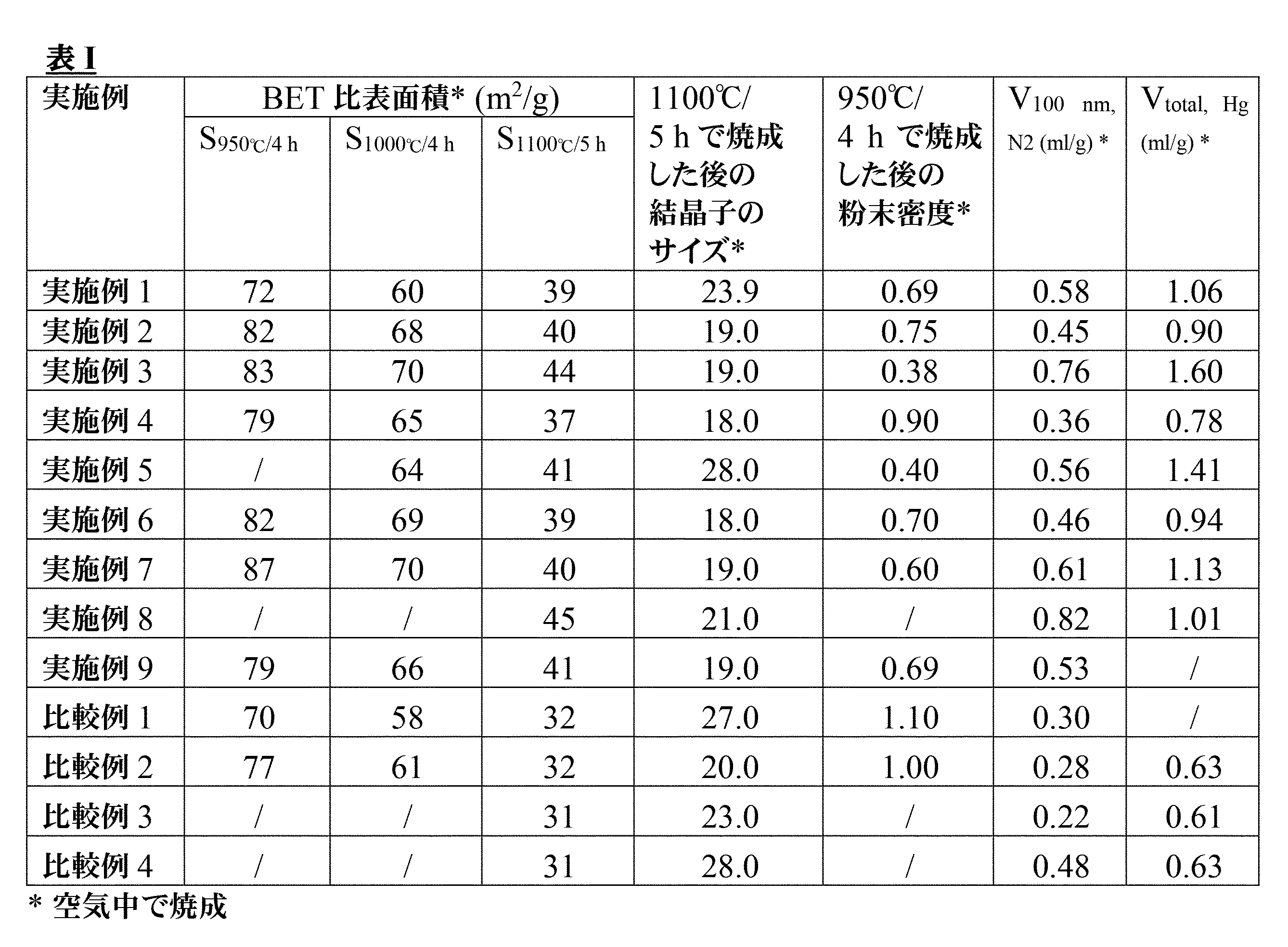
Claims (20)
・20%~60%のアルミニウム;
・15%~35%のセリウム;
・1%~10%のランタン;
・前記混合酸化物がセリウム及びランタン以外の2種以上の希土類金属を含む条件では、0~10%の、セリウム及びランタン以外の前記希土類金属であって、この割合はこれらの希土類金属のそれぞれに適用され、これらの希土類金属の割合の合計は15%未満にとどめられるセリウム及びランタン以外の前記希土類金属;
・15%~50%のジルコニウム;
である混合酸化物であって、
1100℃の温度で5時間空気中で焼成した後、
・前記混合酸化物のX線ダイアグラムが、セリウムジルコニウム酸化物から構成される結晶相について単一ピークのみを有し、その最大が28°~32°の2θ角に位置しており、
・セリウムジルコニウム酸化物から構成される前記結晶相の結晶子の平均サイズが最大30nmであり、
・前記混合酸化物のBET比表面積が少なくとも35m2/gであることを特徴とし;
950℃の温度で4時間空気中で焼成した後、
・窒素ポロシメトリーデータから得られた100nm以下のサイズの細孔によって発現した前記混合酸化物の細孔容積が0.30ml/g以上であり、
・水銀ポロシメトリーデータから得られる前記混合酸化物の総細孔容積が2.0ml/g以下であることを特徴とする;
混合酸化物。 A mixed oxide of aluminum, zirconium, cerium, lanthanum and optionally at least one rare earth metal other than cerium and lanthanum, expressed as an oxide equivalent to the total weight of said mixed oxide , the weight percentages of these elements are as follows:
20% to 60% aluminum;
15% to 35% cerium;
1% to 10% lanthanum;
from 0 to 10% of said rare earth metals other than cerium and lanthanum, where the mixed oxide comprises two or more rare earth metals other than cerium and lanthanum, the proportion being for each of these rare earth metals said rare earth metals, other than cerium and lanthanum, where the total proportion of these rare earth metals is kept below 15%;
- 15% to 50% zirconium;
a mixed oxide wherein
After firing in air at a temperature of 1100°C for 5 hours,
- the X-ray diagram of said mixed oxide has only a single peak for the crystalline phase composed of cerium zirconium oxide, the maximum of which is located at a 2θ angle of 28° to 32°;
- the average size of the crystallites of the crystal phase composed of cerium zirconium oxide is at most 30 nm,
- characterized in that the mixed oxide has a BET specific surface area of at least 35 m 2 /g;
After firing in air at a temperature of 950°C for 4 hours,
- The pore volume of the mixed oxide expressed by pores with a size of 100 nm or less obtained from nitrogen porosimetry data is 0.30 ml / g or more,
- characterized in that the total pore volume of the mixed oxide obtained from mercury porosimetry data is 2.0 ml/g or less;
mixed oxide.
・27%~33%のアルミニウム;
・24%~32%のセリウム;
・3%~6%のランタン;
・前記混合酸化物がセリウム及びランタン以外の2種以上の希土類金属を含む条件では、3%~6%の、セリウム及びランタン以外の前記希土類金属であって、この割合はこれらの希土類金属のそれぞれに適用される、セリウム及びランタン以外の前記希土類金属;
・31%~37%のジルコニウム;
であり、以下の特徴:
・1100℃の温度で5時間空気中で焼成した後、セリウムジルコニウム酸化物から構成される前記結晶相の前記結晶子の平均サイズが、最大で20nmであり;
・950℃の温度で4時間空気中で焼成した後、前記窒素ポロシメトリーデータから得られる100nm以下のサイズの前記細孔によって発現する前記混合酸化物の細孔容積が0.35ml/g以上である;
を有する、請求項1に記載の混合酸化物。 Mainly composed of aluminum, zirconium, cerium, lanthanum, and optionally at least one rare earth metal other than cerium and lanthanum selected from yttrium, neodymium, or praseodymium, the weight proportions of which are as follows: :
27% to 33% aluminum;
24% to 32% cerium;
3% to 6% lanthanum;
from 3% to 6% of said rare earth metals other than cerium and lanthanum, where said mixed oxide comprises two or more rare earth metals other than cerium and lanthanum, the proportion being each of these rare earth metals; said rare earth metals other than cerium and lanthanum;
31% to 37% zirconium;
and has the following characteristics:
- after calcination in air at a temperature of 1100°C for 5 hours, the average size of said crystallites of said crystalline phase composed of cerium zirconium oxide is at most 20 nm ;
- After calcining in air at a temperature of 950°C for 4 hours, the pore volume of the mixed oxide expressed by the pores having a size of 100 nm or less obtained from the nitrogen porosimetry data is 0.35 ml/g or more. be;
2. The mixed oxide of claim 1, having
・40%~60%のアルミニウム;
・15%~25%のセリウム;
・2%~6%のランタン;
・前記混合酸化物がセリウム及びランタン以外の2種以上の希土類金属を含む条件では、3%~6%の、セリウム及びランタン以外の前記希土類金属であって、この割合はこれらの希土類金属のそれぞれに適用される、セリウム及びランタン以外の前記希土類金属;
・15%~30%のジルコニウム;
であり、次の特徴:
・1100℃の温度で5時間空気中で焼成した後、前記混合酸化物の前記BET比表面積が少なくとも50m2/gである;
・950℃の温度で4時間空気中で焼成した後、前記窒素ポロシメトリーデータから得られる100nm以下のサイズの前記細孔によって発現する前記混合酸化物の前記細孔容積が0.40ml/g以上である;
を有する、請求項1に記載の混合酸化物。 Based on aluminum, zirconium, cerium, lanthanum and at least one rare earth metal other than cerium and lanthanum, optionally selected from yttrium, neodymium or praseodymium, the proportions of which are as follows:
- 40% to 60% aluminum;
15% to 25% cerium;
2% to 6% lanthanum;
from 3% to 6% of said rare earth metals other than cerium and lanthanum, where said mixed oxide comprises two or more rare earth metals other than cerium and lanthanum, the proportion being each of these rare earth metals; said rare earth metals other than cerium and lanthanum;
15% to 30% zirconium;
and has the following characteristics:
- after calcination in air at a temperature of 1100°C for 5 hours, said BET specific surface area of said mixed oxide is at least 50 m2 / g ;
- after calcination in air at a temperature of 950°C for 4 hours, the pore volume of the mixed oxide expressed by the pores with a size of 100 nm or less obtained from the nitrogen porosimetry data is 0.40 ml/g or more; is above ;
2. The mixed oxide of claim 1, having

・ IAl2O3はγ-アルミナのシグナル強度を表し、その最大値は2θ角=67°±1に位置し;
・ ICZはセリウムジルコニウム酸化物から構成される結晶相のシグナルの強度を表し、その最大値は、28°~32°の2θ角に位置し;
・ Al2O3重量%は酸化物換算で表したアルミニウムの重量割合を表す)
によりX線回折データから決定される、請求項1~7のいずれか1項に記載の混合酸化物。 After calcination in air at 1100° C. for 5 hours, it has a ratio of R<1.0, where R is the following formula:
- I Al2O3 represents the signal intensity of γ-alumina, the maximum value of which is located at 2θ angle = 67° ± 1;
- I CZ represents the intensity of the signal of the crystalline phase composed of cerium zirconium oxide, the maximum of which is located at the 2θ angle of 28° to 32°;
・ Al 2 O 3 % by weight represents the weight percentage of aluminum in terms of oxide)
A mixed oxide according to any one of claims 1 to 7, determined from X-ray diffraction data by
-(a1)セリウム、ジルコニウム、ランタン、並びに任意選択的にセリウム及びランタン以外の希土類金属の前駆体の酸性水溶液であって、その中にアルミニウム水和物が分散されている酸性水溶液を、塩基性水溶液が入っている撹拌されている槽の中に入れる工程;
-(a2)工程(a1)の終わりに得られた析出物分散液を任意選択的に加熱する工程;
-(a3)工程(a1)又は工程(a2)で得られた前記分散液にテクスチャー付与剤を添加する工程;
-(a4)工程(a3)の前記分散液の固体を固液分離により回収し、任意選択的に洗浄する工程;
-(a5)工程(a4)の終わりに得られた前記固体を任意選択的に乾燥する工程;
-(a6)工程(a4)又は工程(a5)の終わりに得られた前記固体を、前記混合酸化物を得るために700℃~1100℃の温度で空気中で焼成する工程;
-(a7)工程(a6)において得られた前記混合酸化物を任意選択的に粉砕する工程:
を含む、方法。 A method for preparing a mixed oxide according to any one of claims 1 to 12, comprising the steps of:
(a1) an acidic aqueous solution of precursors of cerium, zirconium, lanthanum, and optionally rare earth metals other than cerium and lanthanum, in which aluminum hydrate is dispersed, is treated with a basic placing in an agitated vessel containing an aqueous solution;
- (a2) optionally heating the precipitate dispersion obtained at the end of step (a1);
- (a3) adding a texturizing agent to said dispersion obtained in step (a1) or step (a2);
- (a4) recovering the solids of said dispersion of step (a3) by solid-liquid separation and optionally washing;
- (a5) optionally drying said solid obtained at the end of step (a4);
- (a6) calcining said solid obtained at the end of step (a4) or step (a5) in air at a temperature between 700°C and 1100°C to obtain said mixed oxide;
- (a7) optionally grinding said mixed oxide obtained in step (a6):
A method, including
Applications Claiming Priority (3)
| Application Number | Priority Date | Filing Date | Title |
|---|---|---|---|
| EP16206893.6 | 2016-12-23 | ||
| EP16206893 | 2016-12-23 | ||
| PCT/EP2017/084379 WO2018115436A1 (en) | 2016-12-23 | 2017-12-22 | Ageing-resistant mixed oxide made from cerium, zirconium, aluminium and lanthanum for motor vehicle catalytic converter |
Publications (2)
| Publication Number | Publication Date |
|---|---|
| JP2020514217A JP2020514217A (en) | 2020-05-21 |
| JP7114595B2 true JP7114595B2 (en) | 2022-08-08 |
Family
ID=57867995
Family Applications (1)
| Application Number | Title | Priority Date | Filing Date |
|---|---|---|---|
| JP2019534180A Active JP7114595B2 (en) | 2016-12-23 | 2017-12-22 | Aging-resistant mixed oxide for automotive catalytic converters made from cerium, zirconium, aluminum and lanthanum |
Country Status (7)
| Country | Link |
|---|---|
| US (1) | US11583831B2 (en) |
| EP (1) | EP3558514A1 (en) |
| JP (1) | JP7114595B2 (en) |
| KR (2) | KR102538140B1 (en) |
| CN (1) | CN110366445B (en) |
| WO (1) | WO2018115436A1 (en) |
| ZA (1) | ZA201903971B (en) |
Families Citing this family (17)
| Publication number | Priority date | Publication date | Assignee | Title |
|---|---|---|---|---|
| WO2018172299A1 (en) | 2017-03-23 | 2018-09-27 | Umicore Ag & Co. Kg | Catalytically active particulate filter |
| CN112955257B (en) * | 2018-11-12 | 2024-01-12 | 优美科触媒日本有限公司 | Catalyst for purifying exhaust gas of gasoline engine, method for producing the same, and method for purifying exhaust gas using the same |
| CN110124659B (en) * | 2019-06-20 | 2021-03-23 | 中自环保科技股份有限公司 | Cerium-zirconium-aluminum-based composite material, cGPF catalyst and preparation method thereof |
| WO2021012107A1 (en) | 2019-07-19 | 2021-01-28 | Rhodia Operations | Mixed oxide based on cerium and zirconium |
| JP7451533B2 (en) * | 2019-07-30 | 2024-03-18 | 第一稀元素化学工業株式会社 | Zirconia-based composite oxide and method for producing zirconia-based composite oxide |
| CN114761125B (en) * | 2019-11-29 | 2025-02-11 | 罗地亚经营管理公司 | Alumina with specific pore properties |
| KR20220101722A (en) * | 2019-11-29 | 2022-07-19 | 로디아 오퍼레이션스 | Alumina with specific pore profile |
| WO2021186240A1 (en) * | 2020-03-16 | 2021-09-23 | Neo Performance Materials (Singapore) Pte. Ltd. | Compositions containing zirconium and cerium and methods for preparing same using oxalic acid and supercritical drying |
| US20230234034A1 (en) * | 2020-05-28 | 2023-07-27 | Rhodia Operations | Aluminium and zirconium-based mixed oxide |
| CN116600893A (en) * | 2020-12-24 | 2023-08-15 | 三井金属矿业株式会社 | Composite oxide and its production method |
| WO2022248205A1 (en) | 2021-05-28 | 2022-12-01 | Rhodia Operations | Composition of aluminium oxide and cerium oxide with a particular porosity profile |
| CN113275000B (en) * | 2021-07-23 | 2021-11-09 | 山东国瓷功能材料股份有限公司 | High-temperature-resistant cerium-zirconium composite oxide and preparation method and application thereof |
| US20250114772A1 (en) | 2021-07-30 | 2025-04-10 | Rhodia Operations | Composition of Aluminium Oxide and Cerium Oxide |
| EP4440991A1 (en) * | 2021-12-01 | 2024-10-09 | Rhodia Operations | Aluminium and zirconium-based mixed oxide |
| JP7387043B1 (en) | 2023-03-01 | 2023-11-27 | 第一稀元素化学工業株式会社 | Zirconia-containing alumina-based composite oxide and method for producing zirconia-containing alumina-based composite oxide |
| WO2024196581A1 (en) * | 2023-03-20 | 2024-09-26 | Pacific Industrial Development Corporation | Thermally stable oxygen storage material (osm) and method of making the same |
| JP7525683B1 (en) | 2023-03-31 | 2024-07-30 | 第一稀元素化学工業株式会社 | Alumina-based composite oxide and method for producing alumina-based composite oxide |
Citations (4)
| Publication number | Priority date | Publication date | Assignee | Title |
|---|---|---|---|---|
| JP2014520741A (en) | 2011-07-01 | 2014-08-25 | トライバッハー インドゥストリ アクチエンゲゼルシャフト | Ceria, zirconia and alumina compositions with enhanced thermal stability |
| JP2014534938A (en) | 2011-07-14 | 2014-12-25 | サゾル ジャーマニー ゲーエムベーハー | Method for producing composite of aluminum oxide and cerium / zirconium composite oxide |
| JP2015521538A (en) | 2012-06-15 | 2015-07-30 | ビーエーエスエフ コーポレーション | Mixed metal oxide composites for oxygen storage |
| JP2016528025A (en) | 2013-06-13 | 2016-09-15 | ビーエーエスエフ コーポレーション | Integrated support for emission control catalyst |
Family Cites Families (13)
| Publication number | Priority date | Publication date | Assignee | Title |
|---|---|---|---|---|
| US4154812A (en) | 1977-03-25 | 1979-05-15 | W. R. Grace & Co. | Process for preparing alumina |
| FR2570087B1 (en) | 1984-09-13 | 1986-11-21 | Rhone Poulenc Spec Chim | ELECTROLYTIC OXIDATION PROCESS AND ELECTROLYSIS ASSEMBLY FOR IMPLEMENTING IT |
| FR2736343B1 (en) * | 1995-07-03 | 1997-09-19 | Rhone Poulenc Chimie | COMPOSITION BASED ON ZIRCONIUM OXIDE AND CERIUM OXIDE, METHOD OF PREPARATION AND USE |
| WO1998045212A1 (en) | 1997-04-04 | 1998-10-15 | Rhodia Rare Earths Inc. | CERIUM OXIDES, ZIRCONIUM OXIDES, Ce/Zr MIXED OXIDES AND Ce/Zr SOLID SOLUTIONS HAVING IMPROVED THERMAL STABILITY AND OXYGEN STORAGE CAPACITY |
| US7374729B2 (en) | 2004-03-30 | 2008-05-20 | Basf Catalysts Llc | Exhaust gas treatment catalyst |
| CN100360222C (en) * | 2005-03-30 | 2008-01-09 | 四川大学 | Cerium-zirconium-aluminum-based oxygen storage material and preparation method thereof |
| FR2897609B1 (en) * | 2006-02-17 | 2009-01-16 | Rhodia Recherches & Tech | COMPOSITION BASED ON ZIRCONIUM, CERIUM, YTTRIUM, LANTHAN AND OTHER RARE EARTH OXIDES, METHOD OF PREPARATION AND USE IN CATALYSIS |
| US9889428B2 (en) | 2011-07-14 | 2018-02-13 | Treibacher Industrie Ag | Ceria zirconia alumina composition with enhanced thermal stability |
| CN103084161A (en) * | 2011-11-04 | 2013-05-08 | 上海华明高纳稀土新材料有限公司 | Ce-Zr-Al-based composite oxide rare earth oxygen-storage material and preparation method thereof |
| WO2013191298A1 (en) * | 2012-06-20 | 2013-12-27 | Kabushiki Kaisha Toyota Chuo Kenkyusho | Catalyst support for purification of exhaust gas, catalyst for purification of exhaust gas using the same, and method for producing the catalyst support for purification of exhaust gas |
| CN102824904B (en) * | 2012-09-20 | 2015-09-02 | 上海华明高纳稀土新材料有限公司 | Aluminium cerium zirconium compound oxide catalysis material and preparation method thereof |
| CN102962047B (en) * | 2012-11-12 | 2014-10-08 | 上海华明高纳稀土新材料有限公司 | Aluminum-cerium-zirconium based composite oxide catalytic material and preparation method thereof |
| GB201518996D0 (en) * | 2015-10-27 | 2015-12-09 | Magnesium Elektron Ltd | Zirconia-based compositions for use as three-way catalysts |
-
2017
- 2017-12-22 KR KR1020197021000A patent/KR102538140B1/en active Active
- 2017-12-22 US US16/472,848 patent/US11583831B2/en active Active
- 2017-12-22 KR KR1020237017709A patent/KR102638941B1/en active Active
- 2017-12-22 CN CN201780087305.2A patent/CN110366445B/en active Active
- 2017-12-22 EP EP17838129.9A patent/EP3558514A1/en active Pending
- 2017-12-22 JP JP2019534180A patent/JP7114595B2/en active Active
- 2017-12-22 WO PCT/EP2017/084379 patent/WO2018115436A1/en not_active Ceased
-
2019
- 2019-06-19 ZA ZA2019/03971A patent/ZA201903971B/en unknown
Patent Citations (4)
| Publication number | Priority date | Publication date | Assignee | Title |
|---|---|---|---|---|
| JP2014520741A (en) | 2011-07-01 | 2014-08-25 | トライバッハー インドゥストリ アクチエンゲゼルシャフト | Ceria, zirconia and alumina compositions with enhanced thermal stability |
| JP2014534938A (en) | 2011-07-14 | 2014-12-25 | サゾル ジャーマニー ゲーエムベーハー | Method for producing composite of aluminum oxide and cerium / zirconium composite oxide |
| JP2015521538A (en) | 2012-06-15 | 2015-07-30 | ビーエーエスエフ コーポレーション | Mixed metal oxide composites for oxygen storage |
| JP2016528025A (en) | 2013-06-13 | 2016-09-15 | ビーエーエスエフ コーポレーション | Integrated support for emission control catalyst |
Also Published As
| Publication number | Publication date |
|---|---|
| KR102538140B1 (en) | 2023-05-31 |
| ZA201903971B (en) | 2021-01-27 |
| KR20190092572A (en) | 2019-08-07 |
| WO2018115436A1 (en) | 2018-06-28 |
| EP3558514A1 (en) | 2019-10-30 |
| CN110366445A (en) | 2019-10-22 |
| KR102638941B1 (en) | 2024-02-23 |
| JP2020514217A (en) | 2020-05-21 |
| KR20230082056A (en) | 2023-06-08 |
| US11583831B2 (en) | 2023-02-21 |
| US20200188885A1 (en) | 2020-06-18 |
| CN110366445B (en) | 2023-04-04 |
Similar Documents
| Publication | Publication Date | Title |
|---|---|---|
| JP7114595B2 (en) | Aging-resistant mixed oxide for automotive catalytic converters made from cerium, zirconium, aluminum and lanthanum | |
| RU2570810C2 (en) | Composition, based on zirconium oxide and at least one oxide of rare-earth element, different from cerium, with particular porosity, methods of thereof obtaining and thereof application in catalysts | |
| US20130142713A1 (en) | Composition containing oxides of zirconium, cerium and at least one other rare earth and having a specific porosity, method for preparing same and use thereof in catalysis | |
| KR102489849B1 (en) | Cerium- and zirconium-based mixed oxide | |
| JP7458979B2 (en) | porous aluminum hydrate | |
| KR20130120487A (en) | Sulfur tolerant alumina catalyst support | |
| JP7506664B2 (en) | Mixed oxides with improved reducibility | |
| JP7532392B2 (en) | Mixed oxides with high pore volume | |
| JP7548994B2 (en) | Cerium and zirconium based mixed oxides | |
| JP7785022B2 (en) | Mixed oxides based on aluminum and zirconium | |
| KR20240114742A (en) | Aluminum and zirconium-based mixed oxides | |
| KR20250048568A (en) | Cerium and zirconium mixed oxides |
Legal Events
| Date | Code | Title | Description |
|---|---|---|---|
| A621 | Written request for application examination |
Free format text: JAPANESE INTERMEDIATE CODE: A621 Effective date: 20201120 |
|
| A977 | Report on retrieval |
Free format text: JAPANESE INTERMEDIATE CODE: A971007 Effective date: 20211029 |
|
| A131 | Notification of reasons for refusal |
Free format text: JAPANESE INTERMEDIATE CODE: A131 Effective date: 20211109 |
|
| A601 | Written request for extension of time |
Free format text: JAPANESE INTERMEDIATE CODE: A601 Effective date: 20220204 |
|
| A521 | Request for written amendment filed |
Free format text: JAPANESE INTERMEDIATE CODE: A523 Effective date: 20220509 |
|
| TRDD | Decision of grant or rejection written | ||
| A01 | Written decision to grant a patent or to grant a registration (utility model) |
Free format text: JAPANESE INTERMEDIATE CODE: A01 Effective date: 20220628 |
|
| A61 | First payment of annual fees (during grant procedure) |
Free format text: JAPANESE INTERMEDIATE CODE: A61 Effective date: 20220727 |
|
| R150 | Certificate of patent or registration of utility model |
Ref document number: 7114595 Country of ref document: JP Free format text: JAPANESE INTERMEDIATE CODE: R150 |
|
| R250 | Receipt of annual fees |
Free format text: JAPANESE INTERMEDIATE CODE: R250 |