JP7015223B2 - EGFR and C-MET fibronectin type III domain-binding molecule - Google Patents
EGFR and C-MET fibronectin type III domain-binding molecule Download PDFInfo
- Publication number
- JP7015223B2 JP7015223B2 JP2018157120A JP2018157120A JP7015223B2 JP 7015223 B2 JP7015223 B2 JP 7015223B2 JP 2018157120 A JP2018157120 A JP 2018157120A JP 2018157120 A JP2018157120 A JP 2018157120A JP 7015223 B2 JP7015223 B2 JP 7015223B2
- Authority
- JP
- Japan
- Prior art keywords
- domain
- egfr
- cancer
- met
- seq
- Prior art date
- Legal status (The legal status is an assumption and is not a legal conclusion. Google has not performed a legal analysis and makes no representation as to the accuracy of the status listed.)
- Active
Links
Images


Classifications
-
- A—HUMAN NECESSITIES
- A61—MEDICAL OR VETERINARY SCIENCE; HYGIENE
- A61K—PREPARATIONS FOR MEDICAL, DENTAL OR TOILETRY PURPOSES
- A61K38/00—Medicinal preparations containing peptides
- A61K38/16—Peptides having more than 20 amino acids; Gastrins; Somatostatins; Melanotropins; Derivatives thereof
- A61K38/17—Peptides having more than 20 amino acids; Gastrins; Somatostatins; Melanotropins; Derivatives thereof from animals; from humans
- A61K38/39—Connective tissue peptides, e.g. collagen, elastin, laminin, fibronectin, vitronectin, cold insoluble globulin [CIG]
-
- A—HUMAN NECESSITIES
- A61—MEDICAL OR VETERINARY SCIENCE; HYGIENE
- A61K—PREPARATIONS FOR MEDICAL, DENTAL OR TOILETRY PURPOSES
- A61K45/00—Medicinal preparations containing active ingredients not provided for in groups A61K31/00 - A61K41/00
- A61K45/06—Mixtures of active ingredients without chemical characterisation, e.g. antiphlogistics and cardiaca
-
- A—HUMAN NECESSITIES
- A61—MEDICAL OR VETERINARY SCIENCE; HYGIENE
- A61P—SPECIFIC THERAPEUTIC ACTIVITY OF CHEMICAL COMPOUNDS OR MEDICINAL PREPARATIONS
- A61P35/00—Antineoplastic agents
-
- C—CHEMISTRY; METALLURGY
- C07—ORGANIC CHEMISTRY
- C07K—PEPTIDES
- C07K14/00—Peptides having more than 20 amino acids; Gastrins; Somatostatins; Melanotropins; Derivatives thereof
-
- C—CHEMISTRY; METALLURGY
- C07—ORGANIC CHEMISTRY
- C07K—PEPTIDES
- C07K14/00—Peptides having more than 20 amino acids; Gastrins; Somatostatins; Melanotropins; Derivatives thereof
- C07K14/435—Peptides having more than 20 amino acids; Gastrins; Somatostatins; Melanotropins; Derivatives thereof from animals; from humans
- C07K14/46—Peptides having more than 20 amino acids; Gastrins; Somatostatins; Melanotropins; Derivatives thereof from animals; from humans from vertebrates
- C07K14/47—Peptides having more than 20 amino acids; Gastrins; Somatostatins; Melanotropins; Derivatives thereof from animals; from humans from vertebrates from mammals
-
- C—CHEMISTRY; METALLURGY
- C07—ORGANIC CHEMISTRY
- C07K—PEPTIDES
- C07K14/00—Peptides having more than 20 amino acids; Gastrins; Somatostatins; Melanotropins; Derivatives thereof
- C07K14/435—Peptides having more than 20 amino acids; Gastrins; Somatostatins; Melanotropins; Derivatives thereof from animals; from humans
- C07K14/705—Receptors; Cell surface antigens; Cell surface determinants
-
- C—CHEMISTRY; METALLURGY
- C07—ORGANIC CHEMISTRY
- C07K—PEPTIDES
- C07K14/00—Peptides having more than 20 amino acids; Gastrins; Somatostatins; Melanotropins; Derivatives thereof
- C07K14/435—Peptides having more than 20 amino acids; Gastrins; Somatostatins; Melanotropins; Derivatives thereof from animals; from humans
- C07K14/705—Receptors; Cell surface antigens; Cell surface determinants
- C07K14/71—Receptors; Cell surface antigens; Cell surface determinants for growth factors; for growth regulators
-
- C—CHEMISTRY; METALLURGY
- C07—ORGANIC CHEMISTRY
- C07K—PEPTIDES
- C07K14/00—Peptides having more than 20 amino acids; Gastrins; Somatostatins; Melanotropins; Derivatives thereof
- C07K14/435—Peptides having more than 20 amino acids; Gastrins; Somatostatins; Melanotropins; Derivatives thereof from animals; from humans
- C07K14/78—Connective tissue peptides, e.g. collagen, elastin, laminin, fibronectin, vitronectin or cold insoluble globulin [CIG]
-
- C—CHEMISTRY; METALLURGY
- C07—ORGANIC CHEMISTRY
- C07K—PEPTIDES
- C07K16/00—Immunoglobulins [IGs], e.g. monoclonal or polyclonal antibodies
- C07K16/18—Immunoglobulins [IGs], e.g. monoclonal or polyclonal antibodies against material from animals or humans
- C07K16/28—Immunoglobulins [IGs], e.g. monoclonal or polyclonal antibodies against material from animals or humans against receptors, cell surface antigens or cell surface determinants
-
- C—CHEMISTRY; METALLURGY
- C07—ORGANIC CHEMISTRY
- C07K—PEPTIDES
- C07K16/00—Immunoglobulins [IGs], e.g. monoclonal or polyclonal antibodies
- C07K16/18—Immunoglobulins [IGs], e.g. monoclonal or polyclonal antibodies against material from animals or humans
- C07K16/28—Immunoglobulins [IGs], e.g. monoclonal or polyclonal antibodies against material from animals or humans against receptors, cell surface antigens or cell surface determinants
- C07K16/2863—Immunoglobulins [IGs], e.g. monoclonal or polyclonal antibodies against material from animals or humans against receptors, cell surface antigens or cell surface determinants against receptors for growth factors, growth regulators
-
- C—CHEMISTRY; METALLURGY
- C07—ORGANIC CHEMISTRY
- C07K—PEPTIDES
- C07K19/00—Hybrid peptides, i.e. peptides covalently bound to nucleic acids, or non-covalently bound protein-protein complexes
-
- A—HUMAN NECESSITIES
- A61—MEDICAL OR VETERINARY SCIENCE; HYGIENE
- A61K—PREPARATIONS FOR MEDICAL, DENTAL OR TOILETRY PURPOSES
- A61K39/00—Medicinal preparations containing antigens or antibodies
- A61K2039/505—Medicinal preparations containing antigens or antibodies comprising antibodies
-
- A—HUMAN NECESSITIES
- A61—MEDICAL OR VETERINARY SCIENCE; HYGIENE
- A61K—PREPARATIONS FOR MEDICAL, DENTAL OR TOILETRY PURPOSES
- A61K38/00—Medicinal preparations containing peptides
-
- C—CHEMISTRY; METALLURGY
- C07—ORGANIC CHEMISTRY
- C07K—PEPTIDES
- C07K2317/00—Immunoglobulins specific features
- C07K2317/30—Immunoglobulins specific features characterized by aspects of specificity or valency
- C07K2317/31—Immunoglobulins specific features characterized by aspects of specificity or valency multispecific
-
- C—CHEMISTRY; METALLURGY
- C07—ORGANIC CHEMISTRY
- C07K—PEPTIDES
- C07K2317/00—Immunoglobulins specific features
- C07K2317/70—Immunoglobulins specific features characterized by effect upon binding to a cell or to an antigen
- C07K2317/73—Inducing cell death, e.g. apoptosis, necrosis or inhibition of cell proliferation
-
- C—CHEMISTRY; METALLURGY
- C07—ORGANIC CHEMISTRY
- C07K—PEPTIDES
- C07K2317/00—Immunoglobulins specific features
- C07K2317/70—Immunoglobulins specific features characterized by effect upon binding to a cell or to an antigen
- C07K2317/76—Antagonist effect on antigen, e.g. neutralization or inhibition of binding
-
- C—CHEMISTRY; METALLURGY
- C07—ORGANIC CHEMISTRY
- C07K—PEPTIDES
- C07K2317/00—Immunoglobulins specific features
- C07K2317/90—Immunoglobulins specific features characterized by (pharmaco)kinetic aspects or by stability of the immunoglobulin
- C07K2317/92—Affinity (KD), association rate (Ka), dissociation rate (Kd) or EC50 value
-
- C—CHEMISTRY; METALLURGY
- C07—ORGANIC CHEMISTRY
- C07K—PEPTIDES
- C07K2318/00—Antibody mimetics or scaffolds
- C07K2318/20—Antigen-binding scaffold molecules wherein the scaffold is not an immunoglobulin variable region or antibody mimetics
-
- C—CHEMISTRY; METALLURGY
- C07—ORGANIC CHEMISTRY
- C07K—PEPTIDES
- C07K2319/00—Fusion polypeptide
-
- C—CHEMISTRY; METALLURGY
- C07—ORGANIC CHEMISTRY
- C07K—PEPTIDES
- C07K2319/00—Fusion polypeptide
- C07K2319/70—Fusion polypeptide containing domain for protein-protein interaction
Landscapes
- Health & Medical Sciences (AREA)
- Chemical & Material Sciences (AREA)
- Life Sciences & Earth Sciences (AREA)
- Organic Chemistry (AREA)
- Medicinal Chemistry (AREA)
- General Health & Medical Sciences (AREA)
- Proteomics, Peptides & Aminoacids (AREA)
- Biochemistry (AREA)
- Immunology (AREA)
- Molecular Biology (AREA)
- Genetics & Genomics (AREA)
- Biophysics (AREA)
- Gastroenterology & Hepatology (AREA)
- Zoology (AREA)
- Toxicology (AREA)
- Veterinary Medicine (AREA)
- Public Health (AREA)
- Pharmacology & Pharmacy (AREA)
- Animal Behavior & Ethology (AREA)
- Cell Biology (AREA)
- Epidemiology (AREA)
- Engineering & Computer Science (AREA)
- Bioinformatics & Cheminformatics (AREA)
- Biomedical Technology (AREA)
- Chemical Kinetics & Catalysis (AREA)
- General Chemical & Material Sciences (AREA)
- Nuclear Medicine, Radiotherapy & Molecular Imaging (AREA)
- Peptides Or Proteins (AREA)
- Medicines That Contain Protein Lipid Enzymes And Other Medicines (AREA)
- Preparation Of Compounds By Using Micro-Organisms (AREA)
- Micro-Organisms Or Cultivation Processes Thereof (AREA)
- Pharmaceuticals Containing Other Organic And Inorganic Compounds (AREA)
- Medicinal Preparation (AREA)
- Medicines Containing Antibodies Or Antigens For Use As Internal Diagnostic Agents (AREA)
Description
本発明は、単一特異性又は二重特異性EGFR及び/又はc-Met結合分子及びその
分子の作製方法及び使用方法に関する。
The present invention relates to a unispecific or bispecific EGFR and / or a c-Met binding molecule and a method for producing and using the molecule.
上皮成長因子受容体(EGFR、ErbBl又はHER1)は、癌原遺伝子c-erb
Blによってコードされる170kDaの膜貫通型糖タンパク質である。EGFRは、受
容体チロシンキナーゼ(RTK)のヒト上皮成長因子受容体(HER)ファミリーのメン
バーであり、HER2(ErbB2)、HER3(ErbB3)及びHER4(ErbB
4)が挙げられる。EGFRシグナル伝達は、リガンド結合後、立体配座の変化、その他
ErbBファミリーメンバーによる受容体のホモ二量体化又は受容体のヘテロ二量体化及
び受容体のトランス自己リン酸化の誘導によって開始され(Fergusonら、Ann
u Rev Biophys,37:353~73,2008)、これにより、細胞の増
殖及び生存など、最終的に多種多様な細胞機能に影響を及ぼすシグナル伝達のカスケード
が開始される。EGFRの発現又はキナーゼ活性の増加は、ヒト癌の範囲に連動しており
、EGFRは治療的介入のための魅力的な対象となった(Mendelsohnら、On
cogene 19:6550~6565,2000;Grunwaldら、J Nat
l Cancer Inst 95:851~67,2003;Mendelsohnら
、Semin Oncol 33:369~85,2006)。非小細胞肺癌細胞におい
て、EGFR遺伝子コピー数及びタンパク質の発現がいずれも増加することは、EGFR
チロシンキナーゼ阻害物質(IRESSA(商標)(ゲフィチニブ))への好ましい反応
と関連付けられてきた(Hirschら、Ann Oncol 18:752~60,2
007)。
The epidermal growth factor receptor (EGFR, ErbBl or HER1) is the protooncogene c-erb.
It is a 170 kDa transmembrane glycoprotein encoded by Bl. EGFR is a member of the human epidermal growth factor receptor (HER) family of receptor tyrosine kinases (RTKs), HER2 (ErbB2), HER3 (ErbB3) and HER4 (ErbB).
4) can be mentioned. After ligand binding, EGFR signaling is initiated by changes in conformation, other homodimerization of the receptor by ErbB family members, heterodimerization of the receptor, and induction of transautophosphorylation of the receptor. (Ferguson et al., Ann
u Rev Biophyss, 37: 353-73, 2008), thereby initiating a cascade of signal transductions that ultimately affect a wide variety of cell functions, such as cell proliferation and survival. Increased expression or kinase activity of EGFR has been linked to the extent of human cancer, making EGFR an attractive target for therapeutic intervention (Menderson et al., On).
cogene 19: 6550-6565, 2000; Grunwald et al., J Nat
l Cancer Inst 95: 851-67, 2003; Mendelson et al., Semin Oncol 33: 369-85, 2006). Increased EGFR gene copy count and protein expression in non-small cell lung cancer cells indicate that EGFR
It has been associated with a favorable response to a tyrosine kinase inhibitor (IREESSA ™ (gefitinib)) (Hirsch et al., Ann Oncol 18: 752-60, 2).
007).
EGFR治療としては、低分子及び抗EGFR抗体を双方ともが挙げられ、大腸癌、膵
癌、頭頸部癌、非小細胞肺癌細胞(NSCLC)の治療として認可された(Baselg
a and Arteaga,J Clin Oncol 23:2445~2459(
20005;Gillら、J Biol Chem,259:7755~7760,19
84;Goldsteinら、Clin Cancer Res,1:131 1~13
18;1995;Prewettら、Clin Cancer Res,4:2957~
2966,1998)。
EGFR treatment includes both small molecule and anti-EGFR antibodies and has been approved for the treatment of colorectal cancer, pancreatic cancer, head and neck cancer, and non-small cell lung cancer cells (NSCLC) (Baselg).
a and Artega, J Clin Oncol 23: 2445 to 2459 (
20005; Gill et al., J Biol Chem, 259: 7755-7760, 19
84; Goldstein et al., Clin Cancer Res, 1: 131 1-13
18; 1995; Prewett et al., Clin Cancer Res, 4: 2957 ~
2966, 1998).
抗EGFR治療の有効性は、腫瘍型及びEFGRの突然変異/増幅状態に依存し得る。
現在の治療の副作用としては、皮膚毒性を挙げることができる(De Roockら、L
ancet Oncol 11:753~762,2010;Linardouら、Na
t Rev Clin Oncol,6:352~366,2009;Li and P
erez-Soler,Targ Oncol 4:107~119,2009)。EG
FRチロシンキナーゼ阻害物質(TKI)は、一般に、非小細胞肺癌(NSCLC)の二
次選択治療として使用されるが、多くの場合、耐性経路により12ヶ月以内に効かなくな
る(Rielyら、Clin Cancer Res 12:839~44,2006)
。
The effectiveness of anti-EGFR treatment may depend on the tumor type and EFGR mutation / amplification status.
Side effects of current treatments include skin toxicity (DeLock et al., L.
anchorOncol 11: 753-762, 2010; Linardou et al., Na
t Rev Clin Oncol, 6: 352-366, 2009; Li and P
erez-Soler, TargOncol 4: 107-119, 2009). EG
FR tyrosine kinase inhibitors (TKIs) are commonly used as second-line treatment for non-small cell lung cancer (NSCLC), but often fail within 12 months due to resistance pathways (Riely et al., Clin Cancer Res). 12: 839-44, 2006)
..
c-Metは、チロシンキナーゼ受容体をコードする。発癌性物質を用いた治療により
、恒常的に活性化する融合タンパク質TPR-METが発生することが判明した後、c-
Metは、1984年に癌原遺伝子として最初に同定された(Cooperら、Natu
re 311:29~33,1984)。そのリガンドである肝細胞増殖因子(HGF)
によりc-Metが活性化することにより、成長、運動性、浸潤、転移、上皮間葉転換、
血管新生/創傷治癒、及び組織再生など、過多の細胞プロセスが刺激される(Chris
tensenら、Cancer Lett 225:1~26,2005;Peters
and Adjei,Nat Rev Clin Oncol 9:314~26,2
012)。c-Metは、タンパク質分解により、50kDaのα-サブユニット及び1
40kDaのβ-サブユニットに分割される、ジスルフィド結合により連結した単鎖タン
パク質として合成される(Maら、Cancer and Metastasis Re
views,22:309~325,2003)。c-Metは、Ronなど、他の膜受
容体に構造的に類似している。HGFの厳密な化学量論としての、c-Met結合は、明
確でないが、概して、2つのHGF分子が、2つのc-Met分子に結合し、受容体の二
量化及びチロシン1230、1234及び1235での自己リン酸化をもたしていると考
えられている(Stamosら、The EMBO Journal 23:2325~
2335,2004)。遺伝子増幅、突然変異、又は、受容体過剰発現により、リガンド
-非依存性のc-Met自己リン酸化も発生し得る。
c-Met encodes a tyrosine kinase receptor. After it was found that treatment with carcinogens produced the constitutively activated fusion protein TPR-MET, c-
Met was first identified as a protooncogene in 1984 (Cooper et al., Natu).
re 311: 29-33, 1984). Its ligand, hepatocyte growth factor (HGF)
By activating c-Met, growth, motility, infiltration, metastasis, epithelial-mesenchymal transition,
Excessive cellular processes such as angiogenesis / wound healing and tissue regeneration are stimulated (Chris)
tensen et al., Cancer Lett 225: 1-26,2005; Peters
and Adjei, Nat Rev Clin Oncol 9: 314-26,2
012). c-Met is a 50 kDa α-subunit and 1 by proteolysis.
Synthesized as a disulfide-bonded single-chain protein that is divided into 40 kDa β-subunits (Ma et al., Cancer and Mastasis Re).
views, 22: 309-325, 2003). c-Met is structurally similar to other membrane receptors such as Ron. C-Met binding, as a strict chemologic theory of HGF, is not clear, but in general, two HGF molecules bind to two c-Met molecules, acceptor dimerization and tyrosine 1230, 1234 and 1235. It is believed to have autophosphorylation in (Stamos et al., The EMBO Journal 23: 2325-
2335, 2004). Ligand-independent c-Met autophosphorylation can also occur by gene amplification, mutation, or receptor overexpression.
c-Metは、胃癌、肺癌、大腸癌、乳癌、膀胱癌、頭頸部癌、卵巣癌、前立腺癌、甲
状腺癌、膵癌、及び中枢神経系癌など、多くの型の癌において、高い頻度で、増幅、突然
変異又は過剰発現する。典型的には、キナーゼドメインに局在化するミスセンス突然変異
は、一般に、遺伝性乳頭状腎細胞癌(PRCC)に見出され、散在性PRCCの13%に
見られる(Schmidtら、Oncogene 18:2343~2350,1999
)。セマフォリン又はc-Metの膜近傍ドメインに局在化するc-Met突然変異は、
高い頻度で胃癌、頭頸部癌、頭頸部、肝臓癌、卵巣癌、NSCLC及び甲状腺癌において
見られる(Maら、Cancer and Metastasis Reviews,2
2:309~325,2003;Sakakuraら、Chromosomes and
Cancer,1999.24:299~305)。c-Metの増幅は、脳腫瘍、大
腸癌、胃癌及び肺癌にて検出され、多くの場合、疾患の進行に関連する(Maら、Can
cer and Metastasis Reviews,22:309~325,20
03)。非小細胞肺癌(NSCLC)の最大4%及び胃癌の最大20%が、それぞれ、c
-Met増幅を示す(Sakakuraら、Chromosomes and Canc
er,1999.24:299~305:Sierra and Tsao,Thera
peutic Advances in Medical Oncology,3:S2
1~35,2011)。遺伝子増幅がない状態であっても、c-Metの過剰発現は、肺
癌にて高い頻度で観察される(Ichimuraら、Jpn J Cancer Res
,87:1063~9,1996)。更に、臨床サンプルでは、ほぼ半数の肺腺癌が高レ
ベルのc-Met及びHGFを示し、いずれも腫瘍増殖率、転移及び予後不良の憎大と相
関した(Sierra and Tsao,Therapeutic Advances
in Medical Oncology,3:S21~35,2011;Siegf
riedら、Ann Thorac Surg 66:1915~8,1998)。
c-Met is frequently found in many types of cancer, including gastric cancer, lung cancer, colon cancer, breast cancer, bladder cancer, head and neck cancer, ovarian cancer, prostate cancer, thyroid cancer, pancreatic cancer, and central nervous system cancer. Amplified, mutated or overexpressed. Typically, missense mutations localized in the kinase domain are commonly found in hereditary papillary renal cell carcinoma (PRCC) and are found in 13% of scattered PRCCs (Schmidt et al., Oncogene 18: 2343-2350, 1999
). C-Met mutations localized in the near-membrane domain of semaphorins or c-Met
Frequently found in gastric cancer, head and neck cancer, head and neck, liver cancer, ovarian cancer, NSCLC and thyroid cancer (Ma et al., Cancer and Metastasis Reviews, 2)
2: 309-325, 2003; Sakakura et al., Chromosomes and
Cancer, 1999.24: 299-305). Amplification of c-Met is detected in brain, colorectal, gastric and lung cancers and is often associated with disease progression (Ma et al., Can).
cer and Metastasis Reviews, 22: 309-325, 20
03). Up to 4% of non-small cell lung cancer (NSCLC) and up to 20% of gastric cancer are c, respectively.
-Shows Met amplification (Sakakura et al., Chromosomes and Cunc
er, 1999.24: 299-305: Sierra and Tsao, Thera
peutic Advances in Medical Oncology, 3: S2
1-35, 2011). Overexpression of c-Met is frequently observed in lung cancer even in the absence of gene amplification (Ichimura et al., Jpn J Cancer Res).
, 87: 1063-9, 1996). In addition, in clinical samples, nearly half of lung adenocarcinomas showed high levels of c-Met and HGF, both of which correlated with tumor growth rate, metastasis and poor prognosis (Sierra and Tsao, Therapeutic Advances).
in Medical Oncology, 3: S21-35, 2011; Siegf
Ried et al., Ann Thorac Surg 66: 1915-8, 1998).
EGFRチロシンキナーゼ阻害物質に耐性を示すようになる全腫瘍のほぼ60%がc-
Metの発現の増加、c-Metの増幅、又はその唯一の既知のリガンドである、HGF
の増加を示し(Turkeら、Cancer Cell,17:77~88,2010)
、c-Metを介する、EGFRの代償経路の存在を示している。EGFRキナーゼ阻害
剤であるゲフィチニブに耐性を示すようになった培養細胞において、c-Metの増幅が
最初に確認され、Her3経路を介して、生存率の向上を示した(Engelmanら、
Science,316:1039~43,2007)。この点は、c-Metの増幅を
示したエルロチニブ又はゲフィチニブの一方に対して耐性を得た43名中9名の患者を6
2名中2名のみの未治療患者と比較した臨床サンプルにおいて、更に確認された。治療を
受けた患者9名中、4名が、EGFR活性化突然変異体、T790Mも獲得し、同時的な
耐性経路を示した(Beatら、Proc Natl Acad Sci U S A,
104:20932~7,2007)。
Almost 60% of all tumors that become resistant to EGFR tyrosine kinase inhibitors are c-
Increased expression of Met, amplification of c-Met, or its only known ligand, HGF
(Turke et al., Cancer Cell, 17: 77-88, 2010)
, C-Met, indicating the existence of a compensatory pathway for EGFR. Amplification of c-Met was first identified in cultured cells that became resistant to the EGFR kinase inhibitor gefitinib, and showed improved viability via the Her3 pathway (Engelman et al., Et al.
Science, 316: 1039-43, 2007). In this regard, 6 of 43 patients who became resistant to either erlotinib or gefitinib that showed amplification of c-Met.
Further confirmed in clinical samples comparing only 2 of 2 untreated patients. Of the 9 treated patients, 4 also acquired the EGFR-activated mutant, T790M, and showed a simultaneous resistance pathway (Beat et al., Proc Natl Acad Sci USA,
104: 2093-7,2007).
癌内でのEGFR及びc-Met双方の各役割が十分に確立され、これらの標的を、併
用治療にとって魅力的なものとしている。いずれの受容体も同一の生存経路及び抗アポト
ーシス経路(ERK及びAKT)を介して、シグナル伝達するため、このペアを組み合わ
せて阻害することにより、代償経路活性化の可能性が制限され、全体の有効性を向上させ
得る。EGFR及びc-Metを標的にした併用療法の試験が、NSCLに対して、タル
セバ(登録商標)(エルロチニブ)と抗-c-Met一価抗体とを併用する治験(Spi
gelら、2011 ASCO Annual Meeting Proceeding
s 2011,Journal of Clinical Oncology:Chic
ago,IL.p.7505)において、また、タルセバ(エルロチニブ)とARQ-1
97(c-Metの低分子阻害剤)とを併用する治験(Adjeiら、Oncologi
st,16:788~99,2011)において、行われる。併用療法又は二重特異性抗
-EGFR/c-Met分子は、例えば、以下に開示されている。国際特許公開第200
8/127710号、米国特許公開第US2009/0042906号、国際特許公開第
2009/111691号、国際第2009/126834号、国際特許公開第2010
/039248号、国際第2010/115551号。
The roles of both EGFR and c-Met within cancer are well established, making these targets attractive for combination therapy. Since both receptors signal through the same survival and anti-apoptotic pathways (ERK and AKT), inhibition of this pair in combination limits the potential for compensatory pathway activation and overall. It can improve effectiveness. A trial of combination therapy targeting EGFR and c-Met is a clinical trial (Spi) in which Tarceva® (erlotinib) and an anti-c-Met monovalent antibody are used in combination with NSCL.
gel et al., 2011 ASCO Annual Meeting Proceeding
s 2011, Journal of Clinical Oncology: Chic
ago, IL. p. In 7505), also Tarceva (erlotinib) and ARQ-1
A clinical trial in combination with 97 (a small molecule inhibitor of c-Met) (Adjei et al., Oncology)
It is performed at st, 16: 788 to 99, 2011). Combination therapy or bispecific anti-EGFR / c-Met molecules are disclosed, for example, below. International Patent Publication No. 200
8/127710, US Patent Publication No. US2009 / 0042906, International Patent Publication No. 2009/111691, International No. 2009/126834, International Patent Publication No. 2010
/ 039248, International 2010/115551.
治療のためにEGFR及び/又はc-Metシグナル伝達経路をアンタゴナイズする、
現在の小分子及び大分子治療手段は、特異性の欠如の可能性、潜在的な非標的活性及び低
分子阻害物質により遭遇し得る用量制限毒性により、次善の手段であり得る。典型的な二
価抗体により、膜結合型受容体のクラスター形成及び下流シグナル伝達経路の不必要な活
性化がもたらされ得る。一価抗体(ハーフアーム)では、製造工程が著しく複雑になり、
それにかかる費用が発生する。
Antagonize the EGFR and / or c-Met signaling pathway for treatment,
Current small and large molecule therapeutic instruments may be suboptimal due to the potential lack of specificity, potential non-targeted activity and dose limiting toxicity that may be encountered by small molecule inhibitors. Typical divalent antibodies can result in clustering of membrane-bound receptors and unnecessary activation of downstream signaling pathways. With monovalent antibody (half arm), the manufacturing process becomes extremely complicated, and
There will be a cost for it.
したがって、治療用途及び診断用途のために、更なる単一特異性及び二重特異性EGF
R及び/又はc-Met阻害物質が必要とされている。
Therefore, additional monospecific and bispecific EGFs for therapeutic and diagnostic applications.
R and / or c-Met inhibitors are needed.
本発明は、第1のフィブロネクチンIII型(FN3)ドメイン及び第2のFN3ドメ
インを含む単離二重特異性FN3ドメイン含有分子であって、該第1のFN3ドメインは
、上皮成長因子受容体(EGFR)と特異的に結合し、上皮成長因子(EGF)とEGF
Rとの結合をブロッキングし、該第2のFN3ドメインは、肝細胞増殖因子受容体(c-
Met)と特異的に結合し、肝細胞増殖因子(HGF)とc-Metとの結合をブロッキ
ングする、単離二重特異性FN3ドメイン含有分子を提供する。
The present invention is an isolated bispecific FN3 domain-containing molecule comprising a first fibronectin type III (FN3) domain and a second FN3 domain, wherein the first FN3 domain is an epidermal growth factor receptor ( EGFR) specifically binds to epidermal growth factor (EGF) and EGF
Blocking binding to R, the second FN3 domain is the hepatocyte growth factor receptor (c-
Provides an isolated bispecific FN3 domain-containing molecule that specifically binds to Met) and blocks the binding of hepatocyte growth factor (HGF) to c-Met.
また、本発明は、第1のフィブロネクチンIII型(FN3)ドメイン及び第2のFN
3ドメインを含む、単離二重特異性FN3ドメイン含有分子を提供し、ここで該第1のF
N3ドメインは、少なくとも87%が配列番号27のアミノ酸配列と同一であるアミノ酸
配列を含み、該第2のFN3ドメインは、少なくとも83%が配列番号41のアミノ酸配
列と同一であるアミノ酸配列を含む。
The present invention also relates to a first fibronectin type III (FN3) domain and a second FN.
An isolated bispecific FN3 domain-containing molecule comprising 3 domains is provided, wherein the first F
The N3 domain comprises an amino acid sequence that is at least 87% identical to the amino acid sequence of SEQ ID NO: 27, and the second FN3 domain comprises an amino acid sequence that is at least 83% identical to the amino acid sequence of SEQ ID NO: 41.
また、本発明は、特定の配列を有する、二重特異性EGFR/c-Met結合FN3ド
メイン含有分子、及び単一特異性EGFR又はc-Met結合FN3ドメイン含有分子も
提供する。
The invention also provides bispecific EGFR / c-Met-bound FN3 domain-containing molecules with specific sequences, and monospecific EGFR or c-Met-bound FN3 domain-containing molecules.
また、本発明は、上皮成長因子受容体(EGFR)と特異的に結合し、上皮成長因子(
EGF)とEGFRとの結合をブロッキングする、単離フィブロネクチンIII型(FN
3)ドメインであって、該FN3ドメインは、配列番号1のTenconアミノ酸配列に
基づいて設計されたライブラリから単離される、FN3ドメインも提供する。
In addition, the present invention specifically binds to the epidermal growth factor receptor (EGFR) and causes epidermal growth factor (EGFR).
Isolated fibronectin type III (FN) that blocks the binding of EGF) to EGFR
3) A domain, the FN3 domain, also provides an FN3 domain isolated from a library designed based on the Tencon amino acid sequence of SEQ ID NO: 1.
本発明は、また、肝細胞増殖因子受容体(c-Met)と特異的に結合し、肝細胞増殖
因子(HGF)とc-Metとの結合をブロッキングする、単離フィブロネクチンIII
型(FN3)ドメインを提供する。
The present invention also specifically binds to the hepatocyte growth factor receptor (c-Met) and blocks the binding of hepatocyte growth factor (HGF) to c-Met, isolated fibronectin III.
Provides a type (FN3) domain.
また、本発明は、本発明の分子をコードする単離ポリヌクレオチドも提供する。本発明
の別の態様は、本発明のポリヌクレオチドを含むベクターである。
The invention also provides isolated polynucleotides encoding the molecules of the invention. Another aspect of the invention is a vector comprising the polynucleotide of the invention.
本発明は、また、本発明のベクターを含む宿主細胞を提供する。 The present invention also provides a host cell containing the vector of the present invention.
本発明は、また、二重特異性分子を作製する方法であって、本発明の単離宿主細胞を、
該二重特異性分子が発現するような条件下で培養することと、該二重特異性分子を精製す
ることと、を含む、方法。
The present invention is also a method for producing a bispecific molecule, wherein the isolated host cell of the present invention is used.
A method comprising culturing under conditions such that the bispecific molecule is expressed and purifying the bispecific molecule.
本発明は、また、本発明の分子及び製薬上許容できる担体を含む、医薬組成物を提供す
る。
The invention also provides pharmaceutical compositions comprising the molecules of the invention and pharmaceutically acceptable carriers.
本発明は、また、癌の治療を行うために十分な時間にわたって、治療的に有効な量の前
記二重特異性EGFR/c-Met FN3ドメイン含有分子又は前記EGFR若しくは
c-Met結合FN3ドメインを、その必要のある患者に投与することを含む、癌を有す
る被験体を治療する方法を提供する。
The invention also provides a therapeutically effective amount of the bispecific EGFR / c-Met FN3 domain-containing molecule or the EGFR or c-Met-bound FN3 domain for a time sufficient to treat the cancer. , Provided are methods of treating a subject with cancer, including administration to a patient in need thereof.
本明細書で用いられる用語「フィブロネクチンIII型(FN3)ドメイン」(FN3
ドメイン)は、フィブロネクチン、テネイシン、細胞内細胞骨格タンパク質類、サイトカ
イン受容体及び原核酵素を含む、タンパク質中に頻繁に存在するドメインを指す(Bor
k and Doolittle,Proc Nat Acad Sci USA 89
:8990~8994,1992;Meinkeら、J Bacteriol 175:
1910~1918,1993;Watanabeら、J Biol Chem 265
:15659~15665,1990)。例えば、例示的なFN3ドメインは、ヒトテネ
イシンC中に存在する15の異なるFN3ドメイン、ヒトフィブロネクチン(FN)中に
存在する15の異なるFN3ドメイン、及び米国特許公開第2010/0216708号
に記載されているような非天然合成FN3ドメインである。個々のFN3ドメインは、ド
メイン番号及びタンパク質名によって、例えば、テネイシンの第3 FN3ドメイン(T
N3)、又はフィブロネクチンの第10 FN3ドメイン(FN10)と称される。
As used herein, the term "fibronectin type III (FN3) domain" (FN3).
Domain refers to domains frequently present in proteins, including fibronectin, tenascin, intracellular cytoskeletal proteins, cytokine receptors and prokaryotic enzymes (Bor).
k and Dollittle, Proc Nat
: 8990-8994, 1992; Meinke et al., J Bacteriol 175:
1910-1918, 1993; Watanabe et al., J Biol Chem 265
15659 to 15665, 1990). For example, exemplary FN3 domains are described in 15 different FN3 domains present in human tenascin C, 15 different FN3 domains present in human fibronectin (FN), and US Patent Publication No. 2010/0216708. It is an unnaturally synthesized FN3 domain. The individual FN3 domains are, for example, the third FN3 domain of tenascin (T) by domain number and protein name.
It is referred to as N3), or the 10th FN3 domain (FN10) of fibronectin.
本明細書で用いられる用語「置換する」若しくは「置換される」、又は「変異する」若
しくは「変異させられる」は、ポリペプチド又はポリヌクレオチドの配列における1つ以
上のアミノ酸又はヌクレオチドを変更、削除、挿入し、その配列の変異体を生成すること
を指す。
As used herein, the terms "substitute" or "substitute", or "mutate" or "mutate" modify or delete one or more amino acids or nucleotides in a sequence of polypeptides or polynucleotides. , Refers to inserting and producing a variant of that sequence.
本明細書で用いられる用語「ランダム化する」若しくは「ランダム化される」、又は「
多様化される」若しくは「多様化する」は、ポリヌクレオチド又はポリペプチド配列にお
いて少なくとも1つの置換、挿入、又は欠失を行うことを指す。
The terms "randomized" or "randomized" or "randomized" as used herein.
"Diversified" or "diversified" refers to making at least one substitution, insertion, or deletion in a polynucleotide or polypeptide sequence.
本明細書で用いられる「変異体」は、例えば、置換、挿入、又は欠失などのうちの1つ
以上の修飾によって、基準ポリペプチド又は基準ポリヌクレオチドとは異なっている、ポ
リペプチド又はポリヌクレオチドを指す。
As used herein, a "variant" is a polypeptide or polynucleotide that differs from a reference polypeptide or reference polynucleotide by, for example, one or more modifications such as substitutions, insertions, or deletions. Point to.
本明細書で用いられる用語「特異的に結合する」又は「特異的結合」は、約1×10⁻⁶
M以下、例えば、約1×10⁻⁷M以下、約1×10⁻⁸M以下、約1×10⁻⁹M以下、約1
×10-10M以下、約1×10-11M以下、約1×10-12M以下、又は約1×10-13M以
下の解離定数(KD)にて、所定の抗原に結合する、本発明のFN3ドメインの能力を指
す。典型的には、本発明のFN3ドメインは、例えば、Proteon Instrum
ent(BioRad)を使用して表面プラズモン共鳴によって測定したとき、非特異的
抗原(例えば、BSA又は力ゼイン)に対するKDの少なくとも10倍以下であるKDにて
、所定の抗原(すなわち、EGFR又はc-Met)に結合される。したがって、本発明
の二重特異性EGFR/c-Met FN3ドメイン含有分子は、各EGFR及びc-M
etに特異的に結合し、結合親和性(KD)は、EGFR及びc-Metの両方に対して
、少なくとも1×10⁻⁶M以下である。しかし、所定の抗原に特異的に結合する本発明の
単離FN3ドメインは、他の関連した抗原、例えば、その他の種(同族体類)からの同一
の所定の抗原に対して、交差反応性を有し得る。
As used herein, the term "specifically bound" or "specificly bound" is about 1 × 10 -6 .
M or less, for example, about 1 × 10 -7 M or less, about 1 × 10 -8 M or less, about 1 × 10 -9 M or less, about 1
It binds to a predetermined antigen with a dissociation constant (KD) of × 10 -10 M or less, about 1 × 10 -11 M or less, about 1 × 10 -12 M or less, or about 1 × 10 -13 M or less. Refers to the capability of the FN3 domain of the present invention. Typically, the FN3 domain of the invention is, for example, the Protein Instrument.
A given antigen (ie, EGFR) at a KD that is at least 10 times the KD against a non-specific antigen (eg, BSA or force zein) as measured by surface plasmon resonance using ent (BioRad). Or it is bound to c-Met). Therefore, the bispecific EGFR / c-Met FN3 domain-containing molecules of the present invention are the respective EGFR and c-M.
It specifically binds to et and has a binding affinity (KD) of at least 1 × 10 -6 M or less for both EGFR and c-Met. However, the isolated FN3 domain of the invention that specifically binds to a given antigen is cross-reactive to the same given antigen from other related antigens, eg, other species (homlogues). Can have.
用語「ライブラリ」は、変異体の集合を指す。ライブラリは、ポリペプチド又はポリヌ
クレオチド変異体からなっていてよい。
The term "library" refers to a collection of variants. The library may consist of a polypeptide or polynucleotide variant.
本明細書で用いられる用語「安定性」は、生理学的条件下において、例えば、EGFR
又はc-Metなどの所定の抗原に結合しているなど、正常な機能的活動のうちの少なく
とも1つを保持するように、折り畳まれた状態を維持するための分子の能力を指す。
The term "stability" as used herein refers to, for example, EGFR under physiological conditions.
Or refers to the ability of a molecule to remain folded to retain at least one of its normal functional activities, such as binding to a given antigen such as c-Met.
本明細書で用いられる用語「上皮成長因子受容体」又は「EGFR」は、配列番号73
及びGenBank登録番号NP_005219に示される配列を有するヒトEGFR(
また、HER-1又はErb-B1としても既知である(Ullrichら、Natur
e 309:418~425,1984))並びにこれらの天然の突然変異体を指す。こ
うした変異体としては、周知のEGFRvIII及び他の代替スプライス変異体が挙げら
れ、例えば、SwissProt Accession No.P00533-1(野生
型;配列番号73及びNP_005219と同一)、P00533-2(F404L/L
405S)、P00533-3(628~705:CTGPGLEGCP...GEAP
NQALLR→PGNESLKAML...SVIITASSCH及び706~1210
欠失)、P00533-4(C628S及び629~1210欠失)、変異体Q98、R
266、K521、I674、G962及びP988(Livingstonら、NIE
HS-SNPs,environmental genome project,NIE
HS ES15478),T790M,L858R/T790M及びdel(E746,
A750)によって同定されるものがある。
As used herein, the term "epidermal growth factor receptor" or "EGFR" is SEQ ID NO: 73.
And human EGFR having the sequence shown in GenBank registration number NP_005219 (
Also known as HER-1 or Erb-B1 (Ullrich et al., Nature).
e 309: 418-425, 1984)) and these naturally occurring mutants. Examples of such mutants include well-known EGFRvIII and other alternative splice variants, such as SwissProt Accession No. P00533-1 (wild type; same as SEQ ID NO: 73 and NP_005219), P00533-2 (F404L / L)
405S), P00533-3 (628-705: CTGPGLEGCP ... GEAP
NQALLR → PGNESLKAML. .. .. SVIITASSCH and 706-1210
Deletion), P00533-4 (C628S and 629-1210 deletion), mutants Q98, R
266, K521, I674, G962 and P988 (Livingston et al., NIE)
HS-SNPs, environmental genome project, NIE
HS ES15478), T790M, L858R / T790M and del (E746,6)
Some are identified by A750).
本明細書で用いられる用語「EGFRリガンド」は、EGF、TGF-α、ヘパリン結
合EGF(HB-EGF)、アンフィレグリン(AR)及びエピレグリン(EPI)など
、EGFRの全ての(例えば、生理学的)リガンド、を包含する。
As used herein, the term "EGFR ligand" refers to all (eg, physiological) of EGFR, including EGF, TGF-α, heparin-binding EGF (HB-EGF), ampphiregulin (AR) and epiregulin (EPI). ) Ligand, including.
本明細書で用いられる用語「上皮成長因子」(EGF)は、配列番号74に示されるア
ミノ酸配列を有する既知の53のアミノ酸ヒトEGFを指す。
As used herein, the term "epidermal growth factor" (EGF) refers to the 53 known amino acid human EGF having the amino acid sequence set forth in SEQ ID NO: 74.
本明細書で用いられる用語「肝細胞増殖因子受容体」又は「c-Met」は、配列番号
101又はGenBank登録番号NP_001120972に示されるアミノ酸配列を
有するヒトc-Met及びこれらの天然変異体を指す。
As used herein, the term "hepatocyte growth factor receptor" or "c-Met" refers to human c-Met having the amino acid sequence set forth in SEQ ID NO: 101 or GenBank Registration No. NP_001120972 and natural variants thereof. ..
本明細書で用いられる用語「肝細胞増殖因子」(HGF)は、分割されて、ジスルフィ
ド結合によって連結したα鎖とβ鎖の二量体を形成する、配列番号102に示されたアミ
ノ酸配列を有する周知のヒトHGFを指す。
As used herein, the term "hepatocyte growth factor" (HGF) refers to the amino acid sequence set forth in SEQ ID NO: 102, which is divided to form a dimer of α and β chains linked by disulfide bonds. Refers to a well-known human HGF that has.
本明細書で用いられる用語「結合をブロッキングする」又は「結合を阻害する」は同じ
意味で用いられ、本発明のFN3ドメイン又は二重特異性EGFR/c-Met FN3
ドメイン含有分子の、EGFRに対するEGF及び/又はc-Metに対するHGFなど
の、EGFRリガンドの結合をブロッキング又は阻害する能力を指し、そして、部分的な
ブロッキング/阻害、及び完全なブロッキング/阻害の両方を包含する。ブロッキング又
は阻害のない場合の、EGFRに対するEGFRリガンドの結合及び/又はc-Metに
対するHGFの結合と比較したとき、本発明のFN3ドメイン又は二重特異性EGFR/
c-Met FN3ドメイン含有分子による、EGFRに対するEGF及び/又はc-M
etに対するHGFなどの、EGFRリガンドのブロッキング又は阻害は、EGFRシグ
ナル伝達及び/又はc-Metのシグナル伝達の正常レベルを部分的に又は完全に低下さ
せる。本発明のFN3ドメイン又は二重特異性EGFR/c-Met FN3ドメイン含
有分子は、阻害が、少なくとも、30%、35%、40%、45%、50%、55%、6
0%、65%、70%、75%、80%、85%、90%、91%、92%、93%、9
4%、95%、96%、97%、98%、99%又は100%である場合、EGFRに対
するEGF及び/又はc-Metに対するHGFなどのEGFRリガンドの「結合をブロ
ッキングする」。結合の阻害は、例えば、FACSを用いて、かつ本明細書に記載の方法
を用いて、FN3ドメイン又は二重特異性EGFR/c-Met FN3ドメイン含有分
子にさらされたEGFR発現A431細胞上でのビオチン化EGFの結合の阻害を測定す
るか、又は周知の方法及び本明細書に記載の方法を用いて、c-Met細胞外ドメイン上
のビオチン化HGF結合の阻害を測定するなどの、周知の方法を用いて、測定することが
できる。
As used herein, the terms "blocking binding" or "inhibiting binding" are used interchangeably and are used interchangeably with the FN3 domain or bispecific EGFR / c-Met FN3 of the invention.
Refers to the ability of a domain-containing molecule to block or inhibit EGFR ligand binding, such as EGF to EGFR and / or HGF to c-Met, and both partial blocking / inhibition and complete blocking / inhibition. Include. The FN3 domain or bispecific EGFR / of the present invention when compared to the binding of the EGFR ligand to EGFR and / or the binding of HGF to c-Met in the absence of blocking or inhibition.
EGF and / or c-M to EGFR by c-Met FN3 domain-containing molecule
Blocking or inhibition of EGFR ligands, such as HGF against et, partially or completely reduces normal levels of EGFR signaling and / or c-Met signaling. The FN3 domain or bispecific EGFR / c-Met FN3 domain-containing molecule of the invention has at least 30%, 35%, 40%, 45%, 50%, 55%, 6 inhibition.
0%, 65%, 70%, 75%, 80%, 85%, 90%, 91%, 92%, 93%, 9
When 4%, 95%, 96%, 97%, 98%, 99% or 100%, it "blocks" binding of EGFR ligands such as EGF to EGFR and / or HGF to c-Met. Inhibition of binding is performed, for example, on EGFR-expressing A431 cells exposed to FN3 domain or bispecific EGFR / c-Met FN3 domain-containing molecule using FACS and using the methods described herein. For example, measuring inhibition of biotinylated HGF binding on c-Met extracellular domain using well-known methods and methods described herein. It can be measured by using the method of.
用語「EGFRシグナル伝達」は、EGFRに結合しているEGFRリガンドによって
引き起こされるシグナル伝達を指し、EGFR中の少なくとも1つのチロシン残基の自己
リン酸化をもたらす。例示的なEGFRリガンドは、EGFである。
The term "EGFR signaling" refers to signaling triggered by an EGFR ligand bound to EGFR, resulting in autophosphorylation of at least one tyrosine residue in EGFR. An exemplary EGFR ligand is EGF.
本明細書で用いられる用語「EGFRシグナル伝達を中和する」は、EGFなどのEG
FRリガンドによって引き起こされるEGFRシグナル伝達を少なくとも30%、35%
、40%、45%、50%、55%、60%、65%、70%、75%、80%、85%
、90%、91%、92%、93%、94%、95%、96%、97%、98%、99%
又は100%阻害する、本発明のFN3ドメインの能力を指す。
The term "neutralizing EGFR signaling" as used herein is an EG such as EGF.
At least 30%, 35% of EGFR signaling caused by FR ligands
, 40%, 45%, 50%, 55%, 60%, 65%, 70%, 75%, 80%, 85%
, 90%, 91%, 92%, 93%, 94%, 95%, 96%, 97%, 98%, 99%
Or refers to the ability of the FN3 domain of the invention to inhibit 100%.
用語「c-Metシグナル伝達」は、c-Metに結合しているHGFによって引き起
こされるシグナル伝達を指し、c-Met中の少なくとも1つのチロシン残基の自己リン
酸化をもたらす。典型的には、1230、1234、1235又は1349位において、
少なくとも1つのチロシン残基が、HGF結合時に自己リン酸化される。
The term "c-Met signaling" refers to signaling caused by HGF bound to c-Met, resulting in autophosphorylation of at least one tyrosine residue in c-Met. Typically at positions 1230, 1234, 1235 or 1349.
At least one tyrosine residue is autophosphorylated during HGF binding.
本明細書で用いられる用語「c-Metシグナル伝達を中和する」は、HGFによって
引き起こされるc-Metシグナル伝達を少なくとも30%、35%、40%、45%、
50%、55%、60%、65%、70%、75%、80%、85%、90%、91%、
92%、93%、94%、95%、96%、97%、98%、99%又は100%阻害す
る、本発明のFN3ドメインの能力を指す。
As used herein, the term "neutralizing c-Met signaling" refers to at least 30%, 35%, 40%, 45% of HGF-induced c-Met signaling.
50%, 55%, 60%, 65%, 70%, 75%, 80%, 85%, 90%, 91%,
Refers to the ability of the FN3 domain of the invention to inhibit 92%, 93%, 94%, 95%, 96%, 97%, 98%, 99% or 100%.
本明細書で用いられる用語「過剰発現」、「過剰発現した」、「過剰発現している」は
、同じ意味であり、同一組織型の正常細胞と比較して、表面上で測定可能なほど高レベル
のEGFR及び/又はc-Metを有する癌又は悪性細胞を指す。このような過剰発現は
、遺伝子増幅又は転写若しくは転換の増加によって引き起こされる場合がある。EGFR
及び/又はc-Metの発現及び過剰発現は、例えば、生細胞又は溶解細胞でのELIS
A、免疫蛍光法、フローサイトメトリー又はラジオイムノアッセイを使用する、既知のア
ッセイにて測定することができる。あるいは、又は更には、EGFR及び/又はc-Me
t-コード核酸分子のレベルは、例えば、蛍光インサイツハイブリダイゼーション法、サ
ザンブロット法又はPCR法を用いて、細胞中において測定してもよい。細胞表面上のE
GFR及び/又はc-Metレベルが正常細胞と比較して、少なくとも1.5倍以上高い
ときは、EGFR及び/又はc-Metが過剰発現している。
As used herein, the terms "overexpressed,""overexpressed," and "overexpressed" have the same meaning and are measurable on the surface as compared to normal cells of the same tissue type. Refers to cancer or malignant cells with high levels of EGFR and / or c-Met. Such overexpression may be caused by increased gene amplification or transcription or conversion. EGFR
And / or expression and overexpression of c-Met may be, for example, ELIS in live or lysed cells.
A. It can be measured by a known assay using immunofluorescence, flow cytometry or radioimmunoassay. Alternatively, or even more, EGFR and / or c-Me
The level of the t-coding nucleic acid molecule may be measured in cells using, for example, fluorescence in situ hybridization, Southern blotting or PCR. E on the cell surface
When GFR and / or c-Met levels are at least 1.5-fold higher than in normal cells, EGFR and / or c-Met is overexpressed.
本明細書で用いられる用語「Tencon」は、配列番号1に示され、米国特許公開第
2010/0216708号に記述されている配列を有する合成フィブロネクチンIII
型(FN3)ドメインを指す。
As used herein, the term "Tencon" is a synthetic fibronectin III having the sequence set forth in SEQ ID NO: 1 and described in US Patent Publication No. 2010/0216708.
Refers to the type (FN3) domain.
本明細書で用いられる用語「癌細胞」又は「腫瘍細胞」は、必ずしも新規遺伝物質の取
り込みを伴わない、自然発生的又は誘発性表現型の変化を有する、インビボ、エクスビボ
及び組織培養液のいずれかにおける、癌性、前癌性又は形質転換細胞を指す。形質転換は
、形質転換ウイルスによる感染及び新規ゲノム核酸の取り込み又は外因性核酸の摂取から
発生し得るが、自然発生的に又は発癌性物質への暴露後に発生することもあり、これによ
って、内在性遺伝子の突然変異が起こり得る。形質転換/癌の例としては、ヌードマウス
などの好適な動物宿主、インビトロ、インビボ、及びエクスビボにおける、形態的変化、
細胞不死化、異常増殖制御、病巣形成、増殖、悪性疾患、腫瘍特異性マーカーレベル、侵
襲性、腫瘍増殖又は抑制などがある(Freshney,Culture of Ani
mal Cells:A Manual of Basic Technique(3r
d ed.1994))。
As used herein, the term "cancer cell" or "tumor cell" is either in vivo, ex vivo or tissue culture with spontaneous or inducible phenotypic changes that do not necessarily involve uptake of novel genetic material. Refers to cancerous, precancerous or transformed cells. Transformation can occur from infection with a transforming virus and uptake of novel genomic nucleic acids or ingestion of exogenous nucleic acids, but can also occur spontaneously or after exposure to carcinogens, thereby endogenous. Gene mutations can occur. Examples of transformation / cancer include morphological changes in suitable animal hosts such as nude mice, in vitro, in vivo, and in vivo.
There are cell immortalization, abnormal growth control, lesion formation, growth, malignant disease, tumor-specific marker level, invasiveness, tumor growth or suppression (Freshney, Culture of Ani).
mal Cells: A Manual of Basic Technique (3r)
d ed. 1994)).
用語「ベクター」は、生物系内で複製することができる、又はこうした系の間で移動可
能である、ポリヌクレオチドを意味する。ベクターポリヌクレオチドは、典型的には、生
物系においてこれらのポリヌクレオチドの複製又は維持しやすくするために機能する複製
源、ポリアデニル化シグナル又は選択マーカーなどの要素を含有する。このような生物系
の例としては、細胞、ウイルス、動物、植物、及びベクターを複製することができる生物
学的構成要素を利用して再構成された生物系を挙げることができる。ベクターを構成する
ポリヌクレオチドは、DNA若しくはRNA分子又はこれらのハイブリッド分子であって
もよい。
The term "vector" means a polynucleotide that is capable of replicating within or migrating between such systems. Vector polynucleotides typically contain elements such as replication sources, polyadenylation signals or selectable markers that function to facilitate the replication or maintenance of these polynucleotides in biological systems. Examples of such biological systems include biological systems reconstituted using biological components capable of replicating cells, viruses, animals, plants, and vectors. The polynucleotide constituting the vector may be a DNA or RNA molecule or a hybrid molecule thereof.
「発現ベクター」という用語は、生物系又は再構成された生物系において、その発現ベ
クター中に存在するポリヌクレオチド配列によってコードされたポリペプチドの翻訳を指
示するために使用することができるベクターを意味する。
The term "expression vector" means a vector that can be used in a biological or reconstituted biological system to direct the translation of a polypeptide encoded by the polynucleotide sequence present in the expression vector. do.
「ポリヌクレオチド」なる用語は、糖-リン酸骨格又は他の同等の共有結合化学により
共有結合を介して連結されたヌクレオチド鎖を含む分子を意味する。二本鎖及び一本鎖の
DNA及びRNAが、ポリヌクレオチドの典型例である。
The term "polynucleotide" means a molecule comprising a nucleotide chain linked via a covalent bond by a sugar-phosphate skeleton or other equivalent covalent chemistry. Double-stranded and single-stranded DNA and RNA are typical examples of polynucleotides.
「ポリペプチド」又は「タンパク質」という用語は、ペプチド結合により連結されポリ
ペプチドを生成する少なくとも2つのアミノ酸残基を含む分子を意味する。約50個未満
のアミノ酸の小さなポリペプチドは「ペプチド」と呼ばれる場合がある。
The term "polypeptide" or "protein" means a molecule containing at least two amino acid residues linked by peptide bonds to form a polypeptide. Small polypeptides of less than about 50 amino acids are sometimes referred to as "peptides".
本明細書で用いられる用語「二重特異性EGFR/c-Met分子」又は「二重特異性
EGFR/c-Met FN3ドメイン含有分子」は、直接的に又はリンカーを介しての
いずれかによって、共有結合により1つに連結される、EGFR結合FN3ドメイン及び
異なるc-Met結合FN3ドメインを含む分子を指す。例示的な二重特異性EGFR/
c-Met結合分子としては、EGFRに特異的に結合する第1のFN3ドメイン、及び
c-Metに特異的に結合する第2のFN3ドメインが挙げられる。
As used herein, the term "bispecific EGFR / c-Met molecule" or "bispecific EGFR / c-Met FN3 domain-containing molecule" is used either directly or via a linker. Refers to a molecule containing an EGFR-bound FN3 domain and a different c-Met-bound FN3 domain linked together by a covalent bond. Exemplary bispecific EGFR /
Examples of the c-Met binding molecule include a first FN3 domain that specifically binds to EGFR and a second FN3 domain that specifically binds to c-Met.
本明細書では、「価」は、分子中において、指定された数の、抗原特異的な結合部位の
存在を意味する。そのため、用語「一価の」、「二価の」、「四価の」及び「六価の」は
、それぞれ、分子中において抗原特異的な1個、2個、4個及び6個の結合部位の存在を
意味する。
As used herein, "valence" means the presence of a specified number of antigen-specific binding sites in a molecule. Therefore, the terms "monovalent", "divalent", "tetravalent" and "hexavalent" are antigen-specific 1, 2, 4 and 6 bindings in the molecule, respectively. It means the existence of a site.
本明細書で用いられる用語「混合物」は、共有結合により、共に連結されてない2つ又
はそれ以上のFN3ドメインのサンプル又は製剤を指す。混合物は、2つ又はそれ以上の
同一のFN3ドメイン又は異なるFN3ドメインから構成されていてよい。
As used herein, the term "mixture" refers to a sample or formulation of two or more FN3 domains that are not covalently linked together. The mixture may be composed of two or more identical FN3 domains or different FN3 domains.
物質の組成
本発明は、単一特異性及び二重特異性EGFR及び/又はc-Met結合FN3ドメイ
ン含有分子を提供する。本発明は、本発明のFN3ドメインをコードしているポリヌクレ
オチド、又はその相補的な核酸、ベクター、宿主細胞及びそれらを作製する方法、及び使
用する方法を提供する。
Composition of Substances The present invention provides monospecific and bispecific EGFR and / or c-Met-bound FN3 domain-containing molecules. The present invention provides polynucleotides encoding the FN3 domain of the invention, or complementary nucleic acids, vectors, host cells and methods of making and using them.
単一特異性EGFR結合分子
本発明は、上皮成長因子受容体(EGFR)と特異的に結合し、上皮成長因子(EGF
)とEGFRとの結合をブロッキングする、フィブロネクチンIII型(FN3)ドメイ
ンを提供し、これにより、治療用途及び診断用途において幅広く使用することができる。
本発明は、本発明のFN3ドメインをコードしているポリヌクレオチド、又はその相補的
な核酸、ベクター、宿主細胞及びそれらを作製する方法、及び使用する方法を提供する。
Unispecific EGFR Binding Molecules The present invention specifically binds to the epidermal growth factor receptor (EGFR) and is the epidermal growth factor (EGF).
) And EGFR to block the binding of fibronectin type III (FN3) domain, which can be widely used in therapeutic and diagnostic applications.
The present invention provides polynucleotides encoding the FN3 domain of the invention, or complementary nucleic acids, vectors, host cells and methods of making and using them.
本発明のFN3ドメインは、EGFRと高い親和性で結合し、EGFRのシグナル伝達
を阻害し、低分子EGFR阻害物質と比較したときの特異性及び標的外の毒性の低減の点
において、並びに従来の抗体治療と比較したときの組織侵入の改善の点おいて、利益をも
たらし得る。
The FN3 domain of the present invention binds with high affinity to EGFR, inhibits EGFR signaling, and in terms of specificity and reduction of off-target toxicity when compared to small molecule EGFR inhibitors, as well as conventional. It can bring benefits in terms of improving tissue invasion when compared to antibody treatment.
本発明は、また、上皮成長因子受容体(EGFR)と特異的に結合し、かつ、上皮成長
因子(EGF)とEGFRとの結合をブロッキングする、単離フィブロネクチンIII型
(FN3)ドメインを提供する。
The invention also provides an isolated fibronectin type III (FN3) domain that specifically binds to the epidermal growth factor receptor (EGFR) and blocks the binding of epidermal growth factor (EGF) to EGFR. ..
本明細書に記載の本発明のFN3ドメインは、A431細胞を用い、本発明のFN3ド
メインと共に又は本発明のFN3ドメイン無しで、インキュベートしたA431細胞にお
いて、600nMにて、ストレプトアビジン-フィコエリトリンコンジュゲートを使用し
て、結合されたビオチン化EGFからの蛍光量を検出する競合アッセイにおいて、約1×
10-7M未満、又は約1×10⁻⁸M未満、又は約1×10⁻⁹M未満、又は約1×10⁻¹⁰
M未満、又は約1×10-11M未満、又は約1×10-12M未満のIC50値にて、EGFR
に対するEGFの結合をブロッキングし得る。例示的なFN3ドメインは、配列番号18
~29、107~110又は122~137のアミノ酸配列を有するEGFR結合FN3
ドメインなど、約1×10⁻⁹M~約1×10⁻⁷MのIC50値にて、EGFRに対するEG
Fの結合をブロッキングし得る。本発明のFN3ドメインは、本発明のFN3ドメインの
不在下で、同じアッセイ条件を用いてEGFとEGFRとの結合を比較したとき、EGF
Rに対するEGFの結合を少なくとも30%、35%、40%、45%、50%、55%
、60%、65%、70%、75%、80%、85%、90%、91%、92%、93%
、94%、95%、96%、97%、98%、99%又は100%、ブロッキングし得る
。
The FN3 domain of the invention described herein is streptavidin-phycoerythrin conjugate at 600 nM in A431 cells incubated with A431 cells with or without the FN3 domain of the invention. In a competitive assay to detect the amount of fluorescence from bound biotinylated EGF using about 1 ×
Less than 10 -7 M, or less than about 1 x 10 -8 M, or less than about 1 x 10 -9 M, or about 1 x 10 -10
With an IC50 value of less than M, or less than about 1 x 10 -11 M, or less than about 1 x 10 -12 M, EGFR
Can block EGF binding to. An exemplary FN3 domain is SEQ ID NO: 18.
EGFR-bound FN3 having an amino acid sequence of ~ 29, 107 ~ 110 or 122 ~ 137
EGF for EGFR at IC50 values of about 1 × 10 -9 M to about 1 × 10 -7 M, such as domains
It can block the binding of F. The FN3 domain of the invention is EGF when the binding of EGF to EGFR is compared using the same assay conditions in the absence of the FN3 domain of the invention.
At least 30%, 35%, 40%, 45%, 50%, 55% EGF binding to R
, 60%, 65%, 70%, 75%, 80%, 85%, 90%, 91%, 92%, 93%
, 94%, 95%, 96%, 97%, 98%, 99% or 100%, may block.
本明細書に記載の本発明のFN3ドメインは、同じアッセイ条件を使用した、本発明の
FN3ドメインの不在下でのシグナル伝達レベルと比較して、少なくとも30%、35%
、40%、45%、50%、55%、60%、65%、70%、75%、80%、85%
、90%、91%、92%、93%、94%、95%、96%、97%、98%、99%
又は100%、EGFRシグナル伝達を阻害し得る。
The FN3 domain of the invention described herein is at least 30%, 35% compared to the signal transduction level in the absence of the FN3 domain of the invention using the same assay conditions.
, 40%, 45%, 50%, 55%, 60%, 65%, 70%, 75%, 80%, 85%
, 90%, 91%, 92%, 93%, 94%, 95%, 96%, 97%, 98%, 99%
Or 100% can inhibit EGFR signaling.
EGFなどのリガンドのEGFRへの結合は、受容体二量体化、自己リン酸化、受容体
内部の活性化、細胞質チロシンキナーゼドメイン、並びにDNA合成の調節(遺伝子活性
化)及び細胞周期の進行又は分裂に関連する複数のシグナル伝達及び転写促進経路の開始
を刺激する。EGFRシグナル伝達の阻害により、1つ以上のEGFR下流のシグナル伝
達経路を阻害することもあり、また、このために、EGFRの中和が、細胞増殖及び分化
、脈管形成、細胞運動性並びに転移の阻害など、種々の影響を有することもある。
Binding of ligands such as EGF to EGFR is receptor dimerization, autophosphorylation, receptor internal activation, cytoplasmic tyrosine kinase domain, and regulation of DNA synthesis (gene activation) and cell cycle progression or Stimulates the initiation of multiple signaling and transcriptional promotion pathways associated with division. Inhibition of EGFR signaling can also inhibit one or more downstream signaling pathways, and for this reason, EGFR neutralization can cause cell proliferation and differentiation, angiogenesis, cell motility and metastasis. It may have various effects such as inhibition of.
EGFRシグナル伝達は、種々の周知の方法、例えば、チロシンY1068、Y114
8及びY1173のいずれかの受容体の自己リン酸化(Downwardら、Natur
e 311:483~5,1984)及び/又は天然基材又は合成基材のリン酸化を測定
すること、を用いて測定することもできる。リン酸化は、ELISAアッセイ又はウェス
タンブロット法など、周知の方法で、ホスホチロシン特異抗体を用いて検出できる。例示
的なアッセイは、Panekら、J Pharmacol Exp Thera 283
:1433~44,1997及びBatleyら、Life Sci 62:143~5
0,1998で見られ、また、本明細書に記載したアッセイが挙げられる。
EGFR signaling can be performed by various well-known methods such as tyrosine Y1068, Y114.
Autophosphorylation of any of the receptors of 8 and Y1173 (Downward et al., Nature)
It can also be measured using e 311: 483-5,1984) and / or measuring the phosphorylation of a natural or synthetic substrate. Phosphorylation can be detected using phosphotyrosine-specific antibodies by well-known methods such as ELISA assay or Western blotting. An exemplary assay is Panek et al., J Pharmacol Exp Thera 283.
: 1433-44, 1997 and Batley et al., Life Sci 62: 143-5
Also mentioned are assays found at 0, 1998 and described herein.
本明細書に記載のいくつかの実施形態では、本発明のFN3ドメインは、50ng/m
LのヒトEGFを用いて、A431細胞中で測定したとき、約2.5×10⁻⁶M未満、例
えば、約1×10⁻⁶M未満、約1×10⁻⁷M未満、約1×10⁻⁸M未満、約1×10⁻⁹M
未満、約1×10⁻¹⁰M未満、約1×10-11M未満又は約1×10-12MのIC50値にて
、EGFR残基位置チロシン1173でのEGF誘発性のEGFRリン酸化を阻害する。
In some embodiments described herein, the FN3 domain of the invention is 50 ng / m.
When measured in A431 cells using L human EGF, less than about 2.5 × 10 -6 M, eg about 1 × 10 -6 M, less than about 1 × 10 -7 M, about 1 × Less than 10 -8 M, about 1 x 10 -9 M
EGF-induced EGFR phosphorylation at EGFR residue position tyrosine 1173 with an IC50 value of less than, less than about 1 × 10 -10 M, less than about 1 × 10 -11 M, or about 1 × 10 -12 M. Inhibit.
本明細書に記載のいくつかの実施形態では、本発明のFN3ドメインは、50ng/m
LのヒトEGFを用いて、A431細胞中で測定したとき、1.8×10⁻⁸M~約2.5
×10-6MのIC50値にて、EGFR残基位置チロシン1173でのEGF誘発性のEG
FRのリン酸化を阻害する。こうした例示的なFN3ドメインは、配列番号18~29、
107~110又は122~137のアミノ酸配列を有するFN3ドメインである。
In some embodiments described herein, the FN3 domain of the invention is 50 ng / m.
1.8 × 10 -8 M to about 2.5 as measured in A431 cells using L human EGF
EGF-induced EG at EGFR residue position tyrosine 1173 at an IC50 value of × 10 -6 M
Inhibits the phosphorylation of FR. These exemplary FN3 domains are SEQ ID NOs: 18-29,
An FN3 domain having an amino acid sequence of 107-110 or 122-137.
本明細書に記載のいくつかの実施形態では、当業者によって行われているような、表面
プラズモン共鳴又はKinexa法によって測定されたとき、本発明のFN3ドメインは
、約1×10⁻⁸M未満、例えば、約1×10⁻⁹M未満又は約1×10⁻¹⁰M未満又は約1
×10-11M未満又は約1×10-12M又は約1×10-13Mの解離定数(KD)にて、ヒト
EGFRに結合する。いくつかの実施形態では、本発明のFN3ドメインは、約2×10
-10~約1×10⁻⁸MのKDにて、ヒトEGFRに結合する。EGFRのFN3ドメインの
親和性は、任意の好適な方法を用いて実験的に決定され得る。(例えば、Berzofs
ky,ら、「Antibody-Antigen Interactions,」In
Fundamental Immunology,Paul,W.E.,Ed.,Rav
en Press:New York,NY(1984);Kuby,Janis Im
munology,W.H.Freeman and Company:New Yor
k,NY(1992);及び本明細書に記載の方法を参照)。特定のFN3ドメイン-抗
原相互作用の測定される親和性は、異なる条件(例えば、浸透圧モル濃度、pH)下で測
定される場合に異なる場合がある。したがって、親和性及びその他抗原-結合パラメータ
(例えば、KD、Kon、Koff)の測定は、好ましくは、タンパク質スカフォールド及び抗
原の標準化溶液、及び本明細書で記載される緩衝液などの標準化緩衝液を用いて行われる
。
In some embodiments described herein, the FN3 domain of the invention is less than about 1 × 10 -8 M as measured by surface plasmon resonance or Kinexa method, as performed by those of skill in the art. , For example, less than about 1 × 10 -9 M or about 1 × 10 -10 M or about 1
It binds to human EGFR with a dissociation constant (KD) of less than x10 -11 M or about 1 x 10 -12 M or about 1 x 10 -13 M. In some embodiments, the FN3 domain of the invention is about 2x10.
It binds to human EGFR at -10 to about 1 × 10 -8 M KD. The affinity of the FN3 domain of EGFR can be determined experimentally using any suitable method. (For example, Berzofs
ky, et al., "Antibody-Antigen Interactions," In
Fundamental Immunology, Paul, W. et al. E. , Ed. , Rav
en Press: New York, NY (1984); Kuby, Janis Im
munology, W. et al. H. Freeman and Company: New York
k, NY (1992); and the methods described herein). The measured affinity of a particular FN3 domain-antigen interaction may differ when measured under different conditions (eg, osmotic molar concentration, pH). Therefore, measurements of affinity and other antigen-binding parameters (eg, KD , K on , K off ) are preferably standardized such as protein scaffolds and standardized solutions of antigen, and buffers described herein. It is done with a buffer.
EGFRに結合する本発明のFN3ドメインの例としては、配列番号18~29、10
7~110,又は122~137のFN3ドメインが挙げられる。
Examples of the FN3 domain of the present invention that binds to EGFR are SEQ ID NOs: 18-29, 10
Examples include 7-110 or 122-137 FN3 domains.
本明細書に記載のいくつかの実施形態では、EGFRに特異的に結合するFN3ドメイ
ンは、少なくとも87%が配列番号27のアミノ酸配列と同一であるアミノ酸配列を含む
。
In some embodiments described herein, the FN3 domain that specifically binds to EGFR comprises an amino acid sequence in which at least 87% is identical to the amino acid sequence of SEQ ID NO: 27.
本明細書に記載のいくつかの実施形態では、EGFRに特異的に結合するFN3ドメイ
ンは、
HNVYKDTNX9RGL(配列番号179)又は配列LGSYVFEHDVML(
配列番号180)を含むFGループを含み、X9は、M又はIであり;
BCループは、配列X1X2X3X4X5X6X7X8(配列番号181)を含み、
X1はA、T、G又はDであり;
X2はA、D、Y又はWであり;
X3はP、D又はNであり;
X4はL又は存在せず;
X5はD、H、R、G、Y又はWであり;
X6はG、D又はAであり;
X7は、A、F、G、H又はDであり;
X8は、Y、F又はLである。
In some embodiments described herein, the FN3 domain that specifically binds to EGFR is.
HNVYKDTNX 9 RGL (SEQ ID NO: 179) or SEQ ID NO: LGSYVFEHDVML (SEQ ID NO: 179)
Includes an FG loop containing SEQ ID NO: 180), where X 9 is M or I;
The BC loop contains the sequence X 1 X 2 X 3 X 4 X 5 X 6 X 7 X 8 (SEQ ID NO: 181).
X 1 is A, T, G or D;
X 2 is A, D, Y or W;
X 3 is P, D or N;
X 4 is L or does not exist;
X 5 is D, H, R, G, Y or W;
X 6 is G, D or A;
X 7 is A, F, G, H or D;
X 8 is Y, F or L.
EGFRと特異的に結合し、EGFRの自己リン酸化を阻害する本明細書に記載の本発
明のFN3ドメインは、構造的特徴として、HNVYKDTNX9RGL(配列番号17
9)又は配列LGSYVFEHDVML(配列番号180)を含み、ここで、X9はM又
はIである、FGループを含み得る。こうしたFN3ドメインは、長さ8又は9個のアミ
ノ酸からなり、配列X1X2X3X4X5X6X7X8(配列番号181)によって定義される、
BCループを更に含み得る。また、前記FN3ドメインは、50ng/mLのヒトEGF
を用いて、A431細胞中で測定したとき、約2.5×10⁻⁶M未満又は約1.8×10
-8M~約2.5×10⁻⁶MのIC50値にて、EGFRの自己リン酸化を阻害する。
The FN3 domain of the invention described herein that specifically binds to EGFR and inhibits autophosphorylation of EGFR is, as a structural feature, HNVYKDTNX 9 RGL (SEQ ID NO: 17).
9) or the sequence LGSYVFEHDVML (SEQ ID NO: 180), wherein X 9 may include an FG loop, which is M or I. These FN3 domains consist of 8 or 9 amino acids in length and are defined by the sequence X 1 X 2 X 3 X 4 X 5 X 6 X 7 X 8 (SEQ ID NO: 181).
BC loops may be further included. In addition, the FN3 domain is 50 ng / mL human EGF.
When measured in A431 cells using, less than about 2.5 × 10 -6 M or about 1.8 × 10
At an IC50 value of -8 M to about 2.5 × 10 -6 M, it inhibits EGFR autophosphorylation.
本明細書に記載される、EGFRに特異的に結合し、EGFRの自己リン酸化を阻害す
る、本発明のFN3ドメインは、
配列LPAPKNLVVSEVTEDSLRLSWX1X2X3X4X5X6X7X8DSFL
IQYQESEKVGEAINLTVPGSERSYDLTGLKPGTEYTVSIY
GVHNVYKDTNX9RGLPLSAEFTT(配列番号182)、又は配列
LPAPKNLVVSEVTEDSLRLSWX1X2X3X4X5X6X7X8DSFLIQ
YQESEKVGEAINLTVPGSERSYDLTGLKPGTEYTVSIYGV
LGSYVFEHDVMLPLSAEFTT(配列番号183)を更に含み、
ここで、
X1はA、T、G又はDであり;
X2はA、D、Y又はWであり;
X3はP、D又はNであり;
X4はL又は存在せず;
X5はD、H、R、G、Y又はWであり;
X6はG、D又はAであり;
X7は、A、F、G、H又はDであり;
X8は、Y、F又はLであり;
X9は、M又はIである。
The FN3 domains of the invention described herein that specifically bind to EGFR and inhibit autophosphorylation of EGFR.
Array LPAPKNLVVSEVTEDSLRLSWX 1 X 2 X 3 X 4 X 5 X 6 X 7 X 8 DSFL
IQYQESEKVGEAINLTVPGSERSYDLTGLKPGTEYTVSIY
GVHNVYKDTNX 9 RGLPLSAEFTT (SEQ ID NO: 182), or sequence LCAPKNLVVSEVTEDSLRLSWX 1 X 2 X 3 X 4 X 5 X 6 X 7 X 8 DSFLIQ
YQESSEKVGEAINLTVPGSERSYDLTGLKPGTEYTVSIYGV
Further comprising LGSYVFEHDVMLLSAEFTT (SEQ ID NO: 183).
here,
X 1 is A, T, G or D;
X 2 is A, D, Y or W;
X 3 is P, D or N;
X 4 is L or does not exist;
X 5 is D, H, R, G, Y or W;
X 6 is G, D or A;
X 7 is A, F, G, H or D;
X 8 is Y, F or L;
X 9 is M or I.
本明細書に記載のEGFR結合FN3ドメインを、作製し、周知の方法及び本明細書に
記載の方法を用いて、EGFRの自己リン酸化を阻害する能力の試験を行うことができる
。
The EGFR-bound FN3 domains described herein can be made and tested for their ability to inhibit autophosphorylation of EGFR using well-known methods and methods described herein.
本発明は、また、EGFRに特異的に結合する単離FN3ドメインを提供し、ここで該
FN3ドメインは、配列番号18~29、107~110、122~137又は194~
211に示す配列を含む。
The present invention also provides an isolated FN3 domain that specifically binds to EGFR, wherein the FN3 domain is SEQ ID NO: 18-29, 107-110, 122-137 or 194-.
Contains the sequence shown in 211.
本明細書に記載のいくつかの実施形態では、EGFR結合FN3ドメインは、例えば、
半減期延長分子の発現及び/又は共役を促進させるために、N末端に連結される開始剤メ
チオニン(Met)又は特定のFN3ドメインのC末端に連結されるシステイン(Cys
)を含む。
In some embodiments described herein, the EGFR-bound FN3 domain is, for example,
Initiator methionine (Met) linked to the N-terminus or cysteine (Cys) linked to the C-terminus of a particular FN3 domain to promote expression and / or conjugation of the half-life prolonging molecule.
)including.
本発明は、また、EGFRと特異的に結合し、EGFとEGFRとの結合をブロッキン
グする、単離フィブロネクチンIII型(FN3)ドメインを提供し、該FN3ドメイン
は、配列番号1のTencon配列に基づいて設計されたライブラリから単離されている
。
The invention also provides an isolated fibronectin type III (FN3) domain that specifically binds to EGFR and blocks the binding of EGF to EGFR, the FN3 domain being based on the Tencon sequence of SEQ ID NO: 1. Isolated from the designed library.
本発明は、また、EGFRと特異的に結合し、EGFとEGFRとの結合をブロッキン
グする単離フィブロネクチンIII型(FN3)ドメインを提供し、該FN3ドメインは
、P54AR4-83v2(配列番号27)の残基D23、F27、Y28、V77及び
G85に対応する1つ以上のアミノ酸残基により、EGFRに結合する。
The present invention also provides an isolated fibronectin type III (FN3) domain that specifically binds to EGFR and blocks the binding of EGF to EGFR, the FN3 domain of P54AR4-83v2 (SEQ ID NO: 27). One or more amino acid residues corresponding to residues D23, F27, Y28, V77 and G85 bind to EGFR.
FN3ドメインのEGFRへの結合に寄与するアミノ酸残基は、突然変異誘発などの方
法を用いて、及び結晶構造によって結合残基/表面を評価することによって、同定するこ
とができる。EGFR結合FN3ドメインP54AR4-83v2(配列番号27)の残
基D23、F27、Y28、V77、G85での置換は、FN3ドメインへのEGFRの
結合を100倍超減少させる。EGFR結合FN3ドメインP54AR4-48、P54
AR4-81、P53A1R5-17v2、P54AR4-83v22及びP54AR4
-83v23は、これらの残基を共有し、P54AR4-83v2と同じパラトープ残基
によりEGFRと結合すると予想できる。その他のEGFR結合FN3ドメインは、BC
ループ及びFGループの他の位置(24、25、75、76、78、79、80、81、
82、83、84及び86位)にあるアミノ酸を変更する一方で、D23、F27、Y2
8、V77、G85位を変更せず保持することによって作製できる。これらの変更は、特
定の位置で、特定のアミノ酸を設計することによって、又はこれらの位置を、ランダムな
アミノ酸によりこれらの部位を置換するライブラリに取り込むことによって、行うことが
できる。このような方法で設計された新規FN3ドメインを使用して、EGFR結合性、
溶解度、安定性、免疫原性又は血清半減期などの最適化された特性をスクリーニング又は
選択することができる。
Amino acid residues that contribute to the binding of the FN3 domain to EGFR can be identified using methods such as mutagenesis and by assessing the binding residue / surface by crystal structure. Substitution of EGFR-bound FN3 domain P54AR4-83v2 (SEQ ID NO: 27) at residues D23, F27, Y28, V77, G85 reduces EGFR binding to the FN3 domain by more than 100-fold. EGFR-bound FN3 domain P54AR4-48, P54
AR4-81, P53A1R5-17v2, P54AR4-83v22 and P54AR4
-83v23 shares these residues and can be expected to bind to EGFR by the same paratope residues as P54AR4-83v2. Other EGFR-bound FN3 domains are BC
Loops and other positions in the FG loop (24, 25, 75, 76, 78, 79, 80, 81,
While changing the amino acids at
It can be manufactured by holding the 8, V77, and G85 positions unchanged. These changes can be made at specific positions by designing specific amino acids or by incorporating these positions into a library that replaces these sites with random amino acids. Using a novel FN3 domain designed in this way, EGFR binding,
Optimized properties such as solubility, stability, immunogenicity or serum half-life can be screened or selected.
単一特異性c-Met結合分子
本発明は、また、肝細胞増殖因子受容体(c-Met)と特異的に結合し、肝細胞増殖
因子(HGF)とc-Metとの結合をブロッキングし、これにより、治療用途及び診断
用途において幅広く使用することができる、フィブロネクチンIII型(FN3)ドメイ
ンを提供する。本発明は、本発明のFN3ドメインをコードしているポリヌクレオチド、
又はその相補的な核酸、ベクター、宿主細胞及びそれらを作製する方法、及び使用する方
法を提供する。
Unispecific c-Met binding molecule The present invention also specifically binds to the hepatocyte growth factor receptor (c-Met) and blocks the binding of hepatocyte growth factor (HGF) to c-Met. This provides a fibronectin type III (FN3) domain that can be widely used in therapeutic and diagnostic applications. The present invention is a polynucleotide encoding the FN3 domain of the present invention,
Or their complementary nucleic acids, vectors, host cells and methods of making and using them are provided.
本明細書に記載される本発明のFN3ドメインは、c-Metと高い親和性で結合し、
c-Metのシグナル伝達を阻害し、低分子c-Met阻害物質と比較したときの特異性
及び標的外の毒性の低減の点において、並びに従来の抗体治療と比較したときの組織侵入
の改善の点おいて、利益をもたらし得る。本発明のFN3ドメインは一価であり、このた
め、他の二価の分子により発生することがある不要な受容体のクラスター形成及び活性化
を妨げる。
The FN3 domains of the invention described herein bind c-Met with high affinity and are highly compatible.
Inhibits c-Met signaling and improves tissue invasion in terms of specificity and reduction of off-target toxicity when compared to small molecule c-Met inhibitors, and when compared to conventional antibody therapy. In terms of points, it can bring benefits. The FN3 domain of the present invention is monovalent and thus interferes with the clustering and activation of unwanted receptors that may be generated by other divalent molecules.
本発明は、また、肝細胞増殖因子受容体(c-Met)と特異的に結合し、肝細胞増殖
因子(HGF)とc-Metとの結合をブロッキングする、単離フィブロネクチンIII
型(FN3)ドメインを提供する。
The present invention also specifically binds to the hepatocyte growth factor receptor (c-Met) and blocks the binding of hepatocyte growth factor (HGF) to c-Met, isolated fibronectin III.
Provides a type (FN3) domain.
本明細書に記載の本発明のFN3ドメインは、本発明のFN3ドメインの存在下で、ビ
オチン化HGFとc-Met融合タンパク質の結合の阻害を検出するアッセイにおいて、
約1×10⁻⁷M未満、約1×10⁻⁸M未満、約1×10⁻⁹M未満、約1×10⁻¹⁰M未満
、約1×10-11M未満又は約1×10-12M未満のIC50値にて、c-Metに対するH
GFの結合をブロッキングし得る。例示的なFN3ドメインは、約2×10⁻¹⁰M~約6
×10-8MのIC50値にて、c-Metと結合するHGFをブロッキングし得る。本発明
のFN3ドメインは、本発明のFN3ドメインの不在下で、同じアッセイ条件を用いたH
GFとc-Metとの結合と比較したとき、c-Metに対するHGFの結合を、少なく
とも30%、35%、40%、45%、50%、55%、60%、65%、70%、75
%、80%、85%、90%、91%、92%、93%、94%、95%、96%、97
%、98%、99%又は100%、ブロッキングし得る。
The FN3 domain of the invention described herein is in an assay that detects inhibition of binding of biotinylated HGF to a c-Met fusion protein in the presence of the FN3 domain of the invention.
About 1 x 10 -7 M or less, about 1 x 10 -8 M or less, about 1 x 10 -9 M or less, about 1 x 10 -10 M or less, about 1 x 10 -11 M or less or about 1 x 10- H for c-Met with an IC50 value of less than 12 M
It can block GF binding. An exemplary FN3 domain is about 2 × 10 -10 M to about 6
At an IC50 value of × 10 -8 M, HGF binding to c-Met can be blocked. The FN3 domain of the present invention is H using the same assay conditions in the absence of the FN3 domain of the present invention.
When compared to the binding of GF to c-Met, the binding of HGF to c-Met was at least 30%, 35%, 40%, 45%, 50%, 55%, 60%, 65%, 70%, 75
%, 80%, 85%, 90%, 91%, 92%, 93%, 94%, 95%, 96%, 97
%, 98%, 99% or 100% can be blocked.
本明細書に記載の本発明のFN3ドメインは、同じアッセイ条件を使用して、本発明の
FN3ドメインの不在下でのシグナル伝達レベルと比較して、少なくとも30%、35%
、40%、45%、50%、55%、60%、65%、70%、75%、80%、85%
、90%、91%、92%、93%、94%、95%、96%、97%、98%、99%
又は100%、c-Metシグナル伝達を阻害し得る。
The FN3 domains of the invention described herein use the same assay conditions and are at least 30%, 35% compared to signal transduction levels in the absence of the FN3 domains of the invention.
, 40%, 45%, 50%, 55%, 60%, 65%, 70%, 75%, 80%, 85%
, 90%, 91%, 92%, 93%, 94%, 95%, 96%, 97%, 98%, 99%
Or 100% can inhibit c-Met signaling.
HGFのc-Metへの結合は、受容体二量体化、自己リン酸化、受容体内部の活性化
、細胞質チロシンキナーゼドメイン、並びにDNA合成の調節(遺伝子活性化)及び細胞
周期の進行又は分裂に関連する複数のシグナル伝達及び転写促進経路の開始を刺激する。
c-Metシグナル伝達の阻害により、1つ以上のc-Met下流のシグナル伝達経路を
阻害することもあり、また、このために、c-Metの中和が、細胞増殖及び分化、脈管
形成、細胞運動性並びに転移の阻害など、種々の影響を有することもある。
Binding of HGF to c-Met is receptor dimerization, autophosphorylation, receptor internal activation, cytoplasmic tyrosine kinase domain, and regulation of DNA synthesis (gene activation) and cell cycle progression or division. Stimulates the initiation of multiple signaling and transcription promotion pathways associated with.
Inhibition of c-Met signaling can also inhibit one or more downstream signaling pathways of c-Met, and for this reason, neutralization of c-Met causes cell proliferation and differentiation, angiogenesis. It may have various effects such as inhibition of cell motility and metastasis.
c-Metシグナル伝達は、種々の周知の方法、例えば、少なくとも1つのチロシン残
基、Y1230、Y1234、Y1235又はY1349上の受容体の自己リン酸化及び
/又は天然基材又は合成基材のリン酸化を測定すること、を用いて測定することもできる
。リン酸化は、例えば、ELISAアッセイ法において、又はウェスタンブロット法にお
いてリン酸化に対して特異的な抗体を用いて、検出することができる。チロシンキナーゼ
活性のアッセイ(Panekら、J Pharmacol Exp Thera 283
:1433~44,1997;Batleyら、Life Sci 62:143~50
,1998)及び本明細書に記載のアッセイ。
c-Met signaling is performed by a variety of well-known methods, such as autophosphorylation of receptors on at least one tyrosine residue, Y1230, Y1234, Y1235 or Y1349 and / or phosphorylation of natural or synthetic substrates. Can also be measured using. Phosphorylation can be detected, for example, in an ELISA assay or by Western blotting using antibodies specific for phosphorylation. Assay for Tyrosine Kinase Activity (Panek et al., J Pharmacol Exp Thera 283)
: 1433-44, 1997; Batley et al., Life Sci 62: 143-50
, 1998) and the assays described herein.
本明細書に記載のいくつかの実施形態では、本発明のFN3ドメインは、100ng/
mLの組換えヒトHGFを用いて、NCI-H441細胞中で測定したとき、約1×10
-6M未満、約1×10⁻⁷M未満、約1×10⁻⁸M未満、約1×10⁻⁹M未満、約1×10
-10M未満、約1×10-11M未満又は約1×10-12M未満のIC50値にて、c-Met
残基位置1349でのHGF誘発性のc-Metのリン酸化を阻害する。
In some embodiments described herein, the FN3 domain of the invention is 100 ng / g.
Approximately 1 × 10 as measured in NCI-H441 cells using mL of recombinant human HGF
-6 less than M, about 1 x 10 less than -7 M, about 1 x 10 less than -8 M, about 1 x 10 less than -9 M, about 1 x 10
With an IC50 value of less than -10 M, less than about 1 x 10 -11 M, or less than about 1 x 10 -12 M, c-Met
Inhibits HGF-induced phosphorylation of c-Met at residue position 1349.
本明細書に記載のいくつかの実施形態では、本発明のFN3ドメインは、100ng/
mLの組換え型ヒトHGFを用いて、NCI-H441細胞中で測定したとき、4×10
-9M~約1×10⁻⁶MのIC50値にて、c-MetチロシンY1349でのHGF誘発性
のc-Metのリン酸化を阻害する。
In some embodiments described herein, the FN3 domain of the invention is 100 ng / g.
4 × 10 as measured in NCI-H441 cells using mL recombinant human HGF
With an IC50 value of -9 M to about 1 × 10 -6 M, it inhibits HGF-induced phosphorylation of c-Met with c-Met tyrosine Y1349.
本明細書に記載のいくつかの実施形態では、当業者によって行われているような、表面
プラズモン共鳴又はKinexa法によって測定されたとき、本発明のFN3ドメインは
、約1×10⁻⁷M以下、1×10⁻⁸M、1×10⁻⁹M、1×10⁻¹⁰M,1×10-11M、
1×10-12M、1×10-13M、1×10-14M又は1×10-15Mの解離定数(KD)に
て、ヒトc-Metに結合する。いくつかの実施形態では、本発明のFN3ドメインは、
約3×10⁻¹⁰M~約5×10⁻⁸MのKDにて、ヒトc-Metに結合する。c-Metの
FN3ドメイン親和性は、任意の好適な方法を用いて実験的に決定され得る。(例えば、
Berzofsky,ら、「Antibody-Antigen Interactio
ns,」In Fundamental Immunology,Paul,W.E.,
Ed.,Raven Press:New York,NY(1984);Kuby,J
anis Immunology,W.H.Freeman and Company:
New York,NY(1992);及び本明細書に記載の方法を参照)。特定のFN
3ドメイン-抗原相互作用の測定される親和性は、異なる条件(例えば、浸透圧モル濃度
、pH)下で測定される場合に異なる場合がある。したがって、親和性及びその他抗原-
結合パラメータ(例えば、KD、Kon、Koff)の測定は、好ましくは、タンパク質スカフ
ォールド及び抗原の標準化溶液、及び本明細書で記載される緩衝液などの標準化緩衝液を
用いて行われる。
In some embodiments described herein, the FN3 domain of the invention is about 1 × 10 -7 M or less as measured by surface plasmon resonance or the Kinexa method, as performed by those of skill in the art. 1, × 10 -8 M, 1 × 10 -9 M, 1 × 10 -10 M, 1 × 10 -11 M,
It binds to human c-Met with a dissociation constant (KD) of 1 × 10 -12 M , 1 × 10 -13 M, 1 × 10 -14 M or 1 × 10 -15 M. In some embodiments, the FN3 domain of the invention is
It binds to human c-Met at a KD of about 3 × 10 -10 M to about 5 × 10 -8 M. The FN3 domain affinity of c-Met can be determined experimentally using any suitable method. (for example,
Berzofsky, et al., "Antibody-Antigen Interactio"
ns, "In Fundamental Immunology, Paul, W. et al. E. , ,
Ed. , Raven Press: New York, NY (1984); Kuby, J.
anis Immunology, W. et al. H. Freeman and Company:
New York, NY (1992); and the methods described herein). Specific FN
The measured affinity for the 3-domain-antigen interaction may differ when measured under different conditions (eg, osmotic molars, pH). Therefore, affinity and other antigens-
Measurements of binding parameters (eg, KD , K on , K off ) are preferably performed using standardized solutions of protein scaffolds and antigens, and standardized buffers such as the buffers described herein.
c-Metに結合する本発明のFN3ドメインの例としては、配列番号32-49、1
11~114又は212~223のアミノ酸配列を有するFN3ドメインが挙げられる。
Examples of the FN3 domain of the present invention that binds to c-Met include SEQ ID NOs: 32-49, 1
Examples include FN3 domains having an amino acid sequence of 11-114 or 212-223.
本明細書に記載のいくつかの実施形態では、c-Metに特異的に結合するFN3ドメ
インは、少なくとも83%が配列番号41のアミノ酸配列と同一であるアミノ酸配列を含
む。
In some embodiments described herein, the FN3 domain that specifically binds to c-Met comprises an amino acid sequence in which at least 83% is identical to the amino acid sequence of SEQ ID NO: 41.
本明細書に記載のいくつかの実施形態では、c-Metに特異的に結合するFN3ドメ
インは、
Cストランド及びCDループであって、配列、DSFX10IRYX11EX12X13X14X
15GX16(配列番号184)を含み、ここで、
X10は、W、F又はVであり;
X11は、D、F又はLであり;
X12は、V、F又はLであり;
X13は、V、L又はTであり;
X14は、V、R、G、L、T又はSであり;
X15は、G、S、A、T又はKであり;
X16は、E又はDである、Cストランド及びCDループと;
Fストランド及びFGループであって、配列TEYX17VX18IX19X20VKGGX21
X22SX23(配列番号185)を含み、
X17は、Y、W、I、V、G又はAであり;
X18は、N、T、Q又はGであり;
X19は、L、M、N又はIであり;
X20は、G又はSであり;
X21はS、L、G、Y、T、R、H又はKであり;
X22は、I、V又はLであり;
X23は、V、T、H、I、P、Y又はLである、Fストランド及びFGループと、を含
む。
In some embodiments described herein, the FN3 domain that specifically binds to c-Met is.
C strand and CD loop, sequence, DSFX 10 IRYX 11 EX 12 X 13 X 14 X
Includes 15 GX 16 (SEQ ID NO: 184), where
X 10 is W, F or V;
X 11 is D, F or L;
X 12 is V, F or L;
X 13 is V, L or T;
X 14 is V, R, G, L, T or S;
X 15 is G, S, A, T or K;
X 16 is an E or D, with a C strand and a CD loop;
F-strand and FG loop with sequence TYX 17 VX 18 IX 19 X 20 VKGGX 21
Includes X 22 SX 23 (SEQ ID NO: 185)
X 17 is Y, W, I, V, G or A;
X 18 is N, T, Q or G;
X 19 is L, M, N or I;
X 20 is G or S;
X 21 is S, L, G, Y, T, R, H or K;
X 22 is I, V or L;
X 23 includes F strands and FG loops that are V, T, H, I, P, Y or L.
本明細書に記載する、c-Metに特異的に結合し、c-Metの自己リン酸化を阻害
する、本発明のFN3ドメインは、配列LPAPKNLVVSRVTEDSARLSWT
APDAAF DSFX10IRYX11E X12X13X14X15GX16 AIVLTVPGS
ERSYDLTGLKPGTEYX17VX18IX19X20VKGGX21X22SX23PLSA
EFTT(配列番号186)、を更に含み、
ここで、
X10は、W、F又はVであり;
X11は、D、F又はLであり;
X12は、V、F又はLであり;
X13は、V、L又はTであり;
X14は、V、R、G、L、T又はSであり;
X15は、G、S、A、T又はKであり;
X16は、E又はDであり;
X17は、Y、W、I、V、G又はAであり;
X18は、N、T、Q又はGであり;
X19は、L、M、N又はIであり;
X20は、G又はSであり;
X21はS、L、G、Y、T、R、H又はKであり;
X22は、I、V又はLであり;
X23は、V、T、H、I、P、Y又はLである。
The FN3 domain of the invention described herein, which specifically binds to c-Met and inhibits autophosphorylation of c-Met, is the sequence LPAPKNLVSRVTEDSARLSWT.
APDAAF DSFX 10 IRYX 11 EX 12 X 13 X 14 X 15 GX 16 AIVLTVPGS
ERSYDLTGLKPGTEYX 17 VX 18 IX 19 X 20 VKGGX 21 X 22 SX 23 PLSA
EFTT (SEQ ID NO: 186), further included,
here,
X 10 is W, F or V;
X 11 is D, F or L;
X 12 is V, F or L;
X 13 is V, L or T;
X 14 is V, R, G, L, T or S;
X 15 is G, S, A, T or K;
X 16 is E or D;
X 17 is Y, W, I, V, G or A;
X 18 is N, T, Q or G;
X 19 is L, M, N or I;
X 20 is G or S;
X 21 is S, L, G, Y, T, R, H or K;
X 22 is I, V or L;
X 23 is V, T, H, I, P, Y or L.
本発明は、また、c-Metに特異的に結合する単離FN3ドメインを提供し、ここで
該FN3ドメインは、配列番号32~49又は111~114に示す配列を含む。
The invention also provides an isolated FN3 domain that specifically binds to c-Met, wherein the FN3 domain comprises the sequences set forth in SEQ ID NOs: 32-49 or 111-114.
本発明は、c-Metと特異的に結合し、HGFとc-Metとのの結合をブロッキン
グする、単離フィブロネクチンIII型(FN3)ドメインを提供し、該FN3ドメイン
は、配列番号1のTencon配列に基づいて設計されたライブラリから単離されている
。
The present invention provides an isolated fibronectin type III (FN3) domain that specifically binds to c-Met and blocks the binding of HGF to c-Met, the FN3 domain being the Tencon of SEQ ID NO: 1. Isolated from a sequence-based design library.
本発明は、また、c-Metと特異的に結合し、HGFとc-Metとの結合をブロッ
キングする単離フィブロネクチンIII型(FN3)ドメインを提供し、該FN3ドメイ
ンは、P114AR7P95-A3(配列番号41)の残基R34、F38、M72及び
I79に対応する1つ以上のアミノ酸残基により、c-Metに結合する。
The present invention also provides an isolated fibronectin type III (FN3) domain that specifically binds to c-Met and blocks the binding of HGF to c-Met, wherein the FN3 domain is P114AR7P95-A3 (sequence). It binds to c-Met by one or more amino acid residues corresponding to residues R34, F38, M72 and I79 of number 41).
FN3ドメインのc-Metへの結合に寄与するアミノ酸残基は、突然変異誘発などの
方法を用いて、及び結晶構造によって結合残基/表面を評価することによって、同定する
ことができる。c-Met結合FN3ドメインP114AR7P95-A3(配列番号2
7)の残基R34S、F38S、M72S及びI79Sでの置換により、FN3ドメイン
へのc-Metの結合が100倍超減少した。c-Met結合FN3ドメイン分子P11
4AR7P92-F3、P114AR7P95-D3、P114AR7P95-F10及
びP114AR7P95-H8は、これらの残基を共有し、P114AR7P95-A3
と同じパラトープ残基によりc-Metと結合すると予想できる。その他のc-Met結
合FN3ドメインは、Cストランド、Fストランド、CDループ及び/又はFGループの
他の位置(32、36、39、40、68、70、78及び81位)にあるアミノ酸を変
更する一方で、R34S、F38S、M72S及びI79S位を変更せず保持することに
よって作製できる。これらの変更は、特定の位置で、特定のアミノ酸を設計することによ
って、又はこれらの位置を、ランダムなアミノ酸によりこれらの部位を置換するライブラ
リに取り込むことによって、行うことができる。このような方法で設計された新規FN3
ドメインを使用して、c-Met結合性、溶解度、安定性、免疫原性又は血清半減期など
の最適化された特性をスクリーニング又は選択することができる。
Amino acid residues that contribute to the binding of the FN3 domain to c-Met can be identified using methods such as mutagenesis and by assessing the binding residue / surface by crystal structure. c-Met binding FN3 domain P114AR7P95-A3 (SEQ ID NO: 2)
Substitution of residues R34S, F38S, M72S and I79S in 7) reduced the binding of c-Met to the FN3 domain by more than 100-fold. c-Met-bound FN3 domain molecule P11
4AR7P92-F3, P114AR7P95-D3, P114AR7P95-F10 and P114AR7P95-H8 share these residues and P114AR7P95-A3.
It can be expected to bind to c-Met by the same paratope residue as. Other c-Met-bound FN3 domains alter amino acids at other positions in the C-strand, F-strand, CD loop and / or FG loop (
Domains can be used to screen or select optimized properties such as c-Met binding, solubility, stability, immunogenicity or serum half-life.
Tencon配列に基づくライブラリからのEGFR又はc-Met FN3ドメイン
の単離
Tencon(配列番号1)は、ヒトテネイシン-Cの、15のFN3ドメインの共通
配列から設計された非天然のフィブロネクチンIII型(FN3)ドメインである(Ja
cobsら、Protein Engineering,Design,and Sel
ection,25:107~117,2012;米国特許公開第2010/02167
08号)。Tenconの結晶構造は、FN3ドメインに特有であるが、7つのβストラ
ンドを接続する6つの表面露出ループを示す。このβストランドは、A、B、C、D、E
、F及びGとし、ループは、AB、BC、CD、DE、EF及びFGループと呼ばれる(
Bork and Doolittle,Proc Natl Acad Sci US
A 89:8990~8992,1992;米国特許第6,673,901号)。これら
のループ、又は各ループ内の選択された残基は、EGFR又はc-Metと結合する新規
分子の選択に使用できるフィブロネクチンIII型(FN3)ドメインのライブラリを構
築するために、ランダム化できる。表1には、Tencon(配列番号1)の各ループ及
びβストランドの位置及び配列を示す。
Isolation of the EGFR or c-Met FN3 domain from a library based on the Tencon sequence Tencon (SEQ ID NO: 1) is a non-natural fibronectin type III (FN3) designed from the common sequence of 15 FN3 domains of human tenascin-C. ) Domain (Ja)
cobs et al., Protein Engineering, Design, and Sel
ection, 25: 107-117, 2012; US Patent Publication No. 2010/02167
08). The crystal structure of Tencon, which is unique to the FN3 domain, shows 6 surface-exposed loops connecting 7 β-strands. This β-strand is A, B, C, D, E
, F and G, and the loops are called AB, BC, CD, DE, EF and FG loops (
Bork and Dollittle, Proc Natl Acad Sci US
A 89: 8990-8992, 1992; US Pat. No. 6,673,901). These loops, or selected residues within each loop, can be randomized to construct a library of fibronectin type III (FN3) domains that can be used to select new molecules that bind to EGFR or c-Met. Table 1 shows the positions and sequences of each loop and β-strand of Tencon (SEQ ID NO: 1).
したがって、Tencon配列に基づいて設計されたライブラリは、以下に示すように
、ライブラリTCL1又はTCL2など、ランダム化FGループ又はランダム化BCルー
プ及びFGループを有し得る。Tencon BCループは、7個の長いアミノ酸であり
、したがって、1、2、3、4、5、6又は7個のアミノ酸は、BCループで多様化され
、かつ、Tencon配列に基づいて設計されたライブラリ内でランダム化されてもよい
。Tencon FGループは、7個の長いアミノ酸であり、したがって、1、2、3、
4、5、6又は7個のアミノ酸は、FGループで多様化され、かつ、Tencon配列に
基づいて設計されたライブラリ内でランダム化されてもよい。Tenconライブラリ内
のループでの更なる多様性は、ループでの残基の挿入及び/又は欠失によって得ることが
できる。例えば、FG及び/又はBCループは、アミノ酸1~22個分だけ延長されるか
、又はアミノ酸1~3個分だけ減少させることができる。Tencon内のFGループは
、7個のアミノ酸の長さであり、抗体の重鎖内の対応するループは、4~28個の残基の
範囲である。最大の多様性を提供するため、FGループは、配列及び長さを多様化させて
、4~28の残基の範囲の抗体CDR3の長さに対応させることができる。例えば、FG
ループは、更に1、2、3、4又は5個のアミノ酸でループを延長することによって、長
さを更に多様化することができる。
Therefore, a library designed based on the Tencon sequence may have a randomized FG loop or a randomized BC loop and an FG loop, such as the libraries TCL1 or TCL2, as shown below. The Tencon BC loop is 7 long amino acids, so 1, 2, 3, 4, 5, 6 or 7 amino acids are diversified in the BC loop and designed based on the Tencon sequence. It may be randomized in the library. The Tencon FG loop is 7 long amino acids and therefore 1, 2, 3,
The 4, 5, 6 or 7 amino acids may be diversified in the FG loop and randomized within a library designed based on the Tencon sequence. Further diversity in the loop within the Tencon library can be obtained by inserting and / or deleting residues in the loop. For example, the FG and / or BC loop can be extended by 1-22 amino acids or reduced by 1-3 amino acids. The FG loop within Tencon is 7 amino acids long and the corresponding loop within the heavy chain of the antibody ranges from 4 to 28 residues. To provide maximum diversity, the FG loop can be sequenced and length diversified to accommodate antibody CDR3 lengths ranging from 4 to 28 residues. For example, FG
The loop can be further diversified in length by further extending the loop with 1, 2, 3, 4 or 5 amino acids.
Tencon配列に基づいて設計されたライブラリは、また、FN3ドメインの側面に
形成されるランダム化された代替表面を有し、かつ、2つ又はそれ以上のβストランド及
び少なくとも1つのループを含み得る。このような1つの代替表面は、C及びFβストラ
ンド並びにCDループ及びFGループ(C-CD-F-FG表面)内でアミノ酸によって
形成される。Tenconの代替C-CD-F-FG表面に基づくライブラリ設計は、図
1に示されており、かつ、こうしたライブラリの詳細な作製は、米国特許公開第2013
/0226834号に記述されている。また、Tencon配列に基づいて設計されたラ
イブラリとしては、11、14、17、37、46、73又は86の残基位置に置換を有
し(配列番号1に対応してナンバリングした残基)、かつ、変異体が熱安定性の改善性を
示すTencon変異体などの、Tencon変異体に基づいて設計されたライブラリが
挙げられる。例示的なTencon変異体は、米国特許第2011/0274623号に
記述されており、Tencon配列番号1と比較して、E11R、L17A、N46V及
びE86Iの置換を有するTencon27(配列番号99)が挙げられる。
Libraries designed on the basis of Tencon sequences also have randomized alternative surfaces formed on the sides of the FN3 domain and may contain two or more β strands and at least one loop. One such alternative surface is formed by amino acids within the C and Fβ strands as well as the CD and FG loops (C-CD-F-FG surface). A library design based on Tencon's alternative C-CD-F-FG surface is shown in FIG. 1, and the detailed fabrication of such a library is described in US Patent Publication No. 2013.
/ 0226834 is described. In addition, the library designed based on the Tencon sequence has substitutions at the residue positions of 11, 14, 17, 37, 46, 73 or 86 (residues numbered corresponding to SEQ ID NO: 1). Moreover, a library designed based on the Tencon variant, such as the Tencon variant in which the variant exhibits improved thermal stability, can be mentioned. Exemplary Tencon variants are described in US Pat. No. 2011 / 0274623, which includes Tencon27 (SEQ ID NO: 99) with substitutions for E11R, L17A, N46V and E86I as compared to Tencon SEQ ID NO: 1. ..
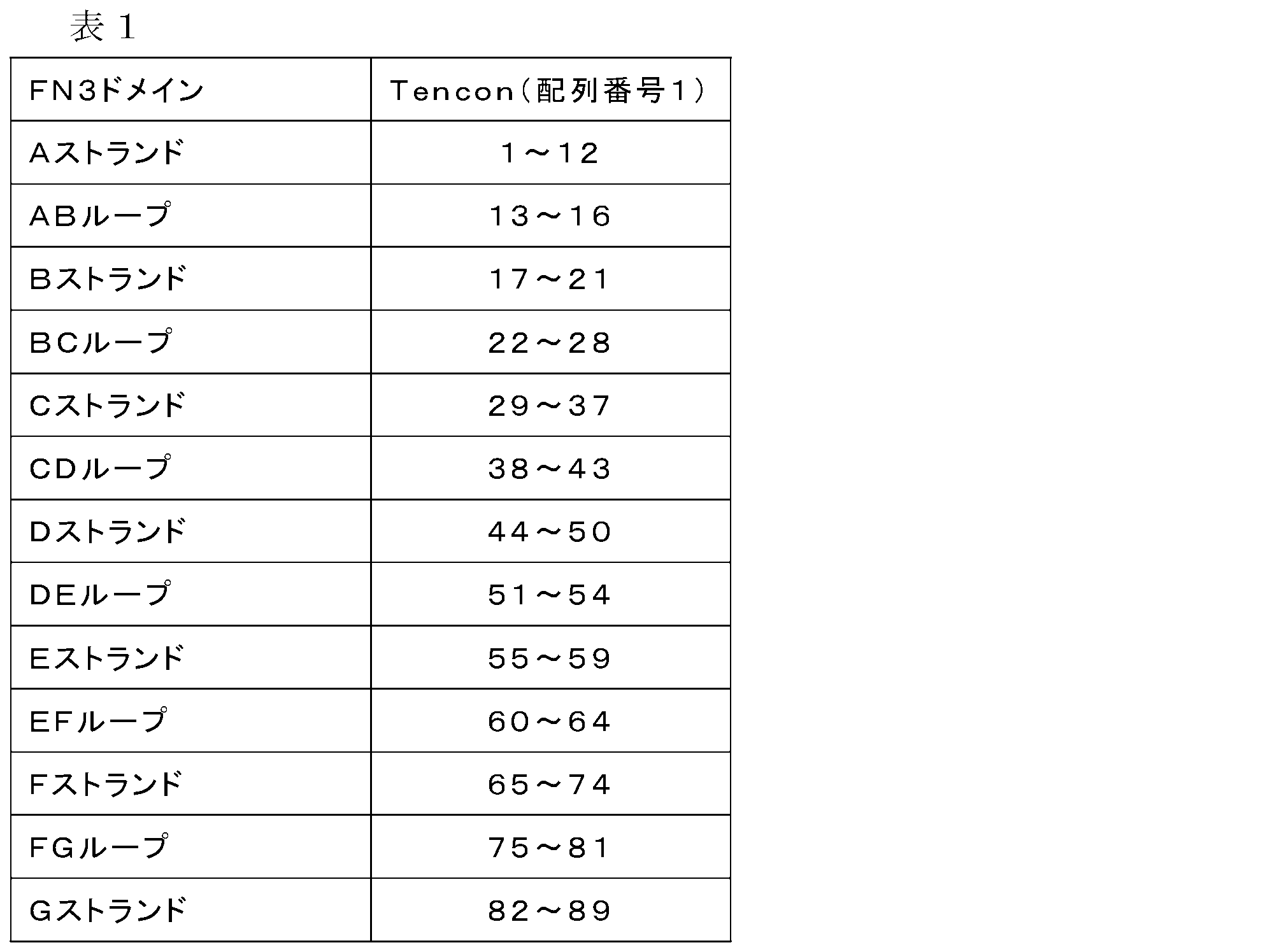
Tencon及び他のFN3配列ベースのライブラリは、ランダムな又は定義されたア
ミノ酸セットを用いて、選択した残基位置にてランダム化することができる。例えば、ラ
ンダム置換を有するライブラリ中の変異体は、20の天然のアミノ酸全てをコードするN
NKコドンを用いて生成できる。他の多様化スキームにおいて、アミノ酸Ala、Trp
、Tyr、Lys、Thr、Asn、Lys、Ser、Arg、Asp、Glu、Gly
、及びCysをコードするために、DVKコドンが使用できる。あるいは、20全てのア
ミノ酸残基を生じさせ、同時に停止コドンの頻度を低減するために、NNSコドンが使用
できる。多様化される位置に偏ったアミノ酸分布を有するFN3ドメインのライブラリは
、例えば、Slonomics(登録商標)法(http:_//www_slonin
g_com)を用いて合成できる。この手法は、何千もの遺伝子合成プロセスに十分な普
遍的な構築ブロックとして機能する、あらかじめ作られた二本鎖トリプレットのライブラ
リを使用する。このトリプレットのライブラリは、あらゆる所望のDNA分子を構築する
のに必要な、全ての考えられる配列組合せを示す。コドン指定は、よく知られているIU
Bコードによる。
Tencon and other FN3 sequence-based libraries can be randomized at selected residue positions using a random or defined set of amino acids. For example, a variant in a library with random substitutions is N encoding all 20 naturally occurring amino acids.
It can be generated using the NK codon. In other diversification schemes, the amino acids Ala, Trp
, Tyr, Lys, Thr, Asn, Lys, Ser, Arg, Asp, Glu, Gly
, And the DVK codon can be used to encode Cys. Alternatively, NNS codons can be used to generate all 20 amino acid residues and at the same time reduce the frequency of stop codons. A library of FN3 domains with a diversified position-biased amino acid distribution can be described, for example, by the Slonomics® method (http: _ // www_slonin).
It can be synthesized using g_com). This technique uses a pre-made library of double-stranded triplets that acts as a universal building block sufficient for thousands of gene synthesis processes. This library of triplets shows all possible sequence combinations needed to construct any desired DNA molecule. Codon designation is the well-known IU
According to B code.
本明細書に記載の、EGFR又はc-Metに特異的に結合する本発明のFN3ドメイ
ンは、cisディスプレイを用いて、スカフォールドタンパク質をコードするDNAフラ
グメントを、RepAをコードするDNAフラグメントにライゲートし、インビトロ翻訳
後に形成されたタンパク質DNA錯体のプールを作製して(ここで、各タンパク質は、安
定的にそれをコードするDNAと結びついている(米国特許第7,842,476号;O
degripら、Proc Natl Acad Sci USA 101,2806~
2810,2004))、TenconライブラリなどのFN3ライブラリを作製し、E
GFR及び/又はc-Metに特異的に結合するためのライブラリを、当該技術分野で周
知の、または、実施例に記載の任意の方法で分析することにより、単離することができる
。使用できる例示的な周知の方法としては、ELISA、サンドイッチ免疫測定法、並び
に競合アッセイ及び非競合アッセイが挙げられる(例えば、Ausubelら、eds,
1994,Current Protocols in Molecular Biol
ogy,Vol.1,John Wiley & Sons,Inc.,New Yor
kを参照されたい)。EGFR又はc-Metに特異的に結合する同定されたFN3ドメ
インについては、本明細書に記載の方法を用いて、EGFRに結合するEGF又はc-M
etに対するHGFの結合などのEGFRリガンドをブロッキングする能力、及びEGF
R及び/又はc-Metシグナル伝達を阻害する能力の特性を更に決定する。
As described herein, the FN3 domain of the invention that specifically binds to EGFR or c-Met uses a cis display to ligate the DNA fragment encoding the scaffold protein to the DNA fragment encoding RepA. Create a pool of protein DNA complexes formed after in vitro translation (where each protein is stably associated with the DNA encoding it (US Pat. No. 7,842,476; O).
degrip et al., Proc Natl Acad Sci USA 101,286 ~
2810, 2004)), create an FN3 library such as the Tencon library, and E
Libraries for specific binding to GFR and / or c-Met can be isolated by analysis by any method well known in the art or described in the Examples. Exemplary well-known methods that can be used include ELISA, sandwich immunoassays, and competitive and non-competitive assays (eg, Ausubel et al., Eds,
1994, Current Protocols in Molecule Biol
ogy, Vol. 1, John Wiley & Sons, Inc. , New York
See k). For identified FN3 domains that specifically bind to EGFR or c-Met, the methods described herein are used to bind EGF or c-M to EGFR.
Ability to block EGFR ligands such as HGF binding to et, and EGF
Further determine the characteristics of the ability to inhibit R and / or c-Met signaling.
本明細書に記載のように、EGFR又はc-Metに特異的に結合する本発明のFN3
ドメインは、ライブラリを作製するためのテンプレートとして、任意のFN3ドメインを
用いて、また、本明細書に記載の方法を用いて、EGFR又はc-Metに特異的に結合
する分子のライブラリをスクリーニングして、作製することができる。使用できる例示的
なFN3ドメインは、テネイシンC(配列番号75)の第3のFN3ドメイン(TN3)
、フィブコン(Fibcon)(配列番号76)及びフィブロネクチン(配列番号77)の第1
0のFN3ドメイン(FN10)である。インビトロでライブラリを発現又は翻訳させる
ために、ライブラリをベクターにクローニングするか、又はライブラリの二本鎖cDNA
カセットを合成するために、標準的なクローニング及び発現法が使用される。例えば、リ
ボソームディスプレイ(Hanes and Pluckthun,Proc Natl
Acad Sci USA,94,4937~4942,1997)、mRNAディス
プレイ(Roberts and Szostak,Proc Natl Acad S
ci USA,94,12297~12302,1997)、又は他の無細胞系(米国特
許第5,643,768号)などが使用され得る。FN3ドメイン変異型のライブラリは
、例えば、任意の好適なバクテリオファージの表面上に提示される融合タンパク質として
発現され得る。バクテリオファージの表面上に融合ポリペプチドを提示する方法は、よく
知られている(米国特許公開第2011/0118144号;国際特許公開第2009/
085462号;米国特許第6,969,108号;米国特許第6,172,197号;
米国特許第5,223,409号;米国特許第6,582,915号;米国特許第6,4
72,147号)。
As described herein, FN3 of the invention specifically binds to EGFR or c-Met.
The domain screens a library of molecules that specifically bind to EGFR or c-Met using any FN3 domain as a template for making the library and using the methods described herein. Can be produced. An exemplary FN3 domain that can be used is the third FN3 domain (TN3) of tenascin C (SEQ ID NO: 75).
, Fibcon (SEQ ID NO: 76) and fibronectin (SEQ ID NO: 77) No. 1.
There are 0 FN3 domains (FN10). To express or translate the library in vitro, clone the library into a vector or double-stranded cDNA of the library.
Standard cloning and expression methods are used to synthesize cassettes. For example, Ribosome Display (Hanes and Packthun, Proc Natl)
Acad Sci USA, 94, 4937-4942, 1997), mRNA display (Roberts and Szostak, Proc Natl Acad S)
ci USA, 94,12297-12302, 1997), or other cell-free systems (US Pat. No. 5,643,768) may be used. The library of FN3 domain variants can be expressed, for example, as a fusion protein presented on the surface of any suitable bacteriophage. Methods of presenting fusion polypeptides on the surface of bacteriophage are well known (US Patent Publication No. 2011/0118144; International Patent Publication No. 2009 /
085462; US Pat. No. 6,969,108; US Pat. No. 6,172,197;
US Pat. No. 5,223,409; US Pat. No. 6,582,915; US Pat. No. 6,4
No. 72,147).
本明細書に記載の、EGFR又はc-Metに特異的に結合する本発明のFN3ドメイ
ンは、変化させて、熱安定性及び熱的フォールティング並びにアンフォールディングの可
逆性の改善などの特性を向上させることができる。タンパク質及び酵素の見かけの熱安定
性を高めるため、極めて類似性の高い熱安定性配列との比較に基づく合理的設計、ジスル
フィド架橋の安定化設計、α-ヘリックス傾向を増加させる変異、塩橋の改変、タンパク
質の表面電荷の変化、定方向進化、及び共通配列の組成物を含む、いくつかの方法が適用
されている(Lehmann及びWyss,Curr Opin Biotechnol
,12,371~375,2001)。高い熱安定性は、発現したタンパク質の収率を増
加させ、溶解度又は活性を改善し、免疫原性を減少させ、製造におけるコールドチェーン
の必要性を最小化することができる。Tencon(配列番号1)の熱安定性を向上させ
るために、置換することができる残基は、残基位置11、14、17、37、46、73
、又は86であり、米国特許公開第2011/0274623号に記述されている。これ
らの残基に対応する置換は、本発明のFN3ドメイン又は二重特異性FN3ドメイン含有
分子に組み込むことができる。
The FN3 domains of the invention described herein that specifically bind to EGFR or c-Met are altered to improve properties such as thermal stability and improved thermal folding and unfolding reversibility. Can be made to. Rational design based on comparison with highly similar thermostable sequences to enhance the apparent thermostability of proteins and enzymes, stabilization design of disulfide crosslinks, mutations that increase α-helix propensity, salt bridges Several methods have been applied, including modifications, changes in protein surface charge, directional evolution, and common sequence compositions (Lehmann and Wyss, Curr Opin Biotechnol).
, 12, 371-375, 2001). High thermal stability can increase the yield of expressed protein, improve solubility or activity, reduce immunogenicity, and minimize the need for cold chains in production. To improve the thermal stability of Tencon (SEQ ID NO: 1), the residues that can be substituted are
, Or 86, as described in US Patent Publication No. 2011/0274623. Substitutions corresponding to these residues can be incorporated into the FN3 domain or bispecific FN3 domain containing molecules of the invention.
本発明は、また、EGFRと特異的に結合し、EGFとEGFRとの結合をブロッキン
グし、配列番号18~29、107~110、122~137に示す配列を含み、更に、
Tencon(配列番号1)の11、14、17、37、46、73及び86位に対応す
る1つ以上の残基位置での置換を含む単離FN3ドメインを提供する。
The present invention also comprises specifically binding to EGFR, blocking binding of EGF to EGFR, comprising the sequences set forth in SEQ ID NOs: 18-29, 107-110, 122-137, and further.
Provided is an isolated FN3 domain comprising substitutions at one or more residue positions corresponding to
本発明は、また、c-Metと特異的に結合し、HGFとc-Metとの結合をブロッ
キングし、配列番号32~49又は111~114に示す配列を含み、更に、Tenco
n(配列番号1)の11、14、17、37、46、73及び86位に対応する1つ以上
の残基位置での置換を含む単離FN3ドメインを提供する。
The present invention also specifically binds to c-Met, blocks the binding of HGF to c-Met, comprises the sequences set forth in SEQ ID NOs: 32-49 or 111-114, and further comprises Tenco.
Provided is an isolated FN3 domain comprising substitutions at one or more residue positions corresponding to
例示的な置換は、置換E11N、E14P、L17A、E37P、N46V、G73Y
及びE86I(ナンバリングは、配列番号1に従う)である。
Exemplary substitutions are substitutions E11N, E14P, L17A, E37P, N46V, G73Y.
And E86I (numbering follows SEQ ID NO: 1).
いくつかの実施形態では、本発明のFN3ドメインは、Tencon(配列番号1)の
置換L17A、N46V及びE86Iに対応する置換を含む。
In some embodiments, the FN3 domain of the invention comprises a substitution corresponding to the substitutions L17A, N46V and E86I of Tencon (SEQ ID NO: 1).
本明細書に記載のとおり、EGFRに特異的に結合するFN3ドメイン(図1)は、T
encon(配列番号1)と比較して、延長されたFGループを有する。したがって、T
encon(配列番号1)の残基11、14、17、37、46、73及び86に対応す
る残基は、図1A及び1Bに示される、配列番号24のFN3ドメインを除くEGFR
FN3ドメインの、残基11、14、17、37、46、73及び91であり、ここで、
対応する残基は、BCループでの1つのアミノ酸の挿入により、残基11、14、17、
38、74及び92となる。
As described herein, the FN3 domain (FIG. 1) that specifically binds to EGFR is T.
It has an extended FG loop as compared to encon (SEQ ID NO: 1). Therefore, T
The residues corresponding to
The corresponding residues are
38, 74 and 92.
本発明は、また、EGFRと特異的に結合し、EGFとEGFRとの結合をブロッキン
グし、配列番号18~29、107~110、122~137又は194~211で示す
アミノ酸配列を含み、Tencon(配列番号1)のL17A、N46V及びE86Iの
置換に対応する、1つ、2つ又は3つの置換を任意選択的に有する、単離FN3ドメイン
を提供する。
The present invention also comprises the amino acid sequence set forth in SEQ ID NOs: 18-29, 107-110, 122-137 or 194-211, which specifically binds to EGFR and blocks binding of EGF to EGFR. Provided is an isolated FN3 domain having one, two or three substitutions optionally corresponding to the substitutions of L17A, N46V and E86I of SEQ ID NO: 1).
本発明は、また、c-Metと特異的に結合し、HGFとc-Meとの結合をブロッキ
ングし、配列番号32~49、111~114又は212~223で示すアミノ酸配列を
含み、Tencon(配列番号1)のL17A、N46V及びE86Iの置換に対応する
、1つ、2つ又は3つの置換を任意選択的に有する、単離FN3ドメインを提供する。
The present invention also comprises the amino acid sequence set forth in SEQ ID NOs: 32-49, 111-114 or 212-223, which specifically binds to c-Met, blocks the binding of HGF to c-Me, and comprises Tencon ( Provided is an isolated FN3 domain having one, two or three substitutions optionally corresponding to the substitutions of L17A, N46V and E86I of SEQ ID NO: 1).
タンパク質安定性及びタンパク質不安定性の測定は、タンパク質完全性と同じ又は異な
る側面として見ることができる。タンパク質は、熱、紫外線又は電離放射線、(溶液中の
場合は)周囲の浸透圧モル濃度及びpHの変化、小さな孔寸法での濾過による機械的剪断
力、紫外線放射、γ線照射などの電離放射線、化学的又は熱的な脱水、又は、タンパク質
構造の破壊を引き起こし得る他の任意の作用又は力に対して感受性があるか、又は「不安
定」である。分子の安定性は、標準的な方法を用いて決定することができる。例えば、分
子の安定性は、標準的な方法を用いて、分子の半分がアンフォールディングされる温度(
℃)である、熱融解(「TM」)温度を測定することによって決定され得る。典型的には
、TMが高いほど、分子はより安定している。熱に加えて、化学環境もまた、タンパク質
が特有の三次元構造を維持する能力を変化させる。
Measurements of protein stability and protein instability can be viewed as the same or different aspects of protein integrity. Proteins are heat, ultraviolet or ionizing radiation, changes in ambient molar concentration and pH (if in solution), mechanical shearing force by filtration with small pore size, ultraviolet radiation, ionizing radiation such as gamma ray irradiation. Sensitive or "unstable" to any other action or force that may cause chemical or thermal dehydration, or disruption of the protein structure. The stability of the molecule can be determined using standard methods. For example, the stability of a molecule is the temperature at which half of the molecule is unfolded using standard methods (
It can be determined by measuring the heat of fusion (“TM”) temperature, which is (° C.). Typically, the higher the TM, the more stable the molecule. In addition to heat, the chemical environment also alters the ability of proteins to maintain their unique three-dimensional structure.
本明細書に記載されるいくつかの実施形態では、本発明の、EGFR又はc-Metに
結合するFN3ドメインは、改変前の同一ドメインと比較して、少なくとも5%、10%
、15%、20%、25%、30%、35%、40%、45%、50%、55%、60%
、65%、70%、75%、80%、85%、90%又は95%以上の、TMの上昇によ
って測定される増加した安定性を示す。
In some embodiments described herein, the EGFR or c-Met binding FN3 domain of the invention is at least 5%, 10% compared to the same domain before modification.
, 15%, 20%, 25%, 30%, 35%, 40%, 45%, 50%, 55%, 60%
, 65%, 70%, 75%, 80%, 85%, 90% or 95% or more, showing increased stability as measured by an increase in TM.
化学変性も同様に、様々な方法によって測定することができる。化学的変性剤としては
、グアニジン塩酸塩、チオシアン酸グアニジニウム、尿素、アセトン、有機溶媒(DMF
、ベンゼン、アセトニトリル)、塩類(硫酸アンモニウム、臭化リチウム、塩化リチウム
、臭化ナトリウム、塩化カルシウム、塩化ナトリウム)、還元剤(例えば、ジチオスレイ
トール、βメルカプトエタノール、ジニトロチオベンゼン(dinitrothiobenzene)、及び
、水素化ホウ素ナトリウムなどの水素化物)、非イオン性及びイオン性洗剤、酸類(例え
ば、塩酸(HCl)、酢酸(CH3COOH)、ハロゲン化酢酸)、疎水性分子(例えば
、リン脂質)、及び標的変性剤が挙げられる。変性の程度の定量化は、標的分子に結合す
る能力などの機能特性の損失、又はあるいは凝集傾向、これまで溶媒が到達しにくかった
残基が露出する傾向、ジスルフィド結合が破壊若しくは形成する傾向などの物理化学的性
質による損失に依存し得る。
Chemical denaturation can also be measured by various methods. Chemical modifiers include guanidine hydrochloride, guanidinium thiocyanate, urea, acetone, and organic solvents (DMF).
, Benzene, acetonitrile), salts (ammonium sulfate, lithium bromide, lithium chloride, sodium bromide, calcium chloride, sodium chloride), reducing agents (eg, dithioslateol, β-mercaptoethanol, dinitrothiobenzene, and (Hydrogens such as sodium hydride), nonionic and ionic detergents, acids (eg, hydrochloric acid (HCl), acetic acid (CH 3 COOH), halogenated acetic acid), hydrophobic molecules (eg, phospholipids), and Target modifiers can be mentioned. Quantification of the degree of denaturation is the loss of functional properties such as the ability to bind to target molecules, or the tendency to aggregate, the tendency to expose residues that were previously difficult for the solvent to reach, the tendency to break or form disulfide bonds, etc. May depend on the loss due to the physicochemical properties of.
本明細書に記載するいくつかの実施形態では、EGFR又はc-Metに結合する本発
明のFN3ドメインは、化学変性剤としてグアニジン塩酸塩を用いて測定した、改変前の
同じスカフォールドと比較して、少なくとも5%、10%、15%、20%、25%、3
0%、35%、40%、45%、50%、55%、60%、65%、70%、75%、8
0%、85%、90%又は95%以上の安定性の増加を示す。増加した安定性は、よく知
られている方法を使用して塩酸グアニジンの濃度を増加させる処理における、減少したト
リプトファン蛍光によって測定され得る。
In some embodiments described herein, the FN3 domain of the invention that binds to EGFR or c-Met is compared to the same unmodified scaffold measured with guanidine hydrochloride as the chemical modifier. , At least 5%, 10%, 15%, 20%, 25%, 3
0%, 35%, 40%, 45%, 50%, 55%, 60%, 65%, 70%, 75%, 8
It shows an increase in stability of 0%, 85%, 90% or 95% or more. Increased stability can be measured by decreased tryptophan fluorescence in treatments that increase the concentration of guanidine hydrochloride using well-known methods.
本明細書に記載の本発明のFN3ドメインは、例えば、標的分子の原子価及びしたがっ
て結合活性を増加させるための手段として、又は2つ以上の異なる標的分子に同時に結合
する二重若しくは多特異性スカフォールドを生成するための手段として、単量体、二量体
、若しくは多量体として、生成できる。二量体及び多量体は、例えば、アミノ酸リンカー
、例えば、ポリグリシン、グリシン及びセリン、又はアラニン及びプロリンを含有するリ
ンカーの含有によって、単一特異性、二重又は多特異性タンパク質スカフォールドを結合
することによって生成できる。例示的なリンカーとしては、(GS)2(配列番号78)
、(GGGS)2(配列番号224)、(GGGGS)5(配列番号79)、(AP)2(
配列番号80)、(AP)5(配列番号81)、(AP)10(配列番号82)、(AP)2
0(配列番号83)及びA(EAAAK)5AAA(配列番号84)が挙げられる。二量体
及び多量体は、互いにN-C方向に連結され得る。ポリペプチドを新規の結合融合ポリペ
プチドと結合するための天然の、または人工のペプチドリンカーの使用は、文献において
よく知られている(Hallewellら、J Biol Chem 264,5260
~5268,1989;Alfthanら、Protein Eng.8,725~73
1,1995;Robinson & Sauer,Biochemistry 35,
109~116,1996;米国特許第5,856,456号)。
The FN3 domains of the invention described herein are dual or multispecific, eg, as a means to increase the valence and thus binding activity of a target molecule, or to simultaneously bind to two or more different target molecules. As a means for producing scaffolds, it can be produced as a monomer, a dimer, or a multimer. Dimers and multimers bind unispecific, bi or polyspecific protein scaffolds, for example by the inclusion of amino acid linkers such as polyglycine, glycine and serine, or linkers containing alanine and proline. Can be generated by An exemplary linker is (GS) 2 (SEQ ID NO: 78).
, (GGGS) 2 (SEQ ID NO: 224), (GGGGS) 5 (SEQ ID NO: 79), (AP) 2 (
SEQ ID NO: 80), (AP) 5 (SEQ ID NO: 81), (AP) 10 (SEQ ID NO: 82), (AP) 2
0 (SEQ ID NO: 83) and A (EAAAK) 5 AAA (SEQ ID NO: 84). The dimer and the multimer can be linked to each other in the NC direction. The use of natural or artificial peptide linkers to bind a polypeptide to a novel binding fusion polypeptide is well known in the literature (Hallellell et al., J Biol Chem 264, 5260).
-5268, 1989; Alfthan et al., Protein Eng. 8,725-73
1, 1995; Robinson & Sauer,
109-116, 1996; US Pat. No. 5,856,456).
二重特異性EGFR/c-Met結合分子
本明細書に記載される本発明の二重特異性EGFR/c-Met FN3ドメイン含有
分子は、低分子EGFR阻害物質と比較したときの特異性及び標的外の毒性の低減の点に
おいて、並びに従来の抗体治療と比較したときの組織侵入の改善の点おいて、利益をもた
らし得る。本発明は、少なくとも一部は、EGFR結合及びc-Met結合FN3ドメイ
ンの混合物と比較したとき、本発明の二重特異性EGFR/c-Met FN3ドメイン
含有分子が、大幅に改善された相乗的阻害効果をもたらすとの驚くべき発見に基づく。分
子は、EGFR及びc-Metの双方に対して、特異的親和性となるように調節して、腫
瘍侵入及び保持率を最大化してもよい。本発明の二重特異性EGFR/c-Met FN
3ドメイン含有分子は、EGFR及び/又はc-Metシグナル伝達経路のより効果的な
阻害をもたらし、セツキシマブ(Eribtux(登録商標))より効率的に、腫瘍増殖
を阻害する。
Bispecific EGFR / c-Met Binding Molecules The bispecific EGFR / c-Met FN3 domain-containing molecules of the invention described herein are specific and targeted when compared to low molecular weight EGFR inhibitors. It can bring benefits in terms of reducing external toxicity and in improving tissue invasion when compared to conventional antibody treatments. The present invention is synergistic with significantly improved bispecific EGFR / c-Met FN3 domain-containing molecules of the invention when compared, at least in part, to a mixture of EGFR-bound and c-Met-bound FN3 domains. Based on the surprising finding that it has an inhibitory effect. Molecules may be adjusted for specific affinity for both EGFR and c-Met to maximize tumor invasion and retention. Bispecific EGFR / c-Met FN of the present invention
The 3-domain-containing molecule results in more effective inhibition of the EGFR and / or c-Met signaling pathway and inhibits tumor growth more efficiently than cetuximab (Eribtax®).
本発明は、また、第1のフィブロネクチンIII型(FN3)ドメイン及び第2のFN
3ドメインを含む単離二重特異性FN3ドメイン含有分子であって、該第1のFN3ドメ
インは、上皮成長因子受容体(EGFR)と特異的に結合し、上皮成長因子(EGF)と
EGFRとの結合をブロッキングし、該第2のFN3ドメインは、肝細胞増殖因子受容体
(c-Met)と特異的に結合し、肝細胞増殖因子(HGF)とc-Metとの結合をブ
ロッキングする、単離二重特異性FN3ドメイン含有分子を提供する。
The present invention also relates to a first fibronectin type III (FN3) domain and a second FN.
An isolated bispecific FN3 domain-containing molecule containing three domains, the first FN3 domain specifically binds to epidermal growth factor receptor (EGFR) and comprises epidermal growth factor (EGF) and EGFR. The second FN3 domain specifically binds to the hepatocyte growth factor receptor (c-Met) and blocks the binding of hepatocyte growth factor (HGF) to c-Met. An isolated bispecific FN3 domain-containing molecule is provided.
本明細書に記載の本発明の二重特異性EGFR/c-Met FN3ドメイン含有分子
は、本発明の任意のEGFR結合FN3ドメイン及びc-Met結合FN3ドメインの直
接的又はリンカーを介しての共有結合による連結により、生成することができる。このた
め、二重特異性分子の第1のFN3ドメインは、EGFR結合FN3ドメインについて、
上述の特徴を有し得る。また、二重特異性分子の第2のFN3ドメインは、c-Met結
合FN3ドメインについて、上述の特徴を有し得る。
The bispecific EGFR / c-Met FN3 domain-containing molecules of the invention described herein share any of the EGFR-bound FN3 and c-Met-bound FN3 domains of the invention directly or via a linker. It can be generated by ligation by conjugation. Therefore, the first FN3 domain of the bispecific molecule is the EGFR-bound FN3 domain.
It may have the above-mentioned characteristics. Also, the second FN3 domain of the bispecific molecule may have the above-mentioned characteristics for the c-Met-bound FN3 domain.
本明細書に記載のいくつかの実施形態では、二重特異性EGFR/c-Met FN3
ドメイン含有分子の第1のFN3ドメインは、50ng/mLのヒトEGFを用いて、A
431細胞において測定したとき、約2.5×10⁻⁶M未満のIC50値にて、EGFR残
基チロシン1173におけるEGF誘発性のEGFRリン酸化を阻害し、二重特異性EG
FR/c-Met FN3ドメイン含有分子の第2のFN3ドメインは、100ng/m
LのヒトHGFを用いて、NCI-H441細胞において測定したとき、約1.5×10
-6M未満のIC50値にて、c-Met残基チロシン1349における、HGF誘発性のc
-Metリン酸化を阻害する。
In some embodiments described herein, the bispecific EGFR / c-Met FN3
The first FN3 domain of the domain-containing molecule was A using 50 ng / mL human EGF.
At an IC50 value of less than about 2.5 × 10 -6 M as measured in 431 cells, it inhibits EGF-induced EGFR phosphorylation at the EGFR residue tyrosine 1173 and is a bispecific EG.
The second FN3 domain of the FR / c-Met FN3 domain-containing molecule is 100 ng / m.
Approximately 1.5 × 10 as measured in NCI-H441 cells using L human HGF
HGF-induced c at c-Met residue tyrosine 1349 with an IC50 value of less than -6 M
-Inhibits Met phosphorylation.
本明細書に記載のいくつかの実施形態では、二重特異性EGFR/c-Met FN3
ドメイン含有分子の第1のFN3ドメインは、50ng/mLのヒトEGFを用いて、N
CI-H292細胞において測定したとき、約1.8×10⁻⁸M~約2.5×10⁻⁶Mの
IC50値にて、EGFR残基チロシン1173におけるEGF誘発性のEGFRリン酸化
を阻害し、二重特異性EGFR/c-Met FN3ドメイン含有分子の第2のFN3ド
メインは、100ng/mLのヒトHGFを用いて、NCI-H441細胞において測定
したとき、約4×10⁻⁹M~約1.5×10⁻⁶MのIC50値にて、c-Met残基チロシ
ン1349における、HGF誘発性のc-Metリン酸化を阻害する。
In some embodiments described herein, the bispecific EGFR / c-Met FN3
The first FN3 domain of the domain-containing molecule was N using 50 ng / mL human EGF.
Inhibits EGF-induced EGFR phosphorylation in EGFR residue tyrosine 1173 at IC 50 values of about 1.8 × 10 -8 M to about 2.5 × 10 -6 M as measured in CI-H292 cells. However, the second FN3 domain of the bispecific EGFR / c-Met FN3 domain-containing molecule was measured in NCI-H441 cells using 100 ng / mL human HGF from about 4 × 10 -9 M. At an IC 50 value of about 1.5 × 10 -6 M, it inhibits HGF-induced c-Met phosphorylation in c-Met residue tyrosine 1349.
本明細書に記載のいくつかの実施形態では、二重特異性EGFR/c-Met FN3
ドメイン含有分子の第1のFN3ドメインは、約1×10⁻⁸M未満の解離定数(KD)に
て、ヒトEGFRに結合し、二重特異性EGFR/c-Met FN3ドメイン含有分子
の第2のFN3ドメインは、約5×10⁻⁸M未満のKDにて、ヒトc-Metに結合する
。
In some embodiments described herein, the bispecific EGFR / c-Met FN3
The first FN3 domain of the domain-containing molecule binds to human EGFR with a dissociation constant (KD) of less than about 1 × 10 -8 M and is the second of the bispecific EGFR / c-Met FN3 domain-containing molecule. The FN3 domain of 2 binds to human c-Met at a KD of less than about 5 × 10 -8 M.
本明細書に記載される、EGFR及びc-Metの双方に結合する二重特異性分子では
、第1のFN3ドメインは、ヒトEGFRと、約2×10⁻¹⁰~約1×10⁻⁸MのKDにて
結合し、前記第2のFN3ドメインは、ヒトc-Metと、約3×10⁻¹⁰~約5×10-
8MのKDにて結合する。
In the bispecific molecules bound to both EGFR and c-Met described herein, the first FN3 domain is about 2 × 10 -10 to about 1 × 10 -8 M with human EGFR. The second FN3 domain binds to human c-Met at about 3 × 10 -10 to about 5 × 10-.
Combine at 8 M KD.
二重特異性EGFR/c-Met分子のEGFR及びc-Metに対する親和性は、単
一特異性分子の実施例3及び実施例5に記載されているように決定することができる。
The affinity of the bispecific EGFR / c-Met molecule for EGFR and c-Met can be determined as described in Examples 3 and 5 of the monospecific molecule.
本発明の二重特異性EGFR/c-Met分子の第1のFN3ドメインは、A431細
胞を用い、第1のFN3ドメインと共に又は第1のFN3ドメイン無しで、インキュベー
トしたA431細胞において、600nMにて、ストレプトアビジン-フィコエリトリン
コンジュゲートを使用して、結合されたビオチン化EGFからの蛍光量を検出するアッセ
イにおいて、約1×10⁻⁹M~約1.5×10⁻⁷MのIC50値にて、EGFRに対するE
GFの結合をブロッキングし得る。本発明の二重特異性EGFR/c-Met分子の第1
のFN3ドメインは、第1のFN3ドメインの不在下で、同じアッセイ条件を用いてEG
FとEGFRとの結合を比較したとき、少なくとも30%、35%、40%、45%、5
0%、55%、60%、65%、70%、75%、80%、85%、90%、91%、9
2%、93%、94%、95%、96%、97%、98%、99%又は100%、EGF
Rに対するEGFの結合をブロッキングし得る。
The first FN3 domain of the bispecific EGFR / c-Met molecule of the invention is A431 cells incubated with A431 cells with or without the first FN3 domain at 600 nM. In an assay to detect the amount of fluorescence from bound biotinylated EGF using a streptavidin-phycoerythrin conjugate, IC 50 values from about 1 × 10 -9 M to about 1.5 × 10 -7 M. And E for EGFR
It can block GF binding. The first of the bispecific EGFR / c-Met molecules of the present invention
FN3 domain in EG in the absence of the first FN3 domain using the same assay conditions
When comparing the binding of F to EGFR, at least 30%, 35%, 40%, 45%, 5
0%, 55%, 60%, 65%, 70%, 75%, 80%, 85%, 90%, 91%, 9
2%, 93%, 94%, 95%, 96%, 97%, 98%, 99% or 100%, EGF
It can block the binding of EGF to R.
本発明の二重特異性EGFR/c-Met分子内の第2のFN3ドメインは、第2のF
N3ドメインの存在下で、ビオチン化HGFとc-Met融合タンパク質の結合の阻害を
検出するアッセイにおいて、約2×10⁻¹⁰M~約6×10⁻⁸MのIC50値にて、c-M
etに対するHGFの結合をブロッキングし得る。二重特異性EGFR/c-Met分子
内の第2のFN3ドメインは、第2のFN3ドメインの不在下で、同じアッセイ条件を用
いてHGFとc-Metとの結合と比較したとき、少なくとも30%、35%、40%、
45%、50%、55%、60%、65%、70%、75%、80%、85%、90%、
91%、92%、93%、94%、95%、96%、97%、98%、99%又は100
%、c-Metに対するHGFの結合をブロッキングし得る。
The second FN3 domain in the bispecific EGFR / c-Met molecule of the present invention is the second F.
In an assay that detects inhibition of the binding of biotinylated HGF to the c-Met fusion protein in the presence of the N3 domain, at IC50 values of about 2 × 10 -10 M to about 6 × 10 -8 M, c- M
It can block the binding of HGF to et. The second FN3 domain within the bispecific EGFR / c-Met molecule is at least 30 when compared to the binding of HGF to c-Met using the same assay conditions in the absence of the second FN3 domain. %, 35%, 40%,
45%, 50%, 55%, 60%, 65%, 70%, 75%, 80%, 85%, 90%,
91%, 92%, 93%, 94%, 95%, 96%, 97%, 98%, 99% or 100
%, Can block the binding of HGF to c-Met.
本明細書に記載の本発明の二重特異性EGFR/c-Met分子は、同じアッセイ条件
を使用した、本発明の二重特異性EGFR/c-Met分子の不在下でのシグナル伝達レ
ベルと比較して、少なくとも30%、35%、40%、45%、50%、55%、60%
、65%、70%、75%、80%、85%、90%、91%、92%、93%、94%
、95%、96%、97%、98%、99%又は100%、EGFR及び/又はc-Me
tシグナル伝達を阻害し得る。
The bispecific EGFR / c-Met molecules of the invention described herein are signal transduction levels in the absence of the bispecific EGFR / c-Met molecules of the invention using the same assay conditions. By comparison, at least 30%, 35%, 40%, 45%, 50%, 55%, 60%
, 65%, 70%, 75%, 80%, 85%, 90%, 91%, 92%, 93%, 94%
, 95%, 96%, 97%, 98%, 99% or 100%, EGFR and / or c-Me
It can inhibit t-signal transduction.
EGFR及びc-Metのシグナル伝達は、単一特異性分子について、上記のとおり種
々の周知の方法を用いて測定することができる。
Signal transduction of EGFR and c-Met can be measured for monospecific molecules using various well-known methods as described above.
EGFRに特異的に結合する第1のFN3ドメイン及びc-Metに特異的に結合する
第2のFN3ドメインを含む、本明細書に記載の本発明の二重特異性EGFR/c-Me
分子は、第1のFN3ドメイン及び第2のFN3ドメインの混合物によって観察される相
乗的阻害と比較して、EGFR及びc-Metのシグナル伝達及び腫瘍細胞増殖の相乗的
阻害の大幅な向上をもたらす。相乗的阻害は、例えば、二重特異性EGFR/c-Met
FN3ドメイン含有分子及び2つの単一特異性分子(一方はEGFRに結合し、他方は
c-Metに結合する)の混合物による、ERKリン酸化の阻害を測定することによって
、評価できる。本発明の二重特異性EGFR/c-Met分子は、2つの単一特異性FN
3ドメインの混合物についてのIC50値と比較した場合、少なくとも100倍小さい、例
えば、少なくとも500、1000、5000、10,000倍小さいIC50値にて、E
RKのリン酸化を阻害することができ、これは、この二重特異性EGFR/c-Met
FN3ドメイン含有分子が、2つの単一特異性FN3ドメインの混合物と比較して、能力
が少なくとも100倍増大されていることを示す。例示的な二重特異性EGFR c-M
et FN3ドメイン含有分子は、約5×10⁻⁹M以下のIC50値にて、ERKのリン酸
化を阻害することができる。ERKのリン酸化は、標準的な方法及び本明細書に記載の方
法を用いて測定できる。
The bispecific EGFR / c-Me of the invention described herein comprising a first FN3 domain that specifically binds to EGFR and a second FN3 domain that specifically binds to c-Met.
The molecule results in a significant improvement in EGFR and c-Met signaling and tumor cell proliferation compared to the synergistic inhibition observed by the mixture of the first FN3 domain and the second FN3 domain. .. Synergistic inhibition is, for example, bispecific EGFR / c-Met.
It can be evaluated by measuring the inhibition of ERK phosphorylation by a mixture of FN3 domain-containing molecule and two monospecific molecules, one binding to EGFR and the other to c-Met. The bispecific EGFR / c-Met molecule of the present invention has two monospecific FNs.
At an IC50 value that is at least 100 times smaller, eg, at least 500, 1000, 5000, 10,000 times smaller than an IC50 value for a mixture of three domains, E
Phosphorylation of RK can be inhibited, which is this bispecific EGFR / c-Met.
It is shown that the FN3 domain-containing molecule has an increased capacity of at least 100-fold compared to a mixture of two monospecific FN3 domains. Exemplary bispecific EGFR c-M
The et FN3 domain-containing molecule can inhibit the phosphorylation of ERK at an IC50 value of about 5 × 10 -9 M or less. Phosphorylation of ERK can be measured using standard methods and the methods described herein.
本明細書に記載の本発明の二重特異性EGFR/c-Met FN3ドメイン含有分子
は、第1のFN3ドメインと第2のFN3ドメインとの混合物を用いたH292細胞の増
殖阻害のIC50値と比較したとき、少なくとも30倍以下のIC50値にて、H292細胞
の増殖を阻害し得、ここで、この細胞増殖は、7.5ng/mLのHGFを添加した10
% FBS含有培地により誘発される。本明細書に記載の本発明の二重特異性分子は、第
1のFN3ドメインと第2のFN3ドメインとの混合物による腫瘍細胞の増殖阻害のIC
50値と比較したとき、約30、40、50、60、70、80、90、100、150、
200、300、400、500、600、700、800又は約1000倍以下のIC
50値にて、腫瘍細胞の増殖を阻害し得る。腫瘍細胞増殖の阻害は、標準的な方法及び本明
細書に記載の方法を用いて測定できる。
The bispecific EGFR / c-Met FN3 domain-containing molecules of the invention described herein are IC50 values of H292 cell proliferation inhibition using a mixture of a first FN3 domain and a second FN3 domain. Can inhibit proliferation of H292 cells at an IC50 value of at least 30-fold or less, where the cell proliferation was 10 ng / mL HGF added.
% Induced by FBS-containing medium. The bispecific molecule of the invention described herein is an IC of tumor cell growth inhibition by a mixture of a first FN3 domain and a second FN3 domain.
When compared with the 50 value, about 30, 40, 50, 60, 70, 80, 90, 100, 150,
200, 300, 400, 500, 600, 700, 800 or about 1000 times or less IC
At a value of 50 , it can inhibit the growth of tumor cells. Inhibition of tumor cell proliferation can be measured using standard methods and the methods described herein.
本明細書に記載のいくつかの実施形態では、二重特異性EGFR/c-Met FN3
ドメイン含有分子は、P54AR4-83v2(配列番号27)の残基D23、F27、
Y28、V77及びG85に対応する1つ以上のアミノ酸残基により、EGFRに結合す
る。
In some embodiments described herein, the bispecific EGFR / c-Met FN3
The domain-containing molecule is P54AR4-83v2 (SEQ ID NO: 27) residues D23, F27,
It binds to EGFR by one or more amino acid residues corresponding to Y28, V77 and G85.
本明細書に記載のいくつかの実施形態では、二重特異性EGFR/c-Met FN3
ドメイン含有分子は、P114AR7P95-A3(配列番号41)の残基R34、F3
8、M72及びI79に対応する1つ以上のアミノ酸残基により、c-Metに結合する
。
In some embodiments described herein, the bispecific EGFR / c-Met FN3
The domain-containing molecule is P114AR7P95-A3 (SEQ ID NO: 41) residues R34, F3.
8. It binds to c-Met by one or more amino acid residues corresponding to M72 and I79.
二重特異性分子中のパラトープ残基は、突然変異誘発研究で同定できるか、又はFN3
ドメイン及びEGFR又はc-Metの共結晶構造から同定することができる。突然変異
誘発研究では、例えば、アラニンスキャニング法を利用してもよく、得られた変異体のE
GFR又はc-Metへの結合について、標準的な方法により、試験を行ってもよい。典
型的に、パラトープ残基は、突然変異が誘発されたときの残基であり、EGFR又はc-
Metへの結合の低減又は消失に伴い変異体が発生する。P54AR4-83v2(配列
番号27)の残基D23、F27、Y28、V77及びG85に対応するアミノ酸残基位
置にて置換を有するEGFR結合FN3ドメインは、置換されるときに、野生型P54A
R4-83v2と比較すると、EGFRの結合が少なくとも100倍減少する。二重特異
性分子ECB1、ECB2、ECB3、ECB4、ECB5、ECB6、ECB7、EC
B15、ECB17、ECB60、ECB37、ECB94、ECB95、ECB96、
ECB97、ECB91、ECB18、ECB28、ECB38、ECB39、ECB1
68及びECB176は、P54AR4-83v2の残基D23、F27、Y28、V7
7及びG85に対応する残基位置にて、D、F、Y、V及びGを有し、これらの残基によ
り、EGFRと結合することが予測される。P114AR7P95-A3(配列番号41
)の残基R34、F38、M72及びI79に対応するアミノ酸残基位置にて置換を有す
るc-Met結合FN3ドメインは、置換されるとき、野生型P114AR7P95-A
3と比較すると、c-Met結合を少なくとも100倍消失又は低減する。二重特異性分
子ECB2、ECB5、ECB15、ECB60、ECB38及びECB39は、P11
4AR7P95-A3(配列番号41)の残基R34、F38、M72及びI79に対応
する残基位置にて、R、F、M及びIを有し、これらの残基によりc-Metに結合する
と予測される。
Paratope residues in bispecific molecules can be identified in mutagenesis studies or FN3
It can be identified from the domain and the co-crystal structure of EGFR or c-Met. In mutagenesis studies, for example, the alanine scanning method may be used, and the resulting mutant E
Binding to GFR or c-Met may be tested by standard methods. Typically, the paratope residue is the residue when the mutation is induced and is EGFR or c-.
Mutants develop with the reduction or disappearance of binding to Met. The EGFR-bound FN3 domain with substitutions at amino acid residue positions corresponding to residues D23, F27, Y28, V77 and G85 of P54AR4-83v2 (SEQ ID NO: 27) is wild-type P54A when substituted.
Compared to R4-83v2, EGFR binding is reduced by at least 100-fold. Bispecific molecules ECB1, ECB2, ECB3, ECB4, ECB5, ECB6, ECB7, EC
B15, ECB17, ECB60, ECB37, ECB94, ECB95, ECB96,
ECB97, ECB91, ECB18, ECB28, ECB38, ECB39, ECB1
68 and ECB176 are residues D23, F27, Y28, V7 of P54AR4-83v2.
It has D, F, Y, V and G at the residue positions corresponding to 7 and G85, and these residues are expected to bind to EGFR. P114AR7P95-A3 (SEQ ID NO: 41)
) C-Met-bound FN3 domain with substitutions at amino acid residue positions corresponding to residues R34, F38, M72 and I79, when substituted, wild-type P114AR7P95-A.
Compared to 3, c-Met binding is eliminated or reduced by at least 100-fold. The bispecific molecules ECB2, ECB5, ECB15, ECB60, ECB38 and ECB39 are P11.
4AR7P95-A3 (SEQ ID NO: 41) has R, F, M and I at the residue positions corresponding to residues R34, F38, M72 and I79 and is predicted to bind to c-Met by these residues. Will be done.
また、本発明は、第1のフィブロネクチンIII型(FN3)ドメイン及び第2のFN
3ドメインを含む二重特異性FN3ドメイン含有分子であって、該第1のFN3ドメイン
は、上皮成長因子受容体(EGFR)と特異的に結合し、上皮成長因子(EGF)とEG
FRとの結合をブロッキングし、該第2のFN3ドメインは、肝細胞増殖因子受容体(c
-Met)と特異的に結合し、肝細胞増殖因子(HGF)とc-Metとの結合をブロッ
キングする、二重特異性FN3ドメイン含有分子を提供し、
該第1のFN3ドメインは、
HNVYKDTNX9RGL(配列番号179)又は配列LGSYVFEHDVML(
配列番号180)を含むFGループを含み、X9は、M又はIであり;
BCループは、配列X1X2X3X4X5X6X7X8(配列番号181)を含み、
X1はA、T、G又はDであり;
X2はA、D、Y又はWであり;
X3はP、D又はNであり;
X4はL又は存在せず;
X5はD、H、R、G、Y又はWであり;
X6はG、D又はAであり;
X7は、A、F、G、H又はDであり;
X8は、Y、F又はLであり;
該第2のFN3ドメインは、
Cストランド及びCDループであって、配列、DSFX10IRYX11EX12X13X14X
15GX16(配列番号184)を含み、ここで、
X10は、W、F又はVであり;
X11は、D、F又はLであり;
X12は、V、F又はLであり;
X13は、V、L又はTであり;
X14は、V、R、G、L、T又はSであり;
X15は、G、S、A、T又はKであり;
X16は、E又はDである、Cストランド及びCDループと;
Fストランド及びFGループであって、配列TEYX17VX18IX19X20VKGGX21
X22SX23(配列番号185)を含み、
X17は、Y、W、I、V、G又はAであり;
X18は、N、T、Q又はGであり;
X19は、L、M、N又はIであり;
X20は、G又はSであり;
X21はS、L、G、Y、T、R、H又はKであり;
X22は、I、V又はLであり;
X23は、V、T、H、I、P、Y又はLである、Fストランド及びFGループと、を含
む。
The present invention also relates to a first fibronectin type III (FN3) domain and a second FN.
A bispecific FN3 domain-containing molecule containing three domains, the first FN3 domain specifically binds to the epidermal growth factor receptor (EGFR) and is epidermal growth factor (EGF) and EG.
Blocking binding to FR, the second FN3 domain is the hepatocyte growth factor receptor (c).
-Met) provides a bispecific FN3 domain-containing molecule that specifically binds and blocks the binding of hepatocyte growth factor (HGF) to c-Met.
The first FN3 domain is
HNVYKDTNX 9 RGL (SEQ ID NO: 179) or SEQ ID NO: LGSYVFEHDVML (SEQ ID NO: 179)
Includes an FG loop containing SEQ ID NO: 180), where X 9 is M or I;
The BC loop contains the sequence X 1 X 2 X 3 X 4 X 5 X 6 X 7 X 8 (SEQ ID NO: 181).
X 1 is A, T, G or D;
X 2 is A, D, Y or W;
X 3 is P, D or N;
X 4 is L or does not exist;
X 5 is D, H, R, G, Y or W;
X 6 is G, D or A;
X 7 is A, F, G, H or D;
X 8 is Y, F or L;
The second FN3 domain is
C strand and CD loop, sequence, DSFX 10 IRYX 11 EX 12 X 13 X 14 X
Includes 15 GX 16 (SEQ ID NO: 184), where
X 10 is W, F or V;
X 11 is D, F or L;
X 12 is V, F or L;
X 13 is V, L or T;
X 14 is V, R, G, L, T or S;
X 15 is G, S, A, T or K;
X 16 is an E or D, with a C strand and a CD loop;
F-strand and FG loop with sequence TYX 17 VX 18 IX 19 X 20 VKGGX 21
Includes X 22 SX 23 (SEQ ID NO: 185)
X 17 is Y, W, I, V, G or A;
X 18 is N, T, Q or G;
X 19 is L, M, N or I;
X 20 is G or S;
X 21 is S, L, G, Y, T, R, H or K;
X 22 is I, V or L;
X 23 includes F strands and FG loops that are V, T, H, I, P, Y or L.
本明細書に記載のその他のいくつかの実施形態では、二重特異性分子は、配列
LPAPKNLVVSEVTEDSLRLSWX1X2X3X4X5X6X7X8DSFLIQ
YQESEKVGEAINLTVPGSERSYDLTGLKPGTEYTVSIYGV
HNVYKDTNX9RGLPLSAEFTT(配列番号182)、又は、配列
LPAPKNLVVSEVTEDSLRLSWX1X2X3X4X5X6X7X8DSFLIQ
YQESEKVGEAINLTVPGSERSYDLTGLKPGTEYTVSIYGV
LGSYVFEHDVMLPLSAEFTT(配列番号183)、を含む、EGFRに
結合する第1のFN3ドメインを含み、
配列番号182及び183では、
X1はA、T、G又はDであり;
X2はA、D、Y又はWであり;
X3はP、D又はNであり;
X4はL又は存在せず;
X5はD、H、R、G、Y又はWであり;
X6はG、D又はAであり;
X7は、A、F、G、H又はDであり;
X8は、Y、F又はLであり;
X9は、M又はIである。
In some other embodiments described herein, the bispecific molecule is the sequence LPAPKNLVVSEVTEDSLRLSWX 1 X 2 X 3 X 4 X 5 X 6 X 7 X 8 DSFLIQ.
YQESSEKVGEAINLTVPGSERSYDLTGLKPGTEYTVSIYGV
HNVYKDTNX 9 RGLPLSAEFTT (SEQ ID NO: 182) or the sequence LCAPKNLVSEVTEDSLRLSWX 1 X 2 X 3 X 4 X 5 X 6 X 7 X 8 DSFLIQ
YQESSEKVGEAINLTVPGSERSYDLTGLKPGTEYTVSIYGV
Contains a first FN3 domain that binds to EGFR, including LGSYVFEHDVMLLSAEFTT (SEQ ID NO: 183).
In SEQ ID NOs: 182 and 183,
X 1 is A, T, G or D;
X 2 is A, D, Y or W;
X 3 is P, D or N;
X 4 is L or does not exist;
X 5 is D, H, R, G, Y or W;
X 6 is G, D or A;
X 7 is A, F, G, H or D;
X 8 is Y, F or L;
X 9 is M or I.
本明細書に記載のその他のいくつかの実施形態では、二重特異性分子は、配列
LPAPKNLVVSRVTEDSARLSWTAPDAAF DSFX10IRYX11
E X12X13X14X15GX16AIVLTVPGSERSYDLTGLKPG TEYX17
VX18IX19X20VKGGX21X22SX23PLSAEFTT(配列番号186)、を含む
c-Metに結合する第2のFN3ドメインを含み、
ここで、
X10は、W、F又はVであり;
X11は、D、F又はLであり;
X12は、V、F又はLであり;
X13は、V、L又はTであり;
X14は、V、R、G、L、T又はSであり;
X15は、G、S、A、T又はKであり;
X16は、E又はDであり;
X17は、Y、W、I、V、G又はAであり;
X18は、N、T、Q又はGであり;
X19は、L、M、N又はIであり;
X20は、G又はSであり;
X21はS、L、G、Y、T、R、H又はKであり;
X22は、I、V又はLであり;
X23は、V、T、H、I、P、Y又はLである、Fストランド及びFGループと、を含
む。
In some other embodiments described herein, the bispecific molecule is the sequence LPAPKNLVVSRVTEDSARLSWTAPDAAF DSFX 10 IRYX 11
EX 12 X 13 X 14 X 15 GX 16 AIVLTVPGSERSYDLTGLKPG TEYX 17
Contains a second FN3 domain that binds to c-Met, including VX 18 IX 19 X 20 VKGGX 21 X 22 SX 23 PLSAEFTT (SEQ ID NO: 186).
here,
X 10 is W, F or V;
X 11 is D, F or L;
X 12 is V, F or L;
X 13 is V, L or T;
X 14 is V, R, G, L, T or S;
X 15 is G, S, A, T or K;
X 16 is E or D;
X 17 is Y, W, I, V, G or A;
X 18 is N, T, Q or G;
X 19 is L, M, N or I;
X 20 is G or S;
X 21 is S, L, G, Y, T, R, H or K;
X 22 is I, V or L;
X 23 includes F strands and FG loops that are V, T, H, I, P, Y or L.
例示的な二重特異性EGFR/c-Met FN3ドメイン含有分子は、配列番号50
~72、106、118~121、138~165、170~178又は190~193
で示すアミノ酸配列を含む。
An exemplary bispecific EGFR / c-Met FN3 domain-containing molecule is SEQ ID NO: 50.
-72, 106, 118-121, 138-165, 170-178 or 190-193
Includes the amino acid sequence shown by.
本明細書に記載の本発明の二重特異性EGFR/c-Met分子は、EGFRの自己リ
ン酸化の阻害などの、その機能的特性に関連する特定の構造特性を含んでおり、即ち、配
列HNVYKDTNX9RGL(配列番号179)又は配列LGSYVFEHDVML(
配列番号180)(ここで、X9は、M又はIである)を含む、EGFRに結合する第1
のFN3ドメインのFGループなどである。
The bispecific EGFR / c-Met molecules of the invention described herein contain specific structural properties related to their functional properties, such as inhibition of autophosphorylation of EGFR, ie, sequences. HNVYKDTNX 9 RGL (SEQ ID NO: 179) or SEQ ID NO: LGSYVFEHDVML (SEQ ID NO: 179)
First, which binds to EGFR, comprising SEQ ID NO: 180) (where X 9 is M or I).
FG loop of FN3 domain of.
本明細書に記載のいくつかの実施形態では、本発明の二重特異性EGFR/c-Met
FN3ドメイン含有分子は、
50ng/mLのヒトEGFを用いて、H292細胞において測定したとき、約8×1
0-7M未満のIC50値にて、EGFR残基チロシン1173におけるEGF誘発性のEG
FRリン酸化を阻害するか、
100ng/mLのヒトHGFを用いて、NCI-H441細胞において測定したとき
、約8.4×10⁻⁷M未満のIC50値にて、c-Met残基チロシン1349におけるH
GF誘発性のc-Metリン酸化を阻害するか、
約9.5×10⁻⁶M未満のIC50値にて、HGF誘発性のNCI-H292細胞増殖を
阻害し、ここで該細胞増殖は、7.5ngのHGFを含有する10% FBSによって誘
発されるか、
約2.0×10⁻⁸M未満のKDにて、EGFRに結合するか;又は
約2.0×10⁻⁸M未満のKDにて、c-Metに結合し、該KDは、実施例3又は実施
例5に記載のように表面プラズモン共鳴を用いて測定される。
In some embodiments described herein, the bispecific EGFR / c-Met of the invention
The FN3 domain-containing molecule is
Approximately 8 × 1 as measured in H292 cells using 50 ng / mL human EGF
EGF-induced EG at EGFR residue tyrosine 1173 with an IC50 value of less than 0-7 M
Inhibits FR phosphorylation or
H in c-Met residue tyrosine 1349 with an IC50 value of less than about 8.4 × 10 -7 M as measured in NCI-H441 cells using 100 ng / mL human HGF.
Inhibits GF-induced c-Met phosphorylation or
At an IC50 value of less than about 9.5 × 10 -6 M, HGF-induced NCI-H292 cell proliferation was inhibited, where the cell proliferation was induced by 10% FBS containing 7.5 ng of HGF. Will be done
At a KD of less than about 2.0 × 10 -8 M , it binds to EGFR; or at a KD of less than about 2.0 × 10 -8 M , it binds to c-Met, and the KD is , Measured using surface plasmon resonance as described in Example 3 or Example 5.
別の実施形態においては、本発明の二重特異性EGFR/c-Met FN3ドメイン
含有分子は、
50ng/mLのヒトEGFを用いて、H292細胞において測定したとき、約4.2
×10-9M~8×10⁻⁷MのIC50にて、EGFR残基チロシン1173におけるEGF
誘発性のEGFRリン酸化を阻害するか、
100ng/mLのヒトHGFを用いて、NCI-H441細胞において測定したとき
、約2.4×10⁻⁸M~約8.4×10⁻⁷MのIC50値にて、c-Met残基チロシン1
349におけるHGF誘発性のc-Metリン酸化を阻害するか、
約2.3×10⁻⁸M~約9.5×10⁻⁶MのIC50値にて、HGF誘発性のNCI-H
292細胞増殖を阻害し、該細胞増殖は、7.5ngのHGFを含有する10% FBS
によって誘発されるか、
約2×10⁻¹⁰M~約2.0×10⁻⁸MのKDにて、EGFRに結合するか、又は
約1×10⁻⁹M~約2.0×10⁻⁸MのKDにて、c-Metに結合し、該KDは、実施
例3又は実施例5に記載のように表面プラズモン共鳴を用いて測定される。
In another embodiment, the bispecific EGFR / c-Met FN3 domain-containing molecule of the invention is:
Approximately 4.2 when measured in H292 cells using 50 ng / mL human EGF
EGF at EGFR residue tyrosine 1173 at IC50 of × 10 -9 M to 8 × 10 -7 M
Inhibits induced EGFR phosphorylation or
C-Met residues at IC50 values of about 2.4 × 10 -8 M to about 8.4 × 10 -7 M as measured in NCI-H441 cells using 100 ng / mL human HGF.
Inhibits HGF-induced c-Met phosphorylation in 349 or
HGF-induced NCI-H with an IC50 value of about 2.3 × 10 -8 M to about 9.5 × 10 -6 M
292 Inhibits cell proliferation, which is a 10% FBS containing 7.5 ng of HGF.
Triggered by
It binds to EGFR at a KD of about 2 x 10 -10 M to about 2.0 x 10 -8 M , or a KD of about 1 x 10 -9 M to about 2.0 x 10 -8 M. Bind to c-Met and the KD is measured using surface plasmon resonance as described in Example 3 or Example 5.
本明細書に記載のいくつかの実施形態では、二重特異性EGFR/c-Met分子は、
EGFR結合FN3ドメインであって、
配列LPAPKNLVVSEVTEDSLRLSWX1X2X3X4X5X6X7X8DSFL
IQYQESEKVGEAINLTVPGSERSYDLTGLKPGTEYTVSIY
GVHNVYKDTNX9RGLPLSAEFTT(配列番号182)を含み、ここで、
X1は、Dであり;
X2は、Dであり;
X3は、Pであり;
X4は、存在せず;
X5は、H又はWであり;
X6は、Aであり;
X7は、Fであり;
X8は、Yであり;
X9は、M又はIである、EGFR結合FN3ドメインと;
c-Met結合FN3ドメインであって、配列
LPAPKNLVVSRVTEDSARLSWTAPDAAF DSFX10IRYX11
E X12X13X14X15GX16AIVLTVPGSERSYDLTGLKPG TEYX17
VX18IX19X20VKGGX21X22SX23PLSAEFTT(配列番号186)を含み、
ここで、
X10は、Wであり;
X11は、Fであり;
X12は、Fであり;
X13は、V又はLであり;
X14は、G又はSであり;
X15は、S又はKであり;
X16は、E又はDであり;
X17は、Vであり;
X18は、Nであり;
X19は、L又はMであり;
X20は、G又はSであり;
X21は、S又はKであり;
X22は、Iであり;
X23は、Pである、c-Met結合FN3ドメインと、を含む。
In some embodiments described herein, the bispecific EGFR / c-Met molecule is a bispecific EGFR / c-Met molecule.
EGFR-bound FN3 domain
Array LPAPKNLVVSEVTEDSLRLSWX 1 X 2 X 3 X 4 X 5 X 6 X 7 X 8 DSFL
IQYQESEKVGEAINLTVPGSERSYDLTGLKPGTEYTVSIY
Includes GVHNVYKDTNX 9 RGLPLSAEFTT (SEQ ID NO: 182), where
X 1 is D;
X 2 is D;
X 3 is P;
X 4 does not exist;
X 5 is H or W;
X 6 is A;
X 7 is F;
X 8 is Y;
X 9 is with the EGFR-bound FN3 domain, which is M or I;
c-Met binding FN3 domain with sequence LPAPKNLVVSRVTEDSARLSWTAPDAAF DSFX 10 IRYX 11
EX 12 X 13 X 14 X 15 GX 16 AIVLTVPGSERSYDLTGLKPG TEYX 17
VX 18 IX 19 X 20 VKGGX 21 X 22 SX 23 PLSAEFTT (SEQ ID NO: 186), including
here,
X 10 is W;
X 11 is F;
X 12 is F;
X 13 is V or L;
X 14 is G or S;
X 15 is S or K;
X 16 is E or D;
X 17 is V;
X 18 is N;
X 19 is L or M;
X 20 is G or S;
X 21 is S or K;
X 22 is I;
X 23 comprises a c-Met-bound FN3 domain, which is P.
例示的な二重特異性EGFR/c-Met分子は、配列番号57、61、62、63、
64、65、66、67、68又は190~193に示す配列を有する分子である。
An exemplary bispecific EGFR / c-Met molecule is described in SEQ ID NO: 57, 61, 62, 63,
It is a molecule having the sequence shown in 64, 65, 66, 67, 68 or 190 to 193.
本明細書に記載の本発明の二重特異性分子は、上述のとおり、Tencon(配列番号
1)の11、14、17、37、46、73及び86位に対応する第1のFN3ドメイン
及び/又は第2のFN3ドメインにおける1つ以上の残基位置にて、及び29位にて、置
換を更に含み得る。例示的な置換は、置換E11N、E14P、L17A、E37P、N
46V、G73Y及びE86I及びD29E(ナンバリングは、配列番号1に従う)であ
る。当業者であれば、後に述べるように、側鎖内で関連付けられるアミノ酸ファミリー内
のアミノ酸など、その他のアミノ酸を置換に使用できることは、理解するであろう。
The bispecific molecules of the invention described herein are, as described above, the first FN3 domain corresponding to
46V, G73Y and E86I and D29E (numbering according to SEQ ID NO: 1). Those skilled in the art will appreciate that other amino acids can be used for substitution, such as amino acids within the amino acid family associated within the side chain, as described below.
生成した変異体については、その安定性及び本明細書の方法を用いたEGFR及び/又
はc-Metへの結合に関して試験を行うことができる。本明細書に記載のいくつかの実
施形態では、二重特異性EGFR/c-Met FN3ドメイン含有分子は、EGFRと
特異的に結合する第1のFN3ドメインと、c-Metと特異的に結合する第2のFN3
ドメインと、を含み、該第1のFN3ドメインは、配列
LPAPKNLVVSX24VTX25DSX26RLSWDDPX27AFYX28SFLIQ
YQX29SEKVGEAIX30LTVPGSERSYDLTGLKPGTEYTVSIY
X31VHNVYKDTNX32RGLPLSAX33FTT(配列番号:187)を含み、
X24は、E、N又はRであり;
X25は、E又はPであり;
X26は、L又はAであり;
X27は、H又はWであり;
X28は、E又はDであり;
X29は、E又はPであり;
X30は、N又はVであり;
X31は、G又はYであり;
X32は、M又はIであり;
X33は、E又はIであり、
第2のFN3ドメインは、配列
LPAPKNLVVSX34VTX35DSX36RLSWTAPDAAFDSFWIRYF
X37FX38X39X40GX41AIX42LTVPGSERSYDLTGLKPGTEYVVN
IX43X44VKGGX45ISPPLSAX46FTT(配列番号188)を含み;
X34は、E、N又はRであり;
X35は、E又はPであり;
X36は、L又はAであり;
X37は、E又はPであり;
X38は、V又はLであり;
X39は、G又はSであり;
X40は、S又はKであり;
X41は、E又はDであり;
X42は、N又はVであり;
X43は、L又はMであり;
X44は、G又はSであり;
X45は、S又はKであり;
X46は、E又はIである。
The resulting variants can be tested for their stability and binding to EGFR and / or c-Met using the methods herein. In some embodiments described herein, the bispecific EGFR / c-Met FN3 domain-containing molecule specifically binds to a first FN3 domain that specifically binds to EGFR and to c-Met. Second FN3 to do
The first FN3 domain comprises the domain and the sequence LPAPKNLVVSX 24 VTX 25 DSX 26 RLSWDPX 27 AFYX 28 SFLIQ.
YQX 29 SEKVGEAIX 30 LTVPGSERSYDLTGLKPGTEYTVSIY
Includes X 31 VHNVYKDTNX 32 RGLPLSAX 33 FTT (SEQ ID NO: 187),
X 24 is E, N or R;
X 25 is E or P;
X 26 is L or A;
X 27 is H or W;
X 28 is E or D;
X 29 is E or P;
X 30 is N or V;
X 31 is G or Y;
X 32 is M or I;
X 33 is E or I
The second FN3 domain is the sequence LPAPKNLVVSX 34 VTX 35 DSX 36 RLSWTAPDAAFDSFWIRYF.
X 37 FX 38 X 39 X 40 GX 41 AIX 42 LTVPGSERSYDLTGLKPGTEYVVN
Includes IX 43 X 44 VKGGX 45 ISPPLSAX 46 FTT (SEQ ID NO: 188);
X 34 is E, N or R;
X 35 is E or P;
X 36 is L or A;
X 37 is E or P;
X 38 is V or L;
X 39 is G or S;
X 40 is S or K;
X 41 is E or D;
X 42 is N or V;
X 43 is L or M;
X 44 is G or S;
X 45 is S or K;
X 46 is E or I.
本明細書に記載のいくつかの実施形態では、二重特異性EGFR/c-Met FN3
ドメイン含有分子は、少なくとも87%、88%、89%、90%、91%、92%、9
3%、94%、95%、96%、97%、98%又は99%が配列番号27のアミノ酸配
列と同一であるアミノ酸配列を含む第1のFN3ドメインを含み、少なくとも83%、8
4%、85%、86%、87%、88%、89%、90%、91%、92%、93%、9
4%、95%、96%、97%、98%又は99%が配列番号41のアミノ酸配列と同一
である、アミノ酸配列を含む第2のFN3ドメインを含む。
In some embodiments described herein, the bispecific EGFR / c-Met FN3
Domain-containing molecules are at least 87%, 88%, 89%, 90%, 91%, 92%, 9
3%, 94%, 95%, 96%, 97%, 98% or 99% comprises a first FN3 domain comprising an amino acid sequence identical to the amino acid sequence of SEQ ID NO: 27, at least 83%, 8
4%, 85%, 86%, 87%, 88%, 89%, 90%, 91%, 92%, 93%, 9
It comprises a second FN3 domain comprising an amino acid sequence, 4%, 95%, 96%, 97%, 98% or 99% identical to the amino acid sequence of SEQ ID NO: 41.
本明細書に記載の本発明の二重特異性EGFR/c-Met FN3ドメイン含有分子
は、EGFR及びc-Metに対して、特異的親和性となるように調節して、腫瘍集積を
最大化してもよい。
The bispecific EGFR / c-Met FN3 domain-containing molecules of the invention described herein are regulated for specific affinity for EGFR and c-Met to maximize tumor accumulation. May be.
また、本発明は、第1のフィブロネクチンIII型(FN3)ドメイン及び第2のFN
3ドメインを含む単離二重特異性FN3ドメイン含有分子であって、該第1のFN3ドメ
インは、上皮成長因子受容体(EGFR)と特異的に結合し、上皮成長因子(EGF)と
EGFRとの結合をブロッキングし、該第2のFN3ドメインは、肝細胞増殖因子受容体
(c-Met)と特異的に結合し、肝細胞増殖因子(HGF)とc-Metとの結合をブ
ロッキングする、単離二重特異性FN3ドメイン含有分子であって、該第1のFN3ドメ
イン及び該第2のFN3ドメインは、配列番号1のTencon配列に基づいてデザイン
されたライブラリから単離される、単離二重特異性FN3ドメイン含有分子を提供する。
The present invention also relates to a first fibronectin type III (FN3) domain and a second FN.
An isolated bispecific FN3 domain-containing molecule containing three domains, the first FN3 domain specifically binds to epidermal growth factor receptor (EGFR) and comprises epidermal growth factor (EGF) and EGFR. The second FN3 domain specifically binds to the hepatocyte growth factor receptor (c-Met) and blocks the binding of hepatocyte growth factor (HGF) to c-Met. Isolation bispecific FN3 domain-containing molecule, wherein the first FN3 domain and the second FN3 domain are isolated from a library designed based on the Tencon sequence of SEQ ID NO: 1. A heavily specific FN3 domain-containing molecule is provided.
本明細書に記載の本発明の二重特異性EGFR/c-Met FN3ドメイン含有分子
は、周知の方法を用いた本発明のEGFR結合FN3ドメイン及びc-Met結合FN3
ドメインの共有結合により、生成することができる。FN3ドメインは、リンカー、例え
ばポリグリシン、グリシンとセリン又はアラニンとプロリンを含有するリンカーを介して
連結させることもできる。例示的なリンカーとしては、(GS)2、(配列番号78)、
(GGGS)2(配列番号224)、(GGGGS)5(配列番号79)、(AP)2(配
列番号80)、(AP)5(配列番号81)、(AP)10(配列番号82)、(AP)20
(配列番号83)、A(EAAAK)5AAA(配列番号84)が挙げられる。ポリペプ
チドを新規の結合融合ポリペプチドと結合するための天然の、または人工のペプチドリン
カーの使用は、文献においてよく知られている(Hallewellら、J Biol
Chem 264,5260~5268,1989;Alfthanら、Protein
Eng.8,725~731,1995;Robinson & Sauer,Bio
chemistry 35,109~116,1996;米国特許第5,856,456
号)。本明細書に記載の本発明の二重特異性EGFR/c-Met分子は、第1のFN3
ドメインのC末端から第2のFN3ドメインのN末端へ、又は第2のFN3ドメインのC
末端から第1のFN3ドメインのN末端へ、共に連結されてもよい。いずれのEGFR結
合FN3ドメインも、共有結合により、c-Met結合FN3ドメインに連結されてよい
。例示的なEGFR結合FN3ドメインは、配列番号18~29、107~110、12
2~137、194~211に示されたアミノ酸配列を有するドメインであり、例示的な
c-Met結合FN3ドメインは、配列番号32~49、111~114又は212~2
23に示されたアミノ酸配列を有するドメインである。二重特異性分子と結合したEGF
R-結合FN3ドメインは、更に、N末端にて、反応開始剤メチオニン(Met)を含ん
でもよい。
The bispecific EGFR / c-Met FN3 domain-containing molecules of the invention described herein are the EGFR-bound FN3 domain and c-Met-bound FN3 of the invention using well known methods.
It can be generated by covalent bonding of domains. The FN3 domain can also be linked via a linker containing, for example, polyglycine, glycine and serine or alanine and proline. Exemplary linkers include (GS) 2 , (SEQ ID NO: 78),
(GGGS) 2 (SEQ ID NO: 224), (GGGGS) 5 (SEQ ID NO: 79), (AP) 2 (SEQ ID NO: 80), (AP) 5 (SEQ ID NO: 81), (AP) 10 (SEQ ID NO: 82), (AP) 20
(SEQ ID NO: 83), A (EAAAK) 5 AAA (SEQ ID NO: 84). The use of natural or artificial peptide linkers to bind a polypeptide to a novel binding fusion polypeptide is well known in the literature (Hallellell et al., J Biol).
Chem 264,5260-5268, 1989; Alfthan et al., Protein
Eng. 8,725-731, 1995; Robinson & Sauer, Bio
Chemistry 35,109-116, 1996; US Pat. No. 5,856,456
issue). The bispecific EGFR / c-Met molecule of the invention described herein is the first FN3.
From the C-terminus of the domain to the N-terminus of the second FN3 domain, or the C of the second FN3 domain
They may be linked together from the terminus to the N-terminus of the first FN3 domain. Any EGFR-bound FN3 domain may be linked to the c-Met-bound FN3 domain by covalent binding. Exemplary EGFR-bound FN3 domains are SEQ ID NOs: 18-29, 107-110, 12.
Domains having the amino acid sequences set forth in 2-137, 194-211, exemplary c-Met-bound FN3 domains are SEQ ID NOs: 32-49, 111-114 or 212-2.
It is a domain having the amino acid sequence shown in 23. EGF bound to a bispecific molecule
The R-linked FN3 domain may further contain the reaction initiator methionine (Met) at the N-terminus.
本明細書に記載されているような二重特異性EGFR/c-Met FN3ドメイン含
有分子の変異体は、本発明の範囲内である。例えば、二重特異性EGFR/c-Met
FN3ドメイン含有分子における置換は、その結果得られた変異体において、親分子と比
較して、EGFR及びc-Metに対する同様の感度及び効力が保持される限り、行われ
てもよい。例示的な一時的変異は、例えば、それらの親分子に類似の特徴を有する変異体
となる同類置換である。同類置換とは、側鎖で関連したアミノ酸ファミリー内で起こる置
換である。遺伝的にコードされるアミノ酸は、(1)酸性アミノ酸(アスパラギン酸塩、
グルタミン酸塩)、(2)塩基性アミノ酸(リシン、アルギニン、ヒスチジン)、(3)
非極性アミノ酸(アラニン、バリン、ロイシン、イソロイシン、プロリン、フェニルアラ
ニン、メチオニン、トリプトファン)、及び(4)電荷を持たない極性アミノ酸(グリシ
ン、アスパラギン、グルタミン、システイン、セリン、トレオニン、チロシン)、の4つ
のファミリーに分類され得る。フェニルアラニン、トリプトファン、及びチロシンは、芳
香族アミノ酸として共に分類される場合もある。あるいは、アミノ酸レパートリーは、以
下のように分類され得る;(1)酸性アミノ酸(アスパラギン酸塩、グルタミン酸塩);
(2)塩基性アミノ酸(リジン、アルギニンヒスチジン);(3)脂肪族アミノ酸(グリ
シン、アラニン、バリン、ロイシン、イソロイシン、セリン、スレオニン)(セリン及び
スレオニンは、任意選択的に、脂肪族水酸基として別に、分類される);(4)芳香族ア
ミノ酸(フェニルアラニン、チロシン、トリプトファン);(5)アミドアミノ酸(アス
パラギン、グルタミン);(6)硫黄含有アミノ酸(システイン及びメチオニン)(St
ryer(ed.),Biochemistry,2nd ed,WH Freeman
and Co.,1981)。非同類置換は、異なる分類のアミノ酸間でのアミノ酸残
基の置換を含む二重特異性EGFR/c-Met FN3ドメイン含有分子に行って、二
重特異性分子の特性を向上させることができる。ポリペプチド又はそのフラグメントのア
ミノ酸配列における変化が機能的相同体をもたらすかどうかは、本明細書に記載のアッセ
イを用いて、改変されていないポリペプチド又はフラグメントと同様のやり方で、この改
変ポリペプチド又はフラグメントによる反応性を評価することによって、容易に評価され
得る。1箇所以上で置換が生じたペプチド、ポリペプチド又はタンパク質を、同様のやり
方で容易に試験することができる。
Variants of bispecific EGFR / c-Met FN3 domain-containing molecules as described herein are within the scope of the invention. For example, bispecific EGFR / c-Met
Substitutions in the FN3 domain-containing molecule may be made in the resulting mutant as long as they retain similar sensitivity and potency to EGFR and c-Met as compared to the parent molecule. Exemplary transient mutations are, for example, homologous substitutions that result in variants with similar characteristics to their parent molecule. Similar substitutions are substitutions that occur within the family of amino acids associated with the side chain. The genetically encoded amino acids are (1) acidic amino acids (aspartate,
Glutamic acid), (2) Basic amino acids (lysine, arginine, histidine), (3)
Four non-polar amino acids (alanine, valine, leucine, isoleucine, proline, phenylalanine, methionine, tryptophan) and (4) uncharged polar amino acids (glycine, asparagine, glutamine, cysteine, serine, treonine, tyrosine). Can be classified as a family. Phenylalanine, tryptophan, and tyrosine may be classified together as aromatic amino acids. Alternatively, the amino acid repertoire can be classified as follows; (1) acidic amino acids (aspartate, glutamate);
(2) Basic amino acids (lysine, arginine histidine); (3) aliphatic amino acids (glycine, alanine, valine, leucine, isoleucine, serine, threonine) (serine and threonine are optionally separated as aliphatic hydroxyl groups. (Classified); (4) Aromatic amino acids (phenylalanine, tyrosine, tryptophan); (5) Amido amino acids (asparagine, glutamine); (6) Sulfur-containing amino acids (cysteine and methionine) (St.
ryer (ed.), Biochemistry, 2nd ed, WH Freeman
and Co. , 1981). Non-similar substitutions can be performed on bispecific EGFR / c-Met FN3 domain-containing molecules that include the substitution of amino acid residues between different classes of amino acids to improve the properties of the bispecific molecule. Whether changes in the amino acid sequence of a polypeptide or fragment thereof result in a functional homology is determined by using the assays described herein in the same manner as an unmodified polypeptide or fragment of this modified polypeptide. Alternatively, it can be easily evaluated by evaluating the reactivity with the fragment. Peptides, polypeptides or proteins that have been substituted at one or more sites can be easily tested in a similar manner.
本明細書に記載の本発明の二重特異性EGFR/c-Met FN3ドメイン含有分子
は、例えば、原子価を増加させることで、結合している標的分子の結合活性を増大させる
手段として、単量体又は二量体として生成され得る。多量体は、EGFR又はc-Met
のいずれかに対して少なくとも二重特異性である少なくとも3つの独立したFN3ドメイ
ンを含む分子を形成するために、例えば、周知の方法を用いて、アミノ酸リンカーを含め
ることによって、1つ以上のEGFR結合FN3ドメインと、1つ以上のc-Met結合
FN3ドメインとを連結することによって、作製してもよい。
The bispecific EGFR / c-Met FN3 domain-containing molecule of the present invention described herein is simply used as a means of increasing the binding activity of the bound target molecule, for example, by increasing the valence. It can be produced as a molecule or a dimer. Multimers are EGFR or c-Met
One or more EGFRs by including an amino acid linker to form a molecule containing at least three independent FN3 domains that are at least bispecific to any of the above, eg, using well-known methods. It may be made by linking a bound FN3 domain with one or more c-Met bound FN3 domains.
また、本発明は、第1のフィブロネクチンIII型(FN3)ドメイン及び第2のFN
3ドメインを含む二重特異性FN3ドメイン含有分子であって、該第1のFN3ドメイン
は、上皮成長因子受容体(EGFR)と特異的に結合し、上皮成長因子(EGF)とEG
FRとの結合をブロッキングし、該第2のFN3ドメインは、肝細胞増殖因子受容体(c
-Met)と特異的に結合し、肝細胞増殖因子(HGF)とc-Metとの結合をブロッ
キングする、二重特異性FN3ドメイン含有分子であって、配列番号50~72、106
、118~121、138~165、170~179又は190~193で示すアミノ酸
配列を含む、二重特異性FN3ドメイン含有分子を提供する。
The present invention also relates to a first fibronectin type III (FN3) domain and a second FN.
A bispecific FN3 domain-containing molecule containing three domains, the first FN3 domain specifically binds to the epidermal growth factor receptor (EGFR) and is epidermal growth factor (EGF) and EG.
Blocking binding to FR, the second FN3 domain is the hepatocyte growth factor receptor (c).
A bispecific FN3 domain-containing molecule that specifically binds to -Met) and blocks the binding of hepatocyte growth factor (HGF) to c-Met, SEQ ID NOs: 50-72, 106.
, 118-121, 138-165, 170-179 or 190-193 to provide bispecific FN3 domain-containing molecules comprising the amino acid sequences.
半減期延長部分
本明細書に記載の本発明の二重特異性EGFR/c-Met FN3ドメイン含有分子
又は単一特異性EGFR/c-Met FN3ドメインは、例えば、共有結合による相互
作用を介して他のサブユニットを組み込むことができる。本発明の一態様では、本発明の
二重特異性EGFR/c-Met FN3ドメイン含有分子は、半減期延長部分を更に含
む。例示的な半減期延長部分は、アルブミン、アルブミン変異体、アルブミン-結合タン
パク質及び/又はドメイン、トランスフェリン並びにそのフラグメント及び類縁体並びに
Fc領域である。例示的なアルブミン結合ドメインは、配列番号117に示されており、
例示的なアルブミン変異体は、配列番号189に示す。
Half-life extension portion The bispecific EGFR / c-Met FN3 domain-containing molecule or monospecific EGFR / c-Met FN3 domain of the invention described herein can be, for example, through covalent interactions. Other subunits can be incorporated. In one aspect of the invention, the bispecific EGFR / c-Met FN3 domain-containing molecule of the invention further comprises an extended half-life moiety. Exemplary half-life prolongations are albumin, albumin variants, albumin-binding proteins and / or domains, transferrin and fragments and analogs thereof and the Fc region. An exemplary albumin binding domain is set forth in SEQ ID NO: 117.
Exemplary albumin variants are shown in SEQ ID NO: 189.
抗体定常領域の全部又は一部分を、本発明の分子に付着させて、抗体様特性、特に、F
c領域と関連した特性(例えば、C1q結合、補体依存性細胞傷害(CDC)、Fc受容
体結合、抗体依存性細胞媒介性細胞傷害(ADCC)、食作用、細胞表面受容体(例えば
、B細胞受容体;BCR)の下方制御などのFcエフェクター機能)を付与してもよく、
また、これらの活性に関与するFc中の残基を修飾することによって更に修飾することも
できる(概観のために、Strohl,Curr Opin Biotechnol.2
0,685~691,2009を参照されたい)。
All or part of the antibody constant region is attached to the molecule of the invention to give antibody-like properties, especially F.
Properties associated with the c region (eg, C1q binding, complement-dependent cellular cytotoxicity (CDC), Fc receptor binding, antibody-dependent cell-mediated cytotoxicity (ADCC), feeding, cell surface receptors (eg, B) Fc effector functions such as downward control of cell receptors; BCR) may be imparted.
It can also be further modified by modifying the residues in Fc involved in these activities (for overview, Strawl, Curr Opin Biotechnol. 2).
See 0,685-691,2009).
PEG5000又はPEG20000などのポリエチレングリコール(PEG)分子、
例えばラウリン酸エステル、ミリスチン酸エステル、ステアリン酸エステル、アラキジン
酸エステル、ベヘン酸エステル、オレイン酸エステル、アラキドン酸エステル、オクタン
二酸、テトラデカン二酸、オクタデカン二酸、ドコサン二酸などの異なる鎖長の脂肪酸及
び脂肪酸エステル、ポリリシン、オクタン、炭水化物(デキストラン、セルロース、オリ
ゴ糖類又は多糖類)などの更なる部分を、所望の特性を得るために本発明の二重特異性分
子に組み込むことができる。これらの部分は、タンパク質スカフォールドコード配列との
直接融合であってもよく、標準的なクローニング及び発現法によって生成できる。別の方
法としては、周知の化学カップリング法を使用して、この部分を組換えにより生成された
本発明の分子に付着させてもよい。
Polyethylene glycol (PEG) molecules such as PEG5000 or PEG20000,
For example, lauric acid ester, myristic acid ester, stearic acid ester, arachidic acid ester, behenic acid ester, oleic acid ester, arachidonic acid ester, octane diic acid, tetradecane diic acid, octadecane diic acid, docosan diic acid, etc. Further moieties such as fatty acids and fatty acid esters, polylysines, octanes, carbohydrates (dextran, cellulose, oligosaccharides or polysaccharides) can be incorporated into the bispecific molecules of the invention to obtain the desired properties. These moieties may be direct fusions with protein scaffold coding sequences and can be produced by standard cloning and expression methods. Alternatively, a well-known chemical coupling method may be used to attach this moiety to the recombinantly produced molecule of the invention.
例えば周知の方法を用いて、システイン残基を分子のC末端に組み込み、PEG基(pe
gyl group)をシステインに付着させることによって、PEG部分を本発明の二重特異性
又は単一特異性分子に付加してもよい。C末端システインを有する例示的な二重特異性分
子としては、配列番号170~178に示すアミノ酸配列を有するものが挙げられる。
For example, using a well-known method, a cysteine residue is incorporated into the C-terminus of the molecule and a PEG group (pe).
The PEG moiety may be added to the bispecific or monospecific molecule of the invention by attaching a gyl group) to cysteine. Exemplary bispecific molecules with C-terminal cysteines include those with the amino acid sequences set forth in SEQ ID NOs: 170-178.
追加部分を組み込まれている本明細書に記載の本発明の単一特異性及び二重特異性分子
は、いくつかの周知のアッセイによって、機能を比較してもよい。例えば、Fcドメイン
及び/又はFcドメインの変異体の取り込みによる単一特異性及び/又は二重特異性分子
の変化した特性は、FcγRI、FcγRII、FcγRIII又はFcRn受容体など
の受容体の可溶型を使用したFc受容体結合アッセイで、又は例えば、ADCC又はCD
Cを測定するか、又はインビボモデル中での本発明の分子の薬物動態的特性を評価する、
周知の細胞ベース分析評価を使用して、分析できる。
The unispecific and bispecific molecules of the invention described herein that incorporate additional moieties may be functionally compared by several well-known assays. For example, altered properties of monospecific and / or bispecific molecules by uptake of Fc domains and / or variants of Fc domains are soluble forms of receptors such as FcγRI, FcγRII, FcγRIII or FcRn receptors. In an Fc receptor binding assay using, or, for example, ADCC or CD
To measure C or evaluate the pharmacokinetic properties of the molecule of the invention in an in vivo model.
It can be analyzed using well-known cell-based analytical evaluations.
ポリヌクレオチド、ベクター、宿主細胞
本発明は、単離したポリヌクレオチドとして、又は発現ベクターの一部として、若しく
は、転写/翻訳に使用される線状DNA配列を含む線状DNA配列の一部として、EGF
R-結合又はc-Met結合FN3ドメイン又は本発明の二重特異性EGFR/c-Me
t FN3ドメイン含有分子をコードする核酸類及び組成物又はこれらの定方向突然変異
原(directed mutagen)の原核、真核、線状ファージの発現、分泌及び/又は提示と適合
性のあるベクターを提供する。特定の例示的なポリヌクレオチドは、本明細書にて開示さ
れるが、所与の発現システムにおける、遺伝暗号の縮退又はコドン選択を考慮した、本発
明のEGFR-結合ドメイン若しくはc-Met結合FN3ドメイン、又は二重特異性E
GFR/c-Met FN3ドメイン含有分子をコードする、その他のポリヌクレオチド
もまた、本発明の範囲内である。
Polynucleotides, Vectors, Host Cells The present invention is used as an isolated polynucleotide, as part of an expression vector, or as part of a linear DNA sequence containing a linear DNA sequence used for transcription / translation. EGF
R-linked or c-Met bound FN3 domain or bispecific EGFR / c-Me of the invention
Provided are nucleic acids and compositions encoding t FN3 domain-containing molecules or vectors compatible with the expression, secretion and / or presentation of prokaryotes, eukaryotes, linear phages of these directed mutagens. do. Certain exemplary polynucleotides are disclosed herein, but the EGFR-binding domain or c-Met-bound FN3 of the invention, taking into account genetic code degradation or codon selection in a given expression system. Domain or bispecific E
Other polynucleotides encoding GFR / c-Met FN3 domain-containing molecules are also within the scope of the invention.
本発明は、また、配列番号18~29、107又は110、122~137又は194
~211のアミノ酸配列を有する、EGFRに特異的に結合する、FN3ドメインをコー
ドする単離ポリヌクレオチドも提供する。
The present invention also comprises SEQ ID NOs: 18-29, 107 or 110, 122-137 or 194.
Also provided is an isolated polynucleotide encoding the FN3 domain, which has an amino acid sequence of ~ 211 and specifically binds to EGFR.
本発明は、また、配列番号32~49、111~114又は212~223のアミノ酸
配列を有する、c-Metに特異的に結合する、FN3ドメインをコードする単離ポリヌ
クレオチドも提供する。
The invention also provides an isolated polynucleotide encoding an FN3 domain that specifically binds to c-Met and has the amino acid sequence of SEQ ID NOs: 32-49, 111-114 or 212-223.
本発明は、また、配列番号50~72、106、118~121、138~165、1
70~179又は190~193のアミノ酸配列を有する二重特異性EGFR/c-Me
t FN3ドメイン含有分子をコードする単離ポリヌクレオチドを提供する。
The present invention also relates to SEQ ID NOs: 50-72, 106, 118-121, 138-165, 1
Bispecific EGFR / c-Me with an amino acid sequence of 70-179 or 190-193
t An isolated polynucleotide encoding an FN3 domain-containing molecule is provided.
本発明は、また、配列番号97、98、103、104、115、116又は166~
169のポリヌクレオチド配列を含む単離ポリヌクレオチドを提供する。
The present invention also comprises SEQ ID NOs: 97, 98, 103, 104, 115, 116 or 166-.
An isolated polynucleotide comprising a polynucleotide sequence of 169 is provided.
本明細書に記載されるように、本発明のポリヌクレオチドは、自動式ポリヌクレオチド
合成装置での固相ポリヌクレオチド合成などの化学合成により製造され得、完全一本鎖又
は二本鎖分子に構築され得る。別の方法としては、本発明のポリヌクレオチドは、PCR
に続いて慣用的なクローニングを行うなどの他の手法により製造され得る。特定の既知の
配列のポリヌクレオチドを生成又は得るための方法は当該技術分野では周知のものである
。
As described herein, the polynucleotides of the invention can be produced by chemical synthesis, such as solid-phase polynucleotide synthesis in automated polynucleotide synthesizers, and are constructed into complete single-stranded or double-stranded molecules. Can be. Alternatively, the polynucleotides of the invention are PCR.
It can be manufactured by other methods such as subsequent conventional cloning. Methods for producing or obtaining polynucleotides of a particular known sequence are well known in the art.
本明細書に記載されるように、本発明のポリヌクレオチドは、プロモーター又はエンハ
ンサー配列、イントロン、ポリアデニル化シグナル、シス配列促進RepA結合など、少
なくとも1つの非コード配列を含んでもよい。ポリヌクレオチド配列はまた、タンパク質
、シグナル配列、RepAなどの融合タンパク質パートナー、Fc、又はpIX若しくは
pIIIなどのバクテリオファージコートタンパク質の精製又は検出を促進するために、
例えば、マーカー又はヒスチジンタグ若しくはHAタグなどのタグ配列をコードする追加
のアミノ酸をコードする更なる配列を含んでもよい。
As described herein, the polynucleotides of the invention may comprise at least one non-coding sequence, such as a promoter or enhancer sequence, an intron, a polyadenylation signal, a cis sequence-promoting RepA binding. Polynucleotide sequences also facilitate the purification or detection of proteins, signal sequences, fusion protein partners such as RepA, Fc, or bacteriophage coated proteins such as pIX or pIII.
For example, it may contain additional sequences encoding additional amino acids encoding tag sequences such as markers or histidine tags or HA tags.
本発明は、また、少なくとも1つの本発明のポリヌクレオチドを含むベクターを提供す
る。こうしたベクターは、プラスミドベクター、ウイルスベクター、バキュロウイルス発
現ベクター、トランスポゾンに基づいたベクター、又は任意の手段によって特定の生物又
は遺伝子的バックグラウンドに本発明のポリヌクレオチドを導入するのに適した他の任意
のベクターであってもよい。かかるベクターは、かかるベクターによってコードされるポ
リペプチドの発現を制御、調整、誘発、又は許容することができる核酸配列因子を含む発
現ベクターであってもよい。このような因子は、転写エンハンサー結合部位、RNAポリ
メラーゼ開始部位、リボソーム結合部位、及び所与の発現系におけるコードされたポリペ
プチドの発現を促進する他の部位を含んでよい。このような発現系は、当該技術分野にお
いて周知の細胞に基づく系、又は無細胞系であってよい。
The invention also provides a vector comprising at least one polynucleotide of the invention. Such vectors are plasmid vectors, viral vectors, baculovirus expression vectors, transposon-based vectors, or any other suitable for introducing the polynucleotides of the invention into a particular organism or genetic background by any means. It may be a vector of. Such a vector may be an expression vector comprising a nucleic acid sequence factor capable of controlling, regulating, inducing, or tolerating the expression of the polypeptide encoded by such vector. Such factors may include a transcription enhancer binding site, an RNA polymerase initiation site, a ribosome binding site, and other sites that promote the expression of the encoded polypeptide in a given expression system. Such an expression system may be a cell-based system or a cell-free system well known in the art.
本発明は、また、本発明のベクターを含む宿主細胞を提供する。本発明の単一特異性E
GFR結合若しくはc-Met結合FN3ドメイン又は二重特異性EGFR/c-Met
FN3ドメイン含有分子は、任意選択的に、当該技術分野において周知のとおり、細胞
株、混合細胞株、不死化細胞又は不死化細胞のクローン集団によって、製造することがで
きる。例えば、Ausubelet al.ed.Current Protocols
in Molecular Biology,John Wiley & Sons,
Inc.,NY,NY(1987~2001)Sambrook,et al.,Mol
ecular Cloning:A Laboratory Manual,2nd Ed
ition,Cold Spring Harbor,NY(1989)Harlow
and Lane,Antibodies,a Laboratory Manual,
Cold Spring Harbor,NY(1989)Colligan,et a
l.,eds.,Current Protocols in Immunology,
John Wiley & Sons,Inc.,NY(1994~2001)Coll
igan et al.,Current Protocols in Protein
Science,John Wiley & Sons,NY,NY(1997~20
01)を参照されたい。
The present invention also provides a host cell containing the vector of the present invention. Unispecificity E of the present invention
GFR-bound or c-Met-bound FN3 domain or bispecific EGFR / c-Met
The FN3 domain-containing molecule can optionally be produced by a cell line, a mixed cell line, an immortalized cell or a clonal population of immortalized cells, as is well known in the art. For example, Ausubelet al. ed. Current Protocols
in Molecular Biology, John Wiley & Sons,
Inc. , NY, NY (1987-2001) Sambrook, et al. , Mol
erectile Cloning: A Laboratory Manual, 2nd Ed
ition, Cold Spring Harbor, NY (1989) Hello
and Lane, Antibodies, a Laboratory Manual,
Cold Spring Harbor, NY (1989) Coldrigan, et a
l. , Eds. , Current Protocols in Immunology,
John Wiley & Sons, Inc. , NY (1994-2001) Coll
igan et al. , Current Proteins in Protein
Science, John Wiley & Sons, NY, NY (1997-20)
Please refer to 01).
発現のために選択される宿主細胞は、哺乳類起源であり得るか、又はCOS-1、CO
S-7、HEK293、BHK21、CHO、BSC-1、He G2、SP2/0、H
eLa、骨髄腫、リンパ腫、酵母、昆虫若しくは植物細胞、又はその任意の誘導物質、不
死化若しくは形質転換細胞から選択され得る。あるいは、宿主細胞は、ポリペプチドをグ
リコシル化することが不可能な種又は生物、例えば、BL21、BL21(DE3)、B
L21-GOLD(DE3)、XL1-Blue、JM109、HMS174、HMS1
74(DE3)、及び天然又は改変大腸菌種、クレブシエラ種、又はシュードモナス種の
菌株などの原核細胞又は生物、から選択できる。
The host cell selected for expression can be of mammalian origin or COS-1, CO
S-7, HEK293, BHK21, CHO, BSC-1, He G2, SP2 / 0, H
It can be selected from eLa, myeloma, lymphoma, yeast, insect or plant cells, or any inducer thereof, immortalized or transformed cells. Alternatively, the host cell may be a species or organism in which the polypeptide is not glycosylated, such as BL21, BL21 (DE3), B.
L21-GOLD (DE3), XL1-Blue, JM109, HMS174, HMS1
You can choose from 74 (DE3) and prokaryotic cells or organisms such as strains of natural or modified E. coli, Klebsiella, or Pseudomonas.
本発明の別の実施形態は、EGFR又はc-Metに特異的に結合する本発明の単離F
N3ドメイン又は本発明の単離二重特異性EGFR/c-Met FN3ドメイン含有分
子を作製する方法であって、本発明の単離宿主細胞を、EGFR又はc-Metに特異的
に結合する単離FN3ドメイン若しくは単離二重特異性EGFR/c-Met FN3ド
メイン含有分子が発現するような条件下で培養することと、該ドメイン又は該分子を精製
することと、を含む。
Another embodiment of the invention is the isolation F of the invention that specifically binds to EGFR or c-Met.
A method for producing an isolated bispecific EGFR / c-Met FN3 domain-containing molecule of the N3 domain or the present invention, which specifically binds the isolated host cell of the present invention to EGFR or c-Met. It involves culturing under conditions such that a molecule containing a detached FN3 domain or isolated bispecific EGFR / c-Met FN3 domain is expressed, and purifying the domain or molecule.
EGFR又はc-Metに特異的に結合するFN3ドメイン又は本発明の単離二重特異
性EGFR/c-Met FN3ドメイン含有分子は、周知の方法、例えば、プロテイン
A精製法、硫酸アンモニウム又はエタノール沈殿法、酸抽出法、陰イオン又は陽イオン交
換クロマトグラフィー、リン酸セルロースクロマトグラフィー、疎水性相互作用クロマト
グラフィー、アフィニティークロマトグラフィー、ヒドロキシルアパタイトクロマトグラ
フィーとレクチンクロマトグラフィー、又は高速液体クロマトグラフィー(HPLC)に
よって、組換え細胞培養物から精製できる。
The FN3 domain that specifically binds to EGFR or c-Met or the isolated bispecific EGFR / c-Met FN3 domain-containing molecule of the present invention can be used by well-known methods such as protein A purification method, ammonium sulfate or ethanol precipitation method. By acid extraction, anion or cation exchange chromatography, cellulose phosphate chromatography, hydrophobic interaction chromatography, affinity chromatography, hydroxylapatite and lectin chromatography, or high speed liquid chromatography (HPLC). It can be purified from recombinant cell cultures.
本発明の二重特異性EGFR/c-Met FN3ドメイン含有分子及びEGFR又は
c-Met結合FN3ドメインの使用
本明細書に記載の本発明の二重特異性EGFR/c-Met FN3ドメイン含有分子
、EGFR結合FN3ドメイン又はc-Met結合FN3ドメインを使用して、ヒトの疾
患症状又は細胞、組織、器官、流体又は一般に、宿主内での特定の病理の診断、モニター
、調整、治療、軽減、発生の予防の補助、減少を行うことができる。本発明の方法を用い
て任意の分類に属する患畜を治療することができる。このような動物の例としては、ヒト
、齧歯類、イヌ、ネコ、及び家畜などの哺乳動物が挙げられる。
Use of bispecific EGFR / c-Met FN3 domain-containing molecules of the invention and EGFR or c-Met-bound FN3 domains The bispecific EGFR / c-Met FN3 domain-containing molecules of the invention described herein. EGFR-bound FN3 domain or c-Met-bound FN3 domain can be used to diagnose, monitor, regulate, treat, alleviate, or develop human disease symptoms or cells, tissues, organs, fluids or, in general, specific pathologies within the host. Can assist in the prevention of the disease and reduce it. The method of the present invention can be used to treat patients belonging to any classification. Examples of such animals include mammals such as humans, rodents, dogs, cats, and livestock.
本発明の一態様は、細胞を、本発明の単離二重特異性EGFR/c-Met FN3ド
メイン含有分子、EGFR結合FN3ドメイン又はc-Met結合FN3ドメインに接触
させることを含む、EGFR及び/又はc-Metを発現させる細胞の成長又は増殖を阻
害する方法である。
One aspect of the invention comprises contacting cells with an isolated bispecific EGFR / c-Met FN3 domain-containing molecule of the invention, an EGFR-bound FN3 domain or a c-Met-bound FN3 domain. Alternatively, it is a method of inhibiting the growth or proliferation of cells expressing c-Met.
本発明の別の態様は、被験体において、EGFR及び/又はc-Met発現腫瘍細胞又
は癌細胞の増殖又は転移を阻害する方法であって、この方法は、EGFR及び/又はc-
Met発現腫瘍細胞又は癌細胞の増殖又は転移が阻害されるように、有効量の本発明の単
離二重特異性EGFR/c-Met FN3ドメイン含有分子、EGFR結合FN3ドメ
イン又はc-Met結合FN3ドメインを被験体へ投与することを含む。
Another aspect of the invention is a method of inhibiting the growth or metastasis of EGFR and / or c-Met expressing tumor cells or cancer cells in a subject, wherein the method is EGFR and / or c-.
An effective amount of an isolated bispecific EGFR / c-Met FN3 domain-containing molecule of the invention, an EGFR-bound FN3 domain or a c-Met-bound FN3, so as to inhibit the growth or metastasis of Met-expressing tumor cells or cancer cells. Includes administration of the domain to a subject.
本発明の別の態様は、治療的に有効な量の本発明の単離二重特異性EGFR/c-Me
t FN3ドメイン含有分子、EGFR結合FN3ドメイン又はc-Met結合FN3ド
メインを、癌の治療を行うために十分な時間にわたって、その必要のある患者に投与する
ことを含む、癌を有する被験体を治療する方法である。
Another aspect of the invention is a therapeutically effective amount of the isolated bispecific EGFR / c-Me of the invention.
Treating a subject with cancer, including administering a molecule containing the t FN3 domain, an EGFR-bound FN3 domain or a c-Met-bound FN3 domain to a patient in need thereof for a time sufficient to treat the cancer. How to do it.
本発明の二重特異性EGFR/c-Met FN3ドメイン含有分子、EGFR結合F
N3ドメイン又はc-Met結合FN3ドメインは、EGFR、c-Met、EGF若し
くは他のEGFRリガンド又はHGFの異常活性化又は産生により特徴付けられる任意の
疾患又は障害、又は、EGFR若しくはc-Metの発現に関連する障害の治療に使用し
てもよく、これらは、悪性腫瘍又は癌に関係がある場合もない場合もあり、また、EGF
R、c-Met、EGF若しくは他のEGFRリガンド又はHGFの異常活性化及び/又
は産生は、疾患又は障害を有する又は素因になる被験体の細胞又は組織に発生する。本発
明の二重特異性EGFR/c-Met FN3ドメイン含有分子、EGFR結合FN3ド
メイン又はc-Met結合FN3ドメインは、癌及び良性腫瘍などの腫瘍の治療に使用で
きる。本発明の二重特異性分子によって、治療を適用できる癌としては、EGFR及び/
又はc-Metを過剰発現させる癌、並びにEGFR活性及び/又は発現レベルの上昇(
例えば、EGFR活性化突然変異、EGFR遺伝子増幅又はリガンド媒介EGFR活性化
など)及びc-Met活性及び/又は発現レベルの上昇(例えば、c-Met活性化突然
変異、c-Met遺伝子増幅又はリガンド媒介c-Met活性化など)に関連する癌が挙
げられる。
Bispecific EGFR / c-Met FN3 domain-containing molecule of the present invention, EGFR-bound F
The N3 domain or c-Met-bound FN3 domain is any disease or disorder characterized by aberrant activation or production of EGFR, c-Met, EGF or other EGFR ligands or HGF, or expression of EGFR or c-Met. May be used to treat disorders associated with, these may or may not be associated with malignant tumors or cancers, and EGF
Abnormal activation and / or production of R, c-Met, EGF or other EGFR ligands or HGF occurs in the cells or tissues of a subject having or predisposing to a disease or disorder. The bispecific EGFR / c-Met FN3 domain-containing molecule, EGFR-bound FN3 domain or c-Met-bound FN3 domain of the present invention can be used for the treatment of tumors such as cancer and benign tumors. Cancers to which treatment can be applied by the bispecific molecule of the present invention include EGFR and /.
Or cancers that overexpress c-Met, and elevated EGFR activity and / or expression levels (
For example, EGFR-activated mutations, EGFR gene amplification or ligand-mediated EGFR activation, etc.) and increased levels of c-Met activity and / or expression (eg, c-Met-activated mutations, c-Met gene amplification or ligand-mediated). Cancers associated with c-Met activation, etc.).
癌と関連付けることができる例示的なEGFR活性化突然変異としては、チロシンキナ
ーゼ活性の上昇、受容体ホモ二量体及びヘテロ二量体の形成、リガンド結合の増大など、
EGFRの少なくとも1つの生物学的活性の上昇を引き起こす点変異、欠失変異、挿入変
異、逆位又は遺伝子増幅が挙げられる。突然変異は、EGFR遺伝子の任意の部分又はE
GFR遺伝子に関連付けられる制御領域の任意の部分に位置していてもよく、エクソン1
8、19、20若しくは21中の突然変異又はキナーゼドメイン中の突然変異が挙げられ
る。例示的な活性化EGFR突然変異としては、G719A、L861X(Xは、任意の
アミノ酸)、L858R、E746K、L747S、E749Q、A750P、A755
V、V765M、L858P又はT790M置換、E746~A750の欠失、R748
~P753の欠失、M766~A767間のAlaの挿入、S768~V769間のSV
A(Ser、Val、Ala)の挿入及びP772~H773間のNS(Asn、Ser
)の挿入が挙げられる。EGFR活性化突然変異の他の例は、当該技術分野で既知である
(例えば、米国特許出願公開第2005/0272083号を参照されたい)。受容体ホ
モ二量体及びヘテロ二量体、受容体リガンド、自己リン酸化部位、並びにErbB媒介シ
グナル伝達に関与しているシグナル伝達分子などの、EGFR及び他のErbB受容体に
関する情報は、当該技術分野で既知である(例えば、Hynes and Lane,N
ature Reviews Cancer 5:341~354,2005を参照され
たい)。
Exemplary EGFR-activating mutations that can be associated with cancer include increased tyrosine kinase activity, receptor homodimer and heterodimer formation, increased ligand binding, and the like.
Included are point mutations, deletion mutations, insertion mutations, inversions or gene amplifications that cause an increase in at least one biological activity of EGFR. Mutations can be any part of the EGFR gene or E
It may be located in any part of the regulatory region associated with the GFR gene,
Examples include mutations in 8, 19, 20 or 21 or mutations in the kinase domain. Exemplary activated EGFR mutations include G719A, L861X (X is any amino acid), L858R, E746K, L747S, E747Q, A750P, A755.
V, V765M, L858P or T790M substitution, E746-A750 deletion, R748
Deletion of ~ P753, insertion of Ala between M766 and A767, SV between S768 and V769
Insertion of A (Ser, Val, Ala) and NS (Asn, Ser) between P772 and H773
) Is inserted. Other examples of EGFR-activated mutations are known in the art (see, eg, US Patent Application Publication No. 2005/0272083). Information on EGFR and other ErbB receptors, such as receptor homodimers and heterodimers, receptor ligands, autophosphorylation sites, and signaling molecules involved in ErbB-mediated signaling, is available in the art. Known in the art (eg, Hynes and Lane, N)
See ature Reviews Cancer 5: 341-354, 2005).
例示的なc-Met活性化突然変異としては、チロシンキナーゼ活性の上昇、受容体ホ
モ二量体及びヘテロ二量体の形成、リガンド結合の増大など、c-Metタンパク質の少
なくとも1つの生物学的活性の上昇を引き起こす点変異、欠失変異、挿入変異、逆位又は
遺伝子増幅が挙げられる。突然変異は、c-Met遺伝子の任意の位置、又は遺伝子に関
連付けられる調節領域にあり得、c-Metキナーゼドメイン内での突然変異などがある
。例示的なc-Met活性化突然変異は、残基位置N375、V13、V923、R17
5、V136、L229、S323、R988、S1058/T1010及びE168で
の突然変異である。EGFR及びc-Met又は遺伝子増幅を検出する方法は、周知であ
る。
Exemplary c-Met activating mutations include at least one biological of the c-Met protein, including increased tyrosine kinase activity, receptor homodimer and heterodimer formation, and increased ligand binding. These include point mutations, deletion mutations, insertion mutations, inversions or gene amplifications that cause increased activity. Mutations can be at any location in the c-Met gene, or in regulatory regions associated with the gene, including mutations within the c-Met kinase domain. Exemplary c-Met activating mutations include residue positions N375, V13, V923, R17.
5, V136, L229, S323, R988, S1058 / T1010 and E168 mutations. Methods for detecting EGFR and c-Met or gene amplification are well known.
本発明の二重特異性EGFR/c-Met FN3ドメイン含有分子、EGFR結合F
N3ドメイン又はc-Met結合FN3ドメインによって、治療を受けることができる例
示的な癌としては、上皮細胞癌、乳癌、卵巣癌、肺癌、非小細胞性肺癌(NSCLC)、
肺腺癌、小細胞肺癌、結腸直腸癌、肛門癌、前立腺癌、腎臓癌、膀胱癌、頭頚部癌、咽頭
癌、鼻腔癌、膵癌、皮膚癌、口腔癌、食道癌、膣癌、子宮頸癌、脾臓癌、精巣癌、胃癌、
胸腺癌、大腸癌、甲状腺癌、肝癌、散発性又は遺伝乳頭状腎細胞癌(PRCC)が挙げら
れる。
Bispecific EGFR / c-Met FN3 domain-containing molecule of the present invention, EGFR-bound F
Exemplary cancers that can be treated by the N3 domain or the c-Met-bound FN3 domain include epithelial cell carcinoma, breast cancer, ovarian cancer, lung cancer, non-small cell lung cancer (NSCLC),.
Lung adenocarcinoma, small cell lung cancer, colonic rectal cancer, anal cancer, prostate cancer, kidney cancer, bladder cancer, head and neck cancer, pharyngeal cancer, nasal cavity cancer, pancreatic cancer, skin cancer, oral cancer, esophageal cancer, vaginal cancer, cervical Cancer, spleen cancer, testis cancer, stomach cancer,
Thymic adenocarcinoma, colorectal cancer, thyroid cancer, liver cancer, sporadic or genetic papillary renal cell carcinoma (PRCC) can be mentioned.
c-Metに特異的に結合し、HGFとc-Metとの結合をブロッキングする本発明
のFN3ドメインは、癌及び良性腫瘍などの腫瘍の治療に用いてもよい。本発明のc-M
et結合FN3ドメインによる治療を適用できる癌には、c-Metを過剰発現するもの
も含まれる。本発明のFN3ドメインによって治療を受けることのできる例示的な癌とし
ては、上皮細胞癌、乳癌、卵巣癌、肺癌、大腸癌、肛門癌、前立腺癌、腎癌、膀胱癌、頭
頸部癌、卵巣癌、膵癌、皮膚癌、口腔癌、食道癌、膣癌、子宮頚癌、脾臓癌、精巣癌、及
び胸腺癌などが挙げられる。
The FN3 domain of the present invention, which specifically binds to c-Met and blocks the binding of HGF to c-Met, may be used for the treatment of tumors such as cancer and benign tumors. CM of the present invention
Cancers to which treatment with the et-binding FN3 domain can be applied include those that overexpress c-Met. Exemplary cancers that can be treated by the FN3 domain of the invention include epithelial cell cancer, breast cancer, ovarian cancer, lung cancer, colon cancer, anal cancer, prostate cancer, renal cancer, bladder cancer, head and neck cancer, ovary. Examples include cancer, pancreatic cancer, skin cancer, oral cancer, esophageal cancer, vaginal cancer, cervical cancer, spleen cancer, testicular cancer, and thoracic adenocarcinoma.
EGFRに特異的に結合し、EGFとEGFRとの結合をブロッキングする本発明のF
N3ドメインは、癌及び良性腫瘍などの腫瘍の治療に用いてもよい。本発明のFN3ドメ
インによる治療を適用できる癌には、EGFR又は変異型を過剰発現するものも含まれる
。本発明のFN3ドメインによって治療を受けることのできる例示的な癌としては、上皮
細胞癌、乳癌、卵巣癌、肺癌、大腸癌、肛門癌、前立腺癌、腎癌、膀胱癌、頭頸部癌、卵
巣癌、膵癌、皮膚癌、口腔癌、食道癌、膣癌、子宮頚癌、脾臓癌、精巣癌、及び胸腺癌な
どが挙げられる。
The F of the present invention that specifically binds to EGFR and blocks the binding between EGF and EGFR.
The N3 domain may be used to treat tumors such as cancer and benign tumors. Cancers to which treatment with the FN3 domain of the present invention can be applied include those that overexpress EGFR or variants. Exemplary cancers that can be treated by the FN3 domain of the invention include epithelial cell cancer, breast cancer, ovarian cancer, lung cancer, colon cancer, anal cancer, prostate cancer, renal cancer, bladder cancer, head and neck cancer, ovary. Examples include cancer, pancreatic cancer, skin cancer, oral cancer, esophageal cancer, vaginal cancer, cervical cancer, spleen cancer, testicular cancer, and thoracic adenocarcinoma.
本明細書に記載されたいくつかの方法においては、本発明の二重特異性EGFR/c-
Met FN3ドメイン含有分子、EGFR結合FN3ドメイン又はc-Met結合FN
3ドメインを使用して、1つ以上のEGFR阻害物質での治療に対して耐性を示す又は耐
性を得た、癌を有する被験体の治療を行ってよい。癌に耐性を付与し得る例示的なEGF
R阻害剤としては、抗EGFR抗体セツキシマブ(アービタックス(登録商標))、パニ
ツムマブ(ベクティビックス(登録商標))、マツズマブ、ニモツズマブ、低分子EGF
R阻害剤タルセバ(登録商標)(エルロチニブ)、イレッサ(ゲフィチニブ)、EKB-
569(ペリチニブ、不可逆的EGFR TKI)、pan-ErbB及び他の受容体型
チロシンキナーゼ阻害剤ラパチニブ(EGFR及びHER2阻害剤)、ペリチニブ(EG
FR及びHER2阻害剤)、バンデタニブ(ZD6474、ザクチマ(商標)、EGFR
、VEGFR2及びRET TKI)、PF00299804(ダコミチニブ、不可逆的
pan-ErbB TKI)、CI-1033(不可逆的Pan-erbB TKI)、
アファチニブ(BIBW2992、不可逆的pan-ErbB TKI)、AV-412
(二重EGFR及びErbB2阻害剤)EXEL-7647(EGFR、ErbB2、G
EVGR及びEphB4阻害剤)、CO-1686(不可逆的な変異体選択EGFR T
KI)、AZD9291(不可逆的な変異体選択EGFR TKI)、及びHKI-27
2(ネラチニブ、不可逆性EGFR/ErbB2阻害剤)が挙げられる。本明細書に記載
の方法は、ゲフィチニブ、エルロチニブ、アファチニブ、CO-1686、AZD929
1及び/又はセツキシマブを用いた治療への耐性を示す又は耐性を得た癌の治療に使用し
てもよい。使用できる例示的な二重特異性EGFR/c-Met FN3ドメイン含有分
子、EGFR結合FN3ドメイン又はc-Met結合FN3ドメインは、配列番号18~
29、107~110、122~137、194~211、32~49、111~114
、212~223、50~72、106、118~121、138~165、170~1
78又は190~193に示すアミノ酸配列を有する、本明細書に記載のものである。
In some of the methods described herein, the bispecific EGFR / c- of the present invention.
Met FN3 domain-containing molecule, EGFR-bound FN3 domain or c-Met-bound FN
Three domains may be used to treat a subject with cancer who has shown or has become resistant to treatment with one or more EGFR inhibitors. An exemplary EGF that can confer resistance to cancer
Examples of R inhibitors include anti-EGFR antibody cetuximab (Arbitux (registered trademark)), panitumumab (Vectibix (registered trademark)), pinezumab, nimotuzumab, and small molecule EGF.
R inhibitor Tarceva® (erlotinib), Iressa (gefitinib), EKB-
569 (peritinib, irreversible EGFR TKI), pan-ErbB and other receptor tyrosine kinase inhibitors lapatinib (EGFR and HER2 inhibitors), peritinib (EG)
FR and HER2 inhibitors), vandetanib (ZD6474, Zactima ™, EGFR)
, VEGFR2 and RET TKI), PF00299804 (dacomitinib, irreversible pan-ErbB TKI), CI-1033 (irreversible Pan-erbB TKI),
Afatinib (BIBW2992, irreversible pan-ErbB TKI), AV-412
(Double EGFR and ErbB2 inhibitor) EXEL-7647 (EGFR, ErbB2, G)
EVGR and EphB4 inhibitors), CO-1686 (irreversible mutant selection EGFR T)
KI), AZD9291 (irreversible mutant selection EGFR TKI), and HKI-27.
2 (neratinib, irreversible EGFR / ErbB2 inhibitor). The methods described herein are gefitinib, erlotinib, afatinib, CO-1686, AZD929.
1 and / or may be used in the treatment of cancers that have shown or have become resistant to treatment with cetuximab. Exemplary bispecific EGFR / c-Met FN3 domain-containing molecules, EGFR-bound FN3 domains or c-Met-bound FN3 domains that can be used are SEQ ID NOs: 18-.
29, 107-110, 122-137, 194-211, 32-49, 111-114
, 212-223, 50-72, 106, 118-121, 138-165, 170-1
It has the amino acid sequence shown in 78 or 190-193 and is described herein.
本発明の別の態様は、治療的に有効な量の二重特異性EGFR/c-Met FN3ド
メイン含有分子、c-Metと特異的に結合するFN3ドメイン又はEGFRと特異的に
結合するFN3ドメインを癌の治療に十分な時間にわたって、その必要のある患者に投与
することを含む、癌を有する被験体を治療する方法であり、該被験体は、エルロチニブ、
ゲフィチニブ、アファチニブ、CO-1686(CAS番号:1374640-70-6
)、AZD9291又はセツキシマブによる治療に対して、耐性を示す又は耐性を得てい
る。
Another aspect of the invention is a therapeutically effective amount of a bispecific EGFR / c-Met FN3 domain-containing molecule, an FN3 domain that specifically binds to c-Met, or an FN3 domain that specifically binds to EGFR. Is a method of treating a subject with cancer, comprising administering to a patient in need thereof for a sufficient period of time to treat the cancer, wherein the subject is erlotinib.
Gefitinib, Afatinib, CO-1686 (CAS Registry Number: 1374640-70-6)
), Resistant to or gaining resistance to treatment with AZD9291 or cetuximab.
様々な定性的及び/又は定量的方法を使用して、EGFR阻害剤による治療に対して、
患者が耐性を示しているかどうか、耐性を発達させているかどうか、又は耐性が発達しや
すいかどうかなどを判断してもよい。EGFR阻害剤への耐性に関連があり得る症状とし
ては、例えば、患者の健康状態の低下又は横ばい状態、腫瘍の大きさの増加、腫瘍増殖低
下の抑制又は減速、及び/又は1つの部位から他の器官、組織又は細胞への、身体内にお
ける癌細胞の伝播が挙げられる。また、食欲不振、認知機能障害、鬱病、呼吸困難、疲労
、ホルモン障害、好中球減少、疼痛、末梢神経障害と性的機能不全など、癌に関連する種
々の症状の再発又は悪化は、EGFR阻害剤に対して、被験体が耐性を発達させたか、又
は発達させやすいこと示し得る。癌に関連する症状は、癌の種類によって異なる。例えば
、子宮頸癌に伴う症状としては、異常出血、異常な大量の膣分泌物、正常な月経周期に関
連がない骨盤痛、膀胱痛又は排尿時の痛み及び規則的な月経期間での出血、性交、腟洗浄
又は内診後の出血を挙げることができる。肺癌に伴う症状としては、持続性の咳、喀血、
息切れ、喘鳴、胸痛、食欲不振、努力することのない体重減少、及び疲労を挙げることが
できる。肝臓癌の症状としては、食欲及び体重の低下、腹痛(特に腹部の上部右部におけ
るもの、背部と肩に広がる場合もある)、悪心及び嘔吐、全身の虚弱と疲労、肝臓肥大、
腹部膨満(腹水)、並びに皮膚及び白目の黄変(黄疸)を挙げることができる。腫瘍学分
野の当業者は、特定の癌種に伴う症状を容易に識別し得る。
For treatment with EGFR inhibitors using various qualitative and / or quantitative methods
It may be determined whether the patient is tolerant, has developed tolerance, or is prone to develop tolerance, and so on. Symptoms that may be associated with resistance to EGFR inhibitors include, for example, decreased or flattened patient health, increased tumor size, suppression or slowing of decreased tumor growth, and / or from one site to others. Includes the transmission of cancer cells within the body to an organ, tissue or cell of the body. In addition, recurrence or worsening of various cancer-related symptoms such as loss of appetite, cognitive dysfunction, depression, dyspnea, fatigue, hormonal disorders, neutrophilia, pain, peripheral neuropathy and sexual dysfunction is EGFR. It may indicate that the subject has developed or is prone to develop resistance to the inhibitor. The symptoms associated with cancer depend on the type of cancer. For example, symptoms associated with cervical cancer include abnormal bleeding, abnormally large amounts of vaginal discharge, pelvic pain not associated with the normal menstrual cycle, bladder pain or pain during urination and bleeding during regular menstrual periods. Bleeding after sexual intercourse, vaginal lavage or pelvic examination can be mentioned. Symptoms associated with lung cancer include persistent cough, hemoptysis, and
Shortness of breath, wheezing, chest pain, loss of appetite, effortless weight loss, and fatigue can be mentioned. Symptoms of liver cancer include loss of appetite and weight, abdominal pain (especially in the upper right part of the abdomen, which may spread to the back and shoulders), nausea and vomiting, general weakness and fatigue, liver enlargement,
Abdominal distension (ascites) and yellowing of the skin and white of the eyes (jaundice) can be mentioned. Those skilled in the art of oncology can easily identify the symptoms associated with a particular cancer type.
EGFR阻害剤に対する耐性を被験体が発達したか否かを判断するその他の方法として
は、癌細胞中におけるEGFRリン酸化、ERK1/2リン酸化及び/又はAKTリン酸
化を調べることが挙げられ、ここで、リン酸化の増加は、EGFR阻害剤に対して、被験
体が耐性を発達させたか、又は発達させやすいことを示し得る。EGFR、ERK1/2
及び/又はAKTのリン酸化を判定する方法は、周知であり、かつ、本明細書に記述され
ている。EGFR阻害剤に対する耐性が発達した被験体の識別には、例えば、HGF循環
レベルの上昇、c-Met遺伝子活性化変異又はc-Met遺伝子増幅に起因するc-M
et発現レベルの上昇又はc-Met活性の上昇の検出を含み得る。
Other methods for determining whether a subject has developed resistance to an EGFR inhibitor include examining EGFR phosphorylation, ERK1 / 2 phosphorylation and / or AKT phosphorylation in cancer cells. Thus, increased phosphorylation may indicate that the subject has developed or is more likely to develop resistance to the EGFR inhibitor. EGFR, ERK1 / 2
And / or methods for determining phosphorylation of AKT are well known and described herein. To identify subjects with developed resistance to EGFR inhibitors, for example, c-M due to elevated HGF circulation levels, c-Met gene activation mutations or c-Met gene amplification.
It may include detection of elevated levels of et expression or elevated c-Met activity.
本発明の別の実施形態は、治療的に有効な量の本発明の二重特異性EGFR/c-Me
t FN3ドメイン含有分子、EGFR結合FN3ドメイン又はc-Met結合FN3ド
メインを患者に投与することを含む、EGFR活性化突然変異又はEGFR遺伝子増幅を
有するNSCLC腫瘍又は腫瘍転移を有する患者における、NSCLCを治療する方法で
ある。
Another embodiment of the invention is a therapeutically effective amount of the bispecific EGFR / c-Me of the invention.
Treating NSCLC in patients with NSCLC tumors or tumor metastases with EGFR-activated mutations or EGFR gene amplification, including administration of t FN3 domain-containing molecules, EGFR-bound FN3 domains or c-Met-bound FN3 domains to patients. How to do it.
本発明の二重特異性EGFR/c-Met FN3ドメイン含有分子、EGFR結合F
N3ドメイン又はc-Met結合FN3ドメインを使用して、扁平上皮細胞癌、腺癌及び
大細胞癌を含む非小細胞肺癌(NSCLC)の治療を行うことができる。いくつかの実施
形態では、NSCLCの細胞は、上皮表現型を有する。いくつかの実施形態では、NSC
LCは、1つ以上のEGFR阻害剤での治療に対する耐性を獲得している。
Bispecific EGFR / c-Met FN3 domain-containing molecule of the present invention, EGFR-bound F
The N3 domain or the c-Met-bound FN3 domain can be used to treat non-small cell lung cancer (NSCLC), including squamous cell carcinoma, adenocarcinoma and large cell carcinoma. In some embodiments, the cells of NSCLC have an epithelial phenotype. In some embodiments, NSC
LC has acquired resistance to treatment with one or more EGFR inhibitors.
NSCLCでは、EGFR遺伝子中の特定の突然変異は、EGFRチロシンキナーゼ阻
害剤(EGFR-TKI)に対する高い応答率(70~80%)と関連している。エクソ
ン19における5個のアミノ酸欠失又はEGFRにおけるL858Rの点変異は、EGF
R-TKIの感応性に関連がある(Nakata and Gotoh,Expert
Opin Ther Targets 16:771~781,2012)。これらの突
然変異により、EGFRキナーゼ活性のリガンド非依存性活性化がもたらされる。EGF
R活性突然変異は、NSCLC患者の10~30%に発生し、東アジア人、女性、非喫煙
者及び腺癌組織像を有する患者において、有意によく見られる(Janne and J
ohnson Clin Cancer Res 12(14 Suppl):4416
s~4420s,2006)。また、EGFR遺伝子増幅は、EGFR-TKI治療後の
応答と強く相関している(Cappuzzoら、J Natl Cancer Inst
97:643~55,2005)。
In NSCLC, specific mutations in the EGFR gene are associated with a high response rate (70-80%) to the EGFR tyrosine kinase inhibitor (EGFR-TKI). Deletion of 5 amino acids in
Related to R-TKI sensitivities (Nakata and Gotoh, Expertt)
Opin The Targets 16: 771-781,2021). These mutations result in ligand-independent activation of EGFR kinase activity. EGF
R-active mutations occur in 10-30% of NSCLC patients and are significantly more common in East Asians, women, non-smokers and patients with adenocarcinoma histology (Janne and J).
ohnson Clin Cancer Res 12 (14 Suppl): 4416
s-4420s, 2006). In addition, EGFR gene amplification strongly correlates with the response after EGFR-TKI treatment (Cappuzzo et al., J Natl Cancer Inst).
97: 643-55, 2005).
EGFR突然変異を有する多くのNSCLC患者は、初期に、EGFR TKI療法に
応答を示すが、事実上、全てが、持続的反応を妨げる耐性を獲得する。患者の50~60
%は、EGFRのキナーゼドメイン(T790M)の第2位での点変異により、耐性を獲
得する。EGFRチロシンキナーゼ阻害物質に対して耐性を示すようになる全腫瘍のほぼ
60%がc-Metの発現の増加、c-Met遺伝子の増幅、又はその唯一の既知のリガ
ンドであるHGFの増加を示す(Turkeら、Cancer Cell,17:77~
88,2010)。
Many NSCLC patients with EGFR mutations initially respond to EGFR TKI therapy, but virtually all acquire resistance to prevent a sustained response. Patient 50-60
% Acquire resistance by a point mutation at the 2-position of the kinase domain (T790M) of EGFR. Almost 60% of all tumors that become resistant to EGFR tyrosine kinase inhibitors show increased expression of c-Met, amplification of the c-Met gene, or increased HGF, its only known ligand. (Turke et al., Cancer Cell, 17: 77-
88,2010).
本発明の別の実施形態は、治療的に有効な量の本発明の二重特異性EGFR/c-Me
t FN3ドメイン含有分子、EGFR結合FN3ドメイン又はc-Met結合FN3ド
メインを、癌の治療に十分な時間にわたって、それを必要とする患者に投与することを含
む、癌を有する患者を治療する方法であり、該癌は、EGFR活性化突然変異、EGFR
遺伝子増幅、c-Met活性化突然変異又はc-Met遺伝子増幅と関連がある。
Another embodiment of the invention is a therapeutically effective amount of the bispecific EGFR / c-Me of the invention.
A method of treating a patient with cancer, comprising administering the FN3 domain-containing molecule, EGFR-bound FN3 domain or c-Met-bound FN3 domain to a patient in need thereof for a time sufficient to treat the cancer. Yes, the cancer is EGFR activated mutation, EGFR
It is associated with gene amplification, c-Met activation mutations or c-Met gene amplification.
いくつかの実施形態では、前記EGFR活性化突然変異は、G719A、G719X(
Xは、任意のアミノ酸)、L861X(Xは、任意のアミノ酸)、L858R、E746
K、L747S、E749Q、A750P、A755V、V765M、L858P又はT
790Mの置換、E746~A750の欠失、R748~P753の欠失、M766~A
767間のAla(A)の挿入、S768~V769間のSer、Val及びAla(S
VA)の挿入、並びにP772~H773間のAsn及びSer(NS)の挿入である。
In some embodiments, the EGFR activating mutation is G719A, G719X (
X is an arbitrary amino acid), L861X (X is an arbitrary amino acid), L858R, E746
K, L747S, E747Q, A750P, A755V, V765M, L858P or T
Substitution of 790M, deletion of E746-A750, deletion of R748-P753, deletion of M766-A
Insertion of Ala (A) between 767, Ser, Val and Ala (S) between S768 and V769.
The insertion of VA) and the insertion of Asn and Ser (NS) between P772 and H773.
本発明の別の実施形態は、治療的に有効な量の本発明の二重特異性EGFR/c-Me
t FN3ドメイン含有分子、EGFR結合FN3ドメイン又はc-Met結合FN3ド
メインを、癌の治療に十分な時間にわたって、それを必要とする患者に投与することを含
む、癌を有する患者を治療する方法であり、該癌は、EGFR突然変異L858R、T7
90M、若しくは残基E746~A750(del(E746、A750))、EGFR
増幅又はc-Met増幅と関連がある。
Another embodiment of the invention is a therapeutically effective amount of the bispecific EGFR / c-Me of the invention.
A method of treating a patient with cancer, comprising administering the FN3 domain-containing molecule, EGFR-bound FN3 domain or c-Met-bound FN3 domain to a patient in need thereof for a time sufficient to treat the cancer. Yes, the cancer is EGFR mutant L858R, T7
90M, or residues E746-A750 (del (E746, A750)), EGFR
It is related to amplification or c-Met amplification.
いくつかの実施形態において、癌は、野生型EGFR及び野生型c-Metと関連があ
る。
In some embodiments, the cancer is associated with wild-type EGFR and wild-type c-Met.
いくつかの実施形態において、癌は、野生型EGFR及びc-Met増幅と関連がある
。
In some embodiments, cancer is associated with wild-type EGFR and c-Met amplification.
いくつかの実施形態において、癌は、EGFR L858R及びT790M突然変異並
びに野生型c-Metと関連がある。
In some embodiments, the cancer is associated with EGFR L858R and T790M mutations as well as wild-type c-Met.
いくつかの実施形態において、癌は、EGFRL欠失del(E764、A750)及
び野生型c-Metと関連がある。
In some embodiments, the cancer is associated with the EGFRL deletion del (E764, A750) and wild-type c-Met.
いくつかの実施形態において、癌は、EGFRL欠失del(E764、A750)及
びc-Met増幅と関連がある。
In some embodiments, cancer is associated with EGFRL deletion del (E764, A750) and c-Met amplification.
いくつかの実施形態において、癌は、EGFR欠失del(E764、A750)、E
GFR増幅及びc-Met増幅と関連がある。
In some embodiments, the cancer is EGFR deletion del (E764, A750), E.
It is associated with GFR amplification and c-Met amplification.
いくつかの実施形態において、患者は、EGFR L858R及びT790M突然変異
並びに野生型c-Metと関連があるNSCLCを有する。
In some embodiments, the patient has EGFR L858R and T790M mutations as well as NSCLC associated with wild-type c-Met.
いくつかの実施形態において、患者は、EGFR増幅及び野生型c-Metと関連があ
るNSCLCを有する。
In some embodiments, the patient has NSCLC associated with EGFR amplification and wild-type c-Met.
いくつかの実施形態において、患者は、EGFR増幅及びc-Met増幅と関連がある
NSCLCを有する。
In some embodiments, the patient has NSCLC associated with EGFR amplification and c-Met amplification.
いくつかの実施形態において、患者は、EGFR欠失del(E764、A750)及
び野生型c-Metと関連があるNSCLCを有する。
In some embodiments, the patient has EGFR deletion del (E764, A750) and NSCLC associated with wild-type c-Met.
いくつかの実施形態において、患者は、EGFR欠失del(E764、A750)及
びc-Met増幅と関連があるNSCLCを有する。EGFR又はc-Metの増幅は、
例えば、サザンブロット法、FISH法、又は比較ゲノムハイブリダイゼーション(CG
H)法によって、EGFR又はc-Met遺伝子のコピー数を測定することなどの、標準
的な方法によって評価することができる。
In some embodiments, the patient has EGFR deletion del (E764, A750) and NSCLC associated with c-Met amplification. Amplification of EGFR or c-Met
For example, Southern blotting, FISH method, or comparative genomic hybridization (CG).
The H) method can be evaluated by standard methods such as measuring the number of copies of the EGFR or c-Met gene.
用語「治療する」又は「治療」は、治療的処置及び保護的又は予防的措置のいずれをも
指し、その目的は、癌の成長又は伝播など、望ましくない生理学的変化又は障害を予防す
る又は遅らせる(軽減する)ことである。本発明の目的のために、有益な又は所望の臨床
結果には、以下に限定されないが、症状の緩和、疾患範囲の減少、疾患の安定(すなわち
、悪化しない)状態、疾患進行の遅延又は減速、病態の改善又は緩和、及び寛解(部分、
又は、全体)などが、検出可能か又は検出不可能であるかにかかわらず、含まれる。「治
療」は、また、未治療の場合の予想生存期間と比較して、生存期間の延長を意味し得る。
治療が必要な対象としては、これらの状態若しくは障害をすでに有する対象、及びこれら
の状態若しくは障害を有する傾向にある対象、又はこれらの状態若しくは障害を予防すべ
き対象が挙げられる。
The term "treat" or "treatment" refers to both therapeutic and protective or prophylactic measures, the purpose of which is to prevent or delay unwanted physiological changes or disorders, such as the growth or transmission of cancer. It is (to reduce). For the purposes of the present invention, beneficial or desired clinical outcomes include, but are not limited to, alleviation of symptoms, reduction of disease scope, stable (ie, non-deteriorating) condition of disease, delay or slowing of disease progression. , Improvement or alleviation of pathology, and remission (partial,
Or the whole) etc. are included regardless of whether they are detectable or undetectable. "Treatment" can also mean an extension of survival compared to the expected survival without treatment.
Subjects in need of treatment include those who already have these conditions or disorders, those who tend to have these conditions or disorders, or those for whom these conditions or disorders should be prevented.
「治療的に有効な量」は、望む治療結果を達成するために、必要な用量、時間で、効果
的な量を意味する。本発明の二重特異性EGFR/c-Met FN3ドメイン含有分子
、EGFR結合FN3ドメイン又はc-Met結合FN3ドメインの治療的に有効な量は
、病態、年齢、性別及び個体重量、並びに個体において、所望の応答を引き出す本発明の
二重特異性EGFR/c-Met FN3ドメイン含有分子、EGFR結合FN3ドメイ
ン又はc-Met結合FN3ドメインの性能などの因子によって異なり得る。耐性と関連
して、減少又は低下し得る有効なEGFR/c-Met治療を示すものの例としては、患
者の健康状態の改善、腫瘍の大きさの減少又は収縮、腫瘍増殖の抑制又は減速、及び/又
は身体内の他の位置への癌細胞転移の欠如が挙げられる。
"Therapeutically effective amount" means an effective amount at the dose and time required to achieve the desired therapeutic result. The therapeutically effective amounts of the bispecific EGFR / c-Met FN3 domain-containing molecule, EGFR-bound FN3 domain or c-Met-bound FN3 domain of the invention are pathological, age, gender and individual weight, as well as in the individual. It may vary depending on factors such as the bispecific EGFR / c-Met FN3 domain-containing molecule of the invention, the performance of the EGFR-bound FN3 domain or the c-Met-bound FN3 domain, which elicits the desired response. Examples of effective EGFR / c-Met treatments that can be reduced or reduced in relation to resistance include improving patient health, reducing or shrinking tumor size, suppressing or slowing tumor growth, and / Or lack of cancer cell metastasis to other locations in the body.
投与/医薬組成物
本発明は、本発明の二重特異性EGFR/c-Met FN3ドメイン含有分子、EG
FR結合FN3ドメイン又はc-Met結合FN3ドメイン及び製薬上許容できる担体で
ある医薬組成物を提供する。治療に使用するために、本発明の二重特異性EGFR/c-
Met FN3ドメイン含有分子、EGFR結合FN3ドメイン又はc-Met結合FN
3ドメインは、製薬上許容できる担体中において、有効成分として有効量の前記ドメイン
又は分子を含む医薬組成物として、調製することができる。「担体」という用語は、活性
化合物と共に投与する希釈剤、補助剤、賦形剤又はビヒクルのことを指す。かかるビヒク
ルは、落花生油、大豆油、鉱物油、ゴマ油などの、石油、動物、植物、又は合成物由来の
ものを含む、水及び油などの液体であってよい。例えば、0.4%生理食塩水及び0.3
%グリシンを用いることができる。これらの溶液は滅菌液であり、一般的に、粒子状物質
を含まない。これらは、従来の周知の滅菌技術(例えば、濾過)によって滅菌することが
できる。この組成物は、生理学的条件におおよそ近づけるために必要とされる製薬上許容
できる補助物質、例えばpH調整剤及び緩衝剤、安定化剤、増粘剤、潤滑剤及び着色剤な
どを含むことができる。かかる医薬製剤中の本発明の分子の濃度は広範囲にわたって様々
であってよく、すなわち約0.5重量%未満、通常は少なくとも約1重量%~15又は2
0重量%までであってよく、また、選択される特定の投与方法にしたがって、主として必
要とされる用量、液体の体積、粘度などに基づいて選択される。好適なビヒクル及び製剤
(他のヒトタンパク質、例えば、ヒト血清アルブミンを含む)は、例えば、Reming
ton:The Science and Practice of Pharmacy
,21st Edition,Troy,D.B.ed.,Lipincott Will
iams and Wilkins,Philadelphia,PA 2006,Pa
rt 5,Pharmaceutical Manufacturing pp 691
~1092に記載され、特にpp.958~989を参照されたい。
Administration / Pharmaceutical Composition The present invention relates to the bispecific EGFR / c-Met FN3 domain-containing molecule of the present invention, EG.
Provided are a pharmaceutical composition which is an FR-binding FN3 domain or a c-Met-binding FN3 domain and a pharmaceutically acceptable carrier. Bispecific EGFR / c- of the present invention for use in treatment
Met FN3 domain-containing molecule, EGFR-bound FN3 domain or c-Met-bound FN
The three domains can be prepared as a pharmaceutical composition containing an effective amount of the domain or molecule as an active ingredient in a pharmaceutically acceptable carrier. The term "carrier" refers to a diluent, adjunct, excipient or vehicle administered with an active compound. Such vehicles may be liquids such as water and oil, including those derived from petroleum, animals, plants, or synthetics such as peanut oil, soybean oil, mineral oil, sesame oil. For example, 0.4% saline and 0.3
% Glycine can be used. These solutions are sterile and generally free of particulate matter. These can be sterilized by conventional well-known sterilization techniques (eg, filtration). The composition may include pharmaceutically acceptable adjuncts required to roughly approach physiological conditions, such as pH regulators and buffers, stabilizers, thickeners, lubricants and colorants. can. The concentration of the molecule of the invention in such pharmaceutical formulations may vary over a wide range, i.e. less than about 0.5% by weight, usually at least about 1% by weight to 15 or 2
It may be up to 0% by weight and is selected primarily based on the required dose, volume of liquid, viscosity, etc., according to the particular administration method selected. Suitable vehicles and formulations (including other human proteins such as human serum albumin) are, for example, Reming.
ton: The Science and Practice of Pharmacy
, 21 st Edition, Troy, D.I. B. ed. , Lipincott Will
iams and Wilkins, Philadelphia, PA 2006, Pa
rt 5, Pharmaceutical Manufacturing pp 691
~ 1092, especially pp. See 958-989.
本発明の二重特異性EGFR/c-Met FN3ドメイン含有分子、EGFR結合F
N3ドメイン又はc-Met結合FN3ドメインの治療的使用のための投与方法は、宿主
に薬剤を送達する、任意の好適な投与法であってよく、タブレット、カプセル、溶液、粉
末、ゲル、粒子内の製剤;シリンジ、埋め込みデバイス、浸透圧ポンプ、カートリッジ、
マイクロポンプに収容された製剤を使用した;又は当該技術分野で周知の、当業者には理
解される他の手段を使用した、非経口投与、例えば、皮内、筋肉内、腹腔内、静脈内、若
しくは皮下、肺;経粘膜的(経口、鼻腔内、膣内、直腸)投与;などがある。部位特異的
投与は、例えば、関節内、気管支内、腹内、関節包内、軟骨内、洞内、腔内、小脳内、脳
室内、結腸内、頚管内、胃内、肝内、心筋内、骨内、骨盤内、心膜内、腹腔内、胸膜内、
前立腺内、肺内、直腸内、腎臓内、網膜内、脊髄内、滑液嚢内、胸郭内、子宮内、血管内
、膀胱内、病巣内、膣内、直腸、口腔内、舌下、鼻腔内、又は経皮送達によって達成され
得る。
Bispecific EGFR / c-Met FN3 domain-containing molecule of the present invention, EGFR-bound F
The method of administration for the therapeutic use of the N3 domain or c-Met-bound FN3 domain may be any suitable administration method that delivers the drug to the host, in tablets, capsules, solutions, powders, gels, particles. Formulations; syringes, implantable devices, osmotic pumps, cartridges,
Parenteral administration, eg, intradermal, intramuscular, intraperitoneal, intravenous Or subcutaneous, lung; transmucosal (oral, intranasal, intravaginal, rectal) administration; etc. Site-specific administration is, for example, intra-articular, intrabronchial, intraabdominal, intracapsular, intrachondral, sinus, intraluminal, intracerebral, intraventricular, intracolonic, intracervical, intragastric, intrahepatic, intramyocardial. , Intraosseous, intrapelvic, intrapericardial, intraperitoneal, intrapleural,
Intraprostate, lung, rectum, kidney, retina, spinal cord, lumbar sac, thoracic, uterine, blood vessel, bladder, lesion, vagina, rectum, oral cavity, sublingual, nasal cavity , Or can be achieved by transdermal delivery.
したがって、筋肉内注射用の本発明の医薬組成物は、1mLの滅菌緩衝水、及び約1n
g~約100mg、例えば約50ng~約30mg、又はより好ましくは約5mg~約2
5mgの本発明のFN3ドメインを含有するように調製することができる。
Therefore, the pharmaceutical composition of the present invention for intramuscular injection is 1 mL of sterile buffered water and about 1 n.
g to about 100 mg, for example about 50 ng to about 30 mg, or more preferably about 5 mg to about 2
It can be prepared to contain 5 mg of the FN3 domain of the invention.
本発明の二重特異性EGFR/c-Met FN3ドメイン含有分子、EGFR結合F
N3ドメイン又はc-Met結合FN3ドメインは、例えば、静脈内(IV)注入、ボー
ラス注入、筋肉内又は皮下若しくは腹膜腔注入などの非経口注入など、任意の好適な経路
によって、患者に投与され得る。IV注入は、15分間ほどで投与し得るが、多くの場合
、30分間、60分間、90分間、又は2時間若しくは3時間、投与することもできる。
本発明の二重特異性EGFR/c-Met FN3ドメイン含有分子、EGFR結合FN
3ドメイン又はc-Met結合FN3ドメインは、疾患部位(例えば、腫瘍自体)に直接
注入してもよい。癌を有する患者への投与量は、治療対象の疾患を軽減する又は少なくと
も一部、阻止するために十分な量であり(「治療的に有効な量」)、0.1~10mg/
kg体重、例えば、1、2、3、4、5、6、7、8、9又は10mg/kg体重であっ
てもよいが、更に多量、例えば、15、20、30、40、50、60、70、80、9
0又は100mg/kg体重であってもよい。固定単位用量(例えば、50、100、2
00、500若しくは1000mg)を投与してもよく、又はこの用量は、患者の表面積
に基づいて、例えば、400、300、250、200若しくは100mg/m2であっ
てもよい。癌治療には、通常、1~8回の用量(例えば、1、2、3、4、5、6、7又
は8回)を投与してもよいが、しかし、10、12、20回以上の用量を投与してもよい
。本発明の二重特異性EGFR/c-Met FN3ドメイン含有分子、EGFR結合F
N3ドメイン又はc-Met結合FN3ドメインの投与は、1日、2日、3日、4日、5
日、6日、1週、2週、3週、1ヵ月、5週、6週、7週、2ヵ月、3ヵ月、4ヵ月、5
ヵ月、6ヵ月、又はそれ以上経過後、反復して行ってもよい。長期投与と同様に、治療コ
ースを繰返し行うことも可能である。反復投与は、同じ用量で行っても、異なる用量で行
ってもよい。
Bispecific EGFR / c-Met FN3 domain-containing molecule of the present invention, EGFR-bound F
The N3 domain or c-Met-bound FN3 domain can be administered to the patient by any suitable route, such as intravenous (IV) injection, bolus injection, intramuscular or parenteral injection such as subcutaneous or peritoneal injection. .. The IV infusion can be administered in as little as 15 minutes, but in many cases it can also be administered for 30 minutes, 60 minutes, 90 minutes, or 2 or 3 hours.
Bispecific EGFR / c-Met FN3 domain-containing molecule of the invention, EGFR-bound FN
The 3-domain or c-Met-bound FN3 domain may be injected directly into the diseased site (eg, the tumor itself). The dose to a patient with cancer is sufficient to alleviate or at least partially prevent the disease being treated (“therapeutically effective amount”), 0.1-10 mg / mg /
It may be kg body weight, for example 1, 2, 3, 4, 5, 6, 7, 8, 9 or 10 mg / kg body weight, but in larger quantities, for example 15, 20, 30, 40, 50, 60. , 70, 80, 9
It may be 0 or 100 mg / kg body weight. Fixed unit dose (
00, 500 or 1000 mg) may be administered, or this dose may be, for example, 400, 300, 250, 200 or 100 mg / m 2 based on the surface area of the patient. For cancer treatment, usually 1 to 8 doses (eg, 1, 2, 3, 4, 5, 6, 7 or 8) may be administered, but 10, 12, 20 or more. Dosage may be administered. Bispecific EGFR / c-Met FN3 domain-containing molecule of the present invention, EGFR-bound F
Administration of N3 domain or c-Met-bound FN3 domain is 1 day, 2 days, 3 days, 4 days, 5 days
Sun, 6th, 1st week, 2nd week, 3rd week, 1 month, 5th week, 6th week, 7th week, 2 months, 3 months, 4 months, 5 months
It may be repeated after months, 6 months, or more. As with long-term administration, repeated treatment courses are possible. Repeated doses may be given at the same dose or at different doses.
例えば、本発明の二重特異性EGFR/c-Met FN3ドメイン含有分子、EGF
R結合FN3ドメイン又はc-Met結合FN3ドメインの静脈内注射用医薬組成物は、
80kgの患者に投与するために、滅菌リンガー溶液約200mL、及び二重特異性EG
FR/c-Met抗体約8mg~約2400mg、約400mg~約1600mg又は約
400mg~約800mgを含むように、構成してもよい。非経口的に投与可能な組成物
を調製する方法は周知のものであり、例えば、「Remington’s Pharma
ceutical Science」(15th ed.,Mack Publishi
ng Company,Easton,PA)に、より詳細に記載されている。
For example, the bispecific EGFR / c-Met FN3 domain-containing molecule of the present invention, EGF.
The pharmaceutical composition for intravenous injection of R-linked FN3 domain or c-Met-linked FN3 domain is
Approximately 200 mL of sterile Ringer solution and bispecific EG for administration to 80 kg of patients
It may be configured to contain about 8 mg to about 2400 mg, about 400 mg to about 1600 mg or about 400 mg to about 800 mg of FR / c-Met antibody. Methods for preparing compositions that can be administered parenterally are well known, for example, "Remington's Pharma".
"Cetical Science" (15th ed., Mack Publici
It is described in more detail in ng Company, Easton, PA).
本発明の二重特異性EGFR/c-Met FN3ドメイン含有分子、EGFR結合F
N3ドメイン又はc-Met結合FN3ドメインは、保管のために凍結乾燥され、かつ、
使用前に好適な担体中で再構成されてもよい。この技術は従来のタンパクの調製において
有効であることが示されており、周知の凍結乾燥と再構成の技術を援用することができる
。
Bispecific EGFR / c-Met FN3 domain-containing molecule of the present invention, EGFR-bound F
The N3 domain or c-Met-bound FN3 domain is lyophilized for storage and
It may be reconstituted in a suitable carrier prior to use. This technique has been shown to be effective in the preparation of conventional proteins, and well-known lyophilization and reconstruction techniques can be used.
本発明の二重特異性EGFR/c-Met FN3ドメイン含有分子、EGFR結合F
N3ドメイン又はc-Met結合FN3ドメインは、被験体に単回投与してもよく、又は
、例えば、1日、2日、3日、5日、6日、1週、2週、3週、1ヵ月、5週、6週、7
週、2ヵ月又は3ヵ月経過後、反復投与してもよい。反復投与は、同じ用量で、又は異な
る用量で行ってもよい。投与は1回、2回、3回、4回、5回、6回、7回、8回、9回
、10回以上反復して行うことができる。
Bispecific EGFR / c-Met FN3 domain-containing molecule of the present invention, EGFR-bound F
The N3 domain or c-Met-bound FN3 domain may be administered to a subject in a single dose, or, for example, 1 day, 2 days, 3 days, 5 days, 6 days, 1 week, 2 weeks, 3 weeks, 1 month, 5 weeks, 6 weeks, 7
Repeated doses may be given after a week, 2 months or 3 months. Repeated doses may be given at the same dose or at different doses. The administration can be repeated once, twice, three times, four times, five times, six times, seven times, eight times, nine times, ten times or more.
本発明の二重特異性EGFR/c-Met FN3ドメイン含有分子、EGFR結合F
N3ドメイン又はc-Met結合FN3ドメインは、第2の治療薬と併用して、同時に、
逐次的に又は別途に投与されてもよい。第2の治療薬は、化学療法剤、抗血管新生阻害剤
又は細胞毒性薬であってもよい。癌治療に使用するとき、二重特異性EGFR/c-Me
t FN3ドメイン含有分子、EGFR結合FN3ドメイン又はc-Met結合FN3ド
メインは、外科手術、放射線療法、化学療法又はこれらの組み合わせなど、従来の癌治療
と組み合わせて使用することもできる。本発明のFN3ドメインと組み合わせて使用でき
る例示的な薬剤は、アンタゴニストHER2、HER3、HER4、VEGF及びイレッ
サ(登録商標)(ゲフィチニブ)及びTarceva(エルロチニブ)などのタンパク質
チロシンキナーゼ阻害剤である。
Bispecific EGFR / c-Met FN3 domain-containing molecule of the present invention, EGFR-bound F
The N3 domain or c-Met-bound FN3 domain can be used in combination with a second therapeutic agent at the same time.
It may be administered sequentially or separately. The second therapeutic agent may be a chemotherapeutic agent, an anti-angiogenesis inhibitor or a cytotoxic agent. Bispecific EGFR / c-Me when used for cancer treatment
The t FN3 domain-containing molecule, EGFR-bound FN3 domain or c-Met-bound FN3 domain can also be used in combination with conventional cancer treatments such as surgery, radiation therapy, chemotherapy or combinations thereof. Exemplary agents that can be used in combination with the FN3 domain of the invention are protein tyrosine kinase inhibitors such as antagonists HER2, HER3, HER4, VEGF and Iressa® (gefitinib) and Tarceva (erlotinib).
二重特異性EGFR/c-Met FN3ドメイン含有分子、EGFR結合FN3ドメ
イン又はc-Met結合FN3ドメインは、同業者に既知の化学療法剤又は他の抗癌治療
剤のいずれか1つ以上と共に投与してもよい。化学療法剤は、癌治療に有用な化学物質で
あり、増殖阻害剤又は他の細胞毒性剤が挙げられ、また、アルキル化剤、代謝拮抗剤、抗
微小管阻害薬、トポイソメラーゼ阻害剤、受容体チロシンキナーゼ阻害剤、血管形成阻害
剤が挙げられる。化学療法剤の例としては、以下が挙げられる;アルキル化剤(例えばチ
オテパとシクロホスファミド(サイトキサン(登録商標)));スルホン酸アルキル、例
えばブスルファン、インプロスルファン及びピポスルファン;アジリジン、例えばベンゾ
ドパ、カルボコン、メツレドパ、及びウレドパ;エチレンイミン及びメチラメラミン、例
えばアルトレタミン、トリエチレンメラミン、トリエチレンホスホラミド、トリエチレン
チオホスホラミド及びトリメチロメラミン;ナイトロジェンマスタード、例えば、クロラ
ムブシル、クロルナファジン、クロロホスファミド、エストラムスチン、イホスファミド
、メクロレタミン、メクロレタミンオキシド塩酸塩、メルファラン、ノブエンビキン、フ
ェネステリン、プレドニムスチン、トロフォスファミド、ウラシルマスタード;ニトロソ
尿素、例えばカルムスチン、クロロゾトシン、ホテムスチン、ロムスチン、ニムスチン、
及びラニムヌスチン;抗生物質(例えば、アクラシノマイシン、アクチノマイシン、オー
スラマイシン(authramycin)、アザセリン、ブレオマイシン、カクチノマイシン、カリ
チアマイシン、カラビシン(carabicin)、カルミノマイシン、カルジノフィリン、クロ
モマイシン、ダクチノマイシン、ダウノルビシン、デトルビシン、6-ジアゾ-5-オキ
ソ-L-ノルロイシン、ドキソルビシン、エピルビシン、エソルビシン、イダルビシン、
マルセロマイシン、マイトマイシン、ミコフェノール酸、ノガラマイシン、オリボマイシ
ン、ペプロマイシン、ポトフィロマイシン(potfiromycin)、ピューロマイシン、クエラ
マイシン、ロドルビシン(rodorubicin)、ストレプトニグリン、ストレプトゾシン、ツ
ベルシジン、ウベニメクス、ジノスタチン、ゾルビシン)代謝拮抗薬、例えばメトトレキ
セート及び5-FU;葉酸類似体、例えばデノプテリン、メトトレキセート、プテロプテ
リン、トリメトレキセート;プリン類似体、例えば、フルダラビン、6-メルカプトプリ
ン、チアミプリン、チオグアニン;ピリミジン類似体、例えば、アンシタビン、アザシチ
ジン、6-アザウリジン、カルモフール、シタラビン、ジデオキシウリジン、ドキシフル
リジン、エノシタビン、フロキシウリジン);アンドロゲン(例えばカルステロン、プロ
ピオン酸ドロモスタノロン、エピチオスタノール、メピチオスタン、テストラクトン);
抗副腎剤、例えば、アミノグルテチミド、ミトタン、トリロスタン);葉酸補充剤、例え
ば、フォリン酸(frolinic acid);アセグラトン;アルドホスファミドグルコシド;ア
ミノレブリン酸;アムサクリン;ベストラブシル;ビサントレン;エダトラキサート(ed
atraxate);デフォファミン(defofamine);デメコルチン;ジアジクォン;エフロール
ニチン(elfornithine);酢酸エリプチニウム(elliptinium acetate);エトグルシド
;硝酸ガリウム;ヒドロキシ尿素;レンチナン;ロニダミン;ミトグアゾン;ミトキサン
トロン;モピダモール;ニトラクリン;ペントスタチン;フェナメット;ピラルビシン;
ポドフィリン酸;2-エチルヒドラジド;プロカルバジン;PSK(登録商標);ラゾキ
サン;シゾフィラン;スピロゲルマニウム;テヌアゾン酸;トリアジクオン;2,2’,
2”-トリクロロトリエチルアミン;ウレタン;ビンデシン;ダカルバジン;マンノムス
チン;ミトブロニトール;ミトラクトール;ピポブロマン;ガシトシン(gacytosine);
アラビノシド(「Ara-C」);シクロホスファミド;チオテパ;タキサン類又はタキ
サンファミリのメンバー、例えばパクリタキセル(TAXOL(登録商標)ドセタキセル
(TAXOTERE(登録商標))及びその類似体;クロラムブシル;ゲムシタビン;6
-チオグアニン;メルカプトプリン;メトトレキセート;プラチナ類似体、例えば、シス
プラチンとカルボプラチン;ビンブラスチン;プラチナ;エトポシド(VP-16);イ
ホスファミド;マイトマイシンC;ミトキサントロン;ビンクリスチン;ビノレルビン;
ナベルビン;ノバントロン;テニポシド;ダウノマイシン;アミノプテリン;ゼローダ(
xeloda);イバンドロネート;CPT-11;トポイソメラーゼ阻害剤RFS 2000
;ジフルオロメチルオルニチン(DMFO);レチノイン酸;エスペラマイシン;カペシ
タビン;受容体チロシンキナーゼ阻害剤及び/又は血管形成阻害剤、例えば、ソラフェニ
ブ(NEXAVAR(登録商標))、スニチニブ(SUTENT(登録商標))、パゾパ
ニブ(VOTRIENT(商標))、トセラニブ(PALLADIA(商標))、バンデ
タニブ(ZACTIMA(商標))、セディラニブ(RECENTIN(登録商標))、
レゴラフェニブ(BAY73-4506)、アキシチニブ(AG013736)、レスト
ールチニブ(CEP-701)、エルロチニブ(タルセバ(登録商標))、ゲフィチニブ
(IRESSA(商標))、BIBW 2992(TOVOK(商標))、ラパチニブ(
TYKERB(登録商標))、ネラチニブ(HKI-272)など、及び上記のいずれか
の製薬上許容できる塩、酸又は誘導体。この定義にも含まれるものとしては、腫瘍上での
ホルモン作用を調節又は阻害するように作用する抗エストロゲンなどの抗ホルモン剤が挙
げられ、例えば、タモキシフェン、ラロキシフェン、アロマターゼ阻害4(5)-イミダ
ゾール、4-ヒドロキシタモキシフェン、トリオキシフェン、ケオキシフェン(keoxifen
e)、LY 117018、オナプリストンとトレミフェン(フェアストン(登録商標)
;抗アンドロゲン、例えばフルタミド、ニルタミド、ビカルタミド、ロイプロリドとゴセ
レリン;上記のいずれかの製薬上許容できる塩、酸又は誘導体が挙げられる。Wiema
nnら、1985,in Medical Oncology(Calabresi e
t aL,eds.),Chapter 10,McMillan Publishin
g,に開示されているような他の従来の細胞毒性化学物質は、また、本発明の方法に適用
できる。
The bispecific EGFR / c-Met FN3 domain-containing molecule, EGFR-bound FN3 domain or c-Met-bound FN3 domain is administered with one or more of the chemotherapeutic agents or other anti-cancer therapeutic agents known to those in the art. You may. Chemotherapeutic agents are chemicals useful in the treatment of cancer, including growth inhibitors or other cytotoxic agents, as well as alkylating agents, antimetabolites, antimicrotube inhibitors, topoisomerase inhibitors, receptors. Examples thereof include tyrosine kinase inhibitors and angiogenesis inhibitors. Examples of chemotherapeutic agents include: alkylating agents (eg thiotepa and cyclophosphamide (Cytoxane®)); alkyl sulfonates such as busulfan, improsulfan and piposulfan; azilysin, eg. Benzodopa, carbocon, metuledopa, and uredopa; ethyleneimine and methylamelamine, such as altretamine, triethylenemelamine, triethylenephosphoramide, triethylenethiophosphoramide and trimetyromeramine; nitrogen mustard, such as chlorambucil, chlornafazine, chlorophos. Famide, estramstin, cyclophosphamide, chlormethine, chlormethine oxide hydrochloride, melphalan, nobuenbikin, phenesterin, predonimustin, trophosphamide, uracil mustard; nitrosoureas such as carmustine, chlorozotocin, hotemstin, lomustine,
And lanimnustin; antibiotics (eg, acracinomycin, actinomycin, ausramycin, azaserine, bleomycin, cactinomycin, caritiamycin, carabicin, carminomycin, cardinophylline, chromomycin, daunorubicin) Tynomycin, daunorubicin, detorbisin, 6-diazo-5-oxo-L-norroycin, doxorubicin, epirubicin, esorubicin, idarubicin,
Marcelomycin, mitomycin, mycophenolic acid, nogalamycin, olivomycin, pepromycin, potfiromycin, puromycin, queramicin, rodorubicin, streptnigrine, streptozosine, tubersidin, ubenimex, dinostatin, sorbicin) antimetabolite Drugs such as methotrexate and 5-FU; folic acid analogs such as denopterin, methotrexate, pteropterin, trimetrexate; purine analogs such as fludarabine, 6-mercaptopurine, thiamipulin, tioguanine; pyrimidine analogs such as ancitabine, azacitidine. , 6-Azacitidine, Carmofur, Cytarabine, Dideoxyuridine, Doxyfludarabine, Enocitabine, Floxyuridine); Androgen (eg, carsterone, dromostanolone propionate, epithiostanol, mepitiostane, test lactone);
Anti-adrenal agents such as aminoglutethimide, mittane, trilostane); folic acid supplements such as folinic acid; acegraton; aldophosphamide glucoside; aminolevulinic acid; amsacrine; bestlabsyl; bisantren; edatraxate ( ed
atraxate); defofamine; demecortin; diadiquone; elfornithine; elliptinium acetate; etoglucid; gallium nitrate; hydroxyurea; lentinan; ronidamine; mitogazone; mitoxantrone; mopidamor; nitraclin; pento Statin; phenamet; pirarubicin;
Podophyllum acid; 2-ethylhydrazide; procarbazine; PSK®; razoxane; schizophyllan; spirogermanium; tenuazonic acid; triaziquone; 2,2',
2 "-Trichlorotriethylamine;Urethane;Vindesine;Dacarbazine;Mannomustin;Mitobronitol;Mitraktol;Pipobroman;Gacytosine;
Arabinoside (“Ara-C”); cyclophosphamide; thiotepa; taxanes or members of the taxane family, such as paclitaxel (TAXOL® docetaxel (TAXOTIRE®) and its analogs; chlorambucil; gemcitabine; 6
-Thioguanine; mercaptopurine; methotrexate; platinum analogs such as cisplatin and carboplatin; vinblastine; platinum; etoposide (VP-16); ifosfamide; mitomycin C; mitoxantrone; vincristine; vinorelbine;
Navelbine; Novantron; Teniposide; Daunorubicin; Aminopterin; Xeloda (
xeloda); Ibandronate; CPT-11;
Difluoromethylornithin (DMFO); retinoic acid; esperamycin; capecitabine; receptor tyrosine kinase inhibitors and / or angiogenesis inhibitors such as sorafenib (NEXAVAR®), sunitinib (SUTENT®). , Pazopanib (VOTRIENT ™), Toceranib (PALLADIA ™), Vandetanib (ZACTIMA ™), Sedilanib (RECENTIN®),
Regorafenib (BAY73-4506), Axitinib (AG013736), Restortinib (CEP-701), Erlotinib (Tarceva®), Gefitinib (IRESSA®), BIBW 2992 (TOVOK®), Lapatinib (Trademark)
TYKERB®), neratinib (HKI-272), and any of the above pharmaceutically acceptable salts, acids or derivatives. Also included in this definition are antihormonal agents such as antiestrogens that act to regulate or inhibit hormonal action on tumors, such as tamoxifen, raloxifene, aromatase inhibition 4 (5) -imidazole. , 4-Hydroxytamoxifen, trioxyfen, keoxifen
e), LY 117018, Onapriston and Toremifene (Fairston®)
Antiandrogens such as flutamide, nilutamide, bicalutamide, leuprolide and goserelin; pharmaceutically acceptable salts, acids or derivatives of any of the above. Wiema
nn et al., 1985 in Medical Oncology (Calabresie)
t aL, eds. ),
Other conventional cytotoxic chemicals as disclosed in g, are also applicable to the methods of the invention.
前記二重特異性EGFR/c-Met FN3ドメイン含有分子、EGFR結合FN3
ドメイン又はc-Met結合FN3ドメインと組み合わせて使用できる例示的な薬剤とし
ては、イレッサ(登録商標)(ゲフィチニブ)、タルセバ(エルロチニブ)などのチロシ
ンキナーゼ阻害剤及び標的抗癌治療剤及びHER2、HER3、HER4又はVEGFな
どの他のアンタゴニストが挙げられる。例示的なHER2アンタゴニストとしては、CP
-724-714、ハーセプチン(商標)(トラスツズマブ)、オムニターグ(OMNI
TARG)(商標)(ペルツズマブ)、TAK-165、ラパチニブ(EGFR及びHE
R2阻害剤)、及びGW-282974が挙げられる。例示的なHER3アンタゴニスト
としては、抗-Her3抗体が挙げられる(例えば、米国特許第2004/019733
2号を参照されたい)。例示的なHER4アンタゴニストとしては、抗-HER4 si
RNAが挙げられる(例えば、Maattaら、Mol Biol Cell 17:6
7~79,2006を参照されたい)。例示的なVEGFアンタゴニストは、ベバシズマ
ブ(アバスチン(商標))である。
The bispecific EGFR / c-Met FN3 domain-containing molecule, EGFR-bound FN3
Exemplary agents that can be used in combination with the domain or c-Met binding FN3 domain include tyrosine kinase inhibitors and targeted anticancer therapeutic agents such as Iressa® (gefitinib), talseva (erlotinib) and HER2, HER3, Other antagonists such as HER4 or VEGF can be mentioned. An exemplary HER2 antagonist is CP.
-724-714, Herceptin ™ (Trastuzumab), Omnitag (OMNI)
TARG) (Trademark) (Pertuzumab), TAK-165, Lapatinib (EGFR and HE)
R2 inhibitor), and GW-282974. Exemplary HER3 antagonists include anti-Her3 antibodies (eg, US Pat. No. 2004/019733).
Please refer to No. 2). An exemplary HER4 antagonist is anti-HER4 si.
RNA is mentioned (eg, Matta et al., Mol Biol Cell 17: 6).
7-79, 2006). An exemplary VEGF antagonist is bevacizumab (Avastin ™).
低分子を本発明の二重特異性EGFR/c-Met FN3ドメイン含有分子、EGF
R結合FN3ドメイン又はc-Met結合FN3ドメインと組み合わせて使用するとき、
典型的に、より頻回に、好ましくは、1日1回投与してもよいが、2、3,4回/日以上
であってもよく、2日毎、毎週、又他の何らかの間隔毎に投与してもよい。多くの場合、
低分子薬剤は、経口投与されるが、例えば、例えば、IV注入又はボーラス注入又は皮下
投与又は筋肉内投与などの非経口的投与も可能である。低分子薬剤の用量は、通常、10
~1000mg、又は約100、150、200若しくは250mgである。
Small molecule is the bispecific EGFR / c-Met FN3 domain containing molecule of the present invention, EGF
When used in combination with an R-bound FN3 domain or a c-Met-bound FN3 domain
Typically, it may be administered more frequently, preferably once daily, but may be 2, 3, 4 times / day or more, every 2 days, every week, or every other interval. It may be administered. In many cases,
Small molecule drugs are administered orally, but parenteral administration such as, for example, IV or bolus injection or subcutaneous or intramuscular administration is also possible. The dose of small molecule drug is usually 10
~ 1000 mg, or about 100, 150, 200 or 250 mg.
本発明の二重特異性EGFR/c-Met FN3ドメイン含有分子、EGFR結合F
N3ドメイン又はc-Met結合FN3ドメインを、第2の治療薬と組み合わせて投与す
るとき、その組み合わせは、従来の任意の時間枠を超えて行われてもよい。例えば、本発
明の二重特異性EGFR/c-Met FN3ドメイン含有分子、EGFR結合FN3ド
メイン又はc-Met結合FN3ドメイン及び第2の治療薬は、同じ日に患者に投与され
てもよく、また同じ静脈内注射において投与されてもよい。しかし、本発明の二重特異性
EGFR/c-Met FN3ドメイン含有分子、EGFR結合FN3ドメイン又はc-
Met結合FN3ドメイン及び第2の治療薬は、隔日、隔週及び2週間毎又は隔月などで
患者に投与されてもよい。いくつかの方法では、本発明の二重特異性EGFR/c-Me
t FN3ドメイン含有分子、EGFR結合FN3ドメイン又はc-Met結合FN3ド
メイン及び第2の治療薬は、治療対象の患者において、検出可能なレベルで(例えば血清
中に)同時に存在する時間内にて、十分に近接して投与される。いくつかの方法では、任
意の期間にわたり、いくつかの投与回数からなる本発明の二重特異性EGFR/c-Me
t FN3ドメイン含有分子、EGFR結合FN3ドメイン又はc-Met結合FN3ド
メインの全治療過程に続いて、又は、それに先立って、いくつかの投与回数からなる第2
の治療薬の治療過程が行われる。いくつかの方法では、最初に投与した第2の治療薬に対
して、患者が耐性を有するか、又は耐性を発達させた場合、二番目に本発明の二重特異性
EGFR/c-Met FN3ドメイン含有分子、EGFR結合FN3ドメイン又はc-
Met結合FN3ドメインが投与される治療が開始される。患者は、本発明の二重特異性
EGFR/c-Met FN3ドメイン含有分子、EGFR結合FN3ドメイン又はc-
Met結合FN3ドメイン及び第2の治療薬のいずれか1つ又は双方による単回治療過程
又は複数回治療過程を受けてよい。本発明の二重特異性EGFR/c-Met FN3ド
メイン含有分子、EGFR結合FN3ドメイン又はc-Met結合FN3ドメインの投与
と、第2の治療薬の投与との間に、1日、2日又は数日又は数週間の回復期間を使用して
もよい。第2の治療薬の好適な投与計画がすでに構築されている場合、投与計画は、本発
明の二重特異性EGFR/c-Met FN3ドメイン含有分子、EGFR結合FN3ド
メイン又はc-Met結合FN3ドメインと組み合わせて、その計画を使用してもよい。
例えば、タルセバ(登録商標)(エルロチニブ)は、1日1回、100mg又は150m
gピルとして投与され、イレッサ(登録商標)(ゲフィチニブ)は、250mg錠剤とし
て毎日投与される。
Bispecific EGFR / c-Met FN3 domain-containing molecule of the present invention, EGFR-bound F
When the N3 domain or the c-Met-bound FN3 domain is administered in combination with a second therapeutic agent, the combination may be made beyond any conventional time frame. For example, the bispecific EGFR / c-Met FN3 domain-containing molecule of the invention, the EGFR-bound FN3 domain or the c-Met-bound FN3 domain and the second therapeutic agent may be administered to the patient on the same day, and may also be administered to the patient. It may be administered in the same intravenous injection. However, the bispecific EGFR / c-Met FN3 domain-containing molecule of the invention, the EGFR-bound FN3 domain or c-
The Met-binding FN3 domain and the second therapeutic agent may be administered to the patient every other day, every other week and every two weeks or every other month. In some methods, the bispecific EGFR / c-Me of the present invention
The t FN3 domain-containing molecule, the EGFR-bound FN3 domain or the c-Met-bound FN3 domain and the second therapeutic agent are present at detectable levels (eg, in serum) simultaneously in the patient being treated, within a time period. Administered in close enough proximity. In some methods, the bispecific EGFR / c-Me of the present invention consists of several doses over any period of time.
A second consisting of several doses following or prior to the entire therapeutic process of the t FN3 domain-containing molecule, EGFR-bound FN3 domain or c-Met-bound FN3 domain.
The treatment process of the therapeutic drug is carried out. In some methods, the bispecific EGFR / c-Met FN3 of the invention is second, if the patient has resistance or develops resistance to the second therapeutic agent administered first. Domain-containing molecule, EGFR-bound FN3 domain or c-
Treatment in which the Met-binding FN3 domain is administered is initiated. The patient can see the bispecific EGFR / c-Met FN3 domain-containing molecule of the invention, the EGFR-bound FN3 domain or c-.
You may receive a single or multiple treatment process with either one or both of the Met-binding FN3 domain and the second therapeutic agent. Between administration of the bispecific EGFR / c-Met FN3 domain-containing molecule, EGFR-binding FN3 domain or c-Met-binding FN3 domain of the invention and administration of a second therapeutic agent, one day, two days or A recovery period of days or weeks may be used. If a suitable dosing regimen for the second therapeutic agent has already been established, the dosing regimen is a bispecific EGFR / c-Met FN3 domain-containing molecule of the invention, an EGFR-bound FN3 domain or a c-Met-bound FN3 domain. The plan may be used in combination with.
For example, Tarceva® (erlotinib) is 100 mg or 150 m once daily.
Administered as g-pills, Iressa® (gefitinib) is administered daily as 250 mg tablets.
本発明の二重特異性EGFR/c-Met FN3ドメイン含有分子、EGFR結合F
N3ドメイン又はc-Met結合FN3ドメインは、任意選択的に、第2の治療薬と組み
合わせて、外照射療法、強度変調放射線治療(IMRT)及びガンマナイフ、サイバーナ
イフ、リニアックなどの任意の形態の放射線外科手術、及び組織内照射(例えば、放射線
シードインプラント、GliaSite balloon)などの任意の形態の放射線、
並びに/又は外科手術などと合わせて投与してもよい。放射線治療との併用は、特に、頭
頸部癌及び脳腫瘍に適切であり得る。
Bispecific EGFR / c-Met FN3 domain-containing molecule of the present invention, EGFR-bound F
The N3 domain or c-Met-bound FN3 domain can optionally be combined with a second therapeutic agent in any form such as external beam radiotherapy, intensity-modulated radiotherapy (IMRT) and gamma knife, cyberknife, linac. Radiosurgery, and any form of radiation, such as intra-tissue irradiation (eg, radiation seed implant, GliaSite balloon),
And / or may be administered in combination with surgery or the like. Combination with radiation therapy may be particularly appropriate for head and neck cancer and brain tumors.
本発明は一般論として記述されてきているが、本発明の実施形態は、特許請求の範囲を
限定するように解釈されるべきではない以下の実施例で更に開示される。
Although the present invention has been described as a general theory, embodiments of the present invention are further disclosed in the following examples which should not be construed to limit the scope of the claims.
実施例1.Tenconライブラリの構築
Tencon(配列番号1)は、ヒトテネイシン-Cの、15のFN3ドメインの共通
配列から設計された免疫グロブリン様スカフォールドである、フィブロネクチンIII型
(FN3)ドメインである(Jacobsら、Protein Engineering
,Design,and Selection,25:107~117,2012;米国
特許公開第2010/0216708号)。Tenconの結晶構造は、7つのβストラ
ンドを接続する6つの表面露出ループを示す。これらのループ、又は各ループ内の選択さ
れた残基は、特定の標的と結合する新規分子の選択に使用できるフィブロネクチンIII
型(FN3)ドメインのライブラリを構築するために、ランダム化できる。
Example 1. Construction of Tencon Library Tencon (SEQ ID NO: 1) is a fibronectin type III (FN3) domain, an immunoglobulin-like scaffold designed from the common sequence of 15 FN3 domains of human tenascin-C (Jacobs et al., Protein). Engineering
, Design, and Selection, 25: 107-117, 2012; US Patent Publication No. 2010/0216708). Tencon's crystal structure shows six surface-exposed loops connecting seven β-strands. These loops, or selected residues within each loop, can be used to select new molecules that bind to a particular target, fibronectin III.
Can be randomized to build a library of type (FN3) domains.
Tencon:
Lpapknlvvsevtedslrlswtapdaafdsfliqyqese
kvgeainltvpgsersydltglkpgteytvsiygvkgghr
snplsaeftt(配列番号1)
Tencon:
Lpapknlvvsevtedsllrlswapdaafdsfliqyze
kvgeainltvpgsersydltglkpgteytvsiygvkgghr
snplsaeftt (SEQ ID NO: 1)
TCL1ライブラリの構築
Tencon(配列番号1)のFGループのみランダム化するように設計されたライブ
ラリである、TCL1は、cis-ディスプレイ系で使用するために構築された(Jac
obsら、Protein Engineering,Design,and Sele
ction,25:107~117,2012)。この系では、Tacプロモーター、T
enconライブラリコード配列、RepAコード配列、cis-エレメント及びori
エレメントの一本鎖DNA組み込み配列を作製する。インビトロ転写/翻訳系での発現時
に、コードされているDNAに、cisにおいて結合するTencon-RepA融合タ
ンパク質の錯体が生成される。次に、標的分子に結合する錯体は、単離され、前述のよう
に、ポリメラーゼ連鎖反応(PCR)法により、増幅される。
Construction of TCL1 library TCL1, a library designed to randomize only the FG loop of Tencon (SEQ ID NO: 1), was constructed for use in the cis-display system (Jac).
Obs et al., Protein Engineering, Design, and Sele
statement, 25: 107-117, 2012). In this system, the Tac promoter, T
encon library code sequence, RepA code sequence, cis-element and ori
Create a single-stranded DNA integration sequence for the element. Upon expression in an in vitro transcription / translation system, a complex of Tencon-RepA fusion proteins that binds in cis to the encoded DNA is produced. The complex that binds to the target molecule is then isolated and amplified by the polymerase chain reaction (PCR) method, as described above.
cis-ディスプレイで使用するためのTCL1ライブラリの構築は、連続的に複数回
PCRを行い、最終的な線状二本鎖DNA分子の2つの半体を生成することによって達成
され、該DNAの5’フラグメントは、プロモーター及びTencon配列を含み、3’
フラグメントには、repA遺伝子並びにcis-及びori-エレメントを含む。これ
らの各2つの半体は、全体構造を作製するために消化を制限することによって結合される
。TCL1ライブラリは、TenconのFGループ、KGGHRSN(配列番号86)
のみで、ランダムアミノ酸を組み込むように設計された。このライブラリの構造内にNN
Sコドンを使用した結果、20の全アミノ酸及び1つの終止コドンをFGループ内に取り
込むことができた。TCL1ライブラリは、それぞれが、更に多様性を増大させるために
、長さ7~12の残基を有する異なるランダム化FGループを有する、6つのサブライブ
ラリを別途に包含する。Tenconベースのライブラリの設計を表2に示す。
Construction of the TCL1 library for use in the cis-display was accomplished by performing multiple PCRs in succession to generate the two halves of the final linear double-stranded DNA molecule, 5 of the DNA. 'Fragment contains promoter and Tencon sequence, 3'
Fragments include the repA gene as well as cis- and ori-elements. Each of these two halves is combined by limiting digestion to create the overall structure. The TCL1 library is Tencon's FG loop, KGGHRSN (SEQ ID NO: 86).
Only designed to incorporate random amino acids. NN in the structure of this library
As a result of using the S codon, all 20 amino acids and one stop codon could be incorporated into the FG loop. The TCL1 library separately includes six sub-libraries, each with a different randomized FG loop with residues 7-12 in length to further increase diversity. The design of the Tencon-based library is shown in Table 2.

**KGGHRSN:配列番号86
Xは、NNSコドンによりコードされたアミノ酸の変性を指す。
#は、本文に記述されている「設計されたアミノ酸分布」を指す。
** KGGHRSN: SEQ ID NO: 86
X refers to the denaturation of the amino acid encoded by the NNS codon.
# Refers to the "designed amino acid distribution" described in the text.
TCL1ライブラリを構築するために、連続的に複数回PCRを行い、Tacプロモー
ターが付加され、FGループに変性を組み込み、最終的なアセンブリのために、必要な制
限酵素部位を加えた。第1に、プロモーター配列及びFGループのTencon配列5’
を含むDNA配列は、2工程で、PCRによって作製された。全Tencon遺伝子配列
に対応するDNAは、プライマーPOP2220(配列番号2)及びTC5’toFG(
配列番号3)と共に、PCRテンプレートとして、使用した。この反応から得られたPC
R産物は、プライマー130mer(配列番号4)及びTc5’toFGを用いて、次の
回のPCR増幅を行うために、テンプレートとして使用し、5’及びプロモーター配列を
完全にTenconに加えた。次に、縮重ヌクレオチドを含む、順方向プライマーPOP
2222(配列番号5)、及び逆方向プライマーTCF7(配列番号6)、TCF8(配
列番号7)、TCF9(配列番号8)、TCF10(配列番号9)、TCF11(配列番
号10)、又はTCF12(配列番号11)を用い、第1工程で作製されたDNA産物を
増幅することによって、多様性をFGループ内に導入した。各サブライブラリに対して、
100μL PCR反応を少なくとも8回行い、PCRサイクルを最小化し、ライブラリ
の多様性を最大化させた。少なくとも5μgの、このPCR産物に対して、ゲル精製を行
い、プライマーPOP2222(配列番号5)及びPOP2234(配列番号12)を用
いた、次のPCR工程で使用し、その結果、6xHisタグ及びNotI制限酵素部位が
Tencon配列の3’末端部に結合された。このPCR反応は、15PCRサイクルの
み、少なくとも500ngのテンプレートDNAを用いて行った。得られたPCR産物は
、ゲル精製を行い、NotI制限酵素で消化し、Qiagenカラムによって精製した。
Multiple consecutive PCRs were performed to construct the TCL1 library, the Tac promoter was added, denaturation was incorporated into the FG loop, and the required restriction enzyme sites were added for final assembly. First, the promoter sequence and the Tencon sequence 5'of the FG loop
The DNA sequence containing the above was prepared by PCR in two steps. The DNA corresponding to the entire Tencon gene sequence is primer POP2220 (SEQ ID NO: 2) and TC5'toFG (SEQ ID NO: 2).
It was used as a PCR template together with SEQ ID NO: 3). PC obtained from this reaction
The R product was used as a template for the next round of PCR amplification with primer 130mer (SEQ ID NO: 4) and Tc5'toFG, and 5'and the promoter sequence were added completely to Tencon. Next, a forward primer POP containing degenerate nucleotides
2222 (SEQ ID NO: 5) and reverse primers TCF7 (SEQ ID NO: 6), TCF8 (SEQ ID NO: 7), TCF9 (SEQ ID NO: 8), TCF10 (SEQ ID NO: 9), TCF11 (SEQ ID NO: 10), or TCF12 (SEQ ID NO: 10). Diversity was introduced into the FG loop by amplifying the DNA product produced in the first step using No. 11). For each sublibrary
A 100 μL PCR reaction was performed at least 8 times to minimize the PCR cycle and maximize library diversity. At least 5 μg of this PCR product was gel purified and used in the next PCR step with primers POP2222 (SEQ ID NO: 5) and POP2234 (SEQ ID NO: 12), resulting in 6xHis tag and NotI restriction. The enzyme site was attached to the 3'end of the Tencon sequence. This PCR reaction was performed using at least 500 ng of template DNA for only 15 PCR cycles. The obtained PCR product was gel-purified, digested with a NotI restriction enzyme, and purified by a Qiagen column.
このライブラリの3’フラグメントは、repA遺伝子及びcis-及びori-エレ
メントのコード領域、PspOMI制限酵素部位などの、ディスプレイのためのエレメン
トを含有する一定のDNA配列である。PCR反応は、このDNAフラグメントを含有す
るプラスミド(pCR4Blunt)(Invitrogen)を使用して、M13順方
向及びM13逆方向プライマーにより実施した。得られたPCR産物は、PspOMIに
より一晩消化させ、ゲル精製した。ライブラリDNAの5’部位をrepA遺伝子を含む
3’DNAにライゲートするために、2pmolの5’DNAを、NotI及びPspO
MI酵素並びにT4リガーゼの存在下で、同じモル量の3’repA DNAにライゲー
トさせた。37℃で一晩ライゲーションさせた後、ライゲートさせたDNAのごく一部を
ゲル上で泳動させて、ライゲーション効率を確認した。ライゲートさせたライブラリ産物
を12のPCR増幅に分割し、プライマー対、POP2250(配列番号13)及びDi
dLigRev(配列番号14)、を用いて、12サイクルのPCR反応を行った。TC
L1ライブラリの各サブライブラリのDNA収率は、32~34μgの範囲であった。
The 3'fragment of this library is a constant DNA sequence containing elements for display, such as the repA gene and coding regions for cis- and ori-elements, PspOMI restriction enzyme sites, and the like. PCR reactions were performed with M13 forward and M13 reverse primers using a plasmid (pCR4Blnt) (Invitrogen) containing this DNA fragment. The obtained PCR product was digested overnight with PspOMI and gel-purified. To ligate the 5'site of the library DNA to the 3'DNA containing the repA gene, 2 pmol of 5'DNA was added to NotI and PspO.
In the presence of MI enzyme and T4 ligase, it was ligated to the same molar amount of 3'repA DNA. After ligating overnight at 37 ° C., a small portion of the ligated DNA was run on a gel to confirm ligation efficiency. The ligated library product was divided into 12 PCR amplifications, primer pair, POP2250 (SEQ ID NO: 13) and Di.
A 12-cycle PCR reaction was performed using dLigRev (SEQ ID NO: 14). TC
The DNA yield of each sublibrary of the L1 library was in the range of 32 to 34 μg.
ライブラリの質を評価するために、作業ライブラリのごく一部をプライマーTcon5
new2(配列番号:15)及びTcon6(配列番号:16)により増幅し、リガーゼ
非依存クローン化を介して、改変pETベクターにクローン化した。プラスミドDNAは
、BL21-GOLD(DE3)コンピテント細胞(Stratagene)に形質転換
し、ランダムに選択した96個のコロニーをT7プロモータープライマーを用いて、配列
決定した。重複した配列は、検出されなかった。全体的に、約70~85%のクローンが
、フレームシフト突然変異のない、完全なプロモーター及びTenconコード配列を有
していた。終止コドンとクローンを除いた機能シーケンス率は59%~80%であった。
Primer Tcon5 for a small portion of the working library to assess the quality of the library
It was amplified by new2 (SEQ ID NO: 15) and Tcon6 (SEQ ID NO: 16) and cloned into a modified pET vector via ligase-independent cloning. The plasmid DNA was transformed into BL21-GOLD (DE3) competent cells (Stratagene), and 96 randomly selected colonies were sequenced using T7 promoter primers. No duplicate sequences were detected. Overall, about 70-85% of clones had a complete promoter and Tencon coding sequence without frameshift mutations. The functional sequence rate excluding stop codons and clones was 59% -80%.
TCL2ライブラリの構築
TenconのBCループ及びFGループのいずれもランダム化され、各位置でのアミ
ノ酸の分布を厳密に管理したTCL2ライブラリが構築された。表3には、TCL2ライ
ブラリ内での所望のループ位置における、アミノ酸分布を示す。設計されたアミノ酸分布
には、2つの目的がある。第1に、このライブラリは、Tencon結晶構造の解析に基
づき、かつ/又は相同モデリングから、Tenconのフォールディング及び安定性に、
構造上重要であることが予測された残基に対してバイアスがある点である。例えば、位置
29は、疎水性アミノ酸のサブセットのみであるように固定された。これは、この残基が
、Tenconフォールドの疎水性コアに埋め込まれた(buried)変化したためである。
第2層の設計には、高親和性結合剤を効率的に作製するために、抗体の重鎖HCDR3内
に優先的に見られる残基に対するアミノ酸分布のバイアスが含まれる(Birtalan
ら、J Mol Biol 377:1518~28,2008;Olsonら、Pro
tein Sci 16:476~84,2007)。この目標値に対して、表3の「設
計された分布」は、以下の分布を示す。アラニン6%、アルギニン6%、アスパラギン3
.9%、アスパラギン酸7.5%、グルタミン酸2.5%、グルタミン1.5%、グリシ
ン15%、ヒスチジン2.3%、イソロイシン2.5%、ロイシン5%、リジン1.5%
、フェニルアラニン2.5%、プロリン4%、セリン10%、スレオニン4.5%、トリ
プトファン4%、チロシン17.3%、バリン4%。この分布には、メチオニン、システ
イン及び終止コドンは含まれない。
Construction of TCL2 library Both BC loop and FG loop of Tencon were randomized, and a TCL2 library was constructed in which the distribution of amino acids at each position was strictly controlled. Table 3 shows the amino acid distribution at the desired loop position within the TCL2 library. The designed amino acid distribution has two purposes. First, this library is based on the analysis of Tencon crystal structure and / or from homology modeling to Tencon folding and stability.
There is a bias towards residues that are predicted to be structurally important. For example,
The design of the second layer includes a bias in the amino acid distribution to the residues preferentially found in the heavy chain HCDR3 of the antibody in order to efficiently generate high affinity binders (Birtalan).
Et al., J Mol Biol 377: 1518-28, 2008; Olson et al., Pro
tein Sci 16: 476-84, 2007). For this target value, the “designed distribution” in Table 3 shows the following distribution. Alanine 6%, Arginine 6%, Asparagine 3
.. 9%, aspartic acid 7.5%, glutamic acid 2.5%, glutamine 1.5%,
, Phenylalanine 2.5%, Proline 4%,

TCL2ライブラリの5’フラグメントは、プロモーター及びTencon(配列番号
1)のコード領域を包含し、ライブラリプール(Sloning Biotechnol
ogy)として、化学的合成された。このDNAプールには、少なくとも1×10¹¹の異
なるメンバーが包含された。フラグメントの端部では、BsaI制限酵素部位がRepA
へのライゲーションのため、設計に含まれた。
The 5'fragment of the TCL2 library contains the promoter and the coding region of Tencon (SEQ ID NO: 1) and is a library pool (Sloning Biotechnol).
It was chemically synthesized as ogy). This DNA pool contained at least 1 × 10 11 different members. At the end of the fragment, the BsaI restriction enzyme site is RepA.
Included in the design for ligation to.
このライブラリの3’フラグメントは、6xHisタグ、repA遺伝子及びcis-
エレメントのコード領域などの、ディスプレイのためのエレメントを含有する一定のDN
A配列である。このDNAは、既存のDNAテンプレート(上述)及びプライマーLS1
008(配列番号17)及びDidLigRev(配列番号14)を用いて、PCR反応
によって調製した。完全なTCL2ライブラリを組み立てるために、BsaI-消化5’
TenconライブラリDNA合計1μgを同じ酵素を用いて、制限消化によって作製さ
れた3’フラグメント3.5μgにライゲートした。一晩ライゲートした後、DNAはQ
iagenカラムにより精製し、このDNAは、吸光度260nmで測定することによっ
て、定量化した。ライゲートされたライブラリ産物は、プライマー対POP2250(配
列番号13)及びDidLigRev(配列番号14)を用いて、12サイクルのPCR
反応によって増幅させた。合計72の反応を行い、それぞれがテンプレートとして、50
ngのライゲートされたDNA産物を含有していた。TCL2ワーキングライブラリDN
Aの全収率は、約100μgであった。ワーキングライブラリのごく一部は、TCL1ラ
イブラリに関して上述のように、サブクローン化され、配列決定された。重複した配列は
、検出されなかった。約80%の配列は、フレームシフト変異のない完全なプロモーター
及びTenconコード配列を含んでいた。
The 3'fragments of this library are 6xHis tags, repA gene and cis-
Certain DNs containing elements for display, such as the code area of the element
It is an A sequence. This DNA is an existing DNA template (above) and primer LS1.
Prepared by PCR reaction using 008 (SEQ ID NO: 17) and DidLigRev (SEQ ID NO: 14). BsaI-Digestion 5'to assemble the complete TCL2 library
A total of 1 μg of Tencon library DNA was ligated to 3.5 μg of the 3'fragment produced by restriction digestion using the same enzyme. After ligating overnight, the DNA is Q
Purified by an iagen column, this DNA was quantified by measuring with an absorbance of 260 nm. The ligated library product was used for 12 cycles of PCR using Primer vs. POP2250 (SEQ ID NO: 13) and DidLigRev (SEQ ID NO: 14).
It was amplified by the reaction. A total of 72 reactions were performed, each as a template, 50
It contained ng of ligated DNA product. TCL2 Working Library DN
The total yield of A was about 100 μg. A small portion of the working library was subcloned and sequenced as described above for the TCL1 library. No duplicate sequences were detected. Approximately 80% of the sequences contained the complete promoter and Tencon coding sequences without frameshift mutations.
TCL14ライブラリの構築
頂部(BC、DE、及びFG)及び底部(AB、CD、及びEF)ループ、例えば、F
N3ドメイン中の報告された結合表面は、FN3構造の中心を形成するβストランドによ
って分離される。ループによって形成された表面とは異なる形状を有するFN3ドメイン
の2つの「側面」にある代替表面は、2つの逆並行βストランド、C及びFβストランド
とCD及びFGループ(本明細書では、C-CD-F-FG表面と呼ばれている)によっ
て、FN3ドメインの片面に形成される。
Building the TCL14 library Top (BC, DE, and FG) and bottom (AB, CD, and EF) loops, eg F
The reported binding surface in the N3 domain is separated by the β-strands that form the center of the FN3 structure. The alternative surfaces on the two "sides" of the FN3 domain, which have a different shape than the surface formed by the loops, are two antiparallel β-strands, C and Fβ-strands and a CD and FG loop (here, C- It is formed on one side of the FN3 domain by (called the CD-F-FG surface).
Tenconの代替表面をランダム化するライブラリは、図1に示すように、C及びF
ストランドの残基並びにD及びFGループの部分に露出された選択表面をランダム化する
ことによって作製した。Tencon(配列番号1)と比較したときに、E11R L1
7A、N46V、E86Iの置換を有するTencon変異体、Tencon27(配列
番号99)、を使用して、ライブラリを作製した。このライブラリを構築するために使用
した方法の全詳細は、特許公開第2013/0226834号に記載されている。
The libraries that randomize Tencon's alternative surfaces are C and F, as shown in FIG.
It was made by randomizing the selective surfaces exposed to the residues of the strands as well as the parts of the D and FG loops. E11R L1 when compared to Tencon (SEQ ID NO: 1)
A library was made using Tencon 27 (SEQ ID NO: 99), a Tencon variant with substitutions for 7A, N46V, E86I. Full details of the method used to construct this library are described in Japanese Patent Publication No. 2013/0226834.
実施例2.EGFRに結合し、EGF結合を阻害するフィブロネクチンIII型(FN
3)ドメインの選択
ライブラリのスクリーニング
Cis-ディスプレイを使用して、TCL1及びTCL2ライブラリから、EGFR結
合ドメインを選択した。IgG1 Fc(R&D Systems)に融合された組換え
型ヒト細胞外EGFRドメインは、標準的な方法を用いて、ビオチン化し、パニングのた
めに使用した(配列番号73の全長EGFRの残基25~645)。インビトロ転写及び
翻訳(ITT)のために、ライブラリDNA 2~6μgを、全アミノ酸0.1mM、1
X S30プレミックス成分及びS30抽出物(Promega)30μL、合計量10
0μLを用いてインキュベートし、30℃でインキュベートした。1時間後、ブロッキン
グ溶液450μL(2%ウシ血清アルブミン、herring sperm DNA 1
00μg/mL及びヘパリン1mg/mLを加えたPBS pH 7.4)を添加し、そ
の反応物を氷上で15分間インキュベートした。EGFR-Fc:EGF錯体は、EGF
R対EGFのモル比1:1及び10:1で、ブロッキング溶液中、室温にて1時間、組換
え型ヒトEGF(R&D Systems)とビオチン化組換え型EGFR-Fcを混合
することによって、組み込んだ。結合させるためにブロッキングITT反応生成物500
μLをEGFR-Fc:EGF錯体100μLと混合し、結合した錯体は、磁性ニュート
ラアビジン又はストレプトアビジンビーズ(Seradyne)を用いてプルダウン(pu
lled down)した後、室温で1時間インキュベートした。非結合ライブラリメンバーは、
PBST及びPBSで連続洗浄して除去した。洗浄後、更にパニング操作のために、10
分間、65℃まで加熱することによって、結合錯体からDNAを溶出し、PCRによって
増幅し、制限消化及びライゲーションによって、RepAをコードするDNAフラグメン
トに付着させた。高親和性結合剤は、連続的に標的EGFR-Fc濃度を低下させること
によって、各操作200nM~50nMで、洗浄の厳密性を増大させて単離した。4回目
及び5回目では、非結合及び低結合FN3ドメインは、PBS中において、非ビオチン化
EGFR-Fcの10倍のモル過剰存在下で、一晩、洗浄することによって除去した。
Example 2. Fibronectin type III (FN) that binds to EGFR and inhibits EGF binding
3) Domain selection Library screening Using the Cis-display, EGFR binding domains were selected from the TCL1 and TCL2 libraries. The recombinant human extracellular EGFR domain fused to IgG1 Fc (R & D Systems) was biotinylated using standard methods and used for panning (residues 25-645 of the full length EGFR of SEQ ID NO: 73). ). For in vitro transcription and translation (ITT), add 2-6 μg of library DNA to 0.1 mM of all amino acids, 1
X S30 premix component and S30 extract (Promega) 30 μL,
Incubated with 0 μL and incubated at 30 ° C. After 1 hour, 450 μL of blocking solution (2% bovine serum albumin, herring sperm DNA 1)
PBS pH 7.4) with 00 μg / mL and 1 mg / mL heparin was added and the reaction was incubated on ice for 15 minutes. EGFR-Fc: EGF complex is EGF
Incorporated by mixing recombinant human EGF (R & D Systems) and biotinylated recombinant EGFR-Fc in blocking solution at room temperature for 1 hour with R to EGF molar ratios of 1: 1 and 10: 1. is. Blocking
μL is mixed with 100 μL of EGFR-Fc: EGF complex and the bound complex is pulled down (pu) using magnetic neutravidin or streptavidin beads (Seradyne).
After lled down), it was incubated at room temperature for 1 hour. Unbound library members
It was removed by continuous washing with PBST and PBS. After cleaning, 10 for further panning operation
DNA was eluted from the binding complex by heating to 65 ° C. for a minute, amplified by PCR and adhered to the RepA-encoding DNA fragment by restriction digestion and ligation. High affinity binders were isolated with increased wash rigor at each operation of 200 nM-50 nM by continuously reducing the target EGFR-Fc concentration. In the 4th and 5th doses, the unbound and low-bound FN3 domains were removed by washing overnight in PBS in the presence of a 10-fold molar excess of non-biotinylated EGFR-Fc.
パニング後、選択されたFN3ドメインは、oligos Tcon5new2(配列
番号15)及びTcon6(配列番号16)を用いてPCRによって増幅し、リガーゼ非
依存性クローニングサイトを含むように改変されたpETベクターにサブクローン化し、
標準的な分子生物学的技術を用いて、大腸菌中で、可溶性として発現させるために、BL
21-GOLD(DE3)(Stratagene)細胞に形質転換させた。C末端ポリ
-ヒスチジンタグをコードする遺伝子配列を、精製及び検出が可能になるように、各FN
3ドメインに付加した。培養物は、温度を30℃まで低下させて、IPTGを1mMまで
添加する前に、1-mLの96-ウェルブロック中、100μg/mLカルベニシリン添
加2YT培地において、37℃で、吸光度0.6~0.8になるまで増殖させた。細胞は
、遠心分離によって、約16時間後に収集し、-20℃で凍結した。室温で、45分間振
盪させながら、BugBuster(登録商標)HT溶解緩衝液(Novagen EM
D Biosciences)0.6mL中で各ペレットをインキュベートすることによ
って、細胞溶解物を得た。
After panning, the selected FN3 domain was amplified by PCR using oligos Tcon5new2 (SEQ ID NO: 15) and Tcon6 (SEQ ID NO: 16) and subcloned into a pET vector modified to contain a ligase-independent cloning site. And
BL to be expressed as soluble in E. coli using standard molecular biology techniques
They were transformed into 21-GOLD (DE3) (Stratagene) cells. Each FN allows purification and detection of the gene sequence encoding the C-terminal poly-histidine tag.
Added to 3 domains. The culture was cooled to 30 ° C. and had an absorbance of 0.6- It was grown to 0.8. Cells were collected after about 16 hours by centrifugation and frozen at −20 ° C. Bug Buster® HT Dissolution Buffer (Novagen EM) with shaking at room temperature for 45 minutes.
Cytolysis was obtained by incubating each pellet in 0.6 mL of D Biosciences).
細胞上でEGFRに結合するFN3ドメインの選択
より生理学的な場合において、異なるFN3ドメインがEGFRに結合する能力を評価
するために、A431細胞に結合する能力を測定した。A431細胞(American
Type Culture Collection,カタログ番号CRL-1555)
は、1細胞当たり約2×10⁶個の受容体にて、EGFRを過剰発現する。細胞を、不透
明の黒の96ウェルプレート中にて、5,000個/ウェルで播種し、5% CO2の増
湿大気中、37℃で一晩付着させた。FN3ドメイン発現細菌溶解物は、FACS染色緩
衝液(Becton Dickinson)で1,000倍希釈し、3つのプレートで、
室温にて1時間インキュベートした。細菌溶解物を除去し、細胞は、FACS染色緩衝液
150μL/ウェルで3回洗浄した。細胞は、FACS染色緩衝液で1対100に希釈し
た抗-penta His-Alexa488抗体コンジュゲート(Qiagen)50
μL/ウェルで、20分間、室温にてインキュベートした。細胞を、150μL/ウェル
のFACS染色緩衝液で3回洗浄し、その後、ウェルにFACS染色緩衝液100μLを
入れ、読み取り機のAcumen eX3を用いて、488nmにて蛍光を読み取った。
A431細胞(TCL1及びTCL2ライブラリの1320の粗細菌溶解物)に結合する
能力に関して、細菌溶解物含有FN3ドメインをスクリーニングし、516の陽性クロー
ンが同定された。ここで、結合は、バックグランドシグナルの10倍以上であった。TC
L14ライブラリからの300の細菌溶解物の結合をスクリーニングし、その結果、EG
FRに結合する58のユニークなFN3ドメイン配列を得た。
Selection of FN3 Domains Bind to EGFR on Cells In more physiological cases, the ability of different FN3 domains to bind to EGFR was measured to assess their ability to bind to EGFR. A431 cells (American)
Type Culture Collection, Catalog No. CRL-1555)
Overexpresses EGFR at about 2 × 10 6 receptors per cell. Cells were seeded at 5,000 cells / well in opaque black 96-well plates and adhered overnight at 37 ° C. in a humid atmosphere of 5% CO 2 . FN3 domain-expressing bacterial lysates were diluted 1,000-fold with FACS staining buffer (Becton Dickinson) in three plates.
Incubated for 1 hour at room temperature. Bacterial lysates were removed and cells were washed 3 times with 150 μL / well of FACS staining buffer. Cells were diluted 1: 100 with FACS staining buffer anti-pentaHis-Alexa488 antibody conjugate (Qiagen) 50.
Incubated at room temperature for 20 minutes at μL / well. The cells were washed 3 times with 150 μL / well of FACS staining buffer, then 100 μL of FACS staining buffer was placed in the wells and fluorescence was read at 488 nm using an Acumen eX3 reader.
Bacterial lysate-containing FN3 domains were screened for the ability to bind to A431 cells (1320 crude bacterial lysates of the TCL1 and TCL2 libraries) and 516 positive clones were identified. Here, the binding was more than 10 times the background signal. TC
Screening for binding of 300 bacterial lysates from the L14 library, resulting in EG
We obtained 58 unique FN3 domain sequences that bind to FR.
細胞上でEGFに対するEGFRの結合を阻害するFN3ドメインの選定
EGFR結合の機序を更によく特徴決定するために、種々の同定FN3ドメインクロー
ンが、EGFに競合するようにEGFRに結合する能力を、A431細胞を用いて測定し
、A431結合アッセイスクリーニングと並行して実施した。A431細胞を、不透明の
黒の96ウェルプレート中にて、5,000個/ウェルで播種し、5% CO2の増湿大
気中、37℃で一晩付着させた。細胞は、1対1,000に希釈した細菌溶解物50μL
/ウェルで、3つのプレートにおいて、室温にて1時間インキュベートした。ビオチン化
EGF(Invitrogen,カタログ番号E-3477)は、各ウェルに添加し、最
終濃度30ng/mLとし、室温で10分間インキュベートした。細胞は、FACS染色
緩衝液150μL/ウェルで3回洗浄した。細胞は、FACS染色緩衝液中に1対100
に希釈したストレプトアビジン-フィコエリトリンコンジュゲート(Invitroge
n)50μL/ウェルを用いて、20分間、室温にてインキュベートした。細胞を、15
0μL/ウェルのFACS染色緩衝液で3回洗浄し、その後、ウェルにFACS染色緩衝
液100μLを入れ、読み取り機のAcumen eX3を用いて、600nmにて蛍光
を読み取った。
Selection of FN3 Domains that Inhibit EGFR Binding to EGF on Cells To better characterize the mechanism of EGFR binding, various identified FN3 domain clones have the ability to bind EGFR to compete with EGF. Measurements were made using A431 cells and performed in parallel with the A431 binding assay screening. A431 cells were seeded at 5,000 cells / well in an opaque black 96-well plate and adhered overnight at 37 ° C. in a humid atmosphere of 5% CO 2 . Cells are 50 μL of bacterial lysate diluted 1: 1,000
Incubated at room temperature for 1 hour in 3 plates at / well. Biotinylated EGF (Invitrogen, Catalog No. E-3477) was added to each well to a final concentration of 30 ng / mL and incubated for 10 minutes at room temperature. Cells were washed 3 times with 150 μL / well of FACS staining buffer. Cells are 1: 100 in FACS staining buffer
Diluted to streptavidin-phycoerythrin conjugate (Invitrogen)
n) Incubated at room temperature for 20 minutes using 50 μL / well. 15 cells
The cells were washed 3 times with 0 μL / well of FACS staining buffer, then 100 μL of FACS staining buffer was placed in the wells and the fluorescence was read at 600 nm using the Acumen eX3 reader.
FN3ドメインを含有する細菌溶解物を、上記のEGF競合アッセイでスクリーニング
した。TCL1及びTCL2ライブラリからの1320の粗細菌溶解物をスクリーニング
し、その結果、50%超のEGF結合を阻害する451の陽性クローンが得られた。
Bacterial lysates containing the FN3 domain were screened in the EGF competition assay described above. Screening of 1320 crude bacterial lysates from the TCL1 and TCL2 libraries resulted in 451 positive clones that inhibited EGF binding by more than 50%.
同定されたEGFR結合FN3ドメインの発現と及び精製
His-タグFN3ドメインを、MultiTrap(商標)HPプレート(GE H
ealthcare)を用いて浄化大腸菌溶解物から精製し、リン酸ナトリウム20mM
、塩化ナトリウム500mM及びイミダゾール250mMを含む、pH 7.4の緩衝液
中に溶出させた。精製サンプルは、PD MultiTrap(商標)G-25プレート
(GE Healthcare)を用いた分析のために、pH 7.4のPBSに取り替
えた。
Expression and purification of the identified EGFR-bound FN3 domain MultiTrap ™ HP Plate (GE H) with the His-tag FN3 domain.
Purified from purified E. coli lysate using earthcare),
,
サイズ排除クロマトグラフィー分析
サイズ排除クロマトグラフィーを使用して、EGFRに結合するFN3ドメインの凝集
状態を測定した。各精製FN3ドメインのアリコット(10μL)を、移動相(PBS、
pH 7.4)中にて、流速0.3mL/分で、Superdex 75 5/150カ
ラム(GE Healthcare)に注入した。カラムからの溶出を280nmの吸光
度でモニターした。SECによって高レベルの凝集状態が示されたFN3ドメインは、更
なる分析から除外した。
Size Exclusion Chromatography Analysis Size Exclusion Chromatography was used to measure the aggregation of FN3 domains bound to EGFR. An aliquot (10 μL) of each purified FN3 domain was added to the mobile phase (PBS,
It was injected into a Superdex 75 5/150 column (GE Healthcare) at a flow rate of 0.3 mL / min in pH 7.4). Elution from the column was monitored with an absorbance of 280 nm. FN3 domains that showed high levels of aggregation by SEC were excluded from further analysis.
EGFR-Fcからの選択されたEGFR結合FN3ドメインのオフレート
選択したEGFR結合FN3ドメインをスクリーニングして、ProteOn XPR
-36 instrument(Bio-Rad)上でEGFR-Fcへの結合において
、低オフレート(koff)を有するものを同定し、高親和性結合剤を選択しやすくした。
0.005%のPBSを含有するTween-20中で、流速30μL/分、チップ上で
の水平配向の6つの全リガンドチャネル上での、アミンカップリング(pH 5.0)を
介し、5μg/mLの濃度のヤギ抗-ヒトFc IgG(R&D systems)を、
直接固定化した。固定化密度は、平均約1500応答単位(RU)であり、チャネル間で
、5%未満の変動があった。EGFR-Fcは、抗ヒトFc IgG表面上で、密度約6
00RUにて、縦のリガンド配向で捕捉した。試験対象のFN3ドメインは全て、濃度1
μMに正規化し、水平配向における結合の試験を行った。FN3ドメインには、6つ全て
の検体チャネルを使用して、スクリーニング能力を最大化した。解離フェーズは、10分
間、100μL/分の流速にてモニターした。中間スポット結合シグナルは、基準として
使用し、検体と固定化IgG表面との間の非特異的結合をモニターし、全ての結合応答か
ら差し引いた。処理した結合データは、1対1の単純なラングミュアの結合モデルに局所
的にフィッティングし、捕捉したEGFR-Fcに結合する各FN3ドメインのkoffを
抽出した。
Off-rate of selected EGFR-binding FN3 domains from EGFR-Fc Screening of selected EGFR-binding FN3 domains, ProteOn XPR
We identified those with a low off rate (k off ) in binding to EGFR-Fc on the -36 instrument (Bio-Rad), facilitating the selection of high affinity binders.
In Tween-20 containing 0.005% PBS, 5 μg / min via amine coupling (pH 5.0) on all 6 ligand channels horizontally oriented on the chip at a flow rate of 30 μL / min. A concentration of mL of goat anti-human Fc IgG (R & D systems),
Directly fixed. The immobilization density averaged about 1500 response units (RU), with less than 5% variation between channels. EGFR-Fc has a density of about 6 on the anti-human Fc IgG surface.
At 00RU, it was captured with vertical ligand orientation. All FN3 domains tested have a concentration of 1
Normalized to μM and tested for binding in horizontal orientation. All six sample channels were used for the FN3 domain to maximize screening capacity. The dissociation phase was monitored for 10 minutes at a flow rate of 100 μL / min. The intermediate spot binding signal was used as a reference to monitor non-specific binding between the sample and the immobilized IgG surface and subtracted from all binding responses. The processed binding data was locally fitted to a simple one-to-one Langmuir binding model to extract the k off of each FN3 domain that binds to the captured EGFR-Fc.
EGFにより刺激されるEGFRリン酸化の阻害
EGFRのEGF刺激リン酸化を阻害する能力について、A431細胞において、単一
濃度で、精製EGFR-結合FN3ドメインの試験を行った。EGFRリン酸化は、EG
FRリン酸化(Tyr1173)キット(Meso Scale Discovery)
を用いてモニターした。10%ウシ胎児血清(FBS)(Gibco)と共に、Glut
aMAX(商標)を含有する、100μL/ウェルのRPMI培地(Gibco)の入っ
た、透明な96ウェル組織培養処理プレート(Nunc)に、20,000個/ウェルで
、細胞を播種し、5% CO2を含む増湿大気中、37℃で一晩付着させた。培地は、完
全に除去し、細胞は、FBS非含有培地100μL/ウェル中、5%CO2を含む増湿大
気中、37℃で、一晩、飢餓させた。次に、細胞は、濃度2μMの予熱した(37℃)E
GFR結合FN3ドメイン含有飢餓培地100μL/ウェルで、5% CO2を含む増湿
大気中、1時間、37℃にて処理した。対照は、飢餓培地のみで処理した。最終濃度がE
GF 50ng/mL及びEGFR結合FN3ドメイン1μMとなるように、組換え型ヒ
トEGF(R&D Systems,カタログ番号236-EG)100ng/mLを含
む予熱済み(37℃)飢餓培地100μL/ウェルを、添加して、穏やかに混合し、37
℃にて、5% CO2で15分間インキュベートすることによって、細胞を刺激した。陰
性対照として、対照ウェルセットを1つ、非刺激のままとした。培地を完全に除去して、
細胞を、製造者の指示に従って、完全溶解緩衝液100μL/ウェル(Meso Sca
le Discovery)で、室温で、10分間振盪させながら、溶解させた。チロシ
ン1173上でリン酸化されたEGFRの測定のために構成されたアッセイプレート(M
eso Scale Discovery)を、製造者の指示に従って、1.5~2時間
、室温で提供されたブロッキング溶液によりブロッキングした。次いで、プレートは、1
Xトリス洗浄緩衝液(Meso Scale Discovery)200μL/ウェル
で4回洗浄した。細胞溶解物アリコット(30μL/ウェル)は、アッセイプレートに移
し、プレートシーリングフィルム(VWR)で覆い、室温で、1時間振盪させながら、イ
ンキュベートした。アッセイプレートは、トリス洗浄緩衝液200μL/ウェルで4回洗
浄し、その後、気泡が入らないように注意して、氷冷検出抗体溶液25μL/ウェル、(
Meso Scale Discovery)を各ウェルに添加した。プレートは、室温
で、1時間振盪させながら、インキュベートし、その後、トリス洗浄緩衝液200μL/
ウェルで4回洗浄した。シグナルは、Read Buffer(Meso Scale
Discovery)150μL/ウェル、を添加することによって検出され、製造業者
によるアッセイ特定デフォルト設定を用いて、SECTOR(登録商標)Imager
6000装置(Meso Scale Discovery)で読み取った。各EGFR
結合FN3ドメインのEGFにより刺激された陽性対照シグナル伝達の阻害率を算出した
。
Inhibition of EGF-Stimulated EGFR Phosphorylation The ability of EGFR to inhibit EGF-stimulated phosphorylation was tested in A431 cells at a single concentration of purified EGFR-bound FN3 domain. EGFR phosphorylation is EG
FR Phosphorylation (Tyr1173) Kit (Meso Scale Discovery)
Was monitored using. Glut with 10% fetal bovine serum (FBS) (Gibco)
Cells were seeded at 20,000 cells / well on a clear 96-well tissue culture treatment plate (Nunc) containing 100 μL / well RPMI medium (Gibco) containing aMAX ™, 5% CO. The cells were allowed to adhere overnight at 37 ° C. in a humidified atmosphere containing 2 . The medium was completely removed and cells were starved overnight at 37 ° C. in 100 μL / well of FBS-free medium and in a humid atmosphere containing 5% CO 2 . The cells were then preheated to a concentration of 2 μM (37 ° C.) E.
Treatment was performed in 100 μL / well of GFR-bound FN3 domain-containing starvation medium in a humid atmosphere containing 5% CO 2 for 1 hour at 37 ° C. Controls were treated with starvation medium only. The final concentration is E
Add 100 μL / well of preheated (37 ° C.) starvation medium containing 100 ng / mL of recombinant human EGF (R & D Systems, Catalog No. 236-EG) to
Cells were stimulated by incubation at 5% CO 2 for 15 minutes at ° C. As a negative control, one control well set was left unstimulated. Completely remove the medium and
Cell cells in 100 μL / well of complete lysis buffer (Meso Sca) according to the manufacturer's instructions.
It was dissolved in le Discovery) at room temperature with shaking for 10 minutes. Assay plate configured for measurement of phosphorylated EGFR on tyrosine 1173 (M)
esoScale Discovery) was blocked with a blocking solution provided at room temperature for 1.5-2 hours according to the manufacturer's instructions. Then the plate is 1
X-Tris wash buffer (Meso Scale Discovery) was washed 4 times with 200 μL / well. Cytolytic aliquots (30 μL / well) were transferred to assay plates, covered with plate sealing film (VWR), and incubated at room temperature for 1 hour with shaking. The assay plate was washed 4 times with 200 μL / well of Tris wash buffer, followed by 25 μL / well of ice-cold detection antibody solution, taking care to avoid air bubbles.
Meso Scale Discovery) was added to each well. Plates are incubated at room temperature with shaking for 1 hour, followed by 200 μL / L of Tris wash buffer /.
Washed 4 times in the well. The signal is Read Buffer (Meso Scale)
Discovery) 150 μL / well, detected by addition, using assay specific default settings by the manufacturer, SECTOR® Imager
It was read by a 6000 device (Meso Scale Discovery). Each EGFR
The rate of inhibition of EGF-stimulated positive control signaling in the bound FN3 domain was calculated.
TCL1及びTCL2ライブラリから同定された232のクローンについて、EGFに
より刺激されたEGFRリン酸化の阻害を測定した。これらのクローンうちの22個は、
1μMの濃度で50%以上のEGFRのリン酸化を阻害した。発現が不完全であるか、又
はサイズ排除クロマトグラフィーによって多量体であると判断されたクローンを除去後、
9つのクローンについて、更なる生物学的特徴決定を行った。これらのクローンのBC及
びFGループ配列は、表4に示す。9個の選択されたクローン中8個は、共通のFGルー
プ配列(HNVYKDTNMRGL、配列番号95)を有し、有意な類似性を示す領域は
、BCループ配列中のいくつかのクローン間で見られた。
EGF-stimulated inhibition of EGFR phosphorylation was measured for 232 clones identified from the TCL1 and TCL2 libraries. Twenty-two of these clones
At a concentration of 1 μM, 50% or more of EGFR phosphorylation was inhibited. After removal of clones that are incompletely expressed or that are determined to be multimers by size exclusion chromatography,
Further biological characterization was performed on 9 clones. The BC and FG loop sequences of these clones are shown in Table 4. Eight of the nine selected clones have a common FG loop sequence (HNVYKDTNMRGL, SEQ ID NO: 95), and regions showing significant similarity are found among several clones in the BC loop sequence. rice field.

実施例3:EGF結合を阻害するEGFR結合FN3ドメインの特徴決定
大規模発現、精製及びエンドトキシン除去
表4に示すFN3ドメインをスケールアップさせて、詳細な特徴決定のために更なる物
質を提供した。各EGFR結合FN3ドメイン変異体を含む一晩培養物を使用して、10
0μg/mLのアンピシリンを一晩培養物の1/80に希釈して、新鮮培地に添加した、
テリフィックブロス(Terrific broth)培地0.8Lに接種し、37℃で、振盪させなが
らインキュベートした。600nmでの吸光度が約1.2~1.5に到達したとき、最終
濃度が1mMになるようにIPTGを添加することによって培養物を誘導し、温度を30
℃まで低下させた。4時間後、遠心分離によって細胞を回収し、細胞ペレットは、必要に
なるまで、-80℃で保管された。
Example 3: Feature determination of the EGFR-bound FN3 domain that inhibits EGF binding Large-scale expression, purification and endotoxin removal The FN3 domain shown in Table 4 was scaled up to provide additional material for detailed feature determination. Using an overnight culture containing each EGFR-bound FN3 domain variant, 10
0 μg / mL ampicillin was diluted to 1/80 of the overnight culture and added to fresh medium.
The cells were inoculated into 0.8 L of Terrific broth medium and incubated at 37 ° C. with shaking. When the absorbance at 600 nm reaches about 1.2-1.5, the culture is induced by adding IPTG so that the final concentration is 1 mM, and the temperature is set to 30.
It was lowered to ° C. After 4 hours, cells were harvested by centrifugation and the cell pellet was stored at −80 ° C. until needed.
細胞溶解のため、解凍したペレットを、25U/mLのベンゾナーゼ(登録商標)(S
igma-Aldrich)及び1kU/mLのrLysozyme(商標)(Nova
gen EMD Biosciences)を添加した、1Xバグバスター(登録商標)
中に、ペレット1グラム当たりバグバスター(登録商標)5mLの比率で、再懸濁した。
溶解を、穏やかに攪拌しながら室温で1時間進行させ、その後、4℃で、50分間、56
,000×gで遠心分離した。上清を採取して、0.2μmフィルターで濾過し、GE
Healthcare AKTAexplorer 100sクロマトグラフィーシステ
ムを用いて、緩衝液A(Tris-HCl 50mM、pH 7.5、NaCl 500
mM、イミダゾール10mM)で事前に平衡化させた5-mLのHisTrap FFカ
ラムに仕込んだ。このカラムを、20カラム容量分の緩衝液Aで洗浄し、更に、6カラム
容量分の16%緩衝液B(Tris-HCl 50mM、pH7.5、NaCl 500
mM、イミダゾール250mM)で洗浄した。FN3ドメインを10カラム容量分の50
% Bで溶出させ、その後、6カラム容量超の50~100%Bからの勾配で溶出させた
。FN3ドメインタンパク質を含有する画分をプールし、濃縮器Millipore 1
0K MWCOを用いて濃縮し、PBSで事前に平衡化したHiLoad(商標)16/
60 Superdex(商標)75カラム(GE Healthcare)に仕込む前
に濾過した。サイズ排除カラムから溶出されるタンパク質モノマーのピークが保持された
。
For cytolysis, thawed pellets were subjected to 25 U / mL benzoase® (S).
igma-Aldrich) and 1 kU / mL rLysozyme ™ (Nova)
1X Bug Buster® with the addition of gen EMD Biosciences)
It was resuspended in 5 mL of Bugbuster® per gram of pellets.
Dissolution is allowed to proceed for 1 hour at room temperature with gentle stirring, then at 4 ° C. for 50 minutes, 56.
Centrifugation was performed at 000 × g. The supernatant is collected, filtered through a 0.2 μm filter, and GE.
Buffer A (Tris-
It was charged into a 5-mL HisTrap FF column pre-equilibrium with mM (mM,
Washed with mM, imidazole 250 mM). 50 FN3 domains for 10 column capacities
It was eluted with% B and then with a gradient from 50-100% B over 6 column volumes. Pool the fractions containing the FN3 domain protein and concentrate
It was filtered before charging to 60 Superdex ™ 75 columns (GE Healthcare). The peak of protein monomers eluted from the size exclusion column was retained.
エンドトキシンは、ActiClean Etox樹脂(Sterogene Bio
separations)を用いるバッチ法を用いて除去した。エンドトキシン除去前、
この樹脂を、37℃で2時間(又は4℃で一晩)、1N NaOHで前処理し、pH試験
紙で計測したとき、pHが約7に安定するまで、PBSで広範囲にわたり洗浄した。精製
されたタンパク質は、樹脂1mLに対してタンパク質10mLの比率で、Etox樹脂1
mLに添加する前に、0.2μmフィルターで濾過した。エンドトキシンの樹脂への結合
は、少なくとも2時間、室温で、ゆっくり回転させながら進行させた。この樹脂には、2
分間、500×gの遠心分離によって除去が行われ、タンパク質の上清は保持された。エ
ンドトキシンレベルは、EndoSafe(登録商標)PTS(商標)カートリッジを使
用して測定し、読み取り機のEndoSafe(登録商標)-MCS(Charles
River)で分析した。第1のEtox処理後、エンドトキシン濃度が5EU/mg超
である場合、エンドトキシンレベルが5EU/mg以下に低下するまで、この手順を繰り
返し行った。エンドトキシン濃度が5EU/mg超であり、Etoxで2回連続処理した
後にも安定していた場合は、残留エンドトキシンを除去するために、そのタンパク質に対
して、陰イオン交換クロマトグラフィー又は疎水性相互作用クロマトグラフィー条件を確
立した。
Endotoxin is an ActiClean Etox resin (Sterogene Bio).
It was removed using a batch method using separations). Before endotoxin removal,
The resin was pretreated with 1N NaOH for 2 hours at 37 ° C. (or overnight at 4 ° C.) and extensively washed with PBS until the pH stabilized at about 7 when measured on pH test paper. The purified protein is
Prior to addition to mL, it was filtered through a 0.2 μm filter. Binding of endotoxin to the resin proceeded at room temperature for at least 2 hours with slow rotation. This resin has 2
Removal was performed by centrifugation at 500 xg for minutes and the protein supernatant was retained. Endotoxin levels are measured using EndoSafe® PTS® cartridges and reader EndoSafe®-MCS (Charles).
River) was analyzed. After the first Etox treatment, if the endotoxin concentration was greater than 5EU / mg, this procedure was repeated until the endotoxin level dropped below 5EU / mg. If the endotoxin concentration is greater than 5 EU / mg and is stable after two consecutive treatments with Etox, anion exchange chromatography or hydrophobic interaction with the protein to remove residual endotoxin. Chromatographic conditions were established.
選択されたEGFR-結合FN3ドメインのEGFR-Fcに対する親和性(EGFR
-Fc親和性)測定
選択されたEGFR結合FN3ドメインの組換え型EGFR細胞外ドメインへの結合親
和性について、Proteon Instrument(BioRad)を用いた表面プ
ラズモン共鳴法から、更に特性を決定した。アッセイ設定(チップの調製、EGFR-F
cの捕捉)は、上述のオフレート分析と同様であった。選択されたEGFR結合FN3ド
メインの試験は、1μMの濃度で、3倍希釈系列で、水平方向で行った。緩衝液サンプル
も注入して、ベースラインの安定性をモニターした。各EGFR結合FN3ドメインの全
ての濃度に対して、解離相(dissociation phase)を、流速100μL/分で、30分間
、(オフレートスクリーニングから、koffが約10-2s-1以上の場合)又は1時間(ko
ffが約10-3s-1以下の場合)モニターした。次の2つの参照データのセットを、応答デ
ータから減算した:1)EGFR結合FN3ドメインと固定化IgG表面間の非特異的相
互作用を修正するためのスポット間シグナル、2)経時的な、捕捉されたEGFR-Fc
表面の解離による、ベースライン変動を修正するための緩衝液チャネルシグナル。各FN
3ドメインに対する全ての濃度における、処理後の結合データを、1対1の単純なラング
ミュアの結合モデルに全体的にフィッティングし、動力学的定数(kon、koff)及び親
和性(KD)定数の推定値を抽出した。表5には、各構造の動力学的定数について、20
0pM~9.6nMで親和性が変化することが示されている。
Affinity of the selected EGFR-binding FN3 domain for EGFR-Fc (EGFR
-Fc Affinity) Measurement The binding affinity of the selected EGFR-binding FN3 domain for the recombinant EGFR extracellular domain was further characterized by surface plasmon resonance using the Protein Instrument (BioRad). Assay settings (chip preparation, EGFR-F
The capture of c) was similar to the off-rate analysis described above. The selected EGFR-bound FN3 domain was tested horizontally at a concentration of 1 μM in a 3-fold dilution series. A buffer sample was also injected to monitor baseline stability. For all concentrations of each EGFR-bound FN3 domain, dissociation phase at a flow rate of 100 μL / min for 30 minutes (from off-rate screening, k off is about 10-2 s -1 or higher). Or 1 hour ( ko )
(When ff is about 10 -3 s -1 or less) Monitored. The following two sets of reference data were subtracted from the response data: 1) Spot-to-spot signals to modify non-specific interactions between the EGFR-bound FN3 domain and the immobilized IgG surface, and 2) Capturing over time. EGFR-Fc
Buffer channel signal to correct baseline variability due to surface dissociation. Each FN
The treated binding data at all concentrations for the three domains are fitted globally to a simple one-to-one Langmuir binding model, with kinetic constants (k on , k off ) and affinity ( KD ). Estimated values of constants were extracted. Table 5 shows 20 for the kinetic constants of each structure.
It has been shown that the affinity changes from 0 pM to 9.6 nM.
細胞上での選択EGFR結合FN3ドメインとEGFRとの結合(「A431細胞結合
アッセイ」)
A431細胞を、不透明の黒の96ウェルプレート中にて、5,000個/ウェルで播
種し、5% CO2の増湿大気中、37℃で一晩付着させた。精製されたEGFR結合F
N3ドメイン(1.5nM~30μM)を細胞(50μL中)に添加し、3つのプレート
で、室温にて1時間インキュベートした。上清を除去し、細胞を、FACS染色緩衝液1
50μL/ウェルで3回洗浄した。細胞は、FACS染色緩衝液中に1対100に希釈し
た抗-penta His-Alexa488抗体コンジュゲート(Qiagen)50
μL/ウェルを用いて、20分間、室温にてインキュベートした。細胞を、150μL/
ウェルのFACS染色緩衝液で3回洗浄し、その後、ウェルにFACS染色緩衝液100
μLを入れ、読み取り機のAcumen eX3を用いて、488nmにて蛍光を読み取
った。データは、生蛍光シグナルとして、FN3ドメインモル濃度の対数に対して、プロ
ットし、可変スロープを用いて、GraphPad Prism 4(GraphPad
Software)により、S字形用量反応曲線にフィッティングさせ、EC50値を算
出した。表5には、各構造のEC50が、2.2nM~20μM超にわたることが示されて
いる。
Cellular Selective EGFR Binding Binding of FN3 Domain to EGFR (“A431 Cell Binding Assay”)
A431 cells were seeded at 5,000 cells / well in an opaque black 96-well plate and adhered overnight at 37 ° C. in a humid atmosphere of 5% CO 2 . Purified EGFR bound F
N3 domains (1.5 nM-30 μM) were added to cells (in 50 μL) and incubated in 3 plates for 1 hour at room temperature. Remove the supernatant and stain the cells with
Washed 3 times at 50 μL / well. Cells were diluted 1: 100 in FACS staining buffer with anti-pentaHis-Alexa488 antibody conjugate (Qiagen) 50.
Incubated at room temperature for 20 minutes using μL / well. Cell, 150 μL /
Rinse 3 times with FACS staining buffer in the wells, then the
μL was placed and the fluorescence was read at 488 nm using an Acumen eX3 reader. Data are plotted against the logarithm of FN3 domain molar concentration as a biofluorescent signal and using a variable slope, GraphPad Prism 4 (GraphPad).
The EC 50 value was calculated by fitting to the S-shaped dose-response curve by Software). Table 5 shows that the EC50 of each structure ranges from 2.2 nM to over 20 μM.
選択されたEGFR結合FN3ドメインを用いた、細胞上でのEGFRに対するEGF
結合の阻害(A431細胞EGF競合アッセイ)
A431細胞を、不透明の黒の96ウェルプレート中にて、5,000個/ウェルで播
種し、5% CO2の増湿大気中、37℃で一晩付着させた。精製されたEGFR結合F
N3ドメイン(1.5nM~30μM)を細胞(50μL/ウェル)に添加し、3つのプ
レートで、室温にて1時間インキュベートした。ビオチン化EGF(Invitroge
n,カタログ番号E-3477)は、最終濃度30ng/mLとなるように、各ウェルに
添加し、室温で10分間インキュベートした。細胞は、FACS染色緩衝液150μL/
ウェルで3回洗浄した。細胞は、FACS染色緩衝液中に1対100に希釈したストレプ
トアビジン-フィコエリトリンコンジュゲート(Invitrogen)50μL/ウェ
ルを用いて、20分間、室温にてインキュベートした。細胞を、150μL/ウェルのF
ACS染色緩衝液で3回洗浄し、その後、ウェルにFACS染色緩衝液100μLを入れ
、読み取り機のAcumen eX3を用いて、600nmにて蛍光を読み取った。デー
タは、生蛍光シグナルとして、FN3ドメインモル濃度の対数に対して、プロットし、可
変スロープを用いて、GraphPad Prism 4(GraphPad Soft
ware)により、S字形用量反応曲線にフィッティングさせ、IC50値を算出した。表
5には、このIC50値が、1.8nM~121nMにわたることが示されている。
EGF against EGFR on cells using the selected EGFR-bound FN3 domain
Inhibition of binding (A431 cell EGF competition assay)
A431 cells were seeded at 5,000 cells / well in an opaque black 96-well plate and adhered overnight at 37 ° C. in a humid atmosphere of 5% CO 2 . Purified EGFR bound F
N3 domains (1.5 nM-30 μM) were added to cells (50 μL / well) and incubated in 3 plates for 1 hour at room temperature. Biotinylated EGF (Invitrogen)
n, Catalog No. E-3477) was added to each well to a final concentration of 30 ng / mL and incubated for 10 minutes at room temperature. The cells are
Washed 3 times in the well. Cells were incubated for 20 minutes at room temperature using 50 μL / well of streptavidin-phycoerythrin conjugate (Invitrogen) diluted 1: 100 in FACS staining buffer. Cell cells at 150 μL / well F
The cells were washed 3 times with ACS staining buffer, then 100 μL of FACS staining buffer was placed in the wells, and the fluorescence was read at 600 nm using Acumen eX3 of a reader. Data are plotted against the logarithm of FN3 domain molar concentration as a biofluorescent signal and using a variable slope, GraphPad Prism 4 (GraphPad Soft).
The IC 50 value was calculated by fitting to the S-shaped dose-response curve according to ware). Table 5 shows that this IC50 value ranges from 1.8 nM to 121 nM.
EGFにより刺激されたEGFRリン酸化の阻害(リン酸化EGRFアッセイ)
EGFにより刺激されたEGFRリン酸化が著しく阻害された選択FN3ドメインにつ
いて、阻害に対するIC50値を測定することによって、更に完全に評価した。EGFによ
り刺激されたEGFRリン酸化の阻害を、上記の「EGFにより刺激されたEGFRリン
酸化の阻害」に記載されたように、FN3ドメインの濃度を変化させて(0.5nM~1
0μM)評価した。データは、電気化学発光シグナルとして、FN3ドメインモル濃度の
対数に対して、プロットし、可変スロープを用いて、GraphPad Prism 4
(GraphPad Software)により、データをS字形用量反応にフィッティ
ングさせ、IC50値を算出した。表5には、このIC50値が、18nM~2.5μM超に
わたることが示されている。
Inhibition of EGFR Phosphorylation Stimulated by EGF (Phosphorylation EGRF Assay)
Selective FN3 domains in which EGF-stimulated EGFR phosphorylation was significantly inhibited were further fully evaluated by measuring IC50 values for inhibition. Inhibition of EGF-stimulated EGFR phosphorylation by varying the concentration of FN3 domain (0.5 nM-1) as described in "Inhibition of EGF-stimulated EGFR phosphorylation" above.
0 μM) Evaluated. Data are plotted against the logarithm of FN3 domain molar concentration as an electrochemical luminescence signal and using a variable slope, GraphPad Prism 4
(GraphPad Software) fitted the data to an S-shaped dose response and calculated an IC 50 value. Table 5 shows that this IC50 value ranges from 18 nM to over 2.5 μM.
ヒト腫瘍細胞増殖の阻害(NCI-H292増殖及びNCI-H322増殖アッセイ)
EGFR依存性細胞増殖の阻害を、EGFR結合FN3ドメインへの暴露の後に、EG
FR過剰発現ヒト腫瘍細胞株NCI-H292及びNCI-H322(American
Type Culture Collection、カタログ番号はそれぞれ、CRL
-1848、CRL-5806)の生存度を測定することによって評価した。
Inhibition of human tumor cell proliferation (NCI-H292 proliferation and NCI-H322 proliferation assay)
Inhibition of EGFR-dependent cell proliferation, after exposure to the EGFR-bound FN3 domain, EG
FR overexpressing human tumor cell lines NCI-H292 and NCI-H322 (American)
Type Culture Collection and catalog number are CRLs, respectively.
It was evaluated by measuring the viability of -1848, CRL-5806).

不透明な白色96ウェル組織培養処理済みプレート(Nunc)中にて、GlutaM
AX(商標)及び10mMのHEPESを含有する、RPMI培地(Gibco)100
μL/ウェルに、10%加熱不活性化ウシ胎児血清(Gibco)及び1%ペニシリン/
ストレプトマイシン(Gibco)を添加して、細胞500個/ウェル(NCI-H29
2)又は細胞1,000個/ウェル(NCI-H322)で、細胞を播種し、5%CO2
を含む増湿大気中、37℃で一晩付着させた。細胞は、ある濃度範囲のEGFR-結合F
N3ドメインを含むリン酸塩-緩衝生理食塩水(PBS)5μL/ウェルを添加すること
によって、処理した。対照は、5μL/ウェルのPBSのみ又は25mMエチレンジアミ
ン四酢酸を含むPBSで処理した。細胞は120時間にわたって、37℃、5% CO2
にてインキュベートした。生細胞を、CellTiter-Glo(登録商標)試薬(P
romega)75μL/ウェルを添加することによって、検出し、その後、プレートシ
ェイカーで2分間混合し、暗所で、室温で、更に10分間、インキュベートした。培地の
みのブランクに対して、読取り時間0.5秒/ウェルで発光モードに設定した、プレート
リーダーのSpectraMax M5(Molecular Devices)にて、
プレートの読み取りを行った。データは、FN3ドメインのモル濃度の対数に対するPB
S処理細胞増殖率として、プロットした。可変スロープを用いて、GraphPad P
rism4(GraphPad Software)により、データをS字形用量反応式
にフィッティングさせ、IC50値を算出した。表5には、NCI-H292及びNCI-
H322細胞を用いたIC50値が、それぞれ5.9nM~1.15μM及び9.2nM~
3.1μM超にわたることが示されている。表5は、各アッセイに対するEGFR結合F
N3ドメインの生物学的特性の一覧を示す。
In an opaque white 96-well tissue culture treated plate (Nunc), GlutaM
RPMI Medium (Gibco) 100 containing AX ™ and 10 mM HEPES
10% heat-inactivated fetal bovine serum (Gibco) and 1% penicillin / in μL / well
Add streptomycin (Gibco) and add 500 cells / well (NCI-H29)
2) or seed the cells at 1,000 cells / well (NCI-H322) and 5% CO 2
It was allowed to adhere overnight at 37 ° C. in a humidified atmosphere containing. The cells have a range of EGFR-bound F
Treatment was performed by adding 5 μL / well of phosphate-buffered saline (PBS) containing the N3 domain. Controls were treated with 5 μL / well PBS alone or PBS containing 25 mM ethylenediaminetetraacetic acid. The cells were 37 ° C., 5% CO 2 for 120 hours.
Incubated in. Live cells, CellTiter-Glo® reagent (P)
Romega) was detected by adding 75 μL / well, then mixed in a plate shaker for 2 minutes and incubated in the dark at room temperature for an additional 10 minutes. For a blank of medium only, with a plate reader SpectraMax M5 (Molecular Devices) set to luminescence mode with a reading time of 0.5 seconds / well.
The plate was read. The data are PB for the logarithm of the molar concentration of the FN3 domain.
It was plotted as the proliferation rate of S-treated cells. GraphPad P with variable slope
Data were fitted into an S-shaped dose-response equation by rism4 (GraphPad Software) and IC 50 values were calculated. Table 5 shows NCI-H292 and NCI-
IC 50 values using H322 cells are 5.9 nM to 1.15 μM and 9.2 nM, respectively.
It has been shown to span over 3.1 μM. Table 5 shows the EGFR binding F for each assay.
A list of biological properties of the N3 domain is shown.
実施例4:EGFR結合FN3ドメインの改変
EGFR結合FN3ドメインのサブセットは、各分子の立体配座の安定性を高める設計
がなされた。FN3ドメイン安定性の向上を示した突然変異L17A、N46V及びE8
6I(米国特許第2011/0274623号に記載されている)は、DNA合成により
クローンP54AR4-83、P54CR4-31及びP54AR4-37に組み込んだ
。新規突然変異P54AR5-83v2、P54CR431-v2及びP54AR4-3
7v2は、前述のように発現させ、精製した。PBSでの示差走査熱量測定を用いて、対
応する親分子の安定性と比較するために各変異体の安定性を評価した。表6は、各変異体
分子のTm 18.5℃の平均増加により、大幅に安定化したことを示す。
Example 4: Modification of EGFR-Binding FN3 Domain A subset of the EGFR-binding FN3 domain was designed to enhance the stability of the conformation of each molecule. Mutants L17A, N46V and E8 showing improved FN3 domain stability
6I (described in US Pat. No. 2011/0274623) was incorporated into clones P54AR4-83, P54CR4-31 and P54AR4-37 by DNA synthesis. New mutations P54AR5-83v2, P54CR431-v2 and P54AR4-3
7v2 was expressed and purified as described above. Differential scanning calorimetry with PBS was used to evaluate the stability of each variant for comparison with the stability of the corresponding parent molecule. Table 6 shows that each mutant molecule was significantly stabilized by an average increase of T m 18.5 ° C.

実施例5.c-Metに結合し、HGF結合を阻害するフィブロネクチンIII型(F
N3)ドメインの選択
ヒトc-Metのパニング
TCL14ライブラリについて、ビオチン化-ヒトc-Met細胞外ドメイン(bt-
c-Met)に対するスクリーニングを行い、c-Metに特異的に結合できるFN3ド
メインを同定した。選択のために、TCL14ライブラリ3μgは、E.Coli S3
0 Linear Extract(Promega,Madison,WI)及びCi
s-ブロック(2% BSA(Sigma-Aldrich,St.Louis,MO)
、100μg/mL Herring Sperm DNA(Promega)、1mg
/mLヘパリン(Sigma-Aldrich))でブロッキングした発現ライブラリに
おいてインビトロ転写及び翻訳(IVTT)した。選択のために、bt-c-Metを4
00nM(1回目)、200nM(2及び3回目)及び100nM(4及び5回目)の濃
度で添加した。neutravidin磁気ビーズ(Thermo Fisher,Ro
ckford,IL)(1、3及び5回目)又はストレプトアビジン磁気ビーズ(Pro
mega)(2及び4回目)を用いて、結合ライブラリメンバーを回収し、500μLの
PBS-Tで、5~14回ビーズを洗浄し、その後、500μLのPBSで2回洗浄する
ことによって、非結合ライブラリメンバーを除去した。
Example 5. Fibronectin type III (F) that binds to c-Met and inhibits HGF binding
N3) Domain selection For the Panning TCL14 library of human c-Met, biotinylated-human c-Met extracellular domain (bt-
Screening for c-Met) identified an FN3 domain that could specifically bind to c-Met. For selection, 3 μg of the TCL14 library was prepared by E. coli. Coli S3
0 LinerExtract (Promega, Madison, WI) and Ci
s-block (2% BSA (Sigma-Aldrich, St. Louis, MO)
, 100 μg / mL Herring Sperm DNA (Promega), 1 mg
In vitro transcription and translation (IVTT) was performed in an expression library blocked with / mL heparin (Sigma-Aldrich). 4 bt-c-Met for selection
Additions were made at concentrations of 00 nM (1st), 200 nM (2 and 3) and 100 nM (4 and 5). Neutravidin magnetic beads (Thermo Fisher, Ro)
ckford, IL) (1st, 3rd and 5th) or streptavidin magnetic beads (Pro)
Unbound by harvesting bound library members using mega) (2nd and 4th), washing the beads 5-14 times with 500 μL PBS-T, and then washing twice with 500 μL PBS. Removed library members.
更に選択操作を実施して、改善された親和性を有するFN3ドメイン分子を同定した。
要約すると、上記のとおり、5回目からの産出物を調製し、以下の点を変更して追加の反
復選択操作を行った:bt-c-Metによるインキュベーションを1時間から15分に
短縮、ビーズ捕捉を20分から15分に短縮、bt-c-Metを25nM(6及び7回
目)又は2.5nM(8及び9回目)まで低減、かつ、過剰な非ビオチン化c-Metの
存在下で更に1時間洗浄を実施。これらの変更の目的は、より高いオンレート及びより低
いオフレートを有し得、実質的に低いKDが得られるバインダを同時に選択することであ
った。
Further selection operations were performed to identify FN3 domain molecules with improved affinity.
In summary, as described above, the product from the 5th dose was prepared and an additional iterative selection operation was performed with the following changes: shortening incubation with bt-c-Met from 1 hour to 15 minutes, beads. Capture reduced from 20 minutes to 15 minutes, bt-c-Met reduced to 25 nM (6th and 7th) or 2.5nM (8th and 9th), and further in the presence of excess non-biotinylated c-Met. Washed for 1 hour. The purpose of these changes was to simultaneously select binders that could have higher on-rates and lower off-rates and yielded substantially lower KD.
5、7及び9回目の産生物は、TCON6(配列番号30)及びTCON5 E86I
short(配列番号31)プライマーを用いて、リガーゼ非依存クローニングサイト
(pET15-LIC)を含有する改変pET15ベクター(EMD Bioscien
ces,Gibbstown,NJ)にPCRクローン化し、タンパク質は、標準プロト
コールを使用して、形質転換及びIPTG導入(最終濃度1mM、30℃で16時間)後
、C末端His6-タグ付きタンパク質として発現された。細胞を、遠心分離によって収
集し、続いて、ニワトリ卵白リゾチーム(Sigma-Aldrich)0.2mg/m
Lを加えたBugbuster HT(EMD Biosciences)で溶解させた
。細菌溶解物は、遠心分離によって浄化し、上清は、新しい96ディープウェルプレート
に移した。
The 5th, 7th and 9th products are TCON6 (SEQ ID NO: 30) and TCON5 E86I.
A modified pET15 vector (EMD Bioscien) containing a ligase-independent cloning site (pET15-LIC) using a short (SEQ ID NO: 31) primer.
PCR cloned into ces, Gibbstown, NJ) and the protein was expressed as a C-terminal His6-tagged protein after transformation and IPTG introduction (
It was dissolved in Bugbuster HT (EMD Biosciences) to which L was added. Bacterial lysates were purified by centrifugation and the supernatant was transferred to a new 96 deep well plate.
c-Metに対するHGFの結合を阻害するFN3ドメインのスクリーニング
大腸菌溶解物に存在するFN3ドメインについて、生化学的形式での、精製c-Met
細胞外ドメインに対するHGFの結合を阻害する能力をスクリーニングした。組換え型ヒ
トc-Met Fcキメラ(PBS中0.5μg/mL、100μL/ウェル)を、96
ウェルのWhite Maxisorp Plates(Nunc)上にコーティングし
、一晩、4℃で、インキュベートした。これらのプレートを、Biotek plate
washer上で0.05% Tween 20(TBS-T,Sigma-Aldr
ich)含有トリス緩衝生理食塩水300μl/ウェルで、2回洗浄した。アッセイプレ
ートは、室温(RT)で、1時間、振盪させながらStartingBlock T20
(200μL/ウェル、Thermo Fisher Scientific,Rock
land,IL)でブロッキングし、再び、TBS-T300μlで2回洗浄した。FN
3ドメイン溶解物は、Hamilton STARplus robotics sys
temを用いて、StartingBlock T20中に希釈した(1:10~1:1
00,000)。溶解物(50μL/ウェル)は、振盪させながら、室温で1時間、アッ
セイプレート上でインキュベートした。これらのプレートを洗浄することなく、bt-H
GF(StartingBlock T20中1μg/mL、50μL/ウェル、ビオチ
ン化)を振盪させながら、室温で30分間、プレートに添加した。Tencon27溶解
物を含有する対照ウェルには、StartingBlock T20又は希釈bt-HG
Fのいずれかを入れた。次いで、プレートを、TBS-T300μL/ウェルで4回洗浄
し、30~40分間、室温で、振盪させながら、ストレプトアビジン-HRP100μl
/ウェルでインキュベートした(TBS-Tで1:2000、Jackson Immu
noresearch,West Grove,PA)。再び、これらのプレートをTB
S-Tで4回洗浄した。シグナルを発達させるために、製造業者の指示に従って調製され
たPOD化学発光基材(50μL/ウェル、Roche Diagnostics,In
dianapolis,IN)をプレートに添加し、約3分以内に、SoftMax P
roを用いて、Molecular Devices M5で発光を読み取った。阻害率
は、以下の式を用いて求めた。100-((RLUsample-平均RLUNo bt-HGF contro
l)/(平均RLUbt-HGF control-平均RLUNo bt-HGF control)*100)。50%
以上の阻害率は、ヒットとみなされた。
Screening for FN3 domains that inhibit HGF binding to c-Met Purified c-Met in biochemical form for FN3 domains present in E. coli lysates
The ability to block the binding of HGF to the extracellular domain was screened. Recombinant human c-Met Fc chimera (0.5 μg / mL, 100 μL / well in PBS), 96.
Wells were coated on White Maxisorp Plates (Nunc) and incubated overnight at 4 ° C. Biotek plate these plates
0.05% Tween 20 (TBS-T, Sigma-Aldr) on washer
It was washed twice with 300 μl / well of Tris-buffered saline containing ich). The assay plate is a StartingBlock T20 at room temperature (RT) with shaking for 1 hour.
(200 μL / well, Thermo Fisher Scientific, Rock
It was blocked with land, IL) and washed again with TBS-T 300 μl twice. FN
The 3-domain lysate is Hamilton STARplus robotics systems.
Diluted in StartingBlock T20 using tem (1:10 to 1: 1).
0,000). The lysate (50 μL / well) was incubated on the assay plate for 1 hour at room temperature with shaking. Bt-H without cleaning these plates
GF (1 μg / mL in StartingBlock T20, 50 μL / well, biotinylated) was added to the plate at room temperature for 30 minutes with shaking. Control wells containing Tencon27 lysate include StartingBlock T20 or diluted bt-HG.
I put one of F. The plate was then washed 4 times with TBS-T 300 μL / well and streptavidin-
Incubated in / well (1: 2000 on TBS-T, Jackson Immu)
noresarch, West Grove, PA). TB these plates again
Washed 4 times with ST. POD chemiluminescent substrate (50 μL / well, Roche Diagnostics, In) prepared according to the manufacturer's instructions to develop the signal.
dianapolis, IN) was added to the plate, and within about 3 minutes, SoftMax P
Emissions were read with Molecular Devices M5 using ro. The inhibition rate was calculated using the following formula. 100-((RLU sample -average RLU No bt-HGF contro )
l ) / (Average RLU bt-HGF control -Average RLU No bt-HGF control ) * 100). 50%
The above inhibition rates were considered hits.
FN3ドメインのハイスループットな発現及び精製
His-タグFN3ドメインを、MultiTrap(商標)HPプレート(GE H
ealthcare)を用いて浄化大腸菌溶解物から精製し、リン酸ナトリウム20mM
、塩化ナトリウム500mM及びイミダゾール250mMを含む、pH 7.4の緩衝液
中に溶出させた。精製サンプルは、PD MultiTrap(商標)G-25プレート
(GE Healthcare)を用いた分析のために、pH 7.4のPBSに取り替
えた。
High Throughput Expression and Purification of FN3 Domains MultiTrap ™ HP Plates (GE H) for His-tag FN3 domains
Purified from purified E. coli lysate using earthcare),
,
c-Metに対するHGFの結合の阻害のIC50測定
選択されたFN3ドメインは、HGF競合アッセイにおいて、更に特性決定された。精
製FN3ドメインの用量反応曲線は、上記のアッセイを用いて作成した(出発濃度5μM
)。阻害率を算出した。データは、阻害率として、FN3ドメインモル濃度の対数に対し
て、プロットし、可変スロープを用いて、GraphPad Prism 4により、デ
ータをS字形用量反応にフィッティングさせ、IC50値を算出した。
IC50 measurement of inhibition of HGF binding to c-Met The selected FN3 domain was further characterized in the HGF competition assay. The dose-response curve for the purified FN3 domain was created using the assay described above (starting concentration 5 μM).
). The inhibition rate was calculated. The data were plotted against the logarithm of the FN3 domain molar concentration as the inhibition rate, and the data were fitted to the S-shaped dose response by GraphPad Prism 4 using a variable slope to calculate the IC 50 value.
5回目からは、1対10の希釈において、活性を示す35個のユニークな配列が同定さ
れ、IC50値は、0.5~1500nMの範囲であった。7回目では、1対100の希釈
において、活性を有する、39個のユニークな配列が産生し、IC50値は、0.16~2
.9nMの範囲であった。1対1000の希釈で活性があることをヒットと定義して、9
回目からは66個のユニークな配列が同定された。9回目で観察されたIC50値は、0.
2nMという低さであった(表8)。
From the 5th dose, 35 unique sequences showing activity were identified at 1:10 dilution, with IC50 values in the range of 0.5-1500 nM. At the 7th dose, at a dilution of 1: 100, 39 unique sequences with activity were produced, with an IC50 value of 0.16-2.
.. It was in the range of 9 nM. A hit is defined as being active at a dilution of 1: 1000, 9
From the first round, 66 unique sequences were identified. The IC50 value observed at the 9th time is 0.
It was as low as 2 nM (Table 8).
選択されたc-Met-結合FN3ドメインのc-Met-Fcに対する親和性(c-
Met-Fc親和性)測定
c-Met-Fc融合タンパク質を実験で使用したことを除き、実施例3のEGFR結
合FN3ドメインに対する親和性の測定のために記述されたプロトコールに従って、選択
されたc-Met結合FN3ドメインに対して、親和性を測定した。
Affinities for c-Met-Fc of selected c-Met-binding FN3 domains (c-
Met-Fc Affinity) Measurement The c- selected according to the protocol described for the measurement of affinity for the EGFR-bound FN3 domain of Example 3, except that the c-Met-Fc fusion protein was used in the experiment. Affinity was measured for the Met-bound FN3 domain.
実施例6:c-Metと結合し、HGF結合を阻害するFN3ドメインの特徴決定
上記の実施例2に記載のように、FN3ドメインを発現させ、精製する。それぞれ、上
述の実施例1及び実施例2に記載のサイズ排除クロマトグラフィー及び動力学的解析を行
った。表7は、各ドメインの全アミノ酸配列に対する、Cストランド、CDループ、Fス
トランド及びFGループの配列並びに配列番号を示す。
Example 6: Characteristic determination of FN3 domain that binds to c-Met and inhibits HGF binding As described in Example 2 above, the FN3 domain is expressed and purified. The size exclusion chromatography and kinetic analysis described in Example 1 and Example 2 described above were performed, respectively. Table 7 shows the sequences and SEQ ID NOs of the C strand, CD loop, F strand and FG loop for the entire amino acid sequence of each domain.

CDストランド残基は、配列番号に示した残基38~43に対応する
Fストランド残基は、配列番号に示した残基65~74に対応する
FGストランド残基は、配列番号に示した残基75~81に対応する
細胞上での選択c-Met結合FN3ドメインとc-Metとの結合(「H441細胞
結合アッセイ」)
NCI-H441細胞(カタログ番号HTB-174,American Type
Culture Collection,Manassas,VA)は、ポリ-D-リジ
ンをコーティングした、底部が透明な黒色の96ウェルプレート(BD Bioscie
nces,San Jose,CA)中、細胞20,000個/セルで播種し、5% C
O2、37℃で一晩付着させた。精製FN3ドメイン(50μL/ウェル;0~1000
nM)は、4℃で、1時間、2つのプレートで細胞に添加した。上清を除去し、FACS
染色緩衝液(150μL/ウェル、BD Biosciences,カタログ番号554
657)で3回洗浄した。細胞は(FACS染色緩衝液で1対160に希釈、50μL/
ウェル、R&D Systems,カタログ番号BAM050)、4℃で、30分間、ビ
オチン化抗HIS抗体と共にインキュベートした。細胞を、3回、FACS染色緩衝液(
150μL/ウェル)で洗浄した後、ウェルを抗マウスIgG1-Alexa 488コ
ンジュゲート抗体(FACS染色緩衝液で1対80に希釈、50μL/ウェル、Life
Technologies,カタログ番号A21121)で、4℃で、30分間インキ
ュベートした。細胞は、FACS染色緩衝液で3回洗浄し(150μL/ウェル)、FA
CS染色緩衝液に放置した(50μL/ウェル)。全蛍光量は、読み取り機のAcume
n eX3を使用して測定した。データは、生蛍光シグナルとして、FN3ドメインモル
濃度の対数に対して、プロットし、可変スロープを用いて、GraphPad Pris
m 4(GraphPad Software)により、S字形用量反応曲線にフィッテ
ィングさせ、EC50値を算出した。FN3ドメインは、表8に示すとおり、EC50値が1
.4nM~22.0nMの間である、結合活性範囲を示すことがわかった。
Cellular Selection c-Met Binding Binding of FN3 Domain to c-Met (“H441 Cell Binding Assay”)
NCI-H441 cells (catalog number HTB-174, American Type)
Culture Collection, Manassas, VA) is a black 96-well plate (BD Bioscie) coated with poly-D-lysine and transparent at the bottom.
In nces, San Jose, CA), seeded at 20,000 cells / cell, 5% C
O 2 , allowed to adhere overnight at 37 ° C. Purified FN3 domain (50 μL / well; 0-1000
nM) was added to the cells in two plates at 4 ° C. for 1 hour. Remove the supernatant and FACS
Stain buffer (150 μL / well, BD Biosciences, Catalog No. 554
It was washed 3 times in 657). Cells (diluted 1: 160 with FACS staining buffer, 50 μL /
Well, R & D Systems, Catalog No. BAM050), incubated with biotinylated anti-HIS antibody for 30 minutes at 4 ° C. Cell cells 3 times with FACS staining buffer (
After washing with 150 μL / well, the wells were diluted 1:80 with anti-mouse IgG1-
Incubated at 4 ° C. for 30 minutes in Technologies, Catalog No. A21121). Cells were washed 3 times with FACS staining buffer (150 μL / well) and FA.
It was left in CS staining buffer (50 μL / well). The total fluorescence amount is the amount of the reader's Accume.
Measured using n eX3. Data are plotted against the logarithm of FN3 domain molar concentration as a biofluorescent signal and using a variable slope, GraphPad Pris.
The EC 50 value was calculated by fitting to an S-shaped dose-response curve by m 4 (GraphPad Software). The FN3 domain has an EC50 value of 1 as shown in Table 8.
.. It was found to show a binding activity range between 4 nM and 22.0 nM.
HGFにより刺激されたc-Metリン酸化の阻害
Meso Scale Discovery(Gaithersburg,MD)のc
-Metリン酸化(Tyr1349)キットを用いて、NCI-H441において、c-
MetのHGF刺激リン酸化を阻害する能力について、精製FN3ドメインの試験を行っ
た。10%ウシ胎児血清(FBS;Life Technologies)を含有する、
100μL/ウェルのRPMI培地(Glutamax及びHEPES含有、Life
Technologies)の入った、透明な96ウェル組織培養処理プレートに、20
,000個/ウェルで、細胞を播種し、5% CO2、37℃で一晩付着させた。培養培
地は、完全に除去して、細胞は、血清非含有RPMI培地(100μL/ウェル)中で、
37℃で、5% CO2にて、一晩飢餓させた。次に、細胞に、1時間、37℃にて、5
% CO2で、20μM以下の濃度の、FN3ドメインを含有する新鮮な血清非含有RP
MI培地(100μL/ウェル)を補充(replenish)した。対照は、培地のみで処理し
た。細胞は、組換え型ヒトHGF(100μL/ウェル、R&D Systemsカタロ
グ番号294-HGN)100ng/mLで刺激し、37℃、5% CO2、15分間イ
ンキュベートした。陰性対照として、対照ウェルセットを1つ、非刺激のままとした。次
に、培地を完全に除去して、細胞を、製造者の指示に従って、完全溶解緩衝液(50μL
/ウェル、Meso Scale Discovery)で、室温で、10分間振盪させ
ながら、溶解させた。リン酸化されたc-Metの測定のために構成されたアッセイプレ
ートを、製造者の指示に従って、1時間、室温で提供されたブロッキング溶液によりブロ
ッキングした。次いで、プレートは、トリス洗浄緩衝液(200μL/ウェル、Meso
Scale Discovery)で3回洗浄した。細胞溶解物(30μL/ウェル)
は、アッセイプレートに移し、室温で、振盪させながら1時間インキュベートした。アッ
セイプレートは、トリス洗浄緩衝液で4回洗浄し、その後、氷冷検出抗体溶液(25μL
/ウェル、Meso Scale Discovery)を各ウェルに、1時間、室温で
、振盪させながら添加した。プレートは、再び、トリス洗浄緩衝液で4回、すすぎ洗いを
した。シグナルは、150 Read Buffer(150μL/ウェル、Meso
Scale Discovery)を添加することによって検出され、製造業者によるア
ッセイ特定デフォルト設定を用いて、SECTOR(登録商標)Imager 6000
装置(Meso Scale Discovery)で読み取った。データは、電気化学
発光シグナルとして、FN3ドメインモル濃度の対数に対して、プロットし、可変スロー
プを用いて、GraphPad Prism 4により、データをS字形用量反応にフィ
ッティングさせ、IC50値を算出した。FN3ドメインは、表8に示すとおり、IC50
値4.6nM~1415nMにて、リン酸化c-Metを阻害することがわかった。
Inhibition of c-Met Phosphorylation Stimulated by HGF c of Meso Scale Discovery (Gaithersburg, MD)
-In NCI-H441 using the Met Phosphorylation (Tyr1349) kit, c-
Purified FN3 domains were tested for their ability to inhibit HGF-stimulated phosphorylation of Met. Contains 10% fetal bovine serum (FBS; Life Technologies),
100 μL / well RPMI medium (containing Glutamax and HEPES, Life
20 on a clear 96-well tissue culture treatment plate containing Technologies)
Cells were seeded at 000 cells / well and adhered overnight at 5% CO 2 , 37 ° C. The culture medium was completely removed and the cells were placed in serum-free RPMI medium (100 μL / well).
Starved overnight at 37 ° C. with 5% CO 2 . Next, on the cells, 5 for 1 hour at 37 ° C.
A fresh serum-free RP containing the FN3 domain at a concentration of 20 μM or less at% CO 2 .
MI medium (100 μL / well) was replenished. Controls were treated with medium only. Cells were stimulated with recombinant human HGF (100 μL / well, R & D Systems Catalog No. 294-HGN) 100 ng / mL and incubated at 37 ° C., 5% CO 2 , for 15 minutes. As a negative control, one control well set was left unstimulated. The medium is then completely removed and the cells are completely lysed buffer (50 μL) according to the manufacturer's instructions.
/ Well, Meso Scale Discovery), lysed at room temperature with shaking for 10 minutes. Assay plates configured for the measurement of phosphorylated c-Met were blocked with a blocking solution provided at room temperature for 1 hour according to the manufacturer's instructions. The plate was then subjected to Tris wash buffer (200 μL / well, Meso).
It was washed 3 times with Scale Discovery). Cytolysis (30 μL / well)
Was transferred to an assay plate and incubated at room temperature for 1 hour with shaking. The assay plate was washed 4 times with Tris wash buffer, followed by an ice-cold detection antibody solution (25 μL).
/ Well, Meso Scale Discovery) was added to each well for 1 hour at room temperature with shaking. The plates were rinsed again with Tris wash buffer four times. The signal is 150 Read Buffer (150 μL / well, Meso)
It was read by a device (Meso Scale Discovery). The data were plotted against the logarithm of the FN3 domain molar concentration as an electrochemical luminescence signal, and the data were fitted to an S-shaped dose response by GraphPad Prism 4 using a variable slope to calculate an IC 50 value. The FN3 domain is IC50, as shown in Table 8.
Phosphorylated c-Met was found to be inhibited at values of 4.6 nM to 1415 nM.
ヒト腫瘍細胞増殖の阻害
c-Met依存性細胞増殖の阻害は、U87-MG細胞(American Type
Culture Collection,カタログ番号HTB-14)の生存度を測定
し、その後、c-Met結合FN3ドメインに暴露することによって評価した。10%
FBSを添加したRPMI培地100μL/ウェルの入った不透明な白色96ウェル組織
培養処理済みプレート(Nunc)中、細胞8000個/ウェルで、細胞を播種し、5%
CO2、37℃で一晩付着させた。プレーティングから24時間後、培地を吸引し、細
胞に、無血清RPMI培地を補充した。
Inhibition of human tumor cell proliferation Inhibition of c-Met-dependent cell proliferation is U87-MG cells (American Type).
Culture Collection, Catalog No. HTB-14) viability was measured and then assessed by exposure to the c-Met binding FN3 domain. 10%
Cells were seeded at 8000 cells / well in an opaque white 96-well tissue culture treated plate (Nunc) containing 100 μL / well of RPMI medium supplemented with FBS, 5%.
CO 2 , was allowed to adhere overnight at 37 ° C. Twenty-four hours after plating, the medium was aspirated and the cells were replenished with serum-free RPMI medium.

血清飢餓から24時間後、細胞はc-Met結合FN3ドメイン含有無血清培地の添加
によって処理した(30μL/ウェル)。細胞は72時間にわたって、37℃、5% C
O2にてインキュベートした。生細胞は、CellTiter-Glo(登録商標)試薬
(Promega)100μL/ウェルを添加することによって、検出し、その後、プレ
ートシェイカーで10分間混合した。読取り時間0.5秒/ウェルで発光モードに設定し
た、プレートリーダーのSpectraMax M5(Molecular Devic
es)にて、プレートの読み取りを行った。データは、FN3ドメインのモル濃度の対数
に対する生蛍光単位(RLU)として、プロットした。可変スロープを用いて、Grap
hPad Prism 4により、データをS字形用量反応式にフィッティングさせ、I
C50値を算出した。表8に、1nM~1000nM超の範囲のIC50値を示す。
Twenty-four hours after serum starvation, cells were treated with the addition of c-Met-bound FN3 domain-containing serum-free medium (30 μL / well). The cells were 37 ° C., 5% C for 72 hours.
Incubated in O 2 . Live cells were detected by adding 100 μL / well of CellTiter-Glo® reagent (Promega) and then mixed on a plate shaker for 10 minutes. Plate reader SpectraMax M5 (Molecular Device) set to emission mode with a read time of 0.5 seconds / well.
At es), the plate was read. Data were plotted as biofluorescence units (RLUs) relative to the logarithm of molar concentration of the FN3 domain. Grap with variable slope
With hPad Prism 4, the data were fitted into an S-shaped dose-response equation and I
The C 50 value was calculated. Table 8 shows IC50 values in the range of 1 nM to over 1000 nM.
表8に、c-Met結合FN3ドメインの特性をまとめる。 Table 8 summarizes the characteristics of the c-Met-bound FN3 domain.
c-Met結合FN3ドメインの熱安定性
PBS中の示差走査熱量測定は、各FN3ドメインの安定性を評価するために使用した
。実験結果は、表9に示す。
Thermal stability of c-Met-bound FN3 domains Differential scanning calorimetry in PBS was used to assess the stability of each FN3 domain. The experimental results are shown in Table 9.

実施例7:二重特異性抗EGFR/c-Met分子の生成及び特徴決定
二重特異性EGFR/c-Met分子の生成
実施例1~6に記載のEGFR及びc-Met結合FN3ドメインの多数の組み合わせ
を、EGFR及びc-Metの双方と結合できる二重特異性分子へと接合した。更に、配
列番号107~110に示されるアミノ酸配列を有するEGFR結合FN3ドメイン、及
び配列番号111~114に示されるアミノ酸配列を有するc-Met結合FN3ドメイ
ンを作製し、二重特異性分子へと接合した。以下のフォーマットを維持するように、配列
番号50~72、106、118~121又は190~193(表10)に示すアミノ酸
配列をコードする合成遺伝子を作製した。EGFR結合FN3ドメインにペプチドリンカ
ーが続き、c-Met結合FN3ドメインが続く。ポリ-ヒスチジンタグは、精製を補助
するため、C末端で組み込まれた。表10に記載されているこれらの分子に加え、2つの
FN3ドメイン間のリンカーを、表11に記載されているものに従い、長さ、配列の組成
及び構造によって変化させた。いくつかの他のリンカーが、こうしたFN3ドメインに連
結するために使用できると考えられている。二重特異性EGFR/c-Met分子は、単
一特異性EGFR又はc-Met FN3ドメインについて記載されているように、IM
AC及びゲル濾過クロマトグラフィー方法を用いて、大腸菌から発現させ、精製した。二
重特異性EGFR/c-Met分子は、開始剤メチオニンを含んでいても、含んでいなく
てもよいことは、当業者に明らかである。開始剤メチオニンを有する例示的な分子は、配
列番号106、118~121、138~165、190及び192に示すアミノ酸配列
を有する分子であり、開始剤メチオニンを有さない例示的な分子は、配列番号50~72
、191及び193に示す。EGFR結合FN3ドメインのための開始剤メチオニンの存
在により、適切な活性が確保され、この開始剤メチオニンは、c-Met FN3ドメイ
ンに対して影響が少ない。
Example 7: Generation and characterization of bispecific anti-EGFR / c-Met molecules Generation of bispecific EGFR / c-Met molecules A large number of EGFR and c-Met binding FN3 domains according to Examples 1-6. Was conjugated to a bispecific molecule capable of binding to both EGFR and c-Met. Further, an EGFR-bound FN3 domain having the amino acid sequences shown in SEQ ID NOs: 107 to 110 and a c-Met-bound FN3 domain having the amino acid sequences shown in SEQ ID NOs: 111 to 114 are prepared and conjugated to a bispecific molecule. did. Synthetic genes encoding the amino acid sequences shown in SEQ ID NOs: 50-72, 106, 118-121 or 190-193 (Table 10) were generated so as to maintain the following formats. The EGFR-bound FN3 domain is followed by the peptide linker, followed by the c-Met-bound FN3 domain. The poly-histidine tag was incorporated at the C-terminus to aid in purification. In addition to these molecules listed in Table 10, linkers between the two FN3 domains were varied by length, sequence composition and structure according to those listed in Table 11. It is believed that several other linkers can be used to link to these FN3 domains. The bispecific EGFR / c-Met molecule is IM as described for the monospecific EGFR or c-Met FN3 domain.
It was expressed and purified from E. coli using AC and gel filtration chromatography methods. It will be apparent to those skilled in the art that the bispecific EGFR / c-Met molecule may or may not contain the initiator methionine. Exemplary molecules with initiator methionine are molecules with the amino acid sequences set forth in SEQ ID NOs: 106, 118-121, 138-165, 190 and 192, and exemplary molecules without initiator methionine are sequences. Numbers 50-72
, 191 and 193. The presence of the initiator methionine for the EGFR-bound FN3 domain ensures proper activity, which has less effect on the c-Met FN3 domain.


二重特異性EGFR/c-Met分子により、単一特異性分子のみと比較して、効力が
向上し、これは、結合活性を示す。
NCI-H292細胞を、96ウェルプレートにて、10% FBSを含有するRPM
I培地中に播種した。24時間後、培地を無血清培地RPMIに置き換えた。血清飢餓の
24時間後、細胞は、異なるFN3ドメイン濃度(高親和性単一特異性EGFR FN3
ドメイン(P54AR4-83v2)、低親和性単一特異性c-Met FN3ドメイン
(P114AR5P74-A5)、2つの単一特異性EGFR及びc-Met FN3ド
メインの混合物、又は高親和性EGFR FN3ドメイン(ECB1)に連結する低親和
性c-Met FN3ドメインからなる二重特異性EGFR/c-Met分子の混合物の
いずれか)で処理した。細胞は、1時間、単一特異性又は二重特異性分子で処理し、その
後、EGF、HGF又はEGFとHGFとの組み合わせで、37℃にて、5% CO2で
15分間刺激した。細胞はMSD溶解緩衝液で溶解させ、細胞のシグナル伝達は、適切な
MSDアッセイプレートを用いて、製造業者の指示に従って、上記のとおり、評価した。
The bispecific EGFR / c-Met molecule improves efficacy compared to the monospecific molecule alone, which exhibits binding activity.
RPM containing 10% FBS of NCI-H292 cells in 96-well plates
Seeded in I medium. After 24 hours, the medium was replaced with serum-free medium RPMI. Twenty-four hours after serum starvation, the cells had different FN3 domain concentrations (high affinity unispecific EGFR FN3).
Domain (P54AR4-83v2), low affinity unispecific c-Met FN3 domain (P114AR5P74-A5), mixture of two unispecific EGFR and c-Met FN3 domains, or high affinity EGFR FN3 domain (ECB1) ) Was treated with any of the mixtures of bispecific EGFR / c-Met molecules consisting of low affinity c-Met FN3 domains). Cells were treated with unispecific or bispecific molecules for 1 hour and then stimulated with EGF, HGF or a combination of EGF and HGF at 37 ° C. for 15 minutes with 5% CO 2 . Cells were lysed with MSD lysis buffer and cell signaling was evaluated as described above using a suitable MSD assay plate and according to the manufacturer's instructions.
低親和性c-Met FN3ドメインは、610nMのIC50にて、c-Metのリン
酸化を阻害した(図4)。予想されたとおり、EGFR FN3ドメインは、c-Met
のリン酸化を阻害することができず、また、単一特異性分子の混合物は、c-Met F
N3ドメイン単体と同様であった。しかし、二種特異性EGFR/c-Met分子は、1
nMのIC50(図4)にて、c-Metのリン酸化を阻害し、c-Met単一特異性単体
と比較した効力の向上は、2-log超もシフトした。
The low affinity c-Met FN3 domain inhibited the phosphorylation of c-Met at 610 nM IC 50 (FIG. 4). As expected, the EGFR FN3 domain is c-Met.
It is not possible to inhibit the phosphorylation of c-Met F, and the mixture of monospecific molecules is c-Met F.
It was the same as the N3 domain alone. However, the bispecific EGFR / c-Met molecule is 1
In nM IC 50 (FIG. 4), the increase in efficacy compared to c-Met monospecificity alone, which inhibited the phosphorylation of c-Met, also shifted by more than 2-log.
結合活性効果を介して、c-Met及び/又はEGFRのリン酸化の阻害を向上させる
二重特異性EGFR/c-Met分子の可能性は、変動するc-MetとEGFRの密度
及び比率を有する複数の細胞型において評価された(図5)。NCI-H292、NCI
-H441又はNCI-H596細胞を、96ウェルプレートにて、10%FBSを含有
するRPMI培地中に播種した。24時間後、培地を無血清培地RPMIに置き換えた。
血清飢餓の24時間後、細胞は、異なるFN3ドメイン濃度(単一特異性EGFR結合F
N3ドメイン、単一特異性c-Met FN3ドメイン又は二重特異性EGFR/c-M
et分子(P53A1R5-17v2及びP114AR7P94-A3から構成されるE
CB5)のいずれか)で処理した。細胞は、1時間、単一特異性又は二重特異性分子で処
理し、その後、EGF、HGF又はEGFとHGFとの組み合わせで、37℃にて、5%
CO2で15分間刺激した。細胞はMSD溶解緩衝液で溶解させ、細胞のシグナル伝達
は、適切なMSDアッセイプレートを用いて、製造業者の指示に従って、上記のとおり、
評価した。
The potential of bispecific EGFR / c-Met molecules to improve the inhibition of phosphorylation of c-Met and / or EGFR through the binding activity effect has variable c-Met and EGFR densities and ratios. It was evaluated in multiple cell types (Fig. 5). NCI-H292, NCI
-H441 or NCI-H596 cells were seeded in a 96-well plate in RPMI medium containing 10% FBS. After 24 hours, the medium was replaced with serum-free medium RPMI.
Twenty-four hours after serum starvation, the cells had different FN3 domain concentrations (unispecific EGFR binding F).
N3 domain, monospecific c-Met FN3 domain or bispecific EGFR / c-M
et molecule (E composed of P53A1R5-17v2 and P114AR7P94-A3)
It was processed by any one of CB5). Cells are treated with a unispecific or bispecific molecule for 1 hour, followed by EGF, HGF or a combination of EGF and HGF at 37 ° C., 5%.
Stimulated with CO 2 for 15 minutes. Cells are lysed with MSD lysis buffer and cell signaling is performed using a suitable MSD assay plate, as described above, according to the manufacturer's instructions.
evaluated.
図5(A~C)は、3つの異なる細胞株において、二重特異性EGFR/c-Met分
子と比較して、単一特異性EGFR結合FN3ドメインを用いるEGFRの阻害を示す。
EGFRリン酸化アッセイにおいて、結合活性を評価するために、中程度の親和性のEG
FR結合FN3ドメイン(1.9nM)(P53A1R5-17v2)を、高親和性のc
-Met結合FN3ドメイン(0.4nM)(P114AR7P94-A3)に連結され
た同一のEGFR結合FN3ドメインを含有する二重特異性EGFR/c-Met分子と
比較した。H292及びH596細胞では、単一特異性及び二重特異性分子についてEG
FRのリン酸化の阻害は同等であった(図5A及び図5B)。これはおそらく、これらの
細胞株は、EGFR対c-Met受容体の比率が高いためである。この理論を試してみる
ために、EGFRよりc-Met受容体が多いNCI-H441細胞において、EGFR
のリン酸化の阻害を評価した。NCI-H441細胞を二重特異性EGFR/c-Met
分子で処理することにより、単一特異性EGFR結合FN3ドメインと比較して、EGF
Rのリン酸化の阻害を示すIC50が30倍低下した(図5C)。
FIGS. 5 (A-C) show inhibition of EGFR using the monospecific EGFR-bound FN3 domain as compared to the bispecific EGFR / c-Met molecule in three different cell lines.
Moderate affinity EG to assess binding activity in the EGFR phosphorylation assay
FR-bound FN3 domain (1.9 nM) (P53A1R5-17v2) with high affinity c
-Compared to a bispecific EGFR / c-Met molecule containing the same EGFR-bound FN3 domain linked to the Met-bound FN3 domain (0.4 nM) (P114AR7P94-A3). In H292 and H596 cells, EG for monospecific and bispecific molecules
Inhibition of FR phosphorylation was comparable (FIGS. 5A and 5B). This is probably due to the high ratio of EGFR to c-Met receptors in these cell lines. To test this theory, in NCI-H441 cells, which have more c-Met receptors than EGFR, EGFR
Inhibition of phosphorylation was evaluated. NCI-H441 cells bispecific EGFR / c-Met
By treating with a molecule, EGF compared to the monospecific EGFR bound FN3 domain
The IC 50 , which indicates inhibition of R phosphorylation, decreased 30-fold (Fig. 5C).
c-Metリン酸化アッセイで、EGFR親和性が高く(0.26nM)、c-Met
親和性が中程度(10.1nM)である分子を用いて、二種特異性EGFR/c-Met
分子により能力が増大する可能性を評価した。NCI-H292及びNCI-H596細
胞では、いずれも、c-Metのリン酸化の阻害が二重特異性分子により、単一特異性c
-Met結合FN3ドメインと比較して、それぞれ、134倍及び1012倍、増大した
(図3D及び3E)。
High EGFR affinity (0.26 nM) in c-Met phosphorylation assay, c-Met
Two-specificity EGFR / c-Met using molecules with moderate affinity (10.1 nM)
We evaluated the possibility that the molecule would increase the capacity. In both NCI-H292 and NCI-H596 cells, inhibition of phosphorylation of c-Met is monospecific due to the bispecific molecule.
-Compared to the Met-bound FN3 domain, increased by 134-fold and 1012-fold, respectively (FIGS. 3D and 3E).
二重特異性EGFR/c-Met分子により、EGFR及びc-Metリン酸化の阻害
の効力が増大されることにより、シグナル伝達及び増殖の阻害の増大がもたらされること
が確認された。これらの実験では、FN3EGFR結合とc-Met結合FN3ドメイン
との混合物を二重特異性EGFR/c-Met分子と比較した。表12及び13に記載さ
れている通り、細胞を二重特異性EGFR/c-Met分子で処理したとき、単一特異性
結合剤の混合物と比較して、ERKリン酸化のIC50値(表12)及びH292細胞の増
殖(表13)は、低下した。二種特異性EGFR/c-Met分子のERKリン酸化の阻
害に対するIC50は、2つの単一特異性EGFR及びc-Met FN3ドメインの混合
物と比べて、143倍低く、本アッセイにおける、分子の効力に対する結合活性の効果を
示している。表12では、単一特異性EGFR及びc-Met結合FN3ドメインは、十
分に活性が阻害されることはなく、このため、示されるIC50値は、下限値を考慮する必
要がある。増殖アッセイは、混合物又は二重特異性の形式で連結されたもののいずれかで
、異なるEGFR結合FN3ドメインとc-Met結合FN3ドメインとの組み合わせを
用いて、完了した。二重特異性EGFR/c-Met分子の増殖阻害を示すIC50値は、
単一特異性親EGFR又はc-Met結合FN3ドメインの混合物と比較して、34~2
36倍低かった。受容体レベルで観察された結合活性効果(図4及び図5)は、細胞シグ
ナル伝達(表12)及び細胞増殖(表13)の阻害の改善に変換されることが確認された
。
It was confirmed that the bispecific EGFR / c-Met molecule increases the efficacy of inhibition of EGFR and c-Met phosphorylation, resulting in increased inhibition of signal transduction and proliferation. In these experiments, a mixture of FN3EGFR binding and c-Met binding FN3 domain was compared to a bispecific EGFR / c-Met molecule. As described in Tables 12 and 13, IC50 values for ERK phosphorylation when cells were treated with bispecific EGFR / c-Met molecules compared to a mixture of monospecific binders (Table). 12) and H292 cell proliferation (Table 13) were reduced. The IC 50 for inhibition of ERK phosphorylation of the bispecific EGFR / c-Met molecule was 143 times lower compared to the mixture of the two monospecific EGFRs and the c-Met FN3 domain, of the molecule in this assay. It shows the effect of binding activity on efficacy. In Table 12, the monospecific EGFR and c-Met-bound FN3 domains are not sufficiently inhibited in activity, so the IC 50 values shown need to take into account the lower bound. The proliferation assay was completed using a combination of different EGFR-bound FN3 domains and c-Met-bound FN3 domains, either in a mixture or linked in the form of bispecificity. The IC50 value indicating growth inhibition of the bispecific EGFR / c-Met molecule is
34-2 compared to a mixture of unispecific parental EGFR or c-Met binding FN3 domains
It was 36 times lower. It was confirmed that the binding activity effects observed at the receptor level (FIGS. 4 and 5) were translated into improved inhibition of cell signaling (Table 12) and cell proliferation (Table 13).


インビボでの腫瘍の異種移植片:PK/PD
単一特異性FN3ドメイン分子及び二重特異性FN3ドメイン分子のインビボでの有効
性を判断するために、ヒトHGF(マウスHGFはヒトc-Metに結合しない)を分泌
するように腫瘍細胞を改変した。ヒトHGFは、レンチウィルス感染(レンチウィルスD
NAベクター発現ヒトHGF(Accession #X16322)及びレンチウイル
スパッケージングキット(Genecopoeia))を用いてNCI-H292細胞内に安定して
発現させた。感染後、HGF発現細胞を、プロマイシン4μG/mL(Invitrog
en)で選択した。ヒトHGFタンパク質は、アッセイプレート(MesoScale Discovery
)を用いて、プールされた細胞のコンディショニングした培地で検出された。
Tumor xenografts in vivo: PK / PD
Tumor cells modified to secrete human HGF (mouse HGF does not bind to human c-Met) to determine the in vivo efficacy of unispecific FN3 domain molecules and bispecific FN3 domain molecules did. Human HGF is infected with wrench virus (wrench virus D)
NA vector expression Human HGF (Accession # X16322) and lentivirus packaging kit (Genecopoeia) were used for stable expression in NCI-H292 cells. After infection, HGF-expressing cells were subjected to promycin 4 μG / mL (Invitrog).
selected in en). Human HGF protein is an assay plate (MesoScale Discovery)
) Was detected in the conditioned medium of the pooled cells.
SCIDベージュマウスの各動物の背側腹部に、NCI-H292細胞発現ヒトHGF
(細胞2.0×10⁶個、200μLのCultrex(Trevigen)中)を皮下
接種した。腫瘍の測定は、腫瘍体積が150~250mm3となるまで、週2回行った。
マウスには、二重特異性EGFR/c-Met分子(半減期を増大するアルブミン結合ド
メインに連結される)又はPBSビヒクルを腹腔内に単回投与した。腫瘍は、投与の6時
間又は72時間後に抽出され、すぐに液体窒素で凍結した。血液サンプルを心穿刺を介し
てプロテアーゼ阻害剤を含有する3.8%クエン酸に採取した。採取直後、血液試料を遠
心分離し、得られた血漿をサンプルチューブに移し、-80℃で保管した。腫瘍は、重量
を計測し、小さな断片に切断し、HALTプロテアーゼ/ホスファターゼ阻害剤(Pie
rce)、フッ化ナトリウム50mM(Sigma)、活性化オルトバナジウム酸塩2m
M(シグマ)及びPMSF(MesoScale Discovery)1mMを含む、
RIPA緩衝液の入った溶解マトリックスAチューブ(LMA)で溶解した。溶解物は、
LMAマトリックスから除去し、遠心分離し、不溶性タンパク質を除去した。可溶性腫瘍
タンパク質は、BCAタンパク質アッセイで定量化し、腫瘍溶解緩衝液で同等のタンパク
質レベルに希釈した。リン酸化c-Met、EGFR及びERKは、(製造業者のプロト
コールに従って、上述のとおり)アッセイプレート(MesoScale Discovery)を用いて測
定した。
NCI-H292 cell-expressing human HGF in the dorsal abdomen of each SCID beige mouse animal
(2.0 x 10 6 cells, in 200 μL of Cultrex (Trevigen)) were subcutaneously inoculated. Tumor measurements were performed twice a week until the tumor volume was 150-250 mm 3 .
Mice received a single intraperitoneal administration of a bispecific EGFR / c-Met molecule (linked to an albumin-binding domain that increases half-life) or a PBS vehicle. Tumors were extracted 6 or 72 hours after dosing and immediately frozen in liquid nitrogen. Blood samples were taken via cardiac puncture into 3.8% citric acid containing a protease inhibitor. Immediately after collection, the blood sample was centrifuged, and the obtained plasma was transferred to a sample tube and stored at −80 ° C. Tumors are weighed, cut into small pieces, and HALT protease / phosphatase inhibitors (Pie).
race),
Includes M (Sigma) and PMSF (MesoScale Discovery) 1 mM,
It was dissolved in a dissolution matrix A tube (LMA) containing RIPA buffer. The lysate is
It was removed from the LMA matrix and centrifuged to remove insoluble protein. Soluble tumor proteins were quantified by the BCA protein assay and diluted with oncolytic buffer to comparable protein levels. Phosphorylated c-Met, EGFR and ERK were measured using assay plates (MesoScale Discovery) (according to the manufacturer's protocol, as described above).
図6は、実験の結果を示す。各二重特異性EGFR/c-Met分子により、6時間及
び72時間の両方の時点で、リン酸化されたc-Met、EGFR及びERKのレベルが
大幅に減少した。図6に提示されたデータから、c-Met及びEGFRの両方を同時に
阻害する重要性及び各受容体の二重特異性EGFR/c-Met分子の親和性の下流ER
Kの阻害における役割がわかる。高親和性EGFR結合FN3ドメインを含む分子(P5
4AR4-83v2、図では「8」として示す、KD=0.26nM)は、中程度の親和
性を有するEGFR結合FN3ドメイン(P53A1R5-17v2、図では「17」と
して示す、KD=1.9nM)を含むものと比較して、6時間及び72時間の両方で、よ
り大きな程度でEGFRのリン酸化を阻害した。試験した4つの全ての二重特異性分子で
は、親和性に関係なく、6時間の時点で、完全にERKのリン酸化が阻害された。72時
間の時点で、高い親和性のc-Met結合ドメインを含有する分子(P114AR7P9
4-A3;図では「A3」として示す、KD=0.4nM)は、中程度の親和性のc-M
et結合FN3ドメイン、(P114AR5P74-A5;図中「A5」として示す;K
D=10.1nM;図6)と比較して、ERKのリン酸化が大幅に阻害された。
FIG. 6 shows the results of the experiment. Each bispecific EGFR / c-Met molecule significantly reduced the levels of phosphorylated c-Met, EGFR and ERK at both 6 and 72 hours. From the data presented in FIG. 6, the importance of simultaneously inhibiting both c-Met and EGFR and the bispecificity of each receptor downstream of the affinity of the EGFR / c-Met molecule ER
The role in the inhibition of K is understood. Molecules containing the high affinity EGFR-bound FN3 domain (P5)
4AR4-83v2, shown as "8" in the figure, KD = 0.26nM ) has a moderate affinity for the EGFR-bound FN3 domain ( P53A1R5-17v2 , shown as "17" in the figure, KD = 1. It inhibited the phosphorylation of EGFR to a greater extent at both 6 and 72 hours compared to those containing 9 nM). All four bispecific molecules tested completely inhibited ERK phosphorylation at 6 hours, regardless of affinity. Molecules containing a high affinity c-Met binding domain at 72 hours (P114AR7P9)
4-A3; shown as "A3" in the figure, KD = 0.4 nM) has a moderate affinity of c- M .
et-bound FN3 domain, (P114AR5P74-A5; shown as "A5" in the figure; K
Compared with D = 10.1 nM; FIG. 6), phosphorylation of ERK was significantly inhibited.
各二重特異性EGFR/c-Met分子の濃度は、血液及び腫瘍に投与後、6時間及び
72時間の時点で、測定した(図7)。興味深いことに、高親和性c-Met結合FN3
ドメイン(P114AR7P94-A3;KD=0.4nM)を有する二重特異性分子で
はなく、中程度の親和性のEGFR結合ドメイン(P53A1R5-17v2;KD=1
.9nM)が、6時間の時点で、他の分子に対して、大幅に多い腫瘍集積を有したが、こ
の差は、72時間で減少した。腫瘍外の細胞では、EGFR及びc-Metの表面発現レ
ベルはいずれも低く、このため、高親和性のEGFR結合FN3ドメインと比較して、中
程度の親和性EGFR分子は、正常組織に強く結合しないと仮定できる。このため、腫瘍
内では、結合できる中程度の親和性のEGFR結合FN3ドメインを含有していない。し
たがって、各受容体に対する適切な親和性を同定することにより、全身毒性の低下及び腫
瘍集積の増大を伴う治療法が特定できると考えられる。
Concentrations of each bispecific EGFR / c-Met molecule were measured at 6 and 72 hours after administration to blood and tumor (FIG. 7). Interestingly, the high affinity c-Met binding FN3
A moderately compatible EGFR binding domain ( P53A1R5-17v2 ; KD = 1) rather than a bispecific molecule with a domain ( P114AR7P94 -A3; KD = 0.4 nM).
.. 9nM) had significantly higher tumor accumulation relative to other molecules at 6 hours, but this difference decreased at 72 hours. In extratumor cells, both EGFR and c-Met surface expression levels are low, so that moderately compatible EGFR molecules bind more strongly to normal tissue compared to the higher affinity EGFR-bound FN3 domain. It can be assumed that it does not. Therefore, it does not contain a moderately compatible EGFR-bound FN3 domain that can bind within the tumor. Therefore, by identifying the appropriate affinity for each receptor, it may be possible to identify a treatment method with a decrease in systemic toxicity and an increase in tumor accumulation.
二重特異性EGFR/c-Met分子による腫瘍有効性の研究
SCIDベージュマウスの各動物の背側腹部に、NCI-H292細胞発現ヒトHGF
(細胞2.0×10⁶個、200μLのCultrex(Trevigen)中)を皮下
接種した。注入後1週間、マウスを同等の腫瘍体積を有する群に階層化した(平均腫瘍容
積=77.9+/-1.7mm3)。マウスは、週3回、二重特異性分子の投与を受け、
腫瘍体積を週2回記録した。c-Met及びEGFRに対して異なる親和性を有する4つ
の異なる二重特異性分子により、腫瘍増殖阻害(TGI)を観察した。図8に、高親和性
EGFR結合FN3ドメインを含む分子で処置したマウスにおいて、c-Met結合FN
3ドメインが中程度の親和性であるとき、中程度の親和性のEGFR結合FN3ドメイン
と比較して、腫瘍増殖の遅延が観察されたため、c-Met及びEGFRの両方を阻害す
る利点を示す(白三角vs黒三角、P54AR4-83v2~P114AR5P74-A
5、P53A1R5-17~P114AR5P74-A5と比較)。更に、データから、
高親和性又は中程度の親和性のEGFR結合FN3ドメインのいずれかを含む二重特異性
分子として、高親和性c-Met結合FN3ドメインを有することの重要性が明らかであ
り、高親和性のc-Met結合FN3ドメインが、最も高い有効性を示した(灰色及び黒
の点線、P54AR4-83v2~P114AR7P94-A3及びP53A1R5-1
7v2~P114AR7P94-A3)。
Study of tumor efficacy by bispecific EGFR / c-Met molecule NCI-H292 cell-expressing human HGF in the dorsal abdomen of each SCID beige mouse animal
(2.0 x 10 6 cells, in 200 μL of Cultrex (Trevigen)) were subcutaneously inoculated. One week after infusion, mice were stratified into groups with comparable tumor volume (mean tumor volume = 77.9 +/- 1.7 mm 3 ). Mice received bispecific molecules three times a week
Tumor volume was recorded twice a week. Tumor growth inhibition (TGI) was observed with four different bispecific molecules with different affinities for c-Met and EGFR. FIG. 8 shows c-Met-bound FN in mice treated with molecules containing the high-affinity EGFR-bound FN3 domain.
When the 3 domains have a moderate affinity, a delay in tumor growth was observed compared to the moderate affinity EGFR-bound FN3 domain, thus showing the advantage of inhibiting both c-Met and EGFR (2). White triangle vs black triangle, P54AR4-83v2-P114AR5P74-A
5, compared with P53A1R5-17 to P114AR5P74-A5). Furthermore, from the data,
The importance of having a high-affinity c-Met-bound FN3 domain as a bispecific molecule containing either a high-affinity or moderate-affinity EGFR-bound FN3 domain is evident, and the high-affinity The c-Met-bound FN3 domain showed the highest efficacy (gray and black dotted lines, P54AR4-83v2-P114AR7P94-A3 and P53A1R5-1).
7v2 to P114AR7P94-A3).
二重特異性分子並びにEGFR及びc-Metの他の阻害剤の有効性
二重特異性EGFR/c-Met分子(ECB38)及び低分子阻害剤クリゾチニブ(
c-Met阻害剤)及びエルロチニブ(EGFR阻害剤)、セツキシマブ(抗-EGFR
抗体)(それぞれ単剤として)、及びクリゾチニブとエルロチニブを組み合わせたものの
インビボ治療有効性を、SCID/ベージュマウスのH292-HGFヒト肺癌異種移植
皮下モデルの治療において、評価した。
Efficacy of bispecific molecules and other inhibitors of EGFR and c-Met Bispecific EGFR / c-Met molecule (ECB38) and small molecule inhibitor crizotinib (
c-Met inhibitor) and erlotinib (EGFR inhibitor), cetuximab (anti-EGFR)
The in vivo therapeutic efficacy of antibodies) (as single agents, respectively) and the combination of crizotinib and erlotinib was evaluated in the treatment of H292-HGF human lung cancer xenograft subcutaneous models of SCID / beige mice.
H292-HGF細胞は、インビトロで、ウシ胎児血清(10% v/v)、L-グル
タミン(2mM)を添加したRPMI1640培地で、大気中、5% CO2雰囲気で、
37℃で維持した。細胞は、トリプシン-EDTA処理により、2回/週、定期的に、継
代培養した。指数関数的増殖フェーズにおいて、増殖した細胞を採取し、腫瘍接種のため
に計数した。
H292-HGF cells were in vitro in RPMI1640 medium supplemented with fetal bovine serum (10% v / v), L-glutamine (2 mM), in the air, in a 5% CO2 atmosphere.
It was maintained at 37 ° C. Cells were subcultured twice / week on a regular basis by trypsin-EDTA treatment. In the exponential growth phase, grown cells were harvested and counted for tumor inoculation.

N:動物数;p.o.:経口投与;i.p.:腹腔内投与3回/週:週の第1日目、第
3日目、第5日目に投与
QD:1日に1回Q4d:4日に1回;クリゾチニブとエルロチニブを組み合わせたも
のの間隔は、0.5時間;投与量は、体重(10l/g)を基準に調整した;a:グルー
ピング後、第14日目には投与しなかった。
N: Number of animals; p. o. : Oral administration; i. p. : Intraperitoneal administration 3 times / week: Administered on the 1st, 3rd, and 5th days of the week QD: Once a day Q4d: Once every 4 days; The dose was adjusted based on body weight (10 l / g) for 0.5 hours; a: No administration was performed on the 14th day after grouping.
それぞれのマウスには、右腹部に、腫瘍成長のために、cultrexを含むPBS、
0.1mL(1:1)中の、H292-HGF腫瘍細胞(2×10⁶個)を皮下接種した
。治療は、平均腫瘍サイズが139mm3に達したときに開始された。各研究群における
試験品の投与及び動物数は、以下の実験デザイン表に示す。腫瘍細胞の接種日は、第0日
目と示した。表14は、治療群を示す。
Each mouse has a PBS containing cultrex in the right abdomen for tumor growth,
H292-HGF tumor cells (2 × 10 6 cells) in 0.1 mL (1: 1) were subcutaneously inoculated. Treatment was started when the average tumor size reached 139 mm 3 . The administration of the test product and the number of animals in each study group are shown in the experimental design table below. The day of inoculation of the tumor cells was shown as the 0th day. Table 14 shows the treatment group.
治療開始前に、全動物の重量を計量し、腫瘍体積を測定した。腫瘍体積は任意の所与の
治療の有効性に影響を及ぼし得るため、マウスは、腫瘍体積に基づく、無作為化ブロック
デザインを用いて各群に割り当てた。これにより、全群がベースライン値で比較できる。
無作為化ブロックデザインを用いて、各群に実験動物を割り当てた。第1に、実験動物は
、初期腫瘍体積によって、同種ブロックに分けた。第2に、各ブロック内で、治療に対す
る実験動物のランダム化を行った。無作為化ブロックデザインを用いて、実験動物を割り
当てることによって、所与の治療に割り当てるにあたって、各動物が確実に同じ確率を有
するようにして、系統誤差を低減させた。
Before starting treatment, all animals were weighed and tumor volume was measured. Since tumor volume can affect the effectiveness of any given treatment, mice were assigned to each group using a randomized block design based on tumor volume. This allows all groups to be compared by baseline value.
Experimental animals were assigned to each group using a randomized block design. First, the experimental animals were divided into allogeneic blocks according to the initial tumor volume. Second, within each block, experimental animals were randomized for treatment. By assigning experimental animals using a randomized block design, phylogenetic errors were reduced to ensure that each animal had the same probability in assigning to a given treatment.
定期的モニター時に、腫瘍増殖及び治療が通常の行動に及ぼすあらゆる影響(運動性、
摂餌量及び摂水量の視覚的評価、体重増加/減少(体重は、週2回測定した)、眼/毛の
つや、並びに他のあらゆる異常作用など)について、各動物を調べた。
Any effect of tumor growth and treatment on normal behavior during regular monitoring (motility,
Each animal was examined for visual assessment of food and water intake, weight gain / loss (body weight was measured twice a week), eye / hair gloss, and any other abnormal effects.
エンドポイントは、腫瘍増殖を遅延させることができるか、又は腫瘍を有するマウスを
治癒することができるかのどちらかとした。腫瘍サイズは、2つの寸法を、キャリパを用
いて週2回測定し、体積は、以下の式を用いて、mm3で表された:V=0.5a×b2(
ここで、a及びbは、それぞれ、腫瘍の長径と短径を指す)。次に、腫瘍サイズを、T-
C値及びT/C値の両方の計算に使用した。T-C値は、治療群の平均腫瘍サイズが10
00mm3に到達するまでの所要時間(日)をT値として、また、対照群の平均腫瘍サイ
ズが同サイズに到達するまでの所要時間(日)をC値として算出した。T/C値(%)は
、抗腫瘍効果を示し、T値及びC値は、所与の日の治療群及び対照群のそれぞれの平均腫
瘍体積とした。完全な腫瘍退縮(CR)は、触診の下限値(62.5mm3)未満まで縮
小した腫瘍と定義する。一部腫瘍退縮(PR)は、初期の腫瘍体積から縮小された腫瘍と
定義する。持続的と考え得るCP又はPRには、最短期間として、3回以上の連続した腫
瘍測定の間でのCR又はPRが必要とされる。
The endpoint was either able to delay tumor growth or cure mice with tumors. Tumor size was measured in two dimensions twice a week using a caliper and volume was expressed in mm 3 using the following formula: V = 0.5a × b 2 (V = 0.5a × b 2 (
Here, a and b refer to the major axis and the minor axis of the tumor, respectively). Next, the tumor size is T-
It was used to calculate both the C value and the T / C value. The average tumor size of the treatment group is 10 for the TC value.
The time required to reach 00 mm 3 (days) was calculated as the T value, and the time required for the average tumor size of the control group to reach the same size (days) was calculated as the C value. The T / C value (%) showed the antitumor effect, and the T value and the C value were the average tumor volumes of the treatment group and the control group on a given day. Complete tumor regression (CR) is defined as a tumor that has shrunk below the lower limit of palpation (62.5 mm 3 ). Partial tumor regression (PR) is defined as a tumor that has shrunk from its initial tumor volume. A CP or PR that may be considered persistent requires a CR or PR between three or more consecutive tumor measurements as the shortest period.
20%を超える重量減少が認められた場合、又は、群の平均腫瘍サイズが2000mm
3を超えた場合、動物を安楽死させた。本研究は、最終投与から2週間観察後に終了した
。
If weight loss of more than 20% is observed, or the average tumor size of the group is 2000 mm
If it exceeds 3 , the animal is euthanized. This study was completed 2 weeks after the last dose.
表15に示すように、各時点での各群の腫瘍体積について、平均値及び標準誤差(SE
M)などの統計概要を示す。一方向ANOVAに続いて、Games-Howellを用
いて個別に比較することにより(等分散性は想定せず)、腫瘍体積の群間差に関する統計
解析を、評価した。全データを、SPSS18.0を使用して解析した。p<0.05は
、統計学的に有意であると考えられた。
As shown in Table 15, the mean and standard error (SE) for the tumor volume of each group at each time point.
An outline of statistics such as M) is shown. Statistical analysis of differences in tumor volume between groups was evaluated by unidirectional ANOVA followed by individual comparisons using Games-Howell (not assuming homoscedasticity). All data were analyzed using SPSS18.0. p <0.05 was considered to be statistically significant.

ビヒクル治療群(群1)の平均腫瘍サイズは、腫瘍接種後第23日目に1,758mm
3に達した。25mg/kgの投与レベル(群2)での二重特異性EGFR/c-Met
分子による治療により、全マウスにおいて、完全腫瘍退縮(CR)となり、これは、3回
超の連続した腫瘍測定において持続性が認められた(第23日のビヒクル群と比較して、
平均TV=23mm3、T/C値=1%、p=0.004)。
The average tumor size of the vehicle treatment group (Group 1) was 1,758 mm on the 23rd day after tumor inoculation.
Reached 3 . Bispecific EGFR / c-Met at a dose level of 25 mg / kg (Group 2)
Molecular treatment resulted in complete tumor regression (CR) in all mice, which was persistent in more than 3 consecutive tumor measurements (compared to the vehicle group on day 23).
Average TV = 23 mm 3 , T / C value = 1%, p = 0.004).
投与レベル50mg/kgの単剤としての、クリゾチニブ治療群(群3)は、いかなる
抗腫瘍活性も示さず、第23日において、平均腫瘍サイズは2,102mm3であった(
ビヒクル群と比較して、T/C値=120%、p=0.944)。
The crizotinib-treated group (Group 3) as a single agent at a dose level of 50 mg / kg showed no antitumor activity, with an average tumor size of 2,102 mm 3 on day 23 (group 3).
Compared with the vehicle group, T / C value = 120%, p = 0.944).
投与レベル50mg/kgの単剤としての、エルロチニブ治療群(群4)は、わずかに
抗腫瘍活性を示したが、ビヒクル群と比較して、有意な差は認められず、第23日に、平
均腫瘍サイズ1,122mm3(ビヒクル群と比較して、T/C値=64%、p=0.4
29)であり、ビヒクル群と比較すると、腫瘍サイズ1000mm3において、4日の腫
瘍増殖遅延であった。
The erlotinib-treated group (Group 4) as a single agent at a dose level of 50 mg / kg showed slight antitumor activity, but no significant difference was observed compared to the vehicle group. Average tumor size 1,122 mm 3 (T / C value = 64%, p = 0.4 compared to vehicle group)
29), and compared with the vehicle group, the tumor size was 1000 mm 3 , and the tumor growth was delayed by 4 days.
クリゾチニブ(50mg/kg、群5)及びエルロチニブ(50mg/kg、群5)の
組み合わせは、有意に抗腫瘍活性を示し、第23日に、平均腫瘍サイズ265mm3(T
/C値=15%、p=0.008)であり、腫瘍増殖遅延17日目には、ビヒクル群と比
較して、腫瘍サイズ1,000mm3であり、ビヒクル群と比較すると、腫瘍サイズ10
00mm3において、17日の腫瘍増殖遅延であった。
The combination of crizotinib (50 mg / kg, group 5) and erlotinib (50 mg / kg, group 5) showed significant antitumor activity, with an average tumor size of 265 mm 3 (T) on
/ C value = 15%, p = 0.008), and on the 17th day of tumor growth delay, the tumor size was 1,000 mm 3 compared to the vehicle group, and the tumor size was 10 compared to the vehicle group.
At 00 mm 3 , there was a 17-day tumor growth delay.
投与レベル1mg/マウスの単剤としてのセツキシマブ(群6)は、有意に抗腫瘍活性
を示し、第23日に、平均腫瘍サイズ485mm3(T/C値=28%、p=0.018
)であり、ビヒクル群と比較すると、腫瘍サイズ1000mm3において、17日の腫瘍
増殖遅延であった。図9及び表16は、様々な治療法の抗腫瘍活性を示す。
Cetuximab (Group 6) as a single agent at a dose level of 1 mg / mouse showed significant antitumor activity, with an average tumor size of 485 mm 3 (T / C value = 28%, p = 0.018) on
), And compared with the vehicle group, the tumor growth was delayed on 17 days at a tumor size of 1000 mm 3 . 9 and 16 show the antitumor activity of various therapies.

ビヒクル群では、腫瘍量の増加によると考えられる中程度から重篤な体重減少が認めら
れた。マウス3匹が死に、1匹のマウスを、23日目にBWL20%超のとき安楽死させ
た。群2では、二重特異性EGFR/c-Met分子のわずかな毒性が認められ、治療期
間中、BWL20%超のとき3匹のマウスを安楽死させ、治療終了後2週間の観察期間中
、体重は徐々に回復した。クリゾチニブ又はエルロチニブ単剤療法群では、ビヒクル群と
比較して、更に重篤な体重減少が認められ、治療と毒性との関連が示唆された。クリゾチ
ニブとエルロチニブとの組み合わせは、投与段階中には、全般的に許容されたが、研究終
了時に重篤な体重減少が認められ、これは非治療期間中の急速な腫瘍増殖の再開によるも
のと考えられる。セツキシマブ単独療法は、本研究において、十分に許容され、体重減少
は、腫瘍増殖の再開により、研究終了時のみに観察された。
In the vehicle group, moderate to severe weight loss was observed, probably due to increased tumor volume. Three mice died and one mouse was euthanized on
要約すると、25mg/kgでの二重特異性EGFR/c-Met分子(3回/週x3
週間)により、SCID/ベージュマウスでのH292-HGFヒト肺癌異種移植モデル
において、完全奏効が得られた。マウス10匹中7匹が、治療に耐性を示し、その結果、
10匹中3匹のマウスに重篤な体重減少が認められた。図9は、治療後の時間内での、様
々な治療が腫瘍サイズに及ぼす影響を示す。
In summary, a bispecific EGFR / c-Met molecule at 25 mg / kg (3 times / week x 3)
Weekly) resulted in a complete response in the H292-HGF human lung cancer xenograft model in SCID / beige mice. Seven out of ten mice showed resistance to treatment, and as a result,
Severe weight loss was noted in 3 of 10 mice. FIG. 9 shows the effect of various treatments on tumor size within the post-treatment time.
実施例8:二重特異性EGFR/c-Met分子の半減期延長
腎臓での濾過作用を低減することで、タンパク質の血中半減期を延長する多数の方法が
公開されており、ポリエチレングリコール(PEG)又はその他のポリマーによる修飾、
アルブミンへの結合、アルブミン又は他の血清タンパク質に結合するタンパク質ドメイン
との融合、アルブミンとの遺伝的融合、IgG Fcドメインとの融合及び長く、構造化
されていないアミノ酸配列との融合などが挙げられる。
Example 8: Prolonging the Half-Life of Bispecific EGFR / c-Met Molecules Numerous methods of prolonging the blood half-life of proteins by reducing the filtering action in the kidney have been published and polyethylene glycol ( Modification with PEG) or other polymers,
Binding to albumin, fusion with a protein domain that binds to albumin or other serum proteins, genetic fusion with albumin, fusion with an IgG Fc domain and fusion with a long, unstructured amino acid sequence, etc. ..
二重特異性EGFR/c-Met分子は、遊離システインを分子のC末端に組み込むこ
とによって、流体力学的半径を増大させるために、PEGにより修飾された。最も一般的
には、システイン残基の遊離チオール基を使用して、標準的な方法を用いて、マレイミド
基又はイオドアセタマイド(iodoacetemide)基により官能基化できるPEG分子を結合
させる。PEGの様々な形態を使用して、1,000、2,000、5,000、10,
000、20,000、又は40,000kDaの線状PEGを含むタンパク質を修飾で
きる。これらの分子量の分鎖状PEG分子を修飾に使用することもできる。場合によって
は、PEG基は、二重特異性EGFR/c-Met分子中において、第1級アミンを介し
て結合されてもよい。
The bispecific EGFR / c-Met molecule was modified with PEG to increase the hydrodynamic radius by incorporating free cysteine at the C-terminus of the molecule. Most commonly, the free thiol group of the cysteine residue is used to attach a PEG molecule that can be functionalized with a maleimide group or an iodoacetemide group using standard methods. Using various forms of PEG, 1,000, 2,000, 5,000, 10,
Proteins containing 000, 20,000, or 40,000 kDa linear PEG can be modified. Branched PEG molecules of these molecular weights can also be used for modification. In some cases, the PEG group may be attached via a primary amine in the bispecific EGFR / c-Met molecule.
PEG化のほかに、二重特異性EGFR/c-Met分子の半減期を、天然の3-ヘリ
ックスバンドル血清アルブミン結合ドメイン(ABD)又はコンセンサスアルブミン結合
ドメイン(ABDCon)との融合分子としてこれらのタンパク質を生成することによっ
て、延長させた。これらのタンパク質のドメインは、表12に記載されているリンカーの
いずれかを介して、c-Met結合FN3ドメインのC末端に連結された。ABD又はA
BDConドメインは、一次配列において、EGFR結合FN3ドメインとc-Met結
合FN3ドメインとの間に配置されてもよい。場合によっては、アルブミン又はアルブミ
ン変異体(配列番号:189)は、二重特異性EGFR/c-Met分子と、c-Met
結合FN3ドメインのC末端に連結された。
In addition to PEGylation, the half-life of bispecific EGFR / c-Met molecules is these proteins as a fusion molecule with the native 3-helix bundle serum albumin binding domain (ABD) or consensus albumin binding domain (ABDCon). Was extended by generating. The domains of these proteins were linked to the C-terminus of the c-Met-bound FN3 domain via any of the linkers listed in Table 12. ABD or A
The BDCon domain may be located between the EGFR-bound FN3 domain and the c-Met-bound FN3 domain in the primary sequence. In some cases, albumin or albumin variants (SEQ ID NO: 189) can be found in bispecific EGFR / c-Met molecules and c-Met.
It was linked to the C-terminus of the bound FN3 domain.
実施例9.選択二重特異性EGFR/c-Met分子の特性決定
選択二重特異性EGFR/c-Met分子の、EGFR及びc-Metの双方に対する
親和性、EGFR及びc-Metの自己リン酸化を阻害する能力、及びHGF細胞の増殖
への影響に関して特性決定した。組換え型EGFR及び/又はc-Met細胞外ドメイン
への二重特異性EGFR/c-Met分子の結合親和性は、実施例3に記載されているプ
ロトコールに従って、Proteon Instrument(BioRad)を使用し
て、表面プラズモン共鳴法によって更に分析した。特性決定結果を表17に示す。
Example 9. Derivatization of selective bispecific EGFR / c-Met molecules Inhibits the affinity of selective bispecific EGFR / c-Met molecules for both EGFR and c-Met, and the self-phosphorylation of EGFR and c-Met. Capability and effects on HGF cell proliferation were characterized. The binding affinity of the bispecific EGFR / c-Met molecule for recombinant EGFR and / or c-Met extracellular domain was determined using the Surface Instrument (BioRad) according to the protocol described in Example 3. Further analysis was performed by the surface plasmon resonance method. The characteristics determination results are shown in Table 17.

ルブミン変異体C34SにコンジュゲートされたECB168である。
実施例10:EGFR及びc-Met結合FN3ドメインのパラトープ
EGFR細胞外ドメインへの結合に重要な残基を決定するために、分子P54AR4-
83v2(配列番号:27)に対して一連の突然変異体を作製した。この分析のため、B
Cループ及びFGループ中の全てのアミノ酸位置を、1つずつアラニンに変異させ、18
個の新しい分子を生成した。これらの変異体がEGFRに結合する親和性は、Prote
on instrumentを用いたSPR分析によって測定された。その結果は、表1
8に示す。10個の位置において、10倍以上の結合親和性の損失がもたらされ、これに
より、これらのタンパク質が、EGFRへの結合に寄与していることがわかる。倍率変化
(fold change)は、親分子P54AR4-83v2と比較したときの変異体のKD値の倍
率変化を示す。BCループ及びFGループからの残基の組み合わせは、結合面を構成する
。10個の位置が、EGFRへの結合を10倍以上弱め、5個の位置では、EGFRへの
結合を100倍以上弱めることがわかった(D23、F27、Y28、V77、G85)
。P54AR4-83v2のほかに、EGFR結合分子P54AR4-48、P54AR
4-81、P53A1R5-17v2、P54AR4-83v22及びP54AR4-8
3v23(それぞれ、配列番号:21、25、107、108及び109)は、変異時に
100倍以上EGFR結合を弱めるパラトープ位置に同じ残基を有する。生成されたいく
つかの二重特異性EGFR/c-Met分子は、表10に示すように、EGFR結合FN
3ドメインとしてP54AR4-83v2、P54AR4-48、P54AR4-81、
P53A1R5-17v2、P54AR4-83v22又はP54AR4-83v2を含
む。
Example 10: Paratope of EGFR and c-Met binding FN3 domains To determine the important residues for binding to the extracellular domain of EGFR, the molecule P54AR4-
A series of mutants was made for 83v2 (SEQ ID NO: 27). For this analysis, B
All amino acid positions in the C loop and FG loop were mutated to alanine one by one, 18
Generated a number of new molecules. The affinity for these variants to bind to EGFR is Prote.
It was measured by SPR analysis using on instrument. The results are shown in Table 1.
Shown in 8. At 10 positions, a loss of 10-fold or greater binding affinity is achieved, indicating that these proteins contribute to binding to EGFR. The fold change indicates the fold change of the KD value of the mutant when compared with the parent molecule P54AR4-83v2 . The combination of residues from the BC loop and the FG loop constitutes a binding surface. It was found that 10 positions weakened the binding to EGFR by 10 times or more, and 5 positions weakened the binding to EGFR by 100 times or more (D23, F27, Y28, V77, G85).
.. In addition to P54AR4-83v2, EGFR binding molecules P54AR4-48, P54AR
4-81, P53A1R5-17v2, P54AR4-83v22 and P54AR4-8
3v23 (SEQ ID NOs: 21, 25, 107, 108 and 109, respectively) has the same residue at the paratope position that weakens EGFR binding by more than 100-fold upon mutation. Some bispecific EGFR / c-Met molecules generated are EGFR-bound FNs, as shown in Table 10.
As 3 domains, P54AR4-83v2, P54AR4-48, P54AR4-81,
Includes P53A1R5-17v2, P54AR4-83v22 or P54AR4-83v2.

同様に、標的の結合に重要な位置を定義するために、P114AR7P95-A3(配
列番号:41)分子の推定c-Met相互作用表面に対して一連の突然変異体を作製した
。この分析は、二重特異性分子ECB15(配列番号:145)の場合において行われ、
上記のとおり、アラニンの代わりに、セリンを置換として使用した。セリンは、得られる
突然変異体の疎水性を低下させるために選択された。表19は、分子A3(配列番号:4
1)の番号に関連する、各突然変異位置の番号と共に、SPR結果を示す。7つの位置が
、c-Metとの結合を10倍以上弱めることが示された。M72S、R34S及びI7
9S変異体については、測定可能な結合は認められなかった。F38S変異体により、1
00倍以上、c-Metとの結合が低減した。このデータから、c-Met結合に寄与す
る位置は、Cストランド、Fストランド、CDループ及びFGループに分布していること
がわかる。倍率変化は、親分子P114AR7P95-A3と比較したときの変異体のK
D値の倍率変化を示す。P114AR7P94-A3に加えて、c-Met結合分子P1
14AR7P92-F3、P114AR7P95-D3、P114AR7P95-F10
及びP114AR7P95-H8(それぞれ、配列番号:34、44、47及び49)は
、変異時に100倍以上c-Met結合を弱めるパラトープ位置に同じ残基を有する。
Similarly, a series of mutants were made for the putative c-Met interaction surface of the P114AR7P95-A3 (SEQ ID NO: 41) molecule to define positions important for target binding. This analysis was performed in the case of the bispecific molecule ECB15 (SEQ ID NO: 145).
As mentioned above, serine was used as a substitution instead of alanine. Serine was selected to reduce the hydrophobicity of the resulting mutant. Table 19 shows the molecule A3 (SEQ ID NO: 4).
The SPR results are shown along with the number of each mutation position associated with the number in 1). Seven positions have been shown to weaken binding to c-Met by more than 10-fold. M72S, R34S and I7
No measurable binding was observed for the 9S mutant. Due to the F38S mutant, 1
The binding with c-Met was reduced by 00 times or more. From this data, it can be seen that the positions contributing to the c-Met bond are distributed in the C strand, the F strand, the CD loop and the FG loop. The change in magnification is the K of the mutant when compared with the parent molecule P114AR7P95-A3.
Shows the change in magnification of D value. In addition to P114AR7P94-A3, the c-Met binding molecule P1
14AR7P92-F3, P114AR7P95-D3, P114AR7P95-F10
And P114AR7P95-H8 (SEQ ID NOs: 34, 44, 47 and 49, respectively) have the same residue at the paratope position that weakens c-Met binding by more than 100-fold upon mutation.

実施例11.二重特異性EGFR/c-Met分子によるヒト腫瘍細胞増殖の阻害
ヒト腫瘍細胞増殖の阻害を、実施例3又は6によって、若しくは低付着状態で、標準付
着培養物において評価した。低付着状態での生存を評価するために、1mMピルビン酸ナ
トリウム(Gibco)、0.1mM NEAA(Gibco)、及び10%加熱不活性
化ウシ胎児血清(Gibco)を添加した、GlutaMAX及び25mM Hepes
含有RPMI培地(Invitrogen)50μL/ウェルの入ったUltra Lo
w Attachment 96ウェルプレート(Corning Costar)中に
、細胞を播種し、5% CO2、37℃で一晩付着させた。細胞は、異なる濃度(最終濃
度0.035~700nM)の抗体で、HGF(7.5ng/mL、R&D Syste
ms、カタログ番号294-HGN)と共に処理し、37℃、5% CO2で、72時間
インキュベートした。いくつかのウェルは、対照として、HGF又は抗体のいずれかで処
理されないままとした。生細胞は、CellTiter-Glo(登録商標)試薬(Pr
omega)を用いて検出し、データは、発光を読み取る前に、溶解物を、不透明な白い
96ウェルの組織培養処理済プレート(PerkinElmer)に移した点以外は、実
施例3の「ヒト腫瘍細胞増殖の阻害(NCI-H292増殖及びNCI-H322増殖ア
ッセイ)」に上述されているとおり分析した。
Example 11. Inhibition of human tumor cell proliferation by bispecific EGFR / c-Met molecules Inhibition of human tumor cell proliferation was evaluated by Example 3 or 6 or in low adherence culture in standard adherent cultures. GlutaMAX and 25 mM Hepes supplemented with 1 mM sodium pyruvate (Gibco), 0.1 mM NEAA (Gibco), and 10% heat-inactivated fetal bovine serum (Gibco) to assess survival in low adherence.
Ultra Lo containing 50 μL / well of RPMI medium (Invitrogen)
w Cells were seeded in Attachment 96-well plates (Corning Costar) and adhered overnight at 5% CO 2 , 37 ° C. The cells are antibodies of different concentrations (final concentration 0.035-700 nM), HGF (7.5 ng / mL, R & D System).
ms, Catalog No. 294-HGN) and incubated at 37 ° C., 5% CO 2 for 72 hours. Some wells were left untreated with either HGF or antibody as a control. Living cells are CellTiter-Glo® reagent (Pr.
Detected using omega), the data were "human tumor cells" of Example 3 except that the lysate was transferred to an opaque white 96-well tissue culture treated plate (PerkinElmer) prior to reading the luminescence. Inhibition of proliferation (NCI-H292 proliferation and NCI-H322 proliferation assay) ”was analyzed as described above.
これらの場合のうち、細胞増殖の最大阻害が40%超えであり、相対IC50が5mM未
満であるときには、細胞株は、EGFR/c-Met二重特異性分子に対する強力な応答
因子として分類された。
Of these cases, when the maximum inhibition of cell proliferation is greater than 40% and the relative IC 50 is less than 5 mM, the cell line is classified as a strong response factor to the EGFR / c-Met bispecific molecule. rice field.
ECB15の阻害活性は、野生型、増幅型又は変異型EGFR及び野生型又は変異型c
-Metを有する、複数の細胞株において評価した。ECB15は、表20に示す細胞株
の腫瘍細胞増殖を阻害した。ECB15は、また、エルロチニブなどのTKIに耐性を示
すことが明らかである変異型T790Mを有するNCI-H1975細胞株の増殖を阻害
した。
The inhibitory activity of ECB15 is wild-type, amplified or mutant EGFR and wild-type or mutant c.
-Evaluated in multiple cell lines with Met. ECB15 inhibited tumor cell proliferation of the cell lines shown in Table 20. ECB15 also inhibited the growth of NCI-H1975 cell lines carrying mutant T790Ms that were shown to be resistant to TKIs such as erlotinib.

AMP:増幅
Del:欠失


配列番号:73,PRT,Homo Sapiens,EGFR SEQ ID NO: 73, PRT, Homo Sapiens, EGFR


配列番号:75,PRT,Homo Sapiens,Tenascin-C SEQ ID NO: 75, PRT, Homo Sapiens, Tenascin-C


>配列番号101
PRT
Homo sapiens
cMet
> SEQ ID NO: 101
PRT
Homo sapiens
cMet


>配列番号179
PRT
人工物
EGFR結合FN3ドメインのFGループ
HNVYKDTNX9RGL;
ここで、X9は、M又はIである。
> SEQ ID NO: 179
PRT
Artifact
EGFR-bound FN3 domain FG loop HNVYKDTNX 9 RGL;
Here, X 9 is M or I.
>配列番号180
PRT
人工物
EGFR結合FN3ドメインのFGループ
LGSYVFEHDVML(配列番号:180)
> SEQ ID NO: 180
PRT
Artifact
EGFR-bound FN3 domain FG loop LGSYVFEHDVML (SEQ ID NO: 180)
>配列番号181
PRT
人工物
EGFR結合FN3ドメインのBCループ
X1X2X3X4X5X6X7X8(配列番号181);ここで、
X1はA、T、G又はDであり;
X2はA、D、Y又はWであり;
X3はP、D又はNであり;
X4はL又は存在せず;
X5はD、H、R、G、Y又はWであり;
X6はG、D又はAであり;
X7は、A、F、G、H又はDであり;
X8は、Y、F又はLである。
> SEQ ID NO: 181
PRT
Artifact
BC loop of EGFR-bound FN3 domain X 1 X 2 X 3 X 4 X 5 X 6 X 7 X 8 (SEQ ID NO: 181); where
X 1 is A, T, G or D;
X 2 is A, D, Y or W;
X 3 is P, D or N;
X 4 is L or does not exist;
X 5 is D, H, R, G, Y or W;
X 6 is G, D or A;
X 7 is A, F, G, H or D;
X 8 is Y, F or L.
>配列番号182
PRT
人工物
EGFR結合FN3ドメイン
LPAPKNLVVSEVTEDSLRLSWX1X2X3X4X5X6X7X8DSFLIQ
YQESEKVGEAINLTVPGSERSYDLTGLKPGTEYTVSIYGV
HNVYKDTNX9RGLPLSAEFTT(配列番号182)、
X1はA、T、G又はDであり;
X2はA、D、Y又はWであり;
X3はP、D又はNであり;
X4はL又は存在せず;
X5はD、H、R、G、Y又はWであり;
X6はG、D又はAであり;
X7は、A、F、G、H又はDであり;
X8は、Y、F又はLであり;
X9は、M又はIである。
> SEQ ID NO: 182
PRT
Artifact
EGFR-bound FN3 domain LPAPKNLVVSEVTEDSLRLSWX 1 X 2 X 3 X 4 X 5 X 6 X 7 X 8 DSFLIQ
YQESSEKVGEAINLTVPGSERSYDLTGLKPGTEYTVSIYGV
HNVYKDTNX 9 RGLPLSAEFTT (SEQ ID NO: 182),
X 1 is A, T, G or D;
X 2 is A, D, Y or W;
X 3 is P, D or N;
X 4 is L or does not exist;
X 5 is D, H, R, G, Y or W;
X 6 is G, D or A;
X 7 is A, F, G, H or D;
X 8 is Y, F or L;
X 9 is M or I.
>配列番号183
PRT
人工物
EGFR結合FN3ドメイン
LPAPKNLVVSEVTEDSLRLSWX1X2X3X4X5X6X7X8DSFLIQ
YQESEKVGEAINLTVPGSERSYDLTGLKPGTEYTVSIYGV
LGSYVFEHDVMLPLSAEFTT(配列番号183)、
ここで、
X1はA、T、G又はDであり;
X2はA、D、Y又はWであり;
X3はP、D又はNであり;
X4はL又は存在せず;
X5はD、H、R、G、Y又はWであり;
X6はG、D又はAであり;
X7は、A、F、G、H又はDであり;
X8は、Y、F又はLである。
> SEQ ID NO: 183
PRT
Artifact
EGFR-bound FN3 domain LPAPKNLVVSEVTEDSLRLSWX 1 X 2 X 3 X 4 X 5 X 6 X 7 X 8 DSFLIQ
YQESSEKVGEAINLTVPGSERSYDLTGLKPGTEYTVSIYGV
LGSYVFEHDVMLLSAEFTT (SEQ ID NO: 183),
here,
X 1 is A, T, G or D;
X 2 is A, D, Y or W;
X 3 is P, D or N;
X 4 is L or does not exist;
X 5 is D, H, R, G, Y or W;
X 6 is G, D or A;
X 7 is A, F, G, H or D;
X 8 is Y, F or L.
>配列番号184
PRT
人工物
c-Met結合FN3ドメイン、Cストランド及びCDループ配列
DSFX10IRYX11EX12X13X14X15GX16(配列番号184)、ここで、
X10は、W、F又はVであり;
X11は、D、F又はLであり;
X12は、V、F又はLであり;
X13は、V、L又はTであり;
X14は、V、R、G、L、T又はSであり;
X15は、G、S、A、T又はKであり;
X16は、E又はDである。
> SEQ ID NO: 184
PRT
Artifact
c-Met binding FN3 domain, C strand and CD loop sequence DSFX 10 IRYX 11 EX 12 X 13 X 14 X 15 GX 16 (SEQ ID NO: 184), where
X 10 is W, F or V;
X 11 is D, F or L;
X 12 is V, F or L;
X 13 is V, L or T;
X 14 is V, R, G, L, T or S;
X 15 is G, S, A, T or K;
X 16 is E or D.
>配列番号185
PRT
人工物
c-Met結合FN3ドメイン、Fストランド及びFGループ
TEYX17VX18IX19X20V KGGX21X22SX23(配列番号185)、ここで
、
X17は、Y、W、I、V、G又はAであり;
X18は、N、T、Q又はGであり;
X19は、L、M、N又はIであり;
X20は、G又はSであり;
X21はS、L、G、Y、T、R、H又はKであり;
X22は、I、V又はLであり;
X23は、V、T、H、I、P、Y又はLである。
> SEQ ID NO: 185
PRT
Artifact
c-Met binding FN3 domain, F strand and FG loop TEYX 17 VX 18 IX 19 X 20 V KGGX 21 X 22 SX 23 (SEQ ID NO: 185), where
X 17 is Y, W, I, V, G or A;
X 18 is N, T, Q or G;
X 19 is L, M, N or I;
X 20 is G or S;
X 21 is S, L, G, Y, T, R, H or K;
X 22 is I, V or L;
X 23 is V, T, H, I, P, Y or L.
>配列番号186
PRT
人工物
c-Met結合FN3ドメイン
LPAPKNLVVSRVTEDSARLSWTAPDAAF DSFX10IRYX11
E X12X13X14X15GX16 AIVLTVPGSERSYDLTGLKPGTEYX17
VX18IX19X20VKGGX21X22SX23PLSAEFTT(配列番号186)、
ここで、
X10は、W、F又はVであり;
X11は、D、F又はLであり;
X12は、V、F又はLであり;
X13は、V、L又はTであり;
X14は、V、R、G、L、T又はSであり;
X15は、G、S、A、T又はKであり;
X16は、E又はDであり;
X17は、Y、W、I、V、G又はAであり;
X18は、N、T、Q又はGであり;
X19は、L、M、N又はIであり;
X20は、G又はSであり;
X21はS、L、G、Y、T、R、H又はKであり;
X22は、I、V又はLであり;
X23は、V、T、H、I、P、Y又はLである。
> SEQ ID NO: 186
PRT
Artifact
c-Met binding FN3 domain LPAPKNLVSRVTEDSARLSWTAPDAAF DSFX 10 IRYX 11
EX 12 X 13 X 14 X 15 GX 16 AIVLTVPGSERSYDLTGLKPGTEYX 17
VX 18 IX 19 X 20 VKGGX 21 X 22 SX 23 PLSAEFTT (SEQ ID NO: 186),
here,
X 10 is W, F or V;
X 11 is D, F or L;
X 12 is V, F or L;
X 13 is V, L or T;
X 14 is V, R, G, L, T or S;
X 15 is G, S, A, T or K;
X 16 is E or D;
X 17 is Y, W, I, V, G or A;
X 18 is N, T, Q or G;
X 19 is L, M, N or I;
X 20 is G or S;
X 21 is S, L, G, Y, T, R, H or K;
X 22 is I, V or L;
X 23 is V, T, H, I, P, Y or L.
>配列番号187
PRT
人工物
二重特異性EGFR/c-Met FN3ドメイン含有分子のEGFR FN3ドメイ
ン
LPAPKNLVVSX24VTX25DSX26RLSWDDPX27AFYX28SFLIQ
YQX29SEKVGEAIX30LTVPGSERSYDLTGLKPGTEYTVSIY
X31VHNVYKDTNX32RGLPLSAX33FTT(配列番号O:187)、ここで
、
X24は、E、N又はRであり;
X25は、E又はPであり;
X26は、L又はAであり;
X27は、H又はWであり;
X28は、E又はDであり;
X29は、E又はPであり;
X30は、N又はVであり;
X31は、G又はYであり;
X32は、M又はIであり;
X33は、E又はIである。
> SEQ ID NO: 187
PRT
Artifact
Bispecific EGFR / c-Met FN3 domain-containing molecule EGFR FN3 domain LPAPKNLVVSX 24 VTX 25 DSX 26 RLSWDDPX 27 AFYX 28 SFLIQ
YQX 29 SEKVGEAIX 30 LTVPGSERSYDLTGLKPGTEYTVSIY
X 31 VHNVYKDTNX 32 RGLPLSAX 33 FTT (SEQ ID NO: O: 187), where
X 24 is E, N or R;
X 25 is E or P;
X 26 is L or A;
X 27 is H or W;
X 28 is E or D;
X 29 is E or P;
X 30 is N or V;
X 31 is G or Y;
X 32 is M or I;
X 33 is E or I.
>配列番号188
二重特異性EGFR/c-Met FN3ドメイン含有分子のc-Met FN3ドメ
イン
LPAPKNLVVSX34VTX35DSX36RLSWTAPDAAFDSFWIRYF
X37FX38X39X40GX41AIX42LTVPGSERSYDLTGLKPGTEYVVN
IX43X44VKGGX45ISPPLSAX46FTT(配列番号188)、ここで、
X34は、E、N又はRであり;
X35は、E又はPであり;
X36は、L又はAであり;
X37は、E又はPであり;
X38は、V又はLであり;
X39は、G又はSであり;
X40は、S又はKであり;
X41は、E又はDであり;
X42は、N又はVであり;
X43は、L又はMであり;
X44は、G又はSであり;
X45は、S又はKであり;
X46は、E又はIである。
> SEQ ID NO: 188
Bispecific EGFR / c-Met FN3 domain-containing molecule c-Met FN3 domain LPAPKNLVVSX 34 VTX 35 DSX 36 RLSWTAPDAAFDSFWIRYF
X 37 FX 38 X 39 X 40 GX 41 AIX 42 LTVPGSERSYDLTGLKPGTEYVVN
IX 43 X 44 VKGGX 45 ISPPLSAX 46 FTT (SEQ ID NO: 188), where
X 34 is E, N or R;
X 35 is E or P;
X 36 is L or A;
X 37 is E or P;
X 38 is V or L;
X 39 is G or S;
X 40 is S or K;
X 41 is E or D;
X 42 is N or V;
X 43 is L or M;
X 44 is G or S;
X 45 is S or K;
X 46 is E or I.
>配列番号189
HSA変異体C34S
DAHKSEVAHRFKDLGEENFKALVLIAFAQYLQQSPFEDH
VKLVNEVTEFAKTCVADESAENCDKSLHTLFGDKLCTVAT
LRETYGEMADCCAKQEPERNECFLQHKDDNPNLPRLVRPE
VDVMCTAFHDNEETFLKKYLYEIARRHPYFYAPELLFFAK
RYKAAFTECCQAADKAACLLPKLDELRDEGKASSAKQRLK
CASLQKFGERAFKAWAVARLSQRFPKAEFAEVSKLVTDLT
KVHTECCHGDLLECADDRADLAKYICENQDSISSKLKECC
EKPLLEKSHCIAEVENDEMPADLPSLAADFVESKDVCKNY
AEAKDVFLGMFLYEYARRHPDYSVVLLLRLAKTYETTLEK
CCAAADPHECYAKVFDEFKPLVEEPQNLIKQNCELFEQLG
EYKFQNALLVRYTKKVPQVSTPTLVEVSRNLGKVGSKCCK
HPEAKRMPCAEDYLSVVLNQLCVLHEKTPVSDRVTKCCTE
SLVNRRPCFSALEVDETYVPKEFNAETFTFHADICTLSEK
ERQIKKQTALVELVKHKPKATKEQLKAVMDDFAAFVEKCC
KADDKETCFAEEGKKLVAASQAALGL
> SEQ ID NO: 189
HSA mutant C34S
DAHKSEVAHRFKDLGEENFKALVLIAFAQYLQQSPFEDH
VKLVNEVTEFAKTCVADESAENCDKSLLHTLFGDKLCTVAT
LRETYGEMADCCAKQEPERNECFLQHKDDNPNLPRLVRPE
VDVMCTAFHDNEETFLKYLYEIARRHPYFYAPLELFFAK
RYKAAFTECQAADKAACLLPKLDELRDEGKASSAKQRLK
CASLQKFGERAFKAWAVARLSQRFPKAEFAEVSKLVTDLT
KVHTECCHGDLLECADDRADLAKYICENQDSISSKLKEC
EKPLLEKSHCIAEVENDEMPADLPSLAADFVESKDVCKNY
AEAKDVFLGMFLYEYARRHPDYSVVLLLRLLKTYETTTLEK
CCAAADPHECYAKVFDEFKPLVEEPQNLIKQNCELFEQLG
EYKFQNALLVRYTKKVPQVSTTLVEVSRNLGKVGSKCCK
HPEAKRMPCAEDYLSVVLNQLCVLHEKTPVSDRVTCKCTE
SLVNRRPCFSALEVDETYVPKEFNAETTFHADICTLSEK
ERQIKKQTALVELVKHKPKATKEQLKAVMDDFAAFVEKCC
KADDKETCFAEEGGKKLVAASQAALGL
>配列番号190
ECB168
MLPAPKNLVVSEVTEDSARLSWDDPWAFYESFLIQYQES
EKVGEAIVLTVPGSERSYDLTGLKPGTEYTVSIYGVHNVY
KDTNIRGLPLSAIFTTAPAPAPAPAPLPAPKNLVVSRVTE
DSARLSWTAPDAAFDSFWIRYFEFLGSGEAIVLTVPGSER
SYDLTGLKPGTEYVVNILSVKGGSISPPLSAIFTT
> SEQ ID NO: 190
ECB168
MLPAPKNLVVSEVTEDSARLSWDWAFYESFLIQYQES
EKVGEAIVLLTVPGSERSYDLTGLKPGTEYTVSIYGVHNVY
KDTNIRGLPLSAIFTTTAPAPAPAPAPPAPKNLVVSRVTE
DSARLSWTAPDAAFDSFWIRYFEFLGSGEAIVLTVPGSER
SYDLTGLKPGTEYVVNILSVKGGSISPPLSAIFTT
>配列番号191
MetのないECB168
LPAPKNLVVSEVTEDSARLSWDDPWAFYESFLIQYQESE
KVGEAIVLTVPGSERSYDLTGLKPGTEYTVSIYGVHNVYK
DTNIRGLPLSAIFTTAPAPAPAPAPLPAPKNLVVSRVTED
SARLSWTAPDAAFDSFWIRYFEFLGSGEAIVLTVPGSERS
YDLTGLKPGTEYVVNILSVKGGSISPPLSAIFTT
> SEQ ID NO: 191
ECB168 without Met
LPAPKNLVVSEVTEDSARLSWDWAFYESFLIQYQESE
KVGEAIVLTVPGSERSYDLTGLKPGTEYTVSIYGVHNVYK
DTNIRGLPLSAIFTTTAPAPAPAPAPPARPKNLVVSRVTED
SARLSWTAPDAAFDSFWIRYFEFLGSGEAIVLTVPGSERS
YDLTGLKPGTEYVVNILSVKGGSISPPLSAIFTT
>192
ECB、名前なし、リスト17v2-C5v2の最後(last in the list 17v2-C5v2)
mLpapknlvvsevtedsarlswadphgfydsfliqyqes
ekvgeaivltvpgsersydltglkpgteytvsiygvhnvy
kdtnmrglplsaifttapapapapap
LPAPKNLVVSRVTEDSARLSWTAPDAAFDSFWIRYFEFL
GSGEAIVLTVPGSERSYDLTGLKPGTEYVVNILSVKGGSI
SPPLSAIFTT
> 192
ECB, unnamed, last in the list 17v2-C5v2
mLpapknlvvsevtedsarlswadfgfydsflixyqes
ekvgeaivrtvpgsersydltglkpgteytvsygvhnvy
kdtnmrglplsaifttapapapapap
LPAPKNLVVSRVTEDSARLSWTAPDAAFDSFWIRYFEFL
GSGEAIVLTVPGSERSYDLTGLKPGTEYVVNILSVKGGSI
SPPLSAIFTT
>193
ECB、名前なし、metなし、リスト17v2-C5v2の最後
Lpapknlvvsevtedsarlswadphgfydsfliqyqese
kvgeaivltvpgsersydltglkpgteytvsiygvhnvyk
dtnmrglplsaifttapapapapap LPAPKNLVVSRVTE
DSARLSWTAPDAAFDSFWIRYFEFLGSGEAIVLTVPGSER
SYDLTGLKPGTEYVVNILSVKGGSISPPLSAIFTT
> 193
ECB, no name, no met, last of list 17v2-C5v2 Lpapknlvvsevtedsarlswadfgfydsflyqesse
kvgeaivrtvpgsersydltglkpgteytvsyygvhnvyk
dtnmrglplsaifttapapapapap LPAPKNLVVSRVTE
DSARLSWTAPDAAFDSFWIRYFEFLGSGEAIVLTVPGSER
SYDLTGLKPGTEYVVNILSVKGGSISPPLSAIFTT
>配列番号194
83v2 D22A
Lpapknlvvsevtedsarlswadpwafyesfliqyqese
kvgeaivltvpgsersydltglkpgteytvsiygvhnvyk
dtnmrglplsaiftt
> SEQ ID NO: 194
83v2 D22A
Lpapknlvvsevtedsarlswadpwafyesflixyqesse
kvgeaivrtvpgsersydltglkpgteytvsyygvhnvyk
dtnmrglplsaiftt
>配列番号195
>83v2 D23A
Lpapknlvvsevtedsarlswdapwafyesfliqyqese
kvgeaivltvpgsersydltglkpgteytvsiygvhnvyk
dtnmrglplsaiftt
> SEQ ID NO: 195
> 83v2 D23A
Lpapknlvvsevtedsarlswdappwafyesflixyqesse
kvgeaivrtvpgsersydltglkpgteytvsyygvhnvyk
dtnmrglplsaiftt
>配列番号196
>83v2 P24A
Lpapknlvvsevtedsarlswddawafyesfliqyqese
kvgeaivltvpgsersydltglkpgteytvsiygvhnvyk
dtnmrglplsaiftt
> SEQ ID NO: 196
> 83v2 P24A
Lpapknlvvsevtedsarlswddawafyesflixyqesse
kvgeaivrtvpgsersydltglkpgteytvsyygvhnvyk
dtnmrglplsaiftt
>配列番号197
>83v2 W25A
Lpapknlvvsevtedsarlswddpaafyesfliqyqese
kvgeaivltvpgsersydltglkpgteytvsiygvhnvyk
dtnmrglplsaiftt
> SEQ ID NO: 197
> 83v2 W25A
Lpapknlvvsevtedsarlswdpaafyesflyqesse
kvgeaivrtvpgsersydltglkpgteytvsyygvhnvyk
dtnmrglplsaiftt
>配列番号198
>83v2 F27A
Lpapknlvvsevtedsarlswddpwaayesfliqyqese
kvgeaivltvpgsersydltglkpgteytvsiygvhnvyk
dtnmrglplsaiftt
> SEQ ID NO: 198
> 83v2 F27A
Lpapknlvvsevtedsarlswddpwayesfliqyze
kvgeaivrtvpgsersydltglkpgteytvsyygvhnvyk
dtnmrglplsaiftt
>配列番号199
>83v2 Y28A
Lpapknlvvsevtedsarlswddpwafaesfliqyqese
kvgeaivltvpgsersydltglkpgteytvsiygvhnvyk
dtnmrglplsaiftt
> SEQ ID NO: 199
> 83v2 Y28A
Lpapknlvvsevtedsarlswddpwafaesflixyqesse
kvgeaivrtvpgsersydltglkpgteytvsyygvhnvyk
dtnmrglplsaiftt
>配列番号200
>83v2 H75A
Lpapknlvvsevtedsarlswddpwafyesfliqyqese
kvgeaivltvpgsersydltglkpgteytvsiygvanvyk
dtnmrglplsaiftt
> SEQ ID NO: 200
> 83v2 H75A
Lpapknlvvsevtedsarlswddpwafyesflixyqesse
kvgeaivrtvpgsersydltglkpgteytvsyygvanvyk
dtnmrglplsaiftt
>配列番号201
>83v2 N76A
Lpapknlvvsevtedsarlswddpwafyesfliqyqese
kvgeaivltvpgsersydltglkpgteytvsiygvhavyk
dtnmrglplsaiftt
> SEQ ID NO: 201
> 83v2 N76A
Lpapknlvvsevtedsarlswddpwafyesflixyqesse
kvgeaivrtvpgserssydltglkpgteytvsygvhavyk
dtnmrglplsaiftt
>配列番号202
>83v2 V77a
Lpapknlvvsevtedsarlswddpwafyesfliqyqese
kvgeaivltvpgsersydltglkpgteytvsiygvhnayk
dtnmrglplsaiftt
> SEQ ID NO: 202
> 83v2 V77a
Lpapknlvvsevtedsarlswddpwafyesflixyqesse
kvgeaivrtvpgsersydltglkpgteytvsyygvhnayk
dtnmrglplsaiftt
>配列番号203
>83v2 Y78A
Lpapknlvvsevtedsarlswddpwafyesfliqyqese
kvgeaivltvpgsersydltglkpgteytvsiygvhnvak
dtnmrglplsaiftt
> SEQ ID NO: 203
> 83v2 Y78A
Lpapknlvvsevtedsarlswddpwafyesflixyqesse
kvgeaivrtvpgsersydltglkpgteytvsyygvhnvac
dtnmrglplsaiftt
>配列番号204
>83v2 K79A
Lpapknlvvsevtedsarlswddpwafyesfliqyqese
kvgeaivltvpgsersydltglkpgteytvsiygvhnvya
dtnmrglplsaiftt
> SEQ ID NO: 204
> 83v2 K79A
Lpapknlvvsevtedsarlswddpwafyesflixyqesse
kvgeaivrtvpgsersydltglkpgteytvsyygvhnvya
dtnmrglplsaiftt
>配列番号205
>83v2 D80A
Lpapknlvvsevtedsarlswddpwafyesfliqyqese
kvgeaivltvpgsersydltglkpgteytvsiygvhnvyk
atnmrglplsaiftt
> SEQ ID NO: 205
> 83v2 D80A
Lpapknlvvsevtedsarlswddpwafyesflixyqesse
kvgeaivrtvpgsersydltglkpgteytvsyygvhnvyk
atnmrglplsaiftt
>配列番号206
>83v2 M83A
Lpapknlvvsevtedsarlswddpwafyesfliqyqese
kvgeaivltvpgsersydltglkpgteytvsiygvhnvyk
dtnarglplsaiftt
> SEQ ID NO: 206
> 83v2 M83A
Lpapknlvvsevtedsarlswddpwafyesflixyqesse
kvgeaivrtvpgsersydltglkpgteytvsyygvhnvyk
dtnarglplsaiftt
>配列番号207
>83v2 R84A
Lpapknlvvsevtedsarlswddpwafyesfliqyqese
kvgeaivltvpgsersydltglkpgteytvsiygvhnvyk
dtnmaglplsaiftt
> SEQ ID NO: 207
> 83v2 R84A
Lpapknlvvsevtedsarlswddpwafyesflixyqesse
kvgeaivrtvpgsersydltglkpgteytvsyygvhnvyk
dtnmaglplsaiftt
>配列番号208
>83v2 G85A
Lpapknlvvsevtedsarlswddpwafyesfliqyqese
kvgeaivltvpgsersydltglkpgteytvsiygvhnvyk
dtnmralplsaiftt
> SEQ ID NO: 208
> 83v2 G85A
Lpapknlvvsevtedsarlswddpwafyesflixyqesse
kvgeaivrtvpgsersydltglkpgteytvsyygvhnvyk
dtnmralplsaiftt
>配列番号209
>83v2 L86A
Lpapknlvvsevtedsarlswddpwafyesfliqyqese
kvgeaivltvpgsersydltglkpgteytvsiygvhnvyk
dtnmrgaplsaiftt
> SEQ ID NO: 209
> 83v2 L86A
Lpapknlvvsevtedsarlswddpwafyesflixyqesse
kvgeaivrtvpgsersydltglkpgteytvsyygvhnvyk
dtnmrgaplsaiftt
>配列番号210
>83v2 T81A
Lpapknlvvsevtedsarlswddpwafyesfliqyqese
kvgeaivltvpgsersydltglkpgteytvsiygvhnvyk
danmrglplsaiftt
> SEQ ID NO: 210
> 83v2 T81A
Lpapknlvvsevtedsarlswddpwafyesflixyqesse
kvgeaivrtvpgsersydltglkpgteytvsyygvhnvyk
danmlplsaiftt
>配列番号211
>83v2 N82A
Lpapknlvvsevtedsarlswddpwafyesfliqyqese
kvgeaivltvpgsersydltglkpgteytvsiygvhnvyk
dtamrglplsaiftt
> SEQ ID NO: 211
> 83v2 N82A
Lpapknlvvsevtedsarlswddpwafyesflixyqesse
kvgeaivrtvpgsersydltglkpgteytvsyygvhnvyk
dtamrglplsaiftt
配列番号212
>K78S
lpapknlvvsrvtedsarlswtapdaafdsfwiryfefl
gsgeaivltvpgsersydltglkpgteyvvnimgvkggSi
spplsaiftt
SEQ ID NO: 212
> K78S
lpapknlvvsrvtedsarlswtadaafdsfwiryfefl
gsgeairvltvpgsersydltglkpgteyvvninimgvkggSi
spplsaiftt
配列番号213
>G40S
lpapknlvvsrvtedsarlswtapdaafdsfwiryfefl
Ssgeaivltvpgsersydltglkpgteyvvnimgvkggki
spplsaiftt
SEQ ID NO: 213
> G40S
lpapknlvvsrvtedsarlswtadaafdsfwiryfefl
Ssgeairvltvpgsersydltglkpgteyvvnimgvkggki
spplsaiftt
配列番号214
>L39S
lpapknlvvsrvtedsarlswtapdaafdsfwiryfefS
gsgeaivltvpgsersydltglkpgteyvvnimgvkggki
spplsaiftt
SEQ ID NO: 214
> L39S
lpapknlvvsrvtedsarlswtadaafdsfwiryfefS
gsgeairvltvpgsersydltglkpgteyvvnimgvkggki
spplsaiftt
配列番号215
>V68S
lpapknlvvsrvtedsarlswtapdaafdsfwiryfefl
gsgeaivltvpgsersydltglkpgteySvnimgvkggki
spplsaiftt
SEQ ID NO: 215
> V68S
lpapknlvvsrvtedsarlswtadaafdsfwiryfefl
gsgeaivrtvpgsersydltglkpgtySvnimmgvkggki
spplsaiftt
配列番号216
>N70S
lpapknlvvsrvtedsarlswtapdaafdsfwiryfefl
gsgeaivltvpgsersydltglkpgteyvvSimgvkggki
spplsaiftt
SEQ ID NO: 216
> N70S
lpapknlvvsrvtedsarlswtadaafdsfwiryfefl
gsgeairvltvpgsersydltglkpgteyvvSimgvkggki
spplsaiftt
配列番号217
>P81S
lpapknlvvsrvtedsarlswtapdaafdsfwiryfefl
gsgeaivltvpgsersydltglkpgteyvvnimgvkggki
sSplsaiftt
SEQ ID NO: 217
> P81S
lpapknlvvsrvtedsarlswtadaafdsfwiryfefl
gsgeairvltvpgsersydltglkpgteyvvnimgvkggki
sSplsaiftt
配列番号218
>F36S
lpapknlvvsrvtedsarlswtapdaafdsfwirySefl
gsgeaivltvpgsersydltglkpgteyvvnimgvkggki
spplsaiftt
SEQ ID NO: 218
> F36S
lpapknlvvsrvtedsarlswtadaafdsfwirySfl
gsgeairvltvpgsersydltglkpgteyvvnimgvkggki
spplsaiftt
配列番号219
>W32S
lpapknlvvsrvtedsarlswtapdaafdsfSiryfefl
gsgeaivltvpgsersydltglkpgteyvvnimgvkggki
spplsaiftt
SEQ ID NO: 219
> W32S
lpapknlvvsrvtedsarlswtadaafdsfSiryfefl
gsgeairvltvpgsersydltglkpgteyvvnimgvkggki
spplsaiftt
配列番号220
>M72S
lpapknlvvsrvtedsarlswtapdaafdsfwiryfefl
gsgeaivltvpgsersydltglkpgteyvvniSgvkggki
spplsaiftt
SEQ ID NO: 220
> M72S
lpapknlvvsrvtedsarlswtadaafdsfwiryfefl
gsgeaivrtvpgsersydltglkpgteyvvniSgvkggki
spplsaiftt
配列番号221
>R34S
lpapknlvvsrvtedsarlswtapdaafdsfwiSyfefl
gsgeaivltvpgsersydltglkpgteyvvnimgvkggki
spplsaiftt
SEQ ID NO: 221
> R34S
lpapknlvvsrvtedsarlswtadaafdsfwiSyfefl
gsgeairvltvpgsersydltglkpgteyvvnimgvkggki
spplsaiftt
配列番号222
>F38S
lpapknlvvsrvtedsarlswtapdaafdsfwiryfeSl
gsgeaivltvpgsersydltglkpgteyvvnimgvkggki
spplsaiftt
SEQ ID NO: 222
> F38S
lpapknlvvsrvtedsarlswtadaafdsfwiryfeSl
gsgeairvltvpgsersydltglkpgteyvvnimgvkggki
spplsaiftt
配列番号223
>I79S
lpapknlvvsrvtedsarlswtapdaafdsfwiryfefl
gsgeaivltvpgsersydltglkpgteyvvnimgvkggkS
spplsaiftt
SEQ ID NO: 223
> I79S
lpapknlvvsrvtedsarlswtadaafdsfwiryfefl
gsgeairvltvpgsersydltglkpgteyvvnimgvkggkS
spplsaiftt
配列番号224
PRT
人工
リンカー
GGGGSGGGGS
本出願は、例えば以下の発明を提供する。
[1] 第1のフィブロネクチンIII型(FN3)ドメイン及び第2のFN3ドメインを
含む単離二重特異性FN3ドメイン含有分子であって、該第1のFN3ドメインは、上皮
成長因子受容体(EGFR)と特異的に結合し、上皮成長因子(EGF)とEGFRとの
結合をブロッキングし、該第2のFN3ドメインは、肝細胞増殖因子受容体(c-Met
)と特異的に結合し、肝細胞増殖因子(HGF)とc-Metとの結合をブロッキングす
る、単離二重特異性FN3ドメイン含有分子。
[2] [1]に記載の二重特異性分子であって、
a)前記第1のFN3ドメインは、50ng/mLのヒトEGFを用いて、A431細
胞において測定したとき、約2.5×10
-6
M未満のIC
50
値にて、EGFR残基チロシ
ン1173におけるEGF誘発性のEGFRリン酸化を阻害し、前記第2のFN3ドメイ
ンは、100ng/mLのヒトHGFを用いて、NCI-H441細胞において測定した
とき、約1.5×10
-6
M未満のIC
50
値にて、c-Met残基チロシン1349におけ
るHGF誘発性のc-Metリン酸化を阻害するか、
b)前記第1のFN3ドメインは、50ng/mLのヒトEGFを用いて、A431細
胞において測定したとき、約1.8×10
-8
M~約2.5×10
-6
MのIC
50
値にて、E
GFR残基チロシン1173におけるEGF誘発性のEGFRリン酸化を阻害し、前記第
2のFN3ドメインは、100ng/mLのヒトHGFを用いて、NCI-H441細胞
において測定したとき、約4×10
-9
M~約1.5×10
-6
MのIC
50
値にて、c-Me
t残基チロシン1349におけるHGF誘発性のc-Metリン酸化を阻害するか、
c)前記第1のFN3ドメインは、ヒトEGFRと、約1×10
-8
M未満の解離定数(
K
D
)にて結合し、前記第2のFN3ドメインは、ヒトc-Metと、約5×10
-8
M未
満のK
D
にて結合し、該K
D
は、実施例3に記載のように表面プラズモン共鳴を用いて測定
されるか、又は
d)前記第1のFN3ドメインは、ヒトEGFRと、約2×10
-10
~約1×10
-8
M
のK
D
にて結合し、前記第2のFN3ドメインは、ヒトc-Metと、約3×10
-10
~約
5x10
-8
MのK
D
にて結合し、該K
D
は、実施例5に記載のように表面プラズモン共鳴を
用いて測定される、二重特異性分子。
[3] 前記二重特異性分子は、前記第1のFN3ドメイン及び前記第2のFN3ドメイン
の混合物によるNCI-H292細胞増殖阻害のIC
50
値と比較した場合、少なくとも3
0倍小さいIC
50
値にて、NCI-H292細胞の増殖を阻害し、該細胞増殖は、7.5
ng/mLのHGFを含有する10% FBSによって誘発される、[1]又は[2]に記載
の二重特異性分子。
[4] [1]~[3]のいずれか一項に記載の二重特異性分子であって、前記二重特異性分子
は、
a)50ng/mLのヒトEGFを用いて、NCI-H292細胞において測定したと
き、約8×10
-7
M未満のIC
50
値にて、EGFR残基チロシン1173におけるEGF
誘発性のEGFRリン酸化を阻害するか、
b)100ng/mLのヒトHGFを用いて、NCI-H441細胞において測定した
とき、約8.4×10
-7
M未満のIC
50
値にて、c-Met残基チロシン1349におけ
るHGF誘発性のc-Metリン酸化を阻害するか、
c)約9.5×10
-6
M未満のIC
50
値にて、HGF誘発性NCI-H292細胞増殖
を阻害し、該細胞増殖は、7.5ngのHGFを含有する10% FBSによって誘発さ
れるか、
d)約2.0×10
-8
M未満のK
D
にてEGFRに結合するか、又は
e)約2.0×10
-8
M未満のK
D
にてc-Metに結合し、該K
D
は、実施例3及び実
施例5に記載のように表面プラズモン共鳴を用いて測定される、二重特異性分子。
[5] 前記第1のFN3ドメインは、少なくとも87%が配列番号27のアミノ酸配列と
同一であるアミノ酸配列を含み、前記第2のFN3ドメインは、少なくとも83%が配列
番号41のアミノ酸配列と同一であるアミノ酸配列を含む、[1]~[4]のいずれか一項に
記載の二重特異性分子。
[6] 前記第1のFN3ドメインは、配列番号107又は108のアミノ酸配列を含み、
前記第2のFN3ドメインは、配列番号114のアミノ酸配列を含む、[1]~[5]のいず
れか一項に記載の二重特異性分子。
[7] 前記第1のFN3ドメインは、P54AR4-83v2(配列番号27)の残基D
23、F27、Y28、V77及びG85に対応する1つ以上のアミノ酸残基により、E
GFRに結合する、[1]~[6]のいずれか一項に記載の二重特異性分子。
[8] 前記第2のFN3ドメインは、P114AR7P95-A3(配列番号41)の残
基R34、F38、M72及びI79に対応する1つ以上のアミノ酸残基により、c-M
etと結合する、[7]に記載の二重特異性分子。
[9] [1]~[8]のいずれか一項に記載の二重特異性分子であって、
a)前記第1のFN3ドメインは、
i)配列番号179のアミノ酸配列又は配列番号180のアミノ酸配列を含むFGル
ープと、
ii)配列番号181のアミノ酸配列を含むBCループと、を含み、
b)前記第2のFN3ドメインは、
i)配列番号184のアミノ酸配列を含むCストランド及びCDループと、
ii)配列番号185のアミノ酸配列を含むFストランド及びFGループと、を含む
、二重特異性分子。
[10] [1]~[9]のいずれか一項に記載の二重特異性分子であって、
a)前記第1のFN3ドメインは、配列番号182のアミノ酸配列又は配列番号183
のアミノ酸配列を含み、
b)前記第2のFN3ドメインは、配列番号186のアミノ酸配列を含む、二重特異性
分子。
[11] 前記第1のFN3ドメイン及び/又は前記第2のFN3ドメインは、Tenco
n(配列番号1)の11、14、17、37、46、73及び86位に対応する1つ以上
の残基位置で置換を含む、[5]~[10]のいずれか一項に記載の二重特異性分子。
[12] 前記第1のFN3ドメインは、配列番号187のアミノ酸配列を含み、前記第2
のFN3ドメインは、配列番号188のアミノ酸配列を含む、[11]に記載の二重特異性
分子。
[13] 前記第1のFN3ドメインは、配列番号18~29、107~110、122~
137、又は194~211のうちの1つに示される配列を含み、前記第2のFN3ドメ
インは、配列番号32~49、111~114、又は212~223のうちの1つに示さ
れる配列を含む、[1]~[12]のいずれか一項に記載の二重特異性分子。
[14] 前記第1のFN3ドメイン及び前記第2のFN3ドメインは、
a)それぞれ、27及び32、
b)それぞれ、27及び41、
c)それぞれ、27及び40、
d)それぞれ、27及び33、
e)それぞれ、107及び41、
f)それぞれ、107及び40、
g)それぞれ、107及び33、
h)それぞれ、107及び32、
i)それぞれ、107及び114、
j)それぞれ、108及び111、
k)それぞれ、108及び112、
l)それぞれ、108及び113、
m)それぞれ、108及び114、
n)それぞれ、109及び111、
o)それぞれ、109及び112、
p)それぞれ、109及び113、
q)それぞれ、109及び114、
r)それぞれ、110及び111、
s)それぞれ、110及び112、
t)それぞれ、110及び113、又は
u)それぞれ、110及び114、の配列番号のアミノ酸配列を含む、[13]に記載の
二重特異性分子。
[15] 前記第1のFN3ドメイン及び/又は前記第2のFN3ドメインは、Tenco
n(配列番号1)の置換L17A、N46V及びE86Iに対応する1つ以上の置換を含
む、[14]に記載の二重特異性分子。
[16] 前記第1のFN3ドメイン及び/又は前記第2のFN3ドメインは、配列番号1
のTencon配列に基づいて設計されたライブラリから単離される、[1]~[15]のい
ずれか一項に記載の二重特異性分子。
[17] 前記第1のFN3ドメイン及び前記第2のFN3ドメインは、リンカーによって
連結される、[1]~[16]のいずれか一項に記載の二重特異性分子。
[18] 前記リンカーは、配列番号78~84又は224のうちの1つに示されるアミノ
酸配列を含む、[17]に記載の二重特異性分子。
[19] 配列番号50~72、106、118~121、138~165又は190~1
93で示すアミノ酸配列を含み、任意選択的に、前記分子のN末端に連結されるメチオニ
ン(Met)を含む、[1]~[18]のいずれか一項に記載の二重特異性分子。
[20] 前記分子のC末端に連結されるシステインを更に含む、[19]に記載の二重特異
性分子。
[21] 半減期延長部分に連結される、[1]~[20]のいずれか一項に記載の二重特異性
分子。
[22] 前記半減期延長部分が、アルブミン結合分子、ポリエチレングリコール(PEG
)、アルブミン、アルブミン変異体、又は免疫グロブリンのFc領域の少なくとも一部で
ある、[21]に記載の二重特異性分子。
[23] 前記半減期延長部分は、配列番号189の前記アルブミン変異体である、[22]
に記載の二重特異性分子。
[24] [5]に記載の二重特異性分子をコードする、単離ポリヌクレオチド。
[25] [24]に記載のポリヌクレオチドを含む、ベクター。
[26] [25]に記載のベクターを含む、単離宿主細胞。
[27] 二重特異性分子を作製する方法であって、[26]に記載の単離宿主細胞を、該二
重特異性分子が発現するような条件下で培養することと、該二重特異性分子を精製するこ
とと、を含む、方法。
[28] [1~23]のいずれか一項に記載の二重特異性分子と、製薬上許容できる担体と
、を含む医薬組成物。
[29] 癌の治療を行うために十分な時間にわたって、治療的に有効な量の[1]に記載の
二重特異性分子を、その必要のある患者に投与することを含む、癌を有する被験体を治療
する方法。
[30] 癌は、EGFR活性化突然変異、EGFR遺伝子増幅、c-Met活性化突然変
異又はc-Met遺伝子増幅と関連がある、[29]に記載の方法。
[31] 前記EGFR活性化突然変異は、G719A、G719X(Xは、任意のアミノ
酸)、L861X(Xは、任意のアミノ酸)、L858R、E746K、L747S、E
749Q、A750P、A755V、V765M、L858P又はT790Mの置換、E
746~A750の欠失、R748~P753の欠失、M766~A767間のAla(
A)の挿入、S768~V769間のSer、Val及びAla(SVA)の挿入、並び
にP772~H773間のAsn及びSer(NS)の挿入である、[30]に記載の方法
。
[32] 前記被験体は、エルロチニブ、ゲフィチニブ、アファチニブ、CO-1686、
AZD9192又はセツキシマブによる治療に対して、耐性を示すか、又は耐性を得てい
る、[29]に記載の方法。
[33] 癌は、上皮細胞癌、乳癌、卵巣癌、肺癌、非小細胞性肺癌(NSCLC)、肺腺
癌、小細胞肺癌、結腸直腸癌、肛門癌、前立腺癌、腎臓癌、膀胱癌、頭頚部癌、咽頭癌、
鼻腔癌、膵癌、皮膚癌、口腔癌、舌癌、食道癌、膣癌、子宮頸癌、脾臓癌、精巣癌、胃癌
、胸腺癌、大腸癌、甲状腺癌、肝癌、肝細胞癌(HCC)、散発性又は遺伝乳頭状腎細胞
癌(PRCC)である、[29]に記載の方法。
[34] 第2の治療薬を投与することを含む、[29]に記載の方法。
[35] 前記第2の治療薬は、化学療法剤又は標的抗癌治療剤である、[33]に記載の方
法。
[36] 前記第2の治療薬は、シスプラチン、ビンブラスチン、EGFR、c-Met、
HER2、HER3、HER4若しくはVEGFRのチロシンキナーゼ阻害物質、エルロ
チニブ、ゲフィチニブ又はアファチニブである、[35]に記載の方法。
[37] 前記第2の治療薬は、前記二重特異性分子と同時に、逐次的に又は別途に投与さ
れる、[34]に記載の方法。
[38] 上皮成長因子受容体(EGFR)と特異的に結合し、上皮成長因子(EGF)と
EGFRとの結合をブロッキングする、単離フィブロネクチンIII型(FN3)ドメイ
ンであって、該FN3ドメインは、配列番号1のTenconアミノ酸配列に基づいて設
計されたライブラリから単離される、FN3ドメイン。
[39] [38]に記載のFN3ドメインであって、前記FN3ドメインは、
a)50ng/mLのヒトEGFを用いて、A431細胞において測定したとき、約2
.5×10
-6
M未満のIC
50
値にて、EGFR残基チロシン1173におけるEGF誘発
性のEGFRリン酸化を阻害するか、
b)50ng/mLのヒトEGFを用いて、A431細胞において測定したとき、約1
.8×10
-8
M~約2.5×10
-6
MのIC
50
値にて、EGFR残基チロシン1173に
おけるEGF誘発性のEGFRリン酸化を阻害するか、
c)約1×10
-8
M未満の解離定数(K
D
)にて、ヒトEGFRに結合し、該K
D
は、実
施例3に記載の条件を用いて測定されるか、又は
d)約2×10
-10
~約1×10
-8
MのK
D
にて、ヒトEGFRに結合し、該K
D
は、実
施例3に記載のように表面プラズモン共鳴を用いて測定される、FN3ドメイン。
[40] 少なくとも87%が配列番号27のアミノ酸配列と同一であるアミノ酸配列を含
む、[38]又は[39]に記載のFN3ドメイン。
[41] 前記FN3ドメインは、P54AR4-83v2(配列番号27)の残基D23
、F27、Y28、V77及びG85に対応する1つ以上のアミノ酸残基により、EGF
Rに結合する、[38]~[40]のいずれか一項に記載のFN3ドメイン。
[42] [38]~[41]のいずれか一項に記載のFN3ドメインであって、前記FN3ド
メインは、
a)配列番号179のアミノ酸配列又は配列番号180のアミノ酸配列を含むFGルー
プと、
b)配列番号181のアミノ酸配列を含むBCループと、を含む、FN3ドメイン。
[43] 配列番号182のアミノ酸配列又は配列番号183のアミノ酸配列を含む、[4
2]に記載のFN3ドメイン。
[44] 前記FN3ドメインは、配列番号18~29、107~110、122~137
又は194~211のうちの1つに示される配列を含む、[38]~[43]のいずれか一項
に記載のFN3ドメイン。
[45] 前記FN3ドメインは、Tencon(配列番号1)の11、14、17、37
、46、73及び86位に対応する1つ以上の残基位置で置換を含む、[44]に記載のF
N3ドメイン。
[46] 前記FN3ドメインは、配列番号1のTenconアミノ酸配列の置換L17A
、N46V及びE86Iに対応する1つ以上の置換を含む、[45]に記載のFN3ドメイ
ン。
[47] [40]に記載のFN3ドメインをコードする、単離ポリヌクレオチド。
[48] [47]に記載のポリヌクレオチドを含む、ベクター。
[49] [48]に記載のベクターを含む、単離宿主細胞。
[50] EGFRと特異的に結合するFN3ドメインを作製する方法であって、[48]に
記載の単離宿主細胞を、EGFRと特異的に結合する該FN3ドメインが発現するような
条件下で培養することと、該FN3ドメインを精製することと、を含む、方法。
[51] 肝細胞増殖因子受容体(c-Met)と特異的に結合し、肝細胞増殖因子(HG
F)とc-Metとの結合をブロッキングする、単離フィブロネクチンIII型(FN3
)ドメイン。
[52] [51]に記載のFN3ドメインであって、前記FN3ドメインは、
a)100ng/mLの組換え型ヒトHGFを用いて、NCI-H441細胞において
測定したとき、約1.5×10
-6
M未満のIC
50
値にて、c-Met残基チロシン134
9におけるHGF誘発性のc-Metリン酸化を阻害するか、
b)100ng/mLの組換え型ヒトHGFを用いて、NCI-H441細胞において
測定したとき、約4×10
-9
M~約1.5x10
-6
MのIC
50
値にて、c-Met残基チ
ロシン1349におけるHGF誘発性のc-Metリン酸化を阻害するか、
c)約5×10
-8
M未満のK
D
にて、ヒトc-Metに結合し、該K
D
は、実施例3に記
載の条件下で測定されるか、又は
d)約3×10
-10
~約5x10
-8
MのK
D
にて、ヒトc-Metに結合し、該K
D
は、
実施例5に記載のように表面プラズモン共鳴を用いて測定される、FN3ドメイン。
[53] 少なくとも83%が配列番号41のアミノ酸配列と同一であるアミノ酸配列を含
む、[51]又は[52]に記載のFN3ドメイン。
[54] 前記FN3ドメインは、P114AR7P95-A3(配列番号41)の残基R
34、F38、M72及びI79に対応する1つ以上のアミノ酸残基により、c-Met
に結合する、[51]~[53]のいずれか一項に記載のFN3ドメイン。
[55] [51]~[54]のいずれか一項に記載のFN3ドメインであって、前記FN3ド
メインは、
a)配列番号184のアミノ酸配列を含むCストランド及びCDループと、
b)配列番号185のアミノ酸配列を含むFストランド及びFGループと、を含む、F
N3ドメイン。
[56] 配列番号186のアミノ酸配列を含む、[55]に記載のFN3ドメイン。
[57] 前記FN3ドメインは、配列番号32~49、111~114、又は212~2
23のうちの1つに示される配列を含む、[51]~[56]のいずれか一項に記載のFN3
ドメイン。
[58] 前記FN3ドメインは、配列番号1のTenconアミノ酸配列の11、14、
17、37、46、73及び86位に対応する1つ以上の残基位置で置換を含む、[57]
に記載のFN3ドメイン。
[59] 前記FN3ドメインは、配列番号1のTenconアミノ酸配列の置換L17A
、N46V及びE86Iに対応する1つ以上の置換を含む、[58]に記載のFN3ドメイ
ン。
[60] 前記FN3ドメインは、配列番号1のTenconアミノ酸配列に基づいて設計
されたライブラリから単離される、[51]~[59]のいずれか一項に記載のFN3ドメイ
ン。
[61] [53]に記載のFN3ドメインをコードする、単離ポリヌクレオチド。
[62] [61]に記載のポリヌクレオチドを含む、ベクター。
[63] [62]に記載のベクターを含む、単離宿主細胞。
[64] c-Metと特異的に結合するFN3ドメインを作製する方法であって、[63
に記載の単離宿主細胞を、c-Metと特異的に結合する該FN3ドメインが発現するよ
うな条件下で培養することと、c-Metと特異的に結合する該FN3ドメインを精製す
ることと、を含む、方法。
[65] [38]又は[51]に記載のFN3ドメインと、製薬上許容できる担体と、を含む
医薬組成物。
[66] 癌の治療を行うために十分な時間にわたって、治療的に有効な量の[65]に記載
の医薬組成物を、その必要のある患者に投与することを含む、癌を有する被験体を治療す
る方法。
[67] 前記被験体は、エルロチニブ、ゲフィチニブ、アファチニブ、CO-1686、
AZD9192又はセツキシマブによる治療に対して、耐性を示すか、又は耐性を得てい
る、[66]に記載の方法。
[68] 癌は、上皮細胞癌、乳癌、卵巣癌、肺癌、非小細胞性肺癌(NSCLC)、肺腺
癌、小細胞肺癌、結腸直腸癌、肛門癌、前立腺癌、腎臓癌、膀胱癌、頭頚部癌、咽頭癌、
鼻腔癌、膵癌、皮膚癌、口腔癌、舌癌、食道癌、膣癌、子宮頸癌、脾臓癌、精巣癌、胃癌
、胸腺癌、大腸癌、甲状腺癌、肝癌、肝細胞癌(HCC)、散発性又は遺伝乳頭状腎細胞
癌(PRCC)である、[66]に記載の方法。
[69] [1]~[33]のいずれか一項に記載の二重特異性FN3ドメイン含有分子、[3
8~46]のいずれか一項に記載の上皮成長因子受容体(EGFR)に特異的に結合する
単離フィブロネクチンIII型(FN3)ドメイン、又は、[51]~[60]のいずれか一
項に記載の肝細胞増殖因子受容体(c-Met)と特異的に結合する、単離フィブロネク
チンIII型(FN3)ドメインの、治療のための使用。
[70] 癌の治療に使用するための、[1]~[33]のいずれか一項に記載の二重特異性F
N3ドメイン含有分子、[38]~[46]のいずれか一項に記載の上皮成長因子受容体(E
GFR)に特異的に結合する単離フィブロネクチンIII型(FN3)ドメイン、又は、
[51~60]のいずれか一項に記載の肝細胞増殖因子受容体(c-Met)と特異的に結
合する、単離フィブロネクチンIII型(FN3)ドメイン。
[71] [70]に記載の使用のための、[1]~[33]のいずれか一項に記載の二重特異性
FN3ドメイン含有分子、[38]~[46]のいずれか一項に記載の上皮成長因子受容体(
EGFR)に特異的に結合する単離フィブロネクチンIII型(FN3)ドメインであっ
て、前記癌は、上皮細胞癌、乳癌、卵巣癌、肺癌、非小細胞性肺癌(NSCLC)、肺腺
癌、小細胞肺癌、結腸直腸癌、肛門癌、前立腺癌、腎臓癌、膀胱癌、頭頚部癌、咽頭癌、
鼻腔癌、膵癌、皮膚癌、口腔癌、舌癌、食道癌、膣癌、子宮頸癌、脾臓癌、精巣癌、胃癌
、胸腺癌、大腸癌、甲状腺癌、肝癌、肝細胞癌(HCC)、散発性又は遺伝乳頭状腎細胞
癌(PRCC)である、二重特異性FN3ドメイン含有分子、単離FN3ドメイン。
SEQ ID NO: 224
PRT
Artificial linker GGGGSGGGGS
The present application provides, for example, the following inventions.
[1] The first fibronectin type III (FN3) domain and the second FN3 domain
An isolated bispecific FN3 domain-containing molecule containing, said first FN3 domain is epithelial.
It specifically binds to the growth factor receptor (EGFR), and the epidermal growth factor (EGF) and EGFR
Blocking binding, the second FN3 domain is the hepatocyte growth factor receptor (c-Met).
), And blocks the binding between hepatocyte growth factor (HGF) and c-Met.
An isolated bispecific FN3 domain-containing molecule.
[2] The bispecific molecule according to [1].
a) The first FN3 domain is A431 fine using 50 ng / mL human EGF.
EGFR residue tyrosi at an IC50 value of less than about 2.5 × 10 -6 M as measured in vesicles
Inhibits EGF-induced EGFR phosphorylation in 1173 and the second FN3 domain.
Was measured in NCI-H441 cells using 100 ng / mL human HGF.
When, at an IC50 value of less than about 1.5 × 10 -6 M , in c -Met residue tyrosine 1349.
Inhibits HGF-induced c-Met phosphorylation or
b) The first FN3 domain is A431 fine using 50 ng / mL human EGF.
When measured in vesicles, with an IC50 value of about 1.8 × 10 -8 M to about 2.5 × 10 -6 M , E
Inhibiting EGF-induced EGFR phosphorylation at GFR residue tyrosine 1173, said
The FN3 domain of 2 is NCI-H441 cells using 100 ng / mL human HGF.
When measured in, with an IC50 value of about 4 × 10 -9 M to about 1.5 × 10 -6 M , c-Me
Inhibits HGF-induced c-Met phosphorylation in t-residue tyrosine 1349 or
c) The first FN3 domain contains human EGFR and a dissociation constant of less than about 1 × 10 -8 M (
Binds at KD) and the second FN3 domain is about 5 × 10 -8 M not yet with human c - Met .
It binds at full KD and the KD is measured using surface plasmon resonance as described in Example 3.
Or
d) The first FN3 domain is about 2 × 10 -10 to about 1 × 10 -8 M with human EGFR.
The second FN3 domain is about 3 × 10 -10 to about 3 × 10 -10 with human c - Met .
Bonded at a KD of 5x10⁻⁸M , the KD undergoes surface plasmon resonance as described in Example 5 .
Bispecific molecule measured using.
[3] The bispecific molecule is the first FN3 domain and the second FN3 domain.
At least 3 when compared to the IC50 value of NCI-H292 cell proliferation inhibition by the mixture of
At an IC 50 value 0 times smaller , the proliferation of NCI-H292 cells was inhibited, and the cell proliferation was 7.5.
[1] or [2], which is induced by 10% FBS containing ng / mL HGF.
Bispecific molecule of.
[4] The bispecific molecule according to any one of [1] to [3], wherein the bispecific molecule is used.
teeth,
a) Measured in NCI-H292 cells using 50 ng / mL human EGF.
EGF in EGFR residue tyrosine 1173 with an IC50 value of less than about 8 × 10 -7 M.
Inhibits induced EGFR phosphorylation or
b) Measured in NCI-H441 cells using 100 ng / mL human HGF.
When, at an IC50 value of less than about 8.4 × 10 -7 M , in c-Met residue tyrosine 1349.
Inhibits HGF-induced c-Met phosphorylation or
c) HGF-induced NCI-H292 cell proliferation at an IC50 value of less than about 9.5 × 10 -6 M.
The cell proliferation was induced by 10% FBS containing 7.5 ng of HGF.
Or
d) Binds to EGFR or binds to EGFR with a KD of less than about 2.0 × 10 -8 M.
e) Binds to c-Met with a KD of less than about 2.0 × 10 -8 M, which KD is the third and real.
A bispecific molecule measured using surface plasmon resonance as described in Example 5.
[5] At least 87% of the first FN3 domain has the amino acid sequence of SEQ ID NO: 27.
The second FN3 domain contains at least 83% of the sequences that contain the same amino acid sequence.
In any one of [1] to [4], which contains an amino acid sequence that is the same as the amino acid sequence of No. 41.
The bispecific molecule described.
[6] The first FN3 domain comprises the amino acid sequence of SEQ ID NO: 107 or 108.
The second FN3 domain comprises the amino acid sequence of SEQ ID NO: 114, which is one of [1] to [5].
The bispecific molecule described in
[7] The first FN3 domain is the residue D of P54AR4-83v2 (SEQ ID NO: 27).
E with one or more amino acid residues corresponding to 23, F27, Y28, V77 and G85
The bispecific molecule according to any one of [1] to [6], which binds to GFR.
[8] The second FN3 domain is the remainder of P114AR7P95-A3 (SEQ ID NO: 41).
With one or more amino acid residues corresponding to groups R34, F38, M72 and I79, c-M
The bispecific molecule according to [7], which binds to et.
[9] The bispecific molecule according to any one of [1] to [8].
a) The first FN3 domain is
i) FG containing the amino acid sequence of SEQ ID NO: 179 or the amino acid sequence of SEQ ID NO: 180
With
ii) Contains a BC loop containing the amino acid sequence of SEQ ID NO: 181.
b) The second FN3 domain is
i) A C strand and a CD loop containing the amino acid sequence of SEQ ID NO: 184,
ii) Containing an F strand and an FG loop comprising the amino acid sequence of SEQ ID NO: 185.
, Bispecific molecule.
[10] The bispecific molecule according to any one of [1] to [9].
a) The first FN3 domain is the amino acid sequence of SEQ ID NO: 182 or SEQ ID NO: 183.
Contains the amino acid sequence of
b) The second FN3 domain contains the amino acid sequence of SEQ ID NO: 186 and is bispecific.
molecule.
[11] The first FN3 domain and / or the second FN3 domain is Tenco.
One or more corresponding to
The bispecific molecule according to any one of [5] to [10], which comprises a substitution at the residue position of.
[12] The first FN3 domain comprises the amino acid sequence of SEQ ID NO: 187 and said second.
The bispecificity according to [11], wherein the FN3 domain of is comprising the amino acid sequence of SEQ ID NO: 188.
molecule.
[13] The first FN3 domain has SEQ ID NOs: 18 to 29, 107 to 110, 122 to
137, or the sequence shown in one of 194 to 211, said second FN3 domestic.
Inns are shown in one of SEQ ID NOs: 32-49, 111-114, or 212-223.
The bispecific molecule according to any one of [1] to [12], which comprises the above-mentioned sequence.
[14] The first FN3 domain and the second FN3 domain are
a) 27 and 32, respectively,
b) 27 and 41, respectively,
c) 27 and 40, respectively,
d) 27 and 33, respectively
e) 107 and 41, respectively,
f) 107 and 40, respectively,
g) 107 and 33, respectively,
h) 107 and 32, respectively,
i) 107 and 114, respectively,
j) 108 and 111, respectively,
k) 108 and 112, respectively,
l) 108 and 113, respectively,
m) 108 and 114, respectively,
n) 109 and 111, respectively,
o) 109 and 112, respectively,
p) 109 and 113, respectively,
q) 109 and 114, respectively,
r) 110 and 111, respectively,
s) 110 and 112, respectively,
t) 110 and 113, respectively, or
u) The amino acid sequence of SEQ ID NOs: 110 and 114, respectively, according to [13].
Bispecific molecule.
[15] The first FN3 domain and / or the second FN3 domain is Tenco.
Substitution of n (SEQ ID NO: 1) Containing one or more substitutions corresponding to L17A, N46V and E86I
M, the bispecific molecule according to [14].
[16] The first FN3 domain and / or the second FN3 domain has SEQ ID NO: 1.
[1]-[15] isolated from a library designed based on the Tencon sequence of
Misalignment or the bispecific molecule described in
[17] The first FN3 domain and the second FN3 domain are linked by a linker.
The bispecific molecule according to any one of [1] to [16], which is linked.
[18] The linker is the amino set forth in one of SEQ ID NOs: 78-84 or 224.
The bispecific molecule according to [17], which comprises an acid sequence.
[19] SEQ ID NOs: 50-72, 106, 118-121, 138-165 or 190-1
A methionine containing the amino acid sequence shown in 93 and optionally linked to the N-terminus of the molecule.
The bispecific molecule according to any one of [1] to [18], which comprises Met.
[20] The bispecific according to [19], further comprising cysteine linked to the C-terminus of the molecule.
Sex molecule.
[21] The bispecificity according to any one of [1] to [20], which is linked to the half-life extension portion.
molecule.
[22] The half-life extension portion is an albumin-binding molecule, polyethylene glycol (PEG).
), Albumin, albumin variants, or at least part of the Fc region of immunoglobulins
A bispecific molecule according to [21].
[23] The half-life extension portion is the albumin variant of SEQ ID NO: 189, [22]
The bispecific molecule described in.
[24] An isolated polynucleotide encoding the bispecific molecule according to [5].
[25] A vector comprising the polynucleotide according to [24].
[26] An isolated host cell comprising the vector according to [25].
[27] A method for producing a bispecific molecule, wherein the isolated host cell according to [26] is used.
Culturing under conditions that express the bispecific molecule and purifying the bispecific molecule.
And, including, methods.
[28] The bispecific molecule according to any one of [1 to 23] and a pharmaceutically acceptable carrier.
, A pharmaceutical composition comprising.
[29] A therapeutically effective amount according to [1] over a period of time sufficient to treat the cancer.
Treating a subject with cancer, including administering a bispecific molecule to a patient in need thereof
how to.
[30] Cancer has EGFR activation mutations, EGFR gene amplification, c-Met activation sudden changes
29. The method according to [29], which is associated with heterogeneous or c-Met gene amplification.
[31] The EGFR-activated mutation is G719A, G719X (where X is any amino).
Acid), L861X (X is an arbitrary amino acid), L858R, E746K, L747S, E
Substitution of 749Q, A750P, A755V, V765M, L858P or T790M, E
Deletion of 746-A750, deletion of R748-P753, Ala between M766-A767 (
Insertion of A), insertion of Ser, Val and Ala (SVA) between S768 and V769, arrangement
The method according to [30], wherein Asn and Ser (NS) are inserted between P772 and H773.
..
[32] The subject was erlotinib, gefitinib, afatinib, CO-1686,
Resistant or resistant to treatment with AZD9192 or cetuximab
, The method according to [29].
[33] Cancers include epithelial cell cancer, breast cancer, ovarian cancer, lung cancer, non-small cell lung cancer (NSCLC), lung adenocarcinoma.
Cancer, small cell lung cancer, colorectal cancer, anal cancer, prostate cancer, kidney cancer, bladder cancer, head and neck cancer, pharyngeal cancer,
Nasal cancer, pancreatic cancer, skin cancer, oral cancer, tongue cancer, esophageal cancer, vaginal cancer, cervical cancer, spleen cancer, testis cancer, gastric cancer
, Thymic adenocarcinoma, colorectal cancer, thyroid cancer, liver cancer, hepatocellular carcinoma (HCC), sporadic or hereditary papillary kidney cells
The method according to [29], which is cancer (PRCC).
[34] The method according to [29], comprising administering a second therapeutic agent.
[35] The person according to [33], wherein the second therapeutic agent is a chemotherapeutic agent or a targeted anticancer therapeutic agent.
Law.
[36] The second therapeutic agent is cisplatin, vinblastine, EGFR, c-Met,
HER2, HER3, HER4 or VEGFR tyrosine kinase inhibitor, Ello
35] The method according to [35], which is tineib, gefitinib or afatinib.
[37] The second therapeutic agent is administered sequentially or separately at the same time as the bispecific molecule.
The method according to [34].
[38] It specifically binds to the epidermal growth factor receptor (EGFR) and with epidermal growth factor (EGF).
Isolated fibronectin type III (FN3) domaine that blocks binding to EGFR
The FN3 domain is based on the Tencon amino acid sequence of SEQ ID NO: 1.
FN3 domain isolated from the weighed library.
[39] The FN3 domain according to [38], wherein the FN3 domain is
a) Approximately 2 when measured in A431 cells using 50 ng / mL human EGF.
.. EGF induction on EGFR residue tyrosine 1173 with an IC50 value of less than 5 × 10 -6 M
Inhibits sex EGFR phosphorylation or
b) Approximately 1 when measured in A431 cells using 50 ng / mL human EGF.
.. At an IC50 value of 8 × 10 -8 M to about 2.5 × 10 -6 M , the EGFR residue tyrosine 1173
Inhibits EGF-induced EGFR phosphorylation in
c) With a dissociation constant (KD) of less than about 1 × 10 -8 M , it binds to human EGFR and the KD is real.
Measured using the conditions described in Example 3 or
d) At a KD of about 2 × 10 -10 to about 1 × 10 -8 M, it binds to human EGFR and the KD is actually
FN3 domain as measured using surface plasmon resonance as described in Example 3.
[40] Containing an amino acid sequence in which at least 87% is identical to the amino acid sequence of SEQ ID NO: 27.
M, the FN3 domain according to [38] or [39].
[41] The FN3 domain is the residue D23 of P54AR4-83v2 (SEQ ID NO: 27).
, F27, Y28, V77 and G85 with one or more amino acid residues corresponding to EGF
The FN3 domain according to any one of [38] to [40], which binds to R.
[42] The FN3 domain according to any one of [38] to [41], wherein the FN3 domain is used.
The main is
a) FG roux containing the amino acid sequence of SEQ ID NO: 179 or the amino acid sequence of SEQ ID NO: 180
And
b) An FN3 domain comprising a BC loop comprising the amino acid sequence of SEQ ID NO: 181.
[43] Containing the amino acid sequence of SEQ ID NO: 182 or the amino acid sequence of SEQ ID NO: 183, [4]
2] The FN3 domain described in.
[44] The FN3 domain has SEQ ID NOs: 18-29, 107-110, 122-137.
Alternatively, any one of [38] to [43], which comprises the sequence shown in one of 194 to 211.
FN3 domain described in.
[45] The FN3 domain is 11, 14, 17, 37 of Tencon (SEQ ID NO: 1).
, 46, 73 and 86, comprising substitutions at one or more residue positions corresponding to, [44].
N3 domain.
[46] The FN3 domain is a substitution L17A of the Tencon amino acid sequence of SEQ ID NO: 1.
, N46V and E86I, comprising one or more substitutions, according to [45].
Hmm.
[47] An isolated polynucleotide encoding the FN3 domain according to [40].
[48] A vector comprising the polynucleotide according to [47].
[49] An isolated host cell comprising the vector according to [48].
[50] A method of creating an FN3 domain that specifically binds to EGFR, according to [48].
The isolated host cell described is such that the FN3 domain that specifically binds to EGFR is expressed.
A method comprising culturing under conditions and purifying the FN3 domain.
[51] Hepatocyte growth factor (HG) specifically binds to hepatocyte growth factor receptor (c-Met)
Isolated fibronectin type III (FN3) that blocks the binding of F) to c-Met
)domain.
[52] The FN3 domain according to [51], wherein the FN3 domain is
a) In NCI-H441 cells using 100 ng / mL recombinant human HGF
When measured, with an IC50 value of less than about 1.5 × 10 -6 M , c - Met residue tyrosine 134
Inhibits HGF-induced c-Met phosphorylation in 9 or
b) In NCI-H441 cells using 100 ng / mL recombinant human HGF
When measured, with an IC50 value of about 4 × 10 -9 M to about 1.5 × 10 -6 M , the c-Met residue chi
Inhibits HGF-induced c-Met phosphorylation in rosin 1349 or
c) Binds to human c-Met at a KD of less than about 5 × 10 -8 M, which KD is described in Example 3 .
Measured under the conditions listed or
d) At a KD of about 3 × 10 -10 to about 5 × 10 -8 M, it binds to human c-Met, and the KD is
FN3 domain as measured using surface plasmon resonance as described in Example 5.
[53] Containing an amino acid sequence in which at least 83% is identical to the amino acid sequence of SEQ ID NO: 41.
M, the FN3 domain according to [51] or [52].
[54] The FN3 domain is the residue R of P114AR7P95-A3 (SEQ ID NO: 41).
With one or more amino acid residues corresponding to 34, F38, M72 and I79, c-Met
The FN3 domain according to any one of [51] to [53], which binds to.
[55] The FN3 domain according to any one of [51] to [54], wherein the FN3 domain is used.
The main is
a) A C strand and a CD loop containing the amino acid sequence of SEQ ID NO: 184,
b) F comprising an F strand and an FG loop comprising the amino acid sequence of SEQ ID NO: 185.
N3 domain.
[56] The FN3 domain according to [55], which comprises the amino acid sequence of SEQ ID NO: 186.
[57] The FN3 domain may be SEQ ID NOs: 32-49, 111-114, or 212-2.
FN3 according to any one of [51] to [56], which comprises the sequence shown in one of 23.
domain.
[58] The FN3 domain is the Tencon amino acid sequence of SEQ ID NO: 1, 11, 14,
Containing substitutions at one or more residue positions corresponding to
FN3 domain described in.
[59] The FN3 domain is a substitution L17A of the Tencon amino acid sequence of SEQ ID NO: 1.
, N46V and E86I, comprising one or more substitutions, according to [58].
Hmm.
[60] The FN3 domain is designed based on the Tencon amino acid sequence of SEQ ID NO: 1.
The FN3 domain according to any one of [51] to [59] isolated from the library.
Hmm.
[61] An isolated polynucleotide encoding the FN3 domain according to [53].
[62] A vector comprising the polynucleotide according to [61].
[63] An isolated host cell comprising the vector according to [62].
[64] A method of creating an FN3 domain that specifically binds to c-Met, [63]
The FN3 domain that specifically binds to c-Met is expressed in the isolated host cell described in 1.
Culturing under such conditions and purifying the FN3 domain that specifically binds to c-Met.
And, including, methods.
[65] Includes the FN3 domain according to [38] or [51] and a pharmaceutically acceptable carrier.
Pharmaceutical composition.
[66] Described in [65] a therapeutically effective amount over a period of time sufficient to treat the cancer.
To treat a subject with cancer, including administering the pharmaceutical composition of the above to a patient in need thereof.
How to do it.
[67] The subject was erlotinib, gefitinib, afatinib, CO-1686,
Resistant or resistant to treatment with AZD9192 or cetuximab
, The method according to [66].
[68] Cancers include epithelial cell cancer, breast cancer, ovarian cancer, lung cancer, non-small cell lung cancer (NSCLC), lung adenocarcinoma.
Cancer, small cell lung cancer, colorectal cancer, anal cancer, prostate cancer, kidney cancer, bladder cancer, head and neck cancer, pharyngeal cancer,
Nasal cancer, pancreatic cancer, skin cancer, oral cancer, tongue cancer, esophageal cancer, vaginal cancer, cervical cancer, spleen cancer, testis cancer, gastric cancer
, Thymic adenocarcinoma, colorectal cancer, thyroid cancer, liver cancer, hepatocellular carcinoma (HCC), sporadic or hereditary papillary kidney cells
The method according to [66], which is cancer (PRCC).
[69] The bispecific FN3 domain-containing molecule according to any one of [1] to [33], [3].
It specifically binds to the epidermal growth factor receptor (EGFR) according to any one of 8 to 46].
Isolated fibronectin type III (FN3) domain or any one of [51]-[60]
Isolated fibronec that specifically binds to the hepatocyte growth factor receptor (c-Met) described in the section.
Therapeutic use of the Chin III (FN3) domain.
[70] The bispecific F according to any one of [1] to [33] for use in the treatment of cancer.
N3 domain-containing molecule, epidermal growth factor receptor (E) according to any one of [38] to [46].
An isolated fibronectin type III (FN3) domain that specifically binds to GFR), or
Specific binding to the hepatocyte growth factor receptor (c-Met) according to any one of [51-60].
A matching, isolated fibronectin type III (FN3) domain.
[71] The bispecificity according to any one of [1] to [33] for use according to [70].
FN3 domain-containing molecule, epidermal growth factor receptor according to any one of [38] to [46] (
An isolated fibronectin type III (FN3) domain that specifically binds to EGFR)
The cancers include epithelial cell cancer, breast cancer, ovarian cancer, lung cancer, non-small cell lung cancer (NSCLC), and lung adenocarcinoma.
Cancer, small cell lung cancer, colorectal cancer, anal cancer, prostate cancer, kidney cancer, bladder cancer, head and neck cancer, pharyngeal cancer,
Nasal cancer, pancreatic cancer, skin cancer, oral cancer, tongue cancer, esophageal cancer, vaginal cancer, cervical cancer, spleen cancer, testis cancer, gastric cancer
, Thymic adenocarcinoma, colorectal cancer, thyroid cancer, liver cancer, hepatocellular carcinoma (HCC), sporadic or hereditary papillary kidney cells
A bispecific FN3 domain-containing molecule, isolated FN3 domain, which is cancer (PRCC).
Claims (16)
前記リンカーが、配列番号78、配列番号79、配列番号80、配列番号81、配列番号82、配列番号83、配列番号84、及び配列番号224からなる群から選択されるアミノ酸配列を有するペプチドを含むものである、タンパク質。 A protein comprising a peptide having the amino acid sequence of SEQ ID NO: 108 and a peptide having the amino acid sequence of SEQ ID NO: 111 linked by a linker .
The linker comprises a peptide having an amino acid sequence selected from the group consisting of SEQ ID NO: 78, SEQ ID NO: 79, SEQ ID NO: 80, SEQ ID NO: 81, SEQ ID NO: 82, SEQ ID NO: 83, SEQ ID NO: 84, and SEQ ID NO: 224. Protein, which is a waste .
前記リンカーが、配列番号78、配列番号79、配列番号80、配列番号81、配列番号82、配列番号83、配列番号84、及び配列番号224からなる群から選択されるアミノ酸配列を有するペプチドを含むものである、タンパク質。 A protein comprising a peptide having the amino acid sequence of SEQ ID NO: 135 and a peptide having the amino acid sequence of SEQ ID NO: 111 linked by a linker .
The linker comprises a peptide having an amino acid sequence selected from the group consisting of SEQ ID NO: 78, SEQ ID NO: 79, SEQ ID NO: 80, SEQ ID NO: 81, SEQ ID NO: 82, SEQ ID NO: 83, SEQ ID NO: 84, and SEQ ID NO: 224. Protein, which is a waste .
Priority Applications (1)
| Application Number | Priority Date | Filing Date | Title |
|---|---|---|---|
| JP2021155530A JP2022008534A (en) | 2012-11-21 | 2021-09-24 | Egfr and c-met-fibronectin type iii domain binding molecule |
Applications Claiming Priority (10)
| Application Number | Priority Date | Filing Date | Title |
|---|---|---|---|
| US201261728906P | 2012-11-21 | 2012-11-21 | |
| US201261728912P | 2012-11-21 | 2012-11-21 | |
| US201261728914P | 2012-11-21 | 2012-11-21 | |
| US61/728,906 | 2012-11-21 | ||
| US61/728,914 | 2012-11-21 | ||
| US61/728,912 | 2012-11-21 | ||
| US201361782550P | 2013-03-14 | 2013-03-14 | |
| US61/782,550 | 2013-03-14 | ||
| US201361809541P | 2013-04-08 | 2013-04-08 | |
| US61/809,541 | 2013-04-08 |
Related Parent Applications (1)
| Application Number | Title | Priority Date | Filing Date |
|---|---|---|---|
| JP2015544132A Division JP6393270B2 (en) | 2012-11-21 | 2013-11-21 | EGFR and C-MET fibronectin type III domain binding molecules |
Related Child Applications (1)
| Application Number | Title | Priority Date | Filing Date |
|---|---|---|---|
| JP2021155530A Division JP2022008534A (en) | 2012-11-21 | 2021-09-24 | Egfr and c-met-fibronectin type iii domain binding molecule |
Publications (2)
| Publication Number | Publication Date |
|---|---|
| JP2019033748A JP2019033748A (en) | 2019-03-07 |
| JP7015223B2 true JP7015223B2 (en) | 2022-02-02 |
Family
ID=50776675
Family Applications (3)
| Application Number | Title | Priority Date | Filing Date |
|---|---|---|---|
| JP2015544132A Active JP6393270B2 (en) | 2012-11-21 | 2013-11-21 | EGFR and C-MET fibronectin type III domain binding molecules |
| JP2018157120A Active JP7015223B2 (en) | 2012-11-21 | 2018-08-24 | EGFR and C-MET fibronectin type III domain-binding molecule |
| JP2021155530A Pending JP2022008534A (en) | 2012-11-21 | 2021-09-24 | Egfr and c-met-fibronectin type iii domain binding molecule |
Family Applications Before (1)
| Application Number | Title | Priority Date | Filing Date |
|---|---|---|---|
| JP2015544132A Active JP6393270B2 (en) | 2012-11-21 | 2013-11-21 | EGFR and C-MET fibronectin type III domain binding molecules |
Family Applications After (1)
| Application Number | Title | Priority Date | Filing Date |
|---|---|---|---|
| JP2021155530A Pending JP2022008534A (en) | 2012-11-21 | 2021-09-24 | Egfr and c-met-fibronectin type iii domain binding molecule |
Country Status (21)
| Country | Link |
|---|---|
| US (4) | US9695228B2 (en) |
| EP (3) | EP2922566B1 (en) |
| JP (3) | JP6393270B2 (en) |
| KR (2) | KR20210013324A (en) |
| CN (5) | CN113667020A (en) |
| AU (3) | AU2013347952B2 (en) |
| CA (1) | CA2891485A1 (en) |
| CL (1) | CL2015001353A1 (en) |
| CY (1) | CY2022010I2 (en) |
| EA (2) | EA035559B1 (en) |
| ES (2) | ES2899292T3 (en) |
| IL (2) | IL238730B (en) |
| MX (2) | MX369334B (en) |
| MY (1) | MY176820A (en) |
| NI (1) | NI201500070A (en) |
| NZ (1) | NZ708349A (en) |
| PH (1) | PH12015501134B1 (en) |
| SG (2) | SG11201503942RA (en) |
| UA (1) | UA118096C2 (en) |
| WO (1) | WO2014081944A2 (en) |
| ZA (1) | ZA201504427B (en) |
Families Citing this family (41)
| Publication number | Priority date | Publication date | Assignee | Title |
|---|---|---|---|---|
| CN104470944B (en) * | 2012-05-25 | 2021-09-14 | 詹森生物科技公司 | Non-natural consensus albumin binding domains |
| US20170275367A1 (en) | 2012-11-21 | 2017-09-28 | Janssen Biotech, Inc. | Bispecific EGFR/C-Met Antibodies |
| CN104918919A (en) | 2012-11-21 | 2015-09-16 | Ptc医疗公司 | Substituted reverse pyrimidine bmi-1 inhibitors |
| US9695228B2 (en) * | 2012-11-21 | 2017-07-04 | Janssen Biotech, Inc. | EGFR and c-Met fibronectin type III domain binding molecules |
| KR20250054125A (en) * | 2012-11-21 | 2025-04-22 | 얀센 바이오테크 인코포레이티드 | BISPECIFIC EGFR/c-Met ANTIBODIES |
| BR112015017795A2 (en) * | 2013-01-25 | 2017-11-21 | Janssen Biotech Inc | kv1.3 antagonists and methods of use |
| NZ748260A (en) | 2013-08-30 | 2020-01-31 | Ptc Therapeutics Inc | Substituted pyrimidine bmi-1 inhibitors |
| KR102478402B1 (en) | 2013-10-14 | 2022-12-15 | 얀센 바이오테크 인코포레이티드 | Cysteine engineered fibronectin type iii domain binding molecules |
| WO2015076800A1 (en) | 2013-11-21 | 2015-05-28 | Ptc Therapeutics, Inc. | Substituted pyridine and pyrazine bmi-1 inhibitors |
| CN105085489B (en) * | 2014-11-05 | 2019-03-01 | 益方生物科技(上海)有限公司 | Pyrimidine or pyridine compound, its preparation method and medical use |
| WO2016164477A1 (en) * | 2015-04-06 | 2016-10-13 | Meso Scale Technologies, Llc. | High throughput system for performing assays using electrochemiluminescence including a consumable shaking apparatus |
| HK1253005A1 (en) * | 2015-05-06 | 2019-06-06 | Janssen Biotech, Inc. | Prostate specific membrane antigen binding fibronectin type iii domains |
| BR112017023829A2 (en) | 2015-05-06 | 2018-07-31 | Janssen Biotech Inc | Prostate-specific membrane antigen (psma) bispecific binding agents and uses thereof |
| US20170002058A1 (en) * | 2015-06-30 | 2017-01-05 | Regents Of The University Of Minnesota | Compositions and methods that involve protein scaffolds that specifically bind to hepatocyte growth factor receptor |
| US10584152B2 (en) * | 2015-07-20 | 2020-03-10 | Navigo Proteins Gmbh | Binding proteins based on di-ubiquitin muteins and methods for generation |
| US10336812B2 (en) * | 2016-05-10 | 2019-07-02 | Janssen Biotech, Inc. | GDF15 fusion proteins and uses thereof |
| MX383920B (en) | 2016-05-26 | 2025-03-14 | Recurium Ip Holdings Llc | Egfr inhibitor compounds |
| KR102461666B1 (en) | 2016-06-03 | 2022-11-01 | 얀센 바이오테크 인코포레이티드 | Serum albumin binding fibronectin type III domain |
| SG11201811062XA (en) * | 2016-06-21 | 2019-01-30 | Janssen Biotech Inc | Cysteine engineered fibronectin type iii domain binding molecules |
| GB201612520D0 (en) * | 2016-07-19 | 2016-08-31 | F-Star Beta Ltd | Binding molecules |
| TWI782930B (en) | 2016-11-16 | 2022-11-11 | 美商再生元醫藥公司 | Anti-met antibodies, bispecific antigen binding molecules that bind met, and methods of use thereof |
| KR20250072712A (en) | 2016-12-02 | 2025-05-26 | 앤젤레스 테라퓨틱스, 인코포레이티드 | Synthetic immune receptors and methods of use thereof |
| BR112019012154A2 (en) | 2016-12-14 | 2019-11-12 | Janssen Biotech, Inc. | cd8a-binding fibronectin type iii domains |
| EP3554535A4 (en) * | 2016-12-14 | 2020-10-21 | Janssen Biotech, Inc. | Pd-l1 binding fibronectin type iii domains |
| EP3554561B1 (en) | 2016-12-14 | 2023-06-28 | Janssen Biotech, Inc. | Cd137 binding fibronectin type iii domains |
| AU2018304173A1 (en) * | 2017-07-17 | 2020-01-30 | Janssen Biotech, Inc. | Antigen binding regions against fibronectin type III domains and methods of using the same |
| US20190184028A1 (en) * | 2017-12-14 | 2019-06-20 | Janssen Biotech, Inc. | Targeting with firbronectin type iii like domain molecules |
| EP3836932A2 (en) | 2018-08-17 | 2021-06-23 | PTC Therapeutics, Inc. | Method for treating pancreatic cancer |
| JP7539902B2 (en) | 2018-10-22 | 2024-08-26 | ヤンセン・サイエンシズ・アイルランド・アンリミテッド・カンパニー | Glucagon-like peptide 1 (GLP1)-growth differentiation factor 15 (GDF15) fusion protein and uses thereof |
| US11879013B2 (en) | 2019-05-14 | 2024-01-23 | Janssen Biotech, Inc. | Combination therapies with bispecific anti-EGFR/c-Met antibodies and third generation EGFR tyrosine kinase inhibitors |
| SG11202112412QA (en) * | 2019-05-14 | 2021-12-30 | Janssen Biotech Inc | Combination therapies with bispecific anti-egfr/c-met antibodies and third generation egfr tyrosine kinase inhibitors |
| JP7750828B2 (en) | 2019-09-16 | 2025-10-07 | リジェネロン・ファーマシューティカルズ・インコーポレイテッド | Radiolabeled MET-binding proteins for immunoPET imaging |
| EP4045061A4 (en) * | 2019-10-14 | 2024-04-17 | ARO Biotherapeutics Company | FIBRONECTIN TYPE III DOMAINS BINDING TO CD137 |
| US12491255B2 (en) | 2019-10-14 | 2025-12-09 | Aro Biotherapeutics Company | EPCAM binding fibronectin type III domains |
| US11781138B2 (en) | 2019-10-14 | 2023-10-10 | Aro Biotherapeutics Company | FN3 domain-siRNA conjugates and uses thereof |
| JP7703541B2 (en) | 2019-12-18 | 2025-07-07 | アロ・バイオセラピューティクス・カンパニー | Serum albumin-binding fibronectin type III domain and uses thereof |
| WO2022104236A2 (en) * | 2020-11-16 | 2022-05-19 | Ab Therapeutics, Inc. | Multispecific antibodies and uses thereof |
| EP4287300A4 (en) | 2021-01-29 | 2025-03-19 | Lg Chem, Ltd. | Electrode |
| CA3215367A1 (en) | 2021-04-14 | 2022-10-20 | Swapnil Kulkarni | Fn3 domain-sirna conjugates and uses thereof |
| EP4323409A4 (en) | 2021-04-14 | 2025-04-16 | ARO Biotherapeutics Company | Cd71 binding fibronectin type iii domains |
| US20250382373A1 (en) * | 2022-06-29 | 2025-12-18 | Biocytogen Pharmaceuticals (Beijing) Co., Ltd. | Anti-egfr/met antibodies and uses thereof |
Citations (4)
| Publication number | Priority date | Publication date | Assignee | Title |
|---|---|---|---|---|
| JP2011517314A (en) | 2008-02-14 | 2011-06-02 | ブリストル−マイヤーズ スクイブ カンパニー | Targeted therapeutics based on engineered proteins that bind to EGFR |
| WO2011137319A2 (en) | 2010-04-30 | 2011-11-03 | Centocor Ortho Biotech Inc. | Stabilized fibronectin domain compositions, methods and uses |
| JP2012507295A (en) | 2008-10-31 | 2012-03-29 | ヤンセン バイオテツク,インコーポレーテツド | Scaffold compositions, methods and uses based on fibronectin type 3 domains |
| JP6393270B2 (en) | 2012-11-21 | 2018-09-19 | ヤンセン バイオテツク,インコーポレーテツド | EGFR and C-MET fibronectin type III domain binding molecules |
Family Cites Families (42)
| Publication number | Priority date | Publication date | Assignee | Title |
|---|---|---|---|---|
| US5223409A (en) | 1988-09-02 | 1993-06-29 | Protein Engineering Corp. | Directed evolution of novel binding proteins |
| ATE168416T1 (en) | 1989-10-05 | 1998-08-15 | Optein Inc | CELL-FREE SYNTHESIS AND ISOLATION OF GENES AND POLYPEPTIDES |
| US6172197B1 (en) | 1991-07-10 | 2001-01-09 | Medical Research Council | Methods for producing members of specific binding pairs |
| DE69233782D1 (en) | 1991-12-02 | 2010-05-20 | Medical Res Council | Preparation of Autoantibodies on Phage Surfaces Starting from Antibody Segment Libraries |
| AU5670194A (en) | 1992-11-20 | 1994-06-22 | Enzon, Inc. | Linker for linked fusion polypeptides |
| US5686292A (en) * | 1995-06-02 | 1997-11-11 | Genentech, Inc. | Hepatocyte growth factor receptor antagonist antibodies and uses thereof |
| DE69839147T2 (en) | 1997-06-12 | 2009-02-19 | Novartis International Pharmaceutical Ltd. | ARTIFICIAL ANTIBODY POLYPEPTIDE |
| US6472147B1 (en) | 1999-05-25 | 2002-10-29 | The Scripps Research Institute | Methods for display of heterodimeric proteins on filamentous phage using pVII and pIX, compositions, vectors and combinatorial libraries |
| US20130226834A1 (en) | 2000-04-27 | 2013-08-29 | Networth Services, Inc. | Systems and methods for determining the financial status of bonds |
| CN100497389C (en) * | 2001-06-13 | 2009-06-10 | 根马布股份公司 | Human monoclonal antibodies to epidermal growth factor receptor (EGFR) |
| US7595378B2 (en) * | 2001-06-13 | 2009-09-29 | Genmab A/S | Human monoclonal antibodies to epidermal growth factor receptor (EGFR) |
| EP1283053A1 (en) | 2001-08-09 | 2003-02-12 | Max-Planck-Gesellschaft zur Förderung der Wissenschaften e.V. | Inhibitors of HER3 activity |
| JP4602614B2 (en) | 2001-09-26 | 2010-12-22 | アイシン精機株式会社 | Automotive door |
| WO2003037365A1 (en) | 2001-11-01 | 2003-05-08 | The Johns Hopkins University | Methods and compositions for treating vascular leak using hepatocyte growth factor |
| DK1534830T3 (en) | 2002-09-06 | 2011-02-14 | Isogenica Ltd | A vito-peptide expression library |
| WO2004093892A2 (en) | 2003-04-16 | 2004-11-04 | Genentech, Inc. | Stanniocalcin-1, variant or antagonists thereof for selective modulation of vascularization |
| DK1648998T3 (en) * | 2003-07-18 | 2015-01-05 | Amgen Inc | Specific binding agents for hepatocyte growth factor |
| CA2569520C (en) | 2004-06-04 | 2023-03-14 | Genentech, Inc. | Kras mutations for identifying colorectal tumors responsive to cetuximab or panitumumab |
| CN101636410A (en) * | 2006-11-22 | 2010-01-27 | 雅达思 | Targeted therapeutics based on engineered proteins of tyrosine kinase receptors, including IGF-IR |
| EP2851091B1 (en) * | 2007-04-13 | 2017-12-27 | Dana-Farber Cancer Institute, Inc. | Methods for treating cancer resistant to ERBB therapeutics |
| US20090042906A1 (en) | 2007-04-26 | 2009-02-12 | Massachusetts Institute Of Technology | Methods for treating cancers associated with constitutive egfr signaling |
| US9885050B2 (en) * | 2007-11-08 | 2018-02-06 | The University Of Chicago | Molecular affinity clamp technology and uses thereof |
| CA2710373A1 (en) | 2007-12-19 | 2009-07-09 | Ping Tsui | Design and generation of human de novo pix phage display libraries via fusion to pix or pvii, vectors, antibodies and methods |
| CA2710378A1 (en) | 2007-12-19 | 2009-07-09 | Centocor Ortho Biotech Inc. | Engineered phage vectors for the design and the generation of a human non-antibody peptide or protein phage library via fusion to pix of m13 phage |
| KR20100135780A (en) | 2008-03-06 | 2010-12-27 | 제넨테크, 인크. | Combination Therapy with C-MET and EBRF Antagonists |
| CL2009000843A1 (en) | 2008-04-11 | 2009-07-24 | Galaxy Biotech Llc | Method of treating cancer in a patient comprising the administration of a first agent that is inhibitory of hepatocyte growth factor (hgf) in combination with a second agent that is inhibitor of a cellular signaling pathway other than the hgf / cmet pathway. |
| PT2274331E (en) * | 2008-05-02 | 2014-02-27 | Novartis Ag | Improved fibronectin-based binding molecules and uses thereof |
| AR071874A1 (en) | 2008-05-22 | 2010-07-21 | Bristol Myers Squibb Co | ARMAZON DOMAIN PROTEINS BASED ON MULTIVALENT FIBRONECTINE |
| EP2349328A1 (en) | 2008-10-01 | 2011-08-03 | Ludwig Institute For Cancer Research | Methods for the treatment of cancer |
| TWI496582B (en) * | 2008-11-24 | 2015-08-21 | 必治妥美雅史谷比公司 | Bispecific egfr/igfir binding molecules |
| US8545839B2 (en) * | 2008-12-02 | 2013-10-01 | Pierre Fabre Medicament | Anti-c-Met antibody |
| BRPI1008532B1 (en) * | 2009-02-12 | 2021-12-14 | Janssen Biotech, Inc | ISOLATED PROTEIN FRAMEWORK, METHOD FOR BUILDING AN ISOLATED PROTEIN FRAMEWORK LIBRARY, ISOLATED NUCLEIC ACID MOLECULE, ISOLATED NUCLEIC ACID VECTOR, BACTERIAL OR FUNGUS HOST CELL, COMPOSITION, MEDICAL DEVICE AND MANUFACTURING ARTICLE FOR PRODUCT USE IN HUMAN BEINGS |
| JP5612663B2 (en) | 2009-04-07 | 2014-10-22 | ロシュ グリクアート アクチェンゲゼルシャフト | Bispecific anti-ErbB-1 / anti-c-Met antibody |
| CA3254586A1 (en) | 2010-03-10 | 2025-11-29 | Genmab A/S | Monoclonal anti bodi es against c-met |
| AU2011240620A1 (en) * | 2010-04-13 | 2012-10-18 | Medimmune, Llc | Fibronectin type III domain-based multimeric scaffolds |
| ES2989108T3 (en) | 2010-04-20 | 2024-11-25 | Genmab As | Proteins containing heterodimeric antibody FC and methods for producing the same |
| TW201742925A (en) | 2010-04-23 | 2017-12-16 | 建南德克公司 | Production of heteromultimeric proteins |
| EP2621953B1 (en) | 2010-09-30 | 2017-04-05 | Ablynx N.V. | Biological materials related to c-met |
| CN110725009B (en) | 2011-09-27 | 2024-01-30 | 詹森生物科技公司 | Protein scaffolds based on fibronectin type III repeats with alternative binding surfaces |
| CN104470944B (en) | 2012-05-25 | 2021-09-14 | 詹森生物科技公司 | Non-natural consensus albumin binding domains |
| KR20250054125A (en) | 2012-11-21 | 2025-04-22 | 얀센 바이오테크 인코포레이티드 | BISPECIFIC EGFR/c-Met ANTIBODIES |
| KR102478402B1 (en) * | 2013-10-14 | 2022-12-15 | 얀센 바이오테크 인코포레이티드 | Cysteine engineered fibronectin type iii domain binding molecules |
-
2013
- 2013-11-20 US US14/085,340 patent/US9695228B2/en active Active
- 2013-11-21 EA EA201590998A patent/EA035559B1/en unknown
- 2013-11-21 MX MX2015006386A patent/MX369334B/en active IP Right Grant
- 2013-11-21 MY MYPI2015701606A patent/MY176820A/en unknown
- 2013-11-21 CN CN202110937807.8A patent/CN113667020A/en active Pending
- 2013-11-21 EP EP13856353.1A patent/EP2922566B1/en active Active
- 2013-11-21 CN CN201380071078.6A patent/CN104955473B/en active Active
- 2013-11-21 SG SG11201503942RA patent/SG11201503942RA/en unknown
- 2013-11-21 CN CN201610885343.XA patent/CN106977606B/en active Active
- 2013-11-21 EP EP18197990.7A patent/EP3485901B1/en active Active
- 2013-11-21 WO PCT/US2013/071267 patent/WO2014081944A2/en not_active Ceased
- 2013-11-21 KR KR1020217002591A patent/KR20210013324A/en not_active Ceased
- 2013-11-21 SG SG10201707488TA patent/SG10201707488TA/en unknown
- 2013-11-21 JP JP2015544132A patent/JP6393270B2/en active Active
- 2013-11-21 AU AU2013347952A patent/AU2013347952B2/en active Active
- 2013-11-21 CN CN201610884250.5A patent/CN107098975B/en active Active
- 2013-11-21 CA CA2891485A patent/CA2891485A1/en not_active Abandoned
- 2013-11-21 CN CN201810391538.8A patent/CN108546300B/en active Active
- 2013-11-21 ES ES18197990T patent/ES2899292T3/en active Active
- 2013-11-21 NZ NZ708349A patent/NZ708349A/en unknown
- 2013-11-21 KR KR1020157016173A patent/KR102210196B1/en active Active
- 2013-11-21 UA UAA201506065A patent/UA118096C2/en unknown
- 2013-11-21 US US14/086,250 patent/US9725497B2/en active Active
- 2013-11-21 EP EP21201889.9A patent/EP4023670A1/en not_active Withdrawn
- 2013-11-21 EA EA201791577A patent/EA036054B1/en unknown
- 2013-11-21 ES ES13856353T patent/ES2696148T3/en active Active
-
2015
- 2015-05-10 IL IL238730A patent/IL238730B/en active IP Right Grant
- 2015-05-19 CL CL2015001353A patent/CL2015001353A1/en unknown
- 2015-05-20 MX MX2019013117A patent/MX2019013117A/en unknown
- 2015-05-20 NI NI201500070A patent/NI201500070A/en unknown
- 2015-05-21 PH PH12015501134A patent/PH12015501134B1/en unknown
- 2015-06-19 ZA ZA2015/04427A patent/ZA201504427B/en unknown
-
2017
- 2017-06-29 US US15/637,276 patent/US10954284B2/en active Active
-
2018
- 2018-08-24 JP JP2018157120A patent/JP7015223B2/en active Active
- 2018-10-04 AU AU2018241106A patent/AU2018241106B2/en active Active
-
2019
- 2019-11-24 IL IL270852A patent/IL270852B/en active IP Right Grant
-
2020
- 2020-11-13 AU AU2020267284A patent/AU2020267284B2/en active Active
-
2021
- 2021-02-12 US US17/174,524 patent/US12304939B2/en active Active
- 2021-09-24 JP JP2021155530A patent/JP2022008534A/en active Pending
-
2022
- 2022-05-06 CY CY2022010C patent/CY2022010I2/en unknown
Patent Citations (4)
| Publication number | Priority date | Publication date | Assignee | Title |
|---|---|---|---|---|
| JP2011517314A (en) | 2008-02-14 | 2011-06-02 | ブリストル−マイヤーズ スクイブ カンパニー | Targeted therapeutics based on engineered proteins that bind to EGFR |
| JP2012507295A (en) | 2008-10-31 | 2012-03-29 | ヤンセン バイオテツク,インコーポレーテツド | Scaffold compositions, methods and uses based on fibronectin type 3 domains |
| WO2011137319A2 (en) | 2010-04-30 | 2011-11-03 | Centocor Ortho Biotech Inc. | Stabilized fibronectin domain compositions, methods and uses |
| JP6393270B2 (en) | 2012-11-21 | 2018-09-19 | ヤンセン バイオテツク,インコーポレーテツド | EGFR and C-MET fibronectin type III domain binding molecules |
Non-Patent Citations (1)
| Title |
|---|
| Protein Engineering, Design & Selection, 2012年1月,Vol.25, No.3,p.107-117 |
Also Published As
Similar Documents
| Publication | Publication Date | Title |
|---|---|---|
| JP7015223B2 (en) | EGFR and C-MET fibronectin type III domain-binding molecule | |
| US20210301025A1 (en) | Cysteine engineered fibronectin type iii domain binding molecules | |
| US20200325210A1 (en) | Cysteine engineered fibronectin type iii domain binding molecules | |
| HK1261133A1 (en) | Egfr and c-met-fibronectin type iii domain binding molecules | |
| HK1261133B (en) | Egfr and c-met-fibronectin type iii domain binding molecules | |
| NZ748444B2 (en) | Egfr and c-met-fibronectin type iii domain binding molecules | |
| HK1215680B (en) | Egfr and c-met-fibronectin type iii domain binding molecules |
Legal Events
| Date | Code | Title | Description |
|---|---|---|---|
| A521 | Request for written amendment filed |
Free format text: JAPANESE INTERMEDIATE CODE: A523 Effective date: 20180925 |
|
| A621 | Written request for application examination |
Free format text: JAPANESE INTERMEDIATE CODE: A621 Effective date: 20180925 |
|
| A131 | Notification of reasons for refusal |
Free format text: JAPANESE INTERMEDIATE CODE: A131 Effective date: 20190813 |
|
| A601 | Written request for extension of time |
Free format text: JAPANESE INTERMEDIATE CODE: A601 Effective date: 20191112 |
|
| A521 | Request for written amendment filed |
Free format text: JAPANESE INTERMEDIATE CODE: A523 Effective date: 20200107 |
|
| A131 | Notification of reasons for refusal |
Free format text: JAPANESE INTERMEDIATE CODE: A131 Effective date: 20200602 |
|
| A601 | Written request for extension of time |
Free format text: JAPANESE INTERMEDIATE CODE: A601 Effective date: 20200901 |
|
| A521 | Request for written amendment filed |
Free format text: JAPANESE INTERMEDIATE CODE: A523 Effective date: 20201202 |
|
| A02 | Decision of refusal |
Free format text: JAPANESE INTERMEDIATE CODE: A02 Effective date: 20210525 |
|
| A521 | Request for written amendment filed |
Free format text: JAPANESE INTERMEDIATE CODE: A523 Effective date: 20210924 |
|
| C60 | Trial request (containing other claim documents, opposition documents) |
Free format text: JAPANESE INTERMEDIATE CODE: C60 Effective date: 20210924 |
|
| A911 | Transfer to examiner for re-examination before appeal (zenchi) |
Free format text: JAPANESE INTERMEDIATE CODE: A911 Effective date: 20211004 |
|
| C21 | Notice of transfer of a case for reconsideration by examiners before appeal proceedings |
Free format text: JAPANESE INTERMEDIATE CODE: C21 Effective date: 20211005 |
|
| TRDD | Decision of grant or rejection written | ||
| A01 | Written decision to grant a patent or to grant a registration (utility model) |
Free format text: JAPANESE INTERMEDIATE CODE: A01 Effective date: 20220105 |
|
| A61 | First payment of annual fees (during grant procedure) |
Free format text: JAPANESE INTERMEDIATE CODE: A61 Effective date: 20220121 |
|
| R150 | Certificate of patent or registration of utility model |
Ref document number: 7015223 Country of ref document: JP Free format text: JAPANESE INTERMEDIATE CODE: R150 |
|
| R250 | Receipt of annual fees |
Free format text: JAPANESE INTERMEDIATE CODE: R250 |
|
| R250 | Receipt of annual fees |
Free format text: JAPANESE INTERMEDIATE CODE: R250 |