JP6884697B2 - Compositions and Methods for Stimulating and Expanding T Cells - Google Patents
Compositions and Methods for Stimulating and Expanding T Cells Download PDFInfo
- Publication number
- JP6884697B2 JP6884697B2 JP2017523289A JP2017523289A JP6884697B2 JP 6884697 B2 JP6884697 B2 JP 6884697B2 JP 2017523289 A JP2017523289 A JP 2017523289A JP 2017523289 A JP2017523289 A JP 2017523289A JP 6884697 B2 JP6884697 B2 JP 6884697B2
- Authority
- JP
- Japan
- Prior art keywords
- cells
- population
- cell
- domain
- membrane protein
- Prior art date
- Legal status (The legal status is an assumption and is not a legal conclusion. Google has not performed a legal analysis and makes no representation as to the accuracy of the status listed.)
- Active
Links
Images





Classifications
-
- C—CHEMISTRY; METALLURGY
- C12—BIOCHEMISTRY; BEER; SPIRITS; WINE; VINEGAR; MICROBIOLOGY; ENZYMOLOGY; MUTATION OR GENETIC ENGINEERING
- C12N—MICROORGANISMS OR ENZYMES; COMPOSITIONS THEREOF; PROPAGATING, PRESERVING, OR MAINTAINING MICROORGANISMS; MUTATION OR GENETIC ENGINEERING; CULTURE MEDIA
- C12N5/00—Undifferentiated human, animal or plant cells, e.g. cell lines; Tissues; Cultivation or maintenance thereof; Culture media therefor
- C12N5/06—Animal cells or tissues; Human cells or tissues
- C12N5/0602—Vertebrate cells
- C12N5/0634—Cells from the blood or the immune system
- C12N5/0636—T lymphocytes
-
- A—HUMAN NECESSITIES
- A01—AGRICULTURE; FORESTRY; ANIMAL HUSBANDRY; HUNTING; TRAPPING; FISHING
- A01N—PRESERVATION OF BODIES OF HUMANS OR ANIMALS OR PLANTS OR PARTS THEREOF; BIOCIDES, e.g. AS DISINFECTANTS, AS PESTICIDES OR AS HERBICIDES; PEST REPELLANTS OR ATTRACTANTS; PLANT GROWTH REGULATORS
- A01N1/00—Preservation of bodies of humans or animals, or parts thereof
- A01N1/10—Preservation of living parts
-
- A—HUMAN NECESSITIES
- A61—MEDICAL OR VETERINARY SCIENCE; HYGIENE
- A61K—PREPARATIONS FOR MEDICAL, DENTAL OR TOILETRY PURPOSES
- A61K40/00—Cellular immunotherapy
- A61K40/10—Cellular immunotherapy characterised by the cell type used
- A61K40/11—T-cells, e.g. tumour infiltrating lymphocytes [TIL] or regulatory T [Treg] cells; Lymphokine-activated killer [LAK] cells
-
- A—HUMAN NECESSITIES
- A61—MEDICAL OR VETERINARY SCIENCE; HYGIENE
- A61K—PREPARATIONS FOR MEDICAL, DENTAL OR TOILETRY PURPOSES
- A61K40/00—Cellular immunotherapy
- A61K40/30—Cellular immunotherapy characterised by the recombinant expression of specific molecules in the cells of the immune system
- A61K40/31—Chimeric antigen receptors [CAR]
-
- A—HUMAN NECESSITIES
- A61—MEDICAL OR VETERINARY SCIENCE; HYGIENE
- A61K—PREPARATIONS FOR MEDICAL, DENTAL OR TOILETRY PURPOSES
- A61K40/00—Cellular immunotherapy
- A61K40/30—Cellular immunotherapy characterised by the recombinant expression of specific molecules in the cells of the immune system
- A61K40/32—T-cell receptors [TCR]
-
- A—HUMAN NECESSITIES
- A61—MEDICAL OR VETERINARY SCIENCE; HYGIENE
- A61K—PREPARATIONS FOR MEDICAL, DENTAL OR TOILETRY PURPOSES
- A61K40/00—Cellular immunotherapy
- A61K40/40—Cellular immunotherapy characterised by antigens that are targeted or presented by cells of the immune system
- A61K40/41—Vertebrate antigens
- A61K40/42—Cancer antigens
- A61K40/4202—Receptors, cell surface antigens or cell surface determinants
- A61K40/4203—Receptors for growth factors
- A61K40/4205—Her-2/neu/ErbB2, Her-3/ErbB3 or Her 4/ ErbB4
-
- A—HUMAN NECESSITIES
- A61—MEDICAL OR VETERINARY SCIENCE; HYGIENE
- A61K—PREPARATIONS FOR MEDICAL, DENTAL OR TOILETRY PURPOSES
- A61K40/00—Cellular immunotherapy
- A61K40/40—Cellular immunotherapy characterised by antigens that are targeted or presented by cells of the immune system
- A61K40/41—Vertebrate antigens
- A61K40/42—Cancer antigens
- A61K40/4202—Receptors, cell surface antigens or cell surface determinants
- A61K40/421—Immunoglobulin superfamily
- A61K40/4211—CD19 or B4
-
- A—HUMAN NECESSITIES
- A61—MEDICAL OR VETERINARY SCIENCE; HYGIENE
- A61K—PREPARATIONS FOR MEDICAL, DENTAL OR TOILETRY PURPOSES
- A61K40/00—Cellular immunotherapy
- A61K40/40—Cellular immunotherapy characterised by antigens that are targeted or presented by cells of the immune system
- A61K40/41—Vertebrate antigens
- A61K40/42—Cancer antigens
- A61K40/4267—Cancer testis antigens, e.g. SSX, BAGE, GAGE or SAGE
- A61K40/4269—NY-ESO
-
- A—HUMAN NECESSITIES
- A61—MEDICAL OR VETERINARY SCIENCE; HYGIENE
- A61K—PREPARATIONS FOR MEDICAL, DENTAL OR TOILETRY PURPOSES
- A61K48/00—Medicinal preparations containing genetic material which is inserted into cells of the living body to treat genetic diseases; Gene therapy
-
- A—HUMAN NECESSITIES
- A61—MEDICAL OR VETERINARY SCIENCE; HYGIENE
- A61P—SPECIFIC THERAPEUTIC ACTIVITY OF CHEMICAL COMPOUNDS OR MEDICINAL PREPARATIONS
- A61P35/00—Antineoplastic agents
-
- A—HUMAN NECESSITIES
- A61—MEDICAL OR VETERINARY SCIENCE; HYGIENE
- A61P—SPECIFIC THERAPEUTIC ACTIVITY OF CHEMICAL COMPOUNDS OR MEDICINAL PREPARATIONS
- A61P37/00—Drugs for immunological or allergic disorders
- A61P37/02—Immunomodulators
-
- C—CHEMISTRY; METALLURGY
- C07—ORGANIC CHEMISTRY
- C07K—PEPTIDES
- C07K14/00—Peptides having more than 20 amino acids; Gastrins; Somatostatins; Melanotropins; Derivatives thereof
- C07K14/435—Peptides having more than 20 amino acids; Gastrins; Somatostatins; Melanotropins; Derivatives thereof from animals; from humans
- C07K14/705—Receptors; Cell surface antigens; Cell surface determinants
-
- C—CHEMISTRY; METALLURGY
- C07—ORGANIC CHEMISTRY
- C07K—PEPTIDES
- C07K14/00—Peptides having more than 20 amino acids; Gastrins; Somatostatins; Melanotropins; Derivatives thereof
- C07K14/435—Peptides having more than 20 amino acids; Gastrins; Somatostatins; Melanotropins; Derivatives thereof from animals; from humans
- C07K14/705—Receptors; Cell surface antigens; Cell surface determinants
- C07K14/70503—Immunoglobulin superfamily
- C07K14/7051—T-cell receptor (TcR)-CD3 complex
-
- C—CHEMISTRY; METALLURGY
- C07—ORGANIC CHEMISTRY
- C07K—PEPTIDES
- C07K14/00—Peptides having more than 20 amino acids; Gastrins; Somatostatins; Melanotropins; Derivatives thereof
- C07K14/435—Peptides having more than 20 amino acids; Gastrins; Somatostatins; Melanotropins; Derivatives thereof from animals; from humans
- C07K14/705—Receptors; Cell surface antigens; Cell surface determinants
- C07K14/70503—Immunoglobulin superfamily
- C07K14/70517—CD8
-
- C—CHEMISTRY; METALLURGY
- C07—ORGANIC CHEMISTRY
- C07K—PEPTIDES
- C07K14/00—Peptides having more than 20 amino acids; Gastrins; Somatostatins; Melanotropins; Derivatives thereof
- C07K14/435—Peptides having more than 20 amino acids; Gastrins; Somatostatins; Melanotropins; Derivatives thereof from animals; from humans
- C07K14/705—Receptors; Cell surface antigens; Cell surface determinants
- C07K14/70503—Immunoglobulin superfamily
- C07K14/70521—CD28, CD152
-
- C—CHEMISTRY; METALLURGY
- C07—ORGANIC CHEMISTRY
- C07K—PEPTIDES
- C07K14/00—Peptides having more than 20 amino acids; Gastrins; Somatostatins; Melanotropins; Derivatives thereof
- C07K14/435—Peptides having more than 20 amino acids; Gastrins; Somatostatins; Melanotropins; Derivatives thereof from animals; from humans
- C07K14/705—Receptors; Cell surface antigens; Cell surface determinants
- C07K14/70596—Molecules with a "CD"-designation not provided for elsewhere
-
- C—CHEMISTRY; METALLURGY
- C07—ORGANIC CHEMISTRY
- C07K—PEPTIDES
- C07K14/00—Peptides having more than 20 amino acids; Gastrins; Somatostatins; Melanotropins; Derivatives thereof
- C07K14/435—Peptides having more than 20 amino acids; Gastrins; Somatostatins; Melanotropins; Derivatives thereof from animals; from humans
- C07K14/705—Receptors; Cell surface antigens; Cell surface determinants
- C07K14/715—Receptors; Cell surface antigens; Cell surface determinants for cytokines; for lymphokines; for interferons
- C07K14/7151—Receptors; Cell surface antigens; Cell surface determinants for cytokines; for lymphokines; for interferons for tumor necrosis factor [TNF], for lymphotoxin [LT]
-
- C—CHEMISTRY; METALLURGY
- C07—ORGANIC CHEMISTRY
- C07K—PEPTIDES
- C07K16/00—Immunoglobulins [IGs], e.g. monoclonal or polyclonal antibodies
- C07K16/18—Immunoglobulins [IGs], e.g. monoclonal or polyclonal antibodies against material from animals or humans
- C07K16/28—Immunoglobulins [IGs], e.g. monoclonal or polyclonal antibodies against material from animals or humans against receptors, cell surface antigens or cell surface determinants
- C07K16/2803—Immunoglobulins [IGs], e.g. monoclonal or polyclonal antibodies against material from animals or humans against receptors, cell surface antigens or cell surface determinants against the immunoglobulin superfamily
- C07K16/2809—Immunoglobulins [IGs], e.g. monoclonal or polyclonal antibodies against material from animals or humans against receptors, cell surface antigens or cell surface determinants against the immunoglobulin superfamily against the T-cell receptor (TcR)-CD3 complex
-
- C—CHEMISTRY; METALLURGY
- C07—ORGANIC CHEMISTRY
- C07K—PEPTIDES
- C07K16/00—Immunoglobulins [IGs], e.g. monoclonal or polyclonal antibodies
- C07K16/18—Immunoglobulins [IGs], e.g. monoclonal or polyclonal antibodies against material from animals or humans
- C07K16/28—Immunoglobulins [IGs], e.g. monoclonal or polyclonal antibodies against material from animals or humans against receptors, cell surface antigens or cell surface determinants
- C07K16/2803—Immunoglobulins [IGs], e.g. monoclonal or polyclonal antibodies against material from animals or humans against receptors, cell surface antigens or cell surface determinants against the immunoglobulin superfamily
- C07K16/2818—Immunoglobulins [IGs], e.g. monoclonal or polyclonal antibodies against material from animals or humans against receptors, cell surface antigens or cell surface determinants against the immunoglobulin superfamily against CD28 or CD152
-
- C—CHEMISTRY; METALLURGY
- C07—ORGANIC CHEMISTRY
- C07K—PEPTIDES
- C07K16/00—Immunoglobulins [IGs], e.g. monoclonal or polyclonal antibodies
- C07K16/18—Immunoglobulins [IGs], e.g. monoclonal or polyclonal antibodies against material from animals or humans
- C07K16/28—Immunoglobulins [IGs], e.g. monoclonal or polyclonal antibodies against material from animals or humans against receptors, cell surface antigens or cell surface determinants
- C07K16/30—Immunoglobulins [IGs], e.g. monoclonal or polyclonal antibodies against material from animals or humans against receptors, cell surface antigens or cell surface determinants from tumour cells
-
- A—HUMAN NECESSITIES
- A61—MEDICAL OR VETERINARY SCIENCE; HYGIENE
- A61K—PREPARATIONS FOR MEDICAL, DENTAL OR TOILETRY PURPOSES
- A61K35/00—Medicinal preparations containing materials or reaction products thereof with undetermined constitution
- A61K35/12—Materials from mammals; Compositions comprising non-specified tissues or cells; Compositions comprising non-embryonic stem cells; Genetically modified cells
- A61K2035/124—Materials from mammals; Compositions comprising non-specified tissues or cells; Compositions comprising non-embryonic stem cells; Genetically modified cells the cells being hematopoietic, bone marrow derived or blood cells
-
- A—HUMAN NECESSITIES
- A61—MEDICAL OR VETERINARY SCIENCE; HYGIENE
- A61K—PREPARATIONS FOR MEDICAL, DENTAL OR TOILETRY PURPOSES
- A61K39/00—Medicinal preparations containing antigens or antibodies
- A61K2039/505—Medicinal preparations containing antigens or antibodies comprising antibodies
-
- A—HUMAN NECESSITIES
- A61—MEDICAL OR VETERINARY SCIENCE; HYGIENE
- A61K—PREPARATIONS FOR MEDICAL, DENTAL OR TOILETRY PURPOSES
- A61K2239/00—Indexing codes associated with cellular immunotherapy of group A61K40/00
- A61K2239/31—Indexing codes associated with cellular immunotherapy of group A61K40/00 characterized by the route of administration
-
- A—HUMAN NECESSITIES
- A61—MEDICAL OR VETERINARY SCIENCE; HYGIENE
- A61K—PREPARATIONS FOR MEDICAL, DENTAL OR TOILETRY PURPOSES
- A61K2239/00—Indexing codes associated with cellular immunotherapy of group A61K40/00
- A61K2239/38—Indexing codes associated with cellular immunotherapy of group A61K40/00 characterised by the dose, timing or administration schedule
-
- C—CHEMISTRY; METALLURGY
- C07—ORGANIC CHEMISTRY
- C07K—PEPTIDES
- C07K2317/00—Immunoglobulins specific features
- C07K2317/60—Immunoglobulins specific features characterized by non-natural combinations of immunoglobulin fragments
- C07K2317/62—Immunoglobulins specific features characterized by non-natural combinations of immunoglobulin fragments comprising only variable region components
- C07K2317/622—Single chain antibody (scFv)
-
- C—CHEMISTRY; METALLURGY
- C07—ORGANIC CHEMISTRY
- C07K—PEPTIDES
- C07K2319/00—Fusion polypeptide
- C07K2319/01—Fusion polypeptide containing a localisation/targetting motif
- C07K2319/02—Fusion polypeptide containing a localisation/targetting motif containing a signal sequence
-
- C—CHEMISTRY; METALLURGY
- C07—ORGANIC CHEMISTRY
- C07K—PEPTIDES
- C07K2319/00—Fusion polypeptide
- C07K2319/01—Fusion polypeptide containing a localisation/targetting motif
- C07K2319/03—Fusion polypeptide containing a localisation/targetting motif containing a transmembrane segment
-
- C—CHEMISTRY; METALLURGY
- C12—BIOCHEMISTRY; BEER; SPIRITS; WINE; VINEGAR; MICROBIOLOGY; ENZYMOLOGY; MUTATION OR GENETIC ENGINEERING
- C12N—MICROORGANISMS OR ENZYMES; COMPOSITIONS THEREOF; PROPAGATING, PRESERVING, OR MAINTAINING MICROORGANISMS; MUTATION OR GENETIC ENGINEERING; CULTURE MEDIA
- C12N2501/00—Active agents used in cell culture processes, e.g. differentation
- C12N2501/50—Cell markers; Cell surface determinants
- C12N2501/51—B7 molecules, e.g. CD80, CD86, CD28 (ligand), CD152 (ligand)
-
- C—CHEMISTRY; METALLURGY
- C12—BIOCHEMISTRY; BEER; SPIRITS; WINE; VINEGAR; MICROBIOLOGY; ENZYMOLOGY; MUTATION OR GENETIC ENGINEERING
- C12N—MICROORGANISMS OR ENZYMES; COMPOSITIONS THEREOF; PROPAGATING, PRESERVING, OR MAINTAINING MICROORGANISMS; MUTATION OR GENETIC ENGINEERING; CULTURE MEDIA
- C12N2510/00—Genetically modified cells
Landscapes
- Health & Medical Sciences (AREA)
- Life Sciences & Earth Sciences (AREA)
- Chemical & Material Sciences (AREA)
- Immunology (AREA)
- Organic Chemistry (AREA)
- General Health & Medical Sciences (AREA)
- Genetics & Genomics (AREA)
- Medicinal Chemistry (AREA)
- Public Health (AREA)
- Veterinary Medicine (AREA)
- Animal Behavior & Ethology (AREA)
- Biochemistry (AREA)
- Zoology (AREA)
- Engineering & Computer Science (AREA)
- Molecular Biology (AREA)
- Epidemiology (AREA)
- Cell Biology (AREA)
- Biophysics (AREA)
- Proteomics, Peptides & Aminoacids (AREA)
- Biomedical Technology (AREA)
- Gastroenterology & Hepatology (AREA)
- Toxicology (AREA)
- Biotechnology (AREA)
- Wood Science & Technology (AREA)
- Bioinformatics & Cheminformatics (AREA)
- Pharmacology & Pharmacy (AREA)
- Hematology (AREA)
- General Engineering & Computer Science (AREA)
- Microbiology (AREA)
- Chemical Kinetics & Catalysis (AREA)
- General Chemical & Material Sciences (AREA)
- Nuclear Medicine, Radiotherapy & Molecular Imaging (AREA)
- Environmental Sciences (AREA)
- Dentistry (AREA)
- Micro-Organisms Or Cultivation Processes Thereof (AREA)
- Medicines Containing Material From Animals Or Micro-Organisms (AREA)
- Developmental Biology & Embryology (AREA)
- Virology (AREA)
- Peptides Or Proteins (AREA)
Description
関連出願の相互参照
本出願には、米国特許法第119(e)条(35 U.S.C. § 119(e))の下で、2014年10月31日に提出された米国仮特許出願第62/073,268号への優先権が与えられており、その出願はその全体が本明細書に参照により組み入れられる。
Cross-reference to related applications This application is in US Provisional Patent Application No. 62 / 073,268 filed on October 31, 2014 under 35 USC § 119 (e). Priority is given to the issue, and the application is incorporated herein by reference in its entirety.
連邦政府の資金援助を受けて行われた研究または開発に関する陳述
本発明は、米国国立衛生研究所(National Institute of Health)によって授与されたCA120409号の下に、政府の援助を受けて行われた。米国政府は本発明において一定の権利を有する。
Federal-funded research or development statement The invention was made with government support under CA120409, awarded by the National Institutes of Health. .. The US Government has certain rights in the present invention.
発明の背景
遺伝的に操作されたT細胞の養子細胞移入は、がんの処置のための魅力的な代替的選択肢であることが証明されている。しかし、T細胞は一般に、処置用に十分な数を操作できるようになるまで拡大させなければならない。臨床状況でT細胞を刺激および拡大するためには、抗CD3/CD28ビーズによる刺激、抗CD28抗体を伴うかまたは伴わない抗CD3による刺激、および抗原提示細胞を用いる細胞ベースの人工的刺激を含む、複数の方法を用いることができる。これらの種々の方法によって作製されたT細胞は、異なる表現型およびインビトロ/インビボ機能を呈する。
Background of the Invention Adoptive cell transfer of genetically engineered T cells has proven to be an attractive alternative for the treatment of cancer. However, T cells generally must be expanded until they can be manipulated in sufficient numbers for treatment. Stimulation and expansion of T cells in the clinical setting includes stimulation with anti-CD3 / CD28 beads, stimulation with anti-CD3 with or without anti-CD28 antibody, and cell-based artificial stimulation with antigen-presenting cells. , Multiple methods can be used. T cells produced by these various methods exhibit different phenotypes and in vitro / in vivo functions.
このため、当技術分野には、T細胞ベースの養子免疫療法のためにインビボでそのエフェクター機能を最大限に発揮しうると考えられるT細胞を作製することを目的とした、T細胞の集団を得るための改良された方法に対する需要が存在する。 For this reason, the art has developed a population of T cells aimed at producing T cells that are believed to be capable of maximizing their effector function in vivo for T cell-based adoptive immunotherapy. There is a demand for improved methods to obtain.
本明細書において記載されるように、本発明は、T細胞を刺激および拡大するための組成物および方法に関する。 As described herein, the present invention relates to compositions and methods for stimulating and expanding T cells.
本発明の1つの局面は、T細胞を含む細胞の集団に対してキメラ膜タンパク質をコードするmRNAを用いてエレクトロポレーションを行う段階であって、キメラ膜タンパク質が、ある分子に対する抗体またはその断片を含む抗原結合ドメインを含む細胞外ドメインと、CD28および4-1BBの細胞内ドメインの断片を含む細胞内ドメインとを含み、該mRNAが該集団内の細胞のうちの少なくとも1つに導入されて該細胞の表面に発現される該段階、ならびにエレクトロポレーションを受けた細胞の集団を培養する段階であって、その中に含まれるT細胞が少なくとも10倍に拡大する該段階を含む、T細胞の集団を拡大するための方法を含む。 One aspect of the present invention is the step of electroporating a population of cells, including T cells, with an mRNA encoding a chimeric membrane protein, wherein the chimeric membrane protein is an antibody against a molecule or a fragment thereof. An extracellular domain containing an antigen-binding domain containing, and an intracellular domain containing fragments of the intracellular domain of CD28 and 4-1BB, wherein the mRNA is introduced into at least one of the cells in the population. T cells that include the step expressed on the surface of the cell and the step of culturing a population of electroporated cells, wherein the T cells contained therein expand at least 10-fold. Includes methods for expanding the population of.
もう1つの局面において、本発明は、T細胞を含む細胞の集団に対してキメラ膜タンパク質をコードするmRNAを用いてエレクトロポレーションを行う段階であって、キメラ膜タンパク質が、CD3に対して方向付けられた一本鎖可変断片(scFv)と、CD28および4-1BBの細胞内ドメインの断片を含む細胞内ドメインとを含み、該mRNAが該集団内の細胞のうちの少なくとも1つに導入されて該細胞の表面に発現される該段階、ならびにエレクトロポレーションを受けた細胞の集団を培養する段階であって、その中に含まれるT細胞が少なくとも10倍に拡大する該段階を含む、エレクトロポレーションを受けたT細胞の集団を拡大するための方法を含む。 In another aspect, the invention is the step of electroporating a population of cells, including T cells, with an mRNA encoding a chimeric membrane protein, wherein the chimeric membrane protein is oriented with respect to CD3. It contains an attached single-stranded variable fragment (scFv) and an intracellular domain containing fragments of the intracellular domain of CD28 and 4-1BB, and the mRNA is introduced into at least one of the cells in the population. The stage of expression on the surface of the cells, and the stage of culturing a population of electroporated cells, wherein the T cells contained therein expand at least 10-fold. Includes methods for expanding the population of porated T cells.
さらにもう1つの局面において、本発明は、CD3に対して方向付けられた一本鎖可変断片(scFv)とCD28および4-1BBの細胞内ドメインの断片を含む細胞内ドメインとを含むキメラ膜タンパク質をコードするエレクトロポレーションされたmRNAを含むT細胞を含む。 In yet another aspect, the invention is a chimeric membrane protein comprising a single-stranded variable fragment (scFv) directed against CD3 and an intracellular domain containing fragments of the intracellular domains of CD28 and 4-1BB. Includes T cells containing electroporated mRNA encoding.
もう1つの局面において、本発明は、ある分子に対する抗体またはその断片を含む抗原結合ドメインを含む細胞外ドメインとCD28および4-1BBの細胞内ドメインの断片を含む細胞内ドメインとを含むキメラ膜タンパク質をコードするエレクトロポレーションされたmRNAを含む、エレクトロポレーションを受けたT細胞の集団を含む。 In another aspect, the invention is a chimeric membrane protein comprising an extracellular domain comprising an antigen-binding domain comprising an antibody against a molecule or a fragment thereof and an intracellular domain comprising a fragment of the intracellular domain of CD28 and 4-1BB. Includes a population of electroporated T cells, including an electroporated mRNA that encodes.
本発明のもう1つの局面は、対象にとって有害である免疫反応を予防または処置するために、T細胞を含む拡大した細胞の集団をその必要のある対象に投与する段階であって、T細胞を含む細胞の集団に対して、CD3に対して方向付けられた一本鎖可変断片(scFv)とCD28および4-1BBの細胞内ドメインの断片を含む細胞内ドメインとを含むキメラ膜タンパク質をコードするmRNAを用いてエレクトロポレーションを行うことを含む方法に従って該拡大した細胞の集団が拡大されており、該集団内の細胞のうちの少なくとも1つがキメラ膜タンパク質を発現する該段階;ならびに該細胞集団を培養する段階であって、その中に含まれるT細胞が少なくとも10倍に拡大する段階、を含む、養子細胞移入療法のための方法を含む。 Another aspect of the invention is the administration of an expanded population of cells, including T cells, to a subject in need to prevent or treat an immune response that is detrimental to the subject. Encodes a chimeric membrane protein containing a single-stranded variable fragment (scFv) oriented relative to CD3 and an intracellular domain containing fragments of the intracellular domains of CD28 and 4-1BB for a population of cells containing. The expanded cell population has been expanded according to methods involving electroporation with mRNA, and at least one of the cells in the population expresses the chimeric membrane protein; as well as the cell population. Includes methods for adoptive cell transfer therapy, including the stage of culturing the cells, wherein the T cells contained therein expand at least 10-fold.
本発明のなおもう1つの局面は、T細胞を含む拡大した細胞の集団をその必要のある対象に投与する段階であって、T細胞を含む細胞の集団に対して、CD3に対して方向付けられた一本鎖可変断片(scFv)とCD28および4-1BBの細胞内ドメインの断片を含む細胞内ドメインとを含むキメラ膜タンパク質をコードするmRNAを用いてエレクトロポレーションを行うことを含む方法に従って該拡大した細胞の集団が拡大されており、該集団内の細胞のうちの少なくとも1つがキメラ膜タンパク質を発現する該段階;ならびに該集団を培養する段階であって、その中に含まれるT細胞が少なくとも10倍に拡大する段階を含む、対象における免疫亢進と関連する疾患または状態を処置する方法を含む。 Yet another aspect of the invention is the administration of an expanded population of cells, including T cells, to a subject in need thereof, which directs the population of cells, including T cells, to CD3. According to a method involving electroporation with an mRNA encoding a chimeric membrane protein containing a single-stranded variable fragment (scFv) and an intracellular domain containing fragments of the intracellular domain of CD28 and 4-1BB. The expanded population of cells is expanded and at least one of the cells in the population expresses the chimeric membrane protein; as well as the T cells contained therein. Includes methods of treating a disease or condition associated with hyperimmunity in a subject, including the step of expanding at least 10-fold.
もう1つの局面において、本発明は、本明細書に記載の方法によって作製された、拡大したT細胞集団を含む。 In another aspect, the invention comprises an expanded T cell population produced by the methods described herein.
さらにもう1つの局面において、対象における状態を処置する方法は、対象に対して、本明細書に記載の方法において作製された改変T細胞を含む治療的有効量の薬学的組成物を投与する段階を含む。 In yet another aspect, the method of treating a condition in a subject is the step of administering to the subject a therapeutically effective amount of a pharmaceutical composition comprising modified T cells prepared in the methods described herein. including.
なおもう1つの局面において、本発明は、その必要のある対象における免疫応答の処置のための医薬の製造における、本明細書に記載のT細胞の使用を含む。 In yet another aspect, the invention includes the use of T cells as described herein in the manufacture of a medicament for the treatment of an immune response in a subject in need thereof.
本明細書において描写される本発明の上記の諸局面および任意の他の局面のさまざまな態様において、エレクトロポレーションを受ける細胞の集団は、末梢血単核細胞、臍帯血細胞、精製されたT細胞集団、およびT細胞株からなる群より選択される。もう1つの態様において、エレクトロポレーションを受ける細胞の集団は、末梢血単核細胞を含む。さらにもう1つの態様において、エレクトロポレーションを受ける細胞の集団は、精製されたT細胞を含む。 In various aspects of the above aspects and any other aspects of the invention described herein, the population of cells subject to electroporation is peripheral blood mononuclear cells, umbilical cord blood cells, purified T cells. It is selected from the population and the group consisting of T cell lines. In another embodiment, the population of cells undergoing electroporation comprises peripheral blood mononuclear cells. In yet another embodiment, the population of cells undergoing electroporation comprises purified T cells.
1つの態様において、mRNAは、インビトロ転写されたRNAまたは合成RNAを含む。もう1つの態様において、キメラ膜タンパク質をコードするmRNAは、膜貫通ドメインをさらに含む。さらにもう1つの態様において、キメラ膜タンパク質をコードするmRNAは、ヒンジドメインをさらに含む。 In one embodiment, the mRNA comprises an in vitro transcribed RNA or a synthetic RNA. In another embodiment, the mRNA encoding the chimeric membrane protein further comprises a transmembrane domain. In yet another embodiment, the mRNA encoding the chimeric membrane protein further comprises a hinge domain.
もう1つの態様において、抗体は、合成抗体、ヒト抗体、ヒト化抗体、単一ドメイン抗体、一本鎖可変断片、およびそれらの抗原結合性断片からなる群より選択される。さらにもう1つの態様において、抗原結合ドメインは、抗CD3、抗TCR、抗CD28、およびそれらの組み合わせからなる群より選択される。 In another embodiment, the antibody is selected from the group consisting of synthetic antibodies, human antibodies, humanized antibodies, single domain antibodies, single-stranded variable fragments, and antigen-binding fragments thereof. In yet another embodiment, the antigen binding domain is selected from the group consisting of anti-CD3, anti-TCR, anti-CD28, and combinations thereof.
さらにもう1つの態様において、細胞の集団内の少なくとも1つの細胞は、CD3を発現する。もう1つの態様において、キメラ膜タンパク質を発現する少なくとも1つの細胞は、CD3を発現する別の細胞と相互作用する。 In yet another embodiment, at least one cell within the cell population expresses CD3. In another embodiment, at least one cell expressing the chimeric membrane protein interacts with another cell expressing CD3.
さらにもう1つの態様において、T細胞は約20倍〜約50倍の範囲で拡大する。 In yet another embodiment, T cells expand in the range of about 20-fold to about 50-fold.
1つの態様において、本明細書に記載の方法は、ある作用物質をコードするmRNAを、拡大したT細胞の集団中にエレクトロポレーションする段階をさらに含む。もう1つの態様においては、作用物質のmRNAとキメラ膜タンパク質mRNAとのコエレクトロポレーションが行われる。さらにもう1つの態様において、本明細書に記載の方法は、拡大したT細胞の集団を、CD27、CD28、CD83、CD86、CD127、4-1BBL IL2、IL21、IL-15、IL-7、PD1-CD28およびPD1からなる群より選択される少なくとも1つの分子またはサイトカインによって刺激する段階をさらに含む。もう1つの態様において、本明細書に記載の方法は、培養したT細胞を凍結保存する段階をさらに含む。 In one embodiment, the method described herein further comprises the step of electroporating an mRNA encoding an agent into an expanded population of T cells. In another embodiment, co-electroporation of the agent mRNA and the chimeric membrane protein mRNA is performed. In yet another embodiment, the methods described herein combine expanded T cell populations with CD27, CD28, CD83, CD86, CD127, 4-1BBL IL2, IL21, IL-15, IL-7, PD1. -Including the step of stimulating with at least one molecule or cytokine selected from the group consisting of CD28 and PD1. In another embodiment, the method described herein further comprises the step of cryopreserving cultured T cells.
もう1つの態様において、免疫応答は自己免疫疾患である。さらにもう1つの態様において、自己免疫疾患は、後天性免疫不全症候群(AIDS)、円形脱毛症、強直性脊椎炎、抗リン脂質抗体症候群、自己免疫性アジソン病、自己免疫性溶血性貧血、自己免疫性肝炎、内耳自己免疫病(AIED)、自己免疫性リンパ増殖症候群(ALPS)、自己免疫性血小板減少性紫斑病(ATP)、ベーチェット病、心筋症、セリアック病-疱疹状皮膚炎(celiac sprue-dermatitis hepetiformis);慢性疲労免疫機能不全症候群(CFIDS)、慢性炎症性脱髄性多発神経炎(CIPD)、瘢痕性類天疱瘡、寒冷凝集素症、クレスト症候群、クローン病、ドゴー病、若年性皮膚筋炎、円板状ループス、本態性混合型クリオグロブリン血症、線維筋痛-線維筋炎、グレーブス病、ギラン・バレー症候群、橋本甲状腺炎、特発性肺線維症、特発性血小板減少性紫斑病(ITP)、IgA腎症、インスリン依存性糖尿病、若年性慢性関節炎(スティル病)、若年性関節リウマチ、メニエール病、混合性結合組織病、多発性硬化症、重症筋無力症、悪性貧血、結節性多発動脈炎、多発性軟骨炎、多腺性症候群、リウマチ性多発筋痛症、多発性筋炎および皮膚筋炎、原発性無ガンマグロブリン血症、原発性胆汁性肝硬変、乾癬、乾癬性関節炎、レイノー現象、ライター症候群、リウマチ熱、関節リウマチ、サルコイドーシス、強皮症(進行性全身性硬化症(PSS)、これは全身性硬化症(SS)としても知られる)、シェーグレン症候群、スティッフマン症候群、全身性エリテマトーデス、高安動脈炎、側頭動脈炎/巨細胞性動脈炎、潰瘍性大腸炎、ブドウ膜炎、白斑、ヴェーゲナー肉芽腫症、ならびにそれらの任意の組み合わせからなる群より選択される。 In another embodiment, the immune response is an autoimmune disease. In yet another embodiment, the autoimmune disease is Acquired Immune Deficiency Syndrome (AIDS), Alopecia communis, Scleroderma tonic, Antiphospholipid antibody syndrome, Autoimmune Addison's disease, Autoimmune hemolytic anemia, Auto Immune hepatitis, internal ear autoimmune disease (AIED), autoimmune lymphoproliferative syndrome (ALPS), autoimmune thrombocytopenic purpura (ATP), Bechet's disease, cardiomyopathy, celiac disease-celiac sprue -dermatitis hepetiformis); Chronic fatigue immune dysfunction syndrome (CFIDS), chronic inflammatory demyelinating polyneuritis (CIPD), scarred scleroderma, cold agglutinosis, crest syndrome, Crohn's disease, Dogo's disease, juvenile Dermatitis, discoid lupus, essential mixed cryoglobulinemia, fibromyalgia-fibromyelitis, Graves' disease, Gillan Valley syndrome, Hashimoto thyroiditis, idiopathic pulmonary fibrosis, idiopathic thrombocytopenic purpura ( ITP), IgA nephropathy, insulin-dependent diabetes, juvenile chronic arthritis (Still's disease), juvenile rheumatoid arthritis, Meniere's disease, mixed connective tissue disease, multiple sclerosis, severe myasthenia, malignant anemia, nodule Polyarteritis, polychondritis, polyglandular syndrome, rheumatic polymyopathy, polymyositis and dermatitis, primary agammaglobulinemia, primary biliary cirrhosis, psoriasis, psoriatic arthritis, Raynaud's phenomenon , Reiter syndrome, rheumatic fever, rheumatoid arthritis, sarcoidosis, scleroderma (progressive systemic sclerosis (PSS), also known as systemic sclerosis (SS)), Schegren syndrome, Stiffman syndrome, systemic It is selected from the group consisting of erythematosus, hyperan arteritis, temporal arteritis / giant cell artitis, ulcerative colitis, vasculitis, leukoplakia, Wegener's granulomatosis, and any combination thereof.
もう1つの態様において、免疫応答はがんである。さらにもう1つの態様において、がんは、乳がん、前立腺がん、卵巣がん、子宮頸がん、皮膚がん、膵臓がん、大腸がん、腎臓がん、肝臓がん、脳がん、リンパ腫、白血病、肺がん、および甲状腺がんからなる群より選択される。
[本発明1001]
T細胞を含む細胞の集団に対して、キメラ膜タンパク質をコードするmRNAを用いてエレクトロポレーションを行う段階であって、キメラ膜タンパク質が、ある分子に対する抗体またはその断片を含む抗原結合ドメインを含む細胞外ドメインと、CD28および4-1BBの細胞内ドメインの断片を含む細胞内ドメインとを含み、該mRNAが該集団内の細胞のうちの少なくとも1つに導入されて該細胞の表面に発現される、該段階;ならびに
エレクトロポレーションを受けた細胞の集団を培養する段階であって、その中に含まれるT細胞が少なくとも10倍に拡大する、該段階
を含む、T細胞の集団を拡大するための方法。
[本発明1002]
エレクトロポレーションを受ける細胞の集団が、末梢血単核細胞、臍帯血細胞、精製されたT細胞集団、およびT細胞株からなる群より選択される、本発明1001の方法。
[本発明1003]
エレクトロポレーションを受ける細胞の集団が末梢血単核細胞を含む、本発明1002の方法。
[本発明1004]
エレクトロポレーションを受ける細胞の集団が精製されたT細胞を含む、本発明1002の方法。
[本発明1005]
前記mRNAがインビトロ転写されたRNAまたは合成RNAを含む、本発明1001の方法。
[本発明1006]
前記抗体が、合成抗体、ヒト抗体、ヒト化抗体、単一ドメイン抗体、一本鎖可変断片、およびそれらの抗原結合性断片からなる群より選択される、本発明1001の方法。
[本発明1007]
前記抗原結合ドメインが、抗CD3、抗TCR、抗CD28、およびそれらの組み合わせからなる群より選択される、本発明1001の方法。
[本発明1008]
キメラ膜タンパク質をコードするmRNAが膜貫通ドメインをさらに含む、本発明1001の方法。
[本発明1009]
キメラ膜タンパク質をコードするmRNAがヒンジドメインをさらに含む、本発明1008の方法。
[本発明1010]
前記細胞の集団内の少なくとも1つの細胞がCD3を発現する、本発明1001の方法。
[本発明1011]
キメラ膜タンパク質を発現する少なくとも1つの細胞が、CD3を発現する別の細胞と相互作用する、本発明1002の方法。
[本発明1012]
T細胞が約20倍〜約50倍の範囲で拡大する、本発明1001の方法。
[本発明1013]
ある作用物質をコードするmRNAを、拡大したT細胞の集団中にエレクトロポレーションする段階をさらに含む、本発明1001の方法。
[本発明1014]
前記作用物質のmRNAをキメラ膜タンパク質mRNAと共にコエレクトロポレーションする、本発明1013の方法。
[本発明1015]
拡大したT細胞の集団を、CD27、CD28、CD83、CD86、CD127、4-1BBL IL2、IL21、IL-15、IL-7、PD1-CD28およびPD1からなる群より選択される少なくとも1つの分子またはサイトカインによって刺激する段階をさらに含む、本発明1001の方法。
[本発明1016]
培養したT細胞を凍結保存する段階をさらに含む、本発明1001の方法。
[本発明1017]
T細胞を含む細胞の集団に対して、キメラ膜タンパク質をコードするmRNAを用いてエレクトロポレーションを行う段階であって、キメラ膜タンパク質が、CD3に対して方向付けられた一本鎖可変断片(scFv)と、CD28および4-1BBの細胞内ドメインの断片を含む細胞内ドメインとを含み、該mRNAが該集団内の細胞のうちの少なくとも1つに導入されて該細胞の表面に発現される、該段階;ならびに
エレクトロポレーションを受けた細胞の集団を培養する段階であって、その中に含まれるT細胞が少なくとも10倍に拡大する、該段階
を含む、エレクトロポレーションを受けたT細胞の集団を拡大するための方法。
[本発明1018]
本発明1001〜1017のいずれかの方法によって作製された、拡大したT細胞集団。
[本発明1019]
CD3に対して方向付けられた一本鎖可変断片(scFv)と、CD28および4-1BBの細胞内ドメインの断片を含む細胞内ドメインとを含む、キメラ膜タンパク質
をコードするエレクトロポレーションされたmRNAを含む、T細胞。
[本発明1020]
ある分子に対する抗体またはその断片を含む抗原結合ドメインを含む細胞外ドメインと、CD28および4-1BBの細胞内ドメインの断片を含む細胞内ドメインとを含む、キメラ膜タンパク質
をコードするエレクトロポレーションされたmRNAを含む、エレクトロポレーションを受けたT細胞の集団。
[本発明1021]
対象にとって有害である免疫反応を予防または処置するために、T細胞を含む拡大した細胞の集団をその必要のある対象に投与する段階であって、T細胞を含む細胞の集団に対して、
CD3に対して方向付けられた一本鎖可変断片(scFv)と、CD28および4-1BBの細胞内ドメインの断片を含む細胞内ドメインとを含む、キメラ膜タンパク質
をコードするmRNAを用いてエレクトロポレーションを行うことを含む方法に従って該拡大した細胞の集団が拡大されており、該集団内の細胞のうちの少なくとも1つがキメラ膜タンパク質を発現する、該段階;ならびに
該細胞集団を培養する段階であって、その中に含まれるT細胞が少なくとも10倍に拡大する段階
を含む、養子細胞移入療法のための方法。
[本発明1022]
T細胞を含む拡大した細胞の集団をその必要のある対象に投与する段階であって、T細胞を含む細胞の集団に対して、
CD3に対して方向付けられた一本鎖可変断片(scFv)と、CD28および4-1BBの細胞内ドメインの断片を含む細胞内ドメインとを含む、キメラ膜タンパク質
をコードするmRNAを用いてエレクトロポレーションを行うことを含む方法に従って該拡大した細胞の集団が拡大されており、該集団内の細胞のうちの少なくとも1つがキメラ膜タンパク質を発現する、該段階;ならびに
該集団を培養する段階であって、その中に含まれるT細胞が少なくとも10倍に拡大する段階
を含む、対象における免疫亢進と関連する疾患または状態を処置する方法。
[本発明1023]
対象に対して、本発明1001の方法において作製された改変T細胞を含む治療的有効量の薬学的組成物を投与する段階を含む、対象における状態を処置する方法。
[本発明1024]
免疫応答が自己免疫疾患である、本発明1023の方法。
[本発明1025]
自己免疫疾患が、後天性免疫不全症候群(AIDS)、円形脱毛症、強直性脊椎炎、抗リン脂質抗体症候群、自己免疫性アジソン病、自己免疫性溶血性貧血、自己免疫性肝炎、内耳自己免疫病(AIED)、自己免疫性リンパ増殖症候群(ALPS)、自己免疫性血小板減少性紫斑病(ATP)、ベーチェット病、心筋症、セリアック病-疱疹状皮膚炎(celiac sprue-dermatitis hepetiformis);慢性疲労免疫機能不全症候群(CFIDS)、慢性炎症性脱髄性多発神経炎(CIPD)、瘢痕性類天疱瘡、寒冷凝集素症、クレスト症候群、クローン病、ドゴー病、若年性皮膚筋炎、円板状ループス、本態性混合型クリオグロブリン血症、線維筋痛-線維筋炎、グレーブス病、ギラン・バレー症候群、橋本甲状腺炎、特発性肺線維症、特発性血小板減少性紫斑病(ITP)、IgA腎症、インスリン依存性糖尿病、若年性慢性関節炎(スティル病)、若年性関節リウマチ、メニエール病、混合性結合組織病、多発性硬化症、重症筋無力症、悪性貧血、結節性多発動脈炎、多発性軟骨炎、多腺性症候群、リウマチ性多発筋痛症、多発性筋炎および皮膚筋炎、原発性無ガンマグロブリン血症、原発性胆汁性肝硬変、乾癬、乾癬性関節炎、レイノー現象、ライター症候群、リウマチ熱、関節リウマチ、サルコイドーシス、強皮症(進行性全身性硬化症(PSS)、これは全身性硬化症(SS)としても知られる)、シェーグレン症候群、スティッフマン症候群、全身性エリテマトーデス、高安動脈炎、側頭動脈炎/巨細胞性動脈炎、潰瘍性大腸炎、ブドウ膜炎、白斑、ヴェーゲナー肉芽腫症、ならびにそれらの任意の組み合わせからなる群より選択される、本発明1024の方法。
[本発明1026]
免疫応答が、がんである、本発明1023の方法。
[本発明1027]
がんが、乳がん、前立腺がん、卵巣がん、子宮頸がん、皮膚がん、膵臓がん、大腸がん、腎臓がん、肝臓がん、脳がん、リンパ腫、白血病、肺がん、および甲状腺がんからなる群より選択される、本発明1026の方法。
[本発明1028]
その必要のある対象における免疫応答の処置のための医薬の製造における、本発明1019のT細胞の使用。
In another embodiment, the immune response is cancer. In yet another embodiment, the cancers are breast cancer, prostate cancer, ovarian cancer, cervical cancer, skin cancer, pancreatic cancer, colon cancer, kidney cancer, liver cancer, brain cancer, Selected from the group consisting of lymphoma, leukemia, lung cancer, and thyroid cancer.
[Invention 1001]
At the stage of electroporing a population of cells containing T cells with an mRNA encoding a chimeric membrane protein, the chimeric membrane protein comprises an antigen-binding domain containing an antibody against a molecule or a fragment thereof. It comprises an extracellular domain and an intracellular domain containing fragments of the intracellular domains of CD28 and 4-1BB, and the mRNA is introduced into at least one of the cells in the population and expressed on the surface of the cell. The stage;
The stage of culturing a population of electroporated cells, in which the T cells contained therein expand at least 10-fold.
A method for expanding a population of T cells, including.
[Invention 1002]
The method of the present invention 1001 in which the population of cells to be electroporated is selected from the group consisting of peripheral blood mononuclear cells, umbilical cord blood cells, purified T cell populations, and T cell lines.
[Invention 1003]
The method of the present invention 1002, wherein the population of cells undergoing electroporation comprises peripheral blood mononuclear cells.
[Invention 1004]
The method of the present invention 1002, wherein the population of cells undergoing electroporation comprises purified T cells.
[Invention 1005]
The method of the present invention 1001 wherein the mRNA comprises an RNA transcribed in vitro or a synthetic RNA.
[Invention 1006]
The method of the present invention 1001 wherein the antibody is selected from the group consisting of synthetic antibodies, human antibodies, humanized antibodies, single domain antibodies, single-stranded variable fragments, and antigen-binding fragments thereof.
[Invention 1007]
The method of 1001 of the present invention, wherein the antigen binding domain is selected from the group consisting of anti-CD3, anti-TCR, anti-CD28, and combinations thereof.
[Invention 1008]
The method of the present invention 1001 in which the mRNA encoding the chimeric membrane protein further comprises a transmembrane domain.
[Invention 1009]
The method of the present invention 1008, wherein the mRNA encoding the chimeric membrane protein further comprises a hinge domain.
[Invention 1010]
The method of the present invention 1001 in which at least one cell in the population of cells expresses CD3.
[Invention 1011]
The method of the invention 1002, wherein at least one cell expressing a chimeric membrane protein interacts with another cell expressing CD3.
[Invention 1012]
The method of the present invention 1001 in which T cells expand in the range of about 20 times to about 50 times.
[Invention 1013]
The method of the present invention 1001 further comprises the step of electroporating an mRNA encoding an agent into an expanded population of T cells.
[Invention 1014]
The method of the present invention 1013, wherein the mRNA of the agent is co-electroporated with the chimeric membrane protein mRNA.
[Invention 1015]
The expanded population of T cells is either at least one molecule selected from the group consisting of CD27, CD28, CD83, CD86, CD127, 4-1BBL IL2, IL21, IL-15, IL-7, PD1-CD28 and PD1. The method of the present invention 1001 further comprising the step of stimulating with a cytokine.
[Invention 1016]
The method of the present invention 1001 further comprising the step of cryopreserving the cultured T cells.
[Invention 1017]
At the stage of electroporation of a population of cells including T cells using an mRNA encoding a chimeric membrane protein, the chimeric membrane protein is a single-stranded variable fragment oriented with respect to CD3 (a single-stranded variable fragment (). scFv) and an intracellular domain containing fragments of the intracellular domain of CD28 and 4-1BB, the mRNA being introduced into at least one of the cells in the population and expressed on the surface of the cell. , The stage; and
The stage of culturing a population of electroporated cells, in which the T cells contained therein expand at least 10-fold.
A method for expanding a population of electroporated T cells, including.
[Invention 1018]
An expanded T cell population produced by any of the methods 1001-1017 of the present invention.
[Invention 1019]
A chimeric membrane protein containing a single-chain variable fragment (scFv) directed to CD3 and an intracellular domain containing fragments of the intracellular domains of CD28 and 4-1BB.
Contains T cells that contain electroporated mRNA that encodes.
[Invention 1020]
A chimeric membrane protein containing an extracellular domain containing an antigen-binding domain containing an antibody against a molecule or a fragment thereof, and an intracellular domain containing a fragment of the intracellular domain of CD28 and 4-1BB.
A population of electroporated T cells containing electroporated mRNA that encodes.
[Invention 1021]
To prevent or treat an immune response that is detrimental to a subject, a population of expanded cells containing T cells is administered to the subject in need of the population of cells containing T cells.
A chimeric membrane protein containing a single-chain variable fragment (scFv) directed to CD3 and an intracellular domain containing fragments of the intracellular domains of CD28 and 4-1BB.
The expanded population of cells has been expanded according to a method involving electroporation with mRNA encoding the above, and at least one of the cells within the population expresses a chimeric membrane protein, said step; And
The stage of culturing the cell population, in which the T cells contained therein expand at least 10 times.
Methods for adoptive cell transfer therapy, including.
[Invention 1022]
At the stage of administering an expanded population of cells containing T cells to a subject in need thereof, for the population of cells containing T cells.
A chimeric membrane protein containing a single-chain variable fragment (scFv) directed to CD3 and an intracellular domain containing fragments of the intracellular domains of CD28 and 4-1BB.
The expanded population of cells has been expanded according to a method involving electroporation with mRNA encoding the above, and at least one of the cells within the population expresses a chimeric membrane protein, said step; And
The stage of culturing the population, in which the T cells contained therein expand at least 10 times.
A method of treating a disease or condition associated with hyperimmunity in a subject, including.
[Invention 1023]
A method of treating a condition in a subject, comprising administering to the subject a therapeutically effective amount of a pharmaceutical composition comprising the modified T cells prepared in the method of the present invention 1001.
[1024 of the present invention]
The method of the present invention 1023, wherein the immune response is an autoimmune disease.
[Invention 1025]
Autoimmune diseases include acquired immunodeficiency syndrome (AIDS), alopecia communis, scleroderma, antiphospholipid antibody syndrome, autoimmune Addison's disease, autoimmune hemolytic anemia, autoimmune hepatitis, inner ear autoimmunity Disease (AIED), Autoimmune Lymphproliferative Syndrome (ALPS), Autoimmune Thrombocytopenic Purpura (ATP), Bechette's Disease, Scleroderma, Celiac sprue-dermatitis hepetiformis; Chronic fatigue Immune dysfunction syndrome (CFIDS), chronic inflammatory demyelinating polyneuritis (CIPD), scarred scleroderma, cold agglutinosis, crest syndrome, Crohn's disease, Dogo's disease, juvenile dermatitis, discoid lupus , Essential mixed cryoglobulinemia, fibromyalgia-scleroderma, Graves' disease, Gillan Valley syndrome, Hashimoto thyroiditis, idiopathic pulmonary fibrosis, idiopathic thrombocytopenic purpura (ITP), IgA nephropathy, Insulin-dependent diabetes, juvenile chronic arthritis (Still's disease), juvenile rheumatoid arthritis, Meniere's disease, mixed connective tissue disease, multiple sclerosis, severe myasthenia, malignant anemia, nodular polyarteritis, multiple cartilage Flame, polyglandular syndrome, rheumatic polymyopathy, polymyositis and dermatitis, primary agammaglobulinemia, primary biliary cirrhosis, psoriasis, psoriatic arthritis, Raynaud's phenomenon, Reiter's syndrome, rheumatic fever, Rheumatoid arthritis, sarcoidosis, scleroderma (progressive systemic sclerosis (PSS), also known as systemic sclerosis (SS)), Schegren's syndrome, Stiffman's syndrome, systemic erythematosus, hyperan arteritis, lateral The method of the invention 1024, selected from the group consisting of head arteritis / giant cell artitis, ulcerative colitis, vegetative inflammation, leukoplakia, Wegener's scleroderma, and any combination thereof.
[Invention 1026]
The method of the present invention 1023, wherein the immune response is cancer.
[Invention 1027]
Cancers include breast cancer, prostate cancer, ovarian cancer, cervical cancer, skin cancer, pancreatic cancer, colon cancer, kidney cancer, liver cancer, brain cancer, lymphoma, leukemia, lung cancer, and The method of the present invention 1026 selected from the group consisting of thyroid cancer.
[Invention 1028]
Use of T cells of the present invention 1019 in the manufacture of a medicament for the treatment of an immune response in a subject in need thereof.
本発明の好ましい態様の以下の詳細な説明は、添付の図面と併せて読むことにより、さらに良く理解されるであろう。本発明を実例で説明するために、現時点で好ましい態様を図面として示している。しかし、本発明は、図面中に示された態様の厳密な配置および手段には限定されないことが理解されるべきである。
詳細な説明
定義
別に定める場合を除き、本明細書で用いる技術用語および科学用語はすべて、本発明が属する技術分野の当業者によって一般的に理解されているものと同じ意味を有する。本明細書中に記載されたものと同様または同等な任意の方法および材料を本発明の試験のために実地に用いることができるが、本明細書では好ましい材料および方法について説明する。本発明の説明および特許請求を行う上では、以下の専門用語を用いる。
Detailed explanation
Except as defined by definition, all technical and scientific terms used herein have the same meaning as commonly understood by one of ordinary skill in the art to which the present invention belongs. Any method and material similar to or equivalent to that described herein can be used in practice for testing the invention, but preferred materials and methods are described herein. The following technical terms are used in the description and claims of the present invention.
また、本明細書中で用いる専門用語は、特定の態様を説明することのみを目的とし、限定的であることは意図しないことも理解される必要がある。 It should also be understood that the terminology used herein is for the purpose of describing particular embodiments only and is not intended to be limiting.
「1つの(a)」および「1つの(an)」という冠詞は、本明細書において、その冠詞の文法的目的語の1つまたは複数(すなわち、少なくとも1つ)を指して用いられる。一例として、「1つの要素」は、1つの要素または複数の要素を意味する。 The articles "one (a)" and "one (an)" are used herein to refer to one or more (ie, at least one) of the grammatical objects of the articles. As an example, "one element" means one element or multiple elements.
量、時間的長さなどの測定可能な値に言及する場合に本明細書で用いる「約」は、特定された値からの±20%または±10%、より好ましくは±5%、さらにより好ましくは±1%、なおより好ましくは±0.1%のばらつきを範囲に含むものとするが、これはそのようなばらつきが、開示された方法を実施する上で妥当なためである。 As used herein when referring to measurable values such as quantity, time length, etc., "about" is ± 20% or ± 10% from the specified value, more preferably ± 5%, and even more. The range preferably includes a variation of ± 1%, and even more preferably ± 0.1%, because such variation is valid for practicing the disclosed method.
「抗体」という用語は、本明細書で用いる場合、抗原と特異的に結合する免疫グロブリン分子のことを指す。抗体は、天然供給源または組換え供給源に由来するインタクトな免疫グロブリンであってもよく、インタクトな免疫グロブリンの免疫応答部分であってもよい。抗体は典型的には、免疫グロブリン分子のテトラマーである。テトラマーは天然に存在してもよく、または一本鎖抗体もしくは抗体断片から再構築されてもよい。抗体にはダイマーも含まれ、それらは天然に存在してもよく、または一本鎖抗体もしくは抗体断片から構築されてもよい。本発明における抗体は、例えば、ポリクローナル抗体、モノクローナル抗体、Fv、FabおよびF(ab')2、さらには一本鎖抗体(scFv)、ヒト化抗体およびヒト抗体を含む、種々の形態で存在しうる(Harlow et al., 1999, In: Using Antibodies: A Laboratory Manual, Cold Spring Harbor Laboratory Press, NY;Harlow et al., 1989, In: Antibodies: A Laboratory Manual, Cold Spring Harbor, New York;Houston et al., 1988, Proc. Natl. Acad. Sci. USA 85:5879-5883;Bird et al., 1988, Science 242:423-426)。 The term "antibody" as used herein refers to an immunoglobulin molecule that specifically binds to an antigen. The antibody may be an intact immunoglobulin derived from a natural or recombinant source, or may be an immune response portion of the intact immunoglobulin. Antibodies are typically tetramers of immunoglobulin molecules. Tetramers may be naturally occurring or may be reconstituted from single chain antibodies or antibody fragments. Antibodies also include dimers, which may be naturally occurring or constructed from single chain antibodies or antibody fragments. Antibodies in the present invention exist in various forms, including, for example, polyclonal antibodies, monoclonal antibodies, Fv, Fab and F (ab') 2 , as well as single chain antibodies (scFv), humanized antibodies and human antibodies. Uru (Harlow et al., 1999, In: Using Antibodies: A Laboratory Manual, Cold Spring Harbor Laboratory Press, NY; Harlow et al., 1989, In: Antibodies: A Laboratory Manual, Cold Spring Harbor, New York; Houston et al., 1988, Proc. Natl. Acad. Sci. USA 85: 5879-5883; Bird et al., 1988, Science 242: 423-426).
「抗体断片」という用語は、インタクトな抗体のある領域のことを指し、インタクトな抗体の抗原決定可変領域のことも指す。抗体断片の例には、Fab、Fab'、F(ab')2、およびFv断片、直鎖状抗体、scFv抗体、標的に対する十分な親和性を示すVLドメインまたはVHドメインのいずれかで構成される単一ドメイン抗体、例えばラクダ科動物(camelid)抗体(Riechmann, 1999, Journal of Immunological Methods 231:25-38)など、および抗体断片から形成される多重特異性抗体が非限定的に含まれる。抗体断片はまた、ヒト抗体もしくはヒト化抗体、またはそのヒト抗体もしくはヒト化抗体の断片も含む。 The term "antibody fragment" refers to a region of an epitope antibody and also refers to an antigenic determinant variable region of an epitope. Examples of antibody fragments consist of Fab, Fab', F (ab') 2 , and either Fv fragments, linear antibodies, scFv antibodies, or VL or VH domains that exhibit sufficient affinity for the target. Single domain antibodies, such as camelid antibodies (Riechmann, 1999, Journal of Immunological Methods 231: 25-38), and multispecific antibodies formed from antibody fragments are included, without limitation. Antibody fragments also include human antibodies or humanized antibodies, or fragments of human antibodies or humanized antibodies thereof.
「抗体重鎖」とは、本明細書で用いる場合、その天然型高次構造にあるすべての抗体分子に存在する2種類のポリペプチドのうち、長い方のことを指す。 As used herein, the term "antibody heavy chain" refers to the longer of the two polypeptides present in all antibody molecules in its natural higher order structure.
「抗体軽鎖」とは、本明書で用いる場合、その天然型高次構造にあるすべての抗体分子に存在する2種類のポリペプチドのうち、短い方のことを指す。α軽鎖およびβ軽鎖とは、2種の主要な抗体軽鎖アイソタイプのことを指す。 The term "antibody light chain" as used herein refers to the shorter of the two polypeptides present in all antibody molecules in its natural higher order structure. The α-light chain and β-light chain refer to two major antibody light chain isotypes.
「合成抗体」とは、本明細書で用いる場合、組換えDNA技術を用いて作製される抗体、例えば、本明細書に記載されたようなバクテリオファージによって発現される抗体などを意味する。この用語はまた、抗体をコードするDNA分子の合成によって作製される抗体であって、そのDNA分子が抗体タンパク質またはその抗体を指定するアミノ酸配列を発現し、そのDNA配列またはアミノ酸配列が、利用可能であって当技術分野において周知であるDNA配列またはアミノ酸配列の合成技術を用いて得られるような抗体も意味するとみなされるべきである。 As used herein, "synthetic antibody" means an antibody produced using recombinant DNA technology, such as an antibody expressed by a bacteriophage as described herein. The term is also an antibody produced by the synthesis of a DNA molecule encoding an antibody, wherein the DNA molecule expresses an antibody protein or an amino acid sequence that specifies the antibody, and the DNA sequence or amino acid sequence is available. However, it should also be considered to mean an antibody such as that obtained by using a technique for synthesizing a DNA sequence or an amino acid sequence well known in the art.
「抗原」または「Ag」という用語は、本明細書で用いる場合、免疫応答を誘発する分子と定義される。この免疫応答には、抗体産生、または特異的免疫適格細胞の活性化のいずれかまたは両方が含まれうる。当業者は、事実上すべてのタンパク質またはペプチドを含む任意の高分子が抗原としての役を果たしうることを理解するであろう。その上、抗原が組換えDNAまたはゲノムDNAに由来してもよい。当業者は、免疫応答を惹起するタンパク質をコードするヌクレオチド配列または部分ヌクレオチド配列を含む任意のDNAが、それ故に、本明細書中でその用語が用いられる通りの「抗原」をコードすることを理解するであろう。その上、当業者は、抗原が遺伝子の完全長ヌクレオチド配列のみによってコードされる必要はないことも理解するであろう。本発明が複数の遺伝子の部分ヌクレオチド配列の使用を非限定的に含むこと、およびこれらのヌクレオチド配列が所望の免疫応答を惹起するさまざまな組み合わせで並べられていることは直ちに明らかである。さらに、当業者は、抗原が「遺伝子」によってコードされる必要が全くないことも理解するであろう。抗原を合成して作製することもでき、または生物試料から得ることもできることは直ちに明らかである。そのような生物試料には、組織試料、腫瘍試料、細胞または生体液が非限定的に含まれうる。 The term "antigen" or "Ag", as used herein, is defined as a molecule that elicits an immune response. This immune response may include antibody production, or activation of specific immune-qualified cells, or both. Those skilled in the art will appreciate that any macromolecule, including virtually any protein or peptide, can serve as an antigen. Moreover, the antigen may be derived from recombinant DNA or genomic DNA. Those skilled in the art will appreciate that any DNA containing a nucleotide sequence or partial nucleotide sequence that encodes a protein that elicits an immune response therefore encodes an "antigen" as the term is used herein. Will do. Moreover, those skilled in the art will appreciate that the antigen need not be encoded solely by the full-length nucleotide sequence of the gene. It is immediately clear that the present invention includes, but is not limited to, the use of partial nucleotide sequences of multiple genes, and that these nucleotide sequences are arranged in various combinations that elicit the desired immune response. Moreover, one of ordinary skill in the art will appreciate that the antigen does not need to be encoded by a "gene" at all. It is immediately clear that the antigen can be made synthetically or obtained from a biological sample. Such biological samples may include, but are not limited to, tissue samples, tumor samples, cells or biological fluids.
本明細書で用いる場合、「自己」という用語は、後にその個体に再び導入される、同じ個体に由来する任意の材料を指すものとする。 As used herein, the term "self" shall refer to any material derived from the same individual that will later be reintroduced into that individual.
「同種」とは、同じ種の異なる動物に由来する移植片のことを指す。 "Isogeny" refers to a graft derived from a different animal of the same species.
「異種」とは、異なる種の動物に由来する移植片のことを指す。 "Heterogeneous" refers to a graft derived from an animal of a different species.
「がん」という用語は、本明細書で用いる場合、異常細胞の急速かつ制御不能な増殖を特徴とする疾患と定義される。がん細胞は局所的に広がることもあれば、または血流およびリンパ系を通じて身体の他の部分に広がることもある。さまざまながんの例には、乳がん、前立腺がん、卵巣がん、子宮頸がん、皮膚がん、膵臓がん、大腸がん、腎臓がん、肝臓がん、脳がん、リンパ腫、白血病、肺がん、甲状腺がんなどが非限定的に含まれる。 The term "cancer", as used herein, is defined as a disease characterized by rapid and uncontrolled proliferation of abnormal cells. Cancer cells may spread locally or to other parts of the body through the bloodstream and lymphatic system. Examples of various cancers include breast cancer, prostate cancer, ovarian cancer, cervical cancer, skin cancer, pancreatic cancer, colon cancer, kidney cancer, liver cancer, brain cancer, lymphoma, Includes, but is not limited to, leukemia, lung cancer, thyroid cancer, etc.
「キメラ抗原受容体」または「CAR」という用語は、本明細書で用いる場合、免疫エフェクター細胞上に発現されて抗原と特異的に結合するように操作された人工的T細胞受容体のことを指す。CARは、養子細胞移入を伴う治療法として用いることができる。T細胞を患者から取り出して、それらが特定形態の抗原に対して特異的な受容体を発現するように改変する。いくつかの態様において、CARは、例えば、腫瘍関連抗原に対する特異性を有して発現されている。また、CARが、細胞内活性化ドメイン、膜貫通ドメイン、および腫瘍関連抗原結合領域を含む細胞外ドメインを含んでもよい。いくつかの局面において、CARは、一本鎖可変断片(scFv)由来のモノクローナル抗体が、CD3-ζ膜貫通ドメインおよび細胞内ドメインと融合された融合体を含む。CARの設計の特異性が、受容体のリガンド(例えば、ペプチド)に由来してもよい。いくつかの態様において、CARは、腫瘍関連抗原に特異的なCARを発現するT細胞の特異性を再度方向付けることによって、がんを標的にすることができる。 The term "chimeric antigen receptor" or "CAR" as used herein refers to an artificial T cell receptor that is expressed on immune effector cells and engineered to specifically bind to the antigen. Point. CAR can be used as a treatment with adoptive cell transfer. T cells are removed from the patient and modified to express receptors specific for a particular form of antigen. In some embodiments, CAR is expressed with specificity for, for example, tumor-related antigens. The CAR may also include an extracellular domain that includes an intracellular activation domain, a transmembrane domain, and a tumor-related antigen binding domain. In some aspects, CAR comprises a fusion of a single chain variable fragment (scFv) -derived monoclonal antibody fused to a CD3-ζ transmembrane domain and an intracellular domain. The design specificity of CAR may be derived from the ligand of the receptor (eg, peptide). In some embodiments, CAR can target cancer by redirecting the specificity of T cells that express CAR specific for tumor-related antigens.
「キメラ膜タンパク質」という用語は、1つまたは複数のシグナル伝達分子および/または受容体分子に由来するかまたはそれを活性化することができる細胞外ドメインおよび細胞内ドメインを有する、操作された膜タンパク質のことを指す。例えば、本明細書に記載のキメラ膜タンパク質は、CD3に対して方向付けられた一本鎖可変断片(scFv)と、CD28および4-1BBの細胞内ドメインの断片を含む細胞内ドメインとを含む。 The term "chimeric membrane protein" is an engineered membrane that has extracellular and intracellular domains derived from or capable of activating one or more signaling and / or receptor molecules. Refers to protein. For example, the chimeric membrane proteins described herein include a single chain variable fragment (scFv) directed to CD3 and an intracellular domain containing fragments of the intracellular domains of CD28 and 4-1BB. ..
本明細書で用いる場合、「保存的配列改変」という用語は、アミノ酸配列を含む抗体の結合特性に有意に影響することもそれを有意に変化させることもないアミノ酸改変を指すことを意図している。そのような保存的改変には、アミノ酸の置換、付加および欠失が含まれる。改変は、当技術分野において公知の標準的な手法、例えば部位特異的突然変異誘発およびPCR媒介性突然変異誘発などによって、本発明の抗体に導入することができる。保存的アミノ酸置換とは、アミノ酸残基が、類似の側鎖を有するアミノ酸残基によって置き換えられるもののことである。類似の側鎖を有するアミノ酸残基のファミリーは、当技術分野において明確に定められている。これらのファミリーには、塩基性側鎖を有するアミノ酸(例えば、リジン、アルギニン、ヒスチジン)、酸性側鎖を有するアミノ酸(例えば、アスパラギン酸、グルタミン酸)、非荷電極性側鎖を有するアミノ酸(例えば、グリシン、アスパラギン、グルタミン、セリン、トレオニン、チロシン、システイン、トリプトファン)、非極性側鎖を有するアミノ酸(例えば、アラニン、バリン、ロイシン、イソロイシン、プロリン、フェニルアラニン、メチオニン)、β分枝側鎖を有するアミノ酸(例えば、トレオニン、バリン、イソロイシン)および芳香族側鎖を有するアミノ酸(例えば、チロシン、フェニルアラニン、トリプトファン、ヒスチジン)が含まれる。このため、本発明の抗体のCDR領域内の1つまたは複数のアミノ酸残基を、同じ側鎖ファミリーからの他のアミノ酸残基によって置き換えることができ、改変された抗体を、本明細書に記載の機能アッセイを用いて、抗原と結合する能力に関して試験することができる。 As used herein, the term "conservative sequence modification" is intended to refer to an amino acid modification that does not significantly affect or alter the binding properties of an antibody containing an amino acid sequence. There is. Such conservative modifications include amino acid substitutions, additions and deletions. Modifications can be introduced into the antibodies of the invention by standard techniques known in the art, such as site-specific mutagenesis and PCR-mediated mutagenesis. Conservative amino acid substitutions are those in which amino acid residues are replaced by amino acid residues having similar side chains. A family of amino acid residues with similar side chains is well defined in the art. These families include amino acids with basic side chains (eg, lysine, arginine, histidine), amino acids with acidic side chains (eg, aspartic acid, glutamate), amino acids with uncharged polar chains (eg, glycine). , Asparagine, glutamine, serine, threonine, tyrosine, cysteine, tryptophan), amino acids with non-polar side chains (eg, alanine, valine, leucine, isoleucine, proline, phenylalanine, methionine), amino acids with β-branched side chains (eg, alanine, valine, leucine, isoleucine, proline, phenylalanine, methionine) For example, it includes amino acids (eg, tyrosine, valine, isoleucine) and amino acids with aromatic side chains (eg, tyrosine, phenylalanine, tryptophan, histidine). Thus, one or more amino acid residues within the CDR regions of the antibodies of the invention can be replaced by other amino acid residues from the same side chain family, and modified antibodies are described herein. Functional assays can be used to test for the ability to bind antigens.
「共刺激リガンド」とは、この用語が本明細書で用いられる場合、T細胞上のコグネイト共刺激分子と特異的に結合し、それにより、例えば、ペプチドが負荷されたMHC分子のTCR/CD3複合体への結合によって与えられる一次シグナルに加えて、増殖、活性化、分化などを非限定的に含むT細胞応答を媒介するシグナルも与えることのできる、抗原提示細胞(例えば、aAPC、樹状細胞、B細胞など)上の分子が含まれる。共刺激リガンドには、CD7、B7-1(CD80)、B7-2(CD86)、PD-L1、PD-L2、4-1BBL、OX40L、誘導性共刺激リガンド(ICOS-L)、細胞内接着分子(ICAM)、CD30L、CD40、CD70、CD83、HLA-G、MICA、MICB、HVEM、リンホトキシンβ受容体、3/TR6、ILT3、ILT4、HVEM、Tollリガンド受容体に結合するアゴニストまたは抗体、およびB7-H3と特異的に結合するリガンドが非限定的に含まれる。共刺激リガンドはまた、とりわけ、CD27、CD28、4-1BB、OX40、CD30、CD40、PD-1、ICOS、リンパ球機能関連抗原-1(LFA-1)、CD2、CD7、LIGHT、NKG2C、B7-H3などの、ただしこれらに限定されない、T細胞上に存在する共刺激分子と特異的に結合する抗体、およびCD83と特異的に結合するリガンドも範囲に含む。 "Co-stimulatory ligand", as the term is used herein, specifically binds to a cognate costimulatory molecule on a T cell, thereby, for example, TCR / CD3 of a peptide-loaded MHC molecule. Antigen-presenting cells (eg, aAPC, dendritic) that can provide signals that mediate T cell responses, including non-limiting growth, activation, differentiation, etc., in addition to the primary signals provided by binding to the complex. Contains molecules on (cells, B cells, etc.). Co-stimulatory ligands include CD7, B7-1 (CD80), B7-2 (CD86), PD-L1, PD-L2, 4-1BBL, OX40L, inducible costimulatory ligand (ICOS-L), and intracellular adhesion. Molecules (ICAM), CD30L, CD40, CD70, CD83, HLA-G, MICA, MICB, HVEM, phosphotoxin β receptors, 3 / TR6, ILT3, ILT4, HVEM, agonists or antibodies that bind to Toll ligand receptors, and It includes, but is not limited to, a ligand that specifically binds to B7-H3. Co-stimulatory ligands are also, among other things, CD27, CD28, 4-1BB, OX40, CD30, CD40, PD-1, ICOS, lymphocyte function-related antigen-1 (LFA-1), CD2, CD7, LIGHT, NKG2C, B7. The range also includes antibodies that specifically bind to co-stimulatory molecules present on T cells, such as, but not limited to, H3, and ligands that specifically bind to CD83.
「共刺激分子」とは、共刺激リガンドと特異的に結合し、それにより、増殖などの、ただしこれに限定されない、T細胞による共刺激応答を媒介する、T細胞上のコグネイト結合パートナーのことを指す。共刺激分子には、MHCクラスI分子、BTLAおよびTollリガンド受容体が非限定的に含まれる。 A "co-stimulatory molecule" is a cognate-binding partner on a T cell that specifically binds to a co-stimulatory ligand, thereby mediating a co-stimulatory response by the T cell, such as, but not limited to, proliferation. Point to. Co-stimulatory molecules include, but are not limited to, MHC class I molecules, BTLA and Toll ligand receptors.
「〜に由来する」という用語は、由来する物質が供給源と関連付けられるように、特定の供給源から生成される、合成される、または生じることを指す。由来する物質はその特定の供給源と同一である必要はない。1つの態様において、ある抗原はあるタンパク質に由来する。もう1つの態様において、ある一本鎖可変断片はあるモノクローナル抗体に由来する。 The term "derived from" refers to the production, synthesis, or occurrence of a particular source such that the substance from which it is derived is associated with the source. The substance of origin does not have to be identical to that particular source. In one embodiment, an antigen is derived from a protein. In another embodiment, a single-stranded variable fragment is derived from a monoclonal antibody.
「エレクトロポレーションを行う」、「エレクトロポレーション」、「エレクトロポレーションを受けた」という用語は、細胞原形質膜に対してその透過性を高めるために電場が印加される過程のことを指す。特定の持続時間および形状のパルスが細胞の細胞膜に印加されて、核酸が細胞に導入される。 The terms "electroporated," "electroporated," and "electroporated" refer to the process by which an electric field is applied to the protoplasmic membrane to increase its permeability. .. A pulse of a particular duration and shape is applied to the cell membrane of the cell to introduce the nucleic acid into the cell.
「有効量」または「治療的有効量」は、本明細書において互換的に用いられ、特定の生物学的結果を達成するために有効な、本明細書に記載するような化合物、製剤、材料または組成物の量のことを指す。そのような結果には、当技術分野における好適な任意の手段によって判定される、ウイルス感染の阻害が非限定的に含まれうる。 "Effective amount" or "therapeutically effective amount" are used interchangeably herein and are effective for achieving a particular biological result, such as compounds, formulations, materials as described herein. Or it refers to the amount of composition. Such results may include, but are not limited to, inhibition of viral infection, as determined by any suitable means in the art.
「コードする」とは、所定のヌクレオチド配列(すなわち、rRNA、tRNAおよびmRNA)または所定のアミノ酸配列のいずれか、およびそれに起因する生物学的特性を有する、生物過程において他のポリマーおよび高分子の合成のためのテンプレートとして働く、遺伝子、cDNAまたはmRNAなどのポリヌクレオチド中の特定のヌクレオチド配列の固有の特性のことを指す。すなわち、遺伝子は、その遺伝子に対応するmRNAの転写および翻訳によって細胞または他の生体系においてタンパク質が産生される場合、そのタンパク質をコードする。mRNA配列と同一であって通常は配列表として提示されるヌクレオチド配列を有するコード鎖と、遺伝子またはcDNAの転写のためのテンプレートとして用いられる非コード鎖の両方を、タンパク質、またはその遺伝子もしくはcDNAの他の産物をコードすると称することができる。 By "encoding" is any of a given nucleotide sequence (ie, rRNA, tRNA and mRNA) or a given amino acid sequence, and the biological properties resulting from it, of other polymers and polymers in the biological process. Refers to the unique properties of a particular nucleotide sequence in a polynucleotide such as a gene, cDNA or mRNA that acts as a template for synthesis. That is, a gene encodes a protein when it is produced in a cell or other biological system by transcription and translation of the mRNA corresponding to that gene. Both the coding strand, which has the same nucleotide sequence as the mRNA sequence and is usually presented as a sequence listing, and the non-coding strand, which is used as a template for transcription of the gene or cDNA, of the protein or its gene or cDNA It can be referred to as encoding another product.
本明細書で用いる場合、「内因性」とは、生物体、細胞、組織もしくは系の内部に由来するか、またはそれらの内部で産生される、任意の材料のことを指す。 As used herein, "endogenous" refers to any material that derives from or is produced within an organism, cell, tissue or system.
本明細書で用いる場合、「外因性」という用語は、生物体、細胞、組織もしくは系の外部から導入されるか、またはそれらの外部で産生される、任意の材料のことを指す。 As used herein, the term "extrinsic" refers to any material that is introduced or produced outside an organism, cell, tissue or system.
本明細書で用いる場合、「拡大する」および「拡大」という用語は、T細胞などの細胞の増殖または増加のことを指す。 As used herein, the terms "expand" and "expand" refer to the proliferation or proliferation of cells such as T cells.
「発現」という用語は、本明細書で用いる場合、そのプロモーターによって作動する特定のヌクレオチド配列の転写および/または翻訳と定義される。 The term "expression", as used herein, is defined as transcription and / or translation of a particular nucleotide sequence actuated by its promoter.
「発現ベクター」とは、発現させようとするヌクレオチド配列と機能的に連結した発現制御配列を含む組換えポリヌクレオチドを含むベクターのことを指す。発現ベクターは、発現のために十分なシス作用エレメントを含む;発現のための他のエレメントは、宿主細胞によって、またはインビトロ発現系において供給されうる。発現ベクターには、組換えポリヌクレオチドを組み入れたコスミド、プラスミド(例えば、裸のもの、またはリポソーム中に含まれるもの)およびウイルス(例えば、レンチウイルス、レトロウイルス、アデノウイルスおよびアデノ随伴ウイルス)といった、当技術分野において公知であるすべてのものが含まれる。 The "expression vector" refers to a vector containing a recombinant polynucleotide containing an expression control sequence functionally linked to the nucleotide sequence to be expressed. The expression vector contains sufficient cis-acting elements for expression; other elements for expression can be supplied by the host cell or in an in vitro expression system. Expression vectors include cosmids incorporating recombinant polynucleotides, plasmids (eg, naked or contained in liposomes) and viruses (eg, lentivirus, retrovirus, adenovirus and adeno-associated virus). Includes everything known in the art.
「相同な」とは、本明細書で用いる場合、2つのポリマー分子の間、例えば、2つのDNA分子もしくは2つのRNA分子などの2つの核酸分子の間、または2つのポリペプチド分子の間のサブユニット配列同一性のことを指す。2つの分子の両方においてあるサブユニット位置が同じ単量体サブユニットで占められているならば;例えば、2つのDNA分子のそれぞれにおいてある位置がアデニンによって占められているならば、それらはその位置で相同である。2つの配列間の相同性は、一致するかまたは相同な位置の数の直接的な関数である;例えば、2つの配列における位置の半分(例えば、長さが10サブユニットであるポリマーにおける5つの位置)が相同であるならば、2つの配列は50%相同である;位置の90%(例えば、10のうち9)が一致するかまたは相同であるならば、2つの配列は90%相同である。 As used herein, "homologous" means between two polymer molecules, for example, between two nucleic acid molecules, such as two DNA molecules or two RNA molecules, or between two polypeptide molecules. Refers to subunit sequence identity. If a subunit position in both of the two molecules is occupied by the same monomeric subunit; for example, if a position in each of the two DNA molecules is occupied by adenine, then they are in that position. Is homologous. Homology between two sequences is a direct function of the number of matching or homologous positions; for example, half of the positions in the two sequences (eg, five in a polymer that is 10 subunits in length). If the positions) are homologous, then the two sequences are 50% homologous; if 90% of the positions (eg, 9 out of 10) are matched or homologous, then the two sequences are 90% homologous. is there.
「ヒト化」型の非ヒト(例えば、マウス)抗体は、非ヒト免疫グロブリンに由来する最小配列を含む、キメラ性の免疫グロブリン、免疫グロブリン鎖またはそれらの断片(Fv、Fab、Fab'、F(ab')2または抗体の他の抗原結合性部分配列など)である。ほとんどの場合、ヒト化抗体は、レシピエントの相補性決定領域(CDR)由来の残基が、所望の特異性、親和性および能力を有する、マウス、ラットまたはウサギなどの非ヒト種(ドナー抗体)のCDR由来の残基によって置き換えられている、ヒト免疫グロブリン(レシピエント抗体)である。場合によっては、ヒト免疫グロブリンのFvフレームワーク領域(FR)残基は、対応する非ヒト残基によって置き換えられる。その上、ヒト化抗体は、レシピエント抗体にも移入されたCDR配列またはフレームワーク配列のいずれにも認められない残基も含みうる。これらの改変は、抗体の性能をさらに精緻化し、最適化するために加えられる。一般に、ヒト化抗体は、少なくとも1つ、典型的には2つの可変ドメインの実質的にすべてを含むと考えられ、ここでCDR領域のすべてまたは実質的にすべては非ヒト免疫グロブリンのものに対応し、FRのすべてまたは実質的にすべてはヒト免疫グロブリン配列のものである。ヒト化抗体は最適には、免疫グロブリン定常領域(Fc)の少なくとも一部分、典型的にはヒト免疫グロブリンのそれも含むと考えられる。これ以上の詳細については、Jones et al., Nature, 321: 522-525, 1986;Reichmann et al., Nature, 332: 323-329, 1988;Presta, Curr. Op. Struct. Biol., 2: 593-596, 1992を参照されたい。 A "humanized" type of non-human (eg, mouse) antibody is a chimeric immunoglobulin, immunoglobulin chain or fragment thereof (Fv, Fab, Fab', F) containing the smallest sequence derived from a non-human immunoglobulin. (Ab') 2 or other antigen-binding partial sequences of the antibody, etc.). In most cases, humanized antibodies are non-human species (donor antibodies) such as mice, rats or rabbits, in which residues from the recipient's complementarity determining regions (CDRs) have the desired specificity, affinity and competence. ) Is replaced by a CDR-derived residue of human immunoglobulin (recipient antibody). In some cases, the Fv framework region (FR) residues of human immunoglobulin are replaced by the corresponding non-human residues. Moreover, humanized antibodies may also contain residues that are not found in either the CDR or framework sequences that have been incorporated into the recipient antibody. These modifications are added to further refine and optimize the performance of the antibody. Generally, humanized antibodies are considered to contain substantially all of at least one, typically two, variable domains, where all or substantially all of the CDR regions correspond to those of non-human immunoglobulins. However, all or substantially all of the FRs are of human immunoglobulin sequences. Humanized antibodies are thought to optimally include at least a portion of the immunoglobulin constant region (Fc), typically that of human immunoglobulin. For more details, see Jones et al., Nature, 321: 522-525, 1986; Reichmann et al., Nature, 332: 323-329, 1988; Presta, Curr. Op. Struct. Biol., 2: See 593-596, 1992.
「完全ヒト」とは、分子全体がヒト由来であるか、またはヒト型の抗体と同一なアミノ酸配列からなる、抗体などの免疫グロブリンのことを指す。 "Completely human" refers to an immunoglobulin such as an antibody whose entire molecule is of human origin or which has the same amino acid sequence as a human antibody.
「免疫学的有効量」、「抗免疫応答有効量」、「免疫応答阻害有効量」または「治療量」という語句は、対象に投与されることになる本発明の組成物の量のことを指し、この量は、対象(患者)の年齢、体重、免疫応答、疾患/状態の種類、および健康状態の個々の違いを考慮して、その対象において所望の結果が得られるように、任意で科学者と相談した上で、医師によって決定される。 The terms "immunologically effective amount", "anti-immune response effective amount", "immune response inhibitory effective amount" or "therapeutic amount" refer to the amount of the composition of the invention to be administered to a subject. Point, this amount is optional, taking into account individual differences in subject (patient) age, weight, immune response, disease / condition type, and health status to achieve the desired result in that subject. Determined by the doctor in consultation with the scientist.
本明細書で用いる場合、「説明材料(instructional material)」には、本発明の組成物および方法の有用性を伝えるために用いうる、刊行物、記録、略図または他の任意の表現媒体が含まれる。本発明のキットの説明材料は、例えば、本発明の核酸、ペプチドおよび/もしくは組成物を含む容器に添付してもよく、または核酸、ペプチドおよび/もしくは組成物を含む容器と一緒に出荷してもよい。または、説明材料および化合物がレシピエントによって一体として用いられることを意図して、説明材料を容器と別に出荷してもよい。 As used herein, "instructional material" includes publications, records, schematics or any other medium of expression that can be used to convey the usefulness of the compositions and methods of the invention. Is done. The explanatory material of the kit of the present invention may be attached to, for example, a container containing the nucleic acid, peptide and / or composition of the present invention, or shipped together with a container containing the nucleic acid, peptide and / or composition. May be good. Alternatively, the explanatory material and the compound may be shipped separately from the container with the intention of being used integrally by the recipient.
「単離された」とは、天然の状態から変更されるかまたは取り出されたことを意味する。例えば、生きた動物に天然に存在する核酸またはペプチドは「単離されて」いないが、その天然の状態で共存する物質から部分的または完全に分離された同じ核酸またはペプチドは、「単離されて」いる。単離された核酸またはタンパク質は、実質的に精製された形態で存在することもでき、または例えば宿主細胞などの非ネイティブ性環境で存在することもできる。 By "isolated" is meant altered or removed from its natural state. For example, a nucleic acid or peptide that is naturally occurring in a living animal is not "isolated", but the same nucleic acid or peptide that is partially or completely separated from a substance that coexists in its natural state is "isolated". ing. The isolated nucleic acid or protein can be present in a substantially purified form, or can be present in a non-native environment such as a host cell.
「改変された」という用語は、本明細書で用いる場合、本発明の分子または細胞の状態または構造が変化していることを意味する。分子は、化学的、構造的および機能的を含む、多くの方法で改変することができる。細胞は核酸の導入によって改変することができる。 The term "modified" as used herein means that the state or structure of the molecule or cell of the invention has changed. Molecules can be modified in many ways, including chemical, structural and functional. Cells can be modified by the introduction of nucleic acids.
「モジュレートすること」という用語は、本明細書で用いる場合、処置もしくは化合物の非存在下でのその対象における反応のレベルと比較して、および/または他の点では同一であるが処置を受けていない対象における反応のレベルと比較して、対象における反応のレベルの検出可能な増加または減少を媒介することを意味する。この用語は、対象、好ましくはヒトにおいて、ネイティブ性のシグナルまたは反応を擾乱させるか、および/またはそれに影響を及ぼして、それにより、有益な治療反応を媒介することを範囲に含む。 As used herein, the term "modulating" refers to treatment as compared to the level of reaction in the subject in the absence of treatment or compound and / or otherwise identical. It is meant to mediate a detectable increase or decrease in the level of response in a subject as compared to the level of response in an unreceived subject. The term broadly includes disturbing or / or influencing a native signal or response in a subject, preferably human, thereby mediating a beneficial therapeutic response.
本発明に関連して、一般的に存在する核酸塩基に関しては以下の略号を用いる。「A」はアデノシンを指し、「C」はシトシンを指し、「G」はグアノシンを指し、「T」はチミジンを指し、「U」はウリジンを指す。 The following abbreviations are used for commonly present nucleobases in connection with the present invention. "A" refers to adenosine, "C" refers to cytosine, "G" refers to guanosine, "T" refers to thymidine, and "U" refers to uridine.
別に指定する場合を除き、「アミノ酸配列をコードするヌクレオチド配列」には、相互に縮重型であって、同じアミノ酸配列をコードする、すべてのヌクレオチドが含まれる。タンパク質またはRNAをコードするヌクレオチド配列という語句には、タンパク質をコードするヌクレオチド配列が一部の型においてイントロンを含みうる限り、イントロンも含まれうる。 Unless otherwise specified, the "nucleotide sequence encoding an amino acid sequence" includes all nucleotides that are degenerate from each other and encode the same amino acid sequence. The phrase protein or RNA-encoding nucleotide sequence can also include introns, as long as the protein-encoding nucleotide sequence can include introns in some types.
「機能的に連結した」という用語は、調節配列と異種核酸配列との間の、後者の発現を結果的にもたらす機能的連結のことを指す。例えば、第1の核酸配列が第2の核酸配列との機能的関係の下で配置されている場合、第1の核酸配列は第2の核酸配列と機能的に連結している。例えば、プロモーターがコード配列の転写または発現に影響を及ぼすならば、プロモーターはコード配列と機能的に連結している。一般に、機能的に連結したDNA配列は連続しており、2つのタンパク質コード領域を連結することが必要な場合には、同一のリーディングフレーム内にある。 The term "functionally linked" refers to the functional link between a regulatory sequence and a heterologous nucleic acid sequence that results in the expression of the latter. For example, when the first nucleic acid sequence is arranged in a functional relationship with the second nucleic acid sequence, the first nucleic acid sequence is functionally linked to the second nucleic acid sequence. For example, if the promoter affects the transcription or expression of the coding sequence, then the promoter is functionally linked to the coding sequence. In general, functionally linked DNA sequences are contiguous and are within the same reading frame when it is necessary to link two protein coding regions.
免疫原性組成物の「非経口的」投与には、例えば、例えば、皮下(s.c)、静脈内(i.v.)、筋肉内(i.m.)または胸骨内の注射法または注入法が含まれる。 "Parental" administration of immunogenic compositions includes, for example, subcutaneous (s.c), intravenous (i.v.), intramuscular (i.m.) or intrasternal injection or infusion.
「ポリヌクレオチド」という用語は、本明細書で用いる場合、ヌクレオチドの連鎖と定義される。その上、核酸はヌクレオチドのポリマーである。したがって、本明細書で用いる核酸およびポリヌクレオチドは互換的である。当業者は、核酸がポリヌクレオチドであり、それらはモノマー性「ヌクレオチド」に加水分解されうるという一般知識を有する。モノマー性ヌクレオチドは、ヌクレオシドに加水分解されうる。本明細書で用いるポリヌクレオチドには、組換え手段、すなわち通常のクローニング技術およびPCR(商標)などを用いて組換えライブラリーまたは細胞ゲノムから核酸配列をクローニングすること、および合成手段を非限定的に含む、当技術分野で利用可能な任意の手段によって得られる、すべての核酸配列が非限定的に含まれる。 The term "polynucleotide" as used herein is defined as a chain of nucleotides. Moreover, the nucleic acid is a polymer of nucleotides. Therefore, the nucleic acids and polynucleotides used herein are compatible. Those skilled in the art have the general knowledge that nucleic acids are polynucleotides and they can be hydrolyzed into monomeric "nucleotides". Monomeric nucleotides can be hydrolyzed to nucleosides. The polynucleotides used herein include non-limiting means of cloning a nucleic acid sequence from a recombinant library or cell genome using recombinant means, such as conventional cloning techniques and PCR ™, and synthetic means. Includes, but is not limited to, all nucleic acid sequences obtained by any means available in the art, including.
本明細書で用いる場合、「ペプチド」、「ポリペプチド」および「タンパク質」という用語は互換的に用いられ、ペプチド結合によって共有結合したアミノ酸残基で構成される化合物のことを指す。タンパク質またはペプチドは、少なくとも2つのアミノ酸を含まなくてはならず、タンパク質またはペプチドの配列を構成しうるアミノ酸の最大数に制限はない。ポリペプチドには、ペプチド結合によって相互に結合した2つまたはそれ以上のアミノ酸を含む任意のペプチドまたはタンパク質が含まれる。本明細書で用いる場合、この用語は、例えば、当技術分野において一般的にはペプチド、オリゴペプチドおよびオリゴマーとも称される短鎖、ならびに当技術分野において一般にタンパク質と称される長鎖の両方のことを指し、それらには多くの種類がある。「ポリペプチド」には、いくつか例を挙げると、例えば、生物学的活性断片、実質的に相同なポリペプチド、オリゴペプチド、ホモダイマー、ヘテロダイマー、ポリペプチドの変異体、修飾ポリペプチド、誘導体、類似体、融合タンパク質が含まれる。ポリペプチドには、天然ペプチド、組換えペプチド、合成ペプチド、またはそれらの組み合わせが含まれる。 As used herein, the terms "peptide," "polypeptide," and "protein" are used interchangeably and refer to compounds composed of amino acid residues covalently linked by peptide bonds. A protein or peptide must contain at least two amino acids and there is no limit to the maximum number of amino acids that can make up the sequence of a protein or peptide. Polypeptides include any peptide or protein containing two or more amino acids linked together by peptide bonds. As used herein, the term refers to, for example, both short chains, commonly referred to in the art as peptides, oligopeptides and oligomers, and long chains, commonly referred to in the art as proteins. There are many types of them. "Polypeptides" include, for example, biologically active fragments, substantially homologous polypeptides, oligopeptides, homodimers, heterodimers, variants of polypeptides, modified polypeptides, derivatives, etc. Includes analogs and fusion proteins. Polypeptides include natural peptides, recombinant peptides, synthetic peptides, or combinations thereof.
「プロモーター」という用語は、本明細書で用いる場合、ポリヌクレオチド配列の特異的転写を開始させるために必要な、細胞の合成機構または導入された合成機構によって認識されるDNA配列と定義される。 The term "promoter", as used herein, is defined as a DNA sequence recognized by a cellular or introduced synthetic mechanism required to initiate specific transcription of a polynucleotide sequence.
本明細書で用いる場合、「プロモーター/調節配列」という用語は、プロモーター/調節配列と機能的に連結した遺伝子産物の発現のために必要とされる核酸配列を意味する。ある場合には、この配列はコアプロモーター配列であってよく、また別の場合には、この配列が、遺伝子産物の発現に必要とされるエンハンサー配列および他の制御エレメントをも含んでもよい。プロモーター/調節配列は、例えば、組織特異的な様式で遺伝子産物を発現させるものであってもよい。 As used herein, the term "promoter / regulatory sequence" means a nucleic acid sequence required for the expression of a gene product operably linked to a promoter / regulatory sequence. In some cases, this sequence may be the core promoter sequence, and in other cases, this sequence may also contain enhancer sequences and other regulatory elements required for expression of the gene product. The promoter / regulatory sequence may be, for example, one that expresses the gene product in a tissue-specific manner.
「構成性」プロモーターとは、遺伝子産物をコードするかまたは特定するポリヌクレオチドと機能的に連結された場合に、細胞のほとんどまたはすべての生理学的条件下で、その遺伝子産物が細胞内で産生されるようにするヌクレオチド配列のことである。 A "constitutive" promoter is a gene product that is produced intracellularly under almost or all physiological conditions of the cell when it is functionally linked to a polynucleotide that encodes or identifies the gene product. It is a nucleotide sequence to be used.
「誘導性」プロモーターとは、遺伝子産物をコードするかまたは特定するポリヌクレオチドと機能的に連結された場合に、実質的にはそのプロモーターに対応する誘導物質が細胞内に存在する場合にのみ、その遺伝子産物が細胞内で産生されるようにするヌクレオチド配列のことである。 An "inducible" promoter is defined as an inducer that, when functionally linked to a polynucleotide encoding or identifying a gene product, is substantially present in the cell. A nucleotide sequence that allows the gene product to be produced intracellularly.
「組織特異的」プロモーターとは、遺伝子産物をコードするかまたは特定するポリヌクレオチドと機能的に連結された場合に、実質的には細胞がそのプロモーターに対応する組織型の細胞である場合にのみ、その遺伝子産物が細胞内で産生されるようにするヌクレオチド配列のことである。 A "tissue-specific" promoter is only when the cell is functionally linked to a polynucleotide encoding or identifying a gene product and is substantially a tissue-type cell corresponding to that promoter. , A nucleotide sequence that allows the gene product to be produced intracellularly.
「シグナル伝達経路」とは、細胞の1つの部分から細胞の別の部分へのシグナルの伝達に役割を果たす種々のシグナル伝達分子間の生化学的関係のことを指す。「細胞表面受容体」という語句は、シグナルを受け取って、細胞の原形質膜をまたいでシグナルを伝達することができる分子および分子の複合体のことを指す。「細胞表面受容体」の一例はヒトCD3またはCD28である。 A "signal transduction pathway" refers to the biochemical relationship between various signaling molecules that play a role in the transmission of signals from one part of a cell to another. The phrase "cell surface receptor" refers to a molecule or complex of molecules that can receive a signal and transmit the signal across the plasma membrane of the cell. An example of a "cell surface receptor" is human CD3 or CD28.
「一本鎖抗体」とは、免疫グロブリンの重鎖断片および軽鎖断片が互いに連結されて人工的に作製したある長さのアミノ酸が介在するFv領域となる組換えDNA手法によって形成される抗体のことを指す。一本鎖抗体を作製するためのさまざまな方法が公知であり、それには米国特許第4,694,778号;Bird (1988) Science 242:423-442;Huston et al. (1988) Proc. Natl. Acad. Sci. USA 85:5879-5883;Ward et al. (1989) Nature 334:54454;Skerra et al. (1988) Science 242:1038-1041に記載されたものが含まれる。 A "single-chain antibody" is an antibody formed by a recombinant DNA technique in which a heavy chain fragment and a light chain fragment of an immunoglobulin are linked to each other to form an artificially prepared Fv region having an amino acid of a certain length. Refers to. Various methods for making single chain antibodies are known, including US Pat. No. 4,694,778; Bird (1988) Science 242: 423-442; Huston et al. (1988) Proc. Natl. Acad. Sci. USA 85: 5879-5883; Ward et al. (1989) Nature 334: 54454; Skerra et al. (1988) Science 242: 1038-1041.
「特異的に結合する」という用語は、本明細書で用いる場合、試料中に存在するコグネイト結合パートナー(例えば、T細胞上に存在する刺激分子および/または共刺激分子)タンパク質を認識してそれと結合する抗体またはリガンドが、試料中の他の分子を実質的に認識せず、それと結合することもないことを意味する。 The term "specifically binds" as used herein recognizes and refers to a ligand-binding partner (eg, a stimulator and / or co-stimulator) protein present in a sample. It means that the binding antibody or ligand does not substantially recognize and bind to other molecules in the sample.
「刺激」という用語は、刺激分子(例えば、TCR/CD3複合体)がそのコグネイトリガンドと結合して、それにより、TCR/CD3複合体を介するシグナル伝達などの、ただしこれには限定されないシグナル伝達イベントを媒介することによって誘導される、一次応答のことを意味する。刺激は、TGF-βのダウンレギュレーション、および/または細胞骨格構造の再構築などのような、ある種の分子の発現の改変を媒介することができる。 The term "stimulation" refers to signals such as, but not limited to, that a stimulating molecule (eg, a TCR / CD3 complex) binds to its cognate ligand, thereby signaling through the TCR / CD3 complex. It means a primary response induced by mediating a transduction event. Stimulation can mediate alterations in the expression of certain molecules, such as downregulation of TGF-β and / or reconstruction of cytoskeletal structures.
「刺激分子」とは、この用語が本明細書で用いられる場合、抗原提示細胞上および/または腫瘍細胞上に存在するコグネイト刺激リガンドに特異的に結合する、T細胞上の分子のことを意味する。 "Stimulating molecule" as used herein means a molecule on a T cell that specifically binds to a cognate-stimulating ligand present on an antigen-presenting cell and / or a tumor cell. To do.
「刺激リガンド」は、本明細書で用いる場合、抗原提示細胞(例えば、aAPC、樹状細胞、B細胞など)上または腫瘍細胞上に存在する場合に、T細胞上のコグネイト結合パートナー(本明細書では「刺激分子」と称する)と特異的に結合して、それにより、活性化、免疫応答の開始、増殖などを非限定的に含む、T細胞による一次応答を媒介することができるリガンドのことを意味する。刺激リガンドは当技術分野において周知であり、とりわけ、ペプチドが負荷されたMHCクラスI分子、抗CD3抗体、スーパーアゴニスト抗CD28抗体、およびスーパーアゴニスト抗CD2抗体を範囲に含む。 A "stimulating ligand", as used herein, is a cognate binding partner on a T cell when present on an antigen presenting cell (eg, aAPC, dendritic cell, B cell, etc.) or on a tumor cell. A ligand that can specifically bind (referred to in the book as a "stimulatory molecule") and thereby mediate a primary response by T cells, including non-limiting activation, initiation of immune response, proliferation, etc. Means that. Stimulating ligands are well known in the art and include, among others, peptide-loaded MHC class I molecules, anti-CD3 antibodies, super-agonist anti-CD28 antibodies, and super-agonist anti-CD2 antibodies.
「対象」という用語は、免疫応答を惹起させることができる、生きている生物(例えば、哺乳動物)を含むことを意図している。「対象」または「患者」は、その中で用いる場合、ヒトまたは非ヒト哺乳動物であってよい。非ヒト哺乳動物には、例えば、家畜および愛玩動物、例えばヒツジ、ウシ科動物、ブタ、イヌ科動物、ネコ科動物およびネズミ科の哺乳動物などが含まれる。好ましくは、対象はヒトである。 The term "subject" is intended to include living organisms (eg, mammals) that can elicit an immune response. The "subject" or "patient" may be a human or non-human mammal when used therein. Non-human mammals include, for example, livestock and pet animals such as sheep, bovids, pigs, canines, cats and murids. Preferably, the subject is a human.
本明細書で用いる場合、「実質的に精製された」細胞とは、他の細胞型を本質的に含まない細胞のことである。また、実質的に精製された細胞は、その天然の状態に本来付随する他の細胞型から分離された細胞のことも指す。場合によっては、実質的に精製された細胞の集団とは、均一な細胞集団のことを指す。また別の場合には、この用語は、単に、天然の状態において本来付随する細胞から分離された細胞のことを指す。いくつかの態様において、細胞はインビトロで培養される。他の態様において、細胞はインビトロでは培養されない。 As used herein, a "substantially purified" cell is a cell that is essentially free of other cell types. Substantially purified cells also refer to cells isolated from other cell types inherently associated with their natural state. In some cases, a substantially purified population of cells refers to a uniform population of cells. In other cases, the term simply refers to cells that have been isolated from their naturally associated cells in their natural state. In some embodiments, the cells are cultured in vitro. In other embodiments, the cells are not cultured in vitro.
「標的部位」または「標的配列」とは、結合が起こるのに十分な条件下で結合分子が特異的に結合しうる核酸の領域を明確に定めるゲノム核酸配列のことを指す。 A "target site" or "target sequence" refers to a genomic nucleic acid sequence that clearly defines a region of nucleic acid to which a binding molecule can specifically bind under conditions sufficient for binding to occur.
本明細書で用いる場合、「T細胞受容体」または「TCR」という用語は、抗原の提示に応答したT細胞の活性化に関与する膜タンパク質の複合体のことを指す。TCRは主要組織適合複合体分子と結合した抗原を認識する原因となる。TCRは、アルファ(α)およびベータ(β)鎖のヘテロダイマーで構成されるが、一部の細胞では、TCRはガンマおよびデルタ(γ/δ)鎖からなる。TCRはα/β形態およびγ/δ形態で存在することもあり、これらは構造的に類似しているが、解剖学的な部位および機能は異なる。各鎖は2つの細胞外ドメイン、1つの可変ドメインおよび1つの定常ドメインからなる。いくつかの態様において、TCRは、例えば、ヘルパーT細胞、細胞傷害性T細胞、メモリーT細胞、調節性T細胞、ナチュラルキラーT細胞、およびγδT細胞を含む、TCRを含む任意の細胞上で改変することができる。 As used herein, the term "T cell receptor" or "TCR" refers to a complex of membrane proteins involved in the activation of T cells in response to antigen presentation. The TCR is responsible for recognizing antigens bound to major histocompatibility complex molecules. TCR is composed of alpha (α) and beta (β) chain heterodimers, but in some cells TCR is composed of gamma and delta (γ / δ) chains. TCRs may also be present in α / β and γ / δ forms, which are structurally similar but differ in anatomical site and function. Each strand consists of two extracellular domains, one variable domain and one constant domain. In some embodiments, the TCR is modified on any cell containing the TCR, including, for example, helper T cells, cytotoxic T cells, memory T cells, regulatory T cells, natural killer T cells, and γδ T cells. can do.
「治療的」という用語は、本明細書で用いる場合、処置および/または予防を意味する。治療効果は、疾病状態の抑制、寛解または根絶によって得られる。 The term "therapeutic" as used herein means treatment and / or prevention. The therapeutic effect is obtained by suppressing, relieving or eradicating the disease state.
「トランスフェクトされた」または「形質転換された」または「形質導入された」という用語は、本明細書で用いる場合、外因性核酸が宿主細胞内に移入または導入される過程のことを指す。「トランスフェクトされた」または「形質転換された」または「形質導入された」細胞とは、外因性核酸によってトランスフェクトされた、形質転換された、または形質導入されたもののことである。この細胞には初代対象細胞およびその子孫が含まれる。 The terms "transfected," "transformed," or "transduced," as used herein, refer to the process by which an exogenous nucleic acid is transferred or introduced into a host cell. A "transfected" or "transformed" or "transduced" cell is one that has been transfected, transformed, or transduced with an exogenous nucleic acid. These cells include primary target cells and their progeny.
「転写制御下」または「機能的に連結した」という語句は、本明細書で用いる場合、プロモーターが、RNAポリメラーゼによる転写の開始およびポリヌクレオチドの発現を制御するために正しい位置および向きにあることを意味する。 The phrase "under transcription control" or "functionally linked", as used herein, means that the promoter is in the correct position and orientation to control the initiation of transcription by RNA polymerase and the expression of polynucleotides. Means.
「ベクター」とは、単離された核酸を含み、かつその単離された核酸を細胞の内部に送達するために用いうる組成物のことである。直鎖状ポリヌクレオチド、イオン性または両親媒性化合物と会合したポリヌクレオチド、プラスミドおよびウイルスを非限定的に含む数多くのベクターが、当技術分野において公知である。したがって、「ベクター」という用語は、自律複製性プラスミドまたはウイルスを含む。この用語は、例えばポリリジン化合物、リポソームなどのような、細胞内への核酸の移入を容易にする非プラスミド性および非ウイルス性の化合物も含むと解釈されるべきである。ウイルスベクターの例には、アデノウイルスベクター、アデノ随伴ウイルスベクター、レトロウイルスベクターなどが非限定的に含まれる。 A "vector" is a composition that contains an isolated nucleic acid and can be used to deliver the isolated nucleic acid to the inside of a cell. Numerous vectors are known in the art, including, but not limited to, linear polynucleotides, polynucleotides associated with ionic or amphipathic compounds, plasmids and viruses. Therefore, the term "vector" includes an autonomous replication plasmid or virus. The term should also be construed to include non-plasmidal and non-viral compounds that facilitate the transfer of nucleic acids into the cell, such as polylysine compounds, liposomes, and the like. Examples of viral vectors include, but are not limited to, adenoviral vectors, adeno-associated virus vectors, retroviral vectors, and the like.
範囲:本開示の全体を通じて、本発明のさまざまな局面を、範囲形式で提示することができる。範囲形式による記載は、単に便宜上かつ簡潔さのためであって、本発明の範囲に対する柔軟性のない限定とみなされるべきではないことが理解される必要がある。したがって、ある範囲の記載は、その範囲内におけるすべての可能な部分的範囲とともに、個々の数値も具体的に開示されていると考慮されるべきである。例えば、1〜6などの範囲の記載は、1〜3、1〜4、1〜5、2〜4、2〜6、3〜6などの部分的範囲とともに、その範囲内の個々の数、例えば、1、2、2.7、3、4、5、5.3および6も、具体的に開示されていると考慮されるべきである。これは範囲の幅広さとは関係なく適用される。 Scope: Throughout the disclosure, various aspects of the invention can be presented in a range format. It should be understood that the description in range form is for convenience and brevity only and should not be considered an inflexible limitation on the scope of the invention. Therefore, the description of a range should be considered as specifically disclosing the individual numerical values as well as all possible partial ranges within that range. For example, a description of a range such as 1 to 6 includes a partial range such as 1 to 3, 1 to 4, 1 to 5, 2 to 4, 2 to 6, 3 to 6, and an individual number within that range. For example, 1, 2, 2.7, 3, 4, 5, 5.3 and 6 should also be considered specifically disclosed. This applies regardless of the breadth of the range.
説明
本発明は、エレクトロポレーションを受けたT細胞の集団を拡大するための方法を含む。本方法は、T細胞を含む、末梢血単核細胞などの細胞の集団に対して、キメラ膜タンパク質をコードするmRNAを用いてエレクトロポレーションを行う段階であって、該mRNAが前記集団内の細胞のうちの少なくとも1つに導入されて該細胞の表面に発現される該段階を含む。1つの態様において、キメラ膜タンパク質は、例えばTCR/CD3等のある分子と結合する抗原結合ドメインと、共刺激分子の細胞内ドメインなどの分子と結合する抗原結合ドメインとを含む。もう1つの態様においては、エレクトロポレーションを受けた集団を培養し、その中に含まれるT細胞を少なくとも10倍に拡大する。したがって、本発明は、養子細胞移入などの治療応用のための、細胞の集団からのT細胞の拡大、および細胞の調製を可能にする。
Description The present invention includes methods for expanding a population of electroporated T cells. This method is a step of electroporating a population of cells such as peripheral blood mononuclear cells including T cells using mRNA encoding a chimeric membrane protein, and the mRNA is contained in the population. Includes the step that is introduced into at least one of the cells and expressed on the surface of the cells. In one embodiment, the chimeric membrane protein comprises an antigen-binding domain that binds to a molecule, such as TCR / CD3, and an antigen-binding domain that binds to a molecule, such as the intracellular domain of a co-stimulating molecule. In another embodiment, the electroporated population is cultured and the T cells contained therein are expanded at least 10-fold. Therefore, the present invention allows the expansion of T cells from a population of cells and the preparation of cells for therapeutic applications such as adoptive cell transfer.
方法
1つの局面において、本発明は、T細胞を含む末梢血単核細胞などの細胞の集団に対して、キメラ膜タンパク質をコードするmRNAを用いてエレクトロポレーションを行う段階を含む、T細胞の集団を拡大する方法を含む。キメラ膜タンパク質は、例えばTCR/CD3等のある分子と結合する抗体またはその断片を含む抗原結合ドメインを含む細胞外ドメインと、CD28および4-1BBの細胞内ドメインの断片を含む細胞内ドメインとを含む。前記mRNAは前記集団内の細胞のうちの少なくとも1つに導入されて該細胞の表面に発現され、エレクトロポレーションを受けた細胞の集団を培養して、その中に含まれるT細胞を少なくとも10倍に拡大する。
Method
In one aspect, the invention comprises a population of T cells that comprises electroporating a population of cells, such as peripheral blood mononuclear cells, including T cells, using mRNA encoding a chimeric membrane protein. Includes ways to scale. The chimeric membrane protein has an extracellular domain containing an antigen-binding domain containing an antibody or a fragment thereof that binds to a molecule such as TCR / CD3, and an intracellular domain containing a fragment of the intracellular domain of CD28 and 4-1BB. Including. The mRNA is introduced into at least one of the cells in the population, expressed on the surface of the cells, cultured a population of electroporated cells, and contains at least 10 T cells. Double the size.
もう1つの局面において、本発明は、T細胞を含む細胞の集団に対して、キメラ膜タンパク質をコードするmRNAを用いてエレクトロポレーションを行う段階を含む、エレクトロポレーションを受けたT細胞の集団を拡大するための方法を含む。キメラ膜タンパク質は、CD3に対して方向付けられた一本鎖可変断片(scFv)と、CD28および4-1BBの細胞内ドメインの断片を含む細胞内ドメインとを含む。前記mRNAは前記集団内の細胞のうちの少なくとも1つに導入されて該細胞の表面に発現される。エレクトロポレーションを受けた細胞の集団を培養し、その中に含まれるT細胞を少なくとも10倍に拡大する。 In another aspect, the invention comprises a population of electroporated T cells that comprises the step of electroporating a population of cells containing T cells with mRNA encoding a chimeric membrane protein. Includes methods for expanding. Chimeric membrane proteins include a single chain variable fragment (scFv) directed to CD3 and an intracellular domain containing fragments of the intracellular domains of CD28 and 4-1BB. The mRNA is introduced into at least one of the cells in the population and expressed on the surface of the cells. A population of electroporated cells is cultured and the T cells contained therein are expanded at least 10-fold.
1つの態様において、細胞は、末梢血単核細胞、臍帯血細胞、精製されたT細胞集団、およびT細胞株からなる群より選択される。 In one embodiment, cells are selected from the group consisting of peripheral blood mononuclear cells, umbilical cord blood cells, purified T cell populations, and T cell lines.
もう1つの態様において、本明細書に記載の方法は、拡大したT細胞の集団に対して、ある作用物質をコードするmRNAのエレクトロポレーションを行う段階、例えば作用物質をコードする核酸とキメラ膜タンパク質をコードする核酸とのコエレクトロポレーションを行う段階をさらに含む。 In another embodiment, the method described herein involves electroporation of an mRNA encoding an agent, eg, a nucleic acid encoding an agent and a chimeric membrane, on an expanded population of T cells. It further comprises the step of performing co-electroporation with the nucleic acid encoding the protein.
さらにもう1つの態様において、本明細書に記載の方法は、拡大したT細胞の集団を、CD27、CD28、CD83、CD86、CD127、4-1BBL、IL21、IL15、IL-7、PD1-CD28およびPD1からなる群より選択される少なくとも1つの分子またはサイトカインによって刺激する段階をさらに含む。 In yet another embodiment, the methods described herein combine expanded T cell populations with CD27, CD28, CD83, CD86, CD127, 4-1BBL, IL21, IL15, IL-7, PD1-CD28 and It further comprises the step of stimulating with at least one molecule or cytokine selected from the group consisting of PD1.
なおもう1つの態様において、本明細書に記載の方法は、培養したT細胞を凍結保存する段階をさらに含む。 In yet another embodiment, the method described herein further comprises the step of cryopreserving the cultured T cells.
核酸の導入
核酸を細胞に導入する方法には、物理的、生物学的および化学的方法が含まれる。宿主細胞にRNAなどのポリヌクレオチドを導入するための物理的方法には、リン酸カルシウム沈殿法、リポフェクション、微粒子銃法、マイクロインジェクション、エレクトロポレーションなどが含まれる。RNAは、エレクトロポレーション(Amaxa Nucleofector-II(Amaxa Biosystems, Cologne, Germany))、(ECM 830(BTX)(Harvard Instruments, Boston, Mass.)またはGene Pulser II(BioRad, Denver, Colo.)、Multiporator(Eppendort, Hamburg Germany)を含む、市販の方法を用いて、標的細胞に導入することができる。また、RNAを、リポフェクションを用いるカチオン性リポソーム媒介性トランスフェクションを用いて、ポリマーカプセル封入を用いて、ペプチド媒介性トランスフェクションを用いて、または「遺伝子銃」などのバイオリスティック(biolistic)粒子送達システムを非限定的に含む市販の方法(例えば、Nishikawa, et al. Hum Gene Ther., 12(8):861-70 (2001)を参照)を用いて、細胞に導入することもできる。
Nucleic Acid Introduction Methods of introducing nucleic acids into cells include physical, biological and chemical methods. Physical methods for introducing polynucleotides such as RNA into host cells include calcium phosphate precipitation, lipofection, microscopic gunning, microinjection, electroporation and the like. RNA is electroporation (Amaxa Nucleofector-II (Amaxa Biosystems, Cologne, Germany)), (ECM 830 (BTX) (Harvard Instruments, Boston, Mass.) Or Gene Pulser II (BioRad, Denver, Colo.), Multiporator. It can be introduced into target cells using commercially available methods, including (Eppendort, Hamburg Germany), and RNA is administered with polymer encapsulation using cationic liposome-mediated transfection with lipofection. , Using peptide-mediated transfection, or commercially available methods that include, but are not limited to, biolistic particle delivery systems such as "gene guns" (eg, Nishikawa, et al. Hum Gene Ther., 12 (8). ): 861-70 (2001)) can also be used to introduce into cells.
関心対象のポリヌクレオチドを宿主細胞に導入するための生物学的方法には、DNAベクターおよびRNAベクターの使用が含まれる。ウイルスベクター、特にレトロウイルスベクターは、哺乳動物細胞、例えばヒト細胞に遺伝子を挿入するために最も広く使用される方法となっている。他のウイルスベクターは、レンチウイルス、ポックスウイルス、単純ヘルペスウイルスI型、アデノウイルスおよびアデノ随伴ウイルスなどに由来しうる。例えば、米国特許第5,350,674号および第5,585,362号を参照されたい。 Biological methods for introducing the polynucleotide of interest into a host cell include the use of DNA and RNA vectors. Viral vectors, especially retroviral vectors, have become the most widely used method for inserting genes into mammalian cells, such as human cells. Other viral vectors can be derived from lentivirus, poxvirus, herpes simplex virus type I, adenovirus and adeno-associated virus. See, for example, US Pat. Nos. 5,350,674 and 5,585,362.
ポリヌクレオチドを宿主細胞に導入するための化学的手段には、コロイド分散系、例えば高分子複合体、ナノカプセル、マイクロスフェア、ビーズなど、ならびに、水中油型エマルション、ミセル、混合ミセルおよびリポソームを含む脂質ベースの系が含まれる。インビトロおよびインビボで送達媒体として用いるための例示的なコロイド系の1つは、リポソーム(例えば、人工膜小胞)である。 Chemical means for introducing polynucleotides into host cells include colloidal dispersions such as polymeric complexes, nanocapsules, microspheres, beads, etc., as well as oil-in-water emulsions, micelles, mixed micelles and liposomes. Includes lipid-based systems. One of the exemplary colloidal systems for use as a delivery medium in vitro and in vivo is liposomes (eg, artificial membrane vesicles).
使用に適した脂質は、販売元から入手することができる。例えば、ジミリスチルホスファチジルコリン(「DMPC」)はSigma, St. Louis, MOから入手することができ;ジアセチルホスファート(「DCP」)はK & K Laboratories(Plainview, NY)から入手することができ;コレステロール(「Chol」)はCalbiochem-Behringから入手することができ;ジミリスチルホスファチジルグリセロール(「DMPG」)および他の脂質は、Avanti Polar Lipids, Inc.(Birmingham, AL)から入手することができる。クロロホルムまたはクロロホルム/メタノール中にある脂質の貯蔵溶液は、約-20℃で保存することができる。クロロホルムはメタノールよりも容易に蒸発するので、それを唯一の溶媒として用いることが好ましい。「リポソーム」とは、閉じた脂質二重層または凝集物の生成によって形成される、種々の単層および多重層の脂質媒体を包含する総称である。リポソームは、リン脂質二重層膜による小胞構造および内部の水性媒質を有するものとして特徴づけることができる。多重層リポソームは、水性媒質によって隔てられた複数の脂質層を有する。それらはリン脂質を過剰量の水性溶液中に懸濁させると自発的に形成される。脂質成分は自己再配列を起こし、その後に閉鎖構造の形成が起こり、水および溶解溶質を脂質二重層の間に封じ込める(Ghosh et al., 1991 Glycobiology 5:505-10)。しかし、溶液中で通常の小胞構造とは異なる構造を有する組成物も想定している。例えば、脂質がミセル構造をとってもよく、または単に脂質分子の不均一な凝集物として存在してもよい。また、リポフェクタミン-核酸複合体も想定している。 Lipids suitable for use can be obtained from distributors. For example, dimyristylphosphatidylcholine (“DMPC”) is available from Sigma, St. Louis, MO; diacetylphosphatidyl (“DCP”) is available from K & K Laboratories (Plainview, NY); Cholesterol (“Chol”) is available from Calbiochem-Behring; dimyristylphosphatidylglycerol (“DMPG”) and other lipids are available from Avanti Polar Lipids, Inc. (Birmingham, AL). Storage solutions of lipids in chloroform or chloroform / methanol can be stored at about -20 ° C. Chloroform evaporates more easily than methanol, so it is preferred to use it as the only solvent. "Liposome" is a generic term that includes various monolayer and multilayer lipid media formed by the formation of closed lipid bilayers or aggregates. Liposomes can be characterized as having a vesicle structure with a phospholipid bilayer membrane and an internal aqueous medium. Multilayer liposomes have multiple lipid layers separated by an aqueous medium. They form spontaneously when phospholipids are suspended in excess aqueous solution. Lipid components undergo self-rearrangement, followed by the formation of closed structures, trapping water and lysates between lipid bilayers (Ghosh et al., 1991 Glycobiology 5: 505-10). However, a composition having a structure different from the usual vesicle structure in solution is also assumed. For example, the lipid may have a micellar structure or may simply be present as a heterogeneous aggregate of lipid molecules. We also envision a lipofectamine-nucleic acid complex.
宿主細胞における核酸の存在を確かめる目的で、宿主細胞に外因性核酸を導入するため、または他の様式で細胞を本発明の阻害因子に曝露させるために用いられる方法にかかわらず、種々のアッセイを用いることができる。そのようなアッセイには、例えば、当業者に周知の「分子生物学的」アッセイ、例えば、サザンブロット法およびノーザンブロット法、RT-PCRおよびPCRなど;「生化学的」アッセイ、例えば、免疫学的手段(ELISAおよびウエスタンブロット)または本発明の範囲内にある作用物質を同定するための本明細書に記載のアッセイによって、特定のペプチドの有無を検出すること、などが含まれる。 Various assays are performed to confirm the presence of nucleic acid in the host cell, regardless of the method used to introduce the exogenous nucleic acid into the host cell or otherwise expose the cell to the inhibitors of the invention. Can be used. Such assays include, for example, "molecular biological" assays well known to those of skill in the art, such as Southern and Northern blots, RT-PCR and PCR; "biochemical" assays, such as immunology. Included is the detection of the presence or absence of a particular peptide by means of action (ELISA and Western blot) or by assays described herein to identify agents within the scope of the invention.
RNA
1つの態様においては、RNAが標的細胞に導入される。もう1つの態様において、RNAは、インビトロ転写されたRNAまたは合成RNAを含むmRNAである。RNAは、ポリメラーゼ連鎖反応(PCR)により生成されるテンプレートを用いるインビトロ転写によって生成される。任意の供給源からの関心対象のDNAを、PCRによって、適切なプライマーおよびRNAポリメラーゼを用いるインビトロmRNA合成のためのテンプレートに直接変換することができる。DNAの供給源は、例えば、ゲノムDNA、プラスミドDNA、ファージDNA、cDNA、合成DNA配列、またはDNAの他の任意の適切な供給源でありうる。インビトロ転写のための所望のテンプレートは、キメラ膜タンパク質である。一例を挙げると、テンプレートは、抗体、抗体の断片または抗体の一部分をコードする。もう1つの例を挙げると、テンプレートは、抗CD3などの抗体の一本鎖可変ドメインを含む細胞外ドメインと、共刺激分子の細胞内ドメインとを含む。1つの態様において、RNAキメラ膜タンパク質のテンプレートは、キメラ膜タンパク質は、ある分子に対する抗体またはその断片を含む抗原結合ドメインを含む細胞外ドメインと、CD28および4-1BBの細胞内ドメインの断片を含む細胞内ドメインとを含む。
RNA
In one embodiment, RNA is introduced into the target cell. In another embodiment, the RNA is an mRNA comprising in vitro transcribed RNA or synthetic RNA. RNA is produced by in vitro transcription using a template produced by the polymerase chain reaction (PCR). DNA of interest from any source can be directly converted by PCR into a template for in vitro mRNA synthesis with appropriate primers and RNA polymerase. The source of DNA can be, for example, genomic DNA, plasmid DNA, phage DNA, cDNA, synthetic DNA sequences, or any other suitable source of DNA. The desired template for in vitro transcription is a chimeric membrane protein. As an example, a template encodes an antibody, a fragment of an antibody or a portion of an antibody. To give another example, the template comprises an extracellular domain containing a single-stranded variable domain of an antibody such as anti-CD3 and an intracellular domain of a co-stimulating molecule. In one embodiment, the RNA chimeric membrane protein template comprises an extracellular domain comprising an antigen binding domain comprising an antibody against a molecule or a fragment thereof, and a fragment of the intracellular domain of CD28 and 4-1BB. Includes intracellular domain.
PCRは、トランスフェクションに用いられるmRNAのインビトロ転写のためのテンプレートを作製するために用いられる。PCRを行うための方法は、当技術分野において周知である。PCRに用いるためのプライマーは、PCRのためのテンプレートとして用いようとするDNAの領域に対して実質的に相補的な領域を有するように設計される。「実質的に相補的な」とは、本明細書で用いる場合、プライマー配列中の塩基の大半もしくはすべてが相補的であるか、または1つもしくは複数の塩基が非相補的もしくはミスマッチ性である、ヌクレオチドの配列のことを指す。実質的に相補的な配列は、PCRのために用いられるアニーリング条件下で、意図したDNA標的とアニールまたはハイブリダイズすることができる。プライマーは、DNAテンプレートの任意の部分に対して実質的に相補的であるように設計することができる。例えば、プライマーを、5'および3' UTRを含めて、細胞において通常転写される遺伝子の部分(オープンリーディングフレーム)を増幅するように設計することができる。また、プライマーを、関心対象の特定のドメインをコードする遺伝子の一部分を増幅するように設計することもできる。1つの態様において、プライマーは、5'および3'UTRの全体または部分を含めて、ヒトcDNAのコード領域を増幅するように設計される。PCRのために有用なプライマーは、当技術分野において周知である合成法によって作製される。「順方向プライマー」とは、増幅させようとするDNA配列の上流にある、DNAテンプレート上のヌクレオチドに対して実質的に相補的なヌクレオチドの領域を含むプライマーのことである。「上流」とは、本明細書において、コード鎖を基準として、増幅させようとするDNA配列の5'側にある場所(location 5)を指して用いられる。「逆方向プライマー」とは、増幅させようとするDNA配列の下流にある、二本鎖DNAテンプレートに対して実質的に相補的なヌクレオチドの領域を含むプライマーのことである。「下流」とは、本明細書において、コード鎖を基準として、増幅させようとするDNA配列の3'側にある場所のことを指す。 PCR is used to generate templates for in vitro transcription of mRNA used for transfection. Methods for performing PCR are well known in the art. Primers for use in PCR are designed to have regions that are substantially complementary to the region of DNA to be used as a template for PCR. As used herein, "substantially complementary" means that most or all of the bases in the primer sequence are complementary, or one or more bases are non-complementary or mismatched. , Refers to a sequence of nucleotides. Substantially complementary sequences can be annealed or hybridized to the intended DNA target under the annealing conditions used for PCR. Primers can be designed to be substantially complementary to any portion of the DNA template. For example, primers can be designed to amplify the portion of the gene normally transcribed in cells (open reading frame), including the 5'and 3'UTRs. Primers can also be designed to amplify a portion of the gene encoding a particular domain of interest. In one embodiment, the primer is designed to amplify the coding region of human cDNA, including all or parts of the 5'and 3'UTR. Primers useful for PCR are made by synthetic methods well known in the art. A "forward primer" is a primer that contains a region of a nucleotide that is substantially complementary to a nucleotide on a DNA template, upstream of the DNA sequence to be amplified. The term "upstream" is used herein to refer to the location 5'on the 5'side of the DNA sequence to be amplified with respect to the coding strand. A "reverse primer" is a primer that contains a region of nucleotides that is substantially complementary to a double-stranded DNA template, downstream of the DNA sequence to be amplified. "Downstream" as used herein refers to a location on the 3'side of the DNA sequence to be amplified with respect to the coding strand.
RNAの安定性および/または翻訳効率を高める能力を有する化学構造を用いることもできる。RNAは5'および3' UTRを有することが好ましい。1つの態様において、5' UTRは長さが0〜3000ヌクレオチドである。コード領域に付加される5'および3' UTR配列の長さは、UTRの異なる領域とアニールするPCR用のプライマーを設計することを非限定的に含む、異なる方法によって変化させることができる。このアプローチを用いて、当業者は、転写されたRNAのトランスフェクション後に最適な翻訳効率を達成するために必要な5'および3' UTRの長さを改変することができる。 Chemical structures capable of increasing RNA stability and / or translation efficiency can also be used. RNA preferably has 5'and 3'UTRs. In one embodiment, the 5'UTR is 0-3000 nucleotides in length. The length of the 5'and 3'UTR sequences added to the coding region can be varied by different methods, including but not limited to designing primers for PCR that anneal to different regions of the UTR. Using this approach, one of ordinary skill in the art can modify the 5'and 3'UTR lengths required to achieve optimal translation efficiency after transfection of the transcribed RNA.
5'および3' UTRは、関心対象の遺伝子の天然の内因性5'および3' UTRであってよい。または、UTR配列を順方向および逆方向プライマーに組み入れることによって、またはテンプレートの他の任意の改変によって、関心対象の遺伝子にとって内因性でないUTR配列を付加することもできる。関心対象の遺伝子にとって内因性でないUTR配列の使用は、RNAの安定性および/または翻訳効率を改変するために有用な可能性がある。例えば、3' UTR配列中のAUリッチエレメントはmRNAの安定性を低下させうることが知られている。このため、当技術分野において周知であるUTRの特性に基づき、転写されたRNAの安定性が高まるように3' UTRを選択または設計することができる。 The 5'and 3'UTRs may be the naturally endogenous 5'and 3'UTRs of the gene of interest. Alternatively, a UTR sequence that is not endogenous to the gene of interest can be added by incorporating the UTR sequence into forward and reverse primers, or by any other modification of the template. The use of UTR sequences that are not endogenous to the gene of interest may be useful for altering RNA stability and / or translation efficiency. For example, it is known that AU-rich elements in the 3'UTR sequence can reduce the stability of mRNA. Therefore, 3'UTRs can be selected or designed to increase the stability of the transcribed RNA based on the UTR properties well known in the art.
1つの態様において、5' UTRは内因性遺伝子のKozak配列を含みうる。または、関心対象の遺伝子にとって内因性でない5' UTRを上記のようにPCRによって付加する場合には、5' UTR配列を付加することによってコンセンサスKozak配列を設計し直すこともできる。Kozak配列はある種のRNA転写物の翻訳の効率を高めることができるが、すべてのRNAで効率的な翻訳が可能になるのに必要なわけではないように思われる。多くのmRNAに対するKozak配列の必要性は、当技術分野において公知である。他の態様においては、5' UTRを、そのRNAゲノムが細胞内で安定しているRNAウイルスから導き出すことができる。他の態様においては、mRNAのエキソヌクレアーゼ分解を妨げるために、さまざまなヌクレオチド類似体を3'または5' UTRに用いることができる。 In one embodiment, the 5'UTR may contain the Kozak sequence of the endogenous gene. Alternatively, if a 5'UTR that is not endogenous to the gene of interest is added by PCR as described above, the consensus Kozak sequence can be redesigned by adding the 5'UTR sequence. The Kozak sequence can increase the efficiency of translation of certain RNA transcripts, but it does not appear to be necessary for efficient translation of all RNAs. The need for Kozak sequences for many mRNAs is known in the art. In other embodiments, the 5'UTR can be derived from an RNA virus whose RNA genome is stable intracellularly. In other embodiments, various nucleotide analogs can be used in the 3'or 5'UTR to prevent exonuclease degradation of the mRNA.
遺伝子クローニングと必要とせずにDNAテンプレートからのRNAの合成を可能にするためには、転写のプロモーターが、転写させようとする配列の上流でDNAテンプレートと結びつく必要がある。RNAポリメラーゼに対するプロモーターとして機能する配列を順方向プライマーの5'末端に付加すると、RNAポリメラーゼプロモーターが、転写させようとするオープンリーディングフレームの上流でPCR産物に組み入れられるようになる。1つの好ましい態様において、本明細書の他所に記載したように、プロモーターはT7ポリメラーゼプロモーターである。他の有用なプロモーターには、T3およびSP6 RNAポリメラーゼプロモーターが非限定的に含まれる。T7、T3およびSP6プロモーターのコンセンサスヌクレオチド配列は当技術分野において公知である。 To enable gene cloning and synthesis of RNA from a DNA template without the need, a transcriptional promoter needs to bind to the DNA template upstream of the sequence to be transcribed. Addition of a sequence that acts as a promoter for RNA polymerase to the 5'end of the forward primer allows the RNA polymerase promoter to be incorporated into the PCR product upstream of the open reading frame to be transcribed. In one preferred embodiment, as described elsewhere herein, the promoter is a T7 polymerase promoter. Other useful promoters include, but are not limited to, the T3 and SP6 RNA polymerase promoters. The consensus nucleotide sequences of the T7, T3 and SP6 promoters are known in the art.
1つの態様において、mRNAは5'末端のキャップおよび3'ポリ(A)尾部の両方を有し、それらがリボソーム結合、翻訳の開始および細胞におけるmRNA安定性を決定づける。環状DNAテンプレート、例えばプラスミドDNA上では、RNAポリメラーゼは真核細胞における発現には適さない長いコンカテマー産物を生成させる。3' UTRの末端で線状化されたプラスミドDNAの転写では、転写後にポリアデニル化されたとしても真核生物トランスフェクションには有効でない、正常サイズのmRNAがもたらされる。 In one embodiment, the mRNA has both a 5'end cap and a 3'poly (A) tail, which determine ribosome binding, translation initiation and mRNA stability in cells. On circular DNA templates, such as plasmid DNA, RNA polymerase produces long concatemer products that are unsuitable for expression in eukaryotic cells. Transcription of plasmid DNA linearized at the end of the 3'UTR results in normal-sized mRNA that is polyadenylated after transcription but is not effective for eukaryotic transfection.
線状DNAテンプレート上で、ファージT7 RNAポリメラーゼは、転写物の3'末端をテンプレートの最終塩基を越えて伸長させることができる(Schenborn and Mierendorf, Nuc Acids Res., 13:6223-36 (1985);Nacheva and Berzal-Herranz, Eur. J. Biochem., 270:1485-65 (2003)。 On a linear DNA template, phage T7 RNA polymerase can extend the 3'end of the transcript beyond the final base of the template (Schenborn and Mierendorf, Nuc Acids Res., 13: 6223-36 (1985)). Nacheva and Berzal-Herranz, Eur. J. Biochem., 270: 1485-65 (2003).
DNAテンプレートへのポリA/T連鎖の従来の組み込み方法は分子クローニングである。しかし、プラスミドDNAに組み込まれたポリA/T配列はプラスミド不安定性を引き起こす恐れがあり、このことが、細菌細胞から得られたプラスミドDNAテンプレートに欠失および他の異常がしばしば高度に混入する理由となっている。このためにクローニング手順は面倒で時間がかかるだけでなく、往々にして信頼性も損なわれる。これがクローニングを伴わずにポリA/T 3'連鎖を有するDNAテンプレートの構築を可能にする方法が非常に望まれる理由である。 The conventional method of incorporating poly A / T linkage into a DNA template is molecular cloning. However, poly A / T sequences integrated into plasmid DNA can cause plasmid instability, which is why plasmid DNA templates obtained from bacterial cells are often highly contaminated with deletions and other abnormalities. It has become. This not only makes the cloning procedure cumbersome and time consuming, but also often compromises reliability. This is why a method that allows the construction of DNA templates with poly A / T 3'linkages without cloning is highly desired.
転写DNAテンプレートのポリA/Tセグメントは、ポリT尾部、例えば100T尾部など(サイズは50〜5000 Tでありうる)を含む逆方向プライマーを用いることによってPCR中に、またはDNA連結もしくはインビトロ組換えを非限定的に含む他の任意の方法によってPCRの後に生成させることができる。ポリ(A)尾部はまた、RNAに安定性を与え、それらの分解も低下させる。一般に、ポリ(A)尾部の長さは、転写されたRNAの安定性と正の相関関係にある。1つの態様において、ポリ(A)尾部は100〜5000個のアデノシンである。 The poly A / T segment of the transcribed DNA template can be used during PCR or by DNA ligation or in vitro recombination by using reverse primers containing a poly T tail, such as a 100 T tail (size can be 50-5000 T). Can be generated after PCR by any other method, including but not limited to. The poly (A) tail also imparts stability to RNA and reduces their degradation. In general, poly (A) tail length is positively correlated with the stability of transcribed RNA. In one embodiment, the poly (A) tail is 100-5000 adenosine.
RNAのポリ(A)尾部は、インビトロ転写後に、ポリ(A)ポリメラーゼ、例えば大腸菌ポリAポリメラーゼ(E-PAP)などを用いることによって、さらに伸長させることができる。1つの態様においては、ポリ(A)尾部の長さを100ヌクレオチドから300〜400ヌクレオチドに増やすことにより、RNAの翻訳効率が約2倍に高くなる。さらに、異なる化学基を3'末端に結びつけることもmRNA安定性を高める可能性がある。そのような付属物(attachment)は、改変/人工ヌクレオチド、アプタマーおよび他の化合物を含みうる。例えば、ポリ(A)ポリメラーゼを用いて、ATP類似体をポリ(A)尾部に組み入れることができる。ATP類似体は、RNAの安定性をさらに高めることができる。 The poly (A) tail of RNA can be further extended after in vitro transcription by using a poly (A) polymerase, such as E. coli poly A polymerase (E-PAP). In one embodiment, increasing the length of the poly (A) tail from 100 nucleotides to 300-400 nucleotides increases the translation efficiency of RNA by about a factor of two. In addition, linking different chemical groups to the 3'end may also enhance mRNA stability. Such attachments may include modified / artificial nucleotides, aptamers and other compounds. For example, poly (A) polymerase can be used to incorporate ATP analogs into the poly (A) tail. ATP analogs can further enhance RNA stability.
5'キャップもまた、RNA分子に安定性を与える。1つの好ましい態様において、本明細書に開示された方法によって生成されたRNAは5'キャップを含む。5'キャップは、当技術分野において公知であって本明細書に記載された手法を用いて付与される(Cougot, et al., Trends in Biochem. Sci., 29:436-444 (2001);Stepinski, et al., RNA, 7:1468-95 (2001); Elango, et al., Biochim. Biophys. Res. Commun., 330:958-966 (2005))。 The 5'cap also imparts stability to the RNA molecule. In one preferred embodiment, the RNA produced by the methods disclosed herein comprises a 5'cap. 5'caps are applied using techniques known in the art and described herein (Cougot, et al., Trends in Biochem. Sci., 29: 436-444 (2001); Stepinski, et al., RNA, 7: 1468-95 (2001); Elango, et al., Biochim. Biophys. Res. Commun., 330: 958-966 (2005)).
本明細書で開示された方法によって生成されたRNAはまた、配列内リボソーム進入部位(IRES)配列も含みうる。IRES配列は、mRNAに対するキャップ非依存的なリボソーム結合を開始させて翻訳開始を助長する、任意のウイルス配列、染色体配列または人工的に設計された配列であってよい。細胞の透過性および生存能力を高める因子、例えば糖、ペプチド、脂質、タンパク質、抗酸化物質および界面活性剤などを含みうる、細胞エレクトロポレーションのために適した任意の溶質を含めることができる。 RNA produced by the methods disclosed herein can also include an internal ribosome entry site (IRES) sequence. The IRES sequence can be any viral sequence, chromosomal sequence or artificially designed sequence that initiates cap-independent ribosome binding to mRNA and facilitates translation initiation. Any solute suitable for cell electroporation can be included, which may include factors that enhance cell permeability and viability, such as sugars, peptides, lipids, proteins, antioxidants and detergents.
いくつかの態様においては、キメラ膜タンパク質をコードするmRNAの、細胞へのエレクトロポレーションが行われる。1つの態様において、キメラ膜タンパク質をコードするmRNAは、インビトロ転写されたmRNAである。 In some embodiments, the mRNA encoding the chimeric membrane protein is electroporated into cells. In one embodiment, the mRNA encoding the chimeric membrane protein is an in vitro transcribed mRNA.
開示される方法は、遺伝的に改変されたT細胞が標的がん細胞を死滅させる能力の評価を含め、基礎研究および治療法において、がん、幹細胞、急性および慢性感染症、ならびに自己免疫疾患の分野で、T細胞活性のモジュレーションのために適用することができる。 The methods disclosed include cancer, stem cells, acute and chronic infections, and autoimmune diseases in basic research and treatment, including assessment of the ability of genetically modified T cells to kill target cancer cells. It can be applied for the modulation of T cell activity in the field of.
本方法はまた、例えばプロモーターまたは投入RNAの量を変化させることによって、発現のレベルを広範囲にわたって制御する能力も提供し、そのため発現レベルを個別に調節することが可能になる。その上、PCRに基づくmRNA生成の手法は、種々の構造およびそれらのドメインの組み合わせを有するキメラ受容体mRNAの設計を非常に容易にする。例えば、同じ細胞における複数のキメラ受容体上の種々の細胞内エフェクター/共刺激ドメインを変えることにより、多抗原標的に対する細胞傷害性の最高レベル、およびそれと同時に正常細胞に対する最も低い細胞傷害性を評価する、受容体の組み合わせの構造の判定が可能になる。 The method also provides the ability to control the level of expression over a wide range, for example by varying the amount of promoter or input RNA, thus allowing the level of expression to be individually regulated. Moreover, PCR-based mRNA production techniques greatly facilitate the design of chimeric receptor mRNAs with various structures and combinations of their domains. For example, assessing the highest levels of cytotoxicity to multiantigen targets and at the same time the lowest cytotoxicity to normal cells by altering different intracellular effector / co-stimulatory domains on multiple chimeric receptors in the same cell. It is possible to determine the structure of the combination of receptors.
本発明のRNAトランスフェクション法の1つの利点は、RNAトランスフェクションが本質的に一過性であり、かつベクターを用いないことである。RNA導入遺伝子をリンパ球に送達し、短時間のインビトロ細胞活性化の後に、その中で、いかなる別のウイルス配列も必要としない最小発現カセットとして発現させることができる。これらの条件下では、宿主細胞ゲノム中への導入遺伝子の組み込みが起こる可能性は低い。RNAのトランスフェクションの効率の高さ、およびそれがリンパ球集団全体を均質に改変させる能力があることから、細胞のクローニングは必要でない。 One advantage of the RNA transfection method of the present invention is that RNA transfection is transient in nature and does not use vectors. The RNA transgene can be delivered to lymphocytes and, after brief in vitro cell activation, expressed in it as a minimal expression cassette that does not require any other viral sequence. Under these conditions, integration of the transgene into the host cell genome is unlikely to occur. Cell cloning is not required due to the high efficiency of RNA transfection and its ability to homogenize the entire lymphocyte population.
インビトロで転写されたRNA(IVT-RNA)を用いるT細胞の遺伝的改変では、両者ともにさまざまな動物モデルで継続的に検討されてきた2種類の戦略を利用する。これらは細胞に対して、インビトロで転写されたRNAを、リポフェクションまたはエレクトロポレーションによってトランスフェクトさせる。好ましくは、移入されたIVT-RNAの長期間にわたる発現を達成するために、さまざまな改変を用いてIVT-RNAを安定化することが望ましい。 Genetic modification of T cells using in vitro transcribed RNA (IVT-RNA) both utilize two strategies that have been continuously investigated in different animal models. They transfect cells in vitro transcribed RNA by lipofection or electroporation. Preferably, it is desirable to stabilize the IVT-RNA with various modifications in order to achieve long-term expression of the transferred IVT-RNA.
インビトロ転写のためのテンプレートとして標準化された様式で利用され、安定化されたRNA転写物が産生されるように遺伝的に改変されている、いくつかのIVTベクターが文献で公知である。現在、当技術分野で用いられるプロトコールは、以下の構造を有するプラスミドベクターに基づく:RNA転写を可能にする5' RNAポリメラーゼプロモーターと、それに続いて、3'および/または5'側に非翻訳領域(UTR)が隣接している関心対象の遺伝子、ならびに50〜70ヌクレオチドを含む3'ポリアデニルカセット。インビトロ転写の前に、環状プラスミドはII型制限酵素(認識配列は切断部位に対応する)によってポリアデニルカセットの下流で線状化される。したがって、ポリアデニルカセットは転写物における後のポリ(A)配列に対応する。この手順の結果として、いくつかのヌクレオチドは、線状化の後に酵素切断部位の一部として残存し、伸長するか、または3'末端でポリ(A)配列を覆い隠す。この非生理的な突出部が、そのような構築物から細胞内で産生されるタンパク質の量に影響を及ぼすか否かは不明である。 Several IVT vectors are known in the literature that have been utilized in standardized fashion as templates for in vitro transcription and have been genetically modified to produce stabilized RNA transcripts. Currently, the protocol used in the art is based on a plasmid vector having the following structure: a 5'RNA polymerase promoter that allows RNA transcription, followed by an untranslated region on the 3'and / or 5'side. A 3'polyadenyl cassette containing a gene of interest adjacent to (UTR), as well as 50-70 nucleotides. Prior to in vitro transcription, the circular plasmid is linearized downstream of the polyadenyl cassette by a type II restriction enzyme (the recognition sequence corresponds to the cleavage site). Therefore, the polyadenyl cassette corresponds to the later poly (A) sequence in the transcript. As a result of this procedure, some nucleotides remain as part of the enzyme cleavage site after linearization and either extend or obscure the poly (A) sequence at the 3'end. It is unclear whether this non-physiological protrusion affects the amount of protein produced intracellularly from such constructs.
RNAには、より従来的なプラスミドまたはウイルスによるアプローチを上回るいくつかの利点がある。RNA供給源からの遺伝子発現は転写を必要とせず、トランスフェクション後にタンパク質産物が迅速に産生される。さらに、RNAは核ではなく細胞質に到達しさえすればよく、そのため、典型的なトランスフェクション法によって、極めて高率でのトランスフェクションがもたらされる。加えて、プラスミドに基づくアプローチは、関心対象の遺伝子の発現を作動させるプロモーターが、試験中の細胞において活性があることを必要とする。 RNA has several advantages over more conventional plasmid or viral approaches. Gene expression from RNA sources does not require transcription and protein products are rapidly produced after transfection. Moreover, RNA only needs to reach the cytoplasm rather than the nucleus, so typical transfection methods result in very high rates of transfection. In addition, the plasmid-based approach requires that the promoter that activates the expression of the gene of interest is active in the cell under test.
もう1つの局面において、RNA構築物はエレクトロポレーションによって細胞内に送達することができる。例えば、US 2004/0014645号、US 2005/0052630A1号、US 2005/0070841A1号、US 2004/0059285A1号、US 2004/0092907A1号に教示されているような、哺乳動物細胞への核酸構築物のエレクトロポレーションの処方物および方法を参照されたい。任意の既知の細胞型のエレクトロポレーションのために必要な電場強度を含むさまざまなパラメーターは、関連研究文献ならびに当技術分野における数多くの特許および出願において一般に公知である。例えば、米国特許第6,678,556号、米国特許第7,171,264号および米国特許第7,173,116号を参照されたい。エレクトロポレーションの治療的適用のための装置は市販されており、これには例えば、MedPulser(商標)DNA Electroporation Therapy System(Inovio/Genetronics, San Diego, Calif)があり、米国特許第6,567,694号;米国特許第6,516,223号、米国特許第5,993,434号、米国特許第6,181,964号、米国特許第6,241,701号および米国特許第6,233,482号などの特許に記載されている;また、エレクトロポレーションを、例えばUS20070128708A1号に記載されたように、インビトロでの細胞のトランスフェクションのために用いることもできる。また、エレクトロポレーションを、インビトロで細胞に核酸を送達するために利用することもできる。このように、当業者に公知の多くの利用可能なデバイスおよびエレクトロポレーションシステムのいずれかを利用した、発現構築物を含む核酸の細胞へのエレクトロポレーション媒介性投与は、関心対象のRNAを標的細胞に送達するための素晴らしい新たな手段となる。 In another aspect, the RNA construct can be delivered intracellularly by electroporation. Electroporation of nucleic acid constructs into mammalian cells, for example, as taught in US 2004/0014645, US 2005/0052630A1, US 2005/0070841A1, US 2004/0059285A1, US 2004/0092907A1. Please refer to the prescriptions and methods of. Various parameters, including the electric field strength required for electroporation of any known cell type, are generally known in the relevant research literature and numerous patents and applications in the art. See, for example, US Pat. No. 6,678,556, US Pat. No. 7,171,264 and US Pat. No. 7,173,116. Devices for the therapeutic application of electroporation are commercially available, such as the MedPulser ™ DNA Electroporation Therapy System (Inovio / Genetronics, San Diego, Calif), U.S. Pat. No. 6,567,694; U.S.A. It is described in patents such as Patent 6,516,223, US Patent 5,993,434, US Patent 6,181,964, US Patent 6,241,701 and US Patent 6,233,482; and electroporation is described, for example, in US20070128708A1. Thus, it can also be used for in vitro cell transfection. Electroporation can also be used to deliver nucleic acids to cells in vitro. Thus, cell-cell electroporation-mediated administration of nucleic acids, including expression constructs, utilizing any of the many available devices and electroporation systems known to those of skill in the art will target the RNA of interest. It is a wonderful new means for delivering to cells.
T細胞の供給源
拡大の前に、T細胞の供給源を対象から入手する。対象の非限定的な例には、ヒト、イヌ、ネコ、マウス、ラット、およびそれらのトランスジェニック種が含まれる。好ましくは、対象はヒトである。T細胞は、末梢血単核細胞、骨髄、リンパ節組織、臍帯血、および腫瘍を含む、数多くの供給源から入手することができる。ある態様においては、当技術分野において利用可能な任意のさまざまなT細胞株を用いることができる。ある態様において、T細胞は、フィコール分離などの、当業者に公知の任意のさまざまな手法を用いて対象から収集された血液ユニットから得られる。1つの好ましい態様において、個体の流血由来の細胞はアフェレーシスによって得られる。アフェレーシス製剤は、典型的には、T細胞、単球、顆粒球、B細胞を含むリンパ球、他の有核白血球、赤血球、および血小板を含む。アフェレーシスによって収集された細胞を、血漿画分を除去するために洗浄した上で、その後の処理段階のために細胞を適切な緩衝液もしくは培地、例えばリン酸緩衝食塩水(PBS)など、またはその後の処理段階のための、カルシウムを含まないか、もしくはマグネシウムを含まないか、もしくはすべてではないものの多くの二価カチオンを含まない洗浄液の中に入れることができる。洗浄の後に、細胞を、例えば、Ca非含有、Mg2非含有PBSといった、種々の生体適合性緩衝液中に再懸濁させることができる。または、アフェレーシス試料の望ましくない成分を除去して、細胞を培養培地中に直接再懸濁させてもよい。
Obtain a source of T cells from the subject prior to expanding the source of T cells. Non-limiting examples of subjects include humans, dogs, cats, mice, rats, and transgenic species thereof. Preferably, the subject is a human. T cells are available from a number of sources, including peripheral blood mononuclear cells, bone marrow, lymph node tissue, cord blood, and tumors. In some embodiments, any variety of T cell lines available in the art can be used. In some embodiments, T cells are obtained from blood units collected from a subject using any of a variety of techniques known to those of skill in the art, such as Ficoll separation. In one preferred embodiment, cells from the bloodshed of an individual are obtained by apheresis. Apheresis preparations typically include T cells, monocytes, granulocytes, lymphocytes containing B cells, other nucleated white blood cells, red blood cells, and platelets. The cells collected by apheresis are washed to remove the plasma fraction, and then the cells are subjected to a suitable buffer or medium, such as phosphate buffered saline (PBS), for subsequent processing steps, or thereafter. Can be placed in a calcium-free, magnesium-free, or many, if not all, divalent cation-free cleaning solution for the treatment step of. After washing, the cells can be resuspended in a variety of biocompatible buffers, such as Ca-free, Mg2-free PBS. Alternatively, the cells may be resuspended directly in the culture medium by removing unwanted components of the apheresis sample.
もう1つの態様においては、赤血球を溶解させて、例えば、PERCOLL(商標)勾配での遠心分離によって単球を除去することによって、T細胞を末梢血から単離する。または、T細胞を臍帯血から単離することもできる。いずれの場合にも、陽性選択または陰性選択の手法によって、T細胞の特定の部分集団をさらに単離することができる。 In another embodiment, T cells are isolated from peripheral blood by lysing red blood cells and removing monocytes, for example by centrifugation on a PERCOLL ™ gradient. Alternatively, T cells can be isolated from cord blood. In either case, a positive or negative selection technique can further isolate a particular subpopulation of T cells.
そのようにして単離された臍帯血単核細胞から、CD34、CD8、CD14、CD19およびCD56を非限定的に含む、特定の抗原を発現する細胞を除去することができる。これらの細胞の除去は、単離された抗体、抗体を含む生体試料、例えば腹水など、物理的支持体と結合した抗体、および細胞と結合させた抗体を用いて実現することができる。 From the cord blood mononuclear cells thus isolated, cells expressing specific antigens, including but not limited to CD34, CD8, CD14, CD19 and CD56, can be removed. Removal of these cells can be accomplished using an isolated antibody, a biological sample containing the antibody, an antibody bound to a physical support such as ascites, and an antibody bound to the cells.
陰性選択によるT細胞集団の濃縮は、陰性選択された細胞への独自の表面マーカーに対する抗体の組み合わせによって実行することができる。好ましい方法は、陰性選択された細胞上に存在する細胞表面マーカーに対するモノクローナル抗体カクテルを使用する、負磁気免疫接着またはフローサイトメトリーによる細胞ソーティングおよび/または選択である。例えば、陰性選択によってCD4+細胞を濃縮するためのモノクローナル抗体カクテルは、典型的には、CD14、CD20、CD11b、CD16、HLA-DR、およびCD8に対する抗体を含む。 Concentration of the T cell population by negative selection can be performed by a combination of antibodies against a unique surface marker on the negatively selected cells. A preferred method is cell sorting and / or selection by negative magnetic immunoadhesion or flow cytometry using a monoclonal antibody cocktail against cell surface markers present on negatively selected cells. For example, monoclonal antibody cocktails for enriching CD4 + cells by negative selection typically include antibodies against CD14, CD20, CD11b, CD16, HLA-DR, and CD8.
陽性または陰性選択によって望ましい細胞集団を単離するために、細胞および表面(例えば、ビーズなどの粒子)の濃度を変化させることができる。ある態様においては、細胞とビーズの最大接触を確実にするために、ビーズおよび細胞が一緒に混合される容積の著しい減少(すなわち、細胞の濃度の増加)が望ましいことがある。例えば、1つの態様においては、1 ml当たり細胞20億個の濃度を用いる。1つの態様において、1 ml当たり細胞10億個の濃度を用いる。さらなる態様においては、1 ml当たり細胞10000万個よりも高い濃度を用いる。さらなる態様においては、1 ml当たり細胞1000万個、1500万個、2000万個、2500万個、3000万個、3500万個、4000万個、4500万個または5000万個の細胞濃度を用いる。さらにもう1つの態様においては、1 ml当たり細胞7500万個、8000万個、8500万個、9000万個、9500万個、または10000万個からの細胞濃度を用いる。さらなる態様においては、1 ml当たり細胞12500万個または15000万個の濃度を用いることができる。高濃度を用いることにより、増加した細胞収量、細胞活性化および細胞拡大を生じることができる。 The concentration of cells and surfaces (eg, particles such as beads) can be varied to isolate the desired cell population by positive or negative selection. In some embodiments, a significant reduction in the volume of beads and cells mixed together (ie, an increase in cell concentration) may be desirable to ensure maximum cell-to-bead contact. For example, in one embodiment, a concentration of 2 billion cells per ml is used. In one embodiment, a concentration of 1 billion cells per ml is used. In a further embodiment, concentrations higher than 100 million cells per ml are used. In a further embodiment, cell concentrations of 10 million, 15 million, 20 million, 25 million, 30 million, 35 million, 40 million, 45 million or 50 million cells per ml are used. In yet another embodiment, cell concentrations from 75 million, 80 million, 85 million, 90 million, 95 million, or 100 million cells per ml are used. In a further embodiment, a concentration of 125 million or 150 million cells per ml can be used. High concentrations can result in increased cell yield, cell activation and cell expansion.
また、T細胞を、単球除去段階を伴わずに、洗浄段階の後に凍結することもできる。理論に拘束されることは望まないが、凍結段階およびそれに続く解凍段階は、細胞集団における顆粒球およびある程度の単球を除去することによって、より均一な作製物を提供する。血漿および血小板を除去する洗浄段階の後に、これらの細胞を凍結液中に懸濁させてもよい。多くの凍結液およびパラメーターが当技術分野において公知であり、かつこの状況において有用であるが、1つの方法は、20%DMSOおよび8%ヒト血清アルブミンを含有するPBS、または他の適した細胞凍結培地の使用を伴う。続いてこれらの細胞は、1分間に1℃の速度で-80℃に凍結され、液体窒素貯蔵タンク内で気相中に貯蔵される。その他の制御された凍結法に加え、即時-20℃または液体窒素中の制御されない凍結を用いてもよい。 T cells can also be frozen after the wash step without the monocyte removal step. Without wishing to be bound by theory, the freezing and subsequent thawing steps provide a more uniform product by removing granulocytes and some monocytes in the cell population. These cells may be suspended in a freezing solution after a wash step to remove plasma and platelets. While many freezes and parameters are known in the art and are useful in this context, one method is PBS containing 20% DMSO and 8% human serum albumin, or other suitable cell freezes. With the use of medium. These cells are subsequently frozen to -80 ° C at a rate of 1 ° C per minute and stored in the gas phase in a liquid nitrogen storage tank. In addition to other controlled freezing methods, immediate -20 ° C or uncontrolled freezing in liquid nitrogen may be used.
1つの態様において、細胞の集団は、末梢血単核細胞、臍帯血細胞、精製されたT細胞集団、およびT細胞株を含みうる。もう1つの態様において、エレクトロポレーションを受ける細胞の集団は、末梢血単核細胞を含む。さらにもう1つの態様において、エレクトロポレーションを受ける細胞の集団は、精製されたT細胞を含む。 In one embodiment, the cell population can include peripheral blood mononuclear cells, umbilical cord blood cells, purified T cell populations, and T cell lines. In another embodiment, the population of cells undergoing electroporation comprises peripheral blood mononuclear cells. In yet another embodiment, the population of cells undergoing electroporation comprises purified T cells.
キメラ膜タンパク質
本発明のキメラ膜タンパク質は、細胞外ドメインおよび細胞内ドメインを含む。細胞外ドメインは、標的特異的結合エレメント、例えば抗体などを含む。1つの態様において、キメラ膜タンパク質の細胞外ドメインは、TCR、CD3、CD28などを非限定的に含む、T細胞上の分子を標的とする。
Chimeric Membrane Protein The chimeric membrane protein of the present invention includes an extracellular domain and an intracellular domain. The extracellular domain comprises a target-specific binding element, such as an antibody. In one embodiment, the extracellular domain of the chimeric membrane protein targets molecules on T cells, including but not limited to TCR, CD3, CD28 and the like.
細胞外ドメイン
本発明は、T細胞上のある分子に対して方向付けられた抗体またはその断片を含む抗原結合ドメインを含む細胞外ドメインを含む。その分子には、TCR、CD3、CD28、またはそれらの組み合わせなど、ただしそれらには限定されない、T細胞を共刺激する任意の分子が含まれうる。1つの態様において、細胞外ドメインは、抗CD3抗体のCD3結合ドメイン、抗TCR抗体、抗CD28抗体、またはそれらの組み合わせを含む抗原結合ドメインを含みうる。
Extracellular Domains The present invention includes extracellular domains that include an antigen-binding domain that contains an antibody or fragment thereof directed against a molecule on a T cell. The molecule can include any molecule that co-stimulates T cells, such as, but not limited to, TCR, CD3, CD28, or a combination thereof. In one embodiment, the extracellular domain may include an antigen binding domain comprising a CD3 binding domain of an anti-CD3 antibody, an anti-TCR antibody, an anti-CD28 antibody, or a combination thereof.
もう1つの態様において、細胞外ドメインは、合成抗体、ヒト抗体、ヒト化抗体、単一ドメイン抗体、一本鎖可変断片の抗原結合ドメイン、およびそれらの断片を非限定的に含む、抗原と結合する抗体の任意の断片を含みうる。場合によっては、細胞外ドメインは、キメラ膜タンパク質が最終的に用いられることになるものと同じ種に由来することが有益である。例えば、ヒトに用いる目的には、キメラ膜タンパク質の細胞外ドメインがヒト抗体またはその断片を含むことが有益であると考えられる。したがって、1つの態様において、細胞外ドメイン部分は、ヒト抗体またはその断片を含む。 In another embodiment, the extracellular domain binds to an antigen, comprising, but not limited to, synthetic antibodies, human antibodies, humanized antibodies, single domain antibodies, antigen binding domains of single-stranded variable fragments, and fragments thereof. Can include any fragment of the antibody to be produced. In some cases, it is beneficial that the extracellular domain is derived from the same species in which the chimeric membrane protein will eventually be used. For example, for human use, it would be beneficial for the extracellular domain of the chimeric membrane protein to contain a human antibody or fragment thereof. Thus, in one embodiment, the extracellular domain portion comprises a human antibody or fragment thereof.
1つの態様において、抗体は、合成抗体、ヒト抗体、ヒト化抗体、単一ドメイン抗体、一本鎖可変断片、およびそれらの抗原結合性断片である。 In one embodiment, the antibody is a synthetic antibody, a human antibody, a humanized antibody, a single domain antibody, a single-stranded variable fragment, and an antigen-binding fragment thereof.
細胞内ドメイン
細胞内ドメインまたは細胞質ドメインは、共刺激シグナル伝達領域を含む。共刺激シグナル伝達領域とは、共刺激分子の細胞内ドメインのことを指す。共刺激分子とは、抗原に対するリンパ球の効率的な応答のために必要な、抗原受容体またはそのリガンド以外の細胞表面分子のことである。
Intracellular domain The intracellular domain or cytoplasmic domain comprises a co-stimulation signaling region. The co-stimulation signal transduction region refers to the intracellular domain of the co-stimulation molecule. A co-stimulatory molecule is a cell surface molecule other than an antigen receptor or its ligand, which is required for an efficient response of lymphocytes to an antigen.
キメラ膜タンパク質の細胞質ドメインまたは細胞内シグナル伝達ドメインは、T細胞のエフェクター機能のうち少なくとも1つの活性化の原因である。「エフェクター機能」という用語は、細胞の特化した機能のことを指す。例えば、T細胞のエフェクター機能は、細胞溶解活性、またはサイトカインの分泌を含むヘルパー活性であろう。したがって、「細胞内シグナル伝達ドメイン」という用語は、エフェクター機能シグナルを伝達して、細胞が特化した機能を遂行するように導く、タンパク質の部分のことを指す。通常は細胞内シグナル伝達ドメインの全体を使用しうるが、多くの場合には、その鎖全体を用いることは必要でない。細胞内シグナル伝達ドメインの短縮部分が用いられる範囲内において、そのような短縮部分は、それがエフェクター機能シグナルを伝達する限り、無傷の鎖の代わりに用いることができる。細胞内シグナル伝達ドメインという用語は、それ故に、エフェクター機能シグナルを伝達するのに十分な、細胞内シグナル伝達ドメインの任意の短縮部分を含むものとする。 The cytoplasmic or intracellular signaling domain of chimeric membrane proteins is responsible for the activation of at least one of the effector functions of T cells. The term "effector function" refers to the specialized function of a cell. For example, the effector function of T cells may be cytolytic activity, or helper activity including cytokine secretion. Thus, the term "intracellular signaling domain" refers to the portion of protein that transmits effector function signals and guides cells to perform specialized functions. Usually the entire intracellular signaling domain can be used, but in many cases it is not necessary to use the entire chain. To the extent that shortened portions of the intracellular signaling domain are used, such shortened portions can be used in place of intact strands as long as they transmit effector function signals. The term intracellular signaling domain shall therefore include any shortened portion of the intracellular signaling domain sufficient to transmit effector function signals.
キメラ膜タンパク質に用いるための細胞内シグナル伝達ドメインの非限定的な例には、CD28、4-1BB、T細胞受容体(TCR)、共刺激分子の細胞内ドメインの任意の部分、同じ機能的能力を有する、これらの配列の誘導体または変異体、任意の合成配列、およびそれらの任意の組み合わせが含まれる。 Non-limiting examples of intracellular signaling domains for use in chimeric membrane proteins include CD28, 4-1BB, the T cell receptor (TCR), any portion of the intracellular domain of co-stimulatory molecules, the same functionality. Includes competent derivatives or variants of these sequences, any synthetic sequence, and any combination thereof.
キメラ膜タンパク質の他のドメイン
キメラ膜タンパク質の細胞外ドメインと膜貫通ドメインとの間、またはキメラ膜タンパク質の細胞質ドメインと膜貫通ドメインとの間に、スペーサードメインを組み入れてもよい。本明細書で用いる場合、「スペーサードメイン」という用語は、一般に、ポリペプチド鎖中の膜貫通ドメインを、細胞外ドメインまたは細胞質ドメインのいずれかと連結させる働きをする、あらゆるオリゴペプチドまたはポリペプチドのことを意味する。スペーサードメインは、最大で300アミノ酸、好ましくは10〜100アミノ酸、最も好ましくは25〜50アミノ酸で構成されうる。
Other Domains of Chimera Membrane Proteins Spacer domains may be incorporated between the extracellular domain and transmembrane domain of chimeric membrane proteins, or between the cytoplasmic domain and transmembrane domain of chimeric membrane proteins. As used herein, the term "spacer domain" generally refers to any oligopeptide or polypeptide that serves to link a transmembrane domain within a polypeptide chain to either an extracellular domain or a cytoplasmic domain. Means. The spacer domain can consist of up to 300 amino acids, preferably 10-100 amino acids, most preferably 25-50 amino acids.
いくつかの態様において、キメラ膜タンパク質は膜貫通ドメインをさらに含む。いくつかの態様において、キメラ膜タンパク質ヒンジドメインをさらに含む。1つの態様において、キメラ膜タンパク質をコードするmRNAは、膜貫通ドメインおよびヒンジドメイン、例えばCD28膜貫通ドメインおよびCD8-αヒンジドメインをさらに含む。 In some embodiments, the chimeric membrane protein further comprises a transmembrane domain. In some embodiments, it further comprises a chimeric membrane protein hinge domain. In one embodiment, the mRNA encoding the chimeric membrane protein further comprises a transmembrane domain and a hinge domain, such as a CD28 transmembrane domain and a CD8-α hinge domain.
ヒト抗体
ヒトにおける抗体のインビボ使用のためには、ヒト抗体を用いることが好ましいと考えられる。ヒト対象の治療的処置のためには、完全ヒト抗体が特に望ましい。ヒト抗体は、ヒト免疫グロブリン配列に由来する抗体ライブラリーを用いるファージディスプレイ法を、これらの手法の改良法と併せて含む、当技術分野において公知の種々の方法によって作製することができる。また、米国特許第4,444,887号および第4,716,111号;ならびにPCT公開第WO 98/46645号、WO 98/50433号、WO 98/24893号、WO 98/16654号、WO 96/34096号、WO 96/33735号およびWO 91/10741号も参照されたい;これらはそれぞれその全体が参照により本明細書に組み入れられる。また、ヒト抗体が、重鎖および軽鎖がヒトDNAの1つまたは複数の供給源に由来するヌクレオチド配列によってコードされている抗体であってもよい。
Human Antibodies For in vivo use of antibodies in humans, it is considered preferable to use human antibodies. Fully human antibodies are particularly desirable for therapeutic treatment of human subjects. Human antibodies can be prepared by various methods known in the art, including phage display methods using antibody libraries derived from human immunoglobulin sequences, in combination with improved methods of these methods. Also, US Pat. Nos. 4,444,887 and 4,716,111; and PCT Publications WO 98/46645, WO 98/50433, WO 98/24893, WO 98/16654, WO 96/34096, WO 96/33735. See also No. and WO 91/10741; each of these is incorporated herein by reference in its entirety. The human antibody may also be an antibody in which the heavy and light chains are encoded by nucleotide sequences derived from one or more sources of human DNA.
また、ヒト抗体を、機能的内因性免疫グロブリンを発現する能力はないがヒト免疫グロブリン遺伝子を発現することはできるトランスジェニックマウスを用いて産生させることもできる。例えば、ヒトの重鎖および軽鎖免疫グロブリン遺伝子複合体を、無作為に、または相同組換えによって、マウス胚性幹細胞に導入することができる。または、ヒト重鎖および軽鎖遺伝子に加えて、ヒト可変領域、定常領域、および多様性領域をマウス胚性幹細胞に導入することもできる。マウス重鎖および軽鎖免疫グロブリン遺伝子は、相同組換えによるヒト免疫グロブリン遺伝子座の導入と別々または同時に、非機能性にすることができる。例えば、キメラマウスおよび生殖系列突然変異型マウスにおける抗体重鎖連結領域(JH)遺伝子のホモ接合性欠失は、内因性抗体産生の完全な阻害をもたらすことが記載されている。この改変された胚性幹細胞を増やし、胚盤胞に微量注入してキメラマウスを生じさせる。続いて、キメラマウスを交配させて、ヒト抗体を発現するホモ接合性子孫を生じさせる。トランスジェニックマウスに対して、通常の様式で、選択された抗原、例えば、本発明のポリペプチドの全体または一部分による免疫処置を行う。免疫処置を行ったトランスジェニックマウスから、最適な標的に対して方向付けられた抗体を、従来のハイブリドーマ技術を用いて入手することができる。トランスジェニックマウスによって保有されるヒト免疫グロブリン導入遺伝子はB細胞分化の際に再編成され、その後にクラススイッチおよび体細胞突然変異を起こす。したがって、そのような手法を用いて、IgG1(γ1)およびIgG3を非限定的に含む、治療的に有用なIgG、IgA、IgMおよびIgE抗体を産生させることが可能である。ヒト抗体を産生させるためのこの技術の概略については、Lonberg and Huszar(Int. Rev. Immunol, 13:65-93 (1995))を参照されたい。ヒト抗体およびヒトモノクローナル抗体を産生させるためのこの技術の詳細な考察、ならびにそのような抗体を産生させるためのプロトコールについては、例えば、PCT公開第WO 98/24893号、WO 96/34096号およびWO 96/33735号;ならびに米国特許第5,413,923号;第5,625,126号;第5,633,425号;第5,569,825号;第5,661,016号;第5,545,806号;第5,814,318号;および第5,939,598号も参照されたく、これらはそれぞれその全体が参照により本明細書に組み入れられる。加えて、Abgenix, Inc.(Freemont, Calif.)およびGenpharm(San Jose, Calif.)などの会社と、選択した抗原に対して方向付けられたヒト抗体を、上記のものに類似した技術を用いて得るための契約を結ぶこともできる。抗原負荷刺激によってヒト抗体の産生がもたらされると考えられる、生殖系列突然変異型マウスへのヒト生殖系列免疫グロブリン遺伝子アレイの移入に関する具体的な考察については、例えば、Jakobovits et al., Proc. Natl. Acad. Sci. USA, 90:2551 (1993);Jakobovits et al., Nature, 362:255-258 (1993);Bruggermann et al., Year in Immunol, 7:33 (1993);およびDuchosal et al., Nature, 355:258 (1992)を参照されたい。 Human antibodies can also be produced using transgenic mice that are not capable of expressing functional endogenous immunoglobulins but are capable of expressing human immunoglobulin genes. For example, human heavy and light chain immunoglobulin gene complexes can be introduced into mouse embryonic stem cells at random or by homologous recombination. Alternatively, in addition to human heavy and light chain genes, human variable regions, constant regions, and diversity regions can be introduced into mouse embryonic stem cells. Mouse heavy and light chain immunoglobulin genes can be made non-functional separately or simultaneously with the introduction of the human immunoglobulin locus by homologous recombination. For example, homozygous deletion of the antibody heavy chain linking region (JH) gene in chimeric and germline mutant mice has been described to result in complete inhibition of endogenous antibody production. The modified embryonic stem cells are proliferated and microinjected into the blastocyst to give rise to chimeric mice. The chimeric mice are then mated to give rise to homozygous offspring expressing human antibodies. Transgenic mice are immunotreated in the usual manner with selected antigens, eg, whole or part of the polypeptides of the invention. Antibodies directed against the optimal target can be obtained from immunotreated transgenic mice using conventional hybridoma techniques. The human immunoglobulin transgene carried by transgenic mice is rearranged during B cell differentiation, followed by class switching and somatic hypermutation. Therefore, such techniques can be used to produce therapeutically useful IgG, IgA, IgM and IgE antibodies that contain IgG1 (γ1) and IgG3 in a non-limiting manner. See Lonberg and Huszar (Int. Rev. Immunol, 13: 65-93 (1995)) for an overview of this technique for producing human antibodies. A detailed discussion of this technique for producing human and human monoclonal antibodies, as well as protocols for producing such antibodies, are described, for example, in PCT Publications WO 98/24893, WO 96/34096 and WO. 96 / 33735; and US Pat. Nos. 5,413,923; 5,625,126; 5,633,425; 5,569,825; 5,661,016; 5,545,806; 5,814,318; and 5,939,598, respectively. Is incorporated herein by reference. In addition, companies such as Abgenix, Inc. (Freemont, Calif.) And Genpharm (San Jose, Calif.) And human antibodies directed against selected antigens, using techniques similar to those described above. You can also sign a contract to get it. Specific considerations regarding the transfer of human germline immunoglobulin gene arrays into germline mutant mice, where antigen loading stimulation is thought to result in human antibody production, are described, for example, in Jakobovits et al., Proc. Natl. Acad. Sci. USA, 90: 2551 (1993); Jakobovits et al., Nature, 362: 255-258 (1993); Bruggermann et al., Year in Immunol, 7:33 (1993); and Duchosal et al. ., Nature, 355: 258 (1992).
また、ヒト抗体を、ファージディスプレイライブラリーから導き出すこともできる(Hoogenboom et al., J. Mol. Biol, 227:381 (1991);Marks et al., J. Mol. Biol, 222:581-597 (1991);Vaughan et al., Nature Biotech., 14:309 (1996))。ファージディスプレイ技術(McCafferty et al., Nature, 348:552-553 (1990))は、免疫処置を受けていないドナーの免疫グロブリン可変(V)ドメイン遺伝子レパートリーから、インビトロでヒト抗体および抗体断片を産生させるために用いることができる。この手法によれば、抗体Vドメイン遺伝子を、糸状バクテリオファージ、例えばM13またはfdの主要コートタンパク質またはマイナーコートタンパク質の遺伝子中にインフレームでクローニングして、ファージ粒子の表面上に機能的抗体断片として提示させる。糸状粒子はファージゲノムの一本鎖DNAコピーを含むので、抗体の機能特性に基づく選択により、それらの特性を呈する抗体をコードする遺伝子の選択ももたらされる。このため、ファージはB細胞のいくつかの特性を模倣する。ファージディスプレイは種々のフォーマットで行うことができる;それらの概説については、Johnson, Kevin S, and Chiswell, David J., Current Opinion in Structural Biology 3:564-571 (1993)を参照されたい。V遺伝子セグメントのいくつかの供給源をファージディスプレイに用いることができる。Clackson et al., Nature, 352:624-628 (1991)は、免疫処置を受けたマウスの脾臓に由来するV遺伝子の小規模なランダムコンビナトリアルライブラリーから、抗オキサゾロン抗体の多様なアレイを単離している。免疫処置を受けていないヒトドナーからV遺伝子のレパートリーを構築して、抗原(自己抗原を含む)の多様なアレイに対する抗体を、本質的にはMarks et al., J. Mol. Biol, 222:581-597 (1991)、またはGriffith et al., EMBO J., 12:725-734 (1993)に記載された手法に従って単離することができる。米国特許第5,565,332号および第5,573,905号も参照されたく、これらはそれぞれその全体が参照により本明細書に組み入れられる。 Human antibodies can also be derived from the phage display library (Hoogenboom et al., J. Mol. Biol, 227: 381 (1991); Marks et al., J. Mol. Biol, 222: 581-597). (1991); Vaughan et al., Nature Biotech., 14: 309 (1996)). Phage display technology (McCafferty et al., Nature, 348: 552-553 (1990)) produces human antibodies and antibody fragments in vitro from the immunoglobulin variable (V) domain gene repertoire of unimmunized donors. It can be used to make it. According to this technique, the antibody V domain gene is cloned in-frame into the gene of a filamentous bacteriophage, eg, a major or minor coat protein of M13 or fd, as a functional antibody fragment on the surface of phage particles. Have them present. Since filamentous particles contain single-stranded DNA copies of the phage genome, selection based on the functional properties of the antibody also results in the selection of genes encoding antibodies exhibiting those properties. For this reason, phage mimics some properties of B cells. Phage display can be done in a variety of formats; see Johnson, Kevin S, and Chiswell, David J., Current Opinion in Structural Biology 3: 564-571 (1993) for an overview of them. Several sources of V gene segments can be used for phage display. Clackson et al., Nature, 352: 624-628 (1991) isolated a diverse array of anti-oxazolone antibodies from a small random combinatorial library of V genes derived from the spleen of immunotreated mice. ing. Constructing a repertoire of V genes from unimmunized human donors to produce antibodies against diverse arrays of antigens (including self-antigens), essentially Marks et al., J. Mol. Biol, 222: 581. It can be isolated according to the procedure described in -597 (1991), or Griffith et al., EMBO J., 12: 725-734 (1993). See also U.S. Pat. Nos. 5,565,332 and 5,573,905, each of which is incorporated herein by reference in its entirety.
また、ヒト抗体をインビトロ活性化B細胞によって作製することもできる(米国特許第5,567,610号および第5,229,275号を参照。これらはそれぞれその全体が参照により本明細書に組み入れられる)。また、ヒト抗体を、限定はされないが、Roder et al.(Methods Enzymol, 121:140-167 (1986))によって記載されたものなどのハイブリドーマ手法を用いてインビトロで作製することもできる。 Human antibodies can also be made from in vitro activated B cells (see US Pat. Nos. 5,567,610 and 5,229,275, each of which is incorporated herein by reference in its entirety). Human antibodies can also be produced in vitro using hybridoma techniques such as, but not limited to, those described by Roder et al. (Methods Enzymol, 121: 140-167 (1986)).
ヒト化抗体
または、いくつかの態様においては、非ヒト抗体をヒト化し、この場合には、抗体の特定の配列または領域を、ヒトにおいて天然に産生される抗体との類似性を高めるために改変する。1つの態様において、抗原結合ドメインはヒト化される。
Humanized antibodies or, in some embodiments, humanized non-human antibodies, in which case specific sequences or regions of the antibody are modified to enhance similarity to naturally produced antibodies in humans. To do. In one embodiment, the antigen binding domain is humanized.
「ヒト化」抗体は、元の抗体と類似の抗原特異性を保っている。しかし、あるヒト化方法を用いると、ヒトCD19抗原に対する抗体の結合の親和性および/または特異性を、その内容の全体が参照により本明細書に組み入れられる、Wu et al., J. Mol. Biol, 294:151 (1999)によって記載されたような「定方向進化」の方法を用いて高めることができる。 The "humanized" antibody retains antigen specificity similar to that of the original antibody. However, using certain humanization methods, the affinity and / or specificity of antibody binding to the human CD19 antigen is incorporated herein by reference in its entirety, Wu et al., J. Mol. It can be enhanced using a method of "orthogenic evolution" as described by Biol, 294: 151 (1999).
ヒト化抗体は、非ヒト性である供給源からその中に導入された、1つまたは複数のアミノ酸残基を有する。これらの非ヒトアミノ酸残基は、しばしば「インポート」残基と称され、典型的には「インポート」可変ドメインから採られる。したがって、ヒト化抗体は、非ヒト免疫グロブリン分子由来の1つまたは複数のCDR、およびヒト由来のフレームワーク領域を含む。抗体のヒト化は当技術分野において周知であり、本質的にはWinterらの方法(Jones et al., Nature, 321:522-525 (1986);Riechmann et al., Nature, 332:323-327 (1988);Verhoeyen et al., Science, 239:1534-1536 (1988))に従って、ヒト抗体の対応する配列を齧歯動物のCDRまたはCDR配列へと置換すること、すなわち、CDRグラフティング(EP 239,400号;PCT公開公報第WO 91/09967号;および米国特許第4,816,567号;第6,331,415号;第5,225,539号;第5,530,101号;第5,585,089号;第6,548,640号。これらの内容はその全体が参照により本明細書に組み入れられる)によって行うことができる。そのようなヒト化キメラ抗体では、実質的にインタクトではないヒト可変ドメインが、非ヒト種由来の対応する配列によって置換されている。実際上は、ヒト化抗体は、典型的には、いくつかのCDR残基およびおそらくはいくつかのFR残基が、齧歯動物抗体における類似部位由来の残基によって置換されたヒト抗体である。また、抗体のヒト化を、ベニヤリングもしくはリサーフェイシング(EP 592,106号;EP 519,596号;Padlan, 1991, Molecular Immunology, 28(4/5):489-498;Studnicka et al., Protein Engineering, 7(6):805-814 (1994);およびRoguska et al., PNAS, 91:969-973 (1994))またはチェーンシャッフリング(米国特許第5,565,332号)によって達成することもでき、これらの内容はその全体が参照により本明細書に組み入れられる。 Humanized antibodies have one or more amino acid residues introduced therein from a non-human source. These non-human amino acid residues are often referred to as "imported" residues and are typically taken from the "imported" variable domain. Thus, humanized antibodies include one or more CDRs from non-human immunoglobulin molecules, and framework regions from humans. Humanization of antibodies is well known in the art and is essentially the method of Winter et al. (Jones et al., Nature, 321: 522-525 (1986); Richmann et al., Nature, 332: 323-327). (1988); Verhoeyen et al., Science, 239: 1534-1536 (1988)), substituting the corresponding sequences of human antibodies with rodent CDRs or CDR sequences, ie, CDR graphing (EP). 239,400; PCT Publication No. WO 91/09967; and US Pat. No. 4,816,567; No. 6,331,415; No. 5,225,539; No. 5,530,101; No. 5,585,089; No. 6,548,640. It can be done by (incorporated in the specification). In such humanized chimeric antibodies, the human variable domain, which is not substantially intact, is replaced by the corresponding sequence from a non-human species. In practice, a humanized antibody is typically a human antibody in which some CDR residues and possibly some FR residues have been replaced by residues from similar sites in the rodent antibody. Also, humanization of antibodies can be veneered or resurfaced (EP 592,106; EP 519,596; Padlan, 1991, Molecular Immunology, 28 (4/5): 489-498; Studnicka et al., Protein Engineering, 7 (6): 805-814 (1994); and can also be achieved by Roguska et al., PNAS, 91: 969-973 (1994)) or chain shuffling (US Pat. No. 5,565,332), the contents of which. The whole is incorporated herein by reference.
ヒト化抗体を作製する上で用いられる、軽鎖および重鎖の両方のヒト可変ドメインの選択は、抗原性を低下させることを目的とする。いわゆる「ベストフィット」法に従って、齧歯動物抗体の可変ドメインの配列を、既知のヒト可変ドメイン配列のライブラリー全体に対してスクリーニングする。続いて、齧歯動物のものに最も近いヒト配列を、ヒト化抗体のヒトフレームワーク(FR)として受け入れる(Sims et al., J. Immunol, 151:2296 (1993);Chothia et al., J. Mol. Biol, 196:901 (1987)、これらの内容はその全体が参照により本明細書に組み入れられる)。もう1つの方法では、軽鎖または重鎖の特定のサブグループのすべてのヒト抗体のコンセンサス配列に由来する特定のフレームワークを用いる。同じフレームワークをいくつかの異なるヒト化抗体に用いることができる((Carter et al., Proc. Natl. Acad. Sci. USA, 89:4285 (1992);Presta et al., J. Immunol., 151:2623 (1993)、これらの内容はその全体が参照により本明細書に組み入れられる)。 Selection of both light and heavy chain human variable domains used in making humanized antibodies is aimed at reducing antigenicity. The variable domain sequences of rodent antibodies are screened against the entire library of known human variable domain sequences according to the so-called "best fit" method. Subsequently, the human sequence closest to that of the rodent is accepted as the human framework (FR) of humanized antibodies (Sims et al., J. Immunol, 151: 2296 (1993); Chothia et al., J. Mol. Biol, 196: 901 (1987), the entire contents of which are incorporated herein by reference in their entirety). Another method uses a particular framework derived from the consensus sequences of all human antibodies in a particular subgroup of light or heavy chains. The same framework can be used for several different humanized antibodies ((Carter et al., Proc. Natl. Acad. Sci. USA, 89: 4285 (1992); Presta et al., J. Immunol.,, 151: 2623 (1993), these contents are incorporated herein by reference in their entirety).
抗体は、標的抗原に対する高い親和性および他の有利な生物学的特性を保ったままでヒト化することができる。本発明の1つの局面によれば、親配列およびヒト化配列の三次元モデルを用いた親配列およびさまざまな概念上のヒト化産物の分析の過程によって、ヒト化抗体が調製される。免疫グロブリンの三次元モデルは一般的に入手可能であり、当業者にはよく知られている。選択された候補免疫グロブリン配列に関して可能性のある三次元立体構造を図示および表示するコンピュータプログラムが利用可能である。これらの表示の検討により、候補免疫グロブリン配列の機能における残基の考えられる役割の分析、すなわち、候補免疫グロブリンがその抗原と結合する能力に影響を及ぼす残基の分析が可能となる。このようにして、標的抗原に対する親和性の増大といった所望の抗体特性が達成されるように、FR残基をレシピエント配列およびインポート配列から選択し、組み合わせることができる。一般に、CDR残基は、抗原結合に影響を及ぼすことに直接かつ最も実質的に関与している。 Antibodies can be humanized while preserving high affinity for the target antigen and other favorable biological properties. According to one aspect of the invention, humanized antibodies are prepared by the process of analysis of parental sequences and various conceptual humanized products using a three-dimensional model of parental and humanized sequences. Three-dimensional models of immunoglobulins are generally available and are well known to those of skill in the art. Computer programs are available that illustrate and display possible three-dimensional structures for selected candidate immunoglobulin sequences. Examination of these labels allows analysis of the possible role of residues in the function of candidate immunoglobulin sequences, i.e., analysis of residues that affect the ability of candidate immunoglobulins to bind their antigens. In this way, FR residues can be selected and combined from the recipient and import sequences so that the desired antibody properties, such as increased affinity for the target antigen, are achieved. In general, CDR residues are directly and most substantially involved in affecting antigen binding.
T細胞の拡大
1つの態様において、本発明は、CD3に対して方向付けられた一本鎖可変断片(scFv)とCD28および4-1BBの細胞内ドメインの断片を含む細胞内ドメインとを含むキメラ膜タンパク質をコードするエレクトロポレーションされたmRNAを含む、T細胞を含む。本発明はまた、ある分子に対する抗体またはその断片を含む抗原結合ドメインを含む細胞外ドメインとCD28および4-1BBの細胞内ドメインの断片を含む細胞内ドメインとを含むキメラ膜タンパク質をコードするエレクトロポレーションされたmRNAを含む、エレクトロポレーションを受けた、または拡大したT細胞の集団も含む。もう1つの態様において、mRNAは集団の細胞の少なくとも1つに導入されて細胞の表面に発現される。
Expansion of T cells
In one embodiment, the invention encodes a chimeric membrane protein comprising a single-stranded variable fragment (scFv) directed against CD3 and an intracellular domain containing fragments of the intracellular domains of CD28 and 4-1BB. Contains T cells, including electroporated mRNA. The present invention also encodes an electroporation encoding a chimeric membrane protein comprising an extracellular domain containing an antigen-binding domain containing an antibody against a molecule or a fragment thereof and an intracellular domain containing a fragment of the intracellular domain of CD28 and 4-1BB. It also includes a population of electroporated or expanded T cells containing the lysated mRNA. In another embodiment, the mRNA is introduced into at least one of the cells of the population and expressed on the surface of the cell.
1つの態様において、エレクトロポレーションを行って拡大させようとするT細胞の供給源は、末梢血単核細胞である。 In one embodiment, the source of T cells to be electroporated and expanded is peripheral blood mononuclear cells.
一般に、T細胞は、CD3/TCR複合体関連シグナルを刺激する作用物質およびT細胞の表面上の共刺激分子を刺激するリガンドが結び付けられた表面との接触によって拡大する。本発明は、エレクトロポレーションを受けた集団を培養する段階を含む、エレクトロポレーションを受けたT細胞の集団を拡大する方法を含み、この方法において、集団内に含まれるエレクトロポレーションを受けたT細胞は、少なくとも10倍に拡大する。1つの態様において、細胞の集団内の少なくとも1つの細胞はCD3を発現する。特定の理論には拘束されないが、CD3を発現する細胞は、エレクトロポレーションを受けた細胞の表面上に発現されているキメラ膜タンパク質と接触して結合すると考えられる。キメラ膜タンパク質を発現する少なくとも1つの細胞は、CD3を発現する別の細胞とも相互作用すると考えられる。これにより、エレクトロポレーションを受けたT細胞の拡大が刺激されると考えられる。 In general, T cells expand by contact with agents that stimulate CD3 / TCR complex-related signals and ligands that stimulate co-stimulatory molecules on the surface of T cells. The present invention includes a method of expanding a population of electroporated T cells, including the step of culturing the electroporated population, in which method the electroporation contained within the population was received. T cells expand at least 10-fold. In one embodiment, at least one cell in the cell population expresses CD3. Without being bound by any particular theory, CD3 expressing cells are thought to contact and bind to chimeric membrane proteins expressed on the surface of electroporated cells. At least one cell expressing the chimeric membrane protein is thought to also interact with another cell expressing CD3. This is thought to stimulate the expansion of electroporated T cells.
本明細書において開示されるデータによって実証されているように、エレクトロポレーションを受けたT細胞を、本明細書において開示される方法によって拡大することにより、約10倍、20倍、30倍、40倍、50倍、60倍、70倍、80倍、90倍、100倍、200倍、300倍、400倍、500倍、600倍、700倍、800倍、900倍、1000倍、2000倍、3000倍、4000倍、5000倍、6000倍、7000倍、8000倍、9000倍、10,000倍、100,000倍、1,000,000倍、10,000,000倍またはそれを上回って、またはそれを上回って、ならびにそれらの間のいずれかおよびすべての全体的および部分的な整数倍に増やすことができる。1つの態様において、T細胞は約20倍〜約50倍の範囲に拡大する。 By enlarging electroporated T cells by the methods disclosed herein, approximately 10x, 20x, 30x, as demonstrated by the data disclosed herein, 40 times, 50 times, 60 times, 70 times, 80 times, 90 times, 100 times, 200 times, 300 times, 400 times, 500 times, 600 times, 700 times, 800 times, 900 times, 1000 times, 2000 times , 3000 times, 4000 times, 5000 times, 6000 times, 7000 times, 8000 times, 9000 times, 10,000 times, 100,000 times, 1,000,000 times, 10,000,000 times or more, or more than that, and between them Can be multiplied by an integral multiple of any and all whole and partial. In one embodiment, T cells expand in the range of about 20-fold to about 50-fold.
培養後に、T細胞を培養装置内にて細胞培地中で、ある期間にわたって、または細胞が最適な継代のために集密もしくは高い細胞密度に達するまでインキュベートし、その後に別の培養装置への継代を行う。培養装置は、インビトロで細胞を培養するために一般的に用いられる任意の培養装置であってよい。期間は、インビトロでの細胞の培養に適する任意の時間であってよい。T細胞培地の入れ替えは、T細胞の培養中にどの時点に行ってもよい。好ましくは、T細胞培地を約2〜3日毎に入れ替える。続いてT細胞を培養装置から採取し、その上でT細胞を直ちに用いるか、または後に用いるための貯蔵のために凍結保存することができる。1つの態様において、本方法は、培養したT細胞を凍結保存する段階をさらに含む。 After culturing, the T cells are incubated in cell medium in a culture device for a period of time or until the cells reach confluence or high cell density for optimal passage and then to another culture device. Make a succession. The culturing device may be any culturing device commonly used for culturing cells in vitro. The period may be any time suitable for culturing cells in vitro. The replacement of the T cell medium may be performed at any time during the culture of T cells. Preferably, the T cell medium is replaced approximately every 2-3 days. The T cells can then be harvested from the incubator, on which the T cells can be used immediately or cryopreserved for storage for later use. In one embodiment, the method further comprises the step of cryopreserving the cultured T cells.
米国特許第5,199,942号(これは参照により本明細書に組み入れられる)に記載された方法を用いて、細胞をさらに拡大することもできる。米国特許第5,199,942号に記載されたような拡大を別の選択肢としてもよく、または本明細書に記載の他の拡大方法に加えてもよい。手短に述べると、T細胞のエクスビボ培養および拡大は、米国特許第5,199,942号に記載されたものなどの細胞増殖因子の、または例えばRapid Expansion Protocol(REP)に関してDudley et al., J. Immunol., 26(4):332-342, 2003に記載されたもののような、flt3-L、IL-1、IL-2、IL-3およびc-kitリガンドなどの他の因子の添加を含む。 Cells can also be further expanded using the methods described in US Pat. No. 5,199,942, which is incorporated herein by reference. Expansion as described in US Pat. No. 5,199,942 may be an alternative option or may be added to the other expansion methods described herein. Briefly, exvivo culture and expansion of T cells can be performed on cell growth factors such as those described in US Pat. No. 5,199,942, or with respect to the Rapid Expansion Protocol (REP), for example Dudley et al., J. Immunol., 26 (4): Includes addition of other factors such as flt3-L, IL-1, IL-2, IL-3 and c-kit ligands, such as those described in 332-342, 2003.
1つの局面において、T細胞を拡大する方法は、T細胞を単離して、引き続いてエレクトロポレーションを行い、その後に培養を行う段階をさらに含みうる。 In one aspect, the method of expanding T cells may further include isolating the T cells, followed by electroporation, followed by culturing.
本明細書において記載されるような培養段階(本明細書において記載されるような作用物質との接触)は、極めて短くてもよく、例えば、24時間未満、例えば、1、2、3、4、5、6、7、8、9、10、11、12、13、14、15、16、17、18、19、20、21、22または23時間未満などであってよい。本明細書において記載されるような培養段階(本明細書において記載されるような作用物質との接触)は、より長くてもよく、例えば、1、2、3、4、5、6、7、8、9、10、11、12、13、14日、またはそれを上回る日数であってもよい。
Culturing steps as described herein (contact with agents as described herein) may be very short, eg, less than 24 hours,
培養下にある細胞を記述するために、さまざまな用語を用いる。細胞培養物とは、一般に、生体から採取して、制御された条件下で増殖させた細胞のことを指す。初代細胞培養物とは、生物体から直接採取した、初回継代培養の前の細胞、組織または器官の培養物のことである。細胞は、それらが細胞の増殖および/または分裂を助長する条件下で増殖培地中に置かれた場合に、培養下で拡大して、その結果、より大きな細胞集団となる。細胞が培養下で拡大する場合、細胞増殖の速度は典型的には、細胞の数が2倍になるのに要する時間、別名では倍加時間としても知られる時間によって測定される。 Various terms are used to describe cells in culture. Cell culture generally refers to cells collected from a living body and grown under controlled conditions. A primary cell culture is a culture of cells, tissues, or organs taken directly from an organism prior to the primary subculture. Cells expand in culture when placed in growth medium under conditions that promote cell growth and / or division, resulting in a larger cell population. When cells expand in culture, the rate of cell proliferation is typically measured by the time it takes for the number of cells to double, also known as doubling time.
継代培養の各回は継代と称される。細胞を継代培養する場合、それらは継代されたと称される。細胞または細胞株の特定の集団は、時に、それが継代された回数によって称されるか、または特徴付けられることがある。例えば、10回継代された培養細胞集団はP10培養物と称することができる。初代培養物、すなわち、組織からの細胞の単離後の最初の培養物はP0と名付けられる。初回の継代培養後に、細胞は二次培養物(P1または継代1)と記載される。2回目の継代培養後、細胞は三次培養物(P2または継代2)となり、以後も同様である。継代の期間中には集団の倍加が数多く起こりうることが当業者には理解されよう。したがって、培養物の集団の倍加回数は継代数よりも大きい。継代間の期間中の細胞の拡大(すなわち、集団倍加の回数)は多くの要因に依存し、これには播種密度、基質、培地、および継代間の時間が非限定的に含まれる。 Each subculture is referred to as subculture. When cells are subcultured, they are referred to as subcultured. A particular population of cells or cell lines may sometimes be referred to or characterized by the number of times it has been passaged. For example, a population of cultured cells that has been passaged 10 times can be referred to as a P10 culture. The primary culture, i.e., the first culture after isolation of cells from tissue, is named P0. After the first subculture, the cells are described as secondary culture (P1 or subculture 1). After the second subculture, the cells became a tertiary culture (P2 or subculture 2), and so on. Those skilled in the art will appreciate that many doublings of the population can occur during the period of passage. Therefore, the number of doublings of the culture population is greater than the number of passages. Cell expansion during the interpassage period (ie, the number of population doublings) depends on many factors, including, but not limited to, seeding density, substrate, medium, and time between passages.
1つの態様においては、細胞を数時間(約3時間)〜約14日間、またはその間の任意の整数値単位の時間にわたって培養することができる。T細胞の培養に適する条件には、血清(例えば、ウシ胎仔血清またはヒト血清)、インターロイキン-2(IL-2)、インスリン、IFN-γ、IL-4、IL-7、GM-CSF、IL-10、IL-12、IL-15、TGFβおよびTNF-α、または当業者に公知である細胞増殖のための他の添加物を含む、増殖および生存のために必要な因子を含みうる適切な培地(例えば、最小必須培地またはRPMI培地1640または、X-vivo 15(Lonza))が含まれる。細胞の増殖のための他の添加物には、界面活性剤、プラスマネート、および還元剤、例えばN-アセチル-システインおよび2-メルカプトエタノールなどが非限定的に含まれる。培地には、アミノ酸、ピルビン酸ナトリウムおよびビタミンが添加された、血清非含有であるか、またはT細胞の増殖および拡大のために十分な、適量の血清(または血漿)もしくは規定されたホルモンのセットおよび/もしくは一定量のサイトカインが加えられた、RPMI 1640、AIM-V、DMEM、MEM、α-MEM、F-12、X-Vivo 15、およびX-Vivo 20、Optimizerが含まれうる。ペニシリンおよびストレプトマイシンなどの抗生物質は実験培養物のみに含められ、対象に注入しようとする細胞の培養物には含められない。標的細胞は、増殖を支えるために必要な条件下、例えば適切な温度(例えば、37℃)および雰囲気(例えば、空気+5% CO2)の下で維持される。 In one embodiment, cells can be cultured for several hours (about 3 hours) to about 14 days, or any integer unit of time in between. Suitable conditions for culturing T cells include serum (eg, bovine fetal serum or human serum), interleukin-2 (IL-2), insulin, IFN-γ, IL-4, IL-7, GM-CSF, Suitable that may contain factors necessary for proliferation and survival, including IL-10, IL-12, IL-15, TGFβ and TNF-α, or other additives for cell proliferation known to those of skill in the art. Medium (eg, minimal essential medium or RPMI medium 1640 or X-vivo 15 (Lonza)). Other additives for cell proliferation include, but are not limited to, surfactants, plasmanates, and reducing agents, such as N-acetyl-cysteine and 2-mercaptoethanol. The medium is serum-free or a set of adequate amounts of serum (or plasma) or defined hormones supplemented with amino acids, sodium pyruvate and vitamins, sufficient for T cell growth and expansion. And / or RPMI 1640, AIM-V, DMEM, MEM, α-MEM, F-12, X-Vivo 15, and X-Vivo 20, Optimizer to which a certain amount of cytokines have been added may be included. Antibiotics such as penicillin and streptomycin are included only in experimental cultures, not in cultures of cells intended to be injected into the subject. Target cells are maintained under the conditions necessary to support proliferation, such as at the appropriate temperature (eg, 37 ° C.) and atmosphere (eg, air + 5% CO 2 ).
T細胞を培養するために用いられる培地は、T細胞を共刺激しうる作用物質を含んでもよい。例えば、CD3を刺激しうる作用物質はCD3に対する抗体であり、CD28を刺激しうる作用物質はCD28に対する抗体である。これこそが、本明細書において開示されるデータによって実証されているように、本明細書において開示される方法によって単離された細胞が、およそ10倍、20倍、30倍、40倍、50倍、60倍、70倍、80倍、90倍、100倍、200倍、300倍、400倍、500倍、600倍、700倍、800倍、900倍、1000倍、2000倍、3000倍、4000倍、5000倍、6000倍、7000倍、8000倍、9000倍、10,000倍、100,000倍、1,000,000倍、10,000,000倍、またはそれを上回って拡大することができる理由である。1つの態様において、T細胞は、エレクトロポレーションを受けた集団を培養することによって、約20倍〜約50倍の範囲で、またはそれを上回って拡大する。 The medium used for culturing T cells may contain agents that can co-stimulate T cells. For example, an agent that can stimulate CD3 is an antibody against CD3, and an agent that can stimulate CD28 is an antibody against CD28. This is exactly what the data disclosed herein demonstrates that cells isolated by the methods disclosed herein are approximately 10x, 20x, 30x, 40x, 50x. Double, 60 times, 70 times, 80 times, 90 times, 100 times, 200 times, 300 times, 400 times, 500 times, 600 times, 700 times, 800 times, 900 times, 1000 times, 2000 times, 3000 times, That's why it can be scaled up to 4000x, 5000x, 6000x, 7000x, 8000x, 9000x, 10,000x, 100,000x, 1,000,000x, 10,000,000x, or even more. In one embodiment, T cells expand in the range of about 20-fold to about 50-fold, or even greater, by culturing an electroporated population.
もう1つの態様において、T細胞を拡大する方法は、拡大したT細胞をさらなる用途のために単離する段階をさらに含みうる。さらにもう1つの態様において、拡大する方法は、拡大したT細胞に引き続いてエレクトロポレーションを行い、その後に培養する段階をさらに含みうる。この引き続いてのエレクトロポレーションは、ある作用物質をコードするmRNAの、拡大したT細胞の集団中へのエレクトロポレーションを行う段階を含んでよく、ここでその作用物質はT細胞をさらに刺激する。作用物質は、さらなる拡大、エフェクター機能、または別のT細胞機能を刺激することなどによって、T細胞を刺激することができる。1つの態様においては、作用物質のmRNAとキメラ膜タンパク質mRNAとのコエレクトロポレーションが行われる。もう1つの態様において、作用物質のmRNAのエレクトロポレーションは、エレクトロポレーションを受けた集団を培養した後に行われる。 In another embodiment, the method of expanding T cells may further comprise the step of isolating the expanded T cells for further use. In yet another embodiment, the method of expansion may further include the steps of subsequent electroporation of the expanded T cells followed by culturing. This subsequent electroporation may include the step of electroporating the mRNA encoding an agent into an expanded population of T cells, where the agent further stimulates T cells. .. The agent can stimulate T cells, such as by stimulating further expansion, effector function, or another T cell function. In one embodiment, co-electroporation of the agent mRNA and the chimeric membrane protein mRNA is performed. In another embodiment, the electroporation of the agent mRNA is performed after culturing the electroporated population.
もう1つの態様において、本方法は、拡大したT細胞の集団を、CD3、CD27、CD28、CD83、CD86、CD127、4-1BBLおよびPD1からなる群より選択される少なくとも1つの共刺激分子によって刺激する段階をさらに含む。 In another embodiment, the method stimulates an expanded population of T cells with at least one co-stimulating molecule selected from the group consisting of CD3, CD27, CD28, CD83, CD86, CD127, 4-1BBL and PD1. Including further steps to do.
治療法
本明細書に記載のT細胞を、治療法のための組成物中に含めることができる。組成物は薬学的組成物を含むことができ、かつ、薬学的に許容される担体をさらに含む。T細胞を含む治療的有効量の薬学的組成物を投与することができる。
Therapeutic Methods The T cells described herein can be included in the composition for therapeutic methods. The composition can include a pharmaceutical composition and further comprises a pharmaceutically acceptable carrier. A therapeutically effective amount of the pharmaceutical composition containing T cells can be administered.
1つの局面において、本発明は、対象において標的細胞または組織に対するT細胞媒介性免疫応答を刺激するための方法であって、対象に対して、CD3に対して方向付けられた一本鎖可変断片(scFv)とCD28および4-1BBの細胞内ドメインの断片を含む細胞内ドメインとを含むキメラ膜タンパク質をコードするmRNAを含むT細胞の有効量を投与する段階を含み、集団内の細胞のうちの少なくとも1つがキメラ膜タンパク質を発現する方法を含む。T細胞は、誘導される溶解が抗体依存性細胞媒介性細胞傷害(ADCC)である場合など、標的細胞または組織の溶解を誘導するために投与することができる。 In one aspect, the invention is a method for stimulating a T cell-mediated immune response against a target cell or tissue in a subject, a single-stranded variable fragment directed against CD3 to the subject. Of the cells in the population, including the step of administering an effective amount of T cells containing an mRNA encoding a chimeric membrane protein containing (scFv) and an intracellular domain containing fragments of the intracellular domain of CD28 and 4-1BB. At least one of them comprises a method of expressing a chimeric membrane protein. T cells can be administered to induce lysis of target cells or tissues, such as when the induced lysis is antibody-dependent cellular cytotoxicity (ADCC).
1つの態様において、本発明は、養子細胞移入療法のための方法を含む。本方法は、T細胞を含む拡大した細胞の集団をその必要のある対象に対して、対象にとって有害である状態を予防または治療するために投与する段階を含む。この態様において、拡大した細胞の集団は、T細胞を含む細胞の集団に対して、CD3に対して方向付けられた一本鎖可変断片(scFv)とCD28および4-1BBの細胞内ドメインの断片を含む細胞内ドメインとを含むキメラ膜タンパク質をコードするmRNAを用いてエレクトロポレーションを行う段階であって、集団内の細胞のうちの少なくとも1つがキメラ膜タンパク質を発現する該段階;ならびに該細胞集団を培養する段階であって、その中に含まれるT細胞が少なくとも10倍に拡大する該段階を含む方法に従って拡大する。 In one embodiment, the invention includes a method for adoptive cell transfer therapy. The method comprises administering an expanded population of cells, including T cells, to a subject in need thereof to prevent or treat a condition that is detrimental to the subject. In this embodiment, the expanded cell population is a single-stranded variable fragment (scFv) oriented relative to CD3 and a fragment of the intracellular domain of CD28 and 4-1BB relative to the cell population containing T cells. Electroporation using mRNA encoding a chimeric membrane protein containing an intracellular domain comprising, at least one of the cells in the population expressing the chimeric membrane protein; and the cell. The stage of culturing the population is the stage in which the T cells contained therein are expanded at least 10-fold according to a method comprising the stage.
もう1つの態様においては、T細胞を含む拡大した細胞の集団をその必要のある対象に投与する段階を含む、対象における免疫亢進と関連する疾患または状態を治療する方法が提供される。拡大した細胞の集団は、T細胞を含む細胞の集団に対して、CD3に対して方向付けられた一本鎖可変断片(scFv)とCD28および4-1BBの細胞内ドメインの断片を含む細胞内ドメインとを含むキメラ膜タンパク質をコードするmRNAを用いてエレクトロポレーションを行う段階であって、集団内の細胞の少なくとも1つがキメラ膜タンパク質を発現する該段階;ならびに該細胞集団を培養する段階であって、その中に含まれるT細胞が少なくとも10倍に拡大する該段階を含む方法に従って拡大されている。 In another embodiment, a method is provided for treating a disease or condition associated with hyperimmunity in a subject, comprising administering to the subject in need an expanded population of cells, including T cells. The expanded cell population is intracellular, with respect to the cell population containing T cells, containing single-stranded variable fragments (scFv) directed against CD3 and fragments of the intracellular domains of CD28 and 4-1BB. Electroporation using mRNA encoding a chimeric membrane protein containing a domain, at which at least one of the cells in the population expresses the chimeric membrane protein; and at the stage of culturing the cell population. The T cells contained therein are expanded according to a method comprising the step of expanding at least 10 times.
本明細書において記載されたように作製された、拡大したT細胞は、均一であり、かつT細胞機能を保有する。さらに、拡大したT細胞を、哺乳動物、好ましくはヒトに対して、糖尿病、乾癬、関節リウマチ、多発性硬化症、GVHDなどの自己免疫疾患、同種免疫寛容誘導強化、移植拒絶反応などに共通するものなどの免疫反応を抑制するために投与することができる。加えて、本発明の細胞を、免疫応答、特に細胞媒介性免疫応答の減弱化または他の様式での阻害が、疾患を治療または軽減するために望まれる、任意の状態の治療のために用いることもできる。 Enlarged T cells produced as described herein are homogeneous and retain T cell function. Furthermore, the expanded T cells are common to mammals, preferably humans, in autoimmune diseases such as diabetes, psoriasis, rheumatoid arthritis, multiple sclerosis, GVHD, allogeneic immune tolerance induction enhancement, and transplant rejection. It can be administered to suppress the immune response of things such as psoriasis. In addition, the cells of the invention are used for the treatment of any condition in which attenuating or otherwise inhibiting the immune response, particularly the cell-mediated immune response, is desired to treat or alleviate the disease. You can also do it.
また、本明細書において記載されたように作製された、拡大したT細胞を、自己免疫疾患を治療するために用いることもできる。自己免疫疾患の例には、後天性免疫不全症候群(AIDS、これは自己免疫性要素を伴うウイルス性疾患である)、円形脱毛症、強直性脊椎炎、抗リン脂質抗体症候群、自己免疫性アジソン病、自己免疫性溶血性貧血、自己免疫性肝炎、内耳自己免疫病(AIED)、自己免疫性リンパ増殖症候群(ALPS)、自己免疫性血小板減少性紫斑病(ATP)、ベーチェット病、心筋症、セリアック病-疱疹状皮膚炎;慢性疲労免疫機能不全症候群(CFIDS)、慢性炎症性脱髄性多発神経炎(CIPD)、瘢痕性類天疱瘡、寒冷凝集素症、クレスト症候群、クローン病、ドゴー病、若年性皮膚筋炎、円板状ループス、本態性混合型クリオグロブリン血症、線維筋痛-線維筋炎、グレーブス病、ギラン・バレー症候群、橋本甲状腺炎、特発性肺線維症、特発性血小板減少性紫斑病(ITP)、IgA腎症、インスリン依存性糖尿病、若年性慢性関節炎(スティル病)、若年性関節リウマチ、メニエール病、混合性結合組織病、多発性硬化症、重症筋無力症、悪性貧血、結節性多発動脈炎、多発性軟骨炎、多腺性症候群、リウマチ性多発筋痛症、多発性筋炎および皮膚筋炎、原発性無ガンマグロブリン血症、原発性胆汁性肝硬変、乾癬、乾癬性関節炎、レイノー現象、ライター症候群、リウマチ熱、関節リウマチ、サルコイドーシス、強皮症(進行性全身性硬化症(PSS)、これは全身性硬化症(SS)としても知られる)、シェーグレン症候群、スティッフマン症候群、全身性エリテマトーデス、高安動脈炎、側頭動脈炎/巨細胞性動脈炎、潰瘍性大腸炎、ブドウ膜炎、白斑、ならびにヴェーゲナー肉芽腫症が非限定的に含まれる。 Enlarged T cells produced as described herein can also be used to treat autoimmune diseases. Examples of autoimmune diseases include acquired immunodeficiency syndrome (AIDS, which is a viral disease with an autoimmune component), scleroderma, scleroderma, antiphospholipid antibody syndrome, and autoimmune azison. Diseases, autoimmune hemolytic anemia, autoimmune hepatitis, internal ear autoimmune disease (AIED), autoimmune lymphoproliferative syndrome (ALPS), autoimmune thrombocytopenic purpura (ATP), Bechet's disease, scleroderma, Celiac's disease-herpes-like dermatitis; chronic fatigue immune dysfunction syndrome (CFIDS), chronic inflammatory demyelinating polyneuritis (CIPD), scarred scleroderma, cold agglutinosis, crest syndrome, Crohn's disease, Dogo's disease , Juvenile dermatitis, discoid lupus, essential mixed cryoglobulinemia, fibromyalitis-fibromyitis, Graves' disease, Gillan Valley syndrome, Hashimoto thyroiditis, idiopathic pulmonary fibrosis, idiopathic thrombocytopenia Purpura (ITP), IgA nephropathy, insulin-dependent diabetes, juvenile chronic arthritis (Still's disease), juvenile rheumatoid arthritis, Meniere's disease, mixed connective tissue disease, multiple sclerosis, severe myasthenia, malignant anemia , Nodular polyarteritis, polychondritis, polyglandular syndrome, rheumatic polymyopathy, polymyositis and dermatitis, primary agammaglobulinemia, primary biliary cirrhosis, psoriasis, psoriasis arthritis , Reynaud phenomenon, Reiter's syndrome, rheumatic fever, rheumatoid arthritis, sarcoidosis, scleroderma (progressive systemic sclerosis (PSS), also known as systemic sclerosis (SS)), Schegren's syndrome, Stiffman's syndrome , Systemic erythematosus, hyperan arteritis, temporal arteritis / giant cell artitis, ulcerative colitis, vasculitis, leukoplakia, and Wegener's scleroderma, but not limited to.
また、本明細書において記載されたように作製された、拡大したT細胞を、炎症性障害を治療するために用いることもできる。炎症性障害の例には、慢性および急性の炎症性障害が非限定的に含まれる。炎症性障害の例には、アルツハイマー病、喘息、アトピー性アレルギー、アレルギー、アテローム性動脈硬化、気管支喘息、湿疹、糸球体腎炎、移植片対宿主病、溶血性貧血、骨関節炎、敗血症、脳卒中、組織および臓器の移植、血管炎、糖尿病性網膜症および人工呼吸器誘発肺損傷が非限定的に含まれる。 Enlarged T cells produced as described herein can also be used to treat inflammatory disorders. Examples of inflammatory disorders include, but are not limited to, chronic and acute inflammatory disorders. Examples of inflammatory disorders include Alzheimer's disease, asthma, atopic allergies, allergies, atherosclerosis, bronchial asthma, eczema, glomerulonephritis, transplant-to-host disease, hemolytic anemia, osteoarthritis, septicemia, stroke, Includes, but is not limited to, tissue and organ transplantation, vasculitis, diabetic retinopathy and asthma-induced lung injury.
もう1つの態様において、本明細書に記載のT細胞を、その必要のある対象における免疫応答の治療のための医薬の製造のために用いることもできる。 In another embodiment, the T cells described herein can also be used to make a medicament for the treatment of an immune response in a subject in need thereof.
本発明の細胞は、がんを治療するために、動物、好ましくは哺乳動物、さらにより好ましくはヒトに対して投与することができる。加えて、本発明の細胞を、疾患を治療または軽減することが望ましい場合に、がんと関連する任意の状態、特に腫瘍細胞に対する細胞媒介性免疫応答の治療のために用いることもできる。がんの例には、乳がん、前立腺がん、卵巣がん、子宮頸がん、皮膚がん、膵臓がん、大腸がん、腎臓がん、肝臓がん、脳がん、リンパ腫、白血病、肺がん、甲状腺がんなどが非限定的に含まれる。 The cells of the invention can be administered to animals, preferably mammals, and even more preferably humans, to treat cancer. In addition, the cells of the invention can also be used to treat any cancer-related condition, particularly a cell-mediated immune response against tumor cells, where it is desirable to treat or alleviate the disease. Examples of cancers include breast cancer, prostate cancer, ovarian cancer, cervical cancer, skin cancer, pancreatic cancer, colon cancer, kidney cancer, liver cancer, brain cancer, lymphoma, leukemia, Includes, but is not limited to, lung cancer, thyroid cancer, etc.
本発明の細胞は、適切な前臨床的および臨床的な実験および治験で決定される投与量および経路ならびに回数で投与することができる。細胞組成物は、これらの範囲内にある投与量で複数回投与することができる。本発明の細胞の投与を、当業者による判断で、所望の疾患または状態を治療するために有用な他の方法と組み合わせてもよい。 The cells of the invention can be administered at doses, routes and frequency determined by appropriate preclinical and clinical experiments and clinical trials. The cell composition can be administered multiple times at doses within these ranges. Administration of the cells of the invention may be combined with other methods useful for treating the desired disease or condition, at the discretion of one of ordinary skill in the art.
投与される本発明の細胞は、治療法を受ける対象にとって、自己性、同種性または異種性であってよい。 The cells of the invention administered may be autologous, allogeneic or heterologous to the subject receiving treatment.
本発明の細胞の投与は、当業者に公知である任意の好都合な様式で実施することができる。本発明の細胞は、エアロゾル吸入、注射、摂取、輸注、植え込みまたは移植によって対象に投与することができる。本明細書に記載の組成物は、患者に対して、経動脈的に、皮下に、皮内に、腫瘍内に、結節内に、髄内に、筋肉内に、静脈内(i.v.)注射または腹腔内に投与することができる。また別の場合には、本発明の細胞は、対象における炎症の部位、対象における局所的疾患部位、リンパ節、臓器、腫瘍などに直接的に注射される。 Administration of the cells of the invention can be carried out in any convenient manner known to those of skill in the art. The cells of the invention can be administered to a subject by aerosol inhalation, injection, ingestion, infusion, implantation or transplantation. The compositions described herein can be injected transarterically, subcutaneously, intradermally, intratumorally, intranodulely, intramedullarily, intramuscularly, or intravenously (iv) into a patient. It can be administered intraperitoneally. In other cases, the cells of the invention are directly injected into the site of inflammation in the subject, the site of local disease in the subject, lymph nodes, organs, tumors and the like.
また、本明細書に記載の細胞を、いくつかのマトリックスを用いて投与することもできる。本発明では、そのようなマトリックスを、典型的にはT細胞のモジュレーションを通じて免疫系を支援し、維持し、またはモジュレートするための人工リンパ系器官として作用させる新しい状況で利用する。したがって、本発明は、組織工学において有用性が実証されているそのようなマトリックス組成物および製剤を利用することができる。したがって、本発明の組成物、装置、および方法に用いうるマトリックスの種類は事実上制限がなく、生体マトリックスおよび合成マトリックスの両方が含まれてよい。1つの具体例では、米国特許第5,980,889号;第5,913,998号;第5,902,745号;第5,843,069号;第5,787,900号;または第5,626,561号によって記載された組成物および装置が利用され、そのためこれらの特許はその全体が参照により本明細書に組み入れられる。マトリックスは、哺乳動物宿主に投与した場合に生体適合性であることに一般的に関連する特徴を含む。マトリックスは、天然材料および/または合成材料で形成してよい。マトリックスは、インプラントのように永続的構造または除去可能な構造を動物の体内に残すことが望ましい場合には非生分解性であってもよく;または生分解性であってもよい。マトリックスは、スポンジ、インプラント、管、テルファパッド(telfa pad)、繊維、中空糸、凍結乾燥成分、ゲル、粉末、多孔性組成物、またはナノ粒子の形態をとりうる。加えて、マトリックスを、播種された細胞または産生されたサイトカインもしくは他の活性物質の持続放出が可能になるように設計することもできる。ある態様において、本発明のマトリックスは可撓性および伸縮性であり、無機塩、水性液、および酸素を含む溶存気体状物質などの物質を透過させる半固体スカフォールドとして記載することもできる。 The cells described herein can also be administered using several matrices. In the present invention, such a matrix is utilized in a new situation, typically acting as an artificial lymphatic organ to support, maintain, or modulate the immune system through modulation of T cells. Therefore, the present invention can utilize such matrix compositions and formulations that have proven useful in tissue engineering. Therefore, the types of matrices that can be used in the compositions, devices, and methods of the invention are virtually unlimited and may include both biological and synthetic matrices. In one embodiment, the compositions and devices described by U.S. Pat. Nos. 5,980,889; 5,913,998; 5,902,745; 5,843,069; or 5,787,900; or 5,626,561 are utilized, so these patents are such. The whole is incorporated herein by reference. The matrix contains features that are generally associated with biocompatibility when administered to a mammalian host. The matrix may be formed of natural and / or synthetic materials. The matrix may be non-biodegradable; or biodegradable if it is desirable to leave a permanent or removable structure in the animal body, such as an implant. The matrix can be in the form of sponges, implants, tubes, telfa pads, fibers, hollow fibers, lyophilized components, gels, powders, porous compositions, or nanoparticles. In addition, the matrix can be designed to allow sustained release of seeded cells or produced cytokines or other active substances. In some embodiments, the matrix of the invention is flexible and stretchable and can also be described as a semi-solid scaffold that allows substances such as inorganic salts, aqueous liquids, and dissolved gaseous substances containing oxygen to permeate.
マトリックスは、本明細書において生体適合性物質の一例として用いられる。しかし、本発明はマトリックスには限定されないため、マトリックスという用語が出てきた場合、これらの用語はいずれも、細胞の保持または細胞の移動を可能にし、生体適合性であり、かつその物質自体が半透過性膜であるようにその物質中を直接高分子が移動するかまたは特定の半透過性物質とともに用いて高分子が移動することを可能にする、装置または他の物質を含むと解釈されるべきである。 The matrix is used herein as an example of a biocompatible material. However, the invention is not limited to macromolecules, so when the term matrix comes up, any of these terms allow cell retention or cell migration, are biocompatible, and the substance itself. Interpreted to include devices or other substances that allow macromolecules to move directly through the substance as if they were semi-permeable membranes, or to allow macromolecules to move in combination with certain semi-permeable substances. Should be.
薬学的組成物
本発明の薬学的組成物は、本明細書に記載されたような拡大したT細胞集団を、1つまたは複数の薬学的または生理的に許容される担体、希釈剤または添加剤と組み合わせて含みうる。そのような組成物は、中性緩衝食塩水、リン酸緩衝食塩水などの緩衝液;ブドウ糖、マンノース、ショ糖またはデキストラン、マンニトールなどの糖質;タンパク質;ポリペプチドまたはグリシンなどのアミノ酸;酸化防止剤;EDTAまたはグルタチオンなどのキレート剤;アジュバント(例えば、水酸化アルミニウム);ならびに保存剤を含有してもよい。本発明の組成物は、静脈内投与用に製剤されることが好ましい。
Pharmaceutical Compositions The pharmaceutical compositions of the present invention combine an expanded T cell population as described herein with one or more pharmaceutically or physiologically acceptable carriers, diluents or additives. Can be included in combination with. Such compositions include buffers such as neutral buffered saline, phosphate buffered saline; sugars such as glucose, mannose, sucrose or dextran, mannitol; proteins; amino acids such as polypeptides or glycine; antioxidants. Agents; chelating agents such as EDTA or glutathione; adjuvants (eg, aluminum hydroxide); as well as preservatives may be included. The composition of the present invention is preferably formulated for intravenous administration.
本発明の薬学的組成物は、治療(または予防)される疾患に適した方法で投与することができる。投与量および投与回数は、患者の状態、並びに患者の疾患の種類および重症度などの因子により決定されるが、適量は臨床試験により決定され得る。 The pharmaceutical compositions of the present invention can be administered in a manner suitable for the disease to be treated (or prevented). The dose and frequency of administration are determined by factors such as the patient's condition and the type and severity of the patient's disease, but the appropriate dose can be determined by clinical trials.
一般に、本明細書に記載のT細胞を含む薬学的組成物は、細胞104〜109個/kg体重、好ましくは細胞105〜106個/kg体重であって、これらの範囲内のすべての整数値を含む投与量で投与することができると言うことができる。また、T細胞組成物をこれらの用量で複数回投与することもできる。細胞は、免疫療法において一般的に公知である輸注手法を用いることによって投与することができる(例えば、Rosenberg et al., New Eng. J. of Med. 319:1676, 1988を参照されたい)。個々の患者に関する最適な投与量および治療レジメンは、疾患の徴候に関して患者をモニタリングして、それに応じて治療を調節することによって、医療の当業者によって容易に決定されうる。 In general, the T cell-containing pharmaceutical compositions described herein are 10 4 to 10 9 cells / kg body weight, preferably 10 5 to 10 6 cells / kg body weight, within these ranges. It can be said that it can be administered at a dose that includes all integer values. The T cell composition can also be administered multiple times at these doses. Cells can be administered by using infusion techniques commonly known in immunotherapy (see, eg, Rosenberg et al., New Eng. J. of Med. 319: 1676, 1988). Optimal doses and treatment regimens for individual patients can be readily determined by medical personnel by monitoring patients for signs of disease and adjusting treatment accordingly.
ある態様においては、活性化されたT細胞を対象に投与し、続いてその後に血液を再び採取して(またはアフェレーシスを行って)、それ由来のT細胞を本発明に従って活性化した上で、これらの活性化および拡大されたT細胞を患者に再び輸注することが望ましいと考えられる。この過程を数週間毎に複数回行うことができる。ある態様において、T細胞は10ml〜400mlの採取血から活性化させることができる。ある態様において、T細胞は20ml、30ml、40ml、50ml、60ml、70ml、80ml、90mlまたは100mlの採取血から再活性化される。理論に拘束されるわけではないが、この複数回の採血/複数回の再輸注プロトコールを用いることは、T細胞のある特定の集団を選別するために役立つ可能性がある。 In some embodiments, activated T cells are administered to the subject, followed by blood sampling again (or apheresis) to activate the derived T cells according to the present invention. It would be desirable to re-inject these activated and expanded T cells into the patient. This process can be performed multiple times every few weeks. In some embodiments, T cells can be activated from 10 ml to 400 ml of collected blood. In some embodiments, T cells are reactivated from 20 ml, 30 ml, 40 ml, 50 ml, 60 ml, 70 ml, 80 ml, 90 ml or 100 ml of collected blood. Without being bound by theory, the use of this multiple blood draw / multiple reinfusion protocol may help to screen a particular population of T cells.
本発明のある態様において、本明細書に記載の方法、またはT細胞が治療レベルまで拡大される当技術分野において公知の他の方法を用いて活性化および拡大が行われた細胞は、MS患者に対する抗ウイルス療法、シドホビルおよびインターロイキン-2、シタラビン(ARA-Cとしても知られる)もしくはナタリズマブ治療、乾癬患者に対するエファリズマブ治療、またはPML患者に対する他の治療などの薬剤による治療を非限定的に含む、任意のさまざまな妥当な治療様式とともに患者に投与される。さらなる態様において、本発明のT細胞は、化学療法、放射線照射、免疫抑制剤、例えばシクロスポリン、アザチオプリン、メトトレキサート、ミコフェノレートおよびFK506など、抗体、またはCAMPATHなどの他の免疫除去薬、抗CD3抗体または他の抗体療法、サイトキシン、フルダリビン、シクロスポリン、FK506、ラパマイシン、ミコフェノール酸、ステロイド、FR901228、サイトカイン、および照射と組み合わせて用いてもよい。これらの薬物は、カルシウム依存型ホスファターゼのカルシニューリンを阻害するか(シクロスポリンおよびFK506)、または増殖因子が誘導したシグナル伝達に重要であるp70S6キナーゼを阻害する(ラパマイシン)かのいずれかである(Liu et al., Cell 66:807-815, 1991;Henderson et al., Immun. 73:316-321, 1991;Bierer et al., Curr. Opin. Immun. 5:763-773, 1993)。1つのさらなる態様において、本発明の細胞組成物は、骨髄移植、フルダラビンなどの化学療法薬、外部ビーム照射(XRT)、シクロホスファミド、またはOKT3もしくはCAMPATHなどの抗体のいずれかを用いるT細胞除去療法と組み合わせて(例えば、その前、同時またはその後に)、患者に投与される。もう1つの態様において、本発明の細胞組成物は、CD20と反応する薬剤、例えばリツキサンなどによるB細胞除去療法の後に投与される。例えば、1つの態様において、対象は、高用量の化学療法薬に続いて末梢血幹細胞移植を行う標準治療を受けることができる。ある態様においては、移植後に、対象は本発明の拡大された免疫細胞の輸注を受ける。1つの追加的な態様において、拡大された細胞は、手術の前または後に投与される。 In certain aspects of the invention, cells that have been activated and expanded using the methods described herein, or other methods known in the art in which T cells are expanded to therapeutic levels, are MS patients. Includes, but is not limited to, treatment with drugs such as antiviral therapy for sidohovir and interleukin-2, cytarabine (also known as ARA-C) or natarizumab treatment, efarizumab treatment for psoriasis patients, or other treatments for PML patients , Administered to patients with any variety of reasonable treatment regimens. In a further embodiment, the T cells of the invention are an antibody such as chemotherapy, irradiation, immunosuppressive agents such as cyclosporine, azathioprine, methotrexate, mycophenolate and FK506, or other immunosuppressive agents such as CAMPATH, anti-CD3 antibodies. Alternatively, it may be used in combination with other antibody therapies, cytoxin, fludalibine, cyclosporine, FK506, rapamycin, mycophenolic acid, steroids, FR901228, cytokines, and irradiation. These drugs either inhibit calcineurin, a calcium-dependent phosphatase (cyclosporine and FK506), or inhibit p70S6 kinase, which is important for growth factor-induced signaling (rapamycin) (Liu et. al., Cell 66: 807-815, 1991; Henderson et al., Immun. 73: 316-321, 1991; Bierer et al., Curr. Opin. Immun. 5: 763-773, 1993). In one further embodiment, the cell compositions of the invention are T cells using either bone marrow transplantation, a chemotherapeutic agent such as fludarabine, external beam irradiation (XRT), cyclophosphamide, or an antibody such as OKT3 or CAMPATH. It is administered to the patient in combination with ablation therapy (eg, before, at the same time, or after). In another embodiment, the cell composition of the invention is administered after B cell depletion therapy with an agent that reacts with CD20, such as Rituxan. For example, in one embodiment, the subject can receive standard therapy with a high dose of chemotherapeutic agent followed by peripheral blood stem cell transplantation. In some embodiments, after transplantation, the subject receives an infusion of expanded immune cells of the invention. In one additional aspect, the enlarged cells are administered before or after surgery.
患者に投与される上記の治療の投与量は、治療される状態および治療のレシピエントの厳密な性質と応じて異なると考えられる。ヒトへの投与に関する投与量の増減は、当技術分野において許容される実践に従って行うことができる。例えば、CAMPATHの用量は、一般に成人患者について1〜約100mgの範囲であり、通常は1〜30日の期間にわたって毎日投与される。好ましい一日量は1〜10mg/日であるが、場合によっては、最大40mg/日までのより多くの用量を用いることもできる(米国特許第6,120,766号に記載)。 The dose of the above treatment administered to the patient will vary depending on the condition being treated and the exact nature of the recipient of the treatment. The dose can be increased or decreased for administration to humans according to practices accepted in the art. For example, the dose of CAMPATH generally ranges from 1 to about 100 mg for adult patients and is usually administered daily over a period of 1 to 30 days. The preferred daily dose is 1-10 mg / day, but in some cases higher doses up to 40 mg / day can be used (described in US Pat. No. 6,120,766).
本発明において有用であると考えられる方法および組成物は、実施例に示された特定の製剤に限定されないことが理解される必要がある。以下の実施例は、当業者に対して、本発明の細胞、拡大および培養の方法、ならびに治療法の作製および使用の行い方の徹底した開示および説明を行う目的で述べられ、本発明者らが自分たちの発明とみなしていることの範囲を限定することを意図するものではない。 It should be understood that the methods and compositions considered useful in the present invention are not limited to the particular formulations shown in the Examples. The following examples are described for the purpose of thoroughly disclosing and explaining to those skilled in the art the cell, expansion and culture methods of the present invention, and how to prepare and use the therapeutic methods. It is not intended to limit the scope of what they consider to be their invention.
本発明の実施には、別段の表示がある場合を除き、当技術分野の技能の範囲内にある分子生物学(組換え手法を含む)、微生物学、細胞生物学、生化学および免疫学の従来の手法が用いられる。そのような手法は、"Molecular Cloning: A Laboratory Manual", fourth edition (Sambrook, 2012);"Oligonucleotide Synthesis" (Gait, 1984);"Culture of Animal Cells" (Freshney, 2010);"Methods in Enzymology" "Handbook of Experimental Immunology" (Weir, 1997);"Gene Transfer Vectors for Mammalian Cells" (Miller and Calos, 1987);"Short Protocols in Molecular Biology" (Ausubel, 2002);"Polymerase Chain Reaction: Principles, Applications and Troubleshooting", (Babar, 2011);"Current Protocols in Immunology" (Coligan, 2002)などの文献中に十分に説明されている。これらの手法は、本発明のポリヌクレオチドおよびポリペプチドの作製に適用可能であり、そのため、本発明の策定および実施において考慮されている。特定の態様のために特に有用な手法について、以下の項において考察する。 The practice of the present invention involves molecular biology (including recombinant techniques), microbiology, cell biology, biochemistry and immunology, which are within the skill of the art, unless otherwise indicated. Conventional methods are used. Such methods include "Molecular Cloning: A Laboratory Manual", fourth edition (Sambrook, 2012); "Oligonucleotide Synthesis" (Gait, 1984); "Culture of Animal Cells" (Freshney, 2010); "Methods in Enzymology". "Handbook of Experimental Immunology" (Weir, 1997); "Gene Transfer Vectors for Mammalian Cells" (Miller and Calos, 1987); "Short Protocols in Molecular Biology" (Ausubel, 2002); "Polymerase Chain Reaction: Principles, Applications and It is well explained in literature such as Troubleshooting ", (Babar, 2011);" Current Protocols in Immunology "(Coligan, 2002). These techniques are applicable to the preparation of polynucleotides and polypeptides of the invention and are therefore considered in the development and practice of the invention. Techniques that are particularly useful for a particular aspect are discussed in the following sections.
実験的実施例
本発明を、以下の実験的実施例を参照することによってさらに詳細に説明する。これらの実施例は例示のみを目的として提供されるものであり、別に指定のある場合を除き、限定的であることは意図していない。したがって、本発明は、以下の実施例に限定されるとは全くみなされるべきではなく、そうではなくて、本明細書において提供される教示の結果として明らかになる任意かつすべての変更も範囲に含むとみなされるべきである。
Experimental Examples The present invention will be described in more detail with reference to the following Experimental Examples. These examples are provided for purposes of illustration only and are not intended to be limited unless otherwise specified. Therefore, the present invention should not be considered to be limited to the following examples at all, and is not to the extent any and all modifications revealed as a result of the teachings provided herein. Should be considered to include.
それ以上の説明がなくても、当業者は、前記の説明および以下の例示的な実施例を用いて、本発明の化合物を作製して利用し、請求される方法を実施することができると考えられる。以下の実施例は、このため、本発明の好ましい態様を具体的に指摘したものであり、本開示のそれ以外の部分を限定するものとは全くみなされるべきでない。 Without further description, one of ordinary skill in the art can formulate and utilize the compounds of the present invention and carry out the claimed method using the above description and the following exemplary examples. Conceivable. The following examples, for this reason, specifically point out preferred embodiments of the invention and should not be considered to limit any other portion of the disclosure.
本明細書において開示される実験の実施に用いられる材料および方法について以下に説明する。 The materials and methods used to carry out the experiments disclosed herein are described below.
インビトロ転写(IVT)mRNAベクターの構築:
遺伝子はすべて、公開されている配列情報を用いて、合成するか、かつ/またはPCRによって増幅して組み立てた。公開されているシークエンシング情報を用いて、PCR産物をpGEM.64Aベースのベクター中にpGEM-GFP.64AのGFPを置き換えることによってサブクローニングして、pGEM.64AベースのIVTベクターを作製した。
Construction of in vitro transcription (IVT) mRNA vector:
All genes were synthesized or amplified by PCR using publicly available sequence information. Using the publicly available sequencing information, the PCR product was subcloned into a pGEM.64A-based vector by subcloning the pGEM-GFP.64A GFP to generate a pGEM.64A-based IVT vector.
RNAのインビトロ転写(IVT):
mMESSAGE mMACHINE(登録商標)T7 Ultra(Ambion, Inc)などのインビトロ転写キットを用いて、IVT RNAを作製した。IVT RNA産物を、RNeasy Mini Kit(Qiagen, Inc., Valencia, CA)などのRNA精製プロトコールを用いて精製した。精製されたRNAを、RNase非含有水中に約1〜2mg/mlで溶出させた。
In vitro transcription of RNA (IVT):
IVT RNA was prepared using an in vitro transcription kit such as mMESSAGE mMACHINE® T7 Ultra (Ambion, Inc). IVT RNA products were purified using RNA purification protocols such as the RNeasy Mini Kit (Qiagen, Inc., Valencia, CA). The purified RNA was eluted in RNase-free water at about 1-2 mg / ml.
T細胞のRNAエレクトロポレーション:
PBMCまたは拡大したT細胞をエレクトロポレーションに供し、OPTI-MEM(Invitrogen)で3回洗浄し、OPTI-MEM中に最終濃度1〜3×10⁸個/mlで再懸濁させた。その後に、0.1mlの細胞を10ugのIVT RNA(または指定の通り)と混合して、BTX EM830(Harvard Apparatus BTX, Holliston, MA, USA)などのエレクトロポレーターを用いて、2mmキュベット内でエレクトロポレーションを行った。
RNA electroporation of T cells:
PBMCs or enlarged T cells were electroporated, washed 3 times with OPTI-MEM (Invitrogen) and resuspended in OPTI-MEM at a final concentration of 1-3 × 10 8 cells / ml. Then 0.1 ml of cells are mixed with 10 ug of IVT RNA (or as specified) and electroporated in a 2 mm cuvette using an electroporator such as BTX EM830 (Harvard SFP BTX, Holliston, MA, USA). I made a poration.
T細胞の刺激および拡大:
PBMCに対して、抗CD3 scFv-28BBをコードするRNAを用いてエレクトロポレーションを行い、300u/mlのIL-2を加えたR10培地中で培養した。エレクトロポレーション後の第3日以後は、IL-2を含む新たな培地を培養物に1日置きに添加した。T細胞の表現型および機能を刺激後の第9日に検査した。CD3/CD28ビーズで刺激したT細胞、またはPBMCにOKT3抗体を添加することによって拡大したT細胞を、対照として用いた。
Stimulation and expansion of T cells:
PBMC was electroporated with RNA encoding anti-CD3 scFv-28BB and cultured in R10 medium supplemented with 300 u / ml IL-2. After the third day after electroporation, fresh medium containing IL-2 was added to the culture every other day. T cell phenotype and function were examined on the 9th day after stimulation. T cells stimulated with CD3 / CD28 beads or T cells expanded by adding OKT3 antibody to PBMC were used as controls.
エレクトロポレーションを受けたT細胞上のCAR検出:
細胞を洗浄し、FACs緩衝液(PBS+0.1%アジ化ナトリウムおよび0.4% BSA)中に再懸濁させた。ビオチン標識ポリクローナルヤギ抗マウスF(ab)2抗体(マウスscFvに対して)または抗ヒト抗F(ab)2(ヒトscFvに対して)(Jackson Immunoresearch, West Grove, PA)を細胞に添加し、4℃で25分間インキュベートして、続いて2回洗浄した。続いて細胞をフィコエリトリン標識ストレプトアビジン(BD Pharmingen, San Diego, CA)で染色した。
CAR detection on electroporated T cells:
Cells were washed and resuspended in FACs buffer (PBS + 0.1% sodium azide and 0.4% BSA). Biotin labeled polyclonal goat anti-mouse F (ab) 2 antibody (against mouse scFv) or anti-human anti-F (ab) 2 (against human scFv) (Jackson Immunoresearch, West Grove, PA) was added to the cells. Incubated at 4 ° C. for 25 minutes, followed by two washes. Cells were subsequently stained with phycoerythrin-labeled streptavidin (BD Pharmingen, San Diego, CA).
ELISAアッセイおよびLuminexアッセイ:
CD19を発現する種々の腫瘍細胞株である標的細胞を洗浄し、R10培地中に106個/mLで懸濁させた。各標的細胞型につき細胞10万個ずつを96ウェル丸底プレート(Corning)の2つずつのウェルに添加した。エフェクターT細胞培養物である、CD19 CAR RNAのエレクトロポレーションを受けたT細胞集団を洗浄し、R10中に106個/mLで懸濁させた。96ウェルプレートの指定のウェル内で、10万個のエフェクターT細胞を標的細胞と合わせた。さらに、T細胞のみを含むウェルも用意した。プレートを37℃で18〜20時間インキュベートした。インキュベーション後に、上清を採取して、標準的な方法(Pierce, Rockford, IL)を用いるELISAアッセイに供した。
ELISA assay and Luminex assay:
The target cells are various tumor cell lines that express CD19 were washed and suspended at 10 6 cells / mL in R10 medium. 100,000 cells for each target cell type were added to two wells of a 96-well round bottom plate (Corning). An effector T cell cultures were washed T cell populations that have undergone electroporation of CD19 CAR RNA, were suspended at 106 cells / mL in R10. Within the designated wells of the 96-well plate, 100,000 effector T cells were combined with the target cells. In addition, wells containing only T cells were also prepared. The plates were incubated at 37 ° C for 18-20 hours. After incubation, supernatants were collected and subjected to an ELISA assay using standard methods (Pierce, Rockford, IL).
CD107a染色:
細胞を、96ウェルプレート内の160μlの完全RPMI培地中にE:T比1:1(エフェクター105個:標的105個)でプレーティングした。20μlのフィコエリトリン標識抗CD107a抗体(BD Pharmingen, San Diego, CA)を添加し、細胞を37℃で1時間インキュベートして、その後にGolgi Stopを添加し、さらに2.5時間インキュベートした。2.5時間後に10μlのFITC-抗CD8およびAPC-抗CD3を添加し、細胞を37℃で30分間インキュベートした。インキュベーション後に、試料をFACS緩衝液で1回洗浄した。フローサイトメトリー取得をBD FacsCalibur(BD Biosciences)を用いて行い、FlowJo(Treestar Inc, Ashland, OR)によって分析を行った。
CD107a staining:
Cells, E in complete RPMI medium 160μl in 96 well plates: T ratio of 1: 1: were plated at (
ルシフェラーゼベースのCTLアッセイ:
Nalm6-CBG(またはPDL1またはHVEMのいずれかを形質導入したNalm6-CBG)を作製して、以下の通りに、改変型のルシフェラーゼベースの細胞傷害性Tリンパ球(CTL)アッセイに用いた。Nalm6-CBG細胞を洗浄し、R10培地中に1×10⁵個/mlで再懸濁させて、100ulのCBG標識細胞をT細胞とともに種々の比(例えば、30:1、15:1など)で37℃で一晩インキュベートした。この混合物の100ulを96ウェルの白いルミノメータープレートに移し、100ulの基質を添加して、発光を直ちに測定した。
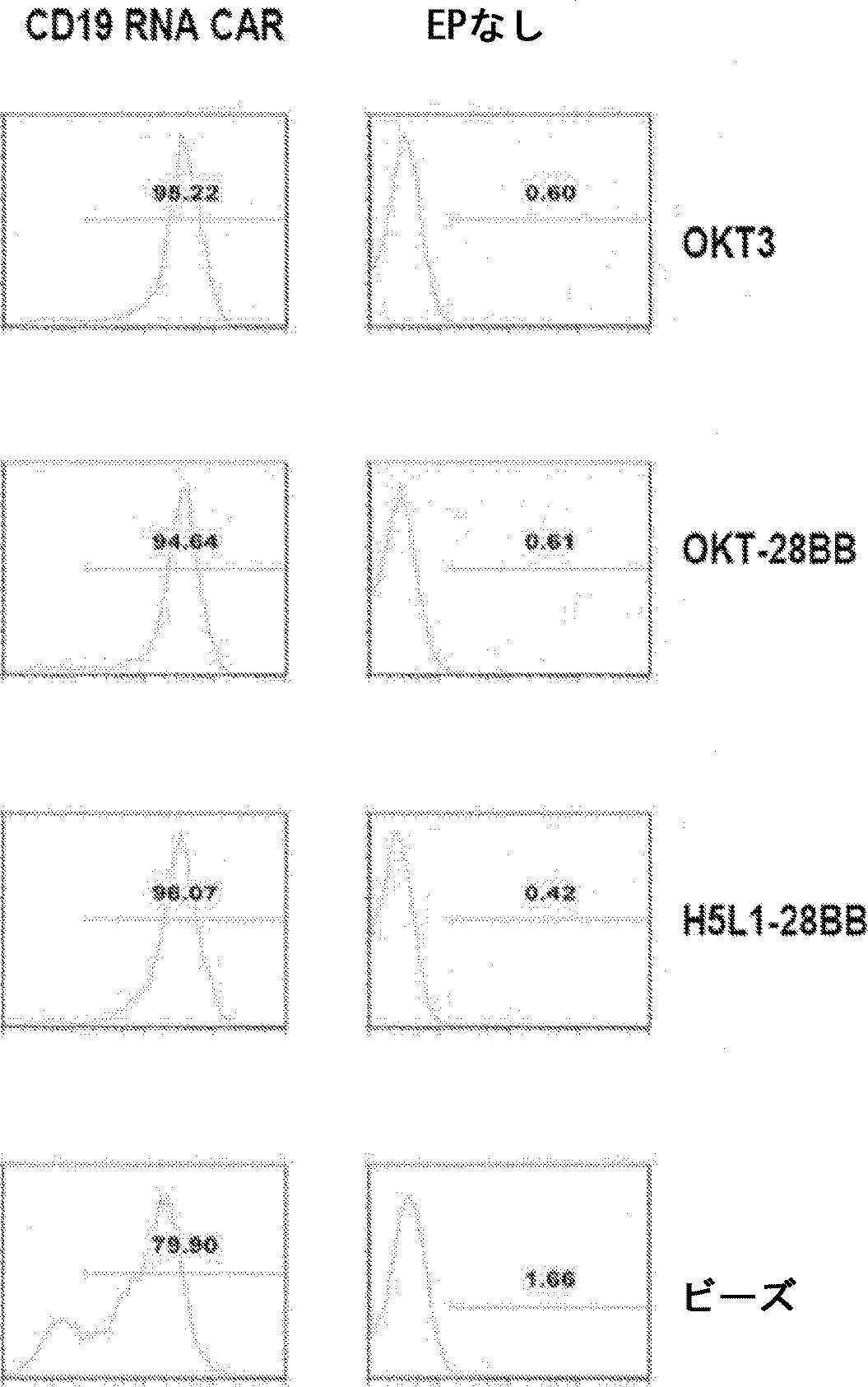
Nalm6-CBG (or Nalm6-CBG transduced with either PDL1 or HVEM) was generated and used in a modified luciferase-based cytotoxic T lymphocyte (CTL) assay as follows. Nalm6-CBG cells were washed and resuspended in R10 medium at 1 × 10 5 cells / ml to give 100 ul of CBG-labeled cells with T cells in various ratios (eg, 30: 1, 15: 1). Incubated overnight at 37 ° C. 100 ul of this mixture was transferred to a 96-well white luminometer plate, 100 ul of substrate was added and luminescence was measured immediately.
本明細書に開示された実験の結果について以下に説明する。 The results of the experiments disclosed herein will be described below.
抗CD3 OKT3抗体によって刺激されたT細胞と同程度に効率的であった、CD3 scFv-28BB RNAを用いたエレクトロポレーションを受けたT細胞の拡大:
CD3に対して方向付けられた抗体(OKT3またはH5L1)由来の一本鎖可変断片(scFv)ドメインを合成し、かつ/またはPCRによって増幅して、CD8膜貫通ドメイン、CD28および4-1BB細胞内シグナル伝達ドメインと連結させて、pGEM.64A RNAベースのベクター中にサブクローニングした(図1)。RNAを改変pGEM.64A構築物(OKT3-28BB RNAまたはH5L1 RNA)から合成し、末梢血単核細胞(PBMC)に対してエレクトロポレーションを行った。2例の正常PBMCドナーから入手したPBMC集団においてT細胞の拡大を評価した。OKT3-28BB RNAエレクトロポレーション後に拡大したPBMCを、抗CD3 OKT3抗体とともにインキュベートしたPBMCと比較した。この結果により、OKT3-28BB RNAエレクトロポレーション後に拡大したT細胞は、OKT3抗体刺激後のT細胞の拡大と同程度に効率的であることが実証された(図2)。
Expansion of electroporated T cells with CD3 scFv-28BB RNA, which was as efficient as T cells stimulated with anti-CD3 OKT3 antibody:
Single-chain variable fragment (scFv) domains derived from antibodies directed against CD3 (OKT3 or H5L1) are synthesized and / or amplified by PCR to transmembrane CD8 domains, CD28 and 4-1BB cells. It was ligated to a signaling domain and subcloned into a pGEM.64A RNA-based vector (Fig. 1). RNA was synthesized from the modified pGEM.64A construct (OKT3-28BB RNA or H5L1 RNA) and electroporated into peripheral blood mononuclear cells (PBMC). T cell expansion was evaluated in PBMC populations obtained from two normal PBMC donors. PBMCs expanded after OKT3-28BB RNA electroporation were compared to PBMCs incubated with anti-CD3 OKT3 antibodies. This result demonstrated that T cells expanded after OKT3-28BB RNA electroporation were as efficient as T cell expansion after OKT3 antibody stimulation (Fig. 2).
CD3 scFv-28BB RNAのエレクトロポレーションを受けたPBMCから拡大したT細胞は、OKT3抗体で刺激されたT細胞と類似の表現型を呈し、かつ、より優れたエフェクター機能を示した:
OKT3によるPBMCの刺激、抗CD3/抗CD28でコーティングしたビーズによる精製されたT細胞の刺激(ビーズ)、またはOKT-28BB RNAもしくはH5L1-28BB RNAのいずれかによってPBMCにエレクトロポレーションを行うことを含む、異なる方法によって拡大したT細胞の表現型を評価した。その結果により、OKT-28BBまたはH5L1-28BBをコードするRNAによるPBMCのエレクトロポレーションによって得られたT細胞の表現型は、OKT3抗体によって刺激したPMBC由来のT細胞のものと類似しており、これにはエフェクターメモリーT細胞(CD45RO+/CD62L-)が多数含まれており、一方、抗CD3/抗CD28ビーズで刺激したT細胞は、均一にセントラルメモリー表現型(CD45RO+/Cd62L+)である表現型を呈した(図3)。
T cells expanded from PBMC electroporated with CD3 scFv-28BB RNA exhibited a phenotype similar to that of OKT3 antibody-stimulated T cells and showed better effector function:
Stimulation of PBMCs with OKT3, stimulation of purified T cells with anti-CD3 / anti-CD28 coated beads (beads), or electroporation of PBMCs with either OKT-28BB RNA or H5L1-28BB RNA. The phenotype of expanded T cells was evaluated, including, by different methods. The results show that the T cell phenotype obtained by electroporation of PBMCs with RNA encoding OKT-28BB or H5L1-28BB is similar to that of PMBC-derived T cells stimulated with OKT3 antibodies. It contains a large number of effector memory T cells (CD45RO + / CD62L-), while T cells stimulated with anti-CD3 / anti-CD28 beads are uniformly central memory phenotype (CD45RO + / Cd62L +). (Fig. 3).
T細胞をさらに、CD19 CARをコードするRNAによるエレクトロポレーション後の機能に関しても評価した。エレクトロポレーションが行われたCD19 CAR RNAの発現は、T細胞集団のそれぞれで同程度であった(図4)。OKT3抗体で刺激したPBMCから得られた、CD19 CAR RNAのエレクトロポレーションを受けたT細胞集団、OKT-28BB RNAのエレクトロポレーションを受けたPBMC、H5L1-28BB RNAのエレクトロポレーションを受けたPBMC、および抗CD3/抗CD28ビーズで刺激したPBMCを、T細胞をCD19陽性腫瘍細胞株Nalm6とコインキュベートした後のCD107aアップレギュレーションに関して評価した(図5Aおよび5B)。その結果により、OKT-28BB RNAのエレクトロポレーションを受けたT細胞におけるCD107a発現は、OKT3抗体または抗CD3/抗CD28ビーズによって刺激したT細胞よりも高度であることが実証された。OKT-28BB RNAのエレクトロポレーションを受けたPBMCから得られたT細胞は、抗腫瘍活性による評価で、OKT3抗体およびCD3/CD28ビーズのいずれで刺激されたT細胞よりも機能が強固であった。 T cells were also evaluated for post-electroporation function by RNA encoding CD19 CAR. The expression of electroporated CD19 CAR RNA was similar in each of the T cell populations (Fig. 4). CD19 CAR RNA electroporated T cell population, OKT-28BB RNA electroporated PBMC, H5L1-28BB RNA electroporated PBMC obtained from OKT3 antibody-stimulated PBMC , And PBMCs stimulated with anti-CD3 / anti-CD28 beads were evaluated for CD107a upregulation after co-incubating T cells with CD19-positive tumor cell line Nalm6 (FIGS. 5A and 5B). The results demonstrated that CD107a expression in electroporated T cells of OKT-28BB RNA was higher than that of T cells stimulated with OKT3 antibody or anti-CD3 / anti-CD28 beads. T cells obtained from PBMC electroporated with OKT-28BB RNA were more functional than T cells stimulated with either OKT3 antibody or CD3 / CD28 beads, as assessed by antitumor activity. ..
共刺激分子、スイッチ受容体およびサイトカインをコードするRNAのコエレクトロポレーションを通じての、拡大したT細胞のさらなる最適化:
RNAエレクトロポレーションによって追加の分子を加えることによって、RNAのエレクトロポレーションを受けたPBMCの拡大を通じて得られたT細胞をさらに強化できるか否かを検討するために、図10に列記した通りに、OKT-28BB RNAを、共刺激分子、スイッチ受容体またはサイトカインをさまざまな組み合わせでコードするRNAと混合した。RNAのエレクトロポレーションを受けたPBMCから得られたT細胞の表現型および機能を、OKT3抗体で刺激したPBMCから得られたT細胞と比較した。表現型分析を図6に示す。OKT-28BB RNAエレクトロポレーションにより得られたT細胞(OKT-28bb-1)は、OKT3抗体刺激により得られたT細胞との比較で、セントラルメモリーT細胞の表現型を呈した。OKT-28BB RNAエレクトロポレーションにより得られたT細胞でのおよそ54.54%に対して、OKT3抗体刺激により得られたT細胞の約25.08%がCCR7/CD62L二重陽性細胞であった。
Further optimization of expanded T cells through co-electroporation of RNA encoding co-stimulatory molecules, switch receptors and cytokines:
To investigate whether the T cells obtained through the expansion of RNA electroporated PBMCs can be further enhanced by adding additional molecules by RNA electroporation, as listed in Figure 10. , OKT-28BB RNA was mixed with RNA encoding costimulatory molecules, switch receptors or cytokines in various combinations. The phenotype and function of T cells obtained from RNA electroporated PBMCs was compared to T cells obtained from PBMCs stimulated with OKT3 antibody. The phenotypic analysis is shown in Figure 6. The T cells (OKT-28bb-1) obtained by OKT-28BB RNA electroporation exhibited the phenotype of central memory T cells in comparison with the T cells obtained by OKT3 antibody stimulation. Approximately 25.08% of T cells obtained by OKT3 antibody stimulation were CCR7 / CD62L double positive cells, as opposed to approximately 54.54% of T cells obtained by OKT-28BB RNA electroporation.
さらに、他のRNAである、プログラム細胞死1(programmed cell death 1:PD1)、CD83、CD86、4-1BBL、PD1-CD28またはIL-21をコードするRNAと、OKT-28BB RNAとのエレクトロポレーションを行ったところ、T細胞拡大が増加した。OKT-28bb-2およびOKT-28bb-6では、T細胞拡大は約64.85%(OKT-28bb-5)から約69.21%(OKT-28bb-3)にさらに増加した。PD1は、OKT-28BB RNAのみのエレクトロポレーションを受けたPBMCから得られたT細胞において有意にアップレギュレートされたが、PD1/CD27二重陽性細胞は、OKT-28BB RNAのエレクトロポレーションを受けたPBMCから得られたT細胞で約32.37%検出されたのに対して、OKT3抗体で刺激したPBMCから得られたT細胞において検出されたPD1/CD27二重陽性細胞は6.24%であった。T細胞拡大段階における他のRNAのコエレクトロポレーションでも、拡大したT細胞集団の一部であるOKT-28bb-6(9.30%)およびOKT-28bb-2(14.08%)ではPD1発現が減少した。 In addition, an electropolog of OKT-28BB RNA and RNA encoding other RNAs, programmed cell death 1: PD1, CD83, CD86, 4-1BBL, PD1-CD28 or IL-21. When ration was performed, T cell enlargement increased. In OKT-28bb-2 and OKT-28bb-6, T cell expansion further increased from about 64.85% (OKT-28bb-5) to about 69.21% (OKT-28bb-3). PD1 was significantly up-regulated in T cells obtained from PBMCs electroporated with OKT-28BB RNA only, whereas PD1 / CD27 double-positive cells electroporated OKT-28BB RNA. Approximately 32.37% of T cells obtained from received PBMCs were detected, whereas 6.24% of PD1 / CD27 double-positive cells were detected in T cells obtained from PBMCs stimulated with OKT3 antibodies. .. Co-electroporation of other RNAs during the T cell expansion stage also reduced PD1 expression in OKT-28bb-6 (9.30%) and OKT-28bb-2 (14.08%), which are part of the expanded T cell population. ..
CD19 CAR RNAを用いたエレクトロポレーションを受け、かつCD19を発現する種々の腫瘍細胞株とともにインキュベートした拡大したT細胞(CD19 CAR T細胞)において、サイトカイン産生として、インターフェロン-γ(図7)およびIL-2(図8)について評価した。他のRNAとのコエレクトロポレーションの結果、種々のCD19腫瘍細胞株とのインキュベーション後のCD19 CAR RNA T細胞から、さまざまなレベルでのIFN-γ分泌が生じた。OKT-28BB RNAを用いたエレクトロポレーションを受けたPBMCから得られたCD19 CAR RNA T細胞からは、OKT3抗体で刺激したPBMCから得られたCD19 CAR RNA T細胞よりも高レベルのIL-2が分泌された。 Interferon-γ (Fig. 7) and IL as cytokine production in enlarged T cells (CD19 CAR T cells) electroporated with CD19 CAR RNA and incubated with various tumor cell lines expressing CD19. -2 (Fig. 8) was evaluated. Co-electroporation with other RNA resulted in varying levels of IFN-γ secretion from CD19 CAR RNA T cells after incubation with various CD19 tumor cell lines. CD19 CAR RNA T cells obtained from PBMC electroporated with OKT-28BB RNA contained higher levels of IL-2 than CD19 CAR RNA T cells obtained from PBMC stimulated with OKT3 antibody. It was secreted.
CD19 CAR RNA T細胞の溶解能力も測定した。CD19 CAR RNA T細胞を、CD19陽性細胞株である、Nalm6、およびPLL1またはHVEMを形質導入したNalm6とともにインキュベートした。溶解活性は、いくつかのCD19 CAR RNA T細胞、特にOKT-288bb-2およびOKT-28bb-4で低下した(図9)。対照的に、CD19 CAR RNAのエレクトロポレーションを受けたOKT-28bb-1およびOKT-28bb-3 T細胞における溶解活性は、PBMCのOKT3抗体刺激によって得られたCD19 CAR RNA T細胞と同程度に良好であった。OKT-28BB RNAエレクトロポレーションによって拡大されたCD19 CAR RNA T細胞からはより多くのセントラルメモリーT細胞が生じたものの、それらが腫瘍細胞を死滅させる能力は、主にエフェクターメモリー細胞である、OKT3抗体で刺激されたT細胞と同程度に効率的であった(図10)。 The lytic capacity of CD19 CAR RNA T cells was also measured. CD19 CAR RNA T cells were incubated with the CD19 positive cell line, Nalm6, and Nalm6 transduced with PLL1 or HVEM. The lytic activity was reduced in some CD19 CAR RNA T cells, especially OKT-288bb-2 and OKT-28bb-4 (Fig. 9). In contrast, the lytic activity of CD19 CAR RNA in electroporated OKT-28bb-1 and OKT-28bb-3 T cells was comparable to that of CD19 CAR RNA T cells obtained by PBMC stimulation with OKT3 antibody. It was good. Although more central memory T cells were generated from CD19 CAR RNA T cells expanded by OKT-28BB RNA electroporation, their ability to kill tumor cells is primarily effector memory cells, the OKT3 antibody. It was as efficient as T cells stimulated with (Fig. 10).
概念実証として、NSGマウスに対して、1E6 Nalm6-ESO-CBGを第0日に注射した(静脈内)。第7日の時点で、NY-ESO-T TCR(1G4 TCR)RNAのエレクトロポレーションを受けたOKT3-28BB RNA T細胞(RNA-T)またはCD3/CD28ビーズT細胞(ビーズ)を1×106個、注射した(静脈内)。腫瘍量を生物発光イメージングによってモニターした。図11は、TCRが移入されたRNA-T細胞において、ビーズで刺激されたT細胞よりも優れた腫瘍抑制が観察されたことを示している。
As a proof of concept, NSG mice were injected with 1E6 Nalm6-ESO-CBG on day 0 (intravenous). As of
RNA-T細胞へのレンチウイルス形質導入の効率を検討するために、第1日または第2日のRNA T細胞を採取して、1.5×10⁶個/mlの細胞密度で、24ウェルプレートに、0.5ml、1mlまたは2ml/ウェルとして分注した。0.1mlの濃縮4D5.BBZレンチウイルスベクター(力価5×106/ml)を各ウェルに添加した。対照として、4D5.BBZレンチウイルスベクターを、CD3/CD28ビーズで刺激した第1日または第2日のT細胞に指定通りの感染多重度(MOI)で添加した。刺激後の第9日に、拡大したT細胞を、形質導入されたCAR発現の検出のためのフローサイトメトリー染色に供した(図12)。
To examine the efficiency of lentiviral transduction into RNA-T cells,
図13に示す結果は、レンチウイルス形質導入を受けたRNA T細胞および非形質導入RNA T細胞がいずれも、CD3/CD28ビーズで刺激したT細胞と同程度に効率的に拡大したことを指し示している。 The results shown in FIG. 13 indicate that both lentiviral transduced RNA T cells and non-transduced RNA T cells expanded as efficiently as CD3 / CD28 bead-stimulated T cells. There is.
レンチウイルス形質導入を受けたRNA T細胞、またはビーズで刺激したT細胞を、続いて、Her2陽性細胞株であるSK-OV3、MCF7およびMDA231、またはHer2陰性腫瘍株であるMDA468によって4時間刺激して、CD107a発現をフローサイトメトリーによって検出した。図14を参照されたい。 RNA T cells transduced with lentivirus, or bead-stimulated T cells, were subsequently stimulated with the Her2-positive cell lines SK-OV3, MCF7 and MDA231, or the Her2-negative tumor line MDA468 for 4 hours. CD107a expression was detected by flow cytometry. See Figure 14.
レンチウイルス形質導入を受けたRNA-T細胞におけるサイトカイン産生を、ビーズで刺激したT細胞と比較した。レンチウイルス形質導入を受けたRNA T細胞、またはビーズで刺激したT細胞を、Her2陽性細胞株であるSK-OV3、MCF7およびMDA231、またはHer2陰性腫瘍株であるMDA468によって4時間刺激した。一晩のインキュベーション後にサイトカインレベルをELISAによって分析したところ、レンチウイルス形質導入を受けたRNA T細胞は、ビーズで刺激したT細胞よりも多くのIL-2およびIFN-γを産生した(図15)。 Cytokine production in lentivirus transduced RNA-T cells was compared to bead-stimulated T cells. Lentivirus transduced RNA T cells, or bead-stimulated T cells, were stimulated with the Her2-positive cell lines SK-OV3, MCF7 and MDA231, or the Her2-negative tumor line MDA468 for 4 hours. Cytokine levels were analyzed by ELISA after overnight incubation and lentivirus transduced RNA T cells produced more IL-2 and IFN-γ than bead-stimulated T cells (Fig. 15). ..
本明細書に引用された特許、特許出願および刊行物のそれぞれおよびすべての開示内容は、その全体が参照により本明細書に組み入れられる。具体的な態様を参照しながら本発明を開示してきたが、本発明の真の趣旨および範囲を逸脱することなく、本発明の他の態様および変形物も当業者によって考案されうることは明らかである。添付された特許請求の範囲は、そのようなすべての態様および等価な変形物を含むことを意図している。 Each and all disclosures of patents, patent applications and publications cited herein are incorporated herein by reference in their entirety. Although the present invention has been disclosed with reference to specific embodiments, it is clear that other embodiments and variants of the invention may be devised by those skilled in the art without departing from the true spirit and scope of the invention. is there. The appended claims are intended to include all such embodiments and equivalent variants.
Claims (21)
該エレクトロポレーションを受けた細胞の集団を培養する段階であって、その中に含まれるT細胞が少なくとも10倍に拡大する、該段階
を含む、T細胞の集団を拡大するための方法。 At the stage of electroporation of a population of cells containing T cells using an mRNA encoding a chimeric membrane protein, the chimeric membrane protein has an intracellular domain and at least CD3, CD28, or T cell acceptance. Includes an extracellular domain comprising an antigen-binding domain containing an antibody against the body (TCR) or a fragment thereof, the intracellular domain comprising a CD28 intracellular signaling domain and a 4-1BB intracellular signaling domain, wherein the mRNA Introduced into at least one of the cells in the population and expressed on the surface of at least one cell in the population, thereby obtaining a population of cells that have undergone the electroporation; A method for expanding a population of T cells, which comprises a stage of culturing a population of cells subjected to the electroporation, wherein the T cells contained therein are expanded at least 10 times.
方法が、T細胞を刺激する作用物質をコードするmRNAを、拡大したT細胞の集団中にエレクトロポレーションする段階をさらに含み、
方法が、T細胞を刺激する作用物質をコードするmRNAを、キメラ膜タンパク質をコードするmRNAと共にコエレクトロポレーションする段階をさらに含み、
方法が、拡大したT細胞の集団を、CD27、CD28、CD83、CD86、CD127、4-1BBL、 IL2、IL21、IL-15、IL-7、PD1-CD28、およびPD1からなる群より選択される少なくとも1つの分子またはサイトカインによって刺激する段階をさらに含む、かつ/または
方法が、培養したT細胞を凍結保存する段階をさらに含む、
請求項1〜9のいずれか一項記載の方法。 T cells expand in the range of about 20 to about 50 times,
The method further comprises the step of electroporating mRNA encoding an agent that stimulates T cells into an expanded population of T cells.
The method further comprises the step of co-electroporating the mRNA encoding the agent that stimulates T cells with the mRNA encoding the chimeric membrane protein.
The method selects an expanded T cell population from the group consisting of CD27, CD28, CD83, CD86, CD127, 4-1BBL, IL2, IL21, IL-15, IL-7, PD1-CD28, and PD1. It further comprises the step of stimulating with at least one molecule or cytokine, and / or the method further comprises the step of cryopreserving the cultured T cells.
The method according to any one of claims 1 to 9.
エレクトロポレーションを受けた細胞の集団を培養する段階であって、その中に含まれるT細胞が少なくとも10倍に拡大する、該段階
を含む、エレクトロポレーションを受けたT細胞の集団を拡大するための方法。 At the stage of electroporation of a population of cells including T cells using mRNA encoding a chimeric membrane protein, the chimeric membrane protein has an intracellular domain and a single-stranded variable fragment (scFv) for CD3. ), The intracellular domain comprises a CD28 intracellular signaling domain and a 4-1BB intracellular signaling domain , and the mRNA is introduced into at least one of the cells in the population and within the population. Expressed on the surface of at least one cell of a cell, thereby obtaining a population of the electroporated cells; as well as a stage of culturing the population of electroporated cells. A method for expanding a population of electroporated T cells, including the step, in which the T cells contained therein expand at least 10-fold.
該キメラ膜タンパク質が、細胞内ドメインと、CD3に対する一本鎖可変断片(scFv)とを含み、ならびに
該細胞内ドメインが、CD28細胞内シグナル伝達ドメインおよび4-1BB細胞内シグナル伝達ドメインを含む、
キメラ膜タンパク質をコードするエレクトロポレーションされたmRNAを含むT細胞。 T cells containing electroporated mRNA encoding a chimeric membrane protein,
The chimeric membrane protein comprises an intracellular domain and a single-stranded variable fragment (scFv) for CD3, and the intracellular domain comprises a CD28 intracellular signaling domain and a 4-1BB intracellular signaling domain.
T cells containing electroporated mRNA encoding a chimeric membrane protein.
該キメラ膜タンパク質が、細胞内ドメインと、少なくともCD3、CD28、もしくはT細胞受容体(TCR)に対する抗体またはその断片を含む抗原結合ドメインを含む細胞外ドメインとを含み、ならびに
該細胞内ドメインが、CD28細胞内シグナル伝達ドメインおよび4-1BB細胞内シグナル伝達ドメインを含む、
エレクトロポレーションを受けたT細胞の集団。 A population of electroporated T cells containing electroporated mRNA encoding a chimeric membrane protein.
The chimeric membrane protein comprises an intracellular domain and an extracellular domain containing at least an antigen-binding domain containing an antibody against the CD3, CD28, or T cell receptor (TCR) or a fragment thereof, and the intracellular domain is: CD28 contains intracellular signaling domain and 4-1BB intracellular signaling domain ,
A population of electroporated T cells.
該拡大した細胞の集団が、
キメラ膜タンパク質をコードするmRNAを用いて、T細胞を含む細胞の集団にエレクトロポレーションを行う段階であって、該キメラ膜タンパク質が、細胞内ドメインと、CD3に対する一本鎖可変断片(scFv)とを含み、該細胞内ドメインが、CD28細胞内シグナル伝達ドメインおよび4-1BB細胞内シグナル伝達ドメインを含み、かつ該集団内の細胞のうちの少なくとも1つがキメラ膜タンパク質を発現する、該段階;ならびに
該細胞集団を培養する段階であって、その中に含まれるT細胞が少なくとも10倍に拡大する、該段階
を含む方法によって拡大されている、薬学的組成物。 A pharmaceutical composition for preventing or treating an immune response in adoptive cell transfer therapy, comprising an expanded population of cells, including T cells.
The expanded population of cells
At the stage of electroporation of a population of cells including T cells using an mRNA encoding a chimeric membrane protein, the chimeric membrane protein has an intracellular domain and a single-stranded variable fragment (scFv) for CD3. The stage in which the intracellular domain comprises the CD28 intracellular signaling domain and the 4-1BB intracellular signaling domain, and at least one of the cells in the population expresses a chimeric membrane protein; Also, a pharmaceutical composition in which the T cells contained therein are expanded at least 10-fold by a method comprising the stage of culturing the cell population.
該拡大した細胞の集団が、
キメラ膜タンパク質をコードするmRNAを用いて、T細胞を含む細胞の集団にエレクトロポレーションを行う段階であって、該キメラ膜タンパク質が、細胞内ドメインと、CD3に対する一本鎖可変断片(scFv)とを含み、該細胞内ドメインが、CD28細胞内シグナル伝達ドメインおよび4-1BB細胞内シグナル伝達ドメインを含み、かつ該集団内の細胞のうちの少なくとも1つがキメラ膜タンパク質を発現する、該段階;ならびに
該集団を培養する段階であって、その中に含まれるT細胞が少なくとも10倍に拡大する、該段階
を含む方法によって拡大されている、薬学的組成物。 A pharmaceutical composition for treating a disease or condition associated with hyperimmunity in a subject, comprising an expanded population of cells, including T cells.
The expanded population of cells
At the stage of electroporation of a population of cells including T cells using an mRNA encoding a chimeric membrane protein, the chimeric membrane protein has an intracellular domain and a single-stranded variable fragment (scFv) for CD3. The stage in which the intracellular domain comprises the CD28 intracellular signaling domain and the 4-1BB intracellular signaling domain, and at least one of the cells in the population expresses a chimeric membrane protein; Also, a pharmaceutical composition in which the T cells contained therein are expanded by a method comprising the stage, at the stage of culturing the population, at least 10-fold.
Applications Claiming Priority (3)
| Application Number | Priority Date | Filing Date | Title |
|---|---|---|---|
| US201462073268P | 2014-10-31 | 2014-10-31 | |
| US62/073,268 | 2014-10-31 | ||
| PCT/US2015/058228 WO2016069993A1 (en) | 2014-10-31 | 2015-10-30 | Compositions and methods of stimulating and expanding t cells |
Publications (3)
| Publication Number | Publication Date |
|---|---|
| JP2017533707A JP2017533707A (en) | 2017-11-16 |
| JP2017533707A5 JP2017533707A5 (en) | 2018-12-06 |
| JP6884697B2 true JP6884697B2 (en) | 2021-06-09 |
Family
ID=55858377
Family Applications (1)
| Application Number | Title | Priority Date | Filing Date |
|---|---|---|---|
| JP2017523289A Active JP6884697B2 (en) | 2014-10-31 | 2015-10-30 | Compositions and Methods for Stimulating and Expanding T Cells |
Country Status (9)
| Country | Link |
|---|---|
| US (2) | US11471487B2 (en) |
| EP (1) | EP3217989B1 (en) |
| JP (1) | JP6884697B2 (en) |
| KR (2) | KR102583138B1 (en) |
| CN (1) | CN107106609A (en) |
| AU (1) | AU2015339106B2 (en) |
| CA (1) | CA2966035A1 (en) |
| ES (1) | ES2910227T3 (en) |
| WO (1) | WO2016069993A1 (en) |
Families Citing this family (13)
| Publication number | Priority date | Publication date | Assignee | Title |
|---|---|---|---|---|
| WO2018120843A1 (en) * | 2016-12-30 | 2018-07-05 | 上海近岸生物科技有限公司 | Trifunctional molecule and application thereof |
| EP3575319A4 (en) | 2016-12-30 | 2021-03-10 | Shanghai Sinobio Biotech Co., Ltd. | Bifunctional molecule and use thereof |
| KR102460173B1 (en) * | 2017-05-26 | 2022-10-31 | 주식회사 지씨셀 | Culturing method of natural killer cells using transformed T cells |
| CN115216450A (en) | 2017-09-01 | 2022-10-21 | 隆萨沃克斯维尔股份有限公司 | End-to-end cell therapy automation |
| WO2020061696A1 (en) | 2018-09-28 | 2020-04-02 | Octane Biotech Inc. | Magnetic separation |
| CA3120085A1 (en) | 2018-11-14 | 2020-05-22 | Green Cross Lab Cell Corporation | Method for culturing cord blood-derived natural killer cells using transformed t-cells |
| IL284214B2 (en) | 2018-12-21 | 2025-03-01 | Octane Biotech Inc | Carousel for modular biological production units |
| US11718833B2 (en) | 2018-12-21 | 2023-08-08 | Lonza Walkersville, Inc. | Automated production of viral vectors |
| US11773365B2 (en) | 2019-02-08 | 2023-10-03 | Lonza Walkersville, Inc. | Cell concentration methods and devices for use in automated bioreactors |
| EP4048773A4 (en) | 2019-10-24 | 2024-01-03 | Octane Biotech Inc. | Cell culture chamber with improved cell-contacting surfaces |
| EP4058563A4 (en) | 2019-11-11 | 2023-12-06 | Lonza Walkersville, Inc. | Quality control methods for automated cell processing |
| CN115003386A (en) * | 2019-11-27 | 2022-09-02 | 宾夕法尼亚大学董事会 | Artificial antigen presenting cell producing anti-CD 3 SCFV and cytokine |
| CN114606263B (en) * | 2022-05-11 | 2022-09-06 | 上海优替济生生物医药有限公司 | Isolated nucleic acid molecules and uses thereof |
Family Cites Families (59)
| Publication number | Priority date | Publication date | Assignee | Title |
|---|---|---|---|---|
| FR901228A (en) | 1943-01-16 | 1945-07-20 | Deutsche Edelstahlwerke Ag | Ring gap magnet system |
| US4444887A (en) | 1979-12-10 | 1984-04-24 | Sloan-Kettering Institute | Process for making human antibody producing B-lymphocytes |
| US4716111A (en) | 1982-08-11 | 1987-12-29 | Trustees Of Boston University | Process for producing human antibodies |
| US4816567A (en) | 1983-04-08 | 1989-03-28 | Genentech, Inc. | Recombinant immunoglobin preparations |
| US4694778A (en) | 1984-05-04 | 1987-09-22 | Anicon, Inc. | Chemical vapor deposition wafer boat |
| US6548640B1 (en) | 1986-03-27 | 2003-04-15 | Btg International Limited | Altered antibodies |
| US5225539A (en) | 1986-03-27 | 1993-07-06 | Medical Research Council | Recombinant altered antibodies and methods of making altered antibodies |
| GB8607679D0 (en) | 1986-03-27 | 1986-04-30 | Winter G P | Recombinant dna product |
| US5567610A (en) | 1986-09-04 | 1996-10-22 | Bioinvent International Ab | Method of producing human monoclonal antibodies and kit therefor |
| US5530101A (en) | 1988-12-28 | 1996-06-25 | Protein Design Labs, Inc. | Humanized immunoglobulins |
| US5413923A (en) | 1989-07-25 | 1995-05-09 | Cell Genesys, Inc. | Homologous recombination for universal donor cells and chimeric mammalian hosts |
| US5585362A (en) | 1989-08-22 | 1996-12-17 | The Regents Of The University Of Michigan | Adenovirus vectors for gene therapy |
| GB8928874D0 (en) | 1989-12-21 | 1990-02-28 | Celltech Ltd | Humanised antibodies |
| DK0463151T3 (en) | 1990-01-12 | 1996-07-01 | Cell Genesys Inc | Generation of xenogenic antibodies |
| US5229275A (en) | 1990-04-26 | 1993-07-20 | Akzo N.V. | In-vitro method for producing antigen-specific human monoclonal antibodies |
| US5661016A (en) | 1990-08-29 | 1997-08-26 | Genpharm International Inc. | Transgenic non-human animals capable of producing heterologous antibodies of various isotypes |
| JP2938569B2 (en) | 1990-08-29 | 1999-08-23 | ジェンファーム インターナショナル,インコーポレイティド | Method for producing xenogeneic immunoglobulin and transgenic mouse |
| US5633425A (en) | 1990-08-29 | 1997-05-27 | Genpharm International, Inc. | Transgenic non-human animals capable of producing heterologous antibodies |
| US5545806A (en) | 1990-08-29 | 1996-08-13 | Genpharm International, Inc. | Ransgenic non-human animals for producing heterologous antibodies |
| US5814318A (en) | 1990-08-29 | 1998-09-29 | Genpharm International Inc. | Transgenic non-human animals for producing heterologous antibodies |
| US5625126A (en) | 1990-08-29 | 1997-04-29 | Genpharm International, Inc. | Transgenic non-human animals for producing heterologous antibodies |
| EP0519596B1 (en) | 1991-05-17 | 2005-02-23 | Merck & Co. Inc. | A method for reducing the immunogenicity of antibody variable domains |
| US5199942A (en) | 1991-06-07 | 1993-04-06 | Immunex Corporation | Method for improving autologous transplantation |
| ES2136092T3 (en) | 1991-09-23 | 1999-11-16 | Medical Res Council | PROCEDURES FOR THE PRODUCTION OF HUMANIZED ANTIBODIES. |
| GB9125768D0 (en) | 1991-12-04 | 1992-02-05 | Hale Geoffrey | Therapeutic method |
| US5573905A (en) | 1992-03-30 | 1996-11-12 | The Scripps Research Institute | Encoded combinatorial chemical libraries |
| US5350674A (en) | 1992-09-04 | 1994-09-27 | Becton, Dickinson And Company | Intrinsic factor - horse peroxidase conjugates and a method for increasing the stability thereof |
| US5639641A (en) | 1992-09-09 | 1997-06-17 | Immunogen Inc. | Resurfacing of rodent antibodies |
| US5993434A (en) | 1993-04-01 | 1999-11-30 | Genetronics, Inc. | Method of treatment using electroporation mediated delivery of drugs and genes |
| DE69433970T2 (en) | 1993-08-10 | 2005-08-11 | W.L. Gore & Associates, Inc., Newark | cell encapsulation |
| DE69637481T2 (en) | 1995-04-27 | 2009-04-09 | Amgen Fremont Inc. | Human antibodies to IL-8 derived from immunized Xenomae |
| AU2466895A (en) | 1995-04-28 | 1996-11-18 | Abgenix, Inc. | Human antibodies derived from immunized xenomice |
| CA2190628C (en) | 1995-06-07 | 2000-05-30 | Mark D. Butler | An implantable containment apparatus for a therapeutical device and method for loading and reloading the device therein |
| US5626561A (en) | 1995-06-07 | 1997-05-06 | Gore Hybrid Technologies, Inc. | Implantable containment apparatus for a therapeutical device and method for loading and reloading the device therein |
| AU6854696A (en) | 1995-09-22 | 1997-04-09 | Gore Hybrid Technologies, Inc. | Improved cell encapsulation device |
| US5916771A (en) | 1996-10-11 | 1999-06-29 | Abgenix, Inc. | Production of a multimeric protein by cell fusion method |
| CA2273194C (en) | 1996-12-03 | 2011-02-01 | Abgenix, Inc. | Transgenic mammals having human ig loci including plural vh and vk regions and antibodies produced therefrom |
| US6261281B1 (en) | 1997-04-03 | 2001-07-17 | Electrofect As | Method for genetic immunization and introduction of molecules into skeletal muscle and immune cells |
| PT970126E (en) | 1997-04-14 | 2001-10-30 | Micromet Ag | A NEW METHOD FOR THE PRODUCTION OF ANTI-HUMAN ANTIGEN RECEPTORS AND THEIR USES |
| US6235883B1 (en) | 1997-05-05 | 2001-05-22 | Abgenix, Inc. | Human monoclonal antibodies to epidermal growth factor receptor |
| US6055453A (en) | 1997-08-01 | 2000-04-25 | Genetronics, Inc. | Apparatus for addressing needle array electrodes for electroporation therapy |
| US6241701B1 (en) | 1997-08-01 | 2001-06-05 | Genetronics, Inc. | Apparatus for electroporation mediated delivery of drugs and genes |
| US6678556B1 (en) | 1998-07-13 | 2004-01-13 | Genetronics, Inc. | Electrical field therapy with reduced histopathological change in muscle |
| US7171264B1 (en) | 1999-05-10 | 2007-01-30 | Genetronics, Inc. | Intradermal delivery of active agents by needle-free injection and electroporation |
| JP4987205B2 (en) | 2000-03-03 | 2012-07-25 | ジェネトロニクス, インコーポレイテッド | Nucleic acid preparations for gene delivery and methods of use |
| US8209006B2 (en) | 2002-03-07 | 2012-06-26 | Vgx Pharmaceuticals, Inc. | Constant current electroporation device and methods of use |
| US20040014645A1 (en) | 2002-05-28 | 2004-01-22 | Advisys, Inc. | Increased delivery of a nucleic acid construct in vivo by the poly-L-glutamate ("PLG") system |
| US7328064B2 (en) | 2002-07-04 | 2008-02-05 | Inovio As | Electroporation device and injection apparatus |
| US20050070841A1 (en) | 2002-07-04 | 2005-03-31 | Inovio As | Electroporation device and injection apparatus |
| WO2005118788A2 (en) * | 2004-05-27 | 2005-12-15 | The Trustees Of The University Of Pennsylvania | Novel artificial antigen presenting cells and uses therefor |
| AU2006342101A1 (en) | 2005-12-07 | 2007-10-25 | Genetronics, Inc | Variable volume electroporation chamber and methods therefore |
| TW201008580A (en) | 2008-06-03 | 2010-03-01 | Abbott Lab | Dual variable domain immunoglobulin and uses thereof |
| UY32979A (en) | 2009-10-28 | 2011-02-28 | Abbott Lab | IMMUNOGLOBULINS WITH DUAL VARIABLE DOMAIN AND USES OF THE SAME |
| EP2606124A1 (en) * | 2010-08-18 | 2013-06-26 | The U.S.A. as represented by the Secretary, Department of Health and Human Services | Methods of identifying central memory t cells and obtaining antigen-specific t cell populations |
| PH12013501201A1 (en) | 2010-12-09 | 2013-07-29 | Univ Pennsylvania | Use of chimeric antigen receptor-modified t cells to treat cancer |
| JP6850528B2 (en) | 2012-02-13 | 2021-03-31 | シアトル チルドレンズ ホスピタル ドゥーイング ビジネス アズ シアトル チルドレンズ リサーチ インスティテュート | Bispecific chimeric antigen receptor and its therapeutic use |
| WO2013169691A1 (en) * | 2012-05-07 | 2013-11-14 | Trustees Of Dartmouth College | Anti-b7-h6 antibody, fusion proteins, and methods of using the same |
| US10316289B2 (en) * | 2012-09-06 | 2019-06-11 | The United States Of America, As Represented By The Secretary, Department Of Health And Human Services | Methods of producing T memory stem cell populations |
| US10117896B2 (en) | 2012-10-05 | 2018-11-06 | The Trustees Of The University Of Pennsylvania | Use of a trans-signaling approach in chimeric antigen receptors |
-
2015
- 2015-10-30 JP JP2017523289A patent/JP6884697B2/en active Active
- 2015-10-30 CN CN201580071600.XA patent/CN107106609A/en active Pending
- 2015-10-30 ES ES15855976T patent/ES2910227T3/en active Active
- 2015-10-30 CA CA2966035A patent/CA2966035A1/en active Pending
- 2015-10-30 AU AU2015339106A patent/AU2015339106B2/en active Active
- 2015-10-30 KR KR1020177014806A patent/KR102583138B1/en active Active
- 2015-10-30 EP EP15855976.5A patent/EP3217989B1/en active Active
- 2015-10-30 WO PCT/US2015/058228 patent/WO2016069993A1/en not_active Ceased
- 2015-10-30 US US15/521,741 patent/US11471487B2/en active Active
- 2015-10-30 KR KR1020237032483A patent/KR20230141922A/en not_active Ceased
-
2022
- 2022-09-14 US US17/932,188 patent/US20230110342A1/en active Pending
Also Published As
| Publication number | Publication date |
|---|---|
| US20230110342A1 (en) | 2023-04-13 |
| ES2910227T3 (en) | 2022-05-12 |
| WO2016069993A1 (en) | 2016-05-06 |
| EP3217989B1 (en) | 2022-01-05 |
| AU2015339106A1 (en) | 2017-05-18 |
| HK1243334A1 (en) | 2018-07-13 |
| KR102583138B1 (en) | 2023-09-26 |
| KR20170075792A (en) | 2017-07-03 |
| CN107106609A (en) | 2017-08-29 |
| CA2966035A1 (en) | 2016-05-06 |
| AU2015339106B2 (en) | 2020-07-02 |
| KR20230141922A (en) | 2023-10-10 |
| EP3217989A4 (en) | 2018-06-13 |
| JP2017533707A (en) | 2017-11-16 |
| EP3217989A1 (en) | 2017-09-20 |
| US20170258836A1 (en) | 2017-09-14 |
| US11471487B2 (en) | 2022-10-18 |
Similar Documents
| Publication | Publication Date | Title |
|---|---|---|
| US12215137B2 (en) | Compositions and methods for T cell delivery of therapeutic molecules | |
| JP6884697B2 (en) | Compositions and Methods for Stimulating and Expanding T Cells | |
| US20250026824A1 (en) | Human alpha-folate receptor chimeric antigen receptor | |
| EP3212225B1 (en) | Methods and compositions for modified t cells | |
| US20220184129A1 (en) | Compositions and Methods Comprising a High Affinity Chimeric Antigen Receptor (CAR) with Cross-Reactivity to Clinically-Relevant EGFR Mutated Proteins | |
| HK1243334B (en) | Compositions and methods of stimulating and expanding t cells | |
| HK1247957B (en) | Compositions and methods for t cell delivery of therapeutic molecules |
Legal Events
| Date | Code | Title | Description |
|---|---|---|---|
| A521 | Request for written amendment filed |
Free format text: JAPANESE INTERMEDIATE CODE: A523 Effective date: 20170619 |
|
| A521 | Request for written amendment filed |
Free format text: JAPANESE INTERMEDIATE CODE: A523 Effective date: 20181023 |
|
| A621 | Written request for application examination |
Free format text: JAPANESE INTERMEDIATE CODE: A621 Effective date: 20181023 |
|
| A131 | Notification of reasons for refusal |
Free format text: JAPANESE INTERMEDIATE CODE: A131 Effective date: 20191009 |
|
| A601 | Written request for extension of time |
Free format text: JAPANESE INTERMEDIATE CODE: A601 Effective date: 20200107 |
|
| A521 | Request for written amendment filed |
Free format text: JAPANESE INTERMEDIATE CODE: A523 Effective date: 20200406 |
|
| A131 | Notification of reasons for refusal |
Free format text: JAPANESE INTERMEDIATE CODE: A131 Effective date: 20200916 |
|
| A521 | Request for written amendment filed |
Free format text: JAPANESE INTERMEDIATE CODE: A523 Effective date: 20201105 |
|
| RD04 | Notification of resignation of power of attorney |
Free format text: JAPANESE INTERMEDIATE CODE: A7424 Effective date: 20210106 |
|
| TRDD | Decision of grant or rejection written | ||
| A01 | Written decision to grant a patent or to grant a registration (utility model) |
Free format text: JAPANESE INTERMEDIATE CODE: A01 Effective date: 20210401 |
|
| A601 | Written request for extension of time |
Free format text: JAPANESE INTERMEDIATE CODE: A601 Effective date: 20210430 |
|
| A61 | First payment of annual fees (during grant procedure) |
Free format text: JAPANESE INTERMEDIATE CODE: A61 Effective date: 20210512 |
|
| R150 | Certificate of patent or registration of utility model |
Ref document number: 6884697 Country of ref document: JP Free format text: JAPANESE INTERMEDIATE CODE: R150 |
|
| R250 | Receipt of annual fees |
Free format text: JAPANESE INTERMEDIATE CODE: R250 |
|
| R250 | Receipt of annual fees |
Free format text: JAPANESE INTERMEDIATE CODE: R250 |