JP4452441B2 - Novel peptides as NS3-serine protease inhibitors of hepatitis C virus - Google Patents
Novel peptides as NS3-serine protease inhibitors of hepatitis C virus Download PDFInfo
- Publication number
- JP4452441B2 JP4452441B2 JP2002514094A JP2002514094A JP4452441B2 JP 4452441 B2 JP4452441 B2 JP 4452441B2 JP 2002514094 A JP2002514094 A JP 2002514094A JP 2002514094 A JP2002514094 A JP 2002514094A JP 4452441 B2 JP4452441 B2 JP 4452441B2
- Authority
- JP
- Japan
- Prior art keywords
- compound
- mmol
- embedded image
- solution
- added
- Prior art date
- Legal status (The legal status is an assumption and is not a legal conclusion. Google has not performed a legal analysis and makes no representation as to the accuracy of the status listed.)
- Expired - Fee Related
Links
- 0 CC(**NC(*)C(NC(*)C(N(C[C@@](C1)OI)[C@@]1C(NC1(C(*)C1)C(*)=O)=O)=O)=O)=O Chemical compound CC(**NC(*)C(NC(*)C(N(C[C@@](C1)OI)[C@@]1C(NC1(C(*)C1)C(*)=O)=O)=O)=O)=O 0.000 description 3
- XDTMQSROBMDMFD-UHFFFAOYSA-N C1CCCCC1 Chemical compound C1CCCCC1 XDTMQSROBMDMFD-UHFFFAOYSA-N 0.000 description 1
- KECDLRNLYMUDLX-ZETCQYMHSA-N CC(C)(C)OC(N(C)[C@@H](CSC)C(O)=O)=O Chemical compound CC(C)(C)OC(N(C)[C@@H](CSC)C(O)=O)=O KECDLRNLYMUDLX-ZETCQYMHSA-N 0.000 description 1
- URCKDHNCWPVTME-ZEZDXWPOSA-N CC(C)(C)OC(N[C@@H](C1CCCCC1)C(N[C@@H](Cc1c(CCCC2)c2ccc1)C(NCC(C(NCC(N[C@@H](C=C)C(O)=O)=O)=O)=O)=O)=O)=O Chemical compound CC(C)(C)OC(N[C@@H](C1CCCCC1)C(N[C@@H](Cc1c(CCCC2)c2ccc1)C(NCC(C(NCC(N[C@@H](C=C)C(O)=O)=O)=O)=O)=O)=O)=O URCKDHNCWPVTME-ZEZDXWPOSA-N 0.000 description 1
- ATQIXEOBPXYTBW-UHFFFAOYSA-N CCCC(C(C(CCCCC(O)O)=O)O)NC(OC(C)(C)C)=O Chemical compound CCCC(C(C(CCCCC(O)O)=O)O)NC(OC(C)(C)C)=O ATQIXEOBPXYTBW-UHFFFAOYSA-N 0.000 description 1
- MDBFVMRVMKNJEU-UHFFFAOYSA-N CCCC(C(C(NCC(NC(C(N(C)C)=O)c1ccccc1)O)=O)O)NC(OC(C)(C)C)=O Chemical compound CCCC(C(C(NCC(NC(C(N(C)C)=O)c1ccccc1)O)=O)O)NC(OC(C)(C)C)=O MDBFVMRVMKNJEU-UHFFFAOYSA-N 0.000 description 1
- GUVZSIJPRZNOLI-UHFFFAOYSA-N CCCC(C(C(NCC(NC(C(N)=O)c1ccccc1)=O)=O)=O)NC(C(CS(CCc1ccccc1)(=O)=O)NC(CN/C(/c(cccc1)c1C(O)=O)=[O]\C1CCCCC1)=O)=O Chemical compound CCCC(C(C(NCC(NC(C(N)=O)c1ccccc1)=O)=O)=O)NC(C(CS(CCc1ccccc1)(=O)=O)NC(CN/C(/c(cccc1)c1C(O)=O)=[O]\C1CCCCC1)=O)=O GUVZSIJPRZNOLI-UHFFFAOYSA-N 0.000 description 1
- NUPDLSKAJVYBGD-GNYUHXRHSA-N CCCC(C(C(NCC(NC(C(O)=O)c1ccccc1)=O)=O)=O)NC([C@@](C1)([C@@H]1C(C)C)NC(C(C(CC1)CCN1C(C)=O)NC(OCC(C)C)=O)=O)=O Chemical compound CCCC(C(C(NCC(NC(C(O)=O)c1ccccc1)=O)=O)=O)NC([C@@](C1)([C@@H]1C(C)C)NC(C(C(CC1)CCN1C(C)=O)NC(OCC(C)C)=O)=O)=O NUPDLSKAJVYBGD-GNYUHXRHSA-N 0.000 description 1
- NTHPXAYRKGSZIR-USLLYUNASA-N CCCC(C(C(NCC(N[C@H](C(N)=O)c1ccccc1)=O)=O)=O)NC(C(CCC(C(CC1CCCCC1)NC(c(cccc1)c1C(O)=O)=O)=O)CS(c1ccccc1)(=O)=O)=O Chemical compound CCCC(C(C(NCC(N[C@H](C(N)=O)c1ccccc1)=O)=O)=O)NC(C(CCC(C(CC1CCCCC1)NC(c(cccc1)c1C(O)=O)=O)=O)CS(c1ccccc1)(=O)=O)=O NTHPXAYRKGSZIR-USLLYUNASA-N 0.000 description 1
- ULYJSRGISLDSHA-BRLYZJBASA-N CCCC(C(C(NCC(OCc1ccc(C)cc1)=O)=O)O)NC([C@H](c1ccccc1)NC([C@H](C1CCCCC1)NC(OC(C)(C)C)=O)=O)=O Chemical compound CCCC(C(C(NCC(OCc1ccc(C)cc1)=O)=O)O)NC([C@H](c1ccccc1)NC([C@H](C1CCCCC1)NC(OC(C)(C)C)=O)=O)=O ULYJSRGISLDSHA-BRLYZJBASA-N 0.000 description 1
- XOTTUNNXWHBJQG-CZDRNHJDSA-N CCCC(C(C(NCC(OCc1ccccc1)=O)=O)=O)NC([C@H](c1ccccc1)NC([C@H](C1CCCCC1)NC(OC(C)(C)C)=O)=O)=O Chemical compound CCCC(C(C(NCC(OCc1ccccc1)=O)=O)=O)NC([C@H](c1ccccc1)NC([C@H](C1CCCCC1)NC(OC(C)(C)C)=O)=O)=O XOTTUNNXWHBJQG-CZDRNHJDSA-N 0.000 description 1
- SDXIVPXSKISZCM-UHFFFAOYSA-N CCCC(C(C(NCC(OCc1ccccc1)=O)=O)O)N Chemical compound CCCC(C(C(NCC(OCc1ccccc1)=O)=O)O)N SDXIVPXSKISZCM-UHFFFAOYSA-N 0.000 description 1
- IXKIRGZAZCHDKT-UHFFFAOYSA-N CCCC(C(C(NCC(OCc1ccccc1)=O)=O)O)NC(OC(C)(C)C)=O Chemical compound CCCC(C(C(NCC(OCc1ccccc1)=O)=O)O)NC(OC(C)(C)C)=O IXKIRGZAZCHDKT-UHFFFAOYSA-N 0.000 description 1
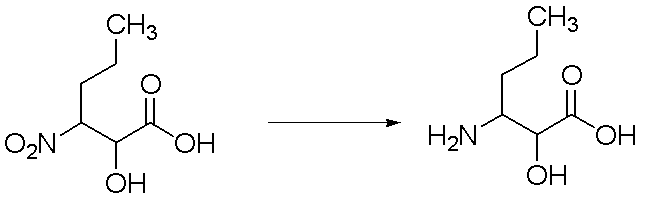
- BZQIARROPFRNCP-UHFFFAOYSA-N CCCC(C(C(O)=O)O)[N+]([O-])=O Chemical compound CCCC(C(C(O)=O)O)[N+]([O-])=O BZQIARROPFRNCP-UHFFFAOYSA-N 0.000 description 1
- IYFAZXTWKRGHNZ-WZDPFIPFSA-N CCCC([C@H](C)C(NCC(NC(C(OCc1ccccc1)=O)c1ccccc1)=O)=O)NC([C@H](Cc1c(CCCC2)c2ccc1)NC([C@H](C1CCCCC1)N)=O)=O Chemical compound CCCC([C@H](C)C(NCC(NC(C(OCc1ccccc1)=O)c1ccccc1)=O)=O)NC([C@H](Cc1c(CCCC2)c2ccc1)NC([C@H](C1CCCCC1)N)=O)=O IYFAZXTWKRGHNZ-WZDPFIPFSA-N 0.000 description 1
- GUCOFDZZMHDQFC-YXRLSFQOSA-N CCCCC(C(C(NCC(N[C@@H](C=C)C(OCc1ccccc1)=O)=O)=O)=O)NC([C@H](Cc1c(CCCC2)c2ccc1)NC([C@H](C1CCCCC1)NC(OC(C)(C)C)=O)=O)=O Chemical compound CCCCC(C(C(NCC(N[C@@H](C=C)C(OCc1ccccc1)=O)=O)=O)=O)NC([C@H](Cc1c(CCCC2)c2ccc1)NC([C@H](C1CCCCC1)NC(OC(C)(C)C)=O)=O)=O GUCOFDZZMHDQFC-YXRLSFQOSA-N 0.000 description 1
- VVTVCRMVNDVVLT-UHFFFAOYSA-N CCOC(C(Cc1cccc2c1CCCC2)N)=O Chemical compound CCOC(C(Cc1cccc2c1CCCC2)N)=O VVTVCRMVNDVVLT-UHFFFAOYSA-N 0.000 description 1
- OFYAYGJCPXRNBL-LBPRGKRZSA-N N[C@@H](Cc1c(cccc2)c2ccc1)C(O)=O Chemical compound N[C@@H](Cc1c(cccc2)c2ccc1)C(O)=O OFYAYGJCPXRNBL-LBPRGKRZSA-N 0.000 description 1
Classifications
-
- C—CHEMISTRY; METALLURGY
- C07—ORGANIC CHEMISTRY
- C07K—PEPTIDES
- C07K5/00—Peptides containing up to four amino acids in a fully defined sequence; Derivatives thereof
- C07K5/04—Peptides containing up to four amino acids in a fully defined sequence; Derivatives thereof containing only normal peptide links
- C07K5/10—Tetrapeptides
-
- C—CHEMISTRY; METALLURGY
- C07—ORGANIC CHEMISTRY
- C07K—PEPTIDES
- C07K7/00—Peptides having 5 to 20 amino acids in a fully defined sequence; Derivatives thereof
- C07K7/04—Linear peptides containing only normal peptide links
- C07K7/06—Linear peptides containing only normal peptide links having 5 to 11 amino acids
-
- A—HUMAN NECESSITIES
- A61—MEDICAL OR VETERINARY SCIENCE; HYGIENE
- A61K—PREPARATIONS FOR MEDICAL, DENTAL OR TOILETRY PURPOSES
- A61K31/00—Medicinal preparations containing organic active ingredients
- A61K31/16—Amides, e.g. hydroxamic acids
-
- A—HUMAN NECESSITIES
- A61—MEDICAL OR VETERINARY SCIENCE; HYGIENE
- A61K—PREPARATIONS FOR MEDICAL, DENTAL OR TOILETRY PURPOSES
- A61K31/00—Medicinal preparations containing organic active ingredients
- A61K31/185—Acids; Anhydrides, halides or salts thereof, e.g. sulfur acids, imidic, hydrazonic or hydroximic acids
- A61K31/19—Carboxylic acids, e.g. valproic acid
- A61K31/195—Carboxylic acids, e.g. valproic acid having an amino group
-
- A—HUMAN NECESSITIES
- A61—MEDICAL OR VETERINARY SCIENCE; HYGIENE
- A61K—PREPARATIONS FOR MEDICAL, DENTAL OR TOILETRY PURPOSES
- A61K31/00—Medicinal preparations containing organic active ingredients
- A61K31/21—Esters, e.g. nitroglycerine, selenocyanates
- A61K31/27—Esters, e.g. nitroglycerine, selenocyanates of carbamic or thiocarbamic acids, meprobamate, carbachol, neostigmine
-
- A—HUMAN NECESSITIES
- A61—MEDICAL OR VETERINARY SCIENCE; HYGIENE
- A61K—PREPARATIONS FOR MEDICAL, DENTAL OR TOILETRY PURPOSES
- A61K31/00—Medicinal preparations containing organic active ingredients
- A61K31/33—Heterocyclic compounds
- A61K31/335—Heterocyclic compounds having oxygen as the only ring hetero atom, e.g. fungichromin
- A61K31/357—Heterocyclic compounds having oxygen as the only ring hetero atom, e.g. fungichromin having two or more oxygen atoms in the same ring, e.g. crown ethers, guanadrel
-
- A—HUMAN NECESSITIES
- A61—MEDICAL OR VETERINARY SCIENCE; HYGIENE
- A61K—PREPARATIONS FOR MEDICAL, DENTAL OR TOILETRY PURPOSES
- A61K31/00—Medicinal preparations containing organic active ingredients
- A61K31/33—Heterocyclic compounds
- A61K31/38—Heterocyclic compounds having sulfur as a ring hetero atom
- A61K31/385—Heterocyclic compounds having sulfur as a ring hetero atom having two or more sulfur atoms in the same ring
-
- A—HUMAN NECESSITIES
- A61—MEDICAL OR VETERINARY SCIENCE; HYGIENE
- A61K—PREPARATIONS FOR MEDICAL, DENTAL OR TOILETRY PURPOSES
- A61K31/00—Medicinal preparations containing organic active ingredients
- A61K31/33—Heterocyclic compounds
- A61K31/395—Heterocyclic compounds having nitrogen as a ring hetero atom, e.g. guanethidine or rifamycins
- A61K31/40—Heterocyclic compounds having nitrogen as a ring hetero atom, e.g. guanethidine or rifamycins having five-membered rings with one nitrogen as the only ring hetero atom, e.g. sulpiride, succinimide, tolmetin, buflomedil
- A61K31/403—Heterocyclic compounds having nitrogen as a ring hetero atom, e.g. guanethidine or rifamycins having five-membered rings with one nitrogen as the only ring hetero atom, e.g. sulpiride, succinimide, tolmetin, buflomedil condensed with carbocyclic rings, e.g. carbazole
-
- A—HUMAN NECESSITIES
- A61—MEDICAL OR VETERINARY SCIENCE; HYGIENE
- A61K—PREPARATIONS FOR MEDICAL, DENTAL OR TOILETRY PURPOSES
- A61K31/00—Medicinal preparations containing organic active ingredients
- A61K31/33—Heterocyclic compounds
- A61K31/395—Heterocyclic compounds having nitrogen as a ring hetero atom, e.g. guanethidine or rifamycins
- A61K31/41—Heterocyclic compounds having nitrogen as a ring hetero atom, e.g. guanethidine or rifamycins having five-membered rings with two or more ring hetero atoms, at least one of which being nitrogen, e.g. tetrazole
- A61K31/4164—1,3-Diazoles
-
- A—HUMAN NECESSITIES
- A61—MEDICAL OR VETERINARY SCIENCE; HYGIENE
- A61K—PREPARATIONS FOR MEDICAL, DENTAL OR TOILETRY PURPOSES
- A61K31/00—Medicinal preparations containing organic active ingredients
- A61K31/33—Heterocyclic compounds
- A61K31/395—Heterocyclic compounds having nitrogen as a ring hetero atom, e.g. guanethidine or rifamycins
- A61K31/435—Heterocyclic compounds having nitrogen as a ring hetero atom, e.g. guanethidine or rifamycins having six-membered rings with one nitrogen as the only ring hetero atom
- A61K31/44—Non condensed pyridines; Hydrogenated derivatives thereof
- A61K31/445—Non condensed piperidines, e.g. piperocaine
-
- A—HUMAN NECESSITIES
- A61—MEDICAL OR VETERINARY SCIENCE; HYGIENE
- A61K—PREPARATIONS FOR MEDICAL, DENTAL OR TOILETRY PURPOSES
- A61K38/00—Medicinal preparations containing peptides
- A61K38/04—Peptides having up to 20 amino acids in a fully defined sequence; Derivatives thereof
- A61K38/05—Dipeptides
-
- A—HUMAN NECESSITIES
- A61—MEDICAL OR VETERINARY SCIENCE; HYGIENE
- A61P—SPECIFIC THERAPEUTIC ACTIVITY OF CHEMICAL COMPOUNDS OR MEDICINAL PREPARATIONS
- A61P1/00—Drugs for disorders of the alimentary tract or the digestive system
- A61P1/16—Drugs for disorders of the alimentary tract or the digestive system for liver or gallbladder disorders, e.g. hepatoprotective agents, cholagogues, litholytics
-
- A—HUMAN NECESSITIES
- A61—MEDICAL OR VETERINARY SCIENCE; HYGIENE
- A61P—SPECIFIC THERAPEUTIC ACTIVITY OF CHEMICAL COMPOUNDS OR MEDICINAL PREPARATIONS
- A61P31/00—Antiinfectives, i.e. antibiotics, antiseptics, chemotherapeutics
- A61P31/12—Antivirals
-
- A—HUMAN NECESSITIES
- A61—MEDICAL OR VETERINARY SCIENCE; HYGIENE
- A61P—SPECIFIC THERAPEUTIC ACTIVITY OF CHEMICAL COMPOUNDS OR MEDICINAL PREPARATIONS
- A61P31/00—Antiinfectives, i.e. antibiotics, antiseptics, chemotherapeutics
- A61P31/12—Antivirals
- A61P31/14—Antivirals for RNA viruses
-
- A—HUMAN NECESSITIES
- A61—MEDICAL OR VETERINARY SCIENCE; HYGIENE
- A61P—SPECIFIC THERAPEUTIC ACTIVITY OF CHEMICAL COMPOUNDS OR MEDICINAL PREPARATIONS
- A61P43/00—Drugs for specific purposes, not provided for in groups A61P1/00-A61P41/00
-
- C—CHEMISTRY; METALLURGY
- C07—ORGANIC CHEMISTRY
- C07C—ACYCLIC OR CARBOCYCLIC COMPOUNDS
- C07C205/00—Compounds containing nitro groups bound to a carbon skeleton
- C07C205/49—Compounds containing nitro groups bound to a carbon skeleton the carbon skeleton being further substituted by carboxyl groups
- C07C205/50—Compounds containing nitro groups bound to a carbon skeleton the carbon skeleton being further substituted by carboxyl groups having nitro groups and carboxyl groups bound to acyclic carbon atoms of the carbon skeleton
- C07C205/51—Compounds containing nitro groups bound to a carbon skeleton the carbon skeleton being further substituted by carboxyl groups having nitro groups and carboxyl groups bound to acyclic carbon atoms of the carbon skeleton the carbon skeleton being saturated
-
- C—CHEMISTRY; METALLURGY
- C07—ORGANIC CHEMISTRY
- C07K—PEPTIDES
- C07K5/00—Peptides containing up to four amino acids in a fully defined sequence; Derivatives thereof
- C07K5/04—Peptides containing up to four amino acids in a fully defined sequence; Derivatives thereof containing only normal peptide links
- C07K5/10—Tetrapeptides
- C07K5/1002—Tetrapeptides with the first amino acid being neutral
- C07K5/1005—Tetrapeptides with the first amino acid being neutral and aliphatic
- C07K5/101—Tetrapeptides with the first amino acid being neutral and aliphatic the side chain containing 2 to 4 carbon atoms, e.g. Val, Ile, Leu
-
- C—CHEMISTRY; METALLURGY
- C07—ORGANIC CHEMISTRY
- C07K—PEPTIDES
- C07K7/00—Peptides having 5 to 20 amino acids in a fully defined sequence; Derivatives thereof
- C07K7/02—Linear peptides containing at least one abnormal peptide link
Landscapes
- Health & Medical Sciences (AREA)
- Chemical & Material Sciences (AREA)
- Life Sciences & Earth Sciences (AREA)
- Medicinal Chemistry (AREA)
- General Health & Medical Sciences (AREA)
- Organic Chemistry (AREA)
- Veterinary Medicine (AREA)
- Public Health (AREA)
- Animal Behavior & Ethology (AREA)
- Pharmacology & Pharmacy (AREA)
- Epidemiology (AREA)
- Proteomics, Peptides & Aminoacids (AREA)
- Molecular Biology (AREA)
- Genetics & Genomics (AREA)
- Biochemistry (AREA)
- Biophysics (AREA)
- Chemical Kinetics & Catalysis (AREA)
- Engineering & Computer Science (AREA)
- Bioinformatics & Cheminformatics (AREA)
- Nuclear Medicine, Radiotherapy & Molecular Imaging (AREA)
- General Chemical & Material Sciences (AREA)
- Gastroenterology & Hepatology (AREA)
- Virology (AREA)
- Oncology (AREA)
- Communicable Diseases (AREA)
- Emergency Medicine (AREA)
- Immunology (AREA)
- Medicines That Contain Protein Lipid Enzymes And Other Medicines (AREA)
- Peptides Or Proteins (AREA)
- Pharmaceuticals Containing Other Organic And Inorganic Compounds (AREA)
Description
【0001】
(技術分野)
本発明は、新規C型肝炎ウイルス(「HCV」)プロテアーゼ阻害剤、1種以上の該阻害剤を含有する医薬組成物、該阻害剤の製造方法ならびにC型肝炎および関連障害を処置するための該阻害剤の使用方法に関する。詳細には、本発明は、HCV NS3/NS4aセリンプロテアーゼの阻害剤としての新規ペプチド化合物を開示する。
【0002】
(背景技術)
C型肝炎ウイルス(HCV)は、非A非B型肝炎(NANBH)、特に血液関連NANBH(BB−NANBH)の主たる病原体として関連付けられている(+)−センス一本鎖RNAウイルスである(国際公開第WO89/04669号および欧州特許出願公開第EP381216号参照)。NANBHは、他の型のウイルス誘発性肝臓疾患、例えばA型肝炎ウイルス(HAV)、B型肝炎ウイルス(HBV)、デルタ型肝炎ウイルス(HDV)、サイトメガロウイルス(CMV)およびエプスタイン−バールウイルス(EBV)に誘発されるもの、ならびに他の形態の肝臓疾患、例えばアルコール中毒および原発性胆汁性肝硬変とは区別される。
【0003】
近年、ポリペプチドプロセシングおよびウイルス複製に必要なHCVプロテアーゼが同定され、クローン化され、発現された(例、米国特許第5712145号参照)。この約3000アミノ酸のポリタンパク質は、アミノ末端からカルボキシ末端へ、ヌクレオキャプシドタンパク質(C)、エンベロープタンパク質(E1およびE2)ならびにいくつかの非構造タンパク質(NS1、2、3、4a、5aおよび5b)を含む。NS3は、HCVゲノムの約1893ヌクレオチドによりコードされる、約68kdaのタンパク質であり、2つの異なるドメイン:(a)N末端アミノ酸の約200個からなるセリンプロテアーゼドメイン;および(b)タンパク質のC末端のRNA依存性ATPaseドメインを有する。NS3プロテアーゼは、タンパク質配列、全体的三次元構造および触媒機構が類似していることから、キモトリプシンファミリーのメンバーであると考えられている。他のキモトリプシン様酵素は、エラスターゼ、第Xa因子、トロンビン、トリプシン、プラスミン、ウロキナーゼ、tPAおよびPSAである。HCV NS3セリンプロテアーゼは、NS3/NS4a、NS4a/NS4b、NS4b/NS5aおよびNS5a/NS5b連結部におけるポリペプチド(ポリタンパク質)のタンパク質分解を担っており、従ってウイルス複製中の4種のウイルスタンパク質の生成を担っている。このため、HCV NS3セリンプロテアーゼは抗ウイルス化学療法にとって魅力的な標的となっている。
【0004】
約6kdaのポリペプチドであるNS4aタンパク質がNS3のセリンプロテアーゼ活性の補因子であることが決定されている。NS3/NS4aセリンプロテアーゼによるNS3/NS4a連結部の自己切断は分子内(すなわち、シス)で生じ、他の切断部位は分子間(すなわち、トランス)でプロセシングされる。
【0005】
HCVプロテアーゼの天然の切断部位の分析により、P1におけるシステインおよびP1’におけるセリンの存在ならびにこれらの残基がNS4a/NS4b、NS4b/NS5aおよびNS5a/NS5b連結部で厳密に保存されていることが明らかにされた。NS3/NS4a連結部は、P1においてスレオニンを、P1’においてセリンを含む。NS3/NS4aでのCys→Thrの置換は、この連結部におけるトランスではなくシスのプロセシングの要件の説明となると想定されている。例えば、Pizzi et al. (1994) Proc. Natl. Acad. Sci (USA) 91:888-892、 Failla et al. (1996) Folding & Design 1:35-42参照。NS3/NS4a切断部位はまた、他の部位よりも突然変異誘発に寛容性である。例えばKollykhalov et al. (1994) J. Virol. 68:7525-7533参照。また、切断部位の上流領域における酸性残基が効率的な切断に必要とされることが見出されている。例えば、Komoda et al. (1994) J. Virol. 68:7351-7357参照。
【0006】
報告されたHCVプロテアーゼの阻害剤としては、抗酸化剤(国際公開第WO98/14181号参照)、特定のペプチドおよびペプチドアナログ(国際公開第WO98/17679号、Landro et al. (1997) Biochem. 36:9340-9348、Ingallinella et al. (1998) Biochem. 37:8906-8914、Llinas-Brunet et al. (1998) Bioorg. Med. Chem. Lett. 8:1713-1718参照)、70アミノ酸のポリペプチドであるエグリンcに基いた阻害剤(Martin et al. (1998) Biochem. 37:11459-11468)、ヒト膵臓分泌性トリプシンインヒビター(hPSTI−C3)およびミニボディーレパートリー(MBip)から親和性選択された阻害剤(Dimasi et al. (1997) J.Virol. 71:7461-7469)、CVHE2(「ラクダ化(camelized)」可変領域抗体フラグメント)(Martin et al.(1997) Protein Eng. 10:607-614)およびα1−アンチキモトリプシン(ACT)(Elzouki et al. (1997) J. Hepat. 27:42-28)が挙げられる。C型肝炎ウイルスRNAを選択的に破壊するように設計されたリボザイムが近年開示された(BioWorld Today 9(217): 4(1998年11月10日)参照)。
【0007】
また、PCT公開、第WO98/17679号(1998年4月30日公開、ヴァーテックス・ファーマシューティカルズ・インコーポレイテッド(Vertex Pharmaceuticals Incorporated))、第WO98/22496号(1998年5月28日公開、エフ・ホフマン−ラ・ロシュ・アクチエンゲセルシャフト(F. Hoffmann-La Roche AG))、および第WO99/07734号(1999年2月18日公開、ベーリンガー・インゲルハイム・カナダ・リミテッド(Boehringer Ingelheim Canada Ltd.))も参照のこと。
【0008】
HCVは、肝硬変および肝細胞癌の誘発に関連付けられている。HCV感染に罹患した患者の予後は、現時点では芳しくない。HCV感染は、HCV感染に伴う免疫または緩解の欠如のために、他の形態の肝炎よりも処置が困難である。最新データは、硬変診断後4年目での生存率が50%未満であることを示している。切除可能な限局性肝細胞癌と診断された患者が10〜30%の5年生存率を有するのに対し、切除不能な限局性肝細胞癌の患者は5年生存率が1%未満である。
【0009】
HCV NS3プロテアーゼの阻害剤の二環式アナログの合成を記載するA. Marchetti et al, Synlett, S1, 1000-1002 (1999)を参照のこと。そこに記載される化合物は以下の式を有する:
【化61】
特定のアリルおよびエチル官能基を含む特定のα−ケトアミド、α−ケトエステルおよびα−ジケトンの製造を記載するW. Han et al, Bioorganic & Medicinal Chem. Lett, (2000) 10, 711-713も参照のこと。
【0011】
また、式:
【化62】
【化63】
【化64】
【化65】
C型肝炎の現行治療法としては、インターフェロン−α(INFα)およびリバビリンとインターフェロンとの併用療法が挙げられる。例えば、Beremguer et al. (1998) Proc. Assoc. Am. Physicians 110(2):98-112参照。これらの治療法には、低い持続応答率および頻繁な副作用という問題点がある。例えば、Hoofnagle et al. (1997) N. Engl. J. Med. 336:347参照。現時点では、HCV感染に利用可能なワクチンは無い。
【0013】
継続および同時継続中の米国特許出願第09/−−−号(−−−出願)、同第09/−−−号(−−−出願)、同第09/−−−号(−−−出願)、同第09/−−−号(−−−出願)、同第09/−−−号(−−−出願)および同第09/−−−号(−−−出願)は、C型肝炎ウイルスのNS−3セリンプロテアーゼの阻害剤としての種々の型のペプチドを開示している。
【0014】
HCV感染のための新たな処置および治療法が要望されている。従って、本発明の目的は、C型肝炎の1つ以上の症状を処置または予防または改善するのに有用な化合物を提供することである。
【0015】
本発明のさらなる目的は、C型肝炎の1つ以上の症状を処置または予防または改善する方法を提供することである。
【0016】
本発明のさらなる目的は、本明細書に提供される化合物を用いて、セリンプロテアーゼ、特にHCV NS3/NS4aセリンプロテアーゼの活性を調節する方法を提供することである。
【0017】
本発明の別の目的は、本明細書に提供される化合物を用いてHCVポリペプチドのプロセシングを調節する方法を提供することである。
【0018】
(発明の概要)
本発明は、その多くの実施態様において、新規クラスのHCVプロテアーゼの阻害剤、1種以上の該化合物を含有する医薬組成物、1種以上の該化合物を含有する医薬処方物の製造方法、およびC型肝炎の症状の1つ以上を処置、予防または改善する方法を提供する。また、HCVポリペプチドとHCVプロテアーゼとの相互作用を調節する方法も提供する。本明細書中に提供される化合物の中で、HCV NS3/NS4aセリンプロテアーゼ活性を阻害する化合物が好ましい。本願はP3からP2’までのアミノ酸配列を含むペプチド化合物を開示する。
【0019】
その第一の実施態様において、本発明は、式I:
【化66】
[式中、
G、JおよびYは独立してH、アルキル、アルキル−アリール、ヘテロアルキル、ヘテロアリール、アリール−ヘテロアリール、アルキル−ヘテロアリール、シクロアルキル、アルキルオキシ、アルキル−アリールオキシ、アリールオキシ、ヘテロアリールオキシ、ヘテロシクロアルキルオキシ、シクロアルキルオキシ、アルキルアミノ、アリールアミノ、アルキル−アリールアミノ、アリールアミノ、ヘテロアリールアミノ、シクロアルキルアミノまたはヘテロシクロアルキルアミノ部分から選択され、所望によりYはX11またはX12で置換されてもよく;
X11はアルキル、アルケニル、アルキニル、シクロアルキル、シクロアルキル−アルキル、ヘテロシクリル、ヘテロシクリルアルキル、アリール、アルキルアリール、アリールアルキル、ヘテロアリール、アルキルへテロアリールまたはヘテロアリールアルキルであり、所望によりX11はさらにX12で置換されてもよく;
X12はヒドロキシ、アルコキシ、アリールオキシ、チオ、アルキルチオ、アリールチオ、アミノ、アルキルアミノ、アリールアミノ、アルキルスルホニル、アリールスルホニル、アルキルスルホンアミド、アリールスルホンアミド、カルボキシ、カルボアルコキシ、カルボキシアミド、アルコキシカルボニルアミノ、アルコキシカルボニルオキシ、アルキルウレイド、アリールウレイド、ハロゲン、シアノまたはニトロであり、アルキル、アルコキシおよびアリールは所望によりX12から選択される部分でさらに置換されてもよく;
R1はCOR5またはB(OR)2であり、R5はH、OH、OR8、NR9R10、CF3、C2F5、C3F7、CF2R6、R6またはCOR7であり、R7はH、OH、OR8、CHR9R10またはNR9R10であり、R6、R8、R9およびR10は独立してH、アルキル、アリール、ヘテロアルキル、ヘテロアリール、シクロアルキル、シクロアルキル、アリールアルキル、ヘテロアリールアルキル、CH(R1’)COOR11、CH(R1’)CONR12R13、CH(R1’)CONHCH(R2’)COOR11、CH(R1’)CONHCH(R2’)CONR12R13、CH(R1’)CONHCH(R2’)R’、CH(R1’)CONHCH(R2’)CONHCH(R3’)COOR11、CH(R1’)CONHCH(R2’)CONHCH(R3’)CONR12R13、CH(R1’)CONHCH(R2’)CONHCH(R3’)CONHCH(R4’)COOR11、CH(R1’)CONHCH(R2’)CONHCH(R3’)CONHCH(R4’)CONR12R13、CH(R1’)CONHCH(R2’)CONHCH(R3’)CONHCH(R4’)CONHCH(R5’)COOR11およびCH(R1’)CONHCH(R2’)CONHCH(R3’)CONHCH(R4’)CONHCH(R5’)CONR12R13からなる群より選択され、R1’、R2’、R3’、R4’、R5’、R11、R12、R13およびR’は独立してH、アルキル、アリール、ヘテロアルキル、ヘテロアリール、シクロアルキル、アルキル−アリール、アルキル−ヘテロアリール、アリール−アルキルおよびヘテロアラルキルからなる群より選択され;
Zは、O、NまたはCHから選択され;
Wは存在してもよくまたは存在しなくてもよく、Wが存在する場合、WはC=O、C=SまたはSO2から選択され;
R、R2、R3およびR4は独立してH;C1−C10アルキル;C2−C10アルケニル;C3−C8シクロアルキル;C3−C8ヘテロシクロアルキル、アルコキシ、アリールオキシ、アルキルチオ、アリールチオ、アミノ、アミド、エステル、カルボン酸、カルバメート、尿素、ケトン、アルデヒド、シアノ、ニトロ;酸素、窒素、硫黄およびリン原子(該酸素、窒素、硫黄またはリン原子の数は0〜6である);(シクロアルキル)アルキルおよび(ヘテロシクロアルキル)アルキル(ここでシクロアルキルは3〜8個の炭素原子、および0〜6個の酸素、窒素、硫黄またはリン原子を含み、アルキルは1〜6個の炭素原子を含む);アリール;ヘテロアリール;アルキル−アリールおよびアルキル−ヘテロアリールからなる群より選択され;
ここでアルキル、ヘテロアルキル、アルケニル、ヘテロアルケニル、アリール、ヘテロアリール、シクロアルキルおよびヘテロシクロアルキル部分は所望により置換され得、この「置換」の語は、アルキル、アルケニル、アルキニル、アリール、アラルキル、シクロアルキル、複素環、ハロゲン、ヒドロキシ、チオ、アルコキシ、アリールオキシ、アルキルチオ、アリールチオ、アミノ、アミド、エステル、カルボン酸、カルバメート、尿素、ケトン、アルデヒド、シアノ、ニトロ、スルホンアミド、スルホキシド、スルホン、スルホニルウレア、ヒドラジドおよびヒドロキシメートからなる群より選択される1個以上の部分での所望による化学的に適切な置換をいう]
で示される化合物を提供する。
【0020】
式Iの種々の部分についての上記の定義の中で種々の部分についての好ましい基は以下のとおりである:
R1についての好ましい定義はCOR5であり、R5がH、OH、COOR8またはCONR9R10であり、R8、R9、R10は上記で定義したとおりである。R1についての好ましい部分はCOCONR9R10であり、R9がHであり、R10がH、CH(R1’)COOR11、CH(R1’)CONR12R13、CH(R1’)CONHCH(R2’)COOR11、CH(R1’)CONHCH(R2’)CONR12R13またはCH(R1’)CONHCH(R2’)(R’)である。これらの中で、R10についての好ましい部分はCH(R1’)CONHCH(R2’)COOR11、CH(R1’)CONHCH(R2’)CONR12R13、CH(R1’)CONHCH(R2’)(R’)であり、R1’はHまたはアルキル、ヘテロアルキルであり、R2’は、フェニル、置換フェニル、ヘテロ原子置換フェニル、チオフェニル、シクロアルキル、ヘテロ原子置換シクロアルキル、ピペリジルおよびピリジルである。より好ましい部分は以下のとおりである:R1’がHであり、R11がHまたはtert−ブチルであり;R’がヒドロキシメチルであり;R2’が以下からなる群より選択され:
【化67】
U1およびU2は同じでもよくまたは異なってもよく、H、F、CH2COOH、CH2COOMe、CH2CONH2、CH2CONHMe、CH2CONMe2、アジド、アミノ、ヒドロキシル、置換アミノ、置換ヒドロキシルからなる群より選択され;
U3およびU4は同じでもよくまたは異なってもよく、OまたはSであり;
U5はアルキルスルホニル、アリールスルホニル、ヘテロアルキルスルホニル、ヘテロアリールスルホニル、アルキルカルボニル、アリールカルボニル、ヘテロアルキルカルボニル、ヘテロアリールカルボニル、アルコキシカルボニル、アリールオキシカルボニル、ヘテロアリールオキシカルボニル、アルキルアミノカルボニル、アリールアミノカルボニル、ヘテロアリールアミノカルボニルまたはその組合せからなる部分より選択され;
NR12R13は以下からなる群より選択され:
【化68】
【0021】
R2についての好ましい部分は以下のとおりである:
【化69】
R3についての好ましい部分は以下のとおりである:
【化70】
【0023】
さらに、R3は以下によっても表され得る:
【化71】
【化72】
【化73】
【化74】
さらに好ましいR3についての部分は以下のとおりである:
【化75】
さらに、R4が存在しない式I中の部分Z−C−R3は以下の構造によって表され得る:
【化76】
【化77】
いくつかのその他の好ましい部分は以下のとおりである:ZがNであり、R4がHであり、WがC=OまたはSO2である。Yについての好ましい部分は以下のとおりである:
【化78】
Y12はH、COOH、COOMe、OMe、F、ClまたはBrから選択される。
【0027】
Yはまた以下によって表され得:
【化79】
【化80】
【0028】
Yについてのさらなる好ましい構造は以下のとおりである:
【化81】
【0029】
Yについてのさらなる例は以下のとおりである:
【化82】
Y18はCOOCH3、NO2、N(CH3)2、F、OCH3、CH2COOH、COOH、SO2NH2またはNHCOCH3である。
【0030】
Jについての好ましい部分は以下のとおりである:
【化85】
Gについての好ましい部分は以下のとおりである:
【化86】
特記しない場合、本明細書において用いる技術用語および科学用語は全て、本発明が属する技術分野の当業者が一般に理解しているのと同じ意味を有する。従って、例えば、用語アルキル(アルコキシのアルキル部分を含む)は、1〜8個、好ましくは1〜6個の炭素原子を有する、単一原子の除去により直鎖または分枝鎖飽和炭化水素から誘導される1価の基をいう。
【0033】
アリール − 6〜14個の炭素原子を有し、少なくとも1個のベンゼノイド環を有する炭素環式基を表し、炭素環式基の全ての利用可能な置換可能芳香族炭素原子が可能な結合点として意図される。好ましいアリール基としては、フェニル、1−ナフチル、2−ナフチルおよびインダニル、特にフェニルおよび置換フェニルが挙げられる。
【0034】
アラルキル − 低級アルキルを介して結合したアリール基を含む部分を表す。
【0035】
アルキルアリール − アリール基を介して結合した低級アルキルを含む部分を表す。
【0036】
シクロアルキル − 所望により置換されてもよい、3〜8個、好ましくは5または6個の炭素原子を有する飽和炭素環式環を表す。
【0037】
複素環 − 下記で定義するヘテロアリール基に加えて、1個の環または2個の縮合した環からなる炭素環式環構造を中断する少なくとも1個のO、Sおよび/またはN原子を有する飽和および不飽和環式有機基であって、各環が5、6または7員環であり、非局在化パイ電子を欠く二重結合を有してもよく有しなくてもよく、環構造が2〜8個、好ましくは3〜6個の炭素原子を有する、例えば2−もしくは3−ピペリジニル、2−もしくは3−ピペラジニル、2−もしくは3−モルホリニル、または2−もしくは3−チオモルホリニルである基を表す。
【0038】
ハロゲン − フッ素、塩素、臭素およびヨウ素を表す。
【0039】
ヘテロアリール − 炭素環式環構造を中断する少なくとも1個のO、Sおよび/またはN原子を有し、芳香族特性を与えるのに十分な数の非局在化パイ電子を有する環式有機基であって、芳香族複素環式基が2〜14個、好ましくは4または5個の炭素原子を有し、例えば2−、3−もしくは4−ピリジル、2−もしくは3−フリル、2−もしくは3−チエニル、2−、4−もしくは5−チアゾリル、2−もしくは4−イミダゾリル、2−、4−もしくは5−ピリミジニル、2−ピラジニル、または3−もしくは4−ピリダジニル等である基を表す。好ましいヘテロアリール基は、2−、3−および4−ピリジルである。そのようなヘテロアリール基はまた所望により置換されてもよい。さらに、特記しない場合、用語「置換もしくは非置換」または「所望により置換」は、主題の部分が所望により、化学的に適切に、R12またはR13に属する部分で置換されることをいう。
【0040】
また、式Iで示される化合物の互変異性体、回転異性体、鏡像異性体および他の光学異性体、ならびにその医薬上許容される塩、溶媒和物および誘導体も本発明に包含される。
【0041】
本発明のさらなる特徴は、医薬上許容される担体または賦形剤と一緒に有効成分として式Iで示される化合物(またはその塩、溶媒和物もしくは異性体)を含有する医薬組成物である。
【0042】
本発明はまた、式Iで示される化合物の製造方法、ならびに例えばHCVおよび関連障害のような疾患の処置方法を提供する。これらの処置方法は、上記疾患(単数または複数)に罹患している患者に治療有効量の式Iで示される化合物、または式Iで示される化合物を含有する医薬組成物を投与する工程を包含する。
【0043】
また、HCVおよび関連障害処置用医薬の製造における式Iで示される化合物の使用も開示する。
【0044】
(好ましい実施態様の詳細な説明)
1つの実施態様において、本発明は、HCVプロテアーゼ、特にHCV NS3/NS4aセリンプロテアーゼの阻害剤としての式Iで示される化合物またはその医薬上許容される誘導体を開示する(式中、種々の部分は上記で定義したとおりである)。
【0045】
優れたHCVプロテアーゼ阻害活性を示す本発明の代表的な化合物を、その活性(nMでのKi *値の範囲)とともに表1に列挙する。
【0046】
表1:化合物およびHCVプロテアーゼ連続アッセイ結果
【表1】
カテゴリー A=0〜100;B=101〜1000;C=>1000nM。
【0047】
いくつかの型の本発明の化合物および式Iで示される種々の型の本発明の化合物の合成方法を以下に記載し、概説し、例示的な実施例を記載する。
【0048】
【化88】
R=ベンジル
【化94】
X=OH
X=NH2
X=NMeOMe
X=NMe2
【化95】
X=OH
【化96】
【化98】
R=アリル
【化99】
X=OH
【化100】
X=OH
【化102】
X=OH
X=NMe2
【化103】
X=OH
【化104】
R=H
R=Me
【化105】
X=COOH、Y=H
【化106】
構造に依存して、本発明の化合物は、有機もしくは無機酸、または有機もしくは無機塩基と医薬上許容される塩を形成し得る。そのような塩の形成に適切な酸の例としては、塩酸、硫酸、リン酸、酢酸、クエン酸、マロン酸、サリチル酸、リンゴ酸、フマル酸、コハク酸、アスコルビン酸、マレイン酸、メタンスルホン酸ならびに当業者に周知の他の鉱酸およびカルボン酸が挙げられる。塩基との塩の形成については、適切な塩基は、例えば、NaOH、KOH、NH4OH、テトラアルキルアンモニウムヒドロキシドなどである。
【0050】
別の実施態様において、本発明は、本発明のペプチドを有効成分として含有する医薬組成物を提供する。医薬組成物は、一般にさらに医薬上許容される担体希釈剤、賦形剤または担体(本明細書において担体物質と総称する)を含む。それらのHCV阻害活性のために、そのような医薬組成物は、C型肝炎および関連障害の処置において有用性を有する。
【0051】
さらに別の実施態様において、本発明は、有効成分として本発明の化合物を含む医薬組成物の製造方法を開示する。本発明の医薬組成物および方法において、有効成分は、代表的には意図される投与形態、すなわち経口錠剤、カプセル(固体充填、半固体充填または液体充填)、構成用散剤、経口ゲル、エリキシル、分散性顆粒、シロップ、懸濁液などに関連して適切に選択され、通常の薬学の慣例に合致した適切な担体物質と混合して投与される。例えば、錠剤またはカプセル形態での経口投与については、活性薬物成分を、いずれかの経口用の非毒性の医薬上許容される不活性担体、例えばラクトース、デンプン、スクロース、セルロース、ステアリン酸マグネシウム、リン酸二カルシウム、硫酸カルシウム、滑石、マンニトール、エチルアルコール(液体形態)などと組み合わせてもよい。さらに、所望または要求される場合、適切な結合剤、滑沢剤、崩壊剤および着色剤を混合物に組み入れてもよい。散剤および錠剤は、本発明の組成物を約5〜約95%含み得る。適切な結合剤としては、デンプン、ゼラチン、天然糖、コーン甘味料、天然および合成ゴム、例えばアカシア、アルギン酸ナトリウム、カルボキシメチルセルロース、ポリエチレングリコールおよびロウが挙げられる。滑沢剤の中で、これらの投与形態に用いられるものとしては、ホウ酸、安息香酸ナトリウム、酢酸ナトリウム、塩化ナトリウムなどに言及し得る。崩壊剤としては、デンプン、メチルセルロース、グアーガムなどが挙げられる。
【0052】
甘味料および着香料ならびに保存剤もまた、適切であれば含めてもよい。上記の用語のいくつか、すなわち崩壊剤、希釈剤、滑沢剤、結合剤などについては以下でより詳細に記載する。
【0053】
さらに、本発明の組成物を、いずれかの構成成分または有効成分の1種以上の速度制御放出を提供して、治療効果、すなわちHCV阻害活性などを最適化するように、持続放出形態で製剤化してもよい。持続放出に適切な投与形態としては、種々の崩壊速度の層または有効成分を含浸させた制御放出ポリマーマトリックスを含有し錠剤形態に成形された層状錠剤、またはそのような含浸または被包された多孔質ポリマーマトリックスを含有するカプセルが挙げられる。
【0054】
液体形態調製物としては、溶液、懸濁液およびエマルジョンが挙げられる。例として、非経口注射用の、または経口溶液、懸濁液およびエマルジョンの甘味料および鎮静物の添加用の水または水−プロピレングリコール溶液に言及し得る。液体形態調製物はまた、鼻腔内投与用溶液を包含し得る。
【0055】
吸入に適切なエーロゾル調製物は、溶液および粉末形態の固体を包含し得、これを不活性圧縮気体(例えば、窒素)のような医薬上許容される担体と組合せてもよい。
【0056】
坐剤の製造については、まず低融点ロウ、例えば脂肪酸グリセリドの混合物(例えば、ココアバター)を溶解し、そして攪拌または同様な混合によりそこに有効成分を均一に分散させる。次いで、融解した均一の混合物を好適な大きさの鋳型中に注ぎ、放冷することにより固化させる。
【0057】
また、使用直前に経口または非経口投与用液体形態調製物に変換することを意図した固体形態調製物も含まれる。そのような液体形態としては、溶液、懸濁液およびエマルジョンが挙げられる。
【0058】
本発明の化合物はまた、経皮送達可能であり得る。経皮組成物は、クリーム、ローション、エーロゾルおよび/またはエマルジョンの形態を取り得、この目的で当該分野において慣習的であるように、マトリックスまたはレザーバー型の経皮パッチに含めることができる。
【0059】
好ましくは、化合物は経口、静脈内または皮下投与される。
【0060】
好ましくは、医薬調製物は単位投与形態をとる。そのような形態では、調製物は、適量、例えば所望の目的を達成するのに有効な量の有効成分を含有する適切なサイズの単位用量に小分けされる。
【0061】
単位用量の調製物中の本発明の活性組成物の量は、特定の適用に従い、一般的には約1.0ミリグラムから約1000ミリグラム、好ましくは約1.0から約950ミリグラム、より好ましくは約1.0〜約500ミリグラム、そして代表的には約1〜約250ミリグラムの範囲で変動または調整し得る。用いられる実際の投与量は、患者の年齢、性別、体重および処置される病状の重篤さに依存して変動し得る。そのような技術は当業者に周知である。
【0062】
一般的に、有効成分を含有するヒト経口投与形態を、1日当たり1または2回投与し得る。投与の量および頻度は、主治医の判断に従って調節される。経口投与用に一般的に推奨される一日投与養生法は、単回または分割用量で、一日当たり約1.0ミリグラムから約1000ミリグラムの範囲であり得る。
【0063】
いくつかの有用な用語を以下に記載する。
【0064】
カプセル − 有効成分を含む組成物を保持または含有させるためのメチルセルロース、ポリビニルアルコール、または変性ゼラチンもしくはデンプンで作製された特殊な容器または封入物をいう。代表的には、硬カプセルは比較的高いゲル強度の骨およびブタ皮膚ゼラチンの混合物から作製される。カプセルそれ自体は小量の色素、不透明化剤、可塑剤および保存剤を含んでもよい。
【0065】
錠剤 − 適切な希釈剤と共に有効成分を含有する圧縮または成形された固体投与形態をいう。錠剤は、湿式造粒、乾式造粒または圧縮により得られた混合物または造粒物の圧縮により製造することができる。
【0066】
経口ゲル − 親水性半固体マトリックス中に分散または可溶化された有効成分をいう。
【0067】
構成用散剤は、水またはジュース中に懸濁し得る有効成分および適切な希釈剤を含有する粉末混合物をいう。
【0068】
希釈剤 − 組成物または投与形態の主な部分を通常構成する物質をいう。適切な希釈剤としては、糖類(例えば、ラクトース、スクロース、マンニトールおよびソルビトール);コムギ、トウモロコシ、イネおよびジャガイモ由来のデンプン;ならびにセルロース(例えば、微晶性セルロース)が挙げられる。組成物中の希釈剤の量は、全組成物重量に対し約10〜約90重量%、好ましくは約25〜約75重量%、より好ましくは約30〜約60重量%、よりさらに好ましくは約12〜約60重量%の範囲であり得る。
【0069】
崩壊剤 − 組成物に添加して、その分解(崩壊)を補助し、医薬を放出させる物質をいう。適切な崩壊剤としては、デンプン;「冷水可溶性」修飾デンプン(例えば、カルボキシメチルデンプンナトリウム);天然および合成ゴム(例えば、イナゴマメ、カラヤ、グアー、トラガカントおよび寒天);セルロース誘導体(例えば、メチルセルロースおよびカルボキシメチルセルロースナトリウム);微晶性セルロースおよび架橋微晶性セルロース(例えば、クロスカルメロースナトリウム(sodium croscarmellose));アルギネート(例えば、アルギン酸およびアルギン酸ナトリウム);粘土(例えば、ベントナイト);ならびに発泡性混合物が挙げられる。組成物中の崩壊剤の量は、組成物重量に対し約2〜約15重量%、より好ましくは約4〜約10重量%の範囲であり得る。
【0070】
結合剤 − 粉末を一緒に結合または「接着」させ、処方物中で顆粒を形成させ、従って「接着剤」として作用することによりそれらを粘着性にする物質をいう。結合剤は、既に希釈剤または増量剤において得られる粘着強度を追加する。適切な結合剤としては、糖類(例えば、スクロース);コムギ、トウモロコシ、イネおよびジャガイモ由来のデンプン;天然ゴム(例えば、アカシア、ゼラチンおよびトラガカント);海藻誘導体(例えば、アルギン酸、アルギン酸ナトリウムおよびアルギン酸カルシウムアンモニウム);セルロース物質(例えば、メチルセルロースおよびカルボキシメチルセルロースナトリウムおよびヒドロキシプロピルメチルセルロース);ポリビニルピロリドン;ならびに無機物(例えば、ケイ酸アルミニウムマグネシウム)が挙げられる。組成物中の結合剤の量は、組成物重量に対して約2〜約20重量%、より好ましくは約3〜約10重量%、さらに好ましくは約3〜約6重量%の範囲であり得る。
【0071】
滑沢剤 − 投与形態に添加して、圧縮後に、摩擦または摩損を低下させることにより、錠剤、顆粒などの鋳型またはダイからの放出を可能にする物質をいう。適切な滑沢剤としては、金属ステアレート(例えば、ステアリン酸マグネシウム、ステアリン酸カルシウムまたはステアリン酸カリウム);ステアリン酸;高融点ロウ;ならびに水溶性滑沢剤(例えば、塩化ナトリウム、安息香酸ナトリウム、酢酸ナトリウム、オレイン酸ナトリウム、ポリエチレングリコールおよびd'l−ロイシン)が挙げられる。滑沢剤は、顆粒の表面およびそれらの中間ならびにタブレット成形機のパーツに存在しなければならないので、通常は圧縮前の最終工程で加えられる。組成物中の滑沢剤の量は、組成物重量に対して約0.2〜約5重量%、好ましくは約0.5〜約2重量%、より好ましくは約0.3〜約1.5重量%の範囲であり得る。
【0072】
滑剤 − 流れが円滑かつ一様になるように、ケーキングを防止し、造粒物の流動特性を改善する物質。適切な滑剤としては、二酸化珪素および滑石が挙げられる。組成物中の滑剤の量は、全組成物重量に対して約0.1〜約5重量%、好ましくは約0.5〜約2重量%の範囲であり得る。
【0073】
着色剤 − 組成物または投与形態に彩色を施す賦形剤。そのような賦形剤は、食品用色素、および適切な吸着剤(例えば、粘土または酸化アルミニウム)に吸着させた食品用色素を包含し得る。着色剤の量は、組成物重量に対して約0.1〜約5重量%、好ましくは約0.1〜約1重量%の範囲で変動し得る。
【0074】
生物学的利用能 − 標準または対照と比較した場合の、活性薬物成分または治療的部分が投与された投与形態から全身的循環に吸収される速度および程度をいう。
【0075】
慣習的な錠剤の製造方法は公知である。そのような方法としては、乾式方法(例えば、直接圧縮および圧縮により生成された造粒物の圧縮)、または湿式方法もしくは他の特殊な手順が挙げられる。例えばカプセル、坐剤などの他の投与形態の慣習的な製造方法もまた周知である。
【0076】
本発明の別の実施態様は、例えばC型肝炎などの疾患の処置のための、上記医薬組成物の使用を開示する。この方法は、そのような疾患を有するかまたはそのような処置を必要とする患者に治療有効量の本発明の医薬組成物を投与する工程を包含する。
【0077】
さらに別の実施態様において、本発明の化合物をヒトにおけるHCVの処置のために、単独療法様式または併用療法様式(例えば、リバビリンのような抗ウイルス剤および/またはα−インターフェロンのようなインターフェロンとの組合せなど)で使用し得る。
【0078】
上記のように、本発明はまた、化合物の互変異性体、回転異性体、鏡像異性体および他の立体異性体を包含する。すなわち、当業者には理解されるように、本発明の化合物のいくつかは適切な異性体形態で存在し得る。そのような変形が本発明の範囲内にあることが意図される。
【0079】
本発明の別の実施態様は、本明細書に開示される化合物の製造方法を開示する。これらの化合物は、当該分野において公知のいくつかの技術により製造され得る。代表的な例示的な手順を下記反応スキームで概説する。下記の例示的なスキームには、いくつかの代表的な本発明の化合物の製造が記載されているが、天然および非天然の両方のアミノ酸のいずれかの適切な置換により、そのような置換に基いた所望の化合物が形成されることを理解すべきである。そのような変形が本発明の範囲内にあることが意図される。
【0080】
下記のスキーム、製造および実施例の記載で使用される略語は以下の通りである:
THF:テトラヒドロフラン
DMF:N,N−ジメチルホルムアミド
EtOAc:酢酸エチル
AcOH:酢酸
HOOBt:3−ヒドロキシ−1,2,3−ベンゾトリアジン−4(3H)−オン
EDCl:1−(3−ジメチルアミノプロピル)−3−エチルカルボジイミドヒドロクロリド
DEC:1−(3−ジメチルアミノプロピル)−3−エチルカルボジイミドヒドロクロリド
NMM:N−メチルモルホリン
ADDP:1,1'−(アゾジカルボニル)ジピペリジン
DEAD:ジエチルアゾジカルボキシレート
MeOH:メタノール
EtOH:エタノール
Et2O:ジエチルエーテル
DMSO:ジメチルスルホキシド
HOBt:N−ヒドロキシベンゾトリアゾール
PyBrOP:ブロモ−トリス−ピロリジノホスホニウムヘキサフルオロホスフェート
Bn:ベンジル
Bzl:ベンジル
Et:エチル
Ph:フェニル
iBoc:イソブトキシカルボニル
iPr:イソプロピル
tBuまたはBut:tert−ブチル
Boc:tert−ブチルオキシカルボニル
Cbz:ベンジルオキシカルボニル
Cp:シクロペンチルジエニル
Ts:p−トルエンスルホニル
Me:メチル
THP:テトラヒドロピラニル
iBoc:イソブチルオキシカルボニル
Chg:シクロヘキシルグリシン
【0081】
一般的製造スキーム
以下のスキームは中間体ビルディングブロックの合成方法を記載する:
【化114】
中間体の製造:
製造例1
工程A:化合物(1.1)
【化117】
−20℃で撹拌中のDMF(15mL)およびCH2Cl2(15mL)中の化合物(1.08)(3.00g、12.0mmol;Harbeson, S.L.; Albelleira, S.M.,; Akiyama, A.; Barrett, R.; Carroll, R.M.; et al.; J.Med.Chem.; 37 (18) 1994; 2918-2929;)の溶液に、HOOBt(1.97g、12.0mmol)、N−メチルモルホリン(4.0mL、36.0mmol)およびEDCl(2.79g、14.5mmol)を添加し、10分間撹拌し、次いでHCl・H2N−Gly−OBn(2.56g、13.0mmol)を添加した。得られた溶液を−20℃で2時間撹拌し、一晩冷蔵し、次いで濃縮乾固し、次いでEtOAc(150mL)で希釈した。次いで、このEtOAc溶液を2回飽和NaHCO3、H2O、5%H3PO4、ブラインで洗浄し、Na2SO4で乾燥し、濾過し、濃縮乾固して、化合物(1.09)(4.5g、94%)を得た。LRMS m/z MH+=395.1。
【0084】
工程B:化合物(1.1)
【化118】
無水エタノール(300mL)中の化合物(1.09)(7.00g、17.8mmol)の溶液を室温で、水素雰囲気下、Pd−C(300mg、10%)の存在下で撹拌した。反応の進行をtlcによってモニターした。2時間後、混合物をceliteパッドを通して濾過し、得られた溶液を真空下で濃縮して、化合物(1.1)(5.40g、定量的)を得た。LRMS m/z MH+=305.1。
【0086】
製造例2
工程A 化合物(1.3)
【化119】
製造例1、工程Bからの化合物(1.1)(1当量)、化合物(1.2)(Novabiochem, No. 04-12-5147)(1.03当量)、HOOBt(1.03当量)、N−メチルモルホリン(2.2当量)およびジメチルホルムアミド(70mL/g)の混合物を−20℃で撹拌した。EDCl(1.04当量)を添加し、反応物を48時間撹拌した。反応混合物を5%KH2PO4水溶液中に注ぎ、酢酸エチルで抽出した(2×)。合した有機物を冷5%K2CO3水溶液、次いで5%KH2PO4水溶液、次いでブラインで洗浄し、有機相を無水MgSO4で乾燥した。混合物を濾過し、次いで蒸発させ、濾液を真空下で乾燥し、残渣をEt2O−ヘキサンで粉砕し、濾過して、表題化合物(1.3)を得た(86%、収率)C25H39N3O7(493.60)、質量スペクトル(FAB)M+1=494.3。
【0088】
工程B 化合物(1.4)
【化120】
製造例2、工程Aからの化合物(1.3)(3.0g)を4N HCl/ジオキサン(36mL)で処理し、室温で7分間撹拌した。混合物を1.5Lの冷(5℃)ヘキサン中に注ぎ、撹拌し、次いで0℃で0.5時間放置した。混合物を乾燥雰囲気中で吸引濾過し、採集した固体をさらに乾燥して、表題化合物(1.4)を得た(2.3g、88%収率)、C20H31N3O5・HCl、H1 NMR(DMSO−d6/NaOD)δ7.38(m,5H)、5.25(m,1H)、4.3−4.1(m,1H)、3.8(m,2H)、3.4−3.3(m,HDOにより不明瞭)、1.7−1.1(m,4H)、1.35(s,9H)、0.83(m,3H)。
【0090】
製造例3
化合物(1.5)
【化121】
製造例2、工程Aからの化合物(1.3)を下記製造例7、工程Aと本質的に同様に処理して、化合物(1.5)を得た。
【0092】
製造例4
化合物(1.6)
【化122】
製造例3からの化合物(1.5)を製造例2、工程Bと本質的に同様に処理して、化合物(1.6)を得た。
【0094】
製造例5
工程A 化合物(2.09)
【化123】
(2.09)
【0095】
−20℃の無水DMF(200mL)およびCH2Cl2(150mL)中のジメチルアミンヒドロクロリド(1.61g、19.7mmol)、N−Boc−フェニルグリシン、化合物2.08(4.50g、17.9mmol、Bachem Co. # A-2225)、HOOBt(3.07g、18.8mmol)およびEDCl(4.12g、21.5mmol)の溶液に、NMM(5.90mL、53.7mmol)を添加した。この温度で30分間撹拌した後、反応混合物を冷凍庫中に一晩(18時間)維持した。次いで、これを室温に加温し、EtOAc(450mL)、ブライン(100mL)および5%H3PO4(100mL)を添加した。相を分離した後、有機相を5%H3PO4(100mL)、飽和重炭酸ナトリウム水溶液(2×150mL)、水(150mL)およびブライン(150mL)で洗浄し、乾燥し(MgSO4)、濾過し、真空下で濃縮して、化合物(2.09)(4.86g)を白色固体として得た。これをさらに精製せずに使用した。
【0096】
工程B 化合物(2.1)
【化124】
(2.1)
【0097】
製造例5、工程Aからの化合物(2.09)(4.70g、粗)を4N HCl(60mL、240mmol)に溶解し、得られた溶液を室温で撹拌した。反応の進行をTLCによってモニターした。4時間後、溶液を真空下で濃縮して、化合物(2.1)を白色固体として得た。これを次の反応においてさらに精製せずに使用した。LRMS m/z MH+=179.0.
【0098】
製造例6
工程A 化合物(2.2)
【化125】
製造例2、工程Aと本質的に同様にし、フェニルグリシンt−ブチルエステルヒドロクロリドの代わりにフェニルグリシンN,N−ジメチルアミドヒドロクロリドを使用して、化合物(2.2)を製造した。質量スペクトル(FAB)M+1=465.3。
【0100】
工程B 化合物(2.3)
【化126】
(2.3)
【0101】
工程Aからの化合物(2.2)(1.85g)を4N HCl/ジオキサン(50mL)と室温で1時間反応させた。混合物を真空下、20℃の水浴中で蒸発させ、イソプロピルエーテル下で粉砕し、濾過し、乾燥して、化合物(2.3)を得た(1.57g、98%収率)、C18H28N4O4・HCl、質量スペクトル(FAB)M+1=365.3。
【0102】
製造例7
工程A 化合物(2.4)
【化127】
(2.4)
【0103】
ジクロロメタン(60mL)中の製造例5、工程Aからの化合物(2.2)(2.0g)の溶液をジメチルスルホキシド(3.0mL)および2,2−ジクロロ酢酸(0.70mL)で処理した。撹拌中の混合物を5℃に冷却し、次いで1Mジシクロヘキシルカルボジイミド/ジクロロメタン溶液(8.5mL)を添加した。冷浴をはずし、混合物を22時間撹拌した。次いで、2−プロパノール(0.5mL)を添加し、さらに1時間撹拌した。混合物を濾過し、次いで氷冷0.1N NaOH(50mL)、次いで氷冷0.1N HCl(50mL)、次いで5%KH2PO4水溶液、次いで飽和ブラインで洗浄した。有機相を無水硫酸マグネシウムで乾燥し、次いで濾過した。濾液を蒸発させ、シリカゲルのクロマトグラフィーにかけ、酢酸エチルで溶出して、化合物(2.3)を得た(1.87g、94%収率)、C23H34N4O6、質量スペクトル(FAB)M+1=463.3。
【0104】
工程B 化合物(2.5)
【化128】
製造例2、工程Bと本質的に同様にして、化合物(2.5)を製造した。
【0106】
製造例8
工程A 化合物(3.3)
工程A−1 化合物3.02
【化129】
DMF(150mL)中の化合物3.01(4.6g、N−Boc−S−メチルシステイン(Bachem Biosciences Inc.)からBoger, J. Org. Chem., 1988, 53(3), 487の手順に従って製造)の溶液を、Cs2CO3(6.1g)、次いでベンジルブロミド(2.3mL)で処理し、混合物を室温で4時間撹拌した。混合物を真空下で濃縮し、残渣をEtOAc(200mL)に懸濁した。次いで、この混合物を5%KH2PO4水溶液、次いでブラインで洗浄し、有機抽出物を無水MgSO4で乾燥した。混合物を濾過し、濾液を蒸発させて、生成物3.02を得た(6.2g);[α]D−33.7(c 1.3、CHCl3)。
【0108】
工程A−2 化合物3.03
【化130】
U.Larsson, et al., Acta Chem. Scan., 1994, 48(6), 517-525の手順に従って、水(90mL)中のオキソン(oxone(R))(16.4g、Aldrich Chemical Co.)の溶液を、MeOH(150mL)中の化合物3.02(6.1g)の0℃溶液に徐々に添加した。混合物を室温で4時間撹拌し、次いでロータリーエバポレーターで1/2容量に濃縮し、冷水(100mL)を添加し、混合物をEtOAcで抽出した。抽出物をブラインで洗浄し、無水MgSO4で乾燥した。混合物を濾過し、濾液を蒸発させて、生成物3.03を得た(5.9g);[α]D−26.3(c 0.9、CHCl3)。
【0110】
工程A−3 化合物3.2
【化131】
上記工程の生成物3.03を4N HCl/ジオキサンで0.5時間処理して、生成物3.2を得た。C12H17NO4S・HCl(307.79);質量スペクトル(FAB)M+1=272.0。
【0112】
化合物3.3の製造
【化132】
(3.2)
(3.3)
【0113】
化合物(3.2)(S−メチルシステインスルホンベンジルエステルヒドロクロリド)および化合物(3.1)(N−Boc−シクロヘキシルグリシン)を、本質的に製造例2、工程Aと同様に反応させて、化合物(3.3)を得た。C25H38N2O7S(510.64)。
【0114】
工程B 化合物(3.4)
【化133】
上記工程Aからの化合物(3.3)(0.7g)、10%Pd/C(0.05g)およびEtOH−ジオキサン(100mL)の混合物を3気圧H2下で5時間撹拌した。混合物を濾過し、真空下で蒸発乾固して、化合物(3.4)を得た(0.56g、97%収率)、C18H32N2O7S(420.52)質量スペクトル(FAB)M+1=421.2。
【0116】
工程C 化合物(3.5)
【化134】
(1.4)
(3.5)
【0117】
上記工程Bからの化合物(3.4)を、製造例2、工程Bからの化合物(1.4)と、本質的に製造例2、工程Aと同様に反応させて、化合物(3.5)を得た。C38H61N5O11S(795.98)、質量スペクトル(FAB)M+1=796.3。
【0118】
製造例9
化合物4.1
【化135】
製造例8、工程Cからの化合物(3.5)を、本質的に製造例2、工程Bと同様に反応させて、化合物(4.1)を得る。C33H53N5O9S・HCl(732.33)。
【0120】
製造例10
化合物(4.2)
【化136】
(4.2)
【0121】
5℃の製造例9からの化合物(4.1)(0.7g)、ジメチルホルムアミド(15mL)およびジイソプロピルエチルアミン(0.38mL)の溶液を、イソブチルクロロホルメート(0.15mL)で処理する。冷浴をはずし、6時間撹拌する。反応混合物を5%KH2PO4水溶液(100mL)中に注ぎ、酢酸エチル(2×100mL)で抽出する。合した有機物を冷5%K2CO3水溶液、次いで5%KH2PO4水溶液、次いでブラインで洗浄し、有機物を無水MgSO4で乾燥する。混合物を濾過し、濾液を真空下で蒸発させ、残渣をEt2O−ヘキサンで粉砕し、濾過して、化合物(4.2)を得る。
【0122】
製造例11
化合物(4.3)
【化137】
(4.3)
【0123】
化合物(4.2)を、本質的に下記製造例14、工程Hと同様に反応させて、化合物(4.3)を得る。
【0124】
製造例12
化合物(4.4)
【化138】
(4.4)
【0125】
製造例11からの化合物(4.3)(約0.10g)を、無水トリフルオロ酢酸−ジクロロメタンの溶液(1:1、約10mL)で約2時間処理する。溶液をキシレン(約50mL)で希釈し、真空下で蒸発させる。残渣をEt2Oで粉砕し、濾過して、化合物(4.4)を得る。
【0126】
製造例13
化合物(4.5)
【化139】
製造例12からの化合物(4.4)を、ジメチルアミンと、本質的に製造例2、工程Aと同様に反応させて、化合物(4.5)を得る。
【0128】
製造例14
工程A 化合物(5.2)
【化140】
(5.1)
(5.2)
【0129】
0℃の無水DMF(10mL)および無水CH2Cl2(10mL)中の化合物(5.01)(1.11g、7.0mmol)の撹拌、冷却中の溶液に、HOBT(1.19g、7.25mmol)、N−メチルモルホリン(2.3mL、21.0mmol)およびDEC(1.6g、8.4mmol)を添加した。得られた溶液を0℃で15分間撹拌し、次いでH−Val−O−tBu(1.54g、7.35mmol)を添加した。溶液を冷凍庫中で一晩維持した。多量の沈殿が観察され、溶液を濃縮乾固し、次いでEtOAc−飽和NaHCO3で抽出した。次いで、合した有機相を5%H3PO4溶液、H2O、ブラインで洗浄し、Na2SO4で乾燥し、濾過して、粗生成物5.1を得た(2.4g、98%収率)。
【0130】
4N HCl/ジオキサン中の粗生成物(上記で得た)の溶液を室温で7時間撹拌し、濃縮乾固して、化合物(5.2)を得た。
【0131】
工程B 化合物(5.4)
【化141】
(5.4)
【0132】
撹拌中の50%MeOH/50%H2O(300mL)中の化合物(5.3)(F. L. Bach, Jr. et al, J. Amer. Chem. Soc., (1995) 77, 6049)(17.5g、0.086mmol)の溶液に、Bocアンヒドリド(47.0g、0.215mol)を添加した。次いで、50%濃NaOH溶液を滴下することによって溶液をpH=9.5に調整した。得られた溶液を一晩室温で撹拌し、次いで濃HClでpH=8に中和し、クエン酸でpH=2.94まで酸性にし、次いでCH2Cl2で抽出した。合した有機相をMgSO4で乾燥して、化合物(5.4)を得た(27.16g、95%収率)。
【0133】
工程C 化合物(5.5)
【化142】
(5.5)
【0134】
0℃のDMF(3.59mL、0.046mol)中の塩化チオニル(3.37mL、0.046mmol)の溶液を室温に加温し、35分間撹拌した。次いで、溶液を0℃に冷却し、次いでCH3CN(150mL)およびピリジン(3.73mL、0.046mol)中の上記工程Bからの化合物(5.4)(15.0g、0.045mol)を添加した。得られた溶液を室温に加温し、一晩撹拌した。次いで、溶液を氷水(700mL)中に注ぎ、3回EtOAc(150mL)で抽出した。合した有機相をブラインで洗浄し、Na2SO4で乾燥し、濾過し、濃縮乾固して、化合物(5.5)(10.8g)を得た。
【0135】
工程D 化合物(1.08)
【化143】
(1.08)
【0136】
撹拌中のCH2Cl2(130mL)中の下記製造例14、工程Dからの化合物(6.6)(6.5g、0.044mol)の溶液に、Bocアンヒドリド(9.65g、0.044mol)およびDMF(50mL)を添加した。得られた溶液を室温で週末の間撹拌し、濃縮乾固し、次いでH2O(120mL)および50%NaOHを添加して、pH=10〜11に調整した。次いで、溶液を2時間撹拌し、さらにBocアンヒドリド(1.93g、8.8mmol)を添加し、一晩室温で撹拌した。次いで、溶液をCH2Cl2で抽出し、水相を0℃で1N HClを用いてpH=4まで酸性にし、次いで3回CH2Cl2で抽出した。次いで、合した有機相をブラインで洗浄し、Na2SO4で乾燥し、濾過し、濃縮乾固して、化合物(1.08)を得た(4.50g、41%収率、M−t−ブチル +2=192)。
【0137】
工程E 化合物(5.7)
【化144】
(5.7)
【0138】
撹拌中のDMF(22mL)およびCH2Cl2(22mL)中の上記からの化合物(1.08)(4.5g、0.018mol)の溶液に、HOBT(2.7g、0.02mol)、N−メチルモルホリン(6mL、0.054mol)、DEC(4.17g、0.022mol)およびアリルグリシン.TsOH(6.1g、0.02mol)を添加した。得られた溶液を室温で週末の間撹拌し、次いで濃縮乾固し、次いでEtOAc−飽和NaHCO3で抽出した。合した有機相を10%H3PO4、ブラインで洗浄し、Na2SO4で乾燥し、濾過して、粗生成物(5.7g)を得た。4N HCl/ジオキサン(50mL)中のこの粗生成物の溶液を室温で50分間撹拌し、濃縮乾固して、化合物(5.7)を得た(4.79g、94%収率、MH+=245.1)。
【0139】
工程F 化合物(5.8)
【化145】
(5.8)
【0140】
撹拌中の無水CH2Cl2(55mL)中の上記工程Eからの化合物(5.7)(3.1g、0.011mol)の溶液に、TEA(1.69mL、0.012mol)を13分間にわたって滴下し、無水CH2Cl2(55mL)中の工程Cからの化合物(5.5)(2.83g、0.011mol)を滴下した。得られた溶液を室温で1.5時間撹拌した。次いで、有機相を飽和NaHCO3、ブラインで洗浄し、Na2SO4で乾燥し、濾過して、化合物(5.8)(4.67g、MH+=457.2)を得た。
【0141】
工程G 化合物(5.9)
【化146】
(5.9)
【0142】
0℃で撹拌中のCH2Cl2(5mL)およびDMF(5mL)中の工程Aからの化合物(5.2)(0.34g、1.31mmol)の溶液に、HOBT(0.214g、1.31mmol)、N−メチルモルホリン(0.43mL、3.9mmol)およびDEC(0.5g、1.09mmol)を添加した。混合物を室温で15分間撹拌し、次いで工程Fからの化合物(5.8)(0.5g、1.09mmol)を添加した。得られた溶液を冷凍庫中に一晩維持し、次いで濃縮乾固し、次いでEtOAc−H2Oで抽出した。合した有機相を2回飽和NaHCO3、5%H2PO4およびブラインで洗浄し、Na2SO4で乾燥し、次いで濾過し、濃縮乾固して、化合物(5.9)(0.65g、MH+=697.4)を得た。
【0143】
工程H 化合物(5.10)
【化147】
(5.10)
【0144】
撹拌中の無水CH2Cl2(8mL)中の工程Gからの化合物(5.9)(0.6g、0.8mmol)の溶液に、Dess−Martin試薬(0.732g、1.72mmol)を添加し、室温で1時間撹拌し、次いでH2O(0.031mL)およびCH2Cl2(12mL)中のDess−Martin試薬(0.373g、0.86mmol)を滴下した。得られた溶液を室温で2.5時間撹拌し、次いで50%飽和NaHCO3/50%飽和Na2S2O3(20mL)の溶液を添加し、迅速に1.5時間室温で撹拌した。次いで、溶液をH2O、ブラインで洗浄し、Na2SO4で乾燥し、濃縮乾固して、化合物(5.10)(0.588g、100%収率、MH+=695.2)を得た。
【0145】
製造例15
工程A 化合物(6.2)
【化148】
(6.2)
【0146】
−20℃で撹拌中のCH2Cl2(20mL)およびDMF(10mL)中の化合物(6.1)(5.0g、19.89mmol)の溶液に、HOBT(3.25g、19.89mmol)、EDCl(4.58g、23.87mmol)およびN−メチルモルホリン(6.56mL、59.69mmol)を添加した。得られた溶液を室温で10分間撹拌し、次いでNH4Cl(1.38g)を添加し、0℃で一晩維持した。次いで、溶液を濃縮し、EtOAc−H2Oで抽出した。合した有機相を2回NaHCO3、H3PO4およびブラインで洗浄し、Na2SO4で乾燥し、濾過し、濃縮乾固した。粗生成物をカラムクロマトグラフィーにより精製し、2.5%MeOH/97.5%CH2Cl2で溶出して、化合物(6.2)(1.95g、MH+=251.1)を得た。
【0147】
工程B 化合物(6.3)
【化149】
(6.3)
【0148】
4N HCl/ジオキサン(270mL、43.08mmol)中の工程Aからの化合物(6.2)(12.32g、49.28mmol)の溶液を室温で2時間撹拌し、次いで濃縮乾固して、化合物(6.3)(8.40g、100%収率)を得た。
【0149】
工程C 化合物(1.08)(代替合成)
【化150】
(6.5)
【0150】
0℃〜5℃で撹拌中のMeOH(122mL)中の1−ニトロブタン(16.5g、0.16mol)およびグリオキシル酸.H2O(28.1g、0.305mol)の溶液に、トリエチルアミン(93mL、0.667mol)を2時間にわたって滴下した。溶液を室温に加温し、一晩撹拌し、次いで濃縮乾固して油状物を得た。次いで、この油状物をH2Oと混合し、10%HClでpH−1まで酸性にし、次いでEtOAcで抽出した。合した有機相をブラインで洗浄し、Na2SO4で乾燥し、濾過し、濃縮乾固して、化合物(6.5)(28.1g、99%収率)を得た。
【0151】
工程D 化合物(6.6)
【化151】
(6.6)
攪拌中の酢酸(1.25L)中の工程Cからの化合物(6.5)(240g、1.35mol)の溶液に、10%Pd/C(37g)を添加した。得られた溶液を、59psiで3時間次いで60psiで一晩水素化した。次いで、酢酸を蒸発させ、残渣をトルエンと3回共沸し、次いでMeOHおよびエーテルで粉砕した。次いで、溶液を濾過し、トルエンと2回共沸して、化合物(6.6)(131g、66%)を得た。
【0152】
工程E 化合物(1.08)
【化152】
(1.08)
【0153】
0℃で攪拌中のジオキサン(10mL)およびH2O(5mL)中の工程Dからの化合物(6.6)(2.0g、0.0136mol)の溶液に、1N NaOH水溶液(4.3mL、0.014mol)を添加した。得られた溶液を10分間攪拌し、次いでBocアンヒドリド(0.11g、0.014mol)を添加し、0℃で15分間攪拌した。この溶液を室温に加温し、45分間攪拌し、一晩冷蔵庫で維持し、次いで、濃縮乾固して、粗物質を得た。EtOAcおよび氷中のこの粗物質の溶液に、KHSO4(3.36g)およびH2O(32mL)を添加し、4〜6分間攪拌した。次いで、有機相を分離し、水相を2回EtOAcで抽出した。合した有機相をH2O、ブラインで洗浄し、Na2SO4で乾燥し、濾過し、濃縮乾固して、化合物(1.08)(3.0g、89.2%収率)を得た。
【0154】
工程F 化合物(1.09)
【化153】
(1.09)
【0155】
−20℃で攪拌中のDMF(15mL)およびCH2Cl2(15mL)中の工程Eからの化合物(1.08)(3.0g、0.012mol)の溶液に、HOBT(1.97g、0.012mol)、N−メチルモルホリン(4.0mL、0.036mol)およびEDCl(2.79g、0.0145mol)を添加した。反応物を10分間攪拌し、次いでH−Gly−OBZ.HCl(2.56g、0.013mol)を添加した。得られた溶液を−20℃で2時間攪拌し、冷蔵庫に一晩維持し、濃縮乾固し、次いで、EtOAcで希釈した。次いで、このEtOAc溶液を2回飽和NaHCO3、H2O、5%H3PO4、ブラインで洗浄し、Na2SO4で乾燥し、濾過し、濃縮乾固して、化合物(1.09)(4.5g、94%収率、MH+=395.1)を得た。
【0156】
工程G 化合物(6.9)
【化154】
(6.9)
【0157】
4N HCl/ジオキサン(45mL)中の工程Fからの化合物(1.09)(4.5g、0.0114mol)の溶液を室温で45分間撹拌し、次いで濃縮乾固して、化合物(6.9)(4.5g、MH+=295.1)を得た。
【0158】
工程H 化合物(6.11)
【化155】
(6.11)
【0159】
−20℃で撹拌中の100mL丸底フラスコ中のCH2Cl2(5mL)およびDMF(5mL)中Boc−フェニル−グリシン化合物(6.1)(0.398g、1.58mmol)の溶液に、HOBT(0.258g、1.58mmol)、EDCl(0.364g、1.903mmol)およびN−メチルモルホリン(0.523mL、4.759mmol)を添加した。混合物を5分間撹拌し、次いで工程Gからの化合物(6.9)(0.5g、1.51mmol)およびCH2Cl2(5mL)を添加した。得られた溶液を−20℃で10分間撹拌し、次いで冷凍庫中で一晩維持した。反応物を濃縮乾固し、次いでEtOAc−飽和NaHCO3で抽出した。次いで、合した有機相を2回5%H3PO4およびブラインで洗浄し、Na2SO4で乾燥し、濾過し、濃縮乾固して、化合物(6.11)(0.75g、94%収率、MH+=528.1)を得た。
【0160】
工程J 化合物(6.12)
【化156】
(6.12)
【0161】
4N HCl/ジオキサン(21mL)中の工程Hからの化合物(6.11)(0.75g、1.423mmol)の溶液を室温で3時間撹拌し、次いで濃縮乾固して、化合物(6.12)(0.68g、100%収率)を得た。
【0162】
工程K 化合物(6.14)
【化157】
(6.14)
【0163】
−20℃で撹拌中のCH2Cl2(5mL)およびDMF(5mL)中の化合物(6.13)(0.44g、1.725mmol)の溶液に、EDCl(0.39g、2.07mmol)、HOBT(0.18g、1.725mmol)およびN−メチルホルホリン(0.523mL、4.76mmol)を添加した。反応物を5分間撹拌し、次いでCH2Cl2(7mL)中の工程Jからの化合物(6.12)(0.68、1.64mmol)を添加した。得られた溶液を−20℃で10分間撹拌し、冷凍庫中で一晩維持し、次いで濃縮乾固し、次いでEtOAc−飽和NaHCO3で抽出した。合した有機相を5%H3PO4、次いでブラインで洗浄し、Na2SO4で乾燥し、濾過し、濃縮乾固して、化合物(6.14)(0.59g、54%収率、MH+=667.3)を得た。
【0164】
工程L 化合物(6.15)
【化158】
(6.15)
【0165】
撹拌中のCH2Cl2(20mL)中の工程Kからの化合物(6.14)(0.593g、0.89mmol)の溶液に、Dess−Martinペルヨージナン(periodinane)(0.76g、1.784mmol)を添加した。得られた溶液を室温で2時間撹拌し、次いでH2O/CH2Cl2の混合物を添加した。混合物を45分間撹拌し、次いで50%飽和NaHCO3/50%Na2S2O3(10mL)を添加し、さらに1.5時間撹拌した。さらなるCH2Cl2を溶液に添加し、有機相をブラインで洗浄し、Na2SO4で乾燥し、濾過し、濃縮乾固し、カラムクロマトグラフィーにより精製し、2.5%MeOH/97.5%CH2Cl2で溶出して、化合物(6.15)(0.48g、82%収率)を得た。
【0166】
工程M 化合物(6.16)
【化159】
(6.16)
【0167】
撹拌中の無水EtOH(10mL)中の工程Lからの化合物(6.15)(0.16g、0.24mmol)の溶液に、Pd/C(40.8mg)を添加した。得られた溶液を激しく撹拌し、次いで1滴のAcOHを添加した。次いで、溶液をH2ガス下で2時間撹拌し、次いでceliteを通して濾過して、化合物(6.16)(0.133g、95%収率、MH+=575.3)を得た。
【0168】
工程N 化合物(6.18)
【化160】
(6.18)
【0169】
−20℃で撹拌中のCH2Cl2(5mL)およびDMF(5mL)中の化合物(6.17)(0.5g、1.59mmol)の溶液に、HOBT(0.259g、1.59mmol)、NMM(0.48g、4.77mmol)およびEDCl(0.366g、1.91mmol)を添加した。混合物を5分間撹拌し、工程Gからの化合物(6.9)(0.5g、1.51mmol)およびCH2Cl2(5mL)を添加した。得られた溶液を−20℃で10分間撹拌し、冷凍庫中で一晩維持し、濃縮乾固し、次いでEtOAc−飽和NaHCO3で抽出した。次いで、合した有機相を2回5%H3PO4およびブラインで洗浄し、Na2SO4で乾燥し、濾過し、濃縮乾固して、化合物(6.18)(0.95g、MH+=592.1)を得た。
【0170】
工程O 化合物(6.19)
【化161】
(6.19)
【0171】
4N HCl/ジオキサン(26mL)中の工程Nからの化合物(6.18)(0.93g、1.58mmol)の溶液を室温で2時間撹拌し、次いで濃縮乾固して、化合物(6.19)(0.96g、100%収率、MH+=492.1)を得た。
【0172】
工程P 化合物(6.20)
【化162】
(6.20)
【0173】
−20℃で冷却、撹拌中のCH2Cl2(5mL)およびDMF(5mL)中の化合物(6.13)(0.51g、2.02mmol)の溶液に、HOBT(0.33g、2.02mmol)、N−メチルモルホリン(0.61g、6.06mmol)およびEDCl(0.46g、2.42mmol)を添加した。反応物を5分間撹拌し、次いで工程Oからの化合物(6.19)(0.94g、1.92mmol)を添加した。得られた溶液を−20℃で10分間撹拌し、次いで一晩冷蔵し、濃縮乾固し、次いでEtOAc−飽和NaHCO3で抽出した。合した有機相を5%H3PO3およびブラインで洗浄し、Na2SO4で乾燥し、濾過し、濃縮乾固して、化合物(6.20)(1.29g、87%収率)を得た。
【0174】
工程Q 化合物(6.21)
【化163】
(6.21)
【0175】
撹拌中の無水EtOH(50mL)中の工程Pからの化合物(6.20)(1.27g、1.74mmol)の溶液に、Pd/C(100mg)を添加した。得られた溶液を激しく撹拌し、次いで2滴のAcOHを添加した。次いで、溶液を2時間水素化し、celiteを通して濾過して、化合物(6.21)(1.07g、96%収率、MH+=641.1)を得た。
【0176】
工程R 化合物(6.22)
【化164】
(6.22)
【0177】
−25℃で撹拌中のCH2Cl2(5mL)およびDMF(5mL)中の工程Qからの化合物(6.21)(0.25g、0.39mmol)の溶液に、HOBT(0.06g、0.39mmol)、N−メチルモルホリン(0.12g、1.17mmol)、EDCl(0.089g、0.469mmol)を添加し、10分間撹拌し、次いで工程Bからの化合物(6.3)(0.069g、0.37mmol)を添加した。得られた溶液を−25℃で15分間撹拌し、一晩冷蔵し、次いで濃縮乾固し、次いでEtOAc−飽和NaHCO3で抽出した。合した有機相を5%H2PO4、次いでブラインで洗浄し、Na2SO4で乾燥し、濾過し、濃縮乾固して、化合物(6.22)を得た。
【0178】
工程S 化合物(6.23)
【化165】
(6.23)
【0179】
撹拌中のCH2Cl2(10mL)中の工程Rからの化合物(6.22)(0.23g、0.302mmol)の溶液に、Dess−Martinペルヨージナン(0.256g、0.60mmol)を添加した。得られた溶液を室温で2時間撹拌し、次いでH2O/CH2Cl2の混合物を添加し、さらに45分間撹拌した。次いで、反応物に50%飽和NaHCO3/50%Na2S2O3(10mL)を添加し、これを1.5時間撹拌した。溶液にさらにCH2Cl2を添加し、次いで有機相をブラインで洗浄し、Na2SO4で乾燥し、濾過し、濃縮乾固し、シリカゲルのカラムクロマトグラフィーによって精製し、1%〜3%MeOH/99%〜97%CH2Cl2で溶出して、化合物(6.23)(0.08g、34%収率、MH+=771.2)を得た。
【0180】
製造例16
工程A 化合物(7.2)
【化166】
(7.2)
【0181】
−20℃で撹拌中のCH2Cl2(60mL)およびDMF(60mL)中の化合物(7.1)(0.476g、1.51mmol)の溶液に、HOBT(0.246g、1.51mmol)、N−メチルモルホリン(0.458g、4.53mmol)およびEDCl(0.351g、1.81mmol)を添加した。反応物を5分間撹拌し、次いで製造例15、工程Fからの化合物(6.8)(0.5g、1.51mmol)を添加した。得られた溶液を−20℃で3時間撹拌し、次いで冷凍庫中で一晩維持し、濃縮乾固し、次いでEtOAc−飽和NaHCO3で抽出した。合した有機相を2回5%H3PO4、H2O、次いでブラインで洗浄し、Na2SO4で乾燥し、濃縮乾固して、化合物(7.2)(0.82g、94%収率、MH+=592.1)を得た。
【0182】
工程B 化合物(7.3)
【化167】
(7.3)
【0183】
4N HCl/ジオキサン(20mL)中の工程Aからの化合物(7.2)(0.82g、1.39mmol)の溶液を室温で2時間撹拌し、次いで濃縮乾固して、化合物(7.3)(0.84g、100%収率、MH+=492.3)を得た。
【0184】
工程C 化合物(7.4)
【化168】
(7.4)
【0185】
−20℃で撹拌中のCH2Cl2(60mL)およびDMF(60mL)中の化合物(6.13)(0.36g、1.40mmol)の溶液に、HOBT(0.228g、1.40mmol)、NMM(0.425g、4.20mmol)およびEDCl(0.322g、1.68mmol)を添加した。反応物を5分間撹拌し、次いで工程Bからの化合物(7.3)(0.84g、1.40mmol)を添加した。得られた溶液を−20℃で3時間撹拌し、次いで冷凍庫中に一晩維持し、濃縮乾固し、次いでEtOAc−飽和NaHCO3で抽出した。合した有機相を5%H3PO4、H2O、ブラインで洗浄し、Na2SO4で乾燥し、濾過し、濃縮乾固して、化合物(7.4)(0.57g、57%収率、MH+=731.3)を得た。
【0186】
工程D 化合物(7.5)
【化169】
(7.5)
【0187】
撹拌中のCH2Cl2(5mL)中の工程Cからの化合物(7.4)(0.55g、0.75mmol)の溶液に、Dess−Martinペルヨージナン(0.64g、1.50mmol)を添加した。得られた溶液を室温で2時間撹拌し、次いでH2O/CH2Cl2の混合物を添加した。混合物を45分間撹拌し、次いで50%飽和NaHCO3/50%Na2S2O3を添加し、さらに1.5時間撹拌した。さらにCH2Cl2を溶液に添加し、次いで有機相をブラインで洗浄し、Na2SO4で乾燥し、濃縮乾固して、化合物(7.5)(0.24g、44%収率、MH+=729.5)を得た。
【0188】
工程E 化合物(7.6)
【化170】
(7.6)
【0189】
撹拌中の無水EtOH(20mL)中の工程Dからの化合物(7.5)(0.10g、0.14mmol)の溶液に、Pd/C(20mg)を添加した。得られた溶液を100ml丸底フラスコ中で激しく撹拌し、H2でパージし、H2雰囲気下で一晩撹拌した。次いで、溶液をceliteを通して濾過し、EtOHで洗浄し、濃縮乾固して、化合物(7.6)(93mg、100%収率、MH+=639.1)を得た。
【0190】
製造例17
【化171】
工程Aにおいて化合物(7.1)の代わりに化合物(8.1)を使用して、本質的に製造例16、工程A〜Eと同様にして、化合物(8.2)および(8.3)を製造した。
【0192】
製造例18
工程A 化合物(9.2)
【化172】
(9.2)
【0193】
撹拌中のベンゼン(350mL)中の(S)(+)−フェニルグリシン(9.1)(15.0g、0.099mol)の溶液に、p−トルエンスルホン酸.H2O(20.76g、0.116mol)およびベンジルアルコール(30mL、0.29mol)を添加した。得られた溶液を還流温度で一晩加熱し、溶液はスラリーになった。次いで、溶液を室温に冷却し、次いでエーテルを添加した。固体を焼結漏斗を通して濾過し、2回Et2Oで洗浄し、次いで窒素雰囲気下で乾燥して、固体(35.4g)を得た。次いで、この固体をCH2Cl2に溶解し、飽和NaHCO3で洗浄した。合した有機相をNa2SO4で乾燥し、濃縮乾固して、遊離アミン(18.1g、75.7%収率)を得た。次いで、この遊離アミンをエーテルに溶解し、1N HClを吹き込んで、白色沈殿を形成させた。沈殿を濾過し、エーテルで洗浄し、真空下で乾燥して、化合物(9.2)(15.2g)を得た。
【0194】
工程B 化合物(9.4)
【化173】
(9.4)
【0195】
−20℃で撹拌中の無水DMF(100mL)および無水CH2Cl2(100mL)中のBoc−gly−OH(9.3)(11.35g、0.0648mol)の溶液に、HOBT(10.5g、0.065mol)、EDCl(13.6g、0.0712mol)およびN−メチルモルホリン(21.3mL、0.194mol)を添加した。得られた溶液を−20℃で10分間撹拌し、次いで工程Aからの化合物(9.2)(18.0g、0.065mol)を添加した。反応物を45分間−20℃で撹拌し、次いで冷凍庫中で一晩維持した。次いで、溶液を濃縮乾固し、次いでEtOAc−飽和NaHCO3で抽出した。合した有機相をH2O、次いでブラインで洗浄し、Na2SO4で乾燥し、濃縮乾固して、化合物(9.4)(26.48g、100%収率、MH+=399.2)を得た。
【0196】
工程C 化合物(9.5)
【化174】
(9.5)
【0197】
4N HCl/ジオキサン(100mL)中の工程Bからの化合物(9.4)(26.4g、0.065mol)の溶液を室温で1時間撹拌し、次いで濃縮乾固して、化合物(9.5)(22.69g、100%収率、MH+=299.1)を得た。
【0198】
工程D 化合物(9.6)
【化175】
(9.6)
【0199】
−20℃で撹拌中のDMF(150mL)およびCH2Cl2(150mL)中の製造例15、工程Eからの化合物(1.08)(15.5g、0.0627mol)の溶液に、HOBT(10.22g、0.0626mol)、EDCl(13.2g、0.069mol)およびNMM(20.67g、0.188mol)を添加した。得られた溶液を−20℃で10分間撹拌し、次いで工程Cからの化合物(9.5)(21.0g、0.063mol)を添加した。反応物を1時間−20℃で撹拌し、次いで冷凍庫中で一晩維持した。次いで、溶液を濃縮乾固し、次いでEtOAc−飽和NaHCO3で抽出した。合した有機相をH2O、5%H3PO4、ブラインで洗浄し、Na2SO4で乾燥し、濾過し、濃縮乾固して、化合物(9.6)(30.3g、92%収率、MH+=528.1)を得た。
【0200】
工程E 化合物(9.7)
【化176】
(9.7)
【0201】
本質的に上記製造例18、工程Cと同様にして、化合物(9.7)を製造した(30.0g、100%収率、MH+=428.1)。
【0202】
工程F 化合物(9.9)
【化177】
(9.9)
【0203】
−20℃で撹拌中のDMF(5mL)およびCH2Cl2(5mL)中のBoc−His(Z)−OH(9.8)(0.5g、1.28mmol)の溶液に、HOBT(0.209g、1.28mmol)、EDCl(0.27g、1.41mmol)およびNMM(0.42mL、3.85mmol)を添加した。得られた溶液を−20℃で10分間撹拌し、次いで工程Eからの化合物(9.7)(0.673g、1.28mmol)を添加し、−20℃で2時間撹拌し、次いで冷凍庫中で一晩維持した。次いで、溶液を濃縮乾固し、次いでEtOAc−飽和NaHCO3で抽出した。合した有機相をH2O、5%H3PO4、ブラインで洗浄し、Na2SO4で乾燥し、濾過し、濃縮して、化合物(9.9)(0.858g、84%収率、MH+=799)を得た。
【0204】
工程G 化合物(9.11)
【化178】
(9.11)
【0205】
本質的に製造例18、工程Cと同様にして、化合物(9.11)を製造した(0.76g、100%収率、MH+=699.2)。
【0206】
工程H 化合物(9.12)
【化179】
(9.12)
【0207】
−20℃で撹拌中のDMF(5mL)およびCH2Cl2(5mL)中のN−Boc−シクロヘキシルグリシン(0.263g、1.026mmol)の溶液に、HOBT(0.167g、1.026mmol)、EDCl(0.216g、1.13mmol)およびNMM(0.338g、3.078mmol)を添加した。得られた溶液を−20℃で10分間撹拌し、次いで工程Gからの化合物(9.11)(0.754g、1.03mmol)を添加した。反応物を−20℃で1時間撹拌し、次いで冷凍庫中で一晩維持した。次いで、溶液を濃縮乾固し、次いでEtOAc−飽和NaHCO3で抽出した。次いで、合した有機相をH2O、5%H3PO4、ブラインで洗浄し、Na2SO4で乾燥し、濾過し、濃縮乾固して、化合物(9.12)(0.735g、MH+=938.4)を得た。
【0208】
工程I 化合物(9.13)
【化180】
(9.13)
【0209】
撹拌中の無水CH2Cl2(10mL)中の工程Hからの化合物(9.12)(0.367g、0.377mmol)の溶液に、Dess−Martinペルヨージナン(0.32g、0.75mmol)を添加した。得られた溶液を室温で2時間撹拌した。CH2Cl2、飽和Na2SO4および飽和NaHCO3を溶液に添加し、溶液を室温で1時間撹拌した。次いで、有機相を分離し、H2Oおよびブラインで洗浄し、Na2SO4で乾燥し、濾過し、濃縮乾固して、粗生成物(340mg)を得た。次いで、粗生成物をシリカゲルのカラムクロマトグラフィーにより精製し、CH2Cl2次いで4%MeOH/CH2Cl2で溶出して、化合物(9.13)(150mg、MH+=936.3)を得た。
【0210】
工程J 化合物(9.14)
【化181】
(9.14)
【0211】
撹拌中の無水EtOH(40mL)中の工程Iからの化合物(9.13)(0.15g、1.6mmol)の溶液に、50%H2O(w/w)中10%Pd/Cを添加した。溶液をN2でパージし、H2バルーン下で45分間撹拌した。次いで、触媒をceliteを通して濾過し、EtOH/CH2Cl2で洗浄し、次いで濃縮乾固して、化合物(9.14)(0.116g、MH+=712.2)を得た。
【0212】
製造例19
工程A 化合物(10.2)
【化182】
(10.2)
【0213】
無水EtOH(200mL)中のL−3−(1−ナフチル)アラニン(2.0g、9.34mmol)の懸濁液を500mlフラスコに充填した。次いで、この溶液に無水濃HCl(2mL)を吹き込み、全ての固体を溶解した。溶液を45分間にわたって室温に冷却し、次いで濃縮乾固し、次いでEtOH(50mL)、10%Pd/C(300mg)および5%Rh/C(300mg)を添加した。得られた溶液をパーシェイカー(parr shaker)中に入れ、60psiで水素化した。次いで、反応物をceliteを通して濾過し、EtOHで洗浄し、濃縮乾固して、粗物質(2.4g、MH+=254.2)を得た。粗生成物をCH2Cl2に溶解し、次いで飽和NaHCO3で洗浄した。合した有機相を濃縮乾固し、シリカゲルのカラムクロマトグラフィーによって精製し、5%〜20%EtOAc/CH2Cl2で溶出して、化合物(10.2)(0.65g)を得た。
【0214】
工程B 化合物(10.3)
【化183】
【0215】
−20℃で撹拌中のDMF(5mL)およびCH2Cl2(5mL)中のN−Boc−シクロヘキシルグリシン(0.643g、2.5mmol)の溶液に、HOBT(0.407g、2.5mmol)、EDCl(0.527g、2.75mol)およびNMM(0.825mL、7.5mmol)を添加した。得られた溶液を−20℃で10分間撹拌し、次いで工程Aからの化合物(10.2)およびCH2Cl2(3mL)を添加し、冷凍庫中で一晩維持した。次いで、溶液を濃縮乾固し、次いでEtOAc−飽和NaHCO3で抽出した。合した有機相をH2O、5%H3PO4、ブラインで洗浄し、Na2SO4で乾燥し、濾過し、濃縮乾固して、化合物(10.3)(1.12g、92%収率)を得た。
【0216】
工程C 化合物(10.4)
【化184】
(10.4)
【0217】
撹拌中のMeOH(30mL)およびH2O(7.5mL)中の工程Bからの化合物(10.3)(1.1g、2.25mmol)の溶液に、LiOH(0.283g、6.75mmol)を添加した。得られた溶液を室温で一晩撹拌し、次いで5%H3PO4を添加した。沈殿が形成され、溶液を蒸発させて大部分のMeOHを除去した。さらにCH2Cl2を添加し、次いでCH2Cl2相を分離し、Na2SO4で乾燥し、濾過し、濃縮乾固して、化合物(10.4)(1.068g、100%収率、MH+=459.1)を得た。
【0218】
工程D 化合物(10.5)
【化185】
(10.5)
【0219】
撹拌中のDMF(10mL)およびCH2Cl2(10mL)中の工程Cからの化合物(10.4)(1.0g、2.17mmol)の溶液に、HOBT(0.353g、2.17mmol)、EDCl(0.457g、2.38mmol)およびNMM(0.715mL、6.51mmol)を添加した。得られた溶液を−20℃で10分間撹拌し、次いで製造例18、工程Eからの化合物(9.7)(1.13g、2.17mmol)を添加した。反応物を−20℃で0.5時間撹拌し、次いで冷凍庫中で一晩維持した。次いで、溶液を濃縮乾固し、次いでEtOAc−飽和NaHCO3で抽出した。合した有機相をH2O、5%H3PO4、ブラインで洗浄し、Na2SO4で乾燥し、濾過し、濃縮乾固して、化合物(10.5)(1.8g、M+Na=890.4)を得た。
【0220】
工程E 化合物(10.6)
【化186】
(10.6)
【0221】
撹拌中の無水CH2Cl2(40mL)中の工程Dからの化合物(10.5)(1.8g、2.07mmol)の溶液にDess−Martinペルヨージナン(1.76g、4.15mmol)を添加した。得られた溶液を室温で1時間撹拌し、次いで無水CH2Cl2(40mL)およびH2O(0.074mL)を1.5時間にわたって滴下し、さらに2時間撹拌した。次いで、この溶液に40mLの50%飽和NaHCO3/50%飽和Na2S2O4を添加し、得られた溶液を半時間激しく撹拌した。次いで、有機相を分離し、H2Oで洗浄した。合した有機相を濃縮乾固し、シリカゲルのカラムクロマトグラフィーによって精製し、2%〜3%MeOH/CH2Cl2で溶出して、化合物(10.6)(0.95g、MH+=866.2)を得た。
【0222】
工程F 化合物(10.7)
【化187】
(10.7)
【0223】
本質的に製造例18、工程Kと同様に、化合物(10.7)を製造した。
【0224】
実施例
製造例1、工程Aおよび製造例2、工程F(カップリング);
製造例1、工程B、製造例1、工程F、製造例2、工程Dおよび製造例4、工程J(エステル脱保護);
製造例2、工程Eおよび製造例4、工程J(アミン脱保護);
ならびに製造例4、工程H(ヒドロキシアミドのケトアミドへの酸化)の手順を、上記実施例または市販または文献記載のα−アミノ酸とともに、必要な種々の組合せで使用して、添付の表2に列挙する化合物を製造した。
【0225】
固相合成
固相カップリング反応の一般的手順
合成を、底にポリプロピレンフリットを備えたポリプロピレンシリンジカートリッジから構築された反応容器中で実施した。Fmoc保護アミノ酸を、標準的な固相技術でカップリングした。各反応容器に100mgの出発Fmoc−Sieber樹脂(約0.035mmol)を負荷した。樹脂を2mLのDMFで洗浄した(2回)。Fmoc保護基をDMF中20%v/vピペリジン溶液2mLでの20分間の処理によって除去した。樹脂を2mLのDMFで洗浄した(4回)。カップリングをDMF(2mL)中で、0.12mmolのFmoc−アミノ酸、0.12mmolのHATU[O−(7−アザベンゾトリアゾル−1−イル)−1,1,3,3−テトラメチルウロニウムヘキサフルオロホスフェート]および0.24mmolのDIPEA(N,N−ジイソプロピルエチルアミン)を使用して実施した。2時間撹拌後、反応容器を排出し、樹脂を2mLのDMFで洗浄した(4回)。カップリングサイクルを次のFmoc−アミノ酸またはキャッピング基を用いて反復した。
【0226】
固相Dess−Martin酸化の一般的手順
合成を、底にポリプロピレンフリットを備えたポリプロピレンシリンジカートリッジから構築された反応容器中で実施した。樹脂結合ヒドロキシ化合物(約0.035mmol)を、2mLのDCM中の0.14mmolのDess−Martinペルヨージナンおよび0.14mmolのt−BuOHの溶液で4時間処理した。樹脂を2mLのDCM中20%v/viPrOH溶液、THF、水中50%v/vTHF溶液(4回)、THF(4回)およびDCM(4回)で洗浄した。
【0227】
製造例20
N−Fmoc−2’,3’−ジメトキシフェニルグリシン 化合物(901)
【化188】
水(15mL)中のシアン化カリウム(1.465g、22.5mmol)および炭酸アンモニウム(5.045g、52.5mmol)の溶液に、エタノール(15mL)中の2,3−ジメトキシベンズアルデヒド901A(2.5g、15mmol)の溶液を添加した。反応混合物を40℃で24時間加熱した。溶液の容量を減圧下で蒸発させることにより10mLに減じた。濃塩酸(15mL)を添加し、化合物901Bを白色沈殿として得た。化合物901Bを濾過によって単離した(2.2g、9.3mmol)。化合物901Bを10%w/w水酸化ナトリウム水溶液(15mL)に溶解し、得られた溶液を還流温度で24時間加熱した。濃塩酸を添加し、pHを中性(pH7)に調整した。化合物901Cを含有する得られた溶液を減圧下で蒸発させた。残渣を5%w/w重炭酸ナトリウム水溶液(150mL)に溶解した。溶液を氷浴中で0℃に冷却し、1,4−ジオキサン(30mL)および1,4−ジオキサン(30mL)中の9−フルオレニルメチルスクシンイミジルカーボネート(2.7g、8mmol)の溶液を0℃で添加した。反応混合物を室温に加温し、室温で24時間撹拌した。1,4−ジオキサンを減圧下で蒸発させた。水溶液をジエチルエーテルで洗浄した。濃塩酸を添加し、pHを酸性(pH1)に調整した。酢酸エチルを添加し、有機相を水およびブラインで洗浄した。有機相を無水硫酸ナトリウムで乾燥した。溶媒を減圧下で蒸発させて、所望の化合物901を白色泡沫状固体として得た(3.44g、709mmol)。MS(LCMS−電子スプレイ)434.1 MH+。
【0229】
製造例21
化合物(801)
【化189】
ドライアイス−アセトン浴中で−30℃に冷却した無水DCM(22mL)中のN−Fmoc−フェニルアラニン801A(5g、12.9mmol)の溶液に、N−メチルピロリジン(1.96mL、16.1mmol)およびメチルクロロホルメート(1.2mL、15.5mmol)を順次添加した。反応混合物を−30℃で1時間撹拌し、無水DCM(8mL)中のN,O−ジメチルヒドロキシルアミンヒドロクロリド(1.51g、15.5mol)およびN−メチルピロリジン(1.96mL、16.1mmol)の溶液を添加した。反応混合物を室温に加温し、室温で一晩撹拌した。トルエンを添加し、有機相を希塩酸、重炭酸ナトリウム水溶液およびブラインで洗浄した。有機相を無水硫酸ナトリウムで乾燥した。溶媒を減圧下で蒸発させて、化合物801B(4g、9.29mmol)を得た。
【0231】
ドライアイス−アセトン浴中で−20℃に冷却した無水トルエン(8mL)中のRed−Al(6.28mL、21.4mmol)の溶液に、無水トルエン(12mL)中の化合物801B(4g、9.29mmol)の溶液を添加した。反応混合物を−20℃で1.5時間撹拌した。有機相を希塩酸、重炭酸ナトリウム水溶液およびブラインで洗浄した。有機相を無水硫酸ナトリウムで乾燥した。溶媒を減圧下で蒸発させ、粗生成物801Cをさらに精製せずに次の反応において使用した。
【0232】
ヘキサン(15mL)中の化合物801C(約9.29mmol)の溶液に、水(4mL)中のシアン化カリウム(24mg、0.37mmol)およびテトラブチルアンモニウムヨージド(34mg、0.092mmol)の溶液ならびにアセトンシアノヒドリン(1.27mL、13.9mmol)を順次添加した。反応混合物を室温で24時間撹拌した。酢酸エチルを添加し、有機相を水およびブラインで洗浄した。有機相を無水硫酸ナトリウムで乾燥した。溶媒を減圧下で蒸発させて、化合物801D(2.4g、6.03mmol)を得た。
【0233】
1,4−ジオキサン(11mL)中の化合物801D(2.4g、6.03mmol)の溶液に濃塩酸(11mL)を添加した。反応混合物を80℃で3時間加熱した。酢酸エチル(25mL)および水(25mL)を添加した。有機相をブラインで洗浄し、無水硫酸ナトリウムで乾燥した。溶媒を減圧下で蒸発させて、所望の化合物801を白色泡沫状固体として得た(2g、4.8mmol)。MS(LCMS−電子スプレイ)418.1 MH+。
【0234】
実施例101J 化合物(101J):
【化190】
スキーム5
【化191】
樹脂結合化合物101B、101C、101D、101E、101Fおよび101Gを、100mgのFmoc−Sieber樹脂(0.035mmol)を用いて開始して固相カップリング反応の一般的手順に従って製造した。樹脂結合化合物101Gを、固相Dess−Martin酸化の一般的手順に従って樹脂結合化合物101Hに酸化した。樹脂結合化合物101Hを、DCM中2%v/vTFA溶液4mLで5分間処理した。濾液を1mLのAcOHに添加し、溶液を真空遠心分離によって濃縮して、化合物J(0.011g、45%収率)を得た。MS(LCMS−電子スプレイ)703.2 MH+。
【0236】
本明細書中上記した固相合成技術を使用して、以下の部分を製造し、以下の式に従って使用した:
【化192】
−X:
【化193】
−P3:
【化198】
−X1:
【化200】
−P2:
【化201】
−P1aおよびP1bの一方は−Hであり、他方は以下から選択される:
【化202】
−P1’:
【化203】
−Z−:
【化204】
−P2’:
【化205】
上記の手順を使用して、その活性データとともに添付の表3に列挙する化合物を製造した。
【0246】
さらにその活性データとともに添付の表4に列挙する化合物を製造した。それらの製造を以下に記載する。
【0247】
固体支持体上での表4中の化合物の製造の一般的手順:
固相合成は本発明の特定の化合物の小量生産に有用である。従来のペプチドの固相合成に関して、ペプチジルケトアミドの固相合成用の反応器は、溶媒および溶解された試薬に対しては透過性であるが、選択したメッシュサイズの合成樹脂に対しては透過性ではない少なくとも1つの表面を有する反応容器から構成される。そのような反応器としては、焼結ガラスフリットを有するガラス固相反応容器、フリットを有するポリプロピレンチューブもしくはカラム、またはIrori Inc., San Diego CA製の反応器KansTMが挙げられる。選択する反応器の型は必要とされる固相樹脂の容量に依存し、合成の異なる段階において異なる型の反応器を使用し得る。以下の手順を下記実施例において参照する。
【0248】
手順A:
カップリング反応:
N−メチルピロリジン(NMP)10〜15mL/g樹脂)中に懸濁した樹脂に、N−FmocまたはN−Bocアミノ酸(2当量)、HOAt(2当量)、HATU(2当量)およびジイソプロピルエチルアミン(4当量)を添加した。混合物を4〜48時間反応した。反応物を排出し、樹脂を連続的にジメチルホルムアミド、ジクロロメタン、メタノール、ジクロロメタンおよびジエチルエーテル(10〜15mL溶媒/g樹脂使用)で洗浄した。次いで、樹脂を真空下で乾燥した。
【0249】
手順B:
Fmoc脱保護:
Fmoc保護樹脂をジメチルホルムアミド中20%ピペリジン(10mL試薬/g樹脂)で30分間処理した。試薬を排出し、樹脂を連続的にジメチルホルムアミド、ジクロロメタン、メタノール、ジクロロメタンおよびジエチルエーテル(10mL溶媒/g樹脂使用)で洗浄した。
【0250】
手順C:
Boc脱保護:
Boc保護樹脂をジクロロメタンおよびトリフルオロ酢酸の1:1混合物で20〜60分間処理した(10mL溶媒/g樹脂)。試薬を排出し、樹脂を連続的にジクロロメタン、ジメチルホルムアミド、ジメチルホルムアミド中5%ジイソプロピルエチルアミン、ジメチルホルムアミド、ジクロロメタンおよびジメチルホルムアミド(10mL溶媒/g樹脂)で洗浄した。
【0251】
手順D:
セミカルバゾン加水分解:樹脂をトリフルオロ酢酸:ピルビン酸:ジクロロメタン:水 9:2:2:1からなる切断混合物(10mL/g樹脂)中に2時間懸濁した。反応物を排出し、手順をさらに3回反復した。樹脂を連続的にジクロロメタン、水およびジクロロメタンで洗浄し、真空下で乾燥した。
【0252】
手順E:
HF切断:
乾燥したペプチド−nVal(CO)−G−O−PAM樹脂(50mg)を、小さなスターバーを含むHF容器中に入れた。アニソール(総容量の10%)を捕捉剤として添加した。グルタミン酸およびシステインアミノ酸の存在下、チオアニソール(10%)および1,2−エタンジチオール(0.2%)も添加した。次いで、HF容器をHF装置(Immuno Dynamics)に取り付け、システムを窒素で5分間フラッシュした。次いで、これをドライアイス/イソプロパノール浴を用いて−78℃に冷却した。20分後、HFを所望の容量まで蒸留した(10mL HF/g樹脂)。反応を1.5時間0℃で進行させた。ワークアップ(work up)は窒素を使用する全てのHFの除去からなった。次いで、ジクロロメタンを樹脂に添加し、混合物を5分間撹拌した。次いで、水(4mL)中20%酢酸を添加した。20分間撹拌後、樹脂をガラス濾過器を使用して濾過し、ジクロロメタンを減圧下で除去した。残存する溶液をヘキサン(3×)で洗浄して捕捉剤を除去した。一方、樹脂を1mLのメタノールに浸した。水相(20%HOAc)を樹脂に添加し、混合物を5分間撹拌し、次いで濾過した。メタノールを減圧下で除去し、水相を凍結乾燥した。次いで、ペプチドを10〜25%メタノール(0.1%トリフルオロ酢酸含有)に溶解し、逆相HPLCにより精製した。
【0253】
II)中間体の合成:
実施例I Boc−3−アルキルスルフィニルアラニンの合成:
【化208】
0℃のテトラヒドロフラン(30mL)中の水素化ナトリウム(200mmol、800mgの油中60%、ヘキサンで洗浄)の混合物に、アルキルチオール(20mmol、R=Ph、R=1−ナフチル、R=2−ナフチル、R=PhCH2CH2またはR=Et)を10分間にわたって添加した。冷却浴をはずし、撹拌を10分間継続し、その時点でBoc−2S−アミノプロピオニルラクトン(参考文献:Synthetic Communications, (1995) 25(16), 2475-2482)(3.74g、20mmol)を添加した。氷浴を使用して温度が30℃を超えないようにした。反応混合物を室温で16時間撹拌し、濃縮し、次いで1M重硫酸カリウム水溶液(200mL)および1M HCl(40mL)に溶解した。混合物をジクロロメタンで抽出した(2×200mL)。合した有機相を乾燥し(硫酸ナトリウム)、濾過し、濃縮した。残渣を水(200mL)、メタノール(30mL)および炭酸カリウム(40mmol、5.5g)に溶解した。冷却して室温に維持しながらオキソン(21mmol、13.0g)を小分けして添加した。混合物を18時間撹拌し、次いで真空下で濃縮して、メタノールを除去した。溶液を2M重硫酸カリウムを用いて酸性にし(pH=1)、次いで酢酸エチル(2×100mL)で抽出した。合した有機相を乾燥し(硫酸ナトリウム)、濾過し、濃縮した。精製を逆相HPLCを使用して実施した。精製後、生成物を酸塩基抽出によってさらに精製して脱boc化(de-bocylated)物質を除去し、さらなる分解(Boc基の損失)を防止するためにジイソプロピルエチルアンモニウム塩として貯蔵した。
【0255】
実施例II 2−(1−メチルエチル)−7−メチル−オクト−4−エン酸の合成:
【化209】
上記の中間体を公開された手順(Wuts, P.G.M.; Ritter, A.R.; Pruitt, L.E. J. Org. Chem. (1992) 57, 6696-6700)に従って合成した。
【0257】
実施例III Fmoc−nV−(dpsc)−Gly−OHの合成(下記工程1〜7)
【化210】
工程1 アリルイソシアノアセテートの合成(下記工程a〜b)
a)イソシアノ酢酸カリウム塩の合成:
【化211】
エチルイソシアノアセテート(96.6ml、0.88mol)をエタノール(1.5L)および水酸化カリウム(59.52g、1.0mol)の冷却した溶液に滴下した。反応物を徐々に室温に加温した。2時間後、沈殿した生成物を濾過によって採集し、冷エタノールで数回洗浄した。このようにして得られたイソシアノ酢酸のカリウム塩を真空下で乾燥して金褐色固体を得た(99.92g、91.8%)。
【0260】
b)アリルイソシアノアセテートの合成:
【化212】
アセトニトリル(810ml)に溶解したaの生成物(99.92g、0.81mol)に、臭化アリル(92ml、1.05mol)を添加した。還流温度で4時間加熱した後、濃褐色溶液を得た。反応混合物を濃縮し、残渣をエーテル(1.5L)に溶解し、水で洗浄した(3×500ml)。有機相を乾燥し、濾過し、濃縮して、濃褐色シロップを得た。粗物質を7mmHg(98℃)での真空蒸留によって精製して、透明油(78.92g、78%)を得た。NMR ppm(CDCl3):5.9(m,1H)、5.3(m,2H)、4.7(d,2H)、4.25(s,2H)。
【0262】
工程2 9−フルオレニルメトキシカルボニル−ノルバリナールの合成(下記工程a〜c)
【化213】
a)9−フルオレニルメトキシカルボニル−L−ノルバリンメチルエステル(Fmoc−nVal−OMe)の合成:
【化214】
冷却した無水メタノール(469ml)中の市販のFmoc−L−ノルバリン(25g、73.75mmol)の溶液に、塩化チオニル(53.76ml、737.5mmol)を1時間にわたって添加した。1時間後にとった酢酸エチルでのTLCによって反応の完了を確認した(Rf=0.85)。反応混合物を濃縮し、残渣を酢酸エチルに溶解した。有機相を飽和重炭酸ナトリウム(3×200ml)、次いでブライン(200ml)で洗浄した。有機相を乾燥し、濾過し、濃縮して、Fmoc−norVal−OMeを白色固体として(26.03g)定量的収率で得た。NMR ppm(CD3OD):7.7(m,2H)、7.6(m,2H)、7.4(m,2H)、7.3(m,2H)、4.3(m,2H)、4.1(m,2H)、3.7(s,3H)、1.7(m,1H)、1.6(m,1H)、1.4(m,2H)、0.95(t,3H)。
【0265】
b)9−フルオレニルメトキシカルボニル−ノルバリノール(Fmoc−nValinol)の合成:
【化215】
テトラヒドロフラン(123ml)およびメタノール(246ml)中のFmoc−nVal−OMe(26.03g、73.75mmol)に、塩化カルシウム(16.37g、147.49mmol)を添加した。反応混合物を0℃に冷却し、ホウ水素化ナトリウム(11.16g、294.98mmol)を数バッチに分けて添加した。得られた濃ペーストに500mlのメタノールを添加し、反応物を室温で90分間撹拌した。2:3 酢酸エチル:ヘキサンでのTLCによって反応の完了を確認した。0℃の水100mlを徐々に添加して反応をクエンチングした。メタノールを減圧下で除去し、残存する水相を酢酸エチルで希釈した。有機相を水(3×500ml)、飽和重炭酸ナトリウム(3×500ml)およびブライン(500ml)で洗浄した。有機相を硫酸ナトリウムで乾燥し、濃縮して、白色固体を得た(21.70g、90.5%)。NMR ppm(CD3OD):7.8(m,2H)、7.7(m,2H)、7.4(m,2H)、7.3(m,2H)、4.3−4.5(m,2H)、4.2(m,1H)、3.6(s,1H)、3.5(s,2H)、1.5(m,1H)、1.3−1.4(m,3H)、0.99(m,3H)。
【0267】
c)9−フルオレニルメトキシカルボニル−ノルバリナール(Fmoc−nVal−CHO)の合成:
【化216】
ジクロロメタン(668ml)中のFmoc−ノルバリノール(21.70g、66.77mmol)の溶液に、トリエチルアミン(37.23ml、267mmol)を添加し、溶液を0℃に冷却した。ジメチルスルホキシド(96ml)中のピリジン三酸化イオウ錯体(42.51g、267mmol)の懸濁液を冷却した溶液に添加した。1時間後、2:3 酢酸エチル:ヘキサンでのTLCによって反応の完了を確認した。ジクロロメタンを減圧下で除去し、残渣を酢酸エチルに溶解し、水(2×50ml)、1N飽和重硫酸ナトリウム(2×50ml)、飽和重炭酸ナトリウム(2×50ml)およびブライン(50ml)で洗浄した。有機相を濃縮して、白色固体を得た。理論収率(21.57g)を仮定し、反応物をさらに精製せずに次の工程に使用した。
【0269】
工程3 ジフェニルメチルセミカルバジド(dpsc)トリフルオロ酢酸塩の合成(下記工程a〜b)
a)Boc−セミカルバジド−4−イルジフェニルメタンの合成
【化217】
ジメチルホルムアミド(225ml)中のカルボニルジイミダゾール(16.2g、0.10mole)の溶液に、ジメチルホルムアミド(225ml)中のtert−ブチルカルバゼート(13.2g、0.100mol)の溶液を30分間にわたって滴下した。次に、ジフェニルメチルアミン(18.3g、0.10mol)を30分間にわたって添加した。反応物を室温で1時間撹拌した。水(10mL)を添加し、混合物を減圧下で約150mLに濃縮した。この溶液を水(500mL)中に注ぎ、酢酸エチル(400mL)で抽出した。酢酸エチル相を1N HCl(2×75mL)、H2O(2×75mL)、飽和重炭酸ナトリウム溶液(2×75mL)および塩化ナトリウム(2×75mL)で洗浄し、硫酸マグネシウムで乾燥した。混合物を濾過し、溶液を濃縮して、29.5g(85%収率)の白色泡沫体を得た。この物質は酢酸エチル/ヘキサンからの再結晶化によって精製することができたが、次の工程に直接使用するに十分な純度であった:mp 142−143℃。1H NMR(CDCl3)d 1.45(s,9H)、6.10(dd,2H)、6.42(s,1H)、6.67(bs,1H)、7.21−7.31(m,10H)。C19H23N3O3についての計算分析値:C,66.84;H,6.79;N,12.31。実測値:C,66.46;H,6.75;N;12.90。
【0271】
b)ジフェニルメチルセミカルバジド(dpsc)トリフルオロ酢酸塩の合成
【化218】
【0272】
工程4 Fmoc−nVal−(CHOH)−Gly−Oアリルの合成
【化219】
ジクロロメタン(170ml)中のFmoc−nVal−CHO(実施例III、工程2c)(5.47g、16.90mmol)の溶液に、アリルイソシアノアセテート(実施例III、工程1b)(2.46ml、20.28mmol)およびピリジン(5.47ml、67.61mmol)を添加した。反応混合物を0℃に冷却し、トリフルオロ酢酸(3.38ml、33.80mmol)を滴下した。反応物を0℃で1時間、次いで室温で48時間撹拌した。酢酸エチルでのTLCによって反応の完了を確認した。反応混合物を濃縮し、ヘキサン中20%〜70%酢酸エチルを使用するフラッシュクロマトグラフィーに供した。所望の生成物を含有する画分をプールし、濃縮して、白色泡沫体を得た(6.88g、87.3%)。1:1 酢酸エチル/ヘキサンでのTLCによって1つのスポットが示された(Rf=0.37)。NMR ppm(CD3OD):7.8(m,2H)、7.65(m,2H)、7.4(m,2H)、7.3(m,2H)、5.9(m,1H)、5.1−5.4(m,2H)、4.55−4.65(m,2H)、4.3−4.4(m,2H)、4.15−4.25(m,1H)、4.01(s,1H)、3.9−4.0(m,3H)、1.5−1.6(m,2H)、1.35−1.45(m,3H)、0.9(m,3H)。
【0274】
工程5 Fmoc−nVal−(CO)−Gly−Oアリルの合成
【化220】
ジメチルスルホキシド(100ml)およびトルエン(100ml)中のFmoc−nVal−(CHOH)−Gly−Oアリル(工程4)(5.01g、10.77mmol)の溶液に、EDC(20.6g、107.7mmol)を添加した。反応混合物を0℃に冷却し、ジクロロ酢酸(4.44ml、53.83mmol)を滴下した。反応物を15分間0℃で、1時間室温で撹拌した。水(70ml)を0℃で添加し、トルエンを減圧下で除去した。残渣を酢酸エチルで希釈し、数回飽和重炭酸ナトリウム溶液、次いで1N 重硫酸ナトリウムおよびブラインで洗浄した。有機相を硫酸ナトリウムで乾燥し、濾過し、濃縮した。理論収率の4.99gを仮定し、反応物をさらに精製せずに次の工程に使用した。1:1 酢酸エチル/ヘキサンでのTLCによって1つのスポットが示された(Rf=0.73)。
【0276】
工程6 Fmoc−nVal−(dpsc)−Gly−Oアリルの合成
【化221】
エタノール(130ml)および水(42ml)中のFmoc−nVal−(CO)−Gly−Oアリル(工程5)(4.99g、10.75mmol)の溶液に、ジフェニルメチルセミカルバジド(dpsc)トリフルオロ酢酸塩(実施例III、工程3b)(7.6g、21.5mmol)および酢酸ナトリウム・3H2O(1.76g、12.9mmol)を添加した。反応混合物を還流温度で90分間加熱した。反応の完了を1:1 酢酸エチル:ヘキサンでの薄層クロマトグラフィーによって確認した。エタノールを減圧下で除去し、残渣を酢酸エチルに溶解し、1N 重硫酸ナトリウム(2×10mL)、飽和重炭酸ナトリウム(2×10mL)およびブライン(2×10mL)で洗浄した。有機相を乾燥し、濾過し、濃縮した。得られた残渣をヘキサン中20%〜50%酢酸エチルでのフラッシュクロマトグラフィーによって精製して、白色固体を得た(5.76g、78%)。1:1 酢酸エチル/ヘキサンでのTLCによってRf=0.42および0.50の2つのスポット(シスおよびトランス異性体)が示された。
【0278】
工程7 Fmoc−nVal−(dpsc)−Gly−OHの合成
【化222】
テトラヒドロフラン(300ml)中のFmoc−nVal−(dpsc)−Gly−Oアリル(実施例III、工程6)(4.53g、6.59mmol)の溶液に、ジメドン(4.62g、32.97mmol)、次いでテトラキス(トリフェニルホスフィン)パラジウム(0)触媒(0.76g、0.66mmol)を添加した。90分後に、反応の完了をTLC(9:1 ジクロロメタン:メタノール)によって確認した。反応混合物を濃縮し、残渣を酢酸エチルに溶解し、0.1M 重リン酸カリウム(3×50mL)で洗浄した。次いで、有機相を50ml 重亜硫酸ナトリウムで処理し、2相系を15分間撹拌した。相を分離し、手順をさらに2回反復した。有機相を乾燥し、濾過し、濃縮し、フラッシュカラムクロマトグラフィー(ヘキサン中20%〜100%酢酸エチル、次いで9:1 ジクロロメタン:メタノール)に供して、白色固体(3.99g、94%)を得た。9:1 ジクロロメタン:メタノールでのTLCによって2つのスポット(シスおよびトランス異性体)が示される。NMRδppm(CD3OD):7.75(m,2H)、7.6(m,3H)、7.2−7.4(m,14H)、6.1−6.2(m,1H)、4.25−4.4(m,2H)、4.1−4.2(m,2H)、3.85(s,2H)、1.6−1.8(m,2H)、1.3−1.5(m,2H)、0.95(t,3H)。
【0280】
実施例IV H−nVal(dpsc)−Gly−Phg−MBHA樹脂の合成(下記工程1〜2)
【化223】
【化224】
市販のMBHA樹脂(2.6g、1.12mmol/g、2.91mmol)を、窒素入口を備えた250mLフリット化固相反応容器に移した。次いで、これを30mlのジクロロメタン、メタノール、ジメチルホルムアミドおよびジクロロメタンで十分に洗浄し、18時間にわたって市販のFmoc−Phg−OH(2.17g、5.82mmol)に手順Aに従って99.82%の効率でカップリングした。次いで、樹脂を手順Bに従ってFmoc脱保護に供した。少量のアリコートに対する定性的ニンヒドリンアッセイによって濃青色の樹脂および溶液が生じ、反応の成功が示された。
【0282】
工程2 H−nVal(dpsc)−Gly−Phg−MBHA樹脂の合成
【化225】
上記工程1において得られた樹脂(2.6g、0.8mmol/g、2.91mmol)を、手順Aに従ってFmoc−nVal−(dpsc)−Gly−OH(実施例III、工程7)(5.82mmol、3.77g)と反応させた。18時間後に、定量的ニンヒドリン分析によって99.91%のカップリング効率が示された。樹脂を、手順Bに従ってFmoc脱保護に供した。少量のアリコートに対する定性的ニンヒドリンアッセイによって濃青色の樹脂および溶液が生じ、反応の成功が示された。
【0284】
III)代表的なC型肝炎標的の固相組立て:
実施例V 2,5−ジフルオロ−6−ヒドロキシカルボニルフェニルカルボニル−G(Chx)−Leu−nVal(CO)−Gly−Phg−NH2の固相合成(下記工程1〜5)
【化226】
工程1 Fmoc−Leu−nVal(dpsc)−Gly−Phg−MBHA樹脂の合成
【化227】
化合物H−nVal(dpsc)−Gly−Phg−MBHA樹脂(実施例IV、工程2)(1.5g、1.12mmol/g、1.68mmol)を、フリット化ポリプロピレンチューブに移し、手順Aに従ってN−Fmoc−Leu−OH(890mg、2.52mmol)にカップリングした。18時間後、定性的ニンヒドリン分析によって無色のビーズおよび溶液が示された。
【0287】
工程2 Fmoc−G(Chx)−Leu−nVal(dpsc)−Gly−Phg−MBHA樹脂の合成
【化228】
実施例V、工程1において得られた樹脂(Fmoc−Leu−nVal(dpsc)−Gly−Phg−MBHA樹脂、1.68mmol)を、手順Bに従ったFmoc脱保護手順に供した。次いで、市販のFmoc−G(Chx)−OH(0.956g、0.2.52mmol)を手順Aに従ってカップリングした。18時間後に、定量的ニンヒドリン分析によって98%のカップリング効率が示された。
【0289】
工程3 2,5−ジフルオロ−6−ヒドロキシカルボニルフェニルカルボニル−G(Chx)−Leu−nVal(dpsc)−Gly−Phg−MBHA樹脂の合成
【化229】
実施例V、工程2において得られた樹脂(Fmoc−G(Chx)−Leu−nVal(dpsc)−Gly−Phg−MBHA樹脂)を、手順Bに従ってFmoc脱保護に供した。少量のアリコートに対するニンヒドリンアッセイによって濃青色の樹脂および溶液が生じ、反応の成功が示された。1mlのNMPに懸濁した樹脂(150mg、0.168mmol)に、3,6−ジフルオロフタル酸無水物(91mg、0.42mmol)、次いでジイソプロピルエチルアミン(0.146ml、84mmol)を添加し、反応混合物を18時間室温で振盪した。定量的ニンヒドリン分析によって、97.8%のカップリング効率が示された。
【0291】
工程4 2,5−ジフルオロ−6−ヒドロキシカルボニルフェニルカルボニル−G(Chx)−Leu−nVal(CO)−Gly−Phg−MBHA樹脂の合成
【化230】
実施例V、工程3の化合物(2,5−ジフルオロ−6−ヒドロキシカルボニルフェニルカルボニル−G(Chx)−Leu−nVal(dpsc)−Gly−Phg−MBHA樹脂)(200mg)をセミカルバゾン加水分解手順Dに供した。
【0293】
工程5 2,5−ジフルオロ−6−ヒドロキシカルボニルフェニルカルボニル−G(Chx)−Leu−nVal(CO)−Gly−Phg−NH2の合成
【化231】
実施例V、工程4の樹脂(2,5−ジフルオロ−6−ヒドロキシカルボニルフェニルカルボニル−G(Chx)−Leu−nVal(CO)−Gly−Phg−MBHA樹脂)(100mg)を、HF切断条件(手順E)に供して、所望の粗生成物を得た。この物質を、300オングストロームのポアサイズの10ミクロンサイズのゲル粒子から構成されるC−18樹脂を含有する2.2×25cm逆相カラムを使用し、水中20〜50%アセトニトリルを使用するグラジエントを用いて溶出するHPLCによって精製した。300オングストロームのポアサイズの5ミクロンサイズのゲル粒子から構成されるC−18樹脂を含有する4.6×250mm逆相カラムを使用し、水中10〜60%アセトニトリル(0.1%トリフルオロ酢酸含有)を用いて溶出する分析用HPLCによって、17.2分における1つのピークが示された。低解像度質量スペクトルによって所望の質量(MH+ 771.5)が確認された。
【0295】
実施例VI iBoc−G(Chx)−Cys((O2)Et)−nVal−(CO)−Gly−Phg−NH2の固相合成(下記工程1〜5)
【化232】
【化233】
化合物H−nVal(dpsc)−Gly−Phg−MBHA樹脂(実施例IV、工程2)(0.17g、0.8mmol/g、0.19mmol)を、フリット化ポリプロピレンチューブに移し、手順Aに従ってBoc−Cys((O2)Et)−OH(実施例I)(160mg、0.38mmol)にカップリングした。18時間後、定量的ニンヒドリン分析によって、カップリングが99.98%完了したことが示された。
【0297】
工程2 Fmoc−G(Chx)−Cys((O2)Et)−nVal(dpsc)−Gly−Phg−MBHA樹脂の合成
【化234】
上記工程(実施例VI、工程1)において得られた樹脂(Boc−Cys((O2)Et)−nVal(dpsc)−Gly−Phg−MBHA樹脂、0.19mmol)を、手順Cに従うBoc脱保護手順に供した。次いで、Fmoc−G(Chx)−OH(0.170g、0.45mmol)を手順Aに従ってカップリングした。18時間後に、定量的ニンヒドリン分析によって、99.92%のカップリング効率が示された。
【0299】
工程3 iBoc−G(Chx)−Cys((O2)Et)−nVal(dpsc)−Gly−Phg−MBHA樹脂の合成
【化235】
上記工程(実施例VI、工程2)で得られた樹脂(Fmoc−G(Chx)−Cys((O2)Et)−nVal(dpsc)−Gly−Phg−MBHA樹脂)を、手順Bに従ってFmoc脱保護に供した。少量のアリコートに対するニンヒドリンアッセイによって濃青色の樹脂および溶液が生じ、反応の成功が示された。1mlのNMPに懸濁した樹脂(170mg、0.19mmol)に、イソブチルクロロホルメート(0.06mL mg、0.45mmol)、次いでジイソプロピルエチルアミン(0.16ml、0.90mmol)を添加し、反応混合物を18時間室温で振盪した。定量的ニンヒドリン分析によって、99.35%のカップリング効率が示された。
【0301】
工程4 iBoc−G(Chx)−Cys((O2)Et)−nVal(CO)−Gly−Phg−MBHA樹脂の合成
【化236】
上記工程(実施例VI、工程3)の化合物、iBoc−G(Chx)−Cys((O2)Et)−nVal(dpsc)−Gly−Phg−MBHA樹脂(170mg)を、セミカルバゾン加水分解手順Dに供した。
【0303】
工程5 iBoc−G(Chx)−Cys((O2)Et)−nVal(CO)−Gly−Phg−NH2の合成
【化237】
上記工程(実施例VI、工程4)の樹脂(iBoc−G(Chx)−Cys((O2)Et)−nVal(CO)−Gly−Phg−MBHA樹脂)(170mg)をHF切断条件(手順E)に供して、所望の粗生成物を得た。この物質を、300オングストロームのポアサイズの10ミクロンサイズのゲル粒子から構成されるC−18樹脂を含有する2.2×25cm逆相カラムを使用し、水中20〜50%アセトニトリルを使用するグラジエントを用いて溶出するHPLCによって精製した。300オングストロームのポアサイズの5ミクロンサイズのゲル粒子から構成されるC−18樹脂を含有する4.6×250mm逆相カラムを使用し、水中10〜60%アセトニトリル(0.1%トリフルオロ酢酸含有)を用いて溶出する分析用HPLCによって、16.94分における1つのピークが示された。低解像度質量スペクトルによって所望の質量(MH+ 737.5)が確認された。
【0305】
HCVプロテアーゼ阻害活性のアッセイ:
分光光度アッセイ:HCVセリンプロテアーゼの分光光度アッセイを、R. Zhang et al, Analytical Biochemistry, 270 (1999) 268-275(出典明示で援用する)に記載の手順に従うことにより本発明の化合物に対して実施した。この色素原性エステル基質のタンパク質分解に基いたアッセイは、HCV NS3プロテアーゼ活性の連続的モニターに適切である。基質をNS5A−NS5B連結配列(Ac−DTEDVVX(Nva)、式中、X=AまたはP)のP側から誘導し、そのC末端カルボキシル基を4種の異なる発色団アルコール(3−もしくは4−ニトロフェノール、7−ヒドロキシ−4−メチル−クマリンまたは4−フェニルアゾフェノール)のうちの1種によりエステル化した。これらの新規分光光度エステル基質の合成、特徴付けおよび高スループットスクリーニングへの適用ならびにHCV NS3プロテアーゼ阻害剤の詳細な反応速度評価を以下に示す。
【0306】
材料および方法:
材料:アッセイ関連バッファー用化学試薬を、シグマ・ケミカル・カンパニー(Sigma Chemical Company)(セントルイス、ミズーリ)から入手した。ペプチド合成用試薬を、アドリッチ・ケミカルズ(Aldrich Chemicals)、ノヴァバイオケム(Novabiochem)(サンディエゴ、カリフォルニア)、アプライド・バイオシステムズ(Applied Biosystems)(フォスター・シティー、カリフォルニア)およびパーセプティブ・バイオシステムズ(Perseptive Biosystems)(フラミンガム、マサチューセッツ)から入手した。ペプチドを、手動でまたは自動ABIモデル431A合成装置(アプライド・バイオシステムズ)で合成した。UV/VIS分光光度計モデルLAMBDA12を、パーキン・エルマー(Perkin Elmer)(ノーウォーク、コネティカット)から入手し、96ウェルUVプレートを、コーニング(Corning)(コーニング、ニューヨーク)から入手した。予加温ブロックを、USAサイエンティフィック(USA Scientific)(オカラ、フロリダ)から入手し、96ウェルプレートボルテクサーを、ラブリン・インスツルメンツ(Labline Instruments)(メルローズ・パーク、イリノイ)から入手した。モノクロメータを備えたスペクトラマックスプラス(Spectramax Plus)マイクロタイタープレートリーダーを、モレキュラー・デヴァイス(Molecular Devices)(サニーヴェイル、カリフォルニア)から入手した。
【0307】
酵素の調製:組換えヘテロ二量体HCV NS3/NS4Aプロテアーゼ(1a株)を、以前に公開された手順(D. L. Sali et al, Biochemistry, 37 (1998) 3392-3401)を用いることにより調製した。タンパク質濃度を、アミノ酸分析により事前に定量された組換えHCVプロテアーゼ標準品を用いてバイオラド(Biorad)色素法により測定した。アッセイ開始前に、酵素貯蔵バッファー(50mMリン酸ナトリウム、pH8.0、300mM NaCl、10%グリセロール、0.05%ラウリルマルトシドおよび10mM DTT)を、バイオラドバイオ−スピンP−6プレパックカラム(Biorad Bio-Spin P-6 prepacked column)を利用して、アッセイバッファー(25mM MOPS pH6.5、300mM NaCl、10%グリセロール、0.05%ラウリルマルトシド、5μM EDTAおよび5μM DTT)に交換した。
【0308】
基質の合成および精製:基質の合成を、R.Zhangら(前出)により報告されたように行い、標準プロトコル(K. Barlos et al, Int. J. Pept. Protein Res., 37 (1991), 513-520)を用いたFmoc−Nva−OHの2−クロロトリチルクロリド樹脂への固定により開始した。次いで、ペプチドをFmoc化学反応を用いて手動でまたは自動ABIモデル431ペプチド合成装置で組立てた。N−アセチル化し完全に保護したペプチドフラグメントを、30分間ジクロロメタン(DCM)中の10%酢酸(HOAc)および10%トリフルオロエタノール(TFE)により、または10分間DCM中の2%トリフルオロ酢酸(TFA)により樹脂から切断した。濾液およびDCM洗浄液を合し、共沸蒸発(またはNa2CO3水溶液により反復抽出)して、切断に使用した酸を除去した。DCM相をNa2SO4で乾燥させ、蒸発させた。
【0309】
標準的な酸−アルコールカップリング手順(K. Holmber et al, Acta Chem. Scand., B33 (1979) 410-412)を用いてエステル基質を組立てた。ペプチドフラグメントを無水ピリジン(30〜60mg/ml)に溶解し、そこに10モル当量の発色団および触媒量(0.1当量)のパラ−トルエンスルホン酸(pTSA)を添加した。ジシクロヘキシルカルボジイミド(DCC、3当量)を添加して、カップリング反応を開始した。生成物の形成をHPLCによりモニターし、室温で12〜72時間反応した後に完了することが見出された。ピリジン溶媒を真空下で蒸発させ、さらにトルエンとの共沸蒸発により除去した。ペプチドエステルを2時間DCM中の95%TFAにより脱保護し、無水エチルエーテルで3回抽出して、過剰の発色団を除去した。30%〜60%のアセトニトリル勾配(6カラム容量を使用)を用いるC3またはC8カラムでの逆相HPLCにより脱保護した基質を精製した。HPLC精製後の全体収率は約20〜30%であった。電子スプレイイオン化質量分光法により分子量を確認した。基質を乾燥下乾燥粉末形態で貯蔵した。
【0310】
基質および生成物のスペクトル:基質および対応する発色団生成物のスペクトルを、pH6.5アッセイバッファー中に得た。複数の希釈液を用いて1cmキュベット中での最適オフピーク波長(3−NpおよびHMCについては340nm、PAPについては370nm、および4−Npについては400nm)における吸光係数を決定した。最適オフピーク波長を、基質と生成物との間の吸光度差の分数の最大値(生成物OD−基質OD)/基質OD)を生じる波長として定義した。
【0311】
プロテアーゼアッセイ:HCVプロテアーゼアッセイを、96ウェルマイクロタイタープレート中で200μlの反応混合物を用いて30℃で実施した。アッセイバッファー条件(25mM MOPS pH6.5、300mM NaCl、10%グリセロール、0.05%ラウリルマルトシド、5μM EDTAおよび5μM DTT)を、NS3/NS4Aヘテロ二量体用に最適化した(D.L.Sali et al.、前出)。代表的には、バッファー、基質および阻害剤の混合物150μlをウェルに入れ(DMSOの終濃度 4%(v/v))、約3分間30℃でプレインキュベートした。次いで、予加温したアッセイバッファー中のプロテアーゼ(12nM、30℃)50μlを使用して、反応を開始した(最終容量200μl)。モノクロメータを備えたスペクトロマックスプラスマイクロタイタープレートリーダーを用いて(カットオフフィルターを利用するプレートリーダーを用いて許容される結果を得ることができる)、適切な波長(3−NpおよびHMCについては340nm、PAPについては370nm、および4−Npについては400nm)における吸光度の変化についてアッセイ期間(60分間)にわたってプレートをモニターした。Nvaと発色団との間のエステル結合のタンパク質分解切断を、非酵素的加水分解についてのコントロールとしての無酵素ブランクに対し適切な波長でモニターした。基質反応速度パラメーターの評価を、30倍の基質濃度範囲(約6〜200μM)にわたって実施した。線形回帰を用いて初速度を測定し、非線形回帰分析(Mac Curve Fit 1.1、K.Raner)を用いてミカエリス−メンテンの式にデータを適合させることにより反応速度定数を得た。酵素が完全に活性であると想定して代謝回転数(kcat)を計算した。
【0312】
阻害剤および不活化剤の評価:競合阻害剤Ac−D−(D−Gla)−L−I−(Cha)−C−OH(27)、Ac−DTEDVVA(Nva)−OHおよびAc−DTEDVVP(Nva)−OHについての阻害定数(Ki)を、競合阻害反応速度用に再調整したミカエリス−メンテンの式:v0/vi=1+[I]0/(Ki(1+[S]0/Km))(式中、v0は非阻害初速度であり、viはいずれかの所定の阻害剤濃度([I]0)における阻害剤の存在下における初速度であり、[S]0は使用した基質濃度である)に従ってv0/vi対阻害剤濃度([I]0)をプロットすることにより、酵素および基質の固定濃度において実験的に決定した。得られたデータを線形回帰を用いて適合させ、得られた傾き、1/(Ki(1+[S]0/Km)を用いてKi *値を計算した。
【0313】
本発明の種々の化合物について得られたKi *値を上記の表に示す。表中、化合物はKi *値の範囲の順に配列されている。これらの試験結果から、当業者にとって、本発明の化合物がNS3−セリンプロテアーゼ阻害剤として優れた有用性を有することは明らかである。
【0314】
本発明を上記の特定の実施態様に関して記載したが、その多くの改変、変形およびその他の変更は当業者にとって明白である。そのような全ての改変、変形および変更は、本発明の精神および範囲内に含まれるものとする。
【0315】
表2
【表8】
【表9】
【表10】
【表11】
【表12】
【表13】
【表14】
【表15】
【表16】
【表17】
【表18】
【表19】
【表20】
【表21】
【表22】
【表23】
【表24】
【表25】
【表26】
【表27】
【表29】
【表30】
【表31】
(Technical field)
The present invention relates to a novel hepatitis C virus (“HCV”) protease inhibitor, a pharmaceutical composition containing one or more of the inhibitors, a method for producing the inhibitor, and to treat hepatitis C and related disorders. It relates to a method of using the inhibitor. Specifically, the present invention discloses novel peptide compounds as inhibitors of HCV NS3 / NS4a serine protease.
[0002]
(Background technology)
Hepatitis C virus (HCV) is a (+)-sense single-stranded RNA virus that has been implicated as a major pathogen of non-A non-B hepatitis (NANBH), particularly blood-related NANBH (BB-NANBH) (international Published WO 89/04669 and European patent application EP 3812216). NANBH has other types of virus-induced liver diseases such as hepatitis A virus (HAV), hepatitis B virus (HBV), hepatitis delta virus (HDV), cytomegalovirus (CMV) and Epstein-Barr virus ( Differentiated from those induced by (EBV), as well as other forms of liver disease such as alcoholism and primary biliary cirrhosis.
[0003]
Recently, HCV protease required for polypeptide processing and viral replication has been identified, cloned and expressed (see, eg, US Pat. No. 5,571,145). This approximately 3000 amino acid polyprotein is composed of nucleocapsid protein (C), envelope protein (E1 and E2) and several nonstructural proteins (NS1, 2, 3, 4a, 5a and 5b) from the amino terminus to the carboxy terminus. including. NS3 is an approximately 68 kda protein encoded by approximately 1893 nucleotides of the HCV genome, and two distinct domains: (a) a serine protease domain consisting of approximately 200 N-terminal amino acids; and (b) the C-terminus of the protein. Have an RNA-dependent ATPase domain. NS3 protease is considered a member of the chymotrypsin family because of similar protein sequences, overall three-dimensional structure and catalytic mechanism. Other chymotrypsin-like enzymes are elastase, factor Xa, thrombin, trypsin, plasmin, urokinase, tPA and PSA. HCV NS3 serine protease is responsible for proteolysis of polypeptides (polyproteins) at the NS3 / NS4a, NS4a / NS4b, NS4b / NS5a and NS5a / NS5b junctions, thus producing four viral proteins during viral replication Is responsible. For this reason, HCV NS3 serine protease is an attractive target for antiviral chemotherapy.
[0004]
The NS4a protein, a polypeptide of about 6 kda, has been determined to be a cofactor for the serine protease activity of NS3. Self-cleavage of the NS3 / NS4a junction by the NS3 / NS4a serine protease occurs intramolecularly (ie, cis), and other cleavage sites are processed intermolecularly (ie, trans).
[0005]
Analysis of the natural cleavage site of HCV protease reveals the presence of cysteine in P1 and serine in P1 ′ and that these residues are strictly conserved at the NS4a / NS4b, NS4b / NS5a and NS5a / NS5b junctions It was made. The NS3 / NS4a junction contains threonine at P1 and serine at P1 '. The substitution of Cys → Thr in NS3 / NS4a is assumed to explain the requirements for processing cis, not trans, at this junction. See, for example, Pizzi et al. (1994) Proc. Natl. Acad. Sci (USA) 91: 888-892, Failla et al. (1996) Folding & Design 1: 35-42. The NS3 / NS4a cleavage site is also more tolerant of mutagenesis than other sites. See, for example, Kollykhalov et al. (1994) J. Virol. 68: 7525-7533. It has also been found that acidic residues in the upstream region of the cleavage site are required for efficient cleavage. See, for example, Komoda et al. (1994) J. Virol. 68: 7351-7357.
[0006]
Reported inhibitors of HCV protease include antioxidants (see International Publication No. WO 98/14181), specific peptides and peptide analogs (International Publication No. WO 98/17679, Landro et al. (1997) Biochem. 36. : 9340-9348, Ingallinella et al. (1998) Biochem. 37: 8906-8914, Llinas-Brunet et al. (1998) Bioorg. Med. Chem. Lett. 8: 1713-1718), 70 amino acid polypeptide Affinity-selected from Eglin c-based inhibitors (Martin et al. (1998) Biochem. 37: 11459-11468), human pancreatic secretory trypsin inhibitor (hPSTI-C3) and minibody repertoire (MBip) Inhibitors (Dimasi et al. (1997) J. Virol. 71: 7461-7469),CVHE2 (“camelized” variable region antibody fragments) (Martin et al. (1997) Protein Eng. 10: 607-614) and α1-antichymotrypsin (ACT) (Elzouki et al. (1997) J. Hepat 27: 42-28). Ribozymes designed to selectively destroy hepatitis C virus RNA have recently been disclosed (see BioWorld Today 9 (217): 4 (November 10, 1998)).
[0007]
Also, PCT publication, WO 98/17679 (published April 30, 1998, Vertex Pharmaceuticals Incorporated), WO 98/22496 (published May 28, 1998, F F. Hoffmann-La Roche AG, and WO 99/07734 (published 18 February 1999, Boehringer Ingelheim Canada Ltd.) See also.)).
[0008]
HCV has been associated with induction of cirrhosis and hepatocellular carcinoma. The prognosis for patients suffering from HCV infection is currently poor. HCV infection is more difficult to treat than other forms of hepatitis due to the lack of immunity or remission associated with HCV infection. The latest data show that the survival rate at 4 years after cirrhosis diagnosis is less than 50%. Patients diagnosed with resectable localized hepatocellular carcinoma have a 5-year survival rate of 10-30%, whereas patients with unresectable localized hepatocellular carcinoma have a 5-year survival rate of less than 1% .
[0009]
See A. Marchetti et al, Synlett, S1, 1000-1002 (1999), which describes the synthesis of bicyclic analogs of inhibitors of HCV NS3 protease. The compounds described therein have the following formula:
Embedded image
See also W. Han et al, Bioorganic & Medicinal Chem. Lett, (2000) 10, 711-713 which describes the preparation of specific α-ketoamides, α-ketoesters and α-diketones containing specific allyl and ethyl functional groups. That.
[0011]
Also the formula:
Embedded image
Embedded image
Embedded image
Embedded image
Current therapies for hepatitis C include interferon-α (INFα) and combination therapy of ribavirin and interferon. See, for example, Beremguer et al. (1998) Proc. Assoc. Am. Physicians 110 (2): 98-112. These therapies suffer from low sustained response rates and frequent side effects. See, for example, Hoofnagle et al. (1997) N. Engl. J. Med. 336: 347. At present, no vaccine is available for HCV infection.
[0013]
U.S. Patent Application Nos. 09 / --- (application), 09 / --- (application), 09 / --- (application) Application), 09 / --- (application), 09 / --- (application) and 09 / --- (application) are C Various types of peptides are disclosed as inhibitors of the hepatitis B virus NS-3 serine protease.
[0014]
There is a need for new treatments and therapies for HCV infection. Accordingly, it is an object of the present invention to provide compounds that are useful for treating or preventing or ameliorating one or more symptoms of hepatitis C.
[0015]
It is a further object of the present invention to provide a method for treating or preventing or ameliorating one or more symptoms of hepatitis C.
[0016]
It is a further object of the present invention to provide a method for modulating the activity of serine proteases, particularly HCV NS3 / NS4a serine protease, using the compounds provided herein.
[0017]
Another object of the present invention is to provide methods for modulating the processing of HCV polypeptides using the compounds provided herein.
[0018]
(Summary of Invention)
The present invention, in its many embodiments, comprises a novel class of inhibitors of HCV protease, a pharmaceutical composition containing one or more of the compounds, a method for producing a pharmaceutical formulation containing one or more of the compounds, and Methods are provided for treating, preventing or ameliorating one or more of the symptoms of hepatitis C. Also provided are methods of modulating the interaction between HCV polypeptides and HCV protease. Of the compounds provided herein, compounds that inhibit HCV NS3 / NS4a serine protease activity are preferred. The present application discloses peptide compounds comprising amino acid sequences from P3 to P2 '.
[0019]
In its first embodiment, the present invention provides compounds of formula I:
Embedded image
[Where:
G, J and Y are independently H, alkyl, alkyl-aryl, heteroalkyl, heteroaryl, aryl-heteroaryl, alkyl-heteroaryl, cycloalkyl, alkyloxy, alkyl-aryloxy, aryloxy, heteroaryloxy , Heterocycloalkyloxy, cycloalkyloxy, alkylamino, arylamino, alkyl-arylamino, arylamino, heteroarylamino, cycloalkylamino or heterocycloalkylamino moieties, wherein Y is optionally X11Or X12May be substituted with;
X11Is alkyl, alkenyl, alkynyl, cycloalkyl, cycloalkyl-alkyl, heterocyclyl, heterocyclylalkyl, aryl, alkylaryl, arylalkyl, heteroaryl, alkylheteroaryl or heteroarylalkyl, optionally X11X12May be substituted with;
X12Is hydroxy, alkoxy, aryloxy, thio, alkylthio, arylthio, amino, alkylamino, arylamino, alkylsulfonyl, arylsulfonyl, alkylsulfonamide, arylsulfonamide, carboxy, carboalkoxy, carboxyamide, alkoxycarbonylamino, alkoxycarbonyl Oxy, alkylureido, arylureido, halogen, cyano or nitro, where alkyl, alkoxy and aryl are optionally X12May be further substituted with a moiety selected from:
R1Is COR5Or B (OR)2And R5Is H, OH, OR8, NR9R10, CF3, C2F5, C3F7, CF2R6, R6Or COR7And R7Is H, OH, OR8, CHR9R10Or NR9R10And R6, R8, R9And R10Are independently H, alkyl, aryl, heteroalkyl, heteroaryl, cycloalkyl, cycloalkyl, arylalkyl, heteroarylalkyl, CH (R1 'COOR11, CH (R1 'CONR12R13, CH (R1 ') CONHCH (R2 'COOR11, CH (R1 ') CONHCH (R2 'CONR12R13, CH (R1 ') CONHCH (R2 ') R ', CH (R1 ') CONHCH (R2 ') CONHCH (R3 'COOR11, CH (R1 ') CONHCH (R2 ') CONHCH (R3 'CONR12R13, CH (R1 ') CONHCH (R2 ') CONHCH (R3 ') CONHCH (R4 'COOR11, CH (R1 ') CONHCH (R2 ') CONHCH (R3 ') CONHCH (R4 'CONR12R13, CH (R1 ') CONHCH (R2 ') CONHCH (R3 ') CONHCH (R4 ') CONHCH (R5 'COOR11And CH (R1 ') CONHCH (R2 ') CONHCH (R3 ') CONHCH (R4 ') CONHCH (R5 'CONR12R13R selected from the group consisting of1 ', R2 ', R3 ', R4 ', R5 ', R11, R12, R13And R 'are independently selected from the group consisting of H, alkyl, aryl, heteroalkyl, heteroaryl, cycloalkyl, alkyl-aryl, alkyl-heteroaryl, aryl-alkyl and heteroaralkyl;
Z is selected from O, N or CH;
W may or may not be present, and when W is present, W is C = O, C = S or SO2Selected from;
R, R2, R3And R4Is independently H; C1-C10 alkyl; C2-C10 alkenyl; C3-C8 cycloalkyl; C3-C8 heterocycloalkyl, alkoxy, aryloxy, alkylthio, arylthio, amino, amide, ester, carboxylic acid, carbamate, urea , Ketone, aldehyde, cyano, nitro; oxygen, nitrogen, sulfur and phosphorus atoms (the number of oxygen, nitrogen, sulfur or phosphorus atoms is 0-6); (cycloalkyl) alkyl and (heterocycloalkyl) alkyl ( Where cycloalkyl contains 3 to 8 carbon atoms and 0 to 6 oxygen, nitrogen, sulfur or phosphorous atoms, alkyl contains 1 to 6 carbon atoms); aryl; heteroaryl; alkyl- Selected from the group consisting of aryl and alkyl-heteroaryl;
Wherein alkyl, heteroalkyl, alkenyl, heteroalkenyl, aryl, heteroaryl, cycloalkyl and heterocycloalkyl moieties may be optionally substituted, the term “substituted” being alkyl, alkenyl, alkynyl, aryl, aralkyl, cyclo Alkyl, heterocycle, halogen, hydroxy, thio, alkoxy, aryloxy, alkylthio, arylthio, amino, amide, ester, carboxylic acid, carbamate, urea, ketone, aldehyde, cyano, nitro, sulfonamide, sulfoxide, sulfone, sulfonylurea, Refers to a chemically suitable substitution as desired with one or more moieties selected from the group consisting of hydrazide and hydroxymate]
The compound shown by this is provided.
[0020]
Among the above definitions for the various moieties of formula I, preferred groups for the various moieties are as follows:
R1The preferred definition for is COR5And R5Is H, OH, COOR8Or CONR9R10And R8, R9, R10Is as defined above. R1The preferred part for COCONR9R10And R9Is H and R10Is H, CH (R1 'COOR11, CH (R1 'CONR12R13, CH (R1 ') CONHCH (R2 'COOR11, CH (R1 ') CONHCH (R2 'CONR12R13Or CH (R1 ') CONHCH (R2 ') (R '). Among these, R10Preferred portions for are CH (R1 ') CONHCH (R2 'COOR11, CH (R1 ') CONHCH (R2 'CONR12R13, CH (R1 ') CONHCH (R2 ') (R ') and R1 'Is H or alkyl, heteroalkyl, R2 'Are phenyl, substituted phenyl, heteroatom-substituted phenyl, thiophenyl, cycloalkyl, heteroatom-substituted cycloalkyl, piperidyl and pyridyl. More preferred moieties are as follows: R1 'Is H and R11Is H or tert-butyl; R 'is hydroxymethyl; R2 'Is selected from the group consisting of:
Embedded image
U1And U2May be the same or different, H, F, CH2COOH, CH2COOMe, CH2CONH2, CH2CONHMe, CH2CONMe2Selected from the group consisting of: azide, amino, hydroxyl, substituted amino, substituted hydroxyl;
U3And U4Can be the same or different and are O or S;
U5Is alkylsulfonyl, arylsulfonyl, heteroalkylsulfonyl, heteroarylsulfonyl, alkylcarbonyl, arylcarbonyl, heteroalkylcarbonyl, heteroarylcarbonyl, alkoxycarbonyl, aryloxycarbonyl, heteroaryloxycarbonyl, alkylaminocarbonyl, arylaminocarbonyl, hetero Selected from the moiety consisting of arylaminocarbonyl or combinations thereof;
NR12R13Is selected from the group consisting of:
Embedded image
[0021]
R2Preferred parts for are as follows:
Embedded image
R3Preferred parts for are as follows:
Embedded image
[0023]
In addition, R3Can also be represented by:
Embedded image
Embedded image
Embedded image
Embedded image
Further preferred R3The part about is as follows:
Embedded image
In addition, R4The moiety Z-C-R in formula I in which is not present3Can be represented by the following structure:
Embedded image
Embedded image
Some other preferred moieties are as follows: Z is N, R4Is H and W is C = O or SO2It is. Preferred parts for Y are as follows:
Embedded image
Y12Is selected from H, COOH, COOMe, OMe, F, Cl or Br.
[0027]
Y can also be represented by:
Embedded image
Embedded image
[0028]
Further preferred structures for Y are as follows:
Embedded image
[0029]
Further examples for Y are as follows:
Embedded image
Y18Is COOCH3, NO2, N (CH3)2, F, OCH3, CH2COOH, COOH, SO2NH2Or NHCOCH3It is.
[0030]
Preferred parts for J are as follows:
Embedded image
Preferred portions for G are as follows:
[Chemical Formula 86]
Unless defined otherwise, all technical and scientific terms used herein have the same meaning as commonly understood by one of ordinary skill in the art to which this invention belongs. Thus, for example, the term alkyl (including the alkyl portion of alkoxy) is derived from a straight or branched chain saturated hydrocarbon by removal of a single atom having 1 to 8, preferably 1 to 6, carbon atoms. Refers to a monovalent group.
[0033]
Aryl—represents a carbocyclic group having from 6 to 14 carbon atoms and having at least one benzenoid ring, where all available substitutable aromatic carbon atoms of the carbocyclic group are possible attachment points Intended. Preferred aryl groups include phenyl, 1-naphthyl, 2-naphthyl and indanyl, especially phenyl and substituted phenyl.
[0034]
Aralkyl—Represents a moiety containing an aryl group bonded through a lower alkyl.
[0035]
Alkylaryl-represents a moiety containing lower alkyl linked through an aryl group.
[0036]
Cycloalkyl-represents a saturated carbocyclic ring having 3 to 8, preferably 5 or 6 carbon atoms, which may be optionally substituted.
[0037]
Heterocycle-saturated with at least one O, S and / or N atom interrupting a carbocyclic ring structure consisting of one ring or two fused rings in addition to the heteroaryl group defined below And an unsaturated cyclic organic group, each ring being a 5, 6 or 7 membered ring, which may or may not have a double bond lacking delocalized pi electrons, A group having 2 to 8, preferably 3 to 6 carbon atoms, for example 2- or 3-piperidinyl, 2- or 3-piperazinyl, 2- or 3-morpholinyl, or 2- or 3-thiomorpholinyl Represents.
[0038]
Halogen-represents fluorine, chlorine, bromine and iodine.
[0039]
Heteroaryl-a cyclic organic group having at least one O, S and / or N atom interrupting the carbocyclic ring structure and having a sufficient number of delocalized pi electrons to confer aromatic character An aromatic heterocyclic group having 2 to 14, preferably 4 or 5, carbon atoms, for example 2-, 3- or 4-pyridyl, 2- or 3-furyl, 2- or It represents a group such as 3-thienyl, 2-, 4- or 5-thiazolyl, 2- or 4-imidazolyl, 2-, 4- or 5-pyrimidinyl, 2-pyrazinyl, 3- or 4-pyridazinyl and the like. Preferred heteroaryl groups are 2-, 3- and 4-pyridyl. Such heteroaryl groups may also be optionally substituted. Further, unless otherwise indicated, the term “substituted or unsubstituted” or “optionally substituted” means that the subject moiety is chemically appropriate, if desired, R12Or R13It is replaced with a part belonging to.
[0040]
Also included in the present invention are tautomers, rotamers, enantiomers and other optical isomers of the compounds of Formula I, and pharmaceutically acceptable salts, solvates and derivatives thereof.
[0041]
A further feature of the present invention is a pharmaceutical composition comprising a compound of formula I (or a salt, solvate or isomer thereof) as an active ingredient together with a pharmaceutically acceptable carrier or excipient.
[0042]
The present invention also provides methods for the preparation of compounds of formula I and methods for the treatment of diseases such as HCV and related disorders. These methods of treatment include the step of administering to a patient suffering from the above disease (s) a therapeutically effective amount of a compound of formula I or a pharmaceutical composition containing a compound of formula I. To do.
[0043]
Also disclosed is the use of a compound of formula I in the manufacture of a medicament for the treatment of HCV and related disorders.
[0044]
Detailed Description of Preferred Embodiments
In one embodiment, the present invention discloses a compound of formula I or an pharmaceutically acceptable derivative thereof as an inhibitor of HCV protease, in particular HCV NS3 / NS4a serine protease, wherein the various moieties are As defined above).
[0045]
Representative compounds of the present invention that exhibit excellent HCV protease inhibitory activity are those having activity (K at nM).i *The range of values is listed in Table 1.
[0046]
Table 1: Compound and HCV protease continuous assay results
[Table 1]
Category A = 0-100; B = 101-1000; C => 1000 nM.
[0047]
Several types of compounds of the invention and methods for synthesizing various types of compounds of the invention of formula I are described, outlined, and illustrative examples are described below.
[0048]
Embedded image
R = benzyl
Embedded image
X = OH
X = NH2
X = NMeOMe
X = NMe2
Embedded image
X = OH
Embedded image
Embedded image
R = Allyl
Embedded image
X = OH
Embedded image
X = OH
Embedded image
X = OH
X = NMe2
Embedded image
X = OH
Embedded image
R = H
R = Me
Embedded image
X = COOH, Y = H
Embedded image
Depending on the structure, the compounds of the invention may form pharmaceutically acceptable salts with organic or inorganic acids, or organic or inorganic bases. Examples of suitable acids for the formation of such salts include hydrochloric acid, sulfuric acid, phosphoric acid, acetic acid, citric acid, malonic acid, salicylic acid, malic acid, fumaric acid, succinic acid, ascorbic acid, maleic acid, methanesulfonic acid. And other mineral acids and carboxylic acids well known to those skilled in the art. For the formation of salts with bases, suitable bases are, for example, NaOH, KOH, NH4OH, tetraalkylammonium hydroxide and the like.
[0050]
In another embodiment, the present invention provides a pharmaceutical composition containing the peptide of the present invention as an active ingredient. The pharmaceutical composition generally further comprises a pharmaceutically acceptable carrier diluent, excipient or carrier (collectively referred to herein as a carrier material). Because of their HCV inhibitory activity, such pharmaceutical compositions have utility in the treatment of hepatitis C and related disorders.
[0051]
In yet another embodiment, the present invention discloses a process for preparing a pharmaceutical composition comprising a compound of the present invention as an active ingredient. In the pharmaceutical compositions and methods of the present invention, the active ingredient is typically the intended dosage form, ie oral tablets, capsules (solid-filled, semi-solid-filled or liquid-filled), constituent powders, oral gels, elixirs, Appropriately selected in relation to dispersible granules, syrups, suspensions, etc., administered in admixture with a suitable carrier material consistent with normal pharmaceutical practice. For example, for oral administration in the form of a tablet or capsule, the active drug component can be combined with any oral non-toxic pharmaceutically acceptable inert carrier such as lactose, starch, sucrose, cellulose, magnesium stearate, phosphorus You may combine with dicalcium acid, calcium sulfate, talc, mannitol, ethyl alcohol (liquid form), etc. In addition, if desired or required, suitable binders, lubricants, disintegrating agents, and coloring agents may be incorporated into the mixture. Powders and tablets may contain about 5 to about 95% of the composition of the invention. Suitable binders include starch, gelatin, natural sugar, corn sweetener, natural and synthetic gums such as acacia, sodium alginate, carboxymethylcellulose, polyethylene glycol and waxes. Among the lubricants that can be used in these dosage forms, mention may be made of boric acid, sodium benzoate, sodium acetate, sodium chloride and the like. Examples of the disintegrant include starch, methylcellulose, guar gum and the like.
[0052]
Sweetening and flavoring agents and preservatives may also be included where appropriate. Some of the above terms, namely disintegrants, diluents, lubricants, binders, etc., are described in more detail below.
[0053]
Furthermore, the compositions of the present invention are formulated in sustained release form to provide a rate-controlled release of one or more of any component or active ingredient to optimize therapeutic efficacy, ie HCV inhibitory activity, etc. May be used. Suitable dosage forms for sustained release include layered tablets shaped into tablet form containing a controlled release polymer matrix impregnated with various disintegration rate layers or active ingredients, or such impregnated or encapsulated porous Capsules containing a solid polymer matrix.
[0054]
Liquid form preparations include solutions, suspensions and emulsions. By way of example, mention may be made of water or water-propylene glycol solutions for parenteral injection or for the addition of sweeteners and sedatives in oral solutions, suspensions and emulsions. Liquid form preparations may also include solutions for intranasal administration.
[0055]
Aerosol preparations suitable for inhalation can include solids in solution and powder form, which may be combined with a pharmaceutically acceptable carrier such as an inert compressed gas (eg, nitrogen).
[0056]
For making suppositories, a low melting wax, such as a mixture of fatty acid glycerides (eg, cocoa butter) is first dissolved and the active component is dispersed homogeneously therein by stirring or similar mixing. The molten homogeneous mixture is then poured into a suitably sized mold and allowed to cool to solidify.
[0057]
Also included are solid form preparations which are intended to be converted, shortly before use, to liquid form preparations for oral or parenteral administration. Such liquid forms include solutions, suspensions and emulsions.
[0058]
The compounds of the present invention may also be deliverable transdermally. Transdermal compositions can take the form of creams, lotions, aerosols and / or emulsions and can be included in matrix or reservoir type transdermal patches, as is customary in the art for this purpose.
[0059]
Preferably the compound is administered orally, intravenously or subcutaneously.
[0060]
Preferably, the pharmaceutical preparation takes a unit dosage form. In such form, the preparation is subdivided into suitably sized unit doses containing appropriate quantities of the active component, eg, an effective amount to achieve the desired purpose.
[0061]
The amount of the active composition of the present invention in a unit dose preparation will generally be from about 1.0 milligrams to about 1000 milligrams, preferably from about 1.0 to about 950 milligrams, more preferably, depending on the particular application. It may vary or be adjusted in the range of about 1.0 to about 500 milligrams, and typically about 1 to about 250 milligrams. The actual dosage used may vary depending on the patient's age, sex, weight and the severity of the condition being treated. Such techniques are well known to those skilled in the art.
[0062]
Generally, the human oral dosage form containing the active ingredients can be administered 1 or 2 times per day. The amount and frequency of administration will be adjusted according to the judgment of the attending physician. A generally recommended daily dosage regimen for oral administration can range from about 1.0 milligrams to about 1000 milligrams per day in single or divided doses.
[0063]
Some useful terms are listed below.
[0064]
Capsule—refers to a special container or enclosure made of methylcellulose, polyvinyl alcohol, or modified gelatin or starch to hold or contain a composition containing the active ingredient. Typically, hard capsules are made from a mixture of relatively high gel strength bone and porcine skin gelatin. The capsule itself may contain small amounts of pigments, opacifiers, plasticizers and preservatives.
[0065]
Tablet—refers to a compressed or molded solid dosage form containing the active ingredients with suitable diluents. Tablets can be produced by compression of a mixture or granulation obtained by wet granulation, dry granulation or compression.
[0066]
Oral gel—refers to the active ingredient dispersed or solubilized in a hydrophilic semi-solid matrix.
[0067]
Constituent powder refers to a powder mixture containing an active ingredient that can be suspended in water or juice and a suitable diluent.
[0068]
Diluent—refers to substances that usually make up the major portion of the composition or dosage form. Suitable diluents include sugars (eg, lactose, sucrose, mannitol and sorbitol); starch from wheat, corn, rice and potato; and cellulose (eg, microcrystalline cellulose). The amount of diluent in the composition is from about 10 to about 90% by weight, preferably from about 25 to about 75% by weight, more preferably from about 30 to about 60% by weight, and even more preferably from about 10% to about 90% by weight of the total composition weight. It can range from 12 to about 60% by weight.
[0069]
Disintegrant-refers to a substance that is added to a composition to aid its degradation (disintegration) and release the medicament. Suitable disintegrants include starches; “cold water soluble” modified starches (eg sodium carboxymethyl starch); natural and synthetic gums (eg locust bean, karaya, guar, tragacanth and agar); cellulose derivatives (eg methylcellulose and carboxy Methyl cellulose sodium); microcrystalline cellulose and crosslinked microcrystalline cellulose (eg, sodium croscarmellose); alginates (eg, alginic acid and sodium alginate); clays (eg, bentonite); and effervescent mixtures It is done. The amount of disintegrant in the composition can range from about 2 to about 15 weight percent, more preferably from about 4 to about 10 weight percent, based on the weight of the composition.
[0070]
Binder—refers to a substance that bonds or “glues” powders together to form granules in the formulation, thus making them sticky by acting as an “glue”. The binder adds to the adhesive strength already obtained in the diluent or extender. Suitable binders include sugars (eg sucrose); starch from wheat, corn, rice and potato; natural gums (eg acacia, gelatin and tragacanth); seaweed derivatives (eg alginic acid, sodium alginate and calcium ammonium alginate) ); Cellulosic materials (eg, methylcellulose and sodium carboxymethylcellulose and hydroxypropylmethylcellulose); polyvinylpyrrolidone; and inorganics (eg, magnesium aluminum silicate). The amount of binder in the composition can range from about 2 to about 20 weight percent, more preferably from about 3 to about 10 weight percent, and even more preferably from about 3 to about 6 weight percent, based on the weight of the composition. .
[0071]
Lubricant—refers to a substance that, when added to a dosage form, allows for release from a mold or die, such as a tablet, granule, etc. after compression by reducing friction or wear. Suitable lubricants include metal stearates (eg, magnesium stearate, calcium stearate or potassium stearate); stearic acid; high melting waxes; and water soluble lubricants (eg, sodium chloride, sodium benzoate, acetic acid) Sodium, sodium oleate, polyethylene glycol and d'l-leucine). Lubricants are usually added in the final step before compression, since they must be present on the surfaces of the granules and in the middle of them and on the parts of the tablet press. The amount of lubricant in the composition is about 0.2 to about 5% by weight, preferably about 0.5 to about 2% by weight, more preferably about 0.3 to about 1.% by weight of the composition. It can be in the range of 5% by weight.
[0072]
Lubricant-A substance that prevents caking and improves the flow characteristics of the granulate so that the flow is smooth and uniform. Suitable lubricants include silicon dioxide and talc. The amount of lubricant in the composition can range from about 0.1 to about 5% by weight, preferably from about 0.5 to about 2% by weight, based on the total composition weight.
[0073]
Coloring agent-an excipient that colors the composition or dosage form. Such excipients can include food dyes and food dyes adsorbed on a suitable adsorbent (eg, clay or aluminum oxide). The amount of colorant can vary from about 0.1 to about 5% by weight, preferably from about 0.1 to about 1% by weight, based on the weight of the composition.
[0074]
Bioavailability—refers to the rate and extent to which the active drug ingredient or therapeutic moiety is absorbed into the systemic circulation when administered, compared to a standard or control.
[0075]
Conventional methods for producing tablets are known. Such methods include dry methods (eg, compression of granules produced by direct compression and compression), or wet methods or other special procedures. Conventional methods of making other dosage forms such as capsules, suppositories, etc. are also well known.
[0076]
Another embodiment of the invention discloses the use of the above pharmaceutical composition for the treatment of diseases such as hepatitis C. This method involves administering to a patient having such a disease or in need of such treatment a therapeutically effective amount of a pharmaceutical composition of the invention.
[0077]
In yet another embodiment, the compounds of the invention may be combined with a monotherapy or combination therapy modality (eg, an antiviral agent such as ribavirin and / or an interferon such as α-interferon) for the treatment of HCV in humans. In combination).
[0078]
As noted above, the present invention also encompasses tautomers, rotamers, enantiomers and other stereoisomers of the compounds. That is, as will be appreciated by those skilled in the art, some of the compounds of the present invention may exist in appropriate isomeric forms. Such variations are intended to be within the scope of the present invention.
[0079]
Another embodiment of the invention discloses a method for making the compounds disclosed herein. These compounds can be made by several techniques known in the art. A representative exemplary procedure is outlined in the following reaction scheme. The following exemplary scheme describes the preparation of some representative compounds of the present invention, but with such substitutions by appropriate substitution of either natural and non-natural amino acids. It should be understood that the desired compound based is formed. Such variations are intended to be within the scope of the present invention.
[0080]
Abbreviations used in the following scheme, preparation and example descriptions are as follows:
THF: tetrahydrofuran
DMF: N, N-dimethylformamide
EtOAc: ethyl acetate
AcOH: acetic acid
HOOBt: 3-hydroxy-1,2,3-benzotriazin-4 (3H) -one
EDCl: 1- (3-dimethylaminopropyl) -3-ethylcarbodiimide hydrochloride
DEC: 1- (3-dimethylaminopropyl) -3-ethylcarbodiimide hydrochloride
NMM: N-methylmorpholine
ADDP: 1,1 ′-(azodicarbonyl) dipiperidine
DEAD: diethyl azodicarboxylate
MeOH: methanol
EtOH: ethanol
Et2O: diethyl ether
DMSO: Dimethyl sulfoxide
HOBt: N-hydroxybenzotriazole
PyBrOP: Bromo-tris-pyrrolidinophosphonium hexafluorophosphate
Bn: benzyl
Bzl: benzyl
Et: ethyl
Ph: Phenyl
iBoc: Isobutoxycarbonyl
iPr: Isopropyl
tBu or But: Tert-butyl
Boc: tert-butyloxycarbonyl
Cbz: benzyloxycarbonyl
Cp: cyclopentyldienyl
Ts: p-toluenesulfonyl
Me: methyl
THP: Tetrahydropyranyl
iBoc: Isobutyloxycarbonyl
Chg: cyclohexylglycine
[0081]
General manufacturing scheme
The following scheme describes a method for the synthesis of intermediate building blocks:
Embedded image
Intermediate production:
Production Example 1
Step A: Compound (1.1)
Embedded image
DMF (15 mL) and CH stirring at −20 ° C.2Cl2Compound (1.08) (3.00 g, 12.0 mmol; Harbeson, SL; Albelleira, SM ,; Akiyama, A .; Barrett, R .; Carroll, RM; et al .; J. Med in (15 mL) Chem .; 37 (18) 1994; 2918-2929;) to a solution of HOOBt (1.97 g, 12.0 mmol), N-methylmorpholine (4.0 mL, 36.0 mmol) and EDCl (2.79 g, 14.5 mmol) and stirred for 10 minutes, then HCl.H2N-Gly-OBn (2.56 g, 13.0 mmol) was added. The resulting solution was stirred at −20 ° C. for 2 hours, refrigerated overnight, then concentrated to dryness and then diluted with EtOAc (150 mL). The EtOAc solution was then washed twice with saturated NaHCO 3.3, H2O, 5% H3PO4, Washed with brine, Na2SO4, Filtered and concentrated to dryness to give compound (1.09) (4.5 g, 94%). LRMS m / z MH+= 395.1.
[0084]
Step B: Compound (1.1)
Embedded image
A solution of compound (1.09) (7.00 g, 17.8 mmol) in absolute ethanol (300 mL) was stirred at room temperature under hydrogen atmosphere in the presence of Pd-C (300 mg, 10%). The progress of the reaction was monitored by tlc. After 2 hours, the mixture was filtered through a celite pad and the resulting solution was concentrated in vacuo to give compound (1.1) (5.40 g, quantitative). LRMS m / z MH+= 305.1.
[0086]
Production Example 2
Step A Compound (1.3)
Embedded image
Preparation Example 1, Compound (1.1) (1 eq) from Step B, Compound (1.2) (Novabiochem, No. 04-12-5147) (1.03 eq), HOOBt (1.03 eq) , N-methylmorpholine (2.2 eq) and dimethylformamide (70 mL / g) were stirred at -20 ° C. EDCl (1.04 eq) was added and the reaction was stirred for 48 hours. The reaction mixture is 5% KH2PO4Pour into aqueous solution and extract with ethyl acetate (2 ×). Combined organics with cold 5% K2CO3Aqueous solution, then 5% KH2PO4Wash with aqueous solution then brine, and dry the organic phase with anhydrous MgSO.4Dried. The mixture was filtered and then evaporated, the filtrate was dried under vacuum and the residue was Et.2Trituration with O-hexane and filtration gave the title compound (1.3) (86%, yield) C25H39N3O7(493.60), mass spectrum (FAB) M + 1 = 494.3.
[0088]
Step B Compound (1.4)
Embedded image
Compound (1.3) (3.0 g) from Preparation Example 2, Step A was treated with 4N HCl / dioxane (36 mL) and stirred at room temperature for 7 minutes. The mixture was poured into 1.5 L of cold (5 ° C.) hexane, stirred and then left at 0 ° C. for 0.5 hour. The mixture was suction filtered in a dry atmosphere and the collected solid was further dried to give the title compound (1.4) (2.3 g, 88% yield), C20H31N3O5・ HCl, H1 NMR (DMSO-d6/ NaOD) δ 7.38 (m, 5H), 5.25 (m, 1H), 4.3-4.1 (m, 1H), 3.8 (m, 2H), 3.4-3.3 (Unclear due to m, HDO) 1.7-1.1 (m, 4H), 1.35 (s, 9H), 0.83 (m, 3H).
[0090]
Production Example 3
Compound (1.5)
Embedded image
Compound (1.5) from Preparation Example 2, Step A was treated essentially the same as Preparation Example 7, Step A below to give Compound (1.5).
[0092]
Production Example 4
Compound (1.6)
Embedded image
Compound (1.5) from Preparation Example 3 was treated essentially the same as Preparation Example 2, Step B to give compound (1.6).
[0094]
Production Example 5
Step A Compound (2.09)
Embedded image
(2.09)
[0095]
-20 ° C. anhydrous DMF (200 mL) and CH2Cl2(150 mL), dimethylamine hydrochloride (1.61 g, 19.7 mmol), N-Boc-phenylglycine, compound 2.08 (4.50 g, 17.9 mmol, Bachem Co. # A-2225), HOOBt ( To a solution of 3.07 g, 18.8 mmol) and EDCl (4.12 g, 21.5 mmol) was added NMM (5.90 mL, 53.7 mmol). After stirring at this temperature for 30 minutes, the reaction mixture was kept in the freezer overnight (18 hours). It was then warmed to room temperature and EtOAc (450 mL), brine (100 mL) and 5% H3PO4(100 mL) was added. After separating the phases, the organic phase is 5% H3PO4(100 mL), saturated aqueous sodium bicarbonate (2 × 150 mL), water (150 mL) and brine (150 mL), dried (MgSO 4)4), Filtered and concentrated in vacuo to give compound (2.09) (4.86 g) as a white solid. This was used without further purification.
[0096]
Step B Compound (2.1)
Embedded image
(2.1)
[0097]
The compound from Preparation Example 5, Step A (2.09) (4.70 g, crude) was dissolved in 4N HCl (60 mL, 240 mmol) and the resulting solution was stirred at room temperature. The progress of the reaction was monitored by TLC. After 4 hours, the solution was concentrated in vacuo to give compound (2.1) as a white solid. This was used in the next reaction without further purification. LRMS m / z MH+= 179.0.
[0098]
Production Example 6
Step A Compound (2.2)
Embedded image
Compound (2.2) was produced essentially in the same manner as in Production Example 2, Step A, except that phenylglycine N, N-dimethylamide hydrochloride was used in place of phenylglycine t-butyl ester hydrochloride. Mass spectrum (FAB) M + 1 = 465.3.
[0100]
Step B Compound (2.3)
Embedded image
(2.3)
[0101]
Compound (2.2) from Step A (1.85 g) was reacted with 4N HCl / dioxane (50 mL) at room temperature for 1 hour. The mixture was evaporated in a 20 ° C. water bath under vacuum, triturated under isopropyl ether, filtered and dried to give compound (2.3) (1.57 g, 98% yield), C18H28N4O4HCl, mass spectrum (FAB) M + 1 = 365.3.
[0102]
Production Example 7
Step A Compound (2.4)
Embedded image
(2.4)
[0103]
A solution of compound (2.2) from Preparation A, Step A (2.0 g) in dichloromethane (60 mL) was treated with dimethyl sulfoxide (3.0 mL) and 2,2-dichloroacetic acid (0.70 mL). . The stirring mixture was cooled to 5 ° C. and then 1M dicyclohexylcarbodiimide / dichloromethane solution (8.5 mL) was added. The cold bath was removed and the mixture was stirred for 22 hours. Then 2-propanol (0.5 mL) was added and stirred for an additional hour. The mixture was filtered, then ice-cold 0.1N NaOH (50 mL), then ice-cold 0.1N HCl (50 mL), then 5% KH.2PO4Wash with aqueous solution then saturated brine. The organic phase was dried over anhydrous magnesium sulfate and then filtered. The filtrate was evaporated, chromatographed on silica gel and eluted with ethyl acetate to give compound (2.3) (1.87 g, 94% yield), C23H34N4O6, Mass spectrum (FAB) M + 1 = 463.3.
[0104]
Step B Compound (2.5)
Embedded image
Compound (2.5) was produced essentially in the same manner as in Production Example 2, Step B.
[0106]
Production Example 8
Step A Compound (3.3)
Step A-1 Compound 3.02
Embedded image
Compound 3.01 (4.6 g, N-Boc-S-methylcysteine (Bachem Biosciences Inc.) in DMF (150 mL) according to the procedure of Boger, J. Org. Chem., 1988, 53 (3), 487 Production) solution of Cs2CO3(6.1 g) followed by benzyl bromide (2.3 mL) and the mixture was stirred at room temperature for 4 hours. The mixture was concentrated in vacuo and the residue was suspended in EtOAc (200 mL). This mixture is then treated with 5% KH2PO4Wash with aqueous solution then brine, and extract the organic extract with anhydrous MgSO4Dried. The mixture was filtered and the filtrate was evaporated to give product 3.02 (6.2 g); [α]D-33.7 (c 1.3, CHCl3).
[0108]
Step A-2 Compound 3.03
Embedded image
Oxone (oxone in water (90 mL) according to the procedure of U. Larsson, et al., Acta Chem. Scan., 1994, 48 (6), 517-525.(R)) (16.4 g, Aldrich Chemical Co.) was slowly added to a 0 ° C. solution of compound 3.02 (6.1 g) in MeOH (150 mL). The mixture was stirred at room temperature for 4 hours, then concentrated to 1/2 volume on a rotary evaporator, cold water (100 mL) was added and the mixture was extracted with EtOAc. The extract is washed with brine and anhydrous MgSO4Dried. The mixture was filtered and the filtrate was evaporated to give product 3.03 (5.9 g); [α]D-26.3 (c 0.9, CHCl3).
[0110]
Step A-3 Compound 3.2
Embedded image
The product 3.03 from the above step was treated with 4N HCl / dioxane for 0.5 hour to give product 3.2. C12H17NO4S.HCl (307.79); mass spectrum (FAB) M + 1 = 272.0.
[0112]
Preparation of compound 3.3
Embedded image
(3.2)
(3.3)
[0113]
Compound (3.2) (S-methylcysteine sulfone benzyl ester hydrochloride) and Compound (3.1) (N-Boc-cyclohexylglycine) were reacted essentially in the same manner as in Preparation Example 2, Step A, Compound (3.3) was obtained. C25H38N2O7S (510.64).
[0114]
Step B Compound (3.4)
Embedded image
A mixture of compound (3.3) from step A above (0.7 g), 10% Pd / C (0.05 g) and EtOH-dioxane (100 mL) was added to 3 atm H2Stir under for 5 hours. The mixture was filtered and evaporated to dryness under vacuum to give compound (3.4) (0.56 g, 97% yield), C18H32N2O7S (420.52) mass spectrum (FAB) M + 1 = 421.2.
[0116]
Step C Compound (3.5)
Embedded image
(1.4)
(3.5)
[0117]
Compound (3.4) from Step B above is reacted with Compound (1.4) from Production Example 2 and Step B in essentially the same manner as in Production Example 2 and Step A to give compound (3.5 ) C38H61N5O11S (795.98), mass spectrum (FAB) M + 1 = 796.3.
[0118]
Production Example 9
Compound 4.1
Embedded image
Compound (4.1) is obtained by reacting Compound (3.5) from Production Example 8, Step C in essentially the same manner as in Production Example 2, Step B. C33H53N5O9S.HCl (732.33).
[0120]
Production Example 10
Compound (4.2)
Embedded image
(4.2)
[0121]
A solution of compound (4.1) (0.7 g), dimethylformamide (15 mL) and diisopropylethylamine (0.38 mL) from Preparation 9 at 5 ° C. is treated with isobutyl chloroformate (0.15 mL). Remove the cold bath and stir for 6 hours. The reaction mixture is 5% KH2PO4Pour into an aqueous solution (100 mL) and extract with ethyl acetate (2 × 100 mL). Combined organics with cold 5% K2CO3Aqueous solution, then 5% KH2PO4Wash with aqueous solution then brine, and remove organics over anhydrous MgSO4Dry with. The mixture was filtered, the filtrate was evaporated under vacuum and the residue was Et.2Trituration with O-hexane and filtration yields compound (4.2).
[0122]
Production Example 11
Compound (4.3)
Embedded image
(4.3)
[0123]
Compound (4.2) is reacted essentially in the same manner as in Production Example 14 and Step H below to give compound (4.3).
[0124]
Production Example 12
Compound (4.4)
Embedded image
(4.4)
[0125]
Compound (4.3) from Preparation 11 (about 0.10 g) is treated with a solution of trifluoroacetic anhydride-dichloromethane (1: 1, about 10 mL) for about 2 hours. The solution is diluted with xylene (ca. 50 mL) and evaporated under vacuum. The residue is Et2Trituration with O and filtration yields compound (4.4).
[0126]
Production Example 13
Compound (4.5)
Embedded image
Compound (4.4) from Preparation Example 12 is reacted with dimethylamine essentially as in Preparation Example 2, Step A to give compound (4.5).
[0128]
Production Example 14
Step A Compound (5.2)
Embedded image
(5.1)
(5.2)
[0129]
0 ° C. anhydrous DMF (10 mL) and anhydrous CH2Cl2To a stirred, cooled solution of compound (5.01) (1.11 g, 7.0 mmol) in (10 mL) was added HOBT (1.19 g, 7.25 mmol), N-methylmorpholine (2.3 mL, 21 0.0 mmol) and DEC (1.6 g, 8.4 mmol) were added. The resulting solution was stirred at 0 ° C. for 15 minutes and then H-Val-O—tBu (1.54 g, 7.35 mmol) was added. The solution was kept in the freezer overnight. Lots of precipitate was observed and the solution was concentrated to dryness then EtOAc-saturated NaHCO 33Extracted with. The combined organic phase is then 5% H3PO4Solution, H2Wash with O, brine, Na2SO4And filtered to give the crude product 5.1 (2.4 g, 98% yield).
[0130]
A solution of the crude product (obtained above) in 4N HCl / dioxane was stirred at room temperature for 7 hours and concentrated to dryness to give compound (5.2).
[0131]
Step B Compound (5.4)
Embedded image
(5.4)
[0132]
50% MeOH / 50% H during stirring2To a solution of compound (5.3) (FL Bach, Jr. et al, J. Amer. Chem. Soc., (1995) 77, 6049) (17.5 g, 0.086 mmol) in O (300 mL) Boc anhydride (47.0 g, 0.215 mol) was added. The solution was then adjusted to pH = 9.5 by adding 50% concentrated NaOH solution dropwise. The resulting solution was stirred overnight at room temperature, then neutralized with concentrated HCl to pH = 8, acidified with citric acid to pH = 2.94, then CH2Cl2Extracted with. The combined organic phase is MgSO4To give compound (5.4) (27.16 g, 95% yield).
[0133]
Step C Compound (5.5)
Embedded image
(5.5)
[0134]
A solution of thionyl chloride (3.37 mL, 0.046 mmol) in DMF (3.59 mL, 0.046 mol) at 0 ° C. was warmed to room temperature and stirred for 35 minutes. The solution is then cooled to 0 ° C. and then CH3Compound (5.4) (15.0 g, 0.045 mol) from Step B above in CN (150 mL) and pyridine (3.73 mL, 0.046 mol) was added. The resulting solution was warmed to room temperature and stirred overnight. The solution was then poured into ice water (700 mL) and extracted three times with EtOAc (150 mL). The combined organic phases are washed with brine and Na2SO4, Filtered and concentrated to dryness to give compound (5.5) (10.8 g).
[0135]
Step D Compound (1.08)
Embedded image
(1.08)
[0136]
CH under stirring2Cl2To a solution of compound (6.6) from Preparation D 14 below, Step D (6.5 g, 0.044 mol) in (130 mL), Boc anhydride (9.65 g, 0.044 mol) and DMF (50 mL). Added. The resulting solution was stirred at room temperature for the weekend, concentrated to dryness, then H2O (120 mL) and 50% NaOH were added to adjust the pH = 10-11. The solution was then stirred for 2 hours and more Boc anhydride (1.93 g, 8.8 mmol) was added and stirred overnight at room temperature. The solution is then CH2Cl2The aqueous phase is acidified with 1N HCl at 0 ° C. to pH = 4 and then 3 times CH2Cl2Extracted with. The combined organic phases are then washed with brine and Na2SO4, Filtered, and concentrated to dryness to give compound (1.08) (4.50 g, 41% yield, Mt-butyl + 2 = 192).
[0137]
Step E Compound (5.7)
Embedded image
(5.7)
[0138]
Stirring DMF (22 mL) and CH2Cl2To a solution of compound (1.08) from above (4.5 g, 0.018 mol) in (22 mL), HOBT (2.7 g, 0.02 mol), N-methylmorpholine (6 mL, 0.054 mol), DEC (4.17 g, 0.022 mol) and allyl glycine. TsOH (6.1 g, 0.02 mol) was added. The resulting solution was stirred at room temperature for the weekend, then concentrated to dryness and then EtOAc-saturated NaHCO 3.3Extracted with. The combined organic phase is 10% H3PO4, Washed with brine, Na2SO4And filtered to give the crude product (5.7 g). A solution of this crude product in 4N HCl / dioxane (50 mL) was stirred at room temperature for 50 minutes and concentrated to dryness to give compound (5.7) (4.79 g, 94% yield, MH).+= 245.1).
[0139]
Step F Compound (5.8)
Embedded image
(5.8)
[0140]
Anhydrous CH with stirring2Cl2To a solution of compound (5.7) (3.1 g, 0.011 mol) from step E above in (55 mL) was added dropwise TEA (1.69 mL, 0.012 mol) over 13 min and anhydrous CH2Cl2Compound (5.5) (2.83 g, 0.011 mol) from step C in (55 mL) was added dropwise. The resulting solution was stirred at room temperature for 1.5 hours. The organic phase is then washed with saturated NaHCO 3.3, Washed with brine, Na2SO4And filtered to give compound (5.8) (4.67 g, MH).+= 457.2).
[0141]
Step G Compound (5.9)
Embedded image
(5.9)
[0142]
CH stirring at 0 ° C2Cl2To a solution of compound (5.2) from step A (0.34 g, 1.31 mmol) in (5 mL) and DMF (5 mL) was added HOBT (0.214 g, 1.31 mmol), N-methylmorpholine (0 .43 mL, 3.9 mmol) and DEC (0.5 g, 1.09 mmol) were added. The mixture was stirred at room temperature for 15 minutes and then compound from step F (5.8) (0.5 g, 1.09 mmol) was added. The resulting solution is kept in the freezer overnight, then concentrated to dryness and then EtOAc-H2Extracted with O. The combined organic phases are washed twice with saturated NaHCO 335% H2PO4And wash with brine, Na2SO4And then filtered and concentrated to dryness to give compound (5.9) (0.65 g, MH+= 697.4).
[0143]
Step H Compound (5.10)
Embedded image
(5.10)
[0144]
Anhydrous CH with stirring2Cl2To a solution of compound (5.9) from step G (0.6 g, 0.8 mmol) in (8 mL) was added Dess-Martin reagent (0.732 g, 1.72 mmol) and stirred at room temperature for 1 hour. And then H2O (0.031 mL) and CH2Cl2Dess-Martin reagent (0.373 g, 0.86 mmol) in (12 mL) was added dropwise. The resulting solution was stirred at room temperature for 2.5 hours and then 50% saturated NaHCO 3.3/ 50% saturated Na2S2O3(20 mL) solution was added and rapidly stirred at room temperature for 1.5 hours. The solution is then2Wash with O, brine, Na2SO4And concentrated to dryness to give compound (5.10) (0.588 g, 100% yield, MH+= 695.2).
[0145]
Production Example 15
Step A Compound (6.2)
Embedded image
(6.2)
[0146]
CH stirring at −20 ° C.2Cl2To a solution of compound (6.1) (5.0 g, 19.89 mmol) in (20 mL) and DMF (10 mL) was added HOBT (3.25 g, 19.89 mmol), EDCl (4.58 g, 23.87 mmol). And N-methylmorpholine (6.56 mL, 59.69 mmol) were added. The resulting solution was stirred at room temperature for 10 minutes and then NH4Cl (1.38 g) was added and kept at 0 ° C. overnight. The solution was then concentrated and EtOAc-H2Extracted with O. The combined organic phases are washed twice with NaHCO3, H3PO4And wash with brine, Na2SO4, Filtered and concentrated to dryness. The crude product was purified by column chromatography and 2.5% MeOH / 97.5% CH2Cl2Eluting with compound (6.2) (1.95 g, MH+= 251.1).
[0147]
Step B Compound (6.3)
Embedded image
(6.3)
[0148]
A solution of compound (6.2) from step A (12.32 g, 49.28 mmol) in 4N HCl / dioxane (270 mL, 43.08 mmol) was stirred at room temperature for 2 h, then concentrated to dryness to give compound (6.3) (8.40 g, 100% yield) was obtained.
[0149]
Step C Compound (1.08) (Alternative Synthesis)
Embedded image
(6.5)
[0150]
1-nitrobutane (16.5 g, 0.16 mol) and glyoxylic acid in MeOH (122 mL) with stirring at 0-5 ° C. H2To a solution of O (28.1 g, 0.305 mol), triethylamine (93 mL, 0.667 mol) was added dropwise over 2 hours. The solution was warmed to room temperature and stirred overnight, then concentrated to dryness to give an oil. The oil is then added to H2Mix with O, acidify to pH-1 with 10% HCl, then extract with EtOAc. The combined organic phases are washed with brine and Na2SO4, Filtered and concentrated to dryness to give compound (6.5) (28.1 g, 99% yield).
[0151]
Step D Compound (6.6)
Embedded image
(6.6)
To a stirred solution of compound (6.5) from Step C (240 g, 1.35 mol) in acetic acid (1.25 L) was added 10% Pd / C (37 g). The resulting solution was hydrogenated at 59 psi for 3 hours and then at 60 psi overnight. The acetic acid was then evaporated and the residue azeotroped with toluene three times, then triturated with MeOH and ether. The solution was then filtered and azeotroped twice with toluene to give compound (6.6) (131 g, 66%).
[0152]
Step E Compound (1.08)
Embedded image
(1.08)
[0153]
Dioxane (10 mL) and H stirring at 0 ° C.2To a solution of compound (6.6) from step D (2.0 g, 0.0136 mol) in O (5 mL) was added 1 N aqueous NaOH (4.3 mL, 0.014 mol). The resulting solution was stirred for 10 minutes, then Boc anhydride (0.11 g, 0.014 mol) was added and stirred at 0 ° C. for 15 minutes. The solution was warmed to room temperature, stirred for 45 minutes, kept in the refrigerator overnight, then concentrated to dryness to give the crude material. To a solution of this crude material in EtOAc and ice was added KHSO.4(3.36 g) and H2O (32 mL) was added and stirred for 4-6 minutes. The organic phase was then separated and the aqueous phase was extracted twice with EtOAc. The combined organic phase is H2Wash with O, brine, Na2SO4, Filtered and concentrated to dryness to give compound (1.08) (3.0 g, 89.2% yield).
[0154]
Step F Compound (1.09)
Embedded image
(1.09)
[0155]
DMF (15 mL) and CH stirring at −20 ° C.2Cl2To a solution of compound (1.08) from Step E (3.0 g, 0.012 mol) in (15 mL), HOBT (1.97 g, 0.012 mol), N-methylmorpholine (4.0 mL, 0.02 mol). 036 mol) and EDCl (2.79 g, 0.0145 mol) were added. The reaction was stirred for 10 minutes and then H-Gly-OBZ. HCl (2.56 g, 0.013 mol) was added. The resulting solution was stirred at −20 ° C. for 2 hours, kept in the refrigerator overnight, concentrated to dryness and then diluted with EtOAc. The EtOAc solution was then washed twice with saturated NaHCO 3.3, H2O, 5% H3PO4, Washed with brine, Na2SO4, Filtered and concentrated to dryness to give compound (1.09) (4.5 g, 94% yield, MH+= 395.1).
[0156]
Step G Compound (6.9)
Embedded image
(6.9)
[0157]
A solution of compound from Step F (1.09) (4.5 g, 0.0114 mol) in 4N HCl / dioxane (45 mL) was stirred at room temperature for 45 minutes and then concentrated to dryness to give compound (6.9 ) (4.5g, MH+= 295.1).
[0158]
Step H Compound (6.11)
Embedded image
(6.11)
[0159]
CH in 100 mL round bottom flask stirring at −20 ° C.2Cl2To a solution of Boc-phenyl-glycine compound (6.1) (0.398 g, 1.58 mmol) in (5 mL) and DMF (5 mL), HOBT (0.258 g, 1.58 mmol), EDCl (0.364 g, 1.903 mmol) and N-methylmorpholine (0.523 mL, 4.759 mmol) were added. The mixture was stirred for 5 minutes, then compound (6.9) from Step G (0.5 g, 1.51 mmol) and CH2Cl2(5 mL) was added. The resulting solution was stirred at −20 ° C. for 10 minutes and then kept in the freezer overnight. The reaction is concentrated to dryness and then EtOAc-saturated NaHCO 3.3Extracted with. The combined organic phases are then washed twice with 5% H3PO4And wash with brine, Na2SO4, Filtered and concentrated to dryness to give compound (6.11) (0.75 g, 94% yield, MH+= 528.1).
[0160]
Step J Compound (6.12)
Embedded image
(6.12)
[0161]
A solution of compound (6.11) from step H (0.75 g, 1.423 mmol) in 4N HCl / dioxane (21 mL) was stirred at room temperature for 3 hours and then concentrated to dryness to give compound (6.12). ) (0.68 g, 100% yield).
[0162]
Step K Compound (6.14)
Embedded image
(6.14)
[0163]
CH stirring at −20 ° C.2Cl2To a solution of compound (6.13) (0.44 g, 1.725 mmol) in (5 mL) and DMF (5 mL) was added EDCl (0.39 g, 2.07 mmol), HOBT (0.18 g, 1.725 mmol). And N-methylmorpholine (0.523 mL, 4.76 mmol) were added. The reaction is stirred for 5 minutes and then CH2Cl2Compound (6.12) (0.68, 1.64 mmol) from step J in (7 mL) was added. The resulting solution was stirred at −20 ° C. for 10 minutes, kept in the freezer overnight, then concentrated to dryness, then EtOAc-saturated NaHCO 3.3Extracted with. Combined organic phase with 5% H3PO4Then washed with brine and Na2SO4, Filtered and concentrated to dryness to give compound (6.14) (0.59 g, 54% yield, MH+= 667.3).
[0164]
Step L Compound (6.15)
Embedded image
(6.15)
[0165]
CH under stirring2Cl2To a solution of compound (6.14) from step K (0.593 g, 0.89 mmol) in (20 mL) was added Dess-Martin periodinane (0.76 g, 1.784 mmol). The resulting solution was stirred at room temperature for 2 hours and then H2O / CH2Cl2Was added. The mixture is stirred for 45 minutes and then 50% saturated NaHCO 33/ 50% Na2S2O3(10 mL) was added and stirred for an additional 1.5 hours. More CH2Cl2Is added to the solution and the organic phase is washed with brine and Na2SO4, Filtered, concentrated to dryness, purified by column chromatography, 2.5% MeOH / 97.5% CH2Cl2To give compound (6.15) (0.48 g, 82% yield).
[0166]
Step M Compound (6.16)
Embedded image
(6.16)
[0167]
To a stirred solution of compound (6.15) from step L (0.16 g, 0.24 mmol) in absolute EtOH (10 mL) was added Pd / C (40.8 mg). The resulting solution was stirred vigorously and then 1 drop of AcOH was added. The solution is then2Stir under gas for 2 hours, then filter through celite to give compound (6.16) (0.133 g, 95% yield, MH+= 575.3).
[0168]
Step N Compound (6.18)
Embedded image
(6.18)
[0169]
CH stirring at −20 ° C.2Cl2To a solution of compound (6.17) (0.5 g, 1.59 mmol) in (5 mL) and DMF (5 mL) was added HOBT (0.259 g, 1.59 mmol), NMM (0.48 g, 4.77 mmol). And EDCl (0.366 g, 1.91 mmol) were added. The mixture is stirred for 5 min, compound (6.9) from Step G (0.5 g, 1.51 mmol) and CH.2Cl2(5 mL) was added. The resulting solution was stirred at −20 ° C. for 10 minutes, kept in the freezer overnight, concentrated to dryness, then EtOAc-saturated NaHCO 3.3Extracted with. The combined organic phases are then washed twice with 5% H3PO4And wash with brine, Na2SO4, Filtered and concentrated to dryness to give compound (6.18) (0.95 g, MH+= 592.1).
[0170]
Step O Compound (6.19)
Embedded image
(6.19)
[0171]
A solution of compound (6.18) from step N (0.93 g, 1.58 mmol) in 4N HCl / dioxane (26 mL) was stirred at room temperature for 2 h, then concentrated to dryness to give compound (6.19). ) (0.96 g, 100% yield, MH+= 492.1).
[0172]
Step P Compound (6.20)
Embedded image
(6.20)
[0173]
CH cooled and stirred at -20 ° C2Cl2To a solution of compound (6.13) (0.51 g, 2.02 mmol) in (5 mL) and DMF (5 mL) was added HOBT (0.33 g, 2.02 mmol), N-methylmorpholine (0.61 g, 6 0.06 mmol) and EDCl (0.46 g, 2.42 mmol) were added. The reaction was stirred for 5 minutes and then compound from Step O (6.19) (0.94 g, 1.92 mmol) was added. The resulting solution was stirred at −20 ° C. for 10 minutes, then refrigerated overnight, concentrated to dryness, then EtOAc-saturated NaHCO 3.3Extracted with. Combined organic phase with 5% H3PO3And wash with brine, Na2SO4, Filtered and concentrated to dryness to give compound (6.20) (1.29 g, 87% yield).
[0174]
Step Q Compound (6.21)
Embedded image
(6.21)
[0175]
To a stirred solution of compound (6.20) from step P (1.27 g, 1.74 mmol) in absolute EtOH (50 mL) was added Pd / C (100 mg). The resulting solution was stirred vigorously and then 2 drops of AcOH were added. The solution was then hydrogenated for 2 hours and filtered through celite to give compound (6.21) (1.07 g, 96% yield, MH+= 641.1).
[0176]
Step R Compound (6.22)
Embedded image
(6.22)
[0177]
CH stirring at -25 ° C2Cl2To a solution of compound from step Q (6.21) (0.25 g, 0.39 mmol) in (5 mL) and DMF (5 mL) was added HOBT (0.06 g, 0.39 mmol), N-methylmorpholine (0 .12 g, 1.17 mmol), EDCl (0.089 g, 0.469 mmol) was added and stirred for 10 minutes, then compound from Step B (6.3) (0.069 g, 0.37 mmol) was added. . The resulting solution was stirred at −25 ° C. for 15 minutes, refrigerated overnight, then concentrated to dryness, then EtOAc-saturated NaHCO 3.3Extracted with. Combined organic phase with 5% H2PO4Then washed with brine and Na2SO4, Filtered and concentrated to dryness to give compound (6.22).
[0178]
Step S Compound (6.23)
Embedded image
(6.23)
[0179]
CH under stirring2Cl2To a solution of compound (6.22) from step R (0.23 g, 0.302 mmol) in (10 mL) was added Dess-Martin periodinane (0.256 g, 0.60 mmol). The resulting solution was stirred at room temperature for 2 hours and then H2O / CH2Cl2Was added and stirred for an additional 45 minutes. The reaction is then charged with 50% saturated NaHCO 3.3/ 50% Na2S2O3(10 mL) was added and this was stirred for 1.5 hours. Add more CH to the solution2Cl2And then the organic phase is washed with brine and Na2SO4Dried, filtered, concentrated to dryness, purified by column chromatography on silica gel and purified from 1% to 3% MeOH / 99% to 97% CH.2Cl2Eluting with compound (6.23) (0.08 g, 34% yield, MH+= 771.2).
[0180]
Production Example 16
Step A Compound (7.2)
Embedded image
(7.2)
[0181]
CH stirring at −20 ° C.2Cl2To a solution of compound (7.1) (0.476 g, 1.51 mmol) in (60 mL) and DMF (60 mL) was added HOBT (0.246 g, 1.51 mmol), N-methylmorpholine (0.458 g, 4 .53 mmol) and EDCl (0.351 g, 1.81 mmol) were added. The reaction was stirred for 5 minutes and then compound (6.8) (0.5 g, 1.51 mmol) from Preparation 15, Step F was added. The resulting solution was stirred at −20 ° C. for 3 hours, then kept in the freezer overnight, concentrated to dryness, then EtOAc-saturated NaHCO 3.3Extracted with. Combined organic phases twice with 5% H3PO4, H2Wash with O, then brine, Na2SO4And concentrated to dryness to give compound (7.2) (0.82 g, 94% yield, MH+= 592.1).
[0182]
Step B Compound (7.3)
Embedded image
(7.3)
[0183]
A solution of compound (7.2) from step A (0.82 g, 1.39 mmol) in 4N HCl / dioxane (20 mL) was stirred at room temperature for 2 hours, then concentrated to dryness to give compound (7.3 ) (0.84 g, 100% yield, MH+= 492.3).
[0184]
Step C Compound (7.4)
Embedded image
(7.4)
[0185]
CH stirring at −20 ° C.2Cl2To a solution of compound (6.13) (0.36 g, 1.40 mmol) in (60 mL) and DMF (60 mL) was added HOBT (0.228 g, 1.40 mmol), NMM (0.425 g, 4.20 mmol). And EDCl (0.322 g, 1.68 mmol) were added. The reaction was stirred for 5 minutes and then compound from Step B (7.3) (0.84 g, 1.40 mmol) was added. The resulting solution was stirred at −20 ° C. for 3 hours, then kept in the freezer overnight, concentrated to dryness, then EtOAc-saturated NaHCO 33Extracted with. Combined organic phase with 5% H3PO4, H2Wash with O, brine, Na2SO4, Filtered and concentrated to dryness to give compound (7.4) (0.57 g, 57% yield, MH+= 731.3).
[0186]
Step D Compound (7.5)
Embedded image
(7.5)
[0187]
CH under stirring2Cl2To a solution of compound (7.4) from step C (0.55 g, 0.75 mmol) in (5 mL) was added Dess-Martin periodinane (0.64 g, 1.50 mmol). The resulting solution was stirred at room temperature for 2 hours and then H2O / CH2Cl2Was added. The mixture is stirred for 45 minutes and then 50% saturated NaHCO 33/ 50% Na2S2O3Was added and stirred for an additional 1.5 hours. CH2Cl2To the solution, then the organic phase is washed with brine and Na2SO4And concentrated to dryness to give compound (7.5) (0.24 g, 44% yield, MH+= 729.5).
[0188]
Step E Compound (7.6)
Embedded image
(7.6)
[0189]
To a stirred solution of compound (7.5) from Step D (0.10 g, 0.14 mmol) in absolute EtOH (20 mL) was added Pd / C (20 mg). The resulting solution was stirred vigorously in a 100 ml round bottom flask and H2Purge with H2Stir overnight under atmosphere. The solution was then filtered through celite, washed with EtOH and concentrated to dryness to give compound (7.6) (93 mg, 100% yield, MH+= 639.1).
[0190]
Production Example 17
Embedded image
Using compound (8.1) instead of compound (7.1) in step A, essentially in the same manner as in Production Example 16, steps A to E, compounds (8.2) and (8.3) ) Was manufactured.
[0192]
Production Example 18
Step A Compound (9.2)
Embedded image
(9.2)
[0193]
To a stirred solution of (S) (+)-phenylglycine (9.1) (15.0 g, 0.099 mol) in benzene (350 mL) was added p-toluenesulfonic acid. H2O (20.76 g, 0.116 mol) and benzyl alcohol (30 mL, 0.29 mol) were added. The resulting solution was heated at reflux overnight and the solution became a slurry. The solution was then cooled to room temperature and then ether was added. The solid is filtered through a sintered funnel and washed twice with Et.2Washed with O and then dried under a nitrogen atmosphere to give a solid (35.4 g). The solid is then added to CH2Cl2Dissolved in saturated NaHCO 33Washed with. The combined organic phase is Na2SO4And concentrated to dryness to give the free amine (18.1 g, 75.7% yield). The free amine was then dissolved in ether and 1N HCl was blown to form a white precipitate. The precipitate was filtered, washed with ether and dried under vacuum to give compound (9.2) (15.2 g).
[0194]
Step B Compound (9.4)
Embedded image
(9.4)
[0195]
Anhydrous DMF (100 mL) and anhydrous CH stirring at −20 ° C.2Cl2To a solution of Boc-gly-OH (9.3) (11.35 g, 0.0648 mol) in (100 mL), HOBT (10.5 g, 0.065 mol), EDCl (13.6 g, 0.0712 mol) and N-methylmorpholine (21.3 mL, 0.194 mol) was added. The resulting solution was stirred at −20 ° C. for 10 minutes and then compound (9.2) (18.0 g, 0.065 mol) from Step A was added. The reaction was stirred for 45 minutes at −20 ° C. and then kept in the freezer overnight. The solution is then concentrated to dryness and then EtOAc-saturated NaHCO 3.3Extracted with. The combined organic phase is H2Wash with O, then brine, Na2SO4And concentrated to dryness to give compound (9.4) (26.48 g, 100% yield, MH+= 399.2).
[0196]
Step C Compound (9.5)
Embedded image
(9.5)
[0197]
A solution of compound (9.4) from step B (26.4 g, 0.065 mol) in 4N HCl / dioxane (100 mL) was stirred at room temperature for 1 h, then concentrated to dryness to give compound (9.5 (22.69 g, 100% yield, MH)+= 299.1).
[0198]
Step D Compound (9.6)
Embedded image
(9.6)
[0199]
DMF (150 mL) and CH stirring at −20 ° C.2Cl2To a solution of Compound 15 from Preparation Example 15, Step E (15.5 g, 0.0627 mol) in (150 mL), HOBT (10.22 g, 0.0626 mol), EDCl (13.2 g, 0 0.069 mol) and NMM (20.67 g, 0.188 mol) were added. The resulting solution was stirred at −20 ° C. for 10 minutes, then compound (9.5) (21.0 g, 0.063 mol) from Step C was added. The reaction was stirred for 1 hour at −20 ° C. and then kept in the freezer overnight. The solution is then concentrated to dryness and then EtOAc-saturated NaHCO 3.3Extracted with. The combined organic phase is H2O, 5% H3PO4, Washed with brine, Na2SO4, Filtered and concentrated to dryness to give compound (9.6) (30.3 g, 92% yield, MH+= 528.1).
[0200]
Step E Compound (9.7)
Embedded image
(9.7)
[0201]
Essentially in the same manner as in Production Example 18 and Step C, Compound (9.7) was produced (30.0 g, 100% yield, MH).+= 428.1).
[0202]
Step F Compound (9.9)
Embedded image
(9.9)
[0203]
DMF (5 mL) and CH stirring at −20 ° C.2Cl2To a solution of Boc-His (Z) -OH (9.8) (0.5 g, 1.28 mmol) in (5 mL), HOBT (0.209 g, 1.28 mmol), EDCl (0.27 g, 1. 41 mmol) and NMM (0.42 mL, 3.85 mmol) were added. The resulting solution was stirred at −20 ° C. for 10 minutes, then compound from Step E (9.7) (0.673 g, 1.28 mmol) was added and stirred at −20 ° C. for 2 hours, then in a freezer Kept overnight. The solution is then concentrated to dryness and then EtOAc-saturated NaHCO 3.3Extracted with. The combined organic phase is H2O, 5% H3PO4, Washed with brine, Na2SO4, Filtered and concentrated to give compound (9.9) (0.858 g, 84% yield, MH+= 799).
[0204]
Step G Compound (9.11)
Embedded image
(9.11)
[0205]
The compound (9.11) was produced essentially in the same manner as in Production Example 18, Step C (0.76 g, 100% yield, MH).+= 699.2).
[0206]
Step H Compound (9.12)
Embedded image
(9.12)
[0207]
DMF (5 mL) and CH stirring at −20 ° C.2Cl2To a solution of N-Boc-cyclohexylglycine (0.263 g, 1.026 mmol) in (5 mL) was added HOBT (0.167 g, 1.026 mmol), EDCl (0.216 g, 1.13 mmol) and NMM (0. 338 g, 3.078 mmol) was added. The resulting solution was stirred at −20 ° C. for 10 minutes, then compound (9.11) from Step G (0.754 g, 1.03 mmol) was added. The reaction was stirred at −20 ° C. for 1 hour and then kept in the freezer overnight. The solution is then concentrated to dryness and then EtOAc-saturated NaHCO 3.3Extracted with. The combined organic phase is then2O, 5% H3PO4, Washed with brine, Na2SO4, Filtered and concentrated to dryness to give compound (9.12) (0.735 g, MH+= 938.4).
[0208]
Step I Compound (9.13)
Embedded image
(9.13)
[0209]
Anhydrous CH with stirring2Cl2To a solution of compound (9.12) from step H (0.367 g, 0.377 mmol) in (10 mL) was added Dess-Martin periodinane (0.32 g, 0.75 mmol). The resulting solution was stirred at room temperature for 2 hours. CH2Cl2, Saturated Na2SO4And saturated NaHCO3Was added to the solution and the solution was stirred at room temperature for 1 hour. The organic phase is then separated and H2Wash with O and brine, Na2SO4, Filtered and concentrated to dryness to give the crude product (340 mg). The crude product is then purified by column chromatography on silica gel and CH.2Cl2Then 4% MeOH / CH2Cl2Eluting with compound (9.13) (150 mg, MH+= 936.3).
[0210]
Step J Compound (9.14)
Embedded image
(9.14)
[0211]
To a stirred solution of absolute EtOH (40 mL), compound (9.13) from step I (0.15 g, 1.6 mmol) was added 50% H210% Pd / C in O (w / w) was added. N solution2Purge with H2Stir for 45 minutes under balloon. The catalyst is then filtered through celite and EtOH / CH2Cl2And then concentrated to dryness to give compound (9.14) (0.116 g, MH+= 712.2).
[0212]
Production Example 19
Step A Compound (10.2)
Embedded image
(10.2)
[0213]
A suspension of L-3- (1-naphthyl) alanine (2.0 g, 9.34 mmol) in absolute EtOH (200 mL) was charged to a 500 ml flask. The solution was then blown with anhydrous concentrated HCl (2 mL) to dissolve all solids. The solution was cooled to room temperature over 45 minutes, then concentrated to dryness, then EtOH (50 mL), 10% Pd / C (300 mg) and 5% Rh / C (300 mg) were added. The resulting solution was placed in a parr shaker and hydrogenated at 60 psi. The reaction was then filtered through celite, washed with EtOH, concentrated to dryness and the crude material (2.4 g, MH+= 254.2). The crude product is CH2Cl2And then saturated NaHCO3Washed with. The combined organic phases were concentrated to dryness and purified by column chromatography on silica gel and purified with 5-20% EtOAc / CH.2Cl2To give compound (10.2) (0.65 g).
[0214]
Step B Compound (10.3)
Embedded image
[0215]
DMF (5 mL) and CH stirring at −20 ° C.2Cl2To a solution of N-Boc-cyclohexylglycine (0.643 g, 2.5 mmol) in (5 mL) was added HOBT (0.407 g, 2.5 mmol), EDCl (0.527 g, 2.75 mol) and NMM (0. 825 mL, 7.5 mmol) was added. The resulting solution was stirred at −20 ° C. for 10 minutes, then compound (10.2) from step A and CH2Cl2(3 mL) was added and kept in the freezer overnight. The solution is then concentrated to dryness and then EtOAc-saturated NaHCO 3.3Extracted with. The combined organic phase is H2O, 5% H3PO4, Washed with brine, Na2SO4, Filtered and concentrated to dryness to give compound (10.3) (1.12 g, 92% yield).
[0216]
Step C Compound (10.4)
Embedded image
(10.4)
[0217]
MeOH (30 mL) and H under stirring2To a solution of compound (10.3) from Step B (1.1 g, 2.25 mmol) in O (7.5 mL) was added LiOH (0.283 g, 6.75 mmol). The resulting solution was stirred at room temperature overnight and then 5% H3PO4Was added. A precipitate formed and the solution was evaporated to remove most of the MeOH. CH2Cl2And then CH2Cl2The phases are separated and Na2SO4, Filtered and concentrated to dryness to give compound (10.4) (1.068 g, 100% yield, MH+= 459.1).
[0218]
Step D Compound (10.5)
Embedded image
(10.5)
[0219]
Stirring DMF (10 mL) and CH2Cl2To a solution of compound (10.4) from step C (1.0 g, 2.17 mmol) in (10 mL) HOBT (0.353 g, 2.17 mmol), EDCl (0.457 g, 2.38 mmol) and NMM (0.715 mL, 6.51 mmol) was added. The resulting solution was stirred at −20 ° C. for 10 minutes and then compound (9.7) (1.13 g, 2.17 mmol) from Preparation 18, Step E was added. The reaction was stirred at −20 ° C. for 0.5 hour and then kept in the freezer overnight. The solution is then concentrated to dryness and then EtOAc-saturated NaHCO 3.3Extracted with. The combined organic phase is H2O, 5% H3PO4, Washed with brine, Na2SO4, Filtered and concentrated to dryness to give compound (10.5) (1.8 g, M + Na = 890.4).
[0220]
Step E Compound (10.6)
Embedded image
(10.6)
[0221]
Anhydrous CH with stirring2Cl2To a solution of compound (10.5) from step D (1.8 g, 2.07 mmol) in (40 mL) was added Dess-Martin periodinane (1.76 g, 4.15 mmol). The resulting solution was stirred at room temperature for 1 hour and then anhydrous CH2Cl2(40 mL) and H2O (0.074 mL) was added dropwise over 1.5 hours and stirred for another 2 hours. This solution was then added to 40 mL of 50% saturated NaHCO 3.3/ 50% saturated Na2S2O4And the resulting solution was stirred vigorously for half an hour. The organic phase is then separated and H2Washed with O. The combined organic phases were concentrated to dryness and purified by column chromatography on silica gel and purified from 2% to 3% MeOH / CH.2Cl2Eluting with compound (10.6) (0.95 g, MH+= 866.2).
[0222]
Step F Compound (10.7)
Embedded image
(10.7)
[0223]
Essentially similar to Production Example 18, Step K, Compound (10.7) was produced.
[0224]
Example
Production Example 1, Step A and Production Example 2, Step F (coupling);
Production Example 1, Step B, Production Example 1, Step F, Production Example 2, Step D and Production Example 4, Step J (ester deprotection);
Production Example 2, Step E and Production Example 4, Step J (amine deprotection);
And the procedure of Preparation Example 4, step H (oxidation of hydroxyamide to ketoamide) is used in the various combinations required together with the above examples or commercially available or literature α-amino acids, listed in the attached Table 2. The following compounds were prepared.
[0225]
Solid phase synthesis
General procedure for solid-phase coupling reactions
The synthesis was performed in a reaction vessel constructed from a polypropylene syringe cartridge with a polypropylene frit at the bottom. Fmoc protected amino acids were coupled by standard solid phase techniques. Each reaction vessel was loaded with 100 mg of starting Fmoc-Sieber resin (approximately 0.035 mmol). The resin was washed with 2 mL DMF (twice). The Fmoc protecting group was removed by treatment with 2 mL of a 20% v / v piperidine solution in DMF for 20 minutes. The resin was washed with 2 mL DMF (4 times). Coupling was performed in DMF (2 mL) with 0.12 mmol Fmoc-amino acid, 0.12 mmol HATU [O- (7-azabenzotriazol-1-yl) -1,1,3,3-tetramethyluro Nitrous hexafluorophosphate] and 0.24 mmol DIPEA (N, N-diisopropylethylamine). After stirring for 2 hours, the reaction vessel was drained and the resin was washed with 2 mL DMF (4 times). The coupling cycle was repeated with the next Fmoc-amino acid or capping group.
[0226]
General procedure for solid phase Dess-Martin oxidation
The synthesis was performed in a reaction vessel constructed from a polypropylene syringe cartridge with a polypropylene frit at the bottom. The resin bound hydroxy compound (about 0.035 mmol) was treated with a solution of 0.14 mmol Dess-Martin periodinane and 0.14 mmol t-BuOH in 2 mL DCM for 4 hours. The resin was washed with 2 mL of 20% v / viPrOH solution in DCM, THF, 50% v / v THF solution in water (4 times), THF (4 times) and DCM (4 times).
[0227]
Production Example 20
N-Fmoc-2 ', 3'-dimethoxyphenylglycine compound (901)
Embedded image
To a solution of potassium cyanide (1.465 g, 22.5 mmol) and ammonium carbonate (5.045 g, 52.5 mmol) in water (15 mL) was added 2,3-dimethoxybenzaldehyde 901A (2.5 g, 2.5 mL, in ethanol (15 mL)). 15 mmol) of solution was added. The reaction mixture was heated at 40 ° C. for 24 hours. The volume of the solution was reduced to 10 mL by evaporation under reduced pressure. Concentrated hydrochloric acid (15 mL) was added to give compound 901B as a white precipitate. Compound 901B was isolated by filtration (2.2 g, 9.3 mmol). Compound 901B was dissolved in 10% w / w aqueous sodium hydroxide solution (15 mL), and the resulting solution was heated at reflux temperature for 24 hours. Concentrated hydrochloric acid was added to adjust the pH to neutral (pH 7). The resulting solution containing compound 901C was evaporated under reduced pressure. The residue was dissolved in 5% w / w aqueous sodium bicarbonate (150 mL). The solution was cooled to 0 ° C. in an ice bath and 9-fluorenylmethylsuccinimidyl carbonate (2.7 g, 8 mmol) in 1,4-dioxane (30 mL) and 1,4-dioxane (30 mL). The solution was added at 0 ° C. The reaction mixture was warmed to room temperature and stirred at room temperature for 24 hours. 1,4-Dioxane was evaporated under reduced pressure. The aqueous solution was washed with diethyl ether. Concentrated hydrochloric acid was added to adjust the pH to acidic (pH 1). Ethyl acetate was added and the organic phase was washed with water and brine. The organic phase was dried over anhydrous sodium sulfate. The solvent was evaporated under reduced pressure to give the desired compound 901 as a white foamy solid (3.44 g, 709 mmol). MS (LCMS-Electronic Spray) 434.1 MH+.
[0229]
Production Example 21
Compound (801)
Embedded image
To a solution of N-Fmoc-phenylalanine 801A (5 g, 12.9 mmol) in anhydrous DCM (22 mL) cooled to −30 ° C. in a dry ice-acetone bath, N-methylpyrrolidine (1.96 mL, 16.1 mmol). And methyl chloroformate (1.2 mL, 15.5 mmol) were added sequentially. The reaction mixture was stirred at −30 ° C. for 1 h, N, O-dimethylhydroxylamine hydrochloride (1.51 g, 15.5 mol) and N-methylpyrrolidine (1.96 mL, 16.1 mmol) in anhydrous DCM (8 mL). ) Was added. The reaction mixture was warmed to room temperature and stirred at room temperature overnight. Toluene was added and the organic phase was washed with dilute hydrochloric acid, aqueous sodium bicarbonate and brine. The organic phase was dried over anhydrous sodium sulfate. The solvent was evaporated under reduced pressure to give compound 801B (4 g, 9.29 mmol).
[0231]
To a solution of Red-Al (6.28 mL, 21.4 mmol) in anhydrous toluene (8 mL) cooled to −20 ° C. in a dry ice-acetone bath, compound 801B (4 g, 9. 29 mmol) of solution was added. The reaction mixture was stirred at −20 ° C. for 1.5 hours. The organic phase was washed with dilute hydrochloric acid, aqueous sodium bicarbonate and brine. The organic phase was dried over anhydrous sodium sulfate. The solvent was evaporated under reduced pressure and the crude product 801C was used in the next reaction without further purification.
[0232]
To a solution of compound 801C (about 9.29 mmol) in hexane (15 mL) was added a solution of potassium cyanide (24 mg, 0.37 mmol) and tetrabutylammonium iodide (34 mg, 0.092 mmol) in water (4 mL) and acetone cyanohydrin. (1.27 mL, 13.9 mmol) was added sequentially. The reaction mixture was stirred at room temperature for 24 hours. Ethyl acetate was added and the organic phase was washed with water and brine. The organic phase was dried over anhydrous sodium sulfate. The solvent was evaporated under reduced pressure to give compound 801D (2.4 g, 6.03 mmol).
[0233]
To a solution of compound 801D (2.4 g, 6.03 mmol) in 1,4-dioxane (11 mL) was added concentrated hydrochloric acid (11 mL). The reaction mixture was heated at 80 ° C. for 3 hours. Ethyl acetate (25 mL) and water (25 mL) were added. The organic phase was washed with brine and dried over anhydrous sodium sulfate. The solvent was evaporated under reduced pressure to give the desired compound 801 as a white foamy solid (2 g, 4.8 mmol). MS (LCMS-Electronic Spray) 418.1 MH+.
[0234]
Example 101J Compound (101J):
Embedded image
Scheme 5
Embedded image
Resin binding compounds 101B, 101C, 101D, 101E, 101F and 101G were prepared according to the general procedure for solid phase coupling reactions starting with 100 mg of Fmoc-Sieber resin (0.035 mmol). Resin binding compound 101G was oxidized to resin binding compound 101H according to the general procedure for solid phase Dess-Martin oxidation. Resin-bound compound 101H was treated with 4 mL of 2% v / v TFA solution in DCM for 5 minutes. The filtrate was added to 1 mL AcOH and the solution was concentrated by vacuum centrifugation to give compound J (0.011 g, 45% yield). MS (LCMS-Electronic Spray) 703.2 MH+.
[0236]
Using the solid phase synthesis technique described hereinabove, the following parts were prepared and used according to the following formula:
Embedded image
-X:
Embedded image
-P3:
Embedded image
-X1:
Embedded image
-P2:
Embedded image
One of -P1a and P1b is -H and the other is selected from:
Embedded image
-P1 ':
Embedded image
-Z-:
Embedded image
-P2 ':
Embedded image
Using the above procedure, the compounds listed in the attached Table 3 along with their activity data were prepared.
[0246]
Further, the compounds listed in Table 4 attached together with the activity data were prepared. Their manufacture is described below.
[0247]
General procedure for the preparation of the compounds in Table 4 on a solid support:
Solid phase synthesis is useful for small volume production of certain compounds of the invention. For solid phase synthesis of conventional peptides, the reactor for solid phase synthesis of peptidyl ketoamide is permeable to solvents and dissolved reagents, but is permeable to synthetic resins of selected mesh size. It consists of a reaction vessel having at least one surface that is not sexual. Such reactors include glass solid phase reaction vessels with sintered glass frit, polypropylene tubes or columns with frit, or a reactor Kans from Irori Inc., San Diego CA.TMIs mentioned. The type of reactor selected will depend on the volume of solid phase resin required, and different types of reactors may be used at different stages of the synthesis. The following procedures are referenced in the examples below.
[0248]
Procedure A:
Coupling reaction:
Resin suspended in N-methylpyrrolidine (NMP) 10-15 mL / g resin) was added to N-Fmoc or N-Boc amino acid (2 eq), HOAt (2 eq), HATU (2 eq) and diisopropylethylamine (2 eq). 4 equivalents) was added. The mixture was reacted for 4 to 48 hours. The reaction was drained and the resin was washed successively with dimethylformamide, dichloromethane, methanol, dichloromethane and diethyl ether (using 10-15 mL solvent / g resin). The resin was then dried under vacuum.
[0249]
Procedure B:
Fmoc deprotection:
The Fmoc protected resin was treated with 20% piperidine in dimethylformamide (10 mL reagent / g resin) for 30 minutes. The reagent was drained and the resin was washed successively with dimethylformamide, dichloromethane, methanol, dichloromethane and diethyl ether (using 10 mL solvent / g resin).
[0250]
Procedure C:
Boc deprotection:
The Boc protected resin was treated with a 1: 1 mixture of dichloromethane and trifluoroacetic acid for 20-60 minutes (10 mL solvent / g resin). The reagent was drained and the resin was washed sequentially with dichloromethane, dimethylformamide, 5% diisopropylethylamine in dimethylformamide, dimethylformamide, dichloromethane and dimethylformamide (10 mL solvent / g resin).
[0251]
Procedure D:
Semicarbazone hydrolysis: The resin was suspended in a cleavage mixture (10 mL / g resin) consisting of trifluoroacetic acid: pyruvic acid: dichloromethane: water 9: 2: 2: 1 for 2 hours. The reaction was drained and the procedure was repeated three more times. The resin was washed successively with dichloromethane, water and dichloromethane and dried under vacuum.
[0252]
Step E:
HF cutting:
Dried peptide-nVal (CO) -GO-PAM resin (50 mg) was placed in an HF container containing a small star bar. Anisole (10% of the total volume) was added as a scavenger. In the presence of glutamic acid and cysteine amino acids, thioanisole (10%) and 1,2-ethanedithiol (0.2%) were also added. The HF container was then attached to an HF apparatus (Immuno Dynamics) and the system was flushed with nitrogen for 5 minutes. This was then cooled to −78 ° C. using a dry ice / isopropanol bath. After 20 minutes, HF was distilled to the desired volume (10 mL HF / g resin). The reaction was allowed to proceed at 0 ° C. for 1.5 hours. The work up consisted of removing all HF using nitrogen. Dichloromethane was then added to the resin and the mixture was stirred for 5 minutes. Then 20% acetic acid in water (4 mL) was added. After stirring for 20 minutes, the resin was filtered using a glass filter and dichloromethane was removed under reduced pressure. The remaining solution was washed with hexane (3 ×) to remove the scavenger. Meanwhile, the resin was immersed in 1 mL of methanol. An aqueous phase (20% HOAc) was added to the resin and the mixture was stirred for 5 minutes and then filtered. Methanol was removed under reduced pressure and the aqueous phase was lyophilized. The peptide was then dissolved in 10-25% methanol (containing 0.1% trifluoroacetic acid) and purified by reverse phase HPLC.
[0253]
II) Synthesis of intermediates:
Example I Synthesis of Boc-3-alkylsulfinylalanine:
Embedded image
To a mixture of sodium hydride (200 mmol, 60% in 800 mg oil, washed with hexane) in tetrahydrofuran (30 mL) at 0 ° C., alkylthiol (20 mmol, R = Ph, R = 1-naphthyl, R = 2-naphthyl) , R = PhCH2CH2Or R = Et) was added over 10 minutes. Remove the cooling bath and continue stirring for 10 minutes, at which point Boc-2S-aminopropionyllactone (reference: Synthetic Communications, (1995) 25 (16), 2475-2482) (3.74 g, 20 mmol) is added did. An ice bath was used to keep the temperature from exceeding 30 ° C. The reaction mixture was stirred at room temperature for 16 hours, concentrated and then dissolved in 1M aqueous potassium bisulfate solution (200 mL) and 1M HCl (40 mL). The mixture was extracted with dichloromethane (2 × 200 mL). The combined organic phases were dried (sodium sulfate), filtered and concentrated. The residue was dissolved in water (200 mL), methanol (30 mL) and potassium carbonate (40 mmol, 5.5 g). Oxone (21 mmol, 13.0 g) was added in small portions while cooling and maintaining at room temperature. The mixture was stirred for 18 hours and then concentrated in vacuo to remove methanol. The solution was acidified with 2M potassium bisulfate (pH = 1) and then extracted with ethyl acetate (2 × 100 mL). The combined organic phases were dried (sodium sulfate), filtered and concentrated. Purification was performed using reverse phase HPLC. After purification, the product was further purified by acid-base extraction to remove de-bocylated material and stored as diisopropylethylammonium salt to prevent further degradation (loss of Boc group).
[0255]
Example II Synthesis of 2- (1-methylethyl) -7-methyl-oct-4-enoic acid:
Embedded image
The above intermediate was synthesized according to published procedures (Wuts, P.G.M .; Ritter, A.R .; Pruitt, L.E. J. Org. Chem. (1992) 57, 6696-6700).
[0257]
Example III Synthesis of Fmoc-nV- (dpcc) -Gly-OH (Steps 1 to 7 below)
Embedded image
Step 1 Synthesis of allyl isocyanoacetate (steps a and b below)
a) Synthesis of potassium isocyanoacetate:
Embedded image
Ethyl isocyanoacetate (96.6 ml, 0.88 mol) was added dropwise to a cooled solution of ethanol (1.5 L) and potassium hydroxide (59.52 g, 1.0 mol). The reaction was gradually warmed to room temperature. After 2 hours, the precipitated product was collected by filtration and washed several times with cold ethanol. The potassium salt of isocyanoacetic acid thus obtained was dried under vacuum to give a golden brown solid (99.92 g, 91.8%).
[0260]
b) Synthesis of allyl isocyanoacetate:
Embedded image
To the product of a (99.92 g, 0.81 mol) dissolved in acetonitrile (810 ml) was added allyl bromide (92 ml, 1.05 mol). After heating at reflux temperature for 4 hours, a dark brown solution was obtained. The reaction mixture was concentrated and the residue was dissolved in ether (1.5 L) and washed with water (3 × 500 ml). The organic phase was dried, filtered and concentrated to give a dark brown syrup. The crude material was purified by vacuum distillation at 7 mm Hg (98 ° C.) to give a clear oil (78.92 g, 78%). NMR ppm (CDCl3): 5.9 (m, 1H), 5.3 (m, 2H), 4.7 (d, 2H), 4.25 (s, 2H).
[0262]
Step 2 Synthesis of 9-fluorenylmethoxycarbonyl-norvalinal (steps a to c below)
Embedded image
a) Synthesis of 9-fluorenylmethoxycarbonyl-L-norvaline methyl ester (Fmoc-nVal-OMe):
Embedded image
To a solution of commercially available Fmoc-L-norvaline (25 g, 73.75 mmol) in cooled anhydrous methanol (469 ml) was added thionyl chloride (53.76 ml, 737.5 mmol) over 1 hour. Completion of the reaction was confirmed by TLC with ethyl acetate taken after 1 hour (Rf = 0.85). The reaction mixture was concentrated and the residue was dissolved in ethyl acetate. The organic phase was washed with saturated sodium bicarbonate (3 × 200 ml) followed by brine (200 ml). The organic phase was dried, filtered and concentrated to give Fmoc-norVal-OMe as a white solid (26.03 g) in quantitative yield. NMR ppm (CD3OD): 7.7 (m, 2H), 7.6 (m, 2H), 7.4 (m, 2H), 7.3 (m, 2H), 4.3 (m, 2H), 4. 1 (m, 2H), 3.7 (s, 3H), 1.7 (m, 1H), 1.6 (m, 1H), 1.4 (m, 2H), 0.95 (t, 3H) ).
[0265]
b) Synthesis of 9-fluorenylmethoxycarbonyl-norvalinol (Fmoc-nValinol):
Embedded image
To Fmoc-nVal-OMe (26.03 g, 73.75 mmol) in tetrahydrofuran (123 ml) and methanol (246 ml) was added calcium chloride (16.37 g, 147.49 mmol). The reaction mixture was cooled to 0 ° C. and sodium borohydride (11.16 g, 294.98 mmol) was added in several batches. 500 ml of methanol was added to the resulting thick paste and the reaction was stirred at room temperature for 90 minutes. Completion of the reaction was confirmed by TLC with 2: 3 ethyl acetate: hexane. The reaction was quenched by the slow addition of 100 ml of 0 ° C. water. Methanol was removed under reduced pressure and the remaining aqueous phase was diluted with ethyl acetate. The organic phase was washed with water (3 × 500 ml), saturated sodium bicarbonate (3 × 500 ml) and brine (500 ml). The organic phase was dried over sodium sulfate and concentrated to give a white solid (21.70 g, 90.5%). NMR ppm (CD3OD): 7.8 (m, 2H), 7.7 (m, 2H), 7.4 (m, 2H), 7.3 (m, 2H), 4.3-4.5 ( m, 2H), 4.2 (m, 1H), 3.6 (s, 1H), 3.5 (s, 2H), 1.5 (m, 1H), 1.3-1.4 (m , 3H), 0.99 (m, 3H).
[0267]
c) Synthesis of 9-fluorenylmethoxycarbonyl-norvalinal (Fmoc-nVal-CHO):
Embedded image
To a solution of Fmoc-norvalinol (21.70 g, 66.77 mmol) in dichloromethane (668 ml) was added triethylamine (37.23 ml, 267 mmol) and the solution was cooled to 0 ° C. A suspension of pyridine sulfur trioxide complex (42.51 g, 267 mmol) in dimethyl sulfoxide (96 ml) was added to the cooled solution. After 1 hour, completion of the reaction was confirmed by TLC with 2: 3 ethyl acetate: hexane. The dichloromethane was removed under reduced pressure and the residue was dissolved in ethyl acetate and washed with water (2 × 50 ml), 1N saturated sodium bisulfate (2 × 50 ml), saturated sodium bicarbonate (2 × 50 ml) and brine (50 ml). did. The organic phase was concentrated to give a white solid. A theoretical yield (21.57 g) was assumed and the reaction was used in the next step without further purification.
[0269]
Step 3 Synthesis of diphenylmethyl semicarbazide (dpcc) trifluoroacetate (steps a and b below)
a) Synthesis of Boc-semicarbazid-4-yldiphenylmethane
Embedded image
To a solution of carbonyldiimidazole (16.2 g, 0.10 mole) in dimethylformamide (225 ml) was added a solution of tert-butylcarbazate (13.2 g, 0.100 mol) in dimethylformamide (225 ml) for 30 minutes. Dripped over. Then diphenylmethylamine (18.3 g, 0.10 mol) was added over 30 minutes. The reaction was stirred at room temperature for 1 hour. Water (10 mL) was added and the mixture was concentrated to about 150 mL under reduced pressure. The solution was poured into water (500 mL) and extracted with ethyl acetate (400 mL). The ethyl acetate phase was washed with 1N HCl (2 × 75 mL), H2Wash with O (2 × 75 mL), saturated sodium bicarbonate solution (2 × 75 mL) and sodium chloride (2 × 75 mL) and dry over magnesium sulfate. The mixture was filtered and the solution was concentrated to give 29.5 g (85% yield) of white foam. This material could be purified by recrystallization from ethyl acetate / hexane, but was pure enough to be used directly in the next step: mp 142-143 ° C. 1H NMR (CDCl3) d 1.45 (s, 9H), 6.10 (dd, 2H), 6.42 (s, 1H), 6.67 (bs, 1H), 7.21-7.31 ( m, 10H). C19H23N3O3Calculated analytical value for: C, 66.84; H, 6.79; N, 12.31. Found: C, 66.46; H, 6.75; N; 12.90.
[0271]
b) Synthesis of diphenylmethyl semicarbazide (dpcc) trifluoroacetate
Embedded image
[0272]
Step 4 Synthesis of Fmoc-nVal- (CHOH) -Gly-O allyl
Embedded image
To a solution of Fmoc-nVal-CHO (Example III, Step 2c) (5.47 g, 16.90 mmol) in dichloromethane (170 ml) was added allylisocyanoacetate (Example III, Step 1b) (2.46 ml, 20 .28 mmol) and pyridine (5.47 ml, 67.61 mmol) were added. The reaction mixture was cooled to 0 ° C. and trifluoroacetic acid (3.38 ml, 33.80 mmol) was added dropwise. The reaction was stirred at 0 ° C. for 1 hour and then at room temperature for 48 hours. Completion of the reaction was confirmed by TLC with ethyl acetate. The reaction mixture was concentrated and subjected to flash chromatography using 20% to 70% ethyl acetate in hexane. Fractions containing the desired product were pooled and concentrated to give a white foam (6.88 g, 87.3%). TLC with 1: 1 ethyl acetate / hexanes showed one spot (Rf = 0.37). NMR ppm (CD3OD): 7.8 (m, 2H), 7.65 (m, 2H), 7.4 (m, 2H), 7.3 (m, 2H), 5.9 (m, 1H), 5. 1-5.4 (m, 2H), 4.55-4.65 (m, 2H), 4.3-4.4 (m, 2H), 4.15-4.25 (m, 1H), 4.01 (s, 1H), 3.9-4.0 (m, 3H), 1.5-1.6 (m, 2H), 1.35-1.45 (m, 3H),. 9 (m, 3H).
[0274]
Step 5 Synthesis of Fmoc-nVal- (CO) -Gly-O allyl
Embedded image
To a solution of Fmoc-nVal- (CHOH) -Gly-Oallyl (Step 4) (5.01 g, 10.77 mmol) in dimethyl sulfoxide (100 ml) and toluene (100 ml) was added EDC (20.6 g, 107.7 mmol). ) Was added. The reaction mixture was cooled to 0 ° C. and dichloroacetic acid (4.44 ml, 53.83 mmol) was added dropwise. The reaction was stirred for 15 minutes at 0 ° C. and 1 hour at room temperature. Water (70 ml) was added at 0 ° C. and toluene was removed under reduced pressure. The residue was diluted with ethyl acetate and washed several times with saturated sodium bicarbonate solution followed by 1N sodium bisulfate and brine. The organic phase was dried over sodium sulfate, filtered and concentrated. A theoretical yield of 4.99 g was assumed and the reaction was used in the next step without further purification. TLC with 1: 1 ethyl acetate / hexanes showed one spot (Rf = 0.73).
[0276]
Step 6 Synthesis of Fmoc-nVal- (dpsc) -Gly-Oallyl
Embedded image
To a solution of Fmoc-nVal- (CO) -Gly-Oallyl (step 5) (4.99 g, 10.75 mmol) in ethanol (130 ml) and water (42 ml) was added diphenylmethyl semicarbazide (dpcc) trifluoroacetate. (Example III, step 3b) (7.6 g, 21.5 mmol) and sodium acetate 3H2O (1.76 g, 12.9 mmol) was added. The reaction mixture was heated at reflux for 90 minutes. Completion of the reaction was confirmed by thin layer chromatography with 1: 1 ethyl acetate: hexane. Ethanol was removed under reduced pressure and the residue was dissolved in ethyl acetate and washed with 1N sodium bisulfate (2 × 10 mL), saturated sodium bicarbonate (2 × 10 mL) and brine (2 × 10 mL). The organic phase was dried, filtered and concentrated. The resulting residue was purified by flash chromatography with 20% to 50% ethyl acetate in hexanes to give a white solid (5.76 g, 78%). TLC with 1: 1 ethyl acetate / hexanes showed two spots (cis and trans isomers) with Rf = 0.42 and 0.50.
[0278]
Step 7 Synthesis of Fmoc-nVal- (dpcc) -Gly-OH
Embedded image
To a solution of Fmoc-nVal- (dpc) -Gly-O allyl (Example III, step 6) (4.53 g, 6.59 mmol) in tetrahydrofuran (300 ml), dimedone (4.62 g, 32.97 mmol), Tetrakis (triphenylphosphine) palladium (0) catalyst (0.76 g, 0.66 mmol) was then added. After 90 minutes, reaction completion was confirmed by TLC (9: 1 dichloromethane: methanol). The reaction mixture was concentrated and the residue was dissolved in ethyl acetate and washed with 0.1 M potassium biphosphate (3 × 50 mL). The organic phase was then treated with 50 ml sodium bisulfite and the two phase system was stirred for 15 minutes. The phases were separated and the procedure was repeated two more times. The organic phase was dried, filtered, concentrated and subjected to flash column chromatography (20% to 100% ethyl acetate in hexane, then 9: 1 dichloromethane: methanol) to give a white solid (3.99 g, 94%). Obtained. TLC with 9: 1 dichloromethane: methanol shows two spots (cis and trans isomers). NMR δ ppm (CD3OD): 7.75 (m, 2H), 7.6 (m, 3H), 7.2-7.4 (m, 14H), 6.1-6.2 (m, 1H), 4 .25-4.4 (m, 2H), 4.1-4.2 (m, 2H), 3.85 (s, 2H), 1.6-1.8 (m, 2H), 1.3 -1.5 (m, 2H), 0.95 (t, 3H).
[0280]
Example IV Synthesis of H-nVal (dpcc) -Gly-Phg-MBHA Resin (Steps 1-2 below)
Embedded image
Embedded image
Commercially available MBHA resin (2.6 g, 1.12 mmol / g, 2.91 mmol) was transferred to a 250 mL fritted solid phase reaction vessel equipped with a nitrogen inlet. This is then washed extensively with 30 ml of dichloromethane, methanol, dimethylformamide and dichloromethane and over 18 hours commercial Fmoc-Phg-OH (2.17 g, 5.82 mmol) according to Procedure A with 99.82% efficiency. Coupled. The resin was then subjected to Fmoc deprotection according to Procedure B. A qualitative ninhydrin assay on a small aliquot yielded a dark blue resin and solution, indicating a successful reaction.
[0282]
Step 2 Synthesis of H-nVal (dpcc) -Gly-Phg-MBHA resin
Embedded image
The resin obtained in Step 1 above (2.6 g, 0.8 mmol / g, 2.91 mmol) was converted to Fmoc-nVal- (dpcc) -Gly-OH (Example III, Step 7) according to Procedure A (5. 82 mmol, 3.77 g). After 18 hours, quantitative ninhydrin analysis showed a coupling efficiency of 99.91%. The resin was subjected to Fmoc deprotection according to Procedure B. A qualitative ninhydrin assay on a small aliquot yielded a dark blue resin and solution, indicating a successful reaction.
[0284]
III) Solid phase assembly of a typical hepatitis C target:
Example V Solid-phase synthesis of 2,5-difluoro-6-hydroxycarbonylphenylcarbonyl-G (Chx) -Leu-nVal (CO) -Gly-Phg-NH2 (Steps 1 to 5 below)
Embedded image
Step 1 Synthesis of Fmoc-Leu-nVal (dpcc) -Gly-Phg-MBHA resin
Embedded image
Compound H-nVal (dpcc) -Gly-Phg-MBHA resin (Example IV, step 2) (1.5 g, 1.12 mmol / g, 1.68 mmol) was transferred to a fritted polypropylene tube and N according to Procedure A -Fmoc-Leu-OH (890 mg, 2.52 mmol) was coupled. After 18 hours, qualitative ninhydrin analysis showed colorless beads and solutions.
[0287]
Step 2 Synthesis of Fmoc-G (Chx) -Leu-nVal (dpcc) -Gly-Phg-MBHA resin
Embedded image
The resin obtained in Example V, Step 1 (Fmoc-Leu-nVal (dpcc) -Gly-Phg-MBHA resin, 1.68 mmol) was subjected to the Fmoc deprotection procedure according to Procedure B. Commercially available Fmoc-G (Chx) -OH (0.956 g, 0.2.52 mmol) was then coupled according to Procedure A. After 18 hours, quantitative ninhydrin analysis showed a coupling efficiency of 98%.
[0289]
Step 3 Synthesis of 2,5-difluoro-6-hydroxycarbonylphenylcarbonyl-G (Chx) -Leu-nVal (dpc) -Gly-Phg-MBHA resin
Embedded image
The resin obtained in Example V, Step 2 (Fmoc-G (Chx) -Leu-nVal (dpcc) -Gly-Phg-MBHA resin) was subjected to Fmoc deprotection according to Procedure B. A ninhydrin assay on a small aliquot produced a dark blue resin and solution, indicating a successful reaction. To the resin (150 mg, 0.168 mmol) suspended in 1 ml NMP, 3,6-difluorophthalic anhydride (91 mg, 0.42 mmol) and then diisopropylethylamine (0.146 ml, 84 mmol) were added and the reaction mixture Was shaken for 18 hours at room temperature. Quantitative ninhydrin analysis showed a coupling efficiency of 97.8%.
[0291]
Step 4 Synthesis of 2,5-difluoro-6-hydroxycarbonylphenylcarbonyl-G (Chx) -Leu-nVal (CO) -Gly-Phg-MBHA resin
Embedded image
Example V, Step 3 compound (2,5-difluoro-6-hydroxycarbonylphenylcarbonyl-G (Chx) -Leu-nVal (dpc) -Gly-Phg-MBHA resin) (200 mg) was converted to semicarbazone hydrolysis procedure D. It was used for.
[0293]
Step 5 2,5-Difluoro-6-hydroxycarbonylphenylcarbonyl-G (Chx) -Leu-nVal (CO) -Gly-Phg-NH2Synthesis of
Embedded image
Example V, Step 4 resin (2,5-difluoro-6-hydroxycarbonylphenylcarbonyl-G (Chx) -Leu-nVal (CO) -Gly-Phg-MBHA resin) (100 mg) was prepared under HF cleavage conditions ( Subjected to procedure E) to obtain the desired crude product. This material was used with a gradient using 20-50% acetonitrile in water using a 2.2 x 25 cm reverse phase column containing C-18 resin composed of 10 micron size gel particles with 300 angstrom pore size. And purified by HPLC eluting. Using a 4.6 x 250 mm reverse phase column containing C-18 resin composed of 5 micron sized gel particles with 300 Angstrom pore size, 10-60% acetonitrile in water (containing 0.1% trifluoroacetic acid) Analytical HPLC eluting with showed one peak at 17.2 minutes. Low resolution mass spectrum provides desired mass (MH+ 771.5) was confirmed.
[0295]
Example VI Solid Phase Synthesis of iBoc-G (Chx) -Cys ((O2) Et) -nVal- (CO) -Gly-Phg-NH2 (Steps 1 to 5 below)
Embedded image
Embedded image
Compound H-nVal (dpcc) -Gly-Phg-MBHA resin (Example IV, step 2) (0.17 g, 0.8 mmol / g, 0.19 mmol) was transferred to a fritted polypropylene tube and Boc according to Procedure A -Cys ((O2) Et) -OH (Example I) (160 mg, 0.38 mmol) was coupled. After 18 hours, quantitative ninhydrin analysis showed that the coupling was 99.98% complete.
[0297]
Step 2 Synthesis of Fmoc-G (Chx) -Cys ((O2) Et) -nVal (dpc) -Gly-Phg-MBHA resin
Embedded image
The resin (Boc-Cys ((O2) Et) -nVal (dpsc) -Gly-Phg-MBHA resin, 0.19 mmol) obtained in the above step (Example VI, Step 1) was subjected to Boc deprotection according to Procedure C. Subjected to the procedure. Fmoc-G (Chx) -OH (0.170 g, 0.45 mmol) was then coupled according to Procedure A. After 18 hours, quantitative ninhydrin analysis showed a coupling efficiency of 99.92%.
[0299]
Step 3 Synthesis of iBoc-G (Chx) -Cys ((O2) Et) -nVal (dpc) -Gly-Phg-MBHA resin
Embedded image
Fmoc removal of the resin (Fmoc-G (Chx) -Cys ((O2) Et) -nVal (dpcc) -Gly-Phg-MBHA resin) obtained in the above step (Example VI, Step 2) according to Procedure B Served for protection. A ninhydrin assay on a small aliquot produced a dark blue resin and solution, indicating a successful reaction. To a resin (170 mg, 0.19 mmol) suspended in 1 ml NMP, isobutyl chloroformate (0.06 mL mg, 0.45 mmol) was added followed by diisopropylethylamine (0.16 ml, 0.90 mmol) and the reaction mixture Was shaken for 18 hours at room temperature. Quantitative ninhydrin analysis showed a coupling efficiency of 99.35%.
[0301]
Step 4 Synthesis of iBoc-G (Chx) -Cys ((O2) Et) -nVal (CO) -Gly-Phg-MBHA resin
Embedded image
The compound of the above step (Example VI, Step 3), iBoc-G (Chx) -Cys ((O2) Et) -nVal (dpc) -Gly-Phg-MBHA resin (170 mg) was converted to semicarbazone hydrolysis procedure D. Provided.
[0303]
Step 5 iBoc-G (Chx) -Cys ((O2) Et) -nVal (CO) -Gly-Phg-NH2Synthesis of
Embedded image
Resin (iBoc-G (Chx) -Cys ((O2) Et) -nVal (CO) -Gly-Phg-MBHA resin) (170 mg) (170 mg) in the above step (Example VI, Step 4) was subjected to HF cleavage conditions (procedure E). ) To give the desired crude product. This material was used with a gradient using 20-50% acetonitrile in water using a 2.2 x 25 cm reverse phase column containing C-18 resin composed of 10 micron size gel particles with 300 angstrom pore size. And purified by HPLC eluting. Using a 4.6 x 250 mm reverse phase column containing C-18 resin composed of 5 micron sized gel particles with 300 Angstrom pore size, 10-60% acetonitrile in water (containing 0.1% trifluoroacetic acid) Analytical HPLC eluting with showed one peak at 16.94 minutes. Low resolution mass spectrum provides desired mass (MH+ 737.5) was confirmed.
[0305]
Assay for HCV protease inhibitory activity:
Spectrophotometric assay: A spectrophotometric assay for HCV serine protease is performed on compounds of the invention by following the procedure described in R. Zhang et al, Analytical Biochemistry, 270 (1999) 268-275 (incorporated by reference). Carried out. This assay based on proteolysis of chromogenic ester substrates is suitable for continuous monitoring of HCV NS3 protease activity. The substrate is derived from the P side of the NS5A-NS5B linking sequence (Ac-DTEDVVX (Nva), where X = A or P) and its C-terminal carboxyl group is converted to four different chromophore alcohols (3- or 4- Esterification with one of nitrophenol, 7-hydroxy-4-methyl-coumarin or 4-phenylazophenol). The synthesis, characterization and application to high throughput screening of these novel spectrophotometric ester substrates and detailed kinetic evaluation of HCV NS3 protease inhibitors are shown below.
[0306]
Materials and methods:
Materials: Chemical reagents for assay-related buffers were obtained from Sigma Chemical Company (St. Louis, MO). Peptide synthesis reagents are available from Aldrich Chemicals, Novabiochem (San Diego, California), Applied Biosystems (Foster City, California) and Perseptive Biosystems. (Flamingham, Massachusetts). Peptides were synthesized manually or with an automated ABI model 431A synthesizer (Applied Biosystems). UV / VIS spectrophotometer model LAMBDA12 was obtained from Perkin Elmer (Norwalk, Connecticut) and 96 well UV plates were obtained from Corning (Corning, NY). Prewarming blocks were obtained from USA Scientific (Ocala, Florida) and 96 well plate vortexers were obtained from Labline Instruments (Melrose Park, Illinois). A Spectramax Plus microtiter plate reader equipped with a monochromator was obtained from Molecular Devices (Sunnyvale, Calif.).
[0307]
Enzyme preparation: Recombinant heterodimeric HCV NS3 / NS4A protease (strain 1a) was prepared by using a previously published procedure (D. L. Sali et al, Biochemistry, 37 (1998) 3392-3401). Protein concentration was measured by the Biorad dye method using a recombinant HCV protease standard previously quantified by amino acid analysis. Before starting the assay, enzyme storage buffer (50 mM sodium phosphate, pH 8.0, 300 mM NaCl, 10% glycerol, 0.05% lauryl maltoside and 10 mM DTT) was added to a BioRad Bio-Spin P-6 prepacked column (Biorad The assay buffer (25 mM MOPS pH 6.5, 300 mM NaCl, 10% glycerol, 0.05% lauryl maltoside, 5 μM EDTA and 5 μM DTT) was exchanged using a Bio-Spin P-6 prepacked column.
[0308]
Substrate synthesis and purification: Substrate synthesis was performed as reported by R. Zhang et al. (Supra) and the standard protocol (K. Barlos et al, Int. J. Pept. Protein Res., 37 (1991) , 513-520) using Fmoc-Nva-OH fixed to 2-chlorotrityl chloride resin. The peptides were then assembled manually using an Fmoc chemistry or on an automated ABI model 431 peptide synthesizer. N-acetylated and fully protected peptide fragments were converted to 10% acetic acid (HOAc) and 10% trifluoroethanol (TFE) in dichloromethane (DCM) for 30 minutes or 2% trifluoroacetic acid (TFA in DCM for 10 minutes). ). The filtrate and DCM washes are combined and azeotropically evaporated (or Na2CO3The acid used for cleavage was removed by repeated extraction with an aqueous solution. DCM phase is Na2SO4Dried and evaporated.
[0309]
The ester substrate was assembled using standard acid-alcohol coupling procedures (K. Holmber et al, Acta Chem. Scand., B33 (1979) 410-412). The peptide fragment was dissolved in anhydrous pyridine (30-60 mg / ml), to which 10 molar equivalents of chromophore and catalytic amount (0.1 equivalent) of para-toluenesulfonic acid (pTSA) were added. Dicyclohexylcarbodiimide (DCC, 3 equivalents) was added to initiate the coupling reaction. Product formation was monitored by HPLC and found to be complete after reacting at room temperature for 12-72 hours. The pyridine solvent was evaporated under vacuum and further removed by azeotropic evaporation with toluene. The peptide ester was deprotected with 95% TFA in DCM for 2 hours and extracted three times with anhydrous ethyl ether to remove excess chromophore. The deprotected substrate was purified by reverse phase HPLC on a C3 or C8 column using a 30% to 60% acetonitrile gradient (using 6 column volumes). The overall yield after HPLC purification was about 20-30%. Molecular weight was confirmed by electron spray ionization mass spectroscopy. The substrate was stored in dry powder form under drying.
[0310]
Substrate and product spectra: Spectra of substrate and corresponding chromophore products were obtained in pH 6.5 assay buffer. Multiple dilutions were used to determine the extinction coefficient at the optimal off-peak wavelength (340 nm for 3-Np and HMC, 370 nm for PAP, and 400 nm for 4-Np) in a 1 cm cuvette. The optimal off-peak wavelength was defined as the wavelength that produced the maximum fractional difference in absorbance between substrate and product (product OD-substrate OD) / substrate OD).
[0311]
Protease assay: The HCV protease assay was performed at 30 ° C. using 200 μl of the reaction mixture in a 96-well microtiter plate. Assay buffer conditions (25 mM MOPS pH 6.5, 300 mM NaCl, 10% glycerol, 0.05% lauryl maltoside, 5 μM EDTA and 5 μM DTT) were optimized for the NS3 / NS4A heterodimer (DLSali et al ., Supra). Typically, 150 μl of a mixture of buffer, substrate and inhibitor was placed in a well (final concentration of DMSO 4% (v / v)) and preincubated for about 3 minutes at 30 ° C. The reaction was then started using 50 μl of protease (12 nM, 30 ° C.) in pre-warmed assay buffer (final volume 200 μl). Using a Spectromax Plus microtiter plate reader equipped with a monochromator (acceptable results can be obtained with a plate reader utilizing a cut-off filter) and the appropriate wavelength (340 nm for 3-Np and HMC) The plates were monitored over the assay period (60 minutes) for changes in absorbance at 370 nm for PAP and 400 nm for 4-Np. Proteolytic cleavage of the ester bond between Nva and the chromophore was monitored at the appropriate wavelength against an enzyme-free blank as a control for non-enzymatic hydrolysis. Evaluation of substrate kinetic parameters was performed over a 30-fold substrate concentration range (approximately 6-200 μM). The initial rate was measured using linear regression and the reaction rate constant was obtained by fitting the data to the Michaelis-Menten equation using nonlinear regression analysis (Mac Curve Fit 1.1, K. Raner). Assuming the enzyme is fully active, the turnover number (kcat) Was calculated.
[0312]
Evaluation of inhibitors and inactivators: competitive inhibitors Ac-D- (D-Gla) -LI- (Cha) -C-OH (27), Ac-DTEDVVA (Nva) -OH and Ac-DTEDVVP ( Inhibition constant (K) for Nva) -OHiMichaelis-Menten equation re-adjusted for competitive inhibition kinetics: v0/ Vi= 1 + [I]0/ (Ki(1+ [S]0/ Km)) (Where v0Is the initial rate of non-inhibition and viIs any given inhibitor concentration ([I]0) In the presence of inhibitors in [S]0Is the substrate concentration used)0/ ViInhibitor concentration ([I]0) Was experimentally determined at a fixed concentration of enzyme and substrate. The obtained data was fit using linear regression and the resulting slope, 1 / (Ki(1+ [S]0/ Km)i *The value was calculated.
[0313]
K obtained for various compounds of the inventioni *Values are shown in the table above. In the table, the compound is Ki *They are arranged in order of value range. From these test results, it is clear for those skilled in the art that the compounds of the present invention have excellent utility as NS3-serine protease inhibitors.
[0314]
Although the invention has been described with reference to the specific embodiments above, many modifications, variations and other modifications will be apparent to those skilled in the art. All such modifications, variations and changes are intended to be included within the spirit and scope of the invention.
[0315]
Table 2
[Table 8]
[Table 9]
[Table 10]
[Table 11]
[Table 12]
[Table 13]
[Table 14]
[Table 15]
[Table 16]
[Table 17]
[Table 18]
[Table 19]
[Table 20]
[Table 21]
[Table 22]
[Table 23]
[Table 24]
[Table 25]
[Table 26]
[Table 27]
[Table 29]
[Table 30]
[Table 31]
Claims (2)
R=ベンジル
X=OH
X=NH2
X=NMeOMe
X=NMe2
X=OH
X=OH
X=OH
X=NMe2
X=OH
R=H
R=Me
X=COOH、Y=H
R = benzyl
X = OH
X = NH 2
X = NMeOMe
X = NMe 2
X = OH
X = NMe 2
X = OH
R = H
R = Me
X = COOH, Y = H
Applications Claiming Priority (2)
| Application Number | Priority Date | Filing Date | Title |
|---|---|---|---|
| US22010700P | 2000-07-21 | 2000-07-21 | |
| PCT/US2001/022813 WO2002008187A1 (en) | 2000-07-21 | 2001-07-19 | Novel peptides as ns3-serine protease inhibitors of hepatitis c virus |
Related Child Applications (1)
| Application Number | Title | Priority Date | Filing Date |
|---|---|---|---|
| JP2009183355A Division JP2009292832A (en) | 2000-07-21 | 2009-08-06 | New peptide as ns3-serine protease inhibitor of hepatitis c virus |
Publications (3)
| Publication Number | Publication Date |
|---|---|
| JP2004513881A JP2004513881A (en) | 2004-05-13 |
| JP2004513881A5 JP2004513881A5 (en) | 2008-03-13 |
| JP4452441B2 true JP4452441B2 (en) | 2010-04-21 |
Family
ID=22822091
Family Applications (2)
| Application Number | Title | Priority Date | Filing Date |
|---|---|---|---|
| JP2002514094A Expired - Fee Related JP4452441B2 (en) | 2000-07-21 | 2001-07-19 | Novel peptides as NS3-serine protease inhibitors of hepatitis C virus |
| JP2009183355A Withdrawn JP2009292832A (en) | 2000-07-21 | 2009-08-06 | New peptide as ns3-serine protease inhibitor of hepatitis c virus |
Family Applications After (1)
| Application Number | Title | Priority Date | Filing Date |
|---|---|---|---|
| JP2009183355A Withdrawn JP2009292832A (en) | 2000-07-21 | 2009-08-06 | New peptide as ns3-serine protease inhibitor of hepatitis c virus |
Country Status (22)
| Country | Link |
|---|---|
| US (2) | US7169760B2 (en) |
| EP (1) | EP1303487A4 (en) |
| JP (2) | JP4452441B2 (en) |
| KR (1) | KR20030081297A (en) |
| CN (1) | CN1446201A (en) |
| AR (1) | AR030249A1 (en) |
| AU (1) | AU8063701A (en) |
| BR (1) | BR0112666A (en) |
| CA (1) | CA2410682A1 (en) |
| CZ (1) | CZ2003195A3 (en) |
| EC (1) | ECSP034439A (en) |
| HU (1) | HUP0303358A3 (en) |
| IL (1) | IL153669A0 (en) |
| MX (1) | MXPA03000626A (en) |
| NO (1) | NO20030271L (en) |
| NZ (1) | NZ523781A (en) |
| PE (1) | PE20020266A1 (en) |
| PL (1) | PL365695A1 (en) |
| RU (1) | RU2003105221A (en) |
| SK (1) | SK742003A3 (en) |
| WO (1) | WO2002008187A1 (en) |
| ZA (1) | ZA200210311B (en) |
Families Citing this family (171)
| Publication number | Priority date | Publication date | Assignee | Title |
|---|---|---|---|---|
| UA66767C2 (en) | 1996-10-18 | 2004-06-15 | Вертекс Фармасьютикалс Інкорпорейтед | Serine proteases inhibitors, pharmaceutical composition, a method for inhibitining activity and a method for treatment or prevention of viral infection of hepatitis c |
| IL149340A0 (en) | 1999-11-18 | 2002-11-10 | Corvas Int Inc | Nucleic acids encoding endotheliases, endotheliases and uses thereof |
| US7700341B2 (en) | 2000-02-03 | 2010-04-20 | Dendreon Corporation | Nucleic acid molecules encoding transmembrane serine proteases, the encoded proteins and methods based thereon |
| SV2003000617A (en) * | 2000-08-31 | 2003-01-13 | Lilly Co Eli | INHIBITORS OF PROTEASA PEPTIDOMIMETICA REF. X-14912M |
| WO2002048172A2 (en) * | 2000-12-12 | 2002-06-20 | Schering Corporation | Diaryl peptides as ns3-serine protease inhibitors of hepatits c virus |
| WO2002072786A2 (en) | 2001-03-13 | 2002-09-19 | Corvas International, Inc. | Nucleic acid molecules encoding a transmembrane serine protease 7, the encoded polypeptides and methods based thereon |
| WO2002077263A2 (en) | 2001-03-22 | 2002-10-03 | Dendreon San Diego Llc | Nucleic acid molecules encoding serine protease cvsp14, the encoded polypeptides and methods based thereon |
| US7105333B2 (en) | 2001-03-27 | 2006-09-12 | Deadreon Corporation | Nucleic acid molecules encoding a transmembrane serine protease 9, the encoded polypeptides and methods based thereon |
| WO2002092841A2 (en) | 2001-05-14 | 2002-11-21 | Dendreon San Diego Llc | Nucleic acid molecules encoding a transmembrane serine protease 10, the encoded polypeptides and methods based thereon |
| US7119072B2 (en) | 2002-01-30 | 2006-10-10 | Boehringer Ingelheim (Canada) Ltd. | Macrocyclic peptides active against the hepatitis C virus |
| US7091184B2 (en) | 2002-02-01 | 2006-08-15 | Boehringer Ingelheim International Gmbh | Hepatitis C inhibitor tri-peptides |
| US6642204B2 (en) | 2002-02-01 | 2003-11-04 | Boehringer Ingelheim International Gmbh | Hepatitis C inhibitor tri-peptides |
| MXPA04009938A (en) | 2002-04-11 | 2004-12-13 | Vertex Pharma | Inhibitors of serine proteases, particularly hepatitis c virus ns3 - ns4 protease. |
| MY140819A (en) | 2002-06-28 | 2010-01-29 | Idenix Caymans Ltd | Modified 2' and 3'-nucleoside prodrugs for treating flaviviridae |
| US7408078B2 (en) | 2002-10-08 | 2008-08-05 | Wyeth | Anthranilic acid derivatives useful in treating infection with hepatitis C virus |
| US20050075279A1 (en) | 2002-10-25 | 2005-04-07 | Boehringer Ingelheim International Gmbh | Macrocyclic peptides active against the hepatitis C virus |
| ES2297424T3 (en) | 2003-05-21 | 2008-05-01 | Boehringer Ingelheim International Gmbh | INHIBITING COMPOUNDS OF HEPATITIS C. |
| PL2604620T5 (en) | 2003-05-30 | 2024-10-14 | Gilead Pharmasset Llc | Modified fluorinated nucleoside analogues |
| US20050075309A1 (en) | 2003-07-25 | 2005-04-07 | Richard Storer | Purine nucleoside analogues for treating Flaviviridae including hepatitis C |
| US7223745B2 (en) | 2003-08-14 | 2007-05-29 | Cephalon, Inc. | Proteasome inhibitors and methods of using the same |
| US7576206B2 (en) | 2003-08-14 | 2009-08-18 | Cephalon, Inc. | Proteasome inhibitors and methods of using the same |
| US7449447B2 (en) | 2003-08-26 | 2008-11-11 | Schering Corporation | Peptidomimetic NS3-serine protease inhibitors of hepatitis C virus |
| AR045596A1 (en) | 2003-09-05 | 2005-11-02 | Vertex Pharma | INHIBITORS OF SERINE PROTEASES IN PARTICULAR HCV PROTEASA NS3-NS4A |
| DE602004031645D1 (en) | 2003-09-22 | 2011-04-14 | Boehringer Ingelheim Pharma | MACROCYCLIC PEPTIDES WITH EFFECT AGAINST HEPATITIS C VIRUS |
| DE602004031298D1 (en) * | 2003-09-26 | 2011-03-17 | Schering Corp | MACROCYCLIC INHIBITORS OF THE NS3 SERINE PROTEASE OF HEPATITIS C VIRUS |
| MXPA06004006A (en) | 2003-10-10 | 2006-06-28 | Vertex Pharma | Inhibitors of serine proteases, particularly hcv ns3-ns4a protease. |
| EP1944042A1 (en) | 2003-10-27 | 2008-07-16 | Vertex Pharmceuticals Incorporated | Combinations for HCV treatment |
| WO2005043118A2 (en) | 2003-10-27 | 2005-05-12 | Vertex Pharmaceuticals Incorporated | Drug discovery method |
| GB0500020D0 (en) | 2005-01-04 | 2005-02-09 | Novartis Ag | Organic compounds |
| EP1730167B1 (en) | 2004-01-21 | 2011-01-12 | Boehringer Ingelheim International GmbH | Macrocyclic peptides active against the hepatitis c virus |
| EP1711515A2 (en) | 2004-02-04 | 2006-10-18 | Vertex Pharmaceuticals Incorporated | Inhibitors of serine proteases, particularly hcv ns3-ns4a protease |
| DE602005013922D1 (en) | 2004-02-24 | 2009-05-28 | Japan Tobacco Inc | CONDENSED HETEROTETRACYCLIC COMPOUNDS AND THEIR USE AS HCV POLYMERASE INHIBITOR |
| US7205330B2 (en) | 2004-02-27 | 2007-04-17 | Schering Corporation | Inhibitors of hepatitis C virus NS3 protease |
| US7635694B2 (en) | 2004-02-27 | 2009-12-22 | Schering Corporation | Cyclobutenedione-containing compounds as inhibitors of hepatitis C virus NS3 serine protease |
| DE602005021760D1 (en) | 2004-02-27 | 2010-07-22 | Schering Corp | SULFUR COMPOUNDS AS INHIBITORS OF THE NS3 SERINE PROTEASE OF HEPATITIS C VIRUS |
| US7192957B2 (en) | 2004-02-27 | 2007-03-20 | Schering Corporation | Compounds as inhibitors of hepatitis C virus NS3 serine protease |
| EP1737821B1 (en) | 2004-02-27 | 2009-08-05 | Schering Corporation | 3,4-(cyclopentyl)-fused proline compounds as inhibitors of hepatitis c virus ns3 serine protease |
| US7816326B2 (en) | 2004-02-27 | 2010-10-19 | Schering Corporation | Sulfur compounds as inhibitors of hepatitis C virus NS3 serine protease |
| EP1737881B1 (en) | 2004-02-27 | 2009-06-24 | Schering Corporation | Novel compounds as inhibitors of hepatitis c virus ns3 serine protease |
| CA2557301A1 (en) * | 2004-02-27 | 2005-09-15 | Schering Corporation | Cyclobutenedione groups-containing compounds as inhibitors of hepatitis c virus ns3 serine protease |
| EP1773868B1 (en) | 2004-05-20 | 2009-07-15 | Schering Corporation | Substituted prolines as inhibitors of hepatitis c virus ns3 serine protease |
| UY29016A1 (en) | 2004-07-20 | 2006-02-24 | Boehringer Ingelheim Int | ANALOGS OF INHIBITING DIPEPTIDES OF HEPATITIS C |
| JP4914355B2 (en) | 2004-07-20 | 2012-04-11 | ベーリンガー インゲルハイム インターナショナル ゲゼルシャフト ミット ベシュレンクテル ハフツング | Hepatitis C inhibitor peptide analog |
| CN101023094B (en) | 2004-07-21 | 2011-05-18 | 法莫赛特股份有限公司 | Preparation of alkyl-substituted 2-deoxy-2-fluoro-d-ribofuranosyl pyrimidines and purines and their derivatives |
| AU2005276631A1 (en) * | 2004-08-25 | 2006-03-02 | Santhera Pharmaceuticals (Schweiz) Ag | Alpha-keto carbonyl calpain inhibitors |
| MX2007002371A (en) | 2004-08-27 | 2007-04-23 | Schering Corp | Acylsulfonamide compounds as inhibitors of hepatitis c virus ns3 serine protease. |
| NZ554442A (en) | 2004-09-14 | 2011-05-27 | Pharmasset Inc | Preparation of 2'fluoro-2'-alkyl-substituted or other optionally substituted ribofuranosyl pyrimidines and purines and their derivatives |
| US7659263B2 (en) | 2004-11-12 | 2010-02-09 | Japan Tobacco Inc. | Thienopyrrole compound and use thereof as HCV polymerase inhibitor |
| US7468383B2 (en) | 2005-02-11 | 2008-12-23 | Cephalon, Inc. | Proteasome inhibitors and methods of using the same |
| ES2572980T3 (en) * | 2005-06-02 | 2016-06-03 | Merck Sharp & Dohme Corp. | Combination of HCV protease inhibitors with a surfactant |
| AU2006252519B2 (en) | 2005-06-02 | 2012-08-30 | Merck Sharp & Dohme Corp. | HCV protease inhibitors in combination with food |
| US20060276404A1 (en) * | 2005-06-02 | 2006-12-07 | Anima Ghosal | Medicaments and methods combining a HCV protease inhibitor and an AKR competitor |
| US20070237818A1 (en) * | 2005-06-02 | 2007-10-11 | Malcolm Bruce A | Controlled-release formulation of HCV protease inhibitor and methods using the same |
| AR054778A1 (en) | 2005-06-17 | 2007-07-18 | Novartis Ag | USE OF SANGLIFERINA IN HCV |
| US20110104109A1 (en) * | 2005-07-13 | 2011-05-05 | Frank Bennett | Tetracyclic indole derivatives and their use for treating or preventing viral infections |
| EP2256113A1 (en) * | 2005-08-02 | 2010-12-01 | Vertex Pharmaceuticals Incorporated | Inhibitors of serine proteases |
| US8399615B2 (en) | 2005-08-19 | 2013-03-19 | Vertex Pharmaceuticals Incorporated | Processes and intermediates |
| CN102382170A (en) | 2005-08-19 | 2012-03-21 | 弗特克斯药品有限公司 | Method for preparation of protease inhibitors and intermediates |
| AR055395A1 (en) * | 2005-08-26 | 2007-08-22 | Vertex Pharma | INHIBITING COMPOUNDS OF THE ACTIVITY OF SERINA PROTEASA NS3-NS4A OF HEPATITIS C VIRUS |
| US7964624B1 (en) | 2005-08-26 | 2011-06-21 | Vertex Pharmaceuticals Incorporated | Inhibitors of serine proteases |
| US7705138B2 (en) | 2005-11-11 | 2010-04-27 | Vertex Pharmaceuticals Incorporated | Hepatitis C virus variants |
| KR20080072906A (en) | 2005-11-11 | 2008-08-07 | 버텍스 파마슈티칼스 인코포레이티드 | Hepatitis C Virus Variants |
| US7816348B2 (en) | 2006-02-03 | 2010-10-19 | Boehringer Ingelheim International Gmbh | Viral polymerase inhibitors |
| CN101489557B (en) | 2006-02-27 | 2013-12-18 | 弗特克斯药品有限公司 | Co-crystals comprising vx-950 and pharmaceutical compositions comprising the same |
| KR20080112303A (en) | 2006-03-16 | 2008-12-24 | 버텍스 파마슈티칼스 인코포레이티드 | Deuterated Hepatitis C Protease Inhibitor |
| CA2647158C (en) * | 2006-03-23 | 2012-07-31 | Schering Corporation | Combinations of hcv protease inhibitor(s) and cyp3a4 inhibitor(s), and methods of treatment related thereto |
| MX2008013125A (en) * | 2006-04-11 | 2008-10-21 | Novartis Ag | Hcv inhibitors. |
| BRPI0710878A2 (en) | 2006-04-11 | 2015-03-31 | Novartis Ag | Organic compounds and their uses |
| US8017612B2 (en) | 2006-04-18 | 2011-09-13 | Japan Tobacco Inc. | Piperazine compound and use thereof as a HCV polymerase inhibitor |
| EP2046360A4 (en) * | 2006-06-30 | 2011-01-26 | Piramal Life Sciences Ltd | PHYTOTHERAPEUTIC COMPOSITIONS FOR THE TREATMENT OF ORAL CAVITY DISEASES |
| EP1886685A1 (en) | 2006-08-11 | 2008-02-13 | INSERM (Institut National de la Santé et de la Recherche Médicale) | Methods, uses and compositions for modulating replication of hcv through the farnesoid x receptor (fxr) activation or inhibition |
| RU2009109355A (en) | 2006-08-17 | 2010-09-27 | БЕРИНГЕР ИНГЕЛЬХАЙМ ИНТЕРНАЦИОНАЛЬ ГмбХ (DE) | OUTLET POLYMERASE INHIBITORS |
| EP2428204A3 (en) | 2006-12-07 | 2012-07-04 | Schering Corporation | pH sensitive matrix formulation |
| JP5055377B2 (en) | 2006-12-22 | 2012-10-24 | シェーリング コーポレイション | [5,6-Ring] Ring-forming indole derivatives and methods of use thereof |
| AU2007339382B2 (en) | 2006-12-22 | 2013-05-02 | Merck Sharp & Dohme Llc | 4,5-ring annulated indole derivatives for treating or preventing of HCV and related viral infections |
| CA2673254C (en) * | 2006-12-22 | 2013-09-10 | Schering Corporation | 4,5-ring annulated indole derivatives for treating or preventing of hcv and related viral infections |
| US8575208B2 (en) * | 2007-02-27 | 2013-11-05 | Vertex Pharmaceuticals Incorporated | Inhibitors of serine proteases |
| WO2008106151A2 (en) | 2007-02-27 | 2008-09-04 | Vertex Pharmaceuticals Incorporated | Co-crystals and pharmaceutical compositions comprising the same |
| HRP20110713T1 (en) * | 2007-02-28 | 2011-11-30 | Conatus Pharmaceuticals | CHRONIC Viral HEPATITIS C TREATMENT PROCEDURES USING RO 113-0830 |
| WO2008106167A1 (en) * | 2007-02-28 | 2008-09-04 | Conatus Pharmaceuticals, Inc. | Combination therapy comprising matrix metalloproteinase inhibitors and caspase inhibitors for the treatment of liver diseases |
| JPWO2008117730A1 (en) * | 2007-03-23 | 2010-07-15 | 日清ファルマ株式会社 | Composition for preventing or treating liver disease |
| US7964580B2 (en) | 2007-03-30 | 2011-06-21 | Pharmasset, Inc. | Nucleoside phosphoramidate prodrugs |
| NZ580917A (en) | 2007-05-04 | 2012-06-29 | Vertex Pharma | Combinations of protease inhibitors such as VX-950 and polymerase inhibitors for the treatment of HCV infection |
| CA2693997C (en) | 2007-08-03 | 2013-01-15 | Pierre L. Beaulieu | Viral polymerase inhibitors |
| JP5272008B2 (en) * | 2007-08-29 | 2013-08-28 | メルク・シャープ・アンド・ドーム・コーポレーション | Substituted indole derivatives and methods of use thereof |
| RU2010111550A (en) * | 2007-08-29 | 2011-10-10 | Шеринг Корпорейшн (US) | 2,3-SUBSTITUTED INDOLIC DERIVATIVES FOR TREATING VIRAL INFECTIONS |
| WO2009032125A1 (en) * | 2007-08-29 | 2009-03-12 | Schering Corporation | 2,3-substituted azaindole derivatives for treating viral infections |
| CA2704284A1 (en) | 2007-08-30 | 2009-03-12 | Vertex Pharmaceuticals Incorporated | Co-crystals and pharmaceutical compositions comprising the same |
| US8765757B2 (en) * | 2007-11-16 | 2014-07-01 | Merck Sharp & Dohme Corp. | 3-heterocyclic substituted indole derivatives and methods of use thereof |
| JP5416708B2 (en) * | 2007-11-16 | 2014-02-12 | メルク・シャープ・アンド・ドーム・コーポレーション | 3-Aminosulfonyl-substituted indole derivatives and methods for their use |
| EA201000948A1 (en) | 2007-12-19 | 2011-02-28 | Бёрингер Ингельхайм Интернациональ Гмбх | VIRAL POLYMERASE INHIBITORS |
| JP5574982B2 (en) * | 2008-02-04 | 2014-08-20 | イデニク プハルマセウティカルス,インコーポレイテッド | Macrocyclic serine protease inhibitor |
| TW200946541A (en) | 2008-03-27 | 2009-11-16 | Idenix Pharmaceuticals Inc | Solid forms of an anti-HIV phosphoindole compound |
| AR072088A1 (en) * | 2008-06-13 | 2010-08-04 | Schering Corp | TRICYCLE INDOL DERIVATIVES AND THEIR METHODS OF USE |
| EP2476690A1 (en) | 2008-07-02 | 2012-07-18 | IDENIX Pharmaceuticals, Inc. | Compounds and pharmaceutical compositions for the treatment of viral infections |
| US8697694B2 (en) | 2008-08-20 | 2014-04-15 | Merck Sharp & Dohme Corp. | Substituted pyridine and pyrimidine derivatives and their use in treating viral infections |
| AR072938A1 (en) | 2008-08-20 | 2010-09-29 | Southern Res Inst | DERIVATIVES OF PIRIDINE AND PYRIMIDINE AZOSUSTITUIDOS AND ITS USE IN THE TREATMENT OF VIRAL INFECTIONS |
| TW201020245A (en) | 2008-08-20 | 2010-06-01 | Schering Corp | Ethynyl-substituted pyridine and pyrimidine derivatives and their use in treating viral infections |
| WO2010022128A1 (en) | 2008-08-20 | 2010-02-25 | Schering Corporation | Ethenyl-substituted pyridine and pyrimidine derivatives and their use in treating viral infections |
| US8716263B2 (en) | 2008-12-23 | 2014-05-06 | Gilead Pharmasset Llc | Synthesis of purine nucleosides |
| EA019341B1 (en) | 2008-12-23 | 2014-02-28 | Джилид Фармассет, Ллс. | Nucleoside phosphoramidates |
| EA201100851A1 (en) | 2008-12-23 | 2012-04-30 | Фармассет, Инк. | NUCLEOSIDE ANALOGUES |
| EP2385838A1 (en) | 2009-01-07 | 2011-11-16 | Scynexis, Inc. | Cyclosporine derivative for use in the treatment of hcv and hiv infection |
| US8102720B2 (en) * | 2009-02-02 | 2012-01-24 | Qualcomm Incorporated | System and method of pulse generation |
| EP2403860B1 (en) | 2009-03-04 | 2015-11-04 | IDENIX Pharmaceuticals, Inc. | Phosphothiophene and phosphothiazole as hcv polymerase inhibitors |
| EP2417134B1 (en) | 2009-04-08 | 2017-05-17 | Idenix Pharmaceuticals LLC. | Macrocyclic serine protease inhibitors |
| US20110182850A1 (en) | 2009-04-10 | 2011-07-28 | Trixi Brandl | Organic compounds and their uses |
| US8512690B2 (en) | 2009-04-10 | 2013-08-20 | Novartis Ag | Derivatised proline containing peptide compounds as protease inhibitors |
| MX351185B (en) * | 2009-04-25 | 2017-10-04 | Hoffmann La Roche | Methods for improving pharmacokinetics. |
| TWI576352B (en) | 2009-05-20 | 2017-04-01 | 基利法瑪席特有限責任公司 | Nucleoside phosphoramidates |
| US8618076B2 (en) | 2009-05-20 | 2013-12-31 | Gilead Pharmasset Llc | Nucleoside phosphoramidates |
| US8980920B2 (en) | 2009-05-29 | 2015-03-17 | Merck Sharp & Dohme Corp. | Antiviral compounds of three linked aryl moieties to treat diseases such as hepatitis C |
| TW201117812A (en) | 2009-08-05 | 2011-06-01 | Idenix Pharmaceuticals Inc | Macrocyclic serine protease inhibitors |
| WO2011063076A1 (en) | 2009-11-19 | 2011-05-26 | Itherx Pharmaceuticals, Inc. | Methods of treating hepatitis c virus with oxoacetamide compounds |
| US20120276047A1 (en) | 2009-11-25 | 2012-11-01 | Rosenblum Stuart B | Fused tricyclic compounds and derivatives thereof useful for the treatment of viral diseases |
| KR20120118008A (en) | 2009-12-18 | 2012-10-25 | 아이데닉스 파마슈티칼스, 인코포레이티드 | 5,5-fused arylene or heteroarylene hepatitis c virus inhibitors |
| EP2516449A1 (en) | 2009-12-22 | 2012-10-31 | Cephalon, Inc. | Proteasome inhibitors and processes for their preparation, purification and use |
| WO2011087740A1 (en) | 2009-12-22 | 2011-07-21 | Schering Corporation | Fused tricyclic compounds and methods of use thereof for the treatment of viral diseases |
| GB201001070D0 (en) | 2010-01-22 | 2010-03-10 | St George's Hospital Medical School | Theraputic compounds and their use |
| EP2536410B1 (en) | 2010-02-18 | 2015-09-23 | Merck Sharp & Dohme Corp. | Substituted pyrimidine derivatives and their use in treating viral infections |
| EP2545060B1 (en) | 2010-03-09 | 2015-11-25 | Merck Sharp & Dohme Corp. | Fused tricyclic silyl compounds and methods of use thereof for the treatment of viral diseases |
| MX2012011171A (en) | 2010-03-31 | 2013-02-01 | Gilead Pharmasset Llc | Nucleoside phosphoramidates. |
| AR094621A1 (en) | 2010-04-01 | 2015-08-19 | Idenix Pharmaceuticals Inc | PHARMACEUTICAL COMPOUNDS AND COMPOSITIONS FOR THE TREATMENT OF VIRAL INFECTIONS |
| EP2598149A4 (en) | 2010-07-26 | 2014-09-10 | Merck Sharp & Dohme | SUBSTITUTED BIPHENYLENE COMPOUNDS AND METHODS OF USING SAID COMPOUNDS FOR TREATING VIRAL DISEASES |
| JP2013540122A (en) | 2010-09-29 | 2013-10-31 | メルク・シャープ・エンド・ドーム・コーポレイション | Fused tetracyclic compound derivatives and methods of use thereof for the treatment of viral diseases |
| AU2011311880B2 (en) | 2010-10-08 | 2014-07-24 | Novartis Ag | Vitamin E formulations of sulfamide NS3 inhibitors |
| JP6069215B2 (en) | 2010-11-30 | 2017-02-01 | ギリアド ファーマセット エルエルシー | Compound |
| TW201309690A (en) | 2011-02-10 | 2013-03-01 | Idenix Pharmaceuticals Inc | Macrocyclic serine protease inhibitors, pharmaceutical compositions thereof, and their use for treating HCV infections |
| WO2012107589A1 (en) | 2011-02-11 | 2012-08-16 | INSERM (Institut National de la Santé et de la Recherche Médicale) | Methods and pharmaceutical compositions for the treatment and prevention of hcv infections |
| US20120252721A1 (en) | 2011-03-31 | 2012-10-04 | Idenix Pharmaceuticals, Inc. | Methods for treating drug-resistant hepatitis c virus infection with a 5,5-fused arylene or heteroarylene hepatitis c virus inhibitor |
| CN103842369A (en) | 2011-03-31 | 2014-06-04 | 埃迪尼克斯医药公司 | Compounds and pharmaceutical compositions for the treatment of viral infections |
| EP2697242B1 (en) | 2011-04-13 | 2018-10-03 | Merck Sharp & Dohme Corp. | 2'-azido substituted nucleoside derivatives and methods of use thereof for the treatment of viral diseases |
| EP2696681B1 (en) | 2011-04-13 | 2018-10-03 | Merck Sharp & Dohme Corp. | 2'-substituted nucleoside derivatives and methods of use thereof for the treatment of viral diseases |
| WO2013033901A1 (en) | 2011-09-08 | 2013-03-14 | Merck Sharp & Dohme Corp. | Heterocyclic-substituted benzofuran derivatives and methods of use thereof for the treatment of viral diseases |
| WO2013033900A1 (en) | 2011-09-08 | 2013-03-14 | Merck Sharp & Dohme Corp. | Tetracyclic heterocycle compounds and methods of use thereof for the treatment of viral diseases |
| WO2013033899A1 (en) | 2011-09-08 | 2013-03-14 | Merck Sharp & Dohme Corp. | Substituted benzofuran compounds and methods of use thereof for the treatment of viral diseases |
| CA2847892A1 (en) | 2011-09-12 | 2013-03-21 | Idenix Pharmaceuticals, Inc. | Compounds and pharmaceutical compositions for the treatment of viral infections |
| US9403863B2 (en) | 2011-09-12 | 2016-08-02 | Idenix Pharmaceuticals Llc | Substituted carbonyloxymethylphosphoramidate compounds and pharmaceutical compositions for the treatment of viral infections |
| WO2013039876A1 (en) | 2011-09-14 | 2013-03-21 | Merck Sharp & Dohme Corp. | Silyl-containing heterocyclic compounds and methods of use thereof for the treatment of viral diseases |
| US8507460B2 (en) | 2011-10-14 | 2013-08-13 | Idenix Pharmaceuticals, Inc. | Substituted 3′,5′-cyclic phosphates of purine nucleotide compounds and pharmaceutical compositions for the treatment of viral infections |
| US8889159B2 (en) | 2011-11-29 | 2014-11-18 | Gilead Pharmasset Llc | Compositions and methods for treating hepatitis C virus |
| WO2013082476A1 (en) | 2011-11-30 | 2013-06-06 | Emory University | Antiviral jak inhibitors useful in treating or preventing retroviral and other viral infections |
| WO2013133927A1 (en) | 2012-02-13 | 2013-09-12 | Idenix Pharmaceuticals, Inc. | Pharmaceutical compositions of 2'-c-methyl-guanosine, 5'-[2-[(3-hydroxy-2,2-dimethyl-1-oxopropyl)thio]ethyl n-(phenylmethyl)phosphoramidate] |
| WO2013177188A1 (en) | 2012-05-22 | 2013-11-28 | Idenix Pharmaceuticals, Inc. | 3',5'-cyclic phosphoramidate prodrugs for hcv infection |
| CN104470939B (en) | 2012-05-22 | 2017-04-26 | 埃迪尼克斯医药有限责任公司 | D-amino acid compounds for liver disease |
| US9296778B2 (en) | 2012-05-22 | 2016-03-29 | Idenix Pharmaceuticals, Inc. | 3′,5′-cyclic phosphate prodrugs for HCV infection |
| EA030189B8 (en) | 2012-10-08 | 2018-10-31 | Иденикс Фармасьютикалз Ллс | 2'-chloro nucleoside analogs for hcv infection |
| WO2014063019A1 (en) | 2012-10-19 | 2014-04-24 | Idenix Pharmaceuticals, Inc. | Dinucleotide compounds for hcv infection |
| EP2909222B1 (en) | 2012-10-22 | 2021-05-26 | Idenix Pharmaceuticals LLC | 2',4'-bridged nucleosides for hcv infection |
| WO2014078427A1 (en) | 2012-11-14 | 2014-05-22 | Idenix Pharmaceuticals, Inc. | D-alanine ester of rp-nucleoside analog |
| WO2014078436A1 (en) | 2012-11-14 | 2014-05-22 | Idenix Pharmaceuticals, Inc. | D-alanine ester of sp-nucleoside analog |
| WO2014099941A1 (en) | 2012-12-19 | 2014-06-26 | Idenix Pharmaceuticals, Inc. | 4'-fluoro nucleosides for the treatment of hcv |
| WO2014137926A1 (en) | 2013-03-04 | 2014-09-12 | Idenix Pharmaceuticals, Inc. | 3'-deoxy nucleosides for the treatment of hcv |
| US9339541B2 (en) | 2013-03-04 | 2016-05-17 | Merck Sharp & Dohme Corp. | Thiophosphate nucleosides for the treatment of HCV |
| EP2981542B1 (en) | 2013-04-01 | 2021-09-15 | Idenix Pharmaceuticals LLC | 2',4'-fluoro nucleosides for the treatment of hcv |
| EP3004130B1 (en) | 2013-06-05 | 2019-08-07 | Idenix Pharmaceuticals LLC. | 1',4'-thio nucleosides for the treatment of hcv |
| EP3027636B1 (en) | 2013-08-01 | 2022-01-05 | Idenix Pharmaceuticals LLC | D-amino acid phosphoramidate pronucleotides of halogeno pyrimidine compounds for liver disease |
| EP3038601B1 (en) | 2013-08-27 | 2020-04-08 | Gilead Pharmasset LLC | Combination formulation of two antiviral compounds |
| EP3046924A1 (en) | 2013-09-20 | 2016-07-27 | IDENIX Pharmaceuticals, Inc. | Hepatitis c virus inhibitors |
| WO2015061683A1 (en) | 2013-10-25 | 2015-04-30 | Idenix Pharmaceuticals, Inc. | D-amino acid phosphoramidate and d-alanine thiophosphoramidate pronucleotides of nucleoside compounds useful for the treatment of hcv |
| WO2015065817A1 (en) | 2013-10-30 | 2015-05-07 | Merck Sharp & Dohme Corp. | Pseudopolymorphs of an hcv ns5a inhibitor and uses thereof |
| EP3063165A1 (en) | 2013-11-01 | 2016-09-07 | Idenix Pharmaceuticals LLC | D-alanine phosphoramidate pronucleotides of 2'-methyl 2'-fluoro guanosine nucleoside compounds for the treatment of hcv |
| US20170198005A1 (en) | 2013-11-27 | 2017-07-13 | Idenix Pharmaceuticals Llc | 2'-dichloro and 2'-fluoro-2'-chloro nucleoside analogues for hcv infection |
| EP3083654A1 (en) | 2013-12-18 | 2016-10-26 | Idenix Pharmaceuticals LLC | 4'-or nucleosides for the treatment of hcv |
| WO2015134780A1 (en) | 2014-03-05 | 2015-09-11 | Idenix Pharmaceuticals, Inc. | Solid prodrug forms of 2'-chloro-2'-methyl uridine for hcv |
| WO2015134560A1 (en) | 2014-03-05 | 2015-09-11 | Idenix Pharmaceuticals, Inc. | Solid forms of a flaviviridae virus inhibitor compound and salts thereof |
| WO2015134561A1 (en) | 2014-03-05 | 2015-09-11 | Idenix Pharmaceuticals, Inc. | Pharmaceutical compositions comprising a 5,5-fused heteroarylene flaviviridae inhibitor and their use for treating or preventing flaviviridae infection |
| EP3131914B1 (en) | 2014-04-16 | 2023-05-10 | Idenix Pharmaceuticals LLC | 3'-substituted methyl or alkynyl nucleosides for the treatment of hcv |
| JP7164521B2 (en) | 2016-06-21 | 2022-11-01 | オリオン・オフサルモロジー・エルエルシー | carbocyclic prolinamide derivatives |
| DK3472149T3 (en) | 2016-06-21 | 2023-11-27 | Orion Ophthalmology LLC | HETEROCYCLIC PROLINE MID DERIVATIVES |
| WO2022265577A2 (en) * | 2021-06-15 | 2022-12-22 | Agency For Science, Technology And Research | Coronavirus enzyme modulators, methods of synthesis and uses thereof |
Family Cites Families (42)
| Publication number | Priority date | Publication date | Assignee | Title |
|---|---|---|---|---|
| US5496927A (en) | 1985-02-04 | 1996-03-05 | Merrell Pharmaceuticals Inc. | Peptidase inhibitors |
| ZA86746B (en) * | 1985-02-04 | 1986-09-24 | Merrell Dow Pharma | Novel peptidase inhibitors |
| CN1049686C (en) | 1987-11-18 | 2000-02-23 | 希龙股份有限公司 | Diagnosis and vaccines for non-A and non-B hepatitis viruses |
| ZA897514B (en) * | 1988-10-07 | 1990-06-27 | Merrell Dow Pharma | Novel peptidase inhibitors |
| EP0423358A4 (en) | 1989-04-15 | 1992-05-06 | Zaidan Hojin Biseibutsu Kagaku Kenkyu Kai | Postostatin and related compound thereof, or their salts |
| US5359138A (en) | 1989-04-15 | 1994-10-25 | Zaidan Hojin Biseibutsu Kagaku Kenkyu Kai | Poststatin and related compounds or salts thereof |
| CA2079105C (en) * | 1990-04-04 | 2000-06-13 | Michael Houghton | Hepatitis c virus protease |
| JP2804817B2 (en) * | 1990-04-13 | 1998-09-30 | 財団法人微生物化学研究会 | Method for producing 3-amino-2-oxo fatty acid derivative |
| JPH04149166A (en) | 1990-10-12 | 1992-05-22 | Nippon Kayaku Co Ltd | Novel keto acid amide derivative |
| CA2098609A1 (en) | 1990-12-28 | 1992-06-29 | Raymond T. Bartus | Use of calpain inhibitors in the inhibition and treatment of neurodegeneration |
| WO1993015193A1 (en) | 1992-01-31 | 1993-08-05 | Abbott Laboratories | Mammalian expression systems for hcv proteins |
| JPH09500087A (en) | 1992-06-24 | 1997-01-07 | コーテックス ファーマシューティカルズ インコーポレイテッド | Use of calpain inhibitors in the control and treatment of health disorders associated with increased calpain activity. |
| US5514694A (en) | 1992-09-21 | 1996-05-07 | Georgia Tech Research Corp | Peptidyl ketoamides |
| US5414018A (en) * | 1993-09-24 | 1995-05-09 | G. D. Searle & Co. | Alkylaminoalkyl-terminated sulfide/sulfonyl-containing propargyl amino-diol compounds for treatment of hypertension |
| US5843450A (en) | 1994-02-14 | 1998-12-01 | Abbott Laboratories | Hepatitis GB Virus synthetic peptides and uses thereof |
| IT1272179B (en) | 1994-02-23 | 1997-06-16 | Angeletti P Ist Richerche Bio | METHODOLOGY TO REPRODUCE IN VITRO THE PROTEOLITHIC ACTIVITY OF THE NS3 PROTEASE OF THE VIRUS HCV. |
| US5500208A (en) | 1994-06-07 | 1996-03-19 | The Procter & Gamble Company | Oral compositions comprising a novel tripeptide |
| US5843752A (en) | 1995-05-12 | 1998-12-01 | Schering Corporation | Soluble active hepatitis C virus protease |
| US5919765A (en) * | 1995-06-07 | 1999-07-06 | Cor Therapeutics, Inc. | Inhibitors of factor XA |
| GB9517022D0 (en) | 1995-08-19 | 1995-10-25 | Glaxo Group Ltd | Medicaments |
| US5763576A (en) | 1995-10-06 | 1998-06-09 | Georgia Tech Research Corp. | Tetrapeptide α-ketoamides |
| IL120310A (en) | 1996-03-01 | 2002-02-10 | Akzo Nobel Nv | Serine protease inhibitors and pharmaceutical compositions containing them |
| US5633388A (en) | 1996-03-29 | 1997-05-27 | Viropharma Incorporated | Compounds, compositions and methods for treatment of hepatitis C |
| IT1285158B1 (en) | 1996-09-17 | 1998-06-03 | Angeletti P Ist Richerche Bio | SOLUBLE POLYPEPTIDES WITH THE SERINO-PROTEASIS ACTIVITY OF NS3 OF THE HEPATITIS C VIRUS, AND PROCEDURE FOR THEIR PREPARATION AND |
| EP0929636B1 (en) * | 1996-09-24 | 2002-12-04 | The Procter & Gamble Company | Liquid detergents containing proteolytic enzyme, peptide aldehyde and a source of boric acid |
| US5922757A (en) | 1996-09-30 | 1999-07-13 | The Regents Of The University Of California | Treatment and prevention of hepatic disorders |
| UA66767C2 (en) | 1996-10-18 | 2004-06-15 | Вертекс Фармасьютикалс Інкорпорейтед | Serine proteases inhibitors, pharmaceutical composition, a method for inhibitining activity and a method for treatment or prevention of viral infection of hepatitis c |
| GB9623908D0 (en) * | 1996-11-18 | 1997-01-08 | Hoffmann La Roche | Amino acid derivatives |
| CA2276109C (en) | 1996-12-27 | 2003-11-18 | Boehringer Ingelheim (Canada) Ltd. | Peptidomimetic inhibitors of the human cytomegalovirus protease |
| WO1998037180A2 (en) | 1997-02-22 | 1998-08-27 | Abbott Laboratories | Hcv fusion protease and polynucleotide encoding same |
| AU757072B2 (en) | 1997-08-11 | 2003-01-30 | Boehringer Ingelheim (Canada) Ltd. | Hepatitis C inhibitor peptide analogues |
| IL134232A0 (en) | 1997-08-11 | 2001-04-30 | Boehringer Ingelheim Ca Ltd | Hepatitis c inhibitor peptides |
| GB9809664D0 (en) | 1998-05-06 | 1998-07-01 | Hoffmann La Roche | a-Ketoamide derivatives |
| EP1086103B1 (en) | 1998-06-09 | 2003-05-02 | Neurogen Corporation | Pyrido 2,3-b]indolizine derivatives and aza analogues thereof; crf 1 specific ligands |
| GB9812523D0 (en) * | 1998-06-10 | 1998-08-05 | Angeletti P Ist Richerche Bio | Peptide inhibitors of hepatitis c virus ns3 protease |
| US6576613B1 (en) | 1998-07-24 | 2003-06-10 | Corvas International, Inc. | Title inhibitors of urokinase |
| US6323180B1 (en) | 1998-08-10 | 2001-11-27 | Boehringer Ingelheim (Canada) Ltd | Hepatitis C inhibitor tri-peptides |
| AR022061A1 (en) | 1998-08-10 | 2002-09-04 | Boehringer Ingelheim Ca Ltd | INHIBITING PEPTIDES OF HEPATITIS C, A PHARMACEUTICAL COMPOSITION CONTAINING THEM, THE USE OF THE SAME TO PREPARE A PHARMACEUTICAL COMPOSITION, THE USE OF AN INTERMEDIATE PRODUCT FOR THE PREPARATION OF THESE PEPTIDES AND A PROCEDURE FOR THE PREPARATION OF ANOGRAPH . |
| JP2000256396A (en) | 1999-03-03 | 2000-09-19 | Dainippon Pharmaceut Co Ltd | Heterocyclic compounds and their intermediates and elastase inhibitors |
| EP1252178A1 (en) * | 1999-12-03 | 2002-10-30 | Bristol-Myers Squibb Pharma Company | Alpha-ketoamide inhibitors of hepatitis c virus ns3 protease |
| ES2240446T3 (en) | 2000-04-03 | 2005-10-16 | Vertex Pharma | SERINE PROTEASE INHIBITORS, PARTICULARLY THE NS3 PROTEASE OF HEPATITIS VIRUS C. |
| SV2003000617A (en) | 2000-08-31 | 2003-01-13 | Lilly Co Eli | INHIBITORS OF PROTEASA PEPTIDOMIMETICA REF. X-14912M |
-
2001
- 2001-07-19 JP JP2002514094A patent/JP4452441B2/en not_active Expired - Fee Related
- 2001-07-19 CA CA002410682A patent/CA2410682A1/en not_active Abandoned
- 2001-07-19 WO PCT/US2001/022813 patent/WO2002008187A1/en not_active Ceased
- 2001-07-19 IL IL15366901A patent/IL153669A0/en unknown
- 2001-07-19 BR BR0112666-0A patent/BR0112666A/en not_active IP Right Cessation
- 2001-07-19 AU AU8063701A patent/AU8063701A/en not_active Withdrawn
- 2001-07-19 KR KR10-2003-7000861A patent/KR20030081297A/en not_active Ceased
- 2001-07-19 PE PE2001000733A patent/PE20020266A1/en not_active Application Discontinuation
- 2001-07-19 MX MXPA03000626A patent/MXPA03000626A/en unknown
- 2001-07-19 US US09/909,012 patent/US7169760B2/en not_active Expired - Lifetime
- 2001-07-19 NZ NZ523781A patent/NZ523781A/en unknown
- 2001-07-19 CZ CZ2003195A patent/CZ2003195A3/en unknown
- 2001-07-19 HU HU0303358A patent/HUP0303358A3/en unknown
- 2001-07-19 EP EP01959041A patent/EP1303487A4/en not_active Withdrawn
- 2001-07-19 CN CN01813921A patent/CN1446201A/en active Pending
- 2001-07-19 SK SK74-2003A patent/SK742003A3/en unknown
- 2001-07-19 PL PL01365695A patent/PL365695A1/en not_active Application Discontinuation
- 2001-07-19 RU RU2003105221/04A patent/RU2003105221A/en not_active Application Discontinuation
- 2001-07-20 AR ARP010103451A patent/AR030249A1/en unknown
-
2002
- 2002-12-19 ZA ZA200210311A patent/ZA200210311B/en unknown
-
2003
- 2003-01-20 EC EC2003004439A patent/ECSP034439A/en unknown
- 2003-01-20 NO NO20030271A patent/NO20030271L/en not_active Application Discontinuation
-
2005
- 2005-03-24 US US11/089,192 patent/US7595299B2/en not_active Expired - Lifetime
-
2009
- 2009-08-06 JP JP2009183355A patent/JP2009292832A/en not_active Withdrawn
Also Published As
| Publication number | Publication date |
|---|---|
| WO2002008187A1 (en) | 2002-01-31 |
| AR030249A1 (en) | 2003-08-13 |
| IL153669A0 (en) | 2003-07-06 |
| CZ2003195A3 (en) | 2003-04-16 |
| JP2004513881A (en) | 2004-05-13 |
| ZA200210311B (en) | 2004-03-19 |
| PL365695A1 (en) | 2005-01-10 |
| EP1303487A4 (en) | 2005-11-23 |
| MXPA03000626A (en) | 2004-07-30 |
| PE20020266A1 (en) | 2002-05-11 |
| US7595299B2 (en) | 2009-09-29 |
| NO20030271L (en) | 2003-03-18 |
| US20020160962A1 (en) | 2002-10-31 |
| US7169760B2 (en) | 2007-01-30 |
| NZ523781A (en) | 2004-10-29 |
| WO2002008187A9 (en) | 2003-01-03 |
| AU8063701A (en) | 2002-02-05 |
| HUP0303358A3 (en) | 2005-10-28 |
| CN1446201A (en) | 2003-10-01 |
| US20050176648A1 (en) | 2005-08-11 |
| HUP0303358A2 (en) | 2004-01-28 |
| RU2003105221A (en) | 2004-09-20 |
| CA2410682A1 (en) | 2002-01-31 |
| NO20030271D0 (en) | 2003-01-20 |
| EP1303487A1 (en) | 2003-04-23 |
| SK742003A3 (en) | 2003-06-03 |
| KR20030081297A (en) | 2003-10-17 |
| ECSP034439A (en) | 2003-03-10 |
| BR0112666A (en) | 2003-06-10 |
| JP2009292832A (en) | 2009-12-17 |
Similar Documents
| Publication | Publication Date | Title |
|---|---|---|
| JP4452441B2 (en) | Novel peptides as NS3-serine protease inhibitors of hepatitis C virus | |
| JP4298289B2 (en) | Novel peptides as NS3-serine protease inhibitors of hepatitis C virus | |
| JP4563033B2 (en) | Novel peptides as NS3-serine protease inhibitors of hepatitis C virus | |
| JP4748912B2 (en) | Macrocyclic NS3-serine protease inhibitors against hepatitis C virus containing alkyl and arylalanine P2 moieties | |
| EP1301486B1 (en) | Imidazolidinones as ns3-serine protease inhibitors of hepatitis c virus | |
| US6800434B2 (en) | Peptides as NS3-serine protease inhibitors of hepatitis C virus | |
| US6846802B2 (en) | Macrocyclic NS3-serine protease inhibitors of hepatitis C virus comprising N-cyclic P2 moieties | |
| JP2004504407A (en) | Novel peptide as NS3-serine protease inhibitor of hepatitis C virus | |
| AU2001280637B2 (en) | Novel peptides as NS3-serine protease inhibitors of hepatitis C virus | |
| AU2001280637A1 (en) | Novel peptides as NS3-serine protease inhibitors of hepatitis C virus | |
| HK1058047B (en) | Peptides as ns3-serine protease inhibitors of hepatitis c virus |
Legal Events
| Date | Code | Title | Description |
|---|---|---|---|
| A621 | Written request for application examination |
Free format text: JAPANESE INTERMEDIATE CODE: A621 Effective date: 20040617 |
|
| A711 | Notification of change in applicant |
Free format text: JAPANESE INTERMEDIATE CODE: A711 Effective date: 20050531 |
|
| A521 | Request for written amendment filed |
Free format text: JAPANESE INTERMEDIATE CODE: A523 Effective date: 20050603 |
|
| A521 | Request for written amendment filed |
Free format text: JAPANESE INTERMEDIATE CODE: A523 Effective date: 20080122 |
|
| A131 | Notification of reasons for refusal |
Free format text: JAPANESE INTERMEDIATE CODE: A131 Effective date: 20080701 |
|
| A601 | Written request for extension of time |
Free format text: JAPANESE INTERMEDIATE CODE: A601 Effective date: 20081001 |
|
| A602 | Written permission of extension of time |
Free format text: JAPANESE INTERMEDIATE CODE: A602 Effective date: 20081008 |
|
| A601 | Written request for extension of time |
Free format text: JAPANESE INTERMEDIATE CODE: A601 Effective date: 20081104 |
|
| A602 | Written permission of extension of time |
Free format text: JAPANESE INTERMEDIATE CODE: A602 Effective date: 20081111 |
|
| A601 | Written request for extension of time |
Free format text: JAPANESE INTERMEDIATE CODE: A601 Effective date: 20081201 |
|
| A602 | Written permission of extension of time |
Free format text: JAPANESE INTERMEDIATE CODE: A602 Effective date: 20081208 |
|
| A521 | Request for written amendment filed |
Free format text: JAPANESE INTERMEDIATE CODE: A523 Effective date: 20090105 |
|
| A02 | Decision of refusal |
Free format text: JAPANESE INTERMEDIATE CODE: A02 Effective date: 20090303 |
|
| AA91 | Notification that invitation to amend document was cancelled |
Free format text: JAPANESE INTERMEDIATE CODE: A971091 Effective date: 20090324 |
|
| A02 | Decision of refusal |
Free format text: JAPANESE INTERMEDIATE CODE: A02 Effective date: 20090407 |
|
| A521 | Request for written amendment filed |
Free format text: JAPANESE INTERMEDIATE CODE: A523 Effective date: 20090806 |
|
| A911 | Transfer to examiner for re-examination before appeal (zenchi) |
Free format text: JAPANESE INTERMEDIATE CODE: A911 Effective date: 20090929 |
|
| TRDD | Decision of grant or rejection written | ||
| A01 | Written decision to grant a patent or to grant a registration (utility model) |
Free format text: JAPANESE INTERMEDIATE CODE: A01 Effective date: 20100105 |
|
| A01 | Written decision to grant a patent or to grant a registration (utility model) |
Free format text: JAPANESE INTERMEDIATE CODE: A01 |
|
| A61 | First payment of annual fees (during grant procedure) |
Free format text: JAPANESE INTERMEDIATE CODE: A61 Effective date: 20100201 |
|
| R150 | Certificate of patent or registration of utility model |
Free format text: JAPANESE INTERMEDIATE CODE: R150 |
|
| FPAY | Renewal fee payment (event date is renewal date of database) |
Free format text: PAYMENT UNTIL: 20130205 Year of fee payment: 3 |
|
| LAPS | Cancellation because of no payment of annual fees |