JP4314252B2 - Nonvolatile semiconductor memory device and manufacturing method thereof - Google Patents
Nonvolatile semiconductor memory device and manufacturing method thereof Download PDFInfo
- Publication number
- JP4314252B2 JP4314252B2 JP2006183658A JP2006183658A JP4314252B2 JP 4314252 B2 JP4314252 B2 JP 4314252B2 JP 2006183658 A JP2006183658 A JP 2006183658A JP 2006183658 A JP2006183658 A JP 2006183658A JP 4314252 B2 JP4314252 B2 JP 4314252B2
- Authority
- JP
- Japan
- Prior art keywords
- region
- insulating film
- source
- drain
- diffusion region
- Prior art date
- Legal status (The legal status is an assumption and is not a legal conclusion. Google has not performed a legal analysis and makes no representation as to the accuracy of the status listed.)
- Expired - Fee Related
Links
Images




Classifications
-
- H—ELECTRICITY
- H10—SEMICONDUCTOR DEVICES; ELECTRIC SOLID-STATE DEVICES NOT OTHERWISE PROVIDED FOR
- H10D—INORGANIC ELECTRIC SEMICONDUCTOR DEVICES
- H10D30/00—Field-effect transistors [FET]
- H10D30/60—Insulated-gate field-effect transistors [IGFET]
- H10D30/68—Floating-gate IGFETs
- H10D30/681—Floating-gate IGFETs having only two programming levels
- H10D30/684—Floating-gate IGFETs having only two programming levels programmed by hot carrier injection
- H10D30/685—Floating-gate IGFETs having only two programming levels programmed by hot carrier injection from the channel
-
- H—ELECTRICITY
- H10—SEMICONDUCTOR DEVICES; ELECTRIC SOLID-STATE DEVICES NOT OTHERWISE PROVIDED FOR
- H10B—ELECTRONIC MEMORY DEVICES
- H10B41/00—Electrically erasable-and-programmable ROM [EEPROM] devices comprising floating gates
- H10B41/30—Electrically erasable-and-programmable ROM [EEPROM] devices comprising floating gates characterised by the memory core region
-
- H—ELECTRICITY
- H10—SEMICONDUCTOR DEVICES; ELECTRIC SOLID-STATE DEVICES NOT OTHERWISE PROVIDED FOR
- H10B—ELECTRONIC MEMORY DEVICES
- H10B69/00—Erasable-and-programmable ROM [EPROM] devices not provided for in groups H10B41/00 - H10B63/00, e.g. ultraviolet erasable-and-programmable ROM [UVEPROM] devices
-
- H—ELECTRICITY
- H10—SEMICONDUCTOR DEVICES; ELECTRIC SOLID-STATE DEVICES NOT OTHERWISE PROVIDED FOR
- H10D—INORGANIC ELECTRIC SEMICONDUCTOR DEVICES
- H10D30/00—Field-effect transistors [FET]
- H10D30/60—Insulated-gate field-effect transistors [IGFET]
- H10D30/68—Floating-gate IGFETs
- H10D30/6891—Floating-gate IGFETs characterised by the shapes, relative sizes or dispositions of the floating gate electrode
Landscapes
- Non-Volatile Memory (AREA)
- Semiconductor Memories (AREA)
Description
本発明は、書き込み特性を劣化させることなく電源電圧を低電圧化することのできるNOR型不揮発性半導体記憶装置及びその製造方法に関する。 The present invention relates to a NOR type nonvolatile semiconductor memory device that can reduce a power supply voltage without degrading write characteristics and a method for manufacturing the same.
近年、デジタルカメラを初めとする記録媒体や携帯電話を初めとする携帯オーディオ機器市場の急激な拡大に伴い、NOR型フラッシュメモリーの需要は急速に拡大しつつある。現在、これら機器の小型化、軽量化、高機能化を実現するため、NOR型フラッシュメモリーの微細化、高集積化、低電源電圧化、信頼性の向上が益々求められている。 In recent years, with the rapid expansion of the market for digital audio cameras and other portable audio devices such as mobile phones, the demand for NOR flash memories is rapidly expanding. At present, in order to reduce the size, weight, and functionality of these devices, the NOR flash memory is increasingly required to be miniaturized, highly integrated, low power supply voltage, and improved in reliability.
NOR型フラッシュメモリーは、複数のMOS型の不揮発性半導体メモリ素子をNOR接続したものであるが、その1素子はよく知られているように、半導体基板表面に対峙して形成されたソース拡散層及びドレイン拡散層と、その間の半導体基板上に積層されたゲート絶縁膜、浮遊ゲート、ゲート間絶縁膜、制御ゲートから構成される。 A NOR type flash memory is a NOR type connection of a plurality of MOS type non-volatile semiconductor memory elements. As is well known, one element is a source diffusion layer formed opposite to the surface of a semiconductor substrate. And a drain diffusion layer, and a gate insulating film, a floating gate, an inter-gate insulating film, and a control gate stacked on the semiconductor substrate therebetween.
NOR型フラッシュメモリでは、FNトンネリングにより書き込みを行なうNAND型フラッシュメモリと異なり、ドレイン端部での電界集中を利用して発生させたホットエレクトロン(HE)を浮遊ゲートに注入することにより、情報の書き込みを行う。この際、ドレイン電極に電圧を印加することから、ドレイン電極に近接するゲート絶縁膜の劣化の問題が生じる。このため、単純にゲート長を微細化することは、書き込み特性の劣化をもたらす。 In the NOR flash memory, unlike the NAND flash memory in which writing is performed by FN tunneling, information is written by injecting hot electrons (HE) generated by using electric field concentration at the drain end into the floating gate. I do. At this time, since a voltage is applied to the drain electrode, there arises a problem of deterioration of the gate insulating film adjacent to the drain electrode. For this reason, simply miniaturizing the gate length causes deterioration of the write characteristics.
NOR型フラッシュメモリの小型化に際しての問題点及びその改良については多くの報告が為されているが、例えば非特許文献1では、チャネル中誘発二次電子による書き込み特性の検討が為されており、スケーリング(小型化)に伴う劣化や、デバイスパラメータの最適化、ドレイン端部での問題とのトレードオフ等が報告されている。
ホットエレクトロン注入NOR型フラッシュメモリー(p型基板使用)について、書き込み特性のゲート長依存性をシミュレーションしたデータを図32に示す。この図は、横軸としてドレイン電圧を印加した時間(書き込み時間)を取ったときに、浮遊ゲートに書き込まれた電子により閾値がどのように変化するかを示している。制御ゲートの電圧は9Vとしている。閾値変化の大きさが大きいほどホットエレクトロンの書き込み効率がよいことを意味する。この図から明らかなように、ゲート長が小さくなるほど書き込み効率が劣化していることがわかる。従って、従来構造での単純な微細化は、すでに限界に達している。 FIG. 32 shows data simulating the dependence of the write characteristics on the gate length for a hot electron injection NOR flash memory (using a p-type substrate). This figure shows how the threshold value changes due to electrons written in the floating gate when the time (write time) in which the drain voltage is applied is taken on the horizontal axis. The voltage of the control gate is 9V. A larger threshold change means higher hot electron writing efficiency. As can be seen from the figure, the write efficiency is degraded as the gate length is reduced. Therefore, the simple miniaturization with the conventional structure has already reached its limit.
このように、微細化するほど書き込み特性が劣化するのは、ドレイン端部での電子速度が著しく大きくなるためである。実際、図33に基板表面上でのゲート長方向の電子速度分布を示す。ゲート長が小さくなるほど、ドレイン端部での電子速度が増大していることがわかる。ホットエレクトロンの浮遊ゲートへの注入が生じるのはドレイン端部である。このため、ドレイン端部で電子速度が増大することにより、電子がホットになる前にそのままドレインに注入され、書き込み効率が劣化してしまう。このことは、ドレイン端部での電子速度のオーバーシュートを抑制することにより、書き込み効率を向上させることができる可能性を示唆している。 As described above, the reason why the write characteristics are deteriorated as the size is reduced is that the electron velocity at the drain end is remarkably increased. Actually, FIG. 33 shows the electron velocity distribution in the gate length direction on the substrate surface. It can be seen that the electron velocity at the drain end increases as the gate length decreases. It is at the drain end where hot electrons are injected into the floating gate. For this reason, the electron velocity increases at the end of the drain, so that the electrons are injected into the drain as they are before they become hot, and the writing efficiency deteriorates. This suggests the possibility of improving the write efficiency by suppressing the overshoot of the electron velocity at the drain end.
実際、図34は、電子の飽和速度を従来モデルに比べて半分にした場合の、基板表面でのゲート長方向の電子速度分布を示す。電子の飽和速度を半分にすると、ドレイン端部での電子速度は非常に小さくなる。さらに、電子の飽和速度を半分にすると、図35に示したように、書き込み効率を向上させることができる。従って、書き込み効率を向上させるためには、速度オーバーシュートを抑制すればよいことがわかる。 Actually, FIG. 34 shows the electron velocity distribution in the gate length direction on the substrate surface when the electron saturation velocity is halved compared to the conventional model. If the electron saturation rate is halved, the electron velocity at the drain edge will be very small. Further, when the electron saturation speed is halved, the writing efficiency can be improved as shown in FIG. Therefore, it can be understood that the speed overshoot should be suppressed in order to improve the writing efficiency.
本発明はこのような事情に鑑みて為されたもので、本発明の目的とするところは、ドレイン端部での速度オーバーシュートを抑制することにより、微細NOR型フラッシュメモリーの書き込み効率を向上させることのできるNOR型不揮発性半導体記憶装置及びその製造方法を提供することにある。 The present invention has been made in view of such circumstances, and an object of the present invention is to improve the write efficiency of a fine NOR flash memory by suppressing the speed overshoot at the drain end. An object of the present invention is to provide a NOR type nonvolatile semiconductor memory device and a method for manufacturing the same.
上記問題点を解決するために、本発明の不揮発性半導体記憶装置の製造方法は、第1導電型の半導体基板上に、ゲート絶縁膜層、電荷蓄積層、第1の層間絶縁膜層、制御ゲート層を順に積層して積層膜を形成する工程と、前記積層膜を選択的にエッチングして、ゲート絶縁膜、電荷蓄積層、第1の層間絶縁膜、制御ゲートを具備する複数の積層構造を所定の1方向に配列し、前記半導体基板上に前記積層構造で挟まれた間隔が狭いソース予定領域と広いドレイン予定領域とを交互に形成する工程と、前記複数の積層構造を被覆して、前記ソース予定領域上を充填し、前記ドレイン予定領域上および隣接する前記積層構造の側壁を内張りするように、前記第2の層間絶縁膜層を形成する工程と、前記ドレイン予定領域において、前記第2の層間絶縁膜層の底部に開口部を設ける工程と、前記積層構造をマスクとして、前記半導体基板上面より垂直に第2導電型不純物をイオン注入し、前記ソース予定領域には充填された前記第2の層間絶縁膜層を介在させることにより、ソース拡散領域の深さをドレイン拡散領域の深さより浅く形成する工程とを含むことを特徴とする。 In order to solve the above problems, a method for manufacturing a nonvolatile semiconductor memory device according to the present invention includes a gate insulating film layer, a charge storage layer, a first interlayer insulating film layer, a control on a first conductivity type semiconductor substrate. A step of forming a laminated film by sequentially laminating a gate layer; and a plurality of laminated structures comprising a gate insulating film, a charge storage layer, a first interlayer insulating film, and a control gate by selectively etching the laminated film Are arranged in one predetermined direction, and a step of alternately forming a narrow planned source region and a wide drain planned region sandwiched between the stacked structures on the semiconductor substrate, and covering the plurality of stacked structures Forming the second interlayer insulating film layer so as to fill the planned source region and line the side wall of the stacked structure adjacent to the planned drain region and the adjacent drain structure; and in the planned drain region, Second layer A step of providing an opening in the bottom portion of the edge layer, the laminated structure as a mask, said second conductivity type impurities are ion-implanted from the vertically upper surface of the semiconductor substrate, the second, which is filled with the source region where And a step of forming the depth of the source diffusion region shallower than the depth of the drain diffusion region by interposing the interlayer insulating film layer .
本発明では、ソース端部において不純物分布を制御することにより形成された高抵抗のオフセット領域の存在により、電界集中のピーク位置がよりソース側にずれるため、ドレイン拡散領域へのホットエレクトロンの注入が抑制されるとともに、ドレイン拡散領域端部での速度オーバーシュートが抑制されるので、書き込み特性が大幅に改善されたNOR型不揮発性半導体記憶装置を提供することができる。 In the present invention, the presence of the high-resistance offset region formed by controlling the impurity distribution at the source end portion shifts the peak position of the electric field concentration to the source side, so that hot electrons are injected into the drain diffusion region. In addition to being suppressed, speed overshoot at the end of the drain diffusion region is suppressed, so that it is possible to provide a NOR-type nonvolatile semiconductor memory device with greatly improved write characteristics.
以下、図面を参照しつつ本発明の実施形態について説明する。 Hereinafter, embodiments of the present invention will be described with reference to the drawings.
(第1の実施形態)
図1は、本発明の第1の実施形態に関わるNOR型不揮発性半導体記憶装置の1素子分の構造を示す断面図である。半導体基板1にソース拡散領域2およびドレイン拡散領域3が対峙して形成され、これらソース拡散領域2およびドレイン拡散領域3の間の半導体基板1の表面には、ゲート絶縁膜4、浮遊ゲート(電荷蓄積層)5、ゲート間(層間)絶縁膜6、制御ゲート7の積層ゲート構造が形成されている。積層ゲート構造下の半導体基板表面は、制御ゲート7に駆動電圧が印加されたときにチャネルが形成されるチャネル領域10である。この素子構造では、ソース拡散層領域2が浮遊ゲート5の端部より、Δyだけオフセットするように形成されている。
(First embodiment)
FIG. 1 is a sectional view showing the structure of one element of a NOR type nonvolatile semiconductor memory device according to the first embodiment of the present invention. A
なお、NOR型フラッシュメモリでは、半導体基板1の導電型はp型で、ソース拡散領域2およびドレイン拡散領域3はn型とし、キャリアは電子とするのが一般的であるが、導電型を逆にし、キャリアを正孔とすることもできる。以下の説明では、キャリアを電子とする。
In the NOR type flash memory, the conductivity type of the
ここで、ソース拡散領域2およびドレイン拡散領域3と浮遊ゲート電極5のオーバーラップの位置関係について定義する。図1に摸式的に示すように、ソース拡散領域2と積層ゲート構造が重ならず、ドレイン拡散領域3の端部が重なる構造をソース端オフセット構造と呼ぶ。逆に、ドレイン拡散層領域3と浮遊ゲート5とが重ならず、ソース拡散層領域3と浮遊電極5が重なる構造を、ドレイン端オフセット構造と呼ぶ。
Here, the positional relationship of the overlap between the
先ず、図1の構造がNOR型フラッシュメモリに効果的であることを説明するために行ったシミュレーションについて説明する。シミュレーションには、図2に示すようなモデルを用いた。図2(a)はソース端オフセット、図2(b)はドレイン端オフセットのモデルである。この他、浮遊ゲート5がソース拡散領域2とドレイン拡散領域3と均等にオーバーラップしている通常品についてもシミュレーションを行ったが、構造の図示は省略する。
First, a simulation performed to explain that the structure of FIG. 1 is effective for a NOR flash memory will be described. For the simulation, a model as shown in FIG. 2 was used. 2A shows a model of the source end offset, and FIG. 2B shows a model of the drain end offset. In addition, although a simulation was performed for a normal product in which the
図2(a)に示したソースオフセット構造においては、ドレイン近傍のゲート端部において、ゲート長方向の電子速度のオーバーシュート(期待値よりも突出すること)が従来構造に比べて抑制される。このような効果は、図3に示すように、ゲート長方向の電界分布から理解することができる。図3はゲート電極の中心線を0とし、ゲート長方向の電界強度(Ex(V/cm))のプロファイルを計算したものである。L1は通常品、L2はソース端オフセット、L3はドレイン端オフセットの電界強度プロファイルであり、横軸と垂直に記された点線が、浮遊ゲート電極5のソース側端部及びドレイン側端部である。
In the source offset structure shown in FIG. 2A, the overshoot (protruding beyond the expected value) of the electron velocity in the gate length direction at the gate end near the drain is suppressed as compared with the conventional structure. Such an effect can be understood from the electric field distribution in the gate length direction, as shown in FIG. In FIG. 3, the profile of the electric field strength (Ex (V / cm)) in the gate length direction is calculated with the center line of the gate electrode being 0. L1 is a normal product, L2 is a source end offset, L3 is a drain end offset electric field intensity profile, and dotted lines shown perpendicular to the horizontal axis are the source side end and drain side end of the
図3よりわかるように、ソース端オフセット構造の場合、ゲート長方向電界のピーク位置が、よりソース側にずれている。そのため、電子が加速される領域の範囲がより狭くなり、電子エネルギーの増大が抑制され、その結果、速度オーバーシュートが抑制される。 As can be seen from FIG. 3, in the case of the source end offset structure, the peak position of the electric field in the gate length direction is further shifted to the source side. Therefore, the range of the region where electrons are accelerated becomes narrower, and the increase of electron energy is suppressed, and as a result, the speed overshoot is suppressed.
一方、ドレイン端オフセット構造の場合、ドレイン拡散層3がよりゲート端部から離れていることにより、電界集中のピークがドレイン側のゲート端部だけでなく、ドレイン電極端部においても現れる。そのため、電子が加速される電界集中の領域がより広くなるため、電子エネルギーがますます増大する。その結果、速度オーバーシュートがますます顕著になる。そのため、図4に示したように、ソース端オフセット構造では書き込み効率が改善される一方、ドレイン端オフセット構造では書き込み特性がむしろ劣化する。なお、図4においては、縦軸は電子の速度(Vx(cm/s))を表わしている。
On the other hand, in the case of the drain end offset structure, since the
また、図5にゲート長100nmのVth(1μA,Vd=1V)の立ち上がり特性を、通常品、ソース端オフセット、ドレイン端オフセットで比較した示す。ソース端オフセットにより、立ち上がり特性、即ち書き込み特性が改善されていることが分かる。 FIG. 5 shows a comparison of the rising characteristics of Vth (1 μA, Vd = 1 V) with a gate length of 100 nm using a normal product, a source end offset, and a drain end offset. It can be seen that the rise characteristic, that is, the write characteristic is improved by the source end offset.
このように、図1に示したソース端オフセット構造により、書き込み特性を向上させることができる。ドレイン端部ではなく、ソース端部にオフセット構造を形成することが有効である。 As described above, the write characteristics can be improved by the source end offset structure shown in FIG. It is effective to form an offset structure not at the drain end but at the source end.
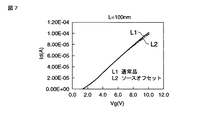
しかし、図1のように、ソース端部に高抵抗のオフセット領域を形成した場合、電流駆動力の劣化が懸念される。しかし、図6に示したように、ソース端部をΔxだけソース側に移動することにより、高抵抗のオフセット領域をソース端部に設けた場合、同じΔxだけドレイン拡散領域をソース側に移動することにより、電流駆動力の劣化を抑制することができる。図7は、図6に示した構造において、ドレイン電圧を0.8V、ゲート長100nmの場合のドレイン電流(Id)である。横軸を浮遊ゲート電圧(Vg)としている。電流駆動力は従来構造と比べてほとんど変わらないことがわかる。 However, when a high-resistance offset region is formed at the source end as shown in FIG. However, as shown in FIG. 6, when a high resistance offset region is provided at the source end by moving the source end to the source side by Δx, the drain diffusion region is moved to the source side by the same Δx. As a result, it is possible to suppress the deterioration of the current driving force. FIG. 7 shows the drain current (Id) when the drain voltage is 0.8 V and the gate length is 100 nm in the structure shown in FIG. The horizontal axis is the floating gate voltage (Vg). It can be seen that the current driving force is almost the same as that of the conventional structure.
このようにして、本発明の第1の実施形態においては、ソース端部に高抵抗のオフセット領域を設け、ドレイン拡散領域プロファイルを最適化することにより、電流駆動力を劣化させることなくNOR型フラッシュメモリーの書き込み特性を向上させることができる。 Thus, in the first embodiment of the present invention, a NOR-type flash is provided without degrading the current driving capability by providing a high resistance offset region at the source end and optimizing the drain diffusion region profile. The writing characteristics of the memory can be improved.
図8〜11は、図1に示す、ゲート端部とソース接合位置との間の距離Δyを調節することにより、書き込み特性を向上させることができることを示す特性図である。なお、図8〜11においては、ゲート長を70nmとしている。図8は、ソースオフセットΔyを0nm(通常品)、7nm、10nmと変化させた場合の電界強度のプロファイルを示したものである。図8からわかるように、Δyを増大させることにより、電界集中のピーク位置がよりソース側へずれるため、図9に示すように、速度オーバーシュートが抑制される。 8 to 11 are characteristic diagrams showing that the write characteristics can be improved by adjusting the distance Δy between the gate end portion and the source junction position shown in FIG. 8 to 11, the gate length is 70 nm. FIG. 8 shows the electric field intensity profile when the source offset Δy is changed to 0 nm (normal product), 7 nm, and 10 nm. As can be seen from FIG. 8, by increasing Δy, the peak position of the electric field concentration shifts more toward the source side, so that the speed overshoot is suppressed as shown in FIG.
また、図10に示すように、電子温度のピーク位置もよりソース側へずれる。従来構造では、電子温度のピーク位置がドレイン側に存在するため、ホットエレクトロンがそのままドレイン拡散領域へと流れ込んでしまう。電子温度のピーク位置がよりソース側へずれることは、ホットエレクトロンの注入ポイントがよりソース側へずれることを意味しており、結果としてホットエレクトロンがドレイン拡散領域へ流れ込んでしまうことを抑制する効果を有する。 Further, as shown in FIG. 10, the peak position of the electron temperature is further shifted to the source side. In the conventional structure, since the peak position of the electron temperature exists on the drain side, hot electrons flow into the drain diffusion region as they are. The fact that the peak position of the electron temperature deviates further toward the source means that the hot electron injection point deviates further toward the source, and as a result, the effect of suppressing hot electrons from flowing into the drain diffusion region. Have.
また、図11はゲート長70nmのVth(1μA,Vd=1V)の立ち上がり特性を、通常品、ソース端オフセット7nm,10nmで比較した示す。ソース端オフセットを大きくするにつれ、立ち上がり特性がより改善されていることが分かる。このようにして、ソース端部における高抵抗のオフセット領域の大きさを制御することで、書き込み特性を制御することができる。 FIG. 11 shows a comparison of the rising characteristics of Vth (1 μA, Vd = 1 V) with a gate length of 70 nm between a normal product and a source end offset of 7 nm and 10 nm. It can be seen that the rising characteristic is further improved as the source end offset is increased. In this manner, the write characteristics can be controlled by controlling the size of the high-resistance offset region at the source end.
図13は、図1に示した、ソース端部にオフセット領域を設けたデバイス構造を形成するための製造方法を段階的に示す断面図で、図12に示す平面図のA−A´線に沿った断面図に相当する。平面図(図12)をより詳細に説明すると、図1で示したメモリ素子(セルトランジスタ)が、同一列で隣接するセルトランジスタが、ドレイン若しくはソースを共有する形で、マトリクス状に配列されている。また、同一行のセルトランジスタの制御ゲート7は、制御ゲート線CGに共通に接続されている。
FIG. 13 is a cross-sectional view showing a step-by-step manufacturing method for forming the device structure shown in FIG. 1 having an offset region at the source end. It corresponds to a sectional view along. The plan view (FIG. 12) will be described in more detail. The memory elements (cell transistors) shown in FIG. 1 are arranged in a matrix so that adjacent cell transistors in the same column share a drain or a source. Yes. The
製造法としては、先ず基板1上に、ゲート(トンネル)絶縁膜4、浮遊ゲート5、ゲート間(層間)絶縁膜6、制御ゲート7となる層を順に積層し(図13(a))、リソグラフィを利用して積層ゲートパターニングを行った後、酸化工程により側壁絶縁膜15を形成することにより図13(b)に示した構造を形成する。ここで、浮遊ゲート5、制御ゲート7は、例えばポリシリコンにより形成される。
As a manufacturing method, first, a gate (tunnel) insulating
次いで、図13(c)に示すように、層間(埋め込み)絶縁膜16を堆積し、マスクを利用したパターニングにより図13(d)に示すようにソース拡散領域側にのみ側壁絶縁膜17を形成する。次いで、側壁絶縁膜18を形成し(図13(e))、側壁絶縁膜18越しにソース・ドレイン拡散領域形成用の不純物(例えば、n型不純物としてリン(P))をイオン注入を行うことにより(図13(f))、ソース端部にのみ高抵抗のオフセット領域が形成されたデバイス構造を形成することができる(図13(g))。ここで、側壁絶縁膜として利用する絶縁膜17及び絶縁膜18は、互いに選択比が取れている必要がある。例えば、絶縁膜17としてTEOSを利用した場合には、絶縁膜18としてシリコン窒化膜を利用する必要がある、逆に、絶縁膜17としてシリコン窒化膜を利用した場合には、絶縁膜18としてはTEOSが利用される。
Next, as shown in FIG. 13C, an interlayer (buried) insulating
以上述べたように、第1の実施形態によれば、ソース端部における高抵抗のオフセット領域を設けることにより、書き込み特性を向上させることができる。 As described above, according to the first embodiment, writing characteristics can be improved by providing a high-resistance offset region at the source end.
(第2の実施形態)
図14は、本発明の第2の実施形態に関わるNOR型不揮発性半導体記憶装置の素子構造を示す断面図である。この素子構造においては、ソース拡散領域2の拡散深さDsが、ドレイン拡散層領域3の拡散深さDdよりも小さく(浅く)形成されているため、ソース端部に高抵抗領域が設けられ、本発明の第1の実施形態で説明したように、速度オーバーシュートが抑制され、書き込み効率の向上を実現することができる。
(Second Embodiment)
FIG. 14 is a sectional view showing an element structure of a NOR type nonvolatile semiconductor memory device according to the second embodiment of the present invention. In this element structure, since the diffusion depth Ds of the
図15は、本発明の第2の実施形態に関わるNOR型不揮発性半導体記憶装置の製造方法を段階的に示す断面図で、平面図は図12と同様となる。先ず,基板1上に、トンネル絶縁膜4、浮遊ゲート5、ゲート間絶縁膜6、制御ゲート7となる各層を順に積層し(図15(a))、リソグラフィを利用して積層ゲートパターニングを行った後、酸化工程により側壁絶縁膜15を形成することにより図15(b)に示した構造を形成する。
FIG. 15 is a cross-sectional view showing the manufacturing method of the NOR type nonvolatile semiconductor memory device according to the second embodiment of the present invention step by step, and the plan view is the same as FIG. First, the layers to be the
次いで、図15(c)に示すように、層間(埋め込み)絶縁膜16を堆積し、セルトランジスタ間の空隙を充填する。必要に応じて、CMP(chemical Mechanical Polishing)等の手段により、層間絶縁膜16の上面部を平坦にしてもよい。次いで、図15(d)に示すように、マスクを利用したパターニングによりドレイン拡散領域上の層間絶縁膜16を除去して、図15(e)に示す構造を得る。
Next, as shown in FIG. 15C, an interlayer (buried) insulating
次いで、図15(f)に示すように、ソース拡散領域側に残された層間絶縁膜16をエッチング等の除去手段により、所望の高さまで調節する。このソース拡散領域側に残された層間絶縁膜16越しに、ソース及びドレイン拡散領域形成のための不純物(例えば、P)のイオン注入を行うことにより、図15(g)に示すように、ソース拡散領域2をドレイン拡散領域3よりも浅く形成することが可能となる。このようにして、図14に示した素子構造を製造することができる。
Next, as shown in FIG. 15F, the
以上述べたように、ソース拡散領域2の深さをドレイン拡散領域3の深さより浅くすることにより、ソース端部に高抵抗のオフセット領域を設けることができ、第1の実施形態と同様に、書き込み特性を向上させることができる。
As described above, by making the depth of the
(第3の実施形態)
図16は、本発明の第3の実施形態に関わるNOR型不揮発性半導体記憶装置の素子構造を示す断面図である。第2の実施形態の製造方法では、マスクを追加することにより、所望のデバイス構造を形成している。製造コスト削減の観点からは、できるだけマスクは追加しないほうが望ましい。図16に示す素子構造は、マスクを追加せずソース端部にのみ高抵抗のオフセット領域を形成することができる。すなわち、図16に示すデバイス構造においては、ソース側のセル間距離がドレイン側のセル間距離よりも狭く形成されている。このような構造により、以下で説明するようにマスクを追加することなくソース端部にのみ高抵抗のオフセット領域を形成することができる。
(Third embodiment)
FIG. 16 is a cross-sectional view showing the element structure of a NOR type nonvolatile semiconductor memory device according to the third embodiment of the present invention. In the manufacturing method of the second embodiment, a desired device structure is formed by adding a mask. From the viewpoint of manufacturing cost reduction, it is desirable not to add a mask as much as possible. The element structure shown in FIG. 16 can form a high-resistance offset region only at the source end without adding a mask. That is, in the device structure shown in FIG. 16, the cell-to-cell distance on the source side is formed narrower than the cell-to-cell distance on the drain side. With such a structure, an offset region having a high resistance can be formed only at the source end without adding a mask as described below.
図16は、本発明の第3の実施形態に関わるNOR型不揮発性半導体記憶装置の製造方法を段階的に示す断面図で、平面図は図12と類似したものとなる。先ず、基板1上に、トンネル絶縁膜4、浮遊ゲート5、ゲート間絶縁膜6、制御ゲート7となる各層を順に積層し、リソグラフィを利用して積層ゲートパターニングを行った後、酸化工程により側壁絶縁膜15を形成することにより図17(a)に示した構造を形成する。ここで、リソグラフィを利用したゲートパターニングにおいては、ソース側のセル間距離をドレイン側のセル間距離よりも狭く形成する。
FIG. 16 is a cross-sectional view showing stepwise a manufacturing method of a NOR type nonvolatile semiconductor memory device according to the third embodiment of the present invention, and a plan view is similar to FIG. First, the layers to be the
次いで、図17(b)に示すように、層間(埋め込み)絶縁膜19を堆積する。絶縁膜19としては、基板1、トンネル絶縁膜4、浮遊ゲート5、ゲート間絶縁膜6、制御ゲート7からなる積層構造(以下セルトランジスタと呼ぶ)を被覆する側壁絶縁膜15と選択比が取れていればどのような絶縁膜でもよく、例えば、シリコン窒化膜が挙げられる。
Next, as shown in FIG. 17B, an interlayer (buried) insulating
次いで、図17(c)に示すように、層間絶縁膜19をエッチングすることにより、側壁絶縁膜20を形成する。今、ソース側のセル間距離がドレイン側のセル間距離よりも狭く形成されているため、ソース領域のみ側壁絶縁膜20により充填される。次いで、図17(d)に示すように、この側壁絶縁膜20越しにイオン(例えばリン(P))注入を行う。ソース側は側壁絶縁膜20により充填されているため、ソース拡散領域2はドレイン拡散領域3よりも浅く、濃度が薄く形成される。そのため、ソース端部において高抵抗領域が形成されることになる。次いで、側壁絶縁膜20を剥離することにより、図17(e)に示す構造を得る。
Next, as shown in FIG. 17C, the
以上述べたように、第3の実施形態によれば、マスクを使用せずに、ソース拡散領域2の深さをドレイン拡散領域3の深さより浅くし、ソース端部に高抵抗のオフセット領域を設けることができるので、第1の実施形態と同様に、書き込み特性を向上させることができる。
As described above, according to the third embodiment, without using a mask, the depth of the
(第4の実施形態)
図18は、本発明の第4の実施形態に関わるNOR型不揮発性半導体記憶装置の素子構造を示す断面図である。この素子構造では、ソース拡散領域2の浮遊ゲート付近の端部(ソース端部)に、基板不純物と同一の導電型の高濃度不純物領域8(ソースハロー領域)が設けられている。ソース端部に形成されたこの高濃度不純物領域8により、ソース端部において高抵抗領域が形成される。そのため、図19に示したように、ゲート長方向の電界集中のピークが弱められ、図20に示したように、速度オーバーシュートが抑制される。また、図21に示したように、電子温度のピーク位置もよりソース側へずれるため、ホットエレクトロンの注入ポイントがよりソース側へ移動する。そのため、図22に示したように、書き込み特性が従来構造に比べて著しく改善される。ここで、図19〜22においては、ゲート長を70nm、高濃度不純物領域8の不純物濃度は2×10¹⁸/cm3としている。このように、基板不純物と同じ導電型の高濃度不純物領域をソース端部に
形成することにより、NOR型フラッシュメモリーの書き込み特性を向上させることができる。
(Fourth embodiment)
FIG. 18 is a cross-sectional view showing an element structure of a NOR type nonvolatile semiconductor memory device according to the fourth embodiment of the present invention. In this element structure, a high-concentration impurity region 8 (source halo region) having the same conductivity type as the substrate impurity is provided at an end portion (source end portion) of the
図23は、本発明の第4の実施形態に関わるNOR型不揮発性半導体記憶装置の製造方法を段階的に示す断面図で、平面図は図12と同様となる。先ず、基板1上に、トンネル絶縁膜4、浮遊ゲート5、ゲート間絶縁膜6、制御ゲート7となる各層を順に積層し(図23(a))、リソグラフィを利用して積層ゲートパターニングを行った後、酸化工程により側壁絶縁膜15を形成することにより図23(b)に示した構造を形成する。
FIG. 23 is a cross-sectional view showing the manufacturing method of the NOR type nonvolatile semiconductor memory device according to the fourth embodiment of the present invention step by step, and the plan view is the same as FIG. First, the layers to be the
次いで、図23(c)に示すように、層間絶縁膜(不図示)を堆積し、これをRIE等の異方性エッチングで加工して側壁絶縁膜領域18を形成する。側壁絶縁膜領域18を構成する絶縁膜種としては、TEOS、シリコン窒化膜等が考えられる。次いで、図23(d)に示したように、イオン注入を遮断することのできる絶縁膜やレジストからなるマスク21を、リソグラフィを利用したパターニングにより、ドレイン領域を被覆するように設ける。このマスク21により、高濃度不純物がイオン注入によりドレイン端部に注入されることを防ぐことができ、ゲート長方向斜めイオン注入を2方向から行なうことにより、ソース端部のみに高濃度不純物領域を形成することができる。次いで、図23(e)に示したように、イオン注入によりソース・ドレイン拡散領域を形成することで、図17に示したデバイス構造を形成することができる。
Next, as shown in FIG. 23C, an interlayer insulating film (not shown) is deposited and processed by anisotropic etching such as RIE to form the sidewall insulating
以上述べたように、第4の実施形態によれば、ソース端部に基板と同一導電型の高不純物濃度領域を設けて、ソース端部に高抵抗領域を設けるので、第1の実施形態と同様に、書き込み特性を向上させることができる。 As described above, according to the fourth embodiment, a high impurity concentration region having the same conductivity type as that of the substrate is provided at the source end portion and a high resistance region is provided at the source end portion. Similarly, the write characteristics can be improved.
(第5の実施形態)
図24は、本発明の第5の実施形態に関わるNOR型不揮発性半導体記憶装置の素子構造を示す断面図である。この素子構造では、ソース拡散領域2の浮遊ゲート付近の端部(ソース端部)に、基板不純物と同一の導電型の高濃度不純物領域8(ソースハロー領域)が設けられている点については、第4の実施形態における素子構造と同様であるが、ドレイン側のセルトランジスタ間の距離が、ソース側のセルトランジスタ間の距離よりも狭く形成されているという特徴がある。この構造上の特徴により、マスクを追加することなく、ソース端部にのみ基板不純物と同一の導電型の高濃度不純物領域8(ソースハロー領域)を設けることができる。
(Fifth embodiment)
FIG. 24 is a cross-sectional view showing an element structure of a NOR type nonvolatile semiconductor memory device according to the fifth embodiment of the present invention. In this element structure, a high-concentration impurity region 8 (source halo region) having the same conductivity type as the substrate impurity is provided at an end portion (source end portion) of the
図25は、第5の実施形態に関わるNOR型不揮発性半導体記憶装置の製造方法を段階的に示す断面図で、平面図は図12と類似となる。先ず、基板1上に、トンネル絶縁膜4、浮遊ゲート5、ゲート間絶縁膜6、制御ゲート7となる各層を順に積層し、リソグラフィを利用して積層ゲートパターニングを行った後、酸化工程により側壁絶縁膜15を形成することにより図25(a)に示した構造を形成する。ここで、リソグラフィを利用した積層ゲートパターニングにおいては、ドレイン3側のセル間距離をソース2側のセル間距離よりも狭く形成する。
FIG. 25 is a cross-sectional view showing the manufacturing method of the NOR type nonvolatile semiconductor memory device according to the fifth embodiment step by step, and the plan view is similar to FIG. First, layers to be a
次いで、図25(b)に示すように、層間絶縁膜19を堆積する。絶縁膜19としては、基板1、トンネル絶縁膜4、浮遊ゲート5、ゲート間絶縁膜6、制御ゲート7からなるセルトランジスタ領域を被覆する側壁絶縁膜15と選択比が取れていればどのような絶縁膜でもよく、例えば、シリコン窒化膜が挙げられる。
Next, as shown in FIG. 25B, an
次いで、図25(c)に示すように、層間絶縁膜19をエッチングすることにより、側壁絶縁膜20を形成する。今、ドレイン3側のセル間距離がソース2側のセル間距離よりも狭く形成されているため、ドレイン領域のみ側壁絶縁膜20により充填される。次いで、図25(d)に示すように、基板不純物と同一の導電型の高濃度不純物領域8を、ゲート長方向斜めイオン注入を2方向から行なうことにより、ソース端部に形成する。このとき、ドレイン領域は絶縁膜領域20により充填されているため、ドレイン端部には、高濃度不純物領域8が形成されていない。
Next, as shown in FIG. 25C, the
次いで、図25(e)に示すように、絶縁膜領域20を除去した後、イオン注入により、ソース拡散層2及びドレイン拡散層3を形成する。このようにして、マスクを追加することなく、第5の実施形態に関わるNOR型不揮発性半導体記憶装置(図24)を製造することができる。
Next, as shown in FIG. 25E, after the insulating
以上述べたように、第5の実施形態によれば、ドレイン側のセルトランジスタ間の距離が、ソース側のセルトランジスタ間の距離よりも狭く形成されているので、マスクを追加せずにソース端部に基板と同一導電型の高不純物濃度領域を設けて、ソース端部のみに高抵抗領域を設けることができる。このため、製造コストを増大させることなく、第4の実施形態と同様の、書き込み特性改善効果を得ることができる。 As described above, according to the fifth embodiment, the distance between the cell transistors on the drain side is formed to be smaller than the distance between the cell transistors on the source side. A high impurity concentration region having the same conductivity type as that of the substrate can be provided in the portion, and a high resistance region can be provided only in the source end portion. For this reason, the same write characteristic improvement effect as that of the fourth embodiment can be obtained without increasing the manufacturing cost.
(第6の実施形態)
図26は、第6の実施形態に係るNOR型不揮発性半導体素子の断面図である。第6の実施形態では、ドレイン領域3の内側端部に低不純物濃度の第2のドレイン領域(LDD構造)を設けたものである。本実施形態では、ドレイン端部にのみLDD領域9を形成し、ソース端部にはLDD領域が形成されていないので、ソース端部の抵抗が、LDD領域9が形成されているドレイン端部の領域の抵抗よりも大きくなる。そのため、図26に示した構造は、第1から第5の実施形態において説明したのと同様の理由で、書き込み特性が改善される。なお、従来のLDD構造は、ソース・ドレイン両領域の内側端部に低抵抗領域が設けられているので、本実施形態のような効果は得られない。
(Sixth embodiment)
FIG. 26 is a cross-sectional view of a NOR-type nonvolatile semiconductor device according to the sixth embodiment. In the sixth embodiment, a second drain region (LDD structure) having a low impurity concentration is provided at the inner end of the
図27は、図26に示した、第6の実施形態に関わるNOR型不揮発性半導体記憶装置の製造方法を段階的に示す断面図で、平面図は図12と同様となる。基板1上に、トンネル絶縁膜4、浮遊ゲート5、ゲート間絶縁膜6、制御ゲート7となる各層を順に積層し(図27(a))、リソグラフィを利用してゲートパターニングを行った後、酸化工程により側壁絶縁膜15を形成することにより図27(b)に示した構造を形成する。次いで、図27(c)に示すように、層間絶縁膜(不図示)を堆積し、エッチング等の除去手段により側壁絶縁膜領域18を形成する。側壁絶縁膜領域18を構成する絶縁膜種としては、TEOS、シリコン窒化膜等が考えられる。
FIG. 27 is a cross-sectional view showing the manufacturing method of the NOR type nonvolatile semiconductor memory device according to the sixth embodiment shown in FIG. 26 step by step, and the plan view is the same as FIG. On the
次いで、図27(d)に示したように、イオン注入を遮断することのできる絶縁膜やレジストからなるマスク22を、リソグラフィを利用したパターニングにより、ドレイン領域以外の領域を被覆するように設ける。このマスク22の存在により、ソース領域にLDD領域が形成されることを防ぐことができ、不純物(例えば、P)のゲート長方向斜めイオン注入を2方向から行なうことによりドレイン領域にのみLDD領域9を形成することができる。次いで、図27(e)に示したように、不純物(例えば、P)イオン注入によりソース・ドレイン拡散層を形成することで、図26に示したデバイス構造を形成することができる。
Next, as shown in FIG. 27D, a
以上述べたように、第6の実施形態によれば、ドレイン端部にLDD領域を設けて、ソース端部に高抵抗領域を設けているので、第1の実施形態同様に、書き込み特性を向上させることができる。 As described above, according to the sixth embodiment, since the LDD region is provided at the drain end and the high resistance region is provided at the source end, the write characteristics are improved as in the first embodiment. Can be made.
(第7の実施形態)
図28は、本発明の第7の実施形態に関わるNOR型不揮発性半導体記憶装置の素子構造を示す断面図である。第7の実施形態に関わるNOR型不揮発性半導体記憶装置は、第6の実施形態において、ソース2側のセルトランジスタ間がドレイン3側のセルトランジスタ間よりも狭く形成されていることが特徴である。図29を用いて、図28に示した素子構造を製造するための製造方法について説明する。
(Seventh embodiment)
FIG. 28 is a cross-sectional view showing an element structure of a NOR type nonvolatile semiconductor memory device according to the seventh embodiment of the present invention. The NOR type nonvolatile semiconductor memory device according to the seventh embodiment is characterized in that the cell transistors on the
先ず、基板1上に、トンネル絶縁膜4、浮遊ゲート5、ゲート間絶縁膜6、制御ゲート7となる各層を順に積層し、リソグラフィを利用して積層ゲートパターニングを行った後、酸化工程により側壁絶縁膜領域15を形成することにより図29(a)に示した構造を形成する。ここで、リソグラフィを利用したゲートパターニングにおいては、ソース側のセル間距離をドレイン側のセル間距離よりも狭く形成する。
First, layers to be a
次いで、図29(b)に示すように、層間絶縁膜19を堆積する。絶縁膜19としては、基板1、トンネル絶縁膜4、浮遊ゲート5、ゲート間絶縁膜6、制御ゲート7からなるセルトランジスタ領域を被覆する側壁絶縁膜15と選択比が取れていればどのような絶縁膜でもよく、例えば、シリコン窒化膜が挙げられる。次いで、図29(c)に示すように、層間絶縁膜19をエッチングすることにより、側壁絶縁膜20を形成する。今、ソース側のセル間距離がドレイン側のセル間距離よりも狭く形成されているため、ソース領域のみ側壁絶縁膜20により充填される。
Next, as shown in FIG. 29B, an
次いで、図29(d)に示すように、LDD領域9形成のためのゲート長方向斜めイオン注入を2方向から行う。ソース側は絶縁膜20により充填されているため、ソース端部にはLDD領域が形成されない。次いで、図28(e)に示すように、側壁絶縁膜20を除去した後、ソース拡散領域2及びドレイン拡散領域3形成のためのイオン注入を行い、図28に示した素子構造を製造することができる。ここで、図30(a)〜(c)に示したように、ソース拡散領域2及びドレイン拡散領域3形成のためのイオン注入は、層間絶縁膜20を除去する前に行ってもよく、この場合、図30(c)に示したように、ソース拡散領域2はドレイン拡散領域3よりも、ピーク濃度が小さく、浅く形成されることになる。
Next, as shown in FIG. 29D, oblique ion implantation in the gate length direction for forming the
以上述べたように、第7の実施形態によれば、ソース側のセルトランジスタ間の距離が、ドレイン側のセルトランジスタ間の距離よりも狭く形成されているので、マスクを追加せずにドレイン端部にのみLDD領域を設け、ソース端部には高抵抗領域を設けることができる。このため、製造コストを増大させることなく、第4の実施形態と同様の書き込み特性改善効果を得ることができる。 As described above, according to the seventh embodiment, the distance between the cell transistors on the source side is formed to be narrower than the distance between the cell transistors on the drain side. An LDD region can be provided only in the portion, and a high resistance region can be provided in the source end portion. For this reason, the same write characteristic improvement effect as that of the fourth embodiment can be obtained without increasing the manufacturing cost.
(第8の実施形態)
第1から第7の実施形態においては、従来構造として、制御ゲート、ゲート間絶縁膜、浮遊ゲート、トンネル絶縁膜、基板それぞれからなる構造を想定している。しかし、第1から第7の実施形態は、MONOS(Metal-Oxide-Nitride-Oxide Semiconductor)構造においても有効である。MONOS構造を利用した不揮発性半導体記憶装置は、NROMと呼ばれている。
(Eighth embodiment)
In the first to seventh embodiments, a structure including a control gate, an intergate insulating film, a floating gate, a tunnel insulating film, and a substrate is assumed as a conventional structure. However, the first to seventh embodiments are also effective in a MONOS (Metal-Oxide-Nitride-Oxide Semiconductor) structure. A nonvolatile semiconductor memory device using the MONOS structure is called an NROM.
図31は第8の実施形態に係る不揮発性記憶素子の断面図である。半導体基板1にソース拡散領域2およびドレイン拡散領域3が対峙して形成され、これらソース拡散領域2およびドレイン拡散領域3の間の半導体基板1の表面には、第1のシリコン酸化膜(ゲート絶縁膜)11、シリコン窒化膜(電荷蓄積層)12、第2のシリコン酸化膜(層間絶縁膜)13、メタルゲート(制御ゲート)14の積層ゲート構造が形成されている。この素子構造では、第1の実施形態と同様に、ソース拡散領域2がシリコン窒化膜(電荷蓄積層)12の端部より、Δyだけオフセットするように形成されている。但し、第2〜第7の実施形態と同様な構造をとり得ることは言うまでも無い。
FIG. 31 is a cross-sectional view of the nonvolatile memory element according to the eighth embodiment. A
MONOS構造においては、シリコン窒化膜12中に存在するトラップサイトに電子を捕獲させることによって、情報の書き込みを行う。第1から第7の実施形態において、基板の上部構造をMONOS構造にしたNROMに対しても、第1から第7の実施形態と同様な効果が得られる。
In the MONOS structure, information is written by trapping electrons in trap sites existing in the
以上、本発明を実施形態を通じ説明したが、本発明は上記実施形態そのままに限定されるものではなく、実施段階ではその要旨を逸脱しない範囲で構成要素を変形して具体化できる。また、上記実施形態に開示されている複数の構成要素の適宜な組み合わせにより、種々の発明を形成できる。例えば、実施形態に示される全構成要素から幾つかの構成要素を削除してもよい。さらに、異なる実施形態にわたる構成要素を適宜組み合わせてもよい。 As mentioned above, although this invention was demonstrated through embodiment, this invention is not limited to the said embodiment as it is, A component can be deform | transformed and embodied in the range which does not deviate from the summary in an implementation stage. In addition, various inventions can be formed by appropriately combining a plurality of components disclosed in the embodiment. For example, some components may be deleted from all the components shown in the embodiment. Furthermore, constituent elements over different embodiments may be appropriately combined.
1…半導体基板
2…ソース拡散領域
3…ドレイン拡散領域
4…トンネル(ゲート)絶縁膜
5…浮遊ゲート
6…ゲート間(層間)絶縁膜
7…制御ゲート
8…基板と同じ導電型の高濃度不純物領域
9…LDD領域
11…シリコン酸化膜(ゲート絶縁膜)
12…シリコン窒化膜
13…シリコン酸化膜(層間絶縁膜)
14…メタル電極(制御ゲート)
15…層間酸化膜
16…層間絶縁膜
17,18、19,20…側壁絶縁膜
21,22…イオン注入遮蔽マスク
DESCRIPTION OF
12 ...
14 ... Metal electrode (control gate)
DESCRIPTION OF
Claims (5)
前記積層膜を選択的にエッチングして、ゲート絶縁膜、電荷蓄積層、第1の層間絶縁膜、制御ゲートを具備する複数の積層構造を所定の1方向に配列し、前記半導体基板上に前記積層構造で挟まれた間隔が狭いソース予定領域と広いドレイン予定領域とを交互に形成する工程と、
前記複数の積層構造を被覆して、前記ソース予定領域上を充填し、前記ドレイン予定領域上および隣接する前記積層構造の側壁を内張りするように、前記第2の層間絶縁膜層を形成する工程と、
前記ドレイン予定領域において、前記第2の層間絶縁膜層の底部に開口部を設ける工程と、
前記積層構造をマスクとして、前記半導体基板上面より垂直に第2導電型不純物をイオン注入し、前記ソース予定領域には充填された前記第2の層間絶縁膜層を介在させることにより、ソース拡散領域の深さをドレイン拡散領域の深さより浅く形成する工程と、
を含むことを特徴とする不揮発性半導体記憶装置の製造方法。 Forming a laminated film by sequentially laminating a gate insulating film layer, a charge storage layer, a first interlayer insulating film layer, and a control gate layer on a first conductivity type semiconductor substrate;
A plurality of stacked structures including a gate insulating film, a charge storage layer, a first interlayer insulating film, and a control gate are arranged in a predetermined direction by selectively etching the stacked film, and the stacked structure is formed on the semiconductor substrate. A step of alternately forming a narrow planned source region and a wide planned drain region sandwiched between stacked structures; and
Forming the second interlayer insulating film layer so as to cover the plurality of stacked structures, fill the planned source region, and line the planned drain region and the adjacent sidewall of the stacked structure; When,
A step of providing an opening at the bottom of the second interlayer insulating film layer in the planned drain region;
Using the stacked structure as a mask, second conductivity type impurities are ion-implanted perpendicularly from the upper surface of the semiconductor substrate, and the second interlayer insulating film layer filled in the planned source region is interposed, thereby providing a source diffusion region. Forming a depth less than that of the drain diffusion region;
A method for manufacturing a nonvolatile semiconductor memory device, comprising:
前記積層膜を選択的にエッチングして、ゲート絶縁膜、電荷蓄積層、第1の層間絶縁膜、制御ゲートを具備する複数の積層構造を所定の1方向に配列し、前記半導体基板上に前記積層構造で挟まれた間隔が広いソース予定領域と狭いドレイン予定領域とを交互に形成する工程と、
前記複数の積層構造を被覆して、前記ドレイン予定領域を充填し、前記ソース予定領域上及び隣接する前記積層構造の側壁を内張りするように、第2の層間絶縁膜層を形成する工程と、
前記ソース予定領域において、前記第2の層間絶縁膜層の底部に開口部を設ける工程と、
前記ドレイン予定領域から前記ソース予定領域に向かう方向及びその逆の方向の2方向から、前記半導体基板の上面より第2導電型の不純物イオンを斜めイオン注入し、前記積層構造と前記ソース予定領域の境界付近にのみ前記半導体基板よりも高濃度な第1導電型の高濃度不純物領域を形成する工程と、
前記ドレイン予定領域上の前記第2の層間絶縁膜を除去した後、前記半導体基板上面より垂直に第2導電型不純物をイオン注入することにより、前記ソース予定領域にソース拡散領域を形成するとともに前記ソース拡散領域と前記高濃度不純物領域とを隣接させ、前記ドレイン予定領域にドレイン拡散領域を形成する工程と、
を含むことを特徴とする不揮発性半導体記憶装置の製造方法。 Forming a laminated film by sequentially laminating a gate insulating film layer, a charge storage layer, a first interlayer insulating film layer, and a control gate layer on a first conductivity type semiconductor substrate;
A plurality of stacked structures including a gate insulating film, a charge storage layer, a first interlayer insulating film, and a control gate are arranged in a predetermined direction by selectively etching the stacked film, and the stacked structure is formed on the semiconductor substrate. A step of alternately forming a planned source region and a narrow planned drain region which are sandwiched between stacked structures, and
Forming a second interlayer insulating film layer so as to cover the plurality of stacked structures, fill the drain region, and line the side wall of the stacked structure adjacent to the source region and adjacent to the source region;
Providing an opening at the bottom of the second interlayer insulating film layer in the planned source region;
Impurity ions of the second conductivity type are obliquely implanted from the upper surface of the semiconductor substrate from two directions, ie, a direction from the planned drain region to the planned source region and vice versa, and the stacked structure and the planned source region are formed. Forming a high-concentration impurity region of the first conductivity type having a higher concentration than the semiconductor substrate only near the boundary;
After removing the second interlayer insulating film on the planned drain region , ion implantation of a second conductivity type impurity is performed perpendicular to the upper surface of the semiconductor substrate, thereby forming a source diffusion region in the planned source region and Adjoining a source diffusion region and the high concentration impurity region, and forming a drain diffusion region in the planned drain region;
A method for manufacturing a nonvolatile semiconductor memory device, comprising:
前記半導体基板表面に対峙して形成された第2導電型の不純物拡散領域である一対のソース拡散領域及びドレイン拡散領域と、
前記ソース拡散領域と前記ドレイン拡散領域に挟まれた前記半導体基板表面のチャネル領域上に順次形成された、ゲート絶縁膜、電荷蓄積層、層間絶縁膜、制御ゲートを備える積層構造とを具備し、
前記ソース拡散領域と前記チャネル領域との接合位置が、前記積層構造の前記ソース拡散領域に近い端部から前記ソース拡散領域側に離れて形成されており、前記ソース拡散領域と前記チャネル領域との間に、第1導電型の高濃度不純物領域が形成されており、
前記積層構造は、前記ソース拡散領域またはドレイン拡散領域を挟んで前記半導体基板上に複数個形成され、前記ドレイン拡散領域側の前記積層構造間の距離が前記ソース拡散領域側の前記積層構造間の距離よりも狭く形成されていることを特徴とする不揮発性半導体記憶装置。 A first conductivity type semiconductor substrate;
A pair of source diffusion region and drain diffusion region which are impurity diffusion regions of the second conductivity type formed opposite to the surface of the semiconductor substrate;
A stacked structure including a gate insulating film, a charge storage layer, an interlayer insulating film, and a control gate, which are sequentially formed on a channel region on the surface of the semiconductor substrate sandwiched between the source diffusion region and the drain diffusion region;
A junction position between the source diffusion region and the channel region is formed away from an end portion of the stacked structure near the source diffusion region toward the source diffusion region side, and the source diffusion region and the channel region are A high-concentration impurity region of the first conductivity type is formed between them,
A plurality of the stacked structures are formed on the semiconductor substrate across the source diffusion region or the drain diffusion region, and a distance between the stacked structures on the drain diffusion region side is between the stacked structures on the source diffusion region side. A non-volatile semiconductor memory device, characterized by being formed narrower than the distance.
Priority Applications (3)
| Application Number | Priority Date | Filing Date | Title |
|---|---|---|---|
| JP2006183658A JP4314252B2 (en) | 2006-07-03 | 2006-07-03 | Nonvolatile semiconductor memory device and manufacturing method thereof |
| US11/643,904 US20080001203A1 (en) | 2006-07-03 | 2006-12-22 | Nonvolatile semiconductor memory device and manufacturing method thereof |
| US12/457,757 US7821057B2 (en) | 2006-07-03 | 2009-06-19 | Nonvolatile semiconductor memory device and manufacturing method thereof |
Applications Claiming Priority (1)
| Application Number | Priority Date | Filing Date | Title |
|---|---|---|---|
| JP2006183658A JP4314252B2 (en) | 2006-07-03 | 2006-07-03 | Nonvolatile semiconductor memory device and manufacturing method thereof |
Publications (2)
| Publication Number | Publication Date |
|---|---|
| JP2008016500A JP2008016500A (en) | 2008-01-24 |
| JP4314252B2 true JP4314252B2 (en) | 2009-08-12 |
Family
ID=38875699
Family Applications (1)
| Application Number | Title | Priority Date | Filing Date |
|---|---|---|---|
| JP2006183658A Expired - Fee Related JP4314252B2 (en) | 2006-07-03 | 2006-07-03 | Nonvolatile semiconductor memory device and manufacturing method thereof |
Country Status (2)
| Country | Link |
|---|---|
| US (2) | US20080001203A1 (en) |
| JP (1) | JP4314252B2 (en) |
Families Citing this family (6)
| Publication number | Priority date | Publication date | Assignee | Title |
|---|---|---|---|---|
| US8466505B2 (en) * | 2005-03-10 | 2013-06-18 | Taiwan Semiconductor Manufacturing Company, Ltd. | Multi-level flash memory cell capable of fast programming |
| FR2898729B1 (en) * | 2006-03-17 | 2008-08-01 | St Microelectronics | SEMICONDUCTOR DEVICE AND METHOD FOR IMPLANTING DOPANTS IN A CHANNEL |
| US8120115B2 (en) * | 2007-03-12 | 2012-02-21 | Imec | Tunnel field-effect transistor with gated tunnel barrier |
| KR20110106689A (en) * | 2010-03-23 | 2011-09-29 | 삼성전자주식회사 | Nonvolatile Memory Device and Manufacturing Method Thereof |
| KR101224866B1 (en) * | 2011-04-12 | 2013-01-22 | 한국과학기술원 | Graphene Device Having Physical Gap |
| US9583503B1 (en) * | 2015-12-11 | 2017-02-28 | Macronix International Co., Ltd. | Three-dimensional semiconductor device and method of manufacturing the same |
Family Cites Families (12)
| Publication number | Priority date | Publication date | Assignee | Title |
|---|---|---|---|---|
| US5264384A (en) | 1991-08-30 | 1993-11-23 | Texas Instruments Incorporated | Method of making a non-volatile memory cell |
| JPH065874A (en) | 1992-06-19 | 1994-01-14 | Mitsubishi Electric Corp | Manufacture of nonvolatile semiconductor memory |
| JP2710194B2 (en) | 1993-09-24 | 1998-02-10 | 日本電気株式会社 | Nonvolatile semiconductor memory device and method of manufacturing the same |
| JP2901473B2 (en) | 1993-12-09 | 1999-06-07 | 日本電気株式会社 | Nonvolatile semiconductor integrated circuit device |
| DE69428516T2 (en) | 1994-03-28 | 2002-05-08 | Stmicroelectronics S.R.L., Agrate Brianza | Flash EEPROM memory matrix and biasing method |
| JPH07297299A (en) | 1994-04-27 | 1995-11-10 | Sony Corp | Semiconductor memory and manufacturing method thereof |
| KR100278661B1 (en) * | 1998-11-13 | 2001-02-01 | 윤종용 | Nonvolatile Memory Device and Manufacturing Method Thereof |
| JP2000332138A (en) | 1999-05-24 | 2000-11-30 | Nec Corp | Nonvolatile semiconductor storage device and its manufacture |
| JP2001291784A (en) | 2000-04-06 | 2001-10-19 | Matsushita Electric Ind Co Ltd | Nonvolatile semiconductor memory device and method of manufacturing the same |
| JP4819215B2 (en) | 2000-07-24 | 2011-11-24 | ルネサスエレクトロニクス株式会社 | Nonvolatile semiconductor memory device and manufacturing method thereof |
| JP3408531B2 (en) | 2002-07-29 | 2003-05-19 | 松下電器産業株式会社 | Nonvolatile semiconductor memory device and driving method thereof |
| JP4634864B2 (en) * | 2005-05-31 | 2011-02-16 | 株式会社東芝 | Semiconductor memory device and manufacturing method thereof |
-
2006
- 2006-07-03 JP JP2006183658A patent/JP4314252B2/en not_active Expired - Fee Related
- 2006-12-22 US US11/643,904 patent/US20080001203A1/en not_active Abandoned
-
2009
- 2009-06-19 US US12/457,757 patent/US7821057B2/en not_active Expired - Fee Related
Also Published As
| Publication number | Publication date |
|---|---|
| JP2008016500A (en) | 2008-01-24 |
| US20090261399A1 (en) | 2009-10-22 |
| US20080001203A1 (en) | 2008-01-03 |
| US7821057B2 (en) | 2010-10-26 |
Similar Documents
| Publication | Publication Date | Title |
|---|---|---|
| US8076709B2 (en) | Nonvolatile semiconductor memory device | |
| CN111180508B (en) | Nonvolatile memory and method of manufacturing the same | |
| CN101814507A (en) | Depletion Mode Charge Trapping Flash Device | |
| JP2004221554A (en) | Nonvolatile semiconductor memory device | |
| CN106158875A (en) | There is the memory unit improving erasing speed | |
| US9171855B2 (en) | Three-dimensional non-volatile memory | |
| US7238982B2 (en) | Split gate type flash memory device and method for manufacturing same | |
| US7821057B2 (en) | Nonvolatile semiconductor memory device and manufacturing method thereof | |
| JPH11220044A (en) | Low-voltage eeprom/nvram transistor and manufacture thereof | |
| CN101136414A (en) | Nonvolatile semiconductor memory device and manufacturing method thereof | |
| JP2008153451A (en) | Nonvolatile semiconductor memory device and manufacturing method thereof | |
| KR20080102030A (en) | Flash memory device, manufacturing method and operating method thereof | |
| CN100521158C (en) | Flash memory device with single-poly structure and method for manufacturing the same | |
| CN109994542A (en) | Semiconductor devices and its manufacturing method | |
| TWI513007B (en) | Memory component and method of manufacturing and operating memory component | |
| JP4845110B2 (en) | Split gate nonvolatile memory and manufacturing method thereof | |
| JP2006310562A (en) | Semiconductor memory device and manufacturing method thereof | |
| JP2006041227A (en) | Semiconductor device and its manufacturing method | |
| JP4521253B2 (en) | Manufacturing method of semiconductor memory device | |
| CN106206748A (en) | SONOS device and manufacture method thereof | |
| US9385240B1 (en) | Memory device and method for fabricating the same | |
| JP5684966B2 (en) | Nonvolatile semiconductor memory device and manufacturing method thereof | |
| JP2008166437A (en) | Semiconductor device, control method thereof, and manufacturing method thereof | |
| TWI612640B (en) | Memory device and method for fabricating the same | |
| JP4950036B2 (en) | Manufacturing method of semiconductor device |
Legal Events
| Date | Code | Title | Description |
|---|---|---|---|
| A621 | Written request for application examination |
Free format text: JAPANESE INTERMEDIATE CODE: A621 Effective date: 20080326 |
|
| A977 | Report on retrieval |
Free format text: JAPANESE INTERMEDIATE CODE: A971007 Effective date: 20081023 |
|
| A131 | Notification of reasons for refusal |
Free format text: JAPANESE INTERMEDIATE CODE: A131 Effective date: 20081104 |
|
| A521 | Request for written amendment filed |
Free format text: JAPANESE INTERMEDIATE CODE: A523 Effective date: 20081222 |
|
| A131 | Notification of reasons for refusal |
Free format text: JAPANESE INTERMEDIATE CODE: A131 Effective date: 20090127 |
|
| A521 | Request for written amendment filed |
Free format text: JAPANESE INTERMEDIATE CODE: A523 Effective date: 20090325 |
|
| TRDD | Decision of grant or rejection written | ||
| A01 | Written decision to grant a patent or to grant a registration (utility model) |
Free format text: JAPANESE INTERMEDIATE CODE: A01 Effective date: 20090421 |
|
| A01 | Written decision to grant a patent or to grant a registration (utility model) |
Free format text: JAPANESE INTERMEDIATE CODE: A01 |
|
| A61 | First payment of annual fees (during grant procedure) |
Free format text: JAPANESE INTERMEDIATE CODE: A61 Effective date: 20090518 |
|
| FPAY | Renewal fee payment (event date is renewal date of database) |
Free format text: PAYMENT UNTIL: 20120522 Year of fee payment: 3 |
|
| FPAY | Renewal fee payment (event date is renewal date of database) |
Free format text: PAYMENT UNTIL: 20120522 Year of fee payment: 3 |
|
| FPAY | Renewal fee payment (event date is renewal date of database) |
Free format text: PAYMENT UNTIL: 20120522 Year of fee payment: 3 |
|
| FPAY | Renewal fee payment (event date is renewal date of database) |
Free format text: PAYMENT UNTIL: 20130522 Year of fee payment: 4 |
|
| LAPS | Cancellation because of no payment of annual fees |