JP4061442B2 - Industrial antibacterial agent composition and antibacterial method - Google Patents
Industrial antibacterial agent composition and antibacterial method Download PDFInfo
- Publication number
- JP4061442B2 JP4061442B2 JP14316498A JP14316498A JP4061442B2 JP 4061442 B2 JP4061442 B2 JP 4061442B2 JP 14316498 A JP14316498 A JP 14316498A JP 14316498 A JP14316498 A JP 14316498A JP 4061442 B2 JP4061442 B2 JP 4061442B2
- Authority
- JP
- Japan
- Prior art keywords
- component
- dibromo
- antibacterial agent
- agent composition
- weight
- Prior art date
- Legal status (The legal status is an assumption and is not a legal conclusion. Google has not performed a legal analysis and makes no representation as to the accuracy of the status listed.)
- Expired - Fee Related
Links
Landscapes
- Agricultural Chemicals And Associated Chemicals (AREA)
Description
【0001】
【発明の属する技術分野】
本発明は、工業用抗菌剤組成物及び抗菌方法に関する。さらに詳しくは、本発明は、紙・パルプ工業における抄紙工程水、各種工業用の冷却水や洗浄水のスライム防止用、重油スラッジ、金属加工油剤、繊維油剤、ペイント、紙用塗工液、ラテックス、糊剤の防腐や抗菌用として有用である工業用抗菌剤組成物及び抗菌方法に関する。
【0002】
【従来の技術】
従来から紙・パルプ工業における抄紙工程や、各種工業における冷却水系統には、細菌や真菌によるスライムが発生し、生産品の品質低下や生産効率の低下などの障害を引き起こすことが知られている。また、多くの工業製品、例えば、重油スラッジ、金属加工油剤、繊維油剤、ペイント類、各種ラテックス、糊剤などでは、細菌や真菌による腐敗や汚染が発生し、製品を汚損し、商品価値を低下させる。これらの微生物による障害を防止するために、多くの抗菌剤が使用されてきた。
古くは、有機水銀化合物や塩素化フェノール系化合物などが使用されていたが、これらの薬剤は人体や魚介類に対する毒性が強く、環境汚染を引き起こすために使用が規制されるようになり、最近では、比較的低毒性の有機窒素系化合物、有機ハロゲン系化合物、有機硫黄系化合物が工業用抗菌剤として汎用されている(防菌防黴剤事典、日本防菌防黴学会、昭和61年発行)。しかし、これらの抗菌剤は、ある種の細菌や真菌に対する抗菌力が弱く、実系に適用した場合、極めて高濃度の添加が必要になり経済性が悪く、また、同一の抗菌剤を長期間使用していると、その抗菌剤に対して抵抗性の強い細菌類のみが系内に繁殖し、従来使用していた抗菌剤濃度では抗菌効果が著しく減退する。
このために、いわゆる相乗効果を期待して、複数の抗菌剤を組み合わせて使用する方法が提案されている。例えば、米国特許第3,928,198号明細書には、微生物に対して予期せぬ相乗的効果を示す組成物として、2,2−ジブロモ−3−ニトリロプロピオンアミドと3,3,4,4,−テトラクロロテトラヒドロチオフェン−1,1−ジオキシドを含有する組成物が提案されている。さらに、相乗効果を発揮する組み合わせとして、特開昭60−231603号公報には、3−ブロモ−3−ニトロペンタン−2,4−ジオールと2,2−ジブロモ−3−ニトリロプロピオンアミドを含有する防菌剤が提案され、特公平7−80727号公報には、2,2−ジブロモ−2−ニトロ−1−メチルエタノールと3,3,4,4,−テトラクロロテトラヒドロチオフェン−1,1−ジオキシドを含有する工業用殺菌剤が提案されている。しかし、これらの組成物は、改善された抗菌効力を有するものの、実系に適用した場合、その効果は必ずしも満足し得る水準に達していない。
スライムコントロール剤は、工業用抗菌剤に属し、非常に広い用途に用いられているが、従来のスライムコントロール剤の評価方法にも改善すべき課題があった。すなわち、従来からスライムコントロール剤の選定は、薬剤の水中分散菌に対する抗菌効果や、増殖抑制効果を評価することにより行われてきた。しかし、薬剤の水中分散菌に対する効果と、スライムに対する効果が、必ずしも相関しないということが最近明らかになってきた(J.C.Nickel,I.Ruseska,J.B.Wright,J.W.Costerton,Antimicrobial Agents and Chemother.,27(4)619〜624('85),Tobramycin Resistance of Pseudomonas aeruginosa Cells Growing as a Biofilm on Urinary Catheter Material.)。したがって、スライムに対する抗菌剤の効果は、水中分散菌に対してのみならず、水中の壁面に生長するスライムに対しても評価する必要がある。
このような事情のもとに、分散菌に対しても、スライムに対しても、低濃度の添加で有効な工業用抗菌剤が求められている。
【0003】
【発明が解決しようとする課題】
本発明は、紙・パルプ工業における抄紙工程水、各種工業用の冷却水や洗浄水のスライム防止用、重油スラッジ、金属加工油剤、繊維油剤、ペイント、紙用塗工液、ラテックス、糊剤などの防腐用、抗菌用として有用であり、水中の分散菌に対しても、壁面のスライムに対しても、低濃度の添加で優れた効果を発揮する工業用抗菌剤組成物及び抗菌方法を提供することを目的としてなされたものである。
【0004】
【課題を解決するための手段】
本発明者らは、上記の課題を解決すべく、壁面に付着したスライムに対する効果を評価することができるスライム付着モニターを用いて鋭意研究を重ねた結果、公知の抗菌剤である3,3,4,4,−テトラクロロテトラヒドロチオフェン−1,1−ジオキシドには殺菌力よりもむしろ微生物の付着を防止する働きがあることを見いだし、さらに、2,2−ジブロモ−3−ニトリロプロピオンアミドと2,2−ジブロモ−2−ニトロエタノールの2成分を含有する公知の工業用抗菌剤組成物に、さらに少量の3,3,4,4,−テトラクロロテトラヒドロチオフェン−1,1−ジオキシドを含有せしめることにより、該2成分の組み合わせに比較して、さらに広範な種類の微生物に対する相乗的な抗菌効果の増強が見られ、またスライムの付着を長期間にわたり防止する効果が発揮されるという意外な事実を見いだし、この知見に基づいて本発明を完成するに至った。
すなわち、本発明は、
(1)(A)2,2−ジブロモ−3−ニトリロプロピオンアミドと(B)2,2−ジブロモ−2−ニトロエタノールと(C)3,3,4,4,−テトラクロロテトラヒドロチオフェン−1,1−ジオキシドの3成分のみを薬効有効成分として含有することを特徴とする工業用抗菌剤組成物、
(2)(A)2,2−ジブロモ−3−ニトリロプロピオンアミドと(B)2,2−ジブロモ−2−ニトロエタノールの重量比が1:99〜99:1であり、かつ(A)2,2−ジブロモ−3−ニトリロプロピオンアミドと(B)2,2−ジブロモ−2−ニトロエタノールの合計量と(C)3,3,4,4,−テトラクロロテトラヒドロチオフェン−1,1−ジオキシドの重量比が1:10〜100:1である第(1)項記載の工業用抗菌剤組成物、
(3)(A)2,2−ジブロモ−3−ニトリロプロピオンアミドと(B)2,2−ジブロモ−2−ニトロエタノールと(C)3,3,4,4,−テトラクロロテトラヒドロチオフェン−1,1−ジオキシドを添加することを特徴とする抗菌方法、及び、
(4)(A)2,2−ジブロモ−3−ニトリロプロピオンアミドと(B)2,2−ジブロモ−2−ニトロエタノールの重量比が1:99〜99:1であり、(A)2,2−ジブロモ−3−ニトリロプロピオンアミドと(B)2,2−ジブロモ−2−ニトロエタノールの合計量と(C)3,3,4,4,−テトラクロロテトラヒドロチオフェン−1,1−ジオキシドの重量比が1:10〜100:1であり、かつ(A)2,2−ジブロモ−3−ニトリロプロピオンアミドと(B)2,2−ジブロモ−2−ニトロエタノールと(C)3,3,4,4,−テトラクロロテトラヒドロチオフェン−1,1−ジオキシドの濃度の合計が0.01〜200mg/リットルとなるように添加する第(3)項記載の抗菌方法、
を提供するものである。
【0005】
【発明の実施の形態】
本発明の工業用抗菌剤組成物は、(A)成分として、2,2−ジブロモ−3−ニトリロプロピオンアミドを含有し、(B)成分として、2,2−ジブロモ−2−ニトロエタノールを含有し、(C)成分として、3,3,4,4,−テトラクロロテトラヒドロチオフェン−1,1−ジオキシドを含有する3成分系からなるものである。ここに工業用抗菌剤とは、各種工業用水系用のスライムコントロール剤、工業製品の防腐剤、殺菌・静菌剤を含むものである。
本発明組成物において、(A)成分として用いる2,2−ジブロモ−3−ニトリロプロピオンアミドは、式[1]で表される化合物である。
【化1】
【化2】
【化3】
本発明の工業用抗菌剤組成物において、(A)成分と(B)成分と(C)成分の比に特に制限はないが、(A)成分と(B)成分の重量比が1:99〜99:1であることが好ましく、30:70〜95:5であることがより好ましく、50:50〜90:10であることがさらに好ましい。また、(A)成分と(B)成分の合計量と(C)成分の比に特に制限はないが、(A)成分と(B)成分の合計量と(C)成分の重量比が1:10〜100:1であることが好ましく、50:50〜98:2であることがより好ましく、75:25〜95:5であることがさらに好ましい。(A)成分と(B)成分の重量比を1:99〜99:1とし、さらに(A)成分と(B)成分の合計量と(C)成分の重量比を1:10〜100:1とすることにより、低濃度の添加量であっても、水中の分散菌に対する抗菌性とスライムの付着防止効果をともに発揮することができる。
本発明の工業用抗菌剤組成物の形態には特に制限はなく、例えば、(A)成分と(B)成分と(C)成分のすべてを含む1剤型とすることができ、あるいは、(A)成分と(B)成分と(C)成分のうちの1成分を含む剤と2成分を含む剤からなる2剤型として別々に添加することもでき、さらには、(A)成分と(B)成分と(C)成分をそれぞれ単独に含む3剤型とすることもできる。これらの中で、(A)成分と(B)成分と(C)成分を含む液状の1剤型抗菌剤は、取り扱いが容易であり、好適に使用することができる。
【0007】
(A)成分と(B)成分と(C)成分を含む液状の1液型抗菌剤は、(A)成分と(B)成分と(C)成分を有機溶媒に溶解して製剤化することができ、あるいは、(A)成分と(B)成分と(C)成分を含む水性懸濁液として製剤化することもできる。(A)成分と(B)成分と(C)成分を有機溶媒に溶解して製剤化するとき、使用する有機溶媒は、抗菌対象系が製紙工程のプロセス水や工場用冷却水などの各種水系である場合には、有効成分の分散性及び溶解性を考慮して、親水性有機溶媒であることが好ましい。親水性有機溶媒としては、例えば、メチルセロソルブ、エチルセロソルブ、フェニルセロソルブ、ジエチレングリコールモノメチルエーテル、ジプロピレングリコールモノメチルエーテルなどのグリコールエーテル類、エチレングリコール、プロピレングリコール、ジエチレングリコール、ジプロピレングリコールなどのグリコール類、メタノール、エタノール、プロパノール、ブタノール、ヘキサノール、2−エチルヘキサノールなどのアルコール類、メチルアセテート、エチルアセテート、3−メトキシブチルアセテート、2−メトキシエチルアセテート、2−エトキシエチルアセテート、プロピレンカーボネートなどのエステル類、ジメチルホルムアミド、ジメチルアセトアミドなどのアミド類などを挙げることができる。
(A)成分と(B)成分と(C)成分を含む水性懸濁液として製剤化する場合は、ボールミルや、アトライターなどを用いて(A)成分と(B)成分と(C)成分を湿式粉砕し、水性懸濁液とすることができる。水性懸濁液を製造する場合は、キサンタンガム、ラムザンガム、グアーガムなどの増粘剤や、分散剤としてノニオン界面活性剤、アニオン界面活性剤、カチオン界面活性剤、両性界面活性剤などを用いることができる。
また、抗菌対象系が重油スラッジ、切削油、油性塗料など油系である場合には、重油、灯油、スピンドル油などの炭化水素系溶媒を用いて、液状の1液型抗菌剤とすることが好ましい。炭化水素系溶媒を用いて1液型抗菌剤とする場合も、前述の各種の界面活性剤などを用いることができる。
【0008】
本発明の工業用抗菌剤組成物の使用方法には特に制限はなく、紙・パルプ工業における抄紙工程水、各種工業用の冷却水や洗浄水、重油スラッジ、金属加工油剤、繊維油剤、ペイント、紙用塗工液、ラテックス、糊剤などに、適宜添加して用いることができる。添加量には特に制限はなく、対象物、環境条件、使用目的などに応じて選定することができるが、多くの場合、(A)成分と(B)成分と(C)成分の濃度の合計が0.01〜200mg/リットルであることが好ましく、0.1〜50mg/リットルであることがより好ましい。(A)成分と(B)成分と(C)成分の濃度の合計が0.01mg/リットル未満であると、抗菌作用が不足するおそれがある。(A)成分と(B)成分と(C)成分の濃度の合計が200mg/リットルあれば、水中の分散菌に対する抗菌性もスライム防止効果も十分に発揮され、濃度の合計が200mg/リットルを超える量の添加は、通常は不必要である。
本発明の(A)成分と(B)成分と(C)成分とを含有する工業用抗菌剤組成物は、種々の工業用対象系において、顕著に微生物の増殖と付着を防止する働きを示し、特に抄紙工程水用スライムコントロール剤、紙用塗工液や糊剤などの抗菌剤として極めて有用である。
【0009】
本発明の抗菌方法においては、(A)成分として2,2−ジブロモ−3−ニトリロプロピオンアミド、(B)成分として2,2−ジブロモ−2−ニトロエタノール及び(C)成分として3,3,4,4,−テトラクロロテトラヒドロチオフェン−1,1−ジオキシドを添加する。本発明方法の適用対象に特に制限はなく、例えば、紙・パルプ工業における抄紙工程水、各種工業用の冷却水や洗浄水、重油スラッジ、金属加工油剤、繊維油剤、ペイント、紙用塗工液、ラテックス、糊剤などを挙げることができる。
本発明方法において、(A)成分と(B)成分と(C)成分の添加量の比に特に制限はないが、(A)成分と(B)成分の重量比が1:99〜99:1であることが好ましく、30:70〜95:5であることがより好ましく、50:50〜90:10であることがさらに好ましい。また、(A)成分と(B)成分の合計添加量と(C)成分の添加量の比に特に制限はないが、(A)成分と(B)成分の合計量と(C)成分の重量比が1:10〜100:1であることが好ましく、50:50〜98:2であることがより好ましく、75:25〜95:5であることがさらに好ましい。(A)成分と(B)成分の重量比を1:99〜99:1とし、さらに(A)成分と(B)成分の合計量と(C)成分の重量比を1:10〜100:1とすることにより、低濃度の添加量であっても、水中の分散菌を効果的に抗菌し、スライムの付着を効果的に防止することができる。
【0010】
本発明方法において、(A)成分と(B)成分と(C)成分の添加量には特に制限はなく、対象物、環境条件、使用目的などに応じて選定することができるが、多くの場合、(A)成分と(B)成分と(C)成分の濃度の合計が0.01〜200mg/リットルであることが好ましく、0.1〜50mg/リットルであることがより好ましい。(A)成分と(B)成分と(C)成分の濃度の合計が0.01mg/リットル未満であると、抗菌作用が不足するおそれがある。(A)成分と(B)成分と(C)成分の濃度の合計が200mg/リットルあれば、水中の分散菌に対する抗菌性もスライム防止効果も十分に発揮され、濃度の合計が200mg/リットルを超える量の添加は、通常は不必要である。
本発明方法において、(A)成分と(B)成分と(C)成分の添加方法に特に制限はなく、例えば、(A)成分と(B)成分と(C)成分を予め混合しておいて同時に添加することができ、あるいは、(A)成分と(B)成分と(C)成分のうちの1成分と残余の2成分を別々に添加することもでき、さらには、(A)成分と(B)成分と(C)成分をそれぞれ別々に添加することもできる。
本発明の抗菌方法によれば、種々の工業用対象系において、顕著に微生物の増殖と付着を防止することができ、特に紙・パルプ工業における抄紙工程水、各種工業用の冷却水や洗浄水に発生するスライムを防止し、重油スラッジ、金属加工油剤、繊維油剤、ペイント、紙用塗工液、ラテックス、糊剤などの細菌の増殖を防止し腐敗を防ぐことができる。
【0011】
【実施例】
以下に、実施例を挙げて本発明をさらに詳細に説明するが、本発明はこれらの実施例によりなんら限定されるものではない。
なお、実施例及び比較例において、スライム付着防止効果は、下記の方法により評価した。
SUS304製の内径100mm、容積488mlの外部シリンダと、SUS304製の直径36mmの内部シリンダを組み合わせたスライム付着モニター(特開平9−75065号公報に記載のもの。)を用いた。白水又は人工白水を、水温30℃、滞留時間20分となるように連続的に外部シリンダに導き、内部シリンダを255rpmで回転させ、ブルックフィールド式トルクメータ[東機産業(株)、RE500H型]で内部シリンダの回転トルクを測定した。
時間の経過とともに内部シリンダにスライムが付着、生長すると、内部シリンダ表面の摩擦抵抗が増大し、回転トルクの値が上昇する。この原理を利用して、時間を横軸、回転トルクを縦軸にとって、1分ごとに回転トルクの値をパーソナルコンピュータに図示し、回転トルクの値が上昇しはじめる時間をスライム付着開始時間とした。抗菌剤組成物を添加した白水又は人工白水を用いた場合のスライム付着開始時間から、抗菌剤組成物を添加しない白水又は人工白水を用いた場合のスライム付着開始時間を差し引いた値を遅延時間とし、抗菌剤組成物のスライム付着防止効果の指標とした。
【0012】
製造例1
(A)2,2−ジブロモ−3−ニトリロプロピオンアミド25.0重量部、(B)2,2−ジブロモ−2−ニトロエタノール5.0重量部、(C)3,3,4,4,−テトラクロロテトラヒドロチオフェン−1,1−ジオキシド2.5重量部及びジエチレングリコールモノメチルエーテル67.5重量部を配合して、工業用抗菌剤組成物Aを製造した。
製造例2
(A)2,2−ジブロモ−3−ニトリロプロピオンアミド25.0重量部、(B)2,2−ジブロモ−2−ニトロエタノール5.0重量部、(C)3,3,4,4,−テトラクロロテトラヒドロチオフェン−1,1−ジオキシド5.0重量部及びジエチレングリコールモノメチルエーテル65.0重量部を配合して、工業用抗菌剤組成物Bを製造した。
製造例3
(A)2,2−ジブロモ−3−ニトリロプロピオンアミド20.0重量部、(B)2,2−ジブロモ−2−ニトロエタノール10.0重量部、(C)3,3,4,4,−テトラクロロテトラヒドロチオフェン−1,1−ジオキシド2.5重量部及びジエチレングリコールモノメチルエーテル67.5重量部を配合して、工業用抗菌剤組成物Cを製造した。
製造例4
(A)2,2−ジブロモ−3−ニトリロプロピオンアミド20.0重量部、(B)2,2−ジブロモ−2−ニトロエタノール10.0重量部、(C)3,3,4,4,−テトラクロロテトラヒドロチオフェン−1,1−ジオキシド5.0重量部及びジエチレングリコールモノメチルエーテル65.0重量部を配合して、工業用抗菌剤組成物Dを製造した。
製造例5
(A)2,2−ジブロモ−3−ニトリロプロピオンアミド12.5重量部、(B)2,2−ジブロモ−2−ニトロエタノール7.5重量部、(C)3,3,4,4,−テトラクロロテトラヒドロチオフェン−1,1−ジオキシド2.5重量部及びジエチレングリコールモノメチルエーテル77.5重量部を配合して、工業用抗菌剤組成物Eを製造した。
製造例6
(A)2,2−ジブロモ−3−ニトリロプロピオンアミド12.5重量部、(B)2,2−ジブロモ−2−ニトロエタノール7.5重量部、(C)3,3,4,4,−テトラクロロテトラヒドロチオフェン−1,1−ジオキシド5.0重量部及びジエチレングリコールモノメチルエーテル75.0重量部を配合して、工業用抗菌剤組成物Fを製造した。
製造例1〜6において製造した工業用抗菌剤組成物A〜Fは、(A)成分と(B)成分の重量比が62.5:37.5〜83.3:16.7であり、(A)成分と(B)成分の合計量と(C)成分の重量比が80:20〜92.3:7.7である。
【0013】
参考例1
(A)2,2−ジブロモ−3−ニトリロプロピオンアミド25.0重量部、(B)2,2−ジブロモ−2−ニトロエタノール5.0重量部及びジエチレングリコールモノメチルエーテル70.0重量部を配合して、工業用抗菌剤組成物aを製造した。
参考例2
(A)2,2−ジブロモ−3−ニトリロプロピオンアミド20.0重量部、(B)2,2−ジブロモ−2−ニトロエタノール10.0重量部及びジエチレングリコールモノメチルエーテル70.0重量部を配合して、工業用抗菌剤組成物bを製造した。
参考例3
(A)2,2−ジブロモ−3−ニトリロプロピオンアミド12.5重量部、(B)2,2−ジブロモ−2−ニトロエタノール7.5重量部及びジエチレングリコールモノメチルエーテル80.0重量部を配合して、工業用抗菌剤組成物cを製造した。
参考例4
(A)2,2−ジブロモ−3−ニトリロプロピオンアミド25.0重量部及びジエチレングリコールモノメチルエーテル75.0重量部を配合して、工業用抗菌剤組成物dを製造した。
参考例5
(B)2,2−ジブロモ−2−ニトロエタノール25.0重量部及びジエチレングリコールモノメチルエーテル75.0重量部を配合して、工業用抗菌剤組成物eを製造した。
参考例6
(C)3,3,4,4,−テトラクロロテトラヒドロチオフェン−1,1−ジオキシド25.0重量部及びジエチレングリコールモノメチルエーテル75.0重量部を配合して、工業用抗菌剤組成物fを製造した。
参考例1〜3において製造した工業用抗菌剤組成物a〜cは、(A)成分と(B)成分を含有するが、(C)成分を含有しないものであり、参考例4において製造した工業用抗菌剤組成物dは、(A)成分のみを含有するものであり、参考例5において製造した工業用抗菌剤組成物eは、(B)成分のみを含有するものであり、参考例6において製造した工業用抗菌剤組成物fは、(C)成分のみを含有するものである。
【0014】
実施例1及び比較例1においては、人工白水を用いてスライム防止効果を評価した。人工白水(pH7.0、30℃)は、デンプンを栄養源としてBOD100mg/リットルとなるように調製し、この人工白水を培地とした複数の細菌種からなる集殖培養液を1×107CFU/mlとなるように連続添加した。抗菌剤組成物は、(A)成分、(B)成分及び(C)成分の濃度の合計が、系内で10mg/リットル又は20mg/リットルを毎回15分間維持するように、1日に3回、すなわち8時間ごとに間欠注入した。この人工白水に、抗菌剤組成物を添加することなく試験した場合、スライム付着開始時間は10時間であった。
実施例1
(A)2,2−ジブロモ−3−ニトリロプロピオンアミド25.0重量部、(B)2,2−ジブロモ−2−ニトロエタノール5.0重量部、(C)3,3,4,4,−テトラクロロテトラヒドロチオフェン−1,1−ジオキシド2.5重量部及びジエチレングリコールモノメチルエーテル67.5重量部を含有する工業用抗菌剤組成物Aを、(A)成分、(B)成分及び(C)成分の濃度の合計が系内で10mg/リットルを15分間維持するように注入したとき、スライム付着開始時間は43時間であり、したがって遅延時間は33時間であった。また、(A)成分、(B)成分及び(C)成分の濃度の合計が系内で20mg/リットルを15分間維持するように注入したとき、スライム付着開始時間は77時間であり、したがって遅延時間は67時間であった。
工業用抗菌剤組成物Bを、15分間維持濃度10mg/リットルとなるように注入したとき、遅延時間は35時間であり、15分間維持濃度20mg/リットルとなるように注入したとき、遅延時間は72時間であった。
工業用抗菌剤組成物Cを、15分間維持濃度10mg/リットルとなるように注入したとき、遅延時間は22時間であり、15分間維持濃度20mg/リットルとなるように注入したとき、遅延時間は58時間であった。
工業用抗菌剤組成物Dを、15分間維持濃度10mg/リットルとなるように注入したとき、遅延時間は28時間であり、15分間維持濃度20mg/リットルとなるように注入したとき、遅延時間は69時間であった。
工業用抗菌剤組成物Eを、15分間維持濃度10mg/リットルとなるように注入したとき、遅延時間は22時間であり、15分間維持濃度20mg/リットルとなるように注入したとき、遅延時間は48時間であった。
工業用抗菌剤組成物Fを、15分間維持濃度10mg/リットルとなるように注入したとき、遅延時間は23時間であり、15分間維持濃度20mg/リットルとなるように注入したとき、遅延時間は56時間であった。
【0015】
比較例1
(A)2,2−ジブロモ−3−ニトリロプロピオンアミド25.0重量部、(B)2,2−ジブロモ−2−ニトロエタノール5.0重量部及びジエチレングリコールモノメチルエーテル70.0重量部を含有する工業用抗菌剤組成物aを、(A)成分及び(B)成分の濃度の合計が系内で10mg/リットルを15分間維持するように注入したとき、スライム付着開始時間は24時間であり、したがって遅延時間は14時間であった。また、(A)成分及び(B)成分の濃度の合計が系内で20mg/リットルを15分間維持するように注入したとき、スライム付着開始時間は40時間であり、したがって遅延時間は30時間であった。
工業用抗菌剤組成物bを、15分間維持濃度10mg/リットルとなるように注入したとき、遅延時間は14時間であり、15分間維持濃度20mg/リットルとなるように注入したとき、遅延時間は23時間であった。
工業用抗菌剤組成物cを、15分間維持濃度10mg/リットルとなるように注入したとき、遅延時間は10時間であり、15分間維持濃度20mg/リットルとなるように注入したとき、遅延時間は15時間であった。
工業用抗菌剤組成物dを、15分間維持濃度10mg/リットルとなるように注入したとき、遅延時間は13時間であり、15分間維持濃度20mg/リットルとなるように注入したとき、遅延時間は20時間であった。
工業用抗菌剤組成物eを、15分間維持濃度10mg/リットルとなるように注入したとき、遅延時間は7時間であり、15分間維持濃度20mg/リットルとなるように注入したとき、遅延時間は11時間であった。
工業用抗菌剤組成物fを、15分間維持濃度10mg/リットルとなるように注入したとき、遅延時間は9時間であり、15分間維持濃度20mg/リットルとなるように注入したとき、遅延時間は16時間であった。
実施例1及び比較例1の結果を、まとめて第1表に示す。
【0016】
【表1】
第1表に見られるように、添加した工業用抗菌剤組成物の有効成分の濃度が同じであっても、(A)2,2−ジブロモ−3−ニトリロプロピオンアミド、(B)2,2−ジブロモ−2−ニトロエタノール、(C)3,3,4,4,−テトラクロロテトラヒドロチオフェン−1,1−ジオキシドの3成分を含有する本発明の工業用抗菌剤組成物を注入した実施例1の方が、2成分又は1成分のみを含有する工業用抗菌剤組成物を注入した比較例1よりも遅延時間が明らかに長く、スライムの付着防止に対して、3成分間の顕著な相乗効果が発現していることが分かる。
【0018】
実施例2及び比較例2〜3においては、製紙工場の白水について、スライム付着防止効果を評価した。白水として、製紙工場の中性上質紙抄造マシンより採取した白水(pH7.5、用水原単位25m3/T、BOD850mg/リットル、細菌構成:バチルス属、シュードモナス属、フラボバクテリウム属、アルカリゲネス属菌主体)を用い、抗菌剤組成物を、(A)成分、(B)成分及び(C)成分の濃度の合計が、系内で25mg/リットルを毎回15分間維持するように、1日に3回、すなわち8時間ごとに間欠注入した以外は、実施例1及び比較例1と同様に評価した。この中性上質紙抄造マシンより採取した白水に、抗菌剤組成物を添加することなく試験した場合、スライム付着開始時間は18時間であった。
実施例2
(A)2,2−ジブロモ−3−ニトリロプロピオンアミド、(B)2,2−ジブロモ−2−ニトロエタノール及び(C)3,3,4,4,−テトラクロロテトラヒドロチオフェン−1,1−ジオキシドの3成分を白水に注入して、試験を実施した。
(A)成分と(B)成分と(C)成分の重量比を59:36:5としたとき、スライム付着開始時間は63時間であり、したがって遅延時間は45時間であった。
(A)成分と(B)成分と(C)成分の重量比をさらに変化させて、試験を行った。(A)成分と(B)成分と(C)成分の重量比と、遅延時間を第2表に示す。
比較例2
(A)2,2−ジブロモ−3−ニトリロプロピオンアミド及び(B)2,2−ジブロモ−2−ニトロエタノールの2成分を白水に注入して、試験を実施した。
(A)成分と(B)成分の重量比を63:37としたとき、スライム付着開始時間は46時間であり、したがって遅延時間は28時間であった。
(A)成分と(B)成分の重量比をさらに変化させて、試験を行った。(A)成分と(B)成分の重量比と、遅延時間を第2表に示す。
比較例3
(C)3,3,4,4,−テトラクロロテトラヒドロチオフェン−1,1−ジオキシドの1成分のみを白水に注入して、試験を行った。スライム付着開始時間は30時間であり、したがって遅延時間は12時間であった。
実施例2及び比較例2〜3の結果を、第2表に示す。
【0019】
【表2】
第2表に見られるように、添加した工業用抗菌剤組成物の有効成分の濃度が同じであっても、(A)2,2−ジブロモ−3−ニトリロプロピオンアミド、(B)2,2−ジブロモ−2−ニトロエタノール、(C)3,3,4,4,−テトラクロロテトラヒドロチオフェン−1,1−ジオキシドの3成分を注入した実施例2の方が、2成分のみを注入した比較例2よりも、また、1成分のみを注入した比較例3よりも遅延時間が明らかに長く、スライムの付着防止に対して、3成分間の顕著な相乗効果が発現し、抗菌スペクトルが拡大していることが分かる。
例えば、(A)2,2−ジブロモ−3−ニトリロプロピオンアミドと(B)2,2−ジブロモ−2−ニトロエタノールの重量比2:1の混合物を注入したときの遅延時間は27時間であり、(C)3,3,4,4,−テトラクロロテトラヒドロチオフェン−1,1−ジオキシドを単独で注入したときの遅延時間は12時間であるのに対し、(A)2,2−ジブロモ−3−ニトリロプロピオンアミドと(B)2,2−ジブロモ−2−ニトロエタノールの重量比2:1の混合物に、さらに(C)3,3,4,4,−テトラクロロテトラヒドロチオフェン−1,1−ジオキシドを加えたときは、遅延時間は48〜59時間に伸びている。
【0021】
実施例3及び比較例4においては、製紙工場の上質紙抄造マシンで使用されている製紙用デンプン塗工液を採取し、防腐試験を行った。
採取したpH9.6の製紙用デンプン塗工液を予め室温に放置して腐敗させ、この腐敗した塗工液を生菌数が8.5×10⁸個/mlとなるように新鮮な製紙用デンプン塗工液に混合し、試験液とした。試験液のpHは9.6であり、優先菌種は、バチルス属、シュードモナス属、アルカリゲネス属、フラボバクテリウム属であった。この試験液を減菌試験管に分注後、工業用抗菌剤組成物を(A)成分と(B)成分と(C)成分の濃度の合計が30mg/リットルになるように添加した。この試験管を30℃の恒温器に5日間保存したのち、試験液中の生残菌数を寒天平板希釈法により測定した。
実施例3
(A)2,2−ジブロモ−3−ニトリロプロピオンアミド25.0重量部、(B)2,2−ジブロモ−2−ニトロエタノール5.0重量部、(C)3,3,4,4,−テトラクロロテトラヒドロチオフェン−1,1−ジオキシド2.5重量部及びジエチレングリコールモノメチルエーテル67.5重量部を含有する工業用抗菌剤組成物Aを試験液に添加したとき、5日後の生残菌数は102個/ml以下であった。
工業用抗菌剤組成物B、C、D、E及びFを用いて、同様に防腐試験を行ったところ、5日後の生残菌数は全試験についてすべて102個/ml以下であった。
【0022】
比較例4
(A)2,2−ジブロモ−3−ニトリロプロピオンアミド25.0重量部、(B)2,2−ジブロモ−2−ニトロエタノール5.0重量部及びジエチレングリコールモノメチルエーテル70.0重量部を含有する工業用抗菌剤組成物aを試験液に添加したとき、5日後の生残菌数は2.3×10⁵個/mlであった。
工業用抗菌剤組成物bを試験液に添加したとき、5日後の生残菌数は7.9×10⁵個/mlであった。
工業用抗菌剤組成物cを試験液に添加したとき、5日後の生残菌数は5.2×10⁵個/mlであった。
工業用抗菌剤組成物dを試験液に添加したとき、5日後の生残菌数は6.1×10⁵個/mlであった。
工業用抗菌剤組成物eを試験液に添加したとき、5日後の生残菌数は8.5×10⁴個/mlであった。
工業用抗菌剤組成物fを試験液に添加したとき、5日後の生残菌数は4.8×10³個/mlであった。
工業用抗菌剤組成物を試験液に添加することなく、試験管を30℃の恒温器に5日間保存したところ、5日後の生残菌数は6.0×10⁸個/mlであった。
実施例3及び比較例4の結果を、まとめて第3表に示す。
【0023】
【表3】
第3表に見られるように、添加した抗菌剤組成物の有効成分の濃度が同じであっても、(A)2,2−ジブロモ−3−ニトリロプロピオンアミド、(B)2,2−ジブロモ−2−ニトロエタノール、(C)3,3,4,4,−テトラクロロテトラヒドロチオフェン−1,1−ジオキシドの3成分を含有する本発明の工業用抗菌剤組成物を生菌数8.5×10⁸個/mlに調整したデンプン塗工液からなる試験液に添加した場合は、5日後の生残菌数はすべて102個/ml以下であるのに対して、2成分又は1成分のみを含有する工業用抗菌剤組成物を注入した比較例4においては、5日後の生残菌数は4.8×103〜7.9×105個/mlである。この結果から、(A)成分と(B)成分と(C)成分の3成分を含有する本発明の抗菌剤組成物の方が生残菌数が圧倒的に少なく、製紙用デンプン塗工液の防腐に対して、3成分の顕著な相乗効果が発現し、抗菌スペクトルが拡大していることが分かる。
【0025】
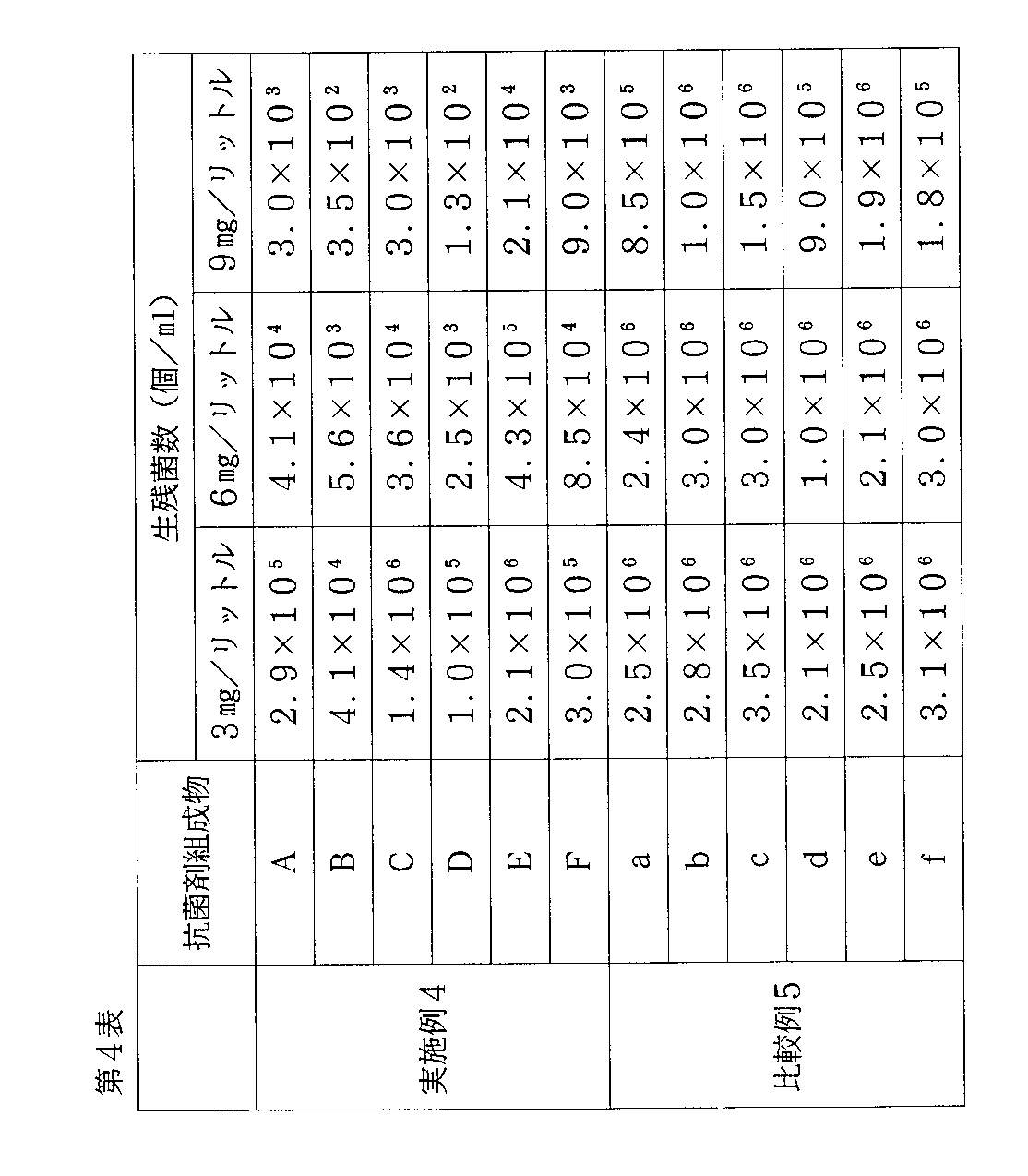
実施例4及び比較例5においては、製紙工場の上質紙抄造マシンから採取した白水について、抗菌試験を行った。
製紙工場の上質中性紙抄造マシンより、白水を採取した。この白水のpHは7.6、生菌数は6×10⁷個/mlであり、優先菌種は、バチルス属、シュードモナス属、フラボバクテリウム属、ミクロコッカス属であった。この白水を減菌試験管に分注後、工業用抗菌剤組成物を(A)成分と(B)成分と(C)成分の濃度の合計が3mg/リットル、6mg/リットル又は9mg/リットルとなるように添加した。これを30℃で15分間接触させたのち、各試験液中の生残菌数を寒天平板希釈法により測定した。
実施例4
(A)2,2−ジブロモ−3−ニトリロプロピオンアミド25.0重量部、(B)2,2−ジブロモ−2−ニトロエタノール5.0重量部、(C)3,3,4,4,−テトラクロロテトラヒドロチオフェン−1,1−ジオキシド2.5重量部及びジエチレングリコールモノメチルエーテル67.5重量部を含有する工業用抗菌剤組成物Aを、(A)成分と(B)成分と(C)成分の濃度の合計が3mg/リットルとなるように添加したとき、生残菌数は2.9×105個/mlであり、6mg/リットルとなるように添加したとき、生残菌数は4.1×104個/mlであり、9mg/リットルとなるように添加したとき、生残菌数は3.0×103個/mlであった。
工業用抗菌剤組成物B、C、D、E及びFを用いて、同様に抗菌試験を行った。結果を第4表に示す。
比較例5
(A)2,2−ジブロモ−3−ニトリロプロピオンアミド25.0重量部、(B)2,2−ジブロモ−2−ニトロエタノール5.0重量部及びジエチレングリコールモノメチルエーテル70.0重量部を含有する工業用抗菌剤組成物aを、(A)成分と(B)成分の濃度の合計が3mg/リットルとなるように添加したとき、生残菌数は2.5×106個/mlであり、6mg/リットルとなるように添加したとき、生残菌数は2.4×106個/mlであり、9mg/リットルとなるように添加したとき、生残菌数は8.5×105個/mlであった。
工業用抗菌剤組成物b、c、d、e及びfを用いて、同様に抗菌試験を行った。結果を第4表に示す。
【0026】
【表4】
第4表に見られるように、添加した抗菌剤組成物の有効成分の濃度が同じであっても、(A)2,2−ジブロモ−3−ニトリロプロピオンアミド、(B)2,2−ジブロモ−2−ニトロエタノール、(C)3,3,4,4,−テトラクロロテトラヒドロチオフェン−1,1−ジオキシドの3成分を含有する本発明の工業用抗菌剤組成物を製紙工場の上質紙抄造マシンから採取した白水に添加した場合は、生残菌数が減少し、特に添加量の増加による生残菌数の減少の効果が顕著である。これに対して、2成分又は1成分のみを含有する工業用抗菌剤組成物を添加した比較例5においては、生残菌数の減少の程度が少なく、添加量を増加しても生残菌数の減少の効果は顕著には現れない。この結果から、(A)成分と(B)成分と(C)成分の3成分を含有する本発明の抗菌剤組成物は、製紙工場の上質紙抄造マシンより採取した白水の細菌類に対しても、3成分の顕著な相乗効果が発現し、抗菌スペクトルが拡大していることが分かる。
【0028】
【発明の効果】
本発明の工業用抗菌剤組成物及び抗菌方法は、紙・パルプ工業における抄紙工程水、各種工業用の冷却水や洗浄水のスライム防止用、重油スラッジ、金属加工油剤、繊維油剤、ペイント、紙用塗工液、ラテックス、糊剤などの防腐用、抗菌用として有用であり、水中の分散菌に対しても、壁面のスライムに対しても顕著な効果を発揮する。[0001]
BACKGROUND OF THE INVENTION
The present invention relates to an industrial antibacterial agent composition and an antibacterial method. More specifically, the present invention relates to papermaking process water in the paper and pulp industry, various industrial cooling water and washing water for slime prevention, heavy oil sludge, metal processing oil, textile oil, paint, paper coating liquid, latex The present invention also relates to an industrial antibacterial agent composition and an antibacterial method that are useful for preserving pastes and for antibacterial purposes.
[0002]
[Prior art]
Traditionally, it has been known that slime due to bacteria and fungi is generated in the paper making process in the paper and pulp industry and in cooling water systems in various industries, causing problems such as deterioration in product quality and production efficiency. . In addition, many industrial products such as heavy oil sludge, metalworking fluids, textile oils, paints, various latexes, pastes, etc., are spoiled and contaminated by bacteria and fungi, resulting in product fouling and reduced commercial value. Let Many antibacterial agents have been used to prevent damage from these microorganisms.
In the old days, organomercury compounds and chlorinated phenolic compounds were used, but these drugs are highly toxic to the human body and seafood, and their use has been regulated to cause environmental pollution. Relatively low toxicity organic nitrogen compounds, organic halogen compounds and organic sulfur compounds are widely used as industrial antibacterial agents (Encyclopedia of Antibacterial and Antifungal Agents, Japan Society for Antibacterial and Antifungal Society, issued in 1986) . However, these antibacterial agents have weak antibacterial activity against certain bacteria and fungi, and when applied to real systems, they need to be added at extremely high concentrations and are not economical. When used, only bacteria resistant to the antibacterial agent propagate in the system, and the antibacterial effect is significantly reduced at the concentration of the antibacterial agent used conventionally.
For this reason, a method of using a combination of a plurality of antibacterial agents has been proposed in anticipation of a so-called synergistic effect. For example, US Pat. No. 3,928,198 discloses 2,2-dibromo-3-nitrilopropionamide and 3,3,4, as compositions that exhibit an unexpected synergistic effect on microorganisms. Compositions containing 4, -tetrachlorotetrahydrothiophene-1,1-dioxide have been proposed. Furthermore, as a combination that exhibits a synergistic effect, JP-A-60-231603 contains 3-bromo-3-nitropentane-2,4-diol and 2,2-dibromo-3-nitrilopropionamide. An antibacterial agent has been proposed, and Japanese Patent Publication No. 7-80727 discloses 2,2-dibromo-2-nitro-1-methylethanol and 3,3,4,4, -tetrachlorotetrahydrothiophene-1,1- Industrial disinfectants containing dioxide have been proposed. However, although these compositions have improved antibacterial efficacy, their effects do not necessarily reach satisfactory levels when applied to real systems.
The slime control agent belongs to an industrial antibacterial agent and is used for a very wide range of applications. However, the conventional method for evaluating a slime control agent also has a problem to be improved. That is, selection of a slime control agent has been conventionally performed by evaluating the antibacterial effect and the growth inhibitory effect of the drug against water-dispersed bacteria. However, it has recently become clear that the effect of drugs on water-dispersed bacteria and the effect on slime do not necessarily correlate (JC Nickel, I. Ruseska, JB Wright, JW Costerton). , Antimicrobial Agents and Chemother., 27 (4) 619-624 ('85), Tobramcin Resistance of Pseudomonas aeruginosa Cells Growing as a Biofilm on U.S. Therefore, it is necessary to evaluate the effect of the antibacterial agent on the slime not only on the water-dispersed bacteria but also on the slime growing on the wall surface in water.
Under such circumstances, there is a demand for an industrial antibacterial agent effective at low concentrations for both dispersal bacteria and slime.
[0003]
[Problems to be solved by the invention]
The present invention includes papermaking process water in the paper and pulp industry, anti-slime for industrial cooling water and washing water, heavy oil sludge, metalworking oil, textile oil, paint, paper coating liquid, latex, glue, etc. Providing industrial antibacterial composition and antibacterial method that are useful for antiseptic and antibacterial use, and exhibit excellent effects at low concentrations against both water-borne dispersal bacteria and wall slime It was made for the purpose of doing.
[0004]
[Means for Solving the Problems]
In order to solve the above-mentioned problems, the present inventors have conducted extensive research using a slime adhesion monitor capable of evaluating the effect on the slime adhered to the wall surface. It has been found that 4,4, -tetrachlorotetrahydrothiophene-1,1-dioxide has a function of preventing microbial adhesion rather than bactericidal activity, and further, 2,2-dibromo-3-nitrilopropionamide and 2 , 2-Dibromo-2-nitroethanol, a known industrial antibacterial agent composition further containing a small amount of 3,3,4,4-tetrachlorotetrahydrothiophene-1,1-dioxide Thus, compared with the combination of the two components, a synergistic enhancement of antibacterial effect against a wider variety of microorganisms was observed, and slime adhesion was prolonged. It found surprising fact that the effect of preventing is exhibited, thereby completing the present invention based on this finding.
That is, the present invention
(1) (A) 2,2-Dibromo-3-nitrilopropionamide and (B) 2,2-dibromo-2-nitroethanol and (C) 3,3,4,4-tetrachlorotetrahydrothiophene-1 , 1-dioxide Only three ingredients of Industrial antibacterial agent composition characterized by containing,
(2) The weight ratio of (A) 2,2-dibromo-3-nitrilopropionamide to (B) 2,2-dibromo-2-nitroethanol is 1:99 to 99: 1, and (A) 2 1,2-dibromo-3-nitrilopropionamide and (B) 2,2-dibromo-2-nitroethanol and (C) 3,3,4,4-tetrachlorotetrahydrothiophene-1,1-dioxide The antibacterial agent composition for industrial use according to item (1), wherein the weight ratio is from 1:10 to 100: 1,
(3) (A) 2,2-Dibromo-3-nitrilopropionamide and (B) 2,2-dibromo-2-nitroethanol and (C) 3,3,4,4, -tetrachlorotetrahydrothiophene-1 An antibacterial method characterized by adding 1,1-dioxide, and
(4) The weight ratio of (A) 2,2-dibromo-3-nitrilopropionamide to (B) 2,2-dibromo-2-nitroethanol is 1:99 to 99: 1; The total amount of 2-dibromo-3-nitrilopropionamide and (B) 2,2-dibromo-2-nitroethanol and (C) 3,3,4,4-tetrachlorotetrahydrothiophene-1,1-dioxide The weight ratio is 1:10 to 100: 1 and (A) 2,2-dibromo-3-nitrilopropionamide and (B) 2,2-dibromo-2-nitroethanol and (C) 3,3, The antibacterial method according to item (3), wherein the total concentration of 4,4, -tetrachlorotetrahydrothiophene-1,1-dioxide is added to be 0.01 to 200 mg / liter,
Is to provide.
[0005]
DETAILED DESCRIPTION OF THE INVENTION
The industrial antibacterial agent composition of the present invention contains 2,2-dibromo-3-nitrilopropionamide as the component (A) and 2,2-dibromo-2-nitroethanol as the component (B). The component (C) consists of a three-component system containing 3,3,4,4-tetrachlorotetrahydrothiophene-1,1-dioxide. Here, the industrial antibacterial agent includes various industrial water-based slime control agents, preservatives for industrial products, and bactericidal / bacteriostatic agents.
In the composition of the present invention, 2,2-dibromo-3-nitrilopropionamide used as the component (A) is a compound represented by the formula [1].
[Chemical 1]
[Chemical 2]
[Chemical 3]
In the industrial antibacterial agent composition of the present invention, the ratio of the component (A), the component (B), and the component (C) is not particularly limited, but the weight ratio of the component (A) to the component (B) is 1:99. It is preferably ˜99: 1, more preferably 30:70 to 95: 5, and even more preferably 50:50 to 90:10. Further, the ratio of the total amount of the components (A) and (B) and the component (C) is not particularly limited, but the weight ratio of the total amount of the components (A) and (B) and the component (C) is 1. : 10 to 100: 1 is preferable, 50:50 to 98: 2 is more preferable, and 75:25 to 95: 5 is more preferable. The weight ratio of the component (A) and the component (B) is 1:99 to 99: 1, and the weight ratio of the total amount of the components (A) and (B) and the component (C) is 1:10 to 100: By setting it to 1, even if it is the addition amount of a low concentration, both the antibacterial property with respect to the dispersal in water and the adhesion prevention effect of slime can be exhibited.
There is no restriction | limiting in particular in the form of the industrial antibacterial agent composition of this invention, For example, it can be set as the 1 agent type containing all (A) component, (B) component, and (C) component, or ( A component, component (B) and component (C) can be added separately as a two-component formulation comprising an agent containing one component and a component containing two components, and (A) component and ( It is also possible to adopt a three-drug type containing each of component B) and component (C). Among these, the liquid one-component antibacterial agent containing the component (A), the component (B) and the component (C) is easy to handle and can be suitably used.
[0007]
Liquid one-component antibacterial agent containing component (A), component (B) and component (C) should be formulated by dissolving component (A), component (B) and component (C) in an organic solvent. Alternatively, it can be formulated as an aqueous suspension containing the components (A), (B) and (C). When (A) component, (B) component and (C) component are dissolved in an organic solvent to prepare a formulation, the organic solvent to be used is an aqueous solution such as process water for the paper making process or factory cooling water. In this case, it is preferable to use a hydrophilic organic solvent in consideration of dispersibility and solubility of the active ingredient. Examples of the hydrophilic organic solvent include methyl ethers such as methyl cellosolve, ethyl cellosolve, phenyl cellosolve, glycol ethers such as diethylene glycol monomethyl ether and dipropylene glycol monomethyl ether, glycols such as ethylene glycol, propylene glycol, diethylene glycol and dipropylene glycol, and methanol. Alcohols such as ethanol, propanol, butanol, hexanol, 2-ethylhexanol, esters such as methyl acetate, ethyl acetate, 3-methoxybutyl acetate, 2-methoxyethyl acetate, 2-ethoxyethyl acetate, propylene carbonate, dimethyl Examples include amides such as formamide and dimethylacetamide.
When formulating an aqueous suspension containing the component (A), the component (B) and the component (C), use a ball mill, an attritor, or the like to use the components (A), (B) and (C). Can be wet pulverized into an aqueous suspension. When producing an aqueous suspension, thickeners such as xanthan gum, rhamsan gum, guar gum and the like, and nonionic surfactants, anionic surfactants, cationic surfactants, amphoteric surfactants and the like can be used as dispersants. .
In addition, when the antibacterial target system is an oil system such as heavy oil sludge, cutting oil, or oil paint, a liquid one-part antibacterial agent may be obtained using a hydrocarbon solvent such as heavy oil, kerosene, or spindle oil. preferable. In the case of using a hydrocarbon solvent as a one-component antibacterial agent, the above-mentioned various surfactants can be used.
[0008]
The method of using the industrial antibacterial agent composition of the present invention is not particularly limited, and papermaking process water in the paper and pulp industry, various industrial cooling water and washing water, heavy oil sludge, metalworking oil, fiber oil, paint, It can be used by appropriately adding to a paper coating solution, latex, glue or the like. The amount added is not particularly limited and can be selected according to the object, environmental conditions, purpose of use, etc., but in many cases, the sum of the concentrations of component (A), component (B) and component (C) Is preferably 0.01 to 200 mg / liter, more preferably 0.1 to 50 mg / liter. If the total concentration of the component (A), the component (B) and the component (C) is less than 0.01 mg / liter, the antibacterial action may be insufficient. If the total concentration of component (A), component (B), and component (C) is 200 mg / liter, the antibacterial and anti-slime effects against dispersible bacteria in water are fully exhibited, and the total concentration is 200 mg / liter. Additions in excess are usually unnecessary.
The industrial antibacterial agent composition containing the component (A), the component (B) and the component (C) of the present invention has a function of significantly preventing the growth and adhesion of microorganisms in various industrial target systems. In particular, it is extremely useful as an antibacterial agent such as a slime control agent for papermaking process water, a paper coating solution and a paste.
[0009]
In the antibacterial method of the present invention, 2,2-dibromo-3-nitrilopropionamide as component (A), 2,2-dibromo-2-nitroethanol as component (B), and 3,3, as component (C) 4,4, -Tetrachlorotetrahydrothiophene-1,1-dioxide is added. There are no particular restrictions on the application target of the method of the present invention, for example, papermaking process water in the paper and pulp industry, various industrial cooling water and washing water, heavy oil sludge, metalworking oil, fiber oil, paint, paper coating liquid , Latex, glue and the like.
In the method of the present invention, the ratio of the addition amount of the component (A), the component (B), and the component (C) is not particularly limited, but the weight ratio of the component (A) to the component (B) is 1:99 to 99: 1 is preferable, 30:70 to 95: 5 is more preferable, and 50:50 to 90:10 is further preferable. Further, there is no particular limitation on the ratio of the total addition amount of component (A) and component (B) and the addition amount of component (C), but the total amount of component (A) and component (B) and the amount of component (C) The weight ratio is preferably 1:10 to 100: 1, more preferably 50:50 to 98: 2, and further preferably 75:25 to 95: 5. The weight ratio of the component (A) and the component (B) is 1:99 to 99: 1, and the weight ratio of the total amount of the components (A) and (B) and the component (C) is 1:10 to 100: By setting it to 1, even if it is a low concentration addition amount, the disperse bacteria in water can be effectively antibacterial and slime adhesion can be effectively prevented.
[0010]
In the method of the present invention, the addition amount of the component (A), the component (B), and the component (C) is not particularly limited and can be selected according to the object, environmental conditions, purpose of use, etc. In this case, the total concentration of the component (A), the component (B), and the component (C) is preferably 0.01 to 200 mg / liter, and more preferably 0.1 to 50 mg / liter. If the total concentration of the component (A), the component (B) and the component (C) is less than 0.01 mg / liter, the antibacterial action may be insufficient. If the total concentration of component (A), component (B), and component (C) is 200 mg / liter, the antibacterial and anti-slime effects against dispersible bacteria in water are fully exhibited, and the total concentration is 200 mg / liter. Additions in excess are usually unnecessary.
In the method of the present invention, the method for adding the component (A), the component (B), and the component (C) is not particularly limited. For example, the component (A), the component (B), and the component (C) are mixed in advance. Can be added at the same time, or one of component (A), component (B) and component (C) and the remaining two components can be added separately. Furthermore, component (A) The component (B) and the component (C) can be added separately.
According to the antibacterial method of the present invention, it is possible to remarkably prevent the growth and adhesion of microorganisms in various industrial target systems, and in particular, papermaking process water in the paper and pulp industry, various industrial cooling water and washing water. Can be prevented, preventing the growth of bacteria such as heavy oil sludge, metalworking oil, textile oil, paint, paper coating liquid, latex, glue, and so on.
[0011]
【Example】
Hereinafter, the present invention will be described in more detail with reference to examples, but the present invention is not limited to these examples.
In Examples and Comparative Examples, the slime adhesion preventing effect was evaluated by the following method.
A slime adhesion monitor (described in Japanese Patent Application Laid-Open No. 9-75065) in which an outer cylinder made of SUS304 having an inner diameter of 100 mm and a volume of 488 ml and an inner cylinder made of SUS304 and having a diameter of 36 mm were combined was used. Bring white water or artificial white water continuously to the outer cylinder so that the water temperature is 30 ° C. and the residence time is 20 minutes, rotate the inner cylinder at 255 rpm, and Brookfield torque meter [Toki Sangyo Co., Ltd., RE500H type] Then, the rotational torque of the internal cylinder was measured.
When slime adheres to the internal cylinder and grows over time, the friction resistance on the surface of the internal cylinder increases and the value of the rotational torque increases. Using this principle, time is plotted on the horizontal axis and rotational torque is plotted on the vertical axis, the rotational torque value is plotted on a personal computer every minute, and the time when the rotational torque value begins to rise is defined as the slime deposition start time. . The delay time is the value obtained by subtracting the slime adhesion start time when using white water or artificial white water to which no antibacterial agent composition is used from the slime adhesion start time when using white water or artificial white water added with the antibacterial agent composition. It was used as an index of the slime adhesion preventing effect of the antibacterial agent composition.
[0012]
Production Example 1
(A) 2,2-dibromo-3-nitrilopropionamide 25.0 parts by weight, (B) 2,2-dibromo-2-nitroethanol 5.0 parts by weight, (C) 3,3,4,4, -Industrial antibacterial agent composition A was manufactured by blending 2.5 parts by weight of tetrachlorotetrahydrothiophene-1,1-dioxide and 67.5 parts by weight of diethylene glycol monomethyl ether.
Production Example 2
(A) 2,2-dibromo-3-nitrilopropionamide 25.0 parts by weight, (B) 2,2-dibromo-2-nitroethanol 5.0 parts by weight, (C) 3,3,4,4, -Industrial antibacterial agent composition B was manufactured by blending 5.0 parts by weight of tetrachlorotetrahydrothiophene-1,1-dioxide and 65.0 parts by weight of diethylene glycol monomethyl ether.
Production Example 3
(A) 2,2-dibromo-3-nitrilopropionamide 20.0 parts by weight, (B) 10.0 parts by weight of 2,2-dibromo-2-nitroethanol, (C) 3,3,4,4, -Industrial antibacterial agent composition C was manufactured by blending 2.5 parts by weight of tetrachlorotetrahydrothiophene-1,1-dioxide and 67.5 parts by weight of diethylene glycol monomethyl ether.
Production Example 4
(A) 2,2-dibromo-3-nitrilopropionamide 20.0 parts by weight, (B) 10.0 parts by weight of 2,2-dibromo-2-nitroethanol, (C) 3,3,4,4, -Industrial antibacterial agent composition D was manufactured by blending 5.0 parts by weight of tetrachlorotetrahydrothiophene-1,1-dioxide and 65.0 parts by weight of diethylene glycol monomethyl ether.
Production Example 5
(A) 2,2-dibromo-3-nitrilopropionamide 12.5 parts by weight, (B) 2,2-dibromo-2-nitroethanol 7.5 parts by weight, (C) 3,3,4,4, -Industrial antibacterial agent composition E was manufactured by blending 2.5 parts by weight of tetrachlorotetrahydrothiophene-1,1-dioxide and 77.5 parts by weight of diethylene glycol monomethyl ether.
Production Example 6
(A) 2,2-dibromo-3-nitrilopropionamide 12.5 parts by weight, (B) 2,2-dibromo-2-nitroethanol 7.5 parts by weight, (C) 3,3,4,4, -Industrial antibacterial agent composition F was manufactured by blending 5.0 parts by weight of tetrachlorotetrahydrothiophene-1,1-dioxide and 75.0 parts by weight of diethylene glycol monomethyl ether.
Industrial antibacterial agent compositions A to F produced in Production Examples 1 to 6 have a weight ratio of the component (A) to the component (B) of 62.5: 37.5 to 83.3: 16.7, The total amount of the component (A) and the component (B) and the weight ratio of the component (C) is 80:20 to 92.3: 7.7.
[0013]
Reference example 1
(A) 25.0 parts by weight of 2,2-dibromo-3-nitrilopropionamide, (B) 5.0 parts by weight of 2,2-dibromo-2-nitroethanol and 70.0 parts by weight of diethylene glycol monomethyl ether Thus, an industrial antibacterial agent composition a was produced.
Reference example 2
(A) 2,2-dibromo-3-nitrilopropionamide (20.0 parts by weight), (B) 2,2-dibromo-2-nitroethanol (10.0 parts by weight) and diethylene glycol monomethyl ether (70.0 parts by weight) Thus, an industrial antibacterial agent composition b was produced.
Reference example 3
(A) 12.5 parts by weight of 2,2-dibromo-3-nitrilopropionamide, (B) 7.5 parts by weight of 2,2-dibromo-2-nitroethanol and 80.0 parts by weight of diethylene glycol monomethyl ether Thus, an industrial antibacterial agent composition c was produced.
Reference example 4
(A) 25.0 parts by weight of 2,2-dibromo-3-nitrilopropionamide and 75.0 parts by weight of diethylene glycol monomethyl ether were blended to produce an industrial antibacterial agent composition d.
Reference Example 5
(B) 25.0 parts by weight of 2,2-dibromo-2-nitroethanol and 75.0 parts by weight of diethylene glycol monomethyl ether were blended to produce an industrial antibacterial agent composition e.
Reference Example 6
(C) Mixing 25.0 parts by weight of 3,3,4,4, -tetrachlorotetrahydrothiophene-1,1-dioxide and 75.0 parts by weight of diethylene glycol monomethyl ether to produce an industrial antibacterial composition f did.
The industrial antibacterial agent compositions a to c produced in Reference Examples 1 to 3 contain the component (A) and the component (B) but do not contain the component (C), and were produced in Reference Example 4. The industrial antibacterial agent composition d contains only the component (A), and the industrial antibacterial agent composition e produced in Reference Example 5 contains only the component (B), which is a reference example. The industrial antibacterial composition f produced in 6 contains only the component (C).
[0014]
In Example 1 and Comparative Example 1, the slime prevention effect was evaluated using artificial white water. Artificial white water (pH 7.0, 30 ° C.) is prepared so as to have a BOD of 100 mg / liter using starch as a nutrient source. 7 Continuous addition was performed to obtain CFU / ml. The antibacterial agent composition is three times a day so that the total concentration of the components (A), (B) and (C) is maintained in the system at 10 mg / liter or 20 mg / liter for 15 minutes each time. That is, intermittent injection was performed every 8 hours. When this artificial white water was tested without adding the antibacterial agent composition, the slime deposition start time was 10 hours.
Example 1
(A) 2,2-dibromo-3-nitrilopropionamide 25.0 parts by weight, (B) 2,2-dibromo-2-nitroethanol 5.0 parts by weight, (C) 3,3,4,4, -Industrial antibacterial agent composition A containing 2.5 parts by weight of tetrachlorotetrahydrothiophene-1,1-dioxide and 67.5 parts by weight of diethylene glycol monomethyl ether was prepared by combining (A) component, (B) component and (C) When infused to maintain a total component concentration of 10 mg / liter in the system for 15 minutes, the slime deposition onset time was 43 hours and thus the lag time was 33 hours. Moreover, when the total concentration of the component (A), the component (B) and the component (C) was infused so that 20 mg / liter was maintained in the system for 15 minutes, the slime deposition start time was 77 hours, and therefore delayed. The time was 67 hours.
When the industrial antibacterial agent composition B was injected at a maintenance concentration of 10 mg / liter for 15 minutes, the delay time was 35 hours, and when it was injected at a maintenance concentration of 20 mg / liter for 15 minutes, the delay time was 72 hours.
When the industrial antibacterial agent composition C was injected at a maintenance concentration of 10 mg / liter for 15 minutes, the delay time was 22 hours, and when it was injected at a maintenance concentration of 20 mg / liter for 15 minutes, the delay time was It was 58 hours.
When the industrial antibacterial agent composition D was injected at a maintenance concentration of 10 mg / liter for 15 minutes, the delay time was 28 hours, and when it was injected at a maintenance concentration of 20 mg / liter for 15 minutes, the delay time was It was 69 hours.
When the industrial antibacterial composition E is injected at a maintenance concentration of 10 mg / liter for 15 minutes, the delay time is 22 hours, and when it is injected at a maintenance concentration of 20 mg / liter for 15 minutes, the delay time is 48 hours.
When the industrial antibacterial agent composition F was injected at a maintenance concentration of 10 mg / liter for 15 minutes, the delay time was 23 hours, and when it was injected at a maintenance concentration of 20 mg / liter for 15 minutes, the delay time was 56 hours.
[0015]
Comparative Example 1
(A) 25.0 parts by weight of 2,2-dibromo-3-nitrilopropionamide, (B) 5.0 parts by weight of 2,2-dibromo-2-nitroethanol and 70.0 parts by weight of diethylene glycol monomethyl ether When the industrial antibacterial agent composition a was injected so that the total concentration of the component (A) and the component (B) was maintained at 10 mg / liter for 15 minutes in the system, the slime deposition start time was 24 hours, Therefore, the delay time was 14 hours. When the total concentration of the component (A) and the component (B) is infused so that 20 mg / liter is maintained in the system for 15 minutes, the slime deposition start time is 40 hours, and therefore the delay time is 30 hours. there were.
When the industrial antibacterial agent composition b was injected at a maintenance concentration of 10 mg / liter for 15 minutes, the delay time was 14 hours, and when it was injected at a maintenance concentration of 20 mg / liter for 15 minutes, the delay time was It was 23 hours.
When the industrial antibacterial agent composition c is injected at a maintenance concentration of 10 mg / liter for 15 minutes, the delay time is 10 hours, and when it is injected at a maintenance concentration of 20 mg / liter for 15 minutes, the delay time is It was 15 hours.
When the industrial antibacterial agent composition d is injected at a maintenance concentration of 10 mg / liter for 15 minutes, the delay time is 13 hours, and when it is injected at a maintenance concentration of 20 mg / liter for 15 minutes, the delay time is It was 20 hours.
When the industrial antibacterial agent composition e is injected at a maintenance concentration of 10 mg / liter for 15 minutes, the delay time is 7 hours, and when it is injected at a maintenance concentration of 20 mg / liter for 15 minutes, the delay time is It was 11 hours.
When the industrial antibacterial agent composition f is injected at a maintenance concentration of 10 mg / liter for 15 minutes, the delay time is 9 hours, and when it is injected at a maintenance concentration of 20 mg / liter for 15 minutes, the delay time is It was 16 hours.
The results of Example 1 and Comparative Example 1 are collectively shown in Table 1.
[0016]
[Table 1]
As can be seen from Table 1, (A) 2,2-dibromo-3-nitrilopropionamide, (B) 2,2 even if the concentration of the active ingredient of the added industrial antibacterial agent composition is the same Example of Injecting the Industrial Antibacterial Agent Composition of the Present Invention Containing Three Components of Dibromo-2-nitroethanol and (C) 3,3,4,4, -Tetrachlorotetrahydrothiophene-1,1-dioxide 1 is clearly longer than Comparative Example 1 in which an industrial antibacterial agent composition containing two components or only one component is injected, and the synergy between the three components is remarkable for prevention of slime adhesion. It can be seen that the effect is manifested.
[0018]
In Example 2 and Comparative Examples 2-3, the slime adhesion preventing effect was evaluated for white water in a paper mill. As white water, white water (pH 7.5, 25 m from water source) collected from a neutral high-quality paper-making machine in a paper mill Three / T, BOD850 mg / liter, Bacterial composition: Bacillus genus, Pseudomonas genus, Flavobacterium genus, Alkagenes genus bacteria), antibacterial agent composition, (A) component, (B) component Evaluation was conducted in the same manner as in Example 1 and Comparative Example 1 except that intermittent injection was performed 3 times a day, that is, every 8 hours so that the total concentration was maintained at 25 mg / liter for 15 minutes each time in the system. When tested without adding the antibacterial agent composition to white water collected from this neutral fine paper making machine, the slime adhesion start time was 18 hours.
Example 2
(A) 2,2-dibromo-3-nitrilopropionamide, (B) 2,2-dibromo-2-nitroethanol and (C) 3,3,4,4-tetrachlorotetrahydrothiophene-1,1- The test was carried out by injecting the three components of dioxide into white water.
When the weight ratio of the component (A), the component (B), and the component (C) was 59: 36: 5, the slime deposition start time was 63 hours, and therefore the delay time was 45 hours.
The test was performed by further changing the weight ratio of the component (A), the component (B), and the component (C). Table 2 shows the weight ratio of the component (A), the component (B), and the component (C), and the delay time.
Comparative Example 2
The test was conducted by injecting two components of (A) 2,2-dibromo-3-nitrilopropionamide and (B) 2,2-dibromo-2-nitroethanol into white water.
When the weight ratio of the component (A) to the component (B) was 63:37, the slime deposition start time was 46 hours, and thus the delay time was 28 hours.
The test was performed while further changing the weight ratio of the component (A) and the component (B). Table 2 shows the weight ratio of component (A) to component (B) and the delay time.
Comparative Example 3
(C) A test was performed by injecting only one component of 3,3,4,4, -tetrachlorotetrahydrothiophene-1,1-dioxide into white water. The slime deposition start time was 30 hours and therefore the delay time was 12 hours.
The results of Example 2 and Comparative Examples 2-3 are shown in Table 2.
[0019]
[Table 2]
As can be seen in Table 2, even if the concentration of the active ingredient in the added industrial antibacterial agent composition is the same, (A) 2,2-dibromo-3-nitrilopropionamide, (B) 2,2 -Dibromo-2-nitroethanol and (C) 3,3,4,4-tetrachlorotetrahydrothiophene-1,1-dioxide injecting three components were compared in the case of injecting only two components The delay time is clearly longer than that of Example 2 and Comparative Example 3 in which only one component is injected, and a remarkable synergistic effect between the three components is exhibited with respect to prevention of slime adhesion, and the antibacterial spectrum is expanded. I understand that
For example, the delay time is 27 hours when a 2: 1 weight ratio mixture of (A) 2,2-dibromo-3-nitrilopropionamide and (B) 2,2-dibromo-2-nitroethanol is injected. , (C) 3,3,4,4, -tetrachlorotetrahydrothiophene-1,1-dioxide was injected alone with a delay time of 12 hours, while (A) 2,2-dibromo- A mixture of 3-nitrilopropionamide and (B) 2,2-dibromo-2-nitroethanol at a weight ratio of 2: 1 was further added to (C) 3,3,4,4-tetrachlorotetrahydrothiophene-1,1. When the dioxide is added, the delay time extends to 48-59 hours.
[0021]
In Example 3 and Comparative Example 4, a starch coating solution for papermaking used in a high-quality papermaking machine for papermaking factories was collected and subjected to an antiseptic test.
The collected starch coating solution for papermaking with a pH of 9.6 is allowed to decay at room temperature in advance, and this spoiled coating solution has a viable cell count of 8.5 × 10. 8 A test solution was prepared by mixing with a fresh starch coating solution for papermaking so that the amount was 1 / ml. The pH of the test solution was 9.6, and the preferred bacterial species were Bacillus, Pseudomonas, Alkaligenes, and Flavobacterium. After dispensing this test solution into a sterilization test tube, an industrial antibacterial agent composition was added so that the total concentration of the component (A), the component (B), and the component (C) was 30 mg / liter. After this test tube was stored in a 30 ° C. incubator for 5 days, the number of surviving bacteria in the test solution was measured by the agar plate dilution method.
Example 3
(A) 2,2-dibromo-3-nitrilopropionamide 25.0 parts by weight, (B) 2,2-dibromo-2-nitroethanol 5.0 parts by weight, (C) 3,3,4,4, -Number of surviving bacteria after 5 days when industrial antibacterial agent composition A containing 2.5 parts by weight of tetrachlorotetrahydrothiophene-1,1-dioxide and 67.5 parts by weight of diethylene glycol monomethyl ether was added to the test solution 10 2 No more than pieces / ml.
When the antiseptic test was similarly conducted using the industrial antibacterial agent compositions B, C, D, E and F, the number of surviving bacteria after 5 days was 10 for all tests. 2 No more than pieces / ml.
[0022]
Comparative Example 4
(A) 25.0 parts by weight of 2,2-dibromo-3-nitrilopropionamide, (B) 5.0 parts by weight of 2,2-dibromo-2-nitroethanol and 70.0 parts by weight of diethylene glycol monomethyl ether When the industrial antibacterial agent composition a was added to the test solution, the number of surviving bacteria after 5 days was 2.3 × 10. Five Pieces / ml.
When the industrial antibacterial composition b was added to the test solution, the number of surviving bacteria after 5 days was 7.9 × 10 Five Pieces / ml.
When the industrial antibacterial agent composition c was added to the test solution, the number of surviving bacteria after 5 days was 5.2 × 10 Five Pieces / ml.
When the industrial antibacterial composition d was added to the test solution, the number of surviving bacteria after 5 days was 6.1 × 10 Five Pieces / ml.
When the industrial antibacterial agent composition e was added to the test solution, the survival cell count after 5 days was 8.5 × 10 Four Pieces / ml.
When the industrial antibacterial composition f was added to the test solution, the number of surviving bacteria after 5 days was 4.8 × 10 Three Pieces / ml.
When the test tube was stored in a thermostat at 30 ° C. for 5 days without adding the industrial antibacterial agent composition to the test solution, the survival cell count after 5 days was 6.0 × 10. 8 Pieces / ml.
The results of Example 3 and Comparative Example 4 are collectively shown in Table 3.
[0023]
[Table 3]
As seen in Table 3, (A) 2,2-dibromo-3-nitrilopropionamide, (B) 2,2-dibromo, even when the concentration of the active ingredient in the added antibacterial agent composition is the same. The industrial antibacterial agent composition of the present invention containing three components of 2-nitroethanol and (C) 3,3,4,4, -tetrachlorotetrahydrothiophene-1,1-dioxide × 10 8 When added to a test solution consisting of a starch coating solution adjusted to 1 / ml, the number of surviving bacteria after 5 days is 10 2 In Comparative Example 4 in which an industrial antibacterial agent composition containing only two components or only one component was injected, whereas the number of surviving bacteria after 5 days was 4.8 × 10 Three ~ 7.9 × 10 Five Pieces / ml. From this result, the antibacterial agent composition of the present invention containing the three components (A), (B) and (C) has an extremely small number of surviving bacteria, and the starch coating liquid for papermaking It can be seen that a significant synergistic effect of the three components is expressed and the antibacterial spectrum is expanded.
[0025]
In Example 4 and Comparative Example 5, antibacterial tests were performed on white water collected from a high-quality paper making machine in a paper mill.
White water was collected from a high-quality neutral paper-making machine in a paper mill. The white water has a pH of 7.6 and a viable count of 6 × 10. 7 The preferred bacterial species were Bacillus, Pseudomonas, Flavobacterium, and Micrococcus. After dispensing this white water into a sterilization test tube, the total concentration of the components (A), (B), and (C) in the industrial antibacterial agent composition is 3 mg / liter, 6 mg / liter, or 9 mg / liter. It added so that it might become. After contacting this at 30 ° C. for 15 minutes, the number of surviving bacteria in each test solution was measured by the agar plate dilution method.
Example 4
(A) 2,2-dibromo-3-nitrilopropionamide 25.0 parts by weight, (B) 2,2-dibromo-2-nitroethanol 5.0 parts by weight, (C) 3,3,4,4, -Industrial antibacterial agent composition A containing 2.5 parts by weight of tetrachlorotetrahydrothiophene-1,1-dioxide and 67.5 parts by weight of diethylene glycol monomethyl ether was prepared by combining (A) component, (B) component and (C) When added so that the total concentration of the components is 3 mg / liter, the number of surviving bacteria is 2.9 × 10 Five When added at 6 mg / liter, the survival cell count is 4.1 × 10 Four When added at 9 mg / liter, the number of surviving bacteria is 3.0 × 10 Three Pieces / ml.
Using the antibacterial agent compositions B, C, D, E and F for industrial use, an antibacterial test was similarly conducted. The results are shown in Table 4.
Comparative Example 5
(A) 25.0 parts by weight of 2,2-dibromo-3-nitrilopropionamide, (B) 5.0 parts by weight of 2,2-dibromo-2-nitroethanol and 70.0 parts by weight of diethylene glycol monomethyl ether When the industrial antibacterial agent composition a was added so that the total concentration of the component (A) and the component (B) was 3 mg / liter, the survival cell count was 2.5 × 10 6 The number of surviving bacteria is 2.4 x 10 when added to 6 mg / liter. 6 When added to 9 mg / liter, the number of surviving bacteria is 8.5 × 10 Five Pieces / ml.
An antibacterial test was similarly conducted using the industrial antibacterial agent compositions b, c, d, e and f. The results are shown in Table 4.
[0026]
[Table 4]
As seen in Table 4, even when the concentration of the active ingredient added is the same, (A) 2,2-dibromo-3-nitrilopropionamide, (B) 2,2-dibromo The industrial antibacterial agent composition of the present invention containing three components of 2-nitroethanol and (C) 3,3,4,4, -tetrachlorotetrahydrothiophene-1,1-dioxide When added to white water collected from the machine, the number of surviving bacteria decreases, and the effect of reducing the number of surviving bacteria due to the increase in the amount added is particularly remarkable. On the other hand, in Comparative Example 5 in which the industrial antibacterial agent composition containing only two components or only one component was added, the degree of decrease in the number of surviving bacteria was small, and even if the addition amount was increased, the surviving bacteria The effect of reducing the number is not noticeable. From this result, the antibacterial agent composition of the present invention containing the three components (A), (B), and (C) is effective against white water bacteria collected from a high-quality papermaking machine in a paper mill. Also, it can be seen that a remarkable synergistic effect of the three components is expressed and the antibacterial spectrum is expanded.
[0028]
【The invention's effect】
Industrial antibacterial agent composition and antibacterial method of the present invention are used for papermaking process water in the paper and pulp industry, for slime prevention of various industrial cooling water and washing water, heavy oil sludge, metal processing oil, fiber oil, paint, paper It is useful as an antiseptic and antibacterial agent for coating liquids, latexes, pastes, etc., and exhibits remarkable effects against dispersible bacteria in water and slime on the wall surface.
Claims (4)
Priority Applications (1)
| Application Number | Priority Date | Filing Date | Title |
|---|---|---|---|
| JP14316498A JP4061442B2 (en) | 1998-05-25 | 1998-05-25 | Industrial antibacterial agent composition and antibacterial method |
Applications Claiming Priority (1)
| Application Number | Priority Date | Filing Date | Title |
|---|---|---|---|
| JP14316498A JP4061442B2 (en) | 1998-05-25 | 1998-05-25 | Industrial antibacterial agent composition and antibacterial method |
Publications (2)
| Publication Number | Publication Date |
|---|---|
| JPH11335207A JPH11335207A (en) | 1999-12-07 |
| JP4061442B2 true JP4061442B2 (en) | 2008-03-19 |
Family
ID=15332412
Family Applications (1)
| Application Number | Title | Priority Date | Filing Date |
|---|---|---|---|
| JP14316498A Expired - Fee Related JP4061442B2 (en) | 1998-05-25 | 1998-05-25 | Industrial antibacterial agent composition and antibacterial method |
Country Status (1)
| Country | Link |
|---|---|
| JP (1) | JP4061442B2 (en) |
-
1998
- 1998-05-25 JP JP14316498A patent/JP4061442B2/en not_active Expired - Fee Related
Also Published As
| Publication number | Publication date |
|---|---|
| JPH11335207A (en) | 1999-12-07 |
Similar Documents
| Publication | Publication Date | Title |
|---|---|---|
| CN104126596A (en) | Antibacterial composition and application thereof | |
| AU683719B2 (en) | Synergistic antimicrobial compositions containing a halogenated acetophenone and an organic acid | |
| EP1139757A1 (en) | Synergistic antimicrobial combination of 4,5-dichloro-2-n-octyl-4-isothiazolin-3-one and a mixture of a chlorinated isocyanurate and a bromide compound and methods of using same | |
| KR870001992B1 (en) | Industrial sterilization and bacteriostatic composition | |
| JPS5950642B2 (en) | industrial disinfectant | |
| MXPA96003022A (en) | Antimicrobial compositions synergistic quecontain methylene-bis- (thiocianate) and an acidoorgan | |
| JP2925322B2 (en) | New synergistic composition of 2- (2-bromo-2-nitroethenyl) furan with 2-bromo-2-nitropropane-1,3-diol and use thereof | |
| EP1098566A1 (en) | Synergistic antimicrobial composition of peroxyacetic acid and a phosphorous compound | |
| JP4061442B2 (en) | Industrial antibacterial agent composition and antibacterial method | |
| JP4019401B2 (en) | Industrial antibacterial agent composition and antibacterial method | |
| CA1201358A (en) | Synergistic compositions containing hydroxypropyl methanethiolsulfonate and methods of using same | |
| JP4552165B2 (en) | Industrial antibacterial agent composition and industrial antibacterial method | |
| EP0651608B1 (en) | Synergistic antimicrobial compositions containing 2-(2-bromo-2-nitroethenyl)furan | |
| CN101199285B (en) | Anti-microbiology composition for storing wood | |
| JP3728454B2 (en) | Industrial disinfectant and industrial disinfecting method | |
| JP2000204006A (en) | Industrial antimicrobial composition and industrial antimicrobial method | |
| JP4387587B2 (en) | Synergistic antimicrobial composition containing dodecylmorpholine or a salt thereof and dodecylamine or a salt thereof | |
| JP3754987B2 (en) | Industrial sterilization / bacteriostatic agent and industrial sterilization / bacteriostatic method | |
| JP2000178105A (en) | Industrial antimicrobial composition and industrial antimicrobial method | |
| JPH11302105A (en) | Industrial antimicrobial composition | |
| JP3848970B2 (en) | Industrial disinfectant / bacteriostatic agent and industrial disinfectant / bacteriostatic method | |
| JP2001302414A (en) | Industrial antimicrobial composition and antimicrobial method | |
| JP3876461B2 (en) | Industrial antibacterial agent | |
| JP3644481B2 (en) | Industrial antibacterial agent composition and industrial antibacterial method | |
| JP2664480B2 (en) | Industrial disinfecting / bacteriostatic agents and disinfecting / bacteriostatic methods |
Legal Events
| Date | Code | Title | Description |
|---|---|---|---|
| A621 | Written request for application examination |
Free format text: JAPANESE INTERMEDIATE CODE: A621 Effective date: 20040917 |
|
| A131 | Notification of reasons for refusal |
Free format text: JAPANESE INTERMEDIATE CODE: A131 Effective date: 20070904 |
|
| A521 | Written amendment |
Free format text: JAPANESE INTERMEDIATE CODE: A523 Effective date: 20071105 |
|
| TRDD | Decision of grant or rejection written | ||
| A01 | Written decision to grant a patent or to grant a registration (utility model) |
Free format text: JAPANESE INTERMEDIATE CODE: A01 Effective date: 20071128 |
|
| A61 | First payment of annual fees (during grant procedure) |
Free format text: JAPANESE INTERMEDIATE CODE: A61 Effective date: 20071211 |
|
| R150 | Certificate of patent or registration of utility model |
Free format text: JAPANESE INTERMEDIATE CODE: R150 |
|
| FPAY | Renewal fee payment (event date is renewal date of database) |
Free format text: PAYMENT UNTIL: 20110111 Year of fee payment: 3 |
|
| FPAY | Renewal fee payment (event date is renewal date of database) |
Free format text: PAYMENT UNTIL: 20110111 Year of fee payment: 3 |
|
| FPAY | Renewal fee payment (event date is renewal date of database) |
Free format text: PAYMENT UNTIL: 20120111 Year of fee payment: 4 |
|
| FPAY | Renewal fee payment (event date is renewal date of database) |
Free format text: PAYMENT UNTIL: 20120111 Year of fee payment: 4 |
|
| FPAY | Renewal fee payment (event date is renewal date of database) |
Free format text: PAYMENT UNTIL: 20130111 Year of fee payment: 5 |
|
| FPAY | Renewal fee payment (event date is renewal date of database) |
Free format text: PAYMENT UNTIL: 20130111 Year of fee payment: 5 |
|
| FPAY | Renewal fee payment (event date is renewal date of database) |
Free format text: PAYMENT UNTIL: 20140111 Year of fee payment: 6 |
|
| LAPS | Cancellation because of no payment of annual fees |