JP3661721B2 - Chemically amplified positive resist material - Google Patents
Chemically amplified positive resist material Download PDFInfo
- Publication number
- JP3661721B2 JP3661721B2 JP29334396A JP29334396A JP3661721B2 JP 3661721 B2 JP3661721 B2 JP 3661721B2 JP 29334396 A JP29334396 A JP 29334396A JP 29334396 A JP29334396 A JP 29334396A JP 3661721 B2 JP3661721 B2 JP 3661721B2
- Authority
- JP
- Japan
- Prior art keywords
- group
- linear
- acid
- branched
- formula
- Prior art date
- Legal status (The legal status is an assumption and is not a legal conclusion. Google has not performed a legal analysis and makes no representation as to the accuracy of the status listed.)
- Expired - Fee Related
Links
- 0 C*CC**c1cccc2cc(cccc3)c3c(C(O)=O)c12 Chemical compound C*CC**c1cccc2cc(cccc3)c3c(C(O)=O)c12 0.000 description 1
Landscapes
- Materials For Photolithography (AREA)
Description
【0001】
【発明の属する技術分野】
本発明は、遠紫外線、電子線、X線などの高エネルギー線に対して高い感度を有し、アルカリ水溶液で現像することによりパターン形成できる、微細加工技術に適した化学増幅ポジ型レジスト材料の成分として好適な光吸収剤を配合した化学増幅ポジ型レジスト材料に関する。
【0002】
【従来の技術及び発明が解決しようとする課題】
LSIの高集積化と高速度化に伴い、パターンルールの微細化が求められているなか、現在汎用技術として用いられている光露光では、光源の波長に由来する本質的な解像度の限界に近づきつつある。g線(436nm)もしくはi線(365nm)を光源とする光露光では、おおよそ0.5μmのパターンルールが限界とされており、これを用いて製作したLSIの集積度は、16MビットDRAM相当までとなる。しかし、LSIの試作はすでにこの段階まできており、更なる微細化技術の開発が急務となっている。
【0003】
このような背景により、次世代の微細加工技術として遠紫外線リソグラフィーが有望視されている。遠紫外線リソグラフィーは、0.3〜0.4μmの加工も可能であり、光吸収の低いレジスト材料を用いた場合、基板に対して垂直に近い側壁を有したパターン形成が可能になる。近年、遠紫外線の光源として高輝度なKrFエキシマレーザーを利用する技術が注目されている。
【0004】
近年開発された酸を触媒とした化学増幅ポジ型レジスト材料(特公平2−27660号,特開昭63−27829号公報等)は、感度、解像性、ドライエッチング耐性が高く、優れた特徴を有した遠紫外線リソグラフィーに特に有望なレジスト材料である。
【0005】
ところで、化学増幅ポジ型レジスト材料をいわゆる高反射基板(アルミニウム基板、シリコン基板、フォトマスク用クロム基板などの光反射率の高い基板)上で用いた場合に問題となる現象として、定在波やハレーションがある。ここで定在波とは、平らな高反射基板上で露光の際にポジ型レジスト膜を感光させた光が基板で反射し、更にレジスト膜表面で反射する事を繰り返すことにより、レジスト膜内に光の干渉による定在波(定常波)が生じ、結果として側壁が波打つことをいう。一方、ハレーションとは、実デバイスのように凹凸のある基板上で反射光が斜めに反射して本来感光すべきでない領域で感光させてしまい、解像度の低下やパターン寸法の細りを招く現象をいう。
【0006】
一般に、これらを解決する手段としては、基板上又はレジスト膜上に反射防止膜を塗布する方法が用いられるが、この塗布のために工程が増えることは量産技術としては好ましいものでない。
【0007】
また、定在波の発現やハレーションを抑制するもう一つの手段として、低透過率レジスト材料を使用する方法がある。これは、反射防止膜を用いるかわりにレジスト膜自体を吸光度の高いものとすることにより、光の干渉を抑える技術である。その例として、レジスト膜の光透過率を下げるためにオイルイエロー等の吸光性材料を添加したレジスト組成物(特公昭51−37562号公報など)が提案されている。
【0008】
しかし、このような化合物を吸光性材料として用いた場合には、前記化合物がプリベークによりレジスト膜中から揮散してしまい、ハレーションや定在波の防止効果が不充分となるのみならず、ピンホールを生じたり、レジスト膜と基板との密着性を損なう等の欠点を有し、結果として感度、パターン形状、解像性等の諸特性が損なわれ、レジスト材料としての総合的な性能が不充分であった。
【0009】
更に、スチレン系化合物のβ位の炭素にシアノ基、エステル基、カルボキシル基など電子吸引基が結合した化合物を添加したレジスト組成物(特公平3−69095号公報、特開平2−269346号公報など)も提案されているが、この場合には感度、昇華性、保存安定性などにおいて向上は見られるものの、解像力や焦点深度等の特性は充分でなかった。
【0010】
従って、上記方法は、いずれも定在波の発現やハレーションを効果的に防止し得るものではなく、より有効な技術の開発が望まれる。
【0011】
本発明は上記事情に鑑みなされたもので、微細加工技術に適した高解像性を有し、特に高反射基板上で用いた場合でも定在波やハレーションの発現がなく、高エネルギー線に対して高感度を有し、アルカリ水溶液で現像することによりパターン形成できる化学増幅ポジ型レジスト材料を与える光吸収剤が配合された化学増幅ポジ型レジスト材料を提供することを目的とする。
【0012】
【課題を解決するための手段及び発明の実施の形態】
本発明者らは上記目的を達成するため鋭意検討を行った結果、下記一般式(1)で示される三環式芳香族骨格を有するカルボン酸誘導体が、光吸収剤として優れた特性を有し、これが微細加工技術に適した高解像性を有する化学増幅ポジ型レジスト材料の成分として好適で、特に遠紫外線リソグラフィーにおいて大いに威力を発揮し得ることを見いだした。
【0013】
【化3】
【化30】
【0014】
即ち、化学増幅ポジ型レジスト材料の光吸収剤として、上記式(1)で示される化合物の1種又は2種以上からなるものを使用した場合、この光吸収剤は以下の(i)〜(iii)のような利点を有する。
(i)昇華性がない。このため、ハレーションや定在波の防止効果が不充分となったり、ピンホールを生じたり、レジスト膜と基板との密着性を損なう等の欠点がない。
(ii)遠紫外線・電子線・X線などの高エネルギー線、特にKrFエキシマーレーザー光の波長である248nm付近に極めて大きな吸収をもつ。よって、これらの高エネルギー線での露光に用いた場合、従来の光吸収剤に比べて少量の添加量で充分な効果が得られる。これについて補足すると、レジスト材料に添加剤を多量に加えると、予想外の悪影響が生じることがある。実際、従来の光吸収剤は酸発生剤や溶解阻止剤と同程度かそれ以上の量を添加しないと所望の効果が得られない一方で、未露光部の膜減りや露光部の溶け残り、あるいは頭の丸みや裾引き等のパターンプロファイルの劣化、更には保存安定性の低下などがおき、結果としては、性能向上のための添加によって性能劣化がおこるという矛盾に陥ることが多かった。これに対し、添加量が少なくても充分な効果が得られるとすれば、ある程度の性能が得られたレジスト系に少量を添加することにより望む性能のみを加えることができる。このような意味で、添加剤の添加量が少ないというのは非常に重要な条件である。
(iii)酸の存在下に分解してカルボン酸を遊離するので、例えばフェノール誘導体に比べてアルカリ水溶液に対する溶解速度の増大が大きい。このため、スカムやブリッジの発生がなく、また、露光前後のアルカリ溶解速度の比(溶解コントラストという)が大きいため解像度を向上させ得る。
【0015】
従って、上記式(1)で示される化合物の1種又は2種以上からなる光吸収剤を含有する化学増幅ポジ型レジスト材料を遠紫外線・電子線・X線などの高エネルギー線を用いたリソグラフィー(特にKrFエキシマーレーザー光)において用いた場合、パターンプロファイルの劣化や解像度の低下を招くことがない。それ故、本発明の上記式(1)の光吸収剤は、化学増幅ポジ型レジスト材料に用いた場合に優れた性能を発揮することができ、高解像度、広範囲の焦点深度を有するレジスト像を得ることができるものである。
【0016】
従って、本発明は、
〔1〕(A)有機溶剤
(B)酸不安定基で保護された酸性官能基を有するアルカリ不溶性又は難溶性の樹脂であって、該酸不安定基が解離したときにアルカリ可溶性となる樹脂
(C)酸発生剤
(D)上記一般式(1)で示される三環式芳香族骨格を有するカルボン酸誘導体からなる光吸収剤
を含有してなることを特徴とする化学増幅ポジ型レジスト材料、
〔2〕(A)有機溶剤
(B)酸不安定基で保護された酸性官能基を有するアルカリ不溶性又は難溶性の樹脂であって、該酸不安定基が解離したときにアルカリ可溶性となる樹脂
(C)酸発生剤
(D)下記一般式(4a)〜(4e)から選ばれるいずれかの三環式芳香族骨格を有するカルボン酸誘導体からなる光吸収剤
を含有してなることを特徴とする化学増幅ポジ型レジスト材料、
【化31】
【化32】
〔3〕(B)成分の樹脂が、一部の水酸基の水素原子が酸不安定基で置換された重量平均分子量3,000〜300,000のポリヒドロキシスチレンである〔1〕又は〔2〕記載の化学増幅ポジ型レジスト材料、
〔4〕(E)成分として溶解制御剤を配合した〔1〕、〔2〕又は〔3〕記載の化学増幅ポジ型レジスト材料、
〔5〕(F)成分として塩基性化合物を配合した〔1〕〜〔4〕のいずれかに記載の化学増幅ポジ型レジスト材料、
〔6〕(G)成分として、分子内に
【化33】
で示される基を有する芳香族化合物を配合した〔1〕〜〔5〕のいずれかに記載の化学増幅ポジ型レジスト材料、
〔7〕(H)成分として(D)成分とは別の光吸収剤を配合した〔1〕〜〔6〕のいずれかに記載の化学増幅ポジ型レジスト材料
を提供する。
【0018】
以下、本発明につき更に詳しく説明すると、本発明に係る光吸収剤を構成する三環式芳香族骨格を有するカルボン酸誘導体は、下記一般式(1)で示されるものである。
【0019】
【化5】
【化34】
【0020】
上記式(1)において、R1〜R3はそれぞれ独立に水素原子、直鎖状もしくは分岐状のアルキル基、直鎖状もしくは分岐状のアルコキシ基、直鎖状もしくは分岐状のアルコキシアルキル基、直鎖状もしくは分岐状のアルケニル基又はアリール基である。直鎖状又は分岐状のアルキル基としては、例えばメチル基,エチル基,n−プロピル基,イソプロピル基,n−ブチル基,sec−ブチル基,tert−ブチル基,ヘキシル基,シクロヘキシル基、アダマンチル基等の炭素数1〜10のものが好適であり、中でもメチル基,エチル基,イソプロピル基,tert−ブチル基がより好ましく用いられる。直鎖状又は分岐状のアルコキシ基としては、例えばメトキシ基,エトキシ基,プロポキシ基,イソプロポキシ基,n−ブトキシ基,sec−ブトキシ基,tert−ブトキシ基,ヘキシロキシ基,シクロヘキシロキシ基等の炭素数1〜8のものが好適であり、中でもメトキシ基,エトキシ基,イソプロポキシ基,tert−ブトキシ基がより好ましく用いられる。直鎖状又は分岐状のアルコキシアルキル基としては、例えばメトキシメチル基、エトキシプロピル基、プロポキシエチル基、tert−ブトキシエチル基等の炭素数2〜10のものが好適であり、中でもメトキシメチル基、メトキシエチル基、エトキシプロピル基、プロポキシエチル基等が好ましい。直鎖状又は分岐状のアルケニル基としては、ビニル基、プロペニル基、アリル基、ブテニル基のような炭素数2〜4のものが好適である。アリール基としては、フェニル基、キシリル基、トルイル基、クメニル基のような炭素数6〜14のものが好適である。
【0021】
R4はメチレン基、エチレン基、n−プロピレン基、イソプロピレン基、n−ブチレン基、sec−ブチレン基、−CH 2 O−基、−CH 2 CH 2 O−基、−CH 2 OCH 2 −基から選ばれる基であり、中でもメチレン基、エチレン基、−CH 2 O−基、−CH 2 CH 2 O−基がより好ましく用いられる。なお、式中のpは0又は1であり、pが0の場合は−R 4 −結合部は単結合となる。
【0024】
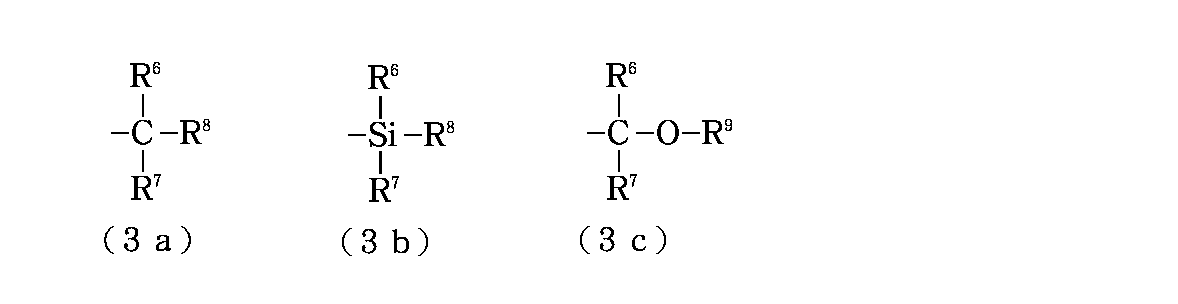
また、R5は酸不安定基であり、この場合、酸不安定基とはカルボキシル基を酸の存在下で分解し得る1種以上の官能基で置換したものを意味し、酸の存在下に分解してアルカリ可溶性を示す官能基を遊離するものであり、下記一般式(3a)、(3b)、(3c)で示される基が挙げられるが、本発明は式(3c)の酸不安定基を用いる。
【0025】
【化6】
【0026】
この場合、上記直鎖状もしくは分岐状のアルキル基、直鎖状もしくは分岐状のアルコキシ基、直鎖状もしくは分岐状のアルコキシアルキル基、直鎖状もしくは分岐状のアルケニル基、アリール基としては、上記R1〜R3と同様のものを例示することができる。
【0029】
更に、式(3c)においてR9とR6が互いに結合して形成される環としては、例えば2−オキサシクロヘキシリデン基、2−オキサシクロペンチリデン基、2−オキサ−4−メチルシクロヘキシリデン基等の炭素数4〜10のものが挙げられる。
【0032】
一般式(3c)で表わされる基としては、例えば1−メトキシメチル基、1−メトキシエチル基、1−エトキシエチル基、1−エトキシプロピル基、1−エトキシイソブチル基、1−n−プロポキシエチル基、1−tert−ブトキシエチル基、1−n−ブトキシエチル基、1−i−ブトキシエチル基、1−tert−ペントキシエチル基、1−シクロヘキシルオキシエチル基、1−(2’−n−ブトキシエトキシ)エチル基、1−(2’−エチルヘキシル)オキシエチル基、1−(4’−アセトキシメチルシクロヘキシルメチルオキシ)エチル基、1−{4’−(tert−ブトキシカルボニルオキシメチル)シクロヘキシルメチルオキシ}エチル基、2−メトキシ−2−プロピル基、1−エトキシプロピル基、ジメトキシメチル基、ジエトキシメチル基、テトラヒドロフラニル基、テトラヒドロピラニル基等の炭素数2〜8のものが好適である。
【0033】
なお、上記式(1)において、k、h、mはそれぞれ0〜9の整数で、k+h+m+n≦10を満足する。
【0034】
上記式(1)の化合物の好ましい具体例としては、下記(4a)〜(4e)で示される化合物などが挙げられる。
【0035】
【化7】
【0036】
本発明の式(1)の化合物は、下記式(5)で示される三環式芳香族骨格を有するカルボン酸誘導体から、常法に従って容易にかつ安価に合成することができる。
【0037】
【化8】
【0047】
酸不安定基として上記一般式(3c)で表わされる基をもつ化合物の合成法としては、種々の方法があり特に限定されるものではないが、好ましい一例として式(5)で示されるカルボン酸に酸触媒下で下記式(9)で表わされるビニルエーテル類を反応させる方法がある。
【0048】
【化11】
【0049】
この場合、上記式(9)のビニルエーテル類としては特に限定されるものではないが、具体例としてはメチルビニルエーテル、エチルビニルエーテル、n−プロピルビニルエーテル、tert−ブチルビニルエーテル、n−ブチルビニルエーテル、i−ブチルビニルエーテル、n−ペンチルビニルエーテル、シクロヘキシルビニルエーテル、4−オキサ−2−ヘキセン、3,4−ジヒドロ−2H−ピラン、2,3−ジヒドロフランなどが挙げられる。上記式(9)のビニルエーテル類の使用量は、上記式(5)、(6)のカルボン酸中のカルボキシル基1モルに対して1〜10モル、特に1〜5モルの割合が好ましい。
【0050】
用いられる酸触媒は特に限定されるものではないが、具体例としてはトリフルオロメタンスルホン酸、p−トルエンスルホン酸、硫酸、塩酸、p−トルエンスルホン酸ピリジニウム、m−ニトロベンゼンスルホン酸ピリジニウム、スルホン酸ピリジニウム等が挙げられる。上記酸触媒の使用量は、式(5)、(6)で示されるカルボン酸中のカルボキシル基1モルに対して0.001〜1モルの割合で添加することが好ましい。
【0051】
用いられる反応溶媒は特に限定されるものではないが、具体例としてはテトラヒドロフラン、テトラヒドロピラン、1,4−ジオキサンなどのエーテル類、アセトン、メチルエチルケトン、メチルイソブチルケトンなどのケトン類、ベンゼン、トルエン、キシレンなどの芳香族炭化水素類、塩化メチレン、クロロホルムなどのハロゲン系炭化水素類、あるいはそれらの混合溶媒などが挙げられるが、これらの中でも特にテトラヒドロフラン、テトラヒドロピラン、あるいはそれらと塩化メチレン、クロロホルムなどのハロゲン系炭化水素類の混合物などが好ましい。
【0052】
反応温度は0℃から溶媒の沸点の範囲で行うことができる。反応時間は条件によって適宜選択できるが、ほぼ30分〜24時間程度で終了する。
【0053】
反応終了後はアルカリで触媒の酸を中和し、溶媒層を水洗・濃縮した後、再結晶ないしカラム分取を行うことで、目的とする化合物を得ることができる。
【0054】
更に、酸不安定基として上記一般式(3c)で表わされる基をもつ化合物の合成法として好ましい第二の例として、式(5)で示されるカルボン酸に塩基触媒下で下記式(10)で表わされるハロアルコキシアルキルを反応させる方法がある。
【0055】
【化12】
【0056】
この場合、上記式(10)のハロアルコキシアルキルは特に限定されるものではないが、具体例としては塩化メトキシメチル、臭化メトキシメチル、ヨウ化メトキシメチル、塩化エトキシエチル、塩化エトキシメチル、臭化エトキシメチル、塩化メトキシエトキシメチル、塩化テトラヒドロフラニル、塩化テトラヒドロピラニルなどが挙げられる。式(10)で表わされるハロアルコキシアルキルの使用量は、原料である式(5)のカルボン酸誘導体のカルボキシル基に対し1〜10モル当量用いることが好ましい。
【0057】
また、触媒として用いられる塩基は特に限定されるものではないが、具体例としては炭酸水素ナトリウム、炭酸ナトリウム、炭酸水素カリウム、炭酸カリウム、水素化ナトリウム、水素化カリウム、ナトリウムメチラート、ナトリウムエチラート、カリウムtert−ブチラートなどのアルカリ金属塩類、またはトリエチルアミン、ジイソプロピルメチルアミン、ジメチルアニリン、ピリジン、4−N,N−ジメチルアミノピリジン、4−(1−ピペリジノ)ピリジンなどの有機塩基類のほか、種々の相関移動触媒も挙げられる。上記塩基の使用量は、式(5)で表わされるカルボン酸中のカルボキシル基に対し1〜10モル当量の範囲が好ましい。
【0058】
用いられる反応溶媒は特に限定されるものではないが、具体例としてはメタノール、エタノール、プロパノール、2−メチルエタノール、ブタノール、tert−ブチルアルコールなどのアルコール類、アセトン、メチルエチルケトン、メチルイソブチルケトンなどのケトン類、ベンゼン、トルエン、キシレンなどの芳香族炭化水素類、塩化メチレン、クロロホルムなどのハロゲン系炭化水素類、N,N−ジメチルホルムアミド、N,N−ジメチルアセトアミド、ジメチルスルホキシドなどの非プロトン性極性溶媒、あるいはそれらの混合溶媒などが挙げられ、これらの中でも特にアセトン、N,N−ジメチルホルムアミド、N,N−ジメチルアセトアミドなどが好ましい。また相関移動反応においてはこれらの有機溶媒と水との二層系などが挙げられる。
【0059】
反応温度は0℃から溶媒の沸点の範囲で行うことができる。反応時間は条件によって適宜選択できるが、ほぼ30分〜24時間程度で終了する。反応終了後は水により反応を停止し、溶媒層を水洗・濃縮した後、再結晶ないしカラム分取を行うことで、目的とする化合物を得ることができる。
【0060】
本発明の光吸収剤は、上記式(1)の三環式芳香族骨格を有するカルボン酸誘導体からなるもので、上記式(1)の化合物のいずれか1種を単独で使用しても2種以上を混合して使用してもよい。
【0061】
更に本発明では、上記式(1)のカルボン酸誘導体からなる光吸収剤を配合した化学増幅ポジ型レジスト材料を提供する。その具体的態様としては、下記の通りである。
〔1〕(A)有機溶剤
(B)酸不安定基で保護された酸性官能基をもつアルカリ不溶性又は難溶性の樹脂であって、該酸不安定基が解離したときにアルカリ可溶性となる樹脂
(C)酸発生剤
(D)上記式(1)の三環式芳香族骨格を有するカルボン酸誘導体からなる光吸収剤
を含有する化学増幅ポジ型レジスト材料。
〔2〕上記〔1〕の化学増幅ポジ型レジスト材料において、(B)成分の樹脂として、一部の水酸基の水素原子が酸不安定基で置換された重量平均分子量3,000〜300,000のポリヒドロキシスチレンを用いた化学増幅ポジ型レジスト材料。
〔3〕(E)成分として溶解制御剤を含有する上記〔1〕又は〔2〕の化学増幅ポジ型レジスト材料。
〔4〕(F)成分として塩基性化合物を含有する上記〔1〕、〔2〕又は〔3〕の化学増幅ポジ型レジスト材料。
〔5〕(G)成分として分子内に≡C−COOHで示される基を有する芳香族化合物を含有する上記〔1〕、〔2〕、〔3〕又は〔4〕の化学増幅ポジ型レジスト材料。
(6)(H)成分として(D)成分とは別の光吸収剤を含有する上記〔1〕、〔2〕、〔3〕、〔4〕又は〔5〕の化学増幅ポジ型レジスト材料。
【0062】
ここで、(A)成分の有機溶剤としては、例えばシクロヘキサノン、2−ヘプタノン、3−ヘプタノン、4−ヘプタノン、メチル−2−n−アミルケトンなどのケトン類、3−メトキシブタノール、3−メチル−3−メトキシブタノール、1−メトキシ−2−プロパノール、1−エトキシ−2−プロパノールなどのアルコール類、プロピレングリコールモノメチルエーテル、エチレングリコールモノメチルエーテル、プロピレングリコールモノエチルエーテル、エチレングリコールモノエチルエーテル、プロピレングリコールジメチルエーテル、ジエチレングリコールジメチルエーテル、エチレングリコール−tert−ブチルエーテルメチルエーテル(1−tert−ブトキシ−2−メトキシエタン)、エチレングリコール−tert−ブチルエーテルエチルエーテル(1−tert−ブトキシ−2−エトキシエタン)などのエーテル類、プロピレングリコールモノメチルエーテルアセテート、プロピレングリコールモノエチルエーテルアセテート、乳酸エチル、ピルビン酸エチル、酢酸ブチル、メチル−3−メトキシプロピオネート、エチル−3−エトキシプロピオネート、酢酸tert−ブチル、プロピオン酸tert−ブチル、β−メトキシイソ酪酸メチルなどのエステル類が挙げられ、これらの1種を単独で又は2種以上を混合して使用することができる。これらの中ではレジスト成分の溶解性が優れている1−エトキシ−2−プロパノールもしくは安全性とレジスト成分の溶解性が優れているプロピレングリコールモノメチルエーテルアセテート(α型、β型を問わず)が好ましく使用される。
【0063】
(A)成分の有機溶剤の配合量は、レジスト膜厚を0.4〜2μmにし得る範囲が好ましく、具体的には(B)成分70〜90部、特に75〜85部に対し150〜700部、特に250〜500部が好ましく、150部に満たないとレジスト膜厚が厚すぎて成膜性が悪くなる場合があり、700部を超えるとレジスト膜厚が薄すぎる場合がある。
【0064】
(B)成分の酸不安定基で保護された酸性官能基をもつアルカリ不溶性又は難溶性の樹脂であって、該酸不安定基が解離したときにアルカリ可溶性となる樹脂は、ベース樹脂となるもので、例えば以下の(I)、(II)などの樹脂を挙げることができる。
(I)ヒドロキシスチレン、ヒドロキシ−α−メチルスチレン、ビニル安息香酸、カルボキシメチルスチレン、カルボキシメトキシスチレン、(メタ)アクリル酸、クロトン酸、マレイン酸、イタコン酸、シトラコン酸、メサコン酸、ケイ皮酸等からなる酸性官能基を有する少なくとも一種の単量体を重合もしくは共重合して得られる付加重合により製造された樹脂の酸性官能基を酸不安定基で保護したもの。
(II)ノボラック樹脂に代表される縮重合により製造された樹脂の酸性官能基を酸不安定基で保護したもの。
【0065】
上記(I)の場合、該樹脂は前記酸性官能基を有する単量体に存在する重合性多重結合が開裂した繰り返し単位のみから構成されていてもよいが、必要に応じて他の繰り返し単位を更に含有することができる。
【0066】
このような他の繰り返し単位を与える単量体としては、例えばスチレン、α−メチルスチレン、メトキシスチレン、t−ブトキシスチレン、アセトキシスチレン、ビニルトルエン、無水マレイン酸、(メタ)アクリロニトリル、クロトンニトリル、マレインニトリル、フマロニトリル、メサコンニトリル、シトラコンニトリル、イタコンニトリル、(メタ)アクリルアミド、クロトンアミド、マレインアミド、フマルアミド、メサコンアミド、シトラコンアミド、イタコンアミド、ビニルアニリン、ビニルピリジン、ビニルーε−カプロラクタム、ビニルピロリドン、ビニルイミダゾール等を挙げることができる。
【0067】
また、(II)の場合、上記樹脂は例えばノボラック樹脂単位のみから構成されていてもよいが、必要に応じて他の縮重合により生成する単位を更に含有することもできる。このような樹脂は、一種以上のフェノール類と一種以上のアルデヒド類とを場合によっては他の縮重合成分と共に酸性触媒下で縮重合もしくは共縮重合させることによって製造することができる。
【0068】
前記フェノール類としては、例えばo−クレゾール、m−クレゾール、p−クレゾール、2,3−キシレノール、2,4−キシレノール、2,5−キシレノール、3,4−キシレノール、3,5−キシレノール、2,3,5−トリメチルフェノール、3,4,5−トリメチルフェノールなどを挙げることができ、アルデヒド類としてはホルムアルデヒド、パラホルムアルデヒド、ベンズアルデヒド、アセトアルデヒド、プロピオンアルデヒド、フェニルアセトアルデヒドなどを挙げることができる。
【0069】
上記した(I)、(II)の樹脂の中では、特に(I)の付加重合により製造されたものが好ましく、とりわけ好ましいものとしては、ポリヒドロキシスチレン及びその誘導体が挙げられる。
【0070】
この場合、ポリヒドロキシスチレン及びその誘導体としては、酸性官能基であるフェノール性水酸基の水素原子を部分的に酸に不安定な1種以上の基で置換したものが好適であるが、ポリヒドロキシスチレンの共重合体も用いることができる。前者の場合、酸に不安定な置換基としては、例えばtert−ブチル基、tert−ブトキシカルボニル基、tert−ブトキシカルボニルメチル基等のtert−ブチル誘導体の置換基、1−エトキシエチル基、1−n−プロポキシエチル基、1−iso−プロポキシエチル基、1−n−ブトキシエチル基、1−i−ブトキシエチル基、1−sec−ブトキシエチル基、1−tert−ブトキシエチル基、1−tert−ペントキシエチル基、1−エトキシ−n−プロピル基、1−シクロヘキシルエチル基等の直鎖状もしくは分岐状アセタール基、テトラヒドロフラニル基、テトラヒドロピラニル基、2−メトキシ−テトラヒドロピラニル基等の環状アセタール基が好ましい。なお、これらは1種のみでなく2種以上が同一のポリマー鎖上に用いられていてもよく、例えば2種の置換基を同一のポリマー鎖上に用いる場合の組み合わせとしては、tert−ブトキシカルボニル基と1−エトキシエチル基、tert−ブトキシカルボニル基と1−n−ブトキシエチル基、tert−ブトキシカルボニル基と1−エトキシ−n−プロピル基などが好ましい。
【0071】
後者のポリヒドロキシスチレンの共重合体としては、ヒドロキシスチレンとスチレンとの共重合体、ヒドロキシスチレンとアクリル酸−tert−ブチルとの共重合体、ヒドロキシスチレンとメタクリル酸−tert−ブチルとの共重合体、ヒドロキシスチレンと無水マレイン酸との共重合体、ヒドロキシスチレンとマレイン酸ジtert−ブチルとの共重合体等が挙げられる。
【0072】
上記ポリヒドロキシスチレン又はその誘導体の重量平均分子量は、3,000〜300,000とすることが好ましく、3,000に満たないと成膜性、解像性に劣る場合があり、300,000を超えると解像性に劣る場合がある。
【0073】
更に、上記のベース樹脂においては、分子量分布(Mw/Mn)が広い場合は低分子量や高分子量のポリマーが存在し、低分子量のポリマーが多く存在すると耐熱性が低下する場合があり、高分子量のポリマーが多く存在するとアルカリに対して溶解し難いものを含み、パターン形成後の裾引きの原因となる場合がある。それ故、パターンルールが微細化するに従ってこのような分子量、分子量分布の影響が大きくなり易いことから、微細なパターン寸法に好適に用いられるレジスト材料を得るには、ベース樹脂の分子量分布は1.0〜1.5、特に1.0〜1.3の狭分散であることが好ましい。
【0074】
(B)成分のベース樹脂の配合量は、70〜90部、特に75〜85部が好適である。
【0075】
(C)成分の酸発生剤としては公知のものを使用し得、例えば下記一般式(11)で示されるものが好適である。
【0076】
(R)rMA (11)
(但し、式中Rは同種又は異種の芳香族炭化水素基又はアルキル基である。また、Mはスルホニウム又はヨードニウム、Aはp−トルエンスルホネート、トリフルオロメタンスルホネート、ノナフルオロブタンスルホネート、ブタンスルホネート又は炭素数1〜20の直鎖状、分岐状もしくは環状のアルキルスルホネートであり、rは2又は3である。)
【0077】
上記式(11)において、Rの芳香族炭化水素基としては、置換、非置換いずれでもよく、例えばフェニル基、tert−ブトキシフェニル基、tert−ブチルフェニル基、tert−ブトキシカルボニルオキシフェニル基、tert−ブトキシカルボニルメトキシフェニル基、tert−ブチルジメチルシリルオキシフェニル基、テトラヒドロフラニルオキシフェニル基、1−エトキシエトキシフェニル基、1−プロポキシエトキシフェニル基、1−tert−ブトキシエトキシフェニル基などが挙げられ、また、アルキル基としては直鎖状、分岐状、環状のいずれのアルキル基でもよく、例えばメチル基、エチル基、シクロへキシル基、2−オキソシクロヘキシル基などが挙げられる。
【0078】
また、Mはスルホニウム又はヨードニウムであり、Aはp−トルエンスルホネート、トリフルオロメタンスルホネート、ノナフルオロブタンスルホネート、ブタンスルホネート又は炭素数1〜20の直鎖状、分岐状もしくは環状のアルキルスルホネートである。
【0079】
上記酸発生剤を例示すれば、トリフルオロメタンスルホン酸ジフェニルヨードニウム、トリフルオロメタンスルホン酸(p−tert−ブトキシフェニル)フェニルヨードニウム、p−トルエンスルホン酸ジフェニルヨードニウム、p−トルエンスルホン酸(p−tert−ブトキシフェニル)フェニルヨードニウム、トリフルオロメタンスルホン酸トリフェニルスルホニウム、トリフルオロメタンスルホン酸(p−tert−ブトキシフェニル)ジフェニルスルホニウム、トリフルオロメタンスルホン酸ビス(p−tert−ブトキシフェニル)フェニルスルホニウム、トリフルオロメタンスルホン酸トリス(p−tert−ブトキシフェニル)スルホニウム、p−トルエンスルホン酸トリフェニルスルホニウム、p−トルエンスルホン酸(p−tert−ブトキシフェニル)ジフェニルスルホニウム、p−トルエンスルホン酸ビス(p−tert−ブトキシフェニル)フェニルスルホニウム、p−トルエンスルホン酸トリス(p−tert−ブトキシフェニル)スルホニウム、ノナフルオロブタンスルホン酸トリフェニルスルホニウム、ブタンスルホン酸トリフェニルスルホニウム、トリフルオロメタンスルホン酸トリメチルスルホニウム、p−トルエンスルホン酸トリメチルスルホニウム、トリフルオロメタンスルホン酸シクロヘキシルメチル(2−オキソシクロヘキシル)スルホニウム、p−トルエンスルホン酸シクロヘキシルメチル(2−オキソシクロヘキシル)スルホニウム、トリフルオロメタンスルホン酸ジメチルフェニルスルホニウム、p−トルエンスルホン酸ジメチルフェニルスルホニウム、トリフルオロメタンスルホン酸ジシクロヘキシルフェニルスルホニウム、p−トルエンスルホン酸ジシクロヘキシルフェニルスルホニウム等のオニウム塩、2−シクロヘキシルカルボニル−2−(p−トルエンスルホニル)プロパン、2−iso−プロピルカルボニル−2−(p−トルエンスルホニル)プロパン等のβ−ケトスルホン誘導体、ビス(ベンゼンスルホニル)ジアゾメタン、ビス(シクロヘキシルスルホニル)ジアゾメタン、ビス(tert−ブチルスルホニル)ジアゾメタン等のジアゾメタン誘導体、ジフェニルジスルホン、ジシクロヘキシルジスルホン等のジスルホン誘導体、p−トルエンスルホン酸2,6−ジニトロベンジル、p−トルエンスルホン酸2,4−ジニトロベンジル等のニトロベンジルスルホネート誘導体、1,2,3−トリス(メタンスルホニルオキシ)ベンゼン、1,2,3−トリス(トリフルオロメタンスルホニルオキシ)ベンゼン、1,2,3−トリス(p−トルエンスルホニルオキシ)ベンゼン等のスルホン酸エステル誘導体、フタルイミド−イル−トリフレート、フタルイミド−イル−トシレート、5−ノルボルネン−2,3−ジカルボキシイミド−イル−トリフレート、5−ノルボルネン−2,3−ジカルボキシイミド−イル−トシレート、5−ノルボルネン−2,3−ジカルボキシイミド−イル−n−ブチルスルホネート等のイミド−イル−スルホネート誘導体等が挙げられるが、トリフルオロメタンスルホン酸トリフェニルスルホニウム、トリフルオロメタンスルホン酸(p−tert−ブトキシフェニル)ジフェニルスルホニウム、トリフルオロメタンスルホン酸トリス(p−tert−ブトキシフェニル)スルホニウム、p−トルエンスルホン酸トリフェニルスルホニウム、p−トルエンスルホン酸(p−tert−ブトキシフェニル)ジフェニルスルホニウム、p−トルエンスルホン酸トリス(p−tert−ブトキシフェニル)スルホニウムなどの下記化合物が好ましく用いられる。なお、上記酸発生剤は、1種を単独で又は2種以上を組み合わせて用いることができる。
【0080】
【化13】
【化14】
(C)成分の酸発生剤の配合量は、0.5〜15部、特に1〜8部が好ましく、0.5部より少ないと感度が低下する場合があり、15部より多いとアルカリ可溶速度が低下することによってレジスト材料の解像性が低下する場合があり、またモノマーの成分が過剰となるために耐熱性が低下する場合がある。
【0083】
本発明では、(D)成分として上記式(1)の三環式芳香族骨格を有するカルボン酸誘導体からなる光吸収剤を配合するが、その配合量は、0.01〜10部、特に0.1〜5部が好ましく、0.01部に満たないと十分な定在波、ハレーションの防止効果が得られない場合があり、10部を超えると顕著な感度低下が現れてしまう場合がある。
【0084】
(E)成分の溶解制御剤としては、分子内に1個以上酸によって分解する基を持つものであれば、低分子量の化合物やポリマーのいずれであっても良い。
【0085】
低分子量の化合物の例としては、ビスフェノールAや下記のポリフェノール化合物の水酸基の水素原子をtert−ブトキシ基、tert−ブトキシカルボニル基、tert−ブトキシカルボニルメチル基等のtert−ブチル誘導体の置換基、1−エトキシエチル基、1−プロポキシエチル基、1−n−ブトキシエチル基、1−i−ブトキシエチル基、1−tert−ブトキシエチル基、1−tert−アミロキシエチル基等の直鎖状もしくは分岐状アセタール基、テトラヒドロフラニル基、テトラヒドロピラニル基等の環状アセタール基で置換した化合物が挙げられる。
【0086】
【化15】
また、ポリマーの溶解制御剤の例としては、p−ブトキシスチレンとtert−ブチルアクリレートのコポリマーやp−ブトキシスチレンと無水マレイン酸のコポリマーなどが挙げられる。この場合、重量平均分子量は、500〜10,000が好ましい。
【0088】
(E)成分の溶解制御剤の配合量は、0〜40部、好ましくは1〜40部、特に5〜25部が好適である。
【0089】
(F)成分の添加剤として配合される塩基性化合物は、酸発生剤より発生する酸がレジスト膜中に拡散する際の拡散速度を抑制することができる化合物が適しており、このような塩基性化合物の配合により、レジスト膜中での酸の拡散速度が抑制されて解像度が向上し、露光後の感度変化を抑制したり、基板や環境依存性を少なくし、露光余裕度やパターンプロファイル等を向上することができる。
【0090】
このような塩基性化合物としては、第1級、第2級、第3級の脂肪族アミン類、混成アミン類、芳香族アミン類、複素環アミン類、カルボキシ基を有する含窒素化合物、スルホニル基を有する含窒素化合物、ヒドロキシ基を有する含窒素化合物、ヒドロキシフェニル基を有する含窒素化合物、アルコール性含窒素化合物、アミド誘導体、イミド誘導体等が挙げられる。
【0091】
具体的には、第1級の脂肪族アミン類として、アンモニア、メチルアミン、エチルアミン、n−プロピルアミン、iso−プロピルアミン、n−ブチルアミン、iso−ブチルアミン、sec−ブチルアミン、tert−ブチルアミン、ペンチルアミン、tert−アミルアミン、シクロペンチルアミン、ヘキシルアミン、シクロヘキシルアミン、ヘプチルアミン、オクチルアミン、ノニルアミン、デシルアミン、ドデシルアミン、セチルアミン、メチレンジアミン、エチレンジアミン、テトラエチレンペンタミン等が例示され、第2級の脂肪族アミン類として、ジメチルアミン、ジエチルアミン、ジ−n−プロピルアミン、ジ−iso−プロピルアミン、ジ−n−ブチルアミン、ジ−iso−ブチルアミン、ジ−sec−ブチルアミン、ジペンチルアミン、ジシクロペンチルアミン、ジヘキシルアミン、ジシクロヘキシルアミン、ジヘプチルアミン、ジオクチルアミン、ジノニルアミン、ジデシルアミン、ジドデシルアミン、ジセチルアミン、N,N−ジメチルメチレンジアミン、N,N−ジメチルエチレンジアミン、N,N−ジメチルテトラエチレンペンタミン等が例示され、第3級の脂肪族アミン類として、トリメチルアミン、トリエチルアミン、トリ−n−プロピルアミン、トリ−iso−プロピルアミン、トリ−n−ブチルアミン、トリ−iso−ブチルアミン、トリ−sec−ブチルアミン、トリペンチルアミン、トリシクロペンチルアミン、トリヘキシルアミン、トリシクロヘキシルアミン、トリヘプチルアミン、トリオクチルアミン、トリノニルアミン、トリデシルアミン、トリドデシルアミン、トリセチルアミン、N,N,N’,N’−テトラメチルメチレンジアミン、N,N,N’,N’−テトラメチルエチレンジアミン、N,N,N’,N’−テトラメチルテトラエチレンペンタミン等が例示される。
【0092】
また、混成アミン類としては、例えばジメチルエチルアミン、メチルエチルプロピルアミン、ベンジルアミン、フェネチルアミン、ベンジルジメチルアミン等が例示される。
【0093】
芳香族、複素環アミン類の具体例としては、アニリン誘導体(例えばアニリン、N−メチルアニリン、N−エチルアニリン、N−プロピルアニリン、N,N−ジメチルアニリン、2−メチルアニリン、3−メチルアニリン、4−メチルアニリン、エチルアニリン、プロピルアニリン、トリメチルアニリン、2−ニトロアニリン、3−ニトロアニリン、4−ニトロアニリン、2,4−ジニトロアニリン、2,6−ジニトロアニリン、3,5−ジニトロアニリン、N,N−ジメチルトルイジン等)、ジフェニル(p−トリル)アミン、メチルジフェニルアミン、トリフェニルアミン、フェニレンジアミン、ナフチルアミン、ジアミノナフタレン、ピロール誘導体(例えばピロール、2H−ピロール、1−メチルピロール、2,4−ジメチルピロール、2,5−ジメチルピロール、N−メチルピロール等)、オキサゾール誘導体(例えばオキサゾール、イソオキサゾール等)、チアゾール誘導体(例えばチアゾール、イソチアゾール等)、イミダゾール誘導体(例えばイミダゾール、4−メチルイミダゾール、4−メチル−2−フェニルイミダゾール等)、ピラゾール誘導体、フラザン誘導体、ピロリン誘導体(例えばピロリン、2−メチル−1−ピロリン等)、ピロリジン誘導体(例えばピロリジン、N−メチルピロリジン、ピロリジノン、N−メチルピロリドン等)、イミダゾリン誘導体、イミダゾリジン誘導体、ピリジン誘導体(例えばピリジン、メチルピリジン、エチルピリジン、プロピルピリジン、ブチルピリジン、4−(1−ブチルペンチル)ピリジン、ジメチルピリジン、トリメチルピリジン、トリエチルピリジン、フェニルピリジン、3−メチル−2−フェニルピリジン、4−tert−ブチルピリジン、ジフェニルピリジン、ベンジルピリジン、メトキシピリジンブトキシピリジン、ジメトキシピリジン、1−メチル−2−ピリドン、4−ピロリジニピリジン、1−メチル−4−フェニルピリジン、2−(1−エチルプロピル)ピリジン、アミノピリジン、ジメチルアミノピリジン等)、ピリダジン誘導体、ピリミジン誘導体、ピラジン誘導体、ピラゾリン誘導体、ピラゾリジン誘導体、ピペリジン誘導体、ピペラジン誘導体、モルホリン誘導体、インドール誘導体、イソインドール誘導体、1H−インダゾール誘導体、インドリン誘導体、キノリン誘導体(例えばキノリン、3−キノリンカルボニトリル等)、イソキノリン誘導体、シンノリン誘導体、キナゾリン誘導体、キノキサリン誘導体、フタラジン誘導体、プリン誘導体、プテリジン誘導体、カルバゾール誘導体、フェナントリジン誘導体、アクリジン誘導体、フェナジン誘導体、1,10−フェナントロリン誘導体、アデニン誘導体、アデノシン誘導体、グアニン誘導体、グアノシン誘導体、ウラシル誘導体、ウリジン誘導体などが例示される。
【0094】
更に、カルボキシ基を有する含窒素化合物としては、例えばアミノ安息香酸、インドールカルボン酸、アミノ酸誘導体(例えばニコチン酸、アラニン、アルギニン、アスパラギン酸、グルタミン酸、グリシン、ヒスチジン、イソロイシン、グリシルロイシン、ロイシン、メチオニン、フェニルアラニン、スレオニン、リジン、3−アミノピラジン−2−カルボン酸、メトキシアラニン)などが例示され、スルホニル基を有する含窒素化合物として3−ピリジンスルホン酸、p−トルエンスルホン酸ピリジニウムなどが例示され、ヒドロキシ基を有する含窒素化合物、ヒドロキシフェニル基を有する含窒素化合物、アルコール性含窒素化合物として、2−ヒドロキシピリジン、アミノクレゾール、2,4−キノリンジオール、3−インドールメタノールヒドレート、トリエタノールアミン、N−エチルジエタノールアミン、N,N−ジエチルエタノールアミン、トリイソプロパノールアミン、2,2’−イミノジエタノール、2−アミノエタノ−ル、3−アミノ−1−プロパノール、4−アミノ−1−ブタノール、4−(2−ヒドロキシエチル)モルホリン、2−(2−ヒドロキシエチル)ピリジン、1−(2−ヒドロキシエチル)ピペラジン、1−[2−(2−ヒドロキシエトキシ)エチル]ピペラジン、ピペリジンエタノール、1−(2−ヒドロキシエチル)ピロリジン、1−(2−ヒドロキシエチル)−2−ピロリジノン、3−ピペリジノ−1,2−プロパンジオール、3−ピロリジノ−1,2−プロパンジオール、3−クイヌクリジノール、3−トロパノール、1−メチル−2−ピロリジンエタノール、1−アジリジンエタノール、N−(2−ヒドロキシエチル)フタルイミド、N−(2−ヒドロキシエチル)イソニコチンアミドなどが例示される。
【0095】
アミド誘導体としては、ホルムアミド、N−メチルホルムアミド、N,N−ジメチルホルムアミド、アセトアミド、N−メチルアセトアミド、N,N−ジメチルアセトアミド、プロピオンアミド、ベンズアミド等が例示される。イミド誘導体としては、フタルイミド、サクシンイミド、マレイミド等が例示される。特にトリエチルアミン、N,N−ジメチルアニリン、N−メチルピロリドン、ピリジン、キノリン、ニコチン酸、トリエタノールアミン、ピペリジンエタノール、N,N−ジメチルアセトアミド、サクシンイミド等が好ましい。なお、上記塩基性化合物は1種を単独で又は2種以上を組み合わせて用いることができる。
【0096】
(F)成分の添加剤として配合される塩基性化合物の配合量は、0〜2部、特に0.01〜1部が好ましく、配合量が2部を超えると感度が低下しすぎる場合がある。
【0097】
(G)成分の分子内に≡C−COOHで示される基を有する芳香族化合物としては、具体的に4−ヒドロキシフェニル酢酸、3−ヒドロキシフェニル酢酸、2−ヒドロキシフェニル酢酸、3−(4−ヒドロキシフェニル)プロピオン酸、3−(2−ヒドロキシフェニル)プロピオン酸、2,5−ジヒドロキシフェニル酢酸、3,4−ジヒドロキシフェニル酢酸、1,2−フェニレン二酢酸、1,3−フェニレン二酢酸、1,4−フェニレン二酢酸、1,2−フェニレンジオキシ二酢酸、1,4−フェニレンジプロパン酸、安息香酸、4,4−(4−ヒドロキシフェニル)吉草酸、4−tert−ブトキシフェニル酢酸、4−(4−ヒドロキシフェニル)酪酸、3,4−ジヒドロキシマンデル酸、4−ヒドロキシマンデル酸等が挙げられる。
【0098】
(G)成分の分子内に≡C−COOHで示される基を有する芳香族化合物の配合量は、0〜15部、好ましくは0.1〜15部、特に1〜10部とすることが好ましい。
【0099】
また、(H)成分の(D)成分とは別の光吸収剤としては、例えばペンタレン、インデン、ナフタレン、アズレン、ペプタレン、ビフェニレン、インダセン、フルオレン、フェナレン、フェナントレン、アントラセン、フルオランチン、アセフェナントリレン、アセアントリレン、トリフェニレン、ピレン、クリセン、ナフタセン、プレイアデン、ピセン、ペリレン、ペンタフェン、ペンタセン、ベンゾフェナントレン、アントラキノン、アントロン、ベンズアントロン、2,7−ジメトキシナフタレン、2−エチル−9,10−ジメトキシアントラセン、9,10−ジメチルアントラセン、9−エトキシアントラセン、1,2−ナフトキノン、9−フルオレノン等の縮合多環炭化水素誘導体、テオキサンテン−9−オン、チアントレン、ジベンゾチオフェン等の縮合複素環誘導体、ベンゾフェノン、2,3,4−トリヒドロキシベンゾフェノン、2,3,4,4’−テトラヒドロキシベンゾフェノン、2,4−ジヒドロキシベンゾフェノン、3,5−ジヒドロキシベンゾフェノン、4、4’−ジヒドロキシベンゾフェノン、4,4’−ビス(ジメチルアミノ)ベンゾフェノン等のベンゾフェノン誘導体、スクエアリックアシッド、ジメチルスクエアレート等のスクエアリックアシッド誘導体、ビス(4−ヒドロキシフェニル)スルホキシド、ビス(4−tert−ブトキシフェニル)スルホキシド、ビス(4−tert−ブトキシカルボニルオキシフェニル)スルホキシド、ビス〔4−(1−エトシキエトキシ)フェニル〕スルホキシド、ビス〔4−(1−エトキシプロポキシ)フェニル〕スルホキシド等のジアリールスルホキシド誘導体、ビス(4−ヒドロキシフェニル)スルホン、ビス(4−tert−ブトキシフェニル)スルホン、ビス(4−tert−ブトキシカルボニルオキシフェニル)スルホン、ビス〔4−(1−エトキシエトキシ)フェニル〕スルホン、ビス〔4−(1−エトキシプロポキシ)フェニル〕スルホン等のジアリールスルホン誘導体、ベンゾキノンジアジド、ナフトキノンジアジド、アントラキノンジアジド、ジアゾフルオレン、ジアゾテキラロン、ジアゾフェナントロン等のジアゾ化合物、ナフトキノン−1,2−ジアジド−5−スルホン酸クロリドと2,3,4−トリヒドロキシベンゾフェノンとの完全もしくは部分エステル化合物、ナフトキノン−1,2−ジアジド−4−スルホン酸クロリドと2,4,4’−トリヒドロキシベンゾフェノンとの完全もしくは部分エステル化合物等のキノンジアジド基含有化合物等が挙げられる。
【0100】
(H)成分の、(D)成分とは別の光吸収剤の配合量は、0〜10部、好ましくは0.01〜10部、特に0.1〜5部とすることが好ましい。
【0101】
上記レジスト材料には更に、塗布性を向上させるための界面活性剤を添加することができる。この界面活性剤としては、パーフルオロアルキルポリオキシエチレンエタノール、FC−430、FC−31(いずれも住友スリーエム(株)製)等のフッ素化アルキルエステル、パーフルオロアミンオキサイド、パーフルオロアルキルEO付加物、X−70−092、X−70−093(いずれも信越化学工業(株)製)等の非イオン性含フッ素オルガノシロキサン系化合物などが挙げられる。
【0102】
上記レジスト材料の使用方法、光使用方法などは公知のリソグラフィー技術を採用して行うことができるが、特に上記レジスト材料は254〜193nmの遠紫外線及び電子線による微細パターニングに最適である。
【0103】
【発明の効果】
本発明の式(1)の化合物は、光吸収剤として用いた場合、昇華性がなく、遠紫外領域における光吸収がきわめて大きく、さらに酸の存在下に分解してカルボン酸を遊離する。従って、これを配合した化学増幅ポジ型レジスト材料は、例えば遠紫外線・電子線・X線などの高エネルギー線、特にKrFエキシマレーザーに感応し、定在波やハレーションの発現を抑止する一方で溶解特性や保存安定性に悪影響を与えることがなく、微細加工技術に適した高解像性を有する。
【0104】
【実施例】
以下、合成例、実施例及び参考例を示して本発明を具体的に説明するが、本発明は下記合成例、実施例に限定されるものではない。なお、各例中の部はいずれも重量部である。
【0105】
〔合成例1〕9−アントラセンカルボン酸tert−ブチル(前記式(4a)においてR5=tert−ブチル基の化合物)の合成
9−アントラセンカルボン酸(前記式(4a)においてR5=Hの化合物)11.1g(0.05mol)をTHF50gに溶解した。これを氷冷下5℃以下に保ちつつ、トリフルオロ酢酸無水物42.0g(0.2mol)を10分かけて滴下した。0〜5℃で2時間撹拌した後、室温で更に2時間熟成した。これを再び氷冷し、5℃以下に保ちつつtert−ブチルアルコール29.6g(0.4mol)を滴下した。滴下終了後、常温で2時間熟成した。反応終了後、10%水酸化ナトリウム水溶液203gを反応液に投入して酸を中和し、ジエチルエーテル215gで抽出した。有機層を2度水洗したあと硫酸マグネシウムで乾燥し、THF−ヘキサン溶媒からの再結晶により精製した。収量6.7g(収率48%)、純度98.0%。
【0106】
得られた9−アントラセンカルボン酸tert−ブチルの核磁気共鳴スペクトル(NMR)、赤外スペクトル(IR)、及び元素分析の結果を下記に示す。
【0107】
【化16】
(a) 1.80 1重項 9H
(b) 7.26〜7.58 多重項 4H
(c) 8.00〜8.11 多重項 4H
(d) 8.48 1重項 1H
<IR:(cm-1)>
3081、3052、2973、2933、2867、1714、1625、1560、1523、1486、1473、1457、1456、1444、1413、1392、1367、1319、1290、1265、1236、1160、1145、1014、997、952、887、850、788、728、669、640、619、601、551、528、462
<元素分析値(%):C20H20O2>
理論値 C:82.0 H:6.5
実測値 C:82.0 H:6.5
【0108】
〔合成例2〕9−アントラセンカルボン酸メトキシメチル(前記式(4a)においてR5=メトキシメチル基の化合物)の合成
9−アントラセンカルボン酸6.65g(0.03mol)とトリエチルアミン4.9g(0.05mol)をN,N−ジメチルホルムアミド30gに溶解した。室温下で30分撹拌したあと、撹拌を続けながらクロロメチルメチルエーテル3.1g(0.04mol)を滴下した。更に1時間撹拌した後、40℃で2時間熟成した。反応液に水102gを投入して反応を停止させ、ジクロロメタン114gで抽出した。有機層を水酸化ナトリウム溶液で洗浄し、更に水洗後、溶媒を減圧留去して結晶を得た。収量6.6g(収率83%)、純度98%。
【0109】
得られた9−アントラセンカルボン酸メトキシメチルの核磁気共鳴スペクトル(NMR)、赤外スペクトル(IR)、及び元素分析の結果を下記に示す。
【0110】
【化17】
(a) 3.66 1重項 3H
(b) 5.75 1重項 2H
(c) 7.26〜7.59 多重項 4H
(d) 8.01〜8.13 多重項 4H
(e) 8.54 1重項 1H
<IR:(cm-1)>
3056、2993、2956、2827、1720、1627、1560、1523、1473、1452、1446、1438、1415、1351、1290、1265、1220、1195、1164、1162、1145、1093、1016、970、935、927、902、854、850、790、761、732、669、638、603、566、551、514、457、426
<元素分析値(%):C17H14O3>
理論値 C:76.7 H:5.3
実測値 C:76.9 H:5.3
【0111】
〔合成例3〕9−アントラセンカルボン酸エトキシエチル(前記式(4a)においてR5=エトキシエチル基の化合物)の合成
合成例2で用いたクロロメチルメチルエーテルのかわりに1−クロロエチルエチルエーテルを用いる以外は合成例2と同様に反応を行ったところ、9−アントラセンカルボン酸エトキシエチルが純度97%、収率77%で得られた。得られた9−アントラセンカルボン酸エトキシエチルの核磁気共鳴スペクトル(NMR)及び元素分析の結果を下記に示す。
【0112】
【化18】
(a) 1.15〜1.20 3重項 3H
(b) 1.47〜1.57 2重項 3H
(c) 3.58〜3.80 多重項 2H
(d) 6.11〜6.18 4重項 1H
(e) 7.47〜7.80 多重項 4H
(f) 8.22〜8.34 多重項 4H
(g) 8.75 1重項 1H
<元素分析値(%):C19H18O3>
理論値 C:77.5 H:6.2
実測値 C:77.6 H:6.2
【0113】
〔合成例4〕9−アントラセンカルボン酸テトラヒドロピラニル(前記式(4a)においてR5=テトラヒドロピラニル基の化合物)の合成
9−アントラセンカルボン酸11.1g(0.05モル)をTHF156gとジクロロメタン155gの混合溶媒に溶解した。氷冷下撹拌しつつ、3,4−ジヒドロ−2Hピラン21.0g(0.25モル)を滴下した。更に20分間撹拌した後、脱水したp−トルエンスルホン酸0.138g(0.0008モル)を加えて溶解した。そのまま0℃で1時間、室温で1時間撹拌したあと反応液を氷冷し、5%炭酸水素ナトリウム水溶液210gを加えて酸を中和し、反応を停止した。分液した有機層から溶媒を減圧留去して油状物を得た。この油状物をシリカゲルクロマトグラフィー(溶出溶媒:酢酸エチル−ヘキサン)で精製することにより、9−アントラセンカルボン酸テトラヒドロピラニル(下記構造式参照)を単離した。収量10.8g(収率71%)、純度99%。
【0114】
得られた9−アントラセンカルボン酸テトラヒドロピラニルの核磁気共鳴スペクトル(NMR)、赤外スペクトル(IR)、及び元素分析の結果を下記に示す。
【0115】
【化19】
(a) 1.88〜2.09 多重項 4H
(b) 2.27〜2.32 多重項 2H
(c) 4.11〜4.29 二つの多重項 2H
(d) 6.93〜6.95 三重項 1H
(e) 7.54〜7.87 多重項 4H
(f) 8.30〜8.33 二重項 2H
(g) 8.39〜8.42 二重項 2H
(h) 8.81 一重項 1H
1H<IR:(cm-1)>
3399、3054、2977、2944、2881、1716、1625、1523、1454、1446、1390、1357、1321、1286、1265、1222、1197、1168、1153、1128、1118、1056、1022、991、937、900、896、869、854、819、792、732、684、620、603、555、520、445、424
<元素分析値(%):C17H14O3>
理論値 C:78.4 H:5.9
実測値 C:78.3 H:5.9
【0116】
〔合成例5〕
9−アントラセンカルボン酸テトラヒドロフラニル(前記式(4a)においてR5=テトラヒドロフラニル基の化合物)の合成
合成例4で用いた3,4−ジヒドロ−2Hピランのかわりにジヒドロフランを用いる以外は合成例4と同様に反応を行ったところ、9−アントラセンカルボン酸テトラヒドロフラニルが純度98%、収率72%で得られた。
【0117】
〔合成例6〕9−アントラセンカルボン酸n−プロポキシエチル(前記式(4a)においてR5=n−プロポキシエチル基の化合物)の合成
合成例4で用いた3,4−ジヒドロ−2Hピランのかわりにn−プロピルビニルエーテルを用いる以外は合成例4と同様に反応を行ったところ、9−アントラセンカルボン酸n−プロポキシエチルが純度97%、収率68%で得られた。
【0118】
〔合成例7〕9−アントラセンカルボン酸tert−ブトキシエチル(前記式(4a)においてR5=tert−ブトキシエチル基の化合物)の合成
合成例4で用いた3,4−ジヒドロ−2Hピランのかわりにtert−ブチルビニルエーテルを用いる以外は合成例4と同様に反応を行ったところ、9−アントラセンカルボン酸tert−ブトキシエチルが純度98%、収率70%で得られた。
【0119】
〔合成例8〕9−アントラセンカルボン酸n−ブトキシエチル(前記式(4a)においてR5=n−ブトキシエチル基の化合物)の合成
合成例4で用いた3,4−ジヒドロ−2Hピランのかわりにn−ブチルビニルエーテルを用いる以外は合成例4と同様に反応を行ったところ、9−アントラセンカルボン酸n−ブトキシエチルが純度98%、収率65%で得られた。
【0120】
〔合成例9〕9−アントラセンカルボン酸iso−ブトキシエチル(前記式(4a)においてR5=iso−ブトキシエチル基の化合物)の合成
合成例4で用いたエチルビニルエーテルのかわりにiso−ブチルビニルエーテルを用いる以外は合成例4と同様に反応を行ったところ、9−アントラセンカルボン酸iso−ブトキシエチルが純度98%、収率75%で得られた。
【0121】
〔合成例10〕9−アントラセンカルボン酸エトキシプロピル(前記式(4a)においてR5=エトキシプロピル基の化合物)の合成
合成例4で用いたエチルビニルエーテルのかわりに4−オキサ−2−ヘキセンを用いる以外は合成例4と同様に反応を行ったところ、9−アントラセンカルボン酸エトキシプロピルが純度99%、収率66%で得られた。
【0122】
〔合成例11〕9−アントラセンカルボン酸トリメチルシリル(前記式(4a)においてR5=トリメチルシリル基の化合物)の合成
合成例2で用いたクロロメチルメチルエーテルのかわりに塩化トリメチルシリルを用いる以外は合成例2と同様に反応を行ったところ、9−アントラセンカルボン酸トリメチルシリルが純度97%、収率85%で得られた。
【0123】
〔合成例12〕
合成例1で用いた9−アントラセンカルボン酸(前記式(4a)においてR5=Hの化合物)のかわりに1−アントラセンカルボン酸(前記式(4b)においてR5=Hの化合物)を用い、かつtert−アミルアルコールのかわりにtert−ブチルアルコールを用いる以外は合成例1と同様に反応させたところ、次のような化合物が得られた。
【0124】
1−アントラセンカルボン酸tert−ブチル(前記式(4b)においてR5=tert−ブチル基の化合物)純度99%、収率46%
〔合成例13〜22〕
合成例2〜11で用いた9−アントラセンカルボン酸(前記式(4a)においてR5=Hの化合物)の代わりに1−アントラセンカルボン酸(前記式(4b)においてR5=Hの化合物)を用いる以外は合成例2〜11と同様に反応させたところ、それぞれ次のような化合物が得られた。
<合成例13>1−アントラセンカルボン酸メトキシメチル(前記式(4b)においてR5=メトキシメチル基の化合物)純度98%、収率80%
<合成例14>1−アントラセンカルボン酸エトキシエチル(前記式(4b)においてR5=エトキシエチル基の化合物)純度97%、収率77%
<合成例15>1−アントラセンカルボン酸テトラヒドロピラニル(前記式(4b)においてR5=テトラヒドロピラニル基の化合物)純度97%、収率66%
<合成例16>1−アントラセンカルボン酸テトラヒドロフラニル(前記式(4b)においてR5=テトラヒドロフラニル基の化合物)純度99%、収率69%
<合成例17>1−アントラセンカルボン酸n−プロポキシエチル(前記式(4b)においてR5=n−プロポキシエチル基の化合物)純度99%、収率75%
<合成例18>1−アントラセンカルボン酸tert−ブトキシエチル(前記式(4b)においてR5=tert−ブトキシエチル基の化合物)純度97%、収率60%
<合成例19>1−アントラセンカルボン酸n−ブトキシエチル(前記式(4b)においてR5=n−ブトキシエチル基の化合物)純度98%、収率64%
<合成例20>1−アントラセンカルボン酸iso−ブトキシエチル(前記式(4b)においてR5=iso−ブトキシエチル基の化合物)純度98%、収率60%
<合成例21>1−アントラセンカルボン酸エトキシプロピル(前記式(4b)においてR5=エトキシプロピル基の化合物)純度98%、収率55%
<合成例22>1−アントラセンカルボン酸トリメチルシリル(前記式(4b)においてR5=トリメチルシリル基の化合物)純度98%、収率82%
【0125】
〔合成例23〜33〕
合成例12〜22で用いた1−アントラセンカルボン酸の代わりに2−アントラセンカルボン酸(前記式(4c)においてR5=Hの化合物)を用いる以外は合成例12〜22と同様に反応させたところ、それぞれ次のような化合物が得られた。
<合成例23>2−アントラセンカルボン酸tert−ブチル(前記式(4c)においてR5=tert−ブチル基の化合物)純度99%、収率46%
<合成例24>2−アントラセンカルボン酸メトキシメチル(前記式(4c)においてR5=メトキシメチル基の化合物)純度98%、収率80%
<合成例25>2−アントラセンカルボン酸エトキシエチル(前記式(4c)においてR5=エトキシエチル基の化合物)純度97%、収率77%
<合成例26>2−アントラセンカルボン酸テトラヒドロピラニル(前記式(4c)においてR5=テトラヒドロピラニル基の化合物)純度97%、収率66%
<合成例27>2−アントラセンカルボン酸テトラヒドロフラニル(前記式(4c)においてR5=テトラヒドロフラニル基の化合物)純度99%、収率69%
<合成例28>2−アントラセンカルボン酸n−プロポキシエチル(前記式(4c)においてR5=n−プロポキシエチル基の化合物)純度99%、収率75%
<合成例29>2−アントラセンカルボン酸tert−ブトキシエチル(前記式(4c)においてR5=tert−ブトキシエチル基の化合物)純度97%、収率60%
<合成例30>2−アントラセンカルボン酸n−ブトキシエチル(前記式(4c)においてR5=n−ブトキシエチル基の化合物)純度98%、収率64%
<合成例31>2−アントラセンカルボン酸iso−ブトキシエチル(前記式(4c)においてR5=iso−ブトキシエチル基の化合物)純度98%、収率60%
<合成例32>2−アントラセンカルボン酸エトキシプロピル(前記式(4c)においてR5=エトキシプロピル基の化合物)純度98%、収率60%
<合成例33>2−アントラセンカルボン酸トリメチルシリル(前記式(4c)においてR5=トリメチルシリル基の化合物)純度99%、収率86%
【0126】
〔合成例34〕9−アントラセンメトキシ酢酸tert−ブチル(前記式(4e)においてR5=tert−ブチル基の化合物)の合成
60%水素化ナトリウム6.7g(0.17mol)をヘキサン60gで洗浄し、すぐにTHF306gと9−ヒドロキシメチルアントラセン29.1g(0.14mol)を加えて撹拌した。室温で20分撹拌、65℃で1時間還流撹拌したあと反応液を冷却し、氷冷下でブロモ酢酸エチル28.0g(0.17mol)とTHF23gの混合物を10分間かけて滴下した。この反応液を室温で1時間、さらに65℃で1時間熟成したあと冷却し、0.4%塩化アンモニウム水溶液で反応を停止した。エーテル200gで抽出した有機層を水洗し、溶媒を留去すると結晶と油状物の混合物がえられた。これを再びエーテルに溶解、不溶物をろ別したあと硫酸マグネシウムで乾燥してから溶媒を留去した。
【0127】
得られた褐色の油状物をシリカゲルクロマトグラフィー(溶出液:酢酸エチル−ヘキサン1:10)で精製すると9−アントラセンメトキシ酢酸エチル(前記式(4e)においてR5=エチル基の化合物)が白色結晶として得られた。収量14.2g(収率34.5%)、純度95%。
【0128】
得られた9−アントラセンメトキシ酢酸エチル14.2gにメタノール145gを加え50℃に加熱して溶解し、3%水酸化ナトリウム水溶液100gを滴下した。75℃で30分還流したあと反応液を冷却し、溶媒を留去した。固体状の残渣にエーテル200gと水300gを加え濃塩酸を用いて液性を酸性にすると結晶が界面に析出した。これをろ別してTHF−エーテルの混合溶媒に溶解し水洗した後、エタノールから再結晶することにより、9−アントラセンメトキシ酢酸エチル(前記式(4e)においてR5=Hの化合物)を白色結晶として得た。収量6.9g(収率53%)、純度97%。
【0129】
得られた9−アントラセンメトキシ酢酸を合成例12で用いた1−アントラセンカルボン酸の代わりに用いる以外は合成例12と同様に反応させたところ、9−アントラセンメトキシ酢酸tert−ブチルが得られた。純度99%、収率51%。
【0130】
〔合成例35〜44〕
合成例13〜22で用いた1−アントラセンカルボン酸の代わりに9−アントラセンメトキシ酢酸(前記式(4e)においてR5=Hの化合物)を用いる以外は合成例12〜20と同様に反応させたところ、それぞれ次のような化合物が得られた。
<合成例35>9−アントラセンメトキシ酢酸メトキシメチル(前記式(4e)においてR5=メトキシメチル基の化合物)純度98%、収率76%
<合成例36>9−アントラセンメトキシ酢酸エトキシエチル(前記式(4e)においてR5=エトキシエチル基の化合物)純度96%、収率61%
<合成例37>9−アントラセンメトキシ酢酸テトラヒドロピラニル(前記式(4e)においてR5=テトラヒドロピラニル基の化合物)純度98%、収率59%
<合成例38>9−アントラセンメトキシ酢酸テトラヒドロフラニル(前記式(4e)においてR5=テトラヒドロフラニル基の化合物)純度98%、収率72%
<合成例39>9−アントラセンメトキシ酢酸n−プロポキシエチル(前記式(4e)においてR5=n−プロポキシエチル基の化合物)純度98%、収率68%
<合成例40>9−アントラセンメトキシ酢酸tert−ブトキシエチル(前記式(4e)においてR5=tert−ブトキシエチル基の化合物)純度97%、収率60%
<合成例41>9−アントラセンメトキシ酢酸n−ブトキシエチル(前記式(4e)においてR5=n−ブトキシエチル基の化合物)純度98%、収率69%
<合成例42>9−アントラセンメトキシ酢酸iso−ブトキシエチル(前記式(4e)においてR5=iso−ブトキシエチル基の化合物)純度98%、収率66%
<合成例43>9−アントラセンメトキシ酢酸エトキシプロピル(前記式(4e)においてR5=エトキシプロピル基の化合物)純度98%、収率66%
<合成例44>9−アントラセンメトキシ酢酸トリメチルシリル(前記式(4e)においてR5=トリメチルシリル基の化合物)純度98%、収率75%
【0134】
上記の合成例1〜4で得られた新規な化合物からなる光吸収剤をそれぞれ下記Dye.1〜Dye.4とし、比較品として従来の光吸収剤Dye.10及びDye.11の248nmにおける紫外吸収スペクトル(溶媒:メタノール)のモル吸光係数を表1に示す。
【0135】
【化20】
【表1】
表1の結果から明らかなように、上記式(1)の化合物からなる光吸収剤は、248nmの吸光度を従来の光吸収剤に比べて大幅に大きくすることができることがわかった。
【0138】
〔実施例1〜12,比較例1〜7〕
水酸基の水素原子を部分的にtert−ブトシキカルボニル基で保護した下記式(Polym.1)で示されるポリヒドロキシスチレン、水酸基の水素原子を部分的にテトラヒドロフラニル基で保護した下記式(Polym.2)で示されるポリヒドロキシスチレン、水酸基の水素原子を部分的に1−エトキシエチル基で保護した下記式(Polym.3)で示されるポリヒドロキシスチレン、または水酸基の水素原子を部分的にtert−ブトシキカルボニル基および1−エトキシエチル基で保護した(Polym.4)で示されるポリヒドロキシスチレンと、オニウム塩、ピロガロールのスルホン酸誘導体、ベンジルスルホン酸誘導体、ビスアルキルスルホニルジアゾメタン誘導体、N−スルホニルオキシイミド誘導体から選ばれる下記式(PAG.1)から(PAG.7)で示される酸発生剤と、ビスフェノールAのフェノール性水酸基をtert−ブトキシカルボニル基で置換した化合物、2−(4−ヒドロキシフェニル)−2−{4−(4−メチル−4−ヒドロキシフェニル)シクロヘキシル}プロパンのフェノール性水酸基をtert−ブトキシカルボニル基またはエトキシエチル基で部分的に置換した化合物から選ばれる下記式(DRI.1)から(DRI.3)で示される溶解制御剤と、下記式(Dye.2〜5,7)、(Dye.9〜11)で示される光吸収剤を溶剤に溶解し、表2〜4に示す各種組成のレジスト材料を調製した。
【0139】
得られたレジスト材料を0.2μmのテフロン製フィルターで濾過することによりレジスト液を調製した後、このレジスト液をシリコンウェハー上へスピンコーティングし、0.7μmに塗布した。
【0140】
次いで、このシリコンウェハーを100℃のホットプレートで120秒間ベークした。更に、エキシマレーザーステッパー(ニコン社、NSR2005EX NA=0.5)を用いて露光し、90℃で90秒間ベークを施し、2.38%のテトラメチルアンモニウムヒドロキシドの水溶液で現像を行うと、ポジ型のパターンを得ることができた。
【0141】
得られたレジストパターンを次のように評価した。結果を表2〜4に示す。
レジストパターン評価方法:
まず、感度(Eth)を求めた。次に、0.30μmのラインアンドスペースのトップとボトムを1:1で解像する露光量を最適露光量(感度:Eop)として、この露光量における分離しているラインアンドスペースの最小線幅を評価レジストの解像度とした。また解像したレジストパターンの形状、定在波発現の有無は走査型電子顕微鏡を用いて観察した。スカム発生の有無も、走査型電子顕微鏡を用いて観察することにより確認した。
【0142】
【化21】
【化22】
【化23】
【化24】
【化25】
【化26】
【表2】
EL/BA:乳酸エチル(85wt%)と酢酸ブチル(15wt%)の混合溶液
【0149】
【表3】
EL/BA:乳酸エチル(85wt%)と酢酸ブチル(15wt%)の混合溶液
EIPA:1−エトキシ−2−プロパノール
PE:ピペリジンエタノール
【0150】
【表4】
EIPA:1−エトキシ−2−プロパノール
EL/BA:乳酸エチル(85wt%)と酢酸ブチル(15wt%)の混合溶液[0001]
BACKGROUND OF THE INVENTION
The present invention is a chemically amplified positive resist material suitable for microfabrication technology that has high sensitivity to high energy rays such as deep ultraviolet rays, electron beams, and X-rays, and can be patterned by developing with an alkaline aqueous solution. Light absorption suitable as a componentAgentThe present invention relates to a compounded chemically amplified positive resist material.
[0002]
[Prior art and problems to be solved by the invention]
With the increasing integration and speed of LSIs, the finer pattern rules are required, and the light exposure currently used as a general-purpose technology approaches the intrinsic resolution limit derived from the wavelength of the light source. It's getting on. In light exposure using g-line (436 nm) or i-line (365 nm) as a light source, the pattern rule of about 0.5 μm is the limit, and the degree of integration of LSI manufactured using this rule is equivalent to 16 Mbit DRAM. It becomes. However, LSI prototypes have already reached this stage, and there is an urgent need to develop further miniaturization technology.
[0003]
Against this background, deep ultraviolet lithography is promising as a next-generation fine processing technology. Far-ultraviolet lithography can process 0.3 to 0.4 μm, and when a resist material with low light absorption is used, it is possible to form a pattern having sidewalls that are nearly perpendicular to the substrate. In recent years, a technique using a high-brightness KrF excimer laser as a light source for far ultraviolet rays has attracted attention.
[0004]
The recently developed acid-amplified chemically amplified positive resist materials (JP-B-2-27660, JP-A-63-27829, etc.) have high sensitivity, resolution and dry etching resistance, and have excellent characteristics. It is a particularly promising resist material for deep ultraviolet lithography having
[0005]
By the way, as a phenomenon that becomes a problem when a chemically amplified positive resist material is used on a so-called highly reflective substrate (a substrate having a high light reflectance such as an aluminum substrate, a silicon substrate, a chrome substrate for a photomask), standing waves and There is halation. Here, the standing wave means that the light that has been exposed to the positive resist film at the time of exposure on a flat highly reflective substrate is reflected by the substrate and further reflected by the surface of the resist film. In this case, a standing wave (standing wave) due to light interference is generated, and as a result, the side wall is undulated. On the other hand, halation is a phenomenon in which reflected light is obliquely reflected on an uneven substrate like an actual device and is exposed in an area that should not be exposed to light, leading to a decrease in resolution and a reduction in pattern size. .
[0006]
In general, as a means for solving these problems, a method of applying an antireflection film on a substrate or a resist film is used. However, it is not preferable as a mass production technique to increase the number of steps for this application.
[0007]
As another means for suppressing the occurrence of standing waves and halation, there is a method using a low-transmittance resist material. This is a technique for suppressing light interference by making the resist film itself have high absorbance instead of using an antireflection film. As an example, a resist composition (such as Japanese Patent Publication No. 51-37562) in which a light-absorbing material such as oil yellow is added to reduce the light transmittance of the resist film has been proposed.
[0008]
However, when such a compound is used as a light-absorbing material, the compound is volatilized out of the resist film by pre-baking, and not only the effect of preventing halation and standing waves is insufficient, but also pinholes. , Or the adhesion between the resist film and the substrate is impaired. As a result, characteristics such as sensitivity, pattern shape, and resolution are impaired, and the overall performance as a resist material is insufficient. Met.
[0009]
Further, a resist composition in which a compound in which an electron withdrawing group such as a cyano group, an ester group or a carboxyl group is bonded to the β-position carbon of a styrene compound is added (Japanese Patent Publication No. 3-69095, Japanese Patent Laid-Open No. 2-269346, etc. In this case, although improvements are seen in sensitivity, sublimation, storage stability, etc., characteristics such as resolving power and depth of focus are not sufficient.
[0010]
Accordingly, none of the above methods can effectively prevent the occurrence of standing waves and halation, and the development of more effective techniques is desired.
[0011]
The present invention has been made in view of the above circumstances, has high resolution suitable for microfabrication technology, and has no standing wave or halation even when used on a highly reflective substrate. Light absorption that gives a chemically amplified positive resist material that has high sensitivity to the surface and can be patterned by developing with an alkaline aqueous solution.AgentAn object of the present invention is to provide a compounded chemically amplified positive resist material.
[0012]
Means for Solving the Problem and Embodiment of the Invention
As a result of intensive studies to achieve the above object, the present inventors have found that the following general formula (1)The carboxylic acid derivative having the tricyclic aromatic skeleton shown has excellent properties as a light absorber, and is suitable as a component of a chemically amplified positive resist material having high resolution suitable for fine processing technology. In particular, it has been found that it can be very effective in deep ultraviolet lithography.
[0013]
[Chemical 3]
Embedded image
[0014]
That is, as a light absorber of a chemically amplified positive resist material, the above formula (1)When one or more of the compounds shown are used, this light absorber has the following advantages (i) to (iii).
(I) No sublimation. For this reason, there are no drawbacks such as an insufficient effect of preventing halation and standing waves, pinholes, and loss of adhesion between the resist film and the substrate.
(Ii) High energy rays such as deep ultraviolet rays, electron beams, and X-rays, particularly, extremely high absorption around 248 nm which is the wavelength of KrF excimer laser light. Therefore, when it is used for exposure with these high energy rays, a sufficient effect can be obtained with a small amount of addition compared to conventional light absorbers. To supplement this, adding a large amount of additive to the resist material may cause unexpected adverse effects. In fact, the conventional light absorber can not obtain the desired effect unless an amount equal to or more than that of the acid generator or dissolution inhibitor is added, while the unexposed area is reduced in film thickness and the exposed area remains undissolved, Alternatively, pattern profile deterioration such as rounding of the head and tailing, and further decrease in storage stability occurred, and as a result, there was often a contradiction that performance deterioration occurred due to addition for performance improvement. On the other hand, if a sufficient effect can be obtained even if the addition amount is small, it is possible to add only the desired performance by adding a small amount to a resist system having a certain level of performance. In this sense, a small amount of additive is a very important condition.
(Iii) Since it decomposes in the presence of an acid to liberate a carboxylic acid, for example, the increase in the dissolution rate in an alkaline aqueous solution is large compared to a phenol derivative. For this reason, there is no occurrence of scum or bridge, and the resolution can be improved because the ratio of alkali dissolution rates before and after exposure (called dissolution contrast) is large.
[0015]
Therefore, the above formula (1)In lithography (especially KrF excimer laser light) using a chemically amplified positive resist material containing a light absorber composed of one or more of the compounds shown, using high energy rays such as deep ultraviolet rays, electron beams, and X-rays When used, the pattern profile is not deteriorated and the resolution is not lowered. Therefore, the above formula (1)The light absorber can exhibit excellent performance when used in a chemically amplified positive resist material, and can obtain a resist image having high resolution and a wide range of focus depth.
[0016]
Therefore, the present invention
[1] (A) Organic solvent
(B) An alkali-insoluble or hardly soluble resin having an acidic functional group protected with an acid labile group, which becomes alkali-soluble when the acid labile group is dissociated
(C) Acid generator
(D) The above general formula (1)Light absorber comprising a carboxylic acid derivative having the tricyclic aromatic skeleton shown
A chemically amplified positive resist material characterized by comprising:
[2] (A) Organic solvent
(B) An alkali-insoluble or hardly soluble resin having an acidic functional group protected with an acid labile group, which becomes alkali-soluble when the acid labile group is dissociated
(C) Acid generator
(D) The following general formulas (4a) to (4eA light absorber comprising a carboxylic acid derivative having any tricyclic aromatic skeleton selected from
A chemically amplified positive resist material characterized by comprising:
Embedded image
Embedded image
[3] The resin of component (B) is polyhydroxystyrene having a weight average molecular weight of 3,000 to 300,000 in which some of the hydroxyl atoms are substituted with acid labile groups [1] or [2] The chemically amplified positive resist material as described,
[4] Chemically amplified positive resist material according to [1], [2] or [3], wherein a dissolution control agent is blended as component (E),
[5] The chemically amplified positive resist material according to any one of [1] to [4], wherein a basic compound is blended as the component (F),
[6] As a component (G) in the molecule
Embedded image
Chemically amplified positive resist material according to any one of [1] to [5], wherein an aromatic compound having a group represented by
[7] The chemically amplified positive resist composition according to any one of [1] to [6], wherein a light absorber different from the component (D) is blended as the component (H)
I will provide a.
[0018]
Hereinafter, the present invention will be described in more detail. A carboxylic acid derivative having a tricyclic aromatic skeleton constituting the light absorbent according to the present invention has the following general formula (1)It is shown.
[0019]
[Chemical formula 5]
Embedded image
[0020]
The above formula (1)R1~ RThreeAre each independently a hydrogen atom, a linear or branched alkyl group, a linear or branched alkoxy group, a linear or branched alkoxyalkyl group, a linear or branched alkenyl group, or an aryl group It is. Examples of the linear or branched alkyl group include a methyl group, an ethyl group, an n-propyl group, an isopropyl group, an n-butyl group, a sec-butyl group, a tert-butyl group, a hexyl group, a cyclohexyl group, and an adamantyl group. Those having 1 to 10 carbon atoms such as methyl group, ethyl group, isopropyl group, and tert-butyl group are more preferably used. Examples of the linear or branched alkoxy group include carbon such as methoxy group, ethoxy group, propoxy group, isopropoxy group, n-butoxy group, sec-butoxy group, tert-butoxy group, hexyloxy group, and cyclohexyloxy group. Those having formulas 1 to 8 are suitable, and among them, methoxy group, ethoxy group, isopropoxy group, and tert-butoxy group are more preferably used. As the linear or branched alkoxyalkyl group, for example, those having 2 to 10 carbon atoms such as methoxymethyl group, ethoxypropyl group, propoxyethyl group, tert-butoxyethyl group and the like are preferable, among which methoxymethyl group, A methoxyethyl group, an ethoxypropyl group, a propoxyethyl group and the like are preferable. As the linear or branched alkenyl group, those having 2 to 4 carbon atoms such as vinyl group, propenyl group, allyl group and butenyl group are suitable. As the aryl group, those having 6 to 14 carbon atoms such as a phenyl group, a xylyl group, a toluyl group, and a cumenyl group are preferable.
[0021]
RFourIsMethylene group, ethylene group, n-propylene group, isopropylene group, n-butylene group, sec-butylene group, -CH 2 O-group, -CH 2 CH 2 O-group, -CH 2 OCH 2 -A group selected from the group, among which a methylene group, an ethylene group, -CH 2 O-group, -CH 2 CH 2 O-groups are more preferably used. In the formula, p is 0 or 1, and when p is 0, -R Four -The bond is a single bond.
[0024]
RFiveIs an acid labile group. In this case, the acid labile group means a carboxyl group substituted with one or more functional groups capable of decomposing in the presence of an acid, and decomposing in the presence of an acid. A functional group exhibiting alkali solubility is liberated.TheThe groups represented by the following general formulas (3a), (3b) and (3c)Although mentioned, this invention uses the acid labile group of formula (3c).
[0025]
[Chemical 6]
[0026]
In this case, as the linear or branched alkyl group, linear or branched alkoxy group, linear or branched alkoxyalkyl group, linear or branched alkenyl group, aryl group, R above1~ RThreeThe same thing can be illustrated.
[0029]
Further, in formula (3c), R9And R6Examples of the ring formed by bonding each other include those having 4 to 10 carbon atoms such as 2-oxacyclohexylidene group, 2-oxacyclopentylidene group, 2-oxa-4-methylcyclohexylidene group and the like. Can be mentioned.
[0032]
Examples of the group represented by the general formula (3c) include 1-methoxymethyl group, 1-methoxyethyl group, 1-ethoxyethyl group, 1-ethoxypropyl group, 1-ethoxyisobutyl group, 1-n-propoxyethyl group. 1-tert-butoxyethyl group, 1-n-butoxyethyl group, 1-i-butoxyethyl group, 1-tert-pentoxyethyl group, 1-cyclohexyloxyethyl group, 1- (2′-n-butoxy Ethoxy) ethyl group, 1- (2′-ethylhexyl) oxyethyl group, 1- (4′-acetoxymethylcyclohexylmethyloxy) ethyl group, 1- {4 ′-(tert-butoxycarbonyloxymethyl) cyclohexylmethyloxy} ethyl Group, 2-methoxy-2-propyl group, 1-ethoxypropyl group, dimethoxymethyl group, die Kishimechiru group, tetrahydrofuranyl group, those having 2 to 8 carbon atoms such as tetrahydropyranyl group is preferred.
[0033]
The above formula (1)In this case, k, h, and m are integers of 0 to 9, respectively, and satisfy k + h + m + n ≦ 10.
[0034]
The above formula (1)Preferred specific examples of the compound include the following (4a) to (4e) And the like.
[0035]
[Chemical 7]
[0036]
The formula (1)The compound has the following formula (5)It can be easily and inexpensively synthesized from a carboxylic acid derivative having the tricyclic aromatic skeleton shown according to a conventional method.
[0037]
[Chemical 8]
[0047]
There are various methods for synthesizing a compound having the group represented by the above general formula (3c) as an acid labile group, and there is no particular limitation.5)There is a method in which the carboxylic acid shown is reacted with a vinyl ether represented by the following formula (9) under an acid catalyst.
[0048]
Embedded image
[0049]
In this case, the vinyl ethers of the above formula (9) are not particularly limited, but specific examples include methyl vinyl ether, ethyl vinyl ether, n-propyl vinyl ether, tert-butyl vinyl ether, n-butyl vinyl ether, i-butyl. Examples include vinyl ether, n-pentyl vinyl ether, cyclohexyl vinyl ether, 4-oxa-2-hexene, 3,4-dihydro-2H-pyran, and 2,3-dihydrofuran. The amount of the vinyl ether of the above formula (9) is preferably 1 to 10 mol, particularly 1 to 5 mol, relative to 1 mol of the carboxyl group in the carboxylic acid of the above formulas (5) and (6).
[0050]
The acid catalyst used is not particularly limited, but specific examples include trifluoromethanesulfonic acid, p-toluenesulfonic acid, sulfuric acid, hydrochloric acid, pyridinium p-toluenesulfonate, pyridinium m-nitrobenzenesulfonate, and pyridinium sulfonate. Etc. It is preferable to add the usage-amount of the said acid catalyst in the ratio of 0.001-1 mol with respect to 1 mol of carboxyl groups in carboxylic acid shown by Formula (5), (6).
[0051]
The reaction solvent used is not particularly limited, but specific examples include ethers such as tetrahydrofuran, tetrahydropyran, and 1,4-dioxane, ketones such as acetone, methyl ethyl ketone, and methyl isobutyl ketone, benzene, toluene, and xylene. Aromatic hydrocarbons such as methylene chloride, chloroform, etc., or mixed solvents thereof. Among these, tetrahydrofuran, tetrahydropyran, or halogens such as methylene chloride, chloroform, etc. A mixture of hydrocarbons is preferred.
[0052]
The reaction temperature can be from 0 ° C. to the boiling point of the solvent. The reaction time can be appropriately selected depending on the conditions, but is completed in about 30 minutes to 24 hours.
[0053]
After completion of the reaction, the acid of the catalyst is neutralized with an alkali, the solvent layer is washed with water and concentrated, followed by recrystallization or column fractionation to obtain the target compound.
[0054]
Furthermore, as a second preferred example of a method for synthesizing a compound having a group represented by the above general formula (3c) as an acid labile group,5)There is a method in which the carboxylic acid shown is reacted with a haloalkoxyalkyl represented by the following formula (10) under a base catalyst.
[0055]
Embedded image
[0056]
In this case, the haloalkoxyalkyl of the above formula (10) is not particularly limited, but specific examples include methoxymethyl chloride, methoxymethyl bromide, methoxymethyl iodide, ethoxyethyl chloride, ethoxymethyl chloride, bromide. Examples include ethoxymethyl, methoxyethoxymethyl chloride, tetrahydrofuranyl chloride, and tetrahydropyranyl chloride. The amount of the haloalkoxyalkyl represented by the formula (10) is used as a raw material of the formula(5)It is preferable to use 1-10 molar equivalent with respect to the carboxyl group of the carboxylic acid derivative.
[0057]
The base used as a catalyst is not particularly limited, but specific examples include sodium hydrogen carbonate, sodium carbonate, potassium hydrogen carbonate, potassium carbonate, sodium hydride, potassium hydride, sodium methylate, sodium ethylate. In addition to alkali metal salts such as potassium tert-butyrate or organic bases such as triethylamine, diisopropylmethylamine, dimethylaniline, pyridine, 4-N, N-dimethylaminopyridine, 4- (1-piperidino) pyridine, Also included is a phase transfer catalyst. The amount of the base used is determined by the formula (5)The range of 1-10 molar equivalent is preferable with respect to the carboxyl group in the carboxylic acid represented.
[0058]
Although the reaction solvent used is not particularly limited, specific examples include alcohols such as methanol, ethanol, propanol, 2-methylethanol, butanol and tert-butyl alcohol, and ketones such as acetone, methyl ethyl ketone and methyl isobutyl ketone. , Aromatic hydrocarbons such as benzene, toluene and xylene, halogenated hydrocarbons such as methylene chloride and chloroform, aprotic polar solvents such as N, N-dimethylformamide, N, N-dimethylacetamide and dimethyl sulfoxide Or a mixed solvent thereof, among which acetone, N, N-dimethylformamide, N, N-dimethylacetamide and the like are particularly preferable. In the phase transfer reaction, a two-layer system of these organic solvents and water can be used.
[0059]
The reaction temperature can be from 0 ° C. to the boiling point of the solvent. The reaction time can be appropriately selected depending on the conditions, but is completed in about 30 minutes to 24 hours. After completion of the reaction, the reaction is stopped with water, and the solvent layer is washed with water and concentrated, followed by recrystallization or column fractionation to obtain the target compound.
[0060]
The light absorber of the present invention has the above formula (1)It consists of a carboxylic acid derivative having a tricyclic aromatic skeleton.1)Any one of the compounds may be used alone or in combination of two or more.
[0061]
Furthermore, in the present invention, the above formula (1)Provided is a chemically amplified positive resist material containing a light absorber composed of a carboxylic acid derivative. Specific embodiments thereof are as follows.
[1] (A) Organic solvent
(B) An alkali-insoluble or hardly soluble resin having an acidic functional group protected by an acid labile group, which becomes alkali-soluble when the acid labile group is dissociated
(C) Acid generator
(D) The above formula (1)Light absorber comprising a carboxylic acid derivative having a tricyclic aromatic skeleton
Chemically amplified positive resist material containing
[2] The chemically amplified positive resist material of the above [1], wherein the resin as the component (B) has a weight average molecular weight of 3,000 to 300,000, wherein hydrogen atoms of some hydroxyl groups are substituted with acid labile groups. Chemically amplified positive resist material using polyhydroxystyrene.
[3] The chemically amplified positive resist material of [1] or [2], which contains a dissolution control agent as component (E).
[4] The chemically amplified positive resist material of [1], [2] or [3], which contains a basic compound as the component (F).
[5] Chemically amplified positive resist material according to [1], [2], [3] or [4], which contains an aromatic compound having a group represented by ≡C—COOH in the molecule as component (G) .
(6) The chemically amplified positive resist material of [1], [2], [3], [4] or [5], which contains a light absorber different from the component (D) as the component (H).
[0062]
Here, as the organic solvent of component (A), for example, ketones such as cyclohexanone, 2-heptanone, 3-heptanone, 4-heptanone, methyl-2-n-amyl ketone, 3-methoxybutanol, 3-methyl-3 -Alcohols such as methoxybutanol, 1-methoxy-2-propanol, 1-ethoxy-2-propanol, propylene glycol monomethyl ether, ethylene glycol monomethyl ether, propylene glycol monoethyl ether, ethylene glycol monoethyl ether, propylene glycol dimethyl ether, Diethylene glycol dimethyl ether, ethylene glycol-tert-butyl ether methyl ether (1-tert-butoxy-2-methoxyethane), ethylene glycol-tert-butyl Ethers such as ruether ethyl ether (1-tert-butoxy-2-ethoxyethane), propylene glycol monomethyl ether acetate, propylene glycol monoethyl ether acetate, ethyl lactate, ethyl pyruvate, butyl acetate, methyl-3-methoxypropio And esters such as ethyl-3-ethoxypropionate, tert-butyl acetate, tert-butyl propionate, methyl β-methoxyisobutyrate, etc., and these may be used alone or in combination of two or more. Can be used. Among these, 1-ethoxy-2-propanol having excellent solubility of the resist component or propylene glycol monomethyl ether acetate (regardless of α type and β type) having excellent safety and solubility of the resist component is preferable. used.
[0063]
The blending amount of the organic solvent as the component (A) is preferably within a range where the resist film thickness can be adjusted to 0.4 to 2 μm. Specifically, it is 150 to 700 parts per 70 to 90 parts, particularly 75 to 85 parts of the component (B). Part, particularly 250 to 500 parts is preferred, and if it is less than 150 parts, the resist film thickness may be too thick and the film-forming property may be deteriorated, and if it exceeds 700 parts, the resist film thickness may be too thin.
[0064]
(B) A resin that is an alkali-insoluble or hardly soluble resin having an acidic functional group protected by an acid labile group as a component and becomes alkali-soluble when the acid labile group is dissociated is a base resin. Examples thereof include the following resins (I) and (II).
(I) Hydroxystyrene, hydroxy-α-methylstyrene, vinyl benzoic acid, carboxymethylstyrene, carboxymethoxystyrene, (meth) acrylic acid, crotonic acid, maleic acid, itaconic acid, citraconic acid, mesaconic acid, cinnamic acid, etc. The acid functional group of a resin produced by addition polymerization obtained by polymerizing or copolymerizing at least one monomer having an acidic functional group comprising an acid labile group.
(II) A resin obtained by protecting an acidic functional group of a resin produced by condensation polymerization represented by a novolak resin with an acid labile group.
[0065]
In the case of the above (I), the resin may be composed only of a repeating unit in which a polymerizable multiple bond present in the monomer having an acidic functional group is cleaved. Furthermore, it can contain.
[0066]
Examples of the monomer that gives such other repeating units include styrene, α-methylstyrene, methoxystyrene, t-butoxystyrene, acetoxystyrene, vinyltoluene, maleic anhydride, (meth) acrylonitrile, crotonnitrile, malein. Nitrile, Fumaronitrile, Mesacononitrile, Citracononitrile, Itacononitrile, (Meth) acrylamide, Crotonamide, Maleinamide, Fumaramide, Mesaconamide, Citraconamide, Itaconamide, Vinylaniline, Vinylpyridine, Vinyl-ε-Caprolactam, Vinylpyrrolidone, Vinyl Examples include imidazole.
[0067]
In the case of (II), the resin may be composed of, for example, only a novolac resin unit, but may further contain other units produced by condensation polymerization as required. Such a resin can be produced by subjecting one or more phenols and one or more aldehydes to polycondensation or copolycondensation under an acidic catalyst, optionally together with other polycondensation components.
[0068]
Examples of the phenols include o-cresol, m-cresol, p-cresol, 2,3-xylenol, 2,4-xylenol, 2,5-xylenol, 3,4-xylenol, 3,5-xylenol, 2 , 3,5-trimethylphenol, 3,4,5-trimethylphenol and the like, and examples of aldehydes include formaldehyde, paraformaldehyde, benzaldehyde, acetaldehyde, propionaldehyde, phenylacetaldehyde and the like.
[0069]
Among the resins (I) and (II) described above, those prepared by addition polymerization of (I) are particularly preferred, and particularly preferred are polyhydroxystyrene and its derivatives.
[0070]
In this case, polyhydroxystyrene and derivatives thereof are preferably those in which the hydrogen atom of the phenolic hydroxyl group that is an acidic functional group is partially substituted with one or more groups unstable to acid. These copolymers can also be used. In the former case, examples of the acid-labile substituent include a substituent of a tert-butyl derivative such as a tert-butyl group, a tert-butoxycarbonyl group, or a tert-butoxycarbonylmethyl group, a 1-ethoxyethyl group, 1- n-propoxyethyl group, 1-iso-propoxyethyl group, 1-n-butoxyethyl group, 1-i-butoxyethyl group, 1-sec-butoxyethyl group, 1-tert-butoxyethyl group, 1-tert- Linear or branched acetal group such as pentoxyethyl group, 1-ethoxy-n-propyl group, 1-cyclohexylethyl group, cyclic such as tetrahydrofuranyl group, tetrahydropyranyl group, 2-methoxy-tetrahydropyranyl group Acetal groups are preferred. In addition, not only one kind but also two or more kinds may be used on the same polymer chain. For example, as a combination when two kinds of substituents are used on the same polymer chain, tert-butoxycarbonyl And a 1-ethoxyethyl group, a tert-butoxycarbonyl group and a 1-n-butoxyethyl group, a tert-butoxycarbonyl group and a 1-ethoxy-n-propyl group are preferable.
[0071]
The latter copolymer of polyhydroxystyrene includes a copolymer of hydroxystyrene and styrene, a copolymer of hydroxystyrene and tert-butyl acrylate, and a copolymer of hydroxystyrene and tert-butyl methacrylate. Examples thereof include a copolymer, a copolymer of hydroxystyrene and maleic anhydride, and a copolymer of hydroxystyrene and ditert-butyl maleate.
[0072]
The polyhydroxystyrene or a derivative thereof preferably has a weight average molecular weight of 3,000 to 300,000. If the weight average molecular weight is less than 3,000, the film formability and resolution may be inferior. When it exceeds, resolution may be inferior.
[0073]
Furthermore, in the above base resin, when the molecular weight distribution (Mw / Mn) is wide, there are low molecular weight or high molecular weight polymers, and when there are many low molecular weight polymers, the heat resistance may be lowered. If a large amount of the polymer is present, it may be difficult to dissolve in alkali and may cause tailing after pattern formation. Therefore, since the influence of such molecular weight and molecular weight distribution tends to increase as the pattern rule becomes finer, the molecular weight distribution of the base resin is 1. in order to obtain a resist material suitably used for fine pattern dimensions. A narrow dispersion of 0 to 1.5, particularly 1.0 to 1.3 is preferable.
[0074]
(B) 70-90 parts, especially 75-85 parts are suitable for the compounding quantity of the base resin of a component.
[0075]
As the acid generator for the component (C), known acid generators can be used. For example, those represented by the following general formula (11) are preferable.
[0076]
(R)rMA (11)
(In the formula, R is the same or different aromatic hydrocarbon group or alkyl group, M is sulfonium or iodonium, A is p-toluenesulfonate, trifluoromethanesulfonate, nonafluorobutanesulfonate, butanesulfonate or carbon. (It is a linear, branched or cyclic alkyl sulfonate of the number 1-20, and r is 2 or 3.)
[0077]
In the above formula (11), the aromatic hydrocarbon group for R may be substituted or unsubstituted. For example, a phenyl group, tert-butoxyphenyl group, tert-butylphenyl group, tert-butoxycarbonyloxyphenyl group, tert -Butoxycarbonylmethoxyphenyl group, tert-butyldimethylsilyloxyphenyl group, tetrahydrofuranyloxyphenyl group, 1-ethoxyethoxyphenyl group, 1-propoxyethoxyphenyl group, 1-tert-butoxyethoxyphenyl group, etc. The alkyl group may be a linear, branched or cyclic alkyl group, and examples thereof include a methyl group, an ethyl group, a cyclohexyl group, and a 2-oxocyclohexyl group.
[0078]
M is sulfonium or iodonium, and A is p-toluenesulfonate, trifluoromethanesulfonate, nonafluorobutanesulfonate, butanesulfonate, or a linear, branched or cyclic alkylsulfonate having 1 to 20 carbon atoms.
[0079]
Examples of the acid generator include diphenyliodonium trifluoromethanesulfonate, trifluoromethanesulfonic acid (p-tert-butoxyphenyl) phenyliodonium, p-toluenesulfonic acid diphenyliodonium, p-toluenesulfonic acid (p-tert-butoxy). Phenyl) phenyliodonium, trifluoromethanesulfonic acid triphenylsulfonium, trifluoromethanesulfonic acid (p-tert-butoxyphenyl) diphenylsulfonium, trifluoromethanesulfonic acid bis (p-tert-butoxyphenyl) phenylsulfonium, trifluoromethanesulfonic acid tris ( p-tert-butoxyphenyl) sulfonium, p-toluenesulfonic acid triphenylsulfonium, p-toluenesulfonic acid p-tert-butoxyphenyl) diphenylsulfonium, bis (p-tert-butoxyphenyl) phenylsulfonium p-toluenesulfonate, tris (p-tert-butoxyphenyl) sulfonium p-toluenesulfonate, triphenyl nonafluorobutanesulfonate Sulfonium, triphenylsulfonium butanesulfonate, trimethylsulfonium trifluoromethanesulfonate, trimethylsulfonium p-toluenesulfonate, cyclohexylmethyl trifluoromethanesulfonate (2-oxocyclohexyl) sulfonium, cyclohexylmethyl p-toluenesulfonate (2-oxocyclohexyl) ) Sulfonium, dimethylphenylsulfonium trifluoromethanesulfonate, di-p-toluenesulfonic acid Onium salts such as tilphenylsulfonium, dicyclohexylphenylsulfonium trifluoromethanesulfonate, dicyclohexylphenylsulfonium p-toluenesulfonate, 2-cyclohexylcarbonyl-2- (p-toluenesulfonyl) propane, 2-iso-propylcarbonyl-2- ( β-ketosulfone derivatives such as p-toluenesulfonyl) propane, diazomethane derivatives such as bis (benzenesulfonyl) diazomethane, bis (cyclohexylsulfonyl) diazomethane, bis (tert-butylsulfonyl) diazomethane, disulfone derivatives such as diphenyldisulfone and dicyclohexyldisulfone, Nitrobes such as 2,6-dinitrobenzyl p-toluenesulfonate and 2,4-dinitrobenzyl p-toluenesulfonate Such as dilsulfonate derivatives, 1,2,3-tris (methanesulfonyloxy) benzene, 1,2,3-tris (trifluoromethanesulfonyloxy) benzene, 1,2,3-tris (p-toluenesulfonyloxy) benzene, etc. Sulfonic acid ester derivatives, phthalimido-yl-triflate, phthalimido-yl-tosylate, 5-norbornene-2,3-dicarboximido-yl-triflate, 5-norbornene-2,3-dicarboximido-yl-tosylate And imide-yl-sulfonate derivatives such as 5-norbornene-2,3-dicarboximido-yl-n-butylsulfonate, triphenylsulfonium trifluoromethanesulfonate, trifluoromethanesulfonic acid (p-tert- Butoxiv Nyl) diphenylsulfonium, trifluoromethanesulfonic acid tris (p-tert-butoxyphenyl) sulfonium, p-toluenesulfonic acid triphenylsulfonium, p-toluenesulfonic acid (p-tert-butoxyphenyl) diphenylsulfonium, p-toluenesulfonic acid The following compounds such as tris (p-tert-butoxyphenyl) sulfonium are preferably used. In addition, the said acid generator can be used individually by 1 type or in combination of 2 or more types.
[0080]
Embedded image
Embedded image
The blending amount of the (C) component acid generator is preferably 0.5 to 15 parts, particularly preferably 1 to 8 parts. If the amount is less than 0.5 parts, the sensitivity may decrease. When the dissolution rate decreases, the resolution of the resist material may decrease, and the heat resistance may decrease due to an excess of monomer components.
[0083]
In the present invention, as the component (D), the above formula (1)A light absorber composed of a carboxylic acid derivative having a tricyclic aromatic skeleton is blended, and the blending amount is preferably 0.01 to 10 parts, particularly preferably 0.1 to 5 parts, and less than 0.01 parts. In some cases, a sufficient standing wave and halation prevention effect may not be obtained, and if it exceeds 10 parts, a significant decrease in sensitivity may occur.
[0084]
As the dissolution control agent for component (E), any compound or polymer having a low molecular weight may be used as long as it has at least one group that can be decomposed by an acid in the molecule.
[0085]
Examples of low molecular weight compounds include bisphenol A and the following substituents of tert-butyl derivatives such as tert-butoxy group, tert-butoxycarbonyl group, tert-butoxycarbonylmethyl group, etc. Linear or branched such as -ethoxyethyl group, 1-propoxyethyl group, 1-n-butoxyethyl group, 1-i-butoxyethyl group, 1-tert-butoxyethyl group, 1-tert-amyloxyethyl group And compounds substituted with a cyclic acetal group such as an acetal group, a tetrahydrofuranyl group and a tetrahydropyranyl group.
[0086]
Embedded image
Examples of the polymer dissolution control agent include a copolymer of p-butoxystyrene and tert-butyl acrylate and a copolymer of p-butoxystyrene and maleic anhydride. In this case, the weight average molecular weight is preferably 500 to 10,000.
[0088]
(E) The compounding quantity of the component dissolution control agent is 0 to 40 parts, preferably 1 to 40 parts, particularly 5 to 25 parts.
[0089]
As the basic compound blended as the additive of the component (F), a compound capable of suppressing the diffusion rate when the acid generated from the acid generator diffuses in the resist film is suitable. By adding a reactive compound, the acid diffusion rate in the resist film is suppressed and resolution is improved, sensitivity change after exposure is suppressed, substrate and environment dependency is reduced, exposure margin, pattern profile, etc. Can be improved.
[0090]
Examples of such basic compounds include primary, secondary, and tertiary aliphatic amines, hybrid amines, aromatic amines, heterocyclic amines, nitrogen-containing compounds having a carboxy group, and sulfonyl groups. A nitrogen-containing compound having a hydroxy group, a nitrogen-containing compound having a hydroxy group, a nitrogen-containing compound having a hydroxyphenyl group, an alcoholic nitrogen-containing compound, an amide derivative, an imide derivative, and the like.
[0091]
Specifically, as primary aliphatic amines, ammonia, methylamine, ethylamine, n-propylamine, iso-propylamine, n-butylamine, iso-butylamine, sec-butylamine, tert-butylamine, pentylamine Tert-amylamine, cyclopentylamine, hexylamine, cyclohexylamine, heptylamine, octylamine, nonylamine, decylamine, dodecylamine, cetylamine, methylenediamine, ethylenediamine, tetraethylenepentamine, etc., secondary aliphatic amines Dimethylamine, diethylamine, di-n-propylamine, di-iso-propylamine, di-n-butylamine, di-iso-butylamine, di-sec-butylamine, di- Nitylamine, dicyclopentylamine, dihexylamine, dicyclohexylamine, diheptylamine, dioctylamine, dinonylamine, didecylamine, didodecylamine, dicetylamine, N, N-dimethylmethylenediamine, N, N-dimethylethylenediamine, N, N-dimethyltetra Examples of the tertiary aliphatic amines include trimethylamine, triethylamine, tri-n-propylamine, tri-iso-propylamine, tri-n-butylamine, tri-iso-butylamine, and tri-amine. sec-butylamine, tripentylamine, tricyclopentylamine, trihexylamine, tricyclohexylamine, triheptylamine, trioctylamine, trinonylamine, tridecyl Amine, tridodecylamine, tricetylamine, N, N, N ′, N′-tetramethylmethylenediamine, N, N, N ′, N′-tetramethylethylenediamine, N, N, N ′, N′-tetra Examples include methyltetraethylenepentamine.
[0092]
Examples of hybrid amines include dimethylethylamine, methylethylpropylamine, benzylamine, phenethylamine, and benzyldimethylamine.
[0093]
Specific examples of aromatic and heterocyclic amines include aniline derivatives (for example, aniline, N-methylaniline, N-ethylaniline, N-propylaniline, N, N-dimethylaniline, 2-methylaniline, 3-methylaniline). 4-methylaniline, ethylaniline, propylaniline, trimethylaniline, 2-nitroaniline, 3-nitroaniline, 4-nitroaniline, 2,4-dinitroaniline, 2,6-dinitroaniline, 3,5-dinitroaniline , N, N-dimethyltoluidine, etc.), diphenyl (p-tolyl) amine, methyldiphenylamine, triphenylamine, phenylenediamine, naphthylamine, diaminonaphthalene, pyrrole derivatives (eg pyrrole, 2H-pyrrole, 1-methylpyrrole, 2, 4-dimethyl pillow , 2,5-dimethylpyrrole, N-methylpyrrole, etc.), oxazole derivatives (eg oxazole, isoxazole etc.), thiazole derivatives (eg thiazole, isothiazole etc.), imidazole derivatives (eg imidazole, 4-methylimidazole, 4- Methyl-2-phenylimidazole, etc.), pyrazole derivatives, furazane derivatives, pyrroline derivatives (eg pyrroline, 2-methyl-1-pyrroline etc.), pyrrolidine derivatives (eg pyrrolidine, N-methylpyrrolidine, pyrrolidinone, N-methylpyrrolidone etc.) Imidazoline derivatives, imidazolidine derivatives, pyridine derivatives (eg pyridine, methylpyridine, ethylpyridine, propylpyridine, butylpyridine, 4- (1-butylpentyl) pyridine, dimethylpyridine, Limethylpyridine, triethylpyridine, phenylpyridine, 3-methyl-2-phenylpyridine, 4-tert-butylpyridine, diphenylpyridine, benzylpyridine, methoxypyridine butoxypyridine, dimethoxypyridine, 1-methyl-2-pyridone, 4- Pyrrolidinipyridine, 1-methyl-4-phenylpyridine, 2- (1-ethylpropyl) pyridine, aminopyridine, dimethylaminopyridine, etc.), pyridazine derivatives, pyrimidine derivatives, pyrazine derivatives, pyrazoline derivatives, pyrazolidine derivatives, piperidine derivatives, Piperazine derivatives, morpholine derivatives, indole derivatives, isoindole derivatives, 1H-indazole derivatives, indoline derivatives, quinoline derivatives (eg quinoline, 3-quinolinecarbonitrile, etc.) , Isoquinoline derivative, cinnoline derivative, quinazoline derivative, quinoxaline derivative, phthalazine derivative, purine derivative, pteridine derivative, carbazole derivative, phenanthridine derivative, acridine derivative, phenazine derivative, 1,10-phenanthroline derivative, adenine derivative, adenosine derivative, guanine Examples include derivatives, guanosine derivatives, uracil derivatives, uridine derivatives and the like.
[0094]
Furthermore, examples of the nitrogen-containing compound having a carboxy group include aminobenzoic acid, indolecarboxylic acid, amino acid derivatives (for example, nicotinic acid, alanine, arginine, aspartic acid, glutamic acid, glycine, histidine, isoleucine, glycylleucine, leucine, methionine. , Phenylalanine, threonine, lysine, 3-aminopyrazine-2-carboxylic acid, methoxyalanine) and the like, and nitrogen-containing compounds having a sulfonyl group include 3-pyridinesulfonic acid, pyridinium p-toluenesulfonate, and the like. Nitrogen-containing compounds having a hydroxy group, nitrogen-containing compounds having a hydroxyphenyl group, and alcoholic nitrogen-containing compounds include 2-hydroxypyridine, aminocresol, 2,4-quinolinediol, 3-indoleme Nord hydrate, triethanolamine, N-ethyldiethanolamine, N, N-diethylethanolamine, triisopropanolamine, 2,2'-iminodiethanol, 2-aminoethanol, 3-amino-1-propanol, 4-amino -1-butanol, 4- (2-hydroxyethyl) morpholine, 2- (2-hydroxyethyl) pyridine, 1- (2-hydroxyethyl) piperazine, 1- [2- (2-hydroxyethoxy) ethyl] piperazine, Piperidine ethanol, 1- (2-hydroxyethyl) pyrrolidine, 1- (2-hydroxyethyl) -2-pyrrolidinone, 3-piperidino-1,2-propanediol, 3-pyrrolidino-1,2-propanediol, 3- Kuincridinol, 3-tropanol, 1-methyl- - pyrrolidine ethanol, 1-aziridine ethanol, N- (2- hydroxyethyl) phthalimide, etc. N-(2-hydroxyethyl) isonicotinamide can be exemplified.
[0095]
Examples of amide derivatives include formamide, N-methylformamide, N, N-dimethylformamide, acetamide, N-methylacetamide, N, N-dimethylacetamide, propionamide, benzamide and the like. Examples of imide derivatives include phthalimide, succinimide, maleimide and the like. Particularly preferred are triethylamine, N, N-dimethylaniline, N-methylpyrrolidone, pyridine, quinoline, nicotinic acid, triethanolamine, piperidineethanol, N, N-dimethylacetamide, succinimide and the like. In addition, the said basic compound can be used individually by 1 type or in combination of 2 or more types.
[0096]
(F) The compounding quantity of the basic compound mix | blended as an additive of a component is 0-2 parts, especially 0.01-1 part is preferable, and when a compounding quantity exceeds 2 parts, a sensitivity may fall too much. .
[0097]
Specific examples of the aromatic compound having a group represented by ≡C—COOH in the component (G) molecule include 4-hydroxyphenylacetic acid, 3-hydroxyphenylacetic acid, 2-hydroxyphenylacetic acid, 3- (4- Hydroxyphenyl) propionic acid, 3- (2-hydroxyphenyl) propionic acid, 2,5-dihydroxyphenylacetic acid, 3,4-dihydroxyphenylacetic acid, 1,2-phenylenediacetic acid, 1,3-phenylenediacetic acid, 1 , 4-phenylenediacetic acid, 1,2-phenylenedioxydiacetic acid, 1,4-phenylenedipropanoic acid, benzoic acid, 4,4- (4-hydroxyphenyl) valeric acid, 4-tert-butoxyphenylacetic acid, 4- (4-hydroxyphenyl) butyric acid, 3,4-dihydroxymandelic acid, 4-hydroxymandelic acid and the like can be mentioned.
[0098]
The blending amount of the aromatic compound having a group represented by ≡C—COOH in the molecule of the component (G) is 0 to 15 parts, preferably 0.1 to 15 parts, particularly 1 to 10 parts. .
[0099]
Further, as the light absorber different from the component (D) of the component (H), for example, pentalene, indene, naphthalene, azulene, peptalene, biphenylene, indacene, fluorene, phenalene, phenanthrene, anthracene, fluoranthine, acephenanthrylene , Asanthrylene, triphenylene, pyrene, chrysene, naphthacene, preaden, picene, perylene, pentaphene, pentacene, benzophenanthrene, anthraquinone, anthrone, benzanthrone, 2,7-dimethoxynaphthalene, 2-ethyl-9,10-dimethoxy Condensed polycyclic hydrocarbon derivatives such as anthracene, 9,10-dimethylanthracene, 9-ethoxyanthracene, 1,2-naphthoquinone, 9-fluorenone, theoxanthen-9-one, thianthrene, di Fused heterocyclic derivatives such as nzothiophene, benzophenone, 2,3,4-trihydroxybenzophenone, 2,3,4,4′-tetrahydroxybenzophenone, 2,4-dihydroxybenzophenone, 3,5-dihydroxybenzophenone, 4, 4 Benzophenone derivatives such as' -dihydroxybenzophenone, 4,4'-bis (dimethylamino) benzophenone, squaric acid derivatives such as squaric acid and dimethyl squarate, bis (4-hydroxyphenyl) sulfoxide, bis (4-tert- Butoxyphenyl) sulfoxide, bis (4-tert-butoxycarbonyloxyphenyl) sulfoxide, bis [4- (1-ethoxyethoxy) phenyl] sulfoxide, bis [4- (1-ethoxypropoxy) Dienyl sulfoxide derivatives, bis (4-hydroxyphenyl) sulfone, bis (4-tert-butoxyphenyl) sulfone, bis (4-tert-butoxycarbonyloxyphenyl) sulfone, bis [4- (1-ethoxy) Diaryl sulfone derivatives such as ethoxy) phenyl] sulfone, bis [4- (1-ethoxypropoxy) phenyl] sulfone, benzoquinonediazide, naphthoquinonediazide, anthraquinonediazide, diazo compounds such as diazofluorene, diazotechilalone, diazophenanthrone, naphthoquinone- 1,2-diazide-5-sulfonic acid chloride and 2,3,4-trihydroxybenzophenone complete or partial ester compound, naphthoquinone-1,2-diazido-4-sulfonic acid Examples include quinonediazide group-containing compounds such as complete or partial ester compounds of loride and 2,4,4'-trihydroxybenzophenone.
[0100]
The blending amount of the light absorber different from the component (D) in the component (H) is preferably 0 to 10 parts, preferably 0.01 to 10 parts, particularly preferably 0.1 to 5 parts.
[0101]
A surfactant for improving the coating property can be further added to the resist material. As this surfactant, fluorinated alkyl esters such as perfluoroalkyl polyoxyethylene ethanol, FC-430 and FC-31 (all manufactured by Sumitomo 3M Limited), perfluoroamine oxide, perfluoroalkyl EO adducts. , X-70-092, X-70-093 (all manufactured by Shin-Etsu Chemical Co., Ltd.) and the like.
[0102]
The method of using the resist material, the method of using light, and the like can be performed by adopting a known lithography technique. In particular, the resist material is optimal for fine patterning using far ultraviolet rays of 254 to 193 nm and an electron beam.
[0103]
【The invention's effect】
The formula (1)When used as a light absorber, the compound is not sublimable, has very large light absorption in the far ultraviolet region, and further decomposes in the presence of an acid to liberate a carboxylic acid. Therefore, a chemically amplified positive resist material containing this is sensitive to high energy rays such as far ultraviolet rays, electron beams, and X-rays, particularly KrF excimer lasers, and dissolves while suppressing the appearance of standing waves and halation. High resolution suitable for microfabrication technology without adversely affecting properties and storage stability.
[0104]
【Example】
EXAMPLES Hereinafter, although a synthesis example, an Example, and a reference example are shown and this invention is demonstrated concretely, this invention is not limited to the following synthesis example and Example. In addition, all the parts in each example are parts by weight.
[0105]
[Synthesis Example 1] tert-butyl 9-anthracenecarboxylate (in formula (4a), RFive= Compound of tert-butyl group)
9-anthracenecarboxylic acid (in the formula (4a), RFive= H compound) 11.1 g (0.05 mol) was dissolved in 50 g of THF. While maintaining this at 5 ° C. or lower under ice cooling, 42.0 g (0.2 mol) of trifluoroacetic anhydride was added dropwise over 10 minutes. After stirring at 0 to 5 ° C. for 2 hours, the mixture was further aged at room temperature for 2 hours. This was ice-cooled again, and 29.6 g (0.4 mol) of tert-butyl alcohol was added dropwise while maintaining the temperature at 5 ° C. or lower. After completion of dropping, the mixture was aged at room temperature for 2 hours. After completion of the reaction, 203 g of a 10% aqueous sodium hydroxide solution was added to the reaction solution to neutralize the acid and extracted with 215 g of diethyl ether. The organic layer was washed twice with water, dried over magnesium sulfate, and purified by recrystallization from a THF-hexane solvent. Yield 6.7 g (48% yield), purity 98.0%.
[0106]
The results of nuclear magnetic resonance spectrum (NMR), infrared spectrum (IR), and elemental analysis of the resulting tert-butyl 9-anthracenecarboxylate are shown below.
[0107]
Embedded image
(A) 1.80 singlet 9H
(B) 7.26-7.58 Multiplet 4H
(C) 8.00 to 8.11 Multiplet 4H
(D) 8.48 Singlet 1H
<IR: (cm-1)>
3081, 3052, 2993, 2933, 2867, 1714, 1625, 1560, 1523, 1486, 1473, 1457, 1456, 1444, 1413, 1392, 1367, 1319, 1290, 1265, 1236, 1160, 1145, 1014, 997, 952, 887, 850, 788, 728, 669, 640, 619, 601, 551, 528, 462
<Elemental analysis value (%): C20H20O2>
Theoretical value C: 82.0 H: 6.5
Measured value C: 82.0 H: 6.5
[0108]
[Synthesis Example 2] 9-anthracenecarboxylate methoxymethyl (in formula (4a), RFive= Methoxymethyl group compound)
9.65 g (0.03 mol) of 9-anthracenecarboxylic acid and 4.9 g (0.05 mol) of triethylamine were dissolved in 30 g of N, N-dimethylformamide. After stirring for 30 minutes at room temperature, 3.1 g (0.04 mol) of chloromethyl methyl ether was added dropwise while continuing stirring. The mixture was further stirred for 1 hour and then aged at 40 ° C. for 2 hours. The reaction was stopped by adding 102 g of water, and extracted with 114 g of dichloromethane. The organic layer was washed with a sodium hydroxide solution and further washed with water, and then the solvent was distilled off under reduced pressure to obtain crystals. Yield 6.6 g (83% yield), purity 98%.
[0109]
The results of nuclear magnetic resonance spectrum (NMR), infrared spectrum (IR), and elemental analysis of the resulting methoxymethyl 9-anthracenecarboxylate are shown below.
[0110]
Embedded image
(A) 3.66 singlet 3H
(B) 5.75 singlet 2H
(C) 7.26-7.59 Multiplet 4H
(D) 8.01 to 8.13 Multiplet 4H
(E) 8.54 Singlet 1H
<IR: (cm-1)>
3056, 2993, 2956, 2827, 1720, 1627, 1560, 1523, 1473, 1452, 1446, 1438, 1415, 1351, 1290, 1265, 1220, 1195, 1164, 1162, 1145, 1093, 1016, 970, 935, 927, 902, 854, 850, 790, 761, 732, 669, 638, 603, 566, 551, 514, 457, 426
<Elemental analysis value (%): C17H14OThree>
Theoretical value C: 76.7 H: 5.3
Actual value C: 76.9 H: 5.3
[0111]
[Synthesis Example 3] Ethoxyethyl 9-anthracenecarboxylate (in formula (4a), RFive= Ethoxyethyl group compound)
The reaction was conducted in the same manner as in Synthesis Example 2 except that 1-chloroethyl ethyl ether was used instead of chloromethyl methyl ether used in Synthesis Example 2. As a result, ethoxyethyl 9-anthracenecarboxylate had a purity of 97% and a yield of 77 %. The results of nuclear magnetic resonance spectrum (NMR) and elemental analysis of the obtained ethoxyethyl 9-anthracenecarboxylate are shown below.
[0112]
Embedded image
(A) 1.15 to 1.20 triplet 3H
(B) 1.47 to 1.57 doublet 3H
(C) 3.58-3.80 Multiplet 2H
(D) 6.11-6.18 Quadruple 1H
(E) 7.47-7.80 multiplet 4H
(F) 8.22 to 8.34 Multiplet 4H
(G) 8.75 singlet 1H
<Elemental analysis value (%): C19H18OThree>
Theoretical value C: 77.5 H: 6.2
Actual value C: 77.6 H: 6.2
[0113]
[Synthesis Example 4] tetrahydropyranyl 9-anthracenecarboxylate (in the formula (4a), RFive= Compound of tetrahydropyranyl group)
11.1 g (0.05 mol) of 9-anthracenecarboxylic acid was dissolved in a mixed solvent of 156 g of THF and 155 g of dichloromethane. While stirring under ice cooling, 21.0 g (0.25 mol) of 3,4-dihydro-2Hpyran was added dropwise. After further stirring for 20 minutes, 0.138 g (0.0008 mol) of dehydrated p-toluenesulfonic acid was added and dissolved. After stirring at 0 ° C. for 1 hour and at room temperature for 1 hour, the reaction solution was ice-cooled, 210 g of 5% aqueous sodium hydrogen carbonate solution was added to neutralize the acid, and the reaction was stopped. The solvent was distilled off from the separated organic layer under reduced pressure to obtain an oily substance. The oil was purified by silica gel chromatography (elution solvent: ethyl acetate-hexane) to isolate 9-anthracenecarboxylic acid tetrahydropyranyl (see the structural formula below). Yield 10.8 g (yield 71%), purity 99%.
[0114]
The results of nuclear magnetic resonance spectrum (NMR), infrared spectrum (IR), and elemental analysis of the resulting 9-anthracenecarboxylic acid tetrahydropyranyl are shown below.
[0115]
Embedded image
(A) 1.88 to 2.09 Multiplet 4H
(B) 2.27-2.32 Multiplet 2H
(C) 4.11 to 4.29 Two multiplets 2H
(D) 6.93-6.95 Triplet 1H
(E) 7.54 to 7.87 Multiplet 4H
(F) 8.30-8.33 doublet 2H
(G) 8.39-8.42 doublet 2H
(H) 8.81 Singlet 1H
1H <IR: (cm-1)>
3399, 3054, 2977, 2944, 2881, 1716, 1625, 1523, 1454, 1446, 1390, 1357, 1321, 1286, 1265, 1222, 1197, 1168, 1153, 1128, 1118, 1056, 1022, 991, 937, 900, 896, 869, 854, 819, 792, 732, 684, 620, 603, 555, 520, 445, 424
<Elemental analysis value (%): C17H14OThree>
Theoretical value C: 78.4 H: 5.9
Measured value C: 78.3 H: 5.9
[0116]
[Synthesis Example 5]
9-anthracenecarboxylic acid tetrahydrofuranyl (in the formula (4a), RFive= Compound of tetrahydrofuranyl group)
The reaction was conducted in the same manner as in Synthesis Example 4 except that dihydrofuran was used instead of 3,4-dihydro-2Hpyran used in Synthesis Example 4. As a result, tetrahydrofuran 9-anthracenecarboxylate had a purity of 98% and a yield of 72 %.
[0117]
[Synthesis Example 6] n-propoxyethyl 9-anthracenecarboxylate (in the formula (4a), RFive= Compound of n-propoxyethyl group)
A reaction was carried out in the same manner as in Synthesis Example 4 except that n-propyl vinyl ether was used instead of 3,4-dihydro-2Hpyran used in Synthesis Example 4. As a result, n-propoxyethyl 9-anthracenecarboxylate had a purity of 97%. Obtained with a yield of 68%.
[0118]
[Synthesis Example 7] tert-butoxyethyl 9-anthracenecarboxylate (in the formula (4a), RFive= Compound of tert-butoxyethyl group)
A reaction was conducted in the same manner as in Synthesis Example 4 except that tert-butyl vinyl ether was used in place of 3,4-dihydro-2Hpyran used in Synthesis Example 4. As a result, tert-butoxyethyl 9-anthracenecarboxylate had a purity of 98%. Obtained in a yield of 70%.
[0119]
[Synthesis Example 8] n-butoxyethyl 9-anthracenecarboxylate (in the formula (4a), RFive= Compound of n-butoxyethyl group)
A reaction was conducted in the same manner as in Synthesis Example 4 except that n-butyl vinyl ether was used instead of 3,4-dihydro-2Hpyran used in Synthesis Example 4. As a result, n-butoxyethyl 9-anthracenecarboxylate had a purity of 98%. Obtained in 65% yield.
[0120]
[Synthesis Example 9] iso-butoxyethyl 9-anthracenecarboxylate (in formula (4a), RFive= Compound of iso-butoxyethyl group)
A reaction was conducted in the same manner as in Synthesis Example 4 except that iso-butyl vinyl ether was used in place of the ethyl vinyl ether used in Synthesis Example 4. As a result, iso-butoxyethyl 9-anthracenecarboxylate had a purity of 98% and a yield of 75%. Obtained.
[0121]
[Synthesis Example 10] Ethoxypropyl 9-anthracenecarboxylate (in formula (4a), RFive= Ethoxypropyl group compound)
The reaction was conducted in the same manner as in Synthesis Example 4 except that 4-oxa-2-hexene was used instead of ethyl vinyl ether used in Synthesis Example 4. As a result, ethoxypropyl 9-anthracenecarboxylate had a purity of 99% and a yield of 66%. Was obtained.
[0122]
[Synthesis Example 11] Trimethylsilyl 9-anthracenecarboxylate (in formula (4a), RFive= Trimethylsilyl group compound)
A reaction was conducted in the same manner as in Synthesis Example 2 except that trimethylsilyl chloride was used in place of the chloromethyl methyl ether used in Synthesis Example 2. As a result, trimethylsilyl 9-anthracenecarboxylate was obtained with a purity of 97% and a yield of 85%. .
[0123]
[Synthesis Example 12]
9-anthracenecarboxylic acid used in Synthesis Example 1 (in the formula (4a), RFive1-anthracenecarboxylic acid (in the formula (4b), RFive= H) and tert-butyl alcohol in place of tert-amyl alcohol, the reaction was carried out in the same manner as in Synthesis Example 1 to obtain the following compound.
[0124]
1-anthracenecarboxylate tert-butyl (in the formula (4b), RFive= Tert-butyl group compound) purity 99%, yield 46%
[Synthesis Examples 13 to 22]
9-anthracenecarboxylic acid used in Synthesis Examples 2 to 11 (in the formula (4a), RFive1-anthracenecarboxylic acid (in the formula (4b), RFiveWhen the reaction was carried out in the same manner as in Synthesis Examples 2 to 11 except that = H compound was used, the following compounds were obtained.
Synthesis Example 13 1-Anthracenecarboxylate methoxymethyl (in formula (4b), RFive= Methoxymethyl group compound) Purity 98%, Yield 80%
<Synthesis Example 14> Ethoxyethyl 1-anthracenecarboxylate (in formula (4b), RFive= Ethoxyethyl group compound) purity 97%, yield 77%
<Synthesis Example 15> Tetrahydropyranyl 1-anthracenecarboxylate (in formula (4b), RFive= Tetrahydropyranyl group compound) purity 97%, yield 66%
<Synthesis Example 16> 1-anthracenecarboxylic acid tetrahydrofuranyl (in the formula (4b), RFive= Compound of tetrahydrofuranyl group) purity 99%, yield 69%
<Synthesis Example 17> 1-anthracenecarboxylic acid n-propoxyethyl (in formula (4b), RFive= N-propoxyethyl group compound) purity 99%, yield 75%
<Synthesis Example 18> tert-Butoxyethyl 1-anthracenecarboxylate (in formula (4b), RFive= Tert-butoxyethyl group compound) purity 97%, yield 60%
<Synthesis Example 19> n-Butoxyethyl 1-anthracenecarboxylate (in formula (4b), RFive= Compound of n-butoxyethyl group) purity 98%, yield 64%
<Synthesis Example 20> 1-anthracenecarboxylic acid iso-butoxyethyl (in formula (4b), RFive= Compound of iso-butoxyethyl group) purity 98%, yield 60%
<Synthesis Example 21> Ethoxypropyl 1-anthracenecarboxylate (in the formula (4b), RFive= Ethoxypropyl group compound) Purity 98%, Yield 55%
<Synthesis Example 22> Trimethylsilyl 1-anthracenecarboxylate (in formula (4b), RFive= Trimethylsilyl group compound) Purity 98%, Yield 82%
[0125]
[Synthesis Examples 23 to 33]
Instead of 1-anthracenecarboxylic acid used in Synthesis Examples 12 to 22, 2-anthracenecarboxylic acid (in the formula (4c), RFiveWhen the reaction was carried out in the same manner as in Synthesis Examples 12 to 22 except that = H compound was used, the following compounds were obtained.
<Synthesis Example 23> tert-butyl 2-anthracenecarboxylate (in formula (4c), RFive= Tert-butyl group compound) purity 99%, yield 46%
<Synthesis Example 24> Methoxymethyl 2-anthracenecarboxylate (in formula (4c), RFive= Methoxymethyl group compound) Purity 98%, Yield 80%
<Synthesis Example 25> Ethoxyethyl 2-anthracenecarboxylate (in formula (4c), RFive= Ethoxyethyl group compound) purity 97%, yield 77%
<Synthesis Example 26> Tetrahydropyranyl 2-anthracenecarboxylate (in formula (4c), RFive= Tetrahydropyranyl group compound) purity 97%, yield 66%
<Synthesis Example 27> 2-Anthracenecarboxylic acid tetrahydrofuranyl (in formula (4c), RFive= Compound of tetrahydrofuranyl group) purity 99%, yield 69%
<Synthesis Example 28> n-propoxyethyl 2-anthracenecarboxylate (in formula (4c), RFive= N-propoxyethyl group compound) purity 99%, yield 75%
<Synthesis Example 29> tert-Butoxyethyl 2-anthracenecarboxylate (in formula (4c), RFive= Tert-butoxyethyl group compound) purity 97%, yield 60%
<Synthesis Example 30> 2-anthracenecarboxylic acid n-butoxyethyl (in the formula (4c), RFive= Compound of n-butoxyethyl group) purity 98%, yield 64%
<Synthesis Example 31> Iso-butoxyethyl 2-anthracenecarboxylate (in formula (4c), RFive= Compound of iso-butoxyethyl group) purity 98%, yield 60%
<Synthesis Example 32> 2-anthracenecarboxylate ethoxypropyl (in formula (4c), RFive= Ethoxypropyl group compound) Purity 98%, Yield 60%
Synthesis Example 33 Trimethylsilyl 2-anthracenecarboxylate (in formula (4c), RFive= Trimethylsilyl group compound) Purity 99%, Yield 86%
[0126]
Synthesis Example 34 9-anthracene methoxyacetate tert-butyl (in the formula (4e), RFive= Compound of tert-butyl group)
6.7 g (0.17 mol) of 60% sodium hydride was washed with 60 g of hexane, and 306 g of THF and 29.1 g (0.14 mol) of 9-hydroxymethylanthracene were immediately added and stirred. After stirring at room temperature for 20 minutes and stirring at 65 ° C. for 1 hour, the reaction solution was cooled, and a mixture of ethyl bromoacetate (28.0 g, 0.17 mol) and THF (23 g) was added dropwise over 10 minutes under ice cooling. The reaction solution was aged at room temperature for 1 hour and further at 65 ° C. for 1 hour, then cooled, and quenched with 0.4% aqueous ammonium chloride solution. The organic layer extracted with 200 g of ether was washed with water and the solvent was distilled off to obtain a mixture of crystals and oil. This was again dissolved in ether, insolubles were filtered off, dried over magnesium sulfate, and then the solvent was distilled off.
[0127]
The obtained brown oily substance was purified by silica gel chromatography (eluent: ethyl acetate-hexane 1:10) to obtain 9-anthracene methoxyethyl acetate (R in the above formula (4e)).Five= Ethyl group compound) was obtained as white crystals. Yield 14.2 g (yield 34.5%), purity 95%.
[0128]
145 g of methanol was added to 14.2 g of the obtained ethyl 9-anthracenemethoxyacetate and heated to 50 ° C. to dissolve, and 100 g of 3% aqueous sodium hydroxide solution was added dropwise. After refluxing at 75 ° C. for 30 minutes, the reaction solution was cooled and the solvent was distilled off. When 200 g of ether and 300 g of water were added to the solid residue and the liquid was acidified using concentrated hydrochloric acid, crystals were deposited at the interface. This was filtered off, dissolved in a THF-ether mixed solvent, washed with water, and then recrystallized from ethanol to give 9-anthracenemethoxyethyl acetate (R in the above formula (4e)).Five= H compound) was obtained as white crystals. Yield 6.9 g (53% yield), purity 97%.
[0129]
When the obtained 9-anthracenemethoxyacetic acid was reacted in the same manner as in Synthesis Example 12 except that it was used in place of the 1-anthracenecarboxylic acid used in Synthesis Example 12, 9-anthracenemethoxyacetic acid tert-butyl was obtained. Purity 99%, yield 51%.
[0130]
[Synthesis Examples 35 to 44]
Instead of 1-anthracenecarboxylic acid used in Synthesis Examples 13 to 22, 9-anthracenemethoxyacetic acid (in the formula (4e), RFiveWhen the reaction was carried out in the same manner as in Synthesis Examples 12 to 20 except that = H compound was used, the following compounds were obtained.
<Synthesis Example 35> 9-anthracene methoxyacetate methoxymethyl (in formula (4e), RFive= Methoxymethyl group compound) Purity 98%, Yield 76%
<Synthesis Example 36> 9-anthracene methoxyethyl ethoxyethyl (in formula (4e), RFive= Ethoxyethyl group compound) Purity 96%, Yield 61%
<Synthesis Example 37> 9-anthracene methoxyacetate tetrahydropyranyl (in the formula (4e), RFive= Tetrahydropyranyl group compound) Purity 98%, Yield 59%
<Synthesis Example 38> 9-anthracene methoxyacetate tetrahydrofuranyl (in formula (4e), RFive= Compound of tetrahydrofuranyl group) purity 98%, yield 72%
<Synthesis Example 39> 9-anthracene methoxyacetate n-propoxyethyl (in formula (4e), RFive= Compound of n-propoxyethyl group) purity 98%, yield 68%
<Synthesis Example 40> tert-Butoxyethyl 9-anthracenemethoxyacetate (in formula (4e), RFive= Tert-butoxyethyl group compound) purity 97%, yield 60%
<Synthesis Example 41> 9-anthracene methoxyacetate n-butoxyethyl (in formula (4e), RFive= N-butoxyethyl group compound) purity 98%, yield 69%
<Synthesis Example 42> 9-anthracene methoxyacetate iso-butoxyethyl (in formula (4e), RFive= Compound of iso-butoxyethyl group) purity 98%, yield 66%
<Synthesis Example 43> 9-anthracenemethoxyethoxyethoxypropyl (in the formula (4e), RFive= Ethoxypropyl group compound) Purity 98%, Yield 66%
<Synthesis Example 44> Trimethylsilyl 9-anthracenemethoxymethoxyacetate (in the formula (4e), RFive= Trimethylsilyl group compound) Purity 98%, Yield 75%
[0134]
The light absorbers composed of the novel compounds obtained in Synthesis Examples 1 to 4 above were prepared as the following Dye. 1-Dye. 4 and a conventional light absorber Dye. 10 and Dye. Table 1 shows the molar extinction coefficient of the ultraviolet absorption spectrum (solvent: methanol) of No. 11 at 248 nm.
[0135]
Embedded image
[Table 1]
As is clear from the results in Table 1, the above formula (1)It was found that the light absorber composed of the compound can greatly increase the absorbance at 248 nm as compared with the conventional light absorber.
[0138]
[Examples 1 to12Comparative Examples 1-7]
Polyhydroxystyrene represented by the following formula (Polym. 1) in which the hydrogen atom of the hydroxyl group is partially protected with a tert-butoxycarbonyl group, and the following formula (Polym. In which the hydrogen atom of the hydroxyl group is partially protected with a tetrahydrofuranyl group. 2), polyhydroxystyrene represented by the following formula (Polym.3) in which a hydrogen atom of a hydroxyl group is partially protected with a 1-ethoxyethyl group, or a hydrogen atom of a hydroxyl group is partially tert- Polyhydroxystyrene represented by (Polym.4) protected with butoxycarbonyl group and 1-ethoxyethyl group, onium salt, pyrogallol sulfonic acid derivative, benzylsulfonic acid derivative, bisalkylsulfonyldiazomethane derivative, N-sulfonyloxy The following selected from imide derivatives A compound in which the acid generator represented by (PAG.1) to (PAG.7) and the phenolic hydroxyl group of bisphenol A are substituted with a tert-butoxycarbonyl group, 2- (4-hydroxyphenyl) -2- {4- From the following formulas (DRI.1) to (DRI.3) selected from compounds in which the phenolic hydroxyl group of (4-methyl-4-hydroxyphenyl) cyclohexyl} propane is partially substituted with a tert-butoxycarbonyl group or an ethoxyethyl group And the following formula (Dye.2-5,7),(Dye.9 ~11) was dissolved in a solvent to prepare resist materials having various compositions shown in Tables 2 to 4.
[0139]
A resist solution was prepared by filtering the obtained resist material through a 0.2 μm Teflon filter, and then the resist solution was spin-coated on a silicon wafer and applied to 0.7 μm.
[0140]
Next, this silicon wafer was baked on a hot plate at 100 ° C. for 120 seconds. Further, exposure using an excimer laser stepper (Nikon Corporation, NSR2005EX NA = 0.5), baking at 90 ° C. for 90 seconds, and development with an aqueous solution of 2.38% tetramethylammonium hydroxide, The pattern of the mold could be obtained.
[0141]
The obtained resist pattern was evaluated as follows. The results are shown in Tables 2-4.
Resist pattern evaluation method:
First, sensitivity (Eth) was determined. Next, assuming that the exposure amount for resolving the top and bottom of the 0.30 μm line and space at 1: 1 is the optimum exposure amount (sensitivity: Eop), the minimum line width of the separated line and space at this exposure amount Was defined as the resolution of the evaluation resist. Further, the shape of the resolved resist pattern and the presence or absence of the standing wave were observed using a scanning electron microscope. The presence or absence of scum generation was also confirmed by observation using a scanning electron microscope.
[0142]
Embedded image
Embedded image
Embedded image
Embedded image
Embedded image
Embedded image
[Table 2]
EL / BA: Mixed solution of ethyl lactate (85 wt%) and butyl acetate (15 wt%)
[0149]
[Table 3]
EL / BA: Mixed solution of ethyl lactate (85 wt%) and butyl acetate (15 wt%)
EIPA: 1-ethoxy-2-propanol
PE: Piperidine ethanol
[0150]
[Table 4]
EIPA: 1-ethoxy-2-propanol
EL / BA: Mixed solution of ethyl lactate (85 wt%) and butyl acetate (15 wt%)
Claims (7)
(B)酸不安定基で保護された酸性官能基を有するアルカリ不溶性又は難溶性の樹脂であって、該酸不安定基が解離したときにアルカリ可溶性となる樹脂
(C)酸発生剤
(D)下記一般式(1)で示される三環式芳香族骨格を有するカルボン酸誘導体からなる光吸収剤
を含有してなることを特徴とする化学増幅ポジ型レジスト材料。
(B)酸不安定基で保護された酸性官能基を有するアルカリ不溶性又は難溶性の樹脂であって、該酸不安定基が解離したときにアルカリ可溶性となる樹脂
(C)酸発生剤
(D)下記一般式(4a)〜(4e)から選ばれるいずれかの三環式芳香族骨格を有するカルボン酸誘導体からなる光吸収剤
を含有してなることを特徴とする化学増幅ポジ型レジスト材料。
Priority Applications (1)
| Application Number | Priority Date | Filing Date | Title |
|---|---|---|---|
| JP29334396A JP3661721B2 (en) | 1996-10-15 | 1996-10-15 | Chemically amplified positive resist material |
Applications Claiming Priority (1)
| Application Number | Priority Date | Filing Date | Title |
|---|---|---|---|
| JP29334396A JP3661721B2 (en) | 1996-10-15 | 1996-10-15 | Chemically amplified positive resist material |
Publications (2)
| Publication Number | Publication Date |
|---|---|
| JPH10121029A JPH10121029A (en) | 1998-05-12 |
| JP3661721B2 true JP3661721B2 (en) | 2005-06-22 |
Family
ID=17793581
Family Applications (1)
| Application Number | Title | Priority Date | Filing Date |
|---|---|---|---|
| JP29334396A Expired - Fee Related JP3661721B2 (en) | 1996-10-15 | 1996-10-15 | Chemically amplified positive resist material |
Country Status (1)
| Country | Link |
|---|---|
| JP (1) | JP3661721B2 (en) |
Families Citing this family (10)
| Publication number | Priority date | Publication date | Assignee | Title |
|---|---|---|---|---|
| US6482567B1 (en) * | 2000-08-25 | 2002-11-19 | Shipley Company, L.L.C. | Oxime sulfonate and N-oxyimidosulfonate photoacid generators and photoresists comprising same |
| JP4495872B2 (en) * | 2001-03-01 | 2010-07-07 | 富士フイルム株式会社 | Positive photoresist composition |
| JP3918542B2 (en) * | 2001-12-11 | 2007-05-23 | 住友化学株式会社 | Chemically amplified positive resist composition |
| JP2006145853A (en) * | 2004-11-19 | 2006-06-08 | Jsr Corp | Radiation-sensitive resin composition and method for producing plated model |
| JP4387957B2 (en) | 2005-02-02 | 2009-12-24 | 東京応化工業株式会社 | Positive resist composition for thin film implantation process and resist pattern forming method |
| JP4665810B2 (en) * | 2005-03-29 | 2011-04-06 | Jsr株式会社 | Positive radiation sensitive resin composition |
| JP4991150B2 (en) * | 2005-12-21 | 2012-08-01 | 東京応化工業株式会社 | Resist composition and method for producing resist composition |
| JP5416774B2 (en) | 2008-08-25 | 2014-02-12 | デュポン・エレクトロニック・ポリマーズ・エル・ピー | Novel propanoate and its production method |
| JP5286236B2 (en) | 2009-11-30 | 2013-09-11 | 富士フイルム株式会社 | Actinic ray-sensitive or radiation-sensitive resin composition, film formed using the same, and pattern formation method using the same |
| CN108919547B (en) * | 2018-07-10 | 2020-08-07 | 武汉华星光电半导体显示技术有限公司 | Manufacturing method of color filter substrate |
-
1996
- 1996-10-15 JP JP29334396A patent/JP3661721B2/en not_active Expired - Fee Related
Also Published As
| Publication number | Publication date |
|---|---|
| JPH10121029A (en) | 1998-05-12 |
Similar Documents
| Publication | Publication Date | Title |
|---|---|---|
| US5942367A (en) | Chemically amplified positive resist composition, pattern forming method, and method for preparing polymer having a crosslinking group | |
| US6136502A (en) | Resist composition and patterning process | |
| JP3755571B2 (en) | Chemically amplified positive resist material and pattern forming method | |
| KR100523769B1 (en) | Polymer Compounds, Chemically Amplified Positive Resist Materials and Patterning Method | |
| KR100555285B1 (en) | Polymer Compounds, Resist Compositions and Pattern Forming Methods | |
| KR100626259B1 (en) | Polymer, Resist Composition and Patterning Process | |
| JP3965547B2 (en) | Polymer compound, resist material, and pattern forming method | |
| KR20020008048A (en) | Chemically Amplified Positive Resist Composition | |
| JP3570477B2 (en) | High molecular compound and chemically amplified positive resist material | |
| US6027854A (en) | Polymers chemically amplified positive resist compositions, and patterning method | |
| US6730451B2 (en) | Polymers, chemical amplification resist compositions and patterning process | |
| JP3661721B2 (en) | Chemically amplified positive resist material | |
| US6030746A (en) | Di- and triphenyl monoterpene hydrocarbon derivatives, dissolution inhibitors, and chemically amplified positive resist compositions | |
| US6461791B1 (en) | Polymers, chemical amplification resist compositions and patterning process | |
| JP3804756B2 (en) | Polymer compound, chemically amplified resist material, and pattern forming method | |
| JP3942263B2 (en) | Polymer compound, chemically amplified positive resist material, and pattern forming method | |
| US6117621A (en) | Patterning method | |
| JP3915870B2 (en) | Polymer compound, chemically amplified resist material, and pattern forming method | |
| US6461789B1 (en) | Polymers, chemical amplification resist compositions and patterning process | |
| US6682869B2 (en) | Chemical amplification, positive resist compositions | |
| US6838224B2 (en) | Chemical amplification, positive resist compositions | |
| JP3687735B2 (en) | Polymer compound, chemically amplified resist material, and pattern forming method | |
| JP4257480B2 (en) | Polymer compound, chemically amplified resist material, and pattern forming method | |
| JP3818337B2 (en) | Chemically amplified positive resist material | |
| JPH10326017A (en) | Pattern formation method |
Legal Events
| Date | Code | Title | Description |
|---|---|---|---|
| A977 | Report on retrieval |
Free format text: JAPANESE INTERMEDIATE CODE: A971007 Effective date: 20040304 |
|
| A131 | Notification of reasons for refusal |
Free format text: JAPANESE INTERMEDIATE CODE: A131 Effective date: 20040526 |
|
| A521 | Written amendment |
Free format text: JAPANESE INTERMEDIATE CODE: A523 Effective date: 20040720 |
|
| A02 | Decision of refusal |
Free format text: JAPANESE INTERMEDIATE CODE: A02 Effective date: 20040908 |
|
| A521 | Written amendment |
Free format text: JAPANESE INTERMEDIATE CODE: A523 Effective date: 20041021 |
|
| A911 | Transfer of reconsideration by examiner before appeal (zenchi) |
Free format text: JAPANESE INTERMEDIATE CODE: A911 Effective date: 20041117 |
|
| A131 | Notification of reasons for refusal |
Free format text: JAPANESE INTERMEDIATE CODE: A131 Effective date: 20050126 |
|
| A521 | Written amendment |
Free format text: JAPANESE INTERMEDIATE CODE: A523 Effective date: 20050203 |
|
| TRDD | Decision of grant or rejection written | ||
| A01 | Written decision to grant a patent or to grant a registration (utility model) |
Free format text: JAPANESE INTERMEDIATE CODE: A01 Effective date: 20050302 |
|
| A61 | First payment of annual fees (during grant procedure) |
Free format text: JAPANESE INTERMEDIATE CODE: A61 Effective date: 20050315 |
|
| R150 | Certificate of patent or registration of utility model |
Free format text: JAPANESE INTERMEDIATE CODE: R150 |
|
| FPAY | Renewal fee payment (event date is renewal date of database) |
Free format text: PAYMENT UNTIL: 20080401 Year of fee payment: 3 |
|
| FPAY | Renewal fee payment (event date is renewal date of database) |
Free format text: PAYMENT UNTIL: 20110401 Year of fee payment: 6 |
|
| LAPS | Cancellation because of no payment of annual fees |