JP3555819B2 - Chemical filter - Google Patents
Chemical filter Download PDFInfo
- Publication number
- JP3555819B2 JP3555819B2 JP34871096A JP34871096A JP3555819B2 JP 3555819 B2 JP3555819 B2 JP 3555819B2 JP 34871096 A JP34871096 A JP 34871096A JP 34871096 A JP34871096 A JP 34871096A JP 3555819 B2 JP3555819 B2 JP 3555819B2
- Authority
- JP
- Japan
- Prior art keywords
- chemical filter
- relative humidity
- ion exchanger
- ion
- water
- Prior art date
- Legal status (The legal status is an assumption and is not a legal conclusion. Google has not performed a legal analysis and makes no representation as to the accuracy of the status listed.)
- Expired - Fee Related
Links
- 239000000126 substance Substances 0.000 title claims description 37
- 239000000463 material Substances 0.000 claims description 21
- 238000010559 graft polymerization reaction Methods 0.000 claims description 10
- 238000000034 method Methods 0.000 claims description 10
- 239000004745 nonwoven fabric Substances 0.000 claims description 10
- 239000000835 fiber Substances 0.000 claims description 8
- 230000005855 radiation Effects 0.000 claims description 8
- 239000002245 particle Substances 0.000 claims description 5
- 239000012528 membrane Substances 0.000 claims description 4
- 239000002759 woven fabric Substances 0.000 claims description 4
- 239000012510 hollow fiber Substances 0.000 claims description 3
- 239000006260 foam Substances 0.000 claims description 2
- 239000011148 porous material Substances 0.000 claims description 2
- 239000000843 powder Substances 0.000 claims description 2
- XLYOFNOQVPJJNP-UHFFFAOYSA-N water Substances O XLYOFNOQVPJJNP-UHFFFAOYSA-N 0.000 description 23
- 150000002500 ions Chemical class 0.000 description 22
- 239000007789 gas Substances 0.000 description 18
- 238000005342 ion exchange Methods 0.000 description 17
- QGZKDVFQNNGYKY-UHFFFAOYSA-N Ammonia Chemical compound N QGZKDVFQNNGYKY-UHFFFAOYSA-N 0.000 description 16
- OKTJSMMVPCPJKN-UHFFFAOYSA-N Carbon Chemical compound [C] OKTJSMMVPCPJKN-UHFFFAOYSA-N 0.000 description 10
- 229910021529 ammonia Inorganic materials 0.000 description 8
- 238000005341 cation exchange Methods 0.000 description 7
- 229920000642 polymer Polymers 0.000 description 7
- 230000002378 acidificating effect Effects 0.000 description 5
- 244000005700 microbiome Species 0.000 description 5
- PPBRXRYQALVLMV-UHFFFAOYSA-N Styrene Chemical compound C=CC1=CC=CC=C1 PPBRXRYQALVLMV-UHFFFAOYSA-N 0.000 description 4
- 230000007935 neutral effect Effects 0.000 description 4
- 150000003839 salts Chemical class 0.000 description 4
- 238000005349 anion exchange Methods 0.000 description 3
- 150000001450 anions Chemical class 0.000 description 3
- 150000001768 cations Chemical class 0.000 description 3
- VOZRXNHHFUQHIL-UHFFFAOYSA-N glycidyl methacrylate Chemical compound CC(=C)C(=O)OCC1CO1 VOZRXNHHFUQHIL-UHFFFAOYSA-N 0.000 description 3
- 229920000578 graft copolymer Polymers 0.000 description 3
- 229930195733 hydrocarbon Natural products 0.000 description 3
- 150000002430 hydrocarbons Chemical class 0.000 description 3
- MWUXSHHQAYIFBG-UHFFFAOYSA-N nitrogen oxide Inorganic materials O=[N] MWUXSHHQAYIFBG-UHFFFAOYSA-N 0.000 description 3
- -1 polyethylene Polymers 0.000 description 3
- 239000011347 resin Substances 0.000 description 3
- 229920005989 resin Polymers 0.000 description 3
- 238000005070 sampling Methods 0.000 description 3
- 238000001179 sorption measurement Methods 0.000 description 3
- 230000001954 sterilising effect Effects 0.000 description 3
- LSNNMFCWUKXFEE-UHFFFAOYSA-M Bisulfite Chemical compound OS([O-])=O LSNNMFCWUKXFEE-UHFFFAOYSA-M 0.000 description 2
- 229920000049 Carbon (fiber) Polymers 0.000 description 2
- 239000004215 Carbon black (E152) Substances 0.000 description 2
- VEXZGXHMUGYJMC-UHFFFAOYSA-N Hydrochloric acid Chemical compound Cl VEXZGXHMUGYJMC-UHFFFAOYSA-N 0.000 description 2
- 239000004698 Polyethylene Substances 0.000 description 2
- 229920002125 Sokalan® Polymers 0.000 description 2
- 239000002253 acid Substances 0.000 description 2
- 239000003513 alkali Substances 0.000 description 2
- 125000003178 carboxy group Chemical group [H]OC(*)=O 0.000 description 2
- 239000000969 carrier Substances 0.000 description 2
- 238000006243 chemical reaction Methods 0.000 description 2
- 238000010894 electron beam technology Methods 0.000 description 2
- 238000004519 manufacturing process Methods 0.000 description 2
- 229910052751 metal Inorganic materials 0.000 description 2
- 239000002184 metal Substances 0.000 description 2
- 239000000178 monomer Substances 0.000 description 2
- 239000004584 polyacrylic acid Substances 0.000 description 2
- 229920000573 polyethylene Polymers 0.000 description 2
- 125000001453 quaternary ammonium group Chemical group 0.000 description 2
- 239000004065 semiconductor Substances 0.000 description 2
- GEHJYWRUCIMESM-UHFFFAOYSA-L sodium sulfite Chemical compound [Na+].[Na+].[O-]S([O-])=O GEHJYWRUCIMESM-UHFFFAOYSA-L 0.000 description 2
- 238000004659 sterilization and disinfection Methods 0.000 description 2
- 239000008399 tap water Substances 0.000 description 2
- 235000020679 tap water Nutrition 0.000 description 2
- 125000001302 tertiary amino group Chemical group 0.000 description 2
- 239000004743 Polypropylene Substances 0.000 description 1
- 239000004793 Polystyrene Substances 0.000 description 1
- LSNNMFCWUKXFEE-UHFFFAOYSA-N Sulfurous acid Chemical compound OS(O)=O LSNNMFCWUKXFEE-UHFFFAOYSA-N 0.000 description 1
- 229910021536 Zeolite Inorganic materials 0.000 description 1
- PNEYBMLMFCGWSK-UHFFFAOYSA-N aluminium oxide Inorganic materials [O-2].[O-2].[O-2].[Al+3].[Al+3] PNEYBMLMFCGWSK-UHFFFAOYSA-N 0.000 description 1
- 239000003242 anti bacterial agent Substances 0.000 description 1
- 238000004140 cleaning Methods 0.000 description 1
- 229920001577 copolymer Polymers 0.000 description 1
- 238000000354 decomposition reaction Methods 0.000 description 1
- 230000007423 decrease Effects 0.000 description 1
- 238000007791 dehumidification Methods 0.000 description 1
- 230000000249 desinfective effect Effects 0.000 description 1
- 238000010586 diagram Methods 0.000 description 1
- HNPSIPDUKPIQMN-UHFFFAOYSA-N dioxosilane;oxo(oxoalumanyloxy)alumane Chemical compound O=[Si]=O.O=[Al]O[Al]=O HNPSIPDUKPIQMN-UHFFFAOYSA-N 0.000 description 1
- TXKMVPPZCYKFAC-UHFFFAOYSA-N disulfur monoxide Inorganic materials O=S=S TXKMVPPZCYKFAC-UHFFFAOYSA-N 0.000 description 1
- 230000000694 effects Effects 0.000 description 1
- 125000000524 functional group Chemical group 0.000 description 1
- 230000005251 gamma ray Effects 0.000 description 1
- 125000003055 glycidyl group Chemical group C(C1CO1)* 0.000 description 1
- 229910001872 inorganic gas Inorganic materials 0.000 description 1
- 239000007788 liquid Substances 0.000 description 1
- 150000002739 metals Chemical class 0.000 description 1
- 239000000203 mixture Substances 0.000 description 1
- 238000006386 neutralization reaction Methods 0.000 description 1
- 239000012299 nitrogen atmosphere Substances 0.000 description 1
- 235000015097 nutrients Nutrition 0.000 description 1
- 150000007524 organic acids Chemical class 0.000 description 1
- 235000005985 organic acids Nutrition 0.000 description 1
- 229920002454 poly(glycidyl methacrylate) polymer Polymers 0.000 description 1
- 230000000379 polymerizing effect Effects 0.000 description 1
- 229920000098 polyolefin Polymers 0.000 description 1
- 229920001155 polypropylene Polymers 0.000 description 1
- 229920002223 polystyrene Polymers 0.000 description 1
- 230000035484 reaction time Effects 0.000 description 1
- 230000002040 relaxant effect Effects 0.000 description 1
- 235000010265 sodium sulphite Nutrition 0.000 description 1
- 239000002904 solvent Substances 0.000 description 1
- 239000007921 spray Substances 0.000 description 1
- 150000003460 sulfonic acids Chemical group 0.000 description 1
- XTQHKBHJIVJGKJ-UHFFFAOYSA-N sulfur monoxide Chemical compound S=O XTQHKBHJIVJGKJ-UHFFFAOYSA-N 0.000 description 1
- QAOWNCQODCNURD-UHFFFAOYSA-N sulfuric acid Substances OS(O)(=O)=O QAOWNCQODCNURD-UHFFFAOYSA-N 0.000 description 1
- 239000010457 zeolite Substances 0.000 description 1
Images

Landscapes
- Separation Of Gases By Adsorption (AREA)
- Filtering Materials (AREA)
- Disinfection, Sterilisation Or Deodorisation Of Air (AREA)
- Treating Waste Gases (AREA)
- Separation Using Semi-Permeable Membranes (AREA)
Description
【0001】
【発明の属する技術分野】
本発明は半導体産業などの精密電子工業や医薬品製造業において最近とみにクリーンルームに用いられるようになったイオン交換体を用いた空気清浄用ケミカルフィルターに関するものである。
【0002】
【従来の技術】
空気中のガス成分を除去するケミカルフィルターとして、活性炭粒子や活性炭素繊維、またそれらに酸やアルカリを添着したフィルターが知られている。その他の担体に酸化物や金属を担持したフィルターも知られている。イオン交換体を用いたケミカルフィルターはppbレベルのガス成分の除去率が高いばかりでなく、被吸着物の再放出がないので、近年特に半導体関連業界で使用され始めた。
【0003】
ケミカルフィルターに用いるイオン交換体の形状としては除去率が高く、軽量で成型加工が容易な不織布や織布にしたものがよく使われている。イオン交換基はスルホン酸やカルボキシル基などのカチオン交換基、四級アンモニウム基、三級アミノ基などのアニオン交換基などが利用されている。
空気中のガス成分の多くは、炭化水素系の中性ガスを除き、水に溶解し酸性やアルカリ性を示す。イオン交換基による空気中のガス成分の除去機構は水中で使用する場合と同じように水が関与した中和反応であると主に考えられている。即ち、酸化イオウ等の酸性ガスはアニオンとなり、アニオン交換繊維に吸着され、アンモニア等の塩基性ガスはカチオンとなりカチオン交換繊維に吸着される。
【0004】
従って、ケミカルフィルターの使用環境では、十分な水、即ち湿度が必要である。これがないと、十分な除去率、交換容量利用率の向上は望めず、相対湿度を通常、50%以上に管理する必要がある。
これまで、クリーンルームへの外気取り入れラインに湿式スクラバーを設け、外気中のガス成分や粒子を洗浄除去する例があり、その下流に設置したケミカルフィルターに十分な湿度を有する空気が流入している場合があった。しかし、この例はたまたま高湿度の空気がケミカルフィルターに流入したにすぎず、ケミカルフィルターの性能向上を意図したものではなかった。それは、例えば、湿式スクラバーに使用する水の管理が十分でないことにも表れている。塩類濃度の高い水道水を用いた場合、その飛沫がケミカルフィルターに流入し、イオン交換容量を不経済に消費したり、溜まり水や水蒸気の凝縮部にカビ等の微生物類が成育し、ケミカルフィルターに入り込み圧力損失が上昇するなどの問題点が指摘されている。
【0005】
【発明が解決しようとする課題】
本発明は、ケミカルフィルターが使用できる環境の相対湿度を下げることにより、湿度の管理を緩和すると共に処理効率を向上させ、かつ処理環境の微生物の繁殖を効果的に防止することができるケミカルフィルターを提供することを課題とする。
【0006】
【課題を解決するための手段】
本発明は、少なくとも放射線グラフト重合方法を利用して製造されたイオン交換体を含むイオン交換体ケミカルフィルター材および該イオン交換体ケミカルフィルター材を使用する環境を相対湿度20%以上30%以下に制御する手段を具備したことを特徴とするケミカルフィルターである。本発明はケミカルフィルターによる処理環境の相対湿度を20%以上30%以下に制御するとイオン交換体ケミカルフィルター材の処理効率が極めて向上することを見出したものである。
【0007】
即ち、相対湿度が20%以上でないと、該フィルター材の吸着容量が小さく、交換容量利用率が小さくなる。相対湿度20%という数値はかなり小さい値であり、半導体工場のように管理された空間ではほとんど20%以上に制御されていることから、相対湿度の管理はほとんど必要ないかまたは極めて容易である。また、冬場に外気を取り入れる場合や工場内の特殊な空間等が問題となるが、この場合も従来に比べ相対湿度の管理は容易である。相対湿度の上限は30%とする。
【0008】
本発明に使用されるイオン交換体は、従来公知のカチオン交換体およびアニオン交換体を用いることができる。また、イオン交換体ケミカルフィルター材は、カチオン交換体およびアニオン交換体の中の少なくとも1種を単独または組み合わせて用いることができる。各々のイオン交換体のイオン交換基自体は従来公知のものが使用され、例えば、カチオン交換基としてはスルホン酸やカルボキシル基などの、アニオン交換基としては四級アンモニウム基、三級アミノ基などが挙げられる。
【0009】
本発明において、特に好ましいイオン交換体は、イオン交換基の周りに水分子を十分吸着できる空間が形成されるようにイオン交換基が担体樹脂に連結されたものである。担体樹脂としては、グラフト共重合体が好ましく、ポリエチレン、ポリプロピレン等のポリオレフィン等の幹ポリマーとポリメタクリル酸グリシジル(GMA)、ポリアクリル酸、ポリスチレン等の枝ポリマーとのグラフト共重合体が挙げられる。ポリアクリル酸は、イオン交換基を有するモノマーを重合させたものであり、GMAやスチレンはグラフト重合の後でイオン交換基を導入できるモノマーである。枝ポリマーは、グリシジル基等の例えば、亜硫酸塩と反応してイオン交換基であるスルホン酸を形成可能な官能基を有したものが好ましい。また、スチレンを濃硫酸等でスルホン化したものが好ましい。このようなグラフト共重合体は、具体的には放射線グラフト重合法により製造されるものが好ましい。
【0010】
放射線グラフト重合法に用いられる放射線としては、電子線、γ線が好ましく、幹ポリマーの種類に応じて適宜その照射量を設定することができる。放射線により処理された幹ポリマーは公知の方法により枝ポリマーとなるコモノマーとグラフト重合反応に供されるが、好ましくは放射線照射された幹ポリマーをコモノマー溶液に浸漬して反応させることが挙げられる。このグラフト重合反応の条件、例えば、温度、コモノマ−の溶液における溶剤の種類、コモノマーの濃度、反応時間等は適宜選定される。また、グラフト率は前記反応条件等を選定することにより適宜設定され得るが、通常、20〜250%の範囲である。
【0011】
また、得られた共重合体にイオン交換基を形成する反応は、従来公知の方法を適宜用いることができる。
放射線グラフト重合法を利用したイオン交換体は、イオン交換基が非常に運動性の良いグラフト鎖にペンダント状にぶら下がっており、イオン交換基の周りに十分な水分子を吸着している。そのため、相対湿度の下限が20%という低い相対湿度においても性能を十分に発揮することができる。ところが、従来のイオン交換体は、通常、架橋構造を有しているため、イオン交換基の周りに、十分な水分子を吸着することができない。従って、性能を発揮させるためには、相対湿度を約50%以上に管理しなければならなかった。
【0012】
従って、本発明に用いられるイオン交換体は、相対湿度を従来より低くすることができるので、殺菌対策上も有利である。
ところで、いずれのイオン交換体を使用する場合でも加湿する場合は、水を加湿用水槽に入れ使用する。また、除湿する場合は凝縮水をドレンパンなどの受水槽に導いた後、排出する。このような溜り水には微生物が成育しやすい。特に、水道水などの塩類を含む水は栄養塩類なども多く、微生物の温床になりやすい。また、塩類を含む飛沫などがケミカルフィルターに付着すれば、イオン交換容量を消費する。
【0013】
処理空間の相対湿度を制御するために純水を使用すれば、このような問題点がかなり改善するが、完全ではない。ここで、純水とは、電導度が5μS以下のものを指す。従って、別に殺菌を行う方が好ましい。殺菌方法には、数々の方法があり、いずれも適用できるが、紫外線照射が適している。殺菌効果ばかりでなく、空気中の中性ガスである炭化水素などが紫外線照射により酸化され、有機酸などケミカルフィルターに除去されやすい成分に変化すためである。窒素酸化物などの無機ガスについても除去しやすい成分への変化が期待できる。紫外線照射の対象は、特に制限はないが、上記水周りや本発明のケミカルフィルターによる処理空間自体または該空間内に配備されたケミカルフィルターを含む各種装置等が挙げられる。
【0014】
さらに、加湿器内の水と空間との接液部の表面が抗菌剤で処理されているとさらに殺菌効果が発揮される。
イオン交換体の形状は短繊維、短繊維の集合体、それらの加工品である織布・不織布やさらにその成形加工品(例えば、フィルター等)、粉末・粒子、それらの加工品(例えば、樹脂等)、膜、中空糸膜それらの加工品(例えば、中空糸モジュール等)、発泡体などの空隙性材料やその加工品(例えば、スポンジ等)より選ばれたものなどの空隙の多い材料が湿度の制御をやりやすく、また放射線グラフト重合法を適用できるので好ましい。特に、繊維の集合体である織布・不織布が軽量で圧力損失が小さく、成型加工も容易であり好ましい。
【0015】
本発明に使用されるイオン交換体ケミカルフィルター材は、上記イオン交換体と共に公知のフィルター材を併用することができる。
併用できるフィルター材としては、前記したような従来公知のもの、例えば、活性炭粒子、活性炭素繊維、またはそれらに酸やアルカリを添着したもの、その他の担体、例えば、ゼオライト、アルミナ、活性炭等に酸化物や金属を担持したものなどが挙げられる。これらフィルター材の形状は、上記したイオン交換体と同様なもの等が挙げられ、特に制限はない。
【0016】
また、上記イオン交換体と公知のフィルター材との使用割合は、相対湿度の大きさと処理効率を勘案して適宜調整され得る。
本発明のケミカルフィルターは、イオン交換体ケミカルフィルター材を有するフィルター部および上述のような相対湿度制御手段から少なくとも構成される。相対湿度制御手段は、通常、純水を含む加湿器と相対湿度計とそれらを連絡した制御装置とから構成される。また、フィルター部は、通常、例えば、フィルター部材とフィルター部材を保持すると共に処理空気を通過させる枠体、空気をフィルター材に透過させるためのポンプ等の吸引手段から少なくとも構成される。そして、該フィルター部材は、枠部材等のイオン交換体ケミカルフィルター材を担持する手段および枠体に固定する保持機構を有し、該枠部材は複数を多段に連結可能な構造とすることが好ましい。更に、前記制御装置はケミカルフィルターのポンプ等の吸引手段と連絡して相対湿度、フィルター材の種類等に応じてポンプのオン・オフ、風量を制御するように構成することができる。
【0017】
加湿器は、電極式、超音波式、高圧スプレー式等の公知の方法が採用できる。また、加湿器および相対湿度計はフィルター部の枠体内部でも外部に配備してもどちらでもよい。
【0018】
【実施例】
以下、本発明の具体的実施例を説明するが、本発明はこれに限定されるものではない。
強酸性カチオン交換繊維不織布の製造
目付50g/m2 、厚味0.4mm、繊維径約20μmのポリエチレン製不織布2m2 を窒素雰囲気で電子線(1MeV、1mA)を100kGy照射した。ついで、この不織布をメタクリル酸グリシジル溶液に浸漬し、グラフト重合反応を行い、グラフト率148%を得た。さらに、亜硫酸ナトリウム水溶液でスルホン化し、塩酸で再生後乾燥したところ、中性塩分解容量2.81meq/gの強酸性カチオン交換不織布ができた。 アンモニアの流通テスト
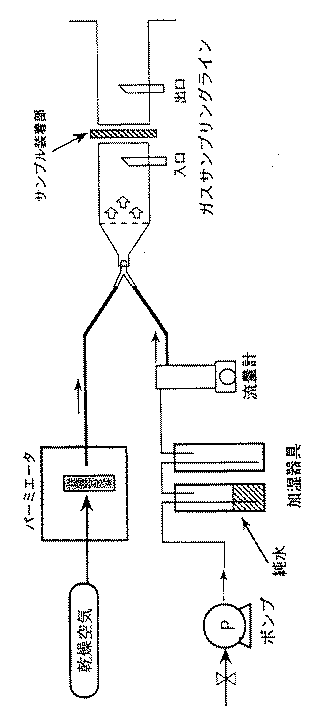
強酸性カチオン交換不織布を5cm□に切り、図1に示すガス流通試験装置を用い相対湿度を変えてアンモニアの流通テストを行った。該不織布をサンプル装着部に装着し、アンモニアは、乾燥空気と共にパーミエータを通過させ、一方、相対湿度は純水を入れた加湿器具、流量計、ポンプおよび制御装置(不図示)により0〜80%に変化させ、アンモニアと前記相対湿度の空気を混合して、この混合ガスをガスサンプリングライン入口から採取したもの及びサンプルを経由したガスをガスサンプリングライン出口から採取したもののアンモニア濃度の経時変化を測定し、サンプルの強酸性カチオン交換不織布における10%破過時点での相対湿度とイオン交換容量消費の関係を求めた。10%破過時点は、(100×出口濃度/入口濃度=10)より求めた。結果は表1の通りであり、相対湿度20%以上ではアンモニアの吸着性能は比較的安定していた。相対湿度20%未満では吸着容量が激減した。尚、ガスサンプリングライン入口におけるアンモニア濃度は、10ppm程度であった。
【0019】
【表1】
【発明の効果】
本発明により、イオン交換体ケミカルフィルター材のガス成分の除去性能が安定化し、除去率、イオン交換消費量の向上が可能となった。また、処理環境の相対湿度管理が緩和され、かつ処理環境の微生物繁殖による問題も解消しただけでなく、炭化水素系の中性ガスの除去率も向上させることができた。
【図面の簡単な説明】
【図1】実施例に使用されるガス流通試験装置の構成を示す図である。[0001]
TECHNICAL FIELD OF THE INVENTION
The present invention relates to a chemical filter for air cleaning using an ion exchanger which has recently been used in a clean room in the precision electronic industry such as the semiconductor industry and the pharmaceutical manufacturing industry.
[0002]
[Prior art]
As a chemical filter for removing gas components in air, there are known activated carbon particles and activated carbon fibers, and filters obtained by impregnating them with acid or alkali. Filters in which oxides and metals are supported on other carriers are also known. A chemical filter using an ion exchanger not only has a high removal rate of gas components at the ppb level, but also has no re-emission of an adsorbed substance.
[0003]
As a shape of an ion exchanger used for a chemical filter, a nonwoven fabric or a woven fabric which has a high removal rate, is lightweight, and is easily molded, is often used. As the ion exchange group, a cation exchange group such as a sulfonic acid and a carboxyl group, and an anion exchange group such as a quaternary ammonium group and a tertiary amino group are used.
Most of the gas components in the air, except for hydrocarbon-based neutral gases, dissolve in water and show acidity or alkalinity. It is mainly considered that the mechanism of removing gas components in air by the ion exchange group is a neutralization reaction involving water, as in the case of use in water. That is, an acidic gas such as sulfur oxide becomes an anion and is adsorbed on the anion exchange fiber, and a basic gas such as ammonia becomes a cation and is adsorbed on the cation exchange fiber.
[0004]
Therefore, in an environment where the chemical filter is used, sufficient water, that is, humidity is required. Without this, a sufficient removal rate and improvement in the exchange capacity utilization rate cannot be expected, and the relative humidity usually needs to be controlled to 50% or more.
So far, there has been a case where a wet scrubber is installed in the outside air intake line to the clean room to wash and remove gas components and particles in the outside air, and when air with sufficient humidity flows into the chemical filter installed downstream of it. was there. However, in this example, high-humidity air only happened to flow into the chemical filter, and was not intended to improve the performance of the chemical filter. This is reflected, for example, in the poor management of the water used in wet scrubbers. When tap water with a high salt concentration is used, the droplets flow into the chemical filter, consuming the ion exchange capacity uneconomically, and microorganisms such as mold grow on the condensed portion of accumulated water and water vapor, and the chemical filter Problems have been pointed out, such as intrusion and increase in pressure loss.
[0005]
[Problems to be solved by the invention]
The present invention provides a chemical filter capable of reducing the relative humidity of the environment in which the chemical filter can be used, thereby relaxing the management of the humidity, improving the processing efficiency, and effectively preventing the propagation of microorganisms in the processing environment. The task is to provide.
[0006]
[Means for Solving the Problems]
The present invention provides an ion exchanger chemical filter material containing an ion exchanger manufactured using at least a radiation graft polymerization method, and an environment using the ion exchanger chemical filter material at a relative humidity of 20% to 30%. A chemical filter comprising means for performing the following. According to the present invention, it has been found that when the relative humidity of the processing environment by the chemical filter is controlled to 20% or more and 30% or less , the processing efficiency of the ion exchanger chemical filter material is extremely improved.
[0007]
That is, if the relative humidity is not 20% or more, the adsorption capacity of the filter material is small, and the exchange capacity utilization rate decreases. The value of the relative humidity of 20% is a very small value, and is controlled to almost 20% or more in a controlled space such as a semiconductor factory, so that the relative humidity is hardly required or very easy to control. In addition, when the outside air is taken in winter or a special space in the factory becomes a problem, the relative humidity can be easily controlled in this case as compared with the related art. The upper limit of the relative humidity is 30%.
[0008]
As the ion exchanger used in the present invention, a conventionally known cation exchanger and anion exchanger can be used. Further, as the ion exchanger chemical filter material, at least one of a cation exchanger and an anion exchanger can be used alone or in combination. Conventionally known ion exchange groups are used as the ion exchange groups of the respective ion exchangers.Examples include cation exchange groups such as sulfonic acids and carboxyl groups, and anion exchange groups such as quaternary ammonium groups and tertiary amino groups. No.
[0009]
In the present invention, a particularly preferred ion exchanger is one in which an ion exchange group is connected to a carrier resin so that a space around the ion exchange group that can sufficiently adsorb water molecules is formed. As the carrier resin, a graft copolymer is preferable, and examples thereof include a graft copolymer of a trunk polymer such as polyolefin such as polyethylene and polypropylene and a branch polymer such as polyglycidyl methacrylate (GMA), polyacrylic acid, and polystyrene. Polyacrylic acid is obtained by polymerizing a monomer having an ion exchange group, and GMA and styrene are monomers capable of introducing an ion exchange group after graft polymerization. The branch polymer preferably has a functional group such as a glycidyl group capable of forming a sulfonic acid as an ion exchange group by reacting with a sulfite. Further, it is preferable that styrene is sulfonated with concentrated sulfuric acid or the like. Specifically, such a graft copolymer is preferably produced by a radiation graft polymerization method.
[0010]
The radiation used in the radiation graft polymerization method is preferably an electron beam or a γ-ray, and the irradiation amount can be appropriately set according to the type of the trunk polymer. The radiation-treated stem polymer is subjected to a graft polymerization reaction with a comonomer to be a branch polymer by a known method. Preferably, the irradiated stem polymer is immersed in a comonomer solution and reacted. Conditions for the graft polymerization reaction, for example, temperature, kind of solvent in the comonomer solution, comonomer concentration, reaction time and the like are appropriately selected. Further, the graft ratio can be appropriately set by selecting the reaction conditions and the like, but is usually in the range of 20 to 250%.
[0011]
In addition, the reaction for forming an ion exchange group in the obtained copolymer can be appropriately performed by a conventionally known method.
In an ion exchanger using the radiation graft polymerization method, an ion exchange group is pendantly hung on a graft chain having extremely high mobility, and sufficient water molecules are adsorbed around the ion exchange group. Therefore, the performance can be sufficiently exhibited even when the lower limit of the relative humidity is as low as 20%. However, conventional ion exchangers usually have a crosslinked structure, and thus cannot adsorb sufficient water molecules around the ion exchange groups. Therefore, in order to exhibit the performance, the relative humidity has to be controlled to about 50% or more.
[0012]
Therefore, the ion exchanger used in the present invention can lower the relative humidity as compared with the conventional one, and is also advantageous in sterilization measures.
By the way, in the case of humidification using any ion exchanger, water is put into a humidification water tank and used. In the case of dehumidification, condensed water is guided to a water receiving tank such as a drain pan and then discharged. Microorganisms easily grow in such pool water. In particular, water containing salts such as tap water has many nutrients and the like, and is likely to be a hotbed of microorganisms. Further, if droplets containing salts adhere to the chemical filter, the ion exchange capacity is consumed.
[0013]
The use of pure water to control the relative humidity of the processing space significantly reduces such problems, but is not complete. Here, pure water refers to water having an electric conductivity of 5 μS or less. Therefore, it is preferable to sterilize separately. There are many sterilization methods, all of which can be applied, but ultraviolet irradiation is suitable. This is because not only the disinfecting effect, but also hydrocarbons and the like, which are neutral gases in the air, are oxidized by irradiation with ultraviolet rays, and change into components such as organic acids that can be easily removed by the chemical filter. It can be expected that inorganic gases such as nitrogen oxides will change to components that are easily removed. The object to be irradiated with ultraviolet light is not particularly limited, and examples thereof include a space around the water, a treatment space itself using the chemical filter of the present invention, and various devices including a chemical filter provided in the space.
[0014]
Furthermore, if the surface of the liquid contact part between the water and the space in the humidifier is treated with an antibacterial agent, a further sterilizing effect is exhibited.
The shape of the ion exchanger is short fibers, aggregates of short fibers, woven or nonwoven fabrics which are processed products thereof, and further processed products thereof (for example, filters, etc.), powders and particles, and processed products thereof (for example, resin Etc.), membranes, hollow fiber membranes, processed products thereof (eg, hollow fiber modules, etc.), porous materials such as foams, and materials having a large number of voids such as those selected from processed products (eg, sponges, etc.). It is preferable because the humidity can be easily controlled and the radiation graft polymerization method can be applied. In particular, a woven or nonwoven fabric which is an aggregate of fibers is preferable because it is lightweight, has a small pressure loss, and is easy to mold.
[0015]
As the ion exchanger chemical filter material used in the present invention, a known filter material can be used in combination with the ion exchanger.
Examples of the filter material that can be used in combination include the conventionally known materials described above, for example, activated carbon particles, activated carbon fibers, or those obtained by impregnating them with an acid or alkali, or other carriers, such as zeolite, alumina, or activated carbon. And those carrying a substance or a metal. The shape of these filter materials is the same as the ion exchanger described above, and is not particularly limited.
[0016]
The ratio of the ion exchanger and the known filter material can be appropriately adjusted in consideration of the relative humidity and the processing efficiency.
The chemical filter of the present invention comprises at least a filter section having an ion exchanger chemical filter material and the above-described relative humidity control means. The relative humidity control means is usually composed of a humidifier containing pure water, a relative humidity meter, and a control device connecting them. In addition, the filter unit usually includes at least a filter member, a frame that holds the filter member and allows processing air to pass through, and a suction unit such as a pump that allows air to pass through the filter material. The filter member has a means for supporting an ion-exchanger chemical filter material such as a frame member and a holding mechanism for fixing the frame to the frame member, and the frame member preferably has a structure capable of connecting a plurality of members in multiple stages. . Further, the control device can be configured to communicate with suction means such as a pump of a chemical filter to control the on / off of the pump and the air flow according to the relative humidity, the type of the filter material, and the like.
[0017]
As the humidifier, known methods such as an electrode type, an ultrasonic type, and a high pressure spray type can be adopted. The humidifier and the relative humidity meter may be provided inside or outside the frame of the filter unit.
[0018]
【Example】
Hereinafter, specific examples of the present invention will be described, but the present invention is not limited thereto.
Production basis weight 50 g / m 2 of a strongly acidic cation-exchange non-woven fabric, thickness 0.4 mm, electron beam polyethylene nonwoven 2m 2 fiber diameter of about 20μm in a nitrogen atmosphere (1 MeV, 1 mA) was 100kGy irradiation. Then, the nonwoven fabric was immersed in a glycidyl methacrylate solution to perform a graft polymerization reaction, and a graft ratio of 148% was obtained. Furthermore, when sulfonated with an aqueous sodium sulfite solution, regenerated with hydrochloric acid and dried, a strongly acidic cation exchange nonwoven fabric having a neutral salt decomposition capacity of 2.81 meq / g was obtained. Ammonia flow test A strongly acidic cation exchange nonwoven fabric was cut into 5 cm squares, and an ammonia flow test was performed using the gas flow test device shown in FIG. 1 while changing the relative humidity. The non-woven fabric was mounted on the sample mounting part, and ammonia was passed through the permeator together with dry air, while the relative humidity was 0-80% by a humidifier, a flow meter, a pump and a controller (not shown) containing pure water. And the ammonia and the air of the relative humidity are mixed, and the change over time of the ammonia concentration of the mixture gas sampled from the gas sampling line inlet and the gas passing through the sample sampled from the gas sampling line outlet is measured. Then, the relationship between the relative humidity and the ion exchange capacity consumption at the time of 10% breakthrough in the strongly acidic cation exchange nonwoven fabric of the sample was determined. The 10% breakthrough point was determined from (100 × outlet concentration / inlet concentration = 10). The results are as shown in Table 1. At a relative humidity of 20% or more, the adsorption performance of ammonia was relatively stable. At a relative humidity of less than 20%, the adsorption capacity was drastically reduced. The ammonia concentration at the gas sampling line inlet was about 10 ppm.
[0019]
[Table 1]
【The invention's effect】
ADVANTAGE OF THE INVENTION By this invention, the removal performance of the gas component of the ion exchanger chemical filter material was stabilized, and it became possible to improve a removal rate and ion exchange consumption. In addition, the relative humidity control of the processing environment was eased, and not only the problem due to the propagation of microorganisms in the processing environment was solved, but also the removal rate of hydrocarbon-based neutral gas could be improved.
[Brief description of the drawings]
FIG. 1 is a diagram showing a configuration of a gas flow test device used in an embodiment.
Claims (2)
Priority Applications (1)
| Application Number | Priority Date | Filing Date | Title |
|---|---|---|---|
| JP34871096A JP3555819B2 (en) | 1996-10-18 | 1996-12-26 | Chemical filter |
Applications Claiming Priority (3)
| Application Number | Priority Date | Filing Date | Title |
|---|---|---|---|
| JP27656896 | 1996-10-18 | ||
| JP8-276568 | 1996-10-18 | ||
| JP34871096A JP3555819B2 (en) | 1996-10-18 | 1996-12-26 | Chemical filter |
Publications (2)
| Publication Number | Publication Date |
|---|---|
| JPH10174838A JPH10174838A (en) | 1998-06-30 |
| JP3555819B2 true JP3555819B2 (en) | 2004-08-18 |
Family
ID=26551988
Family Applications (1)
| Application Number | Title | Priority Date | Filing Date |
|---|---|---|---|
| JP34871096A Expired - Fee Related JP3555819B2 (en) | 1996-10-18 | 1996-12-26 | Chemical filter |
Country Status (1)
| Country | Link |
|---|---|
| JP (1) | JP3555819B2 (en) |
Families Citing this family (5)
| Publication number | Priority date | Publication date | Assignee | Title |
|---|---|---|---|---|
| JP3978630B2 (en) * | 1998-07-29 | 2007-09-19 | 大成建設株式会社 | Clean room outdoor air treatment equipment |
| JP2001170423A (en) * | 1999-12-17 | 2001-06-26 | Shinwa Corp | Filter unit |
| JP2004321930A (en) * | 2003-04-24 | 2004-11-18 | Japan Organo Co Ltd | Chemical filter |
| CN101998876B (en) * | 2006-10-02 | 2015-03-25 | 环球研究技术有限公司 | Method and device for extracting CO2 from air |
| WO2019161114A1 (en) | 2018-02-16 | 2019-08-22 | Carbon Sink, Inc. | Fluidized bed extractors for capture of co2 from ambient air |
-
1996
- 1996-12-26 JP JP34871096A patent/JP3555819B2/en not_active Expired - Fee Related
Also Published As
| Publication number | Publication date |
|---|---|
| JPH10174838A (en) | 1998-06-30 |
Similar Documents
| Publication | Publication Date | Title |
|---|---|---|
| KR100389575B1 (en) | Gas adsorbent | |
| JP4035441B2 (en) | Ozone removing material and method for producing the same | |
| JP3555819B2 (en) | Chemical filter | |
| CN101670303A (en) | Chemical filter and method for producing the same | |
| CN110180411A (en) | A kind of high-flux nanofiltration membrane being modified by sultones and preparation method | |
| JP2003251118A (en) | Filter cartridge with high capacity metal capture capability | |
| JPH11279945A (en) | Radiation graft polymerized polyethylene material | |
| KR100454093B1 (en) | Ion exchange textile for electrodeionization process | |
| Li et al. | Application of ion exchange resin in the advanced treatment of condensate water | |
| JPH0268140A (en) | Adsorbent for removal of iodine in gas | |
| JP2014133225A (en) | Method for removing urea within pure water | |
| CN107381970A (en) | One kind dialysis effluent purifying device | |
| CN103998926B (en) | Protein adsorption material | |
| WO2002096560A1 (en) | Anion exchangers and processes for preparing them | |
| JPS6312315A (en) | Filter for gas cleaning apparatus | |
| JP4238076B2 (en) | Material for removing contaminants in gas and method for producing the same | |
| JP5565106B2 (en) | Wastewater treatment equipment | |
| JP2002177767A (en) | Sulfur based gas removing material | |
| JP2002235939A (en) | Air conditioning device | |
| JPH10128041A (en) | Wet type gas scrubber and gas treatment | |
| JP3935050B2 (en) | Method for producing manganese oxide support material | |
| JP3955996B2 (en) | Radiation graft polymerization method and apparatus for long polymer substrate | |
| JPH10137522A (en) | Method for judging time to replace chemical filter | |
| JP3960408B2 (en) | Hydrogen sulfide removing material, manufacturing method thereof, and filter using the same | |
| KR200313114Y1 (en) | apparatus for removing the toxitic gas from exhaust gas using organic and inorganic hybride ion exchange filter |
Legal Events
| Date | Code | Title | Description |
|---|---|---|---|
| A131 | Notification of reasons for refusal |
Free format text: JAPANESE INTERMEDIATE CODE: A131 Effective date: 20040204 |
|
| A521 | Written amendment |
Free format text: JAPANESE INTERMEDIATE CODE: A523 Effective date: 20040402 |
|
| TRDD | Decision of grant or rejection written | ||
| A01 | Written decision to grant a patent or to grant a registration (utility model) |
Free format text: JAPANESE INTERMEDIATE CODE: A01 Effective date: 20040506 |
|
| A61 | First payment of annual fees (during grant procedure) |
Free format text: JAPANESE INTERMEDIATE CODE: A61 Effective date: 20040507 |
|
| R150 | Certificate of patent or registration of utility model |
Free format text: JAPANESE INTERMEDIATE CODE: R150 |
|
| FPAY | Renewal fee payment (event date is renewal date of database) |
Free format text: PAYMENT UNTIL: 20090521 Year of fee payment: 5 |
|
| FPAY | Renewal fee payment (event date is renewal date of database) |
Free format text: PAYMENT UNTIL: 20100521 Year of fee payment: 6 |
|
| FPAY | Renewal fee payment (event date is renewal date of database) |
Free format text: PAYMENT UNTIL: 20110521 Year of fee payment: 7 |
|
| FPAY | Renewal fee payment (event date is renewal date of database) |
Free format text: PAYMENT UNTIL: 20110521 Year of fee payment: 7 |
|
| FPAY | Renewal fee payment (event date is renewal date of database) |
Free format text: PAYMENT UNTIL: 20120521 Year of fee payment: 8 |
|
| LAPS | Cancellation because of no payment of annual fees |