JP2024538141A - Activatable Polypeptide Complexes - Google Patents
Activatable Polypeptide Complexes Download PDFInfo
- Publication number
- JP2024538141A JP2024538141A JP2024522609A JP2024522609A JP2024538141A JP 2024538141 A JP2024538141 A JP 2024538141A JP 2024522609 A JP2024522609 A JP 2024522609A JP 2024522609 A JP2024522609 A JP 2024522609A JP 2024538141 A JP2024538141 A JP 2024538141A
- Authority
- JP
- Japan
- Prior art keywords
- polypeptide
- activatable
- domain
- seq
- chain variable
- Prior art date
- Legal status (The legal status is an assumption and is not a legal conclusion. Google has not performed a legal analysis and makes no representation as to the accuracy of the status listed.)
- Pending
Links
Images


Classifications
-
- C—CHEMISTRY; METALLURGY
- C12—BIOCHEMISTRY; BEER; SPIRITS; WINE; VINEGAR; MICROBIOLOGY; ENZYMOLOGY; MUTATION OR GENETIC ENGINEERING
- C12N—MICROORGANISMS OR ENZYMES; COMPOSITIONS THEREOF; PROPAGATING, PRESERVING, OR MAINTAINING MICROORGANISMS; MUTATION OR GENETIC ENGINEERING; CULTURE MEDIA
- C12N15/00—Mutation or genetic engineering; DNA or RNA concerning genetic engineering, vectors, e.g. plasmids, or their isolation, preparation or purification; Use of hosts therefor
- C12N15/09—Recombinant DNA-technology
- C12N15/11—DNA or RNA fragments; Modified forms thereof; Non-coding nucleic acids having a biological activity
- C12N15/62—DNA sequences coding for fusion proteins
-
- A—HUMAN NECESSITIES
- A61—MEDICAL OR VETERINARY SCIENCE; HYGIENE
- A61P—SPECIFIC THERAPEUTIC ACTIVITY OF CHEMICAL COMPOUNDS OR MEDICINAL PREPARATIONS
- A61P35/00—Antineoplastic agents
-
- C—CHEMISTRY; METALLURGY
- C07—ORGANIC CHEMISTRY
- C07K—PEPTIDES
- C07K16/00—Immunoglobulins [IGs], e.g. monoclonal or polyclonal antibodies
- C07K16/18—Immunoglobulins [IGs], e.g. monoclonal or polyclonal antibodies against material from animals or humans
- C07K16/28—Immunoglobulins [IGs], e.g. monoclonal or polyclonal antibodies against material from animals or humans against receptors, cell surface antigens or cell surface determinants
- C07K16/2803—Immunoglobulins [IGs], e.g. monoclonal or polyclonal antibodies against material from animals or humans against receptors, cell surface antigens or cell surface determinants against the immunoglobulin superfamily
- C07K16/2809—Immunoglobulins [IGs], e.g. monoclonal or polyclonal antibodies against material from animals or humans against receptors, cell surface antigens or cell surface determinants against the immunoglobulin superfamily against the T-cell receptor (TcR)-CD3 complex
-
- C—CHEMISTRY; METALLURGY
- C07—ORGANIC CHEMISTRY
- C07K—PEPTIDES
- C07K16/00—Immunoglobulins [IGs], e.g. monoclonal or polyclonal antibodies
- C07K16/18—Immunoglobulins [IGs], e.g. monoclonal or polyclonal antibodies against material from animals or humans
- C07K16/28—Immunoglobulins [IGs], e.g. monoclonal or polyclonal antibodies against material from animals or humans against receptors, cell surface antigens or cell surface determinants
- C07K16/2863—Immunoglobulins [IGs], e.g. monoclonal or polyclonal antibodies against material from animals or humans against receptors, cell surface antigens or cell surface determinants against receptors for growth factors, growth regulators
-
- C—CHEMISTRY; METALLURGY
- C12—BIOCHEMISTRY; BEER; SPIRITS; WINE; VINEGAR; MICROBIOLOGY; ENZYMOLOGY; MUTATION OR GENETIC ENGINEERING
- C12N—MICROORGANISMS OR ENZYMES; COMPOSITIONS THEREOF; PROPAGATING, PRESERVING, OR MAINTAINING MICROORGANISMS; MUTATION OR GENETIC ENGINEERING; CULTURE MEDIA
- C12N15/00—Mutation or genetic engineering; DNA or RNA concerning genetic engineering, vectors, e.g. plasmids, or their isolation, preparation or purification; Use of hosts therefor
- C12N15/09—Recombinant DNA-technology
- C12N15/63—Introduction of foreign genetic material using vectors; Vectors; Use of hosts therefor; Regulation of expression
-
- A—HUMAN NECESSITIES
- A61—MEDICAL OR VETERINARY SCIENCE; HYGIENE
- A61K—PREPARATIONS FOR MEDICAL, DENTAL OR TOILETRY PURPOSES
- A61K39/00—Medicinal preparations containing antigens or antibodies
- A61K2039/505—Medicinal preparations containing antigens or antibodies comprising antibodies
-
- C—CHEMISTRY; METALLURGY
- C07—ORGANIC CHEMISTRY
- C07K—PEPTIDES
- C07K2317/00—Immunoglobulins specific features
- C07K2317/30—Immunoglobulins specific features characterized by aspects of specificity or valency
- C07K2317/31—Immunoglobulins specific features characterized by aspects of specificity or valency multispecific
-
- C—CHEMISTRY; METALLURGY
- C07—ORGANIC CHEMISTRY
- C07K—PEPTIDES
- C07K2317/00—Immunoglobulins specific features
- C07K2317/30—Immunoglobulins specific features characterized by aspects of specificity or valency
- C07K2317/35—Valency
-
- C—CHEMISTRY; METALLURGY
- C07—ORGANIC CHEMISTRY
- C07K—PEPTIDES
- C07K2317/00—Immunoglobulins specific features
- C07K2317/60—Immunoglobulins specific features characterized by non-natural combinations of immunoglobulin fragments
- C07K2317/62—Immunoglobulins specific features characterized by non-natural combinations of immunoglobulin fragments comprising only variable region components
- C07K2317/622—Single chain antibody (scFv)
-
- C—CHEMISTRY; METALLURGY
- C07—ORGANIC CHEMISTRY
- C07K—PEPTIDES
- C07K2317/00—Immunoglobulins specific features
- C07K2317/90—Immunoglobulins specific features characterized by (pharmaco)kinetic aspects or by stability of the immunoglobulin
-
- C—CHEMISTRY; METALLURGY
- C07—ORGANIC CHEMISTRY
- C07K—PEPTIDES
- C07K2319/00—Fusion polypeptide
- C07K2319/30—Non-immunoglobulin-derived peptide or protein having an immunoglobulin constant or Fc region, or a fragment thereof, attached thereto
-
- C—CHEMISTRY; METALLURGY
- C07—ORGANIC CHEMISTRY
- C07K—PEPTIDES
- C07K2319/00—Fusion polypeptide
- C07K2319/50—Fusion polypeptide containing protease site
Landscapes
- Health & Medical Sciences (AREA)
- Chemical & Material Sciences (AREA)
- Genetics & Genomics (AREA)
- Organic Chemistry (AREA)
- Life Sciences & Earth Sciences (AREA)
- Immunology (AREA)
- Engineering & Computer Science (AREA)
- Molecular Biology (AREA)
- General Health & Medical Sciences (AREA)
- Biochemistry (AREA)
- Biophysics (AREA)
- Biomedical Technology (AREA)
- Zoology (AREA)
- Wood Science & Technology (AREA)
- Bioinformatics & Cheminformatics (AREA)
- Biotechnology (AREA)
- General Engineering & Computer Science (AREA)
- Medicinal Chemistry (AREA)
- Proteomics, Peptides & Aminoacids (AREA)
- Plant Pathology (AREA)
- Microbiology (AREA)
- Physics & Mathematics (AREA)
- Nuclear Medicine, Radiotherapy & Molecular Imaging (AREA)
- General Chemical & Material Sciences (AREA)
- Chemical Kinetics & Catalysis (AREA)
- Pharmacology & Pharmacy (AREA)
- Animal Behavior & Ethology (AREA)
- Public Health (AREA)
- Veterinary Medicine (AREA)
- Peptides Or Proteins (AREA)
- Medicines Containing Antibodies Or Antigens For Use As Internal Diagnostic Agents (AREA)
- Preparation Of Compounds By Using Micro-Organisms (AREA)
- Micro-Organisms Or Cultivation Processes Thereof (AREA)
Abstract
本開示は、活性化可能なヘテロ多量体二重特異性ポリペプチド複合体(HBPC)ならびにその製造方法及び使用方法に関する。
【選択図】なし
The present disclosure relates to activatable heteromultimeric bispecific polypeptide complexes (HBPCs) and methods of making and using same.
[Selection diagram] None
Description
関連出願の相互参照
本出願は、2021年10月15日に出願された米国仮出願第63/256,417号及び2022年8月9日に出願された米国仮出願第63/370,897号の優先権の権益を主張し、それらの全体が参照により本明細書に組み込まれる。
CROSS-REFERENCE TO RELATED APPLICATIONS This application claims the benefit of priority to U.S. Provisional Application No. 63/256,417, filed October 15, 2021, and U.S. Provisional Application No. 63/370,897, filed August 9, 2022, each of which is incorporated by reference in its entirety.
EFS WEB経由で電子的に提出された配列表への参照
本出願で提出された電子的に提出された配列表(4681_002PC02_Seqlisting_ST26.xml、サイズ:190,193バイト、作成日:2022年10月13日)の内容は、その全体が参照により本明細書に組み込まれる。
REFERENCE TO SEQUENCE LISTING SUBMITTED ELECTRONICALLY VIA EFS WEB The contents of the electronically submitted Sequence Listing (4681_002PC02_Seqlisting_ST26.xml, Size: 190,193 bytes, Created: October 13, 2022) submitted with this application are hereby incorporated by reference in their entirety.
本開示は、活性化可能なヘテロ多量体二重特異性ポリペプチド複合体(HBPC)ならびにその製造方法及び使用方法に関する。 The present disclosure relates to activatable heteromultimeric bispecific polypeptide complexes (HBPCs) and methods of making and using same.
腫瘍抗原特異的T細胞の生成と活性化は、腫瘍退縮の発生と媒介の免疫媒介の制御に関与している。これには、複数のT細胞共刺激受容体と負のT細胞調節因子、または共抑制受容体が協調して作用して、T細胞の活性化、増殖、エフェクター機能の獲得または喪失を制御することが必要である。しかしながら、腫瘍細胞には多数の免疫回避機構があるため、がん患者では腫瘍特異的T細胞応答を開始して維持することが困難である。しかしながら、T細胞をがん治療に利用する試みがなされてきた。このようなアプローチとしては、がん細胞上の表面標的抗原に結合し、さらにT細胞上のCD3などのT細胞表面ポリペプチドにも結合するT細胞誘導二重特異性抗体の使用が挙げられる。一般に、それぞれの標的に結合することにより、T細胞誘導二重特異性はT細胞をがん細胞に物理的に近接させ、細胞傷害性T細胞タンパク質及び酵素が腫瘍細胞を攻撃してアポトーシスを引き起こし、それによってがん細胞を殺傷することができる。 The generation and activation of tumor antigen-specific T cells are involved in immune-mediated control of the development and mediation of tumor regression. This requires multiple T cell costimulatory receptors and negative T cell regulatory, or co-inhibitory, receptors acting in concert to control T cell activation, proliferation, and gain or loss of effector function. However, tumor cells have numerous immune evasion mechanisms, making it difficult to initiate and maintain tumor-specific T cell responses in cancer patients. However, attempts have been made to harness T cells for cancer therapy. Such approaches include the use of T cell-inducing bispecifics that bind to surface target antigens on cancer cells and also bind to T cell surface polypeptides, such as CD3, on T cells. In general, by binding to their respective targets, T cell-inducing bispecifics bring the T cells into physical proximity to the cancer cells, allowing cytotoxic T cell proteins and enzymes to attack the tumor cells and cause apoptosis, thereby killing the cancer cells.
がんの治療には潜在的に有望な種類の治療薬であるが、オンターゲットの腫瘍外毒性及び製造上の課題など、克服すべきハードルがある。したがって、安全性プロファイルが改善され、製造可能性も改善された免疫療法の選択肢が必要とされている。 Although a potentially promising class of therapeutics for the treatment of cancer, there are hurdles to overcome, including on-target off-tumor toxicity and manufacturing challenges. Thus, there is a need for immunotherapy options with improved safety profiles and manufacturability.
本明細書では、(a)(i)第1の重鎖可変ドメイン(VH1)及び第1の軽鎖可変ドメイン(VL1)を含み、VH1とVL1が一緒になって第1の標的に特異的に結合する第1の標的化ドメインを形成する単鎖可変断片(scFv)、(ii)第1のマスキング部分(MM1)、(iii)第1の切断可能部分(CM1);(iv)第2の重鎖可変ドメイン(VH2)、及び(v)第1の単量体Fcドメイン(Fc1)、を含む第1のポリペプチドと;(b)(i)第2の軽鎖可変ドメイン(VL2)であって、VH2とVL2が一緒になって第2の標的に特異的に結合する第2の標的化ドメインを形成するVL2、(ii)第2のマスキング部分(MM2)、及び(iii)第2の切断可能部分(CM2)、を含む第2のポリペプチドと;(c)(i)第2の単量体Fcドメイン(Fc2)を含み、かつ(ii)免疫グロブリン可変ドメインを含まない、第3のポリペプチドと、を含む、活性化可能なヘテロ多量体二重特異性ポリペプチド複合体(HBPC)が提供される。いくつかの態様では、第1の標的はT細胞抗原ポリペプチドであり、第2の標的はがん細胞表面抗原である。いくつかの態様では、第1の標的はがん細胞表面抗原であり、第2の標的はT細胞抗原ポリペプチドである。いくつかの態様では、T細胞抗原ポリペプチドは、CD3のイプシロン鎖である。 Provided herein is a method for producing a polypeptide comprising: (a) a first polypeptide comprising: (i) a single chain variable fragment (scFv) comprising a first heavy chain variable domain (VH1) and a first light chain variable domain (VL1), wherein the VH1 and VL1 together form a first targeting domain that specifically binds to a first target; (ii) a first masking portion (MM1); (iii) a first cleavable portion (CM1); (iv) a second heavy chain variable domain (VH2); and (v) a first monomeric Fc domain (Fc1); and (b) (i) a second light chain variable domain (VL2); (c) a third polypeptide comprising (i) a second monomeric Fc domain (Fc2) and (ii) no immunoglobulin variable domain. In some aspects, the first target is a T cell antigen polypeptide and the second target is a cancer cell surface antigen. In some aspects, the first target is a cancer cell surface antigen and the second target is a T cell antigen polypeptide. In some aspects, the T cell antigen polypeptide is the epsilon chain of CD3.
いくつかの態様では、第1のポリペプチドは、抗原標的化ドメインVH2と単量体Fcドメインとの間に重鎖CH1ドメインをさらに含む。 In some aspects, the first polypeptide further comprises a heavy chain CH1 domain between the antigen targeting domain VH2 and the monomeric Fc domain.
いくつかの態様では、第1のポリペプチドは、CH1ドメインと第1の単量体Fcドメインとの間に免疫グロブリンヒンジ領域(HR1)をさらに含む。 In some aspects, the first polypeptide further comprises an immunoglobulin hinge region (HR1) between the CH1 domain and the first monomeric Fc domain.
いくつかの態様では、第1のポリペプチドは、MM1-CM1-scFv-VH2-CH1-HR1-Fc1のアミノ末端からカルボキシ末端までの構造配置を含み、それぞれの「-」は独立して直接的または間接的な連結である。 In some aspects, the first polypeptide comprises the amino- to carboxy-terminal structural arrangement of MM1-CM1-scFv-VH2-CH1-HR1-Fc1, where each "-" is independently a direct or indirect linkage.
本明細書に記載の活性化可能なHBPCのいくつかの態様では、第2のポリペプチドは軽鎖定常ドメインCL1をさらに含む。いくつかの態様では、第2のポリペプチドは、MM2-CM2-VL2-CL1のアミノ末端からカルボキシ末端までの構造配置を含み、それぞれの「-」は独立して直接的または間接的な連結である。 In some aspects of the activatable HBPC described herein, the second polypeptide further comprises a light chain constant domain, CL1. In some aspects, the second polypeptide comprises the amino- to carboxy-terminal structural arrangement of MM2-CM2-VL2-CL1, where each "-" is independently a direct or indirect linkage.
本明細書に記載の活性化可能なHBPCのいくつかの態様では、第3のポリペプチドは免疫グロブリンヒンジ領域(HR2)をさらに含む。いくつかの態様では、第3のポリペプチドは、HR2-Fc2のアミノ末端からカルボキシ末端までの構造配置を含み、「-」は直接的または間接的な連結である。 In some aspects of the activatable HBPC described herein, the third polypeptide further comprises an immunoglobulin hinge region (HR2). In some aspects, the third polypeptide comprises the amino- to carboxy-terminal structural arrangement of HR2-Fc2, where "-" is a direct or indirect linkage.
本明細書に記載の活性化可能なHBPCのいくつかの態様では、第1のポリペプチドのHR1と第2のポリペプチドのHR2は同じアミノ酸配列を含む。いくつかの態様では、第1のポリペプチドのHR1と第2のポリペプチドのHR2は、異なるアミノ酸配列を含む。 In some aspects of the activatable HBPCs described herein, HR1 of the first polypeptide and HR2 of the second polypeptide comprise the same amino acid sequence. In some aspects, HR1 of the first polypeptide and HR2 of the second polypeptide comprise different amino acid sequences.
本明細書に記載の活性化可能なHBPCのいくつかの態様では、第1、第2、及び/または第3のポリペプチドは、1つ以上のリンカーを含む。 In some aspects of the activatable HBPCs described herein, the first, second, and/or third polypeptides include one or more linkers.
いくつかの態様では、活性化可能なHBPCは、以下の位置の1つ以上にリンカーを含む:(a)MM1とCM1の間;(b)MM2とCM2の間;(b)scFvの重鎖可変ドメインと軽鎖可変ドメインの間;(c)重鎖可変ドメインとCH1ドメインの間;(d)CH1ドメインとヒンジ領域の間;(e)ヒンジ領域とFcドメインの間;(g)CM2と軽鎖可変ドメインの間;(h)軽鎖可変ドメインとCLの間;(i)CH1ドメインと第2のFcドメインの間;(j)CH1ドメインとヒンジ領域の間;及び/または(k)ヒンジ領域と第2のFcドメインの間。いくつかの態様では、リンカー(複数可)は、約1~約20個のアミノ酸を含む。 In some aspects, the activatable HBPC comprises a linker at one or more of the following positions: (a) between MM1 and CM1; (b) between MM2 and CM2; (b) between the heavy chain variable domain and the light chain variable domain of the scFv; (c) between the heavy chain variable domain and the CH1 domain; (d) between the CH1 domain and the hinge region; (e) between the hinge region and the Fc domain; (g) between CM2 and the light chain variable domain; (h) between the light chain variable domain and the CL; (i) between the CH1 domain and the second Fc domain; (j) between the CH1 domain and the hinge region; and/or (k) between the hinge region and the second Fc domain. In some aspects, the linker(s) comprises from about 1 to about 20 amino acids.
本明細書に記載される活性化可能なHBPCのいくつかの態様では、MM1は、リンカーL1を介してCM1に連結される。いくつかの態様では、MM2は、リンカーL2を介してCM2に連結される。いくつかの態様では、活性化可能な二重特異性ポリペプチド複合体は、L1とL2の両方を含む。いくつかの態様では、MM2はリンカーL3を介してCM2に連結され、CM2はリンカーL4を介してscFvに連結される。いくつかの態様では。 In some aspects of the activatable HBPC described herein, MM1 is linked to CM1 via linker L1. In some aspects, MM2 is linked to CM2 via linker L2. In some aspects, the activatable bispecific polypeptide complex comprises both L1 and L2. In some aspects, MM2 is linked to CM2 via linker L3, and CM2 is linked to the scFv via linker L4. In some aspects.
本明細書に記載の活性化可能なHBPCのいくつかの態様では、L1、L2、L3、及び/またはL4のアミノ酸配列は同じである。いくつかの態様では、L1、L2、L3、及び/またはL4のうちの少なくとも1つのアミノ酸配列が異なる。 In some embodiments of the activatable HBPCs described herein, the amino acid sequences of L1, L2, L3, and/or L4 are the same. In some embodiments, the amino acid sequence of at least one of L1, L2, L3, and/or L4 is different.
本明細書に記載の活性化可能なHBPCのいくつかの態様では、CM1のアミノ酸配列とCM2のアミノ酸配列は同じである。いくつかの態様では、CM1のアミノ酸配列とCM2のアミノ酸配列は異なる。 In some embodiments of the activatable HBPCs described herein, the amino acid sequence of CM1 and the amino acid sequence of CM2 are the same. In some embodiments, the amino acid sequence of CM1 and the amino acid sequence of CM2 are different.
本明細書に記載の活性化可能なHBPCのいくつかの態様では、CM1とCM2はそれぞれ、腫瘍微小環境に存在するプロテアーゼの基質を含む。いくつかの態様では、CM1とCM2はそれぞれ独立して、同じプロテアーゼの基質を含む。いくつかの態様では、CM1とCM2は、異なるプロテアーゼの基質を含む。いくつかの態様では、CM1とCM2は、それぞれ独立して、表3に示されるプロテアーゼの群から選択されるプロテアーゼの基質を含む。いくつかの態様では、CM1とCM2の少なくとも1つは、セリンプロテアーゼ及びマトリックスメタロペプチダーゼ(MMP)からなる群から選択されるプロテアーゼの基質を含む。いくつかの態様では、CM1及び/またはCM2は、配列番号2、配列番号14、配列番号73~111、または配列番号156~159のアミノ酸配列を含む。 In some aspects of the activatable HBPCs described herein, CM1 and CM2 each comprise a substrate for a protease present in the tumor microenvironment. In some aspects, CM1 and CM2 each independently comprise a substrate for the same protease. In some aspects, CM1 and CM2 each comprise a substrate for a different protease. In some aspects, CM1 and CM2 each independently comprise a substrate for a protease selected from the group of proteases shown in Table 3. In some aspects, at least one of CM1 and CM2 comprises a substrate for a protease selected from the group consisting of serine proteases and matrix metallopeptidases (MMPs). In some aspects, CM1 and/or CM2 comprise the amino acid sequence of SEQ ID NO:2, SEQ ID NO:14, SEQ ID NOs:73-111, or SEQ ID NOs:156-159.
本明細書に記載の活性化可能なHBPCのいくつかの態様では、MM1及び/またはMM2は、約5個のアミノ酸~約40個のアミノ酸を含む。 In some embodiments of the activatable HBPCs described herein, MM1 and/or MM2 contain from about 5 amino acids to about 40 amino acids.
本明細書に記載の活性化可能なHBPCのいくつかの態様では、それぞれのリンカーは以下からなる群から独立して選択される:(i)(GS)n(式中、nは少なくとも1の整数であり、いくつかの態様では、nは1~10の整数である)、(GGS)n(式中、nは少なくとも1の整数であり、いくつかの態様では、nは1~10の整数である)、(GGGS)n(配列番号40)(式中、nは少なくとも1の整数であり、いくつかの態様では、nは1~10の整数である)、(GGGGS)n(配列番号126)(式中、nは少なくとも1の整数である)、(GSGGS)n(配列番号41)(式中、nは少なくとも1の整数であり、いくつかの態様では、nは1~10の整数である)、GSSGGSGGSG(配列番号12)、GGSG(配列番号42)、GGSGG(配列番号43)、GSGSG(配列番号44)、GSGGG(配列番号45)、GGGSG(配列番号46)、及びGSSSG(配列番号47)、GGGGSGGGGSGGGGSGS(配列番号48)、GGGGSGS(配列番号49)、GGGGSGGGGSGGGGS(配列番号50)、GGGGSGGGGSGGGGSGGGGS(配列番号51)、GGGGS(配列番号52)、GGGGSGGGGS(配列番号53)、GGGS(配列番号54)、GGGSGGGS(配列番号55)、GGGSGGGSGGGS(配列番号56)、GSSGGSGGSGG(配列番号57)、GGGSGGGGSGGGGSGGGGSGGGGS(配列番号58)、GGGSSGGS(配列番号127)、及びGSからなる群から選択されるグリシン-セリンベースのリンカー;ならびに(ii)グリシン及びセリン、ならびにリジン、トレオニン、またはプロリンのうちの少なくとも1つを含むリンカー、例えば、GSTSGSGKPGSSEGST(配列番号59)、SKYGPPCPPCPAPEFLG(配列番号60)、GGSLDPKGGGGS(配列番号61)、PKSCDKTHTCPPCPAPELLG(配列番号62)、GKSSGSGSESKS(配列番号63)、GSTSGSGKSSEGKG(配列番号64)、GSTSGSGKSSEGSGSTKG(配列番号65)、及びGSTSGSGKPGSGEGSTKG(配列番号66)からなる群から選択されるリンカー。 In some embodiments of the activatable HBPC described herein, each linker is independently selected from the group consisting of: (i) (GS)n, where n is an integer of at least 1, and in some embodiments, n is an integer between 1 and 10; (GGS)n, where n is an integer of at least 1, and in some embodiments, n is an integer between 1 and 10; (GGGS)n (SEQ ID NO: 40), where n is an integer of at least 1, and in some embodiments, n is an integer between 1 and 10; (GGGGS)n (SEQ ID NO: 126), where n is an integer of at least 1), (GSGGS)n (SEQ ID NO:41) (wherein n is an integer of at least 1, and in some embodiments, n is an integer from 1 to 10), GSSGGSGGGSG (SEQ ID NO:12), GGSG (SEQ ID NO:42), GGSGG (SEQ ID NO:43), GSGSG (SEQ ID NO:44), GSGGG (SEQ ID NO:45), GGGSG (SEQ ID NO:46), and GSSSG (SEQ ID NO:47), GGGGSGGGGGSGGGGSGS (SEQ ID NO:48), GGGGSG (SEQ ID NO:49), GGGGSGGGGSGGGGGS (SEQ ID NO:50), GGGGSG glycine-serine based linkers selected from the group consisting of GGSGGGGSGGGGS (SEQ ID NO:51), GGGGS (SEQ ID NO:52), GGGGSGGGGGS (SEQ ID NO:53), GGGS (SEQ ID NO:54), GGGSGGGGS (SEQ ID NO:55), GGGSGGGSGGGGS (SEQ ID NO:56), GSSGGSGGSGG (SEQ ID NO:57), GGGSGGGGSGGGGSGGGGS (SEQ ID NO:58), GGGSSGGGS (SEQ ID NO:127), and GS; and (ii) glycine and serine, and lysine, threonine, or A linker containing at least one proline, for example, a linker selected from the group consisting of GSTSGSGKPGSSEGST (SEQ ID NO: 59), SKYGPPCPPPCPAPEFLG (SEQ ID NO: 60), GGSLDPKGGGGGS (SEQ ID NO: 61), PKSCDKTHTCPPCPAPELLG (SEQ ID NO: 62), GKSSGSGSGSESKS (SEQ ID NO: 63), GSTSGSGKSSEGKG (SEQ ID NO: 64), GSTSGSGKSSEGSGSTKG (SEQ ID NO: 65), and GSTSGSGSGKPGSGEGSTKG (SEQ ID NO: 66).
本明細書に記載の活性化可能なHBPCのいくつかの態様では、第1のポリペプチドは、配列番号34のアミノ酸配列を有するヒンジ(HR)(ヒンジ1)を含む。本明細書に記載の活性化可能なHBPCのいくつかの態様では、第2のポリペプチドは、配列番号35のアミノ酸配列を有するヒンジ(HR)(ヒンジ2)を含む。 In some aspects of the activatable HBPCs described herein, the first polypeptide comprises a hinge (HR) having the amino acid sequence of SEQ ID NO: 34 (hinge 1). In some aspects of the activatable HBPCs described herein, the second polypeptide comprises a hinge (HR) having the amino acid sequence of SEQ ID NO: 35 (hinge 2).
また、本明細書では、本明細書に記載の活性化可能なHBPCと、薬学的に許容される担体と、を含む組成物も提供される。いくつかの態様では、組成物は水と、活性化可能なHBPCと、を含む。いくつかの態様では、組成物は、5%、10%、20%、30%、40%、50%、60%、70%、80%、90%、95%、または最大99%の水を含む。 Also provided herein are compositions comprising an activatable HBPC as described herein and a pharma- ceutically acceptable carrier. In some aspects, the compositions comprise water and an activatable HBPC. In some aspects, the compositions comprise 5%, 10%, 20%, 30%, 40%, 50%, 60%, 70%, 80%, 90%, 95%, or up to 99% water.
本明細書に記載の医薬組成物を含むキットも本明細書で提供される。 Kits containing the pharmaceutical compositions described herein are also provided herein.
また、本明細書では、本明細書に記載の活性化可能なHBPCの第1のポリペプチド、第2のポリペプチド、及び/または第3のポリペプチドをコードするヌクレオチド配列を含む核酸も提供される。いくつかの態様では、活性化可能なHBPCの第1のポリペプチドをコードするヌクレオチド配列を含む核酸が提供される。いくつかの態様では、活性化可能なHBPCの第2のポリペプチドをコードするヌクレオチド配列を含む核酸が提供される。いくつかの態様では、活性化可能なHBPCの第3のポリペプチドをコードするヌクレオチド配列を含む核酸が提供される。本明細書に記載の核酸を含むベクターも本明細書に提供される。また、本明細書では、本明細書に記載のベクターを含む宿主細胞も提供される。 Also provided herein are nucleic acids comprising a nucleotide sequence encoding a first polypeptide, a second polypeptide, and/or a third polypeptide of an activatable HBPC described herein. In some aspects, a nucleic acid comprising a nucleotide sequence encoding a first polypeptide of an activatable HBPC is provided. In some aspects, a nucleic acid comprising a nucleotide sequence encoding a second polypeptide of an activatable HBPC is provided. In some aspects, a nucleic acid comprising a nucleotide sequence encoding a third polypeptide of an activatable HBPC is provided. Also provided herein are vectors comprising the nucleic acids described herein. Also provided herein are host cells comprising the vectors described herein.
また、本明細書では、活性化可能な二重特異性ポリペプチド複合体を生成する方法であって、(a)活性化可能なHBPCを生成するのに十分な条件下で宿主細胞を液体培地中で培養することと;(b)活性化可能なHBPCを回収することと、を含む方法も提供される。 Also provided herein is a method of producing an activatable bispecific polypeptide complex, the method comprising: (a) culturing a host cell in a liquid medium under conditions sufficient to produce an activatable HBPC; and (b) recovering the activatable HBPC.
また、本明細書では、治療有効量の活性化可能なヘテロ多量体二重特異性ポリペプチド複合体(HBPC)またはその医薬組成物を対象に投与することを含む、対象における疾患を治療する方法も提供される。いくつかの態様では、対象はヒトである。いくつかの態様では、疾患はがんである。 Also provided herein is a method of treating a disease in a subject, comprising administering to the subject a therapeutically effective amount of an activatable heteromultimeric bispecific polypeptide complex (HBPC) or a pharmaceutical composition thereof. In some embodiments, the subject is a human. In some embodiments, the disease is cancer.
また、本明細書では、腫瘍増殖の阻害を必要とする対象における腫瘍増殖の阻害に使用するための、活性化可能なヘテロ多量体二重特異性ポリペプチド複合体(HBPC)及びその医薬組成物も提供される。 Also provided herein are activatable heteromultimeric bispecific polypeptide complexes (HBPCs) and pharmaceutical compositions thereof for use in inhibiting tumor growth in a subject in need thereof.
また、本明細書では、がんを治療するための医薬の製造に使用するための、活性化可能なヘテロ多量体二重特異性ポリペプチド複合体(HBPC)及びその医薬組成物も提供される。 Also provided herein are activatable heteromultimeric bispecific polypeptide complexes (HBPCs) and pharmaceutical compositions thereof for use in the manufacture of a medicament for treating cancer.
また、本明細書では:(a)(i)第1の重鎖可変ドメイン(VH1)及び第1の軽鎖可変ドメイン(VL1)を含み、VH1とVL1が一緒になってT細胞抗原ポリペプチドに特異的に結合するT細胞抗原標的化ドメインを形成する単鎖可変断片(scFv)、(ii)第1のマスキング部分(MM1)、(iii)第1の切断可能部分(CM1)、(iii)軽鎖可変ドメイン(VL2)と対形成する場合にがん細胞表面抗原に特異的に結合する重鎖可変ドメイン(VH2)、(iv)第1の単量体Fcドメイン(Fc1)、(v)重鎖CH1ドメイン、及び(vi)CH1ドメインとFc1の間の免疫グロブリンヒンジ領域、を含む第1のポリペプチドと;(b)(i)VH2と対形成する場合にがん細胞表面抗原に特異的に結合する軽鎖可変ドメイン(VL2)、(ii)第2のマスキング部分(MM2)、(iii)第2の切断可能部分(CM2)、及び(iv)軽鎖定常ドメインCL1、を含む第2のポリペプチドと;(c)第2の単量体Fcドメイン(Fc2)及び免疫グロブリンヒンジ領域(HR2)を含む第3のポリペプチドと、を含み、第3のポリペプチドが免疫グロブリン可変ドメインを含まず、第1のポリペプチドが、MM1-CM1-scFv1-VH2-CH1-HR1-Fc1のアミノ末端からカルボキシ末端までの構造配置を含み、第2のポリペプチドが、MM2-CM2-VL2-CL1のアミノ末端からカルボキシ末端までの構造配置を含み、第3のポリペプチドが、HR2-Fc2のアミノ末端からカルボキシ末端までの構造配置を含み、それぞれの「-」が独立して直接的または間接的な連結である、活性化可能なヘテロ多量体二重特異性ポリペプチド複合体(HBPC)も提供される。 Also provided herein is a method for producing a scFv comprising: (a) a first polypeptide comprising: (i) a single chain variable fragment (scFv) comprising a first heavy chain variable domain (VH1) and a first light chain variable domain (VL1), wherein the VH1 and VL1 together form a T cell antigen targeting domain that specifically binds to a T cell antigen polypeptide; (ii) a first masking portion (MM1); (iii) a first cleavable portion (CM1); (iii) a heavy chain variable domain (VH2) that specifically binds to a cancer cell surface antigen when paired with the light chain variable domain (VL2); (iv) a first monomeric Fc domain (Fc1); (v) a heavy chain CH1 domain; and (vi) an immunoglobulin hinge region between the CH1 domain and Fc1; and (b) (i) a light chain variable domain (VL2) that specifically binds to a cancer cell surface antigen when paired with VH2; (ii) a second masking portion (MM2); Also provided is an activatable heteromultimeric bispecific polypeptide complex (HBPC) comprising: (iii) a second polypeptide comprising a second cleavable portion (CM2); and (iv) a light chain constant domain CL1; and (c) a third polypeptide comprising a second monomeric Fc domain (Fc2) and an immunoglobulin hinge region (HR2), wherein the third polypeptide does not comprise an immunoglobulin variable domain, the first polypeptide comprises the amino- to carboxy-terminal structural arrangement of MM1-CM1-scFv1-VH2-CH1-HR1-Fc1, the second polypeptide comprises the amino- to carboxy-terminal structural arrangement of MM2-CM2-VL2-CL1, and the third polypeptide comprises the amino- to carboxy-terminal structural arrangement of HR2-Fc2, where each "-" is independently a direct or indirect linkage.
また、本明細書では:(a)(i)がん細胞表面抗原に特異的に結合する単鎖可変断片(scFv)、(ii)第1のマスキング部分(MM1)、(iii)第1の切断可能部分(CM1)、(iv)第2のポリペプチドの軽鎖可変ドメイン(VL2)と対形成する場合にT細胞抗原ポリペプチドに特異的に結合する重鎖可変ドメイン(VH2)、(v)第1の単量体Fcドメイン(Fc1)、(vi)重鎖CH1ドメイン、及び(vii)CH1ドメインと第1の単量体Fcドメインの間の免疫グロブリンヒンジ領域(HR1)、を含む第1のポリペプチドと;(b)(i)第1のポリペプチドのVH2と対形成する場合にT細胞抗原ポリペプチドに特異的に結合する軽鎖可変ドメイン(VL2)、(ii)第2のマスキング部分(MM2)、(iii)第2の切断可能部分(CM2)、及び(iv)軽鎖定常ドメインCL1、を含む第2のポリペプチドと;(c)第2の単量体Fcドメイン(Fc2)及び免疫グロブリンヒンジ領域(HR2)を含む第3のポリペプチドと、を含み、第1のポリペプチドが、MM1-CM1-scFv1-VH2-CH1-HR1-Fc1のアミノ末端からカルボキシ末端までの構造配置を含み、第2のポリペプチドが、MM2-CM2-VL2-CL1のアミノ末端からカルボキシ末端までの構造配置を含み、第3のポリペプチドが、HR2-Fc2のアミノ末端からカルボキシ末端までの構造配置を含み、それぞれの「-」が直接的または間接的な連結を表し、第3のポリペプチドが、免疫グロブリン可変ドメインを含まない、活性化可能なヘテロ多量体二重特異性ポリペプチド複合体(HBPC)も提供される。 Also provided herein is a method for producing a fusion protein comprising: (a) a first polypeptide comprising: (i) a single chain variable fragment (scFv) that specifically binds to a cancer cell surface antigen; (ii) a first masking portion (MM1); (iii) a first cleavable portion (CM1); (iv) a heavy chain variable domain (VH2) that specifically binds to a T cell antigen polypeptide when paired with a light chain variable domain (VL2) of a second polypeptide; (v) a first monomeric Fc domain (Fc1); (vi) a heavy chain CH1 domain; and (vii) an immunoglobulin hinge region (HR1) between the CH1 domain and the first monomeric Fc domain; and (b) (i) a light chain variable domain (VL2) that specifically binds to a T cell antigen polypeptide when paired with the VH2 of the first polypeptide; (ii) a second masking portion (MM2); (iii) a second cleavable portion ( Also provided is an activatable heteromultimeric bispecific polypeptide complex (HBPC) comprising: (i) a first polypeptide comprising a first monomeric Fc domain (MM1-CM1-scFv1-VH2-CH1-HR1-Fc1; (ii) a second polypeptide comprising a light chain constant domain (CL1); and (iii) a third polypeptide comprising a second monomeric Fc domain (Fc2) and an immunoglobulin hinge region (HR2), wherein the first polypeptide comprises the amino to carboxyl structural arrangement of MM1-CM1-scFv1-VH2-CH1-HR1-Fc1; the second polypeptide comprises the amino to carboxyl structural arrangement of MM2-CM2-VL2-CL1; and the third polypeptide comprises the amino to carboxyl structural arrangement of HR2-Fc2, each "-" representing a direct or indirect link, and the third polypeptide does not comprise an immunoglobulin variable domain.
また、本明細書では:(a)(i)がん細胞表面抗原に特異的に結合する単鎖可変断片(scFv)、(ii)第1のマスキング部分(MM1)、及び(iii)第1の切断可能部分(CM1)、及び重鎖可変ドメイン(VH2)、(iii)第1の単量体Fcドメイン(Fc1)、重鎖CH1ドメイン、及びCH1ドメインと第1の単量体Fcドメインの間の免疫グロブリンヒンジ領域(HR1)、を含む第1のポリペプチドと;(b)(i)第1のポリペプチドのVH2と対形成する場合にT細胞抗原ポリペプチドに特異的に結合する軽鎖可変ドメイン(VL2)、(ii)第2のマスキング部分(MM2)、(iii)第2の切断可能部分(CM2)、及び軽鎖定常ドメインCL1、を含む第2のポリペプチドと;(c)第2の単量体Fcドメイン(Fc2)及び免疫グロブリンヒンジ領域(HR2)からなる第3のポリペプチドと、を含み、第1のポリペプチドが、MM1-CM1-scFv1-VH2-CH1-HR1-Fc1のアミノ末端からカルボキシ末端までの構造配置を有し、第2のポリペプチドが、MM2-CM2-VL2-CL1のアミノ末端からカルボキシ末端までの構造配置を有し、第3のポリペプチドが、HR2-Fc2のアミノ末端からカルボキシ末端までの構造配置を有し、それぞれの「-」が独立して直接的または間接的な連結であり、第3のポリペプチドが、免疫グロブリン可変ドメインを含まない、活性化可能なヘテロ多量体二重特異性ポリペプチド複合体(HBPC)も提供される。 Also provided herein is a method for producing a fusion protein comprising: (a) a first polypeptide comprising (i) a single chain variable fragment (scFv) that specifically binds to a cancer cell surface antigen, (ii) a first masking portion (MM1), and (iii) a first cleavable portion (CM1), and a heavy chain variable domain (VH2), (iii) a first monomeric Fc domain (Fc1), a heavy chain CH1 domain, and an immunoglobulin hinge region (HR1) between the CH1 domain and the first monomeric Fc domain; and (b) a second polypeptide comprising (i) a light chain variable domain (VL2) that specifically binds to a T cell antigen polypeptide when paired with the VH2 of the first polypeptide, (ii) a second masking portion (MM2), (iii) a second cleavable portion (CM2), and a light chain constant domain CL1. and (c) a third polypeptide consisting of a second monomeric Fc domain (Fc2) and an immunoglobulin hinge region (HR2), wherein the first polypeptide has a structural arrangement from the amino terminus to the carboxy terminus of MM1-CM1-scFv1-VH2-CH1-HR1-Fc1, the second polypeptide has a structural arrangement from the amino terminus to the carboxy terminus of MM2-CM2-VL2-CL1, and the third polypeptide has a structural arrangement from the amino terminus to the carboxy terminus of HR2-Fc2, each "-" being independently a direct or indirect link, and the third polypeptide does not include an immunoglobulin variable domain.
また、本明細書では:(a)(i)第1の重鎖可変ドメイン(VH1)及び第1の軽鎖可変ドメイン(VL1)を含み、VH1とVL1が一緒になって第1の標的に特異的に結合する第1の標的化ドメインを形成する単鎖可変断片(scFv)、(ii)第2の重鎖可変ドメイン(VH2)、及び(iii)第1の単量体Fcドメイン(Fc1)、を含む第1のポリペプチドと;(b)第2の軽鎖可変ドメイン(VL2)を含み、VH2とVL2が一緒になって第2の標的に特異的に結合する第2の標的化ドメインを形成する、第2のポリペプチドと;(c)第2の単量体Fcドメイン(Fc2)を含み、かつ免疫グロブリン可変ドメインを含まない第3のポリペプチドと、を含む、ヘテロ多量体二重特異性ポリペプチド複合体(HBPC)が提供される。 Also provided herein is a heteromultimeric bispecific polypeptide complex (HBPC) comprising: (a) a first polypeptide comprising (i) a single chain variable fragment (scFv) comprising a first heavy chain variable domain (VH1) and a first light chain variable domain (VL1), where the VH1 and VL1 together form a first targeting domain that specifically binds to a first target; (ii) a second heavy chain variable domain (VH2); and (iii) a first monomeric Fc domain (Fc1); (b) a second polypeptide comprising a second light chain variable domain (VL2), where the VH2 and VL2 together form a second targeting domain that specifically binds to a second target; and (c) a third polypeptide comprising a second monomeric Fc domain (Fc2) and no immunoglobulin variable domain.
本開示を、より容易に理解することができるように、特定の用語を最初に定義する。本出願で使用される場合、本明細書で明示的に規定されている場合を除き、以下のそれぞれの用語は以下に示す意味を有するものとする。さらなる定義は、本出願全体を通して記載されている。 So that this disclosure may be more readily understood, certain terms are first defined. As used in this application, unless expressly defined otherwise herein, each of the following terms shall have the meaning set forth below. Additional definitions are set forth throughout this application.
定義
本明細書で使用される場合、「活性化可能なポリペプチド複合体」という用語は、一緒になって抗原結合領域、マスキング部分(MM)、及び切断可能部分(CM)を形成する少なくとも1つの可変重鎖ドメインと少なくとも1つの可変軽鎖ドメインを有するポリペプチドを指す。ここで、MMは、プロテアーゼによって切断可能なCMを介して(直接的または間接的に)抗原結合領域に結合している。
DEFINITIONS As used herein, the term "activatable polypeptide complex" refers to a polypeptide having at least one variable heavy domain and at least one variable light domain that together form an antigen binding region, a masking moiety (MM), and a cleavable moiety (CM), where the MM is linked (directly or indirectly) to the antigen binding region via a CM that is cleavable by a protease.
「活性化可能な」という用語は、「ヘテロ多量体二重特異性ポリペプチド複合体」または「HBPC」という用語と関連して使用される場合、本明細書では、その結合活性が、HBPCの構造に付加された1つ以上のマスキング部分の存在によって損なわれるHBPCを指す。「活性化された」及び「活性化(act-)」という用語はそれぞれ、活性化されたHBPCを指すために使用することができる。「活性化された」及び「マスクされていない」という用語は、本明細書では交換可能に使用される。 The term "activatable," when used in connection with the term "heteromultimeric bispecific polypeptide complex" or "HBPC," refers herein to an HBPC whose binding activity is impaired by the presence of one or more masking moieties added to the structure of the HBPC. The terms "activated" and "act-" can each be used to refer to an activated HBPC. The terms "activated" and "unmasked" are used interchangeably herein.
本明細書で使用される場合、「ポリペプチド」という用語は、アミノ酸残基のポリマーを指す総称である。 As used herein, the term "polypeptide" is a generic term referring to a polymer of amino acid residues.
本明細書で使用される場合、「T細胞」という用語は、さまざまな細胞媒介免疫反応に関与する胸腺由来のリンパ球として定義される。本明細書で使用される場合、「制御性T細胞」という用語は、抑制的な特性を有するCD4+CD25+FoxP3+T細胞を指す。「Treg」は、本明細書において使用される制御性T細胞の略語である。 As used herein, the term "T cells" is defined as thymus-derived lymphocytes that participate in a variety of cell-mediated immune responses. As used herein, the term "regulatory T cells" refers to CD4 + CD25 + FoxP3 + T cells that have suppressive properties. "Treg" is an abbreviation for regulatory T cells as used herein.
本明細書で使用される場合、「ヘルパーT細胞」という用語は、CD4+T細胞を指す。ヘルパーT細胞は、MHCクラスII分子に結合した抗原を認識する。ヘルパーT細胞には、Th1とTh2という少なくとも2種類あり、それぞれ異なるサイトカインを産生する。ヘルパーT細胞は活性化されるとCD25+になるが、FoxP3+になるのは一時的にのみである。 As used herein, the term "helper T cells" refers to CD4 + T cells. Helper T cells recognize antigens bound to MHC class II molecules. There are at least two types of helper T cells, Th1 and Th2 , which produce different cytokines. Upon activation, helper T cells become CD25 + but only transiently become FoxP3 + .
本明細書で使用される場合、「細胞傷害性T細胞」という用語は、CD8+T細胞を指す。細胞傷害性T細胞は、MHCクラスI分子に結合した抗原を認識する。 As used herein, the term "cytotoxic T cells" refers to CD8 + T cells. Cytotoxic T cells recognize antigens bound to MHC class I molecules.
「可変領域」または「可変ドメイン」という用語は、抗原結合タンパク質(例えば、抗体)を抗原に結合することに関与する、抗原結合タンパク質(例えば、抗体)の重鎖または軽鎖のドメインを指す。抗体などの抗原結合タンパク質の重鎖及び軽鎖の可変領域またはドメイン(それぞれVH及びVL)は、フレームワーク領域(FR)と呼ばれる、より保存された領域が散在する超可変領域(HVR)または相補性決定領域(CDR)などの超可変領域(または、配列及び/または構造的に定義されたループの形式が超可変である可能性のある超可変領域)にさらに細分することができる。一般に、それぞれの重鎖可変領域には3つのHVR(HVR-H1、HVR-H2、HVR-H3)またはCDR(CDR-H1、CDR-H2、CDR-H3)があり、それぞれの軽鎖可変領域には3つのHVR(HVR-L1、HVR-L2、HVR-L3)またはCDR(CDR-L1、CDR-L2、CDR-L3)がある。「フレームワーク領域」及び「FR」は、重鎖及び軽鎖の可変領域の非HVR部分または非CDR部分を指すことが当該技術分野で知られている。一般に、それぞれの全長重鎖可変領域には4つのFR(FR-H1、FR-H2、FR-H3、及びFR-H4)があり、それぞれの全長軽鎖可変領域には4つのFR(FR-L1、FR-L2、FR-L3、及びFR-L4)がある。それぞれのVH及びVL内では、3つのHVRまたはCDRと4つのFRが、典型的にはアミノ末端からカルボキシ末端に次の順序で配置される:HVRの場合はFR1、HVR1、FR2、HVR2、FR3、HVR3、FR4、または、CDRの場合はFR1、CDR1、FR2、CDR2、FR3、CDR3、FR4(Chothia and Lesk J.Mot. Biol.,195,901-917(1987)も参照されたい)。単一のVHまたはVLドメインは、抗原結合特異性を付与するのに十分であり得る。さらに、特定の抗原に結合する抗体を、相補的なVLまたはVHドメインのライブラリをそれぞれスクリーニングして、抗原に結合する抗体由来のVHまたはVLドメインを用いて単離してもよい。例えば、Portolano et al.J.Immunol.150:880-887(1993);Clarkson et al.,Nature 352:624-628(1991)を参照されたい。 The term "variable region" or "variable domain" refers to the domain of the heavy or light chain of an antigen binding protein (e.g., an antibody) that is involved in binding the antigen binding protein (e.g., an antibody) to an antigen. The heavy and light chain variable regions or domains (VH and VL, respectively) of an antigen binding protein such as an antibody can be further subdivided into hypervariable regions (or hypervariable regions that may be hypervariable in sequence and/or in the form of structurally defined loops) such as hypervariable regions (HVRs) or complementarity determining regions (CDRs) interspersed with more conserved regions, called framework regions (FRs). Typically, each heavy chain variable region has three HVRs (HVR-H1, HVR-H2, HVR-H3) or CDRs (CDR-H1, CDR-H2, CDR-H3) and each light chain variable region has three HVRs (HVR-L1, HVR-L2, HVR-L3) or CDRs (CDR-L1, CDR-L2, CDR-L3). "Framework regions" and "FRs" are known in the art to refer to the non-HVR or non-CDR portions of the heavy and light chain variable regions. Typically, each full-length heavy chain variable region has four FRs (FR-H1, FR-H2, FR-H3, and FR-H4) and each full-length light chain variable region has four FRs (FR-L1, FR-L2, FR-L3, and FR-L4). Within each VH and VL , the three HVRs or CDRs and four FRs are typically arranged from amino-terminus to carboxy-terminus in the following order: for HVRs, FR1, HVR1, FR2, HVR2, FR3, HVR3, FR4; or for CDRs, FR1, CDR1, FR2, CDR2, FR3, CDR3, FR4 (see also Chothia and Lesk J. Mot. Biol., 195, 901-917 (1987)). A single VH or VL domain may be sufficient to confer antigen-binding specificity. Moreover, antibodies that bind to a particular antigen may be isolated using a VH or VL domain from an antibody that binds to the antigen by screening a library of complementary VL or VH domains, respectively. See, e.g., Portolano et al. J. Immunol. 150:880-887 (1993); Clarkson et al., Nature 352:624-628 (1991).
本明細書で使用される場合、「重鎖可変領域」(VH)という用語は、重鎖HVR-H1、FR-H2、HVR-H2、FR-H3、及びHVR-H3を含む領域を指す。例えば、重鎖可変領域は、重鎖CDR-H1、FR-H2、CDR-H2、FR-H3、及びCDR-H3を含み得る。いくつかの態様では、重鎖可変領域は、FR-H1の少なくとも一部及び/またはFR-H4の少なくとも一部も含む。 As used herein, the term "heavy chain variable region" (VH) refers to a region that includes heavy chain HVR-H1, FR-H2, HVR-H2, FR-H3, and HVR-H3. For example, a heavy chain variable region can include heavy chain CDR-H1, FR-H2, CDR-H2, FR-H3, and CDR-H3. In some aspects, the heavy chain variable region also includes at least a portion of FR-H1 and/or at least a portion of FR-H4.
本明細書で使用される場合、「重鎖定常領域」という用語は、少なくとも3つの重鎖定常ドメイン、CH1、CH2、及びCH3を含む領域を指す。非限定的な例示的な重鎖定常領域としては、γ、δ、及びαが挙げられる。非限定的な例示的な重鎖定常領域としては、ε及びμも挙げられる。
As used herein, the term "heavy chain constant region" refers to a region comprising at least three heavy chain constant domains,
本明細書で使用される場合、「軽鎖可変領域」(VL)という用語は、軽鎖HVR-L1、FR-L2、HVR-L2、FR-L3、及びHVR-L3を含む領域を指す。いくつかの態様では、軽鎖可変領域は、軽鎖CDR-L1、FR-L2、CDR-L2、FR-L3、及びCDR-L3を含む。いくつかの態様では、軽鎖可変領域は、FR-L1及び/またはFR-L4も含む。 As used herein, the term "light chain variable region" (VL) refers to a region that includes light chain HVR-L1, FR-L2, HVR-L2, FR-L3, and HVR-L3. In some aspects, the light chain variable region includes light chain CDR-L1, FR-L2, CDR-L2, FR-L3, and CDR-L3. In some aspects, the light chain variable region also includes FR-L1 and/or FR-L4.
本明細書で使用される場合、「軽鎖定常領域」という用語は、軽鎖定常ドメイン、CLを含む領域を指す。非限定的な例示的な軽鎖定常領域としては、λ及びκが挙げられる。 As used herein, the term "light chain constant region" refers to the region that comprises a light chain constant domain, C. Non-limiting exemplary light chain constant regions include lambda and kappa.
本明細書で使用される場合、「軽鎖」(LC)という用語は、リーダー配列を伴うまたは伴わない、少なくとも軽鎖可変領域を含むポリペプチドを指す。いくつかの態様では、軽鎖は、軽鎖定常領域の少なくとも一部を含む。本明細書で使用される場合、「全長軽鎖」という用語は、リーダー配列を伴うかまたは伴わない、軽鎖可変領域及び軽鎖定常領域を含むポリペプチドを指す。 As used herein, the term "light chain" (LC) refers to a polypeptide comprising at least a light chain variable region, with or without a leader sequence. In some aspects, the light chain comprises at least a portion of a light chain constant region. As used herein, the term "full-length light chain" refers to a polypeptide comprising a light chain variable region and a light chain constant region, with or without a leader sequence.
「抗体」という用語は、免疫グロブリン分子、または免疫グロブリン(Ig)分子の免疫学的に活性な部分(すなわち、抗原に特異的に結合する(それと免疫反応する)抗原結合部位を含む分子)を指す。抗体またはポリペプチドの「抗原結合部分」(「抗原結合断片」とも呼ばれる)は、標的抗原に特異的に結合する抗体またはポリペプチドの1つ以上の部分を指す。抗体及び抗原結合部分としては、ポリクローナル、モノクローナル、キメラ、ドメイン抗体、一本鎖抗体、Fab及びF(ab’)2断片、scFv、Fd断片、Fv断片、単一ドメイン抗体(sdAb)断片、二重親和性リターゲティング抗体(DART)、二重可変ドメイン免疫グロブリン、単離された相補性決定領域(CDR)、及び任意選択で合成リンカーによって結合され得る2つ以上の単離されたCDRの組み合わせ、及びFab発現ライブラリが挙げられるが、これらに限定されない。非ヒト抗体、例えばラクダ科動物の抗体は、ヒトにおけるその免疫原性を低下させるために、組換え法によってヒト化され得る。 The term "antibody" refers to an immunoglobulin molecule or an immunologically active portion of an immunoglobulin (Ig) molecule (i.e., a molecule that contains an antigen-binding site that specifically binds (immunoreacts with) an antigen). An "antigen-binding portion" (also called an "antigen-binding fragment") of an antibody or polypeptide refers to one or more portions of an antibody or polypeptide that specifically binds to a target antigen. Antibodies and antigen-binding portions include, but are not limited to, polyclonal, monoclonal, chimeric, domain antibodies, single chain antibodies, Fab and F(ab') 2 fragments, scFv, Fd fragments, Fv fragments, single domain antibody (sdAb) fragments, dual affinity retargeting antibodies (DARTs), dual variable domain immunoglobulins, isolated complementarity determining regions (CDRs), and combinations of two or more isolated CDRs that may be optionally linked by synthetic linkers, and Fab expression libraries. Non-human antibodies, such as camelid antibodies, may be humanized by recombinant methods to reduce their immunogenicity in humans.
本明細書で特定されるCDR配列は、Abhinandan,K.R.and Martin,A.C.R.(2008)“Analysis and improvements to Kabat and structurally correct numbering of antibody variable domains”,Molecular Immunology,45,3832-3839に記載されているように、Kabatナンバリングシステム(すなわち、「Kabat CDR」)に従って決定され、この内容全体が参照により本明細書に組み込まれる。Kabat CDRは、CDR-L1:残基L24~L34;CDR-L2:残基L50~L56;CDR-L3:残基L89~L97;CDR-H1:残基H31~H35;CDR-H2:残基H50~H65;及びCDR-H3:残基H95~H102として定義され、ここで、「L」は軽鎖可変ドメインを指し、「H」は重鎖可変ドメインを指す。 The CDR sequences identified herein are determined according to the Kabat numbering system (i.e., "Kabat CDRs") as described in Abhinandan, K. R. and Martin, A. C. R. (2008) "Analysis and improvements to Kabat and structurally correct numbering of antibody variable domains", Molecular Immunology, 45, 3832-3839, the entire contents of which are incorporated herein by reference. The Kabat CDRs are defined as follows: CDR-L1: residues L24-L34; CDR-L2: residues L50-L56; CDR-L3: residues L89-L97; CDR-H1: residues H31-H35; CDR-H2: residues H50-H65; and CDR-H3: residues H95-H102, where "L" refers to the light chain variable domain and "H" refers to the heavy chain variable domain.
「特異的に結合する」または「免疫特異的に結合する」とは、標的化ドメイン、抗体、または抗原結合断片が、所望の抗原の1つ以上の抗原決定基と反応し、他のポリペプチドとは反応しないか、またははるかに低い親和性(Kd>10-6)で結合することを意味し、ここで、より小さいKdは、より大きい親和性を表す。選択されたポリペプチドの免疫学的な結合特性は当該技術分野で周知の方法によって定量化され得る。1つのそのような方法は、抗原結合部位/抗原複合体形成及び解離の速度の測定を伴い、それらの速度は、複合体パートナーの濃度、相互作用の親和性、及び両方向において速度に等しく影響する幾何的パラメータに依存する。したがって、「オン速度定数」(kon)と「オフ速度定数」(koff)の両方は、濃度ならびに会合及び解離の実際の速度を計算することによって決定することができる。(Nature 361:186-87(1993))を参照されたい)。koff/konの比率は、親和性に関連しないすべてのパラメータの解除を可能にし、解離定数Kdに等しい。(一般に、Davies et al.(1990)Annual Rev Biochem 59:439-473を参照されたい)。いくつかの態様では、その対応する抗原に特異的に結合する抗原標的化ドメイン、抗体、または抗原結合断片は、標的抗原に対して約10μM未満、いくつかの態様では、約100μM未満のKd を示す。 "Specifically binds" or "immunospecifically binds" means that a targeting domain, antibody, or antigen-binding fragment reacts with one or more antigenic determinants of a desired antigen and does not react with other polypeptides or binds with much lower affinity (Kd> 10-6 ), where a smaller Kd represents a greater affinity. The immunological binding properties of a selected polypeptide can be quantified by methods well known in the art. One such method involves measuring the rates of antigen-binding site/antigen complex formation and dissociation, which depend on the concentrations of the complex partners, the affinity of the interaction, and geometric parameters that affect the rate equally in both directions. Thus, both the "on-rate constant" (k on ) and the "off-rate constant" (k off ) can be determined by calculating the concentrations and the actual rates of association and dissociation. (See Nature 361:186-87 (1993)). The ratio of k off /k on allows for the removal of all parameters not related to affinity and is equal to the dissociation constant, Kd. (See generally, Davies et al. (1990) Annual Rev Biochem 59:439-473.) In some aspects, an antigen targeting domain, antibody, or antigen-binding fragment that specifically binds to its corresponding antigen exhibits a Kd for the target antigen of less than about 10 μM, and in some aspects less than about 100 μM.
免疫グロブリンは、IgA、分泌型IgA、IgG、及びIgMが挙げられるがこれらに限定されない、一般に知られているアイソタイプのいずれかに由来し得る。IgGサブクラスも当業者には周知であり、ヒトIgG1、IgG2、IgG3、及びIgG4が挙げられるが、これらに限定されない。「アイソタイプ」とは、抗体のクラスまたはサブクラス(例えば、IgMまたはIgG1)を指し、これは、重鎖定常領域遺伝子によってコードされる。 Immunoglobulins may be derived from any of the commonly known isotypes, including, but not limited to, IgA, secretory IgA, IgG, and IgM. IgG subclasses are also well known to those of skill in the art and include, but are not limited to, human IgG1, IgG2, IgG3, and IgG4. "Isotype" refers to the class or subclass of antibody (e.g., IgM or IgG1), which is encoded by the heavy chain constant region genes.
「抗抗原」抗体またはポリペプチドは、抗原に特異的に結合する抗体またはポリペプチドを指す。例えば、抗CD3ポリペプチドはCD3に特異的に結合する。 An "anti-antigen" antibody or polypeptide refers to an antibody or polypeptide that specifically binds to an antigen. For example, an anti-CD3 polypeptide specifically binds to CD3.
本明細書で使用される場合、「MM」及び「マスキング部分」という用語は、標的化ドメインとその対応する抗原との結合を妨げるペプチドを指すために交換可能に使用される。例えば、MM1は、第1の標的への第1の標的化ドメインの結合を妨げるペプチドであり、MM2は、第2の標的への第2の標的化ドメインの結合を妨げるペプチドである。マスキング部分が標的化ドメインのその対応する標的への結合を妨げる程度は、その「マスキング効率」によって定量化される。「マスキング効率」及び「ME」という用語は、以下のように決定される比率を指すために、本明細書では交換可能に使用される。
ME= EC50、活性化可能なHBPC(すなわち、プロテアーゼで切断されていない)
EC50、活性化されたHBPC
As used herein, the terms "MM" and "masking moiety" are used interchangeably to refer to a peptide that prevents the binding of a targeting domain to its corresponding antigen. For example, MM1 is a peptide that prevents the binding of a first targeting domain to a first target, and MM2 is a peptide that prevents the binding of a second targeting domain to a second target. The degree to which a masking moiety prevents the binding of a targeting domain to its corresponding target is quantified by its "masking efficiency". The terms "masking efficiency" and "ME" are used interchangeably herein to refer to a ratio determined as follows:
ME = EC50, activatable HBPC (i.e., not cleaved by proteases)
EC50, activated HBPCs
本明細書で使用される場合、「CM」及び「切断可能部分」という用語は、プロテアーゼによる切断を受けやすいペプチドを指すために交換可能に使用される。CMのプロテアーゼ媒介切断により、活性化可能なHBPCの構造からMMが放出され、それによって「活性化された」(すなわち、マスクされていない)生成物が生成され、それぞれの対応する「活性化された」(すなわち、マスクされていない)第1の標的化ドメイン及び/または第2の標的化ドメインは自由にその対応する標的に結合する。 As used herein, the terms "CM" and "cleavable moiety" are used interchangeably to refer to a peptide that is susceptible to cleavage by a protease. Protease-mediated cleavage of the CM releases the MM from the structure of the activatable HBPC, thereby generating an "activated" (i.e., unmasked) product, with each corresponding "activated" (i.e., unmasked) first targeting domain and/or second targeting domain free to bind its corresponding target.
本明細書で使用される場合、「単離されたポリヌクレオチド」という用語は、組換えポリヌクレオチドまたは合成起源のポリヌクレオチドを指し、その起源のために、「単離されたポリヌクレオチド」は、(1)「単離されたポリヌクレオチド」が天然に見出されるポリヌクレオチドのすべてまたは一部分とは結合していないか、(2)天然には連結していないポリヌクレオチドに作動可能に連結しているか、または(3)より大きな配列の一部として天然には存在しない。本開示によるポリヌクレオチドには、第1、第2、及び第3のポリペプチドをコードする核酸分子が含まれる。 As used herein, the term "isolated polynucleotide" refers to a polynucleotide of recombinant or synthetic origin, and by virtue of its origin, an "isolated polynucleotide" is (1) not associated with all or a portion of a polynucleotide with which the "isolated polynucleotide" is found in nature, (2) operably linked to a polynucleotide with which it is not naturally linked, or (3) not found in nature as part of a larger sequence. Polynucleotides according to the present disclosure include nucleic acid molecules that encode the first, second, and third polypeptides.
本明細書で使用される場合、「作動可能に連結している」という用語は、そのように記載されている構成要素の位置が、それらがそれらの意図される様式で機能することを可能にする関係にあることを指す。コード配列に「作動可能に連結している」制御配列は、コード配列の発現が制御配列と適合する条件下で達成されるような方法で連結している。 As used herein, the term "operably linked" refers to the positioning of the components so described being in a relationship permitting them to function in their intended manner. A control sequence "operably linked" to a coding sequence is ligated in such a way that expression of the coding sequence is achieved under conditions compatible with the control sequences.
本明細書で議論されるように、本明細書に記載されるアミノ酸配列(すなわち、それぞれの参照配列)の小さなバリエーションは、得られる類似体配列が参照配列に対して、少なくとも75%、より好ましくは少なくとも80%、90%、95%、最も好ましくは99%の配列同一性を維持する限り、本開示に包含されるものとして企図される。具体的には、保存的アミノ酸置換が企図される。保存的置換は、それらの側鎖の性質について関連するアミノ酸のファミリー内で起こる置換である。アミノ酸は、以下のファミリーに分けることができる:(1)酸性アミノ酸は、アスパラギン酸、グルタミン酸である;(2)塩基性アミノ酸は、リジン、アルギニン、ヒスチジンである;(3)非極性アミノ酸は、アラニン、バリン、ロイシン、イソロイシン、プロリン、フェニルアラニン、メチオニン、トリプトファンである;(4)無電荷極性アミノ酸は、グリシン、アスパラギン、グルタミン、システイン、セリン、トレオニン、チロシンである。親水性アミノ酸としては、アルギニン、アスパラギン、アスパラギン酸、グルタミン、グルタミン酸、ヒスチジン、リジン、セリン、及びトレオニンが挙げられる。疎水性アミノ酸としては、アラニン、システイン、イソロイシン、ロイシン、メチオニン、フェニルアラニン、プロリン、トリプトファン、チロシン、及びバリンが挙げられる。アミノ酸の他のファミリーとしては、(i)脂肪族ヒドロキシファミリーであるセリン及びトレオニン、(ii)アミド含有ファミリーであるアスパラギン及びグルタミン、(iii)脂肪族ファミリーであるアラニン、バリン、ロイシン、及びイソロイシン、ならびに(iv)芳香族ファミリーであるフェニルアラニン、トリプトファン、及びチロシンが挙げられる。例えば、本明細書に記載のポリペプチド及びポリペプチド複合体内での、ロイシンのイソロイシンまたはバリンとの、アスパラギン酸のグルタミン酸との、トレオニンのセリンとの独立した置換、またはアミノ酸の構造的に関連したアミノ酸との類似した置換は、特に、置換がCDRまたはフレームワーク領域内のアミノ酸に関与しない場合、結合または結果として得られる分子の特性に対して主要な影響を及ぼさないと予想することが妥当である。アミノ酸の変化が機能性ポリペプチド複合体をもたらすかどうかは、得られる分子、すなわち得られる類似体配列の特異的活性をアッセイすることによって容易に決定することができる。アッセイは、本明細書に詳細に記載されている。類似体の好適なアミノ末端及びカルボキシ末端は、機能的ドメインの境界近くで生じる。構造的ドメイン及び機能的ドメインは、ヌクレオチド及び/またはアミノ酸配列データを公的または私有の配列データベースと比較することによって特定することができる。好ましくは、構造及び/または機能が既知である他のタンパク質内で生じる、配列モチーフまたは予想されるタンパク質立体構造ドメインを特定するために、コンピュータ化比較法が使用される。既知の三次元構造へと折り畳まれるタンパク質配列を特定するための方法は、既知である。例えば、Bowie et al.Science 253:164(1991)を参照されたい。したがって、前述の例は、当業者が、本開示に従う構造的ドメイン及び機能的ドメインを定義するために使用することができる配列モチーフ及び構造的立体構造を認識できることを実証する。 As discussed herein, minor variations of the amino acid sequences described herein (i.e., each reference sequence) are contemplated as being encompassed by the present disclosure so long as the resulting analog sequence maintains at least 75%, more preferably at least 80%, 90%, 95%, and most preferably 99% sequence identity to the reference sequence. Specifically, conservative amino acid substitutions are contemplated. Conservative substitutions are those that occur within a family of amino acids that are related in terms of the nature of their side chains. Amino acids can be divided into the following families: (1) acidic amino acids are aspartic acid, glutamic acid; (2) basic amino acids are lysine, arginine, histidine; (3) nonpolar amino acids are alanine, valine, leucine, isoleucine, proline, phenylalanine, methionine, tryptophan; (4) uncharged polar amino acids are glycine, asparagine, glutamine, cysteine, serine, threonine, tyrosine. Hydrophilic amino acids include arginine, asparagine, aspartic acid, glutamine, glutamic acid, histidine, lysine, serine, and threonine. Hydrophobic amino acids include alanine, cysteine, isoleucine, leucine, methionine, phenylalanine, proline, tryptophan, tyrosine, and valine. Other families of amino acids include (i) aliphatic hydroxy family serine and threonine, (ii) amide-containing family asparagine and glutamine, (iii) aliphatic family alanine, valine, leucine, and isoleucine, and (iv) aromatic family phenylalanine, tryptophan, and tyrosine. For example, it is reasonable to expect that independent substitutions of leucine with isoleucine or valine, aspartic acid with glutamic acid, threonine with serine, or similar substitutions of amino acids with structurally related amino acids within the polypeptides and polypeptide complexes described herein will not have a major effect on binding or the properties of the resulting molecule, particularly if the substitution does not involve an amino acid within a CDR or framework region. Whether an amino acid change results in a functional polypeptide complex can be readily determined by assaying the specific activity of the resulting molecule, i.e., the resulting analog sequence. The assays are described in detail herein. Suitable amino and carboxy termini of analogs occur near the boundaries of functional domains. Structural and functional domains can be identified by comparing the nucleotide and/or amino acid sequence data to public or proprietary sequence databases. Preferably, computerized comparison methods are used to identify sequence motifs or predicted protein conformational domains that occur in other proteins of known structure and/or function. Methods for identifying protein sequences that fold into known three-dimensional structures are known. See, for example, Bowie et al. See Science 253:164 (1991). Thus, the foregoing examples demonstrate that one of skill in the art can recognize sequence motifs and structural conformations that can be used to define structural and functional domains in accordance with the present disclosure.
保存的アミノ酸置換は、参照配列の構造的特徴を実質的には変更しないだろう(例えば、置換アミノ酸は、参照配列において生じるヘリックスを破壊する傾向も、参照配列を特徴付ける他の種類の二次構造を破壊する傾向もないだろう)。当該技術分野で認識されているポリペプチドの二次構造及び三次構造の例は、Proteins,Structures and Molecular Principles(Creighton,Ed.,W.H.Freeman and Company,New York(1984));Introduction to Protein Structure(C.Branden and J.Tooze,eds.,Garland Publishing,New York,N.Y.(1991));及びThornton et al.Nature 354:105(1991)に記載されている。 Conservative amino acid substitutions will not substantially alter the structural characteristics of the reference sequence (e.g., the replacing amino acid will not tend to disrupt helices that occur in the reference sequence or other types of secondary structure that characterize the reference sequence). Examples of art-recognized polypeptide secondary and tertiary structures are described in Proteins, Structures and Molecular Principles (Creighton, Ed., W. H. Freeman and Company, New York (1984)); Introduction to Protein Structure (C. Branden and J. Tooze, eds., Garland Publishing, New York, N.Y. (1991)); and Thornton et al. Nature 354:105 (1991).
例示的なアミノ酸置換としてはまた、(1)CMを含む切断可能なリンカー内におけるもの以外の活性化可能なポリペプチドの領域内のタンパク質分解に対する感受性を低減するもの、(2)酸化に対する感受性を低減するもの、(3)タンパク質複合体を形成するための結合親和性を変更するもの、(4)抗原に対する結合親和性を変更するもの、及び(4)そのような類似体の他の物理化学的または機能的特性を与えるか、修飾するものが挙げられる。このようなアミノ酸置換は、本明細書に記載のアッセイを使用する既知の変異導入法及び/または指向性分子進化法を使用して同定することができる。例えば、国際公開番号第WO2001/032712号、米国特許第7,432,083号、米国特許公開第2004/0180340号、及び米国特許第6,297,053号を参照でき、これらのそれぞれは参照により本明細書に組み込まれる。類似体は、活性化可能なHBPC内の参照配列に1つ以上の変異を導入することによって調製され得る。例えば、単一または複数のアミノ酸置換は、天然に存在する参照配列において(好ましくは、分子内接触を形成するドメイン(複数可)以外のポリペプチドの部分において)なされてもよい。 Exemplary amino acid substitutions also include those that (1) reduce susceptibility to proteolysis in regions of the activatable polypeptide other than those in the cleavable linker that includes the CM, (2) reduce susceptibility to oxidation, (3) alter binding affinity for forming protein complexes, (4) alter binding affinity for antigens, and (4) confer or modify other physicochemical or functional properties of such analogs. Such amino acid substitutions can be identified using known mutagenesis and/or directed molecular evolution methods using the assays described herein. See, for example, International Publication No. WO 2001/032712, U.S. Patent No. 7,432,083, U.S. Patent Publication No. 2004/0180340, and U.S. Patent No. 6,297,053, each of which is incorporated herein by reference. Analogs can be prepared by introducing one or more mutations into a reference sequence in an activatable HBPC. For example, single or multiple amino acid substitutions can be made in a naturally occurring reference sequence, preferably in a portion of the polypeptide other than the domain(s) that form intramolecular contacts.
本明細書で使用される場合、「薬学的に許容される」または「薬理学的に適合する」とは、生物学的に望ましくないか、または他の理由で望ましくないことはない物質を意味し、例えば、この物質は、望ましくない生物学的効果を引き起こすことなく、またはそれが含まれる組成物の他のいずれかの成分と有害な方法で相互作用することなく、個体または対象に投与される医薬組成物に組み入れることができる。薬学的に許容される担体または賦形剤は、例えば、毒物学的試験及び製造試験の必要な基準を満たしている、及び/または米国食品医薬品局が作成する不活性成分ガイドに含まれている。 As used herein, "pharmacologically acceptable" or "pharmacologically compatible" means a substance that is not biologically or otherwise undesirable, e.g., that can be incorporated into a pharmaceutical composition administered to an individual or subject without causing undesirable biological effects or interacting in a deleterious manner with any other components of the composition in which it is contained. A pharma-ceutically acceptable carrier or excipient, for example, has met the required standards of toxicological and manufacturing testing and/or is included in the Inactive Ingredients Guide prepared by the U.S. Food and Drug Administration.
本明細書で使用される場合、「患者」としては、がんに罹患している任意の患者が挙げられる。本明細書で使用される場合、「対象」及び「患者」という用語は、交換可能に用いられている。 As used herein, a "patient" includes any patient suffering from cancer. As used herein, the terms "subject" and "patient" are used interchangeably.
「がん」、「がん性」または「悪性」という用語は、制御されていない細胞増殖を典型的に特徴とする哺乳動物における生理学的状態を指すか、または説明する。がんの例としては、例えば、切除不能の黒色腫または転移性黒色腫などの黒色腫、白血病、リンパ腫、芽細胞腫、がん腫、及び肉腫が挙げられる。このようながんのより具体的な例としては、慢性骨髄性白血病、急性リンパ芽球性白血病、フィラデルフィア染色体陽性急性リンパ性白血病(Ph+ALL)、扁平上皮細胞癌、小細胞肺癌、非小細胞肺癌、神経膠腫、胃腸癌、腎臓癌、卵巣癌、肝臓癌、結腸直腸癌、子宮内膜癌、腎臓癌、前立腺癌、甲状腺癌、神経芽細胞腫、膵臓癌、多形性膠芽腫、子宮頸癌、胃癌、膀胱癌、肝細胞癌、乳癌、結腸癌、頭頸部癌、胃癌、胚細胞腫瘍、小児肉腫、鼻腔内ナチュラルキラー、多発性骨髄腫、急性骨髄性白血病(AML)、及び慢性リンパ性白血病(CML)が挙げられる。 The terms "cancer," "cancerous," or "malignant" refer to or describe the physiological condition in mammals that is typically characterized by uncontrolled cell growth. Examples of cancer include melanoma, such as unresectable melanoma or metastatic melanoma, leukemia, lymphoma, blastoma, carcinoma, and sarcoma. More specific examples of such cancers include chronic myeloid leukemia, acute lymphoblastic leukemia, Philadelphia chromosome positive acute lymphoblastic leukemia (Ph+ALL), squamous cell carcinoma, small cell lung cancer, non-small cell lung cancer, glioma, gastrointestinal cancer, renal cancer, ovarian cancer, liver cancer, colorectal cancer, endometrial cancer, renal cancer, prostate cancer, thyroid cancer, neuroblastoma, pancreatic cancer, glioblastoma multiforme, cervical cancer, gastric cancer, bladder cancer, hepatocellular carcinoma, breast cancer, colon cancer, head and neck cancer, gastric cancer, germ cell tumors, childhood sarcoma, intranasal natural killer, multiple myeloma, acute myeloid leukemia (AML), and chronic lymphocytic leukemia (CML).
本明細書で使用される場合、「腫瘍」という用語は、前がん病変を含む、良性(非がん性)または悪性(がん性)の、過剰な細胞増殖または増殖から生じる任意の組織塊を指す。 As used herein, the term "tumor" refers to any mass of tissue resulting from excessive cell growth or proliferation, whether benign (non-cancerous) or malignant (cancerous), including precancerous lesions.
「投与すること」とは、当業者に知られているさまざまな方法と送達系のいずれかを用いた、治療剤を含む組成物の対象への物理的な導入を指す。本明細書に開示される製剤の投与経路としては、静脈内、筋肉内、皮下、腹腔内、脊髄または他の非経口投与経路、例えば注射または注入によるものが挙げられる。本明細書で使用される場合、「非経口投与」という語句は、経腸投与と局所投与以外の、通常は注射による投与方法を意味し、非限定的に、静脈内、筋肉内、動脈内、髄腔内、リンパ内、病巣内、嚢内、眼窩内、心臓内、皮内、腹腔内、経気管、皮下、表皮下、関節内、被膜下、くも膜下、脊髄内、硬膜外、及び胸骨内の注射及び注入、ならびにインビボエレクトロポレーションが含まれる。いくつかの態様では、製剤は非経口以外の経路を介して投与され、いくつかの態様では経口で投与される。非経口以外の経路としては、局所、表皮または粘膜の投与経路、例えば、鼻腔内、膣内、直腸内、舌下、または局所によるものが挙げられる。また、投与することは、例えば1回、複数回、及び/または1つ以上の長い期間にわたって行うことができる。 "Administering" refers to the physical introduction of a composition containing a therapeutic agent into a subject using any of a variety of methods and delivery systems known to those of skill in the art. Routes of administration of the formulations disclosed herein include intravenous, intramuscular, subcutaneous, intraperitoneal, spinal or other parenteral routes of administration, such as by injection or infusion. As used herein, the phrase "parenteral administration" refers to a method of administration other than enteral and topical administration, usually by injection, and includes, but is not limited to, intravenous, intramuscular, intraarterial, intrathecal, intralymphatic, intralesional, intracapsular, intraorbital, intracardiac, intradermal, intraperitoneal, transtracheal, subcutaneous, subcuticular, intraarticular, subcapsular, subarachnoid, intraspinal, epidural, and intrasternal injection and infusion, and in vivo electroporation. In some embodiments, the formulations are administered via a route other than parenteral, and in some embodiments, orally. Non-parenteral routes include topical, epidermal or mucosal routes of administration, e.g., intranasal, intravaginal, rectal, sublingual, or topical. Administration can be, for example, once, multiple times, and/or over one or more extended periods of time.
対象の「治療」または「療法」は、疾患に関連する症状、合併症または状態、または生化学的兆候の進行、発生、重症度または再発を逆転させ、軽減し、改善し、阻害し、遅らせることを目的として、対象に対して行われる任意のタイプの介入もしくはプロセス、または対象への活性剤の投与を指す。 "Treatment" or "therapy" of a subject refers to any type of intervention or process performed on a subject, or the administration of an active agent to a subject, for the purpose of reversing, alleviating, ameliorating, inhibiting, or slowing the progression, occurrence, severity, or recurrence of a symptom, complication, or condition, or biochemical manifestation associated with a disease.
本明細書で使用される場合、「効果的な治療」とは、有益な効果、例えば疾患または障害の少なくとも1つの症状の改善をもたらす治療を指す。有益な効果は、ベースラインを超える改善、すなわち、本方法による治療の開始前に行われた測定または観察を超える改善の形をとることができる。有益な効果は、腫瘍マーカーの有害な進行を阻止、減速、遅らせる、または安定化するという形をとることもできる。効果的な治療とは、がんに関連する少なくとも1つの症状の軽減を指す場合がある。このような効果的な治療は、例えば、患者の疼痛を軽減し、病変の大きさ及び/または数を減少させ、腫瘍の転移を減少または予防し、及び/または腫瘍の増殖を遅らせることができる。 As used herein, "effective treatment" refers to treatment that provides a beneficial effect, e.g., an improvement in at least one symptom of a disease or disorder. A beneficial effect can take the form of an improvement over a baseline, i.e., an improvement over a measurement or observation made prior to the initiation of treatment according to the method. A beneficial effect can also take the form of preventing, slowing, delaying, or stabilizing the adverse progression of tumor markers. Effective treatment may refer to the alleviation of at least one symptom associated with cancer. Such effective treatment can, for example, reduce a patient's pain, reduce the size and/or number of lesions, reduce or prevent tumor metastasis, and/or slow tumor growth.
「有効量」という用語は、所望の生物学的、治療的、及び/または予防的結果をもたらす薬剤の量を指す。その結果は、疾患の徴候、症状、または病因の1つ以上の減少、軽減、好転、低下、遅延、及び/または緩和、あるいは生物学的システムの任意の他の望ましい変化であり得る。固形腫瘍に関して、有効量は、腫瘍を縮小させる、及び/または腫瘍の増殖速度を低下させる(例えば、腫瘍の増殖を抑制する)、または他の望ましくない細胞増殖を遅延させるのに十分な量を含む。いくつかの態様では、有効量は、腫瘍の再発を予防または遅延させるのに十分な量である。有効量は1回または複数回の投与で投与することができる。薬物または組成物の有効量は、(i)がん細胞の数を減らすことができ、(ii)腫瘍サイズを低減することができ、(iii)末梢臓器へのがん細胞浸潤を阻害し、抑制し、ある程度緩徐化し、そして停止させることができ、(iv)腫瘍転移を阻害することができ(すなわち、ある程度緩徐化し、そして停止させることができ)、(v)腫瘍増殖を阻害することができ、(vi)腫瘍の発症及び/または再発を予防または遅延させることができ、及び/または(vii)がんに関連する症状のうちの1つ以上をある程度軽減することができる。 The term "effective amount" refers to an amount of an agent that produces a desired biological, therapeutic, and/or prophylactic result. The result may be a decrease, alleviation, reversal, reduction, delay, and/or amelioration of one or more of the signs, symptoms, or pathogenesis of a disease, or any other desired change in a biological system. With respect to solid tumors, an effective amount includes an amount sufficient to shrink the tumor and/or reduce the rate of tumor growth (e.g., inhibit tumor growth) or slow other undesirable cell proliferation. In some aspects, an effective amount is an amount sufficient to prevent or delay tumor recurrence. An effective amount can be administered in one or more doses. An effective amount of a drug or composition can (i) reduce the number of cancer cells, (ii) reduce tumor size, (iii) inhibit, suppress, slow to some extent, and stop cancer cell invasion into peripheral organs, (iv) inhibit (i.e., slow to some extent and stop) tumor metastasis, (v) inhibit tumor growth, (vi) prevent or delay the onset and/or recurrence of tumors, and/or (vii) alleviate to some extent one or more of the symptoms associated with cancer.
「免疫応答」とは、免疫系の細胞(例えば、Tリンパ球、Bリンパ球、ナチュラルキラー(NK)細胞、マクロファージ、好酸球、マスト細胞、樹状細胞、及び好中球)ならびに免疫系の細胞、または、肝臓、脾臓、及び/または骨髄によって産生される可溶性高分子(抗体、サイトカイン、及び補体を含む)の作用であって、侵入する病原体、病原体の感染した細胞もしくは組織、がん性細胞もしくはその他の異常細胞、または自己免疫もしくは病的炎症の場合は、正常なヒト細胞もしくは組織への選択的な標的化、結合、損傷、破壊、及び/または脊椎動物の体からの排除をもたらす作用を指す。 "Immune response" refers to the action of cells of the immune system (e.g., T lymphocytes, B lymphocytes, natural killer (NK) cells, macrophages, eosinophils, mast cells, dendritic cells, and neutrophils) and soluble macromolecules (including antibodies, cytokines, and complement) produced by cells of the immune system or the liver, spleen, and/or bone marrow that result in the selective targeting, binding, damaging, destroying, and/or elimination from the vertebrate body of invading pathogens, pathogen-infected cells or tissues, cancerous or other abnormal cells, or, in the case of autoimmunity or pathological inflammation, normal human cells or tissues.
本開示の活性化可能なポリペプチドの概略図、例えば図1は、排他的であることを意図したものではない。リンカー、スペーサー、及びシグナル配列などの他の配列要素は、そのような概略図において列挙された配列要素の前、後、またはそれらの間に存在し得る。MM及びCMは、抗体またはポリペプチドのVLではなく抗体またはポリペプチドのVHに結合することができ、またその逆も可能であることも理解されるべきである。 Schematic diagrams of activatable polypeptides of the present disclosure, e.g., FIG. 1, are not intended to be exhaustive. Other sequence elements, such as linkers, spacers, and signal sequences, may be present before, after, or between the sequence elements recited in such diagrams. It should also be understood that the MM and CM may be attached to the VH of an antibody or polypeptide but not to the VL of the antibody or polypeptide, and vice versa.
選択肢(例えば、「または」)の使用は、選択肢の一方、両方、またはそれらの任意の組み合わせのいずれかを意味すると理解されるべきである。本明細書で使用される場合、不定冠詞「a」または「an」は、列挙または一覧に示された任意の構成要素の「1つ以上」を指すと理解されるべきである。 The use of alternatives (e.g., "or") should be understood to mean either one, both, or any combination thereof of the alternatives. As used herein, the indefinite article "a" or "an" should be understood to refer to "one or more" of any components in a list or disseminated text.
「及び/または」という用語は、本明細書で使用される場合、他のものを伴ってまたは伴わずに、2つの特定の特徴または構成要素のそれぞれの具体的な開示として受け取られるべきである。したがって、本明細書において「A及び/またはB」などの語句で使用される場合、「及び/または」という用語は、「A及びB」、「AまたはB」、「A」(単独)、ならびに「B」(単独)を含むものとする。同様に、「A、B、及び/またはC」などの語句で使用されるとき、「及び/または」という用語は、次の態様のそれぞれを包含することを意図する:A、B、及びC;A、B、またはC;AまたはC;AまたはB;BまたはC;A及びC;A及びB;B及びC;A(単独);B(単独);ならびにC(単独)。 The term "and/or", when used herein, should be taken as a specific disclosure of each of two particular features or components, with or without the other. Thus, when used herein in phrases such as "A and/or B", the term "and/or" is intended to include "A and B", "A or B", "A" (alone), and "B" (alone). Similarly, when used in phrases such as "A, B, and/or C", the term "and/or" is intended to encompass each of the following aspects: A, B, and C; A, B, or C; A or C; A or B; B or C; A and C; A and B; B and C; A (alone); B (alone); and C (alone).
それぞれの態様が本明細書において「comprising」(~を含む)という文言によって記述される場合、「consisting of」(~からなる)及び/または「consisting essentially of」(~から本質的になる)によって記述される同様の他の態様も提供されるものと理解される。 Whenever an aspect is described herein by the term "comprising," it is understood that other similar aspects described by "consisting of" and/or "consisting essentially of" are also provided.
「約」という用語は、当業者によって決定されるような特定の値または組成についての許容可能な誤差範囲内である値または組成を指し、値または組成を測定する、または決定する方法、すなわち、測定システムの限界に部分的に依存する。例えば、「約」または「本質的に含む」は、当該技術分野の慣例に従って、1標準偏差以内または1を超える標準偏差を意味することができる。代替的に、「約」または「本質的に含む」は、最大10%または20%(すなわち、±10%または±20%)の範囲を意味することもできる。例えば、約3mgには、2.7mgと3.3mg(10%)の間、または2.4mgと3.6mg(20%)の間の任意の数が含まれ得る。さらに、特に生物学的システムまたはプロセスに関して、この用語は、値の最大1桁または最大5倍を意味することができる。別段に記載されない限り、本出願及び特許請求の範囲に特定の値または組成が提供される場合、「約」の意味は、特定の値または組成について許容可能な誤差範囲内にあることを仮定するとみなされる。 The term "about" refers to a value or composition that is within an acceptable error range for a particular value or composition as determined by one of ordinary skill in the art, depending in part on the method of measuring or determining the value or composition, i.e., the limitations of the measurement system. For example, "about" or "essentially including" can mean within or more than one standard deviation, as is customary in the art. Alternatively, "about" or "essentially including" can mean a range of up to 10% or 20% (i.e., ±10% or ±20%). For example, about 3 mg can include any number between 2.7 mg and 3.3 mg (10%), or between 2.4 mg and 3.6 mg (20%). Furthermore, particularly with respect to biological systems or processes, the term can mean up to an order of magnitude or up to 5 times the value. Unless otherwise stated, when a particular value or composition is provided in this application and claims, the meaning of "about" is deemed to assume an acceptable error range for the particular value or composition.
本明細書に記載される場合、任意の濃度範囲、パーセンテージ範囲、比率範囲または整数範囲は、特に指定しない限り、列挙される範囲内の任意の整数の値を含み、必要に応じて、その分数(整数の1/10及び1/100など)を含むものと理解される。 As used herein, any concentration range, percentage range, ratio range, or integer range is understood to include any integer value within the range recited, and, where appropriate, fractions thereof (such as 1/10 and 1/100 of an integer), unless otherwise specified.
別段の定義がなされないかぎり、本明細書で使用されるすべての技術用語及び科学用語は、本開示が関連する技術分野の当業者によって一般的に理解されるものと同じ意味を有するものとする。例えば、the Concise Dictionary of Biomedicine and Molecular Biology,Juo,Pei-Show,2nd ed.,2002,CRC Press;The Dictionary of Cell and Molecular Biology,5th ed.,2013,Academic Press;及びthe Oxford Dictionary of Biochemistry and Molecular Biology,2006,Oxford University Pressは、本開示で使用される多くの用語の一般的な辞書を当業者に提供する。 Unless otherwise defined, all technical and scientific terms used herein shall have the same meaning as commonly understood by one of ordinary skill in the art to which this disclosure pertains. See, e.g., the Concise Dictionary of Biomedicine and Molecular Biology, Juo, Pei-Show, 2nd ed., 2002, CRC Press; The Dictionary of Cell and Molecular Biology, 5th ed. , 2013, Academic Press; and the Oxford Dictionary of Biochemistry and Molecular Biology, 2006, Oxford University Press provide those of skill in the art with a general dictionary of many of the terms used in this disclosure.
単位、接頭辞、及び記号は、それらのSysteme International de Unites(SI)で承認された形式で示される。数値範囲は、その範囲を定義する数を含むものとする。本明細書中で提供する見出しは、本明細書全体を参照することによって有し得る本開示のさまざまな態様を制限するものではない。したがって、上で定義された用語は、明細書全体を参照することによってより完全に定義される。 Units, prefixes, and symbols are denoted in their Système International des Unites (SI) accepted format. Numerical ranges are intended to be inclusive of the numbers defining the range. The headings provided herein are not intended to limit the various aspects of the disclosure that may be had by reference to the entire specification. Thus, the terms defined above are more fully defined by reference to the entire specification.
本発明の種々の態様は、以下のサブセクションでさらに詳細に説明される。 Various aspects of the invention are described in further detail in the following subsections.
活性化可能なヘテロ多量体二重特異性ポリペプチド複合体(HBPC)
本開示は:
(a)
(i) 第1の重鎖可変ドメイン(VH1)及び第1の軽鎖可変ドメイン(VL1)を含み、VH1とVL1が一緒になって第1の標的に特異的に結合する第1の標的化ドメインを形成する、単鎖可変断片(scFv)、
(ii) 第1のマスキング部分(MM1)、
(iii) 第1のプロテアーゼに対する第1の基質を含む第1の切断可能部分(CM1)、
(iv) 第2の重鎖可変ドメイン(VH2)、及び
(v) 第一の単量体Fcドメイン(Fc1)
を含む第1のポリペプチドと;
(b)
(i) 第2の軽鎖可変ドメイン(VL2)であって、VH2とVL2は一緒になって第2の標的に特異的に結合する第2の標的化ドメインを形成する、VL2、
(ii) 第2のマスキング部分(MM2)、及び
(iii) 第2のプロテアーゼに対する第2の基質を含む第2の切断可能部分(CM2)
を含む、第2のポリペプチドと;
(c)
(i) 第2の単量体Fcドメイン(Fc2)、
を含む、第3のポリペプチドと、
を含み、
第3のポリペプチドが免疫グロブリン可変ドメインを含まず、
MM1が、第1の標的への第1の標的化ドメインの結合を妨げるペプチドであり、MM2は、第2の標的への第2の標的化ドメインの結合を妨げるペプチドである、
活性化可能なヘテロ多量体二重特異性ポリペプチド複合体を提供する。
Activatable Heteromultimeric Bispecific Polypeptide Complexes (HBPCs)
This disclosure:
(a)
(i) a single chain variable fragment (scFv) comprising a first heavy chain variable domain (VH1) and a first light chain variable domain (VL1), wherein VH1 and VL1 together form a first targeting domain that specifically binds to a first target;
(ii) a first masking moiety (MM1);
(iii) a first cleavable moiety (CM1) comprising a first substrate for a first protease;
(iv) a second heavy chain variable domain (VH2); and (v) a first monomeric Fc domain (Fc1).
and a first polypeptide comprising:
(b)
(i) a second light chain variable domain (VL2), where VH2 and VL2 together form a second targeting domain that specifically binds to a second target;
(ii) a second masking moiety (MM2); and (iii) a second cleavable moiety (CM2) that comprises a second substrate for a second protease.
and a second polypeptide comprising:
(c)
(i) a second monomeric Fc domain (Fc2);
and a third polypeptide comprising:
Including,
the third polypeptide does not comprise an immunoglobulin variable domain;
MM1 is a peptide that prevents binding of a first targeting domain to a first target, and MM2 is a peptide that prevents binding of a second targeting domain to a second target.
Activatable heteromultimeric bispecific polypeptide complexes are provided.
いくつかの態様では、本開示の活性化可能なHBPCは、腫瘍微小環境においてより多く見られる状態において選択的に活性化する。しかしながら、そのような活性化が起こるまでは、その標的に結合する能力は損なわれている。したがって、本開示の活性化可能な二重特異性抗体(すなわち、活性化可能なHBPC)は、オフターゲット結合を最小限に抑えることによって標的関連毒性を低減する可能性を有する。構造的に、本開示の活性化可能なHBPCは、それぞれの標的に対して結合ドメインを1つだけ有する(すなわち、「一価」)。さらに、これらの活性化可能なHBPCは実質的な濃度依存性の凝集を示さないと思われるため、比較的高い製品純度及び高い生産性レベルでの活性化可能なHBPC(活性化可能な二重特異性抗体)の製造が可能になる。 In some aspects, the activatable HBPCs of the present disclosure are selectively activated in conditions more prevalent in the tumor microenvironment. However, until such activation occurs, their ability to bind to their targets is impaired. Thus, the activatable bispecific antibodies (i.e., activatable HBPCs) of the present disclosure have the potential to reduce target-associated toxicity by minimizing off-target binding. Structurally, the activatable HBPCs of the present disclosure have only one binding domain for each target (i.e., "monovalent"). Furthermore, these activatable HBPCs do not appear to exhibit substantial concentration-dependent aggregation, allowing for the manufacture of activatable HBPCs (activatable bispecific antibodies) with relatively high product purity and high productivity levels.
いくつかの態様では、第1のポリペプチドは、MM1-CM1-scFv-VH2-Fc1のアミノ末端からカルボキシ末端までの構造配置を含み、それぞれの「-」は独立して直接的または間接的な連結である。本明細書で使用される場合、「直接的な連結」は、HBPCの2つのペプチドの直接的なコンジュゲーションを指し、「間接的な連結」は、連結分子、例えばスペーサーまたはリンカーを使用するコンジュゲーションを指す。以下に示すように、上記の構造を有する活性化可能なHBPCは、別の構造を有する活性化可能な二重特異性抗体と比較して、(活性化された場合の)活性及びマスキング効率の増加、ならびに凝集耐性の改善を有利に示す。 In some aspects, the first polypeptide comprises the amino- to carboxy-terminal structural arrangement of MM1-CM1-scFv-VH2-Fc1, where each "-" is independently a direct or indirect linkage. As used herein, "direct linkage" refers to direct conjugation of the two peptides of the HBPC, and "indirect linkage" refers to conjugation using a linking molecule, such as a spacer or linker. As shown below, activatable HBPCs having the above structure advantageously exhibit increased activity (when activated) and masking efficiency, as well as improved aggregation resistance, compared to activatable bispecific antibodies having alternative structures.
いくつかの態様では、第1の標的と第2の標的のうちの1つは、例えば、T細胞、ナチュラルキラー(NK)細胞、単核エフェクター細胞(例えば、骨髄性単核細胞など)、マクロファージ、及び/または別の免疫エフェクター細胞などの白血球などの免疫エフェクター細胞上の表面抗原である。本明細書で使用される場合、「標的」及び「抗原」という用語は、互換可能に使用される。適切な免疫エフェクター細胞標的としては、例えば、CD3、CD27、CD28、GITR、HVEM、ICOS、NKG2D、OX40などが挙げられる。本開示のいくつかの態様では、第1の標的と第2の標的のうちの少なくとも1つはCD3である。特定の態様では、第1の標的はCD3である。 In some aspects, one of the first target and the second target is a surface antigen on an immune effector cell, e.g., a white blood cell, e.g., a T cell, a natural killer (NK) cell, a mononuclear effector cell (e.g., a myelomonocytic cell), a macrophage, and/or another immune effector cell. As used herein, the terms "target" and "antigen" are used interchangeably. Suitable immune effector cell targets include, e.g., CD3, CD27, CD28, GITR, HVEM, ICOS, NKG2D, OX40, and the like. In some aspects of the present disclosure, at least one of the first target and the second target is CD3. In certain aspects, the first target is CD3.
特定の態様では、第1の標的と第2の標的は異なる生物学的標的であり、それに応じて、第1の標的化ドメイン(すなわち、VL1及びVH1)と第2の標的化ドメイン(すなわち、VL2及びVH2)も異なる。いくつかの態様では、第1の標的と第2の標的のうちの1つはCD3ポリペプチドである(そして、それに応じて、第1の標的化ドメインと第2の標的化ドメインのうちの1つはCD3ポリペプチド標的化ドメインである)。いくつかの態様では、単鎖可変断片(scFv)は、T細胞抗原ポリペプチド(すなわち、第1の標的)に対する第1の標的ドメインを一緒に形成するVH1及びVL1と、例えば、腫瘍関連抗原または腫瘍特異的抗原(すなわち、第2の標的)などのがん細胞表面抗原に対する第2の標的化ドメインを一緒になって形成するVH2及びVL2と、を含む。例示的ながん細胞表面抗原としては、以下が挙げられるが、これらに限定されない:EGFR;PSA;PAP;CEA;AFP;HCG;LDH;エノラーゼ2;CA 15-3、及びCA 27.29、ならびに表1に提供される例示的な標的。他の態様では、単鎖可変断片(scFv)は、がん細胞表面抗原(すなわち、第1の標的)に対する第1の標的化ドメインを一緒になって形成するVH1及びVL1と、T細胞抗原ポリペプチドに対する第2の標的化ドメインを一緒になって形成するVH2及びVL2と、を含む。

一態様では、がん細胞抗原は増殖因子受容体である。増殖因子受容体は、増殖因子に結合する受容体である。増殖因子は、細胞の増殖を刺激できる天然に存在する物質である。増殖因子には、アドレノメデュリン、上皮増殖因子、線維芽細胞増殖因子、肝細胞増殖因子、形質転換増殖因子、腫瘍壊死因子など、さまざまな種類がある。それぞれのタイプの増殖因子には、制御に役立ち得る特殊な機能または細胞プロセスがある。増殖因子受容体ドメインにはシステインが豊富に含まれており、さまざまな真核生物のタンパク質に含まれている。受容体は、チロシンキナーゼなどの酵素によるシグナル伝達に関与する。増殖因子受容体の種類は異なるが、それらは、隣接する2つのジスルフィドを有するβヘアピンを含むジスルフィド結合フォールドとして増殖因子受容体ドメインを含む一般的な構造を有している。 In one aspect, the cancer cell antigen is a growth factor receptor. A growth factor receptor is a receptor that binds to a growth factor. A growth factor is a naturally occurring substance that can stimulate cell growth. There are many different types of growth factors, including adrenomedullin, epidermal growth factor, fibroblast growth factor, hepatocyte growth factor, transforming growth factor, and tumor necrosis factor. Each type of growth factor has a specialized function or cellular process that it may help regulate. Growth factor receptor domains are rich in cysteines and are found in a variety of eukaryotic proteins. Receptors are involved in signal transduction by enzymes such as tyrosine kinases. Although the types of growth factor receptors are different, they have a common structure that includes the growth factor receptor domain as a disulfide-bonded fold that includes a beta hairpin with two adjacent disulfides.
本開示のいくつかの態様では、第1のポリペプチドは、MM1-CM1-scFv-VH2-Fc1のアミノ末端からカルボキシ末端までの構造配置を含み、それぞれの「-」は独立して直接的または間接的な連結である。 In some aspects of the present disclosure, the first polypeptide comprises the structural arrangement from the amino terminus to the carboxy terminus of MM1-CM1-scFv-VH2-Fc1, where each "-" is independently a direct or indirect linkage.
いくつかの態様では、T細胞抗原ポリペプチドはCD3である。本明細書で使用される場合、「CD3」または「分化抗原群3」という用語は、T細胞受容体複合体のサブユニットである6本の鎖のタンパク質複合体を指す。(Janeway et al.,p.166,9th ed.)。TCRのα:βヘテロ二量体は、CD3サブユニットと会合して、TCR細胞表面抗原受容体を完成させる。2つのCD3ε鎖、CD3γ鎖、及びCD3δ鎖、ならびにCD3ζ鎖のホモ二量体によってT細胞受容体複合体が完成する。この複合体は、主要組織適合性複合体クラスI及びIIに結合するペプチドの認識に関与し、T細胞の活性化に関与する。CD3抗原は、成熟Tリンパ球及び胸腺細胞のサブセットによって発現される。本明細書で使用される場合、CD3は、霊長類(例えば、ヒト)及び齧歯類(例えば、マウス及びラット)などの哺乳動物を含む任意の脊椎動物源由来であり得る。この用語は、「全長」のプロセシングされていないCD3(例えば、プロセシングされていない、もしくは修飾されていないCD3εまたはCD3γ)、ならびに細胞内のプロセシングの結果生じるCD3の任意の形態を包含する。この用語は、例えば、スプライスバリアントまたは対立遺伝子バリアントを含む、CD3の天然に存在するバリアントも包含する。本明細書に記載の抗CD3標的化ドメインは、ヒト野生型CD3E(NCBIアクセッション番号NM_000733.3)に特異的に結合することができる。
In some aspects, the T cell antigen polypeptide is CD3. As used herein, the term "CD3" or "cluster of
本開示のいくつかの態様では、T細胞抗原ポリペプチドはCD3のイプシロン鎖である。いくつかの態様では、scFv(例えば、抗CD3 scFv)は、重鎖可変ドメイン(VH1)及び軽鎖可変ドメイン(VL1)を含む。 In some aspects of the disclosure, the T cell antigen polypeptide is the epsilon chain of CD3. In some aspects, the scFv (e.g., an anti-CD3 scFv) comprises a heavy chain variable domain (VH1) and a light chain variable domain (VL1).
いくつかの態様では、本開示は、表2に提供される抗CD3抗体のVH CDR1~3及びVL CDR1~3を含む抗体またはその抗原結合断片(例えば、scFv)を提供する。別の態様では、抗体またはその抗原結合断片(例えば、scFv)は、それぞれ配列番号3~5のVH CDR1~3、及び配列番号6~8のVL CDR1~3を含む。別の態様では、抗体またはその抗原結合断片(例えば、scFv)は、それぞれ配列番号128、4、130のVH CDR1~3、及びそれぞれ配列番号131~133のVL CDR1~3を含む。別の態様では、抗体またはその抗原結合断片(例えば、scFv)は、それぞれ配列番号3~5のVH CDR1~3及び、それぞれ配列番号144、7、146のVL CDR1~3を含む。別の態様では、抗体またはその抗原結合断片(例えば、scFv)は、それぞれ配列番号128、4、130のVH CDR1~3及び、それぞれ配列番号145、132、133のVL CDR1~3を含む。 In some aspects, the disclosure provides an antibody or antigen-binding fragment thereof (e.g., scFv) comprising VH CDR1-3 and VL CDR1-3 of an anti-CD3 antibody provided in Table 2. In another aspect, the antibody or antigen-binding fragment thereof (e.g., scFv) comprises VH CDR1-3 of SEQ ID NOs: 3-5, respectively, and VL CDR1-3 of SEQ ID NOs: 6-8. In another aspect, the antibody or antigen-binding fragment thereof (e.g., scFv) comprises VH CDR1-3 of SEQ ID NOs: 128, 4, 130, respectively, and VL CDR1-3 of SEQ ID NOs: 131-133, respectively. In another aspect, the antibody or antigen-binding fragment thereof (e.g., scFv) comprises VH CDR1-3 of SEQ ID NOs: 3-5, respectively, and VL CDR1-3 of SEQ ID NOs: 144, 7, 146, respectively. In another aspect, the antibody or antigen-binding fragment thereof (e.g., scFv) comprises VH CDR1-3 of SEQ ID NOs: 128, 4, and 130, respectively, and VL CDR1-3 of SEQ ID NOs: 145, 132, and 133, respectively.
当該技術分野で知られている多くの抗CD3抗体のいずれかの可変ドメイン及び/またはscFvは、本開示の活性化可能なHBPCでの使用に適している。いくつかの態様では、scFvは、CD3εへの結合に特異的であり、CD3εに結合する抗体もしくはその断片、例えば、CH2527、FN18、H2C、OKT3、SP34、2C11、UCHT1、I2C、V9、それらのバリアントなどであるか、それらに由来する。本開示の活性化可能なHBPCでの使用に適した抗CD3抗体(及び/またはその可変ドメイン)ならびにマスキング部分としては、例えば、国際公開番号第WO2013/163631号、第WO2015/013671号、第WO2016/014974号、第WO2019/075405号、及び第WO2019/213444号に記載されているものが挙げられ、それぞれの全体が参照により本明細書に組み込まれる。本開示の活性化可能なHBPCは、表2に列挙される例示的な抗CD3 VL CDR及びVH CDRのいずれかを含み得る。


本開示のいくつかの態様では、第1のポリペプチドは、VH2と単量体Fcドメインとの間に配置された重鎖CH1ドメインをさらに含む。本開示のいくつかの態様では、第1のポリペプチドは、CH1ドメインと第1の単量体Fcドメインとの間に配置された免疫グロブリンヒンジ領域(HR1)をさらに含む。 In some aspects of the disclosure, the first polypeptide further comprises a heavy chain CH1 domain disposed between the VH2 and the monomeric Fc domain. In some aspects of the disclosure, the first polypeptide further comprises an immunoglobulin hinge region (HR1) disposed between the CH1 domain and the first monomeric Fc domain.
本開示のいくつかの態様では、第1のポリペプチドは、MM1-CM1-scFv-VH2-CH1-HR1-Fc1のアミノ末端からカルボキシ末端までの構造配置を含み、それぞれの「-」は独立して直接的または間接的な連結である。 In some aspects of the present disclosure, the first polypeptide comprises the structural arrangement from the amino terminus to the carboxy terminus of MM1-CM1-scFv-VH2-CH1-HR1-Fc1, where each "-" is independently a direct or indirect linkage.
いくつかの態様では、がん細胞抗原は、腫瘍細胞分化抗原または他の腫瘍関連抗原である。腫瘍細胞上で発現する一部の抗原は、分化の少なくともある段階中に、腫瘍が発生した細胞系統の非悪性細胞上でも発現する。したがって、これらの系統特異的抗原は分化マーカーと考えることができる。悪性細胞は通常、その腫瘍細胞が由来する正常な細胞型に特徴的である遺伝子の少なくとも一部を発現するため、がん細胞上に分化マーカーが見られる。したがって、これらの正常な分化抗原の存在は、治療用抗体の細胞破壊効果を単一細胞系統に制限するのに役立つ。 In some embodiments, the cancer cell antigen is a tumor cell differentiation antigen or other tumor-associated antigen. Some antigens expressed on tumor cells are also expressed on non-malignant cells of the cell lineage from which the tumor arose, at least during some stage of differentiation. These lineage-specific antigens can therefore be considered differentiation markers. Differentiation markers are found on cancer cells because malignant cells usually express at least some of the genes characteristic of the normal cell type from which the tumor cell originated. Thus, the presence of these normal differentiation antigens helps to restrict the cytocidal effect of therapeutic antibodies to a single cell lineage.
本開示の活性化可能なHBPCの概略図が図1に提供され、これは、(a)第1のマスキング部分(MM1)100、第1の切断可能部分(CM1)101、scFv102(リンカーを介して接続されたVH1及びVL1の配列を含む)、一緒に103として示される第2の重鎖可変ドメインVH2(上)及びCH1ドメイン(下)を含み、103はヒンジ領域109を介して第1のFcドメイン104に連結されている、第1のポリペプチドと;
(b)第2のマスキング部分(MM2)105、第2の切断可能部分(CM2)106、ならびに、一緒に107として示される第2の軽鎖可変ドメインVL2(上)及び定常軽鎖ドメイン(下)を含む第2のポリペプチドと;
(c)ヒンジ領域110及び第2のFcドメイン108を含む第3のポリペプチドと、
を描写する。図1に示すように、第1のFcドメインと第2のFcドメインは互いに結合し、第2の重鎖可変ドメイン(VH2)と第2の軽鎖可変ドメイン(VL2)は、第2の標的に特異的に結合する第2の標的化ドメインを形成する。いくつかの態様では、scFvは抗CD3 scFvであり、第1の標的はCD3であり、VH2とVL2は腫瘍関連抗原結合ドメインまたは腫瘍特異的抗原結合ドメインを形成する(すなわち、第2の標的は腫瘍関連抗原または腫瘍特異的抗原である)。例示的な抗CD3、抗EGFR活性化可能HBPC及び他の抗CD3、抗腫瘍関連抗原HBPCは、以下の実施例においてより詳細に記載される。
A schematic diagram of an activatable HBPC of the present disclosure is provided in FIG. 1 , which includes (a) a first polypeptide comprising a first masking moiety (MM1) 100, a first cleavable moiety (CM1) 101, a scFv 102 (comprising sequences of VH1 and VL1 connected via a linker), a second heavy chain variable domain VH2 (top) and a CH1 domain (bottom) shown together as 103, which is linked via a hinge region 109 to a
(b) a second polypeptide comprising a second masking moiety (MM2) 105, a second cleavable moiety (CM2) 106, and a second light chain variable domain VL2 (top) and a constant light chain domain (bottom), together shown as 107;
(c) a third polypeptide comprising a hinge region 110 and a second Fc domain 108; and
As shown in FIG. 1, the first Fc domain and the second Fc domain bind to each other, and the second heavy chain variable domain (VH2) and the second light chain variable domain (VL2) form a second targeting domain that specifically binds to a second target. In some aspects, the scFv is an anti-CD3 scFv, the first target is CD3, and the VH2 and VL2 form a tumor-associated antigen binding domain or a tumor-specific antigen binding domain (i.e., the second target is a tumor-associated antigen or a tumor-specific antigen). Exemplary anti-CD3, anti-EGFR activatable HBPCs and other anti-CD3, anti-tumor associated antigen HBPCs are described in more detail in the Examples below.
本開示のいくつかの態様では、活性化可能なHBPCは、重鎖CDR1(VH CDR1、本明細書ではCDRH1とも呼ばれる)、CDR2(VH CDR2、本明細書ではCDRH2とも呼ばれる)、及びCDR3(VH CDR3、本明細書ではCDRH3とも呼ばれる)、ならびに可変軽鎖CDR1(VL CDR1、本明細書ではCDRL1とも呼ばれる)、CDR2(VL CDR2、本明細書ではCDRL2とも呼ばれる)、及びCDR3(VL CDR3、本明細書ではCDRL3とも呼ばれる)を含む例示的な抗CD3 scFvを含む。 In some aspects of the present disclosure, the activatable HBPC comprises an exemplary anti-CD3 scFv comprising heavy chain CDR1 (VH CDR1, also referred to herein as CDRH1), CDR2 (VH CDR2, also referred to herein as CDRH2), and CDR3 (VH CDR3, also referred to herein as CDRH3), and variable light chain CDR1 (VL CDR1, also referred to herein as CDRL1), CDR2 (VL CDR2, also referred to herein as CDRL2), and CDR3 (VL CDR3, also referred to herein as CDRL3).
本開示のいくつかの態様では、scFvは、(i)アミノ酸配列KYAMN(配列番号3)を含むCDR1、(ii)アミノ酸配列RIRSKYNNYATYYADSVKD(配列番号4)を含むCDR2、及び(iii)アミノ酸配列HGNFGNSYISYWAY(配列番号5)を含むCDR3を含む重鎖可変ドメイン(VH1)と;(i)アミノ酸配列GSSTGAVTSGNYPN(配列番号6)を含むCDR1、(ii)アミノ酸配列GTKFLAP(配列番号7)を含むCDR2、及び(iii)アミノ酸配列VLWYSNRWV(配列番号8)を含むCDR3を含む軽鎖可変ドメイン(VL1)と、を含む。 In some aspects of the present disclosure, the scFv comprises: (i) a heavy chain variable domain (VH1) comprising a CDR1 having the amino acid sequence KYAMN (SEQ ID NO:3), (ii) a CDR2 having the amino acid sequence RIRSKYNNYATYYADSVKD (SEQ ID NO:4), and (iii) a CDR3 having the amino acid sequence HGNFGNSYISYWAY (SEQ ID NO:5); and (i) a light chain variable domain (VL1) comprising a CDR1 having the amino acid sequence GSSTGAVTSGNYPN (SEQ ID NO:6), (ii) a CDR2 having the amino acid sequence GTKFLAP (SEQ ID NO:7), and (iii) a CDR3 having the amino acid sequence VLWYSNRWV (SEQ ID NO:8).
本開示のいくつかの態様では、VH1は、配列番号9に対して、少なくとも90%同一、少なくとも91%、少なくとも92%、少なくとも93%、少なくとも94%、少なくとも95%、少なくとも96%、少なくとも97%、少なくとも98%、または少なくとも99%同一である重鎖可変ドメインを含む。本開示のいくつかの態様では、VL1は、配列番号10に対して、少なくとも90%同一、少なくとも91%、少なくとも92%、少なくとも93%、少なくとも94%、少なくとも95%、少なくとも96%、少なくとも97%、少なくとも98%、または少なくとも99%同一である軽鎖可変ドメインを含む。 In some aspects of the disclosure, VH1 comprises a heavy chain variable domain that is at least 90% identical, at least 91%, at least 92%, at least 93%, at least 94%, at least 95%, at least 96%, at least 97%, at least 98%, or at least 99% identical to SEQ ID NO: 9. In some aspects of the disclosure, VL1 comprises a light chain variable domain that is at least 90% identical, at least 91%, at least 92%, at least 93%, at least 94%, at least 95%, at least 96%, at least 97%, at least 98%, or at least 99% identical to SEQ ID NO: 10.
本開示のいくつかの態様では、第1のポリペプチドscFvは、配列番号9の重鎖可変を含む。本開示のいくつかの態様では、第1のポリペプチドscFvは、配列番号10の軽鎖可変ドメインを含む。 In some aspects of the disclosure, the first polypeptide scFv comprises a heavy chain variable domain of SEQ ID NO: 9. In some aspects of the disclosure, the first polypeptide scFv comprises a light chain variable domain of SEQ ID NO: 10.
いくつかの態様では、VH1は、(i)アミノ酸配列KYAMN(配列番号3)を含むVH CDR1、(ii)アミノ酸配列RIRSKYNNYATYYADSVKD(配列番号4)を含むVH CDR2、及び(iii)アミノ酸配列HGNFGNSYISYWAY(配列番号5)を含むVH CDR3を含み;VL1は、(i)アミノ酸配列GSSTGAVTSGNYPN(配列番号6)を含むVL CDR1、(ii)アミノ酸配列GTKFLAP(配列番号7)を含むVL CDR2、及び(iii)アミノ酸配列VLWYSNRWV(配列番号8)を含むVL CDR3を含み、MM1は配列番号1のアミノ酸配列を含む。 In some embodiments, VH1 comprises (i) a VH CDR1 comprising the amino acid sequence KYAMN (SEQ ID NO:3), (ii) a VH CDR2 comprising the amino acid sequence RIRSKYNNYATYYADSVKD (SEQ ID NO:4), and (iii) a VH CDR3 comprising the amino acid sequence HGNFGNSYISYWAY (SEQ ID NO:5); VL1 comprises (i) a VL CDR1 comprising the amino acid sequence GSSTGAVTSGNYPN (SEQ ID NO:6), (ii) a VL CDR2 comprising the amino acid sequence GTKFLAP (SEQ ID NO:7), and (iii) a VL CDR3 comprising the amino acid sequence VLWYSNRWV (SEQ ID NO:8), and MM1 comprises the amino acid sequence of SEQ ID NO:1.
代替的な態様では、単鎖可変断片は、(i)アミノ酸配列TYAMN(配列番号128)を含むVH CDR1、(ii)アミノ酸配列RIRSKYNNYATYYADSVKD(配列番号129)を含むVH CDR2、及び(iii)アミノ酸配列HGNFGNSYVSWFAY(配列番号130)を含むVH CDR3を含む重鎖可変ドメイン(VH1)と;(i)アミノ酸配列RSSTGAVTTSNYAN(配列番号131)を含むVL CDR1、(ii)アミノ酸配列GTNKRAP(配列番号132)を含むVL CDR2、(iii)アミノ酸配列ALWYSNLWV(配列番号133)を含むVL CDR3を含む、軽鎖可変ドメイン(VL1)と、を含む。 In an alternative embodiment, the single chain variable fragment comprises a heavy chain variable domain (VH1) comprising (i) a VH CDR1 comprising the amino acid sequence TYAMN (SEQ ID NO: 128), (ii) a VH CDR2 comprising the amino acid sequence RIRSKYNNYATYYADSVKD (SEQ ID NO: 129), and (iii) a VH CDR3 comprising the amino acid sequence HGNFGNSYVSWFAY (SEQ ID NO: 130); and a light chain variable domain (VL1) comprising (i) a VL CDR1 comprising the amino acid sequence RSSTGAVTTSNYAN (SEQ ID NO: 131), (ii) a VL CDR2 comprising the amino acid sequence GTNKRAP (SEQ ID NO: 132), and (iii) a VL CDR3 comprising the amino acid sequence ALWYSNLWV (SEQ ID NO: 133).
本開示のこれらの態様のいくつかでは、VH1は配列番号134のアミノ酸配列を含む。本開示の特定の態様では、VL1は配列番号135のアミノ酸配列を含む。本開示の特定の態様では、scFvは、配列番号122(配列番号134及び135を含む)のアミノ酸配列を含む。 In some of these aspects of the disclosure, VH1 comprises the amino acid sequence of SEQ ID NO: 134. In certain aspects of the disclosure, VL1 comprises the amino acid sequence of SEQ ID NO: 135. In certain aspects of the disclosure, the scFv comprises the amino acid sequence of SEQ ID NO: 122 (including SEQ ID NOs: 134 and 135).
本開示のいくつかの態様では、VH1は、配列番号134と、少なくとも90%同一、少なくとも91%、少なくとも92%、少なくとも93%、少なくとも94%、少なくとも95%、少なくとも96%、少なくとも97%、少なくとも98%、または少なくとも99%同一であるアミノ酸配列を含む。本開示のいくつかの態様では、VL1は、配列番号135と、少なくとも90%同一、少なくとも91%、少なくとも92%、少なくとも93%、少なくとも94%、少なくとも95%、少なくとも96%、少なくとも97%、少なくとも98%、または少なくとも99%同一であるアミノ酸配列を含む。 In some aspects of the disclosure, VH1 comprises an amino acid sequence that is at least 90% identical, at least 91%, at least 92%, at least 93%, at least 94%, at least 95%, at least 96%, at least 97%, at least 98%, or at least 99% identical to SEQ ID NO: 134. In some aspects of the disclosure, VL1 comprises an amino acid sequence that is at least 90% identical, at least 91%, at least 92%, at least 93%, at least 94%, at least 95%, at least 96%, at least 97%, at least 98%, or at least 99% identical to SEQ ID NO: 135.
本開示のいくつかの態様では、第1のポリペプチド単鎖可変断片は、(i)アミノ酸配列TYAMN(配列番号128)を含むVH CDR1、(ii)アミノ酸配列RIRSKYNNYATYYADSVKD(配列番号129)を含むVH CDR2、(iii)アミノ酸配列HGNFGNSYVSWFAY(配列番号130)を含むVH CDR3を含む重鎖可変ドメイン(VH1)を含み、配列番号135と少なくとも90%同一、少なくとも91%、少なくとも92%、少なくとも93%、少なくとも94%、少なくとも95%、少なくとも96%、少なくとも97%、少なくとも98%、または少なくとも99%同一である重鎖可変ドメインを含む。 In some aspects of the disclosure, the first polypeptide single chain variable fragment comprises a heavy chain variable domain (VH1) comprising (i) a VH CDR1 comprising the amino acid sequence TYAMN (SEQ ID NO: 128), (ii) a VH CDR2 comprising the amino acid sequence RIRSKYNNYATYYADSVKD (SEQ ID NO: 129), and (iii) a VH CDR3 comprising the amino acid sequence HGNFGNSYVSWFAY (SEQ ID NO: 130), and is at least 90% identical, at least 91%, at least 92%, at least 93%, at least 94%, at least 95%, at least 96%, at least 97%, at least 98%, or at least 99% identical to SEQ ID NO: 135.
本開示のいくつかの態様では、VL1は、(i)アミノ酸配列RSSTGAVTTSNYAN(配列番号131)を含むVL CDR1、(ii)アミノ酸配列GTNKRAP(配列番号132)を含むVL CDR2、(iii)アミノ酸配列ALWYSNLWV(配列番号133)を含むVL CDR3を含むアミノ酸配列を含み、VL1のアミノ酸配列は、配列番号135と少なくとも90%同一、少なくとも91%、少なくとも92%、少なくとも93%、少なくとも94%、少なくとも95%、少なくとも96%、少なくとも97%、少なくとも98%、または少なくとも99%同一である。 In some aspects of the disclosure, VL1 comprises an amino acid sequence comprising (i) a VL CDR1 comprising the amino acid sequence RSSTGAVTTSNYAN (SEQ ID NO: 131), (ii) a VL CDR2 comprising the amino acid sequence GTNKRAP (SEQ ID NO: 132), and (iii) a VL CDR3 comprising the amino acid sequence ALWYSNLWV (SEQ ID NO: 133), wherein the amino acid sequence of VL1 is at least 90% identical, at least 91%, at least 92%, at least 93%, at least 94%, at least 95%, at least 96%, at least 97%, at least 98%, or at least 99% identical to SEQ ID NO: 135.
これらの態様のいくつかでは、VH1は、(i)アミノ酸配列TYAMN(配列番号128)を含むVH CDR1、(ii)アミノ酸配列RIRSKYNNYATYYADSVKD(配列番号129)を含むVH CDR2、及び(iii)アミノ酸配列HGNFGNSYVSWFAY(配列番号130)を含むVH CDR3を含み;VL1は、(i)アミノ酸配列RSSTGAVTTSNYAN(配列番号131)を含むVL CDR1、(ii)アミノ酸配列GTNKRAP(配列番号132)を含むVL CDR2、及び(iii)アミノ酸配列ALWYSNLWV(配列番号133)を含むVL CDR3を含み、MM1は配列番号72のアミノ酸配列を含む。 In some of these aspects, VH1 comprises (i) a VH CDR1 comprising the amino acid sequence TYAMN (SEQ ID NO: 128), (ii) a VH CDR2 comprising the amino acid sequence RIRSKYNNYATYYADSVKD (SEQ ID NO: 129), and (iii) a VH CDR3 comprising the amino acid sequence HGNFGNSYVSWFAY (SEQ ID NO: 130); VL1 comprises (i) a VL CDR1 comprising the amino acid sequence RSSTGAVTTSNYAN (SEQ ID NO: 131), (ii) a VL CDR2 comprising the amino acid sequence GTNKRAP (SEQ ID NO: 132), and (iii) a VL CDR3 comprising the amino acid sequence ALWYSNLWV (SEQ ID NO: 133), and MM1 comprises the amino acid sequence of SEQ ID NO: 72.
上述のように、第1のポリペプチドは、単量体Fcドメイン(Fc1)をさらに含む。当該技術分野で知られているFcドメインは、本開示の活性化可能なHBPCでの使用に適しており、本明細書において以下にさらに詳細に記載される。 As described above, the first polypeptide further comprises a monomeric Fc domain (Fc1). Fc domains known in the art are suitable for use in the activatable HBPCs of the present disclosure and are described in further detail herein below.
本明細書に記載の活性化可能なHBPCのいくつかの態様では、第1のポリペプチドは、VH2とFc1との間に配置された重鎖CH1ドメインをさらに含む。本明細書に記載の活性化可能なヘテロ多量体二重特異性ポリペプチド複合体(HBPC)のいくつかの態様では、第1のポリペプチドは、VH2とFc1との間に配置された免疫グロブリンヒンジ領域をさらに含む。CH1ドメインが存在するいくつかの態様では、免疫グロブリンヒンジ配列は、CH1ドメインとFc1ドメインとの間に配置される。 In some aspects of the activatable HBPCs described herein, the first polypeptide further comprises a heavy chain CH1 domain disposed between VH2 and Fc1. In some aspects of the activatable heteromultimeric bispecific polypeptide complexes (HBPCs) described herein, the first polypeptide further comprises an immunoglobulin hinge region disposed between VH2 and Fc1. In some aspects in which a CH1 domain is present, the immunoglobulin hinge sequence is disposed between the CH1 domain and the Fc1 domain.
本明細書に記載の活性化可能なHBPCのいくつかの態様では、第1のポリペプチドは、MM1-CM1-scFv-VH2-CH1-ヒンジ領域(HR1)-Fc1のアミノ末端からカルボキシ末端までの構造配置を含み、それぞれの「-」は、独立して、直接的または間接的な(例えば、リンカーを介した)連結である。 In some aspects of the activatable HBPC described herein, the first polypeptide comprises the amino- to carboxy-terminal structural arrangement of MM1-CM1-scFv-VH2-CH1-hinge region (HR1)-Fc1, where each "-" is independently a direct or indirect (e.g., via a linker) linkage.
本明細書に記載の活性化可能なHBPCのいくつかの態様では、第1のポリペプチドは、本明細書において以下にさらに詳細に記載する1つ以上の任意選択のリンカーをさらに含む。 In some aspects of the activatable HBPCs described herein, the first polypeptide further comprises one or more optional linkers, as described in more detail herein below.
本開示のいくつかの態様では、活性化可能なHBPCは、配列番号23または配列番号24に示されるアミノ酸配列を有するFc1を含む第1のポリペプチドを含む。本開示のいくつかの態様では、活性化可能なHBPCは、ヒンジ-1(配列番号34)またはヒンジ-2(配列番号35)の配列を有するヒンジ領域を含む第1のポリペプチドを含む。 In some aspects of the disclosure, the activatable HBPC comprises a first polypeptide comprising an Fc1 having the amino acid sequence set forth in SEQ ID NO:23 or SEQ ID NO:24. In some aspects of the disclosure, the activatable HBPC comprises a first polypeptide comprising a hinge region having the sequence of hinge-1 (SEQ ID NO:34) or hinge-2 (SEQ ID NO:35).
本開示のいくつかの態様では、活性化可能なHBPCは、VL CDR1、VL CDR2、及びVL CDR3を含む軽鎖可変ドメイン(VL2)を含む標的化ドメインを含む第2のポリペプチドを含む。 In some aspects of the disclosure, the activatable HBPC comprises a second polypeptide comprising a targeting domain comprising a light chain variable domain (VL2) comprising VL CDR1, VL CDR2, and VL CDR3.
本明細書に記載の活性化可能なHBPCのいくつかの態様では、第2のポリペプチドは、1つ以上のリンカーを含む。いくつかの態様では、MM2はリンカーを介してCM2に結合される。 In some aspects of the activatable HBPCs described herein, the second polypeptide comprises one or more linkers. In some aspects, MM2 is linked to CM2 via a linker.
いくつかの態様では、本明細書に記載の活性化可能なHBPCの第2のポリペプチドは、約1~約20個のアミノ酸を含むリンカーをさらに含む。本開示での使用に適したリンカーは、以下でより詳細に論じられる。 In some aspects, the second polypeptide of the activatable HBPC described herein further comprises a linker comprising from about 1 to about 20 amino acids. Linkers suitable for use in the present disclosure are discussed in more detail below.
いくつかの態様では、第2のポリペプチドは、定常軽鎖ドメイン(CL)をさらに含む。例示的なCLとしては、当該技術分野で知られているCLのいずれかが挙げられる。いくつかの態様では、第2のポリペプチドは、配列番号25のアミノ酸配列を有するCLを含む。これらの態様の特定のものでは、第2のポリペプチドは、MM2-CM2-VL2-CLのアミノ末端からカルボキシ末端までの構造配置を含み、それぞれの「-」は独立して直接的または間接的な(例えば、リンカーを介した)連結である。 In some aspects, the second polypeptide further comprises a constant light domain (CL). Exemplary CLs include any CL known in the art. In some aspects, the second polypeptide comprises a CL having the amino acid sequence of SEQ ID NO:25. In certain of these aspects, the second polypeptide comprises the amino- to carboxy-terminal structural arrangement of MM2-CM2-VL2-CL, where each "-" is independently a direct or indirect (e.g., via a linker) linkage.
いくつかの態様では、本明細書に記載の活性化可能なHBPCの第3のポリペプチドは、単量体Fcドメイン(Fc2)を含み、免疫グロブリン可変ドメインを含まない。Fc2は、本明細書で議論されるFcドメインのいずれかを含むことができる。 In some aspects, the third polypeptide of the activatable HBPC described herein comprises a monomeric Fc domain (Fc2) and does not comprise an immunoglobulin variable domain. Fc2 can comprise any of the Fc domains discussed herein.
いくつかの態様では、本明細書に開示される活性化可能なHBPCは、ヒンジ領域-Fc2のアミノ末端からカルボキシ末端までの構造配置を含む第3のポリペプチドを含み、それぞれの「-」は、独立して、直接的または間接的な(例えば、リンカーを介した)連結である。いくつかの態様では、「-」は直接的な連結である。特定の態様では、第3のポリペプチドは、ヒンジ領域及びFc2から本質的になるか、またはヒンジ領域及びFc2からなる。いくつかの態様では、第3のポリペプチドは、配列番号28(任意選択でC末端リジンを有する、すなわち配列番号29)を含むアミノ酸配列を有するFc2を含む。一態様では、第3のポリペプチドは、配列番号35のアミノ酸配列を含むヒンジと、配列番号28(任意選択でC末端リジンを有する、すなわち、配列番号29)のアミノ酸配列を含むFc2とを含む。特定の一態様では、第1のポリペプチドは、配列番号34のアミノ酸配列を含むヒンジと、配列番号23(任意選択でC末端リジンを有する、すなわち、配列番号137)のアミノ酸配列を含むFc1とを含む。 In some aspects, an activatable HBPC disclosed herein comprises a third polypeptide comprising a structural arrangement from the amino terminus to the carboxy terminus of a hinge region-Fc2, each "-" being independently a direct or indirect (e.g., via a linker) linkage. In some aspects, the "-" is a direct linkage. In certain aspects, the third polypeptide consists essentially of a hinge region and Fc2, or consists of a hinge region and Fc2. In some aspects, the third polypeptide comprises an Fc2 having an amino acid sequence comprising SEQ ID NO:28 (optionally with a C-terminal lysine, i.e., SEQ ID NO:29). In one aspect, the third polypeptide comprises a hinge comprising an amino acid sequence of SEQ ID NO:35 and an Fc2 comprising an amino acid sequence of SEQ ID NO:28 (optionally with a C-terminal lysine, i.e., SEQ ID NO:29). In one particular aspect, the first polypeptide comprises a hinge comprising the amino acid sequence of SEQ ID NO:34 and an Fc1 comprising the amino acid sequence of SEQ ID NO:23 (optionally with a C-terminal lysine, i.e., SEQ ID NO:137).
上記のように、いくつかの態様では、第3のポリペプチドは、例えばヒンジ領域とFc2との間にリンカーを含むことができる。リンカーは、本明細書で論じられるリンカーのいずれかを含むことができる。特定の態様では、第3のポリペプチドはリンカーを含まない。 As noted above, in some aspects, the third polypeptide can include a linker, e.g., between the hinge region and Fc2. The linker can include any of the linkers discussed herein. In certain aspects, the third polypeptide does not include a linker.
本明細書に記載の活性化可能なHBPCにおける構成要素の構造配置、すなわち、上記の第1、第2、及び第3のポリペプチドを含むものは、有利なことに、同じ構成要素の異なる構造配置を有する活性化可能なポリペプチドと比較して、(活性化された場合の)活性の増加、及び凝集耐性の改善を示す。本明細書に提供される実施例は、本開示の活性化可能なHBPCの構造が、他の形式のマスクされた二重特異性構築物と比較して有益な特性を与えることを示唆する。結果は、異なる種の構築物間で一貫しており、抗体可変ドメイン、マスキング部分、及びその他の配列変数の種類に依存しないように見えた。 The structural arrangement of components in the activatable HBPC described herein, i.e., comprising the first, second, and third polypeptides described above, advantageously exhibits increased activity (when activated) and improved aggregation resistance compared to activatable polypeptides having different structural arrangements of the same components. The examples provided herein suggest that the structure of the activatable HBPC of the present disclosure confers beneficial properties compared to other types of masked bispecific constructs. Results were consistent across different types of constructs and appeared to be independent of the type of antibody variable domain, masking moiety, and other sequence variables.
本明細書で提供される活性化可能なHBPCは、第1のマスキング部分及び第2のマスキング部分(それぞれ、MM1及びMM2)を含む。それぞれのMMは、活性化可能なHBPCにカップリングまたは他の方法で結合し、その標的へのHBPCの結合を妨害するように活性化可能なHBPC内に位置するアミノ酸配列を有する。したがって、活性化可能なHBPCの解離定数(Kd)は、通常、対応する活性化されたHBPC(またはHBPC単独)のKdよりも大きい。適切な第1のMM及び第2のMMは、さまざまな既知の技術のいずれかを使用して同定され得る。例えば、ペプチドMMは、米国特許出願公開第2009/0062142号及び同第2012/0244154号、ならびにPCT公開第WO2014/026136号に記載の方法を用いて同定することができ、そのそれぞれの全体が参照により本明細書に組み込まれる。 The activatable HBPCs provided herein include a first masking moiety and a second masking moiety (MM1 and MM2, respectively). Each MM has an amino acid sequence located within the activatable HBPC that couples or otherwise binds to the activatable HBPC and prevents the HBPC from binding to its target. Thus, the dissociation constant (Kd) of the activatable HBPC is typically greater than the Kd of the corresponding activated HBPC (or HBPC alone). Suitable first and second MMs may be identified using any of a variety of known techniques. For example, peptide MMs may be identified using the methods described in U.S. Patent Application Publication Nos. 2009/0062142 and 2012/0244154, and PCT Publication No. WO2014/026136, each of which is incorporated herein by reference in its entirety.
いくつかの態様では、VH1とVL1は一緒になって、T細胞抗原ポリペプチド(すなわち、第1の標的)に特異的に結合するドメインを形成し、MM1は、活性化可能なヘテロ多量体二重特異性ポリペプチド複合体の、T細胞抗原ポリペプチドに特異的に結合する能力を減弱させるものである。いくつかの態様では、VH2とVL2は一緒になって、がん細胞抗原(すなわち、第2の標的)に特異的に結合するドメインを形成し、MM2は、活性化可能なヘテロ多量体二重特異性ポリペプチド複合体の、がん細胞抗原に特異的に結合する能力を減弱させるものである。いくつかの態様では、MM1及び/またはMM2は、抗原結合ドメイン(複数可)に特異的に結合する。 In some aspects, VH1 and VL1 together form a domain that specifically binds to a T cell antigen polypeptide (i.e., a first target), and MM1 attenuates the ability of the activatable heteromultimeric bispecific polypeptide complex to specifically bind to the T cell antigen polypeptide. In some aspects, VH2 and VL2 together form a domain that specifically binds to a cancer cell antigen (i.e., a second target), and MM2 attenuates the ability of the activatable heteromultimeric bispecific polypeptide complex to specifically bind to the cancer cell antigen. In some aspects, MM1 and/or MM2 specifically bind to the antigen binding domain(s).
例えば、さまざまな抗体結合ドメインと関連して本開示の実施に使用するのに適したマスキング部分としては、例えばPCT公開番号第WO2013/163631号、第WO2013/192550号、第WO2014/052462号、第WO2015/066279号、第WO2016/014974号、第WO2016/149201号、第WO2016/179285号、第WO2016/179257号、第WO2016/179335号、第WO2017/011580号、第WO2016/014974号、第WO2019/075405号、及び第WO2019/213444号に記載されているものを含む、当該技術分野で知られている任意のものが挙げられ、これらのそれぞれは、その全体が参照により本明細書に組み込まれる。本開示の実施における使用に適した抗CD3マスキング部分としては、例えばPCT公開番号第WO2016/014974号、第WO2019/075405号、及び第WO2019/213444号に記載されているものを含む、当該技術分野で知られている任意のものが挙げられ、これらのそれぞれは、その全体が参照により本明細書に組み込まれる。 For example, masking moieties suitable for use in the practice of the present disclosure in connection with various antibody binding domains include those described in, e.g., PCT Publication Nos. WO2013/163631, WO2013/192550, WO2014/052462, WO2015/066279, WO2016/014974, WO2016/149201, WO2016/17928, and WO2016/17928. Anti-CD3 masking moieties suitable for use in the practice of the present disclosure include any known in the art, including those described in, for example, PCT Publication Nos. WO2016/014974, WO2019/075405, and WO2019/213444, each of which is incorporated herein by reference in its entirety. Anti-CD3 masking moieties suitable for use in the practice of the present disclosure include any known in the art, including those described in, for example, PCT Publication Nos. WO2016/014974, WO2019/075405, and WO2019/213444, each of which is incorporated herein by reference in its entirety.
本明細書で提供される活性化可能なHBPCのいくつかの態様では、MM1及び/またはMM2は、5アミノ酸~約40アミノ酸、または5アミノ酸と40アミノ酸の両方を含むそれらの間の任意の範囲を含む。 In some embodiments of the activatable HBPCs provided herein, MM1 and/or MM2 comprise from 5 amino acids to about 40 amino acids, or any range therebetween, including both 5 and 40 amino acids.
本開示の活性化可能なHBPCは、第1の基質及び第2の基質(したがって、第1のCM及び第2のCM)がそれぞれ第1のプロテアーゼ及び第2のプロテアーゼによって切断されるときに活性化され、それによってマスキング部分をHBPCから切り離す。この態様では、それぞれのCMは1つ以上のプロテアーゼで切断可能な配列部位を有する。したがって、生じる活性化されたHBPCは、第1の標的及び第2の標的に自由に結合することができる。いくつかの態様では、第1の基質と第2の基質(したがって、第1のCMと第2のCM)は同じである。これらの態様では、第1の基質と第2の基質(及び第1のCMと第2のCM)は同じプロテアーゼによって切断可能であり、すなわち、第1のプロテアーゼと第2のプロテアーゼは同じである。いくつかの態様では、第1の基質と第2の基質は異なる(したがって、第1のCMと第2のCMは異なる)。これらの態様の特定のものでは、第1のプロテアーゼと第2のプロテアーゼは同じである。これらの他の態様では、第1のプロテアーゼと第2のプロテアーゼは異なる。 The activatable HBPC of the present disclosure is activated when the first and second substrates (and thus the first and second CMs) are cleaved by the first and second proteases, respectively, thereby cleaving the masking moiety from the HBPC. In this embodiment, each CM has one or more protease-cleavable sequence sites. Thus, the resulting activated HBPC is free to bind to the first and second targets. In some embodiments, the first and second substrates (and thus the first and second CMs) are the same. In these embodiments, the first and second substrates (and the first and second CMs) are cleavable by the same protease, i.e., the first and second proteases are the same. In some embodiments, the first and second substrates are different (and thus the first and second CMs are different). In certain of these embodiments, the first protease and the second protease are the same. In other of these embodiments, the first protease and the second protease are different.
いくつかの態様では、CMは、腫瘍微小環境において上方制御されるプロテアーゼに特異的である。このような活性化可能なHBPCは、治療及び/または診断の部位での標的化ヘテロ多量体二重特異性ポリペプチド(HBPC)の活性化のために、腫瘍細胞における調節不全のプロテアーゼ活性を利用する。多数の研究により、固形腫瘍における異常なプロテアーゼレベル(例えば、uPA、レグマイン、MT-SP1、マトリックスメタロプロテアーゼ(MMP)など)の相関関係が実証されている。(例えば、Murthy R V,et al.“Legumain expression in relation to clinicopathologic and biological variables in colorectal cancer,” Clin Cancer Res.11(2005):2293-2299;Nielsen B S,et al.“Urokinase plasminogen activator is localized in stromal cells in ductal breast cancer,” Lab Invest 81(2001):1485-1501;Look O R,et al.“In situ localization of gelatinolytic activity in the extracellular matrix of metastases of colon cancer in rat liver using quenched fluorogenic DQ-gelatin,” J Histochem Cytochem.51(2003):821-829を参照されたい)。CMは、複数のプロテアーゼの基質として、例えばセリンプロテアーゼと第2の異なるプロテアーゼ、例えばMMPの基質として機能することができる。いくつかの態様では、CMは、2つ以上のセリンプロテアーゼ、例えばマトリプターゼ及び/またはuPAの基質として機能することができる。いくつかの態様では、CMは、2つ以上のMMP、例えば、MMP9及びMMP14の基質として機能することができる。 In some aspects, the CM is specific for proteases that are upregulated in the tumor microenvironment. Such activatable HBPCs exploit dysregulated protease activity in tumor cells for targeted heteromultimeric bispecific polypeptide (HBPC) activation at therapeutic and/or diagnostic sites. Numerous studies have demonstrated the correlation of aberrant protease levels (e.g., uPA, legumain, MT-SP1, matrix metalloproteinases (MMPs), etc.) in solid tumors. (例えば、Murthy R V,et al.“Legumain expression in relation to clinicopathologic and biological variables in colorectal cancer,” Clin Cancer Res.11(2005):2293-2299;Nielsen B S,et al.“Urokinase plasminogen activator is localized in stromal cells in ductal breast cancer,” Lab Invest 81(2001):1485-1501;Look O R,et al. "In situ localization of gelatinolytic activity in the extracellular matrix of metastases of colon cancer in rat liver using quenched fluorogenic DQ-gelatin," J Histochem Cytochem. 51 (2003):821-829). CM can function as a substrate for multiple proteases, e.g., a substrate for a serine protease and a second, distinct protease, e.g., an MMP. In some aspects, CM can function as a substrate for two or more serine proteases, e.g., matriptase and/or uPA. In some aspects, CM can function as a substrate for more than one MMP, e.g., MMP9 and MMP14.
いくつかの態様では、CM1及び/またはCM2は、以下の表3に示すプロテアーゼの基質であるアミノ酸配列を含む。特定の態様では、CM1とCM2はそれぞれ独立して、以下の表3に示すプロテアーゼの基質であるアミノ酸配列を含む。


本明細書に記載の活性化可能なHBPCのいくつかの態様では、CM1及び/またはCM2は、約3個のアミノ酸~約15個のアミノ酸を含む。いくつかの態様では、CM1及び/またはCM2は、2つ以上の切断部位を含んでもよい。いくつかの態様では、CM1は、1つのプロテアーゼに対して2つ以上の切断部位を含んでもよい。いくつかの態様では、CM2は、2つ以上のプロテアーゼに対して2つ以上の切断部位を含んでもよい。いくつかの態様では、第1のプロテアーゼと第2のプロテアーゼは同じプロテアーゼである。いくつかの態様では、CM1とCM2は同じプロテアーゼに対する異なる基質を含む。いくつかの態様では、CM1とCM2は同じアミノ酸配列を含む。いくつかの態様では、CM1とCM2は、異なるアミノ酸配列を含む。いくつかの態様では、CM1は配列番号73のアミノ酸配列を含む。いくつかの態様では、CM1は配列番号2のアミノ酸配列を含む。いくつかの態様では、CM2は配列番号14のアミノ酸配列を含む。特定の態様では、本明細書に記載の活性化可能なHBPCは、配列番号2のアミノ酸配列を含むCM1と配列番号14のアミノ酸配列を含むCM2を含む。いくつかの態様では、本明細書に記載の活性化可能なHBPCは、配列番号73のアミノ酸配列を含むCM1と配列番号14のアミノ酸配列を含むCM2を含む。 In some aspects of the activatable HBPC described herein, CM1 and/or CM2 comprise from about 3 amino acids to about 15 amino acids. In some aspects, CM1 and/or CM2 may comprise two or more cleavage sites. In some aspects, CM1 may comprise two or more cleavage sites for one protease. In some aspects, CM2 may comprise two or more cleavage sites for two or more proteases. In some aspects, the first protease and the second protease are the same protease. In some aspects, CM1 and CM2 comprise different substrates for the same protease. In some aspects, CM1 and CM2 comprise the same amino acid sequence. In some aspects, CM1 and CM2 comprise different amino acid sequences. In some aspects, CM1 comprises the amino acid sequence of SEQ ID NO:73. In some aspects, CM1 comprises the amino acid sequence of SEQ ID NO:2. In some aspects, CM2 comprises the amino acid sequence of SEQ ID NO:14. In certain aspects, the activatable HBPCs described herein comprise a CM1 comprising the amino acid sequence of SEQ ID NO:2 and a CM2 comprising the amino acid sequence of SEQ ID NO:14. In some aspects, the activatable HBPCs described herein comprise a CM1 comprising the amino acid sequence of SEQ ID NO:73 and a CM2 comprising the amino acid sequence of SEQ ID NO:14.
本明細書に記載の活性化可能なHBPCでの使用に適した例示的なCMとしては、当該技術分野で知られているCMが挙げられる。例示的なCMとしては、例えば表4に記載されているもの、ならびに国際公開番号第WO2009/025846号、第WO2010/081173号、第WO2015/013671号、第WO2015/048329号、第WO2015/116933号、第WO2016/014974号、及び第WO2016/118629号(これらのそれぞれの全体が参照により本明細書に組み込まれる)に記載されているものが挙げられるが、これらに限定されない。 Exemplary CM suitable for use in the activatable HBPCs described herein include CMs known in the art. Exemplary CMs include, but are not limited to, those described in Table 4, as well as those described in International Publication Nos. WO2009/025846, WO2010/081173, WO2015/013671, WO2015/048329, WO2015/116933, WO2016/014974, and WO2016/118629, each of which is incorporated herein by reference in its entirety.
いくつかの態様では、CM1及び/またはCM2は、以下の表4に示すアミノ酸配列を含む。特定の態様では、CM1とCM2はそれぞれ独立して、以下の表4に示すアミノ酸配列を含む。


本開示の活性化可能なヘテロ多量体二重特異性ポリペプチド(HBPC)のいくつかの態様では、第1のポリペプチドは、MMとCMとの間に1つ以上のリンカーを含む。いくつかの態様では、MM1はリンカーを介してCM1に結合される。いくつかの態様では、MM2はリンカーを介してCM2に結合される。いくつかの態様では、MM1はリンカーL1を介してCM1に連結され、CM1はリンカーL2を介して抗CD3 scFvに連結される。いくつかの態様では、MM2はリンカーL3を介してCM2に連結され、CM2はリンカーL4を介してscFvに連結される。いくつかの態様では、L1、L2、L3、及び/またはL4のアミノ酸配列は同じである。いくつかの態様では、L1、L2、L3、及び/またはL4のアミノ酸配列は異なる。 In some aspects of the activatable heteromultimeric bispecific polypeptides (HBPCs) of the present disclosure, the first polypeptide comprises one or more linkers between the MM and the CM. In some aspects, MM1 is linked to CM1 via a linker. In some aspects, MM2 is linked to CM2 via a linker. In some aspects, MM1 is linked to CM1 via linker L1, and CM1 is linked to the anti-CD3 scFv via linker L2. In some aspects, MM2 is linked to CM2 via linker L3, and CM2 is linked to the scFv via linker L4. In some aspects, the amino acid sequences of L1, L2, L3, and/or L4 are the same. In some aspects, the amino acid sequences of L1, L2, L3, and/or L4 are different.
いくつかの態様では、活性化可能なHBPCは、CMと標的化ドメインまたはその可変ドメインとの間にリンカーを含む。本明細書に記載の活性化可能なヘテロ多量体二重特異性ポリペプチド(HBPC)における使用に適したリンカーは、一般に、標的への活性化可能なポリペプチドの結合の阻害を促進するために、活性化可能なヘテロ多量体二重特異性ポリペプチド(HBPC)の柔軟性を提供するものである。そのようなリンカーは一般にフレキシブルリンカーと呼ばれる。適切なリンカーは容易に選択することができ、1個のアミノ酸(例えばGly)~20個のアミノ酸、2個のアミノ酸~15個のアミノ酸、3個のアミノ酸~12個のアミノ酸、4個のアミノ酸~10個のアミノ酸、5個のアミノ酸~9個のアミノ酸、6個のアミノ酸~8個のアミノ酸、または7個のアミノ酸~8個のアミノ酸などの適切な異なる長さのいずれであってもよく、1、2、3、4、5、6、7、8、9、10、11、12、13、14、15、16、17、18、19、または20アミノ酸の長さであってもよい。 In some aspects, the activatable HBPC comprises a linker between the CM and the targeting domain or its variable domain. Linkers suitable for use in the activatable heteromultimeric bispecific polypeptides (HBPCs) described herein generally provide flexibility to the activatable heteromultimeric bispecific polypeptides (HBPCs) to facilitate inhibition of binding of the activatable polypeptide to the target. Such linkers are generally referred to as flexible linkers. Suitable linkers can be readily selected and may be of different suitable lengths, such as 1 amino acid (e.g., Gly) to 20 amino acids, 2 amino acids to 15 amino acids, 3 amino acids to 12 amino acids, 4 amino acids to 10 amino acids, 5 amino acids to 9 amino acids, 6 amino acids to 8 amino acids, or 7 amino acids to 8 amino acids, and may be 1, 2, 3, 4, 5, 6, 7, 8, 9, 10, 11, 12, 13, 14, 15, 16, 17, 18, 19, or 20 amino acids in length.
例示的なフレキシブルリンカーとしては、グリシンポリマー(G)n、グリシン-セリンポリマー(例えば、(GS)n、(GSGGS)n、(GGGS)n、及び(GGGGS)n(それぞれ、配列番号41及び配列番号40)を含み、式中、nは、少なくとも1の整数である)、グリシン-アラニンポリマー、アラニン-セリンポリマー、及び当該技術分野で既知の他のフレキシブルリンカーが挙げられる。グリシン及びグリシン-セリンポリマーは、比較的構造化されていないため、構成要素間の中立的なつなぎとして機能し得る。グリシンは、アラニンよりもさらにφ-φ空間に有意にアクセスし、より長い側鎖を有する残基ほど制限がない(例えば、Scheraga,Rev.Computational Chem.11173-142(1992)を参照されたい)。当業者であれば、活性化可能なポリペプチドの設計は、すべてまたは部分的にフレキシブルリンカーを含むことができ、その結果、リンカーは、フレキシブルリンカーだけでなく、所望の構造を提供するために柔軟性の低い構造を与える1つ以上の部分を含むことができることを認識するであろう。 Exemplary flexible linkers include glycine polymers (G)n, glycine-serine polymers (e.g., (GS)n, (GSGGS)n, (GGGS)n, and (GGGGS)n (SEQ ID NO:41 and SEQ ID NO:40, respectively), where n is an integer of at least 1), glycine-alanine polymers, alanine-serine polymers, and other flexible linkers known in the art. Glycine and glycine-serine polymers are relatively unstructured and can therefore function as neutral tethers between components. Glycine has significant access to more φ-φ space than alanine and is not as restricted as residues with longer side chains (see, e.g., Scheraga, Rev. Computational Chem. 11173-142 (1992)). One of skill in the art will recognize that the design of an activatable polypeptide can include all or part of a flexible linker, such that the linker can include not only a flexible linker, but one or more moieties that provide a less flexible structure to provide a desired structure.
本明細書に記載の活性化可能な二重特異性ポリペプチド複合体(すなわち、HBPC)は、以下の位置の1つ以上にリンカーを含むことができる:(a)MM1とCM1の間及び/またはCM1とscFvの間(すなわち、CM1とscFvの重鎖可変ドメイン(VH1)の間、またはCM1とscFvの軽鎖可変ドメインの間);(b)MM2とCM2の間;(b)scFvの重鎖可変ドメインと軽鎖可変ドメインの間;(c)重鎖可変ドメインとCH1ドメインの間;(d)CH1ドメインとヒンジ領域の間;(e)ヒンジ領域とFcドメインの間;(g)CM2と軽鎖可変ドメインの間;(h)軽鎖可変ドメインとCLの間;(i)CH1ドメインと第2のFcドメインの間;(j)CH1ドメインとヒンジ領域の間;及び/または(k)ヒンジ領域と第2のFcドメインの間。 The activatable bispecific polypeptide complexes (i.e., HBPCs) described herein can include linkers at one or more of the following positions: (a) between MM1 and CM1 and/or between CM1 and the scFv (i.e., between CM1 and the heavy chain variable domain (VH1) of the scFv, or between CM1 and the light chain variable domain of the scFv); (b) between MM2 and CM2; (b) between the heavy chain variable domain and the light chain variable domain of the scFv; (c) between the heavy chain variable domain and the CH1 domain; (d) between the CH1 domain and the hinge region; (e) between the hinge region and the Fc domain; (g) between CM2 and the light chain variable domain; (h) between the light chain variable domain and the CL; (i) between the CH1 domain and the second Fc domain; (j) between the CH1 domain and the hinge region; and/or (k) between the hinge region and the second Fc domain.
いくつかの態様では、リンカーは以下からなる群から選択される:(i)(GS)n(式中、nは少なくとも1の整数であり、いくつかの態様では、nは1~10の整数である)、(GGS)n(式中、nは少なくとも1の整数であり、いくつかの態様では、nは1~10の整数である)、(GGGS)n(配列番号40)(式中、nは少なくとも1の整数であり、いくつかの態様では、nは1~10の整数である)、(GGGGS)n(配列番号126)(式中、nは少なくとも1の整数である)、(GSGGS)n(配列番号41)(式中、nは少なくとも1の整数であり、いくつかの態様では、nは1~10の整数である)、GSSGGSGGSG(配列番号12)、GGSG(配列番号42)、GGSGG(配列番号43)、GSGSG(配列番号44)、GSGGG(配列番号45)、GGGSG(配列番号46)、及びGSSSG(配列番号47)、GGGGSGGGGSGGGGSGS(配列番号48)、GGGGSGS(配列番号49)、GGGGSGGGGSGGGGS(配列番号50)、GGGGSGGGGSGGGGSGGGGS(配列番号51)、GGGGS(配列番号52)、GGGGSGGGGS(配列番号53)、GGGS(配列番号54)、GGGSGGGS(配列番号55)、GGGSGGGSGGGS(配列番号56)、GSSGGSGGSG(配列番号57)、GGGSGGGGSGGGGSGGGGSGGGGS(配列番号58)、GGGSSGGS(配列番号127)、及びGSからなる群から選択されるグリシン-セリンベースのリンカー;ならびに(ii)GSTSGSGKPGSSEGST(配列番号59)、SKYGPPCPPCPAPEFLG(配列番号60)、GGSLDPKGGGGS(配列番号61)、PKSCDKTHTCPPCPAPELLG(配列番号62)、GKSSGSGSESKS(配列番号63)、GSTSGSGKSSEGKG(配列番号64)、GSTSGSGKSSEGSGSTKG(配列番号65)、及びGSTSGSGKPGSGEGSTKG(配列番号66)からなる群から選択される、グリシン及びセリン、ならびにリジン、トレオニン、またはプロリンのうちの少なくとも1つを含むリンカー。 In some embodiments, the linker is selected from the group consisting of: (i) (GS)n (wherein n is an integer of at least 1, and in some embodiments, n is an integer between 1 and 10), (GGS)n (wherein n is an integer of at least 1, and in some embodiments, n is an integer between 1 and 10), (GGGS)n (SEQ ID NO: 40) (wherein n is an integer of at least 1, and in some embodiments, n is an integer between 1 and 10), (GGGGS)n (SEQ ID NO: 126) (wherein n is an integer of at least 1), (GSGGS)n (SEQ ID NO: Row No. 41) (wherein n is an integer of at least 1, and in some embodiments, n is an integer from 1 to 10), GSSGGSGGGSG (SEQ ID NO: 12), GGSG (SEQ ID NO: 42), GGSGG (SEQ ID NO: 43), GSGSG (SEQ ID NO: 44), GSGGG (SEQ ID NO: 45), GGGSG (SEQ ID NO: 46), and GSSSG (SEQ ID NO: 47), GGGGSGGGGGSGGGGSGS (SEQ ID NO: 48), GGGGGSGS (SEQ ID NO: 49), GGGGSGGGGSGGGGGS (SEQ ID NO: 50), GGGGSGGGGGSGGGGSGG GGS (SEQ ID NO:51), GGGGS (SEQ ID NO:52), GGGGSGGGGS (SEQ ID NO:53), GGGS (SEQ ID NO:54), GGGSGGGS (SEQ ID NO:55), GGGSGGGSGGGS (SEQ ID NO:56), GSGGSGGSGGSG (SEQ ID NO:57), GGGSGGGGSGGGGSGGGGGS (SEQ ID NO:58), GGGSSGGGS (SEQ ID NO:127), and GS; and (ii) GSTSGSGSGKPGSSEGST (SEQ ID NO:59), SKY A linker comprising at least one of glycine and serine, and lysine, threonine, or proline selected from the group consisting of GPPCPPCPEPFLG (SEQ ID NO: 60), GGSLDPKGGGGS (SEQ ID NO: 61), PKSCDKTHTCPPCPAPELLG (SEQ ID NO: 62), GKSSGSGSESKS (SEQ ID NO: 63), GSTSGSGKSSEGKG (SEQ ID NO: 64), GSTSGSGKSSEGSGSTKG (SEQ ID NO: 65), and GSTSGSGKPGSGEGSTKG (SEQ ID NO: 66).
本開示のいくつかの態様では、活性化可能なヘテロ多量体二重特異性ポリペプチド複合体は、上記の構成要素に加えて構成要素を含むことができる。このような構成要素はスペーサーを含んでもよい。「スペーサー」という用語は、本明細書では、第1、第2、及び/または第3のポリペプチドの遊離末端に組み込まれたアミノ酸残基またはペプチドを指す。本開示の実施における使用に適したスペーサーとしては、任意の単一アミノ酸残基または任意のペプチドが挙げられる。適切なスペーサーとしては、例えば、国際公開番号第WO2016/014974号、第WO2019/075405号、及び第WO2019/213444号に記載されているもののいずれかが含まれ、それぞれの全体が参照により本明細書に組み込まれる。 In some aspects of the present disclosure, the activatable heteromultimeric bispecific polypeptide complex may include components in addition to those described above. Such components may include a spacer. The term "spacer" as used herein refers to an amino acid residue or peptide incorporated at the free terminus of the first, second, and/or third polypeptide. Spacers suitable for use in the practice of the present disclosure include any single amino acid residue or any peptide. Suitable spacers include, for example, any of those described in International Publication Nos. WO2016/014974, WO2019/075405, and WO2019/213444, each of which is incorporated herein by reference in its entirety.
いくつかの態様では、スペーサーは、約1個のアミノ酸~約10個のアミノ酸(例えば、約1、2、3、4、5、6、7、8もしくは9個のアミノ酸)またはその間の任意の数を含み得る。本明細書に記載の活性化可能なヘテロ多量体二重特異性ポリペプチド複合体のいくつかの態様では、スペーサーは、MM1及び/またはMM2に対してN末端に位置する。いくつかの態様では、スペーサーは、QGQSGS(配列番号116)の配列を有する。いくつかの態様では、スペーサーは、QGQSGQG(配列番号117)の配列を有する。いくつかの態様では、スペーサーは、QGQSGS(配列番号118)の配列を有する。いくつかの態様では、スペーサーは、QGQSGQG(配列番号119)の配列を有する。 In some aspects, the spacer can comprise from about 1 amino acid to about 10 amino acids (e.g., about 1, 2, 3, 4, 5, 6, 7, 8, or 9 amino acids), or any number therebetween. In some aspects of the activatable heteromultimeric bispecific polypeptide complexes described herein, the spacer is located N-terminal to MM1 and/or MM2. In some aspects, the spacer has a sequence of QGQSGS (SEQ ID NO: 116). In some aspects, the spacer has a sequence of QGQSGQG (SEQ ID NO: 117). In some aspects, the spacer has a sequence of QGQSGS (SEQ ID NO: 118). In some aspects, the spacer has a sequence of QGQSGQG (SEQ ID NO: 119).
いくつかの態様では、本明細書に記載の活性化可能なヘテロ多量体二重特異性ポリペプチド複合体の第1のFcドメイン及び第2のFcドメイン(それぞれFc1及びFc2)は、IgG1 FcドメインもしくはIgG4 Fcドメイン(例えば、ヒトIgG1 FcドメインもしくはヒトIgG4 Fcドメイン)、またはそのバリアントである。いくつかの態様では、Fc1及び/またはFc2は、天然(例えば、ヒト)IgG1 Fcドメインの改変されたバリアントである。いくつかの態様では、Fc1及び/またはFc2は、天然(例えば、ヒト)IgG4 Fcドメインの改変されたバリアントである。 In some aspects, the first and second Fc domains (Fc1 and Fc2, respectively) of the activatable heteromultimeric bispecific polypeptide complexes described herein are IgG1 or IgG4 Fc domains (e.g., human IgG1 or IgG4 Fc domains), or variants thereof. In some aspects, Fc1 and/or Fc2 are modified variants of a native (e.g., human) IgG1 Fc domain. In some aspects, Fc1 and/or Fc2 are modified variants of a native (e.g., human) IgG4 Fc domain.
本開示のいくつかの態様では、Fc1及び/またはFc2として使用されるFcドメインは、天然のFcアミノ酸配列の変異型である。変異は、活性化可能なヘテロ多量体二重特異性ポリペプチド(及びそれに応じて、活性化されたHBPC)に所望の有益な特性を与える可能性がある。例えば、FcRn結合部位における特定の変異は、エフェクター機能を調節することが知られている(例えば、Petkova et al.,Intl.Immunol.18:1759-1769,2006;Deng et al.,MAbs 4:101-109,2012;及びOlafson et al.,Methods Mol.Biol.907:537-556,2012を参照されたい)。エフェクター機能を調節できる任意の既知の変異をFcドメインに含めることは適切である。例えば、Fcアミノ酸配列におけるN297AまたはN297Gの変異は、標的に依存しない傷害性を減少させる可能性があるIgGエフェクター機能(例えば、ADCC及びCDC)を減少させるために使用され得る(例えば、Lund et al.,Mol.Immunol.29:35-39,1992を参照されたい)。本開示との関連での使用に適したFcドメインとしては、非限定的に、任意の既知のヘテロ二量体Fc(例えば、ノブインホールなど)を含む、当該技術分野で既知の任意のFcドメインが挙げられる。 In some aspects of the present disclosure, the Fc domains used as Fc1 and/or Fc2 are variants of the native Fc amino acid sequence. The mutations may confer desirable beneficial properties to the activatable heteromultimeric bispecific polypeptide (and correspondingly, the activated HBPC). For example, certain mutations in the FcRn binding site are known to modulate effector function (see, e.g., Petkova et al., Intl. Immunol. 18:1759-1769, 2006; Deng et al., MAbs 4:101-109, 2012; and Olafson et al., Methods Mol. Biol. 907:537-556, 2012). It is appropriate to include any known mutation in the Fc domain that can modulate effector function. For example, N297A or N297G mutations in the Fc amino acid sequence can be used to reduce IgG effector functions (e.g., ADCC and CDC) which may reduce target-independent cytotoxicity (see, e.g., Lund et al., Mol. Immunol. 29:35-39, 1992). Fc domains suitable for use in the context of the present disclosure include, but are not limited to, any Fc domain known in the art, including any known heterodimeric Fc (e.g., knob-in-hole, etc.).
いくつかの態様では、本明細書に開示される活性化可能なヘテロ多量体二重特異性ポリペプチド複合体は、免疫グロブリンヒンジ領域をさらに含む。適切なヒンジ領域としては、当該技術分野で知られている任意のヒンジ領域が挙げられる。例えば、免疫グロブリンの5つの主要なクラスのいずれか:IgA、IgD、IgE、IgG、及びIgM、またはそのサブクラス(アイソタイプ)(例えば、IgG1、IgG2、IgG3、IgG4、IgA1、及びIgA2)のヒンジ領域が本開示での使用に適している。異なるクラスの免疫グロブリンは、異なるよく知られたサブユニット構造及び3次元構成を有する。 In some aspects, the activatable heteromultimeric bispecific polypeptide complexes disclosed herein further comprise an immunoglobulin hinge region. Suitable hinge regions include any hinge region known in the art. For example, hinge regions of any of the five major classes of immunoglobulins: IgA, IgD, IgE, IgG, and IgM, or subclasses (isotypes) thereof (e.g., IgG1, IgG2, IgG3, IgG4, IgA1, and IgA2) are suitable for use in the present disclosure. Different classes of immunoglobulins have different well-known subunit structures and three-dimensional configurations.
本明細書に記載の活性化可能なヘテロ多量体二重特異性ポリペプチド複合体のいくつかの態様では、Fc1は、配列番号23(任意選択でC末端リジンを有する(すなわち、配列番号24))と、少なくとも90%同一、少なくとも91%、少なくとも92%、少なくとも93%、少なくとも94%、少なくとも95%、少なくとも96%、少なくとも97%、少なくとも98%、または少なくとも99%同一であるアミノ酸配列を含む。 In some aspects of the activatable heteromultimeric bispecific polypeptide complexes described herein, Fc1 comprises an amino acid sequence that is at least 90% identical, at least 91%, at least 92%, at least 93%, at least 94%, at least 95%, at least 96%, at least 97%, at least 98%, or at least 99% identical to SEQ ID NO:23 (optionally with a C-terminal lysine (i.e., SEQ ID NO:24)).
いくつかの態様では、第3のポリペプチドは、Fc1に結合する単量体Fcドメイン(Fc2)をさらに含む。いくつかの態様では、Fc2は、配列番号28と、少なくとも90%、少なくとも91%、少なくとも92%、少なくとも93%、少なくとも94%、少なくとも95%、少なくとも96%、少なくとも97%、少なくとも98%、または少なくとも99%同一であるアミノ酸配列を含む。いくつかの態様では、Fc2は配列番号28(任意選択で末端リジンを有する(すなわち、配列番号29))を含む。 In some aspects, the third polypeptide further comprises a monomeric Fc domain (Fc2) that binds Fc1. In some aspects, Fc2 comprises an amino acid sequence that is at least 90%, at least 91%, at least 92%, at least 93%, at least 94%, at least 95%, at least 96%, at least 97%, at least 98%, or at least 99% identical to SEQ ID NO:28. In some aspects, Fc2 comprises SEQ ID NO:28, optionally with a terminal lysine (i.e., SEQ ID NO:29).
いくつかの態様では、第3のポリペプチドは、配列番号34及び35からなる群から選択されるアミノ酸配列を有するヒンジ領域を含む。 In some embodiments, the third polypeptide comprises a hinge region having an amino acid sequence selected from the group consisting of SEQ ID NOs: 34 and 35.
本明細書の他の箇所で提供されるように、本明細書に開示される活性化可能なヘテロ多量体二重特異性ポリペプチド複合体の形式または構造は、リンカー及びスペーサーを含む任意選択での追加の成分を任意の数だけ含むことができる。単なる例として、以下に説明する構造は、企図される態様の一つである。しかしながら、以下に示す態様は、決して本開示を限定するものではない。 As provided elsewhere herein, the format or structure of the activatable heteromultimeric bispecific polypeptide complexes disclosed herein can include any number of optional additional components, including linkers and spacers. By way of example only, the structure described below is one embodiment contemplated. However, the embodiment set forth below is in no way limiting of the present disclosure.
いくつかの態様では、活性化可能なヘテロ多量体二重特異性ポリペプチド複合体は、構造(I)を有する第1のポリペプチドを含む。
第1のポリペプチド構造(I):
(S1)-MM1-(L1)-CM1-L2-VH1-L3-VL1-(L4)-VH2-(L5)-(CH11)-(L6)-(ヒンジ1)-(L7)-Fc1、
式中、
・ (S1)は任意選択でのスペーサーであり;
・ MM1は、第1の標的化ドメインのマスキング部分であり、
・ (L1)、(L4)、(L5)、(L6)、及び(L7)はそれぞれ独立して任意選択でのリンカーであり、
・ L2とL3はリンカーであり、
・ (CH11)は任意選択でのCH1ドメインであり、
・ (ヒンジ1)は任意選択でのヒンジ領域であり、
・ Fc1は上記の通りである。
In some aspects, the activatable heteromultimeric bispecific polypeptide complex comprises a first polypeptide having the structure (I).
First polypeptide structure (I):
(S1)-MM1-(L1)-CM1-L2-VH1-L3-VL1-(L4)-VH2-(L5)-(CH11)-(L6)-(hinge 1)-(L7)-Fc1,
In the formula,
(S1) is an optional spacer;
MM1 is the masking portion of the first targeting domain;
(L1), (L4), (L5), (L6), and (L7) are each independently an optional linker;
L2 and L3 are linkers,
(CH11) is an optional CH1 domain,
(hinge1) is the optional hinge region;
Fc1 is as described above.
いくつかの態様では、活性化可能なヘテロ多量体二重特異性ポリペプチド複合体は、構造(II)を有する第2のポリペプチドを含む。
第2のポリペプチド構造(II):
(S2)-(L8)-MM2-(L9)-CM2-(L10)-VL2-(CL)
式中、
・ (S2)は任意選択でのスペーサーであり;
・ (L8)、(L9)、及び(L10)はそれぞれ独立して任意選択でのリンカーであり、
・ MM2は、第2の標的化ドメインのマスキング部分であり、
・ VL2は上記の通りであり、
・ (CL)は任意選択での軽鎖定常ドメインである。
In some aspects, the activatable heteromultimeric bispecific polypeptide complex comprises a second polypeptide having the structure (II).
Second polypeptide structure (II):
(S2)-(L8)-MM2-(L9)-CM2-(L10)-VL2-(CL)
In the formula,
(S2) is an optional spacer;
(L8), (L9) and (L10) are each independently an optional linker;
MM2 is the masking portion of the second targeting domain;
VL2 is as described above,
(CL) is an optional light chain constant domain.
いくつかの態様では、活性化可能なヘテロ多量体二重特異性ポリペプチド複合体は、構造(III)を有する第3のポリペプチドを含む。
第3のポリペプチド構造(III):
(S3)-(CH12)-(L11)-(ヒンジ2)-(L12)-Fc2
式中、
・ (S3)は任意選択でのスペーサーであり;
・ (CH12)は任意選択でのCH1ドメインであり、
・ (L11)及び(L12)はそれぞれ独立して任意選択でのリンカーであり、
・ Fc2は上記の通りである。
In some aspects, the activatable heteromultimeric bispecific polypeptide complex comprises a third polypeptide having the structure (III).
Third Polypeptide Structure (III):
(S3)-(CH12)-(L11)-(hinge 2)-(L12)-Fc2
In the formula,
(S3) is an optional spacer;
(CH12) is an optional CH1 domain,
(L11) and (L12) are each independently an optional linker;
Fc2 is as described above.
構造(I)、(II)、及び(III)での使用に適したリンカー、スペーサー、MM、CM、Fcドメイン、CH1(すなわち、CH11及びCH12)ドメイン、ヒンジ領域、及びCLとしては、当該技術分野において既知のもの、または本明細書に記載されているものが挙げられる。 Linkers, spacers, MMs, CMs, Fc domains, CH1 (i.e., CH11 and CH12) domains, hinge regions, and CLs suitable for use in structures (I), (II), and (III) include those known in the art or described herein.
本開示のいくつかの態様では、活性化可能なHBPCは、(a)(i)第1の重鎖可変ドメイン(VH1)及び第1の軽鎖可変ドメイン(VL1)を含み、VH1とVL1が一緒になってT細胞抗原ポリペプチドに特異的に結合するT細胞抗原標的化ドメインを形成する、単鎖可変断片(scFv)、(ii)第1のマスキング部分(MM1)、(iii)第1の切断可能部分(CM1);(iv)第2の重鎖可変ドメイン(VH2)、(v)第1の単量体Fcドメイン(Fc1)、(vi)重鎖CH1ドメイン、及び(vii)CH1ドメインとFc1の間の第1の免疫グロブリンヒンジ領域(HR1)、を含む第1のポリペプチドと;(b)(i)軽鎖可変ドメイン(VL2)であって、VH2とVL2が一緒になってがん細胞表面抗原に特異的に結合するがん細胞表面抗原標的化ドメインを形成するVL2、(ii)第2のマスキング部分(MM2)、(iii)第2の切断可能部分(CM2)、及び(iv)軽鎖定常ドメインCL1、を含む第2のポリペプチドと;(c)(i)第2の単量体Fcドメイン(Fc2)及び免疫グロブリンヒンジ領域を含み、かつ(ii)免疫グロブリン可変ドメインを含まない、第3のポリペプチドと、を含む。 In some aspects of the present disclosure, an activatable HBPC comprises: (a) (i) a single chain variable fragment (scFv) comprising a first heavy chain variable domain (VH1) and a first light chain variable domain (VL1), where the VH1 and VL1 together form a T cell antigen targeting domain that specifically binds to a T cell antigen polypeptide; (ii) a first masking portion (MM1); (iii) a first cleavable portion (CM1); (iv) a second heavy chain variable domain (VH2); (v) a first monomeric Fc domain (Fc1); (vi) a heavy chain CH1 domain; and (vii) a first immunoglobulin between the CH1 domain and the Fc1. (b) a first polypeptide comprising a light chain variable domain (VL2), where VH2 and VL2 together form a cancer cell surface antigen targeting domain that specifically binds to a cancer cell surface antigen, (ii) a second masking portion (MM2), (iii) a second cleavable portion (CM2), and (iv) a light chain constant domain (CL1); and (c) a third polypeptide comprising (i) a second monomeric Fc domain (Fc2) and an immunoglobulin hinge region, and (ii) no immunoglobulin variable domain.
特定の態様では、第1のポリペプチドは、
MM1-CM1-scFv1-VH2-CH1-HR1-Fc1のアミノ末端からカルボキシ末端までの構造配置を含み;
第2のポリペプチドは、
MM2-CM2-VL2-CL1のアミノ末端からカルボキシ末端までの構造配置を含み;
第3のポリペプチドは、HR2-Fc2のアミノ末端からカルボキシ末端までの構造配置を含み、それぞれの「-」は、独立して、直接的または間接的な(例えば、リンカーを介した)連結である。いくつかの態様では、第3のポリペプチドは、本質的にHR2-Fc2からなるか、またはHR2-Fc2からなり、それぞれの「-」は、独立して、直接的または間接的な(例えば、リンカーを介した)連結である。
In certain aspects, the first polypeptide comprises:
comprising the amino- to carboxy-terminal structural arrangement of MM1-CM1-scFv1-VH2-CH1-HR1-Fc1;
The second polypeptide is
comprising the amino- to carboxy-terminal structural arrangement of MM2-CM2-VL2-CL1;
The third polypeptide comprises the structural arrangement from the amino terminus to the carboxy terminus of HR2-Fc2, where each "-" is independently a direct or indirect (e.g., via a linker) linkage. In some aspects, the third polypeptide consists essentially of, or consists of, HR2-Fc2, where each "-" is independently a direct or indirect (e.g., via a linker) linkage.
いくつかの態様では、第1のポリペプチドのHR1と第2のポリペプチドのHR2は、同じアミノ酸配列を含む。いくつかの態様では、第1のポリペプチドのHR1と第2のポリペプチドのHR2は、異なるアミノ酸配列を含む。 In some embodiments, HR1 of the first polypeptide and HR2 of the second polypeptide comprise the same amino acid sequence. In some embodiments, HR1 of the first polypeptide and HR2 of the second polypeptide comprise different amino acid sequences.
本開示はまた、(a)(i)第1の重鎖可変ドメイン(VH1)及び第1の軽鎖可変ドメイン(VL1)を含み、VH1とVL1が一緒になって第1の標的に特異的に結合する第1の標的化ドメインを形成する単鎖可変断片(scFv)、(ii)第2の重鎖可変ドメイン(VH2)、及び(iii)第1の単量体Fcドメイン(Fc1)、を含む第1のポリペプチドと;(b)第2の軽鎖可変ドメイン(VL2)を含み、VH2とVL2が一緒になって第2の標的に特異的に結合する第2の標的化ドメインを形成する、第2のポリペプチドと;(c)第2の単量体Fcドメイン(Fc2)を含む第3のポリペプチドと、を含み、第3のポリペプチドが免疫グロブリン可変ドメインを含まない、ヘテロ多量体二重特異性ポリペプチド複合体(例えば、本明細書に記載の活性化可能なHBPCのHBPC構成要素)を提供する。いくつかの態様では、上記のHBPC構築物は、本明細書に記載の活性化可能なHBPCの「活性化」によって生成され得る。本開示の活性化可能なHBPCに適しているとして本明細書に記載されるVH1、VL1(及びscFv)、VH2、VL2、Fc1、Fc2、及び任意選択のリンカー、HR1、HR2、及びCH1構成要素のいずれも、上記のHBPC構築物に適している。HBPCの3つのポリペプチドは、(a)(i)第1の重鎖可変ドメイン(VH1)及び第1の軽鎖可変ドメイン(VL1)を含み、VH1とVL1が一緒になって第1の標的に特異的に結合する第1の標的化ドメインを形成する単鎖可変断片(scFv)、(ii)第2の重鎖可変ドメイン(VH2)、及び(iii)第1の単量体Fcドメイン(Fc1)、を含む第1のポリペプチドと;(b)第2の軽鎖可変ドメイン(VL2)を含み、VH2とVL2が一緒になって第2の標的に特異的に結合する第2の標的化ドメインを形成する、第2のポリペプチドと;(c)第2の単量体Fcドメイン(Fc2)を含み、かつ免疫グロブリン可変ドメインを含まない第3のポリペプチドと、の構成要素を含む構造を有する。 The present disclosure also provides a heteromultimeric bispecific polypeptide complex (e.g., an HBPC component of an activatable HBPC described herein) comprising: (a) a first polypeptide comprising: (i) a single chain variable fragment (scFv) comprising a first heavy chain variable domain (VH1) and a first light chain variable domain (VL1), where the VH1 and VL1 together form a first targeting domain that specifically binds to a first target; (ii) a second heavy chain variable domain (VH2); and (iii) a first monomeric Fc domain (Fc1); (b) a second polypeptide comprising a second light chain variable domain (VL2), where the VH2 and VL2 together form a second targeting domain that specifically binds to a second target; and (c) a third polypeptide comprising a second monomeric Fc domain (Fc2), where the third polypeptide does not comprise an immunoglobulin variable domain. In some aspects, the above HBPC constructs may be generated by "activation" of an activatable HBPC as described herein. Any of the VH1, VL1 (and scFv), VH2, VL2, Fc1, Fc2, and optional linker, HR1, HR2, and CH1 components described herein as suitable for the activatable HBPCs of the present disclosure are suitable for the above HBPC constructs. The three polypeptides of HBPC have a structure including the following components: (a) a first polypeptide including (i) a single chain variable fragment (scFv) including a first heavy chain variable domain (VH1) and a first light chain variable domain (VL1), where VH1 and VL1 together form a first targeting domain that specifically binds to a first target; (ii) a second heavy chain variable domain (VH2), and (iii) a first monomeric Fc domain (Fc1); (b) a second polypeptide including a second light chain variable domain (VL2), where VH2 and VL2 together form a second targeting domain that specifically binds to a second target; and (c) a third polypeptide including a second monomeric Fc domain (Fc2) and no immunoglobulin variable domain.
キット
本明細書では、本明細書に記載の活性化可能なHBPCまたはそのHBPCのうちの1つ以上を含むキットが提供され、キットは診断または治療用である。特定の態様では、本明細書で提供されるのは、本明細書で提供される1つ以上の活性化可能なHBPCまたはその抗原結合断片などの、本明細書に記載の組成物の成分の1つ以上が充填された1つ以上の容器と、任意の使用説明書と、を含むパックまたはキットである。いくつかの態様では、キットは、本明細書に記載の組成物、及び本明細書に記載のものなどの任意の診断薬、予防薬、または治療薬を含む。
Kits Provided herein are kits comprising one or more of the activatable HBPCs or HBPCs thereof described herein, the kits being for diagnostic or therapeutic use. In certain aspects, provided herein are packs or kits comprising one or more containers filled with one or more of the components of the compositions described herein, such as one or more of the activatable HBPCs or antigen-binding fragments thereof provided herein, and optional instructions for use. In some aspects, the kits comprise the compositions described herein and any diagnostic, prophylactic, or therapeutic agents, such as those described herein.
治療的使用及び治療方法
いくつかの態様では、本明細書に提示されるのは、疾患、例えばがんの治療方法であって、本明細書に記載の活性化可能なHBPCもしくはそのHBPC、または本明細書に記載のその医薬組成物を、疾患の治療を必要とする対象に投与することを含む、方法である。いくつかの態様では、本明細書に提示されるのは、腫瘍増殖の阻害を必要とする対象における腫瘍増殖を阻害する方法であって、本明細書に記載の活性化可能なHBPCもしくはHBPC、または本明細書に記載されるその医薬組成物を、腫瘍増殖の阻害を必要とする対象に投与することを含む、方法である。いくつかの態様では、本開示は、医薬として使用するための、本明細書に記載の活性化可能なHBPCもしくはそのHBPC、または本明細書に提供される医薬組成物に関する。通常、対象はヒトであるが、トランスジェニック動物を含む非ヒト哺乳動物もまた治療できる。
Therapeutic Uses and Methods of Treatment In some aspects, provided herein is a method of treating a disease, such as cancer, comprising administering an activatable HBPC or HBPC thereof described herein, or a pharmaceutical composition thereof described herein, to a subject in need of treatment of the disease. In some aspects, provided herein is a method of inhibiting tumor growth in a subject in need of such inhibition, comprising administering an activatable HBPC or HBPC thereof described herein, or a pharmaceutical composition thereof described herein, to a subject in need of such inhibition. In some aspects, the present disclosure relates to an activatable HBPC or HBPC thereof described herein, or a pharmaceutical composition thereof provided herein, for use as a medicament. Typically, the subject is a human, but non-human mammals, including transgenic animals, can also be treated.
状態の治療に有効な活性化可能なHBPCもしくはそのHBPCまたはその組成物の量は、疾患の性質に依存するであろう。組成物に使用される正確な用量は、投与経路及び疾患の重症度にも依存するであろう。 The amount of activatable HBPC or a composition thereof that is effective in treating a condition will depend on the nature of the disease. The exact dose employed in the composition will also depend on the route of administration and the severity of the disease.
疾患の非限定的な例としては、がん、関節リウマチ、クローン病、SLE、心臓血管損傷、虚血などが挙げられる。例えば、適応症としては、T細胞急性リンパ性白血病(T-ALL)を含む白血病、多発性骨髄腫を含む芽球性疾患、肺、結腸直腸、前立腺、膵臓、乳房などの固形腫瘍(トリプルネガティブ乳がんを含む)が挙げられ得る。例えば、適応症としては、原発腫瘍の起源に関係なく、骨疾患または癌の転移;乳癌、非限定的な例として、ER/PR+乳癌、Her2+乳癌、トリプルネガティブ乳癌を含む;結腸直腸癌;子宮内膜癌;胃癌;膠芽腫;頭頸部癌、例えば頭頸部扁平上皮癌;食道癌;肺癌、例えば非限定的な例として、非小細胞肺癌;多発性骨髄腫卵巣癌;膵臓癌;前立腺癌;骨肉腫などの肉腫;腎臓癌、例えば、非限定的な例として、腎細胞癌;及び/または皮膚癌、例えば非限定的な例として、扁平上皮癌、基底細胞癌、または黒色腫を挙げることができる。 Non-limiting examples of diseases include cancer, rheumatoid arthritis, Crohn's disease, SLE, cardiovascular injury, ischemia, etc. For example, indications may include leukemia, including T-cell acute lymphoblastic leukemia (T-ALL), blastic diseases, including multiple myeloma, and solid tumors, such as lung, colorectal, prostate, pancreatic, and breast tumors, including triple-negative breast cancer. For example, indications may include bone disease or cancer metastasis, regardless of the origin of the primary tumor; breast cancer, including but not limited to ER/PR+ breast cancer, Her2+ breast cancer, triple negative breast cancer; colorectal cancer; endometrial cancer; gastric cancer; glioblastoma; head and neck cancer, including but not limited to head and neck squamous cell carcinoma; esophageal cancer; lung cancer, including but not limited to non-small cell lung cancer; multiple myeloma ovarian cancer; pancreatic cancer; prostate cancer; sarcomas such as osteosarcoma; kidney cancer, including but not limited to renal cell carcinoma; and/or skin cancer, including but not limited to squamous cell carcinoma, basal cell carcinoma, or melanoma.
ポリヌクレオチド
いくつかの態様では、本開示の活性化可能なHBPC及びHBPC構築物の第1、第2、及び/または第3のポリペプチドをコードするヌクレオチド配列を含むポリヌクレオチド(本明細書ではそれぞれ対応して「第1のポリヌクレオチド」、「第2のポリヌクレオチド」、及び「第3のポリヌクレオチド」と呼ばれる)が本明細書に提供される。適切なポリヌクレオチドとしては、本明細書に記載される第1、第2、及び/または第3のポリペプチド、またはその一部のいずれかをコードするあらゆるものが挙げられる。第1、第2、及び第3のポリペプチドをコードするポリヌクレオチド配列の例示的なセットを以下に提供する。
Polynucleotides In some aspects, provided herein are polynucleotides (referred to herein, correspondingly, as "first polynucleotide,""secondpolynucleotide," and "third polynucleotide") that comprise a nucleotide sequence that encodes the first, second, and/or third polypeptide of the activatable HBPC and HBPC constructs of the present disclosure. Suitable polynucleotides include any that encode the first, second, and/or third polypeptide, or any portion thereof, described herein. An exemplary set of polynucleotide sequences encoding the first, second, and third polypeptides is provided below.
本開示のポリヌクレオチドは、例えばコドン/RNA最適化、異種シグナル配列による置換、及びmRNA不安定要素の除去によって、発現のために選択された宿主生物からの最適な産生のために最適化された配列であり得る。コドン変化(例えば、遺伝暗号の縮重による同じアミノ酸をコードするコドン変化)を導入すること、及び/またはmRNA中の阻害領域を除去することによって、組換え発現のための活性化可能なHBPCまたはそのHBPCをコードする最適化された核酸を生成する方法は、適宜に、例えば米国特許第5,965,726号;同第6,174,666号;同第6,291,664号;同第6,414,132号;及び同第6,794,498号に記載されている最適化方法を適応させることによって実行できる。 The polynucleotides of the present disclosure may be sequences optimized for optimal production from a host organism selected for expression, for example, by codon/RNA optimization, substitution with a heterologous signal sequence, and removal of mRNA instability elements. Methods for generating an activatable HBPC or an optimized nucleic acid encoding the HBPC for recombinant expression by introducing codon changes (e.g., codon changes that encode the same amino acid due to the degeneracy of the genetic code) and/or removing inhibitory regions in the mRNA can be carried out by adapting the optimization methods described in, for example, U.S. Patent Nos. 5,965,726; 6,174,666; 6,291,664; 6,414,132; and 6,794,498, as appropriate.
本明細書に記載のポリペプチドもしくはその抗原結合断片、またはそのドメインをコードするポリヌクレオチドは、当該技術分野で周知の方法(例えば、PCR及び他の分子クローニング方法)を使用して、適切な供給源(例えば、ハイブリドーマ)からの核酸から生成することができる。例えば、既知の配列の3’末端及び5’末端にハイブリダイズ可能な合成プライマーを使用するPCR増幅は、目的の抗体を産生するハイブリドーマ細胞から得られたゲノムDNAを使用して実施することができる。このようなPCR増幅法を使用して、抗体またはその抗原結合断片の軽鎖及び/または重鎖をコードする配列を含む核酸を得ることができる。このようなPCR増幅法を使用して、抗体またはその抗原結合断片の可変軽鎖領域及び/または可変重鎖領域をコードする配列を含む核酸を得ることができる。増幅された核酸は、宿主細胞内での発現のためにベクターにクローニングされ、さらにクローニングされて、例えば、キメラ抗体及びヒト化抗体またはその抗原結合断片を生成することができる。 Polynucleotides encoding the polypeptides or antigen-binding fragments thereof described herein, or domains thereof, can be generated from nucleic acids from a suitable source (e.g., hybridomas) using methods well known in the art (e.g., PCR and other molecular cloning methods). For example, PCR amplification using synthetic primers hybridizable to the 3' and 5' ends of a known sequence can be performed using genomic DNA obtained from hybridoma cells producing the antibody of interest. Such PCR amplification methods can be used to obtain nucleic acids comprising sequences encoding the light and/or heavy chains of an antibody or antigen-binding fragment thereof. Such PCR amplification methods can be used to obtain nucleic acids comprising sequences encoding the variable light and/or variable heavy chain regions of an antibody or antigen-binding fragment thereof. The amplified nucleic acids can be cloned into vectors for expression in host cells and further cloned to generate, for example, chimeric and humanized antibodies or antigen-binding fragments thereof.
本明細書で提供されるポリヌクレオチドは、RNAまたはDNAであり得る。DNAにはcDNA、ゲノムDNA、合成DNAが含まれ、DNAは二本鎖でも一本鎖でもよい。一本鎖の場合、DNAはコード鎖または非コード(アンチセンス)鎖になり得る。いくつかの態様では、ポリヌクレオチドは、cDNA、または1つ以上の内因性イントロンを欠くDNAである。いくつかの態様では、ポリヌクレオチドは天然に存在しないポリヌクレオチドである。いくつかの態様では、ポリヌクレオチドは組換えによって生成される。いくつかの態様では、ポリヌクレオチドは単離される。いくつかの態様では、ポリヌクレオチドは実質的に純粋である。いくつかの態様では、ポリヌクレオチドは天然成分から精製される。 The polynucleotides provided herein can be RNA or DNA. DNA includes cDNA, genomic DNA, and synthetic DNA, and the DNA can be double-stranded or single-stranded. If single-stranded, the DNA can be the coding strand or the non-coding (antisense) strand. In some aspects, the polynucleotide is a cDNA or a DNA lacking one or more endogenous introns. In some aspects, the polynucleotide is a non-naturally occurring polynucleotide. In some aspects, the polynucleotide is recombinantly produced. In some aspects, the polynucleotide is isolated. In some aspects, the polynucleotide is substantially pure. In some aspects, the polynucleotide is purified from natural components.
ベクター、宿主細胞、及び生産方法
本明細書では、本開示の第1、第2、及び/または第3のポリペプチド(それぞれ、第1のポリヌクレオチド、第2のポリヌクレオチド、及び第3のポリヌクレオチドに対応する)をコードするポリヌクレオチドを含む1つ以上のベクターが提供される。いくつかの態様では、そのようなベクターは、本明細書において以下にさらに詳細に記載されるように、宿主細胞から活性化可能なHBPC(またはHBPC)のポリペプチドを組換え生産するために使用され得る。いくつかの態様では、ベクターは、1つ以上のプロモーター配列に作動可能に連結された第1、第2、及び/または第3のポリヌクレオチドを含む。特定の態様では、本開示は、第1、第2、及び第3のポリペプチドをコードするポリヌクレオチド(すなわち、第1、第2、及び第3のポリヌクレオチド)を集合的に含む複数のベクターを提供し、その複数は、第1、第2、及び第3のポリヌクレオチドのうちの2つ以下、または1つを含む少なくとも1つのベクターを含む。これらの態様では、複数のベクター中の第1、第2、及び第3のポリヌクレオチド配列は、通常、1つ以上のプロモーター配列に作動可能に連結される。
Vectors, Host Cells, and Methods of Production Provided herein are one or more vectors comprising a polynucleotide encoding a first, second, and/or third polypeptide (corresponding to a first polynucleotide, a second polynucleotide, and a third polynucleotide, respectively) of the present disclosure. In some aspects, such vectors can be used to recombinantly produce an activatable HBPC (or HBPC) polypeptide from a host cell, as described in more detail herein below. In some aspects, the vector comprises the first, second, and/or third polynucleotide operably linked to one or more promoter sequences. In certain aspects, the present disclosure provides a plurality of vectors collectively comprising polynucleotides (i.e., the first, second, and third polynucleotides) encoding the first, second, and third polypeptides, the plurality including at least one vector comprising no more than two, or one, of the first, second, and third polynucleotides. In these aspects, the first, second, and third polynucleotide sequences in the plurality of vectors are typically operably linked to one or more promoter sequences.
また、本明細書では、上記ポリヌクレオチド及び/または本開示の活性化可能なHBPCまたはHBPCのポリペプチドをコードするポリヌクレオチドを組換え発現するためのベクターのいずれかを含む組換え宿主細胞も提供される。種々の宿主発現ベクター系を利用して、本明細書に記載のポリペプチドを発現させることができる(例えば、米国特許第5,807,715号を参照されたい)。そのような宿主発現系は、目的のコード配列を産生し、その後精製することができる媒体を表すが、適切なヌクレオチドコード配列で形質転換またはトランスフェクトすると、本明細書に記載の抗体またはその抗原結合断片をインサイチュで発現できる細胞も表す。上記のポリヌクレオチドの組換え発現宿主として使用するのに適した例示的な宿主細胞としては、哺乳類細胞系(例えば、COS(例えば、COS1またはCOS)、CHO、BHK、MDCK、HEK293、NS0、PER.C6、VERO、CRL7O3O、HsS78Bst、HeLa、及びNIH 3T3、HEK-293T、HepG2、SP210、R1.1、B-W、L-M、BSC1、BSC40、YB/20、BMT10細胞など)が挙げられる。組換え哺乳動物宿主細胞の構築に使用されるベクターは、哺乳動物細胞のゲノム由来のプロモーター(例えば、メタロチオネインプロモーター)または哺乳動物ウイルス由来のプロモーター(例えば、アデノウイルス後期プロモーター、ワクシニアウイルス7.5Kプロモーター)を含み得る。いくつかの態様では、組換え宿主細胞はCHO細胞またはNS0細胞である。 Also provided herein are recombinant host cells comprising any of the above polynucleotides and/or vectors for recombinantly expressing the polynucleotides encoding the activatable HBPC or HBPC polypeptides of the present disclosure. A variety of host-expression vector systems can be utilized to express the polypeptides described herein (see, e.g., U.S. Pat. No. 5,807,715). Such host-expression systems represent vehicles in which a coding sequence of interest can be produced and subsequently purified, but also represent cells that, when transformed or transfected with the appropriate nucleotide coding sequence, can express in situ an antibody or antigen-binding fragment thereof described herein. Exemplary host cells suitable for use as recombinant expression hosts for the above polynucleotides include mammalian cell lines (e.g., COS (e.g., COS1 or COS), CHO, BHK, MDCK, HEK293, NS0, PER.C6, VERO, CRL7O3O, HsS78Bst, HeLa, and NIH 3T3, HEK-293T, HepG2, SP210, R1.1, B-W, L-M, BSC1, BSC40, YB/20, BMT10 cells, etc.). Vectors used to construct recombinant mammalian host cells can include promoters derived from the genome of mammalian cells (e.g., metallothionein promoter) or from mammalian viruses (e.g., adenovirus late promoter, vaccinia virus 7.5K promoter). In some aspects, the recombinant host cells are CHO or NS0 cells.
いくつかの態様では、本明細書に記載のポリペプチド、例えば第1、第2、及び/または第3のポリペプチドの組換え発現は、第1、第2、及び/または第3のポリヌクレオチドを含む発現ベクターの構築を伴う。本開示の活性化可能なHBPCまたはHBPCをコードするポリヌクレオチドを含むベクター(複数可)は、当該技術分野で周知の技術を使用する組換えDNA技術によって容易に生成することができる。当業者に周知の方法を使用して、本明細書に記載のポリペプチド、例えば、第1、第2、及び/または第3のポリペプチドをコードする1つ以上のポリヌクレオチドと、適切な転写及び翻訳の制御シグナルとを含む発現ベクターを構築することができる。これらの方法としては、例えば、インビトロ組換えDNA技術、合成技術、及びインビボ遺伝子組換えが挙げられる。プロモーターに作動可能に連結されたヌクレオチド配列を含む複製可能なベクターも提供される。このようなベクターは、例えば、本明細書に記載のポリペプチド、例えば第1、第2、及び/または第3のポリペプチドの定常領域、ならびにポリペプチドの可変領域をコードするヌクレオチド配列を含むことができ(例えば、国際公開番号第WO86/05807号及び第WO89/01036号、ならびに米国特許第5,122,464号を参照されたい)、VH全体、VL全体、またはVH全体とVL全体の両方を発現させるために、ポリペプチドの可変ドメインをそのようなベクターにクローニングすることができる。 In some aspects, recombinant expression of a polypeptide described herein, e.g., a first, second, and/or third polypeptide, involves the construction of an expression vector comprising the first, second, and/or third polynucleotide. The activatable HBPC of the present disclosure or a vector(s) comprising a polynucleotide encoding the HBPC can be readily generated by recombinant DNA technology using techniques well known in the art. Methods well known to those skilled in the art can be used to construct expression vectors comprising one or more polynucleotides encoding a polypeptide described herein, e.g., a first, second, and/or third polypeptide, and appropriate transcriptional and translational control signals. These methods include, for example, in vitro recombinant DNA techniques, synthetic techniques, and in vivo genetic recombination. Also provided are replicable vectors comprising a nucleotide sequence operably linked to a promoter. Such vectors can include, for example, nucleotide sequences encoding the constant regions of the polypeptides described herein, e.g., the first, second, and/or third polypeptides, as well as the variable regions of the polypeptides (see, e.g., International Publication Nos. WO 86/05807 and WO 89/01036, and U.S. Patent No. 5,122,464), and the variable domains of the polypeptides can be cloned into such vectors to express the entire VH, the entire VL, or both the entire VH and VL.
発現ベクターは、従来の技術によって細胞(例えば、宿主細胞)に導入することができ、次いで、得られた細胞を従来の技術によって培養して、本明細書に記載の活性化可能なHBPCまたはHBPCを産生することができる。したがって、本明細書で提供されるのは、宿主細胞におけるそのような配列の発現のためのプロモーターに作動可能に連結された、本明細書に記載のHBPCをコードするポリヌクレオチドを含む宿主細胞である。いくつかの態様では、宿主細胞は、本明細書に記載の活性化可能なHBPCもしくはHBPC、またはそのドメインをコードする1つ以上のポリヌクレオチドを含むベクターを含む。いくつかの態様では、宿主細胞は、3つの異なるベクター、すなわち、本明細書に記載の第1のポリペプチドをコードする第1のポリヌクレオチドを含む第1のベクター、本明細書に記載の第2のポリペプチドをコードする第2のポリヌクレオチドを含む第2のベクター、及び本明細書に記載の第3のポリペプチドをコードする第3のポリヌクレオチドを含む第3のベクターを含む。 The expression vector can be introduced into a cell (e.g., a host cell) by conventional techniques, and the resulting cell can then be cultured by conventional techniques to produce an activatable HBPC or HBPC as described herein. Accordingly, provided herein is a host cell comprising a polynucleotide encoding an HBPC as described herein operably linked to a promoter for expression of such sequence in the host cell. In some aspects, the host cell comprises a vector comprising one or more polynucleotides encoding an activatable HBPC or HBPC as described herein, or a domain thereof. In some aspects, the host cell comprises three different vectors, i.e., a first vector comprising a first polynucleotide encoding a first polypeptide as described herein, a second vector comprising a second polynucleotide encoding a second polypeptide as described herein, and a third vector comprising a third polynucleotide encoding a third polypeptide as described herein.
いくつかの態様では、第1、第2、及び第3のポリペプチドをコードするポリヌクレオチドを集合的に含むベクターの集合が本明細書で提供され、それぞれのベクターは、第1、第2、または第3のポリペプチドをコードするポリヌクレオチドのうちの1つのみまたは2つのみを含む。特定の態様では、第1、第2、及び第3のポリペプチドをコードするポリヌクレオチド(すなわち、それぞれ第1、第2、及び第3のポリヌクレオチド)を含む単一のベクターが本明細書で提供される。 In some aspects, provided herein is a collection of vectors that collectively comprise polynucleotides encoding a first, second, and third polypeptide, each vector comprising only one or only two of the polynucleotides encoding the first, second, or third polypeptide. In certain aspects, provided herein is a single vector comprising polynucleotides encoding the first, second, and third polypeptides (i.e., the first, second, and third polynucleotides, respectively).
いくつかの態様では、本開示は、本開示の活性化可能なHBPCを産生する方法であって、(a)本開示のポリペプチドをコードする1つ以上のポリヌクレオチド(例えば、第1のポリヌクレオチド、第2のポリヌクレオチド、及び/または第3のポリヌクレオチド、ならびに前述のポリヌクレオチドを含むベクター(複数可))を含む宿主細胞を、活性化可能なHBPCを産生するのに十分な条件下で液体培地中で培養することと;(b)活性化可能なHBPCを回収することと、を含む、方法を提供する。 In some aspects, the present disclosure provides a method of producing an activatable HBPC of the present disclosure, comprising: (a) culturing a host cell comprising one or more polynucleotides encoding a polypeptide of the present disclosure (e.g., a first polynucleotide, a second polynucleotide, and/or a third polynucleotide, and vector(s) comprising the aforementioned polynucleotides) in a liquid medium under conditions sufficient to produce an activatable HBPC; and (b) recovering the activatable HBPC.
特定の態様では、宿主細胞内でその第1、第2、及び第3のポリペプチドを発現させることを含む、本開示の活性化可能なHBPCを産生する方法が本明細書に提供される。より具体的には、本明細書に提供されるのは、活性化可能なHBPCを産生する方法であって、(a)本開示のポリペプチドをコードする1つ以上のポリヌクレオチドを含む宿主細胞を、活性化可能なHBPCを産生するのに十分な条件下で液体培地中で培養することと;(b)活性化可能なHBPCを回収することと、を含む方法である。別の態様では、方法は、活性化可能なHBPCを含む水性組成物を、例えば、アフィニティークロマトグラフィー、サイズ排除クロマトグラフィー、イオン交換クロマトグラフィー、セラミックハイドロキシアパタイトクロマトグラフィーなどの単位操作に供することを含む、活性化可能なHBPCまたは他の工程内組成物のバイオハーベスト(無細胞発現産物)を精製することをさらに含む。特定の態様では、単位操作はセラミックヒドロキシアパタイトクロマトグラフィーである。 In certain aspects, provided herein are methods of producing an activatable HBPC of the present disclosure, comprising expressing the first, second, and third polypeptides in a host cell. More specifically, provided herein are methods of producing an activatable HBPC, comprising (a) culturing a host cell comprising one or more polynucleotides encoding a polypeptide of the present disclosure in a liquid medium under conditions sufficient to produce an activatable HBPC; and (b) recovering the activatable HBPC. In another aspect, the method further comprises purifying a bioharvest (cell-free expression product) of the activatable HBPC or other in-process composition, comprising subjecting the aqueous composition comprising the activatable HBPC to a unit operation, such as, for example, affinity chromatography, size exclusion chromatography, ion exchange chromatography, ceramic hydroxyapatite chromatography, etc. In certain aspects, the unit operation is ceramic hydroxyapatite chromatography.
さらなる態様では、本開示のHBPCを産生する方法であって、該方法が、宿主細胞内でその第1、第2、及び第3のポリペプチドを発現させることを含む、方法が本明細書に提供される。より具体的には、本明細書で提供されるのは、本開示のHBPCを産生する方法であって、(a)本開示のポリペプチドをコードする1つ以上のポリヌクレオチドを含む宿主細胞を、HBPCを産生するのに十分な条件下で液体培地中で培養することと;(b)HBPCを回収することと、を含む方法である。別の態様では、方法は、活性化可能なHBPCを含む水性組成物を、例えば、アフィニティークロマトグラフィー、サイズ排除クロマトグラフィー、イオン交換クロマトグラフィー、セラミックハイドロキシアパタイトクロマトグラフィーなどの単位操作に供することを含む、HBPCまたは他の工程内組成物のバイオハーベスト(無細胞発現産物)を精製することをさらに含む。特定の態様では、単位操作はセラミックヒドロキシアパタイトクロマトグラフィーである。 In a further aspect, provided herein is a method of producing an HBPC of the present disclosure, the method comprising expressing the first, second, and third polypeptides in a host cell. More specifically, provided herein is a method of producing an HBPC of the present disclosure, the method comprising: (a) culturing a host cell comprising one or more polynucleotides encoding a polypeptide of the present disclosure in a liquid medium under conditions sufficient to produce the HBPC; and (b) recovering the HBPC. In another aspect, the method further comprises purifying a bioharvest (cell-free expression product) of the HBPC or other in-process composition, comprising subjecting the aqueous composition comprising the activatable HBPC to a unit operation, such as, for example, affinity chromatography, size exclusion chromatography, ion exchange chromatography, ceramic hydroxyapatite chromatography, etc. In a particular aspect, the unit operation is ceramic hydroxyapatite chromatography.
組成物
いくつかの態様では、本開示の活性化可能なHBPCまたはそのHBPCは、本明細書に開示される治療用途のいずれかに有用な医薬組成物に利用することができる。特定の態様では、医薬組成物は、治療有効量の1つ以上の活性化可能なHBPCを、薬学的に許容される希釈剤または担体と共に含む。他の態様では、医薬組成物は、治療有効量の1つ以上の活性化可能なHBPCと、薬学的に許容される希釈剤、担体、可溶化剤、乳化剤、保存剤、及び/またはアジュバントと、を含む。許容される製剤材料は、使用される用量及び濃度ではレシピエントに対して非毒性である。医薬組成物は、液体、凍結、または凍結乾燥した組成物として製剤化することができる。
Compositions In some aspects, the activatable HBPCs of the present disclosure or HBPCs thereof can be utilized in pharmaceutical compositions useful for any of the therapeutic applications disclosed herein. In certain aspects, the pharmaceutical compositions comprise a therapeutically effective amount of one or more activatable HBPCs together with a pharma- ceutically acceptable diluent or carrier. In other aspects, the pharmaceutical compositions comprise a therapeutically effective amount of one or more activatable HBPCs and a pharma- ceutically acceptable diluent, carrier, solubilizer, emulsifier, preservative, and/or adjuvant. Acceptable formulation materials are non-toxic to recipients at the dosages and concentrations used. The pharmaceutical compositions can be formulated as liquid, frozen, or lyophilized compositions.
特定の態様では、薬学的組成物は、例えば、組成物のpH、浸透圧、粘度、透明度、色、等張性、臭気、無菌性、安定性、溶解速度または放出速度、吸着または浸透を改変、維持または保存するための製剤物質を含んでもよい。適切な製剤材料としては、アミノ酸;抗菌剤;酸化防止剤;緩衝剤;増量剤;キレート剤;錯化剤;充填剤;単糖類または二糖類などの炭水化物;タンパク質;着色料、香料及び希釈剤;乳化剤;親水性ポリマー;低分子量ポリペプチド;塩形成対イオン(ナトリウムなど);防腐剤;溶剤(グリセリン、プロピレングリコール、ポリエチレングリコールなど);糖アルコール;懸濁剤;界面活性剤または湿潤剤;安定性増強剤;等張化剤;送達ビヒクル;及び/または医薬用アジュバントが挙げられるが、これらに限定されない。医薬組成物に組み込むことができる適切な薬剤の追加の詳細及び選択肢は、例えば、Remington’s Pharmaceutical Sciences,22nd Edition,(Loyd V.Allen,ed.)Pharmaceutical Press(2013);Ansel et al.,Pharmaceutical Dosage Forms and Drug Delivery Systems,7th ed.,Lippencott Williams and Wilkins(2004);及びKibbe et al.,Handbook of Pharmaceutical Excipients,3rd ed.,Pharmaceutical Press(2000)に提供される。 In certain embodiments, pharmaceutical compositions may contain formulation substances to modify, maintain or preserve, for example, the pH, osmolality, viscosity, clarity, color, isotonicity, odor, sterility, stability, dissolution or release rate, adsorption or penetration of the composition. Suitable formulation materials include, but are not limited to, amino acids, antimicrobial agents, antioxidants, buffers, bulking agents, chelating agents, complexing agents, fillers, carbohydrates such as monosaccharides or disaccharides, proteins, colorants, flavorings and diluents, emulsifiers, hydrophilic polymers, low molecular weight polypeptides, salt-forming counterions (such as sodium), preservatives, solvents (such as glycerin, propylene glycol, polyethylene glycol), sugar alcohols, suspending agents, surfactants or wetting agents, stability enhancing agents, tonicity agents, delivery vehicles, and/or pharmaceutical adjuvants. Additional details and options of suitable drugs that can be incorporated into pharmaceutical compositions can be found, for example, in Remington's Pharmaceutical Sciences, 22nd Edition, (Loyd V. Allen, ed.) Pharmaceutical Press (2013); Ansel et al., Pharmaceutical Dosage Forms and Drug Delivery Systems, 7th ed., Lippencott Williams and Wilkins (2004); and Kibbe et al. , Handbook of Pharmaceutical Excipients, 3rd ed., Pharmaceutical Press (2000).
医薬組成物の成分は、例えば、意図される投与経路、送達形式、及び所望の投与量に応じて選択される。例えば、Remington’s Pharmaceutical Sciences,22nd Edition,(Loyd V.Allen,ed.)Pharmaceutical Press(2013)を参照されたい。組成物は、開示された抗原結合タンパク質の物理的状態、安定性、インビボ放出速度、及びインビボクリアランス速度に影響を及ぼすように選択される。医薬組成物中の主要なビヒクルまたは担体は、本質的に水性または非水性のいずれかであり得る。例えば、適切なビヒクルまたは担体は、注射用水または生理食塩水であり得る。特定の態様では、抗原結合タンパク質組成物は、所望の純度を有する選択された組成物を、凍結乾燥ケークまたは水溶液の形態で、任意選択での製剤用の剤と混合することによって保存のために調製され得る。さらに、特定の態様では、抗原結合タンパク質は、適切な賦形剤を使用して凍結乾燥物として製剤化することができる。 The components of the pharmaceutical composition are selected depending on, for example, the intended route of administration, the delivery format, and the desired dosage. See, for example, Remington's Pharmaceutical Sciences, 22nd Edition, (Loyd V. Allen, ed.) Pharmaceutical Press (2013). The composition is selected to affect the physical state, stability, in vivo release rate, and in vivo clearance rate of the disclosed antigen binding protein. The primary vehicle or carrier in the pharmaceutical composition can be either aqueous or non-aqueous in nature. For example, a suitable vehicle or carrier can be water for injection or saline. In certain aspects, the antigen binding protein composition can be prepared for storage by mixing the selected composition having the desired purity with optional formulation agents in the form of a lyophilized cake or aqueous solution. Furthermore, in certain aspects, the antigen binding protein can be formulated as a lyophilizate using appropriate excipients.
特定の製剤では、活性化可能なHBPCの濃度は少なくとも2mg/ml、5mg/ml、10mg/ml、20mg/ml、30mg/ml、40mg/ml、50mg/ml、60mg/ml、70mg/ml、80mg/ml、90mg/ml、100mg/ml、110mg/ml、120mg/ml、130mg/ml、140mg/ml、または150mg/mlである。他の製剤では、活性化可能なHBPCは、10~20mg/ml、20~40mg/ml、40~60mg/ml、60~80mg/ml、または80~100mg/mlの濃度を有する。 In certain formulations, the concentration of the activatable HBPC is at least 2 mg/ml, 5 mg/ml, 10 mg/ml, 20 mg/ml, 30 mg/ml, 40 mg/ml, 50 mg/ml, 60 mg/ml, 70 mg/ml, 80 mg/ml, 90 mg/ml, 100 mg/ml, 110 mg/ml, 120 mg/ml, 130 mg/ml, 140 mg/ml, or 150 mg/ml. In other formulations, the activatable HBPC has a concentration of 10-20 mg/ml, 20-40 mg/ml, 40-60 mg/ml, 60-80 mg/ml, or 80-100 mg/ml.
いくつかの組成物には緩衝剤またはpH調整剤が含まれる。代表的な緩衝液としては、有機酸塩(クエン酸、酢酸、アスコルビン酸、グルコン酸、炭酸、酒石酸、コハク酸、またはフタル酸の塩など);Tris;リン酸緩衝液;及び場合によっては、以下に記載するようなアミノ酸が挙げられるが、これらに限定されない。特定の態様では、組成物を生理学的pHまたはわずかに低いpH、典型的には約5~約8のpH範囲内に維持するために緩衝剤が使用される。一部の組成物は、約5~6、6~7、または7~8のpHを有する。他の態様では、pHは5.5~6.5、6.5~7.5、または7.5~8.5である。 Some compositions include a buffering agent or pH adjuster. Exemplary buffers include, but are not limited to, organic acid salts (such as salts of citric acid, acetic acid, ascorbic acid, gluconic acid, carbonic acid, tartaric acid, succinic acid, or phthalic acid); Tris; phosphate buffers; and, in some cases, amino acids, as described below. In certain aspects, a buffering agent is used to maintain the composition at physiological pH or slightly lower, typically within a pH range of about 5 to about 8. Some compositions have a pH of about 5 to 6, 6 to 7, or 7 to 8. In other aspects, the pH is 5.5 to 6.5, 6.5 to 7.5, or 7.5 to 8.5.
一部の組成物では、遊離アミノ酸またはタンパク質が増量剤、安定剤、及び/または抗酸化剤として使用される。一例として、リジン、プロリン、セリン、及びアラニンは、製剤中のタンパク質を安定化するために使用できる。グリシンは、正しいケークの構造と特性を確保するために凍結乾燥において有用である。アルギニンは、液体製剤と凍結乾燥製剤の両方において、タンパク質の凝集を阻害するのに有用であり得る。メチオニンは抗酸化物質として有用である。グルタミンとアスパラギンはいくつかの態様で含まれている。アミノ酸は緩衝能力があるため、一部の製剤に含まれている。このようなアミノ酸としては、例えば、アラニン、グリシン、アルギニン、ベタイン、ヒスチジン、グルタミン酸、アスパラギン酸、システイン、リジン、ロイシン、イソロイシン、バリン、メチオニン、フェニルアラニン、アスパルテームなどが挙げられる。特定の製剤には、血清アルブミン(例えば、ヒト血清アルブミン(HSA)及び組換えヒトアルブミン(rHA))、ゼラチン、カゼインなどのタンパク質賦形剤も含まれる。 In some compositions, free amino acids or proteins are used as bulking agents, stabilizers, and/or antioxidants. As an example, lysine, proline, serine, and alanine can be used to stabilize proteins in the formulation. Glycine is useful in lyophilization to ensure proper cake structure and properties. Arginine can be useful in inhibiting protein aggregation in both liquid and lyophilized formulations. Methionine is useful as an antioxidant. Glutamine and asparagine are included in some embodiments. Amino acids are included in some formulations due to their buffering capacity. Such amino acids include, for example, alanine, glycine, arginine, betaine, histidine, glutamic acid, aspartic acid, cysteine, lysine, leucine, isoleucine, valine, methionine, phenylalanine, aspartame, and the like. Certain formulations also include protein excipients such as serum albumin (e.g., human serum albumin (HSA) and recombinant human albumin (rHA)), gelatin, casein, and the like.
いくつかの組成物にはポリオールが含まれる。ポリオールとしては、糖(例えば、マンニトール、スクロース、トレハロース、及びソルビトール)、ならびに多価アルコール、例えば、グリセロール及びプロピレングリコール、及びポリエチレングリコール(PEG)及び関連物質が挙げられる。ポリオールはコスモトロピックである。これらは、タンパク質を物理的分解プロセス及び化学的分解プロセスから保護するために、液体製剤と凍結乾燥製剤の両方において有用な安定剤である。ポリオールは、製剤の張性を調整するのにも有用である。 Some compositions include polyols. Polyols include sugars (e.g., mannitol, sucrose, trehalose, and sorbitol), and polyhydric alcohols, such as glycerol and propylene glycol, and polyethylene glycol (PEG) and related substances. Polyols are cosmotropic. They are useful stabilizers in both liquid and lyophilized formulations to protect proteins from physical and chemical degradation processes. Polyols are also useful for adjusting the tonicity of the formulation.
特定の組成物には、安定剤としてマンニトールが含まれている。通常、スクロースなどの凍結保護剤と一緒に使用される。ソルビトールとスクロースは、張度を調整するために、また、輸送中及び製造プロセス中のバルク製品の調製中の凍結融解ストレスから保護するための安定剤として、有用である。PEGは、タンパク質を安定化するために、また凍結保護剤として有用であり、この点に関して本開示において使用することができる。 Certain compositions include mannitol as a stabilizer, typically used in conjunction with a cryoprotectant such as sucrose. Sorbitol and sucrose are useful as stabilizers to adjust tonicity and to protect against freeze-thaw stress during transportation and preparation of the bulk product during the manufacturing process. PEG is useful for stabilizing proteins and as a cryoprotectant and may be used in this regard in the present disclosure.
一部の製剤に、単糖類、二糖類、三糖類、四糖類、オリゴ糖;アルジトール、アルドン酸、エステル化糖などの誘導体化糖;多糖類または糖ポリマーなどの糖類が含まれていてもよい。例えば、適切な炭水化物賦形剤としては、例えば、単糖類、例えば、フルクトース、マルトース、ガラクトース、グルコース、D-マンノース、ソルボース等;二糖類、例えば、ラクトース、スクロース、トレハロース、セロビオース等;多糖類、例えば、ラフィノース、メレジトース、マルトデキストリン、デキストラン、デンプン等;及びアルジトール、例えば、マンニトール、キシリトール、マルチトール、ラクチトール、キシリトール、ソルビトール(グルシトール)、ミオイノシトールなどが挙げられる。 Some formulations may include sugars such as monosaccharides, disaccharides, trisaccharides, tetrasaccharides, oligosaccharides; derivatized sugars such as alditols, aldonic acids, esterified sugars, and the like; polysaccharides or sugar polymers. For example, suitable carbohydrate excipients include, for example, monosaccharides such as fructose, maltose, galactose, glucose, D-mannose, sorbose, and the like; disaccharides such as lactose, sucrose, trehalose, cellobiose, and the like; polysaccharides such as raffinose, melezitose, maltodextrin, dextran, starch, and the like; and alditols such as mannitol, xylitol, maltitol, lactitol, xylitol, sorbitol (glucitol), myo-inositol, and the like.
界面活性剤は特定の配合物に含まれていてもよい。界面活性剤は典型的に、表面へのタンパク質の吸着とその後の気液、固液、液液界面での凝集を防止、最小限、または軽減し、タンパク質の立体構造安定性を制御するために使用される。適切な界面活性剤としては、例えば、ポリソルベート20、ポリソルベート80、ソルビタンエステルの他の脂肪酸エステル、トリトン界面活性剤、レシチン、チロキサポール、及びポロキサマー188が挙げられる。
Surfactants may be included in certain formulations. Surfactants are typically used to prevent, minimize, or reduce protein adsorption to surfaces and subsequent aggregation at air-liquid, solid-liquid, and liquid-liquid interfaces, and to control protein conformational stability. Suitable surfactants include, for example,
いくつかの態様では、1つ以上の抗酸化剤が医薬組成物に含まれる。抗酸化賦形剤は、タンパク質の酸化分解を防ぐために使用できる。この点に関しては、還元剤、酸素/フリーラジカル捕捉剤、及びキレート剤が有用な抗酸化剤である。抗酸化物質は典型的に水溶性であり、製品の保存期間を通じてその活性を維持する。EDTAも有用な抗酸化物質である。 In some embodiments, one or more antioxidants are included in the pharmaceutical composition. Antioxidant excipients can be used to prevent oxidative degradation of proteins. In this regard, reducing agents, oxygen/free radical scavengers, and chelating agents are useful antioxidants. Antioxidants are typically water soluble and maintain their activity throughout the shelf life of the product. EDTA is also a useful antioxidant.
特定の製剤には、タンパク質補因子であり、タンパク質配位複合体の形成に必要な金属イオンが含まれている。金属イオンは、タンパク質を分解するいくつかのプロセスを阻害することができる。例えば、マグネシウムイオン(10~120mM)を使用して、アスパラギン酸のイソアスパラギン酸への異性化を阻害できる。 Certain preparations contain metal ions, which are protein cofactors and necessary for the formation of protein coordination complexes. Metal ions can inhibit some processes that break down proteins. For example, magnesium ions (10-120 mM) can be used to inhibit the isomerization of aspartate to isoaspartate.
張度増強剤も特定の製剤に含めることができる。このような薬剤の例としては、アルカリ金属ハロゲン化物、好ましくは塩化ナトリウムまたは塩化カリウム、マンニトール、及びソルビトールが挙げられる。 Tonicity enhancing agents may also be included in certain formulations. Examples of such agents include alkali metal halides, preferably sodium or potassium chloride, mannitol, and sorbitol.
特定の製剤には1つ以上の防腐剤を含めることができる。防腐剤は、同じ容器から複数回抽出する複数回用量の非経口製剤を開発する場合に必要である。それらの主な機能は、微生物の増殖を抑制し、医薬品の保存期間または使用期間を通じて製品の無菌性を確保することである。適切な防腐剤としては、フェノール、m-クレゾール、p-クレゾール、o-クレゾール、クロロクレゾール、ベンジルアルコール、亜硝酸フェニル水銀、フェノキシエタノール、フェニルアルコール、ホルムアルデヒド、クロロブタノール、塩化マグネシウム(例えば六水和物)、アルキルパラベン(メチル、エチル、プロピル、ブチルなど)、塩化ベンザルコニウム、塩化ベンゼトニウム、デヒドロ酢酸ナトリウム、チメロサール、安息香酸、サリチル酸、クロルヘキシジン、または水性希釈剤中のそれらの混合物が挙げられる。 Certain formulations may contain one or more preservatives. Preservatives are necessary when developing multi-dose parenteral formulations that are drawn from the same container multiple times. Their primary function is to inhibit microbial growth and ensure sterility of the product throughout the drug's shelf life or use. Suitable preservatives include phenol, m-cresol, p-cresol, o-cresol, chlorocresol, benzyl alcohol, phenylmercuric nitrite, phenoxyethanol, phenyl alcohol, formaldehyde, chlorobutanol, magnesium chloride (e.g., hexahydrate), alkylparabens (methyl, ethyl, propyl, butyl, etc.), benzalkonium chloride, benzethonium chloride, sodium dehydroacetate, thimerosal, benzoic acid, salicylic acid, chlorhexidine, or mixtures thereof in aqueous diluents.
医薬組成物は、その意図された投与経路に適合するように製剤化される。投与経路の例は、静脈内(IV)、皮内、吸入、経皮、局所、経粘膜、及び直腸投与である。 A pharmaceutical composition is formulated to be compatible with its intended route of administration. Examples of routes of administration are intravenous (IV), intradermal, inhalation, transdermal, topical, transmucosal, and rectal administration.
非経口投与(例えば、皮内、皮下、眼内、腹腔内、筋肉内)に適した製剤成分としては、注射用水、生理食塩水、不揮発性油、ポリエチレングリコール、グリセリン、プロピレングリコールまたは他の合成溶媒などの無菌希釈剤;ベンジルアルコールまたはメチルパラベンなどの抗菌剤;アスコルビン酸または亜硫酸水素ナトリウムなどの抗酸化剤;EDTAなどのキレート剤;酢酸塩、クエン酸塩、またはリン酸塩などの緩衝液、及び塩化ナトリウムまたはデキストロースなどの張性を調整するための薬剤が挙げられる。 Formulation components suitable for parenteral administration (e.g., intradermal, subcutaneous, intraocular, intraperitoneal, intramuscular) include a sterile diluent such as water for injection, saline, fixed oils, polyethylene glycol, glycerin, propylene glycol, or other synthetic solvents; antibacterial agents such as benzyl alcohol or methylparaben; antioxidants such as ascorbic acid or sodium bisulfite; chelating agents such as EDTA; buffers such as acetates, citrates, or phosphates, and agents for adjusting tonicity such as sodium chloride or dextrose.
静脈内投与の場合、適切な担体には、生理食塩水、静菌水、Cremophor EL(商標)(BASF,Parsippany,N.J.)またはリン酸緩衝生理食塩水(PBS)が含まれる。担体は製造条件下で安定である必要があり、微生物に対して保存される必要がある。担体は、例えば、水、エタノール、ポリオール(例えば、グリセロール、プロピレングリコール、及び液体ポリエチレングリコール)、ならびにそれらの適切な混合物を含む溶媒または分散媒であり得る。 For intravenous administration, suitable carriers include physiological saline, bacteriostatic water, Cremophor EL™ (BASF, Parsippany, N.J.) or phosphate buffered saline (PBS). The carrier must be stable under the conditions of manufacture and must be preserved against microorganisms. The carrier can be a solvent or dispersion medium containing, for example, water, ethanol, polyol (e.g., glycerol, propylene glycol, and liquid polyethylene glycol), and suitable mixtures thereof.
送達の形態に応じた適切な製剤に関するさらなるガイダンスは、例えば、Remington’s Pharmaceutical Sciences,22nd Edition,(Loyd V.Allen,ed.)Pharmaceutical Press(2013)に提供される。 Further guidance regarding appropriate formulations depending on the mode of delivery is provided, for example, in Remington's Pharmaceutical Sciences, 22nd Edition, (Loyd V. Allen, ed.) Pharmaceutical Press (2013).
医薬製剤は無菌にすることができる。滅菌状態は、任意の適切な方法、例えば、滅菌濾過膜を通じた濾過によって、達成できる。組成物が凍結乾燥される場合、濾過滅菌は、凍結乾燥及び再構成の前または後に行うことができる。 The pharmaceutical formulation can be sterile. Sterility can be achieved by any suitable method, for example, filtration through sterile filtration membranes. If the composition is lyophilized, sterile filtration can be performed prior to or after lyophilization and reconstitution.
実施例7及び8で実証されるように、本明細書に記載の活性化可能なHBPCは、比較的高濃度であっても比較的凝集耐性があるようである。したがって、別の態様では、本明細書に記載の活性化可能なHBPCのいずれかと水とを含む組成物が本明細書に提供され、活性化可能なHBPCは少なくとも1mg/mLの濃度で存在し、組成物は少なくとも95%の単量体の活性化可能なHBPC、または少なくとも約96%の単量体の活性化可能なHBPC、または少なくとも約97%の単量体の活性化可能なHBPC、または少なくとも約98%の単量体の活性化可能なHBPC、または少なくとも約99%の単量体の活性化可能なHBPCを含む。本明細書で使用される場合、「単量体の活性化可能なHBPC」という用語は、非凝集形態の活性化可能なHBPCを指す。これらの態様の特定のものでは、組成物は、少なくとも約2mg/ml及び少なくとも95%の単量体の活性化可能なHBPC、または少なくとも約96%の単量体の活性化可能なHBPC、または少なくとも約97%の単量体の活性化可能なHBPC、または少なくとも約98%の単量体の活性化可能なHBPC、または少なくとも約99%の単量体の活性化可能なHBPCを含む。いくつかの態様では、組成物は、少なくとも約3mg/ml及び少なくとも95%の単量体の活性化可能なHBPC、または少なくとも約96%の単量体の活性化可能なHBPC、または少なくとも約97%の単量体の活性化可能なHBPC、または少なくとも約98%の単量体の活性化可能なHBPC、または少なくとも約99%の単量体の活性化可能なHBPCを含む。いくつかの態様では、組成物は、少なくとも約4mg/ml及び少なくとも95%の単量体の活性化可能なHBPC、または少なくとも約96%の単量体の活性化可能なHBPC、または少なくとも約97%の単量体の活性化可能なHBPC、または少なくとも約98%の単量体の活性化可能なHBPC、または少なくとも約99%の単量体の活性化可能なHBPCを含む。単量体の活性化可能なHBPCのパーセンテージは、実施例7に示すように、例えばサイズ排除(SE)-HPLCによって容易に決定することができ、単量体の活性化可能なHBPCのパーセントは、総ピーク面積に基づいて、単量体の活性化可能なHBPCに対応するピーク面積のパーセンテージとして決定される。 As demonstrated in Examples 7 and 8, the activatable HBPCs described herein appear to be relatively resistant to aggregation, even at relatively high concentrations. Thus, in another aspect, a composition is provided herein that includes any of the activatable HBPCs described herein and water, wherein the activatable HBPC is present at a concentration of at least 1 mg/mL, and the composition comprises at least 95% monomeric activatable HBPC, or at least about 96% monomeric activatable HBPC, or at least about 97% monomeric activatable HBPC, or at least about 98% monomeric activatable HBPC, or at least about 99% monomeric activatable HBPC. As used herein, the term "monomeric activatable HBPC" refers to a non-aggregated form of activatable HBPC. In certain of these embodiments, the composition comprises at least about 2 mg/ml and at least 95% monomeric activatable HBPC, or at least about 96% monomeric activatable HBPC, or at least about 97% monomeric activatable HBPC, or at least about 98% monomeric activatable HBPC, or at least about 99% monomeric activatable HBPC. In some embodiments, the composition comprises at least about 3 mg/ml and at least 95% monomeric activatable HBPC, or at least about 96% monomeric activatable HBPC, or at least about 97% monomeric activatable HBPC, or at least about 98% monomeric activatable HBPC, or at least about 99% monomeric activatable HBPC. In some embodiments, the composition comprises at least about 4 mg/ml and at least 95% monomeric activatable HBPC, or at least about 96% monomeric activatable HBPC, or at least about 97% monomeric activatable HBPC, or at least about 98% monomeric activatable HBPC, or at least about 99% monomeric activatable HBPC. The percentage of monomeric activatable HBPC can be readily determined, for example, by size exclusion (SE)-HPLC, as shown in Example 7, and the percent of monomeric activatable HBPC is determined as the percentage of the peak area corresponding to monomeric activatable HBPC based on the total peak area.
この実施例セクションの実施例は、例示として示されており、限定するために示されているものではない。 The examples in this Example section are offered by way of illustration and not by way of limitation.
実施例1:活性化可能なヘテロ多量体二重特異性ポリペプチドの構築及び発現
図1に示す構造を有する、2つの例示的な活性化可能なヘテロ多量体二重特異性ポリペプチド複合体(HBPC)、複合体-57及び複合体-67を調製した。これらの活性化可能なHBPC構築物のそれぞれは、図1に示す3つのポリペプチドを有していた。それぞれの場合のscFvは抗CD3εであり、それぞれの場合の第2の標的化ドメイン(すなわち、VH2及びVL2)はEGFRを標的とする。それぞれの構築物のEGFR標的化ドメインは同じであったが、CD3ε標的化ドメインは異なっていた。
複合体-67の構成要素は表5A~5Cに列挙され、構築物複合体-57の構成要素は表6A~6Cに列挙される。

The components of complex-67 are listed in Tables 5A-5C, and the components of construct complex-57 are listed in Tables 6A-6C.
複合体-67をコードするアミノ酸配列及びポリヌクレオチド配列を以下に提供する。ポリペプチド配列の構成要素は以下のように示される:スペーサー配列は括弧内にあり、マスク配列は下線が引かれ、リンカーは太字で示され、基質(すなわち、切断可能部分)は斜体で示され、CD3バインダーは斜体で下線が引かれている。
第1のポリペプチド

First Polypeptide
いくつかの態様では、第1のポリペプチドは、配列番号120のアミノ酸配列(スペーサーは含まないが、C末端リジンを有する)、またはC末端リジンを含まない配列番号120のアミノ酸配列を有する。 In some embodiments, the first polypeptide has the amino acid sequence of SEQ ID NO:120 (without the spacer but with a C-terminal lysine) or the amino acid sequence of SEQ ID NO:120 without the C-terminal lysine.
以下に示す第2のポリペプチドでは、スペーサー配列は括弧内にあり、マスク配列には下線が引かれ、リンカーは太字であり、基質(すなわち、切断可能部分)は斜体で示されている。
第2のポリペプチド

Second Polypeptide
以下に示す第3のポリペプチドでは、ヒンジ領域が太字で下線が引かれており、配列の残りの部分はFc2である。
第3のポリペプチド

核酸
第1のポリペプチドをコードするポリヌクレオチド(配列番号112)
CAAGGACAATCTGGCTCTGTGTCCACCACCTGTTGGTGGGACCCTCCATGCACACCTAATACCGGCAGCTCTGGTGGCTCTGGCGGAAGCGGAGGACTGTCTGGCAGATCCGATGATCACGGCGGAGGATCTGAGGTGCAGCTGGTTGAATCTGGTGGCGGACTGGTTCAGCCTGGCGGATCTCTGAAACTGAGCTGTGCCGCCAGCGGCTTCACCTTCAACAAATACGCCATGAACTGGGTCCGACAGGCCCCTGGCAAAGGCCTTGAATGGGTCGCCAGAATCAGAAGCAAGTACAACAACTATGCCACCTACTACGCCGACAGCGTGAAGGACAGATTCACCATCAGCCGGGACGACAGCAAGAACACCGCCTACCTGCAGATGAACAACCTGAAAACCGAGGACACCGCCGTGTACTACTGTGTGCGGCACGGCAACTTCGGCAACAGCTACATCAGCTACTGGGCCTATTGGGGCCAGGGCACACTGGTCACAGTTTCTAGTGGCGGAGGCGGATCTGGCGGCGGTGGAAGTGGCGGCGGAGGTTCTCAAACAGTGGTCACCCAAGAGCCTAGCCTGACCGTTTCTCCTGGCGGAACCGTGACACTGACATGCGGATCTTCTACAGGCGCCGTGACCAGCGGCAACTACCCTAATTGGGTGCAGCAGAAGCCAGGCCAGGCTCCTAGAGGACTGATCGGCGGCACAAAGTTTCTGGCTCCCGGAACACCAGCCAGATTCAGCGGTTCTCTGCTCGGAGGAAAGGCCGCTCTGACACTTTCTGGCGTGCAGCCTGAGGATGAGGCCGAGTACTATTGCGTGCTGTGGTACAGCAACAGATGGGTGTTCGGCGGAGGCACCAAGCTGACAGTTCTTGGAGGTGGCGGTAGCCAGGTCCAGCTGAAACAATCTGGACCCGGACTCGTGCAGCCAAGCCAGAGCCTGTCTATCACCTGTACCGTGTCCGGCTTCAGCCTGACCAATTACGGCGTGCACTGGGTTCGACAATCTCCCGGCAAGGGACTCGAATGGCTGGGAGTGATTTGGAGCGGCGGCAACACCGACTACAACACCCCATTCACCAGCAGACTGAGCATCAACAAGGACAACAGCAAGTCCCAGGTGTTCTTCAAGATGAACTCCCTGCAGAGCCAGGATACCGCCATCTATTACTGCGCTCGGGCCCTGACCTACTATGACTACGAGTTTGCCTACTGGGGACAGGGAACCCTCGTGACAGTGTCTGCTGCTAGCACAAAGGGCCCTAGCGTTTTCCCACTGGCTCCCAGCAGCAAGTCTACATCCGGTGGAACAGCCGCTCTGGGCTGCCTGGTCAAGGATTACTTTCCCGAGCCAGTGACCGTGTCCTGGAATAGCGGAGCACTGACATCTGGCGTGCACACATTTCCAGCCGTGCTGCAGTCTAGCGGCCTGTACTCTCTGTCCAGCGTTGTGACAGTGCCCAGCAGCTCTCTGGGCACCCAGACCTACATCTGCAATGTGAACCACAAGCCTAGCAACACCAAGGTGGACAAGAAGGTGGAACCCAAGAGCTGCGATAAGACACACACCTGTCCTCCATGTCCTGCTCCAGAGCTGCTCGGAGGCCCTTCCGTGTTTCTGTTCCCTCCAAAGCCTAAGGACACCCTGATGATCAGCAGAACCCCTGAAGTGACCTGCGTGGTGGTGGATGTGTCCCACGAGGATCCCGAAGTGAAGTTCAATTGGTACGTCGACGGCGTGGAAGTGCACAATGCCAAGACCAAGCCTTGCGAGGAACAGTACGGCAGCACCTACAGATGCGTGTCCGTGCTGACAGTGCTGCACCAGGATTGGCTGAACGGCAAAGAGTACAAGTGCAAGGTGTCCAACAAGGCCCTGCCTGCTCCTATCGAGAAAACCATCAGCAAGGCCAAGGGCCAGCCTAGAGAACCCCAGGTGTACACACTGCCTCCAAGCCGGAAAGAGATGACCAAGAATCAGGTGTCCCTGACCTGCCTGGTCAAGGGCTTCTACCCTTCCGATATCGCCGTGGAATGGGAGAGCAATGGACAGCCCGAGAACAACTACAAGACAACCCCTCCTGTGCTGAAGTCCGACGGCTCATTCTTCCTGTACAGCAAGCTGACCGTGGACAAGAGCAGATGGCAGCAGGGCAACGTGTTCAGCTGCAGCGTGATGCACGAGGCCCTGCACAACCACTACACCCAGAAGTCCCTGTCTCTGAGCCCCGGCAAA
In the third polypeptide shown below, the hinge region is in bold and underlined, and the remainder of the sequence is Fc2.
Third Polypeptide
A polynucleotide encoding the first polypeptide (SEQ ID NO:112)
CAAGGACAATCTGGCTCTGTGTCACCACCTGTTGGTGGGACCCTCCATGCACACCTAATAACCGGCAGCTCTGGTGGCTCTGGCGGAAGCGGAGGACTGTCTGGCAGATCCGATGATCACG GCGGAGGATCTGAGGTGCA GCTGGTTGAATCTGGTGGCGGACTGGTTCAGCCTGGCGGATCTCTGAAAACTGAGCTGTGCCGCCAGCGGCTTCACCTTCAACAAATACGCCATGAACTGGGTCCGACAGGCCCCTGGCAAA GGCCTTGAATGGGTCGCCA GAATCAGAAGCAAGTACAACAACTATGCCACCTACTACGCCGACAGCGTGAAGGACAGATTCACCATCAGCCGGGACGACAGCAAGAACACCGCCTACCTGCAGATGAACAACCTGAAAAC CGAGGACACCGCCGTGTACTACTGTGTGCGGCACGGCAACTTCGGCAACAGCTACATCAGCTACTGGGCCTATTGGGGCCAGGGGCACACTGGTCACAGTTTCTAGTGGCGGAGGCGGATCT GGCGGCGGTGGAAGTGGCGGCGGAGGTTCTCAAACAGT GGTCACCCAAGAGCCTAGCCTGACCGTTTCTCCTGGCGGAACCGTGACACTGACATGCGGATCTTCTACAGGCGCCGTGACCAGCGGCAACTACCCTAATTGGGTGCAGCAGAAGCCAGGC CAGGCTCCTAGAGGACTGA TCGGCGGCACAAAAGTTTCTGGCTCCCGGAACACCAGCCAGATTCAGCGGTTCTCTGCTCGGAGGAAAGGCCGCTCTGACACTTTCTGGCGTGCAGCCTGAGGATGAGGCCGAGTACTATTG CGTGCTGTGGTACAGCAAC AGATGGGTGTTCGGCGGAGGCACCAAGCTGACAGTTCTTGGAGGTGGCGGTAGCCAGGTCCAGCTGAAACAATCTGGACCCGGACTCGTGCAGCCAAGCCAGAGCCTGTCTATCACCTGTA CCGTGTCCGGCTTCAGCCCT GACCAATTACGGCGTGCACTGGGTTCGACAATCTCCCGGCAAGGGACTCGAATGGCTGGGAGTGATTTGGAGCGGCGGCAACACCGACTACAACACCCCATTCACCAGCAGACTGAGCATC AACAAGGACAACAGCAAGTCCCAGGTGTTCTTCAAGATGAACTCCCTGCAGAGCCAGGATACCGCCATCTATTACTGCGCTCGGGCCTGACCTACTATGACTACGAGTTTGCCTACTGGG GACAGGGAACCCTCGTGACAGTGTCTGCTGCTAGCA AAGGGCCCTAGCGTTTTCCCACTGGCTCCCAGCAGCAAGTCTACATCCGGTGGAACAGCCGCTCTGGGCTGCCTGGTCAAGGATTACTTTCCCGAGCCAGTGACCGTGTCCTGGAATAGCG GAGCACTGACATCTGGCGT GCACACATTTCCAGCCGTGCTGCAGTCTAGCGGCCTGTACTCTCTGTCCAGCGTTGTGACAGTGCCCAGCAGCTCTCTGGGCACCAGACCTACATCTGCAATGTGGAACCACACAAGCCTAGC AACACCAAGGTGGACAAGA AGGTGGAACCCAAGAGCTGCGATAAGACACACCTGTCCTCCATGTCCTGCTCCAGAGCTGCTCGGAGGCCCTTCCGTGTTTCTGTTCCCTCCCAAGCCTAAGGACACCCTGATGATCAG CAGAACCCCCTGAAGTGACC TGCGTGGTGGTGGATGTGTCCCACGAGGATCCCGAAGTGAAGTTCAATTGGTACGTCGACGGCGTGGAAGTGCACAATGCCAAGACCAAGCCTTGCGAGGAACAGTACGGCAGCACCTACA GATGCGTGTCCGTGCTGAC AGTGCTGCACCAGGATTGGCTGAACGGCAAGAGTACAGTGCAAGGTGTCCAACAAGGCCCTGCCTGCTCCTATCGAGAAAACCATCAGCAAGGCCAAGGGCCAGCCTAGAGAACCCCAG GTGTACACACTGCCTCCAA GCCGGAAAGAGATGACCAAGAATCAGGTGTCCCTGACCTGCCTGGTCAAGGGCTTCTACCCTTCCGATATCGCCGTGGAATGGGAGAGCAATGGACAGCCCGAGAACAACTACAAGACAAC CCCTCCTGTGCTGAAGTCC GACGGCTCATTCTTCCTGTACAGCAAGCTGACCGTGGACAAGAGCAGATGGCAGCAGGGCAAACGTGTTCAGCTGCAGCGTGATGCACGAGGCCCTGCACAACCACTACACCCAGAAGTCCC TGTCTCTGAGCCCCGGGCAAA
この例示的なポリヌクレオチドのバリエーションでは、C末端リシンをコードするコドンが存在しない場合がある(すなわち、配列番号139)。
第2のポリペプチドをコードするポリヌクレオチド(配列番号113)
CAAGGCCAGTCTGGCCAAGGTCTTAGTTGTGAAGGTTGGGCGATGAATAGAGAACAATGTCGAGCCGGAGGTGGCTCGAGCGGCGGCTCTATCTCTTCCGGACTGCTGTCCGGCAGATCCGACCAGCACGGCGGAGGATCCCAAATCCTGCTGACACAGTCTCCTGTCATACTGAGTGTCTCCCCCGGCGAGAGAGTCTCTTTCTCATGTCGGGCCAGTCAGTCTATTGGGACTAACATACACTGGTACCAGCAACGCACCAACGGAAGCCCGCGCCTGCTGATTAAATATGCGAGCGAAAGCATTAGCGGCATTCCGAGCCGCTTTAGCGGCAGCGGCAGCGGCACCGATTTTACCCTGAGCATTAACAGCGTGGAAAGCGAAGATATTGCGGATTATTATTGCCAGCAGAACAACAACTGGCCGACCACCTTTGGCGCGGGCACCAAACTGGAACTGAAACGTACGGTGGCTGCACCATCTGTCTTCATCTTCCCGCCATCTGATGAGCAGTTGAAATCTGGAACTGCCTCTGTTGTGTGCCTGCTGAATAACTTCTATCCCAGAGAGGCCAAAGTACAGTGGAAGGTGGATAACGCCCTCCAATCGGGTAACTCCCAGGAGAGTGTCACAGAGCAGGACAGCAAGGACAGCACCTACAGCCTCAGCAGCACCCTGACGCTGAGCAAAGCAGACTACGAGAAACACAAAGTCTACGCCTGCGAAGTCACCCATCAGGGCCTGAGCTCGCCCGTCACAAAGAGCTTCAACAGGGGAGAGTGT
In variations of this exemplary polynucleotide, the codon encoding the C-terminal lysine may be absent (ie, SEQ ID NO:139).
A polynucleotide encoding a second polypeptide (SEQ ID NO:113)
CAAGGCCAGTCTGGCCAAGGTCTTAGTTGTGAAGGTTGGGCGATGAATAGAGAACAATGTCGAGCCGGAGGTGGCTCGAGCGGCGGCTCTATCTCTTCCGGACTGCTGTCCGGCAGATCCG ACCAGCACGGCGGAGGATCCCAAATCCTGCTGACACAGTCTCCTGTCATACTGAGTGTCTCCCCCGGCGAGAGA GTCTCTTTCTCATGTCGGGCCAGTCAGTCTATTGGGACTAACATACACTGGTACCAGCAACGCACCACGGAAGCCCGCGCCTGCTGATTAAATATGCGAGCGAAAGCATTAGCGGCATTC CGAGCCGCTTTAGCGGCAGCGGCAGCGGCACCGATTTTACCCTGAGCATTAACAGCGTGGAAAGCGAAGATATTG CGGATTATTATTGCCAGCAGAACAACAACTGGCCGACCACCTTTGGCGCGGGCACCAAAACTGGAACTGAAACGTACGGTGGCTGCACCATCTGTCTTCATCTTCCCGCCATCTGATGAGCA GTTGAAATCTGGAACTGCCTCTGTTGTGTGCCTGCTGAATAACTTCTATCCCAGAGAGGCCAAGTACAGTGGAA GGTGGATAACGCCCTCCAATCGGGTAACTCCCAGGAGAGTGTCACAGAGCAGGACAGCAAGGACAGCACCTACAGCCTCAGCAGCACCCTGACGCTGAGCAAAGCAGACTACGAGAAACAC AAAGTCTACGCCTGCGAAGTCACCCATCAGGGCCTGAGCTCGCCCGTCACAAAAGAGCTTCAACAGGGGAGAGGTGT
複合体-67の第2のポリペプチドもまた、配列番号115の配列を有するポリヌクレオチドによってコードされる。
第3のポリペプチドをコードするポリヌクレオチド(配列番号114)
GATAAGACCCACACCTGTCCTCCATGTCCTGCTCCAGAACTGCTCGGCGGACCTTCCGTGTTCCTGTTTCCTCCAAAGCCTAAGGACACCCTGATGATCAGCAGAACCCCTGAAGTGACCTGCGTGGTGGTGGATGTGTCCCACGAGGATCCCGAAGTGAAGTTCAATTGGTACGTGGACGGCGTGGAAGTGCACAACGCCAAGACAAAGCCCTGCGAGGAACAGTACGGCAGCACCTACAGATGCGTGTCCGTGCTGACAGTGCTGCACCAGGATTGGCTGAACGGCAAAGAGTACAAGTGCAAGGTGTCCAACAAGGCCCTGCCTGCTCCTATCGAGAAAACCATCAGCAAGGCCAAGGGCCAGCCTAGAGAACCCCAGGTGTACACACTGCCTCCAAGCCGGGAAGAGATGACCAAGAACCAGGTGTCCCTGACCTGCCTGGTCAAGGGCTTCTACCCTTCCGATATCGCCGTGGAATGGGAGAGCAATGGACAGCCCGAGAACAACTACGACACCACACCTCCAGTGCTGGACAGCGACGGCTCATTCTTCCTGTACAGCGACCTGACCGTGGACAAGAGCAGATGGCAGCAGGGCAACGTGTTCAGCTGCAGCGTGATGCACGAGGCCCTGCACAACCACTACACCCAGAAGTCCCTGAGCCTGTCTCCTGGCAAA
The second polypeptide of complex-67 is also encoded by a polynucleotide having the sequence of SEQ ID NO:115.
Polynucleotide encoding the third polypeptide (SEQ ID NO:114)
GATAAGACCCACACCTGTCCTCCATGTCCTGCTCCAGAACTGCTCGGCGGACCTTCCGTGTTCCTGTTTCCTCCAAAGCCTAAGGACACCCTGATGATCAGCAGAACCCCTGAAGTGACCT GCGTGGTGGTGGATGTGTCCCACGAGGATCCCGAAGTGAAGTTCAATTG GTACGTGGACGGCGTGGAAGTGCACAACGCCAAGACAAAGCCCTGCGAGGAACAGTACGGCAGCACCTACAGATGCGTGTCCGTGCTGACAGTGCTGCACCAGGATTGGCTGAACGGCAAA GAGTACAAGTGCAAGGTGTCCAACAAGGCCCTGCCTGCTCCTATCGAGA AAACCATCAGCAAGGCCAAGGGCCAGCCTAGAGAACCCCAGGTGTACACACTGCCTCCAAGCCGGGAAGAGATGACCAAGAACCAGGTGTCCCTGACCTGCCTGGTCAAGGGCTTCTACCC TTCCGATATCGCCGTGGAATGGGAGAGCAATGGACAGCCCGAGAACAAC TACGACACCACACCTCCAGTGCTGGACAGCGACGGCTCATTCTTCCTGTACAGCGACCTGACCGTGGACAAGAGCAGATGGCAGCAGGGCAACGTGTTCAGCTGCAGCGTGATGCACGAGGG CCCTGCACAACCACTACACCCAGAAGTCCCTGAGCCTGTCTCCTGGCAAA
この例示的なポリヌクレオチドのバリエーションでは、C末端リシンをコードするコドンが存在しない場合がある(すなわち、配列番号141)。 In variations of this exemplary polynucleotide, the codon encoding the C-terminal lysine may be absent (i.e., SEQ ID NO: 141).
本開示のさらなる例示的な活性化可能なHBPCは、本明細書に記載され、配列番号38のアミノ酸配列を有する第1のポリペプチド(配列番号142(遺伝子に存在していても存在していなくても、精製タンパク質には末端リジンが存在しない)または配列番号143のポリヌクレオチド配列によってコードされる);配列番号31のアミノ酸配列を有する第2のポリペプチド(配列番号113または配列番号115のポリヌクレオチド配列によってコードされる);配列番号32のアミノ酸配列を有する第3のポリペプチド(配列番号114(遺伝子に存在していても存在していなくても、精製タンパク質には末端リジンが存在しない)または配列番号141のポリヌクレオチド配列によってコードされる)を含む。
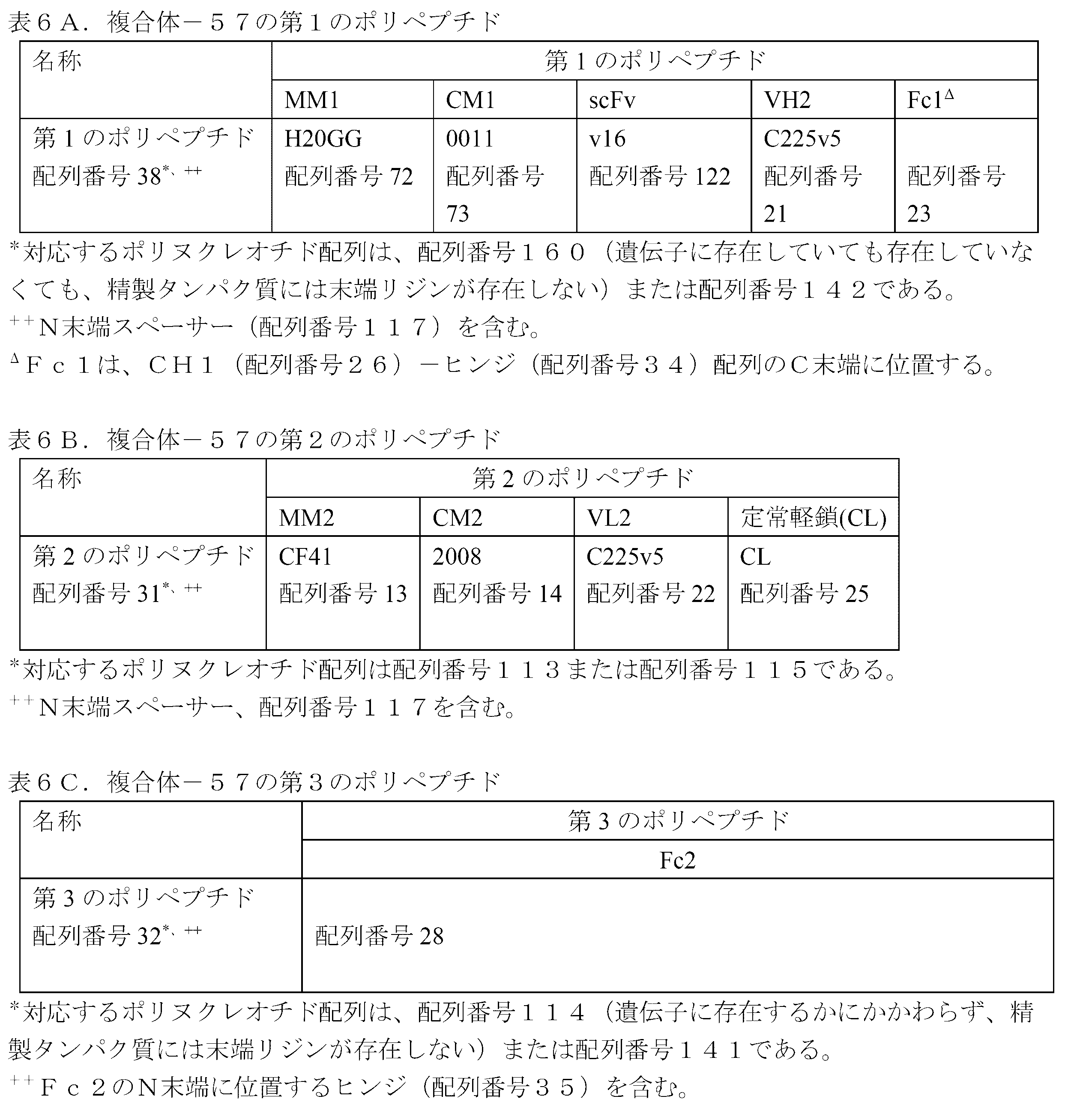
対照の活性化可能な抗EGFR、抗CD3ヘテロ多量体二重特異性ポリペプチドの構築
本明細書では「CI106」と称する、対照の活性化可能な二重特異性抗体構築物を、国際特許出願公開第WO2019/075405号(参照により本明細書に組み込まれる)に記載されているように調製した。CI106は、2つの同一の重鎖(2つの第1のポリペプチド)及び同一の軽鎖(2つの第2のポリペプチド)に対応する4つのポリペプチドで構成される活性化可能なデュアルアーム二価二重特異性抗体構築物であり、それぞれの重鎖と軽鎖は二重特異性抗体構築物のアームを形成する。二重特異性抗体は、それぞれのタイプの結合ドメインを2つ(すなわち、2つのEGFR結合ドメイン及び2つのCD3結合ドメイン)有するという点で「二価」である。軽鎖のアミノ酸配列は、複合体-67及び複合体-57の第2のポリペプチドのアミノ酸配列と同一である。CI106の重鎖と複合体-67の第1のポリペプチドは、同一のスペーサー、切断可能部分、抗EGFR VH、及び切断可能部分の構成要素を有する。CI106の重鎖と複合体-57の第1のポリペプチドは、同一のスペーサー、抗CD3 MM/MM1、切断可能部分、抗CD3VL/VH(及び同一の抗CD3 scFv)、ならびに抗EGFR VHの構成要素を有する。CI106では、4つの標的化ドメインすべて(2つの抗CD3結合ドメインと2つの抗EGFR結合ドメイン)がマスクされていた。CI106の構成要素を表7A~7Bに示す。

実施例2.活性化可能な抗EGFR、抗CD3ヘテロ多量体二重特異性ポリペプチドのEGFR+HT-29細胞及びCD3ε+Jurkat細胞への結合
記載された抗EGFR及び抗CD3マスキングペプチドが、活性化可能なヘテロ多量体二重特異性ポリペプチド複合体のEGFR及びCD3への結合を阻害できることを確認するために、フローサイトメトリーに基づく結合アッセイを実施した。
Example 2. Binding of activatable anti-EGFR, anti-CD3 heteromultimeric bispecific polypeptides to EGFR + HT-29 cells and CD3ε + Jurkat cells To confirm that the described anti-EGFR and anti-CD3 masking peptides can inhibit binding of activatable heteromultimeric bispecific polypeptide complexes to EGFR and CD3, flow cytometry-based binding assays were performed.
HT-29-luc2(Perkin Elmer,Inc.,Waltham,MA(正式にはCaliper Life Sciences,Inc.)及びJurkat(クローンE6-1、ATCC、TIB-152)細胞を、10%熱不活化ウシ胎仔血清(HI-FBS、Life Technologies、カタログ10438-026)を補充したRPMI-1640+glutamax(Life Technologies、カタログ72400-047)で培養した。「活性化」分子は、タンパク質分解的に切断されて活性化型を生成する活性化可能なHBPCとして生成された。実験前にその後タンパク質分解的切断を受けなかった活性化可能なHBPCも生成された。以下のポリペプチド複合体を試験した:活性化CI106(二価のダブルアーム二重特異性構築物)、活性化複合体-57(HBPC)、及び活性化-複合体-67(HBPC)、及び活性化可能な(マスクされた)HBPC複合体-57、(マスクされた)HBPC複合体-67、及び二重マスクされた二価のダブルアーム二重特異性構築物CI106。実施例1に記載したように、CD3バインダー(抗CD3 scFv v16)とマスク(MM H20GG)の1つの組み合わせをCI106及び複合体-57で利用し、CD3バインダー(抗CD3 scFv I2C)とマスク(ML15)の異なる組み合わせを複合体-67で利用した。 HT-29-luc2 (Perkin Elmer, Inc., Waltham, MA (formerly Caliper Life Sciences, Inc.) and Jurkat (clone E6-1, ATCC, TIB-152) cells were cultured in RPMI-1640 + glutamax (Life Technologies, catalog 10438-026) supplemented with 10% heat-inactivated fetal bovine serum (HI-FBS, Life Technologies, catalog 10438-026). The "activated" molecules were produced as activatable HBPCs that were proteolytically cleaved to generate the activated form. Activatable HBPCs were also produced that were not subsequently subjected to proteolytic cleavage prior to the experiment. The following polypeptide complexes were tested: activated CI106 (a bivalent double arm bispecific construct), activated complex-57 (HBPC), and activated-complex-67 (HBPC), and activatable (masked) HBPC complex-57, (masked) HBPC complex-67, and the doubly masked bivalent double arm bispecific construct CI106. As described in Example 1, one combination of CD3 binder (anti-CD3 scFv v16) and mask (MM H20GG) was utilized with CI106 and complex-57, and one combination of CD3 binder (anti-CD3 scFv v16) and mask (MM H20GG) was utilized with CI106 and complex-57. Different combinations of I2C) and mask (ML15) were used in complex-67.
HT29-luc2 細胞をVersene(商標)(Life Technologies、カタログ15040-066)で剥がし、洗浄し、96ウェルプレートに約150,000細胞/ウェルで播種し、50μLの活性化または活性化可能な(マスクされた)HBPCに再懸濁した。Jurkat細胞をカウントし、HT29-luc2細胞について記載したように播種した。活性化された(マスクされていない)HBPCまたは活性化可能な(マスクされた)HBPCの滴定は、図2A及び2Bに示される濃度で開始し、FACS染色緩衝液+2%FBS(BD Pharmingen、カタログ554656)中で3倍段階希釈した。細胞を振盪しながら4℃で約1時間インキュベートし、回収し、FACS染色緩衝液で2×200μLで洗浄した。細胞を50μLのAlexa Fluor 488コンジュゲート抗ヒトIgG Fc(10μg/ml、Jackson ImmunoResearch)に再懸濁し、振盪しながら4℃で約1時間インキュベートした。細胞を回収し、洗浄し、2.5μg/mLの7-AAD(BD Biosciences、カタログ559925)を含むFACS染色緩衝液の最終容量200μLに再懸濁した。二次抗体のみで染色した細胞を陰性対照として使用した。データはAttune NxTフローサイトメーターで取得し、生細胞の蛍光強度中央値(MFI)はFlowJo(登録商標)V10(Treestar)を使用して計算した。バックグラウンドを差し引いたMFIデータを、カーブフィット分析を使用してGraphPad Prismでグラフ化した。
HT29-luc2 cells were detached with Versene™ (Life Technologies, Catalog 15040-066), washed, and seeded at approximately 150,000 cells/well in 96-well plates and resuspended in 50 μL of activated or activatable (masked) HBPCs. Jurkat cells were counted and seeded as described for HT29-luc2 cells. Titrations of activated (unmasked) or activatable (masked) HBPCs started at the concentrations shown in Figures 2A and 2B and were serially diluted 3-fold in FACS stain buffer + 2% FBS (BD Pharmingen, Catalog 554656). Cells were incubated with shaking for approximately 1 hour at 4°C, harvested, and washed
図2A~2Bに示すように、活性化可能なHBPC、複合体-57及び複合体-67、ならびにCI106(マスクされた)は、活性化された(マスクされていない)複合体-57、活性化された(マスクされていない)複合体-67、及び活性化された(マスクされていない)CI106と比較して、EGFR及びCD3標的の両方に対する結合の減少を示した。結合の減少は、結合曲線の右方向へのシフトによって表される。この細胞結合実験におけるEGFRマスキング効率は、複合体-57では105、複合体-67では338、CI106では594であった。 As shown in Figures 2A-2B, activatable HBPC, complex-57 and complex-67, and CI106 (masked) showed reduced binding to both EGFR and CD3 targets compared to activated (unmasked) complex-57, activated (unmasked) complex-67, and activated (unmasked) CI106. The reduced binding is represented by a rightward shift in the binding curves. The EGFR masking efficiency in this cell binding experiment was 105 for complex-57, 338 for complex-67, and 594 for CI106.
実施例3.活性化可能なHBPC及び活性化HBPCの生物活性
細胞傷害性アッセイを使用して、活性化可能な(マスクされた)及び活性化された(マスクされていない)HBPCの生物学的活性をアッセイした。ヒトPBMCはStemcell Technologies(Vancouver,Canada)から購入し、5%の熱不活化ヒト血清(Sigma、カタログH3667)を補充したRPMI-1640+glutamax中で、5:1のE(CD3+):T比で、EGFR発現がん細胞株HT29-luc2(Perkin Elmer,Inc.,Waltham,MA(正式にはCaliper Life Sciences,Inc))と共培養された。活性化(マスクされていない)CI106(対照)、活性化(マスクされていない)複合体-57(HBPC)、活性化(マスクされていない)複合体-67(HBPC)、及びCI106(対照)、複合体-57(活性化可能なHBPC)及び複合体-67(活性化可能なHBPC)の滴定を試験した。48時間後、ONE-Glo(商標)ルシフェラーゼアッセイシステム(Promega,Madison,WIカタログE6130)を使用して細胞傷害性を評価した。発光は、Infinite(登録商標)M200 Pro(Tecan Trading AG,Switzerland)で測定した。細胞傷害性のパーセントを計算し、カーブフィット分析を使用してGraphPad PRISMでプロットした。活性化された分子の効力は、EC50比を計算することによって比較された。マスキング効率は、それぞれの分子のインタクトと活性化されたものとのEC50の比として計算された。
Example 3. Biological activity of activatable and activated HBPCs A cytotoxicity assay was used to assay the biological activity of activatable (masked) and activated (unmasked) HBPCs. Human PBMCs were purchased from Stemcell Technologies (Vancouver, Canada) and co-cultured with the EGFR-expressing cancer cell line HT29-luc2 (Perkin Elmer, Inc., Waltham, Mass. (formerly Caliper Life Sciences, Inc.)) at a 5:1 E(CD3+):T ratio in RPMI-1640+glutamax supplemented with 5% heat-inactivated human serum (Sigma, Cat. H3667). Activated (unmasked) CI106 (control), activated (unmasked) complex-57 (HBPC), activated (unmasked) complex-67 (HBPC), and titrations of CI106 (control), complex-57 (activatable HBPC) and complex-67 (activatable HBPC) were tested. After 48 hours, cytotoxicity was assessed using the ONE-Glo™ Luciferase Assay System (Promega, Madison, WI Cat. E6130). Luminescence was measured on an Infinite® M200 Pro (Tecan Trading AG, Switzerland). Percentage of cytotoxicity was calculated and plotted in GraphPad PRISM using curve fit analysis. Potency of activated molecules was compared by calculating EC50 ratios. Masking efficiency was calculated as the ratio of the intact and activated EC50 of each molecule.
図3A及び3Bに示すように、活性化可能な(マスクされた)HBPCは、活性化された(マスクされていない)HBPCと比較してシフトした用量反応曲線を有する。 As shown in Figures 3A and 3B, activatable (masked) HBPCs have a shifted dose-response curve compared to activated (unmasked) HBPCs.
このアッセイでは、図3Aのデータは、CI106については29,650のマスキング効率、複合体-57については1,034のマスキング効率を示している。図3Bのデータは、CI106については26,537のマスキング効率、複合体-67については7,141のマスキング効率を示している。このアッセイを用いた複数の実験に基づくと、複合体-57は一般に、複合体-67と比較して10~42倍低下した効力を示した。 In this assay, the data in Figure 3A show a masking efficiency of 29,650 for CI106 and 1,034 for conjugate-57. The data in Figure 3B show a masking efficiency of 26,537 for CI106 and 7,141 for conjugate-67. Based on multiple experiments using this assay, conjugate-57 generally showed a 10-42 fold reduced potency compared to conjugate-67.
実施例4.HBPCは、マウスにおける確立されたHT29腫瘍の退縮を誘導した
この実施例では、活性化可能な(マスクされた)HBPC複合体-67及び対照CI106を、ヒトPBMC移植NSGマウスにおいて確立されたHT29異種移植片腫瘍の退行を誘導するまたは増殖を減少させる能力について分析した。
Example 4. HBPCs induced regression of established HT29 tumors in mice In this example, activatable (masked) HBPC complex-67 and control CI106 were analyzed for their ability to induce regression or reduce the growth of established HT29 xenograft tumors in human PBMC-engrafted NSG mice.
ヒト結腸癌細胞株HT29-luc2(Perkin Elmer,Inc.,Waltham,MA)を確立された手順に従って培養した。精製され、凍結されたヒトPBMCは、Hemacare,Inc.(Van Nuys,CA)から入手した。NSG(NOD.Cg-Prkdcscid Il2rgtm1Wjl/SzJ)マウスは、The Jackson Laboratories(Bar Harbor,ME)から入手した。 Human colon cancer cell line HT29-luc2 (Perkin Elmer, Inc., Waltham, MA) was cultured according to established procedures. Purified and frozen human PBMCs were obtained from Hemacare, Inc. (Van Nuys, CA). NSG (NOD.Cg-Prkdcscid Il2rg tm1Wjl /SzJ) mice were obtained from The Jackson Laboratories (Bar Harbor, ME).
0日目に、100μLのRPMI+Glutamax無血清培地中の2×10⁶個のHT29-luc2細胞をそれぞれのマウスの右脇腹に皮下接種した。単一のドナーからの事前に凍結したPBMCを、1:1のCD3+T細胞対腫瘍細胞の比で3日目に(腹腔内)投与した。腫瘍体積が150~200mm3に達したとき(約12日目)、マウスを無作為に処置群に割り当て、表8に従って静脈内投与した。腫瘍体積と体重を週に2回測定した。複合体-67の用量レベルは、CI106と複合体-67の間の分子量の違いを考慮して調整された。
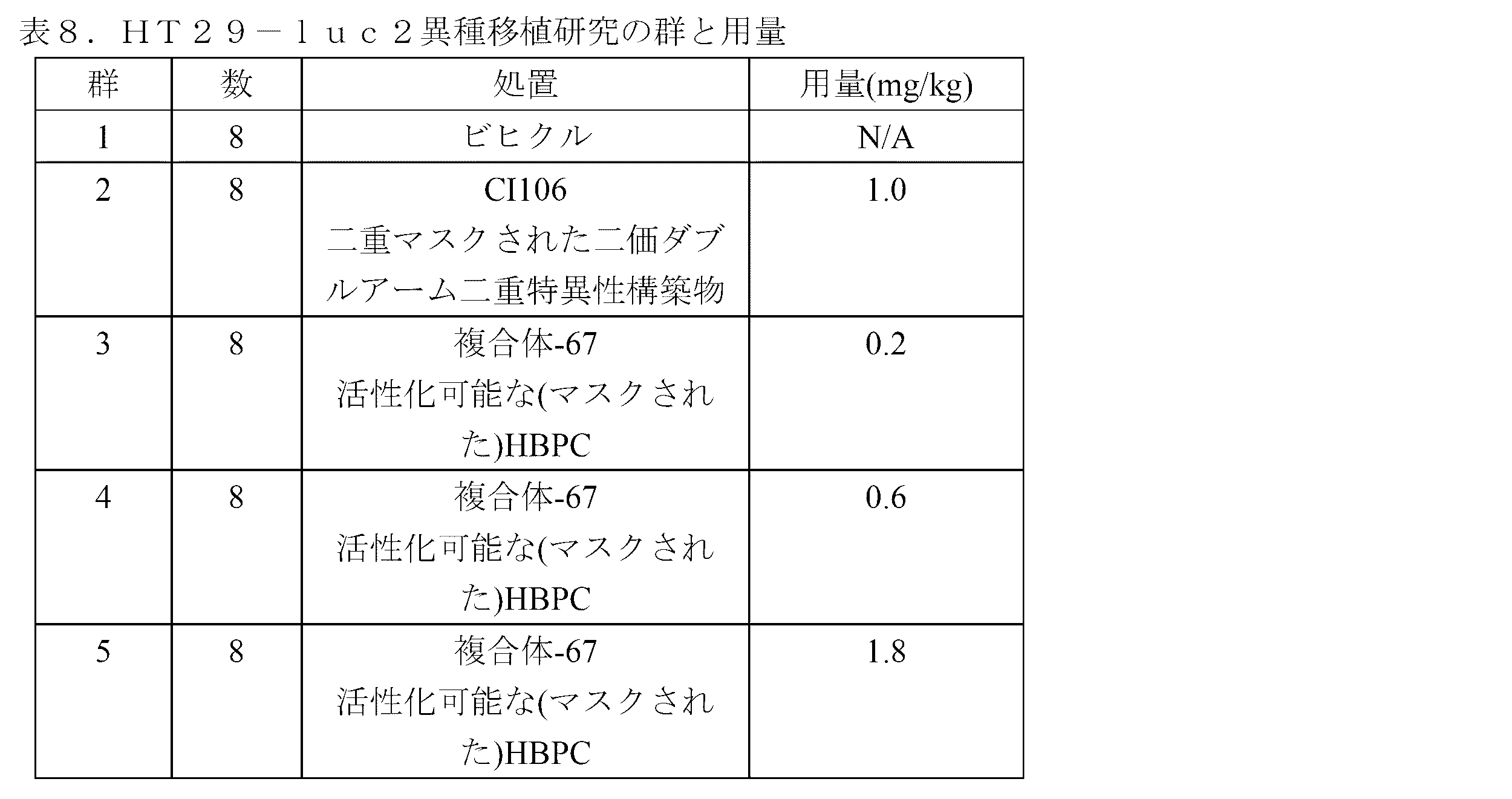
腫瘍体積対初回処置投与(0日目)の後の日数のプロットを示す図4に示すように、HT29-luc2異種移植片腫瘍の増殖に対する複合体-67の用量依存的な効果がある。複合体-67は、同等の用量(1mg/kgのCI106及び0.6mg/kgの複合体-67)で対照であるCI106よりも強力な抗腫瘍活性を示した(p=0.0099、Dunnettを使用したRMANOVA)。 As shown in Figure 4, which shows a plot of tumor volume versus days after the first treatment dose (day 0), there is a dose-dependent effect of Conjugate-67 on the growth of HT29-luc2 xenograft tumors. Conjugate-67 showed more potent antitumor activity than the control, CI106, at comparable doses (1 mg/kg CI106 and 0.6 mg/kg Conjugate-67) (p=0.0099, RMANOVA using Dunnett).
実施例5.活性化可能なHBPCによる処置後のマウスにおける確立されたHCT116腫瘍の腫瘍退縮
活性化された(マスクされていない)HBPC act-複合体-67及び活性化可能な(マスクされた)HBPC複合体-67を、ヒトT細胞移植NSGマウスにおいて確立されたHCT116異種移植片腫瘍の退行を誘導するまたは増殖を減少させる能力について分析した。ヒト結腸癌細胞株HCT116(ATCC)を、確立された手順に従ってRPMI+Glutamax+10%FBS中で培養した。腫瘍モデルは実施例4に記載されているように実施した。マウスには表9に従って投与した。

腫瘍体積対初回処置投与(研究0日目)後の日数のプロットを示す図5に示すように、試験したすべての用量で両方の分子について腫瘍退縮が実証された。 Tumor regression was demonstrated for both molecules at all doses tested, as shown in Figure 5, which shows a plot of tumor volume versus days after the first treatment dose (study day 0).
実施例6:セラミックヒドロキシアパタイトクロマトグラフィー(CHT)による精製後の単量体パーセントの評価
二重マスクされたCI106対照と活性化可能な(マスクされた)HBPC複合体-67をセラミックヒドロキシアパタイトクロマトグラフィーカラムを使用して精製し、精製中の高濃度での二量体化の量を比較した。これは、精製プロセスのそれぞれのステップでの単量体のパーセンテージを分析することによって評価された。
Example 6: Evaluation of Percent Monomer after Purification by Ceramic Hydroxyapatite Chromatography (CHT) Doubly masked CI106 control and activatable (masked) HBPC complex-67 were purified using a ceramic hydroxyapatite chromatography column to compare the amount of dimerization at high concentrations during purification, which was assessed by analyzing the percentage of monomer at each step of the purification process.
試料を、20g/L樹脂をロードしたCHT Type I、40μmビーズカラム(Bioradカタログ:157-0040及び#157-0041)にロードした。カラムを平衡緩衝液として10mMのNaPO4、100mMのヒスチジン緩衝液pH6.5で洗浄し、次いでCI106の場合は10mMのNaPO4、100mMのヒスチジン、200mMのリジン-HCl緩衝液pH6.5で、複合体-67の場合は、10mMのNaPO4、100mMのヒスチジン、100mMのリジン-HCl緩衝液pH6.5で、2mLの画分に溶出した。CI106を2mLの画分に集め、次いで5つの画分をプールして溶出液を形成した。CI106では、ピーク収集は約25mAUで開始され、約300mAUで停止した。複合体-67を1つのチューブに収集し、ピーク収集は100mAUで開始し、500mAUで終了した。この後に、pH7.0で500mMのNaPO4のストリップ緩衝液ステップが続いた。それぞれの画分のタンパク質濃度は、波長280nmでのUV吸収によって定量された。それぞれの画分中の単量体パーセントは、全ピーク面積に基づいてSE-HPLC(分析スケールサイズ排除クロマトグラフィー)によって決定された。 Samples were loaded onto a CHT Type I, 40 μm bead column (Biorad catalog: 157-0040 and #157-0041) loaded with 20 g/L resin. The column was washed with 10 mM NaPO4, 100 mM histidine buffer pH 6.5 as equilibration buffer, then eluted in 2 mL fractions with 10 mM NaPO4, 100 mM histidine, 200 mM lysine-HCl buffer pH 6.5 for CI106 and 10 mM NaPO4, 100 mM histidine, 100 mM lysine-HCl buffer pH 6.5 for Complex-67. CI106 was collected in 2 mL fractions, and then 5 fractions were pooled to form the eluate. For CI106, peak collection began at approximately 25 mAU and stopped at approximately 300 mAU. Conjugate-67 was collected in one tube, with peak collection beginning at 100 mAU and ending at 500 mAU. This was followed by a strip buffer step of 500 mM NaPO4 at pH 7.0. Protein concentration of each fraction was quantified by UV absorption at a wavelength of 280 nm. Percent monomer in each fraction was determined by SE-HPLC (analytical scale size exclusion chromatography) based on total peak area.
クロマトグラフィーの結合段階では、タンパク質は最初にカラムの上部に結合し、上部がいっぱいになってからカラムを下に移動する。これにより、分子がカラム上で高濃度になる。CI106及び複合体-67の多量体は単量体よりも強い親和性でカラムに結合するため、カラムから完全に除去するには強力な緩衝液が必要である。したがって、カラムを弱い緩衝液で溶出し、次いで、より強い緩衝液でストリッピングすると、溶出液のダイマーのパーセンテージはストリップよりも低くなる(単量体のパーセンテージが高くなる)。表10に示すように、複合体-67(活性化可能なHBPC)の実行により、溶出液中のモノマーのパーセントが7.6%増加し、ストリップステップまでカラム上に高分子量物質が残り、これは溶出液中で77%の回収率をもたらした。これと比較して、CI106の実行は、ストリップまでより多くの二量体物質(30.6%のみが単量体)がカラム上に留まったにもかかわらず、溶出液中の単量体のパーセントが5.4%減少して65.0%となり、結果として溶出液中の回収率は81%となった。

これらの結果は、複合体-67がカラム上で高濃度にあるときにさらなる二量体化を受けず、その結果、溶出液中でほぼすべての高分子種が除去されるのに対し(98.5%の単量体)、CI106の場合はわずか65%であることを示唆している。CI106の場合、溶出液プールには元のロードよりも多くの高分子種が存在する。しかしながら、CI106は、CI106がカラム上で高濃度にさらされると二量体化が起こるため、このクロマトグラフィー法、または任意の評価された結合/溶出クロマトグラフィー法では精製できなかった。 These results suggest that conjugate-67 does not undergo further dimerization when at high concentration on the column, resulting in the removal of nearly all high molecular weight species in the eluate (98.5% monomer), compared to only 65% for CI106. In the case of CI106, there are more high molecular weight species in the eluate pool than in the original load. However, CI106 could not be purified by this chromatographic method, or by any of the bind/elute chromatographic methods evaluated, because dimerization occurs when CI106 is exposed to high concentrations on the column.
複合体-67の改善された挙動により、CHTタイプ1クロマトグラフィーによる高モノマー複合体-67の精製が可能になる。
The improved behavior of complex-67 allows purification of highly monomeric complex-67 by
実施例7:遠心濃縮機での濃縮による濃度依存性二量体化の評価
複合体-67(活性化可能なHBPC)、複合体-57(活性化可能なHBPC)、及びCI106対照の、プロテインA精製調製物とSEC精製調製物を、遠心濃縮及び最も高い濃度で一晩インキュベートした後の単量体パーセントについて比較した。
Example 7: Evaluation of concentration-dependent dimerization by concentration in a centrifugal concentrator Protein A and SEC purified preparations of conjugate-67 (activatable HBPC), conjugate-57 (activatable HBPC), and a CI106 control were compared for percent monomer after centrifugal concentration and overnight incubation at the highest concentration.
複合体-67、複合体-57、及びCI106をプロテインA及びSECで精製し、次いで低pH緩衝液(10mMの酢酸塩、100mMのリジン、pH6)中で調製した。試料をPBS(753-45-01)で1:15に希釈し、Pierce(商標)Protein Concentrators PES 10K MWCO 0.5ml(Thermo Fisherカタログ番号88513)を使用して、それぞれの濃度で14,000RPMで2分間遠心分離することにより濃縮した。最も高い濃度の試料を一晩保管し、単量体パーセントを評価した。得られた濃度と単量体量のパーセントを表11と図6に示す。

図6及び表11は、濃度が上昇しても、複合体-67が高い単量体%(98%~99%)で維持され、溶液中での凝集が非常に低いことを示している。これは、濃度が増加するにつれて顕著な濃度依存性の二量体化を示すCI106と対照的である。複合体-57は濃度依存性の二量体化をほとんど示さず、濃度が増加しても安定した単量体パーセンテージを維持した。複合体-67はまた、最も高い濃度での一晩のインキュベーション中に単量体パーセンテージを維持し、より高濃度での単量体パーセンテージの安定性を実証した。 Figure 6 and Table 11 show that Conjugate-67 maintained a high monomer percentage (98%-99%) with increasing concentration and exhibited very low aggregation in solution. This is in contrast to CI106, which showed significant concentration-dependent dimerization as the concentration was increased. Conjugate-57 showed little concentration-dependent dimerization and maintained a stable monomer percentage with increasing concentration. Conjugate-67 also maintained its monomer percentage during overnight incubation at the highest concentration, demonstrating the stability of the monomer percentage at higher concentrations.
実施例8:代替類似構造の比較
1つのセットではCD3と腫瘍関連抗原である抗原Aを標的とし、別のセットではCD3と腫瘍関連抗原である抗原Bを標的とする活性化可能な二重特異性構築物のセットを調製した。抗原Aも抗原BもEGFRではなかった。それぞれのセットは、本開示の活性化可能なHBPCと、互いに異なるだけでなく、本開示の活性化可能なHBPCの構造とも異なる代替(フォーマット)1及び代替(フォーマット)2と呼ばれる構造配置にある、活性化可能なHBPCと同じ構成要素(すなわち、同じ抗CD3 scFv、同じ抗腫瘍関連抗原VH及びVL配列、同じ抗CD3マスキング部分、ならびに同じ抗腫瘍関連抗原マスキング部分)を有する他の活性化可能な二重マスクされた一価二重特異性構築物とを含んでいた。それぞれのセットのそれぞれの構築物の特性は、実施例9及び10に記載されているように特徴付けられた。
Example 8: Comparison of alternative similar structures A set of activatable bispecific constructs was prepared, one targeting CD3 and a tumor associated antigen, antigen A, and another targeting CD3 and a tumor associated antigen, antigen B. Neither antigen A nor antigen B was EGFR. Each set included an activatable HBPC of the present disclosure and another activatable doubly masked monovalent bispecific construct with the same components as the activatable HBPC (i.e., the same anti-CD3 scFv, the same anti-tumor associated antigen VH and VL sequences, the same anti-CD3 masking moiety, and the same anti-tumor associated antigen masking moiety) in a structural arrangement, termed alternative (format) 1 and alternative (format) 2, which differ not only from each other but also from the structure of the activatable HBPC of the present disclosure. The properties of each construct in each set were characterized as described in Examples 9 and 10.
実施例9:二重マスクされた一価、二重特異性フォーマットの比較
実施例8に記載の抗CD3、抗抗原A二重特異性構築物(すなわち、本開示の活性化可能なHBPCのフォーマット、代替(フォーマット)1、及び代替(フォーマット)2)の生物学的活性及びマスキング効率は、細胞傷害性アッセイを使用して決定された。Ovcar-8細胞をヒトT細胞と1:10の比率で共培養し、表12、13、及び14の分子の希釈系列で処理した。48時間後、製造業者の使用説明書に従ってCell Titer Glo(Promega)を使用して細胞傷害性を評価した。マスキング効率は、それぞれの分子のインタクトと活性化されたものとのEC50の比として計算された。抗CD3 scFv、抗CD3マスキング部分、抗腫瘍関連抗原VH及びVL、抗腫瘍関連抗原マスキング部分、及び2つの切断可能部分のアミノ酸配列は、3つの異なるフォーマット(すなわち、本開示の活性化可能なHBPC、代替(フォーマット)1、及び代替(フォーマット)2)間で同じであった。活性化可能なHBPC、代替1、及び代替2分子、ならびに対応するマスクされていない対照分子のマスキング効率を表12(抗抗原Aマスキング部分ML21及び抗CD3マスキング部分ML15)、表13(抗抗原Aマスキング部分ML24及び抗CD3マスキング部分ML15)、ならびに表14(抗抗原Aマスキング部分ML34及び抗CD3マスキング部分ML15)に示す。以下に示すように、活性化可能なHBPCは、それぞれの場合で最も高いマスキング効率を示した。構成要素はそれぞれのフォーマットタイプで同じであるため、結果は、活性化可能なHBPCのマスキング効率の向上は、代替(フォーマット)1及び代替(フォーマット)2と比較した活性化可能なHBPCフォーマットにおける構成要素の特定の配置によるものであることを示唆している。


表13では、活性化可能なHBPCは、代替2と比較してマスキング効率が15倍増加し、代替1と比較してマスキング効率が2~4倍増加したことを示した。表13では、HBPCは6460~8274のマスキング効率を示したが、代替2のMEは112であった。表13では、活性化可能なHBPCは、代替2と比較してマスキング効率が68倍増加し、代替1と比較してマスキング効率が10倍増加したことを示した。表14では、HBPCのマスキング効率は2491であったが、代替1と代替のMEは248であった。表15において、複合体-463を代替1及び代替2で調製し、代替1における複合体-463の2つのアッセイを実施した。HBPCは1500~2100MEの範囲のマスキング効率を示し、HBPCでは代替1と比べてMEが約6~10倍、代替2と比べて約47倍増加した。
In Table 13, activatable HBPC showed a 15-fold increase in masking efficiency compared to
これらの結果は、マスキング効率の改善が、本開示の活性化可能なHBPCの特定の構造配置によるものであると思われることを示唆している。 These results suggest that the improved masking efficiency is likely due to the specific structural arrangement of the activatable HBPC of the present disclosure.
実施例10:CHO細胞株における活性化可能なHBPC及び代替二重特異性分子の細胞傷害性
マスキング効率と細胞傷害性を、それぞれCD3と抗原Bを標的とする活性化可能なHBPC、代替1、及び代替2分子について決定した。抗原Bを発現するCHO細胞を、1:10の比でヒトPBMCと共培養し、表15の分子の希釈系列で処理した。48時間のインキュベーション後、製造業者の使用説明書に従ってCytotox Glo(Promega)を使用して細胞傷害性を決定した。マスキング効率は、それぞれの分子のインタクトと活性化されたものとのEC50の比として計算された。結果を表15に示す。

活性化可能なHBPCが最良の結果をもたらした。図7は、マスクされた活性化可能なHBPC(複合体-39)、マスクされていない活性化可能なHBPC対照(複合体-342)、代替(フォーマット)2の活性化可能なポリペプチド(複合体-231)、及びマスクされていない代替(フォーマット)2対照(複合体-164)の細胞溶解のパーセンテージとして細傷害性を示す。 Activatable HBPC gave the best results. Figure 7 shows the cytotoxicity as a percentage of cytolysis for masked activatable HBPC (complex-39), unmasked activatable HBPC control (complex-342), Alternative (format) 2 activatable polypeptide (complex-231), and unmasked Alternative (format) 2 control (complex-164).
この結果は、本明細書に記載の活性化可能なHBPCの特定の構造における構成要素の配置が、代替フォーマットで配置された同じ構成要素を有する活性化可能な一価の二重特異性構築物のマスキング効率と比較して、より高いマスキング効率と相関しているようであることを示唆している。 This result suggests that the arrangement of components in the particular structure of the activatable HBPC described herein appears to correlate with higher masking efficiency compared to that of activatable monovalent bispecific constructs with the same components arranged in alternative formats.
活性化可能な抗CD3、抗抗原AのHBPC及び活性化可能な抗CD3、抗抗原BのHBPCで観察されたマスキング効率の程度は、複合体-67及び複合体-57で観察されたものと一致している。これらの有益な結果は、使用した特定の標的ドメイン/アミノ酸配列とは無関係であると思われる。 The degree of masking efficiency observed with activatable anti-CD3, anti-antigen A HBPCs and activatable anti-CD3, anti-antigen B HBPCs is consistent with that observed with conjugate-67 and conjugate-57. These beneficial results appear to be independent of the specific targeting domain/amino acid sequence used.
実施例11:活性化可能な抗EGFR、抗CD3 TCB構築物CI107の安全性と有効性
この研究では、CI106対照(上記)と同じ構造フォーマットを有する抗EGFR、抗CD3のTCB構築物であるCI107の安全性と有効性を前臨床モデルで評価し、EGFR発現腫瘍の治療の治療可能性を評価した。CI107を、国際特許出願公開第WO2019/075405号(参照により本明細書に組み込まれる)に記載されているように調製した。CI107 TCB構築物は、この実施例では「T細胞結合二重特異性抗体」または「TCB」とも呼ばれる。
Example 11: Safety and Efficacy of the Activatable Anti-EGFR, Anti-CD3 TCB Construct CI107 In this study, the safety and efficacy of CI107, an anti-EGFR, anti-CD3 TCB construct with the same structural format as the CI106 control (above), was evaluated in preclinical models to assess its therapeutic potential for the treatment of EGFR-expressing tumors. CI107 was prepared as described in International Patent Application Publication No. WO2019/075405, which is incorporated herein by reference. The CI107 TCB construct is also referred to in this example as a "T cell-binding bispecific antibody" or "TCB."
方法
動物研究
すべての動物研究は、それぞれの研究を実施した施設を管理する施設内動物管理使用委員会の規制に従って実施された。マウス異種移植片の研究はCytomX Therapeutics,Inc(CytomX)によって行われ、カニクイザルの研究はAltasciences(Everett,WA)によって行われた。すべての動物実験は、USDA動物福祉法及び実験動物の管理と使用に関するガイドに定められた規制に従って行われた。
Methods Animal Studies All animal studies were conducted in accordance with the regulations of the Institutional Animal Care and Use Committee governing the facility in which the respective study was conducted. Mouse xenograft studies were performed by CytomX Therapeutics, Inc. (CytomX) and cynomolgus monkey studies were performed by Altasciences (Everett, WA). All animal experiments were conducted in accordance with regulations set forth in the USDA Animal Welfare Act and the Guide for the Care and Use of Laboratory Animals.
材料
CI107、CI128、CI020、CI011、CI040、CI048、及びCI104を含む、この研究に記載されているすべてのTCB及びその他のコンストラクトは、CytomX Therapeutics,Inc.によって生成された(WO2016/014974及びWO2019/075405を参照されたい)。CI107、CI128、CI020、CI011、CI040、及びCI104は、CI106と同じ構造形式を有する。CI048は活性化されたCI011に対応する。活性化されたTCBは、ウロキナーゼ型プラスミノーゲン活性化因子(uPA)によるインビトロ処理とそれに続くSEC精製によって生成された(Desnoyers 2013)。HT29-Luc2細胞は、Caliper Life Sciences(Hopkinton,MA)から入手し、HCT116及びJurkat細胞は、American Type Culture Collection(ATCC)から入手した。ヒト末梢血単核細胞(PBMC)は、HemaCare Corporation(Northridge,CA)、AllCells(Alameda,CA)、またはSTEMCELL Technologies(Seattle,WA)から個々のドナーからの細胞の凍結保存バイアルとして入手した。NOD.Cg-Prkcdscid Il2rg tm1Wjl/SzJ(NSG)マウスは、Jackson Laboratories(Sacramento,CA)から入手した。
Materials All TCBs and other constructs described in this study, including CI107, CI128, CI020, CI011, CI040, CI048, and CI104, were produced by CytomX Therapeutics, Inc. (see WO2016/014974 and WO2019/075405). CI107, CI128, CI020, CI011, CI040, and CI104 have the same structural format as CI106. CI048 corresponds to activated CI011. Activated TCBs were produced by in vitro treatment with urokinase-type plasminogen activator (uPA) followed by SEC purification (Desnoyers 2013). HT29-Luc2 cells were obtained from Caliper Life Sciences (Hopkinton, MA), HCT116 and Jurkat cells were obtained from the American Type Culture Collection (ATCC). Human peripheral blood mononuclear cells (PBMCs) were obtained as cryopreserved vials of cells from individual donors from HemaCare Corporation (Northridge, CA), AllCells (Alameda, CA), or STEMCELL Technologies (Seattle, WA). NOD. Cg-Prkcdscid Il2rg tm1Wjl/SzJ (NSG) mice were obtained from Jackson Laboratories (Sacramento, CA).
細胞結合アッセイ
HT29細胞とJurkat細胞は完全培地で維持された。HT29細胞は、Versene(商標)細胞解離緩衝液を使用して収集された。細胞を250×gで5~10分間遠心分離し、2%FBSを含むFACS緩衝液(BD Pharminogen)に再懸濁した。細胞をV底96ウェルプレートに150,000/ウェルで播種し、FACS緩衝液での3倍段階希釈によって得られたさまざまな濃度(HT29とJurkat細胞の両方に対して1.5μMのCI107で開始、HT29細胞に対して0.05μMの活性化CI104で開始、Jurkat細胞に対して0.5μMの活性化CI104で開始)の複合体-07またはインビトロプロテアーゼ活性化CI104で処理した。細胞を4℃で1時間インキュベートし、FACS緩衝液で2回洗浄し、10μg/mlのAlexa Fluor 647抗ヒトFc二次抗体に再懸濁した。次いで細胞を遮光して4℃で30~60分間インキュベートし、FACS緩衝液で2回洗浄し、7-AADを含むFACS緩衝液に再懸濁し、MACSQuantフローサイトメーター(Miltenyi Biotech)で分析した。平均蛍光強度データを二次抗体バックグラウンドシグナルに対して補正し、Graphpad Prismでグラフ化し、EC50値を計算した。
Cell Binding Assay HT29 and Jurkat cells were maintained in complete medium. HT29 cells were harvested using Versene™ cell dissociation buffer. Cells were centrifuged at 250×g for 5-10 min and resuspended in FACS buffer (BD Pharminogen) containing 2% FBS. Cells were seeded at 150,000/well in V-bottom 96-well plates and treated with various concentrations of complex-07 or in vitro protease-activated CI104 obtained by 3-fold serial dilution in FACS buffer (starting with 1.5 μM CI107 for both HT29 and Jurkat cells, 0.05 μM activated CI104 for HT29 cells, and 0.5 μM activated CI104 for Jurkat cells). Cells were incubated for 1 hour at 4°C, washed twice with FACS buffer, and resuspended in 10 μg/ml Alexa Fluor 647 anti-human Fc secondary antibody. Cells were then incubated for 30-60 minutes at 4°C protected from light, washed twice with FACS buffer, resuspended in FACS buffer containing 7-AAD, and analyzed on a MACSQuant flow cytometer (Miltenyi Biotech). Mean fluorescence intensity data were corrected for secondary antibody background signal, graphed in Graphpad Prism, and EC50 values were calculated.
細胞傷害性アッセイ
HCT116-Luc2またはHT29-Luc2を、96ウェル白色平底組織培養処理プレート(Costar #3917)に、RPMI+5%ヒト血清中10,000細胞/ウェルで播種した。ヒトPBMCを新たに解凍し、RPMI+5%ヒト血清で2回洗浄し、100,000個のPBMCをRPMI+5%ヒト血清中でHCT116-Luc2またはHT29-Luc2を含むウェルに加えた。次いで、プロテアーゼ活性化TCBまたはCI107を、3倍段階希釈によって得られたさまざまな濃度でウェルに添加した。対照ウェルには、未処理の標的細胞+エフェクター細胞、標的細胞のみ、エフェクター細胞のみ、または培地のみが含まれていた。次いでプレートを37℃、5%CO2で約48時間インキュベートした。細胞生存率は、ONE-Gloルシフェラーゼアッセイシステム(Promega、#E6120)及びTecanプレートリーダーを使用して測定した。細胞傷害性パーセントは次のように計算された:(1-(実験RLU/未処理の平均RLU))×100。
Cytotoxicity Assay HCT116-Luc2 or HT29-Luc2 were seeded at 10,000 cells/well in RPMI + 5% human serum in 96-well white flat-bottom tissue culture treated plates (Costar #3917). Human PBMCs were freshly thawed and washed twice with RPMI + 5% human serum, and 100,000 PBMCs were added to wells containing HCT116-Luc2 or HT29-Luc2 in RPMI + 5% human serum. Protease-activated TCB or CI107 was then added to the wells at various concentrations obtained by 3-fold serial dilutions. Control wells contained untreated target cells + effector cells, target cells only, effector cells only, or media only. Plates were then incubated at 37°C, 5% CO2 for approximately 48 hours. Cell viability was measured using the ONE-Glo Luciferase Assay System (Promega, #E6120) and a Tecan plate reader. Percent cytotoxicity was calculated as follows: (1-(experimental RLU/mean untreated RLU)) x 100.
インビトロT細胞活性化とサイトカイン分析
T細胞の活性化は、HT29-Luc2細胞またはHCT116-Luc2細胞と共培養したPBMCにおけるCD69発現の誘導によって測定された。HT29-Luc2細胞またはHCT116-Luc2細胞を、U底非接着プレートに10,000細胞/ウェルで播種した。ヒトPBMCを新たに解凍し、血清を含むRPMIで2回洗浄し、100,000個のPBMC/ウェルを腫瘍細胞を含むプレートに加えた。フローサイトメトリー補正対照用に、PBMCのみを含む二重プレートを播種した。CI107、活性化CI107、またはCI128の3倍段階希釈物を培地で調製し、播種した細胞に添加した。細胞を37℃、5%CO2で16時間インキュベートした。フローサイトメトリー分析の準備として、プレートを250×gで10~15分間遠心分離した。サイトカイン分析のために上清を除去し、Fcブロック(Human TruStain FcX、BioLegend)をそれぞれのウェルに添加し、プレートを10分間インキュベートした。抗CD45-FITC(BioLegend)、抗CD3-パシフィックブルー(BioLegend)、抗CD8a-APC(BioLegend)、及び抗CD69-PE-Cy7(BioLegend)を含む抗体カクテル、または適切な補正対照をウェルに追加し、プレートを、遮光して4℃で30~60分間振盪しながらインキュベートした。次いで、プレートをFACS緩衝液で洗浄し、7-AADを含むFACS緩衝液に再懸濁した。Attuneフローサイトメーターを使用して蛍光を測定し、PBMCを表す15,000の事象を収集した。
In vitro T cell activation and cytokine analysis T cell activation was measured by induction of CD69 expression in PBMCs co-cultured with HT29-Luc2 or HCT116-Luc2 cells. HT29-Luc2 or HCT116-Luc2 cells were seeded at 10,000 cells/well in U-bottom non-adherent plates. Human PBMCs were freshly thawed, washed twice with RPMI containing serum, and 100,000 PBMCs/well were added to plates containing tumor cells. Duplicate plates containing PBMCs alone were seeded for flow cytometry compensation controls. Three-fold serial dilutions of CI107, activated CI107, or CI128 were prepared in culture medium and added to the seeded cells. Cells were incubated for 16 hours at 37°C, 5% CO2 . In preparation for flow cytometry analysis, plates were centrifuged at 250×g for 10-15 min. For cytokine analysis, supernatants were removed and Fc block (Human TruStain FcX, BioLegend) was added to each well and plates were incubated for 10 min. An antibody cocktail containing anti-CD45-FITC (BioLegend), anti-CD3-Pacific Blue (BioLegend), anti-CD8a-APC (BioLegend), and anti-CD69-PE-Cy7 (BioLegend), or appropriate compensation controls, was added to the wells and plates were incubated with shaking for 30-60 min at 4° C., protected from light. Plates were then washed with FACS buffer and resuspended in FACS buffer containing 7-AAD. Fluorescence was measured using an Attune flow cytometer and 15,000 events representing PBMCs were collected.
サイトカイン分析には、Meso Scale Discovery U-PLEXプレートアッセイ(Meso Scale Diagnostics,Rockville,MA)を使用した。MCP-1、TNF-α、IL-6、IL-2、及びIFN-γのレベルを評価するために、製造者のプロトコールに従ってU-PLEXプレートを調製した。PBMCと共培養され、マスクされた(活性化可能な)CI107、活性化された(本明細書では「act-」とも呼ばれる)CI107、またはCI128で処理されたHT29-Luc2またはHCT116-Luc2から収集された上清試料を希釈し、プレートに添加し、そして製造者の使用説明書に従って処理した。 For cytokine analysis, the Meso Scale Discovery U-PLEX plate assay (Meso Scale Diagnostics, Rockville, MA) was used. To assess levels of MCP-1, TNF-α, IL-6, IL-2, and IFN-γ, U-PLEX plates were prepared according to the manufacturer's protocol. Supernatant samples collected from HT29-Luc2 or HCT116-Luc2 cells co-cultured with PBMCs and treated with masked (activatable) CI107, activated (also referred to herein as "act-") CI107, or CI128 were diluted, added to the plates, and processed according to the manufacturer's instructions.
インビボ有効性試験
インビボ実験では、HT29-Luc2またはHCT116腫瘍を担持し、ヒトPBMCの腹腔内(IP)注射によって得られたヒトT細胞を移植したマウスで、腫瘍増殖に対するTCBの効果を測定した。0日目に、200万個のHT29-Luc2細胞またはHCT116細胞を100μlの無血清RPMIでメスNSGマウスの側腹部に皮下注射した。単一ドナーからの凍結PBMCを新たに解凍し、3日目に100~200μLのRPMI+Glutamax、無血清培地中での腹腔内注射により投与した。PBMCはCD3+T細胞のパーセンテージについて事前に特性評価されており、インビボ投与に使用されるPBMCの数は、1:1のCD3+T細胞対腫瘍細胞の比に基づいていた。約12日目の腫瘍測定値を使用して、TCB、対照試料、またはビヒクルを静脈内(IV)投与する前にマウスを無作為化した。動物に試験試料を3週間毎週投与し、腫瘍体積と体重を週に2回記録した。活性化されたTCB CI104は、インビボ研究に使用された。CI104構築物は、CD3マスクをscFvに繋ぐために使用される切断可能なリンカーにおいてのみCI107と異なる。マスクを完全に除去するためのインビトロプロテアーゼ活性化では、活性化CI104は活性化CI107と同一であり、活性化CI107の活性の評価に使用できる。その後のインビトロ細胞傷害性研究により、活性化CI104の活性が活性化CI107の活性と同じであることが検証された。
In vivo efficacy studies: In in vivo experiments, the effect of TCB on tumor growth was measured in mice bearing HT29-Luc2 or HCT116 tumors and engrafted with human T cells obtained by intraperitoneal (IP) injection of human PBMCs. On
非ヒト霊長類安全性試験
オスのカニクイザルは、試験試料に応じて、試験試料のゆっくりとしたIVボーラス注射を、1日目、または1日目と15日目に1回、投与された。試験試料の投与後、臨床観察を1日2回実施した。サイトカイン放出、血清化学、血液学、及び毒物動態の分析のために、投与後のさまざまな時点で血液試料を収集した。サイトカイン分析は、Life Technologies Monkey Magnetic 29-Plexパネルキット(Thermo Fisher Scientific,Waltham,MA)を使用して血清試料に対して実施された。毒物動態分析の場合、試料は血漿に処理され、AIT Bioscience(Indianapolis IN)またはCytomXによる分析のために送る前に-60~-86℃で保存された。試験試料の血漿濃度は、抗イディオタイプ捕捉抗体及び抗ヒトIgG(Fc)捕捉抗体を使用するELISAによって測定された。毒性動態分析は、Phoenix WinNonlin v6.4(Certara,Princeton,NJ)を利用したノンコンパートメント分析を使用して、Northwest PK Solutionsによって実施された。
Non-human Primate Safety Studies Male cynomolgus monkeys were administered a slow IV bolus injection of the test article once on
結果
CI107は、抗EGFRドメインと抗CD3ドメインを含む二重マスクされた(活性化可能な)デュアルアーム二価二重特異性分子として設計された。CI107は、重鎖のN末端に融合したSP34由来の抗CD3ε scFvを含むセツキシマブ由来の抗体を使用して生成された。CI107は、Fc機能を抑制する変異を伴うヒトIgG1 Fcドメインを有する。CI107を生成するには、以前に記載されているように(Desnoyers 2013)、フレキシブルなGly-Serリッチペプチドリンカーが隣接するプロテアーゼ切断可能な基質リンカーを使用して、抗EGFR抗体構成要素に特異的なマスキングペプチドを軽鎖のN末端に融合した。抗CD3構成要素に特異的なマスキングペプチドも同様に、プロテアーゼで切断可能な基質リンカーを使用してscFvに付加された。CI107はFcエフェクター機能を損ない、FcγRを発現する細胞への架橋を最小限に抑えた。この設計は、正常組織での結合と活性を最小限に抑えながら、プロテアーゼが豊富な腫瘍微小環境での標的の結合と活性を最大化することを目的としている。この実施例全体で使用される比較用TCBはすべて、さまざまな程度の切断性を持つEGFR及びCD3結合ドメイン、マスク、及びリンカーペプチドを含んでいる。CI011及びCI040は、CI104及びCI107の第1世代バージョンである。CI104及びCI107分子には、最適化されたCD3 scFv、次世代の切断可能なリンカー、及び追加のFcサイレンシング変異が含まれている。CI104とCI107は同じマスク、ならびにEGFR及びCD3結合ドメインを有しているが、CD3プロテアーゼリンカーが異なる。しかしながら、プロテアーゼ活性化後は、活性化されたTCBは同一になる。CI128は、EGFRバインダーが無関係な抗体(抗RSV)に置き換えられた非標的対照として使用された。
Results CI107 was designed as a double-masked (activatable) dual-arm bivalent bispecific molecule containing an anti-EGFR domain and an anti-CD3 domain. CI107 was generated using a cetuximab-derived antibody with an anti-CD3ε scFv derived from SP34 fused to the N-terminus of the heavy chain. CI107 has a human IgG1 Fc domain with mutations that abrogate Fc function. To generate CI107, a masking peptide specific for the anti-EGFR antibody component was fused to the N-terminus of the light chain using a protease-cleavable substrate linker flanked by flexible Gly-Ser-rich peptide linkers as previously described (Desnoyers 2013). A masking peptide specific for the anti-CD3 component was similarly appended to the scFv using a protease-cleavable substrate linker. CI107 impaired Fc effector function and minimized cross-linking to cells expressing FcγR. This design aims to maximize target binding and activity in the protease-rich tumor microenvironment while minimizing binding and activity in normal tissues. All comparative TCBs used throughout this example contain EGFR and CD3 binding domains, masks, and linker peptides with varying degrees of cleavability. CI011 and CI040 are first generation versions of CI104 and CI107. CI104 and CI107 molecules contain optimized CD3 scFv, next generation cleavable linkers, and additional Fc silencing mutations. CI104 and CI107 have the same mask, as well as EGFR and CD3 binding domains, but different CD3 protease linkers. However, after protease activation, the activated TCBs are identical. CI128 was used as a non-targeting control in which the EGFR binder was replaced with an irrelevant antibody (anti-RSV).
マスキングにより、細胞表面上のEGFRへの結合が損なわれる。
EGFR結合ドメインのマスキングが細胞表面に発現するEGFRへの結合を損なうかどうかを評価するために、EGFR発現HT29細胞及びHCT116細胞へのCI107及び比較用の活性化TCB構築物(すなわちact-TCB)の結合を測定した。
Masking impairs binding to EGFR on the cell surface.
To assess whether masking of the EGFR binding domain impairs binding to cell surface-expressed EGFR, binding of CI107 and a comparative activated TCB construct (i.e., act-TCB) to EGFR-expressing HT29 and HCT116 cells was measured.
標的細胞を、漸増濃度のCI107または比較用の活性化構築物と共にインキュベートし、結合をフローサイトメトリーによって評価した。図8A及び8Bに示すように、CI107におけるEGFRマスクの存在は、活性化されたTCB CI107と比較して、細胞表面上に発現するEGFRへの結合を実質的に弱めた。活性化されたTCB構築物は0.17nMの計算上のKdでHT29細胞に結合したが、CI107の結合のKdは91.28nMであり、活性化TCBと比較して結合が500倍を超えて減少していた。HCT116細胞を使用しても同様の結果が得られた。CI107と同じ抗CD3モジュールを含むがEGFR標的化を欠く非標的化対照TCBであるCI128の結合も評価した。この対照は、HT29細胞またはHCT116細胞に結合しなかった(図8A及び8Bを参照されたい)。 Target cells were incubated with increasing concentrations of CI107 or a comparative activated construct, and binding was assessed by flow cytometry. As shown in Figures 8A and 8B, the presence of the EGFR mask in CI107 substantially attenuated binding to EGFR expressed on the cell surface compared to the activated TCB CI107. The activated TCB construct bound to HT29 cells with a calculated Kd of 0.17 nM, while the Kd for binding of CI107 was 91.28 nM, a >500-fold reduction in binding compared to the activated TCB. Similar results were obtained using HCT116 cells. Binding of CI128, a non-targeting control TCB that contains the same anti-CD3 module as CI107 but lacks EGFR targeting, was also assessed. This control did not bind to HT29 or HCT116 cells (see Figures 8A and 8B).
マスキングにより、リンパ球表面のCD3への結合が損なわれる。
抗CD3結合ドメインのマスキングがリンパ球表面のCD3へのCI107の結合を損なうかどうかを判定するために、Jurkat細胞へのCI107及び活性化CI107(すなわち、活性化TCB)の結合を測定した。図8Cに示すように、活性化TCBは0.62nMのKdでJurkat細胞に結合した。しかしながら、CI107の結合は検出されず、Kdは計算できなかった。活性化された対照CI128は、活性化されたTCBと同様の親和性でJurkat細胞に結合した。
Masking impairs binding to CD3 on the lymphocyte surface.
To determine whether masking the anti-CD3 binding domain impairs CI107 binding to CD3 on lymphocytes, binding of CI107 and activated CI107 (i.e., activated TCB) to Jurkat cells was measured. As shown in FIG. 8C, activated TCB bound to Jurkat cells with a Kd of 0.62 nM. However, no binding of CI107 was detected and the Kd could not be calculated. The activated control CI128 bound to Jurkat cells with a similar affinity as activated TCB.
まとめると、これらのデータは、CI107における抗EGFR結合ドメインと抗CD3結合ドメインの二重マスキングが、EGFRまたはCD3を発現する細胞への結合を弱めることを示している。 Collectively, these data indicate that double masking of the anti-EGFR and anti-CD3 binding domains in CI107 weakens binding to cells expressing EGFR or CD3.
マスキングは、PBMC共培養における細胞傷害性とT細胞活性化を弱める。
CI107によるEGFRの標的化が抗腫瘍細胞効果をもたらすかどうかを検討するために、インビトロ細胞傷害性アッセイを実施した。ルシフェラーゼ発現HT29細胞またはHCT116細胞をヒトPBMCと共培養し、漸増濃度のCI107、活性化TCB、または非標的化対照CI128とインキュベートした。48時間の培養後、HCT116-Luc2またはHT29-Luc2細胞の生存率をルシフェラーゼアッセイによって測定した。図9Aに示すように、対照CI128での処理は、PBMCと共培養したHCT116-Luc2細胞に対する細胞傷害性を最小限に抑え、細胞傷害性活性にはEGFRとCD3の両方の関与が必要であることを実証した。対照的に、マスクされたCI107と活性化されたCI107(つまり、act-TCB)の両方は、HCT116-Luc2細胞に対して細胞傷害効果を示した。しかしながら、活性化されたTCBは、マスクされた形態と比較してはるかに低い濃度で細胞傷害性をもたらし、EC50値はそれぞれ0.44pM及び7297pMであった。同様の結果がHT29-Luc2細胞でも観察され、EC50値は活性化TCBでは0.25pMであったのに対し、CI107では3678pMであった(図9B)。したがって、CI107の抗EGFRドメインと抗CD3ドメインの二重マスキングにより、プロテアーゼ活性化の非存在下でPBMCによって媒介される細胞傷害活性が約15,000分の1に減少した。
Masking attenuates cytotoxicity and T cell activation in PBMC co-cultures.
To address whether targeting EGFR with CI107 results in antitumor cell effects, an in vitro cytotoxicity assay was performed. Luciferase-expressing HT29 or HCT116 cells were cocultured with human PBMCs and incubated with increasing concentrations of CI107, activated TCB, or nontargeting control CI128. After 48 hours of culture, the viability of HCT116-Luc2 or HT29-Luc2 cells was measured by luciferase assay. As shown in Figure 9A, treatment with control CI128 caused minimal cytotoxicity against HCT116-Luc2 cells cocultured with PBMCs, demonstrating that engagement of both EGFR and CD3 is required for cytotoxic activity. In contrast, both masked CI107 and activated CI107 (i.e., act-TCB) exhibited cytotoxic effects against HCT116-Luc2 cells. However, activated TCB produced cytotoxicity at much lower concentrations compared to the masked form, with EC50 values of 0.44 pM and 7297 pM, respectively. Similar results were observed in HT29-Luc2 cells, with EC50 values of 0.25 pM for activated TCB versus 3678 pM for CI107 (Figure 9B). Thus, dual masking of the anti-EGFR and anti-CD3 domains of CI107 reduced PBMC-mediated cytotoxic activity by approximately 15,000-fold in the absence of protease activation.
CI107で処理すると、T細胞活性化のマーカーであるCD69発現が誘導される。
CI107がT細胞の活性化をもたらすかどうかを判定するために、マスクされたCI107、活性化されたCI107(すなわち、act-TCB)、及び対照CI128での処理後に、HCT116-Luc2またはHT29-Luc2細胞と共培養されたPBMCにおけるCD69レベルを測定した。CD69はT細胞活性化のマーカーとして機能する。TCR/CD3結合後、CD69発現はTリンパ球の表面で急速に誘導され、T細胞の活性化と増殖の共刺激分子として作用する。HCT116-Luc2細胞またはHT29-Luc2細胞と共培養したヒトPBMCを、漸増濃度のCI107、活性化TCB(すなわち、活性化CI107)、または対照CI128で16時間処理し、CD69発現レベルをフローサイトメトリーで測定した。図9Cに示すように、CI107は、HCT116-Luc2細胞と共培養したCD8+T細胞上でCD69発現を誘導し、EC50は14178pMであった。対照的に、活性化されたCI107による処理は、7.65pMのEC50でCD69を誘導し、CI107と比較してT細胞活性化曲線の約18,000倍のシフトを反映した。T細胞の活性化は、非EGFR標的化対照CI128では観察されず、CD3のみの関与ではT細胞の活性化に十分ではないことを示している。同様に、HT29-Luc2細胞と共培養した同じドナーからのPBMCを処理すると、マスクされたCI107のEC50値が65971pMであるのに対し、活性化TCBの場合は8.75pMでCD69が誘導され、CD69誘導能の約7500倍の差を反映している(図9D)。
Treatment with CI107 induces CD69 expression, a marker of T cell activation.
To determine whether CI107 results in T cell activation, CD69 levels were measured in PBMCs co-cultured with HCT116-Luc2 or HT29-Luc2 cells after treatment with masked CI107, activated CI107 (i.e., act-TCB), and control CI128. CD69 serves as a marker of T cell activation. Following TCR/CD3 engagement, CD69 expression is rapidly induced on the surface of T lymphocytes and acts as a costimulatory molecule for T cell activation and proliferation. Human PBMCs co-cultured with HCT116-Luc2 or HT29-Luc2 cells were treated with increasing concentrations of CI107, activated TCB (i.e., activated CI107), or control CI128 for 16 hours, and CD69 expression levels were measured by flow cytometry. As shown in Figure 9C, CI107 induced CD69 expression on CD8+ T cells cocultured with HCT116-Luc2 cells with an EC50 of 14178 pM. In contrast, treatment with activated CI107 induced CD69 with an EC50 of 7.65 pM, reflecting a 18,000-fold shift in the T cell activation curve compared to CI107. T cell activation was not observed with the non-EGFR-targeted control CI128, indicating that CD3 engagement alone is not sufficient for T cell activation. Similarly, treatment of PBMC from the same donor cocultured with HT29-Luc2 cells induced CD69 with a masked EC50 value of 65971 pM for CI107 versus 8.75 pM for activated TCB, reflecting a 7500-fold difference in CD69 induction potential (Figure 9D).
CI107による処理によりサイトカインが放出される。
TCBでの処理時のEGFR発現がん細胞と共培養したPBMCにおけるT細胞活性化をさらに評価するために、CI107、活性化TCB(すなわち、活性化CI107)、または対照CI128での治療後にサイトカイン放出を評価した。IFN-γ、IL-2、IL-6、MCP-1、及びTNF-αのレベルを、漸増濃度のTCBで処理した16時間後に測定した。図10A~10Eに示すように、104pM範囲の濃度のCI107で処理すると、測定されたそれぞれのサイトカインが放出された。対照的に、活性化されたTCBは、1~100pMの範囲の濃度で処理するとサイトカインの放出を引き起こした。これらの結果は、異なるPBMCドナー細胞とがん細胞株の間で概ね一致していた(HCT116-Luc2対HT29-Luc2)。
Treatment with CI107 results in the release of cytokines.
To further evaluate T cell activation in PBMCs co-cultured with EGFR-expressing cancer cells upon treatment with TCB, cytokine release was assessed following treatment with CI107, activated TCB (i.e., activated CI107), or control CI128. Levels of IFN-γ, IL-2, IL-6, MCP-1, and TNF-α were measured 16 hours after treatment with increasing concentrations of TCB. As shown in Figures 10A-10E, treatment with CI107 at concentrations ranging from 104 pM resulted in the release of each of the measured cytokines. In contrast, activated TCB caused cytokine release when treated at concentrations ranging from 1 to 100 pM. These results were generally consistent between the different PBMC donor cells and cancer cell lines (HCT116-Luc2 vs. HT29-Luc2).
まとめると、これらのデータは、CI107のEGFR結合ドメインとCD3結合ドメインの二重マスキングが、プロテアーゼ活性化の非存在下でT細胞活性化を弱めることを示している。 Collectively, these data indicate that dual masking of the EGFR- and CD3-binding domains of CI107 attenuates T cell activation in the absence of protease activation.
プロテアーゼ切断に対するTCBの感受性は、インビボの抗腫瘍効果及び腫瘍内T細胞と相関する。
TCBの抗腫瘍効果をインビボで評価した。HT29-Luc2腫瘍を担持し、ヒトPBMCが移植された免疫無防備状態のマウスを、ビヒクル(PBS)、または異なるプロテアーゼ感受性を有するリンカー(CI011、CI040)、切断不可能なリンカー(CI020)、またはマスクされていない二重特異性治療用CI048を含む0.3mg/kgのTCBで週に1回、3週間処置した。CI020は切断不可能なリンカーにより最小限の抗腫瘍活性を有すると予想されるのに対し、マスクされていないCI048は最大の有効性を有すると予想される。CI011とCI040はどちらもEGFRマスクとCD3マスクを含み、リンカーペプチドが異なるためプロテアーゼ感受性が異なる。CI040のプロテアーゼ感受性はCI011よりも大きい。
Susceptibility of TCB to protease cleavage correlates with antitumor efficacy and intratumoral T cells in vivo.
The antitumor efficacy of TCB was evaluated in vivo. Immunocompromised mice bearing HT29-Luc2 tumors and engrafted with human PBMCs were treated weekly for 3 weeks with 0.3 mg/kg TCB containing either vehicle (PBS), linkers with different protease sensitivities (CI011, CI040), a non-cleavable linker (CI020), or the unmasked bispecific therapeutic CI048. CI020 is expected to have minimal antitumor activity due to the non-cleavable linker, whereas unmasked CI048 is expected to have the greatest efficacy. Both CI011 and CI040 contain EGFR and CD3 masks and have different protease sensitivities due to different linker peptides. The protease sensitivity of CI040 is greater than that of CI011.
図11Aに示すように、マスクされていないTCB CI048による処置は、処置開始後1週間以内に腫瘍退縮をもたらした。同様に、マスクされたCI011及びCI040による処置でも腫瘍の退縮または増殖停止が生じた。CI040で見られる退縮は、CI011と比較してこの分子のリンカーの切断可能性が高いことと相関している。対照的に、切断不可能なリンカーを含むCI020による処置は腫瘍増殖に影響を及ぼさず、インビボでのTCBの抗腫瘍活性にはプロテアーゼ切断性が必要であることが示された。 As shown in Figure 11A, treatment with unmasked TCB CI048 resulted in tumor regression within one week of treatment initiation. Similarly, treatment with masked CI011 and CI040 also resulted in tumor regression or growth arrest. The regression seen with CI040 correlates with the higher cleavability of the linker of this molecule compared to CI011. In contrast, treatment with CI020, which contains a non-cleavable linker, had no effect on tumor growth, indicating that protease cleavability is required for the antitumor activity of TCB in vivo.
試験したTCBによって媒介される抗腫瘍効果が腫瘍内のT細胞の存在と相関するかどうかを判定するために、動物に1mg/kgの用量のマスクされたTCBまたは活性化されたTCBを投与した1週間後に腫瘍を採取し、CD3の免疫組織化学検査を実施した。図11Bに示すように、ビヒクルまたは切断不可能なCI020での処置後の腫瘍組織では、最小限の数のT細胞が観察された。対照的に、TCB CI040またはインビトロプロテアーゼ活性化TCB CI048での処置では、T細胞数の増加が観察された。ここでも、プロテアーゼ感受性がより高いTCB(CI040)により、腫瘍内のT細胞の数が増加した。 To determine whether the antitumor effects mediated by the tested TCBs correlated with the presence of T cells within the tumor, tumors were harvested 1 week after animals were administered masked or activated TCB at a dose of 1 mg/kg, and immunohistochemistry for CD3 was performed. As shown in FIG. 11B, minimal numbers of T cells were observed in tumor tissue following treatment with vehicle or noncleavable CI020. In contrast, increased numbers of T cells were observed following treatment with TCB CI040 or the in vitro protease-activated TCB CI048. Again, the more protease-sensitive TCB (CI040) increased the number of T cells within the tumor.
まとめると、これらのデータは、TCBが、EGFR及びCD3結合ドメインマスクのプロテアーゼ切断に対する感受性と相関する腫瘍内T細胞とインビボでの抗腫瘍効果とをもたらす可能性があることを示唆している。 Collectively, these data suggest that TCB may mediate intratumoral T cell and in vivo antitumor effects that correlate with the susceptibility of the EGFR and CD3 binding domain masks to protease cleavage.
CI107による処置は、確立された異種移植片腫瘍の用量依存的な退縮を誘導する。
インビボ腫瘍増殖に対するCI107の効果を評価した。NSGマウスの皮下にHT29細胞を移植し、続いてPBMCをIP注射し、PBMCを約11日間生着させた。次に、動物をビヒクル、0.5mg/kgのCI107、または1.5mg/kgのCI107で、週に1回、3週間処置した。図12Aに示すように、0.5mg/kgのCI107による処置は腫瘍の増殖停止をもたらし、1.5mg/kgのCI107は処置開始の約1週間後から腫瘍の退縮をもたらした。
Treatment with CI107 induces dose-dependent regression of established xenograft tumors.
The effect of CI107 on in vivo tumor growth was evaluated. NSG mice were implanted subcutaneously with HT29 cells followed by IP injection of PBMCs, which were allowed to engraft for approximately 11 days. Animals were then treated with vehicle, 0.5 mg/kg CI107, or 1.5 mg/kg CI107 once a week for three weeks. As shown in Figure 12A, treatment with 0.5 mg/kg CI107 resulted in tumor growth arrest, and 1.5 mg/kg CI107 resulted in tumor regression starting approximately one week after treatment initiation.
CI107のインビボ有効性は、HCT116腫瘍でも評価された。腫瘍及びPBMCの生着後、動物をビヒクル、0.3mg/kgのCI107、1mg/kgのCI107、または0.3mg/kgの活性化TCBで処置した。図12Bに示すように、0.3mg/kgのCI107はHCT116腫瘍の増殖を遅延させたが、1mg/kgのCI107及び0.3mgの活性化TCBは、処置期間中同様のレベルの腫瘍の退縮及び増殖停止をもたらした。 The in vivo efficacy of CI107 was also evaluated in HCT116 tumors. After tumor and PBMC engraftment, animals were treated with vehicle, 0.3 mg/kg CI107, 1 mg/kg CI107, or 0.3 mg/kg activated TCB. As shown in Figure 12B, 0.3 mg/kg CI107 delayed HCT116 tumor growth, while 1 mg/kg CI107 and 0.3 mg activated TCB produced similar levels of tumor regression and growth arrest over the treatment period.
これらのデータは、CI107がHT29及びHCT116の異種移植腫瘍における用量依存的な腫瘍増殖の阻害及び退縮を誘導すること、及び3倍高用量のCI107の抗腫瘍活性が活性化TCBの抗腫瘍活性と同等であることを実証している。 These data demonstrate that CI107 induces dose-dependent tumor growth inhibition and regression in HT29 and HCT116 xenograft tumors, and that the antitumor activity of a three-fold higher dose of CI107 is equivalent to that of activated TCB.
マスクされたCI107は、カニクイザルにおいて、活性化されたCI107と比較して安全性が向上する。
CI107の前臨床忍容性をカニクイザルの研究で評価した。動物に、0.06mg/kgまたは0.18mg/kgの活性化CI107(すなわち、act-TCB)及び0.6mg/kg、2.0mg/kg、4.0mg/kg、または6.0mg/kgのCI107を単回投与し、動物は臨床観察のために追跡された。0.18mg/kgの活性化TCBで処置された動物は、嘔吐、食欲不振、青白い外観、前かがみの姿勢、やせた外観などの重篤な臨床作用を経験し、有害作用は投与後2時間という早い時期から最長10日まで認められた。0.06mg/kgの活性化TCBで処置された動物は、投与後1日目に嘔吐や前かがみの姿勢を含む中程度及び一時的な臨床作用を経験した。これらの作用は迅速に解消されたことから、0.06mg/kgが活性化TCBの最大耐用量(MTD)として定義された。対照的に、2.0mg/kgのCI107で処置した動物は、一時的かつ軽度の臨床作用(2日目の嘔吐)のみを経験し、0.6mg/kgのCI107で処置した動物は、いかなる有害作用も経験しなかった。4.0mg/kgのCI107で処置した動物は、中等度の臨床作用を経験した(投与後4、8、及び24時間での嘔吐及び2日目の食欲不振を含む)。6.0mg/kgのCI107で処置した動物は、2日目に死亡しているのが発見された。死亡前に認められた臨床症状には、投与後の前かがみの姿勢、青白い外観、嘔吐、及び液状便が含まれていた。したがって、4.0mg/kgがCI107のMTDと考えられた。全体として、マスクされたCI107は、活性化TCBと比較して忍容性において60倍を超える改善を達成した。
Masked CI107 has improved safety compared to activated CI107 in cynomolgus monkeys.
The preclinical tolerability of CI107 was evaluated in a study in cynomolgus monkeys. Animals were administered a single dose of 0.06 mg/kg or 0.18 mg/kg of activated CI107 (i.e., act-TCB) and 0.6 mg/kg, 2.0 mg/kg, 4.0 mg/kg, or 6.0 mg/kg of CI107, and animals were followed for clinical observations. Animals treated with 0.18 mg/kg activated TCB experienced severe clinical effects including vomiting, anorexia, pale appearance, slouching posture, and thin appearance, with adverse effects noted as early as 2 hours and up to 10 days after dosing. Animals treated with 0.06 mg/kg activated TCB experienced moderate and transient clinical effects including vomiting and slouching posture on the first day after dosing. These effects were rapidly resolved, and 0.06 mg/kg was defined as the maximum tolerated dose (MTD) of the activated TCB. In contrast, animals treated with 2.0 mg/kg CI107 experienced only transient and mild clinical effects (vomiting on day 2), and animals treated with 0.6 mg/kg CI107 did not experience any adverse effects. Animals treated with 4.0 mg/kg CI107 experienced moderate clinical effects (including vomiting at 4, 8, and 24 hours after dosing and anorexia on day 2). An animal treated with 6.0 mg/kg CI107 was found dead on
活性化されたCI107またはマスクされたCI107での処置後にサイトカインレベルも検査された。図13に示すように、IL-6(13A)及びIFN-γ(13B)のレベルは、活性化TCBで処置した動物において投与後8時間で上昇した。対照的に、0.6mg/kgまたは2.0mg/kgのCI107での処置後には、IL-6またはIFN-γの最小限の変化が観察された。これらのサイトカインのレベルの上昇は、4.0mg/kgのCI107での処置後にのみ見られた。臨床観察と一致して、CI107はサイトカイン放出の用量反応を60倍超シフトさせる。 Cytokine levels were also examined after treatment with activated or masked CI107. As shown in Figure 13, levels of IL-6 (13A) and IFN-γ (13B) were elevated 8 hours after dosing in animals treated with activated TCB. In contrast, minimal changes in IL-6 or IFN-γ were observed after treatment with 0.6 mg/kg or 2.0 mg/kg CI107. Increased levels of these cytokines were only seen after treatment with 4.0 mg/kg CI107. Consistent with clinical observations, CI107 shifts the dose response of cytokine release by more than 60-fold.
血清化学の分析でも、活性化TCBとCI107の違いが実証された。図13Cに示すように、活性化TCBによる処置は、投与後48時間で、肝細胞傷害のマーカーであるアスパラギン酸アミノトランスフェラーゼ(AST)の用量依存的な増加をもたらした。対照的に、いずれの耐用量レベルでもCI107による処置後にASTの変化は観察されず、このマスクされたTCBによる耐容性の向上が実証された。 Analysis of serum chemistry also demonstrated differences between activated TCB and CI107. As shown in Figure 13C, treatment with activated TCB resulted in a dose-dependent increase in aspartate aminotransferase (AST), a marker of hepatocellular injury, 48 hours after administration. In contrast, no changes in AST were observed after treatment with CI107 at any tolerated dose level, demonstrating improved tolerability with this masked TCB.
EGFR及びCD3結合ドメインのマスキングが薬物動態に影響を及ぼすかどうかを検討するために、投与後の活性化TCB(すなわち、活性化CI107)及びマスクされたCI107の血漿濃度を測定した。図13Dに示すように、活性化されたTCBは、投与後24時間以内に循環から急速に排除された。対照的に、CI107は投与後最大7日間血漿中に維持され、マスキングにより活性化TCBと比較して曝露が増加する可能性があることが示唆された。0.06mg/kgの活性化TCBの単回投与後のAUC(0-7)は0.04日*nM(n=1)であったが、2mg/kgのCI107の投与後のAUC(0-7)は331.7日*nMであった(n=3の平均)。これは8,000倍を超える許容暴露量の増加を示している。 To address whether masking of the EGFR and CD3 binding domains affects pharmacokinetics, plasma concentrations of activated TCB (i.e., activated CI107) and masked CI107 were measured after dosing. As shown in Figure 13D, activated TCB was rapidly cleared from the circulation within 24 hours after dosing. In contrast, CI107 was maintained in plasma for up to 7 days after dosing, suggesting that masking may increase exposure compared to activated TCB. The AUC(0-7) after a single dose of 0.06 mg/kg activated TCB was 0.04 day*nM (n=1), whereas the AUC(0-7) after a single dose of 2 mg/kg CI107 was 331.7 day*nM (mean of n=3). This represents a greater than 8,000-fold increase in tolerable exposure.
これは、マスクされたCI107で観察された忍容性と薬物動態の改善が、正常組織環境におけるEGFRとCD3への結合の予想される減衰と一致していることを示している。


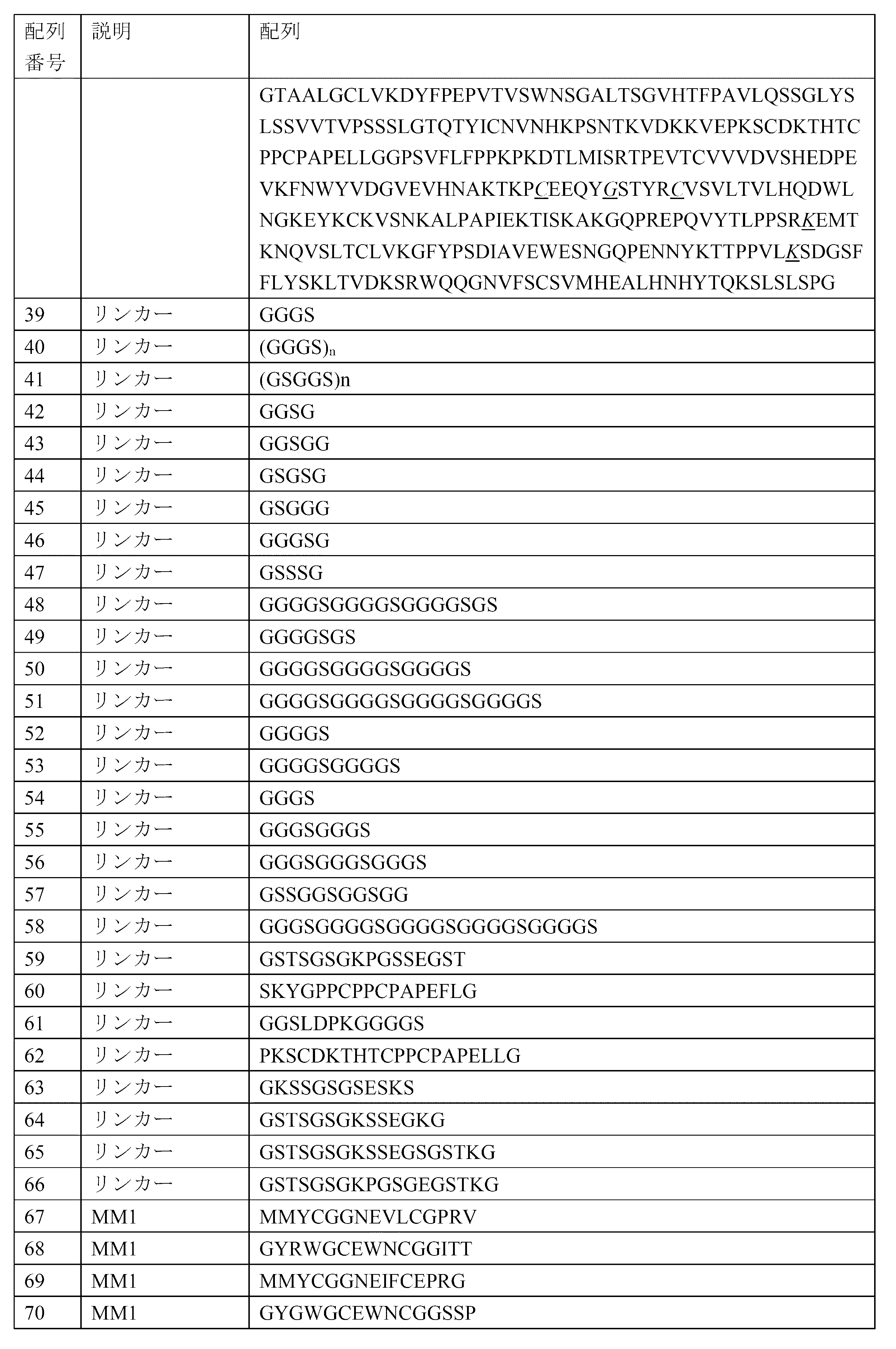


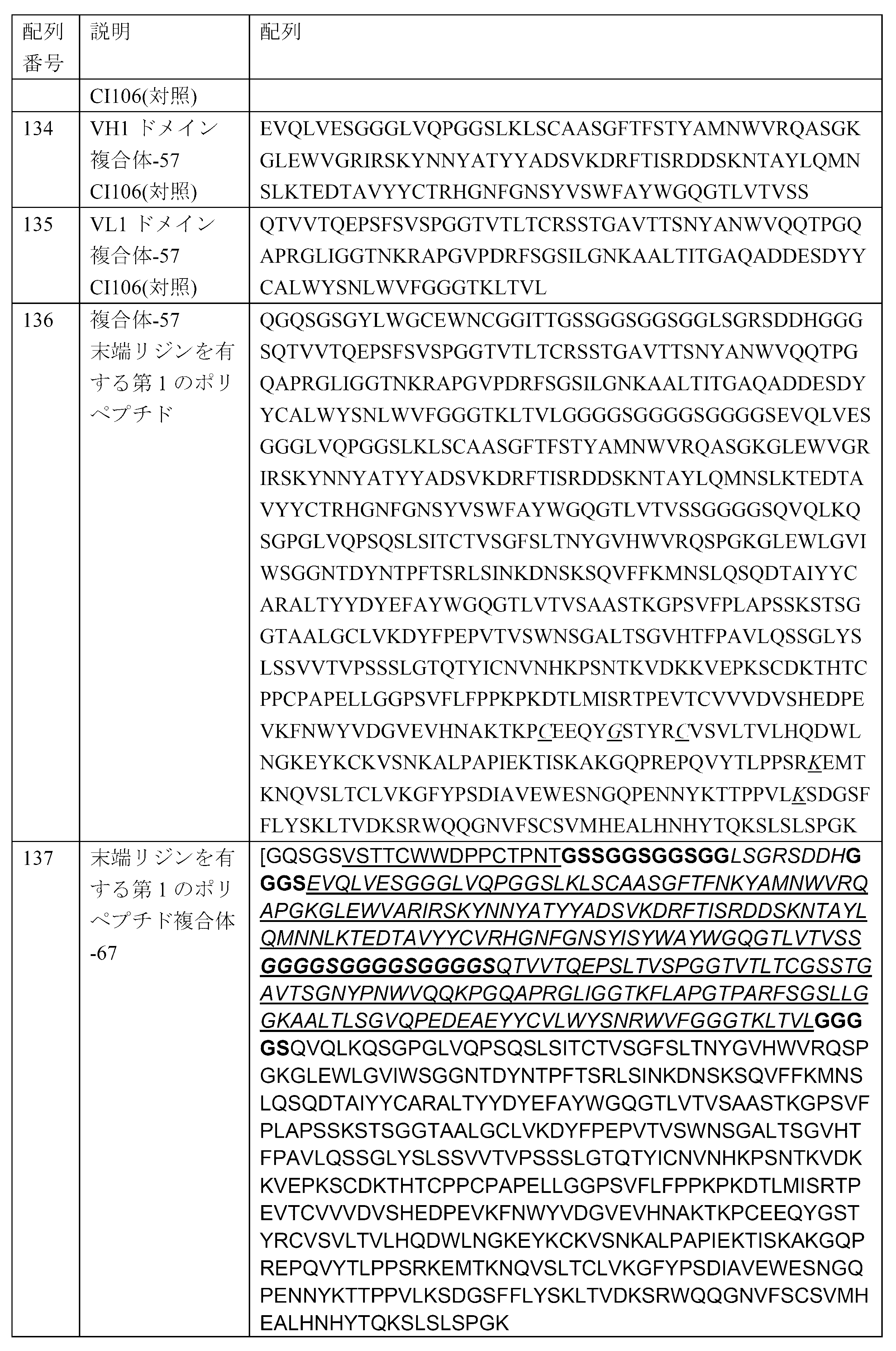


本開示は、本明細書に記載の態様によって範囲を限定されるものではない。実際、説明されたものに加えて、本開示のさまざまな改変が、上述の説明及び添付の図面から当業者に明らかになるであろう。そのような改変は、添付の特許請求の範囲の範囲内に入ることが意図される。 The present disclosure is not intended to be limited in scope by the aspects described herein. Indeed, various modifications of the present disclosure in addition to those described will become apparent to those skilled in the art from the foregoing description and accompanying drawings. Such modifications are intended to be within the scope of the appended claims.
本明細書に引用されたすべての参考文献(例えば、出版物または特許または特許出願)は、あたかも個々の参考文献(例えば、出版物または特許または特許出願)が具体的かつ個別にあらゆる目的のためにその全体が参照により組み込まれていることが示されているのと同程度に、その全体が参照により本明細書に組み込まれる。 All references (e.g., publications or patents or patent applications) cited in this specification are incorporated by reference in their entirety for all purposes to the same extent as if each individual reference (e.g., publication or patent or patent application) was specifically and individually indicated to be incorporated by reference in its entirety for all purposes.
いくつかの態様は、以下の特許請求の範囲内にある。 Some embodiments are within the scope of the following claims.
Claims (54)
(a)(i)第1の重鎖可変ドメイン(VH1)及び第1の軽鎖可変ドメイン(VL1)を含み、前記VH1と前記VL1が一緒になって第1の標的に特異的に結合する第1の標的化ドメインを形成する単鎖可変断片(scFv)、(ii)第1のマスキング部分(MM1)、(iii)第1の切断可能部分(CM1);(iv)第2の重鎖可変ドメイン(VH2)、及び(v)第1の単量体Fcドメイン(Fc1)、を含む第1のポリペプチドと;
(b)(i)第2の軽鎖可変ドメイン(VL2)であって、前記VH2と前記VL2が一緒になって第2の標的に特異的に結合する第2の標的化ドメインを形成する、前記VL2、(ii)第2のマスキング部分(MM2)、及び(iii)第2の切断可能部分(CM2)、を含む第2のポリペプチドと;
(c)(i)第2の単量体Fcドメイン(Fc2)を含み、かつ(ii)免疫グロブリン可変ドメインを含まない、第3のポリペプチドと、
を含み、
MM1が、前記第1の標的への前記第1の標的化ドメインの結合を妨げるペプチドであり、MM2が、前記第2の標的への前記第2の標的化ドメインの結合を妨げるペプチドである、
前記活性化可能なヘテロ多量体二重特異性ポリペプチド複合体(HBPC)。 1. An activatable heteromultimeric bispecific polypeptide complex (HBPC), comprising:
(a) a first polypeptide comprising: (i) a single chain variable fragment (scFv) comprising a first heavy chain variable domain (VH1) and a first light chain variable domain (VL1), wherein the VH1 and the VL1 together form a first targeting domain that specifically binds to a first target; (ii) a first masking moiety (MM1); (iii) a first cleavable moiety (CM1); (iv) a second heavy chain variable domain (VH2); and (v) a first monomeric Fc domain (Fc1);
(b) a second polypeptide comprising (i) a second light chain variable domain (VL2), wherein the VH2 and the VL2 together form a second targeting domain that specifically binds to a second target, (ii) a second masking moiety (MM2), and (iii) a second cleavable moiety (CM2);
(c) a third polypeptide comprising (i) a second monomeric Fc domain (Fc2) and (ii) no immunoglobulin variable domain; and
Including,
MM1 is a peptide that prevents binding of the first targeting domain to the first target, and MM2 is a peptide that prevents binding of the second targeting domain to the second target.
The activatable heteromultimeric bispecific polypeptide complex (HBPC).
MM1-CM1-scFv-VH2-CH1-HR1-Fc1のアミノ末端からカルボキシ末端までの構造配置を含み、それぞれの「-」が独立して直接的または間接的な連結である、請求項6に記載の活性化可能な二重特異性ポリペプチド複合体。 The first polypeptide comprises:
7. The activatable bispecific polypeptide complex of claim 6, comprising the amino- to carboxy-terminal structural arrangement of MM1-CM1-scFv-VH2-CH1-HR1-Fc1, wherein each "-" is independently a direct or indirect linkage.
(a)MM1とCM1の間;
(b)MM2とCM2の間;
(b)scFvの重鎖可変ドメインと軽鎖可変ドメインの間;
(c)重鎖可変ドメインとCH1ドメインの間;
(d)CH1ドメインとヒンジ領域の間;
(e)ヒンジ領域とFcドメインの間;
(g)CM2と軽鎖可変ドメインの間;
(h)軽鎖可変ドメインとCLの間;
(i)CH1ドメインと第2のFcドメインの間;
(j)CH1ドメインとヒンジ領域の間;及び/または
(k)ヒンジ領域と第2のFcドメインの間、
の位置のうちの1つ以上にリンカーを含む、請求項14に記載の活性化可能な二重特異性ポリペプチド複合体。 below:
(a) between MM1 and CM1;
(b) between MM2 and CM2;
(b) between the heavy and light chain variable domains of an scFv;
(c) between the heavy chain variable domain and the CH1 domain;
(d) between the CH1 domain and the hinge region;
(e) between the hinge region and the Fc domain;
(g) between CM2 and the light chain variable domain;
(h) between the light chain variable domain and the CL;
(i) between the CH1 domain and the second Fc domain;
(j) between the CH1 domain and the hinge region; and/or (k) between the hinge region and the second Fc domain,
15. The activatable bispecific polypeptide complex of claim 14, comprising a linker at one or more of the positions.
(i)(GS)n(式中、nは1~10の整数である)、(GGS)n(式中、nは少なくとも1の整数である)、(GGGS)n(配列番号40)、(GGGGS)n(配列番号126)(式中、nは少なくとも1の整数である)、(式中、nは少なくとも1の整数である)、(GSGGS)n(配列番号41)(式中、nは少なくとも1の整数である)、GSSGGSGGSG(配列番号12)、GGSG(配列番号42)、GGSGG(配列番号43)、GSGSG(配列番号44)、GSGGG(配列番号45)、GGGSG(配列番号46)、及びGSSSG(配列番号47)、GGGGSGGGGSGGGGSGS(配列番号48)、GGGGSGS(配列番号49)、GGGGSGGGGSGGGGS(配列番号50)、GGGGSGGGGSGGGGSGGGGS(配列番号51)、GGGGS(配列番号52)、GGGGSGGGGS(配列番号53)、GGGS(配列番号54)、GGGSGGGS(配列番号55)、GGGSGGGSGGGS(配列番号56)、GSSGGSGGSG(配列番号57)、GGGSGGGGSGGGGSGGGGSGGGGS(配列番号58)、GGGSSGGS(配列番号127)、及びGSからなる群から選択されるグリシン-セリンベースのリンカー;ならびに(ii)GSTSGSGKPGSSEGST(配列番号59)、SKYGPPCPPCPAPEFLG(配列番号60)、GGSLDPKGGGGS(配列番号61)、PKSCDKTHTCPPCPAPELLG(配列番号62)、GKSSGSGSESKS(配列番号63)、GSTSGSGKSSEGKG(配列番号64)、GSTSGSGKSSEGSGSTKG(配列番号65)、及びGSTSGSGKPGSGEGSTKG(配列番号66)からなる群から選択される、グリシン及びセリン、ならびにリジン、トレオニン、またはプロリンのうちの少なくとも1つを含むリンカー
からなる群から選択される、請求項15~31のいずれか1項に記載の活性化可能な二重特異性ポリペプチド複合体。 Each linker independently:
(i) (GS)n, where n is an integer from 1 to 10, (GGS)n, where n is an integer of at least 1, (GGGS)n (SEQ ID NO: 40), (GGGGS)n (SEQ ID NO: 126), where n is an integer of at least 1, (where n is an integer of at least 1), (GSGGS)n (SEQ ID NO: 41), where n is an integer of at least 1, GSSGGSGGSG (SEQ ID NO: 12), GGSG (SEQ ID NO: 42), GGSGG (SEQ ID NO: 43), GSGSG (SEQ ID NO: 44), GSGGG (SEQ ID NO: 45), GGGSG (SEQ ID NO: 46), and GSSSG (SEQ ID NO: 47), GGGGSGGGGSGGGGGSGS (SEQ ID NO: 48), GGGGGSGS (SEQ ID NO: 49), GGGGSGGGGSGGGGGS (SEQ ID NO: 50), GGGGSGGGGSGGGGSGGGGS (SEQ ID NO: 51), GGGGS (SEQ ID NO: 52), GGGGSGGGGS (SEQ ID NO: 53), GGGS (SEQ ID NO: 54), GGGSGGGS (SEQ ID NO: 55), GGGSGGGSGGGS (SEQ ID NO:56), GSSGGSGSGSG (SEQ ID NO:57), GGGSGGGGSGGGGSGGGGSGGGGGS (SEQ ID NO:58), GGGSSGGGS (SEQ ID NO:127), and GS; and (ii) a glycine-serine based linker selected from the group consisting of GSTSGSGKPGSSEGST (SEQ ID NO:59), SKYGPPCPPPCPAPEFLG (SEQ ID NO:60), GGSLDPKGGGGGS (SEQ ID NO:61), PKSCDKTHTCPPCPELLG (SEQ ID NO:62), 32), GKSSGSGSESKS (SEQ ID NO: 63), GSTSGSGKSSEGKG (SEQ ID NO: 64), GSTSGSGKSSEGSGSGTKG (SEQ ID NO: 65), and GSTSGSGKPGSGEGSTKG (SEQ ID NO: 66);
(a)請求項44に記載の宿主細胞を、前記活性化可能なHBPCを生成するのに十分な条件下で、液体培地中で培養することと;
(b)前記活性化可能なHBPCを回収することと、
を含む、前記方法。 1. A method for producing an activatable bispecific polypeptide complex comprising:
(a) culturing the host cell of claim 44 in a liquid medium under conditions sufficient to produce the activatable HBPCs;
(b) recovering the activatable HBPCs; and
The method comprising:
(a)(i)単鎖可変断片(scFv)であって、前記scFvが、第1の重鎖可変ドメイン(VH1)及び第1の軽鎖可変ドメイン(VL1)を含み、VH1とVL1が一緒になってT細胞抗原ポリペプチドに特異的に結合するT細胞抗原標的化ドメインを形成する前記scFv、(ii)第1のマスキング部分(MM1)、(iii)第1の切断可能部分(CM1);(iv)第2の重鎖可変ドメイン(VH2)、(v)第1の単量体Fcドメイン(Fc1)、(vi)重鎖CH1ドメイン、及び(vii)前記CH1ドメインと前記Fc1の間の免疫グロブリンヒンジ領域を含む、第1のポリペプチドと;
(b)(i)前記VH2と対形成する場合にがん細胞表面抗原に特異的に結合する第2の軽鎖可変ドメイン(VL2)、(ii)第2のマスキング部分(MM2)、(iii)第2の切断可能部分(CM2)、及び(iv)軽鎖定常ドメインCL1を含む、第2のポリペプチドと;
(c)第2の単量体Fcドメイン(Fc2)及び免疫グロブリンヒンジ領域(HR2)を含み、免疫グロブリン可変ドメインを含まない、第3のポリペプチドと;
を含み、
前記第1のポリペプチドが、MM1-CM1-scFv1-VH2-CH1-HR1-Fc1のアミノ末端からカルボキシ末端までの構造配置を含み;
前記第2のポリペプチドが、MM2-CM2-VL2-CL1のアミノ末端からカルボキシ末端までの構造配置を含み;
前記第3のポリペプチドが、HR2-Fc2のアミノ末端からカルボキシ末端までの構造配置を有し、それぞれの「-」は独立して直接的または間接的な連結である、前記活性化可能な二重特異性ポリペプチド複合体。 1. An activatable bispecific polypeptide complex comprising:
(a) a first polypeptide comprising: (i) a single chain variable fragment (scFv), the scFv comprising a first heavy chain variable domain (VH1) and a first light chain variable domain (VL1), the VH1 and VL1 together forming a T cell antigen targeting domain that specifically binds to a T cell antigen polypeptide; (ii) a first masking moiety (MM1); (iii) a first cleavable moiety (CM1); (iv) a second heavy chain variable domain (VH2); (v) a first monomeric Fc domain (Fc1); (vi) a heavy chain CH1 domain, and (vii) an immunoglobulin hinge region between the CH1 domain and the Fc1;
(b) a second polypeptide comprising (i) a second light chain variable domain (VL2) that specifically binds to a cancer cell surface antigen when paired with said VH2, (ii) a second masking moiety (MM2), (iii) a second cleavable moiety (CM2), and (iv) a light chain constant domain (CL1);
(c) a third polypeptide comprising a second monomeric Fc domain (Fc2) and an immunoglobulin hinge region (HR2), and no immunoglobulin variable domain;
Including,
the first polypeptide comprises the amino- to carboxy-terminal structural arrangement of MM1-CM1-scFv1-VH2-CH1-HR1-Fc1;
the second polypeptide comprises the amino- to carboxy-terminal structural arrangement of MM2-CM2-VL2-CL1;
The activatable bispecific polypeptide complex, wherein the third polypeptide has the structural arrangement of the amino to carboxy terminus of HR2-Fc2, and each "-" is independently a direct or indirect linkage.
(a)(i)がん細胞表面抗原に特異的に結合する単鎖可変断片(scFv)、(ii)第1のマスキング部分(MM1)、及び(iii)第1の切断可能部分(CM1);(iv)重鎖可変ドメイン(VH2)、(v)第1の単量体Fcドメイン(Fc1)、(vi)重鎖CH1ドメイン、及び(vii)前記CH1ドメインと前記第1の単量体Fcドメインの間の免疫グロブリンヒンジ領域、を含むがん細胞表面抗原標的化ドメインを含む、第1のポリペプチドと;
(b)(i)前記第1のポリペプチドのVH2と対形成する場合にT細胞抗原ポリペプチドに特異的に結合する軽鎖可変ドメイン(VL2)、(ii)第2のマスキング部分(MM2)、(iii)第2の切断可能部分(CM2)、及び(iv)軽鎖定常ドメインCL1、を含む第2のポリペプチドと;
(c)第2の単量体Fcドメイン(Fc2)及び免疫グロブリンヒンジ領域を含む、第3のポリペプチドと;
を含み、
前記第1のポリペプチドが、MM1-CM1-scFv1-VH2-CH1-HR1-Fc1のアミノ末端からカルボキシ末端までの構造配置を含み;
前記第2のポリペプチドが、MM2-CM2-VL2-CL1のアミノ末端からカルボキシ末端までの構造配置を含み;
前記第3のポリペプチドが、HR2-Fc2のアミノ末端からカルボキシ末端までの構造配置を有し、それぞれの「-」が独立して直接的または間接的な連結であり、前記第3のポリペプチドが、免疫グロブリン可変ドメインを含まない、前記活性化可能なヘテロ多量体二重特異性ポリペプチド複合体(HBPC)。 1. An activatable heteromultimeric bispecific polypeptide complex (HBPC), comprising:
(a) a first polypeptide comprising: (i) a single chain variable fragment (scFv) that specifically binds to a cancer cell surface antigen, (ii) a first masking moiety (MM1), and (iii) a first cleavable moiety (CM1); (iv) a heavy chain variable domain (VH2), (v) a first monomeric Fc domain (Fc1), (vi) a heavy chain CH1 domain, and (vii) an immunoglobulin hinge region between the CH1 domain and the first monomeric Fc domain;
(b) a second polypeptide comprising (i) a light chain variable domain (VL2) that specifically binds to a T cell antigen polypeptide when paired with the VH2 of the first polypeptide, (ii) a second masking moiety (MM2), (iii) a second cleavable moiety (CM2), and (iv) a light chain constant domain (CL1);
(c) a third polypeptide comprising a second monomeric Fc domain (Fc2) and an immunoglobulin hinge region;
Including,
the first polypeptide comprises the amino- to carboxy-terminal structural arrangement of MM1-CM1-scFv1-VH2-CH1-HR1-Fc1;
the second polypeptide comprises the amino- to carboxy-terminal structural arrangement of MM2-CM2-VL2-CL1;
The activatable heteromultimeric bispecific polypeptide complex (HBPC), wherein the third polypeptide has a structural arrangement from the amino terminus to the carboxy terminus of HR2-Fc2, each "-" being independently a direct or indirect linkage, and wherein the third polypeptide does not contain an immunoglobulin variable domain.
(a)(i)がん細胞表面抗原に特異的に結合する単鎖可変断片(scFv)、(ii)第1のマスキング部分(MM1)、及び(iii)第1の切断可能部分(CM1);及び重鎖可変ドメイン(VH2)、(iv)第1の単量体Fcドメイン(Fc1)、(v)重鎖CH1ドメイン、及び前記CH1ドメインと(vii)前記第1の単量体Fcドメインの間の免疫グロブリンヒンジ領域、を含む第1のポリペプチドと;
(b)(i)前記第1のポリペプチドのVH2と対形成する場合にT細胞抗原ポリペプチドに特異的に結合する軽鎖可変ドメイン(VL2)、(ii)第2のマスキング部分(MM2)、(iii)第2の切断可能部分(CM2)、及び(iv)軽鎖定常ドメインCL1を含む、第2のポリペプチドと;
(c)第2の単量体Fcドメイン(Fc2)及び免疫グロブリンヒンジ領域からなる、第3のポリペプチドと;
を含み、
前記第1のポリペプチドが、MM1-CM1-scFv1-VH2-CH1-HR1-Fc1のアミノ末端からカルボキシ末端までの構造配置を有し;
前記第2のポリペプチドが、MM2-CM2-VL2-CL1のアミノ末端からカルボキシ末端までの構造配置を有し;
前記第3のポリペプチドが、HR2-Fc2のアミノ末端からカルボキシ末端までの構造配置を有し、それぞれの「-」が独立して直接的または間接的な連結であり、前記第3のポリペプチドが、免疫グロブリン可変ドメインを含まない、前記活性化可能なヘテロ多量体二重特異性ポリペプチド複合体(HBPC)。 1. An activatable heteromultimeric bispecific polypeptide complex (HBPC), comprising:
(a) a first polypeptide comprising: (i) a single chain variable fragment (scFv) that specifically binds to a cancer cell surface antigen, (ii) a first masking moiety (MM1), and (iii) a first cleavable moiety (CM1); and a heavy chain variable domain (VH2), (iv) a first monomeric Fc domain (Fc1), (v) a heavy chain CH1 domain, and an immunoglobulin hinge region between the CH1 domain and (vii) the first monomeric Fc domain;
(b) a second polypeptide comprising (i) a light chain variable domain (VL2) that specifically binds to a T cell antigen polypeptide when paired with the VH2 of the first polypeptide, (ii) a second masking moiety (MM2), (iii) a second cleavable moiety (CM2), and (iv) a light chain constant domain (CL1);
(c) a third polypeptide consisting of a second monomeric Fc domain (Fc2) and an immunoglobulin hinge region;
Including,
the first polypeptide has the amino- to carboxy-terminal structural arrangement of MM1-CM1-scFv1-VH2-CH1-HR1-Fc1;
the second polypeptide has the amino-terminal to carboxy-terminal structural arrangement of MM2-CM2-VL2-CL1;
The activatable heteromultimeric bispecific polypeptide complex (HBPC), wherein said third polypeptide has a structural arrangement from the amino terminus to the carboxy terminus of HR2-Fc2, each "-" being independently a direct or indirect linkage, and wherein said third polypeptide does not contain an immunoglobulin variable domain.
(a)(i)第1の重鎖可変ドメイン(VH1)及び第1の軽鎖可変ドメイン(VL1)を含み、前記VH1と前記VL1が一緒になって第1の標的に特異的に結合する第1の標的化ドメインを形成する、単鎖可変断片(scFv)、(ii)第2の重鎖可変ドメイン(VH2)、及び(iii)第1の単量体Fcドメイン(Fc1)、を含む第1のポリペプチドと、
(b)第2の軽鎖可変ドメイン(VL2)を含み、前記VH2と前記VL2が一緒になって、第2の標的に特異的に結合する第2の標的化ドメインを形成する、第2のポリペプチドと、
(c)第2の単量体Fcドメイン(Fc2)を含み、免疫グロブリン可変ドメインを含まない、第3のポリペプチドと、
を含む、前記ヘテロ多量体二重特異性ポリペプチド複合体(HBPC)。 A heteromultimeric bispecific polypeptide complex (HBPC), comprising:
(a) a first polypeptide comprising: (i) a single chain variable fragment (scFv) comprising a first heavy chain variable domain (VH1) and a first light chain variable domain (VL1), said VH1 and said VL1 together forming a first targeting domain that specifically binds to a first target; (ii) a second heavy chain variable domain (VH2); and (iii) a first monomeric Fc domain (Fc1);
(b) a second polypeptide comprising a second light chain variable domain (VL2), said VH2 and said VL2 together forming a second targeting domain that specifically binds to a second target; and
(c) a third polypeptide comprising a second monomeric Fc domain (Fc2) and no immunoglobulin variable domain; and
The heteromultimeric bispecific polypeptide complex (HBPC), comprising:
Applications Claiming Priority (5)
| Application Number | Priority Date | Filing Date | Title |
|---|---|---|---|
| US202163256417P | 2021-10-15 | 2021-10-15 | |
| US63/256,417 | 2021-10-15 | ||
| US202263370897P | 2022-08-09 | 2022-08-09 | |
| US63/370,897 | 2022-08-09 | ||
| PCT/US2022/078160 WO2023064929A1 (en) | 2021-10-15 | 2022-10-14 | Activatable polypeptide complex |
Publications (2)
| Publication Number | Publication Date |
|---|---|
| JP2024538141A true JP2024538141A (en) | 2024-10-18 |
| JPWO2023064929A5 JPWO2023064929A5 (en) | 2025-10-21 |
Family
ID=84330396
Family Applications (1)
| Application Number | Title | Priority Date | Filing Date |
|---|---|---|---|
| JP2024522609A Pending JP2024538141A (en) | 2021-10-15 | 2022-10-14 | Activatable Polypeptide Complexes |
Country Status (11)
| Country | Link |
|---|---|
| US (1) | US20230174995A1 (en) |
| EP (1) | EP4416178A1 (en) |
| JP (1) | JP2024538141A (en) |
| KR (1) | KR20240118749A (en) |
| AU (1) | AU2022367525A1 (en) |
| CA (1) | CA3235018A1 (en) |
| CL (1) | CL2024001178A1 (en) |
| IL (1) | IL312143A (en) |
| MX (1) | MX2024004564A (en) |
| TW (1) | TW202323282A (en) |
| WO (1) | WO2023064929A1 (en) |
Families Citing this family (4)
| Publication number | Priority date | Publication date | Assignee | Title |
|---|---|---|---|---|
| US20250297006A1 (en) * | 2024-03-20 | 2025-09-25 | Regeneron Pharmaceuticals, Inc. | Masked Multispecific Antigen-Binding Molecules with Cleavable Linkers |
| WO2025235515A1 (en) | 2024-05-07 | 2025-11-13 | Cytomx Therapeutics, Inc. | Activatable polypeptide complex formulations |
| WO2025240659A2 (en) * | 2024-05-14 | 2025-11-20 | Cytomx Therapeutics, Inc. | Activatable constructs, compositions and methods |
| WO2026024841A1 (en) | 2024-07-24 | 2026-01-29 | Astellas Us Llc | Bispecific antibodies that bind cd3 and muc1 and methods of use thereof |
Family Cites Families (34)
| Publication number | Priority date | Publication date | Assignee | Title |
|---|---|---|---|---|
| US5807715A (en) | 1984-08-27 | 1998-09-15 | The Board Of Trustees Of The Leland Stanford Junior University | Methods and transformed mammalian lymphocyte cells for producing functional antigen-binding protein including chimeric immunoglobulin |
| EP0216846B2 (en) | 1985-04-01 | 1995-04-26 | Celltech Limited | Transformed myeloma cell-line and a process for the expression of a gene coding for a eukaryotic polypeptide employing same |
| GB8601597D0 (en) | 1986-01-23 | 1986-02-26 | Wilson R H | Nucleotide sequences |
| GB8717430D0 (en) | 1987-07-23 | 1987-08-26 | Celltech Ltd | Recombinant dna product |
| US6174666B1 (en) | 1992-03-27 | 2001-01-16 | The United States Of America As Represented By The Department Of Health And Human Services | Method of eliminating inhibitory/instability regions from mRNA |
| US5605793A (en) | 1994-02-17 | 1997-02-25 | Affymax Technologies N.V. | Methods for in vitro recombination |
| GB9701425D0 (en) | 1997-01-24 | 1997-03-12 | Bioinvent Int Ab | A method for in vitro molecular evolution of protein function |
| CA2313380C (en) | 1997-12-08 | 2008-12-30 | California Institute Of Technology | Method for creating polynucleotide and polypeptide sequences |
| AU1456101A (en) | 1999-11-03 | 2001-05-14 | Maxygen, Inc. | Antibody diversity generation |
| WO2009014726A1 (en) | 2007-07-26 | 2009-01-29 | The Regents Of The University Of California | Methods for enhancing bacterial cell display of proteins and peptides |
| CA3128656A1 (en) | 2007-08-22 | 2009-02-26 | The Regents Of The University Of California | Activatable binding polypeptides and methods of identification and use thereof |
| CN106995495A (en) | 2009-01-12 | 2017-08-01 | 希托马克斯医疗有限责任公司 | Modified antibodies composition and its preparation and application |
| CN104540518A (en) | 2012-04-27 | 2015-04-22 | 西托姆克斯治疗公司 | Activatable antibodies that bind epidermal growth factor receptor and methods of use thereof |
| JP2015521625A (en) | 2012-06-22 | 2015-07-30 | シトムクス セラピューティクス,インコーポレイティド | Anti-Jagged1 / Jagged2 cross-reactive antibodies, activatable anti-Jagged antibodies and methods for their use |
| WO2014026136A2 (en) | 2012-08-10 | 2014-02-13 | Cytomx Therapeutics, Inc. | Protease-resistant systems for polypeptide display and methods of making and using thereof |
| WO2014052462A2 (en) | 2012-09-25 | 2014-04-03 | Cytomx Therapeutics, Inc. | Activatable antibodies that bind interleukin-6 receptor and methods of use thereof |
| KR102216088B1 (en) | 2013-07-25 | 2021-02-15 | 싸이톰스 테라퓨틱스, 인크. | Multispecific antibodies, multispecific activatable antibodies and methods of using the same |
| RU2715232C2 (en) | 2013-09-25 | 2020-02-26 | Сайтомкс Терапьютикс, Инк. | Substrates of matrix metalloproteinase and other cleavable moieties and methods for use thereof |
| US9540440B2 (en) | 2013-10-30 | 2017-01-10 | Cytomx Therapeutics, Inc. | Activatable antibodies that bind epidermal growth factor receptor and methods of use thereof |
| CN114106099B (en) | 2014-01-31 | 2024-05-24 | 西托姆克斯治疗公司 | Substrates and other cleavable moieties for proteolytic enzymes and U-shaped plasminogen activators and methods of use thereof |
| US10669337B2 (en) | 2014-07-25 | 2020-06-02 | Cytomx Therapeutics, Inc. | Bispecific anti-CD3 antibodies, bispecific activatable anti-CD3 antibodies, and methods of using the same |
| MA41374A (en) | 2015-01-20 | 2017-11-28 | Cytomx Therapeutics Inc | MATRIX METALLOPROTEASE CLIVABLE AND SERINE PROTEASE CLIVABLE SUBSTRATES AND METHODS OF USE THEREOF |
| SG11201707383PA (en) | 2015-03-13 | 2017-10-30 | Cytomx Therapeutics Inc | Anti-pdl1 antibodies, activatable anti-pdl1 antibodies, and methods of use thereof |
| WO2016179335A1 (en) | 2015-05-04 | 2016-11-10 | Cytomx Therapeutics, Inc. | Anti-itga3 antibodies, activatable anti-itga3 antibodies, and methods of use thereof |
| US10179817B2 (en) | 2015-05-04 | 2019-01-15 | Cytomx Therapeutics, Inc. | Anti-CD71 antibodies, activatable anti-CD71 antibodies, and methods of use thereof |
| HRP20200721T1 (en) | 2015-05-04 | 2020-10-02 | Cytomx Therapeutics Inc. | Anti-cd166 antibodies, activatable anti-cd166 antibodies, and methods of use thereof |
| MA42447A (en) | 2015-07-13 | 2018-05-23 | Cytomx Therapeutics Inc | ANTI-PD-1 ANTIBODIES, ACTIVABLE ANTI-PD-1 ANTIBODIES, AND METHODS OF USE THEREOF |
| WO2017162587A1 (en) * | 2016-03-22 | 2017-09-28 | F. Hoffmann-La Roche Ag | Protease-activated t cell bispecific molecules |
| NZ750001A (en) * | 2016-08-16 | 2025-09-26 | Epimab Biotherapeutics Inc | Monovalent asymmetric tandem fab bispecific antibodies |
| WO2018045110A1 (en) * | 2016-08-30 | 2018-03-08 | Xencor, Inc. | Bispecific immunomodulatory antibodies that bind costimulatory and checkpoint receptors |
| US11472889B2 (en) | 2017-10-14 | 2022-10-18 | Cytomx Therapeutics, Inc. | Antibodies, activatable antibodies, bispecific antibodies, and bispecific activatable antibodies and methods of use thereof |
| MX2020003497A (en) * | 2017-10-20 | 2020-07-22 | Hoffmann La Roche | Method for generating multispecific antibodies from monospecific antibodies. |
| EP3788077A1 (en) | 2018-05-02 | 2021-03-10 | CytomX Therapeutics, Inc. | Antibodies, activatable antibodies, bispecific antibodies, and bispecific activatable antibodies and methods of use thereof |
| WO2020198661A1 (en) * | 2019-03-28 | 2020-10-01 | Orionis Biosciences, Inc. | Chimeric proteins and chimeric protein complexes directed to fms-like tyrosine kinase 3 (flt3) |
-
2022
- 2022-10-14 US US18/046,860 patent/US20230174995A1/en active Pending
- 2022-10-14 JP JP2024522609A patent/JP2024538141A/en active Pending
- 2022-10-14 KR KR1020247013820A patent/KR20240118749A/en active Pending
- 2022-10-14 MX MX2024004564A patent/MX2024004564A/en unknown
- 2022-10-14 TW TW111139144A patent/TW202323282A/en unknown
- 2022-10-14 WO PCT/US2022/078160 patent/WO2023064929A1/en not_active Ceased
- 2022-10-14 AU AU2022367525A patent/AU2022367525A1/en active Pending
- 2022-10-14 EP EP22801672.1A patent/EP4416178A1/en active Pending
- 2022-10-14 CA CA3235018A patent/CA3235018A1/en active Pending
- 2022-10-14 IL IL312143A patent/IL312143A/en unknown
-
2024
- 2024-04-15 CL CL2024001178A patent/CL2024001178A1/en unknown
Also Published As
| Publication number | Publication date |
|---|---|
| IL312143A (en) | 2024-06-01 |
| TW202323282A (en) | 2023-06-16 |
| AU2022367525A1 (en) | 2024-05-02 |
| CL2024001178A1 (en) | 2024-10-04 |
| CA3235018A1 (en) | 2023-04-20 |
| WO2023064929A1 (en) | 2023-04-20 |
| US20230174995A1 (en) | 2023-06-08 |
| KR20240118749A (en) | 2024-08-05 |
| EP4416178A1 (en) | 2024-08-21 |
| MX2024004564A (en) | 2024-04-30 |
Similar Documents
| Publication | Publication Date | Title |
|---|---|---|
| JP7646361B2 (en) | Anti-PVRIG/Anti-TIGIT Bispecific Antibodies and Methods of Use | |
| JP7369127B2 (en) | Single domain antibodies against TIGIT and variants thereof | |
| US11780919B2 (en) | Bispecific antigen binding molecules targeting OX40 and FAP | |
| KR102412023B1 (en) | Combination of lenalidomide or pomalidomide and cd38 antibody-attenuated interferon-alpha constructs, and the use thereof | |
| US9540442B2 (en) | Antibodies or fusion proteins multimerized via cysteine mutation and a mu tailpiece | |
| US20220010010A1 (en) | Antibodies specific for immunoglobulin-like transcript 3 (ilt3) and uses thereof | |
| JP2024538141A (en) | Activatable Polypeptide Complexes | |
| KR20180130574A (en) | Novel B7-H3-binding molecules, antibody drug conjugates thereof and methods for their use | |
| US20230183382A1 (en) | Activatable polypeptide complex | |
| JP7754506B2 (en) | Antibodies to the poliovirus receptor (PVR) and uses thereof | |
| KR20240032847A (en) | Bispecific binding agent binding to CLDN18.2 and CD3 | |
| WO2021129775A1 (en) | Anti-ctla-4 monoclonal antibody, preparation method therefor, and application thereof | |
| WO2023064955A1 (en) | Activatable anti-cd3, anti-egfr, heteromultimeric bispecific polypeptide complex | |
| US20250243283A1 (en) | Activatable anti-cd3, anti-egfr, heteromultimeric bispecific polypeptide complex | |
| TW202346366A (en) | Antigen-binding proteins targeting PD-L1 and CD40 and their preparation and application | |
| JP2025509555A (en) | Binding Agents That Bind EPCAM and/or CD137 | |
| CN118103406A (en) | Activatable polypeptide complexes | |
| WO2025235515A1 (en) | Activatable polypeptide complex formulations | |
| TW202434631A (en) | Methods of use of anti-il-2 antibodies | |
| WO2025184154A1 (en) | Pd1-targeted novel il-2 vitokine fusions | |
| JP2025531805A (en) | Novel PD1-targeted IL-15 immunocytokines and VITOKINE fusions | |
| JP2025510566A (en) | Anti-glucocorticoid-induced TNFR-related (GITR) protein antibodies and uses thereof |
Legal Events
| Date | Code | Title | Description |
|---|---|---|---|
| A521 | Request for written amendment filed |
Free format text: JAPANESE INTERMEDIATE CODE: A523 Effective date: 20251010 |
|
| A621 | Written request for application examination |
Free format text: JAPANESE INTERMEDIATE CODE: A621 Effective date: 20251010 |