JP2024537048A - Amide-functionalized polymerization initiators and their use in the manufacture of ophthalmic lenses - Patents.com - Google Patents
Amide-functionalized polymerization initiators and their use in the manufacture of ophthalmic lenses - Patents.com Download PDFInfo
- Publication number
- JP2024537048A JP2024537048A JP2024519333A JP2024519333A JP2024537048A JP 2024537048 A JP2024537048 A JP 2024537048A JP 2024519333 A JP2024519333 A JP 2024519333A JP 2024519333 A JP2024519333 A JP 2024519333A JP 2024537048 A JP2024537048 A JP 2024537048A
- Authority
- JP
- Japan
- Prior art keywords
- polymerization initiator
- compound
- alkyl
- monomer mixture
- independently
- Prior art date
- Legal status (The legal status is an assumption and is not a legal conclusion. Google has not performed a legal analysis and makes no representation as to the accuracy of the status listed.)
- Pending
Links
Images


Classifications
-
- C—CHEMISTRY; METALLURGY
- C08—ORGANIC MACROMOLECULAR COMPOUNDS; THEIR PREPARATION OR CHEMICAL WORKING-UP; COMPOSITIONS BASED THEREON
- C08F—MACROMOLECULAR COMPOUNDS OBTAINED BY REACTIONS ONLY INVOLVING CARBON-TO-CARBON UNSATURATED BONDS
- C08F2/00—Processes of polymerisation
- C08F2/46—Polymerisation initiated by wave energy or particle radiation
- C08F2/48—Polymerisation initiated by wave energy or particle radiation by ultraviolet or visible light
- C08F2/50—Polymerisation initiated by wave energy or particle radiation by ultraviolet or visible light with sensitising agents
-
- A—HUMAN NECESSITIES
- A61—MEDICAL OR VETERINARY SCIENCE; HYGIENE
- A61K—PREPARATIONS FOR MEDICAL, DENTAL OR TOILETRY PURPOSES
- A61K31/00—Medicinal preparations containing organic active ingredients
- A61K31/74—Synthetic polymeric materials
- A61K31/785—Polymers containing nitrogen
-
- A—HUMAN NECESSITIES
- A61—MEDICAL OR VETERINARY SCIENCE; HYGIENE
- A61K—PREPARATIONS FOR MEDICAL, DENTAL OR TOILETRY PURPOSES
- A61K9/00—Medicinal preparations characterised by special physical form
- A61K9/0012—Galenical forms characterised by the site of application
- A61K9/0048—Eye, e.g. artificial tears
-
- A—HUMAN NECESSITIES
- A61—MEDICAL OR VETERINARY SCIENCE; HYGIENE
- A61K—PREPARATIONS FOR MEDICAL, DENTAL OR TOILETRY PURPOSES
- A61K9/00—Medicinal preparations characterised by special physical form
- A61K9/0012—Galenical forms characterised by the site of application
- A61K9/0048—Eye, e.g. artificial tears
- A61K9/0051—Ocular inserts, ocular implants
-
- C—CHEMISTRY; METALLURGY
- C08—ORGANIC MACROMOLECULAR COMPOUNDS; THEIR PREPARATION OR CHEMICAL WORKING-UP; COMPOSITIONS BASED THEREON
- C08F—MACROMOLECULAR COMPOUNDS OBTAINED BY REACTIONS ONLY INVOLVING CARBON-TO-CARBON UNSATURATED BONDS
- C08F120/00—Homopolymers of compounds having one or more unsaturated aliphatic radicals, each having only one carbon-to-carbon double bond, and only one being terminated by only one carboxyl radical or a salt, anhydride, ester, amide, imide or nitrile thereof
- C08F120/02—Monocarboxylic acids having less than ten carbon atoms; Derivatives thereof
- C08F120/52—Amides or imides
- C08F120/54—Amides, e.g. N,N-dimethylacrylamide or N-isopropylacrylamide
-
- C—CHEMISTRY; METALLURGY
- C08—ORGANIC MACROMOLECULAR COMPOUNDS; THEIR PREPARATION OR CHEMICAL WORKING-UP; COMPOSITIONS BASED THEREON
- C08F—MACROMOLECULAR COMPOUNDS OBTAINED BY REACTIONS ONLY INVOLVING CARBON-TO-CARBON UNSATURATED BONDS
- C08F126/00—Homopolymers of compounds having one or more unsaturated aliphatic radicals, each having only one carbon-to-carbon double bond, and at least one being terminated by a single or double bond to nitrogen or by a heterocyclic ring containing nitrogen
- C08F126/06—Homopolymers of compounds having one or more unsaturated aliphatic radicals, each having only one carbon-to-carbon double bond, and at least one being terminated by a single or double bond to nitrogen or by a heterocyclic ring containing nitrogen by a heterocyclic ring containing nitrogen
- C08F126/10—N-Vinyl-pyrrolidone
-
- C—CHEMISTRY; METALLURGY
- C08—ORGANIC MACROMOLECULAR COMPOUNDS; THEIR PREPARATION OR CHEMICAL WORKING-UP; COMPOSITIONS BASED THEREON
- C08F—MACROMOLECULAR COMPOUNDS OBTAINED BY REACTIONS ONLY INVOLVING CARBON-TO-CARBON UNSATURATED BONDS
- C08F2/00—Processes of polymerisation
- C08F2/04—Polymerisation in solution
- C08F2/06—Organic solvent
-
- C—CHEMISTRY; METALLURGY
- C08—ORGANIC MACROMOLECULAR COMPOUNDS; THEIR PREPARATION OR CHEMICAL WORKING-UP; COMPOSITIONS BASED THEREON
- C08F—MACROMOLECULAR COMPOUNDS OBTAINED BY REACTIONS ONLY INVOLVING CARBON-TO-CARBON UNSATURATED BONDS
- C08F2/00—Processes of polymerisation
- C08F2/46—Polymerisation initiated by wave energy or particle radiation
- C08F2/48—Polymerisation initiated by wave energy or particle radiation by ultraviolet or visible light
-
- C—CHEMISTRY; METALLURGY
- C08—ORGANIC MACROMOLECULAR COMPOUNDS; THEIR PREPARATION OR CHEMICAL WORKING-UP; COMPOSITIONS BASED THEREON
- C08F—MACROMOLECULAR COMPOUNDS OBTAINED BY REACTIONS ONLY INVOLVING CARBON-TO-CARBON UNSATURATED BONDS
- C08F22/00—Homopolymers and copolymers of compounds having one or more unsaturated aliphatic radicals each having only one carbon-to-carbon double bond, and at least one being terminated by a carboxyl radical and containing at least one other carboxyl radical in the molecule; Salts, anhydrides, esters, amides, imides or nitriles thereof
- C08F22/36—Amides or imides
- C08F22/38—Amides
-
- C—CHEMISTRY; METALLURGY
- C08—ORGANIC MACROMOLECULAR COMPOUNDS; THEIR PREPARATION OR CHEMICAL WORKING-UP; COMPOSITIONS BASED THEREON
- C08F—MACROMOLECULAR COMPOUNDS OBTAINED BY REACTIONS ONLY INVOLVING CARBON-TO-CARBON UNSATURATED BONDS
- C08F220/00—Copolymers of compounds having one or more unsaturated aliphatic radicals, each having only one carbon-to-carbon double bond, and only one being terminated by only one carboxyl radical or a salt, anhydride ester, amide, imide or nitrile thereof
- C08F220/02—Monocarboxylic acids having less than ten carbon atoms; Derivatives thereof
- C08F220/52—Amides or imides
- C08F220/54—Amides, e.g. N,N-dimethylacrylamide or N-isopropylacrylamide
-
- C—CHEMISTRY; METALLURGY
- C08—ORGANIC MACROMOLECULAR COMPOUNDS; THEIR PREPARATION OR CHEMICAL WORKING-UP; COMPOSITIONS BASED THEREON
- C08F—MACROMOLECULAR COMPOUNDS OBTAINED BY REACTIONS ONLY INVOLVING CARBON-TO-CARBON UNSATURATED BONDS
- C08F226/00—Copolymers of compounds having one or more unsaturated aliphatic radicals, each having only one carbon-to-carbon double bond, and at least one being terminated by a single or double bond to nitrogen or by a heterocyclic ring containing nitrogen
- C08F226/06—Copolymers of compounds having one or more unsaturated aliphatic radicals, each having only one carbon-to-carbon double bond, and at least one being terminated by a single or double bond to nitrogen or by a heterocyclic ring containing nitrogen by a heterocyclic ring containing nitrogen
- C08F226/10—N-Vinyl-pyrrolidone
-
- C—CHEMISTRY; METALLURGY
- C08—ORGANIC MACROMOLECULAR COMPOUNDS; THEIR PREPARATION OR CHEMICAL WORKING-UP; COMPOSITIONS BASED THEREON
- C08F—MACROMOLECULAR COMPOUNDS OBTAINED BY REACTIONS ONLY INVOLVING CARBON-TO-CARBON UNSATURATED BONDS
- C08F230/00—Copolymers of compounds having one or more unsaturated aliphatic radicals, each having only one carbon-to-carbon double bond, and containing phosphorus, selenium, tellurium or a metal
- C08F230/02—Copolymers of compounds having one or more unsaturated aliphatic radicals, each having only one carbon-to-carbon double bond, and containing phosphorus, selenium, tellurium or a metal containing phosphorus
-
- C—CHEMISTRY; METALLURGY
- C08—ORGANIC MACROMOLECULAR COMPOUNDS; THEIR PREPARATION OR CHEMICAL WORKING-UP; COMPOSITIONS BASED THEREON
- C08F—MACROMOLECULAR COMPOUNDS OBTAINED BY REACTIONS ONLY INVOLVING CARBON-TO-CARBON UNSATURATED BONDS
- C08F271/00—Macromolecular compounds obtained by polymerising monomers on to polymers of nitrogen-containing monomers as defined in group C08F26/00
- C08F271/02—Macromolecular compounds obtained by polymerising monomers on to polymers of nitrogen-containing monomers as defined in group C08F26/00 on to polymers of monomers containing heterocyclic nitrogen
-
- C—CHEMISTRY; METALLURGY
- C08—ORGANIC MACROMOLECULAR COMPOUNDS; THEIR PREPARATION OR CHEMICAL WORKING-UP; COMPOSITIONS BASED THEREON
- C08G—MACROMOLECULAR COMPOUNDS OBTAINED OTHERWISE THAN BY REACTIONS ONLY INVOLVING UNSATURATED CARBON-TO-CARBON BONDS
- C08G77/00—Macromolecular compounds obtained by reactions forming a linkage containing silicon with or without sulfur, nitrogen, oxygen or carbon in the main chain of the macromolecule
- C08G77/42—Block-or graft-polymers containing polysiloxane sequences
- C08G77/442—Block-or graft-polymers containing polysiloxane sequences containing vinyl polymer sequences
-
- G—PHYSICS
- G02—OPTICS
- G02B—OPTICAL ELEMENTS, SYSTEMS OR APPARATUS
- G02B1/00—Optical elements characterised by the material of which they are made; Optical coatings for optical elements
- G02B1/04—Optical elements characterised by the material of which they are made; Optical coatings for optical elements made of organic materials, e.g. plastics
- G02B1/041—Lenses
- G02B1/043—Contact lenses
Landscapes
- Chemical & Material Sciences (AREA)
- Health & Medical Sciences (AREA)
- Medicinal Chemistry (AREA)
- Organic Chemistry (AREA)
- Polymers & Plastics (AREA)
- Chemical Kinetics & Catalysis (AREA)
- Animal Behavior & Ethology (AREA)
- Veterinary Medicine (AREA)
- Public Health (AREA)
- Pharmacology & Pharmacy (AREA)
- Epidemiology (AREA)
- Life Sciences & Earth Sciences (AREA)
- General Health & Medical Sciences (AREA)
- Physics & Mathematics (AREA)
- Ophthalmology & Optometry (AREA)
- General Physics & Mathematics (AREA)
- Optics & Photonics (AREA)
- Eyeglasses (AREA)
- Addition Polymer Or Copolymer, Post-Treatments, Or Chemical Modifications (AREA)
- Indole Compounds (AREA)
- Organic Low-Molecular-Weight Compounds And Preparation Thereof (AREA)
- Casting Or Compression Moulding Of Plastics Or The Like (AREA)
- Polymerisation Methods In General (AREA)
- Polymerization Catalysts (AREA)
Abstract
例えば、眼科用レンズの製造において、官能化重合開始剤として機能し得る化合物、及びそのような製造方法が提供される。化合物は、式Iの化合物であり、式中、R1、R2、R3、R4、R5、T、p、q、及びnは、本明細書で定義されるとおりである。【化1】TIFF2024537048000022.tif38128Provided are compounds that can function as functionalized polymerization initiators, for example in the manufacture of ophthalmic lenses, and methods of making such. The compounds are of formula I, where R1, R2, R3, R4, R5, T, p, q, and n are as defined herein.
Description
(関連出願の相互参照)
本出願は、2022年8月22日に出願された米国特許出願第17/821,315号及び2021年9月29日に出願された米国特許仮出願第63/249,646号の優先権を主張し、その全体が参照として本明細書に組み込まれる。
CROSS-REFERENCE TO RELATED APPLICATIONS
This application claims priority to U.S. Patent Application No. 17/821,315, filed August 22, 2022, and U.S. Provisional Patent Application No. 63/249,646, filed September 29, 2021, both of which are incorporated by reference in their entireties.
(発明の分野)
本発明は、全般的には、眼科用レンズの分野に関し、より具体的には、鋳型成形技術を使用して形成される眼科用レンズに様々な特性及び属性を付与するための組成物及び方法に関する。
FIELD OF THEINVENTION
The present invention relates generally to the field of ophthalmic lenses, and more specifically to compositions and methods for imparting various properties and attributes to ophthalmic lenses formed using mold-molding techniques.
今日の世界では、視力の矯正に眼科用レンズを用いることは普通である。ソフトコンタクトレンズを製造するための伝統的かつ最も一般的な方法は、鋳型成形技術によるものであり、その方法では、重合性液体が、所望のレンズの形状を一緒に形成する2つの型半体の間に配置され、液体の全体が型半体の間で硬化される。次に、レンズを型から取り出し、特定の後処理工程を行う。 In today's world, it is common to use ophthalmic lenses for vision correction. The traditional and most common method for manufacturing soft contact lenses is by the casting technique, where a polymerizable liquid is placed between two mold halves that together form the shape of the desired lens, and the entire liquid is cured between the mold halves. The lens is then removed from the mold and undergoes certain post-processing steps.
最近、無限数の全くカスタムのレンズを費用効率の高い方法で容易に製造することができる、コンタクトレンズを製造するための新規なシステム及び方法が開示されている。内容全体が参照により本願明細書に組み込まれる、米国特許第8,317,505号は、光学マンドレルを通して光硬化性モノマー反応混合物のバット又は浴に化学線を選択的に投射することによって、単一の雄型又は光学マンドレルの上にボクセル単位で「レンズ前駆体形態」を成長させるための方法を開示している。その後、光学マンドレル及びレンズ前駆体形態は、バットから取り出され、光学マンドレルの凸面が正立するように反転される。レンズ前駆体形態の上に残る、浴からの未硬化の残留液体が重力又は他の方法で、レンズ前駆体形態の上を流れる休止時間の後、この液体を固定化放射線を印加することによって硬化して最終レンズを形成する。そこに記載されているように、このシステムは、従来の鋳型成形におけるような2つの型半体ではなく単一の型を利用しており、装置又は部品を変更するのではなく、単にソフトウェア命令を「再プログラミング」することによって、真のカスタムレンズを製造することを可能にする。 Recently, a novel system and method for manufacturing contact lenses has been disclosed that can easily produce an unlimited number of truly custom lenses in a cost-effective manner. U.S. Patent No. 8,317,505, the entire contents of which are incorporated herein by reference, discloses a method for growing a "Lens Precursor Form" voxel-by-voxel on a single male mold or optical mandrel by selectively projecting actinic radiation through the optical mandrel into a vat or bath of photocurable monomer reaction mixture. The optical mandrel and Lens Precursor Form are then removed from the vat and inverted so that the convex side of the optical mandrel is upright. After a dwell period during which any residual uncured liquid from the bath that remains on the Lens Precursor Form flows by gravity or otherwise over the Lens Precursor Form, the liquid is cured by application of a fixed radiation to form the final lens. As described therein, the system utilizes a single mold rather than two mold halves as in conventional casting, and allows true custom lenses to be manufactured by simply "reprogramming" software instructions rather than changing equipment or parts.
’505特許に記載されているように、化学線は、雄型を通して、それぞれが選択的に制御可能である別個の位置のアレイで反応性混合物中に投射されて、アレイ内の任意の点で(「ボクセルごとに」)所定の深さまで反応性混合物を選択的に硬化させ、それによって雄型の凸側からレンズを「成長させる」。本明細書で使用される「ボクセル」という用語は、’505特許と同じであり、三次元空間内の規則的なグリッド上の値を表す体積要素を指す。ボクセルは、三次元ピクセルとして見ることができ、各ボクセルは、選択的に制御可能なアレイ内の特定の点に関連付けられている。 As described in the '505 patent, actinic radiation is projected through the male mold and into the reactive mixture at an array of discrete locations, each of which is selectively controllable, to selectively cure the reactive mixture to a predetermined depth at any point in the array ("voxel by voxel"), thereby "growing" a lens from the convex side of the male mold. The term "voxel" as used herein is the same as in the '505 patent and refers to a volume element that represents a value on a regular grid in three-dimensional space. A voxel can be viewed as a three-dimensional pixel, with each voxel associated with a particular point in the selectively controllable array.
’505は、レンズ製造能力における著しい進歩を表すが、例えば、レンズ着用者の経験を更に向上させるために機能的特徴を組み込むカスタマイズ可能なレンズを作製するための選択肢を拡大するために、更なる開発が依然として必要とされている。 While '505 represents a significant advance in lens manufacturing capabilities, further development remains needed, for example, to expand options for creating customizable lenses that incorporate functional features to further enhance the lens wearer's experience.
本開示に記載される本発明は、本明細書に記載される方法、及び本出願人らの同時出願の米国特許出願(名称「OPHTHALMIC LENSES AND THEIR MANUFACTURE BY IN-MOLD MODIFICATION」、発明者:Michael Widman、Ghulam Maharvi、Shivkumar Mahadevan、Azaam Alli、Alex Guzman、Xin Wei、及びMinghan Chen、その全体が参照により本明細書に組み込まれる)に記載される方法において、重合開始剤として使用され得る新規組成物を含む。そのような方法は、’505特許に詳細に記載されている技術を活用して、鋳型成形によって作製される眼科用レンズに機能部分、幾何形状及び/又は物理的特性を空間的に組み込むための新しい組成物及び方法を提供する。 The inventions described in this disclosure include novel compositions that may be used as polymerization initiators in the methods described herein and in our co-filed U.S. patent application entitled "OPHTHALMIC LENSES AND THEIR MANUFACTURE BY IN-MOLD MODIFICATION," inventors Michael Widman, Ghulam Maharvi, Shivkumar Mahadevan, Azaam Alli, Alex Guzman, Xin Wei, and Minghan Chen, which are incorporated herein by reference in their entirety. Such methods utilize the techniques detailed in the '505 patent to provide new compositions and methods for spatially incorporating features, geometries, and/or physical properties into molded ophthalmic lenses.
本発明は、コストのかかるプロセス変更なしに、鋳型成形によって製造されたレンズに様々な特性を空間的に制御し、付与するための特定の用途を有する。本発明の化合物は、屈折率変更セグメント(アミド含有セグメント)及び重合開始剤セグメントを含有する。したがって、本発明は、例えば、屈折率特性を付与するためにレンズに空間的に組み込むための化合物の使用を可能にする。そのような特性は、老眼などの状態のための個人化された患者ソリューションを提供し得る。 The present invention has particular application for spatially controlling and imparting various properties to lenses produced by molding without costly process modifications. The compounds of the present invention contain refractive index modifying segments (amide-containing segments) and polymerization initiator segments. Thus, the present invention enables the use of compounds for spatial incorporation into lenses to impart refractive index properties, for example. Such properties may provide personalized patient solutions for conditions such as presbyopia.
したがって、一態様では、本発明は、本明細書及び本出願人の同時出願の米国特許出願に記載される眼科用レンズ製造方法において重合開始剤として使用され得る化合物を提供する。本発明の化合物は、式(I)の化合物であり、 Thus, in one aspect, the present invention provides a compound that may be used as a polymerization initiator in the ophthalmic lens manufacturing method described herein and in the applicant's co-filed U.S. patent application. The compound of the present invention is a compound of formula (I):

別の態様では、本発明は、眼科用レンズを製造する方法を提供する。方法は、(a)ベースカーブ及びフロントカーブから構成される型アセンブリを提供することであって、ベースカーブ及びフロントカーブは、それらの間にキャビティを画定して包囲し、キャビティは、反応性モノマー混合物を収容し、反応性モノマー混合物は、眼科用レンズを作製するのに好適なモノマー、第1の波長で活性化可能な第1の重合開始剤、第1の重合開始剤に化学的に結合された第1の官能性部分、及び第1の重合開始剤を実質的に活性化させない第2の活性化によって活性化可能な第2の重合開始剤を含み、ベースカーブ又はフロントカーブの少なくとも一方は、光透過性である、ことと、(b)反応性モノマー混合物の1つ以上の選択領域を第1の波長の化学線源に曝露して、それによって反応性モノマー混合物の一部を選択的に重合させることであって、選択的に重合された一部は、第1の官能性部分を組み込む、ことと、(c)反応性モノマー混合物を第2の活性化に曝露して、第2の重合開始剤を活性化し、反応性モノマー混合物を硬化させることと、(d)眼科用レンズを型アセンブリから取り出すことと、(e)眼科用レンズから未反応の第1の重合開始剤を抽出することと、を含み、化学的に結合された第1の官能性部分を有する第1の重合開始剤は、本明細書に記載の式Iの化合物である。 In another aspect, the present invention provides a method for making an ophthalmic lens, the method comprising: (a) providing a mold assembly comprised of a base curve and a front curve, the base curve and the front curve defining and enclosing a cavity therebetween, the cavity containing a reactive monomer mixture, the reactive monomer mixture including a monomer suitable for making an ophthalmic lens, a first polymerization initiator activatable at a first wavelength, a first functional moiety chemically bonded to the first polymerization initiator, and a second polymerization initiator activatable by a second activation that does not substantially activate the first polymerization initiator, at least one of the base curve or the front curve being optically transparent; and (b) providing a mold assembly comprising a base curve and a front curve defining a cavity therebetween, the cavity containing a reactive monomer mixture comprising a monomer suitable for making an ophthalmic lens, a first polymerization initiator activatable at a first wavelength, a first functional moiety chemically bonded to the first polymerization initiator, and a second polymerization initiator activatable by a second activation that does not substantially activate the first polymerization initiator, at least one of the base curve or the front curve being optically transparent; (c) exposing one or more selected areas of the reactive monomer mixture to a source of actinic radiation at a first wavelength, thereby selectively polymerizing a portion of the reactive monomer mixture, the selectively polymerized portion incorporating a first functional moiety; (d) exposing the reactive monomer mixture to a second activation to activate a second polymerization initiator and harden the reactive monomer mixture; (e) removing the ophthalmic lens from the mold assembly; and (f) extracting unreacted first polymerization initiator from the ophthalmic lens, wherein the first polymerization initiator having a chemically bonded first functional moiety is a compound of formula I described herein.
更なる態様では、本発明は、眼科用レンズを作製するための反応性モノマー混合物を提供する。反応性モノマー混合物は、眼科用レンズを作製するのに好適なモノマーと、第1の波長で活性化可能な第1の重合開始剤と、第1の重合開始剤に化学的に結合された第1の官能性部分と、第1の重合開始剤を実質的に活性化しない第2の活性化によって活性化可能な第2の重合開始剤と、を含み、化学的に結合された第1の官能性部分を有する第1の重合開始剤は、本明細書に記載される式Iの化合物である。 In a further aspect, the present invention provides a reactive monomer mixture for making an ophthalmic lens. The reactive monomer mixture includes a monomer suitable for making an ophthalmic lens, a first polymerization initiator activatable at a first wavelength, a first functional moiety chemically bonded to the first polymerization initiator, and a second polymerization initiator activatable by a second activation that does not substantially activate the first polymerization initiator, wherein the first polymerization initiator having the first functional moiety chemically bonded thereto is a compound of formula I described herein.
別段の定めがある場合を除き、本明細書で用いられる全ての科学技術用語は、本発明が属する技術分野における当業者が一般に理解するものと同じ意味を有する。本明細書において言及される刊行物、特許出願、特許、及び他の参考文献は全て、参照により本明細書に組み込まれる。 Unless otherwise defined, all scientific and technical terms used herein have the same meaning as commonly understood by one of ordinary skill in the art to which this invention belongs. All publications, patent applications, patents, and other references mentioned herein are hereby incorporated by reference.
別途記載のない限り、例えば、「2~10(from 2 to 10)」におけるような、又は「2~10(between 2 and 10)」におけるような数字範囲は、その範囲を規定する数字(例えば、2及び10)を含む。 Unless otherwise specified, numerical ranges, such as in "from 2 to 10" or "between 2 and 10," include the numbers defining the range (e.g., 2 and 10).
別途記載のない限り、比率、百分率、部などは重量による。 Unless otherwise stated, ratios, percentages, parts, etc. are by weight.
「数平均分子量」という語句は、試料の数平均分子量(Mn)を指す。「重量平均分子量」という語句は、試料の重量平均分子量(Mw)を指す。「多分散指数」(PDI)という語句は、MwをMnで割った比を指し、試料の分子量分布を表す。「分子量」の種類が示されていない、又は文脈から明確でない場合、数平均分子量を意味することが意図される。 The phrase "number average molecular weight" refers to the number average molecular weight ( Mn ) of a sample. The phrase "weight average molecular weight" refers to the weight average molecular weight ( Mw ) of a sample. The phrase "polydispersity index" (PDI) refers to the ratio of Mw divided by Mn , which describes the molecular weight distribution of a sample. If the type of "molecular weight" is not indicated or is not clear from the context, it is intended to mean the number average molecular weight.
本明細書で使用する場合、用語「約」とは、修飾されている数の、±10パーセントの範囲を意味する。例えば、「約10」という語句は、9及び11の両方を含むであろう。 As used herein, the term "about" refers to a range of plus or minus ten percent of the number it modifies. For example, the phrase "about 10" would include both 9 and 11.
本明細書で使用するとき、「(メタ)」という用語は、任意選択のメチル置換を意味する。したがって、「(メタ)アクリレート」などの用語は、メタクリレート及びアクリレートの両方を意味する。 As used herein, the term "(meth)" refers to optional methyl substitution. Thus, a term such as "(meth)acrylate" refers to both methacrylate and acrylate.
どこに化学構造が記載されていようと、構造における置換基について開示された代替的選択肢を、任意の組み合わせで組み合わせてもよいことを理解すべきである。したがって、ある構造が置換基R*及びR**を含有しており、これらがそれぞれ3つの可能性のある基のリストを含んでいる場合、9とおりの組み合わせが開示されるということになる。特性の組み合わせについても同じことが当てはまる。 Wherever a chemical structure is described, it should be understood that the disclosed alternatives for the substituents in the structure may be combined in any combination. Thus, if a structure contains substituents R * and R ** , each of which contains a list of three possible groups, then nine combinations are disclosed. The same is true for combinations of properties.
ポリマー試料内における反復単位の平均数は、「重合度」として知られている。ポリマー試料の一般的な化学式、例えば、[***]nが使用される場合、「n」は、その試料の重合度を意味し、式は、ポリマー試料の数平均分子量を表すものと解釈されなければならない。 The average number of repeating units within a polymer sample is known as the "degree of polymerization." When a general chemical formula for a polymer sample is used, e.g., [ *** ] n , "n" refers to the degree of polymerization of the sample, and the formula should be interpreted as representing the number average molecular weight of the polymer sample.
本明細書において、用語「個体」には、ヒト及び脊椎動物が含まれる。 As used herein, the term "individual" includes humans and vertebrates.
本明細書で使用する場合、用語「眼科用装置」とは、眼の表面を含む、眼内若しくは眼上、又は眼の任意の一部にある、任意の装置を指す。これらの装置は、光学補正、外見向上、視力強化、治療効果(例えば、包帯として)、若しくは医薬成分及び栄養補助成分などの活性成分の供給、又は前述の任意の組み合わせを提供することができる。好ましい眼科用装置は、ソフトコンタクトレンズ、ハードコンタクトレンズ(硬質ガス透過性レンズを含む)、ハイブリッドコンタクトレンズ、眼内レンズ、並びにインレーレンズ及びオーバーレイレンズを含む眼科用レンズである。眼科用装置は、コンタクトレンズを含むのが好ましい場合がある。 As used herein, the term "ophthalmic device" refers to any device that resides in or on the eye, or any part of the eye, including the surface of the eye. These devices may provide optical correction, appearance enhancement, vision enhancement, therapeutic benefits (e.g., as a bandage), or delivery of active ingredients such as pharmaceutical and nutraceutical ingredients, or any combination of the foregoing. Preferred ophthalmic devices are ophthalmic lenses, including soft contact lenses, hard contact lenses (including rigid gas permeable lenses), hybrid contact lenses, intraocular lenses, and inlay and overlay lenses. Ophthalmic devices may preferably include contact lenses.
本明細書で使用する場合、用語「コンタクトレンズ」とは、個人の眼の角膜上に配置可能な眼科用装置を意味する。コンタクトレンズは、屈折異常を矯正し、それによって視力を改善することができ、紫外線又は可視光を吸収し、それによって保護又は色強化を提供することができ、着用者の虹彩の色及びパターンを変化させるなどの美容上の利益も提供することができる。コンタクトレンズは、技術分野で既知の任意の適切な材料であり得、ソフトレンズ、ハードレンズ、又は弾性率、含水率、光透過、若しくはこれらの組み合わせなどの、異なる物理特性、機械特性、若しくは光学特性を有する少なくとも2つの別個の部分を含有するハイブリッドレンズであり得る。 As used herein, the term "contact lens" means an ophthalmic device that can be placed on the cornea of an individual's eye. Contact lenses can correct refractive errors and thereby improve vision, absorb ultraviolet or visible light and thereby provide protection or color enhancement, and can also provide cosmetic benefits such as changing the color and pattern of the wearer's iris. Contact lenses can be of any suitable material known in the art and can be soft lenses, hard lenses, or hybrid lenses that contain at least two separate portions having different physical, mechanical, or optical properties, such as modulus of elasticity, water content, light transmission, or a combination thereof.
本発明の眼科用装置、眼科用レンズ及びコンタクトレンズは、シリコーンヒドロゲルで構成され得る。これらのシリコーンヒドロゲルは通常、硬化装置内で互いに共有結合した、少なくとも1つの親水性成分及び少なくとも1つのシリコーン含有成分を含有する。本発明の眼科用装置、眼科用レンズ及びコンタクトレンズはまた、従来のヒドロゲル、又は従来のヒドロゲルとシリコーンヒドロゲルとの組み合わせで構成され得る。 The ophthalmic devices, ophthalmic lenses, and contact lenses of the present invention may be composed of silicone hydrogels. These silicone hydrogels typically contain at least one hydrophilic component and at least one silicone-containing component covalently bonded to each other in a curing device. The ophthalmic devices, ophthalmic lenses, and contact lenses of the present invention may also be composed of conventional hydrogels, or combinations of conventional hydrogels and silicone hydrogels.
「高分子」は、1500を超える数平均分子量を有する有機化合物であり、反応性であっても、非反応性であってもよい。 A "polymer" is an organic compound having a number average molecular weight greater than 1500 and may be reactive or non-reactive.
本明細書で使用する場合、「標的巨大分子」とは、モノマー、マクロマー、プレポリマー、架橋剤、開始剤、添加剤、希釈剤などを含む反応性組成物から合成されている、目的の巨大分子である。 As used herein, a "target macromolecule" is a macromolecule of interest that has been synthesized from a reactive composition that includes monomers, macromers, prepolymers, crosslinkers, initiators, additives, diluents, etc.
本明細書で使用する場合、「モノマー」とは、連鎖成長重合、特にフリーラジカル重合を受けて、標的巨大分子の化学構造内に反復単位を作り出すことが可能な、単官能性分子である。いくつかのモノマーは、架橋剤として作用することができる二官能性不純物を有する。「親水性モノマー」はまた、5重量パーセントの濃度にて25℃で、脱イオン水を用いて混合したときに、透明な単相溶液が得られるモノマーである。「親水性成分」は、5重量パーセントの濃度にて25℃で、脱イオン水を用いて混合したときに、透明な単相溶液が得られる、モノマー、マクロマー、プレポリマー、開始剤、架橋剤、添加剤、又はポリマーである。親水性成分は、少なくとも1つの重合性基を含有してもよい。親水性成分は、1つの重合性基からなるのが好ましい場合がある。 As used herein, a "monomer" is a monofunctional molecule capable of undergoing chain growth polymerization, particularly free radical polymerization, to create repeating units within the chemical structure of a target macromolecule. Some monomers have difunctional impurities that can act as crosslinkers. A "hydrophilic monomer" is also a monomer that, when mixed with deionized water at a concentration of 5 weight percent at 25° C., gives a clear, single-phase solution. A "hydrophilic component" is a monomer, macromer, prepolymer, initiator, crosslinker, additive, or polymer that, when mixed with deionized water at a concentration of 5 weight percent at 25° C., gives a clear, single-phase solution. The hydrophilic component may contain at least one polymerizable group. It may be preferred that the hydrophilic component consists of one polymerizable group.
本明細書で使用する場合、「マクロモノマー」又は「マクロマー」は、連鎖成長重合、具体的にはフリーラジカル重合を受けることができる、少なくとも1つの重合性基を有する直鎖又は分岐の巨大分子である。 As used herein, a "macromonomer" or "macromer" is a linear or branched macromolecule having at least one polymerizable group capable of undergoing chain growth polymerization, specifically free radical polymerization.
本明細書で使用する場合、用語「重合性」とは、化合物が少なくとも1つの重合性基を含むことを意味する。「重合性基」は、フリーラジカル及び/又はカチオン重合、例えばラジカル重合開始条件に通されたときに重合することができる炭素-炭素二重結合基などの、連鎖成長重合を受けることができる基である。重合性基の非限定的な例としては、(メタ)アクリレート、スチレン、ビニルエーテル、(メタ)アクリルアミド、N-ビニルラクタム、N-ビニルアミド、O-ビニルカルバマート、O-ビニルカルボナート、及び他のビニル基が挙げられる。好ましくは、重合性基は、(メタ)アクリレート、(メタ)アクリルアミド、及びこれらの混合物を含む。好ましくは、重合性基は、(メタ)アクリレート、(メタ)アクリルアミド、N-ビニルラクタム、N-ビニルアミド、スチリル官能基、又は前述のもののうちのいずれかの混合物を含む。重合性基は、非置換であってもよく、又は置換されていてもよい。例えば、(メタ)アクリルアミド中の窒素原子は、水素に結合されてもよいか、又は、水素は、アルキル若しくはシクロアルキル(それ自体が更に置換されてもよい)によって置換されてもよい。「重合性」とは対照的に、用語「非重合性」とは、化合物が、かかるフリーラジカル重合性基を含まないことを意味する。 As used herein, the term "polymerizable" means that the compound contains at least one polymerizable group. A "polymerizable group" is a group capable of undergoing free radical and/or cationic polymerization, e.g., chain growth polymerization, such as a carbon-carbon double bond group that can polymerize when subjected to radical polymerization initiation conditions. Non-limiting examples of polymerizable groups include (meth)acrylates, styrenes, vinyl ethers, (meth)acrylamides, N-vinyl lactams, N-vinyl amides, O-vinyl carbamates, O-vinyl carbonates, and other vinyl groups. Preferably, the polymerizable groups include (meth)acrylates, (meth)acrylamides, and mixtures thereof. Preferably, the polymerizable groups include (meth)acrylates, (meth)acrylamides, N-vinyl lactams, N-vinyl amides, styryl functional groups, or mixtures of any of the foregoing. The polymerizable groups may be unsubstituted or substituted. For example, the nitrogen atom in (meth)acrylamide may be bonded to hydrogen or the hydrogen may be replaced by an alkyl or cycloalkyl (which itself may be further substituted). In contrast to "polymerizable," the term "non-polymerizable" means that the compound does not contain such free-radically polymerizable groups.
前述の例としては、置換又は非置換C1~6アルキル(メタ)アクリレート、C1~6アルキル(メタ)アクリルアミド、C2~12アルケニル、C2~12アルケニルフェニル、C2~12アルケニルナフチル、C2~6アルケニルフェニルC1~6アルキルが挙げられ、当該C1~6アルキル上の好適な置換基としては、エーテル、ヒドロキシル、カルボキシル、ハロゲン及びそれらの組み合わせが挙げられる。 Examples of the foregoing include substituted or unsubstituted C 1-6 alkyl (meth)acrylates, C 1-6 alkyl (meth)acrylamides, C 2-12 alkenyls, C 2-12 alkenylphenyls, C 2-12 alkenylnaphthyls, C 2-6 alkenylphenyls C 1-6 alkyls, where suitable substituents on the C 1-6 alkyls include ethers, hydroxyls, carboxyls, halogens, and combinations thereof.
限定されるものではないが、バルク、溶液、懸濁液、及びエマルジョンを含む、任意の種類のフリーラジカル重合、並びに、安定性フリーラジカル重合、窒素酸化物媒介リビング重合、原子移動ラジカル重合、可逆的付加開裂連鎖移動重合、有機テルル媒介リビングラジカル重合などの、制御ラジカル重合法のいずれかを使用することができる。 Any type of free radical polymerization can be used, including but not limited to bulk, solution, suspension, and emulsion, as well as any of the controlled radical polymerization methods, such as stable free radical polymerization, nitric oxide mediated living polymerization, atom transfer radical polymerization, reversible addition-fragmentation chain transfer polymerization, and organotellurium mediated living radical polymerization.
フリーラジカル重合では、連鎖移動反応が存在しない場合、成長鎖は、ラジカルカップリング又は不均化によって終結し得る。カップリングでは、2つの成長鎖が単に結合して単結合を形成し、得られるポリマーは、開始剤フラグメントから構成される末端基を有する。不均化では、1つの成長鎖ラジカルが、そのフリーラジカルに隣接する別の成長鎖からプロトンを引き抜き、これが次に末端二重結合を形成する。連鎖移動反応は、モノマーへの連鎖移動、分岐をもたらすポリマーへの連鎖移動、開始剤への連鎖移動など、並びに分子量を低減及び制御するために意図的に添加された任意の連鎖移動剤への連鎖移動など、反応混合物中の任意の成分で起こり得る。ほとんどの連鎖移動反応において、成長鎖は、別の分子からプロトンを引き抜き、それによって鎖成長を停止させ、同時に別のラジカルを生成する。用語「連鎖停止基」は、連鎖成長を終了させ、最終ポリマーの1つの末端基になる化学基を指す。ほとんどの場合、連鎖停止基はプロトンであるが、連鎖停止基が過酸化物に依存する過酸化物開始剤への連鎖移動などの他のものが存在することが知られているか、又は存在すると考えられており、例えば、過酸化ベンゾイルの場合、連鎖停止基は、ベンゾエートである。 In free radical polymerization, in the absence of chain transfer reactions, a growing chain can be terminated by radical coupling or disproportionation. In coupling, two growing chains simply join to form a single bond, and the resulting polymer has an end group composed of the initiator fragment. In disproportionation, one growing chain radical abstracts a proton from another growing chain adjacent to the free radical, which then forms a terminal double bond. Chain transfer reactions can occur with any component in the reaction mixture, such as chain transfer to a monomer, chain transfer to a polymer resulting in branching, chain transfer to an initiator, and the like, as well as chain transfer to any chain transfer agent intentionally added to reduce and control molecular weight. In most chain transfer reactions, the growing chain abstracts a proton from another molecule, thereby terminating the chain growth and simultaneously generating another radical. The term "chain terminating group" refers to a chemical group that terminates the chain growth and becomes one end group of the final polymer. In most cases, the chain terminating group is a proton, but others are known or believed to exist, such as chain transfer to a peroxide initiator where the chain terminating group is dependent on the peroxide; for example, in the case of benzoyl peroxide, the chain terminating group is a benzoate.
本明細書で使用する場合、「シリコーン含有成分」又は「シリコーン成分」とは、通常は、シロキシ基、シロキサン基、カルボシロキサン基、及びこれらの混合物の形態で、少なくとも1つのケイ素-酸素結合を有する、反応性組成物中のモノマー、マクロマー、プレポリマー、架橋剤、開始剤、添加剤、又はポリマーである。本発明において有用なシリコーン含有成分の例は、米国特許第3,808,178号、同第4,120,570号、同第4,136,250号、同第4,153,641号、同第4,740,533号、同第5,034,461号、同第5,070,215号、同第5,244,981号、同第5,314,960号、同第5,331,067号、同第5,371,147号、同第5,760,100号、同第5,849,811号、同第5,962,548号、同第5,965,631号、同第5,998,498号、同第6,367,929号、同第6,822,016号、同第6,943,203号、同第6,951,894号、同第7,052,131号、同第7,247,692号、同第7,396,890号、同第7,461,937号、同第7,468,398号、同第7,538,146号、同第7,553,880号、同第7,572,841号、同第7,666,921号、同第7,691,916号、同第7,786,185号、同第7,825,170号、同第7,915,323号、同第7,994,356号、同第8,022,158号、同第8,163,206号、同第8,273,802号、同第8,399,538号、同第8,415,404号、同第8,420,711号、同第8,450,387号、同第8,487,058号、同第8,568,626号、同第8,937,110号、同第8,937,111号、同第8,940,812号、同第8,980,972号、同第9,056,878号、同第9,125,808号、同第9,140,825号、同第9,156,934号、同第9,170,349号、同第9,217,813号、同第9,244,196号、同第9,244,197号、同第9,260,544号、同第9,297,928号、同第9,297,929号、及び欧州特許第080539号に見出すことができる。これらの特許は、それら全体が参照により本明細書に組み込まれる。シリコーン含有成分はまた、少なくとも重合性基を含有し得る。シリコーン含有成分は、好ましくは1つ又は2つの重合性基からなってもよい。 As used herein, a "silicone-containing component" or "silicone component" is a monomer, macromer, prepolymer, crosslinker, initiator, additive, or polymer in a reactive composition that has at least one silicon-oxygen bond, typically in the form of a siloxy group, a siloxane group, a carbosiloxane group, and mixtures thereof. Examples of silicone-containing components useful in the present invention are described in U.S. Pat. Nos. 3,808,178, 4,120,570, 4,136,250, 4,153,641, 4,740,533, 5,034,461, 5,070,215, 5,244,981, 5,314,960, 5,331,067, 5,371,147, 5,760,100, 5,849,811, 5,96 No. 2,548, No. 5,965,631, No. 5,998,498, No. 6,367,929, No. 6,822,016, No. 6,943,203, No. 6,951,894, No. 7,052,131, No. 7,247,692, No. 7,396,89 No. 0, No. 7,461,937, No. 7,468,398, No. 7,538,146, No. 7,553,880, No. 7,572,841, No. 7,666,921 , No. 7,691,916, No. 7,786,185, No. 7,825,170, No. 7,915,323, No. 7,994,356, No. 8,022,158, No. 8,163,206, No. 8,273,802, No. 8,399,538, No. 8 , 415,404, 8,420,711, 8,450,387, 8,487,058, 8,568,626, 8,937,110, 8,9 37,111, 8,940,812, 8,980,972, 9,056,878, 9,125,808, 9,140,825, 9,156,934, 9,170,349, 9,217,813, 9,244,196, 9,244,197, 9,260,544, 9,297,928, 9,297,929, and EP 080539. These patents are incorporated herein by reference in their entirety. The silicone-containing component may also contain at least a polymerizable group. The silicone-containing component may preferably consist of one or two polymerizable groups.
「ポリマー」とは、重合中に使用するモノマー及びマクロマーの反復単位で構成される標的巨大分子である。 "Polymer" refers to the target macromolecule composed of repeating units of monomers and macromers used during polymerization.
「ホモポリマー」は、1つのモノマーから作製したポリマーであり、「コポリマー」は、2つ以上のモノマーから作製したポリマーであり、「ターポリマー」は、3つのモノマーから作製したポリマーである。「ブロックコポリマー」は、組成上異なるブロック又はセグメントからなる。ジブロックコポリマーは、2つのブロックを有する。トリブロックコポリマーは、3つのブロックを有する。「くし形又はグラフトコポリマー」は、少なくとも1つのマクロマーから作製される。 A "homopolymer" is a polymer made from one monomer, a "copolymer" is a polymer made from two or more monomers, and a "terpolymer" is a polymer made from three monomers. A "block copolymer" consists of compositionally distinct blocks or segments. A diblock copolymer has two blocks. A triblock copolymer has three blocks. A "comb or graft copolymer" is made from at least one macromer.
「繰り返し単位」は、特定のモノマー又はマクロマーの重合に対応する、ポリマー内の原子の最小の基である。 A "repeating unit" is the smallest group of atoms in a polymer that corresponds to the polymerization of a particular monomer or macromer.
「開始剤」とは、モノマーと反応してフリーラジカル重合反応を開始することができるフリーラジカル基に分解可能な分子である。熱開始剤は、温度に応じて特定の速度で分解し、典型的な例は、アゾビスイソブチロニトリル及び4,4’-アオビス(4-シアノ吉草酸)などのアゾ化合物、ベンゾイルペルオキシド、tert-ブチルペルオキシド、tert-ブチルヒドロペルオキシド、tert-ブチルペルオキシベンゾエート、ジクミルペルオキシド、及びラウロイルペルオキシドなどのペルオキシド、過酢酸及び過硫酸カリウムなどの過酸、並びに様々な酸化還元系である。光開始剤は、光化学過程により分解し、典型例は、ベンジル、ベンゾイン、アセトフェノン、ベンゾフェノン、カンファーキノン、及びこれらの混合物の誘導体、並びに様々なモノアシル及びビスアシルホスフィンオキシド、並びにこれらの組み合わせである。 An "initiator" is a molecule capable of decomposing into free radical groups capable of reacting with monomers to initiate a free radical polymerization reaction. Thermal initiators decompose at a specific rate depending on the temperature, typical examples being azo compounds such as azobisisobutyronitrile and 4,4'-aobis(4-cyanovaleric acid), peroxides such as benzoyl peroxide, tert-butyl peroxide, tert-butyl hydroperoxide, tert-butyl peroxybenzoate, dicumyl peroxide, and lauroyl peroxide, peracids such as peracetic acid and potassium persulfate, and various redox systems. Photoinitiators decompose by a photochemical process, typical examples being derivatives of benzil, benzoin, acetophenone, benzophenone, camphorquinone, and mixtures thereof, as well as various monoacyl and bisacylphosphine oxides, and combinations thereof.
「フリーラジカル基」とは、重合性基と反応してフリーラジカル重合反応を開始することができる、不対価電子を有する分子である。 A "free radical group" is a molecule that has an unpaired valence electron that can react with a polymerizable group to initiate a free radical polymerization reaction.
「架橋剤」(cross-linking agent又はcrosslinker)とは、分子の2つ以上の場所にてフリーラジカル重合を受けることにより、分岐点及びポリマーネットワークを作り出すことが可能な二官能性又は多官能性モノマーである。架橋剤に存在する2つ以上の重合性官能基は、同じでも異なっていてもよく、例えば、ビニル基(アリルを含む)、(メタ)アクリレート基、及び(メタ)アクリルアミド基から独立して選択することができる。一般的な例は、エチレングリコールジメタクリレート、テトラエチレングリコールジメタクリレート、トリメチロールプロパントリメタクリレート、メチレンビスアクリルアミド、トリアリルシアヌレートなどである。 A "cross-linking agent" or "crosslinker" is a di- or polyfunctional monomer capable of undergoing free radical polymerization at two or more locations in the molecule, thereby creating branch points and polymer networks. The two or more polymerizable functional groups present in the cross-linker can be the same or different and can be independently selected from, for example, vinyl groups (including allyl), (meth)acrylate groups, and (meth)acrylamide groups. Common examples are ethylene glycol dimethacrylate, tetraethylene glycol dimethacrylate, trimethylolpropane trimethacrylate, methylene bisacrylamide, triallyl cyanurate, and the like.
「プレポリマー」とは、更に反応を受けてポリマーを形成可能な、残存している重合性基を含有するモノマー(又はマクロマー)の反応生成物である。 A "prepolymer" is a reaction product of monomers (or macromers) that contain remaining polymerizable groups that can be further reacted to form a polymer.
「ポリマーネットワーク」とは、架橋巨大分子の形態であるポリマーの一種である。一般的に、ポリマーネットワークは膨潤する場合があるが、溶媒には溶解できない。例えば、本発明の架橋基材ネットワークは、溶解することなく膨潤可能な材料である。 A "polymer network" is a type of polymer in the form of crosslinked macromolecules. Generally, polymer networks can swell but cannot dissolve in a solvent. For example, the crosslinked substrate network of the present invention is a material that can swell without dissolving.
「ヒドロゲル」とは、通常、(25℃で)少なくとも10重量パーセントの水を吸収しながら、水中又は水溶液中で膨潤するポリマーネットワークである。「シリコーンヒドロゲル」は、少なくとも1つの親水性成分とともに少なくとも1つのシリコーン含有成分から作製されるヒドロゲルである。親水性成分はまた、非反応性ポリマーを含んでもよい。 A "hydrogel" is a polymer network that typically swells in water or an aqueous solution, absorbing at least 10 weight percent water (at 25°C). A "silicone hydrogel" is a hydrogel made from at least one silicone-containing component along with at least one hydrophilic component. The hydrophilic component may also include a non-reactive polymer.
「従来のヒドロゲル」は、いかなるシロキシ基、シロキサン基、又はカルボシロキサン基も有しないモノマーから製造されたポリマーネットワークを指す。従来のヒドロゲルは、2-ヒドロキシエチルメタクリレート(「HEMA」)、N-ビニルピロリドン(「NVP」)、N,N-ジメチルアクリルアミド(「DMA」)、又は酢酸ビニルなどの親水性モノマーを主として含む反応性組成物から調製される。 "Conventional hydrogel" refers to a polymer network made from monomers that do not have any siloxy, siloxane, or carbosiloxane groups. Conventional hydrogels are prepared from reactive compositions that contain primarily hydrophilic monomers such as 2-hydroxyethyl methacrylate ("HEMA"), N-vinylpyrrolidone ("NVP"), N,N-dimethylacrylamide ("DMA"), or vinyl acetate.
本明細書で使用する場合、用語「反応性組成物」とは、(2つ以上が存在する場合に)共に混合され、重合条件に通された場合にポリマー組成物を形成する1つ以上の反応性成分(そして場合により、非反応性成分)を含有する組成物を意味する。2つ以上の成分が存在する場合、反応性組成物は本明細書においてはまた、「反応性混合物」又は「反応性モノマー混合物」(又はRMM)と呼ぶこともできる。反応性組成物は、モノマー、マクロマー、プレポリマー、架橋剤、及び開始剤などの反応性成分、並びに、湿潤剤、剥離剤、染料、UV-VIS吸収剤などの光吸収性化合物、顔料、染料、及び光互変性化合物などの任意の添加剤(これらのいずれかは反応性又は非反応性であり得るが、好ましくは得られるポリマー組成物、並びに、薬学的化合物及び栄養補助化合物内で保持されることが可能であることが好ましい)、並びに任意の希釈剤を含む。作製される最終生成物、及びその使用目的に基づいて、幅広い添加剤を添加してもよいことが理解されよう。反応性組成物の成分の濃度は、希釈剤を除いて、反応組成物中の全ての成分の重量百分率として表される。希釈剤を使用する場合、濃度は、反応組成物中の全ての成分、及び希釈剤の量に基づいて重量百分率として表される。 As used herein, the term "reactive composition" means a composition containing one or more reactive components (and optionally non-reactive components) that form a polymer composition when mixed together (when two or more are present) and subjected to polymerization conditions. When two or more components are present, the reactive composition may also be referred to herein as a "reactive mixture" or "reactive monomer mixture" (or RMM). The reactive composition includes reactive components such as monomers, macromers, prepolymers, crosslinkers, and initiators, as well as optional additives such as wetting agents, release agents, light absorbing compounds such as dyes, UV-VIS absorbers, pigments, dyes, and photochromic compounds (any of which may be reactive or non-reactive, but are preferably capable of being retained within the resulting polymer composition, as well as pharmaceutical and nutraceutical compounds), and optional diluents. It will be understood that a wide range of additives may be added based on the final product to be made and its intended use. The concentrations of the components of the reactive composition are expressed as weight percentages of all components in the reactive composition, excluding the diluent. When a diluent is used, concentrations are expressed as weight percentages based on the amount of all components and diluent in the reaction composition.
「反応性成分」とは、共有結合、水素結合、静電相互作用、相互侵入ポリマーネットワークの形成、又は任意の他の方法により、得られる材料の化学構造の一部となる、反応性組成物の成分である。例としては、限定されるものではないが、シリコーン反応性成分(例えば、下記のシリコーン含有成分)及び親水性反応性成分(例えば、下記の親水性モノマー)が挙げられる。 "Reactive components" are components of a reactive composition that become part of the chemical structure of the resulting material through covalent bonds, hydrogen bonds, electrostatic interactions, formation of interpenetrating polymer networks, or any other method. Examples include, but are not limited to, silicone reactive components (e.g., silicone-containing components described below) and hydrophilic reactive components (e.g., hydrophilic monomers described below).
本明細書で使用する場合、用語「シリコーンヒドロゲルコンタクトレンズ」とは、少なくとも1つのシリコーンヒドロゲルを含むコンタクトレンズを意味する。シリコーンヒドロゲルコンタクトレンズは全般的に、従来のヒドロゲルと比較して増加した酸素透過性を有する。シリコーンヒドロゲルコンタクトレンズは、それらの含水量及びポリマー含有量の両方を機能させて酸素を眼に送る。 As used herein, the term "silicone hydrogel contact lenses" refers to contact lenses that include at least one silicone hydrogel. Silicone hydrogel contact lenses generally have increased oxygen permeability compared to conventional hydrogels. Silicone hydrogel contact lenses function by both their water content and polymer content to deliver oxygen to the eye.
「DMD」は、CMOS SRAMの全体に機能的に実装された、移動可能なマイクロミラーのアレイからなる双安定空間光変調器であり得る、デジタルマイクロミラー装置を指す。それぞれのミラーは、反射光を誘導するために、ミラーの下であり得るメモリセルにデータをロードすることによって独立して制御され得、ビデオデータのピクセルをディスプレイ上のピクセルに空間的にマッピングする。データは、ミラーの状態が+X度(オン)又は-X度(オフ)のいずれかである2進数方式で、ミラーの傾斜角を静電気的に制御する。オンミラーによって反射される光は、次いで投影レンズを通過してスクリーン上へ進むことができる。光は、オフ反射して暗視野を生成することができ、画像の黒レベルフロアを画定する。画像は、観測者によって統合されるのに十分な速い速度でのオンレベルとオフレベルとの間のグレースケール変調によって生成され得る。DMD(デジタルマイクロミラー装置)は、DLP(デジタル光プロセッシング)投影システムを含むことができる。 "DMD" refers to a Digital Micromirror Device, which may be a bi-stable spatial light modulator consisting of an array of movable micromirrors functionally implemented across a CMOS SRAM. Each mirror may be independently controlled by loading data into memory cells, which may be under the mirror, to direct reflected light, spatially mapping pixels of video data to pixels on the display. The data electrostatically controls the tilt angle of the mirror in a binary manner, where the mirror state is either +X degrees (on) or -X degrees (off). Light reflected by the on mirror may then pass through a projection lens onto a screen. Light may be reflected off to produce a dark field, defining the black level floor of the image. Images may be produced by grayscale modulation between on and off levels at a rate fast enough to be integrated by an observer. A DMD (Digital Micromirror Device) may include a DLP (Digital Light Processing) projection system.
「DMDスクリプト」は、空間光変調器のための制御プロトコルを指し、更に、例えば、いずれかがその時点の一連のコマンドシーケンスを含み得る光源又はフィルタホイールなどの、任意のシステム構成要素の制御信号も指す。 "DMD script" refers to the control protocol for the spatial light modulator, and also refers to the control signals for any system components, such as the light source or filter wheel, either of which may contain a series of command sequences at any given time.
「多官能性」という用語は、2つ以上の重合性基を有する成分を指す。「単官能性」という用語は、1つの重合性基を有する成分を指す。 The term "multifunctional" refers to a component having two or more polymerizable groups. The term "monofunctional" refers to a component having one polymerizable group.
「ハロゲン」又は「ハロ」という用語は、フッ素、塩素、臭素、及びヨウ素を指す。 The term "halogen" or "halo" refers to fluorine, chlorine, bromine, and iodine.
本明細書で使用する場合、用語「アルキル」は、示された数の炭素原子を含有する非置換又は置換の直鎖又は分岐鎖アルキル基を指す。数が示されていない場合、アルキル(アルキル上の任意の置換基を任意に含む)は、1~16個の炭素原子を含有してもよい。好ましくは、アルキル基は、1~10個の炭素原子、代替的に1~7個の炭素原子、又は代替的に1~4個の炭素原子を含有する。アルキルの例としては、メチル、エチル、プロピル、イソプロピル、ブチル、iso-、sec-及びtert-ブチル、ペンチル、ヘキシル、ヘプチル、3-エチルブチルなどが挙げられる。アルキル上の置換基の例としては、ヒドロキシ、アミノ、アミド、オキサ、カルボキシ、アルキルカルボキシ、カルボニル、アルコキシ、アミド、カルバマート、カルボナート、ハロゲン、フェニル、ベンジル、及びこれらの組み合わせから独立して選択される1つ、2つ、又は3つの基が挙げられる。「アルキレン」は、二価のアルキル基、例えば、-CH2-、-CH2CH2-、-CH2CH2CH2-、-CH2CH(CH3)CH2-、及び-CH2CH2CH2CH2-を意味する。 As used herein, the term "alkyl" refers to an unsubstituted or substituted straight or branched chain alkyl group containing the indicated number of carbon atoms. If no number is indicated, the alkyl (optionally including any substituents on the alkyl) may contain 1-16 carbon atoms. Preferably, the alkyl group contains 1-10 carbon atoms, alternatively 1-7 carbon atoms, or alternatively 1-4 carbon atoms. Examples of alkyl include methyl, ethyl, propyl, isopropyl, butyl, iso-, sec- and tert-butyl, pentyl, hexyl, heptyl, 3-ethylbutyl, and the like. Examples of substituents on alkyl include one, two, or three groups independently selected from hydroxy, amino, amido, oxa, carboxy, alkylcarboxy, carbonyl, alkoxy, amido, carbamate, carbonate, halogen, phenyl, benzyl, and combinations thereof. "Alkylene" means a divalent alkyl group, for example, -CH 2 -, -CH 2 CH 2 -, -CH 2 CH 2 CH 2 -, -CH 2 CH(CH 3 )CH 2 -, and -CH 2 CH 2 CH 2 CH 2 - .
「ハロアルキル」は、1個以上のハロゲン原子によって置換された上で定義したアルキル基を指し、各ハロゲンは、独立して、F、Cl、Br、又はIである。好ましいハロゲンは、Fである。好ましいハロアルキル基は、1~6個の炭素、より好ましくは1~4個の炭素、更により好ましくは1~2個の炭素を含有する。「ハロアルキル」は、-CF3-又は-CF2CF3-などのペルハロアルキル基を含む。「ハロアルキレン」は、-CH2CF2-などの二価ハロアルキル基を意味する。 "Haloalkyl" refers to an alkyl group, as defined above, substituted by one or more halogen atoms, where each halogen is independently F, Cl, Br, or I. A preferred halogen is F. Preferred haloalkyl groups contain 1 to 6 carbons, more preferably 1 to 4 carbons, and even more preferably 1 to 2 carbons. "Haloalkyl" includes perhaloalkyl groups such as -CF3- or -CF2CF3- . " Haloalkylene" refers to a divalent haloalkyl group, such as -CH2CF2- .
「シクロアルキル」は、示された数の環炭素原子を含有する非置換又は置換の環状炭化水素を指す。数が示されていない場合、シクロアルキルは、3~12個の環炭素原子を含有してもよい。好ましくは、C3~C8シクロアルキル基、より好ましくはC4~C7シクロアルキル、更により好ましくはC5~C6シクロアルキルである。シクロアルキルの例としては、シクロプロピル、シクロブチル、シクロペンチル、シクロヘキシル、シクロヘプチル、及びシクロオクチルが挙げられる。シクロアルキル上の置換基の例としては、アルキル、ヒドロキシ、アミノ、アミド、オキサ、カルボニル、アルコキシ、アミド、カルバマート、カルボナート、ハロ、フェニル、ベンジル、及びこれらの組み合わせから独立して選択される1つ、2つ、又は3つの基が挙げられる。「シクロアルキレン」は、1,2-シクロヘキシレン、1,3-シクロヘキシレン、又は1,4-シクロヘキシレンなどの二価シクロアルキル基を意味する。 "Cycloalkyl" refers to an unsubstituted or substituted cyclic hydrocarbon containing the indicated number of ring carbon atoms. If no number is indicated, the cycloalkyl may contain from 3 to 12 ring carbon atoms. Preferably, it is a C3 - C8 cycloalkyl group, more preferably a C4 - C7 cycloalkyl, and even more preferably a C5 - C6 cycloalkyl. Examples of cycloalkyl include cyclopropyl, cyclobutyl, cyclopentyl, cyclohexyl, cycloheptyl, and cyclooctyl. Examples of substituents on cycloalkyl include one, two, or three groups independently selected from alkyl, hydroxy, amino, amido, oxa, carbonyl, alkoxy, amido, carbamate, carbonate, halo, phenyl, benzyl, and combinations thereof. "Cycloalkylene" refers to a divalent cycloalkyl group, such as 1,2-cyclohexylene, 1,3-cyclohexylene, or 1,4-cyclohexylene.
「ヘテロシクロアルキル」は、少なくとも1つの環炭素が、窒素、酸素、及び硫黄から選択されるヘテロ原子によって置換されている、上で定義したシクロアルキル環又は環系を指す。ヘテロシクロアルキル環は、任意選択的に、他のヘテロシクロアルキル環及び/又は非芳香族炭化水素環及び/又はフェニル環に縮合しているか、又は他の方法で結合される。好ましいヘテロシクロアルキル基は、5~7員を有する。より好ましいヘテロシクロアルキル基は、5又は6員を有する。ヘテロシクロアルキレンは、二価ヘテロシクロアルキル基を意味する。 "Heterocycloalkyl" refers to a cycloalkyl ring or ring system, as defined above, in which at least one ring carbon is replaced by a heteroatom selected from nitrogen, oxygen, and sulfur. The heterocycloalkyl ring is optionally fused or otherwise attached to other heterocycloalkyl rings and/or non-aromatic hydrocarbon rings and/or phenyl rings. Preferred heterocycloalkyl groups have 5 to 7 members. More preferred heterocycloalkyl groups have 5 or 6 members. Heterocycloalkylene refers to a divalent heterocycloalkyl group.
「アリール」は、少なくとも1つの芳香環を含有する非置換又は置換の芳香族炭化水素環系を指す。アリール基は、示された数の環炭素原子を含有する。数が示されていない場合、アリールは、6~14個の環炭素原子を含有してもよい。芳香環は、任意選択で、他の芳香族炭化水素環又は非芳香族炭化水素環に縮合していてもよいか、又は他の方法で結合されてもよい。アリール基の例としては、フェニル、ナフチル、及びビフェニルが挙げられる。アリール基の好ましい例としては、フェニルが挙げられる。アリール上の置換基の例としては、アルキル、ヒドロキシ、アミノ、アミド、オキサ、カルボキシ、アルキルカルボキシ、カルボニル、アルコキシ、アミド、カルバマート、カルボナート、ハロ、フェニル、ベンジル、及びこれらの組み合わせから独立して選択される1つ、2つ、又は3つの基が挙げられる。「アリーレン」は、二価アリール基、例えば、1,2-フェニレン、1,3-フェニレン、又は1,4-フェニレンを意味する。 "Aryl" refers to an unsubstituted or substituted aromatic hydrocarbon ring system containing at least one aromatic ring. The aryl group contains the indicated number of ring carbon atoms. If no number is indicated, the aryl may contain 6 to 14 ring carbon atoms. The aromatic ring may be optionally fused or otherwise attached to other aromatic or non-aromatic hydrocarbon rings. Examples of aryl groups include phenyl, naphthyl, and biphenyl. Preferred examples of aryl groups include phenyl. Examples of substituents on an aryl include one, two, or three groups independently selected from alkyl, hydroxy, amino, amido, oxa, carboxy, alkylcarboxy, carbonyl, alkoxy, amido, carbamate, carbonate, halo, phenyl, benzyl, and combinations thereof. "Arylene" means a divalent aryl group, e.g., 1,2-phenylene, 1,3-phenylene, or 1,4-phenylene.
「ヘテロアリール」は、上で定義したように、少なくとも1つの環炭素原子が、窒素、酸素、及び硫黄から選択されるヘテロ原子によって置換されているアリール環又は環系を指す。ヘテロアリール環は、1つ以上のヘテロアリール環、芳香族若しくは非芳香族の炭化水素環、又はヘテロシクロアルキル環に縮合していてもよいか、又は別の方法で結合されてもよい。ヘテロアリール基の例としては、ピリジル、フリル、及びチエニルが挙げられる。「ヘテロアリーレン」は、二価ヘテロアリール基を意味する。 "Heteroaryl" refers to an aryl ring or ring system, as defined above, in which at least one ring carbon atom is replaced by a heteroatom selected from nitrogen, oxygen, and sulfur. The heteroaryl ring may be fused or otherwise attached to one or more heteroaryl rings, aromatic or non-aromatic hydrocarbon rings, or heterocycloalkyl rings. Examples of heteroaryl groups include pyridyl, furyl, and thienyl. "Heteroarylene" means a divalent heteroaryl group.
「アルコキシ」は、酸素架橋を介して親分子部分に結合しているアルキル基を指す。アルコキシ基の例としては、例えば、メトキシ、エトキシ、プロポキシ、及びイソプロポキシが挙げられる。「アリールオキシ」は、酸素架橋を介して親分子部分に結合しているアリール基を指す。例としては、フェノキシが挙げられる。「環状アルコキシ」は、酸素架橋を介して親部分に結合しているシクロアルキル基を意味する。 "Alkoxy" refers to an alkyl group attached to the parent molecular moiety through an oxygen bridge. Examples of alkoxy groups include, for example, methoxy, ethoxy, propoxy, and isopropoxy. "Aryloxy" refers to an aryl group attached to the parent molecular moiety through an oxygen bridge. Examples include phenoxy. "Cyclic alkoxy" refers to a cycloalkyl group attached to the parent moiety through an oxygen bridge.
「アルキルアミン」は、-NH架橋を介して親分子部分に結合しているアルキル基を指す。アルキレンアミンは、-CH2CH2NH-などの二価アルキルアミン基を意味する。 "Alkylamine" refers to an alkyl group attached to the parent molecular moiety through an --NH bridge. Alkyleneamine means a divalent alkylamine group, such as --CH.sub.2CH.sub.2NH-- .
「シロキサニル」は、少なくとも1つのSi-O-Si結合を有する構造を指す。したがって、例えば、シロキサニル基は、少なくとも1つのSi-O-Si基(すなわち、シロキサン基)を有する基を意味し、シロキサニル化合物は、少なくとも1つのSi-O-Si基を有する化合物を意味する。「シロキサニル」は、モノマー(例えば、Si-O-Si)並びにオリゴマー/ポリマー構造(例えば、-[Si-O]n-であって、式中、nは2以上である構造)を包含する。シロキサニル基中の各ケイ素原子は、それらの原子価を完全なものにするために、独立して選択されるRA基(RAは、式Aの選択肢(b)~(i)で定義されるとおりである)によって置換されている。 "Siloxanyl" refers to a structure having at least one Si-O-Si bond. Thus, for example, a siloxanyl group refers to a group having at least one Si-O-Si group (i.e., a siloxane group), and a siloxanyl compound refers to a compound having at least one Si-O-Si group. "Siloxanyl" encompasses monomeric (e.g., Si-O-Si) as well as oligomeric/polymeric structures (e.g., -[Si-O] n -, where n is 2 or greater). Each silicon atom in a siloxanyl group is substituted with an independently selected R A group, where R A is as defined in options (b) through (i) of Formula A, to complete their valences.
「シリル」は、式R3Si-の構造を指し、「シロキシ」は、式R3Si-O-の構造を指し、式中、シリル又はシロキシ中の各Rは、トリメチルシロキシ、C1~C8アルキル(好ましくはC1~C3アルキル、より好ましくはエチル又はメチル)、及びC3~C8シクロアルキルから独立して選択される。 "Silyl" refers to a structure of the formula R 3 Si-- and "siloxy" refers to a structure of the formula R 3 Si-O--, where each R in the silyl or siloxy is independently selected from trimethylsiloxy, C 1 -C 8 alkyl (preferably C 1 -C 3 alkyl, more preferably ethyl or methyl), and C 3 -C 8 cycloalkyl.
「アルキレンオキシ」は、一般式-(アルキレン-O-)p-又は-(O-アルキレン)p-の基を指し、式中、アルキレンは、上で定義したとおりであり、pは、1~200、又は1~100、又は1~50、又は1~25、又は1~20、又は1~10であり、各アルキレンは、独立して、ヒドロキシル、ハロ(例えば、フルオロ)、アミノ、アミド、エーテル、カルボニル、カルボキシル、及びこれらの組み合わせから独立して選択される1つ以上の基によって、任意選択的に置換されている。pが1より大きい場合、各アルキレンは、同じであっても異なっていてもよく、アルキレンオキシは、ブロック又はランダム構成であってもよい。アルキレンオキシが分子中の末端基を形成する場合、アルキレンオキシの末端は、例えば、ヒドロキシ又はアルコキシ(例えば、HO-[CH2CH2O]p-又はCH3O-[CH2CH2O]p-)であり得る。アルキレンオキシの例としては、ポリメチレンオキシ、ポリエチレンオキシ、ポリプロピレンオキシ、ポリブチレンオキシ、及びポリ(エチレンオキシ-co-プロピレンオキシ)が挙げられる。 "Alkyleneoxy" refers to a group of the general formula -(alkylene-O-) p- or -(O-alkylene) p- , where alkylene is as defined above and p is 1 to 200, or 1 to 100, or 1 to 50, or 1 to 25, or 1 to 20, or 1 to 10, and each alkylene is independently optionally substituted with one or more groups independently selected from hydroxyl, halo (e.g., fluoro), amino, amido, ether, carbonyl, carboxyl, and combinations thereof. When p is greater than 1, each alkylene can be the same or different, and the alkyleneoxy can be in a block or random configuration. When the alkyleneoxy forms an end group in a molecule, the alkyleneoxy terminus can be, for example, hydroxy or alkoxy (e.g., HO-[CH 2 CH 2 O] p - or CH 3 O-[CH 2 CH 2 O] p -). Examples of alkyleneoxy include polymethyleneoxy, polyethyleneoxy, polypropyleneoxy, polybutyleneoxy, and poly(ethyleneoxy-co-propyleneoxy).
「オキサアルキレン」は、1つ以上の隣接していないCH2基が酸素原子によって置換されている、-CH2CH2OCH(CH3)CH2-などの、上で定義したアルキレン基を指す。「チアアルキレン」は、1つ以上の隣接していないCH2基が硫黄原子によって置換されている、-CH2CH2SCH(CH3)CH2-などの、上で定義したアルキレン基を指す。 "Oxaalkylene" refers to an alkylene group as defined above in which one or more non-adjacent CH2 groups are replaced by an oxygen atom, such as -CH2CH2OCH ( CH3 ) CH2- . "Thiaalkylene" refers to an alkylene group as defined above in which one or more non-adjacent CH2 groups are replaced by a sulfur atom, such as -CH2CH2SCH ( CH3 ) CH2- .
用語「連結基」は、重合性基を親分子に連結する部分を指す。連結基は、それが一部である化合物の重合に不必要に干渉しない任意の部分であってもよい。例えば、連結基は、結合であってもよいか、又は1つ以上のアルキレン、ハロアルキレン、アミド、アミン、アルキレンアミン、カルバマート、カルボキシラート(-CO2-)、アリーレン、ヘテロアリーレン、シクロアルキレン、ヘテロシクロアルキレン、アルキレンオキシ、オキサアルキレン、チアアルキレン、ハロアルキレンオキシ(1つ以上のハロ基によって置換されたアルキレンオキシ、例えば、-OCF2-、-OCF2CF2-、-OCF2CH2-)、シロキサニル、アルキレンシロキサニル、又はこれらの組み合わせを含んでもよい。連結基は、1つ以上の置換基によって、任意選択的に置換されてもよい。好適な置換基としては、アルキル、ハロ(例えば、フルオロ)、ヒドロキシル、HO-アルキレンオキシ、MeO-アルキレンオキシ、シロキサニル、シロキシ、シロキシ-アルキレンオキシ-、シロキシ-アルキレン-アルキレンオキシ-(2つ以上のアルキレンオキシ基が存在してもよく、アルキレン及びアルキレンオキシ中の各メチレンは、独立して、ヒドロキシルによって、任意選択的に置換されている)、エーテル、アミン、カルボニル、カルバマート、及びこれらの組み合わせから独立して選択されるものを挙げることができる。連結基はまた、(メタ)アクリレートなどの重合性基によって置換されてもよい。 The term "linking group" refers to a moiety that connects a polymerizable group to a parent molecule. The linking group may be any moiety that does not unnecessarily interfere with the polymerization of the compound of which it is a part. For example, the linking group may be a bond or may comprise one or more alkylene, haloalkylene, amide, amine, alkyleneamine, carbamate, carboxylate (-CO 2 -), arylene, heteroarylene, cycloalkylene, heterocycloalkylene, alkyleneoxy, oxaalkylene, thiaalkylene, haloalkyleneoxy (alkyleneoxy substituted with one or more halo groups, e.g., -OCF 2 -, -OCF 2 CF 2 -, -OCF 2 CH 2 -), siloxanyl, alkylenesiloxanyl, or combinations thereof. The linking group may be optionally substituted with one or more substituents. Suitable substituents can include those independently selected from alkyl, halo (e.g., fluoro), hydroxyl, HO-alkyleneoxy, MeO-alkyleneoxy, siloxanyl, siloxy, siloxy-alkyleneoxy-, siloxy-alkylene-alkyleneoxy- (wherein there may be more than one alkyleneoxy group, and each methylene in the alkylene and alkyleneoxy is independently optionally substituted with hydroxyl), ether, amine, carbonyl, carbamate, and combinations thereof. The linking group may also be substituted with a polymerizable group such as (meth)acrylate.
好ましい連結基には、C1~C8アルキレン(好ましくはC2~C6アルキレン)及びC1~C8オキサアルキレン(好ましくはC2~C6オキサアルキレン)が含まれ、これらはそれぞれ、ヒドロキシル及びシロキシから独立して選択される1又は2個の基で任意に置換されている。好ましい連結基としては、カルボキシレート、アミド、C1~C8アルキレンカルボキシラート-C1~C8アルキレン、又はC1~C8アルキレンアミド-C1~C8アルキレンも挙げられる。 Preferred linking groups include C1 - C8 alkylene (preferably C2 - C6 alkylene) and C1 - C8 oxaalkylene (preferably C2 - C6 oxaalkylene), each of which is optionally substituted with one or two groups independently selected from hydroxyl and siloxy. Preferred linking groups also include carboxylate, amide, C1 - C8 alkylene carboxylate- C1 - C8 alkylene, or C1 - C8 alkylene amide- C1 - C8 alkylene.
連結基が上述のような部分(例えば、アルキレン及びシクロアルキレン)の組み合わせからなる場合、部分は、任意の順序で存在してもよい。例えば、下記の式Eにおいて、L(連結基)が、-アルキレン-シクロアルキレン-であると示されている場合、Rg-Lは、Rg-アルキレン-シクロアルキレン-、又はRg-シクロアルキレン-アルキレン-のいずれかであってもよい。これにかかわらず、列記する順序は、連結基が結合している末端重合性基(Rg)から始まって、部分が化合物中に現れる好ましい順序を表す。例えば、2つの連結基、L及びL2が、両方ともアルキレン-シクロアルキレンであるとして示されている場合、Rg-Lは、好ましくは、Rg-アルキレン-シクロアルキレン-であり、-L2-Rgは、好ましくは、-シクロアルキレン-アルキレン-Rgである。 When a linking group is comprised of a combination of moieties as described above (e.g., alkylene and cycloalkylene), the moieties may be present in any order. For example, in formula E below, when L (the linking group) is shown to be -alkylene-cycloalkylene-, Rg-L may be either Rg-alkylene-cycloalkylene-, or Rg-cycloalkylene-alkylene-. Regardless, the order listed represents the preferred order in which the moieties appear in the compound, beginning with the terminal polymerizable group (Rg) to which the linking group is attached. For example, when two linking groups, L and L2 , are both shown to be alkylene-cycloalkylene, Rg-L is preferably Rg-alkylene-cycloalkylene- and -L2- Rg is preferably -cycloalkylene-alkylene-Rg.
上記のように、1つの態様において、本発明は、眼科用レンズの製造に有用な化合物を提供する。それらの化合物は、式(I)の化合物であって、 As noted above, in one aspect, the present invention provides compounds useful in the manufacture of ophthalmic lenses. These compounds are compounds of formula (I):

式Iの化合物は、式中、R2及びR3のうちの1つが、出現するたびにHである式Iの化合物である、式I-1の化合物を含んでもよい。 Compounds of formula I may include compounds of formula I-1, which are compounds of formula I where one of R 2 and R 3 is H at each occurrence.
式I及び式I-1の化合物は、式中、qが0である式I又は式I-1の化合物である、式I-2の化合物を含んでもよい。 The compounds of formula I and formula I-1 may include compounds of formula I-2, which are compounds of formula I or formula I-1 where q is 0.
式I、I-1、及びI-2の化合物は、式中、pが3であり、R4が、出現するたびに独立して、C1~C3アルキルである式I、I-1、又はI-2の化合物である、式I-3の化合物を含んでもよい。 Compounds of formula I, I-1, and I-2 may include compounds of formula I-3, which is a compound of formula I, I-1, or I-2 where p is 3 and R 4 is, independently at each occurrence, C 1 -C 3 alkyl.
式I、I-1、I-2、及びI-3の化合物は、式中、R6及びR7が、それらが結合している窒素原子とともに、任意選択的に、アルキル、ヒドロキシ、アミノ、アミド、オキソ、カルボキシ、アルキルカルボキシ、カルボニル、アルキルカルボニル、アルコキシ、アミド、カルバマート、カルボナート、又はハロによって置換されている、ヘテロシクロアルキル環を形成する式I、I-1、I-2、又はI-3の化合物である、式I-4の化合物を含んでもよい。 Compounds of formula I, I-1, I-2, and I-3 may include compounds of formula I-4, which is a compound of formula I, I-1, I-2, or I-3 where R 6 and R 7 , together with the nitrogen atom to which they are attached, form a heterocycloalkyl ring, optionally substituted with alkyl, hydroxy, amino, amido, oxo, carboxy, alkylcarboxy, carbonyl, alkylcarbonyl, alkoxy, amido, carbamate, carbonate, or halo.
式I、I-1、I-2、I-3、及びI-4の化合物は、式中、R6及びR7が、それらが結合している窒素原子とともに、任意選択的にアルキル又はオキソによって置換されている、イミダゾリジニル、ピペラジニル、ピロリジニル、又はピペリジニルを形成する式I、I-1、I-2、I-3、又はI-4の化合物である、式I-5の化合物を含んでもよい。 Compounds of formula I, I-1, I-2, I-3, and I-4 may include compounds of formula I-5, which are compounds of formula I, I-1, I-2, I-3, or I-4, wherein R 6 and R 7 , together with the nitrogen atom to which they are attached, form an imidazolidinyl, piperazinyl, pyrrolidinyl, or piperidinyl, optionally substituted by alkyl or oxo.
式I、I-1、I-2、I-3、I-4、及びI-5の化合物は、式中、R6及びR7が、それらが結合している窒素原子とともに、2-ピロリジノンを形成する式I、I-1、I-2、I-3、I-4、又はI-5の化合物である、式I-6の化合物を含んでもよい。 Compounds of formula I, I-1, I-2, I-3, I-4, and I-5 may include compounds of formula I-6, where R 6 and R 7 , together with the nitrogen atom to which they are attached, are compounds of formula I, I-1, I-2, I-3, I-4, or I-5 that form a 2-pyrrolidinone.
式I、I-1、I-2、及びI-3の化合物は、式中、R6及びR7が、独立して、H、C1~C6アルキル、又はC1~C6アルキルカルボニルであり、アルキル及びアルキルカルボニルが、独立して、任意選択的に、ヒドロキシによって置換されている、式I、I-1、I-2、又はI-3の化合物である、式I-7の化合物を含んでもよい。 Compounds of formula I, I-1, I-2, and I- 3 may include compounds of formula I-7, which is a compound of formula I, I-1, I-2, or I-3, where R 6 and R 7 are independently H, C 1 -C 6 alkyl, or C 1 -C 6 alkylcarbonyl, where the alkyl and alkylcarbonyl are independently and optionally substituted by hydroxy.
式I、I-1、I-2、I-3、及びI-7の化合物は、式中、R6及びR7が、独立して、H、又はC1~C4アルキルであり、アルキルが、任意選択的に、ヒドロキシによって置換されている、式I、I-1、I-2、I-3又はI-7の化合物である、式I-8の化合物を含んでもよい。 Compounds of formula I, I-1, I-2, I-3, and I-7 may include compounds of formula I-8, which is a compound of formula I, I-1, I-2, I-3 or I-7, where R 6 and R 7 are independently H, or C 1 -C 4 alkyl, where alkyl is optionally substituted by hydroxy.
式I、I-1、I-2、I-3、及びI-7の化合物は、式中、R6及びR7が、両方ともHである、式I、I-1、I-2、I-3、又はI-7の化合物である、式I-9の化合物を含んでもよい。 Compounds of formula I, I-1, I-2, I-3, and I-7 may include compounds of formula I-9, which is a compound of formula I, I-1, I-2, I-3, or I-7, where R 6 and R 7 are both H.
式I、I-1、I-2、I-3、及びI-7の化合物は、式中、R6が、Hであり、R7が、C1~C3アルキル又はC1~C3アルキルカルボニルであり、アルキルが、任意選択的に、ヒドロキシによって置換されている、式I、I-1、I-2、I-3、又はI-7の化合物である、式I-10の化合物を含んでもよい。
Compounds of formula I, I-1, I-2, I-3, and I-7 may include compounds of formula I-10, which is a compound of formula I, I-1, I-2, I- 3 , or I-7, where R 6 is H and R 7 is C 1 -
式I、I-1、I-2、I-3、及びI-7の化合物は、式中、R6及びR7が、独立して、任意選択的に、ヒドロキシによって置換されているC1~C3アルキルである、式I、I-1、I-2、I-3又はI-7の化合物である、式I-11の化合物を含んでもよい。 Compounds of formula I, I-1, I-2, I-3, and I-7 may include compounds of formula I-11, which is a compound of formula I, I-1, I-2, I-3, or I-7, where R 6 and R 7 are independently C 1 -C 3 alkyl optionally substituted with hydroxy.
式I、I-1、I-2、I-3、及びI-7の化合物は、式中、R6が、任意選択的に、ヒドロキシによって置換されているC1~C3アルキルであり、R7が、C1~C3アルキルカルボニルである、式I、I-1、I-2、I-3、又はI-7の化合物である、式I-12の化合物を含んでもよい。 Compounds of formula I, I-1, I-2, I-3, and I-7 may include compounds of formula I-12, which is a compound of formula I, I-1, I-2, I-3, or I-7, where R 6 is C 1 -C 3 alkyl optionally substituted with hydroxy, and R 7 is C 1 -C 3 alkylcarbonyl.
式I、I-1、I-2、I-3、I-4、I-5、I-6、I-7、I-8、I-9、I-10、I-11、及びI-12の化合物は、式中、X’が、-(CO)-である、式I、I-1、I-2、I-3、I-4、I-5、I-6、I-7、I-8、I-9、I-10、I-11、又はI-12の化合物である、式I-13の化合物を含んでもよい。 Compounds of formula I, I-1, I-2, I-3, I-4, I-5, I-6, I-7, I-8, I-9, I-10, I-11, and I-12 may include compounds of formula I-13, which is a compound of formula I, I-1, I-2, I-3, I-4, I-5, I-6, I-7, I-8, I-9, I-10, I-11, or I-12, where X' is -(CO)-.
式I、I-1、I-2、I-3、I-4、I-5、I-6、I-7、I-8、I-9、I-10、I-11、及びI-12の化合物は、式中、X’が、直接結合である、式I、I-1、I-2、I-3、I-4、I-5、I-6、I-7、I-8、I-9、I-10、I-11、又はI-12の化合物である、式I-14の化合物を含んでもよい。 Compounds of formula I, I-1, I-2, I-3, I-4, I-5, I-6, I-7, I-8, I-9, I-10, I-11, and I-12 may include compounds of formula I-14, which is a compound of formula I, I-1, I-2, I-3, I-4, I-5, I-6, I-7, I-8, I-9, I-10, I-11, or I-12, where X' is a direct bond.
式I、I-1、I-2、I-3、I-4、I-5、I-6、I-7、I-8、I-9、I-10、I-11、I-12、I-13、及びI-14の化合物は、式中、nが、約100から、又は約200から、又は約300から、約3800まで、又は約3700まで、又は約3500までの範囲である、式I、I-1、I-2、I-3、I-4、I-5、I-6、I-7、I-8、I-9、I-10、I-11、I-12、I-13、又はI-14の化合物である、式I-15の化合物を含んでもよい。より好ましくは、nは、約300~約3700の範囲である。 Compounds of formula I, I-1, I-2, I-3, I-4, I-5, I-6, I-7, I-8, I-9, I-10, I-11, I-12, I-13, and I-14 may include compounds of formula I-15, which are compounds of formula I, I-1, I-2, I-3, I-4, I-5, I-6, I-7, I-8, I-9, I-10, I-11, I-12, I-13, or I-14, where n is in the range of about 100, or about 200, or about 300, to about 3800, or to about 3700, or to about 3500. More preferably, n is in the range of about 300 to about 3700.
式Iの例示的化合物を、表Aに示す。 Exemplary compounds of Formula I are shown in Table A.

式Iの化合物は、文献の方法を使用して当業者が容易に調製することができる。例示的な合成を以下の実施例に示す。 Compounds of formula I can be readily prepared by one of ordinary skill in the art using literature methods. Exemplary syntheses are provided in the Examples below.
式Iの化合物は、眼科用レンズの製造のための官能化光開始剤として使用することができる。そのような製造方法は、(a)ベースカーブ及びフロントカーブから構成される型アセンブリを提供することであって、ベースカーブ及びフロントカーブは、それらの間にキャビティを画定して包囲し、キャビティは、反応性モノマー混合物を収容し、反応性モノマー混合物は、眼科用レンズを作製するのに好適なモノマー、第1の波長で活性化可能な第1の重合開始剤、第1の重合開始剤に化学的に結合された第1の官能性部分、及び第1の重合開始剤を実質的に活性化させない第2の活性化によって活性化可能な第2の重合開始剤を含み、ベースカーブ又はフロントカーブの少なくとも一方は、光透過性である、ことと、(b)反応性モノマー混合物の1つ以上の選択領域を第1の波長の化学線源に曝露して、それによって反応性モノマー混合物の一部を選択的に重合させることであって、選択的に重合された一部は、第1の官能性部分を組み込む、ことと、(c)反応性モノマー混合物を第2の活性化に曝露して、第2の重合開始剤を活性化し、反応性モノマー混合物を硬化させることと、(d)眼科用レンズを型アセンブリから取り出すことと、(e)眼科用レンズから、未反応の第1の重合開始剤(化学的に結合された第1の官能性部分を有する)を抽出することであって、化学的に結合された第1の官能性部分を有する第1の重合開始剤は、式Iの化合物(上記の式I-1~I-15のいずれかによる化合物であってもよいか、又は表Aに示される化合物であってもよい)である、ことと、を含み得る。 The compounds of formula I can be used as functionalized photoinitiators for the manufacture of ophthalmic lenses. Such a method of manufacture includes (a) providing a mold assembly comprised of a base curve and a front curve, the base curve and the front curve defining and enclosing a cavity therebetween, the cavity containing a reactive monomer mixture, the reactive monomer mixture including a monomer suitable for making an ophthalmic lens, a first polymerization initiator activatable at a first wavelength, a first functional moiety chemically bonded to the first polymerization initiator, and a second polymerization initiator activatable by a second activation that does not substantially activate the first polymerization initiator, and at least one of the base curve or the front curve is optically transparent; and (b) exposing one or more selected regions of the reactive monomer mixture to a source of actinic radiation at a first wavelength. (c) exposing the reactive monomer mixture to a second activation to activate the second polymerization initiator and harden the reactive monomer mixture; (d) removing the ophthalmic lens from the mold assembly; and (e) extracting the unreacted first polymerization initiator (having the first functional moiety chemically bonded thereto) from the ophthalmic lens, where the first polymerization initiator having the first functional moiety chemically bonded thereto is a compound of Formula I (which may be a compound according to any of Formulas I-1 to I-15 above or may be a compound shown in Table A).
本発明によれば、反応性モノマー混合物は、混合物を型アセンブリに分配し、続いて混合物を硬化させることによって、ソフトコンタクトレンズなどの眼科用レンズに形成される。型アセンブリは、レンズの後面に接触する型半体であるベースカーブと、前面に接触するフロントカーブと、から構成される。フロントカーブとベースカーブは、一緒にされると、それらの間にキャビティを画定して取り囲み、このキャビティは、本発明によれば、反応性モノマー混合物を収容する。 In accordance with the present invention, the reactive monomer mixture is formed into an ophthalmic lens, such as a soft contact lens, by dispensing the mixture into a mold assembly and subsequently curing the mixture. The mold assembly is comprised of a base curve, which is a mold half that contacts the posterior surface of the lens, and a front curve that contacts the anterior surface. When brought together, the front curve and base curve define and enclose a cavity therebetween which, in accordance with the present invention, contains the reactive monomer mixture.
本発明で使用される型アセンブリを構成する型構成要素(フロントカーブ及びベースカーブ)は、使い捨て又は再利用可能な材料を含む様々な材料から作製されてもよい。例えば、型は、限定するものではないが、ポリエチレン、ポリプロピレン、ホモポリマー、コポリマー、及びターポリマーを含む他のポリオレフィン、ポリスチレン、ポリスチレンコポリマー、ポリ(エチレンテレファタレート)及びポリ(ブチレンテレフタレート)などのポリエステル、ポリアミド、ポリ(ビニルアルコール)及びその誘導体、タフテックなどの水添スチレンブタジエンブロックコポリマー、Zeonor及びTopas樹脂などの環状オレフィンポリマー、及びそれらの組み合わせを含めた、任意の好適な材料から作製された熱可塑性光学型であってもよい。型は、第1の重合開始剤を活性化する波長に対して透明又はほぼ透明であるように選択されてもよく、したがって、フロントカーブ、ベースカーブ、又はフロントカーブ及びベースカーブの両方を通した照射を可能にする。材料は、フロントカーブとベースカーブで同じであってもよいが、違っていてもよい。型アセンブリのフロントカーブのための好ましい材料は、環状オレフィンポリマーと水添スチレンブタジエンブロックコポリマーのそれぞれ90:10(w/w)のブレンドである。型アセンブリのベースカーブに好ましい材料は、環状オレフィンポリマーとポリプロピレンの90:10(w/w)のブレンドである。他の例示的な材料としては、ベースカーブとフロントカーブのいずれか又はその両方のための、Zeonor及びTuftecのブレンドが挙げられる。ベースカーブ又はフロントカーブ型の厚さは、変化し得るが、目標レンズの型設計の光学ゾーンの中心で測定される場合、典型的には100~1500ミクロン、好ましくは600~800ミクロンである。使用され得る他の型材料は、例えば、ガラス、石英、又は酸化アルミニウムなどのセラミックからなる再利用可能な型を含む。BK270及びRB 270は、透過性型半体の成形に適した材料の例である。それらは、許容可能な光学プロファイル及び表面粗さ特性を達成するように成形又は研磨されてもよい。加えて、硬化レンズの離型を助けるために、そのような再使用可能な型にコーティングを適用してもよい。これらの型コーティングは、典型的にはシロキサン又はシランをベースとし、部分的又は完全にフッ素化されていてもよい。 The mold components (front curve and base curve) that make up the mold assembly used in the present invention may be made from a variety of materials, including disposable or reusable materials. For example, the mold may be a thermoplastic optical mold made from any suitable material, including, but not limited to, polyethylene, polypropylene, other polyolefins including homopolymers, copolymers, and terpolymers, polystyrene, polystyrene copolymers, polyesters such as poly(ethylene terephthalate) and poly(butylene terephthalate), polyamides, poly(vinyl alcohol) and its derivatives, hydrogenated styrene butadiene block copolymers such as Tuftec, cyclic olefin polymers such as Zeonor and Topas resins, and combinations thereof. The mold may be selected to be transparent or nearly transparent to the wavelengths that activate the first polymerization initiator, thus allowing irradiation through the front curve, base curve, or both the front curve and the base curve. The materials may be the same for the front curve and the base curve, but may also be different. A preferred material for the front curve of the mold assembly is a 90:10 (w/w) blend of cyclic olefin polymer and hydrogenated styrene butadiene block copolymer, respectively. A preferred material for the base curve of the mold assembly is a 90:10 (w/w) blend of cyclic olefin polymer and polypropylene. Other exemplary materials include blends of Zeonor and Tuftec for either or both the base curve and front curve. The thickness of the base curve or front curve mold can vary, but is typically 100 to 1500 microns, preferably 600 to 800 microns, as measured at the center of the optical zone of the target lens mold design. Other mold materials that can be used include reusable molds made of, for example, glass, quartz, or ceramics such as aluminum oxide. BK270 and RB 270 are examples of materials suitable for molding transmissive mold halves. They may be shaped or polished to achieve acceptable optical profile and surface roughness characteristics. In addition, coatings may be applied to such reusable molds to aid in the release of the cured lens. These mold coatings are typically siloxane or silane based and may be partially or fully fluorinated.
反応性モノマー混合物は、それに化学的に結合された第1の官能性部分を有する第1の重合開始剤(すなわち、式Iの化合物)を含有する。第1の重合開始剤は、第1の波長(第1の重合開始剤を活性化する波長の範囲であってもよい波長)で活性化することができる。上述したように、第1の波長によって活性化されると、重合開始剤は、反応性モノマー混合物中のモノマーと反応してフリーラジカル重合反応を開始することができるフリーラジカル基に分解する。開始剤は、重合が開始されると、モノマー単位を付加してポリマー鎖を成長させ、結果として、ポリマーの共有結合部分にもなる。結果として、開始剤に化学的に結合された第1の官能性部分も、ポリマーの一部となる。その結果、官能性部分が、レンズに組み込まれる。そして、本発明のプロセスは選択的重合手法を採用するので、眼科用レンズ中の特定の位置に官能性部分を位置付けることが可能である。機能的特徴のそのような選択的位置決めは、変更された屈折率特徴を組み込むレンズの製造を可能にする。 The reactive monomer mixture contains a first polymerization initiator (i.e., a compound of formula I) having a first functional moiety chemically bonded thereto. The first polymerization initiator can be activated with a first wavelength (which can be in the range of wavelengths that activate the first polymerization initiator). As described above, when activated by the first wavelength, the polymerization initiator breaks down into free radical groups that can react with monomers in the reactive monomer mixture to initiate a free radical polymerization reaction. When polymerization is initiated, the initiator adds monomer units to grow a polymer chain, and as a result, it also becomes a covalently bonded part of the polymer. As a result, the first functional moiety chemically bonded to the initiator also becomes part of the polymer. As a result, the functional moiety is incorporated into the lens. And because the process of the present invention employs a selective polymerization approach, it is possible to position the functional moiety at a specific location in the ophthalmic lens. Such selective positioning of functional features allows for the production of lenses that incorporate altered refractive index features.
第1の光開始剤(式Iの化合物)は、例えば、紫外(UV)波長及び/又は可視光波長など、様々な波長の光を吸収してもよい(かつ、その波長によって活性化可能であり得る)。好ましくは、第1の光開始剤は、電磁スペクトルの可視範囲(約380nm~約780nm)内で吸収してもよい。好ましくは、第1の重合開始剤は、200~600nm、又は300~500nm、又は350~450nm、又は380~450nmの範囲を含む波長で活性化される。 The first photoinitiator (compound of formula I) may absorb (and be activatable by) various wavelengths of light, e.g., ultraviolet (UV) wavelengths and/or visible wavelengths. Preferably, the first photoinitiator absorbs within the visible range of the electromagnetic spectrum (about 380 nm to about 780 nm). Preferably, the first polymerization initiator is activated at wavelengths including the ranges of 200-600 nm, or 300-500 nm, or 350-450 nm, or 380-450 nm.
反応性モノマー混合物は、第1の重合開始剤に化学的に結合された第1の官能性部分を含有する。上記のように、本方法は、眼科用レンズ中の選択的な位置での第1の官能性部分の組み込みを可能にする。多種多様な官能性部分を組み込むことができる。したがって、参照によりその全体が本明細書に組み込まれる米国特許第8,317,505号に詳細に記載されているように、第1の波長、並びにその強度及びパターンは、第1の官能性部分の所望の二次元又は三次元組み込みがベールの法則効果によって達成されるように、モノマー混合物のスペクトル吸光度と相互作用するように選択的に選択することができる。 The reactive monomer mixture contains a first functional moiety chemically bonded to a first polymerization initiator. As described above, the method allows for the incorporation of the first functional moiety at selective locations in the ophthalmic lens. A wide variety of functional moieties can be incorporated. Thus, as described in detail in U.S. Pat. No. 8,317,505, which is incorporated herein by reference in its entirety, the first wavelength, as well as its intensity and pattern, can be selectively selected to interact with the spectral absorbance of the monomer mixture such that the desired two- or three-dimensional incorporation of the first functional moiety is achieved by Beer's Law effects.
第1の官能性部分は、第1の重合開始剤によって形成される水和レンズの領域における吸収スペクトルの付随する変化の有無にかかわらず、光路長の全体的な変化に影響を及ぼすように設計されてもよい。このようにして、レンズの光学系全体を決定論的に修正することができる。光路長(optical path length、OPL)は、次式によって計算される: The first functional moiety may be designed to affect an overall change in the optical path length, with or without a concomitant change in the absorption spectrum in the region of the hydrated lens formed by the first polymerization initiator. In this way, the entire optics of the lens can be deterministically modified. The optical path length (OPL) is calculated by the following formula:

式Iの化合物は、屈折率部分として機能し得る第1の官能性部分を組み込む。第1の官能性部分は、アミド系屈折率部分であってもよい。屈折率部分は、それが組み込まれる領域において、バルクレンズに対してレンズのOPLを変化させる。レンズにわたる屈折特性の変動は、例えば、二焦点レンズ又は多焦点レンズを生成する目的のために、画像又は他の視覚的特徴をレンズに付与するため、又は視覚機能に影響を及ぼす特徴を付与するために使用することができる。 The compound of formula I incorporates a first functional moiety that can function as a refractive index moiety. The first functional moiety may be an amide-based refractive index moiety. The refractive index moiety alters the OPL of the lens relative to the bulk lens in the region in which it is incorporated. The variation in refractive properties across the lens can be used to impart images or other visual features to the lens, or to impart features that affect visual function, for example, for purposes of producing bifocal or multifocal lenses.
式Iの化合物は、第1の重合開始剤(化学的に結合された第1の官能性部分を含有する)として使用されてもよく、希釈剤を除く反応性モノマー混合物中の全成分に基づいて、例えば、0.01重量パーセント~20重量パーセントの有効量で、上記の方法の反応性モノマー混合物中に存在してもよい。 The compound of formula I may be used as a first polymerization initiator (containing a first functional moiety chemically bound thereto) and may be present in the reactive monomer mixture of the above method in an effective amount, for example, from 0.01 weight percent to 20 weight percent, based on all components in the reactive monomer mixture excluding the diluent.
本方法の反応性モノマー混合物は、第2の重合開始剤を含有する。第2の重合開始剤は、第1の重合開始剤を実質的に活性化しない(例えば、50モルパーセント未満、好ましくは20モルパーセント未満、より好ましくは5モルパーセント未満、更に好ましくは1モルパーセント未満の活性化)第2の活性化によって活性化することができる。例えば、第2の重合開始剤は、第1の開始剤を実質的に活性化しない光子エネルギー又は熱エネルギーのいずれかによって活性化することができる。好ましくは、第2の重合開始剤は、熱開始剤である。熱開始剤の例は、アゾビスイソブチロニトリル及び4,4’-アゾビス(4-シアノ吉草酸)などのアゾ化合物、ベンゾイルペルオキシド、tert-ブチルペルオキシド、tert-ブチルヒドロペルオキシド、tert-ブチルペルオキシベンゾエート、ジクミルペルオキシド、及びラウロイルペルオキシドなどのペルオキシド、過酢酸及び過硫酸カリウムなどの過酸、並びに様々な酸化還元系が含まれるが、これらに限定されない。好ましい熱開始剤は、アゾビスイソブチロニトリル(AIBN)である。任意選択的に、第2の重合開始剤は、第1の官能性部分と同じであっても異なっていてもよい、化学的に結合された第2の官能性部分を含有してもよい。第2の開始剤は、反応性モノマー混合物の重合を開始するのに有効な量、例えば、反応性モノマー混合物の100部当たり約0.1~約2重量部で、反応性モノマー混合物中で使用される。 The reactive monomer mixture of the present method contains a second polymerization initiator. The second polymerization initiator can be activated by a second activation that does not substantially activate the first polymerization initiator (e.g., less than 50 mole percent, preferably less than 20 mole percent, more preferably less than 5 mole percent, and even more preferably less than 1 mole percent activation). For example, the second polymerization initiator can be activated by either photon energy or thermal energy that does not substantially activate the first initiator. Preferably, the second polymerization initiator is a thermal initiator. Examples of thermal initiators include, but are not limited to, azo compounds such as azobisisobutyronitrile and 4,4'-azobis(4-cyanovaleric acid), peroxides such as benzoyl peroxide, tert-butyl peroxide, tert-butyl hydroperoxide, tert-butyl peroxybenzoate, dicumyl peroxide, and lauroyl peroxide, peracids such as peracetic acid and potassium persulfate, and various redox systems. A preferred thermal initiator is azobisisobutyronitrile (AIBN). Optionally, the second polymerization initiator may contain a chemically bonded second functional moiety that may be the same as or different from the first functional moiety. The second initiator is used in the reactive monomer mixture in an amount effective to initiate polymerization of the reactive monomer mixture, for example, from about 0.1 to about 2 parts by weight per 100 parts of the reactive monomer mixture.
この方法によれば、(型アセンブリキャビティ内の)反応性モノマー混合物の1つ以上の選択領域は、第1の波長の化学線源に曝露され、それによって、第1の重合開始剤(式Iの化合物)を選択的に活性化し、その結果、反応性モノマー混合物の一部を選択的に重合する。有利には、第1の重合開始剤は、それに化学的に結合された第1の官能性部分を有するので、反応性モノマー混合物の選択的に重合された部分は、第1の官能性部分を組み込む。 According to this method, one or more selected regions of the reactive monomer mixture (within the mold assembly cavity) are exposed to a source of actinic radiation of a first wavelength, thereby selectively activating a first polymerization initiator (a compound of formula I) and, as a result, selectively polymerizing a portion of the reactive monomer mixture. Advantageously, the first polymerization initiator has a first functional moiety chemically bonded thereto, such that the selectively polymerized portion of the reactive monomer mixture incorporates the first functional moiety.
第1の重合開始剤の選択的活性化のために、様々な技術を使用してもよい。好ましい技術は、例えば、米国特許出願公開第2015/0146159号、米国特許第9,075,186号、及び同第8,317,505号に一般的に記載されているボクセルに基づくリソグラフィであり、それらのそれぞれは全体が参照により本明細書に組み込まれている。更なる参考文献として、米国特許第7,905,594号、同第8,157,373号、同第8,240,849号、同第8,313,828号、同第8,318,055号、同第8,795,558号、同第9,180,633号、同第9,180,634号、同第9,417,464号、同第9,610,742号、及び同第9,857,607号が挙げられ、それらのそれぞれは全体が参照により本明細書に組み込まれている。 Various techniques may be used for selective activation of the first polymerization initiator. A preferred technique is voxel-based lithography, as generally described, for example, in U.S. Patent Application Publication No. 2015/0146159, U.S. Patent No. 9,075,186, and U.S. Patent No. 8,317,505, each of which is incorporated herein by reference in its entirety. Further references include U.S. Patent Nos. 7,905,594, 8,157,373, 8,240,849, 8,313,828, 8,318,055, 8,795,558, 9,180,633, 9,180,634, 9,417,464, 9,610,742, and 9,857,607, each of which is incorporated herein by reference in its entirety.
図1は、眼科用レンズを形成するために使用されるものなどの反応性モノマー混合物を硬化又は部分的に硬化させるために化学線の個々のビームのアレイを選択的に制御するために使用することができる、米国特許第8,317,505号(「’505特許」)に記載されている例示的な従来技術の装置を示す。光は、化学線源又は光源120によって生成され、画定された帯域内の波長であるが、強度及び方向における空間的変化を有する光として生じる。空間強度コントローラ又はコリメータである要素130は、光を集光、拡散し、いくつかの実施形態ではコリメートして、強度が非常に均一で、好ましくは所定の波長を中心とする光ビーム140を生成する。更に、いくつかの実施形態では、ビーム140は、それぞれにデジタルのオン又はオフの値を割り当てることができる強度のピクセル要素にビームを分割する、選択的に制御可能なミラーのアレイを含むデジタルミラー装置(「DMD」)110に衝突する。実際には、それぞれのピクセルのミラーは、光を、2つの経路のうちの1つに反射する。「オン」経路(アイテム150)は、反応性化学媒体に向かって進行する光子に導く経路である。「オフ」経路では、光は、アイテム116及び117として示される経路の間にある、異なる経路に沿って反射されている。この「オフ」経路は、光子を、それに向けられるいかなる光子も吸収して取り込むように綿密に作られたビームダンプ115に衝突するように向ける。「オン」経路150の参照に戻ると、この経路に示される光は、実際には、「オン」値に設定され、それらのピクセル位置に対応する適切な個々の経路に沿って空間的に向けられる、多くの異なるピクセル値を含む。それらのそれぞれの経路150に沿ったピクセル要素のそれぞれの時間平均強度は、DMD110によって画定される空間的格子にわたり、空間的強度プロファイル160として示すことができる。あるいは、それぞれのミラーに衝突する一定の強度で、アイテム160は、空間的時間曝露プロファイルを示し得る。ミラーのアレイ(オン/オフ時間)を選択的に制御するコンピュータプログラムは、本明細書では「スクリプト」と呼ばれる。
FIG. 1 illustrates an exemplary prior art apparatus described in U.S. Pat. No. 8,317,505 (the "'505 patent") that can be used to selectively control an array of individual beams of actinic radiation to cure or partially cure reactive monomer mixtures such as those used to form ophthalmic lenses. Light is produced by a source of actinic radiation or
’505特許は、光透過性成形光学部品180に垂直に入射し、反応性モノマー混合物302(図2)の体積に入るビームを記載しており、化学線の選択的に制御可能なビームは、スクリプトに従ってボクセルごとにバット内の反応性モノマーの、成形光学部品を通した選択的硬化を引き起こす。
The '505 patent describes a beam that is normally incident on an optically
本明細書で説明される方法は、図1及び図2の装置を活用してもよいが、成形光学部品(雄型)を、図3に示される例示的なものなどの従来の2つの部分の鋳型に置き換えてもよい。図3に示されるように、硬化装置200は、形成される硬化コンタクトレンズの形状を共に形成する第1の型半体201及び第2の型半体202を含み、それらのうちの少なくとも1つは、光透過性であり、反応性モノマー混合物204がその間の空間全体を充填する。第1及び第2の型半体は、第1の部分200a及び第2の部分210bを含む硬化装置210内の所定の位置に固定され、その少なくとも一部分(すなわち、図3の210b)は、同様に光透過性である。上述したような選択的に制御可能な化学線源205は、図示されているように、光透過性型半体及び曝露ジグ部分に選択的に衝突するように向けられる。装置は更に、迷光が透過性ジグ部分、型半体、及び反応性モノマー混合物を通過した後に、迷光を捕捉するように設計される、光吸収体212を含んでもよい。あるいは、対向する型部分及び/又はジグ部分は、型部分又はジグ部分がスチレン又はポリメチルメタクリレート(PMMA)などのカーボンブラック充填熱可塑性物質から構成される場合など、非透過性又はそうでなければ光吸収性であってもよい。
The methods described herein may utilize the apparatus of FIGS. 1 and 2, but replace the molded optic (male mold) with a conventional two-part mold, such as the exemplary one shown in FIG. 3. As shown in FIG. 3, the
本明細書に記載される方法を使用して、(二次元又は三次元の)機能的部分、幾何学的形状、又は物理的特性を、2つの型半体の間に形成される眼科用レンズに空間的に組み込むことができる。上述したように、これは、反応性モノマー混合物中に、第1の所定の波長又は波長範囲によって活性化される第1の官能性部分に連結された第1の重合開始剤、及び第2の官能性部分に結合された又は結合されていない第2の重合開始剤を組み込むことによって達成することができる。第2の重合開始剤は、第1の開始剤を実質的に活性化しない第2の活性化によって活性化することができる。第2の活性化は、例えば、光エネルギー及び/又は熱エネルギーの印加によるものであってもよい。したがって、光エネルギー及び/又は熱エネルギーは、硬化装置によって選択的に適用されて、機能化学を選択的かつ差別的に硬化すること及び/又はそうでなければ選択的に活性化することができる。 Using the methods described herein, functional moieties, geometric shapes, or physical features (in two or three dimensions) can be spatially incorporated into an ophthalmic lens formed between two mold halves. As described above, this can be accomplished by incorporating in the reactive monomer mix a first polymerization initiator linked to a first functional moiety that is activated by a first predetermined wavelength or range of wavelengths, and a second polymerization initiator, bound or unbound to a second functional moiety. The second polymerization initiator can be activated by a second activation that does not substantially activate the first initiator. The second activation can be, for example, by application of light energy and/or thermal energy. Thus, light energy and/or thermal energy can be selectively applied by a curing device to selectively and differentially cure and/or otherwise selectively activate the functional chemistry.
例として、反応性モノマー混合物は、最初に、上述のような所定のデジタルスクリプトに従って、化学線源205を介して第1の波長又は波長範囲の光に曝露され得る。第1の波長の光は、第1の重合開始剤を活性化してフリーラジカル重合を引き起こすこととなる。化学線のビームのアレイにおける各点での重合の所望の程度及び深さは、化学線がベールの法則と一致する様式で反応性モノマー混合物のスペクトル吸収と軽度又は重度に相互作用し得るので、化学線の予めプログラムされたスクリプト及び波長によって定義される。第1の重合開始剤に結合された第1の官能性部分は、選択的に重合された反応性モノマー混合物のポリマー鎖に組み込まれる。化学線への曝露後、型アセンブリは、第1の光開始剤を再び実質的に活性化しない第2のエネルギー、好ましくは熱エネルギーに曝露されてもよい。これを達成するために、図3に示される型アセンブリは、反応性モノマー混合物が硬化されるまで、例えば、約90℃で約2~3時間、オーブンなどの熱的に制御された環境内に単に配置されてもよい。 By way of example, the reactive monomer mixture may first be exposed to a first wavelength or range of wavelengths of light via the actinic radiation source 205 according to a predefined digital script as described above. The first wavelength of light will activate the first polymerization initiator to cause free radical polymerization. The desired degree and depth of polymerization at each point in the array of beams of actinic radiation is defined by the preprogrammed script and wavelength of the actinic radiation, as the actinic radiation may interact lightly or heavily with the spectral absorption of the reactive monomer mixture in a manner consistent with Beer's Law. The first functional moiety attached to the first polymerization initiator is incorporated into the polymer chains of the selectively polymerized reactive monomer mixture. After exposure to actinic radiation, the mold assembly may be exposed to a second energy, preferably thermal energy, that does not substantially activate the first photoinitiator again. To accomplish this, the mold assembly shown in FIG. 3 may simply be placed in a thermally controlled environment, such as an oven, for example at about 90° C. for about 2-3 hours until the reactive monomer mixture is cured.
代替として、第1の化学線への曝露に続いて、型半体及び曝露ジグアセンブリは、反応性モノマー混合物の十分なゲル化を可能にして、FC型に対するBC型の望ましくない相対移動を防止するために、約20分間、熱装置内に配置され、その時点で、それは、熱装置から除去され、曝露ジグは、型半体から除去される。次いで、型半体は、最終硬化のための時間の間、直ちに熱装置内に戻される。これにより、最終レンズ硬化工程の残りの間に、必要に応じて曝露ジグを再使用することができる。形成されたレンズ物体は、次いで、型半体202及び203から除去され、未反応の第1の重合開始剤を除去するために抽出プロセスを受けることができる。未反応の第1の重合開始剤を除去するための抽出プロセスは、完全であっても不完全であってもよい。いくつかの場合には、全ての未反応の第1の重合開始剤の除去は、所望の特徴又は光学的効果を作り出すためには必要とされない。他の場合において、抽出プロセスは、未反応の第1の開始剤の一部のみを除去し、より低い濃度の第1の重合開始剤を使用する任意選択の照射工程を可能にする。あるいは、抽出プロセスは、未反応の第1の開始剤の実質的に全てを除去することができる。未反応の第1の重合開始剤を除去した後、他の反応性モノマー成分を除去するためのレンズ抽出及びレンズ水和の標準的な後処理工程を行って、最終的な眼科用レンズを形成することができる。いくつかの例において、水性アルコール、水、及び緩衝液を使用するレンズ抽出及び水和の標準的な後処理工程はまた、未反応の第1の重合開始剤を抽出し得るが、それによって、2つ以上の抽出工程を1つの操作に組み合わせる。得られたレンズ物体は、それぞれの部分に適用される異なる硬化方法によって決定されるように、その中に空間的に組み込まれた様々な特性を有する。第1の波長、並びにその強度及びパターンは、反応性モノマー混合物のスペクトル吸光度と相互作用するように選択的に選択され、その結果、所望の二次元又は三次元組み込みが、’505特許に詳細に記載されるように、ベールの法則効果を介して達成される。 Alternatively, following exposure to the first actinic radiation, the mold halves and exposure jig assembly are placed in a thermal apparatus for approximately 20 minutes to allow sufficient gelation of the reactive monomer mixture to prevent undesired relative movement of the BC mold relative to the FC mold, at which point it is removed from the thermal apparatus and the exposure jig is removed from the mold halves. The mold halves are then immediately placed back into the thermal apparatus for the time period for final curing. This allows the exposure jig to be reused as needed during the remainder of the final lens curing step. The formed lens object is then removed from the mold halves 202 and 203 and can undergo an extraction process to remove unreacted first polymerization initiator. The extraction process to remove unreacted first polymerization initiator may be complete or incomplete. In some cases, removal of all unreacted first polymerization initiator is not required to create the desired features or optical effects. In other cases, the extraction process removes only a portion of the unreacted first initiator, allowing for an optional irradiation step using a lower concentration of first polymerization initiator. Alternatively, the extraction process can remove substantially all of the unreacted first initiator. After the unreacted first polymerization initiator is removed, standard post-processing steps of lens extraction and lens hydration to remove other reactive monomer components can be performed to form the final ophthalmic lens. In some instances, standard post-processing steps of lens extraction and hydration using aqueous alcohol, water, and buffers can also extract the unreacted first polymerization initiator, thereby combining two or more extraction steps into one operation. The resulting lens object has various properties spatially embedded therein, as determined by the different curing methods applied to each portion. The first wavelength, as well as its intensity and pattern, are selectively selected to interact with the spectral absorbance of the reactive monomer mixture, so that the desired two- or three-dimensional embedding is achieved via Beer's Law effects, as described in detail in the '505 patent.
本明細書に記載される方法は、レンズ内の屈折特性を変化させることができる機能化学をレンズに組み込むことを可能にする。屈折特性の変動は、例えば、二焦点レンズ又は多焦点レンズを生成する目的のために、画像又は他の視覚的特徴をレンズに付与するため、又は視覚機能に影響を及ぼす特徴を付与するために使用することができる。 The methods described herein allow for the incorporation of functional chemistries into lenses that can change the refractive properties within the lens. The variation in refractive properties can be used to impart images or other visual features to the lens, for example for purposes of producing bifocal or multifocal lenses, or to impart features that affect visual function.
上記のボクセルに基づくリソグラフィは、第1の重合開始剤(式Iの化合物)の選択的活性化のための好ましい技術であるが、他の技術も利用され得る。例えば、選択的活性化は、重合が望ましくない反応性モノマー混合物の領域を、第1の波長からフォトマスキングすることによって提供され得る。次いで、反応性モノマー混合物のマスクされていない領域は、活性化及び選択的重合を受けることができる。フォトマスクは本質的にバイナリであってもよいが、より好ましくはグレースケールである。この種のフォトマスクの仕様及び製造は、グレースケールフォトリソグラフィの当業者に知られている。 While voxel-based lithography as described above is a preferred technique for selective activation of the first polymerization initiator (a compound of formula I), other techniques may also be utilized. For example, selective activation may be provided by photomasking from a first wavelength those areas of the reactive monomer mixture where polymerization is not desired. The unmasked areas of the reactive monomer mixture may then undergo activation and selective polymerization. The photomask may be binary in nature, but is more preferably grayscale. The specification and fabrication of photomasks of this type are known to those skilled in the art of grayscale photolithography.
好ましくは、反応性モノマー混合物は、重合された部分が上記の第1の選択的重合の間又はその直後に望ましくなく拡散しないような、十分な粘度を有する。そのような粘度を提供するために様々な選択肢が利用可能である。例えば、マクロマー又はプレポリマーなどの粘性成分を含有する反応性モノマー混合物を使用することができる。希釈剤はまた、反応性モノマー混合物の粘度を著しく低下させることを回避するために、除外され得るか、又は少なくとも低濃度で使用され得る。 Preferably, the reactive monomer mixture has sufficient viscosity such that the polymerized portions do not undesirably diffuse during or immediately after the first selective polymerization described above. Various options are available for providing such viscosity. For example, reactive monomer mixtures containing viscous components such as macromers or prepolymers can be used. Diluents can also be omitted, or at least used at low concentrations, to avoid significantly reducing the viscosity of the reactive monomer mixture.
好ましい手法は、第1の活性化の前又はそれと同時に、第2の重合開始剤の短時間の活性化を通じて反応性モノマー混合物の限定的な予備硬化を行うことである。したがって、例えば、第2の重合開始剤が熱開始剤である場合、型アセンブリ内の反応性モノマー混合物を加熱して、熱開始剤を短時間活性化し、したがって、反応性モノマー混合物のいくらかの重合を開始することができる。次いで、所望の粘度が達成されたら、反応の開始及び重合を停止することができる。例として、熱開始剤がAIBNである場合、そのような予備硬化は、反応性モノマー混合物を、例えば、40~150℃の範囲の温度に、約0.1~120分間加熱することによって達成することができる。好ましくは、予備硬化工程は、第1の重合開始剤の選択的活性化の前に行われる。 A preferred approach is to perform a limited pre-cure of the reactive monomer mixture through a brief activation of a second polymerization initiator prior to or simultaneously with the first activation. Thus, for example, if the second polymerization initiator is a thermal initiator, the reactive monomer mixture in the mold assembly can be heated to briefly activate the thermal initiator and thus initiate some polymerization of the reactive monomer mixture. The initiation of the reaction and polymerization can then be stopped once the desired viscosity has been achieved. By way of example, if the thermal initiator is AIBN, such pre-cure can be achieved by heating the reactive monomer mixture to a temperature in the range of, for example, 40-150° C. for about 0.1-120 minutes. Preferably, the pre-cure step is performed prior to the selective activation of the first polymerization initiator.
本方法によれば、反応性モノマー混合物の完全硬化は、選択的重合に続いて行われる。この完全硬化は、反応性モノマー混合物中に存在する第2の重合開始剤を使用する。特に、第2の重合開始剤が活性化され、それによって反応性モノマー混合物中の残りの反応性成分の重合が開始される。 According to the method, a full cure of the reactive monomer mixture is performed following the selective polymerization. This full cure uses a second polymerization initiator present in the reactive monomer mixture. In particular, the second polymerization initiator is activated, thereby initiating the polymerization of the remaining reactive components in the reactive monomer mixture.
上述したように、本方法の反応性モノマー混合物は、所望の眼科用レンズを作製するのに適したモノマーを含有する。例として、反応性モノマー混合物は、親水性成分、疎水性成分、シリコーン含有成分、ポリアミドなどの湿潤剤、架橋剤、並びに希釈剤及び開始剤などの更なる成分のうちの1つ以上を含み得る。 As discussed above, the reactive monomer mixture of the present method contains monomers suitable for making the desired ophthalmic lens. By way of example, the reactive monomer mixture may include one or more of a hydrophilic component, a hydrophobic component, a silicone-containing component, a wetting agent such as a polyamide, a crosslinking agent, and additional components such as diluents and initiators.
親水性成分
反応性モノマー混合物に存在し得る親水性モノマーの好適なファミリーの例としては、(メタ)アクリレート、スチレン、ビニルエーテル、(メタ)アクリルアミド、N-ビニルラクタム、N-ビニルアミド、N-ビニルイミド、N-ビニル尿素、O-ビニルカルバマート、O-ビニルカルボナート、他の親水性ビニル化合物、及びこれらの混合物が挙げられる。
Hydrophilic Components Examples of suitable families of hydrophilic monomers that may be present in the reactive monomer mixture include (meth)acrylates, styrenes, vinyl ethers, (meth)acrylamides, N-vinyl lactams, N-vinyl amides, N-vinyl imides, N-vinyl ureas, O-vinyl carbamates, O-vinyl carbonates, other hydrophilic vinyl compounds, and mixtures thereof.
親水性(メタ)アクリレート及び(メタ)アクリルアミドモノマーの非限定的な例としては、アクリルアミド、N-イソプロピルアクリルアミド、N,N-ジメチルアミノプロピル(メタ)アクリルアミド、N,N-ジメチルアクリルアミド(DMA)、2-ヒドロキシエチルメタクリレート(HEMA)、2-ヒドロキシプロピル(メタ)アクリレート、3-ヒドロキシプロピル(メタ)アクリレート、2,3-ジヒドロキシプロピル(メタ)アクリレート、2-ヒドロキシブチル(メタ)アクリレート、3-ヒドロキシブチル(メタ)アクリレート、4-ヒドロキシブチル(メタ)アクリレート、N-(2-ヒドロキシエチル)(メタ)アクリルアミド、N,N-ビス(2-ヒドロキシエチル)(メタ)アクリルアミド、N-(2-ヒドロキシプロピル)(メタ)アクリルアミド、N,N-ビス(2-ヒドロキシプロピル)(メタ)アクリルアミド、N-(3-ヒドロキシプロピル)(メタ)アクリルアミド、N-(2-ヒドロキシブチル)(メタ)アクリルアミド、N-(3-ヒドロキシブチル)(メタ)アクリルアミド、N-(4-ヒドロキシブチル)(メタ)アクリルアミド、2-アミノエチル(メタ)アクリレート、3-アミノプロピル(メタ)アクリレート、2-アミノプロピル(メタ)アクリレート、N-2-アミノエチル(メタ)アクリルアミド)、N-3-アミノプロピル(メタ)アクリルアミド、N-2-アミノプロピル(メタ)アクリルアミド、N,N-ビス-2-アミノエチル(メタ)アクリルアミド、N,N-ビス-3-アミノプロピル(メタ)アクリルアミド)、N,N-ビス-2-アミノプロピル(メタ)アクリルアミド、グリセロールメタクリレート、ポリエチレングリコールモノメタクリレート、(メタ)アクリル酸、酢酸ビニル、アクリロニトリル、及びこれらの混合物が挙げられる。 Non-limiting examples of hydrophilic (meth)acrylate and (meth)acrylamide monomers include acrylamide, N-isopropylacrylamide, N,N-dimethylaminopropyl(meth)acrylamide, N,N-dimethylacrylamide (DMA), 2-hydroxyethyl methacrylate (HEMA), 2-hydroxypropyl(meth)acrylate, 3-hydroxypropyl(meth)acrylate, 2,3-dihydroxypropyl(meth)acrylate, 2-hydroxybutyl(meth)acrylate, 3-hydroxybutyl(meth)acrylate, 4-hydroxybutyl(meth)acrylate, N-(2-hydroxyethyl)(meth)acrylamide, N,N-bis(2-hydroxyethyl)(meth)acrylamide, N-(2-hydroxypropyl)(meth)acrylamide, N,N-bis(2-hydroxypropyl)(meth)acrylamide, N-(3-hydroxypropyl)(meth)acrylamide, hydroxypropyl) (meth)acrylamide, N-(2-hydroxybutyl) (meth)acrylamide, N-(3-hydroxybutyl) (meth)acrylamide, N-(4-hydroxybutyl) (meth)acrylamide, 2-aminoethyl (meth)acrylate, 3-aminopropyl (meth)acrylate, 2-aminopropyl (meth)acrylate, N-2-aminoethyl (meth)acrylamide), N-3-aminopropyl (meth)acrylamide, N-2-aminopropyl (meth)acrylamide, N,N-bis-2-aminoethyl (meth)acrylamide, N,N-bis-3-aminopropyl (meth)acrylamide), N,N-bis-2-aminopropyl (meth)acrylamide, glycerol methacrylate, polyethylene glycol monomethacrylate, (meth)acrylic acid, vinyl acetate, acrylonitrile, and mixtures thereof.
親水性モノマーはまた、アニオン性、カチオン性、双性イオン性、ベタイン、及びこれらの混合物など、イオン性であってもよい。このような荷電モノマーの非限定的な例としては、(メタ)アクリル酸、N-[(エテニルオキシ)カルボニル]-β-アラニン(VINAL)、3-アクリルアミドプロパン酸(ACA1)、5-アクリルアミドペンタン酸(ACA2)、3-アクリルアミド-3-メチルブタン酸(AMBA)、2-(メタクリロイルオキシ)エチルトリメチルアンモニウムクロリド(Q塩又はMETAC)、2-アクリルアミド-2-メチルプロパンスルホン酸(AMPS)、1-プロパンアミニウム,N-(2-カルボキシエチル)-N,N-ジメチル-3-[(1-オキソ-2-プロペン-1-イル)アミノ]-,分子内塩(CBT)、1-プロパンアミニウム,N,N-ジメチル-N-[3-[(1-オキソ-2-プロペン-1-イル)アミノ]プロピル]-3-スルホ-,分子内塩(SBT)、3,5-ジオキサ-8-アザ-4-ホスファウンデカ-10-エン-1-アミニウム、4-ヒドロキシ-N,N,N-トリメチル-9-オキソ-,分子内塩,4-オキシド(9CI)(PBT)、2-メタクリロイルオキシエチルホスホリルコリン、3-(ジメチル(4-ビニルベンジル)アンモニオ)プロパン-1-スルホナート(DMVBAPS)、3-((3-アクリルアミドプロピル)ジメチルアンモニオ)プロパン-1-スルホナート(AMPDAPS)、3-((3-メタクリルアミドプロピル)ジメチルアンモニオ)プロパン-1-スルホナート(MAMPDAPS)、3-((3-(アクリロイルオキシ)プロピル)ジメチルアンモニオ)プロパン-1-スルホナート(APDAPS)、及びメタクリロイルオキシ)プロピル)ジメチルアンモニオ)プロパン-1-スルホナート(MAPDAPS)が挙げられる。 The hydrophilic monomers may also be ionic, such as anionic, cationic, zwitterionic, betaine, and mixtures thereof. Non-limiting examples of such charged monomers include (meth)acrylic acid, N-[(ethenyloxy)carbonyl]-β-alanine (VINAL), 3-acrylamidopropanoic acid (ACA1), 5-acrylamidopentanoic acid (ACA2), 3-acrylamido-3-methylbutanoic acid (AMBA), 2-(methacryloyloxy)ethyltrimethylammonium chloride (Q salt or METAC), 2-acrylamido-2-methylpropanesulfonic acid (AMPS), 1-propanaminium, N-(2-carboxyethyl)-N,N-dimethyl-3-[(1-oxo-2-propen-1-yl)amino]-, inner salt (CBT), 1-propanaminium, N,N-dimethyl-N-[3-[(1-oxo-2-propen-1-yl)amino]propyl]-3-sulfo-, inner salt (SBT), 3,5-dioxa- 8-aza-4-phosphane-10-ene-1-aminium, 4-hydroxy-N,N,N-trimethyl-9-oxo-, inner salt, 4-oxide (9CI) (PBT), 2-methacryloyloxyethyl phosphorylcholine, 3-(dimethyl(4-vinylbenzyl)ammonio)propane-1-sulfonate (DMVBAPS), 3-((3-acrylamidopropyl)dimethylammonio)propane-1-sulfonate (AMPDAPS), 3-((3-methacrylamidopropyl)dimethylammonio)propane-1-sulfonate (MAMPDAPS), 3-((3-(acryloyloxy)propyl)dimethylammonio)propane-1-sulfonate (APDAPS), and methacryloyloxy)propyl)dimethylammonio)propane-1-sulfonate (MAPDAPS).
親水性N-ビニルラクタムモノマー及びN-ビニルアミドモノマーの非限定的な例としては、N-ビニルピロリドン(NVP)、N-ビニル-2-ピペリドン、N-ビニル-2-カプロラクタム、N-ビニル-3-メチル-2-カプロラクタム、N-ビニル-3-メチル-2-ピペリドン、N-ビニル-4-メチル-2-ピペリドン、N-ビニル-4-メチル-2-カプロラクタム、N-ビニル-3-エチル-2-ピロリドン、N-ビニル-4,5-ジメチル-2-ピロリドン、N-ビニルアセトアミド(NVA)、N-ビニル-N-メチルアセトアミド(VMA)、N-ビニル-N-エチルアセトアミド、N-ビニル-N-エチルホルムアミド、N-ビニルホルムアミド、N-ビニル-N-メチルプロピオンアミド、N-ビニル-N-メチル-2-メチルプロピオンアミド、N-ビニル-2-メチルプロピオンアミド、N-ビニル-N,N’-ジメチル尿素、1-メチル-3-メチレン-2-ピロリドン、1-メチル-5-メチレン-2-ピロリドン、5-メチル-3-メチレン-2-ピロリドン、1-エチル-5-メチレン-2-ピロリドン、N-メチル-3-メチレン-2-ピロリドン、5-エチル-3-メチレン-2-ピロリドン、1-N-プロピル-3-メチレン-2-ピロリドン、1-N-プロピル-5-メチレン-2-ピロリドン、1-イソプロピル-3-メチレン-2-ピロリドン、1-イソプロピル-5-メチレン-2-ピロリドン、N-ビニル-N-エチルアセトアミド、N-ビニル-N-エチルホルムアミド、N-ビニルホルムアミド、N-ビニルイソプロピルアミド、N-ビニルカプロラクタム、N-ビニルイミダゾール、及びこれらの混合物が挙げられる。 Non-limiting examples of hydrophilic N-vinyl lactam monomers and N-vinyl amide monomers include N-vinyl pyrrolidone (NVP), N-vinyl-2-piperidone, N-vinyl-2-caprolactam, N-vinyl-3-methyl-2-caprolactam, N-vinyl-3-methyl-2-piperidone, N-vinyl-4-methyl-2-piperidone, N-vinyl-4-methyl-2-caprolactam, N-vinyl-3-ethyl-2-pyrrolidone, N-vinyl-4,5-dimethyl-2-pyrrolidone, N-vinyl acetamide (NVA), N-vinyl-N-methyl acetamide (VMA), N-vinyl-N-ethyl acetamide, N-vinyl-N-ethyl formamide, N-vinyl formamide, N-vinyl-N-methyl propionamide, N-vinyl-N-methyl-2-methyl propionamide, N-vinyl-2- Methylpropionamide, N-vinyl-N,N'-dimethylurea, 1-methyl-3-methylene-2-pyrrolidone, 1-methyl-5-methylene-2-pyrrolidone, 5-methyl-3-methylene-2-pyrrolidone, 1-ethyl-5-methylene-2-pyrrolidone, N-methyl-3-methylene-2-pyrrolidone, 5-ethyl-3-methylene-2-pyrrolidone, 1-N-propyl-3-methylene-2-pyrrolidone, 1-N-propyl-5-methylene-2-pyrrolidone, 1-isopropyl-3-methylene-2-pyrrolidone, 1-isopropyl-5-methylene-2-pyrrolidone, N-vinyl-N-ethylacetamide, N-vinyl-N-ethylformamide, N-vinylformamide, N-vinylisopropylamide, N-vinylcaprolactam, N-vinylimidazole, and mixtures thereof.
親水性O-ビニルカルバマートモノマー及びO-ビニルカルボナートモノマーの非限定的な例としては、N-2-ヒドロキシエチルビニルカルバマート及びN-カルボキシ-β-アラニンN-ビニルエステルが挙げられる。親水性ビニルカルボナートモノマー又はビニルカルバマートモノマーの更なる例は、米国特許第5,070,215号に開示されている。親水性オキサゾロンモノマーは、米国特許第4,910,277号に開示されている。 Non-limiting examples of hydrophilic O-vinyl carbamate and O-vinyl carbonate monomers include N-2-hydroxyethyl vinyl carbamate and N-carboxy-β-alanine N-vinyl ester. Further examples of hydrophilic vinyl carbonate or vinyl carbamate monomers are disclosed in U.S. Pat. No. 5,070,215. Hydrophilic oxazolone monomers are disclosed in U.S. Pat. No. 4,910,277.
他の親水性ビニル化合物としては、エチレングリコールビニルエーテル(EGVE)、ジ(エチレングリコール)ビニルエーテル(DEGVE)、アリルアルコール、及び2-エチルオキサゾリンが挙げられる。 Other hydrophilic vinyl compounds include ethylene glycol vinyl ether (EGVE), di(ethylene glycol) vinyl ether (DEGVE), allyl alcohol, and 2-ethyloxazoline.
親水性モノマーはまた、(メタ)アクリレート、スチレン、ビニルエーテル、(メタ)アクリルアミド、N-ビニルアミドなどの重合性部分を有する、直鎖若しくは分岐鎖のポリ(エチレングリコール)、ポリ(プロピレングリコール)、又はエチレンオキシド及びプロピレンオキシドの統計的ランダム若しくはブロックコポリマーのマクロマー又はプレポリマーであってもよい。これらのポリエーテルのマクロマーは、1つの重合性基を有し、プレポリマーは、2つ以上の重合性基を有し得る。 The hydrophilic monomer may also be a macromer or prepolymer of linear or branched poly(ethylene glycol), poly(propylene glycol), or statistical random or block copolymers of ethylene oxide and propylene oxide, having polymerizable moieties such as (meth)acrylates, styrenes, vinyl ethers, (meth)acrylamides, N-vinyl amides, etc. The macromers of these polyethers have one polymerizable group and the prepolymers may have two or more polymerizable groups.
本発明の好ましい親水性モノマーは、DMA、NVP、HEMA、VMA、NVA、及びこれらの混合物である。好ましい親水性モノマーとしては、DMA及びHEMAの混合物が挙げられる。他の好適な親水性モノマーは、当業者には明らかとなるであろう。 Preferred hydrophilic monomers of the present invention are DMA, NVP, HEMA, VMA, NVA, and mixtures thereof. Preferred hydrophilic monomers include mixtures of DMA and HEMA. Other suitable hydrophilic monomers will be apparent to those skilled in the art.
概して、反応性モノマー混合物中に存在する親水性モノマーの量に関して、特に制限はない。親水性モノマーの量は、含水量、透明性、湿潤性、タンパク質取り込みなどを含む、得られるヒドロゲルの所望の特性に基づいて選択され得る。湿潤性は、接触角によって測定され得るが、望ましい接触角は、約100°未満、約80°未満、及び約60°未満である。親水性モノマーは、反応性モノマー混合物中の反応性成分の総重量に基づき、例えば、約0.1~約100重量パーセントの範囲、又は約1~約80重量パーセントの範囲、又は約5~約65重量パーセントの範囲、又は約40~約60重量パーセントの範囲、又は約55~約60重量パーセントの範囲の量で存在し得る。 Generally, there is no particular restriction as to the amount of hydrophilic monomer present in the reactive monomer mixture. The amount of hydrophilic monomer may be selected based on the desired properties of the resulting hydrogel, including water content, transparency, wettability, protein uptake, and the like. Wettability may be measured by contact angle, with desirable contact angles being less than about 100°, less than about 80°, and less than about 60°. The hydrophilic monomer may be present in an amount ranging from about 0.1 to about 100 weight percent, or from about 1 to about 80 weight percent, or from about 5 to about 65 weight percent, or from about 40 to about 60 weight percent, or from about 55 to about 60 weight percent, based on the total weight of the reactive components in the reactive monomer mixture.
シリコーン含有成分
本発明の反応性モノマー混合物での使用に好適なシリコーン含有成分は、1つ以上の重合性化合物を含み、各化合物は、独立して、少なくとも1つの重合性基、少なくとも1つのシロキサン基、及び重合性基(複数可)をシロキサン基(複数可)に接続する1つ以上の連結基を含む。シリコーン含有成分は、例えば、下記に定義される基などの1~220個のシロキサン繰り返し単位を含有してもよい。シリコーン含有成分はまた、少なくとも1個のフッ素原子も含有し得る。
Silicone-Containing Component Silicone-containing components suitable for use in the reactive monomer mixture of the present invention comprise one or more polymerizable compounds, each compound independently comprising at least one polymerizable group, at least one siloxane group, and one or more linking groups connecting the polymerizable group(s) to the siloxane group(s). The silicone-containing component may contain, for example, 1 to 220 siloxane repeat units such as those defined below. The silicone-containing component may also contain at least one fluorine atom.
シリコーン含有成分は、上で定義された1つ以上の重合性基と、1つ以上の任意選択的に繰り返すシロキサン単位と、重合性基をシロキサン単位に接続する1つ以上の連結基と、を含み得る。シリコーン含有成分は、独立して、(メタ)アクリレート、スチリル、ビニルエーテル、(メタ)アクリルアミド、N-ビニルラクタム、N-ビニルアミド、O-ビニルカルバマート、O-ビニルカルボナート、ビニル基、又はこれらの混合物である1つ以上の重合性基と、1つ以上の任意選択的に繰り返すシロキサン単位と、重合性基をシロキサン単位に接続する1つ以上の連結基と、を含み得る。 The silicone-containing component may include one or more polymerizable groups as defined above, one or more optionally repeating siloxane units, and one or more linking groups connecting the polymerizable groups to the siloxane units. The silicone-containing component may include one or more polymerizable groups that are independently (meth)acrylate, styryl, vinyl ether, (meth)acrylamide, N-vinyl lactam, N-vinyl amide, O-vinyl carbamate, O-vinyl carbonate, vinyl groups, or mixtures thereof, one or more optionally repeating siloxane units, and one or more linking groups connecting the polymerizable groups to the siloxane units.
シリコーン含有成分は、独立して、(メタ)アクリレート、(メタ)アクリルアミド、N-ビニルラクタム、N-ビニルアミド、スチリル、又は前述の混合物である1つ以上の重合性基と、1つ以上の任意選択的に繰り返すシロキサン単位と、重合性基をシロキサン単位に接続する1つ以上の連結基と、を含み得る。 The silicone-containing component may include, independently, one or more polymerizable groups that are (meth)acrylate, (meth)acrylamide, N-vinyl lactam, N-vinyl amide, styryl, or mixtures of the foregoing, one or more optionally repeating siloxane units, and one or more linking groups connecting the polymerizable groups to the siloxane units.
シリコーン含有成分は、独立して、(メタ)アクリレート、(メタ)アクリルアミド、又は前述の混合物である1つ以上の重合性基と、1つ以上の任意選択的に繰り返すシロキサン単位と、重合性基をシロキサン単位に接続する1つ以上の連結基と、を含み得る。 The silicone-containing component may independently include one or more polymerizable groups that are (meth)acrylate, (meth)acrylamide, or a mixture of the foregoing, one or more optionally repeating siloxane units, and one or more linking groups connecting the polymerizable groups to the siloxane units.
シリコーン含有成分は、1つ以上の式Aの重合性化合物を含み得る: The silicone-containing component may include one or more polymerizable compounds of formula A:

少なくとも1つのRAは、式Rg-L-の基であり、式中、Rgは、重合性基であり、Lは、連結基であり、残りのRAは、それぞれ独立して、
(a)Rg-L-、
(b)1つ以上のヒドロキシ、アミノ、アミド、オキサ、カルボキシ、アルキルカルボキシ、カルボニル、アルコキシ、アミド、カルバマート、カルボナート、ハロ、フェニル、ベンジル、若しくはこれらの組み合わせによって、任意選択的に置換されているC1~C16アルキル、
(c)1つ以上のアルキル、ヒドロキシ、アミノ、アミド、オキサ、カルボニル、アルコキシ、アミド、カルバマート、カルボナート、ハロ、フェニル、ベンジル、若しくはこれらの組み合わせによって、任意選択的に置換されているC3~C12シクロアルキル、
(d)1つ以上のアルキル、ヒドロキシ、アミノ、アミド、オキサ、カルボキシ、アルキルカルボキシ、カルボニル、アルコキシ、アミド、カルバマート、カルボナート、ハロ、フェニル、ベンジル、若しくはこれらの組み合わせによって、任意選択的に置換されているC6~C14アリール基、
(e)ハロ、
(f)アルコキシ、環状アルコキシ、若しくはアリールオキシ、
(g)シロキシ、
(h)例えば、ポリエチレンオキシアルキル、ポリプロピレンオキシアルキル、又はポリ(エチレンオキシ-co-プロピレンオキシアルキル)などの、アルキレンオキシ-アルキル若しくはアルコキシ-アルキレンオキシ-アルキル、又は
(i)アルキル、アルコキシ、ヒドロキシ、アミノ、オキサ、カルボキシ、アルキルカルボキシ、アルコキシ、アミド、カルバマート、ハロ若しくはこれらの組み合わせによって、任意選択的に置換されている1~100個のシロキサン繰り返し単位を含む一価シロキサン鎖であり、
nは、0~500、又は0~200、又は0~100、又は0~20であり、nが0以外であるとき、nが表示値と同等のモードを有する分布であることが理解される。nが2以上であるとき、SiO単位は、同じ又は異なるRA置換基を担持してもよく、異なるRA置換基が存在する場合、n基は、ランダム構成又はブロック構成であってもよい。
At least one R A is a group of formula R g -L-, where R g is a polymerizable group, L is a linking group, and the remaining R A are each independently
(a) R g -L-,
(b) C 1 -C 16 alkyl optionally substituted with one or more hydroxy, amino, amido, oxa , carboxy, alkylcarboxy, carbonyl, alkoxy, amido, carbamate, carbonate, halo, phenyl, benzyl , or combinations thereof;
(c) C 3 -C 12 cycloalkyl optionally substituted with one or more alkyl, hydroxy, amino, amido, oxa , carbonyl, alkoxy, amido, carbamate, carbonate, halo, phenyl, benzyl, or combinations thereof;
(d) C 6 -C 14 aryl groups optionally substituted with one or more alkyl, hydroxy, amino, amido, oxa, carboxy, alkylcarboxy, carbonyl, alkoxy, amido, carbamate, carbonate, halo, phenyl, benzyl , or combinations thereof ;
(e) halo,
(f) alkoxy, cyclic alkoxy, or aryloxy,
(g) siloxy,
(h) alkyleneoxy-alkyl or alkoxy-alkyleneoxy-alkyl, such as, for example, polyethyleneoxyalkyl, polypropyleneoxyalkyl, or poly(ethyleneoxy-co-propyleneoxyalkyl); or (i) a monovalent siloxane chain comprising 1 to 100 siloxane repeat units, optionally substituted with alkyl, alkoxy, hydroxy, amino, oxa, carboxy, alkylcarboxy, alkoxy, amido, carbamate, halo, or combinations thereof;
n is from 0 to 500, or from 0 to 200, or from 0 to 100, or from 0 to 20, where it is understood that when n is other than 0, n is a distribution having a mode equal to the stated value. When n is 2 or more, the SiO units may carry the same or different R A substituents, and when different R A substituents are present, the n groups may be in a random or block configuration.
式Aにおいて、3つのRAは、それぞれ重合性基を含んでもよく、代替的に2つのRAが、それぞれ重合性基を含んでもよく、又は代替的に1つのRAが、重合性基を含んでもよい。 In formula A, three RA may each include a polymerizable group, alternatively two RA may each include a polymerizable group, or alternatively one RA may include a polymerizable group.
本発明での使用に好適なシリコーン含有成分の例としては、表Bに列挙される化合物が挙げられるが、これらに限定されない。表Bの化合物がポリシロキサン基を含有する場合、このような化合物中のSiO反復単位の数は、別途記載のない限り、好ましくは3~100、より好ましくは3~40、又は更により好ましくは3~20である。 Examples of silicone-containing components suitable for use in the present invention include, but are not limited to, the compounds listed in Table B. When the compounds in Table B contain polysiloxane groups, the number of SiO repeat units in such compounds is preferably 3 to 100, more preferably 3 to 40, or even more preferably 3 to 20, unless otherwise specified.


好適なシリコーン含有成分の追加の非限定的な例を、表Cに列挙する。別途記載のない限り、適用可能な場合、j2は、好ましくは1~100、より好ましくは3~40、又は更により好ましくは3~15である。j1及びj2を含有する化合物において、j1とj2との合計は、好ましくは2~100、より好ましくは3~40、又は更により好ましくは3~15である。 Additional non-limiting examples of suitable silicone-containing components are listed in Table C. Unless otherwise noted, where applicable, j2 is preferably 1 to 100, more preferably 3 to 40, or even more preferably 3 to 15. In compounds containing j1 and j2, the sum of j1 and j2 is preferably 2 to 100, more preferably 3 to 40, or even more preferably 3 to 15.


シリコーンを含有する複数の成分の混合物を使用してもよい。例として、好適な混合物としては、4個及び15個のSiO繰り返し単位を含有するOH-mPDMSの混合物などの、異なる分子量を有するモノ-(2-ヒドロキシ-3-メタクリルオキシプロピルオキシ)-プロピル末端モノ-n-ブチル末端ポリジメチルシロキサン(OH-mPDMS)の混合物、異なる分子量を有するOH-mPDMS(例えば、4個及び15個の繰り返しSiO繰り返し単位を含有する)と、例えば、ビス-3-アクリルオキシ-2-ヒドロキシプロピルオキシプロピルポリジメチルシロキサン(ac-PDMS)などのシリコーン系架橋剤との混合物、2-ヒドロキシ-3-[3-メチル-3,3-ジ(トリメチルシロキシ)シリルプロポキシ]-プロピルメタクリレート(SiMAA)と、例えば、mPDMS1000などの、モノ-メタクリルオキシプロピル末端モノ-n-ブチル末端ポリジメチルシロキサン(mPDMS)との混合物を挙げることができるが、これらに限定されない。 Mixtures of silicone-containing components may be used. By way of example, suitable mixtures include, but are not limited to, mixtures of mono-(2-hydroxy-3-methacryloxypropyloxy)-propyl terminated mono-n-butyl terminated polydimethylsiloxanes (OH-mPDMS) with different molecular weights, such as a mixture of OH-mPDMS containing 4 and 15 repeating SiO units, mixtures of OH-mPDMS with different molecular weights (e.g., containing 4 and 15 repeating SiO units) with silicone-based crosslinkers, such as bis-3-acryloxy-2-hydroxypropyloxypropyl polydimethylsiloxane (ac-PDMS), and mixtures of 2-hydroxy-3-[3-methyl-3,3-di(trimethylsiloxy)silylpropoxy]-propyl methacrylate (SiMAA) with mono-methacryloxypropyl terminated mono-n-butyl terminated polydimethylsiloxanes (mPDMS), such as mPDMS 1000.
本発明で使用するシリコーン含有成分は、約400~約4000ダルトンの平均分子量を有し得る。 The silicone-containing components used in the present invention may have an average molecular weight of about 400 to about 4000 Daltons.
シリコーン含有成分(複数可)は、反応性モノマー混合物(希釈剤を除く)の、全ての反応性成分に基づいて、最大約95重量%、又は約10~約80重量%、又は約20~約70重量%の量で存在し得る。 The silicone-containing component(s) may be present in an amount up to about 95% by weight, or from about 10 to about 80% by weight, or from about 20 to about 70% by weight, based on all reactive components of the reactive monomer mixture (excluding diluent).
ポリアミド
反応性モノマー混合物は、少なくとも1つのポリアミドを含んでもよい。本明細書で使用するとき、「ポリアミド」という用語は、アミド基を含有する繰り返し単位を含むポリマー及びコポリマーを指す。ポリアミドは、環状アミド基、非環状アミド基、及びこれらの組み合わせを含んでいてよく、当業者に既知の任意のポリアミドであってもよい。非環状ポリアミドは、ペンダント非環状アミド基を含み、ヒドロキシル基との会合が可能である。環状ポリアミドは、環状アミド基を含み、ヒドロキシル基との会合が可能である。
Polyamides The reactive monomer mixture may include at least one polyamide. As used herein, the term "polyamide" refers to polymers and copolymers that include repeating units that contain amide groups. The polyamides may include cyclic amide groups, non-cyclic amide groups, and combinations thereof, and may be any polyamide known to those skilled in the art. Non-cyclic polyamides include pendant non-cyclic amide groups and are capable of association with hydroxyl groups. Cyclic polyamides include cyclic amide groups and are capable of association with hydroxyl groups.
好適な非環状ポリアミドの例としては、式G1及びG2の繰り返し単位を含むポリマー及びコポリマーが挙げられ、 Examples of suitable acyclic polyamides include polymers and copolymers containing repeating units of the formulae G1 and G2,

R40及びR41は、独立して、H、置換又は非置換のC1~C2アルキル基から選択され得る。Xは、直接結合であってもよく、R40及びR41は、独立して、H、置換又は非置換のC1~C2アルキル基から選択されてもよい。R42及びR43は、独立して、H、置換又は非置換のC1~C2アルキル基、メチル、エトキシ、ヒドロキシエチル、及びヒドロキシメチルから選択され得る。 R 40 and R 41 may be independently selected from H, a substituted or unsubstituted C 1 -C 2 alkyl group. X may be a direct bond and R 40 and R 41 may be independently selected from H, a substituted or unsubstituted C 1 -C 2 alkyl group. R 42 and R 43 may be independently selected from H, a substituted or unsubstituted C 1 -C 2 alkyl group, methyl, ethoxy, hydroxyethyl, and hydroxymethyl.
本発明の非環状ポリアミドは、式LV若しくは式LVIの繰り返し単位を主要な部分として含み得るか、又は非環状ポリアミドは、少なくとも約70モルパーセント及び少なくとも80モルパーセントなど、式G若しくは式G1の繰り返し単位の少なくとも50モルパーセントを含み得る。式G及び式G1の繰り返し単位の具体的な例としては、N-ビニル-N-メチルアセトアミド、N-ビニルアセトアミド、N-ビニル-N-メチルプロピオンアミド、N-ビニル-N-メチル-2-メチルプロピオンアミド、N-ビニル-2-メチル-プロピオンアミド、N-ビニル-N,N’-ジメチル尿素、N,N-ジメチルアクリルアミド、メタクリルアミド、並びに式G2及びG3のアクリルアミドに由来する繰り返し単位を含む。 The acyclic polyamides of the present invention may comprise a majority of repeat units of formula LV or formula LVI, or the acyclic polyamides may comprise at least 50 mole percent of repeat units of formula G or formula G1, such as at least about 70 mole percent and at least 80 mole percent. Specific examples of repeat units of formula G and formula G1 include N-vinyl-N-methylacetamide, N-vinylacetamide, N-vinyl-N-methylpropionamide, N-vinyl-N-methyl-2-methylpropionamide, N-vinyl-2-methyl-propionamide, N-vinyl-N,N'-dimethylurea, N,N-dimethylacrylamide, methacrylamide, and repeat units derived from acrylamide of formulas G2 and G3.
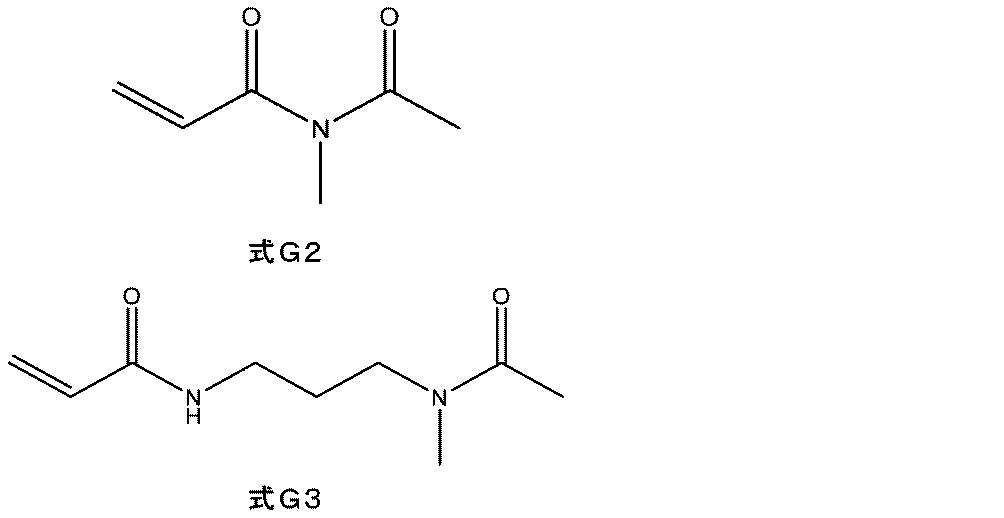
環状ポリアミドを形成するために使用され得る好適な環状アミドの例としては、α-ラクタム、β-ラクタム、γ-ラクタム、δ-ラクタム、及びε-ラクタムが挙げられる。好適な環状ポリアミドの例としては、式G4の繰り返し単位を含むポリマー及びコポリマーが挙げられ、 Examples of suitable cyclic amides that can be used to form the cyclic polyamides include α-lactams, β-lactams, γ-lactams, δ-lactams, and ε-lactams. Examples of suitable cyclic polyamides include polymers and copolymers that include repeat units of formula G4,

本発明の環状ポリアミドは、式G4の繰り返し単位の50モルパーセント以上を含んでもよいか、又は環状ポリアミドは、少なくとも70モルパーセント、及び少なくとも80モルパーセントなど、式G4の繰り返し単位の少なくとも50モルパーセントを含んでもよい。 The cyclic polyamides of the present invention may comprise 50 mole percent or more of repeat units of formula G4, or the cyclic polyamides may comprise at least 50 mole percent of repeat units of formula G4, such as at least 70 mole percent, and at least 80 mole percent.
ポリアミドはまた、環状アミド及び非環状アミドの両方の繰り返し単位を含むコポリマーであってもよい。追加の繰り返し単位は、ヒドロキシアルキル(メタ)アクリレート、アルキル(メタ)アクリレート、他の親水性モノマー、及びシロキサン置換(メタ)アクリレートから選択されるモノマーから形成され得る。好適な親水性モノマーとして列挙されるモノマーのいずれも、追加の繰り返し単位を形成するためにコモノマーとして使用され得る。ポリアミドを形成するために使用され得る追加のモノマーの具体的な例としては、2-ヒドロキシエチル(メタ)アクリレート、酢酸ビニル、アクリロニトリル、ヒドロキシプロピル(メタ)アクリレート、メチル(メタ)アクリレート及びヒドロキシブチル(メタ)アクリレート、ジヒドロキシプロピル(メタ)アクリレート、ポリエチレングリコールモノ(メタ)アクリレートなど、並びにこれらの混合物が挙げられる。イオン性モノマーも含まれ得る。イオン性モノマーの例としては、(メタ)アクリル酸、N-[(エテニルオキシ)カルボニル]-β-アラニン(VINAL、CAS#148969-96-4)、3-アクリルアミドプロパン酸(ACA1)、5-アクリルアミドペンタン酸(ACA2)、3-アクリルアミド-3-メチルブタン酸(AMBA)、2-(メタクリロイルオキシ)エチルトリメチルアンモニウムクロリド(Q塩又はMETAC)、2-アクリルアミド-2-メチルプロパンスルホン酸(AMPS)、1-プロパンアミニウム,N-(2-カルボキシエチル)-N,N-ジメチル-3-[(1-オキソ-2-プロペン-1-イル)アミノ]-,分子内塩(CBT、カルボキシベタイン、CAS 79704-35-1)、1-プロパンアミニウム,N,N-ジメチル-N-[3-[(1-オキソ-2-プロペン-1-イル)アミノ]プロピル]-3-スルホ-,分子内塩(SBT、スルホベタイン、CAS 80293-60-3)、3,5-ジオキサ-8-アザ-4-ホスファウンデカ-10-エン-1-アミニウム,4-ヒドロキシ-N,N,N-トリメチル-9-オキソ-,分子内塩,4-オキシド(9CI)(PBT、ホスホベタイン、CAS 163674-35-9)、2-メタクリロイルオキシエチルホスホリルコリン、3-(ジメチル(4-ビニルベンジル)アンモニオ)プロパン-1-スルホナート(DMVBAPS)、3-((3-アクリルアミドプロピル)ジメチルアンモニオ)プロパン-1-スルホナート(AMPDAPS)、3-((3-メタクリルアミドプロピル)ジメチルアンモニオ)プロパン-1-スルホナート(MAMPDAPS)、3-((3-(アクリロイルオキシ)プロピル)ジメチルアンモニオ)プロパン-1-スルホナート(APDAPS)、メタクリロイルオキシ)プロピル)ジメチルアンモニオ)プロパン-1-スルホナート(MAPDAPS)が挙げられる。 The polyamide may also be a copolymer containing both cyclic and non-cyclic amide repeat units. The additional repeat units may be formed from monomers selected from hydroxyalkyl (meth)acrylates, alkyl (meth)acrylates, other hydrophilic monomers, and siloxane-substituted (meth)acrylates. Any of the monomers listed as suitable hydrophilic monomers may be used as comonomers to form the additional repeat units. Specific examples of additional monomers that may be used to form the polyamide include 2-hydroxyethyl (meth)acrylate, vinyl acetate, acrylonitrile, hydroxypropyl (meth)acrylate, methyl (meth)acrylate and hydroxybutyl (meth)acrylate, dihydroxypropyl (meth)acrylate, polyethylene glycol mono(meth)acrylate, and the like, as well as mixtures thereof. Ionic monomers may also be included. Examples of ionic monomers include (meth)acrylic acid, N-[(ethenyloxy)carbonyl]-β-alanine (VINAL, CAS# 148969-96-4), 3-acrylamidopropanoic acid (ACA1), 5-acrylamidopentanoic acid (ACA2), 3-acrylamido-3-methylbutanoic acid (AMBA), 2-(methacryloyloxy)ethyltrimethylammonium chloride (Q salt or METAC), 2-acrylamido-2-methylpropanesulfonic acid (AMPS), 1-propanaminium, N-(2-carboxyethyl)-N,N-dimethyl-3-[(1-oxo-2-propen-1-yl)amino]-, inner salt (CBT, carboxybetaine, CAS# 148969-96-4). 79704-35-1), 1-propanaminium, N,N-dimethyl-N-[3-[(1-oxo-2-propen-1-yl)amino]propyl]-3-sulfo-, inner salt (SBT, sulfobetaine, CAS 80293-60-3), 3,5-dioxa-8-aza-4-phosphanundeca-10-ene-1-aminium, 4-hydroxy-N,N,N-trimethyl-9-oxo-, inner salt, 4-oxide (9CI) (PBT, phosphobetaine, CAS 163674-35-9), 2-methacryloyloxyethyl phosphorylcholine, 3-(dimethyl(4-vinylbenzyl)ammonio)propane-1-sulfonate (DMVBAPS), 3-((3-acrylamidopropyl)dimethylammonio)propane-1-sulfonate (AMPDAPS), 3-((3-methacrylamidopropyl)dimethylammonio)propane-1-sulfonate (MAMPDAPS), 3-((3-(acryloyloxy)propyl)dimethylammonio)propane-1-sulfonate (APDAPS), methacryloyloxy)propyl)dimethylammonio)propane-1-sulfonate (MAPDAPS).
反応性モノマー混合物は、非環状ポリアミド及び環状ポリアミドの両方又はそれらのコポリマーを含んでもよい。非環状ポリアミドは、本明細書に説明される非環状ポリアミド又はこれらのコポリマーのいずれかであり得るが、環状ポリアミドは、本明細書に説明される環状ポリアミド又はこれらのコポリマーのいずれかであり得る。ポリアミドは、ポリビニルピロリドン(PVP)、ポリビニルメチルアセトアミド(PVMA)、ポリジメチルアクリルアミド(PDMA)、ポリビニルアセトアミド(PNVA)、ポリ(ヒドロキシエチル(メタ)アクリルアミド)、ポリアクリルアミド、並びにこれらのコポリマー及び混合物の群から選択され得る。ポリアミドは、PVP(例えば、PVP K90)とPVMA(例えば、約570KDaのMwを有する)との混合物であってもよい。 The reactive monomer mixture may include both acyclic and cyclic polyamides or copolymers thereof. The acyclic polyamide may be any of the acyclic polyamides or copolymers thereof described herein, while the cyclic polyamide may be any of the cyclic polyamides or copolymers thereof described herein. The polyamide may be selected from the group of polyvinylpyrrolidone (PVP), polyvinylmethylacetamide (PVMA), polydimethylacrylamide (PDMA), polyvinylacetamide (PNVA), poly(hydroxyethyl(meth)acrylamide), polyacrylamide, and copolymers and mixtures thereof. The polyamide may be a mixture of PVP (e.g., PVP K90) and PVMA (e.g., having a Mw of about 570 KDa).
反応性モノマー混合物中の全てのポリアミドの総量は、あらゆる場合において、反応性モノマー混合物の反応性成分の総重量に基づいて、1重量パーセント~約15重量パーセントの範囲内、及び約5重量パーセント~約15重量パーセントの範囲内など、1重量パーセント~約35重量パーセントの範囲内であり得る。 The total amount of all polyamides in the reactive monomer mixture may be in the range of 1 weight percent to about 35 weight percent, such as in the range of 1 weight percent to about 15 weight percent, and in the range of about 5 weight percent to about 15 weight percent, in all cases based on the total weight of the reactive components of the reactive monomer mixture.
理論に束縛されるものではないが、シリコーンヒドロゲルとともに使用されるとき、ポリアミドは内部湿潤剤として機能する。本発明のポリアミドは、非重合性であってもよく、この場合、半相互貫入ネットワークとしてシリコーンヒドロゲル内に組み込まれる。ポリアミドは、シリコーンヒドロゲル内に封入されるか、又は物理的に保持される。代替的に、本発明のポリアミドは、例えば、ポリアミドマクロマー又はプレポリマーとして重合性であり得るが、この場合、シリコーンヒドロゲル内に共有結合的に組み込まれる。重合性及び非重合性のポリアミドの混合物もまた使用され得る。 Without wishing to be bound by theory, when used with silicone hydrogels, the polyamides function as internal wetting agents. The polyamides of the present invention may be non-polymeric, in which case they are incorporated within the silicone hydrogel as a semi-interpenetrating network. The polyamides are encapsulated or physically held within the silicone hydrogel. Alternatively, the polyamides of the present invention may be polymeric, for example as polyamide macromers or prepolymers, in which case they are covalently incorporated within the silicone hydrogel. Mixtures of polymeric and non-polymeric polyamides may also be used.
ポリアミドが反応性モノマー混合物内に組み込まれているとき、ポリアミドは、少なくとも100,000ダルトン、約150,000超、約150,000~約2,000,000ダルトン、約300,000ダルトン~約1,800,000ダルトンの重量平均分子量を有し得る。反応性モノマー混合物と相溶性である場合、高分子量ポリアミドを使用することができる。 When polyamides are incorporated into the reactive monomer mixture, the polyamides may have a weight average molecular weight of at least 100,000 Daltons, greater than about 150,000, from about 150,000 to about 2,000,000 Daltons, from about 300,000 Daltons to about 1,800,000 Daltons. Higher molecular weight polyamides can be used if compatible with the reactive monomer mixture.
架橋剤
概して、架橋モノマー、多官能性マクロマー、及びプレポリマーとも称される1つ以上の架橋剤を反応性モノマー混合物に添加することが望ましい。架橋剤は、二官能性架橋剤、三官能性架橋剤、四官能性架橋剤、及びこれらの混合物から選択されてもよく、これにはシリコーン含有架橋剤及び非シリコーン含有架橋剤が含まれる。非シリコーン含有架橋剤としては、エチレングリコールジメタクリレート(EGDMA)、テトラエチレングリコールジメタクリレート(TEGDMA)、トリメチロールプロパントリメタクリレート(TMPTMA)、トリアリルシアヌレート(TAC)、グリセロールトリメタクリレート、メタクリルオキシエチルビニルカルボナート(HEMAVc)、アリルメタクリレート、メチレンビスアクリルアミド(MBA)、及びポリエチレングリコールジメタクリレートが挙げられ、ポリエチレングリコールは、最大約5000ダルトンの分子量を有する。架橋剤は、通常の量、例えば、反応性配合物100グラム当たり約0.000415~約0.0156モルで反応性モノマー混合物中に用いられる。代替的に、親水性モノマー及び/又はシリコーン含有成分が分子設計により、又は不純物のために多官能性である場合、反応性モノマー混合物への架橋剤の添加は、任意選択である。架橋剤として作用することができ、存在する場合に反応性モノマー混合物への追加の架橋剤の添加を必要としない親水性モノマー及びマクロマーの例としては、(メタ)アクリレート及び(メタ)アクリルアミドでエンドキャップされたポリエーテルが挙げられる。他の架橋剤は当業者に既知となり、本発明のシリコーンヒドロゲルを作製するために使用され得る。
Crosslinking Agents It is generally desirable to add one or more crosslinking agents, also referred to as crosslinking monomers, multifunctional macromers, and prepolymers, to the reactive monomer mixture. The crosslinking agent may be selected from difunctional crosslinkers, trifunctional crosslinkers, tetrafunctional crosslinkers, and mixtures thereof, including silicone-containing and non-silicone-containing crosslinkers. Non-silicone-containing crosslinkers include ethylene glycol dimethacrylate (EGDMA), tetraethylene glycol dimethacrylate (TEGDMA), trimethylolpropane trimethacrylate (TMPTMA), triallyl cyanurate (TAC), glycerol trimethacrylate, methacryloxyethyl vinyl carbonate (HEMAVc), allyl methacrylate, methylene bisacrylamide (MBA), and polyethylene glycol dimethacrylate, where the polyethylene glycol has a molecular weight of up to about 5000 Daltons. Crosslinkers are used in the reactive monomer mixture in conventional amounts, for example, from about 0.000415 to about 0.0156 moles per 100 grams of reactive formulation. Alternatively, if the hydrophilic monomer and/or silicone-containing component is multifunctional by molecular design or due to impurities, the addition of a crosslinker to the reactive monomer mixture is optional. Examples of hydrophilic monomers and macromers that can act as crosslinkers and do not require the addition of additional crosslinkers to the reactive monomer mixture, if present, include polyethers endcapped with (meth)acrylates and (meth)acrylamides. Other crosslinkers will be known to those skilled in the art and can be used to make the silicone hydrogels of the present invention.
配合物中の他の反応性成分のうちの1つ以上に対して同様の反応性を有する架橋剤を選択することが望ましい場合がある。場合によっては、得られるシリコーンヒドロゲルのいくらかの物理的、機械的、又は生物学的特性を制御するために、異なる反応性を有する架橋剤の混合物を選択することが望ましい場合がある。シリコーンヒドロゲルの構造及び形態は、使用される希釈剤(複数可)及び硬化条件によっても影響を受け得る。 It may be desirable to select a crosslinker that has similar reactivity toward one or more of the other reactive components in the formulation. In some cases, it may be desirable to select a mixture of crosslinkers with different reactivities to control some physical, mechanical, or biological properties of the resulting silicone hydrogel. The structure and morphology of the silicone hydrogel may also be affected by the diluent(s) and cure conditions used.
弾性率を更に増加させ、引張強度を維持するために、マクロマー、架橋剤、及びプレポリマーを含む、多官能性シリコーン含有成分も含まれ得る。シリコーン含有架橋剤は、単独で、又は他の架橋剤と組み合わせて使用され得る。架橋剤として作用することができ、存在する場合に反応性モノマー混合物への架橋モノマーの添加を必要としないシリコーン含有成分の例としては、α,ω-ビスメタクリルオキシプロピルポリジメチルシロキサンが挙げられる。別の例は、ビス-3-アクリルオキシ-2-ヒドロキシプロピルオキシプロピルポリジメチルシロキサン(ac-PDMS)である。 Multifunctional silicone-containing components, including macromers, crosslinkers, and prepolymers, may also be included to further increase modulus and maintain tensile strength. Silicone-containing crosslinkers may be used alone or in combination with other crosslinkers. An example of a silicone-containing component that can act as a crosslinker and does not require the addition of a crosslinking monomer to the reactive monomer mixture, if present, is α,ω-bismethacryloxypropylpolydimethylsiloxane. Another example is bis-3-acryloxy-2-hydroxypropyloxypropylpolydimethylsiloxane (ac-PDMS).
剛直化学構造、及びフリーラジカル重合を受ける重合性基を有する架橋剤もまた使用され得る。好適な剛直構造の非限定的な例としては、1,4-フェニレンジアクリレート、1,4-フェニレンジメタクリレート、2,2-ビス(4-メタクリルオキシフェニル)-プロパン、2,2-ビス[4-(2-アクリルオキシエトキシ)フェニル]プロパン、2,2-ビス[4-(2-ヒドロキシ-3-メタクリルオキシプロポキシ)フェニル]プロパン、及び4-ビニルベンジルメタクリレート、並びにこれらの組み合わせなど、フェニル及びベンジル環を含む架橋剤が挙げられる。剛直な架橋剤は、全反応性成分の総重量に基づき、約0.5~約15、又は約2~10、3~7の量で含まれ得る。本発明のシリコーンヒドロゲルの物理的及び機械的特性は、反応性モノマー混合物中の成分を調整することによって特定の用途に最適化され得る。 Crosslinkers with rigid chemical structures and polymerizable groups that undergo free radical polymerization may also be used. Non-limiting examples of suitable rigid structures include crosslinkers containing phenyl and benzyl rings, such as 1,4-phenylenediacrylate, 1,4-phenylenedimethacrylate, 2,2-bis(4-methacryloxyphenyl)-propane, 2,2-bis[4-(2-acryloxyethoxy)phenyl]propane, 2,2-bis[4-(2-hydroxy-3-methacryloxypropoxy)phenyl]propane, and 4-vinylbenzyl methacrylate, and combinations thereof. Rigid crosslinkers may be included in an amount of about 0.5 to about 15, or about 2 to 10, 3 to 7, based on the total weight of all reactive components. The physical and mechanical properties of the silicone hydrogels of the present invention may be optimized for a particular application by adjusting the components in the reactive monomer mixture.
シリコーン架橋剤の非限定的な例としては、上記表Dに記載の多官能性シリコーン含有成分も挙げられる。 Non-limiting examples of silicone crosslinkers include the multifunctional silicone-containing components listed in Table D above.
更なる構成成分
反応性モノマー混合物は、希釈剤、開始剤、UV吸収剤、可視光吸収体、フォトクロミック化合物、医薬品、栄養補助剤、抗菌物質、着色剤、顔料、共重合性染料、非重合性染料、離型剤、及びこれらの組み合わせなどであるが、これらに限定されない、追加の成分を含有し得る。
Additional Components The reactive monomer mixture may contain additional components such as, but not limited to, diluents, initiators, UV absorbers, visible light absorbers, photochromic compounds, pharmaceuticals, nutritional supplements, antimicrobial substances, colorants, pigments, copolymerizable dyes, non-polymerizable dyes, release agents, and combinations thereof.
シリコーンヒドロゲル反応性モノマー混合物用の好適な希釈剤の種類には、2~20個の炭素原子を有するアルコール、一級アミンから誘導される10~20個の炭素原子を有するアミド、及び8~20個の炭素原子を有するカルボン酸が挙げられる。希釈剤は、第一級、第二級及び第三級アルコールであり得る。 Suitable diluent types for the silicone hydrogel reactive monomer mixture include alcohols having 2 to 20 carbon atoms, amides derived from primary amines having 10 to 20 carbon atoms, and carboxylic acids having 8 to 20 carbon atoms. The diluents can be primary, secondary, and tertiary alcohols.
概して、反応性成分は、希釈剤中で混合されて、反応性モノマー混合物を形成する。好適な希釈剤は、技術分野において既知である。シリコーンヒドロゲルについて、好適な希釈剤は、国際公開第03/022321号及び米国特許第6,020,445号に開示されており、これらの開示は、参照により本明細書に組み込まれる。 Generally, the reactive components are mixed in a diluent to form a reactive monomer mixture. Suitable diluents are known in the art. For silicone hydrogels, suitable diluents are disclosed in WO 03/022321 and U.S. Pat. No. 6,020,445, the disclosures of which are incorporated herein by reference.
シリコーンヒドロゲル反応性モノマー混合物用の好適な希釈剤の種類には、2~20個の炭素を有するアルコール、第一級アミンから誘導される10~20個の炭素原子を有するアミド、及び8~20個の炭素原子を有するカルボン酸が挙げられる。第一級及び第三級アルコールが使用され得る。好ましい種類には、5~20個の炭素を有するアルコール及び10~20個の炭素原子を有するカルボン酸が挙げられる。 Suitable diluent types for the silicone hydrogel reactive monomer mixture include alcohols having 2-20 carbons, amides derived from primary amines having 10-20 carbon atoms, and carboxylic acids having 8-20 carbon atoms. Primary and tertiary alcohols may be used. Preferred types include alcohols having 5-20 carbons and carboxylic acids having 10-20 carbon atoms.
使用され得る具体的な希釈剤には、1-エトキシ-2-プロパノール、ジイソプロピルアミノエタノール、イソプロパノール、3,7-ジメチル-3-オクタノール、1-デカノール、1-ドデカノール、1-オクタノール、1-ペンタノール、2-ペンタノール、1-ヘキサノール、2-ヘキサノール、2-オクタノール、3-メチル-3-ペンタノール、tert-アミルアルコール、tert-ブタノール、2-ブタノール、1-ブタノール、2-メチル-2-ペンタノール、2-プロパノール、1-プロパノール、エタノール、2-エチル-1-ブタノール、(3-アセトキシ-2-ヒドロキシプロピルオキシ)-プロピルビス(トリメチルシロキシ)メチルシラン、1-tert-ブトキシ-2-プロパノール、3,3-ジメチル-2-ブタノール、tert-ブトキシエタノール、2-オクチル-1-ドデカノール、デカン酸、オクタン酸、ドデカン酸、2-(ジイソプロピルアミノ)エタノール、これらの混合物などが挙げられる。アミド希釈剤の例としては、N,N-ジメチルプロピオンアミド及びジメチルアセトアミドが挙げられる。 Specific diluents that may be used include 1-ethoxy-2-propanol, diisopropylaminoethanol, isopropanol, 3,7-dimethyl-3-octanol, 1-decanol, 1-dodecanol, 1-octanol, 1-pentanol, 2-pentanol, 1-hexanol, 2-hexanol, 2-octanol, 3-methyl-3-pentanol, tert-amyl alcohol, tert-butanol, 2-butanol, 1-butanol, 2-methyl-2 ... Examples of diluents include alcohol, 2-propanol, 1-propanol, ethanol, 2-ethyl-1-butanol, (3-acetoxy-2-hydroxypropyloxy)-propylbis(trimethylsiloxy)methylsilane, 1-tert-butoxy-2-propanol, 3,3-dimethyl-2-butanol, tert-butoxyethanol, 2-octyl-1-dodecanol, decanoic acid, octanoic acid, dodecanoic acid, 2-(diisopropylamino)ethanol, and mixtures thereof. Examples of amide diluents include N,N-dimethylpropionamide and dimethylacetamide.
好ましい希釈剤には、3,7-ジメチル-3-オクタノール、1-ドデカノール、1-デカノール、1-オクタノール、1-ペンタノール、1-ヘキサノール、2-ヘキサノール、2-オクタノール、3-メチル-3-ペンタノール、2-ペンタノール、t-アミルアルコール、tert-ブタノール、2-ブタノール、1-ブタノール、2-メチル-2-ペンタノール、2-エチル-1-ブタノール、エタノール、3,3-ジメチル-2-ブタノール、2-オクチル-1-ドデカノール、デカン酸、オクタン酸、ドデカン酸、これらの混合物などが挙げられる。 Preferred diluents include 3,7-dimethyl-3-octanol, 1-dodecanol, 1-decanol, 1-octanol, 1-pentanol, 1-hexanol, 2-hexanol, 2-octanol, 3-methyl-3-pentanol, 2-pentanol, t-amyl alcohol, tert-butanol, 2-butanol, 1-butanol, 2-methyl-2-pentanol, 2-ethyl-1-butanol, ethanol, 3,3-dimethyl-2-butanol, 2-octyl-1-dodecanol, decanoic acid, octanoic acid, dodecanoic acid, mixtures thereof, and the like.
より好ましい希釈剤には、3,7-ジメチル-3-オクタノール、1-ドデカノール、1-デカノール、1-オクタノール、1-ペンタノール、1-ヘキサノール、2-ヘキサノール、2-オクタノール、1-ドデカノール、3-メチル-3-ペンタノール、1-ペンタノール、2-ペンタノール、t-アミルアルコール、tert-ブタノール、2-ブタノール、1-ブタノール、2-メチル-2-ペンタノール、2-エチル-1-ブタノール、3,3-ジメチル-2-ブタノール、2-オクチル-1-ドデカノール、これらの混合物などが挙げられる。希釈剤が存在する場合、概して、希釈剤の存在量に関して特定の制限はない。希釈剤を使用するとき、希釈剤は、(反応性配合物及び非反応性配合物を含む)反応性モノマー混合物の総重量に基づいて、約5~約50重量パーセントの範囲及び約15~約40重量パーセントの範囲など、約2~約70重量パーセントの範囲の量で存在し得る。複数の希釈剤の混合物を使用してもよい。 More preferred diluents include 3,7-dimethyl-3-octanol, 1-dodecanol, 1-decanol, 1-octanol, 1-pentanol, 1-hexanol, 2-hexanol, 2-octanol, 1-dodecanol, 3-methyl-3-pentanol, 1-pentanol, 2-pentanol, t-amyl alcohol, tert-butanol, 2-butanol, 1-butanol, 2-methyl-2-pentanol, 2-ethyl-1-butanol, 3,3-dimethyl-2-butanol, 2-octyl-1-dodecanol, mixtures thereof, and the like. When a diluent is present, there is generally no particular restriction on the amount of diluent present. When a diluent is used, the diluent may be present in an amount ranging from about 2 to about 70 percent by weight, such as from about 5 to about 50 percent by weight and from about 15 to about 40 percent by weight, based on the total weight of the reactive monomer mixture (including reactive and non-reactive formulations). A mixture of multiple diluents may be used.
本発明の眼科用レンズを製造するための反応性モノマー混合物は、第1の重合開始剤及び第2の重合開始剤に加えて、上述の重合性化合物及び任意選択の成分のいずれかを含んでもよい。 The reactive monomer mixture for producing the ophthalmic lens of the present invention may contain, in addition to the first polymerization initiator and the second polymerization initiator, any of the polymerizable compounds and optional components described above.
反応性モノマー混合物は、それに化学的に結合された第1の官能性部分を有する第1の重合開始剤(すなわち、式Iの化合物)と、第1の重合開始剤を実質的に活性化しない第2の活性化によって活性化可能な第2の重合開始剤と、親水性成分と、を含み得る。 The reactive monomer mixture may include a first polymerization initiator (i.e., a compound of formula I) having a first functional moiety chemically bonded thereto, a second polymerization initiator activatable by a second activation that does not substantially activate the first polymerization initiator, and a hydrophilic component.
反応性モノマー混合物は、それに化学的に結合された第1の官能性部分を有する第1の重合開始剤(すなわち、式Iの化合物)と、第1の重合開始剤を実質的に活性化しない第2の活性化によって活性化可能な第2の重合開始剤と、親水性成分と、DMA、NVP、HEMA、VMA、NVA、メタクリル酸、及びそれらの混合物から選択される親水性成分と、を含み得る。HEMA及びメタクリル酸の混合物が好ましい。 The reactive monomer mixture may include a first polymerization initiator (i.e., a compound of formula I) having a first functional moiety chemically bonded thereto, a second polymerization initiator activatable by a second activation that does not substantially activate the first polymerization initiator, a hydrophilic component, and a hydrophilic component selected from DMA, NVP, HEMA, VMA, NVA, methacrylic acid, and mixtures thereof. A mixture of HEMA and methacrylic acid is preferred.
反応性モノマー混合物は、それに化学的に結合された第1の官能性部分を有する第1の重合開始剤(すなわち、式Iの化合物)、第1の重合開始剤を実質的に活性化しない第2の活性化によって活性化可能な第2の重合開始剤、並びに親水性成分、親水性成分、及びシリコーン含有成分を含んでもよい。 The reactive monomer mixture may include a first polymerization initiator (i.e., a compound of formula I) having a first functional moiety chemically bonded thereto, a second polymerization initiator activatable by a second activation that does not substantially activate the first polymerization initiator, and a hydrophilic component, a hydrophilic component, and a silicone-containing component.
反応性モノマー混合物は、それに化学的に結合された第1の官能性部分を有する第1の重合開始剤(すなわち、式Iの化合物)と、第1の重合開始剤を実質的に活性化しない第2の活性化によって活性化可能な第2の重合開始剤と、親水性成分と、DMA、HEMA及びそれらの混合物から選択される親水性成分と、2-ヒドロキシ-3-[3-メチル-3,3-ジ(トリメチルシロキシ)シリルプロポキシ]-プロピルメタクリレート(SiMAA)、モノ-メタクリルオキシプロピル末端モノ-n-ブチル末端ポリジメチルシロキサン(mPDMS)、モノ-(2-ヒドロキシ-3-メタクリルオキシプロピル)-プロピルエーテル末端モノ-n-ブチル末端ポリジメチルシロキサン(OH-mPDMS)、及びこれらの混合物から選択されるシリコーン含有成分と、湿潤剤(好ましくはPVP又はPVMA)と、を含み得る。親水性成分については、DMA及びHEMAの混合物が好ましい。シリコーン含有成分については、SiMAA及びmPDMSの混合物が好ましい。 The reactive monomer mixture may include a first polymerization initiator (i.e., a compound of formula I) having a first functional moiety chemically bonded thereto, a second polymerization initiator activatable by a second activation that does not substantially activate the first polymerization initiator, a hydrophilic component selected from DMA, HEMA, and mixtures thereof, a silicone-containing component selected from 2-hydroxy-3-[3-methyl-3,3-di(trimethylsiloxy)silylpropoxy]-propyl methacrylate (SiMAA), mono-methacryloxypropyl terminated mono-n-butyl terminated polydimethylsiloxane (mPDMS), mono-(2-hydroxy-3-methacryloxypropyl)-propyl ether terminated mono-n-butyl terminated polydimethylsiloxane (OH-mPDMS), and mixtures thereof, and a wetting agent (preferably PVP or PVMA). For the hydrophilic component, a mixture of DMA and HEMA is preferred. For the silicone-containing component, a mixture of SiMAA and mPDMS is preferred.
反応性モノマー混合物は、それに化学的に結合された第1の官能性部分を有する第1の重合開始剤(すなわち、式Iの化合物)と、第1の重合開始剤を実質的に活性化しない第2の活性化によって活性化可能な第2の重合開始剤と、親水性成分と、DMA及びHEMAの混合物を含む親水性成分と、2~20個の繰り返し単位(好ましくは4個及び15個の繰り返し単位の混合物)を有するOH-mPDMSの混合物を含むシリコーン含有成分と、を含み得る。好ましくは、反応性モノマー混合物は、ac-PDMSなどのシリコーン含有架橋剤を更に含む。また好ましくは、反応性モノマー混合物は、湿潤剤(好ましくはDMA、PVP、PVMA、又はこれらの混合物)を含有する。 The reactive monomer mixture may include a first polymerization initiator (i.e., a compound of formula I) having a first functional moiety chemically bonded thereto, a second polymerization initiator activatable by a second activation that does not substantially activate the first polymerization initiator, a hydrophilic component including a mixture of DMA and HEMA, and a silicone-containing component including a mixture of OH-mPDMS having 2-20 repeat units (preferably a mixture of 4 and 15 repeat units). Preferably, the reactive monomer mixture further includes a silicone-containing crosslinker such as ac-PDMS. Also preferably, the reactive monomer mixture includes a wetting agent (preferably DMA, PVP, PVMA, or a mixture thereof).
反応性モノマー混合物は、それに化学的に結合された第1の官能性部分を有する第1の重合開始剤(すなわち、式Iの化合物)と、第1の重合開始剤を実質的に活性化しない第2の活性化によって活性化可能な第2の重合開始剤と、親水性成分と、約1~約15重量%の少なくとも1つのポリアミド(例えば、非環状ポリアミド、環状ポリアミド、又はこれらの混合物)と、4~8個のシロキサン繰り返し単位を有する少なくとも1つの第1の単官能性ヒドロキシル置換ポリ(二置換シロキサン)(例えば、OH-mPDMS(式中、nは4~8であり、好ましくはnは4である))と、10~200個、又は10~100個、又は10~50個、又は10~20個のシロキサン繰り返し単位を有する単官能性ヒドロキシル置換ポリ(二置換シロキサン)である、少なくとも1つの第2のヒドロキシル置換ポリ(二置換シロキサン)(例えば、OH-mPDMS(式中、nは10~200、又は10~100、又は10~50、又は10~20であり、好ましくはnは15である)と、約5~約35重量%の少なくとも1つの親水性モノマーと、任意選択的に、10~200個又は10~100個のシロキサン繰り返し単位を有する多官能性ヒドロキシル置換ポリ(二置換シロキサン)(例えば、ac-PDMS)と、を含み得る。好ましくは、第1の単官能性ヒドロキシル置換ポリ(二置換シロキサン)及び第2のヒドロキシル置換ポリ(二置換シロキサン)は、第1の単官能性ヒドロキシル置換ポリ(二置換シロキサン)の重量パーセントの、第2のヒドロキシル置換ポリ(二置換シロキサン)の重量パーセントに対する比が、0.4~1.3又は0.4~1.0となるような濃度で存在する。 The reactive monomer mixture comprises a first polymerization initiator (i.e., a compound of formula I) having a first functional moiety chemically bonded thereto, a second polymerization initiator activatable by a second activation that does not substantially activate the first polymerization initiator, a hydrophilic component, about 1 to about 15 weight percent of at least one polyamide (e.g., acyclic polyamide, cyclic polyamide, or mixtures thereof), at least one first monofunctional hydroxyl-substituted poly(disubstituted siloxane) having 4 to 8 siloxane repeat units (e.g., OH-mPDMS, where n is 4 to 8, preferably n is 4), and at least one second hydroxyl-substituted poly(disubstituted siloxane) having 10 to 200, or 10 to 100, or 10 to 50, or 10 to 20 siloxane repeat units. The composition may include a substituted poly(disubstituted siloxane) (e.g., OH-mPDMS, where n is 10-200, or 10-100, or 10-50, or 10-20, preferably n is 15), about 5 to about 35 weight percent of at least one hydrophilic monomer, and optionally a multifunctional hydroxyl-substituted poly(disubstituted siloxane) (e.g., ac-PDMS) having 10-200 or 10-100 siloxane repeat units. Preferably, the first monofunctional hydroxyl-substituted poly(disubstituted siloxane) and the second hydroxyl-substituted poly(disubstituted siloxane) are present in a concentration such that the ratio of the weight percent of the first monofunctional hydroxyl-substituted poly(disubstituted siloxane) to the weight percent of the second hydroxyl-substituted poly(disubstituted siloxane) is 0.4 to 1.3 or 0.4 to 1.0.
反応性モノマー混合物は、それに化学的に結合された第1の官能性部分を有する第1の重合開始剤(すなわち、式Iの化合物)と、第1の重合開始剤を実質的に活性化しない第2の活性化によって活性化可能な第2の重合開始剤と、親水性成分と、DMAなどの親水性成分と、例えば表Bの化合物8((TRIS)などのシリコーン含有成分と、例えば表Cの化合物42などのシリコーンマクロマーと、を含み得る。 The reactive monomer mixture may include a first polymerization initiator (i.e., a compound of formula I) having a first functional moiety chemically bonded thereto, a second polymerization initiator activatable by a second activation that does not substantially activate the first polymerization initiator, a hydrophilic component, such as DMA, a silicone-containing component, such as, for example, compound 8 (TRIS) of Table B, and a silicone macromer, such as, for example, compound 42 of Table C.
反応性モノマー混合物は、それに化学的に結合された第1の官能性部分を有する第1の重合開始剤(すなわち、式Iの化合物)と、第1の重合開始剤を実質的に活性化しない第2の活性化によって活性化可能な第2の重合開始剤と、親水性成分と、DMA及び/又はNVPなどの親水性成分と、表Bの化合物14(TRIS-Am)などのシリコーン含有成分と、表Cの化合物43(IEM-PDMS-IPDI-PDMS-IPDI-PDMS-IEM)などのシリコーンマクロマーと、を含み得る。 The reactive monomer mixture may include a first polymerization initiator (i.e., a compound of formula I) having a first functional moiety chemically bonded thereto, a second polymerization initiator activatable by a second activation that does not substantially activate the first polymerization initiator, a hydrophilic component, such as DMA and/or NVP, a silicone-containing component, such as compound 14 (TRIS-Am) of Table B, and a silicone macromer, such as compound 43 (IEM-PDMS-IPDI-PDMS-IPDI-PDMS-IEM) of Table C.
反応性モノマー混合物は、それに化学的に結合された第1の官能性部分を有する第1の重合開始剤(すなわち、式Iの化合物)と、第1の重合開始剤を実質的に活性化しない第2の活性化によって活性化することができる第2の重合開始剤と、親水性成分と、VMAなどの親水性成分と、表Cの化合物35などのシリコーンマクロマーと、を含んでもよい。 The reactive monomer mixture may include a first polymerization initiator (i.e., a compound of formula I) having a first functional moiety chemically bonded thereto, a second polymerization initiator that can be activated by a second activation that does not substantially activate the first polymerization initiator, a hydrophilic component, such as VMA, and a silicone macromer, such as compound 35 of Table C.
反応性モノマー混合物は、それに化学的に結合された第1の官能性部分を有する第1の重合開始剤(すなわち、式Iの化合物)と、第1の重合開始剤を実質的に活性化しない第2の活性化によって活性化可能な第2の重合開始剤と、親水性成分と、VMA及び/又はNVPなどの親水性成分と、表Cの化合物28(例えば、j2が約16である場合)などのシリコーン含有成分と、表Cの化合物35などのシリコーンマクロマーと、を含み得る。 The reactive monomer mixture may include a first polymerization initiator (i.e., a compound of formula I) having a first functional moiety chemically bonded thereto, a second polymerization initiator activatable by a second activation that does not substantially activate the first polymerization initiator, a hydrophilic component, such as VMA and/or NVP, a silicone-containing component, such as compound 28 of Table C (e.g., where j2 is about 16), and a silicone macromer, such as compound 35 of Table C.
反応性モノマー混合物は、それに化学的に結合された第1の官能性部分を有する第1の重合開始剤(すなわち、式Iの化合物)と、第1の重合開始剤を実質的に活性化しない第2の活性化によって活性化可能な第2の重合開始剤と、親水性成分と、VMA及び/又はNVPなどの親水性成分と、表Bの化合物18(例えば、j2が約4である場合)などのシリコーン含有成分と、表Cの化合物41などのシリコーンマクロマーと、を含み得る。 The reactive monomer mixture may include a first polymerization initiator (i.e., a compound of formula I) having a first functional moiety chemically bonded thereto, a second polymerization initiator activatable by a second activation that does not substantially activate the first polymerization initiator, a hydrophilic component, such as VMA and/or NVP, a silicone-containing component, such as compound 18 of Table B (e.g., where j2 is about 4), and a silicone macromer, such as compound 41 of Table C.
前述の反応性モノマー混合物は、例えば、内部湿潤剤、架橋剤、他のUV又はHEV吸収剤、及び希釈剤などであるが、これらに限定されない、任意選択の成分を含有してもよい。更に、前述の反応性モノマー混合物から作製される眼科用レンズは、プラズマ処理、コーティング(米国特許第8,480,227号に記載されるようなパッケージ内コーティング(IPC)など)の適用などを含むが、これらに限定されない、更なる処理を受けてもよい。 The reactive monomer mixture may contain optional components such as, but not limited to, internal wetting agents, crosslinkers, other UV or HEV absorbers, and diluents. Additionally, ophthalmic lenses made from the reactive monomer mixture may be subjected to further processing, including, but not limited to, plasma treatment, application of coatings (such as in-package coatings (IPC) as described in U.S. Pat. No. 8,480,227), and the like.
次いで、形成されたレンズ物体は、機械的手段、溶媒膨潤、又はそれらの組み合わせによって型半体から除去され得るが、次いで、未反応の第1の重合開始剤を除去するために抽出プロセスを受ける。未反応の第1の重合開始剤を除去するための抽出プロセスは、完全であっても不完全であってもよい。いくつかの場合には、全ての未反応の第1の重合開始剤の除去は、所望の特徴又は光学的効果を作り出すためには必要とされない。他の場合において、抽出プロセスは、未反応の第1の開始剤の一部のみを除去し、より低い濃度の第1の重合開始剤を使用する任意選択の照射工程を可能にする。あるいは、抽出プロセスは、未反応の第1の開始剤の実質的に全てを除去することができる。未反応の第1の重合開始剤を除去した後、他の反応性モノマー成分を除去するためのレンズ抽出及びレンズ水和の標準的な後処理工程を行って、最終的な眼科用レンズを形成することができる。いくつかの例において、水性アルコール、水、及び緩衝液を使用するレンズ抽出及び水和の標準的な後処理工程はまた、未反応の第1の重合開始剤を抽出し得るが、それによって、2つ以上の抽出工程を1つの操作に組み合わせる。 The formed lens object may then be removed from the mold halves by mechanical means, solvent swelling, or a combination thereof, and then undergoes an extraction process to remove unreacted first polymerization initiator. The extraction process to remove unreacted first polymerization initiator may be complete or incomplete. In some cases, removal of all unreacted first polymerization initiator is not required to create the desired feature or optical effect. In other cases, the extraction process removes only a portion of the unreacted first polymerization initiator, allowing for an optional irradiation step using a lower concentration of first polymerization initiator. Alternatively, the extraction process may remove substantially all of the unreacted first initiator. After removal of the unreacted first polymerization initiator, standard post-processing steps of lens extraction and lens hydration to remove other reactive monomer components may be performed to form the final ophthalmic lens. In some instances, standard post-processing steps of lens extraction and hydration using aqueous alcohol, water, and buffers may also extract unreacted first polymerization initiator, thereby combining two or more extraction steps into one operation.
水溶液は、水を含む溶液である。本発明の水溶液は、少なくとも約20重量パーセントの水、又は少なくとも約50重量パーセントの水、又は少なくとも約70重量パーセントの水、又は少なくとも約95重量パーセントの水を含み得る。水溶液はまた、無機塩又は離型剤、湿潤剤、スリップ剤、医薬成分及び栄養補助剤、これらの組み合わせなどの、追加の水溶性配合物を含んでもよい。離型剤は、化合物又は化合物の混合物であり、これは、水と組み合わせると、型からコンタクトレンズを取り外すのに必要な時間が、離型剤を含まない水溶液を使用してコンタクトレンズを取り外すのに必要な時間と比較して減少する。水溶液は、精製、再利用又は特別な廃棄処理などの特別な取り扱いを必要としない場合がある。 Aqueous solutions are solutions that include water. Aqueous solutions of the present invention may include at least about 20 percent water by weight, or at least about 50 percent water by weight, or at least about 70 percent water by weight, or at least about 95 percent water by weight. Aqueous solutions may also include additional water-soluble compounds, such as inorganic salts or release agents, wetting agents, slip agents, medicinal ingredients, and nutritional supplements, combinations thereof. A release agent is a compound or mixture of compounds that, when combined with water, reduces the time required to remove a contact lens from a mold compared to the time required to remove a contact lens using an aqueous solution that does not include a release agent. Aqueous solutions may not require special handling, such as purification, recycling, or special waste disposal.
抽出は、例えば、水溶液中にこのレンズを浸漬すること、又は水溶液の流れにレンズを曝露することを介して行なうことができる。抽出はまた、例えば、水溶液を加熱することと、水溶液を撹拌することと、水溶液の離型剤の濃度を、レンズの離型が生じるのに十分なレベルにまで増大させることと、レンズを機械的撹拌又は超音波撹拌にかけることと、少なくとも1種の洗脱又は抽出助剤を水溶液に取り入れて、未反応成分をレンズから適切に除去することを容易にするのに十分な濃度にすることと、のうちの1つ以上を含むことができる。熱、振動又はその両方の追加の有無にかかわらず、前述の工程は、バッチプロセス又は連続プロセスで行われてもよい。 Extraction can occur, for example, via immersion of the lens in an aqueous solution or exposure of the lens to a stream of an aqueous solution. Extraction can also include, for example, one or more of heating the aqueous solution, agitating the aqueous solution, increasing the concentration of a release agent in the aqueous solution to a level sufficient to cause release of the lens, subjecting the lens to mechanical or ultrasonic agitation, and incorporating at least one leaching or extraction aid into the aqueous solution to a concentration sufficient to facilitate adequate removal of unreacted components from the lens. The foregoing steps, with or without the addition of heat, vibration, or both, may be performed in a batch or continuous process.
浸出及び離型を促進するために、物理的撹拌の適用が望ましい場合がある。例えば、レンズが付着しているレンズ型部分は、水溶液中で振動させるか又は前後運動させることができる。他の方法には、超音波を水溶液に通すことが含まれてもよい。 The application of physical agitation may be desirable to facilitate leaching and demolding. For example, the lens mold portion to which the lens is attached can be vibrated or moved back and forth in the aqueous solution. Other methods may include passing ultrasound through the aqueous solution.
レンズは、限定されないが、高圧蒸気処理などの既知の手段により殺菌してもよい。 The lenses may be sterilized by known means, including but not limited to, high pressure steam treatment.
上記のように、好ましい眼科用レンズは、コンタクトレンズであり、より好ましくはソフトヒドロゲルコンタクトレンズである。本発明によるシリコーンヒドロゲル眼科用レンズ(例えば、コンタクトレンズ)は、好ましくは、以下の特性を示し得る。全ての値の前には「約」が付き、このレンズは、列挙する性質の任意の組み合わせを有してもよい。特性は、例えば、参照により本明細書に組み込まれる米国特許出願公開第20180037690号に記載されているように、当業者に既知の方法によって決定することができる。 As noted above, the preferred ophthalmic lenses are contact lenses, more preferably soft hydrogel contact lenses. Silicone hydrogel ophthalmic lenses (e.g., contact lenses) according to the present invention may preferably exhibit the following characteristics. All values are preceded by "about" and the lenses may have any combination of the listed properties. The characteristics may be determined by methods known to those skilled in the art, for example, as described in U.S. Patent Application Publication No. 20180037690, which is incorporated herein by reference.
水濃度%:少なくとも20%、又は少なくとも25%、かつ最大80%、又は最大70%
曇り度:30%以下、又は10%以下
前進動的接触角(ウィルヘルミープレート法):100°以下、80°以下、又は50°以下
引張弾性率(psi):120以下、又は80~120
酸素透過性(Dk、バーラー):少なくとも80、又は少なくとも100、又は少なくとも150、又は少なくとも200
破断伸び:少なくとも100
Water concentration %: at least 20%, or at least 25% and up to 80%, or up to 70%
Haze: 30% or less, or 10% or less Advancing dynamic contact angle (Wilhelmy plate method): 100° or less, 80° or less, or 50° or less Tensile modulus (psi): 120 or less, or 80 to 120
Oxygen permeability (Dk, Barrer): at least 80, or at least 100, or at least 150, or at least 200
Breaking elongation: at least 100
イオン性シリコーンヒドロゲルに関しては、(前述したものに加えて)以下の性質もまた好ましい場合がある。
リゾチーム取り込み(μg/レンズ):少なくとも100、又は少なくとも150、又は少なくとも500、又は少なくとも700
ポリクオタニウム1(PQ1)取り込み(%):15以下、又は10以下、又は5以下
本発明のいくつかの実施形態を、以下の実施例にて詳細に記述する。
With respect to ionic silicone hydrogels, the following properties (in addition to those mentioned above) may also be preferred:
Lysozyme uptake (μg/lens): at least 100, or at least 150, or at least 500, or at least 700
Polyquaternium 1 (PQ1) Incorporation (%): ≦15; or ≦10; or ≦5. Some embodiments of the present invention are described in detail in the following examples.
以下の略語は、実施例及び図面を通して使用され、以下の意味を有する。
DMA:N,N-ジメチルアクリルアミド(Jarchem)
HEMA:2-ヒドロキシエチルメタクリレート(Bimax)
PVP K12、PVP K30、PVP K90:ポリ(N-ビニルピロリドン)(ISP Ashland)
TEGDMA:テトラエチレングリコールジメタクリレート(Esstech)
Omnirad 819:ビス(2,4,6-トリメチルベンゾイル)-フェニルホスフィンオキシド(IGM Resins)
AIBN:アゾビスイソブチロニトリル[CAS 78-67-1]
SiMAA:2-プロペン酸,2-メチル-2-ヒドロキシ-3-[3-[1,3,3,3-テトラメチル-1-[(トリメチルシリル)オキシ]ジシロキサニル]プロポキシ]プロピルエステル(Toray)、又は3-(3-(1,1,1,3,5,5,5-ヘプタメチルトリシロキサン-3-イル)プロポキシ)-2-ヒドロキシプロピルメタクリレート
HO-mPDMS:モノ-n-ブチル末端モノ-(2-ヒドロキシ-3-メタクリルオキシプロピルオキシ)-プロピル末端ポリジメチルシロキサン(Mn=1400g/モル、n=15)(Ortec又はDSM-Polymer Technology Group)
The following abbreviations are used throughout the examples and figures and have the following meanings:
DMA: N,N-dimethylacrylamide (Jarchem)
HEMA: 2-hydroxyethyl methacrylate (Bimax)
PVP K12, PVP K30, PVP K90: Poly(N-vinylpyrrolidone) (ISP Ashland)
TEGDMA: Tetraethylene glycol dimethacrylate (Esstech)
Omnirad 819: Bis(2,4,6-trimethylbenzoyl)-phenylphosphine oxide (IGM Resins)
AIBN: Azobisisobutyronitrile [CAS 78-67-1]
SiMAA: 2-propenoic acid, 2-methyl-2-hydroxy-3-[3-[1,3,3,3-tetramethyl-1-[(trimethylsilyl)oxy]disiloxanyl]propoxy]propyl ester (Toray), or 3-(3-(1,1,1,3,5,5,5-heptamethyltrisiloxan-3-yl)propoxy)-2-hydroxypropyl methacrylate HO-mPDMS: mono-n-butyl terminated mono-(2-hydroxy-3-methacryloxypropyloxy)-propyl terminated polydimethylsiloxane (M n =1400 g/mol, n=15) (Ortec or DSM-Polymer Technology Group)

Blue HEMA:1-アミノ-4-[3-(4-(2-メタクリロイルオキシ-エトキシ)-6-クロロトリアジン-2-イルアミノ)-4-スルホフェニルアミノ]アントラキノン-2-スルホン酸(米国特許第5,944,853号に記載)
ホウ酸緩衝充填溶液:18.52グラム(300mmol)のホウ酸、3.7グラム(9.7mmol)のホウ酸ナトリウム十水和物、及び28グラム(197mmol)の硫酸ナトリウムを、2リットルのメスフラスコを満たすのに十分な脱イオン水に溶解させた。
Blue HEMA: 1-amino-4-[3-(4-(2-methacryloyloxy-ethoxy)-6-chlorotriazin-2-ylamino)-4-sulfophenylamino]anthraquinone-2-sulfonic acid (described in U.S. Pat. No. 5,944,853)
Boric Acid Buffer Filling Solution: 18.52 grams (300 mmol) of boric acid, 3.7 grams (9.7 mmol) of sodium borate decahydrate, and 28 grams (197 mmol) of sodium sulfate were dissolved in enough deionized water to fill a 2 liter volumetric flask.
D3O:3,7-ジメチル-3-オクタノール(Vigon)
HCl:塩酸
IPA:2-プロパノール
ACN:アセトニトリル
THF:テトラヒドロフラン
PEO:ポリエチレンオキシド
DMF:ジメチルホルムアミド
DCM:ジクロロメタン
PP:プロピレンのホモポリマーであるポリプロピレン
TT:水添スチレンブタジエンブロックコポリマーであるTuftec(Asahi Kasei Chemicals)
Z:ポリシクロオレフィン熱可塑性ポリマーであるZeonor(Nippon Zeon Co Ltd)
LED:発光ダイオード
1N NMR:プロトン核磁気共鳴分光法
UV-VIS:紫外-可視分光法
TLC:薄層クロマトグラフィ
ID:内径
L:リットル
mL:ミリリットル
mM:ミリモル
M:モル濃度
Equiv.又はeq.:当量
kg:キログラム
g:グラム
mg:ミリグラム
mol:モル
mmol:ミリモル
min:分
mm:ミリメートル
cm:センチメートル
μm:マイクロメートル
nm:ナノメートル
mW:ミリワット
mJ:ミリジュール
Pa:パスカル
PSI:平方インチあたりのポンド
Abs:吸収量
%T:透過率パーセント
MAPO:モノアシルホスフィンオキシド
DMD:デジタルマイクロミラー装置
DO: 3,7-dimethyl-3-octanol (Vigon)
HCl: Hydrochloric acid IPA: 2-propanol ACN: Acetonitrile THF: Tetrahydrofuran PEO: Polyethylene oxide DMF: Dimethylformamide DCM: Dichloromethane PP: Polypropylene, which is a homopolymer of propylene TT: Tuftec (Asahi Kasei Chemicals), which is a hydrogenated styrene-butadiene block copolymer
Z: Zeonor, a polycycloolefin thermoplastic polymer (Nippon Zeon Co., Ltd.)
LED: Light Emitting Diode
1N NMR: Proton nuclear magnetic resonance spectroscopy UV-VIS: Ultraviolet-visible spectroscopy TLC: Thin layer chromatography ID: Internal diameter L: Liter mL: Milliliter mM: Millimole M: Molar concentration Equiv. or eq.: Equivalent kg: Kilogram g: Gram mg: Milligram mol: Mole mmol: Millimole min: Minute mm: Millimeter cm: Centimeter μm: Micrometer nm: Nanometer mW: Milliwatt mJ: Millijoule Pa: Pascal PSI: Pounds per square inch Abs: Absorption %T: Percent transmittance MAPO: Monoacylphosphine oxide DMD: Digital micromirror device
(実施例)
実施例1:スキームAに示されるモノアシルホスフィンオキシドモノ末端ポリ(N-ビニルピロリドン)(MAPO-PVP)の合成。
(Example)
Example 1: Synthesis of monoacylphosphine oxide mono-terminated poly(N-vinylpyrrolidone) (MAPO-PVP) as shown in Scheme A.
還流冷却器を備えた三つ口丸底フラスコに、N-ビニルピロリドン(20.0グラム)、エタノール(41.0グラム)、及びOmnirad 819(1.0グラム)を黄色光下で投入し、脱気し、窒素下65℃で加熱した。次いで、反応混合物を約1.22mW/cm2の強度を有する435nmのLED光を用いて30分間照射した。反応混合物を空気中でクエンチし、室温まで冷却した。溶媒を減圧下で除去し、続いて冷ジエチルエーテル中で沈殿させて、濾過により白色固体を得た。白色固体をジエチルエーテル(50mL)に懸濁し、30分間撹拌し、再び濾過した。次いで、生成物(「MAPO-PVP」)をジエチルエーテル(50mLで3回)で洗浄し、風乾して白色粉末(16.0グラム、収率80%)を得た。ポリマー構造は、重水中の500MHz 1H-NMR分光法によって特性を決定した。図4を参照されたい。分子量及びその分布を、PVP K12-K90の市販のサンプルに対する粘度比較及びサイズ排除多角度光散乱法(SEC-MALS)によって決定した。生成物「MAPO-PVP」は、スキームAに示されるように、モノアシルホスフィンオキシド末端PVPとモノアシル末端PVPとの混合物であることに留意されたい。モノアシル基のタイプは、共重合において使用されるビスアシルホスフィンオキシド開始剤のタイプに依存する。開始剤が2つの異なるアシル基を有する場合、「MAPO-PVP」は、2つのモノアシルホスフィンオキシド末端PVPと2つのモノアシル末端PVPとの混合物である。これらの材料を貯蔵中に周囲光から保護することが重要である。MAPO-PVPは、表Aの第1の式の例である。 A three-necked round bottom flask equipped with a reflux condenser was charged with N-vinylpyrrolidone (20.0 grams), ethanol (41.0 grams), and Omnirad 819 (1.0 grams) under yellow light, degassed, and heated at 65° C. under nitrogen. The reaction mixture was then irradiated with 435 nm LED light with an intensity of about 1.22 mW/cm 2 for 30 minutes. The reaction mixture was quenched in air and cooled to room temperature. The solvent was removed under reduced pressure, followed by precipitation in cold diethyl ether to obtain a white solid by filtration. The white solid was suspended in diethyl ether (50 mL), stirred for 30 minutes, and filtered again. The product ("MAPO-PVP") was then washed with diethyl ether (3×50 mL) and air-dried to obtain a white powder (16.0 grams, 80% yield). The polymer structure was characterized by 500 MHz 1 H-NMR spectroscopy in deuterium oxide. See Figure 4. The molecular weight and its distribution were determined by viscosity comparison and size exclusion multi-angle light scattering (SEC-MALS) against commercial samples of PVP K12-K90. Note that the product "MAPO-PVP" is a mixture of monoacylphosphine oxide terminated PVP and monoacyl terminated PVP as shown in Scheme A. The type of monoacyl group depends on the type of bisacylphosphine oxide initiator used in the copolymerization. When the initiator has two different acyl groups, "MAPO-PVP" is a mixture of two monoacylphosphine oxide terminated PVP and two monoacyl terminated PVP. It is important to protect these materials from ambient light during storage. MAPO-PVP is an example of the first formula in Table A.

粘度測定は、Anton-Paarレオメータで、CP50-1コーン及びプレートを用いて、1秒-1から500秒-1までのせん断速度、実行時間400秒で室温にて行い、10秒ごとにデータを収集した。測定は2回行い、平均した。粘度の結果を表1に示す。粘度データは、MAPO-PVPが、PVP K30の粘度よりもわずかに高い粘度を呈することを示した。 Viscosity measurements were performed on an Anton-Paar rheometer using a CP50-1 cone and plate at shear rates from 1 s -1 to 500 s -1 with a run time of 400 seconds at room temperature, with data collected every 10 seconds. Measurements were performed in duplicate and averaged. The viscosity results are shown in Table 1. The viscosity data showed that MAPO-PVP exhibited a slightly higher viscosity than that of PVP K30.
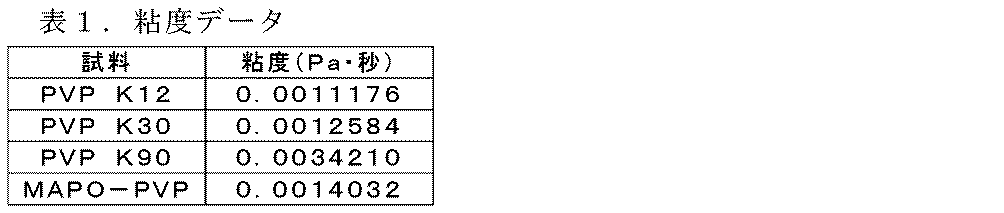
ポリマー分子量は、PVP K12及びPVP K30の市販の試料の分子量と比較して、多角度光散乱法を用いたサイズ排除クロマトグラフィ(SEC-MALS)によって決定した。SEC-MALS設定は、移動相として脱イオン水中20%ACN(v/v)(50mMのNa2SO4を含む)を、流速0.3mL/分、40℃で、3つの直列のTosoh Biosciences TSK-ゲルカラム[SuperAW3000 4μm、6.0mm ID×15cm(PEO/DMF排除限界=60,000グラム/モル)、SuperAW4000 6μm、6.0mm ID×15cm(PEO/DMF排除限界=400,000グラム/モル)及びSuperAW5000 7μm、6.0mm ID×15cm(PEO/DMF排除限界=4,000,000グラム/モル)]を、オンラインAgilent 1200 UV/VISダイオードアレイ検出器、Wyatt Optilab rEX干渉屈折計、及びWyatt mini-DAWN Treos多角度レーザ散乱(MALS)検出器(λ=658nm)とともに用いた。分子量及び多分散度データは、Wyatt ASTRA 6.1.1.17 SEC/LSソフトウェアパッケージを使用して計算した。図5において、PVP K12、PVP K30、及びMAPO-PVPのSEC-MALSクロマトグラムを示す。PVP K30及びMAPO-PVPのクロマトグラムは類似していたので、PVP K30及びMAPO-PVPは類似した分子量分布を有していたと推測された。
Polymer molecular weights were determined by size-exclusion chromatography with multi-angle light scattering (SEC-MALS) in comparison with the molecular weights of commercial samples of PVP K12 and PVP K30. The SEC-MALS setup consisted of three Tosoh Biosciences TSK-gel columns in series [
実施例2:モノアシルホスフィンオキシドモノ末端ポリ(N,N-ジメチルアクリルアミド)(MAPO-PDMA)の合成:還流冷却器を備えた三つ口丸底フラスコに、N,N-ジメチルアクリルアミド(11.0グラム)、エタノール(11.0グラム)及びOmnirad819(400ミリグラム)を黄色光下で投入し、脱気し、窒素下75℃で加熱した。次いで、反応混合物を約1.22mW/cm2の強度を有する435nmのLED光を用いて20分間照射した。次いで、反応を空気中でクエンチし、室温まで冷却し、続いて冷ジエチルエーテル中で沈殿させて白色固体を得て、これをメタノールに再び溶解し、ジエチルエーテルで沈殿させた。この沈殿プロセスをもう一度繰り返して、白色固体を得た(収率65%)。MAPO-PDMAは、重水素化メタノール中の500MHz 1H-NMR分光法によって特性を決定した。図6を参照されたい。 Example 2: Synthesis of monoacylphosphine oxide mono-terminated poly(N,N-dimethylacrylamide) (MAPO-PDMA): A three-necked round bottom flask equipped with a reflux condenser was charged with N,N-dimethylacrylamide (11.0 grams), ethanol (11.0 grams) and Omnirad 819 (400 milligrams) under yellow light, degassed and heated at 75° C. under nitrogen. The reaction mixture was then irradiated with 435 nm LED light with an intensity of about 1.22 mW/cm 2 for 20 minutes. The reaction was then quenched in air, cooled to room temperature and subsequently precipitated in cold diethyl ether to give a white solid, which was redissolved in methanol and precipitated with diethyl ether. This precipitation process was repeated once more to give a white solid (65% yield). MAPO-PDMA was characterized by 500 MHz 1 H-NMR spectroscopy in deuterated methanol. See FIG. 6.
ポリマー分子量は、多角度光散乱を用いるサイズ排除クロマトグラフィ(SEC-MALS)によって決定した。SEC-MALS設定は、移動相としてメタノール(10mMのLiBrを含む)を、流速0.6mL/分、50℃で、3つの直列のTosoh Biosciences TSK-ゲルカラム[SuperAW3000 4μm、6.0mm ID×15cm(PEO/DMF排除限界=60,000グラム/モル)、SuperAW4000 6μm、6.0mm ID×15cm(PEO/DMF排除限界=400,000グラム/モル)及びSuperAW5000 7μm、6.0mm ID×15cm(PEO/DMF排除限界=4,000,000グラム/モル)]を、オンラインAgilent 1200 UV/VISダイオードアレイ検出器、Wyatt Optilab rEX干渉屈折計、及びWyatt mini-DAWN Treos多角度レーザ散乱(MALS)検出器(λ=658nm)とともに用いた。30℃(λ=658nm)における0.183mL/gのdη/dc値は、絶対分子量決定に使用した。絶対分子量及び多分散度データは、Wyatt ASTRA 6.1.1.17 SEC/LSソフトウェアパッケージを使用して計算した。数平均分子量は、56,500グラム/モルであると決定され、重量平均分子量は、96,100グラム/モルであると決定され、1.6の多分散指数[Mw/Mn]が得られた。
Polymer molecular weights were determined by size-exclusion chromatography with multi-angle light scattering (SEC-MALS). The SEC-MALS setup consisted of three Tosoh Biosciences TSK-gel columns in series (
実施例3(予測的):モノアシルホスフィンオキシドモノ末端ポリ(N-ビニルピロリドン-co-N,N-ジメチルアクリルアミド)の合成:還流凝縮器を備えた三つ口丸底フラスコに、N-ビニルピロリドン(10.0グラム)、N,N-ジメチルアクリルアミド(10.0グラム)、エタノール(41.0グラム)及びOmnirad 819(1.0グラム)を黄色光下で投入し、脱気し、65℃で加熱する。次いで、反応混合物を約1.22mW/cm2の強度を有する435nmのLED光を用いて30分間照射する。反応混合物を空気中でクエンチし、室温まで冷却する。溶媒を減圧下で除去し、続いて冷ジエチルエーテル中で沈殿させて、濾過により白色固体を得る。その白色固体をジエチルエーテル(50mL)に懸濁し、30分間撹拌し、再び濾過する。次いで、生成物(「MAPO-ポリ[NVP-co-DMA]」)をジエチルエーテル(50mLで3回)で洗浄し、風乾して白色粉末を得る。 Example 3 (Prophetic): Synthesis of monoacylphosphine oxide mono-terminated poly(N-vinylpyrrolidone-co-N,N-dimethylacrylamide): A three-necked round bottom flask equipped with a reflux condenser is charged with N-vinylpyrrolidone (10.0 grams), N,N-dimethylacrylamide (10.0 grams), ethanol (41.0 grams) and Omnirad 819 (1.0 grams) under yellow light, degassed and heated at 65°C. The reaction mixture is then irradiated with 435 nm LED light with an intensity of about 1.22 mW/ cm2 for 30 minutes. The reaction mixture is quenched in air and cooled to room temperature. The solvent is removed under reduced pressure followed by precipitation in cold diethyl ether to obtain a white solid by filtration. The white solid is suspended in diethyl ether (50 mL), stirred for 30 minutes and filtered again. The product ("MAPO-poly[NVP-co-DMA]") is then washed with diethyl ether (3 x 50 mL) and air-dried to give a white powder.
実施例4(光路長変更)
表2に記載の配合を含む反応性モノマー混合物を形成した。反応性モノマー混合物を、約15分間真空を適用することによって脱気した。次に、約100マイクロリットルの反応性モノマー混合物を、Zeonorベースカーブ型に分注し、その後、Zeonorフロントカーブ型をベースカーブ型上に配置した。得られた型アセンブリを図3に示す照射ジグに移し、次いでこれを、47.5mW/cm2の強度を有する365ナノメートルのLED光源が型キャビティ内の別個の体積に向けられ、デジタル光処理チップ又はデジタルマイクロミラー装置によって変調されるコンピュータ制御光プロジェクタに接続した。
Example 4 (changing optical path length)
A reactive monomer mixture was formed containing the formulation set forth in Table 2. The reactive monomer mixture was degassed by applying a vacuum for approximately 15 minutes. Approximately 100 microliters of the reactive monomer mixture was then dispensed into a Zeonor base curve mold, after which the Zeonor front curve mold was placed onto the base curve mold. The resulting mold assembly was transferred to the illumination jig shown in FIG. 3, which was then connected to a computer-controlled light projector in which a 365 nanometer LED light source with an intensity of 47.5 mW/ cm2 was directed at a separate volume within the mold cavity and modulated by a digital light processing chip or digital micromirror device.

コンピュータ制御された光プロジェクタは、図7に示されるUSAF 1951テストターゲットを照明又は照射するようにプログラムされた。USAF 1951テストチャートは、広範囲の空間周波数及び認識可能な数字を包含する広く知られている画像であり、したがって、付与された画像プロファイルの全体的な品質を客観的に測定するための良好な基準である。型キャビティ内の反応性モノマー混合物を、700mJ/cm2の最大エネルギーと31.6秒の曝露時間を使用し、コンピュータ制御光プロジェクタによって照射して、コンタクトレンズ上のUSAF 1951テストチャートの画像プロファイルを付与し、次いで90℃で、2時間45分間にわたり加熱して、反応性モノマー混合物の残りを熱硬化させて、コンタクトレンズにした。得られたレンズを、70%(v/v)水性IPAを使用して取り出し(約1時間の浸漬)、70%(v/v)水性IPAで30分間2回抽出し、脱イオン水で30分間水和し、次いで、充填溶液で平衡化した。最終的に水和したレンズの光学顕微鏡写真を図8に示す。注記:コンピュータ制御光プロジェクタの正確な条件は、通常、反応性モノマー混合物の組成及び投影画像に基づいて最適化される必要がある。この最適化は、通常、型キャビティ内の反応性モノマー混合物に送達されるエネルギー[エネルギー=LED強度×DMD減衰×曝露時間]及び曝露時間を変化させることを含む。好ましくは、最適化は、最短曝露時間で可能な最高強度を使用する。 The computer-controlled light projector was programmed to illuminate or irradiate the USAF 1951 test target shown in FIG. 7. The USAF 1951 test chart is a widely known image that encompasses a wide range of spatial frequencies and recognizable numbers, and is therefore a good standard for objectively measuring the overall quality of the applied image profile. The reactive monomer mixture in the mold cavity was irradiated by the computer-controlled light projector using a maximum energy of 700 mJ/ cm2 and an exposure time of 31.6 seconds to impart the image profile of the USAF 1951 test chart on the contact lens, and then heated at 90°C for 2 hours and 45 minutes to thermally cure the remainder of the reactive monomer mixture into a contact lens. The resulting lens was removed using 70% (v/v) aqueous IPA (approximately 1 hour immersion), extracted twice with 70% (v/v) aqueous IPA for 30 minutes, hydrated with deionized water for 30 minutes, and then equilibrated with the filling solution. An optical micrograph of the final hydrated lens is shown in Figure 8. Note: The exact conditions of the computer controlled light projector typically need to be optimized based on the composition of the reactive monomer mixture and the projected image. This optimization typically involves varying the energy delivered to the reactive monomer mixture in the mold cavity [energy = LED intensity x DMD attenuation x exposure time] and the exposure time. Preferably, the optimization uses the highest intensity possible with the shortest exposure time.
空間解像度を改善するために、光プロジェクタ照射の前に、90℃で5、10、及び15分間の熱的予備硬化工程を用いて上記の実験を繰り返した。予備硬化工程は、光プロジェクタ照射の前に反応性モノマー混合物の粘度を増加させ、それによって分子運動を低減することによって画像品質を改善するものである。これらのデータに基づいて、10分間の予備硬化工程は、付与されたプロファイル画像品質及び再現性を改善するようであった。 To improve spatial resolution, the above experiment was repeated using thermal pre-cure steps at 90°C for 5, 10, and 15 minutes prior to light projector exposure. The pre-cure step improves image quality by increasing the viscosity of the reactive monomer mixture prior to light projector exposure, thereby reducing molecular motion. Based on these data, the 10 minute pre-cure step appeared to improve the imparted profile image quality and repeatability.
実施例2(光学的特徴)
10分間の予備硬化を使用して実施例1を繰り返すが、画像を投影する代わりに、コンピュータ制御された光プロジェクタが、円形ドットのパターンを照射し、この場合、個々のドットは、異なるエネルギーレベルに曝露され、それによって、実施例1に記載されるようにレンズが離型され、抽出され、水和され、平衡化された後の、体積及び屈折率の局所的な変化に起因して、異なる光路の柱を生成した。このようにして、適用されたエネルギー(mJ)対デルタ光路長効果(充填溶液から空気への変換後の波における波面測定)対各柱位置についての同じ設計の未処理レンズの波面値をプロットすることによって、較正曲線を生成した。約100mJ未満のエネルギー曝露に対して、較正曲線は、適度に線形であり、決定論的であった。そのような関係は、固定された球面度数のみを示すように設計された型キャビティ内で作製されたレンズに、球面度数又はデフォーカス又は円柱度数を追加するなど、予測可能な様式で、光学的特徴を作り出すことを可能にする。この情報に基づいて、3.6秒の曝露時間及び86mJ/cm2のエネルギーレベルを使用して、コンピュータ制御プロジェクタは、球面度数画像又は円柱度数画像をレンズキャビティ内に照射した。完全に平衡化されたレンズの投影画像並びに測定されたデルタ波面の二次元描写が図9に示されている。いくらかのデフォーカスを加えることによる球面度数の推定変化は、およそ0.7ジオプターであり、円柱度数の推定追加は、およそ0.12ジオプターであった。
Example 2 (Optical Characteristics)
Example 1 was repeated using a 10 minute pre-cure, but instead of projecting an image, a computer-controlled light projector illuminated a pattern of circular dots, where each dot was exposed to different energy levels, thereby generating columns of different optical paths due to local changes in volume and refractive index after the lens was demolded, extracted, hydrated, and equilibrated as described in Example 1. In this way, a calibration curve was generated by plotting the applied energy (mJ) versus delta path length effect (wavefront measurement in waves after conversion from filling solution to air) versus wavefront values of an untreated lens of the same design for each column position. For energy exposures below about 100 mJ, the calibration curve was reasonably linear and deterministic. Such a relationship allows for the creation of optical features in a predictable manner, such as adding sphere or defocus or cylinder to a lens made in a mold cavity designed to exhibit only a fixed sphere. Based on this information, a computer-controlled projector illuminated the spherical or cylindrical image into the lens cavity using an exposure time of 3.6 seconds and an energy level of 86 mJ/cm2. A projected image of a perfectly equilibrated lens as well as a two -dimensional depiction of the measured delta wavefront are shown in Figure 9. The estimated change in spherical power by adding some defocus was approximately 0.7 diopters, and the estimated addition of cylindrical power was approximately 0.12 diopters.
充填溶液中のコンタクトレンズパラメータを測定するために、較正された二重干渉法が使用された。これらのパラメータには、複数の開口における等価球面度数(ジオプター又はD)、複数の開口における円柱度数(ジオプター又はD)、直径(ミリメートル又はmm)、中心厚(ミリメートル又はmm)、矢状高さ(ミリメートル又はmm)、及び6.5ミリメートル口径を使用して測定したときの、球面/円柱度数及びコマ収差を除去されたマイクロメートル又はミクロン(μm)単位での、及び波数で表現される場合もある、レンズ設計目標からの二乗平均平方根(RMS)光路波面偏差が含まれる。この機器は、波面パラメータの測定のためのカスタムの専用干渉計と、矢状高さ及び中心厚の寸法パラメータの測定のためのLumetrics OptiGauge(登録商標)II低コヒーレンス干渉計と、からなる。組み合わされた2つの個々の機器は、Lumetrics Clearwave(商標)Plusと同様であり、ソフトウェアは、Lumetrics OptiGauge Control Center v7.0以降に類似している。Clearwave(商標)Plusでは、カメラを使用してレンズ縁を見つけ、次いでレンズ中心を計算し、次にこれを使用して、矢状高さ及び中心厚を測定するために、1310ナノメートル干渉計プローブをレンズ中心に位置合わせする。伝搬された波面も、波面センサ(シャックハルトマンセンサ)を使用して連続して収集される。コンタクトレンズの透過波面からの複数のパラメータが測定され、他のパラメータは、これらの測定値から計算される。 A calibrated dual interferometry method was used to measure contact lens parameters in the filling solution. These parameters included equivalent spherical power (diopters or D) at multiple apertures, cylindrical power (diopters or D) at multiple apertures, diameter (millimeters or mm), central thickness (millimeters or mm), sagittal height (millimeters or mm), and root-mean-square (RMS) optical path wavefront deviation from the lens design target in micrometers or microns (μm) with spheric/cylinder power and coma removed, and sometimes expressed in wavenumbers, when measured using a 6.5 mm aperture. The instrumentation consisted of a custom dedicated interferometer for the measurement of wavefront parameters and a Lumetrics OptiGauge® II low coherence interferometer for the measurement of dimensional parameters of sagittal height and central thickness. The two individual instruments combined are similar to the Lumetrics Clearwave™ Plus and the software is similar to the Lumetrics OptiGauge Control Center v7.0 and later. The Clearwave™ Plus uses a camera to find the lens edge and then calculates the lens center, which is then used to align a 1310 nanometer interferometer probe to the lens center to measure sagittal height and central thickness. The transmitted wavefront is also continuously collected using a wavefront sensor (Shack-Hartmann sensor). Multiple parameters from the transmitted wavefront of the contact lens are measured and other parameters are calculated from these measurements.
収集されたデータから、目標からの測定値を比較することによって差異項が計算される。これらには、6.5ミリメートル口径を使用して測定したときのμm単位のレンズ設計目標(球面/円柱度数及び除去されたコマ収差)からの二乗平均平方根光路波面偏差(RMS_65)、5ミリメートルの口径を使用して測定したときのジオプター単位(D)のレンズ設計目標からの第2の等価球面度数偏差(PW2EQD)、mm単位のレンズ設計目標直径からの偏差(DMD)、ISO18369-3により測定した矢状高さから計算したときの、mm単位のレンズ設計目標ベースカーブ半径、及びレンズ直径からの偏差(BCD)、及びmm単位のレンズ設計目標中心厚からの偏差(CTD)が含まれる。調節され局在化された光重合によって生成された追加の球面度数又は円柱度数の量は、型設計に基づいて設計された球面度数を差し引いた後に、上記のようなデータを使用して計算された。 From the collected data, difference terms are calculated by comparing the measurements from the targets. These include the root mean square path wavefront deviation (RMS_65) from the lens design target (sphere/cylinder and removed coma) in μm when measured using a 6.5 mm aperture, the second equivalent spherical power deviation (PW2EQD) from the lens design target in diopters (D) when measured using a 5 mm aperture, the deviation from the lens design target diameter (DMD) in mm, the lens design target base curve radius and deviation from the lens diameter (BCD) in mm, and the deviation from the lens design target center thickness (CTD) in mm, calculated from the sagittal height measured by ISO 18369-3. The amount of additional spherical or cylindrical power generated by the adjusted localized photopolymerization was calculated using the data as above after subtracting the designed spherical power based on the mold design.
〔実施の態様〕
(1) 式Iの化合物であって、

R2及びR3は、出現するたびに独立して、H又は-X’-N(R6)(R7)であるが、ただし、少なくとも1つのR2又はR3は、-X’-N(R6)(R7)であり、式中、X’は、出現するたびに独立して、結合若しくは-(CO)-であり、R6は、出現するたびに独立して、H、C1~C6アルキル、若しくはC1~C6アルキルカルボニルであり、R7は、出現するたびに、独立して、H、C1~C6アルキル、若しくはC1~C6アルキルカルボニルであるか、又は、R6及びR7は、いずれの出現においても、それらが結合している窒素原子とともに、環炭素原子が、任意選択的に、窒素、酸素、及び硫黄から選択されるヘテロ原子によって置換されているヘテロシクロアルキル環を形成し、それぞれのアルキル及びアルキルカルボニルは、独立して、任意選択的に、ヒドロキシ、アミノ、アミド、オキソ、カルボキシ、アルキルカルボキシ、カルボニル、アルキルカルボニル、アルコキシ、アミド、カルバマート、カルボナート、ハロ、フェニル、又はベンジルによって置換されており、それぞれのヘテロシクロアルキルは、独立して任意選択的に、アルキル、ヒドロキシ、アミノ、アミド、オキソ、カルボキシ、アルキルカルボキシ、カルボニル、アルキルカルボニル、アルコキシ、アミド、カルバマート、カルボナート、ハロ、フェニル、又はベンジルによって置換されており、
R4及びR5は、存在する場合、出現するたびに独立して、アルキル、シクロアルキル、アルコキシ、又はハロであり、
Tは、連鎖停止基であり、
nは、10~4000であり、
p及びqは、独立して、0、1、2、3、4、又は5である、化合物。
(2) R2及びR3のうちの1つは、出現するたびに、Hである、実施態様1に記載の化合物。
(3) qは、0である、実施態様1又は2に記載の化合物。
(4) pは、3であり、R4は、出現するたびに独立して、C1~C3アルキルである、実施態様1に記載の化合物。
(5) R6及びR7は、それらが結合している窒素原子とともに、任意選択的に、アルキル、ヒドロキシ、アミノ、アミド、オキソ、カルボキシ、アルキルカルボキシ、カルボニル、アルキルカルボニル、アルコキシ、アミド、カルバマート、カルボナート、又はハロによって置換されているヘテロシクロアルキル環を形成する、実施態様1に記載の化合物。
[Embodiment]
(1) A compound of formula I,
R 2 and R 3 are, independently at each occurrence, H or -X'-N(R 6 )(R 7 ), with the proviso that at least one of R 2 or R 3 is -X'-N(R 6 )(R 7 ), where X' at each occurrence is independently a bond or -(CO)-, R 6 is, independently at each occurrence, H, C 1 -C 6 alkyl, or C 1 -C 6 alkylcarbonyl, and R 7 is, independently at each occurrence, H, C 1 -C 6 alkyl, or C 1 -C 6 alkylcarbonyl, or R 6 and R 7 , in each occurrence, together with the nitrogen atom to which they are attached, form a heterocycloalkyl ring in which ring carbon atoms are optionally substituted by heteroatoms selected from nitrogen, oxygen, and sulfur, each alkyl and alkylcarbonyl is independently and optionally substituted by hydroxy, amino, amido, oxo, carboxy, alkylcarboxy, carbonyl, alkylcarbonyl, alkoxy, amido, carbamate, carbonate, halo, phenyl, or benzyl, and each heterocycloalkyl is independently and optionally substituted by alkyl, hydroxy, amino, amido, oxo, carboxy, alkylcarboxy, carbonyl, alkylcarbonyl, alkoxy, amido, carbamate, carbonate, halo, phenyl, or benzyl;
R4 and R5 , if present, are independently at each occurrence alkyl, cycloalkyl, alkoxy, or halo;
T is a chain terminating group;
n is 10 to 4000;
A compound wherein p and q are independently 0, 1, 2, 3, 4, or 5.
(2) The compound according to
(3) The compound according to
(4) The compound according to
(5) The compound according to
(6) R6及びR7は、それらが結合している窒素原子とともに、任意選択的に、アルキル又はオキソによって置換されているイミダゾリジニル、ピペラジニル、ピロリジニル、又はピペリジニルを形成する、実施態様1に記載の化合物。
(7) R6及びR7は、それらが結合している窒素原子とともに、2-ピロリジノンを形成する、実施態様1に記載の化合物。
(8) R6及びR7は、独立して、H、C1~C6アルキル、又はC1~C6アルキルカルボニルであり、アルキル及びアルキルカルボニルは、独立して任意選択的に、ヒドロキシによって置換されている、実施態様1に記載の化合物。
(9) R6及びR7は、独立して、H又はC1~C4アルキルであり、アルキルは、任意選択的に、ヒドロキシによって置換されている、実施態様1に記載の化合物。
(10) R6及びR7は、両方ともHである、実施態様1に記載の化合物。
(6) The compound according to
(7) The compound according to
(8) The compound according to
(9) The compound according to
(10) The compound according to
(11) R6は、Hであり、R7は、C1~C3アルキル又はC1~C3アルキルカルボニルであり、アルキルは、任意選択的に、ヒドロキシによって置換されている、実施態様1に記載の化合物。
(12) R6及びR7は、独立して、任意選択的にヒドロキシによって置換されているC1~C3アルキルである、実施態様1に記載の化合物。
(13) R6は、任意選択的にヒドロキシによって置換されているC1~C3アルキルであり、R7は、C1~C3アルキルカルボニルである、実施態様1に記載の化合物。
(14) X’は、-(CO)-である、実施態様1に記載の化合物。
(15) X’は、直接結合である、実施態様1に記載の化合物。
(11) The compound according to
(12) The compound according to
(13) The compound according to
(14) The compound according to
(15) The compound according to
(16)

(17) 眼科用レンズを形成する方法であって、前記方法は、
(a)ベースカーブ及びフロントカーブから構成される型アセンブリを提供することであって、前記ベースカーブ及び前記フロントカーブは、それらの間にキャビティを画定して包囲し、前記キャビティは、反応性モノマー混合物を収容し、前記反応性モノマー混合物は、前記眼科用レンズを作製するのに好適なモノマー、第1の波長で活性化可能な第1の重合開始剤、前記第1の重合開始剤に化学的に結合された第1の官能性部分、及び前記第1の重合開始剤を実質的に活性化させない第2の活性化によって活性化可能な第2の重合開始剤を含み、前記ベースカーブ又は前記フロントカーブの少なくとも一方は、光透過性である、ことと、
(b)前記反応性モノマー混合物の1つ以上の選択領域を前記第1の波長の化学線源に曝露して、それによって前記反応性モノマー混合物の一部を選択的に重合させることであって、選択的に重合された前記一部は、前記第1の官能性部分を組み込む、ことと、
(c)前記反応性モノマー混合物を前記第2の活性化に曝露して、前記第2の重合開始剤を活性化し、前記反応性モノマー混合物を硬化させることと、
(d)前記眼科用レンズを前記型アセンブリから取り出すことと、
(e)前記眼科用レンズから未反応の第1の重合開始剤を抽出することと、を含み、
化学的に結合された第1の官能性部分を有する前記第1の重合開始剤は、実施態様1に記載の化合物である、方法。
(18) 眼科用レンズを作製するための反応性モノマー混合物であって、前記反応性モノマー混合物は、
前記眼科用レンズを作製するのに好適なモノマーと、
第1の波長で活性化可能な第1の重合開始剤と、
前記第1の重合開始剤に化学的に結合された第1の官能性部分と、
前記第1の重合開始剤を実質的に活性化しない第2の活性化によって活性化可能な第2の重合開始剤と、を含み、
化学的に結合された第1の官能性部分を有する前記第1の重合開始剤は、実施態様1に記載の化合物である、反応性モノマー混合物。
(16)
17. A method of forming an ophthalmic lens, the method comprising:
(a) providing a mold assembly comprised of a base curve and a front curve, the base curve and the front curve defining and enclosing a cavity therebetween, the cavity containing a reactive monomer mixture comprising a monomer suitable for making the ophthalmic lens, a first polymerization initiator activatable at a first wavelength, a first functional moiety chemically bonded to the first polymerization initiator, and a second polymerization initiator activatable by a second activation that does not substantially activate the first polymerization initiator, and at least one of the base curve or the front curve is optically transparent;
(b) exposing one or more selected areas of the reactive monomer mixture to a source of actinic radiation at the first wavelength, thereby selectively polymerizing a portion of the reactive monomer mixture, the selectively polymerized portion incorporating the first functional moiety; and
(c) exposing the reactive monomer mixture to a second activation to activate the second polymerization initiator and cure the reactive monomer mixture;
(d) removing the ophthalmic lens from the mold assembly;
(e) extracting unreacted first polymerization initiator from the ophthalmic lens;
The method of
(18) A reactive monomer mixture for making an ophthalmic lens, the reactive monomer mixture comprising:
a monomer suitable for making said ophthalmic lens;
a first polymerization initiator activatable at a first wavelength;
a first functional moiety chemically bonded to the first polymerization initiator;
a second polymerization initiator activatable by a second activation process that does not substantially activate the first polymerization initiator;
2. A reactive monomer mixture, wherein the first polymerization initiator having a first functional moiety chemically bonded thereto is a compound according to
Claims (18)

R2及びR3は、出現するたびに独立して、H又は-X’-N(R6)(R7)であるが、ただし、少なくとも1つのR2又はR3は、-X’-N(R6)(R7)であり、式中、X’は、出現するたびに独立して、結合若しくは-(CO)-であり、R6は、出現するたびに独立して、H、C1~C6アルキル、若しくはC1~C6アルキルカルボニルであり、R7は、出現するたびに、独立して、H、C1~C6アルキル、若しくはC1~C6アルキルカルボニルであるか、又は、R6及びR7は、いずれの出現においても、それらが結合している窒素原子とともに、環炭素原子が、任意選択的に、窒素、酸素、及び硫黄から選択されるヘテロ原子によって置換されているヘテロシクロアルキル環を形成し、それぞれのアルキル及びアルキルカルボニルは、独立して、任意選択的に、ヒドロキシ、アミノ、アミド、オキソ、カルボキシ、アルキルカルボキシ、カルボニル、アルキルカルボニル、アルコキシ、アミド、カルバマート、カルボナート、ハロ、フェニル、又はベンジルによって置換されており、それぞれのヘテロシクロアルキルは、独立して任意選択的に、アルキル、ヒドロキシ、アミノ、アミド、オキソ、カルボキシ、アルキルカルボキシ、カルボニル、アルキルカルボニル、アルコキシ、アミド、カルバマート、カルボナート、ハロ、フェニル、又はベンジルによって置換されており、
R4及びR5は、存在する場合、出現するたびに独立して、アルキル、シクロアルキル、アルコキシ、又はハロであり、
Tは、連鎖停止基であり、
nは、10~4000であり、
p及びqは、独立して、0、1、2、3、4、又は5である、化合物。 A compound of formula I,
R 2 and R 3 are, independently at each occurrence, H or -X'-N(R 6 )(R 7 ), with the proviso that at least one of R 2 or R 3 is -X'-N(R 6 )(R 7 ), where X' at each occurrence is independently a bond or -(CO)-, R 6 is, independently at each occurrence, H, C 1 -C 6 alkyl, or C 1 -C 6 alkylcarbonyl, R 7 is, independently at each occurrence, H, C 1 -C 6 alkyl, or C 1 -C 6 alkylcarbonyl, or R 6 and R 7 , in each occurrence, together with the nitrogen atom to which they are attached, form a heterocycloalkyl ring in which ring carbon atoms are optionally substituted by heteroatoms selected from nitrogen, oxygen, and sulfur, each alkyl and alkylcarbonyl is independently and optionally substituted by hydroxy, amino, amido, oxo, carboxy, alkylcarboxy, carbonyl, alkylcarbonyl, alkoxy, amido, carbamate, carbonate, halo, phenyl, or benzyl, and each heterocycloalkyl is independently and optionally substituted by alkyl, hydroxy, amino, amido, oxo, carboxy, alkylcarboxy, carbonyl, alkylcarbonyl, alkoxy, amido, carbamate, carbonate, halo, phenyl, or benzyl;
R4 and R5 , if present, are independently at each occurrence alkyl, cycloalkyl, alkoxy, or halo;
T is a chain terminating group;
n is 10 to 4000;
A compound wherein p and q are independently 0, 1, 2, 3, 4, or 5.

(a)ベースカーブ及びフロントカーブから構成される型アセンブリを提供することであって、前記ベースカーブ及び前記フロントカーブは、それらの間にキャビティを画定して包囲し、前記キャビティは、反応性モノマー混合物を収容し、前記反応性モノマー混合物は、前記眼科用レンズを作製するのに好適なモノマー、第1の波長で活性化可能な第1の重合開始剤、前記第1の重合開始剤に化学的に結合された第1の官能性部分、及び前記第1の重合開始剤を実質的に活性化させない第2の活性化によって活性化可能な第2の重合開始剤を含み、前記ベースカーブ又は前記フロントカーブの少なくとも一方は、光透過性である、ことと、
(b)前記反応性モノマー混合物の1つ以上の選択領域を前記第1の波長の化学線源に曝露して、それによって前記反応性モノマー混合物の一部を選択的に重合させることであって、選択的に重合された前記一部は、前記第1の官能性部分を組み込む、ことと、
(c)前記反応性モノマー混合物を前記第2の活性化に曝露して、前記第2の重合開始剤を活性化し、前記反応性モノマー混合物を硬化させることと、
(d)前記眼科用レンズを前記型アセンブリから取り出すことと、
(e)前記眼科用レンズから未反応の第1の重合開始剤を抽出することと、を含み、
化学的に結合された第1の官能性部分を有する前記第1の重合開始剤は、請求項1に記載の化合物である、方法。 1. A method of forming an ophthalmic lens, the method comprising:
(a) providing a mold assembly comprised of a base curve and a front curve, the base curve and the front curve defining and enclosing a cavity therebetween, the cavity containing a reactive monomer mixture comprising a monomer suitable for making the ophthalmic lens, a first polymerization initiator activatable at a first wavelength, a first functional moiety chemically bonded to the first polymerization initiator, and a second polymerization initiator activatable by a second activation that does not substantially activate the first polymerization initiator, and at least one of the base curve or the front curve is optically transparent;
(b) exposing one or more selected areas of the reactive monomer mixture to a source of actinic radiation at the first wavelength, thereby selectively polymerizing a portion of the reactive monomer mixture, the selectively polymerized portion incorporating the first functional moiety; and
(c) exposing the reactive monomer mixture to a second activation to activate the second polymerization initiator and cure the reactive monomer mixture;
(d) removing the ophthalmic lens from the mold assembly;
(e) extracting unreacted first polymerization initiator from the ophthalmic lens;
The method of claim 1 , wherein the first polymerization initiator having a first functional moiety chemically attached thereto is a compound according to claim 1 .
前記眼科用レンズを作製するのに好適なモノマーと、
第1の波長で活性化可能な第1の重合開始剤と、
前記第1の重合開始剤に化学的に結合された第1の官能性部分と、
前記第1の重合開始剤を実質的に活性化しない第2の活性化によって活性化可能な第2の重合開始剤と、を含み、
化学的に結合された第1の官能性部分を有する前記第1の重合開始剤は、請求項1に記載の化合物である、反応性モノマー混合物。 1. A reactive monomer mixture for making an ophthalmic lens, said reactive monomer mixture comprising:
a monomer suitable for making said ophthalmic lens;
a first polymerization initiator activatable at a first wavelength;
a first functional moiety chemically bonded to the first polymerization initiator;
a second polymerization initiator activatable by a second activation process that does not substantially activate the first polymerization initiator;
13. A reactive monomer mixture, wherein the first polymerization initiator having a first functional moiety chemically bonded thereto is a compound according to claim 1.
Applications Claiming Priority (5)
| Application Number | Priority Date | Filing Date | Title |
|---|---|---|---|
| US202163249646P | 2021-09-29 | 2021-09-29 | |
| US63/249,646 | 2021-09-29 | ||
| US17/821,315 | 2022-08-22 | ||
| US17/821,315 US11912800B2 (en) | 2021-09-29 | 2022-08-22 | Amide-functionalized polymerization initiators and their use in the manufacture of ophthalmic lenses |
| PCT/IB2022/058727 WO2023052889A1 (en) | 2021-09-29 | 2022-09-15 | Amide-functionalized polymerization initiators and their use in the manufacture of ophthalmic lenses |
Publications (1)
| Publication Number | Publication Date |
|---|---|
| JP2024537048A true JP2024537048A (en) | 2024-10-10 |
Family
ID=85774628
Family Applications (1)
| Application Number | Title | Priority Date | Filing Date |
|---|---|---|---|
| JP2024519333A Pending JP2024537048A (en) | 2021-09-29 | 2022-09-15 | Amide-functionalized polymerization initiators and their use in the manufacture of ophthalmic lenses - Patents.com |
Country Status (7)
| Country | Link |
|---|---|
| US (1) | US11912800B2 (en) |
| EP (1) | EP4408899B1 (en) |
| JP (1) | JP2024537048A (en) |
| KR (1) | KR20240070635A (en) |
| CN (1) | CN118043360A (en) |
| AU (1) | AU2022354649A1 (en) |
| TW (1) | TW202323306A (en) |
Family Cites Families (111)
| Publication number | Priority date | Publication date | Assignee | Title |
|---|---|---|---|---|
| NL137711C (en) | 1961-12-27 | |||
| NL128305C (en) | 1963-09-11 | |||
| US3808178A (en) | 1972-06-16 | 1974-04-30 | Polycon Laboratories | Oxygen-permeable contact lens composition,methods and article of manufacture |
| US4197266A (en) | 1974-05-06 | 1980-04-08 | Bausch & Lomb Incorporated | Method for forming optical lenses |
| US4113224A (en) | 1975-04-08 | 1978-09-12 | Bausch & Lomb Incorporated | Apparatus for forming optical lenses |
| US4018853A (en) | 1974-11-21 | 1977-04-19 | Warner-Lambert Company | Crosslinked, hydrophilic rods of pyrrolidone-methacrylate graft copolymers |
| US4120570A (en) | 1976-06-22 | 1978-10-17 | Syntex (U.S.A.) Inc. | Method for correcting visual defects, compositions and articles of manufacture useful therein |
| US4136250A (en) | 1977-07-20 | 1979-01-23 | Ciba-Geigy Corporation | Polysiloxane hydrogels |
| US4153641A (en) | 1977-07-25 | 1979-05-08 | Bausch & Lomb Incorporated | Polysiloxane composition and contact lens |
| US4190277A (en) | 1978-08-30 | 1980-02-26 | England Robert C | Device for insertion, manipulation and removal of soft contact lenses |
| DE3174584D1 (en) | 1981-11-27 | 1986-06-12 | Tsuetaki George F | Polymers primarily for contact lenses, and contact lenses made from them |
| SU1085986A1 (en) | 1982-05-07 | 1984-04-15 | Предприятие П/Я В-8415 | Process for preparing grafted copolymers |
| US4680336A (en) | 1984-11-21 | 1987-07-14 | Vistakon, Inc. | Method of forming shaped hydrogel articles |
| US4620954A (en) | 1985-06-07 | 1986-11-04 | Ciba Vision Care Corp. | Hydrogel from ultraviolet-initiated copolymerization |
| US4740533A (en) | 1987-07-28 | 1988-04-26 | Ciba-Geigy Corporation | Wettable, flexible, oxygen permeable, substantially non-swellable contact lens containing block copolymer polysiloxane-polyoxyalkylene backbone units, and use thereof |
| SU1500316A1 (en) | 1987-03-02 | 1989-08-15 | 2-й Московский государственный медицинский институт им.Н.И.Пирогова | Apparatus for draining tympanic cavity |
| JP2551580B2 (en) | 1987-04-30 | 1996-11-06 | ホ−ヤ株式会社 | How to make contact lenses hydrophilic |
| US4910277A (en) | 1988-02-09 | 1990-03-20 | Bambury Ronald E | Hydrophilic oxygen permeable polymers |
| US5039459A (en) | 1988-11-25 | 1991-08-13 | Johnson & Johnson Vision Products, Inc. | Method of forming shaped hydrogel articles including contact lenses |
| US5070215A (en) | 1989-05-02 | 1991-12-03 | Bausch & Lomb Incorporated | Novel vinyl carbonate and vinyl carbamate contact lens material monomers |
| FR2646930B1 (en) | 1989-05-12 | 1993-04-09 | Essilor Int | PROCESS FOR PRODUCING A DIFFRACTIVE ELEMENT, USABLE IN PARTICULAR IN THE MANUFACTURE OF ARTIFICIAL OPTICAL LENSES, AND LENSES THUS OBTAINED |
| US5034461A (en) | 1989-06-07 | 1991-07-23 | Bausch & Lomb Incorporated | Novel prepolymers useful in biomedical devices |
| US5314960A (en) | 1990-04-10 | 1994-05-24 | Permeable Technologies, Inc. | Silicone-containing polymers, oxygen permeable hydrophilic contact lenses and methods for making these lenses and treating patients with visual impairment |
| US5244981A (en) | 1990-04-10 | 1993-09-14 | Permeable Technologies, Inc. | Silicone-containing contact lens polymers, oxygen permeable contact lenses and methods for making these lenses and treating patients with visual impairment |
| US5371147A (en) | 1990-10-11 | 1994-12-06 | Permeable Technologies, Inc. | Silicone-containing acrylic star polymers, block copolymers and macromonomers |
| US5310779A (en) | 1991-11-05 | 1994-05-10 | Bausch & Lomb Incorporated | UV curable crosslinking agents useful in copolymerization |
| US5944853A (en) | 1992-10-26 | 1999-08-31 | Johnson & Johnson Vision Products, Inc. | Method for preparing halotriazine dye- and vinyl sulfone dye-monomer compounds |
| US5321108A (en) | 1993-02-12 | 1994-06-14 | Bausch & Lomb Incorporated | Fluorosilicone hydrogels |
| TW328535B (en) | 1993-07-02 | 1998-03-21 | Novartis Ag | Functional photoinitiators and their manufacture |
| WO1995017689A1 (en) | 1993-12-21 | 1995-06-29 | Bausch & Lomb Incorporated | Method for increasing hydrophilicity of contact lenses |
| US5760100B1 (en) | 1994-09-06 | 2000-11-14 | Ciba Vision Corp | Extended wear ophthalmic lens |
| US7468398B2 (en) | 1994-09-06 | 2008-12-23 | Ciba Vision Corporation | Extended wear ophthalmic lens |
| US6020445A (en) | 1997-10-09 | 2000-02-01 | Johnson & Johnson Vision Products, Inc. | Silicone hydrogel polymers |
| FR2772033A1 (en) | 1997-12-05 | 1999-06-04 | Essilor Int | PROCESS FOR PRODUCING A TRANSPARENT POLYMERIC MATERIAL RESISTANT TO THE DEPOSITION OF PROTEINS, MATERIAL OBTAINED BY THIS PROCESS, CONTACT LENSES AND INTRAOCULAR IMPLANTS MADE OF THIS MATERIAL |
| US6849671B2 (en) | 1998-03-02 | 2005-02-01 | Johnson & Johnson Vision Care, Inc. | Contact lenses |
| US5962548A (en) | 1998-03-02 | 1999-10-05 | Johnson & Johnson Vision Products, Inc. | Silicone hydrogel polymers |
| US7461937B2 (en) | 2001-09-10 | 2008-12-09 | Johnson & Johnson Vision Care, Inc. | Soft contact lenses displaying superior on-eye comfort |
| US6822016B2 (en) | 2001-09-10 | 2004-11-23 | Johnson & Johnson Vision Care, Inc. | Biomedical devices containing internal wetting agents |
| US5998498A (en) | 1998-03-02 | 1999-12-07 | Johnson & Johnson Vision Products, Inc. | Soft contact lenses |
| US7052131B2 (en) | 2001-09-10 | 2006-05-30 | J&J Vision Care, Inc. | Biomedical devices containing internal wetting agents |
| US6943203B2 (en) | 1998-03-02 | 2005-09-13 | Johnson & Johnson Vision Care, Inc. | Soft contact lenses |
| US6367929B1 (en) | 1998-03-02 | 2002-04-09 | Johnson & Johnson Vision Care, Inc. | Hydrogel with internal wetting agent |
| WO2000002937A1 (en) | 1998-07-08 | 2000-01-20 | Sunsoft Corporation | Interpenetrating polymer network hydrophilic hydrogels for contact lens |
| SE9900935D0 (en) | 1999-03-16 | 1999-03-16 | Pharmacia & Upjohn Bv | Macromolecular compounds |
| JP2001163932A (en) | 1999-10-27 | 2001-06-19 | Novartis Ag | Method of modifying material surface |
| AU1387401A (en) | 1999-10-27 | 2001-05-08 | Commonwealth Scientific And Industrial Research Organisation | Coating process |
| CA2394939C (en) | 1999-12-16 | 2007-10-30 | Asahikasei Aime Co., Ltd. | Long-wearable soft contact lens |
| US6372815B1 (en) | 2000-04-18 | 2002-04-16 | Ocular Sciences Inc | Ophthalmic lenses and compositions, and methods for producing same |
| DK1581272T3 (en) | 2003-01-09 | 2006-10-02 | Alcon Inc | Dual function UV absorbers for ophthalmic lens materials |
| WO2004063795A1 (en) | 2003-01-10 | 2004-07-29 | Menicon Co., Ltd. | Highly safe silicone-containing material for ocular lens and process for producing the same |
| TWI294431B (en) | 2003-12-26 | 2008-03-11 | Kansai Paint Co Ltd | A polymer and method of manufacturing the same |
| US7214809B2 (en) | 2004-02-11 | 2007-05-08 | Johnson & Johnson Vision Care, Inc. | (Meth)acrylamide monomers containing hydroxy and silicone functionalities |
| US7786185B2 (en) | 2004-03-05 | 2010-08-31 | Johnson & Johnson Vision Care, Inc. | Wettable hydrogels comprising acyclic polyamides |
| CN100548648C (en) | 2004-07-30 | 2009-10-14 | 诺瓦提斯公司 | Method for making ophthalmic lenses using modulated energy |
| US7249848B2 (en) | 2004-09-30 | 2007-07-31 | Johnson & Johnson Vision Care, Inc. | Wettable hydrogels comprising reactive, hydrophilic, polymeric internal wetting agents |
| US7247692B2 (en) | 2004-09-30 | 2007-07-24 | Johnson & Johnson Vision Care, Inc. | Biomedical devices containing amphiphilic block copolymers |
| US9297928B2 (en) | 2004-11-22 | 2016-03-29 | Johnson & Johnson Vision Care, Inc. | Ophthalmic compositions comprising polyether substituted polymers |
| US7572841B2 (en) | 2006-06-15 | 2009-08-11 | Coopervision International Holding Company, Lp | Wettable silicone hydrogel contact lenses and related compositions and methods |
| WO2008003601A1 (en) | 2006-07-04 | 2008-01-10 | Ciba Holding Inc. | Water based concentrated product forms of photoinitiators made by a heterophase polymerization technique |
| US7838698B2 (en) | 2006-09-29 | 2010-11-23 | Johnson & Johnson Vision Care, Inc. | Hydrolysis-resistant silicone compounds |
| RU2334770C1 (en) | 2007-04-13 | 2008-09-27 | Институт Катализа Имени Г.К. Борескова Сибирского Отделения Российской Академии Наук | Polymer composition for soft contact lenses of prolonged wearing and method of production thereof |
| US7905594B2 (en) | 2007-08-21 | 2011-03-15 | Johnson & Johnson Vision Care, Inc. | Free form ophthalmic lens |
| US8313828B2 (en) | 2008-08-20 | 2012-11-20 | Johnson & Johnson Vision Care, Inc. | Ophthalmic lens precursor and lens |
| US8318055B2 (en) | 2007-08-21 | 2012-11-27 | Johnson & Johnson Vision Care, Inc. | Methods for formation of an ophthalmic lens precursor and lens |
| US8317505B2 (en) | 2007-08-21 | 2012-11-27 | Johnson & Johnson Vision Care, Inc. | Apparatus for formation of an ophthalmic lens precursor and lens |
| PL2182880T3 (en) | 2007-08-29 | 2018-03-30 | Christopher John Farrell | An orthodontic appliance |
| ATE528124T1 (en) | 2008-04-02 | 2011-10-15 | Novartis Ag | METHOD AND SYSTEM FOR PRODUCING OPHTHALMIC DEVICES USING STEREOLITHOGRAPHY AND A SINGLE FORM SURFACE |
| US9417464B2 (en) | 2008-08-20 | 2016-08-16 | Johnson & Johnson Vision Care, Inc. | Method and apparatus of forming a translating multifocal contact lens having a lower-lid contact surface |
| US8470906B2 (en) | 2008-09-30 | 2013-06-25 | Johnson & Johnson Vision Care, Inc. | Ionic silicone hydrogels having improved hydrolytic stability |
| US8404759B2 (en) | 2008-11-13 | 2013-03-26 | Novartis Ag | Silicone hydrogel materials with chemically bound wetting agents |
| MY150782A (en) | 2008-12-18 | 2014-02-28 | Novartis Ag | Method for making silicone hydrogel contact lenses |
| US8240849B2 (en) | 2009-03-31 | 2012-08-14 | Johnson & Johnson Vision Care, Inc. | Free form lens with refractive index variations |
| US9181358B2 (en) | 2009-04-20 | 2015-11-10 | Eth Zuerich | Polymer nanoparticles |
| US8883872B2 (en) | 2009-07-06 | 2014-11-11 | Basf Se | Polymer-bound bisacylphosphine oxides |
| US7915323B2 (en) | 2009-07-09 | 2011-03-29 | Bausch & Lamb Incorporated | Mono ethylenically unsaturated polycarbosiloxane monomers |
| US7994356B2 (en) | 2009-07-09 | 2011-08-09 | Bausch & Lomb Incorporated | Mono ethylenically unsaturated polycarbosiloxane monomers |
| ES2537828T3 (en) | 2009-07-09 | 2015-06-12 | Bausch & Lomb Incorporated | Monoethylenically unsaturated polymerizable group containing polycarbosiloxane monomers |
| CA2771138C (en) | 2009-09-15 | 2016-01-19 | Novartis Ag | Prepolymers suitable for making ultra-violet absorbing contact lenses |
| JP5720103B2 (en) | 2010-03-18 | 2015-05-20 | 東レ株式会社 | Silicone hydrogels, ophthalmic lenses and contact lenses |
| TWI875491B (en) | 2010-07-30 | 2025-03-01 | 瑞士商愛爾康公司 | Hydrated contact lens |
| US9217813B2 (en) | 2011-02-28 | 2015-12-22 | Coopervision International Holding Company, Lp | Silicone hydrogel contact lenses |
| SG192236A1 (en) | 2011-02-28 | 2013-09-30 | Coopervision Int Holding Co Lp | Wettable silicone hydrogel contact lenses |
| US9170349B2 (en) | 2011-05-04 | 2015-10-27 | Johnson & Johnson Vision Care, Inc. | Medical devices having homogeneous charge density and methods for making same |
| GB201119363D0 (en) | 2011-11-10 | 2011-12-21 | Vertellus Specialities Inc | Polymerisable material |
| MX2014007211A (en) | 2011-12-14 | 2015-04-14 | Semprus Biosciences Corp | Silicone hydrogel contact lens modified using lanthanide or transition metal oxidants. |
| US8937111B2 (en) | 2011-12-23 | 2015-01-20 | Johnson & Johnson Vision Care, Inc. | Silicone hydrogels comprising desirable water content and oxygen permeability |
| US8937110B2 (en) | 2011-12-23 | 2015-01-20 | Johnson & Johnson Vision Care, Inc. | Silicone hydrogels having a structure formed via controlled reaction kinetics |
| US9140825B2 (en) | 2011-12-23 | 2015-09-22 | Johnson & Johnson Vision Care, Inc. | Ionic silicone hydrogels |
| US9156934B2 (en) | 2011-12-23 | 2015-10-13 | Johnson & Johnson Vision Care, Inc. | Silicone hydrogels comprising n-vinyl amides and hydroxyalkyl (meth)acrylates or (meth)acrylamides |
| US9125808B2 (en) | 2011-12-23 | 2015-09-08 | Johnson & Johnson Vision Care, Inc. | Ionic silicone hydrogels |
| US8940812B2 (en) | 2012-01-17 | 2015-01-27 | Johnson & Johnson Vision Care, Inc. | Silicone polymers comprising sulfonic acid groups |
| US9244196B2 (en) | 2012-05-25 | 2016-01-26 | Johnson & Johnson Vision Care, Inc. | Polymers and nanogel materials and methods for making and using the same |
| US9297929B2 (en) | 2012-05-25 | 2016-03-29 | Johnson & Johnson Vision Care, Inc. | Contact lenses comprising water soluble N-(2 hydroxyalkyl) (meth)acrylamide polymers or copolymers |
| US20130341811A1 (en) | 2012-06-25 | 2013-12-26 | Johnson & Johnson Vision Care, Inc. | Lens comprising low and high molecular weight polyamides |
| US8967799B2 (en) * | 2012-12-20 | 2015-03-03 | Bausch & Lomb Incorporated | Method of preparing water extractable silicon-containing biomedical devices |
| CA2922145A1 (en) | 2013-09-10 | 2015-03-19 | Colorado State University Research Foundation | Synthetic polymeric materials and devices thereof |
| CA2916452C (en) | 2013-09-13 | 2023-01-10 | Abbott Medical Optics Inc. | Shape memory polymer intraocular lenses |
| US9987808B2 (en) | 2013-11-22 | 2018-06-05 | Johnson & Johnson Vision Care, Inc. | Methods for formation of an ophthalmic lens with an insert utilizing voxel-based lithography techniques |
| CN114734628A (en) | 2014-06-23 | 2022-07-12 | 卡本有限公司 | Method for producing three-dimensional objects from materials with multiple hardening mechanisms |
| EP3233449B1 (en) | 2014-12-17 | 2019-07-24 | Novartis AG | Reusable lens molds and methods of use thereof |
| US9927633B2 (en) | 2015-10-28 | 2018-03-27 | Johnson & Johnson Vision Care, Inc. | Friction stabilized contact lenses |
| EP3421505B1 (en) * | 2016-02-25 | 2021-03-10 | FUJIFILM Corporation | Water-based curable composition and water-soluble photopolymerization initiator |
| CN105837731A (en) | 2016-03-30 | 2016-08-10 | 天津市裕北涂料有限公司 | Macromolecular photoinitiator and preparation method thereof |
| US11021558B2 (en) | 2016-08-05 | 2021-06-01 | Johnson & Johnson Vision Care, Inc. | Polymer compositions containing grafted polymeric networks and processes for their preparation and use |
| US10838234B2 (en) | 2016-08-18 | 2020-11-17 | Johnson & Johnson Vision Care, Inc. | Contact lens with improved visual performance and minimized halo utilizing pupil apodization |
| US20180141293A1 (en) | 2016-11-18 | 2018-05-24 | Novartis Ag | Method for making ophthalmic lenses |
| US11034789B2 (en) | 2018-01-30 | 2021-06-15 | Johnson & Johnson Vision Care, Inc. | Ophthalmic devices containing localized grafted networks and processes for their preparation and use |
| US11046636B2 (en) | 2018-06-29 | 2021-06-29 | Johnson & Johnson Vision Care, Inc. | Polymerizable absorbers of UV and high energy visible light |
| US11493668B2 (en) | 2018-09-26 | 2022-11-08 | Johnson & Johnson Vision Care, Inc. | Polymerizable absorbers of UV and high energy visible light |
| US20230176251A1 (en) * | 2021-09-29 | 2023-06-08 | Johnson & Johnson Vision Care, Inc. | Ophthalmic lenses and their manufacture by in-mold modification |
| US20230105465A1 (en) | 2021-09-29 | 2023-04-06 | Johnson & Johnson Vision Care, Inc. | Anthraquinone-functionalized polymerization initiators and their use in the manufacture of ophthalmic lenses |
-
2022
- 2022-08-22 US US17/821,315 patent/US11912800B2/en active Active
- 2022-09-15 CN CN202280065958.1A patent/CN118043360A/en active Pending
- 2022-09-15 JP JP2024519333A patent/JP2024537048A/en active Pending
- 2022-09-15 AU AU2022354649A patent/AU2022354649A1/en active Pending
- 2022-09-15 EP EP22800747.2A patent/EP4408899B1/en active Active
- 2022-09-15 KR KR1020247013921A patent/KR20240070635A/en active Pending
- 2022-09-28 TW TW111136699A patent/TW202323306A/en unknown
Also Published As
| Publication number | Publication date |
|---|---|
| AU2022354649A1 (en) | 2024-05-16 |
| KR20240070635A (en) | 2024-05-21 |
| EP4408899A1 (en) | 2024-08-07 |
| TW202323306A (en) | 2023-06-16 |
| CN118043360A (en) | 2024-05-14 |
| US11912800B2 (en) | 2024-02-27 |
| US20230105992A1 (en) | 2023-04-06 |
| EP4408899C0 (en) | 2025-10-15 |
| EP4408899B1 (en) | 2025-10-15 |
Similar Documents
| Publication | Publication Date | Title |
|---|---|---|
| KR102902649B1 (en) | Multifocal contact lenses that exhibit improved visual properties | |
| JP7413281B2 (en) | Polymerizable absorber for UV and high energy visible light | |
| US20230176251A1 (en) | Ophthalmic lenses and their manufacture by in-mold modification | |
| JP2024526467A (en) | Transition metal complexes as visible light absorbers | |
| US20240325597A1 (en) | Grafted ophthalmic devices containing deactivated regions and processes for their preparation and use | |
| US20230105465A1 (en) | Anthraquinone-functionalized polymerization initiators and their use in the manufacture of ophthalmic lenses | |
| EP4408899B1 (en) | Amide-functionalized polymerization initiators and their use in the manufacture of ophthalmic lenses | |
| WO2023052889A1 (en) | Amide-functionalized polymerization initiators and their use in the manufacture of ophthalmic lenses | |
| US20230278300A1 (en) | Ophthalmic lenses and their manufacture by in-mold modification | |
| KR20250164620A (en) | Ophthalmic lenses and their manufacture by in-mold modification | |
| WO2023052890A1 (en) | Anthraquinone-functionalized polymerization initiators and their use in the manufacture of ophthalmic lenses | |
| CN118055850A (en) | Ophthalmic lens and its manufacture by in-mold modification | |
| RU2825122C1 (en) | Multifocal contact lens showing improved visual performance | |
| RU2832160C1 (en) | Contact lens containing photosensitive chromophore, and package therefor | |
| JP2026502754A (en) | Transition metal complexes as visible light absorbers | |
| EP4689737A1 (en) | Grafted opthalmic devices containing deactivated regions and processes for their preparation and use |
Legal Events
| Date | Code | Title | Description |
|---|---|---|---|
| RD04 | Notification of resignation of power of attorney |
Free format text: JAPANESE INTERMEDIATE CODE: A7424 Effective date: 20250213 |
|
| A621 | Written request for application examination |
Free format text: JAPANESE INTERMEDIATE CODE: A621 Effective date: 20250910 |