JP2024530215A - Hypoxia-triggered artificial transcription factors, transcriptional control systems and their applications - Google Patents
Hypoxia-triggered artificial transcription factors, transcriptional control systems and their applications Download PDFInfo
- Publication number
- JP2024530215A JP2024530215A JP2024508507A JP2024508507A JP2024530215A JP 2024530215 A JP2024530215 A JP 2024530215A JP 2024508507 A JP2024508507 A JP 2024508507A JP 2024508507 A JP2024508507 A JP 2024508507A JP 2024530215 A JP2024530215 A JP 2024530215A
- Authority
- JP
- Japan
- Prior art keywords
- sequence
- cells
- hypoxia
- hatf
- seq
- Prior art date
- Legal status (The legal status is an assumption and is not a legal conclusion. Google has not performed a legal analysis and makes no representation as to the accuracy of the status listed.)
- Pending
Links
Classifications
-
- C—CHEMISTRY; METALLURGY
- C07—ORGANIC CHEMISTRY
- C07K—PEPTIDES
- C07K14/00—Peptides having more than 20 amino acids; Gastrins; Somatostatins; Melanotropins; Derivatives thereof
- C07K14/435—Peptides having more than 20 amino acids; Gastrins; Somatostatins; Melanotropins; Derivatives thereof from animals; from humans
- C07K14/46—Peptides having more than 20 amino acids; Gastrins; Somatostatins; Melanotropins; Derivatives thereof from animals; from humans from vertebrates
- C07K14/47—Peptides having more than 20 amino acids; Gastrins; Somatostatins; Melanotropins; Derivatives thereof from animals; from humans from vertebrates from mammals
- C07K14/4701—Peptides having more than 20 amino acids; Gastrins; Somatostatins; Melanotropins; Derivatives thereof from animals; from humans from vertebrates from mammals not used
- C07K14/4702—Regulators; Modulating activity
-
- A—HUMAN NECESSITIES
- A61—MEDICAL OR VETERINARY SCIENCE; HYGIENE
- A61K—PREPARATIONS FOR MEDICAL, DENTAL OR TOILETRY PURPOSES
- A61K35/00—Medicinal preparations containing materials or reaction products thereof with undetermined constitution
- A61K35/12—Materials from mammals; Compositions comprising non-specified tissues or cells; Compositions comprising non-embryonic stem cells; Genetically modified cells
- A61K35/14—Blood; Artificial blood
- A61K35/17—Lymphocytes; B-cells; T-cells; Natural killer cells; Interferon-activated or cytokine-activated lymphocytes
-
- A—HUMAN NECESSITIES
- A61—MEDICAL OR VETERINARY SCIENCE; HYGIENE
- A61K—PREPARATIONS FOR MEDICAL, DENTAL OR TOILETRY PURPOSES
- A61K39/00—Medicinal preparations containing antigens or antibodies
- A61K39/0005—Vertebrate antigens
- A61K39/0011—Cancer antigens
-
- A—HUMAN NECESSITIES
- A61—MEDICAL OR VETERINARY SCIENCE; HYGIENE
- A61K—PREPARATIONS FOR MEDICAL, DENTAL OR TOILETRY PURPOSES
- A61K40/00—Cellular immunotherapy
- A61K40/10—Cellular immunotherapy characterised by the cell type used
- A61K40/11—T-cells, e.g. tumour infiltrating lymphocytes [TIL] or regulatory T [Treg] cells; Lymphokine-activated killer [LAK] cells
-
- A—HUMAN NECESSITIES
- A61—MEDICAL OR VETERINARY SCIENCE; HYGIENE
- A61K—PREPARATIONS FOR MEDICAL, DENTAL OR TOILETRY PURPOSES
- A61K40/00—Cellular immunotherapy
- A61K40/30—Cellular immunotherapy characterised by the recombinant expression of specific molecules in the cells of the immune system
- A61K40/31—Chimeric antigen receptors [CAR]
-
- A—HUMAN NECESSITIES
- A61—MEDICAL OR VETERINARY SCIENCE; HYGIENE
- A61K—PREPARATIONS FOR MEDICAL, DENTAL OR TOILETRY PURPOSES
- A61K40/00—Cellular immunotherapy
- A61K40/40—Cellular immunotherapy characterised by antigens that are targeted or presented by cells of the immune system
- A61K40/41—Vertebrate antigens
- A61K40/42—Cancer antigens
- A61K40/4202—Receptors, cell surface antigens or cell surface determinants
- A61K40/4203—Receptors for growth factors
- A61K40/4205—Her-2/neu/ErbB2, Her-3/ErbB3 or Her 4/ ErbB4
-
- A—HUMAN NECESSITIES
- A61—MEDICAL OR VETERINARY SCIENCE; HYGIENE
- A61P—SPECIFIC THERAPEUTIC ACTIVITY OF CHEMICAL COMPOUNDS OR MEDICINAL PREPARATIONS
- A61P35/00—Antineoplastic agents
-
- C—CHEMISTRY; METALLURGY
- C07—ORGANIC CHEMISTRY
- C07K—PEPTIDES
- C07K14/00—Peptides having more than 20 amino acids; Gastrins; Somatostatins; Melanotropins; Derivatives thereof
- C07K14/435—Peptides having more than 20 amino acids; Gastrins; Somatostatins; Melanotropins; Derivatives thereof from animals; from humans
- C07K14/52—Cytokines; Lymphokines; Interferons
-
- C—CHEMISTRY; METALLURGY
- C07—ORGANIC CHEMISTRY
- C07K—PEPTIDES
- C07K14/00—Peptides having more than 20 amino acids; Gastrins; Somatostatins; Melanotropins; Derivatives thereof
- C07K14/435—Peptides having more than 20 amino acids; Gastrins; Somatostatins; Melanotropins; Derivatives thereof from animals; from humans
- C07K14/52—Cytokines; Lymphokines; Interferons
- C07K14/521—Chemokines
-
- C—CHEMISTRY; METALLURGY
- C12—BIOCHEMISTRY; BEER; SPIRITS; WINE; VINEGAR; MICROBIOLOGY; ENZYMOLOGY; MUTATION OR GENETIC ENGINEERING
- C12N—MICROORGANISMS OR ENZYMES; COMPOSITIONS THEREOF; PROPAGATING, PRESERVING, OR MAINTAINING MICROORGANISMS; MUTATION OR GENETIC ENGINEERING; CULTURE MEDIA
- C12N15/00—Mutation or genetic engineering; DNA or RNA concerning genetic engineering, vectors, e.g. plasmids, or their isolation, preparation or purification; Use of hosts therefor
- C12N15/09—Recombinant DNA-technology
- C12N15/63—Introduction of foreign genetic material using vectors; Vectors; Use of hosts therefor; Regulation of expression
-
- C—CHEMISTRY; METALLURGY
- C12—BIOCHEMISTRY; BEER; SPIRITS; WINE; VINEGAR; MICROBIOLOGY; ENZYMOLOGY; MUTATION OR GENETIC ENGINEERING
- C12N—MICROORGANISMS OR ENZYMES; COMPOSITIONS THEREOF; PROPAGATING, PRESERVING, OR MAINTAINING MICROORGANISMS; MUTATION OR GENETIC ENGINEERING; CULTURE MEDIA
- C12N15/00—Mutation or genetic engineering; DNA or RNA concerning genetic engineering, vectors, e.g. plasmids, or their isolation, preparation or purification; Use of hosts therefor
- C12N15/09—Recombinant DNA-technology
- C12N15/63—Introduction of foreign genetic material using vectors; Vectors; Use of hosts therefor; Regulation of expression
- C12N15/67—General methods for enhancing the expression
-
- C—CHEMISTRY; METALLURGY
- C12—BIOCHEMISTRY; BEER; SPIRITS; WINE; VINEGAR; MICROBIOLOGY; ENZYMOLOGY; MUTATION OR GENETIC ENGINEERING
- C12N—MICROORGANISMS OR ENZYMES; COMPOSITIONS THEREOF; PROPAGATING, PRESERVING, OR MAINTAINING MICROORGANISMS; MUTATION OR GENETIC ENGINEERING; CULTURE MEDIA
- C12N15/00—Mutation or genetic engineering; DNA or RNA concerning genetic engineering, vectors, e.g. plasmids, or their isolation, preparation or purification; Use of hosts therefor
- C12N15/09—Recombinant DNA-technology
- C12N15/63—Introduction of foreign genetic material using vectors; Vectors; Use of hosts therefor; Regulation of expression
- C12N15/79—Vectors or expression systems specially adapted for eukaryotic hosts
- C12N15/85—Vectors or expression systems specially adapted for eukaryotic hosts for animal cells
- C12N15/86—Viral vectors
-
- C—CHEMISTRY; METALLURGY
- C12—BIOCHEMISTRY; BEER; SPIRITS; WINE; VINEGAR; MICROBIOLOGY; ENZYMOLOGY; MUTATION OR GENETIC ENGINEERING
- C12N—MICROORGANISMS OR ENZYMES; COMPOSITIONS THEREOF; PROPAGATING, PRESERVING, OR MAINTAINING MICROORGANISMS; MUTATION OR GENETIC ENGINEERING; CULTURE MEDIA
- C12N5/00—Undifferentiated human, animal or plant cells, e.g. cell lines; Tissues; Cultivation or maintenance thereof; Culture media therefor
- C12N5/06—Animal cells or tissues; Human cells or tissues
- C12N5/0602—Vertebrate cells
- C12N5/0634—Cells from the blood or the immune system
- C12N5/0636—T lymphocytes
-
- A—HUMAN NECESSITIES
- A61—MEDICAL OR VETERINARY SCIENCE; HYGIENE
- A61K—PREPARATIONS FOR MEDICAL, DENTAL OR TOILETRY PURPOSES
- A61K39/00—Medicinal preparations containing antigens or antibodies
- A61K2039/51—Medicinal preparations containing antigens or antibodies comprising whole cells, viruses or DNA/RNA
- A61K2039/515—Animal cells
- A61K2039/5158—Antigen-pulsed cells, e.g. T-cells
-
- A—HUMAN NECESSITIES
- A61—MEDICAL OR VETERINARY SCIENCE; HYGIENE
- A61K—PREPARATIONS FOR MEDICAL, DENTAL OR TOILETRY PURPOSES
- A61K2239/00—Indexing codes associated with cellular immunotherapy of group A61K40/00
- A61K2239/10—Indexing codes associated with cellular immunotherapy of group A61K40/00 characterized by the structure of the chimeric antigen receptor [CAR]
- A61K2239/11—Antigen recognition domain
- A61K2239/13—Antibody-based
-
- A—HUMAN NECESSITIES
- A61—MEDICAL OR VETERINARY SCIENCE; HYGIENE
- A61K—PREPARATIONS FOR MEDICAL, DENTAL OR TOILETRY PURPOSES
- A61K2239/00—Indexing codes associated with cellular immunotherapy of group A61K40/00
- A61K2239/31—Indexing codes associated with cellular immunotherapy of group A61K40/00 characterized by the route of administration
-
- A—HUMAN NECESSITIES
- A61—MEDICAL OR VETERINARY SCIENCE; HYGIENE
- A61K—PREPARATIONS FOR MEDICAL, DENTAL OR TOILETRY PURPOSES
- A61K2239/00—Indexing codes associated with cellular immunotherapy of group A61K40/00
- A61K2239/38—Indexing codes associated with cellular immunotherapy of group A61K40/00 characterised by the dose, timing or administration schedule
-
- A—HUMAN NECESSITIES
- A61—MEDICAL OR VETERINARY SCIENCE; HYGIENE
- A61K—PREPARATIONS FOR MEDICAL, DENTAL OR TOILETRY PURPOSES
- A61K2239/00—Indexing codes associated with cellular immunotherapy of group A61K40/00
- A61K2239/46—Indexing codes associated with cellular immunotherapy of group A61K40/00 characterised by the cancer treated
- A61K2239/55—Lung
-
- A—HUMAN NECESSITIES
- A61—MEDICAL OR VETERINARY SCIENCE; HYGIENE
- A61K—PREPARATIONS FOR MEDICAL, DENTAL OR TOILETRY PURPOSES
- A61K2239/00—Indexing codes associated with cellular immunotherapy of group A61K40/00
- A61K2239/46—Indexing codes associated with cellular immunotherapy of group A61K40/00 characterised by the cancer treated
- A61K2239/59—Reproductive system, e.g. uterus, ovaries, cervix or testes
-
- A—HUMAN NECESSITIES
- A61—MEDICAL OR VETERINARY SCIENCE; HYGIENE
- A61K—PREPARATIONS FOR MEDICAL, DENTAL OR TOILETRY PURPOSES
- A61K38/00—Medicinal preparations containing peptides
-
- C—CHEMISTRY; METALLURGY
- C12—BIOCHEMISTRY; BEER; SPIRITS; WINE; VINEGAR; MICROBIOLOGY; ENZYMOLOGY; MUTATION OR GENETIC ENGINEERING
- C12N—MICROORGANISMS OR ENZYMES; COMPOSITIONS THEREOF; PROPAGATING, PRESERVING, OR MAINTAINING MICROORGANISMS; MUTATION OR GENETIC ENGINEERING; CULTURE MEDIA
- C12N2510/00—Genetically modified cells
-
- C—CHEMISTRY; METALLURGY
- C12—BIOCHEMISTRY; BEER; SPIRITS; WINE; VINEGAR; MICROBIOLOGY; ENZYMOLOGY; MUTATION OR GENETIC ENGINEERING
- C12N—MICROORGANISMS OR ENZYMES; COMPOSITIONS THEREOF; PROPAGATING, PRESERVING, OR MAINTAINING MICROORGANISMS; MUTATION OR GENETIC ENGINEERING; CULTURE MEDIA
- C12N2710/00—MICROORGANISMS OR ENZYMES; COMPOSITIONS THEREOF; PROPAGATING, PRESERVING, OR MAINTAINING MICROORGANISMS; MUTATION OR GENETIC ENGINEERING; CULTURE MEDIA dsDNA viruses
- C12N2710/00011—Details
- C12N2710/10011—Adenoviridae
- C12N2710/10041—Use of virus, viral particle or viral elements as a vector
- C12N2710/10043—Use of virus, viral particle or viral elements as a vector viral genome or elements thereof as genetic vector
-
- C—CHEMISTRY; METALLURGY
- C12—BIOCHEMISTRY; BEER; SPIRITS; WINE; VINEGAR; MICROBIOLOGY; ENZYMOLOGY; MUTATION OR GENETIC ENGINEERING
- C12N—MICROORGANISMS OR ENZYMES; COMPOSITIONS THEREOF; PROPAGATING, PRESERVING, OR MAINTAINING MICROORGANISMS; MUTATION OR GENETIC ENGINEERING; CULTURE MEDIA
- C12N2740/00—Reverse transcribing RNA viruses
- C12N2740/00011—Details
- C12N2740/10011—Retroviridae
- C12N2740/15011—Lentivirus, not HIV, e.g. FIV, SIV
- C12N2740/15041—Use of virus, viral particle or viral elements as a vector
- C12N2740/15043—Use of virus, viral particle or viral elements as a vector viral genome or elements thereof as genetic vector
-
- C—CHEMISTRY; METALLURGY
- C12—BIOCHEMISTRY; BEER; SPIRITS; WINE; VINEGAR; MICROBIOLOGY; ENZYMOLOGY; MUTATION OR GENETIC ENGINEERING
- C12N—MICROORGANISMS OR ENZYMES; COMPOSITIONS THEREOF; PROPAGATING, PRESERVING, OR MAINTAINING MICROORGANISMS; MUTATION OR GENETIC ENGINEERING; CULTURE MEDIA
- C12N2830/00—Vector systems having a special element relevant for transcription
- C12N2830/001—Vector systems having a special element relevant for transcription controllable enhancer/promoter combination
- C12N2830/002—Vector systems having a special element relevant for transcription controllable enhancer/promoter combination inducible enhancer/promoter combination, e.g. hypoxia, iron, transcription factor
-
- Y—GENERAL TAGGING OF NEW TECHNOLOGICAL DEVELOPMENTS; GENERAL TAGGING OF CROSS-SECTIONAL TECHNOLOGIES SPANNING OVER SEVERAL SECTIONS OF THE IPC; TECHNICAL SUBJECTS COVERED BY FORMER USPC CROSS-REFERENCE ART COLLECTIONS [XRACs] AND DIGESTS
- Y02—TECHNOLOGIES OR APPLICATIONS FOR MITIGATION OR ADAPTATION AGAINST CLIMATE CHANGE
- Y02A—TECHNOLOGIES FOR ADAPTATION TO CLIMATE CHANGE
- Y02A50/00—TECHNOLOGIES FOR ADAPTATION TO CLIMATE CHANGE in human health protection, e.g. against extreme weather
- Y02A50/30—Against vector-borne diseases, e.g. mosquito-borne, fly-borne, tick-borne or waterborne diseases whose impact is exacerbated by climate change
Landscapes
- Health & Medical Sciences (AREA)
- Life Sciences & Earth Sciences (AREA)
- Chemical & Material Sciences (AREA)
- Genetics & Genomics (AREA)
- Engineering & Computer Science (AREA)
- Organic Chemistry (AREA)
- Zoology (AREA)
- Biomedical Technology (AREA)
- General Health & Medical Sciences (AREA)
- Biotechnology (AREA)
- Wood Science & Technology (AREA)
- Bioinformatics & Cheminformatics (AREA)
- General Engineering & Computer Science (AREA)
- Biochemistry (AREA)
- Molecular Biology (AREA)
- Biophysics (AREA)
- Immunology (AREA)
- Medicinal Chemistry (AREA)
- Microbiology (AREA)
- Public Health (AREA)
- Veterinary Medicine (AREA)
- Animal Behavior & Ethology (AREA)
- Cell Biology (AREA)
- Physics & Mathematics (AREA)
- Plant Pathology (AREA)
- Epidemiology (AREA)
- Hematology (AREA)
- Pharmacology & Pharmacy (AREA)
- Gastroenterology & Hepatology (AREA)
- Virology (AREA)
- Proteomics, Peptides & Aminoacids (AREA)
- Toxicology (AREA)
- Nuclear Medicine, Radiotherapy & Molecular Imaging (AREA)
- Chemical Kinetics & Catalysis (AREA)
- General Chemical & Material Sciences (AREA)
- Developmental Biology & Embryology (AREA)
- Oncology (AREA)
- Mycology (AREA)
- Micro-Organisms Or Cultivation Processes Thereof (AREA)
- Medicines Containing Material From Animals Or Micro-Organisms (AREA)
Abstract
低酸素トリガーの人工転写因子を提供し、低酸素トリガーの転写制御システムをさらに提供し、前記転写制御システムは、HATFをコードする核酸配列及びREを含み、前記低酸素トリガーの転写制御システムであって、前記低酸素トリガーの転写制御システムは、上流と下流とが接続された2つの転写制御エレメントを含み、そのうち前記上流転写制御エレメントは、HATFを制御するための低酸素トリガーの転写反応エレメント及びHATFをコードする核酸配列を含み、前記下流転写制御エレメントは、RE及び標的遺伝子を含み、人工転写因子HATFと認識エレメントRE連携制御標的遺伝子の増幅倍数は、百倍に達することができる。
【選択図】図2
A hypoxia-triggered artificial transcription factor is provided, and a hypoxia-triggered transcription control system is further provided, the transcription control system comprising a nucleic acid sequence encoding HATF and an RE, the hypoxia-triggered transcription control system comprising two transcription control elements connected upstream and downstream, the upstream transcription control element comprising a hypoxia-triggered transcription response element for controlling HATF and a nucleic acid sequence encoding HATF, the downstream transcription control element comprising an RE and a target gene, and the amplification factor of the artificial transcription factor HATF and the recognition element RE in cooperation with each other to control the target gene can reach 100-fold.
[Selected figure] Figure 2
Description
本発明は、生物医薬技術分野に属し、具体的には、低酸素トリガーの人工転写因子に関するものであり、本発明は、前記低酸素トリガーの人工転写因子を含む低酸素トリガーの転写制御システム、及び低酸素性腫瘍治療におけるそれらの応用にさらに関する。 The present invention belongs to the field of biomedical technology, and specifically relates to a hypoxia-triggered artificial transcription factor. The present invention further relates to a hypoxia-triggered transcription control system comprising the hypoxia-triggered artificial transcription factor, and the application thereof in hypoxic tumor treatment.
腫瘍の免疫細胞療法、例えばT細胞受容体修飾T細胞(T cell receptor T cells、TCR-T cells)及びキメラ抗原受容体T細胞(Chimeric antigen receptor T cells、CAR-T cells)は、臨床研究において良好な抗腫瘍効果を示す。しかしながら、臨床試験及び応用において、細胞療法の新たな問題が絶えない。緻密な固形腫瘍に進入しにくいことに加えて、一般的な有害反応は、腫瘍特異的抗原の欠乏によるオフターゲット効果、致命的な神経毒性、アレルギー反応などの副作用を含み、これらは、いずれも細胞で固形腫瘍を治療する臨床応用を制限している。そのため、正常組織の損傷を低減するために、制御可能な、腫瘍を精確に標的とする免疫細胞の治療方法をさらに開発する必要がある。 Tumor immune cell therapy, such as T cell receptor modified T cells (TCR-T cells) and chimeric antigen receptor T cells (CAR-T cells), has shown good antitumor effects in clinical studies. However, new problems of cell therapy continue to arise in clinical trials and applications. In addition to the difficulty of penetrating dense solid tumors, common adverse reactions include off-target effects due to lack of tumor-specific antigens, fatal neurotoxicity, allergic reactions, and other side effects, all of which limit the clinical application of cells to treat solid tumors. Therefore, there is a need to further develop a controllable immune cell therapy method that precisely targets tumors to reduce damage to normal tissues.
研究によれば、固形腫瘍内の異常な血管構造に起因する血液供給不足及び腫瘍細胞の過剰増殖により、相対的に低酸素の腫瘍微小環境が造り出され、腫瘍組織内の酸素レベルが常に2%未満であるため、低酸素は、様々な固形腫瘍の1つの共有特徴であることを発見した。固形腫瘍の低酸素の微小環境に対して、低酸素シグナルによってTCR-T細胞、CAR-T細胞又は遺伝子操作されたT細胞を活性化する腫瘍殺傷技術を開発することにより、腫瘍治療の特異性の向上が期待される。 Research has found that a relatively hypoxic tumor microenvironment is created due to insufficient blood supply and excessive proliferation of tumor cells caused by abnormal vascular structures in solid tumors, and hypoxia is a shared characteristic of various solid tumors, as the oxygen level in tumor tissue is always less than 2%. By developing a tumor-killing technology that activates TCR-T cells, CAR-T cells, or genetically engineered T cells by hypoxia signals against the hypoxic microenvironment of solid tumors, it is expected that the specificity of tumor treatment will be improved.
従来の研究によれば、低酸素誘導因子-1α(Hypoxia-inducible factors 1-alpha、HIF-1α)の酸素依存性分解ドメイン(Oxygen-dependent degradation domain、ODD)をキメラ抗原受容体に融合させることにより、キメラ抗原受容体を通常の酸素環境において分解させるが、低酸素環境において富化させ、それによって腫瘍細胞を認識して殺傷することができることが示された。しかしながら、酸素依存性分解ドメインを融合させられたキメラ抗原受容体の低酸素性環境での誘導レベルは、依然として比較的低いレベルにあり、抗原の不均一性が比較的大きい腫瘍、特に腫瘍抗原低発現の固形腫瘍の制御に不利であり、また、現在のODDによって制御された低酸素感受性CAR-T細胞は、依然として比較的高いレベルのバックグラウンド漏洩があり、一定レベルの非低酸素依存性殺傷が生じ、安全性上の懸念がある。また、低酸素トリガーのプロモーターによって駆動されるCAR-T細胞は、一定の酸素濃度反応能力を備えているが、同様に比較的高いレベルのバックグラウンド漏洩が存在することによって、比較的高いレベルの非低酸素依存性殺傷が生じ、オンターゲットオフ腫瘍毒性(On-target off-tumor toxicity)が生じる可能性がある。 Previous studies have shown that fusing the oxygen-dependent degradation domain (ODD) of hypoxia-inducible factors 1-alpha (HIF-1α) to a chimeric antigen receptor can degrade the chimeric antigen receptor in a normal oxygen environment but enrich it in a hypoxic environment, thereby enabling it to recognize and kill tumor cells. However, the induction level of the chimeric antigen receptor fused with the oxygen-dependent degradation domain in a hypoxic environment is still relatively low, which is disadvantageous for controlling tumors with relatively large antigen heterogeneity, especially solid tumors with low tumor antigen expression, and the hypoxia-sensitive CAR-T cells controlled by the current ODD still have a relatively high level of background leakage, resulting in a certain level of non-hypoxia-dependent killing, which raises safety concerns. Additionally, CAR-T cells driven by hypoxia-triggered promoters have a certain oxygen concentration responsiveness, but similarly have relatively high levels of background leakage, which can result in relatively high levels of non-hypoxia-dependent killing and on-target off-tumor toxicity.
そのため、より高感度で効率的な低酸素トリガーの人工転写因子をさらに開発する必要があり、それによってより安全で効果的な低酸素感受性の治療方法を研究開発し、細胞治療の安全性を向上させつつ、腫瘍の成長を効果的に制御することができる。 Therefore, there is a need to further develop more sensitive and efficient hypoxia-triggered artificial transcription factors, so as to research and develop safer and more effective hypoxia-sensitive therapeutic methods, and effectively control tumor growth while improving the safety of cell therapy.
本発明の目的は、従来技術の不足に対して、低酸素トリガーの転写制御システムを提供することである。本発明によって提供される低酸素トリガーの転写制御システムは、上流と下流が連鎖された2つの転写制御ユニットを含む。本発明は、前記低酸素トリガーの転写制御システムの用途をさらに提供する。本発明によって提供される転写制御システムは、低酸素に高度に敏感であるという目的を達成するために、連鎖された2つの転写制御ユニットから構成され、上流と下流の2段増幅を形成する。当該システムは、異なる標的遺伝子を携帯することによって、腫瘍治療薬の調製及び精度よい治療を実現することができる。従来技術と比較して、本発明の低酸素トリガーの転写制御システムは、低酸素下で効率的に誘導発現され、それによって低酸素トリガーの厳密性及び感受性を向上させる。また、本発明の転写制御システムを用いると、少量の転写因子で比較的高い標的遺伝子の発現を駆動し、低酸素に対するその感受性をさらに増幅させることができる。 The object of the present invention is to provide a hypoxia-triggered transcription control system to address the shortcomings of the prior art. The hypoxia-triggered transcription control system provided by the present invention includes two transcription control units linked upstream and downstream. The present invention further provides uses of the hypoxia-triggered transcription control system. The transcription control system provided by the present invention is composed of two linked transcription control units, forming a two-stage amplification of upstream and downstream, in order to achieve the objective of being highly sensitive to hypoxia. The system can realize the preparation of tumor therapeutic drugs and precise treatment by carrying different target genes. Compared with the prior art, the hypoxia-triggered transcription control system of the present invention is efficiently induced and expressed under hypoxia, thereby improving the stringency and sensitivity of the hypoxia trigger. In addition, the transcription control system of the present invention can be used to drive relatively high expression of target genes with a small amount of transcription factor, and further amplify their sensitivity to hypoxia.
本発明の目的は、次の技術的解決手段によって達成される。
一態様では、本発明は、低酸素トリガーの人工転写因子(Hypoxia-regulated Artificial Transcription Factor、HATF)を提供し、前記HATFは、
(1)SEQ ID NO:1に示される配列、
(2)SEQ ID NO:1に示される配列に比較して1つ又は複数のアミノ酸の置換、欠失又は付加を有する配列、又は
(3)SEQ ID NO:1に示される配列と、少なくとも80%、少なくとも85%、少なくとも90%、少なくとも91%、少なくとも92%、少なくとも93%、少なくとも94%、少なくとも95%、少なくとも96%、少なくとも97%、少なくとも98%、少なくとも99%、又は100%の配列同一性を有する配列を含む。
The object of the present invention is achieved by the following technical solutions:
In one aspect, the present invention provides a hypoxia-regulated artificial transcription factor (HATF), the HATF comprising:
(1) the sequence shown in SEQ ID NO: 1;
(2) a sequence having one or more amino acid substitutions, deletions or additions compared to the sequence set forth in SEQ ID NO:1; or (3) a sequence having at least 80%, at least 85%, at least 90%, at least 91%, at least 92%, at least 93%, at least 94%, at least 95%, at least 96%, at least 97%, at least 98%, at least 99%, or 100% sequence identity to the sequence set forth in SEQ ID NO:1.
別の態様では、本発明は、前記HATFをコードする核酸配列をさらに提供する。 In another aspect, the present invention further provides a nucleic acid sequence encoding the HATF.
更なる一態様では、本発明は、前記HATFの認識エレメント(Responding Element、RE)を提供し、前記REは、以下から選ばれるコア配列、
(1)SEQ ID NO:2に示される配列、又はその相補配列、
(2)ストリンジェントなハイブリダイゼーション条件下でSEQ ID NO:2に示される配列とハイブリダイズする配列、
(3)SEQ ID NO:2に示される配列と、少なくとも85%、90%、91%、92%、93%、94%、95%、96%、97%、98%、98.5%、99%又は99.5%の配列同一性を有する配列、又は
(4)1つ又は複数のヌクレオチドを欠失、置換、挿入又は付加することで、SEQ ID NO:2に示される配列を誘導体化して得られた配列、
を含む。
In a further aspect, the present invention provides a recognition element (Responding Element, RE) of the HATF, the RE comprising a core sequence selected from:
(1) the sequence shown in SEQ ID NO: 2, or a complementary sequence thereof;
(2) a sequence that hybridizes under stringent hybridization conditions to the sequence shown in SEQ ID NO: 2;
(3) a sequence having at least 85%, 90%, 91%, 92%, 93%, 94%, 95%, 96%, 97%, 98%, 98.5%, 99% or 99.5% sequence identity with the sequence shown in SEQ ID NO:2; or (4) a sequence obtained by derivatizing the sequence shown in SEQ ID NO:2 by deleting, substituting, inserting or adding one or more nucleotides.
Includes.
好ましくは、前記REは、前記コア配列の複数のコピー及び最小プロモーターを含み、より好ましくは、前記複数のコピーは、2個のコピー、3個のコピー、4個のコピー、5個のコピー、6個のコピー、7個のコピー、8個のコピー、9個のコピー又は10個のコピーであり、さらに好ましくは、前記認識エレメントREは、前記コア配列の5個又は6個のコピー及び最小プロモーターを含む。 Preferably, the RE comprises multiple copies of the core sequence and a minimal promoter, more preferably, the multiple copies are 2 copies, 3 copies, 4 copies, 5 copies, 6 copies, 7 copies, 8 copies, 9 copies or 10 copies, and even more preferably, the recognition element RE comprises 5 or 6 copies of the core sequence and a minimal promoter.
よりさらに好ましくは、前記REは、以下から選ばれる配列、
(1)SEQ ID NO:3に示される配列、又はその相補配列、
(2)ストリンジェントなハイブリダイゼーション条件下でSEQ ID NO:3に示される配列とハイブリダイズする配列、
(3)SEQ ID NO:3に示される配列と、少なくとも85%、90%、91%、92%、93%、94%、95%、96%、97%、98%、98.5%、99%又は99.5%の配列同一性を有する配列、又は
(4)1つ又は複数のヌクレオチドを欠失、置換、挿入又は付加することで、SEQ ID NO:3に示される配列を誘導体化して得られた配列、
を含む。
Even more preferably, the RE has a sequence selected from the following:
(1) the sequence shown in SEQ ID NO: 3, or its complementary sequence;
(2) a sequence that hybridizes under stringent hybridization conditions to the sequence shown in SEQ ID NO: 3;
(3) a sequence having at least 85%, 90%, 91%, 92%, 93%, 94%, 95%, 96%, 97%, 98%, 98.5%, 99% or 99.5% sequence identity with the sequence shown in SEQ ID NO: 3; or (4) a sequence obtained by derivatizing the sequence shown in SEQ ID NO: 3 by deleting, substituting, inserting or adding one or more nucleotides.
Includes.
最も好ましくは、前記REは、SEQ ID NO:3に示される。 Most preferably, the RE is as shown in SEQ ID NO:3.
本発明によって提供されるHATFは、新規な人工転写因子であり、本発明の発明者は、当該HATFとそれにマッチングするREで共に制御した標的遺伝子の増幅倍数が百倍以上に達することができ、従来の人工転写因子及びその反応エレメントのアップレギュレーション倍数より遥かに大きいことを見出した。 The HATF provided by the present invention is a novel artificial transcription factor, and the inventors of the present invention have found that the amplification fold of a target gene controlled by the HATF and its matching RE can reach more than 100-fold, which is far greater than the upregulation fold of conventional artificial transcription factors and their response elements.
別の態様では、本発明は、低酸素トリガーの転写制御システムを提供し、前記転写制御システムは、HATFをコードする核酸配列及びREを含む。 In another aspect, the present invention provides a hypoxia-triggered transcriptional control system, the transcriptional control system comprising a nucleic acid sequence encoding a HATF and an RE.
本発明に係る低酸素トリガーの転写制御システムによれば、前記低酸素トリガーの転写制御システムは、上流と下流とが接続された2つの転写制御ユニットを含み、ここで前記上流転写制御ユニットは、HATFを制御するための低酸素トリガーの転写反応エレメント(Hypoxia-regulated Transcription Element、HRTE)及びHATFをコードする核酸配列を含み、前記下流転写制御ユニットは、RE及び標的遺伝子(Gene of Interest、GOI)を含む。 According to the hypoxia-triggered transcription control system of the present invention, the hypoxia-triggered transcription control system includes two transcription control units connected upstream and downstream, in which the upstream transcription control unit includes a hypoxia-triggered transcription response element (Hypoxia-regulated Transcription Element, HRTE) for controlling HATF and a nucleic acid sequence encoding HATF, and the downstream transcription control unit includes an RE and a target gene (Gene of Interest, GOI).
ここで、前記HATFは、RNA転写レベル及びタンパク質翻訳レベルとの両方で低酸素によってトリガーされ、即ち、前記低酸素トリガーの人工転写因子は、通常の酸素下では発現されないか、又は低レベルで発現されるが、低酸素下では効率的に誘導発現され、それによって低酸素トリガーの厳密性及び感受性を向上させる。 Here, the HATF is triggered by hypoxia at both the RNA transcription level and the protein translation level, i.e., the hypoxia-triggered artificial transcription factor is not expressed or is expressed at low levels under normal oxygen, but is efficiently inducibly expressed under hypoxia, thereby improving the stringency and sensitivity of the hypoxia trigger.
本発明に係る低酸素トリガーの転写制御システムによれば、前記上流と下流接続された転写制御ユニットは、非線形に直列接続され、2つのベクターに位置し、好ましくは、前記転写制御システムは、
HATF-HRTEとRE-GOI、
HATF-HRTEとGOI-RE、
HRTE-HATFとGOI-RE又は
HRTE-HATFとRE-GOIのいずれか1つに示される組み合わせ形式を有する。
According to the hypoxia-triggered transcriptional control system of the present invention, the upstream and downstream connected transcriptional control units are nonlinearly connected in series and located in two vectors, and preferably, the transcriptional control system is
HATF-HRTE and RE-GOI,
HATF-HRTE and GOI-RE,
It has a combination format shown in either HRTE-HATF and GOI-RE or HRTE-HATF and RE-GOI.
或いは、前記上流と下流とが接続された転写制御ユニットは、線形に直列接続され、同一のベクターに位置し、好ましくは、前記転写制御システムは、
HATF-HRTE-RE-GOI、
HATF-HRTE-GOI-RE、
HRTE-HRTE-GOI、
HRTE-HATF-GOI-RE、
RE-GOI-HATF-HRTE、
RE-GOI-HRTE-HATF、
GOI-RE-HATF-HRTE又は
GOI-RE-HRTE-HATFのいずれか1つに示される組み合わせ形式を有する。
Alternatively, the upstream and downstream connected transcriptional control units are linearly connected in series and located in the same vector, and preferably, the transcriptional control system is
HATF-HRTE-RE-GOI,
HATF-HRTE-GOI-RE,
HRTE-HRTE-GOI,
HRTE-HATF-GOI-RE,
RE-GOI-HATF-HRTE,
RE-GOI-HRTE-HATF,
It has a combination format shown in either GOI-RE-HATF-HRTE or GOI-RE-HRTE-HATF.
本発明に係る低酸素トリガーの転写制御システムによれば、前記HRTEは、血管内皮増殖因子遺伝子、エリスロポエチン遺伝子、解糖系酵素遺伝子などの低酸素誘導遺伝子のフランキング領域から選ばれ、そのコア配列は、5’-(A/G)CGT(G/C)-3’である。 According to the hypoxia-triggered transcriptional control system of the present invention, the HRTE is selected from the flanking regions of hypoxia-inducible genes such as vascular endothelial growth factor genes, erythropoietin genes, and glycolytic enzyme genes, and its core sequence is 5'-(A/G)CGT(G/C)-3'.
本発明に係る低酸素トリガーの転写制御システムによれば、前記HRTEは、以下から選ばれるコア配列、
(1)SEQ ID NO:4に示される配列、又はその相補配列、
(2)ストリンジェントなハイブリダイゼーション条件下でSEQ ID NO:4に示される配列とハイブリダイズする配列、
(3)SEQ ID NO:4に示される配列と、少なくとも85%、90%、91%、92%、93%、94%、95%、96%、97%、98%、98.5%、99%又は99.5%の配列同一性を有する配列、又は
(4)1つ又は複数のヌクレオチドを欠失、置換、挿入又は付加することで、SEQ ID NO:4に示される配列を誘導体化して得られた配列、を含む。
According to the hypoxia-triggered transcriptional regulation system of the present invention, the HRTE comprises a core sequence selected from the following:
(1) the sequence shown in SEQ ID NO: 4, or its complementary sequence;
(2) a sequence that hybridizes under stringent hybridization conditions to the sequence shown in SEQ ID NO: 4;
(3) a sequence having at least 85%, 90%, 91%, 92%, 93%, 94%, 95%, 96%, 97%, 98%, 98.5%, 99% or 99.5% sequence identity to the sequence set forth in SEQ ID NO:4; or (4) a sequence obtained by derivatizing the sequence set forth in SEQ ID NO:4 by deleting, substituting, inserting or adding one or more nucleotides.
好ましくは、前記HRTEは、前記コア配列の複数のコピー及び最小プロモーターを含み、より好ましくは、前記複数のコピーは、2個のコピー、3個のコピー、4個のコピー、5個のコピー、6個のコピー、7個のコピー、8個のコピー、9個のコピー又は10個のコピーであり、さらに好ましくは、前記HRTEは、前記コア配列の5個又は6個のコピー及び最小プロモーターを含む。 Preferably, the HRTE comprises multiple copies of the core sequence and a minimal promoter, more preferably, the multiple copies are 2 copies, 3 copies, 4 copies, 5 copies, 6 copies, 7 copies, 8 copies, 9 copies or 10 copies, and even more preferably, the HRTE comprises 5 or 6 copies of the core sequence and a minimal promoter.
よりさらに好ましくは、前記HRTEは、以下から選ばれる配列、
(1)SEQ ID NO:5に示される配列、又はその相補配列、
(2)ストリンジェントなハイブリダイゼーション条件下でSEQ ID NO:5に示される配列とハイブリダイズする配列、
(3)SEQ ID NO:5に示される配列と、少なくとも85%、90%、91%、92%、93%、94%、95%、96%、97%、98%、98.5%、99%又は99.5%の配列同一性を有する配列、又は
(4)1つ又は複数のヌクレオチドを欠失、置換、挿入又は付加することで、SEQ ID NO:5に示される配列を誘導体化して得られた配列、を含む。
Even more preferably, the HRTE has a sequence selected from:
(1) the sequence shown in SEQ ID NO: 5, or its complementary sequence;
(2) a sequence that hybridizes under stringent hybridization conditions to the sequence shown in SEQ ID NO:5;
(3) a sequence having at least 85%, 90%, 91%, 92%, 93%, 94%, 95%, 96%, 97%, 98%, 98.5%, 99% or 99.5% sequence identity to the sequence set forth in SEQ ID NO:5; or (4) a sequence obtained by derivatizing the sequence set forth in SEQ ID NO:5 by deleting, substituting, inserting or adding one or more nucleotides.
最も好ましくは、前記HRTEは、SEQ ID NO:5に示される。 Most preferably, the HRTE is as shown in SEQ ID NO:5.
1つの具体的な実施形態では、本発明に係る人工転写因子HATFは、SEQ ID NO:1に示されるアミノ酸配列を有し、その認識エレメントREは、SEQ ID NO:3に示されるコア核酸配列を有し、それらが共に制御した標的遺伝子(赤色蛍光タンパクmCherry)の増幅倍数は、百倍に達することができ、従来の人工転写因子(GAL4)及びその反応エレメント(UAS)の10倍アップレギュレーションより遥かに優れている。 In one specific embodiment, the artificial transcription factor HATF of the present invention has the amino acid sequence shown in SEQ ID NO: 1, and its recognition element RE has the core nucleic acid sequence shown in SEQ ID NO: 3, and the amplification fold of the target gene (red fluorescent protein mCherry) that they jointly control can reach 100-fold, which is far superior to the 10-fold upregulation of the conventional artificial transcription factor (GAL4) and its response element (UAS).
本発明に係る低酸素トリガーの転写制御システムによれば、前記標的遺伝子GOIは、機能遺伝子であり、
好ましくは、前記GOIは、
例えばGM-CSF、IFN-α/β/γ、IL-2、IL-3、IL-7、IL-12、IL-15、IL-21、IL-33、IL-35、IL-37、CCL4、CCL20、CXCL9、CXCL10、CXCL11、CXCL12、CXCL13、MIP-1α、MIP-1βなどのサイトカイン及びケモカイン、
例えばTNF-α、異なる抗原標的に対するT細胞アダプター(Bispecific T-cell engager、BiTE)、異なる抗原標的に対するキメラ抗原受容体(Chimeric Antigen Receptor、CAR)、アポトーシス遺伝子、パイロトーシス遺伝子、毒素などの細胞毒性分子、又は
例えば抗CD28抗体、抗4-1BB抗体、抗ICOS抗体、抗GITR抗体、抗OX40抗体及び抗CD27抗体などの異なる抗原標的に対する作動性抗体、又はCTLA-4抗体、PD-1抗体、PD-L1抗体、LAG-3抗体及びTim3抗体などの異なる抗原標的に対する遮断性抗体、
又は上記任意の2種又は複数種の組み合わせから選ばれる1種又は複数種である。
According to the hypoxia-triggered transcriptional control system of the present invention, the target gene GOI is a functional gene,
Preferably, the GOI is
Cytokines and chemokines such as GM-CSF, IFN-α/β/γ, IL-2, IL-3, IL-7, IL-12, IL-15, IL-21, IL-33, IL-35, IL-37, CCL4, CCL20, CXCL9, CXCL10, CXCL11, CXCL12, CXCL13, MIP-1α, MIP-1β, etc.
For example, TNF-α, bispecific T-cell engagers (BiTEs) against different antigen targets, chimeric antigen receptors (CARs) against different antigen targets, apoptosis genes, pyroptosis genes, cytotoxic molecules such as toxins, or agonistic antibodies against different antigen targets such as anti-CD28 antibodies, anti-4-1BB antibodies, anti-ICOS antibodies, anti-GITR antibodies, anti-OX40 antibodies and anti-CD27 antibodies, or blocking antibodies against different antigen targets such as CTLA-4 antibodies, PD-1 antibodies, PD-L1 antibodies, LAG-3 antibodies and Tim3 antibodies,
Or, it is one or more types selected from a combination of any two or more types described above.
好ましくは、対象とする抗原標的は、異なる細胞膜に発現される広域汎用型標的であり、AXL、EGFR、MHC、CD24、CD47、FAP、CD147、HER-2、CD55、CD59、ROR1、ROR2、CD133、CD44v6、CD44v7、CD44v8、CD126、CD171、CEA、EpCAM、TAG72、IL-13Rα、EGFRvIII、GD2、GD3、FRα、PSCA、PSMA、GPC3、CAIX、Claudin18.2、VEGFR2、PD-L1、PD-L2、MSLN、MUC1、c-Met、FOLR1、B7-H3及びTrop2などを含むが、これらに限定されず、
好ましくは、前記GOIの発現カセットは、SEQ ID NO:6に示される赤色蛍光タンパクmCherry、SEQ ID NO:7に示される腫瘍抗原HER2に結合するキメラ抗原受容体(CAR)及びSEQ ID NO:8に示されるCD47/CD3の二重特異性T細胞アダプター(Bispecific T-cell engager、BiTE)を含むSEQ ID NO:6-8のいずれかに示されるアミノ酸配列を含む。
Preferably, the antigen targets of interest are broad general targets expressed on different cell membranes, including, but not limited to, AXL, EGFR, MHC, CD24, CD47, FAP, CD147, HER-2, CD55, CD59, ROR1, ROR2, CD133, CD44v6, CD44v7, CD44v8, CD126, CD171, CEA, EpCAM, TAG72, IL-13Rα, EGFRvIII, GD2, GD3, FRα, PSCA, PSMA, GPC3, CAIX, Claudin18.2, VEGFR2, PD-L1, PD-L2, MSLN, MUC1, c-Met, FOLR1, B7-H3, and Trop2,
Preferably, the expression cassette of the GOI comprises an amino acid sequence as shown in any one of SEQ ID NOs: 6-8, which comprises a red fluorescent protein mCherry as shown in SEQ ID NO: 6, a chimeric antigen receptor (CAR) that binds to the tumor antigen HER2 as shown in SEQ ID NO: 7, and a CD47/CD3 bispecific T-cell engager (BiTE) as shown in SEQ ID NO: 8.
本発明は、本発明に記載の低酸素トリガーの転写制御システムを含む核酸配列をさらに提供し、
好ましくは、前記核酸配列は、SEQ ID NO:9に示される。
The present invention further provides a nucleic acid sequence comprising the hypoxia-triggered transcriptional control system according to the present invention,
Preferably, the nucleic acid sequence is shown in SEQ ID NO:9.
本発明は、前記核酸配列を含むベクターをさらに提供し、好ましくは、前記ベクターは、プラスミド、レトロウイルスベクター、レンチウイルスベクター、アデノウイルスベクター、アデノ随伴ウイルスベクター、ワクシニアウイルスベクター、単純ヘルペスウイルスベクター、ダニ媒介性脳炎ウイルスベクター、ポリオウイルスベクター、ニューカッスルウイルスベクター、トランスポゾン又はその1種又は複数種の組み合わせから選ばれる。より好ましくは、前記ベクターは、レンチウイルスベクターである。 The present invention further provides a vector comprising the nucleic acid sequence, and preferably, the vector is selected from a plasmid, a retrovirus vector, a lentivirus vector, an adenovirus vector, an adeno-associated virus vector, a vaccinia virus vector, a herpes simplex virus vector, a tick-borne encephalitis virus vector, a poliovirus vector, a Newcastle virus vector, a transposon, or a combination of one or more thereof. More preferably, the vector is a lentivirus vector.
本発明は、宿主細胞をさらに提供し、前記宿主細胞は、前記ベクターを含むか、又は前記宿主細胞の染色体に前記核酸分子が統合される。 The present invention further provides a host cell, the host cell comprising the vector or the nucleic acid molecule integrated into a chromosome of the host cell.
好ましくは、前記宿主細胞は、胚性幹細胞、臍帯血由来幹細胞、誘導多能性幹細胞、造血幹細胞、間葉系幹細胞、脂肪幹細胞、T細胞、NK細胞、NKT細胞及びマクロファージを含む単離されたヒト由来細胞であり、より好ましくは、前記ヒト由来細胞は、遺伝子操作された免疫細胞であり、さらに好ましくは、前記遺伝子操作された免疫細胞は、T細胞、NK細胞、NKT細胞又はマクロファージであり、よりさらに好ましくは、前記遺伝子操作された免疫細胞は、T細胞である。 Preferably, the host cells are isolated human-derived cells including embryonic stem cells, umbilical cord blood-derived stem cells, induced pluripotent stem cells, hematopoietic stem cells, mesenchymal stem cells, adipose stem cells, T cells, NK cells, NKT cells, and macrophages, more preferably, the human-derived cells are genetically engineered immune cells, even more preferably, the genetically engineered immune cells are T cells, NK cells, NKT cells, or macrophages, and even more preferably, the genetically engineered immune cells are T cells.
最も好ましくは、前記遺伝子操作された免疫細胞は、
キメラ抗原受容体T細胞(CAR-T細胞)、
キメラ抗原受容体NK細胞(CAR-NK細胞)、
キメラ抗原受容体NKT細胞(CAR-NKT細胞)、
キメラ抗原受容体マクロファージ(CAR-mφ)、
T細胞受容体T細胞(TCR-T細胞)からなる群から選ばれる。
Most preferably, the genetically engineered immune cells comprise:
Chimeric antigen receptor T cells (CAR-T cells),
Chimeric antigen receptor NK cells (CAR-NK cells),
Chimeric antigen receptor NKT cells (CAR-NKT cells),
Chimeric antigen receptor macrophage (CAR-mφ),
T cell receptor T cells (TCR-T cells).
1つの好ましい実施形態では、前記遺伝子操作された免疫細胞は、CAR-T細胞であり、前記CAR-T細胞は、前記ベクターを介して本発明の低酸素トリガーの転写制御システムをトランスフェクション又は形質導入することによって、低酸素環境下で赤色蛍光タンパクmCherry、キメラ抗原受容体又は二重特異性T細胞アダプターを誘導発現する。 In one preferred embodiment, the genetically engineered immune cells are CAR-T cells, and the CAR-T cells are inducibly expressed in a hypoxic environment by transfecting or transducing the hypoxia-triggered transcriptional regulatory system of the present invention via the vector.
本発明は、前記低酸素トリガーの転写制御システムを含む、遺伝子操作された細胞の調製方法をさらに提供し、前記方法は、本発明の低酸素トリガーの転写制御システムを含むベクターを宿主細胞内に導入して前記遺伝子操作された細胞を得るステップを含む。 The present invention further provides a method for preparing a genetically engineered cell comprising the hypoxia-triggered transcriptional control system of the present invention, the method comprising the step of introducing a vector comprising the hypoxia-triggered transcriptional control system of the present invention into a host cell to obtain the genetically engineered cell.
1つの好ましい実施形態では、前記導入は、同時、相前後、又は順次導入を含む。 In one preferred embodiment, the introduction includes simultaneous, prior to, or subsequent introduction.
本発明は、低酸素性疾患、虚血性疾患又はがんを治療するための医薬又は製剤の調製における、前記低酸素トリガーの人工転写因子HATF、前記HATFの認識エレメントRE、前記低酸素トリガーの転写制御システム、前記核酸分子、前記ベクター、前記宿主細胞の用途をさらに提供する。 The present invention further provides uses of the hypoxia-triggered artificial transcription factor HATF, the HATF recognition element RE, the hypoxia-triggered transcriptional control system, the nucleic acid molecule, the vector, and the host cell in the preparation of a medicine or formulation for treating a hypoxic disease, an ischemic disease, or cancer.
好ましくは、前記がんは、固形腫瘍であり、より好ましくは、前記固形腫瘍は、神経芽細胞腫、肺がん、乳がん、食道がん、胃がん、肝臓がん、子宮頸がん、卵巣がん、腎臓がん、膵臓がん、鼻咽頭がん、小腸がん、大腸がん、結腸直腸がん、膀胱がん、骨がん、前立腺がん、甲状腺がん又は脳がんから選ばれる1種又は複数種である。 Preferably, the cancer is a solid tumor, and more preferably, the solid tumor is one or more selected from neuroblastoma, lung cancer, breast cancer, esophageal cancer, gastric cancer, liver cancer, cervical cancer, ovarian cancer, kidney cancer, pancreatic cancer, nasopharyngeal cancer, small intestine cancer, colon cancer, colorectal cancer, bladder cancer, bone cancer, prostate cancer, thyroid cancer, and brain cancer.
低酸素性疾患、虚血性疾患又はがんの治療方法であって、前記方法は、治療有効量の低酸素トリガーの人工転写因子HATF、前記HATFの認識エレメントRE、前記低酸素トリガーの転写制御システム、前記核酸分子、前記ベクター、宿主細胞、ベクターと細胞との組み合わせ、又は上記と他の治療薬及び技術との組み合わせ(PD-1抗体、PD-L1抗体、CTLA-4抗体、TIGIT抗体、Tim-3抗体、LAG-3抗体が含まれるが、これらに限定されない)を必要とする被験者に投与することを含む。 A method for treating hypoxic disease, ischemic disease, or cancer, the method comprising administering to a subject in need thereof a therapeutically effective amount of a hypoxia-triggered artificial transcription factor HATF, a recognition element RE of the HATF, the hypoxia-triggered transcriptional regulatory system, the nucleic acid molecule, the vector, the host cell, a combination of a vector and a cell, or a combination of the above with other therapeutic agents and technologies (including, but not limited to, PD-1 antibody, PD-L1 antibody, CTLA-4 antibody, TIGIT antibody, Tim-3 antibody, LAG-3 antibody).
本発明は、低酸素トリガーの人工制御因子及びそれを含む転写制御システムを提供し、本発明は、固形腫瘍などの低酸素性疾患治療における応用、特に固形腫瘍のCAR-T細胞治療における応用をさらに提供する。 The present invention provides an artificial hypoxia-triggered regulatory factor and a transcriptional regulatory system containing the same, and the present invention further provides an application in the treatment of hypoxic diseases such as solid tumors, particularly in CAR-T cell therapy of solid tumors.
本発明は、従来技術に比べて以下の効果を有する。
1.本発明の人工転写因子HATFと認識エレメントREとが共に制御した標的遺伝子の増幅倍数は、百倍に達することができ、従来の人工転写因子(GAL4)及びその反応エレメント(UAS)の10倍アップレギュレーションより遥かに優れている。
2.本発明の人工転写因子HATFは、RNA転写とタンパク質翻訳との両方で酸素によって制御され、通常の酸素環境では効率的に分解されるが、低酸素環境下では効率的に誘導発現され、当該システムの低酸素トリガーの厳密性及び感受性を保証する。
3.本発明の人工転写因子HATFは、それにマッチングする認識エレメントREに特異的に結合し、標的遺伝子の効率的な転写と発現を開始することができ、それによって低酸素環境における標的送達を実現し、全身投与による重篤な毒副作用を避けることができる。
4.本発明に記載の低酸素トリガーの転写制御システムにおける、標的遺伝子によりコードされるタンパク質は、低酸素トリガーの機能ドメインでいかなる修飾もなされておらず、標的遺伝子によりコードされるタンパク質機能が妨害されないことを確保し、その最大の活性を発揮させることができる。
The present invention has the following advantages over the prior art.
1. The amplification fold of the target gene controlled by the artificial transcription factor HATF and the recognition element RE of the present invention can reach 100-fold, which is far superior to the 10-fold upregulation of the conventional artificial transcription factor (GAL4) and its response element (UAS).
2. The artificial transcription factor HATF of the present invention is regulated by oxygen in both RNA transcription and protein translation, and is efficiently degraded in normal oxygen environment, but is efficiently inducibly expressed in hypoxic environment, ensuring the strictness and sensitivity of the hypoxic trigger of the system.
3. The artificial transcription factor HATF of the present invention can specifically bind to its matching recognition element RE and initiate efficient transcription and expression of target genes, thereby realizing targeted delivery in hypoxic environments and avoiding the severe toxic side effects caused by systemic administration.
4. In the hypoxia-triggered transcriptional regulation system described in the present invention, the protein encoded by the target gene does not undergo any modification in the functional domain of the hypoxia-triggered transcriptional regulation system, which ensures that the function of the protein encoded by the target gene is not disturbed and can exert its maximum activity.
本発明の範囲内において、本発明の上記各技術的特徴と以下の(例えば実施例)において具体的に説明される各技術的特徴は、互いに組み合わせてもよく、それによって新しい又は好ましい技術案を構成することを理解されたい。紙面の都合上、ここでは説明を省略する。 It should be understood that within the scope of the present invention, the above technical features of the present invention and the technical features specifically described below (e.g., in the Examples) may be combined with each other, thereby constituting a new or preferred technical solution. Due to space limitations, the description is omitted here.
以下、図面と結び付けて本発明の実施形態を詳細に説明し、ここで、
以下の実施例は、本発明を説明するためのものに過ぎず、本発明の範囲を限定するものではない。 The following examples are merely illustrative of the present invention and are not intended to limit the scope of the present invention.
以下の実施例の実験方法は、特に断らない限り、いずれも当分野の通常実験方法である。以下の実施例で使用される実験材料は、特に断らない限り、通常の生化学試薬の販売会社から購入したものであり、ここで、
DMEM培地、RPMI1640培地は、いずれもCorning社から購入し、リンパ球培地X-VIVO 15はLonza社から購入した。
T細胞増殖培地の調製方法は、中国特許CN201910163391.1を参照し、それは基本培地及びサイトカインからなり、基本培地はリンパ球培地X-VIVO 15であり、サイトカイン 5ng/mL IL-7、10ng/mL IL-15及び30ng/mL IL-21を追加的に添加した。ここで、サイトカインIL-7及びIL-15は、R&D社から購入し、IL-21は、近岸蛋白質科技有限公司から購入した。
ウシ胎児血清は、BI社から購入した。
TurboFectトランスフェクションキットはThermo Fisher Scientific社から購入した。
Lenti-Xレンチウイルス濃縮試薬は、Takara社から購入した。
遺伝子の合成は、上海捷瑞生物工程有限公司から購入した。
ブランクレンチウイルス発現プラスミド(pXW-EF1α-MCS-P2A-EGFP及びpXW-EF1α-MCS)におけるパッキングプラスミドpsPAX2とエンベローププラスミドPMD2.Gは、Addgene社から購入し、pSV1.0-EGFP-ATR-RE、pSV1.0-EGFP-GAL4UAS、pSV1.0-HATF、pSV1.0-Tat及びpSV1.0-GAL4-VP64は、いずれも上海▲シン▼湾生物科技有限公司から購入した。
Stable3化学的コンピテント細胞は、上海唯地生物技術有限公司から購入した。
エンドトキシンフリープラスミドミニプレップキットとエンドトキシンフリープラスミドミディプレップキットは、それぞれOMEGA社及びMacherey Nagel社から購入した。
ルシフェラーゼ基質は、プロメガバイオテクノロジー有限公司から購入した。
HEK293T細胞、A549肺がん細胞、SKOV3卵巣がん細胞及びNCI-H292肺がん細胞は、米国ATCCから購入した。ホタルルシフェラーゼ遺伝子を安定的に統合したSKOV3-luc及びNCI-H292-lucは、当社により改造した。
重症複合免疫不全マウス(B-NDG)は、百奥賽図江蘇遺伝子生物技術有限公司から購入した。
ヒト由来HER2遺伝子とホタルルシフェラーゼの複製欠損型5型アデノウイルス(HER2-Luc-Ad)は、Genechem社から購入した。
Unless otherwise specified, the experimental methods in the following examples are all conventional experimental methods in the art. Unless otherwise specified, the experimental materials used in the following examples were purchased from a typical biochemical reagent distributor.
Both the DMEM medium and RPMI 1640 medium were purchased from Corning, and the lymphocyte medium X-VIVO 15 was purchased from Lonza.
The preparation method of the T cell proliferation medium was based on Chinese patent CN201910163391.1, which consisted of a basal medium and cytokines, the basal medium was lymphocyte medium X-VIVO 15, and was additionally supplemented with cytokines 5ng/mL IL-7, 10ng/mL IL-15 and 30ng/mL IL-21, where the cytokines IL-7 and IL-15 were purchased from R&D Company, and IL-21 was purchased from Kin'an Protein Technology Co., Ltd.
Fetal bovine serum was purchased from BI.
TurboFect transfection kit was purchased from Thermo Fisher Scientific.
Lenti-X lentiviral concentration reagent was purchased from Takara.
The gene synthesis was purchased from Shanghai Jierui Bio-Engineering Co., Ltd.
The packaging plasmid psPAX2 and the envelope plasmid PMD2.G in the blank lentivirus expression plasmid (pXW-EF1α-MCS-P2A-EGFP and pXW-EF1α-MCS) were purchased from Addgene, and pSV1.0-EGFP-ATR-RE, pSV1.0-EGFP-GAL4UAS, pSV1.0-HATF, pSV1.0-Tat, and pSV1.0-GAL4-VP64 were all purchased from Shanghai Xinwan Biotechnology Co., Ltd.
Stable3 chemically competent cells were purchased from Shanghai Weidi Biological Technology Co., Ltd.
Endotoxin-free plasmid miniprep kit and endotoxin-free plasmid midiprep kit were purchased from OMEGA and Macherey Nagel, respectively.
Luciferase substrate was purchased from Promega Biotechnology Co., Ltd.
HEK293T cells, A549 lung cancer cells, SKOV3 ovarian cancer cells, and NCI-H292 lung cancer cells were purchased from ATCC, USA. SKOV3-luc and NCI-H292-luc, which were stably integrated with the firefly luciferase gene, were modified by us.
Severe combined immunodeficient mice (B-NDG) were purchased from Baiosaitu Jiangsu Gene Biology Technology Co., Ltd.
Replication-deficient type 5 adenovirus carrying human HER2 gene and firefly luciferase (HER2-Luc-Ad) was purchased from Genechem.
実施例1 レンチウイルス発現プラスミドの構築
上海捷瑞生物工程有限公司によってSEQ ID NOs:2-5及び9に示される核酸配列は合成され、ブランクレンチウイルス発現プラスミド(pXW-EF1α-MCS-P2A-EGFPとpXW-EF1α-MCS)にクローニングされることで、下記の組換えレンチウイルス発現プラスミドを得た。
pXW-EF1α-HER2 CAR-P2A-EGFP、
pXW-EF1α-BFP-HATF-HRTE、
pXW-EF1α-GFP-RE-mCherry、
pXW-EF1α-GFP-HATF-HRTE-RE-mCherry、
pXW-EF1α-GFP-HATF-HRTE-RE-CAR、
pXW-EF1α-GFP-HATF-HRTE-RE-BiTE
プラスミドプロファイルは図1に示すとおりである。
Example 1 Construction of lentivirus expression plasmid The nucleic acid sequences shown in SEQ ID NOs: 2-5 and 9 were synthesized by Shanghai Jier Bio-Engineering Co., Ltd. and cloned into blank lentivirus expression plasmids (pXW-EF1α-MCS-P2A-EGFP and pXW-EF1α-MCS) to obtain the following recombinant lentivirus expression plasmids:
pXW-EF1α-HER2 CAR-P2A-EGFP,
pXW-EF1α-BFP-HATF-HRTE,
pXW-EF1α-GFP-RE-mCherry,
pXW-EF1α-GFP-HATF-HRTE-RE-mCherry,
pXW-EF1α-GFP-HATF-HRTE-RE-CAR,
pXW-EF1α-GFP-HATF-HRTE-RE-BiTE
The plasmid profile is shown in FIG.
実施例2 レンチウイルスのパッキング、濃縮及び力価測定
2.1 レンチウイルスのパッキング
HEK293T細胞処理:トランスフェクション前24時間、対数増殖期にあるHEK293T細胞を収集し、それを10cm細胞シャーレに接種し(6×10⁶~8×10⁶個細胞)、細胞を10mLの完全DMEM培地にて成長させ、37℃、5%CO2細胞インキュベータに置いて18~24時間培養し、細胞密度が70~90%に達するとプラスミドトランスフェクションを行うことができる。
HEK293T細胞トランスフェクション:15mL遠心分離管に1mL基本DMEM培地を加え、質量比がレンチウイルス発現プラスミド:パッキングプラスミド:エンベローププラスミド=1:3:1となるようにトランスフェクション混合液を調製し、プラスミドの総量は合計15μg/皿であった。プラスミド量(μg):トランスフェクション試薬(μL)=1:2の割合でTurboFectトランスフェクション試薬30μLを入れ、室温で15~20minインキュベートした後、HEK293T細胞を敷いたシャーレに入れ、37℃、5%CO2細胞インキュベータに置いて48時間培養を続けた後、ウイルス上澄みを収集し、1000×g、4℃で10min遠心分離し、チューブ底の沈殿を捨ててウイルス上澄みを収集した。
Example 2 Lentivirus Packaging, Concentration and Titer Measurement 2.1 Lentivirus Packaging HEK293T cell treatment: 24 hours before transfection, HEK293T cells in logarithmic growth phase were harvested and inoculated into a 10 cm cell dish ( 6x10⁶-8x10⁶ cells), the cells were grown in 10 mL of complete DMEM medium, and cultured in a 37°C, 5% CO2 cell incubator for 18-24 hours, when the cell density reached 70-90%, plasmid transfection was possible.
HEK293T cell transfection: 1 mL of basic DMEM medium was added to a 15 mL centrifuge tube, and a transfection mixture was prepared with a mass ratio of lentivirus expression plasmid:packing plasmid:envelope plasmid = 1:3:1, and the total amount of plasmid was 15 μg/dish. 30 μL of TurboFect transfection reagent was added at a ratio of plasmid amount (μg):transfection reagent (μL) = 1:2, and incubated at room temperature for 15-20 min, then placed in a dish with HEK293T cells, placed in a 37 ° C, 5% CO 2 cell incubator, and cultured for 48 hours. The virus supernatant was collected, centrifuged at 1000 × g, 4 ° C for 10 min, and the precipitate at the bottom of the tube was discarded to collect the virus supernatant.
2.2 レンチウイルスの濃縮
0.45μmフィルターを用いて遠心分離で収集されたウイルス上澄みをさらに濾過し、ウイルス上澄みの1/3体積のLenti-Xレンチウイルス濃縮試薬を加え、数回転倒混和し、4℃で一晩インキュベートし、2000×g、4℃で45min遠心分離すると、遠心分離管の底部に白色沈殿が視認されることができ、それは濃縮後のウイルス粒子であった。上澄みを慎重に捨て、元ウイルス上澄みの1/50~1/100体積のブランクRPMI1640培地で白色沈殿を再懸濁し、分注して-80℃で凍結保存して使用に備えた。
2.2 Lentivirus Concentration The virus supernatant collected by centrifugation was further filtered using a 0.45 μm filter, and 1/3 volume of the virus supernatant of Lenti-X lentivirus concentration reagent was added, mixed by inverting several times, incubated overnight at 4°C, and centrifuged at 2000×g and 4°C for 45 min. A white precipitate was visible at the bottom of the centrifuge tube, which was the concentrated virus particles. The supernatant was carefully discarded, and the white precipitate was resuspended in blank RPMI1640 medium with 1/50 to 1/100 volume of the original virus supernatant, aliquoted, and frozen and stored at -80°C for use.
2.3 レンチウイルス力価測定
Jurkat T細胞を1×10⁵個/ウェルで96ウェルUベースプレートに接種し、収集したレンチウイルス濃縮液を10倍で漸増希釈した。100μLのウイルス希釈液を相応なウェルに加え、感染促進試薬である硫酸プロタミンを加えて濃度を10μg/mLに調整し、1000×g、32℃で90min遠心分離して感染させ、一晩培養した後、新鮮なRPMI1640完全培地に交換し、48時間培養し続け、フローサイトメーターで蛍光陽性細胞の割合を検出した。ウイルス力価は以下の式で計算される。
ウイルス力価(TU/mL)=1×105×蛍光陽性細胞割合/100×1000×相応な希釈倍数。
2.3 Lentivirus titration Jurkat T cells were seeded at 1x10⁵ cells/well in a 96-well U-base plate, and the collected lentivirus concentrate was diluted 10-fold. 100μL of virus dilution was added to the corresponding well, and the concentration was adjusted to 10μg/mL by adding the infection-promoting reagent protamine sulfate, and the infection was carried out by centrifugation at 1000xg and 32℃ for 90min. After overnight incubation, the medium was replaced with fresh RPMI1640 complete medium, and the medium was continued to be cultured for 48 hours, and the proportion of fluorescent positive cells was detected by a flow cytometer. The virus titer was calculated by the following formula:
Viral titer (TU/mL)=1×10 5 ×proportion of fluorescent positive cells/100×1000×corresponding dilution factor.
実施例3 遺伝子操作されたT細胞の調製
以下の通りに記載される濃縮により得られたレンチウイルスベクター:
LV-EF1α-HER2 CAR-P2A-EGFP、
LV-EF1α-BFP-HATF-HRTE、
LV-EF1α-GFP-RE-mCherry、
LV-EF1α-GFP-HATF-HRTE-RE-mCherry、
LV-EF1α-GFP-HATF-HRTE-RE-CAR、
LV-EF1α-GFP-HATF-HRTE-RE-BiTEをMOI=3の割合で、1×10⁶個の予め活性化された末梢血単核細胞を敷いた48ウェル平底プレートに加え、感染促進試薬である硫酸プロタミンを添加し、使用濃度を10μg/mLに調整し、1000×g、32℃での遠心分離で90min感染させ、一晩培養した後、新鮮なT細胞増殖培地に交換して培養し続けた。2~3日毎に新鮮なT細胞増殖培地を添加し、細胞密度を0.5×106~2×106個細胞/mLに調整した。感染後6~7日後、T細胞を活性化させた免疫磁気ビーズを除去し、遺伝子操作されたT細胞を引き続き培養、増幅し、細胞が休止した後(磁気ビーズ除去後9~14日)に後の機能実験が可能になった。
Example 3 Preparation of genetically engineered T cells Lentiviral vectors obtained by enrichment as described below:
LV-EF1α-HER2 CAR-P2A-EGFP,
LV-EF1α-BFP-HATF-HRTE,
LV-EF1α-GFP-RE-mCherry,
LV-EF1α-GFP-HATF-HRTE-RE-mCherry,
LV-EF1α-GFP-HATF-HRTE-RE-CAR,
LV-EF1α-GFP-HATF-HRTE-RE-BiTE was added at an MOI of 3 to 1×10 6 preactivated peripheral blood mononuclear cells in a 48-well flat-bottom plate, and the infection-promoting reagent protamine sulfate was added to adjust the working concentration to 10 μg/mL. The cells were infected by centrifugation at 1000×g and 32°C for 90 min, and then cultured overnight. Fresh T cell growth medium was replaced and cultured continuously. Fresh T cell growth medium was added every 2-3 days, and the cell density was adjusted to 0.5×10 6 -2×10 6 cells/mL. After 6-7 days post-infection, the immunomagnetic beads that activated the T cells were removed, and the genetically engineered T cells were continued to be cultured and expanded until the cells were resting (9-14 days after removal of the magnetic beads), allowing for subsequent functional experiments.
実施例4 遺伝子操作されたA549細胞の調製
濃縮により得られた2~6個のコピー数のREを含有するレンチウイルスベクターLV-EF1α-GFP-HATF-HRTE-RE-BiTE(MOI=3)を、隔日に3×10⁵個のA549細胞を敷いた6ウェルの平底プレートに加え、感染促進試薬であるポリブレンを添加し、使用濃度を10μg/mLに調整し、一晩培養した後、新鮮な完全培地R10(RPMI1640+10%FBS+1%PS)に交換して培養し続けた。細胞を80%カバレージまで成長させた後、拡大培養を行って使用に備えた。
Example 4 Preparation of genetically engineered A549 cells The lentiviral vector LV-EF1α-GFP-HATF-HRTE-RE-BiTE (MOI=3) containing 2-6 copies of RE obtained by enrichment was added to a 6-well flat-bottom plate containing 3×10 5 A549 cells every other day, and polybrene, an infection-promoting reagent, was added to adjust the working concentration to 10 μg/mL. After overnight incubation, the medium was replaced with fresh complete medium R10 (RPMI1640+10% FBS+1% PS) and continued to be cultured. The cells were grown to 80% coverage and then expanded for use.
実施例5 本発明の低酸素トリガーの人工転写因子の転写誘導レベル
本発明のHATFが従来のGAL4-VP64人工転写因子よりもより優れたな外来遺伝子発現誘導能力を有することを検証するために、HEK293T細胞にプラスミドトランスフェクション実験を行った。HEK293T細胞を5×10⁴個/ウェルで48ウェルプレートに敷き、翌日の細胞接着後、トランスフェクションを行った。単一トランスフェクション群では、0.25μg反応エレメントプラスミドpSV1.0-EGFP-ATR-RE又はpSV1.0-EGFP-GAL4UASのみをトランスフェクションし、実験群では、0.25μgのpSV1.0-EGFP-REプラスミド及びpSV1.0-HATF又はpSV1.0-Tat、又は0.25μgのpSV1.0-EGFP-GAL4UASプラスミド及びpSV1.0-GAL4-VP64をトランスフェクションし、プラスミド量(μg):トランスフェクション試薬(μL)=1:2の割合でTurboFectトランスフェクション試薬を加え、室温で15~20minインキュベートした後、細胞培養プレートに加え、37℃、5%CO2細胞インキュベータに置いて48h培養した後、標的遺伝子mCherryの発現状況をフローサイトメトリーにより検出した。
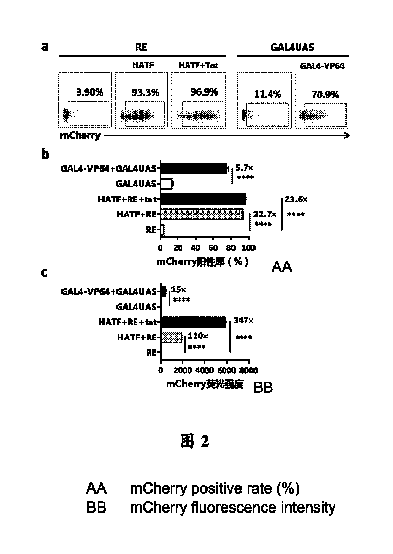
結果は、図2に示すとおりであり、REトランスフェクション群では、標的遺伝子mCherryの発現陽性率はわずか3.90%であり、HATF誘導後のmCherry陽性率は93.3%と高く、さらにTatを添加した場合、陽性率は96.9%と高かったが、GAL4UASトランスフェクション群では、標的遺伝子mCherryの発現陽性率は11.4%であり、GAL4-VP64誘導後のmCherry陽性率は70.9%であった(図2a)。HATF誘導の場合、陽性率は、反応エレメント対照群の22.7倍であり(図2b)、蛍光強度は、反応エレメント対照群の110倍であり(図2c)、Tatを加えた場合、さらに誘導レベルを向上させ、陽性率及び蛍光強度の誘導倍数は、それぞれ23.6倍及び347倍に向上し、従来のGAL4-VP64誘導の場合、陽性率は、反応エレメント対照群の5.7倍であり(図2b)、蛍光強度は、反応エレメント対照群の15倍のみであり(図2c)、本発明において構築されたHATF人工転写因子は、バックグラウンド漏洩レベルにおいても、標的遺伝子の誘導能力においても、従来のGAL4-VP64人工転写因子より優れていることが示された。
Example 5 Transcription induction level of the hypoxia-triggered artificial transcription factor of the present invention In order to verify that the HATF of the present invention has a better ability to induce foreign gene expression than the conventional GAL4-VP64 artificial transcription factor, a plasmid transfection experiment was carried out on HEK293T cells. HEK293T cells were plated on a 48-well plate at 5 x 10⁴ cells/well, and transfection was carried out after cell attachment the next day. In the single transfection group, only 0.25 μg of the response element plasmid pSV1.0-EGFP-ATR-RE or pSV1.0-EGFP-GAL4UAS was transfected; in the experimental group, 0.25 μg of pSV1.0-EGFP-RE plasmid and pSV1.0-HATF or pSV1.0-Tat, or 0.25 μg of pSV1.0-EGFP-GAL4UAS plasmid and pSV1.0-GAL4-VP64 were transfected, and TurboFect transfection reagent was added at a ratio of plasmid amount (μg):transfection reagent (μL)=1:2. After incubation at room temperature for 15-20 min, the cells were added to a cell culture plate, and placed in a 37°C, 5% CO2 cell incubator for 48 h of culture, and the expression status of the target gene mCherry was detected by flow cytometry.
The results are shown in Figure 2. In the RE transfection group, the expression positivity rate of the target gene mCherry was only 3.90%, and the mCherry positivity rate after HATF induction was as high as 93.3%, and when Tat was further added, the positivity rate was as high as 96.9%. In the GAL4UAS transfection group, the expression positivity rate of the target gene mCherry was 11.4%, and the mCherry positivity rate after GAL4-VP64 induction was 70.9% (Figure 2a). In the case of HATF induction, the positive rate was 22.7 times that of the reaction element control group (FIG. 2b), and the fluorescence intensity was 110 times that of the reaction element control group (FIG. 2c). When Tat was added, the induction level was further improved, and the positive rate and the fluorescence intensity induction fold increased to 23.6 times and 347 times, respectively. In the case of conventional GAL4-VP64 induction, the positive rate was 5.7 times that of the reaction element control group (FIG. 2b), and the fluorescence intensity was only 15 times that of the reaction element control group (FIG. 2c). This shows that the HATF artificial transcription factor constructed in the present invention is superior to the conventional GAL4-VP64 artificial transcription factor in both background leakage level and target gene induction ability.
実施例6 低酸素感受性転写制御システムによる蛍光タンパク質の発現の制御
実施例1のレンチウイルス発現プラスミド、実施例2のレンチウイルスベクターの調製方法及び実施例3に記載の方法を用いて、EF1α-GFP-RE-mCherry、EF1α-BFP-HATF-HRTEとEF1α-GFP-RE-mCherry及びEF1α-GFP-HATF-HRTE-RE-mCherry遺伝子を統合した3種の異なるT細胞を調製し、それぞれRE-mCherry反応エレメント、2ユニット形態の低酸素感受性転写制御システム(二重ベクター共感染)及び1ユニット形態の低酸素感受性転写制御システム(単一ベクター感染)とした。上記の3種の遺伝子操作されたT細胞を通常の酸素条件(21%O2)と低酸素条件(1%O2)に置いて24h培養し、培養終了後に細胞を収集してFACS buffer(2%FBSの1×PBS)で1回溶出し、500×gで5min遠心分離し、終了後、300μL FACS bufferで再懸濁して均一に混合し、さらにフローサイトメーターを用いて赤色蛍光タンパクmCherryの発現を検出した。
結果は、図3に示すとおりである。図3のフローサイトメトリー結果から、本発明の1ユニット形態の低酸素感受性転写制御システムは、通常の酸素環境下でのバックグラウンド漏洩が3.05%と低く、低酸素環境下で高レベルの赤色蛍光タンパクmCherryを誘導発現し、陽性率が91.4%に増え、平均蛍光強度(Mean fluorescence intensity、MFI)が1480と高かったことが分かった。興味深いことに、ダブルウイルスベクター共感染によって得られた2ユニット形態の低酸素感受性転写制御システムの低酸素誘導レベルは、単一ウイルスベクターの感染によって得られた1ユニット形態の低酸素感受性転写制御システムに比べて遥かに低く、mCherry陽性率と蛍光強度が、わずか31.8%と86.6であり、1ユニット形態の低酸素誘導陽性率と平均蛍光強度の34.8%と5.85%のみであり、1ユニット形態の低酸素感受性転写制御システムを携帯する単一ベクターの低酸素誘導効果が最善であることと、バックグラウンド漏洩と低酸素誘導レベルが、いずれも現在報告されている二重ベクターのバイナリ転写増幅システムよりも顕著に優れていたことを示唆している。
Example 6 Control of Fluorescent Protein Expression by Hypoxia-Sensitive Transcriptional Regulatory System Using the lentivirus expression plasmid of Example 1, the method for preparing the lentivirus vector of Example 2, and the method described in Example 3, three different types of T cells were prepared in which EF1α-GFP-RE-mCherry, EF1α-BFP-HATF-HRTE, EF1α-GFP-RE-mCherry, and EF1α-GFP-HATF-HRTE-RE-mCherry genes were integrated, and these were made into RE-mCherry response element, a two-unit form of hypoxia-sensitive transcriptional regulatory system (double vector co-infection), and a one-unit form of hypoxia-sensitive transcriptional regulatory system (single vector infection), respectively. The above three types of genetically engineered T cells were cultured under normal oxygen conditions (21% O2 ) and hypoxic conditions (1% O2 ) for 24 hours. After the culture was completed, the cells were collected and eluted once with FACS buffer (1x PBS with 2% FBS), centrifuged at 500 xg for 5 minutes, and then resuspended in 300 μL FACS buffer and mixed uniformly. The expression of the red fluorescent protein mCherry was then detected using a flow cytometer.
The results are shown in Figure 3. From the flow cytometry results in Figure 3, it was found that the one-unit hypoxia-sensitive transcriptional control system of the present invention had a low background leakage of 3.05% under normal oxygen conditions, induced expression of high levels of red fluorescent protein mCherry under hypoxic conditions, increased the positive rate to 91.4%, and had a high mean fluorescence intensity (MFI) of 1480. Interestingly, the hypoxia induction level of the two-unit hypoxia-sensitive transcriptional control system obtained by double viral vector co-infection was much lower than that of the one-unit hypoxia-sensitive transcriptional control system obtained by single viral vector infection, with the mCherry positivity rate and fluorescence intensity being only 31.8% and 86.6%, respectively, which were only 34.8% and 5.85% of the one-unit hypoxia-induced positivity rate and average fluorescence intensity, respectively, suggesting that the hypoxia induction effect of the single vector carrying the one-unit hypoxia-sensitive transcriptional control system was the best, and that both the background leakage and hypoxia induction level were significantly superior to those of the currently reported dual-vector binary transcriptional amplification system.
実施例7 低酸素感受性転写制御システムによるキメラ抗原受容体の発現の制御
実施例1のレンチウイルス発現プラスミド、実施例2のレンチウイルスベクターの調製方法及び実施例3に記載の方法を用いて、EF1α-HER2 CAR-P2A-EGFP及びEF1α-GFP-HATF-HRTE-RE-CAR遺伝子を携帯する2種のエンジニアリングT細胞を調製し、それぞれHER2 CAR-T細胞(陽性対照)及び低酸素感受性HER2 CAR-T細胞と命名した。上記の2種の遺伝子操作されたT細胞をそれぞれ通常の酸素条件(21%O2)又は低酸素条件(1%O2)で24h培養し、終了後に細胞を収集しFACS bufferで1回溶出し、2μg/mLのフローサイトメトリー抗体PE-anti-DYKDDDDKを加え、室温で20min遮光インキュベートし、終了後、FACS bufferで2回溶出し、300μL FACS bufferで再懸濁して均一に混合し、そしてフローサイトメーターでHER2 CAR分子の発現を検出した。
結果は、図4に示すとおりであり、フローサイトメトリー結果からに示されているように、通常の酸素と低酸素条件下でHER2 CAR-T細胞(陽性対照)はいずれもHER2 CAR分子を高発現させたが、低酸素感受性HER2 CAR-T細胞は通常の酸素条件下でHER2 CAR分子を低発現させ(10.8%)、低酸素条件下でHER2 CAR分子の発現をアップレギュレーションし(62.6%)、CAR陽性率と平均蛍光強度がそれぞれ6倍及び235倍向上し、現在報告されている低酸素感受性CAR-T細胞の誘導効果より遥かに優れていた(Juillerat A,Marechal A,Filhol JM,et al. An oxygen sensitive self-decision making engineered CAR T-cell[J]. Sci Rep. 2017,7:39833、Liao Q,He H,Mao Y,et al. Engineering T cells with hypoxia-inducible chimeric antigen receptor (HiCAR) for selective tumor killing. Biomark Res. 2020,8(1):56)。
Example 7 Control of Chimeric Antigen Receptor Expression by Hypoxia-Sensitive Transcriptional Control System Using the lentivirus expression plasmid of Example 1, the method for preparing the lentivirus vector of Example 2, and the method described in Example 3, two types of engineered T cells carrying EF1α-HER2 CAR-P2A-EGFP and EF1α-GFP-HATF-HRTE-RE-CAR genes were prepared and named HER2 CAR-T cells (positive control) and hypoxia-sensitive HER2 CAR-T cells, respectively. The above two types of genetically engineered T cells were cultured under normal oxygen conditions (21% O 2 ) or hypoxic conditions (1% O 2 ) for 24 hours, and after incubation, the cells were collected and eluted once with FACS buffer, 2 μg/mL of flow cytometry antibody PE-anti-DYKDDDDK was added, and incubated at room temperature for 20 minutes in the dark. After incubation, the cells were eluted twice with FACS buffer, resuspended in 300 μL FACS buffer and mixed uniformly, and the expression of HER2 CAR molecule was detected by flow cytometer.
The results are shown in FIG. 4. As shown by the flow cytometry results, both HER2 CAR-T cells (positive control) highly expressed HER2 CAR molecules under normal oxygen and hypoxic conditions, but hypoxia-sensitive HER2 CAR-T cells underexpressed HER2 CAR molecules (10.8%) under normal oxygen conditions and upregulated the expression of HER2 CAR molecules (62.6%) under hypoxic conditions, with the CAR positive rate and average fluorescence intensity increasing by 6 times and 235 times, respectively, which was far superior to the induction effect of hypoxia-sensitive CAR-T cells currently reported (Juillerat A, Marechal A, Filhol JM, et al. An oxygen sensitive self-decision making engineered CAR T cells). T-cell[J]. Sci Rep. 2017, 7:39833, Liao Q, He H, Mao Y, et al. Engineering T cells with hypoxia-inducible chimeric antigen receptor (HiCAR) for selective tumor killing. Biomark Res. 2020, 8(1):56).
実施例8 低酸素感受性転写制御システムによるキメラ抗原受容体T細胞の腫瘍細胞殺傷の制御
腫瘍細胞殺傷効率は、ルシフェラーゼに基づく細胞殺傷検出法(Luciferase-based cytotoxicity assay)により評価した。まず、1×10⁴個のSKOV3-Luc(ホタルルシフェラーゼ遺伝子で修飾されたヒト卵巣がん細胞)又はNCI-H292-Luc(ホタルルシフェラーゼ遺伝子で修飾されたヒト肺がん細胞)を96ウェルの平底ブラックプレートに接種し、ウェルあたり100μLの培地に入れ、37℃、5%CO2細胞インキュベータに置いて18h培養した。翌日、エフェクター細胞:標的細胞が1:2、1:1及び2:1の割合で、実施例6の遺伝子操作されたT細胞及び同時に培養された形質転換されていないT細胞を、標的細胞を含有するウェルに加え、それぞれ通常の酸素条件(21%O2)又は低酸素条件(1%O2)で24h培養し、共培養終了後、GloMax(登録商標)96マイクロプレート発光検出器を用いて標的細胞のルシフェラーゼ活性値を検出した。
細胞殺傷率の計算式は以下のとおりである。
細胞殺傷率(%)=(形質導入されていないT細胞群のルシフェラーゼ活性値-実験群のルシフェラーゼ活性値)/形質導入されていないT細胞群のルシフェラーゼ活性値×100
結果は、図5に示すとおりであり、HER2 CAR-T細胞(陽性対照)は、通常の酸素条件においても、低酸素条件においてもSKOV3及びNCI-H292腫瘍細胞を効果的に殺傷でき、選択的殺傷特性がなかった。低酸素感受性HER2 CAR-T細胞は、通常の酸素条件下での腫瘍殺傷活性が比較的低く、エフェクター細胞:標的細胞が2:1となる場合の殺傷率が、10.33%(SKOV3)と13.33%(NCI-H292)であり、低酸素環境下では、SKOV3腫瘍細胞(67.67%)とNCI-H292腫瘍細胞(93.33%)を選択的に効率的に殺傷でき、腫瘍細胞の殺傷活性が6倍向上した。
Example 8: Control of tumor cell killing by chimeric antigen receptor T cells by hypoxia-sensitive transcriptional control system The tumor cell killing efficiency was evaluated by a luciferase-based cytotoxicity assay. First, 1×10 4 SKOV3-Luc (human ovarian cancer cells modified with firefly luciferase gene) or NCI-H292-Luc (human lung cancer cells modified with firefly luciferase gene) were seeded into a 96-well flat-bottom black plate, placed in 100 μL of medium per well, and cultured in a 37° C., 5% CO 2 cell incubator for 18 h. The next day, the genetically engineered T cells of Example 6 and the non-transformed T cells cultured simultaneously were added to the wells containing the target cells in effector cell:target cell ratios of 1:2, 1:1, and 2:1, and cultured for 24 hours under normal oxygen conditions (21% O2 ) or hypoxic conditions (1% O2 ). After the co-culture was completed, the luciferase activity of the target cells was detected using a GloMax (registered trademark) 96 microplate luminescence detector.
The formula for calculating the cell killing rate is as follows:
Cell killing rate (%)=(luciferase activity of untransduced T cell group−luciferase activity of experimental group)/luciferase activity of untransduced T cell group×100
The results are shown in Figure 5. HER2 CAR-T cells (positive control) could effectively kill SKOV3 and NCI-H292 tumor cells under normal oxygen conditions and hypoxic conditions, and did not have selective killing properties. Hypoxia-sensitive HER2 CAR-T cells had relatively low tumor killing activity under normal oxygen conditions, with killing rates of 10.33% (SKOV3) and 13.33% (NCI-H292) at an effector cell:target cell ratio of 2:1. However, under hypoxic conditions, they could selectively and efficiently kill SKOV3 tumor cells (67.67%) and NCI-H292 tumor cells (93.33%), and the tumor cell killing activity was improved by 6 times.
実施例9 低酸素感受性CAR-T細胞のインビボ安全性
組換えアデノウイルス(HER2-Ad)を1×PBSで目標用量8×10⁹TU/mLに希釈した。
125μL HER2-Adを1mLのシリンジで腹腔内注射し、7日後に小動物用生体イメージャーを用いてルシフェラーゼの発現を検出し、陽性マウスを選択してからランダムに群分けし、HER2 CAR-T細胞注入群13匹のマウスを除き、残りの各群には4匹のマウスを選択して後続の実験に用いた。
5×10⁶個のHER2 CAR-T細胞、低酸素感受性HER2 CAR-T細胞及び対照細胞を静脈再注入し、2~3日おきにマウスの体重を秤量し、眼窩静脈から採血して血清サイトカインを測定し、及びマウスの健康状態を観察した。
結果は、図6に示すとおりであり、コントロールのHER2 CAR-T細胞は、マウスの体重の進行的な低下(図6a)、死亡率の増加(図6b)を引き起こし、また、肝機能の障害によりアラニン・アミノトランスフェラーゼ(ALT)が大量に血液中に放出され(図6c)、且つT細胞活性化関連サイトカインが大量に血液中に放出された(図6d)が、低酸素感受性HER2 CAR-T細胞は上記の毒副作用を引き起こさず、これは、オンターゲットオフ腫瘍毒性(On-target off-tumor toxicity)を引き起こさないことが示唆された。
Example 9 In vivo Safety of Hypoxia-Sensitive CAR-T Cells Recombinant adenovirus (HER2-Ad) was diluted in 1×PBS to a target dose of 8×10 9 TU/mL.
125 μL of HER2-Ad was intraperitoneally injected using a 1 mL syringe, and 7 days later, luciferase expression was detected using a small animal vital imager. Positive mice were selected and randomly divided into groups. Except for 13 mice in the HER2 CAR-T cell injection group, 4 mice were selected from each of the remaining groups for subsequent experiments.
5× 10 HER2 CAR-T cells, hypoxia-sensitive HER2 CAR-T cells and control cells were re-injected intravenously, and the mice were weighed, bled via the orbital vein to measure serum cytokines, and observed for health status every 2-3 days.
The results are shown in FIG. 6. The control HER2 CAR-T cells caused a progressive loss of mouse body weight ( FIG. 6a ) and an increased mortality rate ( FIG. 6b ). In addition, alanine aminotransferase (ALT) was released in large amounts into the blood due to impaired liver function ( FIG. 6c ), and T cell activation-related cytokines were released in large amounts into the blood ( FIG. 6d ). However, the hypoxia-sensitive HER2 CAR-T cells did not cause the above-mentioned toxic side effects, suggesting that they did not cause on-target off-tumor toxicity.
実施例10 低酸素感受性CAR-T細胞のインビボ抗腫瘍作用
1日前に無菌アイソレーターで飼育されたB-NDGマウスに対して背部局所除毛を行い、除毛については除毛クリームや動物用シェーバーを用いて、腫瘍細胞接種部位の皮膚を露出させればよい。
左手でマウスを固定し、即ち、左手でマウスの頭部、頸部及び背部皮膚を同時に把持し、その背部を左に向けて、背部右側の毛剃り部位を十分に露出させた後、右手でアルコール綿球を用いて消毒処理を行った。1mLのインスリンシリンジで予め用意したSKOV3又はNCI-H292腫瘍細胞をブローして均一に混合させた後、125μL細胞懸濁液(5×10⁶個の腫瘍細胞)を吸い取り、針を針先と皮膚とが30°~40°の角度となるようにマウスの皮下に斜めに刺し、細胞が漏れないように細胞懸濁液をゆっくり注入した。125μLの細胞懸濁液の注射が完了したあと、2~3秒間針を刺したままにしておき迅速に抜き出し、注射部位の皮下に小さくてはっきりと見える膨らみが見られた。
細胞接種後、2~3日おきにマウスの腫瘍形成状況及び健康状態を観察し、腫瘍形成後、ノギスでベースライン腫瘍体積を測定し、後続の実験を行った。
5×10⁶個の低酸素感受性HER2 CAR-T細胞と対照細胞を静脈再注入し、2~3日おきに腫瘍のサイズを測定し、ノギスで腫瘍の長径と短径をそれぞれ測定し、腫瘍体積の計算式は体積=(長径×短径2)/2とした。
結果は、図7に示すとおりであり、低酸素感受性転写制御システムによって制御されたHER2 CAR-T細胞(低酸素感受性HER2 CAR-T細胞)は、SKOV3(卵巣がん)及びNCI-H292(肺がん)の成長を効果的に抑制することができ、細胞再注入35日目の腫瘍抑制率が100%及び78.5%と高かった。
Example 10 In vivo antitumor activity of hypoxia-sensitive CAR-T cells B-NDG mice that had been reared in a sterile isolator were subjected to local hair removal on the back one day prior to the injection, using a hair removal cream or an animal shaver to expose the skin at the tumor cell inoculation site.
The mouse was fixed with the left hand, i.e., the head, neck and back skin of the mouse were simultaneously grasped with the left hand, the back was turned to the left, and the shaved area on the right side of the back was fully exposed, and then disinfected with an alcohol cotton ball with the right hand. SKOV3 or NCI-H292 tumor cells prepared in advance were blown into a 1 mL insulin syringe to mix uniformly, and 125 μL of cell suspension (5 × 10 6 tumor cells) was sucked up, and the needle was inserted obliquely into the subcutaneous tissue of the mouse so that the needle tip was at an angle of 30° to 40° with the skin, and the cell suspension was slowly injected so that the cells would not leak. After the injection of 125 μL of cell suspension was completed, the needle was left in for 2 to 3 seconds and then quickly removed, and a small and clearly visible swelling was observed under the skin at the injection site.
After cell inoculation, the mice were observed every 2-3 days for tumor formation and health status. After tumor formation, baseline tumor volumes were measured with calipers and subsequent experiments were performed.
5 x 10 hypoxia-sensitive HER2 CAR-T cells and control cells were reinjected intravenously, and the tumor size was measured every 2 to 3 days. The long and short diameters of the tumor were measured with a caliper, and the tumor volume was calculated using the formula: volume = (long diameter x short diameter2 )/2.
The results are shown in FIG. 7. HER2 CAR-T cells regulated by the hypoxia-sensitive transcriptional control system (hypoxia-sensitive HER2 CAR-T cells) were able to effectively suppress the growth of SKOV3 (ovarian cancer) and NCI-H292 (lung cancer), with high tumor inhibition rates of 100% and 78.5% on day 35 after cell reinjection.
実施例11 低酸素トリガーのCD47/CD3二重特異性T細胞アダプタータンパク質の発現
実施例4の遺伝子操作されたA549細胞を1日前に12ウェル平底プレートに敷いて、ウェルあたり3×10⁵個の細胞とし、総体積は1mLであった。
翌日、平底プレートを通常の酸素条件(21%O2)又は低酸素条件(1%O2)で24h培養し、終了後に細胞を収集し、1×BSで再懸濁し、4×SDS Loading Bufferを加えて1×に希釈した後、十分にブローして均一に混合させ、サンプルをポットに入れ、電磁調理器で10min加熱して煮沸し、タンパク質を十分に変性させた。
目的タンパク質の低酸素感受性人工転写因子の分子量(72.5kD)とBiTEの分子量(54.7kD)に基づいて、濃度が10%の上層と下層のSDS-PAGEゲルを調製し、サンプルをSDS-PAGEゲルにて2h電気泳動で分離させ、次いで湿式転換法によりサンプルをゲルから予めメタノールで活性化されたPVDF膜に転移させた。
タンパク質マーカーの指示に基づいて、目的タンパク質と参照タンパク質を含むPVDF膜を切り取って5%脱脂粉乳ブロッキング液に置き、シェーカーにて室温で少なくとも1hインキュベートしブロッキングした。
ブロッキングされたPVDF膜を取り出し、一次抗体の希釈率が1:1000のマウス抗Hisタグ一次抗体希釈液に置き、シェーカーにて4℃で一晩静置した。
一次抗体希釈液を回収し、-20℃で凍結保存して使用に備えた。PVDF膜を取り出してPBSTでシェーカーにて8min/回で3回振とう溶出し、溶出終了後、二次抗体の希釈率が1:3000の相応なヤギ抗マウスIgG-HRP二次抗体希釈液を加え、二シェーカーにて室温で1hインキュベートした。
PVDF膜を取り出した後、PBSTで3回溶出し、発色後に露光させた。
結果は、図8に示すとおりであり、図8は、ウェスタンブロッティング検出の露光結果であり、通常の酸素条件下では低酸素感受性人工転写因子及び下流標的遺伝子CD47/CD3-BiTEをほとんど発現しなかったが、低酸素環境下では低酸素感受性人工転写因子を誘導発現し、及び下流標的遺伝子CD47/CD3-BiTEの発現を開始することができる。また、2~6個のコピーのコア配列が直列に重複することは、低酸素感受性転写制御システムの制御活性に影響を与えず、いずれも通常の酸素環境での分解、低酸素環境下での目的タンパク質の効率的な誘導発現を実現できる。
Example 11 Hypoxia-Triggered Expression of CD47/CD3 Bispecific T Cell Adaptor Proteins Engineered A549 cells from Example 4 were plated one day in advance in 12-well flat-bottom plates at 3× 10 cells per well in a total volume of 1 mL.
The next day, the flat-bottom plates were cultured under normal oxygen conditions (21% O2 ) or low oxygen conditions (1% O2 ) for 24 hours, and after incubation, the cells were collected, resuspended in 1x BS, and diluted to 1x by adding 4x SDS Loading Buffer. The mixture was then blown thoroughly to mix uniformly, and the sample was placed in a pot and boiled by heating on an induction cooker for 10 minutes to thoroughly denature the proteins.
Based on the molecular weight of the target protein, the hypoxia-sensitive artificial transcription factor (72.5 kD) and the molecular weight of BiTE (54.7 kD), 10% upper and lower SDS-PAGE gels were prepared, the samples were separated by electrophoresis on the SDS-PAGE gel for 2 h, and then the samples were transferred from the gel to a PVDF membrane that had been activated with methanol in advance by the wet transfer method.
According to the indication of the protein marker, the PVDF membrane containing the target protein and the reference protein was cut out and placed in a 5% skim milk blocking solution, and incubated at room temperature on a shaker for at least 1 h for blocking.
The blocked PVDF membrane was removed, placed in a mouse anti-His tag primary antibody dilution solution at a dilution ratio of 1:1000, and allowed to stand overnight at 4° C. on a shaker.
The primary antibody dilution was collected and frozen at -20°C for storage prior to use. The PVDF membrane was removed and eluted with PBST on a shaker for 8 min each time three times. After elution was complete, a goat anti-mouse IgG-HRP secondary antibody dilution with a secondary antibody dilution rate of 1:3000 was added and incubated at room temperature for 1 h on a shaker.
After removing the PVDF membrane, it was eluted three times with PBST and exposed to light after color development.
The results are shown in Figure 8, which shows the exposure results of Western blotting detection. Under normal oxygen conditions, the hypoxia-sensitive artificial transcription factor and downstream target gene CD47/CD3-BiTE were hardly expressed, but under a hypoxic environment, the hypoxia-sensitive artificial transcription factor was induced to express, and the downstream target gene CD47/CD3-BiTE could be expressed. In addition, the tandem duplication of 2 to 6 copies of the core sequence did not affect the control activity of the hypoxia-sensitive transcription control system, and both could realize the decomposition in a normal oxygen environment and the efficient induction and expression of the target protein under a hypoxic environment.
実施例12 低酸素感受性転写制御システムによるCD47/CD3-BiTE-T細胞の腫瘍細胞殺傷の制御
腫瘍細胞殺傷効率検出方法及び殺傷効率計算方法は、実施例7と同じである。まず、1×10⁴個のSKOV3-Luc(ルシフェラーゼ遺伝子で修飾されたヒト卵巣がん細胞)又はNCI-H292-Luc(ルシフェラーゼ遺伝子で修飾されたヒト肺がん細胞)を96ウェルの平底ブラックプレートに接種し、ウェルあたり100μLの培地に入れ、37℃、5%CO2細胞インキュベータに置いて18h培養した。翌日、エフェクター細胞:標的細胞=1:2、1:1、2:1の割合で、実施例8の低酸素感受性CD47/CD3-BiTE-T細胞及び同時に培養された形質導入されていないT細胞を、標的細胞を含むウェルに加え、それぞれ通常の酸素条件(21%O2)又は低酸素条件(1%O2)で20時間培養し、共培養終了後、GloMax(登録商標)96マイクロプレート発光検出器を用いて標的細胞のルシフェラーゼ活性値を検出した。
結果は、図9に示すとおりであり、低酸素感受性CD47/CD3-BiTE-T細胞は、通常の酸素条件下での腫瘍殺傷活性が比較的低く、エフェクター細胞:標的細胞=2:1の場合、それぞれ2.67%(SKOV3)と3.33%(NCI-H292)であり、低酸素環境下では、SKOV3細胞(78.67%)及びNCI-H292細胞(97.67%)を選択的に殺傷でき、殺傷活性が約30倍増えた。
Example 12: Control of tumor cell killing by CD47/CD3-BiTE-T cells by hypoxia-sensitive transcriptional control system The tumor cell killing efficiency detection method and the killing efficiency calculation method were the same as in Example 7. First, 1×10 4 SKOV3-Luc (human ovarian cancer cells modified with luciferase gene) or NCI-H292-Luc (human lung cancer cells modified with luciferase gene) were seeded into a 96-well flat-bottom black plate, placed in 100 μL of medium per well, and cultured in a 37° C., 5% CO 2 cell incubator for 18 h. The next day, the hypoxia-sensitive CD47/CD3-BiTE-T cells of Example 8 and the untransduced T cells cultured simultaneously were added to the wells containing the target cells at effector cell:target cell ratios of 1:2, 1:1, and 2:1, and cultured for 20 hours under normal oxygen conditions (21% O 2 ) or hypoxic conditions (1% O 2 ). After the co-culture was completed, the luciferase activity of the target cells was detected using a GloMax (registered trademark) 96 microplate luminescence detector.
The results are shown in FIG. 9. The hypoxia-sensitive CD47/CD3-BiTE-T cells had relatively low tumor killing activity under normal oxygen conditions, with 2.67% (SKOV3) and 3.33% (NCI-H292) at an effector cell:target cell ratio of 2:1, respectively. Under a hypoxic environment, they were able to selectively kill SKOV3 cells (78.67%) and NCI-H292 cells (97.67%), with the killing activity increasing by approximately 30-fold.
実施例13 低酸素感受性CD47/CD3-BiTE-T細胞のインビボ抗腫瘍作用
まず、5×10⁶個のNCI-H292-Luc(ホタルルシフェラーゼ遺伝子で修飾されたヒト肺がん細胞)をB-NDGマウスの背部右側皮下に接種し、各匹に125μLの腫瘍細胞懸濁液を注射し、腫瘍接種後6日目に、静脈又は腫瘍内に実施例3で調製した低酸素感受性BiTE-T細胞及び同時期に培養された形質導入されていないT細胞を注射し、各匹の担癌マウスに5×10⁶個の陽性細胞を再注入した。腫瘍細胞の接種後、ノギスを用いて腫瘍の長径と短径を測って腫瘍体積を計算し、腫瘍体積の計算式は以下のとおりであり、腫瘍体積=(長径×短径2)/2であった。
結果は、図10に示すとおりであり、静脈再注入及び腫瘍内注射した低酸素感受性CD47/CD3-BiTE-T細胞は、いずれも肺がんの成長を効果的に制御することができ、形質導入されていないT細胞の治療群に対して、細胞再注入後一か月の腫瘍抑制率が、それぞれ52.35%(静脈再注入)と78.69%(腫瘍内注射)であった。
Example 13 In vivo antitumor activity of hypoxia-sensitive CD47/CD3-BiTE-T cells First, 5× 10⁶ NCI-H292-Luc (human lung cancer cells modified with firefly luciferase gene) were inoculated subcutaneously on the right back of B-NDG mice, and 125 μL of tumor cell suspension was injected into each mouse. Six days after tumor inoculation, hypoxia-sensitive BiTE-T cells prepared in Example 3 and untransduced T cells cultured at the same time were injected intravenously or intratumorally, and 5× 10⁶ positive cells were reinjected into each tumor-bearing mouse. After tumor cell inoculation, the tumor volume was calculated by measuring the long and short diameters of the tumor using a caliper, and the calculation formula for tumor volume was as follows: tumor volume = (long diameter x short diameter 2 )/2.
The results are shown in FIG. 10. Both intravenously and intratumorally injected hypoxia-sensitive CD47/CD3-BiTE-T cells were able to effectively control the growth of lung cancer, with tumor inhibition rates one month after cell reinjection of 52.35% (intravenously reinjected) and 78.69% (intratumor injection) compared to the non-transduced T cell treatment group.
上記実施例は、例示的なものであり、本発明を限定するものであると理解すべきではなく、当業者であれば、本発明の範囲内で上記実施例に対して変更、修正、置換及び変形を行うことができる。 The above examples are illustrative and should not be understood as limiting the present invention, and a person skilled in the art may make changes, modifications, substitutions and variations to the above examples within the scope of the present invention.
Claims (12)
(1)SEQ ID NO:1に示される配列、
(2)SEQ ID NO:1に示される配列に比較して1つ又は複数のアミノ酸の置換、欠失又は付加を有する配列、又は
(3)SEQ ID NO:1に示される配列と、少なくとも80%、少なくとも85%、少なくとも90%、少なくとも91%、少なくとも92%、少なくとも93%、少なくとも94%、少なくとも95%、少なくとも96%、少なくとも97%、少なくとも98%、少なくとも99%、又は100%の配列同一性を有する配列、
を含む、HATF。 An artificial hypoxia-triggered transcription factor (HATF),
(1) the sequence shown in SEQ ID NO: 1;
(2) a sequence having one or more amino acid substitutions, deletions or additions compared to the sequence shown in SEQ ID NO:1; or (3) a sequence having at least 80%, at least 85%, at least 90%, at least 91%, at least 92%, at least 93%, at least 94%, at least 95%, at least 96%, at least 97%, at least 98%, at least 99%, or 100% sequence identity to the sequence shown in SEQ ID NO:1.
Including, H.A.T.F.
(1)SEQ ID NO:2に示される配列、又はその相補配列、
(2)ストリンジェントなハイブリダイゼーション条件下でSEQ ID NO:2に示される配列とハイブリダイズする配列、
(3)SEQ ID NO:2に示される配列と、少なくとも85%、90%、91%、92%、93%、94%、95%、96%、97%、98%、98.5%、99%又は99.5%の配列同一性を有する配列、又は
(4)1つ又は複数のヌクレオチドを欠失、置換、挿入又は付加することで、SEQ ID NO:2に示される配列を誘導体化して得られた配列、
を含み、
好ましくは、前記REは、前記コア配列の複数のコピー及び最小プロモーターを含み、より好ましくは、前記複数のコピーは、2個のコピー、3個のコピー、4個のコピー、5個のコピー、6個のコピー、7個のコピー、8個のコピー、9個のコピー又は10個のコピーであり、さらに好ましくは、前記認識エレメントREは、前記コア配列の5個又は6個のコピー及び最小プロモーターを含み、
よりさらに好ましくは、前記REは、以下から選ばれる配列、
(1)SEQ ID NO:3に示される配列、又はその相補配列、
(2)ストリンジェントなハイブリダイゼーション条件下でSEQ ID NO:3に示される配列とハイブリダイズする配列、
(3)SEQ ID NO:3に示される配列と、少なくとも85%、90%、91%、92%、93%、94%、95%、96%、97%、98%、98.5%、99%又は99.5%の配列同一性を有する配列、又は
(4)1つ又は複数のヌクレオチドを欠失、置換、挿入又は付加することで、SEQ ID NO:3に示される配列を誘導体化して得られた配列、
を含み、
最も好ましくは、前記REは、SEQ ID NO:3に示される、RE。 2. The recognition element RE of HATF according to claim 1, wherein the RE comprises a core sequence selected from the following:
(1) the sequence shown in SEQ ID NO: 2, or a complementary sequence thereof;
(2) a sequence that hybridizes under stringent hybridization conditions to the sequence shown in SEQ ID NO: 2;
(3) a sequence having at least 85%, 90%, 91%, 92%, 93%, 94%, 95%, 96%, 97%, 98%, 98.5%, 99% or 99.5% sequence identity with the sequence shown in SEQ ID NO:2; or (4) a sequence obtained by derivatizing the sequence shown in SEQ ID NO:2 by deleting, substituting, inserting or adding one or more nucleotides.
Including,
Preferably, the RE comprises multiple copies of the core sequence and a minimal promoter, more preferably, the multiple copies are 2 copies, 3 copies, 4 copies, 5 copies, 6 copies, 7 copies, 8 copies, 9 copies or 10 copies, and even more preferably, the recognition element RE comprises 5 or 6 copies of the core sequence and a minimal promoter;
Even more preferably, the RE has a sequence selected from the following:
(1) the sequence shown in SEQ ID NO: 3, or its complementary sequence;
(2) a sequence that hybridizes under stringent hybridization conditions to the sequence shown in SEQ ID NO: 3;
(3) a sequence having at least 85%, 90%, 91%, 92%, 93%, 94%, 95%, 96%, 97%, 98%, 98.5%, 99% or 99.5% sequence identity with the sequence shown in SEQ ID NO: 3; or (4) a sequence obtained by derivatizing the sequence shown in SEQ ID NO: 3 by deleting, substituting, inserting or adding one or more nucleotides.
Including,
Most preferably, said RE is that shown in SEQ ID NO:3.
好ましくは、前記低酸素トリガーの転写制御システムは、上流と下流とが接続されたの2つの転写制御ユニットを含み、ここで前記上流転写制御ユニットは、HATFを制御するための低酸素トリガーの転写反応エレメントHRTE及びHATFをコードする核酸配列を含み、前記下流転写制御ユニットは、RE及び標的遺伝子GOIを含む、転写制御システム。 A hypoxia-triggered transcriptional control system, comprising the nucleic acid sequence of claim 2 and the RE of claim 3;
Preferably, the hypoxia-triggered transcriptional control system comprises two transcriptional control units connected upstream and downstream, wherein the upstream transcriptional control unit comprises a nucleic acid sequence encoding a hypoxia-triggered transcriptional response element HRTE and HATF for controlling HATF, and the downstream transcriptional control unit comprises an RE and a target gene GOI.
好ましくは、前記転写制御システムは、
HATF-HRTEとRE-GOI、
HATF-HRTEとGOI-RE、
HRTE-HATFとGOI-RE又は
HRTE-HATFとRE-GOIのいずれか1つに示される組み合わせ形式を有し、
又は前記上流と下流とが接続された転写制御ユニットは、線形に直列接続され、同一のベクターに位置し、
好ましくは、前記転写制御システムは、
HATF-HRTE-RE-GOI、
HATF-HRTE-GOI-RE、
HRTE-HRE-GOI、
HRTE-HATF-GOI-RE、
RE-GOI-HATF-HRTE、
RE-GOI-HRTE-HATF、
GOI-RE-HATF-HRTE又は
GOI-RE-HRTE-HATFのいずれか1つに示される組み合わせ形式を有する、請求項4に記載の低酸素トリガーの転写制御システム。 the upstream and downstream connected transcription control units are nonlinearly connected in series and located in two vectors;
Preferably, the transcriptional regulatory system comprises:
HATF-HRTE and RE-GOI,
HATF-HRTE and GOI-RE,
The combination format is shown in either HRTE-HATF and GOI-RE or HRTE-HATF and RE-GOI;
or the upstream and downstream transcriptional control units are linearly connected in series and located in the same vector;
Preferably, the transcriptional regulatory system comprises:
HATF-HRTE-RE-GOI,
HATF-HRTE-GOI-RE,
HRTE-HRE-GOI,
HRTE-HATF-GOI-RE,
RE-GOI-HATF-HRTE,
RE-GOI-HRTE-HATF,
The hypoxia-triggered transcriptional control system of claim 4, having a combination format shown in either one of GOI-RE-HATF-HRTE or GOI-RE-HRTE-HATF.
好ましくは、前記HRTEは、以下から選ばれるコア配列、
(1)SEQ ID NO:4に示される配列、又はその相補配列、
(2)ストリンジェントなハイブリダイゼーション条件下でSEQ ID NO:4に示される配列とハイブリダイズする配列、
(3)SEQ ID NO:4に示される配列と、少なくとも85%、90%、91%、92%、93%、94%、95%、96%、97%、98%、98.5%、99%又は99.5%の配列同一性を有する配列、又は
(4)1つ又は複数のヌクレオチドを欠失、置換、挿入又は付加することで、SEQ ID NO:4に示される配列を誘導体化して得られた配列、
を含み、
好ましくは、前記HRTEは、前記コア配列の複数のコピー及び最小プロモーターを含み、より好ましくは、前記複数のコピーは、2個のコピー、3個のコピー、4個のコピー、5個のコピー、6個のコピー、7個のコピー、8個のコピー、9個のコピー又は10個のコピーであり、さらに好ましくは、前記HRTEは、前記コア配列の5個又は6個のコピー及び最小プロモーターを含み、
よりさらに好ましくは、前記HRTEは、以下から選ばれる配列、
(1)SEQ ID NO:5に示される配列、又はその相補配列、
(2)ストリンジェントなハイブリダイゼーション条件下でSEQ ID NO:5に示される配列とハイブリダイズする配列、
(3)SEQ ID NO:5に示される配列と、少なくとも85%、90%、91%、92%、93%、94%、95%、96%、97%、98%、98.5%、99%又は99.5%の配列同一性を有する配列、又は
(4)1つ又は複数のヌクレオチドを欠失、置換、挿入又は付加することで、SEQ ID NO:5に示される配列を誘導体化して得られた配列、
を含み、
最も好ましくは、前記HRTEは、SEQ ID NO:5に示される、請求項4又は5に記載の低酸素トリガーの転写制御システム。 The HRTE is selected from a partial sequence of a hypoxia-inducible gene, preferably the HRTE is selected from a flanking region of a vascular endothelial growth factor gene, an erythropoietin gene, or a glycolytic enzyme gene, more preferably the core sequence of the HRTE is 5'-(A/G)CGT(G/C)-3';
Preferably, the HRTE comprises a core sequence selected from:
(1) the sequence shown in SEQ ID NO: 4, or its complementary sequence;
(2) a sequence that hybridizes under stringent hybridization conditions to the sequence shown in SEQ ID NO: 4;
(3) a sequence having at least 85%, 90%, 91%, 92%, 93%, 94%, 95%, 96%, 97%, 98%, 98.5%, 99% or 99.5% sequence identity with the sequence shown in SEQ ID NO: 4; or (4) a sequence obtained by derivatizing the sequence shown in SEQ ID NO: 4 by deleting, substituting, inserting or adding one or more nucleotides.
Including,
Preferably, the HRTE comprises multiple copies of the core sequence and a minimal promoter, more preferably, the multiple copies are 2 copies, 3 copies, 4 copies, 5 copies, 6 copies, 7 copies, 8 copies, 9 copies or 10 copies, and even more preferably, the HRTE comprises 5 or 6 copies of the core sequence and a minimal promoter,
Even more preferably, the HRTE has a sequence selected from:
(1) the sequence shown in SEQ ID NO: 5, or its complementary sequence;
(2) a sequence that hybridizes under stringent hybridization conditions to the sequence shown in SEQ ID NO:5;
(3) a sequence having at least 85%, 90%, 91%, 92%, 93%, 94%, 95%, 96%, 97%, 98%, 98.5%, 99% or 99.5% sequence identity with the sequence shown in SEQ ID NO: 5; or (4) a sequence obtained by derivatizing the sequence shown in SEQ ID NO: 5 by deleting, substituting, inserting or adding one or more nucleotides.
Including,
Most preferably, the HRTE is as set forth in SEQ ID NO:5.
好ましくはGM-CSF、IFN-α/β/γ、IL-2、IL-3、IL-7、IL-12、IL-15、IL-21、IL-33、IL-35、IL-37、CCL4、CCL20、CXCL9、CXCL10、CXCL11、CXCL12、CXCL13、MIP-1α又はMIP-1βから選ばれるサイトカイン及びケモカイン、
好ましくはTNF-α、異なる抗原標的に対するT細胞アダプター、異なる抗原標的に対するキメラ抗原受容体、アポトーシス遺伝子、パイロトーシス遺伝子又は毒素から選ばれる細胞毒性分子、
好ましくは抗CD28抗体、抗4-1BB抗体、抗ICOS抗体、抗GITR抗体、抗OX40抗体又は抗CD27抗体から選ばれる異なる抗原標的に対する作動性抗体、
又は、好ましくはCTLA-4抗体、PD-1抗体、PD-L1抗体、LAG-3抗体又はTim3抗体から選ばれる異なる抗原標的に対する遮断性抗体、
又は上記任意の2種又は複数種の組み合わせから選ばれる1種又は複数種であり、
より好ましくは、対象とする抗原標的は、AXL、EGFR、MHC、CD24、CD47、FAP、CD147、HER-2、CD55、CD59、ROR1、ROR2、CD133、CD44v6、CD44v7、CD44v8、CD126、CD171、CEA、EpCAM、TAG72、IL-13Rα、EGFRvIII、GD2、GD3、FRα、PSCA、PSMA、GPC3、CAIX、Claudin18.2、VEGFR2、PD-L1、PD-L2、MSLN、MUC1、c-Met、FOLR1、B7-H3及びTrop2から選ばれる1種又は複数種であり、
好ましくは、前記GOIの発現カセットは、SEQ ID NO:6-8のいずれかに示されるアミノ酸配列を含む、請求項4~6のいずれか一項に記載の低酸素トリガーの転写制御システム。 The GOI is
cytokines and chemokines, preferably selected from GM-CSF, IFN-α/β/γ, IL-2, IL-3, IL-7, IL-12, IL-15, IL-21, IL-33, IL-35, IL-37, CCL4, CCL20, CXCL9, CXCL10, CXCL11, CXCL12, CXCL13, MIP-1α or MIP-1β;
a cytotoxic molecule, preferably selected from TNF-α, a T cell adaptor for a different antigen target, a chimeric antigen receptor for a different antigen target, an apoptosis gene, a pyroptosis gene or a toxin,
agonistic antibodies against different antigen targets, preferably selected from anti-CD28 antibody, anti-4-1BB antibody, anti-ICOS antibody, anti-GITR antibody, anti-OX40 antibody or anti-CD27 antibody;
or blocking antibodies against different antigen targets, preferably selected from CTLA-4 antibody, PD-1 antibody, PD-L1 antibody, LAG-3 antibody or Tim3 antibody;
or one or more selected from a combination of any two or more of the above;
More preferably, the antigen target of interest is one or more selected from AXL, EGFR, MHC, CD24, CD47, FAP, CD147, HER-2, CD55, CD59, ROR1, ROR2, CD133, CD44v6, CD44v7, CD44v8, CD126, CD171, CEA, EpCAM, TAG72, IL-13Rα, EGFRvIII, GD2, GD3, FRα, PSCA, PSMA, GPC3, CAIX, Claudin18.2, VEGFR2, PD-L1, PD-L2, MSLN, MUC1, c-Met, FOLR1, B7-H3, and Trop2;
Preferably, the expression cassette of the GOI comprises an amino acid sequence shown in any one of SEQ ID NO: 6-8.
好ましくは、前記核酸配列は、SEQ ID NO:9に示される、核酸配列。 A nucleic acid sequence comprising the hypoxia-triggered transcriptional control system according to any one of claims 4 to 7,
Preferably, the nucleic acid sequence is the nucleic acid sequence shown in SEQ ID NO:9.
好ましくは、前記ベクターは、プラスミド、レトロウイルスベクター、レンチウイルスベクター、アデノウイルスベクター、アデノ随伴ウイルスベクター、ワクシニアウイルスベクター、単純ヘルペスウイルスベクター、ダニ媒介性脳炎ウイルスベクター、ポリオウイルスベクター、ニューカッスルウイルスベクター、トランスポゾン又はその1種又は複数種の組み合わせから選ばれ、より好ましくは、前記ベクターは、レンチウイルスベクターである、ベクター。 A vector comprising the nucleic acid sequence of claim 8,
Preferably, the vector is selected from a plasmid, a retroviral vector, a lentiviral vector, an adenoviral vector, an adeno-associated viral vector, a vaccinia viral vector, a herpes simplex viral vector, a tick-borne encephalitis viral vector, a polio viral vector, a Newcastle viral vector, a transposon, or a combination of one or more thereof, more preferably, the vector is a lentiviral vector.
前記宿主細胞は、好ましくは単離されたヒト由来細胞であり、より好ましくは胚性幹細胞、臍帯血由来幹細胞、誘導多能性幹細胞、造血幹細胞、間葉系幹細胞、脂肪幹細胞、T細胞、NK細胞、NKT細胞又はマクロファージから選ばれ、さらに好ましくは、前記ヒト由来細胞は、遺伝子操作された免疫細胞であり、よりさらに好ましくは、前記遺伝子操作された免疫細胞は、T細胞、NK細胞、NKT細胞又はマクロファージであり、よりさらに好ましくは、前記遺伝子操作された免疫細胞は、T細胞であり、
最も好ましくは、前記遺伝子操作された免疫細胞は、
キメラ抗原受容体T細胞(CAR-T細胞)、
キメラ抗原受容体NK細胞(CAR-NK細胞)、
キメラ抗原受容体NKT細胞(CAR-NKT細胞)、
キメラ抗原受容体マクロファージ(CAR-mφ)、
T細胞受容体T細胞(TCR-T細胞)からなる群から選ばれる、宿主細胞。 A host cell, the host cell comprising the vector of claim 9 or having integrated into its chromosome the nucleic acid molecule of claim 8,
The host cell is preferably an isolated human-derived cell, more preferably selected from embryonic stem cells, umbilical cord blood-derived stem cells, induced pluripotent stem cells, hematopoietic stem cells, mesenchymal stem cells, adipose stem cells, T cells, NK cells, NKT cells or macrophages, even more preferably, the human-derived cell is a genetically engineered immune cell, even more preferably, the genetically engineered immune cell is a T cell, NK cell, NKT cell or macrophage, even more preferably, the genetically engineered immune cell is a T cell,
Most preferably, the genetically engineered immune cells comprise:
Chimeric antigen receptor T cells (CAR-T cells),
Chimeric antigen receptor NK cells (CAR-NK cells),
Chimeric antigen receptor NKT cells (CAR-NKT cells),
Chimeric antigen receptor macrophage (CAR-mφ),
A host cell selected from the group consisting of T cell receptor T cells (TCR-T cells).
好ましくは、前記がんは、固形腫瘍であり、
より好ましくは、前記固形腫瘍は、神経芽細胞腫、肺がん、乳がん、食道がん、胃がん、肝臓がん、子宮頸がん、卵巣がん、腎臓がん、膵臓がん、鼻咽頭がん、小腸がん、大腸がん、結腸直腸がん、膀胱がん、骨がん、前立腺がん、甲状腺がん又は脳がんから選ばれる1種又は複数種である、用途。 Use of the hypoxia-triggered artificial transcription factor HATF according to claim 1, the recognition element RE according to claim 3, the hypoxia-triggered transcriptional control system according to any one of claims 4 to 7, the nucleic acid molecule according to claim 8, the vector according to claim 9 or the host cell according to claim 10 in the preparation of a medicament or formulation for treating a hypoxic disease, an ischemic disease or cancer,
Preferably, the cancer is a solid tumor;
More preferably, the solid tumor is one or more selected from neuroblastoma, lung cancer, breast cancer, esophageal cancer, gastric cancer, liver cancer, cervical cancer, ovarian cancer, kidney cancer, pancreatic cancer, nasopharyngeal cancer, small intestine cancer, colon cancer, colorectal cancer, bladder cancer, bone cancer, prostate cancer, thyroid cancer, or brain cancer.
Applications Claiming Priority (3)
| Application Number | Priority Date | Filing Date | Title |
|---|---|---|---|
| CN202110930268.5 | 2021-08-13 | ||
| CN202110930268 | 2021-08-13 | ||
| PCT/CN2021/141636 WO2023015822A1 (en) | 2021-08-13 | 2021-12-27 | Hypoxia-triggered artificial transcription factor and hypoxia-triggered transcription control system, and application thereof |
Publications (1)
| Publication Number | Publication Date |
|---|---|
| JP2024530215A true JP2024530215A (en) | 2024-08-16 |
Family
ID=80798223
Family Applications (1)
| Application Number | Title | Priority Date | Filing Date |
|---|---|---|---|
| JP2024508507A Pending JP2024530215A (en) | 2021-08-13 | 2021-12-27 | Hypoxia-triggered artificial transcription factors, transcriptional control systems and their applications |
Country Status (6)
| Country | Link |
|---|---|
| US (1) | US20240343767A1 (en) |
| EP (1) | EP4400113A4 (en) |
| JP (1) | JP2024530215A (en) |
| CN (1) | CN114249807B (en) |
| AU (1) | AU2021459965A1 (en) |
| WO (1) | WO2023015822A1 (en) |
Families Citing this family (1)
| Publication number | Priority date | Publication date | Assignee | Title |
|---|---|---|---|---|
| WO2024119387A1 (en) * | 2022-12-07 | 2024-06-13 | 上海鑫湾生物科技有限公司 | System for controlling target gene expression in response to hypoxic environment and use thereof |
Citations (2)
| Publication number | Priority date | Publication date | Assignee | Title |
|---|---|---|---|---|
| WO2004044151A2 (en) * | 2002-11-07 | 2004-05-27 | University Of Rochester | Recombinase mediated transcription |
| WO2020169974A1 (en) * | 2019-02-19 | 2020-08-27 | King's College London | Hypoxia-responsive chimeric antigen receptors |
Family Cites Families (13)
| Publication number | Priority date | Publication date | Assignee | Title |
|---|---|---|---|---|
| US5681706A (en) * | 1996-03-01 | 1997-10-28 | Health Research Inc. | Mammalian anoxia-responsive regulatory element |
| JP4206154B2 (en) * | 1997-11-13 | 2009-01-07 | 大日本住友製薬株式会社 | Mutant loxP sequence and its application |
| WO2000017371A1 (en) * | 1998-09-23 | 2000-03-30 | Oxford Biomedica (Uk) Limited | Polynucleotide constructs and uses thereof |
| US20040101825A1 (en) * | 2001-09-26 | 2004-05-27 | Van Meir Erwin G. | Viruses targeted to hypoxic cells and tissues |
| US20040076954A1 (en) * | 2001-03-12 | 2004-04-22 | Irm, Llc | Genomics-driven high speed cellular assays, development thereof, and collections of cellular reporters |
| CN102827873A (en) * | 2012-07-31 | 2012-12-19 | 西北农林科技大学 | Cre fusion protein functional test cell and modified Cre fusion protein |
| WO2016146819A1 (en) * | 2015-03-18 | 2016-09-22 | Apceth Gmbh & Co. Kg | Hypoxia-induced expression of therapeutic proteins in mesenchymal stem cells |
| US12304935B2 (en) * | 2016-07-29 | 2025-05-20 | Juno Therapeutics, Inc. | Immunomodulatory polypeptides and related compositions and methods |
| US11414456B2 (en) * | 2017-12-11 | 2022-08-16 | Astellas Pharma Inc. | Cell penetrating peptide |
| AU2019253562B2 (en) * | 2018-04-09 | 2025-11-27 | The Trustees Of The University Of Pennsylvania | Methods and compositions comprising a viral vector for expression of a transgene and an effector |
| CN109280086B (en) * | 2018-09-10 | 2021-03-16 | 上海市公共卫生临床中心 | Hypoxia-inducible chimeric antigen receptor specifically activated by tumor microenvironment |
| CN111686128A (en) * | 2019-03-12 | 2020-09-22 | 重庆精准生物技术有限公司 | Application of hypoxia-controllable promoter in CAR-T |
| CN113061626B (en) * | 2019-12-16 | 2024-01-19 | 中国科学院脑科学与智能技术卓越创新中心 | Method for knocking out zebra fish genes in tissue-specific manner and application |
-
2021
- 2021-12-27 US US18/683,374 patent/US20240343767A1/en active Pending
- 2021-12-27 CN CN202111613484.3A patent/CN114249807B/en active Active
- 2021-12-27 EP EP21953423.7A patent/EP4400113A4/en active Pending
- 2021-12-27 WO PCT/CN2021/141636 patent/WO2023015822A1/en not_active Ceased
- 2021-12-27 JP JP2024508507A patent/JP2024530215A/en active Pending
- 2021-12-27 AU AU2021459965A patent/AU2021459965A1/en active Pending
Patent Citations (2)
| Publication number | Priority date | Publication date | Assignee | Title |
|---|---|---|---|---|
| WO2004044151A2 (en) * | 2002-11-07 | 2004-05-27 | University Of Rochester | Recombinase mediated transcription |
| WO2020169974A1 (en) * | 2019-02-19 | 2020-08-27 | King's College London | Hypoxia-responsive chimeric antigen receptors |
Non-Patent Citations (4)
| Title |
|---|
| ENNIFAR, E.: "Chain A, Cre recombinase", DATABASE GENBANK, JPN6026000296, 17 February 2003 (2003-02-17), pages 1NZB_A, ISSN: 0005775919 * |
| HARADA, HIROSHI: "Cancer cells that survive radiation therapy acquire HIF-1 activity and translocate towards tumour bl", NATURE COMMUNICATIONS, vol. 3, JPN7026000059, 17 April 2012 (2012-04-17), pages 783, ISSN: 0005775918 * |
| NISHIHAMA,R: "Cre recombinase fused to ligand binding domain of the glucocorticoid receptor [Cloning vector pMpGWB", DATABASE GENBANK, JPN6026000297, 14 July 2016 (2016-07-14), pages 04469 - 1, ISSN: 0005775920 * |
| WANG, G.L.: "Human hypoxia-inducible factor 1 alpha (HIF-1 alpha) mRNA, complet", DATABASE GENBANK, JPN6026000298, 28 June 1995 (1995-06-28), pages 22431 - 1, ISSN: 0005775921 * |
Also Published As
| Publication number | Publication date |
|---|---|
| CN114249807A (en) | 2022-03-29 |
| CN114249807B (en) | 2023-12-05 |
| AU2021459965A1 (en) | 2024-02-22 |
| US20240343767A1 (en) | 2024-10-17 |
| WO2023015822A1 (en) | 2023-02-16 |
| EP4400113A1 (en) | 2024-07-17 |
| EP4400113A4 (en) | 2025-10-01 |
Similar Documents
| Publication | Publication Date | Title |
|---|---|---|
| US12486514B2 (en) | Method to specifically stimulate survival and expansion of genetically-modified immune cells | |
| JP7475088B2 (en) | Immunocompetent cells expressing cell surface molecules that specifically recognize human mesothelin, IL-7, and CCL19 | |
| TW201934574A (en) | A chimeric antigen receptor (CAR) binding to BCMA and use thereof | |
| JP2020120660A (en) | Chimeric antigen receptor | |
| JP2018500337A (en) | Carbonic anhydrase IX-specific chimeric antigen receptor and method of use thereof | |
| WO2022007795A1 (en) | Chimeric antigen receptor and use thereof | |
| Lo et al. | Regression of established renal cell carcinoma in nude mice using lentivirus-transduced human T cells expressing a human anti-CAIX chimeric antigen receptor | |
| CN114149510A (en) | Condition-controlled splicing chimeric antigen receptor molecule and application thereof | |
| US20250000975A1 (en) | Preparation for chimeric antigen receptor immune cell constructed on basis of gas6 and use of chimeric antigen receptor immune cell | |
| CN118909951B (en) | Engineered TIL cells with enhanced continuous killing capacity and uses thereof | |
| CN117820493B (en) | Engineering TIL for expressing membrane-bound IL-15 fusion protein and application thereof | |
| CN113416260B (en) | Claudin18.2-targeted specific chimeric antigen receptor cell and preparation method and application thereof | |
| CN114249807B (en) | Hypoxia-triggered artificial transcription factors, transcription control systems and their applications | |
| WO2025131126A1 (en) | Chimeric antigen receptor t cell targeting cd5 molecule and anti-tumor use thereof | |
| CN118895312A (en) | A differential gene expression regulation system responding to hypoxic environment and its application | |
| CN112048021A (en) | A chimeric antigen receptor targeting ROR2, expression gene, expression vector, T cell and application thereof | |
| KR20180102108A (en) | COMPOSITIONS AND METHODS FOR RECOMBINANT CXADR EXPRESSION | |
| CN116254230A (en) | Method for preparing and expanding universal humanized anti-CD19 CAR-NK cells and use thereof | |
| EP4424714A1 (en) | Condition-controlled spliceable chimeric antigen receptor molecule and application thereof | |
| US20220380433A1 (en) | Tmem59 protein dimer or chimeric expression receptor improving t cell function | |
| Mangolini et al. | Highly potent novel multi-armoured IL13Rα2 CAR-T subverts the immunosuppressive microenvironment of Glioblastoma | |
| WO2026016166A1 (en) | Differential gene expression regulation system in response to hypoxia environment and use thereof | |
| CN111378623A (en) | Targeting anti-tumor T cell and preparation method and application thereof | |
| WO2025002479A1 (en) | Chimeric antigen receptor based on intracellular region truncation | |
| HK40118403B (en) | Engineered til cell with enhanced continuous killing ability and application thereof |
Legal Events
| Date | Code | Title | Description |
|---|---|---|---|
| A521 | Request for written amendment filed |
Free format text: JAPANESE INTERMEDIATE CODE: A821 Effective date: 20240321 |
|
| RD01 | Notification of change of attorney |
Free format text: JAPANESE INTERMEDIATE CODE: A7426 Effective date: 20240321 |
|
| A621 | Written request for application examination |
Free format text: JAPANESE INTERMEDIATE CODE: A621 Effective date: 20241217 |
|
| A977 | Report on retrieval |
Free format text: JAPANESE INTERMEDIATE CODE: A971007 Effective date: 20251119 |
|
| A131 | Notification of reasons for refusal |
Free format text: JAPANESE INTERMEDIATE CODE: A131 Effective date: 20260120 |