JP2024123027A - Middle East Respiratory Syndrome-Human antibodies against coronavirus spike protein - Google Patents
Middle East Respiratory Syndrome-Human antibodies against coronavirus spike protein Download PDFInfo
- Publication number
- JP2024123027A JP2024123027A JP2024090439A JP2024090439A JP2024123027A JP 2024123027 A JP2024123027 A JP 2024123027A JP 2024090439 A JP2024090439 A JP 2024090439A JP 2024090439 A JP2024090439 A JP 2024090439A JP 2024123027 A JP2024123027 A JP 2024123027A
- Authority
- JP
- Japan
- Prior art keywords
- mers
- antibody
- cov
- antigen
- binding
- Prior art date
- Legal status (The legal status is an assumption and is not a legal conclusion. Google has not performed a legal analysis and makes no representation as to the accuracy of the status listed.)
- Pending
Links
Images


Classifications
-
- C—CHEMISTRY; METALLURGY
- C07—ORGANIC CHEMISTRY
- C07K—PEPTIDES
- C07K16/00—Immunoglobulins [IGs], e.g. monoclonal or polyclonal antibodies
- C07K16/08—Immunoglobulins [IGs], e.g. monoclonal or polyclonal antibodies against material from viruses
- C07K16/10—Immunoglobulins [IGs], e.g. monoclonal or polyclonal antibodies against material from viruses from RNA viruses
-
- A—HUMAN NECESSITIES
- A61—MEDICAL OR VETERINARY SCIENCE; HYGIENE
- A61K—PREPARATIONS FOR MEDICAL, DENTAL OR TOILETRY PURPOSES
- A61K39/00—Medicinal preparations containing antigens or antibodies
- A61K39/12—Viral antigens
-
- A—HUMAN NECESSITIES
- A61—MEDICAL OR VETERINARY SCIENCE; HYGIENE
- A61K—PREPARATIONS FOR MEDICAL, DENTAL OR TOILETRY PURPOSES
- A61K39/00—Medicinal preparations containing antigens or antibodies
- A61K39/12—Viral antigens
- A61K39/215—Coronaviridae, e.g. avian infectious bronchitis virus
-
- A—HUMAN NECESSITIES
- A61—MEDICAL OR VETERINARY SCIENCE; HYGIENE
- A61K—PREPARATIONS FOR MEDICAL, DENTAL OR TOILETRY PURPOSES
- A61K39/00—Medicinal preparations containing antigens or antibodies
- A61K39/395—Antibodies; Immunoglobulins; Immune serum, e.g. antilymphocytic serum
- A61K39/39583—Antibodies; Immunoglobulins; Immune serum, e.g. antilymphocytic serum against materials not provided for elsewhere, e.g. haptens, coenzymes
-
- A—HUMAN NECESSITIES
- A61—MEDICAL OR VETERINARY SCIENCE; HYGIENE
- A61K—PREPARATIONS FOR MEDICAL, DENTAL OR TOILETRY PURPOSES
- A61K39/00—Medicinal preparations containing antigens or antibodies
- A61K39/395—Antibodies; Immunoglobulins; Immune serum, e.g. antilymphocytic serum
- A61K39/42—Antibodies; Immunoglobulins; Immune serum, e.g. antilymphocytic serum viral
-
- A—HUMAN NECESSITIES
- A61—MEDICAL OR VETERINARY SCIENCE; HYGIENE
- A61K—PREPARATIONS FOR MEDICAL, DENTAL OR TOILETRY PURPOSES
- A61K45/00—Medicinal preparations containing active ingredients not provided for in groups A61K31/00 - A61K41/00
- A61K45/06—Mixtures of active ingredients without chemical characterisation, e.g. antiphlogistics and cardiaca
-
- A—HUMAN NECESSITIES
- A61—MEDICAL OR VETERINARY SCIENCE; HYGIENE
- A61P—SPECIFIC THERAPEUTIC ACTIVITY OF CHEMICAL COMPOUNDS OR MEDICINAL PREPARATIONS
- A61P1/00—Drugs for disorders of the alimentary tract or the digestive system
- A61P1/12—Antidiarrhoeals
-
- A—HUMAN NECESSITIES
- A61—MEDICAL OR VETERINARY SCIENCE; HYGIENE
- A61P—SPECIFIC THERAPEUTIC ACTIVITY OF CHEMICAL COMPOUNDS OR MEDICINAL PREPARATIONS
- A61P11/00—Drugs for disorders of the respiratory system
-
- A—HUMAN NECESSITIES
- A61—MEDICAL OR VETERINARY SCIENCE; HYGIENE
- A61P—SPECIFIC THERAPEUTIC ACTIVITY OF CHEMICAL COMPOUNDS OR MEDICINAL PREPARATIONS
- A61P29/00—Non-central analgesic, antipyretic or antiinflammatory agents, e.g. antirheumatic agents; Non-steroidal antiinflammatory drugs [NSAID]
-
- A—HUMAN NECESSITIES
- A61—MEDICAL OR VETERINARY SCIENCE; HYGIENE
- A61P—SPECIFIC THERAPEUTIC ACTIVITY OF CHEMICAL COMPOUNDS OR MEDICINAL PREPARATIONS
- A61P31/00—Antiinfectives, i.e. antibiotics, antiseptics, chemotherapeutics
- A61P31/04—Antibacterial agents
-
- A—HUMAN NECESSITIES
- A61—MEDICAL OR VETERINARY SCIENCE; HYGIENE
- A61P—SPECIFIC THERAPEUTIC ACTIVITY OF CHEMICAL COMPOUNDS OR MEDICINAL PREPARATIONS
- A61P31/00—Antiinfectives, i.e. antibiotics, antiseptics, chemotherapeutics
- A61P31/12—Antivirals
-
- A—HUMAN NECESSITIES
- A61—MEDICAL OR VETERINARY SCIENCE; HYGIENE
- A61P—SPECIFIC THERAPEUTIC ACTIVITY OF CHEMICAL COMPOUNDS OR MEDICINAL PREPARATIONS
- A61P31/00—Antiinfectives, i.e. antibiotics, antiseptics, chemotherapeutics
- A61P31/12—Antivirals
- A61P31/14—Antivirals for RNA viruses
-
- C—CHEMISTRY; METALLURGY
- C07—ORGANIC CHEMISTRY
- C07K—PEPTIDES
- C07K14/00—Peptides having more than 20 amino acids; Gastrins; Somatostatins; Melanotropins; Derivatives thereof
- C07K14/005—Peptides having more than 20 amino acids; Gastrins; Somatostatins; Melanotropins; Derivatives thereof from viruses
- C07K14/08—RNA viruses
- C07K14/165—Coronaviridae, e.g. avian infectious bronchitis virus
-
- C—CHEMISTRY; METALLURGY
- C07—ORGANIC CHEMISTRY
- C07K—PEPTIDES
- C07K16/00—Immunoglobulins [IGs], e.g. monoclonal or polyclonal antibodies
- C07K16/08—Immunoglobulins [IGs], e.g. monoclonal or polyclonal antibodies against material from viruses
-
- C07K16/102—
-
- G—PHYSICS
- G01—MEASURING; TESTING
- G01N—INVESTIGATING OR ANALYSING MATERIALS BY DETERMINING THEIR CHEMICAL OR PHYSICAL PROPERTIES
- G01N33/00—Investigating or analysing materials by specific methods not covered by groups G01N1/00 - G01N31/00
- G01N33/48—Biological material, e.g. blood, urine; Haemocytometers
- G01N33/50—Chemical analysis of biological material, e.g. blood, urine; Testing involving biospecific ligand binding methods; Immunological testing
- G01N33/53—Immunoassay; Biospecific binding assay; Materials therefor
- G01N33/569—Immunoassay; Biospecific binding assay; Materials therefor for microorganisms, e.g. protozoa, bacteria, viruses
-
- A—HUMAN NECESSITIES
- A61—MEDICAL OR VETERINARY SCIENCE; HYGIENE
- A61K—PREPARATIONS FOR MEDICAL, DENTAL OR TOILETRY PURPOSES
- A61K39/00—Medicinal preparations containing antigens or antibodies
- A61K2039/505—Medicinal preparations containing antigens or antibodies comprising antibodies
-
- A—HUMAN NECESSITIES
- A61—MEDICAL OR VETERINARY SCIENCE; HYGIENE
- A61K—PREPARATIONS FOR MEDICAL, DENTAL OR TOILETRY PURPOSES
- A61K39/00—Medicinal preparations containing antigens or antibodies
- A61K2039/505—Medicinal preparations containing antigens or antibodies comprising antibodies
- A61K2039/507—Comprising a combination of two or more separate antibodies
-
- A—HUMAN NECESSITIES
- A61—MEDICAL OR VETERINARY SCIENCE; HYGIENE
- A61K—PREPARATIONS FOR MEDICAL, DENTAL OR TOILETRY PURPOSES
- A61K38/00—Medicinal preparations containing peptides
-
- C—CHEMISTRY; METALLURGY
- C07—ORGANIC CHEMISTRY
- C07K—PEPTIDES
- C07K2317/00—Immunoglobulins specific features
- C07K2317/20—Immunoglobulins specific features characterized by taxonomic origin
- C07K2317/21—Immunoglobulins specific features characterized by taxonomic origin from primates, e.g. man
-
- C—CHEMISTRY; METALLURGY
- C07—ORGANIC CHEMISTRY
- C07K—PEPTIDES
- C07K2317/00—Immunoglobulins specific features
- C07K2317/30—Immunoglobulins specific features characterized by aspects of specificity or valency
-
- C—CHEMISTRY; METALLURGY
- C07—ORGANIC CHEMISTRY
- C07K—PEPTIDES
- C07K2317/00—Immunoglobulins specific features
- C07K2317/30—Immunoglobulins specific features characterized by aspects of specificity or valency
- C07K2317/31—Immunoglobulins specific features characterized by aspects of specificity or valency multispecific
-
- C—CHEMISTRY; METALLURGY
- C07—ORGANIC CHEMISTRY
- C07K—PEPTIDES
- C07K2317/00—Immunoglobulins specific features
- C07K2317/50—Immunoglobulins specific features characterized by immunoglobulin fragments
- C07K2317/56—Immunoglobulins specific features characterized by immunoglobulin fragments variable (Fv) region, i.e. VH and/or VL
-
- C—CHEMISTRY; METALLURGY
- C07—ORGANIC CHEMISTRY
- C07K—PEPTIDES
- C07K2317/00—Immunoglobulins specific features
- C07K2317/50—Immunoglobulins specific features characterized by immunoglobulin fragments
- C07K2317/56—Immunoglobulins specific features characterized by immunoglobulin fragments variable (Fv) region, i.e. VH and/or VL
- C07K2317/565—Complementarity determining region [CDR]
-
- C—CHEMISTRY; METALLURGY
- C07—ORGANIC CHEMISTRY
- C07K—PEPTIDES
- C07K2317/00—Immunoglobulins specific features
- C07K2317/70—Immunoglobulins specific features characterized by effect upon binding to a cell or to an antigen
- C07K2317/76—Antagonist effect on antigen, e.g. neutralization or inhibition of binding
-
- C—CHEMISTRY; METALLURGY
- C07—ORGANIC CHEMISTRY
- C07K—PEPTIDES
- C07K2317/00—Immunoglobulins specific features
- C07K2317/90—Immunoglobulins specific features characterized by (pharmaco)kinetic aspects or by stability of the immunoglobulin
- C07K2317/92—Affinity (KD), association rate (Ka), dissociation rate (Kd) or EC50 value
-
- C—CHEMISTRY; METALLURGY
- C12—BIOCHEMISTRY; BEER; SPIRITS; WINE; VINEGAR; MICROBIOLOGY; ENZYMOLOGY; MUTATION OR GENETIC ENGINEERING
- C12N—MICROORGANISMS OR ENZYMES; COMPOSITIONS THEREOF; PROPAGATING, PRESERVING, OR MAINTAINING MICROORGANISMS; MUTATION OR GENETIC ENGINEERING; CULTURE MEDIA
- C12N2770/00—MICROORGANISMS OR ENZYMES; COMPOSITIONS THEREOF; PROPAGATING, PRESERVING, OR MAINTAINING MICROORGANISMS; MUTATION OR GENETIC ENGINEERING; CULTURE MEDIA ssRNA viruses positive-sense
- C12N2770/00011—Details
- C12N2770/20011—Coronaviridae
- C12N2770/20022—New viral proteins or individual genes, new structural or functional aspects of known viral proteins or genes
-
- C—CHEMISTRY; METALLURGY
- C12—BIOCHEMISTRY; BEER; SPIRITS; WINE; VINEGAR; MICROBIOLOGY; ENZYMOLOGY; MUTATION OR GENETIC ENGINEERING
- C12N—MICROORGANISMS OR ENZYMES; COMPOSITIONS THEREOF; PROPAGATING, PRESERVING, OR MAINTAINING MICROORGANISMS; MUTATION OR GENETIC ENGINEERING; CULTURE MEDIA
- C12N2770/00—MICROORGANISMS OR ENZYMES; COMPOSITIONS THEREOF; PROPAGATING, PRESERVING, OR MAINTAINING MICROORGANISMS; MUTATION OR GENETIC ENGINEERING; CULTURE MEDIA ssRNA viruses positive-sense
- C12N2770/00011—Details
- C12N2770/20011—Coronaviridae
- C12N2770/20034—Use of virus or viral component as vaccine, e.g. live-attenuated or inactivated virus, VLP, viral protein
-
- C—CHEMISTRY; METALLURGY
- C12—BIOCHEMISTRY; BEER; SPIRITS; WINE; VINEGAR; MICROBIOLOGY; ENZYMOLOGY; MUTATION OR GENETIC ENGINEERING
- C12N—MICROORGANISMS OR ENZYMES; COMPOSITIONS THEREOF; PROPAGATING, PRESERVING, OR MAINTAINING MICROORGANISMS; MUTATION OR GENETIC ENGINEERING; CULTURE MEDIA
- C12N7/00—Viruses; Bacteriophages; Compositions thereof; Preparation or purification thereof
Landscapes
- Health & Medical Sciences (AREA)
- Life Sciences & Earth Sciences (AREA)
- Chemical & Material Sciences (AREA)
- Medicinal Chemistry (AREA)
- General Health & Medical Sciences (AREA)
- Virology (AREA)
- Pharmacology & Pharmacy (AREA)
- Animal Behavior & Ethology (AREA)
- Public Health (AREA)
- Veterinary Medicine (AREA)
- Organic Chemistry (AREA)
- Immunology (AREA)
- Epidemiology (AREA)
- Microbiology (AREA)
- Molecular Biology (AREA)
- Engineering & Computer Science (AREA)
- Mycology (AREA)
- Biochemistry (AREA)
- Proteomics, Peptides & Aminoacids (AREA)
- Biophysics (AREA)
- Genetics & Genomics (AREA)
- Bioinformatics & Cheminformatics (AREA)
- Nuclear Medicine, Radiotherapy & Molecular Imaging (AREA)
- General Chemical & Material Sciences (AREA)
- Chemical Kinetics & Catalysis (AREA)
- Communicable Diseases (AREA)
- Oncology (AREA)
- Biomedical Technology (AREA)
- Hematology (AREA)
- Urology & Nephrology (AREA)
- Pulmonology (AREA)
- Physics & Mathematics (AREA)
- General Physics & Mathematics (AREA)
- Biotechnology (AREA)
- Cell Biology (AREA)
- Tropical Medicine & Parasitology (AREA)
- Pathology (AREA)
- Food Science & Technology (AREA)
- Gastroenterology & Hepatology (AREA)
- Analytical Chemistry (AREA)
Abstract
Description
本発明は、中東呼吸器症候群-コロナウイルス(MERS-CoV)のスパイクタンパク質に特異的に結合するヒト抗体およびヒト抗体の抗原結合フラグメントならびにその抗体を用いる治療および診断方法に関する。 The present invention relates to human antibodies and antigen-binding fragments of human antibodies that specifically bind to the spike protein of Middle East Respiratory Syndrome-Coronavirus (MERS-CoV), as well as therapeutic and diagnostic methods using the antibodies.
中東呼吸器症候群-コロナウイルス(MERS-CoV)は、重篤な急性呼吸器系疾患を引き起こす、新たに出現したベータコロナウイルスである。それは、2012年にサウジアラビアにおいて最初に単離され(非特許文献1)、それ以来、約18カ国まで広がり、大部分のケースはサウジアラビアおよびアラブ首長国連邦におけるものであった。2014年5月15日現在で、世界保健機関は、171人の死亡を含む、571ケースのMERSを報告した。2つのケースのMERS感染が、米国において最近発見された。ヒトにおけるMERS-CoV感染の臨床的特性は、無症候性感染から非常に重篤な肺炎までの範囲に及び、急性呼吸促迫症候群、敗血性ショックおよび死をもたらす多臓器不全の発症を伴う。 Middle East Respiratory Syndrome-Coronavirus (MERS-CoV) is a newly emerged betacoronavirus that causes severe acute respiratory disease. It was first isolated in Saudi Arabia in 2012 (Non-Patent Document 1) and has since spread to approximately 18 countries, with the majority of cases in Saudi Arabia and the United Arab Emirates. As of May 15, 2014, the World Health Organization has reported 571 cases of MERS, including 171 deaths. Two cases of MERS infection were recently discovered in the United States. Clinical characteristics of MERS-CoV infection in humans range from asymptomatic infection to very severe pneumonia, with the development of multiple organ failure resulting in acute respiratory distress syndrome, septic shock, and death.
MERS-CoVは、コウモリコロナウイルスHKU4およびHKU5との類似性を共有する。ウイルスは、標的細胞への侵入のための細胞受容体と相互作用するため、そのスパイクタンパク質を用いる。Rajらは、ウイルスが、そのスパイクタンパク質の受容体結合ドメインを介して、ヒト上皮および内皮細胞上のジペプチジルペプチダーゼ4(DPP4)に結合することを示した(非特許文献2)。Luら、2013年は、MERS-CoV受容体結合ドメインが、コア、およびDPP4と相互作用する受容体結合サブドメインからなることを示した(非特許文献3)。 MERS-CoV shares similarities with bat coronaviruses HKU4 and HKU5. The virus uses its spike protein to interact with cellular receptors for entry into target cells. Raj et al. showed that the virus binds to dipeptidyl peptidase 4 (DPP4) on human epithelial and endothelial cells through the receptor-binding domain of its spike protein (Non-Patent Document 2). Lu et al., 2013 showed that the MERS-CoV receptor-binding domain consists of a core and a receptor-binding subdomain that interacts with DPP4 (Non-Patent Document 3).
特許文献1は、MERS-CoV、スパイクタンパク質およびスパイクタンパク質の受容体結合ドメインに対するポリクローナル抗体の単離ならびに特徴を記載する。スパイクタンパク質の受容体結合ドメインに対する中和モノクローナル抗体が、非特許文献4、非特許文献5、非特許文献6および非特許文献7により記載される。
これまで、MERS感染を予防するか、もしくは処置するためのワクチンまたは治療剤は存在しなかった。ヒトの健康および高い死亡率(30%を超える)に対する継続する脅
威を考慮して、MERS制御のための予防および治療用抗ウイルス療法の緊急の必要性がある。MERS-CoVスパイクタンパク質に高い親和性で特異的に結合し、ウイルス感染性を阻害する、完全ヒト抗体は、MERS感染の予防および処置において重要であり得る。
To date, there have been no vaccines or therapeutics to prevent or treat MERS infection. Given the continuing threat to human health and high mortality rate (over 30%), there is an urgent need for preventive and therapeutic antiviral therapies for MERS control. Fully human antibodies that specifically bind to the MERS-CoV spike protein with high affinity and inhibit viral infectivity may be important in preventing and treating MERS infection.
本発明は、MERS-CoVスパイクタンパク質に結合する抗体およびその抗原結合フラグメントを提供する。本発明の抗体は、とりわけ、MERS-CoVスパイクタンパク質の活性を阻害するか、または中和するのに有用である。ある実施形態において、抗体は、ウイルスのその宿主細胞受容体ジペプチジルペプチダーゼ4(DPP4)への結合を阻害し、MERSコロナウイルスの宿主細胞への侵入を防ぐのに有用である。ある実施形態において、抗体は、ウイルスの細胞から細胞への伝達を阻害することにより、機能する。ある種の実施形態において、抗体は、対象におけるMERS-CoV感染の少なくとも1つの症状を予防するか、処置するか、または改善する際に有用である。ある種の実施形態において、抗体は、MERS-CoV感染を有するか、もしくは有するリスクのある対象に予防的にまたは治療的に投与される。 The present invention provides antibodies and antigen-binding fragments thereof that bind to MERS-CoV spike protein. The antibodies of the present invention are useful, among other things, for inhibiting or neutralizing the activity of MERS-CoV spike protein. In certain embodiments, the antibodies are useful for inhibiting binding of the virus to its host cell receptor dipeptidyl peptidase 4 (DPP4) and preventing entry of MERS coronavirus into host cells. In certain embodiments, the antibodies function by inhibiting cell-to-cell transmission of the virus. In certain embodiments, the antibodies are useful in preventing, treating, or ameliorating at least one symptom of MERS-CoV infection in a subject. In certain embodiments, the antibodies are administered prophylactically or therapeutically to a subject having or at risk of having MERS-CoV infection.
本発明の抗体は、全長(例えば、IgG1もしくはIgG4抗体)であり得るか、または抗原結合部分(例えば、Fab、F(ab’)2、もしくはscFvフラグメント)のみを含み得、機能性に影響するように、例えば、宿主における持続を増大するか、もしくは残りのエフェクター機能を除去するように修飾される(Reddyら、2000年、J.Immunol.164:1925~1933頁)。ある種の実施形態において、抗体は二重特異性である。 The antibodies of the invention can be full length (e.g., IgG1 or IgG4 antibodies) or can comprise only the antigen-binding portion (e.g., Fab, F(ab') 2 , or scFv fragments) and are modified to affect functionality, for example to increase persistence in the host or to eliminate residual effector function (Reddy et al., 2000, J. Immunol. 164:1925-1933). In certain embodiments, the antibodies are bispecific.
第1の態様において、本発明は、MERS-CoVスパイクタンパク質に特異的に結合する、単離された組換えモノクローナル抗体またはその抗原結合フラグメントを提供する。ある実施形態において、抗体は完全ヒトモノクローナル抗体である。本発明の抗体およびその抗原結合フラグメントは、MERS-CoVのスパイクタンパク質の受容体結合ドメイン(RBD)内のエピトープに結合する。ある実施形態において、本発明は、GenBank受託番号AFS88936.1(配列番号457)のアミノ酸367~606から選択されるアミノ酸に結合する、抗体およびその抗原結合フラグメントを提供する。ある実施形態において、本発明の抗体は、MERS-CoV単離物EMC/2012のスパイクタンパク質に結合する。ある種の実施形態において、抗体は、異なるMERS-CoV単離物のスパイクタンパク質に結合する。 In a first aspect, the invention provides an isolated recombinant monoclonal antibody or antigen-binding fragment thereof that specifically binds to MERS-CoV spike protein. In certain embodiments, the antibody is a fully human monoclonal antibody. The antibodies and antigen-binding fragments thereof of the invention bind to an epitope within the receptor binding domain (RBD) of the spike protein of MERS-CoV. In certain embodiments, the invention provides antibodies and antigen-binding fragments thereof that bind to amino acids selected from amino acids 367-606 of GenBank Accession No. AFS88936.1 (SEQ ID NO:457). In certain embodiments, the antibodies of the invention bind to the spike protein of MERS-CoV isolate EMC/2012. In certain embodiments, the antibodies bind to the spike protein of a different MERS-CoV isolate.
本発明の典型的な抗MERS-CoV-S抗体を、本明細書における表2および3に挙げる。表2に、典型的な抗MERS-CoV-S抗体の重鎖可変領域(HCVR)、軽鎖可変領域(LCVR)、重鎖相補性決定領域(HCDR1、HCDR2、およびHCDR3)、ならびに軽鎖相補性決定領域(LCDR1、LCDR2、およびLCDR3)のアミノ酸配列識別名を記載する。表3に、典型的な抗MERS-CoV-S抗体のHCVR、LCVR、HCDR1、HCDR2、HCDR3、LCDR1、LCDR2、およびLCDR3の核酸配列識別名を記載する。 Exemplary anti-MERS-CoV-S antibodies of the invention are listed in Tables 2 and 3 herein. Table 2 lists the amino acid sequence identifiers of the heavy chain variable region (HCVR), light chain variable region (LCVR), heavy chain complementarity determining regions (HCDR1, HCDR2, and HCDR3), and light chain complementarity determining regions (LCDR1, LCDR2, and LCDR3) of exemplary anti-MERS-CoV-S antibodies. Table 3 lists the nucleic acid sequence identifiers of the HCVR, LCVR, HCDR1, HCDR2, HCDR3, LCDR1, LCDR2, and LCDR3 of exemplary anti-MERS-CoV-S antibodies.
本発明は、表2に挙げられるHCVRアミノ酸配列のいずれか、またはそれに対して少なくとも90%、少なくとも95%、少なくとも98%、もしくは少なくとも99%の配列同一性を有するその実質的に類似の配列から選択されるアミノ酸配列を含むHCVRを含む抗体またはその抗原結合フラグメントを提供する。 The present invention provides an antibody or antigen-binding fragment thereof comprising HCVR comprising an amino acid sequence selected from any of the HCVR amino acid sequences listed in Table 2, or a substantially similar sequence thereof having at least 90%, at least 95%, at least 98%, or at least 99% sequence identity thereto.
本発明はまた、表2に挙げられるLCVRアミノ酸配列のいずれか、またはそれに対して少なくとも90%、少なくとも95%、少なくとも98%、もしくは少なくとも99%
の配列同一性を有するその実質的に類似の配列から選択されるアミノ酸配列を含むLCVRを含む抗体またはその抗原結合フラグメントも提供する。
The present invention also relates to any of the LCVR amino acid sequences listed in Table 2, or to at least 90%, at least 95%, at least 98%, or at least 99% thereto.
Also provided is an antibody or antigen-binding fragment thereof comprising an LCVR comprising an amino acid sequence selected from the substantially similar sequences having sequence identity of:
本発明はまた、表2に挙げられるLCVRアミノ酸配列のいずれかと対形成される表2に挙げられるHCVRアミノ酸配列のいずれかを含む、HCVRとLCVRアミノ酸配列対(HCVR/LCVR)を含む抗体またはその抗原結合フラグメントも提供する。ある種の実施形態によると、本発明は、表2に挙げられる典型的な抗MERS-CoV-S抗体のいずれかに含有されるHCVR/LCVRアミノ酸配列対を含む抗体またはその抗原結合フラグメントを提供する。ある種の実施形態において、HCVR/LCVRアミノ酸配列対は、配列番号2/10、18/26、34/42、50/58、66/74、82/90、98/106、114/106、122/106、130/106、138/106、146/106、154/162、170/162、178/162、186/194、202/210、218/226、234/242、250/258、266/274、282/290、298/306、314/322、330/338、346/354、362/370、378/386、394/402、410/418、426/434、および442/450からなる群より選択される。ある種の実施形態において、HCVR/LCVRアミノ酸配列対は、配列番号2/10(例えば、H1H15177P)、18/26(例えば、H1H15188P)、66/74(例えば、H1H15211P)、114/106(例えば、H1H15231P2)、170/162(例えば、H1H15260P2)または218/226(例えば、H1H15277N)の1つから選択される。 The present invention also provides antibodies or antigen-binding fragments thereof comprising an HCVR and LCVR amino acid sequence pair (HCVR/LCVR) comprising any of the HCVR amino acid sequences listed in Table 2 paired with any of the LCVR amino acid sequences listed in Table 2. According to certain embodiments, the present invention provides antibodies or antigen-binding fragments thereof comprising an HCVR/LCVR amino acid sequence pair contained in any of the exemplary anti-MERS-CoV-S antibodies listed in Table 2. In certain embodiments, the HCVR/LCVR amino acid sequence pair is selected from the group consisting of SEQ ID NOs: 2/10, 18/26, 34/42, 50/58, 66/74, 82/90, 98/106, 114/106, 122/106, 130/106, 138/106, 146/106, 154/162, 170/162, 178/162, 186/106, 190/106, 200/106, 210/106, 220/106, 230/106, 240/106, 250/106, 260/106, 270/106, 280/106, 290/106, 300/106, 310/106, 320/106, 330/106, 340/106, 350/106, 360/106, 370/106, 380/106, 390/106, 400/106, 410/106, 420/106, 430/106, 440/106, 4 94, 202/210, 218/226, 234/242, 250/258, 266/274, 282/290, 298/306, 314/322, 330/338, 346/354, 362/370, 378/386, 394/402, 410/418, 426/434, and 442/450. In certain embodiments, the HCVR/LCVR amino acid sequence pair is selected from one of SEQ ID NOs: 2/10 (e.g., H1H15177P), 18/26 (e.g., H1H15188P), 66/74 (e.g., H1H15211P), 114/106 (e.g., H1H15231P2), 170/162 (e.g., H1H15260P2), or 218/226 (e.g., H1H15277N).
本発明はまた、表2に挙げられるHCDR1アミノ酸配列のいずれか、または少なくとも90%、少なくとも95%、少なくとも98%、もしくは少なくとも99%の配列同一性を有するその実質的に類似の配列から選択されるアミノ酸配列を含む重鎖CDR1(HCDR1)を含む抗体またはその抗原結合フラグメントも提供する。 The present invention also provides an antibody or antigen-binding fragment thereof comprising a heavy chain CDR1 (HCDR1) comprising an amino acid sequence selected from any of the HCDR1 amino acid sequences listed in Table 2, or a substantially similar sequence thereof having at least 90%, at least 95%, at least 98%, or at least 99% sequence identity.
本発明はまた、表2に挙げられるHCDR2アミノ酸配列のいずれか、または少なくとも90%、少なくとも95%、少なくとも98%、もしくは少なくとも99%の配列同一性を有するその実質的に類似の配列から選択されるアミノ酸配列を含む重鎖CDR2(HCDR2)を含む抗体またはその抗原結合フラグメントも提供する。 The present invention also provides an antibody or antigen-binding fragment thereof comprising a heavy chain CDR2 (HCDR2) comprising an amino acid sequence selected from any of the HCDR2 amino acid sequences listed in Table 2, or a substantially similar sequence thereof having at least 90%, at least 95%, at least 98%, or at least 99% sequence identity.
本発明はまた、表2に挙げられるHCDR3アミノ酸配列のいずれか、または少なくとも90%、少なくとも95%、少なくとも98%、もしくは少なくとも99%の配列同一性を有するその実質的に類似の配列から選択されるアミノ酸配列を含む重鎖CDR3(HCDR3)を含む抗体またはその抗原結合フラグメントも提供する。 The present invention also provides an antibody or antigen-binding fragment thereof comprising a heavy chain CDR3 (HCDR3) comprising an amino acid sequence selected from any of the HCDR3 amino acid sequences listed in Table 2, or a substantially similar sequence thereof having at least 90%, at least 95%, at least 98%, or at least 99% sequence identity.
本発明はまた、表2に挙げられるLCDR1アミノ酸配列のいずれか、または少なくとも90%、少なくとも95%、少なくとも98%、もしくは少なくとも99%の配列同一性を有するその実質的に類似の配列から選択されるアミノ酸配列を含む軽鎖CDR1(LCDR1)を含む抗体またはその抗原結合フラグメントも提供する。 The present invention also provides an antibody or antigen-binding fragment thereof comprising a light chain CDR1 (LCDR1) comprising an amino acid sequence selected from any of the LCDR1 amino acid sequences listed in Table 2, or a substantially similar sequence thereof having at least 90%, at least 95%, at least 98%, or at least 99% sequence identity.
本発明はまた、表2に挙げられるLCDR2アミノ酸配列のいずれか、または少なくとも90%、少なくとも95%、少なくとも98%、もしくは少なくとも99%の配列同一性を有するその実質的に類似の配列から選択されるアミノ酸配列を含む軽鎖CDR2(LCDR2)を含む抗体またはその抗原結合フラグメントも提供する。 The present invention also provides an antibody or antigen-binding fragment thereof comprising a light chain CDR2 (LCDR2) comprising an amino acid sequence selected from any of the LCDR2 amino acid sequences listed in Table 2, or a substantially similar sequence thereof having at least 90%, at least 95%, at least 98%, or at least 99% sequence identity.
本発明はまた、表2に挙げられるLCDR3アミノ酸配列のいずれか、または少なくとも90%、少なくとも95%、少なくとも98%、もしくは少なくとも99%の配列同一性を有するその実質的に類似の配列から選択されるアミノ酸配列を含む軽鎖CDR3(L
CDR3)を含む抗体またはその抗原結合フラグメントも提供する。
The present invention also provides a light chain CDR3 (LCDR4) comprising an amino acid sequence selected from any of the LCDR3 amino acid sequences listed in Table 2, or a substantially similar sequence thereof having at least 90%, at least 95%, at least 98%, or at least 99% sequence identity.
Also provided is an antibody or antigen-binding fragment thereof comprising the CDR3).
本発明はまた、表2に挙げられるLCDR3アミノ酸配列のいずれかと対形成される表2に挙げられるHCDR3アミノ酸配列のいずれかを含む、HCDR3とLCDR3アミノ酸配列対(HCDR3/LCDR3)を含む抗体またはその抗原結合フラグメントも提供する。ある種の実施形態によると、本発明は、表2に挙げられる典型的な抗MERS-CoV-S抗体のいずれかに含有されるHCDR3/LCDR3アミノ酸配列対を含む抗体またはその抗原結合フラグメントを提供する。ある種の実施形態において、HCDR3/LCDR3アミノ酸配列対は、配列番号8/16(例えば、H1H15177P)、24/32(例えば、H1H15188P)、72/80(例えば、H1H15211P)、120/112(例えば、H1H15231P2)、176/168(例えば、H1H15260P2)および224/232(例えば、H1H15277N)からなる群より選択される。 The present invention also provides antibodies or antigen-binding fragments thereof that include a HCDR3 and LCDR3 amino acid sequence pair (HCDR3/LCDR3) that includes any of the HCDR3 amino acid sequences listed in Table 2 paired with any of the LCDR3 amino acid sequences listed in Table 2. According to certain embodiments, the present invention provides antibodies or antigen-binding fragments thereof that include a HCDR3/LCDR3 amino acid sequence pair contained in any of the exemplary anti-MERS-CoV-S antibodies listed in Table 2. In certain embodiments, the HCDR3/LCDR3 amino acid sequence pair is selected from the group consisting of SEQ ID NOs: 8/16 (e.g., H1H15177P), 24/32 (e.g., H1H15188P), 72/80 (e.g., H1H15211P), 120/112 (e.g., H1H15231P2), 176/168 (e.g., H1H15260P2), and 224/232 (e.g., H1H15277N).
本発明はまた、表2に挙げられる典型的な抗MERS-CoV-S抗体のいずれかに含有される6つのCDRのセット(すなわち、HCDR1-HCDR2-HCDR3-LCDR1-LCDR2-LCDR3)を含む抗体またはその抗原結合フラグメントも提供する。ある種の実施形態において、HCDR1-HCDR2-HCDR3-LCDR1-LCDR2-LCDR3アミノ酸配列セットは、配列番号4-6-8-12-14-16(例えば、H1H15177P)、20-22-24-28-30-32(例えば、H1H15188P);68-70-72-76-78-80(例えば、H1H15211P);116-118-120-108-110-112(例えば、H1H15231P2);172-174-176-164-166-168(例えば、H1H15260P2)および220-222-224-228-230-232(例えば、H1H15277N)からなる群より選択される。 The present invention also provides an antibody or antigen-binding fragment thereof comprising a set of six CDRs (i.e., HCDR1-HCDR2-HCDR3-LCDR1-LCDR2-LCDR3) contained in any of the exemplary anti-MERS-CoV-S antibodies listed in Table 2. In certain embodiments, the HCDR1-HCDR2-HCDR3-LCDR1-LCDR2-LCDR3 amino acid sequence set is selected from the group consisting of SEQ ID NOs: 4-6-8-12-14-16 (e.g., H1H15177P), 20-22-24-28-30-32 (e.g., H1H15188P); 68-70-72-76-78-80 (e.g., H1H15211P); 116-118-120-108-110-112 (e.g., H1H15231P2); 172-174-176-164-166-168 (e.g., H1H15260P2) and 220-222-224-228-230-232 (e.g., H1H15277N).
関連する実施形態において、本発明は、表2に挙げられる典型的な抗MERS-CoV-S抗体のいずれかにより定義される、HCVR/LCVRアミノ酸配列対に含有される6つのCDRのセット(すなわち、HCDR1-HCDR2-HCDR3-LCDR1-LCDR2-LCDR3)を含む抗体またはその抗原結合フラグメントを提供する。例えば、本発明は、配列番号2/10(例えば、H1H15177P)、18/26(例えば、H1H15188P);66/74(例えば、H1H15211P);114/106(例えば、H1H15231P2);170/162(例えば、H1H15260P2)および218/226(例えば、H1H15277N)からなる群より選択されるHCVR/LCVRアミノ酸配列対に含有されるHCDR1-HCDR2-HCDR3-LCDR1-LCDR2-LCDR3アミノ酸配列セットを含む抗体またはその抗原結合フラグメントを含む。HCVRおよびLCVRアミノ酸配列内のCDRを同定する方法および技術は、当該技術分野において周知であり、これを用いて、本明細書において開示される特定されたHCVRおよび/またはLCVRアミノ酸配列内のCDRを同定することができる。CDRの境界を同定するために用いられる典型的な慣例は、例えば、Kabat定義、Chothia定義、およびAbM定義を含む。一般的な用語において、Kabat定義は配列可変性に基づき、Chothia定義は、構造上のループ領域の位置に基づき、AbM定義は、KabatとChothiaのアプローチの間で妥協したものである。例えば、Kabat、「Sequences of Proteins of Immunological Interest」、National Institutes of Health、Bethesda、Md.(1991年);Al-Lazikaniら、J.Mol.Biol.273:927~948頁(1997年);およびMartinら、Proc.Natl.Acad.Sci.USA86:9268~9272(1989年)を参照。公的データベースも、抗体内のCDR配列を同定するために利用可能である。 In a related embodiment, the present invention provides an antibody or antigen-binding fragment thereof comprising a set of six CDRs (i.e., HCDR1-HCDR2-HCDR3-LCDR1-LCDR2-LCDR3) contained in the HCVR/LCVR amino acid sequence pair defined by any of the exemplary anti-MERS-CoV-S antibodies listed in Table 2. For example, the present invention includes an antibody or antigen-binding fragment thereof comprising the HCDR1-HCDR2-HCDR3-LCDR1-LCDR2-LCDR3 amino acid sequence set contained in the HCVR/LCVR amino acid sequence pair selected from the group consisting of SEQ ID NOs: 2/10 (e.g., H1H15177P), 18/26 (e.g., H1H15188P); 66/74 (e.g., H1H15211P); 114/106 (e.g., H1H15231P2); 170/162 (e.g., H1H15260P2) and 218/226 (e.g., H1H15277N). Methods and techniques for identifying CDRs within HCVR and LCVR amino acid sequences are well known in the art and can be used to identify CDRs within the specified HCVR and/or LCVR amino acid sequences disclosed herein. Typical conventions used to identify CDR boundaries include, for example, the Kabat definition, the Chothia definition, and the AbM definition. In general terms, the Kabat definition is based on sequence variability, the Chothia definition is based on the location of structural loop regions, and the AbM definition is a compromise between the Kabat and Chothia approaches. See, e.g., Kabat, "Sequences of Proteins of Immunological Interest," National Institutes of Health, Bethesda, Md. (1991); Al-Lazikani et al., J. Mol. Biol. 273:927-948 (1997); and Martin et al., Proc. Natl. Acad. Sci. 1999, 11:131-135 (1999). Sci. USA 86:9268-9272 (1989). Public databases are also available for identifying CDR sequences within antibodies.
本発明は、修飾されたグリコシル化パターンを有する抗MERS-CoV-S抗体を含む。ある実施形態において、不所望なグリコシル化部位を取り除くための修飾が有用であるか、またはフコース部分を欠く抗体は、オリゴ糖鎖上に示して、例えば、抗体依存性細胞傷害活性(ADCC)機能が増大される(Shieldら(2002年)JBC277:26733頁を参照)。他の適用において、ガラクトシル化という修飾は、補体依存性細胞傷害(CDC)を修飾するために成される。 The invention includes anti-MERS-CoV-S antibodies with modified glycosylation patterns. In certain embodiments, modifications are useful to remove undesired glycosylation sites or antibodies lacking fucose moieties present on the oligosaccharide chains, e.g., to enhance antibody-dependent cellular cytotoxicity (ADCC) function (see Shield et al. (2002) JBC 277:26733). In other applications, galactosylation modifications are made to modify complement-dependent cytotoxicity (CDC).
本発明はまた、MERS-CoV-Sへの特異的結合について、HCVRのCDRおよびLCVRのCDRを含む抗体またはその抗原結合フラグメントと競合する抗体ならびにその抗原結合フラグメントも提供し、ここで、HCVRおよびLCVRそれぞれは、表2に挙げられるHCVRおよびLCVR配列から選択されるアミノ酸配列を有する。 The present invention also provides antibodies and antigen-binding fragments thereof that compete with an antibody or antigen-binding fragment thereof comprising a CDR of HCVR and a CDR of LCVR for specific binding to MERS-CoV-S, where the HCVR and LCVR, respectively, have an amino acid sequence selected from the HCVR and LCVR sequences listed in Table 2.
本発明はまた、MERS-CoV-Sへの結合について、HCVRのCDRおよびLCVRのCDRを含む参照抗体またはその抗原結合フラグメントと交差競合する抗体ならびにその抗原結合フラグメントも提供し、ここで、HCVRおよびLCVRそれぞれは、表2に挙げられるHCVRおよびLCVR配列から選択されるアミノ酸配列を有する。 The present invention also provides antibodies and antigen-binding fragments thereof that cross-compete with a reference antibody or antigen-binding fragment thereof comprising a CDR of HCVR and a CDR of LCVR for binding to MERS-CoV-S, where the HCVR and LCVR, respectively, have an amino acid sequence selected from the HCVR and LCVR sequences listed in Table 2.
ある実施形態において、抗体またはその抗原結合フラグメントは、アゴニスト方法においてMERS-CoV-Sに特異的に結合する、すなわち、MERS-CoV-S結合および/もしくは活性を増強するか、または刺激し;他の実施形態において、抗体は、アンタゴニスト方法においてMERS-CoV-Sに特異的に結合する、すなわち、MERS-CoV-Sをその受容体(DPP4)への結合から遮断する。 In some embodiments, the antibody or antigen-binding fragment thereof specifically binds to MERS-CoV-S in an agonistic manner, i.e., enhances or stimulates MERS-CoV-S binding and/or activity; in other embodiments, the antibody specifically binds to MERS-CoV-S in an antagonistic manner, i.e., blocks MERS-CoV-S from binding to its receptor (DPP4).
本発明はまた、DPP4へのMERS-CoVスパイクタンパク質結合を遮断する単離された抗体およびその抗原結合フラグメントも提供する。ある実施形態において、DPP4へのMERS-CoVスパイクタンパク質結合を遮断する抗体またはその抗原結合フラグメントは、DPP4と同一のMERS-CoVスパイクタンパク質上のエピトープに結合するか、もしくはDPP4と異なるMERS-CoVスパイクタンパク質上のエピトープに結合し得る。ある実施形態において、本発明は、ヒト、ラクダもしくはコウモリDPP4へのMERS-CoV-Sの結合を遮断する抗体またはその抗原結合フラグメントを提供する。 The invention also provides isolated antibodies, or antigen-binding fragments thereof, that block MERS-CoV spike protein binding to DPP4. In certain embodiments, the antibodies, or antigen-binding fragments thereof, that block MERS-CoV spike protein binding to DPP4 may bind to the same epitope on the MERS-CoV spike protein as DPP4, or may bind to a different epitope on the MERS-CoV spike protein than DPP4. In certain embodiments, the invention provides antibodies, or antigen-binding fragments thereof, that block MERS-CoV-S binding to human, camel, or bat DPP4.
ある種の実施形態において、本発明の抗体または抗原結合フラグメントは、MERS-CoVスパイクタンパク質の受容体結合ドメインにおける第1のエピトープに対する第1の結合特異性、およびMERS-CoVスパイクタンパク質の受容体結合ドメインにおける第2のエピトープに対する第2の結合特異性を含む二重特異性であり、第1および第2のエピトープは別個であり、オーバーラップしない。 In certain embodiments, the antibodies or antigen-binding fragments of the invention are bispecific, comprising a first binding specificity for a first epitope in the receptor binding domain of the MERS-CoV spike protein and a second binding specificity for a second epitope in the receptor binding domain of the MERS-CoV spike protein, wherein the first and second epitopes are distinct and non-overlapping.
1つの実施形態において、本発明は、次の特徴のうちの1つもしくはそれ以上を有する単離された抗体または抗原結合フラグメントを提供する:(a)完全ヒトモノクローナル抗体である;(b)HBVX06H05、HBVX11H04、HBVX11D02、HBVZ10E10、HBVY09F08、HBVZ05G02、HBVZ09B06、HBVY01F08、HBVY10G02、HBVY04B06、HBVY07D10、HBVZ08A09、HBVZ05G04、HBVY06C07、HBVY03H06、HBVZ10G06、HBVZ04F10、HBVX11E09、HBVY06H09、HBVZ05B11、HBVY02E05およびHBVZ04C07からなる群より選択されるハイブリドーマ細胞株から単離される;(c)配列番号457のアミノ酸残基367~606から選択される、MERS-CoVスパイクタンパク質の受容体結合ドメインにおける1個または複数のアミノ酸残基と相互作用する;(d)表面プラズモン共鳴アッセ
イにおいて測定される、10-9M未満の解離定数(KD)を有するMERS-CoVスパイクタンパク質に結合する;(e)遮断ELISAアッセイにおいて測定される、ジペプチジルペプチダーゼ4(DPP4)へのMERS-CoVスパイクタンパク質の結合を90%超遮断する;(f)ウイルス様粒子(VLP)中和アッセイにおいて測定される、ヒト宿主細胞のMERS-CoV感染性を、4nM未満のIC50で90%超中和する;(g)MERS-CoV感染性を中和し、ここで、MERS-CoVは、EMC/2012、Jordan-N3/2012、England-Qatar/2012、Al-Hasa_1_2013、Al-Hasa_2_2013、Al-Hasa_3_2013、Al-Hasa_4_2013、Al-Hasa_12、Al-Hasa_15、Al-Hasa_16、Al-Hasa_17、Al-Hasa_18、Al-Hasa_19、Al-Hasa_21、Al-hasa_25、Bisha_1、Buraidah_1、England1、Hafr-Al-batin_1、Hafr-Al-Batin_2、Hafr-Al-Batin_6、Jeddah_1、KFU-HKU1、KFU-HKU13、Munich、Qatar3、Qatar4、Riyadh_1、Riyadh_2、Riyadh_3、Riyadh_4、Riyadh_5、Riyadh_9、Riyadh_14、Taif_1、UAE、およびWadi-Ad-Dawasirからなる群より選択されるウイルスの単離物を含む;ならびに(h)MERS-CoVスパイクタンパク質の受容体結合ドメインにおける第1のエピトープに対する第1の結合特異性、およびMERS-CoVスパイクタンパク質の受容体結合ドメインにおける第2のエピトープに対する第2の結合特異性を含む二重特異性抗体であり、第1および第2のエピトープは別個であり、オーバーラップしない。
In one embodiment, the invention provides an isolated antibody or antigen-binding fragment having one or more of the following characteristics: (a) is a fully human monoclonal antibody; (b) is a human antibody selected from the group consisting of HBVX06H05, HBVX11H04, HBVX11D02, HBVZ10E10, HBVY09F08, HBVZ05G02, HBVZ09B06, HBVY01F08, HBVY10G02, HBVY04B06, HBVY07D10, HBVZ08A09, HBVZ05G04, HBVY06C0 HBVZ04C07, HBVY03H06, HBVZ10G06, HBVZ04F10, HBVX11E09, HBVY06H09, HBVZ05B11, HBVY02E05, and HBVZ04C07; (c) interacts with one or more amino acid residues in the receptor binding domain of the MERS-CoV spike protein selected from amino acid residues 367-606 of SEQ ID NO:457; (d) as measured in a surface plasmon resonance assay. (e) binds to MERS-CoV spike protein with a dissociation constant (K D ) of less than −9 M; (f) blocks greater than 90% of MERS-CoV spike protein binding to dipeptidyl peptidase 4 (DPP4) as measured in a blocking ELISA assay; and (g) blocks MERS-CoV infectivity of human host cells with an IC of less than 4 nM as measured in a virus-like particle (VLP) neutralization assay. (g) neutralize MERS-CoV infectivity, where MERS-CoV is selected from EMC/2012, Jordan-N3/2012, England-Qatar/2012, Al-Hasa_1_2013, Al-Hasa_2_2013, Al-Hasa_3_2013, Al -Hasa_4_2013, Al-Hasa_12, Al-Hasa_15, Al-Hasa_16, Al-Hasa_17, Al-Hasa_18, Al-Hasa_19, Al-Hasa_21, Al-hasa_25, Bisha_1, Buraidah_1, England1, Hafr-Al-batin_1, Hafr-Al-Batin_2, Hafr-Al-Batin_6, Jeddah and (h) a bispecific antibody comprising a first binding specificity for a first epitope in the receptor binding domain of the MERS-CoV spike protein and a second binding specificity for a second epitope in the receptor binding domain of the MERS-CoV spike protein, wherein the first and second epitopes are distinct and non-overlapping.
第2の態様において、本発明は、抗MERS-CoV-S抗体またはその部分をコードする核酸分子を提供する。例えば、本発明は、表2に挙げられるHCVRアミノ酸配列のいずれかをコードする核酸分子を提供し;ある種の実施形態において、核酸分子は、表3に挙げられるHCVR核酸配列のいずれか、またはそれに対して少なくとも90%、少なくとも95%、少なくとも98%、もしくは少なくとも99%の配列同一性を有するその実質的に類似の配列から選択されるポリヌクレオチド配列を含む。 In a second aspect, the invention provides a nucleic acid molecule encoding an anti-MERS-CoV-S antibody or portion thereof. For example, the invention provides a nucleic acid molecule encoding any of the HCVR amino acid sequences listed in Table 2; in certain embodiments, the nucleic acid molecule comprises a polynucleotide sequence selected from any of the HCVR nucleic acid sequences listed in Table 3, or a substantially similar sequence thereof having at least 90%, at least 95%, at least 98%, or at least 99% sequence identity thereto.
本発明はまた、表2に挙げられるLCVRアミノ酸配列のいずれかをコードする核酸分子も提供し;ある種の実施形態において、核酸分子は、表3に挙げられるLCVR核酸配列のいずれか、またはそれに対して少なくとも90%、少なくとも95%、少なくとも98%、もしくは少なくとも99%の配列同一性を有するその実質的に類似の配列から選択されるポリヌクレオチド配列を含む。 The present invention also provides nucleic acid molecules encoding any of the LCVR amino acid sequences listed in Table 2; in certain embodiments, the nucleic acid molecule comprises a polynucleotide sequence selected from any of the LCVR nucleic acid sequences listed in Table 3, or a substantially similar sequence thereof having at least 90%, at least 95%, at least 98%, or at least 99% sequence identity thereto.
本発明はまた、表2に挙げられるHCDR1アミノ酸配列のいずれかをコードする核酸分子も提供し;ある種の実施形態において、核酸分子は、表3に挙げられるHCDR1核酸配列のいずれか、またはそれに対して少なくとも90%、少なくとも95%、少なくとも98%、もしくは少なくとも99%の配列同一性を有するその実質的に類似の配列から選択されるポリヌクレオチド配列を含む。 The present invention also provides nucleic acid molecules encoding any of the HCDR1 amino acid sequences listed in Table 2; in certain embodiments, the nucleic acid molecule comprises a polynucleotide sequence selected from any of the HCDR1 nucleic acid sequences listed in Table 3, or a substantially similar sequence thereof having at least 90%, at least 95%, at least 98%, or at least 99% sequence identity thereto.
本発明はまた、表2に挙げられるHCDR2アミノ酸配列のいずれかをコードする核酸分子も提供し;ある種の実施形態において、核酸分子は、表3に挙げられるHCDR2核酸配列のいずれか、またはそれに対して少なくとも90%、少なくとも95%、少なくとも98%、もしくは少なくとも99%の配列同一性を有するその実質的に類似の配列から選択されるポリヌクレオチド配列を含む。 The present invention also provides nucleic acid molecules encoding any of the HCDR2 amino acid sequences listed in Table 2; in certain embodiments, the nucleic acid molecule comprises a polynucleotide sequence selected from any of the HCDR2 nucleic acid sequences listed in Table 3, or a substantially similar sequence thereof having at least 90%, at least 95%, at least 98%, or at least 99% sequence identity thereto.
本発明はまた、表2に挙げられるHCDR3アミノ酸配列のいずれかをコードする核酸分子も提供し;ある種の実施形態において、核酸分子は、表3に挙げられるHCDR3核酸配列のいずれか、またはそれに対して少なくとも90%、少なくとも95%、少なくと
も98%、もしくは少なくとも99%の配列同一性を有するその実質的に類似の配列から選択されるポリヌクレオチド配列を含む。
The present invention also provides nucleic acid molecules encoding any of the HCDR3 amino acid sequences listed in Table 2; in certain embodiments, the nucleic acid molecule comprises a polynucleotide sequence selected from any of the HCDR3 nucleic acid sequences listed in Table 3, or a substantially similar sequence thereof having at least 90%, at least 95%, at least 98%, or at least 99% sequence identity thereto.
本発明はまた、表2に挙げられるLCDR1アミノ酸配列のいずれかをコードする核酸分子も提供し;ある種の実施形態において、核酸分子は、表3に挙げられるLCDR1核酸配列のいずれか、またはそれに対して少なくとも90%、少なくとも95%、少なくとも98%、もしくは少なくとも99%の配列同一性を有するその実質的に類似の配列から選択されるポリヌクレオチド配列を含む。 The present invention also provides nucleic acid molecules encoding any of the LCDR1 amino acid sequences listed in Table 2; in certain embodiments, the nucleic acid molecule comprises a polynucleotide sequence selected from any of the LCDR1 nucleic acid sequences listed in Table 3, or a substantially similar sequence thereof having at least 90%, at least 95%, at least 98%, or at least 99% sequence identity thereto.
本発明はまた、表2に挙げられるLCDR2アミノ酸配列のいずれかをコードする核酸分子も提供し;ある種の実施形態において、核酸分子は、表3に挙げられるLCDR2核酸配列のいずれか、またはそれに対して少なくとも90%、少なくとも95%、少なくとも98%、もしくは少なくとも99%の配列同一性を有するその実質的に類似の配列から選択されるポリヌクレオチド配列を含む。 The present invention also provides nucleic acid molecules encoding any of the LCDR2 amino acid sequences listed in Table 2; in certain embodiments, the nucleic acid molecule comprises a polynucleotide sequence selected from any of the LCDR2 nucleic acid sequences listed in Table 3, or a substantially similar sequence thereof having at least 90%, at least 95%, at least 98%, or at least 99% sequence identity thereto.
本発明はまた、表2に挙げられるLCDR3アミノ酸配列のいずれかをコードする核酸分子も提供し;ある種の実施形態において、核酸分子は、表3に挙げられるLCDR3核酸配列のいずれか、またはそれに対して少なくとも90%、少なくとも95%、少なくとも98%、もしくは少なくとも99%の配列同一性を有するその実質的に類似の配列から選択されるポリヌクレオチド配列を含む。 The present invention also provides nucleic acid molecules encoding any of the LCDR3 amino acid sequences listed in Table 2; in certain embodiments, the nucleic acid molecule comprises a polynucleotide sequence selected from any of the LCDR3 nucleic acid sequences listed in Table 3, or a substantially similar sequence thereof having at least 90%, at least 95%, at least 98%, or at least 99% sequence identity thereto.
本発明はまた、HCVRをコードする核酸分子も提供し、ここで、HCVRは、3つのCDRのセット(すなわち、HCDR1-HCDR2-HCDR3)を含み、ここで、HCDR1-HCDR2-HCDR3アミノ酸配列セットは、表2に挙げられる典型的な抗MERS-CoV-S抗体のいずれかにより定義される通りである。 The present invention also provides a nucleic acid molecule encoding a HCVR, wherein the HCVR comprises a set of three CDRs (i.e., HCDR1-HCDR2-HCDR3), wherein the HCDR1-HCDR2-HCDR3 amino acid sequence set is as defined by any of the exemplary anti-MERS-CoV-S antibodies listed in Table 2.
本発明はまた、LCVRをコードする核酸分子も提供し、ここで、LCVRは、3つのCDRのセット(すなわち、LCDR1-LCDR2-LCDR3)を含み、ここで、LCDR1-LCDR2-LCDR3アミノ酸配列セットは、表2に挙げられる典型的な抗MERS-CoV-S抗体のいずれかにより定義される通りである。 The present invention also provides a nucleic acid molecule encoding an LCVR, wherein the LCVR comprises a set of three CDRs (i.e., LCDR1-LCDR2-LCDR3), wherein the LCDR1-LCDR2-LCDR3 amino acid sequence set is as defined by any of the exemplary anti-MERS-CoV-S antibodies listed in Table 2.
本発明はまた、HCVRおよびLCVR両方をコードする核酸分子も提供し、ここで、HCVRは、表2に挙げられるHCVRアミノ酸配列のいずれかのアミノ酸配列を含み、ここで、LCVRは、表2に挙げられるLCVRアミノ酸配列のいずれかのアミノ酸配列を含む。ある種の実施形態において、核酸分子は、表3に挙げられるHCVR核酸配列のいずれか、またはそれに対して少なくとも90%、少なくとも95%、少なくとも98%、もしくは少なくとも99%の配列同一性を有するその実質的に類似の配列から選択されるポリヌクレオチド配列、および表3に挙げられるLCVR核酸配列のいずれか、またはそれに対して少なくとも90%、少なくとも95%、少なくとも98%、もしくは少なくとも99%の配列同一性を有するその実質的に類似の配列から選択されるポリヌクレオチド配列を含む。本発明のこの態様によるある種の実施形態において、核酸分子は、HCVRおよびLCVRをコードし、ここで、HCVRおよびLCVRはいずれも、表2に挙げられる同一の抗MERS-CoV-S抗体に由来する。 The invention also provides a nucleic acid molecule encoding both HCVR and LCVR, where HCVR comprises any of the amino acid sequences of the HCVR amino acid sequences listed in Table 2, and where LCVR comprises any of the amino acid sequences of the LCVR amino acid sequences listed in Table 2. In certain embodiments, the nucleic acid molecule comprises a polynucleotide sequence selected from any of the HCVR nucleic acid sequences listed in Table 3, or a substantially similar sequence thereof having at least 90%, at least 95%, at least 98%, or at least 99% sequence identity thereto, and a polynucleotide sequence selected from any of the LCVR nucleic acid sequences listed in Table 3, or a substantially similar sequence thereof having at least 90%, at least 95%, at least 98%, or at least 99% sequence identity thereto. In certain embodiments according to this aspect of the invention, the nucleic acid molecule encodes HCVR and LCVR, where both HCVR and LCVR are derived from the same anti-MERS-CoV-S antibody listed in Table 2.
本発明は、表2に挙げられる重鎖アミノ酸配列のいずれかをコードする核酸分子を提供する。本発明はまた、表2に挙げられる軽鎖アミノ酸配列のいずれかをコードする核酸分子も提供する。 The present invention provides nucleic acid molecules encoding any of the heavy chain amino acid sequences listed in Table 2. The present invention also provides nucleic acid molecules encoding any of the light chain amino acid sequences listed in Table 2.
関連する態様において、本発明は、抗MERS-CoV-S抗体の重鎖または軽鎖可変領域を含むポリペプチドを発現する能力を有する組換え発現ベクターを提供する。例えば
、本発明は、上述の核酸分子、すなわち、表3に記載のHCVR、LCVR、および/またはCDR配列のいずれかをコードする核酸分子のいずれかを含む組換え発現ベクターを含む。かかるベクターが導入される宿主細胞、ならびに抗体もしくは抗体フラグメントの産生が可能となる条件下で宿主細胞を培養すること、ならびに産生される抗体および抗体フラグメントを回収することにより、抗体またはその部分を産生する方法もまた、本発明の範囲に含まれる。
In a related aspect, the invention provides recombinant expression vectors capable of expressing a polypeptide comprising a heavy or light chain variable region of an anti-MERS-CoV-S antibody. For example, the invention includes recombinant expression vectors comprising any of the nucleic acid molecules described above, i.e., nucleic acid molecules encoding any of the HCVR, LCVR, and/or CDR sequences set forth in Table 3. Also included within the scope of the invention are host cells into which such vectors are introduced, as well as methods for producing antibodies or portions thereof by culturing the host cells under conditions that allow for the production of antibodies or antibody fragments, and recovering the antibodies and antibody fragments produced.
第3の態様において、本発明は、治療上有効量の、MERS-CoVスパイクタンパク質に特異的に結合する少なくとも1つの組換えモノクローナル抗体またはその抗原結合フラグメント、および薬学的に許容し得る担体を含む医薬組成物を提供する。関連する態様において、本発明は、抗MERS-CoV-S抗体および第2の治療剤の併用である組成物の特徴を記述する。1つの実施形態において、第2の治療剤は、抗MERS-CoV-S抗体と有利に併用される任意の剤である。抗MERS-CoV-S抗体と有利に併用される典型的な剤は、MERS-CoVに結合し、および/もしくはMERS-CoV活性を阻害する他の剤(他の抗体またはその抗原結合フラグメントなどを含む)、ならびに/またはMERS-CoV-Sを直接的に結合しないが、それにもかかわらず、宿主細胞の感染性を含むウイルス活性を阻害する剤を含むが、これらに限定されない。ある種の実施形態において、本発明は以下を提供する:(a)第1の抗MERS-CoV-S抗体またはその抗原結合フラグメント;(b)第2の抗MERS-CoV-S抗体またはその抗原結合フラグメント、ここで、第1の抗体は、MERS-CoVスパイクタンパク質上の第1のエピトープに結合し、第2の抗体は、MERS-CoVスパイクタンパク質上の第2のエピトープに結合し、ここで、第1および第2のエピトープは別個であり、オーバーラップしない;ならびに(c)薬学的に許容し得る担体または希釈剤を含む医薬組成物。ある種の実施形態において、本発明は以下を提供する:(a)第1の抗MERS-CoV-S抗体またはその抗原結合フラグメント;(b)第2の抗MERS-CoV-S抗体またはその抗原結合フラグメント、ここで、第1の抗体は、MERS-CoVスパイクタンパク質への結合について第2の抗体と交差競合しない;および(c)薬学的に許容し得る担体または希釈剤を含む医薬組成物。本発明の抗MERS-CoV-S抗体を含む、さらなる併用療法および同時製剤は、本明細書において他の場所で開示される。 In a third aspect, the invention provides a pharmaceutical composition comprising a therapeutically effective amount of at least one recombinant monoclonal antibody or antigen-binding fragment thereof that specifically binds to MERS-CoV spike protein, and a pharma- ceutically acceptable carrier. In a related aspect, the invention describes a composition that is a combination of an anti-MERS-CoV-S antibody and a second therapeutic agent. In one embodiment, the second therapeutic agent is any agent that is advantageously combined with an anti-MERS-CoV-S antibody. Exemplary agents that are advantageously combined with an anti-MERS-CoV-S antibody include, but are not limited to, other agents that bind to MERS-CoV and/or inhibit MERS-CoV activity (including other antibodies or antigen-binding fragments thereof, etc.), and/or agents that do not directly bind MERS-CoV-S, but nevertheless inhibit viral activity, including infectivity of host cells. In certain embodiments, the invention provides a pharmaceutical composition comprising: (a) a first anti-MERS-CoV-S antibody, or antigen-binding fragment thereof; (b) a second anti-MERS-CoV-S antibody, or antigen-binding fragment thereof, where the first antibody binds to a first epitope on the MERS-CoV spike protein and the second antibody binds to a second epitope on the MERS-CoV spike protein, where the first and second epitopes are distinct and non-overlapping; and (c) a pharmaceutically acceptable carrier or diluent. In certain embodiments, the invention provides a pharmaceutical composition comprising: (a) a first anti-MERS-CoV-S antibody or antigen-binding fragment thereof; (b) a second anti-MERS-CoV-S antibody or antigen-binding fragment thereof, where the first antibody does not cross-compete with the second antibody for binding to MERS-CoV spike protein; and (c) a pharma- ceutically acceptable carrier or diluent. Additional combination therapies and co-formulations comprising the anti-MERS-CoV-S antibodies of the invention are disclosed elsewhere herein.
第4の態様において、本発明は、本発明の抗MERS-CoV-S抗体もしくは抗体の抗原結合部分を用いた、対象においてウイルス感染症のようなMERS-CoVと関連する疾患または障害を処置する治療方法を提供し、ここで、治療方法は、治療上有効量の本発明の抗体もしくは抗体の抗原結合フラグメントを含む医薬組成物を、それを必要とする対象に投与することを含む。処置される障害は、MERS-CoV活性の阻害により、好転されるか、改善されるか、阻害されるか、もしくは予防される任意の疾患または状態である。ある種の実施形態において、本発明は、治療上有効量の本発明の抗MERS-CoV-S抗体もしくはその抗原結合フラグメントを、それを必要とする対象に投与することを含む、MERS-CoV感染の少なくとも1つの症状を予防するか、処置するか、または改善する方法を提供する。ある実施形態において、本発明は、本発明の抗MERS-CoV-S抗体を投与することにより、対象におけるMERS感染の少なくとも1つの症状もしくは徴候の重症度を改善するか、または低減する方法を提供し、ここで、少なくとも1つの症状または徴候は、肺における炎症、肺胞の損傷、発熱、咳、息切れ、下痢、臓器不全、肺炎、敗血性ショックおよび死からなる群より選択される。ある種の実施形態において、本発明は、対象に、有効量の、MERS-CoV-Sに結合し、宿主細胞受容体DPP4へのMERS-CoV-S結合を遮断する本発明の抗体またはそのフラグメントを投与することを含む、対象においてウイルス負荷を低減する方法を提供する。ある実施形態において、抗体あるいはその抗原結合フラグメントは、MERS感染を有するか、もしくは有するリスクのある対象に予防的にまたは治療的に投与される。リスクのある患者は、免疫不全状態の人、高齢者(年齢65歳より高い)、年齢2歳より小さい子供、中東に
ある国(例えば、サウジアラビア、アラブ首長国連邦、カタール首長国など)への旅行者、医療労働者、MERS感染を有することが確認されたもしくは疑われる人と密接に接触する成人または子供、および肺の感染症、心臓疾患もしくは糖尿病のような原因となる医学的状態を有する人を含むが、これらに限定されない。ある種の実施形態において、本発明の抗体またはその抗原結合フラグメントは、第2の治療剤との併用でそれを必要とする対象に投与される。第2の治療剤は、抗炎症薬(コルチコステロイド、および非ステロイド系抗炎症薬のような)、抗感染症薬、MERS-CoVスパイクタンパク質に対する異なる抗体、抗ウイルス薬、MERS-CoVのためのワクチン、抗酸化剤のような栄養補助剤、ならびに当該技術分野において公知の任意の他の薬物および治療からなる群から選択される。ある種の実施形態において、第2の治療剤は、本発明の抗体もしくはその抗原結合フラグメントに関連する何らかの副作用が生じるようなら、かかる潜在的副作用に対抗するか、または低減するのを助ける剤である。抗体またはそのフラグメントは、皮下、静脈内、皮内、腹腔内、経口、筋肉内、または頭蓋内投与される。1つの実施形態において、抗体は、対象の血清中の抗体の最大濃度のため、1回の静脈内注射として投与される。抗体またはそのフラグメントは、対象の体重1kg当たり約0.1mg~体重1kg当たり約100mgの用量で投与される。ある種の実施形態において、本発明の抗体は、50mg~600mgを含む1回またはそれ以上の用量で投与される。
In a fourth aspect, the invention provides a therapeutic method of treating a disease or disorder associated with MERS-CoV, such as a viral infection, in a subject with an anti-MERS-CoV-S antibody or antigen-binding portion of the antibody of the invention, wherein the therapeutic method comprises administering to a subject in need thereof a pharmaceutical composition comprising a therapeutically effective amount of an antibody or antigen-binding fragment of the antibody of the invention. The disorder to be treated is any disease or condition that is ameliorated, ameliorated, inhibited, or prevented by inhibition of MERS-CoV activity. In certain embodiments, the invention provides a method of preventing, treating, or ameliorating at least one symptom of MERS-CoV infection comprising administering to a subject in need thereof a therapeutically effective amount of an anti-MERS-CoV-S antibody or antigen-binding fragment thereof of the invention. In certain embodiments, the invention provides methods of ameliorating or reducing the severity of at least one symptom or sign of MERS infection in a subject by administering an anti-MERS-CoV-S antibody of the invention, where the at least one symptom or sign is selected from the group consisting of inflammation in the lungs, alveolar damage, fever, cough, shortness of breath, diarrhea, organ failure, pneumonia, septic shock, and death. In certain embodiments, the invention provides methods of reducing viral load in a subject comprising administering to the subject an effective amount of an antibody or fragment thereof of the invention that binds to MERS-CoV-S and blocks MERS-CoV-S binding to the host cell receptor DPP4. In certain embodiments, the antibody or antigen-binding fragment thereof is administered prophylactically or therapeutically to a subject having or at risk of having a MERS infection. At-risk patients include, but are not limited to, immunocompromised individuals, elderly people (over age 65), children under
本発明はまた、MERS-CoV結合および/もしくは活性の遮断から恩恵を受ける疾患もしくは障害を処置するための医薬の製造における本発明の抗MERS-CoV-S抗体またはその抗原結合フラグメントの使用も含む。 The invention also includes the use of an anti-MERS-CoV-S antibody or antigen-binding fragment thereof of the invention in the manufacture of a medicament for treating a disease or disorder that benefits from blocking MERS-CoV binding and/or activity.
他の実施形態は、次の詳細な説明の記載から明らかになるだろう。 Other embodiments will become apparent from the detailed description that follows.
本方法が記載される前に、本発明は、記載される特定の方法および実験条件に制限されず、方法および条件自体が変動することは理解されるべきである。本明細書において用いられる専門用語は、特定の実施形態を記載する目的のためのみであることも理解されるべきであり、本発明の範囲は、添付の請求項によってのみ制限されるので、制限であることは意図されない。 Before the method is described, it is to be understood that the invention is not limited to the particular methods and experimental conditions described, as the methods and conditions themselves may vary. It is also to be understood that the terminology used herein is for the purpose of describing particular embodiments only, and is not intended to be limiting, as the scope of the present invention will be limited only by the appended claims.
別段定義されない限り、本明細書において用いられる全ての技術および科学用語は、本発明が属する当業者により一般的に理解されるのと同一の意味を有する。本明細書において記載されるものと類似または均等な任意の方法および材料は、本発明の実施または試験において用いられるが、好ましい方法および材料がここで記載される。本明細書において述べられる全ての刊行物は、全体として参照によって本明細書に組み入れられる。 Unless otherwise defined, all technical and scientific terms used herein have the same meaning as commonly understood by one of ordinary skill in the art to which this invention belongs. Although any methods and materials similar or equivalent to those described herein can be used in the practice or testing of the present invention, the preferred methods and materials are described here. All publications mentioned herein are incorporated by reference in their entirety.
定義
「MERSコロナウイルス」としても呼ばれる、用語「MERS-CoV」は、2012年にアラビア半島において最初に単離され(Zakiら2012年、NEJM 367:1814~1820頁)、重篤な急性呼吸器系疾患の大流行の原因として同定された、新たに出現した中東呼吸器症候群-コロナウイルスを指す。それは、ヒトコロナウイルス-EMC(Erasmus Medical Centre;hCoV-EMC)と当初呼ばれた。それは、ベータコロナウイルス系統2cに属し、2002年に中国において出現した、重篤な急性呼吸器系症候群コロナウイルス(SARS-CoV)に類似した、重篤な呼吸器系疾患を引き起こす。MERSコロナウイルスは、コウモリおよびラクダにおいて見出されたコロナウイルスと密接に関連することが見出された。それは、ウイルスのスパイクタンパク質を介してヒト宿主細胞受容体ジペプチジルペプチダーゼ4(DPP4)に結合する。MERS-CoVスパイクタンパク質は、他の種、特に、コウモリおよびラクダのDPP4に結合することが見出された(Rajら2013年、Nature495:251~254頁)。
Definition The term "MERS-CoV", also referred to as "MERS coronavirus", refers to the newly emerged Middle East Respiratory Syndrome-coronavirus, which was first isolated in 2012 in the Arabian Peninsula (Zaki et al. 2012, NEJM 367:1814-1820) and identified as the cause of an outbreak of severe acute respiratory disease. It was originally called human coronavirus-EMC (Erasmus Medical Centre; hCoV-EMC). It belongs to the betacoronavirus lineage 2c and causes severe respiratory disease similar to severe acute respiratory syndrome coronavirus (SARS-CoV), which emerged in China in 2002. MERS-coronavirus was found to be closely related to coronaviruses found in bats and camels. It binds to the human host cell receptor dipeptidyl peptidase 4 (DPP4) via the viral spike protein. The MERS-CoV spike protein has been found to bind to DPP4 in other species, notably bats and camels (Raj et al. 2013, Nature 495:251-254).
「Sタンパク質」とも呼ばれる、用語「MERS-CoV-S」は、MERSコロナウイルスのスパイクタンパク質を指す。MERS-CoVスパイクタンパク質は、エンベロープ化されたMERSコロナウイルス粒子の表面上のスパイクまたはペプロマーを構成する3量体にアセンブルする、1353個のアミノ酸のタイプI膜糖タンパク質である。タンパク質は、2つの必須の機能、宿主受容体結合および膜融合を有し、それは、Sタンパク質のN末端(S1、アミノ酸残基1~751)およびC末端(S2、アミノ酸残基752~1353)の半分による。MERS-CoV-Sは、その同族受容体、ジペプチジルペプチダーゼ4(DPP4)にS1サブユニットに存在する約230アミノ酸長の受容体結合ドメイン(RBD)を介して結合する。Mouら(2013年)は、J.Virology(87巻、9379~9383頁)において、MERS-CoV RBDが、スパイクタンパク質の残基358~588内に位置することを示した。全長MERS-CoVスパイクタンパク質のアミノ酸配列は、受託番号AFS88936.1としてGenBankにおいて提供されるMERS-CoV単離物EMC/2012のスパイクタンパク質のアミノ酸配列(配列番号457)により例示される。用語「MERS-CoV-S」はまた、異なるMERS-CoV単離物、例えば、Jordan-N3/2012、England-Qatar/2012、Al-Hasa_1_2013、Al-Hasa_2_2013、Al-Hasa_3_2013、Al-Hasa_4_2013、Al-Hasa_12、Al-Hasa_15、Al-Hasa_16、Al-Hasa_17、Al-Hasa_18、Al-Hasa_19、Al-Hasa_21、Al-Hasa_25、Bisha_1、Buraidah_1、England1、Hafr-Al-Batin_1、Hafr-Al-Batin_2、Hafr-Al-Batin_6、Jeddah_1、KFU-HKU1、KFU-HKU13、Munich、Qatar3、Qatar4、Riyadh_1、Riyadh_2、Riyadh_3、Riyadh_4、Riyadh_5、Riyadh_9、Riyadh_14、Taif_1、UAE、およびWadi-Ad-Dawasirから単離されたMERS-CoVスパイクタンパク質のタンパク質変異体も含む。用語「MERS-CoV-S」は、組換えMERS-CoVスパイクタンパク質またはそのフラグメントを含む。用語はまた、例えば、ヒスチジンタグ、マウスもしくはヒトFc、もしくはROR1のようなシグナル配列に結
合したMERS-CoVスパイクタンパク質またはそのフラグメントも包含する。例えば、用語は、全長MERS-CoVスパイクタンパク質のアミノ酸残基367~606に結合した、C末端におけるマウスFc(mIgG2a)またはヒトFc(hIgG1)を含む、配列番号458において示される配列より例示される配列を含む。用語はまた、全長MERS-CoVスパイクタンパク質のアミノ酸残基367~606に結合した、C末端におけるヒスチジンタグを含む、タンパク質変異体も含む。
The term "MERS-CoV-S", also referred to as "S protein", refers to the spike protein of MERS coronavirus. The MERS-CoV spike protein is a type I membrane glycoprotein of 1353 amino acids that assembles into trimers that constitute the spike or peplomer on the surface of enveloped MERS coronavirus particles. The protein has two essential functions, host receptor binding and membrane fusion, which are mediated by the N-terminal (S1, amino acid residues 1-751) and C-terminal (S2, amino acid residues 752-1353) halves of the S protein. MERS-CoV-S binds to its cognate receptor, dipeptidyl peptidase 4 (DPP4), via a ~230 amino acid long receptor binding domain (RBD) present in the S1 subunit. Mou et al. (2013) in J. MERS-CoV. showed in Virology (vol. 87, pp. 9379-9383) that the MERS-CoV RBD is located within residues 358-588 of the spike protein. The amino acid sequence of the full-length MERS-CoV spike protein is exemplified by the amino acid sequence of the spike protein of MERS-CoV isolate EMC/2012 (SEQ ID NO:457), provided in GenBank under accession number AFS88936.1. The term "MERS-CoV-S" also refers to different MERS-CoV isolates, such as Jordan-N3/2012, England-Qatar/2012, Al-Hasa_1_2013, Al-Hasa_2_2013, Al-Hasa_3_2013, Al-Hasa_4_2013, Al-Hasa_12, Al-Hasa_15, Al-Hasa_16, Al-Hasa_17, Al-Hasa_18, Al-Hasa_19, Al-Hasa_21, Al-Hasa_25, Bisha_1, Buraidah_1 The term "MERS-CoV-S" also includes protein variants of MERS-CoV spike protein isolated from United States, United Kingdom, United States,
用語「DPP4」は、ジペプチジルペプチダーゼ4、MERS-CoVについての受容体を指す。DPP4は、細胞表面上に2量体形態で存在する766個のアミノ酸のタイプII膜貫通型糖タンパク質である。それは、プロリンアミノ酸残基の後のホルモンおよびケモカインからジペプチドを切断し、それにより、それらの生物活性を制御する、エキソペプチダーゼである。ヒトにおいて、DPP4は、腎臓、小腸、肝臓および前立腺における上皮細胞上、上および下気道における線毛性および非線毛性細胞上、ならびに免疫細胞(すなわち、CD4+、CD8+、樹状細胞およびマクロファージ)上で主に発現する。非ヒト種由来であると特定されない限り、本明細書において用いられる、用語「DPP4」は、ヒトDPP4を意味する。
The term "DPP4" refers to
中東呼吸器症候群としても特徴付けられる、本明細書において用いられる、用語「MERS感染」または「MERS-CoV感染」はまた、MERSコロナウイルスにより引き起こされ、2012年にサウジアラビアにおいて最初に報告された、重篤な急性の呼吸性の病気を指す。用語は、しばしば下気道における、気道感染症を含む。症状は、高熱、咳、息切れ、肺炎、下痢のような胃腸の症状、臓器不全(腎不全および腎臓の機能障害)、敗血性ショック、および重篤なケースにおける死を含む。 The term "MERS infection" or "MERS-CoV infection," as used herein, also characterized as Middle East Respiratory Syndrome, refers to a severe, acute, respiratory illness caused by the MERS coronavirus and first reported in Saudi Arabia in 2012. The term involves a respiratory tract infection, often in the lower respiratory tract. Symptoms include high fever, cough, shortness of breath, pneumonia, gastrointestinal symptoms such as diarrhea, organ failure (renal failure and dysfunction), septic shock, and death in severe cases.
本明細書において用いられる用語「抗体」は、4つのポリペプチド鎖、ジスルフィド結合により相互結合された2つの重(H)鎖および2つの軽(L)鎖を含む免疫グロブリン分子(すなわち、「完全抗体分子」)、ならびにその多量体(例えば、IgM)またはその抗原結合フラグメントを指すことが意図される。それぞれの重鎖は、重鎖可変領域(「HCVR」または「VH」)、ならびに重鎖定常領域(ドメインCH1、CH2、およびCH3を含む)を含む。それぞれの軽鎖は、軽鎖可変領域(「LCVR」または「VL」)、および軽鎖定常領域(CL)を含む。VHおよびVL領域は、フレームワーク領域(FR)と呼ばれるより保存される領域が散在した相補性決定領域(CDR)と呼ばれる、高頻度可変性の領域にさらに細分される。それぞれのVHならびにVLは、次の順序:FR1、CDR1、FR2、CDR2、FR3、CDR3、FR4でアミノ末端からカルボキシ末端まで配置された、3つのCDRおよび4つのFRを含む。本発明のある種の実施形態において、抗体(もしくはその抗原結合フラグメント)のFRは、ヒト生殖系列配列と同一であるか、または天然または人工的に修飾される。アミノ酸連続配列は、2つまたはそれ以上のCDRの隣り合った解析に基づき定義される。
The term "antibody" as used herein is intended to refer to an immunoglobulin molecule (i.e., a "complete antibody molecule") that comprises four polypeptide chains, two heavy (H) chains and two light (L) chains inter-connected by disulfide bonds, as well as multimers thereof (e.g., IgM) or antigen-binding fragments thereof. Each heavy chain comprises a heavy chain variable region ("HCVR" or " VH "), and a heavy chain constant region (comprising
1つもしくはそれ以上のCDR残基の置換、または1つもしくはそれ以上のCDRの除外も可能である。1つまたは2つのCDRを省いても結合する抗体が、科学文献において記載されている。Padlanら(1995年FASEB J.9:133~139頁)は、公開された結晶構造に基づき、抗体とその抗原の間の接触領域を解析し、CDR残基の約5分の1~3分の1のみが抗原と実際に接触すると結論付けた。Padlanはまた、1つまたは2つのCDRが、抗原と接触したアミノ酸を有していない、多くの抗体を見出した(Vajdosら2002年J Mol Biol320:415~428頁も参照)。 Substitution of one or more CDR residues or elimination of one or more CDRs is also possible. Antibodies that bind even when one or two CDRs are omitted have been described in the scientific literature. Padlan et al. (1995 FASEB J. 9:133-139) analyzed the contact regions between an antibody and its antigen based on published crystal structures and concluded that only about one-fifth to one-third of the CDR residues actually contact the antigen. Padlan also found many antibodies in which one or two CDRs have no amino acids in contact with the antigen (see also Vajdos et al. 2002 J Mol Biol 320:415-428).
抗原と接触しないCDR残基は、従前の研究(例えば、CDRH2における残基H60~H65はしばしば必要とされない)において、ChothiaCDRの外側にあるKa
batCDRの領域から、分子モデリングにより、および/または実験的に同定される。CDRまたはその残基が除外されるなら、それは、別のヒト抗体配列または共通のかかる配列における対応する位置を占めるアミノ酸で通常置換される。置換するためのCDRおよびアミノ酸内の置換のための位置はまた、実験的に選択される。実験的置換は、保存的または非保存的置換である。
CDR residues that do not contact the antigen have been identified in previous studies (e.g., residues H60-H65 in CDRH2 are often not required) as being outside the Chothia CDRs.
The CDRs are identified by molecular modeling and/or experimentally from the regions of the batCDRs. If a CDR or a residue thereof is excluded, it is usually replaced with an amino acid that occupies the corresponding position in another human antibody sequence or a consensus such sequence. The positions for substitution within the CDRs and the amino acids to be substituted are also selected experimentally. The experimental substitutions are conservative or non-conservative substitutions.
本明細書において開示される完全ヒト抗MERS-CoV-Sモノクローナル抗体は、対応する生殖系列配列と比較して、重鎖および軽鎖可変ドメインのフレームワークおよび/またはCDR領域における1つまたはそれ以上のアミノ酸置換、挿入および/または欠損を含む。かかる変異は、本明細書において開示されるアミノ酸配列を、例えば、公開抗体配列データベースから入手可能な生殖系列配列と比較することにより、容易に確かめられる。本発明は、本明細書において開示されるアミノ酸配列のいずれかに由来する抗体およびその抗原結合フラグメントを含み、ここで、1つもしくはそれ以上のフレームワークおよび/またはCDR領域内の1個またはそれ以上のアミノ酸は、抗体が由来する生殖系列配列の対応する残基に、または別のヒト生殖系列配列の対応する残基に、または対応する生殖系列残基の保存的アミノ酸置換に変異される(かかる配列変更は、本明細書において「生殖系列変異」としてまとめて言及される)。当業者は、本明細書において開示される重鎖および軽鎖可変領域配列から出発して、1つもしくはそれ以上の個々の生殖系列変異またはその組み合わせを含む、多数の抗体および抗原結合フラグメントを容易に作り出す。ある種の実施形態において、VHおよび/またはVLドメイン内のフレームワークならびに/またはCDR残基の全てを変異させて、抗体が由来する元の生殖系列配列において見出される残基に戻す。他の実施形態において、ある種の残基のみ、例えば、FR1の最初の8個のアミノ酸内、もしくはFR4の最後の8個のアミノ酸内で見出される変異した残基、またはCDR1、CDR2、もしくはCDR3内で見出される変異した残基のみを変異させて、元の本来の生殖系列配列に戻す。他の実施形態において、フレームワークおよび/またはCDR残基の1つまたはそれ以上は、異なる生殖系列配列(すなわち、抗体が元々由来する生殖系列配列と異なる、生殖系列配列)の対応する残基に変異される。さらに、本発明の抗体は、フレームワークおよび/またはCDR領域内の2つもしくはそれ以上の生殖系列変異の任意の組み合わせを含有し、例えば、ここで、ある種の個々の残基は、特定の生殖系列配列の対応する残基に変異され、一方、元の生殖系列配列と異なるある種の他の残基は、維持されるか、もしくは異なる生殖系列配列の対応する残基に変異される。一旦得られると、1つまたはそれ以上の生殖系列変異を含有する抗体および抗原結合フラグメントは、結合特異性の好転、結合親和性の増大、アンタゴニストもしくはアゴニスト生物学的特性の好転または増強(場合によっては)、免疫原性の低減などのような1つまたはそれ以上の所望の特性について容易に試験される。この一般的な方法において得られる抗体および抗原結合フラグメントは、本発明に包含される。 The fully human anti-MERS-CoV-S monoclonal antibodies disclosed herein contain one or more amino acid substitutions, insertions and/or deletions in the framework and/or CDR regions of the heavy and light chain variable domains compared to the corresponding germline sequences. Such mutations are readily ascertained by comparing the amino acid sequences disclosed herein to germline sequences available, for example, from public antibody sequence databases. The present invention includes antibodies and antigen-binding fragments thereof derived from any of the amino acid sequences disclosed herein, in which one or more amino acids within one or more framework and/or CDR regions are mutated to the corresponding residue in the germline sequence from which the antibody is derived, or to the corresponding residue in another human germline sequence, or to a conservative amino acid substitution of the corresponding germline residue (such sequence alterations are collectively referred to herein as "germline mutations"). Starting from the heavy and light chain variable region sequences disclosed herein, one of skill in the art will readily generate numerous antibodies and antigen-binding fragments containing one or more individual germline mutations or combinations thereof. In certain embodiments, all of the framework and/or CDR residues in the VH and/or VL domains are mutated back to the residues found in the original germline sequence from which the antibody is derived. In other embodiments, only certain residues, e.g., mutated residues found within the first 8 amino acids of FR1, or the last 8 amino acids of FR4, or mutated residues found in CDR1, CDR2, or CDR3, are mutated back to the original original germline sequence. In other embodiments, one or more of the framework and/or CDR residues are mutated to the corresponding residue in a different germline sequence (i.e., a germline sequence that differs from the germline sequence from which the antibody is originally derived). Furthermore, the antibodies of the invention contain any combination of two or more germline mutations in the framework and/or CDR regions, e.g., where certain individual residues are mutated to the corresponding residue in a particular germline sequence, while certain other residues that differ from the original germline sequence are either maintained or mutated to the corresponding residue in a different germline sequence. Once obtained, antibodies and antigen-binding fragments containing one or more germline mutations are readily tested for one or more desired properties, such as improved binding specificity, increased binding affinity, improved or enhanced antagonist or agonist biological properties (as the case may be), reduced immunogenicity, etc. Antibodies and antigen-binding fragments obtained in this general manner are encompassed by the present invention.
本発明はまた、1つもしくはそれ以上の保存的置換を有する、本明細書において開示されるHCVR、LCVR、および/またはCDRアミノ酸配列のいずれかの変異体を含む完全ヒト抗MERS-CoV-Sモノクローナル抗体も含む。例えば、本発明は、例えば、本明細書において開示されるHCVR、LCVR、および/もしくはCDRアミノ酸配列のいずれかに関連する10もしくはそれ以下、8つもしくはそれ以下、6つもしくはそれ以下、4つもしくはそれ以下などの保存的アミノ酸置換を有する、HCVR、LCVR、ならびに/またはCDRアミノ酸配列を有する抗MERS-CoV抗体を含む。 The present invention also includes fully human anti-MERS-CoV-S monoclonal antibodies that include variants of any of the HCVR, LCVR, and/or CDR amino acid sequences disclosed herein with one or more conservative substitutions. For example, the present invention includes anti-MERS-CoV antibodies that have HCVR, LCVR, and/or CDR amino acid sequences with, e.g., 10 or less, 8 or less, 6 or less, 4 or less, etc., conservative amino acid substitutions related to any of the HCVR, LCVR, and/or CDR amino acid sequences disclosed herein.
本明細書において用いられる用語「ヒト抗体」は、ヒト生殖系列免疫グロブリン配列に由来する可変および定常領域を有する抗体を含むことが意図される。本発明のヒトmAbは、例えば、CDR、特に、CDR3において、ヒト生殖系列免疫グロブリン配列によりコードされないアミノ酸残基(例えば、インビトロでの無作為もしくは部位特異的変異誘発、またはインビボでの体細胞変異により導入される変異)を含む。しかしながら、本明
細書において用いられる用語「ヒト抗体」は、別の哺乳類種(例えば、マウス)の生殖系列に由来するCDR配列が、ヒトFR配列に移植されている、mAbを含むことは意図されない。用語は、非ヒト哺乳類において、または非ヒト哺乳類の細胞において組換え的に産生される抗体を含む。用語は、ヒト対象から単離された、またはヒト対象において生じた抗体を含むことは意図されない。
The term "human antibody" as used herein is intended to include antibodies having variable and constant regions derived from human germline immunoglobulin sequences. The human mAbs of the present invention contain, for example, in the CDRs, particularly CDR3, amino acid residues that are not encoded by human germline immunoglobulin sequences (e.g., mutations introduced by in vitro random or site-specific mutagenesis or in vivo somatic mutation). However, the term "human antibody" as used herein is not intended to include mAbs in which CDR sequences derived from the germline of another mammalian species (e.g., mouse) have been grafted onto human FR sequences. The term includes antibodies recombinantly produced in non-human mammals or in cells of non-human mammals. The term is not intended to include antibodies isolated from or raised in a human subject.
本明細書において用いられる用語「組換え体」は、例えば、DNAスプライシングおよび遺伝子導入発現を含む、組換えDNA技術として当該技術分野において公知の技術もしくは方法により、作製されるか、発現されるか、単離されるか、もしくは得られる、本発明の抗体またはその抗原結合フラグメントを指す。用語は、非ヒト哺乳類(遺伝子導入非ヒト哺乳類、例えば、遺伝子導入マウスを含む)、もしくは細胞(例えば、CHO細胞)発現系において発現されるか、または組換えコンビナトリアルヒト抗体ライブラリーから単離される抗体を指す。 As used herein, the term "recombinant" refers to an antibody or antigen-binding fragment thereof of the invention that is made, expressed, isolated, or obtained by techniques or methods known in the art as recombinant DNA technology, including, for example, DNA splicing and transgenic expression. The term refers to an antibody that is expressed in a non-human mammalian (including a transgenic non-human mammalian, e.g., a transgenic mouse) or cell (e.g., CHO cell) expression system or that is isolated from a recombinant combinatorial human antibody library.
用語「特異的に結合する」、または「に特異的に結合する」などは、抗体もしくはその抗原結合フラグメントが、生理的条件下で比較的安定である抗原との複合体を形成することを意味する。特異的結合は、少なくとも約1×10⁻⁸Mまたはそれ以下の平衡解離定数により特徴付けられる(例えば、KDが小さいほど、より強固な結合を示す)。2つの分子が特異的に結合するかどうかを決定する方法は、当該技術分野において周知であり、例えば、平衡透析、表面プラズモン共鳴などを含む。本明細書において記載される通り、抗体は、表面プラズモン共鳴、例えば、BIACORE(商標)により同定され、MERS-CoV-Sに特異的に結合する。さらに、MERS-CoV-Sにおける1つのドメイン、および1つもしくはそれ以上のさらなる抗原に結合する多特異性抗体、またはMERS-CoV-Sの2つの異なる領域に結合する二重特異性抗体は、それにもかかわらず、本明細書において用いられる「特異的に結合する」抗体とみなされる。 The terms "specifically bind," or "specifically binds to," and the like, mean that an antibody or antigen-binding fragment thereof forms a complex with an antigen that is relatively stable under physiological conditions. Specific binding is characterized by an equilibrium dissociation constant of at least about 1×10 −8 M or less (e.g., a smaller K D indicates tighter binding). Methods for determining whether two molecules specifically bind are well known in the art and include, for example, equilibrium dialysis, surface plasmon resonance, and the like. As described herein, antibodies have been identified by surface plasmon resonance, e.g., BIACORE™, that specifically bind to MERS-CoV-S. Additionally, multispecific antibodies that bind to one domain in MERS-CoV-S and one or more additional antigens, or bispecific antibodies that bind to two different regions of MERS-CoV-S, are nevertheless considered to be "specifically bind" antibodies as used herein.
用語「高い親和性」抗体は、表面プラズモン共鳴、例えば、BIACORE(商標)または溶液親和性ELISAにより測定される、少なくとも10-8M;好ましくは、10-9M;より好ましくは、10-10M、なおより好ましくは、10-11M、なおより好ましくは、10-12MのKDとして表される、MERS-CoV-Sに対する結合親和性を有するそのmAbを指す。 The term "high affinity" antibody refers to that mAb having a binding affinity for MERS-CoV-S, expressed as a K D of at least 10 −8 M; preferably 10 −9 M; more preferably 10 −10 M, even more preferably 10 −11 M, even more preferably 10 −12 M, as measured by surface plasmon resonance, e.g., BIACORE™, or solution affinity ELISA.
用語「スローオフレート」、「Koff」、または「kd」は、表面プラズモン共鳴、例えば、BIACORE(商標)により決定される、1×10⁻³s-1もしくはそれ以下、好ましくは、1×10⁻⁴s-1もしくはそれ以下の速度定数でMERS-CoVから解離する抗体を意味する。 The term "slow off-rate,""Koff," or "kd" refers to an antibody that dissociates from MERS-CoV with a rate constant of 1× 10⁻³ s -1 or less, preferably 1× 10⁻⁴ s -1 or less, as determined by surface plasmon resonance, e.g., BIACORE™.
本明細書において用いられる用語、抗体の「抗原結合部分」、抗体の「抗原結合フラグメント」などは、任意の天然に生じる、酵素的に得られる、合成された、または遺伝子操作された、抗原に特異的に結合して複合体を形成するポリペプチドまたは糖タンパク質を含む。本明細書において用いられる用語、抗体の「抗原結合フラグメント」、または「抗体フラグメント」は、MERS-CoVスパイクタンパク質に結合する能力を保持する抗体の1つまたはそれ以上のフラグメントを指す。 As used herein, the terms "antigen-binding portion" of an antibody, "antigen-binding fragment" of an antibody, and the like, include any naturally occurring, enzymatically derived, synthetic, or genetically engineered polypeptide or glycoprotein that specifically binds to an antigen to form a complex. As used herein, the terms "antigen-binding fragment" of an antibody, or "antibody fragment" refer to one or more fragments of an antibody that retain the ability to bind to the MERS-CoV spike protein.
特定の実施形態において、本発明の抗体または抗体フラグメントは、リガンドのような部分、または抗ウイルス薬、第2の抗MERS-CoV-S抗体、もしくはMERS-CoVにより引き起こされる感染を処置するのに有用な任意の他の治療部分のような治療部分(「免疫複合体」)に結合する。 In certain embodiments, the antibodies or antibody fragments of the invention are conjugated to a moiety such as a ligand or a therapeutic moiety ("immunoconjugate") such as an antiviral drug, a second anti-MERS-CoV-S antibody, or any other therapeutic moiety useful for treating infection caused by MERS-CoV.
本明細書において用いられる「単離された抗体」は、異なる抗原特異性を有する他の抗
体(Ab)が実質的にない抗体(例えば、MERS-CoV-Sに特異的に結合する、単離された抗体またはそのフラグメントは、MERS-CoV-S以外の抗原に特異的に結合するAbが実質的にない)を指すことが意図される。
As used herein, an "isolated antibody" is intended to refer to an antibody that is substantially free of other antibodies (Abs) having different antigenic specificities (e.g., an isolated antibody or fragment thereof that specifically binds to MERS-CoV-S is substantially free of Abs that specifically bind to antigens other than MERS-CoV-S).
本明細書において用いられる「遮断抗体」もしくは「中和抗体」(または「MERS-CoV-S活性を中和する抗体」もしくは「アンタゴニスト抗体」)は、MERS-CoV-Sへの結合が、MERS-CoVの少なくとも1つの生物学的活性の阻害をもたらす抗体を指すことが意図される。例えば、本発明の抗体は、DPP4へのMERS-CoV結合を防ぐか、または遮断する。 As used herein, a "blocking antibody" or "neutralizing antibody" (or an "antibody that neutralizes MERS-CoV-S activity" or an "antagonist antibody") is intended to refer to an antibody whose binding to MERS-CoV-S results in inhibition of at least one biological activity of MERS-CoV. For example, an antibody of the invention prevents or blocks MERS-CoV binding to DPP4.
本明細書において用いられる用語「表面プラズモン共鳴」は、例えば、BIACORE(商標)システム(Pharmacia Biosensor AB、Uppsala、Sweden and Piscataway、N.J.)を用いた、バイオセンサーマトリックス内のタンパク質濃度の変化の検出による、リアルタイムの生体分子相互作用の解析を可能にする光学現象を指す。 As used herein, the term "surface plasmon resonance" refers to an optical phenomenon that allows the analysis of real-time biomolecular interactions by detecting changes in protein concentration within a biosensor matrix, for example, using the BIACORE™ system (Pharmacia Biosensor AB, Uppsala, Sweden and Piscataway, N.J.).
本明細書において用いられる用語「KD」は、特定の抗体と抗原の相互作用の平衡解離定数を指すことが意図される。 The term "K D ," as used herein, is intended to refer to the equilibrium dissociation constant of a particular antibody-antigen interaction.
用語「エピトープ」は、パラトープとしても公知の抗体分子の可変領域における特異的抗原結合部位と相互作用する、抗原決定因子を指す。単一の抗原は、1つより多くのエピトープを有する。従って、異なる抗体は、抗原上の異なる範囲に結合し、異なる生物学的作用を有する。用語「エピトープ」はまた、Bおよび/またはT細胞が応答する抗原上の部位も指す。それはまた、抗体により結合される抗原の領域も指す。エピトープは、構造的または機能的として定義される。機能的エピトープは、一般に構造的エピトープのサブセットであり、相互作用の親和性に直接的に関与するその残基を有する。エピトープはまた立体構造でもあり、すなわち、非直線状のアミノ酸を含む。ある種の実施形態において、エピトープは、アミノ酸、糖側鎖、リン酸基、またはスルホニル基のような分子の化学的に活性な表面基である決定因子を含み、ある種の実施形態において、特異的な3次元の構造的特徴、および/または特異的な変更特徴を有する。 The term "epitope" refers to an antigenic determinant that interacts with a specific antigen-binding site in the variable region of an antibody molecule, also known as the paratope. A single antigen has more than one epitope. Different antibodies therefore bind to different areas on the antigen and have different biological effects. The term "epitope" also refers to a site on an antigen to which B and/or T cells respond. It also refers to the region of an antigen that is bound by an antibody. Epitopes are defined as structural or functional. Functional epitopes are generally a subset of structural epitopes and have their residues that are directly involved in the affinity of the interaction. Epitopes are also conformational, i.e., they contain nonlinear amino acids. In certain embodiments, epitopes contain determinants that are chemically active surface groups of molecules such as amino acids, sugar side chains, phosphate groups, or sulfonyl groups, and in certain embodiments have specific three-dimensional structural features, and/or specific alteration features.
本明細書において用いられる、用語「交差競合する」は、抗体もしくはその抗原結合フラグメントが、抗原に結合し、別の抗体もしくはその抗原結合フラグメントの結合を阻害するか、または遮断することを意味する。用語はまた、方向の両方、すなわち、第2の抗体に結合し、第2の抗体の結合を遮断する第1の抗体、および逆も真なり、における2つの抗体間の競合も含む。ある種の実施形態において、第1および第2の抗体は、同一のエピトープに結合する。あるいは、第1および第2の抗体は、異なるがオーバーラップするエピトープに結合することで、1つの結合が、第2の抗体の結合を、例えば立体障害を介して阻害するか、または遮断するようになる。抗体間の交差競合は、当該技術分野において公知の方法により、例えば、リアルタイム、ラベルフリーバイオレイヤーインターフェロメトリーアッセイにより測定される。2つの抗体間の交差競合は、自己と自己の結合(ここで、第1および第2の抗体は同一の抗体である)に起因するバックグラウンドシグナル未満である、第2の抗体の結合として表される。2つの抗体間の交差競合は、例えば、ベースラインの自己と自己のバックグラウンド結合(ここで、第1および第2の抗体は同一の抗体である)未満である第2の抗体の%結合として表される。 As used herein, the term "cross-compete" means that an antibody or antigen-binding fragment thereof binds to an antigen and inhibits or blocks the binding of another antibody or antigen-binding fragment thereof. The term also includes competition between two antibodies in both directions, i.e., a first antibody that binds to a second antibody and blocks the binding of the second antibody, and vice versa. In certain embodiments, the first and second antibodies bind to the same epitope. Alternatively, the first and second antibodies bind to different but overlapping epitopes such that the binding of one inhibits or blocks the binding of the second antibody, for example, via steric hindrance. Cross-competition between antibodies is measured by methods known in the art, for example, by real-time, label-free biolayer interferometry assays. Cross-competition between two antibodies is expressed as the binding of the second antibody being less than the background signal due to self-self binding (where the first and second antibodies are the same antibody). Cross-competition between two antibodies is expressed, for example, as the percent binding of the second antibody that is less than the baseline self-to-self background binding (where the first and second antibodies are the same antibody).
核酸もしくはそのフラグメントに言及している場合、用語「実質的な同一性」または「実質的に同一の」は、適切なヌクレオチド挿入または欠損を伴うかたちで別の核酸(もしくはその相補鎖)と最適に整列されると、以下で考察される通り、FASTA、BLAST、またはGAPのような、配列同一性の任意の周知のアルゴリズムにより測定される、
少なくとも約90%、より好ましくは、少なくとも約95%、96%、97%、98%、または99%のヌクレオチド塩基のヌクレオチド配列同一性が存在することを示す。参照核酸分子に対する実質的な同一性を有する核酸分子は、ある種の例において、参照核酸分子によりコードされるポリペプチドと同一または実質的に類似のアミノ酸配列を有するポリペプチドをコードする。
When referring to a nucleic acid or fragment thereof, the term "substantial identity" or "substantially identical" refers to a sequence that, when optimally aligned with another nucleic acid (or its complementary strand), with appropriate nucleotide insertions or deletions, is determined by any well-known algorithm of sequence identity, such as FASTA, BLAST, or GAP, as discussed below.
It indicates that there is at least about 90%, more preferably at least about 95%, 96%, 97%, 98%, or 99% nucleotide sequence identity of the nucleotide bases. A nucleic acid molecule having substantial identity to a reference nucleic acid molecule, in certain instances, encodes a polypeptide having an amino acid sequence identical or substantially similar to the polypeptide encoded by the reference nucleic acid molecule.
ポリペプチドに適用される場合、用語「実質的な類似性」または「実質的に類似の」は、2つのペプチド配列が、例えば、デフォルトギャップウェイトを用いたプログラムGAPまたはBESTFITにより、最適に整列されると、少なくとも90%の配列同一性、なおより好ましくは、少なくとも95%、98%、または99%の配列同一性を共有することを意味する。好ましくは、残基位置は、同一でなく、保存的アミノ酸置換により異なる。「保存的アミノ酸置換」は、アミノ酸残基が、類似の化学的特性(例えば、電荷または疎水性)を有する側鎖(R基)を有する別のアミノ酸残基により置換されているものである。一般に、保存的アミノ酸置換は、タンパク質の機能的特性を実質的に変化させない。2つまたはそれ以上のアミノ酸配列が、保存的置換により互いに異なる場合において、類似性の割合または程度は、置換の保存的性質を補正するよう上方調節される。この調節を成す手段は、当業者に周知である。例えば、Pearson(1994年)Methods Mol.Biol.24:307~331頁を参照(参照によって本明細書に組み入れられる)。類似の化学的特性を有する側鎖を有するアミノ酸の群の例は、1)脂肪族側鎖:グリシン、アラニン、バリン、ロイシン、およびイソロイシン;2)脂肪族-ヒドロキシル側鎖:セリン、およびスレオニン;3)アミド含有側鎖:アスパラギン、およびグルタミン;4)芳香族側鎖:フェニルアラニン、チロシン、およびトリプトファン;5)塩基性側鎖:リジン、アルギニン、およびヒスチジン;6)酸性側鎖:アスパラギン酸塩、およびグルタミン酸塩、ならびに7)硫黄含有側鎖:システイン、およびメチオニンを含む。好ましい保存的アミノ酸置換基は:バリン-ロイシン-イソロイシン、フェニルアラニン-チロシン、リジン-アルギニン、アラニン-バリン、グルタミン酸塩-アスパラギン酸塩、およびアスパラギン-グルタミンである。あるいは、保存的置換は、Gonnetら(1992年)Science256:1443~45頁(参照によって本明細書に組み入れられる)において開示されるPAM250対数尤度行列において正の値を有する任意の変化である。「中程度の保存的」置換は、PAM250対数尤度行列において負でない値を有する任意の変化である。 As applied to polypeptides, the term "substantial similarity" or "substantially similar" means that two peptide sequences, when optimally aligned, e.g., by the programs GAP or BESTFIT with default gap weights, share at least 90% sequence identity, and even more preferably at least 95%, 98%, or 99% sequence identity. Preferably, residue positions are not identical but differ by conservative amino acid substitutions. A "conservative amino acid substitution" is one in which an amino acid residue is replaced by another amino acid residue having a side chain (R group) with similar chemical properties (e.g., charge or hydrophobicity). In general, conservative amino acid substitutions do not substantially alter the functional properties of a protein. In cases where two or more amino acid sequences differ from each other by conservative substitutions, the percentage or degree of similarity is adjusted upwards to correct for the conservative nature of the substitution. Means for making this adjustment are well known to those of skill in the art. See, e.g., Pearson (1994) Methods Mol. Biol. 24:307-331, incorporated herein by reference. Examples of groups of amino acids having side chains with similar chemical properties include: 1) aliphatic side chains: glycine, alanine, valine, leucine, and isoleucine; 2) aliphatic-hydroxyl side chains: serine and threonine; 3) amide-containing side chains: asparagine and glutamine; 4) aromatic side chains: phenylalanine, tyrosine, and tryptophan; 5) basic side chains: lysine, arginine, and histidine; 6) acidic side chains: aspartate and glutamate, and 7) sulfur-containing side chains: cysteine and methionine. Preferred conservative amino acids substitution groups are: valine-leucine-isoleucine, phenylalanine-tyrosine, lysine-arginine, alanine-valine, glutamate-aspartate, and asparagine-glutamine. Alternatively, a conservative substitution is any change that has a positive value in the PAM250 log-likelihood matrix disclosed in Gonnet et al. (1992) Science 256:1443-45, incorporated herein by reference. A "moderately conservative" substitution is any change that has a non-negative value in the PAM250 log-likelihood matrix.
ポリペプチドについての配列類似性は、配列解析ソフトウェアを用いて典型的に測定される。タンパク質解析ソフトウェアは、保存的アミノ酸置換を含む、様々な置換、欠損、および他の修飾に割り当てられる類似性の測定を用いて、類似の配列を一致させる。例えば、GCGソフトウェアは、生物の異なる種由来の相同な諸ポリペプチドの間、または野生型タンパク質とその変異タンパク質の間のような、密接に関連するポリペプチド間の配列相同性または配列同一性を決定するためのデフォルトパラメーターで用いられるGAPおよびBESTFITのようなプログラムを含む。例えば、GCG Version 6.1を参照。ポリペプチド配列はまた、デフォルトまたは推奨パラメーターを用いたFASTA;GCG Version 6.1におけるプログラムを用いても比較される。FASTA(例えば、FASTA2、およびFASTA3)は、クエリーと検索配列の間の最適オーバーラップの領域の整列化およびパーセント配列同一性をもたらす(上記、Pearson(2000年))。本発明の配列を、異なる生物由来の多数の配列を含有するデータベースと比較する上での別の好ましいアルゴリズムは、デフォルトパラメーターを用いた、コンピュータープログラムBLAST、特に、BLASTPまたはTBLASTNである。例えば、Altschulら(1990年)J.Mol.Biol.215:403~410頁、および(1997年)Nucleic Acids Res.25:3389~3402頁を参照(それぞれが、参照によって本明細書に組み入れられる)。 Sequence similarity for polypeptides is typically measured using sequence analysis software. Protein analysis software matches similar sequences using measures of similarity assigned to various substitutions, deletions, and other modifications, including conservative amino acid substitutions. For example, GCG software includes programs such as GAP and BESTFIT used with default parameters to determine sequence homology or sequence identity between closely related polypeptides, such as between homologous polypeptides from different species of organisms, or between a wild-type protein and its mutant protein. See, for example, GCG Version 6.1. Polypeptide sequences are also compared using FASTA; a program in GCG Version 6.1, using default or recommended parameters. FASTA (e.g., FASTA2, and FASTA3) results in alignment and percent sequence identity of the regions of optimal overlap between the query and search sequences (Pearson, supra, 2000). Another preferred algorithm for comparing the sequences of the present invention to a database containing a large number of sequences from different organisms is the computer program BLAST, particularly BLASTP or TBLASTN, using default parameters. See, for example, Altschul et al. (1990) J. Mol. Biol. 215:403-410, and (1997) Nucleic Acids Res. 25:3389-3402, each of which is incorporated herein by reference.
語句「治療上有効量」によって、投与されるものに所望の作用を作り出す量が意味される。抽出量は、処置の目的に依存し、公知の技術(例えば、Lloyd(1999年)The Art、Science and Technology of Pharmaceutical Compoundingを参照)を用いて当業者により解明可能だろう。 By the phrase "therapeutically effective amount" is meant an amount that produces the desired effect in those to whom it is administered. The amount will depend on the purpose of the treatment and will be ascertainable by those of skill in the art using known techniques (see, e.g., Lloyd (1999) The Art, Science and Technology of Pharmaceutical Compounding).
本明細書において用いられる用語「対象」は、ウイルス感染症のような疾患もしくは障害の改善、予防、および/または処置の必要な動物、好ましくは、哺乳類、より好ましくは、ヒトを指す。用語は、MERS感染を有するか、または有するリスクのあるヒト対象を含む。 As used herein, the term "subject" refers to an animal, preferably a mammal, more preferably a human, in need of amelioration, prevention, and/or treatment of a disease or disorder, such as a viral infection. The term includes human subjects having or at risk of having a MERS infection.
本明細書において用いられる、用語「処置する」、「処置すること」、または「処置」は、本発明の抗体のような治療剤のそれを必要とする対象への投与に起因する、MERS感染の少なくとも1つの症状もしくは徴候の重症度の低減または改善を指す。用語は、疾患の進行または感染の悪化の阻害を含む。用語はまた、疾患の正の進行も含み、すなわち、対象は、本発明の抗体のような治療剤の投与の際に、感染を有さないか、または低減したウイルスタイターを有するか、もしくは有さない。治療剤は、対象への治療用量にて投与される。 As used herein, the terms "treat," "treating," or "treatment" refer to a reduction in severity or amelioration of at least one symptom or sign of MERS infection resulting from administration of a therapeutic agent, such as an antibody of the invention, to a subject in need thereof. The term includes inhibition of disease progression or worsening of infection. The term also includes positive progression of disease, i.e., the subject has no infection or has a reduced viral titer upon administration of a therapeutic agent, such as an antibody of the invention. The therapeutic agent is administered in a therapeutic dose to the subject.
用語「予防する」、「予防すること」または「予防」は、本発明の抗体の投与の際に、MERS感染の所見もしくはMERS感染の任意の症状もしくは徴候の阻害を指す。用語は、ウイルスに曝露されたか、またはMERS感染を有するリスクのある対象における感染の広がりの予防を含む。 The terms "prevent," "preventing," or "prevention" refer to the inhibition of the onset of MERS infection or any symptoms or signs of MERS infection upon administration of an antibody of the invention. The terms include the prevention of the spread of infection in subjects who have been exposed to the virus or are at risk of having a MERS infection.
本明細書において用いられる用語「抗ウイルス薬」は、対象においてウイルス感染症を処置、予防、もしくは改善するために用いられる任意の抗ウイルス薬または療法を指す。用語「抗ウイルス薬」は、リバビリン、オセルタミビル、ザナミビル、インターフェロン-アルファ2b、鎮痛剤、およびコルチコステロイドを含むが、これらに限定されない。本発明の文脈において、ウイルス感染は、MERS-CoV、HCoV_229E、HCoV_NL63、HCoV-OC43、HCoV_HKU1、およびSARS-CoVを含むが、これらに限定されない、ヒトコロナウイルスにより引き起こされる感染を含む。 As used herein, the term "antiviral agent" refers to any antiviral drug or therapy used to treat, prevent, or ameliorate a viral infection in a subject. The term "antiviral agent" includes, but is not limited to, ribavirin, oseltamivir, zanamivir, interferon-alpha 2b, analgesics, and corticosteroids. In the context of the present invention, viral infection includes infections caused by human coronaviruses, including, but not limited to, MERS-CoV, HCoV_229E, HCoV_NL63, HCoV-OC43, HCoV_HKU1, and SARS-CoV.
一般的な説明
感染性疾患の予防または処置のための受動免疫療法は、通常、高タイターの中和抗体を含有する回復期のヒト血清の形態で1世紀より長い間用いられてきた(Goodら1991年;Cancer68:1415~1421頁)。今日、複数の精製されたモノクローナル抗体が、抗微生物剤としての使用のため前臨床および臨床開発に現在ある(Marascoら2007年;Nature Biotechnology25:1421~1434頁)。
General Description Passive immunotherapy for the prevention or treatment of infectious diseases has been used for over a century, usually in the form of convalescent human serum containing high titers of neutralizing antibodies (Good et al. 1991; Cancer 68:1415-1421). Today, several purified monoclonal antibodies are currently in preclinical and clinical development for use as antimicrobial agents (Marasco et al. 2007; Nature Biotechnology 25:1421-1434).
本発明者らは、MERS-CoV-Sに特異的に結合し、MERS-CoV-SのDPP4との相互作用を調節する完全ヒト抗体およびその抗原結合フラグメントを本明細書において記載した。抗MERS-CoV-S抗体は、MERS-CoV-Sに高親和性で結合する。ある種の実施形態において、本発明の抗体は遮断抗体であり、ここで、抗体は、MERS-CoV-Sに結合し、MERS-CoV-SのDPP4との相互作用を遮断する。ある実施形態において、本発明の遮断抗体は、MERS-CoV-SのDPP4への結合を遮断し、および/または宿主細胞のウイルス感染性を阻害するか、もしくは中和する。ある実施形態において、遮断抗体は、MERS感染に罹患している対象を処置するのに有用である。ある種の実施形態において、スパイクタンパク質への結合について交差競合しない選択された抗体を併用でカクテルとして用いて、いずれかの成分による選択圧に
応答した変異を介してウイルスが回避する能力を低減する。抗体は、それを必要とする対象に投与されると、対象においてMERS-CoVのようなウイルスによる感染症を低減する。それらを用いて、対象においてウイルス負荷が低減される。それらは、単独で、またはウイルス感染を処置するための当該技術分野において公知の他の治療部分もしくは様式を用いた補助療法として用いられる。これらの抗体が、過去2年の間のウイルスの天然の進化中に保存されたSタンパク質上のエピトープに結合することも、本明細書において示される。さらに、新規の遺伝子導入マウスモデルを用いて、同定された抗体が、マウスを感染から予防的に保護し、ならびに接種後の処置パラダイムにおいて既に確立された感染を改善することが示された。実施例7において、感染の1日前における抗MERS-CoV-S抗体の投与が、MERS-CoV複製を生ウイルスアッセイにおける検出のレベル近くまで、およびウイルスRNAアッセイにおいて3logにより低減することができることを示す。この抗体は、感染の24時間後に与えられたより少ない用量の抗体が、より低い程度までMERS-CoVを遮断することができたので、用量依存的保護を示した。加えて、肺組織の組織学的解析は、抗体で予め処置されたマウスが、MERS-CoVにより誘導された細気管支周囲への細胞浸潤、肺胞肥厚、および全体的な炎症病巣の低減を示したことを実証した。
The inventors have described herein fully human antibodies and antigen-binding fragments thereof that specifically bind to MERS-CoV-S and modulate the interaction of MERS-CoV-S with DPP4. The anti-MERS-CoV-S antibodies bind to MERS-CoV-S with high affinity. In certain embodiments, the antibodies of the invention are blocking antibodies, where the antibodies bind to MERS-CoV-S and block the interaction of MERS-CoV-S with DPP4. In certain embodiments, the blocking antibodies of the invention block the binding of MERS-CoV-S to DPP4 and/or inhibit or neutralize viral infectivity of host cells. In certain embodiments, the blocking antibodies are useful for treating subjects suffering from MERS infection. In certain embodiments, selected antibodies that do not cross-compete for binding to the spike protein are used in combination as a cocktail to reduce the ability of the virus to evade via mutation in response to selection pressure by either component. When administered to a subject in need thereof, the antibodies reduce infection with a virus such as MERS-CoV in the subject. They are used to reduce viral load in the subject. They are used alone or as adjunctive therapy with other therapeutic moieties or modalities known in the art for treating viral infections. It is also shown herein that these antibodies bind to epitopes on the S protein that have been conserved during the natural evolution of the virus over the past two years. Furthermore, using a novel transgenic mouse model, it was shown that the identified antibodies prophylactically protect mice from infection as well as ameliorate already established infection in a post-inoculation treatment paradigm. In Example 7, we show that administration of anti-MERS-CoV-S antibodies one day prior to infection can reduce MERS-CoV replication to near the level of detection in a live virus assay and by 3 logs in a viral RNA assay. The antibody demonstrated dose-dependent protection, as lower doses of the antibody given 24 hours after infection were able to block MERS-CoV to a lesser extent. In addition, histological analysis of lung tissue demonstrated that mice pretreated with the antibody exhibited reduced peribronchiolar cellular infiltration, alveolar thickening, and overall inflammatory foci induced by MERS-CoV.
全長MERS-CoVスパイクタンパク質の全長アミノ酸配列は、配列番号457において示される。ある種の実施形態において、本発明の抗体は、全長MERS-CoVスパイクタンパク質(配列番号457)のような1次免疫原、もしくはMERS-CoV-Sもしくは修飾されたMERS-CoV-Sフラグメント(例えば、配列番号458)の組換え形態、続いて2次免疫原で、またはMERS-CoV-Sの免疫学的に活性なフラグメントで免疫されたマウスから得られる。 The full length amino acid sequence of the full length MERS-CoV spike protein is shown in SEQ ID NO: 457. In certain embodiments, the antibodies of the invention are obtained from mice immunized with a primary immunogen such as the full length MERS-CoV spike protein (SEQ ID NO: 457), or a recombinant form of MERS-CoV-S or a modified MERS-CoV-S fragment (e.g., SEQ ID NO: 458), followed by a secondary immunogen, or with an immunologically active fragment of MERS-CoV-S.
免疫原は、MERS-CoV-Sの生物学的に活性および/もしくは免疫原性フラグメント、またはその活性フラグメントをコードするDNAである。フラグメントは、MERS-CoV-SのN末端またはC末端のドメインに由来する。本発明のある種の実施形態において、免疫原は、配列番号457のアミノ酸残基367~606の範囲にあるMERS-CoV-Sのフラグメントである。 The immunogen is a biologically active and/or immunogenic fragment of MERS-CoV-S, or DNA encoding the active fragment. The fragment is derived from the N-terminal or C-terminal domain of MERS-CoV-S. In certain embodiments of the invention, the immunogen is a fragment of MERS-CoV-S ranging from amino acid residues 367 to 606 of SEQ ID NO:457.
ペプチドは、タグ付けのため、もしくはKLHのような担体分子への結合の目的のためのある種の残基の付加または置換を含むよう修飾される。例えば、免疫のためのKLHへの結合のためのペプチドを調製するために、例えば、ペプチドのN末端もしくはC末端いずれかにシステインが付加されるか、またはリンカー配列が付加される。 Peptides are modified to include the addition or substitution of certain residues for tagging or for purposes of conjugation to a carrier molecule such as KLH. For example, to prepare a peptide for conjugation to KLH for immunization, a cysteine is added or a linker sequence is added to either the N- or C-terminus of the peptide.
本発明のある種の抗MERS-CoV-S抗体は、MERS-CoV-Sに結合し、インビトロまたはインビボアッセイにより決定される、MERS-CoV-Sの活性を中和する。MERS-CoV-Sに結合し、MERS-CoV-Sの活性を中和する本発明の抗体の能力は、本明細書において記載される、結合アッセイ、もしくは活性アッセイを含む、当業者に公知の任意の標準的方法を用いて測定される。 Certain anti-MERS-CoV-S antibodies of the invention bind to MERS-CoV-S and neutralize the activity of MERS-CoV-S as determined by in vitro or in vivo assays. The ability of the antibodies of the invention to bind to MERS-CoV-S and neutralize the activity of MERS-CoV-S is measured using any standard method known to one of skill in the art, including the binding assays or activity assays described herein.
結合および遮断活性を測定するための非限定的な典型的インビトロアッセイは、本明細書における実施例4~5において説明される。実施例4において、MERS-CoV-Sについての抗MERS-CoV-S抗体の結合親和性および解離定数は、表面プラズモン共鳴アッセイにより決定された。実施例5において、中和アッセイを用いて、MERS-CoVスパイクタンパク質を含有するウイルス様粒子の感染性が決定された。 Non-limiting exemplary in vitro assays for measuring binding and blocking activity are described in Examples 4-5 herein. In Example 4, the binding affinity and dissociation constant of anti-MERS-CoV-S antibodies for MERS-CoV-S were determined by surface plasmon resonance assay. In Example 5, a neutralization assay was used to determine the infectivity of virus-like particles containing MERS-CoV spike protein.
MERS-CoV-Sに特異的な抗体は、さらなる標識もしくは部分を含有しないか、またはそれらは、N末端またはC末端標識もしくは部分を含有する。1つの実施形態において、標識または部分はビオチンである。結合アッセイにおいて、(もしあれば)標識の
位置は、ペプチドが結合される表面に関連してペプチドの方向が決定される。例えば、表面がアビジンでコートされるなら、N末端のビオチンを含有するペプチドは、ペプチドのC末端部分が表面の遠位であるように、方向付けられる。1つの実施形態において、標識は、放射性核種、蛍光色素、またはMRIで検出可能な標識である。ある種の実施形態において、かかる標識された抗体は、画像化アッセイを含む診断アッセイにおいて用いられる。
Antibodies specific for MERS-CoV-S contain no additional labels or moieties, or they contain an N-terminal or C-terminal label or moiety. In one embodiment, the label or moiety is biotin. In binding assays, the position of the label (if any) determines the orientation of the peptide with respect to the surface to which it is bound. For example, if the surface is coated with avidin, a peptide containing an N-terminal biotin will be oriented such that the C-terminal portion of the peptide is distal to the surface. In one embodiment, the label is a radionuclide, a fluorescent dye, or an MRI-detectable label. In certain embodiments, such labeled antibodies are used in diagnostic assays, including imaging assays.
抗体の抗原結合フラグメント
別段具体的に示されない限り、本明細書において用いられる用語「抗体」は、2つの免疫グロブリン重鎖、および2つの免疫グロブリン軽鎖を含む抗体分子(すなわち、「完全抗体分子」)、ならびにその抗原結合フラグメントを包含することは理解されるだろう。本明細書において用いられる用語、抗体の「抗原結合部分」、抗体の「抗原結合フラグメント」などは、任意の天然に生じる、酵素的に得られる、合成された、または遺伝子操作された、抗原に特異的に結合して複合体を形成するポリペプチドもしくは糖タンパク質を含む。本明細書において用いられる用語、抗体の「抗原結合フラグメント」、または「抗体フラグメント」は、MERS-CoVスパイクタンパク質に特異的に結合する能力を保持する抗体の1つまたはそれ以上のフラグメントを指す。抗体フラグメントは、Fabフラグメント、F(ab’)2フラグメント、Fvフラグメント、dAbフラグメント、CDRを含有するフラグメント、または単離されたCDRを含む。ある種の実施形態において、用語「抗原結合フラグメント」は、多特異性抗原結合分子のポリペプチドフラグメントを指す。抗体の抗原結合フラグメントは、例えば、タンパク質消化、または抗体可変および(場合により)定常ドメインをコードするDNAの操作および発現を伴う組換え遺伝子操作技術のような任意の適切な標準的技術を用いて、完全抗体分子から得ることができる。かかるDNAは公知であり、および/または例えば、市販の供給源、DNAライブラリー(例えば、ファージ-抗体ライブラリーを含む)から容易に入手可能であるか、もしくは合成される。DNAは、配列決定され、化学的に、または分子生物学技術を用いることにより操作されて、例えば、1つもしくはそれ以上の可変および/もしくは定常ドメインが適切な配置に配置されるか、またはコドンが導入されるか、システイン残基が作製されるか、アミノ酸が修飾されるか、付加されるか、もしくは欠損される。
Antigen-binding fragments of antibodies Unless specifically indicated otherwise, the term "antibody" as used herein will be understood to encompass an antibody molecule comprising two immunoglobulin heavy chains and two immunoglobulin light chains (i.e., an "intact antibody molecule"), as well as antigen-binding fragments thereof. As used herein, the terms "antigen-binding portion" of an antibody, "antigen-binding fragment" of an antibody, and the like, include any naturally occurring, enzymatically derived, synthetic, or genetically engineered polypeptide or glycoprotein that specifically binds to an antigen to form a complex. As used herein, the term "antigen-binding fragment" of an antibody, or "antibody fragment" refers to one or more fragments of an antibody that retain the ability to specifically bind to MERS-CoV spike protein. Antibody fragments include Fab fragments, F(ab') 2 fragments, Fv fragments, dAb fragments, fragments containing CDRs, or isolated CDRs. In certain embodiments, the term "antigen-binding fragment" refers to a polypeptide fragment of a multispecific antigen-binding molecule. Antigen-binding fragments of antibodies can be obtained from whole antibody molecules using any suitable standard technique, such as, for example, proteolytic digestion or recombinant genetic engineering techniques involving the manipulation and expression of DNA encoding antibody variable and (optionally) constant domains. Such DNA is known and/or readily available, for example, from commercial sources, DNA libraries (including, for example, phage-antibody libraries), or synthesized. The DNA can be sequenced and manipulated chemically or by using molecular biology techniques, for example, to place one or more variable and/or constant domains in the appropriate position, or to introduce codons, create cysteine residues, modify, add or delete amino acids.
抗原結合フラグメントの非限定的な例は:(i)Fabフラグメント;(ii)F(ab’)2フラグメント;(iii)Fdフラグメント;(iv)Fvフラグメント;(v)1本鎖Fv(scFv)分子;(vi)dAbフラグメント;および(vii)抗体の超可変領域を模倣するアミノ酸残基からなる最小認識単位(例えば、CDR3ペプチドのような単離された相補決定領域(CDR))、または限定されたFR3-CDR3-FR4ペプチドを含む。ドメイン特異的抗体、単一ドメイン抗体、ドメインが欠損した抗体、キメラ抗体、CDRが移植された抗体、二重特異性抗体、三重特異性抗体、四重特異性抗体、ミニボディ、ナノボディ(例えば、1価のナノボディ、2価のナノボディなど)、小モジュラー免疫薬(SMIP)、およびサメ可変IgNARドメインのような他の操作された分子もまた、本明細書において用いられる、表現「抗原結合フラグメント」に包含される。 Non-limiting examples of antigen-binding fragments include: (i) Fab fragments; (ii) F(ab') 2 fragments; (iii) Fd fragments; (iv) Fv fragments; (v) single chain Fv (scFv) molecules; (vi) dAb fragments; and (vii) minimal recognition units consisting of amino acid residues mimicking a hypervariable region of an antibody (e.g., an isolated complementarity determining region (CDR) such as a CDR3 peptide), or a limited FR3-CDR3-FR4 peptide. Domain-specific antibodies, single domain antibodies, domain-deleted antibodies, chimeric antibodies, CDR-grafted antibodies, bispecific antibodies, trispecific antibodies, tetraspecific antibodies, minibodies, nanobodies (e.g., monovalent nanobodies, bivalent nanobodies, etc.), small modular immunopharmaceuticals (SMIPs), and other engineered molecules such as shark variable IgNAR domains are also encompassed by the expression "antigen-binding fragment" as used herein.
抗体の抗原結合フラグメントは、少なくとも1つの可変ドメインを典型的に含む。可変ドメインは、任意のサイズまたはアミノ酸組成であり、少なくとも1つのCDRを一般的に含み、1つもしくはそれ以上のフレームワーク配列に隣接されるか、もしくはインフレームである。VLドメインと繋がったVHドメインを有する抗原結合フラグメントにおいて、VHおよびVLドメインは、任意の適切な配置で相対的に位置する。例えば、可変領域は、二量体であり、VH-VH、VH-VL、またはVL-VL二量体を含有する。あるいは、抗体の抗原結合フラグメントは、単量体VHまたはVLドメインを含有する。 Antigen-binding fragments of antibodies typically contain at least one variable domain. The variable domain may be of any size or amino acid composition and generally comprises at least one CDR and is flanked or in-frame by one or more framework sequences. In antigen-binding fragments having a VH domain associated with a VL domain, the VH and VL domains are positioned relative to one another in any suitable configuration. For example, the variable region is dimeric and contains VH- VH , VH - VL , or VL - VL dimers. Alternatively, the antigen-binding fragment of an antibody contains monomeric VH or VL domains.
ある種の実施形態において、抗体の抗原結合フラグメントは、少なくとも1つの定常ドメインに共有結合した少なくとも1つの可変ドメインを含有する。本発明の抗体の抗原結合フラグメント内で見出される可変および定常ドメインの非限定的な典型的配置は:(i)VH-CH1;(ii)VH-CH2;(iii)VH-CH3;(iv)VH-CH1-CH2;(v)VH-CH1-CH2-CH3;(vi)VH-CH2-CH3;(vii)VH-CL;(viii)VL-CH1;(ix)VL-CH2;(x)VL-CH3;(xi)VL-CH1-CH2;(xii)VL-CH1-CH2-CH3;(xiii)VL-CH2-CH3;および(xiv)VL-CLを含む。上で挙げられる典型的な配置のいずれかを含む、可変および定常ドメインの任意の配置において、可変ならびに定常ドメインは、互いに直接的に結合されるか、または完全もしくは部分的ヒンジもしくはリンカー領域により結合されるか、のいずれかである。ヒンジ領域は、少なくとも2個(例えば、5個、10個、15個、20個、40個、60個もしくはそれ以上)のアミノ酸からなり、単一のポリペプチド分子における隣接する可変および/または定常ドメイン間の可動性または半可動性の結合をもたらす。さらに、本発明の抗体の抗原結合フラグメントは、(例えば、ジスルフィド結合による)互いにおよび/もしくは1つもしくはそれ以上の単量体VHもしくはVLドメインと非共有結合的に会合した、上で挙げられた可変ならびに定常ドメイン配置のいずれかのホモ-二量体またはヘテロ-二量体(もしくは他の多量体)を含む。
In certain embodiments, an antigen-binding fragment of an antibody contains at least one variable domain covalently linked to at least one constant domain. Non-limiting exemplary configurations of variable and constant domains found within the antigen-binding fragment of an antibody of the invention are: (i) VH -
全抗体分子と同様に、抗原結合フラグメントは、単特異性または多特異性(例えば、二重特異性)である。抗体の多特異性抗原結合フラグメントは、少なくとも2つの異なる可変ドメインを典型的には含み、ここで、それぞれの可変ドメインは、別々の抗原、または同一抗原上の異なるエピトープに特異的に結合する能力がある。本明細書において開示される典型的な二重特異性抗体フォーマットを含む、任意の多特異性抗体フォーマットは、当該技術分野において利用可能な慣例的技術を用いて、本発明の抗体の抗原結合フラグメントの文脈において使用するために適合される。 Like whole antibody molecules, antigen-binding fragments can be monospecific or multispecific (e.g., bispecific). Multispecific antigen-binding fragments of antibodies typically contain at least two different variable domains, where each variable domain is capable of specifically binding to a separate antigen, or to a different epitope on the same antigen. Any multispecific antibody format, including the exemplary bispecific antibody formats disclosed herein, can be adapted for use in the context of the antigen-binding fragments of antibodies of the present invention using routine techniques available in the art.
ヒト抗体の調製
遺伝子導入マウスにおいてヒト抗体を作製する方法は、当該分野で公知である。任意のかかる公知の方法を、本発明の文脈において用いて、MERS-CoVスパイクタンパク質に特異的に結合するヒト抗体が作られる。
Preparation of Human Antibodies Methods for generating human antibodies in transgenic mice are known in the art. Any such known method is used in the context of the present invention to generate human antibodies that specifically bind to the MERS-CoV spike protein.
次のいずれか1つを含む免疫原を用いて、MERS-CoVスパイクタンパク質に対する抗体を作製する。ある種の実施形態において、本発明の抗体は、全長の天然MERS-CoVスパイクタンパク質(例えば、GenBank受託番号AFS88936.1を参照)(配列番号457)、またはタンパク質もしくはそのフラグメントをコードするDNAで免疫されたマウスから得られる。あるいは、スパイクタンパク質またはそのフラグメントは、標準的生化学技術を用いて作り出され、修飾され、免疫原として用いられる。1つの実施形態において、免疫原は、MERS-CoVスパイクタンパク質の受容体結合ドメイン(S1)である。本発明のある種の実施形態において、免疫原は、配列番号457のおよそアミノ酸残基367~606の範囲にあるMERS-CoVスパイクタンパク質のフラグメントである。 Antibodies against MERS-CoV spike protein are generated using an immunogen comprising any one of the following: In certain embodiments, the antibodies of the invention are obtained from mice immunized with full-length native MERS-CoV spike protein (see, e.g., GenBank Accession No. AFS88936.1) (SEQ ID NO:457), or DNA encoding the protein or a fragment thereof. Alternatively, the spike protein or a fragment thereof is produced, modified, and used as an immunogen using standard biochemical techniques. In one embodiment, the immunogen is the receptor binding domain (S1) of the MERS-CoV spike protein. In certain embodiments of the invention, the immunogen is a fragment of the MERS-CoV spike protein ranging from about amino acid residues 367 to 606 of SEQ ID NO:457.
ある実施形態において、免疫原は、エシェリキア・コリ(E.coli)において、またはチャイニーズハムスター卵巣(CHO)細胞のような任意の他の真核生物もしくは哺乳類細胞において発現された組換えMERS-CoVスパイクタンパク質受容体結合ドメインペプチドである。 In one embodiment, the immunogen is a recombinant MERS-CoV spike protein receptor binding domain peptide expressed in Escherichia coli (E. coli) or in any other eukaryotic or mammalian cell, such as Chinese Hamster Ovary (CHO) cells.
VELOCIMMUNE(登録商標)技術(例えば、US6,596,541、Regeneron Pharmaceuticals、VELOCIMMUNE(登録商標)
)、またはモノクローナル抗体を作製する任意の他の公知の方法を用いて、ヒト可変領域およびマウス定常領域を有する、MERS-CoV-Sに対する高親和性キメラ抗体が、まず単離される。VELOCIMMUNE(登録商標)技術は、マウスが、抗原刺激に応答して、ヒト可変領域およびマウス定常領域を含む抗体を産生するように、内在性マウス定常領域部位に作動可能に結合したヒト重鎖および軽鎖可変領域を含むゲノムを有する遺伝子導入マウスの作製に関与する。抗体の重鎖および軽鎖の可変領域をコードするDNAが単離され、ヒト重鎖および軽鎖定常領域をコードするDNAに作動可能に結合される。次に、DNAは、完全ヒト抗体を発現する能力がある細胞において発現される。
VELOCIMMUNE® technology (e.g., U.S. Pat. No. 6,596,541, Regeneron Pharmaceuticals, VELOCIMMUNE®
), or any other known method of making monoclonal antibodies, a high affinity chimeric antibody against MERS-CoV-S having human variable regions and mouse constant regions is first isolated. VELOCIMMUNE® technology involves the creation of a transgenic mouse whose genome comprises human heavy and light chain variable regions operably linked to endogenous mouse constant region sites such that the mouse produces antibodies comprising human variable regions and mouse constant regions in response to antigenic challenge. DNA encoding the antibody heavy and light chain variable regions is isolated and operably linked to DNA encoding human heavy and light chain constant regions. The DNA is then expressed in cells capable of expressing fully human antibodies.
一般に、VELOCIMMUNE(登録商標)マウスは、目的の抗原を負荷され、リンパ系細胞(例えば、B細胞)が、抗体を発現するマウスから回収される。リンパ系細胞は、ミエローマ細胞株と融合されて、不死のハイブリドーマ細胞株を調製し、かかるハイブリドーマ細胞株が、目的の抗原に特異的な抗体を産生するハイブリドーマ細胞株を同定するためにスクリーニングされ、選択される。重鎖および軽鎖の可変領域をコードするDNAが単離され、重鎖および軽鎖の所望のアイソタイプの定常領域に結合される。かかる抗体タンパク質は、CHO細胞のような細胞において産生される。あるいは、抗原特異的キメラ抗体、または軽および重鎖の可変ドメインをコードするDNAが、抗原特異的リンパ球から直接単離される。 Generally, VELOCIMMUNE® mice are loaded with an antigen of interest and lymphoid cells (e.g., B cells) are harvested from the mice that express the antibody. The lymphoid cells are fused with myeloma cell lines to prepare immortal hybridoma cell lines, which are screened and selected to identify hybridoma cell lines that produce antibodies specific to the antigen of interest. DNA encoding the variable regions of the heavy and light chains is isolated and linked to constant regions of the desired isotype of heavy and light chains. Such antibody proteins are produced in cells such as CHO cells. Alternatively, DNA encoding antigen-specific chimeric antibodies, or the variable domains of the light and heavy chains, is isolated directly from antigen-specific lymphocytes.
最初に、ヒト可変領域およびマウス定常領域を有する、高い親和性のキメラ抗体が単離される。以下の実験のセクションにあるように、抗体は、特徴付けられ、親和性、選択性、エピトープなどを含む、所望の特徴について選択される。マウス定常領域を、所望のヒト定常領域で置き換えて、本発明の完全なヒト抗体、例えば、野生型、または修飾されたIgG1もしくはIgG4を作製する。選択された定常領域が、特定の使用に従い変動する一方、高い親和性の抗原結合および標的特異性特徴は、可変領域に存在する。 First, a high affinity chimeric antibody having a human variable region and a mouse constant region is isolated. As in the experimental section below, the antibody is characterized and selected for desired characteristics including affinity, selectivity, epitope, etc. The mouse constant region is replaced with the desired human constant region to generate a fully human antibody of the invention, e.g., wild-type or modified IgG1 or IgG4. While the constant region selected will vary according to the particular use, the high affinity antigen binding and target specificity characteristics reside in the variable region.
生物学的等価物
本発明の抗MERS-CoV-S抗体および抗体フラグメントは、記載される抗体のものと異なるが、MERS-CoVスパイクタンパク質に結合する能力を保持する、アミノ酸配列を有するタンパク質を包含する。かかる変異体抗体および抗体フラグメントは、親配列と比較された場合、アミノ酸の1つまたはそれ以上の付加、欠失、または置換を含むが、記載される抗体のものと実質的に等価物である生物学的活性を示す。同様に、本発明のDNA配列をコードする抗体は、開示される配列と比較された場合、ヌクレオチドの1つまたはそれ以上の付加、欠失、または置換を含むが、本発明の抗体または抗体フラグメントに実質的な生物学的等価物である抗体または抗体フラグメントをコードする配列を含む。
Biological Equivalents The anti-MERS-CoV-S antibodies and antibody fragments of the invention include proteins having amino acid sequences that differ from those of the described antibodies but which retain the ability to bind to the MERS-CoV spike protein. Such variant antibodies and antibody fragments contain one or more additions, deletions, or substitutions of amino acids when compared to the parent sequence, but exhibit biological activity that is substantially equivalent to that of the described antibodies. Similarly, antibody encoding DNA sequences of the invention include sequences that contain one or more additions, deletions, or substitutions of nucleotides when compared to the disclosed sequences, but encode antibodies or antibody fragments that are substantially biologically equivalent to the antibodies or antibody fragments of the invention.
2つの抗原結合タンパク質、または抗体は、例えば、吸収の速度および程度が、類似の実験条件下で同一のモル用量、単回用量もしくは複数回用量いずれかで投与される場合、有意な相違を示さない医薬等価物もしくは医薬代替物であるなら、生物学的等価物とみなされる。ある抗体は、その吸収の程度において等価物であるが、その吸収の速度において等価物でないなら、等価物または医薬代替物とみなされ、かかる吸収の速度における相違が意図的であり、標識において反映され、例えば、慢性的使用の際の有効な身体薬物濃度の到達に必須ではなく、研究される特定の薬物製品にとって医薬的に有意でないとみなされるので、生物学的等価物であると依然みなされる。 Two antigen-binding proteins, or antibodies, are considered bioequivalent if, for example, they are pharmaceutical equivalents or pharmaceutical substitutes whose rate and extent of absorption do not differ significantly when administered under similar experimental conditions at the same molar, single, or multiple doses. An antibody is considered equivalent or a pharmaceutical substitute if it is equivalent in its extent of absorption but not in its rate of absorption, and would still be considered a bioequivalent because such differences in rate of absorption are intentional, reflected in the label, and are not essential, for example, to achieving effective body drug concentrations during chronic use, and are not considered pharmaceutical significant for the particular drug product being studied.
1つの実施形態において、2つの抗原結合タンパク質の安全性、純度、または有効性において臨床上有意義な相違はないなら、2つの抗原結合タンパク質は生物学的等価物である。 In one embodiment, two antigen binding proteins are biologically equivalent if there is no clinically meaningful difference in the safety, purity, or efficacy of the two antigen binding proteins.
1つの実施形態において、2つの抗原結合タンパク質は、患者が、切り替えることなく継続される療法と比較して、免疫原性における臨床上有意な変化、もしくは損なわれた効能を含む副作用のリスクの増大を予期せずに、参照産物と生物学的産物の間で1回またはそれ以上切り替えられるなら、生物学的等価物である。 In one embodiment, two antigen binding proteins are bioequivalent if a patient can be switched one or more times between the reference product and the biological product without expecting a clinically significant change in immunogenicity or an increased risk of side effects, including impaired efficacy, compared to continuing therapy without switching.
1つの実施形態において、2つの抗原結合タンパク質は、それら両方が、使用の条件もしくは複数の条件についての作用の通常のメカニズムまたは複数のメカニズムにより、かかるメカニズムが公知である限り、作用するなら、生物学的等価物である。 In one embodiment, two antigen binding proteins are biologically equivalent if they both act by a common mechanism or mechanisms of action for the condition or conditions of use, so long as such mechanisms are known.
生物学的等価物は、インビボおよび/またはインビトロの方法により実証される。生物学的等価物の測定は、例えば、(a)抗体もしくはその代謝産物の濃度が、血液、血漿、血清、もしくは他の生物学的体液において時間の関数として測定される、ヒトまたは他の哺乳類におけるインビボ試験;(b)ヒトインビボバイオアベイラビリティデータと相関し、それを十分に予測するインビトロ試験;(c)抗体(もしくはその標的)の適切な急性薬理作用が、時間の関数として測定される、ヒトまたは他の哺乳類におけるインビボ試験;および(d)抗体の安全性、効能(efficacy)、もしくはバイオアベイラビリティもしくは生物学的均等性を確立する、十分に制御された臨床試験、を含む。 Bioequivalence is demonstrated by in vivo and/or in vitro methods. Measurements of bioequivalence include, for example, (a) in vivo studies in humans or other mammals in which concentrations of the antibody or its metabolites are measured as a function of time in blood, plasma, serum, or other biological fluids; (b) in vitro studies that correlate with and sufficiently predict human in vivo bioavailability data; (c) in vivo studies in humans or other mammals in which the relevant acute pharmacological effects of the antibody (or its target) are measured as a function of time; and (d) well-controlled clinical trials that establish the safety, efficacy, or bioavailability or bioequivalence of the antibody.
本発明の抗体の生物学的等価物は、例えば、残基もしくは配列の種々の置換を成すこと、または生物学的活性のため必要とされない末端もしくは内部残基もしくは配列を欠損させることにより、構築される。例えば、生物学的活性に必須でないシステイン残基は、欠損されるか、または他のアミノ酸で置換されて、再生の際に不必要または不正確な分子内ジスルフィド架橋の形成が防止される。他の文脈において、生物学的等価物抗体は、アミノ酸変更を含む抗体変異体を含み、抗体のグリコシル化特徴、例えば、グリコシル化を除去するか、または取り除く変異を修飾する。 Biological equivalents of the antibodies of the invention are constructed, for example, by making various substitutions of residues or sequences or by deleting terminal or internal residues or sequences that are not required for biological activity. For example, cysteine residues that are not essential for biological activity are deleted or replaced with other amino acids to prevent the formation of unnecessary or incorrect intramolecular disulfide bridges upon renaturation. In other contexts, biological equivalent antibodies include antibody variants that contain amino acid changes to modify the glycosylation characteristics of the antibody, for example, mutations that remove or eliminate glycosylation.
Fc変異体を含む抗MERS-CoV-S抗体
本発明のある種の実施形態によると、例えば、中性pHと比較して酸性pHにおいて、FcRn受容体への抗体結合を増強するか、もしくは損なう1つまたはそれ以上の変異を含むFcドメインを含む抗MERS-CoV-S抗体が提供される。例えば、本発明は、FcドメインのCH2またはCH3領域における変異を含む抗MERS-CoV-S抗体を含み、ここで、変異は、酸性環境において(例えば、pHが約5.5~約6.0の範囲にあるエンドソームにおいて)、FcRnに対するFcドメインの親和性を増大させる。かかる変異は、動物に投与される場合、抗体の血清半減期の増大をもたらす。かかるFc修飾の非限定的な例は、例えば、250位(例えば、EもしくはQ);250位および428位(例えば、LもしくはF);252位(例えば、L/Y/F/W、もしくはT)、254位(例えば、S、もしくはT)、ならびに256位(例えば、S/R/Q/E/D、もしくはT)における修飾;または428位および/もしくは433位(例えば、H/L/R/S/P/Q、もしくはK)および/もしくは434位(例えば、A、W、H、F、もしくはY[N434A、N434W、N434H、N434F、もしくはN434Y])における修飾;または250位および/もしくは428位における修飾;または307位もしくは308位(例えば、308F、V308F)、および434位における修飾を含む。1つの実施形態において、修飾は、428L(例えば、M428L)、ならびに434S(例えば、N434S)修飾;428L、259I(例えば、V259I)、ならびに308F(例えば、V308F)修飾;433K(例えば、H433K)、ならびに434(例えば、434Y)修飾;252、254、ならびに256(例えば、252Y、254T、および256E)修飾;250Q、ならびに428L修飾(例えば、T250Q、およびM428L);ならびに307、ならびに/または308修飾(例えば、308F、もしくは308P)を含む。なお別の実施形態において、修飾は、265A(例えば、D265A)、および/または297A(例えば、N297A)修飾を含む。
Anti-MERS-CoV-S Antibodies Comprising Fc Variants According to certain embodiments of the invention, anti-MERS-CoV-S antibodies are provided that include an Fc domain that includes one or more mutations that enhance or impair antibody binding to the FcRn receptor, e.g., at acidic pH compared to neutral pH. For example, the invention includes anti-MERS-CoV-S antibodies that include a mutation in the CH2 or CH3 region of the Fc domain, where the mutation increases the affinity of the Fc domain for FcRn in acidic environments (e.g., in endosomes where the pH ranges from about 5.5 to about 6.0). Such mutations result in increased serum half-life of the antibody when administered to an animal. Non-limiting examples of such Fc modifications include, for example, modifications at position 250 (e.g., E or Q); 250 and 428 (e.g., L or F); 252 (e.g., L/Y/F/W, or T), 254 (e.g., S, or T), and 256 (e.g., S/R/Q/E/D, or T); or modifications at positions 428 and/or 433 (e.g., H/L/R/S/P/Q, or K) and/or 434 (e.g., A, W, H, F, or Y [N434A, N434W, N434H, N434F, or N434Y]); or modifications at positions 250 and/or 428; or modifications at positions 307 or 308 (e.g., 308F, V308F), and 434. In one embodiment, the modifications include a 428L (e.g., M428L), and a 434S (e.g., N434S) modification; a 428L, 259I (e.g., V259I), and a 308F (e.g., V308F) modification; a 433K (e.g., H433K), and a 434 (e.g., 434Y) modification; a 252, 254, and 256 (e.g., 252Y, 254T, and 256E) modification; a 250Q, and a 428L modification (e.g., T250Q, and M428L); and a 307, and/or a 308 modification (e.g., 308F, or 308P). In yet another embodiment, the modifications include a 265A (e.g., D265A), and/or a 297A (e.g., N297A) modification.
例えば、本発明は、250Q、ならびに248L(例えば、T250Q、およびM248L);252Y、254T、ならびに256E(例えば、M252Y、S254T、およびT256E);428L、ならびに434S(例えば、M428L、およびN434S);257I、ならびに311I(例えば、P257I、およびQ311I);257I、ならびに434H(例えば、P257I、およびN434H);376V、ならびに434H(例えば、D376V、およびN434H);307A、380A、ならびに434A(例えば、T307A、E380A、およびN434A);ならびに433K、ならびに434F(例えば、H433K、およびN434F):からなる群より選択される変異の1つまたはそれ以上の対または群を含むFcドメインを含む抗MERS-CoV-S抗体を含む。前述のFcドメイン変異と、本明細書において開示される抗体可変ドメイン内の他の変異の全ての可能な組み合わせは、本発明の範囲内と考えられる。 For example, the present invention provides 250Q and 248L (e.g., T250Q and M248L); 252Y, 254T, and 256E (e.g., M252Y, S254T, and T256E); 428L and 434S (e.g., M428L and N434S); 257I and 311I (e.g., P257I and Q311I); 257I and 434H (e.g., P257I and and N434H); 376V, and 434H (e.g., D376V, and N434H); 307A, 380A, and 434A (e.g., T307A, E380A, and N434A); and 433K, and 434F (e.g., H433K, and N434F). All possible combinations of the aforementioned Fc domain mutations and other mutations in the antibody variable domains disclosed herein are considered within the scope of the present invention.
本発明はまた、キメラ重鎖定常(CH)領域を含む抗MERS-CoV-S抗体も含み、ここで、キメラCH領域は、1つより多い免疫グロブリンアイソタイプのCH領域に由来するセグメントを含む。例えば、本発明の抗体は、ヒトIgG1、ヒトIgG2、もしくはヒトIgG4分子に由来するCH3ドメインの一部または全てと組み合わされた、ヒトIgG1、ヒトIgG2、もしくはヒトIgG4分子に由来するCH2ドメインの一部または全てを含むキメラCH領域を含む。ある種の実施形態によると、本発明の抗体は、キメラヒンジ領域を有するキメラCH領域を含む。例えば、キメラヒンジは、ヒトIgG1、ヒトIgG2、またはヒトIgG4ヒンジ領域に由来する「下部のヒンジ」配列(EUナンバリングによる228位~236位のアミノ酸残基)と組み合わされた、ヒトIgG1、ヒトIgG2、またはヒトIgG4ヒンジ領域に由来する「上部のヒンジ」アミノ酸配列(EUナンバリングによる216位~227位のアミノ酸残基)を含む。ある種の実施形態によると、キメラヒンジ領域は、ヒトIgG1、またはヒトIgG4上部のヒンジに由来するアミノ酸残基、およびヒトIgG2下部のヒンジに由来するアミノ酸残基を含む。本明細書において記載されるキメラCH領域を含む抗体は、ある種の実施形態において、抗体の治療または薬物動態特性に有害に作用することなく、修飾されたFcエフェクター機能を示す。(例えば、2013年2月1日付けで出願された米国仮出願第61/759,578(全体として参照によって本明細書に組み入れられる)を参照。)
The present invention also includes anti-MERS-CoV-S antibodies comprising a chimeric heavy chain constant (C H ) region, where the chimeric C H region comprises segments derived from the C H regions of more than one immunoglobulin isotype. For example, antibodies of the present invention comprise a chimeric C H region comprising a portion or all of the C H 2 domain derived from a human IgG1, human IgG2, or human IgG4 molecule combined with a portion or all of the
抗体の生物学的特徴
一般に、本発明の抗体は、MERS-CoVスパイクタンパク質に結合することにより機能する。ある種の実施形態において、本発明の抗体は、MERS-CoVのスパイクタンパク質の受容体結合ドメイン(RBD)の1つまたはそれ以上のアミノ酸に高い親和性で結合する。例えば、本発明は、例えば、本明細書における実施例4において定義されるアッセイフォーマットを用いて、表面プラズモン共鳴により測定される、(例えば、25℃において、または37℃において)約20nM未満のKDで2量体MERS-CoVスパイクタンパク質RBDに結合する抗体および抗体の抗原結合フラグメントを含む。ある種の実施形態において、抗体またはその抗原結合フラグメントは、例えば、本明細書における実施例4において定義されるアッセイフォーマット、もしくは実質的に類似のアッセイを用いて、表面プラズモン共鳴により測定される、約20nM未満、約10nM未満、約5nM未満、約2nM未満、約1nM未満、約500pM未満、約250pM、もしくは約100pM未満のKDで2量体MERS-CoV-Sに結合する。
Biological Characteristics of the Antibodies Generally, the antibodies of the invention function by binding to MERS-CoV spike protein. In certain embodiments, the antibodies of the invention bind with high affinity to one or more amino acids of the receptor binding domain (RBD) of the spike protein of MERS-CoV. For example, the invention includes antibodies and antigen-binding fragments of antibodies that bind to dimeric MERS-CoV spike protein RBD with a K D of less than about 20 nM (e.g., at 25° C. or at 37° C.) as measured by surface plasmon resonance, e.g., using the assay format defined in Example 4 herein. In certain embodiments, the antibody or antigen-binding fragment thereof binds to dimeric MERS-CoV-S with a K D of less than about 20 nM, less than about 10 nM, less than about 5 nM, less than about 2 nM, less than about 1 nM, less than about 500 pM, less than about 250 pM, or less than about 100 pM as measured by surface plasmon resonance, e.g., using the assay format defined in Example 4 herein, or a substantially similar assay.
本発明はまた、例えば、本明細書における実施例4において定義されるアッセイフォーマット、または実質的に類似のアッセイを用いて、25℃における表面プラズモン共鳴により測定される、約2.1分より長い解離半減期(t1/2)でMERS-CoVスパイクタンパク質に結合する抗体およびその抗原結合フラグメントを含む。ある種の実施形態において、本発明の抗体または抗原結合フラグメントは、例えば、本明細書における実施
例4において定義されるアッセイフォーマット(例えば、mAb捕捉または抗原捕捉フォーマット)、または実質的に類似のアッセイを用いて、25℃における表面プラズモン共鳴により測定される、約5分より長い、約10分より長い、約30分より長い、約50分より長い、約100分より長い、約150分より長い、約200分より長い、または約250分より長いt1/2でMERS-CoVスパイクタンパク質に結合する。
The invention also includes antibodies and antigen-binding fragments thereof that bind to MERS-CoV spike protein with a dissociation half-life (t 1/2 ) of greater than about 2.1 minutes as measured by surface plasmon resonance at 25° C., e.g., using an assay format defined in Example 4 herein, or a substantially similar assay. In certain embodiments, the antibodies or antigen-binding fragments of the invention bind to MERS-CoV spike protein with a t 1/2 of greater than about 5 minutes, greater than about 10 minutes, greater than about 30 minutes, greater than about 50 minutes, greater than about 100 minutes, greater than about 150 minutes, greater than about 200 minutes, or greater than about 250 minutes as measured by surface plasmon resonance at 25 ° C., e.g., using an assay format defined in Example 4 herein (e.g., mAb capture or antigen capture format), or a substantially similar assay.
本発明はまた、例えば、本明細書における実施例4において定義されるアッセイフォーマット、または実質的に類似のアッセイを用いて、37℃における表面プラズモン共鳴により測定される、約1.5分より長い解離半減期(t1/2)でMERS-CoVスパイクタンパク質に結合する抗体およびその抗原結合フラグメントも含む。ある種の実施形態において、本発明の抗体または抗原結合フラグメントは、例えば、本明細書における実施例4において定義されるアッセイフォーマット(例えば、mAb捕捉もしくは抗原捕捉フォーマット)、もしくは実質的に類似のアッセイを用いて、37℃における表面プラズモン共鳴により測定される、約2分より長い、約5分より長い、約10分より長い、約25分より長い、約50分より長い、約100分より長い、約150分より長い、または約200分より長いt1/2でMERS-CoVスパイクタンパク質に結合する。 The present invention also includes antibodies and antigen-binding fragments thereof that bind to MERS-CoV spike protein with a dissociation half-life (t1/2) of greater than about 1.5 minutes as measured by surface plasmon resonance at 37°C, e.g., using the assay format defined in Example 4 herein, or a substantially similar assay. In certain embodiments, the antibodies or antigen-binding fragments of the present invention bind to MERS-CoV spike protein with a t1/2 of greater than about 2 minutes, greater than about 5 minutes, greater than about 10 minutes, greater than about 25 minutes, greater than about 50 minutes, greater than about 100 minutes, greater than about 150 minutes, or greater than about 200 minutes as measured by surface plasmon resonance at 37°C, e.g., using the assay format defined in Example 4 herein (e.g., mAb capture or antigen capture format), or a substantially similar assay.
本発明はまた、例えば、実施例2において示されるELISAベースのイムノアッセイアッセイ、または実質的に類似のアッセイを用いて決定される、DPP4へのMERS-CoV-S結合の90%超を遮断する抗体またはその抗原結合フラグメントも含む。 The present invention also includes antibodies or antigen-binding fragments thereof that block greater than 90% of MERS-CoV-S binding to DPP4, as determined, for example, using an ELISA-based immunoassay assay as shown in Example 2, or a substantially similar assay.
本発明はまた、その宿主細胞についてのMERS-CoVの感染性を中和するか、もしくは阻害する抗体またはその抗原結合フラグメントも含む。ある種の実施形態において、抗体は、MERS-CoV様偽粒子(MERSpp)の感染性を中和する。ある実施形態において、抗体は、例えば、実施例5において示されるように、最適化されたウイルス様偽粒子(VLP)中和アッセイ、もしくは実質的に類似のアッセイにおいて、ヒト宿主細胞上のMERS-CoVの結合の90%超を阻害した。抗体は、58.9pM~2.93nMの範囲にあるIC50でMERSpp感染性を中和した。 The invention also includes antibodies or antigen-binding fragments thereof that neutralize or inhibit infectivity of MERS-CoV on its host cells. In certain embodiments, the antibodies neutralize infectivity of MERS-CoV-like pseudoparticles (MERSpp). In certain embodiments, the antibodies inhibited greater than 90% of binding of MERS-CoV on human host cells in an optimized virus-like pseudoparticle (VLP) neutralization assay, as shown, for example, in Example 5, or a substantially similar assay. The antibodies neutralized MERSpp infectivity with an IC50 ranging from 58.9 pM to 2.93 nM.
ある実施形態において、本発明の抗体は、MERS-CoVスパイクタンパク質の受容体結合ドメインに、またはドメインのフラグメントに結合する。ある実施形態において、本発明の抗体は、1つより多くのドメインに結合する(交差反応性抗体)。ある種の実施形態において、本発明の抗体は、MERS-CoV-Sのアミノ酸残基367~606を含む受容体結合ドメインに位置するエピトープに結合する。1つの実施形態において、抗体は、配列番号457に記載の配列セットのアミノ酸残基367~606からなる群より選択される1個またはそれ以上のアミノ酸を含むエピトープに結合する。 In some embodiments, the antibodies of the invention bind to the receptor binding domain of the MERS-CoV spike protein, or to a fragment of the domain. In some embodiments, the antibodies of the invention bind to more than one domain (cross-reactive antibodies). In certain embodiments, the antibodies of the invention bind to an epitope located in the receptor binding domain comprising amino acid residues 367-606 of MERS-CoV-S. In one embodiment, the antibody binds to an epitope comprising one or more amino acids selected from the group consisting of amino acid residues 367-606 of the sequence set forth in SEQ ID NO:457.
ある種の実施形態において、本発明の抗体は、アミノ酸配列が配列番号457に記載の、全長タンパク質の任意の他の領域もしくはフラグメントに結合することにより、MERS-CoVスパイクタンパク質に関連するDPP4-結合活性を遮断または阻害することにより機能する。 In certain embodiments, the antibodies of the invention function by blocking or inhibiting DPP4-binding activity associated with the MERS-CoV spike protein by binding to any other region or fragment of the full-length protein whose amino acid sequence is set forth in SEQ ID NO:457.
ある種の実施形態において、本発明の抗体は二重特異性抗体である。本発明の二重特異性抗体は、あるドメインにおけるあるエピトープに結合し、MERS-CoVスパイクタンパク質の同じまたは異なるドメインにおける第2のエピトープにも結合する。ある種の実施形態において、本発明の二重特異性抗体は、同一ドメインにおける2つの異なるエピトープに結合する。 In certain embodiments, the antibodies of the invention are bispecific antibodies. Bispecific antibodies of the invention bind to one epitope in one domain and also bind to a second epitope in the same or a different domain of the MERS-CoV spike protein. In certain embodiments, bispecific antibodies of the invention bind to two different epitopes in the same domain.
1つの実施形態において、本発明は、MERS-CoVスパイクタンパク質に特異的に結合する単離された組換え抗体またはその抗原結合フラグメントを提供し、ここで、抗体
またはそのフラグメントは、次の特徴の1つもしくはそれ以上を示す:(a)完全なヒトモノクローナル抗体である;(b)配列番号457において示される配列のアミノ酸残基367~606から選択されるスパイクタンパク質の受容体結合ドメインにおける1つまたはそれ以上のアミノ酸残基と相互作用する;(c)表面プラズモン共鳴アッセイにおいて測定される、18.5nM未満の解離定数(KD)でMERS-CoVスパイクタンパク質に結合する;(d)遮断ELISAアッセイにおいて測定される、ジペプチジルペプチダーゼ4へのMERS-CoVスパイクタンパク質結合を90%超遮断する;(e)VLP中和アッセイにおいて測定される、ヒト宿主細胞のMERS-CoV感染性を、4nM未満のIC50で90%超中和する;(f)MERS-CoV感染性を中和し、ここで、MERS-CoVは、EMC/2012、Jordan-N3/2012、England-Qatar/2012、Al-Hasa_1_2013、Al-Hasa_2_2013、Al-Hasa_3_2013、Al-Hasa_4_2013、Al-Hasa_12、Al-Hasa_15、Al-Hasa_16、Al-Hasa_17、Al-Hasa_18、Al-Hasa_19、Al-Hasa_21、Al-hasa_25、Bisha_1、Buraidah_1、England1、Hafr-Al-batin_1、Hafr-Al-Batin_2、Hafr-Al-Batin_6、Jeddah_1、KFU-HKU1、KFU-HKU13、Munich、Qatar3、Qatar4、Riyadh_1、Riyadh_2、Riyadh_3、Riyadh_4、Riyadh_5、Riyadh_9、Riyadh_14、Taif_1、UAE、およびWadi-Ad-Dawasirからなる群より選択されるウイルスの単離物を含む;(g)MERS-CoVが感染した対象においてin vivoでMERS-CoV複製を遮断する;ならびに(h)MERS-CoVスパイクタンパク質の受容体結合ドメインにおける第1のエピトープに対する第1の結合特異性、ならびにMERS-CoVスパイクタンパク質の受容体結合ドメインにおける第2のエピトープに対する第2の結合特異性を含む二重特異性抗体であり、ここで、第1および第2のエピトープは、別個であり、オーバーラップしない。
In one embodiment, the present invention provides an isolated recombinant antibody or antigen-binding fragment thereof that specifically binds to MERS-CoV spike protein, where the antibody or fragment thereof exhibits one or more of the following characteristics: (a) is a fully human monoclonal antibody; (b) interacts with one or more amino acid residues in the receptor binding domain of the spike protein selected from amino acid residues 367-606 of the sequence set forth in SEQ ID NO:457; (c) binds to MERS-CoV spike protein with a dissociation constant (K D ) of less than 18.5 nM as measured in a surface plasmon resonance assay; (d) blocks greater than 90% of MERS-CoV spike protein binding to
本発明の抗体は、前述の生物学的特徴の1つもしくはそれ以上、または任意のその組み合わせを有する。本発明の抗体の他の生物学的特徴は、本明細書における実施例を含む本開示の説明から当業者に明白であろう。 The antibodies of the invention have one or more of the above biological characteristics, or any combination thereof. Other biological characteristics of the antibodies of the invention will be apparent to those of skill in the art from the disclosure, including the Examples herein.
エピトープマッピングおよび関連技術
本発明は、N末端のS1ドメイン(アミノ酸残基1~751)およびC末端のS2ドメイン(アミノ酸残基752~1353)を含む、MERS-CoVスパイクタンパク質分子の1つもしくはそれ以上のドメイン内で見出されたアミノ酸の1つまたはそれ以上と相互作用する抗MERS-CoV-S抗体を含む。抗体が結合するエピトープは、MERS-CoVスパイクタンパク質分子の前述のドメインのいずれかに位置する、3個またはそれ以上(例えば、3個、4個、5個、6個、7個、8個、9個、10個、11個、12個、13個、14個、15個、16個、17個、18個、19個、20個もしくはそれ以上)のアミノ酸の単一の連続配列からなる(例えば、ドメインにおける直線エピトープ)。あるいは、エピトープは、スパイクタンパク質分子の前述のドメインのいずれかまたは両方に位置する、多数の非連続アミノ酸(もしくはアミノ酸配列)からなる(例えば、立体構造エピトープ)。
Epitope Mapping and Related Technology The present invention includes anti-MERS-CoV-S antibodies that interact with one or more of the amino acids found within one or more domains of the MERS-CoV spike protein molecule, including the N-terminal S1 domain (amino acid residues 1-751) and the C-terminal S2 domain (amino acid residues 752-1353). The epitope to which the antibody binds consists of a single contiguous sequence of three or more (e.g., 3, 4, 5, 6, 7, 8, 9, 10, 11, 12, 13, 14, 15, 16, 17, 18, 19, 20 or more) amino acids located in any of the aforementioned domains of the MERS-CoV spike protein molecule (e.g., a linear epitope in a domain). Alternatively, the epitope consists of a number of non-contiguous amino acids (or sequences of amino acids) located in either or both of the aforementioned domains of the spike protein molecule (e.g., a conformational epitope).
当業者に公知の種々の技術を用いて、抗体が、ポリペプチドもしくはタンパク質内の「1個またはそれ以上のアミノ酸と相互作用する」かどうかが決定される。典型的な技術は、例えば、Antibodies、Harlow and Lane(Cold Spring Harbor Press、Cold Spring Harbor、NY)において記載されるもののような、慣例的交差-遮断アッセイを含む。他の方法は、アラニンスキャンニング変異解析、ペプチドブロット解析(Reineke(2004年)Me
thods Mol. Biol.248:443~63頁)、ペプチド切断解析結晶研究、およびNMR解析を含む。加えて、抗原のエピトープ切除、エピトープ抽出、および化学修飾のような方法が利用される(Tomer(2000年)Prot.Sci.9:487~496頁)。抗体が相互作用するポリペプチド内のアミノ酸を同定するために用いられる別の方法は、質量分析により検出される水素/ジュウテリウム交換である。一般的な用語において、水素/ジュウテリウム交換方法は、目的のタンパク質をジュウテリウム標識すること、続いて、抗体をジュウテリウムで標識されたタンパク質に結合させることを含む。次に、タンパク質/抗体複合体は水に移され、抗体複合体により保護されるアミノ酸内の交換可能なプロトンは、接触面の一部でないアミノ酸内の交換可能なプロトンより遅い速度でジュウテリウムから水素への逆交換を受ける。結果として、タンパク質/抗体接触面の部分を形成するアミノ酸は、ジュウテリウムを保持し、それ故、接触面に含まれないアミノ酸と比較して、比較的大きな質量を示す。抗体の解離後、標的タンパク質は、タンパク質分解酵素切断および質量分析の対象とされ、それにより、抗体が相互作用する特異的アミノ酸に対応するジュウテリウムで標識された残基が明らかにされる。例えば、Ehring(1999年)Analytical Biochemistry267:252~259頁;EngenおよびSmith(2001年)Anal.Chem.73:256A~265A頁を参照。
A variety of techniques known to those of skill in the art can be used to determine whether an antibody "interacts with one or more amino acids" within a polypeptide or protein. Exemplary techniques include routine cross-blocking assays, such as those described in, for example, Antibodies, Harlow and Lane (Cold Spring Harbor Press, Cold Spring Harbor, NY). Other methods include alanine scanning mutation analysis, peptide blot analysis (Reineke (2004) Mechanisms of Interactions with Antibodies, vol. 11, no. 1, pp. 111-115, 2004).
methods Mol. Biol. 248:443-63), peptide truncation analysis, crystallography studies, and NMR analysis. In addition, methods such as epitope excision, epitope extraction, and chemical modification of antigens are utilized (Tomer (2000) Prot. Sci. 9:487-496). Another method used to identify amino acids in polypeptides with which antibodies interact is hydrogen/deuterium exchange detected by mass spectrometry. In general terms, the hydrogen/deuterium exchange method involves deuterium labeling of the protein of interest, followed by binding of an antibody to the deuterium-labeled protein. The protein/antibody complex is then transferred to water, and exchangeable protons in amino acids protected by the antibody complex undergo back exchange from deuterium to hydrogen at a slower rate than exchangeable protons in amino acids that are not part of the contact surface. As a result, amino acids that form part of the protein/antibody interface will bear deuterium and therefore exhibit a relatively large mass compared to amino acids that are not included in the interface. After dissociation of the antibody, the target protein is subjected to proteolytic enzyme cleavage and mass spectrometry, thereby revealing deuterium-labeled residues that correspond to the specific amino acids with which the antibody interacts. See, e.g., Ehring (1999) Analytical Biochemistry 267:252-259; Engen and Smith (2001) Anal. Chem. 73:256A-265A.
用語「エピトープ」は、Bおよび/またはT細胞が応答する抗原上の部位を指す。B細胞エピトープは、タンパク質の3次フォールディングにより並べて置かれた連続アミノ酸または不連続アミノ酸両方から形成される。連続アミノ酸から形成されるエピトープは、変性溶媒への曝露の際に典型的に保持され、他方、3次フォールディングにより形成されるエピトープは、変性溶媒での処理の際に典型的に失われる。エピトープは、固有の空間立体構造において少なくとも3個、より通常には、少なくとも5個または8~10個のアミノ酸を典型的に含む。 The term "epitope" refers to a site on an antigen to which B and/or T cells respond. B cell epitopes are formed from both contiguous or non-contiguous amino acids juxtaposed by tertiary folding of a protein. Epitopes formed from contiguous amino acids are typically retained upon exposure to denaturing solvents, whereas epitopes formed by tertiary folding are typically lost upon treatment with denaturing solvents. Epitopes typically include at least 3, more usually at least 5 or 8-10 amino acids in a unique spatial conformation.
抗原構造ベースの抗体プロファイリング(ASAP)としても公知の修飾補助プロファイリング(MAP)は、化学的または酵素的に修飾された抗原表面へのそれぞれの抗体の結合プロファイルの類似性により、同一の抗原に対して向けられた多数のモノクローナル抗体(mAb)を分類する方法である(US2004/0101920、参照によって全体として本明細書に組み入れられる)。それぞれのカテゴリーは、別のカテゴリーにより表されるエピトープと明らかに異なるか、または部分的に重複するいずれかの固有のエピトープを反映する。この技術は、特徴が、遺伝子学的に明確な抗体に焦点を当てられるように、遺伝子学的に一致する抗体の迅速な選別を可能にする。ハイブリドーマスクリーニングに適用される場合、MAPは、所望の特徴を有するmAbを産生する稀なハイブリドーマクローンの同定を促進する。MAPを用いて、本発明の抗体は異なるエピトープに結合する抗体の群に分類される。 Modification-assisted profiling (MAP), also known as antigen structure-based antibody profiling (ASAP), is a method for classifying a large number of monoclonal antibodies (mAbs) directed against the same antigen by the similarity of their binding profiles to chemically or enzymatically modified antigen surfaces (US 2004/0101920, incorporated herein by reference in its entirety). Each category reflects a unique epitope that is either distinct or partially overlapping with the epitopes represented by another category. This technique allows for rapid sorting of genetically matched antibodies so that characterization can be focused on genetically defined antibodies. When applied to hybridoma screening, MAP facilitates the identification of rare hybridoma clones that produce mAbs with the desired characteristics. Using MAP, the antibodies of the invention are classified into groups of antibodies that bind to different epitopes.
ある種の実施形態において、抗MERS-CoV-S抗体またはその抗原結合フラグメントは、配列番号457において例示される天然の形態か、もしくは配列番号458において例示される組換え産生されているかのいずれかのMERS-CoVスパイクタンパク質において例示される領域の任意の1つまたはそれ以上の内のエピトープ、またはそのフラグメントに結合する。ある実施形態において、本発明の抗体は、MERS-CoVスパイクタンパク質のアミノ酸残基367~606からなる群より選択される1個またはそれ以上のアミノ酸を含む細胞外領域に結合する。 In certain embodiments, an anti-MERS-CoV-S antibody or antigen-binding fragment thereof binds to an epitope within any one or more of the regions exemplified in the MERS-CoV spike protein, either in its native form exemplified in SEQ ID NO: 457, or recombinantly produced as exemplified in SEQ ID NO: 458, or a fragment thereof. In certain embodiments, the antibodies of the invention bind to an extracellular region that includes one or more amino acids selected from the group consisting of amino acid residues 367-606 of the MERS-CoV spike protein.
ある種の実施形態において、本発明の抗体は、およそ358位~およそ450の範囲にあるアミノ酸残基;または配列番号457のおよそ451位~およそ606位の範囲にあるアミノ酸残基からなる群より選択される少なくとも1個のアミノ酸配列と相互作用する。 In certain embodiments, the antibodies of the invention interact with at least one amino acid sequence selected from the group consisting of amino acid residues in the range of about 358 to about 450; or amino acid residues in the range of about 451 to about 606 of SEQ ID NO:457.
本発明は、図1において挙げられる細胞株から得られる特異的な代表的な抗体のいずれかと同一のエピトープ、またはエピトープの部分に結合する抗MERS-CoV-S抗体を含む。同様に、本発明はまた、MERS-CoVスパイクタンパク質またはそのフラグメントへの結合について、図1において挙げられるハイブリドーマから得られる特異的な代表的な抗体のいずれかと競合する抗MERS-CoV-S抗体も含む。例えば、本発明は、MERS-CoVスパイクタンパク質への結合について、図1において挙げられるハイブリドーマから得られる抗体の1つまたはそれ以上と交差競合する抗MERS-CoV-S抗体を含む。 The present invention includes anti-MERS-CoV-S antibodies that bind to the same epitope, or a portion of an epitope, as any of the specific representative antibodies obtained from the cell lines listed in Figure 1. Similarly, the present invention also includes anti-MERS-CoV-S antibodies that compete with any of the specific representative antibodies obtained from the hybridomas listed in Figure 1 for binding to MERS-CoV spike protein or a fragment thereof. For example, the present invention includes anti-MERS-CoV-S antibodies that cross-compete with one or more of the antibodies obtained from the hybridomas listed in Figure 1 for binding to MERS-CoV spike protein.
当該技術分野において公知の慣例的方法を用いることにより、抗体が、参照抗MERS-CoV-S抗体と同一のエピトープに結合するか、または結合について参照抗MERS-CoV-S抗体と競合するかどうかを容易に決定することができる。例えば、試験抗体が、本発明の参照抗MERS-CoV-S抗体と同一のエピトープに結合するかを決定するために、参照抗体を飽和条件下でMERS-CoVスパイクタンパク質またはペプチドに結合させることを可能にする。次に、MERS-CoVスパイクタンパク質分子に結合する試験抗体の能力が評価される。試験抗体は、参照抗MERS-CoV-S抗体との飽和結合後にMERS-CoV-Sに結合することができるなら、試験抗体は、参照抗MERS-CoV-S抗体より異なるエピトープに結合すると結論付けられる。他方、試験抗体は、参照抗MERS-CoV-S抗体との飽和結合後にMERS-CoVスパイクタンパク質に結合することができないなら、次に、試験抗体は、本発明の参照抗MERS-CoV-S抗体により結合されるエピトープと同一のエピトープに結合する。 By using routine methods known in the art, one can readily determine whether an antibody binds to the same epitope as a reference anti-MERS-CoV-S antibody or competes with a reference anti-MERS-CoV-S antibody for binding. For example, to determine whether a test antibody binds to the same epitope as a reference anti-MERS-CoV-S antibody of the present invention, the reference antibody is allowed to bind to a MERS-CoV spike protein or peptide under saturating conditions. The ability of the test antibody to bind to the MERS-CoV spike protein molecule is then evaluated. If the test antibody is able to bind to MERS-CoV-S after saturation binding with the reference anti-MERS-CoV-S antibody, it is concluded that the test antibody binds to a different epitope than the reference anti-MERS-CoV-S antibody. On the other hand, if the test antibody is unable to bind to the MERS-CoV spike protein after saturation binding with the reference anti-MERS-CoV-S antibody, then the test antibody binds to the same epitope as the epitope bound by the reference anti-MERS-CoV-S antibody of the present invention.
抗体が、結合について参照抗MERS-CoV-S抗体と競合するかを決定するために、上で記載された結合方法論は、2つの方針で行われる。第1の方針において、参照抗体を、飽和条件下でMERS-CoVスパイクタンパク質に結合させることを可能にし、続いて、試験抗体のMERS-CoV-S分子への結合が評価される。第2の方針において、試験抗体を、飽和条件下でMERS-CoV-S分子に結合させることを可能にし、続いて、参照抗体のMERS-CoV-S分子への結合が評価される。両方の方針において、第1の(飽和)抗体のみが、MERS-CoV-S分子に結合する能力があるなら、次に、試験抗体と参照抗体は、MERS-CoV-Sへの結合について競合すると結論付けられる。当業者により理解される通り、結合について参照抗体と競合する抗体は、参照抗体と一致するエピトープに必ずしも結合しないが、重複または隣接するエピトープに結合することにより、参照抗体の結合を立体的に遮断する。 To determine whether an antibody competes with a reference anti-MERS-CoV-S antibody for binding, the binding methodology described above is performed in two approaches. In the first approach, the reference antibody is allowed to bind to the MERS-CoV spike protein under saturating conditions, and then the binding of the test antibody to the MERS-CoV-S molecule is evaluated. In the second approach, the test antibody is allowed to bind to the MERS-CoV-S molecule under saturating conditions, and then the binding of the reference antibody to the MERS-CoV-S molecule is evaluated. In both approaches, if only the first (saturating) antibody is capable of binding to the MERS-CoV-S molecule, then it is concluded that the test antibody and the reference antibody compete for binding to MERS-CoV-S. As will be understood by those skilled in the art, an antibody that competes with a reference antibody for binding will not necessarily bind to the same epitope as the reference antibody, but will sterically block binding of the reference antibody by binding to an overlapping or adjacent epitope.
2つの抗体は、それぞれが、他方の抗原への結合を競合的に阻害(遮断)するなら、同一または重複するエピトープに結合する。すなわち、1倍、5倍、10倍、20倍、または100倍過剰の一方の抗体が、他方の結合を、競合的結合アッセイにおいて測定される、少なくとも50%だが、好ましくは、75%、90%、もしくは99%でさえ阻害する(例えば、Junghansら、Cancer Res.1990年50:1495~1502頁を参照)。あるいは、一方の抗体の結合を低減するか、もしくは除去する抗原における本質的に全てのアミノ酸変異が、他方の結合を低減するか、または除去するなら、2つの抗体は同一のエピトープを有する。一方の抗体の結合を低減するか、もしくは除去する、いくつかのアミノ酸変異が、他方の結合を低減するか、または除去するなら、2つの抗体は重複するエピトープを有する。 Two antibodies bind to the same or overlapping epitopes if each competitively inhibits (blocks) the binding of the other to the antigen. That is, a 1-fold, 5-fold, 10-fold, 20-fold, or 100-fold excess of one antibody inhibits the binding of the other by at least 50%, but preferably 75%, 90%, or even 99%, as measured in a competitive binding assay (see, e.g., Junghans et al., Cancer Res. 1990 50:1495-1502). Alternatively, two antibodies have the same epitope if essentially all amino acid mutations in the antigen that reduce or eliminate binding of one antibody reduce or eliminate binding of the other. Two antibodies have overlapping epitopes if some amino acid mutations that reduce or eliminate binding of one antibody reduce or eliminate binding of the other.
次に、さらなる慣習的実験(例えば、ペプチド変異、および結合解析)を行い、試験抗体の結合の観察された欠如が、事実上、参照抗体と同一のエピトープへの結合に起因するかどうか、または立体的遮断(もしくは別の現象)が、観察された結合の欠如に関与するかが確認される。この選別の実験は、ELISA、RIA、表面プラズモン共鳴、フロー
サイトメトリー、または当該技術分野において利用可能な任意の他の定量的もしくは定性的抗体結合アッセイを用いて行われる。
Further routine experiments (e.g., peptide mutations and binding analysis) are then performed to determine whether the observed lack of binding of the test antibody is due in fact to binding to the same epitope as the reference antibody, or whether steric blocking (or another phenomenon) is responsible for the observed lack of binding. This screening experiment is performed using ELISA, RIA, surface plasmon resonance, flow cytometry, or any other quantitative or qualitative antibody binding assay available in the art.
免疫複合体
本発明は、毒素、またはMERS感染を処置するための抗ウイルス薬のような、治療部分に結合したヒト抗MERS-CoV-Sモノクローナル抗体(「免疫複合体」)を包含する。本明細書において用いられる用語「免疫複合体」は、放射性剤、サイトカイン、インターフェロン、標的もしくはレポーター部分、酵素、ペプチドもしくはタンパク質、もしくは治療剤に化学的または生物学的に結合される抗体を指す。抗体は、その標的に結合することができる限り、分子に沿った任意の位置において、放射性剤、サイトカイン、インターフェロン、標的もしくはレポーター部分、酵素、ペプチド、または治療剤に結合される。免疫複合体の例は、抗体薬物複合体、および抗体と毒素の融合タンパク質を含む。1つの実施形態において、剤は、MERS-CoVスパイクタンパク質に対する第2の異なる抗体である。ある種の実施形態において、抗体は、ウイルス性に感染した細胞に特異的な剤に結合される。抗MERS-CoV-S抗体に結合される治療部分のタイプは、処置されるべき条件、および達成されるべき所望の治療効果を考慮する。免疫複合体を形成させるのに適切な剤の例は、当該分野で公知であり、例えば、WO05/103081を参照。
Immunoconjugates The present invention encompasses human anti-MERS-CoV-S monoclonal antibodies ("immunoconjugates") conjugated to a therapeutic moiety, such as a toxin or an antiviral drug for treating MERS infection. As used herein, the term "immunoconjugate" refers to an antibody that is chemically or biologically conjugated to a radioactive agent, cytokine, interferon, target or reporter moiety, enzyme, peptide or protein, or therapeutic agent. The antibody is conjugated to the radioactive agent, cytokine, interferon, target or reporter moiety, enzyme, peptide, or therapeutic agent at any position along the molecule so long as it is capable of binding to its target. Examples of immunoconjugates include antibody drug conjugates and antibody-toxin fusion proteins. In one embodiment, the agent is a second, different antibody against the MERS-CoV spike protein. In certain embodiments, the antibody is conjugated to an agent specific for virally infected cells. The type of therapeutic moiety conjugated to the anti-MERS-CoV-S antibody will take into consideration the condition to be treated and the desired therapeutic effect to be achieved. Examples of suitable agents for forming immunoconjugates are known in the art, see, for example, WO 05/103081.
多特異性抗体
本発明の抗体は、単特異性、二重特異性、または多特異性である。多特異性抗体は、1つの標的ポリペプチドの異なるエピトープに特異的であるか、または1つより多くの標的ポリペプチドに特異的な抗原結合ドメインを含有する。例えば、Tuttら、1991年、J.Immunol.147:60~69頁;Kuferら、2004年、Trends Biotechnol.22:238~244頁を参照。
Multispecific antibodies The antibodies of the present invention are monospecific, bispecific, or multispecific. Multispecific antibodies contain antigen-binding domains that are specific for different epitopes of a single target polypeptide or specific for more than one target polypeptide. See, e.g., Tutt et al., 1991, J. Immunol. 147:60-69; Kufer et al., 2004, Trends Biotechnol. 22:238-244.
本発明の多特異性抗原結合分子のいずれか、またはその変異体は、当業者に公知であろう、標準的分子生物学的技術(例えば、組換えDNA、およびタンパク質発現技術)を用いて構築される。 Any of the multispecific antigen-binding molecules of the present invention, or variants thereof, may be constructed using standard molecular biology techniques (e.g., recombinant DNA, and protein expression techniques) that would be known to one of skill in the art.
ある実施形態において、MERS-CoV-S特異的抗体は、MERS-CoVスパイクタンパク質の別個のドメインに結合する可変領域が、単一の結合分子内に二重-ドメイン特異性を付与するよう一緒に結合される、二重特異性フォーマット(「二重特異性」)で作製する。適切には、設計された二重特異性は、特異性および結合活性両方の増大を通じて、全体的なMERS-CoVスパイクタンパク質阻害性効能を増強する。個々のドメイン(例えば、N末端のドメインのセグメント)についての特異性を有する、または1つのドメイン内の異なる領域に結合する可変領域は、それぞれの領域が、別個のエピトープ、または1つのドメイン内の異なる領域に同時に結合することを可能にする、構造スキャフォールド上で対形成される。二重特異性についての1つの例において、1つのドメインについての特異性を有する結合剤由来の重鎖可変領域(VH)を、第2のドメインについての特異性を有する、一連の結合剤由来の軽鎖可変領域(VL)と再度組み合わせて、そのVHについての元の特異性を壊すことなく、元のVHと対形成させる、非同族VLパートナーが同定される。この方法において、単一のVLセグメント(例えば、VL1)は、2つの異なるVHドメイン(例えば、VH1、およびVH2)と組み合わされて、2つの結合「アーム」(VH1-VL1、およびVH2-VL1)を含む二重特異性を生じる。単一のVLセグメントの使用は、システムの複雑さを低減し、これにより、単純化し、二重特異性を生じるために用いられるクローニング、発現、および精製方法における効率を増大させる(例えば、USSN13/022759、およびUS2010/0331527を参照)。
In certain embodiments, MERS-CoV-S specific antibodies are generated in a bispecific format ("bispecific") in which variable regions that bind separate domains of the MERS-CoV spike protein are linked together to confer dual-domain specificity within a single binding molecule. Suitably, the engineered bispecific enhances overall MERS-CoV spike protein inhibitory potency through both increased specificity and avidity. Variable regions with specificity for individual domains (e.g., segments of the N-terminal domain) or that bind different regions within one domain are paired on a structural scaffold that allows each region to simultaneously bind separate epitopes, or different regions within one domain. In one example of bispecificity, a heavy chain variable region ( VH ) from a binder with specificity for one domain is recombined with a light chain variable region (VL) from a set of binders with specificity for a second domain to identify a non-cognate VL partner that pairs with the original VH without breaking the original specificity for that VH . In this method, a single VL segment (e.g., VL1 ) is combined with two different VH domains (e.g., VH1 , and VH2 ) to generate a bispecific that contains two binding "arms" ( VH1 - VL1 , and VH2 - VL1 ). The use of a single VL segment reduces the complexity of the system, thereby simplifying and increasing the efficiency of the cloning, expression, and purification methods used to generate the bispecifics (see, e.g.,
あるいは、1つより多くのドメイン、および非限定的に、例えば、第2の異なる抗MERS-CoV-S抗体のような第2の標的に結合する抗体は、本明細書において記載される技術、または当業者に公知の他の技術を用いて、二重特異性フォーマットで調製される。別個の領域に結合する抗体可変領域を、例えば、MERS-CoV-Sの細胞外ドメイン上の関連部位に結合する可変領域と一緒に結合させて、単一の結合分子内の二重-抗原特異性が確かにされる。適切には、この性質の設計された二重特異性は、二重機能を果たす。細胞外ドメインについての特異性を有する可変領域は、細胞外ドメインの外側についての特異性を有する可変領域と組み合わされ、それぞれの可変領域が、別の抗原に結合することを可能にする、構造スキャフォールド上で対形成される。 Alternatively, more than one domain and an antibody that binds to a second target, such as, but not limited to, a second, different anti-MERS-CoV-S antibody, is prepared in a bispecific format using techniques described herein or other techniques known to those of skill in the art. Antibody variable regions that bind to separate regions are combined together with variable regions that bind to relevant sites on the extracellular domain of MERS-CoV-S, for example, to ensure dual-antigen specificity within a single binding molecule. Suitably, an engineered bispecific of this nature serves a dual function. A variable region with specificity for the extracellular domain is combined with a variable region with specificity for the outside of the extracellular domain, paired on a structural scaffold that allows each variable region to bind to a different antigen.
本発明の文脈において用いられる典型的な二重特異性抗体フォーマットは、第1の免疫グロブリン(Ig)CH3ドメイン、および第2のIg CH3ドメインの使用を含み、ここで、第1および第2のIg CH3ドメインは、少なくとも1個のアミノ酸により互いに異なり、ここで、少なくとも1個のアミノ酸相違が、アミノ酸相違を欠く二重特異性抗体と比較して、タンパク質Aへの二重特異性抗体の結合を低減する。1つの実施形態において、第1のIg CH3ドメインは、タンパク質Aに結合し、第2のIg CH3ドメインは、H95R修飾(IMGTエキソンナンバリングによる;EUナンバリングによりH435R)のようなタンパク質A結合を低減するか、または消失させる、変異を含有する。第2のCH3は、Y96F修飾(IMGTによる;EUによりY436F)をさらに含む。第2のCH3内で見出されるさらなる修飾は:IgG1抗体の場合において、D16E、L18M、N44S、K52N、V57M、ならびにV82I(IMGTによる;EUにより、D356E、L358M、N384S、K392N、V397M、およびV422I);IgG2抗体の場合において、N44S、K52N、ならびにV82I(IMGT;EUにより、N384S、K392N、およびV422I);ならびにIgG4抗体の場合において、Q15R、N44S、K52N、V57M、R69K、E79Q、ならびにV82I(IMGTによる;EUにより、Q355R、N384S、K392N、V397M、R409K、E419Q、およびV422I)を含む。上で記載された二重特異性抗体フォーマットにおけるバリエーションは、本発明の範囲内であると考えられる。
An exemplary bispecific antibody format used in the context of the present invention comprises the use of a first immunoglobulin (Ig)
本発明の文脈において用いられる他の典型的な二重特異性フォーマットは、限定されることなく、例えば、scFv-ベースもしくは二重特異性抗体二重特異性フォーマット、IgG-scFv融合体、二重可変ドメイン(DVD)-Ig、クアドローマ、knobs-into-holes、共通軽鎖(例えば、knobs-into-holesを有する共通軽鎖など)、CrossMab、CrossFab、(SEED)body、ロイシンジッパー、Duobody、IgG1/IgG2、二重作用Fab(DAF)-IgG、ならびにMab2二重特異性フォーマットを含む(例えば、前述のフォーマットの説明のため、Kleinら、2012年、mAbs4:6、1~11頁、およびそこで引用される参考文献を参照)。二重特異性抗体はまた、ペプチド/核酸結合を用いても構築され、例えば、ここで、直交性化学反応性(orthogonal chemical reactivity)を有する非天然のアミノ酸を用いて、部位特異的抗体-オリゴヌクレオチド結合を生じ、次に、規定された組成、原子価、および幾何学を有する多量体複合体に自己アセンブルする(例えば、Kazaneら、J.Am.Chem.Soc.[Epub:2012年12月4日]を参照)。 Other exemplary bispecific formats for use in the context of the present invention include, but are not limited to, e.g., scFv-based or bispecific antibody bispecific formats, IgG-scFv fusions, dual variable domain (DVD)-Ig, quadroma, knobs-into-holes, common light chain (such as common light chain with knobs-into-holes), CrossMab, CrossFab, (SEED)body, leucine zipper, Duobody, IgG1/IgG2, dual acting Fab (DAF)-IgG, and Mab 2 bispecific formats (see, e.g., Klein et al., 2012, mAbs 4:6, 1-11, and references cited therein, for a description of the aforementioned formats). Bispecific antibodies have also been constructed using peptide/nucleic acid linkages, for example, where unnatural amino acids with orthogonal chemical reactivity are used to generate site-specific antibody-oligonucleotide linkages that then self-assemble into multimeric complexes with defined composition, valency, and geometry (see, e.g., Kazane et al., J. Am. Chem. Soc. [Epub: Dec. 4, 2012]).
治療投与および製剤
本発明は、本発明の抗MERS-CoV-S抗体またはその抗原結合フラグメントを含む治療組成物を提供する。治療組成物は、本発明に従い、輸送、デリバリー、寛容の好転などをもたらすよう製剤に取り込まれる、適切な担体、賦形剤、および他の剤と共に投与される。多数の適切な製剤は、全ての医薬化学者に公知の処方書:Remington’
s Pharmaceutical Sciences、Mack Publishing Company、Easton、PAにおいて見出される。これらの製剤は、例えば、粉末、ペースト、軟膏、ジェル、ワックス、油、脂質、脂質(陽イオンまたは陰イオン)含有ベシクル(例えば、LIPOFECTIN(商標))、DNA結合体、無水吸収ペースト、水中油型および油中水型エマルジョン、エマルジョンカルボワックス(種々の分子量のポリエチレングリコール)、半固体ジェル、ならびにカルボワックスを含有する半固体混合物を含む。Powellら、「Compendium of excipients for parenteral formulations」PDA(1998年)J Pharm Sci Technol52:238~311頁も参照。
Therapeutic Administration and Formulations The present invention provides therapeutic compositions comprising the anti-MERS-CoV-S antibodies or antigen-binding fragments thereof of the present invention. Therapeutic compositions are administered in accordance with the present invention with suitable carriers, excipients, and other agents that are incorporated into the formulation to effect transport, delivery, tolerance improvement, and the like. Many suitable formulations can be found in the formulary known to any medicinal chemist: Remington's Formulary.
s Pharmaceutical Sciences, Mack Publishing Company, Easton, Pa. These formulations include, for example, powders, pastes, ointments, gels, waxes, oils, lipids, lipid (cationic or anionic)-containing vesicles (e.g., LIPOFECTIN™), DNA conjugates, anhydrous absorption pastes, oil-in-water and water-in-oil emulsions, emulsions carbowax (polyethylene glycols of various molecular weights), semi-solid gels, and semi-solid mixtures containing carbowax. See also Powell et al., "Compendium of excipients for parenteral formulations," PDA (1998) J Pharm Sci Technol 52:238-311.
抗体の用量は、投与されるべき対象の年齢およびサイズ、標的疾患、状態、投与経路などに依存して変動する。本発明の抗体が、成人患者において疾患もしくは障害を処置するために、またはかかる疾患の予防のため用いられる場合、本発明の抗体を、通常、体重1kg当たり約0.1~約60mg、より好ましくは、体重1kg当たり約5~約60、約10~約50、または約20~約50mgの単回用量で投与することが有利である。状態の重症度に依存して、処置の頻度および持続時間は調節される。ある種の実施形態において、本発明の抗体またはその抗原結合フラグメントは、少なくとも約0.1mg~約800mg、約1~約500mg、約5~約300mg、または約10~約200mg、~約100mg、もしくは~約50mgの開始用量として投与される。ある種の実施形態において、開始用量に続き、開始用量のものとおよそ同一であるか、またはそれ未満である量における第2または多数の続く用量の抗体またはその抗原結合フラグメントが投与され、ここで、続く用量は、少なくとも1日~3日;少なくとも1週;少なくとも2週;少なくとも3週;少なくとも4週;少なくとも5週;少なくとも6週;少なくとも7週;少なくとも8週;少なくとも9週;少なくとも10週;少なくとも12週;または少なくとも14週により隔てられる。 The dose of the antibody varies depending on the age and size of the subject to be administered, the target disease, condition, route of administration, etc. When the antibody of the present invention is used to treat a disease or disorder in an adult patient or for the prevention of such a disease, it is advantageous to administer the antibody of the present invention at a single dose of usually about 0.1 to about 60 mg per kg of body weight, more preferably about 5 to about 60, about 10 to about 50, or about 20 to about 50 mg per kg of body weight. Depending on the severity of the condition, the frequency and duration of the treatment are adjusted. In certain embodiments, the antibody or antigen-binding fragment of the present invention is administered as an initial dose of at least about 0.1 mg to about 800 mg, about 1 to about 500 mg, about 5 to about 300 mg, or about 10 to about 200 mg, to about 100 mg, or to about 50 mg. In certain embodiments, the initial dose is followed by administration of a second or multiple subsequent doses of the antibody or antigen-binding fragment thereof in an amount that is about the same as or less than that of the initial dose, where the subsequent doses are separated by at least 1 to 3 days; at least 1 week; at least 2 weeks; at least 3 weeks; at least 4 weeks; at least 5 weeks; at least 6 weeks; at least 7 weeks; at least 8 weeks; at least 9 weeks; at least 10 weeks; at least 12 weeks; or at least 14 weeks.
種々のデリバリーシステムが公知であり、これを用いて、本発明の医薬組成物、例えば、リポソームにおけるカプセル封入、微粒子、マイクロカプセル、変異ウイルスを発現する能力がある組換え細胞、受容体により仲介されるエンドサイトーシスが投与される(例えば、Wuら(1987年)J.Biol.Chem.262:4429~4432頁を参照)。導入の方法は、皮内、経皮、筋肉内、腹腔内、静脈内、皮下、鼻腔内、硬膜外、および経口経路を含むが、これらに限定されない。組成物は、任意の好都合な経路により、例えば、注入もしくはボーラス注射により、上皮もしくは皮膚粘膜裏層(例えば、経口粘膜、直腸、および腸粘膜など)を通じた吸収により、投与され、他の生物学的に活性な剤と一緒に投与される。投与は全身または局所である。医薬組成物はまた、ベシクル、特に、リポソームにおいてもデリバリーされる(例えば、Langer(1990年)Science249:1527~1533頁を参照)。 A variety of delivery systems are known by which the pharmaceutical compositions of the invention may be administered, e.g., encapsulation in liposomes, microparticles, microcapsules, recombinant cells capable of expressing mutant viruses, receptor-mediated endocytosis (see, e.g., Wu et al. (1987) J. Biol. Chem. 262:4429-4432). Methods of introduction include, but are not limited to, intradermal, transdermal, intramuscular, intraperitoneal, intravenous, subcutaneous, intranasal, epidural, and oral routes. The compositions may be administered by any convenient route, e.g., by infusion or bolus injection, by absorption through epithelial or mucocutaneous linings (e.g., oral mucosa, rectal, and intestinal mucosa, etc.), and may be administered together with other biologically active agents. Administration may be systemic or local. Pharmaceutical compositions can also be delivered in vesicles, particularly liposomes (see, e.g., Langer (1990) Science 249:1527-1533).
本発明の抗体をデリバリーするためのナノ粒子の使用も本明細書において考えられる。抗体結合ナノ粒子は、治療上および診断上の適用両方のため用いられる。抗体結合ナノ粒子、ならびに調製および使用方法は、Arruebo,M.ら、2009年(J. Nanomat.における「Antibody-conjugated nanoparticles for biomedical applications」2009巻、論文番号439389、24頁、doi:10.1155/2009/439389)(参照によって本明細書において組み入れられる)により詳細に記載される。ナノ粒子が開発され、ウイルス性に感染した細胞を標的化するための医薬組成物において含有される抗体に結合される。薬物デリバリー用ナノ粒子はまた、例えば、US8257740、またはUS8246995(それぞれ、参照によって、全体として本明細書に組み入れられる)においても記載される。 The use of nanoparticles to deliver the antibodies of the invention is also contemplated herein. Antibody-conjugated nanoparticles are used for both therapeutic and diagnostic applications. Antibody-conjugated nanoparticles, and methods of preparation and use, are described in more detail in Arruebo, M. et al., 2009 ("Antibody-conjugated nanoparticles for biomedical applications" in J. Nanomat., Vol. 2009, Article No. 439389, p. 24, doi:10.1155/2009/439389), incorporated herein by reference. Nanoparticles have been developed and conjugated to antibodies contained in pharmaceutical compositions for targeting virally infected cells. Nanoparticles for drug delivery are also described, for example, in US 8,257,740, or US 8,246,995, each of which is incorporated herein by reference in its entirety.
ある種の状況において、医薬組成物は、制御放出システムにおいてデリバリーされる。1つの実施形態において、ポンプが用いられる。別の実施形態において、ポリマー材料が用いられる。なお別の実施形態において、制御放出システムは、組成物の標的の近くに置かれ、従って、少量の全身性用量のみが必要とされる。 In certain situations, the pharmaceutical composition is delivered in a controlled release system. In one embodiment, a pump is used. In another embodiment, a polymeric material is used. In yet another embodiment, the controlled release system is placed near the target of the composition, so that only a small systemic dose is required.
注射可能な調製物は、静脈内、皮下、皮内、頭蓋内、腹腔内および筋内注射用形態、点滴注入用形態などを含む。これらの注射可能な調製物は、公的に公知の方法により調製される。例えば、注射可能な調製物は、例えば、注射のため通常用いられる無菌の水性媒体もしくは油性媒体において、上で記載された抗体またはその塩を溶解、懸濁、または乳化することにより、調製される。注射用水性媒体として、例えば、生理的食塩水、グルコースを含有する等調溶液、および他の補助剤などが存在し、アルコール(例えば、エタノール)、多価アルコール(例えば、プロピレングリコール、ポリエチレングリコール)、非イオン性界面活性剤[例えば、ポリソルベート80、HCO-50(硬化ヒマシ油のポリオキシエチレン(50mol)付加物)]などのような適切な溶解剤と併用で用いられる。油性媒体として、例えば、ゴマ油、大豆油などが利用され、安息香酸ベンジル、ベンジルアルコールなどのような溶解剤と併用して用いられる。従って、調製される注射は、適切なアンプルに好ましく充填される。 The injectable preparations include intravenous, subcutaneous, intradermal, intracranial, intraperitoneal and intramuscular injection forms, drip infusion forms, etc. These injectable preparations are prepared by publicly known methods. For example, the injectable preparations are prepared by dissolving, suspending or emulsifying the antibody or salt thereof described above in a sterile aqueous or oily medium that is usually used for injection. As the aqueous medium for injection, for example, physiological saline, isotonic solutions containing glucose, and other adjuvants are present, and are used in combination with suitable solubilizers such as alcohols (e.g., ethanol), polyhydric alcohols (e.g., propylene glycol, polyethylene glycol), nonionic surfactants [e.g., polysorbate 80, HCO-50 (polyoxyethylene (50 mol) adduct of hydrogenated castor oil)], etc. As the oily medium, for example, sesame oil, soybean oil, etc. are used in combination with solubilizers such as benzyl benzoate, benzyl alcohol, etc. The injections prepared are preferably filled into suitable ampoules.
本発明の医薬組成物は、標準的な針およびシリンジで皮下または静脈内にデリバリーされる。加えて、皮下デリバリーに関して、ペンデリバリー装置は、本発明の医薬組成物のデリバリーにおいて容易に適用される。かかるペンデリバリー装置は、再利用可能であるか、または使い捨てである。再利用可能なペンデリバリー装置は、医薬組成物を含有する置換可能なカートリッジを一般に利用する。カートリッジ内の医薬組成物の全てが投与されると、カートリッジは空になり、空のカートリッジは容易に廃棄され、医薬組成物を含有する新しいカートリッジで置き換えられる。次に、ペンデリバリー装置は再利用される。使い捨てのペンデリバリー装置において、置き換え可能なカートリッジは存在しない。むしろ、使い捨てのペンデリバリー装置は、装置内のリザーバーにおいて保持される医薬組成物で予め充填される。リザーバーは、医薬組成物が空になると、全体の装置は廃棄される。 The pharmaceutical compositions of the present invention are delivered subcutaneously or intravenously with a standard needle and syringe. In addition, for subcutaneous delivery, pen delivery devices are easily adapted for delivery of the pharmaceutical compositions of the present invention. Such pen delivery devices may be reusable or disposable. Reusable pen delivery devices generally utilize a replaceable cartridge containing the pharmaceutical composition. Once all of the pharmaceutical composition in the cartridge has been administered, the cartridge is emptied and the empty cartridge is easily discarded and replaced with a new cartridge containing the pharmaceutical composition. The pen delivery device is then reused. In disposable pen delivery devices, there is no replaceable cartridge. Rather, the disposable pen delivery device is pre-filled with the pharmaceutical composition that is held in a reservoir within the device. Once the reservoir is emptied of the pharmaceutical composition, the entire device is discarded.
多数の再利用可能なペン、および自動注射デリバリー装置は、本発明の医薬組成物の皮下デリバリーにおいて適用される。例は、AUTOPEN(商標)(Owen Mumford、Inc.、Woodstock、UK)、DISETRONIC(商標)ペン(Disetronic Medical Systems、Burghdorf、Switzerland)、HUMALOG MIX75/25(商標)ペン、HUMALOG(商標)ペン、HUMALIN70/30(商標)ペン(Eli Lilly and Co.、Indianapolis、IN)、NOVOPEN(商標)I、II、およびIII(Novo Nordisk、Copenhagen、Denmark)、NOVOPEN JUNIOR(商標)(Novo Nordisk、Copenhagen、Denmark)、BD(商標)ペン(Becton Dickinson、Franklin Lakes、NJ)、OPTIPEN(商標)、OPTIPEN PRO(商標)、OPTIPEN STARLET(商標)、ならびにOPTICLIK(商標)(Sanofi-Aventis、Frankfurt、Germany)(2、3例のみを挙げる)を含むが、これらに限定されない。本発明の医薬組成物の皮下デリバリーにおいて適用される、使い捨てのペンデリバリー装置の例は、SOLOSTAR(商標)ペン(Sanofi-Aventis)、FLEXPEN(商標)(Novo Nordisk)、およびKWIKPEN(商標)(Eli Lilly)、SURECLICK(商標)Autoinjector(Amgen、Thousand Oaks、CA)、PENLET(商標)(Haselmeier、Stuttgart、Germany)、EPIPEN(Dey、L.P.)、ならびにHUMIRA(商標)ペン(Abbott
Labs、Abbott Park、IL)(2、3例のみを挙げる)を含むが、確かにこれらに限定されない。
A number of reusable pens and autoinjector delivery devices have application in the subcutaneous delivery of the pharmaceutical compositions of the present invention. Examples are AUTOPEN™ (Owen Mumford, Inc., Woodstock, UK), DISETRONIC™ pen (Disetronic Medical Systems, Burghdorf, Switzerland), HUMALOG MIX75/25™ pen, HUMALOG™ pen, HUMALIN70/30™ pen (Eli Lilly and Co., Indianapolis, IN), NOVOPEN™ I, II, and III (Novo Nordisk, Copenhagen, Denmark), NOVOPEN JUNIOR™ (Novo Nordisk, Copenhagen, Denmark), BD™ Pens (Becton Dickinson, Franklin Lakes, NJ), OPTIPEN™, OPTIPEN PRO™, OPTIPEN STARLET™, and OPTICLIK™ (Sanofi-Aventis, Frankfurt, Germany) to name just a few. Examples of disposable pen delivery devices that have application in the subcutaneous delivery of the pharmaceutical compositions of the present invention include the SOLOSTAR™ pen (Sanofi-Aventis), FLEXPEN™ (Novo Nordisk), and KWIKPEN™ (Eli Lilly), the SURECLICK™ Autoinjector (Amgen, Thousand Oaks, Calif.), PENLET™ (Haselmeier, Stuttgart, Germany), EPIPEN (Dey, L.P.), and the HUMIRA™ pen (Abbott
Labs, Abbott Park, Ill.) to name just a few.
有利には、上で記載された経口または非経口使用用医薬組成物は、有効成分の用量に適合するよう適した単位用量における投薬形態に調製される。単位用量におけるかかる投薬形態は、例えば、錠剤、ピル、カプセル剤、注射(アンプル剤)、坐剤などを含む。含有される抗体の量は、一般に、単位用量において;特に、注射の形態において1つの投薬形態当たり約5~約500mg、他の投薬形態のため約5~約100mg、および約10~約250mgの抗体が含有されることが好ましい。 Advantageously, the pharmaceutical compositions for oral or parenteral use described above are prepared in dosage forms in unit doses suitable to fit the dose of the active ingredient. Such dosage forms in unit doses include, for example, tablets, pills, capsules, injections (ampoules), suppositories, etc. The amount of antibody contained is generally in a unit dose; in particular, in the form of injection, about 5 to about 500 mg per dosage form, about 5 to about 100 mg for other dosage forms, and about 10 to about 250 mg of antibody are preferably contained.
抗体の治療上の使用
本発明の抗体は、MERS感染症のようなMERSコロナウイルスと関連する疾患、もしくは障害、もしくは状態の処置、および/もしくは予防に、ならびに/またはかかる疾患、障害、もしくは状態と関連する少なくとも1つの症状を改善するのに有用である。1つの実施形態において、本発明の抗体または抗原結合フラグメントは、治療用量にて、MERS感染を有する患者に投与される。
Therapeutic Uses of Antibodies The antibodies of the invention are useful for treating and/or preventing a disease, or disorder, or condition associated with a MERS-coronavirus, such as a MERS infection, and/or ameliorating at least one symptom associated with such a disease, disorder, or condition. In one embodiment, an antibody or antigen-binding fragment of the invention is administered in a therapeutic dose to a patient having a MERS infection.
ある種の実施形態において、本発明の抗体は、MERSコロナウイルスにより引き起こされる重篤かつ急性の呼吸器系感染症に罹患している対象を処置するのに有用である。ある実施形態において、本発明の抗体は、宿主におけるウイルスタイターの低減、またウイルス負荷の低減において有用である。1つの実施形態において、本発明の抗体は、MERSを有する対象の肺の炎症の予防または低減において有用である。1つの実施形態において、本発明の抗体は、MERSを有する対象における間質性、細気管支周囲もしくは血管周囲の炎症、肺胞の損傷、および胸膜の変化の予防または低減において有用である。 In certain embodiments, the antibodies of the invention are useful for treating subjects suffering from severe and acute respiratory infection caused by MERS coronavirus. In certain embodiments, the antibodies of the invention are useful in reducing viral titers and reducing viral load in a host. In one embodiment, the antibodies of the invention are useful in preventing or reducing pulmonary inflammation in a subject with MERS. In one embodiment, the antibodies of the invention are useful in preventing or reducing interstitial, peribronchiolar or perivascular inflammation, alveolar damage, and pleural changes in a subject with MERS.
本発明の1つまたはそれ以上の抗体を投与して、疾患または障害の症状または状態のうちの1つまたはそれ以上の重症度が、軽減されるか、または予防されるか、または低減される。抗体を用いて、高熱、咳、息切れ、肺炎、下痢、臓器不全(例えば、腎不全および腎臓の機能障害)、敗血性ショック、および死を含むが、これらに限定されないMERS感染症の少なくとも1つの症状の重症度を改善するか、または低減する。 One or more antibodies of the invention are administered to alleviate or prevent or reduce the severity of one or more symptoms or conditions of a disease or disorder. The antibodies are used to ameliorate or reduce the severity of at least one symptom of MERS infection, including, but not limited to, high fever, cough, shortness of breath, pneumonia, diarrhea, organ failure (e.g., renal failure and dysfunction), septic shock, and death.
免疫不全状態の人、高齢者(年齢65歳より高い)、年齢2歳より小さい子供、中東にある国(例えば、サウジアラビア、アラブ首長国連邦、およびカタール首長国)への旅行者、医療労働者、ラクダもしくはコウモリと職業上もしくは娯楽上接触する人、MERS感染症を有する人と密接な家族の一員、MERS感染症を有することが確認されたもしくは疑われる人と接触する成人もしくは子供、および医学的既往歴(例えば、肺の感染症、心臓疾患もしくは糖尿病の増大したリスク)を有する患者のようなMERS感染症を発症するリスクのある対象に、本発明の抗体の1つまたはそれ以上を予防的に使用することも、本明細書において考慮される。 Also contemplated herein is the prophylactic use of one or more of the antibodies of the invention in subjects at risk of developing a MERS infection, such as immunocompromised individuals, elderly individuals (age >65), children under the age of 2, travelers to countries in the Middle East (e.g., Saudi Arabia, the United Arab Emirates, and the Emirate of Qatar), health care workers, individuals with occupational or recreational contact with camels or bats, close household members of individuals with MERS infection, adults or children in contact with individuals confirmed or suspected to have MERS infection, and patients with a medical history (e.g., increased risk of lung infection, heart disease, or diabetes).
本発明のさらなる実施形態において、本抗体は、MERS感染症に罹患している患者を処置するための医薬組成物または医薬の調製のため用いられる。本発明の別の実施形態において、本抗体は、MERS感染症を処置し、もしくは改善するのに有用な、当業者に公知の任意の他の剤を用いた補助療法、または任意の他の療法として用いられる。 In a further embodiment of the invention, the antibody is used for the preparation of a pharmaceutical composition or medicament for treating a patient suffering from a MERS infection. In another embodiment of the invention, the antibody is used as an adjunct therapy with any other agent or any other therapy known to those skilled in the art useful for treating or ameliorating a MERS infection.
併用療法および製剤
併用療法は、本発明の抗MERS-CoV-S抗体、および本発明の抗体、または本発明の抗体の生物学的に活性なフラグメントと有利に組み合わされる、任意のさらなる治療剤を含む。本発明の抗体は、MERSを処置するために用いられる薬物もしくは療法の1つまたはそれ以上と相乗的に併用される。ある実施形態において、本発明の抗体を、第2
の治療剤と併用して、MERSを有する患者におけるウイルス負荷が低減されるか、または感染の症状の1つもしくはそれ以上が改善される。
Combination Therapies and Formulations Combination therapies include the anti-MERS-CoV-S antibodies of the invention, and any additional therapeutic agent that is advantageously combined with the antibodies of the invention, or biologically active fragments of the antibodies of the invention. The antibodies of the invention are synergistically combined with one or more of the drugs or therapies used to treat MERS. In certain embodiments, the antibodies of the invention are combined with a second
In combination with a therapeutic agent, the viral load in a patient with MERS is reduced or one or more of the symptoms of the infection are ameliorated.
本発明の抗体は、抗炎症薬(コルチコステロイド、および非ステロイド系抗炎症薬のような)、抗感染症薬、MERS-CoVスパイクタンパク質に対する異なる抗体、抗ウイルス薬、インターフェロンアルファ-2bおよび筋肉内リバビリン、回復期の血漿、主要なウイルスタンパク質分解酵素の阻害剤、ならびにMERS-CoVスパイクタンパク質を標的にする侵入/融合阻害剤、MERS-CoVについてのワクチン、抗生物質、抗酸化剤のような栄養補助剤、またはMERS感染症を処置するための任意の他の対症療法との併用で用いられる。 The antibodies of the invention are used in combination with anti-inflammatory drugs (such as corticosteroids and nonsteroidal anti-inflammatory drugs), anti-infective drugs, different antibodies against MERS-CoV spike protein, antiviral drugs, interferon alpha-2b and intramuscular ribavirin, convalescent plasma, inhibitors of major viral protease enzymes, and entry/fusion inhibitors targeting MERS-CoV spike protein, vaccines for MERS-CoV, antibiotics, nutritional supplements such as antioxidants, or any other symptomatic therapy to treat MERS infection.
ある種の実施形態において、第2の治療剤は、MERS-CoVスパイクタンパク質に対する別の抗体である。MERS-CoVに対する広範な中和または阻害活性を有する抗体の併用(「カクテル」)を使用することが、本明細書において考慮される。ある実施形態において、非競合抗体を併用し、それを必要とする対象に投与して、選択圧の結果としての迅速な変異に起因しMERSウイルスが回避する能力を低減する。ある実施形態において、併用を含む抗体は、別個の、スパイクタンパク質上のオーバーラップしないエピトープに結合する。併用を含む抗体は、DPP4へのMERS-CoV結合を遮断するか、または膜融合を防ぐ/阻害する。併用を含む抗体は、EMC/2012、Jordan-N3/2012、England-Qatar/2012、Al-Hasa_1_2013、Al-Hasa_2_2013、Al-Hasa_3_2013、Al-Hasa_4_2013、Al-Hasa_12、Al-Hasa_15、Al-Hasa_16、Al-Hasa_17、Al-Hasa_18、Al-Hasa_19、Al-Hasa_21、Al-hasa_25、Bisha_1、Buraidah_1、England1、Hafr-Al-batin_1、Hafr-Al-Batin_2、Hafr-Al-Batin_6、Jeddah_1、KFU-HKU1、KFU-HKU13、Munich、Qatar3、Qatar4、Riyadh_1、Riyadh_2、Riyadh_3、Riyadh_4、Riyadh_5、Riyadh_9、Riyadh_14、Taif_1、UAE、およびWadi-Ad-Dawasirを含むが、これらに限定されない、MERS-CoV単離物の1つまたはそれ以上のMERS-CoV活性を阻害する。 In certain embodiments, the second therapeutic agent is another antibody against the MERS-CoV spike protein. The use of a combination ("cocktail") of antibodies with broad neutralizing or inhibitory activity against MERS-CoV is contemplated herein. In certain embodiments, non-competing antibodies are combined and administered to a subject in need thereof to reduce the ability of the MERS virus to evade due to rapid mutation as a result of selective pressure. In certain embodiments, the antibodies comprising the combination bind to distinct, non-overlapping epitopes on the spike protein. The antibodies comprising the combination block MERS-CoV binding to DPP4 or prevent/inhibit membrane fusion. Antibodies including combinations are EMC/2012, Jordan-N3/2012, England-Qatar/2012, Al-Hasa_1_2013, Al-Hasa_2_2013, Al-Hasa_3_2013, Al-Hasa_4_2013, Al-Hasa_12, A l-Hasa_15, Al-Hasa_16, Al-Hasa_17, Al-Hasa_18, Al-Hasa_19, Al-Hasa_21, Al-hasa_25, Bisha_1, Buraidah_1, England1, Hafr-Al- Inhibits MERS-CoV activity in one or more MERS-CoV isolates, including, but not limited to, batin_1, Hafr-Al-Batin_2, Hafr-Al-Batin_6, Jeddah_1, KFU-HKU1, KFU-HKU13, Munich, Qatari 3, Qatari 4, Riyadh_1, Riyadh_2, Riyadh_3, Riyadh_4, Riyadh_5, Riyadh_9, Riyadh_14, Taif_1, UAE, and Wadi-Ad-Dawasir.
本発明の抗MERS-CoV-S抗体の併用を使用することも本明細書において考慮され、ここで、併用は、交差競合しない抗体の1つまたはそれ以上を含み、ある実施形態において、併用は、狭いスペクトルの単離物に対する活性を有し、第1の抗体と交差競合しない第2の抗体との広範な中和活性を有する第1の抗体を含む。 Also contemplated herein is the use of combinations of anti-MERS-CoV-S antibodies of the invention, where the combination includes one or more non-cross-competing antibodies, and in certain embodiments, the combination includes a first antibody that has activity against a narrow spectrum of isolates and has broad neutralizing activity with a second antibody that does not cross-compete with the first antibody.
本明細書において用いられる、用語「との併用で」は、さらなる治療上活性な成分が、本発明の抗MERS-CoV-S抗体の投与前、同時、または後に投与されることを意味する。用語「との併用」はまた、抗MERS-CoV-S抗体および第2の治療剤の連続または併用投与も含む。 As used herein, the term "in combination with" means that an additional therapeutically active ingredient is administered before, simultaneously with, or after administration of an anti-MERS-CoV-S antibody of the invention. The term "in combination with" also includes sequential or concomitant administration of an anti-MERS-CoV-S antibody and a second therapeutic agent.
さらなる治療上有効な成分は、本発明の抗MERS-CoV-S抗体の投与に先立ち、対象に投与される。例えば、第1の成分が、第2の成分の投与の1週間前、72時間前、60時間前、48時間前、36時間前、24時間前、12時間前、6時間前、5時間前、4時間前、3時間前、2時間前、1時間前、30分前、15分前、10分前、5分前、または1分未満前に投与されるなら、第1の成分は、第2の成分「に先立ち」投与されるとみなされる。他の実施形態において、さらなる治療上有効な成分は、本発明の抗MERS-CoV-S抗体の投与後、対象に投与される。例えば、第1の成分が、第2の成分の投与の1分後、5分後、10分後、15分後、30分後、1時間後、2時間後、3時間後、
4時間後、5時間後、6時間後、12時間後、24時間後、36時間後、48時間後、60時間後、72時間後に投与されるなら、第1の成分は、第2の成分「の後に」投与されるとみなされる。なお他の実施形態において、さらなる治療上有効な成分は、本発明の抗MERS-CoV-S抗体の投与と同時に対象に投与される。本発明の目的上、「同時」投与は、例えば、単回投薬形態、または互いに約30分もしくはそれ以下の内に対象に投与される別の投薬形態における対象への抗MERS-CoV-S抗体、およびさらなる治療上活性な成分の投与を含む。別の投薬形態で投与されるなら、それぞれの投薬形態は、同一の経路を介して投与される(例えば、抗MERS-CoV-S抗体、およびさらなる治療上活性な成分両方が、静脈内などで投与される);あるいは、それぞれの投薬形態は、異なる経路を介して投与される(例えば、抗MERS-CoV-S抗体は静脈内投与され、さらなる治療上活性な成分は経口投与される)。任意の現象において、単回投薬形態、同一の経路による別の投薬形態、または異なる経路による別の投薬形態において成分を投与することは、本開示の目的のため、全て「併用投与」とみなされる。本開示の目的のため、さらなる治療上活性な成分の投与「に先立つ」、「同時」、または「の後の」(それらの用語は、本明細書において上で定義された通り)抗MERS-CoV-S抗体の投与は、さらなる治療上活性な成分「と併用した」抗MERS-CoV-S抗体の投与とみなされる。
The additional therapeutically active component is administered to the subject prior to administration of the anti-MERS-CoV-S antibody of the invention. For example, a first component is considered to be administered "prior to" the second component if the first component is administered 1 week, 72 hours, 60 hours, 48 hours, 36 hours, 24 hours, 12 hours, 6 hours, 5 hours, 4 hours, 3 hours, 2 hours, 1 hour, 30 minutes, 15 minutes, 10 minutes, 5 minutes, or less than 1 minute before administration of the second component. In other embodiments, the additional therapeutically active component is administered to the subject after administration of the anti-MERS-CoV-S antibody of the invention. For example, the first component is administered 1 minute, 5 minutes, 10 minutes, 15 minutes, 30 minutes, 1 hour, 2 hours, 3 hours, 4 hours, 5 hours, 6 hours, 7 hours, 8 hours, 9 hours, 10 minutes, 15 minutes, 30 minutes, 1 hour, 2 hours, 3 hours ...8 hours, 9 hours, 10 minutes, 15 minutes, 30 minutes, 1 hour, 2 hours, 3 hours, 5 minutes, 6 hours, 8 hours, 10 minutes, 15 minutes, 10 minutes, 15 minutes, 1 hour, 2 hours, 3 hours, 5 minutes, 6 hours, 7 hours, 8 hours, 10 minutes, 15 minutes, 12 hours, 15 minutes, 1 hour, 2 hours, 3 hours, 5 minutes, 6 hours, 8 hours, 10 minutes, 15 minutes, 12
A first component is considered to be administered "after" the second component if it is administered 4 hours, 5 hours, 6 hours, 12 hours, 24 hours, 36 hours, 48 hours, 60 hours, 72 hours later. In still other embodiments, the additional therapeutically active component is administered to the subject simultaneously with administration of the anti-MERS-CoV-S antibody of the invention. For purposes of this invention, "concurrent" administration includes administration of an anti-MERS-CoV-S antibody and an additional therapeutically active component to a subject, e.g., in a single dosage form or in separate dosage forms that are administered to the subject within about 30 minutes or less of each other. If administered in separate dosage forms, each dosage form is administered via the same route (e.g., both the anti-MERS-CoV-S antibody and the additional therapeutically active ingredient are administered intravenously, etc.); or, each dosage form is administered via a different route (e.g., the anti-MERS-CoV-S antibody is administered intravenously and the additional therapeutically active ingredient is administered orally). In any event, administration of the ingredients in a single dosage form, in separate dosage forms by the same route, or in separate dosage forms by different routes are all considered "concomitant administration" for purposes of this disclosure. For purposes of this disclosure, administration of an anti-MERS-CoV-S antibody "prior to,""concurrentwith," or "following" the administration of an additional therapeutically active ingredient (as those terms are defined herein above) is considered administration of the anti-MERS-CoV-S antibody "in combination with" the additional therapeutically active ingredient.
本発明は、医薬組成物を含み、ここで、本発明の抗MERS-CoV-S抗体は、本明細書において他の場所で記載される通り、さらなる治療上活性な成分の1つまたはそれ以上と共製剤化される。 The present invention includes pharmaceutical compositions in which the anti-MERS-CoV-S antibodies of the present invention are co-formulated with one or more additional therapeutically active ingredients, as described elsewhere herein.
投与治療計画
ある種の実施形態により、1回用量の本発明の抗MERS-CoV-S抗体(または抗MERS-CoV-S抗体、および本明細書において言及される、さらなる治療上活性な剤のいずれかの併用を含む医薬組成物)が、それを必要とする対象に投与される。本発明のある種の実施形態によると、複数回用量の抗MERS-CoV-S抗体(または抗MERS-CoV-S抗体、および本明細書において言及される、さらなる治療上活性な剤のいずれかの併用を含む医薬組成物)は、定義される時間経過に渡り、対象に投与される。本発明のこの態様による方法は、対象に、複数回用量の本発明の抗MERS-CoV-S抗体を連続して投与することを含む。本明細書において用いられる「連続して投与すること」は、それぞれの用量の抗MERS-CoV-S抗体が、対象に、時間における異なる点において、例えば、予め決定された間隔(例えば、時間、日、週、または月)により隔てられた異なる日において投与されることを意味する。本発明は、患者に、単回開始用量の抗MERS-CoV-S抗体、続いて、1つまたはそれ以上の2次用量の抗MERS-CoV-S抗体、場合により、続いて、1つまたはそれ以上の3次用量の抗MERS-CoV-S抗体を連続して投与することを含む方法を含む。
Administration Treatment Regimens According to certain embodiments, a single dose of an anti-MERS-CoV-S antibody of the invention (or a pharmaceutical composition comprising an anti-MERS-CoV-S antibody and any combination of additional therapeutically active agents mentioned herein) is administered to a subject in need thereof. According to certain embodiments of the invention, multiple doses of an anti-MERS-CoV-S antibody (or a pharmaceutical composition comprising an anti-MERS-CoV-S antibody and any combination of additional therapeutically active agents mentioned herein) are administered to a subject over a defined time course. The method according to this aspect of the invention comprises sequentially administering to a subject multiple doses of an anti-MERS-CoV-S antibody of the invention. As used herein, "sequentially administering" means that each dose of an anti-MERS-CoV-S antibody is administered to a subject at different points in time, e.g., on different days separated by a predetermined interval (e.g., hours, days, weeks, or months). The invention includes methods that include sequentially administering to a patient a single initial dose of an anti-MERS-CoV-S antibody, followed by one or more secondary doses of an anti-MERS-CoV-S antibody, optionally followed by one or more tertiary doses of an anti-MERS-CoV-S antibody.
用語「開始用量」、「2次用量」、および「3次用量」は、本発明の抗MERS-CoV-S抗体の投与の時間的な並びを指す。従って、「開始用量」は、処置計画の開始時に投与される用量であり(「ベースライン用量」としても言及される);「2次用量」は、開始用量の後に投与される用量であり;「3次用量」は、2次用量後に投与される用量である。開始、2次、および3次用量は、全て、同一量の抗MERS-CoV-S抗体を含有するが、一般に、投与の頻度の点で互いに異なる。しかしながら、ある種の実施形態において、開始、2次、および/または3次用量において含有される抗MERS-CoV-S抗体の量は、処置の経過中、互いに異なる(例えば、必要に応じて、上方もしくは下方調節される)。ある種の実施形態において、2回またはそれ以上(例えば、2、3、4、もしくは5回)の用量は、処置治療計画の開始時に、「添加用量」として投与され、続いて、あまり頻繁でない基盤で投与される続く用量(例えば、「維持用量」)が投与される。 The terms "initial dose," "secondary dose," and "tertiary dose" refer to the temporal sequence of administration of the anti-MERS-CoV-S antibodies of the present invention. Thus, an "initial dose" is the dose administered at the beginning of a treatment regimen (also referred to as a "baseline dose"); a "secondary dose" is the dose administered after the initial dose; and a "tertiary dose" is the dose administered after the secondary dose. The initial, secondary, and tertiary doses all contain the same amount of anti-MERS-CoV-S antibody, but generally differ from one another in terms of frequency of administration. However, in certain embodiments, the amount of anti-MERS-CoV-S antibody contained in the initial, secondary, and/or tertiary doses differ from one another during the course of treatment (e.g., adjusted upward or downward as needed). In certain embodiments, two or more (e.g., 2, 3, 4, or 5) doses are administered at the beginning of a treatment regimen as "loading doses," followed by subsequent doses (e.g., "maintenance doses") administered on a less frequent basis.
本発明のある種の典型的な実施形態において、それぞれの2次および/または3次用量は、直前の先行する用量の後、1~48時間(例えば、1、11/2、2、21/2、3、31/2、4、41/2、5、51/2、6、61/2、7、71/2、8、81/2、9、91/2、10、101/2、11、111/2、12、121/2、13、131/2、14、141/2、15、151/2、16、161/2、17、171/2、18、181/2、19、191/2、20、201/2、21、211/2、22、221/2、23、231/2、24、241/2、25、251/2、26、261/2、またはそれ以上)で投与される。本明細書において用いられる語句「直前の先行する用量」は、複数回投与の並びにおいて、中断のない用量の並びで、まさに次の用量の投与に先立ち患者に投与される、抗MERS-CoV-S抗体の用量を意味する。 In certain exemplary embodiments of the invention, each secondary and/or tertiary dose is administered 1 to 48 hours (e.g., 1, 1 1/2, 2 , 2 1/2, 3, 3 1/2, 4 , 4 1/2 , 5 , 5 1/2 , 6, 6 1/2, 7, 7 1/2, 8 , 8 1/2 , 9, 9 1/2 , 10 , 10 1/2, 11, 11 1/2, 12, 12 1/2, 13, 13 1/2, 14 , 14 1/2 , 15 , 15 1/2 , 16 , 16 1/2 , 17 , 17 1/2 , 18 , 18 1/2, The phrase " immediately preceding dose " as used herein means the dose of an anti - MERS - CoV - S antibody that is administered to a patient prior to administration of the very next dose in an uninterrupted dose sequence in a multiple dose sequence.
本発明のこの態様による方法は、患者に、任意の数の2次および/または3次用量の抗MERS-CoV-S抗体を投与することを含む。例えば、ある種の実施形態において、単回2次用量のみが患者に投与される。他の実施形態において、2回またはそれ以上(例えば、2、3、4、5、6、7、8回、もしくはそれ以上)の2次用量が患者に投与される。同様に、ある種の実施形態において、単回の3次用量のみが患者に投与される。他の実施形態において、2回またはそれ以上(例えば、2、3、4、5、6、7、8回、もしくはそれ以上)の3次用量が患者に投与される。 The method according to this aspect of the invention includes administering any number of secondary and/or tertiary doses of an anti-MERS-CoV-S antibody to the patient. For example, in certain embodiments, only a single secondary dose is administered to the patient. In other embodiments, two or more (e.g., 2, 3, 4, 5, 6, 7, 8, or more) secondary doses are administered to the patient. Similarly, in certain embodiments, only a single tertiary dose is administered to the patient. In other embodiments, two or more (e.g., 2, 3, 4, 5, 6, 7, 8, or more) tertiary doses are administered to the patient.
本発明のある種の実施形態において、2次および/または3次用量が患者に投与される頻度は、処置治療計画の経過に渡り変動する。投与の頻度もまた、医師による処置の経過中、臨床検査に従い個々の患者のニーズに依存して調節される。 In certain embodiments of the invention, the frequency at which secondary and/or tertiary doses are administered to a patient varies over the course of a treatment regimen. The frequency of administration is also adjusted depending on the needs of the individual patient according to clinical testing during the course of treatment by the physician.
抗体の診断上の使用
本発明の抗MERS-CoV-S抗体を用いて、例えば、診断の目的のため、試料中のMERS-CoVが検出され、および/または測定される。ある実施形態は、ウイルス感染症のような疾患もしくは障害を検出するためのアッセイにおいて、1つまたはそれ以上の本発明の抗体の使用を考慮する。MERS-CoVについての典型的な診断アッセイは、例えば、患者から得た試料を、本発明の抗MERS-CoV-S抗体と接触させることを含み、ここで、抗MERS-CoV-S抗体は、検出可能な標識もしくはレポーター分子で標識されるか、または患者試料からMERS-CoVを選択的に単離するための捕捉リガンドとして用いられる。あるいは、未標識の抗MERS-CoV-S抗体は、検出可能に標識されたそれ自体である2次抗体と組み合わせた診断適用において用いられる。検出可能な標識またはレポーター分子は、3H、14C、32P、35S、もしくは125Iのようなラジオアイソトープ;フルオレセインイソチオシアネート、もしくはローダミンのような蛍光もしくは化学発光部分;またはアルカリホスファターゼ、β-ガラクトシダーゼ、西洋ワサビペルオキシダーゼ、もしくはルシフェラーゼのような酵素である。試料中のMERS-CoVを検出または測定するために用いられる特異的な典型的アッセイは、酵素結合免疫吸着アッセイ(ELISA)、ラジオイムノアッセイ(RIA)、および蛍光活性化細胞分取(FACS)を含む。
Diagnostic Uses of Antibodies Anti-MERS-CoV-S antibodies of the invention are used to detect and/or measure MERS-CoV in a sample, e.g., for diagnostic purposes. Certain embodiments contemplate the use of one or more antibodies of the invention in an assay for detecting a disease or disorder, such as a viral infection. A typical diagnostic assay for MERS-CoV, for example, involves contacting a sample obtained from a patient with an anti-MERS-CoV-S antibody of the invention, where the anti-MERS-CoV-S antibody is labeled with a detectable label or reporter molecule or used as a capture ligand to selectively isolate MERS-CoV from the patient sample. Alternatively, an unlabeled anti-MERS-CoV-S antibody is used in diagnostic applications in combination with a secondary antibody that is itself detectably labeled. The detectable label or reporter molecule is a radioisotope such as 3H , 14C , 32P , 35S , or 125I ; a fluorescent or chemiluminescent moiety such as fluorescein isothiocyanate or rhodamine; or an enzyme such as alkaline phosphatase, β-galactosidase, horseradish peroxidase, or luciferase. Specific exemplary assays used to detect or measure MERS-CoV in a sample include enzyme-linked immunosorbent assay (ELISA), radioimmunoassay (RIA), and fluorescence activated cell sorting (FACS).
本発明によるMERS-CoV診断アッセイにおいて用いられる試料は、患者から得ることができる任意の組織または体液試料を含み、正常もしくは病理条件下で、MERS-CoVスパイクタンパク質、またはそのフラグメントいずれかの検出可能な量を含有する。一般に、健常患者(例えば、MERS-CoVと関連する疾患に苦しまない患者)から得られる特定の試料中のMERS-CoVスパイクタンパク質のレベルは、ベースライン、または標準的MERS-CoVレベルをまず確立するために測定される。次に、このMERS-CoVのベースラインレベルは、MERS-CoV関連状態、またはかかる状態に関連する症状を有することが疑われる個人から得られる試料において測定されるMER
S-CoVのレベルに対して比較される。
Samples used in the MERS-CoV diagnostic assays according to the invention include any tissue or bodily fluid sample that can be obtained from a patient and that contains a detectable amount of MERS-CoV spike protein, or either a fragment thereof, under normal or pathological conditions. Generally, the level of MERS-CoV spike protein in a particular sample obtained from a healthy patient (e.g., a patient not suffering from a disease associated with MERS-CoV) is measured to first establish a baseline, or standard, MERS-CoV level. This baseline level of MERS-CoV is then measured relative to the level of MERS measured in samples obtained from individuals suspected of having a MERS-CoV-associated condition, or symptoms associated with such a condition.
Compared to levels of S-CoV.
MERS-CoVスパイクタンパク質に特異的な抗体は、さらなる標識もしくは部分を含まず、またはそれらは、N末端もしくはC末端の標識もしくは部分を含有する。1つの実施形態において、標識または部分はビオチンである。結合アッセイにおいて、(もしあれば)標識の位置は、ペプチドが結合される表面に関連してペプチドの向きを決定する。例えば、表面がアビジンでコートされるなら、N末端のビオチンを含有するペプチドは、ペプチドのC末端部分が表面の遠位であるように、方向付けられる。 Antibodies specific for the MERS-CoV spike protein do not contain an additional label or moiety, or they contain an N-terminal or C-terminal label or moiety. In one embodiment, the label or moiety is biotin. In binding assays, the location of the label (if any) determines the orientation of the peptide in relation to the surface to which it is bound. For example, if the surface is coated with avidin, a peptide containing an N-terminal biotin will be oriented such that the C-terminal portion of the peptide is distal to the surface.
以下の実施例は、当業者に本発明の方法および組成物の作り方、ならびに用い方の完全な開示または記載を提供するために記述するものであり、本発明者らが彼らの発明とみなすものの範囲を制限することは意図されない。用いた数字(例えば、量、温度など)に関する正確さを保証するよう試みられたが、実験上の誤差および自差がある程度あることは考慮されるべきである。別段示されなければ、部分は重量部であり、分子量は平均分子量であり、温度は摂氏におけるものであり、室温は約25℃であり、圧力は雰囲気においてであるか、または雰囲気に近い。 The following examples are provided to provide those of ordinary skill in the art with a complete disclosure or description of how to make and use the methods and compositions of the present invention and are not intended to limit the scope of what the inventors regard as their invention. Attempts have been made to ensure accuracy with respect to numbers used (e.g., amounts, temperatures, etc.), but some experimental error and deviations should be accounted for. Unless otherwise indicated, parts are parts by weight, molecular weights are average molecular weights, temperatures are in degrees Celsius, room temperature is about 25° C., and pressures are at or near atmospheric.
MERS-CoVスパイクタンパク質に対するヒト抗体の生成
ヒト免疫グロブリン重鎖およびカッパー軽鎖可変領域をコードするDNAを含むVELOCIMMUNE(登録商標)マウスに、MERS-CoVスパイクタンパク質に対するヒト抗体を作製した。全長MERS-CoVスパイクタンパク質をコードするDNA構築物、続いて、GenBank受託AFS88936.1(配列番号457)のアミノ酸367~606の範囲にある精製したスパイクタンパク質のフラグメントを含むブースター用量で、マウスを免疫した。MERS-CoV Sタンパク質(EMC/2012-GenBank JX869059)をコードするコドン最適化cDNA配列をGeneArtにより合成し、標準的発現ベクターにクローニングした。受容体結合ドメイン(RBD)におけるMERS-CoV Sタンパク質変異体をコードするプラスミドを、製造元の指示に従い、QuikChange II(Agilent Technologies)を使用した変異誘発により生成した。
Generation of Human Antibodies Against MERS-CoV Spike Protein Human antibodies against MERS-CoV spike protein were generated in VELOCIMMUNE® mice containing DNA encoding human immunoglobulin heavy and kappa light chain variable regions. Mice were immunized with a DNA construct encoding the full-length MERS-CoV spike protein followed by a booster dose containing a fragment of purified spike protein spanning amino acids 367-606 of GenBank accession AFS88936.1 (SEQ ID NO:457). A codon-optimized cDNA sequence encoding the MERS-CoV S protein (EMC/2012-GenBank JX869059) was synthesized by GeneArt and cloned into a standard expression vector. Plasmids encoding MERS-CoV S protein mutants in the receptor binding domain (RBD) were generated by mutagenesis using QuikChange II (Agilent Technologies) according to the manufacturer's instructions.
MERS-CoV-S特異的イムノアッセイにより、抗体免疫応答をモニターした。所望の免疫応答を達成したら、脾細胞を回収し、マウスミエローマ細胞と融合させて生存能を保持し、ハイブリドーマ細胞株を形成させた。ハイブリドーマ細胞株をスクリーニングし、選択して、MERS-CoV-S特異的抗体を産生する細胞株を同定した。抗原特異的抗体を発現する合計696種のハイブリドーマのうち、182種が、DPP4とスパイクタンパク質の間の相互作用を遮断することを見出し、123種が、MERSppの標的細胞への侵入を遮断した。この方法で生成した代表的な細胞株を、HBVX06H05、HBVX11H04、HBVX11D02、HBVZ10E10、HBVY09F08、HBVZ05G02、HBVZ09B06、HBVY01F08、HBVY10G02、HBVY04B06、HBVY07D10、HBVZ08A09、HBVZ05G04、HBVY06C07、HBVY03H06、HBVZ10G06、HBVZ04F10、HBVX11E09、HBVY06H09、HBVZ05B11、HBVY02E05およびHBVZ04C07と命名した。細胞株を用いて、いくつかの抗MERS-CoV-Sキメラ抗体(例えば、ヒト可変ドメインおよびマウス定常ドメインを有する抗体)を得た;この方法で作成した代表的な抗体を、H1M15277N、H2aM15279N、H1M15280N、H2aM15278N、H2aM15271N、H1M15267N、H2bM15292N、H2bM15291N、H1M15290N、H1M15293N、H1M15289N、H1M15269N、H2aM15287N、H1M15
288N、H2aM15268N、H2aM15270N、H2aM15281N、およびH2aM15272Nと命名した。
Antibody immune responses were monitored by MERS-CoV-S specific immunoassays. Once the desired immune response was achieved, splenocytes were harvested and fused with mouse myeloma cells to retain viability and form hybridoma cell lines. Hybridoma cell lines were screened and selected to identify cell lines producing MERS-CoV-S specific antibodies. Of a total of 696 hybridomas expressing antigen-specific antibodies, 182 were found to block the interaction between DPP4 and spike protein, and 123 blocked the entry of MERSpp into target cells. Representative cell lines generated in this manner were designated HBVX06H05, HBVX11H04, HBVX11D02, HBVZ10E10, HBVY09F08, HBVZ05G02, HBVZ09B06, HBVY01F08, HBVY10G02, HBVY04B06, HBVY07D10, HBVZ08A09, HBVZ05G04, HBVY06C07, HBVY03H06, HBVZ10G06, HBVZ04F10, HBVX11E09, HBVY06H09, HBVZ05B11, HBVY02E05 and HBVZ04C07. The cell lines were used to generate several anti-MERS-CoV-S chimeric antibodies (e.g., antibodies with human variable domains and mouse constant domains); representative antibodies generated in this manner are H1M15277N, H2aM15279N, H1M15280N, H2aM15278N, H2aM15271N, H1M15267N, H2bM15292N, H2bM15291N, H1M15290N, H1M15293N, H1M15289N, H1M15269N, H2aM15287N, H1M15289N, H2aM15287N, H2a ...9N, H2aM15289N, H2aM15289N, H2aM15289N, H2aM15289N, H2aM15289N, H2aM15289N, H2aM15289N, H2aM15289N, H
They were named H2aM15281N, H2aM15288N, H2aM15268N, H2aM15270N, H2aM15281N, and H2aM15272N.
表1は、対応するハイブリドーマ上清から得た選択したキメラ抗体を示す。 Table 1 shows selected chimeric antibodies obtained from the corresponding hybridoma supernatants.

米国特許7582298(参照によって、全体として本明細書に具体的に組み入れる)において記載される通り、ミエローマ細胞に融合させることなく、抗原陽性マウスB細胞から抗MERS-CoV-S抗体も直接的に単離した。この方法を用いて、いくつかの完全ヒト抗MERS-CoV-S抗体(すなわち、ヒト可変ドメインおよびヒト定常ドメインを有する抗体)を得て;この方法で作製した典型的な抗体を、:H4sH15188P、H1H15188P、H1H15211P、H1H15177P、H4sH15211P、H1H15260P2、H1H15259P2、H1H15203P、H4sH15260P2、H4sH15231P2、H1H15237P2、H1H15208P、H1H15228P2、H1H15233P2、H1H15264P2、H1H15231P2、H1H15253P2、H1H15215P、およびH1H15249P2と命名した。 Anti-MERS-CoV-S antibodies were also isolated directly from antigen-positive mouse B cells without fusion to myeloma cells, as described in U.S. Patent 7,582,298 (specifically incorporated herein by reference in its entirety). Using this method, several fully human anti-MERS-CoV-S antibodies (i.e., antibodies with human variable and human constant domains) were obtained; exemplary antibodies generated by this method include: H4sH15188P, H1H15188P, H1H15211P, H1H15177P, H4sH15211P, H1H15260P2, H They were named 1H15259P2, H1H15203P, H4sH15260P2, H4sH15231P2, H1H15237P2, H1H15208P, H1H15228P2, H1H15233P2, H1H15264P2, H1H15231P2, H1H15253P2, H1H15215P, and H1H15249P2.
この実施例の方法に従い作製した典型的な抗体の生物学的特性を、以下で説明する実施例において詳細に記載する。 The biological properties of exemplary antibodies generated according to the methods of this example are described in detail in the examples set forth below.
ハイブリドーマ上清の特徴決定
ELISA結合アッセイを行い、MERS-CoVスパイクタンパク質に結合した(上述のハイブリドーマから得た)抗体上清を同定した。C末端におけるヒトIgG1分子のFc部分(MERS RBD-hFc;配列番号458)と共に発現したMERS-Co
V-Sの受容体結合ドメインを含む部分(アミノ酸E367~Y606)を、2μg/mlにて、96ウェルプレート上、PBSバッファー中、一晩、4℃にてコートした。PBS中の0.5%(w/v)のBSAの溶液を用いて、非特異的結合部位を続いて遮断した。ハイブリドーマ上清を、遮断バッファー中1:50希釈し、MERS RBDでコートしたプレートに1時間、室温にて結合させた。洗浄後、HRP結合抗hFcポリクローナル抗体(Jackson Immunochemical)を用いて、結合した抗体を検出した。試料を3,3’,5,5’-テトラメチルベンジジン溶液(TMB;BD Biosciences)で展開して、比色分析反応を生じさせ、次に、1M硫酸で中和し、その後、Victorプレートリーダー(Perkin Elmer)上で450nmにおける吸光度を測定した。結果を図1において示す。450nmにおけるシグナルの強度を用いて、さらなる特徴決定のため抗体を選択した。
Characterization of Hybridoma Supernatants An ELISA binding assay was performed to identify antibody supernatants (obtained from the hybridomas described above) that bound to the MERS-CoV spike protein.
A portion of V-S containing the receptor-binding domain (amino acids E367 to Y606) was coated at 2 μg/ml on a 96-well plate in PBS buffer overnight at 4° C. Nonspecific binding sites were subsequently blocked using a solution of 0.5% (w/v) BSA in PBS. Hybridoma supernatants were diluted 1:50 in blocking buffer and allowed to bind to the MERS RBD-coated plate for 1 h at room temperature. After washing, bound antibodies were detected using an HRP-conjugated anti-hFc polyclonal antibody (Jackson Immunochemical). Samples were developed with 3,3',5,5'-tetramethylbenzidine solution (TMB; BD Biosciences) to produce a colorimetric reaction and then neutralized with 1 M sulfuric acid before measuring absorbance at 450 nm on a Victor plate reader (Perkin Elmer). The results are shown in Figure 1. The intensity of the signal at 450 nm was used to select antibodies for further characterization.
ハイブリドーマ上清への抗原結合についての結合会合および解離速度定数(それぞれ、kaおよびkd)、平衡解離定数および解離半減期(それぞれ、KDおよびt1/2)を、Biacore 4000またはBiacore T200装置(詳細を実施例4において記載)上でのリアルタイム表面プラズモン共鳴バイオセンサーアッセイを用いて決定した。図1において示す通り、22種のうち21種のハイブリドーマ抗体は、MERS-CoVスパイクタンパク質に245pM~21.5nMの範囲にあるKD値で結合した。 The binding association and dissociation rate constants (k a and k d , respectively), equilibrium dissociation constants and dissociation half-lives (K D and t ½ , respectively) for antigen binding to hybridoma supernatants were determined using real-time surface plasmon resonance biosensor assays on a Biacore 4000 or Biacore T200 instrument (details described in Example 4). As shown in Figure 1, 21 of the 22 hybridoma antibodies bound to the MERS-CoV spike protein with K D values ranging from 245 pM to 21.5 nM.
抗MERSコロナウイルススパイクタンパク質抗体の、同族結合パートナー、ヒトジペプチジルペプチダーゼ4(hDPP4)へのMERSの受容体結合ドメイン(MERS-RBD)結合を遮断する能力を、ELISAベースのイムノアッセイで評価した。簡単に言うと、c末端において6×ヒスチジンタグと共に発現したヒトジペプチジルペプチダーゼ4(hDPP4-6His;R&D カタログ番号1180-SE)を、2μg/mLにて、96ウェルプレート上、PBSバッファー中、一晩、4℃にてコートした。非特異的結合部位を、PBS中の0.5%(w/v)のBSAの溶液を用いて続いて遮断した。このプレートを用いて、c末端においてヒトIgG1分子のFc部分(MERS RBD-hFc;配列番号458)と共に発現したMERS-RBD(アミノ酸E367~Y606)を、抗MERS抗体上清の希釈液で予め平衡化したMERS RBD-hFc溶液で測定した。一定濃度300pM MERS RBD-hFcを、10%容量 抗MERS抗体上清と予め混合し、続いて、1時間、室温(RT)にてインキュベーションし、抗体と抗原結合を平衡状態に至らせた。次に、平衡化した試料溶液をhDPP4-6hisでコートしたプレートに移した。RTにおける1時間の結合後、プレートを洗浄し、結合したMERS RBDを、HRP結合抗hFcポリクローナル抗体(Jackson Immunochemical)を用いて検出した。試料を、TMB溶液(BD Biosciences、番号51-2606KCおよび番号51-2607KC)で展開して、比色分析反応を生じさせ、次に、1M硫酸で中和し、その後、Victor X5プレートリーダー上で450nmにおける吸光度を測定した。一定濃度のMERS RBD-hFc単独について測定した吸光度を、0%遮断として定義し、添加したMERS RBD-hFcのないものについて測定した吸光度を、100%遮断として定義した。パーセント遮断を、予め定義した100%遮断から減じたMERS RBD-hFc単独とバックグラウンドでのシグナル(HRP結合抗hFc抗体単独由来のシグナル)間の差に対する抗体の存在下で観察されたシグナルの低減の比として計算した。
The ability of anti-MERS coronavirus spike protein antibodies to block the receptor binding domain of MERS (MERS-RBD) binding to its cognate binding partner, human dipeptidyl peptidase 4 (hDPP4), was assessed in an ELISA-based immunoassay. Briefly, human
図1において示す通り、別個の独立したハイブリドーマからもたらされた22種のうち17種の抗MERS-CoV-S抗体は、DPP4へのMERS-CoVスパイクタンパク質の結合の90%超を遮断した。 As shown in Figure 1, 17 of 22 anti-MERS-CoV-S antibodies derived from separate independent hybridomas blocked more than 90% of the binding of MERS-CoV spike protein to DPP4.
別個の独立したハイブリドーマからもたらされた抗MERS-CoV-S抗体を、MERS感染性の中和について試験した(実施例5においてアッセイを詳述する)。図1にお
いて示す通り、22種のうち12種の細胞の抗MERS-CoV-Sハイブリドーマ抗体は、MERS感染性の90%超を、68.4pM~3.58nMの範囲にあるIC50で阻害するか、または中和した。
Anti-MERS-CoV-S antibodies generated from separate independent hybridomas were tested for neutralization of MERS infectivity (assay details in Example 5). As shown in Figure 1, anti-MERS-CoV-S hybridoma antibodies from 12 of the 22 cells inhibited or neutralized greater than 90% of MERS infectivity with IC50s ranging from 68.4 pM to 3.58 nM.
重鎖および軽鎖可変領域アミノ酸およびヌクレオチド配列
表2には、選択した本発明の抗MERS-CoV-S抗体の重鎖および軽鎖可変領域、ならびにCDRのアミノ酸配列識別名を記載する。
Heavy and Light Chain Variable Region Amino Acid and Nucleotide Sequences Table 2 lists the amino acid sequence identifiers for the heavy and light chain variable regions and CDRs of selected anti-MERS-CoV-S antibodies of the invention.
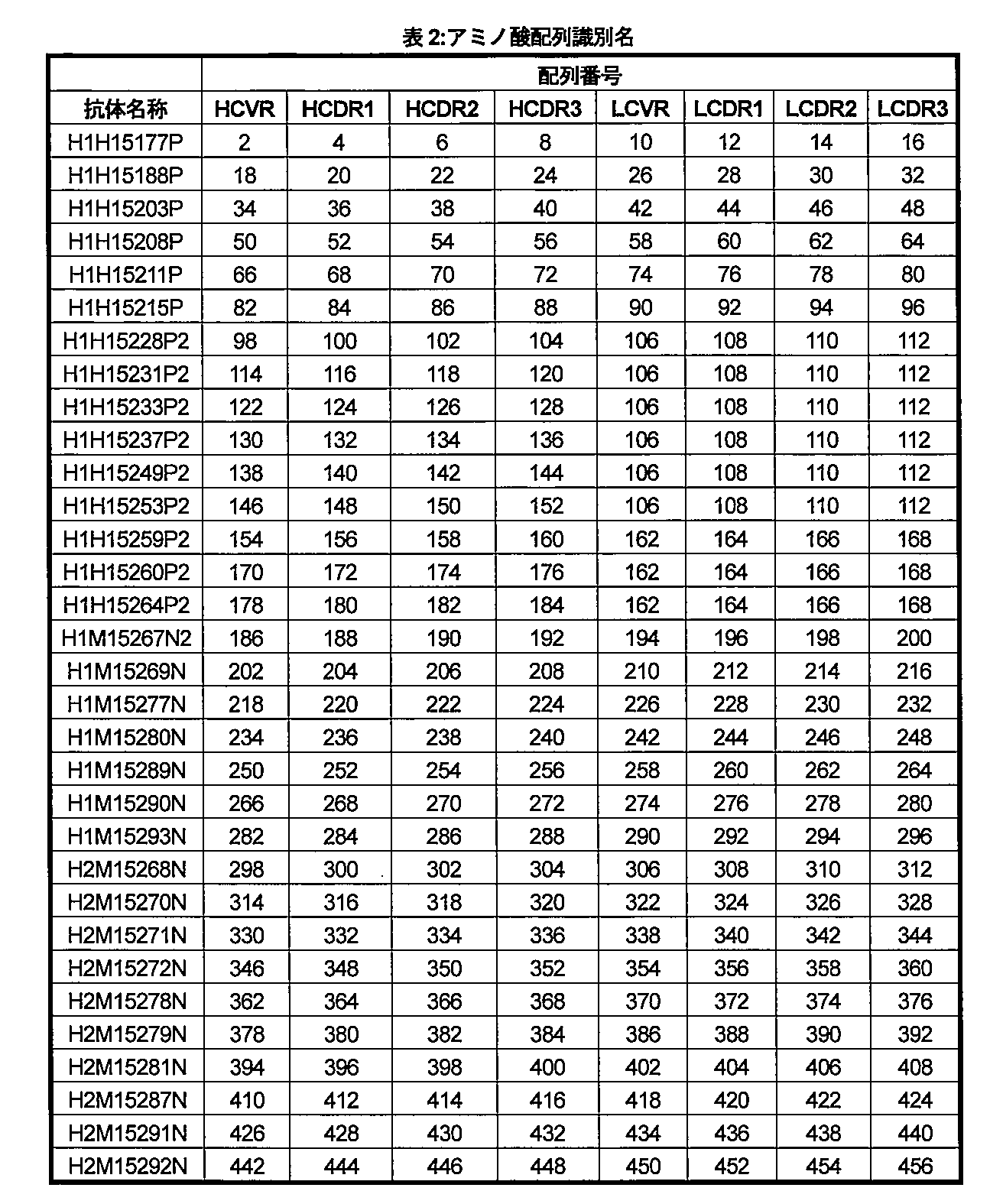
対応する核酸配列識別名を表3に記載する。 The corresponding nucleic acid sequence identifiers are listed in Table 3.

抗体は、本明細書において典型的には次の命名法によって言及する:Fc接頭辞(例えば、「H4xH」、「H1M」、「H2M」など)、続いて、数字で表した識別名(例えば、表2において示す「15177」、「15228」、「15268」など)、続いて「P」、「P2」、「N」、または「B」接尾辞。従って、この命名法により、本明細書において、例えば、「H1H15177P」、「H1H15228P2」、「H2M15268N」などとして抗体を指す。本明細書において用いた抗体名称上のH4sH、H1M、およびH2M接頭辞は、抗体の特定のFc領域アイソタイプを示す。例えば、「H4
sH」抗体は、US20100331527において開示される2つまたはそれ以上のアミノ酸変更を有するヒトIgG4 Fcを有し、「H1M」抗体は、マウスIgG1 Fcを有し、「H2M」抗体は、マウスIgG2 Fc(aもしくはbのアイソタイプ)を有する(全ての可変領域は、抗体名称において最初の「H」により示す通り、完全ヒトである)。当業者が理解する通り、特定のFcアイソタイプを有する抗体を、異なるFcアイソタイプを有する抗体に変換することができる(例えば、マウスIgG1 Fcを有する抗体を、ヒトIgG4を有する抗体などに変換することができる)が、いずれの場合も、表2において示した数字で表した識別名により示した可変ドメイン(CDRを含む)は同一のままであり、抗原の結合特性はFcドメインの性質に関わらず、一致または実質的に類似であると予測した。
Antibodies are typically referred to herein by the following nomenclature: an Fc prefix (e.g., "H4xH", "H1M", "H2M", etc.), followed by a numeric identifier (e.g., "15177", "15228", "15268", etc., as shown in Table 2), followed by a "P", "P2", "N", or "B" suffix. Thus, according to this nomenclature, antibodies are referred to herein as, for example, "H1H15177P", "H1H15228P2", "H2M15268N", etc. The H4sH, H1M, and H2M prefixes on antibody names used herein indicate the particular Fc region isotype of the antibody. For example, "H4
The "sH" antibody has a human IgG4 Fc with two or more amino acid changes disclosed in US20100331527, the "H1M" antibody has a murine IgG1 Fc, and the "H2M" antibody has a murine IgG2 Fc (a or b isotype) (all variable regions are fully human as indicated by the initial "H" in the antibody name). As one of skill in the art will appreciate, an antibody having a particular Fc isotype can be converted to an antibody having a different Fc isotype (e.g., an antibody having a murine IgG1 Fc can be converted to an antibody having a human IgG4 Fc, etc.), but in each case the variable domains (including the CDRs) indicated by the numerical identifiers shown in Table 2 remain the same, and the antigen binding characteristics are expected to be consistent or substantially similar regardless of the nature of the Fc domain.
表面プラズモン共鳴により決定したMERS-CoV-Sへの抗体結合
Biacore 4000またはBiacore T200機器におけるリアルタイム表面プラズモン共鳴バイオセンサーアッセイを用いて、精製した抗MERS-CoV-S抗体またはハイブリドーマ上清への抗原結合について、結合ならびに解離速度定数(それぞれ、kaおよびkd)、平衡解離定数、ならびに解離半減期(それぞれ、KDおよびt1/2)を決定した。Biacoreセンサー表面を、ポリクローナルウサギ抗マウス抗体(GE、番号BR-1008-38)、またはモノクローナルマウス抗ヒトFc抗体(GE、番号BR-1008-39)のいずれかで誘導体化して、それぞれ、マウスFcまたはヒトFcいずれかと共に発現させた、およそ100~900RUの抗MERS-CoV-Sモノクローナル抗体を捕捉した。抗MERS-CoV-S抗体への結合について試験したMERS-CoV試薬は、C末端のヒトIgG1 Fcと共に発現した組換えMERS-CoV-S受容体結合ドメイン(MERS RBD-hFc;配列番号458)を含んでいた。Biacore 4000における流速30μL/分、またはBiacore T200における流速50μL/分において、抗MERS-CoV-Sモノクローナル抗体捕捉表面に渡り、200nM~3.7nMの範囲にある異なる濃度のMERS-CoV試薬を注入した。捕捉したモノクローナル抗体へのMERS-CoV試薬の結合を、3~5分間モニターし、一方、抗体からのそれらの解離を、HBSTランニングバッファー(0.01M HEPES pH7.4、0.15M NaCl、3mM EDTA、0.05%v/v 界面活性剤P20)において7~10分間モニターした。25℃において実験を行った。データを処理し、Scrubber 2.0c曲線近似ソフトウェアを用いて1:1結合モデルに近似させることにより、動力学的結合(ka)および解離(kd)速度定数を決定した。次に、動力学的速度定数から、KD(M)=kd/ka、およびt1/2(分)=[ln2/(60*kd)]として、結合解離平衡定数(KD)、ならびに解離半減期(t1/2)を計算した。
Antibody Binding to MERS-CoV-S Determined by Surface Plasmon Resonance. The binding and dissociation rate constants (k a and k d , respectively), equilibrium dissociation constants, and dissociation half-lives (K D and t ½ , respectively) were determined for antigen binding to purified anti-MERS-CoV-S antibodies or hybridoma supernatants using real-time surface plasmon resonance biosensor assays on a Biacore 4000 or Biacore T200 instrument. The Biacore sensor surface was derivatized with either a polyclonal rabbit anti-mouse antibody (GE, no. BR-1008-38), or a monoclonal mouse anti-human Fc antibody (GE, no. BR-1008-39) to capture approximately 100-900 RU of anti-MERS-CoV-S monoclonal antibodies expressed with either mouse or human Fc, respectively. The MERS-CoV reagent tested for binding to anti-MERS-CoV-S antibodies contained recombinant MERS-CoV-S receptor binding domain expressed with a C-terminal human IgG1 Fc (MERS RBD-hFc; SEQ ID NO: 458). Different concentrations of MERS-CoV reagent, ranging from 200 nM to 3.7 nM, were injected over the anti-MERS-CoV-S monoclonal antibody capture surface at a flow rate of 30 μL/min on the Biacore 4000 or 50 μL/min on the Biacore T200. Binding of MERS-CoV reagents to the captured monoclonal antibodies was monitored for 3-5 min, while their dissociation from the antibodies was monitored for 7-10 min in HBST running buffer (0.01 M HEPES pH 7.4, 0.15 M NaCl, 3 mM EDTA, 0.05% v/v surfactant P20). Experiments were performed at 25°C. Kinetic association (k a ) and dissociation (k d ) rate constants were determined by processing the data and fitting to a 1:1 binding model using Scrubber 2.0c curve fitting software. The association-dissociation equilibrium constant (K D ), as well as the dissociation half-life (t 1/2 ) were then calculated from the kinetic rate constants as K D ( M ) = k d /k a , and t 1/2 (min) = [ln2/(60 * k d )].
開始実験において、(実施例2において記載した)22種のハイブリドーマ上清について、結合解離平衡定数および解離半減期を決定した。 In an initial experiment, the binding-dissociation equilibrium constants and dissociation half-lives were determined for 22 hybridoma supernatants (described in Example 2).
続く実験において、上述の表面プラズモン共鳴アッセイを用いて、MERS-CoVスパイクタンパク質への結合について、精製した抗体を試験した。 In subsequent experiments, the purified antibodies were tested for binding to the MERS-CoV spike protein using the surface plasmon resonance assay described above.


表4および5において示した通り、抗体は、MERS-CoVスパイクタンパク質に、25℃において77.5pM~18.5nM、および37℃において127pM~13.2nMの範囲にあるKD値で結合した。抗体は、25℃において2.2~262分、および37℃において1.8~244分の範囲にある解離半減期(t1/2)値を示した。 As shown in Tables 4 and 5, the antibodies bound to MERS-CoV spike protein with K values ranging from 77.5 pM to 18.5 nM at 25° C. and 127 pM to 13.2 nM at 37° C. The antibodies exhibited dissociation half-life (t1/2) values ranging from 2.2 to 262 minutes at 25° C. and 1.8 to 244 minutes at 37° C.
MERS感染性の抗体により仲介される中和
材料および方法
偽粒子の生成
MERSスパイクタンパク質を発現するプラスミド構築物、HIV gag-pol、およびホタルルシフェラーゼをコードするHIVプロウイルスベクターの混合物を293T細胞に同時トランスフェクションすることにより、MERS偽粒子(MERSpp;ウイルス様粒子-VLPとも呼ばれる)を生成した。トランスフェクションの72時間後に、MERSppを含有する上清を回収し、遠心分離を用いて清澄化し、濃縮し、等分し、-80℃において凍結した。MERS-CoVスパイクタンパク質を発現するプラスミド
をVesicular Stomatitis Virus Glycoprotein(VSVg)をコードするプラスミドで置き換えることにより、対照偽粒子を生成した。
Antibody-Mediated Neutralization of MERS Infectivity Materials and Methods Pseudoparticle Generation MERS pseudoparticles (MERSpp; also called virus-like particles-VLPs) were generated by co-transfecting 293T cells with a mixture of a plasmid construct expressing the MERS spike protein, HIV gag-pol, and an HIV proviral vector encoding firefly luciferase. Seventy-two hours after transfection, the MERSpp-containing supernatant was harvested, clarified using centrifugation, concentrated, aliquoted, and frozen at -80°C. Control pseudoparticles were generated by replacing the plasmid expressing the MERS-CoV spike protein with a plasmid encoding the Vesicular Stomatitis Virus Glycoprotein (VSVg).
MERSppベースのアッセイ
抗体の希釈液をMERSppと1時間室温にてインキュベーションした。1%EDTAを用いて、完全DMEM培地中のHuh7細胞を剥離し、洗浄し、抗体/MERSpp混合物と72時間インキュベーションした。BrightGlo(登録商標)ルシフェラーゼアッセイ(Promega、San Luis Obispo、CA、米国)でのルシフェラーゼ検出により、感染有効性を定量し、Victor(登録商標)X3プレートリーダー(Perkin Elmer、Waltham、MA、米国)において光産生について読み取った。
MERSpp-based assay: Antibody dilutions were incubated with MERSpp for 1 h at room temperature. Huh7 cells in complete DMEM medium were detached with 1% EDTA, washed, and incubated with antibody/MERSpp mixtures for 72 h. Infection efficacy was quantified by luciferase detection with the BrightGlo® luciferase assay (Promega, San Luis Obispo, CA, USA) and light production was read on a Victor® X3 plate reader (Perkin Elmer, Waltham, MA, USA).
ウイルスベースのアッセイ
1ウェル当たり1×10⁴ベロE6細胞を、実験の1日前に96ウェルプレートに播種した。500 TCID50のMERS-CoV EMC/2012株を、通常のベロE6成長培地100μl中の所定量の抗体と混合し、室温にて30分間インキュベーションし、次に、混合物をベロE6細胞に加えた。感染の2日後において、製造元の指示に従い、CellTiter-Glo(登録商標)Luminescent Cell Viability Assay (Promega)を用いて、細胞死を評価した。Spectramax Mプレートリーダー(Molecular Devices)にて、発光を読み取った。データを、偽感染対照のパーセントとして表した。
Virus-based assays 1x10⁴ Vero E6 cells per well were seeded in 96-well plates one day before the experiment. 500 TCID50 of MERS-CoV EMC/2012 strain was mixed with a given amount of antibody in 100 μl of regular Vero E6 growth medium and incubated for 30 min at room temperature, and then the mixture was added to the Vero E6 cells. Two days after infection, cell death was assessed using the CellTiter-Glo® Luminescent Cell Viability Assay (Promega) according to the manufacturer's instructions. Luminescence was read on a Spectramax M plate reader (Molecular Devices). Data were expressed as a percentage of mock-infected controls.
結果
抗MERS-CoV-S抗体によるMERS-CoVの中和
開始実験において、MERS感染性の中和について、別個の独立したハイブリドーマからもたらされた抗MERS-CoV-S抗体を試験した。図1において示す通り、22種のうち12種の細胞の抗MERS-CoV-Sハイブリドーマ抗体は、MERS感染性の90%超を、68.4pM~3.58nMの範囲にあるIC50で阻害するか、または中和した。
Results Neutralization of MERS-CoV by Anti-MERS-CoV-S Antibodies In an initial experiment, anti-MERS-CoV-S antibodies derived from separate independent hybridomas were tested for neutralization of MERS infectivity. As shown in Figure 1, 12 of 22 cell anti-MERS-CoV-S hybridoma antibodies inhibited or neutralized greater than 90% of MERS infectivity with IC50s ranging from 68.4 pM to 3.58 nM.
続く実験において、MERSppおよび生MERSウイルスの中和について、精製した抗体を試験した(単離物:EMC/2012)。結果を表6および7において示す。 In subsequent experiments, the purified antibodies were tested for neutralization of MERSpp and live MERS virus (isolate: EMC/2012). The results are shown in Tables 6 and 7.


上記データは、本発明の抗MERS-CoV-S抗体が、MERS-CoVの感受性細胞への侵入を潜在的に遮断し、感染性を中和することを示唆する。 The above data suggest that the anti-MERS-CoV-S antibodies of the present invention potentially block MERS-CoV entry into susceptible cells and neutralize infectivity.
抗MERS-CoV-S抗体による臨床上の単離物の中和
RNAウイルスは、低フィデリティーゲノム複製機構をコードするため、それらの宿主環境に容易に適応することが可能となる(Malpicaら2002年;Genetics 162:1505~1511頁)。しかしながら、MERS-CoVのようなコロナ
ウイルスは、3’-から-5’のエクソ-リボヌクレアーゼ活性を有する非構造タンパク質をコードし、これは、それらの複製中にプルーフリーディング機能をもたらし、変異性カタストロフを導くことなくゲノムのコード能力を非常に増大する(Cottonら2013年;Lancet doi:10.1016/S0140-6736(13)61887-5)。それにも関わらず、MERS-CoV流行の最初の2年の間に試料採取した複数の臨床上の単離物の配列決定により、ウイルスのMERS-CoV Sタンパク質が、進化することが明らかになった(Cottonら2014年;MBio 5 doi:10.1128/mBio.01062-13)。この研究のため、MERS-CoV臨床上の単離物の38種のNCBI寄託配列を整列させ、第1の単離した株、EMC/2012の配列と比較した。スクリーニングアッセイの設計に基づき、本発明の抗体は、MERS-CoV Sタンパク質のRBD内に結合すると予測し、故に、配列の比較が、アミノ酸367~606に特異的に焦点を合わせた。配列決定した臨床上の単離物と原型EMC/2012配列、A431P、S457G、S460F、A482V、L506F、D509GおよびV534A間で異なる、7種の異なるアミノ酸を同定した(表8)。
Neutralization of Clinical Isolates by Anti-MERS-CoV-S Antibodies RNA viruses encode low-fidelity genome replication machinery, allowing them to easily adapt to their host environment (Malpica et al. 2002; Genetics 162:1505-1511). However, coronaviruses such as MERS-CoV encode nonstructural proteins with 3'-to-5' exo-ribonuclease activity, which provide a proofreading function during their replication and greatly increase the coding capacity of the genome without leading to mutational catastrophe (Cotton et al. 2013; Lancet doi:10.1016/S0140-6736(13)61887-5). Nonetheless, sequencing of multiple clinical isolates sampled during the first two years of the MERS-CoV epidemic revealed that the viral MERS-CoV S protein evolves (Cotton et al. 2014;

RBD内の保存された領域に結合し、2014年7月のものとして配列決定した全てのMERS-CoV臨床上の単離物を中和する抗体の能力を試験するために、部位特異的変異誘発を用いて、全てのSタンパク質変異体をコードするプラスミド構築物を作製した。これらを用いて、修飾したSタンパク質で偽型化したMERSppを生成し、中和アッセイを行った。上述の変異を有する生成したMERSppを用いて、MERS感染性の中和について、精製した抗体(実施例1において記載した)を試験した。表9および10は、MERSpp変異体のパーセント中和を示す。 To test the ability of antibodies to bind to conserved regions within the RBD and neutralize all MERS-CoV clinical isolates sequenced as of July 2014, site-directed mutagenesis was used to generate plasmid constructs encoding all S protein variants. These were used to generate MERSpp pseudotyped with the modified S protein and perform neutralization assays. The resulting MERSpp with the above mutations were used to test purified antibodies (described in Example 1) for neutralization of MERS infectivity. Tables 9 and 10 show the percent neutralization of MERSpp variants.


これらのデータは、本発明の抗体が、ウイルスの自然進化中に保存されるMERS-CoVスパイクタンパク質の領域に結合することを示唆する。 These data suggest that the antibodies of the invention bind to a region of the MERS-CoV spike protein that is conserved during the natural evolution of the virus.
本発明の抗MERS-CoV-S抗体は、抗MERS-CoV抗体を従前に単離したより有効な中和剤である
本発明の選択した抗体の力価を、従前に単離したモノクローナル抗体と比較した。3つの群を、in vitro抗体単離方法、すなわち、ファージディスプレイ(Tangら2014年、PNAS doi:10.1073/pnas.1402074111;およびYingら2014年、J. Virol. doi:10.1128/JVI.00912-14)、ならびに酵母ディスプレイ(Jiangら2014年、Sci.Transl.Med. doi:10.1126/scitranslmed.3008140)を用いて、MERS-CoV Sタンパク質に結合し、ウイルス侵入を遮断する抗体を選択した。この研究のため、MERS-CoVを中和し、多様なエピトープに結合することを報告した、公開した可変ドメイン配列を有する3種の抗体のパネルを選択した。抗体3B12(Tangら2014年、PNAS doi:10.1073/pnas.1402074111)、MERS-4およびMERS-27(Jiangら2014年
、Sci. Transl. Med. doi:10.1126/scitranslmed.3008140)についての配列を、ヒトIgG1定常ドメインにクローニングし、次に、選択した本発明の抗体と同様に発現させ、精製した。原型EMC/2012配列、および上述の全ての臨床上の単離物で生成した偽粒子を用いて、全ての抗体の中和有効性を試験した。
Anti-MERS-CoV-S Antibodies of the Invention Are More Effective Neutralizers than Previously Isolated Anti-MERS-CoV Antibodies The potency of selected antibodies of the invention was compared to previously isolated monoclonal antibodies. The three groups were selected for antibodies that bind to MERS-CoV S protein and block viral entry using in vitro antibody isolation methods, namely, phage display (Tang et al. 2014, PNAS doi:10.1073/pnas.1402074111; and Ying et al. 2014, J. Virol. doi:10.1128/JVI.00912-14), and yeast display (Jiang et al. 2014, Sci. Transl. Med. doi:10.1126/scitranslmed.3008140). For this study, a panel of three antibodies with published variable domain sequences that were reported to neutralize MERS-CoV and bind diverse epitopes were selected. Sequences for antibodies 3B12 (Tang et al. 2014, PNAS doi:10.1073/pnas.1402074111), MERS-4 and MERS-27 (Jiang et al. 2014, Sci. Transl. Med. doi:10.1126/scitranslmed.3008140) were cloned into a human IgG1 constant domain and then expressed and purified similarly to selected antibodies of the invention. The neutralization efficacy of all antibodies was tested using the prototype EMC/2012 sequence and pseudoparticles generated with all clinical isolates mentioned above.
MERSpp変異体に対する選択した抗体の中和IC50を、表11に示す。表11に示す通り、H1H15211Pは、1.3E-11M~6.5E-11Mの範囲にあるIC50値で全ての単離物を中和することができた。抗体に対して部分的な抵抗性を示したV534A変異体を除き、H1H15277Nについて、類似の値も観察された。しかしながら、このアミノ酸変化が、2012年に単離され、MERS-CoV系統樹の死部門である単一のMERS-CoV単離物(Riyadh_2)においてのみ観察されたことは注目すべきである。 Neutralization IC50 of selected antibodies against MERSpp variants are shown in Table 11. As shown in Table 11, H1H15211P was able to neutralize all isolates with IC50 values ranging from 1.3E-11M to 6.5E-11M. Similar values were also observed for H1H15277N, except for the V534A variant, which showed partial resistance to the antibody. However, it is noteworthy that this amino acid change was observed only in a single MERS-CoV isolate (Riyadh_2), which was isolated in 2012 and is in the death branch of the MERS-CoV phylogenetic tree.
H1H15211PおよびH1H277Nは、最も強力なコンパレーター抗体、MERS-4より少なくとも1log小さいIC50値でMERSppを中和する。加えて、3B12およびMERS-27の両方は、複数の臨床上の単離物の配列を有する偽粒子をこれらの抗体で中和できないので、MERS-CoV Sタンパク質上のあまり保存されていない部位に結合するように思われる。 H1H15211P and H1H277N neutralize MERSpp with IC50 values at least 1 log lower than the most potent comparator antibody, MERS-4. In addition, both 3B12 and MERS-27 appear to bind to less conserved sites on the MERS-CoV S protein, as pseudoparticles bearing sequences from multiple clinical isolates could not be neutralized by these antibodies.

これらのデータは、本発明の抗体が、より広い範囲のMERS-CoV単離物を、in
vitro生化学特性に専ら基づき単離したいくつかの抗体と比較して、改良された力価で中和することができることを示唆する。
These data indicate that the antibodies of the invention are able to inhibit a broader range of MERS-CoV isolates in vivo.
These results suggest that they are capable of neutralizing with improved potency compared to some antibodies isolated solely on the basis of in vitro biochemical properties.
抗MERS-CoV S抗体間のOctet交差競合
Octet(登録商標)RED96 biosensor(Pall ForteBio Corp)上でのリアルタイム、ラベルフリーバイオレイヤーインターフェロメトリーアッセイを用いて、MERS-CoV S抗体間の結合競合を決定した。25℃にて、HBS-P Octetバッファー(10mM HEPES、150mM NaCl、および0.05%v/v 界面活性剤Tween-20、pH7.4、1mg/mL BS
A)中、速度1000rpmでプレート振盪しながら、全実験を行った。抗体が、ヒトFcタグに融合した組換え発現させたMERSスパイクタンパク質受容体結合ドメイン(MERS RBD-hFc;配列番号458)上のそれらのそれぞれのエピトープへの結合について互いに競合することができるかどうかを評価するために、プレミックスアッセイフォーマットを採用し、50nM MERS-CoV-RBD-mFcを500nM 異なる抗MERSモノクローナル抗体(以後、mAb-2として言及する)と少なくとも2時間プレインキュベーション後、結合競合アッセイを行った。非特異的なモノクローナル抗体を、アイソタイプ対照としてMERS-RBS.mFcとインキュベーションした。抗hFcポリクローナル抗体(Pall ForteBio Corp.、カタログ番号18-5060)でコートしたOctetバイオセンサーを、50μg/mL溶液を含有するウェルに4分間まず浸し、およそ2nm 抗MERS抗体(以後、mAb-1と呼ぶ)を捕捉した。捕捉工程後、次に、Octetバイオセンサーを100μg/mL非特異的完全ヒトモノクローナル抗体を含有するウェルに浸すことにより、未結合の抗hFcポリクローナル抗体を飽和させた。最後に、バイオセンサーを、50nM MERS-RBD-mFcおよび500nM mAb-2のプレミックス試料を含有するウェルに4分間浸漬した。実験の全工程間で、バイオセンサーをHBS-P Octetバッファーにおいて洗浄した。実験の経過中、リアルタイム結合応答をモニターし、結合応答を、全工程の終わりに測定した。MERS-RBD-mFcおよびmAb-2のプレコンプレックスへのmAb-1結合の応答を比較し、異なる抗体MERSモノクローナル抗体の競合的/非競合的挙動を決定した。
Octet Cross-Competition Between Anti-MERS-CoV S Antibodies Binding competition between MERS-CoV S antibodies was determined using a real-time, label-free biolayer interferometry assay on an Octet® RED96 biosensor (Pall ForteBio Corp). ...
All experiments were performed in a 30-well plate shaker at a speed of 1000 rpm (Figure 1A). To assess whether the antibodies could compete with each other for binding to their respective epitopes on recombinantly expressed MERS spike protein receptor binding domain fused to a human Fc tag (MERS RBD-hFc; SEQ ID NO: 458), a premix assay format was employed in which 50 nM MERS-CoV-RBD-mFc was pre-incubated with 500 nM of a different anti-MERS monoclonal antibody (hereafter referred to as mAb-2) for at least 2 hours prior to the binding competition assay. A non-specific monoclonal antibody was incubated with MERS-RBS.mFc as an isotype control. Octet biosensors coated with anti-hFc polyclonal antibody (Pall ForteBio Corp., Cat. No. 18-5060) were first immersed in wells containing a 50 μg/mL solution for 4 minutes to capture approximately 2 nm anti-MERS antibody (hereafter referred to as mAb-1). After the capture step, unbound anti-hFc polyclonal antibody was then saturated by immersing the Octet biosensor in a well containing 100 μg/mL non-specific fully human monoclonal antibody. Finally, the biosensor was immersed for 4 minutes in a well containing a premixed sample of 50 nM MERS-RBD-mFc and 500 nM mAb-2. Between all steps of the experiment, the biosensor was washed in HBS-P Octet buffer. Real-time binding responses were monitored during the course of the experiment and binding responses were measured at the end of all steps. The responses of mAb-1 binding to the precomplex of MERS-RBD-mFc and mAb-2 were compared to determine the competitive/noncompetitive behavior of the different MERS monoclonal antibodies.
この実施例において用いた実験条件下で、例えば、(a)H2aM15281N、H1M15290N、H1M15293N、およびH2bM15291N;(b)H2aM15272N、H2bM15292N、およびH2aM15271N;ならびに(c)H2aM15268N、H1M15267N、H2M15279N、H1M15289N、およびH1M15277Nについて、交差競合(すなわち、両配向における抗体間の競合)が観察された(図2)。 Under the experimental conditions used in this example, cross-competition (i.e., competition between antibodies in both orientations) was observed, for example, for (a) H2aM15281N, H1M15290N, H1M15293N, and H2bM15291N; (b) H2aM15272N, H2bM15292N, and H2aM15271N; and (c) H2aM15268N, H1M15267N, H2M15279N, H1M15289N, and H1M15277N (Figure 2).
別の実験において、抗原陽性マウスB細胞(実施例1において記載した)から直接単離した、選択した抗体間での結合競合を決定した。この実施例において用いた実験条件下で、例えば、(a)H1H15215P、H1H15177P、H1H15203P、およびH1H15211P;(b)H1H15188P、H1H15208P、H1H15228P2、H1H15233P2、H1H15237P2、H1H15253P2、およびH1H15259P2;ならびに(c) H1H15231P2、H1H15249P2、H1H15260P2、およびH1H15264P2について、交差競合(すなわち、両配向における抗体間の競合)が観察された(図3)。 In a separate experiment, binding competition was determined between selected antibodies isolated directly from antigen-positive mouse B cells (described in Example 1). Under the experimental conditions used in this example, cross-competition (i.e., competition between antibodies in both orientations) was observed, for example, for (a) H1H15215P, H1H15177P, H1H15203P, and H1H15211P; (b) H1H15188P, H1H15208P, H1H15228P2, H1H15233P2, H1H15237P2, H1H15253P2, and H1H15259P2; and (c) H1H15231P2, H1H15249P2, H1H15260P2, and H1H15264P2 (Figure 3).
別の実験において、2つの抗体H1H15211PおよびH1H15277N間の結合競合をモニターした。 In a separate experiment, binding competition between the two antibodies H1H15211P and H1H15277N was monitored.

表12は、2つの抗体が互いに阻害しないこと、および1つの抗体のMERS-CoV
RBDへの結合が、第2の抗体の結合を依然可能にすることを示す。これらのデータは、2つの抗体が、別々のオーバーラップしないエピトープに結合することを示唆する。1つの抗体による選択圧の結果としての1つのエピトープに変異が生じても、他方の結合には影響しないはずである。
Table 12 shows that the two antibodies do not inhibit each other and that one antibody inhibits MERS-CoV
This indicates that binding to the RBD still allows for binding of a second antibody. These data suggest that the two antibodies bind to separate, non-overlapping epitopes. Mutations in one epitope as a result of selection pressure by one antibody should not affect binding of the other.
抗MERS-CoV-S抗体のIn vivo有効性
材料および方法
ヒトDPP4ノックインマウスの作製
MERSスパイクタンパク質は、マウスDPP4と相互作用しないので、VelociGene(登録商標)テクノロジー(Valenzuelaら2003年、Nat. Biotechnol.21:652~659頁)を用いて、MERS-CoV感染症のヒト化モデルを作製した。簡単に言うと、79kbマウスDpp4対応物配列を置き換えるための3’UTRを含むエクソン2~26由来の82kbヒトDPP4ゲノムDNAを含有する、巨大な標的ベクター(LTVEC)を構築した。Blastを用いて、Dpp4遺伝子を含有するヒトBAC RP11-68L22およびマウスBAC RP23-362N15を同定し、イルミナベンチトップシーケンサーMiSeqを用いて、配列を確認した。LTVECを、F1ハイブリッド(129S6SvEvTac/C57BL6NTac)ES細胞にエレクトロポレーションした。エレクトロポレーションの10日後に、G418耐性コロニーを拾い、アレルの消失アッセイにより、正しいターゲッティングについてスクリーニングした。VelociMouse(登録商標)方法を用い(Poueymirouら2007年;Nature Biotechnology25:91~99頁)、ここで、ターゲッティングされたES細胞を、非緻密8細胞期Swiss Webster胚に注入し、ヒトDPP4遺伝子アレルを有するES細胞からもたらされたF0世代のマウスを作製した。NIHのCare and Use of Laboratory Animalsにおける推奨に厳密に従い、全ての動物の手法を行った。Regeneron Pharmaceuticals Institutional Animal Care and Use Committee(IACUC)により、プロトコールは承認された。この方法は、2014年9月17日付けで出願された米国特許出願第62/051,626号において詳細に記載され、全体として本明細書に組み入れられる。遺伝子導入マウスは、マウスゲノムにおけるhDPP4遺伝子の無作為挿入によっても作製した。
In vivo efficacy of anti-MERS-CoV-S antibodies Materials and Methods Creation of human DPP4 knock-in mice Since MERS spike protein does not interact with mouse DPP4, a humanized model of MERS-CoV infection was created using VelociGene® technology (Valenzuela et al. 2003, Nat. Biotechnol. 21:652-659). Briefly, a large target vector (LTVEC) was constructed containing 82 kb human DPP4 genomic DNA from exons 2-26 including the 3′UTR to replace the 79 kb mouse Dpp4 counterpart sequence. Human BAC RP11-68L22 and mouse BAC RP23-362N15 containing the Dpp4 gene were identified using Blast and sequences were confirmed using an Illumina benchtop sequencer MiSeq. LTVECs were electroporated into F1 hybrid (129S6SvEvTac/C57BL6NTac) ES cells. Ten days after electroporation, G418-resistant colonies were picked and screened for correct targeting by allele loss assay. The VelociMouse® method was used (Poueymirou et al. 2007; Nature Biotechnology 25:91-99), in which targeted ES cells were injected into non-compact 8-cell stage Swiss Webster embryos to generate F0 generation mice derived from ES cells carrying human DPP4 gene alleles. All animal procedures were performed in strict accordance with the recommendations in the NIH Care and Use of Laboratory Animals. The Regeneron Pharmaceuticals Institutional Animal Care and Use Committee (IACUC) approved the protocol. The method is described in detail in U.S. Patent Application No. 62/051,626, filed Sep. 17, 2014, and incorporated herein in its entirety. Transgenic mice were also generated by random insertion of the hDPP4 gene in the mouse genome.
動物実験
実験に依存して、感染の1日前または感染の1日後に、指定量の抗体または対照として無菌食塩水を、6~8週齢のヒト化DPP4マウスに腹腔内(i.p.)注射した。鼻腔
内接種に先立ち、キシラジン(0.38mg/マウス;Lloyd laboratories)およびケタミン(1.3mg/マウス;Henry Schein animal health)の混合物を用い、腹腔内注射によりマウスを麻酔し、PBS中に希釈して、マウス1匹当たり総量50μlを作製した。麻酔したら、総接種量50μlについてPBSまたはPBSに希釈した2×10⁵pfu MERS-CoV(Jordan)のいずれかをマウスに鼻腔内接種した。実験中、感染前および実験の毎日、マウスの体重を測定し、MERS-CoVにより誘導される体重減少を評価した。致死用量のイソフルラン(Butler Animal Health Supply)を用いて、感染の2または4日後において、マウスを安楽死させた。MERS-CoV複製物のさらなる分析および病理のため、肺を回収した。
Animal Experiments Six to eight week old humanized DPP4 mice were injected intraperitoneally (i.p.) with the indicated amounts of antibody or sterile saline as a control one day prior to infection or one day after infection depending on the experiment. Prior to intranasal inoculation, mice were anesthetized with a mixture of xylazine (0.38 mg/mouse; Lloyd laboratories) and ketamine (1.3 mg/mouse; Henry Schein animal health) via i.p. injection and diluted in PBS to make a total volume of 50 μl per mouse. Once anesthetized, mice were inoculated intranasally with either PBS or 2×10 5 pfu MERS-CoV (Jordan) diluted in PBS for a total inoculum volume of 50 μl. Mice were weighed prior to infection and each day of the experiment to assess weight loss induced by MERS-CoV. Mice were euthanized 2 or 4 days after infection with a lethal dose of isoflurane (Butler Animal Health Supply). Lungs were harvested for further analysis of MERS-CoV replication and pathology.
MERS-CoV RNA分析
製造元の指示に従い、Magnalyzer(Roche)を用いて、Trizol(登録商標)(Life Technologies Inc)1mlにおけるホモジネートにより、マウスの肺からRNAを抽出した。エンベロープ遺伝子(UpE)のゲノム上流の領域;ヌクレオカプシドメッセンジャーRNAのリーダー配列(リーダープライマー)を標的とするLife Technologiesから得た2本鎖のプライマーを用いて、製造元の指示に従い、Taqman(登録商標)Fast virus one-step master mix(Applied Biosystems)を用いて、MERS-CoV RNAのレベルを評価し、マウス18S rRNA(内在性対照)と比較した。Microamp(登録商標)fast optical reaction plates(Applied Biosystems)におけるqPCR反応物を、7500 fast DX real-time PCR instrument(Applied Biosystems)上で読み取り、未感染の対照を1に設定した、デルタCt方法を用いて、データを分析した。アイソタイプ一致対照抗体で処置した感染マウスにおいて検出したRNAのレベルに対する、検出したパーセントMERS-CoV RNAを表した。
MERS-CoV RNA Analysis RNA was extracted from mouse lungs by homogenizing in 1 ml of Trizol® (Life Technologies Inc) using a Magnalyzer (Roche) according to the manufacturer's instructions. Levels of MERS-CoV RNA were assessed using Taqman® Fast virus one-step master mix (Applied Biosystems) according to the manufacturer's instructions using a double-stranded primer obtained from Life Technologies targeting the region of the genome upstream of the envelope gene (UpE); the leader sequence of the nucleocapsid messenger RNA (leader primer) and compared to mouse 18S rRNA (endogenous control). qPCR reactions in Microamp® fast optical reaction plates (Applied Biosystems) were read on a 7500 fast DX real-time PCR instrument (Applied Biosystems) and data were analyzed using the delta Ct method with uninfected controls set to 1. Percent MERS-CoV RNA detected was expressed relative to the level of RNA detected in infected mice treated with isotype-matched control antibody.
MERS-CoVタイターについてのプラークアッセイ
Magnalyzer(Roche)を用いて、PBS1ml中、ガラスビーズで60秒間6000rpmにて、マウス肺をホモジネートした。次に、10分間、10,000rpmにてホモジネートを遠心分離し、ベロE6細胞上でのプラークアッセイにより、上清を分析して、処置後に残存するウイルスのレベルを定量した。プラークを出現させるため、3日間プレートをそのままにしたことを除き、従前に記載された通り、プラークアッセイを行った。
Plaque Assay for MERS-CoV Titer Mouse lungs were homogenized with glass beads in 1 ml PBS at 6000 rpm for 60 seconds using a Magnalyzer (Roche). The homogenate was then centrifuged at 10,000 rpm for 10 minutes and the supernatant was analyzed by plaque assay on Vero E6 cells to quantitate the levels of virus remaining after treatment. Plaque assays were performed as previously described, except that plates were left undisturbed for 3 days to allow plaques to appear.
組織学的分析
固定し、パラフィン包埋した組織の5μmの切片から、組織学スライドを調製し、ヘマトキシリンおよびエオジンで染色した。光顕微鏡により視野を調べ、分析した。間質性、細気管支周囲および血管周囲の炎症の程度を、0~5にスコア化した。それぞれの実験群について、スライドを盲検化し、0~5にスコア化し、表にして、株、時間ポイント、および処置を比較した。細気管支上皮および肺胞損傷の存在、胸膜の変化、ならびに気管支血管周囲の炎症の程度のような他の組織学的特性も、テキストにおけるそれぞれの群について述べた。それぞれのマウスについての全体的な炎症スコアを、それぞれの群について平均化し、それぞれの群および時間ポイントにおける全てのマウスの平均スコアとして提示した。
Histological Analysis Histology slides were prepared from 5 μm sections of fixed, paraffin-embedded tissues and stained with hematoxylin and eosin. Fields were examined and analyzed by light microscopy. The degree of interstitial, peribronchiolar and perivascular inflammation was scored from 0 to 5. For each experimental group, slides were blinded, scored from 0 to 5, and tabulated to compare strains, time points, and treatments. Other histological characteristics such as the presence of bronchiolar epithelial and alveolar damage, pleural changes, and the degree of peribronchiovascular inflammation were also described for each group in the text. The overall inflammation score for each mouse was averaged for each group and presented as the mean score of all mice in each group and time point.
結果
MERS-CoV感染症に感受性である、DPP4についてのヒト化マウス
抗ウイルス分子のIn vivo試験は、MERS-CoV感染症に感受性である、小
動物モデルを必要とする。マウスはMERS-CoV感染症に感受性でない。マウスおよびヒトDPP4の配列の配列比較は、MERS-CoV Sタンパク質とその受容体の間の接触部位として従前に同定したアミノ酸が、2つの種の間で異なることを明らかにした。加えて、マウス細胞におけるヒトDPP4の発現は、MERSpp侵入およびMERS-CoV伝播を可能にするが、これは、ウイルスの侵入が、マウス細胞の感染における律速段階であることを示しており、マウスDPP4およびMERS-CoV糖タンパク質間での相互作用の欠如が、種についてのトロピズムをin vitroで定義する。
Results Humanized Mice for DPP4 Susceptible to MERS-CoV Infection In vivo testing of antiviral molecules requires a small animal model that is susceptible to MERS-CoV infection. Mice are not susceptible to MERS-CoV infection. Sequence comparison of mouse and human DPP4 sequences revealed that amino acids previously identified as contact sites between the MERS-CoV S protein and its receptor differ between the two species. In addition, expression of human DPP4 in mouse cells allows MERSpp entry and MERS-CoV spread, indicating that viral entry is a rate-limiting step in infection of mouse cells, and the lack of interaction between mouse DPP4 and MERS-CoV glycoproteins defines the species tropism in vitro.
本発明者らは、マウスDPP4の代わりにヒトDPP4を発現するマウスが、MERS-CoVに感受性であり、抗MERS-CoV治療剤のin vivo試験を可能にすると仮定した。VelociGene(登録商標)テクノロジーを利用して、マウスDpp4遺伝子79kbをそのヒトオルソログ82kbで置き換えた。得られたマウスは、マウス調節エレメントの制御下で完全ヒトDPP4を発現し、正しい発現調節およびタンパク質組織分布を保つ。 The inventors hypothesized that mice expressing human DPP4 instead of mouse DPP4 would be susceptible to MERS-CoV and allow for in vivo testing of anti-MERS-CoV therapeutics. Utilizing VelociGene® technology, we replaced the 79 kb mouse Dpp4 gene with its human ortholog, 82 kb. The resulting mice express fully human DPP4 under the control of mouse regulatory elements, preserving correct expression regulation and protein tissue distribution.
1回の開始実験において、ヒト化マウスおよび遺伝子導入マウスが、MERS-CoV感染症を支持するかを試験するために、-1日目において抗MERS-CoV-S抗体またはアイソタイプ対照200μgで、遺伝子導入マウスを腹腔内処置し、0日目においてMERS-CoV(~106pfu EMC2012)を鼻腔内感染させた。感染の4日後に、肺を回収し、ウイルスのRNAレベルをRT-PCRにより測定し、抗体のウイルス負荷に対する効果を調べた。表13は、ウイルスのゲノムRNAの平均レベルおよび発現した複製RNAをアイソタイプ対照のパーセンテージとして示す。H1H15211Pでの処置は、感染したマウスにおいてウイルスRNAの約500倍の低減をもたらした。 To test whether humanized and transgenic mice support MERS-CoV infection in a single initial experiment, transgenic mice were treated intraperitoneally with 200 μg of anti-MERS-CoV-S antibody or isotype control on day -1 and infected intranasally with MERS-CoV (~ 106 pfu EMC2012) on day 0. Four days after infection, lungs were harvested and viral RNA levels were measured by RT-PCR to examine the effect of antibodies on viral load. Table 13 shows the mean levels of viral genomic RNA and expressed replicative RNA as a percentage of isotype control. Treatment with H1H15211P resulted in an approximately 500-fold reduction in viral RNA in infected mice.

別の実験において、6~8週齢のヒト化DPP4(huDPP4)マウスに、MERS-CoVを鼻腔内接種した。疾患の死亡率または臨床兆候は4日目まで観察されなかったが、接種の2および4日後において、マウスを安楽死させ、それらの肺を解剖した。ウイルスRNAレベルを得るために、Trizol(登録商標)において肺をホモジネートし、MERS-CoVに特異的なプライマーを用いてリアルタイムPCRにより分析した(図4および5)。ウイルスタイターを得るために、PBSにおいて肺をホモジネートし、遠心分離により清澄化し、ベロE6細胞においてタイター決定した(図6)。肺における頑強なMERS-CoV複製は、感染の2および4日後において明らかであった。複製MERS-CoVのみを増幅するために設計した、MERS-CoVリーダーに特異的なプライマーセットを用いてRNAを定量したところ、2日目に集めた肺における高レベルのMERS-CoV複製RNAが示され、これらのレベルは感染の4日後まで維持された(図5)。ベロE6細胞における肺ホモジネートのプラークアッセイによって、感染の2日後において~7.27×10⁴pfu/肺1g、および4日後において~3.75x105pfu/肺1gのMERS-CoV(Jordan)レベルが定量され(図6)、これは、huDPP4マウスの肺においてMERS-CoVが活発に複製していることを示している。これらのデータは、VelociGene(登録商標)テクノロジーを用いた受
容体DPP4のヒト化によって、in vivoでのMERS-CoV処置を評価するために用いることができる、MERS-CoVの頑強なモデルがマウスにおいて作製されたことを示唆する。
In another experiment, 6-8 week old humanized DPP4 (huDPP4) mice were inoculated intranasally with MERS-CoV. No mortality or clinical signs of disease were observed until
MERS-CoV(Jordan株)またはPBS(偽感染)のいずれかを鼻腔内接種したhuDPP4マウス由来の肺を、病理変化について分析した。感染の2日後において、細気管支周囲の炎症は、肺中で見出される細気管支細胞構造の変化から明らかであった。最小の血管周囲の炎症または肺胞構造に対する効果が、この時間ポイントにおいて認められた。感染の4日後において、血管周囲への細胞浸潤および広範な肺胞肥厚で、かなりの間質性浸潤を観察した。細気管支変化は、同様に依然存在した。重要なことに、この病理は、MERS-CoVを有するヒトにおいて観察した間質性肺炎およびかなりの肺疾患の発症のX線検査の知見と一致し、これは、MERS-CoV感染症のこのヒト化DPP4in vivoモデルが、ヒトのMERS-CoV感染症において見られる病理的続発症を繰り返すことを示唆する。 Lungs from huDPP4 mice inoculated intranasally with either MERS-CoV (Jordan strain) or PBS (mock infection) were analyzed for pathological changes. At 2 days post-infection, peribronchiolar inflammation was evident from changes in bronchiolar cellular architecture found in the lungs. Minimal perivascular inflammation or effects on alveolar architecture were noted at this time point. At 4 days post-infection, significant interstitial infiltration was observed with perivascular cellular infiltration and extensive alveolar thickening. Bronchiolar changes were still present as well. Importantly, this pathology was consistent with the radiographic findings of interstitial pneumonia and development of significant lung disease observed in humans with MERS-CoV, suggesting that this humanized DPP4 in vivo model of MERS-CoV infection recapitulates the pathological sequelae seen in human MERS-CoV infection.
さらなる実験(以下を参照)において、感染したマウスに、1回またはそれ以上の用量の精製した抗体(実施例1において記載した通り)または抗体の併用を予防的および/または治療的に投与して、MERS感染症に対するそれらの有効性を試験した。 In further experiments (see below), infected mice were administered one or more doses of purified antibodies (as described in Example 1) or combinations of antibodies prophylactically and/or therapeutically to test their efficacy against MERS infection.
H1H15211PおよびH1H15277Nは、ヒト化DPP4マウスをMERS-CoV感染症から保護する
ヒト化DPP4マウスが、MERS-CoVに感受性であったことを確認し、このモデルを用いて、2つのモノクローナル抗体の活性をin vivoで評価した。1×10⁵pfu MERS-CoV(Jordan株)での鼻腔内感染の24時間前に、H1H15211PもしくはH1H15277Nのいずれか200μg、20μgもしくは2μg、またはhIgG1アイソタイプ対照抗体200μgをマウスにi.p.注射した。図7および8において示す通り、抗体の両方が、アイソタイプ対照抗体と比較して、1回のマウス用量当たり200μgにて2logを越えて、肺におけるMERS-CoV特異的RNAレベルを有意に低減することができた。H1H15211Pは用量20μgにおいて、MERS-CoV RNAレベルを低減する上で、同一用量におけるH1H15277Nと比較してより有効であった。いずれの抗体も投薬量2μgは、ウイルスRNAレベルを低減する上で、アイソタイプ対照で処置したマウスと比較して無効であった。MERS-CoVタイターを肺において分析したら(図9)、H1H15211Pの用量200μgおよび20μgの両方が、ウイルスレベルを低減して、アッセイにおける検出のレベルまで近づける(2×10³pfu/ml)ことが見出された。H1H15277Nは、H1H15211Pと、用量200μgにおいて同等に効率的であり、一方、20μgおよび2μgは、ウイルスの阻害の用量依存的阻害を示す。これらのデータは、H1H15211PおよびH1H15277Nが、MERS-CoV感染症をin vivoで有効に遮断することを示唆する。
H1H15211P and H1H15277N Protect Humanized DPP4 Mice from MERS-CoV Infection Having confirmed that humanized DPP4 mice were susceptible to MERS-CoV, this model was used to evaluate the activity of two monoclonal antibodies in vivo. Mice were injected i.p. with 200 μg, 20 μg, or 2 μg of either H1H15211P or H1H15277N, or 200 μg of hIgG1 isotype control antibody 24 hours prior to intranasal infection with 1× 10⁵ pfu MERS-CoV (Jordan strain). As shown in Figures 7 and 8, both antibodies were able to significantly reduce MERS-CoV specific RNA levels in the lungs by more than 2 log at 200 μg per mouse dose compared to the isotype control antibody. H1H15211P at a dose of 20 μg was more effective in reducing MERS-CoV RNA levels compared to H1H15277N at the same dose. A 2 μg dose of either antibody was ineffective in reducing viral RNA levels compared to mice treated with an isotype control. When MERS-CoV titers were analyzed in the lungs (FIG. 9), both 200 μg and 20 μg doses of H1H15211P were found to reduce virus levels approaching the level of detection in the assay (2×10 3 pfu/ml). H1H15277N was equally efficient as H1H15211P at a dose of 200 μg, while 20 μg and 2 μg showed a dose-dependent inhibition of viral inhibition. These data suggest that H1H15211P and H1H15277N effectively block MERS-CoV infection in vivo.
感染の4日後において、H1H15277N、H1H15211P、またはhIgG1アイソタイプ対照抗体で感染の24時前に処置したマウス由来の肺において、組織学的分析も行った。hIgGアイソタイプ対照抗体で予め処置したマウス由来の肺は、増大した間質性炎症、血管周囲への細胞浸潤、および肺胞中隔の肥厚を伴うかなりの肺病理を示した。H1H15277NまたはH1H15211Pのいずれか200μgで処置したマウスでは、間質における炎症細胞の最小病巣およびわずかな細気管支への細胞浸潤を伴った炎症が低減されていた。H1H15277NおよびH1H15211P20μgで予め処置したマウスでは、より高容量の抗体群と比較して中程度のレベルの血管周囲への細胞浸潤ならびに間質性炎症が見出された。対照的に、抗体2μgで予め処置した群は、かなりの間質性炎症および主な血管周囲の炎症を示すhIgG1アイソタイプ対照と類似の病理
を有していた。盲検組織学的スコア化(図10)は、処置したマウスについて低減した炎症スコアを反映する。これらの知見は、H1H15277NおよびREGN 3051が、MERS-CoV感染後の肺病理の用量依存的低減をもたらすことを示し、これは、これらのマウスについて決定されたウイルスRNAレベルおよびウイルスタイターを裏付ける。
Histological analysis was also performed on lungs from mice treated 24 hours prior to infection with H1H15277N, H1H15211P, or hIgG1 isotype control
まとめると、これらのデータは、H1H15211PおよびH1H15277Nが、感染の1日前に注射したとき、MERS-CoV感染症および疾患をin vivoで遮断することを示す。本発明者らが知る限り、H1H15211PおよびH1H15277Nは、MERS-CoV感染症のin vivoモデルにおいて有効性を示すことが示された最初の完全ヒト抗体である。 Collectively, these data indicate that H1H15211P and H1H15277N block MERS-CoV infection and disease in vivo when injected 1 day prior to infection. To our knowledge, H1H15211P and H1H15277N are the first fully human antibodies shown to demonstrate efficacy in an in vivo model of MERS-CoV infection.
H1H15211PおよびH1H15277Nは、MERS-CoVが感染したヒト化DPP4マウスを処置する
感染後にMERS-CoV複製および肺病理を阻害する能力が、可能性のある治療剤における所望の形質である。H1H15211Pが,効果を治療上有するかどうかを評価するために、huDPP4マウスをMERS-CoVで感染させ、次に24時間後に、hIgGアイソタイプ対照500μg、またはH1H15211P500μgもしくは200μgをi.p.注射した。感染の4日後に、マウスを安楽死させ、ウイルスRNA、ウイルスタイター、および肺病理について、マウスの肺を分析した。H1H15211Pの用量500μgおよび200μgの両方がマウスの肺においてウイルスRNAレベルを、対照抗体で処置したマウスと比較して約10倍低減することができた(図11および12)。同一マウスの肺タイターは肺におけるウイルスレベルの有意な低減を示し、感染の4日後において2log超低減していた(図13)。これらのデータは、H1H15211Pが、ウイルス接種の24時間後に投与したときでさえ、ウイルス複製を優位に阻害することを示す。
H1H15211P and H1H15277N Treat MERS-CoV Infected Humanized DPP4 Mice The ability to inhibit MERS-CoV replication and lung pathology following infection is a desirable trait in a potential therapeutic. To evaluate whether H1H15211P has therapeutic value, huDPP4 mice were infected with MERS-CoV and then injected i.p. 24 hours later with 500 μg of hIgG isotype control, or 500 μg or 200 μg of H1H15211P. Four days after infection, mice were euthanized and their lungs were analyzed for viral RNA, viral titers, and lung pathology. Both 500 μg and 200 μg doses of H1H15211P were able to reduce viral RNA levels in the lungs of mice by approximately 10-fold compared to mice treated with a control antibody (FIGS. 11 and 12). Lung titers in the same mice showed a significant reduction in virus levels in the lungs, with a more than 2
感染の24時間後にhIgG対照抗体、H1H15211P500μgまたは200μgで処置したマウスにおいて、組織学的分析を行った。対照抗体で処置したマウスは、かなりの間質性炎症、血管周囲への細胞浸潤、および肺胞中隔の肥厚を伴った、上記対照に類似の病理を示した。H1H15211P200μgまたは500μgのいずれかで処置したマウスは、肺中において、間質性炎症は最小限であり、血管周囲の炎症は低減された、限局的なものに過ぎなかった。盲検組織学的スコア化は、処置したマウスについて低減した炎症スコアを示す(図14)。これらのデータは、治療用量のH1H15211Pが、感染の24時間後に投与したときでさえ、MERS-CoVにより誘導される肺病理を低減することを示す。 Histological analysis was performed on mice treated with hIgG control antibody, H1H15211P 500 μg or 200 μg 24 hours after infection. Mice treated with control antibody showed pathology similar to the controls, with significant interstitial inflammation, perivascular cellular infiltration, and thickening of alveolar septa. Mice treated with either H1H15211P 200 μg or 500 μg had minimal interstitial inflammation and reduced, focal perivascular inflammation in the lungs. Blinded histological scoring shows reduced inflammation scores for treated mice (FIG. 14). These data indicate that therapeutic doses of H1H15211P reduce lung pathology induced by MERS-CoV, even when administered 24 hours after infection.
本発明は、本明細書に記載される具体的な実施形態により、範囲において制限されるべきではない。実際、本明細書に記載されるものに加え本発明の種々の修飾は、前述の記載および添付の図面から当業者に明らかとなるだろう。かかる修飾は、添付の請求の範囲内にあることが意図される。 The present invention is not to be limited in scope by the specific embodiments described herein. Indeed, various modifications of the invention in addition to those described herein will become apparent to those skilled in the art from the foregoing description and accompanying figures. Such modifications are intended to be within the scope of the appended claims.
Claims (35)
(b)配列番号457のアミノ酸残基367~606から選択される、MERS-CoVスパイクタンパク質の受容体結合ドメインにおける1個またはそれ以上のアミノ酸残基と相互作用する;
(c)表面プラズモン共鳴アッセイにおいて測定される、18.5nM未満の解離定数(KD)を有するMERS-CoVスパイクタンパク質に結合する;
(d)遮断ELISAアッセイにおいて測定される、ジペプチジルペプチダーゼ4(DPP4)へのMERS-CoVスパイクタンパク質の結合を90%超遮断する;
(e)ウイルス様粒子(VLP)中和アッセイにおいて測定される、ヒト宿主細胞のMERS-CoV感染性を、4nM未満のIC50で90%超中和する;
(f)MERS-CoV感染性を中和し、ここで、該MERS-CoVは、EMC/2012、Jordan-N3/2012、England-Qatar/2012、Al-Hasa_1_2013、Al-Hasa_2_2013、Al-Hasa_3_2013、Al-Hasa_4_2013、Al-Hasa_12、Al-Hasa_15、Al-Hasa_16、Al-Hasa_17、Al-Hasa_18、Al-Hasa_19、Al-Hasa_21、Al-hasa_25、Bisha_1、Buraidah_1、England1、Hafr-Al-batin_1、Hafr-Al-Batin_2、Hafr-Al-Batin_6、Jeddah_1、KFU-HKU1、KFU-HKU13、Munich、Qatar3、Qatar4、Riyadh_1、Riyadh_2、Riyadh_3、Riyadh_4、Riyadh_5、Riyadh_9、Riyadh_14、Taif_1、UAE、およびWadi-Ad-Dawasirからなる群より選択されるウイルスの単離物を含む;ならびに
(g)MERS-CoVスパイクタンパク質の受容体結合ドメインにおける第1のエピトープに対する第1の結合特異性、およびMERS-CoVスパイクタンパク質の受容体結合ドメインにおける第2のエピトープに対する第2の結合特異性を含む二重特異性抗体であり、該第1および第2のエピトープは別個であり、オーバーラップしない
の特徴のうちの1つまたはそれ以上を有する、請求項1に記載の抗体またはその抗原結合フラグメント。 (a) is a fully human monoclonal antibody;
(b) interacts with one or more amino acid residues in the receptor binding domain of the MERS-CoV spike protein selected from amino acid residues 367-606 of SEQ ID NO:457;
(c) binds to the MERS-CoV spike protein with a dissociation constant (K D ) of less than 18.5 nM as measured in a surface plasmon resonance assay;
(d) blocks greater than 90% of the binding of MERS-CoV spike protein to dipeptidyl peptidase 4 (DPP4) as measured in a blocking ELISA assay;
(e) neutralizes greater than 90% of MERS-CoV infectivity of human host cells with an IC50 of less than 4 nM as measured in a virus-like particle (VLP) neutralization assay;
(f) neutralizing MERS-CoV infectivity, wherein the MERS-CoV is selected from the group consisting of EMC/2012, Jordan-N3/2012, England-Qatar/2012, Al-Hasa_1_2013, Al-Hasa_2_2013, Al-Hasa_3_2013, Al-Hasa_4_2013, Al-Hasa_12, Al-Hasa_15, Al-Hasa_16, Al-Hasa_17, Al-Hasa_18, Al-Hasa_19, Al-Hasa_21, Al-Hasa_25, Bisha_1, Bu raidah_1, England1, Hafr-Al-batin_1, Hafr-Al-Batin_2, Hafr-Al-Batin_6, Jeddah_1, KFU-HKU1, KFU-HKU13, Munich, Qatar3, Qatar4, Riyadh_1, Riyadh_2, Riyadh_3, Riyadh_4, Riyadh_5, Riyadh_9, Riyadh_14, Taif_1, UAE, and Wadi-Ad-Dawasir; and (g) The antibody or antigen-binding fragment thereof of claim 1, which is a bispecific antibody comprising a first binding specificity for a first epitope in the receptor binding domain of the MERS-CoV spike protein and a second binding specificity for a second epitope in the receptor binding domain of the MERS-CoV spike protein, wherein the first and second epitopes have one or more of the following characteristics: they are distinct and non-overlapping.
メイン;
(b)配列番号6、22、38、54、70、86、102、118、126、134、142、150、158、174、182、190、206、222、238、254、270、286、302、318、334、350、366、382、398、414、430、および446からなる群より選択されるアミノ酸配列を有するHCDR2ドメイン;
(c)配列番号8、24、40、56、72、88、104、120、128、136、144、152、160、176、184、192、208、224、240、256、272、288、304、320、336、352、368、384、400、416、432、および448からなる群より選択されるアミノ酸配列を有するHCDR3ドメイン;
(d)配列番号12、28、44、60、76、92、108、164、196、212、228、244、260、276、292、308、324、340、356、372、388、404、420、436、および452からなる群より選択されるアミノ酸配列を有するLCDR1ドメイン;
(e)配列番号14、30、46、62、78、94、110、166、198、214、230、246、262、278、294、310、326、342、358、374、390、406、422、438、および454からなる群より選択されるアミノ酸配列を有するLCDR2ドメイン;ならびに
(f)配列番号16、32、48、64、80、96、112、168、200、216、232、248、264、280、296、312、328、344、360、376、392、408、424、440、および456からなる群より選択されるアミノ酸配列を有するLCDR3ドメイン
を含む、請求項1~5のいずれか1項に記載の抗体またはその抗原結合フラグメント。 (a) a HCDR1 domain having an amino acid sequence selected from the group consisting of SEQ ID NOs: 4, 20, 36, 52, 68, 84, 100, 116, 124, 132, 140, 148, 156, 172, 180, 188, 204, 220, 236, 252, 268, 284, 300, 316, 332, 348, 364, 380, 396, 412, 428, and 444;
(b) a HCDR2 domain having an amino acid sequence selected from the group consisting of SEQ ID NOs: 6, 22, 38, 54, 70, 86, 102, 118, 126, 134, 142, 150, 158, 174, 182, 190, 206, 222, 238, 254, 270, 286, 302, 318, 334, 350, 366, 382, 398, 414, 430, and 446;
(c) a HCDR3 domain having an amino acid sequence selected from the group consisting of SEQ ID NOs: 8, 24, 40, 56, 72, 88, 104, 120, 128, 136, 144, 152, 160, 176, 184, 192, 208, 224, 240, 256, 272, 288, 304, 320, 336, 352, 368, 384, 400, 416, 432, and 448;
(d) an LCDR1 domain having an amino acid sequence selected from the group consisting of SEQ ID NOs: 12, 28, 44, 60, 76, 92, 108, 164, 196, 212, 228, 244, 260, 276, 292, 308, 324, 340, 356, 372, 388, 404, 420, 436, and 452;
(e) an LCDR2 domain having an amino acid sequence selected from the group consisting of SEQ ID NOs: 14, 30, 46, 62, 78, 94, 110, 166, 198, 214, 230, 246, 262, 278, 294, 310, 326, 342, 358, 374, 390, 406, 422, 438, and 454; and (f) an LCDR3 domain having an amino acid sequence selected from the group consisting of SEQ ID NOs: 16, 32, 48, 64, 80, 96, 112, 168, 200, 216, 232, 248, 264, 280, 296, 312, 328, 344, 360, 376, 392, 408, 424, 440, and 456.
(a)第1のエピトープにおいてMERS-CoVスパイクタンパク質に結合する第1の抗体またはその抗原結合フラグメント;
(b)第2のエピトープにおいてMERS-CoVスパイクタンパク質に結合する第2の抗体またはその抗原結合フラグメント、および
(c)薬学的に許容し得る担体または希釈剤
を含む前記医薬組成物。 1. A pharmaceutical composition comprising:
(a) a first antibody or antigen-binding fragment thereof that binds to the MERS-CoV spike protein at a first epitope;
(b) a second antibody or antigen-binding fragment thereof that binds to the MERS-CoV spike protein at a second epitope; and (c) a pharma- ceutically acceptable carrier or diluent.
れる、請求項29に記載の方法。 30. The method of claim 29, wherein the at least one symptom or sign is selected from the group consisting of inflammation in the lungs, alveolar damage, viral load, fever, cough, shortness of breath, pneumonia, diarrhea, organ failure, septic shock and death.
Applications Claiming Priority (11)
| Application Number | Priority Date | Filing Date | Title |
|---|---|---|---|
| US201462002233P | 2014-05-23 | 2014-05-23 | |
| US62/002,233 | 2014-05-23 | ||
| US201462004971P | 2014-05-30 | 2014-05-30 | |
| US62/004,971 | 2014-05-30 | ||
| US201462051717P | 2014-09-17 | 2014-09-17 | |
| US62/051,717 | 2014-09-17 | ||
| US201462072716P | 2014-10-30 | 2014-10-30 | |
| US62/072,716 | 2014-10-30 | ||
| JP2016567890A JP6934722B2 (en) | 2014-05-23 | 2015-05-20 | Middle East Respiratory Syndrome-Human Antibodies Against Coronavirus Peplomer |
| JP2021092024A JP7297814B2 (en) | 2014-05-23 | 2021-06-01 | Middle East Respiratory Syndrome - Human Antibodies to Coronavirus Spike Protein |
| JP2023060532A JP7500812B2 (en) | 2014-05-23 | 2023-04-04 | Middle East Respiratory Syndrome-Human antibodies against coronavirus spike protein |
Related Parent Applications (1)
| Application Number | Title | Priority Date | Filing Date |
|---|---|---|---|
| JP2023060532A Division JP7500812B2 (en) | 2014-05-23 | 2023-04-04 | Middle East Respiratory Syndrome-Human antibodies against coronavirus spike protein |
Publications (1)
| Publication Number | Publication Date |
|---|---|
| JP2024123027A true JP2024123027A (en) | 2024-09-10 |
Family
ID=53276323
Family Applications (4)
| Application Number | Title | Priority Date | Filing Date |
|---|---|---|---|
| JP2016567890A Active JP6934722B2 (en) | 2014-05-23 | 2015-05-20 | Middle East Respiratory Syndrome-Human Antibodies Against Coronavirus Peplomer |
| JP2021092024A Active JP7297814B2 (en) | 2014-05-23 | 2021-06-01 | Middle East Respiratory Syndrome - Human Antibodies to Coronavirus Spike Protein |
| JP2023060532A Active JP7500812B2 (en) | 2014-05-23 | 2023-04-04 | Middle East Respiratory Syndrome-Human antibodies against coronavirus spike protein |
| JP2024090439A Pending JP2024123027A (en) | 2014-05-23 | 2024-06-04 | Middle East Respiratory Syndrome-Human antibodies against coronavirus spike protein |
Family Applications Before (3)
| Application Number | Title | Priority Date | Filing Date |
|---|---|---|---|
| JP2016567890A Active JP6934722B2 (en) | 2014-05-23 | 2015-05-20 | Middle East Respiratory Syndrome-Human Antibodies Against Coronavirus Peplomer |
| JP2021092024A Active JP7297814B2 (en) | 2014-05-23 | 2021-06-01 | Middle East Respiratory Syndrome - Human Antibodies to Coronavirus Spike Protein |
| JP2023060532A Active JP7500812B2 (en) | 2014-05-23 | 2023-04-04 | Middle East Respiratory Syndrome-Human antibodies against coronavirus spike protein |
Country Status (19)
| Country | Link |
|---|---|
| US (3) | US9718872B2 (en) |
| EP (1) | EP3145539A1 (en) |
| JP (4) | JP6934722B2 (en) |
| KR (1) | KR102371300B1 (en) |
| CN (2) | CN106414496B (en) |
| AU (1) | AU2015264189B2 (en) |
| BR (1) | BR112016025009B1 (en) |
| CA (1) | CA2949438A1 (en) |
| CL (1) | CL2016002934A1 (en) |
| EA (1) | EA036023B1 (en) |
| IL (1) | IL248392B2 (en) |
| JO (1) | JO3701B1 (en) |
| MA (1) | MA40688A (en) |
| MX (1) | MX373581B (en) |
| MY (1) | MY180741A (en) |
| PH (1) | PH12016502064A1 (en) |
| SG (1) | SG11201608567YA (en) |
| WO (1) | WO2015179535A1 (en) |
| ZA (1) | ZA201607047B (en) |
Families Citing this family (119)
| Publication number | Priority date | Publication date | Assignee | Title |
|---|---|---|---|---|
| AR095196A1 (en) | 2013-03-15 | 2015-09-30 | Regeneron Pharma | SERUM FREE CELL CULTIVATION MEDIA |
| JO3701B1 (en) | 2014-05-23 | 2021-01-31 | Regeneron Pharma | Human antibiotics for MERS-CoV-coronavirus |
| AR102198A1 (en) | 2014-10-09 | 2017-02-08 | Regeneron Pharma | PROCESS TO REDUCE SUBVISIBLE PARTICLES IN A PHARMACEUTICAL FORMULATION |
| TWI797060B (en) | 2015-08-04 | 2023-04-01 | 美商再生元醫藥公司 | Taurine supplemented cell culture medium and methods of use |
| CN106928326B (en) * | 2015-12-31 | 2019-12-24 | 中国科学院微生物研究所 | A coronavirus vaccine based on dimerized receptor binding domain subunits |
| US11542332B2 (en) | 2016-03-26 | 2023-01-03 | Bioatla, Inc. | Anti-CTLA4 antibodies, antibody fragments, their immunoconjugates and uses thereof |
| CN107298712B (en) * | 2016-04-14 | 2020-04-07 | 中国疾病预防控制中心病毒病预防控制所 | Fully humanized neutralizing antibody against middle east respiratory syndrome coronavirus |
| TW201815821A (en) * | 2016-07-18 | 2018-05-01 | 美商再生元醫藥公司 | Anti-Zika virus antibody and method of use |
| IL309453A (en) | 2016-08-16 | 2024-02-01 | Regeneron Pharma | Methods for quantitating individual antibodies from a mixture |
| WO2018039499A1 (en) | 2016-08-24 | 2018-03-01 | Regeneron Pharmaceuticals, Inc. | Host cell protein modification |
| IL289895B (en) | 2016-10-25 | 2022-09-01 | Regeneron Pharma | Methods and systems for chromatography data analysis |
| KR20180058206A (en) * | 2016-11-23 | 2018-05-31 | 에스케이케미칼 주식회사 | Immunogenic Middle East Respiratory Syndrome Coronavirus (MERS-CoV) S protein composition and producing method thereof |
| CA3050715A1 (en) * | 2017-01-19 | 2018-07-26 | Open Monoclonal Technology, Inc. | Human antibodies from transgenic rodents with multiple heavy chain immunoglobulin loci |
| CR20190520A (en) | 2017-05-22 | 2020-01-21 | Hoffmann La Roche | Therapeutic compounds and compositions, and methods of use thereof |
| TW202526028A (en) | 2017-07-06 | 2025-07-01 | 美商雷傑納榮製藥公司 | Cell culture process for making a glycoprotein |
| KR101895228B1 (en) * | 2017-08-23 | 2018-10-30 | 대한민국 | Monoclonal antibody against spike protein of middle east respiratory syndrome coronavirus and uses therof |
| CA3073935A1 (en) | 2017-09-19 | 2019-03-28 | Regeneron Pharmaceuticals, Inc. | Methods of reducing particle formation and compositions formed thereby |
| US11230592B2 (en) | 2017-09-27 | 2022-01-25 | The Wistar Institute Of Anatomy And Biology | DNA antibody constructs for use against middle east respiratory syndrome coronavirus |
| WO2019078600A1 (en) * | 2017-10-19 | 2019-04-25 | (주)에이티젠 | Antibody for middle east respiratory syndrome coronavirus, and method for measuring antibody titer by using same |
| CN111479618B (en) | 2017-12-22 | 2022-08-02 | 瑞泽恩制药公司 | System and method for characterizing pharmaceutical product impurities |
| WO2019151632A1 (en) * | 2018-01-31 | 2019-08-08 | (주)셀트리온 | Binding molecule having neutralizing activity against middle east respiratory syndrome-coronavirus |
| KR20190093107A (en) * | 2018-01-31 | 2019-08-08 | (주)셀트리온 | A binding molecules able to neutralize middle east respiratory-syndrome coronavirus |
| MX2020008095A (en) | 2018-01-31 | 2020-09-24 | Regeneron Pharma | System and method for characterizing size and charge variant drug product impurities. |
| TW202311746A (en) | 2018-02-02 | 2023-03-16 | 美商再生元醫藥公司 | System and method for characterizing protein dimerization |
| WO2019168774A1 (en) | 2018-02-28 | 2019-09-06 | Regeneron Pharmaceuticals, Inc. | Systems and methods for identifying viral contaminants |
| US12253490B2 (en) | 2018-03-19 | 2025-03-18 | Regeneron Pharmaceuticals, Inc. | Microchip capillary electrophoresis assays and reagents |
| KR102503356B1 (en) | 2018-03-19 | 2023-02-24 | 리제너론 파마슈티칼스 인코포레이티드 | Microchip Capillary Electrophoresis Assay and Reagents |
| US12259355B2 (en) | 2018-03-19 | 2025-03-25 | Regeneron Pharmaceuticals, Inc. | Microchip capillary electrophoresis assays and reagents |
| TW202016125A (en) | 2018-05-10 | 2020-05-01 | 美商再生元醫藥公司 | Systems and methods for quantifying and modifying protein viscosity |
| US11696948B2 (en) | 2018-06-12 | 2023-07-11 | Kbio Holdings Limited | Vaccines formed by virus and antigen conjugation |
| US11690907B2 (en) | 2018-06-12 | 2023-07-04 | Kbio Holdings Limited | Vaccines formed by virus and antigen conjugation |
| CN110616198B (en) * | 2018-06-19 | 2021-02-19 | 清华大学 | A novel coronavirus vaccine based on chimpanzee adenovirus type 68 and MERS-CoV full-length membrane protein |
| TW202448568A (en) | 2018-07-02 | 2024-12-16 | 美商里珍納龍藥品有限公司 | Systems and methods for preparing a polypeptide from a mixture |
| KR102682192B1 (en) * | 2018-08-17 | 2024-07-04 | 한림대학교 산학협력단 | A monoclonal antibody against S protein of MERS-CoV and use of the same |
| IL317123A (en) | 2018-08-27 | 2025-01-01 | Regeneron Pharma | Use of Raman Spectroscopy in Downstream Purification |
| TWI866924B (en) | 2018-08-30 | 2024-12-21 | 美商再生元醫藥公司 | Methods for characterizing protein complexes |
| RU2709659C1 (en) * | 2018-09-06 | 2019-12-19 | федеральное государственное бюджетное учреждение "Национальный исследовательский центр эпидемиологии и микробиологии имени почетного академика Н.Ф. Гамалеи" Министерства здравоохранения Российской Федерации | Immunobiological agent and a method for use thereof for inducing specific immunity to the middle eastern respiratory syndrome virus (versions) |
| KR102007161B1 (en) * | 2018-11-07 | 2019-08-07 | 대한민국 | Monoclonal antibodies of specifically binding to spike S1 protein of MERS-CoV |
| EP3857237B1 (en) | 2019-01-16 | 2023-03-01 | Regeneron Pharmaceuticals, Inc. | Methods for characterizing disulfide bonds |
| WO2020169755A2 (en) | 2019-02-20 | 2020-08-27 | Harbour Antibodies Bv | Antibodies |
| US11364276B2 (en) | 2019-03-26 | 2022-06-21 | National Guard Health Affairs | Antiviral peptides for treatment of the middle east respiratory syndrome |
| US20200318136A1 (en) * | 2019-04-03 | 2020-10-08 | Regeneron Pharmaceuticals, Inc. | Methods and compositions for insertion of antibody coding sequences into a safe harbor locus |
| KR102213745B1 (en) * | 2019-04-16 | 2021-02-09 | 주식회사 바이오앱 | Vaccine composition for preventing porcine epidemic diarrhea and manufacturing method thereof |
| US20200363400A1 (en) | 2019-05-13 | 2020-11-19 | Regeneron Pharmaceuticals, Inc. | Competitive Ligand Binding Assays |
| KR20220070262A (en) * | 2019-09-23 | 2022-05-30 | 서울대학교산학협력단 | Anti-MERS-COV antibodies and uses thereof |
| US12297451B1 (en) | 2019-10-25 | 2025-05-13 | Regeneron Pharmaceuticals, Inc. | Cell culture medium |
| EP4065086B1 (en) | 2019-11-25 | 2026-01-28 | Regeneron Pharmaceuticals, Inc. | Sustained release formulations using non-aqueous emulsions |
| BR112022014212B1 (en) | 2020-01-21 | 2024-01-23 | Regeneron Pharmaceuticals, Inc | METHODS FOR ANALYSIS OF A SAMPLE INCLUDING A PROTEIN OF INTEREST |
| KR20210095781A (en) | 2020-01-24 | 2021-08-03 | 주식회사 에이프릴바이오 | A multi-specific antibody comprising a fusion construct consisting of a Fab and a bioactive effector moiety |
| CN113416259B (en) * | 2020-02-10 | 2023-04-18 | 中国科学院微生物研究所 | Beta coronavirus antigen, preparation method and application thereof |
| AU2021219671A1 (en) | 2020-02-10 | 2022-07-14 | Regeneron Pharmaceuticals, Inc. | Anti-Tmprss2 Antibodies and Antigen-Binding Fragments |
| EP4245373A3 (en) | 2020-02-26 | 2023-12-20 | VIR Biotechnology, Inc. | Antibodies against sars-cov-2 |
| CN113321713B (en) * | 2020-02-28 | 2022-11-01 | 深圳市亚辉龙生物科技股份有限公司 | Recombinant RBD protein of SARS-CoV-2 and its preparation method |
| WO2021183195A1 (en) * | 2020-03-09 | 2021-09-16 | 1.Abcellera Biologics Inc. | Anti-coronavirus antibodies and methods of use |
| WO2021183780A1 (en) * | 2020-03-11 | 2021-09-16 | Ibio, Inc. | Lichenase-covid-19 based vaccine |
| US12268707B2 (en) * | 2020-03-12 | 2025-04-08 | Sydney David Cullis-Hill | Treatment for coronavirus infection and associated cytokine toxicity |
| WO2021207948A1 (en) * | 2020-04-14 | 2021-10-21 | Tsb Therapeutics (Beijing) Co., Ltd. | Anti-sars-cov-2 antibodies and uses thereof |
| US11365239B2 (en) * | 2020-03-20 | 2022-06-21 | Tsb Therapeutics (Beijing) Co., Ltd. | Anti-SARS-COV-2 antibodies and uses thereof |
| JP2023518849A (en) | 2020-03-26 | 2023-05-08 | バンダービルト・ユニバーシティ | Human monoclonal antibody against severe acute respiratory syndrome coronavirus 2 (SARS-CoV-2) |
| WO2021201679A1 (en) | 2020-04-01 | 2021-10-07 | Kiadis Pharma Intellectual Property B.V. | Compositions and methods targeting coronaviruses |
| CN120346194A (en) * | 2020-04-01 | 2025-07-22 | 硫创治疗公司 | For the treatment of coronavirus B infected cysteamine precursor compounds |
| JP7116256B1 (en) | 2020-04-02 | 2022-08-09 | リジェネロン・ファーマシューティカルズ・インコーポレイテッド | Anti-SARS-COV-2-Spike Glycoprotein Antibodies and Antigen-Binding Fragments |
| US20230399384A1 (en) * | 2020-04-24 | 2023-12-14 | The Board Of Regents Of The University Of Texas System | Antibodies to coronavirus spike protein and methods of use thereof |
| US20230210848A1 (en) * | 2020-04-30 | 2023-07-06 | Fujifilm Toyama Chemical Co., Ltd. | Coronavirus infection therapeutic agent formed through combination of pyrazine derivative and another coronavirus infection therapeutic drug |
| GB202007532D0 (en) * | 2020-05-20 | 2020-07-01 | Alchemab Therapeutics Ltd | Polypeptides |
| WO2021238910A1 (en) * | 2020-05-25 | 2021-12-02 | Guo Bingshi | Anti-coronavirus spike protein antibodies and uses thereof |
| CA3179819A1 (en) * | 2020-05-26 | 2021-12-02 | Alina Baum | Anti-sars-cov-2-spike glycoprotein antibodies and antigen-binding fragments |
| CN111606981B (en) * | 2020-05-27 | 2022-02-08 | 中国医学科学院基础医学研究所 | SARS-COV coronavirus S1 protein polypeptide and its application |
| KR20230019166A (en) * | 2020-06-03 | 2023-02-07 | 리제너론 파아마슈티컬스, 인크. | Methods for treating or preventing SARS-CoV-2 infection and COVID-19 using anti-SARS-CoV-2 spike glycoprotein antibodies |
| US20230227539A1 (en) * | 2020-06-16 | 2023-07-20 | Hifibio (Hk) Limited | Methods and compositions related to neutralizing antibodies against human coronavirus |
| EP4168439B1 (en) * | 2020-06-23 | 2024-07-31 | Navigo Proteins Gmbh | Binding protein specific for the spike protein of severe acute respiratory syndrome corona virus 2 (sars-cov-2) |
| KR20220013344A (en) * | 2020-07-24 | 2022-02-04 | (주)셀트리온 | A binding molecules able to neutralize coronavirus superfamily |
| WO2022026807A2 (en) * | 2020-07-30 | 2022-02-03 | Albert Einstein College Of Medicine | Antibodies targeting sars-cov-2 and uses thereof |
| TW202212354A (en) | 2020-08-03 | 2022-04-01 | 美商健生生物科技公司 | Materials and methods for multidirectional biotransportation in virotherapeutics |
| US20230357365A1 (en) * | 2020-08-07 | 2023-11-09 | Novelgen Co., Ltd. | Antiviral composition against coronavirus |
| WO2022047108A1 (en) | 2020-08-31 | 2022-03-03 | Regeneron Pharmaceuticals, Inc. | Asparagine feed strategies to improve cell culture performance and mitigate asparagine sequence variants |
| WO2022054068A1 (en) * | 2020-09-14 | 2022-03-17 | Ramot At Tel-Aviv University Ltd. | Antibodies for the prevention, treatment and detection of coronavirus infection |
| US20250188154A1 (en) * | 2020-09-15 | 2025-06-12 | Duke University | Coronavirus antibodies and uses thereof |
| US20230303666A1 (en) * | 2020-09-24 | 2023-09-28 | The Broad Institute, Inc. | Cell-free antibody engineering platform and neutralizing antibodies for sars-cov-2 |
| CN112379087B (en) * | 2020-10-21 | 2022-02-11 | 中国医学科学院医学生物学研究所 | Lysate applied to novel coronavirus inactivated vaccine and antigen dissociation method |
| JP2023551446A (en) | 2020-11-25 | 2023-12-08 | リジェネロン・ファーマシューティカルズ・インコーポレイテッド | Sustained release formulation using non-aqueous film emulsification |
| KR20230121854A (en) | 2020-12-17 | 2023-08-21 | 리제너론 파아마슈티컬스, 인크. | Fabrication of protein-encapsulated microgels |
| CN114716541B (en) * | 2021-01-05 | 2023-07-21 | 中国科学院分子细胞科学卓越创新中心 | Anti-coronavirus fully human broad-spectrum neutralizing antibody 76E1 and its application |
| EP4274608A4 (en) * | 2021-01-05 | 2025-07-09 | Immunome Inc | ANTIBODY COCKTAIL AGAINST SARS-CoV-2 SPIKE PROTEIN |
| CA3202197A1 (en) | 2021-01-20 | 2022-07-28 | Reginald Smith | Methods of improving protein titer in cell culture |
| AU2022210469A1 (en) * | 2021-01-22 | 2023-07-13 | The Government Of The United States, As Represented By The Secretary Of The Army | Monoclonal antibodies against corovaviruses and uses thereof |
| WO2022170126A2 (en) * | 2021-02-05 | 2022-08-11 | Adagio Therapeutics, Inc. | Compounds specific to coronavirus s protein and uses thereof |
| WO2022182662A1 (en) | 2021-02-23 | 2022-09-01 | 10X Genomics, Inc. | Compositions and methods for mapping antigen-binding molecule affinity to antigen regions of interest |
| JP2024508304A (en) * | 2021-03-02 | 2024-02-26 | ノヴァロック バイオセラピューティクス, リミテッド | Antibodies against Claudin-6 and uses thereof |
| WO2022187323A1 (en) | 2021-03-03 | 2022-09-09 | Regeneron Pharmaceuticals, Inc. | Systems and methods for quantifying and modifying protein viscosity |
| WO2022187626A1 (en) | 2021-03-05 | 2022-09-09 | Regeneron Pharmaceuticals, Inc. | Anti-sars-cov-2-variant-spike glycoprotein antibodies and antigen-binding fragments |
| WO2022197664A1 (en) * | 2021-03-15 | 2022-09-22 | Emory University | Sars-cov-2 antibodies and fragments, therapeutic uses, diagnostic uses, and compositions related thereto |
| US20240182551A1 (en) * | 2021-04-02 | 2024-06-06 | The Scripps Research Institute | Cross-reactive monoclonal antibodies against coronaviruses |
| WO2022241200A1 (en) * | 2021-05-14 | 2022-11-17 | Vanderbilt University | Cross-reactive coronavirus antibodies |
| AU2022286340A1 (en) | 2021-06-01 | 2024-01-04 | Regeneron Pharmaceuticals, Inc. | Microchip capillary electrophoresis assays and reagents |
| BR112024000744A2 (en) | 2021-07-14 | 2024-04-30 | Regeneron Pharma | ANTI-SARS-COV-2 SPIKE GLYCOPROTEIN ANTIBODIES AND ANTIGEN-BINDING FRAGMENTS |
| MX2024001075A (en) * | 2021-07-23 | 2024-04-03 | Univ Columbia | Characterization of potent and broadly neutralizing monoclonal antibodies against sars-cov-2, its variants, and related coronaviruses and methods of use. |
| WO2023039457A1 (en) | 2021-09-08 | 2023-03-16 | Regeneron Pharmaceuticals, Inc. | A high-throughput and mass-spectrometry-based method for quantitating antibodies and other fc-containing proteins |
| CA3232463A1 (en) | 2021-09-20 | 2023-03-23 | Philip Mellors | Methods of controlling antibody heterogeneity |
| CN116178530A (en) * | 2021-09-26 | 2023-05-30 | 上海君实生物医药科技股份有限公司 | Use of antibodies in the treatment of SARS-CoV-2 infection |
| US20230110811A1 (en) | 2021-10-07 | 2023-04-13 | Regeneron Pharmaceuticals, Inc. | pH METER CALIBRATION AND CORRECTION |
| KR20240090311A (en) | 2021-10-07 | 2024-06-21 | 리제너론 파아마슈티컬스, 인크. | pH modeling and control system and method |
| WO2023244276A2 (en) * | 2021-10-13 | 2023-12-21 | The Wistar Institute Of Anatomy And Biology | DNA ENCODED ANTIBODIES WITH Fc MODIFICATIONS |
| MX2024005090A (en) | 2021-10-26 | 2024-07-19 | Regeneron Pharma | SYSTEMS AND METHODS FOR GENERATING LABORATORY WATER AND DISTRIBUTING LABORATORY WATER AT DIFFERENT TEMPERATURES. |
| TW202342510A (en) | 2022-02-18 | 2023-11-01 | 英商Rq生物科技有限公司 | Antibodies |
| WO2023178182A1 (en) | 2022-03-16 | 2023-09-21 | 10X Genomics, Inc. | Compositions and methods for detection and treatment of coronavirus infection |
| WO2024158961A1 (en) | 2023-01-25 | 2024-08-02 | Regeneron Pharmaceuticals, Inc. | Mass spectrometry-based characterization of antibodies co-expressed in vivo |
| WO2024158880A1 (en) | 2023-01-25 | 2024-08-02 | Regeneron Pharmaceuticals, Inc. | Methods of modeling liquid protein composition stability |
| TW202445138A (en) | 2023-02-01 | 2024-11-16 | 美商再生元醫藥公司 | Asymmetrical flow field-flow fractionation with mass spectrometry for biomacromolecule analysis |
| US20240280551A1 (en) | 2023-02-22 | 2024-08-22 | Regeneron Pharmaceuticals, Inc. | System suitability parameters and column aging |
| TW202508625A (en) | 2023-05-01 | 2025-03-01 | 美商再生元醫藥公司 | Multidose antibody drug products using phenol or benzyl alcohol |
| US20250109905A1 (en) | 2023-09-29 | 2025-04-03 | Regeneron Pharmaceuticals, Inc. | Lyophilization using controlled nucleation |
| WO2025085594A1 (en) | 2023-10-18 | 2025-04-24 | Regeneron Pharmaceuticals, Inc. | Rapid purification of monoclonal antibody from in-process upstream cell culture material |
| TW202535934A (en) | 2023-11-02 | 2025-09-16 | 美商再生元醫藥公司 | Methods for reducing lipase activity using stress |
| WO2025166281A1 (en) | 2024-02-01 | 2025-08-07 | Regeneron Pharmaceuticals, Inc. | Platform for charge-detection mass spectrometry analysis of aavs |
| WO2025175164A1 (en) | 2024-02-16 | 2025-08-21 | Regeneron Pharmaceuticals, Inc. | Methods of producing concentrated formulated drug substances comprising proteins, and concentrated formulated drug substance made by the methods |
| WO2025194043A1 (en) | 2024-03-15 | 2025-09-18 | Regeneron Pharmaceuticals, Inc. | Polysorbate and polyoxyethylene sorbitan as excipients for stable protein formulations |
| WO2026025028A1 (en) | 2024-07-26 | 2026-01-29 | Regeneron Pharmaceuticals, Inc. | Methods of making ultra-high concentrated protein formulations using lyophilization |
| CN119264262B (en) * | 2024-09-19 | 2025-09-02 | 中山大学 | A bispecific antibody and its application |
Family Cites Families (14)
| Publication number | Priority date | Publication date | Assignee | Title |
|---|---|---|---|---|
| US20040101920A1 (en) | 2002-11-01 | 2004-05-27 | Czeslaw Radziejewski | Modification assisted profiling (MAP) methodology |
| AU2004230485B2 (en) * | 2003-04-10 | 2009-01-22 | Novartis Vaccines And Diagnostics, Inc. | The severe acute respiratory syndrome coronavirus |
| CN1914226B (en) * | 2003-11-25 | 2012-02-01 | 达纳-法伯癌症研究院有限公司 | Antibodies against SARS-COV and methods of use thereof |
| JP5848861B2 (en) | 2004-04-20 | 2016-01-27 | ジェンマブ エー/エスGenmab A/S | Human monoclonal antibody against CD20 |
| US8257740B1 (en) | 2011-08-15 | 2012-09-04 | Gp Medical, Inc. | Pharmaceutical composition of nanoparticles |
| US8246995B2 (en) | 2005-05-10 | 2012-08-21 | The Board Of Trustees Of The Leland Stanford Junior University | Hydrophobic nanotubes and nanoparticles as transporters for the delivery of drugs into cells |
| MX2008014804A (en) | 2006-06-02 | 2009-01-27 | Regeneron Pharma | High affinity antibodies to human il-6 receptor. |
| CA2766220C (en) | 2009-06-26 | 2021-02-09 | Regeneron Pharmaceuticals, Inc. | Readily isolated bispecific antibodies with native immunoglobulin format |
| US10781426B2 (en) * | 2012-09-23 | 2020-09-22 | Erasmus University Medical Center Rotterdam | Human Betacoronavirus lineage C and identification of N-terminal dipeptidyl peptidase as its virus receptor |
| CN103554244B (en) * | 2013-05-09 | 2016-09-07 | 香雪集团(香港)有限公司 | Peptide with activity of inhibiting respiratory virus infection and its application and preparation method |
| CN103554235B (en) * | 2013-06-17 | 2015-06-24 | 清华大学 | RBD (receptor binding domain) segment in MERS-CoV (Middle East respiratory syndrome coronavirus) membrane protein and coding gene and application thereof |
| KR20160145813A (en) * | 2014-04-25 | 2016-12-20 | 다나-파버 캔서 인스티튜트 인크. | Middle east respiratory syndrome coronavirus neutralizing antibodies and methods of use thereof |
| JO3701B1 (en) | 2014-05-23 | 2021-01-31 | Regeneron Pharma | Human antibiotics for MERS-CoV-coronavirus |
| CN111118047B (en) * | 2014-05-30 | 2023-09-22 | 再生元制药公司 | Humanized dipeptidyl peptidase IV (DPP4) animals |
-
2015
- 2015-05-07 JO JOP/2015/0107A patent/JO3701B1/en active
- 2015-05-19 MA MA040688A patent/MA40688A/en unknown
- 2015-05-20 JP JP2016567890A patent/JP6934722B2/en active Active
- 2015-05-20 US US14/717,760 patent/US9718872B2/en active Active
- 2015-05-20 AU AU2015264189A patent/AU2015264189B2/en active Active
- 2015-05-20 CA CA2949438A patent/CA2949438A1/en active Pending
- 2015-05-20 KR KR1020167036178A patent/KR102371300B1/en active Active
- 2015-05-20 IL IL248392A patent/IL248392B2/en unknown
- 2015-05-20 CN CN201580026696.8A patent/CN106414496B/en active Active
- 2015-05-20 BR BR112016025009-5A patent/BR112016025009B1/en active IP Right Grant
- 2015-05-20 MX MX2016015263A patent/MX373581B/en active IP Right Grant
- 2015-05-20 WO PCT/US2015/031800 patent/WO2015179535A1/en not_active Ceased
- 2015-05-20 MY MYPI2016703768A patent/MY180741A/en unknown
- 2015-05-20 CN CN202111339577.1A patent/CN114057869B/en active Active
- 2015-05-20 EA EA201691877A patent/EA036023B1/en unknown
- 2015-05-20 SG SG11201608567YA patent/SG11201608567YA/en unknown
- 2015-05-20 EP EP15726488.8A patent/EP3145539A1/en active Pending
-
2016
- 2016-10-13 ZA ZA2016/07047A patent/ZA201607047B/en unknown
- 2016-10-17 PH PH12016502064A patent/PH12016502064A1/en unknown
- 2016-11-17 CL CL2016002934A patent/CL2016002934A1/en unknown
-
2017
- 2017-06-26 US US15/633,589 patent/US10406222B2/en active Active
-
2019
- 2019-08-02 US US16/530,140 patent/US20190351049A1/en not_active Abandoned
-
2021
- 2021-06-01 JP JP2021092024A patent/JP7297814B2/en active Active
-
2023
- 2023-04-04 JP JP2023060532A patent/JP7500812B2/en active Active
-
2024
- 2024-06-04 JP JP2024090439A patent/JP2024123027A/en active Pending
Also Published As
Similar Documents
| Publication | Publication Date | Title |
|---|---|---|
| JP7297814B2 (en) | Middle East Respiratory Syndrome - Human Antibodies to Coronavirus Spike Protein | |
| JP7796918B2 (en) | Human antibodies against Ebola virus glycoproteins | |
| AU2015364415A1 (en) | Human antibodies to influenza hemagglutinin | |
| NZ725965A (en) | Method for biocatalytic whole cell reduction of dehydrocholic acid compounds, and 7-beta-hydroxysteroid dehydrogenase mutants | |
| US11773156B2 (en) | Anti-hemagglutinin antibodies and methods of use thereof | |
| EP2964670B1 (en) | Human antibodies to serum resistance-associated protein from trypanosoma brucei rhodesiense | |
| BR122025000707A2 (en) | ISOLATED POLYNUCLEOTIDE MOLECULE, VECTOR, ISOLATED CELL, METHOD OF PRODUCTION OF AN ANTIBODY OR ANTIGEN-BINDING FRAGMENT THEREOF, AND, SET OF POLYNUCLEOTIDE MOLECULES | |
| EA048493B1 (en) | APPLICATION OF PHARMACEUTICAL COMPOSITIONS OF HUMAN ANTIBODIES TO EBOLA VIRUS GLYCOPROTEIN |
Legal Events
| Date | Code | Title | Description |
|---|---|---|---|
| A521 | Request for written amendment filed |
Free format text: JAPANESE INTERMEDIATE CODE: A523 Effective date: 20240604 |
|
| A621 | Written request for application examination |
Free format text: JAPANESE INTERMEDIATE CODE: A621 Effective date: 20240604 |
|
| A131 | Notification of reasons for refusal |
Free format text: JAPANESE INTERMEDIATE CODE: A131 Effective date: 20250513 |
|
| A02 | Decision of refusal |
Free format text: JAPANESE INTERMEDIATE CODE: A02 Effective date: 20251104 |