JP2024050769A - Techniques for predicting, detecting and reducing non-specific protein interference in assays involving immunoglobulin single variable domains - Patents.com - Google Patents
Techniques for predicting, detecting and reducing non-specific protein interference in assays involving immunoglobulin single variable domains - Patents.com Download PDFInfo
- Publication number
- JP2024050769A JP2024050769A JP2024014906A JP2024014906A JP2024050769A JP 2024050769 A JP2024050769 A JP 2024050769A JP 2024014906 A JP2024014906 A JP 2024014906A JP 2024014906 A JP2024014906 A JP 2024014906A JP 2024050769 A JP2024050769 A JP 2024050769A
- Authority
- JP
- Japan
- Prior art keywords
- isv
- nanobody
- protein
- polypeptide
- terminus
- Prior art date
- Legal status (The legal status is an assumption and is not a legal conclusion. Google has not performed a legal analysis and makes no representation as to the accuracy of the status listed.)
- Pending
Links
Images


Classifications
-
- C—CHEMISTRY; METALLURGY
- C07—ORGANIC CHEMISTRY
- C07K—PEPTIDES
- C07K16/00—Immunoglobulins [IGs], e.g. monoclonal or polyclonal antibodies
- C07K16/18—Immunoglobulins [IGs], e.g. monoclonal or polyclonal antibodies against material from animals or humans
-
- C—CHEMISTRY; METALLURGY
- C07—ORGANIC CHEMISTRY
- C07K—PEPTIDES
- C07K16/00—Immunoglobulins [IGs], e.g. monoclonal or polyclonal antibodies
-
- A—HUMAN NECESSITIES
- A61—MEDICAL OR VETERINARY SCIENCE; HYGIENE
- A61K—PREPARATIONS FOR MEDICAL, DENTAL OR TOILETRY PURPOSES
- A61K39/00—Medicinal preparations containing antigens or antibodies
- A61K39/395—Antibodies; Immunoglobulins; Immune serum, e.g. antilymphocytic serum
- A61K39/39533—Antibodies; Immunoglobulins; Immune serum, e.g. antilymphocytic serum against materials from animals
-
- A—HUMAN NECESSITIES
- A61—MEDICAL OR VETERINARY SCIENCE; HYGIENE
- A61P—SPECIFIC THERAPEUTIC ACTIVITY OF CHEMICAL COMPOUNDS OR MEDICINAL PREPARATIONS
- A61P37/00—Drugs for immunological or allergic disorders
- A61P37/02—Immunomodulators
- A61P37/04—Immunostimulants
-
- C—CHEMISTRY; METALLURGY
- C07—ORGANIC CHEMISTRY
- C07K—PEPTIDES
- C07K16/00—Immunoglobulins [IGs], e.g. monoclonal or polyclonal antibodies
- C07K16/18—Immunoglobulins [IGs], e.g. monoclonal or polyclonal antibodies against material from animals or humans
- C07K16/28—Immunoglobulins [IGs], e.g. monoclonal or polyclonal antibodies against material from animals or humans against receptors, cell surface antigens or cell surface determinants
-
- C—CHEMISTRY; METALLURGY
- C07—ORGANIC CHEMISTRY
- C07K—PEPTIDES
- C07K16/00—Immunoglobulins [IGs], e.g. monoclonal or polyclonal antibodies
- C07K16/18—Immunoglobulins [IGs], e.g. monoclonal or polyclonal antibodies against material from animals or humans
- C07K16/28—Immunoglobulins [IGs], e.g. monoclonal or polyclonal antibodies against material from animals or humans against receptors, cell surface antigens or cell surface determinants
- C07K16/2875—Immunoglobulins [IGs], e.g. monoclonal or polyclonal antibodies against material from animals or humans against receptors, cell surface antigens or cell surface determinants against the NGF/TNF superfamily, e.g. CD70, CD95L, CD153, CD154
-
- C—CHEMISTRY; METALLURGY
- C07—ORGANIC CHEMISTRY
- C07K—PEPTIDES
- C07K16/00—Immunoglobulins [IGs], e.g. monoclonal or polyclonal antibodies
- C07K16/42—Immunoglobulins [IGs], e.g. monoclonal or polyclonal antibodies against immunoglobulins
-
- C—CHEMISTRY; METALLURGY
- C07—ORGANIC CHEMISTRY
- C07K—PEPTIDES
- C07K16/00—Immunoglobulins [IGs], e.g. monoclonal or polyclonal antibodies
- C07K16/42—Immunoglobulins [IGs], e.g. monoclonal or polyclonal antibodies against immunoglobulins
- C07K16/4283—Immunoglobulins [IGs], e.g. monoclonal or polyclonal antibodies against immunoglobulins against an allotypic or isotypic determinant on Ig
-
- G—PHYSICS
- G01—MEASURING; TESTING
- G01N—INVESTIGATING OR ANALYSING MATERIALS BY DETERMINING THEIR CHEMICAL OR PHYSICAL PROPERTIES
- G01N33/00—Investigating or analysing materials by specific methods not covered by groups G01N1/00 - G01N31/00
- G01N33/48—Biological material, e.g. blood, urine; Haemocytometers
- G01N33/50—Chemical analysis of biological material, e.g. blood, urine; Testing involving biospecific ligand binding methods; Immunological testing
- G01N33/53—Immunoassay; Biospecific binding assay; Materials therefor
- G01N33/5306—Improving reaction conditions, e.g. reduction of non-specific binding, promotion of specific binding
-
- G—PHYSICS
- G01—MEASURING; TESTING
- G01N—INVESTIGATING OR ANALYSING MATERIALS BY DETERMINING THEIR CHEMICAL OR PHYSICAL PROPERTIES
- G01N33/00—Investigating or analysing materials by specific methods not covered by groups G01N1/00 - G01N31/00
- G01N33/48—Biological material, e.g. blood, urine; Haemocytometers
- G01N33/50—Chemical analysis of biological material, e.g. blood, urine; Testing involving biospecific ligand binding methods; Immunological testing
- G01N33/53—Immunoassay; Biospecific binding assay; Materials therefor
- G01N33/543—Immunoassay; Biospecific binding assay; Materials therefor with an insoluble carrier for immobilising immunochemicals
- G01N33/54393—Improving reaction conditions or stability, e.g. by coating or irradiation of surface, by reduction of non-specific binding, by promotion of specific binding
-
- G—PHYSICS
- G01—MEASURING; TESTING
- G01N—INVESTIGATING OR ANALYSING MATERIALS BY DETERMINING THEIR CHEMICAL OR PHYSICAL PROPERTIES
- G01N33/00—Investigating or analysing materials by specific methods not covered by groups G01N1/00 - G01N31/00
- G01N33/48—Biological material, e.g. blood, urine; Haemocytometers
- G01N33/50—Chemical analysis of biological material, e.g. blood, urine; Testing involving biospecific ligand binding methods; Immunological testing
- G01N33/68—Chemical analysis of biological material, e.g. blood, urine; Testing involving biospecific ligand binding methods; Immunological testing involving proteins, peptides or amino acids
- G01N33/6854—Immunoglobulins
-
- G—PHYSICS
- G01—MEASURING; TESTING
- G01N—INVESTIGATING OR ANALYSING MATERIALS BY DETERMINING THEIR CHEMICAL OR PHYSICAL PROPERTIES
- G01N33/00—Investigating or analysing materials by specific methods not covered by groups G01N1/00 - G01N31/00
- G01N33/48—Biological material, e.g. blood, urine; Haemocytometers
- G01N33/50—Chemical analysis of biological material, e.g. blood, urine; Testing involving biospecific ligand binding methods; Immunological testing
- G01N33/68—Chemical analysis of biological material, e.g. blood, urine; Testing involving biospecific ligand binding methods; Immunological testing involving proteins, peptides or amino acids
- G01N33/6854—Immunoglobulins
- G01N33/6857—Antibody fragments
-
- A—HUMAN NECESSITIES
- A61—MEDICAL OR VETERINARY SCIENCE; HYGIENE
- A61K—PREPARATIONS FOR MEDICAL, DENTAL OR TOILETRY PURPOSES
- A61K39/00—Medicinal preparations containing antigens or antibodies
- A61K2039/505—Medicinal preparations containing antigens or antibodies comprising antibodies
-
- C—CHEMISTRY; METALLURGY
- C07—ORGANIC CHEMISTRY
- C07K—PEPTIDES
- C07K2317/00—Immunoglobulins specific features
- C07K2317/20—Immunoglobulins specific features characterized by taxonomic origin
- C07K2317/22—Immunoglobulins specific features characterized by taxonomic origin from camelids, e.g. camel, llama or dromedary
-
- C—CHEMISTRY; METALLURGY
- C07—ORGANIC CHEMISTRY
- C07K—PEPTIDES
- C07K2317/00—Immunoglobulins specific features
- C07K2317/30—Immunoglobulins specific features characterized by aspects of specificity or valency
- C07K2317/31—Immunoglobulins specific features characterized by aspects of specificity or valency multispecific
-
- C—CHEMISTRY; METALLURGY
- C07—ORGANIC CHEMISTRY
- C07K—PEPTIDES
- C07K2317/00—Immunoglobulins specific features
- C07K2317/30—Immunoglobulins specific features characterized by aspects of specificity or valency
- C07K2317/34—Identification of a linear epitope shorter than 20 amino acid residues or of a conformational epitope defined by amino acid residues
-
- C—CHEMISTRY; METALLURGY
- C07—ORGANIC CHEMISTRY
- C07K—PEPTIDES
- C07K2317/00—Immunoglobulins specific features
- C07K2317/30—Immunoglobulins specific features characterized by aspects of specificity or valency
- C07K2317/35—Valency
-
- C—CHEMISTRY; METALLURGY
- C07—ORGANIC CHEMISTRY
- C07K—PEPTIDES
- C07K2317/00—Immunoglobulins specific features
- C07K2317/50—Immunoglobulins specific features characterized by immunoglobulin fragments
- C07K2317/56—Immunoglobulins specific features characterized by immunoglobulin fragments variable (Fv) region, i.e. VH and/or VL
- C07K2317/567—Framework region [FR]
-
- C—CHEMISTRY; METALLURGY
- C07—ORGANIC CHEMISTRY
- C07K—PEPTIDES
- C07K2317/00—Immunoglobulins specific features
- C07K2317/50—Immunoglobulins specific features characterized by immunoglobulin fragments
- C07K2317/56—Immunoglobulins specific features characterized by immunoglobulin fragments variable (Fv) region, i.e. VH and/or VL
- C07K2317/569—Single domain, e.g. dAb, sdAb, VHH, VNAR or nanobody®
-
- C—CHEMISTRY; METALLURGY
- C07—ORGANIC CHEMISTRY
- C07K—PEPTIDES
- C07K2317/00—Immunoglobulins specific features
- C07K2317/70—Immunoglobulins specific features characterized by effect upon binding to a cell or to an antigen
- C07K2317/76—Antagonist effect on antigen, e.g. neutralization or inhibition of binding
-
- C—CHEMISTRY; METALLURGY
- C07—ORGANIC CHEMISTRY
- C07K—PEPTIDES
- C07K2317/00—Immunoglobulins specific features
- C07K2317/90—Immunoglobulins specific features characterized by (pharmaco)kinetic aspects or by stability of the immunoglobulin
- C07K2317/92—Affinity (KD), association rate (Ka), dissociation rate (Kd) or EC50 value
-
- C—CHEMISTRY; METALLURGY
- C07—ORGANIC CHEMISTRY
- C07K—PEPTIDES
- C07K2317/00—Immunoglobulins specific features
- C07K2317/90—Immunoglobulins specific features characterized by (pharmaco)kinetic aspects or by stability of the immunoglobulin
- C07K2317/94—Stability, e.g. half-life, pH, temperature or enzyme-resistance
-
- C—CHEMISTRY; METALLURGY
- C07—ORGANIC CHEMISTRY
- C07K—PEPTIDES
- C07K2319/00—Fusion polypeptide
- C07K2319/30—Non-immunoglobulin-derived peptide or protein having an immunoglobulin constant or Fc region, or a fragment thereof, attached thereto
Landscapes
- Health & Medical Sciences (AREA)
- Chemical & Material Sciences (AREA)
- Immunology (AREA)
- Life Sciences & Earth Sciences (AREA)
- Molecular Biology (AREA)
- Organic Chemistry (AREA)
- Engineering & Computer Science (AREA)
- Medicinal Chemistry (AREA)
- General Health & Medical Sciences (AREA)
- Biochemistry (AREA)
- Proteomics, Peptides & Aminoacids (AREA)
- Biomedical Technology (AREA)
- Urology & Nephrology (AREA)
- Hematology (AREA)
- Genetics & Genomics (AREA)
- Biophysics (AREA)
- Microbiology (AREA)
- General Physics & Mathematics (AREA)
- Biotechnology (AREA)
- Cell Biology (AREA)
- Pathology (AREA)
- Food Science & Technology (AREA)
- Physics & Mathematics (AREA)
- Analytical Chemistry (AREA)
- Chemical Kinetics & Catalysis (AREA)
- Bioinformatics & Cheminformatics (AREA)
- Public Health (AREA)
- Veterinary Medicine (AREA)
- Pharmacology & Pharmacy (AREA)
- Animal Behavior & Ethology (AREA)
- Nuclear Medicine, Radiotherapy & Molecular Imaging (AREA)
- General Chemical & Material Sciences (AREA)
- Mycology (AREA)
- Epidemiology (AREA)
- Peptides Or Proteins (AREA)
- Investigating Or Analysing Biological Materials (AREA)
- Medicines Containing Antibodies Or Antigens For Use As Internal Diagnostic Agents (AREA)
- Preparation Of Compounds By Using Micro-Organisms (AREA)
- Medicines That Contain Protein Lipid Enzymes And Other Medicines (AREA)
- Apparatus Associated With Microorganisms And Enzymes (AREA)
Abstract
Description
本発明は、免疫グロブリン単一可変ドメインの分野に関する。 The present invention relates to the field of immunoglobulin single variable domains.
免疫グロブリン単一可変ドメイン又は「ISV」は、本明細書において一般に、
- 免疫グロブリンフォールドを含み、又はすなわち、免疫グロブリン可変ドメイン(例えば、VH、VL又はVHHドメインなど)を形成するように、適切な条件(例えば、生理条件)下で(すなわち、フォールディングすることによって)免疫グロブリンフォールドを形成でき;
及び
- (機能的抗原結合部位を形成するために別の免疫グロブリン可変ドメインとの相互作用(例えば、VH-VL相互作用)を必要としないという意味で)機能的抗原結合部位を含む免疫グロブリン可変ドメインを形成する(又は、このような適切な条件下で前記免疫グロブリン可変ドメインを形成できる)アミノ酸配列と定義される。
An immunoglobulin single variable domain or "ISV" is generally defined herein as:
- comprises an immunoglobulin fold, or is capable of forming an immunoglobulin fold (i.e. by folding) under appropriate conditions (e.g. physiological conditions) to form an immunoglobulin variable domain (such as a VH, VL or VHH domain);
and - is defined as an amino acid sequence that forms (or is capable of forming, under suitable conditions) an immunoglobulin variable domain that comprises a functional antigen-binding site (in the sense that it does not require interaction with another immunoglobulin variable domain (e.g. VH-VL interaction) in order to form a functional antigen-binding site).
当技術分野において現在公知である免疫グロブリン単一可変ドメインのいくつかの例は、VHH及び/又は(その他の)ナノボディ、dAb及び(単一)ドメイン抗体である。これらの中で、本出願の出願日の時点では、種々のナノボディが第I相及び第II相臨床試験にある。このため、ISVで処置される人々(例えば、臨床試験の被験者、及びこのようなISVの上市後にこのようなISVで処置される患者)に由来する生体サンプルを分析するための信頼性のあるアッセイを利用可能にすることが重要である。 Some examples of immunoglobulin single variable domains currently known in the art are VHHs and/or (other) nanobodies, dAbs and (single) domain antibodies. Among these, as of the filing date of this application, various nanobodies are in phase I and phase II clinical trials. For this reason, it is important to have available reliable assays for analyzing biological samples derived from people treated with ISVs (e.g. subjects in clinical trials and patients treated with such ISVs after their market launch).
処置を処方する臨床医も、種々の処置態様をモニタリングするための信頼性のあるアッセイが利用可能になることを望んでいるので、これは、制御する目的にだけではなく、生物学的薬物による患者の処置にも重要である。 This is important not only for control purposes but also for treating patients with biologic drugs, since the clinician prescribing the treatment will want reliable assays available to monitor various aspects of the treatment.
例えば、生物学的薬物分子の臨床開発では、それらの免疫原性、特にそれらがいわゆる「抗薬物抗体」又は「ADA」を誘導できる程度を評価することが重要である。これは、いわゆる「抗薬物抗体」又は「ADA(免疫)アッセイ」を使用して決定される(例えば、Shankarらによる総説、Journal of Pharmaceutical and Biomedical Analysis, 48 (2008), 1267-1281;及びMire-Sluis et al., J. Immunol. Meth. 289 (2004), 1-16; Peng et al., Journal of Pharmaceutical and Biomedical Analysis, 54, (2011), 629-635;及びLoyet et al., J. Immunol. Meth. 345 (2009), 17-28を参照のこと)。このようなADAアッセイ、及びそれらを実施するため方法は薬理学分野の標準的な知識であり、生物学的薬物製品の臨床開発で通常使用されている(そして世界中の種々の規制当局によって必要とされている)。 For example, in the clinical development of biological drug molecules, it is important to assess their immunogenicity, in particular the extent to which they are able to induce so-called "anti-drug antibodies" or "ADA". This is determined using so-called "anti-drug antibody" or "ADA (immune) assays" (see, for example, the reviews by Shankar et al., Journal of Pharmaceutical and Biomedical Analysis, 48 (2008), 1267-1281; and Mire-Sluis et al., J. Immunol. Meth. 289 (2004), 1-16; Peng et al., Journal of Pharmaceutical and Biomedical Analysis, 54, (2011), 629-635; and Loyet et al., J. Immunol. Meth. 345 (2009), 17-28). Such ADA assays, and the methods for performing them, are standard knowledge in the pharmacological arts and are routinely used (and required by various regulatory authorities worldwide) in the clinical development of biological drug products.
例えばMire-Sluisの論文の3頁及び4頁に記載されており、例えばPengの論文の図にも概略的に例示されているように、「ELISA-ブリッジング形式」、「ELISA-直接形式」、「間接形式」、放射性免疫沈降アッセイ(RIP)、「表面プラズモン共鳴」及び「電気化学発光-ブリッジング形式」などの多数の異なるADAアッセイ形式が公知である。ADA免疫アッセイを実施するためのその他の形式は、当業者には明らかである。 Many different ADA assay formats are known, such as the "ELISA-bridging format", the "ELISA-direct format", the "indirect format", the radioimmunoprecipitation assay (RIP), the "surface plasmon resonance" and the "electrochemiluminescence-bridging format", as described, for example, on pages 3 and 4 of the Mire-Sluis paper and illustrated, for example, also diagrammatically in the figure of the Peng paper. Other formats for performing ADA immunoassays will be apparent to those skilled in the art.
当業者であれば、ADAアッセイを準備及び実施するのに適切であることが示されている多数の異なる市販の技術基盤も熟知しているであろう。これらのものとしては、限定されないが、MSD platform (Mesoscale)、Gyrolab (Gyros)及びoctet platform (Fortebio)が挙げられる。 Those skilled in the art will also be familiar with the many different commercially available technology platforms that have been shown to be suitable for preparing and performing ADA assays. These include, but are not limited to, the MSD platform (Mesoscale), Gyrolab (Gyros) and the octet platform (Fortebio).
ADAアッセイ形式のいくつかの非限定的な例は、図1A~図1Cにも概略的に示されている。 Some non-limiting examples of ADA assay formats are also shown diagrammatically in Figures 1A-1C.
一般に、ISVに対するADAを検出又は測定するためのこのようなADAアッセイでは、ISVは「分析剤」として(すなわち、ADAが、試験されるサンプル中に存在するかを検出するのに使用される化合物として)使用され、ADAは「抗原」(すなわち、試験されるサンプル中の検出されるべき化合物)であることに留意するべきである。従って、これらのアッセイでは、ISVは、通常/多くの場合、担体(例えば、ELISAプレート)に結合されるのに対して、ADAは、(もしある場合は)アッセイに供されるサンプル中に存在する。 It should be noted that, in general, in such ADA assays for detecting or measuring ADA to an ISV, the ISV is used as the "analyte" (i.e., as the compound used to detect whether ADA is present in the sample being tested) and the ADA is the "antigen" (i.e., the compound to be detected in the sample being tested). Thus, in these assays, the ISV is usually/often bound to a support (e.g., an ELISA plate) while the ADA (if any) is present in the sample being assayed.
本明細書において記載される本発明をより良く理解するためには、-対照的に-ISVがタンパク質干渉を生じさせるかを予測するのに本明細書において使用される方法では、ISVは、通常、「抗原」として(すなわち、検出されるべき化合物として)使用され、抗体(これは本明細書においてさらに説明される)は、「分析剤」として(すなわち、所定のISVが結合するか否かをそれぞれ検出し、それによりタンパク質干渉を生じさせる高いリスク又は増加したリスクを有するか否かをそれぞれ検出するための手段として)使用されることに予め留意するべきである。従って、本発明のこの方法では、分析剤として使用される抗体(これは、本明細書において「分析抗体」とも称される)は、通常、担体に(すなわち、ELISAプレートに)結合され、ISVは、試験されるべきサンプルである(前記サンプル中に存在する)。しかしながら、一般には、本発明は、「分析抗体」が担体に結合されるアッセイに限定されないことに留意するべきである。例えば、(図1に示されており、実施例に記載されているように)本発明のアッセイを実施する代替方法では、分析抗体はブリッジング剤として代わりに使用されるので、(プレート上にコーティングされるISVを介してプレートに間接的には結合されるが)プレートに結合されるというよりもむしろ溶液中に存在する。しかしながら、実施例に記載されている特定のブリッジングアッセイ(これは競合アッセイである)においても、分析抗体は、分析剤として(すなわち、目的のISVが結合するか否かをそれぞれ決定し、それによりタンパク質干渉を生じさせる高いリスク又は増加したリスクを有するか否かをそれぞれ決定するのに)依然として使用される。本明細書におけるさらなる開示に基づいて、当業者であれば、所定のISVが結合できるか否かをそれぞれ決定し、それによりタンパク質干渉を生じさせる高いリスク又は増加したリスクを有するか否かを決定するのに分析抗体が分析剤として使用され得るその他のアッセイ形式を設計できることも想定される。 In order to better understand the invention described herein, it should be noted in advance that - in contrast - in the method used herein to predict whether an ISV will cause protein interference, the ISV is usually used as the "antigen" (i.e. as the compound to be detected) and the antibody (which will be further described herein) is used as the "analyte" (i.e. as a means to detect whether a given ISV binds, respectively, and thus has a high or increased risk of causing protein interference). Thus, in this method of the invention, the antibody used as the analytical agent (which is also referred to herein as the "analyte antibody") is usually bound to a carrier (i.e. to an ELISA plate) and the ISV is the sample to be tested (is present in said sample). However, it should be noted that in general, the invention is not limited to assays in which the "analyte antibody" is bound to a carrier. For example, in an alternative method of performing the assay of the invention (as shown in FIG. 1 and described in the Examples), the analytical antibody is instead used as a bridging agent, and therefore is present in solution rather than bound to the plate (albeit indirectly bound to the plate via the ISV coated on the plate). However, even in the particular bridging assay described in the examples (which is a competitive assay), the analytical antibody is still used as an analytical agent (i.e., to determine whether the ISV of interest binds, respectively, and thereby has a high or increased risk of causing protein interference). Based on the further disclosures herein, it is also envisaged that the skilled artisan will be able to design other assay formats in which the analytical antibody can be used as an analytical agent to determine whether a given ISV can bind, respectively, and thereby has a high or increased risk of causing protein interference.
一本鎖Fv又は「ScFv」(これらは、ISVと同様に、定常ドメインと結合していない免疫グロブリン単一可変ドメインを含有する構築物である)の研究結果として、免疫グロブリン単一可変ドメインのC末端は、抗体では可変ドメインと定常ドメインとの間の境界面に埋まっているが、可変ドメインが定常ドメインと結合していない場合には溶媒に曝露されるようになる疎水性パッチを形成すると当技術分野では説明されている(Nieba et al., Protein Engineering, 10, 435-444 (1997))。曝露されたC末端は、(新規及び/又は既存の)抗薬物抗体を生じさせることができ、及び/又は(新規及び/又は既存の)抗薬物抗体と相互作用できるB細胞エピトープを形成し得(国際公開第11/07586号)、次いで、これらの存在は、上述のADAアッセイを使用して決定され得ることも説明されている。この理由により、可変ドメインのC末端の一部を形成するアミノ酸残基のいくつかに対する突然変異を作って、前記疎水性を減少させ、及び/又は前記エピトープを除去することが提案された。例えば、Niebaらは、VH領域の11位、14位、41位、84位、87位及び/又は89位(Kabatのナンバリング)を突然変異させることを提案しているのに対して、国際公開第11/07586号では、VLドメインの99位、101位及び/若しくは148位(AHoのナンバリング)、又はVHドメインの12位、97位、98位、99位、103位及び/若しくは144位(先と同様に、AHoのナンバリング-これらの位置は、Kabatの11位、83位、84位、85位、89位及び103位に対応する)を突然変異させることが提案されている。
As a result of studies of single chain Fvs or "ScFvs" (which, like ISVs, are constructs that contain an immunoglobulin single variable domain that is not associated with a constant domain), it has been explained in the art that the C-terminus of an immunoglobulin single variable domain forms a hydrophobic patch that in antibodies is buried at the interface between the variable and constant domains, but becomes exposed to the solvent when the variable domain is not associated with a constant domain (Nieba et al., Protein Engineering, 10, 435-444 (1997)). It has also been explained that the exposed C-terminus can give rise to (new and/or existing) anti-drug antibodies and/or form B-cell epitopes that can interact with (new and/or existing) anti-drug antibodies (WO 11/07586), the presence of which can then be determined using the ADA assay mentioned above. For this reason, it has been proposed to make mutations to some of the amino acid residues that form part of the C-terminus of the variable domain to reduce said hydrophobicity and/or to remove said epitopes. For example, Nieba et al. propose mutating
しかしながら、これらの参考文献はいずれもが、被検体の血中または血清中に存在するある種のタンパク質が、ISVを用いるADAアッセイにおいて干渉し得ることを認識していない。そしてこのために、これらの参考文献は、ADAアッセイにが、試験されるべきサンプル中の(新規又は既存の)抗薬物抗体についての真の存在/程度を決定するために用いられることが可能になるように、このようなADAアッセイにおける非特異的タンパク質干渉をどのようにして回避するかという課題を対象としていない(前記課題の解決手段も提供していない)。 However, none of these references recognize that certain proteins present in the blood or serum of a subject may interfere in an ADA assay using ISVs. And because of this, these references do not address (nor provide a solution to) the problem of how to avoid non-specific protein interference in such an ADA assay so that the ADA assay can be used to determine the true presence/level of (new or existing) anti-drug antibodies in the sample to be tested.
対照的に本発明は、免疫グロブリン単一可変ドメインが、ADAアッセイにおいて非特異的タンパク質干渉を受ける傾向を有するか否かを当業者が予測することを容易に可能にする方法及びアッセイを提供する。本明細書において記載される方法及びアッセイはまた、可変ドメインが、ADAアッセイにおいてこのようなタンパク質干渉を受ける傾向又はリスクを有し得ると思われる場合、可変ドメインに対する改変(候補)がこのようなタンパク質干渉を減少させ、又は本質的には完全に回避するかを予測するために、当業者が、可変ドメインに対する改変(候補)を容易に試験することを可能にする。 In contrast, the present invention provides methods and assays that allow one of skill in the art to easily predict whether an immunoglobulin single variable domain has a tendency to undergo non-specific protein interference in an ADA assay. The methods and assays described herein also allow one of skill in the art to easily test candidate modifications to a variable domain to predict whether the candidate modifications to the variable domain will reduce or essentially completely avoid such protein interference, if the variable domain appears to have a tendency or risk of such protein interference in an ADA assay.
本発明はまた、このようなタンパク質干渉を減少させ、又は本質的に回避するために、可変ドメインに対して行われ得る多数の改変を説明する。非限定的な一態様によれば、この改変は、限られた数(本明細書においてさらに説明される)のアミノ酸残基(本明細書においてさらに説明される)を可変ドメインのC末端に付加することを含む。驚くべきことに、多数の異なる可変ドメイン又はそれに基づく構築物について、1個のアミノ酸残基(例えば、1個のアラニン残基)をC末端に付加さえすれば、このような1個のアミノ酸の付加それ自体によっては、NiebaらによればISVのC末端に存在する疎水性パッチを「覆う」か又は「埋める」のに十分ではないとしても、ADAアッセイにおけるタンパク質干渉の問題を実質的に又はさらに本質的には完全に取り除くことができることが見出された。同様に、本発明を何ら又はあらゆる機序若しくは説明に限定するものではないが、このような1個のアミノ酸の付加は、国際公開第11/07586号によれば可変ドメインのC末端に存在し得るB細胞エピトープを「覆う」か又は「埋める」のに十分ではないことも想定される。本発明のこの具体的な態様によれば、限られた数の又は1個のアミノ酸を可変ドメインのC末端に付加することにより(すなわち、Niebaら及び国際公開第11/07586号によって提案されているように、C末端領域それ自体の中には置換を作らない)、-多くの場合では-非特異的タンパク質干渉の問題を有意に減少させ、又はさらには本質的に取り除き得るが、C末端へのこのような付加をC末端領域内の突然変異と組み合わせることも本発明のこの態様の範囲内であることにも留意するべきである。しかしながら、この点において、本発明は、このような突然変異を作る論理的根拠に関しては特に限定されないことにも留意するべきである。例えば、可変ドメイン(限定されないが、VHHドメインを含む)をヒト化するために、又はVHドメインを「ラクダ化」するために(例えば、国際公開第08/020079号、及び本明細書において参照されるAblynx N.V.によるその他の出願のいくつかを参照のこと)、C末端内のアミノ酸残基(Niebaらによって、及び国際公開第11/07586号で明確に言及されている位置を含む)に対して突然変異を作ることが周知である。 The present invention also describes a number of modifications that can be made to the variable domains to reduce or essentially avoid such protein interference. In one non-limiting aspect, the modifications include the addition of a limited number of amino acid residues (as further described herein) to the C-terminus of the variable domain. Surprisingly, it has been found that for a number of different variable domains or constructs based thereon, the addition of just one amino acid residue (e.g., one alanine residue) to the C-terminus is sufficient to substantially or even essentially completely eliminate the problem of protein interference in the ADA assay, even if such a single amino acid addition is not sufficient in itself to "cover" or "bury" the hydrophobic patch present at the C-terminus of the ISV according to Nieba et al. Similarly, without limiting the present invention to any or any mechanism or explanation, it is also envisaged that such a single amino acid addition is not sufficient to "cover" or "bury" a B-cell epitope that may be present at the C-terminus of the variable domain according to WO 11/07586. According to this particular aspect of the invention, the addition of a limited number or even a single amino acid to the C-terminus of a variable domain (i.e., without making substitutions in the C-terminal region itself, as proposed by Nieba et al. and WO 11/07586) may - in many cases - significantly reduce or even essentially eliminate the problem of non-specific protein interference, although it should also be noted that it is within the scope of this aspect of the invention to combine such additions to the C-terminus with mutations in the C-terminal region. However, it should also be noted that in this respect the invention is not particularly limited with regard to the rationale for making such mutations. For example, it is well known to make mutations to amino acid residues in the C - terminus (including the positions explicitly mentioned by Nieba et al. and in WO 11/07586) in order to humanize a variable domain (including but not limited to a VHH domain) or to "camelize" a VH domain (see, for example, WO 08/020079 and some of the other applications by Ablynx NV referenced herein).
本明細書において教示される方法、アッセイ及び改変は、定常ドメイン(又は、可変ドメインのC末端領域を「保護」し、覆い、又は「埋める」働きをする別の基又はペプチド部分)に連結していないか、又はさもなければ結合している種々の可変ドメインに適用され得、より一般には、溶媒に曝露されているC末端領域を有する可変ドメインに適用され得ると想定される。しかしながら、本発明の好ましいが非限定的な一態様によれば、この方法、アッセイ及び改変は、特に重鎖可変ドメイン(VH)に適用され得、本発明の具体的な一態様によればVHHドメインに適用され得る。 It is envisaged that the methods, assays and modifications taught herein may be applied to a variety of variable domains that are not linked or otherwise bound to a constant domain (or another group or peptide moiety that serves to "protect", cover or "bury" the C-terminal region of the variable domain), and more generally to variable domains that have a C-terminal region that is exposed to solvent. However, according to a preferred but non-limiting aspect of the invention, the methods, assays and modifications may be applied in particular to heavy chain variable domains ( VH ), and according to a specific aspect of the invention to VHH domains.
本明細書において記載される方法、アッセイ及び改変は、適切には、1個以上の可変ドメインを含有するタンパク質構築物に適用され得、特に、可変ドメインが構築物のC末端部分を形成するか、又はさもなければ本明細書において記載される方法及びアッセイの場合では可変ドメインのC末端領域が溶媒に曝露されているこのような構築物に適用され得ることも想定される。先と同様に、本発明の好ましいが非限定的な一態様によれば、この方法、アッセイ及び改変は、VHドメイン(特にVHHドメイン)が構築物のC末端部分を形成するか、又はさもなければ本発明の方法及びアッセイの場合では溶媒に曝露されている構築物に適用される。 It is also envisaged that the methods, assays and modifications described herein may suitably be applied to protein constructs containing one or more variable domains, and in particular to such constructs in which the variable domain forms the C-terminal part of the construct or is otherwise in the case of the methods and assays described herein, the C-terminal region of the variable domain is exposed to solvent. Again, according to a preferred but non-limiting aspect of the invention, the methods, assays and modifications are applied to constructs in which the VH domain (in particular the VHH domain) forms the C-terminal part of the construct or is otherwise in the case of the methods and assays of the invention, exposed to solvent.
このような構築物のいくつかの非限定的な例は、直接的に又は1個以上の適切なリンカーを介して連結された2個以上のISV(先と同様に、具体的な一態様によれば、VH又はVHHドメイン)であって、このような構築物のC末端部分を形成する2個以上のISVを含有する多価、多重特異性(例えば、二重特異性)又は多パラトープ性(例えば、二パラトープ性)の構築物である。例えば、限定されないが、このような構築物は、先と同様に直接的に又は1個以上の適切なリンカーを介して連結されたVHドメイン、特にナノボディ(すなわち、VHHドメイン、ヒト化VHHドメイン又はラクダ化VHドメイン)から完全に構成され得る。このような構築物のいくつかの非限定的な例、及び(特にナノボディに基づいて)このような構築物がどのようにして作製され得るかの一般的な教示については、例えば、Conrath et al., JBC 276, 10(9), 7346 (2001)及びMuyldermansによる総説論文Reviews in Mol. Biotechnol., 74: 27 (2001)を参照のこと。 Some non-limiting examples of such constructs are multivalent, multispecific (e.g. bispecific) or multiparatopic (e.g. biparatopic) constructs containing two or more ISVs (again, according to one specific embodiment, VH or VHH domains) linked directly or via one or more suitable linkers, with two or more ISVs forming the C-terminal portion of such constructs. For example, but not limited to, such constructs may be entirely composed of VH domains, in particular nanobodies (i.e. VHH domains, humanized VHH domains or camelized VH domains ), again linked directly or via one or more suitable linkers. For some non-limiting examples of such constructs and general teachings of how such constructs (particularly based on nanobodies) can be made, see, e.g., Conrath et al., JBC 276, 10(9), 7346 (2001) and the review article by Muyldermans, Reviews in Mol. Biotechnol., 74: 27 (2001).
しかしながら、例えば、本発明は、溶媒に曝露された可変ドメインを有し、特に可変ドメインをそのC末端に有するその他の構築物、例えばその重鎖可変ドメインをC末端に有する一本鎖Fv、特にScFvなどに適用され得ることも想定される。 However, it is also contemplated that the invention may be applied to other constructs having solvent-exposed variable domains, in particular those having a variable domain at their C-terminus, such as single chain Fvs, in particular ScFvs, having their heavy chain variable domains at their C-terminus.
本明細書及び特許請求の範囲では、「ISV」、「分析剤」及び「タンパク質干渉」のような用語は、本明細書においてさらに定義される意味を有する。 As used herein and in the claims, terms such as "ISV", "analytical agent" and "protein interference" have the meanings further defined herein.
特に、本明細書において記載されるISVは特にナノボディでもよいし、VHドメインであり又はVHドメインを含む(その他の)ISV(すなわち、ナノボディ以外)でもよく、好ましくはナノボディである。 In particular, the ISVs described herein may in particular be nanobodies, or (other) ISVs that are or contain a VH domain (i.e., non-nanobodies), preferably nanobodies.
また、ISV(例えば、ISV系薬物)を含む任意のタンパク質又はポリペプチドは、好ましくは、前記(又は少なくとも1個の)このようなISVをそのC末端に有する。先と同様に、前記ISVは特にナノボディでもよいし、VHドメインであり又はVHドメインを含む(その他の)ISV(すなわち、ナノボディ以外)でもよく、好ましくはナノボディである。 Also, any protein or polypeptide comprising an ISV (e.g. an ISV-based drug) preferably has said (or at least one) such ISV at its C-terminus. Again, said ISV may in particular be a nanobody or a (other) ISV that is or comprises a VH domain (i.e. other than a nanobody), preferably a nanobody.
本明細書において記載される本発明は、特に、VHドメイン(ヒトVHドメインを含む)などの重鎖可変ドメイン、及びVHHドメイン(ヒト化及び配列最適化VHHドメインを含む)などのナノボディ、又はラクダ化VHドメインを含み、これらに基づき及び/又は由来するISVに適用されることを目的とするものであり、前記ISVに適用されるのに適切である。これらは、合成の(例えば、合成ライブラリーから出発して、及び/又は一定のフレームワーク領域に基づいて得られたもの)、半合成の(例えば、天然のVH又はVHHドメインから出発して、ヒト化、ラクダ化若しくは配列最適化、又は親和性成熟若しくはCDR移植によって得られたもの)、若しくは完全に天然に存在するVH又はVHHドメインであり得る。従って、本明細書では、VH若しくはVHHドメインであり、VH若しくはVHHドメインに基づき及び/又は由来するISVを参照して、本発明をさらに説明する。 The invention described herein is particularly intended to be applied to and is suitable for application to ISVs that comprise, are based on and/or are derived from heavy chain variable domains such as VH domains (including human VH domains) and nanobodies such as VHH domains (including humanized and sequence-optimized VHH domains) or camelized VH domains. These may be synthetic (e.g. obtained starting from a synthetic library and/or based on certain framework regions), semi-synthetic (e.g. obtained starting from a natural VH or VHH domain by humanization, camelization or sequence optimization, or affinity maturation or CDR grafting) or fully naturally occurring VH or VHH domains. The invention is therefore further described herein with reference to ISVs that are VH or VHH domains and are based on and/or derived from VH or VHH domains.
本発明を確立する際に、生体サンプル(例えば、全血、血清又は血漿を含む血液サンプル、眼液、気管支肺胞洗浄液/BALF、脳脊髄液、又はその他の生体液のサンプル)を分析するのに使用されるいくつかのアッセイ(例えば、ADA免疫アッセイなど)では、タンパク質干渉が起こり得ること、並びにこのようなタンパク質干渉は、これらのアッセイのいくつか又はこれらのサンプルのいくつかにおいて、非特異的シグナルを生じさせ得ることが見出された。このようなタンパク質干渉は、ISV(特に、ナノボディ;又は、少なくとも1個のこのようなISV若しくはナノボディを含むタンパク質、ポリペプチド若しくはその他の生物学的薬物)で処置され、及び/又は前記ISVが投与された被験体(例えば、患者又は臨床試験の被験者)から得られたサンプルだけではなく、ISVの投与を受けたことがない被験体に由来するサンプルにおいても起こり得ることも見出された(これは、このような干渉が、新規のADAよりもむしろ既存のタンパク質との非特異的タンパク質-タンパク質相互作用に起因する可能性があることを示している)。 In establishing the present invention, it was found that in some assays (such as, for example, ADA immunoassays) used to analyze biological samples (such as, for example, blood samples including whole blood, serum or plasma, eye fluid, bronchoalveolar lavage fluid/BALF, cerebrospinal fluid or other biological fluid samples), protein interference can occur and that such protein interference can cause non-specific signals in some of these assays or in some of these samples. It was also found that such protein interference can occur not only in samples obtained from subjects (such as, for example, patients or clinical trial subjects) that have been treated with and/or administered an ISV (in particular a nanobody; or a protein, polypeptide or other biological drug comprising at least one such ISV or nanobody), but also in samples derived from subjects that have not received an ISV (which indicates that such interference may be due to non-specific protein-protein interactions with existing proteins rather than new ADAs).
このようなアッセイにおけるこのようなタンパク質干渉及び/又はこのようなシグナルは、ISVの薬理学的特性(例えば、薬物動態/PK特性又は薬力学的/PD特性)の変化又は減少に関連しないことが見出されたが、このような非特異的タンパク質干渉を予測し、検出し、減少させ、及び/又は可能であれば回避するための技術が利用可能であることが望ましい。これは、本発明の一般的な目的である。 Although it has been found that such protein interference and/or such signals in such assays are not associated with a change or decrease in the pharmacological properties (e.g. pharmacokinetic/PK or pharmacodynamic/PD properties) of the ISV, it would be desirable to have available techniques to predict, detect, reduce and/or possibly avoid such non-specific protein interference. This is a general object of the present invention.
特に、本発明は以下のものを提供し、ある種の具体的だが非限定的な態様では以下のものに関する:
-所定のISVが、このようなアッセイ(例えば、ADA免疫アッセイなど)においてこのようなタンパク質干渉を受け、及び/又はこのような(非特異的)シグナルを生じさせるかを予測するのに使用され得るアッセイ。このような予測アッセイは、例えば、所定のISVが、このようなタンパク質干渉及び/又はこのようなシグナルを生じさせる傾向を有し得るかを試験するのに使用され得;このようなタンパク質干渉又はこのようなシグナルの発生の傾向がないか又は前記傾向がほとんどないISVを選択するのに使用され得;ISVに対するある種の改変が、このような干渉又はこのようなシグナルを生じさせる傾向を(完全に又は部分的に)減少させるかを試験するのに使用され得るアッセイ又は試験として使用され得;及び/又は、このようなタンパク質干渉又はシグナルを生じさせる傾向を減少させるようにISVの改変又は改善をガイドするのに使用され得るアッセイ又は試験として使用され得る;
-このようなタンパク質干渉又はこのようなシグナルを生じさせる傾向を除去し、又は減少させるようにISVを改変及び/又は改善するための方法;
-ISVに導入され得る改変であって、このようなタンパク質干渉又はこのようなシグナルを生じさせる傾向を除去し、又は減少させる改変;
-(例えば、本明細書において記載されるアッセイを使用して)特異的に選択されたISVであって、このようなタンパク質干渉又はこのようなシグナルを生じさせる傾向を有しないか又は前記傾向が(より)低い/減少したISV;
-改変及び/又は改善されたISVであって、このようなタンパク質干渉又はこのようなシグナルを生じさせる傾向を有しないか又は前記傾向が(より)低い/減少したISV。
In particular, the present invention provides, and in certain specific but non-limiting aspects relates to:
- an assay that can be used to predict whether a given ISV will be subject to such protein interference and/or give rise to such a (non-specific) signal in such an assay (such as, for example, an ADA immunoassay). Such a predictive assay can for example be used to test whether a given ISV may have a tendency to give rise to such protein interference and/or such a signal; to select ISVs that have no or little tendency for the occurrence of such protein interference or such a signal; as an assay or test that can be used to test whether certain modifications to an ISV reduce (fully or partially) the tendency to give rise to such interference or such a signal; and/or as an assay or test that can be used to guide the modification or improvement of an ISV so as to reduce the tendency to give rise to such protein interference or such a signal;
- methods for modifying and/or improving ISVs to eliminate or reduce such protein interference or the tendency to produce such signals;
- modifications that can be introduced into the ISV to eliminate or reduce such protein interference or the tendency to produce such a signal;
- specifically selected ISVs (e.g. using the assays described herein) that do not have or have a low/reduced tendency to cause such protein interference or such a signal;
- Modified and/or improved ISVs, which do not have or have a lower/reduced tendency to cause such protein interference or such signals.
例えば、第1の非限定的な態様では、本発明は、所定のISV又はナノボディ(又は、ISV系薬物又はナノボディ系薬物)が、免疫アッセイにおいて(すなわち、本明細書においてさらに説明されるように、それを被験体に投与した後に前記被験体から生体液のサンプルを得て、前記サンプルを免疫アッセイに供する)、タンパク質干渉を生じさせる(又は、タンパク質干渉を生じさせる高いリスク又は増加したリスクを有する)かを予測するのに使用され得る方法であって、
(i)ヒト被験体から得られた抗体であって、ISV若しくはナノボディのC末端を認識する能力及び/又はISV若しくはナノボディのC末端に結合する能力に基づいて選択、作製及び/又は単離された抗体(「分析抗体」)に、前記ISV又はナノボディ(又は、ISV系薬物又はナノボディ系薬物)を接触させる工程;及び
(ii)前記ISV又はナノボディ(又は、ISV系薬物又はナノボディ系薬物)が、前記免疫アッセイにおいて前記抗体によって結合されるかを決定する工程
を少なくとも含む免疫アッセイを実施することを含む方法に関する。
For example, in a first non-limiting aspect, the invention provides a method that can be used to predict whether a given ISV or Nanobody (or an ISV-based drug or Nanobody-based drug) will cause protein interference (or has a high or increased risk of causing protein interference) in an immunoassay (i.e. by administering it to a subject followed by obtaining a sample of a biological fluid from said subject and subjecting said sample to an immunoassay as further described herein), comprising:
(i) contacting the ISV or Nanobody (or an ISV-based drug or Nanobody-based drug) with an antibody obtained from a human subject, the antibody being selected, generated and/or isolated based on its ability to recognize and/or bind to the C-terminus of an ISV or Nanobody (the "analytical antibody"); and (ii) performing an immunoassay comprising at least the steps of: (i) contacting the ISV or Nanobody (or an ISV-based drug or Nanobody-based drug) with an antibody obtained from a human subject, the antibody being selected, generated and/or isolated based on its ability to recognize and/or bind to the C-terminus of an ISV or Nanobody; and (ii) determining whether the ISV or Nanobody (or an ISV-based drug or Nanobody-based drug) is bound by the antibody in the immunoassay.
この方法では、ISV、ナノボディ、ISV系薬物又はナノボディ系薬物が前記分析抗体によって結合される場合、前記ISV、ナノボディ、ISV系薬物又はナノボディ系薬物は、このようなタンパク質干渉(本明細書においてさらに定義される)を生じさせる(又は、このようなタンパク質干渉を生じさせる高いリスク又は増加したリスクを有する)と予想され得る。これに基づいて、例えば、前記ISV、ナノボディ、ISV系薬物又はナノボディ系薬物は、このようなタンパク質干渉(これは、上記アッセイを使用して再度決定され得る)を生じさせる傾向を減少させ、又は除去するように改変又は改善されてもよく、前記ISV、ナノボディ、ISV系薬物又はナノボディ系薬物を改変するのに使用され得るいくつかの方策が本明細書において記載される(例えば、少数のアミノ酸残基をC末端に付加すること、及び/又は1個以上の特定のアミノ酸置換を導入することが挙げられる)。 In this way, if the ISV, nanobody, ISV-based drug or nanobody-based drug is bound by the assay antibody, the ISV, nanobody, ISV-based drug or nanobody-based drug may be expected to cause (or have a high or increased risk of causing) such protein interference (as further defined herein). On this basis, for example, the ISV, nanobody, ISV-based drug or nanobody-based drug may be modified or improved to reduce or eliminate the tendency to cause such protein interference (which may again be determined using the assays described above), and several strategies that may be used to modify the ISV, nanobody, ISV-based drug or nanobody-based drug are described herein (e.g., adding a small number of amino acid residues to the C-terminus and/or introducing one or more specific amino acid substitutions).
従って、一般に、本発明により、当業者は、ISV、ナノボディ、ISV系薬物又はナノボディ系薬物がタンパク質干渉を生じさせる傾向を予測するのに使用され得、及び/又はタンパク質干渉を生じさせる傾向を減少させ、又は回避するようにISVを改善するツールとして使用され得るアッセイ及び方法/技術が利用可能になる。そうすることによって、本発明はまた、タンパク質干渉を生じさせる低い能力又は低下した能力(又は能力の欠如)に基づいてISV、ナノボディ、ISV系薬物又はナノボディ系薬物を選択するための手段を当業者に提供する。従って、本発明は、ISV、ナノボディ、ISV系薬物又はナノボディ系薬物の最適化及び開発において使用され得る重要なアッセイ及びツールを当業者に提供する。 Thus, in general, the present invention makes available to the skilled artisan assays and methods/techniques that can be used to predict the tendency of an ISV, nanobody, ISV-based drug or nanobody-based drug to cause protein interference and/or can be used as tools to improve an ISV to reduce or avoid the tendency to cause protein interference. By doing so, the present invention also provides the skilled artisan with the means to select an ISV, nanobody, ISV-based drug or nanobody-based drug on the basis of a low or reduced ability (or lack of ability) to cause protein interference. Thus, the present invention provides the skilled artisan with important assays and tools that can be used in the optimization and development of ISVs, nanobodies, ISV-based drugs or nanobody-based drugs.
また本明細書においてさらに説明されるように、本発明は、タンパク質干渉を生じさせる傾向を減少させ、又は回避するように、ISV、ナノボディ、ISV系薬物又はナノボディ系薬物を改変又は改善し得る多数の方法を当業者に教示する。従って、本発明はまた、一般に、改変及び/又は改善されたISV、ナノボディ、ISV系薬物又はナノボディ系薬物であって、タンパク質干渉を生じさせる傾向が減少したか、前記傾向が低いか、又は前記傾向を有しないISV、ナノボディ、ISV系薬物又はナノボディ系薬物を利用可能にする。 And as further described herein, the present invention teaches the skilled artisan numerous ways in which ISVs, nanobodies, ISV-based drugs or nanobody-based drugs may be modified or improved to reduce or avoid the tendency to cause protein interference. Thus, the present invention also generally makes available modified and/or improved ISVs, nanobodies, ISV-based drugs or nanobody-based drugs that have reduced, low or no tendency to cause protein interference.
本明細書においてさらに説明されるように、本発明は、所定のISV又はナノボディ(又は、ISV系薬物又はナノボディ系薬物)が、免疫アッセイ、特にADAアッセイにおいてタンパク質干渉(本明細書においてさらに説明される)を生じさせるかを予測するのに特に使用され得る。前記ADAアッセイは、例えば、一般にはISVに対するADAを検出又は測定するためのADAアッセイでもよいし、特に、上記工程(i)及び(ii)において使用されるISVに対するADAを検出又は測定するためのADAアッセイでもよい。 As further described herein, the present invention may in particular be used to predict whether a given ISV or Nanobody (or an ISV-based drug or Nanobody-based drug) will cause protein interference (as further described herein) in an immunoassay, in particular an ADA assay. The ADA assay may for example be an ADA assay for detecting or measuring ADA against an ISV in general, or in particular an ADA assay for detecting or measuring ADA against an ISV used in steps (i) and (ii) above.
先と同様に、本明細書において述べたように、本明細書において記載されるISVは特にナノボディでもよいし、VHドメインである又はVHドメインを含む(その他の)ISV(すなわち、ナノボディ以外)でもよく、好ましくはナノボディである。 As mentioned above, the ISVs described herein may in particular be nanobodies or (other) ISVs that are or contain a VH domain (i.e., non-nanobodies), and preferably are nanobodies, as described herein.
また、ISV(例えば、ISV系薬物)を含む任意のタンパク質又はポリペプチドは、好ましくは、前記(又は少なくとも1個の)このようなISVをそのC末端に有する。先と同様に、前記ISVは特にナノボディでもよいし、VHドメインである又はVHドメインを含む(その他の)ISV(すなわち、ナノボディ以外)でもよく、好ましくはナノボディである。 Also, any protein or polypeptide comprising an ISV (e.g. an ISV-based drug) preferably has said (or at least one) such ISV at its C-terminus. Again, said ISV may in particular be a nanobody or a (other) ISV that is or comprises a VH domain (i.e. a non-nanobody), preferably a nanobody.
前記免疫アッセイ又はADAアッセイにおいて試験されるサンプルは、本明細書において「試験サンプル」又は「アッセイサンプル」とも称される。混乱を避けるために、このような「試験サンプル」又は「アッセイサンプル」は、本発明において使用される(ポリクローナル又はモノクローナル)「分析抗体」を得るための出発材料として本明細書において使用される生体サンプルと混同されるべきではない。 The sample to be tested in the immunoassay or ADA assay is also referred to herein as a "test sample" or "assay sample." To avoid confusion, such a "test sample" or "assay sample" should not be confused with the biological sample used herein as the starting material for obtaining the (polyclonal or monoclonal) "analytical antibody" used in the present invention.
特に好ましいが非限定的な一態様では、本発明は、所定のISV又はナノボディ(又は、ISV系薬物又はナノボディ系薬物)が、このようなISVの使用を伴う免疫アッセイ(特に、ADAアッセイ)においてタンパク質干渉(本明細書においてさらに説明される)を生じさせるかを予測するのに使用され得る。先と同様に、前記ADAアッセイは、例えば、一般にはISVに対するADAを検出又は測定するためのADAアッセイでもよいし、特に、上記工程(i)及び(ii)において使用されるISVに対するADAを検出又は測定するためのADAアッセイでもよい。 In one particularly preferred, but non-limiting aspect, the present invention may be used to predict whether a given ISV or Nanobody (or an ISV-based drug or Nanobody-based drug) will cause protein interference (as further described herein) in an immunoassay (particularly an ADA assay) involving the use of such an ISV. Again, said ADA assay may be, for example, an ADA assay for detecting or measuring ADA against an ISV in general, or in particular, an ADA assay for detecting or measuring ADA against an ISV used in steps (i) and (ii) above.
さらにより具体的だが非限定的な態様では、本発明は、所定のISV又はナノボディ(又は、ISV系薬物又はナノボディ系薬物)が、サンプルがISVに対するADAを含有するかを決定又は測定することを目的とする免疫アッセイ(特に、ADAアッセイ)において、タンパク質干渉(本明細書においてさらに説明される)を生じさせるかを予測するのに使用され得る。先と同様に、例えば、このような免疫アッセイは、前記ISVに対するADAが「試験サンプル」中に存在するかを決定又は測定するのに実施される公知の種類のADAアッセイ(これについては、例えば、本明細書において引用されるADAアッセイの従来技術を参照のこと)のうちの1つでもよく、この場合の前記試験サンプルは、前記ISVが投与された被験体(本明細書においてさらに説明される)から得られる生体液のサンプル(本明細書において記載される)である。 In a further more specific but non-limiting aspect, the present invention can be used to predict whether a given ISV or Nanobody (or an ISV-based drug or Nanobody-based drug) will cause protein interference (as described further herein) in an immunoassay (in particular an ADA assay) aimed at determining or measuring whether a sample contains an ADA against an ISV. Again, for example, such an immunoassay can be one of the known types of ADA assays (see, for example, the prior art for ADA assays cited herein) performed to determine or measure whether an ADA against said ISV is present in a "test sample", said test sample being a sample of biological fluid (as described herein) obtained from a subject (as described further herein) to which said ISV has been administered.
本明細書においてさらに説明されるように、すべてのこれらの態様(及び、本明細書において記載される本発明のさらなる態様)では、本発明はまた、このような免疫アッセイ又はADAアッセイにおいてこのようなタンパク質干渉の傾向がないか又は前記傾向がほとんどないISVを選択するのに使用され得るし;ISVに対するある種の改変が、このような免疫アッセイ又はADAアッセイにおいてこのような干渉を生じさせる傾向を(完全に又は部分的に)減少させるかを試験するのに使用され得るアッセイ又は試験として使用され得るし;及び/又は、このような免疫アッセイ又はADAアッセイにおいてこのようなタンパク質干渉を生じさせる傾向を減少させるようにISVの改変又は改善をガイドするのに使用され得るアッセイ又は試験として使用され得る。 As further described herein, in all these aspects (and further aspects of the invention described herein), the invention may also be used to select ISVs that have no or little tendency for such protein interference in such immunoassays or ADA assays; may be used as an assay or test that can be used to test whether certain modifications to an ISV reduce (fully or partially) the tendency to cause such interference in such immunoassays or ADA assays; and/or may be used as an assay or test that can be used to guide the modification or improvement of an ISV to reduce the tendency to cause such protein interference in such immunoassays or ADA assays.
本発明のその他の態様、実施態様、利点及び用途は、本明細書におけるさらなる説明から明らかになるであろう。 Other aspects, embodiments, advantages and applications of the present invention will become apparent from the further description herein.
本明細書では、「ISV」という用語が使用される場合は常に、以下のことを理解するべきである:
- このようなISVは、好ましくは、ナノボディ(「ナノボディ」という用語は、一般に、国際公開第08/020079号又は国際公開第09/138519号で定義されている通りである)であるので、具体的な態様では一般に、VHH、ヒト化VHH若しくはラクダ化VH(例えば、ラクダ化ヒトVH)、又は一般には配列最適化VHH(例えば、化学安定性及び/又は溶解性、公知のヒトフレームワーク領域との最大限のオーバーラップ、並びに最大限の発現について最適化されたものなど)を意味する。ナノボディ(Nanobody)又はナノボディ(Nanobodies)という用語はAblynx N.V.の商標として登録されているので、Nanobody(登録商標)及び/又はNanobodies(登録商標)とも称され得ることに留意する;
- 「ISV」という用語は、その最も広い意味において「ISV系生物学的製剤」も含み、ISVがナノボディである場合は「ナノボディ系生物学的製剤」も含む。「ISV系生物学的製剤」は、本明細書において、少なくとも1個(例えば、1個、2個又は3個)のISVを含むか、又は本質的に前記ISVからなるタンパク質、ポリペプチド又はその他の生物学的薬物と定義される。同様に、「ナノボディ系生物学的製剤」は、少なくとも1個(例えば、1個、2個又は3個)のナノボディを含むか、又は本質的に前記ナノボディからなるタンパク質、ポリペプチド又はその他の生物学的薬物と定義される。「ISV」という用語と同様に、「ISV系生物学的製剤」という用語が使用される場合は常に、このようなISV系生物学的製剤は、好ましくは、ナノボディ系生物学的製剤であることを理解するべきである。本発明の文脈内では、「ISV系生物学的製剤」及び「ナノボディ系生物学的製剤」は両方とも、例えば、それぞれ一価、二価(又は多価)、二重特異性(又は多重特異性)及び二パラトープ性(又は多パラトープ性)のISV構築物又はナノボディ構築物であり得る。また、あらゆるISV系生物学的製剤又はナノボディ系生物学的製剤は、例えば、1個以上(例えば、1個、2個又は3個)のISV又はナノボディに加えて、場合により、1個以上(例えば、1個又は2個)のその他のさらなる治療部分、及び/又はISV系生物学的製剤若しくはナノボディ系生物学的製剤の薬物動態特性若しくは薬力学的特性(例えば、その半減期)に影響を与える1個以上(例えば、1個又は2個)のその他の部分をさらに含み得る。このようなさらなる治療部分又はその他の部分の適切な例は当業者には明らかであり、例えば一般には、任意の治療的に活性なタンパク質、ポリペプチド又はその他の結合ドメイン若しくは結合単位、並びに例えば国際公開第09/138159号の149頁~152頁に記載されているものなどの改変が挙げられ得る。ISV系生物学的製剤又はナノボディ系生物学的製剤は、好ましくは治療薬であるか、又は治療用途(これは、予防及び診断を含む)を目的とするものであり、この目的のために好ましくは、治療上関連のあるターゲット(例えば、RANK-L、vWF、IgE、RSV、CXCR4、IL-23又はその他のインターロイキンなど)に対する少なくとも1個のISVを含有する。このようなISV系生物学的製剤又はナノボディ系生物学的製剤の具体的だが非限定的な例のいくつかについては、例えば、Ablynx N.V.による種々の出願(例えば限定されないが、国際公開第2004/062551号、国際公開第2006/122825号、国際公開第2008/020079号及び国際公開第2009/068627号など)、及び例えば(限定されないが)国際公開第06/038027号、国際公開第06/059108号、国際公開第07/063308号、国際公開第07/063311号、国際公開第07/066016号及び国際公開第07/085814号などの出願を参照のこと。また、本明細書では、特に本明細書において明確に記載しない限り、本明細書において記載されるすべての用語は、国際公開第09/138519号(又は国際公開第09/138519号で引用された従来技術)又は国際公開第08/020079号(又は国際公開第08/020079号で引用された従来技術)に示されている意味を有する。また、方法又は技術が本明細書において具体的に記載されていない場合、それは、国際公開第09/138519号(又は国際公開第09/138519号で引用された従来技術)又は国際公開第08/020079号(又は国際公開第08/020079号で引用された従来技術)に記載されているように実施され得る。
As used herein, whenever the term "ISV" is used, it should be understood that:
- such ISVs are preferably Nanobodies (the term "Nanobody" generally as defined in WO 08/020079 or WO 09/138519), which in specific aspects generally means VHHs, humanized VHHs or camelized VHs (e.g. camelized human VHs), or generally sequence-optimized VHHs (e.g. optimized for chemical stability and/or solubility, maximal overlap with known human framework regions, and maximal expression, etc.). Note that the terms Nanobody or Nanobodies are registered trademarks of Ablynx NV and therefore may also be referred to as Nanobody® and/or Nanobodies®;
- The term "ISV" also includes "ISV-based biological products" in its broadest sense, and also "nanobody-based biological products" when the ISV is a nanobody. An "ISV-based biological product" is defined herein as a protein, polypeptide or other biological product that comprises or essentially consists of at least one (e.g. one, two or three) ISV. Similarly, a "nanobody-based biological product" is defined as a protein, polypeptide or other biological product that comprises or essentially consists of at least one (e.g. one, two or three) Nanobody. As with the term "ISV", whenever the term "ISV-based biological product" is used, it should be understood that such an ISV-based biological product is preferably a nanobody-based biological product. Within the context of the present invention, both "ISV-based biological products" and "nanobody-based biological products" can be, for example, monovalent, bivalent (or multivalent), bispecific (or multispecific) and biparatopic (or multiparatopic) ISV or nanobody constructs, respectively. Also, any ISV- or Nanobody-based biological product may, for example, in addition to one or more (e.g., 1, 2 or 3) ISVs or Nanobodies, optionally further comprise one or more (e.g., 1 or 2) other further therapeutic moieties, and/or one or more (e.g., 1 or 2) other moieties that affect the pharmacokinetic or pharmacodynamic properties of the ISV- or Nanobody-based biological product (e.g., its half-life). Suitable examples of such further therapeutic or other moieties will be apparent to the skilled artisan and may, for example, in general include any therapeutically active protein, polypeptide or other binding domain or binding unit, as well as modifications such as, for example, those described in WO 09/138159, pages 149-152. The ISV- or Nanobody-based biological products are preferably therapeutic or intended for therapeutic applications (including prophylactic and diagnostic) and for this purpose preferably contain at least one ISV against a therapeutically relevant target, such as, for example, RANK-L, vWF, IgE, RSV, CXCR4, IL-23 or other interleukins. For some specific, but non-limiting examples of such ISV-based or nanobody-based biological products, see, e.g., various applications by Ablynx NV, including but not limited to WO 2004/062551, WO 2006/122825, WO 2008/020079 and WO 2009/068627, and applications, including but not limited to WO 06/038027, WO 06/059108, WO 07/063308, WO 07/063311, WO 07/066016 and WO 07/085814. Also, in this specification, unless otherwise expressly stated herein, all terms described herein have the meanings given in WO 09/138519 (or the prior art cited in WO 09/138519) or WO 08/020079 (or the prior art cited in WO 08/020079). Also, if a method or technique is not specifically described herein, it may be performed as described in WO 09/138519 (or the prior art cited in WO 09/138519) or WO 08/020079 (or the prior art cited in WO 08/020079).
特に、以下の用語は、国際公開第09/138519号の62頁~75頁に示されているのと同じ意味を有し、及び/又は適用可能な場合には前記頁に記載されているように決定され得る:「アゴニスト」、「アンタゴニスト」、「逆アゴニスト」、「非極性非荷電アミノ酸残基」、「極性非荷電アミノ酸残基」、「極性荷電アミノ酸残基」、「配列同一性」、「全く同じ」及び「アミノ酸差異」(2個のアミノ酸配列の配列比較について言及する場合)、「(から)本質的に単離された(形)」、「ドメイン」、「結合ドメイン」、「抗原決定基」、「エピトープ」、(抗原)「に対する(against)」又は「に指向性を有する(directed against)」、「特異性」並びに「半減期」。加えて、「モデュレーションする(modulating)」及び「モデュレーションするための(to modulate)」、「相互作用部位」、「に特異的」、「交差ブロッキング(cross-block)」、「交差ブロッキングされた(cross-blocked)」及び「交差ブロッキングする(cross-blocking)」、並びに「本質的にpH非依存性の」という用語は、本出願人の国際公開第10/130832号の74頁~79頁に定義されている通りである(及び/又は、前記頁に記載されているように決定され得る)。また、本発明の構築物、化合物、タンパク質又はポリペプチドについて言及する場合、「一価」、「二価」(又は「多価」)、「二重特異性」(又は「多重特異性」)及び「二パラトープ性」(又は「多パラトープ性」)のような用語は、国際公開第09/138.519号、国際公開第10/130832号又は国際公開第08/020079号に示されている意味を有し得る。
In particular, the following terms have the same meaning as set out on
ISV、ナノボディ、ISV系生物学的製剤若しくはナノボディ系生物学的製剤又は任意のその他のアミノ酸配列、化合物若しくはポリペプチドに関して本明細書において使用される「半減期」という用語は、一般に、国際公開第08/020079号の57頁の段落o)に記載されているように定義され得、そこで述べられているように、アミノ酸配列、化合物又はポリペプチドの血清濃度が、例えば、自然の機構による配列若しくは化合物の分解及び/又は配列若しくは化合物の排出又は隔離により、in vivoで50%減少するのに要する時間を指す。本発明のアミノ酸配列、化合物又はポリペプチドのin vivo半減期は、それ自体が公知の任意の方法、例えば薬物動態分析によって決定され得る。適切な技術は当業者には明らかであり、例えば一般には、国際公開第08/020079号の57頁の段落o)に記載されている通りでもよい。国際公開第08/020079号の57頁の段落o)でも述べられているように、半減期は、t1/2-α、t1/2-β及び濃度曲線下面積(AUC)などのパラメーターを使用して表わされ得る。この点において、本明細書において使用される「半減期」という用語は、特に、t1/2-β又は最終半減期(t1/2-α及び/若しくはAUC又はその両方は考慮しなくてもよい)を指すことに留意するべきである。例えば、以下の実験部分並びにKenneth, A et al: Chemical Stability of Pharmaceuticals: A Handbook for Pharmacists及びPeters et al, Pharmacokinete analysis: A Practical Approach (1996)などの標準的なハンドブックを参照のこと。"Pharmacokinetics", M Gibaldi & D Perron, published by Marcel Dekker, 2nd Rev. edition (1982)も参照のこと。同様に、「半減期の増加」又は「増加した半減期」という用語も国際公開第08/020079号の57頁の段落o)に定義されている通りであり、特に、t1/2-α及び/若しくはAUC又はその両方の増加の有無にかかわらず、t1/2-βの増加を指す。
The term "half-life" as used herein with respect to an ISV, Nanobody, ISV-based biological product or Nanobody-based biological product or any other amino acid sequence, compound or polypeptide may generally be defined as described in WO 08/020079,
用語が本明細書において具体的に定義されていない場合、それは、当業者に明らかな当技術分野におけるその通常の意味を有する。例えば、Sambrook et al, "Molecular Cloning: A Laboratory Manual" (2nd.Ed.), Vols. 1-3, Cold Spring Harbor Laboratory Press (1989); F. Ausubel et al, eds., "Current protocols in molecular biology", Green Publishing and Wiley Interscience, New York (1987); Lewin, “Genes II”, John Wiley & Sons, New York, N.Y., (1985); Old et al., “Principles of Gene Manipulation: An Introduction to Genetic Engineering”, 2nd edition, University of California Press, Berkeley, CA (1981); Roitt et al., “Immunology” (6th. Ed.), Mosby/Elsevier, Edinburgh(2001); Roitt et al., Roitt’s Essential Immunology, 10th Ed. Blackwell Publishing, UK(2001);及びJaneway et al., “Immunobiology” (6th Ed.), Garland Science Publishing/Churchill Livingstone, New York (2005)などの標準的なハンドブック、並びに本明細書において引用される一般的な背景技術を参照のこと。 If a term is not specifically defined in this specification, it has its ordinary meaning in the art that is apparent to one of ordinary skill in the art. See, e.g., Sambrook et al, "Molecular Cloning: A Laboratory Manual" (2nd. Ed.), Vols. 1-3, Cold Spring Harbor Laboratory Press (1989); F. Ausubel et al, eds., "Current protocols in molecular biology", Green Publishing and Wiley Interscience, New York (1987); Lewin, "Genes II", John Wiley & Sons, New York, N.Y., (1985); Old et al., "Principles of Gene Manipulation: An Introduction to Genetic Engineering", 2nd edition, University of California Press, Berkeley, CA (1981); Roitt et al., "Immunology" (6th Ed.), Mosby/Elsevier, Edinburgh(2001); Roitt et al., Roitt's Essential Immunology, 10th Ed. Blackwell Publishing, UK(2001); and Janeway et al., "Immunobiology" (6th See standard handbooks such as (Ed.), Garland Science Publishing/Churchill Livingstone, New York (2005), as well as the general background art cited herein.
また本明細書では、ナノボディのアミノ酸残基は、Riechmann and Muyldermans, J. Immunol. Methods 2000 Jun 23; 240 (1-2): 185-195の論文においてラクダに由来するVHHドメインに適用されているように;又は本明細書において参照されるように、Kabatら(“Sequence of proteins of immunological interest”, US Public Health Services, NIH Bethesda, MD, Publication No. 91)によって示されたVHドメインの一般的なナンバリングに従ってナンバリングされる。このナンバリングによれば、ナノボディのFR1はアミノ酸残基を1位~30位に含み、ナノボディのCDR1はアミノ酸残基を31位~35位に含み、ナノボディのFR2はアミノ酸残基を36位~49位に含み、ナノボディのCDR2はアミノ酸残基を50位~65位に含み、ナノボディのFR3はアミノ酸残基を66位~94位に含み、ナノボディのCDR3はアミノ酸残基を95位~102位に含み、ナノボディのFR4はアミノ酸残基を103位~113位に含む。[この点において、-VHドメイン及びVHHドメインについて当技術分野において周知であるように-各CDRにおけるアミノ酸残基の総数は変化してもよいし、Kabatのナンバリングによって示されたアミノ酸残基の総数に対応しなくてもよいことに留意するべきである(すなわち、Kabatのナンバリングによる1個以上の位置に実際の配列がなくてもよいし、実際の配列は、Kabatのナンバリングによって許容される数よりも多くのアミノ酸残基を含有してもよい)。これは、一般に、Kabatのナンバリングが実際の配列におけるアミノ酸残基の実際のナンバリングに対応してもよいし、対応しなくてもよいことを意味する。しかしながら、一般に、Kabatのナンバリングによれば、CDRのアミノ酸残基の数にかかわらず、Kabatのナンバリングによる1位はFR1の開始に対応しその逆もまた同様であり、Kabatのナンバリングによる36位はFR2の開始に対応しその逆もまた同様であり、Kabatのナンバリングによる66位はFR3の開始に対応しその逆もまた同様であり、Kabatのナンバリングによる103位はFR4の開始に対応しその逆もまた同様であると言うことができる。]。
Also herein, the amino acid residues of Nanobodies are numbered as applied to VHH domains from camel in the article by Riechmann and Muyldermans, J. Immunol. Methods 2000 Jun 23; 240 (1-2): 185-195; or according to the general numbering of VH domains as given by Kabat et al. ("Sequence of proteins of immunological interest", US Public Health Services, NIH Bethesda, MD, Publication No. 91), as referenced herein. According to this numbering, FR1 of a Nanobody comprises amino acid residues at
VHドメインのアミノ酸残基をナンバリングするための代替方法は、Chothiaら(Nature 342, 877-883 (1989))によって説明されている方法(いわゆる「AbM定義」及びいわゆる「接触定義」)であり、この方法は、同様の方法でラクダに由来するVHHドメイン及びナノボディにも適用され得る。しかしながら、本明細書、態様及び図面では、特に指示がない限り、Riechmann及びMuyldermansによってVHHドメインに適用されたようにKabatのナンバリングに従う。 An alternative method for numbering the amino acid residues of a VH domain is that described by Chothia et al. (Nature 342, 877-883 (1989)) (the so-called "AbM definition" and the so-called "contact definition"), which can also be applied in a similar manner to VHH domains and nanobodies from camelids. However, in the present specification, embodiments and figures, we follow the Kabat numbering as applied to VHH domains by Riechmann and Muyldermans, unless otherwise indicated.
図面、配列表及び実験部分/実施例は本発明をさらに説明するためにのみ示すものであり、本明細書において特に明確な指示がない限り、本発明及び/又は添付の特許請求の範囲の範囲を限定するものと決して解釈又は理解されるべきではないことにも留意するべきである。 It should also be noted that the figures, sequence listing and experimental section/examples are presented only to further illustrate the invention and should not be construed or understood in any way as limiting the scope of the invention and/or the appended claims, unless expressly indicated otherwise herein.
本発明は、本発明で観察され、本発明に従って低減され得るタンパク質干渉(及び/又は免疫アッセイにおいて生じるシグナル)のあらゆる原因、説明、仮説又は機序を具体的に限定するものではないことにさらに留意するべきである。しかしながら、特定の個人、若しくは個体群の血液又は血清(又は、本明細書において記載されるものなどのその他の生体液)は、このような個体から得られた血液又は血清サンプルを分析するのに使用されるある種のアッセイにおいて、ある種の環境下でISVに(非特異的に)結合して干渉シグナルをもたらし得るある種の(既存の)タンパク質を含有し得ると想定される。これは、本発明によって対処される非特異的タンパク質干渉が、ISVが過去に投与された被験体から得られたサンプルをアッセイする場合だけではなく、ISVが過去に投与されてない被験体から得られたサンプルをアッセイする場合にも起こるという本発明を確立する際に行った観察に特に基づいている。 It should further be noted that the present invention is not specifically limited to any cause, explanation, hypothesis or mechanism of protein interference (and/or resulting signal in an immunoassay) observed in the present invention and that may be reduced according to the present invention. However, it is assumed that the blood or serum (or other biological fluids such as those described herein) of a particular individual or group of individuals may contain certain (pre-existing) proteins that may, under certain circumstances, bind (non-specifically) to ISVs and result in an interfering signal in certain assays used to analyze blood or serum samples obtained from such individuals. This is based in particular on the observation made in establishing the present invention that the non-specific protein interference addressed by the present invention occurs not only when assaying samples obtained from subjects to whom the ISV has been administered in the past, but also when assaying samples obtained from subjects to whom the ISV has not been administered in the past.
特に、本発明を確立する際に行った観察に基づいて、このような(既存の)タンパク質はこのようなISVのC末端に特に結合する(できる)可能性があると考えられるが、本発明はこれに限定されない(通常の完全型4本鎖モノクローナル抗体、及びラクダで見られる「重鎖単独」抗体では、前記C末端は、抗体の残りの部分-すなわち、それぞれ通常のモノクローナルのCH1領域及びラクダ重鎖抗体のヒンジ領域-に連結しているので、このような完全型抗体ではこのようなタンパク質干渉から保護される可能性がある)。 In particular, based on the observations made during the development of the present invention, it is believed that such (existing) proteins may (can) specifically bind to the C-terminus of such ISVs, but the invention is not limited thereto (in conventional full four-chain monoclonal antibodies, and in "heavy chain only" antibodies found in camels, the C-terminus is connected to the rest of the antibody - i.e., the CH1 region of conventional monoclonals and the hinge region of camel heavy chain antibodies, respectively - and thus such full antibodies may be protected from such protein interference).
これは、ISVのC末端におけるある種の(単純な)改変がこのようなタンパク質干渉を実質的に減少させ、又は本質的に抑制し得るという本発明を確立する際に本発明者らによってなされた発見(この発見は、本明細書においてさらに説明される)によって裏付けている。従って、ISVをこのように改変するための方法、及びこのように改変されたISVは、本明細書においてさらに説明されるように、本発明のさらなる態様を形成する。 This is supported by the discovery made by the inventors in establishing the present invention, which discovery is further described herein, that certain (simple) modifications at the C-terminus of an ISV can substantially reduce or essentially abolish such protein interference. Thus, methods for so modifying an ISV, and ISVs so modified, form further aspects of the present invention, as further described herein.
本発明は、(生物学的)薬物が投与された被験体から得られた生体サンプル(例えば、血液又は血清サンプル)(先と同様に、このようなサンプルは、本明細書において「試験サンプル」又は「アッセイサンプル」とも称される)に対して実施される免疫アッセイにおける非特異的結合によるタンパク質干渉及び/又はシグナルを減少させ、又は回避するのに特に使用され得る。これのいくつかの例は、生物学的薬物を被験体に投与する際の薬物体内動態及び抗体形成を特性決定するのに使用される免疫アッセイ、例えばCommittee for Medicinal Products for Human Use (CHMP) of the European Medicines Agency (EMEA)によって発行された“Guideline on the Clinical Investigation of the Pharmacokinetics of Therapeutic Proteins”(2007年1月27日付けの文書CHMP/EWP/89249/2004)で言及されているものである。この文書の4頁及び5頁で述べられているように:
「考えられるいくつかの欠点が判明したが、これは、薬物体内動態及び抗体形成についての誤った特性決定をもたらす可能性がある。以下の問題を考慮するべきである[...]:
免疫アッセイ
薬物アッセイ:
[...]
(iii)内因性物質による干渉。
(iv)血漿成分、又は検体に結合して捕捉抗体への相補的結合を阻害する抗薬物抗体による干渉。」
The present invention may be particularly used to reduce or avoid protein interference and/or signals due to non-specific binding in immunoassays performed on biological samples (e.g. blood or serum samples) obtained from subjects to whom a (biological) drug has been administered (again such samples are also referred to herein as "test samples" or "assay samples"). Some examples of this are immunoassays used to characterize drug disposition and antibody formation upon administration of a biological drug to a subject, such as those mentioned in the "Guideline on the Clinical Investigation of the Pharmacokinetics of Therapeutic Proteins" issued by the Committee for Medicinal Products for Human Use (CHMP) of the European Medicines Agency (EMEA) (document CHMP/EWP/89249/2004 dated 27 January 2007). As stated on pages 4 and 5 of this document:
"Several possible drawbacks have been identified, which may lead to an incorrect characterization of drug pharmacokinetics and antibody formation. The following issues should be considered [...]:
Immunoassays
Drug assays:
[. . . ]
(iii) Interference by endogenous substances.
(iv) Interference from plasma components or anti-drug antibodies that bind to the analyte and inhibit complementary binding to the capture antibody."
本発明は、ISV(特に、ナノボディ;又は、本明細書においてさらに定義されるISV系生物学的製剤又はナノボディ系生物学的製剤)が投与された被験体から採取された生体液の試験サンプル/アッセイサンプルを分析するのに使用される免疫アッセイにおけるこの種の干渉を予測し、減少させ、又は回避するのに特に使用され得る。 The present invention may be particularly used to predict, reduce or avoid this type of interference in immunoassays used to analyze test/assay samples of biological fluids taken from subjects administered an ISV (particularly a Nanobody; or an ISV-based biologic or Nanobody-based biologic as further defined herein).
本発明は、薬物体内動態を特性決定するのに、及び/又はADA(抗薬物)抗体の形成を決定するのに使用される免疫アッセイにおけるこの種の(非特異的)タンパク質干渉を予測し、減少させ、又は回避するのに特に使用され得る。この点において、本明細書及び添付の特許請求の範囲では一般に、「タンパク質干渉を予測し、減少させ、又は回避する」のような表現が使用される場合、これは、このようなタンパク質干渉それ自体を予測し、減少させ、又は回避することだけではなく、免疫アッセイ(例えば、タンパク質干渉に関連する(非特異的)シグナルが発生し得るアッセイ、例えばADAアッセイ)における非特異的シグナルの発生を一般に予測し、減少させ、又は回避すること、特に、このようなアッセイにおいて観察される場合には通常は(非特異的)タンパク質干渉に起因し、関連し、及び/又は(非特異的)タンパク質干渉の兆候として考えられる非特異的シグナルの発生をこのような免疫アッセイにおいて予測し、減少させ、又は回避することも含むことに留意するべきである。この点において、一般には、本明細書において述べたように、本発明は、あらゆる原因、説明、仮説又は機序を具体的に限定するものではないことに留意するべきである。 The present invention may be particularly used to predict, reduce or avoid this type of (non-specific) protein interference in immunoassays used to characterize drug pharmacokinetics and/or to determine the formation of ADA (anti-drug) antibodies. In this respect, it should be noted that in the present specification and the appended claims, in general, when expressions such as "predict, reduce or avoid protein interference" are used, this does not only include predicting, reducing or avoiding such protein interference per se, but also generally predicting, reducing or avoiding the occurrence of non-specific signals in immunoassays (e.g. assays in which (non-specific) signals related to protein interference may occur, e.g. ADA assays), and in particular predicting, reducing or avoiding the occurrence of non-specific signals in such immunoassays that, if observed in such assays, are usually attributed to, associated with and/or considered as an indication of (non-specific) protein interference. In this respect, it should be noted that in general, as stated herein, the present invention is not specifically limited to any cause, explanation, hypothesis or mechanism.
具体的だが非限定的な一態様では、本発明は、ISV(特に、ナノボディ;又は、本明細書においてさらに定義されるISV系生物学的製剤又はナノボディ系生物学的製剤)が投与された被験体から採取された生体液のサンプル(すなわち、「試験サンプル」)に対して実施される「抗薬物抗体」又は「ADA」アッセイにおけるこのようなタンパク質干渉を予測し、回避し、又は減少させるのに使用され得る。 In one specific, but non-limiting aspect, the present invention may be used to predict, avoid, or reduce such protein interference in "anti-drug antibody" or "ADA" assays performed on samples of biological fluids (i.e., "test samples") taken from subjects administered an ISV (particularly a Nanobody; or an ISV-based biologic or Nanobody-based biologic as further defined herein).
具体的だが非限定的な別の態様では、本発明は、1個以上のISVに対する(特に、ナノボディ;又は、本明細書においてさらに定義されるISV系生物学的製剤又はナノボディ系生物学的製剤に対する)(任意の)抗薬物抗体の存在を検出、測定及び/又は特性決定するのに使用される「抗薬物抗体」又は「ADA」アッセイにおけるこのようなタンパク質干渉(及び/又は、このようなタンパク質干渉に通常は関連する非特異的シグナル)を予測し、回避し、又は減少させるのに使用され得る。特に、本発明は、生体液のサンプル(すなわち、「試験サンプル」)、より具体的には、1個以上のこのようなISV又はナノボディ(又は、本明細書においてさらに定義されるISV系生物学的製剤又はナノボディ系生物学的製剤)が投与された被験体から得られた生体液のサンプルに対して実施されるこのような「抗薬物抗体」又は「ADA」アッセイにおけるこのようなタンパク質干渉を予測し、回避し、又は減少させるのに使用され得る。例えば、本発明は、(臨床試験の関連及び/又は治療の関連で)サンプルが得られた被験体に投与されたISV又はナノボディ(又は、本明細書においてさらに定義されるISV系生物学的製剤又はナノボディ系生物学的製剤)に対する(任意の)抗薬物抗体の存在を検出、測定及び/又は特性決定するのに使用されるこのような「抗薬物抗体」又は「ADA」アッセイにおけるこのようなタンパク質干渉を予測し、回避し、又は減少させるのに使用され得る。 In another specific, but non-limiting aspect, the present invention may be used to predict, avoid or reduce such protein interference (and/or non-specific signals normally associated with such protein interference) in "anti-drug antibody" or "ADA" assays used to detect, measure and/or characterize the presence of (any) anti-drug antibodies against one or more ISVs (in particular against Nanobodies; or against ISV-based biologics or Nanobody-based biologics as further defined herein). In particular, the present invention may be used to predict, avoid or reduce such protein interference in such "anti-drug antibody" or "ADA" assays performed on samples of biological fluids (i.e., "test samples"), more particularly samples of biological fluids obtained from subjects administered one or more such ISVs or Nanobodies (or ISV-based biologics or Nanobody-based biologics as further defined herein). For example, the present invention may be used to predict, avoid or reduce such protein interference in such "anti-drug antibody" or "ADA" assays used to detect, measure and/or characterize the presence of (any) anti-drug antibodies against an ISV or Nanobody (or an ISV-based biologic or Nanobody-based biologic as further defined herein) administered to a subject from whom a sample was obtained (in the context of a clinical trial and/or in the context of a treatment).
従って、具体的だが非限定的な一態様では、本発明は、1個以上のこのようなISV又はナノボディ(又は、本明細書においてさらに定義されるISV系生物学的製剤又はナノボディ系生物学的製剤)が投与された被験体から得られた生体サンプル(すなわち、「試験サンプル」)であって、ADAアッセイなどの免疫アッセイに適切であり、及び/又は前記免疫アッセイにおける使用を目的とするサンプルにおけるこのようなタンパク質干渉(及び/又は、このようなタンパク質干渉に通常は関連する非特異的シグナル)を予測し、回避し、又は減少させるのに使用され得る。前述のように、このような生体サンプルは、血液(全血、血清又は血漿を含む)、眼液、気管支肺胞洗浄液/BALF、脳脊髄液、又は免疫アッセイ、特にADAアッセイにおける使用に適切である任意のその他の適切な生体液若しくはサンプルであり得る。 Thus, in one specific, but non-limiting aspect, the present invention relates to a biological sample (i.e., a "test sample") obtained from a subject administered one or more such ISVs or Nanobodies (or ISV-based biologics or Nanobody-based biologics as further defined herein), which is suitable for an immunoassay, such as an ADA assay, and/or may be used to predict, avoid, or reduce such protein interference (and/or non-specific signals normally associated with such protein interference) in a sample intended for use in said immunoassay. As mentioned above, such a biological sample may be blood (including whole blood, serum, or plasma), ocular fluid, bronchoalveolar lavage fluid/BALF, cerebrospinal fluid, or any other suitable biological fluid or sample suitable for use in an immunoassay, in particular an ADA assay.
具体的だが非限定的な一態様では、このような試験サンプルは、複数回投与(例えば、少なくとも10日間、例えば少なくとも1カ月間又はそれよりも長い期間にわたる少なくとも1回~3回の個別投与)、及び/又はISV、ナノボディ、ISV系生物学的製剤(本明細書においてさらに定義される)又はナノボディ系生物学的製剤(本明細書においてさらに定義される)による慢性処置(すなわち、少なくとも10日間、例えば少なくとも1カ月間の処置)に供された被験体から得られたものでもよい。このようなISV、ナノボディ、ISV系生物学的製剤又はナノボディ系生物学的製剤は、例えば、治療の関連又は臨床試験の関連で前記被験体に投与されたものでもよい。 In one specific, but non-limiting aspect, such test samples may be obtained from subjects who have been subjected to multiple administrations (e.g., at least one to three separate administrations over a period of at least 10 days, e.g., at least one month or longer) and/or chronic treatment (i.e., treatment for at least 10 days, e.g., at least one month) with an ISV, Nanobody, ISV-based biologic (as further defined herein) or Nanobody-based biologic (as further defined herein). Such an ISV, Nanobody, ISV-based biologic or Nanobody-based biologic may, for example, have been administered to said subject in the context of a treatment or in the context of a clinical trial.
具体的だが非限定的な一態様では、このような試験サンプルは、それが投与される/投与された被験体において、増加した半減期(本明細書において定義される、及び一価のISVと比較して)、例えば少なくとも1日間、好ましくは少なくとも3日間、より好ましくは少なくとも7日間、例えば少なくとも10日間の半減期を有する(及び/又は、前記増加した半減期が与えられた)ISV、ナノボディ、ISV系生物学的製剤又はナノボディ系生物学的製剤が投与された被験体から得られたものでもよい。 In one specific, but non-limiting aspect, such a test sample may be obtained from a subject to which an ISV, nanobody, ISV-based biological product or nanobody-based biological product has (and/or is endowed with) an increased half-life (as defined herein and compared to a monovalent ISV) in the subject to which it is administered/to which it is administered, e.g. a half-life of at least 1 day, preferably at least 3 days, more preferably at least 7 days, e.g. at least 10 days.
例えば、限定されないが、このようなISV、ナノボディ、ISV系生物学的製剤又はナノボディ系生物学的製剤は、機能化によって、及び/又は構築物の半減期を増加させる部分若しくは結合単位を構築物に含めることによって、増加した半減期が与えられたものでもよい。このような機能化、部分又は結合単位の例は当業者には明らかであり、例えば、本明細書において記載されるようなものでもよく、例えば、ペグ化、血清アルブミンとの融合、又は血清アルブミンなどの血清タンパク質に結合できるペプチド若しくは結合単位との融合が挙げられ得る。このような血清アルブミン結合ペプチド又は結合ドメインは、(血清アルブミン結合ペプチド又は結合ドメインを有しない同じ構築物と比較して)構築物の半減期を増加させることができる任意の適切な血清アルブミン結合ペプチド又は結合ドメインでもよく、特に、本出願人による国際公開第2008/068280号(及び特に、いずれも本出願人による国際公開第2009/127691号及び未公開米国出願61/301,819号)に記載されている血清アルブミン結合ペプチドでもよいし、血清アルブミン結合ISV(例えば、血清アルブミン結合ナノボディ;例えば、Alb-1又はAlb-1のヒト化型、例えばAlb-8(これらについては、例えば、国際公開第06/122787号を参照のこと))でもよい。
For example, but without limitation, such ISVs, nanobodies, ISV-based biologicals or nanobody-based biologicals may be conferred increased half-life by functionalization and/or by including in the construct a moiety or binding unit that increases the half-life of the construct. Examples of such functionalizations, moieties or binding units will be apparent to the skilled artisan and may be, for example, as described herein, and may include, for example, pegylation, fusion with serum albumin, or fusion with a peptide or binding unit capable of binding to a serum protein such as serum albumin. Such serum albumin binding peptides or binding domains may be any suitable serum albumin binding peptides or binding domains capable of increasing the half-life of the construct (compared to the same construct without the serum albumin binding peptide or binding domain), and may in particular be serum albumin binding peptides described in the applicant's WO 2008/068280 (and in particular in the applicant's WO 2009/127691 and
従って、具体的だが非限定的な一態様では、このような生体サンプルは、(ヒト)血清アルブミン結合結合ペプチド又は結合ドメインを含むISV、ナノボディ、ISV系生物学的製剤又はナノボディ系生物学的製剤が投与された被験体から得られたものでもよい。 Thus, in one specific, but non-limiting aspect, such a biological sample may be obtained from a subject administered an ISV, nanobody, ISV-based biologic or nanobody-based biologic comprising a (human) serum albumin binding binding peptide or binding domain.
既に上述のように、非限定的な一態様では、本発明は一般に、所定のISV又はナノボディ(又は、ISV系薬物又はナノボディ系薬物)が、免疫アッセイにおいて(すなわち、本明細書においてさらに説明されるように、前記ISVを被験体に投与した後に、前記被験体から生体液のサンプルを得て、前記生体液を免疫アッセイに供する)、タンパク質干渉(本明細書においてさらに説明される)を生じさせる(又は、タンパク質干渉を生じさせる高い傾向又は増加した傾向を有する)かを予測するのに使用され得る方法であって、
(i)ヒト被験体から得られた抗体であって、ISV若しくはナノボディのC末端を認識する能力及び/又はISV若しくはナノボディのC末端に結合する能力に基づいて選択、作製及び/又は単離された抗体(「分析抗体」)に、前記ISV又はナノボディ(又は、ISV系薬物又はナノボディ系薬物)を接触させる工程;及び
(ii)前記ISV又はナノボディ(又は、ISV系薬物又はナノボディ系薬物)が、前記免疫アッセイにおいて前記抗体によって結合されるかを決定する工程
を少なくとも含む免疫アッセイを実施することを含む方法に関する。
As already mentioned above, in one non-limiting aspect, the invention generally relates to a method that can be used to predict whether a given ISV or Nanobody (or an ISV-based drug or Nanobody-based drug) will cause (or has a high or increased tendency to cause) protein interference (as further described herein) in an immunoassay (i.e. administering said ISV to a subject followed by obtaining a sample of a biological fluid from said subject and subjecting said biological fluid to an immunoassay as further described herein), comprising:
(i) contacting the ISV or Nanobody (or an ISV-based drug or Nanobody-based drug) with an antibody obtained from a human subject, the antibody being selected, generated and/or isolated based on its ability to recognize and/or bind to the C-terminus of an ISV or Nanobody (the "analytical antibody"); and (ii) performing an immunoassay comprising at least the steps of: (i) contacting the ISV or Nanobody (or an ISV-based drug or Nanobody-based drug) with an antibody obtained from a human subject, the antibody being selected, generated and/or isolated based on its ability to recognize and/or bind to the C-terminus of an ISV or Nanobody; and (ii) determining whether the ISV or Nanobody (or an ISV-based drug or Nanobody-based drug) is bound by the antibody in the immunoassay.
繰り返しになるが、先と同様に、本明細書において述べたように、本明細書において記載されるISVは特にナノボディでもよいし、VHドメインであり又はVHドメインを含む(その他の)ISV(すなわち、ナノボディ以外)でもよく、好ましくはナノボディである。 Again, as stated herein above, the ISVs described herein may in particular be nanobodies or (other) ISVs which are or contain a VH domain (i.e. non-nanobodies), preferably nanobodies.
また、ISV(例えば、ISV系薬物)を含む任意のタンパク質又はポリペプチドは、好ましくは、前記(又は少なくとも1個の)このようなISVをそのC末端に有する。先と同様に、前記ISVは特にナノボディでもよいし、VHドメインであり又はVHドメインを含む(その他の)ISV(すなわち、ナノボディ以外)でもよく、好ましくはナノボディである。 Also, any protein or polypeptide comprising an ISV (e.g. an ISV-based drug) preferably has said (or at least one) such ISV at its C-terminus. Again, said ISV may in particular be a nanobody or a (other) ISV that is or comprises a VH domain (i.e. other than a nanobody), preferably a nanobody.
代替的な実施態様(これも本明細書においてさらに説明される)では、ヒト被験体から得られた上記抗体の代わりに、本明細書において「21-4-3」(又は略して「21-4」。VH及びVLの配列については配列番号35及び36を参照のこと)と称されるモノクローナル抗体が使用され得る。21-4は、実施例7でさらに説明されるように、国際公開第2006/122825号の配列番号98のナノボディ構築物で免疫したマウスから出発してハイブリドーマ技術を使用して作製したものであり、21-4を発現するハイブリドーマ細胞株(「ABH0015」と称される)は、アクセッションナンバーLMBP-9680-CBでBCCM, Ghent, Belgiumに2012年6月4日に寄託した。モノクローナル21-4は、国際公開第2006/122825号の配列番号98のナノボディ構築物のC末端であって、フォン・ヴィレブランド因子(vWF)に対して作られたナノボディ(ヒト化VHH)からなるC末端を認識することが示された。21-4は、本来的には、(血清)サンプル中のタンパク質ナノボディ(特に、国際公開第2006/122825号の配列番号98のナノボディ構築物)を検出するのに使用するための分析試薬として作った;驚くべきことに、21-4は、ISVが非特異的タンパク質干渉を受ける傾向を有するかを予測するのにも使用され得ることが今回見出された(国際公開第2006/122825号の配列番号98のナノボディ構築物に対して、又はその他のナノボディに対して作られたいくつかのその他の同程度の(マウス)モノクローナルよりももっと)。 In an alternative embodiment, also described further herein, instead of the above antibodies obtained from human subjects, a monoclonal antibody designated herein as "21-4-3" (or "21-4" for short, see SEQ ID NOs: 35 and 36 for VH and VL sequences) may be used. 21-4 was generated using hybridoma technology starting from mice immunized with the nanobody construct of SEQ ID NO: 98 of WO 2006/122825, as further described in Example 7, and a hybridoma cell line expressing 21-4 (designated "ABH0015") was deposited on June 4, 2012 at BCCM, Ghent, Belgium under the accession number LMBP-9680-CB. Monoclonal 21-4 was shown to recognise the C-terminus of the Nanobody construct of SEQ ID NO: 98 of WO 2006/122825, consisting of a Nanobody (humanised VHH ) made against von Willebrand factor (vWF). 21-4 was originally made as an analytical reagent for use in detecting protein Nanobodies (in particular the Nanobody construct of SEQ ID NO: 98 of WO 2006/122825) in (serum) samples; surprisingly it has now been found that 21-4 can also be used to predict whether an ISV is prone to non-specific protein interference (more so than several other comparable (mouse) monoclonals made against the Nanobody construct of SEQ ID NO: 98 of WO 2006/122825 or against other Nanobodies).
特に、ISV(又は、ISVをそのC末端に含有するタンパク質若しくはポリペプチド、又は本明細書において記載される類似のタンパク質若しくはポリペプチド)への21-4の結合の測定が、実施例9に示されているプロトコールに従って決定すると(タンパク質の分子量についての測定RU値を式[測定RU]/[タンパク質の分子量(MW)]x106に従って調整した後に)500未満のRU値を示す場合、前記ISV又はタンパク質は、タンパク質干渉を受ける傾向を有しない可能性があることが見出された(以下の実施例に示されているデータによって提供される信頼性の範囲内において)。上記式のために、分子量(MW)は、ISV中に存在する全アミノ酸残基の全分子量(MW)の合計として計算され得る。 In particular, it has been found that if the measurement of binding of 21-4 to an ISV (or a protein or polypeptide containing an ISV at its C-terminus, or an analogous protein or polypeptide as described herein), as determined according to the protocol set out in Example 9, shows an RU value of less than 500 (after adjusting the measured RU value for the molecular weight of the protein according to the formula [measured RU]/[molecular weight (MW) of protein]×10 6 ), said ISV or protein is likely not prone to protein interference (within the confidence range provided by the data set out in the Examples below). For the purposes of the above formula, the molecular weight (MW) may be calculated as the sum of the total molecular weights (MW) of all amino acid residues present in the ISV.
従って、本明細書において記載されるISV、タンパク質又はポリペプチドは、好ましくは、(実施例9に示されているプロトコールに従って決定し、使用したISV又はタンパク質の分子量についての測定RU値を上に示した式に従って調整した後に)21-4による結合について500未満のこのようなRU値を有する。 The ISVs, proteins or polypeptides described herein therefore preferably have such RU values for binding by 21-4 of less than 500 (determined according to the protocol set out in Example 9 and after adjusting the measured RU value for the molecular weight of the ISV or protein used according to the formula set out above).
従って、本発明の本態様は一般に、所定のISV又はナノボディ(又は、ISV系薬物又はナノボディ系薬物)が、免疫アッセイにおいて(すなわち、本明細書においてさらに説明されるように、前記ISVを被験体に投与した後に前記被験体から生体液のサンプルを得て、前記生体液を免疫アッセイに供する)、タンパク質干渉(本明細書においてさらに説明される)を生じさせる(又は、タンパク質干渉を生じさせる高い傾向又は増加した傾向を有する)かを予測するのに使用され得る方法であって、
(i)モノクローナル抗体21-4(すなわち、「分析抗体」として使用される)に、前記ISV又はナノボディ(又は、ISV系薬物又はナノボディ系薬物)を接触させる工程;及び
(ii)前記ISV又はナノボディ(又は、ISV系薬物又はナノボディ系薬物)が、前記免疫アッセイにおいてモノクローナル抗体21-4によって結合されるかを決定する工程
を少なくとも含む免疫アッセイを実施することを含む方法に関する。
This aspect of the invention therefore generally relates to a method that can be used to predict whether a given ISV or Nanobody (or an ISV-based drug or Nanobody-based drug) will cause (or have a high or increased tendency to cause) protein interference (as further described herein) in an immunoassay (i.e. administering said ISV to a subject followed by obtaining a sample of a biological fluid from said subject and subjecting said biological fluid to an immunoassay as further described herein), comprising:
(i) contacting said ISV or Nanobody (or ISV-based drug or Nanobody-based drug) with monoclonal antibody 21-4 (i.e., used as the "analytical antibody"); and (ii) performing an immunoassay comprising at least the steps of determining whether said ISV or Nanobody (or ISV-based drug or Nanobody-based drug) is bound by monoclonal antibody 21-4 in said immunoassay.
前記方法は、特に、BiaCore又は類似技術を使用して、より具体的には実施例9に示されているプロトコールを使用して実施され得る。本明細書において述べたように、このプロトコールにおけるISV又はISV系薬物の結合が、(タンパク質の分子量についての測定RU値を式[測定RU]/[タンパク質の分子量(MW)]x106に従って調整した後に)500未満のRU値を示す場合、前記ISV又はISV系タンパク質は、ヒトの血中又は血清中に存在する干渉因子によって結合されない可能性があり、及び/又はADAアッセイにおいて非特異的タンパク質干渉を受ける傾向を有しない可能性がある(すなわち、以下の実験部分に示されている信頼度の範囲内において)。 Said method may in particular be carried out using BiaCore or similar technologies, more particularly using the protocol shown in Example 9. As mentioned herein, if the binding of an ISV or ISV-based drug in this protocol shows an RU value of less than 500 (after adjusting the measured RU value for the molecular weight of the protein according to the formula [measured RU]/[protein molecular weight (MW)]× 106 ), said ISV or ISV-based protein may not be bound by interfering factors present in human blood or serum and/or may not be prone to non-specific protein interference in the ADA assay (i.e. within the confidence limits shown in the experimental part below).
繰り返しになるが、先と同様に、本明細書において述べたように、本明細書において記載されるISVは特にナノボディでもよいし、VHドメインであり又はVHドメインを含む(その他の)ISV(すなわち、ナノボディ以外)でもよく、好ましくはナノボディである。 Again, as stated herein above, the ISVs described herein may in particular be nanobodies or (other) ISVs which are or contain a VH domain (i.e. non-nanobodies), preferably nanobodies.
また、ISV(例えば、ISV系薬物)を含む任意のタンパク質又はポリペプチドは、好ましくは、前記(又は少なくとも1個の)このようなISVをそのC末端に有する。先と同様に、前記ISVは特にナノボディでもよいし、VHドメインであり又はVHドメインを含む(その他の)ISV(すなわち、ナノボディ以外)でもよく、好ましくはナノボディである。 Also, any protein or polypeptide comprising an ISV (e.g. an ISV-based drug) preferably has said (or at least one) such ISV at its C-terminus. Again, said ISV may in particular be a nanobody or a (other) ISV that is or comprises a VH domain (i.e. a non-nanobody), preferably a nanobody.
また本明細書において述べたように、21-4を使用する上記方法は、ISV又はISVを含むタンパク質若しくはポリペプチドが、ヒトの血中又は血清中に存在する干渉因子によって結合される(又は、前記干渉因子によって結合される傾向を有する)かを決定するのにも使用され得る。 As also described herein, the above methods using 21-4 may also be used to determine whether an ISV or a protein or polypeptide comprising an ISV is bound by (or has a tendency to be bound by) an interfering factor present in human blood or serum.
また本明細書において述べたように、21-4を使用する前記方法は、VHドメインをそのC末端に有する任意のタンパク質又はポリペプチド(例えば、抗体フラグメント又はScFv)が、ヒトの血中又は血清中に存在する干渉因子によって結合され(又は、前記干渉因子によって結合される傾向を有し)、及び/又はADAアッセイにおいてタンパク質干渉を受ける傾向を有するかを予測するのにも使用され得ると想定される。 As also described herein, it is contemplated that the method using 21-4 may also be used to predict whether any protein or polypeptide having a VH domain at its C-terminus (e.g., an antibody fragment or ScFv) will be bound by (or have a tendency to be bound by) interfering factors present in human blood or serum and/or will have a tendency to undergo protein interference in an ADA assay.
21-4に加えて、21-4の重鎖可変ドメイン及び軽鎖可変ドメイン(それぞれ配列番号35及び36を参照のこと)を含有するか、又は(その他の適切なVH及びVKフレームワークに適切に移植された)21-4のCDR配列のみを含有する抗体又は抗体フラグメント(例えば、適切なFabフラグメント)もまた、本明細書において記載される方法において使用され得ると想定される。 In addition to 21-4, it is contemplated that antibodies or antibody fragments (e.g., suitable Fab fragments) containing the heavy and light chain variable domains of 21-4 (see SEQ ID NOs: 35 and 36, respectively) or containing only the CDR sequences of 21-4 (suitably grafted into other suitable VH and VK frameworks) may also be used in the methods described herein.
本明細書においてさらに説明されるように、本発明は、所定のISV又はナノボディ(又は、ISV系薬物又はナノボディ系薬物)が、ADAアッセイである免疫アッセイにおいてタンパク質干渉(本明細書においてさらに説明される)を生じさせるかを予測するのに特に使用され得る。前記ADAアッセイは、例えば、一般にはISVに対するADAを検出又は測定するためのADAアッセイでもよいし、特に、上記工程(i)及び(ii)において使用されるISVに対するADAを検出又は測定するためのADAアッセイでもよい。 As further described herein, the present invention may be particularly used to predict whether a given ISV or Nanobody (or an ISV-based drug or Nanobody-based drug) will cause protein interference (as further described herein) in an immunoassay that is an ADA assay. The ADA assay may, for example, be an ADA assay for detecting or measuring ADA against an ISV in general, or in particular, an ADA assay for detecting or measuring ADA against an ISV used in steps (i) and (ii) above.
特に好ましいが非限定的な一態様では、本発明は、所定のISV又はナノボディ(又は、ISV系薬物又はナノボディ系薬物)が、このようなISVの使用を伴う免疫アッセイ(特に、ADAアッセイ)においてタンパク質干渉(本明細書においてさらに説明される)を生じさせるかを予測するのに使用され得る。先と同様に、前記ADAアッセイは、例えば、一般にはISVに対するADAを検出又は測定するためのADAアッセイでもよいし、特に、上記工程(i)及び(ii)において使用されるISVに対するADAを検出又は測定するためのADAアッセイでもよい。 In one particularly preferred, but non-limiting aspect, the present invention may be used to predict whether a given ISV or Nanobody (or an ISV-based drug or Nanobody-based drug) will cause protein interference (as further described herein) in an immunoassay (particularly an ADA assay) involving the use of such an ISV. Again, said ADA assay may be, for example, an ADA assay for detecting or measuring ADA against an ISV in general, or in particular, an ADA assay for detecting or measuring ADA against an ISV used in steps (i) and (ii) above.
さらにより具体的だが非限定的な態様では、本発明は、所定のISV又はナノボディ(又は、ISV系薬物又はナノボディ系薬物)が、このようなISVの使用を伴う免疫アッセイ(特に、ADAアッセイ)においてタンパク質干渉(本明細書においてさらに説明される)を生じさせるかを予測するのに使用され得る。例えば、このような免疫アッセイは、前記ISVに対するADAが、前記ISVが投与された被験体(本明細書においてさらに説明される)から得られる生体液のサンプル(本明細書において記載される)である試験サンプル中に存在するかを決定又は測定するのに実施されるADAアッセイ(すなわち、ISVを含む)であり得る。例えば、本明細書においてさらに述べるように、前記サンプル(すなわち、「試験サンプル」)は、(全血、血清又は血漿を含む)サンプル、眼液、気管支肺胞洗浄液/BALF、脳脊髄液、又は任意のその他の適切な生体液でもよいし、特に、ADAアッセイなどの免疫アッセイに適切であり、及び/又は前記免疫アッセイにおける使用を目的とする生体サンプルでもよい。 In a further more specific but non-limiting aspect, the present invention may be used to predict whether a given ISV or nanobody (or an ISV-based drug or nanobody-based drug) will cause protein interference (as further described herein) in an immunoassay (particularly an ADA assay) involving the use of such an ISV. For example, such an immunoassay may be an ADA assay (i.e., including an ISV) performed to determine or measure whether an ADA against said ISV is present in a test sample, which is a sample of biological fluid (as described herein) obtained from a subject (as further described herein) to which said ISV has been administered. For example, as further described herein, said sample (i.e., a "test sample") may be a sample (including whole blood, serum or plasma), ocular fluid, bronchoalveolar lavage fluid/BALF, cerebrospinal fluid, or any other suitable biological fluid, and in particular a biological sample suitable for and/or intended for use in an immunoassay such as an ADA assay.
本明細書においてさらに説明されるように、すべてのこれらの態様(及び、本明細書において記載される本発明のさらなる態様)では、本発明はまた、このような免疫アッセイ又はADAアッセイにおいてこのようなタンパク質干渉の傾向がないか又は前記傾向がほとんどないISVを選択するのに使用され得;ISVに対するある種の改変が、このような免疫アッセイ又はADAアッセイにおいてこのような干渉を生じさせる傾向を(完全に又は部分的に)減少させるかを試験するのに使用され得るアッセイ又は試験として使用され得;及び/又は、このような免疫アッセイ又はADAアッセイにおいてこのようなタンパク質干渉を生じさせる傾向を減少させるようにISVの改変又は改善をガイドするのに使用され得るアッセイ又は試験として使用され得る。 As further described herein, in all these aspects (and further aspects of the invention described herein), the invention may also be used to select ISVs that have no or little tendency for such protein interference in such immunoassays or ADA assays; may be used as an assay or test that can be used to test whether certain modifications to an ISV reduce (fully or partially) the tendency to cause such interference in such immunoassays or ADA assays; and/or may be used as an assay or test that can be used to guide the modification or improvement of an ISV to reduce the tendency to cause such protein interference in such immunoassays or ADA assays.
前述のように、本発明の方法の工程(i)は、ヒト被験体から得られた抗体であって、ISV若しくはナノボディのC末端を認識する能力及び/又はISV若しくはナノボディのC末端に結合する能力に基づいて選択/単離された抗体(本明細書においてさらに説明される)に、前記ISV又はナノボディ(又は、ISV系薬物又はナノボディ系薬物)を接触させることを含む。本明細書において記載される方法の前記工程(i)では、「前記ISV又はナノボディ(又は、ISV系薬物又はナノボディ系薬物)」は、免疫アッセイにおいて抗原として(すなわち、検出されるべき物質として)使用される。また、前記工程(i)では、「ヒト被験体から得られた抗体であって、ISV若しくはナノボディのC末端を認識する能力及び/又はISV若しくはナノボディのC末端に結合する能力に基づいて選択/単離された抗体」は、分析試薬として(すなわち、それらが対象とする抗原の存在を検出するのに免疫アッセイにおいて使用されるその他の抗体と同じように)使用される。 As mentioned above, step (i) of the method of the invention comprises contacting the ISV or Nanobody (or an ISV-based drug or Nanobody-based drug) with an antibody obtained from a human subject and selected/isolated based on its ability to recognize and/or bind to the C-terminus of the ISV or Nanobody (as further described herein). In step (i) of the method described herein, the "ISV or Nanobody (or an ISV-based drug or Nanobody-based drug)" is used as an antigen in an immunoassay (i.e., as a substance to be detected). Also, in step (i), the "antibody obtained from a human subject and selected/isolated based on its ability to recognize and/or bind to the C-terminus of the ISV or Nanobody" is used as an analytical reagent (i.e., in the same way as other antibodies used in an immunoassay to detect the presence of the antigen of their interest).
既に述べたように、本明細書において記載される本発明をより良く理解するためには、工程(i)では、ISVは、通常、「抗原」として(すなわち、検出されるべき化合物として)使用され、「分析抗体」は「分析剤」として(すなわち、所定のISVが結合するか否かをそれぞれ検出し、それによりタンパク質干渉を生じさせる高いリスク又は増加したリスクを有するか否かをそれぞれ検出するための手段として)使用されることに留意するべきである。例えば、工程(i)がELISA形式で実施される場合、「抗体/分析剤」は、通常、担体(すなわち、ELISAプレート)に結合され、ISVは試験されるべきサンプル(中に存在する)である。 As already mentioned, for a better understanding of the invention described herein, it should be noted that in step (i), the ISV is typically used as the "antigen" (i.e., as the compound to be detected) and the "analytical antibody" is used as the "analytical agent" (i.e., as a means to detect whether a given ISV binds, respectively, and thus has a high or increased risk of causing protein interference). For example, when step (i) is performed in an ELISA format, the "antibody/analytical agent" is typically bound to a carrier (i.e., an ELISA plate) and the ISV is (present in) the sample to be tested.
対照的に、ISVに対するADAを検出又は測定するためのADAアッセイでは、ISVは「分析剤」として(すなわち、ADAが存在するかを検出するのに使用される化合物として)使用され、ADAは「抗原」(すなわち、検出されるべき化合物)であることに留意するべきである。従って、これらのアッセイでは、ISVは、通常/多くの場合、担体(例えば、ELISAプレート)に結合されるのに対して、ADAは(もしある場合は)アッセイに供されるサンプル中に存在する。 In contrast, it should be noted that in ADA assays for detecting or measuring ADA to an ISV, the ISV is used as the "analyte" (i.e., the compound used to detect whether ADA is present) and the ADA is the "antigen" (i.e., the compound to be detected). Thus, in these assays, the ISV is usually/often bound to a support (e.g., an ELISA plate) while the ADA (if any) is present in the sample that is subjected to the assay.
しかしながら、既に述べたように、一般には、本発明は、「分析抗体」が担体に結合されるアッセイに限定されないことに留意するべきである。例えば、(実施例5に示されているように)本発明のアッセイを実施する代替方法では、分析抗体はブリッジング剤として代わりに使用されるので、(プレート上にコーティングされるISVを介してプレートに間接的には結合されるが)プレートに結合されるというよりもむしろ溶液中に存在する。しかしながら、実施例5に記載されている特定の(ブリッジング)アッセイ(これは競合アッセイである)においても、分析抗体は、分析剤として(すなわち、目的のISVが結合するか否かをそれぞれ決定し、それによりタンパク質干渉を生じさせる高いリスク又は増加したリスクを有するか否かをそれぞれ決定するのに)依然として使用される。本明細書におけるさらなる開示に基づいて、当業者であれば、所定のISVが結合できるか否かをそれぞれ決定し、それによりタンパク質干渉を生じさせる高いリスク又は増加したリスクを有するか否かを決定するために、分析抗体が分析剤として使用され得るその他のアッセイ形式を設計できることも想定される。 However, as already mentioned, it should be noted that in general the invention is not limited to assays in which the "analytical antibody" is bound to a carrier. For example, in an alternative way of carrying out the assay of the invention (as shown in Example 5), the analytical antibody is instead used as a bridging agent, and is therefore in solution rather than bound to the plate (albeit indirectly bound to the plate via an ISV coated on the plate). However, even in the particular (bridging) assay described in Example 5 (which is a competitive assay), the analytical antibody is still used as an analytical agent (i.e. to determine whether the ISV of interest binds, respectively, and thereby has a high or increased risk of causing protein interference). Based on the further disclosures herein, it is also envisaged that the skilled person will be able to design other assay formats in which the analytical antibody can be used as an analytical agent to determine whether a given ISV can bind, respectively, and thereby has a high or increased risk of causing protein interference.
工程(i)において使用される「分析抗体」はポリクローナル抗体でもよいし、モノクローナル抗体でもよい。 The "analyte antibody" used in step (i) may be a polyclonal or monoclonal antibody.
分析抗体がポリクローナル抗体である場合、それは、例えば、ヒト被験体の得られた生体サンプル(例えば、血液、血漿、B細胞、又はポリクローナル抗体が適切に単離され得る別の適切な生体サンプル若しくは生体液)から得られた/精製された/単離されたポリクローナル抗体(調製物)でもよい。これは、例えば、少なくとも1個のISV(例えば、工程(i)において使用されるISVだが、これが必要又は必須ではない)が投与されたヒト被験体から得られた適切な生体サンプルでもよいが、ISVが投与されたことがないか又はISVで処置されたことがないヒト被験体に由来する適切な生体サンプルでもよい(好ましい)。より重要なことは、ポリクローナル抗体が、アフィニティー部分としてISVを保持するアフィニティーマトリックス又はアフィニティーカラムを使用する少なくとも1つのアフィニティー工程(及び、それ自体は公知のポリクローナル抗体を得る/精製する/単離するための1つ以上のさらなる工程)を含む方法によって、前記生体サンプルから得られたものであることである。例えば、ポリクローナル抗体は、例えば実施例2に記載されているように、ISVを保持するアフィニティーカラムを使用するアフィニティークロマトグラフィーによって、このような生体サンプルから得られたものでもよい。これは、例えば、抗原としてISVを保持するアフィニティーマトリックスを使用して、生体サンプルから抗体を単離するための免疫アフィニティークロマトグラフィーの周知技術を使用して実施され得る。このような技術は当技術分野において一般に公知であり、その適切な例は、本明細書における開示に基づいて当業者には明らかである。 If the analyzed antibody is a polyclonal antibody, it may be, for example, a polyclonal antibody (preparation) obtained/purified/isolated from a biological sample obtained from a human subject (e.g. blood, plasma, B cells or another suitable biological sample or biological fluid from which a polyclonal antibody can be suitably isolated). This may be, for example, a suitable biological sample obtained from a human subject to which at least one ISV (e.g. the ISV used in step (i) but this is not necessary or essential) has been administered, but also (preferably) a suitable biological sample derived from a human subject to which no ISV has been administered or which has never been treated with an ISV. What is more important is that the polyclonal antibody has been obtained from said biological sample by a method comprising at least one affinity step using an affinity matrix or affinity column carrying the ISV as an affinity moiety (and one or more further steps for obtaining/purifying/isolating a polyclonal antibody known per se). For example, polyclonal antibodies may be obtained from such biological samples by affinity chromatography using an affinity column carrying the ISV, e.g., as described in Example 2. This may be performed using the well-known technique of immunoaffinity chromatography to isolate antibodies from biological samples, e.g., using an affinity matrix carrying the ISV as an antigen. Such techniques are generally known in the art, and suitable examples thereof will be apparent to the skilled artisan based on the disclosure herein.
このようなポリクローナル抗体(調製物)は、特に、IgG(又はIgG画分)であり得る。 Such a polyclonal antibody (preparation) may in particular be IgG (or an IgG fraction).
例えば、それは、C末端タグを含有しない(すなわち、そのC末端がアミノ酸配列VTVSS(配列番号33)で終了している)ISV(特に、ナノボディ、例えばVHH、ヒト化及び/若しくは配列最適化VHH又はラクダ化VH、例えばラクダ化ヒトVH)を、アフィニティーマトリックスに結合された抗原として使用して、ヒト被験体から得られた生体液のサンプルに対して実施される(免疫)アフィニティークロマトグラフィーを伴う方法によって得られたポリクローナル抗体であり得る。特に、アフィニティーマトリックスに結合された抗原として使用されるISVは、そのC末端がアミノ酸配列VTVSS(配列番号33)で終了しているヒト化又は配列最適化VHH(あるいは、対応するラクダ化ヒトVH)であり得る。具体的だが非限定的な一態様では、アフィニティーマトリックスに結合された抗原として使用されるISVは、このようなヒト化又は配列最適化の結果として、プロリン(P)残基を14位(対応する「ネイティブな」VHHは、アラニン(A)を14位に含む)に含むヒト化又は配列最適化VHHであり得る(換言すれば、抗原として使用されるISVは、アラニン(A)を14位に本来含むVHHのヒト化型であり、このアラニン残基は、ヒト化又は配列最適化の結果として、プロリン(P)残基で置換されている)。抗原として使用されるISVは、例えば国際公開第08/020079号又は国際公開第09/138519号に一般に記載されているこのようなヒト化又は配列最適化の結果として、1個以上のその他のアミノ酸置換も含み得る。 For example, it may be a polyclonal antibody obtained by a method involving (immuno)affinity chromatography carried out on a sample of a biological fluid obtained from a human subject, using an ISV (in particular a nanobody, such as a VHH, a humanized and/or sequence-optimized VHH or a camelized VH, such as a camelized human VH), which does not contain a C-terminal tag (i.e. its C-terminus ends with the amino acid sequence VTVSS (SEQ ID NO: 33)) as an antigen bound to an affinity matrix. In particular, the ISV used as antigen bound to the affinity matrix may be a humanized or sequence-optimized VHH (or the corresponding camelized human VH) whose C-terminus ends with the amino acid sequence VTVSS (SEQ ID NO: 33). In one specific, but non-limiting aspect, the ISV used as antigen bound to the affinity matrix may be a humanized or sequence-optimized VHH that contains a proline (P) residue at position 14 (the corresponding "native" VHH contains an alanine (A) at position 14) as a result of such humanization or sequence optimization (in other words, the ISV used as antigen is a humanized version of a VHH that naturally contains an alanine (A) at position 14, which alanine residue has been replaced with a proline (P) residue as a result of humanization or sequence optimization). The ISV used as antigen may also contain one or more other amino acid substitutions as a result of such humanization or sequence optimization, for example as generally described in WO 08/020079 or WO 09/138519.
本発明において使用される「分析抗体」を作製/単離するのに抗原として使用され得るISVのいくつかの具体例は、配列番号1及び2に示される。 Some specific examples of ISVs that can be used as antigens to generate/isolate the "analytical antibodies" used in the present invention are shown in SEQ ID NOs: 1 and 2.
先と同様に、ポリクローナル抗体を得るのに使用される方法は、(免疫)アフィニティー工程に加えて、生体サンプルからポリクローナル抗体を単離/精製するための1つ以上のさらなる工程(アフィニティー工程の前又は後に実施される)も含み得る。先と同様に、それらを実施するためのこのような工程及び技術は、当業者には明らかである。 Again, the method used to obtain polyclonal antibodies may also include, in addition to the (immuno)affinity step, one or more further steps for isolating/purifying the polyclonal antibodies from the biological sample (performed before or after the affinity step). Again, such steps and techniques for performing them are clear to the skilled person.
従って、一態様では、本発明は、本明細書において記載される工程(i)及び(ii)を含む本明細書においてさらに説明される方法であって、「分析抗体」(すなわち、ヒト被験体から得られた抗体であって、ISV若しくはナノボディのC末端を認識する能力及び/又はISV若しくはナノボディのC末端に結合する能力に基づいて選択/単離された抗体)が、ISV(好ましくは、ナノボディ)が抗原として使用され、好ましくは、C末端配列としてアミノ酸配列VTVSS(配列番号33)を含むISVが抗原として使用され、より好ましくは、C末端配列としてアミノ酸配列VTVSS(配列番号33)を含むヒト化及び/又は配列最適化ナノボディが抗原として使用され、さらにより好ましくは、C末端配列としてアミノ酸配列VTVSS(配列番号33)を含み、プロリン残基を14位に含むヒト化及び/又は配列最適化ナノボディ、例えば、C末端配列としてアミノ酸配列VTVSS(配列番号33)を含み、前記ヒト化及び/又は配列最適化(例えば、ヒト化及び/又は配列最適化されたVHHの前記位置に本来存在するアラニン残基の置換)の結果としてナノボディに導入されたプロリン残基を14位に含むナノボディが抗原として使用される少なくとも1つのアフィニティー工程(例えば、免疫アフィニティークロマトグラフィーなどのアフィニティークロマトグラフィーの工程)を含む方法を使用して、ヒト被験体から得られた生体サンプル(前記生体サンプルは、サンプルから抗体を作製/単離するための方法において使用するのに適切なサンプルである)から得られたものである方法を含む。 Thus, in one aspect, the invention relates to a method as further described herein comprising steps (i) and (ii) as described herein, wherein an "analyzed antibody" (i.e. an antibody obtained from a human subject and selected/isolated based on its ability to recognize and/or bind to the C-terminus of an ISV or Nanobody) is used as an antigen, preferably an ISV (preferably a Nanobody) is used as antigen, preferably an ISV comprising the amino acid sequence VTVSS (SEQ ID NO: 33) as its C-terminal sequence is used as antigen, more preferably a humanized and/or sequence-optimized Nanobody comprising the amino acid sequence VTVSS (SEQ ID NO: 33) as its C-terminal sequence is used as antigen, even more preferably a humanized and/or sequence-optimized Nanobody comprising the amino acid sequence VTVSS (SEQ ID NO: 33) as its C-terminal sequence is used as antigen, 33), which is obtained from a biological sample obtained from a human subject (said biological sample is a suitable sample for use in a method for generating/isolating antibodies from a sample) using a method comprising at least one affinity step (e.g. an affinity chromatography step, such as immunoaffinity chromatography) in which a humanized and/or sequence-optimized Nanobody comprising a proline residue at position 14, e.g. a Nanobody comprising the amino acid sequence VTVSS (SEQ ID NO: 33) as a C-terminal sequence and comprising a proline residue at position 14 introduced into the Nanobody as a result of said humanization and/or sequence optimization (e.g. replacement of an alanine residue originally present at said position in the humanized and/or sequence-optimized VHH) is used as an antigen.
上記ISVは、「分析抗体」として本発明において使用するのに適切なモノクローナル抗体を(先と同様に、ヒトから得られた適切な生体サンプルから出発して)単離するための方法においても使用され得る。 The ISVs may also be used in methods for isolating monoclonal antibodies (again starting from a suitable biological sample obtained from a human) suitable for use in the present invention as "analytical antibodies".
例えば、このようなモノクローナル抗体は、血液、B細胞、又は抗体を単離するのに適切な別のサンプル若しくは材料から出発して得られるものでもよいし、ISV若しくはナノボディ(のC末端)を認識する能力及び/又はISV若しくはナノボディ(のC末端)に結合する能力に基づいて選択されるものでもよい(先と同様に、スクリーニング及び/又は選択において抗原として使用されるISVは、好ましくは、前段落に記載されているようなものであり、このようなISV/抗原について述べた好ましいものが挙げられる)。このようなスクリーニング及び選択は、任意の適切な方法で、例えば欧州特許出願公開第0488470号、国際公開第92/02551号、欧州特許出願公開第1633787号、国際公開第01/55216号、国際公開第02/26829号、国際公開第04/051268号、国際公開第04/102198号又は国際公開第04/106377号に記載されているB細胞選択技術と本質的に同じか又は適切に類似のB細胞選択及び/又は増幅技術、又は国際公開第06/079372号に記載されているナノクローン技術と(ラクダB細胞よりもむしろヒトB細胞を使用する以外は)類似の技術を使用することによって実施され得る。 For example, such monoclonal antibodies may be obtained starting from blood, B cells or another sample or material suitable for isolating antibodies and may be selected based on their ability to recognize and/or bind to (the C-terminus of) an ISV or nanobody (again, the ISV used as antigen in the screening and/or selection is preferably as described in the previous paragraph, including the preferences mentioned for such ISVs/antigens). Such screening and selection may be carried out in any suitable manner, for example by using essentially the same or suitably similar B cell selection and/or expansion techniques as described in EP 0488470, WO 92/02551, EP 1633787, WO 01/55216, WO 02/26829, WO 04/051268, WO 04/102198 or WO 04/106377, or similar techniques (except for the use of human B cells rather than camelid B cells) to the nanoclone technology described in WO 06/079372.
適切な抗体を発現する1個以上のB細胞が同定/単離されたら、前記抗体は、任意の適切な方法で単離、発現及び/又は産生され得る。例えば、前記B細胞を、(選択されたB細胞から出発してハイブリドーマを作製するためのそれ自体が周知の技術を使用して)所望の抗体(antibody)/抗体(antibodies)を産生するハイブリドーマとして不死化してもよく、次いで前記抗体(antibody)/抗体(antibodies)を、当技術分野において十分に確立されており、種々のハンドブック及びマニュアルに記載されており、さらには前段落で述べた特許公報に記載されており、及び/又は前記特許公報で参照されている適切な技術を再度使用して、前記ハイブリドーマ(の培養上清)から単離し得る。 Once one or more B cells expressing a suitable antibody have been identified/isolated, said antibody may be isolated, expressed and/or produced in any suitable manner. For example, said B cells may be immortalized as hybridomas producing the desired antibody/antibodies (using techniques known per se for generating hybridomas starting from selected B cells), and then said antibody/antibodies may be isolated from (the culture supernatant of) said hybridomas, again using suitable techniques that are well established in the art and described in various handbooks and manuals, as well as in the patent publications mentioned in the previous paragraph and/or referenced in said patent publications.
あるいは、前記B細胞を、それ自体が公知のB細胞増幅技術を使用して増幅してもよく、増幅した前記B細胞(の培養上清)から抗体(antibody)/抗体(antibodies)を単離し得る。先と同様に、これは、当技術分野において十分に確立されており、種々のハンドブック及びマニュアルに記載されており、さらには前段落で述べた特許公報に記載されており、及び/又は前記特許公報で参照されている適切な技術を使用して実施し得る。 Alternatively, the B cells may be amplified using B cell expansion techniques known per se and the antibodies/antibodies may be isolated from the (culture supernatant of) the amplified B cells. Again, this may be performed using suitable techniques that are well established in the art and described in various handbooks and manuals, as well as in the patent publications mentioned in the previous paragraph and/or referenced therein.
さらに別の代替方法では、目的の抗体(antibody)/抗体(antibodies)をコードするDNAを、前記B細胞又はその他の適切な細胞から、直接的に(例えば、適切な単細胞PCRクローニング技術を使用して)、又は所望のB細胞を適切に増幅した後に(例えば、増幅によって)得てもよい。次いで、前記DNAを適切なホスト細胞又はホスト生物で適切に発現させて、所望の抗体(antibody)/抗体(antibodies)を提供し得る。先と同様に、これは、当技術分野において十分に確立されており、種々のハンドブック及びマニュアルに記載されており、さらには前段落で述べた特許公報に記載されており、及び/又は前記特許公報で参照されている適切な技術を使用して実施し得る。 In yet another alternative, DNA encoding the antibody/antibodies of interest may be obtained from said B cells or other suitable cells, either directly (e.g. using suitable single cell PCR cloning techniques) or after suitable amplification of the desired B cells (e.g. by amplification). Said DNA may then be suitably expressed in a suitable host cell or host organism to provide the desired antibody/antibodies. Again, this may be done using suitable techniques that are well established in the art and described in various handbooks and manuals, as well as in the patent publications mentioned in the previous paragraph and/or referenced in said patent publications.
(ヒト被験体から得られた適切なサンプルから出発して)レパートリークローニングをして、抗原として使用されるISV(先と同様に、スクリーニング及び/又は選択において抗原として使用されるISVは、好ましくは、前段落に記載されるようなものであり、このようなISV/抗原について述べた好ましいものが挙げられる)に結合する抗体について、クローニングしたレパートリーをスクリーニングすることを含む方法によって、「分析抗体」として使用するのに適切なモノクローナル抗体を作製することも可能である。レパートリークローニングの方法、及びクローニングしたレパートリーを選択及びスクリーニングのために提示するための種々の技術(例えば、ファージディスプレイ、リボソームディスプレイ及び酵母ディスプレイ)は当業者には明らかであり、例えば、欧州特許出願公開第0589877号、欧州特許出願公開第0774511号、国際公開第90/14430号及び欧州特許出願公開第0368684号、並びにこの主題に関する種々のハンドブックに記載されている。 It is also possible to generate monoclonal antibodies suitable for use as "analytical antibodies" by a method that involves repertoire cloning (starting from a suitable sample obtained from a human subject) and screening the cloned repertoire for antibodies that bind to the ISV used as antigen (again, the ISV used as antigen in the screening and/or selection is preferably as described in the previous paragraph, including the preferences mentioned for such ISV/antigen). Methods of repertoire cloning and the various techniques for presenting the cloned repertoire for selection and screening (e.g. phage display, ribosome display and yeast display) will be clear to the skilled person and are described, for example, in EP-A-0589877, EP-A-0774511, WO-A-90/14430 and EP-A-0368684, as well as in various handbooks on the subject.
一般に、(ポリクローナル又はモノクローナル)分析抗体を得るための開始点として使用される生体サンプルは、任意の適切なヒト被験体から得られた任意の適切な(すなわち、それぞれポリクローナル抗体又はモノクローナル抗体を得るための出発材料として適切な)サンプルであり得る。具体的だが非限定的な一態様では、このようなサンプルは、例えば、女性、特に経閉後の女性から得られたものでもよい。従って、具体的だが非限定的な一態様では、上記工程(i)及び(ii)において使用される分析抗体は、経閉後の女性から得られた/経閉後の女性に由来する生体サンプルから出発して得られたもの(又は、経閉後の女性から得られた/経閉後の女性に由来する抗体に由来するもの)である。 In general, the biological sample used as starting point for obtaining the (polyclonal or monoclonal) analytical antibodies can be any suitable sample (i.e. suitable as starting material for obtaining polyclonal or monoclonal antibodies, respectively) obtained from any suitable human subject. In one specific but non-limiting aspect, such a sample may for example be obtained from a woman, in particular a postmenopausal woman. Thus, in one specific but non-limiting aspect, the analytical antibodies used in steps (i) and (ii) above are obtained starting from a biological sample obtained from/derived from a postmenopausal woman (or derived from antibodies obtained from/derived from a postmenopausal woman).
また、(ポリクローナル又はモノクローナル)分析抗体を得るための開始点として使用される生体サンプルは、ISVが(例えば、臨床試験の一環として又は治療上)過去に投与された被験体から得られるものでもよいが、好ましくは、ISVが過去に投与されてない被験体から得られるものである。 Additionally, the biological sample used as the starting point for obtaining analytical antibodies (polyclonal or monoclonal) may be obtained from a subject to whom the ISV has previously been administered (e.g., as part of a clinical trial or therapeutically), but is preferably obtained from a subject to whom the ISV has not previously been administered.
しかしながら、本発明は、使用される分析抗体(antibody)/抗体(antibodies)の起源に特に限定されないことに留意するべきであり、いくつかの場合では、本明細書において記載される技術を使用して、市販のヒト血液又は血漿(さらには、その他の哺乳類種又は霊長類種、例えばヒヒ又はカニクイザルに由来する血液、血漿又はB細胞)などのその他の起源に由来するその他の適切な分析抗体を得る(作製、単離)ことが可能であると証明されている。 However, it should be noted that the present invention is not particularly limited to the origin of the analytical antibody/antibodies used, and in some cases it has proven possible to use the techniques described herein to obtain (produce, isolate) other suitable analytical antibodies from other sources, such as commercially available human blood or plasma (as well as blood, plasma or B cells from other mammalian or primate species, e.g. baboons or cynomolgus monkeys).
上述のように、工程(i)及び(ii)において使用される(ポリクローナル又はモノクローナル)分析抗体は、ISV若しくはナノボディのC末端を認識できるか、又はISV若しくはナノボディのC末端に結合でき、最も好ましくは、ISV又はナノボディのC末端に結合するこの能力に基づいて選択及び/又は単離されるようなものであるべきである。 As mentioned above, the analytical antibodies (polyclonal or monoclonal) used in steps (i) and (ii) should be capable of recognizing or binding to the C-terminus of the ISV or Nanobody, and most preferably are selected and/or isolated based on this ability to bind to the C-terminus of the ISV or Nanobody.
図2から分かるように、ISVがVH若しくはVHHドメインに基づき又は由来する場合、ISVのC末端はアミノ酸配列VTVSS(配列番号33)を含む。それに応じて分析抗体は、アミノ酸配列VTVSS(配列番号33)をそのC末端に有するあらゆるISVを認識できるはずである。図2からさらに分かるように、配列VTVSS(配列番号33)(のアミノ酸残基の少なくともいくつか)は、その他の残基の中でも特に14位のアミノ酸残基(及び、アミノ酸配列の14位のアミノ酸残基の隣の/近くの、例えば11位、13位及び15位のアミノ酸残基)も含み、83位のアミノ酸残基(及び、アミノ酸配列の83位のアミノ酸残基の隣の/近くの、例えば82位、82a位、82b位及び84位のアミノ酸残基)及び/又は108位のアミノ酸残基(及び、アミノ酸配列の108位のアミノ酸残基の隣の/近くの、例えば107位のアミノ酸残基。109位はC末端VTVSS(配列番号33)配列の最初のVであり、例えば、110位もタンパク質干渉に影響を与え得ることが示された)も含み得るISV上の推定エピトープの一部である。これは、本明細書ではまとめて「C末端領域」とも称され、このC末端領域は、C末端配列VTVSS(配列番号33)及び14位のアミノ酸残基を少なくとも含み、83位及び108位のアミノ酸残基、並びに場合により13位、15位、82b位、83位、84位及び107位のアミノ酸残基も含み得ると理解される。
As can be seen from Figure 2, if the ISV is based on or derived from a VH or VHH domain, the C-terminus of the ISV comprises the amino acid sequence VTVSS (SEQ ID NO: 33). Accordingly, the assay antibody should be able to recognize any ISV that has the amino acid sequence VTVSS (SEQ ID NO: 33) at its C-terminus. As can be further seen from FIG. 2 , the sequence VTVSS (SEQ ID NO: 33) (at least some of the amino acid residues thereof) is part of a putative epitope on the ISV which may include, among other residues, the amino acid residue at position 14 (and adjacent/near the amino acid residue at position 14 of the amino acid sequence, e.g. the amino acid residues at positions 11, 13 and 15), and may also include the amino acid residue at position 83 (and adjacent/near the amino acid residue at
既に述べたように、先と同様にあらゆる仮説又は説明に限定されないが、完全型4本鎖モノクローナル抗体又は完全型重鎖単独抗体(例えば、ラクダに存在するもの)では、VH又はVHHドメインのC末端は、抗体の残りの部分-すなわち、それぞれ通常のモノクローナルのCH1領域又はラクダ重鎖抗体のヒンジ領域-に連結しているので、このような完全型抗体ではこのようなタンパク質干渉から保護され、及び/又は(通常の4本鎖抗体の)VH/VL相互作用によって守られる可能性があり、従って、この「C末端領域」は、通常、溶媒に曝露されず、及び/又はこのようなISVが投与されるヒトの血中、血漿中又は体内に存在するタンパク質のための相互作用部位としてアクセス可能ではない。しかしながら、ISV若しくはナノボディそれ自体が使用される場合(すなわち、抗体の任意の他の一部と連結されない場合)、又はISV若しくはナノボディをそのC末端に保有するISV系薬物若しくはナノボディ系薬物が使用される場合、このC末端エピトープは、その他のタンパク質との(非特異的)相互作用に利用可能であり、先と同様にあらゆる仮説又は説明に限定されないが、C末端領域は今度は、試験されるべき「試験サンプル」中に既に存在する1個以上のタンパク質(例えば、1個以上のIgG)との(非特異的)タンパク質相互作用を受けるのにアクセス可能であり得、これが、免疫アッセイ(特に、ADAアッセイ)においてタンパク質干渉及び/又は非特異的シグナルを引き起こし得ると想定される。 As already mentioned, and again without being limited to any hypothesis or explanation, in a complete four-chain monoclonal antibody or a complete heavy chain only antibody (e.g. as present in camels), the C-terminus of the VH or VHH domain is connected to the rest of the antibody - i.e. the CH1 region of a conventional monoclonal or the hinge region of a camelid heavy chain antibody, respectively - and may be protected from such protein interference in such complete antibodies and/or protected by the VH/VL interaction (in a conventional four-chain antibody), and therefore this "C-terminal region" is not normally exposed to solvent and/or is not accessible as an interaction site for proteins present in the blood, plasma or body of the human to whom such ISV is administered. However, when an ISV or Nanobody is used by itself (i.e., not linked to any other part of the antibody), or when an ISV- or Nanobody-based drug carrying an ISV or Nanobody at its C-terminus is used, this C-terminal epitope is available for (non-specific) interactions with other proteins, and it is assumed, again without being limited to any hypothesis or explanation, that the C-terminal region may in turn be accessible to undergo (non-specific) protein interactions with one or more proteins (e.g., one or more IgGs) already present in the "test sample" to be tested, which may cause protein interference and/or non-specific signals in the immunoassay (in particular the ADA assay).
前述のように、本明細書において記載される方法は、このようなタンパク質相互作用を予測し、減少させ、又は回避するのに使用され得る。そして、このようなタンパク質干渉を生じさせる傾向が(部分的に又は好ましくは本質的には完全に)抑えられたISV、ナノボディ、ISV系薬物又はナノボディ系薬物を提供するように、ISV、ナノボディ、ISV系薬物又はナノボディ系薬物に対する改変に導くためのツールとしても使用され得る。 As mentioned above, the methods described herein can be used to predict, reduce or avoid such protein interactions and can also be used as tools to guide modifications to ISVs, nanobodies, ISV-based drugs or nanobody-based drugs to provide ISVs, nanobodies, ISV-based drugs or nanobody-based drugs that are less prone (partially or preferably essentially completely) to causing such protein interference.
前段落から明らかであるように、先と同様にあらゆる仮説又は説明に限定されないが、「C末端領域」に対する(ある種の)改変は、ISVがこのような非特異的タンパク質相互作用を受ける傾向を変化させる(好ましくは、減少させる)ことが特に予想され(そして本発明の教示の一部であり)、これは実験的に観察されることでもある(例えば、以下の実施例1C及び実施例3に示されている実験結果を参照のこと)。 As is clear from the previous paragraph, and again without being limited to any hypothesis or explanation, it is specifically anticipated (and is part of the teachings of the present invention) that (certain) modifications to the "C-terminal region" will alter (preferably reduce) the propensity of the ISV to undergo such non-specific protein interactions, and this has also been observed experimentally (see, for example, the experimental results presented in Example 1C and Example 3 below).
これに基づいて、先と同様にあらゆる仮説又は説明に限定されないが、本発明はまた、この目的のためにISV、ナノボディ、ISV系薬物又はナノボディ系薬物のC末端領域内に導入され得るある種の改変(この(潜在的)有効性は、本明細書において記載される方法を使用して試験され得る)を教示する。また、本明細書における教示に基づいて、当業者であれば、この目的のために導入され得るC末端領域に対するその他の改変(候補)(この(潜在的)有効性は、先と同様に、本明細書において記載される方法を使用して試験され得る)を選択、設計又は提案できると想定される。 Based on this, and again without being limited to any hypothesis or explanation, the present invention also teaches certain modifications that can be introduced for this purpose into the C-terminal region of an ISV, Nanobody, ISV-based drug or Nanobody-based drug, the (potential) effectiveness of which can be tested using the methods described herein. It is also assumed that, based on the teachings herein, the skilled person will be able to select, design or suggest other (candidate) modifications to the C-terminal region that can be introduced for this purpose, the (potential) effectiveness of which can be tested, again, using the methods described herein.
本発明において使用される分析抗体に戻るが、これは、好ましくは、ISVのC末端領域(上に定義される)、限定されないが特にナノボディのC末端領域を認識する(ポリクローナル又はモノクローナル)抗体である。 Returning to the analytical antibody used in the present invention, this is preferably an antibody (polyclonal or monoclonal) that recognizes the C-terminal region of an ISV (as defined above), in particular but not limited to the C-terminal region of a nanobody.
例えば、具体的だが非限定的な一態様では、「分析抗体」は、配列のC末端がVTVSS(配列番号33)で終了しているISV又はナノボディのC末端領域を認識する(及び/又は、前記C末端領域に結合、特に特異的に結合できる)が、C末端VTVSS(配列番号33)に連結された1個以上のさらなるアミノ酸残基(例えば、1個~5個のアミノ酸残基、あるいは小ペプチド配列、又はさらに別のポリペプチド若しくはタンパク質)がある場合には、ISV又はナノボディ(これらは異なるISVでもよいが、好ましくは同じISVである)のC末端領域を認識しない(及び/又は、前記C末端領域に特異的に結合できない)ポリクローナル又はモノクローナルであり得る。 For example, in one specific but non-limiting aspect, the "analyte antibody" may be polyclonal or monoclonal that recognizes (and/or is capable of binding, in particular specifically binding to) the C-terminal region of an ISV or Nanobody, the C-terminus of which ends in VTVSS (SEQ ID NO: 33), but does not recognize (and/or is not capable of specifically binding to) the C-terminal region of an ISV or Nanobody (which may be different ISVs, but preferably the same ISV), if there is one or more further amino acid residues (e.g. 1-5 amino acid residues, or a small peptide sequence, or even another polypeptide or protein) linked to the C-terminal VTVSS (SEQ ID NO: 33).
より具体的だが依然として非限定的な別の態様では、「分析抗体」は、配列のC末端がVTVSS(配列番号33)で終了しており、14位が14位に本来存在しないアミノ酸であり、及び/又は(例えば、ヒト化、ラクダ化及び/又は配列最適化の結果として)14位に本来存在するアミノ酸と比較して改変されたISV又はナノボディのC末端領域を認識する(及び/又は、前記C末端領域に結合、特に特異的に結合できる)が、C末端VTVSS(配列番号33)に連結された1個以上のさらなるアミノ酸残基(例えば、1個~5個のアミノ酸残基、あるいは小ペプチド配列、又はさらに別のポリペプチド若しくはタンパク質)があり;及び/又は、14位が14位に本来存在するアミノ酸(例えば、アラニン、又はISVがプロリンを14位に本来含有する場合にはプロリン)であるISV又はナノボディ(これらは異なるISVでもよいが、好ましくは同じISVである)のC末端領域を認識しない(及び/又は、前記C末端領域に特異的に結合できない)ポリクローナル又はモノクローナルであり得る。 In another more specific, but still non-limiting aspect, the "analyte antibody" may be polyclonal or monoclonal that recognizes (and/or is able to bind, in particular specifically bind to) a C-terminal region of an ISV or Nanobody whose sequence ends at the C-terminus with VTVSS (SEQ ID NO: 33) and in which position 14 is an amino acid not naturally occurring at position 14 and/or has been modified (e.g. as a result of humanization, camelization and/or sequence optimization) compared to the amino acid naturally occurring at position 14, but does not recognize (and/or is unable to specifically bind to) a C-terminal region of an ISV or Nanobody (which may be different ISVs, but preferably the same ISV) in which position 14 is an amino acid naturally occurring at position 14 (e.g. alanine, or proline if the ISV naturally contains proline at position 14).
例えば、「分析抗体」はまた、配列のC末端がVTVSS(配列番号33)で終了しており、14位がプロリンである(特に、例えばヒト化、ラクダ化及び/又は配列最適化の結果として、14位がプロリンに改変された場合)ISV又はナノボディのC末端領域を認識する(及び/又は、前記C末端領域に結合、特に特異的に結合できる)が、C末端VTVSS(配列番号33)に連結された1個以上のさらなるアミノ酸残基(例えば、1個~5個のアミノ酸残基、あるいは小ペプチド配列、又はさらに別のポリペプチド若しくはタンパク質)があり;及び/又は、14位がアラニンであるISV又はナノボディ(これらは異なるISVでもよいが、好ましくは同じISVである)のC末端領域を認識しないポリクローナル又はモノクローナルであり得る。 For example, an "analyte antibody" may also be polyclonal or monoclonal that recognizes (and/or binds, in particular is able to specifically bind to) a C-terminal region of an ISV or nanobody whose sequence ends at the C-terminus with VTVSS (SEQ ID NO: 33) and has a proline at position 14 (especially when position 14 has been modified to a proline, for example as a result of humanization, camelization and/or sequence optimization), but which has one or more further amino acid residues (e.g. 1 to 5 amino acid residues, or a small peptide sequence, or even another polypeptide or protein) linked to the C-terminal VTVSS (SEQ ID NO: 33); and/or does not recognize the C-terminal region of an ISV or nanobody (which may be different ISVs, but preferably are the same ISV) with an alanine at position 14.
「分析抗体」はまた、配列のC末端がVTVSS(配列番号33)で終了しており、14位がプロリンである(特に、プロリン残基が前記ISVの前記位置に本来存在する場合)ISV又はナノボディのC末端領域を認識する(及び/又は、前記C末端領域に結合、特に特異的に結合できる)が、C末端VTVSS(配列番号33)に連結された1個以上のさらなるアミノ酸残基(例えば、1個~5個のアミノ酸残基、あるいは小ペプチド配列、又はさらに別のポリペプチド若しくはタンパク質)があり、14位が依然として(本来存在するか又は未改変の)プロリンであるISV又はナノボディ(これらは異なるISVでもよいが、好ましくは同じISVである)のC末端領域を認識しないポリクローナル又はモノクローナルであり得る。 An "analytical antibody" may also be polyclonal or monoclonal that recognizes (and/or binds, in particular is able to specifically bind to) a C-terminal region of an ISV or nanobody whose sequence ends at the C-terminus with VTVSS (SEQ ID NO: 33) and where position 14 is a proline (in particular if a proline residue is naturally present at said position in said ISV), but does not recognize the C-terminal region of an ISV or nanobody (which may be different ISVs, but preferably the same ISV) where there is one or more further amino acid residues (e.g. 1 to 5 amino acid residues, or a small peptide sequence, or even another polypeptide or protein) linked to the C-terminal VTVSS (SEQ ID NO: 33) and where position 14 is still a (naturally present or unmodified) proline.
「分析抗体」はまた、例えば、本明細書において「Nb3.4」と称されるISVの配列(配列番号5)(のC末端領域)を認識するが、本明細書において「Nb3.1」と称されるISVの配列(配列番号3)(のC末端領域)を認識せず、及び/又は(好ましくは)本明細書において「Nb3.2」と称されるISVの配列(配列番号4)を認識しないポリクローナル又はモノクローナルであり得る。 The "analytical antibody" may also be polyclonal or monoclonal, for example, recognizing (the C-terminal region of) the sequence of the ISV referred to herein as "Nb3.4" (SEQ ID NO:5), but not recognizing (the C-terminal region of) the sequence of the ISV referred to herein as "Nb3.1" (SEQ ID NO:3) and/or (preferably) not recognizing (the C-terminal region of) the sequence of the ISV referred to herein as "Nb3.2" (SEQ ID NO:4).
上記目的のために、「分析抗体」がISV又はナノボディを認識する(又は認識しない)か(及び/又は、ISV又はナノボディに(特異的に)結合できるか否か)は、任意の適切な結合アッセイ(例えば、Biacore)を使用して決定され得るが、実施例3に記載されているBIACOREアッセイ、又は実施例5に記載されているADAブリッジング/競合アッセイなどのADAアッセイを使用して決定してもよい(図1A~図1C、特に図1Bも参照のこと)。 For the above purposes, whether an "analytical antibody" recognizes (or does not recognize) an ISV or Nanobody (and/or is able to (specifically) bind to) an ISV or Nanobody can be determined using any suitable binding assay (e.g. Biacore), but may also be determined using an ADA assay, such as the BIACORE assay described in Example 3, or the ADA bridging/competition assay described in Example 5 (see also Figures 1A-1C, in particular Figure 1B).
このようなアッセイを実施するための適切な形式/技術は、本明細書における開示に基づいて当業者には明らかであり、例えば(限定されないが)、以下のものが挙げられる:
- 分析抗体をプレートに直接的又は間接的にコーティングし、結合したISVをモノクローナル又はポリクローナル抗ISV抗体で検出するELISAなどの比色アッセイ。このセットアップに有用なその他の代替技術としては、限定されないが、電気化学発光(MSDプラットフォーム)、蛍光発光(DELFIA、GYROS)、及び結合したISVの二次検出に依存するその他の方法が挙げられる。
- 表面プラズモン共鳴(例えば、BIACORE)、又は分析抗体を直接的又は間接的に固定化し、続いて注入/投与したISVの結合をモニタリングするその他のリアルタイムバイオセンサー法(すなわち、SPRを使用するもの以外)。これらの方法は、結合したISVをさらに検出することを必要としない。この種のアッセイを実施するための代表的な方法は、実施例3に記載されている。
- 生体液を含有するADAの代わりに分析抗体を使用して、ブリッジングアッセイ(ADAアッセイ)においてISVの競合行動を分析する。ブリッジングアッセイについては、ELISA、MSDプラットフォームなどの様々な技術を使用できる。この種のものを実施するための代表的な方法は図1A~図1Cに概略的に示され、この種のアッセイの一具体例は実施例5にも記載されている。
- 分析抗体をクロマトグラフマトリックス上に固定化し、溶液からISVを特異的に捕捉/単離する任意のクロマトグラフ法。
Suitable formats/techniques for conducting such assays will be apparent to those of skill in the art based on the disclosure herein, and include, for example (but not limited to):
- Colorimetric assays such as ELISA, where the analytical antibody is directly or indirectly coated onto the plate and the bound ISV is detected with a monoclonal or polyclonal anti-ISV antibody. Other alternative techniques useful for this set-up include, but are not limited to, electrochemiluminescence (MSD platform), fluorescence (DELFIA, GYROS) and other methods relying on secondary detection of bound ISV.
- Surface plasmon resonance (e.g. BIACORE) or other real-time biosensor methods (i.e. other than those using SPR) where the analytical antibody is directly or indirectly immobilized and the binding of the subsequently injected/administered ISV is monitored. These methods do not require further detection of the bound ISV. A representative method for performing this type of assay is described in Example 3.
- Analyzing the competitive behavior of ISVs in a bridging assay (ADA assay) using an analytical antibody instead of the ADA containing biological fluid. For the bridging assay different technologies can be used such as ELISA, MSD platform etc. A representative method for carrying out this kind is shown diagrammatically in Figures 1A-1C and one specific example of this kind of assay is also described in Example 5.
- Any chromatographic method in which the analytical antibody is immobilized on a chromatographic matrix to specifically capture/isolate the ISVs from solution.
本明細書又は実施例の1つに記載されている方法の1つ(又は、前記方法と本質的に同等の方法)を使用して適切な分析抗体が得られたら、前記分析抗体は、上記工程(i)及び(ii)を実施することによって、所定のISV又はナノボディ(又は、ISV系薬物又はナノボディ系薬物)がタンパク質干渉(本明細書において定義される)を生じさせる(又は、タンパク質干渉を生じさせる高い傾向又は増加した傾向を有する)かを決定するのに使用され得る。本明細書において既に記載したように、これは、一般に、分析抗体に前記ISV、ナノボディ、ISV系薬物又はナノボディ系薬物を接触させること、並びに前記ISV、ナノボディ、ISV系薬物又はナノボディ系薬物が前記分析抗体によって認識される(及び/又は、前記分析抗体によって結合、特に特異的に結合される)か(特に、前記ISV若しくはナノボディのC末端領域、又は前記ISV系薬物若しくはナノボディ系薬物のC末端を形成するISV若しくはナノボディのC末端領域が、前記分析抗体によって認識されるか)を決定することを含む。 Once a suitable analytical antibody has been obtained using one of the methods described herein or in one of the Examples (or a method essentially equivalent thereto), said analytical antibody can be used to determine whether a given ISV or Nanobody (or an ISV-based drug or Nanobody-based drug) causes (or has a high or increased tendency to cause) protein interference (as defined herein) by carrying out steps (i) and (ii) above. As already described herein, this generally involves contacting said ISV, Nanobody, ISV-based drug or Nanobody-based drug with an analytical antibody and determining whether said ISV, Nanobody, ISV-based drug or Nanobody-based drug is recognised (and/or bound, in particular specifically bound, by said analytical antibody) (in particular whether the C-terminal region of said ISV or Nanobody, or the C-terminal region of an ISV or Nanobody forming the C-terminus of said ISV-based drug or Nanobody-based drug, is recognised by said analytical antibody).
これは、一般に、抗原(この場合は、ISV、ナノボディ、ISV系薬物又はナノボディ系薬物)に抗体が結合するか否かを決定するための任意の適切な技術を使用して実施され得る。そして、適切な(免疫)アッセイ技術は当業者には明らかである。いくつかの非限定的な例は、適切なELISA技術(例えば、サンドイッチELISAを含む)である;この場合、使用されるELISA形式(当業者には明らかである)に応じて、分析抗体又はISVをプレート上にコーティングしてもよいし、分析抗体又はISVを検出可能にラベルしてもよい。その他の技術は、例えば、BIAcore機器の使用を含み得る(この場合は先と同様に、分析抗体又はISVをチップ上にコーティングしてもよい。例えば、実施例3を参照のこと)。別の代替方法は、ISVが、分析抗体によって結合されることが公知の別のISV、ナノボディ、ISV系薬物又はナノボディ系薬物と競合する(又は逆もまた同様である)能力を試験する競合ブリッジングアッセイ(例えば、実施例5に例示される)であり得る。所定のISV、ナノボディ、ISV系薬物又はナノボディ系薬物が分析抗体によって(特異的に)結合又は認識されるかを決定するためのこれらの及びその他の適切な技術は、本明細書における開示に基づいて当業者には明らかである。 This can generally be performed using any suitable technique for determining whether an antibody binds to an antigen (in this case an ISV, nanobody, ISV-based drug or nanobody-based drug), and suitable (immuno)assay techniques will be apparent to the skilled artisan. Some non-limiting examples are suitable ELISA techniques (including, for example, sandwich ELISA); in this case, depending on the ELISA format used (as will be apparent to the skilled artisan), the analytical antibody or ISV may be coated on a plate or may be detectably labeled. Other techniques may include, for example, the use of a BIAcore instrument (in which case, again, the analytical antibody or ISV may be coated on a chip; see, for example, Example 3). Another alternative method may be a competitive bridging assay (as exemplified, for example, in Example 5), which tests the ability of an ISV to compete with (or vice versa) another ISV, nanobody, ISV-based drug or nanobody-based drug known to be bound by the analytical antibody. These and other suitable techniques for determining whether a given ISV, Nanobody, ISV-based drug or Nanobody-based drug is (specifically) bound or recognized by an assay antibody will be apparent to those of skill in the art based on the disclosure herein.
本明細書における開示に基づいて、本発明(特に、本発明において使用される分析抗体)は、所定のISV、ナノボディ、ISV系薬物又はナノボディ系薬物が、ADAアッセイ(特に、ISV、ナノボディ、ISV系薬物又はナノボディ系薬物に対するADAの存在を決定するためのADAアッセイ)などの免疫アッセイに供されるべき被験体から得られた生体サンプル(すなわち、「試験サンプル」)中に存在し得る1個以上のタンパク質又はその他の成分との(非特異的)タンパク質相互作用を受けることができる相互作用部位(例えば、C末端領域に若しくはC末端領域内に存在し、及び/又はC末端領域がその一部を形成する相互作用部位)を含有するか否かを決定するのに使用され得ることも明らかである。従って、ISV、ナノボディ、ISV系薬物又はナノボディ系薬物が本発明において使用される分析抗体によって認識される場合、前記ISV、ナノボディ、ISV系薬物又はナノボディ系薬物はこのような(アクセス可能な又は曝露された)相互作用部位を含有し、それにより、試験サンプルを試験するためのこのような免疫アッセイ又はADAアッセイにおいて使用される場合に、このようなタンパク質干渉(本明細書において定義される)を生じさせる傾向を有する可能性が非常に高い。当業者には明らかであるように、これは、好ましくは、可能であれば別のISV、ナノボディ、ISV系薬物又はナノボディ系薬物を選択/使用することによって、又はこのようなタンパク質干渉の傾向が実質的に低減され、若しくは本質的に除去されるように、ISV、ナノボディ、ISV系薬物又はナノボディ系を改変することによって回避されるべきことである(先と同様に、これは、本明細書において開示される方法及び分析抗体を使用して試験され得る)。 Based on the disclosure herein, it is also clear that the present invention (in particular the analytical antibodies used in the present invention) can be used to determine whether a given ISV, nanobody, ISV-based drug or nanobody-based drug contains an interaction site (e.g. an interaction site located at or within the C-terminal region and/or of which the C-terminal region forms part) that can undergo (non-specific) protein interactions with one or more proteins or other components that may be present in a biological sample (i.e. a "test sample") obtained from a subject to be subjected to an immunoassay such as an ADA assay (in particular an ADA assay for determining the presence of an ADA for an ISV, nanobody, ISV-based drug or nanobody-based drug). Thus, when an ISV, nanobody, ISV-based drug or nanobody-based drug is recognized by an analytical antibody used in the present invention, said ISV, nanobody, ISV-based drug or nanobody-based drug is very likely to contain such an (accessible or exposed) interaction site and thereby have a tendency to cause such protein interference (as defined herein) when used in such an immunoassay or ADA assay for testing a test sample. As will be clear to one skilled in the art, this should preferably be avoided by selecting/using a different ISV, nanobody, ISV-based drug or nanobody-based drug if possible, or by modifying the ISV, nanobody, ISV-based drug or nanobody system such that the tendency for such protein interference is substantially reduced or essentially eliminated (again, this can be tested using the methods and analytical antibodies disclosed herein).
また、本明細書における開示に基づいて当業者には明らかであるように、このような改変は、例えば、試験サンプル中に存在し得る1個以上のタンパク質又はその他の成分との(非特異的)タンパク質相互作用を受ける能力が抑制されるか又は除かれるように、ISV、ナノボディ、ISV系薬物又はナノボディ系薬物上の相互作用部位に対する1個以上の改変(例えば、アミノ酸の挿入、付加、欠失又は置換)を作ることを含み得る。先と同様に、これは、1個以上の改変を導入し、次いで、本明細書において開示される方法及び分析抗体を再度使用してこの能力が抑制されたか否かを試験することによって、わずかな試行錯誤で実施され得る。例えば、1個以上のこのような改変を導入し、次いで、改変されたISVが分析抗体に結合する能力を元の/未改変のISVの能力と比較してもよい。あるいは、競合ブリッジング形式(例えば、実施例5に例示される)を使用して、又はBIAcore(例えば、実施例3を参照のこと)を使用して、分析抗体への結合について、改変されたISVが元のISVと(依然として)競合する能力を決定してもよい。 Also, as will be clear to the skilled artisan based on the disclosure herein, such modifications may include, for example, making one or more modifications (e.g., amino acid insertions, additions, deletions or substitutions) to an interaction site on the ISV, Nanobody, ISV-based drug or Nanobody-based drug such that its ability to undergo (non-specific) protein interactions with one or more proteins or other components that may be present in the test sample is suppressed or eliminated. Again, this may be performed with a little trial and error by introducing one or more modifications and then testing whether this ability has been suppressed using the methods and analytical antibodies disclosed herein again. For example, one may introduce one or more such modifications and then compare the ability of the modified ISV to bind to the analytical antibody with that of the original/unmodified ISV. Alternatively, one may determine the ability of the modified ISV to (still) compete with the original ISV for binding to the analytical antibody using a competitive bridging format (e.g., as exemplified in Example 5) or using BIAcore (see, e.g., Example 3).
先と同様に、本発明はあらゆる仮説又は説明に限定されないが、以下の実施例に示されている実験的な証拠に基づいて、本発明者らは、この相互作用部位がC末端領域(本明細書において定義される)に/C末端領域の近くに位置する可能性があること、又は前記相互作用部位がC末端領域の一部を形成すること(又は、C末端領域がこの相互作用部位の一部を形成すること)を見出した。これは、例えば、ISVがこのようなタンパク質干渉を生じさせる傾向を有し、アミノ酸残基としてVTVSS(配列番号33)をそのC末端に有する場合、限られた数のアミノ酸残基(例えば、1個~10個、例えば1個~5個、例えば1個、2個、3個、4個又は5個)、あるいはタグ又は別のペプチド、タンパク質若しくはその他の部分をこのC末端に付加することにより、通常、前記傾向が実質的に低減され、又は本質的に除去されるという観察に少なくとも部分的には基づいている。いくつかの場合では、1個、2個又は3個のアミノ酸残基(これは、国際公開第09/138519号の64頁の表A-2に列挙されているアミノ酸などの天然に存在するアミノ酸、例えば限定されないが、アラニン、グリシン、バリン、ロイシン又はイソロイシンからそれぞれ独立して選択され得る任意の適切なアミノ酸又はアミノ酸の組み合わせであり得る)をC末端VTVSS(配列番号33)にさらに付加することにより、前記傾向がすぐに実質的に低減され、又は本質的に除去され得ることが見出された。これは、VHHがアラニン残基(前述のように、これはC末端領域の一部を形成する;図2を参照のこと)を14位に本来含有するいくつかの場合では、天然に存在するVHHは、このようなタンパク質干渉を生じさせる傾向を有しない(又は前記傾向が低い)ことが多いのに対して、(例えば、ヒト化又は配列最適化の目的のために)14位の前記アラニンがプロリン残基で置換された対応するVHHは、その結果として、(すなわち、アラニンを14位に有するVHHと比較して)このようなタンパク質干渉を生じさせる増加した傾向を有し得るという観察にも部分的には基づいている。
Again, the present invention is not limited to any hypothesis or explanation, but based on experimental evidence presented in the Examples below, the inventors have found that this interaction site may be located at/close to the C-terminal region (as defined herein) or that said interaction site forms part of the C-terminal region (or that the C-terminal region forms part of this interaction site). This is based, at least in part, on the observation that, for example, if an ISV has a tendency to cause such protein interference and has the amino acid residues VTVSS (SEQ ID NO: 33) at its C-terminus, then the addition of a limited number of amino acid residues (e.g. 1-10, e.g. 1-5, e.g. 1, 2, 3, 4 or 5) or a tag or another peptide, protein or other moiety at this C-terminus usually substantially reduces or essentially eliminates said tendency. It has been found that in some cases, the tendency can be substantially reduced or essentially eliminated by further adding one, two or three amino acid residues (which may be any suitable amino acid or combination of amino acids, each of which may be independently selected from naturally occurring amino acids, such as those listed in Table A-2 on
一態様では、本発明は、VHH、ナノボディ(本明細書において定義され、特にヒト化VHH又はラクダ化VH、例えばラクダ化ヒトVH)又は別のISV(又は、VHH、ナノボディ又はその他のISVをそのC末端に有するISV系薬物又はナノボディ系薬物)であって、以下のいずれの場合でも好ましくは、改変されていない以外は同じVHH、ナノボディ又はISVと比較して、(i)タンパク質干渉(本明細書において定義される)を生じさせる実質的に減少した傾向(例えば、少なくとも統計的に関連性のある減少した傾向)を有するように;及び/又は(ii)本明細書において記載される本発明の方法(例えば、実施例3又は実施例5に記載されている特定のアッセイ)において、本明細書において記載される分析抗体(例えば、実施例2に記載されており、実施例3及び実施例5で使用されているポリクローナル抗体)によって結合される能力が実質的に低下するように、(例えば、1個以上のアミノ酸の置換、付加又は欠失を導入することによって)改変された、特に(例えば、C末端領域内に1個以上のアミノ酸を置換又は付加することによって)C末端領域が改変されたVHH、ナノボディ又は別のISVに関する。 In one aspect, the invention relates to a VHH, Nanobody (as defined herein, in particular a humanized VHH or camelized VH, e.g. a camelized human VH) or another ISV (or an ISV-based drug or Nanobody-based drug having a VHH, Nanobody or other ISV at its C-terminus), which has been modified (e.g. by introducing one or more amino acid substitutions, additions or deletions), in particular a VHH, Nanobody or another ISV modified in the C-terminal region (e.g. by substituting or adding one or more amino acids in the C-terminal region), in each case preferably such that it (i) has a substantially reduced tendency (e.g. at least a statistically relevant reduced tendency) to cause protein interference (as defined herein); and/or (ii) is substantially reduced in its ability to be bound by an analytical antibody described herein (e.g. the polyclonal antibody described in Example 2 and used in Examples 3 and 5) in a method of the invention described herein (e.g. the specific assay described in Example 3 or Example 5) in a method of the invention described herein (e.g. the specific assay described in Example 3 or Example 5).
従って、一態様では、本発明は、VHH若しくはVHドメインであり(すなわち、VHドメインであり又はVHドメインに由来するISV)、及び/又はVHH若しくはVHドメイン(のアミノ酸配列)に基づき若しくは由来するVHH、ナノボディ(本明細書において定義され、特にヒト化VHH又はラクダ化VH、例えばラクダ化ヒトVH)又は別のISV(又は、VHH、ナノボディ又はその他のISVをそのC末端に有するISV系薬物又はナノボディ系薬物)であって、アミノ酸配列VTVSS(X)n(配列番号34)(式中、nは、1~10、好ましくは1~5、例えば1、2、3、4又は5(好ましくは1又は2、例えば1)であり、各Xは、アラニン(A)、グリシン(G)、バリン(V)、ロイシン(L)又はイソロイシン(I)からなる群より独立して選択される(好ましくは天然に存在する)アミノ酸残基である;しかしながら、以下に示されているデータから分かるように、その他の(好ましくは天然に存在する)アミノ酸残基、又は上記好ましいアミノ酸残基とその他のアミノ酸残基(例えば、セリン、プロリン、トレオニン及び/又はリシン)との組み合わせも使用され得る)をそのC末端に含むVHH、ナノボディ又は別のISVに関する。好ましくは、アミノ酸配列VTVSS(X)n(配列番号34)をそのC末端に有する前記VHH、ナノボディ又はISVは、以下のいずれの場合でも好ましくは、アミノ酸配列VTVSS(配列番号33)をそのC末端に有する以外は同じVHH、ナノボディ又はISVと比較して、(i)タンパク質干渉(本明細書において定義される)を生じさせる実質的に減少した傾向(例えば、少なくとも統計的に有意な減少傾向)を有し;及び/又は(ii)本明細書において記載される本発明の方法(例えば、実施例3又は実施例5に記載されている特定のアッセイ)において、本明細書において記載される分析抗体(例えば、実施例2に記載されているポリクローナル抗体)によって結合される能力が実質的に低下しているようなものである。例えば、実施例3に示されているアッセイ及びデータを参照のこと。 Thus, in one aspect, the invention relates to a VHH, Nanobody (as defined herein, in particular a humanized VHH or camelized VH, e.g. a camelized human VH) or another ISV (or an ISV-based drug or Nanobody-based drug having at its C-terminus a VHH, Nanobody or other ISV) which is a VHH or VH domain (i.e. an ISV which is or is derived from a VH domain) and/or is based on or derived from (the amino acid sequence of) a VHH or VH domain, (SEQ ID NO: 34) (wherein n is 1 to 10, preferably 1 to 5, such as 1, 2, 3, 4 or 5 (preferably 1 or 2, such as 1) and each X is an amino acid residue (preferably naturally occurring) independently selected from the group consisting of alanine (A), glycine (G), valine (V), leucine (L) or isoleucine (I); however, as can be seen from the data presented below, other (preferably naturally occurring) amino acid residues or combinations of said preferred amino acid residues with other amino acid residues (e.g. serine, proline, threonine and/or lysine) may also be used). Preferably, said VHH, Nanobody or ISV having the amino acid sequence VTVSS(X) n (SEQ ID NO: 34) at its C-terminus is such that, in each case, compared to an otherwise identical VHH, Nanobody or ISV having the amino acid sequence VTVSS (SEQ ID NO: 33) at its C-terminus, (i) it has a substantially reduced tendency (e.g. at least a statistically significantly reduced tendency) to cause protein interference (as defined herein); and/or (ii) it has a substantially reduced ability to be bound by an analytical antibody described herein (e.g. the polyclonal antibody described in Example 2) in the methods of the invention described herein (e.g. the specific assays described in Example 3 or Example 5). See, for example, the assays and data presented in Example 3.
上記VHH、ナノボディ又は(その他の)ISVは、好ましくは、(実施例9に示されているプロトコールに従って決定し、分子(molecu)についての測定RU値を調整した後に)21-4による結合について500未満のRU値を有するようなものである。本明細書における説明又は特許請求の範囲においてC末端配列VTVSS(X)n(上記態様(a)~(p)のいずれかを含む)について言及するときは常に、本発明の具体的な一態様によれば、アミノ酸Xはいずれもシステイン残基ではないことにも留意するべきである。 Said VHH, Nanobody or (other) ISV is preferably such that it has an RU value for binding by 21-4 of less than 500 (determined according to the protocol given in Example 9 and after adjusting the measured RU value for the molecule). Whenever reference is made in the description or claims herein to a C-terminal sequence VTVSS(X) n (including any of the above aspects (a) to (p)), it should also be noted that according to a specific aspect of the invention, any amino acid X is not a cysteine residue.
例えば、いくつかの好ましい態様では、ISV又はISVを含有する構築物のC末端(このC末端が、VHに由来するISV、VHH又はナノボディである場合)は、以下のものであり得る:
(a)VTVSS(X)n(式中、n=1及びX=Ala);
(b)VTVSS(X)n(式中、n=2及び各X=Ala);
(c)VTVSS(X)n(式中、n=3及び各X=Ala);
(d)VTVSS(X)n(式中、n=2及び少なくとも1個のX=Ala(残りのアミノ酸残基Xは天然に存在する任意のアミノ酸から独立して選択されるが、好ましくはVal、Leu及び/又はIleから独立して選択される));
(e)VTVSS(X)n(式中、n=3及び少なくとも1個のX=Ala(残りのアミノ酸残基Xは天然に存在する任意のアミノ酸から独立して選択されるが、好ましくはVal、Leu及び/又はIleから独立して選択される));
(f)VTVSS(X)n(式中、n=3及び少なくとも2個のX=Ala(残りのアミノ酸残基Xは天然に存在する任意のアミノ酸から独立して選択されるが、好ましくはVal、Leu及び/又はIleから独立して選択される));
(g)VTVSS(X)n(式中、n=1及びX=Gly);
(h)VTVSS(X)n(式中、n=2及び各X=Gly);
(i)VTVSS(X)n(式中、n=3及び各X=Gly);
(j)VTVSS(X)n(式中、n=2及び少なくとも1個のX=Gly(残りのアミノ酸残基Xは天然に存在する任意のアミノ酸から独立して選択されるが、好ましくはVal、Leu及び/又はIleから独立して選択される));
(k)VTVSS(X)n(式中、n=3及び少なくとも1個のX=Gly(残りのアミノ酸残基Xは天然に存在する任意のアミノ酸から独立して選択されるが、好ましくはVal、Leu及び/又はIleから独立して選択される));
(l)VTVSS(X)n(式中、n=3及び少なくとも2個のX=Gly(残りのアミノ酸残基Xは天然に存在する任意のアミノ酸から独立して選択されるが、好ましくはVal、Leu及び/又はIleから独立して選択される));
(m)VTVSS(X)n(式中、n=2及び各X=Ala又はGly);
(n)VTVSS(X)n(式中、n=3及び各X=Ala又はGly);
(o)VTVSS(X)n(式中、n=3及び少なくとも1個のX=Ala又はGly(残りのアミノ酸残基Xは天然に存在する任意のアミノ酸から独立して選択されるが、好ましくはVal、Leu及び/又はIleから独立して選択される));又は
(p)VTVSS(X)n(式中、n=3及び少なくとも2個のX=Ala又はGly(残りのアミノ酸残基Xは天然に存在する任意のアミノ酸から独立して選択されるが、好ましくはVal、Leu及び/又はIleから独立して選択される);
態様(a)、(b)、(c)、(g)、(h)、(i)、(m)及び(n)が特に好ましく、n=1又は2の態様が好ましく、n=1の態様が特に好ましい。
For example, in some preferred aspects, the C-terminus of the ISV or construct containing an ISV (where this C-terminus is an ISV, VHH or Nanobody derived from a VH) may be:
(a) VTVSS(X) n , where n=1 and X=Ala;
(b) VTVSS(X) n , where n=2 and each X=Ala;
(c) VTVSS(X) n , where n=3 and each X=Ala;
(d) VTVSS(X) n , where n=2 and at least one X=Ala, with the remaining amino acid residues X being independently selected from any naturally occurring amino acid, but preferably independently selected from Val, Leu and/or Ile;
(e) VTVSS(X) n , where n=3 and at least one X=Ala (the remaining amino acid residues X are independently selected from any naturally occurring amino acid, but preferably are independently selected from Val, Leu and/or Ile);
(f) VTVSS(X) n , where n=3 and at least two X=Ala (the remaining amino acid residues X are independently selected from any naturally occurring amino acid, but preferably are independently selected from Val, Leu and/or Ile);
(g) VTVSS(X) n , where n=1 and X=Gly;
(h) VTVSS(X) n , where n=2 and each X=Gly;
(i) VTVSS(X) n , where n=3 and each X=Gly;
(j) VTVSS(X) n , where n=2 and at least one X=Gly (the remaining amino acid residues X are independently selected from any naturally occurring amino acid, but preferably are independently selected from Val, Leu and/or Ile);
(k) VTVSS(X) n , where n=3 and at least one X=Gly (the remaining amino acid residues X are independently selected from any naturally occurring amino acid, but preferably are independently selected from Val, Leu and/or Ile);
(l) VTVSS(X) n , where n=3 and at least two X=Gly (the remaining amino acid residues X are independently selected from any naturally occurring amino acid, but preferably are independently selected from Val, Leu and/or Ile);
(m) VTVSS(X) n , where n=2 and each X=Ala or Gly;
(n) VTVSS(X) n , where n=3 and each X=Ala or Gly;
(o) VTVSS(X) n , where n=3 and at least one X=Ala or Gly (with the remaining amino acid residues X being independently selected from any naturally occurring amino acid, but preferably independently selected from Val, Leu and/or Ile); or (p) VTVSS(X) n , where n=3 and at least two X=Ala or Gly (with the remaining amino acid residues X being independently selected from any naturally occurring amino acid, but preferably independently selected from Val, Leu and/or Ile);
Particularly preferred are embodiments (a), (b), (c), (g), (h), (i), (m) and (n), with embodiments where n=1 or 2 being preferred and with embodiment where n=1 being especially preferred.
本明細書における説明又は特許請求の範囲においてC末端配列VTVSS(X)n(上記態様(a)~(p)のいずれかを含む)について言及するときは常に、本発明の具体的な一態様によれば、アミノ酸Xはいずれもシステイン残基ではないことにも留意するべきである。 Whenever reference is made in the description or claims herein to a C-terminal sequence VTVSS(X) n (including any of the above aspects (a) to (p)), it should also be noted that according to one particular aspect of the invention, any amino acid X is not a cysteine residue.
従って、好ましい一態様では、本発明は、免疫グロブリン単一可変ドメイン(ISV)であって、ナノボディであるか、又はVH配列を含み若しくはVH配列に由来する(その他の)ISVであり(ナノボディが好ましい)、配列VTVSS(X)n(式中、n=1及びX=Ala)のC末端を有する免疫グロブリン単一可変ドメイン(ISV)(又はこのようなISV(好ましくはこのようなナノボディ)をそのC末端に含有するタンパク質又はポリペプチド)に関する。 Thus, in a preferred aspect, the invention relates to an immunoglobulin single variable domain (ISV) which is a Nanobody or (other) ISV comprising or derived from a VH sequence (preferably a Nanobody) and has a C-terminus of the sequence VTVSS(X) n , where n=1 and X=Ala (or a protein or polypeptide containing such an ISV, preferably such a Nanobody, at its C-terminus).
別の好ましい態様では、本発明は、免疫グロブリン単一可変ドメイン(ISV)であって、ナノボディであるか、又はVH配列を含み若しくはVH配列に由来する(その他の)ISVであり(ナノボディが好ましい)、配列VTVSS(X)n(式中、n=2及び各X=Ala)のC末端を有する免疫グロブリン単一可変ドメイン(ISV)(又はこのようなISV(好ましくはこのようなナノボディ)をそのC末端に含有するタンパク質又はポリペプチド)に関する。 In another preferred aspect, the invention relates to an immunoglobulin single variable domain (ISV) which is a Nanobody or (other) ISV comprising or derived from a VH sequence (Nanobodies are preferred) and has a C-terminus of the sequence VTVSS(X) n , where n=2 and each X=Ala (or a protein or polypeptide containing such an ISV, preferably such a Nanobody, at its C-terminus).
別の好ましい態様では、本発明は、免疫グロブリン単一可変ドメイン(ISV)であって、ナノボディであるか、又はVH配列を含み若しくはVH配列に由来する(その他の)ISVであり(ナノボディが好ましい)、配列VTVSS(X)n(式中、n=2及び少なくとも1個のX=Ala(残りのアミノ酸残基Xは天然に存在する任意のアミノ酸から独立して選択されるが、好ましくはVal、Leu及び/又はIleから独立して選択される))のC末端を有する免疫グロブリン単一可変ドメイン(ISV)(又はこのようなISV(好ましくはこのようなナノボディ)をそのC末端に含有するタンパク質又はポリペプチド)に関する。 In another preferred aspect, the invention relates to an immunoglobulin single variable domain (ISV) (or a protein or polypeptide containing such an ISV, preferably such a Nanobody) at its C-terminus), which is a Nanobody or (other) ISV comprising or derived from a VH sequence (preferably a Nanobody) and has a C-terminus of the sequence VTVSS(X) n , where n=2 and at least one X=Ala (the remaining amino acid residues X are independently selected from any naturally occurring amino acid, but preferably are independently selected from Val, Leu and/or Ile).
別の好ましい態様では、本発明は、免疫グロブリン単一可変ドメイン(ISV)であって、ナノボディであるか、又はVH配列を含み若しくはVH配列に由来する(その他の)ISVであり(ナノボディが好ましい)、配列VTVSS(X)n(式中、n=3及び少なくとも1個のX=Ala(残りのアミノ酸残基Xは天然に存在する任意のアミノ酸から独立して選択されるが、好ましくはVal、Leu及び/又はIleから独立して選択される))のC末端を有する免疫グロブリン単一可変ドメイン(ISV)(又はこのようなISV(好ましくはこのようなナノボディ)をそのC末端に含有するタンパク質又はポリペプチド)に関する。 In another preferred aspect, the invention relates to an immunoglobulin single variable domain (ISV) (or a protein or polypeptide containing such an ISV, preferably such a Nanobody) at its C-terminus), which is a Nanobody or (other) ISV comprising or derived from a VH sequence (preferably a Nanobody) and has a C-terminus of the sequence VTVSS(X) n , where n=3 and at least one X=Ala (the remaining amino acid residues X are independently selected from any naturally occurring amino acid, but preferably are independently selected from Val, Leu and/or Ile).
別の好ましい態様では、本発明は、免疫グロブリン単一可変ドメイン(ISV)であって、ナノボディであるか、又はVH配列を含み若しくはVH配列に由来する(その他の)ISVであり(ナノボディが好ましい)、配列VTVSS(X)n(式中、n=3及び少なくとも2個のX=Ala(残りのアミノ酸残基Xは天然に存在する任意のアミノ酸から独立して選択されるが、好ましくはVal、Leu及び/又はIleから独立して選択される))のC末端を有する免疫グロブリン単一可変ドメイン(ISV)(又はこのようなISV(好ましくはこのようなナノボディ)をそのC末端に含有するタンパク質又はポリペプチド)に関する。 In another preferred aspect, the invention relates to an immunoglobulin single variable domain (ISV) (or a protein or polypeptide containing such an ISV, preferably such a Nanobody) at its C-terminus), which is a Nanobody or (other) ISV comprising or derived from a VH sequence (preferably a Nanobody) and has a C-terminus of the sequence VTVSS(X) n , where n=3 and at least two X=Ala (the remaining amino acid residues X are independently selected from any naturally occurring amino acid, but preferably are independently selected from Val, Leu and/or Ile).
別の好ましい態様では、本発明は、免疫グロブリン単一可変ドメイン(ISV)であって、ナノボディであるか、又はVH配列を含み若しくはVH配列に由来する(その他の)ISVであり(ナノボディが好ましい)、配列VTVSS(X)n(式中、n=3及び各X=Ala)のC末端を有する免疫グロブリン単一可変ドメイン(ISV)(又はこのようなISV(好ましくはこのようなナノボディ)をそのC末端に含有するタンパク質又はポリペプチド)に関する。 In another preferred aspect, the invention relates to an immunoglobulin single variable domain (ISV) which is a Nanobody or (other) ISV comprising or derived from a VH sequence (Nanobodies are preferred) and has a C-terminus of the sequence VTVSS(X) n , where n=3 and each X=Ala (or a protein or polypeptide containing such an ISV, preferably such a Nanobody, at its C-terminus).
別の好ましい態様では、本発明は、免疫グロブリン単一可変ドメイン(ISV)であって、ナノボディであるか、又はVH配列を含み若しくはVH配列に由来する(その他の)ISVであり(ナノボディが好ましい)、配列VTVSS(X)n(式中、n=1及びX=Gly)のC末端を有する免疫グロブリン単一可変ドメイン(ISV)(又はこのようなISV(好ましくはこのようなナノボディ)をそのC末端に含有するタンパク質又はポリペプチド)に関する。 In another preferred aspect, the invention relates to an immunoglobulin single variable domain (ISV) which is a Nanobody or (other) ISV comprising or derived from a VH sequence (preferably a Nanobody) and has a C-terminus of the sequence VTVSS(X) n , where n=1 and X=Gly (or a protein or polypeptide containing such an ISV, preferably such a Nanobody, at its C-terminus).
別の好ましい態様では、本発明は、免疫グロブリン単一可変ドメイン(ISV)であって、ナノボディであるか、又はVH配列を含み若しくはVH配列に由来する(その他の)ISVであり(ナノボディが好ましい)、配列VTVSS(X)n(式中、n=2及び各X=Gly)のC末端を有する免疫グロブリン単一可変ドメイン(ISV)(又はこのようなISV(好ましくはこのようなナノボディ)をそのC末端に含有するタンパク質又はポリペプチド)に関する。 In another preferred aspect, the invention relates to an immunoglobulin single variable domain (ISV) which is a Nanobody or (other) ISV comprising or derived from a VH sequence (preferably a Nanobody) and has a C-terminus of the sequence VTVSS(X) n , where n=2 and each X=Gly (or a protein or polypeptide containing such an ISV, preferably such a Nanobody, at its C-terminus).
別の好ましい態様では、本発明は、免疫グロブリン単一可変ドメイン(ISV)であって、ナノボディであるか、又はVH配列を含み若しくはVH配列に由来する(その他の)ISVであり(ナノボディが好ましい)、配列VTVSS(X)n(式中、n=3及び各X=Gly)のC末端を有する免疫グロブリン単一可変ドメイン(ISV)(又はこのようなISV(好ましくはこのようなナノボディ)をそのC末端に含有するタンパク質又はポリペプチド)に関する。 In another preferred aspect, the invention relates to an immunoglobulin single variable domain (ISV) which is a Nanobody or (other) ISV comprising or derived from a VH sequence (preferably a Nanobody) and has a C-terminus of the sequence VTVSS(X) n , where n=3 and each X=Gly (or a protein or polypeptide containing such an ISV, preferably such a Nanobody, at its C-terminus).
別の好ましい態様では、本発明は、免疫グロブリン単一可変ドメイン(ISV)であって、ナノボディであるか、又はVH配列を含み若しくはVH配列に由来する(その他の)ISVであり(ナノボディが好ましい)、配列VTVSS(X)n(式中、n=2及び少なくとも1個のX=Gly(残りのアミノ酸残基Xは天然に存在する任意のアミノ酸から独立して選択されるが、好ましくはVal、Leu及び/又はIleから独立して選択される))のC末端を有する免疫グロブリン単一可変ドメイン(ISV)(又はこのようなISV(好ましくはこのようなナノボディ)をそのC末端に含有するタンパク質又はポリペプチド)に関する。 In another preferred aspect, the invention relates to an immunoglobulin single variable domain (ISV) (or a protein or polypeptide containing such an ISV, preferably such a Nanobody) at its C-terminus), which is a Nanobody or (other) ISV comprising or derived from a VH sequence (preferably a Nanobody) and has a C-terminus of the sequence VTVSS(X) n , where n=2 and at least one X=Gly (the remaining amino acid residues X are independently selected from any naturally occurring amino acid, but preferably are independently selected from Val, Leu and/or Ile).
別の好ましい態様では、本発明は、免疫グロブリン単一可変ドメイン(ISV)であって、ナノボディであるか、又はVH配列を含み若しくはVH配列に由来する(その他の)ISVであり(ナノボディが好ましい)、配列VTVSS(X)n(式中、n=3及び少なくとも1個のX=Gly(残りのアミノ酸残基Xは天然に存在する任意のアミノ酸から独立して選択されるが、好ましくはVal、Leu及び/又はIleから独立して選択される))のC末端を有する免疫グロブリン単一可変ドメイン(ISV)(又はこのようなISV(好ましくはこのようなナノボディ)をそのC末端に含有するタンパク質又はポリペプチド)に関する。 In another preferred aspect, the invention relates to an immunoglobulin single variable domain (ISV) (or a protein or polypeptide containing such an ISV, preferably such a Nanobody) at its C-terminus), which is a Nanobody or (other) ISV comprising or derived from a VH sequence (preferably a Nanobody) and has a C-terminus of the sequence VTVSS(X) n , where n=3 and at least one X=Gly (the remaining amino acid residues X are independently selected from any naturally occurring amino acid, but preferably selected from Val, Leu and/or Ile).
別の好ましい態様では、本発明は、免疫グロブリン単一可変ドメイン(ISV)であって、ナノボディであるか、又はVH配列を含み若しくはVH配列に由来する(その他の)ISVであり(ナノボディが好ましい)、配列VTVSS(X)n(式中、n=3及び少なくとも2個のX=Gly(残りのアミノ酸残基Xは天然に存在する任意のアミノ酸から独立して選択されるが、好ましくはVal、Leu及び/又はIleから独立して選択される))のC末端を有する免疫グロブリン単一可変ドメイン(ISV)(又はこのようなISV(好ましくはこのようなナノボディ)をそのC末端に含有するタンパク質又はポリペプチド)に関する。 In another preferred aspect, the invention relates to an immunoglobulin single variable domain (ISV) (or a protein or polypeptide containing such an ISV, preferably such a Nanobody) at its C-terminus), which is a Nanobody or (other) ISV comprising or derived from a VH sequence (preferably a Nanobody) and has a C-terminus of the sequence VTVSS(X) n , where n=3 and at least two X=Gly (the remaining amino acid residues X are independently selected from any naturally occurring amino acid, but preferably selected from Val, Leu and/or Ile).
別の好ましい態様では、本発明は、免疫グロブリン単一可変ドメイン(ISV)であって、ナノボディであるか、又はVH配列を含み若しくはVH配列に由来する(その他の)ISVであり(ナノボディが好ましい)、配列VTVSS(X)n(式中、n=2及び各X=Ala又はGly)のC末端を有する免疫グロブリン単一可変ドメイン(ISV)(又はこのようなISV(好ましくはこのようなナノボディ)をそのC末端に含有するタンパク質又はポリペプチド)に関する。 In another preferred aspect, the invention relates to an immunoglobulin single variable domain (ISV) which is a Nanobody or (other) ISV comprising or derived from a VH sequence (preferably a Nanobody) and has a C-terminus of the sequence VTVSS(X) n , where n=2 and each X=Ala or Gly (or a protein or polypeptide containing such an ISV, preferably such a Nanobody, at its C-terminus).
別の好ましい態様では、本発明は、免疫グロブリン単一可変ドメイン(ISV)であって、ナノボディであるか、又はVH配列を含み若しくはVH配列に由来する(その他の)ISVであり(ナノボディが好ましい)、配列VTVSS(X)n(式中、n=3及び各X=Ala又はGly)のC末端を有する免疫グロブリン単一可変ドメイン(ISV)(又はこのようなISV(好ましくはこのようなナノボディ)をそのC末端に含有するタンパク質又はポリペプチド)に関する。 In another preferred aspect, the invention relates to an immunoglobulin single variable domain (ISV) which is a Nanobody or (other) ISV comprising or derived from a VH sequence (preferably a Nanobody) and has a C-terminus of the sequence VTVSS(X) n , where n=3 and each X=Ala or Gly (or a protein or polypeptide containing such an ISV, preferably such a Nanobody, at its C-terminus).
別の好ましい態様では、本発明は、免疫グロブリン単一可変ドメイン(ISV)であって、ナノボディであるか、又はVH配列を含み若しくはVH配列に由来する(その他の)ISVであり(ナノボディが好ましい)、配列VTVSS(X)n(式中、n=3及び少なくとも1個のX=Ala又はGly(残りのアミノ酸残基Xは天然に存在する任意のアミノ酸から独立して選択されるが、好ましくはVal、Leu及び/又はIleから独立して選択される))のC末端を有する免疫グロブリン単一可変ドメイン(ISV)(又はこのようなISV(好ましくはこのようなナノボディ)をそのC末端に含有するタンパク質又はポリペプチド)に関する。又は In another preferred aspect, the invention relates to an immunoglobulin single variable domain (ISV) which is a Nanobody or (other) ISV comprising or derived from a VH sequence (preferably a Nanobody) and has a C-terminus of the sequence VTVSS(X) n , where n=3 and at least one X=Ala or Gly (the remaining amino acid residues X are independently selected from any naturally occurring amino acid, but preferably selected from Val, Leu and/or Ile) (or a protein or polypeptide containing such an ISV (preferably such a Nanobody) at its C-terminus); or
別の好ましい態様では、本発明は、免疫グロブリン単一可変ドメイン(ISV)であって、ナノボディであるか、又はVH配列を含み若しくはVH配列に由来する(その他の)ISVであり(ナノボディが好ましい)、配列VTVSS(X)n(式中、n=3及び少なくとも2個のX=Ala又はGly(残りのアミノ酸残基Xは天然に存在する任意のアミノ酸から独立して選択されるが、好ましくはVal、Leu及び/又はIleから独立して選択される))のC末端を有する免疫グロブリン単一可変ドメイン(ISV)(又はこのようなISV(好ましくはこのようなナノボディ)をそのC末端に含有するタンパク質又はポリペプチド)に関する。 In another preferred aspect, the invention relates to an immunoglobulin single variable domain (ISV) (or a protein or polypeptide containing such an ISV, preferably such a Nanobody) at its C-terminus), which is a Nanobody or (other) ISV comprising or derived from a VH sequence (preferably a Nanobody) and has a C-terminus of the sequence VTVSS(X) n , where n=3 and at least two X=Ala or Gly (the remaining amino acid residues X are independently selected from any naturally occurring amino acid, but preferably independently selected from Val, Leu and/or Ile).
別の好ましい態様では、本発明は、免疫グロブリン単一可変ドメイン(ISV)であって、ナノボディであるか、又はVH配列を含み若しくはVH配列に由来する(その他の)ISVであり(ナノボディが好ましい)、配列VTVSS(X)n(式中、n=1、2又は3、各X=Ala又はGly)のC末端を有する免疫グロブリン単一可変ドメイン(ISV)に関する。 In another preferred aspect, the invention relates to an immunoglobulin single variable domain (ISV), which is a Nanobody or (other) ISV comprising or derived from a VH sequence (Nanobodies are preferred) and has a C-terminus of the sequence VTVSS(X) n , where n=1, 2 or 3 and each X=Ala or Gly.
別の好ましい態様では、本発明は、免疫グロブリン単一可変ドメイン(ISV)であって、ナノボディであるか、又はVH配列を含み若しくはVH配列に由来する(その他の)ISVであり(ナノボディが好ましい)、配列VTVSS(X)n(式中:
- n=1、2又は3、各X=Ala又はGly;又は
- n=2又は3、1個以外のすべてのX=Ala又はGly(残りのアミノ酸残基Xは天然に存在する任意のアミノ酸から独立して選択されるが、好ましくはVal、Leu及び/又はIleから独立して選択される))のC末端を有する免疫グロブリン単一可変ドメイン(ISV)
又はこのようなISV(好ましくはこのようなナノボディ)をそのC末端に含有するタンパク質若しくはポリペプチドに関する。
In another preferred aspect, the present invention relates to an immunoglobulin single variable domain (ISV), which is a Nanobody or (other) ISV comprising or derived from a VH sequence (Nanobodies are preferred) and has the sequence VTVSS(X) n , where:
- n = 1, 2 or 3, each X = Ala or Gly; or - n = 2 or 3, all but one X = Ala or Gly, with the remaining amino acid residues X being independently selected from any naturally occurring amino acid, but preferably independently selected from Val, Leu and/or Ile.
Or a protein or polypeptide containing such an ISV (preferably such a Nanobody) at its C-terminus.
別の好ましい態様では、本発明は、免疫グロブリン単一可変ドメイン(ISV)であって、ナノボディであるか、又はVH配列を含み若しくはVH配列に由来する(その他の)ISVであり(ナノボディが好ましい)、配列VTVSS(X)n(式中:
- n=1、2又は3、各X=Ala又はGly;又は
- n=2又は3、少なくとも1個のX=Ala又はGly(残りのアミノ酸残基Xは天然に存在する任意のアミノ酸から独立して選択されるが、好ましくはVal、Leu及び/又はIleから独立して選択される);
- n=2又は3、1個以外のすべてのX=Ala又はGly(残りのアミノ酸残基Xは天然に存在する任意のアミノ酸から独立して選択されるが、好ましくはVal、Leu及び/又はIleから独立して選択される))のC末端を有する免疫グロブリン単一可変ドメイン(ISV)
又はこのようなISV(好ましくはこのようなナノボディ)をそのC末端に含有するタンパク質若しくはポリペプチドに関する。
In another preferred aspect, the present invention relates to an immunoglobulin single variable domain (ISV), which is a Nanobody or (other) ISV comprising or derived from a VH sequence (Nanobodies are preferred) and has the sequence VTVSS(X) n , where:
- n = 1, 2 or 3, each X = Ala or Gly; or - n = 2 or 3, at least one X = Ala or Gly (the remaining amino acid residues X are independently selected from any naturally occurring amino acid, but preferably are independently selected from Val, Leu and/or Ile);
- immunoglobulin single variable domains (ISVs) with n=2 or 3, all but one X=Ala or Gly (the remaining amino acid residues X are independently selected from any naturally occurring amino acid, but preferably independently selected from Val, Leu and/or Ile) at their C-terminus.
Or a protein or polypeptide containing such an ISV (preferably such a Nanobody) at its C-terminus.
上記態様では、前記「VH配列を含み又はVH配列に由来する(その他の)ISV」は、VH配列を含み又はVH配列に由来し、ナノボディではない(すなわち、VHH、ヒト化VHH又はラクダ化VHではない)ISVを意味する。例えば、このような(その他の)ISVは、例えば、VHに基づく(単一)ドメイン抗体、VHに基づくdAb(商標)又はVHに基づくマイクロボディであり得る(国際公開第00/29004号を参照のこと)。 In the above aspect, the "(other) ISV comprising or derived from a VH sequence" means an ISV comprising or derived from a VH sequence and which is not a nanobody (i.e. not a VHH, humanized VHH or camelized VH). For example, such (other) ISV may be, for example, a VH-based (single) domain antibody, a VH-based dAb™ or a VH-based microbody (see WO 00/29004).
先と同様に、本明細書において言及されるISVのうちの1個がC末端配列VTVSS(X)n(限定されないが、先の態様において言及されるISVを含む)を有するときは常に、本発明の具体的な一態様によれば、配列VTVSS(X)nのアミノ酸Xはいずれもシステイン残基ではないことに留意するべきである。 As before, whenever one of the ISVs referred to herein has a C-terminal sequence VTVSS(X) n (including but not limited to the ISVs referred to in the previous aspect), it should be noted that according to one specific aspect of the invention, none of the amino acids X of the sequence VTVSS(X) n is a cysteine residue.
本明細書においてさらに説明されるように、このようなタンパク質又はポリペプチドは、例えば、場合により1個以上の適切なリンカーを介して連結された2個以上のISV(例えば、2個以上のナノボディ)を含有する構築物であり得る。従って、例えば、このような構築物は二価、三価、四価又は五価の構築物(例えば、二価、三価、四価又は五価のナノボディ構築物)でもよいし、例えば、二重特異性、三重特異性又は二パラトープ性の構築物(例えば、半減期の延長のために血清アルブミン(好ましい)又は別の血清タンパク質にも結合できる一重特異性、二重特異性又は二パラトープ性の構築物を含む)である二価、三価、四価又は五価の構築物(例えば、二価、三価、四価又は五価のナノボディ構築物)でもよい。 As further described herein, such proteins or polypeptides may be, for example, constructs containing two or more ISVs (e.g., two or more Nanobodies), optionally linked via one or more suitable linkers. Thus, for example, such constructs may be bivalent, trivalent, tetravalent or pentavalent constructs (e.g., bivalent, trivalent, tetravalent or pentavalent Nanobody constructs), or may be, for example, bispecific, trispecific or biparatopic constructs (including, for example, monospecific, bispecific or biparatopic constructs that can also bind serum albumin (preferred) or another serum protein for extended half-life).
先と同様に、上記各態様のナノボディ、ISV及びタンパク質/ポリペプチドは、好ましくは、(実施例9に示されているプロトコールに従って決定し、使用したISV又はタンパク質の分子量についての測定RU値を上に示した式に従って調整した後に)21-4による結合について500未満のRU値を有するようなものである。 As before, the Nanobodies, ISVs and proteins/polypeptides of each of the above aspects are preferably such that they have an RU value of less than 500 for binding by 21-4 (determined according to the protocol given in Example 9 and after adjusting the measured RU value for the molecular weight of the ISV or protein used according to the formula given above).
本明細書において述べたように、本発明はまた、VHドメインをそのC末端に有するその他のタンパク質又はポリペプチド(特に、Fabフラグメントなどの抗体フラグメント、又は抗体フラグメントに基づくその他のタンパク質若しくはポリペプチド、例えばScFv)に適用され得ることも想定される。従って、別の態様では、本発明は、C末端アミノ酸配列VTVSS(X)n(配列番号34)(式中、nは、1~10、好ましくは1~5、例えば1、2、3、4又は5であり、各Xは、アラニン(A)、グリシン(G)、バリン(V)、ロイシン(L)又はイソロイシン(I)からなる群より独立して選択される(好ましくは独立して選択される)(好ましくは天然に存在する)アミノ酸残基である)をそのC末端に有するVHドメインを有するこのようなタンパク質又はポリペプチド(例えば、ScFv)に関する。先と同様に、いくつかの具体的な態様によれば、前記C末端は上記(a)~(p)のいずれか、好ましくは(a)、(b)、(c)、(g)、(h)、(i)、(m)又は(n)のうちの1つでもよく、nは、1、2又は3であり、好ましくは1又は2である。 As mentioned herein, it is also envisaged that the present invention may be applied to other proteins or polypeptides (particularly antibody fragments such as Fab fragments, or other proteins or polypeptides based on antibody fragments, e.g. ScFv) having a VH domain at its C-terminus. Thus, in another aspect, the present invention relates to such a protein or polypeptide (e.g. ScFv) having a VH domain at its C-terminus with the C-terminal amino acid sequence VTVSS(X) n (SEQ ID NO:34), where n is 1-10, preferably 1-5, e.g. 1, 2, 3, 4 or 5, and each X is an amino acid residue independently selected (preferably independently selected) from the group consisting of alanine (A), glycine (G), valine (V), leucine (L) or isoleucine (I), preferably naturally occurring. As before, according to some specific embodiments, the C-terminus may be any of (a) to (p) above, preferably one of (a), (b), (c), (g), (h), (i), (m) or (n), where n is 1, 2 or 3, preferably 1 or 2.
先と同様に、このようなタンパク質又はポリペプチドは、好ましくは、(実施例9に示されているプロトコールに従って決定し、使用したISV又はタンパク質の分子量についての測定RU値を上に示した式に従って調整した後に)21-4による結合について500未満のRU値を有するようなものである。また先と同様に、本発明のこの態様の具体的な一態様によれば、C末端配列VTVSS(X)nのアミノ酸Xはいずれもシステイン残基ではない。 Again, such proteins or polypeptides are preferably such that they have an RU value for binding by 21-4 of less than 500 (determined according to the protocol set out in Example 9 and after adjusting the measured RU value for the molecular weight of the ISV or protein used according to the formula set out above).Also again, according to a specific embodiment of this aspect of the invention, none of the amino acids X of the C-terminal sequence VTVSS(X) n is a cysteine residue.
本発明はさらに、ISV(好ましくは治療用ISV)又は少なくとも1個のISV(好ましくは少なくとも1個の治療用ISV)を含むタンパク質若しくはポリペプチドであって、本明細書においてさらに説明されるようなISV、タンパク質又はポリペプチド(すなわち、本明細書において記載される態様の1つ以上、特に先の頁に記載されている態様の1つ以上のISV、タンパク質又はポリペプチド;より具体的には、本明細書において記載される態様の1つ以上のC末端/配列を有するISV、タンパク質又はポリペプチド)と、少なくとも1つの適切な(すなわち、医薬用途に適切な)担体、希釈剤又は賦形剤と、場合により1つ以上のさらなる活性物質とを含む医薬組成物に関する。このような組成物、担体、希釈剤又は賦形剤は、例えば、ナノボディ又は少なくとも1個のナノボディを含むタンパク質若しくはポリペプチドを含む医薬組成物についての国際公開第08/020079号に記載されているようなものであり得る(既に述べたように、本発明によれば、ISVは、好ましくは、ナノボディでもある)。 The present invention further relates to a pharmaceutical composition comprising an ISV (preferably a therapeutic ISV) or a protein or polypeptide comprising at least one ISV (preferably at least one therapeutic ISV), as further described herein (i.e. an ISV, protein or polypeptide of one or more of the embodiments described herein, in particular of one or more of the embodiments described in the previous pages; more particularly an ISV, protein or polypeptide having a C-terminus/sequence of one or more of the embodiments described herein), at least one suitable (i.e. suitable for pharmaceutical use) carrier, diluent or excipient, and optionally one or more further active substances. Such compositions, carriers, diluents or excipients may for example be as described in WO 08/020079 for pharmaceutical compositions comprising a Nanobody or a protein or polypeptide comprising at least one Nanobody (as already mentioned, according to the present invention, the ISV is preferably also a Nanobody).
本発明はさらに、ヒト(例えば、このような治療を必要とする患者)における疾患の治療において使用するための、ISV又は少なくとも1個のISVを含むタンパク質若しくはポリペプチドであって、本明細書においてさらに説明されるようなISV、タンパク質又はポリペプチド(すなわち、本明細書において記載される態様の1つ以上、特に先の頁に記載されている態様の1つ以上のISV、タンパク質又はポリペプチド;より具体的には、本明細書において記載される態様の1つ以上のC末端/配列を有するISV、タンパク質又はポリペプチド)に関する。 The present invention further relates to an ISV or a protein or polypeptide comprising at least one ISV, for use in the treatment of a disease in a human (e.g. a patient in need of such treatment), the ISV, protein or polypeptide as further described herein (i.e. an ISV, protein or polypeptide having one or more of the aspects described herein, in particular one or more of the aspects described on the previous pages; more particularly an ISV, protein or polypeptide having one or more of the C-terminus/sequences of the aspects described herein).
本発明はさらに、医薬組成物の調製における、ISV又は少なくとも1個のISVを含むタンパク質若しくはポリペプチドの使用であって、前記ISV、タンパク質又はポリペプチドが、本明細書においてさらに説明されるようなもの(すなわち、本明細書において記載される態様の1つ以上、特に先の頁に記載されている態様の1つ以上のISV、タンパク質又はポリペプチド;より具体的には、本明細書において記載される態様の1つ以上のC末端/配列を有するISV、タンパク質又はポリペプチド)である使用に関する。 The present invention further relates to the use of an ISV or a protein or polypeptide comprising at least one ISV in the preparation of a pharmaceutical composition, said ISV, protein or polypeptide being as further described herein (i.e. an ISV, protein or polypeptide of one or more of the embodiments described herein, in particular of the embodiments described on the previous pages; more particularly an ISV, protein or polypeptide having a C-terminus/sequence of one or more of the embodiments described herein).
本発明はさらに、ISV又は少なくとも1個のISVを含むタンパク質若しくはポリペプチドであって、本明細書においてさらに説明されるようなISV、タンパク質又はポリペプチド(すなわち、本明細書において記載される態様の1つ以上、特に先の頁に記載されている態様の1つ以上のISV、タンパク質又はポリペプチド;より具体的には、本明細書において記載される態様の1つ以上のC末端/配列を有するISV、タンパク質又はポリペプチド);又は、少なくとも1個のこのようなISV、タンパク質又はポリペプチドを含む医薬組成物(上記)を医薬組成物調製物でヒト被験体(例えば、このような処置を必要とする患者)に投与することを含む処置方法に関する。 The present invention further relates to an ISV or a protein or polypeptide comprising at least one ISV, as further described herein (i.e. an ISV, protein or polypeptide of one or more of the embodiments described herein, in particular one or more of the embodiments described on the previous pages; more particularly an ISV, protein or polypeptide having a C-terminus/sequence of one or more of the embodiments described herein); or a pharmaceutical composition (as described above) comprising at least one such ISV, protein or polypeptide in a pharmaceutical composition preparation, comprising a human subject (e.g. a patient in need of such treatment).
上記に関して、本明細書において記載されるISV、タンパク質及びポリペプチドの治療用途(又は、このような治療用途のためのこのようなISV、タンパク質及びポリペプチドの臨床開発)は、前記ISV、タンパク質又はポリペプチドが免疫原性である(すなわち、ヒト被験体に投与された場合にADAを生じさせ得る)かを決定するためのADAアッセイの使用を伴い得るので、本明細書において記載されるISV、タンパク質及びポリペプチドの治療用途が、本発明の非常に重要な態様であることは明らかである。この点において、治療薬がより長期間にわたって(数週間、数カ月又は数年間にわたって)使用され、及び/又はヒト被験体において、少なくとも3日間、例えば少なくとも1週間、最大10日間又はそれ以上の半減期(好ましくは、t1/2-βと表わされる)を有する場合には、考えられる免疫原性についての懸念に特に対処しなければならないことも明らかである。 In view of the above, it is clear that therapeutic use of the ISVs, proteins and polypeptides described herein (or clinical development of such ISVs, proteins and polypeptides for such therapeutic use) is a very important aspect of the invention, as such use may involve the use of an ADA assay to determine whether said ISV, protein or polypeptide is immunogenic (i.e. capable of giving rise to ADA when administered to a human subject). In this regard, it is also clear that concerns about possible immunogenicity must be particularly addressed when the therapeutic is used over a longer period of time (over weeks, months or years) and/or has a half-life (preferably expressed as t1/2-β) of at least 3 days, e.g. at least 1 week, up to 10 days or more in human subjects.
従って、本発明の具体的な一態様によれば、本明細書において記載されるISV、タンパク質、ポリペプチド又は医薬組成物は、ヒトにおける慢性疾患を処置することを目的とするものであり、及び/又は、本明細書において記載されるこのようなISV、タンパク質、ポリペプチドは、それが(すなわち、治療活性用量で)投与される被験体の循環系に(すなわち、薬学的に活性なレベルで)少なくとも1週間の期間、好ましくは少なくとも2週間、例えば少なくとも1カ月間にわたって存在することを目的とするものであり;及び/又は、本明細書において記載されるこのようなISV、タンパク質、ポリペプチドは、ヒト被験体において、少なくとも3日間、例えば少なくとも1週間、最大10日間又はそれ以上の半減期(好ましくは、t1/2-βと表わされる)を有するようなものであり;及び/又は、本明細書において記載されるこのようなISV、タンパク質、ポリペプチド又は医薬組成物は、少なくとも3日間、例えば少なくとも1週間、例えば少なくとも2週間又は少なくとも1カ月間又はそれよりもさらに長い期間(すなわち、少なくとも3カ月間、少なくとも6カ月間又は少なくとも1年間)にわたって投与されるか、又はさらに慢性的に投与される2回以上の用量としてヒトに投与されることを目的とするものである。 Thus, according to a particular aspect of the invention, the ISV, protein, polypeptide or pharmaceutical composition described herein is intended to treat a chronic disease in humans, and/or such ISV, protein, polypeptide described herein is intended to be present in the circulation of a subject to which it is administered (i.e. at a therapeutically active dose) (i.e. at a pharma- ceutical active level) for a period of at least one week, preferably at least two weeks, for example at least one month; and/or such ISV, protein, polypeptide described herein is such that it has a half-life (preferably expressed as t1/2-β) in a human subject of at least 3 days, for example at least one week, up to 10 days or more; and/or such ISV, protein, polypeptide or pharmaceutical composition described herein is intended to be administered to a human as two or more doses administered for at least 3 days, for example at least one week, for example at least two weeks or at least one month or even longer periods (i.e. at least three months, at least six months or at least one year), or even chronically administered.
本発明はさらに、ISV、ナノボディ又はISV系薬物若しくはナノボディ系薬物がタンパク質干渉を生じさせる傾向を(実質的に)減少させ、又は本質的に除去するための方法であって、
- 場合により、本明細書において言及される工程(i)及び(ii)を少なくとも含む方法を使用して、ISV、ナノボディ、ISV系薬物又はナノボディ系薬物がタンパク質干渉を生じさせる傾向を決定する工程;
- 1個以上のアミノ酸の置換、付加又は欠失を前記ISV若しくはナノボディに、又はISV系薬物若しくはナノボディ系薬物の(もしあれば)C末端ISV若しくはナノボディに導入することによって;特に、1個以上のアミノ酸の置換又は付加を前記ISV若しくはナノボディのC末端領域内に、又はISV系薬物若しくはナノボディ系薬物の(もしあれば)C末端ISV若しくはナノボディのC末端領域内に導入することによって、例えば、天然に存在する任意のアミノ酸(例えば、国際公開第09/138519号の64頁の表A-2に列挙されているアミノ酸、例えば限定されないが、アラニン、グリシン、バリン、ロイシン又はイソロイシン)からそれぞれ独立して選択される1個~10個、例えば1個~5個、例えば1個、2個、3個、4個又は5個のアミノ酸残基を配列のC末端に付加することによって、前記ISV、ナノボディ、ISV系薬物又はナノボディ系薬物を改変する工程;
- 本明細書において言及される工程(i)及び(ii)を少なくとも含む方法を使用して;場合により、このようにして改変されたISV、ナノボディ、ISV系薬物又はナノボディ系薬物がタンパク質干渉を生じさせる傾向を、元のISV、ナノボディ、ISV系薬物又はナノボディ系薬物がタンパク質干渉を生じさせる傾向と比較すること(限定されないが、本明細書において記載される分析抗体への結合について、それらを競合アッセイで比較することを含む)を可能にする方法で、このようにして改変されたISV、ナノボディ、ISV系薬物又はナノボディ系薬物がタンパク質干渉を生じさせる傾向を決定する工程
を少なくとも含む方法に関する。あるいは、21-4の使用を伴う本明細書において記載される方法を使用してもよい。
The present invention further relates to a method for (substantially) reducing or essentially eliminating the tendency of an ISV, Nanobody or ISV- or Nanobody-based drug to cause protein interference, comprising the steps of:
- optionally determining the tendency of an ISV, Nanobody, ISV-based drug or Nanobody-based drug to cause protein interference using a method comprising at least steps (i) and (ii) as referred to herein;
- modifying said ISV, Nanobody, ISV-based drug or Nanobody-based drug by introducing one or more amino acid substitutions, additions or deletions into said ISV or Nanobody, or into the C-terminal ISV or Nanobody (if any) of an ISV-based drug or Nanobody-based drug; in particular by introducing one or more amino acid substitutions or additions into the C-terminal region of said ISV or Nanobody, or into the C-terminal region of the ISV-based drug or Nanobody (if any) of an ISV-based drug or Nanobody-based drug, for example by adding 1 to 10, such as 1 to 5, such as 1, 2, 3, 4 or 5 amino acid residues at the C-terminus of the sequence, each independently selected from any naturally occurring amino acid (for example the amino acids listed in Table A-2 on
- determining the tendency of the ISV, Nanobody, ISV-based drug or Nanobody-based drug thus modified to cause protein interference, using a method comprising at least steps (i) and (ii) as mentioned herein; optionally in a manner that allows comparing the tendency of the ISV, Nanobody, ISV-based drug or Nanobody-based drug thus modified to cause protein interference with the tendency of the original ISV, Nanobody, ISV-based drug or Nanobody-based drug to cause protein interference, including but not limited to comparing them in a competitive assay for binding to an analytical antibody as described herein. Alternatively, the method described herein involving the use of 21-4 may be used.
次に、以下の非限定的な好ましい態様、実施例及び図面によって、本発明をさらに説明する。 The present invention will now be further described with reference to the following non-limiting preferred embodiments, examples and drawings.
本明細書及び特許請求の範囲において言及される配列を以下の表A(配列番号1~37)及び図9(配列番号38~89)に列挙する。 The sequences referred to in the specification and claims are listed below in Table A (SEQ ID NOs: 1-37) and in Figure 9 (SEQ ID NOs: 38-89).


実施例1:ポリクローナル分析抗体の作製。
「分析抗体」として使用できるポリクローナル抗体(IgG画分)は、以下のように作製した:
Example 1: Generation of polyclonal analytical antibodies.
Polyclonal antibodies (IgG fraction) that can be used as "analytical antibodies" were generated as follows:
A.ポリクローナル抗体を単離するための適切な血漿サンプルの同定
ISVで処置されたことがない健常者に由来する血漿サンプル20個について、本発明において分析抗体として使用できるISVに対する抗体の存在を評価した。
A. Identification of Suitable Plasma Samples for Isolating Polyclonal Antibodies
Twenty plasma samples from healthy individuals who had not been treated with ISV were assessed for the presence of antibodies against ISV that could be used as analytical antibodies in the present invention.
本実施例で最初に使用したISVは、配列番号1であった。続いて、相互作用がこの特定のISVに特異的ではないが、多数のISVで生じ得る非特異的タンパク質-タンパク質相互作用であることを確認するために、その他のISVを用いて以下のアッセイを繰り返した(以下の段落C)を参照のこと)。配列番号1の代わりとして、例えば、配列番号2を使用してもよい。 The ISV initially used in this example was SEQ ID NO: 1. The following assay was then repeated with other ISVs to confirm that the interaction is not specific to this particular ISV, but is a non-specific protein-protein interaction that can occur with multiple ISVs (see paragraph C) below). As an alternative to SEQ ID NO: 1, for example, SEQ ID NO: 2 may be used.
使用したアッセイはECL(電気化学発光)ブリッジングアッセイであり、捕捉にはビオチン化ISV(配列番号1のビオチン化変異体)を使用し、抗薬物抗体の検出にはスルホタグ化ISVを使用した。ADAアッセイを実施するのにも同様の形式を使用する。ISVのビオチン化及びスルホタグ化は、製造業者の説明書に従ってSulfo-NHS-LC-Biotin (Pierce)及びSulfo-tag NHS-Ester (MSD)をそれぞれ使用することにより、第一級アミンに対する標準的なカップリング化学反応を使用して行った。血漿サンプルをPBS/0.1%カゼインで1/5希釈し、96ウェルポリプロピレンプレート中、37℃、600RPMで30分間インキュベーションした。次いで、サンプル(50μL)を、2μg/mlのビオチン化ISV及び2μg/mlのスルホタグ化ISV(配列番号1)の1:1混合液(100μL)で1/3希釈し、室温(RT)、600RPMで1時間インキュベーションした。MSD MA(登録商標)96ウェル標準ストレプトアビジンプレートを150μL/ウェルのSuperblock(登録商標)T20を用いて室温(RT)で1時間ブロッキングし、次いで、PBS/0.05%Tween20(=洗浄緩衝液)で3回洗浄した。サンプル/1:1混合液(ビオチン化ISV及びスルホタグ化ISV(配列番号1))(50.0μL)をポリプロピレンプレートからMSDプレートに移し、室温(RT)、600rpmで1時間インキュベーションした。プレートを3回洗浄してから2 x Read Buffer (MSD)(150μL/ウェル)を追加し、MSDの機器(Sector Imager 2400 reader)でECL単位(ECLU)を読んだ。方法のバリデーション時に決定したスクリーニングカットポイントを使用して、サンプルをポジティブ又はネガティブとしてスクリーニングした。スクリーニングカットポイントは、ISVで処置されたことがない健常者に由来する個々の血漿サンプル118個のバックグラウンド値に基づいて、ADAアッセイの開発ガイドライン(Shankar, 2008)によって推奨されている適切な統計分析を使用して計算した。ノンパラメトリック評価を使用し、外れ値を除いた後の95パーセンタイルに基づいてカットオフ値を計算した。 The assay used was an ECL (electrochemiluminescence) bridging assay, using biotinylated ISVs (biotinylated variants of SEQ ID NO: 1) for capture and sulfo-tagged ISVs for anti-drug antibody detection. A similar format is used to perform the ADA assay. Biotinylation and sulfo-tagging of ISVs was performed using standard coupling chemistry to primary amines by using Sulfo-NHS-LC-Biotin (Pierce) and Sulfo-tag NHS-Ester (MSD), respectively, according to the manufacturer's instructions. Plasma samples were diluted 1/5 in PBS/0.1% casein and incubated at 37°C, 600 RPM for 30 minutes in a 96-well polypropylene plate. Samples (50 μL) were then diluted 1/3 with 100 μL of a 1:1 mixture of 2 μg/ml biotinylated ISV and 2 μg/ml sulfo-tagged ISV (SEQ ID NO: 1) and incubated for 1 hour at room temperature (RT) at 600 RPM. MSD MA® 96-well standard streptavidin plate was blocked with 150 μL/well of Superblock® T20 for 1 hour at room temperature (RT) and then washed 3 times with PBS/0.05% Tween 20 (=wash buffer). Samples/1:1 mixture (biotinylated ISV and sulfo-tagged ISV (SEQ ID NO: 1)) (50.0 μL) was transferred from the polypropylene plate to the MSD plate and incubated for 1 hour at room temperature (RT) at 600 rpm. Plates were washed three times, 2x Read Buffer (MSD) (150 μL/well) was added, and ECL units (ECLU) were read on an MSD instrument (Sector Imager 2400 reader). Samples were screened as positive or negative using screening cut points determined during method validation. Screening cut points were calculated using appropriate statistical analysis as recommended by the ADA assay development guidelines (Shankar, 2008) based on background values of 118 individual plasma samples from healthy subjects not previously treated with ISVs. Non-parametric evaluation was used to calculate the cut-off value based on the 95th percentile after removing outliers.
6個の血漿サンプルをポジティブとして明確にスコア化した:IHuP#002-001-ABL-01、IHuP#002-001-ABL-08、IHuP#002-001-ABL-10、IHuP#002-001-ABL-15、IHuP#002-001-ABL-19及びIHuP#002-001-ABL-20(表I)。 Six plasma samples were clearly scored as positive: IHuP#002-001-ABL-01, IHuP#002-001-ABL-08, IHuP#002-001-ABL-10, IHuP#002-001-ABL-15, IHuP#002-001-ABL-19 and IHuP#002-001-ABL-20 (Table I).
これらのサンプルを薬物置換セットアップ(確認アッセイ)でさらに分析して、ポジティブスクリーニング結果の特異性を確認した(表II)。従って、サンプルを、12.5μg/mLのISV(配列番号1)を含有するPBS/0.1%カゼインで1/5希釈し、96ウェルポリプロピレンプレート中、37℃、600RPMで30分間インキュベーションした。次いで、サンプル(50μL)を、2μg/mlのビオチン化ISV及び2μg/mlのスルホタグ化ISV(配列番号1)の1:1混合液(100μL)で1/3希釈し、室温(RT)、600RPMで1時間インキュベーションする。続いて、スクリーニングアッセイのために上記のように、サンプル/1:1混合液(ビオチン化ISV及びスルホタグ化ISV)(50.0μL)をポリプロピレンプレートからブロッキングされたMSD MA(登録商標)96ウェル標準ストレプトアビジンプレートに移し、室温(RT)、600rpmで1時間インキュベーションした。プレートを3回洗浄してから2 x Read Buffer (MSD)(150μL/ウェル)を追加し、MSDの機器(Sector Imager 2400 reader)でECL単位(ECLU)を測定した。方法のバリデーション時に決定した確認カットポイントを使用してサンプルを真のポジティブと確認し、ISVで処置されたことがない健常者に由来する個々の血漿サンプル118個(50μg/mlのISV(配列番号1)でスパイクしたもの)のECL反応に基づいて、ADAアッセイの開発ガイドライン(Shankar, 2008)によって推奨されている適切な統計分析を使用して計算した。50%の最小シグナル減少は、99%信頼区間に基づいて計算した。 These samples were further analyzed in a drug displacement set-up (confirmatory assay) to confirm the specificity of the positive screening results (Table II). Thus, samples were diluted 1/5 in PBS/0.1% casein containing 12.5 μg/mL ISV (SEQ ID NO:1) and incubated at 37° C. and 600 RPM for 30 minutes in a 96-well polypropylene plate. Samples (50 μL) were then diluted 1/3 in a 1:1 mixture (100 μL) of 2 μg/mL biotinylated ISV and 2 μg/mL sulfo-tagged ISV (SEQ ID NO:1) and incubated at room temperature (RT) for 1 hour at 600 RPM. Subsequently, 50.0 μL of the samples/1:1 mixtures (biotinylated and sulfo-tagged ISVs) were transferred from the polypropylene plates to blocked MSD MA® 96-well standard streptavidin plates and incubated for 1 hour at room temperature (RT) at 600 rpm as described above for the screening assay. The plates were washed three times before adding 2× Read Buffer (MSD) (150 μL/well) and ECL units (ECLU) were measured on an MSD instrument (Sector Imager 2400 reader). Samples were confirmed as true positives using confirmation cut points determined during method validation and calculated using appropriate statistical analysis as recommended by the ADA assay development guidelines (Shankar, 2008) based on the ECL response of 118 individual plasma samples from healthy individuals who had not been treated with ISVs, spiked with 50 μg/ml ISV (SEQ ID NO: 1). The 50% minimum signal reduction was calculated based on the 99% confidence interval.
ECLブリッジングアッセイでポジティブであり、薬物置換セットアップアッセイでポジティブと確認したサンプルを、アフィニティークロマトグラフィーを使用してポリクローナル抗体を作製するための材料として選択した。 Samples that were positive in the ECL bridging assay and confirmed positive in the drug displacement set-up assay were selected as material for generating polyclonal antibodies using affinity chromatography.


ISVで処置されていない個体に由来するさらなる血清サンプル3個も上記ECLブリッジングアッセイを使用して評価し、薬物置換セットアップアッセイを使用して確認した。 Three additional serum samples from individuals not treated with ISV were also evaluated using the ECL bridging assay described above and confirmed using the drug displacement set-up assay.
2個の血清サンプルをECLブリッジングアッセイでポジティブとして明確にスコア化した:IHUS#B09032311A3及びIHUS#B09032311A20(表III)。ポジティブとスクリーニングした2個のサンプルを薬物置換セットアップでさらに分析して、ポジティブスクリーニング結果の特異性を確認した。 Two serum samples were clearly scored as positive in the ECL bridging assay: IHUS#B09032311A3 and IHUS#B09032311A20 (Table III). The two samples that screened positive were further analyzed in a drug displacement setup to confirm the specificity of the positive screening results.

B.精製ポリクローナルIgG画分の作製。
ポリクローナルIgGは、製造業者の説明書に従ってProtein G HP Spin Trap Columns (GE Healthcare)を使用して、サンプルIHUS#B09032311A3及びIHUS#B09032311A20(上記を参照のこと)から精製した。手短に言えば、遠心分離(100xgで30秒間)によってカラムから保存液を除去した後、結合緩衝液(20mMリン酸ナトリウム、pH7.0)を追加することによってカラムを平衡化した。遠心分離後、所望のポリクローナルを含有する溶液を追加し(600μl中に最大1mg)、穏やかに混合しながらカラムを4分間インキュベーションした。次いで、カラムを遠心分離し、結合緩衝液(600μl)を連続して追加することによって2回洗浄し、遠心分離した。400μlの溶出液(0,1Mグリシン-HCL、pH2.7)を追加し、反転させて混合した後、30μlの中和緩衝液(1M Tris-HCL、pH9.0)中で遠心分離することによって抗体を溶出した。
B. Generation of purified polyclonal IgG fraction.
Polyclonal IgG was purified from samples IHUS#B09032311A3 and IHUS#B09032311A20 (see above) using Protein G HP Spin Trap Columns (GE Healthcare) according to the manufacturer's instructions. Briefly, the storage solution was removed from the column by centrifugation (100×g for 30 s) and the column was equilibrated by adding binding buffer (20 mM sodium phosphate, pH 7.0). After centrifugation, the solution containing the desired polyclonal was added (up to 1 mg in 600 μl) and the column was incubated for 4 min with gentle mixing. The column was then centrifuged and washed twice by successive additions of binding buffer (600 μl) and centrifuged. The antibody was eluted by adding 400 μl of elution solution (0.1 M glycine-HCL, pH 2.7), mixing by inversion, and then centrifugation in 30 μl of neutralization buffer (1 M Tris-HCL, pH 9.0).
このようにして得られたIgG画分がISVへの非特異的結合に関与したことを確認するために、精製IgG抗体を上記ECLブリッジングアッセイで分析し、上記A)で使用した薬物置換セットアップアッセイを使用して確認した。両サンプル(IHUS#B09032311A3及びIHUS#B09032311A20)において、精製IgG抗体は非特異的結合に関与して、アッセイにおいてポジティブシグナルをもたらすことを確認した(表III)。これにより、精製ポリクローナルIgGが「分析抗体」として使用できることが確認されたので、実施例3及び実施例5(のアッセイ)において「分析抗体」として使用した。 To confirm that the IgG fraction thus obtained was involved in non-specific binding to ISV, the purified IgG antibody was analyzed by the ECL bridging assay described above, and confirmed using the drug displacement set-up assay used in A) above. In both samples (IHUS#B09032311A3 and IHUS#B09032311A20), it was confirmed that the purified IgG antibody was involved in non-specific binding and gave a positive signal in the assay (Table III). This confirmed that the purified polyclonal IgG could be used as the "analytical antibody", and was therefore used as the "analytical antibody" in Example 3 and Example 5 (assays).
C.その他のISVへの非特異的結合。
観察されたタンパク質干渉が1個のISVに特異的であり、並びに/又はISV上の特定の領域、エピトープ又は抗原決定基に及び/若しくは野生型ISVに対して行ったある種の突然変異(例えば、1個以上のヒト化突然変異)に特異的であるかを決定するために、血漿サンプルIHUS#B09032311A3、IHUS#B09032311A20及びIHUS#B09032311A1を使用して、ECLブリッジングアッセイ及び薬物置換セットアップアッセイ(両方とも上記A)に記載されているように、配列番号1をスルホタグ化ISVとして使用する)を繰り返した。これらの血漿サンプルは、上記B)で単離したポリクローナル「分析」抗体を含有するので、これは、ポリクローナル分析抗体の特異性、選択性及びエピトープ認識についての情報も提供する。
C. Non-specific binding to other ISVs.
To determine whether the observed protein interference is specific to one ISV and/or to a particular region, epitope or antigenic determinant on the ISV and/or to certain mutations made to the wild type ISV (e.g. one or more humanization mutations), the ECL bridging assay and drug displacement set-up assay (both as described in A above, using SEQ ID NO: 1 as the sulfo-tagged ISV) were repeated using plasma samples IHUS#B09032311A3, IHUS#B09032311A20 and IHUS#B09032311A1. As these plasma samples contain the polyclonal "analytical" antibodies isolated in B) above, this also provides information on the specificity, selectivity and epitope recognition of the polyclonal analytical antibodies.
8個のISVを試験したところ(それぞれ配列番号23~30-上記表Aを参照のこと)、このうちの1個は野生型VHH(配列番号23)であり、その他の7個のISVは野生型配列のヒト化型であり、異なるヒト化置換を有していた。2個のISV(配列番号29及び30)はまた、追加のアミノ酸残基をC末端に含有していた(それぞれ1個及び3個の追加のアラニン残基)。 Eight ISVs were tested (SEQ ID NOs: 23-30, respectively - see Table A above), one of which was the wild-type VHH (SEQ ID NO: 23), and the other seven ISVs were humanized versions of the wild-type sequence with different humanization substitutions. Two ISVs (SEQ ID NOs: 29 and 30) also contained additional amino acid residues at the C-terminus (one and three additional alanine residues, respectively).
データを表IVに示す。あらゆる説明又は仮説に限定されないが、C末端領域(本明細書において定義される)に対する変異は、使用した血漿サンプルがタンパク質干渉を生じさせ得る程度に明らかに強く影響を与えることができることが分かる。例えば、C末端への1個又は3個のアミノ酸残基の付加は、タンパク質干渉が生じる傾向を強く減少させることができることが分かる(例えば、配列番号28(C末端にアミノ酸残基が付加されていない対応するヒト化変異体)では、サンプルIHUS#B09032311A3を用いたECLUアッセイにおける減少は90%であるのと比較して、配列番号29及び30では、減少はわずかに18%及び13%である)。同様に、野生型配列の14位へのプロリン残基の導入も、使用した血漿サンプルがタンパク質干渉を生じさせ得る程度に明らかに強く影響を与えることができる(例えば、配列番号24(置換A14Pを有する野生型配列)ではサンプルIHUS#B09032311A3を用いたECLUアッセイにおける減少は91%であるのと比較して、配列番号23の野生型配列では、減少はわずかに20%である)。K83R及びQ108L(これらもC末端領域近くの置換である)も、タンパク質干渉を生じさせる傾向をいくらか増加させるがA14P置換ほどではなく、置換A14P+K83R+Q108Lを合わせた全体の効果は、1個以上のアミノ酸残基をC末端に付加することによって無効化できる(配列番号29及び30のデータをその他のヒト化変異体のデータと再度比較)。 The data are shown in Table IV. Without being limited to any explanation or hypothesis, it can be seen that mutations to the C-terminal region (as defined herein) can clearly and strongly affect the degree to which the plasma sample used can cause protein interference. For example, it can be seen that the addition of one or three amino acid residues to the C-terminus can strongly reduce the tendency for protein interference to occur (e.g., for SEQ ID NO:28 (the corresponding humanized variant without added amino acid residues at the C-terminus), the reduction in the ECLU assay with sample IHUS#B09032311A3 is 90%, compared to only 18% and 13% for SEQ ID NO:29 and 30). Similarly, the introduction of a proline residue at position 14 of the wild-type sequence can also clearly and strongly affect the degree to which the plasma sample used can cause protein interference (e.g., for SEQ ID NO:24 (the wild-type sequence with substitution A14P), the reduction in the ECLU assay with sample IHUS#B09032311A3 is 91%, compared to only 20% for the wild-type sequence of SEQ ID NO:23). K83R and Q108L (also substitutions near the C-terminal region) also increase the tendency to cause protein interference somewhat, but not as much as the A14P substitution, and the overall effect of the combined substitutions A14P+K83R+Q108L can be abolished by adding one or more amino acid residues to the C-terminus (again, compare the data for SEQ ID NOs: 29 and 30 with those of the other humanized variants).
このデータに基づいて、ポリクローナル分析抗体は明らかに、ISVのC末端領域(本明細書において定義される)を一般に認識したと結論付けた。図2から分かるように、14位(そしてそれよりも弱い程度だが、83位及び108位)はまた、ISVのC末端領域の一部を形成する(ISVの3次元構造を考慮する場合)。 Based on this data, we conclude that the polyclonal analyzed antibodies clearly generally recognized the C-terminal region (as defined herein) of the ISV. As can be seen in Figure 2, position 14 (and to a lesser extent positions 83 and 108) also form part of the C-terminal region of the ISV (when considering the three-dimensional structure of the ISV).


実施例2:分析抗体のアフィニティー精製
本実施例では、ISVのC末端を認識でき、及び/又はISVのC末端に結合できる分析抗体を、ヒト被験体に由来する生体液から単離するのに使用できる2つの方法を説明する。実施例1に記載されている試験のADAアッセイにおいてポジティブシグナルを誘導したことを特徴とする4個の異なる血清サンプルから、抗体を単離する。
Example 2: Affinity purification of analytical antibodies This example describes two methods that can be used to isolate analytical antibodies capable of recognizing and/or binding to the C-terminus of an ISV from biological fluids derived from human subjects. Antibodies are isolated from four different serum samples, characterized by having induced a positive signal in the ADA assay of the test described in Example 1.
血清サンプルから出発して、これらの各プロトコールにより、本明細書において記載される方法において分析抗体として使用できる干渉因子の精製調製物が提供される。これらの方法は、より一般には、その他の目的のために干渉因子を精製するのにも使用できる(例えば、モノクローナル21-4によるISV又はISV構築物への結合は、干渉因子による同じISV又はISV構築物への結合を予測し、それにより、前記ISV又はISV構築物がADAアッセイにおいて非特異的タンパク質干渉を受ける傾向を予測することを示すために、以下のプロトコールを使用して精製した干渉因子を実施例8でも実験的に使用した)。 Starting from a serum sample, each of these protocols provides a purified preparation of an interfering agent that can be used as an analytical antibody in the methods described herein. These methods can also be used more generally to purify interfering agents for other purposes (e.g., an interfering agent purified using the following protocols was also used experimentally in Example 8 to show that binding of an ISV or ISV construct by monoclonal 21-4 predicts binding of the interfering agent to the same ISV or ISV construct, thereby predicting the propensity of said ISV or ISV construct to undergo non-specific protein interference in the ADA assay).
実施例2A:プロテインA及びアフィニティークロマトグラフィーを使用する精製
最初の工程では、プロテインAアフィニティークロマトグラフィーを使用して、血清サンプルからIgG抗体画分を濃縮した。この濃縮に使用した通常のカラムは、HiTrap MabselectSure及びMabSelectXtra (GE Healthcare); PorosMabCapture A (Applied Biosystems)を含んでいた。血清サンプルからのIgG抗体の精製は、すべての実験において自動で同様に実施した。クロマトグラフィーのランはAKTA purifier systems (GE Healthcare)で実施し、UNICORN protein purification software (GE Healthcare)を使用してリアルタイムでログインした。簡潔に言えば、血清サンプルをD-PBS(Dulbeccoリン酸緩衝生理食塩水)で1:1希釈し、0.22μmのろ過をしてから、0.5mL/分の一定流量でカラムにアップロードした。カラム容量の5倍超のD-PBSを0.5mL/分の流量で使用してカラムを洗浄し、非特異的結合成分を除去した。100mMグリシン緩衝液(pH2.6)及び0.5mL/分の流量を使用して、酸性溶出によってIgG画分を溶出した。溶出後、1.5M Tris緩衝液(pH8.8)を使用して、この画分を中性にした。SDS-PAGEを行って、IgG抗体が溶出液中に単離されたことを確認した。
Example 2A: Purification using Protein A and Affinity Chromatography In the first step, IgG antibody fractions were enriched from serum samples using Protein A affinity chromatography. Typical columns used for this enrichment included HiTrap MabselectSure and MabSelectXtra (GE Healthcare); PorosMabCapture A (Applied Biosystems). Purification of IgG antibodies from serum samples was performed automatically and similarly in all experiments. Chromatography runs were performed on AKTA purifier systems (GE Healthcare) and logged in real time using UNICORN protein purification software (GE Healthcare). Briefly, serum samples were diluted 1:1 with D-PBS (Dulbecco's phosphate buffered saline), filtered through 0.22 μm, and uploaded to the column at a constant flow rate of 0.5 mL/min. The column was washed with 5 times more column volume of D-PBS at a flow rate of 0.5 mL/min to remove non-specifically bound components. The IgG fraction was eluted by acidic elution using 100 mM glycine buffer (pH 2.6) and a flow rate of 0.5 mL/min. After elution, the fraction was neutralized using 1.5 M Tris buffer (pH 8.8). SDS-PAGE was performed to confirm that IgG antibodies were isolated in the eluate.
2番目の工程では、4個の異なる血清に由来するプロテインA精製IgG画分をISV結合アフィニティーカラムにアプライすることによって、干渉IgGをさらに濃縮した。より具体的には、配列番号1の配列のISVを含有するカラムに結合させることによって、干渉IgGをさらに濃縮した。これのために、製造業者の手順に従ったCNBr(臭化シアン)-カップリング方法を使用して、ISVをSepharose 4 fast flow (GE Healthcare)に共有結合させた。アフィニティー精製は、すべての実験において自動で同様に実施した。クロマトグラフィーのランはAKTA purifier systemsで実施し、UNICORNでログインした。簡潔に言えば、IgG濃縮サンプル(最大10mLのローディング容量)を0.5mL/分の一定流量でカラムにアップロードした。カラム容量の5倍超のD-PBSを0.5mL/分の流量で使用してカラムを洗浄し、非特異的結合成分を除去した。100mMグリシン緩衝液(pH2.6)及び0.5mL/分の流量を使用して、酸性溶出によってISV結合成分を溶出した。溶出後、1.5M Tris緩衝液(pH8.8)を使用して、この画分を中性にした。SDS-PAGEを使用してこの画分を分析し、IgG抗体が溶出液中に単離されたことを確認した(データは示さない)。 In a second step, the interfering IgG was further enriched by applying Protein A purified IgG fractions derived from four different sera to an ISV-coupled affinity column. More specifically, the interfering IgG was further enriched by binding to a column containing an ISV of sequence SEQ ID NO:1. For this, the ISV was covalently coupled to Sepharose 4 fast flow (GE Healthcare) using the CNBr (cyanogen bromide)-coupling method according to the manufacturer's procedure. The affinity purification was performed automatically and similarly in all experiments. Chromatographic runs were performed on AKTA purifier systems and logged in UNICORN. Briefly, the IgG-enriched sample (maximum 10 mL loading volume) was uploaded to the column at a constant flow rate of 0.5 mL/min. The column was washed to remove non-specifically bound components using 5 times more column volume of D-PBS at a flow rate of 0.5 mL/min. The ISV-binding components were eluted by acidic elution using 100 mM glycine buffer (pH 2.6) and a flow rate of 0.5 mL/min. After elution, the fraction was neutralized using 1.5 M Tris buffer (pH 8.8). The fraction was analyzed using SDS-PAGE and confirmed that IgG antibodies were isolated in the eluate (data not shown).
これらの画分をプールし、さらなる分析、例えば実施例3に記載されている分析に使用した。 These fractions were pooled and used for further analysis, such as that described in Example 3.
実施例2B:CaptureSelect(商標)クロマトグラフィーを使用する精製。
あるいは、干渉因子を血漿から回収し、市販のIgA結合親和性樹脂CaptureSelect hIgA(商標)(BAC BV)(これは、ラクダに由来する重鎖単独可変ドメイン(VHH)に基づくものである)を使用して精製した。続いて、干渉IgGと一緒にIgAを含有する回収した「IgA画分」をプロテインAカラムにロードして、IgA画分を除去した。一般的なIgG精製条件(ランニング緩衝液:PBS;溶出緩衝液:100mMグリシン(pH=2.7);溶出後の中性化は1M Trisによる)に従って、プロテインAカラムを処理した。干渉因子をプロテインA(Prot A)溶出液から収率>95%で回収した。
Example 2B: Purification using CaptureSelect™ chromatography.
Alternatively, interfering factors were recovered from plasma and purified using a commercially available IgA-binding affinity resin CaptureSelect hIgA™ (BAC BV), which is based on a heavy chain single variable domain (VHH) derived from camel. The recovered "IgA fraction" containing IgA together with interfering IgG was then loaded onto a Protein A column to remove the IgA fraction. The Protein A column was treated according to typical IgG purification conditions (running buffer: PBS; elution buffer: 100 mM glycine (pH=2.7); neutralization after elution with 1 M Tris). Interfering factors were recovered from the Protein A (Prot A) eluate with a yield of >95%.
この方法の変法では、別のCaptureSelect親和性樹脂(VHHに基づく市販の親和性樹脂であり、抗体関連タンパク質をターゲティングしないCaptureSelect Alpha-1抗トリプシン樹脂)を使用した。この樹脂は高い干渉因子結合効果をもたらし、2段階の選択的溶出を可能にした:2.0M MgCl2を使用して中性pH溶出により抗トリプシン処理した後に、酸性段階(プロテインA/Gの溶出条件と同様に0.1Mグリシン(pH3.0);1.5M Trisを使用して中性化)により干渉因子を溶出する。この1段階精製により、高干渉血漿1mLあたり最大15μgの干渉IgG1が得られたが、これは存在する全IgGの約0.3%である。場合により、中性にした干渉画分を脱塩し、D-PBSで平衡化したサイズ排除カラムによりさらに精製できる。 In a variation of this method, another CaptureSelect affinity resin (CaptureSelect Alpha-1 antitrypsin resin, a commercial affinity resin based on VHHs and not targeting antibody-related proteins) was used. This resin provided high interference binding efficiency and allowed selective elution in two steps: antitrypsinization with neutral pH elution using 2.0 M MgCl2, followed by an acidic step (0.1 M glycine, pH 3.0; neutralization with 1.5 M Tris, similar to the elution conditions for Protein A/G). This single-step purification yielded up to 15 μg interfering IgG1 per mL of highly interfering plasma, which is about 0.3% of the total IgG present. Optionally, the neutralized interfering fraction can be desalted and further purified by a size-exclusion column equilibrated with D-PBS.
実施例3:様々なISV置換が、ISVがタンパク質干渉を生じさせる傾向に与える影響
上記説明において述べたように、本発明は、所定のISVがタンパク質干渉を生じさせる傾向を有するか否かを評価することを可能にするある種のアッセイ及び技術を利用可能にする。これらは、実施例1で使用したECLブリッジングアッセイ及び薬物置換セットアップアッセイ、並びにこの実施例3に記載されているBIACOREアッセイ、並びに以下のさらなる実施例に記載されているブリッジング/競合ADAアッセイを含む。
Example 3: The effect of various ISV substitutions on the tendency of an ISV to cause protein interference As mentioned in the above description, the present invention makes available certain assays and techniques which allow one to assess whether a given ISV has a tendency to cause protein interference. These include the ECL bridging assay and the drug displacement set-up assay used in Example 1, as well as the BIACORE assay described in this Example 3, and the bridging/competitive ADA assay described in the further examples below.
また、上記説明において述べたように、これらのアッセイは、特定の変異(例えば、アミノ酸の欠失、置換又は付加)が、所定のISVがタンパク質干渉を生じさせる傾向に影響を与える(好ましくは減少させる)ことができるかを決定するのにも使用できる。これらの変異のいくつかは、本明細書における開示、並びに実施例1及びこの実施例3に示されている実験データに基づいて当業者には明らかであり、又は明らかになる。 As noted in the description above, these assays can also be used to determine whether specific mutations (e.g., amino acid deletions, substitutions, or additions) can affect (preferably reduce) the propensity of a given ISV to cause protein interference. Some of these mutations will be, or will become, apparent to one of skill in the art based on the disclosure herein and the experimental data presented in Example 1 and this Example 3.
実施例1で作成したデータによって既に示したように、ISVのC末端領域(本明細書において定義される)内の又はその近くのある種の突然変異は、タンパク質干渉を生じさせる傾向に(強く)影響を与えることができると思われる。例えば、C末端への数個のアミノ酸残基(例えば、1個又は3個のアラニン残基)の付加は、ISVがタンパク質干渉を生じさせる傾向を強く減少させると思われ、タンパク質干渉を生じさせる傾向を増加させると思われる(例えば、C末端領域内の又はその近くの)その他の置換(例えば、置換A14P)の存在を無効化することさえできると思われる。 As already shown by the data generated in Example 1, certain mutations in or near the C-terminal region (as defined herein) of an ISV appear to be able to (strongly) affect the tendency to cause protein interference. For example, the addition of a few amino acid residues (e.g. one or three alanine residues) to the C-terminus appears to strongly reduce the tendency of an ISV to cause protein interference and may even negate the presence of other substitutions (e.g. in or near the C-terminal region) that appear to increase the tendency to cause protein interference (e.g. the substitution A14P).
この実施例3では、その他の置換の効果、及び追加のアミノ酸をC末端に付加する効果の両方について、実施例2で作製した分析ポリクローナル抗体を使用して、異なる置換を有する関連ISVを比較することによって調査した。Biacore(商標)T100 biosensor(GE Healthcare)を使用して表面プラズモン共鳴(SPR)により、調査した各ISVと分析ポリクローナルとの間の相互作用の動態を測定することによって、分析を行った。この実施例3で試験したISVは、配列番号3~22のISVであった(例えば、上記表A及び以下の表Vを参照のこと)。 In this Example 3, the effect of both other substitutions and the addition of additional amino acids to the C-terminus was investigated by comparing related ISVs with different substitutions using the analytical polyclonal antibodies generated in Example 2. Analysis was performed by measuring the kinetics of the interaction between each investigated ISV and the analytical polyclonal by surface plasmon resonance (SPR) using a Biacore™ T100 biosensor (GE Healthcare). The ISVs tested in this Example 3 were ISVs of SEQ ID NOs: 3-22 (see, e.g., Table A above and Table V below).
通常の実験で、ポリクローナル抗体溶液を10mM NaOAc(pH5.0)中、10μg/mlで調製した。次いで、製造業者の手順に従ってEDC/NHS法(EDC=N-エチル-N’-[3-ジエチルアミノ-プロピル]-カルボジイミド;NHS=N-ヒドロキシスクシンイミド)によるアミンカップリングを使用して、このポリクローナル抗体をCM5センサーチップ上に固定化した。固定化した量は、約2700反応単位(RU)を示した。次いで、一定濃度500nMのISVを120秒間にわたって45μl/分の流量で表面に注入した。有効な再生緩衝液を特定できなかったので、解離時間を2400秒に延長した。ブランクのフローセルにISVを注入することによって得られたシグナルを、ポリクローナル抗体が結合したフローセルにISVを注入することによって得られたシグナルから引いた。ブランクのフローセルは、タンパク質を追加しない以外はポリクローナル抗体のフローセルと同様の方法で活性化/非活性化した。また、ブランク(HBS-EP+ランニングバッファー;HBS=Hepes緩衝生理食塩水:GE Healthcare)を差し引いて、考えられるベースライン変動を修正した。 In a typical experiment, a polyclonal antibody solution was prepared at 10 μg/ml in 10 mM NaOAc (pH 5.0). The polyclonal antibody was then immobilized on a CM5 sensor chip using amine coupling with the EDC/NHS method (EDC = N-ethyl-N'-[3-diethylamino-propyl]-carbodiimide; NHS = N-hydroxysuccinimide) according to the manufacturer's procedure. The immobilized amount represented approximately 2700 response units (RU). A constant concentration of 500 nM ISV was then injected over the surface at a flow rate of 45 μl/min for 120 s. The dissociation time was extended to 2400 s, since an effective regeneration buffer could not be identified. The signal obtained by injecting the ISV into the blank flow cell was subtracted from the signal obtained by injecting the ISV into the polyclonal antibody-bound flow cell. The blank flow cell was activated/deactivated in the same manner as the polyclonal antibody flow cell, except that no protein was added. A blank (HBS-EP + running buffer; HBS = Hepes-buffered saline: GE Healthcare) was also subtracted to correct for possible baseline fluctuations.
アミノ酸残基をC末端に付加する効果を調べるために、実施例2に記載されているように作製した分析ポリクローナル抗体を使用して、異なる付加を有するISVの結合を比較することによって、1個又は2個のアラニン及び1個、2個又は3個のグリシンを付加する影響を調査した。この目的のために作製及び試験したISVは、NB3.4~3.9(配列番号5~10)であった。 To investigate the effect of adding amino acid residues to the C-terminus, the impact of adding one or two alanines and one, two or three glycines was investigated by comparing the binding of ISVs with different additions using the analytical polyclonal antibodies generated as described in Example 2. The ISVs generated and tested for this purpose were NB3.4-3.9 (SEQ ID NOs: 5-10).
得られたデータ種の代表例として、図3は、固定化ポリクローナル抗体へのNB3.4~3.9の結合を示す。得られた結果を表Vに要約する。 As a representative example of the type of data obtained, Figure 3 shows the binding of NB3.4-3.9 to immobilized polyclonal antibodies. The results obtained are summarized in Table V.

C末端領域内の(その他の)置換の効果を調べるために、上記と同じ分析ポリクローナル抗体を使用して、3個の置換を含有する関連ISVを比較することによって、異なる置換の影響を調査した。分析は、上記のように行った。 To investigate the effect of (other) substitutions in the C-terminal region, the same analytical polyclonal antibodies as above were used to investigate the impact of different substitutions by comparing related ISVs containing the three substitutions. Analysis was performed as above.
試験した前記置換を含有するISVは、NB3.1、3.2及び3.4(配列番号3、4及び5);NB3.10~3.15(配列番号11~16)であり、これらをNB3.4;NB4.1及び4.2(配列番号17及び18)並びにNB6.1、6.2、6.4及び6.5(配列番号19~22)と比較した。 The ISVs containing the substitutions tested were NB3.1, 3.2 and 3.4 (SEQ ID NOs: 3, 4 and 5); NB3.10-3.15 (SEQ ID NOs: 11-16), which were compared with NB3.4; NB4.1 and 4.2 (SEQ ID NOs: 17 and 18) and NB6.1, 6.2, 6.4 and 6.5 (SEQ ID NOs: 19-22).
得られたデータ種の代表例として:
- 図4は、固定化ポリクローナル抗体へのNB3.4、3.11、3.12及び3.13の結合を示す;
- 図5は、固定化ポリクローナル抗体へのNB3.4、3.14及び3.15の結合を示す;
- 図6は、固定化ポリクローナル抗体へのNB3.1、3.2及び3.4の結合を示す;
- 図7は、固定化ポリクローナル抗体へのNB4.1及び4.2の結合を示す;
- 図8は、固定化ポリクローナル抗体へのNB6.1、6.2、6.4及び6.5の結合を示す。
Representative examples of the types of data obtained include:
- Figure 4 shows the binding of NB3.4, 3.11, 3.12 and 3.13 to immobilized polyclonal antibodies;
- Figure 5 shows the binding of NB3.4, 3.14 and 3.15 to immobilized polyclonal antibodies;
- Figure 6 shows the binding of NB3.1, 3.2 and 3.4 to immobilized polyclonal antibodies;
- Figure 7 shows the binding of NB4.1 and 4.2 to immobilized polyclonal antibodies;
- Figure 8 shows the binding of NB6.1, 6.2, 6.4 and 6.5 to immobilized polyclonal antibodies.
得られた結果を表VI、表VII及び表VIIIに要約する。 The results obtained are summarized in Tables VI, VII and VIII.


先と同様にあらゆる特定の仮説又は説明に限定されないが、上に示したデータは、ISVのC末端領域(本明細書において定義される)に対する(種々の)置換が、タンパク質干渉を生じさせる傾向を変化/改善できることを示している。 Again, without being limited to any particular hypothesis or explanation, the data presented above indicates that (various) substitutions to the C-terminal region (as defined herein) of an ISV can alter/improve the propensity to cause protein interference.
実施例4:図1のADAアッセイを実施するための代表的なプロトコール。
本実施例では、図1に概略的に示されている競合/ブリッジングADAアッセイを実施するために使用できる代表的だが非限定的ないくつかの条件を示す:
- 図1AのADAアッセイ(溶液中):サンプル100%マトリックス、30分間(30’)、37℃、酸処理(10マトリックスで酢酸を使用)、5分間(5’)、室温(RT)、プレインキュベーション/酸中和
サンプル:ISV-スルホ(:Tris)1:1:1(1:0,9:0,9:0,1)、1時間、室温(RT);プレート上で1時間、室温(RT);洗浄3回、Readbuffer 4X
- 図1BのADAアッセイ(溶液中):サンプル20%マトリックス、30分間(30’)、37℃、プレインキュベーション
サンプル:ISV--スルホ1:1:1、1時間、室温(RT)、プレート上で1時間、室温(RT)、洗浄3回、Readbuffer 2x
- 図1Cの連続ADAアッセイ:捕捉ISV-ビオチン化(Bio)、1時間、室温(RT)、洗浄3回、サンプル20%マトリックス、15分間(15’)、室温(RT)、プレート上で:2時間、室温(RT)、洗浄3回、検出ALX-0141-スルホ、1時間、室温(RT)、洗浄3回、Readbuffer 4X
Example 4: Representative protocol for carrying out the ADA assay of FIG.
This example provides some representative, but non-limiting, conditions that can be used to perform the competitive/bridging ADA assay shown generally in FIG. 1:
- ADA assay of Fig. 1A (in solution): sample 100% matrix, 30 min (30'), 37°C, acid treatment (10 matrix with acetic acid), 5 min (5'), room temperature (RT), pre-incubation/acid neutralized sample: ISV-sulfo(:Tris) 1:1:1 (1:0, 9:0, 9:0, 1), 1 h, room temperature (RT); 1 h on plate, room temperature (RT); 3 washes, Readbuffer 4X
- ADA assay of FIG. 1B (in solution): sample 20% matrix, 30 min (30'), 37° C., preincubation sample: ISV--sulfo 1:1:1, 1 h, room temperature (RT), 1 h on plate, room temperature (RT), 3 washes, Readbuffer 2x
- Sequential ADA assay in FIG. 1C: Capture ISV-biotinylated (Bio), 1 h, room temperature (RT), 3 washes,
実施例5:分析抗体を使用して、非特異的タンパク質干渉に対するISVの感度を予測する。
本実施例では、非特異的タンパク質干渉に対するISVの感度を予測するのに使用できる分析抗体を使用するブリッジング/競合ADAアッセイを説明する。
Example 5: Using analytical antibodies to predict the sensitivity of ISVs to non-specific protein interference.
This example describes a bridging/competitive ADA assay using analytical antibodies that can be used to predict the sensitivity of ISVs to non-specific protein interference.
試験するべきISVを10μg/mlの濃度に希釈し、400ng/mlの分析抗体と一緒にインキュベーションし、実施例2に従って精製し、96ウェルポリプロピレンプレート中、37℃、600rpmでインキュベーションする。次いで、サンプル(50μL)を、2μg/mlのビオチン化ISV及び2μg/mlのスルホタグ化ISVの1:1混合液(100μL)で1/3希釈し、室温(RT)、600RPMで1時間インキュベーションする。MSD MA(登録商標)96ウェル標準ストレプトアビジンプレートを150μL/ウェルのSuperblock(登録商標)T20を用いて室温(RT)で1時間ブロッキングし、次いで、PBS/0.05%Tween20(=洗浄緩衝液)で3回洗浄する。サンプル/1:1混合液(ビオチン化ISV及びスルホタグ化ISV)(50.0μL)をポリプロピレンプレートからMSDプレートに移し、室温(RT)、600rpmで1時間インキュベーションする。プレートを3回洗浄してから2 x Read Buffer (MSD)(150μL/ウェル)を追加し、MSDの機器(Sector Imager 2400 reader)でECL単位(ECLU)を読む。 The ISVs to be tested are diluted to a concentration of 10 μg/ml, incubated with 400 ng/ml of the analytical antibody, purified according to Example 2, and incubated at 37° C. and 600 rpm in a 96-well polypropylene plate. The samples (50 μL) are then diluted 1/3 with a 1:1 mixture (100 μL) of 2 μg/ml biotinylated ISV and 2 μg/ml sulfo-tagged ISV and incubated for 1 h at room temperature (RT) and 600 RPM. MSD MA® 96-well standard streptavidin plates are blocked with 150 μL/well Superblock® T20 for 1 h at room temperature (RT) and then washed 3 times with PBS/0.05% Tween 20 (=wash buffer). The sample/1:1 mixture (biotinylated ISV and sulfo-tagged ISV) (50.0 μL) is transferred from the polypropylene plate to the MSD plate and incubated at room temperature (RT) and 600 rpm for 1 hour. The plate is washed 3 times before adding 2 x Read Buffer (MSD) (150 μL/well) and reading ECL units (ECLU) on the MSD instrument (Sector Imager 2400 reader).
このアッセイを使用して、配列番号23~30のISVを試験及び比較した。データを表IXに示す。これらのデータは、本実施例で説明したアッセイが、ISVがタンパク質干渉を生じさせる傾向を予測するのに使用できることを示すだけではなく、作成したデータは、C末端領域内の置換の効果についての先の実施例からの知見も裏付けている。見て分かるように、完全ヒト化ISVのC末端への3個の(そしてそれよりも弱い程度だが、1個の)アラニン残基の付加は、分析抗体の結合と競合する能力を無効化した。野生型ISV変異体の14位のアラニンからプロリンへの突然変異は、このアッセイにおける競合体としての能力を明らかに増大させた(=ISV変異体をより非特異的タンパク質干渉の傾向にする)のに対して、83位及び108位の突然変異は、非特異的タンパク質干渉に対するISVの感度に明らかな影響を与えなかった。
Using this assay, ISVs of SEQ ID NO: 23-30 were tested and compared. The data are shown in Table IX. Not only do these data show that the assay described in this example can be used to predict the propensity of ISVs to cause protein interference, the generated data also support the findings from the previous example on the effect of substitutions in the C-terminal region. As can be seen, the addition of three (and to a lesser extent one) alanine residues to the C-terminus of the fully humanized ISV abolished its ability to compete with the binding of the analytical antibody. Mutation of the wild type ISV variant from alanine to proline at position 14 clearly increased its ability as a competitor in this assay (=making the ISV variant more prone to non-specific protein interference), whereas mutations at
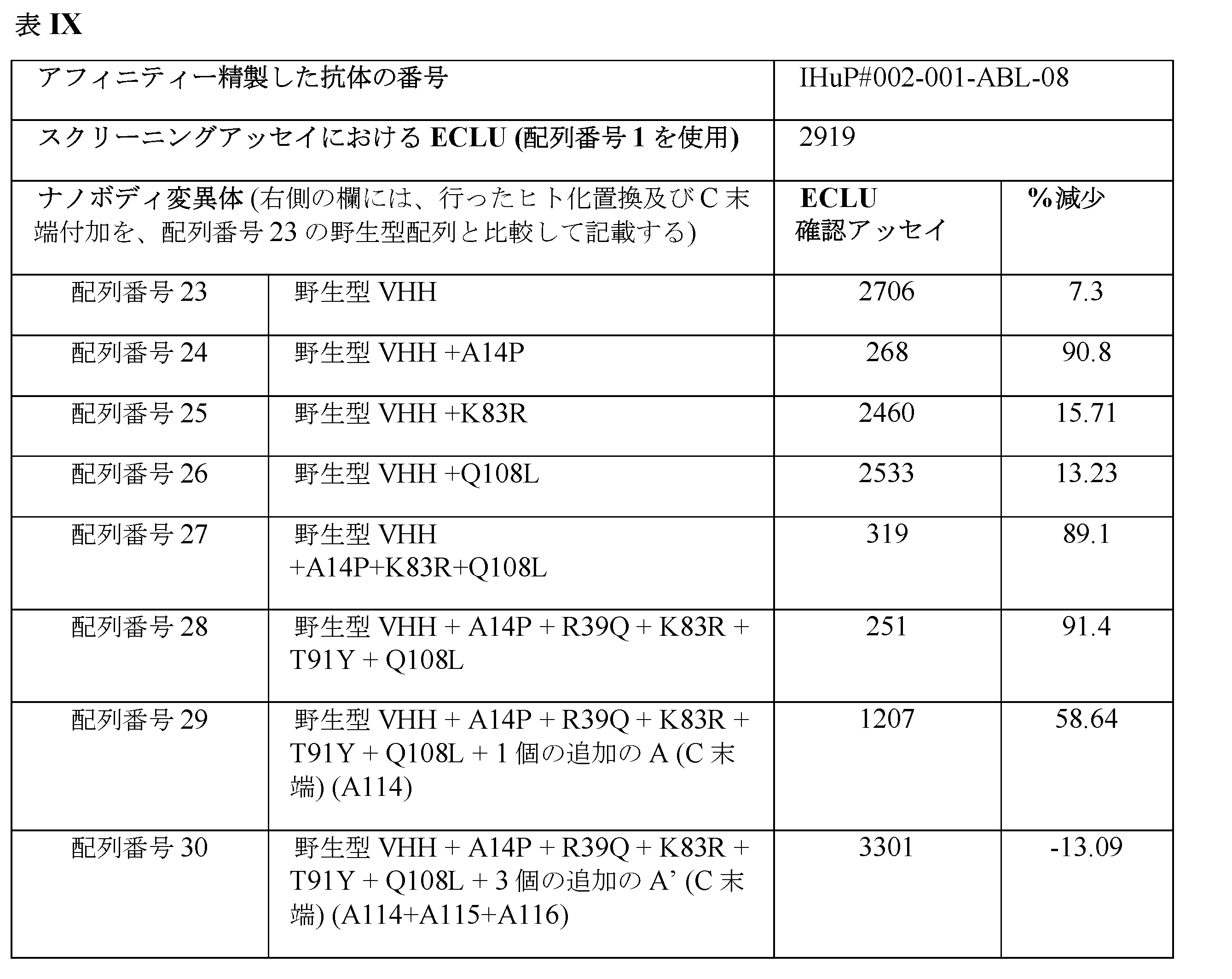
実施例6:抗OX40LナノボディのC末端へのアミノ酸付加がそのOX40L阻害効力に与える影響。
本実施例では、C末端の伸長がナノボディの活性又は阻害効力に影響を与えないことを実証する。
Example 6: Effect of amino acid additions to the C-terminus of anti-OX40L nanobodies on their OX40L inhibitory potency.
In this example, we demonstrate that the C-terminal extension does not affect the activity or inhibitory potency of Nanobodies.
三価で二重特異性の配列最適化抗OX40LナノボディNb3.16(配列番号31)のin vitro効力を、1個の追加のAlaをそのC末端に含有する対応するナノボディNb3.17(配列番号32)の効力と比較した。 The in vitro potency of the trivalent, bispecific, sequence-optimized anti-OX40L nanobody Nb3.16 (SEQ ID NO: 31) was compared to that of the corresponding nanobody Nb3.17 (SEQ ID NO: 32) containing one additional Ala at its C-terminus.
最初のアッセイ(T細胞活性化アッセイ)は、以下のように実施した。Ficoll Paque Plus reagent (GE Healthcare)を使用して、健常ドナーに由来するバフィーコート(Red Cross, Ghent, Belgium)からPBMCを単離し、RPMI1640完全培地(RPMI1640+GlutaMAX+25mM HEPES+10%ウシ胎仔血清+1%ペニシリン/ストレプトマイシン;Invitrogen)を使用して洗浄した。PBMC(細胞1x105個/ウェル)をフィトヘマグルチニン(PHA-L;最終濃度0.6μg/ml)で刺激してから、1x104個のhOX40L発現CHO細胞(γシンチレータを用いて3000RADで放射線照射したもの;UZ Gent, Belgium)及び抗OX40LナノボディのRPMI1640完全培地による希釈系列に添加し、CO2インキュベーター中、37℃で22時間インキュベーションした。PBMCによるIL2の産生は、ELISAで測定した。Maxisorpプレートのウェルは、抗ヒトIL2モノクローナル抗体(BD Biosciences)を用いて4℃で一晩コーティングした。コーティングしたウェルを洗浄及びブロッキングした後、細胞上清の1/2希釈物を追加した。標準として、リコンビナントヒトIL2(BD Biosciences)の1/2希釈系列(2000pg/mlから開始)を含めた。ビオチン化抗ヒトIL2モノクローナル抗体(BD Biosciences)及びHRP標識ストレプトアビジン(Thermo Scientific)及びesTMB(SDT Reagents)を使用して、検出を行った。1N HClを用いて反応を停止させ、450nmでODを測定した。予想通り、三価で二重特異性の配列最適化ナノボディNb3.17の効力(IC50=0.13nM、95%信頼区間(CI)=0.098~0.17nM)は、Nb3.16の効力(IC50=0.10nM、95%信頼区間(CI)=0.071~0.15nM)と同程度であった。 The first assay (T cell activation assay) was performed as follows: PBMCs were isolated from buffy coats (Red Cross, Ghent, Belgium) derived from healthy donors using Ficoll Paque Plus reagent (GE Healthcare) and washed using RPMI 1640 complete medium (RPMI 1640 + GlutaMAX + 25 mM HEPES + 10% fetal bovine serum + 1% penicillin/streptomycin; Invitrogen). PBMCs ( 1x10⁵ cells/well) were stimulated with phytohemagglutinin (PHA-L; final concentration 0.6 μg/ml) before adding 1x104 hOX40L-expressing CHO cells (irradiated at 3000 RAD using a gamma scintillator; UZ Gent, Belgium) and a dilution series of anti-OX40L nanobodies in RPMI 1640 complete medium and incubated for 22 h at 37°C in a CO2 incubator. IL2 production by PBMCs was measured by ELISA. Wells of Maxisorp plates were coated overnight at 4°C with anti-human IL2 monoclonal antibody (BD Biosciences). After washing and blocking of the coated wells, 1/2 dilutions of cell supernatants were added. As a standard, a 1/2 dilution series of recombinant human IL2 (BD Biosciences) (starting at 2000 pg/ml) was included. Detection was performed using biotinylated anti-human IL2 monoclonal antibody (BD Biosciences) and HRP-labeled streptavidin (Thermo Scientific) and esTMB (SDT Reagents). The reaction was stopped with 1N HCl and OD was measured at 450 nm. As expected, the potency of the trivalent, bispecific, sequence-optimized nanobody Nb3.17 (IC50=0.13 nM, 95% CI=0.098-0.17 nM) was similar to that of Nb3.16 (IC50=0.10 nM, 95% CI=0.071-0.15 nM).
2番目のELISA競合アッセイでは、ナノボディの希釈系列(1.5μM~0.083pM)を、PBS+0.1%BSA+0.01%Tween-20中で100ng/mlのヒトOX40/Fc(R&D Systems)及び10ng/mlのビオチン化ヒトOX40L(R&D Systems;実施例1に記載されているようにin-houseでビオチン化)と一緒に室温で一晩プレインキュベーションした。次に、10ug/mlの抗ヒトFcナノボディ(in-houseで作製)でコーティングし、PBS+1%BSA+0.1%Tween-20でブロッキングしたMaxisorpプレート上で、サンプルをインキュベーションした。HRP標識ストレプトアビジン(Thermo Scientific)及びsTMB(SDT Reagents)を使用して、結合したヒトOX40/Fcを検出した。1N HClを用いて反応を停止させ、450nmでODを測定した。細胞アッセイと一致して、三価で二重特異性の配列最適化ナノボディNb3.17の効力(IC50=0.178nM、95%信頼区間(CI)=0.152~0.200nM)は、Nb3.16の効力(IC50=0.179nM、95%信頼区間(CI)=0.149~0.215nM)と同程度であった。 In the second competitive ELISA assay, a dilution series of nanobodies (1.5 μM to 0.083 pM) was preincubated overnight at room temperature with 100 ng/ml human OX40/Fc (R&D Systems) and 10 ng/ml biotinylated human OX40L (R&D Systems; biotinylated in-house as described in Example 1) in PBS + 0.1% BSA + 0.01% Tween-20. Samples were then incubated on Maxisorp plates coated with 10 ug/ml anti-human Fc nanobody (made in-house) and blocked with PBS + 1% BSA + 0.1% Tween-20. Bound human OX40/Fc was detected using HRP-conjugated streptavidin (Thermo Scientific) and sTMB (SDT Reagents). The reaction was stopped with 1N HCl and the OD was measured at 450 nm. Consistent with the cell assay, the potency of the trivalent, bispecific, sequence-optimized nanobody Nb3.17 (IC50 = 0.178 nM, 95% confidence interval (CI) = 0.152-0.200 nM) was similar to that of Nb3.16 (IC50 = 0.179 nM, 95% confidence interval (CI) = 0.149-0.215 nM).
実施例7:モノクローナル抗体21-4-3の作製。
2つの異なるマウス系統群(BALB/c及びNMRI-各マウス3匹)を、国際公開第2006/122825号の配列番号98のナノボディ構築物(等容量の抗原とフロイント完全アジュバント又はフロイント不完全アジュバンとの油中水エマルション)を用いて、適切な抗血清力価が得られるまで追加免疫しながら39日間の期間にわたって腹腔内免疫した。
Example 7: Generation of monoclonal antibody 21-4-3.
Two different groups of mice strains (BALB/c and NMRI - 3 mice each) were immunized intraperitoneally with the nanobody construct of SEQ ID NO: 98 of WO 2006/122825 (water-in-oil emulsion with equal volumes of antigen and Freund's complete or incomplete adjuvant) over a period of 39 days with boosting until adequate antiserum titers were obtained.
刺激したマウスをCO2で窒息させた後、脾臓を無菌状態で取り出し、プールした脾臓の単一細胞懸濁液を調製した。脾臓細胞及びミエローマ細胞をDMEMで数回洗浄し、1mlの50%(w/v)PEG3350(脾臓細胞とSP2/0との比は3:1)の存在下で融合させた。融合のために、German Collection of Microorganisms and Cell Cultures (DSMZ GmbH, Braunschweig)のミエローマ細胞株SP2/0-Ag14を使用した。この細胞株は、BALB/cの脾臓細胞とミエローマ細胞株P3x63Ag8との間のハイブリッドである。このようにして生産したハイブリドーマを、20%FCS及びアミノプテリンを含有するCGM(HAT培地)に再懸濁し、フィーダー細胞としての腹腔滲出細胞(peritoneal excudate cells)と一緒に140μl/ウェルのCGM(20%FCS)を含有する8個の96ウェル組織培養平底プレート(Corning-Costar)に播種(140μl/ウェル)した。2-メルカプトエタノール、L-グルタミン、安定グルタミン、HT及び非必須アミノ酸(供給業者によって推奨されている濃度)並びに異なる濃度(10%、15%又は20%)のFCSを補充したDMEMを含有する完全成長培地(CGM)中で、プレートを10日間インキュベーションした。この期間中、細胞をHAT培地で2回フィードした。ハイブリドーマ細胞からの細胞培養上清は、通常、1μg/ml~20μg/mlの抗体を含有しており、これを結合ELISAで試験して、国際公開第2006/122825号の配列番号98のナノボディ構築物への結合を確認した。
After asphyxiation of stimulated mice with CO2 , spleens were removed under aseptic conditions and single cell suspensions of pooled spleens were prepared. Spleen cells and myeloma cells were washed several times with DMEM and fused in the presence of 1
IgG産生陽性ウェルからの細胞を48ウェルプレートのウェルに移し、(細胞の成長特性に応じて)2日間~4日間培養した。非特異的結合物を排除するために、ALX081及びヒト/カニクイザルIgGに対する結合ELISAを行った。国際公開第2006/122825号の配列番号98のナノボディ構築物に特異的な結合物を発現するハイブリドーマ細胞を、限定希釈を使用して2回クローニングした。融合及び再スクリーニングの後、ALX-081に対する抗体を産生する7個の初代培養物を同定した。これらの初代培養物はすべて、ヒト又はカニクイザルのIgGと交差反応しない抗体を産生した。初代培養物を再クローニングした(2回)。 Cells from IgG-producing positive wells were transferred to wells of a 48-well plate and cultured for 2-4 days (depending on the growth characteristics of the cells). Binding ELISAs against ALX081 and human/cynomolgus IgG were performed to exclude non-specific binders. Hybridoma cells expressing specific binders to the nanobody construct of SEQ ID NO: 98 of WO 2006/122825 were cloned twice using limiting dilution. After fusion and rescreening, seven primary cultures producing antibodies against ALX-081 were identified. All of these primary cultures produced antibodies that did not cross-react with human or cynomolgus IgG. Primary cultures were recloned (twice).
クローン21-4(2回目のクローニングの後に、ALX-081に対する抗体を安定的に産生したクローンのうちの1個)に「ABH0015」という名称を与え、2012年6月4日にアクセッションナンバーLMBP-9680-CBでBelgian Coordinated Collections of Micro-organisms (BCCM) in Ghent, Belgiumに寄託した。ABH0015によって産生されたマウスモノクローナルは、21-4-3と称した:21-4-3のアイソタイプを決定したところ、IgG1重鎖及びκ軽鎖であることが示され、これらを配列決定した(それぞれ配列番号35及び36を参照のこと)。21-4-3は、国際公開第2006/122825号の配列番号98のナノボディ構築物のC末端領域に結合することが示された(データは示さない)。 Clone 21-4 (one of the clones that stably produced antibodies against ALX-081 after the second cloning) was given the name "ABH0015" and deposited at the Belgian Coordinated Collections of Micro-organisms (BCCM) in Ghent, Belgium under the accession number LMBP-9680-CB on June 4, 2012. The mouse monoclonal produced by ABH0015 was designated 21-4-3: 21-4-3 was isotyped and shown to have an IgG1 heavy chain and a kappa light chain, which were sequenced (see SEQ ID NOs: 35 and 36, respectively). 21-4-3 was shown to bind to the C-terminal region of the nanobody construct of SEQ ID NO: 98 of WO 2006/122825 (data not shown).
実施例8:ISVへの21-4の結合は、ISVが非特異的タンパク質干渉を受ける傾向を予測する
本実施例では、以下の実施例9と合わせて、ISVへのモノクローナル21-4の結合は、所定のISVが(例えば、ADAアッセイにおいて)非特異的タンパク質干渉を受ける傾向を有するかを(本実施例で示した確度内において)予測するのに使用できることを実証する。
Example 8: Binding of 21-4 to ISVs predicts the propensity of an ISV to undergo non-specific protein interference This example, in conjunction with Example 9 below, demonstrates that binding of monoclonal 21-4 to an ISV can be used to predict (within the accuracy shown in this example) whether a given ISV will have a propensity for non-specific protein interference (e.g. in an ADA assay).
この実施例8は、所定のISVに対するある種の改変候補(例えば、ISVのC末端への1個以上のアミノ酸残基の付加、及び/又はISVのC末端領域内の1個以上のアミノ酸置換の置換)が、前記ISVが非特異的タンパク質干渉を受ける傾向の減少をもたらすかを予測するのに21-4を使用できることを特に示す。 This Example 8 specifically demonstrates that 21-4 can be used to predict whether certain potential modifications to a given ISV (e.g., the addition of one or more amino acid residues to the C-terminus of the ISV and/or the substitution of one or more amino acid substitutions within the C-terminal region of the ISV) will result in a reduced propensity of said ISV to undergo non-specific protein interference.
手短に言えば、53個の異なるナノボディ及びナノボディ構築物のセット(図9及び配列番号38~89を参照のこと)を、モノクローナル21-4-3による結合について試験した。21-4及び精製干渉因子による結合の間に相関関係があるかを確認するために、同じナノボディ及びナノボディ構築物を、3人の異なるヒトドナー(本明細書において「ドナー8」、「ドナー19」及び「ドナー30」と称される)から得られた干渉因子の精製調製物による結合についても試験した。
Briefly, a set of 53 different nanobodies and nanobody constructs (see FIG. 9 and SEQ ID NOs: 38-89) were tested for binding by monoclonal 21-4-3. To determine whether there was a correlation between binding by 21-4 and purified interfering factors, the same nanobodies and nanobody constructs were also tested for binding by purified preparations of interfering factors obtained from three different human donors (referred to herein as "Donor 8," "Donor 19," and "
21-4のISVへの結合は、干渉因子の同じISVへの結合を(ここで示したデータによって提供される全体的な信頼度の範囲内において)予測するのに実際に使用できることが立証された。 It has been demonstrated that the binding of 21-4 to an ISV can indeed be used to predict (within the overall confidence range provided by the data presented here) the binding of interfering factors to the same ISV.
これを実証するために、以下に示されている実験データによって詳述するように、(以下に示されているプロトコールの)Biacore T100を使用して、21-4による53個のナノボディ又はナノボディ構築物(図9に列挙される;配列番号38~89を参照のこと)の結合を測定し、同じBiacore機器及び同じプロトコールを使用して測定した場合の参照ナノボディ又は構築物(同様に図9に列挙される)の結合と比較した。結果を以下の表Xに示す。 To demonstrate this, as detailed by the experimental data presented below, a Biacore T100 (protocol shown below) was used to measure the binding of 53 nanobodies or nanobody constructs (listed in Figure 9; see SEQ ID NOs: 38-89) by 21-4 and compared to the binding of reference nanobodies or constructs (also listed in Figure 9) when measured using the same Biacore instrument and the same protocol. The results are shown in Table X below.


試験した53個の各ナノボディ又はナノボディ構築物について、参照と比較して、試験したナノボディ又はナノボディ構築物が1個以上の追加のアミノ酸残基(これらは、タンパク質干渉に対するこのような付加の効果を試験するために、特に前記干渉を減少させるために付加した)をC末端に有するように、及び/又は(例えば、参照と比較したヒト化の結果として)1個以上の突然変異をC末端領域内に有するように、参照を選択した。 For each of the 53 Nanobodies or Nanobody constructs tested, the reference was selected such that, compared to the reference, the tested Nanobody or Nanobody construct has one or more additional amino acid residues at the C-terminus (which were added in order to test the effect of such addition on protein interference, in particular to reduce said interference) and/or has one or more mutations in the C-terminal region (e.g. as a result of humanization compared to the reference).
結果は、所定のナノボディの結合(RU単位として測定)を参照の結合(同様にRU単位で測定)と対比した減少率として表した-例えば、参照ナノボディの測定結合レベル(RU)が276であり、所定のナノボディの結合レベル(同様にRU)が9である場合、結合レベルの減少は[9RU/276RU]x100%=3%までのレベルになり、これは、参照(100%)と比較して97%の減少を意味する。 Results are expressed as the percentage reduction in binding of a given nanobody (measured in RU) compared to the binding of a reference (also measured in RU) - for example, if the measured binding level (RU) of the reference nanobody is 276 and the binding level (also RU) of a given nanobody is 9, then the reduction in binding level will be up to [9RU/276RU] x 100% = 3%, which means a 97% reduction compared to the reference (100%).
同様に、53個の各ナノボディ又はナノボディ構築物への、3人の各ドナーに由来する精製干渉因子の結合を、同じBiacore機器を使用して測定し、同じ参照ナノボディ又は構築物への前記精製干渉因子の結合と比較した。結果は、同様に、所定のナノボディ又はナノボディ構築物への干渉因子の結合を参照と対比した減少率として表した。 Similarly, the binding of purified interfering agents from each of the three donors to each of the 53 nanobodies or nanobody constructs was measured using the same Biacore instrument and compared to the binding of said purified interfering agents to the same reference nanobody or construct. Results were similarly expressed as the percentage reduction in binding of an interfering agent to a given nanobody or nanobody construct compared to the reference.
参照と比較して1個以上のアミノ酸残基をC末端に付加したナノボディ又はナノボディ構築物については本質的にすべて、干渉因子の結合が劇的に減少したことが見出された。これは、ISVのC末端(VTVSS)への1個以上のアミノ酸残基の付加が、ADAアッセイにおいて非特異的タンパク質干渉を減少させることができることを再度裏付けている。ほとんどの場合では、参照と比較してC末端領域内に置換を作るだけ(すなわち、1個以上のアミノ酸残基をC末端に付加しない)では、干渉因子の結合に対して同様の劇的な影響を与えないことが多いことも見出された。 Essentially all Nanobodies or Nanobody constructs with one or more amino acid residues added to the C-terminus compared to the reference were found to have dramatically reduced binding of interfering agents. This again confirms that the addition of one or more amino acid residues to the C-terminus (VTVSS) of an ISV can reduce non-specific protein interference in the ADA assay. It was also found that in most cases, simply making substitutions within the C-terminal region compared to the reference (i.e., not adding one or more amino acid residues to the C-terminus) often does not have a similar dramatic effect on binding of interfering agents.
次いで、データをさらに分析して、21-4による結合が参照と比較して減少することは、精製干渉因子の3個の異なる各調製物による結合が参照と比較して減少することと何らかの点で相関しているかを決定した。このような相関関係が見出された。 The data was then further analyzed to determine whether the reduced binding by 21-4 compared to the reference correlated in any way with the reduced binding by each of the three different preparations of purified interfering agent compared to the reference. Such a correlation was found.
例えば、試験した54個のナノボディ又はナノボディ構築物のうちの36個は、21-4による結合について、それらの各参照配列と比較して70%超の減少を示したことが見出された(これら36個のほとんどは、1個以上の追加のアミノ酸残基をC末端に有し、いくつかの場合ではC末端領域内の置換と組み合わせて有する)。これら36個のうちの32個は、干渉因子による結合について、参照と比較して50%超の減少も示した(そして多くの場合では、特に、付加された1個以上のアミノ酸残基をC末端に有するナノボディ又はナノボディ構築物については、減少は50%よりもはるかに大きかった(例えば、70%超又はさらに90%超)。表Xに示されているデータを参照のこと)。これは、36個の事例のうちの32個(すなわち、89%)では、21-4による結合について、(参照=100%と比較して)70%超の減少は、干渉因子による結合について、(同じ参照と比較して)50%超の減少を予測することを実証している。明確にするために、各事例では、減少は、100%-[試験したナノボディで達成された減少レベルについて以下の表に示されているパーセンテージ]として計算した。 For example, it was found that 36 of the 54 nanobodies or nanobody constructs tested showed a reduction of more than 70% in binding by 21-4 compared to their respective reference sequence (most of these 36 have one or more additional amino acid residues at the C-terminus, in some cases in combination with substitutions in the C-terminal region). Thirty-two of these 36 also showed a reduction of more than 50% in binding by interfering agents compared to the reference (and in many cases, especially for nanobodies or nanobody constructs with one or more added amino acid residues at the C-terminus, the reduction was much greater than 50% (e.g. more than 70% or even more than 90%), see data presented in Table X). This demonstrates that in 32 of the 36 cases (i.e. 89%), a reduction of more than 70% in binding by 21-4 (compared to the reference = 100%) predicts a reduction of more than 50% in binding by interfering agents (compared to the same reference). For clarity, in each case, the reduction was calculated as 100% minus the percentage shown in the table below for the reduction level achieved with the nanobody tested.
同様に、試験した53個のナノボディ又はナノボディ構築物のうちの33個は、21-4による結合について、それらの各参照配列と比較して90%超の減少を示したことが見出された。(先と同様に、これら33個のほとんどは、1個以上の追加のアミノ酸残基をC末端に有し、いくつかの場合ではC末端領域内の置換と組み合わせて有する)これら33個のうちの32個は、干渉因子による結合について、それらの各参照配列と比較して50%超の減少も示した。これは、33個の事例のうちの32個(すなわち、97%)では、21-4による結合について、(参照と比較して)90%超の減少は、干渉因子による結合について、(同じ参照と比較して)50%超の減少を予測することを実証している。 Similarly, 33 of the 53 nanobodies or nanobody constructs tested were found to have a greater than 90% reduction in binding by 21-4 compared to their respective reference sequences. (Again, most of these 33 have one or more additional amino acid residues at the C-terminus, in some cases in combination with substitutions within the C-terminal region.) Thirty-two of these 33 also showed a greater than 50% reduction in binding by interfering agents compared to their respective reference sequences. This demonstrates that in 32 of 33 cases (i.e., 97%), a greater than 90% reduction in binding by 21-4 (compared to the reference) predicts a greater than 50% reduction in binding by interfering agents (compared to the same reference).
(21-4による結合についての70%超の減少が証拠とされる)干渉因子の結合についてのこのような50%超の減少は、このような干渉因子がもはや、問題のISVのADAアッセイに本質的に干渉しないことを意味することにも留意するべきである:ADAアッセイを使用して実験的に確認することにより、干渉因子による結合が45%超減少する場合、干渉因子の存在がADAアッセイに与える有意な影響は観察できないことが示された。この点において、いくつかの場合で観察されるように、干渉因子による結合が50%よりもはるかに大きい程度(例えば、70%超又はさらに90%超)に減少する場合には、なおさらそのような状況になることも当業者には明らかである(ここで示したデータを再度参照のこと)。 It should also be noted that such a greater than 50% reduction in the binding of the interfering agent (as evidenced by a greater than 70% reduction in the binding by 21-4) means that such an interfering agent no longer essentially interferes with the ADA assay of the ISV in question: experimental confirmation using the ADA assay has shown that if the binding by the interfering agent is reduced by more than 45%, no significant effect of the presence of the interfering agent on the ADA assay can be observed. In this respect, it is clear to the skilled artisan that this is even more the case when the binding by the interfering agent is reduced to a much greater extent than 50%, for example, greater than 70% or even 90%, as observed in some cases (see again the data presented here).
実際、21-4による結合についての45%超の減少は、干渉因子の結合についての45%超の減少を示し、これは前述のように、干渉因子がもはやADAアッセイに干渉しないことを意味することが見出された。 Indeed, it was found that a greater than 45% reduction in binding by 21-4 indicates a greater than 45% reduction in binding of the interfering factor, which means that the interfering factor no longer interferes with the ADA assay, as previously described.
また、21-4による結合(の減少)と干渉因子による結合(の減少)との間の相関関係についてここで示したデータにより、本発明者らは、21-4による結合の絶対値であって、それ未満では、ISV又はISV系構築物が、ADAアッセイに干渉し得る形で干渉因子による結合の影響を容易に受けないことを(この実施例8で示したデータによって提供される信頼性の範囲内において)予想できる絶対値を設定することができた。以下の実施例9に示されているように、この値は500RUである(実施例9に示されているように決定及び計算される)。 The data presented here on the correlation between (reduction in) 21-4 binding and (reduction in) interfering factor binding also allowed us to establish an absolute value for 21-4 binding below which it can be expected (within the confidence range provided by the data presented in this Example 8) that an ISV or ISV-based construct will not be readily affected by interfering factor binding in a manner that could interfere with the ADA assay. As shown in Example 9 below, this value is 500 RU (determined and calculated as shown in Example 9).
モノクローナル21-4は、上記実施例7で得られたハイブリドーマの培養培地から以下のように精製した:モノクローナル抗体21-4-3を分泌するハイブリドーマ細胞を、100mL又は500mLの容量の無血清培地(CD Hybridoma, Gibcoに8mM L-グルタミン(Invitrogen)及び1×コレステロール(250×コレステロール脂質濃縮物、Gibco)を補充したもの)を含むスピナーフラスコ中で培養した。透明の上清をろ過し、マウスIgG1を弱めの流量2mL/分でプロテインAカラム(HiTrap MabSelect SuRe, 5mL, GE Healthcare)上に捕捉した。結合した抗体を0.1Mクエン酸緩衝液(pH3.0)で溶出し、溶出画分(5mL)を1mLの1M TRIS(pH9)で直接中性にした。抗体の純度は、還元SDS-PAGE又は非還元SDS-PAGEによって確認した。 Monoclonal 21-4 was purified from the culture medium of the hybridoma obtained in Example 7 above as follows: Hybridoma cells secreting monoclonal antibody 21-4-3 were cultured in spinner flasks containing serum-free medium (CD Hybridoma, Gibco supplemented with 8 mM L-glutamine (Invitrogen) and 1x cholesterol (250x cholesterol lipid concentrate, Gibco)) in a volume of 100 mL or 500 mL. The clear supernatant was filtered and mouse IgG1 was captured on a Protein A column (HiTrap MabSelect SuRe, 5 mL, GE Healthcare) at a gentle flow rate of 2 mL/min. Bound antibody was eluted with 0.1 M citrate buffer (pH 3.0) and the eluted fraction (5 mL) was directly neutralized with 1 mL of 1 M TRIS (pH 9). Purity of the antibody was confirmed by reducing or non-reducing SDS-PAGE.
ドナー8及びドナー19に由来する干渉因子の精製調製物は、本質的には実施例2Aに記載されているように、前記ドナーに由来する血清サンプルからアフィニティー精製によって得た。ドナー30に由来する干渉因子は、本質的には実施例2Bに記載されているように、ドナー30の血清サンプルから得た。
Purified preparations of interfering factors from donors 8 and 19 were obtained by affinity purification from serum samples from those donors essentially as described in Example 2A. Interfering factors from
各ナノボディ又はナノボディ構築物への21-4の結合を決定するために、実施例9に記載されているプロトコールを使用した。 To determine the binding of 21-4 to each nanobody or nanobody construct, the protocol described in Example 9 was used.
各ナノボディ又はナノボディ構築物への、3人のドナーに由来する干渉因子の結合は、本質的には実施例3に記載されているようにBiacore T100を使用して、ドナー8、ドナー19及びドナー30のそれぞれに由来する干渉因子を直接固定化したCM5センサーチップを使用して決定した。
Binding of interfering factors from the three donors to each nanobody or nanobody construct was determined using a Biacore T100 essentially as described in Example 3, using CM5 sensor chips onto which interfering factors from donor 8, donor 19 and
実施例9:(モノクローナル21-4を使用して)ISVが非特異的タンパク質干渉を受ける傾向を有するかを予測するためのプロトコール。
結合測定は、CM5 T120416センサーチップを使用するBiacore T100を使用して実施した(ランニングバッファー HBS-EP+、25℃)。直接固定化したmAb21-4-3の表面は、効率的に再生できないことが見出されたので、固定化ウサギ抗マウスIgGによって21-4を捕捉した。使用した抗マウスIgGは、すべてのIgGサブクラス、IgA及びIgMと反応するポリクローナルウサギ抗マウスIgG抗体(GE Healthcare; Cat#BR-1008-38; Lot#10056316)であった。抗マウスIgGの固定化は、活性化には7分間のEDC/NHS注入及び非活性化には7分間の1MエタノールアミンHCl(pH8.5)注入を使用する手動のアミンカップリング(Biacore, amine coupling kit)を使用して実施した。結合条件を表XIに列挙する。タンパク質の固定化レベル及び分子量(MW)に基づくと、固定化抗マウスIgGに結合するmAb21-4-3の理論Rmaxは、約13000RUであった(1個のmAb21-4-3分子が1個の抗マウスIgG分子に結合している場合)。
Example 9: Protocol to predict whether an ISV is prone to non-specific protein interference (using monoclonal 21-4).
Binding measurements were performed using a Biacore T100 using a CM5 T120416 sensor chip (running buffer HBS-EP+, 25°C). Since it was found that the surface of directly immobilized mAb 21-4-3 could not be efficiently regenerated, 21-4 was captured by immobilized rabbit anti-mouse IgG. The anti-mouse IgG used was a polyclonal rabbit anti-mouse IgG antibody (GE Healthcare; Cat#BR-1008-38; Lot#10056316) that reacts with all IgG subclasses, IgA and IgM. Immobilization of anti-mouse IgG was performed using manual amine coupling (Biacore, amine coupling kit) using a 7 min EDC/NHS injection for activation and a 7 min 1 M ethanolamine HCl (pH 8.5) injection for deactivation. Binding conditions are listed in Table XI. Based on the immobilization level and molecular weight (MW) of the protein, the theoretical R max of mAb21-4-3 binding to immobilized anti-mouse IgG was approximately 13,000 RU (when one mAb21-4-3 molecule is bound to one anti-mouse IgG molecule).

このように固定化した21-4を使用する結合実験(Biacore T100)に使用した条件を表XIIに示す。抗マウスIgGの表面は、mAb21-4-3の捕捉及びすべてのサンプルの注入後にうまく再生できた(各再生後のベースラインレベルがわずかに増加)。 The conditions used for binding experiments (Biacore T100) using 21-4 immobilized in this way are shown in Table XII. The anti-mouse IgG surface was successfully regenerated after capture of mAb 21-4-3 and injection of all samples (baseline levels increased slightly after each regeneration).

上記プロトコールを使用して、表Xに示されている21-4の結合データを作成した。(ISV、タンパク質又はポリペプチドの分子量についての測定RU値を式([測定RU]/[タンパク質の分子量(MW)]x106に従って調整した後に)RUの絶対値を検討したところ、表Xに記載されているナノボディ又はナノボディ構築物(これらは付加されたアラニン残基を有しており、21-4及び干渉因子の両方への結合について>90%の減少を示した)は、一般に、30RU~400RUのRU値を示したことが見出された(対応する参照ナノボディ又はポリペプチド-図9に列挙されている-は、1000超、通常は1500超及び多くの場合には2000超のRU値を有する)。 The above protocol was used to generate the binding data for 21-4 shown in Table X. When the absolute RU values were examined (after adjusting the measured RU values for the molecular weight of the ISV, protein or polypeptide according to the formula ([measured RU]/[protein molecular weight (MW)]×10 6 ), it was found that the Nanobodies or Nanobody constructs listed in Table X, which have an added alanine residue and showed a >90% reduction in binding to both 21-4 and interfering factors, generally showed RU values of 30 RU to 400 RU (the corresponding reference Nanobodies or polypeptides - listed in FIG. 9 - have RU values of more than 1000, usually more than 1500 and often more than 2000).
これに基づいて、このアッセイにおける500未満の(調整)RU値は、ADAアッセイに干渉し得る形で干渉因子によって(本質的には)結合されないISV(又は、本明細書において記載される少なくとも1個のISを含むタンパク質又はポリペプチド)を明確に示すと考えられた。 On this basis, an (adjusted) RU value of less than 500 in this assay was considered to be clearly indicative of an ISV (or a protein or polypeptide comprising at least one IS as described herein) that is (essentially) not bound by interfering factors in a manner that could interfere with the ADA assay.
本出願全体を通して引用されたすべての参考資料(参考文献、発行特許、公開特許出願及び同時係属の特許出願を含む)の全内容は、特に本明細書において参照されている教示について、参照により本明細書に明確に組み込まれる。 The entire contents of all references cited throughout this application, including literature references, issued patents, published patent applications, and co-pending patent applications, are expressly incorporated herein by reference, particularly for the teachings referenced herein.
Claims (36)
又はこのようなISV(好ましくはこのようなナノボディ)をそのC末端に含有するタンパク質若しくはポリペプチド。
ここで、式中:
- n=1、2又は3(好ましくは1又は2)、各X=Ala又はGly;又は
- n=1、2又は3(好ましくは1又は2)、各X=Ala;又は
- n=1、2又は3(好ましくは1又は2)、各X=Gly;又は
- n=2又は3、少なくとも1個のX=Ala又はGly(残りのアミノ酸残基Xは天然に存在する任意のアミノ酸から独立して選択されるが、好ましくはVal、Leu及び/又はIleから独立して選択される;又は
- n=2又は3、1個以外のすべてのX=Ala又はGly(残りのアミノ酸残基Xは天然に存在する任意のアミノ酸から独立して選択されるが、好ましくはVal、Leu及び/又はIleから独立して選択される。 an immunoglobulin single variable domain (ISV) that is a Nanobody or that comprises (i.e. is not a Nanobody) or is derived from a VH sequence and has a C-terminus of the sequence VTVSS(X) n ;
Or a protein or polypeptide containing such an ISV (preferably such a Nanobody) at its C-terminus.
Wherein:
- n=1, 2 or 3 (preferably 1 or 2), each X=Ala or GIy; or - n=1, 2 or 3 (preferably 1 or 2), each X=Ala; or - n=1, 2 or 3 (preferably 1 or 2), each X=GIy; or - n=2 or 3, at least one X=Ala or GIy (the remaining amino acid residues X are independently selected from any naturally occurring amino acid, but preferably are independently selected from Val, Leu and/or lie; or - n=2 or 3, all but one X=Ala or GIy (the remaining amino acid residues X are independently selected from any naturally occurring amino acid, but preferably are independently selected from Val, Leu and/or lie.
- n=1、2又は3(好ましくは1又は2)、各X=Ala;又は
- n=1、2又は3(好ましくは1又は2)、各X=Gly
である、請求項1に記載の免疫グロブリン単一可変ドメイン(ISV)、タンパク質又はポリペプチド。 - n = 1, 2 or 3 (preferably 1 or 2), each X = Ala or Gly; or - n = 1, 2 or 3 (preferably 1 or 2), each X = Ala; or - n = 1, 2 or 3 (preferably 1 or 2), each X = Gly.
2. The immunoglobulin single variable domain (ISV), protein or polypeptide of claim 1,
ここで、式中、nは、1~10、好ましくは1~5、例えば1、2、3、4又は5(好ましくは1又は2、例えば1)であり、各Xは、アラニン(A)、グリシン(G)、バリン(V)、ロイシン(L)又はイソロイシン(I)からなる群より独立して選択される(好ましくは天然に存在する)アミノ酸残基であるが、ただしXはシステインではない。 An immunoglobulin single variable domain (ISV), which is a Nanobody or which comprises or is derived from a VH sequence and has a C-terminus of the sequence VTVSS(X)n; or a protein or polypeptide comprising such an ISV, preferably such a Nanobody, at its C-terminus.
wherein n is 1 to 10, preferably 1 to 5, e.g., 1, 2, 3, 4 or 5 (preferably 1 or 2, e.g., 1), and each X is an amino acid residue (preferably naturally occurring) independently selected from the group consisting of alanine (A), glycine (G), valine (V), leucine (L) or isoleucine (I), with the proviso that X is not cysteine.
(i)ヒト被験体から得られた抗体であって、前記ISVのC末端を認識する能力及び/又は前記ISVのC末端に結合する能力に基づいて選択/単離された抗体に、前記ISV又はタンパク質/ポリペプチドを接触させる工程;及び
(ii)前記免疫アッセイにおいて、前記ISV、タンパク質又はポリペプチドが、前記抗体に結合するか否かを決定する工程
を少なくとも含む免疫アッセイを実施することを含む、方法。 1. A method for predicting whether an ISV or a protein or polypeptide comprising at least one ISV will cause protein interference in an immunoassay, such as an ADA assay, comprising:
(i) contacting the ISV or protein/polypeptide with an antibody obtained from a human subject, the antibody being selected/isolated based on its ability to recognize and/or bind to the C-terminus of the ISV; and (ii) performing an immunoassay comprising at least the step of determining whether the ISV, protein or polypeptide binds to the antibody in the immunoassay.
(i)(すなわち、「分析抗体」として使用される)モノクローナル抗体21-4に、前記ISV又はナノボディ(又は、ISV系薬物又はナノボディ系薬物)を接触させる工程;及び
(ii)前記免疫アッセイにおいて、前記ISV又はナノボディ(又は、ISV系薬物又はナノボディ系薬物)に、モノクローナル抗体21-4が結合するか否かを決定する工程
を少なくとも含む免疫アッセイを実施することを含む、方法。 1. A method that can be used to predict whether an ISV or a protein or polypeptide comprising at least one ISV causes (or has a high or increased tendency to cause) protein interference in an immunoassay (and/or to predict whether said ISV or a protein or polypeptide comprising at least one ISV will be bound by an interfering factor present in human blood or serum), comprising:
(i) contacting said ISV or Nanobody (or ISV-based drug or Nanobody-based drug) with monoclonal antibody 21-4 (i.e. used as the "analytical antibody"); and (ii) performing an immunoassay comprising at least the steps of determining whether monoclonal antibody 21-4 binds to said ISV or Nanobody (or ISV-based drug or Nanobody-based drug) in said immunoassay.
- 前記ISV、タンパク質、ポリペプチドが、それが(すなわち、治療活性用量で)投与される被験体の循環系に(すなわち、薬学的に活性なレベルで)少なくとも1週間の期間、好ましくは少なくとも2週間、例えば少なくとも1カ月間にわたって存在することを目的とするものであり;及び/又は
- 前記ISV、タンパク質、ポリペプチドが、ヒト被験体において、少なくとも3日間、例えば少なくとも1週間、最大10日間又はそれ以上の半減期(好ましくは、t1/2-βと表わされる)を有するようなものであり;及び/又は
- 前記ISV、タンパク質、ポリペプチド又は医薬組成物が、少なくとも3日間、例えば少なくとも1週間、例えば少なくとも2週間又は少なくとも1カ月間又はそれよりもさらに長い期間(すなわち、少なくとも3カ月間、少なくとも6カ月間又は少なくとも1年間)にわたって投与されるか、又はさらに慢性的に投与される2回以上の用量としてヒトに投与されることを目的とするものである、請求項29に記載の医薬組成物。 30. A pharmaceutical composition according to claim 29, wherein said composition, ISV, protein or polypeptide is intended to treat a chronic disease in humans, and/or wherein said ISV, protein, polypeptide is intended to be present in the circulation of a subject to which it is administered (i.e. in a therapeutically active dose) (i.e. at a pharma- ceutical active level) for a period of at least one week, preferably at least two weeks, such as at least one month; and/or wherein said ISV, protein, polypeptide has a half-life (preferably expressed as t1/2-β) in a human subject of at least 3 days, such as at least one week, up to 10 days or more; and/or wherein said ISV, protein, polypeptide or pharmaceutical composition is intended to be administered to a human as two or more doses administered over a period of at least 3 days, such as at least one week, such as at least two weeks or at least one month or even longer (i.e. at least 3 months, at least 6 months or at least one year), or even chronically.
- 前記ISV、タンパク質、ポリペプチドが、それが(すなわち、治療活性用量で)投与される被験体の循環系に(すなわち、薬学的に活性なレベルで)少なくとも1週間の期間、好ましくは少なくとも2週間、例えば少なくとも1カ月間にわたって存在することを目的とするものであり;及び/又は
- 前記ISV、タンパク質、ポリペプチドが、ヒト被験体において、少なくとも3日間、例えば少なくとも1週間、最大10日間又はそれ以上の半減期(好ましくは、t1/2-βと表わされる)を有するようなものであり;及び/又は
- 前記ISV、タンパク質又はポリペプチドが、少なくとも3日間、例えば少なくとも1週間、例えば少なくとも2週間又は少なくとも1カ月間又はそれよりもさらに長い期間(すなわち、少なくとも3カ月間、少なくとも6カ月間又は少なくとも1年間)にわたって投与されるか、又はさらに慢性的に投与される2回以上の用量としてヒトに投与されることを目的とするものである、請求項1~6及び/又は31のいずれかに記載のISV、タンパク質又はポリペプチド。 32. An ISV, protein or polypeptide according to any of claims 1 to 6 and/or 31, wherein said ISV, protein or polypeptide is intended to treat a chronic disease in humans, and/or wherein said ISV, protein or polypeptide is intended to be present in the circulation of a subject to which it is administered (i.e. in a therapeutically active dose) (i.e. at a pharma- ceutical active level) for a period of at least one week, preferably at least two weeks, such as at least one month; and/or wherein said ISV, protein, polypeptide has a half-life (preferably expressed as t1/2-β) in a human subject of at least 3 days, such as at least one week, up to 10 days or more; and/or wherein said ISV, protein or polypeptide is intended to be administered to a human as two or more doses administered over a period of at least 3 days, such as at least one week, such as at least two weeks or at least one month or even longer (i.e. at least 3 months, at least 6 months or at least one year), or even chronically.
- 前記ISV、タンパク質、ポリペプチドが、それが(すなわち、治療活性用量で)投与される被験体の循環系に(すなわち、薬学的に活性なレベルで)少なくとも1週間の期間、好ましくは少なくとも2週間、例えば少なくとも1カ月間にわたって存在することを目的とするものであり;及び/又は
- 前記ISV、タンパク質、ポリペプチドが、ヒト被験体において、少なくとも3日間、例えば少なくとも1週間、最大10日間又はそれ以上の半減期(好ましくは、t1/2-βと表わされる)を有するようなものであり;及び/又は
- 前記ISV、タンパク質又はポリペプチドが、少なくとも3日間、例えば少なくとも1週間、例えば少なくとも2週間又は少なくとも1カ月間又はそれよりもさらに長い期間(すなわち、少なくとも3カ月間、少なくとも6カ月間又は少なくとも1年間)にわたって投与されるか、又はさらに慢性的に投与される2回以上の用量としてヒトに投与されることを目的とするものである、請求項33に記載の使用。 34. Use according to claim 33, wherein the ISV, protein or polypeptide is intended to treat a chronic disease in humans, and/or wherein the ISV, protein or polypeptide is intended to be present in the circulation of a subject to which it is administered (i.e. in a therapeutically active dose) (i.e. at a pharma- ceutical active level) for a period of at least one week, preferably at least two weeks, such as at least one month; and/or wherein the ISV, protein or polypeptide has a half-life (preferably expressed as t1/2-β) in a human subject of at least 3 days, such as at least one week, up to 10 days or more; and/or wherein the ISV, protein or polypeptide is intended to be administered to a human as two or more doses administered over a period of at least 3 days, such as at least one week, such as at least two weeks or at least one month or even longer (i.e. at least 3 months, at least 6 months or at least one year), or even chronically.
- 前記ISV、タンパク質、ポリペプチドが、それが(すなわち、治療活性用量で)投与される被験体の循環系に(すなわち、薬学的に活性なレベルで)少なくとも1週間の期間、好ましくは少なくとも2週間、例えば少なくとも1カ月間にわたって存在することを目的とするものであり;及び/又は
- 前記ISV、タンパク質、ポリペプチドが、ヒト被験体において、少なくとも3日間、例えば少なくとも1週間、最大10日間又はそれ以上の半減期(好ましくは、t1/2-βと表わされる)を有するようなものであり;及び/又は
- 前記医薬組成物、ISV、タンパク質又はポリペプチドが、少なくとも3日間、例えば少なくとも1週間、例えば少なくとも2週間又は少なくとも1カ月間又はそれよりもさらに長い期間(すなわち、少なくとも3カ月間、少なくとも6カ月間又は少なくとも1年間)にわたって投与されるか、又はさらに慢性的に投与される2回以上の用量としてヒトに投与されることを目的とするものである、請求項35に記載の処置方法。 36. The method of treatment according to claim 35, wherein said pharmaceutical composition, ISV, protein or polypeptide is intended to treat a chronic disease in a human, and/or wherein said ISV, protein or polypeptide is intended to be present in the circulation of the subject to which it is administered (i.e. in a therapeutically active dose) (i.e. at a pharma- ceutical active level) for a period of at least one week, preferably at least two weeks, such as at least one month; and/or wherein said ISV, protein or polypeptide has a half-life (preferably expressed as t1/2-β) in a human subject of at least 3 days, such as at least one week, up to 10 days or more; and/or wherein said pharmaceutical composition, ISV, protein or polypeptide is intended to be administered to a human as two or more doses administered over a period of at least 3 days, such as at least one week, such as at least two weeks or at least one month or even longer (i.e. at least 3 months, at least 6 months or at least one year), or even chronically.
Applications Claiming Priority (14)
| Application Number | Priority Date | Filing Date | Title |
|---|---|---|---|
| US201161500360P | 2011-06-23 | 2011-06-23 | |
| US201161500464P | 2011-06-23 | 2011-06-23 | |
| US61/500,464 | 2011-06-23 | ||
| US61/500,360 | 2011-06-23 | ||
| US201161541368P | 2011-09-30 | 2011-09-30 | |
| PCT/EP2011/067132 WO2012042026A1 (en) | 2010-09-30 | 2011-09-30 | Biological materials related to c-met |
| EPPCT/EP2011/067132 | 2011-09-30 | ||
| US61/541,368 | 2011-09-30 | ||
| US13/435,567 | 2012-03-30 | ||
| US13/435,567 US8703135B2 (en) | 2010-09-30 | 2012-03-30 | Biological materials related to c-Met |
| PCT/EP2012/061304 WO2012175400A1 (en) | 2011-06-23 | 2012-06-14 | Serum albumin binding proteins |
| EPPCT/EP2012/061304 | 2012-06-14 | ||
| JP2018126032A JP6869923B2 (en) | 2011-06-23 | 2018-07-02 | Techniques for predicting, detecting and reducing non-specific protein interference in assays involving immunoglobulin single variable domains |
| JP2021068327A JP2021107426A (en) | 2011-06-23 | 2021-04-14 | Techniques for predicting, detecting and reducing aspecific protein interference in assays involving immunoglobulin single variable domains |
Related Parent Applications (1)
| Application Number | Title | Priority Date | Filing Date |
|---|---|---|---|
| JP2021068327A Division JP2021107426A (en) | 2011-06-23 | 2021-04-14 | Techniques for predicting, detecting and reducing aspecific protein interference in assays involving immunoglobulin single variable domains |
Publications (2)
| Publication Number | Publication Date |
|---|---|
| JP2024050769A true JP2024050769A (en) | 2024-04-10 |
| JP2024050769A5 JP2024050769A5 (en) | 2024-04-30 |
Family
ID=47423024
Family Applications (6)
| Application Number | Title | Priority Date | Filing Date |
|---|---|---|---|
| JP2014516387A Active JP6258199B2 (en) | 2011-06-23 | 2012-06-25 | Techniques for predicting, detecting and reducing non-specific protein interference in assays involving immunoglobulin single variable domains |
| JP2017083475A Active JP6982400B2 (en) | 2011-06-23 | 2017-04-20 | Techniques for predicting, detecting and reducing non-specific protein interference in assays involving a single variable domain of immunoglobulins |
| JP2018126032A Active JP6869923B2 (en) | 2011-06-23 | 2018-07-02 | Techniques for predicting, detecting and reducing non-specific protein interference in assays involving immunoglobulin single variable domains |
| JP2021068327A Pending JP2021107426A (en) | 2011-06-23 | 2021-04-14 | Techniques for predicting, detecting and reducing aspecific protein interference in assays involving immunoglobulin single variable domains |
| JP2021191076A Pending JP2022031790A (en) | 2011-06-23 | 2021-11-25 | Techniques for predicting, detecting and reducing non-specific protein interference in assays involving a single variable domain of immunoglobulins |
| JP2024014906A Pending JP2024050769A (en) | 2011-06-23 | 2024-02-02 | Techniques for predicting, detecting and reducing non-specific protein interference in assays involving immunoglobulin single variable domains - Patents.com |
Family Applications Before (5)
| Application Number | Title | Priority Date | Filing Date |
|---|---|---|---|
| JP2014516387A Active JP6258199B2 (en) | 2011-06-23 | 2012-06-25 | Techniques for predicting, detecting and reducing non-specific protein interference in assays involving immunoglobulin single variable domains |
| JP2017083475A Active JP6982400B2 (en) | 2011-06-23 | 2017-04-20 | Techniques for predicting, detecting and reducing non-specific protein interference in assays involving a single variable domain of immunoglobulins |
| JP2018126032A Active JP6869923B2 (en) | 2011-06-23 | 2018-07-02 | Techniques for predicting, detecting and reducing non-specific protein interference in assays involving immunoglobulin single variable domains |
| JP2021068327A Pending JP2021107426A (en) | 2011-06-23 | 2021-04-14 | Techniques for predicting, detecting and reducing aspecific protein interference in assays involving immunoglobulin single variable domains |
| JP2021191076A Pending JP2022031790A (en) | 2011-06-23 | 2021-11-25 | Techniques for predicting, detecting and reducing non-specific protein interference in assays involving a single variable domain of immunoglobulins |
Country Status (24)
| Country | Link |
|---|---|
| US (11) | US20180009888A9 (en) |
| EP (1) | EP2723769B2 (en) |
| JP (6) | JP6258199B2 (en) |
| KR (7) | KR102430693B1 (en) |
| CN (5) | CN108663504B (en) |
| AU (7) | AU2012273929B2 (en) |
| BR (3) | BR112013032145B1 (en) |
| CA (3) | CA3142288A1 (en) |
| DK (1) | DK2723769T4 (en) |
| ES (1) | ES2622006T5 (en) |
| FI (1) | FI2974737T3 (en) |
| HU (1) | HUE031828T2 (en) |
| IL (5) | IL229503B (en) |
| IN (1) | IN2014CN00373A (en) |
| LT (1) | LT2723769T (en) |
| MX (2) | MX350074B (en) |
| NZ (1) | NZ780183A (en) |
| PH (7) | PH12022550311A1 (en) |
| PL (1) | PL2723769T5 (en) |
| PT (2) | PT2723769T (en) |
| RU (1) | RU2700630C2 (en) |
| SG (4) | SG10201605048XA (en) |
| WO (1) | WO2012175741A2 (en) |
| ZA (1) | ZA201309295B (en) |
Families Citing this family (144)
| Publication number | Priority date | Publication date | Assignee | Title |
|---|---|---|---|---|
| WO2011051333A1 (en) | 2009-10-30 | 2011-05-05 | Novartis Ag | Universal fibronectin type iii bottom-side binding domain libraries |
| EP2566892B1 (en) | 2010-05-06 | 2017-12-20 | Novartis AG | Compositions and methods of use for therapeutic low density lipoprotein-related protein 6 (lrp6) antibodies |
| US11644471B2 (en) | 2010-09-30 | 2023-05-09 | Ablynx N.V. | Techniques for predicting, detecting and reducing aspecific protein interference in assays involving immunoglobulin single variable domains |
| EP2621953B1 (en) | 2010-09-30 | 2017-04-05 | Ablynx N.V. | Biological materials related to c-met |
| EP2944653A1 (en) | 2011-06-23 | 2015-11-18 | Ablynx N.V. | Techniques for predicting, detecting and reducing aspecific protein interference in assays involving immunoglobin single variable domains |
| SG10201605048XA (en) * | 2011-06-23 | 2016-07-28 | Ablynx Nv | Techniques for predicting, detecting and reducing aspecific protein interference in assays involving immunoglobulin single variable domains |
| SI2723771T1 (en) | 2011-06-23 | 2019-12-31 | Ablynx Nv | Serum albumin binding proteins |
| TW201321405A (en) | 2011-08-17 | 2013-06-01 | Glaxo Group Ltd | Modified protein and peptide |
| WO2013073968A2 (en) * | 2011-09-12 | 2013-05-23 | Industrial Research Limited | Agents for modulation of cell signalling |
| US9346884B2 (en) | 2011-09-30 | 2016-05-24 | Ablynx N.V. | Biological materials related to c-Met |
| EP3252075A1 (en) | 2011-11-04 | 2017-12-06 | Novartis AG | Low density lipoprotein-related protein 6 (lrp6) - half life extender constructs |
| US10967298B2 (en) | 2012-03-15 | 2021-04-06 | Flodesign Sonics, Inc. | Driver and control for variable impedence load |
| US9458450B2 (en) | 2012-03-15 | 2016-10-04 | Flodesign Sonics, Inc. | Acoustophoretic separation technology using multi-dimensional standing waves |
| US9950282B2 (en) | 2012-03-15 | 2018-04-24 | Flodesign Sonics, Inc. | Electronic configuration and control for acoustic standing wave generation |
| US10704021B2 (en) | 2012-03-15 | 2020-07-07 | Flodesign Sonics, Inc. | Acoustic perfusion devices |
| US9328174B2 (en) | 2012-05-09 | 2016-05-03 | Novartis Ag | Chemokine receptor binding polypeptides |
| EP2895510A2 (en) * | 2012-09-13 | 2015-07-22 | Novartis AG | Single domain antibody with c-terminal modification |
| CN105939767B (en) | 2014-01-08 | 2018-04-06 | 弗洛设计声能学公司 | Sound electrophoretic apparatus with alliteration electrophoresis chamber |
| AU2015261536B2 (en) | 2014-05-16 | 2020-05-07 | Ablynx Nv | Improved immunoglobulin variable domains |
| HUE056738T2 (en) | 2014-05-16 | 2022-03-28 | Ablynx Nv | Methods for detecting and/or measuring anti-drug antibodies, in particular treatment-emergent anti-drug antibodies |
| KR20250099289A (en) | 2014-05-16 | 2025-07-01 | 아블린쓰 엔.브이. | Improved immunoglobulin variable domains |
| NL2013661B1 (en) | 2014-10-21 | 2016-10-05 | Ablynx Nv | KV1.3 Binding immunoglobulins. |
| CN114478753A (en) | 2015-01-21 | 2022-05-13 | 英伊布里克斯公司 | Non-immunogenic single domain antibodies |
| CN107438620A (en) | 2015-03-31 | 2017-12-05 | 韦斯夸尔德有限公司 | Polypeptide |
| IL254577B2 (en) | 2015-03-31 | 2023-11-01 | Vhsquared Ltd | Polypeptides |
| IL254589B2 (en) | 2015-03-31 | 2023-11-01 | Vhsquared Ltd | Peptide construct having a protease-cleavable linker |
| CN107646039B (en) | 2015-04-02 | 2022-04-15 | 埃博灵克斯股份有限公司 | Bispecific CXCR4-CD4 polypeptides having potent anti-HIV activity |
| US11708572B2 (en) | 2015-04-29 | 2023-07-25 | Flodesign Sonics, Inc. | Acoustic cell separation techniques and processes |
| US11377651B2 (en) | 2016-10-19 | 2022-07-05 | Flodesign Sonics, Inc. | Cell therapy processes utilizing acoustophoresis |
| US11021699B2 (en) | 2015-04-29 | 2021-06-01 | FioDesign Sonics, Inc. | Separation using angled acoustic waves |
| CN114920847A (en) | 2015-05-13 | 2022-08-19 | 埃博灵克斯股份有限公司 | T cell recruitment polypeptides based on CD3 responsiveness |
| HUE071467T2 (en) | 2015-05-13 | 2025-08-28 | Ablynx Nv | T-cell recruiting polypeptides based on TCR-alpha/-beta reactivity |
| US11459540B2 (en) | 2015-07-28 | 2022-10-04 | Flodesign Sonics, Inc. | Expanded bed affinity selection |
| US11474085B2 (en) | 2015-07-28 | 2022-10-18 | Flodesign Sonics, Inc. | Expanded bed affinity selection |
| RU2018119732A (en) | 2015-10-30 | 2019-12-03 | Аблинкс Нв | POLYPEPTIDES AGAINST IL-23 |
| TWI746473B (en) * | 2015-11-02 | 2021-11-21 | 美商辛分子醫藥有限公司 | Single domain antibodies directed against intracellular antigens |
| NO2768984T3 (en) * | 2015-11-12 | 2018-06-09 | ||
| JP7403224B2 (en) | 2015-11-12 | 2023-12-22 | アブリンクス エン.ヴェー. | Improved P2X7 receptor binding agents and polypeptides containing the same |
| RS62857B1 (en) | 2015-11-13 | 2022-02-28 | Ablynx Nv | Improved serum albumin-binding immunoglobulin variable domains |
| RU2755724C2 (en) | 2015-11-18 | 2021-09-20 | Мерк Шарп И Доум Корп. | Pd1/ctla4-binding substances |
| JP7046804B2 (en) | 2015-11-18 | 2022-04-04 | アブリンクス エン.ヴェー. | Improved serum albumin binder |
| EA038179B1 (en) | 2015-11-18 | 2021-07-20 | Мерк Шарп И Доум Корп. | Ctla4 binders |
| UA121914C2 (en) | 2015-11-18 | 2020-08-10 | Мерк Шарп І Доум Корп. | Pd1 and/or lag3 binders |
| EP3380517B1 (en) | 2015-11-27 | 2021-08-04 | Ablynx NV | Polypeptides inhibiting cd40l |
| US10597449B2 (en) | 2015-12-04 | 2020-03-24 | Boehringer Ingelheim International Gmbh | Biparatopic polypeptides antagonizing Wnt signaling in tumor cells |
| US11214789B2 (en) | 2016-05-03 | 2022-01-04 | Flodesign Sonics, Inc. | Concentration and washing of particles with acoustics |
| US11085035B2 (en) | 2016-05-03 | 2021-08-10 | Flodesign Sonics, Inc. | Therapeutic cell washing, concentration, and separation utilizing acoustophoresis |
| US20190195866A1 (en) * | 2016-06-23 | 2019-06-27 | Ablynx N.V. | Improved pharmacokinetic assays for immunoglobulin single variable domains |
| EP3512880A1 (en) | 2016-09-15 | 2019-07-24 | Ablynx NV | Immunoglobulin single variable domains directed against macrophage migration inhibitory factor |
| EP3519438A1 (en) | 2016-09-30 | 2019-08-07 | VHsquared Limited | Compositions |
| WO2018075830A1 (en) | 2016-10-19 | 2018-04-26 | Flodesign Sonics, Inc. | Affinity cell extraction by acoustics |
| CN117700549A (en) | 2016-11-16 | 2024-03-15 | 埃博灵克斯股份有限公司 | T cell recruiting polypeptides capable of binding CD123 and TCR alpha/beta |
| KR20230061582A (en) | 2016-12-07 | 2023-05-08 | 아블린쓰 엔.브이. | Improved serum albumin binding immunoglobulin single variable domains |
| SG10202108973SA (en) | 2017-01-17 | 2021-09-29 | Ablynx Nv | Improved serum albumin binders |
| CN117285623A (en) | 2017-01-17 | 2023-12-26 | 埃博灵克斯股份有限公司 | Improved serum albumin conjugate |
| CN110546506B (en) | 2017-03-31 | 2023-04-04 | 埃博灵克斯股份有限公司 | Improved immunogenicity assay |
| MX2019014331A (en) | 2017-05-31 | 2020-01-27 | Boehringer Ingelheim Int | Polypeptides antagonizing wnt signaling in tumor cells. |
| TWI811220B (en) | 2017-06-02 | 2023-08-11 | 比利時商艾伯林克斯公司 | Aggrecan binding immunoglobulins |
| RS66191B1 (en) * | 2017-06-02 | 2024-12-31 | Merck Patent Gmbh | Adamts binding immunoglobulins |
| US12129308B2 (en) | 2017-06-02 | 2024-10-29 | Merck Patent Gmbh | MMP13 binding immunoglobulins |
| KR20250005464A (en) | 2017-06-02 | 2025-01-09 | 메르크 파텐트 게엠베하 | Polypeptides binding adamts5, mmp13 and aggrecan |
| WO2019016237A1 (en) | 2017-07-19 | 2019-01-24 | Vib Vzw | Serum albumin binding agents |
| JP6708797B2 (en) | 2017-08-23 | 2020-06-10 | 本田技研工業株式会社 | Airbag device for saddle type vehicles |
| US11873347B2 (en) | 2017-10-31 | 2024-01-16 | Vib Vzw | Antigen-binding chimeric proteins and methods and uses thereof |
| CN114900773A (en) | 2017-12-14 | 2022-08-12 | 弗洛设计声能学公司 | Acoustophoretic system, method for operating acoustophoretic system, and method for controlling acoustic transducer and acoustic system |
| EP3569618A1 (en) | 2018-05-19 | 2019-11-20 | Boehringer Ingelheim International GmbH | Antagonizing cd73 antibody |
| TWI848953B (en) | 2018-06-09 | 2024-07-21 | 德商百靈佳殷格翰國際股份有限公司 | Multi-specific binding proteins for cancer treatment |
| SG11202011283TA (en) * | 2018-07-10 | 2020-12-30 | Regeneron Pharma | Methods for mitigating drug target interference in an anti-drug antibody (ada) immunoassay |
| FR3088640A1 (en) | 2018-10-14 | 2020-05-22 | Smart Diagnostix Pharma | NOVEL POLYPEPTIDE SPECIFICALLY BINDING TO PROTEIN P16 |
| WO2020221888A1 (en) | 2019-04-30 | 2020-11-05 | Vib Vzw | Cystic fibrosis transmembrane conductance regulator stabilizing agents |
| AU2020294980A1 (en) | 2019-06-21 | 2022-02-17 | Sorriso Pharmaceuticals, Inc. | Polypeptides |
| US20220242945A1 (en) | 2019-06-21 | 2022-08-04 | Sorriso Pharmaceuticals, Inc. | Polypeptides |
| TWI878355B (en) | 2019-10-02 | 2025-04-01 | 德商百靈佳殷格翰國際股份有限公司 | Multi-specific binding proteins for cancer treatment |
| GB201914468D0 (en) | 2019-10-07 | 2019-11-20 | Crescendo Biologics Ltd | Binding Molecules |
| WO2021105438A1 (en) | 2019-11-27 | 2021-06-03 | Vib Vzw | Positive allosteric modulators of the calcium-sensing receptor |
| WO2021110816A1 (en) | 2019-12-06 | 2021-06-10 | Ablynx Nv | POLYPEPTIDES COMPRISING IMMUNOGLOBULIN SINGLE VARIABLE DOMAINS TARGETING TNFα AND IL-23 |
| MX2022006881A (en) | 2019-12-06 | 2022-07-11 | Ablynx Nv | POLYPEPTIDES COMPRISING SINGLE VARIABLE DOMAINS OF IMMUNOGLOBULIN TARGETTING TNF ALFA AND OX40L. |
| AR120698A1 (en) | 2019-12-09 | 2022-03-09 | Ablynx Nv | POLYPEPTIDES COMPRISING SINGLE VARIABLE DOMAINS OF IMMUNOGLOBULIN TARGETING IL-13 AND TSLP |
| TWI861302B (en) | 2019-12-09 | 2024-11-11 | 比利時商艾伯霖克斯公司 | Polypeptides comprising immunoglobulin single variable domains targeting il-13 and tslp |
| US20240027467A1 (en) | 2019-12-20 | 2024-01-25 | Vib Vzw | Nanobody Exchange Chromatography |
| WO2021156490A2 (en) | 2020-02-06 | 2021-08-12 | Vib Vzw | Corona virus binders |
| EP4110794A1 (en) | 2020-02-25 | 2023-01-04 | Vib Vzw | Leucine-rich repeat kinase 2 allosteric modulators |
| WO2022003156A1 (en) | 2020-07-02 | 2022-01-06 | Oncurious Nv | Ccr8 non-blocking binders |
| TW202229338A (en) | 2020-09-25 | 2022-08-01 | 比利時商艾伯霖克斯公司 | Polypeptides comprising immunoglobulin single variable domains targeting il-13 and ox40l |
| WO2022117572A2 (en) | 2020-12-02 | 2022-06-09 | Oncurious Nv | An ltbr agonist in combination therapy against cancer |
| WO2022117569A1 (en) | 2020-12-02 | 2022-06-09 | Oncurious Nv | A ccr8 antagonist antibody in combination with a lymphotoxin beta receptor agonist antibody in therapy against cancer |
| PH12023500013A1 (en) | 2020-12-04 | 2024-03-11 | Tidal Therapeutics Inc | Ionizable cationic lipids and lipi nanoparticles, and methods of synthesis and use thereof |
| EP4259663A1 (en) | 2020-12-14 | 2023-10-18 | Takeda Pharmaceutical Company Limited | Conditionally bispecific binding proteins |
| AU2021399955A1 (en) | 2020-12-18 | 2023-08-03 | Ablynx Nv | Polypeptides comprising immunoglobulin single variable domains targeting glypican-3 and t cell receptor |
| TW202239763A (en) | 2020-12-18 | 2022-10-16 | 比利時商艾伯霖克斯公司 | Polypeptides comprising immunoglobulin single variable domains targeting il-6 and tnf-α |
| MX2023007299A (en) | 2020-12-18 | 2023-07-04 | Ablynx Nv | T cell recruiting polypeptides based on tcr alpha/beta reactivity. |
| GB202020502D0 (en) | 2020-12-23 | 2021-02-03 | Vib Vzw | Antibody composistion for treatment of corona virus infection |
| CN117794566A (en) | 2021-02-05 | 2024-03-29 | Vib研究所 | Sabei virus binding agent |
| AU2022216460A1 (en) | 2021-02-05 | 2023-09-21 | Universiteit Gent | Sarbecovirus binders |
| US20250263490A1 (en) | 2021-02-19 | 2025-08-21 | Vib Vzw | Cation-Independent Mannose-6-Phosphate Receptor Binders |
| CN113173978B (en) * | 2021-04-22 | 2024-03-01 | 温州医科大学 | A polypeptide with binding affinity to HPV16E6 protein and its application |
| WO2023016828A2 (en) | 2021-07-30 | 2023-02-16 | Vib Vzw | Cation-independent mannose-6-phosphate receptor binders for targeted protein degradation |
| TW202330596A (en) | 2021-11-29 | 2023-08-01 | 大陸商江蘇恆瑞醫藥股份有限公司 | Modified protein or peptide |
| WO2023110190A1 (en) | 2021-12-13 | 2023-06-22 | Heraeus Medical Gmbh | Tests and methods for detecting bacterial infection |
| EP4448574A1 (en) | 2021-12-17 | 2024-10-23 | Ablynx N.V. | Polypeptides comprising immunoglobulin single variable domains targeting tcralphabeta, cd33 and cd123 |
| WO2023135198A1 (en) | 2022-01-12 | 2023-07-20 | Vib Vzw | Human ntcp binders for therapeutic use and liver-specific targeted delivery |
| TW202342521A (en) | 2022-02-23 | 2023-11-01 | 日商武田藥品工業股份有限公司 | Conditionally bispecific binding proteins |
| EP4508082A1 (en) | 2022-04-13 | 2025-02-19 | Vib Vzw | An ltbr agonist in combination therapy against cancer |
| WO2023222825A1 (en) | 2022-05-18 | 2023-11-23 | Vib Vzw | Sarbecovirus spike s2 subunit binders |
| EP4536627A1 (en) | 2022-06-08 | 2025-04-16 | Tidal Therapeutics, Inc. | Ionizable cationic lipids and lipid nanoparticles, and methods of synthesis and use thereof |
| AU2023290487A1 (en) | 2022-06-14 | 2025-01-30 | Ablynx Nv | Immunoglobulin single variable domains targeting t cell receptor |
| AU2023313033A1 (en) | 2022-07-27 | 2025-03-13 | Ablynx Nv | Polypeptides binding to a specific epitope of the neonatal fc receptor |
| EP4594348A1 (en) | 2022-09-27 | 2025-08-06 | Vib Vzw | Antivirals against human parainfluenza virus |
| WO2024083843A1 (en) | 2022-10-18 | 2024-04-25 | Confo Therapeutics N.V. | Amino acid sequences directed against the melanocortin 4 receptor and polypeptides comprising the same for the treatment of mc4r-related diseases and disorders |
| EP4357778A1 (en) | 2022-10-20 | 2024-04-24 | Heraeus Medical GmbH | Treatment of microbial infections diagnosed using the biomarker d-lactate |
| CN120380024A (en) | 2022-12-21 | 2025-07-25 | 建新公司 | Anti-PD-1X 4-1BB binding proteins |
| US20240415974A1 (en) | 2022-12-23 | 2024-12-19 | Ablynx N.V. | Protein-based conjugation carriers |
| CN120529914A (en) | 2023-01-09 | 2025-08-22 | 奥德赛治疗股份有限公司 | Anti-TNFR2 antigen binding protein and its use |
| CN121013866A (en) | 2023-02-10 | 2025-11-25 | 阿穆尼克斯制药公司 | Compositions targeting prostate-specific membrane antigen (PSMA), their preparation and methods of use |
| KR20250151445A (en) | 2023-02-17 | 2025-10-21 | 아블린쓰 엔.브이. | Polypeptide that binds to the neonatal FC receptor |
| WO2024175787A1 (en) | 2023-02-24 | 2024-08-29 | Vrije Universiteit Brussel | Anti-inflammatory pannexin 1 channel inhibitors |
| CN121263437A (en) | 2023-03-14 | 2026-01-02 | 奥德赛治疗股份有限公司 | Anti-CD 25 antigen binding proteins and uses thereof |
| WO2024208816A1 (en) | 2023-04-03 | 2024-10-10 | Vib Vzw | Blood-brain barrier crossing antibodies |
| AU2024267410A1 (en) | 2023-05-08 | 2026-01-08 | Sanofi | Glycosylation of immunoglobulin single variable domains |
| AR132699A1 (en) | 2023-05-17 | 2025-07-23 | Odyssey Therapeutics Inc | MODIFIED SINGLE DOMAIN ANTIBODIES |
| WO2024261235A1 (en) | 2023-06-22 | 2024-12-26 | Ablynx Nv | Chimeric proteins for modulating cytokine receptor activity |
| AU2024308381A1 (en) | 2023-06-29 | 2025-11-20 | Odyssey Therapeutics, Inc. | Anti-trailr2 antigen-binding proteins and uses thereof |
| AR133188A1 (en) | 2023-07-05 | 2025-09-03 | Ablynx Nv | Improved FcRn antagonists for the treatment of IgG-related diseases and disorders |
| TW202525843A (en) | 2023-09-04 | 2025-07-01 | 法商賽諾菲公司 | Polypeptides for use in the treatment of glypican-3-expressing tumours |
| TW202532432A (en) | 2023-09-22 | 2025-08-16 | 比利時商艾伯霖克斯公司 | Bi- and multivalent albumin binders |
| TW202530265A (en) | 2023-10-13 | 2025-08-01 | 美商奧迪希治療公司 | Anti-cdh17 antigen-binding proteins and uses thereof |
| AR134267A1 (en) | 2023-11-08 | 2025-12-17 | Sanofi Sa | CD25-BASED LYSOSOMAL DEGRADER AND ITS USES |
| WO2025109176A1 (en) | 2023-11-22 | 2025-05-30 | Exevir Bio Bv | Optimized sarbecovirus spike s2 subunit binders and compositions comprising the same |
| WO2025114529A1 (en) | 2023-12-01 | 2025-06-05 | Ablynx Nv | Multispecific antibodies recognising human serum albumin, tcr and a tumor antigen recognising moiety |
| WO2025125577A1 (en) | 2023-12-14 | 2025-06-19 | Vib Vzw | Antibodies against influenza b virus |
| TW202543670A (en) | 2023-12-22 | 2025-11-16 | 比利時商艾伯霖克斯公司 | Protein-based conjugation carriers for intranuclear delivery |
| WO2025133166A1 (en) | 2023-12-22 | 2025-06-26 | Ablynx Nv | Protein-based carriers for site-specific amine conjugation |
| TW202543581A (en) | 2024-02-12 | 2025-11-16 | 美商艾伊拉醫療公司 | Delivery compositions |
| WO2025181155A1 (en) | 2024-02-26 | 2025-09-04 | Vib Vzw | Human beta-glucocerebrosidase binders and uses thereof |
| WO2025217240A1 (en) | 2024-04-10 | 2025-10-16 | Odyssey Therapeutics, Inc. | Anti-tnfr2 antigen-binding proteins and uses thereof |
| WO2025219231A1 (en) | 2024-04-15 | 2025-10-23 | Vib Vzw | Computer-implemented means and methods for the de novo design of antibodies targeting a specific epitope |
| WO2025255435A2 (en) | 2024-06-07 | 2025-12-11 | Odyssey Therapeutics, Inc. | Antigen-binding proteins against serum albumin and uses thereof |
| WO2025255558A2 (en) | 2024-06-07 | 2025-12-11 | Odyssey Therapeutics, Inc. | Anti-thymic stromal lymphopoietin (tslp) antigen-binding proteins and uses thereof |
| US20260007757A1 (en) | 2024-06-18 | 2026-01-08 | Ablynx Nv | Antibody-recruiting molecules |
| WO2025265116A1 (en) | 2024-06-21 | 2025-12-26 | Georgia State University Research Foundation, Inc. | Nanobodies to henipavirus and uses thereof |
| WO2026006708A2 (en) | 2024-06-27 | 2026-01-02 | Odyssey Therapeutics, Inc. | Anti-cd25 antigen-binding proteins and uses thereof |
| WO2026006809A1 (en) | 2024-06-27 | 2026-01-02 | Odyssey Therapeutics, Inc. | Multispecific molecules binding tnfr2 and cd25 and uses thereof |
| WO2026008664A1 (en) | 2024-07-01 | 2026-01-08 | Vib Vzw | Allosteric modulators of inhibitory immune receptor complexes |
| WO2026024863A2 (en) | 2024-07-24 | 2026-01-29 | Amunix Pharmaceuticals, Inc. | Compositions targeting prostate-specific membrane antigen (psma) in combination with androgen receptor antagonists |
Citations (2)
| Publication number | Priority date | Publication date | Assignee | Title |
|---|---|---|---|---|
| JP2007008925A (en) * | 2005-05-31 | 2007-01-18 | Canon Inc | Target substance capture molecule |
| WO2010004432A1 (en) * | 2008-07-10 | 2010-01-14 | Institut Pasteur | Variable domains of camelid heavy-chain antibodies directed against glial fibrillary acidic proteins |
Family Cites Families (118)
| Publication number | Priority date | Publication date | Assignee | Title |
|---|---|---|---|---|
| DE1545106C3 (en) | 1963-07-16 | 1979-05-31 | Union Carbide Corp., New York, N.Y. (V.St.A.) | Process for the production of linear polyarylene polyethers |
| WO1990005144A1 (en) | 1988-11-11 | 1990-05-17 | Medical Research Council | Single domain ligands, receptors comprising said ligands, methods for their production, and use of said ligands and receptors |
| CA2016842A1 (en) | 1989-05-16 | 1990-11-16 | Richard A. Lerner | Method for tapping the immunological repertoire |
| US6150584A (en) * | 1990-01-12 | 2000-11-21 | Abgenix, Inc. | Human antibodies derived from immunized xenomice |
| GB9015198D0 (en) | 1990-07-10 | 1990-08-29 | Brien Caroline J O | Binding substance |
| GB9016299D0 (en) * | 1990-07-25 | 1990-09-12 | Brien Caroline J O | Binding substances |
| CA2090126C (en) | 1990-08-02 | 2002-10-22 | John W. Schrader | Methods for the production of proteins with a desired function |
| US5608039A (en) * | 1990-10-12 | 1997-03-04 | The United States Of America As Represented By The Secretary Of The Department Of Health And Human Services | Single chain B3 antibody fusion proteins and their uses |
| DE69126281T2 (en) | 1990-11-26 | 1997-10-16 | Akzo Nobel Nv | Process for the production of antibodies |
| KR0155015B1 (en) | 1992-10-21 | 1998-12-01 | 고우야 마사시 | 2-amino-1,3-propanediol compound and immunosuppressant |
| JPH1180026A (en) | 1997-09-02 | 1999-03-23 | Yoshitomi Pharmaceut Ind Ltd | Novel immunosuppressants, methods of use and methods of identification thereof |
| IL127127A0 (en) | 1998-11-18 | 1999-09-22 | Peptor Ltd | Small functional units of antibody heavy chain variable regions |
| US7622259B1 (en) | 1999-07-05 | 2009-11-24 | K.U. Leuven Research & Development | Detection of von-Willebrand factor (vWF) activity |
| US6541225B1 (en) | 2000-01-26 | 2003-04-01 | Raven Biotechnologies, Inc. | Methods and compositions for generating human monoclonal antibodies |
| US20020155574A1 (en) | 2000-08-01 | 2002-10-24 | Novozymes A/S | Alpha-amylase mutants with altered properties |
| WO2002026829A1 (en) | 2000-09-25 | 2002-04-04 | Rega Stichting Vzw | Method for the production of human antibodies, antibodies thus obtained and their use in therapy and diagnosis |
| US20040053340A1 (en) | 2000-12-13 | 2004-03-18 | De Haard Johannes Joseph | Protein arrays |
| US20060002935A1 (en) | 2002-06-28 | 2006-01-05 | Domantis Limited | Tumor Necrosis Factor Receptor 1 antagonists and methods of use therefor |
| US9321832B2 (en) | 2002-06-28 | 2016-04-26 | Domantis Limited | Ligand |
| FR2846667B1 (en) | 2002-11-06 | 2004-12-31 | Pasteur Institut | VARIABLE FRAGMENTS OF SINGLE-CHAIN CAMELIDE ANTIBODIES DIRECTED AGAINST BETA-AMYLOID PEPTIDE 1-42 AND THEIR APPLICATIONS FOR DIAGNOSIS AND TREATMENT OF NEUROAGREGATIVE DISEASES |
| JP2006520584A (en) | 2002-11-08 | 2006-09-14 | アブリンクス エン.ヴェー. | Stabilized single domain antibody |
| WO2004051268A1 (en) | 2002-12-03 | 2004-06-17 | Celltech R & D Limited | Assay for identifying antibody producing cells |
| CA2511910A1 (en) * | 2002-12-27 | 2004-07-15 | Domantis Limited | Dual specific single domain antibodies specific for a ligand and for the receptor of the ligand |
| WO2004062551A2 (en) | 2003-01-10 | 2004-07-29 | Ablynx N.V. | RECOMBINANT VHH SINGLE DOMAIN ANTIBODY FROM CAMELIDAE AGAINST VON WILLEBRAND FACTOR (vWF) OR AGAINST COLLAGEN |
| EP1585767A2 (en) * | 2003-01-16 | 2005-10-19 | Genentech, Inc. | Synthetic antibody phage libraries |
| WO2004102198A2 (en) | 2003-05-15 | 2004-11-25 | Cytos Biotechnology Ag | Selection of b cells with specificity of interest: method of preparation and use |
| GB0312481D0 (en) | 2003-05-30 | 2003-07-09 | Celltech R&D Ltd | Antibodies |
| EP1688035A1 (en) | 2003-11-04 | 2006-08-09 | Japan Science and Technology Agency | Hyperlipemia/ hyperalbuminemia model animal |
| ES2344793T3 (en) | 2004-08-05 | 2010-09-07 | Genentech, Inc. | ANTI-CMET HUMANIZED ANTAGONISTS. |
| CA2588892A1 (en) | 2004-12-02 | 2006-06-08 | Dormantis Limited | Anti-il-1r1 single domain antibodies and therapeutic uses |
| JP2008528010A (en) | 2005-01-31 | 2008-07-31 | アブリンクス ナームローゼ フェンノートシャップ | Methods for creating variable domain sequences of heavy chain antibodies |
| EP3613767A1 (en) | 2005-05-18 | 2020-02-26 | Ablynx N.V. | Improved nanobodiestm against tumor cecrosis factor-alpha |
| KR101414438B1 (en) | 2005-05-20 | 2014-07-10 | 아블린쓰 엔.브이. | Single domain vhh antibodies against von willebrand factor |
| DE102005023617A1 (en) | 2005-05-21 | 2006-11-23 | Aspre Ag | Method for mixing colors in a display |
| WO2006129828A2 (en) | 2005-05-31 | 2006-12-07 | Canon Kabushiki Kaisha | Target substance capturing molecule |
| WO2006129843A2 (en) † | 2005-05-31 | 2006-12-07 | Canon Kabushiki Kaisha | Bispecific capturing molecule |
| JP2009519011A (en) | 2005-12-01 | 2009-05-14 | ドマンティス リミテッド | Non-competitive domain antibody format that binds to interleukin 1 receptor type 1 |
| CN101466734A (en) | 2005-12-01 | 2009-06-24 | 杜门蒂斯有限公司 | Competitive domain antibody formats that bind interleukin 1 receptor type 1 |
| FR2894741B1 (en) | 2005-12-08 | 2009-12-04 | Centre Nat Etd Spatiales | SATELLITE RECEPTION CHAIN |
| CA2640066A1 (en) † | 2006-01-24 | 2007-08-02 | Roland Beckmann | Fusion proteins that contain natural junctions |
| WO2007126799A2 (en) | 2006-03-30 | 2007-11-08 | Novartis Ag | Compositions and methods of use for antibodies of c-met |
| US7741273B2 (en) | 2006-04-13 | 2010-06-22 | Warsaw Orthopedic, Inc. | Drug depot implant designs |
| CN103524619B (en) * | 2006-08-03 | 2016-10-05 | 阿斯利康(瑞典)有限公司 | Antibody and application thereof for α V β 6 |
| JP2010500876A (en) | 2006-08-18 | 2010-01-14 | アブリンクス エン.ヴェー. | Amino acid sequence directed against IL-6R and polypeptides comprising the same for the treatment of diseases and disorders associated with IL-6 mediated signaling |
| US20100113339A1 (en) | 2006-09-08 | 2010-05-06 | Ablynx N. V. | Serum albumin binding proteins with long half-lives |
| CA2666511A1 (en) * | 2006-10-11 | 2008-04-17 | Ablynx N.V. | Amino acid sequences that bind to serum proteins in a manner that is essentially independent of the ph, compounds comprising the same, and uses thereof |
| JP2010511397A (en) * | 2006-12-05 | 2010-04-15 | アブリンクス エン.ヴェー. | Peptides that can bind to serum proteins |
| MX2009006082A (en) | 2006-12-08 | 2009-08-18 | Lexicon Pharmaceuticals Inc | Monoclonal antibodies against angptl3. |
| AU2007331672A1 (en) | 2006-12-15 | 2008-06-19 | Ablynx N.V. | Amino acid sequences that modulate the interaction between cells of the immune system |
| CA2672944A1 (en) | 2006-12-22 | 2008-07-03 | Ablynx N.V. | Amino acid sequences directed against chemokines and polypeptides comprising the same for the treatment of chemokine-related diseases and disorders |
| CA2678218A1 (en) | 2007-02-21 | 2008-08-28 | Ablynx N.V. | Amino acid sequences directed against vascular endothelial growth factor and polypeptides comprising the same for the treatment of conditions and diseases characterized by excessive and/or pathological angiogenesis or neovascularization |
| GB0706793D0 (en) | 2007-04-05 | 2007-05-16 | Evotec Ag | Compounds |
| CN101796072B (en) * | 2007-05-24 | 2014-09-24 | 埃博灵克斯股份有限公司 | Amino acid sequences against RANK-L and polypeptides comprising same for the treatment of bone diseases and disorders |
| EP2014681A1 (en) | 2007-07-12 | 2009-01-14 | Pierre Fabre Medicament | Novel antibodies inhibiting c-met dimerization, and uses thereof |
| AR062123A1 (en) * | 2007-07-27 | 2008-10-15 | Inst Nac De Tecnologia Agropec | VHH MONOMERIC DOMAIN DERIVED FROM ANTI-VP6 CAMELID ANTIBODIES, DIMERIC DOMAIN, ROTAVIRUS IMMUNODETECTION METHOD, COMPOSITIONS, ROTAVIRUS INFECTION PREVENTION AND TREATMENT METHODS |
| JP6126773B2 (en) * | 2007-09-04 | 2017-05-10 | ザ リージェンツ オブ ザ ユニバーシティ オブ カリフォルニア | High affinity anti-prostatic stem cell antigen (PSCA) antibody for cancer targeting and detection |
| EP2201040A1 (en) * | 2007-09-24 | 2010-06-30 | Vanderbilt University | Monoclonal antibodies to respiratory syncytial virus and uses thereof |
| MX2010004674A (en) | 2007-11-05 | 2010-05-20 | Danisco Us Inc | ALFA-AMYLASE VARIANTS WITH ALTERED PROPERTIES. |
| AU2008328781A1 (en) | 2007-11-27 | 2009-06-04 | Ablynx N.V. | Amino acid sequences directed against heterodimeric cytokines and/or their receptors and polypeptides comprising the same |
| AU2008345246B2 (en) | 2007-12-28 | 2014-08-07 | Genentech, Inc. | Anti-hedgehog antibodies |
| WO2009097128A1 (en) * | 2008-01-29 | 2009-08-06 | Ludwig Institute For Cancer Research Ltd. | Membrane transporter napi2b (slc34a2) epitope for antibody therapy, antibodies directed thereto, and target for cancer therapy |
| EP2268668A1 (en) | 2008-04-17 | 2011-01-05 | Ablynx N.V. | Peptides capable of binding to serum proteins and compounds, constructs and polypeptides comprising the same |
| DE102008023620A1 (en) | 2008-05-15 | 2009-11-19 | Mettler-Toledo (Albstadt) Gmbh | Function unit with an invocable function and method for calling it |
| BRPI0911984A2 (en) | 2008-05-16 | 2016-09-20 | Ablynx Nv | amino acid sequences directed against cxcr4 and other gpcrs compounds comprising the same |
| US7858729B2 (en) | 2008-05-29 | 2010-12-28 | Novomer, Inc. | Methods of controlling molecular weight distribution of polymers and compositions thereof |
| JP5809557B2 (en) | 2008-06-05 | 2015-11-11 | アブリンクス エン.ヴェー. | Amino acid sequences directed against viral envelope proteins and polypeptides containing them for the treatment of viral diseases |
| WO2010042815A2 (en) * | 2008-10-09 | 2010-04-15 | Duke University | Vhh antibody fragments for use in the detection and treatment of cancer |
| US8372808B2 (en) | 2008-10-31 | 2013-02-12 | Wisconsin Alumni Research Foundation | Suppression of glial fibrillary acidic protein |
| EP2403873A1 (en) † | 2009-03-05 | 2012-01-11 | Ablynx N.V. | Novel antigen binding dimer-complexes, methods of making/avoiding and uses thereof |
| NZ595344A (en) | 2009-03-27 | 2013-09-27 | Glaxo Group Ltd | Drug fusions and conjugates |
| KR101470690B1 (en) | 2009-04-10 | 2014-12-10 | 아블린쓰 엔.브이. | Improved amino acid sequences directed against il-6r and polypeptides comprising the same for the treatment of il-6r related diseases and disorders |
| US8450888B2 (en) | 2009-04-20 | 2013-05-28 | General Electric Company | Integrated brushless starter/generator system |
| WO2010130832A2 (en) | 2009-05-15 | 2010-11-18 | Ablynx N.V. | Amino acid sequences directed against dickkopf-1 and polypeptides comprising the same for the treatment of diseases and disorders associated with bone loss and/or osteolytic lesions |
| US9150640B2 (en) | 2009-07-10 | 2015-10-06 | Ablynx N.V. | Method for the production of variable domains |
| US8306355B2 (en) | 2009-07-13 | 2012-11-06 | Sharp Laboratories Of America, Inc. | Methods and systems for reducing compression artifacts |
| WO2011064382A1 (en) * | 2009-11-30 | 2011-06-03 | Ablynx N.V. | Improved amino acid sequences directed against human respiratory syncytial virus (hrsv) and polypeptides comprising the same for the prevention and/or treatment of respiratory tract infections |
| US8962807B2 (en) * | 2009-12-14 | 2015-02-24 | Ablynx N.V. | Single variable domain antibodies against OX40L, constructs and therapeutic use |
| SG181707A1 (en) | 2009-12-18 | 2012-07-30 | Sanofi Sa | Novel antagonist antibodies and their fab fragments against gpvi and uses thereof |
| CA2777527C (en) | 2009-12-23 | 2020-06-23 | Esbatech, An Alcon Biomedical Research Unit Llc | Method for decreasing immunogenicity |
| CA2788275A1 (en) | 2010-03-03 | 2011-09-09 | Boehringer Ingelheim International Gmbh | Biparatopic abeta binding polypeptides |
| CA3254586A1 (en) | 2010-03-10 | 2025-11-29 | Genmab A/S | Monoclonal anti bodi es against c-met |
| WO2011117423A1 (en) | 2010-03-26 | 2011-09-29 | Ablynx N.V. | Immunoglobulin single variable domains directed against cxcr7 |
| AU2011247612A1 (en) | 2010-04-30 | 2012-12-06 | Ablynx Nv | Amino acid sequences of nanobodies directed against p19 subunit of the heterodimeric cytokine IL-23 |
| EP3546483A1 (en) | 2010-05-20 | 2019-10-02 | Ablynx N.V. | Biological materials related to her3 |
| EP2621953B1 (en) | 2010-09-30 | 2017-04-05 | Ablynx N.V. | Biological materials related to c-met |
| US11644471B2 (en) | 2010-09-30 | 2023-05-09 | Ablynx N.V. | Techniques for predicting, detecting and reducing aspecific protein interference in assays involving immunoglobulin single variable domains |
| JP6062375B2 (en) * | 2011-01-06 | 2017-01-18 | グラクソ グループ リミテッドGlaxo Group Limited | Ligand binding to TGF-beta receptor II |
| AU2012237287B2 (en) | 2011-03-30 | 2016-09-08 | Ablynx Nv | Methods of treating immune disorders with single domain antibodies against TNF-alpha |
| WO2012130314A1 (en) † | 2011-03-31 | 2012-10-04 | Elara Pharmaceuticals Gmbh | Composition comprising docetaxel |
| US20150344568A1 (en) | 2011-06-23 | 2015-12-03 | Ablynx N.V. | Techniques for predicting, detecting and reducing aspecific protein interference in assays involving immunoglobulin single variable domains |
| SI2723771T1 (en) | 2011-06-23 | 2019-12-31 | Ablynx Nv | Serum albumin binding proteins |
| SG10201605048XA (en) | 2011-06-23 | 2016-07-28 | Ablynx Nv | Techniques for predicting, detecting and reducing aspecific protein interference in assays involving immunoglobulin single variable domains |
| EP2736925A2 (en) | 2011-07-27 | 2014-06-04 | Glaxo Group Limited | Anti-vegf single variable domains fused to fc domains |
| TW201321405A (en) | 2011-08-17 | 2013-06-01 | Glaxo Group Ltd | Modified protein and peptide |
| US9346884B2 (en) | 2011-09-30 | 2016-05-24 | Ablynx N.V. | Biological materials related to c-Met |
| US8614548B2 (en) | 2012-01-19 | 2013-12-24 | Sonoco Development Incorporated | Electroluminescent display and method for production |
| US9328174B2 (en) | 2012-05-09 | 2016-05-03 | Novartis Ag | Chemokine receptor binding polypeptides |
| WO2013177271A2 (en) | 2012-05-22 | 2013-11-28 | Owens Corning Intellectual Capital, Llc | Laminated foam product and methods for making laminated foam products |
| WO2014111550A1 (en) † | 2013-01-17 | 2014-07-24 | Glaxosmithkline Intellectual Property Development Limited | Modified anti-serum albumin binding proteins |
| HUE056738T2 (en) | 2014-05-16 | 2022-03-28 | Ablynx Nv | Methods for detecting and/or measuring anti-drug antibodies, in particular treatment-emergent anti-drug antibodies |
| AU2015261536B2 (en) | 2014-05-16 | 2020-05-07 | Ablynx Nv | Improved immunoglobulin variable domains |
| CA2963712A1 (en) | 2014-10-21 | 2016-04-28 | Ablynx Nv | Treatment of il-6r related diseases |
| NO2768984T3 (en) | 2015-11-12 | 2018-06-09 | ||
| RS62857B1 (en) | 2015-11-13 | 2022-02-28 | Ablynx Nv | Improved serum albumin-binding immunoglobulin variable domains |
| UA121914C2 (en) | 2015-11-18 | 2020-08-10 | Мерк Шарп І Доум Корп. | Pd1 and/or lag3 binders |
| RU2755724C2 (en) | 2015-11-18 | 2021-09-20 | Мерк Шарп И Доум Корп. | Pd1/ctla4-binding substances |
| JP7046804B2 (en) | 2015-11-18 | 2022-04-04 | アブリンクス エン.ヴェー. | Improved serum albumin binder |
| EA038179B1 (en) | 2015-11-18 | 2021-07-20 | Мерк Шарп И Доум Корп. | Ctla4 binders |
| WO2017129630A1 (en) | 2016-01-26 | 2017-08-03 | INSERM (Institut National de la Santé et de la Recherche Médicale) | Anti-vwf d'd3 single-domain antibodies and polypeptides comprising thereof |
| KR20230061582A (en) * | 2016-12-07 | 2023-05-08 | 아블린쓰 엔.브이. | Improved serum albumin binding immunoglobulin single variable domains |
| CN117285623A (en) * | 2017-01-17 | 2023-12-26 | 埃博灵克斯股份有限公司 | Improved serum albumin conjugate |
| TWI811220B (en) | 2017-06-02 | 2023-08-11 | 比利時商艾伯林克斯公司 | Aggrecan binding immunoglobulins |
| RS66191B1 (en) * | 2017-06-02 | 2024-12-31 | Merck Patent Gmbh | Adamts binding immunoglobulins |
| KR20250005464A (en) * | 2017-06-02 | 2025-01-09 | 메르크 파텐트 게엠베하 | Polypeptides binding adamts5, mmp13 and aggrecan |
| US12129308B2 (en) * | 2017-06-02 | 2024-10-29 | Merck Patent Gmbh | MMP13 binding immunoglobulins |
| AU2019217584B2 (en) * | 2018-02-06 | 2025-08-14 | Ablynx Nv | Methods of treating initial episode of TTP with immunoglobulin single variable domains |
| AR120698A1 (en) | 2019-12-09 | 2022-03-09 | Ablynx Nv | POLYPEPTIDES COMPRISING SINGLE VARIABLE DOMAINS OF IMMUNOGLOBULIN TARGETING IL-13 AND TSLP |
| AU2021399955A1 (en) * | 2020-12-18 | 2023-08-03 | Ablynx Nv | Polypeptides comprising immunoglobulin single variable domains targeting glypican-3 and t cell receptor |
-
2012
- 2012-06-25 SG SG10201605048XA patent/SG10201605048XA/en unknown
- 2012-06-25 KR KR1020217011601A patent/KR102430693B1/en active Active
- 2012-06-25 JP JP2014516387A patent/JP6258199B2/en active Active
- 2012-06-25 IL IL229503A patent/IL229503B/en unknown
- 2012-06-25 PH PH1/2022/550311A patent/PH12022550311A1/en unknown
- 2012-06-25 CA CA3142288A patent/CA3142288A1/en not_active Withdrawn
- 2012-06-25 DK DK12729968.3T patent/DK2723769T4/en active
- 2012-06-25 PH PH1/2022/550309A patent/PH12022550309A1/en unknown
- 2012-06-25 PH PH1/2022/550312A patent/PH12022550312A1/en unknown
- 2012-06-25 HU HUE12729968A patent/HUE031828T2/en unknown
- 2012-06-25 ES ES12729968T patent/ES2622006T5/en active Active
- 2012-06-25 PH PH1/2013/502669A patent/PH12013502669B1/en unknown
- 2012-06-25 CA CA3141978A patent/CA3141978A1/en active Pending
- 2012-06-25 IN IN373CHN2014 patent/IN2014CN00373A/en unknown
- 2012-06-25 BR BR112013032145-8A patent/BR112013032145B1/en active IP Right Grant
- 2012-06-25 NZ NZ780183A patent/NZ780183A/en unknown
- 2012-06-25 SG SG10201805064SA patent/SG10201805064SA/en unknown
- 2012-06-25 PH PH1/2022/550310A patent/PH12022550310A1/en unknown
- 2012-06-25 WO PCT/EP2012/062251 patent/WO2012175741A2/en not_active Ceased
- 2012-06-25 SG SG2013084678A patent/SG194982A1/en unknown
- 2012-06-25 KR KR1020197008750A patent/KR102240318B1/en active Active
- 2012-06-25 IL IL250396A patent/IL250396B/en unknown
- 2012-06-25 PT PT127299683T patent/PT2723769T/en unknown
- 2012-06-25 PH PH1/2022/550313A patent/PH12022550313A1/en unknown
- 2012-06-25 PL PL12729968.3T patent/PL2723769T5/en unknown
- 2012-06-25 BR BR122017005075-3A patent/BR122017005075B1/en active IP Right Grant
- 2012-06-25 KR KR1020137035011A patent/KR101965462B1/en active Active
- 2012-06-25 CA CA2837998A patent/CA2837998C/en active Active
- 2012-06-25 KR KR1020187020494A patent/KR102025035B1/en active Active
- 2012-06-25 FI FIEP15179669.5T patent/FI2974737T3/en active
- 2012-06-25 CN CN201810382807.4A patent/CN108663504B/en active Active
- 2012-06-25 CN CN201280030902.9A patent/CN104203975B/en active Active
- 2012-06-25 KR KR1020227026895A patent/KR102880093B1/en active Active
- 2012-06-25 CN CN201810379995.5A patent/CN108653728B/en active Active
- 2012-06-25 AU AU2012273929A patent/AU2012273929B2/en active Active
- 2012-06-25 KR KR1020247007180A patent/KR20240033183A/en active Pending
- 2012-06-25 US US14/128,681 patent/US20180009888A9/en active Pending
- 2012-06-25 EP EP12729968.3A patent/EP2723769B2/en active Active
- 2012-06-25 CN CN201810379010.9A patent/CN108659120A/en active Pending
- 2012-06-25 KR KR1020197026729A patent/KR102246924B1/en active Active
- 2012-06-25 SG SG10201707604SA patent/SG10201707604SA/en unknown
- 2012-06-25 LT LTEP12729968.3T patent/LT2723769T/en unknown
- 2012-06-25 RU RU2014102007A patent/RU2700630C2/en active
- 2012-06-25 CN CN201810379994.0A patent/CN108659121A/en active Pending
- 2012-06-25 PT PT151796695T patent/PT2974737T/en unknown
- 2012-06-25 BR BR122018012485-7A patent/BR122018012485B1/en active IP Right Grant
- 2012-06-25 IL IL293163A patent/IL293163A/en unknown
- 2012-06-25 MX MX2013014614A patent/MX350074B/en active IP Right Grant
-
2013
- 2013-12-10 ZA ZA2013/09295A patent/ZA201309295B/en unknown
- 2013-12-11 MX MX2018007826A patent/MX2018007826A/en unknown
-
2017
- 2017-04-20 JP JP2017083475A patent/JP6982400B2/en active Active
- 2017-06-06 US US15/615,281 patent/US11192938B2/en active Active
- 2017-06-06 US US15/615,197 patent/US11192937B2/en active Active
- 2017-06-22 PH PH12017501178A patent/PH12017501178A1/en unknown
- 2017-06-27 AU AU2017204339A patent/AU2017204339B2/en active Active
-
2018
- 2018-04-20 AU AU2018202782A patent/AU2018202782B2/en active Active
- 2018-05-10 US US15/975,834 patent/US20180355031A1/en not_active Abandoned
- 2018-07-02 JP JP2018126032A patent/JP6869923B2/en active Active
-
2019
- 2019-03-08 AU AU2019201606A patent/AU2019201606B2/en active Active
-
2020
- 2020-03-18 US US16/822,186 patent/US10858418B2/en active Active
- 2020-03-19 US US16/823,412 patent/US12006352B2/en active Active
- 2020-09-10 AU AU2020230299A patent/AU2020230299B2/en active Active
-
2021
- 2021-03-10 AU AU2021201506A patent/AU2021201506B2/en active Active
- 2021-04-14 JP JP2021068327A patent/JP2021107426A/en active Pending
- 2021-08-23 US US17/408,937 patent/US20210388062A1/en active Pending
- 2021-08-23 US US17/408,987 patent/US12516105B2/en active Active
- 2021-08-23 US US17/408,893 patent/US20220298227A9/en active Pending
- 2021-08-23 US US17/409,019 patent/US20210403536A1/en active Pending
- 2021-11-25 JP JP2021191076A patent/JP2022031790A/en active Pending
-
2022
- 2022-05-19 IL IL293155A patent/IL293155B1/en unknown
-
2023
- 2023-04-13 US US18/299,871 patent/US20230242620A1/en active Pending
-
2024
- 2024-01-17 AU AU2024200309A patent/AU2024200309A1/en active Pending
- 2024-02-02 JP JP2024014906A patent/JP2024050769A/en active Pending
-
2025
- 2025-11-23 IL IL324872A patent/IL324872A/en unknown
Patent Citations (2)
| Publication number | Priority date | Publication date | Assignee | Title |
|---|---|---|---|---|
| JP2007008925A (en) * | 2005-05-31 | 2007-01-18 | Canon Inc | Target substance capture molecule |
| WO2010004432A1 (en) * | 2008-07-10 | 2010-01-14 | Institut Pasteur | Variable domains of camelid heavy-chain antibodies directed against glial fibrillary acidic proteins |
Non-Patent Citations (1)
| Title |
|---|
| SKOTTRUP P.D. ET AL.: "Diagnostic evaluation of a nanobody with picomolar affinity toward the protease RgpB from Porphyromo", ANAL. BIOCHEM., vol. 415, JPN6016015687, 2011, pages 158 - 167, ISSN: 0005693089 * |
Also Published As
Similar Documents
| Publication | Publication Date | Title |
|---|---|---|
| JP2024050769A (en) | Techniques for predicting, detecting and reducing non-specific protein interference in assays involving immunoglobulin single variable domains - Patents.com | |
| EP2974737B1 (en) | Techniques for predicting, detecting and reducing a specific protein interference in assays involving immunoglobulin single variable domains | |
| US20150344568A1 (en) | Techniques for predicting, detecting and reducing aspecific protein interference in assays involving immunoglobulin single variable domains | |
| RU2798971C2 (en) | Methods for prediction, detection and reduction of non-specific protein interference in analysis methods using single variable domain of immunoglobulins | |
| HK1260347A1 (en) | Techniques for predicting, detecting and reducing aspecific protein interference in assays involving immunoglobin single variable domains | |
| HK1260064A1 (en) | Techniques for predicting, detecting and reducing aspecific protein interference in assays involving immunoglobin single variable domains | |
| EP4350345A2 (en) | Techniques for predicting, detecting and reducing aspecific protein interference in assays involving immunoglobin single variable domains | |
| NZ716279B2 (en) | Techniques for predicting, detecting and reducing aspecific protein interference in assays involving immunoglobulin single variable domains | |
| NZ617995B2 (en) | Techniques for predicting, detecting and reducing aspecific protein interference in assays involving immunoglobulin single variable domains |
Legal Events
| Date | Code | Title | Description |
|---|---|---|---|
| A521 | Request for written amendment filed |
Free format text: JAPANESE INTERMEDIATE CODE: A523 Effective date: 20240202 |
|
| A521 | Request for written amendment filed |
Free format text: JAPANESE INTERMEDIATE CODE: A523 Effective date: 20240301 |
|
| A621 | Written request for application examination |
Free format text: JAPANESE INTERMEDIATE CODE: A621 Effective date: 20240301 |
|
| A521 | Request for written amendment filed |
Free format text: JAPANESE INTERMEDIATE CODE: A523 Effective date: 20240417 |
|
| A131 | Notification of reasons for refusal |
Free format text: JAPANESE INTERMEDIATE CODE: A131 Effective date: 20250304 |
|
| A02 | Decision of refusal |
Free format text: JAPANESE INTERMEDIATE CODE: A02 Effective date: 20250924 |
|
| A521 | Request for written amendment filed |
Free format text: JAPANESE INTERMEDIATE CODE: A523 Effective date: 20260123 |