JP2024046760A - Methods and compositions for treating SERPINC1-associated disorders - Google Patents
Methods and compositions for treating SERPINC1-associated disorders Download PDFInfo
- Publication number
- JP2024046760A JP2024046760A JP2024002987A JP2024002987A JP2024046760A JP 2024046760 A JP2024046760 A JP 2024046760A JP 2024002987 A JP2024002987 A JP 2024002987A JP 2024002987 A JP2024002987 A JP 2024002987A JP 2024046760 A JP2024046760 A JP 2024046760A
- Authority
- JP
- Japan
- Prior art keywords
- subject
- nucleotides
- double
- rnai agent
- stranded rnai
- Prior art date
- Legal status (The legal status is an assumption and is not a legal conclusion. Google has not performed a legal analysis and makes no representation as to the accuracy of the status listed.)
- Pending
Links
Images


Classifications
-
- A—HUMAN NECESSITIES
- A61—MEDICAL OR VETERINARY SCIENCE; HYGIENE
- A61K—PREPARATIONS FOR MEDICAL, DENTAL OR TOILETRY PURPOSES
- A61K48/00—Medicinal preparations containing genetic material which is inserted into cells of the living body to treat genetic diseases; Gene therapy
-
- C—CHEMISTRY; METALLURGY
- C12—BIOCHEMISTRY; BEER; SPIRITS; WINE; VINEGAR; MICROBIOLOGY; ENZYMOLOGY; MUTATION OR GENETIC ENGINEERING
- C12N—MICROORGANISMS OR ENZYMES; COMPOSITIONS THEREOF; PROPAGATING, PRESERVING, OR MAINTAINING MICROORGANISMS; MUTATION OR GENETIC ENGINEERING; CULTURE MEDIA
- C12N15/00—Mutation or genetic engineering; DNA or RNA concerning genetic engineering, vectors, e.g. plasmids, or their isolation, preparation or purification; Use of hosts therefor
- C12N15/09—Recombinant DNA-technology
- C12N15/11—DNA or RNA fragments; Modified forms thereof; Non-coding nucleic acids having a biological activity
- C12N15/113—Non-coding nucleic acids modulating the expression of genes, e.g. antisense oligonucleotides; Antisense DNA or RNA; Triplex- forming oligonucleotides; Catalytic nucleic acids, e.g. ribozymes; Nucleic acids used in co-suppression or gene silencing
-
- A—HUMAN NECESSITIES
- A61—MEDICAL OR VETERINARY SCIENCE; HYGIENE
- A61K—PREPARATIONS FOR MEDICAL, DENTAL OR TOILETRY PURPOSES
- A61K31/00—Medicinal preparations containing organic active ingredients
- A61K31/70—Carbohydrates; Sugars; Derivatives thereof
- A61K31/7088—Compounds having three or more nucleosides or nucleotides
- A61K31/713—Double-stranded nucleic acids or oligonucleotides
-
- A—HUMAN NECESSITIES
- A61—MEDICAL OR VETERINARY SCIENCE; HYGIENE
- A61K—PREPARATIONS FOR MEDICAL, DENTAL OR TOILETRY PURPOSES
- A61K47/00—Medicinal preparations characterised by the non-active ingredients used, e.g. carriers or inert additives; Targeting or modifying agents chemically bound to the active ingredient
- A61K47/50—Medicinal preparations characterised by the non-active ingredients used, e.g. carriers or inert additives; Targeting or modifying agents chemically bound to the active ingredient the non-active ingredient being chemically bound to the active ingredient, e.g. polymer-drug conjugates
- A61K47/51—Medicinal preparations characterised by the non-active ingredients used, e.g. carriers or inert additives; Targeting or modifying agents chemically bound to the active ingredient the non-active ingredient being chemically bound to the active ingredient, e.g. polymer-drug conjugates the non-active ingredient being a modifying agent
- A61K47/54—Medicinal preparations characterised by the non-active ingredients used, e.g. carriers or inert additives; Targeting or modifying agents chemically bound to the active ingredient the non-active ingredient being chemically bound to the active ingredient, e.g. polymer-drug conjugates the non-active ingredient being a modifying agent the modifying agent being an organic compound
- A61K47/549—Sugars, nucleosides, nucleotides or nucleic acids
-
- A—HUMAN NECESSITIES
- A61—MEDICAL OR VETERINARY SCIENCE; HYGIENE
- A61P—SPECIFIC THERAPEUTIC ACTIVITY OF CHEMICAL COMPOUNDS OR MEDICINAL PREPARATIONS
- A61P43/00—Drugs for specific purposes, not provided for in groups A61P1/00-A61P41/00
-
- A—HUMAN NECESSITIES
- A61—MEDICAL OR VETERINARY SCIENCE; HYGIENE
- A61P—SPECIFIC THERAPEUTIC ACTIVITY OF CHEMICAL COMPOUNDS OR MEDICINAL PREPARATIONS
- A61P7/00—Drugs for disorders of the blood or the extracellular fluid
- A61P7/04—Antihaemorrhagics; Procoagulants; Haemostatic agents; Antifibrinolytic agents
-
- C—CHEMISTRY; METALLURGY
- C07—ORGANIC CHEMISTRY
- C07H—SUGARS; DERIVATIVES THEREOF; NUCLEOSIDES; NUCLEOTIDES; NUCLEIC ACIDS
- C07H21/00—Compounds containing two or more mononucleotide units having separate phosphate or polyphosphate groups linked by saccharide radicals of nucleoside groups, e.g. nucleic acids
- C07H21/04—Compounds containing two or more mononucleotide units having separate phosphate or polyphosphate groups linked by saccharide radicals of nucleoside groups, e.g. nucleic acids with deoxyribosyl as saccharide radical
-
- C—CHEMISTRY; METALLURGY
- C12—BIOCHEMISTRY; BEER; SPIRITS; WINE; VINEGAR; MICROBIOLOGY; ENZYMOLOGY; MUTATION OR GENETIC ENGINEERING
- C12N—MICROORGANISMS OR ENZYMES; COMPOSITIONS THEREOF; PROPAGATING, PRESERVING, OR MAINTAINING MICROORGANISMS; MUTATION OR GENETIC ENGINEERING; CULTURE MEDIA
- C12N2310/00—Structure or type of the nucleic acid
- C12N2310/10—Type of nucleic acid
- C12N2310/14—Type of nucleic acid interfering nucleic acids [NA]
-
- C—CHEMISTRY; METALLURGY
- C12—BIOCHEMISTRY; BEER; SPIRITS; WINE; VINEGAR; MICROBIOLOGY; ENZYMOLOGY; MUTATION OR GENETIC ENGINEERING
- C12N—MICROORGANISMS OR ENZYMES; COMPOSITIONS THEREOF; PROPAGATING, PRESERVING, OR MAINTAINING MICROORGANISMS; MUTATION OR GENETIC ENGINEERING; CULTURE MEDIA
- C12N2310/00—Structure or type of the nucleic acid
- C12N2310/30—Chemical structure
- C12N2310/31—Chemical structure of the backbone
- C12N2310/315—Phosphorothioates
-
- C—CHEMISTRY; METALLURGY
- C12—BIOCHEMISTRY; BEER; SPIRITS; WINE; VINEGAR; MICROBIOLOGY; ENZYMOLOGY; MUTATION OR GENETIC ENGINEERING
- C12N—MICROORGANISMS OR ENZYMES; COMPOSITIONS THEREOF; PROPAGATING, PRESERVING, OR MAINTAINING MICROORGANISMS; MUTATION OR GENETIC ENGINEERING; CULTURE MEDIA
- C12N2310/00—Structure or type of the nucleic acid
- C12N2310/30—Chemical structure
- C12N2310/32—Chemical structure of the sugar
- C12N2310/321—2'-O-R Modification
-
- C—CHEMISTRY; METALLURGY
- C12—BIOCHEMISTRY; BEER; SPIRITS; WINE; VINEGAR; MICROBIOLOGY; ENZYMOLOGY; MUTATION OR GENETIC ENGINEERING
- C12N—MICROORGANISMS OR ENZYMES; COMPOSITIONS THEREOF; PROPAGATING, PRESERVING, OR MAINTAINING MICROORGANISMS; MUTATION OR GENETIC ENGINEERING; CULTURE MEDIA
- C12N2310/00—Structure or type of the nucleic acid
- C12N2310/30—Chemical structure
- C12N2310/32—Chemical structure of the sugar
- C12N2310/322—2'-R Modification
-
- C—CHEMISTRY; METALLURGY
- C12—BIOCHEMISTRY; BEER; SPIRITS; WINE; VINEGAR; MICROBIOLOGY; ENZYMOLOGY; MUTATION OR GENETIC ENGINEERING
- C12N—MICROORGANISMS OR ENZYMES; COMPOSITIONS THEREOF; PROPAGATING, PRESERVING, OR MAINTAINING MICROORGANISMS; MUTATION OR GENETIC ENGINEERING; CULTURE MEDIA
- C12N2310/00—Structure or type of the nucleic acid
- C12N2310/30—Chemical structure
- C12N2310/33—Chemical structure of the base
- C12N2310/335—Modified T or U
-
- C—CHEMISTRY; METALLURGY
- C12—BIOCHEMISTRY; BEER; SPIRITS; WINE; VINEGAR; MICROBIOLOGY; ENZYMOLOGY; MUTATION OR GENETIC ENGINEERING
- C12N—MICROORGANISMS OR ENZYMES; COMPOSITIONS THEREOF; PROPAGATING, PRESERVING, OR MAINTAINING MICROORGANISMS; MUTATION OR GENETIC ENGINEERING; CULTURE MEDIA
- C12N2310/00—Structure or type of the nucleic acid
- C12N2310/30—Chemical structure
- C12N2310/34—Spatial arrangement of the modifications
- C12N2310/346—Spatial arrangement of the modifications having a combination of backbone and sugar modifications
-
- C—CHEMISTRY; METALLURGY
- C12—BIOCHEMISTRY; BEER; SPIRITS; WINE; VINEGAR; MICROBIOLOGY; ENZYMOLOGY; MUTATION OR GENETIC ENGINEERING
- C12N—MICROORGANISMS OR ENZYMES; COMPOSITIONS THEREOF; PROPAGATING, PRESERVING, OR MAINTAINING MICROORGANISMS; MUTATION OR GENETIC ENGINEERING; CULTURE MEDIA
- C12N2310/00—Structure or type of the nucleic acid
- C12N2310/30—Chemical structure
- C12N2310/35—Nature of the modification
- C12N2310/351—Conjugate
-
- C—CHEMISTRY; METALLURGY
- C12—BIOCHEMISTRY; BEER; SPIRITS; WINE; VINEGAR; MICROBIOLOGY; ENZYMOLOGY; MUTATION OR GENETIC ENGINEERING
- C12N—MICROORGANISMS OR ENZYMES; COMPOSITIONS THEREOF; PROPAGATING, PRESERVING, OR MAINTAINING MICROORGANISMS; MUTATION OR GENETIC ENGINEERING; CULTURE MEDIA
- C12N2310/00—Structure or type of the nucleic acid
- C12N2310/30—Chemical structure
- C12N2310/35—Nature of the modification
- C12N2310/352—Nature of the modification linked to the nucleic acid via a carbon atom
- C12N2310/3521—Methyl
-
- C—CHEMISTRY; METALLURGY
- C12—BIOCHEMISTRY; BEER; SPIRITS; WINE; VINEGAR; MICROBIOLOGY; ENZYMOLOGY; MUTATION OR GENETIC ENGINEERING
- C12N—MICROORGANISMS OR ENZYMES; COMPOSITIONS THEREOF; PROPAGATING, PRESERVING, OR MAINTAINING MICROORGANISMS; MUTATION OR GENETIC ENGINEERING; CULTURE MEDIA
- C12N2310/00—Structure or type of the nucleic acid
- C12N2310/30—Chemical structure
- C12N2310/35—Nature of the modification
- C12N2310/353—Nature of the modification linked to the nucleic acid via an atom other than carbon
- C12N2310/3533—Halogen
-
- C—CHEMISTRY; METALLURGY
- C12—BIOCHEMISTRY; BEER; SPIRITS; WINE; VINEGAR; MICROBIOLOGY; ENZYMOLOGY; MUTATION OR GENETIC ENGINEERING
- C12N—MICROORGANISMS OR ENZYMES; COMPOSITIONS THEREOF; PROPAGATING, PRESERVING, OR MAINTAINING MICROORGANISMS; MUTATION OR GENETIC ENGINEERING; CULTURE MEDIA
- C12N2320/00—Applications; Uses
- C12N2320/30—Special therapeutic applications
- C12N2320/35—Special therapeutic applications based on a specific dosage / administration regimen
Landscapes
- Health & Medical Sciences (AREA)
- Life Sciences & Earth Sciences (AREA)
- Chemical & Material Sciences (AREA)
- Engineering & Computer Science (AREA)
- Molecular Biology (AREA)
- General Health & Medical Sciences (AREA)
- Genetics & Genomics (AREA)
- Bioinformatics & Cheminformatics (AREA)
- Organic Chemistry (AREA)
- Biochemistry (AREA)
- Animal Behavior & Ethology (AREA)
- Medicinal Chemistry (AREA)
- Pharmacology & Pharmacy (AREA)
- Public Health (AREA)
- Veterinary Medicine (AREA)
- Biomedical Technology (AREA)
- Biotechnology (AREA)
- Epidemiology (AREA)
- Zoology (AREA)
- Wood Science & Technology (AREA)
- General Engineering & Computer Science (AREA)
- Nuclear Medicine, Radiotherapy & Molecular Imaging (AREA)
- Chemical Kinetics & Catalysis (AREA)
- General Chemical & Material Sciences (AREA)
- Plant Pathology (AREA)
- Microbiology (AREA)
- Biophysics (AREA)
- Physics & Mathematics (AREA)
- Hematology (AREA)
- Diabetes (AREA)
- Pharmaceuticals Containing Other Organic And Inorganic Compounds (AREA)
- Medicines That Contain Protein Lipid Enzymes And Other Medicines (AREA)
- Medicinal Preparation (AREA)
- Medicines Containing Material From Animals Or Micro-Organisms (AREA)
Abstract
Description
関連出願
本出願は、2015年12月7日に出願された米国仮特許出願第62/264,013号、2016年3月30日に出願された米国仮特許出願第62/315,228号、2016年7月25日に出願された米国仮特許出願第62/366,304号、および2016年12月2日に出願された米国仮特許出願第62/429,241号の優先権の利益を主張するものである。前述の特許出願のそれぞれの内容全体を参照によって本明細書に組み入れる。
RELATED APPLICATIONS This application claims the benefit of priority to U.S. Provisional Patent Application No. 62/264,013, filed December 7, 2015, U.S. Provisional Patent Application No. 62/315,228, filed March 30, 2016, U.S. Provisional Patent Application No. 62/366,304, filed July 25, 2016, and U.S. Provisional Patent Application No. 62/429,241, filed December 2, 2016. The entire contents of each of the foregoing patent applications are incorporated herein by reference.
本出願は、2014年5月12日に出願された米国仮特許出願第61/992,057号、2014年12月8日に出願された米国仮特許出願第62/089,018号、2015年1月12日に出願された米国仮特許出願第62/102,281号、および2015年5月12日に出願されたPCT特許出願第PCT/US2015/030337号に関連する。前述の特許出願のそれぞれの内容全体を参照によって本明細書に組み入れる。 This application is related to U.S. Provisional Patent Application No. 61/992,057, filed May 12, 2014, U.S. Provisional Patent Application No. 62/089,018, filed December 8, 2014, U.S. Provisional Patent Application No. 62/102,281, filed January 12, 2015, and PCT Patent Application No. PCT/US2015/030337, filed May 12, 2015. The entire contents of each of the aforementioned patent applications are incorporated herein by reference.
さらに、本出願は、2012年4月26日に出願された米国仮特許出願第61/638,952号、2012年7月9日に出願された米国仮特許出願第61/669,249号、2012年12月7日に出願された米国仮特許出願第61/734,573号、2013年3月15日に出願された米国特許出願第13/837,129号、現米国特許第9,127,274号、2015年7月22日出願された米国特許出願第14/806,084号、現米国特許第9,376,680号、2016年3月15日に出願された米国特許出願第15/070,358号、および2013年4月25日に出願されたPCT特許出願第PCT/US2013/038218号に関連する。本出願はまた、2012年11月16日に出願されたPCT特許出願第PCT/US2012/065601号に関連する。前述の特許出願のそれぞれの内容全体を参照によって本明細書に組み入れる。 Additionally, this application is related to U.S. Provisional Patent Application No. 61/638,952, filed April 26, 2012, U.S. Provisional Patent Application No. 61/669,249, filed July 9, 2012, U.S. Provisional Patent Application No. 61/734,573, filed December 7, 2012, U.S. Patent Application No. 13/837,129, filed March 15, 2013, now U.S. Patent No. 9,127,274, U.S. Patent Application No. 14/806,084, filed July 22, 2015, now U.S. Patent No. 9,376,680, U.S. Patent Application No. 15/070,358, filed March 15, 2016, and PCT Patent Application No. PCT/US2013/038218, filed April 25, 2013. This application is also related to PCT Patent Application No. PCT/US2012/065601, filed November 16, 2012. The entire contents of each of the aforementioned patent applications are incorporated herein by reference.
配列表
本出願は、ASCII形式で電子的に提出され、参照によりその全体が本明細書に組み入れられる配列表を含む。2016年12月6日に作成された上記ASCIIコピーは、121301-05220_SL.TXTの名称で、21,140バイトのサイズである。
SEQUENCE LISTING This application contains a Sequence Listing that has been submitted electronically in ASCII format and is incorporated herein by reference in its entirety. Said ASCII copy, created on December 6, 2016, is entitled 121301-05220_SL.TXT and is 21,140 bytes in size.
Serpinc1は、セリンプロテイナーゼインヒビター(セルピン)スーパーファミリーのメンバーである。Serpinc1は、トロンビンならびに第X、IX、XI、XIIおよびVII因子などの凝固系の他の活性型セリンプロテアーゼを阻害し、それにより血液凝固カスケードを調節する血漿プロテアーゼインヒビターである。Serpinc1の抗凝固活性は、ヘパリンおよびトロンビン:アンチトロンビン(TAT)複合体の形成を触媒する他の関連グリコサミノグリカンの存在により増強される。 Serpinc1 is a member of the serine proteinase inhibitor (serpin) superfamily. Serpinc1 is a plasma protease inhibitor that inhibits thrombin and other active serine proteases of the coagulation system, such as factors X, IX, XI, XII, and VII, thereby regulating the blood clotting cascade. The anticoagulant activity of Serpinc1 is enhanced by the presence of heparin and other related glycosaminoglycans that catalyze the formation of the thrombin:antithrombin (TAT) complex.
遺伝性または後天性のいずれかの出血障害は、血液凝固が不十分な状態である。例えば、血友病は、血液凝固または凝血を制御する体の能力を害する遺伝する遺伝性出血障害のグループである。血友病Aは、機能的な凝固第VIII因子の欠如を伴う劣性X連鎖遺伝障害であり、血友病症例の80%に相当する。血友病Bは、機能的な凝固第IX因子の欠如を伴う劣性X連鎖遺伝障害である。血友病Bは、血友病症例のおよそ20%を構成する。血友病Cは、機能的な凝固第XI因子の欠如を伴う常染色体性遺伝性障害である。血友病Cは、ヘテロ接合型個体も出血の増加を示すため、完全に劣性ではない。 Bleeding disorders, either inherited or acquired, are conditions of insufficient blood clotting. For example, hemophilia is a group of inherited genetic bleeding disorders that impair the body's ability to control blood clotting or coagulation. Hemophilia A is a recessive X-linked genetic disorder with a lack of functional clotting factor VIII and represents 80% of hemophilia cases. Hemophilia B is a recessive X-linked genetic disorder with a lack of functional clotting factor IX. Hemophilia B constitutes approximately 20% of hemophilia cases. Hemophilia C is an autosomal genetic disorder with a lack of functional clotting factor XI. Hemophilia C is not completely recessive as heterozygous individuals also exhibit increased bleeding.
現在のところ、血友病に対する治療法はないが、不足した凝固因子、例えば、血友病Aでは第VIII因子を定期的に注入することにより制御することができる。しかしながら、一部の血友病患者は、患者に与えられた補充因子に対する抗体(インヒビター)を生じ、それにより、補充凝固因子に対して抵抗性になる。したがって、そのような対象の出血は、適切に制御することができない。 Currently, there is no cure for hemophilia, but it can be controlled by regular infusions of the deficient clotting factor, e.g., factor VIII in hemophilia A. However, some hemophilia patients develop antibodies (inhibitors) against the replacement factors given to them, thereby becoming resistant to the replacement clotting factors. Thus, bleeding in such subjects cannot be adequately controlled.
例えば、第VIII因子およびその他の凝固因子に対する高力価のインヒビターの発生は、血友病治療の最も深刻な問題であり、出血の処置を極めて難しくする。現在、そのような対象の出血を止める唯一の方法は、第VIII因子インヒビターバイパス活性(ファイバ)および遺伝子組換え活性型第VII因子(rFVIIa)などの「バイパス製剤」、血漿交換療法、継続的な因子の補充、ならびに免疫寛容療法の使用であるが、どれも完全に効果的ではない。したがって、当該技術分野において血友病などの出血障害を有する対象に対する代替的な処置が必要とされている。 For example, the development of high titer inhibitors to factor VIII and other clotting factors is the most serious problem in hemophilia treatment, making bleeding extremely difficult to treat. Currently, the only ways to stop bleeding in such subjects are the use of "bypassing agents" such as factor VIII inhibitor bypassing agent (Fiba) and recombinant activated factor VII (rFVIIa), plasma exchange therapy, continuous factor replacement, and immune tolerance therapy, none of which are completely effective. Thus, there is a need in the art for alternative treatments for subjects with bleeding disorders such as hemophilia.
本発明は、Serpinc1遺伝子の発現を阻害する、または低下させることから利益を得るであろう障害、例えば、血友病などの出血障害を有する対象を処置するための方法であって、Serpinc1遺伝子の発現を阻害するために、Serpinc1遺伝子のRNA転写物の、RNA誘導サイレンシング複合体(RISC)が関係する切断を引き起こすiRNA組成物を使用する方法を提供する。 The present invention provides a method for treating a subject having a disorder that would benefit from inhibiting or reducing expression of the Serpinc1 gene, e.g., a bleeding disorder such as hemophilia, using an iRNA composition that causes RNA-induced silencing complex (RISC)-mediated cleavage of an RNA transcript of the Serpinc1 gene to inhibit expression of the Serpinc1 gene.
本発明は、特定の化学修飾を含む非常に低用量(例えば、当該技術分野において教示されている用量よりも少なくとも約30倍低い用量)のGalNAc結合二本鎖RNAi薬剤がSerpinc1の発現を阻害する並外れた効力、ならびにSerpinc1発現の阻害の並外れた持続時間を示すという驚くべき発見に少なくとも部分的に基づくものである。具体的には、GalNAcリガンドならびにヌクレオチドの実質的にすべてが修飾されたセンス鎖およびアンチセンス鎖を含む低用量のRNAi薬剤、例えば、薬剤の切断部位もしくはその付近の1つのモチーフを含む、3つの連続的なヌクレオチドにある3つの同一の修飾の1つまたはそれ以上のモチーフ、6つのホスホロチオエート連結、およびGalNAcリガンドを含むRNAi薬剤は、本明細書においてSerpinc1遺伝子の活性のサイレンシングにおいて並外れて効果的で長続きすることが示されている。 The present invention is based, at least in part, on the surprising discovery that very low doses (e.g., at least about 30-fold lower than doses taught in the art) of GalNAc-linked double-stranded RNAi agents containing specific chemical modifications exhibit exceptional potency in inhibiting expression of Serpincl, as well as exceptional duration of inhibition of Serpincl expression. Specifically, low doses of RNAi agents containing GalNAc ligands and sense and antisense strands in which substantially all of the nucleotides are modified, e.g., RNAi agents containing one or more motifs of three identical modifications at three consecutive nucleotides, including one motif at or near the cleavage site of the agent, six phosphorothioate linkages, and a GalNAc ligand, are shown herein to be exceptionally effective and long-lasting in silencing the activity of the Serpincl gene.
したがって、一態様では、本発明は、Serpinc1発現の低下から利益を得るであろう障害を有する対象の少なくとも1つの症状を予防する方法を提供する。方法は、二本鎖領域を形成するセンス鎖およびアンチセンス鎖を含む、約0.200mg/kgから約1.825mg/kgの用量の二本鎖RNAi薬剤を対象に投与することを含み、センス鎖は、配列番号1のヌクレオチド配列と3ヌクレオチドを超えずに異なる少なくとも15の連続するヌクレオチドを含み、アンチセンス鎖は、配列番号5のヌクレオチド配列と3ヌクレオチドを超えずに異なる少なくとも15の連続するヌクレオチドを含み、センス鎖の実質的にすべてのヌクレオチドおよびアンチセンス鎖の実質的にすべてのヌクレオチドは修飾ヌクレオチドであり、二本鎖RNAi薬剤はリガンドを含み、例えば、二本鎖RNAi薬剤のセンス鎖がリガンドとコンジュゲートし、例えば、リガンドはセンス鎖の3’末端で結合している。 Thus, in one aspect, the invention provides a method for preventing at least one symptom in a subject having a disorder that would benefit from reduced Serpincl expression. The method includes administering to the subject a double-stranded RNAi agent at a dose of about 0.200 mg/kg to about 1.825 mg/kg, the double-stranded RNAi agent comprising a sense strand and an antisense strand forming a double-stranded region, the sense strand comprising at least 15 contiguous nucleotides differing by no more than 3 nucleotides from the nucleotide sequence of SEQ ID NO:1, the antisense strand comprising at least 15 contiguous nucleotides differing by no more than 3 nucleotides from the nucleotide sequence of SEQ ID NO:5, substantially all nucleotides of the sense strand and substantially all nucleotides of the antisense strand are modified nucleotides, and the double-stranded RNAi agent comprises a ligand, e.g., the sense strand of the double-stranded RNAi agent is conjugated to the ligand, e.g., the ligand is attached at the 3' end of the sense strand.
別の態様では、本発明は、Serpinc1発現の低下から利益を得るであろう障害を有する対象を処置する方法を提供する。方法は、約0.200mg/kgから約1.825mg/kgの用量の二本鎖RNAi薬剤を対象に投与することを含み、二本鎖RNAi
薬剤は、二本鎖領域を形成するセンス鎖およびアンチセンス鎖を含み、センス鎖は、配列番号1のヌクレオチド配列と3ヌクレオチドを超えずに異なる少なくとも15の連続するヌクレオチドを含み、アンチセンス鎖は、配列番号5のヌクレオチド配列と3ヌクレオチドを超えずに異なる少なくとも15の連続するヌクレオチドを含み、センス鎖の実質的にすべてのヌクレオチドおよびアンチセンス鎖の実質的にすべてのヌクレオチドは修飾ヌクレオチドであり、二本鎖RNAi薬剤はリガンドを含み、例えば、二本鎖RNAi薬剤のセンス鎖はセンス鎖の3’末端で結合するリガンドとコンジュゲートしている。
In another aspect, the invention provides a method of treating a subject having a disorder that would benefit from reduced Serpincl expression. The method includes administering to the subject a double-stranded RNAi agent at a dose of about 0.200 mg/kg to about 1.825 mg/kg,
The agent comprises a sense strand and an antisense strand forming a double-stranded region, wherein the sense strand comprises at least 15 contiguous nucleotides that differ from the nucleotide sequence of SEQ ID NO:1 by no more than 3 nucleotides, and the antisense strand comprises at least 15 contiguous nucleotides that differ from the nucleotide sequence of SEQ ID NO:5 by no more than 3 nucleotides, and substantially all of the nucleotides of the sense strand and substantially all of the nucleotides of the antisense strand are modified nucleotides, and the double-stranded RNAi agent comprises a ligand, e.g., the sense strand of the double-stranded RNAi agent is conjugated to a ligand that is attached at the 3' end of the sense strand.
一実施形態では、センス鎖のすべてのヌクレオチドおよびアンチセンス鎖のすべてのヌクレオチドは、修飾ヌクレオチドである。 In one embodiment, all nucleotides in the sense strand and all nucleotides in the antisense strand are modified nucleotides.
別の実施形態では、センス鎖およびアンチセンス鎖は、表2および3のいずれか1つに列挙されているいずれか1つの配列と3ヌクレオチドを超えずに異なる少なくとも15の連続するヌクレオチドを含む相補性の領域を含む。 In another embodiment, the sense and antisense strands comprise a region of complementarity that includes at least 15 contiguous nucleotides that differ by no more than 3 nucleotides from any one of the sequences listed in any one of Tables 2 and 3.
いくつかの実施形態では、修飾ヌクレオチドは、2’-O-メチル修飾ヌクレオチド、2’-フルオロ修飾ヌクレオチド、5’-ホスホロチオエート基を含むヌクレオチド、およびコレステリル誘導体またはドデカン酸ビスデシルアミド基と結合した末端ヌクレオチドからなる群から独立して選択される。さらに別の実施形態では、修飾ヌクレオチドは、2’-デオキシ-2’-フルオロ修飾ヌクレオチド、2’-デオキシ修飾ヌクレオチド、ロックドヌクレオチド、アンロックドヌクレオチド、立体配座的制限ヌクレオチド、拘束エチルヌクレオチド、脱塩基ヌクレオチド、2’-アミノ修飾ヌクレオチド、2’-アルキル修飾ヌクレオチド、2’-O-アリル修飾ヌクレオチド、2’-C-アリル修飾ヌクレオチド、2’-ヒドロキシル修飾ヌクレオチド、モルホリノヌクレオチド、ホスホルアミデート、およびヌクレオチドを含む非天然塩基からなる群から選択される。 In some embodiments, the modified nucleotides are independently selected from the group consisting of 2'-O-methyl modified nucleotides, 2'-fluoro modified nucleotides, nucleotides containing a 5'-phosphorothioate group, and terminal nucleotides linked to a cholesteryl derivative or a dodecanoic acid bisdecylamide group. In yet another embodiment, the modified nucleotides are selected from the group consisting of 2'-deoxy-2'-fluoro modified nucleotides, 2'-deoxy modified nucleotides, locked nucleotides, unlocked nucleotides, conformationally restricted nucleotides, constrained ethyl nucleotides, abasic nucleotides, 2'-amino modified nucleotides, 2'-alkyl modified nucleotides, 2'-O-allyl modified nucleotides, 2'-C-allyl modified nucleotides, 2'-hydroxyl modified nucleotides, morpholino nucleotides, phosphoramidates, and non-natural base containing nucleotides.
二本鎖RNAi薬剤の別の実施形態では、少なくとも1つの鎖は、少なくとも1ヌクレオチドの3’オーバーハングを含む。別の実施形態では、少なくとも1つの鎖は、少なくとも2ヌクレオチド、例えば、2、3、4、5、6、7、9、10、11、12、13、14、または15ヌクレオチドの3’オーバーハングを含む。他の実施形態では、RNAi薬剤の少なくとも1つの鎖は、少なくとも1ヌクレオチドの5’オーバーハングを含む。特定の実施形態では、少なくとも1つの鎖は、少なくとも2ヌクレオチド、例えば、2、3、4、5、6、7、9、10、11、12、13、14、または15ヌクレオチドの5’オーバーハングを含む。さらに別の実施形態では、RNAi薬剤の一方の鎖の3’および5’末端の両方は、少なくとも1ヌクレオチドのオーバーハングを含む。 In another embodiment of the double stranded RNAi agent, at least one strand comprises a 3' overhang of at least one nucleotide. In another embodiment, at least one strand comprises a 3' overhang of at least two nucleotides, e.g., 2, 3, 4, 5, 6, 7, 9, 10, 11, 12, 13, 14, or 15 nucleotides. In other embodiments, at least one strand of the RNAi agent comprises a 5' overhang of at least one nucleotide. In certain embodiments, at least one strand comprises a 5' overhang of at least two nucleotides, e.g., 2, 3, 4, 5, 6, 7, 9, 10, 11, 12, 13, 14, or 15 nucleotides. In yet another embodiment, both the 3' and 5' ends of one strand of the RNAi agent comprise an overhang of at least one nucleotide.
特定の実施形態では、リガンドは、N-アセチルガラクトサミン(GalNAc)である。リガンドは、一価、二価、または三価の分岐リンカーを介してRNAi薬剤と結合した1つまたはそれ以上のGalNAcである場合もある。リガンドは、二本鎖RNAi薬剤のセンス鎖の3’末端、二本鎖RNAi薬剤のセンス鎖の5’末端、二本鎖RNAi薬剤のアンチセンス鎖の3’末端、または二本鎖RNAi薬剤のアンチセンス鎖の5’末端とコンジュゲートしている場合もある。 In certain embodiments, the ligand is N-acetylgalactosamine (GalNAc). The ligand may be one or more GalNAcs attached to the RNAi agent via a monovalent, divalent, or trivalent branched linker. The ligand may be conjugated to the 3' end of the sense strand of the double-stranded RNAi agent, the 5' end of the sense strand of the double-stranded RNAi agent, the 3' end of the antisense strand of the double-stranded RNAi agent, or the 5' end of the antisense strand of the double-stranded RNAi agent.
いくつかの実施形態では、本発明の二本鎖RNAi薬剤は、それぞれが独立して複数の一価のリンカーを介して二本鎖RNAi薬剤の複数のヌクレオチドに結合した複数、例えば、2、3、4、5、または6つのGalNAcを含む。 In some embodiments, the double-stranded RNAi agents of the invention include multiple, e.g., 2, 3, 4, 5, or 6, GalNAc, each independently linked to multiple nucleotides of the double-stranded RNAi agent via multiple monovalent linkers.
特定の実施形態では、リガンドは、以下のものである。

別の態様では、本発明は、Serpinc1発現の低下から利益を得るであろう障害を有する対象の少なくとも1つの症状を予防する方法を提供する。方法は、約0.200mg/kgから約1.825mg/kgの用量の二本鎖RNAi薬剤を対象に投与することを含み、二本鎖RNAi薬剤は、アンチセンス鎖と相補的なセンス鎖を含み、アンチセンス鎖は、Serpinc1をコードするmRNAの部分と相補的な領域を含み、それぞれの鎖は、約14から約30ヌクレオチド長であり、二本鎖RNAi薬剤は、式(IIIe):
センス:5’-Na-YYY-Na-3’
アンチセンス:3’np’-Na’-Y’Y’Y’-Na’-5’(IIIe)
によって表され、
np’は、2ヌクレオチドのオーバーハングであり、np’内の各ヌクレオチドは、ホスホロチオエート連結を介して隣接するヌクレオチドと連結し;
それぞれNaおよびNa’は、独立して修飾もしくは無修飾またはそれらの組み合わせである、0~25個のヌクレオチドを含むオリゴヌクレオチド配列を表し、各配列は、少なくとも2つの異なるように修飾されたヌクレオチドを含み;
YYYおよびY’Y’Y’はそれぞれ、独立して3つの連続的なヌクレオチドにある3つの同一の修飾の1つのモチーフを表し、修飾は、2’-O-メチルまたは2’-フルオロ修飾であり;
センス鎖およびアンチセンス鎖はそれぞれ、独立して5’末端に2つのホスホロチオエート連結を含み;
センス鎖は、少なくとも1つのリガンドとコンジュゲートし、リガンドは、一価、二価、または三価の分岐リンカーを介して結合した1つまたはそれ以上のGalNAc誘導体であり、
それにより、Serpinc1発現の低下から利益を得るであろう障害を有する対象の少なくとも1つの症状を予防する。
In another aspect, the invention provides a method of preventing at least one symptom in a subject having a disorder that would benefit from reduced expression of Serpincl, the method comprising administering to the subject a dose of about 0.200 mg/kg to about 1.825 mg/kg of a double-stranded RNAi agent, the double-stranded RNAi agent comprising a sense strand complementary to an antisense strand, the antisense strand comprising a region complementary to a portion of an mRNA encoding Serpincl, each strand being about 14 to about 30 nucleotides in length, and the double-stranded RNAi agent having a structure represented by formula (IIIe):
Sense: 5'-N a -YYY-N a -3'
Antisense: 3'np' -N a '-Y'Y'Y'-N a '-5' (IIIe)
is represented by
n p ' is a two nucleotide overhang, each nucleotide in n p ' is linked to an adjacent nucleotide via a phosphorothioate linkage;
Each N a and N a ′ represents an oligonucleotide sequence containing 0-25 nucleotides that are independently modified or unmodified or a combination thereof, each sequence containing at least two differentially modified nucleotides;
YYY and Y'Y'Y' each independently represent one motif of three identical modifications at three consecutive nucleotides, the modifications being 2'-O-methyl or 2'-fluoro modifications;
the sense strand and the antisense strand each independently contain two phosphorothioate linkages at the 5'end;
the sense strand is conjugated to at least one ligand, the ligand being one or more GalNAc derivatives attached via a monovalent, divalent, or trivalent branched linker;
Thereby preventing at least one symptom in a subject having a disorder that would benefit from reduced Serpinc1 expression.
別の態様では、本発明は、Serpinc1発現の低下から利益を得るであろう障害を有する対象を処置する方法を提供する。方法は、約0.200mg/kgから約1.825mg/kgの用量の二本鎖RNAi薬剤を対象に投与することを含み、二本鎖RNAi薬剤は、アンチセンス鎖と相補的なセンス鎖を含み、アンチセンス鎖は、Serpinc1をコードするmRNAの部分と相補的な領域を含み、それぞれの鎖は、約14から約30ヌクレオチド長であり、二本鎖RNAi薬剤は、式(IIIe):
センス:5’-Na-YYY-Na-3’
アンチセンス:3’np’-Na’-Y’Y’Y’-Na’-5’(IIIe)
によって表され:
np’は、2ヌクレオチドのオーバーハングであり、np’内の各ヌクレオチドは、ホスホロチオエート連結を介して隣接するヌクレオチドと連結し;
それぞれNaおよびNa’は、独立して修飾もしくは無修飾またはそれらの組み合わせである、0~25個のヌクレオチドを含むオリゴヌクレオチド配列を表し、各配列は、少なくとも2つの異なるように修飾されたヌクレオチドを含み;
YYYおよびY’Y’Y’はそれぞれ、独立して3つの連続的なヌクレオチドにある3つの同一の修飾の1つのモチーフを表し、修飾は、2’-O-メチルまたは2’-フルオロ修飾であり;
センス鎖およびアンチセンス鎖はそれぞれ、独立して5’末端に2つのホスホロチオエート連結を含み;
センス鎖は、少なくとも1つのリガンドとコンジュゲートし、リガンドは、一価、二価または三価の分岐リンカーを介して結合した1つまたはそれ以上のGalNAc誘導体であり、
それにより、Serpinc1発現の低下から利益を得るであろう障害を有する対象の少なくとも1つの症状を予防する。
In another aspect, the invention provides a method of treating a subject having a disorder that would benefit from reduced expression of Serpincl, the method comprising administering to the subject a dose of about 0.200 mg/kg to about 1.825 mg/kg of a double-stranded RNAi agent, the double-stranded RNAi agent comprising a sense strand complementary to an antisense strand, the antisense strand comprising a region complementary to a portion of an mRNA encoding Serpincl, each strand being about 14 to about 30 nucleotides in length, and the double-stranded RNAi agent having a structure represented by formula (IIIe):
Sense: 5'-N a -YYY-N a -3'
Antisense: 3'np' -N a '-Y'Y'Y'-N a '-5' (IIIe)
is represented by:
n p ' is a two nucleotide overhang, each nucleotide in n p ' is linked to an adjacent nucleotide via a phosphorothioate linkage;
Each N a and N a ′ represents an oligonucleotide sequence containing 0-25 nucleotides that are independently modified or unmodified or a combination thereof, each sequence containing at least two differentially modified nucleotides;
YYY and Y'Y'Y' each independently represent one motif of three identical modifications at three consecutive nucleotides, the modifications being 2'-O-methyl or 2'-fluoro modifications;
the sense strand and the antisense strand each independently contain two phosphorothioate linkages at the 5'end;
the sense strand is conjugated to at least one ligand, the ligand being one or more GalNAc derivatives linked via a monovalent, divalent or trivalent branched linker;
Thereby, at least one symptom is prevented in a subject having a disorder that would benefit from reduced Serpinc1 expression.
一実施形態では、二本鎖RNAi薬剤は、単回用量または2回もしくはそれ以上の用量、例えば、3、4、5、もしくは6回の用量で対象に投与される。 In one embodiment, the double-stranded RNAi agent is administered to the subject in a single dose or in two or more doses, e.g., three, four, five, or six doses.
一実施形態では、二本鎖RNAi薬剤は、月に1回、6週毎に1回、2カ月毎に1回、四半期に1回、または必要に応じて対象に投与される。 In one embodiment, the double-stranded RNAi agent is administered to the subject once a month, once every six weeks, once every two months, once a quarter, or as needed.
二本鎖RNAi薬剤は、例えば、約0.200から約1.825mg/kg、0.200から約1.800mg/kg、約0.200から約1.700mg/kg、約0.200から約1.600mg/kg、約0.200から約1.500mg/kg、約0.200から約1.400mg/kg、約0.200から約1.400mg/kg、約0.200から約1.200mg/kg、約0.200から約1.100mg/kg、約0.200から約1.000mg/kg、約0.200から約0.900mg/kg、約0.200から約0.800mg/kg、約0.200から約0.700mg/kg、約0.200から約0.600mg/kg、約0.200から約0.500mg/kg、約0.200から約0.400mg/kg、約0.225から約1.825mg/kg、約0.225から約1.800mg/kg、約0.225から約1.700mg/kg、約0.225から約1.600mg/kg、約0.225から約1.500mg/kg、約0.225から約1.400mg/kg、約0.225から約1.400mg/kg、約0.225から約1.200mg/kg、約0.225から約1.100mg/kg、約0.225から約1.000mg/kg、約0.225から約0.900mg/kg、約0.225から約0.800mg/kg、約0.225から約0.700mg/kg、約0.225から約0.600mg/kg、約0.225から約0.500mg/kg、約0.225から約0.400mg/kg、約0.250から約1.825mg/kg、約0.250から約1.800mg/kg、約0.250から約1.700mg/kg、約0.250から約1.600mg/kg、約0.250から約1.500mg/kg、約0.250から約1.400mg/kg、約0.250から約1.400mg/kg、約0.250から約1.200mg/kg、約0.250から約1.100mg/kg、約0.250から約1.000mg/kg、約0.250から約0.900mg/kg、約0.250から約0.800mg/kg、約0.250から約0.700mg/kg、約0.250から約0.600mg/kg、約0.250から約0.500mg/kg、約0.250から約0.400mg/kg、約0.425から約1.825mg/kg、約0.425から約1.800mg/kg、約0.425から約1.700mg/kg、約0.425から約1.600mg/kg、約0.425から約1.500mg/kg、約0.425から約1.400mg/kg、約0.425から約1.400mg/kg、約0.42
5から約1.200mg/kg、約0.425から約1.100mg/kg、約0.425から約1.000mg/kg、約0.425から約0.900mg/kg、約0.425から約0.800mg/kg、約0.425から約0.700mg/kg、約0.425から約0.600mg/kg、約0.425から約0.500mg/kg、約0.450から約1.825mg/kg、約0.450から約1.800mg/kg、約0.450から約1.700mg/kg、約0.450から約1.600mg/kg、約0.450から約1.500mg/kg、約0.450から約1.400mg/kg、約0.450から約1.400mg/kg、約0.450から約1.200mg/kg、約0.450から約1.100mg/kg、約0.450から約1.000mg/kg、約0.450から約0.900mg/kg、約0.450から約0.800mg/kg、約0.450から約0.700mg/kg、約0.450から約0.600mg/kg、約0.450から約0.500mg/kg、約0.475から約1.825mg/kg、約0.475から約1.800mg/kg、約0.475から約1.700mg/kg、約0.475から約1.600mg/kg、約0.475から約1.500mg/kg、約0.475から約1.400mg/kg、約0.475から約1.400mg/kg、約0.475から約1.200mg/kg、約0.475から約1.100mg/kg、約0.475から約1.000mg/kg、約0.475から約0.900mg/kg、約0.475から約0.800mg/kg、約0.475から約0.700mg/kg、約0.475から約0.600mg/kg、約0.475から約0.500mg/kg、約0.875から約1.825mg/kg、約0.875から約1.800mg/kg、約0.875から約1.700mg/kg、約0.875から約1.600mg/kg、約0.875から約1.500mg/kg、約0.875から約1.400mg/kg、約0.875から約1.400mg/kg、約0.875から約1.200mg/kg、約0.875から約1.100mg/kg、約0.875から約1.000mg/kg、約0.875から約0.900mg/kg、約0.900から約1.825mg/kg、約0.900から約1.800mg/kg、約0.900から約1.700mg/kg、約0.900から約1.600mg/kg、約0.900から約1.500mg/kg、約0.900から約1.400mg/kg、約0.900から約1.400mg/kg、約0.900から約1.200mg/kg、約0.900から約1.100mg/kg、約0.900から約1.000mg/kg、約0.925から約1.825mg/kg、約0.925から約1.800mg/kg、約0.925から約1.700mg/kg、約0.925から約1.600mg/kg、約0.925から約1.500mg/kg、約0.925から約1.400mg/kg、約0.925から約1.400mg/kg、約0.925から約1.200mg/kg、約0.925から約1.100mg/kg、もしくは約0.925から約1.000mg/kgの月1回の用量として、例えば、1、2、3、4、5、6、7、8カ月またはそれ以上の間の月1回の用量として対象に投与することができる。
The double stranded RNAi agent may be administered at a concentration of, for example, about 0.200 to about 1.825 mg/kg, 0.200 to about 1.800 mg/kg, about 0.200 to about 1.700 mg/kg, about 0.200 to about 1.600 mg/kg, about 0.200 to about 1.500 mg/kg, about 0.200 to about 1.400 mg/kg, about 0.200 to about 1.400 mg/kg, about 0.200 to about 1.200 mg/kg, about 0.200 to about 1.100 mg/kg, about 0.200 to about 1.000 mg/kg, about 0.200 to about 0.900 mg/kg, about 0.200 to about 0.800 mg/kg, about 0.200 to about 0.700 mg/kg, about 0.20 0 to about 0.600 mg/kg, about 0.200 to about 0.500 mg/kg, about 0.200 to about 0.400 mg/kg, about 0.225 to about 1.825 mg/kg, about 0.225 to about 1.800 mg/kg, about 0.225 to about 1.700 mg/kg, about 0.225 to about 1.600 mg/kg, about 0.225 to about 1.500 mg/kg, about 0.225 to about 1.400 mg/kg, about 0.225 to about 1.400 mg/kg, about 0.225 to about 1.200 mg/kg, about 0.225 to about 1.100 mg/kg, about 0.225 to about 1.000 mg/kg, about 0.225 to about 0.900 mg/kg, about 0.22 0.5 to about 0.800 mg/kg, about 0.225 to about 0.700 mg/kg, about 0.225 to about 0.600 mg/kg, about 0.225 to about 0.500 mg/kg, about 0.225 to about 0.400 mg/kg, about 0.250 to about 1.825 mg/kg, about 0.250 to about 1.800 mg/kg, about 0.250 to about 1.700 mg/kg, about 0.250 to about 1.600 mg/kg, about 0.250 to about 1.500 mg/kg, about 0.250 to about 1.400 mg/kg, about 0.250 to about 1.400 mg/kg, about 0.250 to about 1.200 mg/kg, about 0.250 to about 1.100 mg/kg, about 0.25 0 to about 1.000 mg/kg, about 0.250 to about 0.900 mg/kg, about 0.250 to about 0.800 mg/kg, about 0.250 to about 0.700 mg/kg, about 0.250 to about 0.600 mg/kg, about 0.250 to about 0.500 mg/kg, about 0.250 to about 0.400 mg/kg, about 0.425 to about 1.825 mg/kg, about 0.425 to about 1.800 mg/kg, about 0.425 to about 1.700 mg/kg, about 0.425 to about 1.600 mg/kg, about 0.425 to about 1.500 mg/kg, about 0.425 to about 1.400 mg/kg, about 0.42
0.5 to about 1.200 mg/kg, about 0.425 to about 1.100 mg/kg, about 0.425 to about 1.000 mg/kg, about 0.425 to about 0.900 mg/kg, about 0.425 to about 0.800 mg/kg, about 0.425 to about 0.700 mg/kg, about 0.425 to about 0.600 mg/kg, about 0.425 to about 0.500 mg/kg, about 0.450 to about 1.825 mg/kg, about 0.45 0 to about 1.800 mg/kg, about 0.450 to about 1.700 mg/kg, about 0.450 to about 1.600 mg/kg, about 0.450 to about 1.500 mg/kg, about 0.450 to about 1.400 mg/kg, about 0.450 to about 1.400 mg/kg, about 0.450 to about 1.200 mg/kg, about 0.450 to about 1.100 mg/kg, about 0.450 to about 1.000 mg/kg, about 0.45 0 to about 0.900 mg/kg, about 0.450 to about 0.800 mg/kg, about 0.450 to about 0.700 mg/kg, about 0.450 to about 0.600 mg/kg, about 0.450 to about 0.500 mg/kg, about 0.475 to about 1.825 mg/kg, about 0.475 to about 1.800 mg/kg, about 0.475 to about 1.700 mg/kg, about 0.475 to about 1.600 mg/kg, about 0.47 5 to about 1.500 mg/kg, about 0.475 to about 1.400 mg/kg, about 0.475 to about 1.400 mg/kg, about 0.475 to about 1.200 mg/kg, about 0.475 to about 1.100 mg/kg, about 0.475 to about 1.000 mg/kg, about 0.475 to about 0.900 mg/kg, about 0.475 to about 0.800 mg/kg, about 0.475 to about 0.700 mg/kg, about 0.475 from about 0.600 mg/kg, from about 0.475 to about 0.500 mg/kg, from about 0.875 to about 1.825 mg/kg, from about 0.875 to about 1.800 mg/kg, from about 0.875 to about 1.700 mg/kg, from about 0.875 to about 1.600 mg/kg, from about 0.875 to about 1.500 mg/kg, from about 0.875 to about 1.400 mg/kg, from about 0.875 from about 1.200 mg/kg, from about 0.875 to about 1.100 mg/kg, from about 0.875 to about 1.000 mg/kg, from about 0.875 to about 0.900 mg/kg, from about 0.900 to about 1.825 mg/kg, from about 0.900 to about 1.800 mg/kg, from about 0.900 to about 1.700 mg/kg, from about 0.900 to about 1.600 mg/kg, from about 0.900 to about 1.500 mg/kg, from about 0.900 to about 1. from about 1.400 mg/kg, from about 0.900 to about 1.400 mg/kg, from about 0.900 to about 1.200 mg/kg, from about 0.900 to about 1.100 mg/kg, from about 0.900 to about 1.000 mg/kg, from about 0.925 to about 1.825 mg/kg, from about 0.925 to about 1.800 mg/kg, from about 0.925 to about 1.700 mg/kg, from about 0.925 to about 1.600 mg/kg, from about 0.925 to about 1.8 The subject can be administered a monthly dose of from about 0.925 to about 1.500 mg/kg, from about 0.925 to about 1.400 mg/kg, from about 0.925 to about 1.400 mg/kg, from about 0.925 to about 1.200 mg/kg, from about 0.925 to about 1.100 mg/kg, or from about 0.925 to about 1.000 mg/kg, e.g., as a monthly dose for 1, 2, 3, 4, 5, 6, 7, 8 or more months.
対象は、後天性出血障害または遺伝性出血障害、例えば、血友病、例えば、血友病A、血友病B、もしくは血友病Cなどの出血障害を有するヒトなどのヒトである場合もある。 The subject may be a human, such as a human with an acquired or inherited bleeding disorder, e.g., a bleeding disorder such as hemophilia, e.g., hemophilia A, hemophilia B, or hemophilia C.
一実施形態では、対象は、血友病Aを有し、インヒビター対象である。別の実施形態では、対象は、血友病Bを有し、インヒビター対象である。さらに別の実施形態では、対象は、血友病Cを有し、インヒビター対象である。 In one embodiment, the subject has hemophilia A and is an inhibitor subject. In another embodiment, the subject has hemophilia B and is an inhibitor subject. In yet another embodiment, the subject has hemophilia C and is an inhibitor subject.
一実施形態では、二本鎖RNAi薬剤の対象への投与は、血液凝固の増加および/またはSerpinc1タンパク質蓄積の減少をもたらす。 In one embodiment, administration of the double-stranded RNAi agent to a subject results in increased blood clotting and/or decreased Serpinc1 protein accumulation.
一実施形態では、方法は、対象のトロンビンレベルを測定することをさらに含む。 In one embodiment, the method further comprises measuring the thrombin level of the subject.
二本鎖RNAi薬剤は、皮下または静脈内投与することができる。 Double-stranded RNAi agents can be administered subcutaneously or intravenously.
一実施形態では、RNAi薬剤のアンチセンス鎖の実質的にすべてのヌクレオチドおよびセンス鎖の実質的にすべてのヌクレオチドは、2’-O-メチル修飾および2’-フルオロ修飾からなる群から選択される修飾を含む。一実施形態では、RNAi薬剤のセンス鎖のすべてのヌクレオチドおよびアンチセンス鎖のすべてのヌクレオチドは、修飾ヌクレオチドである。 In one embodiment, substantially all nucleotides of the antisense strand and substantially all nucleotides of the sense strand of the RNAi agent include a modification selected from the group consisting of a 2'-O-methyl modification and a 2'-fluoro modification. In one embodiment, all nucleotides of the sense strand and all nucleotides of the antisense strand of the RNAi agent are modified nucleotides.
一実施形態では、YYYモチーフは、センス鎖の切断部位またはその付近に生じる。 In one embodiment, the YYY motif occurs at or near the site of cleavage in the sense strand.
一実施形態では、Y’Y’Y’モチーフは、アンチセンス鎖の5’末端から11、12および13番目の位置に生じる。
In one embodiment, the Y'Y'Y' motif occurs at
二本鎖領域は、長さが15~30ヌクレオチド対、長さが17~23ヌクレオチド対、長さが17~25ヌクレオチド対、長さが23~27ヌクレオチド対、長さが19~21ヌクレオチド対、または長さが21~23ヌクレオチド対である場合もある。 The double-stranded region may be 15-30 nucleotide pairs in length, 17-23 nucleotide pairs in length, 17-25 nucleotide pairs in length, 23-27 nucleotide pairs in length, 19-21 nucleotide pairs in length, or 21-23 nucleotide pairs in length.
それぞれの鎖が、15~30のヌクレオチド、または19~30のヌクレオチドを有する場合もある。 Each strand may have 15-30 nucleotides, or 19-30 nucleotides.
一実施形態では、センス鎖が計21のヌクレオチドを有し、アンチセンス鎖が計23のヌクレオチドを有する。 In one embodiment, the sense strand has a total of 21 nucleotides and the antisense strand has a total of 23 nucleotides.
一実施形態では、リガンドは、以下のものである。

一実施形態では、リガンドは、センス鎖の3’末端に結合している。 In one embodiment, the ligand is attached to the 3' end of the sense strand.
一実施形態では、RNAi薬剤は、以下の概略図に示されるとおりリガンドとコンジュゲートし、

一実施形態では、二重鎖のアンチセンス鎖の5’末端の1番目の位置にある塩基対は、AU塩基対である。 In one embodiment, the base pair at the first position of the 5' end of the antisense strand of the duplex is an AU base pair.
一実施形態では、RNAi薬剤は、AD-57213である((センス(5’→3’):GfsgsUfuAfaCfaCfCfAfuUfuAfcUfuCfaAf(配列番号13);アンチセンス(5’→3’):usUfsgAfaGfuAfaAfuggUfgUfuAfaCfcsasg(配列番号14)、ここで、A、C、G、およびUはリボースA、C、GまたはUであり;a、c、g、およびuは2’-O-メチル(2’-OMe)A、C、G、またはUであり;Af、Cf、GfまたはUfは2’-フルオロA、C、GまたはUであり;sはホスホロチオエート連結である))。 In one embodiment, the RNAi agent is AD-57213 (sense (5'→3'): GfsgsUfuAfaCfaCfCfAfuUfuAfcUfuCfaAf (SEQ ID NO: 13); antisense (5'→3'): usUfsgAfaGfuAfaAfuggUfgUfuAfaCfcsasg (SEQ ID NO: 14), where A, C, G, and U are ribose A, C, G, or U; a, c, g, and u are 2'-O-methyl (2'-OMe) A, C, G, or U; Af, Cf, Gf, or Uf are 2'-fluoro A, C, G, or U; s is a phosphorothioate linkage)).
一実施形態では、薬剤は、医薬組成物として投与される。一実施形態では、食塩水または水などの非緩衝液中のRNAi薬剤が投与される。 In one embodiment, the agent is administered as a pharmaceutical composition. In one embodiment, the RNAi agent is administered in a non-buffered solution, such as saline or water.
別の実施形態では、siRNAは、酢酸塩、クエン酸塩、プロラミン、炭酸塩、もしくはリン酸塩またはそれらの任意の組み合わせを含む緩衝液などの緩衝液とともに投与される。一実施形態では、緩衝液は、リン酸緩衝食塩水(PBS)である。 In another embodiment, the siRNA is administered with a buffer, such as a buffer containing acetate, citrate, prolamine, carbonate, or phosphate, or any combination thereof. In one embodiment, the buffer is phosphate buffered saline (PBS).
一態様では、本発明は、Serpinc1発現の低下から利益を得るであろう障害を有する対象の少なくとも1つの症状を予防する方法を提供する。方法は、約0.200mg/kgから約1.825mg/kgの用量の二本鎖リボ核酸(RNAi)薬剤を対象に投与することを含み、二本鎖RNAi薬剤は、センス鎖およびアンチセンス鎖を含み、アンチセンス鎖は5’-UUGAAGUAAAUGGUGUUAACCAG-3’(配列番号15)のヌクレオチド配列と3ヌクレオチドを超えずに異なる少なくとも15の連続するヌクレオチドを含む相補性の領域を含み、センス鎖の実質的にすべてのヌクレオチドおよびアンチセンス鎖の実質的にすべてのヌクレオチドは修飾ヌクレオチドであり、二本鎖RNAi薬剤はリガンドを含み、例えば、二本鎖RNAi薬剤のセンス鎖はセンス鎖の3’末端で結合するリガンドとコンジュゲートしている。 In one aspect, the invention provides a method of preventing at least one symptom in a subject having a disorder that would benefit from reduced Serpincl expression. The method includes administering to the subject a double-stranded ribonucleic acid (RNAi) agent at a dose of about 0.200 mg/kg to about 1.825 mg/kg, the double-stranded RNAi agent including a sense strand and an antisense strand, the antisense strand including a region of complementarity including at least 15 contiguous nucleotides that differ by no more than 3 nucleotides from the nucleotide sequence 5'-UUGAAGUAAAUGGUGUUAACCAG-3' (SEQ ID NO: 15), substantially all nucleotides of the sense strand and substantially all nucleotides of the antisense strand are modified nucleotides, and the double-stranded RNAi agent includes a ligand, e.g., the sense strand of the double-stranded RNAi agent is conjugated to a ligand that binds at the 3' end of the sense strand.
別の態様では、本発明は、Serpinc1発現の低下から利益を得るであろう障害を有する対象を処置する方法を提供する。方法は、約0.200mg/kgから約1.825mg/kgの用量の二本鎖リボ核酸(RNAi)薬剤を対象に投与することを含み、二本鎖RNAi薬剤は、センス鎖およびアンチセンス鎖を含み、アンチセンス鎖は5’-UUGAAGUAAAUGGUGUUAACCAG-3’(配列番号15)のヌクレオチド
配列と3ヌクレオチドを超えずに異なる少なくとも15の連続するヌクレオチドを含む相補性の領域を含み、センス鎖の実質的にすべてのヌクレオチドおよびアンチセンス鎖の実質的にすべてのヌクレオチドは修飾ヌクレオチドであり、二本鎖RNAi薬剤はリガンドを含み、例えば、二本鎖RNAi薬剤のセンス鎖はセンス鎖の3’末端で結合するリガンドとコンジュゲートしている。
In another aspect, the invention provides a method of treating a subject having a disorder that would benefit from reduced expression of Serpincl, the method comprising administering to the subject a double-stranded ribonucleic acid (RNAi) agent at a dose of about 0.200 mg/kg to about 1.825 mg/kg, the double-stranded RNAi agent comprising a sense strand and an antisense strand, the antisense strand comprising a region of complementarity comprising at least 15 contiguous nucleotides that differ by no more than 3 nucleotides from the nucleotide sequence of 5'-UUGAAGUAAAUGGUGUUAACCAG-3' (SEQ ID NO: 15), substantially all of the nucleotides of the sense strand and substantially all of the nucleotides of the antisense strand are modified nucleotides, and the double-stranded RNAi agent comprises a ligand, e.g., the sense strand of the double-stranded RNAi agent is conjugated to a ligand that is attached at the 3' end of the sense strand.
二本鎖RNAi薬剤は、2回またはそれ以上の用量で対象に投与することができる。 The double-stranded RNAi agent can be administered to the subject in two or more doses.
一実施形態では、二本鎖RNAi薬剤は、対象に月に1回投与される。別の実施形態では、二本鎖RNAi薬剤は、対象に6週毎に1回投与される。一実施形態では、二本鎖RNAi薬剤は、対象に2カ月毎に1回投与される。さらに別の実施形態では、二本鎖RNAi薬剤は、対象に四半期に1回投与される。 In one embodiment, the double-stranded RNAi agent is administered to the subject once a month. In another embodiment, the double-stranded RNAi agent is administered to the subject once every six weeks. In one embodiment, the double-stranded RNAi agent is administered to the subject once every two months. In yet another embodiment, the double-stranded RNAi agent is administered to the subject once a quarter.
二本鎖RNAi薬剤は、例えば、約0.200から約1.825mg/kg、0.200から約1.800mg/kg、約0.200から約1.700mg/kg、約0.200から約1.600mg/kg、約0.200から約1.500mg/kg、約0.200から約1.400mg/kg、約0.200から約1.400mg/kg、約0.200から約1.200mg/kg、約0.200から約1.100mg/kg、約0.200から約1.000mg/kg、約0.200から約0.900mg/kg、約0.200から約0.800mg/kg、約0.200から約0.700mg/kg、約0.200から約0.600mg/kg、約0.200から約0.500mg/kg、約0.200から約0.400mg/kg、約0.225から約1.825mg/kg、約0.225から約1.800mg/kg、約0.225から約1.700mg/kg、約0.225から約1.600mg/kg、約0.225から約1.500mg/kg、約0.225から約1.400mg/kg、約0.225から約1.400mg/kg、約0.225から約1.200mg/kg、約0.225から約1.100mg/kg、約0.225から約1.000mg/kg、約0.225から約0.900mg/kg、約0.225から約0.800mg/kg、約0.225から約0.700mg/kg、約0.225から約0.600mg/kg、約0.225から約0.500mg/kg、約0.225から約0.400mg/kg、約0.250から約1.825mg/kg、約0.250から約1.800mg/kg、約0.250から約1.700mg/kg、約0.250から約1.600mg/kg、約0.250から約1.500mg/kg、約0.250から約1.400mg/kg、約0.250から約1.400mg/kg、約0.250から約1.200mg/kg、約0.250から約1.100mg/kg、約0.250から約1.000mg/kg、約0.250から約0.900mg/kg、約0.250から約0.800mg/kg、約0.250から約0.700mg/kg、約0.250から約0.600mg/kg、約0.250から約0.500mg/kg、約0.250から約0.400mg/kg、約0.425から約1.825mg/kg、約0.425から約1.800mg/kg、約0.425から約1.700mg/kg、約0.425から1.600mg/kg、約0.425から約1.500mg/kg、約0.425から約1.400mg/kg、約0.425から約1.400mg/kg、約0.425から約1.200mg/kg、約0.425から約1.100mg/kg、約0.425から約1.000mg/kg、約0.425から約0.900mg/kg、約0.425から約0.800mg/kg、約0.425から約0.700mg/kg、約0.425から約0.600mg/kg、約0.425から約0.500mg/kg、約0.450から約1.825mg/kg、約0.450から約1.800mg/kg、約0.450から約1.700mg/kg、約0.450から約1.600mg/kg、約0.450から約1.500mg/kg、約0.450から約1.400mg/kg、約0.450から約1.400mg/kg、約0.450から約1.200mg/kg、約0.450から約1.100mg/kg、約0.450から約1.000mg/kg、約0.450
から約0.900mg/kg、約0.450から約0.800mg/kg、約0.450から約0.700mg/kg、約0.450から約0.600mg/kg、約0.450から約0.500mg/kg、約0.475から約1.825mg/kg、約0.475から約1.800mg/kg、約0.475から約1.700mg/kg、約0.475から約1.600mg/kg、約0.475から約1.500mg/kg、約0.475から約1.400mg/kg、約0.475から約1.400mg/kg、約0.475から約1.200mg/kg、約0.475から約1.100mg/kg、約0.475から約1.000mg/kg、約0.475から約0.900mg/kg、約0.475から約0.800mg/kg、約0.475から約0.700mg/kg、約0.475から約0.600mg/kg、約0.475から約0.500mg/kg、約0.875から約1.825mg/kg、約0.875から約1.800mg/kg、約0.875から約1.700mg/kg、約0.875から約1.600mg/kg、約0.875から約1.500mg/kg、約0.875から約1.400mg/kg、約0.875から約1.400mg/kg、約0.875から約1.200mg/kg、約0.875から1.100mg/kg、約0.875から約1.000mg/kg、約0.875から約0.900mg/kg、約0.900から約1.825mg/kg、約0.900から約1.800mg/kg、約0.900から約1.700mg/kg、約0.900から約1.600mg/kg、約0.900から約1.500mg/kg、約0.900から約1.400mg/kg、約0.900から約1.400mg/kg、約0.900から約1.200mg/kg、約0.900から約1.100mg/kg、約0.900から約1.000mg/kg、約0.925から1.825mg/kg、約0.925から1.800mg/kg、約0.925から約1.700mg/kg、約0.925から1.600mg/kg、約0.925から約1.500mg/kg、約0.925から1.400mg/kg、約0.925から約1.400mg/kg、約0.925から約1.200mg/kg、約0.925から約1.100mg/kg、または約0.925から1.000mg/kgの月1回の用量として対象に投与することができる。
The double stranded RNAi agent may be administered at a concentration of, for example, about 0.200 to about 1.825 mg/kg, 0.200 to about 1.800 mg/kg, about 0.200 to about 1.700 mg/kg, about 0.200 to about 1.600 mg/kg, about 0.200 to about 1.500 mg/kg, about 0.200 to about 1.400 mg/kg, about 0.200 to about 1.400 mg/kg, about 0.200 to about 1.200 mg/kg, about 0.200 to about 1. .100 mg/kg, about 0.200 to about 1.000 mg/kg, about 0.200 to about 0.900 mg/kg, about 0.200 to about 0.800 mg/kg, about 0.200 to about 0.700 mg/kg, about 0.200 to about 0.600 mg/kg, about 0.200 to about 0.500 mg/kg, about 0.200 to about 0.400 mg/kg, about 0.225 to about 1.825 mg/kg, about 0.225 to about 1.800 mg/kg, about 0.20 ... g/kg, about 0.225 to about 1.700 mg/kg, about 0.225 to about 1.600 mg/kg, about 0.225 to about 1.500 mg/kg, about 0.225 to about 1.400 mg/kg, about 0.225 to about 1.400 mg/kg, about 0.225 to about 1.200 mg/kg, about 0.225 to about 1.100 mg/kg, about 0.225 to about 1.000 mg/kg, about 0.225 to about 0.900 mg/kg, about 0.225 to about 0.800 mg/kg, about 0.225 to about 0.700 mg/kg, about 0.225 to about 0.600 mg/kg, about 0.225 to about 0.500 mg/kg, about 0.225 to about 0.400 mg/kg, about 0.250 to about 1.825 mg/kg, about 0.250 to about 1.800 mg/kg, about 0.250 to about 1.700 mg/kg, about 0.250 to about 1.600 mg/kg, about 0.25 0 to about 1.500 mg/kg, about 0.250 to about 1.400 mg/kg, about 0.250 to about 1.400 mg/kg, about 0.250 to about 1.200 mg/kg, about 0.250 to about 1.100 mg/kg, about 0.250 to about 1.000 mg/kg, about 0.250 to about 0.900 mg/kg, about 0.250 to about 0.800 mg/kg, about 0.250 to about 0.700 mg/kg, about 0.250 to about 0 0.600 mg/kg, about 0.250 to about 0.500 mg/kg, about 0.250 to about 0.400 mg/kg, about 0.425 to about 1.825 mg/kg, about 0.425 to about 1.800 mg/kg, about 0.425 to about 1.700 mg/kg, about 0.425 to about 1.600 mg/kg, about 0.425 to about 1.500 mg/kg, about 0.425 to about 1.400 mg/kg, about 0.425 to about 1.400 mg/kg /kg, about 0.425 to about 1.200 mg/kg, about 0.425 to about 1.100 mg/kg, about 0.425 to about 1.000 mg/kg, about 0.425 to about 0.900 mg/kg, about 0.425 to about 0.800 mg/kg, about 0.425 to about 0.700 mg/kg, about 0.425 to about 0.600 mg/kg, about 0.425 to about 0.500 mg/kg, about 0.450 to about 1.825 mg/kg, about 0.450 to about 1.800 mg/kg, about 0.450 to about 1.700 mg/kg, about 0.450 to about 1.600 mg/kg, about 0.450 to about 1.500 mg/kg, about 0.450 to about 1.400 mg/kg, about 0.450 to about 1.400 mg/kg, about 0.450 to about 1.200 mg/kg, about 0.450 to about 1.100 mg/kg, about 0.450 to about 1.000 mg/kg, about 0.450
from about 0.900 mg/kg, from about 0.450 to about 0.800 mg/kg, from about 0.450 to about 0.700 mg/kg, from about 0.450 to about 0.600 mg/kg, from about 0.450 to about 0.500 mg/kg, from about 0.475 to about 1.825 mg/kg, from about 0.475 to about 1.800 mg/kg, from about 0.475 to about 1.700 mg/kg, from about 0.475 to about 1.600 mg/kg, from about 0.475 to about 1.500 mg/kg, from about 0.475 to about 1.400 mg/kg, from about 0.475 to about 1.400 mg/kg, from about 0.475 to about 1.200 mg/kg, 75 to about 1.100 mg/kg, about 0.475 to about 1.000 mg/kg, about 0.475 to about 0.900 mg/kg, about 0.475 to about 0.800 mg/kg, about 0.475 to about 0.700 mg/kg, about 0.475 to about 0.600 mg/kg, about 0.475 to about 0.500 mg/kg, about 0.875 to about 1.825 mg/kg, about 0.875 to about 1.800 mg/kg, about 0.875 to about 1.700 mg/kg, about 0.875 to about 1.600 mg/kg, about 0.875 to about 1.500 mg/kg, about 0.875 to about 1.400 mg/kg, about 0. 875 to about 1.400 mg/kg, about 0.875 to about 1.200 mg/kg, about 0.875 to 1.100 mg/kg, about 0.875 to about 1.000 mg/kg, about 0.875 to about 0.900 mg/kg, about 0.900 to about 1.825 mg/kg, about 0.900 to about 1.800 mg/kg, about 0.900 to about 1.700 mg/kg, about 0.900 to about 1.600 mg/kg, about 0.900 to about 1.500 mg/kg, about 0.900 to about 1.400 mg/kg, about 0.900 to about 1.400 mg/kg, about 0.900 to about 1.200 mg/kg, about The subject may be administered a monthly dose of from about 0.900 to about 1.100 mg/kg, from about 0.900 to about 1.000 mg/kg, from about 0.925 to 1.825 mg/kg, from about 0.925 to 1.800 mg/kg, from about 0.925 to about 1.700 mg/kg, from about 0.925 to about 1.600 mg/kg, from about 0.925 to about 1.500 mg/kg, from about 0.925 to 1.400 mg/kg, from about 0.925 to about 1.400 mg/kg, from about 0.925 to about 1.200 mg/kg, from about 0.925 to about 1.100 mg/kg, or from about 0.925 to 1.000 mg/kg.
いくつかの実施形態では、二本鎖RNAi薬剤の用量は、約0.200mg/kgから約0.250mg/kgの月1回の用量として;または約0.425mg/kgから約0.475mg/kgの月1回の用量として;または約0.875mg/kgから約0.925mg/kgの月1回の用量として;または約1.775mg/kgから約1.825mg/kgの月1回の用量として対象に投与される。 In some embodiments, the dose of the double-stranded RNAi agent is administered to the subject as a monthly dose of about 0.200 mg/kg to about 0.250 mg/kg; or as a monthly dose of about 0.425 mg/kg to about 0.475 mg/kg; or as a monthly dose of about 0.875 mg/kg to about 0.925 mg/kg; or as a monthly dose of about 1.775 mg/kg to about 1.825 mg/kg.
一実施形態では、二本鎖RNAi薬剤は、0.225mg/kgの月1回の用量として対象に投与される。 In one embodiment, the double-stranded RNAi agent is administered to the subject as a monthly dose of 0.225 mg/kg.
別の実施形態では、二本鎖RNAi薬剤は、0.450mg/kgの月1回の用量として対象に投与される。 In another embodiment, the double-stranded RNAi agent is administered to the subject as a monthly dose of 0.450 mg/kg.
さらに別の実施形態では、二本鎖RNAi薬剤は、0.900mg/kgの月1回の用量として対象に投与される。 In yet another embodiment, the double-stranded RNAi agent is administered to the subject as a monthly dose of 0.900 mg/kg.
一実施形態では、二本鎖RNAi薬剤は、1.800mg/kgの月1回の用量として対象に投与される。 In one embodiment, the double-stranded RNAi agent is administered to the subject as a monthly dose of 1.800 mg/kg.
一実施形態では、二本鎖RNAi薬剤は、対象に皮下投与される。 In one embodiment, the double-stranded RNAi agent is administered subcutaneously to the subject.
一実施形態では、二本鎖RNAi薬剤のその用量の対象への投与は、対象におけるSerpinc1活性を約70%から約95%低下させる。 In one embodiment, administration of that dose of the double-stranded RNAi agent to a subject reduces Serpincl activity in the subject by about 70% to about 95%.
別の実施形態では、二本鎖RNAi薬剤のその用量の対象への投与は、Serpinc1発現の低下から利益を得るであろう障害を有していない対象におけるピークトロンビンレベルの範囲内に、対象におけるピークトロンビンレベルを増大させる。 In another embodiment, administration of the dose of the double-stranded RNAi agent to the subject increases peak thrombin levels in the subject to within the range of peak thrombin levels in subjects without the disorder that would benefit from reduced Serpinc1 expression.
一実施形態では、二本鎖RNAi薬剤のその用量の対象への投与は、対象におけるピークトロンビン形成レベルを、対象への第VIII因子の投与によって達成されるのとほぼ同じレベルにするのに十分である。 In one embodiment, administration of the dose of the double-stranded RNAi agent to a subject is sufficient to achieve peak thrombin formation levels in the subject at approximately the same level as that achieved by administration of factor VIII to the subject.
別の実施形態では、二本鎖RNAi薬剤のその用量の対象への投与は、対象において約40%を超えるピークトロンビン形成レベルを達成するのに十分である。 In another embodiment, administration of the dose of the double-stranded RNAi agent to the subject is sufficient to achieve a peak thrombin formation level of greater than about 40% in the subject.
さらに別の実施形態では、二本鎖RNAi薬剤のその用量の対象への投与は、Serpinc1発現の低下から利益を得るであろう障害を有する、二本鎖RNAi薬剤を投与されていない対象の過去のオンデマンド年間出血率(ABR)中央値と比較した場合に、対象のABRを約80から約95%低下させる。 In yet another embodiment, administration of the dose of the double-stranded RNAi agent to the subject reduces the subject's on-demand annualized bleeding rate (ABR) by about 80 to about 95% when compared to the median historical ABR of subjects not receiving the double-stranded RNAi agent who have a disorder that would benefit from reduced Serpincl expression.
一実施形態では、二本鎖RNAi薬剤は、酢酸塩、クエン酸塩、プロラミン、炭酸塩、もしくはリン酸塩またはそれらの任意の組み合わせを含む緩衝液などの緩衝液とともに投与される。一実施形態では、緩衝液は、リン酸緩衝食塩水(PBS)である。 In one embodiment, the double-stranded RNAi agent is administered with a buffer, such as a buffer containing acetate, citrate, prolamine, carbonate, or phosphate, or any combination thereof. In one embodiment, the buffer is phosphate buffered saline (PBS).
一実施形態では、対象はヒトである。 In one embodiment, the subject is a human.
障害は、後天性出血障害または遺伝性出血障害、例えば、血友病、例えば、血友病A、血友病B、もしくは血友病Cなどの出血障害である場合もある。 The disorder may be an acquired or inherited bleeding disorder, e.g., a bleeding disorder such as hemophilia, e.g., hemophilia A, hemophilia B, or hemophilia C.
一実施形態では、対象は、血友病Aを有し、インヒビター対象である。別の実施形態では、対象は、血友病Bを有し、インヒビター対象である。さらに別の実施形態では、対象は、血友病Cを有し、インヒビター対象である。 In one embodiment, the subject has hemophilia A and is an inhibitor subject. In another embodiment, the subject has hemophilia B and is an inhibitor subject. In yet another embodiment, the subject has hemophilia C and is an inhibitor subject.
一実施形態では、二本鎖RNAi薬剤は、対象に皮下投与される。 In one embodiment, the double-stranded RNAi agent is administered subcutaneously to the subject.
一実施形態では、センス鎖のすべてのヌクレオチドおよびアンチセンス鎖のすべてのヌクレオチドは、修飾ヌクレオチドである。 In one embodiment, all nucleotides in the sense strand and all nucleotides in the antisense strand are modified nucleotides.
一実施形態では、修飾ヌクレオチドは、2’-デオキシ-2’-フルオロ修飾ヌクレオチド、2’-デオキシ修飾ヌクレオチド、ロックドヌクレオチド、脱塩基ヌクレオチド、2’-アミノ修飾ヌクレオチド、2’-アルキル修飾ヌクレオチド、モルホリノヌクレオチド、ホスホルアミデート、およびヌクレオチドを含む非天然塩基からなる群から独立して選択される。 In one embodiment, the modified nucleotides are independently selected from the group consisting of 2'-deoxy-2'-fluoro modified nucleotides, 2'-deoxy modified nucleotides, locked nucleotides, abasic nucleotides, 2'-amino modified nucleotides, 2'-alkyl modified nucleotides, morpholino nucleotides, phosphoramidates, and non-natural base containing nucleotides.
相補性の領域は、少なくとも17ヌクレオチド長または19ヌクレオチド長である場合もある。 The region of complementarity may be at least 17 or 19 nucleotides in length.
一実施形態では、相補性の領域は、19から21の間のヌクレオチド長である。別の実施形態では、相補性の領域は、21から23の間のヌクレオチド長である。 In one embodiment, the region of complementarity is between 19 and 21 nucleotides in length. In another embodiment, the region of complementarity is between 21 and 23 nucleotides in length.
一実施形態では、それぞれの鎖は、30ヌクレオチド長を超えない。 In one embodiment, each strand is no more than 30 nucleotides in length.
二本鎖RNAi薬剤の少なくとも1つの鎖は、少なくとも1ヌクレオチドの3’オーバーハングまたは少なくとも2ヌクレオチド、例えば、2、3、4、5、6、7、9、10
、11、12、13、14、もしくは15ヌクレオチドの3’オーバーハングを含む場合もある。他の実施形態では、RNAi薬剤の少なくとも1つの鎖は、少なくとも1ヌクレオチドの5’オーバーハングを含む。特定の実施形態では、少なくとも1つの鎖は、少なくとも2ヌクレオチド、例えば、2、3、4、5、6、7、9、10、11、12、13、14、または15ヌクレオチドの5’オーバーハングを含む。さらに別の実施形態では、RNAi薬剤の一方の鎖の3’および5’末端の両方は、少なくとも1ヌクレオチドのオーバーハングを含む。
At least one strand of the double stranded RNAi agent has a 3' overhang of at least 1 nucleotide or at least 2 nucleotides, e.g., 2, 3, 4, 5, 6, 7, 9, 10
In some embodiments, at least one strand of the RNAi agent comprises a 5' overhang of at least one nucleotide. In certain embodiments, at least one strand comprises a 5' overhang of at least two nucleotides, e.g., 2, 3, 4, 5, 6, 7, 9, 10, 11, 12, 13, 14, or 15 nucleotides. In yet other embodiments, both the 3' and 5' ends of one strand of the RNAi agent comprise an overhang of at least one nucleotide.
特定の実施形態では、リガンドは、N-アセチルガラクトサミン(GalNAc)である。リガンドは、一価、二価、または三価の分岐リンカーを介してRNAi薬剤と結合した1つまたはそれ以上のGalNAcである場合もある。リガンドは、二本鎖RNAi薬剤のセンス鎖の3’末端、二本鎖RNAi薬剤のセンス鎖の5’末端、二本鎖RNAi薬剤のアンチセンス鎖の3’末端、または二本鎖RNAi薬剤のアンチセンス鎖の5’末端とコンジュゲートしている場合もある。 In certain embodiments, the ligand is N-acetylgalactosamine (GalNAc). The ligand may be one or more GalNAcs attached to the RNAi agent via a monovalent, divalent, or trivalent branched linker. The ligand may be conjugated to the 3' end of the sense strand of the double-stranded RNAi agent, the 5' end of the sense strand of the double-stranded RNAi agent, the 3' end of the antisense strand of the double-stranded RNAi agent, or the 5' end of the antisense strand of the double-stranded RNAi agent.
いくつかの実施形態では、本発明の二本鎖RNAi薬剤は、それぞれが独立して複数の一価のリンカーを介して二本鎖RNAi薬剤の複数のヌクレオチドに結合した複数、例えば、2、3、4、5、または6つのGalNAcを含む。 In some embodiments, the double-stranded RNAi agents of the invention include multiple, e.g., 2, 3, 4, 5, or 6, GalNAc, each independently linked to multiple nucleotides of the double-stranded RNAi agent via multiple monovalent linkers.
特定の実施形態では、リガンドは、以下のものである。

一実施形態では、RNAi薬剤は、以下の概略図に示されるとおりリガンドとコンジュゲートし

一実施形態では、XはOである。 In one embodiment, X is O.
一実施形態では、相補性の領域は、5’-UUGAAGUAAAUGGUGUUAACCAG-3’(配列番号15)のヌクレオチド配列からなる。 In one embodiment, the region of complementarity consists of the nucleotide sequence 5'-UUGAAGUAAAUGGUGUUAACCAG-3' (SEQ ID NO: 15).
一実施形態では、二本鎖RNAi薬剤は、5’-GGUUAACACCAUUUACUUCAA-3’(配列番号16)のヌクレオチド配列を含むセンス鎖、および5’-UUGAAGUAAAUGGUGUUAACCAG-3’(配列番号15)のヌクレオチド配列を含むアンチセンス鎖を含む。 In one embodiment, the double-stranded RNAi agent comprises a sense strand comprising the nucleotide sequence 5'-GGUUAACACCAUUUACUUCAA-3' (SEQ ID NO: 16) and an antisense strand comprising the nucleotide sequence 5'-UUGAAGUAAAUGGUGUUAACCAG-3' (SEQ ID NO: 15).
一実施形態では、センス鎖は、5’-GfsgsUfuAfaCfaCfCfAfuUfuAfcUfuCfaAf-3’(配列番号13)を含み、アンチセンス鎖は、5’-usUfsgAfaGfuAfaAfuggUfgUfuAfaCfcsasg-3’(配列番号14)を含み、A、C、G、およびUはリボースA、C、GまたはUであり;a、c、g、およびuは2’-O-メチル(2’-OMe)A、C、G、またはUであり;Af、Cf、GfまたはUfは2’-フルオロA、C、GまたはUであり;sはホスホロチオエート連結である。 In one embodiment, the sense strand comprises 5'-GfsgsUfuAfaCfaCfCfAfuUfuAfcUfuCfaAf-3' (SEQ ID NO: 13) and the antisense strand comprises 5'-usUfsgAfaGfuAfaAfuggUfgUfuAfaCfcsasg-3' (SEQ ID NO: 14), where A, C, G, and U are ribose A, C, G, or U; a, c, g, and u are 2'-O-methyl (2'-OMe) A, C, G, or U; Af, Cf, Gf, or Uf are 2'-fluoro A, C, G, or U; and s is a phosphorothioate linkage.
一態様では、本発明は、Serpinc1発現の低下から利益を得るであろう障害を有する対象の少なくとも1つの症状を予防する方法を提供する。方法は、二本鎖領域を形成するセンス鎖およびアンチセンス鎖を含む、約25mgから約100mgの固定用量の二本鎖RNAi薬剤を対象に投与することを含み、センス鎖は、配列番号1のヌクレオチド配列と3ヌクレオチドを超えずに異なる少なくとも15の連続するヌクレオチドを含み、アンチセンス鎖は、配列番号5のヌクレオチド配列と3ヌクレオチドを超えずに異なる少なくとも15の連続するヌクレオチドを含み、センス鎖の実質的にすべてのヌクレオチドおよびアンチセンス鎖の実質的にすべてのヌクレオチドは修飾ヌクレオチドであり、二本鎖RNAi薬剤はリガンドを含み、例えば、二本鎖RNAi薬剤のセンス鎖はセンス鎖の3’末端で結合するリガンドとコンジュゲートしている。 In one aspect, the invention provides a method for preventing at least one symptom in a subject having a disorder that would benefit from reduced Serpincl expression. The method includes administering to the subject a fixed dose of about 25 mg to about 100 mg of a double-stranded RNAi agent comprising a sense strand and an antisense strand forming a double-stranded region, the sense strand comprising at least 15 contiguous nucleotides differing by no more than 3 nucleotides from the nucleotide sequence of SEQ ID NO:1, the antisense strand comprising at least 15 contiguous nucleotides differing by no more than 3 nucleotides from the nucleotide sequence of SEQ ID NO:5, substantially all nucleotides of the sense strand and substantially all nucleotides of the antisense strand are modified nucleotides, and the double-stranded RNAi agent comprises a ligand, e.g., the sense strand of the double-stranded RNAi agent is conjugated to a ligand that binds at the 3' end of the sense strand.
別の態様では、本発明は、Serpinc1発現の低下から利益を得るであろう障害を有する対象を処置する方法を提供する。方法は、約25mgから約100mgの固定用量の二本鎖RNAi薬剤を対象に投与することを含み、二本鎖RNAi薬剤は、二本鎖領域を形成するセンス鎖およびアンチセンス鎖を含み、センス鎖は、配列番号1のヌクレオチド配列と3ヌクレオチドを超えずに異なる少なくとも15の連続するヌクレオチドを含み
、アンチセンス鎖は、配列番号5のヌクレオチド配列と3ヌクレオチドを超えずに異なる少なくとも15の連続するヌクレオチドを含み、センス鎖の実質的にすべてのヌクレオチドおよびアンチセンス鎖の実質的にすべてのヌクレオチドは修飾ヌクレオチドであり、二本鎖RNAi薬剤はリガンドを含み、例えば、二本鎖RNAi薬剤のセンス鎖はセンス鎖の3’末端で結合するリガンドとコンジュゲートしている。
In another aspect, the invention provides a method of treating a subject having a disorder that would benefit from reduced Serpincl expression. The method includes administering to the subject a fixed dose of about 25 mg to about 100 mg of a double-stranded RNAi agent, the double-stranded RNAi agent comprising a sense strand and an antisense strand forming a double-stranded region, the sense strand comprising at least 15 contiguous nucleotides that differ from the nucleotide sequence of SEQ ID NO:1 by no more than 3 nucleotides, the antisense strand comprising at least 15 contiguous nucleotides that differ from the nucleotide sequence of SEQ ID NO:5 by no more than 3 nucleotides, substantially all nucleotides of the sense strand and substantially all nucleotides of the antisense strand are modified nucleotides, and the double-stranded RNAi agent comprises a ligand, e.g., the sense strand of the double-stranded RNAi agent is conjugated to a ligand that is attached at the 3' end of the sense strand.
一実施形態では、センス鎖のすべてのヌクレオチドおよびアンチセンス鎖のすべてのヌクレオチドは、修飾ヌクレオチドである。 In one embodiment, all nucleotides in the sense strand and all nucleotides in the antisense strand are modified nucleotides.
別の実施形態では、センス鎖およびアンチセンス鎖は、表2および3のいずれか1つに列挙されているいずれか1つの配列と3ヌクレオチドを超えずに異なる少なくとも15の連続するヌクレオチドを含む相補性の領域を含む。 In another embodiment, the sense and antisense strands comprise a region of complementarity that includes at least 15 contiguous nucleotides that differ by no more than 3 nucleotides from any one of the sequences listed in any one of Tables 2 and 3.
いくつかの実施形態では、修飾ヌクレオチドは、2’-O-メチル修飾ヌクレオチド、2’-フルオロ修飾ヌクレオチド、5’-ホスホロチオエート基を含むヌクレオチド、およびコレステリル誘導体またはドデカン酸ビスデシルアミド基と結合した末端ヌクレオチドからなる群から独立して選択される。さらに別の実施形態では、修飾ヌクレオチドは、2’-デオキシ-2’-フルオロ修飾ヌクレオチド、2’-デオキシ修飾ヌクレオチド、ロックドヌクレオチド、アンロックドヌクレオチド、立体配座的制限ヌクレオチド、拘束エチルヌクレオチド、脱塩基ヌクレオチド、2’-アミノ修飾ヌクレオチド、2’-アルキル修飾ヌクレオチド、2’-O-アリル修飾ヌクレオチド、2’-C-アリル修飾ヌクレオチド、2’-ヒドロキシル修飾ヌクレオチド、モルホリノヌクレオチド、ホスホルアミデート、およびヌクレオチドを含む非天然塩基からなる群から選択される。 In some embodiments, the modified nucleotides are independently selected from the group consisting of 2'-O-methyl modified nucleotides, 2'-fluoro modified nucleotides, nucleotides containing a 5'-phosphorothioate group, and terminal nucleotides linked to a cholesteryl derivative or a dodecanoic acid bisdecylamide group. In yet another embodiment, the modified nucleotides are selected from the group consisting of 2'-deoxy-2'-fluoro modified nucleotides, 2'-deoxy modified nucleotides, locked nucleotides, unlocked nucleotides, conformationally restricted nucleotides, constrained ethyl nucleotides, abasic nucleotides, 2'-amino modified nucleotides, 2'-alkyl modified nucleotides, 2'-O-allyl modified nucleotides, 2'-C-allyl modified nucleotides, 2'-hydroxyl modified nucleotides, morpholino nucleotides, phosphoramidates, and non-natural base containing nucleotides.
二本鎖RNAi薬剤の別の実施形態では、少なくとも1つの鎖は、少なくとも1ヌクレオチドの3’オーバーハングを含む。別の実施形態では、少なくとも1つの鎖は、少なくとも2ヌクレオチド、例えば、2、3、4、5、6、7、9、10、11、12、13、14、または15ヌクレオチドの3’オーバーハングを含む。他の実施形態では、RNAi薬剤の少なくとも1つの鎖は、少なくとも1ヌクレオチドの5’オーバーハングを含む。特定の実施形態では、少なくとも1つの鎖は、少なくとも2ヌクレオチド、例えば、2、3、4、5、6、7、9、10、11、12、13、14、または15ヌクレオチドの5’オーバーハングを含む。さらに別の実施形態では、RNAi薬剤の一方の鎖の3’および5’末端の両方は、少なくとも1ヌクレオチドのオーバーハングを含む。 In another embodiment of the double stranded RNAi agent, at least one strand comprises a 3' overhang of at least one nucleotide. In another embodiment, at least one strand comprises a 3' overhang of at least two nucleotides, e.g., 2, 3, 4, 5, 6, 7, 9, 10, 11, 12, 13, 14, or 15 nucleotides. In other embodiments, at least one strand of the RNAi agent comprises a 5' overhang of at least one nucleotide. In certain embodiments, at least one strand comprises a 5' overhang of at least two nucleotides, e.g., 2, 3, 4, 5, 6, 7, 9, 10, 11, 12, 13, 14, or 15 nucleotides. In yet another embodiment, both the 3' and 5' ends of one strand of the RNAi agent comprise an overhang of at least one nucleotide.
別の態様では、本発明は、Serpinc1発現の低下から利益を得るであろう障害を有する対象の少なくとも1つの症状を予防する方法を提供する。方法は、約25mgから約100mgの固定用量の二本鎖RNAi薬剤を対象に投与することを含み、二本鎖RNAi薬剤は、アンチセンス鎖と相補的なセンス鎖を含み、アンチセンス鎖は、Serpinc1をコードするmRNAの部分と相補的な領域を含み、それぞれの鎖は、約14から約30ヌクレオチド長であり、二本鎖RNAi薬剤は、式(IIIe):
センス:5’-Na-YYY-Na-3’
アンチセンス:3’np’-Na’-Y’Y’Y’-Na’-5’(IIIe)
によって表され:
np’は、2ヌクレオチドのオーバーハングであり、np’内の各ヌクレオチドは、ホスホロチオエート連結を介して隣接するヌクレオチドと連結し;
それぞれNaおよびNa’は、独立して修飾もしくは無修飾またはそれらの組み合わせである、0~25個のヌクレオチドを含むオリゴヌクレオチド配列を表し、各配列は、少なくとも2つの異なるように修飾されたヌクレオチドを含み;
YYYおよびY’Y’Y’はそれぞれ、独立して3つの連続的なヌクレオチドにある3つの同一の修飾の1つのモチーフを表し、修飾は、2’-O-メチルまたは2’-フルオ
ロ修飾であり;
センス鎖およびアンチセンス鎖はそれぞれ、独立して5’末端に2つのホスホロチオエート連結を含み;
センス鎖は、少なくとも1つのリガンドとコンジュゲートし、リガンドは、一価、二価または三価の分岐リンカーを介して結合した1つまたはそれ以上のGalNAc誘導体であり、
それにより、Serpinc1発現の低下から利益を得るであろう障害を有する対象の少なくとも1つの症状を予防する。
In another aspect, the invention provides a method of preventing at least one symptom in a subject having a disorder that would benefit from reduced expression of Serpincl, the method comprising administering to the subject a fixed dose of about 25 mg to about 100 mg of a double-stranded RNAi agent, the double-stranded RNAi agent comprising a sense strand complementary to an antisense strand, the antisense strand comprising a region complementary to a portion of an mRNA encoding Serpincl, each strand being about 14 to about 30 nucleotides in length, and the double-stranded RNAi agent having a structure represented by formula (IIIe):
Sense: 5'-N a -YYY-N a -3'
Antisense: 3'np' -N a '-Y'Y'Y'-N a '-5' (IIIe)
is represented by:
n p ' is a two nucleotide overhang, each nucleotide in n p ' is linked to an adjacent nucleotide via a phosphorothioate linkage;
Each N a and N a ′ represents an oligonucleotide sequence containing 0-25 nucleotides that are independently modified or unmodified or a combination thereof, each sequence containing at least two differentially modified nucleotides;
YYY and Y'Y'Y' each independently represent one motif of three identical modifications at three consecutive nucleotides, the modifications being 2'-O-methyl or 2'-fluoro modifications;
the sense strand and the antisense strand each independently contain two phosphorothioate linkages at the 5'end;
the sense strand is conjugated to at least one ligand, the ligand being one or more GalNAc derivatives linked via a monovalent, divalent or trivalent branched linker;
Thereby preventing at least one symptom in a subject having a disorder that would benefit from reduced Serpinc1 expression.
別の態様では、本発明は、Serpinc1発現の低下から利益を得るであろう障害を有する対象を処置する方法を提供する。方法は、約25mgから約100mgの固定用量の二本鎖RNAi薬剤を対象に投与することを含み、二本鎖RNAi薬剤は、アンチセンス鎖と相補的なセンス鎖を含み、アンチセンス鎖は、Serpinc1をコードするmRNAの部分と相補的な領域を含み、それぞれの鎖は、約14から約30ヌクレオチド長であり、二本鎖RNAi薬剤は、式(IIIe):
センス:5’-Na-YYY-Na-3’
アンチセンス:3’np’-Na’-Y’Y’Y’-Na’-5’(IIIe)
によって表され:
np’は、2ヌクレオチドのオーバーハングであり、np’内の各ヌクレオチドは、ホスホロチオエート連結を介して隣接するヌクレオチドと連結し;
それぞれNaおよびNa’は、独立して修飾もしくは無修飾またはそれらの組み合わせである、0~25個のヌクレオチドを含むオリゴヌクレオチド配列を表し、各配列は、少なくとも2つの異なるように修飾されたヌクレオチドを含み;
YYYおよびY’Y’Y’はそれぞれ、独立して3つの連続的なヌクレオチドにある3つの同一の修飾の1つのモチーフを表し、修飾は、2’-O-メチルまたは2’-フルオロ修飾であり;
センス鎖およびアンチセンス鎖はそれぞれ、独立して5’末端に2つのホスホロチオエート連結を含み;
センス鎖は、少なくとも1つのリガンドとコンジュゲートし、リガンドは、一価、二価または三価の分岐リンカーを介して結合した1つまたはそれ以上のGalNAc誘導体であり、
それにより、Serpinc1発現の低下から利益を得るであろう障害を有する対象の少なくとも1つの症状を予防する。
In another aspect, the invention provides a method of treating a subject having a disorder that would benefit from reduced expression of Serpincl. The method comprises administering to the subject a fixed dose of about 25 mg to about 100 mg of a double-stranded RNAi agent, the double-stranded RNAi agent comprising a sense strand complementary to an antisense strand, the antisense strand comprising a region complementary to a portion of an mRNA encoding Serpincl, each strand being about 14 to about 30 nucleotides in length, and the double-stranded RNAi agent having a structure represented by formula (IIIe):
Sense: 5'-N a -YYY-N a -3'
Antisense: 3'np' -N a '-Y'Y'Y'-N a '-5' (IIIe)
is represented by:
n p ' is a two nucleotide overhang, each nucleotide in n p ' is linked to an adjacent nucleotide via a phosphorothioate linkage;
Each N a and N a ′ represents an oligonucleotide sequence containing 0-25 nucleotides that are independently modified or unmodified or a combination thereof, each sequence containing at least two differentially modified nucleotides;
YYY and Y'Y'Y' each independently represent one motif of three identical modifications at three consecutive nucleotides, the modifications being 2'-O-methyl or 2'-fluoro modifications;
the sense strand and the antisense strand each independently contain two phosphorothioate linkages at the 5'end;
the sense strand is conjugated to at least one ligand, the ligand being one or more GalNAc derivatives linked via a monovalent, divalent or trivalent branched linker;
Thereby, at least one symptom is prevented in a subject having a disorder that would benefit from reduced Serpinc1 expression.
一実施形態では、二本鎖RNAi薬剤は、単回用量または2回もしくはそれ以上の用量、例えば、3、4、5、もしくは6回の用量で対象に投与される。 In one embodiment, the double-stranded RNAi agent is administered to the subject in a single dose or in two or more doses, e.g., three, four, five, or six doses.
一実施形態では、二本鎖RNAi薬剤は、対象に月に1回、5週毎に1回、6週毎に1回、7週毎に1回、2カ月毎に1回、四半期に1回、または必要に応じて投与される。 In one embodiment, the double-stranded RNAi agent is administered to a subject once a month, once every 5 weeks, once every 6 weeks, once every 7 weeks, once every 2 months, once quarterly, or as needed.
二本鎖RNAi薬剤は、例えば、約25mgから約100mgの間、例えば、約25mgから約95mgの間、約25mgから約90mgの間、約25mgから約85mgの間、約25mgから約80mgの間、約25mgから約75mgの間、約25mgから約70mgの間、約25mgから約65mgの間、約25mgから約60mgの間、約25mgから約50mgの間、約50mgから約100mgの間、約50mgから約95mgの間、約50mgから約90mgの間、約50mgから約85mgの間、約50mgから約80mgの間、約30mgから約100mgの間、約30mgから約90mgの間、約30mgから約80mgの間、約40mgから約100mgの間、約40mgから約90mgの間、約40mgから約80mgの間、約60mgから約100mgの間、約60mgから約90mgの間、約25mgから約55mgの間、約25mgから約65mgの間、
約30mgから約95mgの間、約30mgから約85mgの間、約30mgから約75mgの間、約30mgから約65mgの間、約30mgから約55mgの間、約40mgから約95mgの間、約40mgから約85mgの間、約40mgから約75mgの間、約40mgから約65mgの間、約40mgから約55mgの間、または約45mgから約95mgの間の固定用量として、例えば、1、2、3、4、5、6、7、8カ月またはそれ以上の間の固定用量として対象に投与することができる。
The double-stranded RNAi agent may be, for example, between about 25 mg and about 100 mg, e.g., between about 25 mg and about 95 mg, between about 25 mg and about 90 mg, between about 25 mg and about 85 mg, between about 25 mg and about 80 mg, between about 25 mg and about 75 mg, between about 25 mg and about 70 mg, between about 25 mg and about 65 mg, between about 25 mg and about 60 mg, between about 25 mg and about 50 mg, between about 50 mg and about 100 mg, between about 50 mg and about 95 mg. between about 50 mg and about 90 mg, between about 50 mg and about 85 mg, between about 50 mg and about 80 mg, between about 30 mg and about 100 mg, between about 30 mg and about 90 mg, between about 30 mg and about 80 mg, between about 40 mg and about 100 mg, between about 40 mg and about 90 mg, between about 40 mg and about 80 mg, between about 60 mg and about 100 mg, between about 60 mg and about 90 mg, between about 25 mg and about 55 mg, between about 25 mg and about 65 mg,
A fixed dose of between about 30 mg and about 95 mg, between about 30 mg and about 85 mg, between about 30 mg and about 75 mg, between about 30 mg and about 65 mg, between about 30 mg and about 55 mg, between about 40 mg and about 95 mg, between about 40 mg and about 85 mg, between about 40 mg and about 75 mg, between about 40 mg and about 65 mg, between about 40 mg and about 55 mg, or between about 45 mg and about 95 mg can be administered to a subject as a fixed dose for, e.g., 1, 2, 3, 4, 5, 6, 7, 8 months or more.
いくつかの実施形態では、二本鎖RNAi薬剤は、約25mg、約30mg、約35mg、約40mg、約45mg、約50mg、約55mg、約60mg、約65mg、約70mg、約75mg、約80mg、約85mg、約90mg、約95mg、または約100mgの固定用量として対象に投与することができる。 In some embodiments, the double-stranded RNAi agent can be administered to a subject as a fixed dose of about 25 mg, about 30 mg, about 35 mg, about 40 mg, about 45 mg, about 50 mg, about 55 mg, about 60 mg, about 65 mg, about 70 mg, about 75 mg, about 80 mg, about 85 mg, about 90 mg, about 95 mg, or about 100 mg.
対象は、後天性出血障害または遺伝性出血障害、例えば、血友病、例えば、血友病A、血友病B、もしくは血友病Cなどの出血障害を有するヒトなどのヒトである場合もある。 The subject may be a human, such as a human with an acquired or inherited bleeding disorder, e.g., a bleeding disorder such as hemophilia, e.g., hemophilia A, hemophilia B, or hemophilia C.
一実施形態では、対象は、血友病Aを有し、インヒビター対象である。別の実施形態では、対象は、血友病Bを有し、インヒビター対象である。さらに別の実施形態では、対象は、血友病Cを有し、インヒビター対象である。 In one embodiment, the subject has hemophilia A and is an inhibitor subject. In another embodiment, the subject has hemophilia B and is an inhibitor subject. In yet another embodiment, the subject has hemophilia C and is an inhibitor subject.
一実施形態では、二本鎖RNAi薬剤の対象への投与は、血液凝固の増加および/またはSerpinc1タンパク質蓄積の減少をもたらす。 In one embodiment, administration of the double-stranded RNAi agent to a subject results in increased blood clotting and/or decreased Serpinc1 protein accumulation.
一実施形態では、方法は、対象のトロンビンレベルを測定することをさらに含む。 In one embodiment, the method further comprises measuring the thrombin level of the subject.
二本鎖RNAi薬剤は、皮下または静脈内投与することができる。 Double-stranded RNAi agents can be administered subcutaneously or intravenously.
一実施形態では、RNAi薬剤のアンチセンス鎖の実質的にすべてのヌクレオチドおよびセンス鎖の実質的にすべてのヌクレオチドは、2’-O-メチル修飾および2’-フルオロ修飾からなる群から選択される修飾を含む。一実施形態では、RNAi薬剤のセンス鎖のすべてのヌクレオチドおよびアンチセンス鎖のすべてのヌクレオチドは、修飾ヌクレオチドである。 In one embodiment, substantially all nucleotides of the antisense strand and substantially all nucleotides of the sense strand of the RNAi agent include a modification selected from the group consisting of a 2'-O-methyl modification and a 2'-fluoro modification. In one embodiment, all nucleotides of the sense strand and all nucleotides of the antisense strand of the RNAi agent are modified nucleotides.
一実施形態では、YYYモチーフは、センス鎖の切断部位またはその付近に生じる。 In one embodiment, the YYY motif occurs at or near the site of cleavage in the sense strand.
一実施形態では、Y’Y’Y’モチーフは、アンチセンス鎖の5’末端から11、12および13番目の位置に生じる。
In one embodiment, the Y'Y'Y' motif occurs at
二本鎖領域は、長さが15~30ヌクレオチド対、長さが17~23ヌクレオチド対、長さが17~25ヌクレオチド対、長さが23~27ヌクレオチド対、長さが19~21ヌクレオチド対、または長さが21~23ヌクレオチド対である場合もある。 The double-stranded region may be 15-30 nucleotide pairs in length, 17-23 nucleotide pairs in length, 17-25 nucleotide pairs in length, 23-27 nucleotide pairs in length, 19-21 nucleotide pairs in length, or 21-23 nucleotide pairs in length.
それぞれの鎖が、15~30のヌクレオチド、または19~30のヌクレオチドを有する場合もある。 Each strand may have 15-30 nucleotides, or 19-30 nucleotides.
一実施形態では、センス鎖が計21のヌクレオチドを有し、アンチセンス鎖が計23のヌクレオチドを有する。 In one embodiment, the sense strand has a total of 21 nucleotides and the antisense strand has a total of 23 nucleotides.
一実施形態では、リガンドは、以下のものである。

一実施形態では、リガンドは、センス鎖の3’末端に結合している。 In one embodiment, the ligand is attached to the 3' end of the sense strand.
一実施形態では、RNAi薬剤は、以下の概略図に示されるとおりリガンドとコンジュゲートし、

一実施形態では、二重鎖のアンチセンス鎖の5’末端の1番目の位置にある塩基対は、AU塩基対である。 In one embodiment, the base pair at the first position of the 5' end of the antisense strand of the duplex is an AU base pair.
一実施形態では、RNAi薬剤は、AD-57213である((センス(5’→3’):GfsgsUfuAfaCfaCfCfAfuUfuAfcUfuCfaAf(配列番号13);アンチセンス(5’→3’):usUfsgAfaGfuAfaAfuggUfgUfuAfaCfcsasg(配列番号14)、ここで、A、C、G、およびUはリボースA、C、GまたはUであり;a、c、g、およびuは2’-O-メチル(2’-OMe)A、C、G、またはUであり;Af、Cf、GfまたはUfは2’-フルオロA、C、GまたはUであり;sはホスホロチオエート連結である))。 In one embodiment, the RNAi agent is AD-57213 (sense (5'→3'): GfsgsUfuAfaCfaCfCfAfuUfuAfcUfuCfaAf (SEQ ID NO: 13); antisense (5'→3'): usUfsgAfaGfuAfaAfuggUfgUfuAfaCfcsasg (SEQ ID NO: 14), where A, C, G, and U are ribose A, C, G, or U; a, c, g, and u are 2'-O-methyl (2'-OMe) A, C, G, or U; Af, Cf, Gf, or Uf are 2'-fluoro A, C, G, or U; s is a phosphorothioate linkage)).
一実施形態では、薬剤は、医薬組成物として投与される。一実施形態では、食塩水または水などの非緩衝液中のRNAi薬剤が投与される。 In one embodiment, the agent is administered as a pharmaceutical composition. In one embodiment, the RNAi agent is administered in a non-buffered solution, such as saline or water.
別の実施形態では、siRNAは、酢酸塩、クエン酸塩、プロラミン、炭酸塩、もしく
はリン酸塩またはそれらの任意の組み合わせを含む緩衝液などの緩衝液とともに投与される。一実施形態では、緩衝液は、リン酸緩衝食塩水(PBS)である。
In another embodiment, the siRNA is administered with a buffer, such as a buffer containing acetate, citrate, prolamine, carbonate, or phosphate, or any combination thereof. In one embodiment, the buffer is phosphate buffered saline (PBS).
一態様では、本発明は、Serpinc1発現の低下から利益を得るであろう障害を有する対象の少なくとも1つの症状を予防する方法を提供する。方法は、約25mgから約100mgの固定用量の二本鎖リボ核酸(RNAi)薬剤を対象に投与することを含み、二本鎖RNAi薬剤は、センス鎖およびアンチセンス鎖を含み、アンチセンス鎖は5’-UUGAAGUAAAUGGUGUUAACCAG-3’(配列番号15)のヌクレオチド配列と3ヌクレオチドを超えずに異なる少なくとも15の連続するヌクレオチドを含む相補性の領域を含み、センス鎖の実質的にすべてのヌクレオチドおよびアンチセンス鎖の実質的にすべてのヌクレオチドは修飾ヌクレオチドであり、二本鎖RNAi薬剤はリガンドを含み、例えば、二本鎖RNAi薬剤のセンス鎖はセンス鎖の3’末端で結合するリガンドとコンジュゲートしている。 In one aspect, the invention provides a method for preventing at least one symptom in a subject having a disorder that would benefit from reduced Serpincl expression. The method includes administering to the subject a fixed dose of about 25 mg to about 100 mg of a double-stranded ribonucleic acid (RNAi) agent, the double-stranded RNAi agent comprising a sense strand and an antisense strand, the antisense strand comprising a region of complementarity comprising at least 15 contiguous nucleotides that differ by no more than 3 nucleotides from the nucleotide sequence 5'-UUGAAGUAAAUGGUGUUAACCAG-3' (SEQ ID NO: 15), substantially all of the nucleotides of the sense strand and substantially all of the nucleotides of the antisense strand are modified nucleotides, and the double-stranded RNAi agent comprises a ligand, e.g., the sense strand of the double-stranded RNAi agent is conjugated to a ligand that binds at the 3' end of the sense strand.
別の態様では、本発明は、Serpinc1発現の低下から利益を得るであろう障害を有する対象を処置する方法を提供する。方法は、約25mgから約100mgの固定用量の二本鎖リボ核酸(RNAi)薬剤を対象に投与することを含み、二本鎖RNAi薬剤は、センス鎖およびアンチセンス鎖を含み、アンチセンス鎖は5’-UUGAAGUAAAUGGUGUUAACCAG-3’(配列番号15)のヌクレオチド配列と3ヌクレオチドを超えずに異なる少なくとも15の連続するヌクレオチドを含む相補性の領域を含み、センス鎖の実質的にすべてのヌクレオチドおよびアンチセンス鎖の実質的にすべてのヌクレオチドは修飾ヌクレオチドであり、二本鎖RNAi薬剤はリガンドを含み、例えば、二本鎖RNAi薬剤のセンス鎖はセンス鎖の3’末端で結合するリガンドとコンジュゲートしている。 In another aspect, the invention provides a method of treating a subject having a disorder that would benefit from reduced Serpincl expression. The method includes administering to the subject a fixed dose of about 25 mg to about 100 mg of a double-stranded ribonucleic acid (RNAi) agent, the double-stranded RNAi agent comprising a sense strand and an antisense strand, the antisense strand comprising a region of complementarity comprising at least 15 contiguous nucleotides that differ by no more than 3 nucleotides from the nucleotide sequence 5'-UUGAAGUAAAUGGUGUUAACCAG-3' (SEQ ID NO: 15), substantially all of the nucleotides of the sense strand and substantially all of the nucleotides of the antisense strand are modified nucleotides, and the double-stranded RNAi agent comprises a ligand, e.g., the sense strand of the double-stranded RNAi agent is conjugated to a ligand that is attached at the 3' end of the sense strand.
二本鎖RNAi薬剤は、2回またはそれ以上の用量で対象に投与することができる。 The double-stranded RNAi agent can be administered to the subject in two or more doses.
いくつかの実施形態では、二本鎖RNAi薬剤は、対象に月に1回、5週毎に1回、6週毎に1回、7週毎に1回、2カ月毎に1回、四半期に1回、または必要に応じて投与される。 In some embodiments, the double-stranded RNAi agent is administered to a subject once a month, once every 5 weeks, once every 6 weeks, once every 7 weeks, once every 2 months, once quarterly, or as needed.
一実施形態では、二本鎖RNAi薬剤は、対象に月に1回投与される。別の実施形態では、二本鎖RNAi薬剤は、対象に6週毎に1回投与される。一実施形態では、二本鎖RNAi薬剤は、対象に2カ月毎に1回投与される。さらに別の実施形態では、二本鎖RNAi薬剤は、対象に四半期に1回投与される。 In one embodiment, the double-stranded RNAi agent is administered to the subject once a month. In another embodiment, the double-stranded RNAi agent is administered to the subject once every six weeks. In one embodiment, the double-stranded RNAi agent is administered to the subject once every two months. In yet another embodiment, the double-stranded RNAi agent is administered to the subject once a quarter.
二本鎖RNAi薬剤は、例えば、約25mgから約100mgの間、例えば、約25mgから約95mgの間、約25mgから約90mgの間、約25mgから約85mgの間、約25mgから約80mgの間、約25mgから約75mgの間、約25mgから約70mgの間、約25mgから約65mgの間、約25mgから約60mgの間、約25mgから約50mgの間、約50mgから約100mgの間、約50mgから約95mgの間、約50mgから約90mgの間、約50mgから約85mgの間、約50mgから約80mgの間、約30mgから約100mgの間、約30mgから約90mgの間、約30mgから約80mgの間、約40mgから約100mgの間、約40mgから約90mgの間、約40mgから約80mgの間、約60mgから約100mgの間、約60mgから約90mgの間、約25mgから約55mgの間、約25mgから約65mgの間、約30mgから約95mgの間、約30mgから約85mgの間、約30mgから約75mgの間、約30mgから約65mgの間、約30mgから約55mgの間、約40mgから約95mgの間、約40mgから約85mgの間、約40mgから約75mgの間、約40mgから約65mgの間、約40mgから約55mgの間、または約45mgから
約95mgの間の固定用量として対象に投与することができる。
The double-stranded RNAi agent may be, for example, between about 25 mg and about 100 mg, e.g., between about 25 mg and about 95 mg, between about 25 mg and about 90 mg, between about 25 mg and about 85 mg, between about 25 mg and about 80 mg, between about 25 mg and about 75 mg, between about 25 mg and about 70 mg, between about 25 mg and about 65 mg, between about 25 mg and about 60 mg, between about 25 mg and about 50 mg, between about 50 mg and about 100 mg, between about 50 mg and about 95 mg, between about 50 mg and about 90 mg, between about 50 mg and about 85 mg, between about 50 mg and about 80 mg, between about 30 mg and about 100 mg, between about 30 mg and about 90 mg, between about 30 mg and about 80 mg, between about 40 mg and about 5 ... The compound may be administered to a subject as a fixed dose of between about 0 mg and about 100 mg, between about 40 mg and about 90 mg, between about 40 mg and about 80 mg, between about 60 mg and about 100 mg, between about 60 mg and about 90 mg, between about 25 mg and about 55 mg, between about 25 mg and about 65 mg, between about 30 mg and about 95 mg, between about 30 mg and about 85 mg, between about 30 mg and about 75 mg, between about 30 mg and about 65 mg, between about 30 mg and about 55 mg, between about 40 mg and about 95 mg, between about 40 mg and about 85 mg, between about 40 mg and about 75 mg, between about 40 mg and about 65 mg, between about 40 mg and about 55 mg, or between about 45 mg and about 95 mg.
いくつかの実施形態では、二本鎖RNAi薬剤は、約25mg、約30mg、約35mg、約40mg、約45mg、約50mg、約55mg、約60mg、約65mg、約70mg、約75mg、約80mg、約85mg、約90mg、約95mg、または約100mgの固定用量として投与することができる。 In some embodiments, the double-stranded RNAi agent can be administered as a fixed dose of about 25 mg, about 30 mg, about 35 mg, about 40 mg, about 45 mg, about 50 mg, about 55 mg, about 60 mg, about 65 mg, about 70 mg, about 75 mg, about 80 mg, about 85 mg, about 90 mg, about 95 mg, or about 100 mg.
いくつかの実施形態では、二本鎖RNAi薬剤は、約25mgの固定用量として;または約50mgの固定用量として;または約80mgの固定用量として;または約100mgの固定用量として対象に投与される。 In some embodiments, the double-stranded RNAi agent is administered to the subject as a fixed dose of about 25 mg; or as a fixed dose of about 50 mg; or as a fixed dose of about 80 mg; or as a fixed dose of about 100 mg.
一実施形態では、二本鎖RNAi薬剤は、対象に皮下投与される。 In one embodiment, the double-stranded RNAi agent is administered subcutaneously to the subject.
一実施形態では、二本鎖RNAi薬剤のその用量の対象への投与は、対象におけるSerpinc1活性を、約70%から約95%、約70%から約80%、約80%から約90%、約90%から約95%、または95%を超えて低下させる。 In one embodiment, administration of the dose of the double-stranded RNAi agent to a subject reduces Serpincl activity in the subject by about 70% to about 95%, about 70% to about 80%, about 80% to about 90%, about 90% to about 95%, or greater than 95%.
別の実施形態では、二本鎖RNAi薬剤のその用量の対象への投与は、Serpinc1発現の低下から利益を得るであろう障害を有していない対象におけるピークトロンビンレベルの範囲内に、対象におけるピークトロンビンレベルを増大させる。 In another embodiment, administration of the dose of the double-stranded RNAi agent to the subject increases peak thrombin levels in the subject to within the range of peak thrombin levels in subjects without the disorder that would benefit from reduced Serpinc1 expression.
一実施形態では、二本鎖RNAi薬剤のその用量の対象への投与は、対象におけるピークトロンビン形成レベルを、対象への第VIII因子の投与によって達成されるのとほぼ同じレベルにするのに十分である。 In one embodiment, administration of the dose of the double-stranded RNAi agent to a subject is sufficient to achieve peak thrombin formation levels in the subject at approximately the same level as that achieved by administration of factor VIII to the subject.
別の実施形態では、二本鎖RNAi薬剤のその用量の対象への投与は、対象において約40%、45%、50%、55%、または約60%を超えるピークトロンビン形成レベルを達成するのに十分である。 In another embodiment, administration of the dose of the double-stranded RNAi agent to the subject is sufficient to achieve a peak thrombin formation level in the subject that is greater than about 40%, 45%, 50%, 55%, or about 60%.
さらに別の実施形態では、二本鎖RNAi薬剤のその用量の対象への投与は、Serpinc1発現の低下から利益を得るであろう障害を有する、二本鎖RNAi薬剤を投与されていない対象の過去のオンデマンド年間出血率(ABR)中央値と比較した場合に、対象のABRを約80%から約95%、約80%から約85%、約85%から約90%、または約90%から約95%低下させる。 In yet another embodiment, administration of the dose of the double-stranded RNAi agent to the subject reduces the subject's on-demand annualized bleeding rate (ABR) by about 80% to about 95%, about 80% to about 85%, about 85% to about 90%, or about 90% to about 95% when compared to the median historical ABR of subjects not receiving the double-stranded RNAi agent who have a disorder that would benefit from reduced Serpincl expression.
一実施形態では、二本鎖RNAi薬剤は、酢酸塩、クエン酸塩、プロラミン、炭酸塩、もしくはリン酸塩またはそれらの任意の組み合わせを含む緩衝液などの緩衝液とともに投与される。一実施形態では、緩衝液は、リン酸緩衝食塩水(PBS)である。 In one embodiment, the double-stranded RNAi agent is administered with a buffer, such as a buffer containing acetate, citrate, prolamine, carbonate, or phosphate, or any combination thereof. In one embodiment, the buffer is phosphate buffered saline (PBS).
一実施形態では、対象はヒトである。 In one embodiment, the subject is a human.
障害は、後天性出血障害または遺伝性出血障害、例えば、血友病、例えば、血友病A、血友病B、もしくは血友病Cなどの出血障害である場合もある。 The disorder may be an acquired or inherited bleeding disorder, e.g., a bleeding disorder such as hemophilia, e.g., hemophilia A, hemophilia B, or hemophilia C.
一実施形態では、対象は、血友病Aを有し、インヒビター対象である。別の実施形態では、対象は、血友病Bを有し、インヒビター対象である。さらに別の実施形態では、対象は、血友病Cを有し、インヒビター対象である。 In one embodiment, the subject has hemophilia A and is an inhibitor subject. In another embodiment, the subject has hemophilia B and is an inhibitor subject. In yet another embodiment, the subject has hemophilia C and is an inhibitor subject.
一実施形態では、二本鎖RNAi薬剤は、対象に皮下投与される。 In one embodiment, the double-stranded RNAi agent is administered subcutaneously to the subject.
一実施形態では、センス鎖のすべてのヌクレオチドおよびアンチセンス鎖のすべてのヌクレオチドは、修飾ヌクレオチドである。 In one embodiment, all nucleotides in the sense strand and all nucleotides in the antisense strand are modified nucleotides.
一実施形態では、修飾ヌクレオチドは、2’-デオキシ-2’-フルオロ修飾ヌクレオチド、2’-デオキシ修飾ヌクレオチド、ロックドヌクレオチド、脱塩基ヌクレオチド、2’-アミノ修飾ヌクレオチド、2’-アルキル修飾ヌクレオチド、モルホリノヌクレオチド、ホスホルアミデート、およびヌクレオチドを含む非天然塩基からなる群から独立して選択される。 In one embodiment, the modified nucleotides are independently selected from the group consisting of 2'-deoxy-2'-fluoro modified nucleotides, 2'-deoxy modified nucleotides, locked nucleotides, abasic nucleotides, 2'-amino modified nucleotides, 2'-alkyl modified nucleotides, morpholino nucleotides, phosphoramidates, and non-natural base containing nucleotides.
相補性の領域は、少なくとも17ヌクレオチド長または19ヌクレオチド長である場合もある。 The region of complementarity may be at least 17 or 19 nucleotides in length.
一実施形態では、相補性の領域は、19から21の間のヌクレオチド長である。別の実施形態では、相補性の領域は、21から23の間のヌクレオチド長である。 In one embodiment, the region of complementarity is between 19 and 21 nucleotides in length. In another embodiment, the region of complementarity is between 21 and 23 nucleotides in length.
一実施形態では、それぞれの鎖は、30ヌクレオチド長を超えない。 In one embodiment, each strand is no more than 30 nucleotides in length.
二本鎖RNAi薬剤の少なくとも1つの鎖は、少なくとも1ヌクレオチドの3’オーバーハングまたは少なくとも2ヌクレオチド、例えば、2、3、4、5、6、7、9、10、11、12、13、14、もしくは15ヌクレオチドの3’オーバーハングを含む場合もある。他の実施形態では、RNAi薬剤の少なくとも1つの鎖は、少なくとも1ヌクレオチドの5’オーバーハングを含む。特定の実施形態では、少なくとも1つの鎖は、少なくとも2ヌクレオチド、例えば、2、3、4、5、6、7、9、10、11、12、13、14、または15ヌクレオチドの5’オーバーハングを含む。さらに別の実施形態では、RNAi薬剤の一方の鎖の3’および5’末端の両方は、少なくとも1ヌクレオチドのオーバーハングを含む。 At least one strand of the double stranded RNAi agent may include a 3' overhang of at least 1 nucleotide or a 3' overhang of at least 2 nucleotides, e.g., 2, 3, 4, 5, 6, 7, 9, 10, 11, 12, 13, 14, or 15 nucleotides. In other embodiments, at least one strand of the RNAi agent includes a 5' overhang of at least 1 nucleotide. In certain embodiments, at least one strand includes a 5' overhang of at least 2 nucleotides, e.g., 2, 3, 4, 5, 6, 7, 9, 10, 11, 12, 13, 14, or 15 nucleotides. In yet another embodiment, both the 3' and 5' ends of one strand of the RNAi agent include an overhang of at least 1 nucleotide.
特定の実施形態では、リガンドは、N-アセチルガラクトサミン(GalNAc)である。リガンドは、一価、二価、または三価の分岐リンカーを介してRNAi薬剤と結合した1つまたはそれ以上のGalNAcである場合もある。リガンドは、二本鎖RNAi薬剤のセンス鎖の3’末端、二本鎖RNAi薬剤のセンス鎖の5’末端、二本鎖RNAi薬剤のアンチセンス鎖の3’末端、または二本鎖RNAi薬剤のアンチセンス鎖の5’末端とコンジュゲートしている場合もある。 In certain embodiments, the ligand is N-acetylgalactosamine (GalNAc). The ligand may be one or more GalNAcs attached to the RNAi agent via a monovalent, divalent, or trivalent branched linker. The ligand may be conjugated to the 3' end of the sense strand of the double-stranded RNAi agent, the 5' end of the sense strand of the double-stranded RNAi agent, the 3' end of the antisense strand of the double-stranded RNAi agent, or the 5' end of the antisense strand of the double-stranded RNAi agent.
いくつかの実施形態では、本発明の二本鎖RNAi薬剤は、それぞれが独立して複数の一価のリンカーを介して二本鎖RNAi薬剤の複数のヌクレオチドに結合した複数、例えば、2、3、4、5、または6つのGalNAcを含む。 In some embodiments, the double-stranded RNAi agents of the invention include multiple, e.g., 2, 3, 4, 5, or 6, GalNAc, each independently linked to multiple nucleotides of the double-stranded RNAi agent via multiple monovalent linkers.
特定の実施形態では、リガンドは、以下のものである。

一実施形態では、RNAi薬剤は、以下の概略図に示されるとおりリガンドとコンジュゲートし、

一実施形態では、XはOである。 In one embodiment, X is O.
一実施形態では、相補性の領域は、5’-UUGAAGUAAAUGGUGUUAACCAG-3’(配列番号15)のヌクレオチド配列からなる。 In one embodiment, the region of complementarity consists of the nucleotide sequence 5'-UUGAAGUAAAUGGUGUUAACCAG-3' (SEQ ID NO: 15).
一実施形態では、二本鎖RNAi薬剤は、5’-GGUUAACACCAUUUACUUCAA-3’(配列番号16)のヌクレオチド配列を含むセンス鎖、および5’-UUGAAGUAAAUGGUGUUAACCAG-3’(配列番号15)のヌクレオチド配列を含むアンチセンス鎖を含む。 In one embodiment, the double-stranded RNAi agent comprises a sense strand comprising the nucleotide sequence 5'-GGUUAACACCAUUUACUUCAA-3' (SEQ ID NO: 16) and an antisense strand comprising the nucleotide sequence 5'-UUGAAGUAAAUGGUGUUAACCAG-3' (SEQ ID NO: 15).
一実施形態では、センス鎖は、5’-GfsgsUfuAfaCfaCfCfAfuUfuAfcUfuCfaAf-3’(配列番号13)を含み、アンチセンス鎖は、5’-usUfsgAfaGfuAfaAfuggUfgUfuAfaCfcsasg-3’(配列番号14)を含み、A、C、G、およびUはリボースA、C、GまたはUであり;a、c、g、およびuは2’-O-メチル(2’-OMe)A、C、G、またはUであり;Af、Cf、GfまたはUfは2’-フルオロA、C、GまたはUであり;sはホスホロチオエート連結である。 In one embodiment, the sense strand comprises 5'-GfsgsUfuAfaCfaCfCfAfuUfuAfcUfuCfaAf-3' (SEQ ID NO: 13) and the antisense strand comprises 5'-usUfsgAfaGfuAfaAfuggUfgUfuAfaCfcsasg-3' (SEQ ID NO: 14), where A, C, G, and U are ribose A, C, G, or U; a, c, g, and u are 2'-O-methyl (2'-OMe) A, C, G, or U; Af, Cf, Gf, or Uf are 2'-fluoro A, C, G, or U; and s is a phosphorothioate linkage.
一実施形態では、センス鎖は、5’-GfsgsUfuAfaCfaCfCfAfuUfuAfcUfuCfaAf-3’(配列番号13)を含み、アンチセンス鎖は、5’-usUfsgAfaGfuAfaAfuggUfgUfuAfaCfcsasg-3’(配列番号14)を含み、A、C、G、およびUはリボースA、C、GまたはUであり;a、c、g、およびuは2’-O-メチル(2’-OMe)A、C、G、またはUであり;Af、Cf、GfまたはUfは2’-フルオロA、C、GまたはUであり;sはホスホロチオエート連結であり;センス鎖は、以下の概略図に示されるとおりリガンドとコンジュゲートし、

一実施形態では、薬剤は、医薬組成物として投与される。一実施形態では、食塩水または水などの非緩衝液中のRNAi薬剤が投与される。 In one embodiment, the agent is administered as a pharmaceutical composition. In one embodiment, the RNAi agent is administered in a non-buffered solution, such as saline or water.
別の実施形態では、siRNAは、酢酸塩、クエン酸塩、プロラミン、炭酸塩、もしくはリン酸塩またはそれらの任意の組み合わせを含む緩衝液などの緩衝液とともに投与される。一実施形態では、緩衝液は、リン酸緩衝食塩水(PBS)である。 In another embodiment, the siRNA is administered with a buffer, such as a buffer containing acetate, citrate, prolamine, carbonate, or phosphate, or any combination thereof. In one embodiment, the buffer is phosphate buffered saline (PBS).
さらなる態様では、本発明は、本発明の方法を実行するためのキットを提供する。キットは、本発明のRNAi薬剤と、使用のための説明書と、場合により、RNAi薬剤を対象に投与するための手段とを含む場合もある。 In a further aspect, the invention provides a kit for carrying out the method of the invention. The kit may include an RNAi agent of the invention, instructions for use, and, optionally, a means for administering the RNAi agent to a subject.
一態様では、本発明は、Serpinc1発現の低下から利益を得るであろう障害を有する対象の少なくとも1つの症状を予防する方法を提供する。方法は、約50mgの固定用量の二本鎖リボ核酸(RNAi)薬剤を対象に投与することを含み、固定用量の二本鎖RNAi薬剤は、およそ1カ月に1回対象に投与され、二本鎖RNAi薬剤は、センス鎖およびアンチセンス鎖を含み、アンチセンス鎖は5’-UUGAAGUAAAUGGUGUUAACCAG-3’(配列番号15)のヌクレオチド配列と3ヌクレオチドを超えずに異なる少なくとも15の連続するヌクレオチドを含む相補性の領域を含み、センス鎖の実質的にすべてのヌクレオチドおよびアンチセンス鎖の実質的にすべてのヌクレオチドは修飾ヌクレオチドであり、センス鎖は、3’末端で結合するリガンドとコンジュゲートし、それにより、Serpinc1発現の低下から利益を得るであろう障害を有する対象の少なくとも1つの症状を予防する。 In one aspect, the invention provides a method for preventing at least one symptom in a subject having a disorder that would benefit from reduced Serpincl expression. The method includes administering to the subject a fixed dose of about 50 mg of a double-stranded ribonucleic acid (RNAi) agent, the fixed dose of the double-stranded RNAi agent being administered to the subject approximately once a month, the double-stranded RNAi agent comprising a sense strand and an antisense strand, the antisense strand comprising a region of complementarity comprising at least 15 contiguous nucleotides that differ by no more than 3 nucleotides from the nucleotide sequence 5'-UUGAAGUAAAUGGUGUUAACCAG-3' (SEQ ID NO: 15), substantially all nucleotides of the sense strand and substantially all nucleotides of the antisense strand are modified nucleotides, and the sense strand is conjugated to a ligand that binds at its 3' end, thereby preventing at least one symptom in a subject having a disorder that would benefit from reduced Serpincl expression.
別の態様では、本発明は、Serpinc1発現の低下から利益を得るであろう障害を有する対象を処置する方法を提供する。方法は、約50mgの固定用量の二本鎖リボ核酸
(RNAi)薬剤を対象に投与することを含み、固定用量の二本鎖RNAi薬剤は、およそ1カ月に1回対象に投与され、二本鎖RNAi薬剤は、センス鎖およびアンチセンス鎖を含み、アンチセンス鎖は5’-UUGAAGUAAAUGGUGUUAACCAG-3’(配列番号15)のヌクレオチド配列と3ヌクレオチドを超えずに異なる少なくとも15の連続するヌクレオチドを含む相補性の領域を含み、センス鎖の実質的にすべてのヌクレオチドおよびアンチセンス鎖の実質的にすべてのヌクレオチドは修飾ヌクレオチドであり、センス鎖は、3’末端で結合するリガンドとコンジュゲートし、それにより、Serpinc1発現の低下から利益を得るであろう障害を有する対象を処置する。
In another aspect, the invention provides a method of treating a subject having a disorder that would benefit from reduced expression of Serpincl, the method comprising administering to the subject about 50 mg of a fixed dose of a double-stranded ribonucleic acid (RNAi) agent, wherein the fixed dose of the double-stranded RNAi agent is administered to the subject approximately once a month, the double-stranded RNAi agent comprising a sense strand and an antisense strand, wherein the antisense strand comprises a region of complementarity comprising at least 15 contiguous nucleotides that differ by no more than 3 nucleotides from the nucleotide sequence of 5'-UUGAAGUAAAUGGUGUUAACCAG-3' (SEQ ID NO: 15), wherein substantially all of the nucleotides of the sense strand and substantially all of the nucleotides of the antisense strand are modified nucleotides, and wherein the sense strand is conjugated to a ligand attached at its 3' end, thereby treating the subject having a disorder that would benefit from reduced expression of Serpincl.
一態様では、本発明は、Serpinc1発現の低下から利益を得るであろう障害を有する対象の少なくとも1つの症状を予防する方法を提供する。方法は、約80mgの固定用量の二本鎖リボ核酸(RNAi)薬剤を対象に投与することを含み、固定用量の二本鎖RNAi薬剤は、およそ1カ月に1回対象に投与され、二本鎖RNAi薬剤は、センス鎖およびアンチセンス鎖を含み、アンチセンス鎖は5’-UUGAAGUAAAUGGUGUUAACCAG-3’(配列番号15)のヌクレオチド配列と3ヌクレオチドを超えずに異なる少なくとも15の連続するヌクレオチドを含む相補性の領域を含み、センス鎖の実質的にすべてのヌクレオチドおよびアンチセンス鎖の実質的にすべてのヌクレオチドは修飾ヌクレオチドであり、センス鎖は、3’末端で結合するリガンドとコンジュゲートし、それにより、Serpinc1発現の低下から利益を得るであろう障害を有する対象の少なくとも1つの症状を予防する。 In one aspect, the invention provides a method for preventing at least one symptom in a subject having a disorder that would benefit from reduced Serpincl expression. The method includes administering to the subject a fixed dose of about 80 mg of a double-stranded ribonucleic acid (RNAi) agent, the fixed dose of the double-stranded RNAi agent being administered to the subject approximately once a month, the double-stranded RNAi agent comprising a sense strand and an antisense strand, the antisense strand comprising a region of complementarity comprising at least 15 contiguous nucleotides that differ by no more than 3 nucleotides from the nucleotide sequence 5'-UUGAAGUAAAUGGUGUUAACCAG-3' (SEQ ID NO: 15), substantially all nucleotides of the sense strand and substantially all nucleotides of the antisense strand are modified nucleotides, and the sense strand is conjugated to a ligand that binds at its 3' end, thereby preventing at least one symptom in a subject having a disorder that would benefit from reduced Serpincl expression.
別の態様では、本発明は、Serpinc1発現の低下から利益を得るであろう障害を有する対象を処置する方法を提供する。方法は、約80mgの固定用量の二本鎖リボ核酸(RNAi)薬剤を対象に投与することを含み、固定用量の二本鎖RNAi薬剤は、およそ1カ月に1回対象に投与され、二本鎖RNAi薬剤は、センス鎖およびアンチセンス鎖を含み、アンチセンス鎖は5’-UUGAAGUAAAUGGUGUUAACCAG-3’(配列番号15)のヌクレオチド配列と3ヌクレオチドを超えずに異なる少なくとも15の連続するヌクレオチドを含む相補性の領域を含み、センス鎖の実質的にすべてのヌクレオチドおよびアンチセンス鎖の実質的にすべてのヌクレオチドは修飾ヌクレオチドであり、センス鎖は、3’末端で結合するリガンドとコンジュゲートし、それにより、Serpinc1発現の低下から利益を得るであろう障害を有する対象を処置する。 In another aspect, the invention provides a method of treating a subject having a disorder that would benefit from reduced Serpincl expression. The method includes administering to the subject about 80 mg of a fixed dose of a double-stranded ribonucleic acid (RNAi) agent, the fixed dose of the double-stranded RNAi agent being administered to the subject approximately once a month, the double-stranded RNAi agent comprising a sense strand and an antisense strand, the antisense strand comprising a region of complementarity comprising at least 15 contiguous nucleotides that differ by no more than 3 nucleotides from the nucleotide sequence 5'-UUGAAGUAAAUGGUGUUAACCAG-3' (SEQ ID NO: 15), substantially all nucleotides of the sense strand and substantially all nucleotides of the antisense strand are modified nucleotides, and the sense strand is conjugated to a ligand that binds at its 3' end, thereby treating the subject having a disorder that would benefit from reduced Serpincl expression.
一実施形態では、二本鎖RNAi薬剤のその用量の対象への投与は、対象におけるSerpinc1活性を、約70%から約95%、約70%から約80%、約80%から約90%、約90%から約95%、または95%を超えて低下させる。 In one embodiment, administration of the dose of the double-stranded RNAi agent to a subject reduces Serpincl activity in the subject by about 70% to about 95%, about 70% to about 80%, about 80% to about 90%, about 90% to about 95%, or greater than 95%.
別の実施形態では、二本鎖RNAi薬剤のその用量の対象への投与は、Serpinc1発現の低下から利益を得るであろう障害を有していない対象におけるピークトロンビンレベルの範囲内に、対象におけるピークトロンビンレベルを増大させる。 In another embodiment, administration of the dose of the double-stranded RNAi agent to the subject increases peak thrombin levels in the subject to within the range of peak thrombin levels in subjects without the disorder that would benefit from reduced Serpinc1 expression.
一実施形態では、二本鎖RNAi薬剤のその用量の対象への投与は、対象におけるピークトロンビン形成レベルを、対象への第VIII因子の投与によって達成されるのとほぼ同じレベルにするのに十分である。 In one embodiment, administration of the dose of the double-stranded RNAi agent to a subject is sufficient to achieve peak thrombin formation levels in the subject at approximately the same level as that achieved by administration of factor VIII to the subject.
別の実施形態では、二本鎖RNAi薬剤のその用量の対象への投与は、対象において約40%、45%、50%、55%、または約60%を超えるピークトロンビン形成レベルを達成するのに十分である。 In another embodiment, administration of the dose of the double-stranded RNAi agent to the subject is sufficient to achieve a peak thrombin formation level in the subject that is greater than about 40%, 45%, 50%, 55%, or about 60%.
さらに別の実施形態では、二本鎖RNAi薬剤のその用量の対象への投与は、Serpinc1発現の低下から利益を得るであろう障害を有する、二本鎖RNAi薬剤を投与さ
れていない対象の過去のオンデマンド年間出血率(ABR)中央値と比較した場合に、対象のABRを約80%から約95%、約80%から約85%、約85%から約90%、または約90%から約95%低下させる。
In yet another embodiment, administration of the dose of the double-stranded RNAi agent to the subject reduces the subject's on-demand annualized bleeding rate (ABR) by about 80% to about 95%, about 80% to about 85%, about 85% to about 90%, or about 90% to about 95%, when compared to the median historical ABR of subjects who have not been administered the double-stranded RNAi agent and who have a disorder that would benefit from reduced Serpincl expression.
一実施形態では、二本鎖RNAi薬剤は、酢酸塩、クエン酸塩、プロラミン、炭酸塩、もしくはリン酸塩またはそれらの任意の組み合わせを含む緩衝液などの緩衝液とともに投与される。一実施形態では、緩衝液は、リン酸緩衝食塩水(PBS)である。 In one embodiment, the double-stranded RNAi agent is administered with a buffer, such as a buffer containing acetate, citrate, prolamine, carbonate, or phosphate, or any combination thereof. In one embodiment, the buffer is phosphate buffered saline (PBS).
一実施形態では、対象はヒトである。 In one embodiment, the subject is a human.
障害は、後天性出血障害または遺伝性出血障害、例えば、血友病、例えば、血友病A、血友病B、もしくは血友病Cなどの出血障害である場合もある。 The disorder may be an acquired or inherited bleeding disorder, e.g., a bleeding disorder such as hemophilia, e.g., hemophilia A, hemophilia B, or hemophilia C.
一実施形態では、対象は、血友病Aを有し、インヒビター対象である。別の実施形態では、対象は、血友病Bを有し、インヒビター対象である。さらに別の実施形態では、対象は、血友病Cを有し、インヒビター対象である。 In one embodiment, the subject has hemophilia A and is an inhibitor subject. In another embodiment, the subject has hemophilia B and is an inhibitor subject. In yet another embodiment, the subject has hemophilia C and is an inhibitor subject.
一実施形態では、二本鎖RNAi薬剤は、対象に皮下投与される。 In one embodiment, the double-stranded RNAi agent is administered subcutaneously to the subject.
一実施形態では、二本鎖RNAi薬剤は、対象に長期的に投与される。 In one embodiment, the double-stranded RNAi agent is administered chronically to the subject.
一実施形態では、センス鎖のすべてのヌクレオチドおよびアンチセンス鎖のすべてのヌクレオチドは、修飾ヌクレオチドである。 In one embodiment, all nucleotides in the sense strand and all nucleotides in the antisense strand are modified nucleotides.
一実施形態では、修飾ヌクレオチドは、2’-デオキシ-2’-フルオロ修飾ヌクレオチド、2’-デオキシ修飾ヌクレオチド、ロックドヌクレオチド、脱塩基ヌクレオチド、2’-アミノ修飾ヌクレオチド、2’-アルキル修飾ヌクレオチド、モルホリノヌクレオチド、ホスホルアミデート、およびヌクレオチドを含む非天然塩基からなる群から独立して選択される。 In one embodiment, the modified nucleotides are independently selected from the group consisting of 2'-deoxy-2'-fluoro modified nucleotides, 2'-deoxy modified nucleotides, locked nucleotides, abasic nucleotides, 2'-amino modified nucleotides, 2'-alkyl modified nucleotides, morpholino nucleotides, phosphoramidates, and non-natural base containing nucleotides.
相補性の領域は、少なくとも17ヌクレオチド長または19ヌクレオチド長である場合もある。 The region of complementarity may be at least 17 or 19 nucleotides in length.
一実施形態では、相補性の領域は、19から21の間のヌクレオチド長である。別の実施形態では、相補性の領域は、21から23の間のヌクレオチド長である。 In one embodiment, the region of complementarity is between 19 and 21 nucleotides in length. In another embodiment, the region of complementarity is between 21 and 23 nucleotides in length.
一実施形態では、それぞれの鎖は、30ヌクレオチド長を超えない。 In one embodiment, each strand is no more than 30 nucleotides in length.
二本鎖RNAi薬剤の少なくとも1つの鎖は、少なくとも1ヌクレオチドの3’オーバーハングまたは少なくとも2ヌクレオチド、例えば、2、3、4、5、6、7、9、10、11、12、13、14、もしくは15ヌクレオチドの3’オーバーハングを含む場合もある。他の実施形態では、RNAi薬剤の少なくとも1つの鎖は、少なくとも1ヌクレオチドの5’オーバーハングを含む。特定の実施形態では、少なくとも1つの鎖は、少なくとも2ヌクレオチド、例えば、2、3、4、5、6、7、9、10、11、12、13、14、または15ヌクレオチドの5’オーバーハングを含む。さらに別の実施形態では、RNAi薬剤の一方の鎖の3’および5’末端の両方は、少なくとも1ヌクレオチドのオーバーハングを含む。 At least one strand of the double stranded RNAi agent may include a 3' overhang of at least 1 nucleotide or a 3' overhang of at least 2 nucleotides, e.g., 2, 3, 4, 5, 6, 7, 9, 10, 11, 12, 13, 14, or 15 nucleotides. In other embodiments, at least one strand of the RNAi agent includes a 5' overhang of at least 1 nucleotide. In certain embodiments, at least one strand includes a 5' overhang of at least 2 nucleotides, e.g., 2, 3, 4, 5, 6, 7, 9, 10, 11, 12, 13, 14, or 15 nucleotides. In yet another embodiment, both the 3' and 5' ends of one strand of the RNAi agent include an overhang of at least 1 nucleotide.
特定の実施形態では、リガンドは、N-アセチルガラクトサミン(GalNAc)である。リガンドは、一価、二価、または三価の分岐リンカーを介してRNAi薬剤と結合し
た1つまたはそれ以上のGalNAcである場合もある。リガンドは、二本鎖RNAi薬剤のセンス鎖の3’末端、二本鎖RNAi薬剤のセンス鎖の5’末端、二本鎖RNAi薬剤のアンチセンス鎖の3’末端、または二本鎖RNAi薬剤のアンチセンス鎖の5’末端とコンジュゲートしている場合もある。
In certain embodiments, the ligand is N-acetylgalactosamine (GalNAc). The ligand may be one or more GalNAcs attached to the RNAi agent via a monovalent, divalent, or trivalent branched linker. The ligand may be conjugated to the 3' end of the sense strand of the double-stranded RNAi agent, the 5' end of the sense strand of the double-stranded RNAi agent, the 3' end of the antisense strand of the double-stranded RNAi agent, or the 5' end of the antisense strand of the double-stranded RNAi agent.
いくつかの実施形態では、本発明の二本鎖RNAi薬剤は、それぞれが独立して複数の一価のリンカーを介して二本鎖RNAi薬剤の複数のヌクレオチドに結合した複数、例えば、2、3、4、5、または6つのGalNAcを含む。 In some embodiments, the double-stranded RNAi agents of the invention include multiple, e.g., 2, 3, 4, 5, or 6, GalNAc, each independently linked to multiple nucleotides of the double-stranded RNAi agent via multiple monovalent linkers.
特定の実施形態では、リガンドは、以下のものである。

一実施形態では、RNAi薬剤は、以下の概略図に示されるとおりリガンドとコンジュゲートし、

一実施形態では、XはOである。 In one embodiment, X is O.
一実施形態では、相補性の領域は、5’-UUGAAGUAAAUGGUGUUAACCAG-3’(配列番号15)のヌクレオチド配列からなる。 In one embodiment, the region of complementarity consists of the nucleotide sequence 5'-UUGAAGUAAAUGGUGUUAACCAG-3' (SEQ ID NO: 15).
一実施形態では、二本鎖RNAi薬剤は、5’-GGUUAACACCAUUUACUUCAA-3’(配列番号16)のヌクレオチド配列を含むセンス鎖、および5’-UU
GAAGUAAAUGGUGUUAACCAG-3’(配列番号15)のヌクレオチド配列を含むアンチセンス鎖を含む。
In one embodiment, the double stranded RNAi agent comprises a sense strand comprising the nucleotide sequence of 5'-GGUUAACACCAUUUACUUCAA-3' (SEQ ID NO: 16), and a 5'-UU
and an antisense strand comprising the nucleotide sequence GAAGUAAAUGGUGUUAACCAG-3' (SEQ ID NO:15).
一実施形態では、センス鎖は、5’-GfsgsUfuAfaCfaCfCfAfuUfuAfcUfuCfaAf-3’(配列番号13)を含み、アンチセンス鎖は、5’-usUfsgAfaGfuAfaAfuggUfgUfuAfaCfcsasg-3’(配列番号14)を含み、A、C、G、およびUはリボースA、C、GまたはUであり;a、c、g、およびuは2’-O-メチル(2’-OMe)A、C、G、またはUであり;Af、Cf、GfまたはUfは2’-フルオロA、C、GまたはUであり;sはホスホロチオエート連結である。 In one embodiment, the sense strand comprises 5'-GfsgsUfuAfaCfaCfCfAfuUfuAfcUfuCfaAf-3' (SEQ ID NO: 13) and the antisense strand comprises 5'-usUfsgAfaGfuAfaAfuggUfgUfuAfaCfcsasg-3' (SEQ ID NO: 14), where A, C, G, and U are ribose A, C, G, or U; a, c, g, and u are 2'-O-methyl (2'-OMe) A, C, G, or U; Af, Cf, Gf, or Uf are 2'-fluoro A, C, G, or U; and s is a phosphorothioate linkage.
一実施形態では、センス鎖は、5’-GfsgsUfuAfaCfaCfCfAfuUfuAfcUfuCfaAf-3’(配列番号13)を含み、アンチセンス鎖は、5’-usUfsgAfaGfuAfaAfuggUfgUfuAfaCfcsasg-3’(配列番号14)を含み、A、C、G、およびUはリボースA、C、GまたはUであり;a、c、g、およびuは2’-O-メチル(2’-OMe)A、C、G、またはUであり;Af、Cf、GfまたはUfは2’-フルオロA、C、GまたはUであり;sはホスホロチオエート連結であり;センス鎖は、以下の概略図に示されるとおりリガンドとコンジュゲートし、
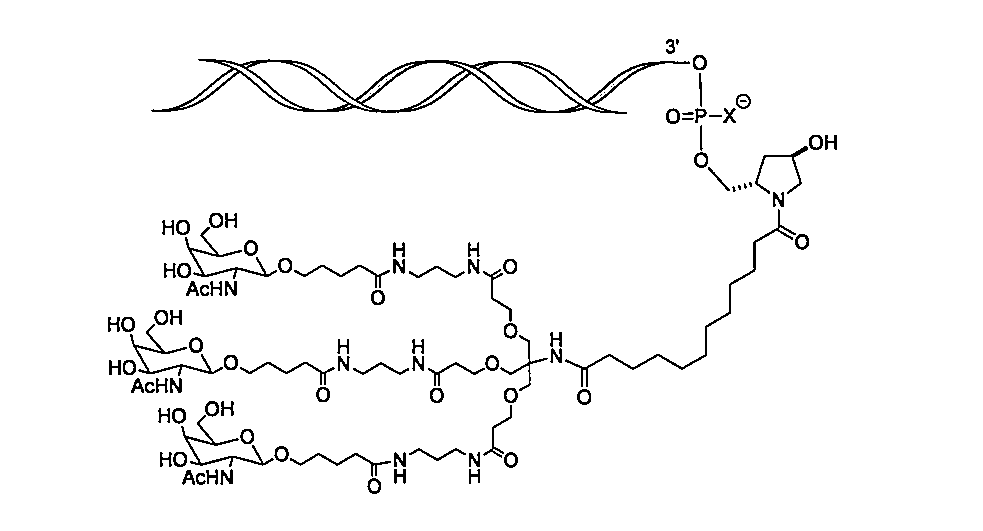
一実施形態では、薬剤は、医薬組成物として投与される。一実施形態では、食塩水または水などの非緩衝液中のRNAi薬剤が投与される。 In one embodiment, the agent is administered as a pharmaceutical composition. In one embodiment, the RNAi agent is administered in a non-buffered solution, such as saline or water.
別の実施形態では、siRNAは、酢酸塩、クエン酸塩、プロラミン、炭酸塩、もしくはリン酸塩またはそれらの任意の組み合わせを含む緩衝液などの緩衝液とともに投与される。一実施形態では、緩衝液は、リン酸緩衝食塩水(PBS)である。 In another embodiment, the siRNA is administered with a buffer, such as a buffer containing acetate, citrate, prolamine, carbonate, or phosphate, or any combination thereof. In one embodiment, the buffer is phosphate buffered saline (PBS).
別の態様では、本発明は、本発明の方法を実行するためのキットを提供する。キットは、本発明のRNAi薬剤と、使用のための説明書と、場合により、RNAi薬剤を対象に投与するための手段とを含む場合もある。 In another aspect, the invention provides a kit for carrying out the method of the invention. The kit may include an RNAi agent of the invention, instructions for use, and, optionally, a means for administering the RNAi agent to a subject.
一態様では、本発明は、Serpinc1発現の低下から利益を得るであろう障害を有する対象の少なくとも1つの症状を予防する方法を提供する。方法は、約50mgの固定用量の二本鎖リボ核酸(RNAi)薬剤を対象に投与することを含み、固定用量の二本鎖RNAi薬剤は、およそ1カ月に1回対象に投与され、二本鎖RNAi薬剤は、5’-G
GUUAACACCAUUUACUUCAA-3’(配列番号16)のヌクレオチド配列を含むセンス鎖、および5’-UUGAAGUAAAUGGUGUUAACCAG-3’(配列番号15)のヌクレオチド配列を含むアンチセンス鎖を含み、センス鎖の実質的にすべてのヌクレオチドおよびアンチセンス鎖の実質的にすべてのヌクレオチドは修飾ヌクレオチドであり、センス鎖は、3’末端で結合するリガンドとコンジュゲートし、それにより、Serpinc1発現の低下から利益を得るであろう障害を有する対象の少なくとも1つの症状を予防する。
In one aspect, the invention provides a method of preventing at least one symptom in a subject having a disorder that would benefit from reduced expression of Serpincl. The method includes administering to the subject a fixed dose of about 50 mg of a double-stranded ribonucleic acid (RNAi) agent, wherein the fixed dose of the double-stranded RNAi agent is administered to the subject approximately once a month, and wherein the double-stranded RNAi agent has a 5'-Glycaminophenyl group.
The antibody comprises a sense strand comprising the nucleotide sequence of GUUAACACCAUUUACUUCAA-3' (SEQ ID NO: 16) and an antisense strand comprising the nucleotide sequence of 5'-UUGAAGUAAAUGGUGUUAACCAG-3' (SEQ ID NO: 15), wherein substantially all of the nucleotides of the sense strand and substantially all of the nucleotides of the antisense strand are modified nucleotides, and the sense strand is conjugated to a ligand attached at its 3' end, thereby preventing at least one symptom in a subject having a disorder that would benefit from reduced expression of Serpinc1.
別の態様では、本発明は、Serpinc1発現の低下から利益を得るであろう障害を有する対象を処置する方法を提供する。方法は、約50mgの固定用量の二本鎖リボ核酸(RNAi)薬剤を対象に投与することを含み、固定用量の二本鎖RNAi薬剤は、およそ1カ月に1回対象に投与され、二本鎖RNAi薬剤は、5’-GGUUAACACCAUUUACUUCAA-3’(配列番号16)のヌクレオチド配列を含むセンス鎖、および5’-UUGAAGUAAAUGGUGUUAACCAG-3’(配列番号15)のヌクレオチド配列を含むアンチセンス鎖を含み、センス鎖の実質的にすべてのヌクレオチドおよびアンチセンス鎖の実質的にすべてのヌクレオチドは修飾ヌクレオチドであり、センス鎖は、3’末端で結合するリガンドとコンジュゲートし、それにより、Serpinc1発現の低下から利益を得るであろう障害を有する対象を処置する。 In another aspect, the invention provides a method of treating a subject having a disorder that would benefit from reduced Serpincl expression. The method includes administering to the subject a fixed dose of about 50 mg of a double-stranded ribonucleic acid (RNAi) agent, the fixed dose of the double-stranded RNAi agent being administered to the subject approximately once a month, the double-stranded RNAi agent comprising a sense strand comprising the nucleotide sequence 5'-GGUUAACACCAUUUACUUCAA-3' (SEQ ID NO: 16) and an antisense strand comprising the nucleotide sequence 5'-UUGAAGUAAAUGGUGUUAACCAG-3' (SEQ ID NO: 15), wherein substantially all of the nucleotides of the sense strand and substantially all of the nucleotides of the antisense strand are modified nucleotides, and the sense strand is conjugated to a ligand attached at its 3' end, thereby treating the subject having a disorder that would benefit from reduced Serpincl expression.
一態様では、本発明は、Serpinc1発現の低下から利益を得るであろう障害を有する対象の少なくとも1つの症状を予防する方法を提供する。方法は、約80mgの固定用量の二本鎖リボ核酸(RNAi)薬剤を対象に投与することを含み、固定用量の二本鎖RNAi薬剤は、およそ1カ月に1回対象に投与され、二本鎖RNAi薬剤は、5’-GGUUAACACCAUUUACUUCAA-3’(配列番号16)のヌクレオチド配列を含むセンス鎖、および5’-UUGAAGUAAAUGGUGUUAACCAG-3’(配列番号15)のヌクレオチド配列を含むアンチセンス鎖を含み、センス鎖の実質的にすべてのヌクレオチドおよびアンチセンス鎖の実質的にすべてのヌクレオチドは修飾ヌクレオチドであり、センス鎖は、3’末端で結合するリガンドとコンジュゲートし、それにより、Serpinc1発現の低下から利益を得るであろう障害を有する対象の少なくとも1つの症状を予防する。 In one aspect, the invention provides a method of preventing at least one symptom in a subject having a disorder that would benefit from reduced Serpincl expression. The method includes administering to the subject a fixed dose of about 80 mg of a double-stranded ribonucleic acid (RNAi) agent, the fixed dose of the double-stranded RNAi agent being administered to the subject approximately once a month, the double-stranded RNAi agent comprising a sense strand comprising the nucleotide sequence 5'-GGUUAACACCAUUUACUUCAA-3' (SEQ ID NO: 16) and an antisense strand comprising the nucleotide sequence 5'-UUGAAGUAAAUGGUGUUAACCAG-3' (SEQ ID NO: 15), wherein substantially all nucleotides of the sense strand and substantially all nucleotides of the antisense strand are modified nucleotides, and the sense strand is conjugated to a ligand attached at its 3' end, thereby preventing at least one symptom in a subject having a disorder that would benefit from reduced Serpincl expression.
別の態様では、本発明は、Serpinc1発現の低下から利益を得るであろう障害を有する対象を処置する方法を提供する。方法は、約80mgの固定用量の二本鎖リボ核酸(RNAi)薬剤を対象に投与することを含み、固定用量の二本鎖RNAi薬剤は、およそ1カ月に1回対象に投与され、二本鎖RNAi薬剤は、5’-GGUUAACACCAUUUACUUCAA-3’(配列番号16)のヌクレオチド配列を含むセンス鎖、および5’-UUGAAGUAAAUGGUGUUAACCAG-3’(配列番号15)のヌクレオチド配列を含むアンチセンス鎖を含み、センス鎖の実質的にすべてのヌクレオチドおよびアンチセンス鎖の実質的にすべてのヌクレオチドは修飾ヌクレオチドであり、センス鎖は、3’末端で結合するリガンドとコンジュゲートし、それにより、Serpinc1発現の低下から利益を得るであろう障害を有する対象を処置する。 In another aspect, the invention provides a method of treating a subject having a disorder that would benefit from reduced Serpincl expression. The method includes administering to the subject about 80 mg of a fixed dose of a double-stranded ribonucleic acid (RNAi) agent, the fixed dose of the double-stranded RNAi agent being administered to the subject approximately once a month, the double-stranded RNAi agent comprising a sense strand comprising the nucleotide sequence 5'-GGUUAACACCAUUUACUUCAA-3' (SEQ ID NO: 16) and an antisense strand comprising the nucleotide sequence 5'-UUGAAGUAAAUGGUGUUAACCAG-3' (SEQ ID NO: 15), wherein substantially all of the nucleotides of the sense strand and substantially all of the nucleotides of the antisense strand are modified nucleotides, and the sense strand is conjugated to a ligand attached at its 3' end, thereby treating the subject having a disorder that would benefit from reduced Serpincl expression.
一実施形態では、二本鎖RNAi薬剤のその用量の対象への投与は、対象におけるSerpinc1活性を、約70%から約95%、約70%から約80%、約80%から約90%、約90%から約95%、または95%を超えて低下させる。 In one embodiment, administration of the dose of the double-stranded RNAi agent to a subject reduces Serpincl activity in the subject by about 70% to about 95%, about 70% to about 80%, about 80% to about 90%, about 90% to about 95%, or greater than 95%.
別の実施形態では、二本鎖RNAi薬剤のその用量の対象への投与は、Serpinc1発現の低下から利益を得るであろう障害を有していない対象におけるピークトロンビンレベルの範囲内に、対象におけるピークトロンビンレベルを増大させる。 In another embodiment, administration of the dose of the double-stranded RNAi agent to the subject increases peak thrombin levels in the subject to within the range of peak thrombin levels in subjects without the disorder that would benefit from reduced Serpinc1 expression.
一実施形態では、二本鎖RNAi薬剤のその用量の対象への投与は、対象におけるピークトロンビン形成レベルを、対象への第VIII因子の投与によって達成されるのとほぼ同じレベルにするのに十分である。 In one embodiment, administration of the dose of the double-stranded RNAi agent to a subject is sufficient to achieve peak thrombin formation levels in the subject at approximately the same level as that achieved by administration of factor VIII to the subject.
別の実施形態では、二本鎖RNAi薬剤のその用量の対象への投与は、対象において約40%、45%、50%、55%、または約60%を超えるピークトロンビン形成レベルを達成するのに十分である。 In another embodiment, administration of the dose of the double-stranded RNAi agent to the subject is sufficient to achieve a peak thrombin formation level in the subject that is greater than about 40%, 45%, 50%, 55%, or about 60%.
さらに別の実施形態では、二本鎖RNAi薬剤のその用量の対象への投与は、Serpinc1発現の低下から利益を得るであろう障害を有する、二本鎖RNAi薬剤を投与されていない対象の過去のオンデマンド年間出血率(ABR)中央値と比較した場合に、対象のABRを約80%から約95%、約80%から約85%、約85%から約90%、または約90%から約95%低下させる。 In yet another embodiment, administration of the dose of the double-stranded RNAi agent to the subject reduces the subject's on-demand annualized bleeding rate (ABR) by about 80% to about 95%, about 80% to about 85%, about 85% to about 90%, or about 90% to about 95% when compared to the median historical ABR of subjects not receiving the double-stranded RNAi agent who have a disorder that would benefit from reduced Serpincl expression.
一実施形態では、二本鎖RNAi薬剤は、酢酸塩、クエン酸塩、プロラミン、炭酸塩、もしくはリン酸塩またはそれらの任意の組み合わせを含む緩衝液などの緩衝液とともに投与される。一実施形態では、緩衝液は、リン酸緩衝食塩水(PBS)である。 In one embodiment, the double-stranded RNAi agent is administered with a buffer, such as a buffer containing acetate, citrate, prolamine, carbonate, or phosphate, or any combination thereof. In one embodiment, the buffer is phosphate buffered saline (PBS).
一実施形態では、対象はヒトである。 In one embodiment, the subject is a human.
障害は、後天性出血障害または遺伝性出血障害、例えば、血友病、例えば、血友病A、血友病B、もしくは血友病Cなどの出血障害である場合もある。 The disorder may be an acquired or inherited bleeding disorder, e.g., a bleeding disorder such as hemophilia, e.g., hemophilia A, hemophilia B, or hemophilia C.
一実施形態では、対象は、血友病Aを有し、インヒビター対象である。別の実施形態では、対象は、血友病Bを有し、インヒビター対象である。さらに別の実施形態では、対象は、血友病Cを有し、インヒビター対象である。 In one embodiment, the subject has hemophilia A and is an inhibitor subject. In another embodiment, the subject has hemophilia B and is an inhibitor subject. In yet another embodiment, the subject has hemophilia C and is an inhibitor subject.
一実施形態では、二本鎖RNAi薬剤は、対象に皮下投与される。 In one embodiment, the double-stranded RNAi agent is administered subcutaneously to the subject.
一実施形態では、二本鎖RNAi薬剤は、対象に長期的に投与される。 In one embodiment, the double-stranded RNAi agent is administered chronically to the subject.
一実施形態では、センス鎖のすべてのヌクレオチドおよびアンチセンス鎖のすべてのヌクレオチドは、修飾ヌクレオチドである。 In one embodiment, all nucleotides in the sense strand and all nucleotides in the antisense strand are modified nucleotides.
一実施形態では、修飾ヌクレオチドは、2’-デオキシ-2’-フルオロ修飾ヌクレオチド、2’-デオキシ修飾ヌクレオチド、ロックドヌクレオチド、脱塩基ヌクレオチド、2’-アミノ修飾ヌクレオチド、2’-アルキル修飾ヌクレオチド、モルホリノヌクレオチド、ホスホルアミデート、およびヌクレオチドを含む非天然塩基からなる群から独立して選択される。 In one embodiment, the modified nucleotides are independently selected from the group consisting of 2'-deoxy-2'-fluoro modified nucleotides, 2'-deoxy modified nucleotides, locked nucleotides, abasic nucleotides, 2'-amino modified nucleotides, 2'-alkyl modified nucleotides, morpholino nucleotides, phosphoramidates, and non-natural base containing nucleotides.
一実施形態では、それぞれの鎖は、30ヌクレオチド長を超えない。 In one embodiment, each strand is no more than 30 nucleotides in length.
二本鎖RNAi薬剤の少なくとも1つの鎖は、少なくとも1ヌクレオチドの3’オーバーハングまたは少なくとも2ヌクレオチド、例えば、2、3、4、5、6、7、9、10、11、12、13、14、もしくは15ヌクレオチドの3’オーバーハングを含む場合もある。他の実施形態では、RNAi薬剤の少なくとも1つの鎖は、少なくとも1ヌクレオチドの5’オーバーハングを含む。特定の実施形態では、少なくとも1つの鎖は、少なくとも2ヌクレオチド、例えば、2、3、4、5、6、7、9、10、11、12、13、14、または15ヌクレオチドの5’オーバーハングを含む。さらに別の実施形態では、RNAi薬剤の一方の鎖の3’および5’末端の両方は、少なくとも1ヌクレオチドの
オーバーハングを含む。
At least one strand of the double stranded RNAi agent may include a 3' overhang of at least one nucleotide or a 3' overhang of at least two nucleotides, e.g., 2, 3, 4, 5, 6, 7, 9, 10, 11, 12, 13, 14, or 15 nucleotides. In other embodiments, at least one strand of the RNAi agent includes a 5' overhang of at least one nucleotide. In certain embodiments, at least one strand includes a 5' overhang of at least two nucleotides, e.g., 2, 3, 4, 5, 6, 7, 9, 10, 11, 12, 13, 14, or 15 nucleotides. In yet another embodiment, both the 3' and 5' ends of one strand of the RNAi agent include an overhang of at least one nucleotide.
特定の実施形態では、リガンドは、N-アセチルガラクトサミン(GalNAc)である。リガンドは、一価、二価、または三価の分岐リンカーを介してRNAi薬剤と結合した1つまたはそれ以上のGalNAcである場合もある。リガンドは、二本鎖RNAi薬剤のセンス鎖の3’末端、二本鎖RNAi薬剤のセンス鎖の5’末端、二本鎖RNAi薬剤のアンチセンス鎖の3’末端、または二本鎖RNAi薬剤のアンチセンス鎖の5’末端とコンジュゲートしている場合もある。 In certain embodiments, the ligand is N-acetylgalactosamine (GalNAc). The ligand may be one or more GalNAcs attached to the RNAi agent via a monovalent, divalent, or trivalent branched linker. The ligand may be conjugated to the 3' end of the sense strand of the double-stranded RNAi agent, the 5' end of the sense strand of the double-stranded RNAi agent, the 3' end of the antisense strand of the double-stranded RNAi agent, or the 5' end of the antisense strand of the double-stranded RNAi agent.
いくつかの実施形態では、本発明の二本鎖RNAi薬剤は、それぞれが独立して複数の一価のリンカーを介して二本鎖RNAi薬剤の複数のヌクレオチドに結合した複数、例えば、2、3、4、5、または6つのGalNAcを含む。 In some embodiments, the double-stranded RNAi agents of the invention include multiple, e.g., 2, 3, 4, 5, or 6, GalNAc, each independently linked to multiple nucleotides of the double-stranded RNAi agent via multiple monovalent linkers.
特定の実施形態では、リガンドは、以下のものである。

一実施形態では、RNAi薬剤は、以下の概略図に示されるとおりリガンドとコンジュゲートし、

一実施形態では、XはOである。 In one embodiment, X is O.
一実施形態では、センス鎖は、5’-GfsgsUfuAfaCfaCfCfAfuU
fuAfcUfuCfaAf-3’(配列番号13)を含み、アンチセンス鎖は、5’-usUfsgAfaGfuAfaAfuggUfgUfuAfaCfcsasg-3’(配列番号14)を含み、A、C、G、およびUはリボースA、C、GまたはUであり;a、c、g、およびuは2’-O-メチル(2’-OMe)A、C、G、またはUであり;Af、Cf、GfまたはUfは2’-フルオロA、C、GまたはUであり;sはホスホロチオエート連結である。
In one embodiment, the sense strand is 5'-GfsgsUfuAfaCfaCfCfAfuU
and the antisense strand comprises 5'-usUfsgAfaGfuAfaAfuggUfgUfuAfaCfcsasg-3' (SEQ ID NO:14), where A, C, G, and U are ribose A, C, G or U; a, c, g, and u are 2'-O-methyl (2'-OMe) A, C, G, or U; Af, Cf, Gf, or Uf is 2'-fluoro A, C, G, or U; and s is a phosphorothioate linkage.
一実施形態では、センス鎖は、5’-GfsgsUfuAfaCfaCfCfAfuUfuAfcUfuCfaAf-3’(配列番号13)を含み、アンチセンス鎖は、5’-usUfsgAfaGfuAfaAfuggUfgUfuAfaCfcsasg-3’(配列番号14)を含み、A、C、G、およびUはリボースA、C、GまたはUであり;a、c、g、およびuは2’-O-メチル(2’-OMe)A、C、G、またはUであり;Af、Cf、GfまたはUfは2’-フルオロA、C、GまたはUであり;sはホスホロチオエート連結であり;センス鎖は、以下の概略図に示されるとおりリガンドとコンジュゲートし、

別の実施形態では、siRNAは、酢酸塩、クエン酸塩、プロラミン、炭酸塩、もしくはリン酸塩またはそれらの任意の組み合わせを含む緩衝液などの緩衝液とともに投与される。一実施形態では、緩衝液は、リン酸緩衝食塩水(PBS)である。 In another embodiment, the siRNA is administered with a buffer, such as a buffer containing acetate, citrate, prolamine, carbonate, or phosphate, or any combination thereof. In one embodiment, the buffer is phosphate buffered saline (PBS).
別の態様では、本発明は、本発明の方法を実行するためのキットを提供する。キットは、本発明のRNAi薬剤と、使用のための説明書と、場合により、RNAi薬剤を対象に投与するための手段とを含む場合もある。 In another aspect, the invention provides a kit for carrying out the method of the invention. The kit may include an RNAi agent of the invention, instructions for use, and, optionally, a means for administering the RNAi agent to a subject.
一態様では、本発明は、血友病、例えば、血友病A(インヒビターありもしくはなし)、血友病B(インヒビターありもしくはなし)、または血友病C(インヒビターありもしくはなし)を有する対象の少なくとも1つの症状を予防する方法を提供する。方法は、約50mgの固定用量の二本鎖リボ核酸(RNAi)薬剤を対象に投与することを含み、固定用量の二本鎖RNAi薬剤は、およそ1カ月に1回対象に投与され、二本鎖RNAi薬剤は、5’-GGUUAACACCAUUUACUUCAA-3’(配列番号16)のヌクレオチド配列を含むセンス鎖、および5’-UUGAAGUAAAUGGUGUUAACCAG-3’(配列番号15)のヌクレオチド配列を含むアンチセンス鎖を含み、センス鎖の実質的にすべてのヌクレオチドおよびアンチセンス鎖の実質的にすべてのヌクレオチドは修飾ヌクレオチドであり、センス鎖は、3’末端で結合するリガンドとコンジュゲートし、それにより、Serpinc1発現の低下から利益を得るであろう障害を有する
対象の少なくとも1つの症状を予防する。
In one aspect, the invention provides a method of preventing at least one symptom in a subject having hemophilia, e.g., hemophilia A (with or without inhibitors), hemophilia B (with or without inhibitors), or hemophilia C (with or without inhibitors). The method includes administering to the subject a fixed dose of about 50 mg of a double-stranded ribonucleic acid (RNAi) agent, wherein the fixed dose of the double-stranded RNAi agent is administered to the subject approximately once a month, wherein the double-stranded RNAi agent comprises a sense strand comprising a nucleotide sequence of 5'-GGUUAACACCAUUUACUUCAA-3' (SEQ ID NO: 16) and an antisense strand comprising a nucleotide sequence of 5'-UUGAAGUAAAUGGUGUUAACCAG-3' (SEQ ID NO: 15), wherein substantially all of the nucleotides of the sense strand and substantially all of the nucleotides of the antisense strand are modified nucleotides, and wherein the sense strand is conjugated to a ligand attached at its 3' end, thereby preventing at least one symptom of a subject having a disorder that would benefit from reduced expression of Serpincl.
別の態様では、本発明は、血友病、例えば、血友病A(インヒビターありもしくはなし)、血友病B(インヒビターありもしくはなし)、または血友病C(インヒビターありもしくはなし)を有する対象を処置する方法を提供する。方法は、約50mgの固定用量の二本鎖リボ核酸(RNAi)薬剤を対象に投与することを含み、固定用量の二本鎖RNAi薬剤は、およそ1カ月に1回対象に投与され、二本鎖RNAi薬剤は、5’-GGUUAACACCAUUUACUUCAA-3’(配列番号16)のヌクレオチド配列を含むセンス鎖、および5’-UUGAAGUAAAUGGUGUUAACCAG-3’(配列番号15)のヌクレオチド配列を含むアンチセンス鎖を含み、センス鎖の実質的にすべてのヌクレオチドおよびアンチセンス鎖の実質的にすべてのヌクレオチドは修飾ヌクレオチドであり、センス鎖は、3’末端で結合するリガンドとコンジュゲートし、それにより、Serpinc1発現の低下から利益を得るであろう障害を有する対象を処置する。 In another aspect, the invention provides a method of treating a subject having hemophilia, e.g., hemophilia A (with or without inhibitors), hemophilia B (with or without inhibitors), or hemophilia C (with or without inhibitors). The method includes administering to the subject a fixed dose of about 50 mg of a double-stranded ribonucleic acid (RNAi) agent, the fixed dose of the double-stranded RNAi agent being administered to the subject approximately once a month, the double-stranded RNAi agent comprising a sense strand comprising the nucleotide sequence of 5'-GGUUAACACCAUUUACUUCAA-3' (SEQ ID NO: 16) and an antisense strand comprising the nucleotide sequence of 5'-UUGAAGUAAAUGGUGUUAACCAG-3' (SEQ ID NO: 15), wherein substantially all of the nucleotides of the sense strand and substantially all of the nucleotides of the antisense strand are modified nucleotides, and the sense strand is conjugated to a ligand attached at its 3' end, thereby treating the subject having a disorder that would benefit from reduced Serpincl expression.
一態様では、本発明は、血友病、例えば、血友病A(インヒビターありもしくはなし)、血友病B(インヒビターありもしくはなし)、または血友病C(インヒビターありもしくはなし)を有する対象の少なくとも1つの症状を予防する方法を提供する。方法は、約80mgの固定用量の二本鎖リボ核酸(RNAi)薬剤を対象に投与することを含み、固定用量の二本鎖RNAi薬剤は、およそ1カ月に1回対象に投与され、二本鎖RNAi薬剤は、5’-GGUUAACACCAUUUACUUCAA-3’(配列番号16)のヌクレオチド配列を含むセンス鎖、および5’-UUGAAGUAAAUGGUGUUAACCAG-3’(配列番号15)のヌクレオチド配列を含むアンチセンス鎖を含み、センス鎖の実質的にすべてのヌクレオチドおよびアンチセンス鎖の実質的にすべてのヌクレオチドは修飾ヌクレオチドであり、センス鎖は、3’末端で結合するリガンドとコンジュゲートし、それにより、Serpinc1発現の低下から利益を得るであろう障害を有する対象の少なくとも1つの症状を予防する。 In one aspect, the invention provides a method for preventing at least one symptom in a subject having hemophilia, e.g., hemophilia A (with or without inhibitors), hemophilia B (with or without inhibitors), or hemophilia C (with or without inhibitors). The method includes administering to the subject a fixed dose of about 80 mg of a double-stranded ribonucleic acid (RNAi) agent, the fixed dose of the double-stranded RNAi agent being administered to the subject approximately once a month, the double-stranded RNAi agent comprising a sense strand comprising the nucleotide sequence of 5'-GGUUAACACCAUUUACUUCAA-3' (SEQ ID NO: 16) and an antisense strand comprising the nucleotide sequence of 5'-UUGAAGUAAAUGGUGUUAACCAG-3' (SEQ ID NO: 15), wherein substantially all of the nucleotides of the sense strand and substantially all of the nucleotides of the antisense strand are modified nucleotides, and the sense strand is conjugated to a ligand attached at its 3' end, thereby preventing at least one symptom of a subject having a disorder that would benefit from reduced Serpincl expression.
別の態様では、本発明は、血友病、例えば、血友病A(インヒビターありもしくはなし)、血友病B(インヒビターありもしくはなし)、または血友病C(インヒビターありもしくはなし)を有する対象を処置する方法を提供する。方法は、約80mgの固定用量の二本鎖リボ核酸(RNAi)薬剤を対象に投与することを含み、固定用量の二本鎖RNAi薬剤は、およそ1カ月に1回対象に投与され、二本鎖RNAi薬剤は、5’-GGUUAACACCAUUUACUUCAA-3’(配列番号16)のヌクレオチド配列を含むセンス鎖、および5’-UUGAAGUAAAUGGUGUUAACCAG-3’(配列番号15)のヌクレオチド配列を含むアンチセンス鎖を含み、センス鎖の実質的にすべてのヌクレオチドおよびアンチセンス鎖の実質的にすべてのヌクレオチドは修飾ヌクレオチドであり、センス鎖は、3’末端で結合するリガンドとコンジュゲートし、それにより、Serpinc1発現の低下から利益を得るであろう障害を有する対象を処置する。 In another aspect, the invention provides a method of treating a subject having hemophilia, e.g., hemophilia A (with or without inhibitors), hemophilia B (with or without inhibitors), or hemophilia C (with or without inhibitors). The method includes administering to the subject a fixed dose of about 80 mg of a double-stranded ribonucleic acid (RNAi) agent, the fixed dose of the double-stranded RNAi agent being administered to the subject approximately once a month, the double-stranded RNAi agent comprising a sense strand comprising the nucleotide sequence of 5'-GGUUAACACCAUUUACUUCAA-3' (SEQ ID NO: 16) and an antisense strand comprising the nucleotide sequence of 5'-UUGAAGUAAAUGGUGUUAACCAG-3' (SEQ ID NO: 15), wherein substantially all of the nucleotides of the sense strand and substantially all of the nucleotides of the antisense strand are modified nucleotides, and the sense strand is conjugated to a ligand attached at its 3' end, thereby treating the subject having a disorder that would benefit from reduced Serpincl expression.
一態様では、本発明は、血友病、例えば、血友病A(インヒビターありもしくはなし)、血友病B(インヒビターありもしくはなし)、または血友病C(インヒビターありもしくはなし)を有する対象の少なくとも1つの症状を予防する方法を提供する。方法は、約50mgの固定用量の二本鎖リボ核酸(RNAi)薬剤を対象に投与することを含み、固定用量の二本鎖RNAi薬剤は、およそ1カ月に1回対象に投与され、二本鎖RNAi薬剤は、5’-GfsgsUfuAfaCfaCfCfAfuUfuAfcUfuCfaAf-3’(配列番号13)のヌクレオチド配列を含むセンス鎖および5’-usUfsgAfaGfuAfaAfuggUfgUfuAfaCfcsasg-3’(配列番号14)のヌクレオチド配列を含むアンチセンス鎖を含み、A、C、G、およびUはリボースA、C、GまたはUであり;a、c、g、およびuは2’-O-メチル(2’-OMe)A、C、G、またはUであり;Af、Cf、GfまたはUfは2’-フルオロA、C、Gま
たはUであり;sはホスホロチオエート連結であり、センス鎖は、3’末端で結合するリガンドとコンジュゲートし、それにより、Serpinc1発現の低下から利益を得るであろう障害を有する対象の少なくとも1つの症状を予防する。
In one aspect, the invention provides a method of preventing at least one symptom in a subject having hemophilia, e.g., hemophilia A (with or without inhibitors), hemophilia B (with or without inhibitors), or hemophilia C (with or without inhibitors). The method includes administering to the subject about 50 mg of a fixed dose of a double-stranded ribonucleic acid (RNAi) agent, wherein the fixed dose of the double-stranded RNAi agent is administered to the subject approximately once a month, the double-stranded RNAi agent having a sense strand comprising the nucleotide sequence of 5'-GfsgsUfuAfaCfaCfCfAfuUfuAfcUfuCfaAf-3' (SEQ ID NO: 13) and a nucleotide sequence of 5'-usUfsgAfaGfuAfaAfuggUfgUfuAfaCfcsasg-3' (SEQ ID NO: 14). wherein A, C, G, and U are ribose A, C, G, or U; a, c, g, and u are 2'-O-methyl (2'-OMe) A, C, G, or U; Af, Cf, Gf, or Uf is 2'-fluoro A, C, G, or U; and s is a phosphorothioate linkage, and the sense strand is conjugated to a ligand attached at the 3' end, thereby preventing at least one symptom in a subject having a disorder that would benefit from reduced Serpinc1 expression.
別の態様では、本発明は、血友病、例えば、血友病A(インヒビターありもしくはなし)、血友病B(インヒビターありもしくはなし)、または血友病C(インヒビターありもしくはなし)を有する対象を処置する方法を提供する。方法は、約50mgの固定用量の二本鎖リボ核酸(RNAi)薬剤を対象に投与することを含み、固定用量の二本鎖RNAi薬剤は、およそ1カ月に1回対象に投与され、二本鎖RNAi薬剤は、5’-GfsgsUfuAfaCfaCfCfAfuUfuAfcUfuCfaAf-3’(配列番号13)のヌクレオチド配列を含むセンス鎖および5’-usUfsgAfaGfuAfaAfuggUfgUfuAfaCfcsasg-3’(配列番号14)のヌクレオチド配列を含むアンチセンス鎖を含み、A、C、G、およびUはリボースA、C、GまたはUであり;a、c、g、およびuは2’-O-メチル(2’-OMe)A、C、G、またはUであり;Af、Cf、GfまたはUfは2’-フルオロA、C、GまたはUであり;sはホスホロチオエート連結であり、センス鎖は、3’末端で結合するリガンドとコンジュゲートし、それにより、Serpinc1発現の低下から利益を得るであろう障害を有する対象を処置する。 In another aspect, the invention provides a method of treating a subject having hemophilia, e.g., hemophilia A (with or without inhibitors), hemophilia B (with or without inhibitors), or hemophilia C (with or without inhibitors). The method includes administering to the subject about 50 mg of a fixed dose of a double-stranded ribonucleic acid (RNAi) agent, the fixed dose of the double-stranded RNAi agent being administered to the subject approximately once a month, the double-stranded RNAi agent comprising a sense strand comprising the nucleotide sequence of 5'-GfsgsUfuAfaCfaCfCfAfuUfuAfcUfuCfaAf-3' (SEQ ID NO: 13) and a nucleotide sequence of 5'-usUfsgAfaGfuAfaAfuggUfgUfuAfaCfcsasg-3' (SEQ ID NO: 14). The antisense strand comprises a tide sequence, where A, C, G, and U are ribose A, C, G, or U; a, c, g, and u are 2'-O-methyl (2'-OMe) A, C, G, or U; Af, Cf, Gf, or Uf are 2'-fluoro A, C, G, or U; and s is a phosphorothioate linkage, and the sense strand is conjugated to a ligand that is attached at the 3' end, thereby treating a subject having a disorder that would benefit from reduced Serpinc1 expression.
一態様では、本発明は、血友病、例えば、血友病A(インヒビターありもしくはなし)、血友病B(インヒビターありもしくはなし)、または血友病C(インヒビターありもしくはなし)を有する対象の少なくとも1つの症状を予防する方法を提供する。方法は、約80mgの固定用量の二本鎖リボ核酸(RNAi)薬剤を対象に投与することを含み、固定用量の二本鎖RNAi薬剤は、およそ1カ月に1回対象に投与され、二本鎖RNAi薬剤は、5’-GfsgsUfuAfaCfaCfCfAfuUfuAfcUfuCfaAf-3’(配列番号13)のヌクレオチド配列を含むセンス鎖および5’-usUfsgAfaGfuAfaAfuggUfgUfuAfaCfcsasg-3’(配列番号14)のヌクレオチド配列を含むアンチセンス鎖を含み、A、C、G、およびUはリボースA、C、GまたはUであり;a、c、g、およびuは2’-O-メチル(2’-OMe)A、C、G、またはUであり;Af、Cf、GfまたはUfは2’-フルオロA、C、GまたはUであり;sはホスホロチオエート連結であり、センス鎖は、3’末端で結合するリガンドとコンジュゲートし、それにより、Serpinc1発現の低下から利益を得るであろう障害を有する対象の少なくとも1つの症状を予防する。 In one aspect, the invention provides a method of preventing at least one symptom in a subject having hemophilia, e.g., hemophilia A (with or without inhibitors), hemophilia B (with or without inhibitors), or hemophilia C (with or without inhibitors). The method includes administering to the subject about 80 mg of a fixed dose of a double-stranded ribonucleic acid (RNAi) agent, the fixed dose of the double-stranded RNAi agent being administered to the subject approximately once a month, the double-stranded RNAi agent having a sense strand comprising the nucleotide sequence of 5'-GfsgsUfuAfaCfaCfCfAfuUfuAfcUfuCfaAf-3' (SEQ ID NO: 13) and a nucleotide sequence of 5'-usUfsgAfaGfuAfaAfuggUfgUfuAfaCfcsasg-3' (SEQ ID NO: 14). The antisense strand comprises a nucleotide sequence including A, C, G, and U, where A, C, G, and U are ribose A, C, G, or U; a, c, g, and u are 2'-O-methyl (2'-OMe) A, C, G, or U; Af, Cf, Gf, or Uf are 2'-fluoro A, C, G, or U; and s is a phosphorothioate linkage, and the sense strand is conjugated to a ligand attached at the 3' end, thereby preventing at least one symptom in a subject having a disorder that would benefit from reduced Serpinc1 expression.
別の態様では、本発明は、血友病、例えば、血友病A(インヒビターありもしくはなし)、血友病B(インヒビターありもしくはなし)、または血友病C(インヒビターありもしくはなし)を有する対象を処置する方法を提供する。方法は、約80mgの固定用量の二本鎖リボ核酸(RNAi)薬剤を対象に投与することを含み、固定用量の二本鎖RNAi薬剤は、およそ1カ月に1回対象に投与され、二本鎖RNAi薬剤は、5’-GfsgsUfuAfaCfaCfCfAfuUfuAfcUfuCfaAf-3’(配列番号13)のヌクレオチド配列を含むセンス鎖および5’-usUfsgAfaGfuAfaAfuggUfgUfuAfaCfcsasg-3’(配列番号14)のヌクレオチド配列を含むアンチセンス鎖を含み、A、C、G、およびUはリボースA、C、GまたはUであり;a、c、g、およびuは2’-O-メチル(2’-OMe)A、C、G、またはUであり;Af、Cf、GfまたはUfは2’-フルオロA、C、GまたはUであり;sはホスホロチオエート連結であり、センス鎖は、3’末端で結合するリガンドとコンジュゲートし、それにより、Serpinc1発現の低下から利益を得るであろう障害を有する対象を処置する。 In another aspect, the invention provides a method of treating a subject having hemophilia, e.g., hemophilia A (with or without inhibitors), hemophilia B (with or without inhibitors), or hemophilia C (with or without inhibitors). The method includes administering to the subject about 80 mg of a fixed dose of a double-stranded ribonucleic acid (RNAi) agent, the fixed dose of the double-stranded RNAi agent being administered to the subject approximately once a month, the double-stranded RNAi agent comprising a sense strand comprising the nucleotide sequence of 5'-GfsgsUfuAfaCfaCfCfAfuUfuAfcUfuCfaAf-3' (SEQ ID NO: 13) and a nucleotide sequence of 5'-usUfsgAfaGfuAfaAfuggUfgUfuAfaCfcsasg-3' (SEQ ID NO: 14). The antisense strand comprises a tide sequence, where A, C, G, and U are ribose A, C, G, or U; a, c, g, and u are 2'-O-methyl (2'-OMe) A, C, G, or U; Af, Cf, Gf, or Uf are 2'-fluoro A, C, G, or U; and s is a phosphorothioate linkage, and the sense strand is conjugated to a ligand that is attached at the 3' end, thereby treating a subject having a disorder that would benefit from reduced Serpinc1 expression.
一実施形態では、二本鎖RNAi薬剤のその用量の対象への投与は、対象におけるSe
rpinc1活性を、約70%から約95%、約70%から約80%、約80%から約90%、約90%から約95%、または95%を超えて低下させる。
In one embodiment, administration of the dose of the double-stranded RNAi agent to the subject reduces Se in the subject.
The rpinc1 activity is reduced by about 70% to about 95%, about 70% to about 80%, about 80% to about 90%, about 90% to about 95%, or greater than 95%.
別の実施形態では、二本鎖RNAi薬剤のその用量の対象への投与は、Serpinc1発現の低下から利益を得るであろう障害を有していない対象におけるピークトロンビンレベルの範囲内に、対象におけるピークトロンビンレベルを増大させる。 In another embodiment, administration of the dose of the double-stranded RNAi agent to the subject increases peak thrombin levels in the subject to within the range of peak thrombin levels in subjects without the disorder that would benefit from reduced Serpinc1 expression.
一実施形態では、二本鎖RNAi薬剤のその用量の対象への投与は、対象におけるピークトロンビン形成レベルを、対象への第VIII因子の投与によって達成されるのとほぼ同じレベルにするのに十分である。 In one embodiment, administration of the dose of the double-stranded RNAi agent to a subject is sufficient to achieve peak thrombin formation levels in the subject at approximately the same level as that achieved by administration of factor VIII to the subject.
別の実施形態では、二本鎖RNAi薬剤のその用量の対象への投与は、対象において約40%、45%、50%、55%、または約60%を超えるピークトロンビン形成レベルを達成するのに十分である。 In another embodiment, administration of the dose of the double-stranded RNAi agent to the subject is sufficient to achieve a peak thrombin formation level in the subject that is greater than about 40%, 45%, 50%, 55%, or about 60%.
さらに別の実施形態では、二本鎖RNAi薬剤のその用量の対象への投与は、Serpinc1発現の低下から利益を得るであろう障害を有する、二本鎖RNAi薬剤を投与されていない対象の過去のオンデマンド年間出血率(ABR)中央値と比較した場合に、対象のABRを約80%から約95%、約80%から約85%、約85%から約90%、または約90%から約95%低下させる。 In yet another embodiment, administration of the dose of the double-stranded RNAi agent to the subject reduces the subject's on-demand annualized bleeding rate (ABR) by about 80% to about 95%, about 80% to about 85%, about 85% to about 90%, or about 90% to about 95% when compared to the median historical ABR of subjects not receiving the double-stranded RNAi agent who have a disorder that would benefit from reduced Serpincl expression.
一実施形態では、二本鎖RNAi薬剤は、酢酸塩、クエン酸塩、プロラミン、炭酸塩、もしくはリン酸塩またはそれらの任意の組み合わせを含む緩衝液などの緩衝液とともに投与される。一実施形態では、緩衝液は、リン酸緩衝食塩水(PBS)である。 In one embodiment, the double-stranded RNAi agent is administered with a buffer, such as a buffer containing acetate, citrate, prolamine, carbonate, or phosphate, or any combination thereof. In one embodiment, the buffer is phosphate buffered saline (PBS).
一実施形態では、対象はヒトである。 In one embodiment, the subject is a human.
一実施形態では、二本鎖RNAi薬剤は、対象に皮下投与される。 In one embodiment, the double-stranded RNAi agent is administered subcutaneously to the subject.
一実施形態では、二本鎖RNAi薬剤は、対象に長期的に投与される。 In one embodiment, the double-stranded RNAi agent is administered chronically to the subject.
特定の実施形態では、リガンドは、以下のものである。

一実施形態では、RNAi薬剤は、以下の概略図に示されるとおりリガンドとコンジュゲートし、

一実施形態では、XはOである。 In one embodiment, X is O.
一実施形態では、センス鎖は、5’-GfsgsUfuAfaCfaCfCfAfuUfuAfcUfuCfaAf-3’(配列番号13)を含み、アンチセンス鎖は、5’-usUfsgAfaGfuAfaAfuggUfgUfuAfaCfcsasg-3’(配列番号14)を含み、A、C、G、およびUはリボースA、C、GまたはUであり;a、c、g、およびuは2’-O-メチル(2’-OMe)A、C、G、またはUであり;Af、Cf、GfまたはUfは2’-フルオロA、C、GまたはUであり;sはホスホロチオエート連結であり;センス鎖は、以下の概略図に示されるとおりリガンドとコンジュゲートし、
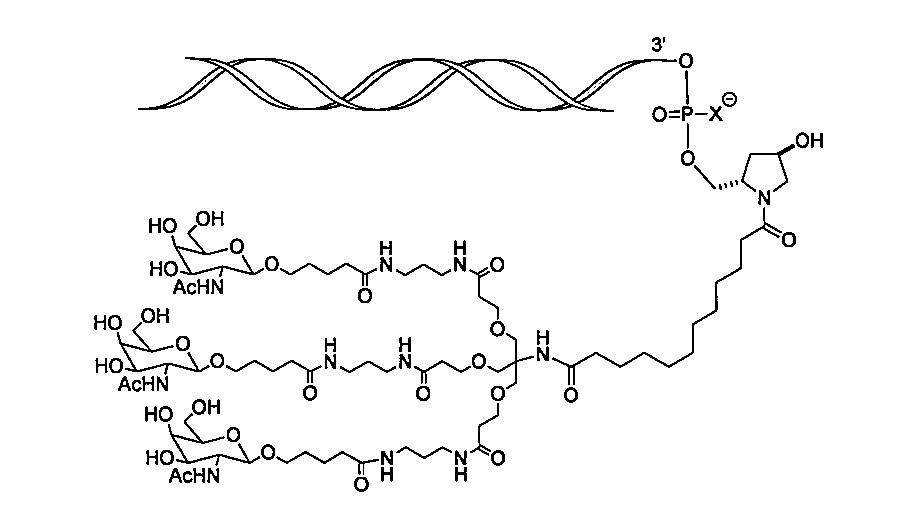
別の実施形態では、siRNAは、酢酸塩、クエン酸塩、プロラミン、炭酸塩、もしくはリン酸塩またはそれらの任意の組み合わせを含む緩衝液などの緩衝液とともに投与される。一実施形態では、緩衝液は、リン酸緩衝食塩水(PBS)である。 In another embodiment, the siRNA is administered with a buffer, such as a buffer containing acetate, citrate, prolamine, carbonate, or phosphate, or any combination thereof. In one embodiment, the buffer is phosphate buffered saline (PBS).
別の態様では、本発明は、本発明の方法を実行するためのキットを提供する。キットは、本発明のRNAi薬剤と、使用のための説明書と、場合により、RNAi薬剤を対象に投与するための手段とを含む場合もある。 In another aspect, the invention provides a kit for carrying out the method of the invention. The kit may include an RNAi agent of the invention, instructions for use, and, optionally, a means for administering the RNAi agent to a subject.
一態様では、本発明は、Serpinc1発現の低下から利益を得るであろう障害を有する対象の少なくとも1つの症状を予防する方法を提供する。方法は、約40mgから約90mgの固定用量の二本鎖リボ核酸(RNAi)薬剤を対象に投与することを含み、二本鎖RNAi薬剤は、センス鎖およびアンチセンス鎖を含み、アンチセンス鎖は5’-UUGAAGUAAAUGGUGUUAACCAG-3’(配列番号15)のヌクレオチド配列と3ヌクレオチドを超えずに異なる少なくとも15の連続するヌクレオチドを含む相補性の領域を含み、センス鎖の実質的にすべてのヌクレオチドおよびアンチセンス鎖の実質的にすべてのヌクレオチドは修飾ヌクレオチドであり、二本鎖RNAi薬剤はリガンドを含み、例えば、二本鎖RNAi薬剤のセンス鎖はセンス鎖の3’末端で結合するリガンドとコンジュゲートしている。 In one aspect, the invention provides a method for preventing at least one symptom in a subject having a disorder that would benefit from reduced Serpincl expression. The method includes administering to the subject a fixed dose of about 40 mg to about 90 mg of a double-stranded ribonucleic acid (RNAi) agent, the double-stranded RNAi agent comprising a sense strand and an antisense strand, the antisense strand comprising a region of complementarity comprising at least 15 contiguous nucleotides that differ by no more than 3 nucleotides from the nucleotide sequence 5'-UUGAAGUAAAUGGUGUUAACCAG-3' (SEQ ID NO: 15), substantially all of the nucleotides of the sense strand and substantially all of the nucleotides of the antisense strand are modified nucleotides, and the double-stranded RNAi agent comprises a ligand, e.g., the sense strand of the double-stranded RNAi agent is conjugated to a ligand that binds at the 3' end of the sense strand.
別の態様では、本発明は、Serpinc1発現の低下から利益を得るであろう障害を有する対象を処置する方法を提供する。方法は、約40mgから約90mgの固定用量の二本鎖リボ核酸(RNAi)薬剤を対象に投与することを含み、二本鎖RNAi薬剤は、センス鎖およびアンチセンス鎖を含み、アンチセンス鎖は5’-UUGAAGUAAAUGGUGUUAACCAG-3’(配列番号15)のヌクレオチド配列と3ヌクレオチドを超えずに異なる少なくとも15の連続するヌクレオチドを含む相補性の領域を含み、センス鎖の実質的にすべてのヌクレオチドおよびアンチセンス鎖の実質的にすべてのヌクレオチドは修飾ヌクレオチドであり、二本鎖RNAi薬剤はリガンドを含み、例えば、二本鎖RNAi薬剤のセンス鎖はセンス鎖の3’末端で結合するリガンドとコンジュゲートしている。 In another aspect, the invention provides a method of treating a subject having a disorder that would benefit from reduced Serpincl expression. The method includes administering to the subject a fixed dose of about 40 mg to about 90 mg of a double-stranded ribonucleic acid (RNAi) agent, the double-stranded RNAi agent comprising a sense strand and an antisense strand, the antisense strand comprising a region of complementarity comprising at least 15 contiguous nucleotides that differ by no more than 3 nucleotides from the nucleotide sequence 5'-UUGAAGUAAAUGGUGUUAACCAG-3' (SEQ ID NO: 15), substantially all of the nucleotides of the sense strand and substantially all of the nucleotides of the antisense strand are modified nucleotides, and the double-stranded RNAi agent comprises a ligand, e.g., the sense strand of the double-stranded RNAi agent is conjugated to a ligand that is attached at the 3' end of the sense strand.
二本鎖RNAi薬剤は、2回またはそれ以上の用量で対象に投与することができる。 The double-stranded RNAi agent can be administered to the subject in two or more doses.
いくつかの実施形態では、二本鎖RNAi薬剤は、対象に月に1回、5週毎に1回、6週毎に1回、7週毎に1回、2カ月毎に1回、四半期に1回、または必要に応じて投与される。 In some embodiments, the double-stranded RNAi agent is administered to a subject once a month, once every 5 weeks, once every 6 weeks, once every 7 weeks, once every 2 months, once quarterly, or as needed.
一実施形態では、二本鎖RNAi薬剤は、対象に月に1回投与される。別の実施形態では、二本鎖RNAi薬剤は、対象に6週毎に1回投与される。一実施形態では、二本鎖RNAi薬剤は、対象に2カ月毎に1回投与される。さらに別の実施形態では、二本鎖RNAi薬剤は、対象に四半期に1回投与される。 In one embodiment, the double-stranded RNAi agent is administered to the subject once a month. In another embodiment, the double-stranded RNAi agent is administered to the subject once every six weeks. In one embodiment, the double-stranded RNAi agent is administered to the subject once every two months. In yet another embodiment, the double-stranded RNAi agent is administered to the subject once a quarter.
二本鎖RNAi薬剤は、例えば、約50mgから約90mgの間、約50mgから約85mgの間、約50mgから約80mgの間、約40mgから約80mgの間、約60mgから約90mgの間、約25mgから約55mgの間、約25mgから約65mgの間、約40mgから約85mgの間、約40mgから約75mgの間、約40mgから約65mgの間、または約40mgから約55mgの間の固定用量として対象に投与することができる。 The double-stranded RNAi agent can be administered to a subject as a fixed dose, e.g., between about 50 mg and about 90 mg, between about 50 mg and about 85 mg, between about 50 mg and about 80 mg, between about 40 mg and about 80 mg, between about 60 mg and about 90 mg, between about 25 mg and about 55 mg, between about 25 mg and about 65 mg, between about 40 mg and about 85 mg, between about 40 mg and about 75 mg, between about 40 mg and about 65 mg, or between about 40 mg and about 55 mg.
いくつかの実施形態では、二本鎖RNAi薬剤は、約40mg、約45mg、約50mg、約55mg、約60mg、約65mg、約70mg、約75mg、約80mg、約85mg、または約90mgの固定用量として投与することができる。 In some embodiments, the double-stranded RNAi agent can be administered as a fixed dose of about 40 mg, about 45 mg, about 50 mg, about 55 mg, about 60 mg, about 65 mg, about 70 mg, about 75 mg, about 80 mg, about 85 mg, or about 90 mg.
いくつかの実施形態では、二本鎖RNAi薬剤は、約40mgの固定用量として;または約50mgの固定用量として;または約80mgの固定用量として;または約90mgの固定用量として対象に投与される。 In some embodiments, the double-stranded RNAi agent is administered to the subject as a fixed dose of about 40 mg; or as a fixed dose of about 50 mg; or as a fixed dose of about 80 mg; or as a fixed dose of about 90 mg.
一実施形態では、二本鎖RNAi薬剤は、対象に皮下投与される。 In one embodiment, the double-stranded RNAi agent is administered subcutaneously to the subject.
一実施形態では、二本鎖RNAi薬剤のその用量の対象への投与は、対象におけるSerpinc1活性を約70%から約95%低下させる。 In one embodiment, administration of that dose of the double-stranded RNAi agent to a subject reduces Serpincl activity in the subject by about 70% to about 95%.
別の実施形態では、二本鎖RNAi薬剤のその用量の対象への投与は、Serpinc1発現の低下から利益を得るであろう障害を有していない対象におけるピークトロンビンレベルの範囲内に、対象におけるピークトロンビンレベルを増大させる。 In another embodiment, administration of the dose of the double-stranded RNAi agent to the subject increases peak thrombin levels in the subject to within the range of peak thrombin levels in subjects without the disorder that would benefit from reduced Serpinc1 expression.
一実施形態では、二本鎖RNAi薬剤のその用量の対象への投与は、対象におけるピークトロンビン形成レベルを、対象への第VIII因子の投与によって達成されるのとほぼ同じレベルにするのに十分である。 In one embodiment, administration of the dose of the double-stranded RNAi agent to a subject is sufficient to achieve peak thrombin formation levels in the subject at approximately the same level as that achieved by administration of factor VIII to the subject.
別の実施形態では、二本鎖RNAi薬剤のその用量の対象への投与は、対象において約40%を超えるピークトロンビン形成レベルを達成するのに十分である。 In another embodiment, administration of the dose of the double-stranded RNAi agent to the subject is sufficient to achieve a peak thrombin formation level of greater than about 40% in the subject.
さらに別の実施形態では、二本鎖RNAi薬剤のその用量の対象への投与は、Serpinc1発現の低下から利益を得るであろう障害を有する、二本鎖RNAi薬剤を投与されていない対象の過去のオンデマンド年間出血率(ABR)中央値と比較した場合に、対象のABRを約80から約95%低下させる。 In yet another embodiment, administration of the dose of the double-stranded RNAi agent to the subject reduces the subject's on-demand annualized bleeding rate (ABR) by about 80 to about 95% when compared to the median historical ABR of subjects not receiving the double-stranded RNAi agent who have a disorder that would benefit from reduced Serpincl expression.
一実施形態では、二本鎖RNAi薬剤は、酢酸塩、クエン酸塩、プロラミン、炭酸塩、もしくはリン酸塩またはそれらの任意の組み合わせを含む緩衝液などの緩衝液とともに投与される。一実施形態では、緩衝液は、リン酸緩衝食塩水(PBS)である。 In one embodiment, the double-stranded RNAi agent is administered with a buffer, such as a buffer containing acetate, citrate, prolamine, carbonate, or phosphate, or any combination thereof. In one embodiment, the buffer is phosphate buffered saline (PBS).
一実施形態では、対象はヒトである。 In one embodiment, the subject is a human.
障害は、後天性出血障害または遺伝性出血障害、例えば、血友病、例えば、血友病A、血友病B、もしくは血友病Cなどの出血障害である場合もある。 The disorder may be an acquired or inherited bleeding disorder, e.g., a bleeding disorder such as hemophilia, e.g., hemophilia A, hemophilia B, or hemophilia C.
一実施形態では、対象は、血友病Aを有し、インヒビター対象である。別の実施形態では、対象は、血友病Bを有し、インヒビター対象である。さらに別の実施形態では、対象は、血友病Cを有し、インヒビター対象である。 In one embodiment, the subject has hemophilia A and is an inhibitor subject. In another embodiment, the subject has hemophilia B and is an inhibitor subject. In yet another embodiment, the subject has hemophilia C and is an inhibitor subject.
一実施形態では、二本鎖RNAi薬剤は、対象に皮下投与される。 In one embodiment, the double-stranded RNAi agent is administered subcutaneously to the subject.
一実施形態では、センス鎖のすべてのヌクレオチドおよびアンチセンス鎖のすべてのヌクレオチドは、修飾ヌクレオチドである。 In one embodiment, all nucleotides in the sense strand and all nucleotides in the antisense strand are modified nucleotides.
一実施形態では、修飾ヌクレオチドは、2’-デオキシ-2’-フルオロ修飾ヌクレオチド、2’-デオキシ修飾ヌクレオチド、ロックドヌクレオチド、脱塩基ヌクレオチド、2’-アミノ修飾ヌクレオチド、2’-アルキル修飾ヌクレオチド、モルホリノヌクレオチド、ホスホルアミデート、およびヌクレオチドを含む非天然塩基からなる群から独立して選択される。 In one embodiment, the modified nucleotides are independently selected from the group consisting of 2'-deoxy-2'-fluoro modified nucleotides, 2'-deoxy modified nucleotides, locked nucleotides, abasic nucleotides, 2'-amino modified nucleotides, 2'-alkyl modified nucleotides, morpholino nucleotides, phosphoramidates, and non-natural base containing nucleotides.
相補性の領域は、少なくとも17ヌクレオチド長または19ヌクレオチド長である場合もある。 The region of complementarity may be at least 17 or 19 nucleotides in length.
一実施形態では、相補性の領域は、19から21の間のヌクレオチド長である。別の実施形態では、相補性の領域は、21から23の間のヌクレオチド長である。 In one embodiment, the region of complementarity is between 19 and 21 nucleotides in length. In another embodiment, the region of complementarity is between 21 and 23 nucleotides in length.
一実施形態では、それぞれの鎖は、30ヌクレオチド長を超えない。 In one embodiment, each strand is no more than 30 nucleotides in length.
二本鎖RNAi薬剤の少なくとも1つの鎖は、少なくとも1ヌクレオチドの3’オーバーハングまたは少なくとも2ヌクレオチド、例えば、2、3、4、5、6、7、9、10、11、12、13、14、もしくは15ヌクレオチドの3’オーバーハングを含む場合もある。他の実施形態では、RNAi薬剤の少なくとも1つの鎖は、少なくとも1ヌクレオチドの5’オーバーハングを含む。特定の実施形態では、少なくとも1つの鎖は、少なくとも2ヌクレオチド、例えば、2、3、4、5、6、7、9、10、11、12、13、14、または15ヌクレオチドの5’オーバーハングを含む。さらに別の実施形態では、RNAi薬剤の一方の鎖の3’および5’末端の両方は、少なくとも1ヌクレオチドのオーバーハングを含む。 At least one strand of the double stranded RNAi agent may include a 3' overhang of at least 1 nucleotide or a 3' overhang of at least 2 nucleotides, e.g., 2, 3, 4, 5, 6, 7, 9, 10, 11, 12, 13, 14, or 15 nucleotides. In other embodiments, at least one strand of the RNAi agent includes a 5' overhang of at least 1 nucleotide. In certain embodiments, at least one strand includes a 5' overhang of at least 2 nucleotides, e.g., 2, 3, 4, 5, 6, 7, 9, 10, 11, 12, 13, 14, or 15 nucleotides. In yet another embodiment, both the 3' and 5' ends of one strand of the RNAi agent include an overhang of at least 1 nucleotide.
特定の実施形態では、リガンドは、N-アセチルガラクトサミン(GalNAc)である。リガンドは、一価、二価、または三価の分岐リンカーを介してRNAi薬剤と結合した1つまたはそれ以上のGalNAcである場合もある。リガンドは、二本鎖RNAi薬剤のセンス鎖の3’末端、二本鎖RNAi薬剤のセンス鎖の5’末端、二本鎖RNAi薬剤のアンチセンス鎖の3’末端、または二本鎖RNAi薬剤のアンチセンス鎖の5’末端とコンジュゲートしている場合もある。 In certain embodiments, the ligand is N-acetylgalactosamine (GalNAc). The ligand may be one or more GalNAcs attached to the RNAi agent via a monovalent, divalent, or trivalent branched linker. The ligand may be conjugated to the 3' end of the sense strand of the double-stranded RNAi agent, the 5' end of the sense strand of the double-stranded RNAi agent, the 3' end of the antisense strand of the double-stranded RNAi agent, or the 5' end of the antisense strand of the double-stranded RNAi agent.
いくつかの実施形態では、本発明の二本鎖RNAi薬剤は、それぞれが独立して複数の一価のリンカーを介して二本鎖RNAi薬剤の複数のヌクレオチドに結合した複数、例えば、2、3、4、5、または6つのGalNAcを含む。 In some embodiments, the double-stranded RNAi agents of the invention include multiple, e.g., 2, 3, 4, 5, or 6, GalNAc, each independently linked to multiple nucleotides of the double-stranded RNAi agent via multiple monovalent linkers.
特定の実施形態では、リガンドは、以下のものである。
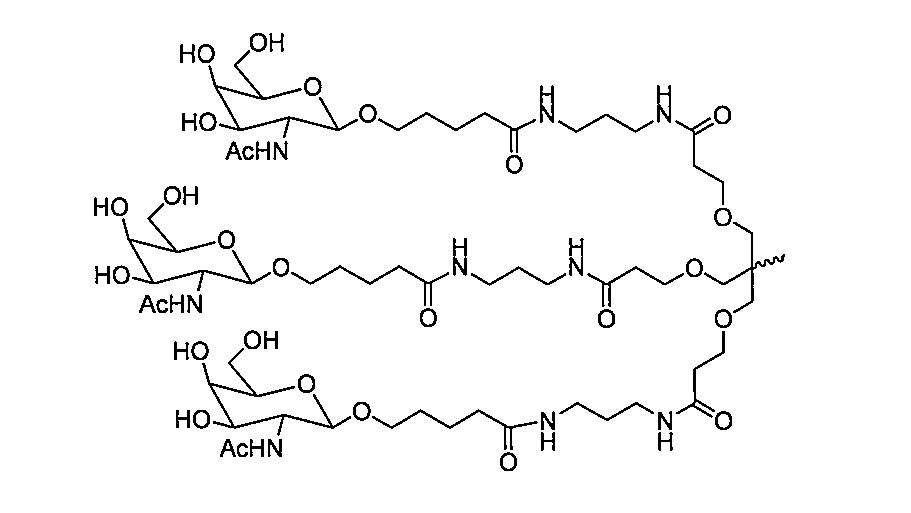
一実施形態では、RNAi薬剤は、以下の概略図に示されるとおりリガンドとコンジュゲートし、

一実施形態では、XはOである。 In one embodiment, X is O.
一実施形態では、相補性の領域は、5’-UUGAAGUAAAUGGUGUUAACCAG-3’(配列番号15)のヌクレオチド配列からなる。 In one embodiment, the region of complementarity consists of the nucleotide sequence 5'-UUGAAGUAAAUGGUGUUAACCAG-3' (SEQ ID NO: 15).
一実施形態では、二本鎖RNAi薬剤は、5’-GGUUAACACCAUUUACUUCAA-3’(配列番号16)のヌクレオチド配列を含むセンス鎖、および5’-UUGAAGUAAAUGGUGUUAACCAG-3’(配列番号15)のヌクレオチド配列を含むアンチセンス鎖を含む。 In one embodiment, the double-stranded RNAi agent comprises a sense strand comprising the nucleotide sequence 5'-GGUUAACACCAUUUACUUCAA-3' (SEQ ID NO: 16) and an antisense strand comprising the nucleotide sequence 5'-UUGAAGUAAAUGGUGUUAACCAG-3' (SEQ ID NO: 15).
一実施形態では、センス鎖は、5’-GfsgsUfuAfaCfaCfCfAfuUfuAfcUfuCfaAf-3’(配列番号13)を含み、アンチセンス鎖は、5’-usUfsgAfaGfuAfaAfuggUfgUfuAfaCfcsasg-3’(配列番号14)を含み、A、C、G、およびUはリボースA、C、GまたはUであり;a、c、g、およびuは2’-O-メチル(2’-OMe)A、C、G、またはUであり;Af、Cf、GfまたはUfは2’-フルオロA、C、GまたはUであり;sはホスホロチオエート連結である。 In one embodiment, the sense strand comprises 5'-GfsgsUfuAfaCfaCfCfAfuUfuAfcUfuCfaAf-3' (SEQ ID NO: 13) and the antisense strand comprises 5'-usUfsgAfaGfuAfaAfuggUfgUfuAfaCfcsasg-3' (SEQ ID NO: 14), where A, C, G, and U are ribose A, C, G, or U; a, c, g, and u are 2'-O-methyl (2'-OMe) A, C, G, or U; Af, Cf, Gf, or Uf are 2'-fluoro A, C, G, or U; and s is a phosphorothioate linkage.
一実施形態では、センス鎖は、5’-GfsgsUfuAfaCfaCfCfAfuUfuAfcUfuCfaAf-3’(配列番号13)を含み、アンチセンス鎖は、5’-usUfsgAfaGfuAfaAfuggUfgUfuAfaCfcsasg-3’(配列番号14)を含み、A、C、G、およびUはリボースA、C、GまたはUであり;a、c、g、およびuは2’-O-メチル(2’-OMe)A、C、G、またはUであり;Af、Cf、GfまたはUfは2’-フルオロA、C、GまたはUであり;sはホスホロチオエート連結であり;センス鎖は、以下の概略図に示されるとおりリガンドとコンジュゲートし、

一実施形態では、薬剤は、医薬組成物として投与される。一実施形態では、食塩水または水などの非緩衝液中のRNAi薬剤が投与される。 In one embodiment, the agent is administered as a pharmaceutical composition. In one embodiment, the RNAi agent is administered in a non-buffered solution, such as saline or water.
別の実施形態では、siRNAは、酢酸塩、クエン酸塩、プロラミン、炭酸塩、もしくはリン酸塩またはそれらの任意の組み合わせを含む緩衝液などの緩衝液とともに投与される。一実施形態では、緩衝液は、リン酸緩衝食塩水(PBS)である。 In another embodiment, the siRNA is administered with a buffer, such as a buffer containing acetate, citrate, prolamine, carbonate, or phosphate, or any combination thereof. In one embodiment, the buffer is phosphate buffered saline (PBS).
別の態様では、本発明は、本発明の方法を実行するためのキットを提供する。キットは、本発明のRNAi薬剤と、使用のための説明書と、場合により、RNAi薬剤を対象に投与するための手段とを含む場合もある。 In another aspect, the invention provides a kit for carrying out the method of the invention. The kit may include an RNAi agent of the invention, instructions for use, and, optionally, a means for administering the RNAi agent to a subject.
一態様では、本発明は、対象におけるSerpinc1の発現を阻害する方法を提供する。方法は、約40mgから約90mgの固定用量の二本鎖リボ核酸(RNAi)薬剤を対象に投与することを含み、二本鎖RNAi薬剤は、センス鎖およびアンチセンス鎖を含み、アンチセンス鎖は5’-UUGAAGUAAAUGGUGUUAACCAG-3’(配列番号15)のヌクレオチド配列と3ヌクレオチドを超えずに異なる少なくとも15の連続するヌクレオチドを含む相補性の領域を含み、センス鎖の実質的にすべてのヌクレオチドおよびアンチセンス鎖の実質的にすべてのヌクレオチドは修飾ヌクレオチドであり、二本鎖RNAi薬剤はリガンドを含み、例えば、二本鎖RNAi薬剤のセンス鎖はセンス鎖の3’末端で結合するリガンドとコンジュゲートしている。 In one aspect, the invention provides a method of inhibiting expression of Serpincl in a subject. The method includes administering to the subject a fixed dose of about 40 mg to about 90 mg of a double-stranded ribonucleic acid (RNAi) agent, the double-stranded RNAi agent including a sense strand and an antisense strand, the antisense strand including a region of complementarity including at least 15 contiguous nucleotides that differ by no more than 3 nucleotides from the nucleotide sequence 5'-UUGAAGUAAAUGGUGUUAACCAG-3' (SEQ ID NO: 15), substantially all of the nucleotides of the sense strand and substantially all of the nucleotides of the antisense strand are modified nucleotides, and the double-stranded RNAi agent includes a ligand, e.g., the sense strand of the double-stranded RNAi agent is conjugated to a ligand that is attached at the 3' end of the sense strand.
別の態様では、本発明は、対象におけるSerpinc1の発現を阻害する方法を提供する。方法は、約40mgから約90mgの固定用量の二本鎖リボ核酸(RNAi)薬剤を対象に投与することを含み、二本鎖RNAi薬剤は、センス鎖およびアンチセンス鎖を含み、アンチセンス鎖は5’-UUGAAGUAAAUGGUGUUAACCAG-3’(配列番号15)のヌクレオチド配列と3ヌクレオチドを超えずに異なる少なくとも15の連続するヌクレオチドを含む相補性の領域を含み、センス鎖の実質的にすべてのヌクレオチドおよびアンチセンス鎖の実質的にすべてのヌクレオチドは修飾ヌクレオチドであり、二本鎖RNAi薬剤はリガンドを含み、例えば、二本鎖RNAi薬剤のセンス鎖はセンス鎖の3’末端で結合するリガンドとコンジュゲートしている。 In another aspect, the invention provides a method of inhibiting expression of Serpincl in a subject. The method includes administering to the subject a fixed dose of about 40 mg to about 90 mg of a double-stranded ribonucleic acid (RNAi) agent, the double-stranded RNAi agent comprising a sense strand and an antisense strand, the antisense strand comprising a region of complementarity comprising at least 15 contiguous nucleotides that differ by no more than 3 nucleotides from the nucleotide sequence 5'-UUGAAGUAAAUGGUGUUAACCAG-3' (SEQ ID NO: 15), substantially all of the nucleotides of the sense strand and substantially all of the nucleotides of the antisense strand are modified nucleotides, and the double-stranded RNAi agent comprises a ligand, e.g., the sense strand of the double-stranded RNAi agent is conjugated to a ligand that is attached at the 3' end of the sense strand.
二本鎖RNAi薬剤は、2回またはそれ以上の用量で対象に投与することができる。 The double-stranded RNAi agent can be administered to the subject in two or more doses.
いくつかの実施形態では、二本鎖RNAi薬剤は、対象に月に1回、5週毎に1回、6
週毎に1回、7週毎に1回、2カ月毎に1回、四半期に1回、または必要に応じて投与される。
In some embodiments, the double stranded RNAi agent is administered to the subject once a month, once every 5 weeks, once every 6 weeks,
It is administered once weekly, once every seven weeks, once every two months, once quarterly, or as needed.
一実施形態では、二本鎖RNAi薬剤は、対象に月に1回投与される。別の実施形態では、二本鎖RNAi薬剤は、対象に6週毎に1回投与される。一実施形態では、二本鎖RNAi薬剤は、対象に2カ月毎に1回投与される。さらに別の実施形態では、二本鎖RNAi薬剤は、対象に四半期に1回投与される。 In one embodiment, the double-stranded RNAi agent is administered to the subject once a month. In another embodiment, the double-stranded RNAi agent is administered to the subject once every six weeks. In one embodiment, the double-stranded RNAi agent is administered to the subject once every two months. In yet another embodiment, the double-stranded RNAi agent is administered to the subject once a quarter.
二本鎖RNAi薬剤は、例えば、約50mgから約90mgの間、約50mgから約85mgの間、約50mgから約80mgの間、約40mgから約80mgの間、約60mgから約90mgの間、約25mgから約55mgの間、約25mgから約65mgの間、約40mgから約85mgの間、約40mgから約75mgの間、約40mgから約65mgの間、または約40mgから約55mgの間の固定用量として対象に投与することができる。 The double-stranded RNAi agent can be administered to a subject as a fixed dose, e.g., between about 50 mg and about 90 mg, between about 50 mg and about 85 mg, between about 50 mg and about 80 mg, between about 40 mg and about 80 mg, between about 60 mg and about 90 mg, between about 25 mg and about 55 mg, between about 25 mg and about 65 mg, between about 40 mg and about 85 mg, between about 40 mg and about 75 mg, between about 40 mg and about 65 mg, or between about 40 mg and about 55 mg.
いくつかの実施形態では、二本鎖RNAi薬剤は、約40mg、約45mg、約50mg、約55mg、約60mg、約65mg、約70mg、約75mg、約80mg、約85mg、または約90mgの固定用量として投与することができる。 In some embodiments, the double-stranded RNAi agent can be administered as a fixed dose of about 40 mg, about 45 mg, about 50 mg, about 55 mg, about 60 mg, about 65 mg, about 70 mg, about 75 mg, about 80 mg, about 85 mg, or about 90 mg.
いくつかの実施形態では、二本鎖RNAi薬剤は、約40mgの固定用量として;または約50mgの固定用量として;または約80mgの固定用量として;または約90mgの固定用量として対象に投与される。 In some embodiments, the double-stranded RNAi agent is administered to the subject as a fixed dose of about 40 mg; or as a fixed dose of about 50 mg; or as a fixed dose of about 80 mg; or as a fixed dose of about 90 mg.
一実施形態では、二本鎖RNAi薬剤は、対象に皮下投与される。 In one embodiment, the double-stranded RNAi agent is administered subcutaneously to the subject.
一実施形態では、二本鎖RNAi薬剤のその用量の対象への投与は、対象におけるSerpinc1活性を約70%から約95%低下させる。 In one embodiment, administration of that dose of the double-stranded RNAi agent to a subject reduces Serpincl activity in the subject by about 70% to about 95%.
一実施形態では、対象はヒトである。 In one embodiment, the subject is a human.
一実施形態では、対象は、Serpinc1発現の低下から利益を得るであろう障害を有する。障害は、後天性出血障害または遺伝性出血障害、例えば、血友病、例えば、血友病A、血友病B、もしくは血友病Cなどの出血障害である場合もある。 In one embodiment, the subject has a disorder that would benefit from reduced Serpincl expression. The disorder may be a bleeding disorder, such as an acquired or inherited bleeding disorder, e.g., a hemophilia, e.g., hemophilia A, hemophilia B, or hemophilia C.
一実施形態では、対象は、血友病Aを有し、インヒビター対象である。別の実施形態では、対象は、血友病Bを有し、インヒビター対象である。さらに別の実施形態では、対象は、血友病Cを有し、インヒビター対象である。 In one embodiment, the subject has hemophilia A and is an inhibitor subject. In another embodiment, the subject has hemophilia B and is an inhibitor subject. In yet another embodiment, the subject has hemophilia C and is an inhibitor subject.
別の実施形態では、二本鎖RNAi薬剤のその用量の対象への投与は、Serpinc1発現の低下から利益を得るであろう障害を有していない対象におけるピークトロンビンレベルの範囲内に、対象におけるピークトロンビンレベルを増大させる。 In another embodiment, administration of the dose of the double-stranded RNAi agent to the subject increases peak thrombin levels in the subject to within the range of peak thrombin levels in subjects without the disorder that would benefit from reduced Serpinc1 expression.
一実施形態では、二本鎖RNAi薬剤のその用量の対象への投与は、対象におけるピークトロンビン形成レベルを、対象への第VIII因子の投与によって達成されるのとほぼ同じレベルにするのに十分である。 In one embodiment, administration of the dose of the double-stranded RNAi agent to a subject is sufficient to achieve peak thrombin formation levels in the subject at approximately the same level as that achieved by administration of factor VIII to the subject.
別の実施形態では、二本鎖RNAi薬剤のその用量の対象への投与は、対象において約40%を超えるピークトロンビン形成レベルを達成するのに十分である。 In another embodiment, administration of the dose of the double-stranded RNAi agent to the subject is sufficient to achieve a peak thrombin formation level of greater than about 40% in the subject.
さらに別の実施形態では、二本鎖RNAi薬剤のその用量の対象への投与は、Serp
inc1発現の低下から利益を得るであろう障害を有する、二本鎖RNAi薬剤を投与されていない対象の過去のオンデマンド年間出血率(ABR)中央値と比較した場合に、対象のABRを約80から約95%低下させる。
In yet another embodiment, administration of the dose of the double stranded RNAi agent to the subject comprises administering to the subject a Serp
The subject's on-demand annualized bleeding rate (ABR) is reduced by about 80 to about 95% when compared to the median historical ABR of subjects not administered the double-stranded RNAi agent who have a disorder that would benefit from reduced inc1 expression.
一実施形態では、二本鎖RNAi薬剤は、酢酸塩、クエン酸塩、プロラミン、炭酸塩、もしくはリン酸塩またはそれらの任意の組み合わせを含む緩衝液などの緩衝液とともに投与される。一実施形態では、緩衝液は、リン酸緩衝食塩水(PBS)である。 In one embodiment, the double-stranded RNAi agent is administered with a buffer, such as a buffer containing acetate, citrate, prolamine, carbonate, or phosphate, or any combination thereof. In one embodiment, the buffer is phosphate buffered saline (PBS).
一実施形態では、二本鎖RNAi薬剤は、対象に皮下投与される。 In one embodiment, the double-stranded RNAi agent is administered subcutaneously to the subject.
一実施形態では、センス鎖のすべてのヌクレオチドおよびアンチセンス鎖のすべてのヌクレオチドは、修飾ヌクレオチドである。 In one embodiment, all nucleotides in the sense strand and all nucleotides in the antisense strand are modified nucleotides.
一実施形態では、修飾ヌクレオチドは、2’-デオキシ-2’-フルオロ修飾ヌクレオチド、2’-デオキシ修飾ヌクレオチド、ロックドヌクレオチド、脱塩基ヌクレオチド、2’-アミノ修飾ヌクレオチド、2’-アルキル修飾ヌクレオチド、モルホリノヌクレオチド、ホスホルアミデート、およびヌクレオチドを含む非天然塩基からなる群から独立して選択される。 In one embodiment, the modified nucleotides are independently selected from the group consisting of 2'-deoxy-2'-fluoro modified nucleotides, 2'-deoxy modified nucleotides, locked nucleotides, abasic nucleotides, 2'-amino modified nucleotides, 2'-alkyl modified nucleotides, morpholino nucleotides, phosphoramidates, and non-natural base containing nucleotides.
相補性の領域は、少なくとも17ヌクレオチド長または19ヌクレオチド長である場合もある。 The region of complementarity may be at least 17 or 19 nucleotides in length.
一実施形態では、相補性の領域は、19から21の間のヌクレオチド長である。別の実施形態では、相補性の領域は、21から23の間のヌクレオチド長である。 In one embodiment, the region of complementarity is between 19 and 21 nucleotides in length. In another embodiment, the region of complementarity is between 21 and 23 nucleotides in length.
一実施形態では、それぞれの鎖は、30ヌクレオチド長を超えない。 In one embodiment, each strand is no more than 30 nucleotides in length.
二本鎖RNAi薬剤の少なくとも1つの鎖は、少なくとも1ヌクレオチドの3’オーバーハングまたは少なくとも2ヌクレオチド、例えば、2、3、4、5、6、7、9、10、11、12、13、14、もしくは15ヌクレオチドの3’オーバーハングを含む場合もある。他の実施形態では、RNAi薬剤の少なくとも1つの鎖は、少なくとも1ヌクレオチドの5’オーバーハングを含む。特定の実施形態では、少なくとも1つの鎖は、少なくとも2ヌクレオチド、例えば、2、3、4、5、6、7、9、10、11、12、13、14、または15ヌクレオチドの5’オーバーハングを含む。さらに別の実施形態では、RNAi薬剤の一方の鎖の3’および5’末端の両方は、少なくとも1ヌクレオチドのオーバーハングを含む。 At least one strand of the double stranded RNAi agent may include a 3' overhang of at least 1 nucleotide or a 3' overhang of at least 2 nucleotides, e.g., 2, 3, 4, 5, 6, 7, 9, 10, 11, 12, 13, 14, or 15 nucleotides. In other embodiments, at least one strand of the RNAi agent includes a 5' overhang of at least 1 nucleotide. In certain embodiments, at least one strand includes a 5' overhang of at least 2 nucleotides, e.g., 2, 3, 4, 5, 6, 7, 9, 10, 11, 12, 13, 14, or 15 nucleotides. In yet another embodiment, both the 3' and 5' ends of one strand of the RNAi agent include an overhang of at least 1 nucleotide.
特定の実施形態では、リガンドは、N-アセチルガラクトサミン(GalNAc)である。リガンドは、一価、二価、または三価の分岐リンカーを介してRNAi薬剤と結合した1つまたはそれ以上のGalNAcである場合もある。リガンドは、二本鎖RNAi薬剤のセンス鎖の3’末端、二本鎖RNAi薬剤のセンス鎖の5’末端、二本鎖RNAi薬剤のアンチセンス鎖の3’末端、または二本鎖RNAi薬剤のアンチセンス鎖の5’末端とコンジュゲートしている場合もある。 In certain embodiments, the ligand is N-acetylgalactosamine (GalNAc). The ligand may be one or more GalNAcs attached to the RNAi agent via a monovalent, divalent, or trivalent branched linker. The ligand may be conjugated to the 3' end of the sense strand of the double-stranded RNAi agent, the 5' end of the sense strand of the double-stranded RNAi agent, the 3' end of the antisense strand of the double-stranded RNAi agent, or the 5' end of the antisense strand of the double-stranded RNAi agent.
いくつかの実施形態では、本発明の二本鎖RNAi薬剤は、それぞれが独立して複数の一価のリンカーを介して二本鎖RNAi薬剤の複数のヌクレオチドに結合した複数、例えば、2、3、4、5、または6つのGalNAcを含む。 In some embodiments, the double-stranded RNAi agents of the invention include multiple, e.g., 2, 3, 4, 5, or 6, GalNAc, each independently linked to multiple nucleotides of the double-stranded RNAi agent via multiple monovalent linkers.
特定の実施形態では、リガンドは、以下のものである。

一実施形態では、RNAi薬剤は、以下の概略図に示されるとおりリガンドとコンジュゲートし、

一実施形態では、XはOである。 In one embodiment, X is O.
一実施形態では、相補性の領域は、5’-UUGAAGUAAAUGGUGUUAACCAG-3’(配列番号15)のヌクレオチド配列からなる。 In one embodiment, the region of complementarity consists of the nucleotide sequence 5'-UUGAAGUAAAUGGUGUUAACCAG-3' (SEQ ID NO: 15).
一実施形態では、二本鎖RNAi薬剤は、5’-GGUUAACACCAUUUACUUCAA-3’(配列番号16)のヌクレオチド配列を含むセンス鎖、および5’-UUGAAGUAAAUGGUGUUAACCAG-3’(配列番号15)のヌクレオチド配列を含むアンチセンス鎖を含む。 In one embodiment, the double-stranded RNAi agent comprises a sense strand comprising the nucleotide sequence 5'-GGUUAACACCAUUUACUUCAA-3' (SEQ ID NO: 16) and an antisense strand comprising the nucleotide sequence 5'-UUGAAGUAAAUGGUGUUAACCAG-3' (SEQ ID NO: 15).
一実施形態では、センス鎖は、5’-GfsgsUfuAfaCfaCfCfAfuUfuAfcUfuCfaAf-3’(配列番号13)を含み、アンチセンス鎖は、5’-usUfsgAfaGfuAfaAfuggUfgUfuAfaCfcsasg-3’(配列番号14)を含み、A、C、G、およびUはリボースA、C、GまたはUであり;a、c、g、およびuは2’-O-メチル(2’-OMe)A、C、G、またはUであり;Af、Cf、GfまたはUfは2’-フルオロA、C、GまたはUであり;sはホスホロチオエート連結である。 In one embodiment, the sense strand comprises 5'-GfsgsUfuAfaCfaCfCfAfuUfuAfcUfuCfaAf-3' (SEQ ID NO: 13) and the antisense strand comprises 5'-usUfsgAfaGfuAfaAfuggUfgUfuAfaCfcsasg-3' (SEQ ID NO: 14), where A, C, G, and U are ribose A, C, G, or U; a, c, g, and u are 2'-O-methyl (2'-OMe) A, C, G, or U; Af, Cf, Gf, or Uf are 2'-fluoro A, C, G, or U; and s is a phosphorothioate linkage.
一実施形態では、センス鎖は、5’-GfsgsUfuAfaCfaCfCfAfuUfuAfcUfuCfaAf-3’(配列番号13)を含み、アンチセンス鎖は、5’-usUfsgAfaGfuAfaAfuggUfgUfuAfaCfcsasg-3’(配列番号14)を含み、A、C、G、およびUはリボースA、C、GまたはUであり;a、c、g、およびuは2’-O-メチル(2’-OMe)A、C、G、またはUであり;Af、Cf、GfまたはUfは2’-フルオロA、C、GまたはUであり;sはホスホロチオエート連結であり;センス鎖は、以下の概略図に示されるとおりリガンドとコンジュゲートし、

一実施形態では、薬剤は、医薬組成物として投与される。一実施形態では、食塩水または水などの非緩衝液中のRNAi薬剤が投与される。 In one embodiment, the agent is administered as a pharmaceutical composition. In one embodiment, the RNAi agent is administered in a non-buffered solution, such as saline or water.
別の実施形態では、siRNAは、酢酸塩、クエン酸塩、プロラミン、炭酸塩、もしくはリン酸塩またはそれらの任意の組み合わせを含む緩衝液などの緩衝液とともに投与される。一実施形態では、緩衝液は、リン酸緩衝食塩水(PBS)である。 In another embodiment, the siRNA is administered with a buffer, such as a buffer containing acetate, citrate, prolamine, carbonate, or phosphate, or any combination thereof. In one embodiment, the buffer is phosphate buffered saline (PBS).
別の態様では、本発明は、本発明の方法を実行するためのキットを提供する。キットは、本発明のRNAi薬剤と、使用のための説明書と、場合により、RNAi薬剤を対象に投与するための手段とを含む場合もある。 In another aspect, the invention provides a kit for carrying out the method of the invention. The kit may include an RNAi agent of the invention, instructions for use, and, optionally, a means for administering the RNAi agent to a subject.
本発明は、特定の化学修飾を含む非常に低用量(例えば、当該技術分野において教示されている用量よりも少なくとも約30倍低い用量)のGalNAc結合二本鎖RNAi薬剤がSerpinc1の発現を阻害する並外れた効力、ならびにSerpinc1発現の阻害の並外れた持続時間を示すという驚くべき発見に少なくとも部分的に基づくものであ
る。具体的には、GalNAcリガンドを含み、ヌクレオチドの実質的にすべてが修飾ヌクレオチドである低用量のRNAi薬剤、例えば、薬剤の切断部位もしくはその付近の1つのモチーフを含む、3つの連続的なヌクレオチドにある3つの同一の修飾の1つまたはそれ以上のモチーフ、6つのホスホロチオエート連結、およびGalNAcリガンドを含むRNAi薬剤は、本明細書においてSerpinc1遺伝子の活性のサイレンシングにおいて並外れて効果的で長続きすることが示されている。
The present invention is based at least in part on the surprising discovery that very low doses (e.g., at least about 30-fold lower than the doses taught in the art) of GalNAc-linked double-stranded RNAi agents containing specific chemical modifications exhibit exceptional potency in inhibiting the expression of Serpincl, as well as exceptional duration of inhibition of Serpincl expression.Specifically, low doses of RNAi agents containing GalNAc ligands and substantially all of the nucleotides are modified nucleotides, for example, RNAi agents containing one or more motifs of three identical modifications at three consecutive nucleotides, including one motif at or near the cleavage site of the agent, six phosphorothioate linkages, and a GalNAc ligand, are shown herein to be exceptionally effective and long-lasting in silencing the activity of Serpincl gene.
したがって、本発明は、Serpinc1遺伝子のRNA転写物のRNA誘導サイレンシング複合体(RISC)が関係する切断を引き起こすiRNA組成物を使用した、Serpinc1遺伝子の発現を阻害するか、または低下させることから利益を得るであろう障害、例えば、血友病(例えば、血友病A、血友病B、もしくは血友病C)などのSerpinc1関連疾患を有する対象の少なくとも1つの症状、例えば、出血を予防するための方法を提供する。本発明はさらに、Serpinc1遺伝子のRNA転写物のRNA誘導サイレンシング複合体(RISC)が関係する切断を引き起こすiRNA組成物を使用した、Serpinc1遺伝子の発現を阻害するまたは低下させることから利益を得るであろう障害、例えば、血友病(例えば、血友病A、血友病B、もしくは血友病C)などの出血障害を有する対象を処置する方法を提供する。 Thus, the present invention provides a method for preventing at least one symptom, e.g., bleeding, in a subject having a disorder that would benefit from inhibiting or reducing expression of the Serpinc1 gene, e.g., a Serpinc1-associated disease, such as hemophilia (e.g., hemophilia A, hemophilia B, or hemophilia C), using an iRNA composition that causes RNA-induced silencing complex (RISC)-mediated cleavage of an RNA transcript of the Serpinc1 gene. The present invention further provides a method for treating a subject having a disorder that would benefit from inhibiting or reducing expression of the Serpinc1 gene, e.g., a bleeding disorder, such as hemophilia (e.g., hemophilia A, hemophilia B, or hemophilia C), using an iRNA composition that causes RNA-induced silencing complex (RISC)-mediated cleavage of an RNA transcript of the Serpinc1 gene.
本発明の方法に使用するためのiRNA薬剤は、一般に約30ヌクレオチド長またはそれ以下、例えば、15~30、15~29、15~28、15~27、15~26、15~25、15~24、15~23、15~22、15~21、15~20、15~19、15~18、15~17、18~30、18~29、18~28、18~27、18~26、18~25、18~24、18~23、18~22、18~21、18~20、19~30、19~29、19~28、19~27、19~26、19~25、19~24、19~23、19~22、19~21、19~20、20~30、20~29、20~28、20~27、20~26、20~25、20~24,20~23、20~22、20~21、21~30、21~29、21~28、21~27、21~26、21~25、21~24、21~23、または21~22ヌクレオチド長の領域を有するRNA鎖(アンチセンス鎖)を含み、この領域は、Serpinc1遺伝子のmRNA転写物の少なくとも一部と実質的に相補的である。 iRNA agents for use in the methods of the invention are generally about 30 nucleotides in length or less, e.g., 15-30, 15-29, 15-28, 15-27, 15-26, 15-25, 15-24, 15-23, 15-22, 15-21, 15-20, 15-19, 15-18, 15-17, 18-30, 18-29, 18-28, 18-27, 18-26, 18-25, 18-24, 18-23, 18-22, 18-21, 18-20, 19-30, 19-29, 19-28, 19-27, 19-26, 1 The RNA strand (antisense strand) has a region of 9-25, 19-24, 19-23, 19-22, 19-21, 19-20, 20-30, 20-29, 20-28, 20-27, 20-26, 20-25, 20-24, 20-23, 20-22, 20-21, 21-30, 21-29, 21-28, 21-27, 21-26, 21-25, 21-24, 21-23, or 21-22 nucleotides in length, which region is substantially complementary to at least a portion of the mRNA transcript of the Serpincl gene.
他の実施形態では、本発明の二本鎖RNAi薬剤の一方または両方の鎖は、最大66ヌクレオチド長、例えば、36~66、26~36、25~36、31~60、22~43、27~53ヌクレオチド長であり、Serpinc1遺伝子のmRNA転写物の少なくとも一部と実質的に相補的な少なくとも19の連続するヌクレオチドの領域を有する。いくつかの実施形態では、センス鎖およびアンチセンス鎖は、18~30の連続するヌクレオチドの二重鎖を形成する。 In other embodiments, one or both strands of the double-stranded RNAi agents of the invention are up to 66 nucleotides in length, e.g., 36-66, 26-36, 25-36, 31-60, 22-43, 27-53 nucleotides in length, and have a region of at least 19 contiguous nucleotides that are substantially complementary to at least a portion of an mRNA transcript of the Serpincl gene. In some embodiments, the sense and antisense strands form a duplex of 18-30 contiguous nucleotides.
いくつかの実施形態では、本発明の方法に使用するためのiRNA薬剤は、最大66ヌクレオチド長、例えば、36~66、26~36、25~36、31~60、22~43、27~53ヌクレオチド長が可能であり、Serpinc1遺伝子のmRNA転写物の少なくとも一部と実質的に相補的な少なくとも19の連続するヌクレオチドの領域を有するRNA鎖(アンチセンス鎖)を含む。いくつかの実施形態では、より長い長さのアンチセンス鎖を有するそのようなiRNA薬剤は20~60ヌクレオチド長の第2のRNA鎖(センス鎖)を含む場合もあり、センス鎖およびアンチセンス鎖は、18~30の連続するヌクレオチドの二重鎖を形成する。 In some embodiments, an iRNA agent for use in the methods of the invention includes an RNA strand (antisense strand) that can be up to 66 nucleotides in length, e.g., 36-66, 26-36, 25-36, 31-60, 22-43, 27-53 nucleotides in length, and has a region of at least 19 contiguous nucleotides that is substantially complementary to at least a portion of an mRNA transcript of the Serpincl gene. In some embodiments, such an iRNA agent with a longer length antisense strand can also include a second RNA strand (sense strand) that is 20-60 nucleotides in length, where the sense and antisense strands form a duplex of 18-30 contiguous nucleotides.
以下の詳細な説明は、Serpinc1遺伝子の発現を阻害するためのiRNAを含む組成物の生成および使用の仕方、ならびにこの遺伝子の発現の阻害および/または低下から利益を得るであろう疾患ならびに障害を有する対象を処置するための組成物、使用、な
らびに方法を開示する。
The following detailed description discloses how to make and use compositions comprising iRNA to inhibit expression of the Serpincl gene, as well as compositions, uses, and methods for treating subjects with diseases and disorders that would benefit from inhibition and/or reduction of expression of this gene.
I.定義
本発明をより容易に理解できるように、特定の用語をまず定義する。さらに、パラメーターの値または値の範囲が挙げられる場合はいつでも、挙げられた値の中間の値および範囲も本発明の一部であることが意図されることに留意すべきである。
I. Definitions So that the present invention may be more readily understood, certain terms are first defined. Furthermore, it should be noted that whenever a value or range of values for a parameter is recited, it is intended that intermediate values and ranges of the recited values are also part of the invention.
冠詞「1つの(aおよびan)」は、1つまたは2つ以上(すなわち、少なくとも1つ)の冠詞の文法的対象物を指すよう本明細書中で使用される。例として、「1つの要素(an element)」は、1つの要素または2つ以上の要素、例えば、複数の要素を意味する。 The articles "a" and "an" are used herein to refer to one or to more than one (i.e., to at least one) of the grammatical object of the article. By way of example, "an element" means one element or more than one element, e.g., a plurality of elements.
「含むこと」という用語は、「含むが、それらに限定されるものではない」という語句を意味して本明細書中で使用され、それと同義に使用される。 The term "including" is used herein to mean, and is used interchangeably with, the phrase "including but not limited to."
「または」という用語は、文脈が明らかに別のことを示さない限り、「および/または」という用語を意味して本明細書中で使用され、それと同義に使用される。 The term "or" is used herein to mean, and is used interchangeably with, the term "and/or," unless context clearly indicates otherwise.
本明細書中で使用される場合、「Serpinc1」とは、細胞で発現する特定のポリペプチドを指す。Serpinc1は、セルピンペプチダーゼインヒビター、クレードC(アンチトロンビン;AT)、メンバー1;アンチトロンビンIII;AT3;アンチトロンビン;およびヘパリン補因子1としても知られている。ヒトSerpinc1 mRNA転写物の配列は、例えば、GenBank受託番号GI:254588059(NM_000488;配列番号1)に見出すことができる。アカゲザルSerpinc1 mRNAの配列は、例えば、GenBank受託番号GI:157167169(NM_001104583;配列番号2)に見出すことができる。マウスSerpinc1 mRNAの配列は、例えば、GenBank受託番号GI:237874216(NM_080844;配列番号3)に見出すことができる。ラットSerpinc1 mRNAの配列は、例えば、GenBank受託番号GI:58865629(NM_001012027;配列番号4)に見出すことができる。
As used herein, "Serpinc1" refers to a specific polypeptide expressed in cells. Serpinc1 is also known as serpin peptidase inhibitor, clade C (antithrombin; AT),
「Serpinc1」という用語はまた、本明細書中で使用される場合、Serpinc1遺伝子の一塩基多型などのSerpinc1遺伝子の天然に生じるDNA配列多様性により細胞で発現する特定のポリペプチドも指す。Serpinc1遺伝子内の数々のSNPが特定され、例えば、NCBI dbSNP(例えば、www.ncbi.nlm.nih.gov/snpを参照)に見出すことができる。Serpinc1遺伝子内のSNPの非限定例は、NCBI dbSNP受託番号rs677;rs5877;rs5878;rs5879;rs941988;rs941989;rs1799876;rs19637711;rs2008946;およびrs2227586に見出すことができる。 The term "Serpincl" as used herein also refers to a particular polypeptide expressed in a cell due to naturally occurring DNA sequence variations in the Serpincl gene, such as single nucleotide polymorphisms in the Serpincl gene. Numerous SNPs within the Serpincl gene have been identified and can be found, for example, in NCBI dbSNP (see, for example, www.ncbi.nlm.nih.gov/snp). Non-limiting examples of SNPs within the Serpincl gene can be found in NCBI dbSNP Accession Nos. rs677; rs5877; rs5878; rs5879; rs941988; rs941989; rs1799876; rs19637711; rs2008946; and rs2227586.
本明細書中で使用される場合、「対象」は、霊長類(ヒト、非ヒト霊長類、例えば、サル、およびチンパンジーなど)、非霊長類(雌ウシ、ブタ、ラクダ、ラマ、ウマ、ヤギ、ウサギ、ヒツジ、ハムスター、テンジクネズミ、ネコ、イヌ、ラット、マウス、およびクジラなど)を含む哺乳動物、または鳥(例えば、カモもしくはガチョウ)などの動物である。一実施形態では、対象は、本明細書に記載されるSerpinc1発現の低下から利益を得るであろう疾患、障害もしくは状態に対して処置もしくは評価されるヒト;Serpinc1発現の低下から利益を得るであろう疾患、障害もしくは状態のリスクがあるヒト;Serpinc1発現の低下から利益を得るであろう疾患、障害もしくは状態を有するヒト;および/またはSerpinc1発現の低下から利益を得るであろう疾患、障害
もしくは状態に対して処置されるヒトなどのヒトである。
As used herein, a "subject" is an animal, such as a mammal, including a primate (such as a human, a non-human primate, e.g., monkey, and chimpanzee), a non-primate (such as a cow, pig, camel, llama, horse, goat, rabbit, sheep, hamster, guinea pig, cat, dog, rat, mouse, and whale), or a bird (e.g., a duck or goose). In one embodiment, the subject is a human, such as a human being treated or evaluated for a disease, disorder, or condition that would benefit from reduced Serpincl expression as described herein; a human being at risk for a disease, disorder, or condition that would benefit from reduced Serpincl expression; a human having a disease, disorder, or condition that would benefit from reduced Serpincl expression; and/or a human being treated for a disease, disorder, or condition that would benefit from reduced Serpincl expression.
本明細書中で使用される場合、「処置すること」または「処置」という用語は、検知可能か、検知不能かにかかわらず、1つもしくはそれ以上の症状の軽減もしくは改善、出血の程度の減少、出血の安定化状態(すなわち、悪化しない)、出血の改善もしくは軽減が挙げられるが、それらに限定されるものではない有益なもしくは所望の結果を指す。「処置」はまた、処置をしない場合に予測される生存期間と比較した生存期間の延長を意味することがある。本発明の方法において、処置は、オンデマンドの処置および制御、出血の周術期管理および出血症状の頻度を低減するための通常の予防を含む。 As used herein, the term "treating" or "treatment" refers to a beneficial or desired result, including but not limited to, alleviation or amelioration of one or more symptoms, whether detectable or undetectable, reduction in the extent of bleeding, stabilization of bleeding (i.e., not worsening), amelioration or reduction of bleeding. "Treatment" may also mean an increase in survival compared to the expected survival in the absence of treatment. In the methods of the invention, treatment includes on-demand treatment and control, perioperative management of bleeding, and routine prophylaxis to reduce the frequency of bleeding episodes.
対象におけるSerpinc1または疾患のマーカーもしくは症状のレベルと関連した「低下させる」という用語は、そのようなレベルの統計学的に有意な低下を指す。低下は、例えば、少なくとも10%、少なくとも15%、少なくとも20%、少なくとも25%、少なくとも30%、少なくとも35%、少なくとも40%、少なくとも45%、少なくとも50%、少なくとも55%、少なくとも60%、少なくとも65%、少なくとも70%、少なくとも75%、少なくとも80%、少なくとも85%、少なくとも90%、少なくとも95%またはそれ以上である場合もあり、そのような障害のない個体の正常な範囲内と受け入れられるレベルまで下がっているのが好ましい。 The term "reduce" in relation to the level of Serpincl or a disease marker or symptom in a subject refers to a statistically significant reduction in such level. The reduction may be, for example, at least 10%, at least 15%, at least 20%, at least 25%, at least 30%, at least 35%, at least 40%, at least 45%, at least 50%, at least 55%, at least 60%, at least 65%, at least 70%, at least 75%, at least 80%, at least 85%, at least 90%, at least 95% or more, preferably to a level that is accepted as within the normal range for individuals without such disorder.
本明細書中で使用される場合、「予防」または「予防すること」とは、Serpinc1遺伝子の発現の低下から利益を得るであろうその疾患、障害もしくは状態に関して使用されるとき、対象が疾患、障害、または状態、例えば、出血などの症状などに関連する症状を発症する可能性の低下を指す。例えば、出血に対する1つまたはそれ以上のリスク因子を有する個体が同じリスク因子を有するが、本明細書において記載されるとおりの処置を受けていない集団と比較して、出血を起こさないか、または出血を起こすが重症度が低いかのいずれかの場合に、出血を起こす可能性が低下している。疾患、障害もしくは状態を発症しない、またはそのような疾患、障害もしくは状態と関連する症状の発症が(例えば、その疾患もしくは障害に対して臨床的に認められているスケールにおいて少なくとも約10%)低下する、または(例えば、何日、何週、何カ月または何年の)症状の遅延が示されると、有効な予防と考慮される。 As used herein, "prevention" or "preventing," when used in reference to a disease, disorder, or condition that would benefit from reduced expression of the Serpincl gene, refers to a reduction in the likelihood that a subject will develop symptoms associated with the disease, disorder, or condition, such as bleeding. For example, there is a reduced likelihood that an individual with one or more risk factors for bleeding will either not develop bleeding or will develop bleeding but with less severity, compared to a population with the same risk factors but not receiving treatment as described herein. Effective prevention is considered when a failure to develop a disease, disorder, or condition, or a reduction in the onset of symptoms associated with such disease, disorder, or condition (e.g., by at least about 10% on a clinically recognized scale for the disease or disorder), or a delay in symptoms (e.g., by days, weeks, months, or years) is demonstrated.
本明細書中で使用される場合、「出血障害」という用語は、不良な血液凝固および/または過剰な出血をもたらす疾患または障害である。出血障害は、血友病もしくはフォン・ヴィルブランド病などの遺伝性障害、または例えば、播種性血管内凝固、妊娠関連子癇、ビタミンK欠乏、自己免疫性障害、炎症性腸疾患、潰瘍性大腸炎、皮膚障害(例えば、乾癬、天疱瘡)、呼吸器疾患(例えば、喘息、慢性閉塞性肺疾患)、アレルギー性薬物反応、例えば、アスピリン、ヘパリン、およびワルファリンなどの薬剤の結果、糖尿病、急性B型肝炎感染症、急性C型肝炎感染症、悪性腫瘍もしくは固形腫瘍(例えば、前立腺、肺、結腸、膵臓、胃、胆管、頭頸部、頸部、乳房、メラノーマ、腎臓、および/もしくは血液悪性腫瘍)に関連する後天性障害である場合もある。一実施形態では、遺伝性出血障害は、血友病、例えば、血友病A、B、またはCである。一実施形態では、遺伝性出血障害、例えば、血友病を有する対象は、補充凝固療法に対してインヒビター、例えば、同種抗体インヒビターを持つようになっており、本明細書において「インヒビター対象」と称される。一実施形態では、インヒビター対象は、血友病Aを有する。別の実施形態では、インヒビター対象は、血友病Bを有する。さらに別の実施形態では、インヒビター対象は、血友病Cを有する。 As used herein, the term "bleeding disorder" refers to a disease or disorder that results in poor blood clotting and/or excessive bleeding. The bleeding disorder may be an inherited disorder, such as hemophilia or von Willebrand's disease, or an acquired disorder, such as disseminated intravascular coagulation, pregnancy-associated eclampsia, vitamin K deficiency, autoimmune disorders, inflammatory bowel disease, ulcerative colitis, skin disorders (e.g., psoriasis, pemphigus), respiratory diseases (e.g., asthma, chronic obstructive pulmonary disease), allergic drug reactions, such as the result of medications such as aspirin, heparin, and warfarin, diabetes, acute hepatitis B infection, acute hepatitis C infection, malignant or solid tumors (e.g., prostate, lung, colon, pancreas, stomach, bile duct, head and neck, cervical, breast, melanoma, kidney, and/or hematological malignancies). In one embodiment, the inherited bleeding disorder is hemophilia, such as hemophilia A, B, or C. In one embodiment, a subject with an inherited bleeding disorder, e.g., hemophilia, becomes afflicted with an inhibitor, e.g., an alloantibody inhibitor, to replacement coagulation therapy and is referred to herein as an "inhibitor subject." In one embodiment, the inhibitor subject has hemophilia A. In another embodiment, the inhibitor subject has hemophilia B. In yet another embodiment, the inhibitor subject has hemophilia C.
「治療有効量」は、本明細書中で使用される場合、出血障害および出血を有する対象に投与されたときに、(例えば、既存の疾患もしくは疾患の1つもしくはそれ以上の症状を低減、改善または維持することによって)疾患の処置をもたらすのに十分なRNAi薬剤
の量を含むことが意図される。「治療有効量」は、RNAi薬剤、どのように薬剤が投与されるか、疾患およびその重症度ならびに処置される対象の病歴、年齢、体重、家族歴、遺伝子構造、先行するもしくは併用の処置のタイプ、あれば、その他の個々の特性により変化する場合もある。
A "therapeutically effective amount," as used herein, is intended to include an amount of an RNAi agent that, when administered to a subject with a bleeding disorder and bleeding, is sufficient to effect treatment of the disease (e.g., by reducing, ameliorating, or maintaining an existing disease or one or more symptoms of the disease). A "therapeutically effective amount" may vary depending on the RNAi agent, how the agent is administered, the disease and its severity, as well as the medical history, age, weight, family history, genetic makeup, type of prior or concomitant treatment, if any, and other individual characteristics of the subject being treated.
「予防有効量」は、本明細書中で使用される場合、出血障害を有するが出血していない対象、例えば、出血障害を有し、手術が計画されている対象に投与されたときに(例えば、周術期処置)、疾患もしくは疾患の1つもしくはそれ以上の症状を予防または改善するのに十分なiRNAの量を含むことが意図される。疾患を改善することは、疾患の過程を遅らせること、または後に発症する疾患の重症度を低下させることを含む。「予防有効量」は、iRNA、どのように薬剤が投与されるか、疾患のリスクの程度、ならびに処置される患者の病歴、年齢、体重、家族歴、遺伝子構造、先行するもしくは併用の処置のタイプ、あれば、その他の個々の特性により変化する場合もある。 A "prophylactically effective amount," as used herein, is intended to include an amount of an iRNA sufficient to prevent or ameliorate a disease or one or more symptoms of a disease when administered to a subject who has a bleeding disorder but is not bleeding, e.g., a subject who has a bleeding disorder and is scheduled for surgery (e.g., perioperative treatment). Ameliorating a disease includes slowing the course of the disease or reducing the severity of a later-onset disease. A "prophylactically effective amount" may vary depending on the iRNA, how the agent is administered, the degree of risk of the disease, and the medical history, age, weight, family history, genetic makeup, type of prior or concomitant treatment, if any, and other individual characteristics of the patient being treated.
「治療有効量」または「予防有効量」はまた、任意の処置に対する妥当な利益/リスク比でいくらかの所望の局所的または全身的効果をもたらすRNAi薬剤の量を含む。本発明の方法に利用されるiRNAは、そのような処置に対して適切な妥当な利益/リスク比をもたらすのに十分な量で投与することができる。 A "therapeutically effective amount" or a "prophylactically effective amount" also includes an amount of an RNAi agent that provides some desired local or systemic effect at a reasonable benefit/risk ratio for any treatment. The iRNAs utilized in the methods of the invention can be administered in an amount sufficient to provide a reasonable benefit/risk ratio appropriate for such treatment.
「薬学的に許容される」という語句は、妥当な利益/リスク比に対応する、過度の毒性、刺激症状、アレルギー反応、またはその他の問題もしくは障害を伴わずに、適切な医学的判断の範囲内でヒト対象および動物対象の組織と接触する使用に適した化合物、材料、組成物、ならびに/または剤形を言及するために本明細書において利用される。 The phrase "pharmacologically acceptable" is used herein to refer to compounds, materials, compositions, and/or dosage forms that are suitable for use in contact with the tissues of human and animal subjects, within the scope of sound medical judgment, without undue toxicity, irritation, allergic response, or other problem or impairment, commensurate with a reasonable benefit/risk ratio.
「薬学的に許容される担体」という語句は、本明細書中で使用される場合、薬学的に許容される材料、組成物またはビヒクル、例えば、液体もしくは固体増量剤、希釈剤、賦形剤、製造助剤(例えば、滑沢剤、タルク、マグネシウム、カルシウムもしくは亜鉛、もしくはステアリン酸)、または1つの器官もしくは体の部分から別の器官、もしくは体の部分への対象化合物の運搬もしくは輸送に関与する材料を包む溶媒を意味する。それぞれの担体は、製剤の他の成分と適合し、処置される対象に有害でないという意味で「許容され」なければならない。薬学的に許容される担体として働くことができる材料のいくつかの例としては、(1)糖、例えば、ラクトース、グルコースおよびスクロース;(2)デンプン、例えば、トウモロコシデンプンおよびジャガイモデンプン;(3)セルロースおよびその誘導体、例えば、カルボキシメチルセルロースナトリウム、エチルセルロースおよび酢酸セルロース;(4)粉末トラガント;(5)麦芽;(6)ゼラチン;(7)滑沢剤、例えば、ステアリン酸マグネシウム、ラウリル硫酸ナトリウムおよびタルク;(8)賦形剤、例えば、カカオバターおよび座剤ワックス;(9)油、例えば、ピーナッツ油、綿実油、ベニバナ油、ゴマ油、オリーブ油、トウモロコシ油および大豆油;(10)グリコール、例えば、プロピレングリコール;(11)ポリオール、例えば、グリセリン、ソルビトール、マンニトールおよびポリエチレングリコール;(12)エステル、例えば、オレイン酸エチルおよびラウリン酸エチル;(13)寒天;(14)緩衝剤、例えば、水酸化マグネシウムおよび水酸化アルミニウム;(15)アルギン酸;(16)パイロジェンフリー水;(17)生理食塩水;(18)リンゲル液;(19)エチルアルコール;(20)pH緩衝液;(21)ポリエステル、ポリカーボネートおよび/またはポリ酸無水物;(22)増量剤、例えば、ポリペプチドおよびアミノ酸;(23)血清成分、例えば、血清アルブミン、HDLおよびLDL;ならびに(22)医薬製剤に利用される無毒で適合したその他の物質が挙げられる。 The phrase "pharmacologically acceptable carrier" as used herein means a pharma- ceutically acceptable material, composition, or vehicle, such as a liquid or solid filler, diluent, excipient, manufacturing aid (e.g., lubricant, talc, magnesium, calcium, or zinc, or stearic acid), or solvent that contains a material involved in the transport or transportation of a compound of interest from one organ or body part to another. Each carrier must be "acceptable" in the sense of being compatible with the other ingredients of the formulation and not deleterious to the subject being treated. Some examples of materials which can serve as pharma- ceutically acceptable carriers include: (1) sugars, such as lactose, glucose, and sucrose; (2) starches, such as corn starch and potato starch; (3) cellulose and its derivatives, such as sodium carboxymethylcellulose, ethylcellulose, and cellulose acetate; (4) powdered tragacanth; (5) malt; (6) gelatin; (7) lubricants, such as magnesium stearate, sodium lauryl sulfate, and talc; (8) excipients, such as cocoa butter and suppository waxes; (9) oils, such as peanut oil, cottonseed oil, safflower oil, sesame oil, olive oil, corn oil, and soybean oil; (10) glycols, such as propylene glycol, ... (11) polyols, such as glycerin, sorbitol, mannitol and polyethylene glycol; (12) esters, such as ethyl oleate and ethyl laurate; (13) agar; (14) buffers, such as magnesium hydroxide and aluminum hydroxide; (15) alginic acid; (16) pyrogen-free water; (17) saline; (18) Ringer's solution; (19) ethyl alcohol; (20) pH buffers; (21) polyesters, polycarbonates and/or polyanhydrides; (22) bulking agents, such as polypeptides and amino acids; (23) serum components, such as serum albumin, HDL and LDL; and (22) other non-toxic and compatible substances used in pharmaceutical formulations.
本明細書中で使用される場合、「標的配列」は、Serpinc1遺伝子の転写の過程で形成されるmRNA分子のヌクレオチド配列の連続的な部分を指し、一次転写生成物の
RNAプロセシングの生成物であるmRNAを含む。一実施形態では、配列の標的部分は、少なくともSerpinc1遺伝子の転写の過程で形成されたmRNA分子のヌクレオチド配列のその部分またはその付近におけるiRNA誘導切断に対する基質として働くのに十分な長さになる。
As used herein, "target sequence" refers to a contiguous portion of the nucleotide sequence of an mRNA molecule formed during transcription of the Serpincl gene, including the mRNA that is the product of RNA processing of the primary transcription product. In one embodiment, the target portion of the sequence will be of sufficient length to serve as a substrate for iRNA-induced cleavage at or near that portion of the nucleotide sequence of the mRNA molecule formed during transcription of the Serpincl gene.
標的配列は、約9~36ヌクレオチド長、例えば、約15~30ヌクレオチド長である場合もある。例えば、標的配列は、約15~30ヌクレオチド、15~29、15~28、15~27、15~26、15~25、15~24、15~23、15~22、15~21、15~20、15~19、15~18、15~17、18~30、18~29、18~28、18~27、18~26、18~25、18~24、18~23、18~22、18~21、18~20、19~30、19~29、19~28、19~27、19~26、19~25、19~24、19~23、19~22、19~21、19~20、20~30、20~29、20~28、20~27、20~26、20~25、20~24,20~23、20~22、20~21、21~30、21~29、21~28、21~27、21~26、21~25、21~24、21~23、または21~22ヌクレオチド長が可能である。上で挙げた範囲および長さの中間の範囲および長さも本発明の一部であることが意図される。 The target sequence may be about 9 to 36 nucleotides in length, e.g., about 15 to 30 nucleotides in length. For example, the target sequence may be about 15 to 30 nucleotides, 15 to 29, 15 to 28, 15 to 27, 15 to 26, 15 to 25, 15 to 24, 15 to 23, 15 to 22, 15 to 21, 15 to 20, 15 to 19, 15 to 18, 15 to 17, 18 to 30, 18 to 29, 18 to 28, 18 to 27, 18 to 26, 18 to 25, 18 to 24, 18 to 23, 18 to 22, 18 to 21, 18 to 20, 19 to 30, 19 to 29, 19 The length can be up to 28, 19-27, 19-26, 19-25, 19-24, 19-23, 19-22, 19-21, 19-20, 20-30, 20-29, 20-28, 20-27, 20-26, 20-25, 20-24, 20-23, 20-22, 20-21, 21-30, 21-29, 21-28, 21-27, 21-26, 21-25, 21-24, 21-23, or 21-22 nucleotides. Ranges and lengths intermediate to the above-listed ranges and lengths are also contemplated as part of the invention.
本明細書中で使用される場合、「配列を含む鎖」という用語は、標準的なヌクレオチド命名法を使用して言及される配列によって示されるヌクレオチドの鎖を含むオリゴヌクレオチドを指す。 As used herein, the term "strand containing a sequence" refers to an oligonucleotide that contains a strand of nucleotides represented by a sequence referenced using standard nucleotide nomenclature.
「G」、「C」、「A」、「T」および「U」はそれぞれ、一般に塩基として、それぞれグアニン、シトシン、アデニン、チミジンおよびウラシルを含むヌクレオチドを表す。ただし、当然のことながら、「リボヌクレオチド」または「ヌクレオチド」という用語は、下でさらに詳述する修飾ヌクレオチド、または代替置換部分(例えば、表1を参照)を指す場合もある。グアニン、シトシン、アデニン、およびウラシルは、そのような置換部分をもつヌクレオチドを含むオリゴヌクレオチドの塩基対合特性を実質的に変えることなく他の部分で置換することができることを当業者は十分にわかっている。例えば、制限なく、塩基としてイノシンを含むヌクレオチドは、アデニン、シトシン、またはウラシルを含むヌクレオチドと塩基対を形成することができる。したがって、本発明で取り上げられるdsRNAのヌクレオチド配列中のウラシル、グアニン、またはアデニンを含むヌクレオチドは、例えば、イノシンを含むヌクレオチドで置換することができる。別の例において、オリゴヌクレオチド中のどこのアデニンおよびシトシンでも、グアニンおよびウラシルにより置換されて、それぞれ標的mRNAとG-Uゆらぎ塩基対を形成する場合がある。そのような置換部分を含む配列は、本発明で取り上げられた組成物および方法に適している。 "G", "C", "A", "T" and "U" each generally represent a nucleotide containing guanine, cytosine, adenine, thymidine and uracil, respectively, as a base. However, it should be understood that the term "ribonucleotide" or "nucleotide" may also refer to modified nucleotides, as further detailed below, or alternative replacement moieties (see, e.g., Table 1). Those skilled in the art are well aware that guanine, cytosine, adenine and uracil can be substituted with other moieties without substantially altering the base pairing properties of an oligonucleotide containing such a substituted nucleotide. For example, and without limitation, a nucleotide containing inosine as a base can form a base pair with a nucleotide containing adenine, cytosine or uracil. Thus, a nucleotide containing uracil, guanine or adenine in the nucleotide sequence of a dsRNA featured in the present invention can be substituted with a nucleotide containing inosine, for example. In another example, adenine and cytosine anywhere in an oligonucleotide can be substituted with guanine and uracil, respectively, to form a G-U wobble base pair with a target mRNA. Sequences containing such substitutions are suitable for the compositions and methods featured in the present invention.
本明細書では同義に使用される「iRNA」、「RNAi薬剤」、「iRNA薬剤」、「RNA干渉薬剤」という用語は、その用語が本明細書において定義されるとおりであり、RNA誘導サイレンシング複合体(RISC)経路を介したRNA転写物の標的化された切断を仲介するRNAを含む薬剤を指す。iRNAは、RNA干渉(RNAi)として知られているプロセスによるmRNAの配列特異的な分解を誘導する。iRNAは、細胞、例えば、哺乳動物対象などの対象内の細胞におけるSerpinc1の発現を調節する、例えば、阻害する。 The terms "iRNA," "RNAi agent," "iRNA agent," and "RNA interference agent," used interchangeably herein, as those terms are defined herein, refer to an agent that includes an RNA that mediates targeted cleavage of an RNA transcript via the RNA-induced silencing complex (RISC) pathway. iRNA induces sequence-specific degradation of mRNA by a process known as RNA interference (RNAi). iRNA modulates, e.g., inhibits, expression of Serpinc1 in a cell, e.g., a cell in a subject, such as a mammalian subject.
一実施形態では、本発明のRNAi薬剤は、標的RNAの切断を誘導するための、標的RNA配列、例えば、Serpinc1標的mRNA配列と相互作用する一本鎖RNAを含む。理論に縛られることを望まないが、細胞に導入された長い二本鎖RNAは、ダイサーとして知られているIII型エンドヌクレアーゼによってsiRNAに分解されると考
えられる(Sharpら、(2001年)Genes Dev.15:485頁)。ダイサー、リボヌクレアーゼIII様酵素は、特徴的な2塩基の3’オーバーハングを有する19~23塩基対の短い干渉RNAにdsRNAをプロセシングする(Bernsteinら、(2001年)Nature 409:363頁)。siRNAは、その後、RNA誘導サイレンシング複合体(RISC)に組み込まれ、そこで、1つまたはそれ以上のヘリカーゼがsiRNA二重鎖をほどき、相補的なアンチセンス鎖が標的認識を導くのを可能にする(Nykanenら、(2001年)Cell 107:309頁)。適切な標的mRNAと結合すると、RISC内の1つまたはそれ以上のエンドヌクレアーゼが標的を切断して、サイレンシングを誘導する(Elbashirら、(2001年)Genes Dev.15:188頁)。したがって、一態様では、本発明は、細胞内に形成される一本鎖RNA(siRNA)に関し、これは、RISC複合体の形成を促進して、標的遺伝子、すなわち、Serpinc1遺伝子のサイレンシングを引き起こす。したがって、「siRNA」という用語は、上記のとおりのRNAiも指すよう本明細書中で使用される。
In one embodiment, the RNAi agents of the present invention comprise a single stranded RNA that interacts with a target RNA sequence, e.g., a Serpincl target mRNA sequence, to induce cleavage of the target RNA. Without wishing to be bound by theory, it is believed that long double stranded RNA introduced into cells is degraded into siRNAs by a type III endonuclease known as Dicer (Sharp et al., (2001) Genes Dev. 15:485). Dicer, a ribonuclease III-like enzyme, processes dsRNA into short interfering RNAs of 19-23 base pairs with characteristic 2-base 3' overhangs (Bernstein et al., (2001) Nature 409:363). The siRNA is then incorporated into the RNA-induced silencing complex (RISC), where one or more helicases unwind the siRNA duplex, allowing the complementary antisense strand to guide target recognition (Nykanen et al., (2001) Cell 107:309). Upon binding to the appropriate target mRNA, one or more endonucleases in the RISC cleave the target, inducing silencing (Elbashir et al., (2001) Genes Dev. 15:188). Thus, in one aspect, the present invention relates to single-stranded RNA (siRNA) formed within a cell, which promotes the formation of a RISC complex to cause silencing of a target gene, i.e., the Serpincl gene. Thus, the term "siRNA" is used herein to refer to RNAi as described above.
別の実施形態では、RNAi薬剤は、標的mRNAを阻害するために細胞または生物に導入される一本鎖siRNAである場合もある。一本鎖RNAi薬剤は、RISCエンドヌクレアーゼ、アルゴノート2と結合し、それが、その後、標的mRNAを切断する。一本鎖siRNAは一般に15~30ヌクレオチドであり、化学修飾されている。一本鎖siRNAの設計および試験については、米国特許第8,101,348号およびLimaら、(2012年)Cell 150:883~894頁に記載されており、それらのそれぞれの内容全体を参照によって本明細書に組み入れる。本明細書に記載されている任意のアンチセンスヌクレオチド配列は、本明細書に記載されている一本鎖siRNA、またはLimaら、(2012年)Cell 150;:883~894頁に記載されている方法によって化学修飾された一本鎖siRNAとして使用することができる。
In another embodiment, the RNAi agent may be a single stranded siRNA introduced into a cell or organism to inhibit the target mRNA. The single stranded RNAi agent binds to the RISC endonuclease,
別の実施形態では、本発明の組成物、使用、および方法に使用するための「iRNA」は二本鎖RNAであり、本明細書において「二本鎖RNAi薬剤」、「二本鎖RNA(dsRNA)分子」、「dsRNA薬剤」、または「dsRNA」と言及される。「dsRNA」という用語は、標的RNA、すなわち、Serpinc1遺伝子に対して「センス」および「アンチセンス」の向きを有すると言及される逆平行で実質的に相補的な2本の核酸鎖を含む二重鎖構造を有するリボ核酸分子の複合体を指す。本発明のいくつかの実施形態では、二本鎖RNA(dsRNA)は、本明細書においてRNA干渉またはRNAiと称される転写後の遺伝子サイレンシングメカニズムにより、標的RNA、例えば、mRNAの分解を誘発する。 In another embodiment, the "iRNA" for use in the compositions, uses, and methods of the invention is double-stranded RNA, referred to herein as a "double-stranded RNAi agent," "double-stranded RNA (dsRNA) molecule," "dsRNA agent," or "dsRNA." The term "dsRNA" refers to a complex of ribonucleic acid molecules having a duplex structure comprising two antiparallel, substantially complementary nucleic acid strands, referred to as having "sense" and "antisense" orientations relative to a target RNA, i.e., the Serpincl gene. In some embodiments of the invention, the double-stranded RNA (dsRNA) induces degradation of the target RNA, e.g., mRNA, by a post-transcriptional gene silencing mechanism, referred to herein as RNA interference or RNAi.
一般に、dsRNA分子のそれぞれの鎖の大部分のヌクレオチドは、リボヌクレオチドであるが、本明細書において詳細に記載されるとおり、それぞれまたは両方の鎖も1つまたはそれ以上の非リボヌクレオチド、例えば、デオキシリボヌクレオチドおよび/または修飾ヌクレオチドを含むことができる。さらに、本明細書において使用される場合、「RNAi薬剤」は化学修飾を有するリボヌクレオチドを含む場合もあり;RNAi薬剤は複数のヌクレオチドに大幅な修飾を含む場合もある。 Generally, the majority of nucleotides in each strand of a dsRNA molecule are ribonucleotides, although, as described in detail herein, each or both strands may also contain one or more non-ribonucleotides, e.g., deoxyribonucleotides and/or modified nucleotides. Additionally, as used herein, an "RNAi agent" may include ribonucleotides with chemical modifications; an RNAi agent may contain significant modifications to multiple nucleotides.
本明細書中で使用される場合、「修飾ヌクレオチド」という用語は、独立して、修飾糖部分、修飾されたヌクレオシド間連結、および/または修飾された核酸塩基を有するヌクレオチドを指す。したがって、修飾ヌクレオチドという用語は、ヌクレオシド間連結、糖部分、または核酸塩基に対する例えば、官能基もしくは原子の置換、付加、または除去を包含する。本発明の薬剤に使用するのに適した修飾としては、本明細書中で開示されるか、または当該技術分野において既知のあらゆるタイプの修飾が挙げられる。本明細書および請求項の目的では、siRNA型分子に使用されるあらゆるそのような修飾が、「RN
Ai薬剤」に包含される。
As used herein, the term "modified nucleotide" refers to a nucleotide having, independently, a modified sugar moiety, a modified internucleoside linkage, and/or a modified nucleobase. Thus, the term modified nucleotide encompasses, for example, the substitution, addition, or removal of a functional group or atom to an internucleoside linkage, a sugar moiety, or a nucleobase. Modifications suitable for use in the agents of the present invention include any type of modification disclosed herein or known in the art. For purposes of this specification and claims, any such modification used in siRNA type molecules is referred to as an "RNP.
It is included in the "Ai drug" category.
二重鎖領域は、RISC経路による所望の標的RNAの特異的な分解を可能にするいかなる長さも可能であり、約9から36塩基対の長さ、例えば、約15~30塩基対の長さ、例えば、約9、10、11、12、13、14、15、16、17、18、19、20、21、22、23、24、25、26、27、28、29、30、31、32、33、34、35、または36塩基対の長さ、例えば、約15~30、15~29、15~28、15~27、15~26、15~25、15~24、15~23、15~22、15~21、15~20、15~19、15~18、15~17、18~30、18~29、18~28、18~27、18~26、18~25、18~24、18~23、18~22、18~21、18~20、19~30、19~29、19~28、19~27、19~26、19~25、19~24、19~23、19~22、19~21、19~20、20~30、20~29、20~28、20~27、20~26、20~25、20~24,20~23、20~22、20~21、21~30、21~29、21~28、21~27、21~26、21~25、21~24、21~23、もしくは21~22塩基対の長さの範囲である場合もある。上で挙げた範囲および長さの中間の範囲および長さも本発明の一部であることが意図される。 The duplex region can be of any length that allows for specific degradation of the desired target RNA by the RISC pathway, and can be about 9 to 36 base pairs in length, e.g., about 15-30 base pairs in length, e.g., about 9, 10, 11, 12, 13, 14, 15, 16, 17, 18, 19, 20, 21, 22, 23, 24, 25, 26, 27, 28, 29, 30, 31, 32, 33, 34, 35, or 36 base pairs in length, e.g., about 15-30, 15-29, 15-28, 15-27, 15-26, 15-25, 15-24, 15-23, 15-22, 15-21, 15-20, 15-19, 15-18, 15-17, 18-30, 18-29, 18-28, 18-27, 18-26, 18-25, 18-24, 18-23, 18-22, 18-21, 18-20, 19-30, 19-29, 19-28, 19-27, 19-26, 19-25, 19-24, 19-23, 19-22, 19-21, 19-20, 2 It may range in length from 0-30, 20-29, 20-28, 20-27, 20-26, 20-25, 20-24, 20-23, 20-22, 20-21, 21-30, 21-29, 21-28, 21-27, 21-26, 21-25, 21-24, 21-23, or 21-22 base pairs. Ranges and lengths intermediate to the above-listed ranges and lengths are also contemplated as part of the invention.
二重鎖構造を形成する2本の鎖は、より大きな1つのRNA分子の異なる部分である場合もあり、または別々のRNA分子である場合もある。2本の鎖がより大きな1つの分子の部分である、したがって、二重鎖構造を形成する一方の鎖の3’末端と他方の鎖の5’末端の間のヌクレオチドの連続した鎖によって連結される場合、この連結するRNA鎖は「ヘアピンループ」と称される。ヘアピンループは、少なくとも1つの対になっていないヌクレオチドを含むことができる。いくつかの実施形態では、ヘアピンループは、少なくとも2、少なくとも3、少なくとも4、少なくとも5、少なくとも6、少なくとも7、少なくとも8、少なくとも9、少なくとも10、少なくとも20、少なくとも23またはそれ以上の対になっていないヌクレオチドを含むことができる。 The two strands forming the duplex structure may be different parts of one larger RNA molecule or may be separate RNA molecules. When the two strands are part of one larger molecule and are therefore linked by a continuous string of nucleotides between the 3' end of one strand and the 5' end of the other strand forming the duplex structure, the linked RNA strands are referred to as a "hairpin loop." A hairpin loop can contain at least one unpaired nucleotide. In some embodiments, a hairpin loop can contain at least 2, at least 3, at least 4, at least 5, at least 6, at least 7, at least 8, at least 9, at least 10, at least 20, at least 23 or more unpaired nucleotides.
dsRNAの実質的に相補的な2本の鎖が別々のRNA分子によって含まれる場合、それらの分子は、共有結合している必要はないが、共有結合することも可能である。2本の鎖が二重鎖構造を形成する一方の鎖の3’末端と他方の鎖の5’末端の間のヌクレオチドの連続した鎖以外により共有結合している場合、連結する構造は「リンカー」と称される。RNA鎖は、同じ数または異なる数のヌクレオチドを有することができる。塩基対の最大数は、dsRNAの最短の鎖中のヌクレオチドの数マイナス二重鎖中に存在するあらゆるオーバーハングである。二重鎖構造に加えて、RNAiは、1つまたはそれ以上のヌクレオチドオーバーハングを含む場合もある。 When the two substantially complementary strands of dsRNA are comprised by separate RNA molecules, the molecules need not be, but can be, covalently linked. When the two strands are covalently linked by other than a contiguous string of nucleotides between the 3' end of one strand and the 5' end of the other strand forming a duplex structure, the linking structure is referred to as a "linker." The RNA strands can have the same or different numbers of nucleotides. The maximum number of base pairs is the number of nucleotides in the shortest strand of the dsRNA minus any overhangs present in the duplex. In addition to the duplex structure, RNAi may also include one or more nucleotide overhangs.
一実施形態では、本発明のRNAi薬剤は、標的RNAの切断を誘導するための、標的RNA配列、例えば、Serpinc1標的mRNA配列と相互作用する24~30ヌクレオチドのdsRNAである。理論に縛られることを望まないが、細胞に導入された長い二本鎖RNAは、ダイサーとして知られているIII型エンドヌクレアーゼによってsiRNAに分解される(Sharpら、(2001年)Genes Dev.15:485頁)。ダイサー、リボヌクレアーゼIII様酵素は、特徴的な2塩基の3’オーバーハングを有する19~23塩基対の短い干渉RNAにdsRNAをプロセシングする(Bernsteinら、(2001年)Nature 409:363頁)。siRNAは、その後、RNA誘導サイレンシング複合体(RISC)に組み込まれ、そこで、1つまたはそれ以上のヘリカーゼがsiRNA二重鎖をほどき、相補的なアンチセンス鎖が標的認識を導くのを可能にする(Nykanenら、(2001年)Cell 107:309頁)。適切な標的mRNAと結合すると、RISC内の1つまたはそれ以上のエンドヌクレアーゼが標的を切断して、サイレンシングを誘導する(Elbashirら、(2001
年)Genes Dev.15:188頁)。
In one embodiment, the RNAi agents of the invention are 24-30 nucleotide dsRNAs that interact with a target RNA sequence, e.g., a Serpincl target mRNA sequence, to induce cleavage of the target RNA. Without wishing to be bound by theory, long double-stranded RNAs introduced into cells are degraded into siRNAs by a type III endonuclease known as Dicer (Sharp et al., (2001) Genes Dev. 15:485). Dicer, a ribonuclease III-like enzyme, processes dsRNA into short interfering RNAs of 19-23 base pairs with characteristic 2-base 3' overhangs (Bernstein et al., (2001) Nature 409:363). The siRNA is then incorporated into the RNA-induced silencing complex (RISC) where one or more helicases unwind the siRNA duplex, allowing the complementary antisense strand to guide target recognition (Nykanen et al., (2001) Cell 107:309). Upon binding to the appropriate target mRNA, one or more endonucleases within the RISC cleave the target to induce silencing (Elbashir et al., (2001) Cell 107:309).
Year) Genes Dev. 15:188).
本明細書中で使用される場合、「ヌクレオチドオーバーハング」という用語は、iRNA、例えば、dsRNAの二重鎖構造から突出する少なくとも1つの対になっていないヌクレオチドを指す。例えば、dsRNAの一方の鎖の3’末端が他方の鎖の5’末端を超えて伸びる場合、逆もまた同様に、ヌクレオチドオーバーハングが存在する。dsRNAは、少なくとも1つのヌクレオチドのオーバーハングを含むことができ;あるいは、オーバーハングは、少なくとも2つのヌクレオチド、少なくとも3つのヌクレオチド、少なくとも4つのヌクレオチド、少なくとも5つのヌクレオチドまたはそれ以上を含むことができる。ヌクレオチドオーバーハングは、デオキシヌクレオチド/ヌクレオシドを含むヌクレオチド/ヌクレオシド類似体を含むか、またはそれからなることができる。オーバーハング(複数可)は、センス鎖、アンチセンス鎖またはそれらの任意の組み合わせの上にある場合がある。さらに、オーバーハングのヌクレオチド(複数可)は、dsRNAのアンチセンス鎖またはセンス鎖のいずれかの5’末端、3’末端または両端に存在することができる。 As used herein, the term "nucleotide overhang" refers to at least one unpaired nucleotide that protrudes from the duplex structure of an iRNA, e.g., a dsRNA. For example, a nucleotide overhang exists when the 3' end of one strand of a dsRNA extends beyond the 5' end of the other strand, or vice versa. A dsRNA can include an overhang of at least one nucleotide; alternatively, the overhang can include at least two nucleotides, at least three nucleotides, at least four nucleotides, at least five nucleotides, or more. A nucleotide overhang can include or consist of nucleotide/nucleoside analogs, including deoxynucleotides/nucleosides. The overhang(s) can be on the sense strand, the antisense strand, or any combination thereof. Additionally, the nucleotide(s) of the overhang can be present at the 5' end, the 3' end, or both ends of either the antisense strand or the sense strand of the dsRNA.
一実施形態では、dsRNAのアンチセンス鎖は、3’末端および/または5’末端に1~10ヌクレオチド、例えば、1、2、3、4、5、6、7、8、9、または10ヌクレオチドのオーバーハングを有する。一実施形態では、dsRNAのセンス鎖は、3’末端および/または5’末端に1~10ヌクレオチド、例えば、1、2、3、4、5、6、7、8、9、または10ヌクレオチドのオーバーハングを有する。別の実施形態では、オーバーハング中の1つまたはそれ以上のヌクレオチドは、ヌクレオシドチオホスフェートにより置換される。 In one embodiment, the antisense strand of the dsRNA has an overhang of 1-10 nucleotides, e.g., 1, 2, 3, 4, 5, 6, 7, 8, 9, or 10 nucleotides, at the 3' and/or 5' end. In one embodiment, the sense strand of the dsRNA has an overhang of 1-10 nucleotides, e.g., 1, 2, 3, 4, 5, 6, 7, 8, 9, or 10 nucleotides, at the 3' and/or 5' end. In another embodiment, one or more nucleotides in the overhang are replaced by a nucleoside thiophosphate.
特定の実施形態では、センス鎖もしくはアンチセンス鎖または両鎖にあるオーバーハングは、10ヌクレオチドより長い延長された長さ、例えば、10~30ヌクレオチド、10~25ヌクレオチド、10~20ヌクレオチドまたは10~15ヌクレオチド長を含むことができる。特定の実施形態では、延長されたオーバーハングは、二重鎖のセンス鎖にある。特定の実施形態では、延長されたオーバーハングは、二重鎖のセンス鎖の3’末端に存在する。特定の実施形態では、延長されたオーバーハングは、二重鎖のセンス鎖の5’末端に存在する。特定の実施形態では、延長されたオーバーハングは、二重鎖のアンチセンス鎖にある。特定の実施形態では、延長されたオーバーハングは、二重鎖のアンチセンス鎖の3’末端に存在する。特定の実施形態では、延長されたオーバーハングは、二重鎖のアンチセンス鎖の5’末端に存在する。特定の実施形態では、延長されたオーバーハング中の1つまたはそれ以上のヌクレオチドは、ヌクレオシドチオホスフェートにより置換される。 In certain embodiments, the overhang on the sense strand or the antisense strand or on both strands can include an extended length of more than 10 nucleotides, e.g., 10-30 nucleotides, 10-25 nucleotides, 10-20 nucleotides, or 10-15 nucleotides. In certain embodiments, the extended overhang is on the sense strand of the duplex. In certain embodiments, the extended overhang is on the 3' end of the sense strand of the duplex. In certain embodiments, the extended overhang is on the 5' end of the sense strand of the duplex. In certain embodiments, the extended overhang is on the antisense strand of the duplex. In certain embodiments, the extended overhang is on the 3' end of the antisense strand of the duplex. In certain embodiments, the extended overhang is on the 5' end of the antisense strand of the duplex. In certain embodiments, one or more nucleotides in the extended overhang are replaced by a nucleoside thiophosphate.
「平滑」または「平滑末端」は、二本鎖RNAi薬剤の末端に対になっていないヌクレオチドがない、すなわち、ヌクレオチドオーバーハングがないことを意味する。「平滑末端化」RNAi薬剤は、その全長にわたって二本鎖である、すなわち、分子のいずれの末端にもヌクレオチドオーバーハングがないdsRNAである。本発明のRNAi薬剤としては、一方の末端にヌクレオチドオーバーハングを有するRNAi薬剤(すなわち、1つのオーバーハングおよび1つの平滑末端を有する薬剤)または両端にヌクレオチドオーバーハングを有するRNAi薬剤が挙げられる。 "Blunt" or "blunt ended" means that there are no unpaired nucleotides at the ends of a double-stranded RNAi agent, i.e., there are no nucleotide overhangs. A "blunt ended" RNAi agent is a dsRNA that is double-stranded throughout its entire length, i.e., there are no nucleotide overhangs at either end of the molecule. RNAi agents of the invention include RNAi agents that have a nucleotide overhang at one end (i.e., an agent with one overhang and one blunt end) or RNAi agents that have nucleotide overhangs at both ends.
「アンチセンス鎖」または「ガイド鎖」という用語は、標的配列、例えば、Serpinc1 mRNAと実質的に相補的な領域を含むiRNA、例えば、dsRNAの鎖を指す。本明細書中で使用される場合、「相補性の領域」という用語は、配列、例えば、標的配列、例えば、本明細書中で定義されるSerpinc1ヌクレオチド配列と実質的に相補的なアンチセンス鎖にある領域を指す。相補性の領域が標的配列と完全に相補的でない
場合、分子の内部または末端領域にミスマッチがある可能性がある。一般に、最も許容されるミスマッチは、末端領域、例えば、iRNAの5’末端および/または3’末端の5、4、3、または2ヌクレオチド以内にある。
The term "antisense strand" or "guide strand" refers to the strand of an iRNA, e.g., a dsRNA, that includes a region that is substantially complementary to a target sequence, e.g., a Serpincl mRNA. As used herein, the term "region of complementarity" refers to a region in the antisense strand that is substantially complementary to a sequence, e.g., a target sequence, e.g., a Serpincl nucleotide sequence, as defined herein. If the region of complementarity is not completely complementary to the target sequence, there may be mismatches in the internal or terminal regions of the molecule. In general, the most tolerated mismatches are in the terminal regions, e.g., within 5, 4, 3, or 2 nucleotides of the 5' and/or 3' ends of the iRNA.
「センス鎖」、または「パッセンジャー鎖」という用語は、本明細書中で使用される場合、その用語が本明細書において定義されるとおりアンチセンス鎖の領域と実質的に相補的な領域を含むiRNAの鎖を指す。 The term "sense strand," or "passenger strand," as used herein, refers to the strand of an iRNA that includes a region that is substantially complementary to a region of the antisense strand, as that term is defined herein.
本明細書中で使用される場合、「切断領域」という用語は、切断部位のすぐ近隣に位置する領域を指す。切断部位は、切断が起こる標的の部位である。いくつかの実施形態では、切断領域は、切断部位のいずれかの末端、およびそのすぐ近隣の3塩基を含む。いくつかの実施形態では、切断領域は、切断部位のいずれかの末端、およびそのすぐ近隣の2塩基を含む。いくつかの実施形態では、切断部位は、具体的には、アンチセンス鎖のヌクレオチド10および11が結合した部位に生じ、切断領域は、ヌクレオチド11、12および13を含む。
As used herein, the term "cleavage region" refers to a region located immediately adjacent to the cleavage site. The cleavage site is the site of the target where cleavage occurs. In some embodiments, the cleavage region includes either end of the cleavage site and 3 bases immediately adjacent thereto. In some embodiments, the cleavage region includes either end of the cleavage site and 2 bases immediately adjacent thereto. In some embodiments, the cleavage site specifically occurs at the site where
本明細書中で使用される場合、別に指示がある場合を除いて、第2のヌクレオチド配列に関して第1のヌクレオチド配列を説明するために使用されるときの「相補的な」という用語は、当業者が理解するであろうとおり、特定の条件下で第2のヌクレオチド配列を含むオリゴヌクレオチドまたはポリヌクレオチドとハイブリダイズし、二重鎖構造を形成する第1のヌクレオチド配列を含むオリゴヌクレオチドまたはポリヌクレオチドの能力を指す。そのような条件は、例えば、ストリンジェントな条件が可能であり、ストリンジェントな条件は、以下を含むことができる:400mMのNaCl、40mMのPIPES pH6.4、1mMのEDTA、12~16時間の50℃または70℃に続く、洗浄(例えば、「Molecular Cloning: A Laboratory Manual」、Sambrookら、(1989年)Cold Spring Harbor Laboratory Press参照)。生物の内部で直面する可能性のある生理学的に関連した条件などの他の条件が当てはまる場合がある。当業者は、ハイブリダイズしたヌクレオチドの最終的な用途に従って、2つの配列の相補性の試験に最も適切な条件のセットを決定することができる。 As used herein, unless otherwise indicated, the term "complementary" when used to describe a first nucleotide sequence with respect to a second nucleotide sequence refers to the ability of an oligonucleotide or polynucleotide comprising a first nucleotide sequence to hybridize and form a duplex structure with an oligonucleotide or polynucleotide comprising a second nucleotide sequence under certain conditions, as would be understood by one of skill in the art. Such conditions can be, for example, stringent conditions, which can include: 400 mM NaCl, 40 mM PIPES pH 6.4, 1 mM EDTA, 50°C or 70°C for 12-16 hours, followed by a wash (see, for example, "Molecular Cloning: A Laboratory Manual", Sambrook et al., (1989) Cold Spring Harbor Laboratory Press). Other conditions may apply, such as physiologically relevant conditions that may be encountered inside an organism. One skilled in the art can determine the most appropriate set of conditions for testing the complementarity of two sequences according to the ultimate use of the hybridized nucleotides.
iRNA内、例えば、本明細書に記載されるdsRNA内の相補的な配列は、ヌクレオチド配列の一方または両方の全長にわたる、第1のヌクレオチド配列を含むオリゴヌクレオチドまたはポリヌクレオチドの、第2のヌクレオチド配列を含むオリゴヌクレオチドまたはポリヌクレオチドとの塩基対合を含む。そのような配列は、本明細書において互いに対して「完全に相補的」と言及することができる。しかしながら、本明細書において第2の配列に対して第1の配列が「実質的に相補的」と言及される場合、2つの配列が完全に相補的である場合があり、またはそれらの最終用途、例えば、RISC経路による遺伝子発現の阻害に最も関連性のある条件下でハイブリダイズする能力を保持しながら、最大30塩基対の二重鎖に関するハイブリダイゼーション時に1つまたはそれ以上だが、一般にせいぜい5、4、3もしくは2のミスマッチ塩基対を形成する可能性がある。ただし、ハイブリダイゼーション時に1つまたはそれ以上の一本鎖のオーバーハングを形成するよう、2つのオリゴヌクレオチドが設計される場合、そのようなオーバーハングは、相補性の判定に関してはミスマッチとみなされないものとする。例えば、21ヌクレオチド長の1つのオリゴヌクレオチドおよび23ヌクレオチド長の別のオリゴヌクレオチドを含み、長い方のオリゴヌクレオチドが短い方のオリゴヌクレオチドと完全に相補的な21ヌクレオチドの配列を含むdsRNAは、依然として、本明細書に記載される目的に対して「完全に相補的」と言及することができる。
Complementary sequences within an iRNA, e.g., a dsRNA as described herein, include base pairing of an oligonucleotide or polynucleotide comprising a first nucleotide sequence with an oligonucleotide or polynucleotide comprising a second nucleotide sequence over the entire length of one or both of the nucleotide sequences. Such sequences may be referred to herein as "fully complementary" to one another. However, when a first sequence is referred to herein as "substantially complementary" to a second sequence, the two sequences may be fully complementary or may form one or more, but generally no more than 5, 4, 3 or 2 mismatched base pairs upon hybridization for a duplex of up to 30 base pairs while retaining the ability to hybridize under conditions most relevant to their end use, e.g., inhibition of gene expression by the RISC pathway. However, if two oligonucleotides are designed to form one or more single-stranded overhangs upon hybridization, such overhangs shall not be considered mismatches for purposes of determining complementarity. For example, a dsRNA containing one
本明細書中で使用される場合、「相補的な」配列は、そのハイブリダイズする能力に関
する上記要件が満たされる限り、非ワトソン・クリック塩基対ならびに/もしくは非天然および修飾ヌクレオチドから形成される塩基対も含むことができるか、またはそれから完全に形成される場合がある。そのような非ワトソン・クリック塩基対としては、G:Uゆらぎまたはフーグスティーン塩基対合が挙げられるが、これらに限定されるものではない。
As used herein, a "complementary" sequence may also include or be formed entirely from non-Watson-Crick base pairs and/or base pairs formed from non-natural and modified nucleotides, so long as the above requirements regarding their ability to hybridize are met. Such non-Watson-Crick base pairs include, but are not limited to, G:U wobble or Hoogsteen base pairing.
「相補的な」、「完全に相補的な」および「実質的に相補的な」という用語は、本明細書において、その使用の文脈から理解されるであろうとおり、dsRNAのセンス鎖とアンチセンス鎖の間、またはiRNA薬剤のアンチセンス鎖と標的配列の間の塩基マッチに対して使用することができる。 The terms "complementary," "fully complementary," and "substantially complementary" may be used herein to refer to base matches between the sense and antisense strands of a dsRNA or between the antisense strand of an iRNA agent and a target sequence, as would be understood from the context of their use.
本明細書中で使用される場合、メッセンジャーRNA(mRNA)「の少なくとも一部と実質的に相補的な」ポリヌクレオチドは、対象のmRNA(例えば、Serpinc1をコードするmRNA)の連続的な部分と実質的に相補的なポリヌクレオチドを指す。例えば、配列がSerpinc1をコードするmRNAの連続した部分と実質的に相補的である場合、ポリヌクレオチドはSerpinc1 mRNAの少なくとも一部と相補的である。 As used herein, a polynucleotide "substantially complementary to at least a portion of" a messenger RNA (mRNA) refers to a polynucleotide that is substantially complementary to a contiguous portion of an mRNA of interest (e.g., an mRNA encoding Serpinc1). For example, a polynucleotide is complementary to at least a portion of a Serpinc1 mRNA if the sequence is substantially complementary to a contiguous portion of an mRNA encoding Serpinc1.
したがって、いくつかの実施形態では、本明細書中で開示されているアンチセンス鎖ポリヌクレオチドは、標的Serpinc1配列と完全に相補的である。他の実施形態では、本明細書中で開示されているアンチセンス鎖ポリヌクレオチドは標的Serpinc1配列と実質的に相補的であり、配列番号1のヌクレオチド配列の相当する領域、または配列番号1のフラグメントとその全長にわたり少なくとも約80%相補的、例えば、約85%、約86%、約87%、約88%、約89%、約90%、約91%、約92%、約93%、約94%、約95%、約96%、約97%、約98%、もしくは約99%相補的な連続的なヌクレオチド配列を含む。 Thus, in some embodiments, the antisense strand polynucleotides disclosed herein are fully complementary to the target Serpincl sequence. In other embodiments, the antisense strand polynucleotides disclosed herein are substantially complementary to the target Serpincl sequence, and include a contiguous nucleotide sequence that is at least about 80% complementary, e.g., about 85%, about 86%, about 87%, about 88%, about 89%, about 90%, about 91%, about 92%, about 93%, about 94%, about 95%, about 96%, about 97%, about 98%, or about 99% complementary to the corresponding region of the nucleotide sequence of SEQ ID NO:1, or a fragment of SEQ ID NO:1, over its entire length.
一実施形態では、本発明のRNAi薬剤は、アンチセンスポリヌクレオチドと実質的に相補的、ひいては、標的Serpinc1配列と相補的なセンス鎖を含み、センス鎖ポリヌクレオチドは、配列番号5のヌクレオチド配列の相当する領域、または配列番号5のいずれか1つのフラグメントとその全長にわたり少なくとも約80%相補的、例えば、約85%、約86%、約87%、約88%、約89%、約90%、約91%、約92%、約93%、約94%、約95%、約96%、約97%、約98%、もしくは約99%相補的な連続的なヌクレオチド配列を含む。 In one embodiment, the RNAi agent of the present invention comprises a sense strand that is substantially complementary to the antisense polynucleotide and thus complementary to the target Serpincl sequence, and the sense strand polynucleotide comprises a contiguous nucleotide sequence that is at least about 80% complementary, e.g., about 85%, about 86%, about 87%, about 88%, about 89%, about 90%, about 91%, about 92%, about 93%, about 94%, about 95%, about 96%, about 97%, about 98%, or about 99% complementary to the corresponding region of the nucleotide sequence of SEQ ID NO:5, or to any one of the fragments of SEQ ID NO:5, over its entire length.
本発明の一態様では、本発明の方法および組成物に使用するための薬剤は、アンチセンス阻害メカニズムにより標的mRNAを阻害する一本鎖アンチセンスRNA分子である。一本鎖アンチセンスRNA分子は、標的mRNA内の配列と相補的である。一本鎖アンチセンスオリゴヌクレオチドは、mRNAと塩基対を形成し、翻訳機構を物理的に妨げることによって化学量論的な様式で翻訳を阻害することができる。Dias、N.ら、(2002年)Mol Cancer Ther 1:347~355頁を参照。一本鎖アンチセンスRNA分子は、約15から約30ヌクレオチド長である場合もあり、標的配列と相補的な配列を有する。例えば、一本鎖アンチセンスRNA分子は、本明細書に記載されているアンチセンス配列のいずれか1つからの少なくとも約15、16、17、18、19、20、またはそれ以上の連続するヌクレオチドである配列を含む場合もある。 In one aspect of the invention, the agents for use in the methods and compositions of the invention are single-stranded antisense RNA molecules that inhibit target mRNAs by an antisense inhibition mechanism. The single-stranded antisense RNA molecules are complementary to a sequence within the target mRNA. Single-stranded antisense oligonucleotides can inhibit translation in a stoichiometric manner by base pairing with the mRNA and physically interfering with the translation machinery. See Dias, N. et al. (2002) Mol Cancer Ther 1:347-355. The single-stranded antisense RNA molecules may be about 15 to about 30 nucleotides in length and have a sequence complementary to the target sequence. For example, the single-stranded antisense RNA molecules may include a sequence that is at least about 15, 16, 17, 18, 19, 20, or more contiguous nucleotides from any one of the antisense sequences described herein.
「阻害すること」という用語は、本明細書中で使用される場合、「低下させること」、「サイレンシングすること」、「下方制御すること」、「抑制すること」、およびその他の類似の用語と同義に使用され、あらゆるレベルの阻害を含む。 The term "inhibiting," as used herein, is used synonymously with "reducing," "silencing," "downregulating," "suppressing," and other similar terms, and includes any level of inhibition.
「Serpinc1の発現を阻害すること」という語句は、本明細書中で使用される場合、Serpinc1タンパク質をコードする任意のSerpinc1遺伝子(例えば、マウスSerpinc1遺伝子、ラットSerpinc1遺伝子、サルSerpinc1遺伝子、もしくはヒトSerpinc1遺伝子など)ならびにSerpinc1遺伝子バリアントまたは変異体の発現の阻害を含む。 The phrase "inhibiting expression of Serpinc1," as used herein, includes inhibition of expression of any Serpinc1 gene that encodes a Serpinc1 protein (e.g., mouse Serpinc1 gene, rat Serpinc1 gene, monkey Serpinc1 gene, or human Serpinc1 gene, etc.), as well as Serpinc1 gene variants or mutants.
「Serpinc1遺伝子の発現を阻害すること」は、少なくとも約5%、少なくとも約10%、少なくとも約15%、少なくとも約20%、少なくとも約25%、少なくとも約30%、少なくとも約35%、少なくとも約40%、少なくとも約45%、少なくとも約50%、少なくとも約55%、少なくとも約60%、少なくとも約65%、少なくとも約70%、少なくとも約75%、少なくとも約80%、少なくとも約85%、少なくとも約90%、少なくとも約91%、少なくとも約92%、少なくとも約93%、少なくとも約94%、少なくとも約95%、少なくとも約96%、少なくとも約97%、少なくとも約98%、または少なくとも約99%の阻害などのSerpinc1遺伝子のあらゆるレベルの阻害、例えば、Serpinc1遺伝子の発現の少なくとも部分的な抑制を含む。 "Inhibiting expression of the Serpincl gene" includes any level of inhibition of the Serpincl gene, such as at least about 5%, at least about 10%, at least about 15%, at least about 20%, at least about 25%, at least about 30%, at least about 35%, at least about 40%, at least about 45%, at least about 50%, at least about 55%, at least about 60%, at least about 65%, at least about 70%, at least about 75%, at least about 80%, at least about 85%, at least about 90%, at least about 91%, at least about 92%, at least about 93%, at least about 94%, at least about 95%, at least about 96%, at least about 97%, at least about 98%, or at least about 99% inhibition, e.g., at least partial suppression of expression of the Serpincl gene.
Serpinc1遺伝子の発現は、Serpinc1遺伝子発現と関連する任意の変数のレベル、Serpinc1 mRNAレベル、Serpinc1タンパク質レベル、または例えば、トロンビン形成能、出血時間、プロトロンビン時間(PT)、血小板数、および/もしくは活性化部分トロンボプラスチン時間(aPTT)の尺度として例えば、トロンビン:アンチトロンビン複合体レベルに基づいて評価することができる。阻害は、対照レベルと比較したこれらの1つまたはそれ以上の変数の絶対的または相対的レベルの低下によって評価することができる。対照レベルは、当該技術分野において利用される任意のタイプの対照レベル、例えば、投与前のベースラインレベル、または未処置か、もしくは対照(例えば、緩衝剤のみの対照もしくは不活性薬剤対照など)により処置された類似の対象、細胞、もしくはサンプルから求めたレベルである場合もある。 Serpinc1 gene expression can be assessed based on the level of any variable associated with Serpinc1 gene expression, Serpinc1 mRNA levels, Serpinc1 protein levels, or thrombin:antithrombin complex levels, e.g., as a measure of thrombin formation capacity, bleeding time, prothrombin time (PT), platelet count, and/or activated partial thromboplastin time (aPTT). Inhibition can be assessed by a decrease in the absolute or relative level of one or more of these variables compared to a control level. The control level can be any type of control level utilized in the art, e.g., a baseline level before administration, or a level determined from a similar subject, cell, or sample that is untreated or treated with a control (e.g., a buffer-only control or an inactive agent control, etc.).
一実施形態では、Serpinc1遺伝子の発現の少なくとも部分的な抑制は、第1の細胞もしくは細胞群と実質的に同一であるが、Serpinc1遺伝子の発現が阻害されるよう処置されていない第2の細胞もしくは細胞群(対照細胞)と比較した場合のSerpinc1遺伝子が転写され、Serpinc1遺伝子の発現が阻害されるよう処置された第1の細胞もしくは細胞群から単離することができるか、またはそれから検出することができるSerpinc1 mRNAの量の減少によって評価される。阻害の程度は、以下に換算して表すことができる。

dsRNAなどの「RNAi薬剤と細胞を接触させること」という語句は、本明細書中で使用される場合、任意の可能な手段によって細胞を接触させることを含む。RNAi薬剤と細胞を接触させることは、インビトロでiRNAと細胞を接触させることまたはインビボでiRNAと細胞を接触させることを含む。接触させることは、直接または間接的に行うことができる。したがって、例えば、RNAi薬剤は、方法の個々の実行によって物理的に細胞と接触させることができ、あるいは、RNAi薬剤は、それがその後、細胞と接触することを可能にするか、または接触させることになる状況にすることができる。 The phrase "contacting a cell with an RNAi agent," such as a dsRNA, as used herein includes contacting a cell by any possible means. Contacting a cell with an RNAi agent includes contacting a cell with an iRNA in vitro or contacting a cell with an iRNA in vivo. The contacting can be direct or indirect. Thus, for example, the RNAi agent can be physically contacted with a cell by a particular performance of the method, or the RNAi agent can be in a situation that allows or will subsequently contact the cell.
インビトロで細胞を接触させることは、例えば、細胞をRNAi薬剤とインキュベートすることによって行うことができる。インビボで細胞を接触させることは、例えば、細胞
がある組織にもしくはその付近にRNAi薬剤を注射することによって、またはRNAi薬剤が、その後、接触させられる細胞がある組織に到達することになるよう、別の領域、例えば、血流もしくは皮下空間にRNAi薬剤を注射することによって行うことができる。例えば、RNAi薬剤は、目的とする部位、例えば、肝臓にRNAi薬剤を誘導するリガンド、例えば、GalNAc3を含む、および/またはそれと結合している場合もある。インビトロおよびインビボで接触させる方法の組み合わせも可能である。例えば、細胞は、インビトロでRNAi薬剤と接触させられ、その後、対象に移植される場合もある。
Contacting cells in vitro can be performed, for example, by incubating cells with an RNAi agent. Contacting cells in vivo can be performed, for example, by injecting an RNAi agent into or near the tissue in which the cells are located, or by injecting an RNAi agent into another area, for example, the bloodstream or subcutaneous space, so that the RNAi agent will then reach the tissue in which the cells are contacted. For example, the RNAi agent may contain and/or be bound to a ligand, for example, GalNAc3, that guides the RNAi agent to the site of interest, for example, the liver. A combination of in vitro and in vivo contacting methods is also possible. For example, cells may be contacted with an RNAi agent in vitro and then transplanted into a subject.
一実施形態では、iRNAと細胞を接触させることは、細胞への取り込みもしくは吸収を促進することもしくは生じさせることによる「導入すること」または「iRNAを細胞に送達すること」を含む。iRNAの吸収または取り込みは、助力無しの拡散プロセスもしくは能動的な細胞内プロセスにより、または補助剤もしくはデバイスによって行うことができる。iRNAを細胞に導入することは、インビトロおよび/またはインビボにおいて可能である。例えば、インビボ導入に関して、iRNAは、組織部位に注射することができ、または全身投与することもできる。インビボ送達は、内容全体を参照によって本明細書に組み入れる米国特許第5,032,401号および同第5,607,677号、および米国出願公開第2005/0281781号に記載されているものなどのベータ・グルカン送達系によって行うこともできる。細胞へのインビトロ導入としては、エレクトロポレーションおよびリポフェクションなどの当該技術分野において既知の方法が挙げられる。さらなるアプローチは、本明細書の下に記載される、および/または当該技術分野において知られている。 In one embodiment, contacting a cell with an iRNA includes "introducing" or "delivering an iRNA to a cell" by facilitating or causing uptake or absorption into the cell. Absorption or uptake of the iRNA can occur by unassisted diffusion processes or active intracellular processes, or by auxiliary agents or devices. Introducing an iRNA into a cell can be in vitro and/or in vivo. For example, for in vivo introduction, the iRNA can be injected into a tissue site or administered systemically. In vivo delivery can also be by beta-glucan delivery systems such as those described in U.S. Pat. Nos. 5,032,401 and 5,607,677, and U.S. Application Publication No. 2005/0281781, the entire contents of which are incorporated herein by reference. In vitro introduction into a cell includes methods known in the art, such as electroporation and lipofection. Further approaches are described herein below and/or known in the art.
II.本発明の方法
本発明は、iRNA薬剤または本発明のiRNA薬剤を含む医薬組成物を、Serpinc1関連疾患、例えば、出血障害、例えば、血友病(例えば、血友病A、血友病B、もしくは血友病C)を有する対象に投与することを含む治療的および予防的方法を提供する。本発明のいくつかの態様では、方法は、追加の治療薬を対象に投与することをさらに含む。
II. Methods of the Invention The invention provides therapeutic and prophylactic methods comprising administering an iRNA agent, or a pharmaceutical composition comprising an iRNA agent of the invention, to a subject having a Serpincl-associated disease, e.g., a bleeding disorder, e.g., hemophilia (e.g., hemophilia A, hemophilia B, or hemophilia C). In some aspects of the invention, the method further comprises administering an additional therapeutic agent to the subject.
本発明の特定の実施形態では、例えば、二本鎖RNAi薬剤が薬剤の切断部位もしくはその付近の1つのモチーフを含む、3つの連続的なヌクレオチドにある3つの同一の修飾の1つまたはそれ以上のモチーフ、6つのホスホロチオエート連結、およびGalNAcリガンドを含む場合、そのような薬剤は、約0.200から1.825mg/kg、0.200から約1.800mg/kg、約0.200から約1.700mg/kg、約0.200から約1.600mg/kg、約0.200から約1.500mg/kg、約0.200から約1.400mg/kg、約0.200から約1.400mg/kg、約0.200から約1.200mg/kg、約0.200から約1.100mg/kg、約0.200から約1.000mg/kg、約0.200から約0.900mg/kg、約0.200から約0.800mg/kg、約0.200から約0.700mg/kg、約0.200から約0.600mg/kg、約0.200から約0.500mg/kg、約0.200から約0.400mg/kg、約0.225から約1.825mg/kg、約0.225から約1.800mg/kg、約0.225から約1.700mg/kg、約0.225から約1.600mg/kg、約0.225から約1.500mg/kg、約0.225から約1.400mg/kg、約0.225から約1.400mg/kg、約0.225から約1.200mg/kg、約0.225から約1.100mg/kg、約0.225から約1.000mg/kg、約0.225から約0.900mg/kg、約0.225から約0.800mg/kg、約0.225から約0.700mg/kg、約0.225から約0.600mg/kg、約0.225から約0.500mg/kg、約0.225から約0.400mg/kg、約0.250から約1.825mg/kg、約0.250から約1.800mg/kg、約0.250から約1.700mg/kg、約0.
250から約1.600mg/kg、約0.250から約1.500mg/kg、約0.250から約1.400mg/kg、約0.250から約1.400mg/kg、約0.250から約1.200mg/kg、約0.250から約1.100mg/kg、約0.250から約1.000mg/kg、約0.250から約0.900mg/kg、約0.250から約0.800mg/kg、約0.250から約0.700mg/kg、約0.250から約0.600mg/kg、約0.250から約0.500mg/kg、約0.250から約0.400mg/kg、約0.425から約1.825mg/kg、約0.425から約1.800mg/kg、約0.425から約1.700mg/kg、約0.425から約1.600mg/kg、約0.425から約1.500mg/kg、約0.425から約1.400mg/kg、約0.425から約1.400mg/kg、約0.425から約1.200mg/kg、約0.425から約1.100mg/kg、約0.425から約1.000mg/kg、約0.425から約0.900mg/kg、約0.425から約0.800mg/kg、約0.425から約0.700mg/kg、約0.425から約0.600mg/kg、約0.425から約0.500mg/kg、約0.450から約1.825mg/kg、約0.450から約1.800mg/kg、約0.450から約1.700mg/kg、約0.450から約1.600mg/kg、約0.450から約1.500mg/kg、約0.450から約1.400mg/kg、約0.450から約1.400mg/kg、約0.450から約1.200mg/kg、約0.450から約1.100mg/kg、約0.450から約1.000mg/kg、約0.450から約0.900mg/kg、約0.450から約0.800mg/kg、約0.450から約0.700mg/kg、約0.450から約0.600mg/kg、約0.450から約0.500mg/kg、約0.475から約1.825mg/kg、約0.475から約1.800mg/kg、約0.475から約1.700mg/kg、約0.475から約1.600mg/kg、約0.475から約1.500mg/kg、約0.475から約1.400mg/kg、約0.475から約1.400mg/kg、約0.475から約1.200mg/kg、約0.475から約1.100mg/kg、約0.475から約1.000mg/kg、約0.475から約0.900mg/kg、約0.475から約0.800mg/kg、約0.475から約0.700mg/kg、約0.475から約0.600mg/kg、約0.475から約0.500mg/kg、約0.875から約1.825mg/kg、約0.875から約1.800mg/kg、約0.875から約1.700mg/kg、約0.875から約1.600mg/kg、約0.875から約1.500mg/kg、約0.875から約1.400mg/kg、約0.875から約1.400mg/kg、約0.875から約1.200mg/kg、約0.875から約1.100mg/kg、約0.875から約1.000mg/kg、約0.875から約0.900mg/kg、約0.900から約1.825mg/kg、約0.900から約1.800mg/kg、約0.900から約1.700mg/kg、約0.900から約1.600mg/kg、約0.900から約1.500mg/kg、約0.900から約1.400mg/kg、約0.900から約1.400mg/kg、約0.900から約1.200mg/kg、約0.900から約1.100mg/kg、約0.900から約1.000mg/kg、約0.925から約1.825mg/kg、約0.925から約1.800mg/kg、約0.925から約1.700mg/kg、約0.925から約1.600mg/kg、約0.925から約1.500mg/kg、約0.925から約1.400mg/kg、約0.925から約1.400mg/kg、約0.925から1.200mg/kg、約0.925から約1.100mg/kg、または約0.925から約1.000mg/kgの用量で投与される。前述の挙げられた値の中間の値および範囲も本発明の一部であることが意図され、例えば、RNAi薬剤は、約0.015mg/kgから約0.45mg/kgの用量で対象に投与することができる。
In certain embodiments of the invention, for example, where a double-stranded RNAi agent contains one or more motifs of three identical modifications at three consecutive nucleotides, including one motif at or near the cleavage site of the agent, six phosphorothioate linkages, and a GalNAc ligand, such an agent may be administered at a dose of about 0.200 to 1.825 mg/kg, 0.200 to about 1.800 mg/kg, about 0.200 to about 1.700 mg/kg, about 0.200 to about 1.60 mg/kg, or about 0.200 to about 1.800 mg/kg. 0 mg/kg, about 0.200 to about 1.500 mg/kg, about 0.200 to about 1.400 mg/kg, about 0.200 to about 1.400 mg/kg, about 0.200 to about 1.200 mg/kg, about 0.200 to about 1.100 mg/kg, about 0.200 to about 1.000 mg/kg, about 0.200 to about 0.900 mg/kg, about 0.200 to about 0.800 mg/kg, about 0.200 to about 0.700 mg/kg, about 0.200 to about 0.600 mg/kg, about 0. 200 to about 0.500 mg/kg, about 0.200 to about 0.400 mg/kg, about 0.225 to about 1.825 mg/kg, about 0.225 to about 1.800 mg/kg, about 0.225 to about 1.700 mg/kg, about 0.225 to about 1.600 mg/kg, about 0.225 to about 1.500 mg/kg, about 0.225 to about 1.400 mg/kg, about 0.225 to about 1.400 mg/kg, about 0.225 to about 1.200 mg/kg, about 0.225 to about 1.10 0 mg/kg, about 0.225 to about 1.000 mg/kg, about 0.225 to about 0.900 mg/kg, about 0.225 to about 0.800 mg/kg, about 0.225 to about 0.700 mg/kg, about 0.225 to about 0.600 mg/kg, about 0.225 to about 0.500 mg/kg, about 0.225 to about 0.400 mg/kg, about 0.250 to about 1.825 mg/kg, about 0.250 to about 1.800 mg/kg, about 0.250 to about 1.700 mg/kg, about 0.
250 to about 1.600 mg/kg, about 0.250 to about 1.500 mg/kg, about 0.250 to about 1.400 mg/kg, about 0.250 to about 1.400 mg/kg, about 0.250 to about 1.200 mg/kg, about 0.250 to about 1.100 mg/kg, about 0.250 to about 1.000 mg/kg, about 0.250 to about 0.900 mg/kg, about 0.250 to about 0.800 mg/kg, about 0.250 to about 0.700 mg/kg, about 0.250 to about 0.600 mg/kg, about 0.250 from about 0.500 mg/kg, from about 0.250 to about 0.400 mg/kg, from about 0.425 to about 1.825 mg/kg, from about 0.425 to about 1.800 mg/kg, from about 0.425 to about 1.700 mg/kg, from about 0.425 to about 1.600 mg/kg, from about 0.425 to about 1.500 mg/kg, from about 0.425 to about 1.400 mg/kg, from about 0.425 to about 1.400 mg/kg, from about 0.425 to about 1.200 mg/kg, from about 0.425 to about 1.100 mg/kg, from about 0.425 to about 1. 0.000 mg/kg, about 0.425 to about 0.900 mg/kg, about 0.425 to about 0.800 mg/kg, about 0.425 to about 0.700 mg/kg, about 0.425 to about 0.600 mg/kg, about 0.425 to about 0.500 mg/kg, about 0.450 to about 1.825 mg/kg, about 0.450 to about 1.800 mg/kg, about 0.450 to about 1.700 mg/kg, about 0.450 to about 1.600 mg/kg, about 0.450 to about 1.500 mg/kg, about 0.450 to about 1.40 0 mg/kg, about 0.450 to about 1.400 mg/kg, about 0.450 to about 1.200 mg/kg, about 0.450 to about 1.100 mg/kg, about 0.450 to about 1.000 mg/kg, about 0.450 to about 0.900 mg/kg, about 0.450 to about 0.800 mg/kg, about 0.450 to about 0.700 mg/kg, about 0.450 to about 0.600 mg/kg, about 0.450 to about 0.500 mg/kg, about 0.475 to about 1.825 mg/kg, about 0.475 to about 1.800 mg/kg, about 0.475 to about 1.800 mg/kg, about 0.475 to about 1.9 ... kg, about 0.475 to about 1.700 mg/kg, about 0.475 to about 1.600 mg/kg, about 0.475 to about 1.500 mg/kg, about 0.475 to about 1.400 mg/kg, about 0.475 to about 1.400 mg/kg, about 0.475 to about 1.200 mg/kg, about 0.475 to about 1.100 mg/kg, about 0.475 to about 1.000 mg/kg, about 0.475 to about 0.900 mg/kg, about 0.475 to about 0.800 mg/kg, about 0.475 to about 0.700 mg/kg, about 0.475 to about 0.600 mg/kg, about 0.475 to about 0.500 mg/kg, about 0.875 to about 1.825 mg/kg, about 0.875 to about 1.800 mg/kg, about 0.875 to about 1.700 mg/kg, about 0.875 to about 1.600 mg/kg, about 0.875 to about 1.500 mg/kg, about 0.875 to about 1.400 mg/kg, about 0.875 to about 1.400 mg/kg, about 0.875 to about 1.200 mg/kg, about 0.875 to about 1.100 mg/kg, about 0.8 75 to about 1.000 mg/kg, about 0.875 to about 0.900 mg/kg, about 0.900 to about 1.825 mg/kg, about 0.900 to about 1.800 mg/kg, about 0.900 to about 1.700 mg/kg, about 0.900 to about 1.600 mg/kg, about 0.900 to about 1.500 mg/kg, about 0.900 to about 1.400 mg/kg, about 0.900 to about 1.400 mg/kg, about 0.900 to about 1.200 mg/kg, about 0.900 to about 1.100 mg/kg, about 0.900 to about 1.2 to about 1.000 mg/kg, about 0.925 to about 1.825 mg/kg, about 0.925 to about 1.800 mg/kg, about 0.925 to about 1.700 mg/kg, about 0.925 to about 1.600 mg/kg, about 0.925 to about 1.500 mg/kg, about 0.925 to about 1.400 mg/kg, about 0.925 to about 1.400 mg/kg, about 0.925 to about 1.200 mg/kg, about 0.925 to about 1.100 mg/kg, or about 0.925 to about 1.000 mg/kg. Values and ranges intermediate to the aforementioned recited values are also contemplated as part of the invention, for example, an RNAi agent can be administered to a subject at a dose of about 0.015 mg/kg to about 0.45 mg/kg.
例えば、RNAi薬剤、例えば、医薬組成物中のRNAi薬剤は、約0.2mg/kg、0.225mg/kg、0.25mg/kg、0.275mg/kg、0.3mg/k
g、0.325mg/kg、0.35mg/kg、0.375mg/kg、0.4mg/kg、0.425mg/kg、0.45mg/kg、0.475mg/kg、約0.5mg/kg、0.525mg/kg、0.55mg/kg、0.575mg/kg、約0.6mg/kg、0.625mg/kg、0.65mg/kg、0.675mg/kg、約0.7mg/kg、0.725mg/kg、0.75mg/kg、0.775mg/kg、約0.8mg/kg、0.925mg/kg、0.95mg/kg、0.975mg/kg、約1.0mg/kg、1.025mg/kg、1.05mg/kg、1.075mg/kg、約1.1mg/kg、1.125mg/kg、1.15mg/kg、1.175mg/kg、約1.2mg/kg、1.225mg/kg、1.25mg/kg、1.275mg/kg、約1.3mg/kg、1.325mg/kg、1.35mg/kg、1.375mg/kg、約1.4mg/kg、1.425mg/kg、1.45mg/kg、1.475mg/kg、約1.5mg/kg、1.525mg/kg、1.55mg/kg、1.575mg/kg、約1.6mg/kg、1.625mg/kg、1.65mg/kg、1.675mg/kg、約1.7mg/kg、1.725mg/kg、1.75mg/kg、1.775mg/kg、または約1.8mg/kgの用量で投与することができる。前述の挙げられた値の中間の値も本発明の一部であることが意図される。
For example, the RNAi agent, e.g., the RNAi agent in a pharmaceutical composition, may be administered at a concentration of about 0.2 mg/kg, 0.225 mg/kg, 0.25 mg/kg, 0.275 mg/kg, 0.3 mg/kg,
g, 0.325 mg/kg, 0.35 mg/kg, 0.375 mg/kg, 0.4 mg/kg, 0.425 mg/kg, 0.45 mg/kg, 0.475 mg/kg, about 0.5 mg/kg, 0.525 mg/kg, 0.55 mg/kg, 0.575 mg/kg, about 0.6 mg/kg, 0.625 mg/kg, 0.65 mg/kg, 0.675 mg/kg, about 0.7 mg/kg, 0.725 mg/kg, 0.75 mg/kg, 0.775 mg/kg, about 0.8 mg/kg, 0.925 mg/kg, 0.95 mg/kg, 0.975 mg/kg, about 1.0 mg/kg, 1.025 mg/kg, 1.05 mg/kg, 1.075 mg/kg, about 1.1 mg/kg, 1.125 mg/kg 1.5 mg/kg, 1.525 mg/kg, 1.55 mg/kg, 1.575 mg/kg, about 1.6 mg/kg, 1.625 mg/kg, 1.65 mg/kg, 1.675 mg/kg, about 1.7 mg/kg, 1.725 mg/kg, 1.75 mg/kg, 1.775 mg/kg, or about 1.8 mg/kg. Values intermediate to the above recited values are also intended to be part of this invention.
したがって、一態様では、本発明は、Serpinc1発現の低下から利益を得るであろう障害、例えば、出血障害、例えば、血友病を有する対象の少なくとも1つの症状を予防する方法を提供する。方法は、予防有効用量、例えば、約0.200mg/kgから約1.825mg/kgの用量の本発明のiRNA薬剤、例えば、dsRNA、(例えば、本発明のdsRNAを含む医薬組成物)を対象に投与することを含み、それにより、Serpinc1発現の低下から利益を得るであろう障害を有する対象の少なくとも1つの症状を予防する。 Thus, in one aspect, the invention provides a method of preventing at least one symptom in a subject having a disorder that would benefit from reduced Serpincl expression, e.g., a bleeding disorder, e.g., hemophilia. The method includes administering to the subject a prophylactically effective dose, e.g., a dose of about 0.200 mg/kg to about 1.825 mg/kg, of an iRNA agent, e.g., a dsRNA, of the invention (e.g., a pharmaceutical composition including a dsRNA of the invention), thereby preventing at least one symptom in a subject having a disorder that would benefit from reduced Serpincl expression.
別の態様では、本発明は、Serpinc1発現の低下から利益を得るであろう障害、例えば、出血障害、例えば、血友病を有する対象を処置する方法であって、治療有効用量、例えば、約0.200mg/kgから約1.800mg/kgの用量のSerpinc1遺伝子を標的とするiRNA薬剤またはSerpinc1遺伝子を標的とするiRNA薬剤を含む医薬組成物を、対象、例えば、ヒトに投与することを含み、それにより、Serpinc1発現の低下から利益を得るであろう障害を有する対象を処置する方法を提供する。 In another aspect, the invention provides a method of treating a subject having a disorder that would benefit from reduced Serpinc1 expression, e.g., a bleeding disorder, e.g., hemophilia, comprising administering to the subject, e.g., a human, a therapeutically effective dose, e.g., a dose of about 0.200 mg/kg to about 1.800 mg/kg, of an iRNA agent targeting the Serpinc1 gene or a pharmaceutical composition comprising an iRNA agent targeting the Serpinc1 gene, thereby treating the subject having a disorder that would benefit from reduced Serpinc1 expression.
別の態様では、本発明は、出血障害、例えば、血友病などのSerpinc1発現の低下および/または阻害から利益を得るであろう障害を患っている対象の少なくとも1つの症状を予防するための予防有効用量、例えば、約0.200mg/kgから約1.825mg/kgの用量の本発明のiRNA、例えば、dsRNAの使用を提供する。 In another aspect, the invention provides for the use of an iRNA, e.g., a dsRNA, of the invention at a prophylactically effective dose, e.g., a dose of about 0.200 mg/kg to about 1.825 mg/kg, to prevent at least one symptom in a subject suffering from a disorder that would benefit from reduced and/or inhibited Serpincl expression, such as a bleeding disorder, e.g., hemophilia.
別の態様では、本発明は、出血障害、例えば、血友病などのSerpinc1発現の低下および/または阻害から利益を得るであろう障害を患っている対象の少なくとも1つの症状を予防するための薬剤の製造における、予防有効用量、例えば、約0.200mg/kgから約1.825mg/kgの用量の本発明のiRNA薬剤の使用を提供する。 In another aspect, the invention provides for the use of an iRNA agent of the invention at a prophylactically effective dose, e.g., a dose of about 0.200 mg/kg to about 1.825 mg/kg, in the manufacture of a medicament for preventing at least one symptom in a subject suffering from a bleeding disorder, e.g., a disorder that would benefit from reduced and/or inhibited Serpincl expression, such as hemophilia.
別の態様では、本発明は、対象、例えば、Serpinc1発現の低下および/または阻害から利益を得るであろう対象を処置するための治療有効用量、例えば、約0.200mg/kgから約1.825mg/kgの用量の本発明のiRNA薬剤の使用を提供する。 In another aspect, the invention provides for the use of an iRNA agent of the invention at a therapeutically effective dose, e.g., a dose of about 0.200 mg/kg to about 1.825 mg/kg, to treat a subject, e.g., a subject that would benefit from reduced and/or inhibited Serpincl expression.
さらに別の態様では、本発明は、対象、例えば、出血障害、例えば、血友病を有する対象などのSerpinc1発現の低下および/または阻害から利益を得るであろう対象を
処置するための薬剤の製造における、Serpinc1遺伝子を標的とする本発明のiRNA薬剤、例えば、dsRNAまたはSerpinc1遺伝子を標的とする治療有効用量、例えば、約0.200mg/kgから約1.825mg/kgの用量のiRNA薬剤を含む医薬組成物の使用を提供する。
In yet another aspect, the invention provides for the use of an iRNA agent of the invention targeted to the Serpinc1 gene, e.g., a dsRNA, or a pharmaceutical composition comprising a therapeutically effective dose of an iRNA agent targeted to the Serpinc1 gene, e.g., a dose of about 0.200 mg/kg to about 1.825 mg/kg, in the manufacture of a medicament for treating a subject who would benefit from reduced and/or inhibited Serpinc1 expression, such as a subject having a bleeding disorder, e.g., hemophilia.
本発明のいくつかの実施形態では、例えば、二本鎖RNAi薬剤がセンス鎖およびアンチセンス鎖を含み、アンチセンス鎖が5’-UUGAAGUAAAUGGUGUUAACCAG-3’(配列番号15)のヌクレオチド配列と3ヌクレオチドを超えずに異なる少なくとも15の連続するヌクレオチドを含む相補性の領域を含み、センス鎖の実質的にすべてのヌクレオチドおよびアンチセンス鎖の実質的にすべてのヌクレオチドが修飾ヌクレオチドであり、センス鎖が3’末端で結合するリガンドとコンジュゲートしている場合、そのような薬剤は、約0.200から1.825mg/kgの用量で、例えば、約0.200mg/kgから約0.250mg/kgの用量として;または約0.425mg/kgから約0.475mg/kgの用量として;または約0.875mg/kgから約0.925mg/kgの用量として;または約1.775mg/kgから約1.825mg/kgの用量として投与される。 In some embodiments of the invention, for example, when a double-stranded RNAi agent comprises a sense strand and an antisense strand, the antisense strand comprises a region of complementarity comprising at least 15 contiguous nucleotides that differ by no more than 3 nucleotides from the nucleotide sequence 5'-UUGAAGUAAAUGGUGUUAACCAG-3' (SEQ ID NO: 15), substantially all nucleotides of the sense strand and substantially all nucleotides of the antisense strand are modified nucleotides, and the sense strand is conjugated to a ligand attached at its 3' end, such an agent is administered at a dose of about 0.200 to 1.825 mg/kg, e.g., as a dose of about 0.200 mg/kg to about 0.250 mg/kg; or as a dose of about 0.425 mg/kg to about 0.475 mg/kg; or as a dose of about 0.875 mg/kg to about 0.925 mg/kg; or as a dose of about 1.775 mg/kg to about 1.825 mg/kg.
したがって、一態様では、本発明は、Serpinc1発現の低下から利益を得るであろう障害、例えば、出血障害、例えば、血友病を有する対象の少なくとも1つの症状を予防する方法を提供する。方法は、予防有効用量、例えば、約0.200mg/kgから約1.825mg/kgの用量の二本鎖リボ核酸(RNAi)薬剤であって、センス鎖およびアンチセンス鎖を含み、アンチセンス鎖は5’-UUGAAGUAAAUGGUGUUAACCAG-3’(配列番号15)のヌクレオチド配列と3ヌクレオチドを超えずに異なる少なくとも15の連続するヌクレオチドを含む相補性の領域を含み、センス鎖の実質的にすべてのヌクレオチドおよびアンチセンス鎖の実質的にすべてのヌクレオチドは修飾ヌクレオチドであり、センス鎖は、3’末端で結合するリガンドとコンジュゲートしている、二本鎖リボ核酸(RNAi)薬剤(例えば、RNAi薬剤を含む医薬組成物)を対象に投与することを含み、それにより、Serpinc1発現の低下から利益を得るであろう障害を有する対象の少なくとも1つの症状を予防する。 Thus, in one aspect, the invention provides a method of preventing at least one symptom in a subject having a disorder that would benefit from reduced Serpincl expression, e.g., a bleeding disorder, e.g., hemophilia. The method includes administering to the subject a prophylactically effective dose, e.g., a dose of about 0.200 mg/kg to about 1.825 mg/kg, of a double-stranded ribonucleic acid (RNAi) agent, the double-stranded ribonucleic acid (RNAi) agent (e.g., a pharmaceutical composition including an RNAi agent), comprising a sense strand and an antisense strand, the antisense strand comprising a region of complementarity comprising at least 15 contiguous nucleotides that differ by no more than 3 nucleotides from the nucleotide sequence 5'-UUGAAGUAAAUGGUGUUAACCAG-3' (SEQ ID NO: 15), substantially all nucleotides of the sense strand and substantially all nucleotides of the antisense strand are modified nucleotides, and the sense strand is conjugated to a ligand that binds at its 3' end, thereby preventing at least one symptom in a subject having a disorder that would benefit from reduced Serpincl expression.
別の態様では、本発明は、Serpinc1発現の低下から利益を得るであろう障害、例えば、出血障害、例えば、血友病を有する対象を処置する方法であり、方法は、治療有効用量、例えば、約0.200mg/kgから約1.825mg/kgの用量の二本鎖リボ核酸(RNAi)薬剤であって、センス鎖およびアンチセンス鎖を含み、アンチセンス鎖は5’-UUGAAGUAAAUGGUGUUAACCAG-3’(配列番号15)のヌクレオチド配列と3ヌクレオチドを超えずに異なる少なくとも15の連続するヌクレオチドを含む相補性の領域を含み、センス鎖の実質的にすべてのヌクレオチドおよびアンチセンス鎖の実質的にすべてのヌクレオチドは修飾ヌクレオチドであり、センス鎖は、3’末端で結合するリガンドとコンジュゲートしている、二本鎖リボ核酸(RNAi)薬剤またはSerpinc1遺伝子を標的とするiRNA薬剤を含む医薬組成物を、対象、例えば、ヒトに投与することを含み、それによりSerpinc1発現の低下から利益を得るであろう障害を有する対象を処置する方法を提供する。 In another aspect, the invention is a method of treating a subject having a disorder that would benefit from reduced Serpincl expression, e.g., a bleeding disorder, e.g., hemophilia, comprising administering to a subject, e.g., a human, a therapeutically effective dose, e.g., a dose of about 0.200 mg/kg to about 1.825 mg/kg, of a double-stranded ribonucleic acid (RNAi) agent, comprising a sense strand and an antisense strand, wherein the antisense strand comprises a region of complementarity comprising at least 15 contiguous nucleotides that differ by no more than 3 nucleotides from the nucleotide sequence 5'-UUGAAGUAAAUGGUGUUAACCAG-3' (SEQ ID NO: 15), wherein substantially all nucleotides of the sense strand and substantially all nucleotides of the antisense strand are modified nucleotides, and wherein the sense strand is conjugated to a ligand that binds at its 3' end, thereby providing a method of treating a subject having a disorder that would benefit from reduced Serpincl expression.
別の態様では、本発明は、出血障害、例えば、血友病などのSerpinc1発現の低下および/または阻害から利益を得るであろう障害を患っている対象の少なくとも1つの症状を予防するための予防有効用量、例えば、約0.200mg/kgから約1.825mg/kgの用量の二本鎖リボ核酸(RNAi)薬剤であって、センス鎖およびアンチセンス鎖を含み、アンチセンス鎖は5’-UUGAAGUAAAUGGUGUUAACCAG-3’(配列番号15)のヌクレオチド配列と3ヌクレオチドを超えずに異なる少なくとも15の連続するヌクレオチドを含む相補性の領域を含み、センス鎖の実質的にすべて
のヌクレオチドおよびアンチセンス鎖の実質的にすべてのヌクレオチドは修飾ヌクレオチドであり、センス鎖は、3’末端で結合するリガンドとコンジュゲートしている、二本鎖リボ核酸(RNAi)薬剤の使用を提供する。
In another aspect, the invention provides for the use of a double-stranded ribonucleic acid (RNAi) agent at a prophylactically effective dose, e.g., a dose of about 0.200 mg/kg to about 1.825 mg/kg, for preventing at least one symptom in a subject suffering from a disorder that would benefit from reduced and/or inhibited Serpincl expression, such as a bleeding disorder, e.g., hemophilia, comprising a sense strand and an antisense strand, wherein the antisense strand comprises a region of complementarity comprising at least 15 contiguous nucleotides that differ by no more than 3 nucleotides from the nucleotide sequence 5'-UUGAAGUAAAUGGUGUUAACCAG-3' (SEQ ID NO: 15), wherein substantially all of the nucleotides of the sense strand and substantially all of the nucleotides of the antisense strand are modified nucleotides, and wherein the sense strand is conjugated to a ligand that binds at its 3' end.
さらなる態様では、本発明は、出血障害、例えば、血友病などのSerpinc1発現の低下および/または阻害から利益を得るであろう障害を患っている対象の少なくとも1つの症状を予防するための薬剤の製造における、予防有効用量、例えば、約0.200mg/kgから約1.825mg/kgの用量の二本鎖リボ核酸(RNAi)薬剤であって、センス鎖およびアンチセンス鎖を含み、アンチセンス鎖は5’-UUGAAGUAAAUGGUGUUAACCAG-3’(配列番号15)のヌクレオチド配列と3ヌクレオチドを超えずに異なる少なくとも15の連続するヌクレオチドを含む相補性の領域を含み、センス鎖の実質的にすべてのヌクレオチドおよびアンチセンス鎖の実質的にすべてのヌクレオチドは修飾ヌクレオチドであり、センス鎖は、3’末端で結合するリガンドとコンジュゲートしている、二本鎖リボ核酸(RNAi)薬剤の使用を提供する。 In a further aspect, the invention provides for the use of a double-stranded ribonucleic acid (RNAi) agent in the manufacture of a medicament for preventing at least one symptom in a subject suffering from a disorder that would benefit from reduced and/or inhibited Serpincl expression, such as bleeding disorder, e.g., hemophilia, at a prophylactically effective dose, e.g., a dose of about 0.200 mg/kg to about 1.825 mg/kg, the double-stranded ribonucleic acid (RNAi) agent comprising a sense strand and an antisense strand, the antisense strand comprising a region of complementarity comprising at least 15 contiguous nucleotides that differ by no more than 3 nucleotides from the nucleotide sequence 5'-UUGAAGUAAAUGGUGUUAACCAG-3' (SEQ ID NO: 15), substantially all nucleotides of the sense strand and substantially all nucleotides of the antisense strand are modified nucleotides, and the sense strand is conjugated to a ligand that binds at its 3' end.
別の態様では、本発明は、対象、例えば、Serpinc1発現の低下および/または阻害から利益を得るであろう対象を処置するための治療有効用量、例えば、約0.200mg/kgから約1.825mg/kgの用量の二本鎖リボ核酸(RNAi)薬剤であって、センス鎖およびアンチセンス鎖を含み、アンチセンス鎖は5’-UUGAAGUAAAUGGUGUUAACCAG-3’(配列番号15)のヌクレオチド配列と3ヌクレオチドを超えずに異なる少なくとも15の連続するヌクレオチドを含む相補性の領域を含み、センス鎖の実質的にすべてのヌクレオチドおよびアンチセンス鎖の実質的にすべてのヌクレオチドは修飾ヌクレオチドであり、センス鎖は、3’末端で結合するリガンドとコンジュゲートしている、二本鎖リボ核酸(RNAi)薬剤の使用を提供する。 In another aspect, the invention provides for the use of a double-stranded ribonucleic acid (RNAi) agent at a therapeutically effective dose, e.g., a dose of about 0.200 mg/kg to about 1.825 mg/kg, for treating a subject, e.g., a subject that would benefit from reduced and/or inhibited Serpincl expression, the double-stranded ribonucleic acid (RNAi) agent comprising a sense strand and an antisense strand, the antisense strand comprising a region of complementarity comprising at least 15 contiguous nucleotides that differ by no more than 3 nucleotides from the nucleotide sequence 5'-UUGAAGUAAAUGGUGUUAACCAG-3' (SEQ ID NO: 15), substantially all nucleotides of the sense strand and substantially all nucleotides of the antisense strand are modified nucleotides, and the sense strand is conjugated to a ligand that binds at its 3' end.
さらに別の態様では、本発明は、対象、例えば、出血障害、例えば、血友病を有する対象などのSerpinc1発現の低下および/または阻害から利益を得るであろう対象を処置するための薬剤の製造における、Serpinc1遺伝子を標的とする本発明のiRNA薬剤、例えば、dsRNAまたは治療有効用量、例えば、約0.200mg/kgから約1.825mg/kgの用量の二本鎖リボ核酸(RNAi)薬剤であって、センス鎖およびアンチセンス鎖を含み、アンチセンス鎖は5’-UUGAAGUAAAUGGUGUUAACCAG-3’(配列番号15)のヌクレオチド配列と3ヌクレオチドを超えずに異なる少なくとも15の連続するヌクレオチドを含む相補性の領域を含み、センス鎖の実質的にすべてのヌクレオチドおよびアンチセンス鎖の実質的にすべてのヌクレオチドは修飾ヌクレオチドであり、センス鎖は、3’末端で結合するリガンドとコンジュゲートしている、二本鎖リボ核酸(RNAi)薬剤を含む医薬組成物の使用を提供する。 In yet another aspect, the invention provides for the use of an iRNA agent, e.g., a dsRNA, or a pharmaceutical composition comprising a therapeutically effective dose, e.g., a dose of about 0.200 mg/kg to about 1.825 mg/kg, of a double-stranded ribonucleic acid (RNAi) agent targeted to the Serpincl gene, comprising a sense strand and an antisense strand, wherein the antisense strand comprises a region of complementarity comprising at least 15 contiguous nucleotides that differ by no more than 3 nucleotides from the nucleotide sequence 5'-UUGAAGUAAAUGGUGUUAACCAG-3' (SEQ ID NO: 15), substantially all nucleotides of the sense strand and substantially all nucleotides of the antisense strand are modified nucleotides, and the sense strand is conjugated to a ligand that binds at its 3' end, in the manufacture of a medicament for treating a subject, e.g., a subject having a bleeding disorder, e.g., hemophilia.
いくつかの実施形態では、本発明のiRNA薬剤は、固定用量として対象に投与される。「固定用量」(例えば、mg単位の用量)は、iRNA薬剤の1回用量が体重などの任意の特定の対象関連因子に関係なくすべての対象に使用されることを意味する。特定の一実施形態では、本発明のiRNA薬剤の固定用量は、所定の体重または年齢に基づく。 In some embodiments, the iRNA agent of the present invention is administered to a subject as a fixed dose. A "fixed dose" (e.g., a dose in mg) means that one dose of the iRNA agent is used for every subject regardless of any particular subject-related factors, such as body weight. In a particular embodiment, the fixed dose of the iRNA agent of the present invention is based on a given body weight or age.
いくつかの実施形態では、RNAi薬剤は、約25mgから約100mgの間、例えば、約25mgから約95mgの間、約25mgから約90mgの間、約25mgから約85mgの間、約25mgから約80mgの間、約25mgから約75mgの間、約25mgから約70mgの間、約25mgから約65mgの間、約25mgから約60mgの間、約25mgから約50mgの間、約50mgから約100mgの間、約50mgから約95mgの間、約50mgから約90mgの間、約50mgから約85mgの間、約50mgから約80mgの間、約30mgから約100mgの間、約30mgから約90mgの間、約30mgから約80mgの間、約40mgから約100mgの間、約40mgか
ら約90mgの間、約40mgから約80mgの間、約60mgから約100mgの間、約60mgから約90mgの間、約25mgから約55mgの間、約25mgから約65mgの間、約30mgから約95mgの間、約30mgから約85mgの間、約30mgから約75mgの間、約30mgから約65mgの間、約30mgから約55mgの間、約40mgから約95mgの間、約40mgから約85mgの間、約40mgから約75mgの間、約40mgから約65mgの間、約40mgから約55mgの間、または約45mgから約95mgの間の固定用量として投与される。
In some embodiments, the RNAi agent is between about 25 mg and about 100 mg, e.g., between about 25 mg and about 95 mg, between about 25 mg and about 90 mg, between about 25 mg and about 85 mg, between about 25 mg and about 80 mg, between about 25 mg and about 75 mg, between about 25 mg and about 70 mg, between about 25 mg and about 65 mg, between about 25 mg and about 60 mg, between about 25 mg and about 50 mg, between about 50 mg and about 100 mg, between about 50 mg and about 95 mg, between about 50 mg and about 90 mg, between about 50 mg and about 85 mg, between about 50 mg and about 80 mg, between about 30 mg and about 100 mg, between about 30 mg and about 90 mg, between about 30 mg and about 80 mg, [0043] The compound may be administered as a fixed dose of between about 40 mg and about 100 mg, between about 40 mg and about 90 mg, between about 40 mg and about 80 mg, between about 60 mg and about 100 mg, between about 60 mg and about 90 mg, between about 25 mg and about 55 mg, between about 25 mg and about 65 mg, between about 30 mg and about 95 mg, between about 30 mg and about 85 mg, between about 30 mg and about 75 mg, between about 30 mg and about 65 mg, between about 30 mg and about 55 mg, between about 40 mg and about 95 mg, between about 40 mg and about 85 mg, between about 40 mg and about 75 mg, between about 40 mg and about 65 mg, between about 40 mg and about 55 mg, or between about 45 mg and about 95 mg.
いくつかの実施形態では、RNAi薬剤は、約25mg、約30mg、約35mg、約40mg、約45mg、約50mg、約55mg、約60mg、約65mg、約70mg、約75mg、約80mg、約85mg、約90mg、約95mg、または約100mgの固定用量として投与される。 In some embodiments, the RNAi agent is administered as a fixed dose of about 25 mg, about 30 mg, about 35 mg, about 40 mg, about 45 mg, about 50 mg, about 55 mg, about 60 mg, about 65 mg, about 70 mg, about 75 mg, about 80 mg, about 85 mg, about 90 mg, about 95 mg, or about 100 mg.
したがって、一態様では、本発明は、Serpinc1発現の低下から利益を得るであろう障害、例えば、出血障害、例えば、血友病を有する対象の少なくとも1つの症状を予防する方法を提供する。方法は、予防有効用量、例えば、約25mgから約100mgの固定用量の本発明のiRNA薬剤、例えば、dsRNA、(例えば、本発明のdsRNAを含む医薬組成物)を対象に投与することを含み、それにより、Serpinc1発現の低下から利益を得るであろう障害を有する対象の少なくとも1つの症状を予防する。一実施形態では、方法は、予防有効用量、例えば、約50mgの固定用量の本発明のiRNA薬剤、例えば、dsRNA(例えば、本発明のdsRNAを含む医薬組成物)を対象に投与することを含み、それにより、Serpinc1発現の低下から利益を得るであろう障害を有する対象の少なくとも1つの症状を予防する。別の実施形態では、方法は、予防有効用量、例えば、約80mgの固定用量の本発明のiRNA薬剤、例えば、dsRNA(例えば、本発明のdsRNAを含む医薬組成物)を対象に投与することを含み、それにより、Serpinc1発現の低下から利益を得るであろう障害を有する対象の少なくとも1つの症状を予防する。 Thus, in one aspect, the invention provides a method of preventing at least one symptom of a subject having a disorder that would benefit from reduced Serpincl expression, e.g., a bleeding disorder, e.g., hemophilia. The method includes administering to the subject a prophylactically effective dose, e.g., a fixed dose of about 25 mg to about 100 mg of an iRNA agent, e.g., a dsRNA, of the invention (e.g., a pharmaceutical composition comprising a dsRNA of the invention), thereby preventing at least one symptom of the subject having a disorder that would benefit from reduced Serpincl expression. In one embodiment, the method includes administering to the subject a prophylactically effective dose, e.g., a fixed dose of about 50 mg of an iRNA agent, e.g., a dsRNA, of the invention (e.g., a pharmaceutical composition comprising a dsRNA of the invention), thereby preventing at least one symptom of the subject having a disorder that would benefit from reduced Serpincl expression. In another embodiment, the method includes administering to a subject a prophylactically effective dose, e.g., a fixed dose of about 80 mg, of an iRNA agent, e.g., a dsRNA, of the invention (e.g., a pharmaceutical composition including a dsRNA of the invention), thereby preventing at least one symptom in a subject having a disorder that would benefit from reduced Serpincl expression.
別の態様では、本発明は、Serpinc1発現の低下から利益を得るであろう障害、例えば、出血障害、例えば、血友病を有する対象を処置する方法であって、治療有効用量、例えば、約25mgから約100mgの固定用量のSerpinc1遺伝子を標的とするiRNA薬剤またはSerpinc1遺伝子を標的とするiRNA薬剤を含む医薬組成物を、対象、例えば、ヒトに投与することを含み、それによりSerpinc1発現の低下から利益を得るであろう障害を有する対象を処置する方法を提供する。一実施形態では、方法は、治療有効用量、例えば、約50mgの固定用量の本発明のiRNA薬剤、例えば、dsRNA(例えば、本発明のdsRNAを含む医薬組成物)を対象に投与することを含み、それによりSerpinc1発現の低下から利益を得るであろう障害を有する対象を処置する。別の実施形態では、方法は、治療有効用量、例えば、約80mgの固定用量の本発明のiRNA薬剤、例えば、dsRNA(例えば、本発明のdsRNAを含む医薬組成物)を対象に投与することを含み、それによりSerpinc1発現の低下から利益を得るであろう障害を有する対象を処置する。 In another aspect, the invention provides a method of treating a subject having a disorder that would benefit from reduced Serpincl expression, e.g., a bleeding disorder, e.g., hemophilia, comprising administering to a subject, e.g., a human, a therapeutically effective dose, e.g., a fixed dose of about 25 mg to about 100 mg, of an iRNA agent targeting the Serpincl gene or a pharmaceutical composition comprising an iRNA agent targeting the Serpincl gene, thereby treating a subject having a disorder that would benefit from reduced Serpincl expression. In one embodiment, the method comprises administering to a subject a therapeutically effective dose, e.g., a fixed dose of about 50 mg, of an iRNA agent of the invention, e.g., a dsRNA (e.g., a pharmaceutical composition comprising a dsRNA of the invention), thereby treating a subject having a disorder that would benefit from reduced Serpincl expression. In another embodiment, the method includes administering a therapeutically effective dose, e.g., a fixed dose of about 80 mg, of an iRNA agent, e.g., a dsRNA, of the invention (e.g., a pharmaceutical composition including a dsRNA of the invention) to a subject, thereby treating the subject having a disorder that would benefit from reduced Serpincl expression.
別の態様では、本発明は、出血障害、例えば、血友病などのSerpinc1発現の低下および/または阻害から利益を得るであろう障害を患っている対象の少なくとも1つの症状を予防するための、予防有効用量、例えば、約25mgから約100mgの固定用量の本発明のiRNA、例えば、dsRNAの使用を提供する。一実施形態では、本発明は、出血障害、例えば、血友病などのSerpinc1発現の低下および/または阻害から利益を得るであろう障害を患っている対象の少なくとも1つの症状を予防するための、予防有効用量、例えば、約50mgの固定用量の本発明のiRNA、例えば、dsRNAの使用を提供する。別の実施形態では、本発明は、出血障害、例えば、血友病などのSer
pinc1発現の低下および/または阻害から利益を得るであろう障害を患っている対象の少なくとも1つの症状を予防するための、予防有効用量、例えば、約80mgの固定用量の本発明のiRNA、例えば、dsRNAの使用を提供する。
In another aspect, the invention provides for the use of an iRNA, e.g., a dsRNA of the invention at a prophylactically effective dose, e.g., a fixed dose of about 25 mg to about 100 mg, to prevent at least one symptom in a subject suffering from a disorder that would benefit from reduced and/or inhibited Serpincl expression, such as bleeding disorders, e.g., hemophilia. In one embodiment, the invention provides for the use of an iRNA, e.g., a dsRNA of the invention at a prophylactically effective dose, e.g., a fixed dose of about 50 mg, to prevent at least one symptom in a subject suffering from a disorder that would benefit from reduced and/or inhibited Serpincl expression, such as bleeding disorders, e.g., hemophilia. In another embodiment, the invention provides for the use of an iRNA, e.g., a dsRNA of the invention at a prophylactically effective dose, e.g., a fixed dose of about 50 mg, to prevent at least one symptom in a subject suffering from a disorder that would benefit from reduced and/or inhibited Serpincl expression, such as bleeding disorders, e.g., hemophilia.
Provided is the use of a prophylactically effective dose, e.g., a fixed dose of about 80 mg, of an iRNA, e.g., a dsRNA, of the invention to prevent at least one symptom in a subject suffering from a disorder that would benefit from reduced and/or inhibited pinc1 expression.
さらなる態様では、本発明は、出血障害、例えば、血友病などのSerpinc1発現の低下および/または阻害から利益を得るであろう障害を患っている対象の少なくとも1つの症状を予防するための薬剤の製造における、予防有効用量、例えば、約25mgから約100mgの固定用量の本発明のiRNA薬剤の使用を提供する。一実施形態では、本発明は、出血障害、例えば、血友病などのSerpinc1発現の低下および/または阻害から利益を得るであろう障害を患っている対象の少なくとも1つの症状を予防するための薬剤の製造における、予防有効用量、例えば、約50mgの固定用量の本発明のiRNA薬剤の使用を提供する。別の実施形態では、本発明は、出血障害、例えば、血友病などのSerpinc1発現の低下および/または阻害から利益を得るであろう障害を患っている対象の少なくとも1つの症状を予防するための薬剤の製造における、予防有効用量、例えば、約80mgの固定用量の本発明のiRNA薬剤の使用を提供する。 In a further aspect, the invention provides for the use of an iRNA agent of the invention in a prophylactically effective dose, e.g., a fixed dose of about 25 mg to about 100 mg, in the manufacture of a medicament for preventing at least one symptom in a subject suffering from a disorder that would benefit from reduced and/or inhibited Serpincl expression, such as bleeding disorder, e.g., hemophilia. In one embodiment, the invention provides for the use of an iRNA agent of the invention in a prophylactically effective dose, e.g., a fixed dose of about 50 mg, in the manufacture of a medicament for preventing at least one symptom in a subject suffering from a disorder that would benefit from reduced and/or inhibited Serpincl expression, such as bleeding disorder, e.g., hemophilia. In another embodiment, the invention provides for the use of an iRNA agent of the invention in a prophylactically effective dose, e.g., a fixed dose of about 80 mg, in the manufacture of a medicament for preventing at least one symptom in a subject suffering from a disorder that would benefit from reduced and/or inhibited Serpincl expression, such as bleeding disorder, e.g., hemophilia.
別の態様では、本発明は、対象、例えば、Serpinc1発現の低下および/または阻害から利益を得るであろう対象を処置するための、治療有効用量、例えば、約25mgから約100mgの固定用量の本発明のiRNA薬剤の使用を提供する。一実施形態では、本発明は、対象、例えば、Serpinc1発現の低下および/または阻害から利益を得るであろう対象を処置するための、治療有効用量、例えば、約50mgの固定用量の本発明のiRNA薬剤の使用を提供する。別の実施形態では、本発明は、対象、例えば、Serpinc1発現の低下および/または阻害から利益を得るであろう対象を処置するための、治療有効用量、例えば、約80mgの固定用量の本発明のiRNA薬剤の使用を提供する。 In another aspect, the invention provides for the use of an iRNA agent of the invention at a therapeutically effective dose, e.g., a fixed dose of about 25 mg to about 100 mg, to treat a subject, e.g., a subject that would benefit from reduced and/or inhibited Serpincl expression. In one embodiment, the invention provides for the use of an iRNA agent of the invention at a therapeutically effective dose, e.g., a fixed dose of about 50 mg, to treat a subject, e.g., a subject that would benefit from reduced and/or inhibited Serpincl expression. In another embodiment, the invention provides for the use of an iRNA agent of the invention at a therapeutically effective dose, e.g., a fixed dose of about 80 mg, to treat a subject, e.g., a subject that would benefit from reduced and/or inhibited Serpincl expression.
さらに別の態様では、本発明は、対象、例えば、出血障害、例えば、血友病を有する対象などのSerpinc1発現の低下および/または阻害から利益を得るであろう対象を処置するための薬剤の製造における、Serpinc1遺伝子を標的とする本発明のiRNA薬剤、例えば、dsRNAまたは治療有効用量、例えば、約25mgから約100mgの固定用量のSerpinc1遺伝子を標的とするiRNA薬剤を含む医薬組成物の使用を提供する。一実施形態では、本発明は、対象、例えば、出血障害、例えば、血友病を有する対象などのSerpinc1発現の低下および/または阻害から利益を得るであろう対象を処置するための薬剤の製造における、Serpinc1遺伝子を標的とする本発明のiRNA薬剤、例えば、dsRNAまたは治療有効用量、例えば、約50mgの固定用量のSerpinc1遺伝子を標的とするiRNA薬剤を含む医薬組成物の使用を提供する。別の実施形態では、本発明は、対象、例えば、出血障害、例えば、血友病を有する対象などのSerpinc1発現の低下および/または阻害から利益を得るであろう対象を処置するための薬剤の製造における、Serpinc1遺伝子を標的とする本発明のiRNA薬剤、例えば、dsRNAまたは治療有効用量、例えば、約80mgの固定用量のSerpinc1遺伝子を標的とするiRNA薬剤を含む医薬組成物の使用を提供する。 In yet another aspect, the invention provides for the use of an iRNA agent of the invention targeting the Serpinc1 gene, e.g., a dsRNA or a pharmaceutical composition comprising an iRNA agent targeting the Serpinc1 gene in a therapeutically effective dose, e.g., a fixed dose of about 25 mg to about 100 mg, in the manufacture of a medicament for treating a subject who would benefit from reduced and/or inhibited Serpinc1 expression, such as a subject with a bleeding disorder, e.g., hemophilia. In one embodiment, the invention provides for the use of an iRNA agent of the invention targeting the Serpinc1 gene, e.g., a dsRNA or a pharmaceutical composition comprising an iRNA agent targeting the Serpinc1 gene in a therapeutically effective dose, e.g., a fixed dose of about 50 mg, in the manufacture of a medicament for treating a subject who would benefit from reduced and/or inhibited Serpinc1 expression, such as a subject with a bleeding disorder, e.g., hemophilia. In another embodiment, the invention provides for the use of an iRNA agent of the invention targeting the Serpinc1 gene, e.g., a dsRNA or a pharmaceutical composition comprising a therapeutically effective dose, e.g., a fixed dose of about 80 mg, of an iRNA agent targeting the Serpinc1 gene, in the manufacture of a medicament for treating a subject who would benefit from reduced and/or inhibited Serpinc1 expression, such as a subject with a bleeding disorder, e.g., hemophilia.
本発明のいくつかの実施形態では、例えば、二本鎖RNAi薬剤がセンス鎖およびアンチセンス鎖を含み、アンチセンス鎖が5’-UUGAAGUAAAUGGUGUUAACCAG-3’(配列番号15)のヌクレオチド配列と3ヌクレオチドを超えずに異なる少なくとも15の連続するヌクレオチドを含む相補性の領域を含み、センス鎖の実質的にすべてのヌクレオチドおよびアンチセンス鎖の実質的にすべてのヌクレオチドが修飾ヌクレオチドであり、センス鎖が3’末端で結合するリガンドとコンジュゲートしている場合、そのような薬剤は、約25mgから約100mgの固定用量で、例えば、約25mgの固定用量として;または約50mgの固定用量として;または約80mgの固定用量として
;または約100mgの固定用量として投与される。一実施形態では、固定用量は50mgである。別の実施形態では、固定用量は80mgである。
In some embodiments of the invention, for example, where a double-stranded RNAi agent comprises a sense strand and an antisense strand, where the antisense strand comprises a region of complementarity comprising at least 15 contiguous nucleotides that differ by no more than 3 nucleotides from the nucleotide sequence of 5'-UUGAAGUAAAUGGUGUUAACCAG-3' (SEQ ID NO: 15), where substantially all of the nucleotides of the sense strand and substantially all of the nucleotides of the antisense strand are modified nucleotides, and where the sense strand is conjugated to a ligand attached at its 3' terminus, such an agent is administered at a fixed dose of about 25 mg to about 100 mg, e.g., as a fixed dose of about 25 mg; or as a fixed dose of about 50 mg; or as a fixed dose of about 80 mg; or as a fixed dose of about 100 mg. In one embodiment, the fixed dose is 50 mg. In another embodiment, the fixed dose is 80 mg.
したがって、一態様では、本発明は、Serpinc1発現の低下から利益を得るであろう障害、例えば、出血障害、例えば、血友病を有する対象の少なくとも1つの症状を予防する方法を提供する。方法は、予防有効用量、例えば、約25mgから約100mgの固定用量の二本鎖リボ核酸(RNAi)薬剤であって、センス鎖およびアンチセンス鎖を含み、アンチセンス鎖は5’-UUGAAGUAAAUGGUGUUAACCAG-3’(配列番号15)のヌクレオチド配列と3ヌクレオチドを超えずに異なる少なくとも15の連続するヌクレオチドを含む相補性の領域を含み、センス鎖の実質的にすべてのヌクレオチドおよびアンチセンス鎖の実質的にすべてのヌクレオチドは修飾ヌクレオチドであり、センス鎖は、3’末端で結合するリガンドとコンジュゲートしている、二本鎖リボ核酸(RNAi)薬剤(例えば、RNAi薬剤を含む医薬組成物)を対象に投与することを含み、それにより、Serpinc1発現の低下から利益を得るであろう障害を有する対象の少なくとも1つの症状を予防する。一実施形態では、固定用量は50mgである。別の実施形態では、固定用量は80mgである。 Thus, in one aspect, the invention provides a method for preventing at least one symptom of a subject having a disorder that would benefit from reduced Serpincl expression, e.g., a bleeding disorder, e.g., hemophilia. The method includes administering to the subject a prophylactically effective dose, e.g., about 25 mg to about 100 mg of a double-stranded ribonucleic acid (RNAi) agent (e.g., a pharmaceutical composition comprising an RNAi agent), comprising a sense strand and an antisense strand, the antisense strand comprising a region of complementarity comprising at least 15 contiguous nucleotides that differ by no more than 3 nucleotides from the nucleotide sequence of 5'-UUGAAGUAAAUGGUGUUAACCAG-3' (SEQ ID NO: 15), substantially all nucleotides of the sense strand and substantially all nucleotides of the antisense strand are modified nucleotides, and the sense strand is conjugated to a ligand that binds at its 3' end, thereby preventing at least one symptom of a subject having a disorder that would benefit from reduced Serpincl expression. In one embodiment, the fixed dose is 50 mg. In another embodiment, the fixed dose is 80 mg.
別の態様では、本発明は、Serpinc1発現の低下から利益を得るであろう障害、例えば、出血障害、例えば、血友病を有する対象を処置する方法を提供し、方法は、治療有効用量、例えば、約25mgから約100mgの固定用量の二本鎖リボ核酸(RNAi)薬剤であって、センス鎖およびアンチセンス鎖を含み、アンチセンス鎖は5’-UUGAAGUAAAUGGUGUUAACCAG-3’(配列番号15)のヌクレオチド配列と3ヌクレオチドを超えずに異なる少なくとも15の連続するヌクレオチドを含む相補性の領域を含み、センス鎖の実質的にすべてのヌクレオチドおよびアンチセンス鎖の実質的にすべてのヌクレオチドは修飾ヌクレオチドであり、センス鎖は、3’末端で結合するリガンドとコンジュゲートしている、二本鎖リボ核酸(RNAi)薬剤またはSerpinc1遺伝子を標的とするiRNA薬剤を含む医薬組成物を対象、例えば、ヒトに投与することを含み、それによりSerpinc1発現の低下から利益を得るであろう障害を有する対象を処置する。一実施形態では、固定用量は50mgである。別の実施形態では、固定用量は80mgである。 In another aspect, the invention provides a method of treating a subject having a disorder that would benefit from reduced Serpincl expression, e.g., a bleeding disorder, e.g., hemophilia, comprising administering to a subject, e.g., a human, a therapeutically effective dose, e.g., about 25 mg to about 100 mg, of a double-stranded ribonucleic acid (RNAi) agent, comprising a sense strand and an antisense strand, wherein the antisense strand comprises a region of complementarity comprising at least 15 contiguous nucleotides that differ by no more than 3 nucleotides from the nucleotide sequence of 5'-UUGAAGUAAAUGGUGUUAACCAG-3' (SEQ ID NO: 15), wherein substantially all nucleotides of the sense strand and substantially all nucleotides of the antisense strand are modified nucleotides, and the sense strand is conjugated to a ligand that binds at its 3' end, thereby treating the subject having a disorder that would benefit from reduced Serpincl expression. In one embodiment, the fixed dose is 50 mg. In another embodiment, the fixed dose is 80 mg.
別の態様では、本発明は、出血障害、例えば、血友病などのSerpinc1発現の低下および/または阻害から利益を得るであろう障害を患っている対象の少なくとも1つの症状を予防するための、予防有効用量、例えば、約25mgから約100mgの固定用量の二本鎖リボ核酸(RNAi)薬剤であって、センス鎖およびアンチセンス鎖を含み、アンチセンス鎖は5’-UUGAAGUAAAUGGUGUUAACCAG-3’(配列番号15)のヌクレオチド配列と3ヌクレオチドを超えずに異なる少なくとも15の連続するヌクレオチドを含む相補性の領域を含み、センス鎖の実質的にすべてのヌクレオチドおよびアンチセンス鎖の実質的にすべてのヌクレオチドは修飾ヌクレオチドであり、センス鎖は、3’末端で結合するリガンドとコンジュゲートしている、二本鎖リボ核酸(RNAi)薬剤の使用を提供する。一実施形態では、固定用量は50mgである。別の実施形態では、固定用量は80mgである。 In another aspect, the invention provides for the use of a double-stranded ribonucleic acid (RNAi) agent in a prophylactically effective dose, e.g., a fixed dose of about 25 mg to about 100 mg, for preventing at least one symptom in a subject suffering from a disorder that would benefit from reduced and/or inhibited Serpincl expression, such as bleeding disorders, e.g., hemophilia, comprising a sense strand and an antisense strand, the antisense strand comprising a region of complementarity comprising at least 15 contiguous nucleotides that differ by no more than 3 nucleotides from the nucleotide sequence 5'-UUGAAGUAAAUGGUGUUAACCAG-3' (SEQ ID NO: 15), substantially all nucleotides of the sense strand and substantially all nucleotides of the antisense strand are modified nucleotides, and the sense strand is conjugated to a ligand that binds at its 3' end. In one embodiment, the fixed dose is 50 mg. In another embodiment, the fixed dose is 80 mg.
さらなる態様では、本発明は、出血障害、例えば、血友病などのSerpinc1発現の低下および/または阻害から利益を得るであろう障害を患っている対象の少なくとも1つの症状を予防するための薬剤の製造における、予防有効用量、例えば、約25mgから約100mgの固定用量の二本鎖リボ核酸(RNAi)薬剤であって、センス鎖およびアンチセンス鎖を含み、アンチセンス鎖は5’-UUGAAGUAAAUGGUGUUAACCAG-3’(配列番号15)のヌクレオチド配列と3ヌクレオチドを超えずに異なる少なくとも15の連続するヌクレオチドを含む相補性の領域を含み、センス鎖の実質的に
すべてのヌクレオチドおよびアンチセンス鎖の実質的にすべてのヌクレオチドは修飾ヌクレオチドであり、センス鎖は、3’末端で結合するリガンドとコンジュゲートしている、二本鎖リボ核酸(RNAi)薬剤の使用を提供する。一実施形態では、固定用量は50mgである。別の実施形態では、固定用量は80mgである。
In a further aspect, the invention provides for the use of a prophylactically effective dose, e.g., about 25 mg to about 100 mg, of a double-stranded ribonucleic acid (RNAi) agent in the manufacture of a medicament for preventing at least one symptom in a subject suffering from a disorder that would benefit from reduced and/or inhibited Serpincl expression, such as a bleeding disorder, e.g., hemophilia, comprising a sense strand and an antisense strand, wherein the antisense strand comprises a region of complementarity comprising at least 15 contiguous nucleotides that differ by no more than 3 nucleotides from the nucleotide sequence of 5'-UUGAAGUAAAUGGUGUUAACCAG-3' (SEQ ID NO: 15), wherein substantially all nucleotides of the sense strand and substantially all nucleotides of the antisense strand are modified nucleotides, and wherein the sense strand is conjugated to a ligand attached at its 3' end. In one embodiment, the fixed dose is 50 mg. In another embodiment, the fixed dose is 80 mg.
別の態様では、本発明は、対象、例えば、Serpinc1発現の低下および/または阻害から利益を得るであろう対象を処置するための、治療有効用量、例えば、約25mgから約100mgの固定用量の二本鎖リボ核酸(RNAi)薬剤であって、センス鎖およびアンチセンス鎖を含み、アンチセンス鎖は5’-UUGAAGUAAAUGGUGUUAACCAG-3’(配列番号15)のヌクレオチド配列と3ヌクレオチドを超えずに異なる少なくとも15の連続するヌクレオチドを含む相補性の領域を含み、センス鎖の実質的にすべてのヌクレオチドおよびアンチセンス鎖の実質的にすべてのヌクレオチドは修飾ヌクレオチドであり、センス鎖は、3’末端で結合するリガンドとコンジュゲートしている、二本鎖リボ核酸(RNAi)薬剤の使用を提供する。一実施形態では、固定用量は50mgである。別の実施形態では、固定用量は80mgである。 In another aspect, the invention provides for the use of a double-stranded ribonucleic acid (RNAi) agent in a therapeutically effective dose, e.g., a fixed dose of about 25 mg to about 100 mg, for treating a subject, e.g., a subject that would benefit from reduced and/or inhibited Serpincl expression, the double-stranded ribonucleic acid (RNAi) agent comprising a sense strand and an antisense strand, the antisense strand comprising a region of complementarity comprising at least 15 contiguous nucleotides that differ by no more than 3 nucleotides from the nucleotide sequence 5'-UUGAAGUAAAUGGUGUUAACCAG-3' (SEQ ID NO: 15), substantially all nucleotides of the sense strand and substantially all nucleotides of the antisense strand are modified nucleotides, and the sense strand is conjugated to a ligand that binds at its 3' end. In one embodiment, the fixed dose is 50 mg. In another embodiment, the fixed dose is 80 mg.
さらに別の態様では、本発明は、対象、例えば、出血障害、例えば、血友病を有する対象などのSerpinc1発現の低下および/または阻害から利益を得るであろう対象を処置するための薬剤の製造における、Serpinc1遺伝子を標的とする本発明のiRNA薬剤、例えば、dsRNAまたは治療有効用量、例えば、約25mgから約100mgの固定用量の二本鎖リボ核酸(RNAi)薬剤であって、センス鎖およびアンチセンス鎖を含み、アンチセンス鎖は5’-UUGAAGUAAAUGGUGUUAACCAG-3’(配列番号15)のヌクレオチド配列と3ヌクレオチドを超えずに異なる少なくとも15の連続するヌクレオチドを含む相補性の領域を含み、センス鎖の実質的にすべてのヌクレオチドおよびアンチセンス鎖の実質的にすべてのヌクレオチドは修飾ヌクレオチドであり、センス鎖は、3’末端で結合するリガンドとコンジュゲートしている、二本鎖リボ核酸(RNAi)薬剤を含む医薬組成物の使用を提供する。一実施形態では、固定用量は50mgである。別の実施形態では、固定用量は80mgである。 In yet another aspect, the invention provides for the use of an iRNA agent, e.g., a dsRNA, or a pharmaceutical composition comprising a therapeutically effective dose, e.g., about 25 mg to about 100 mg, of a double-stranded ribonucleic acid (RNAi) agent targeted to the Serpinc1 gene, in the manufacture of a medicament for treating a subject who would benefit from reduced and/or inhibited Serpinc1 expression, such as a subject with a bleeding disorder, e.g., hemophilia, comprising a sense strand and an antisense strand, the antisense strand comprising a region of complementarity comprising at least 15 contiguous nucleotides that differ by no more than 3 nucleotides from the nucleotide sequence 5'-UUGAAGUAAAUGGUGUUAACCAG-3' (SEQ ID NO: 15), substantially all nucleotides of the sense strand and substantially all nucleotides of the antisense strand are modified nucleotides, and the sense strand is conjugated to a ligand that binds at its 3' end. In one embodiment, the fixed dose is 50 mg. In another embodiment, the fixed dose is 80 mg.
本発明の方法および使用は、例えば約1、2、3、4、5、6、7、8、9、10、11、12、13、14、15、16、17、18、19、20、21、22、23、24、25、26、27、28、29、30、31、32、33、34、35、36、37、38、39、40、41、42、43、44、45、46、47、48、49、50、51、52、53、54、55、56、57、58、59、60、61、62、63、64、65、66、67、68、69、70、71、72、73、74、75、76、77、78、79、または約80日間、標的Serpinc1遺伝子の発現が低下するよう、本明細書に記載される組成物を投与することを含む。一実施形態では、標的Serpinc1遺伝子の発現が、長い持続時間の間、例えば、少なくとも約7日間またはそれ以上、例えば、およそ1週間、2週間、3週間、およそ4週間、およそ5週間、およそ6週間、およそ2カ月、およそ四半期、またはそれ以上の間低下する。 The methods and uses of the present invention may be used in a range of conditions, for example, about 1, 2, 3, 4, 5, 6, 7, 8, 9, 10, 11, 12, 13, 14, 15, 16, 17, 18, 19, 20, 21, 22, 23, 24, 25, 26, 27, 28, 29, 30, 31, 32, 33, 34, 35, 36, 37, 38, 39, 40, 41, 42, 43, 44, 45, 46, 47, 48 , 49, 50, 51, 52, 53, 54, 55, 56, 57, 58, 59, 60, 61, 62, 63, 64, 65, 66, 67, 68, 69, 70, 71, 72, 73, 74, 75, 76, 77, 78, 79, or about 80 days, comprising administering a composition described herein to reduce expression of the target Serpincl gene. In one embodiment, expression of the target Serpincl gene is reduced for a long duration, e.g., at least about 7 days or more, e.g., about 1 week, 2 weeks, 3 weeks, about 4 weeks, about 5 weeks, about 6 weeks, about 2 months, about a quarter, or more.
遺伝子発現の低下は、当該技術分野において既知の任意の方法によって評価することができる。例えば、Serpinc1の発現の低下は、当業者には通常の方法、例えば、ノーザンブロッティング、qRT-PCRを使用してSerpinc1のmRNA発現レベルを求めることによって、ウエスタンブロッティング、免疫学的手法などの当業者には通常の方法を使用してSerpinc1のタンパク質レベルを求めることによって、および/または例えば、細胞の血液凝固メカニズムに関連する1つまたはそれ以上の分子(またはインビボ環境における、血液凝固自体)に影響を及ぼすSerpinc1の生物学的活性を確認することによって判断することができる。一実施形態では、Serpinc1発現を評価するために、例えば、全血のROTEM(登録商標)Thromboelast
ometry分析を使用してトロンビン形成時間、凝血塊形成時間および/または凝固時間が求められる。
The reduction in gene expression can be assessed by any method known in the art. For example, the reduction in expression of Serpincl can be determined by determining the mRNA expression level of Serpincl using methods routine to one of skill in the art, e.g., Northern blotting, qRT-PCR, by determining the protein level of Serpincl using methods routine to one of skill in the art, e.g., Western blotting, immunological techniques, and/or by determining the biological activity of Serpincl, e.g., affecting one or more molecules associated with the cellular blood clotting mechanism (or blood clotting itself, in an in vivo environment). In one embodiment, to assess Serpincl expression, for example, whole blood ROTEM® Thromboelastase is used.
ometry analysis is used to determine thrombin formation time, clot formation time and/or clotting time.
本発明の方法および使用によるdsRNAの投与は、Serpinc1関連疾患を有する患者の重症度、徴候、症状、および/またはそのような疾患もしくは障害のマーカーの低減をもたらすことができる。この状況における「低減」とは、そのようなレベルの統計学的に有意な低下を意味する。低減は、例えば、少なくとも約5%、10%、15%、20%、25%、30%、35%、40%、45%、50%、55%、60%、65%、70%、75%、80%、85%、90%、95%、または約100%である場合がある。 Administration of dsRNA according to the methods and uses of the present invention can result in a reduction in the severity, signs, symptoms, and/or markers of a Serpincl-associated disease in patients with such disease or disorder. "Reduction" in this context means a statistically significant decrease in such level. The reduction may be, for example, at least about 5%, 10%, 15%, 20%, 25%, 30%, 35%, 40%, 45%, 50%, 55%, 60%, 65%, 70%, 75%, 80%, 85%, 90%, 95%, or about 100%.
疾患の処置または予防の有効性は、例えば、疾患進行、疾患寛解、症状の重症度、出血の頻度、疼痛の緩和、クオリティオブライフ、処置の効果を持続するために必要とされる薬剤の用量、疾患マーカーまたは所与の処置される疾患、もしくは予防のために標的とされる疾患に適した任意のその他の測定可能なパラメーターのレベルを測定することによって評価することができる。そのようなパラメーターの任意の1つ、またはパラメーターの任意の組み合わせを測定することによって、処置または予防の有効性を監視することは、十分に当業者の能力の範囲内である。例えば、出血障害の処置の有効性は、例えば、トロンビン:抗トロンビンレベルを定期的に監視することによって評価することができる。後の測定値の初期の測定値との比較は、医師に処置が有効かどうかの目安を提供する。そのようなパラメーターの任意の1つ、またはパラメーターの任意の組み合わせを測定することによって、処置または予防の有効性を監視することは、十分に当業者の能力の範囲内である。Serpinc1を標的とするiRNAまたはその医薬組成物の投与に関連して、出血障害「に対して有効な」とは、臨床的に適切な様式での投与が、少なくとも統計学的に有意な割合の患者に関して、症状の改善、回復、疾患の緩和、寿命の延長、クオリティオブライフの向上、または出血障害の処置および関連する原因に精通している医師がプラスと一般に認識するその他の効果などの有益な効果をもたらすことを示す。 The effectiveness of disease treatment or prevention can be assessed, for example, by measuring the levels of disease progression, disease remission, severity of symptoms, frequency of bleeding, pain relief, quality of life, dose of drug required to sustain the effect of treatment, disease markers or any other measurable parameter appropriate for a given disease being treated or targeted for prevention. It is well within the ability of one of skill in the art to monitor the effectiveness of treatment or prevention by measuring any one of such parameters, or any combination of parameters. For example, the effectiveness of treatment of a bleeding disorder can be assessed, for example, by periodically monitoring thrombin:antithrombin levels. Comparison of later measurements with earlier measurements provides the physician with an indication of whether the treatment is effective. It is well within the ability of one of skill in the art to monitor the effectiveness of treatment or prevention by measuring any one of such parameters, or any combination of parameters. In the context of administration of an iRNA targeting Serpinc1 or a pharmaceutical composition thereof, "effective against" a bleeding disorder indicates that administration in a clinically relevant manner results in a beneficial effect, such as improvement of symptoms, amelioration of disease, prolongation of life, improved quality of life, or other effect generally recognized as positive by a physician knowledgeable in the treatment of bleeding disorders and their associated causes, for at least a statistically significant proportion of patients.
処置または予防効果は、疾患状態の1つまたはそれ以上のパラメーターに統計学的に有意な改善がある場合、またはそうでなければ予想されるであろう症状の悪化がないか、もしくは発症をしないことによって、明白である。例として、疾患の測定可能なパラメーターの少なくとも10%、好ましくは少なくとも20%、30%、40%、50%またはそれ以上の好ましい変化が有効な処置であることを示す。与えられるiRNA薬物またはその薬物の製剤の有効性は、当該技術分野において既知の所与の疾患に対する実験動物モデルを使用して判断することもできる。実験動物モデルを使用する場合、処置の有効性は、マーカーまたは症状に統計学的に有意な低減が観察された場合に立証される。 Treatment or prophylactic efficacy is evident when there is a statistically significant improvement in one or more parameters of the disease state, or by the absence of a worsening or onset of symptoms that would otherwise be expected. By way of example, a favorable change of at least 10%, preferably at least 20%, 30%, 40%, 50% or more, in a measurable parameter of the disease indicates effective treatment. The efficacy of a given iRNA drug or formulation of that drug can also be determined using an experimental animal model for a given disease known in the art. When an experimental animal model is used, efficacy of the treatment is established when a statistically significant reduction in a marker or symptom is observed.
あるいは、有効性は、臨床的に認められた疾患の重症度評価スケールに基づく診断の当業者によって判断される疾患の重症度の低下によって評価することができる。例えば、適切なスケールを使用して判断される疾患の重症度の低下の結果として生じるあらゆるプラスの変化は、本明細書に記載されるiRNAまたはiRNA製剤を使用した適正な処置を表す。 Alternatively, efficacy can be assessed by a reduction in disease severity as determined by one of ordinary skill in the art of diagnosis based on a clinically accepted disease severity assessment scale. For example, any positive change resulting in a reduction in disease severity as determined using an appropriate scale is indicative of proper treatment with an iRNA or iRNA formulation described herein.
iRNA(またはiRNAを含む医薬組成物)は、およそ週に1回、およそ月に2回、およそ6週毎に1回、およそ2カ月毎に1回、または四半期に1回、対象に投与することができる。 The iRNA (or a pharmaceutical composition containing the iRNA) can be administered to a subject approximately once a week, approximately twice a month, approximately once every six weeks, approximately once every two months, or once a quarter.
二本鎖iRNA薬剤は、1回またはそれ以上の用量として対象に投与することができる。例えば、二本鎖iRNA薬剤は、約0.200mg/kgから約1.825mg/kgの月1回の用量として対象に投与することができる。あるいは、二本鎖iRNA薬剤は、約25mgから約100mgの固定用量として対象に投与することができる。 The double-stranded iRNA agent can be administered to the subject in one or more doses. For example, the double-stranded iRNA agent can be administered to the subject in a monthly dose of about 0.200 mg/kg to about 1.825 mg/kg. Alternatively, the double-stranded iRNA agent can be administered to the subject in a fixed dose of about 25 mg to about 100 mg.
一実施形態では、センス鎖およびアンチセンス鎖を含み、アンチセンス鎖は5’-UUGAAGUAAAUGGUGUUAACCAG-3’(配列番号15)のヌクレオチド配列と3ヌクレオチドを超えずに異なる少なくとも15の連続するヌクレオチドを含む相補性の領域を含み、センス鎖の実質的にすべてのヌクレオチドおよびアンチセンス鎖の実質的にすべてのヌクレオチドは修飾ヌクレオチドであり、センス鎖は、3’末端で結合するリガンドとコンジュゲートしている、二本鎖RNAi薬剤は、約0.200mg/kgから約0.250mg/kg、例えば、約0.225mg/kgの月1回の用量として対象に投与される。 In one embodiment, a double-stranded RNAi agent comprising a sense strand and an antisense strand, the antisense strand comprising a region of complementarity comprising at least 15 contiguous nucleotides that differ by no more than 3 nucleotides from the nucleotide sequence 5'-UUGAAGUAAAUGGUGUUAACCAG-3' (SEQ ID NO: 15), substantially all nucleotides of the sense strand and substantially all nucleotides of the antisense strand are modified nucleotides, and the sense strand is conjugated to a ligand that binds at its 3' end, is administered to a subject as a monthly dose of about 0.200 mg/kg to about 0.250 mg/kg, e.g., about 0.225 mg/kg.
別の実施形態では、センス鎖およびアンチセンス鎖を含み、アンチセンス鎖は5’-UUGAAGUAAAUGGUGUUAACCAG-3’(配列番号15)のヌクレオチド配列と3ヌクレオチドを超えずに異なる少なくとも15の連続するヌクレオチドを含む相補性の領域を含み、センス鎖の実質的にすべてのヌクレオチドおよびアンチセンス鎖の実質的にすべてのヌクレオチドは修飾ヌクレオチドであり、センス鎖は、3’末端で結合するリガンドとコンジュゲートしている、二本鎖RNAi薬剤は、約0.425mg/kgから約0.475mg/kg、例えば、約0.450mg/kgの月1回の用量として対象に投与される。 In another embodiment, a double-stranded RNAi agent comprising a sense strand and an antisense strand, the antisense strand comprising a region of complementarity comprising at least 15 contiguous nucleotides that differ by no more than 3 nucleotides from the nucleotide sequence 5'-UUGAAGUAAAUGGUGUUAACCAG-3' (SEQ ID NO: 15), substantially all nucleotides of the sense strand and substantially all nucleotides of the antisense strand are modified nucleotides, and the sense strand is conjugated to a ligand that binds at its 3' end, is administered to a subject as a monthly dose of about 0.425 mg/kg to about 0.475 mg/kg, e.g., about 0.450 mg/kg.
さらに別の実施形態では、センス鎖およびアンチセンス鎖を含み、アンチセンス鎖は5’-UUGAAGUAAAUGGUGUUAACCAG-3’(配列番号15)のヌクレオチド配列と3ヌクレオチドを超えずに異なる少なくとも15の連続するヌクレオチドを含む相補性の領域を含み、センス鎖の実質的にすべてのヌクレオチドおよびアンチセンス鎖の実質的にすべてのヌクレオチドは修飾ヌクレオチドであり、センス鎖は、3’末端で結合するリガンドとコンジュゲートしている、二本鎖RNAi薬剤は、約0.875mg/kgから約0.925mg/kg、例えば、約0.900mg/kgの月1回の用量として対象に投与される。 In yet another embodiment, a double-stranded RNAi agent comprising a sense strand and an antisense strand, the antisense strand comprising a region of complementarity comprising at least 15 contiguous nucleotides that differ by no more than 3 nucleotides from the nucleotide sequence 5'-UUGAAGUAAAUGGUGUUAACCAG-3' (SEQ ID NO: 15), substantially all nucleotides of the sense strand and substantially all nucleotides of the antisense strand are modified nucleotides, and the sense strand is conjugated to a ligand that binds at its 3' end, is administered to a subject as a monthly dose of about 0.875 mg/kg to about 0.925 mg/kg, e.g., about 0.900 mg/kg.
一実施形態では、センス鎖およびアンチセンス鎖を含み、アンチセンス鎖は5’-UUGAAGUAAAUGGUGUUAACCAG-3’(配列番号15)のヌクレオチド配列と3ヌクレオチドを超えずに異なる少なくとも15の連続するヌクレオチドを含む相補性の領域を含み、センス鎖の実質的にすべてのヌクレオチドおよびアンチセンス鎖の実質的にすべてのヌクレオチドは修飾ヌクレオチドであり、センス鎖は、3’末端で結合するリガンドとコンジュゲートしている、二本鎖RNAi薬剤は、約1.775mg/kgから約1.825mg/kg、例えば、約1.800mg/kgの月1回の用量として対象に投与される。 In one embodiment, a double-stranded RNAi agent comprising a sense strand and an antisense strand, the antisense strand comprising a region of complementarity comprising at least 15 contiguous nucleotides that differ by no more than 3 nucleotides from the nucleotide sequence 5'-UUGAAGUAAAUGGUGUUAACCAG-3' (SEQ ID NO: 15), substantially all nucleotides of the sense strand and substantially all nucleotides of the antisense strand are modified nucleotides, and the sense strand is conjugated to a ligand that binds at its 3' end, is administered to a subject as a monthly dose of about 1.775 mg/kg to about 1.825 mg/kg, e.g., about 1.800 mg/kg.
一実施形態では、センス鎖およびアンチセンス鎖を含み、アンチセンス鎖は5’-UUGAAGUAAAUGGUGUUAACCAG-3’(配列番号15)のヌクレオチド配列と3ヌクレオチドを超えずに異なる少なくとも15の連続するヌクレオチドを含む相補性の領域を含み、センス鎖の実質的にすべてのヌクレオチドおよびアンチセンス鎖の実質的にすべてのヌクレオチドは修飾ヌクレオチドであり、センス鎖は、3’末端で結合するリガンドとコンジュゲートしている、二本鎖RNAi薬剤は、約25から約100mg、例えば、約25mg、50mg、80mg、または100mgの固定用量として対象に投与される。一実施形態では、固定用量は50mgである。別の実施形態では、固定用量は80mgである。 In one embodiment, a double-stranded RNAi agent comprising a sense strand and an antisense strand, the antisense strand comprising a region of complementarity comprising at least 15 contiguous nucleotides that differ by no more than 3 nucleotides from the nucleotide sequence 5'-UUGAAGUAAAUGGUGUUAACCAG-3' (SEQ ID NO: 15), substantially all nucleotides of the sense strand and substantially all nucleotides of the antisense strand are modified nucleotides, and the sense strand is conjugated to a ligand attached at its 3' end, is administered to a subject as a fixed dose of about 25 to about 100 mg, e.g., about 25 mg, 50 mg, 80 mg, or 100 mg. In one embodiment, the fixed dose is 50 mg. In another embodiment, the fixed dose is 80 mg.
投与は、例えば、月に1回の1カ月間、2カ月間、3カ月間、4カ月間またはそれより長い期間などの定期的なベースで繰り返すことができる。最初の処置レジメンの後に、より少ない回数ベースで処置を施すことも可能である。例えば、月に1回の3カ月間の投与
後に、四半期毎に1回、1年間またはそれ以上の期間の投与を繰り返すことができる。
Administration can be repeated on a regular basis, for example, once a month for one, two, three, four or more months. After an initial treatment regimen, treatment can be administered on a less frequent basis. For example, administration can be repeated once a month for three months, followed by administration once a quarter for one year or more.
したがって、いくつかの実施形態では、RNAi薬剤は、間隔が短い投与の「負荷段階」を含む投薬計画で投与され、それにRNAi薬剤がより長い間隔を開けて投与される「維持段階」が続くこともある。 Thus, in some embodiments, the RNAi agent is administered in a dosing regimen that includes a "loading phase" of closely spaced administrations, followed by a "maintenance phase" in which the RNAi agent is administered at longer intervals.
負荷投薬スケジュールおよび/または維持投薬スケジュールは、場合により、1回またはそれ以上の反復で繰り返されることもある。反復の回数は、所望の効果の達成、例えば、Serpinc1遺伝子の抑制、ならびに/または治療もしくは予防効果の達成、例えば、血液凝固の増加、凝血塊形成時間の短縮、および/もしくは凝固時間の短縮により決まる場合もある。 The loading dosing schedule and/or the maintenance dosing schedule may optionally be repeated for one or more repetitions. The number of repetitions may depend on achieving a desired effect, e.g., inhibition of the Serpincl gene, and/or achieving a therapeutic or prophylactic effect, e.g., increasing blood clotting, decreasing clot formation time, and/or decreasing clotting time.
iRNAの投与は、例えば、患者の細胞、組織、血液、尿またはその他の区画中のSerpinc1レベルを、少なくとも約5%、6%、7%、8%、9%、10%、11%、12%、13%、14%、15%、16%、17%、18%、19%、20%、21%、22%、23%、24%、25%、26%、27%、28%、29%、30%、31%、32%、33%、34%、35%、36%、37%、38%、39%、40%、41%、42%、43%、44%、45%、46%、47%、48%、49%、50%、51%、52%、53%、54%、55%、56%、57%、58%、59%、60%、61%、62%、63%、64%、65%、66%、67%、68%、69%、70%、71%、72%、73%、74%、75%、76%、77%、78%、79%、80%、81%、82%、83%、84%、85%、86%、87%、88%、89%、90%、91%、92%、93%、94%、95%、96%、97%、98%、または少なくとも約99%もしくはそれ以上、低下させることができる。 Administration of an iRNA can, for example, increase Serpincl levels in a patient's cells, tissues, blood, urine, or other compartment by at least about 5%, 6%, 7%, 8%, 9%, 10%, 11%, 12%, 13%, 14%, 15%, 16%, 17%, 18%, 19%, 20%, 21%, 22%, 23%, 24%, 25%, 26%, 27%, 28%, 29%, 30%, 31%, 32%, 33%, 34%, 35%, 36%, 37%, 38%, 39%, 40%, 41%, 42%, 43%, 44%, 45%, 46%, 47%, 48%, 49%, , 50%, 51%, 52%, 53%, 54%, 55%, 56%, 57%, 58%, 59%, 60%, 61%, 62%, 63%, 64%, 65%, 66%, 67%, 68%, 69%, 70%, 71%, 72%, 73%, 74%, 75%, 76%, 77%, 78%, 79%, 80%, 81%, 82%, 83%, 84%, 85%, 86%, 87%, 88%, 89%, 90%, 91%, 92%, 93%, 94%, 95%, 96%, 97%, 98%, or at least about 99% or more.
iRNAは、ある時間にわたって、例えば、5、6、7、8、9、10、11、12、13、14、15、16、17、18、19、20、21、22、23、24、または約25分間にわたる静脈内注入によって投与することができる。 The iRNA can be administered by intravenous infusion over a period of time, for example, 5, 6, 7, 8, 9, 10, 11, 12, 13, 14, 15, 16, 17, 18, 19, 20, 21, 22, 23, 24, or about 25 minutes.
iRNAの全用量の投与前に、患者に5%の注入などのより少ない用量を投与し、アレルギー反応などの有害な影響について監視することができる。別の例において、サイトカイン(例えば、TNF-アルファまたはINF-アルファ)レベルの増加などの望ましくない免疫賦活性の影響に関して患者を監視することができる。 Prior to administration of the full dose of iRNA, the patient can be administered a smaller dose, such as a 5% infusion, and monitored for adverse effects, such as allergic reactions. In another example, the patient can be monitored for undesirable immunostimulatory effects, such as increased cytokine (e.g., TNF-alpha or IFN-alpha) levels.
Serpinc1発現に対する阻害効果のために、本発明による組成物またはそれから調製される医薬組成物は、クオリティオブライフを向上させることができる。 Due to the inhibitory effect on Serpinc1 expression, the composition according to the present invention or a pharmaceutical composition prepared therefrom can improve quality of life.
本発明のiRNAは、「裸の」形態、または「遊離型iRNA」として投与することができる。裸のiRNAは、医薬組成物の非存在下で投与される。適した緩衝液中の裸のiRNAである場合もある。緩衝液は、酢酸塩、クエン酸塩、プロラミン、炭酸塩、もしくはリン酸塩、またはそれらの任意の組み合わせを含む場合もある。一実施形態では、緩衝液は、リン酸緩衝食塩水(PBS)である。iRNAを含む緩衝液のpHおよびモル浸透圧濃度は、対象への投与に適するよう、調節することができる。 The iRNA of the present invention can be administered in a "naked" form, or as a "free iRNA." Naked iRNA is administered in the absence of a pharmaceutical composition. It can be naked iRNA in a suitable buffer. The buffer can include acetate, citrate, prolamine, carbonate, or phosphate, or any combination thereof. In one embodiment, the buffer is phosphate buffered saline (PBS). The pH and osmolality of the buffer containing the iRNA can be adjusted to be suitable for administration to a subject.
あるいは、本発明のiRNAは、dsRNAリポソーム製剤などの医薬組成物として投与することができる。 Alternatively, the iRNA of the present invention can be administered as a pharmaceutical composition, such as a dsRNA liposomal formulation.
Serpinc1遺伝子発現の低下および/または阻害から利益を得るであろう対象は、本明細書に記載される出血障害、例えば、遺伝性出血障害または後天性出血障害を有する対象である。一実施形態では、遺伝性出血障害を有する対象は、血友病、例えば、血友
病A、B、またはCを有する。一実施形態では、遺伝性出血障害、例えば、血友病を有する対象は、インヒビター対象である(補充凝固因子に対して抵抗性になった対象)。一実施形態では、インヒビター対象は、血友病Aを有する。別の実施形態では、インヒビター対象は、血友病Bを有する。さらに別の実施形態では、インヒビター対象は、血友病Cを有する。Serpinc1遺伝子発現の低下および/または阻害から利益を得るであろう対象の処置は、治療的処置(例えば、オンデマンド、例えば、対象が出血しており(自然発生的出血もしくは外傷の結果としての出血)、凝固しない)および予防的処置(例えば、対象が出血しておらず、および/もしくは手術を受ける)を含む。
Subjects who would benefit from the reduction and/or inhibition of Serpinc1 gene expression are those with a bleeding disorder described herein, e.g., an inherited bleeding disorder or an acquired bleeding disorder. In one embodiment, the subject with an inherited bleeding disorder has hemophilia, e.g., hemophilia A, B, or C. In one embodiment, the subject with an inherited bleeding disorder, e.g., hemophilia, is an inhibitor subject (a subject who has become resistant to replacement clotting factors). In one embodiment, the inhibitor subject has hemophilia A. In another embodiment, the inhibitor subject has hemophilia B. In yet another embodiment, the inhibitor subject has hemophilia C. Treatments of subjects who would benefit from the reduction and/or inhibition of Serpinc1 gene expression include therapeutic treatments (e.g., on-demand, e.g., the subject is bleeding (spontaneous bleeding or bleeding as a result of trauma) and not clotting) and prophylactic treatments (e.g., the subject is not bleeding and/or undergoing surgery).
本発明は、例えば、他の医薬品および/または他の治療方法と、例えば、これらの障害を処置するために現在利用されているものなどの例えば、既知の医薬品および/もしくは既知の治療方法と組み合わせて、Serpinc1発現の低下および/または阻害から利益を得るであろう対象、例えば、出血障害を有する対象を処置するための、iRNAまたはその医薬組成物の使用のための方法ならびに使用をさらに提供する。 The present invention further provides methods and uses for the use of iRNA or pharmaceutical compositions thereof to treat subjects who would benefit from the reduction and/or inhibition of Serpincl expression, e.g., subjects with bleeding disorders, e.g., in combination with other pharmaceuticals and/or other therapeutic methods, e.g., known pharmaceuticals and/or known therapeutic methods, e.g., those currently utilized to treat these disorders.
例えば、特定の実施形態では、Serpinc1を標的とするiRNAは、例えば、本明細書中の別の場所に記載されている出血障害を処置する際に有用な薬剤と組み合わせて投与される。例えば、Serpinc1発現の低下から利益を得るであろう対象、例えば、出血障害を有する対象を処置するのに適した追加の治療薬および治療方法としては、新鮮凍結血漿(FFP);組換え型FVIIa;組換え型FIX;FXI濃縮物;ウイルス不活化vWF含有FVIII濃縮物;ステロイドもしくは静注用免疫グロブリン(IVIG)およびシクロホスファミドを伴い大用量のFVIIIまたはFIXを含む場合もある減感作療法;抗線溶療法を伴うか、または伴わずに免疫抑制およびFVIIIまたはFIXの注入と併せた血漿交換療法;免疫抑制療法(例えば、シクロホスファミド、プレドニゾン、および/もしくは抗CD20)を伴うか、または伴わない免疫寛容誘導(ITI);酢酸デスモプレシン[DDAVP];アミノカプロン酸およびトラネキサム酸などの抗線溶薬;活性化プロトロンビン複合体濃縮物(PCC);抗血友病薬剤;副腎皮質ステロイド薬;免疫抑制剤;ならびにエストロゲンが挙げられる。 For example, in certain embodiments, iRNAs targeting Serpinc1 are administered in combination with agents useful in treating bleeding disorders, e.g., as described elsewhere herein. Additional therapeutic agents and methods suitable for treating subjects who would benefit from reduced Serpinc1 expression, e.g., subjects with bleeding disorders, include fresh frozen plasma (FFP); recombinant FVIIa; recombinant FIX; FXI concentrate; FVIII concentrate containing virally inactivated vWF; desensitization therapy, which may include large doses of FVIII or FIX with steroids or intravenous immunoglobulin (IVIG) and cyclophosphamide; antifibrinolytic therapy or anti-fibrinolytic therapy. These include plasma exchange with or without immunosuppression and infusion of FVIII or FIX; immune tolerance induction (ITI) with or without immunosuppressive therapy (e.g., cyclophosphamide, prednisone, and/or anti-CD20); desmopressin acetate [DDAVP]; antifibrinolytic drugs such as aminocaproic acid and tranexamic acid; activated prothrombin complex concentrates (PCC); antihemophilic agents; corticosteroids; immunosuppressants; and estrogens.
iRNAならびに追加の治療薬および/もしくは処置は、同時におよび/もしくは同じ組み合わせとして、例えば、非経口的に施すことができ、または追加の治療薬は、別々の組成物の一部としてもしくは別々の時間におよび/もしくは当該技術分野において既知のもしくは本明細書に記載されている別の方法によって投与することができる。 The iRNA and the additional therapeutic agent and/or treatment can be administered simultaneously and/or in the same combination, e.g., parenterally, or the additional therapeutic agent can be administered as part of a separate composition or at a separate time and/or by other methods known in the art or described herein.
一実施形態では、本発明は、約0.200mg/kgから約1.800mg/kgの用量、例えば、約0.200mg/kgから約0.250mg/kg;約0.425mg/kgから約0.475mg/kg;約0.875mg/kgから約0.925mg/kg;または約1.775mg/kgから約1.825mg/kgの月1回の用量で化合物AD-57213(センス鎖:5’-GfsgsUfuAfaCfaCfCfAfuUfuAfcUfuCfaAf-3’(配列番号13)およびアンチセンス鎖:5’-usUfsgAfaGfuAfaAfuggUfgUfuAfaCfcsasg-3’(配列番号14)、ここで、A、C、G、およびUはリボースA、C、GまたはUであり;a、c、g、およびuは2’-O-メチル(2’-OMe)A、C、G、またはUであり;Af、Cf、GfまたはUfは2’-フルオロA、C、GまたはUであり;sはホスホロチオエート連結である)を対象に皮下投与することによって、出血障害、例えば、血友病を患っている対象を処置するための方法を提供する。 In one embodiment, the present invention provides a method for administering compound AD-57213 (sense strand: 5'-GfsgsUfuAfaCfaCfCfAfuUfuAfcUfuCfaAf-3' (SEQ ID NO: 13) and antisense at a dose of about 0.200 mg/kg to about 1.800 mg/kg, e.g., about 0.200 mg/kg to about 0.250 mg/kg; about 0.425 mg/kg to about 0.475 mg/kg; about 0.875 mg/kg to about 0.925 mg/kg; or about 1.775 mg/kg to about 1.825 mg/kg once a month. The present invention provides a method for treating a subject suffering from a bleeding disorder, e.g., hemophilia, by subcutaneously administering to the subject the following: 5'-usUfsgAfaGfuAfaAfuggUfgUfuAfaCfcsasg-3' (SEQ ID NO: 14), where A, C, G, and U are ribose A, C, G, or U; a, c, g, and u are 2'-O-methyl (2'-OMe) A, C, G, or U; Af, Cf, Gf, or Uf is 2'-fluoro A, C, G, or U; and s is a phosphorothioate linkage.
別の実施形態では、本発明は、約25mgから約100mgの固定用量、例えば、約25mg、約50mg、約80mgまたは約100mgの固定用量で化合物AD-57213(センス鎖:5’-GfsgsUfuAfaCfaCfCfAfuUfuAfcUfu
CfaAf-3’(配列番号13)およびアンチセンス鎖:5’-usUfsgAfaGfuAfaAfuggUfgUfuAfaCfcsasg-3’(配列番号14)、ここで、A、C、G、およびUはリボースA、C、GまたはUであり;a、c、g、およびuは2’-O-メチル(2’-OMe)A、C、G、またはUであり;Af、Cf、GfまたはUfは2’-フルオロA、C、GまたはUであり;sはホスホロチオエート連結である)を対象に皮下投与することによって、出血障害、例えば、血友病を患っている対象を処置するための方法を提供する。一実施形態では、固定用量は50mgである。別の実施形態では、固定用量は80mgである。
In another embodiment, the present invention provides a method for the preparation of compound AD-57213 (sense strand: 5'-GfsgsUfuAfaCfaCfCfAfuUfuAfcUfu) in a fixed dose of about 25 mg to about 100 mg, for example, in a fixed dose of about 25 mg, about 50 mg, about 80 mg or about 100 mg.
and antisense strand: 5'-usUfsgAfaGfuAfaAfuggUfgUfuAfaCfcsasg-3' (SEQ ID NO:14), where A, C, G, and U are ribose A, C, G, or U; a, c, g, and u are 2'-O-methyl (2'-OMe) A, C, G, or U; Af, Cf, Gf, or Uf is 2'-fluoro A, C, G, or U; and s is a phosphorothioate linkage. In one embodiment, the fixed dose is 50 mg. In another embodiment, the fixed dose is 80 mg.
III.本発明の方法における使用のためのiRNA
本明細書において、例えば出血性障害、例えば血友病などのSerpinc1関連障害のヒトのような、例えば哺乳動物などの対象内の細胞のような、細胞におけるSerpinc1遺伝子の発現を阻害する改善された二本鎖RNAi薬剤の使用のための方法を記載する。
III. iRNAs for Use in the Methods of the Invention
Described herein are methods for the use of improved double-stranded RNAi agents to inhibit expression of the Serpincl gene in cells, such as cells in a subject, e.g., a mammal, such as a human, with a Serpincl-associated disorder, e.g., a bleeding disorder, e.g., hemophilia.
したがって、本発明はインビボでの標的遺伝子(すなわち、Serpinc1遺伝子)の発現を阻害することができる化学修飾を有する二本鎖RNAi薬剤を提供する。本発明の特定の態様では、本発明のiRNAの実質的にすべてのヌクレオチドが修飾されている。本発明の他の実施形態では、本発明のiRNAのすべてのヌクレオチドが修飾されている。「実質的にすべてのヌクレオチドが修飾されている」本発明のiRNAは、完全ではないが大部分が修飾され、5、4、3、2、または1つ以下の非修飾ヌクレオチドを含み得る。 Thus, the present invention provides double-stranded RNAi agents having chemical modifications capable of inhibiting expression of a target gene (i.e., the Serpincl gene) in vivo. In certain aspects of the present invention, substantially all nucleotides of the iRNA of the present invention are modified. In other embodiments of the present invention, all nucleotides of the iRNA of the present invention are modified. An iRNA of the present invention in which "substantially all nucleotides are modified" is largely, but not completely, modified and may contain no more than 5, 4, 3, 2, or 1 unmodified nucleotide.
RNAi薬剤はセンス鎖およびアンチセンス鎖を含む。RNAi薬剤の各鎖は12~30ヌクレオチド長の範囲であり得る。例えば、各鎖は14~30ヌクレオチド長、17~30ヌクレオチド長、19~30ヌクレオチド長、25~30ヌクレオチド長、27~30ヌクレオチド長、17~23ヌクレオチド長、17~21ヌクレオチド長、17~19ヌクレオチド長、19~25ヌクレオチド長、19~23ヌクレオチド長、19~21ヌクレオチド長、21~25ヌクレオチド長、または21~23ヌクレオチド長の間であり得る。 The RNAi agent includes a sense strand and an antisense strand. Each strand of the RNAi agent can range from 12-30 nucleotides in length. For example, each strand can be between 14-30 nucleotides in length, 17-30 nucleotides in length, 19-30 nucleotides in length, 25-30 nucleotides in length, 27-30 nucleotides in length, 17-23 nucleotides in length, 17-21 nucleotides in length, 17-19 nucleotides in length, 19-25 nucleotides in length, 19-23 nucleotides in length, 19-21 nucleotides in length, 21-25 nucleotides in length, or 21-23 nucleotides in length.
センス鎖およびアンチセンス鎖は、典型的には二重鎖の二本鎖RNA(「dsRNA」)を形成し、本明細書において「RNAi薬剤」とも呼ばれる。RNAi薬剤の二重鎖領域は12~30ヌクレオチド対長であり得る。例えば、二重鎖領域は、14~30ヌクレオチド対長、17~30ヌクレオチド対長、27~30ヌクレオチド対長、17~23ヌクレオチド対長、17~21ヌクレオチド対長、17~19ヌクレオチド対長、19~25ヌクレオチド対長、19~23ヌクレオチド対長、19~21ヌクレオチド対長、21~25ヌクレオチド対長、または21~23ヌクレオチド対長の間であり得る。別の例では、二重鎖領域は、15、16、17、18、19、20、21、22、23、24、25、26、および27ヌクレオチド長から選択される。 The sense and antisense strands typically form a double stranded double stranded RNA ("dsRNA"), also referred to herein as an "RNAi agent." The duplex region of the RNAi agent can be 12-30 nucleotide pairs long. For example, the duplex region can be between 14-30 nucleotide pairs long, 17-30 nucleotide pairs long, 27-30 nucleotide pairs long, 17-23 nucleotide pairs long, 17-21 nucleotide pairs long, 17-19 nucleotide pairs long, 19-25 nucleotide pairs long, 19-23 nucleotide pairs long, 19-21 nucleotide pairs long, 21-25 nucleotide pairs long, or 21-23 nucleotide pairs long. In another example, the duplex region is selected from 15, 16, 17, 18, 19, 20, 21, 22, 23, 24, 25, 26, and 27 nucleotides long.
一実施形態では、RNAi薬剤は1つまたは両方の鎖の3’末端、5’末端、または両端において1つまたはそれ以上のオーバーハング領域および/またはキャッピング基を含有し得る。オーバーハングは1~6ヌクレオチド長、例えば2~6ヌクレオチド長、1~5ヌクレオチド長、2~5ヌクレオチド長、1~4ヌクレオチド長、2~4ヌクレオチド長、1~3ヌクレオチド長、2~3ヌクレオチド長、または1~2ヌクレオチド長であり得る。オーバーハングは、1つの鎖が他の鎖よりも長い結果、または同じ長さの2つの鎖がずれた結果であり得る。オーバーハングは、標的mRNAとのミスマッチを形成し得るか、または標的とされた遺伝子配列に相補的であり得るか、または別の配列であり得る。第1および第2の鎖も例えばヘアピンを形成するさらなる塩基、または他の非塩基リンカ
ーによって結合される。
In one embodiment, the RNAi agent may contain one or more overhang regions and/or capping groups at the 3' end, 5' end, or both ends of one or both strands. The overhangs may be 1-6 nucleotides in length, e.g., 2-6 nucleotides in length, 1-5 nucleotides in length, 2-5 nucleotides in length, 1-4 nucleotides in length, 2-4 nucleotides in length, 1-3 nucleotides in length, 2-3 nucleotides in length, or 1-2 nucleotides in length. The overhangs may be the result of one strand being longer than the other, or the result of two strands of the same length being offset. The overhangs may form a mismatch with the target mRNA, or may be complementary to the targeted gene sequence, or may be another sequence. The first and second strands are also joined by additional bases, e.g., forming a hairpin, or other non-basic linker.
一実施形態では、RNAi薬剤のオーバーハング領域のヌクレオチドはそれぞれ独立に、限定はされないが、2-F、2’-O-メチル、チミジン(T)、2’-O-メトキシエチル-5-メチルウリジン(Teo)、2’-O-メトキシエチルアデノシン(Aeo)、2’-O-メトキシエチル-5-メチルシチジン(m5Ceo)、およびそれらの任意の組み合わせのような2’-糖修飾を含む、修飾または非修飾ヌクレオチドであり得る。例えば、TTは、いずれかの鎖のいずれかの末端のオーバーハング配列であり得る。オーバーハングは標的mRNAとミスマッチを形成し得るか、または標的とされた遺伝子配列と相補的であり得るか、または別の配列であり得る。 In one embodiment, each nucleotide in the overhang region of the RNAi agent can be independently modified or unmodified nucleotides, including but not limited to 2'-sugar modifications such as 2-F, 2'-O-methyl, thymidine (T), 2'-O-methoxyethyl-5-methyluridine (Teo), 2'-O-methoxyethyl adenosine (Aeo), 2'-O-methoxyethyl-5-methylcytidine (m5Ceo), and any combination thereof. For example, TT can be an overhang sequence on either end of either strand. The overhang can form a mismatch with the target mRNA, or can be complementary to the targeted gene sequence, or can be another sequence.
RNAi薬剤のセンス鎖、アンチセンス鎖、または両方の鎖における5’-または3’-オーバーハングはリン酸化される。いくつかの実施形態では、オーバーハング領域は2つのヌクレオチドの間にホスホロチオエートを有する2つのヌクレオチドを含有し、2つのヌクレオチドは同じまたは異なっていてもよい。一実施形態では、オーバーハングはセンス鎖、アンチセンス鎖、または両方の鎖の3’末端に存在する。一実施形態では、この3’-オーバーハングはアンチセンス鎖に存在する。一実施形態では、この3’-オーバーハングはセンス鎖に存在する。 The 5'- or 3'-overhang on the sense strand, the antisense strand, or both strands of the RNAi agent is phosphorylated. In some embodiments, the overhang region contains two nucleotides with a phosphorothioate between the two nucleotides, which may be the same or different. In one embodiment, the overhang is present at the 3' end of the sense strand, the antisense strand, or both strands. In one embodiment, the 3'-overhang is present in the antisense strand. In one embodiment, the 3'-overhang is present in the sense strand.
RNAi薬剤は、その全体的安定性には影響せずにRNAiの緩衝活性を強化し得る、単一のオーバーハングのみを含有し得る。例えば、一本鎖オーバーハングはセンス鎖の3’末端、または代わりにアンチセンス鎖の3’末端に位置し得る。RNAiは、アンチセンス鎖の5’末端(またはセンス鎖の3’末端)またはその逆に位置する平滑末端も有し得る。通常、RNAiのアンチセンス鎖は3’末端にヌクレオチドオーバーハングを有し、5’末端は平滑である。理論に制約されることを望むものではないが、アンチセンス鎖の5’末端およびアンチセンス鎖の3’末端オーバーハングにおける非対称の平滑末端は、RISC工程へのガイド鎖導入に有利である。 An RNAi agent may contain only a single overhang, which may enhance the buffering activity of RNAi without affecting its overall stability. For example, the single-stranded overhang may be located at the 3' end of the sense strand, or alternatively at the 3' end of the antisense strand. RNAi may also have a blunt end located at the 5' end of the antisense strand (or the 3' end of the sense strand) or vice versa. Typically, the antisense strand of an RNAi has a nucleotide overhang at the 3' end and the 5' end is blunt. Without wishing to be bound by theory, asymmetric blunt ends at the 5' end of the antisense strand and the 3' end overhang of the antisense strand are favorable for guide strand introduction into the RISC process.
本発明で取り上げられる任意の核酸は、参照によって本明細書に組み入れる「Current protocols in nucleic acid chemistry」、Beaucage,S.L.ら(Edrs.)、John Wiley&Sons,Inc.,New York、NY、USAに記載される方法のように、当技術分野において確立された方法によって合成および/または修飾される。修飾としては、例えば末端修飾、例えば5’末端修飾(リン酸化、コンジュゲーション、逆連結)もしくは3’末端修飾(コンジュゲーション、DNAヌクレオチド、逆連結等);塩基修飾、例えば安定塩基、不安定塩基、もしくは広範なパートナーと塩基対合する塩基による置換、塩基の除去(脱塩基ヌクレオチド)、もしくはコンジュゲート塩基;糖修飾(例えば、2’位もしくは4’位で)または糖の置換;および/またはホスホジエステル連結の修飾もしくは置換を含む骨格修飾が挙げられる。本明細書に記載の実施形態に有用なiRNA化合物の具体例としては、限定はされないが、修飾骨格を含有するか、または天然のヌクレオシド間連結を含有しないRNAが挙げられる。修飾骨格を有するRNAとしては、中でも、骨格にリン原子を有さないものが挙げられる。本明細書の目的のため、および当技術分野において時々言及されるように、そのヌクレオシド間骨格にリン原子を有さない修飾RNAもオリゴヌクレオシドであると考えられる。いくつかの実施形態では、修飾iRNAは、そのヌクレオシド間骨格にリン原子を有する。 Any nucleic acid featured in the present invention may be synthesized and/or modified by methods established in the art, such as those described in "Current protocols in nucleic acid chemistry", Beaucage, S. L. et al. (Eds.), John Wiley & Sons, Inc., New York, NY, USA, which is incorporated herein by reference. Modifications include, for example, end modifications, such as 5'-end modifications (phosphorylation, conjugation, reverse linkage) or 3'-end modifications (conjugation, DNA nucleotides, reverse linkage, etc.); base modifications, such as replacement with stable bases, unstable bases, or bases that base pair with a wide range of partners, removal of bases (abasic nucleotides), or conjugated bases; sugar modifications (e.g., at the 2' or 4' position) or replacement of sugars; and/or backbone modifications, including modification or replacement of phosphodiester linkages. Specific examples of iRNA compounds useful in the embodiments described herein include, but are not limited to, RNAs that contain modified backbones or that do not contain natural internucleoside linkages. RNAs with modified backbones include, among others, those that do not have a phosphorus atom in the backbone. For purposes herein, and as sometimes referred to in the art, modified RNAs that do not have a phosphorus atom in their internucleoside backbone are also considered to be oligonucleosides. In some embodiments, the modified iRNA has a phosphorus atom in its internucleoside backbone.
修飾RNA骨格としては、例えば、ホスホロチオエート、キラルホスホロチオエート、ホスホロジチオエート、ホスホトリエステル、アミノアルキルホスホトリエステル、メチルおよび3’-アルキレンホスホネートを含む他のアルキルホスホネート、ならびにキラルホスホネート、ホスフィネート、3’-アミノホスホロアミデートおよびアミノアルキ
ルホスホロアミデートを含むホスホロアミデート、チオノホスホロアミデート、チオノアルキルホスホネート、チオノアルキルホスホトリエステル、ならびに正常な3’-5’連結を有するボラノリン酸、これらの2’-5’結合類似体、ならびにヌクレオシド単位の隣接する対が、3’-5’から5’-3’または2’-5’から5’-2’に結合する、逆極性を有するものが挙げられる。様々な塩、混合塩、および遊離酸形態も含まれる。
Modified RNA backbones include, for example, phosphorothioates, chiral phosphorothioates, phosphorodithioates, phosphotriesters, aminoalkyl phosphotriesters, methyl and other alkyl phosphonates including 3'-alkylene phosphonates, as well as chiral phosphonates, phosphinates, phosphoramidates including 3'-amino phosphoramidates and aminoalkyl phosphoramidates, thionophosphoramidates, thionoalkyl phosphonates, thionoalkyl phosphotriesters, and boranophosphates with normal 3'-5' linkages, 2'-5' linked analogs of these, as well as those with reverse polarity, where adjacent pairs of nucleoside units are linked 3'-5' to 5'-3' or 2'-5' to 5'-2'. Various salts, mixed salts, and free acid forms are also included.
上記のリン含有連結の調製を教示する代表的な米国特許としては、限定はされないが、米国特許第3,687,808号;第4,469,863号;第4,476,301号;第5,023,243号;第5,177,195号;第5,188,897号;第5,264,423号;第5,276,019号;第5,278,302号;第5,286,717号;第5,321,131号;第5,399,676号;第5,405,939号;第5,453,496号;第5,455,233号;第5,466,677号;第5,476,925号;第5,519,126号;第5,536,821号;第5,541,316号;第5,550,111号;第5,563,253号;第5,571,799号;第5,587,361号;第5,625,050号;第6,028,188号;第6,124,445号;第6,160,109号;第6,169,170号;第6,172,209号;第6,239,265号;第6,277,603号;第6,326,199号;第6,346,614号;第6,444,423号;第6,531,590号;第6,534,639号;第6,608,035号;第6,683,167号;第6,858,715号;第6,867,294号;第6,878,805号;第7,015,315号;第7,041,816号;第7,273,933号;第7,321,029号;および米国再発行特許第RE39464号が挙げられ、そのそれぞれの内容全体を参照によって本明細書に組み入れる。 Representative U.S. patents which teach the preparation of the above phosphorus-containing linkages include, but are not limited to, U.S. Pat. Nos. 3,687,808; 4,469,863; 4,476,301; 5,023,243; 5,177,195; 5,188,897; 5,264,423; 5,276,019; 5,278,302; and 5,286,717. No. 5,321,131; No. 5,399,676; No. 5,405,939; No. 5,453,496; No. 5,455,233; No. 5,466,677; No. 5,476,925; No. 5,519,126; No. 5,536,821; No. 5,541,316; No. 5,550,111; No. 5,563,253; No. 5,571,799; No. 5,587 ,361; 5,625,050; 6,028,188; 6,124,445; 6,160,109; 6,169,170; 6,172,209; 6,239,265; 6,277,603; 6,326,199; 6,346,614; 6,444,423; 6,531,590; 6,534,639; Nos. 6,608,035; 6,683,167; 6,858,715; 6,867,294; 6,878,805; 7,015,315; 7,041,816; 7,273,933; 7,321,029; and U.S. Reissue Patent No. RE39464, the contents of each of which are incorporated herein by reference in their entirety.
リン原子を含まない修飾RNA骨格は、短鎖アルキルもしくはシクロアルキルヌクレオシド間連結、混合ヘテロ原子およびアルキルもしくはシクロアルキルヌクレオシド間連結、または1つもしくはそれ以上の短鎖ヘテロ原子もしくは複素環式ヌクレオシド間連結によって形成される骨格を有する。これらとしては、モルホリノ連結(ヌクレオシドの糖部分から部分的に形成される)を有するもの;シロキサン骨格;スルフィド、スルホキシド、およびスルホン骨格;ホルムアセチルおよびチオホルムアセチル骨格;メチレンホルムアセチルおよびチオホルムアセチル骨格;アルケン含有骨格;スルファミン酸骨格;メチレンイミノおよびメチレンヒドラジノ骨格;スルホン酸およびスルホンアミド骨格;アミド骨格;ならびに混合N、O、S、およびCH2構成部分を有するその他の骨格が挙げられる。 Modified RNA backbones that do not contain phosphorus atoms have backbones formed by short chain alkyl or cycloalkyl internucleoside linkages, mixed heteroatom and alkyl or cycloalkyl internucleoside linkages, or one or more short chain heteroatom or heterocyclic internucleoside linkages.These include those with morpholino linkages (formed in part from the sugar portion of the nucleoside); siloxane backbones; sulfide, sulfoxide and sulfone backbones; formacetyl and thioformacetyl backbones; methyleneformacetyl and thioformacetyl backbones; alkene-containing backbones; sulfamic acid backbones; methyleneimino and methylenehydrazino backbones; sulfonic acid and sulfonamide backbones; amide backbones; and other backbones with mixed N, O, S and CH2 moieties.
上記のオリゴヌクレオシドの調製を教示する代表的な米国特許としては、限定はされないが、米国特許第5,034,506号;第5,166,315号;第5,185,444号;第5,214,134号;第5,216,141号;第5,235,033号;第5,64,562号;第5,264,564号;第5,405,938号;第5,434,257号;第5,466,677号;第5,470,967号;第5,489,677号;第5,541,307号;第5,561,225号;第5,596,086号;第5,602,240号;第5,608,046号;第5,610,289号;第5,618,704号;第5,623,070号;第5,663,312号;第5,633,360号;第5,677,437号;および第5,677,439号が挙げられ、そのそれぞれの内容全体を参照によって本明細書に組み入れる。 Representative U.S. patents which teach the preparation of the above oligonucleosides include, but are not limited to, U.S. Patent Nos. 5,034,506; 5,166,315; 5,185,444; 5,214,134; 5,216,141; 5,235,033; 5,64,562; 5,264,564; 5,405,938; 5,434,257; 5,466,677; 5,470,967; , 489,677; 5,541,307; 5,561,225; 5,596,086; 5,602,240; 5,608,046; 5,610,289; 5,618,704; 5,623,070; 5,663,312; 5,633,360; 5,677,437; and 5,677,439, the contents of each of which are incorporated herein by reference in their entirety.
他の実施形態では、好適なRNA模倣体がiRNAにおける使用のために考えられ、ここでは糖およびヌクレオシド間連結の両方、すなわちヌクレオチド単位の骨格が新規の基で置換される。塩基単位は、適切な核酸標的化合物とのハイブリダイゼーションのために維持される。優れたハイブリダイゼーション特性を有することが示されているそのような
オリゴマー化合物の1つであるRNA模倣体は、ペプチド核酸(PNA)と呼ばれる。PNA化合物において、RNAの糖骨格が、アミド含有骨格、特にアミノエチルグリシン骨格で置換される。核酸塩基は保持され、骨格のアミド部分のアザ窒素原子と直接または間接的に結合される。PNA化合物の調製を教示する代表的な米国特許としては、限定はされないが、米国特許第5,539,082号;第5,714,331号;および第5,719,262号が挙げられ、そのそれぞれの内容全体を参照によって本明細書に組み入れる。本発明のiRNAに使用するのに好適なさらなるPNA化合物が、例えばNielsenら、Science、1991、254、1497~1500頁に記載されている。
In other embodiments, suitable RNA mimics are contemplated for use in iRNA, in which both the sugar and internucleoside linkages, i.e., the backbone of nucleotide units, are replaced with novel groups. Base units are maintained for hybridization with appropriate nucleic acid target compounds. One such RNA mimic that has been shown to have excellent hybridization properties is called peptide nucleic acid (PNA). In PNA compounds, the sugar backbone of RNA is replaced with an amide-containing backbone, particularly an aminoethylglycine backbone. Nucleic acid bases are retained and are directly or indirectly linked to the aza nitrogen atom of the amide portion of the backbone. Representative U.S. patents that teach the preparation of PNA compounds include, but are not limited to, U.S. Patent Nos. 5,539,082; 5,714,331; and 5,719,262, the contents of each of which are incorporated herein by reference in their entirety. Further suitable PNA compounds for use in the iRNA of the present invention are described, for example, in Nielsen et al., Science, 1991, 254, 1497-1500.
本発明で取り上げられるいくつかの実施形態は、ホスホロチオエート骨格を有するRNAおよびヘテロ原子骨格を有するオリゴヌクレオシド、特に、上述の米国特許第5,489,677号の--CH2--NH--CH2-、--CH2--N(CH3)--O--CH2--[メチレン(メチルイミノ)またはMMI骨格として公知]、--CH2--O--N(CH3)--CH2--、--CH2--N(CH3)--N(CH3)--CH2--および--N(CH3)--CH2--CH2--[式中、天然のホスホジエステル骨格は、--O--P--O--CH2--として表される]、ならびに上述の米国特許第5,602,240号のアミド骨格を含む。いくつかの実施形態では、本明細書で取り上げられるRNAは、上述した米国特許第5,034,506号のモルホリノ骨格構造を持つ。
Some embodiments featured in the present invention include RNA with phosphorothioate backbones and oligonucleosides with heteroatom backbones, particularly --CH 2 --NH--CH 2 --, --CH 2 --N(CH 3 )--O--CH 2 -- [known as the methylene (methylimino) or MMI backbone], --CH 2 --O--N(CH 3 )--
修飾RNAは、1つまたはそれ以上の置換された糖部分も含有し得る。本明細書で取り上げられるiRNA、例えばdsRNAは、2’位に以下:OH;F;O-、S-、もしくはN-アルキル;O-、S-、もしくはN-アルケニル;O-、S-もしくはN-アルキニル;またはO-アルキル-O-アルキルのうちの1つを含むことができ、ここで、アルキル、アルケニル、およびアルキニルは、置換または非置換のC1~C10アルキルまたはC2~C10アルケニルおよびアルキニルであり得る。例示的に好適な修飾は、O[(CH2)nO]mCH3、O(CH2)nOCH3、O(CH2)nNH2、O(CH2)nCH3、O(CH2)nONH2、およびO(CH2)nON[(CH2)nCH3)]2を含み、式中、nおよびmは1から約10である。他の実施形態では、dsDNAは2’位に以下:C1~C10低級アルキル、置換低級アルキル、アルカリル、アラルキル、O-アルカリルまたはO-アラルキル、SH、SCH3、OCN、Cl、Br、CN、CF3、OCF3、SOCH3、SO2CH3、ONO2、NO2、N3、NH2、ヘテロシクロアルキル、ヘテロシクロアルカリル、アミノアルキルアミノ、ポリアルキルアミノ、置換シリル、RNA開裂基、レポーター基、インターカレーター、iRNAの薬物動態学的特性を向上する基、またはiRNAの薬力学的特性を改善する基、および同様の特性を有する他の置換基のうちの1つを含む。いくつかの実施形態では、修飾は2’-メトキシエトキシ(2’-O-(2-メトキシエチル)または2’-MOEとしても公知の2’-O--CH2CH2OCH3)(Martinら、Helv.Chim.Acta、1995、78:486~504頁)、すなわちアルコキシ-アルコキシ基を含む。別の例示的な修飾は、本明細書の以下の実施例に記載のように、2’-DMAOEとしても公知の2’-ジメチルアミノオキシエトキシ、すなわちO(CH2)2ON(CH3)2基、および2’-ジメチルアミノエトキシエトキシ(当技術分野において2’-O-ジメチルアミノエトキシエチルまたは2’-DMAEOEとしても公知)、すなわち2’-O--CH2--O--CH2--N(CH2)2である。 Modified RNAs can also contain one or more substituted sugar moieties. iRNAs, e.g., dsRNAs, featured herein can include one of the following at the 2' position: OH; F; O-, S-, or N-alkyl; O-, S-, or N-alkenyl; O-, S-, or N-alkynyl; or O-alkyl-O-alkyl, where the alkyl, alkenyl, and alkynyl can be substituted or unsubstituted C 1 -C 10 alkyl or C 2 -C 10 alkenyl and alkynyl. Exemplary suitable modifications include O[( CH2 ) nO ] mCH3 , O( CH2 ) nOCH3 , O( CH2 ) nNH2 , O( CH2 ) nCH3 , O( CH2 ) nONH2 , and O( CH2 ) nON [( CH2 ) nCH3 )] 2 , where n and m are from 1 to about 10. In other embodiments, the dsDNA comprises one of the following at the 2' position: C1 - C10 lower alkyl, substituted lower alkyl, alkaryl, aralkyl, O-alkaryl or O-aralkyl, SH, SCH3 , OCN, Cl, Br, CN, CF3 , OCF3 , SOCH3 , SO2CH3 , ONO2 , NO2 , N3 , NH2 , heterocycloalkyl, heterocycloalkaryl , aminoalkylamino, polyalkylamino, substituted silyl, an RNA cleaving group, a reporter group, an intercalator, a group that enhances the pharmacokinetic properties of an iRNA, or a group that improves the pharmacodynamic properties of an iRNA, and other substituents with similar properties. In some embodiments, the modification comprises 2'-methoxyethoxy (2'-O--CH 2 CH 2 OCH 3 , also known as 2'-O-(2-methoxyethyl) or 2'-MOE) (Martin et al., Helv. Chim. Acta, 1995, 78:486-504), i.e., an alkoxy-alkoxy group. Another exemplary modification is the 2'-dimethylaminooxyethoxy, also known as 2'-DMAOE, i.e., O(CH 2 ) 2 ON(CH 3 ) 2 group, and the 2'-dimethylaminoethoxyethoxy (also known in the art as 2'-O-dimethylaminoethoxyethyl or 2'-DMAEOE), i.e., 2'-O--CH 2 --O--CH 2 --N(CH 2 ) 2 , as described in the Examples herein below.
他の修飾は、2’-メトキシ(2’-OCH3)、2’-アミノプロポキシ(2’-OCH2CH2CH2NH2)および2’-フルオロ(2’-F)を含む。同様の修飾が、iRNAのRNAにおける他の位置、特に3’末端ヌクレオチドまたは2’-5’結合dsRNAの糖の3’位、および5’末端ヌクレオチドの5’位でも行われる。iRNAは、ペントフラノシル糖に代わるシクロブチル部分のような糖模倣体も有し得る。そのよう
な修飾糖構造の調製を教示する代表的な米国特許としては、限定はされないが、米国特許第4,981,957号;第5,118,800号;第5,319,080号;第5,359,044号;第5,393,878号;第5,446,137号;第5,466,786号;第5,514,785号;第5,519,134号;第5,567,811号;第5,576,427号;第5,591,722号;第5,597,909号;第5,610,300号;第5,627,053号;第5,639,873号;第5,646,265号;第5,658,873号;第5,670,633号;および第5,700,920号が挙げられ、そのいくつかは本出願と所有者が同一である。上記のそれぞれの内容全体を参照によって本明細書に組み入れる。
Other modifications include 2' - methoxy (2'- OCH3 ), 2'-aminopropoxy (2'- OCH2CH2CH2NH2 ) and 2'-fluoro (2'- F ). Similar modifications are also made at other positions in the RNA of an iRNA, particularly the 3' position of the sugar of the 3' terminal nucleotide or 2'-5' linked dsRNA, and the 5' position of 5' terminal nucleotide. iRNAs may also have sugar mimetics such as cyclobutyl moieties in place of the pentofuranosyl sugar. Representative United States patents which teach the preparation of such modified sugar structures include, but are not limited to, U.S. Patent Nos. 4,981,957; 5,118,800; 5,319,080; 5,359,044; 5,393,878; 5,446,137; 5,466,786; 5,514,785; 5,519,134; Nos. 6,7811; 5,576,427; 5,591,722; 5,597,909; 5,610,300; 5,627,053; 5,639,873; 5,646,265; 5,658,873; 5,670,633; and 5,700,920, some of which are commonly owned with the present application, the contents of each of which are incorporated herein by reference in their entirety.
iRNAは、核酸塩基(当技術分野において多くの場合、単に「塩基」と呼ばれる)修飾または置換も含み得る。本明細書で使用する場合、「非修飾」または「天然」核酸塩基は、プリン塩基アデニン(A)およびグアニン(G)、ならびにピリミジン塩基チミン(T)、シトシン(C)およびウラシル(U)を含む。修飾核酸塩基は、デオキシ-チミン(dT)、5-メチルシトシン(5-me-C)、5-ヒドロキシメチルシトシン、キサンチン、ヒポキサンチン、2-アミノアデニン、アデニンおよびグアニンの6-メチルおよび他のアルキル誘導体、アデニンおよびグアニンの2-プロピルおよび他のアルキル誘導体、2-チオウラシル、2-チオチミンおよび2-チオシトシン、5-ハロウラシルおよびシトシン、5-プロピニルウラシルおよびシトシン、6-アゾウラシル、シトシンおよびチミン、5-ウラシル(シュードウラシル)、4-チオウラシル、8-ハロ、8-アミノ、8-チオール、8-チオアルキル、8-ヒドロキシルおよび他の8-置換アデニンおよびグアニン、5-ハロ、特に5-ブロモ、5-トリフルオロメチルおよび他の5-置換ウラシルおよびシトシン、7-メチルグアニンおよび7-メチルアデニン、8-アザグアニンおよび8-アザアデニン、7-デアザグアニンおよび7-デアザアデニン、ならびに3-デアザグアニンおよび3-デアザアデニンのような他の合成および天然核酸塩基を含む。さらなる核酸塩基としては、米国特許第3,687,808号に開示のもの、Modified Nucleosides in Biochemistry、Biotechnology and Medicine、Herdewijn,P.ed.Wiley-VCH、2008に開示のもの;The Concise Encyclopedia Of Polymer Science And Engineering、858~859頁、Kroschwitz,J.L,ed.John Wiley&Sons、1990に開示のもの、Englischら、Angewandte Chemie、International Edition、1991、30、613頁に開示のもの、およびSanghvi,Y S.、Chapter 15,dsRNA Research and Applications、289~302頁、Crooke,S.T.and Lebleu,B.,Ed.、CRC Press、1993に開示のものが挙げられる。これらの核酸塩基のいくつかは、本発明で取り上げられるオリゴマー化合物の結合親和性を高めるために特に有用である。これらとしては、2-アミノプロピルアデニン、5-プロピニルウラシル、および5-プロピニルシトシンを含む、5-置換ピリミジン、6-アザピリミジンならびにN-2、N-6、およびO-6置換プリンが挙げられる。5-メチルシトシン置換基が、核酸二重鎖安定性を0.6~1.2℃増加させることが示され(Sanghvi,Y.S.、Crooke,S.T. and Lebleu,B.,Eds.、dsRNA Research and Applications、CRC Press,Boca Raton、1993、276~278頁)、それは例示的な塩基置換であり、特に2’-O-メトキシエチル糖修飾と組み合わせた場合はなおさらである。
iRNAs may also include nucleobase (often simply referred to in the art as "base") modifications or substitutions. As used herein, "unmodified" or "natural" nucleobases include the purine bases adenine (A) and guanine (G), and the pyrimidine bases thymine (T), cytosine (C) and uracil (U). Modified nucleobases include deoxy-thymine (dT), 5-methylcytosine (5-me-C), 5-hydroxymethylcytosine, xanthine, hypoxanthine, 2-aminoadenine, 6-methyl and other alkyl derivatives of adenine and guanine, 2-propyl and other alkyl derivatives of adenine and guanine, 2-thiouracil, 2-thiothymine and 2-thiocytosine, 5-halouracil and cytosine, 5-propynyluracil and cytosine, 6-azouracil, cytosine and thymine, 5-uracil ( Other synthetic and natural nucleobases include those disclosed in U.S. Pat. No. 3,687,808, Modified Nucleosides in Biochemistry, Biotechnology and Medicine, Herdewijn, P. ed., 1997, pp. 111-115, 1997. Additional nucleobases include those disclosed in U.S. Pat. No. 3,687,808, Modified Nucleosides in Biochemistry, Biotechnology and Medicine, Herdewijn, P. ed., 1997, pp. 111-115, 1997. Additional nucleobases include those disclosed in U.S. Pat. No. 3,687,808, Modified Nucleosides in Biochemistry, Biotechnology and Medicine, Herdewijn, P. ed., 1997, pp. 111-115, 1997. Wiley-VCH, 2008; The Concise Encyclopedia Of Polymer Science And Engineering, pp. 858-859, Kroschwitz, J. L, ed. John Wiley & Sons, 1990; Englisch et al., Angewandte Chemie, International Edition, 1991, pp. 30, 613; and Sanghvi, Y. S.,
上記の修飾核酸塩基および他の修飾核酸塩基の調製を教示する代表的な米国特許としては、限定はされないが、米国特許第3,687,808号、第4,845,205号;第5,130,30号;第5,134,066号;第5,175,273号;第5,367
,066号;第5,432,272号;第5,457,187号;第5,459,255号;第5,484,908号;第5,502,177号;第5,525,711号;第5,552,540号;第5,587,469号;第5,594,121号、第5,596,091号;第5,614,617号;第5,681,941号;第5,750,692号;第6,015,886号;第6,147,200号;第6,166,197号;第6,222,025号;第6,235,887号;第6,380,368号;第6,528,640号;第6,639,062号;第6,617,438号;第7,045,610号;第7,427,672号;および第7,495,088号を含み、そのそれぞれの内容全体を参照によって本明細書に組み入れる。
Representative United States patents which teach the preparation of the above and other modified nucleobases include, but are not limited to, U.S. Pat. Nos. 3,687,808, 4,845,205; 5,130,30; 5,134,066; 5,175,273; 5,367,381; and 5,471,633.
,066; 5,432,272; 5,457,187; 5,459,255; 5,484,908; 5,502,177; 5,525,711; 5,552,540; 5,587,469; 5,594,121, 5,596,091; 5,614,617; 5,681,941; 5,750,692; 6,015,8 Nos. 6,617,438; 7,045,610; 7,427,672; and 7,495,088, the contents of each of which are incorporated herein by reference in their entirety.
iRNAのRNAはまた、1つまたはそれ以上の二環式糖部分を含むようにも修飾される。「二環式糖」は、2つの原子の架橋によって修飾されたフラノシル環である。「二環式ヌクレオシド」(「BNA」)は、糖環の2つの炭素原子を結合し、それにより二環式環系を形成する架橋を含む糖部分を有するヌクレオシドである。特定の実施形態では、架橋は糖環の4’-炭素および2’-炭素を結合する。したがって、いくつかの実施形態では、本発明の薬剤はiRNAのRNAを含み、1つまたはそれ以上のロックド核酸(LNA)を含むようにも修飾される。ロックド核酸は、修飾リボース部分を有するヌクレオチドであり、リボース部分は2’および4’炭素を結合する追加の架橋を含む。言い換えると、LNAは4’-CH2-O-2’架橋を含む二環式糖部分を含むヌクレオチドである。この構造は、3’エンド構造的立体配座におけるリボースを有効に「ロックする」。siRNAにロックド核酸を加えると、血清中のsiRNAの安定性が増加し、オフターゲット効果が低下することが示されている(Elmen,J.ら、(2005)Nucleic Acids Research 33(1):439~447頁;Mook,OR.ら、(2007)Mol Canc Ther 6(3):833~843頁;Grunweller,A.ら、(2003)Nucleic Acids Research
31(12):3185~3193頁)。
The RNA of an iRNA is also modified to include one or more bicyclic sugar moieties. A "bicyclic sugar" is a furanosyl ring modified by a bridge of two atoms. A "bicyclic nucleoside"("BNA") is a nucleoside having a sugar moiety that includes a bridge connecting two carbon atoms of the sugar ring, thereby forming a bicyclic ring system. In certain embodiments, the bridge connects the 4'-carbon and the 2'-carbon of the sugar ring. Thus, in some embodiments, an agent of the invention comprises an RNA of an iRNA, which is also modified to include one or more locked nucleic acids (LNAs). A locked nucleic acid is a nucleotide with a modified ribose moiety, where the ribose moiety includes an additional bridge connecting the 2' and 4' carbons. In other words, an LNA is a nucleotide that includes a bicyclic sugar moiety that includes a 4'-CH2-O-2' bridge. This structure effectively "locks" the ribose in the 3'-endo structural conformation. The addition of locked nucleic acids to siRNA has been shown to increase the stability of siRNA in serum and reduce off-target effects (Elmen, J. et al., (2005) Nucleic Acids Research 33(1):439-447; Mook, O. R. et al., (2007) Mol Canc Ther 6(3):833-843; Grunweller, A. et al., (2003) Nucleic Acids Research 33(1):439-447 ...
31(12):3185-3193).
本発明のポリヌクレオチドにおける使用のための二環式ヌクレオシドの例としては、限定はされないが、4’および2’リボシル環原子の間の架橋を含むヌクレオシドが挙げられる。特定の実施形態では、本発明のアンチセンスポリヌクレオチド剤は4’-2’架橋を含む1つまたはそれ以上の二環式ヌクレオシドを含む。そのような4’-2’架橋二環式ヌクレオシドの例としては、限定はされないが、4’-(CH2)-O-2’(LNA);4’-(CH2)-S-2’;4’-(CH2)2-O-2’(ENA);4’-CH(CH3)-O-2’(「拘束エチル」または「cEt」とも呼ばれる)および4’-CH(CH2OCH3)-O-2’(およびその類似体;例えば米国特許第7,399,845号参照);4’-C(CH3)(CH3)-O-2’(およびその類似体;例えば米国特許第8,278,283号参照);4’-CH2-N(OCH3)-2’(およびその類似体;米国特許第8,278,425号参照);4’-CH2-O-N(CH3)-2’(例えば、米国特許出願公開第2004/0171570号明細書参照);4’-CH2-N(R)-O-2’、式中RはH、C1~C12アルキル、または保護基(例えば、米国特許第7,427,672号参照);4’-CH2-C(H)(CH3)-2’(例えばChattopadhyayaら、J.Org.Chem.、2009、74、118~134頁参照);ならびに4’-CH2-C(=CH2)-2’(およびその類似体;例えば米国特許第8,278,426号参照)が挙げられる。先のそれぞれの内容全体を参照によって本明細書に組み入れる。 Examples of bicyclic nucleosides for use in the polynucleotides of the invention include, but are not limited to, nucleosides that include a bridge between the 4' and 2' ribosyl ring atoms. In certain embodiments, the antisense polynucleotide agents of the invention include one or more bicyclic nucleosides that include a 4'-2' bridge. Examples of such 4'-2' bridged bicyclic nucleosides include, but are not limited to, 4'-(CH2)-O-2' (LNA); 4'-(CH2)-S-2'; 4'-(CH2)2-O-2' (ENA); 4'-CH(CH3)-O-2' (also referred to as "constrained ethyl" or "cEt") and 4'-CH(CHOCH3)-O-2' (and analogs thereof; see, e.g., U.S. Pat. No. 7,399,845); 4'-C(CH3)(CH3)-O-2' (and analogs thereof; see, e.g., U.S. Pat. No. 8,278,283); 4'-CH2-N(OCH3)-2' (and analogs thereof; see, e.g., U.S. Pat. No. 6,278,283); No. 8,278,425); 4'-CH2-O-N(CH3)-2' (see, e.g., U.S. Patent Application Publication No. 2004/0171570); 4'-CH2-N(R)-O-2', where R is H, C1-C12 alkyl, or a protecting group (see, e.g., U.S. Patent No. 7,427,672); 4'-CH2-C(H)(CH3)-2' (see, e.g., Chattopadhyaya et al., J. Org. Chem., 2009, 74, 118-134); and 4'-CH2-C(=CH2)-2' (and analogs thereof; see, e.g., U.S. Patent No. 8,278,426). The entire contents of each of the foregoing are incorporated herein by reference.
ロックド核酸ヌクレオチドの調製を教示するさらなる代表的な米国特許および米国特許出願公開としては、限定はされないが、以下:米国特許第6,268,490号;第6,525,191号;第6,670,461号;第6,770,748号;第6,794,499号;第6,998,484号;第7,053,207号;第7,034,133号
;第7,084,125号;第7,399,845号;第7,427,672号;第7,569,686号;第7,741,457号;第8,022,193号;第8,030,467号;第8,278,425号;第8,278,426号;第8,278,283号;米国特許出願公開第2008/0039618号、第2009/0012281号が挙げられ、そのそれぞれの内容全体を参照によって本明細書に組み入れる。
Additional representative U.S. patents and U.S. patent application publications that teach the preparation of locked nucleic acid nucleotides include, but are not limited to, the following: U.S. Patent Nos. 6,268,490; 6,525,191; 6,670,461; 6,770,748; 6,794,499; 6,998,484; 7,053,207; 7,034,133; 7,084,125; 7,3 Nos. 99,845; 7,427,672; 7,569,686; 7,741,457; 8,022,193; 8,030,467; 8,278,425; 8,278,426; 8,278,283; and U.S. Patent Application Publication Nos. 2008/0039618 and 2009/0012281, the contents of each of which are incorporated herein by reference in their entirety.
例えばα-L-リボフラノースおよびβ-D-リボフラノースを含む1つまたはそれ以上の立体化学的糖配置を有するように前述の二環式ヌクレオシドのいずれかを調製できる(国際公開第99/14226号パンフレット参照)。 Any of the foregoing bicyclic nucleosides can be prepared to have one or more stereochemical sugar configurations, including, for example, α-L-ribofuranose and β-D-ribofuranose (see WO 99/14226).
iRNAのRNAはまた、1つまたはそれ以上の拘束エチルヌクレオチドを含むようにも修飾できる。本明細書で使用する場合、「拘束エチルヌクレオチド」または「cEt」は4’-CH(CH3)-0-2’架橋を含む二環式糖部分を含むロックド核酸である。一実施形態では、拘束エチルヌクレオチドは本明細書において「S-cEt」と呼ばれるS立体配座にある。 The RNA of the iRNA can also be modified to include one or more constrained ethyl nucleotides. As used herein, a "constrained ethyl nucleotide" or "cEt" is a locked nucleic acid that includes a bicyclic sugar moiety that includes a 4'-CH(CH3)-0-2' bridge. In one embodiment, the constrained ethyl nucleotide is in the S conformation, referred to herein as "S-cEt."
本発明のiRNAは、1つまたはそれ以上の「立体配座的制限ヌクレオチド」(「CRN」)も含み得る。CRNは、リボースのC2’およびC4’炭素またはリボースのC3および-C5’炭素を結合するリンカーを有するヌクレオチド類似体である。CRNは、リボース環を安定した立体配座へと固定し、mRNAに対するハイブリダイゼーション親和性を高める。リンカーは、酸素を安定性および親和性のために最適な位置に配置するのに十分な長さを有し、リボース環のゆがみを少なくする。 The iRNA of the present invention may also contain one or more "conformationally restricted nucleotides" ("CRNs"). CRNs are nucleotide analogs with a linker joining the C2' and C4' carbons of ribose or the C3 and -C5' carbons of ribose. CRNs lock the ribose ring into a stable conformation and increase hybridization affinity to mRNA. The linker is of sufficient length to place the oxygen in an optimal position for stability and affinity, resulting in less distortion of the ribose ring.
上記のCRNのいくつかの調製を教示する代表的な広報としては、限定はされないが、米国特許出願公開第2013/0190383号;およびPCT広報の国際公開第2013/036868号パンフレットが挙げられ、そのそれぞれの内容全体を参照によって本明細書に組み入れる。 Representative publications that teach the preparation of some of the above CRNs include, but are not limited to, U.S. Patent Application Publication No. 2013/0190383; and PCT Publication No. WO 2013/036868, the contents of each of which are incorporated herein by reference in their entirety.
本発明のiRNAのヌクレオチドの1つまたはそれ以上はまた、ヒドロキシメチル置換ヌクレオチドも含み得る。「ヒドロキシメチル置換ヌクレオチド」は、「アンロックド核酸」(「UNA」)修飾とも呼ばれる非環式2’-3’-seco-ヌクレオチドである。 One or more of the nucleotides of the iRNA of the invention can also include hydroxymethyl-substituted nucleotides. "Hydroxymethyl-substituted nucleotides" are acyclic 2'-3'-seco-nucleotides, also known as "unlocked nucleic acid" ("UNA") modifications.
UNAの調製を教示する代表的な米国特許公報としては、限定はされないが、米国特許第8,314,227号;ならびに米国特許出願公開第2013/0096289号;第2013/0011922号;および第2011/0313020号が挙げられ、そのそれぞれの内容全体を参照によって本明細書に組み入れる。 Representative U.S. patent publications that teach the preparation of UNAs include, but are not limited to, U.S. Pat. No. 8,314,227; and U.S. Patent Application Publication Nos. 2013/0096289; 2013/0011922; and 2011/0313020, the contents of each of which are incorporated herein by reference in their entirety.
RNA分子の末端に対する潜在的に安定した修飾は、N-(アセチルアミノカプロイル)-4-ヒドロキシプロリノール(Hyp-C6-NHAc)、N-(カプロイル4-ヒドロキシプロリノール(Hyp-C6)、N-(アセチル-4-ヒドロキシプロリノール(Hyp-NHAc)、チミジン-2’-O-デオキシチミジン(エーテル)、N-(アミノカプロイル)-4-ヒドロキシプロリノール(Hyp-C6-アミノ)、2-ドコサノイル-ウリジン-3’’-リン酸、逆方向塩基dT(idT)などを含み得る。この修飾の開示は、PCT公開番号国際公開第2011/005861号パンフレットに見出される。 Potentially stable modifications to the ends of RNA molecules can include N-(acetylaminocaproyl)-4-hydroxyprolinol (Hyp-C6-NHAc), N-(caproyl 4-hydroxyprolinol (Hyp-C6), N-(acetyl-4-hydroxyprolinol (Hyp-NHAc), thymidine-2'-O-deoxythymidine (ether), N-(aminocaproyl)-4-hydroxyprolinol (Hyp-C6-amino), 2-docosanoyl-uridine-3''-phosphate, inverted base dT (idT), and the like. Disclosure of this modification is found in PCT Publication No. WO 2011/005861.
A.本発明のモチーフを含む修飾iRNA
本発明の特定の態様では、本発明の二本鎖RNAi薬剤は、例えば、そのそれぞれの内容全体を参照によって本明細書に組み入れる、2011年11月18日に出願された米国
仮特許出願第61/561,710号、または2012年11月16日に出願されたPCT/米国特許出願公開第2012/065691号に開示される化学的修飾を有する薬剤を含む。
A. Modified iRNAs Containing the Motifs of the Invention
In certain aspects of the invention, the double-stranded RNAi agents of the invention include agents having chemical modifications disclosed, for example, in U.S. Provisional Patent Application No. 61/561,710, filed November 18, 2011, or PCT/U.S. Patent Application Publication No. 2012/065691, filed November 16, 2012, the contents of each of which are incorporated herein by reference in their entirety.
本明細書、米国仮特許出願第61/561,710号、およびPCT/米国特許出願公開第2012/065691号に示されるように、より優れた結果が、3つの連続的なヌクレオチド上の3つの同一の修飾の1つまたはそれ以上のモチーフを、RNAi薬剤のセンス鎖および/またはアンチセンス鎖、特に、切断部位またはその近くに導入することによって得られる。いくつかの実施形態では、RNAi薬剤のセンス鎖およびアンチセンス鎖は、そうでなければ完全に修飾される。これらのモチーフの導入により、存在する場合、センス鎖および/またはアンチセンス鎖の修飾パターンが中断される。RNAi薬剤は、例えばセンス鎖上で、GalNAc誘導体リガンドと場合によりコンジュゲートしている。得られたRNAi薬剤はより優れた遺伝子サイレンシング活性を示す。 As shown herein, in U.S. Provisional Patent Application No. 61/561,710, and in PCT/US Patent Publication No. 2012/065691, better results are obtained by introducing one or more motifs of three identical modifications on three consecutive nucleotides into the sense and/or antisense strands of the RNAi agent, particularly at or near the cleavage site. In some embodiments, the sense and antisense strands of the RNAi agent are otherwise fully modified. The introduction of these motifs, if present, disrupts the modification pattern of the sense and/or antisense strands. The RNAi agent is optionally conjugated with a GalNAc derivative ligand, for example on the sense strand. The resulting RNAi agent exhibits better gene silencing activity.
より詳細には、二本鎖RNAi薬剤のセンス鎖およびアンチセンス鎖が、RNAi薬剤の少なくとも1つの鎖の切断部位またはその近くに3つの連続的なヌクレオチド上の3つの同一の修飾の1つまたはそれ以上のモチーフを有するように修飾される場合、RNAi薬剤の遺伝子サイレンシング活性が有意に向上されたことが驚くべきことに発見された。 More specifically, it has been surprisingly discovered that when the sense and antisense strands of a double-stranded RNAi agent are modified to have one or more motifs of three identical modifications on three consecutive nucleotides at or near the cleavage site of at least one strand of the RNAi agent, the gene silencing activity of the RNAi agent is significantly enhanced.
一実施形態では、RNAi薬剤は19ヌクレオチド長の平滑末端二本鎖(double ended
bluntmer)であり、センス鎖は、5’末端から7位、8位、9位の3つの連続的なヌク
レオチドにおける3つの2’-F修飾の少なくとも1つのモチーフを含有する。アンチセンス鎖は、5’末端から11位、12位、13位の3つの連続的なヌクレオチドにおける3つの2’-O-メチル修飾の少なくとも1つのモチーフを含有する。
In one embodiment, the RNAi agent is a 19 nucleotide long, double ended
The sense strand contains at least one motif of three 2'-F modifications in three consecutive nucleotides at
別の実施形態では、RNAi薬剤は20ヌクレオチド長の平滑末端二本鎖であり、センス鎖は、5’末端から8位、9位、10位の3つの連続的なヌクレオチドにおける3つの2’-F修飾の少なくとも1つのモチーフを含有する。アンチセンス鎖は、5’末端から11位、12位、13位の3つの連続的なヌクレオチドにおける3つの2’-O-メチル修飾の少なくとも1つのモチーフを含有する。
In another embodiment, the RNAi agent is a 20 nucleotide long blunt-ended duplex, the sense strand containing at least one motif of three 2'-F modifications at three
さらに別の実施形態では、RNAi薬剤は21ヌクレオチド長の平滑末端二本鎖であり、センス鎖は、5’末端から9位、10位、11位の3つの連続的なヌクレオチドにおける3つの2’-F修飾の少なくとも1つのモチーフを含有する。アンチセンス鎖は、5’末端から11位、12位、13位の3つの連続的なヌクレオチドにおける3つの2’-O-メチル修飾の少なくとも1つのモチーフを含有する。
In yet another embodiment, the RNAi agent is a 21 nucleotide long blunt-ended duplex, the sense strand containing at least one motif of three 2'-F modifications at three consecutive nucleotides,
一実施形態では、RNAi薬剤は21ヌクレオチドセンス鎖および23ヌクレオチドアンチセンス鎖を含み、センス鎖は、5’末端から9位、10位、11位の3つの連続的なヌクレオチドにおける3つの2’-F修飾の少なくとも1つのモチーフを含有し;アンチセンス鎖は、5’末端から11位、12位、13位の3つの連続的なヌクレオチドにおける3つの2’-O-メチル修飾の少なくとも1つのモチーフを含有し、RNAi薬剤の一方の端が平滑である一方、他方の端は2つのヌクレオチドオーバーハングを含む。好ましくは、2つのヌクレオチドオーバーハングはアンチセンス鎖の3’末端にある。2つのヌクレオチドオーバーハングがアンチセンス鎖の3’末端にある場合、末端の3つのヌクレオチドの間に2つのホスホロチオエートヌクレオチド間連結があり、3つのうちの2つのヌクレオチドがオーバーハングヌクレオチドであり、第3のヌクレオチドはオーバーハングヌクレオチドに隣接する対合ヌクレオチドである。一実施形態では、RNAi薬剤はセンス鎖の5’末端およびアンチセンス鎖の5’末端の両方における末端の3つのヌクレオチドの間に2つのホスホロチオエートヌクレオチド間連結をさらに有する。一実施形態で
は、モチーフの一部であるヌクレオチドを含むRNAi薬剤のセンス鎖およびアンチセンス鎖中のすべてのヌクレオチドが、修飾ヌクレオチドである。一実施形態では、各残基は独立して、例えば交互のモチーフ中で2’-O-メチルまたは3’フルオロで修飾される。場合により、RNAi薬剤はリガンド(好ましくはGalNAc3)をさらに含む。
In one embodiment, the RNAi agent comprises a 21 nucleotide sense strand and a 23 nucleotide antisense strand, the sense strand contains at least one motif of three 2'-F modifications at three consecutive nucleotides at
一実施形態では、RNAi薬剤はセンス鎖およびアンチセンス鎖を含み、RNAi薬剤は少なくとも25および29以下のヌクレオチド長を有する第1の鎖と、5’末端から11位、12位、13位の3つの連続的なヌクレオチドにおける3つの2’-O-メチル修飾の少なくとも1つのモチーフを含む、30以下のヌクレオチド長を有する第2の鎖とを含み;第1の鎖の3’末端および第2の鎖の5’末端が平滑末端を形成し、第2の鎖はその3’末端で第1の鎖より1~4ヌクレオチド長く、二重鎖領域は、少なくとも25ヌクレオチド長であり、第2の鎖は、RNAi薬剤が哺乳動物細胞中に導入されたときに標的遺伝子の発現を低下させるように、第2の鎖長の少なくとも19ヌクレオチドに沿って標的mRNAに十分に相補的であり、RNAi薬剤のダイサー切断が、第2の鎖の3’末端を含むsiRNAを優先的にもたらし、それにより哺乳動物における標的遺伝子の発現を低下させる。場合により、RNAi薬剤はリガンドをさらに含む。
In one embodiment, the RNAi agent comprises a sense strand and an antisense strand, the RNAi agent comprising a first strand having a length of at least 25 and no more than 29 nucleotides, and a second strand having a length of no more than 30 nucleotides, the second strand comprising at least one motif of three 2'-O-methyl modifications at three consecutive nucleotides at
一実施形態では、RNAi薬剤のセンス鎖は、3つの連続的なヌクレオチドにおける3つの同一の修飾の少なくとも1つのモチーフを含有し、モチーフの1つはセンス鎖の切断部位に存在する。 In one embodiment, the sense strand of the RNAi agent contains at least one motif of three identical modifications in three consecutive nucleotides, one of the motifs being present at the cleavage site of the sense strand.
一実施形態では、RNAi薬剤のアンチセンス鎖も3つの連続的なヌクレオチドにおける3つの同一の修飾の少なくとも1つのモチーフを含有することができ、モチーフの1つはアンチセンス鎖の切断部位またはその近くに存在する。 In one embodiment, the antisense strand of the RNAi agent can also contain at least one motif of three identical modifications in three consecutive nucleotides, one of the motifs being at or near the cleavage site of the antisense strand.
17~23ヌクレオチド長の二重鎖領域を有するRNAi薬剤では、アンチセンス鎖の切断部位は、典型的には5’末端から10位、11位、および12位の付近である。したがって、3つの同一の修飾のモチーフは、アンチセンス鎖の5’末端から1つ目のヌクレオチドから数え始めて、またはアンチセンス鎖の5’末端から、二重鎖領域内の1つ目の対合ヌクレオチドから数え始めて、アンチセンス鎖の9位、10位、11位;10位、11位、12位;11位、12位、13位;12位、13位、14位;または13位、14位、15位に存在し得る。アンチセンス鎖中の切断部位はまた、5’末端からのRNAiの二重鎖領域の長さによっても変化し得る。
In RNAi agents having a duplex region of 17-23 nucleotides in length, the cleavage sites in the antisense strand are typically near
RNAi薬剤のセンス鎖は、鎖の切断部位に3つの連続的なヌクレオチドにおける3つの同一の修飾の少なくとも1つのモチーフを含有していてもよく;アンチセンス鎖は、鎖の切断部位またはその近くに3つの連続的なヌクレオチドにおける3つの同一の修飾の少なくとも1つのモチーフを有し得る。センス鎖およびアンチセンス鎖がdsRNA二重鎖を形成する場合、センス鎖およびアンチセンス鎖は、センス鎖における3つのヌクレオチドの1つのモチーフおよびアンチセンス鎖における3つのヌクレオチドの1つのモチーフが、少なくとも1つのヌクレオチドの重複を有し、すなわちセンス鎖中のモチーフの3つのヌクレオチドのうちの少なくとも1つが、アンチセンス鎖中のモチーフの3つのヌクレオチドのうちの少なくとも1つと塩基対を形成するように整列され得る。あるいは、少なくとも2つのヌクレオチドが重複してもよく、またはすべての3つのヌクレオチドが重複してもよい。 The sense strand of the RNAi agent may contain at least one motif of three identical modifications in three consecutive nucleotides at the site of strand break; the antisense strand may have at least one motif of three identical modifications in three consecutive nucleotides at or near the site of strand break. When the sense and antisense strands form a dsRNA duplex, the sense and antisense strands may be aligned such that one motif of three nucleotides in the sense strand and one motif of three nucleotides in the antisense strand have at least one nucleotide overlap, i.e., at least one of the three nucleotides of the motif in the sense strand base pairs with at least one of the three nucleotides of the motif in the antisense strand. Alternatively, at least two nucleotides may overlap, or all three nucleotides may overlap.
一実施形態では、RNAi薬剤のセンス鎖は、3つの連続的なヌクレオチドにおける3つの同一の修飾の2つ以上のモチーフを含有し得る。第1のモチーフは、鎖の切断部位またはその近くに存在してもよく、他のモチーフは、ウイング修飾(wing modification)
であり得る。本明細書の用語「ウイング修飾」は、同じ鎖の切断部位またはその近くのモ
チーフから隔てられた鎖の別の部分に存在するモチーフを指す。ウイング修飾は、第1のモチーフに隣接するか、または少なくとも1つもしくはそれ以上のヌクレオチドによって隔てられている。モチーフが互いに直接隣接している場合、モチーフの化学構造は互いに異なり、モチーフが1つまたはそれ以上のヌクレオチドによって隔てられている場合、化学構造は同じかまたは異なり得る。2つ以上のウイング修飾が存在し得る。例えば、2つのウイング修飾が存在する場合、各ウイング修飾は切断部位もしくはその近くの第1のモチーフに対して1つの端部にまたはリードモチーフ(lead motif)のいずれかの側に存在し得る。
In one embodiment, the sense strand of an RNAi agent may contain two or more motifs of three identical modifications at three consecutive nucleotides. The first motif may be at or near the site of the strand break, and the other motifs may be wing modifications.
The term "wing modification" as used herein refers to a motif present on another portion of a strand separated from a motif at or near the cleavage site of the same strand. The wing modification is adjacent to the first motif or separated by at least one or more nucleotides. When the motifs are directly adjacent to each other, the chemical structures of the motifs are different from each other, and when the motifs are separated by one or more nucleotides, the chemical structures can be the same or different. There can be two or more wing modifications. For example, when there are two wing modifications, each wing modification can be present at one end or on either side of the lead motif relative to the first motif at or near the cleavage site.
センス鎖と同様に、RNAi薬剤のアンチセンス鎖は、3つの連続的なヌクレオチドにおける3つの同一の修飾の2つ以上のモチーフを含有していてもよく、モチーフの少なくとも1つが、鎖の切断部位またはその近くに存在する。このアンチセンス鎖はまた、センス鎖に存在し得るウイング修飾と同様の配列で1つまたはそれ以上のウイング修飾を含有し得る。 Like the sense strand, the antisense strand of an RNAi agent may contain two or more motifs of three identical modifications at three consecutive nucleotides, with at least one of the motifs being at or near the site of strand cleavage. The antisense strand may also contain one or more wing modifications in a sequence similar to the wing modifications that may be present in the sense strand.
一実施形態では、RNAi薬剤のセンス鎖またはアンチセンス鎖におけるウイング修飾は、典型的には鎖の3’末端、5’末端または両端に第1の1つまたは2つの末端ヌクレオチドを含まない。 In one embodiment, the wing modifications on the sense or antisense strand of the RNAi agent typically do not include the first one or two terminal nucleotides at the 3' end, 5' end or both ends of the strand.
別の実施形態では、RNAi薬剤のセンス鎖またはアンチセンス鎖におけるウイング修飾は、典型的には鎖の3’末端、5’末端、または両端の二重鎖領域内に第1の1つまたは2つの対合ヌクレオチドを含まない。 In another embodiment, wing modifications in the sense or antisense strand of an RNAi agent typically do not include the first one or two paired nucleotides within the duplex region at the 3' end, 5' end, or both ends of the strand.
RNAi薬剤のセンス鎖およびアンチセンス鎖がそれぞれ、少なくとも1つのウイング修飾を含有する場合、ウイング修飾は、二重鎖領域の同じ端に位置してもよく、1つ、2つまたは3つのヌクレオチドの重複を有し得る。 When the sense and antisense strands of an RNAi agent each contain at least one wing modification, the wing modifications may be located at the same end of the duplex region and may have an overlap of one, two, or three nucleotides.
RNAi薬剤のセンス鎖およびアンチセンス鎖がそれぞれ、少なくとも2つのウイング修飾を含有する場合、センス鎖およびアンチセンス鎖は、1つの鎖から2つの修飾がそれぞれ、二重鎖領域の1つの端に位置して、1つ、2つまたは3つのヌクレオチドの重複を有し、;1つの鎖からの2つの修飾がそれぞれ、二重鎖領域の他方の端に位置して、1つ、2つまたは3つのヌクレオチドの重複を有し;1つの鎖からの2つの修飾がリードモチーフの各側に位置して、二重鎖領域中に1つ、2つまたは3つのヌクレオチドの重複を有するように整列される。 When the sense and antisense strands of an RNAi agent each contain at least two wing modifications, the sense and antisense strands are aligned such that two modifications from one strand are each located at one end of the duplex region with an overlap of one, two, or three nucleotides; two modifications from one strand are each located at the other end of the duplex region with an overlap of one, two, or three nucleotides; and two modifications from one strand are located on either side of the lead motif with an overlap of one, two, or three nucleotides in the duplex region.
一実施形態では、モチーフの一部であるヌクレオチドを含む、RNAi薬剤のセンス鎖およびアンチセンス鎖中のすべてのヌクレオチドが修飾される。各ヌクレオチドは、同じまたは異なる修飾で修飾され、この修飾は、非結合リン酸酸素および/または結合リン酸酸素の1つもしくはそれ以上の一方または両方の1つまたはそれ以上の変更;リボース糖の成分、例えば、リボース糖の2’ヒドロキシルの変更;「脱リン」リンカーによるリン酸部分の大規模な置換;天然の塩基の修飾または置換;ならびにリボース-リン酸骨格の置換または修飾を含み得る。 In one embodiment, all nucleotides in the sense and antisense strands of an RNAi agent are modified, including nucleotides that are part of a motif. Each nucleotide is modified with the same or different modifications, which may include one or more alterations of one or both of the non-linked and/or linked phosphate oxygens; alterations of components of the ribose sugar, e.g., the 2' hydroxyl of the ribose sugar; wholesale replacement of phosphate moieties with "dephosphorylated" linkers; modifications or replacements of natural bases; and replacements or modifications of the ribose-phosphate backbone.
核酸がサブユニットのポリマーであるため、例えば塩基、またはリン酸部分、またはリン酸部分の非結合Oの修飾などの修飾の多くは、核酸内の繰り返される位置に存在する。いくつかの場合では、修飾は、核酸中の目的の位置のすべてに存在するが、多くの場合、そうではない。例としては、修飾は、3’または5’末端位置のみに存在してもよく、末端領域、例えば末端ヌクレオチド上の位置または鎖の最後の2、3、4、5、または10のヌクレオチドのみに存在してもよい。修飾は、二本鎖領域、一本鎖領域、またはその両方に存在してもよい。修飾は、RNAの二本鎖領域のみに存在してもよく、またはRNA
の一本鎖領域のみに存在してもよい。例えば、非結合O位置におけるホスホロチオエート修飾は、一方または両端のみに存在してもよく、末端領域、例えば末端ヌクレオチド上の位置または鎖の最後の2、3、4、5、または10のヌクレオチドのみに存在してもよく、または二本鎖および一本鎖領域、特に末端に存在してもよい。5’末端または両端がリン酸化される。
Since nucleic acids are polymers of subunits, many of the modifications, such as modifications of the base, or the phosphate moiety, or the non-linked O of the phosphate moiety, are present at repeated positions within the nucleic acid. In some cases, the modifications are present at all of the positions of interest in the nucleic acid, but often this is not the case. As an example, the modifications may be present only at the 3' or 5' terminal positions, or only at the terminal regions, such as positions on the terminal nucleotides or the last 2, 3, 4, 5, or 10 nucleotides of the chain. The modifications may be present in the double-stranded region, the single-stranded region, or both. The modifications may be present only in the double-stranded region of the RNA, or only in the double-stranded region of the RNA.
For example, phosphorothioate modifications at non-linked O positions may be present only at one or both ends, may be present only at terminal regions, e.g., positions on the terminal nucleotide or the last 2, 3, 4, 5, or 10 nucleotides of the strand, or may be present in double-stranded and single-stranded regions, especially at the termini. The 5' end or both ends are phosphorylated.
例えば、安定性を高めること、オーバーハング中に特定の塩基を含むこと、または一本鎖オーバーハング、例えば5’もしくは3’オーバーハング、もしくはその両方に修飾ヌクレオチドまたはヌクレオチド代用物を含むことが可能であり得る。例えば、オーバーハング中にプリンヌクレオチドを含むことが望ましい場合がある。いくつかの実施形態では、3’または5’オーバーハング中の塩基のすべてまたはいくつかが、例えば、本明細書に記載される修飾で修飾される。修飾は、例えば、当技術分野において公知の修飾によるリボース糖の2’位における修飾の使用、例えば、核酸塩基のリボ糖の代わりにデオキシリボヌクレオチド、2’-デオキシ-2’-フルオロ(2’-F)または2’-O-メチル修飾の使用、およびリン酸基の修飾、例えば、ホスホロチオエート修飾を含み得る。オーバーハングは、標的配列と相同である必要はない。 For example, it may be possible to enhance stability, include particular bases in the overhang, or include modified nucleotides or nucleotide substitutes in the single-stranded overhang, e.g., the 5' or 3' overhang, or both. For example, it may be desirable to include purine nucleotides in the overhang. In some embodiments, all or some of the bases in the 3' or 5' overhang are modified, e.g., with modifications described herein. Modifications may include, for example, the use of modifications at the 2' position of the ribose sugar, e.g., with modifications known in the art, e.g., the use of deoxyribonucleotides, 2'-deoxy-2'-fluoro (2'-F) or 2'-O-methyl modifications in place of the ribosugar of the nucleobase, and modifications of the phosphate group, e.g., phosphorothioate modifications. The overhang need not be homologous to the target sequence.
一実施形態では、センス鎖およびアンチセンス鎖の各残基は、独立してLNA、HNA、CeNA,2’-メトキシエチル、2’-O-メチル、2’-O-アリル、2’-C-アリル、2’-デオキシ、2’-ヒドロキシル、または2’-フルオロで修飾される。鎖は、2つ以上の修飾を含有し得る。一実施形態では、センス鎖およびアンチセンス鎖の各残基は、独立して2’-O-メチルまたは2’-フルオロで修飾される。 In one embodiment, each residue in the sense and antisense strands is independently modified with LNA, HNA, CeNA, 2'-methoxyethyl, 2'-O-methyl, 2'-O-allyl, 2'-C-allyl, 2'-deoxy, 2'-hydroxyl, or 2'-fluoro. A strand may contain more than one modification. In one embodiment, each residue in the sense and antisense strands is independently modified with 2'-O-methyl or 2'-fluoro.
少なくとも2つの異なる修飾が、典型的にはセンス鎖およびアンチセンス鎖に存在する。それらの2つの修飾は、2’-O-メチルまたは2’-フルオロ修飾、または他のものであり得る。 At least two different modifications are typically present in the sense and antisense strands. The two modifications can be 2'-O-methyl or 2'-fluoro modifications, or others.
一実施形態では、Naおよび/またはNbは、交互のパターンの修飾を含む。本明細書で使用する場合、用語「交互のモチーフ」は、1つまたはそれ以上の修飾を有するモチーフを指し、各修飾が1つの鎖の交互のヌクレオチドに存在する。交互のヌクレオチドは、1つおきのヌクレオチドに1つもしくは3つおきのヌクレオチドに1つ、または同様のパターンを指し得る。例えば、A、B、およびCがそれぞれ、ヌクレオチドに対する1つのタイプの修飾を表す場合、交互のモチーフは、「ABABABABABAB・・・」、「AABBAABBAABB・・・」、「AABAABAABAAB・・・」、「AAABAAABAAAB・・・」、「AAABBBAAABBB・・・」、または「ABCABCABCABC・・・」などであり得る。 In one embodiment, Na and/or Nb comprise an alternating pattern of modifications. As used herein, the term "alternating motif" refers to a motif having one or more modifications, each modification occurring at alternating nucleotides of a strand. Alternating nucleotides may refer to one at every other nucleotide or one at every third nucleotide, or a similar pattern. For example, if A, B, and C each represent one type of modification to a nucleotide, the alternating motif may be "ABABABABABAB...", "AABBAABBAABB...", "AABAABAABAAB...", "AAABAAAABAAAB...", "AAABBBBAAABBB...", or "ABCABCABCABC...", etc.
交互のモチーフに含有される修飾のタイプは、同じかまたは異なり得る。例えば、A、B、C、Dがそれぞれ、ヌクレオチド上の1つのタイプの修飾を表す場合、交互のパターン、すなわち1つおきのヌクレオチドにおける修飾は同じであってもよいが、センス鎖またはアンチセンス鎖のそれぞれが、「ABABAB・・・」、「ACACAC・・・」、「BDBDBD・・・」、または「CDCDCD・・・」などの交互のモチーフ内の修飾のいくつかの可能性から選択される。 The types of modifications contained in the alternating motifs can be the same or different. For example, if A, B, C, D each represent one type of modification on a nucleotide, the alternation pattern, i.e., the modifications at every other nucleotide, can be the same, but each of the sense or antisense strands is selected from several possibilities of modifications within the alternating motif, such as "ABABAB...", "ACACAC...", "BDBDBD...", or "CDCCD...".
一実施形態では、本発明のRNAi薬剤は、アンチセンス鎖における交互のモチーフの修飾パターンに対してシフトされた、センス鎖における交互のモチーフの修飾パターンを含む。このシフトは、センス鎖のヌクレオチドの修飾基が、アンチセンス鎖のヌクレオチドの異なるように修飾された基に対応するか、その逆であるようなシフトであり得る。例えば、センス鎖は、dsRNA二重鎖におけるアンチセンス鎖と対合される場合、センス鎖における交互のモチーフは、鎖の5’から3’へと「ABABAB」から開始してもよ
く、アンチセンス鎖における交互のモチーフは、二重鎖領域内の鎖の5’から3’へと「BABABA」から開始される。別の例として、センス鎖における交互のモチーフは、鎖の5’から3’へと「AABBAABB」から開始してもよく、アンチセンス鎖における交互のモチーフは、二重鎖領域内の鎖の5’から3’へと「BBAABBAA」から開始してもよく、それにより、センス鎖とアンチセンス鎖との間の修飾パターンの完全なまたは部分的なシフトが存在する。
In one embodiment, the RNAi agent of the present invention comprises a modification pattern of alternating motifs in sense strand that is shifted with respect to the modification pattern of alternating motifs in antisense strand.This shift can be such that the modified group of nucleotides in sense strand corresponds to the differently modified group of nucleotides in antisense strand, or vice versa.For example, when sense strand is paired with antisense strand in dsRNA duplex, the alternating motif in sense strand can start with "ABABAB" from 5' to 3' of strand, and the alternating motif in antisense strand can start with "BABABA" from 5' to 3' of strand in duplex region.As another example, the alternating motif in sense strand can start with "AABBAABB" from 5' to 3' of strand, and the alternating motif in antisense strand can start with "BBAABBAA" from 5' to 3' of strand in duplex region, so that there is a complete or partial shift in the modification pattern between sense strand and antisense strand.
一実施形態では、RNAi薬剤は、センス鎖における2’-O-メチル修飾および2’-F修飾の交互のモチーフのパターンを含み、最初にアンチセンス鎖における2’-O-メチル修飾および2’-F修飾の交互のモチーフのパターンに対するシフトを有し、すなわちセンス鎖における2’-O-メチル修飾ヌクレオチドが、アンチセンス鎖における2’-F修飾ヌクレオチドと塩基対を形成し、その逆も同様である。センス鎖の1位は、2’-F修飾から開始してもよく、アンチセンス鎖の1位は、2’-O-メチル修飾から開始してもよい。
In one embodiment, the RNAi agent comprises a pattern of alternating motifs of 2'-O-methyl and 2'-F modifications in the sense strand, with a shift to the pattern of alternating motifs of 2'-O-methyl and 2'-F modifications in the antisense strand first, i.e., 2'-O-methyl modified nucleotides in the sense strand base pair with 2'-F modified nucleotides in the antisense strand, and vice versa.
センス鎖および/またはアンチセンス鎖への、3つの連続的なヌクレオチド上の3つの同一の修飾の1つまたはそれ以上のモチーフの導入は、センス鎖および/またはアンチセンス鎖中に存在する最初の修飾パターンを中断する。センス鎖および/またはアンチセンス鎖に3つの連続的なヌクレオチド上の3つの同一の修飾の1つまたはそれ以上のモチーフを導入することによる、センス鎖および/またはアンチセンス鎖の修飾パターンのこの中断は、標的遺伝子に対する遺伝子サイレンシング活性を意外にも高める。 Introduction of one or more motifs of three identical modifications on three consecutive nucleotides into the sense and/or antisense strand interrupts the initial modification pattern present in the sense and/or antisense strand. This interruption of the modification pattern of the sense and/or antisense strand by introducing one or more motifs of three identical modifications on three consecutive nucleotides into the sense and/or antisense strand unexpectedly enhances gene silencing activity against the target gene.
一実施形態では、3つの連続的なヌクレオチド上の3つの同一の修飾のモチーフが、鎖のいずれかに導入される場合、モチーフに隣接するヌクレオチドの修飾は、モチーフの修飾と異なる修飾である。例えば、モチーフを含有する配列の一部は、「・・・NaYYYNb・・・」であり、ここで、「Y」は3つの連続的なヌクレオチドにおける3つの同一の修飾のモチーフの修飾を表し、「Na」および「Nb」はYの修飾と異なるモチーフ「YYY」に隣接するヌクレオチドの修飾を表し、NaおよびNbは同じかまたは異なる修飾であり得る。あるいは、Naおよび/またはNbは、ウイング修飾が存在する場合、存在していてもまたは存在していなくてもよい。 In one embodiment, when a motif of three identical modifications on three consecutive nucleotides is introduced into either strand, the modification of the nucleotides adjacent to the motif is a different modification than the modification of the motif. For example, a portion of a sequence containing a motif is "...N a YYYN b ...", where "Y" represents the modification of the motif of three identical modifications on three consecutive nucleotides, "N a " and "N b " represent the modification of the nucleotides adjacent to the motif "YYY" that is different from the modification of Y, and N a and N b can be the same or different modifications. Alternatively, N a and/or N b may be present or absent when wing modifications are present.
RNAi薬剤は、少なくとも1つのホスホロチオエートまたはメチルホスホネートヌクレオチド間連結をさらに含み得る。ホスホロチオエートまたはメチルホスホネートヌクレオチド間連結の修飾は、鎖のいずれかの位置のセンス鎖またはアンチセンス鎖または両方の鎖の任意のヌクレオチドに存在し得る。例えば、ヌクレオチド間連結の修飾は、センス鎖および/もしくはアンチセンス鎖におけるすべてのヌクレオチドに存在してもよく;各ヌクレオチド間連結の修飾は、センス鎖および/もしくはアンチセンス鎖において交互のパターンで存在してもよく;またはセンス鎖もしくはアンチセンス鎖は、交互のパターンで両方のヌクレオチド間連結の修飾を含有し得る。センス鎖におけるヌクレオチド間連結の修飾の交互のパターンは、アンチセンス鎖と同じかまたは異なっていてもよく、センス鎖におけるヌクレオチド間連結の修飾の交互のパターンは、アンチセンス鎖におけるヌクレオチド間連結の修飾の交互のパターンに対するシフトを有し得る。 The RNAi agent may further comprise at least one phosphorothioate or methylphosphonate internucleotide linkage. The phosphorothioate or methylphosphonate internucleotide linkage modification may be present at any nucleotide in the sense strand or antisense strand or both strands at any position of the strand. For example, the internucleotide linkage modification may be present at every nucleotide in the sense strand and/or antisense strand; each internucleotide linkage modification may be present in an alternating pattern in the sense strand and/or antisense strand; or the sense strand or antisense strand may contain both internucleotide linkage modifications in an alternating pattern. The alternating pattern of internucleotide linkage modifications in the sense strand may be the same or different from the antisense strand, and the alternating pattern of internucleotide linkage modifications in the sense strand may have a shift relative to the alternating pattern of internucleotide linkage modifications in the antisense strand.
一実施形態では、RNAiは、オーバーハング領域にホスホロチオエートまたはメチルホスホネートヌクレオチド間連結の修飾を含む。例えば、オーバーハング領域は、2つのヌクレオチド間にホスホロチオエートまたはメチルホスホネートヌクレオチド間連結を有する2つのヌクレオチドを含有し得る。ヌクレオチド間連結の修飾はまた、オーバーハングヌクレオチドを、二重鎖領域内の末端の対合ヌクレオチドと結合するために形成される。例えば、少なくとも2、3、4、またはすべてのオーバーハングヌクレオチドが、ホスホロチオエートまたはメチルホスホネートヌクレオチド間連結によって連結し、場合によ
り、オーバーハングヌクレオチドをオーバーハングヌクレオチドに隣接する対合ヌクレオチドと連結するさらなるホスホロチオエートまたはメチルホスホネートヌクレオチド間連結が存在し得る。例えば、末端の3つのヌクレオチド間に少なくとも2つのホスホロチオエートヌクレオチド間連結が存在してもよく、3つのヌクレオチドのうちの2つが、オーバーハングヌクレオチドであり、第3のヌクレオチドが、オーバーハングヌクレオチドに隣接する対合ヌクレオチドである。これらの末端の3つのヌクレオチドは、アンチセンス鎖の3’末端、センス鎖の3’末端、アンチセンス鎖の5’末端、および/またはアンチセンス鎖の5’末端に存在し得る。
In one embodiment, the RNAi comprises phosphorothioate or methylphosphonate internucleotide linkage modification in the overhang region.For example, the overhang region can contain two nucleotides with phosphorothioate or methylphosphonate internucleotide linkage between the two nucleotides.The internucleotide linkage modification is also formed to connect the overhang nucleotide with the paired nucleotide at the end in the double-stranded region.For example, at least 2, 3, 4, or all of the overhang nucleotides are linked by phosphorothioate or methylphosphonate internucleotide linkage, and optionally there is an additional phosphorothioate or methylphosphonate internucleotide linkage that connects the overhang nucleotide with the paired nucleotide adjacent to the overhang nucleotide.For example, there can be at least two phosphorothioate internucleotide linkages between the three nucleotides at the end, two of the three nucleotides are overhang nucleotides, and the third nucleotide is the paired nucleotide adjacent to the overhang nucleotide. These terminal three nucleotides can be at the 3'-end of the antisense strand, the 3'-end of the sense strand, the 5'-end of the antisense strand, and/or the 5'-end of the antisense strand.
一実施形態では、2つのヌクレオチドオーバーハングは、アンチセンス鎖の3’末端にあり、末端の3つのヌクレオチド間に2つのホスホロチオエートヌクレオチド間連結が存在し、3つのヌクレオチドのうちの2つが、オーバーハングヌクレオチドであり、第3のヌクレオチドが、オーバーハングヌクレオチドに隣接する対合ヌクレオチドである。場合により、RNAi薬剤は、センス鎖の5’末端およびアンチセンス鎖の5’末端の両方において、末端の3つのヌクレオチド間に2つのホスホロチオエートヌクレオチド間連結をさらに有し得る。 In one embodiment, the two nucleotide overhangs are at the 3' end of the antisense strand and there are two phosphorothioate internucleotide linkages between the terminal three nucleotides, two of which are overhanging nucleotides and the third nucleotide is a paired nucleotide adjacent to the overhanging nucleotide. Optionally, the RNAi agent may further have two phosphorothioate internucleotide linkages between the terminal three nucleotides at both the 5' end of the sense strand and the 5' end of the antisense strand.
一実施形態では、RNAi薬剤は標的とのミスマッチ、二重鎖内のミスマッチ、またはそれらの組み合わせを含む。「ミスマッチ」は、非正準塩基対合またはヌクレオチドの正準対合以外であり得る。ミスマッチはオーバーハング領域または二重鎖領域で生じ得る。塩基対は、解離または融解(例えば、特定の対合の結合または解離の自由エネルギーに対してであり、最も簡単な手法は、個々の対毎に対を調べることであるが、類似のまたは同様の分析も使用される)を促進する傾向に基づいて評価される。解離の促進に関して:A:UがG:Cより好ましく;G:UがG:Cより好ましく;I:CがG:Cより好ましい(I=イノシン)。ミスマッチ、例えば非正準または正準以外の対合(本明細書の他の箇所に記載される)が、正準な(A:T、A:U、G:C)対合より好ましく;ユニバーサル塩基を含む対合が正準な対合より好ましい。「ユニバーサル塩基」は、近傍の塩基対相互作用を著しく不安定化することなく、または修飾オリゴヌクレオチドの期待される機能的な生物化学的利用能を壊すことなく、4つの正常な塩基(G、C、A、およびU)のいずれかを置換する能力を示す塩基である。ユニバーサル塩基の非限定的な例としては、2’-デオキシイノシン(ヒポキサンチンデオキシヌクレオチド)またはその誘導体、ニトロアゾール類似体、および疎水性芳香族非水素結合塩基が挙げられる。 In one embodiment, the RNAi agent includes mismatches with the target, mismatches within the duplex, or combinations thereof. A "mismatch" can be a non-canonical base pairing or other than a canonical pairing of nucleotides. The mismatch can occur in an overhang region or a duplex region. Base pairs are evaluated based on their tendency to promote dissociation or melting (e.g., for the free energy of association or dissociation of a particular pairing; the simplest approach is to look at each pair individually, but similar or similar analyses are also used). With respect to promoting dissociation: A:U is preferred over G:C; G:U is preferred over G:C; I:C is preferred over G:C (I=inosine). Mismatches, e.g., non-canonical or non-canonical pairings (described elsewhere herein), are preferred over canonical (A:T, A:U, G:C) pairings; pairings involving universal bases are preferred over canonical pairings. A "universal base" is a base that exhibits the ability to substitute for any of the four normal bases (G, C, A, and U) without significantly destabilizing nearby base pairing interactions or disrupting the expected functional biochemical availability of the modified oligonucleotide. Non-limiting examples of universal bases include 2'-deoxyinosine (hypoxanthine deoxynucleotide) or its derivatives, nitroazole analogs, and hydrophobic aromatic non-hydrogen bonding bases.
一実施形態では、RNAi薬剤は、A:U、G:U、I:Cの群から独立して選択されるアンチセンス鎖の5’末端からの二重鎖領域内の最初の1つ、2つ、3つ、4つ、または5つの塩基対のうちの少なくとも1つ、および二重鎖の5’末端におけるアンチセンス鎖の解離を促進するためのミスマッチ対、例えば、非正準もしくは正準以外の対合またはユニバーサル塩基を含む対合を含む。 In one embodiment, the RNAi agent includes at least one of the first one, two, three, four, or five base pairs in the duplex region from the 5' end of the antisense strand independently selected from the group of A:U, G:U, I:C, and a mismatch pair, e.g., a non-canonical or non-canonical pairing or a pairing including a universal base, to promote dissociation of the antisense strand at the 5' end of the duplex.
一実施形態では、アンチセンス鎖の5’末端からの二重鎖領域内の1位におけるヌクレオチドは、A、dA、dU、UおよびdTからなる群から選択される。あるいは、アンチセンス鎖の5’末端からの二重鎖領域内の最初の1、2、または3塩基対のうちの少なくとも1つは、AU塩基対である。例えば、アンチセンス鎖の5’末端からの二重鎖領域内の第1の塩基対は、AU塩基対である。
In one embodiment, the nucleotide at
別の実施形態では、センス鎖の3’末端のヌクレオチドは、デオキシチミン(dT)である。別の実施形態では、アンチセンス鎖の3’末端のヌクレオチドは、デオキシチミン(dT)である。一実施形態では、デオキシチミンヌクレオチド、例えばセンス鎖および/またはアンチセンス鎖の3’末端における2つのdTヌクレオチドの短い配列がある。 In another embodiment, the nucleotide at the 3' end of the sense strand is deoxythymine (dT). In another embodiment, the nucleotide at the 3' end of the antisense strand is deoxythymine (dT). In one embodiment, there is a short sequence of deoxythymine nucleotides, e.g., two dT nucleotides, at the 3' end of the sense and/or antisense strands.
一実施形態では、センス鎖配列は、式(I):
5’ np-Na-(XXX)i-Nb-YYY-Nb-(ZZZ)j-Na-nq 3’ (I)
(式中:
iおよびjが、それぞれ独立して0または1であり;
pおよびqが、それぞれ独立して0~6であり;
各Naが、独立して0~25の修飾ヌクレオチドを含むオリゴヌクレオチド配列を表し、各配列が、少なくとも2つの異なるように修飾されたヌクレオチドを含み;
各Nbが、独立して0~10の修飾ヌクレオチドを含むオリゴヌクレオチド配列を表し;各npおよびnqが、独立してオーバーハングヌクレオチドを表し;
ここで、NbおよびYが、同じ修飾を有さず;
XXX、YYYおよびZZZが、それぞれ独立して3つの連続的なヌクレオチドにおける3つの同一の修飾の1つのモチーフを表す)
によって表される。好ましくは、YYYが、すべて2’-F修飾ヌクレオチドである。
In one embodiment, the sense strand sequence has formula (I):
5' np -N a -(XXX) i -N b -YYY-N b -(ZZZ) j -N a -n q 3' (I)
(Wherein:
i and j are each independently 0 or 1;
p and q are each independently 0 to 6;
each N a independently represents an oligonucleotide sequence containing 0-25 modified nucleotides, each sequence containing at least two differently modified nucleotides;
each Nb independently represents an oligonucleotide sequence comprising 0-10 modified nucleotides; each np and nq independently represents an overhanging nucleotide;
where Nb and Y do not have the same modification;
XXX, YYY and ZZZ each independently represent one motif of three identical modifications in three consecutive nucleotides.
Preferably, YYY are all 2'-F modified nucleotides.
一実施形態では、Naおよび/またはNbは、交互のパターンの修飾を含む。 In one embodiment, Na and/or Nb comprise an alternating pattern of modifications.
一実施形態では、YYYモチーフは、センス鎖の切断部位またはその近くに存在する。例えば、RNAi薬剤が、17~23ヌクレオチド長の二重鎖領域を有する場合、YYYモチーフは、5’末端から1つ目のヌクレオチドから数え始めて;または場合により、5’末端から二重鎖領域内の1つ目の対合ヌクレオチドから数え始めて、センス鎖の切断部位またはその付近に存在し得る(例えば:6位、7位、8位、7位、8位、9位、8位、9位、10位、9位、10位、11位、10位、11位、12位、または11位、12位、13位に存在し得る)。 In one embodiment, the YYY motif is present at or near the site of cleavage in the sense strand. For example, if the RNAi agent has a duplex region 17-23 nucleotides in length, the YYY motif can be present at or near the site of cleavage in the sense strand, counting from the first nucleotide from the 5' end; or optionally, counting from the first paired nucleotide in the duplex region from the 5' end (e.g., at positions: 6, 7, 8, 7, 8, 9, 8, 9, 10, 9, 10, 11, 10, 11, 12, or 11, 12, 13).
一実施形態では、iが1であり、Jが0であり、またはiが0であり、jが1であり、またはiおよびjの両方が1である。したがって、センス鎖は以下の式:
5’ np-Na-YYY-Nb-ZZZ-Na-nq 3’ (1b);
5’ np-Na-XXX-Nb-YYY-Na-nq 3’ (Ic);または
5’ np-Na-XXX-Nb-YYY-Nb-ZZZ-Na-nq 3’ (Id)によって表される。
In one embodiment, i is 1 and J is 0, or i is 0 and j is 1, or both i and j are 1. Thus, the sense strand has the formula:
5' np -N a -YYY-N b -ZZZ-N a -n q 3'(1b);
5' np - N a -XXX-N b -YYY-N a -n q 3'(Ic); or 5' np - N a -XXX-N b -YYY-N b -ZZZ-N a -n q 3' (Id).
センス鎖が、式(Ib)によって表される場合、Nbは、0~10、0~7、0~5、0~4、0~2、または0の修飾ヌクレオチドを含むオリゴヌクレオチド配列を表す。各Naは、独立して2~20、2~15、または2~10の修飾ヌクレオチドを含むオリゴヌクレオチド配列を表し得る。 When the sense strand is represented by formula (Ib), N b represents an oligonucleotide sequence that contains 0-10, 0-7, 0-5, 0-4, 0-2, or 0 modified nucleotides. Each N a can independently represent an oligonucleotide sequence that contains 2-20, 2-15, or 2-10 modified nucleotides.
センス鎖が、式(Ic)として表される場合、Nbは、0~10、0~7、0~10、0~7、0~5、0~4、0~2、または0の修飾ヌクレオチドを含むオリゴヌクレオチド配列を表す。各Naは、独立して、2~20、2~15、または2~10の修飾ヌクレオチドを含むオリゴヌクレオチド配列を表し得る。 When the sense strand is represented as formula (Ic), Nb represents an oligonucleotide sequence that contains 0-10, 0-7, 0-10, 0-7, 0-5, 0-4, 0-2, or 0 modified nucleotides. Each N a can independently represent an oligonucleotide sequence that contains 2-20, 2-15, or 2-10 modified nucleotides.
センス鎖が、式(Id)として表される場合、各Nbは、独立して0~10、0~7、0~5、0~4、0~2、または0の修飾ヌクレオチドを含むオリゴヌクレオチド配列を表す。好ましくは、Nbは、0、1、2、3、4、5、または6である。各Naは、独立して2~20、2~15、または2~10の修飾ヌクレオチドを含むオリゴヌクレオチド配列を表し得る。 When the sense strand is represented as Formula (Id), each Nb independently represents an oligonucleotide sequence containing 0-10, 0-7, 0-5, 0-4, 0-2, or 0 modified nucleotides. Preferably, Nb is 0, 1, 2, 3, 4, 5, or 6. Each N a may independently represent an oligonucleotide sequence containing 2-20, 2-15, or 2-10 modified nucleotides.
X、Y、およびZのそれぞれが、互いに同じかまたは異なり得る。 Each of X, Y, and Z may be the same as or different from each other.
他の実施形態では、iが0であり、jが0であり、センス鎖は式:
5’ np-Na-YYY-Na-nq 3’ (Ia)
によって表される。
In other embodiments, i is 0, j is 0, and the sense strand has the formula:
5' np -N a -YYY-N a -n q 3' (Ia)
It is represented by:
センス鎖が、式(Ia)によって表される場合、各Naは、独立して2~20、2~15、または2~10の修飾ヌクレオチドを含むオリゴヌクレオチド配列を表し得る。 When the sense strand is represented by Formula (Ia), each Na can independently represent an oligonucleotide sequence containing from 2 to 20, from 2 to 15, or from 2 to 10 modified nucleotides.
一実施形態では、RNAiのアンチセンス鎖配列は、式(II):
5’ nq’-Na’-(Z’Z’Z’)k-Nb’-Y’Y’Y’-Nb’-(X’X’X’)l-N’a-np’ 3’ (II)
(式中:
kおよびlが、それぞれ独立して0または1であり;
p’およびq’が、それぞれ独立して0~6であり;
各Na’が、独立して0~25の修飾ヌクレオチドを含むオリゴヌクレオチド配列を表し、各配列が少なくとも2つの異なるように修飾されたヌクレオチドを含み;
各Nb’が、独立して0~10の修飾ヌクレオチドを含むオリゴヌクレオチド配列を表し;
各np’およびnq’が、独立してオーバーハングヌクレオチドを表し;
ここで、Nb’およびY’が同じ修飾を有さず;
X’X’X’、Y’Y’Y’、およびZ’Z’Z’が、それぞれ独立して3つの連続的なヌクレオチドにおける3つの同一の修飾の1つのモチーフを表す)
によって表される。
In one embodiment, the antisense strand sequence of the RNAi has the formula (II):
5' n q' -N a '-(Z'Z'Z') k -N b '-Y'Y'Y'-N b '-(X'X'X') l -N' a -n p '3' (II)
(Wherein:
k and l are each independently 0 or 1;
p' and q' are each independently 0 to 6;
each N a ' independently represents an oligonucleotide sequence containing 0-25 modified nucleotides, each sequence containing at least two differently modified nucleotides;
each N b ' independently represents an oligonucleotide sequence containing 0 to 10 modified nucleotides;
each n p ' and n q ' independently represents an overhanging nucleotide;
where N b ' and Y' do not have the same modification;
X'X'X', Y'Y'Y', and Z'Z'Z' each independently represent one motif of three identical modifications in three consecutive nucleotides.
It is represented by:
一実施形態では、Na’および/またはNb’は、交互のパターンの修飾を含む。 In one embodiment, N a ' and/or N b ' comprise an alternating pattern of modifications.
Y’Y’Y’モチーフは、アンチセンス鎖の切断部位またはその近くに存在する。例えば、RNAi薬剤が、17~23ヌクレオチド長の二重鎖領域を有する場合、Y’Y’Y’モチーフは、5’末端から1つ目のヌクレオチドから数え始めて;または場合により、5’末端から二重鎖領域内の1つ目の対合ヌクレオチドから数え始めて、アンチセンス鎖の9位、10位、11位;10位、11位、12位;11位、12位、13位;12位、13位、14位;または13位、14位、15位に存在し得る。好ましくは、Y’Y’Y’モチーフは、11位、12位、13位に存在する。
The Y'Y'Y' motif is present at or near the cleavage site of the antisense strand. For example, if the RNAi agent has a duplex region 17-23 nucleotides in length, the Y'Y'Y' motif can be present at
一実施形態では、Y’Y’Y’モチーフはすべて2’-OMe修飾ヌクレオチドである。 In one embodiment, all of the Y'Y'Y' motifs are 2'-OMe modified nucleotides.
一実施形態では、kが1であり、lが0であり、またはkが0であり、lが1であり、またはkおよびlの両方が1である。 In one embodiment, k is 1 and l is 0, or k is 0 and l is 1, or both k and l are 1.
したがって、アンチセンス鎖は、以下の式:
5’ nq’-Na’-Z’Z’Z’-Nb’-Y’Y’Y’-Na’-np’ 3’ (IIb);
5’ nq’-Na’-Y’Y’Y’-Nb’-X’X’X’-np’ 3’ (IIc);または
5’ nq’-Na’-Z’Z’Z’-Nb’-Y’Y’Y’-Nb’-X’X’X’-Na’-np’ 3’ (IId)
によって表される。
Thus, the antisense strand has the following formula:
5' n q' -N a '-Z'Z'Z'-N b '-Y'Y'Y'-N a '-n p ' 3'(IIb);
5' n q' -N a '-Y'Y'Y'-N b '-X'X'X'-n p' 3'(IIc); or 5' n q' -N a '-Z'Z'Z'-N b '-Y'Y'Y'-N b '-X'X'X'-N a '-n p' 3' (IId)
It is represented by:
アンチセンス鎖が、式(IIb)によって表される場合、Nb’は、0~10、0~7、0~10、0~7、0~5、0~4、0~2または0の修飾ヌクレオチドを含むオリゴ
ヌクレオチド配列を表す。各Na’は、独立して2~20、2~15、または2~10の修飾ヌクレオチドを含むオリゴヌクレオチド配列を表す。
When the antisense strand is represented by formula (IIb), N b ' represents an oligonucleotide sequence that contains 0-10, 0-7, 0-10, 0-7, 0-5, 0-4, 0-2, or 0 modified nucleotides. Each N a ' independently represents an oligonucleotide sequence that contains 2-20, 2-15, or 2-10 modified nucleotides.
アンチセンス鎖が、式(IIc)として表される場合、Nb’は、0~10、0~7、0~10、0~7、0~5、0~4、0~2または0の修飾ヌクレオチドを含むオリゴヌクレオチド配列を表す。各Na’は、独立して2~20、2~15、または2~10の修飾ヌクレオチドを含むオリゴヌクレオチド配列を表す。 When the antisense strand is represented as formula (IIc), N b ' represents an oligonucleotide sequence that contains 0-10, 0-7, 0-10, 0-7, 0-5, 0-4, 0-2, or 0 modified nucleotides. Each N a ' independently represents an oligonucleotide sequence that contains 2-20, 2-15, or 2-10 modified nucleotides.
アンチセンス鎖が、式(IId)として表される場合、各Nb’は、独立して0~10、0~7、0~10、0~7、0~5、0~4、0~2または0の修飾ヌクレオチドを含むオリゴヌクレオチド配列を表す。各Na’は、独立して2~20、2~15、または2~10の修飾ヌクレオチドを含むオリゴヌクレオチド配列を表す。好ましくは、Nbは0、1、2、3、4、5、または6である。 When the antisense strand is represented as formula (IId), each N b ' independently represents an oligonucleotide sequence containing 0-10, 0-7, 0-10, 0-7, 0-5, 0-4, 0-2, or 0 modified nucleotides. Each N a ' independently represents an oligonucleotide sequence containing 2-20, 2-15, or 2-10 modified nucleotides. Preferably, N b is 0, 1, 2, 3, 4, 5, or 6.
他の実施形態では、kが0であり、lが0であり、アンチセンス鎖は式:
5’ np’-Na’-Y’Y’Y’-Na’-nq’ 3’ (Ia)
によって表される。
In other embodiments, k is 0, l is 0, and the antisense strand has the formula:
5'np'- Na' - Y'Y'Y'-Na' - nq'3 ' (Ia)
It is represented by:
アンチセンス鎖が、式(IIa)として表される場合、各Na’は、独立して2~20、2~15、または2~10の修飾ヌクレオチドを含むオリゴヌクレオチド配列を表す。 When the antisense strand is represented as Formula (IIa), each N a ' independently represents an oligonucleotide sequence containing from 2 to 20, from 2 to 15, or from 2 to 10 modified nucleotides.
X’、Y’、およびZ’のそれぞれが、互いに同じかまたは異なり得る。 Each of X', Y', and Z' may be the same as or different from each other.
センス鎖およびアンチセンス鎖の各ヌクレオチドは、独立してLNA、HNA、CeNA、2’-メトキシエチル、2’-O-メチル、2’-O-アリル、2’-C-アリル、2’-ヒドロキシル、または2’-フルオロで修飾される。例えば、センス鎖およびアンチセンス鎖の各ヌクレオチドは、独立して2’-O-メチルまたは2’-フルオロで修飾される。各X、Y、Z、X’、Y’およびZ’は、特に、2’-O-メチル修飾または2’-フルオロ修飾を表し得る。 Each nucleotide of the sense and antisense strands is independently modified with LNA, HNA, CeNA, 2'-methoxyethyl, 2'-O-methyl, 2'-O-allyl, 2'-C-allyl, 2'-hydroxyl, or 2'-fluoro. For example, each nucleotide of the sense and antisense strands is independently modified with 2'-O-methyl or 2'-fluoro. Each X, Y, Z, X', Y', and Z' may represent, among others, a 2'-O-methyl modification or a 2'-fluoro modification.
一実施形態では、RNAi薬剤のセンス鎖は、二重鎖領域が21ヌクレオチドである場合、5’末端から1つ目のヌクレオチドから数え始めて;または場合により、5’末端から、二重鎖領域内の1つ目の対合ヌクレオチドから数え始めて、鎖の9位、10位、および11位に存在するYYYモチーフを含有してもよく;Yは、2’-F修飾を表す。センス鎖は、二重鎖領域の反対側の端にウイング修飾としてXXXモチーフまたはZZZモチーフをさらに含有してもよく;XXXおよびZZZは、それぞれ独立して2’-OMe修飾または2’-F修飾を表す。
In one embodiment, the sense strand of the RNAi agent may contain a YYY motif at
一実施形態では、アンチセンス鎖は、5’末端から1つ目のヌクレオチドから数え始めて;または場合により、5’末端から、二重鎖領域内の1つ目の対合ヌクレオチドから数え始めて、鎖の11位、12位、13位に存在するY’Y’Y’モチーフを含有してもよく;Y’は、2’-O-メチル修飾を表す。アンチセンス鎖は、二重鎖領域の反対側の端にウイング修飾としてX’X’X’モチーフまたはZ’Z’Z’モチーフをさらに含有してもよく;X’X’X’およびZ’Z’Z’は、それぞれ独立して2’-OMe修飾または2’-F修飾を表す。
In one embodiment, the antisense strand may contain a Y'Y'Y' motif at
上記の式(Ia)、(Ib)、(Ic)、および(Id)のいずれか1つよって表されるセンス鎖は、それぞれ式(IIa)、(IIb)、(IIc)、および(IId)のいずれか1つによって表されるアンチセンス鎖と二重鎖を形成する。 The sense strand represented by any one of the above formulas (Ia), (Ib), (Ic), and (Id) forms a duplex with the antisense strand represented by any one of the above formulas (IIa), (IIb), (IIc), and (IId).
したがって、本発明の方法における使用のためのRNAi薬剤は、センス鎖およびアンチセンス鎖を含んでいてもよく、各鎖は、14~30のヌクレオチドを有し、RNAi二重鎖は式(III):
センス:5’ np-Na-(XXX)i-Nb-YYY-Nb-(ZZZ)j-Na-nq 3’
アンチセンス:3’ np’-Na’-(X’X’X’)k-Nb’-Y’Y’Y’-Nb’-(Z’Z’Z’)l-Na’-nq’ 5’
(III)
(式中:
i、j、k、およびlが、それぞれ独立して0または1であり;
p、p’、q、およびq’が、それぞれ独立して0~6であり;
各NaおよびNa’が、独立して0~25の修飾ヌクレオチドを含むオリゴヌクレオチド配列を表し、各配列が、少なくとも2つの異なるように修飾されたヌクレオチドを含み;各NbおよびNb’が、独立して0~10の修飾ヌクレオチドを含むオリゴヌクレオチド配列を表し;
ここで、
それぞれ存在していてもまたは存在していなくてもよい各np’、np、nq’、およびnqが、独立してオーバーハングヌクレオチドを表し;
XXX、YYY、ZZZ、X’X’X’、Y’Y’Y’、およびZ’Z’Z’が、それぞれ独立して3つの連続的なヌクレオチド上に3つの同一の修飾の1つのモチーフを表す)によって表される。
Thus, an RNAi agent for use in the methods of the invention may comprise a sense strand and an antisense strand, each strand having 14-30 nucleotides, and the RNAi duplex has the formula (III):
Sense: 5' np -N a -(XXX) i -N b -YYY-N b -(ZZZ) j -N a -n q 3'
Antisense: 3'np' -N a '-(X'X'X') k -N b' -Y'Y'Y'-N b '-(Z'Z'Z') l -N a' -n q '5'
(III)
(Wherein:
i, j, k, and l are each independently 0 or 1;
p, p', q, and q' are each independently 0 to 6;
each N a and N a ' independently represents an oligonucleotide sequence comprising 0-25 modified nucleotides, each sequence comprising at least two differently modified nucleotides; each N b and N b ' independently represents an oligonucleotide sequence comprising 0-10 modified nucleotides;
here,
each np ', np , nq ', and nq , each of which may or may not be present, independently represents an overhanging nucleotide;
XXX, YYY, ZZZ, X'X'X', Y'Y'Y', and Z'Z'Z' each independently represent one motif of three identical modifications on three consecutive nucleotides.
一実施形態では、iが0であり、jが0であり;またはiが1であり、jが0であり;またはiが0であり、jが1であり;またはiおよびjの両方が0であり;またはiおよびjの両方が1である。別の実施形態では、kが0であり、lが0であり;またはkが1であり、lが0であり;kが0であり、lが1であり;またはkおよびlの両方が0であり;またはkおよびlの両方が1である。 In one embodiment, i is 0 and j is 0; or i is 1 and j is 0; or i is 0 and j is 1; or both i and j are 0; or both i and j are 1. In another embodiment, k is 0 and l is 0; or k is 1 and l is 0; k is 0 and l is 1; or both k and l are 0; or both k and l are 1.
RNAi二重鎖を形成するセンス鎖およびアンチセンス鎖の例示的な組み合わせは、以下の式:
5’ np-Na-YYY-Na-nq 3’
3’ np’-Na’-Y’Y’Y’-Na’nq’ 5’
(IIIa)
5’ np-Na-YYY-Nb-ZZZ-Na-nq 3’
3’ np’-Na’-Y’Y’Y’-Nb’-Z’Z’Z’-Na’nq’ 5’
(IIIb)
5’ np-Na-XXX-Nb-YYY-Na-nq 3’
3’ np’-Na’-X’X’X’-Nb’-Y’Y’Y’-Na’-nq’ 5’
(IIIc)
5’ np-Na-XXX-Nb-YYY-Nb-ZZZ-Na-nq 3’
3’ np’-Na’-X’X’X’-Nb’-Y’Y’Y’-Nb’-Z’Z’Z’-Na-nq’ 5’
(IIId)
5’ -Na -YYY-Na- 3’
3’ np’-Na’-Y’Y’Y’-Na’ 5’
(IIIe)
を含む。
An exemplary combination of sense and antisense strands that form an RNAi duplex has the following formula:
5' np -N a -YYY-N a -n q 3'
3' n p '-N a '-Y'Y'Y'-N a 'n q '5'
(IIIa)
5' np -N a -YYY-N b -ZZZ-N a -n q 3'
3' n p '-N a '-Y'Y'Y'-N b '-Z'Z'Z'-N a 'n q '5'
(IIIb)
5' np -N a -XXX-N b -YYY-N a -n q 3'
3' n p '-N a '-X'X'X'-N b '-Y'Y'Y'-N a '-n q '5'
(IIIc)
5' np -N a -XXX-N b -YYY-N b -ZZZ-N a -n q 3'
3' n p '-N a '-X'X'X'-N b '-Y'Y'Y'-N b '-Z'Z'Z'-N a -n q '5'
(IIId)
5'-N a -YYY-N a -3'
3'np' -N a '-Y'Y'Y'-N a '5'
(IIIe)
including.
RNAi薬剤が、式(IIIa)によって表される場合、各Naは、独立して2~20、2~15、または2~10の修飾ヌクレオチドを含むオリゴヌクレオチド配列を表す。 When the RNAi agent is represented by formula (IIIa), each Na independently represents an oligonucleotide sequence comprising from 2 to 20, from 2 to 15, or from 2 to 10 modified nucleotides.
RNAi薬剤が、式(IIIb)によって表される場合、各Nbは、独立して1~10、1~7、1~5、または1~4の修飾ヌクレオチドを含むオリゴヌクレオチド配列を表す。各Naは、独立して2~20、2~15、または2~10の修飾ヌクレオチドを含むオリゴヌクレオチド配列を表す。 When an RNAi agent is represented by formula (IIIb), each N b independently represents an oligonucleotide sequence that includes from 1 to 10, 1 to 7, 1 to 5, or 1 to 4 modified nucleotides. Each N a independently represents an oligonucleotide sequence that includes from 2 to 20, 2 to 15, or 2 to 10 modified nucleotides.
RNAi薬剤が、式(IIIc)として表される場合、各Nb、Nb’は、独立して0~10、0~7、0~10、0~7、0~5、0~4、0~2、または0の修飾ヌクレオチドを含むオリゴヌクレオチド配列を表す。各Naは、独立して2~20、2~15、または2~10の修飾ヌクレオチドを含むオリゴヌクレオチド配列を表す。 When an RNAi agent is represented as formula (IIIc), each N b , N b ' independently represents an oligonucleotide sequence that contains 0-10, 0-7, 0-10, 0-7, 0-5, 0-4, 0-2, or 0 modified nucleotides. Each N a independently represents an oligonucleotide sequence that contains 2-20, 2-15, or 2-10 modified nucleotides.
RNAi薬剤が、式(IIId)として表される場合、各Nb、Nb’は、独立して0~10、0~7、0~10、0~7、0~5、0~4、0~2、または0の修飾ヌクレオチドを含むオリゴヌクレオチド配列を表す。各Na、Na’は、独立して2~20、2~15、または2~10の修飾ヌクレオチドを含むオリゴヌクレオチド配列を表す。Na、Na’、Nb、およびNb’のそれぞれは、独立して交互のパターンの修飾を含む。 When an RNAi agent is represented as formula (IIId), each N b , N b ' independently represents an oligonucleotide sequence that includes 0-10, 0-7, 0-10, 0-7, 0-5, 0-4, 0-2, or 0 modified nucleotides. Each N a , N a ' independently represents an oligonucleotide sequence that includes 2-20, 2-15, or 2-10 modified nucleotides. Each of N a , N a ', N b , and N b ' independently includes an alternating pattern of modifications.
RNAi薬剤が、式(IIId)として表される場合、各Nb、Nb’は、独立して0~10、0~7、0~10、0~7、0~5、0~4、0~2、または0の修飾ヌクレオチドを含むオリゴヌクレオチド配列を表す。各Na、Na’は、独立して2~20、2~15、または2~10の修飾ヌクレオチドを含むオリゴヌクレオチド配列を表す。Na、Na’、Nb、およびNb’のそれぞれは、独立して交互のパターンの修飾を含む。 When an RNAi agent is represented as formula (IIId), each N b , N b ' independently represents an oligonucleotide sequence that includes 0-10, 0-7, 0-10, 0-7, 0-5, 0-4, 0-2, or 0 modified nucleotides. Each N a , N a ' independently represents an oligonucleotide sequence that includes 2-20, 2-15, or 2-10 modified nucleotides. Each of N a , N a ', N b , and N b ' independently includes an alternating pattern of modifications.
RNAi薬剤が、式(IIIe)として表される場合、各NaおよびNa’は、独立して0~25のヌクレオチドを含むオリゴヌクレオチド配列を表し、それらは、修飾もしくは非修飾またはそれらの組み合わせであり、各配列は少なくとも2つの異なるように修飾されたヌクレオチドを含む。 When the RNAi agent is represented as formula (IIIe), each N a and N a ' independently represents an oligonucleotide sequence comprising 0-25 nucleotides, which are modified or unmodified or a combination thereof, and each sequence comprises at least two differently modified nucleotides.
式(III)、(IIIa)、(IIIb)、(IIIc)、(IIId)、および(IIIe)中のX、Y、およびZのそれぞれは、互いに同じかまたは異なり得る。 Each of X, Y, and Z in formulas (III), (IIIa), (IIIb), (IIIc), (IIId), and (IIIe) may be the same as or different from each other.
RNAi薬剤が、式(III)、(IIIa)、(IIIb)、(IIIc)、(IIId)、および(IIIe)によって表される場合、Yヌクレオチドの少なくとも1つが、Y’ヌクレオチドの1つと塩基対を形成し得る。あるいは、Yヌクレオチドの少なくとも2つが、対応するY’ヌクレオチドと塩基対を形成し;またはYヌクレオチドのすべての3つがすべて、対応するY’ヌクレオチドと塩基対を形成する。 When the RNAi agent is represented by formula (III), (IIIa), (IIIb), (IIIc), (IIId), and (IIIe), at least one of the Y nucleotides may be base-paired with one of the Y' nucleotides. Alternatively, at least two of the Y nucleotides are base-paired with a corresponding Y' nucleotide; or all three of the Y nucleotides are base-paired with a corresponding Y' nucleotide.
RNAi薬剤が、式(IIIb)または(IIId)によって表される場合、Zヌクレオチドの少なくとも1つが、Z’ヌクレオチドの1つと塩基対を形成し得る。あるいは、Zヌクレオチドの少なくとも2つが、対応するZ’ヌクレオチドと塩基対を形成し;またはZヌクレオチドのすべての3つがすべて、対応するZ’ヌクレオチドと塩基対を形成する。 When the RNAi agent is represented by formula (IIIb) or (IIId), at least one of the Z nucleotides can be base-paired with one of the Z' nucleotides. Alternatively, at least two of the Z nucleotides are base-paired with a corresponding Z' nucleotide; or all three of the Z nucleotides are base-paired with a corresponding Z' nucleotide.
RNAi薬剤が、式(IIIc)または(IIId)として表される場合、Xヌクレオチドの少なくとも1つが、X’ヌクレオチドの1つと塩基対を形成し得る。あるいは、Xヌクレオチドの少なくとも2つが、対応するX’ヌクレオチドと塩基対を形成し;またはXヌクレオチドのすべての3つがすべて、対応するX’ヌクレオチドと塩基対を形成する。 When the RNAi agent is represented as formula (IIIc) or (IIId), at least one of the X nucleotides may be base-paired with one of the X' nucleotides; alternatively, at least two of the X nucleotides are base-paired with a corresponding X' nucleotide; or all three of the X nucleotides are base-paired with a corresponding X' nucleotide.
一実施形態では、Yヌクレオチド上の修飾は、Y’ヌクレオチド上の修飾と異なり、Z
ヌクレオチド上の修飾は、Z’ヌクレオチド上の修飾と異なり、および/またはXヌクレオチド上の修飾は、X’ヌクレオチド上の修飾と異なる。
In one embodiment, the modification on the Y nucleotide is different from the modification on the Y′ nucleotide and is Z
The modification on the nucleotide is different from the modification on the Z' nucleotide and/or the modification on the X nucleotide is different from the modification on the X' nucleotide.
一実施形態では、RNAi薬剤が式(IIId)によって表される場合、Na修飾は、2’-O-メチルまたは2’-フルオロ修飾である。別の実施形態では、RNAi薬剤が式(IIId)によって表される場合、Na修飾は、2’-O-メチルまたは2’-フルオロ修飾であり、np’>0であり、少なくとも1つのnp’が、ホスホロチオエート連結を介して隣接するヌクレオチドと連結している。さらに別の実施形態では、RNAi薬剤が、式(IIId)によって表される場合、Na修飾は、2’-O-メチルまたは2’-フルオロ修飾であり、np’>0であり、少なくとも1つのnp’が、ホスホロチオエート連結を介して隣接するヌクレオチドに連結し、センス鎖は、一価、二価、または三価の分枝リンカーを介して結合した1つまたはそれ以上のGalNAc誘導体にコンジュゲートしている。別の実施形態では、RNAi薬剤が式(IIId)によって表される場合、Na修飾は、2’-O-メチルまたは2’-フルオロ修飾であり、np’>0であり、少なくとも1つのnp’が、ホスホロチオエート連結を介して隣接するヌクレオチドと連結し、センス鎖は、少なくとも1つのホスホロチオエート連結を含み、センス鎖は一価、二価、または三価の分枝リンカーを介して結合した1つまたはそれ以上のGalNAc誘導体にコンジュゲートしている。 In one embodiment, when the RNAi agent is represented by formula (IIId), the N a modification is a 2'-O-methyl or 2'-fluoro modification. In another embodiment, when the RNAi agent is represented by formula (IIId), the N a modification is a 2'-O-methyl or 2'-fluoro modification, n p '>0, and at least one n p ' is linked to an adjacent nucleotide via a phosphorothioate linkage. In yet another embodiment, when the RNAi agent is represented by formula (IIId), the N a modification is a 2'-O-methyl or 2'-fluoro modification, n p '>0, and at least one n p ' is linked to an adjacent nucleotide via a phosphorothioate linkage, and the sense strand is conjugated to one or more GalNAc derivatives attached via a monovalent, divalent, or trivalent branched linker. In another embodiment, when the RNAi agent is represented by formula (IIId), the N a modification is a 2'-O-methyl or a 2'-fluoro modification, n p '>0, and at least one n p ' is linked to an adjacent nucleotide via a phosphorothioate linkage, and the sense strand comprises at least one phosphorothioate linkage, and the sense strand is conjugated to one or more GalNAc derivatives attached via a monovalent, divalent, or trivalent branched linker.
一実施形態では、RNAi薬剤が式(IIIa)によって表される場合、Na修飾は、2’-O-メチルまたは2’-フルオロ修飾であり、np’>0であり、少なくとも1つのnp’が、ホスホロチオエート連結を介して隣接するヌクレオチドと連結し、センス鎖は少なくとも1つのホスホロチオエート連結を含み、センス鎖は一価、二価、または三価の分枝リンカーを介して結合した1つまたはそれ以上のGalNAc誘導体にコンジュゲートしている。 In one embodiment, when the RNAi agent is represented by formula (IIIa), the N a modification is a 2'-O-methyl or a 2'-fluoro modification, n p '>0, and at least one n p ' is linked to an adjacent nucleotide via a phosphorothioate linkage, and the sense strand comprises at least one phosphorothioate linkage, and the sense strand is conjugated to one or more GalNAc derivatives attached via a monovalent, divalent, or trivalent branched linker.
一実施形態では、RNAi薬剤は、式(III)、(IIIa)、(IIIb)、(IIIc)、(IIId)、および(IIIe)によって表される少なくとも2つの二重鎖を含有する多量体であり、この二重鎖はリンカーによって結合される。リンカーは、切断可能または切断不可能であり得る。場合により、多量体はリガンドをさらに含む。二重鎖のそれぞれは、同じ遺伝子もしくは2つの異なる遺伝子を標的とすることができ;または二重鎖のそれぞれは、2つの異なる標的部位において同じ遺伝子を標的とすることができる。 In one embodiment, the RNAi agent is a multimer containing at least two duplexes represented by formulas (III), (IIIa), (IIIb), (IIIc), (IIId), and (IIIe), the duplexes being linked by a linker. The linker can be cleavable or non-cleavable. Optionally, the multimer further comprises a ligand. Each of the duplexes can target the same gene or two different genes; or each of the duplexes can target the same gene at two different target sites.
一実施形態では、RNAi薬剤は、式(III)、(IIIa)、(IIIb)、(IIIc)、(IIId)、および(IIIe)によって表される3つ、4つ、5つ、6つ、またはそれ以上の二重鎖を含有する多量体であり、この二重鎖はリンカーによって結合される。リンカーは、切断可能または切断不可能であり得る。場合により、多量体はリガンドをさらに含む。二重鎖のそれぞれは、同じ遺伝子もしくは2つの異なる遺伝子を標的とすることができ;または二重鎖のそれぞれは、2つの異なる標的部位において同じ遺伝子を標的とすることができる。 In one embodiment, the RNAi agent is a multimer containing three, four, five, six, or more duplexes represented by formulas (III), (IIIa), (IIIb), (IIIc), (IIId), and (IIIe), which are joined by a linker. The linker can be cleavable or non-cleavable. Optionally, the multimer further comprises a ligand. Each of the duplexes can target the same gene or two different genes; or each of the duplexes can target the same gene at two different target sites.
一実施形態では、式(III)、(IIIa)、(IIIb)、(IIIc)、(IIId)、および(IIIe)によって表される2つのRNAi薬剤は、5’末端および3’末端の一方または両方で互いに連結し、場合により、リガンドにコンジュゲートしている。薬剤のそれぞれは、同じ遺伝子もしくは2つの異なる遺伝子を標的とすることができ;または薬剤のそれぞれは、2つの異なる標的部位において同じ遺伝子を標的とすることができる。 In one embodiment, two RNAi agents represented by formulas (III), (IIIa), (IIIb), (IIIc), (IIId), and (IIIe) are linked to one another at one or both of the 5' and 3' ends and are optionally conjugated to a ligand. Each of the agents can target the same gene or two different genes; or each of the agents can target the same gene at two different target sites.
様々な刊行物に、本発明の方法に使用される多量体RNAi薬剤が記載されている。こ
のような刊行物は、国際公開第2007/091269号パンフレット、米国特許第7858769号、国際公開第2010/141511号パンフレット、国際公開第2007/117686号パンフレット、国際公開第2009/014887号パンフレットおよび国際公開第2011/031520号パンフレットを含み、そのそれぞれの内容全体を参照によって本明細書に組み入れる。
Various publications describe the multimeric RNAi agents used in the methods of the present invention. Such publications include WO2007/091269, U.S. Patent No. 7,858,769, WO2010/141511, WO2007/117686, WO2009/014887 and WO2011/031520, the entire contents of each of which are incorporated herein by reference.
RNAi薬剤に対する1つまたはそれ以上の炭水化物部分のコンジュゲーションを含有するRNAi薬剤は、RNAi薬剤の1つまたはそれ以上の特性を最適化することができる。多くの場合、炭水化物部分は、RNAi薬剤の修飾サブユニットに結合される。例えば、dsRNA薬剤の1つまたはそれ以上のリボヌクレオチドサブユニットのリボース糖は、別の部分、例えば炭水化物リガンドが結合される非炭水化物(好ましくは環状の)担体で置換される。サブユニットのリボース糖がこのように置換されたリボヌクレオチドサブユニットは、本明細書において、リボース置換修飾サブユニット(RRMS)と呼ばれる。環状担体は、炭素環系であってもよく、すなわちすべての環原子が炭素原子であり、または複素環系、すなわち1つもしくはそれ以上の環原子が、ヘテロ原子、例えば窒素、酸素、硫黄であり得る。環状担体は、単環系であってもよく、または2つ以上の環、例えば縮合環を含有し得る。環状担体は、完全に飽和した環系であってもよく、または1つもしくはそれ以上の二重結合を含有し得る。 RNAi agents containing one or more carbohydrate moieties conjugated to the RNAi agent can optimize one or more properties of the RNAi agent. Often, the carbohydrate moiety is attached to a modified subunit of the RNAi agent. For example, the ribose sugar of one or more ribonucleotide subunits of a dsRNA agent is replaced with a non-carbohydrate (preferably cyclic) carrier to which another moiety, e.g., a carbohydrate ligand, is attached. Ribonucleotide subunits in which the ribose sugar of the subunit is so replaced are referred to herein as ribose-replaced modified subunits (RRMS). The cyclic carrier may be a carbocyclic ring system, i.e., all ring atoms are carbon atoms, or a heterocyclic ring system, i.e., one or more ring atoms may be a heteroatom, e.g., nitrogen, oxygen, sulfur. The cyclic carrier may be a monocyclic ring system or may contain two or more rings, e.g., fused rings. The cyclic carrier may be a fully saturated ring system or may contain one or more double bonds.
リガンドは、担体を介してポリヌクレオチドとコンジュゲートしている。担体は、(i)少なくとも1つの「骨格結合点」、好ましくは2つの「骨格結合点」および(ii)少なくとも1つの「テザリング結合点(tethering attachment point)」を含む。本明細書において使用される「骨格結合点」は、官能基、例えばヒドロキシル基、または一般に骨格、例えばリン酸塩もしくは修飾リン酸塩、例えば硫黄を含有する、リボ核酸の骨格中への担体の組み込みに利用可能であり、それに適した結合を指す。いくつかの実施形態では、「テザリング結合点」(TAP)は、選択された部分を接続する環状担体の構成環原子、例えば炭素原子またはヘテロ原子(骨格結合点を提供する原子と異なる)を指す。この部分は、例えば炭水化物、例えば単糖、二糖、三糖、四糖、オリゴ糖および多糖であり得る。場合により、選択された部分は、介在するテザーによって環状担体に接続される。したがって、環状担体は、多くの場合官能基、例えばアミノ基を含み、または一般に、構成環への別の化学成分、例えばリガンドの組み込みもしくはテザリングに適した結合を提供する。 The ligand is conjugated to the polynucleotide via the carrier. The carrier comprises (i) at least one "backbone attachment point", preferably two "backbone attachment points" and (ii) at least one "tethering attachment point". As used herein, "backbone attachment point" refers to a bond available and suitable for incorporation of the carrier into the backbone of a ribonucleic acid, which generally contains a functional group, e.g., a hydroxyl group, or a backbone, e.g., a phosphate or modified phosphate, e.g., sulfur. In some embodiments, a "tethering attachment point" (TAP) refers to a constituent ring atom, e.g., a carbon atom or a heteroatom (different from the atom providing the backbone attachment point), of the cyclic carrier that connects the selected moiety. The moiety can be, for example, a carbohydrate, e.g., a monosaccharide, disaccharide, trisaccharide, tetrasaccharide, oligosaccharide, and polysaccharide. In some cases, the selected moiety is connected to the cyclic carrier by an intervening tether. Thus, the cyclic carrier often contains a functional group, e.g., an amino group, or generally provides a bond suitable for incorporation or tethering of another chemical moiety, e.g., a ligand, to the constituent ring.
RNAi薬剤は、担体を介してリガンドとコンジュゲートしてもよく、この担体は、環式基または非環式基であり得;好ましくは、環式基は、ピロリジニル、ピラゾリニル、ピラゾリジニル、イミダゾリニル、イミダゾリジニル、ピペリジニル、ピぺラジニル、[1,3]ジオキソラン、オキサゾリジニル、イソキサゾリジニル、モルホリニル、チアゾリジニル、イソチアゾリジニル、キノキサリニル、ピリダジノニル(pyridazinonyl)、テ
トラヒドロフリルおよびデカリンから選択され;好ましくは、非環式基は、セリノール骨格またはジエタノールアミン骨格から選択される。
The RNAi agent may be conjugated to the ligand via a carrier, which may be a cyclic or acyclic group; preferably, the cyclic group is selected from pyrrolidinyl, pyrazolinyl, pyrazolidinyl, imidazolinyl, imidazolidinyl, piperidinyl, piperazinyl, [1,3]dioxolane, oxazolidinyl, isoxazolidinyl, morpholinyl, thiazolidinyl, isothiazolidinyl, quinoxalinyl, pyridazinonyl, tetrahydrofuryl, and decalin; preferably, the acyclic group is selected from a serinol backbone or a diethanolamine backbone.
ある特定の実施形態では、本発明の方法における使用のためのRNAi薬剤は、AD-57213(センス鎖:5’-GfsgsUfuAfaCfaCfCfAfuUfuAfcUfuCfaAf-3’(配列番号13)およびアンチセンス鎖:5’-usUfsgAfaGfuAfaAfuggUfgUfuAfaCfcsasg-3’(配列番号14)、ここでA、C、G、およびUはリボースA、C、G、またはUであり;a、c、g、およびuは2’-O-メチル(2’-OMe)A、C、G、またはUであり;Af、Cf、GfまたはUfは2’-フルオロA、C、GまたはUであり;sはホスホロチオエート連結である)である。 In certain embodiments, the RNAi agent for use in the methods of the invention is AD-57213 (sense strand: 5'-GfsgsUfuAfaCfaCfCfAfuUfuAfcUfuCfaAf-3' (SEQ ID NO: 13) and antisense strand: 5'-usUfsgAfaGfuAfaAfuggUfgUfuAfaCfcsasg-3' (SEQ ID NO: 14), where A, C, G, and U are ribose A, C, G, or U; a, c, g, and u are 2'-O-methyl (2'-OMe) A, C, G, or U; Af, Cf, Gf, or Uf are 2'-fluoro A, C, G, or U; and s is a phosphorothioate linkage).
これらの薬剤は、リガンドをさらに含み得る。 These agents may further comprise a ligand.
リガンド
本発明の二本鎖RNA(dsRNA)薬剤は、場合により1つまたはそれ以上のリガンドとコンジュゲートしている。リガンドは、3’末端、5’末端、または両端において、センス鎖、アンチセンス鎖、または両方の鎖と結合している。例えば、リガンドはセンス鎖にコンジュゲートしている。好ましい実施形態では、リガンドはセンス鎖の3’末端とコンジュゲートしている。
The double-stranded RNA (dsRNA) agent of the present invention is optionally conjugated with one or more ligands. The ligand is attached to the sense strand, the antisense strand, or both strands at the 3' end, the 5' end, or both ends. For example, the ligand is conjugated to the sense strand. In a preferred embodiment, the ligand is conjugated to the 3' end of the sense strand.
一実施形態では、リガンドは、単糖のような炭水化物コンジュゲートである。一実施形態では、リガンドは、N-アセチルガラクトサミン(GalNAc)GalNAcまたはGalNAc誘導体である。本発明の特定の実施形態では、GalNAcまたはGalNAc誘導体は、本発明のiRNA薬剤に一価のリンカーを介して結合する。いくつかの実施形態では、GalNAcまたはGalNAc誘導体は、本発明のiRNA薬剤に二価のリンカーを介して結合する。本発明のさらに他の実施形態では、GalNAcまたはGalNAc誘導体は、本発明のiRNA薬剤に三価のリンカーを介して結合する。 In one embodiment, the ligand is a carbohydrate conjugate, such as a monosaccharide. In one embodiment, the ligand is N-acetylgalactosamine (GalNAc) GalNAc or a GalNAc derivative. In certain embodiments of the invention, the GalNAc or GalNAc derivative is attached to the iRNA agent of the invention via a monovalent linker. In some embodiments, the GalNAc or GalNAc derivative is attached to the iRNA agent of the invention via a bivalent linker. In yet other embodiments of the invention, the GalNAc or GalNAc derivative is attached to the iRNA agent of the invention via a trivalent linker.
一実施形態では、本発明の組成物および方法における使用のための炭水化物コンジュゲートは、 In one embodiment, the carbohydrate conjugates for use in the compositions and methods of the invention are

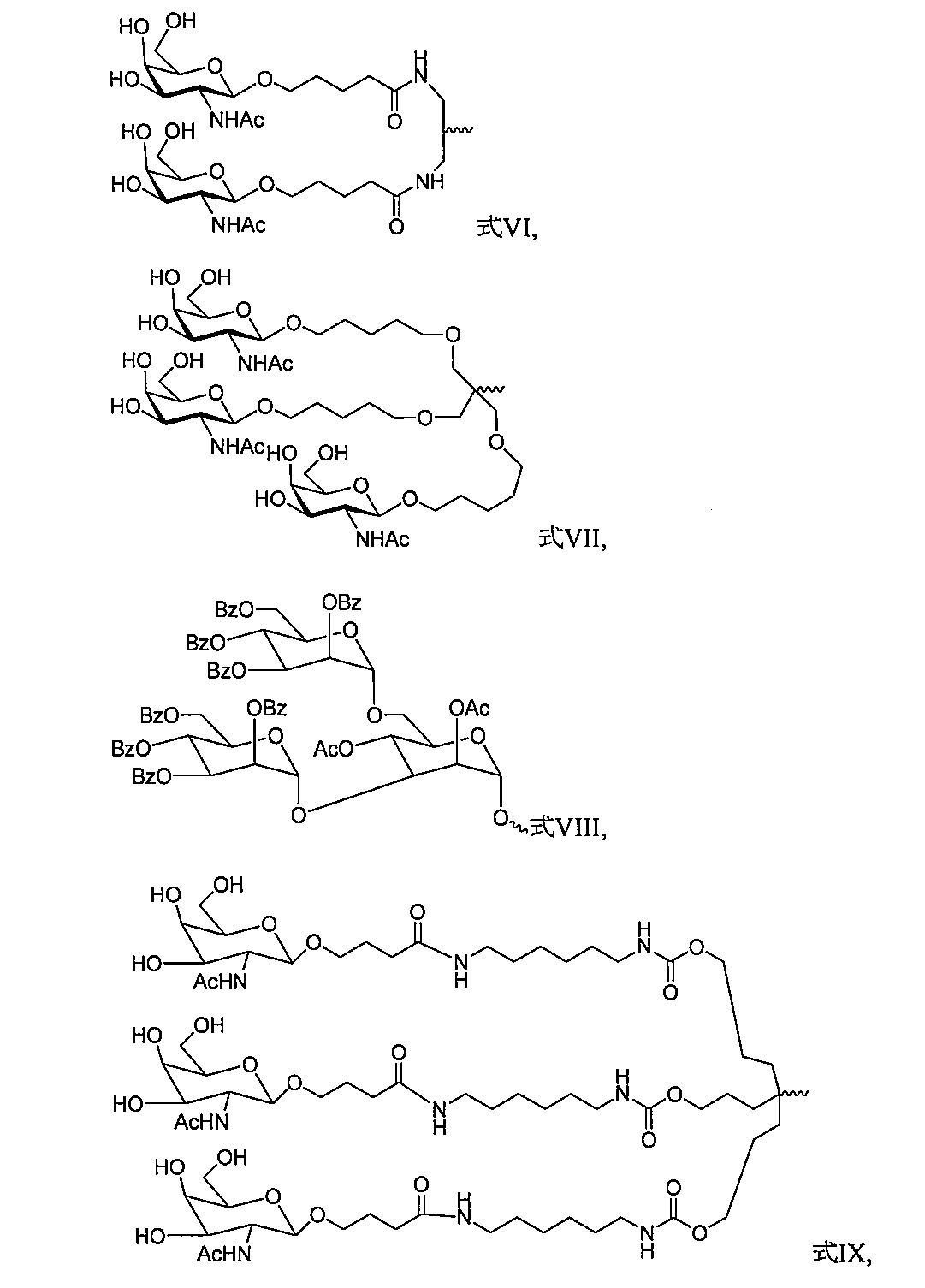


一実施形態では、GalNAcまたはGalNAc誘導体はGalNAc3:

いくつかの実施形態では、リガンド、例えばGalNAcリガンドは、RNAi薬剤の3’末端に結合する。一実施形態では、RNAi薬剤は以下の図式

に示すように、リガンド、例えばGalNAcリガンドとコンジュゲートしている。一実施形態では、XはOである。
In some embodiments, a ligand, e.g., a GalNAc ligand, is attached to the 3' end of the RNAi agent. In one embodiment, the RNAi agent is represented by the following scheme:
In one embodiment, X is O.
様々な物質が本発明のRNAi薬剤に結合し得る。好ましい成分は、介在するテザーを介して直接または間接のいずれかで、好ましくは共有結合により結合するリガンドである。 A variety of substances can be attached to the RNAi agents of the invention. A preferred component is a ligand that is attached either directly or indirectly, preferably covalently, via an intervening tether.
好ましい実施形態では、リガンドは、このリガンドが組み込まれる分子の分布、標的化、または寿命を変更する。好ましい実施形態では、リガンドは、例えば、このようなリガンドのない種と比較して、選択された標的、例えば分子、細胞もしくは細胞型、区画、受容体、例えば細胞もしくは器官の区画、身体の組織、器官または領域に対する向上した親和性を提供する。選択された標的に対する向上した親和性を提供するリガンドは、標的化リガンドとも呼ばれる。 In preferred embodiments, the ligand alters the distribution, targeting, or lifetime of the molecule into which it is incorporated. In preferred embodiments, the ligand provides improved affinity for a selected target, e.g., a molecule, a cell or cell type, a compartment, a receptor, e.g., a cell or organ compartment, a tissue, an organ, or a region of the body, as compared to a species without such a ligand. Ligands that provide improved affinity for a selected target are also referred to as targeting ligands.
いくつかのリガンドは、エンドソーム溶解特性を有し得る。エンドソーム溶解リガンドは、エンドソームの溶解および/または本発明の組成物、もしくはその成分の、エンドソームから細胞の細胞質への輸送を促進する。エンドソーム溶解リガンドは、pH依存的膜活性および膜融合性を示すポリアニオン性ペプチドまたはペプチド模倣体であり得る。一実施形態では、エンドソーム溶解リガンドは、エンドソームのpHでのその活性型立体配座をとると推定される。「活性型」立体配座は、エンドソーム溶解リガンドがエンドソームの溶解および/または本発明の組成物、もしくはその成分の、エンドソームから細胞の細胞質への輸送を促進する立体配座である。例示的なエンドソーム溶解リガンドとしては、GALAペプチド(Subbaraoら、Biochemistry、1987、26:2964~2972頁)、EALAペプチド(Vogelら、J.Am.Chem.Soc.、1996、118:1581~1586頁)、およびそれらの誘導体(Turk
et al.、Biochem.Biophys.Acta、2002、1559:56~68頁)が挙げられる。一実施形態では、エンドソーム溶解成分は、pHの変化に応じて電荷またはプロトン化の変化を起こす化学基(例えば、アミノ酸)を含有し得る。エンドソーム溶解成分は直鎖状または分枝鎖状であり得る。
Some ligands may have endosomolytic properties. Endosomolytic ligands promote lysis of endosomes and/or transport of the compositions of the invention, or components thereof, from endosomes to the cytoplasm of cells. Endosomolytic ligands may be polyanionic peptides or peptidomimetics that exhibit pH-dependent membrane activity and fusogenicity. In one embodiment, the endosomolytic ligand is presumed to adopt its active conformation at endosomal pH. An "active" conformation is one in which the endosomolytic ligand promotes lysis of endosomes and/or transport of the compositions of the invention, or components thereof, from endosomes to the cytoplasm of cells. Exemplary endosomolytic ligands include the GALA peptide (Subbarao et al., Biochemistry, 1987, 26:2964-2972), the EALA peptide (Vogel et al., J. Am. Chem. Soc., 1996, 118:1581-1586), and derivatives thereof (Turk ...
et al., Biochem. Biophys. Acta, 2002, 1559:56-68). In one embodiment, the endosomolytic component may contain a chemical group (e.g., an amino acid) that undergoes a change in charge or protonation in response to a change in pH. The endosomolytic component may be linear or branched.
リガンドは、輸送、ハイブリダイゼーション、および特異性の特性を向上することができ、結果として得られる天然もしくは修飾オリゴリボヌクレオチド、または本明細書に記載するモノマーおよび/もしくは天然もしくは修飾リボヌクレオチドの任意の組み合わせを含むポリマー分子のヌクレアーゼ耐性も向上し得る。 The ligands can improve the transport, hybridization, and specificity properties, and can also improve the nuclease resistance of the resulting natural or modified oligoribonucleotides, or polymer molecules comprising any combination of the monomers and/or natural or modified ribonucleotides described herein.
リガンドは一般に、例えば、取り込みを増強するための治療用修飾因子;例えば、分布をモニターするための診断化合物またはレポーター基;架橋剤;およびヌクレアーゼ耐性を付与する部分を含み得る。一般的な例としては、脂質、ステロイド、ビタミン、糖、タンパク質、ペプチド、ポリアミン、およびペプチド模倣体が挙げられる。 Ligands may generally include therapeutic modifiers, e.g., to enhance uptake; diagnostic compounds or reporter groups, e.g., to monitor distribution; cross-linking agents; and moieties that confer nuclease resistance. Common examples include lipids, steroids, vitamins, sugars, proteins, peptides, polyamines, and peptidomimetics.
リガンドは、タンパク質(例えば、ヒト血清アルブミン(HSA)、低密度リポタンパク質(LDL)、高密度リポタンパク質(HDL)、またはグロブリン);炭水化物(例えば、デキストラン、プルラン、キチン、キトサン、イヌリン、シクロデキストリン、またはヒアルロン酸);または脂質のような天然の物質を含み得る。リガンドはまた、合成ポリマー、例えば、合成ポリアミノ酸、オリゴヌクレオチド(例えば、アプタマー)のような組換えまたは合成分子であり得る。ポリアミノ酸の例としては、ポリアミノ酸は、ポリリジン(PLL)、ポリL-アスパラギン酸、ポリL-グルタミン酸、スチレン-マレイン酸無水物コポリマー、ポリ(L-ラクチド-コ-グリコリド)コポリマー、ジビニルエーテル-無水マレイン酸コポリマー、N-(2-ヒドロキシプロピル)メタクリルアミドコポリマー(HMPA)、ポリエチレングリコール(PEG)、ポリビニルアルコール(PVA)、ポリウレタン、ポリ(2-エチルアクリル酸)、N-イソプロピルアクリルアミドポリマー、またはポリホスファジンである。ポリアミンの例としては、ポリエチレンイミン、ポリリジン(PLL)、スペルミン、スペルミジン、ポリアミン、疑似ペプチド-ポリアミン、ペプチド模倣ポリアミン、デンドリマーポリアミン、アルギニン、アミジン、プロタミン、カチオン性脂質、カチオン性ポルフィリン、ポリアミンの第四級塩、またはα-ヘリックスペプチドが挙げられる。 Ligands may include natural substances such as proteins (e.g., human serum albumin (HSA), low density lipoprotein (LDL), high density lipoprotein (HDL), or globulins); carbohydrates (e.g., dextran, pullulan, chitin, chitosan, inulin, cyclodextrin, or hyaluronic acid); or lipids. Ligands may also be synthetic polymers, e.g., recombinant or synthetic molecules such as synthetic polyamino acids, oligonucleotides (e.g., aptamers). Examples of polyamino acids are polylysine (PLL), poly L-aspartic acid, poly L-glutamic acid, styrene-maleic anhydride copolymers, poly(L-lactide-co-glycolide) copolymers, divinyl ether-maleic anhydride copolymers, N-(2-hydroxypropyl)methacrylamide copolymers (HMPA), polyethylene glycol (PEG), polyvinyl alcohol (PVA), polyurethanes, poly(2-ethylacrylic acid), N-isopropylacrylamide polymers, or polyphosphazines. Examples of polyamines include polyethyleneimine, polylysine (PLL), spermine, spermidine, polyamines, pseudopeptide-polyamines, peptidomimetic polyamines, dendrimer polyamines, arginine, amidines, protamines, cationic lipids, cationic porphyrins, quaternary salts of polyamines, or α-helical peptides.
リガンドはまた、標的基、例えば細胞または組織標的剤、例えば、レクチン、糖タンパク質、脂質、またはタンパク質、例えば腎細胞のような特定の細胞型に結合する抗体を含み得る。標的基は、サイロトロピン、メラノトロピン、レクチン、糖タンパク質、界面活性剤タンパク質A、ムチン炭水化物、多価ラクトース、多価ガラクトース、N-アセチル-ガラクトサミン、N-アセチル-グルコサミン、多価マンノース、多価フコース、グリコシル化ポリアミノ酸、多価ガラクトース、トランスフェリン、ビスホスホネート、ポリグルタメート、ポリアスパルテート、脂質、コレステロール、ステロイド、胆汁酸、フォレート、ビタミンB12、ビオチン、RGDペプチド、RGDペプチド模倣体またはアプタマーであり得る。 The ligand may also include a targeting group, such as a cell or tissue targeting agent, such as a lectin, glycoprotein, lipid, or protein, such as an antibody that binds to a particular cell type, such as a renal cell. The targeting group may be thyrotropin, melanotropin, lectin, glycoprotein, surfactant protein A, mucin carbohydrate, polyvalent lactose, polyvalent galactose, N-acetyl-galactosamine, N-acetyl-glucosamine, polyvalent mannose, polyvalent fucose, glycosylated polyamino acids, polyvalent galactose, transferrin, bisphosphonates, polyglutamates, polyaspartates, lipids, cholesterol, steroids, bile acids, folate, vitamin B12, biotin, RGD peptides, RGD peptide mimetics, or aptamers.
リガンドの他の例としては、色素、挿入剤(例えば、アクリジン)、架橋剤(例えば、ソラレン、マイトマイシンC)、ポルフィリン(TPPC4、テキサフィリン、サフィリン)、多環式芳香族炭化水素(例えば、フェナジン、ジヒドロフェナジン)、人工エンドヌクレアーゼ、またはキレート剤(例えば、EDTA)、親油性分子、例えば、コレステロール、コール酸、アダマンタン酢酸、1-ピレン酪酸、ジヒドロテストステロン、1,3-ビス-O(ヘキサデシル)グリセロール、ゲラニルオキシへキシル基、ヘキサデシルグリセロール、ボルネオール、メントール、1,3-プロパンジオール、ヘプタデシル基、パルミチン酸、ミリスチン酸、O3-(オレオイル)リトコール酸、O3-(オレオイル)コレン酸、ジメトキシトリチル、またはフェノキサジン)およびペプチドコンジュゲート(例えば、アンテナペディアペプチド、Tatペプチド)、アルキル化剤、リン酸、アミノ、メルカプト、PEG(例えば、PEG-40K)、MPEG、[MPEG]2、ポリアミノ、アルキル、置換アルキル、放射性標識マーカー、酵素、ハプテン(例えば、ビオチン)、輸送/吸収促進剤(例えば、アスピリン、ビタミンE、葉酸)、合成リボヌクレアーゼ(例えば、イミダゾール、ビスイミダゾース、ヒスタミン、イミダゾールクラスター、アクリジン-イミダゾールコンジュゲート、Eu3+テトラアザ大員環複合体)、ジニトロフェニル、HRP、またはAPが挙げられる。 Other examples of ligands include dyes, intercalating agents (e.g., acridines), crosslinkers (e.g., psoralens, mitomycin C), porphyrins (TPPC4, texaphyrin, sapphyrin), polycyclic aromatic hydrocarbons (e.g., phenazine, dihydrophenazine), artificial endonucleases, or chelating agents (e.g., EDTA), lipophilic molecules such as cholesterol, cholic acid, adamantane acetic acid, 1-pyrene butyric acid, dihydrotestosterone, 1,3-bis-O(hexadecyl)glycerol, and the like. aryl, geranyloxyhexyl, hexadecylglycerol, borneol, menthol, 1,3-propanediol, heptadecyl, palmitic acid, myristic acid, O3-(oleoyl)lithocholic acid, O3-(oleoyl)cholenoic acid, dimethoxytrityl, or phenoxazine) and peptide conjugates (e.g., antennapedia peptide, Tat peptide), alkylating agents, phosphate, amino, mercapto, PEG (e.g., PEG-40K), MPEG, [MPEG] 2 , polyamino, alkyl, substituted alkyl, radiolabeled markers, enzymes, haptens (e.g., biotin), transport/absorption enhancers (e.g., aspirin, vitamin E, folic acid), synthetic ribonucleases (e.g., imidazole, bis-imidazole, histamine, imidazole clusters, acridine-imidazole conjugates, Eu3+ tetraaza macrocycle complexes), dinitrophenyl, HRP, or AP.
リガンドは、タンパク質、例えば、糖タンパク質、またはペプチド、例えば、コリガン
ド、または抗体、例えば、がん細胞、内皮細胞、もしくは骨細胞のような特定の細胞型に結合する抗体に対する特異親和性を有する分子であり得る。リガンドはまた、ホルモンおよびホルモン受容体を含んでもよい。リガンドはまた、脂質、レクチン、炭水化物、ビタミン、補因子、多価ラクトース、多価ガラクトース、N-アセチル-ガラクトサミン、N-アセチル-グルコサミン、多価マンノース、多価フコース、またはアプタマーのような非ペプチド種を含み得る。リガンドは、例えば、リポ多糖、p38MAPキナーゼの活性化因子、またはNF-κBの活性化因子であり得る。
A ligand can be a molecule with specific affinity for a protein, e.g., a glycoprotein, or a peptide, e.g., a co-ligand, or an antibody, e.g., an antibody that binds to a particular cell type, such as a cancer cell, an endothelial cell, or a bone cell. Ligands can also include hormones and hormone receptors. Ligands can also include non-peptide species, such as lipids, lectins, carbohydrates, vitamins, cofactors, multivalent lactose, multivalent galactose, N-acetyl-galactosamine, N-acetyl-glucosamine, multivalent mannose, multivalent fucose, or aptamers. A ligand can be, for example, lipopolysaccharide, an activator of p38 MAP kinase, or an activator of NF-κB.
リガンドは、例えば、細胞の微小管、マイクロフィラメント、および/または中間径フィラメントを破壊することによって、例えば、細胞骨格を破壊することによって、細胞中へのiRNA薬剤の取り込みを向上させ得る物質、例えば薬物であり得る。薬物は、例えば、タクソン、ビンクリスチン、ビンブラスチン、サイトカラシン、ノコダゾール、ジャスプラキノリド、ラトランクリンA、ファロイジン、スウィンホリドA、インダノシン、またはミオセルビンであり得る。 The ligand can be an agent, e.g., a drug, that can enhance uptake of the iRNA agent into the cell, e.g., by disrupting the cytoskeleton, e.g., by disrupting the microtubules, microfilaments, and/or intermediate filaments of the cell. The drug can be, e.g., taxon, vincristine, vinblastine, cytochalasin, nocodazole, jasplakinolide, latrunculin A, phalloidin, swinholide A, indanocine, or myoservin.
リガンドは、例えば、炎症反応を活性化することによって、オリゴヌクレオチドの細胞への取り込みを増加させることができる。このような効果を有し得る例示的なリガンドとしては、腫瘍壊死因子アルファ(TNFアルファ)、インターロイキン-1ベータ、またはガンマインターフェロンが挙げられる。 Ligands can increase cellular uptake of oligonucleotides, for example, by activating an inflammatory response. Exemplary ligands that can have such an effect include tumor necrosis factor alpha (TNF alpha), interleukin-1 beta, or gamma interferon.
一態様では、リガンドは、脂質または脂質ベースの分子である。このような脂質または脂質ベースの分子は、好ましくは血清タンパク質、例えば、ヒト血清アルブミン(HSA)に結合する。HSA結合リガンドは、コンジュゲートが、標的組織、例えば、身体の非腎臓標的組織に分布するのを可能にする。例えば、標的組織は、肝臓の実質細胞を含む肝臓であってもよい。HSAに結合し得る他の分子もリガンドとして使用できる。例えば、ナプロキセンまたはアスピリンを使用できる。脂質または脂質ベースのリガンドは、(a)コンジュゲートの分解に対する耐性を増大させ、(b)標的細胞もしくは細胞膜への標的化もしくは輸送を増大させ、および/または(c)血清タンパク質、例えば、HSAに対する結合を調節するために使用できる。 In one aspect, the ligand is a lipid or lipid-based molecule. Such lipid or lipid-based molecules preferably bind to serum proteins, such as human serum albumin (HSA). The HSA-binding ligand allows the conjugate to distribute to target tissues, such as non-renal target tissues of the body. For example, the target tissue may be the liver, including hepatic parenchymal cells. Other molecules that can bind to HSA can also be used as ligands. For example, naproxen or aspirin can be used. The lipid or lipid-based ligand can be used to (a) increase the resistance of the conjugate to degradation, (b) increase targeting or transport to target cells or cell membranes, and/or (c) modulate binding to serum proteins, such as HSA.
脂質ベースのリガンドは、標的組織に対するコンジュゲートの結合を調節、例えば、制御するために使用できる。例えば、HSAにより強く結合する脂質または脂質ベースのリガンドは、腎臓を標的とする可能性が低く、したがって、体内から除去される可能性が低い。HSAにそれほど強く結合しない脂質または脂質ベースのリガンドは、コンジュゲートが腎臓を標的にするように使用できる。 The lipid-based ligand can be used to modulate, e.g., control, the binding of the conjugate to the target tissue. For example, a lipid or lipid-based ligand that binds more strongly to HSA is less likely to target to the kidney and therefore less likely to be cleared from the body. A lipid or lipid-based ligand that binds less strongly to HSA can be used to target the conjugate to the kidney.
好ましい実施形態では、脂質ベースのリガンドはHSAに結合する。好ましくは、脂質ベースのリガンドは、このコンジュゲートが好ましくは非腎臓組織に分散するように十分な親和性でHSAに結合する。しかしながら、この親和性は、HSA-リガンド結合が反転されないような強くない親和性であることが好ましい。 In a preferred embodiment, the lipid-based ligand binds to HSA. Preferably, the lipid-based ligand binds to HSA with sufficient affinity such that the conjugate preferably distributes to non-renal tissues. However, it is preferred that the affinity is not so strong that the HSA-ligand binding is not reversed.
別の好ましい実施形態では、脂質ベースのリガンドは、HSAに弱く結合するか、または全く結合しないため、このコンジュゲートは、好ましくは腎臓に分散される。腎臓細胞を標的とする他の部分も、脂質ベースのリガンドの代わりに、またはこれに加えて使用することができる。 In another preferred embodiment, the lipid-based ligand binds weakly or not at all to HSA, so that the conjugate is preferably distributed in the kidney. Other moieties that target kidney cells can be used in place of or in addition to the lipid-based ligand.
別の態様では、リガンドは、標的細胞、例えば増殖細胞によって取り込まれる部分、例えば、ビタミンである。これらは、例えば悪性型または非悪性型の、例えば、がん細胞の望ましくない細胞増殖を特徴とする障害を処置するのに特に有用である。例示的なビタミンとしては、ビタミンA、E、およびKが挙げられる。他の例示的なビタミンとしては、
ビタミンB、例えば、葉酸、B12、リボフラビン、ビオチン、ピリドキサール、またはがん細胞によって取り込まれる他のビタミンもしくは栄養素が挙げられる。また、HAS、低密度リポタンパク質(LDL)、高密度リポタンパク質(HDL)も含む。
In another aspect, the ligand is a moiety, e.g., a vitamin, that is taken up by a target cell, e.g., a proliferating cell. These are particularly useful for treating disorders characterized by unwanted cell proliferation, e.g., of the malignant or non-malignant type, e.g., cancer cells. Exemplary vitamins include vitamins A, E, and K. Other exemplary vitamins include:
Vitamin B, e.g., folic acid, B12, riboflavin, biotin, pyridoxal, or other vitamins or nutrients taken up by cancer cells. Also included are HAS, low density lipoprotein (LDL), high density lipoprotein (HDL).
別の態様では、リガンドは、細胞透過剤、好ましくはヘリックス型の細胞透過剤である。好ましくは、薬剤は両親媒性である。例示的な薬剤は、tatまたはアンテナペディアのようなペプチドである。薬剤がペプチドである場合、ペプチジル模倣体、反転異性体、非ペプチドまたは偽ペプチド連結、およびD-アミノ酸の使用を含む修飾を施すことができる。好ましくは、このヘリックス型の薬剤は、好ましくは親油性相および疎油性相を有するアルファヘリックス型の薬剤である。 In another aspect, the ligand is a cell-penetrating agent, preferably a helical cell-penetrating agent. Preferably, the agent is amphipathic. Exemplary agents are peptides such as tat or antennapedia. When the agent is a peptide, modifications can be made including peptidyl mimetics, invertomers, non-peptide or pseudo-peptide linkages, and the use of D-amino acids. Preferably, the helical agent is an alpha-helical agent, preferably having a lipophilic phase and a lipophobic phase.
リガンドは、ペプチドまたはペプチド模倣体であり得る。ペプチド模倣体(本明細書ではオリゴペプチド模倣体とも呼ばれる)は、天然ペプチドと同様の定められた3次元構造に折りたたむことができる分子である。ペプチド部分またはペプチド模倣体部分は、約5~50のアミノ酸長、例えば、約5、10、15、20、25、30、35、40、45、または50のアミノ酸長であり得る。ペプチドまたはペプチド模倣体は、例えば細胞透過ペプチド、カチオン性ペプチド、両親媒性ペプチド、または疎水性ペプチド(例えば、主にTyr、Trp、もしくはPheから構成される)であり得る。ペプチド部分は、デンドリマーペプチド、拘束ペプチド、または架橋ペプチドであり得る。別の代替では、ペプチド部分は、疎水性の膜輸送配列(MTS)を含み得る。例示的な疎水性MTS含有ペプチドは、アミノ酸配列AAVALLPAVLLALLAP(配列番号9)を有するRFGFである。疎水性MTSを含有するRFGF類似体(例えば、アミノ酸配列AALLPVLLAAP(配列番号10))も標的化部分であり得る。ペプチド部分は、「送達」ペプチドであってもよく、この送達ペプチドは、ペプチド、オリゴヌクレオチド、およびタンパク質を含む大きな極性分子を、細胞膜を通過して運搬することができる。例えば、HIV Tatタンパク質由来の配列(GRKKRRQRRRPPQ(配列番号11))およびショウジョウバエアンテナペディアタンパク質由来の配列(RQIKIWFQNRRMKWKK(配列番号12))は、送達ペプチドとして機能できることが見出されている。ファージディスプレイライブラリー、または1ビーズ1化合物(OBOC)コンビナトリアルライブラリーから同定されたペプチドのようなペプチドまたはペプチド模倣体は、DNAのランダム配列によってコードされる(Lamら、Nature、354:82~84頁、1991)。好ましくは、組み込まれたモノマー単位を介してiRNA薬剤に連結されたペプチドまたはペプチド模倣体は、アルギニン-グリシン-アスパラギン酸(RGD)-ペプチドまたはRGD模倣体のような細胞標的化ペプチドである。ペプチド部分は、約5アミノ酸長~約40アミノ酸長の範囲であり得る。ペプチド部分は、安定性または直接的な立体配座特性を高めるためのような、構造修飾を有し得る。下記の構造修飾のいずれも利用できる。RGDペプチド部分は、内皮腫瘍細胞または乳がん腫瘍細胞のような腫瘍細胞を標的とするために使用できる(Zitzmannら、Cancer Res.、62:5139~43頁、2002)。RGDペプチドは、肺、腎臓、脾臓、または肝臓を含む種々の他の組織の腫瘍に対するiRNA薬剤の標的化を促進することができる(Aokiら、Cancer Gene Therapy 8:783~787、2001)。好ましくは、RGDペプチドは、腎臓に対するiRNA薬剤の標的化を促進する。RGDペプチドは、直鎖状または環状であってよく、特定の組織に対する標的化を促進するために修飾、例えばグリコシル化またはメチル化される。例えば、グリコシル化RGDペプチドは、αvβ3を発現する腫瘍細胞にiRNA薬剤を送達できる(Haubnerら、Jour.Nucl.Med.、42:326~336頁、2001)。増殖細胞に豊富なマーカーを標的とするペプチドを使用できる。例えば、RGD含有ペプチドおよびペプチド模倣体は、がん細胞、特に、インテグリンを提示する細胞を標的とすることができる。したがって、RGDペプチド、RGDを含有する環状ペプチド、D-アミノ酸を含むRGDペプチド、ならびに合成RGD模倣体を使用できる。RGDに加えて、インテグ
リンリガンドを標的とする他の部分を使用できる。一般に、このようなリガンドは、増殖細胞および血管新生を制御するために使用できる。この種のリガンドの好ましいコンジュゲートは、PECAM-1、VEGF、または他のがん遺伝子、例えば、本明細書に記載のがん遺伝子を標的とする。
The ligand can be a peptide or peptidomimetic. A peptidomimetic (also referred to herein as an oligopeptidomimetic) is a molecule that can fold into a defined three-dimensional structure similar to a natural peptide. The peptidic or peptidomimetic moiety can be about 5-50 amino acids long, e.g., about 5, 10, 15, 20, 25, 30, 35, 40, 45, or 50 amino acids long. The peptide or peptidomimetic can be, for example, a cell-penetrating peptide, a cationic peptide, an amphipathic peptide, or a hydrophobic peptide (e.g., composed primarily of Tyr, Trp, or Phe). The peptidic moiety can be a dendrimeric peptide, a constrained peptide, or a cross-linked peptide. In another alternative, the peptidic moiety can include a hydrophobic membrane transport sequence (MTS). An exemplary hydrophobic MTS-containing peptide is RFGF, which has the amino acid sequence AAVALLPAVLLALLAP (SEQ ID NO: 9). RFGF analogs containing a hydrophobic MTS, such as the amino acid sequence AALLPVLLAAP (SEQ ID NO: 10), can also be targeting moieties. The peptide moiety can be a "delivery" peptide, which can transport large polar molecules, including peptides, oligonucleotides, and proteins, across cell membranes. For example, sequences from the HIV Tat protein (GRKKRRQRRRPPQ (SEQ ID NO: 11)) and the Drosophila Antennapedia protein (RQIKIWFQNRRMKWKK (SEQ ID NO: 12)) have been found to function as delivery peptides. Peptides or peptidomimetics, such as peptides identified from phage display libraries or one bead one compound (OBOC) combinatorial libraries, are encoded by random sequences of DNA (Lam et al., Nature, 354:82-84, 1991). Preferably, the peptide or peptidomimetic linked to the iRNA agent via the incorporated monomer unit is a cell-targeting peptide, such as an arginine-glycine-aspartic acid (RGD)-peptide or RGD mimic. The peptide moiety can range from about 5 amino acids in length to about 40 amino acids in length. The peptide moiety can have structural modifications, such as to enhance stability or direct conformational properties. Any of the structural modifications described below can be utilized. An RGD peptide moiety can be used to target tumor cells, such as endothelial tumor cells or breast cancer tumor cells (Zitzmann et al., Cancer Res., 62:5139-43, 2002). The RGD peptide can facilitate targeting of the iRNA agent to tumors of a variety of other tissues, including the lung, kidney, spleen, or liver (Aoki et al., Cancer Gene Therapy 8:783-787, 2001). Preferably, the RGD peptide facilitates targeting of the iRNA agent to the kidney. RGD peptides can be linear or cyclic and modified, e.g., glycosylated or methylated, to facilitate targeting to specific tissues. For example, glycosylated RGD peptides can deliver iRNA agents to tumor cells expressing α v β 3 (Haubner et al., Jour. Nucl. Med., 42:326-336, 2001). Peptides can be used that target markers abundant in proliferating cells. For example, RGD-containing peptides and peptidomimetics can target cancer cells, particularly cells that display integrins. Thus, RGD peptides, cyclic peptides containing RGD, RGD peptides with D-amino acids, as well as synthetic RGD mimetics can be used. In addition to RGD, other moieties that target integrin ligands can be used. In general, such ligands can be used to control proliferating cells and angiogenesis. Preferred conjugates of this type of ligand target PECAM-1, VEGF, or other oncogenes, e.g., those described herein.
「細胞透過ペプチド」は、細胞、例えば、細菌細胞もしくは真菌細胞のような微生物細胞、またはヒト細胞のような哺乳動物細胞を透過できる。微生物細胞を透過するペプチドは、例えば、α-ヘリックス直鎖状ペプチド(例えば、LL-37もしくはセロピンP1)、ジスルフィド結合含有ペプチド(例えば、α-ディフェンシン、β-ディフェンシン、もしくはバクテネシン)、または1種もしくは2種の優勢なアミノ酸のみを含有するペプチド(例えば、PR-39もしくはインドリシジン)であってもよい。細胞透過ペプチドは、核局在化シグナル(NLS)も含み得る。例えば、細胞透過ペプチドは、HIV-1gp41の融合ペプチドドメインおよびSV40ラージT抗原のNLSに由来するMPGのような、二部両親媒性ペプチドであり得る(Simeoniら、Nucl.AcidsRes.31:2717~2724頁、2003)。 A "cell-penetrating peptide" can penetrate a cell, e.g., a microbial cell, such as a bacterial cell or a fungal cell, or a mammalian cell, such as a human cell. A peptide that penetrates a microbial cell can be, for example, an α-helical linear peptide (e.g., LL-37 or seropin P1), a disulfide bond-containing peptide (e.g., α-defensin, β-defensin, or bactenecin), or a peptide containing only one or two predominant amino acids (e.g., PR-39 or indolicidin). A cell-penetrating peptide can also contain a nuclear localization signal (NLS). For example, a cell-penetrating peptide can be a bipartite amphipathic peptide, such as MPG, which is derived from the fusion peptide domain of HIV-1 gp41 and the NLS of SV40 large T antigen (Simeoni et al., Nucl. Acids Res. 31:2717-2724, 2003).
一実施形態では、標的化ペプチドは、両親媒性α-ヘリックスペプチドであり得る。例示的な両親媒性α-ヘリックスペプチドとしては、限定はされないが、セクロピン、リコトキシン、パラダキシン、ブフォリン、CPF、ボンビニン-様ペプチド(BLP)、カテリシジン、セラトトキシン、エボヤ(S.clava)ペプチド、メクラウナギ腸抗菌ペプチド(HFIAP)、マガイニン、ブレビニン-2、デルマセプチン、メリチン、プレウロシジン、H2Aペプチド、アフリカツメガエル(Xenopus)ペプチド、エスクレンチニス-1、およびカエリンを含む。好ましくは、多数の因子が、ヘリックス安定性の完全性を維持するとみなされる。例えば、最大数のヘリックス安定化残基(例えば、leu、ala、またはlys)を利用し、最少のヘリックス不安定化残基(例えば、プロリン、または環状モノマー単位)を利用する。キャッピング残基も考慮される(例えば、Glyは、例示的なN-キャッピング残基であり、および/またはC末端アミド化は、追加的な水素結合を提供してヘリックスを安定するために使用できる。i±3位、またはi±4位離れた、反対の電荷を有する残基間の塩架橋の形成によって安定化することができる。リジン、アルギニン、ホモ-アルギニン、オルニチン、またはヒスチジンのようなカチオン性残基は、アニオン性残基であるグルタミン酸またはアスパラギン酸と塩架橋を形成し得る。 In one embodiment, the targeting peptide can be an amphipathic α-helical peptide. Exemplary amphipathic α-helical peptides include, but are not limited to, cecropin, lycotoxin, paradaxin, buforin, CPF, bombinin-like peptide (BLP), cathelicidin, ceratotoxin, S. clava peptide, hagfish intestinal antimicrobial peptide (HFIAP), magainin, brevinin-2, dermaseptin, melittin, pleurocidin, H 2 A peptide, Xenopus peptide, esculentinis-1, and caerin. Preferably, a number of factors are considered to maintain the integrity of helix stability. For example, a maximum number of helix-stabilizing residues (e.g., leu, ala, or lys) are utilized, and a minimum of helix-destabilizing residues (e.g., proline, or cyclic monomer units) are utilized. Capping residues are also contemplated (e.g., Gly is an exemplary N-capping residue, and/or C-terminal amidation can be used to provide additional hydrogen bonds to stabilize the helix. Stabilization can be achieved by the formation of salt bridges between oppositely charged residues separated by positions i±3, or i±4. Cationic residues such as lysine, arginine, homo-arginine, ornithine, or histidine can form salt bridges with the anionic residues glutamic acid or aspartic acid.
ペプチドおよびペプチド模倣体リガンドとしては、天然または修飾ペプチド、例えば、DもしくはLペプチド;α、β、もしくはγペプチド;N-メチルペプチド;アザペプチド;1つもしくはそれ以上の尿素、チオ尿素、カルバミン酸、もしくはスルホニル尿素連結で置換された1つもしくはそれ以上のアミド結合、すなわちペプチド連結を有するペプチド;または環状ペプチドを有するものを含む。 Peptide and peptidomimetic ligands include natural or modified peptides, e.g., D or L peptides; α, β, or γ peptides; N-methyl peptides; azapeptides; peptides having one or more amide bonds, i.e., peptide linkages, replaced by one or more urea, thiourea, carbamate, or sulfonylurea linkages; or cyclic peptides.
標的化リガンドは、特定の受容体を標的化することができる任意のリガンドであり得る。例としては:葉酸塩、GalNAc、ガラクトース、マンノース、マンノース-6P、GalNAcクラスター、マンノースクラスター、ガラクトースクラスターのような糖クラスター、またはアプタマーを含む。クラスターは、2つ以上の糖単位の組み合わせである。標的化リガンドとしては、インテグリン受容体リガンド、ケモカイン受容体リガンド、トランスフェリン、ビオチン、セロトニン受容体リガンド、PSMA、エンドセリン、GCPII、ソマトスタチン、LDL、およびHDLリガンドも挙げられる。リガンドはまた、核酸、例えば、アプタマーをベースにし得る。アプタマーは、未修飾でもよいし、または本明細書に開示する修飾の任意の組み合わせを有し得る。 The targeting ligand can be any ligand capable of targeting a particular receptor. Examples include: folate, GalNAc, galactose, mannose, mannose-6P, sugar clusters such as GalNAc clusters, mannose clusters, galactose clusters, or aptamers. A cluster is a combination of two or more sugar units. Targeting ligands also include integrin receptor ligands, chemokine receptor ligands, transferrin, biotin, serotonin receptor ligands, PSMA, endothelin, GCPII, somatostatin, LDL, and HDL ligands. The ligand can also be based on a nucleic acid, e.g., an aptamer. The aptamer can be unmodified or have any combination of the modifications disclosed herein.
エンドソーム放出剤としては、イミダゾール、ポリまたはオリゴイミダゾール、PEI
、ペプチド、融合性ペプチド、ポリカルボキシレート、ポリカチオン、マスクオリゴもしくはポリカチオンもしくはアニオン、アセタール、ポリアセタール、ケタール/ポリケチアル、オルトエステル、マスクもしくは非マスクカチオン、またはアニオン電荷を有するポリマー、マスクもしくは非マスクカチオン、またはアニオン電荷を有するデンドリマーを含む。
Endosomal release agents include imidazoles, poly- or oligo-imidazoles, PEI
, peptides, fusogenic peptides, polycarboxylates, polycations, masked oligo- or polycations or anions, acetals, polyacetals, ketals/polyketials, orthoesters, masked or unmasked cations, or polymers with anionic charge, masked or unmasked cations, or dendrimers with anionic charge.
PK調節剤とは、薬物動態学的調節剤を意味する。PK調節剤としては、親油性物質、胆汁酸、ステロイド、リン脂質類似体、ペプチド、タンパク質結合剤、PEG、ビタミンなどが挙げられる。例示的なPK調節剤としては、限定はされないが、コレステロール、脂肪酸、コール酸、リトコール酸、ジアルキルグリセリド、ジアシルグリセリド、リン脂質、スフィンゴ脂質、ナプロキセン、イブプロフェン、ビタミンE、ビオチンなどが挙げられる。多数のホスホロチオエート連結を含むオリゴヌクレオチドも、血清タンパク質に結合することが公知であり、したがって、骨格に多数のホスホロチオエート連結を含む短鎖オリゴヌクレオチド、例えば、約5塩基、10塩基、15塩基、または20塩基のオリゴヌクレオチドも、リガンドとして(例えば、PK調節リガンドとして)本発明に適用可能である。 PK modulator means a pharmacokinetic modulator. PK modulators include lipophiles, bile acids, steroids, phospholipid analogs, peptides, protein binders, PEG, vitamins, and the like. Exemplary PK modulators include, but are not limited to, cholesterol, fatty acids, cholic acid, lithocholic acid, dialkyl glycerides, diacyl glycerides, phospholipids, sphingolipids, naproxen, ibuprofen, vitamin E, biotin, and the like. Oligonucleotides containing multiple phosphorothioate linkages are also known to bind to serum proteins, and therefore short oligonucleotides, e.g., about 5, 10, 15, or 20 bases, containing multiple phosphorothioate linkages in the backbone are also applicable to the present invention as ligands (e.g., as PK modulating ligands).
さらに、血清成分(例えば、血清タンパク質)に結合するアプタマーも、PK調節リガンドとして本発明に適用可能である。 In addition, aptamers that bind to serum components (e.g., serum proteins) can also be applied to the present invention as PK-regulating ligands.
本発明に適用可能な他のリガンドコンジュゲートは、2004年8月10日に出願された米国特許第10/916,185号;2004年9月21日に出願された同第10/946,873号;2007年8月3日に出願された同第10/833,934号;2005年4月27日に出願された同第11/115,989号、および2007年11月21日に出願された同第11/944,227号に記載され、その内容全体を参照によって本明細書に組み入れる。 Other ligand conjugates applicable to the present invention are described in U.S. Patent Nos. 10/916,185, filed August 10, 2004; 10/946,873, filed September 21, 2004; 10/833,934, filed August 3, 2007; 11/115,989, filed April 27, 2005, and 11/944,227, filed November 21, 2007, the entire contents of which are incorporated herein by reference.
2つ以上のリガンドが存在する場合、リガンドは、すべて同じ特性を有してもよく、すべてが異なる特性を有してもよく、またはいくつかのリガンドが同じ特性を有する一方、他のリガンドが異なる特性を有してもよい。例えば、リガンドは、標的化特性を有してもよく、エンドソーム溶解活性を有してもよく、またはPK調節特性を有してもよい。好ましい実施形態では、すべてのリガンドが異なる特性を有する。 When more than one ligand is present, the ligands may all have the same properties, all have different properties, or some ligands may have the same properties while others have different properties. For example, the ligands may have targeting properties, may have endosomolytic activity, or may have PK modulating properties. In a preferred embodiment, all of the ligands have different properties.
リガンドは、様々な位置、例えば3’末端、5’末端、および/または内部位置で、オリゴヌクレオチドに結合できる。好ましい実施形態では、リガンドは、介在テザー、例えば、本明細書に記載の担体を介してオリゴヌクレオチドに結合する。モノマーが成長している鎖に組み込まれる場合、リガンドまたはテザーリガンドは、このモノマーに存在し得る。いくつかの実施形態では、リガンドは、「前駆体」モノマーが、成長している鎖に組み込まれた後、この「前駆体」モノマーへの結合によって組み込まれる。例えば、アミノ末端テザー(すなわち、リガンドが結合していない)、例えば、TAP-(CH2)nNH2を有するモノマーは、成長しているオリゴヌクレオチド鎖に組み込まれる。続く操作において、すなわち、前駆体モノマーが鎖に組み込まれた後、リガンドの求電子基と前駆体モノマーのテザーの末端求核基との結合によって、求電子基、例えば、ペンタフルオロフェニルエステルまたはアルデヒド基を有するリガンドを、その後、前駆体モノマーに結合させる。 The ligand can be attached to the oligonucleotide at various positions, e.g., the 3'-terminus, the 5'-terminus, and/or at an internal position. In a preferred embodiment, the ligand is attached to the oligonucleotide via an intervening tether, e.g., a carrier as described herein. If the monomer is to be incorporated into a growing chain, the ligand or tethered ligand may be present on the monomer. In some embodiments, the ligand is incorporated by binding to a "precursor" monomer after the monomer has been incorporated into a growing chain. For example, a monomer having an amino-terminated tether (i.e., no ligand is attached), e.g., TAP-(CH 2 ) n NH 2 , is incorporated into a growing oligonucleotide chain. In a subsequent operation, i.e., after the precursor monomer has been incorporated into a chain, a ligand having an electrophilic group, e.g., a pentafluorophenyl ester or aldehyde group, is then attached to the precursor monomer by binding between the electrophilic group of the ligand and the terminal nucleophilic group of the tether of the precursor monomer.
別の例では、クリック化学反応に参加するのに適した化学基を有するモノマーを、例えば、アジドまたはアルキン末端のテザー/リンカーに組み込むことができる。続く操作において、すなわち前駆体モノマーが鎖に組み込まれた後、相補的な化学基、例えば、アルキンまたはアジドを有するリガンドを、アルキンおよびアジドを共に結合することによっ
て前駆体モノマーに結合できる。
In another example, monomers bearing chemical groups suitable for participating in click chemistry reactions can be incorporated into tethers/linkers, for example, azide or alkyne terminated tethers/linkers. In subsequent manipulations, i.e., after the precursor monomers are incorporated into the chain, ligands bearing complementary chemical groups, for example, alkyne or azide, can be attached to the precursor monomers by linking the alkyne and azide together.
二本鎖オリゴヌクレオチドにおいて、リガンドは1つまたは両方の鎖に結合できる。いくつかの実施形態では、二本鎖iRNA薬剤は、センス鎖とコンジュゲートしたリガンドを含有する。他の実施形態では、二本鎖iRNA薬剤は、アンチセンス鎖とコンジュゲートしたリガンドを含有する。 In double-stranded oligonucleotides, the ligand can be attached to one or both strands. In some embodiments, the double-stranded iRNA agent contains a ligand conjugated to the sense strand. In other embodiments, the double-stranded iRNA agent contains a ligand conjugated to the antisense strand.
いくつかの実施形態では、リガンドは核酸分子の核酸塩基、糖部分、またはヌクレオシド間連結にコンジュゲートできる。プリン核酸塩基またはその誘導体に対するコンジュゲーションは、環内原子および環外原子を含む任意の位置に生じ得る。いくつかの実施形態では、プリン核酸塩基の2位、6位、7位、または8位が、コンジュゲート部分に結合している。また、ピリミジン核酸塩基またはその誘導体に対するコンジュゲーションは、任意の位置で生じ得る。いくつかの実施形態では、ピリミジン核酸塩基の2位、5位、および6位を、コンジュゲート部分と置換できる。ヌクレオシドの糖部分に対するコンジュゲーションは、任意の炭素原子で生じ得る。コンジュゲート部分に結合できる糖部分の炭素原子の例には、2’、3’、および5’炭素原子を含む。1’位も、脱塩基残基のようなコンジュゲート部分に結合できる。ヌクレオシド間連結も、コンジュゲート部分を保持できる。リン含有連結(例えば、ホスホジエステル、ホスホロチオエート、ホスホロジチオエート、ホスホロアミデートなど)の場合、コンジュゲート部分は、リン原子に直接結合する、またはリン原子に結合しているO、N、もしくはS原子に結合することができる。アミンまたはアミドを含有するヌクレオシド間連結(例えば、PNA)の場合、コンジュゲート部分は、アミンもしくはアミドの窒素原子に、または隣接する炭素原子に結合できる。 In some embodiments, the ligand can be conjugated to the nucleobase, sugar moiety, or internucleoside linkage of the nucleic acid molecule. Conjugation to a purine nucleobase or derivative thereof can occur at any position, including endocyclic and exocyclic atoms. In some embodiments, the 2-, 6-, 7-, or 8-position of the purine nucleobase is attached to a conjugate moiety. Conjugation to a pyrimidine nucleobase or derivative thereof can also occur at any position. In some embodiments, the 2-, 5-, and 6-positions of the pyrimidine nucleobase can be replaced with a conjugate moiety. Conjugation to a sugar moiety of a nucleoside can occur at any carbon atom. Examples of carbon atoms of the sugar moiety that can be attached to a conjugate moiety include the 2', 3', and 5' carbon atoms. The 1' position can also be attached to a conjugate moiety, such as an abasic residue. The internucleoside linkage can also carry a conjugate moiety. In the case of phosphorus-containing linkages (e.g., phosphodiesters, phosphorothioates, phosphorodithioates, phosphoramidates, etc.), the conjugate moiety can be attached directly to the phosphorus atom or to an O, N, or S atom that is attached to the phosphorus atom. In the case of internucleoside linkages that contain amines or amides (e.g., PNA), the conjugate moiety can be attached to the nitrogen atom of the amine or amide or to an adjacent carbon atom.
RNA干渉の分野における任意の好適なリガンドを使用するが、リガンドは、典型的には炭水化物、例えば単糖(GalNAcのような)、二糖、三糖、四糖、多糖である。 Any suitable ligand in the field of RNA interference may be used, but the ligand is typically a carbohydrate, such as a monosaccharide (such as GalNAc), disaccharide, trisaccharide, tetrasaccharide, or polysaccharide.
リガンドを核酸にコンジュゲートするリンカーは、上記で論じたものを含む。例えば、リガンドは、一価、二価、または三価の分枝リンカーを介して結合する1つまたはそれ以上のGalNAc(N-アセチルグルコサミン)誘導体であり得る。 Linkers for conjugating the ligand to the nucleic acid include those discussed above. For example, the ligand can be one or more GalNAc (N-acetylglucosamine) derivatives attached via a monovalent, divalent, or trivalent branched linker.
一実施形態では、本発明のdsRNAは、式(IV)~(VII):

式中、
q2A、q2B、q3A、q3B、q4A、q4B、q5A、q5B、およびq5Cは、出現する毎に独立して0~20を表し、繰返し単位は同一または異なっていてもよく;
P2A、P2B、P3A、P3B、P4A、P4B、P5A、P5B、P5C、T2A、T2B、T3A、T3B、T4A、T4B、T5A、T5B、T5Cがそれぞれ、出現する毎に独立して、存在しないか、CO、NH、O、S、OC(O)、NHC(O)、CH2、CH2NHまたはCH2Oであり;
Q2A、Q2B、Q3A、Q3B、Q4A、Q4B、Q5A、Q5B、Q5Cが、出現する毎に独立して、存在しないか、アルキレン、置換アルキレンであり、ここで1つまたはそれ以上のメチレンが、O、S、S(O)、SO2、N(RN)、C(R’)=C(R’’)、C≡CまたはC(O)のうちの1つまたはそれ以上により中断または終端されてもよく;
R2A、R2B、R3A、R3B、R4A、R4B、R5A、R5B、R5Cがそれぞれ、出現する毎に独立して、存在しないか、NH、O、S、CH2、C(O)O、C(O)NH、NHCH(Ra)C(O)、-C(O)-CH(Ra)-NH-、CO、CH=N-O、

L2A、L2B、L3A、L3B、L4A、L4B、L5A、L5B、およびL5Cが、リガンドを表し;すなわち、それぞれ、出現する毎に独立して、単糖(GalNAcのような)、二糖、三糖、四糖、オリゴ糖、または多糖であり;
Raが、Hまたはアミノ酸側鎖である。
In one embodiment, the dsRNA of the present invention has formula (IV)-(VII):
In the formula,
q 2A , q 2B , q 3A , q 3B , q 4A , q 4B , q 5A , q 5B , and q 5C each occurrence independently represent 0 to 20, and the repeat units may be the same or different;
P2A , P2B , P3A, P3B , P4A , P4B , P5A , P5B , P5C , T2A , T2B , T3A , T3B , T4A , T4B , T5A , T5B , T5C are each, independently at each occurrence, absent, CO, NH, O, S, OC(O), NHC(O), CH2 , CH2NH or CH2O ;
Q 2A , Q 2B , Q 3A , Q 3B , Q 4A , Q 4B , Q 5A , Q 5B , Q 5C are independently at each occurrence absent, alkylene, substituted alkylene, where one or more methylenes are optionally interrupted or terminated by one or more of O, S, S(O), SO 2 , N(R N ), C(R')═C(R″), C≡C or C(O);
R 2A , R 2B , R 3A , R 3B , R 4A , R 4B , R 5A , R 5B and R 5C are each independently at each occurrence absent, NH, O, S, CH 2 , C(O)O, C(O)NH, NHCH(R a )C(O), —C(O)—CH(R a )—NH—, CO, CH═N—O,
L2A , L2B , L3A , L3B, L4A , L4B , L5A , L5B , and L5C represent a ligand; i.e., each, independently at each occurrence, is a monosaccharide (such as GalNAc), a disaccharide, a trisaccharide, a tetrasaccharide, an oligosaccharide, or a polysaccharide;
R a is H or an amino acid side chain.
三価コンジュゲートGalNAc誘導体は、式(VII):

式中、L5A、L5BおよびL5Cが、GalNAc誘導体のような単糖を表す。GalNAc誘導体とコンジュゲートする好適な二価および三価の分枝リンカー基の例としては、限定はされないが、以下の化合物:
The trivalent conjugate GalNAc derivative has the formula (VII):
wherein L5A , L5B and L5C represent monosaccharides such as GalNAc derivatives. Examples of suitable bivalent and trivalent branched linker groups for conjugation with GalNAc derivatives include, but are not limited to, the following compounds:

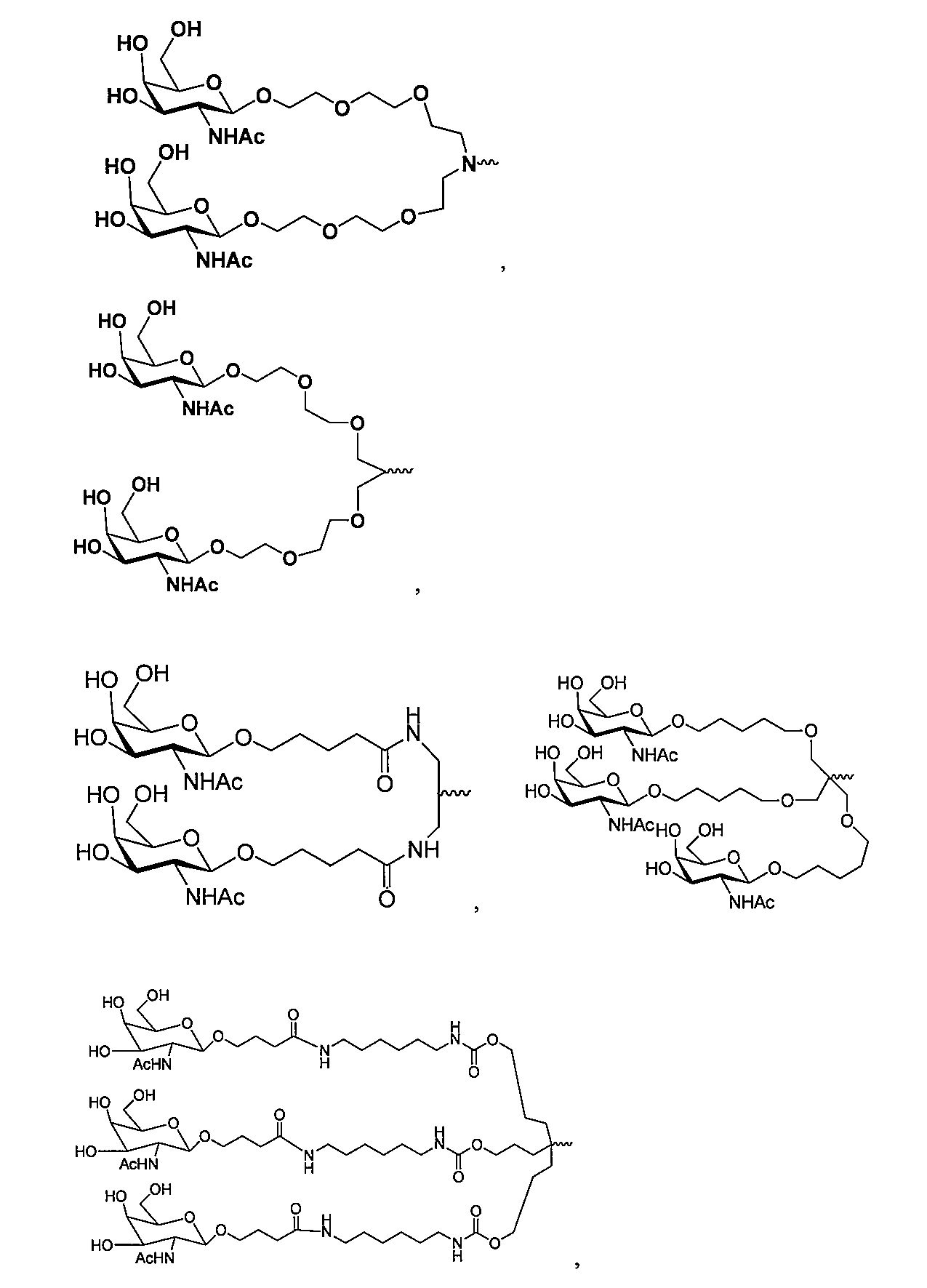
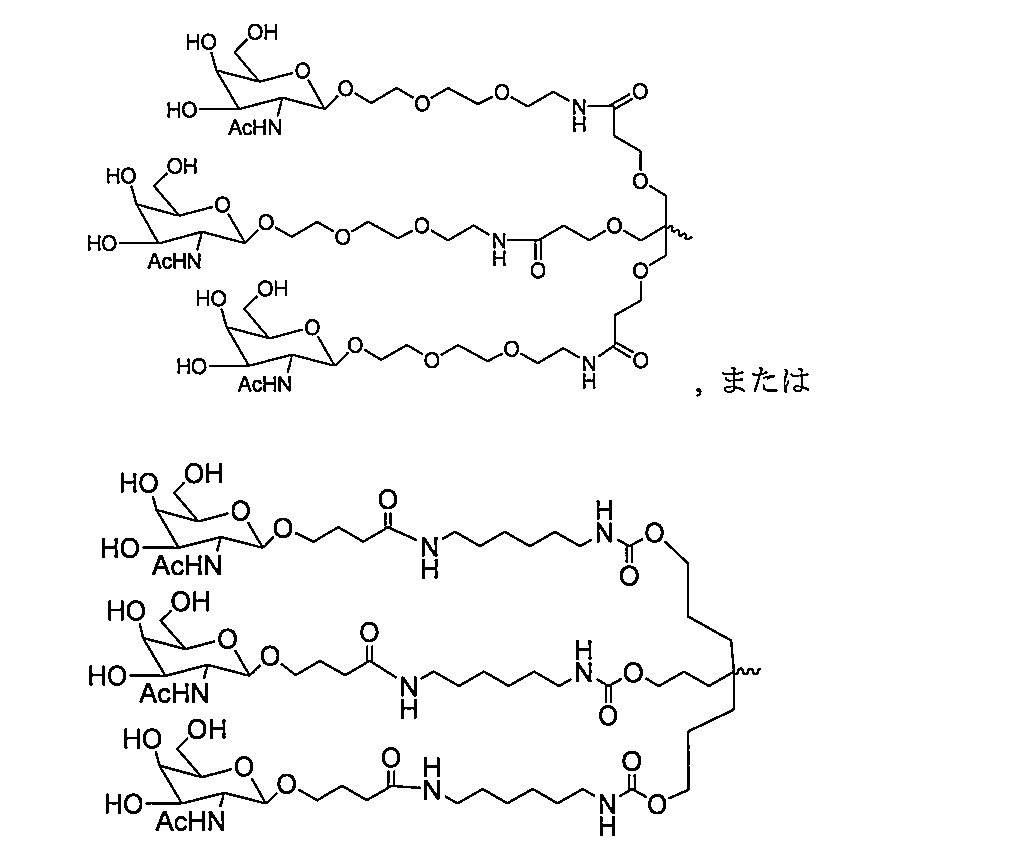
RNAコンジュゲートの調製を教示する代表的な米国特許としては、限定はされないが、米国特許第4,828,979号;第4,948,882号;第5,218,105号;第5,525,465号;第5,541,313号;第5,545,730号;第5,552,538号;第5,578,717号、第5,580,731号;第5,591,584号;第5,109,124号;第5,118,802号;第5,138,045号;第5,414,077号;第5,486,603号;第5,512,439号;第5,578,718号;第5,608,046号;第4,587,044号;第4,605,735号;第4,667,025号;第4,762,779号;第4,789,737号;第4,824,941号;第4,835,263号;第4,876,335号;第4,904,582号;第4,958,013号;第5,082,830号;第5,112,963号;第5,214,136号;第5,082,830号;第5,112,963号;第5,214,136号;第5,245,022号;第5,254,469号;第5,258,506号;第5,262,536号;第5,272,250号;第5,292,873号;第5,317,098号;第5,371,241号、第5,391,723号;第5,416,203号、第5,451,463号;第5,510,475号;第5,512,667号;第5,514,785号;第5,565,552号;第5,567,810号;第5,574,142号;第5,585,481号;第5,587,371号;第5,595,726号;第5,597,696号;第5,599,923号;第5,599,928号、および第5,688,941号;第6,294,664号;第6,320,017号;第6,576,752号;第6,783,931号;第6,900,297号;第7,037,646号;第8,106,022号を含み、そのそれぞれの内容全体を参照によって本明細書に組み入れる。 Representative U.S. patents that teach the preparation of RNA conjugates include, but are not limited to, U.S. Pat. Nos. 4,828,979; 4,948,882; 5,218,105; 5,525,465; 5,541,313; 5,545,730; 5,552,538; 5,578,717; 5,580,731; 5,591,584; 5,109,124; 5,118,802; 5,138,045; 5,414,077; 5, No. 486,603; No. 5,512,439; No. 5,578,718; No. 5,608,046; No. 4,587,044; No. 4,605,735; No. 4,667,025; No. 4,762,779; No. 4,789,737; No. 4,824,941; No. 4,835,263; No. 4,876,335; No. 4,904,582; No. 4,958,013; No. 5,082,830; No. 5,112,963; No. 5,214,136; No. 5,082,830; No. ,112,963; 5,214,136; 5,245,022; 5,254,469; 5,258,506; 5,262,536; 5,272,250; 5,292,873; 5,317,098; 5,371,241, 5,391,723; 5,416,203, 5,451,463; 5,510,475; 5,512,667; 5,514,785; 5,565,552; 5,567,810; Nos. 5,574,142; 5,585,481; 5,587,371; 5,595,726; 5,597,696; 5,599,923; 5,599,928, and 5,688,941; 6,294,664; 6,320,017; 6,576,752; 6,783,931; 6,900,297; 7,037,646; and 8,106,022, the contents of each of which are incorporated herein by reference in their entirety.
所与の化合物のすべての位置が均一に修飾されている必要はなく、実際には、上記の修飾のうちの1つより多くを、単一の化合物中にまたはさらにはiRNA内の単一のヌクレオシドに組み込むことができる。本発明は、キメラ化合物であるiRNA化合物も含む。 It is not necessary for all positions of a given compound to be uniformly modified, and in fact more than one of the above modifications can be incorporated in a single compound or even at a single nucleoside within an iRNA. The present invention also includes iRNA compounds that are chimeric compounds.
本発明に関連して、「キメラ」iRNA化合物または「キメラ」は、少なくとも1つのモノマー単位、すなわち、dsRNA化合物の場合はヌクレオチドからそれぞれ構成される2つ以上の化学的に異なる領域を含有するiRNA化合物、好ましくは、dsRNAである。これらのiRNAは、典型的には少なくとも1つの領域を含有し、ここで、RNAは、ヌクレアーゼ分解に対する耐性の増加、細胞取り込みの増加、および/または標的核酸に対する結合親和性の増加をiRNAに与えるように修飾される。iRNAのさらなる領域は、RNA:DNAまたはRNA:RNAハイブリッドを切断することが可能な酵素のための基質としての役割を果たし得る。例として、RNアーゼHは、RNA:DNA二重鎖のRNA鎖を切断する細胞エンドヌクレアーゼである。したがって、RNアーゼHの活性化は、RNA標的の切断をもたらし、それによって、遺伝子発現のiRNA阻害の効率を大幅に高める。その結果として、キメラdsRNAが使用される場合、同じ標的領域にハイブリダイズするホスホロチオエートデオキシdsRNAと比較して、より短いiRNAによって同等の結果が得られることが多い。RNA標的の切断は、ゲル電気泳動によって、および必要に応じて、当技術分野において公知の関連する核酸ハイブリダイゼーション技術によって、通例検出される。 In the context of the present invention, a "chimeric" iRNA compound or "chimera" is an iRNA compound, preferably a dsRNA, that contains two or more chemically distinct regions, each composed of at least one monomer unit, i.e., in the case of a dsRNA compound, a nucleotide. These iRNAs typically contain at least one region, in which the RNA is modified to confer to the iRNA increased resistance to nuclease degradation, increased cellular uptake, and/or increased binding affinity to the target nucleic acid. Additional regions of the iRNA may serve as substrates for enzymes capable of cleaving RNA:DNA or RNA:RNA hybrids. As an example, RNase H is a cellular endonuclease that cleaves the RNA strand of an RNA:DNA duplex. Thus, activation of RNase H results in cleavage of the RNA target, thereby greatly increasing the efficiency of iRNA inhibition of gene expression. As a result, when chimeric dsRNAs are used, comparable results are often obtained with shorter iRNAs compared to phosphorothioate deoxy dsRNAs hybridizing to the same target region. Cleavage of the RNA target is typically detected by gel electrophoresis and, optionally, by associated nucleic acid hybridization techniques known in the art.
特定の例では、iRNAのRNAは、非リガンド基によって修飾される。いくつかの非リガンド分子が、iRNAの活性、細胞分布または細胞取り込みを向上させるためにiRNAとコンジュゲートしており、このようなコンジュゲートを行うための手順は、科学文献で入手可能である。このような非リガンド部分は、コレステロール(Kubo,T.ら、Biochem.Biophys.Res.Comm.、2007,365(1):54~61頁;Letsingerら、Proc.Natl.Acad.Sci.USA、1989、86:6553頁)、コール酸(Manoharanら、Bioorg.Med.Chem.Lett.、1994、4:1053頁)、チオエーテル、例えばヘキシル-S-トリチルチオール(Manoharanら、Ann.N.Y.Acad.Sci.、1992、660:306頁;Manoharanら、Bioorg.Med.Chem.Let.、1993、3:2765頁)、チオコレステロール(Oberhauserら、Nucl.AcidsRes.、1992、20:533頁)、脂肪族鎖、例えば、ドデカンジオールまたはウンデシル残基(Saison-Behmoarasら、EMBO J.、1991、10:111頁;Kabanovら、FEBS Lett.、1990、259:327頁;Svinarchukら、Biochimie、1993、75:49頁)、リン脂質、例えば、ジ-ヘキサデシル-rac-グリセロールまたはトリエチルアンモニウム1,2-ジ-O-ヘキサデシル-rac-グリセロ-3-H-ホスホネート(Manoharanら、Tetrahedron Lett.、1995、36:3651頁;Sheaら、Nucl.Acids Res.、1990、18:3777頁)、ポリアミンまたはポリエチレングリコール鎖(Manoharanら、Nucleosides & Nucleotides、1995、14:969頁)、またはアダマンタン酢酸(Manoharanら、Tetrahedron Lett.、1995、36:3651頁)、パルミチル部分(Mishraら、Biochim.Biophys.Acta、1995、1264:229頁)、またはオクタデシルアミンまたはヘキシルアミノ-カルボニル-オキシコレステロール部分(Crookeら、J.Pharmacol.Exp.Ther.、1996、277:923頁)のような脂質部分を含んでいた。このようなRNAコンジュゲートの調製を教示する代表的な米国特許が上に列挙されている。典型的なコンジュゲーションプロトコルは、配列の1つまたはそれ以上の位置にアミノリンカーを有するRNAの合成を含む。次に、適切なカップリング剤または活性化試薬のいずれかを用いて、アミノ基をコンジュゲートされた分子と反応させる。コンジュゲーション反応は固体担体に依然として結合されたRNAを用いて、または溶液相中のRNAの切断の後に行うことができる。HPLCによるRNAコンジュゲートの精製により、典型的には純粋なコンジュゲートを得る。
In certain instances, the RNA of the iRNA is modified by a non-ligand group. Several non-ligand molecules have been conjugated to iRNA to improve the activity, cellular distribution or cellular uptake of the iRNA, and procedures for performing such conjugation are available in the scientific literature. Such non-ligand moieties include cholesterol (Kubo, T. et al., Biochem. Biophys. Res. Comm., 2007, 365(1):54-61; Letsinger et al., Proc. Natl. Acad. Sci. USA, 1989, 86:6553), cholic acid (Manoharan et al., Bioorg. Med. Chem. Lett., 1994, 4:1053), thioethers, such as hexyl-S-trimethylol (Hexyl-S-trimethylol), methyl-N-methyl-N-phenylalanine ... Thiol (Manoharan et al., Ann. N.Y. Acad. Sci., 1992, 660:306; Manoharan et al., Bioorg. Med. Chem. Let., 1993, 3:2765), thiocholesterol (Oberhauser et al., Nucl. Acids Res., 1992, 20:533), aliphatic chains such as dodecanediol or undecyl residues (Saison-Behmoaras et al., EMBO J. Am. Soc., 1999, 20:1311), J., 1991, 10:111; Kabanov et al., FEBS Lett., 1990, 259:327; Svinarchuk et al., Biochimie, 1993, 75:49), phospholipids, e.g., di-hexadecyl-rac-glycerol or
いくつかの実施形態では、本発明の二本鎖RNAi薬剤はAD-57213である。 In some embodiments, the double-stranded RNAi agent of the present invention is AD-57213.
IV.本発明のiRNAの送達
細胞、例えば、ヒト対象(例えば、出血性障害を有する対象のような、それを必要とする対象)のような対象中の細胞への本発明のiRNAの送達は、いくつかの様々な方法で達成できる。例えば、送達は、細胞を、本発明のiRNAとインビトロまたはインビボのいずれかで接触させることによって行われる。インビボ送達はまた、iRNA、例えばdsRNAを含む組成物を対象に投与することによって直接行われる。あるいは、インビボ送達は、iRNAの発現をコードし、導く1つまたはそれ以上のベクターを投与することによって、間接的に行われる。これらの代替例は、以下でさらに論じる。
IV. Delivery of the iRNA of the invention Delivery of the iRNA of the invention to a cell, e.g., a cell in a subject, such as a human subject (e.g., a subject in need thereof, such as a subject with a bleeding disorder), can be accomplished in several different ways. For example, delivery is achieved by contacting a cell with the iRNA of the invention, either in vitro or in vivo. In vivo delivery can also be achieved directly by administering a composition comprising the iRNA, e.g., a dsRNA, to the subject. Alternatively, in vivo delivery can be achieved indirectly, by administering one or more vectors that encode and direct the expression of the iRNA. These alternatives are discussed further below.
一般に、核酸分子を(インビトロまたはインビボで)送達する任意の方法は、本発明のiRNAと共に使用するために適合される(例えば、その全体を参照によって本明細書に組み入れる、Akhtar S.and Julian RL.(1992)Trends Cell.Biol.2(5):139~144頁および国際公開第94/02595号パンフレット参照)。インビボ送達の場合、iRNA分子を送達するために考慮する因子としては、例えば、送達される分子の生物学的安定性、非特異的効果の防止、および標的組織における送達される分子の蓄積を含む。iRNAの非特異的効果は、局所投与によって、例えば、組織への直接注入もしくは移植によって、または製剤を局所的に投与することによって、最小限に抑えられる。処置部位への局所投与は、薬剤の局所濃度を最大にし、薬剤によって悪影響を受けるかまたは薬剤を分解し得る、全身組織への薬剤の曝露を制限し、投与されるiRNA分子の総投与量を少なくすることができる。いくつかの研究が、iRNAが局所投与される場合の遺伝子産物のノックダウンの成功を示している。例えば、カニクイザルのガラス体内注射によるVEGF dsRNAの眼内送達(Tolentino,MJ.ら(2004)Retina 24:132~138頁)およびマウスの網膜下注射(Reich,SJ.ら(2003)Mol.Vis.9:210~216頁)は両方とも、加齢性黄斑変性症の実験モデルにおける新血管形成を防ぐことを示した。さらに、マウスにおけるdsRNAの直接腫瘍内投与が腫瘍容積を減少させ(Pille,J.ら(2005)Mol.Ther.11:267~274頁)、腫瘍担持マウスの生存を延長し得る(Kim,WJ.ら(2006)Mol.Ther.14:343~350頁;Li,S.ら(2007)Mol.Ther.15:515~523頁)。RNA干渉は、直接注入によるCNSへの局所送達(Dorn,G.ら(2004)Nucleic Acids 32:e49;Tan,PH.ら(2005)Gene Ther.12:59~66頁;Makimura,H.ら(2002)BMC Neurosci.3:18頁;Shishkina,GT.,ら(2004)Neuroscience 129:521~528頁;Thakker,ER.ら(2004)Proc.Natl.Acad.Sci.U.S.A.101:17270~17275頁;Akaneya,Y.ら(2005)J.Neurophysiol.93:594~602頁)および鼻腔内投与による肺への局所送達(Howard,KA.ら(2006)Mol.Ther.14:476~484頁;Zhang,X.ら(2004)J.Biol.Chem.279:10677~10684頁;Bitko,V.ら(2005)Nat.Med.11:50~55頁)による成功も示している。疾患の処置のためにiRNAを全身投与するために、RNAは、修飾されるか、あるいは薬剤送達システムを用いて送達され;両方の方法は、インビボでのエンドヌクレアーゼおよびエキソヌクレアーゼによるdsRNAの急速な分解を防ぐ役割を果たす。RNAまたは医薬担体の修飾は、標的組織へのiRNA組成物の標的化を可能にし、望ましくないオフターゲット効果を回避することもできる。iRNA分子は、細胞取り込みを向上させ、分解を防ぐコレステロールのような親油基への化学的コンジュゲーションによって修飾される。例えば、親油性コレステロール部分とコンジュゲートしたApoBに対するiRNAをマウスに全身投与し、
肝臓および空腸の両方においてapoB mRNAのノックダウンを得た(Soutschek,J.ら(2004)Nature 432:173~178頁)。アプタマーへのiRNAのコンジュゲーションは、前立腺がんのマウスモデルにおける腫瘍増殖を阻害し、腫瘍退縮を仲介することが示されている(McNamara,JO.ら(2006)Nat.Biotechnol.24:1005~1015頁)。代替的な実施形態では、iRNAは、ナノ粒子、デンドリマー、ポリマー、リポソーム、またはカチオン性送達システムのような薬剤送達システムを用いて送達される。正に帯電したカチオン性送達システムは、iRNA分子(負に帯電した)の結合を促進し、また、負に帯電した細胞膜における相互作用を向上させて、細胞によるiRNAの効率的な取り込みを可能にする。カチオン性脂質、デンドリマー、またはポリマーは、iRNAに結合されるか、またはiRNAを包む小胞もしくはミセル(例えば、Kim SH.ら(2008)Journal
of Controlled Release 129(2):107~116頁参照)を形成するように誘導される。小胞またはミセルの形成は、全身投与される場合のiRNAの分解をさらに防ぐ。カチオン性iRNA複合体を作製し、投与するための方法は、十分当業者の能力の範囲内である(例えば、その全体を参照によって本明細書に組み入れる、Sorensen,DR.ら(2003)J.Mol.Biol 327:761~766頁;Verma,UN.ら(2003)Clin.Cancer Res.9:1291~1300頁;Arnold,ASら(2007)J.Hypertens.25:197~205頁参照)。iRNAの全身送達に有用な薬剤送達システムのいくつかの非限定的な例としては、DOTAP(Sorensen,DR.ら(2003)、上記参照;Verma,UN.ら(2003)、上記参照)、オリゴフェクタミン、「固体核酸脂質粒子」(Zimmermann,TS.ら(2006)Nature 441:111~114頁)、カルジオリピン(Chien,PY.ら(2005)Cancer Gene Ther.12:321~328頁;Pal,A.ら(2005)Int J.Oncol.26:1087~1091頁)、ポリエチレンイミン(Bonnet ME.ら(2008)Pharm.Res.Aug 16 Epub ahead of print;Aigner,A.(2006)J.Biomed.Biotechnol.71659頁)、Arg-Gly-Asp(RGD)ペプチド(Liu,S.(2006)Mol.Pharm.3:472~487頁)、およびポリアミドアミン(Tomalia,DA.ら(2007)Biochem.Soc.Trans.35:61~67頁;Yoo,H.ら(1999)Pharm.Res.16:1799~1804頁)を含む。いくつかの実施形態では、iRNAは、全身投与のためにシクロデキストリンと共に複合体を形成する。投与のための方法およびiRNAおよびシクロデキストリンの医薬組成物が、その全体を参照によって本明細書に組み入れる、米国特許第7,427,605号に見出される。
In general, any method of delivery of nucleic acid molecules (in vitro or in vivo) is adapted for use with the iRNAs of the present invention (see, e.g., Akhtar S. and Julian RL. (1992) Trends Cell. Biol. 2(5):139-144 and WO 94/02595, which are incorporated herein by reference in their entireties). For in vivo delivery, factors to consider for delivering iRNA molecules include, for example, the biological stability of the delivered molecule, prevention of non-specific effects, and accumulation of the delivered molecule in the target tissue. Non-specific effects of iRNAs are minimized by local administration, e.g., by direct injection or implantation into the tissue, or by administering the formulation locally. Local administration to the treatment site maximizes the local concentration of the agent, limits exposure of the agent to systemic tissues that may be adversely affected by or degrade the agent, and can reduce the total dose of the iRNA molecule administered. Several studies have shown successful knockdown of gene products when iRNA is administered locally. For example, intraocular delivery of VEGF dsRNA by intravitreal injection in cynomolgus monkeys (Tolentino, MJ. et al. (2004) Retina 24:132-138) and subretinal injection in mice (Reich, SJ. et al. (2003) Mol. Vis. 9:210-216) have both been shown to prevent neovascularization in experimental models of age-related macular degeneration. Furthermore, direct intratumoral administration of dsRNA in mice can reduce tumor volume (Pille, J. et al. (2005) Mol. Ther. 11:267-274) and prolong survival of tumor-bearing mice (Kim, WJ. et al. (2006) Mol. Ther. 14:343-350; Li, S. et al. (2007) Mol. Ther. 15:515-523). RNA interference can be delivered locally to the CNS by direct injection (Dorn, G. et al. (2004) Nucleic Acids 32:e49; Tan, PH. et al. (2005) Gene Ther. 12:59-66; Makimura, H. et al. (2002) BMC Neurosci. 3:18; Shishkina, GT., et al. (2004) Neuroscience. 129:521-528; Thakker, E. R. et al. (2004) Proc. Natl. Acad. Sci. U.S.A. 101:17270-17275; Akaneya, Y. et al. (2005) J. Neurophysiol. 93:594-602) and via intranasal administration for localized delivery to the lungs (Howard, K. A. et al. (2006) Mol. Ther. 14:476-484; Zhang, X. et al. (2004) J. Biol. Chem. 279:10677-10684; Bitko, V. et al. (2005) Nat. Med. 11:50-55). To administer iRNA systemically for disease treatment, RNA is modified or delivered using a drug delivery system; both methods serve to prevent rapid degradation of dsRNA by endonucleases and exonucleases in vivo. Modification of RNA or pharmaceutical carriers can also allow targeting of iRNA compositions to target tissues and avoid undesirable off-target effects. iRNA molecules are modified by chemical conjugation to lipophilic groups such as cholesterol, which improves cellular uptake and prevents degradation. For example, iRNA against ApoB conjugated with a lipophilic cholesterol moiety is administered systemically to mice,
Knockdown of apoB mRNA was obtained in both liver and jejunum (Soutschek, J. et al. (2004) Nature 432:173-178). Conjugation of iRNA to aptamers has been shown to inhibit tumor growth and mediate tumor regression in mouse models of prostate cancer (McNamara, JO. et al. (2006) Nat. Biotechnol. 24:1005-1015). In alternative embodiments, iRNA is delivered using a drug delivery system such as a nanoparticle, dendrimer, polymer, liposome, or cationic delivery system. The positively charged cationic delivery system promotes binding of the iRNA molecule (which is negatively charged) and also improves interaction with the negatively charged cell membrane, allowing efficient uptake of the iRNA by cells. Cationic lipids, dendrimers, or polymers can be attached to iRNA or can be used to create vesicles or micelles that encase iRNA (see, e.g., Kim S. H. et al. (2008) Journal of
of Controlled Release 129(2):107-116). The formation of vesicles or micelles further protects the iRNA from degradation when administered systemically. Methods for making and administering cationic iRNA complexes are well within the capabilities of one of ordinary skill in the art (see, e.g., Sorensen, DR. et al. (2003) J. Mol. Biol 327:761-766; Verma, UN. et al. (2003) Clin. Cancer Res. 9:1291-1300; Arnold, AS et al. (2007) J. Hypertens. 25:197-205, which are incorporated herein by reference in their entireties). Some non-limiting examples of drug delivery systems useful for systemic delivery of iRNA include DOTAP (Sorensen, DR. et al. (2003), supra; Verma, UN. et al. (2003), supra), oligofectamine, "solid nucleic acid lipid particles" (Zimmermann, TS. et al. (2006) Nature 441:111-114), cardiolipin (Chien, PY. et al. (2005) Cancer Gene Ther. 12:321-328; Pal, A. et al. (2005) Int J. Oncol. 26:1087-1091), polyethyleneimine (Bonnet ME. et al. (2008) Pharm. Res.
A.ベクターでコードされた本発明のiRNA
Serpinc1遺伝子を標的とするiRNAは、DNAまたはRNAベクターに挿入された転写単位から発現される(例えば、Couture,Aら、TIG.(1996),12:5~10頁;Skillern,A.らの国際PCT公開番号国際公開第00/22113号パンフレット、Conradの国際PCT公開番号国際公開第00/22114号パンフレット、およびConradの米国特許第6,054,299号参照)。発現は、使用される特定の構築物および標的組織または細胞型に応じて、一時的(およそ数時間から数週間)であるかまたは持続される(数週間から数カ月またはそれ以上)。これらの導入遺伝子は、線状構築物、環状プラスミド、またはウイルスベクターとして導入することができ、これらは、組み込みまたは非組み込みベクターであり得る。導入遺伝子は、染色体外プラスミドとして継承されるのを可能にするように構築することもできる(Gassmannら、Proc.Natl.Acad.Sci.USA(1995)92:1292頁)。
A. Vector-Encoded iRNAs of the Invention
iRNAs targeting the Serpincl gene are expressed from transcription units inserted into DNA or RNA vectors (see, e.g., Couture, A. et al., TIG. (1996), 12:5-10; Skillern, A. et al., International PCT Publication No. WO 00/22113, Conrad, International PCT Publication No. WO 00/22114, and Conrad, U.S. Patent No. 6,054,299). Expression can be transient (from a matter of hours to weeks) or sustained (weeks to months or longer), depending on the particular construct used and the target tissue or cell type. These transgenes can be introduced as linear constructs, circular plasmids, or viral vectors, which can be integrating or non-integrating vectors. The transgene can also be constructed to allow it to be inherited as an extrachromosomal plasmid (Gassmann et al., Proc. Natl. Acad. Sci. USA (1995) 92:1292).
iRNAの個々の1つまたは複数の鎖は、発現ベクターにおけるプロモーターから転写される。2本の別々の鎖が発現されて、例えば、dsRNAを生成する場合、2つの別個の発現ベクターが、(例えば、トランスフェクションまたは感染によって)標的細胞中に共導入される。あるいは、dsRNAの各個々の鎖が、同じ発現プラスミド上に位置するプロモーターによって転写される。一実施形態では、dsRNAは、ステム・ループ構造を有するように、リンカーポリヌクレオチド配列によって接合される逆方向反復ポリヌクレオチドとして発現される。 The individual strand or strands of the iRNA are transcribed from a promoter in an expression vector. If two separate strands are to be expressed, e.g., to produce dsRNA, two separate expression vectors are co-introduced (e.g., by transfection or infection) into a target cell. Alternatively, each individual strand of the dsRNA is transcribed by a promoter located on the same expression plasmid. In one embodiment, the dsRNA is expressed as an inverted repeat polynucleotide joined by a linker polynucleotide sequence to have a stem-loop structure.
iRNA発現ベクターは、一般に、DNAプラスミドまたはウイルスベクターである。真核細胞と適合する発現ベクター、好ましくは、脊椎動物細胞と適合する発現ベクターを用いて、本明細書に記載されるiRNAの発現のための組換え構築物を産生することができる。真核細胞の発現ベクターは、当技術分野において周知であり、多くの商業的供給源から入手可能である。典型的には、所望の核酸セグメントを挿入するのに好都合な制限部位を含有するこのようなベクターが提供される。iRNA発現ベクターの送達は、静脈内もしくは筋肉内投与によるか、患者から移植された標的細胞に投与した後に患者に再導入することによるか、または所望の標的細胞への導入を可能にする任意の他の手段のような全身送達であり得る。 The iRNA expression vector is generally a DNA plasmid or a viral vector. Recombinant constructs for expression of the iRNAs described herein can be produced using expression vectors compatible with eukaryotic cells, preferably expression vectors compatible with vertebrate cells. Eukaryotic expression vectors are well known in the art and are available from many commercial sources. Typically, such vectors are provided that contain convenient restriction sites for inserting the desired nucleic acid segment. Delivery of the iRNA expression vector can be systemic, such as by intravenous or intramuscular administration, by administration to target cells transplanted from the patient and then reintroduced into the patient, or any other means that allows for introduction into the desired target cells.
iRNA発現プラスミドは、カチオン性脂質担体(例えば、Oligofectamine)または非カチオン性の脂質ベースの担体(例えば、Transit-TKO(商標))との複合体として標的細胞中にトランスフェクトされる。1週間以上の期間にわたる標的RNAの異なる領域を標的とするiRNAを介したノックダウンのための複数回の脂質のトランスフェクションも、本発明によって想定される。宿主細胞中へのベクターの導入の成功は、様々な公知の方法を用いてモニターされる。例えば、一過性のトランスフェクションは、緑色傾向タンパク質(GFP)のような蛍光マーカーのようなレポーターを用いて示される。エクスビボでの細胞の安定したトランスフェクションは、トランスフェクト細胞にハイグロマイシンB耐性のような特定の環境因子(例えば、抗生物質および薬剤)に対する耐性を与えるマーカーを用いて確実にすることができる。 The iRNA expression plasmid is transfected into the target cells as a complex with a cationic lipid carrier (e.g., Oligofectamine) or a non-cationic lipid-based carrier (e.g., Transit-TKO™). Multiple lipid transfections for iRNA-mediated knockdown targeting different regions of the target RNA over a period of a week or more are also contemplated by the present invention. Successful introduction of the vector into the host cells is monitored using a variety of known methods. For example, transient transfection is indicated using a reporter such as a fluorescent marker like green fluorescent protein (GFP). Stable transfection of cells ex vivo can be ensured using a marker that confers resistance to certain environmental factors (e.g., antibiotics and drugs) on the transfected cells, such as hygromycin B resistance.
本明細書に記載する方法および組成物と共に用いられるウイルスベクター系としては、限定はされないが、(a)アデノウイルスベクター;(b)レンチウイルスベクター、モロニ-マウス白血病ウイルスなどを含むが、これらに限定されないレトロウイルスベクター;(c)アデノ随伴ウイルスベクター;(d)単純ヘルペスウイルスベクター;(e)SV40ベクター;(f)ポリオーマウイルスベクター;(g)パピローマウイルスベクター;(h)ピコルナウイルスベクター;(i)オルソポックス(orthopox)、例えば、ワクシニアウイルスベクターまたは鳥ポックス、例えばカナリア痘または鶏痘などのポックスウイルスベクター;および(j)ヘルパー依存性または弱毒アデノウイルスが挙げられる。複製欠損ウイルスも有利であり得る。異なるベクターが、細胞のゲノムに組み込まれるかまたは組み込まれないであろう。構築物は、必要に応じて、トランスフェクションのためのウイルス配列を含み得る。あるいは、構築物は、エピソーム複製が可能なベクター、例えばEPVおよびEBVベクターに組み込まれる。iRNAの組換え発現のための構築物は、一般に、標的細胞内でのiRNAの発現を確実にするために、調節要素、例えば、プロモーター、エンハンサーなどを必要とする。ベクターおよび構築物について考慮される他の態様が、以下にさらに記載される。 Viral vector systems for use with the methods and compositions described herein include, but are not limited to, (a) adenoviral vectors; (b) retroviral vectors, including but not limited to lentiviral vectors, Moloney Murine Leukemia Virus, and the like; (c) adeno-associated virus vectors; (d) herpes simplex virus vectors; (e) SV40 vectors; (f) polyoma virus vectors; (g) papilloma virus vectors; (h) picornavirus vectors; (i) orthopox, e.g., vaccinia virus vectors or avian pox, e.g., canarypox or fowlpox, poxvirus vectors; and (j) helper-dependent or attenuated adenoviruses. Replication-deficient viruses may also be advantageous. Different vectors will or will not integrate into the genome of the cell. The constructs may include viral sequences for transfection, as appropriate. Alternatively, the constructs are incorporated into vectors capable of episomal replication, e.g., EPV and EBV vectors. Constructs for recombinant expression of iRNA generally require regulatory elements, such as promoters, enhancers, etc., to ensure expression of the iRNA in the target cell. Other aspects of the vectors and constructs to be considered are further described below.
iRNAの送達に有用なベクターは、所望の標的細胞または組織におけるiRNAの発現に十分な調節要素(プロモーター、エンハンサーなど)を含むであろう。調節要素は、構成的または調節性/誘導性発現のいずれかを提供するように選択される。 Vectors useful for delivery of iRNA will contain sufficient regulatory elements (promoters, enhancers, etc.) for expression of the iRNA in the desired target cell or tissue. The regulatory elements will be selected to provide either constitutive or regulated/inducible expression.
iRNAの発現は、例えば、特定の生理的調節因子、例えば、血中グルコースレベル、
またはホルモンに対して感受性がある誘導性調節配列を使用することによって、正確に調節される(Dochertyら、1994,FASEB J.8:20~24頁)。細胞または哺乳動物におけるdsRNAの発現の制御に好適なこのような誘導性発現系としては、例えばエクジソン、エストロゲン、プロゲステロン、テトラサイクリン、二量化の化学誘導物質、およびイソプロピル-ベータ-D1-チオガラクトピラノシド(IPTG)による調節が挙げられる。当業者は、iRNA導入遺伝子の目的とする使用に基づいて、適切な調節/プロモーター配列を選択することができるであろう。
Expression of an iRNA can be, for example, regulated by a particular physiological regulator, e.g., blood glucose levels,
or by using inducible regulatory sequences that are sensitive to hormones (Docherty et al., 1994, FASEB J. 8:20-24). Such inducible expression systems suitable for controlling the expression of dsRNA in cells or mammals include, for example, regulation by ecdysone, estrogen, progesterone, tetracycline, chemical inducers of dimerization, and isopropyl-beta-D1-thiogalactopyranoside (IPTG). One of skill in the art will be able to select the appropriate regulatory/promoter sequence based on the intended use of the iRNA transgene.
iRNAをコードする核酸配列を含有するウイルスベクターが使用される。例えば、レトロウイルスベクターが使用される(Millerら、Meth.Enzymol.217:581~599頁(1993)参照)。これらのレトロウイルスベクターは、ウイルスゲノムの適切なパッケージングおよび宿主細胞DNAへの組み込みに必要な構成要素を含有する。iRNAをコードする核酸配列は、患者への核酸の送達を促進する、1つまたはそれ以上のベクターにクローニングされる。レトロウイルスベクターについてのさらなる詳細は、例えば、Boesenら、Biotherapy 6:291~302頁(1994)に見出すことができ、これには、造血幹細胞を化学療法に対してより耐性にするために、造血幹細胞にmdr1遺伝子を送達するレトロウイルスベクターの使用が記載されている。遺伝子療法におけるレトロウイルスベクターの使用を示す他の参照文献は、Clowesら、J.Clin.Invest.93:644~651頁(1994);Kiemら、Blood 83:1467~1473頁(1994);Salmons and Gunzberg、Human Gene Therapy 4:129~141頁(1993);およびGrossman and Wilson、Curr.Opin.in Genetics and Devel.3:110~114頁(1993)である。使用のために考えられるレンチウイルスベクターとしては、例えば、参照によって本明細書に組み入れる、米国特許第6,143,520号;第5,665,557号;および第5,981,276号に記載されるHIVに基づいたベクターが挙げられる。 A viral vector containing a nucleic acid sequence encoding the iRNA is used. For example, a retroviral vector is used (see Miller et al., Meth. Enzymol. 217:581-599 (1993)). These retroviral vectors contain the components necessary for proper packaging of the viral genome and integration into the host cell DNA. The nucleic acid sequence encoding the iRNA is cloned into one or more vectors, which facilitates delivery of the nucleic acid to the patient. Further details on retroviral vectors can be found, for example, in Boesen et al., Biotherapy 6:291-302 (1994), which describes the use of a retroviral vector to deliver the mdr1 gene to hematopoietic stem cells to make them more resistant to chemotherapy. Other references showing the use of retroviral vectors in gene therapy are Clowes et al., J. Clin. Invest. 93:644-651 (1994); Kiem et al., Blood 83:1467-1473 (1994); Salmons and Gunzberg, Human Gene Therapy 4:129-141 (1993); and Grossman and Wilson, Curr. Opin. in Genetics and Devel. 3:110-114 (1993). Lentiviral vectors contemplated for use include, for example, HIV-based vectors described in U.S. Pat. Nos. 6,143,520; 5,665,557; and 5,981,276, which are incorporated herein by reference.
アデノウイルスも、本発明のiRNAの送達における使用のために考えられる。アデノウイルスは、例えば、呼吸上皮に遺伝子を送達するための特に魅力的なビヒクルである。アデノウイルスは、本来、呼吸上皮に感染し、軽度の疾患を引き起こす。アデノウイルスに基づいた送達システムの他の標的は、肝臓、中枢神経系、内皮細胞、および筋肉である。アデノウイルスには、非分裂細胞に感染することが可能であるという利点がある。Kozarsky and Wilson,Current Opinion in Genetics and Development 3:499~503頁(1993)には、アデノウイルスに基づいた遺伝子療法の概説が示されている。Boutら、Human
Gene Therapy 5:3~10頁(1994)は、アカゲザルの呼吸上皮に遺伝子を移送するアデノウイルスベクターの使用を実証した。遺伝子療法におけるアデノウイルスの使用の他の例は、Rosenfeldら、Science 252:431~434頁(1991);Rosenfeldら、Cell 68:143~155頁(1992);Mastrangeliら、J.Clin.Invest.91:225~234頁(1993);PCT広報の国際公開第94/12649号パンフレット;およびWangら、Gene Therapy 2:775~783頁(1995)に見出すことができる。本発明で取り上げられるiRNAを発現するのに好適なAVベクター、組換えAVベクターを構築するための方法、およびベクターを標的細胞中に送達するための方法が、Xia Hら、(2002)、Nat.Biotech.20:1006~1010頁に記載されている。
Adenoviruses are also contemplated for use in delivering the iRNA of the present invention. Adenoviruses are particularly attractive vehicles for delivering genes, for example, to respiratory epithelia. Adenoviruses naturally infect respiratory epithelia and cause a mild disease. Other targets for adenovirus-based delivery systems are the liver, central nervous system, endothelial cells, and muscle. Adenoviruses have the advantage of being capable of infecting non-dividing cells. Kozarsky and Wilson, Current Opinion in Genetics and Development 3:499-503 (1993), provide a review of adenovirus-based gene therapy. Bout et al., Human
Gene Therapy 5:3-10 (1994) demonstrated the use of adenovirus vectors to transfer genes to the respiratory epithelia of rhesus monkeys. Other examples of the use of adenoviruses in gene therapy can be found in Rosenfeld et al., Science 252:431-434 (1991); Rosenfeld et al., Cell 68:143-155 (1992); Mastrangeli et al., J. Clin. Invest. 91:225-234 (1993); PCT Publication WO 94/12649; and Wang et al., Gene Therapy 2:775-783 (1995). AV vectors suitable for expressing the iRNAs featured in the present invention, methods for constructing recombinant AV vectors, and methods for delivering the vectors into target cells are described in Xia H et al. (2002) Nat. Biotech. 20:1006-1010.
アデノ随伴ウイルス(AVV)ベクターも、本発明のiRNAを送達するのに使用される(Walshら、Proc.Soc.Exp.Biol.Med.204:289~300頁(1993);米国特許第5,436,146号)。一実施形態では、iRNAは
、例えば、U6もしくはH1 RNAプロモーター、またはサイトメガロウイルス(CMV)プロモーターのいずれかを有する組換えAAVベクターから、2つの別個の相補的な一本鎖RNA分子として発現される。本発明で取り上げられるdsRNAを発現するのに好適なAAVベクター、組換えAVベクターを構築するための方法、およびベクターを標的細胞中に送達するための方法が、その開示全体を参照によって本明細書に組み入れるSamulski Rら(1987)、J.Virol.61:3096~3101頁;Fisher K Jら(1996)、J.Virol、70:520~532頁;Samulski Rら(1989)、J.Virol.63:3822~3826頁;米国特許第5,252,479号;米国特許第5,139,941号;国際特許出願番号国際公開第94/13788号パンフレット;および国際特許出願番号国際公開第93/24641号パンフレットに記載されている。
Adeno-associated virus (AVV) vectors have also been used to deliver the iRNA of the invention (Walsh et al., Proc. Soc. Exp. Biol. Med. 204:289-300 (1993); U.S. Pat. No. 5,436,146). In one embodiment, the iRNA is expressed as two separate, complementary single-stranded RNA molecules from a recombinant AAV vector having, for example, either a U6 or H1 RNA promoter, or a cytomegalovirus (CMV) promoter. AAV vectors suitable for expressing the dsRNA featured in the invention, methods for constructing recombinant AV vectors, and methods for delivering the vectors into target cells are described in Samulski R et al. (1987), J. Virol. 61:3096-3101; Fisher K J et al. (1996), J. Immunol. 1999, 11:111-112, the disclosures of which are incorporated herein by reference in their entireties. Virol, 70:520-532; Samulski R et al. (1989), J. Virol. 63:3822-3826; U.S. Patent No. 5,252,479; U.S. Patent No. 5,139,941; International Patent Application No. WO 94/13788; and International Patent Application No. WO 93/24641.
本発明のiRNAの送達に好適な別のウイルスベクターは、ワクシニアウイルス、例えば、改変ウイルスアンカラ(MVA)またはNYVACのような弱毒化ワクシニア、鶏痘またはカナリア痘のような鳥ポックスのようなポックスウイルスである。 Another viral vector suitable for delivery of the iRNA of the invention is a vaccinia virus, e.g., an attenuated vaccinia such as Modified Virus Ankara (MVA) or NYVAC, a pox virus such as an avian pox, e.g., fowlpox or canarypox.
ウイルスベクターの指向性は、エンベロープタンパク質または他のウイルスからの他の表面抗原を用いてベクターをシュードタイピングすることによって、または異なるウイルスカプシドタンパク質を必要に応じて置換することによって、改変される。例えば、レンチウイルスベクターは、水疱性口内炎ウイルス(VSV)、狂犬病、エボラ、モコラなどからの表面タンパク質を用いてシュードタイピングされる。AAVベクターは、異なるカプシドタンパク質血清型を発現するようにこのベクターを操作することによって、異なる細胞を標的とするように作製される。例えば、その全開示を参照によって本明細書に組み入れる、Rabinowitz J Eら(2002)、J Virol 76:791~801頁を参照。 The tropism of viral vectors is modified by pseudotyping the vector with envelope proteins or other surface antigens from other viruses, or by substituting different viral capsid proteins as appropriate. For example, lentiviral vectors are pseudotyped with surface proteins from vesicular stomatitis virus (VSV), rabies, Ebola, Mokola, etc. AAV vectors are made to target different cells by engineering the vector to express different capsid protein serotypes. See, for example, Rabinowitz J E et al. (2002), J Virol 76:791-801, the entire disclosure of which is incorporated herein by reference.
ベクターの医薬製剤は、許容可能な希釈剤中のベクターを含むことができ。または遺伝子送達ビヒクルが埋め込まれる徐放性マトリックスを含むことができる。あるいは、組換え細胞から、完全な遺伝子送達ベクター、例えば、レトロウイルスベクターが無傷で産生される場合、医薬製剤は遺伝子送達システムを産生する1つまたはそれ以上の細胞を含むことができる。 A pharmaceutical preparation of the vector can include the vector in an acceptable diluent or can comprise a slow release matrix in which the gene delivery vehicle is imbedded. Alternatively, where the complete gene delivery vector is produced intact from recombinant cells, e.g., retroviral vectors, the pharmaceutical preparation can include one or more cells which produce the gene delivery system.
V.本発明の医薬組成物
本発明は、本発明のiRNAを含む医薬組成物および製剤も提供する。一実施形態では、本明細書に記載のiRNAと、薬学的に許容される担体とを含有する医薬組成物も本明細書に提供される。iRNAを含有する医薬組成物は、Serpinc1遺伝子の発現または活性に関連する疾患または障害、例えばSerpinc1関連疾患を処置するのに有用である。このような医薬組成物は、送達様式に基づいて製剤化される。一例は、非経口投与を介した、例えば皮下(SC)または静脈内(IV)送達による全身投与用に製剤化される組成物である。別の例は、例えば、持続性ポンプ注入のような脳への注入による、脳実質への直接送達用に製剤化される組成物である。本発明の医薬組成物は、Serpinc1遺伝子の発現を阻害するのに十分な投与量で投与される。
V. Pharmaceutical Compositions of the Invention The present invention also provides pharmaceutical compositions and formulations comprising the iRNA of the invention. In one embodiment, a pharmaceutical composition containing the iRNA described herein and a pharma- ceutically acceptable carrier is also provided herein. The pharmaceutical composition containing the iRNA is useful for treating diseases or disorders related to the expression or activity of the Serpincl gene, such as Serpincl-related diseases. Such pharmaceutical compositions are formulated based on the mode of delivery. One example is a composition formulated for systemic administration via parenteral administration, for example by subcutaneous (SC) or intravenous (IV) delivery. Another example is a composition formulated for direct delivery to the brain parenchyma, for example by injection into the brain, such as continuous pump infusion. The pharmaceutical composition of the present invention is administered at a dosage sufficient to inhibit the expression of the Serpincl gene.
本発明の特定の実施形態では、例えば、医薬組成物が、3つの連続的なヌクレオチド上の3つの同一の修飾の1つまたはそれ以上のモチーフを含み、薬剤の切断部位またはその近くにそのようなモチーフを含む、二本鎖RNAi薬剤を含み、6つのホスホロチオエート連結、およびGalNAcリガンドを含む場合、組成物は、0.200~約1.825mg/kg、0.200~約1.800mg/kg、約0.200~約1.700mg/kg、約0.200~約1.600mg/kg、約0.200~約1.500mg/kg、約0.200~約1.400mg/kg、約0.200~約1.400mg/kg、約
0.200~約1.200mg/kg、約0.200~約1.100mg/kg、約0.200~約1.000mg/kg、約0.200~約0.900mg/kg、約0.200~約0.800mg/kg、約0.200~約0.700mg/kg、約0.200~約0.600mg/kg、約0.200~約0.500mg/kg、約0.200~約0.400mg/kg、約0.225~約1.825mg/kg、約0.225~約1.800mg/kg、約0.225~約1.700mg/kg、約0.225~約1.600mg/kg、約0.225~約1.500mg/kg、約0.225~約1.400mg/kg、約0.225~約1.400mg/kg、約0.225~約1.200mg/kg、約0.225~約1.100mg/kg、約0.225~約1.000mg/kg、約0.225~約0.900mg/kg、約0.225~約0.800mg/kg、約0.225~約0.700mg/kg、約0.225~約0.600mg/kg、約0.225~約0.500mg/kg、約0.225~約0.400mg/kg、約0.250~約1.825mg/kg、約0.250~約1.800mg/kg、約0.250~約1.700mg/kg、約0.250~約1.600mg/kg、約0.250~約1.500mg/kg、約0.250~約1.400mg/kg、約0.250~約1.400mg/kg、約0.250~約1.200mg/kg、約0.250~約1.100mg/kg、約0.250~約1.000mg/kg、約0.250~約0.900mg/kg、約0.250~約0.800mg/kg、約0.250~約0.700mg/kg、約0.250~約0.600mg/kg、約0.250~約0.500mg/kg、約0.250~約0.400mg/kg、約0.425~約1.825mg/kg、約0.425~約1.800mg/kg、約0.425~約1.700mg/kg、約0.425~約1.600mg/kg、約0.425~約1.500mg/kg、約0.425~約1.400mg/kg、約0.425~約1.400mg/kg、約0.425~約1.200mg/kg、約0.425~約1.100mg/kg、約0.425~約1.000mg/kg、約0.425~約0.900mg/kg、約0.425~約0.800mg/kg、約0.425~約0.700mg/kg、約0.425~約0.600mg/kg、約0.425~約0.500mg/kg、約0.450~約1.825mg/kg、約0.450~約1.800mg/kg、約0.450~約1.700mg/kg、約0.450~約1.600mg/kg、約0.450~約1.500mg/kg、約0.450~約1.400mg/kg、約0.450~約1.400mg/kg、約0.450~約1.200mg/kg、約0.450~約1.100mg/kg、約0.450~約1.000mg/kg、約0.450~約0.900mg/kg、約0.450~約0.800mg/kg、約0.450~約0.700mg/kg、約0.450~約0.600mg/kg、約0.450~約0.500mg/kg、約0.475~約1.825mg/kg、約0.475~約1.800mg/kg、約0.475~約1.700mg/kg、約0.475~約1.600mg/kg、約0.475~約1.500mg/kg、約0.475~約1.400mg/kg、約0.475~約1.400mg/kg、約0.475~約1.200mg/kg、約0.475~約1.100mg/kg、約0.475~約1.000mg/kg、約0.475~約0.900mg/kg、約0.475~約0.800mg/kg、約0.475~約0.700mg/kg、約0.475~約0.600mg/kg、約0.475~約0.500mg/kg、約0.875~約1.825mg/kg、約0.875~約1.800mg/kg、約0.875~約1.700mg/kg、約0.875~約1.600mg/kg、約0.875~約1.500mg/kg、約0.875~約1.400mg/kg、約0.875~約1.400mg/kg、約0.875~約1.200mg/kg、約0.875~約1.100mg/kg、約0.875~約1.000mg/kg、約0.875~約0.900mg/kg、約0.900~約1.825mg/kg、約0.900~約1.800mg/kg、約0.900~約1.700mg/kg、約0.900~約1.600mg/kg、約0.900~約1.500mg/kg、約0.900~約1.400mg/kg、約0.900~約1.400mg/kg、約0.900~約1.200mg/kg、約0.900
~約1.100mg/kg、約0.900~約1.000mg/kg、約0.925~約1.825mg/kg、約0.925~約1.800mg/kg、約0.925~約1.700mg/kg、約0.925~約1.600mg/kg、約0.925~約1.500mg/kg、約0.925~約1.400mg/kg、約0.925~約1.400mg/kg、約0.925~約1.200mg/kg、約0.925~約1.100mg/kg、または約0.925~約1.000mg/kgの用量で投与される。先に列挙した値に対する中間の値および範囲も、本発明の一部であるものとし、例えば、RNAi薬剤は、約0.015mg/kg~約0.45mg/kgの用量で対象に投与される。
In certain embodiments of the invention, for example, where a pharmaceutical composition comprises a double-stranded RNAi agent comprising one or more motifs of three identical modifications on three consecutive nucleotides, comprising such motifs at or near the cleavage site of the agent, and comprising six phosphorothioate linkages, and a GalNAc ligand, the composition may comprise from 0.200 to about 1.825 mg/kg, 0.200 to about 1.800 mg/kg, from about 0.200 to about 1.700 mg/kg, from about 0.200 to about 1.600 mg/kg, from about 0.200 to about 1.500 mg/kg, from about 0.200 to about 1.400 mg/kg, from about 0.200 to about 1.400 mg/kg, from about 0.200 to about 1.600 mg/kg, up to about 1.200 mg/kg, about 0.200 to about 1.100 mg/kg, about 0.200 to about 1.000 mg/kg, about 0.200 to about 0.900 mg/kg, about 0.200 to about 0.800 mg/kg, about 0.200 to about 0.700 mg/kg, about 0.200 to about 0.600 mg/kg, about 0.200 to about 0.500 mg /kg, about 0.200 to about 0.400 mg/kg, about 0.225 to about 1.825 mg/kg, about 0.225 to about 1.800 mg/kg, about 0.225 to about 1.700 mg/kg, about 0.225 to about 1.600 mg/kg, about 0.225 to about 1.500 mg/kg, about 0.225 to about 1.400 mg/kg, about 0.225 about 0.225 to about 0.700 mg/kg, about 0.225 to about 0.600 mg/kg, about 0.225 to about 1.400 mg/kg, about 0.225 to about 1.200 mg/kg, about 0.225 to about 1.100 mg/kg, about 0.225 to about 1.000 mg/kg, about 0.225 to about 0.900 mg/kg, about 0.225 to about 0.800 mg/kg, about 0.225 to about 0.700 mg/kg, about 0.225 to about 0.600 mg /kg, about 0.225 to about 0.500 mg/kg, about 0.225 to about 0.400 mg/kg, about 0.250 to about 1.825 mg/kg, about 0.250 to about 1.800 mg/kg, about 0.250 to about 1.700 mg/kg, about 0.250 to about 1.600 mg/kg, about 0.250 to about 1.500 mg/kg, about 0.250 up to about 1.400 mg/kg, about 0.250 to about 1.400 mg/kg, about 0.250 to about 1.200 mg/kg, about 0.250 to about 1.100 mg/kg, about 0.250 to about 1.000 mg/kg, about 0.250 to about 0.900 mg/kg, about 0.250 to about 0.800 mg/kg, about 0.250 to about 0.700 mg /kg, about 0.250 to about 0.600 mg/kg, about 0.250 to about 0.500 mg/kg, about 0.250 to about 0.400 mg/kg, about 0.425 to about 1.825 mg/kg, about 0.425 to about 1.800 mg/kg, about 0.425 to about 1.700 mg/kg, about 0.425 to about 1.600 mg/kg, about 0.425 up to about 1.500 mg/kg, about 0.425 to about 1.400 mg/kg, about 0.425 to about 1.400 mg/kg, about 0.425 to about 1.200 mg/kg, about 0.425 to about 1.100 mg/kg, about 0.425 to about 1.000 mg/kg, about 0.425 to about 0.900 mg/kg, about 0.425 to about 0.800 mg /kg, about 0.425 to about 0.700 mg/kg, about 0.425 to about 0.600 mg/kg, about 0.425 to about 0.500 mg/kg, about 0.450 to about 1.825 mg/kg, about 0.450 to about 1.800 mg/kg, about 0.450 to about 1.700 mg/kg, about 0.450 to about 1.600 mg/kg, about 0.450 up to about 1.500 mg/kg, about 0.450 to about 1.400 mg/kg, about 0.450 to about 1.400 mg/kg, about 0.450 to about 1.200 mg/kg, about 0.450 to about 1.100 mg/kg, about 0.450 to about 1.000 mg/kg, about 0.450 to about 0.900 mg/kg, about 0.450 to about 0.800 mg /kg, about 0.450 to about 0.700 mg/kg, about 0.450 to about 0.600 mg/kg, about 0.450 to about 0.500 mg/kg, about 0.475 to about 1.825 mg/kg, about 0.475 to about 1.800 mg/kg, about 0.475 to about 1.700 mg/kg, about 0.475 to about 1.600 mg/kg, about 0.475 up to about 1.500 mg/kg, about 0.475 to about 1.400 mg/kg, about 0.475 to about 1.400 mg/kg, about 0.475 to about 1.200 mg/kg, about 0.475 to about 1.100 mg/kg, about 0.475 to about 1.000 mg/kg, about 0.475 to about 0.900 mg/kg, about 0.475 to about 0.800 mg /kg, about 0.475 to about 0.700 mg/kg, about 0.475 to about 0.600 mg/kg, about 0.475 to about 0.500 mg/kg, about 0.875 to about 1.825 mg/kg, about 0.875 to about 1.800 mg/kg, about 0.875 to about 1.700 mg/kg, about 0.875 to about 1.600 mg/kg, about 0.875 about 0.875 to about 1.500 mg/kg, about 0.875 to about 1.400 mg/kg, about 0.875 to about 1.400 mg/kg, about 0.875 to about 1.200 mg/kg, about 0.875 to about 1.100 mg/kg, about 0.875 to about 1.000 mg/kg, about 0.875 to about 0.900 mg/kg, about 0.900 to about 1.825 mg /kg, about 0.900 to about 1.800 mg/kg, about 0.900 to about 1.700 mg/kg, about 0.900 to about 1.600 mg/kg, about 0.900 to about 1.500 mg/kg, about 0.900 to about 1.400 mg/kg, about 0.900 to about 1.400 mg/kg, about 0.900 to about 1.200 mg/kg, about 0.900
about 0.925 to about 1.500 mg/kg, about 0.925 to about 1.400 mg/kg, about 0.925 to about 1.400 mg/kg, about 0.925 to about 1.200 mg/kg, about 0.925 to about 1.100 mg/kg, about 0.900 to about 1.000 mg/kg, about 0.925 to about 1.825 mg/kg, about 0.925 to about 1.800 mg/kg, about 0.925 to about 1.700 mg/kg, about 0.925 to about 1.600 mg/kg, about 0.925 to about 1.500 mg/kg, about 0.925 to about 1.400 mg/kg, about 0.925 to about 1.400 mg/kg, about 0.925 to about 1.200 mg/kg, about 0.925 to about 1.100 mg/kg, or about 0.925 to about 1.000 mg/kg. Intermediate values and ranges to the above recited values are also intended to be part of the invention, for example, the RNAi agent is administered to a subject at a dose of from about 0.015 mg/kg to about 0.45 mg/kg.
例えば、RNAi薬剤、例えば医薬組成物中のRNAi薬剤は、約0.2mg/kg、0.225mg/kg、0.25mg/kg、0.275mg/kg、0.3mg/kg、0.325mg/kg、0.35mg/kg、0.375mg/kg、0.4mg/kg、0.425mg/kg、0.45mg/kg、0.475mg/kg、約0.5mg/kg、0.525mg/kg、0.55mg/kg、0.575mg/kg、約0.6mg/kg、0.625mg/kg、0.65mg/kg、0.675mg/kg、約0.7mg/kg、0.725mg/kg、0.75mg/kg、0.775mg/kg、約0.8mg/kg、0.925mg/kg、0.95mg/kg、0.975mg/kg、約1.0mg/kg、1.025mg/kg、1.05mg/kg、1.075mg/kg、約1.1 mg/kg、1.125mg/kg、1.15mg/kg、1.17
5mg/kg、約1.2mg/kg、1.225mg/kg、1.25mg/kg、1.275mg/kg、約1.3mg/kg、1.325mg/kg、1.35mg/kg、1.375mg/kg、約1.4mg/kg、1.425mg/kg、1.45mg/kg、1.475mg/kg、約1.5mg/kg、1.525mg/kg、1.55mg/kg、1.575mg/kg、約1.6mg/kg、1.625mg/kg、1.65mg/kg、1.675mg/kg、約1.7mg/kg、1.725mg/kg、1.75mg/kg、1.775mg/kg、または約1.8mg/kgの用量で投与される。先に列挙した値に対する中間の値も、本発明の一部であるものとする。
For example, an RNAi agent, e.g., an RNAi agent in a pharmaceutical composition, may be about 0.2 mg/kg, 0.225 mg/kg, 0.25 mg/kg, 0.275 mg/kg, 0.3 mg/kg, 0.325 mg/kg, 0.35 mg/kg, 0.375 mg/kg, 0.4 mg/kg, 0.425 mg/kg, 0.45 mg/kg, 0.475 mg/kg, about 0.5 mg/kg, 0.525 mg/kg, 0.55 mg/kg , 0.575 mg/kg, about 0.6 mg/kg, 0.625 mg/kg, 0.65 mg/kg, 0.675 mg/kg, about 0.7 mg/kg, 0.725 mg/kg, 0.75 mg/kg, 0.775 mg/kg, about 0.8 mg/kg, 0.925 mg/kg, 0.95 mg/kg, 0.975 mg/kg, about 1.0 mg/kg, 1.025 mg/kg, 1.05 mg/kg, 1.075 mg/kg, about 1.1 mg/kg, 1.125 mg/kg, 1.15 mg/kg, 1.17
The compound is administered at a dose of about 5 mg/kg, about 1.2 mg/kg, 1.225 mg/kg, 1.25 mg/kg, 1.275 mg/kg, about 1.3 mg/kg, 1.325 mg/kg, 1.35 mg/kg, 1.375 mg/kg, about 1.4 mg/kg, 1.425 mg/kg, 1.45 mg/kg, 1.475 mg/kg, about 1.5 mg/kg, 1.525 mg/kg, 1.55 mg/kg, 1.575 mg/kg, about 1.6 mg/kg, 1.625 mg/kg, 1.65 mg/kg, 1.675 mg/kg, about 1.7 mg/kg, 1.725 mg/kg, 1.75 mg/kg, 1.775 mg/kg, or about 1.8 mg/kg. Values intermediate to the values recited above are also intended to be part of the present invention.
本発明のいくつかの実施形態では、例えば、二本鎖RNAi薬剤がセンス鎖およびアンチセンス鎖を含む場合、アンチセンス鎖は、ヌクレオチド配列5’-UUGAAGUAAAUGGUGUUAACCAG-3’(配列番号15)のヌクレオチド配列と異なるヌクレオチドが3つ以下である少なくとも15の連続ヌクレオチドを含む相補的な領域を含み、センス鎖の実質的にすべてのヌクレオチドおよびアンチセンス鎖の実質的にすべてのヌクレオチドが修飾ヌクレオチドであり、センス鎖は3’末端で結合するリガンドにコンジュゲートし、そのような医薬組成物中の薬剤は約0.200~約1.825mg/kg、0.200~約1.800mg/kg、約0.200~約1.700mg/kg、約0.200~約1.600mg/kg、約0.200~約1.500mg/kg、約0.200~約1.400mg/kg、約0.200~約1.400mg/kg、約0.200~約1.200mg/kg、約0.200~約1.100mg/kg、約0.200~約1.000mg/kg、約0.200~約0.900mg/kg、約0.200~約0.800mg/kg、約0.200~約0.700mg/kg、約0.200~約0.600mg/kg、約0.200~約0.500mg/kg、約0.200~約0.400mg/kg、約0.225~約1.825mg/kg、約0.225~約1.800mg/kg、約0.225~約1.700mg/kg、約0.225~約1.600mg/kg、約0.225~約1.500mg/kg、約0.225~約1.400mg/kg、約0.225~約1.400mg/kg、約0.225~約1.200mg/kg、約0.225~約1.100mg/kg、約0.225~約1.000mg/kg、約0.225~約0.900mg/kg、約0.225~約0.800mg/kg、約0.225~約0.700mg/kg、約0.225~約0.600mg/kg、約0.225~約0.500mg/kg、約0.225~約0.400mg/kg、約0.250~約1.82
5mg/kg、約0.250~約1.800mg/kg、約0.250~約1.700mg/kg、約0.250~約1.600mg/kg、約0.250~約1.500mg/kg、約0.250~約1.400mg/kg、約0.250~約1.400mg/kg、約0.250~約1.200mg/kg、約0.250~約1.100mg/kg、約0.250~約1.000mg/kg、約0.250~約0.900mg/kg、約0.250~約0.800mg/kg、約0.250~約0.700mg/kg、約0.250~約0.600mg/kg、約0.250~約0.500mg/kg、約0.250~約0.400mg/kg、約0.425~約1.825mg/kg、約0.425~約1.800mg/kg、約0.425~約1.700mg/kg、約0.425~約1.600mg/kg、約0.425~約1.500mg/kg、約0.425~約1.400mg/kg、約0.425~約1.400mg/kg、約0.425~約1.200mg/kg、約0.425~約1.100mg/kg、約0.425~約1.000mg/kg、約0.425~約0.900mg/kg、約0.425~約0.800mg/kg、約0.425~約0.700mg/kg、約0.425~約0.600mg/kg、約0.425~約0.500mg/kg、約0.450~約1.825mg/kg、約0.450~約1.800mg/kg、約0.450~約1.700mg/kg、約0.450~約1.600mg/kg、約0.450~約1.500mg/kg、約0.450~約1.400mg/kg、約0.450~約1.400mg/kg、約0.450~約1.200mg/kg、約0.450~約1.100mg/kg、約0.450~約1.000mg/kg、約0.450~約0.900mg/kg、約0.450~約0.800mg/kg、約0.450~約0.700mg/kg、約0.450~約0.600mg/kg、約0.450~約0.500mg/kg、約0.475~約1.825mg/kg、約0.475~約1.800mg/kg、約0.475~約1.700mg/kg、約0.475~約1.600mg/kg、約0.475~約1.500mg/kg、約0.475~約1.400mg/kg、約0.475~約1.400mg/kg、約0.475~約1.200mg/kg、約0.475~約1.100mg/kg、約0.475~約1.000mg/kg、約0.475~約0.900mg/kg、約0.475~約0.800mg/kg、約0.475~約0.700mg/kg、約0.475~約0.600mg/kg、約0.475~約0.500mg/kg、約0.875~約1.825mg/kg、約0.875~約1.800mg/kg、約0.875~約1.700mg/kg、約0.875~約1.600mg/kg、約0.875~約1.500mg/kg、約0.875~約1.400mg/kg、約0.875~約1.400mg/kg、約0.875~約1.200mg/kg、約0.875~約1.100mg/kg、約0.875~約1.000mg/kg、約0.875~約0.900mg/kg、約0.900~約1.825mg/kg、約0.900~約1.800mg/kg、約0.900~約1.700mg/kg、約0.900~約1.600mg/kg、約0.900~約1.500mg/kg、約0.900~約1.400mg/kg、約0.900~約1.400mg/kg、約0.900~約1.200mg/kg、約0.900~約1.100mg/kg、約0.900~約1.000mg/kg、約0.925~約1.825mg/kg、約0.925~約1.800mg/kg、約0.925~約1.700mg/kg、約0.925~約1.600mg/kg、約0.925~約1.500mg/kg、約0.925~約1.400mg/kg、約0.925~約1.400mg/kg、約0.925~約1.200mg/kg、約0.925~約1.100mg/kg、または約0.925~約1.000mg/kgの用量で投与される。先に列挙した値に対する中間の値および範囲も、本発明の一部であるものとし、例えば、RNAi薬剤は、約0.015mg/kg~約0.45mg/kgの用量で対象に投与される。
In some embodiments of the invention, for example, where a double-stranded RNAi agent comprises a sense strand and an antisense strand, the antisense strand comprises a complementary region comprising at least 15 contiguous nucleotides that differ by no more than 3 nucleotides from the nucleotide sequence 5'-UUGAAGUAAAUGGUGUUAACCAG-3' (SEQ ID NO: 15), substantially all of the nucleotides in the sense strand and substantially all of the nucleotides in the antisense strand are modified nucleotides, and the sense strand is The stearate chain is conjugated to a ligand attached at the 3' end, and the drug in such pharmaceutical compositions is about 0.200 to about 1.825 mg/kg, 0.200 to about 1.800 mg/kg, about 0.200 to about 1.700 mg/kg, about 0.200 to about 1.600 mg/kg, about 0.200 to about 1.500 mg/kg, about 0.200 to about 1.400 mg/kg, about 0.200 to about 1.400 mg/kg, about 0.200 to about 1.200 mg/kg, about 0.200 to about 1.100 mg/kg, about 0.200 to about 1. 0.000 mg/kg, about 0.200 to about 0.900 mg/kg, about 0.200 to about 0.800 mg/kg, about 0.200 to about 0.700 mg/kg, about 0.200 to about 0.600 mg/kg, about 0.200 to about 0.500 mg/kg, about 0.200 to about 0.400 mg/kg, about 0.225 to about 1.825 mg/kg, about 0.225 to about 1.800 mg/kg, about 0.225 to about 1.700 mg/kg, about 0.225 to about 1.600 mg/kg, about 0.225 to about 1.500 mg/kg, about 0.225 to about 1.400 mg/kg, about 0.225 to about 1.400 mg/kg, about 0.225 to about 1.200 mg/kg, about 0.225 to about 1.100 mg/kg, about 0.225 to about 1.000 mg/kg, about 0.225 to about 0.900 mg/kg, about 0.225 to about 0.800 mg/kg, about 0.225 to about 0.700 mg/kg, about 0.225 to about 0.600 mg/kg, about 0.225 to about 0.500 mg/kg, about 0.225 to about 0.400 mg/kg, about 0.250 to about 1.82
5 mg/kg, about 0.250 to about 1.800 mg/kg, about 0.250 to about 1.700 mg/kg, about 0.250 to about 1.600 mg/kg, about 0.250 to about 1.500 mg/kg, about 0.250 to about 1.400 mg/kg, about 0.250 to about 1.400 mg/kg, about 0.250 to about 1.200 mg/kg, about 0.250 to about 1.100 mg/kg, about 0.250 to about 1.000 mg/kg, about 0.250 to about 0.900 mg/kg, about 0.250 to about 0.800 mg/kg, about .250 to about 0.700 mg/kg, about 0.250 to about 0.600 mg/kg, about 0.250 to about 0.500 mg/kg, about 0.250 to about 0.400 mg/kg, about 0.425 to about 1.825 mg/kg, about 0.425 to about 1.800 mg/kg, about 0.425 to about 1.700 mg/kg, about 0.425 to about 1.600 mg/kg, about 0.425 to about 1.500 mg/kg, about 0.425 to about 1.400 mg/kg, about 0.425 to about 1.400 mg/kg, about 0.425 to about 1.20 0 mg/kg, about 0.425 to about 1.100 mg/kg, about 0.425 to about 1.000 mg/kg, about 0.425 to about 0.900 mg/kg, about 0.425 to about 0.800 mg/kg, about 0.425 to about 0.700 mg/kg, about 0.425 to about 0.600 mg/kg, about 0.425 to about 0.500 mg/kg, about 0.450 to about 1.825 mg/kg, about 0.450 to about 1.800 mg/kg, about 0.450 to about 1.700 mg/kg, about 0.450 to about 1.600 mg/kg, about 0 0.450 to about 1.500 mg/kg, about 0.450 to about 1.400 mg/kg, about 0.450 to about 1.400 mg/kg, about 0.450 to about 1.200 mg/kg, about 0.450 to about 1.100 mg/kg, about 0.450 to about 1.000 mg/kg, about 0.450 to about 0.900 mg/kg, about 0.450 to about 0.800 mg/kg, about 0.450 to about 0.700 mg/kg, about 0.450 to about 0.600 mg/kg, about 0.450 to about 0.500 mg/kg, about 0.475 to about 1.82 5 mg/kg, about 0.475 to about 1.800 mg/kg, about 0.475 to about 1.700 mg/kg, about 0.475 to about 1.600 mg/kg, about 0.475 to about 1.500 mg/kg, about 0.475 to about 1.400 mg/kg, about 0.475 to about 1.400 mg/kg, about 0.475 to about 1.200 mg/kg, about 0.475 to about 1.100 mg/kg, about 0.475 to about 1.000 mg/kg, about 0.475 to about 0.900 mg/kg, about 0.475 to about 0.800 mg/kg, about 0.475 to about 0.700 mg/kg, about 0.475 to about 0.600 mg/kg, about 0.475 to about 0.500 mg/kg, about 0.875 to about 1.825 mg/kg, about 0.875 to about 1.800 mg/kg, about 0.875 to about 1.700 mg/kg, about 0.875 to about 1.600 mg/kg, about 0.875 to about 1.500 mg/kg, about 0.875 to about 1.400 mg/kg, about 0.875 to about 1.400 mg/kg, about 0.875 to about 1.200 mg/kg, about 0.875 to about 1.10 0 mg/kg, about 0.875 to about 1.000 mg/kg, about 0.875 to about 0.900 mg/kg, about 0.900 to about 1.825 mg/kg, about 0.900 to about 1.800 mg/kg, about 0.900 to about 1.700 mg/kg, about 0.900 to about 1.600 mg/kg, about 0.900 to about 1.500 mg/kg, about 0.900 to about 1.400 mg/kg, about 0.900 to about 1.400 mg/kg, about 0.900 to about 1.200 mg/kg, about 0.900 to about 1.100 mg/kg, about 0.925 to about 1.500 mg/kg, about 0.925 to about 1.400 mg/kg, about 0.925 to about 1.400 mg/kg, about 0.925 to about 1.200 mg/kg, about 0.925 to about 1.100 mg/kg, or about 0.925 to about 1.000 mg/kg. Intermediate values and ranges to the above recited values are also intended to be part of the invention, for example, an RNAi agent is administered to a subject at a dose of about 0.015 mg/kg to about 0.45 mg/kg.
例えば、RNAi薬剤、例えば医薬組成物中のRNAi薬剤は、約0.2mg/kg、0.225mg/kg、0.25mg/kg、0.275mg/kg、0.3mg/kg、0.325mg/kg、0.35mg/kg、0.375mg/kg、0.4mg/k
g、0.425mg/kg、0.45mg/kg、0.475mg/kg、約0.5mg/kg、0.525mg/kg、0.55mg/kg、0.575mg/kg、約0.6mg/kg、0.625mg/kg、0.65mg/kg、0.675mg/kg、約0.7mg/kg、0.725mg/kg、0.75mg/kg、0.775mg/kg、約0.8mg/kg、0.925mg/kg、0.95mg/kg、0.975mg/kg、約1.0mg/kg、1.025mg/kg、1.05mg/kg、1.075mg/kg、約1.1mg/kg、1.125mg/kg、1.15mg/kg、1.175mg/kg、約1.2mg/kg、1.225mg/kg、1.25mg/kg、1.275mg/kg、約1.3mg/kg、1.325mg/kg、1.35mg/kg、1.375mg/kg、約1.4mg/kg、1.425mg/kg、1.45mg/kg、1.475mg/kg、約1.5mg/kg、1.525mg/kg、1.55mg/kg、1.575mg/kg、約1.6mg/kg、1.625mg/kg、1.65mg/kg、1.675mg/kg、約1.7mg/kg、1.725mg/kg、1.75mg/kg、1.775mg/kg、または約1.8mg/kgの用量で投与される。先に列挙した値に対する中間の値も、本発明の一部であるものとする。
For example, an RNAi agent, e.g., an RNAi agent in a pharmaceutical composition, may be administered at a concentration of about 0.2 mg/kg, 0.225 mg/kg, 0.25 mg/kg, 0.275 mg/kg, 0.3 mg/kg, 0.325 mg/kg, 0.35 mg/kg, 0.375 mg/kg, 0.4 mg/kg,
g, 0.425 mg/kg, 0.45 mg/kg, 0.475 mg/kg, about 0.5 mg/kg, 0.525 mg/kg, 0.55 mg/kg, 0.575 mg/kg, about 0.6 mg/kg, 0.625 mg/kg, 0.65 mg/kg, 0.675 mg/kg, about 0.7 mg/kg, 0.725 mg/kg, 0.75 mg/kg, 0.775 mg/kg, about 0.8 mg/kg, 0.925 mg/kg, 0.95 mg/kg, 0.975 mg/kg, about 1.0 mg/kg, 1.025 mg/kg, 1.05 mg/kg, 1.075 mg/kg, about 1.1 mg/kg, 1.125 mg/kg, 1.15 mg/kg, 1.175 The compound is administered at a dose of about 1.2 mg/kg, 1.225 mg/kg, 1.25 mg/kg, 1.275 mg/kg, about 1.3 mg/kg, 1.325 mg/kg, 1.35 mg/kg, 1.375 mg/kg, about 1.4 mg/kg, 1.425 mg/kg, 1.45 mg/kg, 1.475 mg/kg, about 1.5 mg/kg, 1.525 mg/kg, 1.55 mg/kg, 1.575 mg/kg, about 1.6 mg/kg, 1.625 mg/kg, 1.65 mg/kg, 1.675 mg/kg, about 1.7 mg/kg, 1.725 mg/kg, 1.75 mg/kg, 1.775 mg/kg, or about 1.8 mg/kg. Values intermediate to the above recited values are also intended to be part of the invention.
いくつかの実施形態では、iRNA薬剤を含む医薬組成物は、固定用量として対象に投与される。「固定用量」(例えばmg単位の用量)は、iRNA薬剤の1回用量が体重などの任意の特定の対象関連因子に関係なくすべての対象に使用されることを意味する。特定の一実施形態では、本発明のiRNA薬剤の固定用量は、所定の体重または年齢に基づく。 In some embodiments, a pharmaceutical composition including an iRNA agent is administered to a subject as a fixed dose. A "fixed dose" (e.g., a dose in mg) means that one dose of an iRNA agent is used for every subject regardless of any particular subject-related factors, such as body weight. In a particular embodiment, the fixed dose of an iRNA agent of the invention is based on a given body weight or age.
いくつかの実施形態では、iRNA薬剤を含む医薬組成物は、約25mg~約100mgの間、例えば、約25mg~約95mgの間、約25mg~約90mgの間、約25mg~約85mgの間、約25mg~約80mgの間、約25mg~約75mgの間、約25mg~約70mgの間、約25mg~約65mgの間、約25mg~約60mgの間、約25mg~約50mgの間、約50mg~約100mgの間、約50mg~約95mgの間、約50mg~約90mgの間、約50mg~約85mgの間、約50mg~約80mgの間、約30mg~約100mgの間、約30mg~約90mgの間、約30mg~約80mgの間、約40mg~約100mgの間、約40mg~約90mgの間、約40mg~約80mgの間、約60mg~約100mgの間、約60mg~約90mgの間、約25mg~約55mgの間、約30mg~約95mgの間、約30mg~約85mgの間、約30mg~約75mgの間、約30mg~約65mgの間、約30mg~約55mgの間、約40mg~約95mgの間、約40mg~約85mgの間、約40mg~約75mgの間、約40mg~約65mgの間、約40mg~約55mgの間、または約45mg~約95mgの間の固定用量として投与される。 In some embodiments, a pharmaceutical composition comprising an iRNA agent is between about 25 mg and about 100 mg, e.g., between about 25 mg and about 95 mg, between about 25 mg and about 90 mg, between about 25 mg and about 85 mg, between about 25 mg and about 80 mg, between about 25 mg and about 75 mg, between about 25 mg and about 70 mg, between about 25 mg and about 65 mg, between about 25 mg and about 60 mg, between about 25 mg and about 50 mg, between about 50 mg and about 100 mg, between about 50 mg and about 95 mg, between about 50 mg and about 90 mg, between about 50 mg and about 85 mg, between about 50 mg and about 80 mg, between about 30 mg and about 100 mg, between about 30 mg and about 90 mg. , between about 30 mg and about 80 mg, between about 40 mg and about 100 mg, between about 40 mg and about 90 mg, between about 40 mg and about 80 mg, between about 60 mg and about 100 mg, between about 60 mg and about 90 mg, between about 25 mg and about 55 mg, between about 30 mg and about 95 mg, between about 30 mg and about 85 mg, between about 30 mg and about 75 mg, between about 30 mg and about 65 mg, between about 30 mg and about 55 mg, between about 40 mg and about 95 mg, between about 40 mg and about 85 mg, between about 40 mg and about 75 mg, between about 40 mg and about 65 mg, between about 40 mg and about 55 mg, or between about 45 mg and about 95 mg.
いくつかの実施形態では、iRNA薬剤を含む医薬組成物は、約25mg、約30mg、約35mg、約40mg、約45mg、約50mg、約55mg、約60mg、約65mg、約70mg、約75mg、約80mg、約85mg、約90mg、約95mg、または約100mgの固定用量として投与される。 In some embodiments, a pharmaceutical composition containing an iRNA agent is administered as a fixed dose of about 25 mg, about 30 mg, about 35 mg, about 40 mg, about 45 mg, about 50 mg, about 55 mg, about 60 mg, about 65 mg, about 70 mg, about 75 mg, about 80 mg, about 85 mg, about 90 mg, about 95 mg, or about 100 mg.
iRNAを含む医薬組成物は、約1カ月に1回、約5週毎に1回、約6週毎に1回、約2カ月毎に1回、または四半期に1回、対象に投与される。 The pharmaceutical composition containing the iRNA is administered to the subject about once a month, about once every 5 weeks, about once every 6 weeks, about once every 2 months, or once a quarter.
iRNA薬剤を含む医薬組成物は、1つまたはそれ以上の用量として対象に投与される。いくつかの実施形態では、二本鎖RNAi薬剤を含む医薬組成物は、約0.200mg/kg~約0.250mg/kgの月1回の用量、約0.425mg/kg~約0.475mg/kgの月1回の用量、約0.875mg/kg~約0.925mg/kgの月1回の用量、または約1.775mg/kg~約1.825 mg/kgの月1回の用量と
して対象に投与される。いくつかの実施形態では、二本鎖iRNA薬剤を含む医薬組成物は、約25mg~約100mg、例えば、約25mg、約50mg、約80mg、または約100mgの固定用量として対象に投与される。
A pharmaceutical composition comprising an iRNA agent is administered to a subject in one or more doses. In some embodiments, a pharmaceutical composition comprising a double-stranded RNAi agent is administered to a subject in a monthly dose of about 0.200 mg/kg to about 0.250 mg/kg, a monthly dose of about 0.425 mg/kg to about 0.475 mg/kg, a monthly dose of about 0.875 mg/kg to about 0.925 mg/kg, or a monthly dose of about 1.775 mg/kg to about 1.825 mg/kg. In some embodiments, a pharmaceutical composition comprising a double-stranded iRNA agent is administered to a subject in a fixed dose of about 25 mg to about 100 mg, e.g., about 25 mg, about 50 mg, about 80 mg, or about 100 mg.
医薬組成物は、5、6、7、8、9、10、11、12、13、14、15、16、17、18、19、20、および21、22、23、24、または約25分間のような期間にわたって、静脈内注入によって投与される。投与は、例えば、毎週、隔週(すなわち、2週毎)、毎月、2カ月毎、3カ月毎、4カ月毎またはそれ以上のように、定期的に繰り返される。最初の処置レジメンの後、治療剤は、より少ない頻度で投与される。例えば、毎週または隔週で3カ月間の投与後、投与は月に1回で6カ月間または1年間またはそれ以上にわたって繰り返される。 The pharmaceutical composition is administered by intravenous infusion over a period such as 5, 6, 7, 8, 9, 10, 11, 12, 13, 14, 15, 16, 17, 18, 19, 20, and 21, 22, 23, 24, or about 25 minutes. Administration is repeated periodically, such as, for example, weekly, biweekly (i.e., every two weeks), monthly, bimonthly, trimonthly, quadruple, or more. After an initial treatment regimen, the therapeutic agent is administered less frequently. For example, after three months of weekly or biweekly administration, administration is repeated once a month for six months or a year or more.
医薬組成物は1日1回投与され、またはiRNAは、1日を通して適切な間隔で2、3、もしくはそれ以上の部分用量として、もしくは連続的な注入もしくは持続放出製剤による送達を使用して投与される。その場合、各部分用量に含有されるiRNAは、総1日投与量に達するように対応して少量である必要がある。投与単位はまた、例えば、数日間にわたりiRNAを持続放出する従来の持続放出製剤を使用して、数日間にわたる送達のために配合される。持続放出製剤は当技術分野において周知であり特定の部位での薬剤の送達に特に有用であり、本発明の薬剤と使用される。本実施形態では、投与単位は1日用量の対応する倍数を含有する。 The pharmaceutical composition may be administered once daily, or the iRNA may be administered as two, three, or more partial doses at appropriate intervals throughout the day, or using continuous infusion or delivery by sustained release formulations. In that case, each partial dose should contain a correspondingly smaller amount of iRNA to reach the total daily dosage. Dosage units may also be formulated for delivery over several days, for example, using a conventional sustained release formulation that provides sustained release of the iRNA over several days. Sustained release formulations are well known in the art and are particularly useful for delivery of agents at specific sites, and are used with the agents of the invention. In this embodiment, the dosage unit contains a corresponding multiple of the daily dose.
他の実施形態では、医薬組成物の単回用量は、長期間継続することができるため、その後の用量が1、2、3、4、5、6、7、または8週間以下の間隔で投与される。本発明のいくつかの実施形態では、本発明の医薬組成物の単回用量は、1カ月に1回投与される。 In other embodiments, a single dose of the pharmaceutical composition can be continued for an extended period of time such that subsequent doses are administered at intervals of no more than 1, 2, 3, 4, 5, 6, 7, or 8 weeks. In some embodiments of the invention, a single dose of the pharmaceutical composition of the invention is administered once a month.
当業者は、限定はされないが、疾患または障害の重症度、以前の処置、対象の全体的な健康および/または年齢、ならびに存在する他の疾患を含む特定の因子が対象を効果的に処置するのに必要な投与量および時間に影響し得ることを認識するであろう。さらに、治療有効用量の組成物による対象の処置は、単一の処置または一連の処置を含み得る。本発明により包含される個々のiRNAに関する有効な投与量、およびインビボでの半減期は、従来の方法論を用いて、または本明細書の他の箇所に記載されるような適切な動物モデルを使用するインビボでの試験に基づいて見積もることができる。 One of skill in the art will recognize that certain factors, including but not limited to, the severity of the disease or disorder, previous treatments, the overall health and/or age of the subject, and other diseases present, may affect the dosage and time required to effectively treat a subject. Furthermore, treatment of a subject with a therapeutically effective dose of a composition may include a single treatment or a series of treatments. Effective dosages and in vivo half-lives for individual iRNAs encompassed by the invention can be estimated using conventional methodology or based on in vivo testing using appropriate animal models as described elsewhere herein.
マウス遺伝学の進展により、Serpinc1の発現の低下から利益を受けるであろう出血性障害のような様々なヒトの疾患の研究のために多くのマウスモデルが作製されている。このようなモデルは、iRNAのインビボ試験、および治療有効用量の決定に使用することができる。当技術分野で公知の好適なマウスモデルとしては、Bolligerら(2010)Thromb Haemost 103:1233~1238頁、Bi Lら(1995)Nat Genet 10:119~21頁、Linら(1997)Blood 90:3962~6頁、Kunduら(1998)Blood 92:168~74頁、Wangら(1997)Proc Natl Acad Sci USA 94:11563~6頁、およびJinら(2004) Blood 104:1733頁に記載されるような、例えば、凝固因子遺伝子のノックアウトを含有するマウスなど、血友病Aマウスモデルおよび血友病Bマウスモデルが挙げられる。 Advances in mouse genetics have generated many mouse models for the study of various human diseases, such as bleeding disorders, that would benefit from reduced expression of Serpincl. Such models can be used for in vivo testing of iRNAs and for determining therapeutically effective doses. Suitable mouse models known in the art include hemophilia A and hemophilia B mouse models, e.g., mice containing knockouts of clotting factor genes, as described in Bolliger et al. (2010) Thromb Haemost 103:1233-1238, Bi L et al. (1995) Nat Genet 10:119-21, Lin et al. (1997) Blood 90:3962-6, Kundu et al. (1998) Blood 92:168-74, Wang et al. (1997) Proc Natl Acad Sci USA 94:11563-6, and Jin et al. (2004) Blood 104:1733.
本発明の医薬組成物は、局所的または全身的処置が必要かどうか、および処置される領域に応じていくつかの方法で投与される。投与は、局所(例えば、経皮パッチによる)、例えば、噴霧器による粉末もしくはエアロゾルの吸入または吹送による経肺;気管内、鼻腔内、表皮および経皮、経口、または非経口であり得る。非経口投与は、静脈内、動脈内
、皮下、腹腔内、もしくは筋肉内注射もしくは注入;例えば、埋め込み装置による皮下;または、例えば、実質内、髄腔内、もしくは脳室内による頭蓋内の投与を含む。
The pharmaceutical composition of the present invention can be administered in several ways depending on whether local or systemic treatment is required and the area to be treated.Administration can be local (e.g., by transdermal patch), pulmonary, for example, by inhalation or insufflation of powder or aerosol by nebulizer; intratracheal, intranasal, epidermal and transdermal, oral, or parenteral.Parenteral administration includes intravenous, intraarterial, subcutaneous, intraperitoneal, or intramuscular injection or infusion; subcutaneous, for example, by implantation device; or intracranial, for example, by intraparenchymal, intrathecal, or intraventricular administration.
iRNAは、肝臓(例えば、肝臓の肝細胞)のような特定の組織を標的とするように送達される。 The iRNA is delivered to target a specific tissue, such as the liver (e.g., hepatocytes in the liver).
局所投与用の医薬組成物および製剤としては、経皮パッチ、軟膏、ローション、クリーム、ゲル、液滴、坐薬、噴霧剤、液剤および散剤が挙げられる。従来の医薬担体、水性、粉末、または油性基材、増粘剤などが必要であり、または所望される。被覆コンドーム、手袋なども有用であり得る。好適な局所製剤は、本発明で取り上げられるiRNAが、脂質、リポソーム、脂肪酸、脂肪酸エステル、ステロイド、キレート化剤、および界面活性剤のような局所送達薬剤との混合物であるものを含む。局所製剤は、参照によって本明細書に組み入れる米国特許第6,747,014号に詳細に記載される。 Pharmaceutical compositions and formulations for topical administration include transdermal patches, ointments, lotions, creams, gels, drops, suppositories, sprays, liquids and powders. Conventional pharmaceutical carriers, aqueous, powder or oily bases, thickeners, and the like may be necessary or desirable. Coated condoms, gloves, and the like may also be useful. Suitable topical formulations include those in which the iRNA featured in the present invention is in admixture with topical delivery agents such as lipids, liposomes, fatty acids, fatty acid esters, steroids, chelating agents, and surfactants. Topical formulations are described in detail in U.S. Pat. No. 6,747,014, which is incorporated herein by reference.
A.さらなる製剤
i.エマルション
本発明の組成物は、エマルションとして調製および製剤化される。エマルションは、典型的には、1つの液体が、通常、直径が0.1μmを超える液滴の形態の別の液体中に分散された不均一系である(例えば、Ansel’s Pharmaceutical Dosage Forms and Drug Delivery Systems、Allen,LV.、Popovich NG.、and Ansel HC.、2004、Lippincott Williams & Wilkins(8th ed.)、New York、NY;Idson、in Pharmaceutical Dosage Forms、Lieberman,Rieger and Banker(Eds.)、1988,Marcel Dekker,Inc.,New York、N.Y.、volume 1、199頁;Rosoff、in Pharmaceutical Dosage Forms、Lieberman,Rieger and Banker(Eds.)、1988、Marcel Dekker,Inc.,New York、N.Y.、Volume 1、245頁;Block in Pharmaceutical Dosage Forms、Lieberman,Rieger and Banker(Eds.)、1988、Marcel Dekker,Inc.,New York、N.Y.、volume 2、335頁;Higuchiら、in Remington’s Pharmaceutical Sciences,Mack Publishing Co.、Easton,Pa.、1985、301頁参照)。エマルションは、多くの場合、互いに親密に混合および分散された2つの非混和性液体相を含む二層系である。一般に、エマルションは、油注水(w/o)または水中油(o/w)の種類のいずれかであり得る。水性相は微小滴として塊の油相中に微細に分割および分散された場合、得られた組成物は油中水(w/o)エマルションと呼ばれる。代替的に、油相が微小滴として塊の水性相中に微細に分割および分散された場合、得られた組成物は水中油(o/w)エマルションと呼ばれる。エマルションは、分散相および活性薬物に加えて追加の構成成分を含有することができ、その構成成分は、水性相、油相中いずれかの溶液として、またはそれ自体が別個の相として存在し得る。必要に応じて、エマルション中に乳化剤、安定剤、染料、および抗酸化剤のような医薬賦形剤も存在し得る。医薬エマルションは、例えば、油中水中油(o/w/o)および水中油中水(w/o/w)エマルションの場合のような、2つより多くの相からなる多エマルションでもあり得る。そのような複合製剤は、多くの場合、単純な二成分エマルションが提供しない特定の利点を提供する。o/wエマルションの個々の油小滴が小さい水小滴を囲い込む多エマルションは、w/o/wエマルションを構成する。同様に、油の連続相中で安定化された水の小球中に囲い込まれた油小滴の系は、o/w/oエマルションを提供する。
A. Additional Formulations i. Emulsions The compositions of the present invention are prepared and formulated as emulsions. Emulsions are typically heterogeneous systems in which one liquid is dispersed in another liquid, usually in the form of droplets greater than 0.1 μm in diameter (see, e.g., Ansel's Pharmaceutical Dosage Forms and Drug Delivery Systems, Allen, LV., Popovich NG., and Ansel HC., 2004, Lippincott Williams & Wilkins (8th ed.), New York, NY; Idson, in Pharmaceutical Dosage Forms, Lieberman, Rieger and Banker (Eds.), 1988, Marcel Dekker, Inc., New York, N.Y.,
エマルションは、熱力学的安定性がほとんどまたは全くないことにより特徴付けられる。多くの場合、エマルションの分散または不連続相は、外部または連続相中に良好に分散され、乳化剤の手段または製剤の粘度によってこの形態に維持される。エマルションの相のいずれかは、エマルション型軟膏ベースおよびクリームの場合のように半固体または固体であり得る。エマルションを安定化させる他の手段には、エマルションのいずれかの相に組み込まれる乳化剤の使用が含まれる。乳化剤は、合成界面活性剤、天然乳化剤、吸収基材、および微細に分散した固体の4つのカテゴリーに大きく分類される(例えば、Ansel’s Pharmaceutical Dosage Forms and Drug Delivery Systems、Allen,LV.,Popovich NG.,and Ansel HC.、2004、Lippincott Williams & Wilkins(8th ed.),New York、NY;Idson、in Pharmaceutical Dosage Forms、Lieberman,Rieger and Banker(Eds.)、1988、Marcel Dekker,Inc.,New York,N.Y.、volume 1、199頁参照)。
Emulsions are characterized by having little or no thermodynamic stability. Often the dispersed or discontinuous phase of an emulsion is well dispersed in the external or continuous phase and maintained in this form by means of emulsifiers or by the viscosity of the formulation. Either of the phases of an emulsion can be semisolid or solid, as in the case of emulsion-type ointment bases and creams. Other means of stabilizing emulsions include the use of emulsifiers that are incorporated into either phase of the emulsion. Emulsifiers are broadly classified into four categories: synthetic surfactants, natural emulsifiers, absorption bases, and finely dispersed solids (see, e.g., Ansel's Pharmaceutical Dosage Forms and Drug Delivery Systems, Allen, LV., Popovich NG., and Ansel HC., 2004, Lippincott Williams & Wilkins (8th ed.), New York, NY; Idson, in Pharmaceutical Dosage Forms, Lieberman, Rieger and Banker (Eds.), 1988, Marcel (See Dekker, Inc., New York, N.Y.,
表面活性剤としても公知の合成界面活性剤は、エマルションの製剤化に広範な適用性が見出されており、文献に概説されている(例えば、Ansel’s Pharmaceutical Dosage Forms and Drug Delivery Systems、Allen,LV.,Popovich NG.,and Ansel HC.、2004、Lippincott Williams and Wilkins(8th ed.)、New York、NY;Rieger,in Pharmaceutical Dosage Forms,Lieberman,Rieger and Banker(Eds.)、1988、Marcel Dekker,Inc.、New York,N.Y.、volume 1、285頁;Idson,in Pharmaceutical Dosage Forms,Lieberman,Rieger and Banker(Eds.)、Marcel Dekker,Inc.、New York,N.Y.、1988、volume 1、199頁参照)。界面活性剤は、典型的には、両親媒性であり、親水性部分および疎水性部分を含む。界面活性剤の疎水性に対する親水性の比率は、親水性/親油性バランス(HLB)と称されており、製剤の調製の際の界面活性剤の分類および選択の際の貴重な手段である。界面活性剤は親水性基の性質に基づいて、異なる種類:非イオン性、アニオン性、カチオン性および両性に分類される(例えば、Ansel’s Pharmaceutical Dosage Forms and Drug Delivery Systems、Allen,LV.,Popovich NG.,and Ansel HC.、2004、Lippincott Williams & Wilkins(8th ed.)、New York,NY、Rieger,in Pharmaceutical Dosage Forms,Lieberman,Rieger and Banker (Eds.)、1988、Marcel Dekker,Inc.、New York,N.Y.、volume 1、285頁参照)。
Synthetic surfactants, also known as surface active agents, have found wide applicability in the formulation of emulsions and are reviewed in the literature (e.g., Ansel's Pharmaceutical Dosage Forms and Drug Delivery Systems, Allen, LV., Popovich NG., and Ansel HC., 2004, Lippincott Williams and Wilkins (8th ed.), New York, NY; Rieger, in Pharmaceutical Dosage Forms, Lieberman, Rieger and Banker (Eds.), 1988, Marcel Dekker, Inc., New York, N.Y.,
エマルション製剤中に使用される、天然に存在する乳化剤としては、ラノリン、蜜蝋、ホスファチド、レシチンおよびアカシアが挙げられる。吸収ベースは、無水ラノリンおよび親水性ワセリンのように、水を取り入れてw/oエマルションを形成するが、それらの半固体稠度を維持する親水性特性を持つ。微粉化固体は、特に界面活性剤の組み合わせ中、および粘性の製剤中で、良好な乳化剤としても使用されている。これらとしては、重金属水酸化物のような極性無機固体、ベントナイト、アタパルジャイト、ヘクトライト、カオリン、モンモリロナイト、コロイド状ケイ酸アルミニウムおよびコロイド状ケイ酸アルミニウムマグネシウムのような非膨張粘土、顔料、および炭素のような非極性固体またはトリステアリン酸グリセリンが挙げられる。 Naturally occurring emulsifiers used in emulsion formulations include lanolin, beeswax, phosphatides, lecithin and acacia. Absorption bases, such as anhydrous lanolin and hydrophilic petrolatum, have hydrophilic properties that take up water to form w/o emulsions but maintain their semi-solid consistency. Finely divided solids have also been used as good emulsifiers, especially in surfactant combinations and in viscous formulations. These include polar inorganic solids such as heavy metal hydroxides, non-swelling clays such as bentonite, attapulgite, hectorite, kaolin, montmorillonite, colloidal aluminum silicate and colloidal magnesium aluminum silicate, pigments, and non-polar solids such as carbon or glyceryl tristearate.
非常に多様な非乳化材料もエマルション製剤中に含まれ、エマルションの特性に寄与する。それらとしては、脂肪、油、蝋、脂肪酸、脂肪アルコール、脂肪エステル、湿潤剤、親水性コロイド、保存剤および抗酸化剤が挙げられる(Block,in Pharmaceutical Dosage Forms,Lieberman,Rieger and Banker (Eds.)、1988、Marcel Dekker,Inc.、New York,N.Y.、volume 1、335頁;Idson,in Pharmaceutical Dosage Forms,Lieberman,Rieger and Banker(Eds.)、1988、Marcel Dekker,Inc.、New York,N.Y.、volume 1、199頁)。
A wide variety of non-emulsifying materials are also included in emulsion formulations and contribute to the properties of the emulsion. These include fats, oils, waxes, fatty acids, fatty alcohols, fatty esters, humectants, hydrophilic colloids, preservatives and antioxidants (Block, in Pharmaceutical Dosage Forms, Lieberman, Rieger and Banker (Eds.), 1988, Marcel Dekker, Inc., New York, N.Y.,
親水性コロイドまたは親水コロイドとしては、多糖(例えば、アカシア、寒天、アルギン酸、カラゲナン、グアーガム、カラヤガム、およびトラガカント)のような天然に存在するゴムおよび合成ポリマー、セルロース誘導体(例えば、カルボキシメチルセルロースおよびカルボキシプロピルセルロース)、ならびに合成ポリマー(例えば、カルボマー、セルロースエーテル、およびカルボキシビニルポリマー)が挙げられる。これらは水中に分散または膨張して、分散相の小滴の周囲に強力な界面フィルムを形成することにより、および、外部相の粘度を増大させることにより、エマルションを安定化するコロイド溶液を形成する。 Hydrophilic colloids, or hydrocolloids, include naturally occurring gums and synthetic polymers such as polysaccharides (e.g., acacia, agar, alginic acid, carrageenan, guar gum, karaya gum, and tragacanth), cellulose derivatives (e.g., carboxymethylcellulose and carboxypropylcellulose), and synthetic polymers (e.g., carbomer, cellulose ethers, and carboxyvinyl polymers). These disperse or swell in water to form colloidal solutions that stabilize emulsions by forming strong interfacial films around droplets of the dispersed phase and by increasing the viscosity of the external phase.
エマルションは、多くの場合、微生物の増殖を容易に支持し得る炭水化物、タンパク質、ステロール、およびホスファチドのような多数の成分を含有するため、これらの製剤は、多くの場合、保存剤を組み込んでいる。エマルション製剤に含まれる、通常使用される保存剤としては、メチルパラベン、プロピルパラベン、第四級アンモニウム塩、塩化ベンズアルコニウム、p-ヒドロキシ安息香酸のエステル、およびホウ酸が挙げられる。抗酸化剤も、通常、エマルション製剤に加えられ、製剤の変質を防止する。使用される抗酸化剤は、トコフェロール、没食子酸アルキル、ブチル化ヒドロキシアニソール、ブチル化ヒドロキシトルエンのような遊離基スカベンジャー、またはアスコルビン酸およびメタ重亜硫酸ナトリウムのような還元剤、ならびにクエン酸、酒石酸およびレシチンのような抗酸化剤共力剤であり得る。 Because emulsions often contain numerous components such as carbohydrates, proteins, sterols, and phosphatides that can readily support microbial growth, these formulations often incorporate preservatives. Commonly used preservatives included in emulsion formulations include methylparaben, propylparaben, quaternary ammonium salts, benzalkonium chloride, esters of p-hydroxybenzoic acid, and boric acid. Antioxidants are also commonly added to emulsion formulations to prevent deterioration of the formulation. The antioxidants used can be free radical scavengers such as tocopherols, alkyl gallates, butylated hydroxyanisole, butylated hydroxytoluene, or reducing agents such as ascorbic acid and sodium metabisulfite, and antioxidant synergists such as citric acid, tartaric acid, and lecithin.
皮膚、経口および非経口経路を介したエマルション製剤の適用ならびにそれらの製造方法は、文献に概説されている(例えば、Ansel’s Pharmaceutical
Dosage Forms and Drug Delivery Systems、Allen,LV.,Popovich NG.,and Ansel HC.、2004、Lippincott Williams & Wilkins(8th ed.)
、New York,NY;Idson,in Pharmaceutical Dosage Forms,Lieberman,Rieger and Banker(Eds.)、1988、Marcel Dekker,Inc.、New York,N.Y.、volume 1、199頁参照)。経口送達用のエマルション製剤は、製剤化の容易さ、ならびに吸収および生物学的利用能の観点からの有効性のため、非常に広範に使用されている(例えば、Ansel’s Pharmaceutical Dosage Forms and Drug Delivery Systems、Allen,LV.,Popovich NG.,and Ansel HC.、2004、Lippincott Williams & Wilkins(8th ed.)、New York,NY;Rosoff,in Pharmaceutical Dosage Forms,Lieberman,Rieger and Banker(Eds.)、1988、Marcel Dekker,Inc.、New York,N.Y.、volume 1、245頁;Idson,in Pharmaceutical Dosage Forms,Lieberman,Rieger and Banker(Eds.)、1988、Marcel Dekker,Inc.、New York,N.Y.、vo
lume 1、199頁参照)。鉱油基材の緩下剤、油溶性ビタミンおよび高脂肪栄養製剤が、o/w型エマルションとして一般的に経口投与されている材料に含まれる。
The application of emulsion formulations via the dermal, oral and parenteral routes and their preparation methods are reviewed in the literature (e.g., Ansel's Pharmaceutical
Dosage Forms and Drug Delivery Systems, Allen, LV. , Popovich N.G. , and Ansel H.C. , 2004, Lippincott Williams & Wilkins (8th ed.)
, New York, NY; Idson, in Pharmaceutical Dosage Forms, Lieberman, Rieger and Banker (Eds.), 1988, Marcel Dekker, Inc., New York, NY,
ii.マイクロエマルション
本発明の一実施形態では、iRNAおよび核酸の組成物は、マイクロエマルションとして製剤化される。マイクロエマルションは、単一の光学的に等方性であり、熱力学的に安定した液体溶液である、水、油、および両親媒性物質の系として定義される(例えば、Ansel’s Pharmaceutical Dosage Forms and Drug Delivery Systems、Allen,LV.,Popovich NG.,and Ansel HC.、2004、Lippincott Williams & Wilkins(8th ed.)、New York,NY;Rosoff,in Pharmaceutical Dosage Forms,Lieberman,Rieger and Banker(Eds.)、1988、Marcel Dekker,Inc.、New York,N.Y.、volume 1、245頁参照)。典型的には、マイクロエマルションは、最初に油を水性界面活性剤溶液中に分散し、次いで十分な量の第4の構成成分、一般に中間の鎖長のアルコールを加えて透明系を形成することにより調製される系である。したがって、マイクロエマルションは、表面活性分子の界面フィルムにより安定化されている2つの非混和性液体の熱力学的に安定な、当方的に透明な分散物としても記載されている(Leung and Shah,in:Controlled Release of Drugs:Polymers and Aggregate Systems,Rosoff,M.,Ed.、1989、VCH Publishers、New York、185~215頁)。マイクロエマルションは通常、油、水、界面活性剤、補助界面活性剤および電解質を含む3~5つの構成成分の組み合わせを用いて調製される。マイクロエマルションが油中水(w/o)タイプまたは水中油(o/w)タイプのいずれのものであるかは、使用される油および界面活性剤の特性、ならびに界面活性剤分子の極性頭部および炭化水素尾部の構造および幾何学的充填に依存する(Schott,in Remington’s Pharmaceutical
Sciences,Mack Publishing Co.,Easton,Pa.、1985、271頁)。
ii. Microemulsions In one embodiment of the present invention, the iRNA and nucleic acid compositions are formulated as microemulsions. A microemulsion is defined as a system of water, oil, and an amphiphile that is a single optically isotropic and thermodynamically stable liquid solution (see, e.g., Ansel's Pharmaceutical Dosage Forms and Drug Delivery Systems, Allen, LV., Popovich NG., and Ansel HC., 2004, Lippincott Williams & Wilkins (8th ed.), New York, NY; Rosoff, in Pharmaceutical Dosage Forms, Lieberman, Rieger and Banker (Eds.), 1988, Marcel Dekker, Inc., New York, N.Y.,
Sciences, Mack Publishing Co. , Easton, Pa. , 1985, p. 271).
状態図を用いる現象論的手法が広範に研究されており、マイクロエマルションを製剤化する方法についての広範な知識を当業者にもたらしている(例えば、Ansel’s Pharmaceutical Dosage Forms and Drug Delivery Systems、Allen,LV.,Popovich NG.,and Ansel HC.、2004、Lippincott Williams & Wilkins(8th ed.)、New York,NY;Rosoff,in Pharmaceutical Dosage Forms,Lieberman,Rieger
and Banker(Eds.)、1988、Marcel Dekker,Inc.、New York,N.Y.、volume 1、245頁;Block,in Pharmaceutical Dosage Forms,Lieberman,Rieger and Banker(Eds.)、1988、Marcel Dekker,Inc.、New York,N.Y.、volume 1、335頁参照)。従来のエマルションと比較して、マイクロエマルションは自発的に形成する熱力学的に安定な小滴の製剤中で水不溶性薬物を可溶化する利点を提供する。
The phenomenological approach using phase diagrams has been extensively studied and provides the skilled artisan with extensive knowledge on how to formulate microemulsions (see, for example, Ansel's Pharmaceutical Dosage Forms and Drug Delivery Systems, Allen, LV., Popovich NG., and Ansel HC., 2004, Lippincott Williams & Wilkins (8th ed.), New York, NY; Rosoff, in Pharmaceutical Dosage Forms, Lieberman, Rieger, 2003).
(See, e.g., Lieberman, Rieger and Banker (Eds.), 1988, Marcel Dekker, Inc., New York, N.Y.,
マイクロエマルションの調製に使用される界面活性剤としては、単独または補助界面活性剤との組み合わせで、限定はされないが、イオン性界面活性剤、非イオン性界面活性剤、Brij96、ポリオキシエチレンオレイルエーテル、ポリグリセロール脂肪酸エステル、モノラウリン酸テトラグリセロール(ML310)、モノオレイン酸テトラグリセロール(MO310)、モノオレイン酸ヘキサグリセロール(PO310)、ペンタオレイ
ン酸ヘキサグリセロール(PO500)、モノカプリン酸デカグリセロール(MCA750)、モノオレイン酸デカグリセロール(MO750)、セスキオレイン酸デカグリセロール(SO750)、デカオレイン酸デカグリセロール(DAO750)が挙げられる。通常、エタノール、1-プロパノール、および1-ブタノールのような短鎖アルコールである補助界面活性剤は、界面活性剤フィルム中に浸透し、その結果、界面活性剤分子間に生成された空隙空間によって不規則フィルムを形成することにより、界面流動性を増大させる役割を果たす。しかしながら、マイクロエマルションは、補助界面活性剤を使用することなく調製され、アルコールフリー自己乳化型マイクロエマルション系は、当技術分野において公知である。水性相は、典型的には、限定はされないが、水、薬物の水性溶液、グリセロール、PEG300、PEG400、ポリグリセロール、プロピレングリコール、およびエチレングリコールの誘導体であり得る。油相は、限定はされないが、Captex300、Captex355、Capmul MCM、脂肪酸エステル、中鎖(C8~C12)モノ、ジ、およびトリ-グリセリド、ポリオキシエチル化グリセリル脂肪酸エステル、脂肪アルコール、ポリグリコール化グリセリド、飽和ポリグリコール化C8~C10グリセリド、植物油ならびにシリコーン油のような材料を含み得る。
Surfactants used in the preparation of microemulsions, alone or in combination with cosurfactants, include, but are not limited to, ionic surfactants, nonionic surfactants,
マイクロエマルションは、薬物可溶化および薬物吸収向上の観点から特に興味深い。脂質ベースのマイクロエマルション(o/wおよびw/oの両方)は、ペプチドを含む薬物の経口バイオアベイラビリティの向上に提案されている(例えば、米国特許第6,191,105号;第7,063,860号;第7,070,802号;第7,157,099号;Constantinidesら、Pharmaceutical Research、1994、11、1385~1390頁;Ritschel,Meth.Find.Exp.Clin.Pharmacol.、1993、13、205頁参照)。マイクロエマルションは、薬物可溶化の改善、酵素加水分解からの薬物の保護、界面活性剤誘導による膜流動性および透過性の変更に起因する薬物吸収の可能な向上、調製の容易さ、固体剤形を超える経口投与の容易さ、臨床的効能の改善、ならびに毒性の低下の利点を提供する(例えば、米国特許第6,191,105号;第7,063,860号;第7,070,802号;第7,157,099号;Constantinidesら、Pharmaceutical Research、1994、11、1385頁;Hoら、J.Pharm.Sci.、1996、85、138~143頁参照)。多くの場合、マイクロエマルションは、その構成成分が周囲温度で一緒にされた際に自発的に形成される。このことは、易熱性薬物、ペプチド、またはiRNAを製剤化する際に特に有利であり得る。マイクロエマルションはまた美容および医薬用途の両方において活性構成成分の経皮送達にも有効である。本発明のマイクロエマルション組成物および製剤が胃腸管からのiRNAおよび核酸の全身吸収の増大、ならびにiRNAおよび核酸の局部細胞取り込みの改善を促進することが期待される。 Microemulsions are of particular interest from the standpoint of drug solubilization and enhanced drug absorption. Lipid-based microemulsions (both o/w and w/o) have been proposed to enhance the oral bioavailability of drugs, including peptides (see, e.g., U.S. Pat. Nos. 6,191,105; 7,063,860; 7,070,802; 7,157,099; Constantinides et al., Pharmaceutical Research, 1994, 11, pp. 1385-1390; Ritschel, Meth. Find. Exp. Clin. Pharmacol., 1993, 13, p. 205). Microemulsions offer the advantages of improved drug solubilization, protection of drugs from enzymatic hydrolysis, possible enhancement of drug absorption due to surfactant-induced alterations in membrane fluidity and permeability, ease of preparation, ease of oral administration over solid dosage forms, improved clinical efficacy, and reduced toxicity (see, e.g., U.S. Pat. Nos. 6,191,105; 7,063,860; 7,070,802; 7,157,099; Constantinides et al., Pharmaceutical Research, 1994, 11, 1385; Ho et al., J. Pharm. Sci., 1996, 85, 138-143). In many cases, microemulsions form spontaneously when their components are brought together at ambient temperature. This can be particularly advantageous when formulating heat-labile drugs, peptides, or iRNAs. Microemulsions are also useful for transdermal delivery of active ingredients in both cosmetic and pharmaceutical applications. It is expected that the microemulsion compositions and formulations of the present invention will promote increased systemic absorption of iRNA and nucleic acids from the gastrointestinal tract, as well as improved local cellular uptake of iRNA and nucleic acids.
本発明のマイクロエマルションはまた、モノステアリン酸ソルビタン(Grill 3)、ラブラソール、および透過促進剤のような追加の構成成分および添加剤を含有し、製剤の特性を改善し、本発明のiRNAおよび核酸の吸収を向上させる。本発明のマイクロエマルション中で使用される浸透促進剤は、5つの広いカテゴリーの1つに属するものとして分類される--界面活性剤、脂肪酸、胆汁酸塩、キレート化剤、および非キレート化非界面活性剤(Leeら、Critical Reviews in Therapeutic Drug Carrier Systems、1991、92頁)。これらのクラスの各々は、上記で論じられている。 The microemulsions of the invention may also contain additional components and additives, such as sorbitan monostearate (Grill 3), Labrasol, and permeation enhancers, to improve the properties of the formulation and enhance absorption of the iRNA and nucleic acids of the invention. The penetration enhancers used in the microemulsions of the invention are classified as belonging to one of five broad categories--surfactants, fatty acids, bile salts, chelating agents, and non-chelating non-surfactants (Lee et al., Critical Reviews in Therapeutic Drug Carrier Systems, 1991, p. 92). Each of these classes is discussed above.
iii.微粒子
本発明のRNAi薬剤は、粒子、例えば、微粒子に組み込まれてもよい。微粒子は、噴霧乾燥によって生成されるが、凍結乾燥、蒸発、流体床乾燥、真空乾燥、またはこれらの技術の組み合わせを含む他の方法によって生成されてもよい。
The RNAi agents of the present invention may be incorporated into particles, such as microparticles. Microparticles are produced by spray drying, but may also be produced by other methods, including freeze drying, evaporation, fluid bed drying, vacuum drying, or combinations of these techniques.
iv.浸透促進剤
一実施形態では、本発明は、動物の皮膚への、核酸、特にiRNAの効率的な送達を行うために様々な浸透促進剤を用いる。ほとんどの薬剤が、イオン化および非イオン化の両方の形態で溶液中に存在する。しかしながら、通常、脂溶性または親油性の薬剤のみが、細胞膜を容易に透過する。透過される膜が浸透促進剤で処理されている場合、非親油性薬剤でも細胞膜を透過できることが発見されている。細胞膜をわたる非親油性薬剤の拡散の補助に加えて、浸透促進剤は、親油性薬剤の浸透性も向上させる。
iv. Penetration enhancer In one embodiment, the present invention uses various penetration enhancers to carry out efficient delivery of nucleic acid, especially iRNA, to animal skin. Most drugs exist in solution in both ionized and non-ionized forms. However, usually only lipophilic or lipophilic drugs can easily penetrate cell membranes. It has been found that non-lipophilic drugs can also penetrate cell membranes if the membrane to be penetrated is treated with a penetration enhancer. In addition to aiding the diffusion of non-lipophilic drugs across cell membranes, penetration enhancers also improve the permeability of lipophilic drugs.
浸透促進剤は、5つの広いカテゴリー、すなわち、界面活性剤、脂肪酸、胆汁塩、キレート剤、および非キレート非界面活性剤のうちの1つに属するものとして分類される(例えば、Malmsten,M.Surfactants and polymers in drug delivery、Informa Health Care、New York,NY、2002;Leeら、Critical Reviews in Therapeutic Drug Carrier Systems、1991、92頁参照)。浸透促進剤の上記のクラスのそれぞれが、以下により詳細に記載される。 Penetration enhancers are classified as belonging to one of five broad categories: surfactants, fatty acids, bile salts, chelating agents, and nonchelating nonsurfactants (see, e.g., Malmsten, M. Surfactants and polymers in drug delivery, Informa Health Care, New York, NY, 2002; Lee et al., Critical Reviews in Therapeutic Drug Carrier Systems, 1991, p. 92). Each of the above classes of penetration enhancers is described in more detail below.
界面活性剤(または「表面活性剤」)は、水溶液に溶解されると、溶液の表面張力または水溶液と別の液体との間の界面張力を低下させ、粘膜を通るiRNAの吸収が向上されるという結果を生じる化学物質である。胆汁塩および脂肪酸に加えて、これらの浸透促進剤としては、例えば、ラウリル硫酸ナトリウム、ポリオキシエチレン-9-ラウリルエーテルおよびポリオキシエチレン-20-セチルエーテル)(例えば、Malmsten,M.Surfactants and polymers in drug delivery、Informa Health Care、New York,NY、2002;Leeら、Critical Reviews in Therapeutic Drug Carrier Systems、1991、92頁参照);およびFC-43のようなペルフルオロ化合物エマルション(Takahashiら、J.Pharm.Pharmacol.、1988、40、252頁)を含む。 Surfactants (or "surface active agents") are chemicals that, when dissolved in an aqueous solution, reduce the surface tension of the solution or the interfacial tension between the aqueous solution and another liquid, resulting in enhanced absorption of iRNA across mucous membranes. In addition to bile salts and fatty acids, these penetration enhancers include, for example, sodium lauryl sulfate, polyoxyethylene-9-lauryl ether, and polyoxyethylene-20-cetyl ether) (see, for example, Malmsten, M. Surfactants and polymers in drug delivery, Informa Health Care, New York, NY, 2002; Lee et al., Critical Reviews in Therapeutic Drug Carrier Systems, 1991, p. 92); and perfluorochemical emulsions such as FC-43 (Takahashi et al., J. Pharm. Pharmacol., 1988, 40, p. 252).
浸透促進剤として作用する様々な脂肪酸およびそれらの誘導体としては、例えば、オレイン酸、ラウリン酸、カプリン酸(n-デカン酸)、ミリスチン酸、パルミチン酸、ステアリン酸、リノール酸、リノレン酸、ジカプレート、トリカプレート、モノオレイン(1-モノオレイル-rac-グリセロール)、ジラウリン、カプリル酸、アラキドン酸、グリセロール1-モノカプレート、1-ドデシルアザシクロヘプタン-2-オン、アシルカルニチン、アシルコリン、それらのC1~20アルキルエステル(例えば、メチル、イソプロピル、およびt-ブチル)、ならびにそれらのモノおよびジグリセリド(すなわち、オレエート、ラウレート、カプレート、ミリステート、パルミテート、ステアレート、リノレエートなど)が挙げられる(例えば、Touitou,E.ら、Enhancement in Drug Delivery、CRC Press、Danvers,MA、2006;Leeら、Critical Reviews in Therapeutic Drug Carrier Systems、1991、92頁;Muranishi,Critical Reviews in Therapeutic Drug Carrier Systems、1990、7、1~33頁;El Haririら、J.Pharm.Pharmacol.、1992、44、651~654頁参照)。 Various fatty acids and their derivatives that act as penetration enhancers include, for example, oleic acid, lauric acid, capric acid (n-decanoic acid), myristic acid, palmitic acid, stearic acid, linoleic acid, linolenic acid, dicaprate, tricaprate, monoolein (1-monooleyl-rac-glycerol), dilaurin, caprylic acid, arachidonic acid, glycerol 1-monocaprate, 1-dodecylazacycloheptan-2-one, acylcarnitines, acylcholines, their C 1-20 alkyl esters (e.g., methyl, isopropyl, and t-butyl), and their mono- and diglycerides (i.e., oleate, laurate, caprate, myristate, palmitate, stearate, linoleate, etc.) (see, for example, Touitou, E. et al., Enhancement in Drug Delivery, CRC Press, 2002, 1133-1145). Press, Danvers, MA, 2006; Lee et al., Critical Reviews in Therapeutic Drug Carrier Systems, 1991, p. 92; Muranishi, Critical Reviews in Therapeutic Drug Carrier Systems, 1990, 7, pp. 1-33; El Hariri et al., J. Pharm. Pharmacol., 1992, 44, pp. 651-654).
胆汁の生理学的役割には、脂質および脂溶性ビタミンの分散および吸収の促進が含まれる(例えば、Malmsten,M.Surfactants and polymers in drug delivery、Informa Health Care、New York,NY、2002;Brunton、Chapter 38 in:Goodman & Gilman’s The Pharmacological Bas
is of Therapeutics,9th Ed.、HardmanらEds.,McGraw-Hill,New York、1996、934~935頁参照)。様々な天然の胆汁塩、およびそれらの合成誘導体が、浸透促進剤として作用する。したがって、「胆汁塩」という用語は、胆汁の天然成分のいずれかおよびそれらの合成誘導体のいずれかを含む。好適な胆汁塩としては、例えば、コール酸(またはその薬学的に許容されるナトリウム塩、コール酸ナトリウム)、デヒドロコール酸(デヒドロコール酸ナトリウム)、デオキシコール酸(デオキシコール酸ナトリウム)、グルコール酸(グルコール酸ナトリウム)、グリコール酸(グリコール酸ナトリウム)、グリコデオキシコール酸(グリコデオキシコール酸ナトリウム)、タウロコール酸(タウロコール酸ナトリウム)、タウロデオキシコール酸(タウロデオキシコール酸ナトリウム)、ケノデオキシコール酸(ケノデオキシコール酸ナトリウム)、ウルソデオキシコール酸(UDCA)、ナトリウムタウロ-24,25-ジヒドロ-フシデート(STDHF)、グリコジヒドロフシジン酸ナトリウムおよびポリオキシエチレン-9-ラウリルエーテル(POE)が挙げられる(例えば、Malmsten,M.Surfactants and polymers in drug delivery、Informa Health Care、New York,NY、2002;Leeら、Critical Reviews in Therapeutic Drug Carrier Systems、1991、92頁;Swinyard、Chapter 39 In:Remington’s Pharmaceutical Sciences,18th Ed.、Gennaro,ed.、Mack Publishing Co.、Easton,Pa.、1990、782~783頁;Muranishi、Critical Reviews in Therapeutic Drug Carrier Systems、1990、7、1~33頁;Yamamotoら、J.Pharm.Exp.Ther.、1992、263、25頁;Yamashitaら、J.Pharm.Sci.、1990、79、579~583頁参照)。
The physiological roles of bile include facilitating the dispersion and absorption of lipids and fat-soluble vitamins (see, e.g., Malmsten, M. Surfactants and polymers in drug delivery, Informa Health Care, New York, NY, 2002; Brunton,
(See, J. Therapeutics, 9th Ed., Hardman et al. Eds., McGraw-Hill, New York, 1996, pp. 934-935.) A variety of naturally occurring bile salts, as well as their synthetic derivatives, act as penetration enhancers. Thus, the term "bile salts" includes any of the naturally occurring components of bile and any of their synthetic derivatives. Suitable bile salts include, for example, cholic acid (or its pharma- ceutically acceptable sodium salt, sodium cholate), dehydrocholic acid (sodium dehydrocholate), deoxycholic acid (sodium deoxycholate), glycolic acid (sodium glycolate), glycolic acid (sodium glycolate), glycodeoxycholic acid (sodium glycodeoxycholate), taurocholic acid (sodium taurocholate), taurodeoxycholic acid (sodium taurodeoxycholate), chenodeoxycholic acid (sodium chenodeoxycholate), ursodeoxycholic acid (UDCA), sodium tauro-24,25-dihydro-fusidate (STDHF), sodium glycodihydrofusidate, and polyoxyethylene-9-lauryl ether (POE) (see, e.g., Malmsten, M. Surfactants and polymers in drug delivery, Informa Health Care, New York, 1999). New York, NY, 2002; Lee et al., Critical Reviews in Therapeutic Drug Carrier Systems, 1991, p. 92; Swinyard, Chapter 39 In: Remington's Pharmaceutical Sciences, 18th Ed., Gennaro, ed., Mack Publishing Co., Easton, Pa., 1990, p. 782-783; Muranishi, Critical Reviews in Therapeutic Drug Carrier Systems, 1991, p. 92; Systems, 1990, 7, pp. 1-33; Yamamoto et al., J. Pharm. Exp. Ther., 1992, 263, pp. 25; Yamashita et al., J. Pharm. Sci., 1990, 79, pp. 579-583).
本発明に関連して使用されるキレート剤は、金属イオンとの錯体を形成することによって溶液から金属イオンを除去し、粘膜を通るiRNAの吸収が向上されるという結果を生じる化合物として定義される。本発明における浸透促進剤としてのキレート剤の使用に関して、ほとんどの特徴付けられたDNAヌクレアーゼが触媒作用のために二価金属イオンを必要とし、したがって、キレート剤によって阻害されるため、キレート剤は、DNアーゼ阻害剤としても作用するというさらなる利点を有する(Jarrett,J.Chromatogr.、1993、618,315~339頁)。好適なキレート剤としては、限定はされないが、エチレンジアミン四酢酸二ナトリウム(EDTA)、クエン酸、サリチレート(例えば、サリチル酸ナトリウム、5-メトキシサリチレート、およびホモバニレート)、コラーゲンのN-アシル誘導体、ラウレス-9およびβ-ジケトンのN-アミノアシル誘導体(エナミン)が挙げられる(例えば、Katdare,A.ら、Excipient development for pharmaceutical,biotechnology,and drug delivery,CRC Press,Danvers,MA、2006;Leeら、Critical Reviews in Therapeutic Drug Carrier Systems、1991、92頁;Muranishi、Critical Reviews in Therapeutic Drug Carrier Systems、1990、7、1~33頁;Buurら、J.Control Rel.、1990、14、43~51頁参照)。 A chelating agent as used in connection with the present invention is defined as a compound that removes metal ions from solution by forming a complex with the metal ion, resulting in enhanced absorption of iRNA through mucous membranes. With respect to the use of chelating agents as penetration enhancers in the present invention, chelating agents have the added advantage of also acting as DNase inhibitors, since most characterized DNA nucleases require divalent metal ions for catalysis and are therefore inhibited by chelating agents (Jarrett, J. Chromatogr., 1993, 618, pp. 315-339). Suitable chelating agents include, but are not limited to, disodium ethylenediaminetetraacetate (EDTA), citric acid, salicylates (e.g., sodium salicylate, 5-methoxysalicylate, and homovanillate), N-acyl derivatives of collagen, laureth-9, and N-aminoacyl derivatives of β-diketones (enamines) (see, e.g., Katdare, A. et al., Excipient development for pharmaceutical, biotechnology, and drug delivery, CRC Press, Danvers, Mass., 2006; Lee et al., Critical Reviews in Therapeutic Drug Carrier 1999, 14:131-135, 2007). Systems, 1991, p. 92; Muranishi, Critical Reviews in Therapeutic Drug Carrier Systems, 1990, 7, p. 1-33; Buur et al., J. Control Rel., 1990, 14, p. 43-51).
本明細書で使用する場合、非キレート非界面活性剤の浸透促進化合物は、キレート剤または界面活性剤としてのわずかな活性を示すが、それにもかかわらず、消化器粘膜を通るiRNAの吸収を増大する化合物として定義される(例えば、Muranishi、Critical Reviews in Therapeutic Drug Carrier Systems、1990、7、1~33頁参照)。このクラスの浸透促進剤とし
ては、例えば、不飽和環状尿素、1-アルキル-および1-アルケニルアザシクロ-アルカノン誘導体(Leeら、Critical Reviews in Therapeutic Drug Carrier Systems、1991、92頁);ならびにジクロフェナクナトリウム、インドメタシン、およびフェニルブタゾンのような非ステロイド性抗炎症剤(Yamashitaら、J.Pharm.Pharmacol.、1987、39、621~626頁)が挙げられる。
As used herein, a non-chelating, non-surfactant penetration enhancing compound is defined as a compound that exhibits little activity as a chelator or surfactant, but which nevertheless enhances the absorption of iRNA across the gastrointestinal mucosa (see, e.g., Muranishi, Critical Reviews in Therapeutic Drug Carrier Systems, 1990, 7, pp. 1-33). This class of penetration enhancers includes, for example, unsaturated cyclic ureas, 1-alkyl- and 1-alkenylazacyclo-alkanone derivatives (Lee et al., Critical Reviews in Therapeutic Drug Carrier Systems, 1991, p. 92); and nonsteroidal anti-inflammatory agents such as diclofenac sodium, indomethacin, and phenylbutazone (Yamashita et al., J. Pharm. Pharmacol., 1987, 39, pp. 621-626).
細胞レベルにおけるiRNAの取り込みを促進する薬剤も、本発明の医薬組成物および他の組成物に加えられる。例えば、リポフェクチンなどのカチオン性脂質(Junichiら、米国特許第5,705,188号)、カチオン性グリセロール誘導体、およびポリリジンのようなポリカチオン性分子(Lolloら、PCT出願の国際公開第97/30731号パンフレット)も、dsRNAの細胞取り込みを促進することが公知である。市販のトランスフェクション試薬の例としては、特に、例えば、Lipofectamine(商標)(Invitrogen;Carlsbad、CA)、Lipofectamine 2000(商標)(Invitrogen;Carlsbad、CA)、293fectin(商標)(Invitrogen;Carlsbad、CA)、Cellfectin(商標)(Invitrogen;Carlsbad、CA)、DMRIE-C(商標)(Invitrogen;Carlsbad、CA)、FreeStyle(商標)MAX(Invitrogen;Carlsbad、CA)、Lipofectamine(商標)2000 CD(Invitrogen;Carlsbad、CA)、Lipofectamine(商標)(Invitrogen;Carlsbad、CA)、RNAiMAX(Invitrogen;Carlsbad、CA)、Oligofectamine(商標)(Invitrogen;Carlsbad、CA)、Optifect(商標)(Invitrogen;Carlsbad、CA)、X-tremeGENE Q2 Transfection Reagent(Roche;Grenzacherstrasse、Switzerland)、DOTAP Liposomal Transfection Reagent(Grenzacherstrasse、Switzerland)、DOSPER Liposomal Transfection Reagent(Grenzacherstrasse、Switzerland)、またはFugene(Grenzacherstrasse、Switzerland)、Transfectam(登録商標)Reagent(Promega;Madison、WI)、TransFast(商標)Transfection Reagent(Promega;Madison、WI)、Tfx(商標)20 Reagent(Promega;Madison、WI)、Tfx(商標)-50 Reagent(Promega;Madison、WI)、DreamFect(商標)(OZ Biosciences;Marseille、France)、EcoTransfect(OZ Biosciences;Marseille、France)、TransPassa D1 Transfection Reagent(New England
Biolabs;Ipswich、MA、USA)、LyoVec(商標)/LipoGen(商標)(Invitrogen;San Diego、CA、USA)、PerFectin Transfection Reagent(Genlantis;San Diego、CA、USA)、NeuroPORTER Transfection
Reagent(Genlantis;San Diego、CA、USA)、GenePORTER Transfection reagent(Genlantis;San Diego、CA、USA)、GenePORTER 2 Transfection reagent(Genlantis;San Diego、CA、USA)、Cytofectin Transfection Reagent(Genlantis;San Diego、CA、USA)、BaculoPORTER Transfection Reagent(Genlantis;San Diego、CA、USA)、TroganPORTER(商標) transfection Reagent(G
enlantis;San Diego、CA、USA)、RiboFect(Bioline;Taunton、MA、USA)、PlasFect(Bioline;Taunton、MA、USA)、UniFECTOR(B-Bridge International;Mountain View、CA、USA)、SureFECTOR(B-Bridge International;Mountain View、CA、USA)、またはHiFect(商標)(B-Bridge International、Mountain View、CA、USA)が挙げられる。
Agents that promote the uptake of iRNA at cellular level can also be added to the pharmaceutical compositions and other compositions of the present invention.For example, cationic lipids such as lipofectin (Junichi et al., U.S. Patent No. 5,705,188), cationic glycerol derivatives, and polycationic molecules such as polylysine (Lollo et al., PCT Application WO 97/30731) are also known to promote the cellular uptake of dsRNA. Examples of commercially available transfection reagents include, for example, Lipofectamine™ (Invitrogen; Carlsbad, CA),
Biolabs; Ipswich, MA, USA), LyoVec™/LipoGen™ (Invitrogen; San Diego, CA, USA), PerFectin Transfection Reagent (Genlantis; San Diego, CA, USA), NeuroPORTER Transfection
Reagent (Genlantis; San Diego, CA, USA), GenePORTER Transfection reagent (Genlantis; San Diego, CA, USA),
enlantis; San Diego, CA, USA), RiboFect (Bioline; Taunton, MA, USA), PlasFect (Bioline; Taunton, MA, USA), UniFECTOR (B-Bridge International; Mountain View, CA, USA), SureFECTOR (B-Bridge International; Mountain View, CA, USA), or HiFect™ (B-Bridge International, Mountain View, CA, USA).
エチレングリコールおよびプロピレングリコールのようなグリコール、2-ピロールのようなピロール、アゾン、ならびにリモネンおよびメントンのようなテルペンを含む、他の薬剤を用いて、投与される核酸の浸透を促進することができる。 Other agents can be used to enhance the penetration of the administered nucleic acid, including glycols such as ethylene glycol and propylene glycol, pyrroles such as 2-pyrrole, azone, and terpenes such as limonene and menthone.
v.担体
本発明の特定の組成物は、製剤中に担体化合物も組み込んでいる。本明細書で使用する場合、「担体化合物」または「担体」は、不活性(すなわち、それ自体が生物学的活性を持たない)であるが、例えば、生物学的に活性な核酸を分解する、または循環からの核酸の除去を促進することによる、生物学的活性を有する核酸のバイオアベイラビリティを低下させるインビボでのプロセスによって核酸と認識される核酸またはその類似体を指すことができる。核酸および担体化合物の共投与、典型的には過剰な後者の物質による共投与により、おそらくは共通の受容体に対する担体化合物と核酸との競合に起因して、肝臓、腎臓、または他の循環外リザーバーの中で回収される核酸の量が実質的に低下し得る。例えば、肝組織内での部分的ホスホロチオエートdsRNAの回収は、それがポリイノシン酸、デキストラン硫酸塩、ポリシチジル酸、または4-アセトアミド-4’イソチオシアノ-スチルベン-2,2’-ジスルホン酸と共投与された場合、低下する(Miyaoら、DsRNA Res.Dev.、1995、5、115~121頁;Takakuraら、DsRNA & Nucl.Acid Drug Dev.、1996、6、177~183頁)。
v. Carrier Certain compositions of the present invention also incorporate carrier compounds in their formulations. As used herein, "carrier compound" or "carrier" can refer to a nucleic acid or its analog that is inert (i.e., does not have biological activity by itself) but is recognized as a nucleic acid by an in vivo process that reduces the bioavailability of biologically active nucleic acid, for example, by degrading biologically active nucleic acid or facilitating the removal of nucleic acid from circulation. Co-administration of nucleic acid and carrier compound, typically with an excess of the latter substance, can substantially reduce the amount of nucleic acid recovered in liver, kidney, or other extracirculatory reservoirs, possibly due to the competition between carrier compound and nucleic acid for a common receptor. For example, recovery of partial phosphorothioate dsRNA in liver tissue is reduced when it is coadministered with polyinosinic acid, dextran sulfate, polycytidylic acid, or 4-acetamido-4'isothiocyano-stilbene-2,2'-disulfonic acid (Miyao et al., DsRNA Res. Dev., 1995, 5, 115-121; Takakura et al., DsRNA & Nucl. Acid Drug Dev., 1996, 6, 177-183).
vi.賦形剤
担体化合物とは対照的に、「医薬担体」または「賦形剤」は、動物に1つまたはそれ以上の核酸を送達するための薬学的に許容される溶媒、懸濁剤、または任意の他の薬学的に不活性なビヒクルである。賦形剤は、液体または固体とすることができ、計画された投与方法を考慮に入れて、核酸および所与の医薬組成物の他の構成成分と組み合わされた場合に、所望の容積、稠度などを提供するように選択される。典型的な医薬担体としては、限定はされないが、結合剤(例えば、α化トウモロコシでんぷん、ポリビニルピロリドン、またはヒドロキシプロピルメチルセルロースなど);充填剤(例えば、乳糖および他の糖、微結晶セルロース、ペクチン、ゼラチン、硫酸カルシウム、エチルセルロース、ポリアクリレート、またはリン酸水素カルシウムなど);潤滑剤(例えば、ステアリン酸マグネシウム、タルク、シリカ、コロイド状二酸化ケイ素、ステアリン酸、金属ステアリン酸塩、水素化植物油、トウモロコシでんぷん、ポリエチレングリコール、安息香酸ナトリウム、酢酸ナトリウムなど);錠剤崩壊剤(例えば、でんぷん、でんぷんグリコール酸ナトリウムなど);および湿潤剤(例えば、ラウリル硫酸ナトリウムなど)が挙げられる。
vi. Excipients In contrast to carrier compounds, a "pharmaceutical carrier" or "excipient" is a pharma- ceutically acceptable solvent, suspending agent, or any other pharma- ceutically inert vehicle for delivering one or more nucleic acids to an animal. Excipients can be liquid or solid and are selected to provide the desired volume, consistency, etc., when combined with the nucleic acids and other components of a given pharmaceutical composition, taking into account the planned method of administration. Typical pharmaceutical carriers include, but are not limited to, binders (such as, for example, pregelatinized maize starch, polyvinylpyrrolidone, or hydroxypropyl methylcellulose); fillers (such as, for example, lactose and other sugars, microcrystalline cellulose, pectin, gelatin, calcium sulfate, ethylcellulose, polyacrylates, or calcium hydrogen phosphate); lubricants (such as, for example, magnesium stearate, talc, silica, colloidal silicon dioxide, stearic acid, metallic stearates, hydrogenated vegetable oils, maize starch, polyethylene glycol, sodium benzoate, sodium acetate, and the like); tablet disintegrants (such as, for example, starch, sodium starch glycolate, and the like); and wetting agents (such as, for example, sodium lauryl sulfate, and the like).
核酸と有害に反応しない、非-非経口投与に好適な薬学的に許容される有機または無機賦形剤も本発明の組成物の製剤化に使用される。好適な薬学的に許容される担体としては、限定はされないが、水、塩溶液、アルコール、ポリエチレングリコール、ゼラチン、乳糖、アミロース、ステアリン酸マグネシウム、タルク、ケイ酸、粘性パラフィン、ヒドロキシメチルセルロース、ポリビニルピロリドンなどが挙げられる。 Pharmaceutically acceptable organic or inorganic excipients suitable for non-parenteral administration that do not adversely react with nucleic acids may also be used to formulate the compositions of the invention. Suitable pharma-ceutically acceptable carriers include, but are not limited to, water, salt solutions, alcohol, polyethylene glycol, gelatin, lactose, amylose, magnesium stearate, talc, silicic acid, viscous paraffin, hydroxymethylcellulose, polyvinylpyrrolidone, and the like.
核酸の局所投与用の製剤は、アルコールのような通常の溶媒中の無菌および非無菌水性
溶液、非水性溶液、または液体もしくは固体油ベース中の核酸の溶液を含み得る。溶液は、緩衝剤、希釈剤、および他の好適な添加剤も含み得る。核酸と有害に反応しない、非-非経口投与に好適な薬学的に許容される有機または無機賦形剤を使用し得る。
Formulations for topical administration of nucleic acids may include sterile and non-sterile aqueous solutions, non-aqueous solutions, or solutions of nucleic acids in liquid or solid oil bases in common solvents such as alcohol. The solutions may also contain buffers, diluents, and other suitable additives. Pharmaceutically acceptable organic or inorganic excipients suitable for parenteral administration that do not deleteriously react with the nucleic acid may be used.
好適な薬学的に許容される賦形剤としては、限定はされないが、水、塩溶液、アルコール、ポリエチレングリコール、ゼラチン、乳糖、アミロース、ステアリン酸マグネシウム、タルク、ケイ酸、粘性パラフィン、ヒドロキシメチルセルロース、ポリビニルピロリドンなどが挙げられる。 Suitable pharma- ceutically acceptable excipients include, but are not limited to, water, saline, alcohol, polyethylene glycol, gelatin, lactose, amylose, magnesium stearate, talc, silicic acid, viscous paraffin, hydroxymethylcellulose, polyvinylpyrrolidone, and the like.
vii.他の構成成分
本発明の組成物はさらに、医薬組成物中に従来見出される他の補助構成成分も、当技術分野で確立されたそれらの使用レベルで含有し得る。したがって、例えば、組成物は、例えば、鎮痒薬、収斂薬、局所麻酔薬もしくは抗炎症薬剤のような、さらなる適合可能な、薬学的に活性な材料を含有することができ、または染料、風味剤、保存剤、抗酸化剤、乳白剤、増粘剤、および安定剤のような本発明の組成物の様々な剤形を物理的に製剤化するのに有用なさらなる材料を含有することができる。しかしながら、そのような材料は、加えられたときに、本発明の組成物の構成成分の生物学的活性を過度に妨害しない必要がある。製剤は滅菌されてもよく、また所望の場合、製剤の核酸と有害に相互作用しない補助剤、例えば潤滑剤、保存剤、安定剤、湿潤剤、乳化剤、浸透圧に影響を与える塩、緩衝液、着色料、調味料および/または芳香性物質などと混合される。
vii. Other components The composition of the present invention may also contain other auxiliary components conventionally found in pharmaceutical compositions, at their use levels established in the art. Thus, for example, the composition may contain additional compatible pharma- ceutical active materials, such as, for example, antipruritic agents, astringents, local anesthetics or anti-inflammatory agents, or may contain additional materials useful for physically formulating various dosage forms of the composition of the present invention, such as dyes, flavoring agents, preservatives, antioxidants, opacifiers, thickeners, and stabilizers. However, such materials, when added, must not unduly interfere with the biological activity of the components of the composition of the present invention. The formulation may be sterilized, and if desired, mixed with auxiliary agents that do not adversely interact with the nucleic acid of the formulation, such as lubricants, preservatives, stabilizers, wetting agents, emulsifiers, salts that affect osmotic pressure, buffers, colorants, flavorings and/or aromatic substances.
水性懸濁液は、例えばカルボキシメチルセルロースナトリウム、ソルビトールおよび/またはデキストランを含む、懸濁液の粘度を増大させる物質を含有し得る。懸濁液は、安定剤も含み得る。 Aqueous suspensions may contain substances which increase the viscosity of the suspension including, for example, sodium carboxymethylcellulose, sorbitol and/or dextran. Suspensions may also contain stabilizers.
いくつかの実施形態では、本発明で取り上げられる医薬組成物は、(a)1つまたはそれ以上のiRNA化合物、および(b)非RNAi機構によって機能し、溶血性障害を処置するのに有用な1つまたはそれ以上の薬剤を含む。そのような薬剤の例としては、限定はされないが、抗炎症剤、抗脂肪症剤、抗ウイルス剤、および/または抗繊維症剤が挙げられる。さらに、シリマリンのような、肝臓を保護するのに一般的に使用される他の物質も、本明細書に記載のiRNAとともに使用される。肝疾患を処置するのに有用な他の薬剤としては、テルビブジン、エンテカビル、およびテラプレビルのようなプロテアーゼ阻害剤、ならびに例えば、Tungら、米国特許出願公開第2005/0148548号、第2004/0167116号、および第2003/0144217号;ならびにHaleら、米国特許出願公開第2004/0127488号に開示されている他の薬剤を含む。 In some embodiments, the pharmaceutical compositions featured herein include (a) one or more iRNA compounds, and (b) one or more agents that function by a non-RNAi mechanism and are useful for treating hemolytic disorders. Examples of such agents include, but are not limited to, anti-inflammatory agents, anti-steatotic agents, anti-viral agents, and/or anti-fibrotic agents. In addition, other substances commonly used to protect the liver, such as silymarin, are also used with the iRNAs described herein. Other agents useful for treating liver disease include protease inhibitors such as telbivudine, entecavir, and telaprevir, as well as other agents disclosed, for example, in Tung et al., U.S. Patent Application Publication Nos. 2005/0148548, 2004/0167116, and 2003/0144217; and Hale et al., U.S. Patent Application Publication No. 2004/0127488.
そのような化合物の毒性および処置効果は、例えば、LD50(個体群の50%に致死的な用量)およびED50(個体群の50%に治療有効な用量)を決定するための、細胞培養物または実験動物における標準的な薬学的手順によって決定される。毒性作用と処置効果との間の用量比は、治療指数であり、LD50/ED50比として表される。高い治療指数を示す化合物が好ましい。 The toxicity and therapeutic efficacy of such compounds are determined by standard pharmaceutical procedures in cell cultures or experimental animals, for example, to determine the LD50 (the dose lethal to 50% of the population) and the ED50 (the dose therapeutically effective in 50% of the population). The dose ratio between toxic and therapeutic effects is the therapeutic index, which is expressed as the ratio LD50/ED50. Compounds that exhibit high therapeutic indices are preferred.
細胞培養アッセイおよび動物試験から得られたデータは、ヒトにおける使用のためのある範囲の投与量を製剤化するのに使用される。本発明において本明細書で取り上げられる組成物の投与量は、一般に、ほとんどまたは全く毒性を伴わずにED50を含む血中濃度の範囲内である。投与量は、用いられる剤形および利用される投与経路に応じて、この範囲内で変化し得る。本発明で取り上げられる方法に使用される任意の化合物では、治療有効用量は、細胞培養アッセイから最初に推測される。用量は、細胞培養物中で測定して、ISERPINC10(すなわち、症状の最大阻害の半分を達成する試験化合物の濃度)
を含む、化合物の、または適切な場合、標的配列のポリペプチド産物の循環血漿濃度範囲を動物モデル内で達成する(例えば、ポリペプチドの濃度の低下を達成する)ように製剤化される。そのような情報を使用して、ヒトでの有用な用量をより正確に決定することができる。血漿中のレベルは、例えば高速液体クロマトグラフィーにより測定することができる。
Data obtained from cell culture assays and animal studies are used to formulate a range of dosages for use in humans. The dosage of the compositions featured herein in the present invention is generally within a range of circulating concentrations that include the ED50 with little or no toxicity. The dosage may vary within this range depending on the dosage form employed and the route of administration utilized. For any compound used in the methods featured in the present invention, the therapeutically effective dose is initially estimated from cell culture assays. The dose is determined in cell culture to be equal to or greater than the ISERPINC10 (i.e., the concentration of the test compound that achieves half-maximal inhibition of symptoms).
The compound, or, where appropriate, the polypeptide product of the target sequence, is formulated to achieve a circulating plasma concentration range in an animal model (e.g., to achieve a reduced concentration of the polypeptide). Such information can be used to more accurately determine useful doses in humans. Levels in plasma can be measured, for example, by high performance liquid chromatography.
上記で論じたように、それらの投与に加えて、本発明で取り上げられるiRNAは、SERPINC1発現により仲介される病理仮定の処置に有効な他の公知の薬剤と組み合わせて投与される。いずれの場合でも、投与する医師は、観察された結果に基づいて、当技術分野で公知のまたは本明細書に記載の標準的な有効性の尺度を使用して、iRNA投与の量および時間を調整することができる。 In addition to their administration, as discussed above, the iRNAs featured in the present invention may be administered in combination with other known agents effective in treating pathological conditions mediated by SERPINC1 expression. In either case, the administering physician may adjust the amount and time of iRNA administration based on the observed results, using standard measures of efficacy known in the art or described herein.
VI.キット
本発明は、本発明の任意の方法を行うためのキットも提供する。このようなキットは、1つまたはそれ以上のRNAi薬剤および使用説明書、例えば予防または治療有効用量のRNAi薬剤の投与のための説明書を含む。キットは場合により、RNAi薬剤を投与するための手段(例えば、注入装置)、またはSerpinc1の阻害を測定するための手段(例えば、Serpinc1 mRNA、Serpinc1タンパク質、および/またはSerpinc1活性の阻害を測定するための手段)をさらに含み得る。Serpinc1の阻害を測定するためのこのような手段は、例えば血漿サンプルのような対象からのサンプルを得るための手段を含み得る。本発明のキットは、場合により、治療有効用量または予防有効量を決定するための手段をさらに含み得る。
VI. Kits The present invention also provides kits for carrying out any of the methods of the present invention. Such kits include one or more RNAi agents and instructions for use, such as instructions for administering a prophylactically or therapeutically effective dose of the RNAi agent. The kits may optionally further include a means for administering the RNAi agent (e.g., an injection device), or a means for measuring inhibition of Serpinc1 (e.g., a means for measuring inhibition of Serpinc1 mRNA, Serpinc1 protein, and/or Serpinc1 activity). Such a means for measuring inhibition of Serpinc1 may include a means for obtaining a sample from a subject, such as, for example, a plasma sample. The kits of the present invention may optionally further include a means for determining a therapeutically or prophylactically effective dose.
特に定義されない限り、本明細書で使用するすべての技術用語および科学用語は、本発明が属する当業者により通常に理解されるものと同じ意味を有する。本明細書に記載したものと同様のまたは等価な方法および材料を、本発明で取り上げられるiRNAおよび方法の実践または試験に使用できるが、好適な方法および材料は下記に記載されている。本明細書に言及したすべての刊行物、特許出願、特許および他の参考文献は、それらの全体を参照によって組み入れる。さらに、材料、方法、および実施例は、単なる例示であり、限定を意図するものではない。 Unless otherwise defined, all technical and scientific terms used herein have the same meaning as commonly understood by one of ordinary skill in the art to which this invention belongs. Although methods and materials similar or equivalent to those described herein can be used in the practice or testing of the iRNAs and methods featured in this invention, suitable methods and materials are described below. All publications, patent applications, patents, and other references mentioned herein are incorporated by reference in their entirety. Additionally, the materials, methods, and examples are illustrative only and are not intended to be limiting.

健常なヒト対象への単回用量のAD-57213の投与
3:1(実薬:プラセボ)のコホートの、24人の健常なヒトボランティアに、単回用量0.03mg/kg、0.1mg/kg、0.3mg/kg、0.6mg/kg、または1.0mg/kgのAD-57213(センス(5’から3’):GfsgsUfuAfaCfaCfCfAfuUfuAfcUfuCfaAfL96(配列番号13);アン
チセンス(5’から3’):usUfsgAfaGfuAfaAfuggUfgUfuAfaCfcsasg(配列番号14))を投与した。血漿試料を、投与後0、1、2、3、7、10、14、21、28、42、56、および70日目に回収し、ATタンパク質レベル、AT活性、およびATタンパク質サイレンシングの期間をモニターした。ATタンパク質レベルは、ELISAを使用してモニターし、AT活性レベルは、Calibrated Automated Thrombinoscope(組織因子=1pM)を使用してトロンビン形成曲線の作製によってモニターした。ピークトロンビンの倍数変化は、各対象に対する2つのプレ用量値に関して平均ピークトロンビン値と比較して算出した。
Administration of a Single Dose of AD-57213 to Healthy Human Subjects Twenty-four healthy human volunteers in a 3:1 (active:placebo) cohort were administered a single dose of 0.03 mg/kg, 0.1 mg/kg, 0.3 mg/kg, 0.6 mg/kg, or 1.0 mg/kg AD-57213 (sense (5' to 3'): GfsgsUfuAfaCfaCfCfAfuUfuAfcUfuCfaAfL96 (SEQ ID NO: 13); antisense (5' to 3'): usUfsgAfaGfuAfaAfuggUfgUfuAfaCfcsasg (SEQ ID NO: 14)). Plasma samples were collected on
重大な有害事象はなく、薬剤の投与に関連しないと考えられる3つの軽度の有害事象、および薬剤の投与に関連すると考えられる1つの軽度の有害事象(頭痛)があった。また、注射部位の反応もなく、すべての対象の身体検査、バイタルサイン、および心電図は正常範囲内であった。さらに、すべての対象のすべての肝機能検査、総ビリルビンレベル、プロトロンビン時間の国際標準比(PT/INR)、血小板数、ヘモグロビンレベル、および凝固検査(すなわち、活性化部分トロンボプラスチン時間(APTT)、プロトロンビン時間(PT)、フィブリノーゲンレベル、およびフィブリンD-ダイマーレベル)は、試験期間中変化せず、正常範囲内であった。 There were no serious adverse events, three minor adverse events not considered related to administration of the drug, and one minor adverse event (headache) considered related to administration of the drug. There were also no injection site reactions, and physical examinations, vital signs, and electrocardiograms of all subjects were within normal limits. In addition, all liver function tests, total bilirubin levels, international normalized ratio of prothrombin time (PT/INR), platelet counts, hemoglobin levels, and coagulation tests (i.e., activated partial thromboplastin time (APTT), prothrombin time (PT), fibrinogen levels, and fibrin D-dimer levels) of all subjects did not change during the study and were within normal limits.
図1A~Dおよび2A~Bは、単回用量0.03mg/kgのAD-57213が、ATタンパク質レベルのおよそ20%から最大33%の低下(図2Aおよび2B)、ならびに60日より長い持続時間で低下する、相対するAT活性の低下(図1A~D)をもたらすことを示す。 Figures 1A-D and 2A-B show that a single dose of 0.03 mg/kg AD-57213 results in a roughly 20% to up to 33% reduction in AT protein levels (Figures 2A and 2B) and a corresponding reduction in AT activity that lasts for more than 60 days (Figures 1A-D).
図3は、ATノックダウンおよびピークトロンビン形成の間に重要な関連があることをさらに実証する。特に、ピークトロンビン形成の最大152%増加が観察され、ピークトロンビンの平均最大増加は138%±8.9%(平均±SEM)であった。さらに、ATノックダウンの増加に伴うトロンビン形成の増加と一致して、第VIII因子または第IX因子のレベルは正常であった。 Figure 3 further demonstrates that there is a significant association between AT knockdown and peak thrombin formation. Notably, a maximum 152% increase in peak thrombin formation was observed, with a mean maximum increase in peak thrombin of 138% ± 8.9% (mean ± SEM). Furthermore, consistent with the increased thrombin formation with increased AT knockdown, levels of factor VIII or factor IX were normal.
血友病AまたはBのヒト患者への複数回用量のAD-57213の投与
フェーズI-パートB、C、およびD臨床試験
AD-57213(センス(5’から3’):GfsgsUfuAfaCfaCfCfAfuUfuAfcUfuCfaAfL96(配列番号13);アンチセンス(5’から3’):usUfsgAfaGfuAfaAfuggUfgUfuAfaCfcsasg(配列番号14))のフェーズI臨床試験のパートBでは、血友病A(n=2)またはB(n=1)の3人の患者に、AD-57213を3週間毎週0.015mg/kg皮下投与し(15μg/kg qw×3;15mcg/kg);血友病Aの6人の患者に、AD-57213を3週間毎週0.045mg/kg皮下投与し(45μg/kg qw×3;45mcg/kg);血友病A(n=2)またはB(n=1)の3人の患者に、AD-57213を3週間毎週0.075mg/kg皮下投与した(75μg/kg qw×3;75mcg/kg)。
Phase I - Parts B, C, and D Clinical Trial of Multiple Doses of AD-57213 to Human Patients with Hemophilia A or B In Part B of a Phase I clinical trial of AD-57213 (sense (5' to 3'): GfsgsUfuAfaCfaCfCfAfuUfuAfcUfuCfaAfL96 (SEQ ID NO: 13); antisense (5' to 3'): usUfsgAfaGfuAfaAfuggUfgUfuAfaCfcsasg (SEQ ID NO: 14)), three patients with hemophilia A (n=2) or B (n=1) received AD-57213 at 0.015 mg/kg subcutaneously every week for three weeks (15 μg/kg six patients with hemophilia A received 0.045 mg/kg subcutaneously weekly for 3 weeks (45 μg/
AD-57213(センス(5’から3’):GfsgsUfuAfaCfaCfCfAfuUfuAfcUfuCfaAfL96(配列番号13);アンチセンス(5’から3’):usUfsgAfaGfuAfaAfuggUfgUfuAfaCfcsasg(配列番号14))のフェーズI臨床試験のパートCでは、血友病A(n=2)またはB(n=1)の3人の患者に、0.225mg/kg用量のAD-57213を3カ月間毎月皮下投与し(225μg/kg qm×3;225mcg/kg);血友病A(n=2
)またはB(n=1)の3人の患者に、0.450mg/kg用量のAD-57213を3カ月間毎月皮下投与し(450μg/kg qm×3;450mcg/kg);血友病Aの3人の患者に、0.900mg/kg用量のAD-57213を3カ月間毎月皮下投与し(900μg/kg qm×3;900mcg/kg);血友病Aの3人の患者に、1.800mg/kg用量のAD-57213を3カ月間毎月皮下投与し(1800μg/kg qm×3;1800mcg/kg);血友病A(n=3)またはB(n=3)の6人の患者に、固定用量80mgのAD-57213を3カ月間毎月皮下投与した(80mg qM×3)。
In Part C of a Phase I clinical trial of AD-57213 (sense (5' to 3'): GfsgsUfuAfaCfaCfCfAfuUfuAfcUfuCfaAfL96 (SEQ ID NO: 13); antisense (5' to 3'): usUfsgAfaGfuAfaAfuggUfgUfuAfaCfcsasg (SEQ ID NO: 14)), three patients with hemophilia A (n=2) or B (n=1) received monthly subcutaneous doses of 0.225 mg/kg AD-57213 for three months (225 μg/kg qmx3; 225 mcg/kg);
) or B (n=1) received a 0.450 mg/kg dose of AD-57213 subcutaneously every month for 3 months (450 μg/kg qm×3; 450 mcg/kg); 3 patients with hemophilia A received a 0.900 mg/kg dose of AD-57213 subcutaneously every month for 3 months (900 μg/kg qm×3; 900 mcg/kg); 3 patients with hemophilia A received a 1.800 mg/kg dose of AD-57213 subcutaneously every month for 3 months (1800 μg/kg qm×3; 1800 mcg/kg); and 6 patients with hemophilia A (n=3) or B (n=3) received a fixed dose of 80 mg AD-57213 subcutaneously every month for 3 months (80 mg qM×3).
AD-57213(センス(5’から3’):GfsgsUfuAfaCfaCfCfAfuUfuAfcUfuCfaAfL96(配列番号13);アンチセンス(5’から3’):usUfsgAfaGfuAfaAfuggUfgUfuAfaCfcsasg(配列番号14))のフェーズI臨床試験のパートDでは、血友病A(n=5)またはB(n=1)であり、出血管理のためバイパス止血製剤(BPA)を使用している6人のインヒビター患者に、固定用量50mgのAD-57213を3カ月間毎月皮下投与し(50mg qM×3);血友病Aであり、出血管理のためバイパス止血製剤(BPA)を使用している10人の患者に、固定用量80mgのAD-57213を3カ月間毎月皮下投与した(80mg qM×3)。 In Part D of a Phase I clinical trial of AD-57213 (sense (5' to 3'): GfsgsUfuAfaCfaCfCfAfuUfuAfcUfuCfaAfL96 (SEQ ID NO: 13); antisense (5' to 3'): usUfsgAfaGfuAfaAfuggUfgUfuAfaCfcsasg (SEQ ID NO: 14)), six inhibitor patients with hemophilia A (n=5) or B (n=1) and using bypassing pharmacokinetic (BPAs) agents to control bleeding received a fixed dose of 50 mg AD-57213 subcutaneously every month for three months (50 mg qM x 3); ten patients with hemophilia A and using bypassing pharmacokinetic (BPAs) agents to control bleeding received a fixed dose of 80 mg AD-57213 subcutaneously every month for three months (80 mg qM x 3).
血漿試料を、AD-57213の投与後に回収し、ATタンパク質レベル、AT活性、およびATタンパク質サイレンシングの期間をモニターした。ATタンパク質レベルは、ELISAを使用してモニターし、AT活性レベルは、Calibrated Automated Thrombinoscope(組織因子=1pM)を使用してトロンビン形成曲線の作製によってモニターした。ピークトロンビンの倍数変化は、各対象に対する2つのプレ用量値に関して平均ピークトロンビン値と比較して算出した。 Plasma samples were collected following administration of AD-57213 to monitor AT protein levels, AT activity, and duration of AT protein silencing. AT protein levels were monitored using ELISA, and AT activity levels were monitored by construction of a thrombin formation curve using a Calibrated Automated Thrombinoscope (tissue factor = 1 pM). Fold changes in peak thrombin were calculated relative to the mean peak thrombin value for the two pre-dose values for each subject.
試験のパートB、C、およびDに参加する患者の人口統計学的特性およびベースライン特性を表2に提供する。 The demographic and baseline characteristics of patients participating in parts B, C, and D of the study are provided in Table 2.

試験のパートB、C、およびDに関しては、重大な有害事象はなく、中断もなく、注射部位の反応もなく、すべての患者の身体検査、バイタルサイン、および心電図は正常範囲内であった。さらに、すべての患者のすべての肝機能検査、総血球数は試験期間中変化せ
ず、正常範囲内であった。また、本試験の期間中、血栓塞栓事象は見られず、いずれの患者においてもフィブリンD-ダイマーレベルの臨床的に著しい増加は見られなかった。いずれの出血事象も、標準的な補充因子またはバイパス止血製剤の投与によって成功裏に管理された。さらに、抗薬物抗体(ADA)形成の事例はなかった。
Regarding parts B, C, and D of the study, there were no serious adverse events, no discontinuations, no injection site reactions, and all patients' physical examinations, vital signs, and electrocardiograms were within normal ranges. In addition, all liver function tests and total blood counts of all patients were unchanged and within normal ranges during the study. Also, no thromboembolic events were observed during the study, and no clinically significant increase in fibrin D-dimer levels was observed in any patient. Any bleeding events were successfully managed by administration of standard replacement factors or bypassing hemostatic agents. Furthermore, there were no cases of anti-drug antibody (ADA) formation.
ベースラインに対する平均ATノックダウンとして示される、15mcg/kg、45mcg/kg、および75mcg/kgのコホートにおけるATレベルのノックダウンを、図4に示す。図4は、3週間、0.015mg/kgのAD-57213の週1回の用量が、29%±12%(平均±SEM)の平均最大ATノックダウンをもたらすことを実証する。最大ATノックタウンは最大53%であった。図4はまた、3週間、0.045mg/kgのAD-57213の週1回の用量が、55±9%(平均±SEM)の平均最大ATノックダウンおよび86%の最大ATノックタウンをもたらすことを実証する。さらに、図4はまた、3週間、0.075mg/kgのAD-57213の週1回の用量が、61±8%(平均±SEM)の平均最大ATノックダウンおよび74%の最大ATノックタウンをもたらすことを実証する。 The knockdown of AT levels in the 15mcg/kg, 45mcg/kg, and 75mcg/kg cohorts, shown as the mean AT knockdown relative to baseline, is shown in Figure 4. Figure 4 demonstrates that a weekly dose of 0.015mg/kg AD-57213 for 3 weeks results in a mean maximum AT knockdown of 29%±12% (mean±SEM). Maximum AT knockdown was up to 53%. Figure 4 also demonstrates that a weekly dose of 0.045mg/kg AD-57213 for 3 weeks results in a mean maximum AT knockdown of 55±9% (mean±SEM) and a maximum AT knockdown of 86%. Additionally, Figure 4 also demonstrates that a weekly dose of 0.075mg/kg AD-57213 for 3 weeks results in a mean maximum AT knockdown of 61±8% (mean±SEM) and a maximum AT knockdown of 74%.
ベースラインに対する平均ATノックダウンとして示される、225mcg/kg、450mcg/kg、900mcg/kg、1800mcg/kg、および80mgのコホートにおけるATレベルのノックダウンを、図5Aに示す。図5Aは、3カ月間、0.225mg/kgのAD-57213の月1回の用量が、70%±9%(平均±SEM)の平均最大ATノックダウンをもたらすことを実証する。最大ATノックタウンは最大80%であった。図5Aはまた、3カ月間、0.450mg/kgのAD-57213の月1回の用量が、77±5%(平均±SEM)の平均最大ATノックダウンおよび85%の最大ATノックタウンをもたらすことを実証する。さらに、図5Aはまた、3カ月間、0.900mg/kgのAD-57213の月1回の用量が、78±7%(平均±SEM)の平均最大ATノックダウンおよび88%の最大ATノックタウンをもたらすことを実証する。さらに、図5Aは、3カ月間、1.800mg/kgのAD-57213の月1回の用量が、79±3%(平均±SEM)の平均最大ATノックダウンおよび84%の最大ATノックタウンをもたらすことを実証する。図5Aはまた、3カ月間、80mgのAD-57213の月1回の用量が、87±1%(平均±SEM)の平均最大ATノックダウンをもたらすことを実証する。 The knockdown of AT levels in the 225mcg/kg, 450mcg/kg, 900mcg/kg, 1800mcg/kg, and 80mg cohorts, shown as mean AT knockdown relative to baseline, is shown in Figure 5A. Figure 5A demonstrates that a monthly dose of 0.225mg/kg AD-57213 for 3 months results in a mean maximum AT knockdown of 70%±9% (mean±SEM). Maximum AT knockdown was up to 80%. Figure 5A also demonstrates that a monthly dose of 0.450mg/kg AD-57213 for 3 months results in a mean maximum AT knockdown of 77±5% (mean±SEM) and a maximum AT knockdown of 85%. Further, FIG. 5A also demonstrates that a monthly dose of 0.900 mg/kg AD-57213 for three months results in a mean maximum AT knockdown of 78±7% (mean±SEM) and a maximum AT knockdown of 88%. Further, FIG. 5A also demonstrates that a monthly dose of 1.800 mg/kg AD-57213 for three months results in a mean maximum AT knockdown of 79±3% (mean±SEM) and a maximum AT knockdown of 84%. FIG. 5A also demonstrates that a monthly dose of 80 mg AD-57213 for three months results in a mean maximum AT knockdown of 87±1% (mean±SEM).
AD-57213の用量対ATタンパク質レベルの相対最下点をグラフ化した図5Bで実証したように、AD-57213のヒト患者への投与は用量依存的にATタンパク質レベルを低下する。 Administration of AD-57213 to human patients reduces AT protein levels in a dose-dependent manner, as demonstrated in Figure 5B, which plots the relative nadir of AT protein levels versus dose of AD-57213.
健常なヒトボランティア(実施例1)および血友病AまたはBの患者におけるトロンビン形成の評価により、AD-57213の週1回の用量が、ATを≧50%ノックダウンした場合、ベースラインと比較して、トロンビン形成が平均112±38%(p<0.05)増加し、血友病患者のトロンビン形成において最大334%の増加(ベースラインと比較して)をもたらすことを実証した(図6B)。図6Aは、AD-57213を週1回の用量した血友病AまたはBの患者において達成された最大ピークトロンビンは、正常な対象におけるトロンビン形成の低範囲であったことを実証する。 Evaluation of thrombin formation in healthy human volunteers (Example 1) and patients with hemophilia A or B demonstrated that weekly dosing of AD-57213 resulted in a mean 112±38% (p<0.05) increase in thrombin formation compared to baseline when AT was knocked down by ≥50%, and a maximum 334% increase in thrombin formation (compared to baseline) in hemophilia patients (Figure 6B). Figure 6A demonstrates that the maximum peak thrombin achieved in patients with hemophilia A or B given weekly doses of AD-57213 was in the low range of thrombin formation in normal subjects.
1人の対象(対象101-009)由来の全血液のROTEM(登録商標)Thromboelastometry分析(例えば、Youngら、(2013)Blood 121:1944頁参照)により、3週間、毎週0.045mg/kgでのAD-57213の投与が、ピークトロンビン形成の増加をもたらすだけでなく、凝血塊形成および凝固時間の増加によって実証されるように全血液の凝血塊形成の明白で永続的な改善ももたらすことが実証される(図7)。対象101-009は2日目から出血事象がなく、現時点
では47日間出血がない。
ROTEM® Thromboelastometry analysis (see, e.g., Young et al., (2013) Blood 121:1944) of whole blood from one subject (subject 101-009) demonstrates that administration of AD-57213 at 0.045 mg/kg weekly for three weeks not only results in increased peak thrombin formation, but also a pronounced and durable improvement in whole blood clot formation as demonstrated by increased clot formation and clotting times (FIG. 7). Subject 101-009 has been free of bleeding events since
AT低下四分位値によるトロンビン形成の事後分析(パートBおよびC)は、最高AT低下四分位値(>75% AT低下)において、ベースラインと比較して平均トロンビン形成において289%の増加を実証する(図9)。トロンビン形成のこのレベルは、健常なボランティアにおいて観察されたトロンビン形成の範囲内である。 Post-hoc analysis of thrombin formation by AT reduction quartile (parts B and C) demonstrates a 289% increase in mean thrombin formation compared to baseline in the highest AT reduction quartile (>75% AT reduction) (Figure 9). This level of thrombin formation is within the range of thrombin formation observed in healthy volunteers.
3人の患者のサブ解析により、AD-57213投与および第VIII因子投与の等価性を調査した。簡潔に言うと、第VIII因子を3人の患者それぞれに投与し、投与後-0.5、1、2、6、24、および48時間で患者から血漿を回収した。各対象からの試料は、第VIII因子レベルおよびトロンビン形成レベルに関して分析し、個別化した第VIII因子-ピークトロンビン形成の関連を確立するために使用した。このデータは、次いで、AD-57213の投与によって達成されたピークトロンビン形成レベルとの比較のために使用した。図10A~10Cに示すように、AD-57213の投与は、対象への第VIII因子の投与によって達成されるのとほぼ同じレベルまで対象におけるピークトロンビン形成レベルを達成するのに十分であり、対象において約40%より高いピークトロンビン形成レベルを達成するのに十分である。 A subanalysis of three patients investigated the equivalence of AD-57213 and factor VIII administration. Briefly, factor VIII was administered to each of three patients and plasma was collected from the patients at -0.5, 1, 2, 6, 24, and 48 hours after administration. Samples from each subject were analyzed for factor VIII levels and thrombin formation levels and used to establish an individualized factor VIII-peak thrombin formation association. This data was then used for comparison with peak thrombin formation levels achieved by administration of AD-57213. As shown in Figures 10A-10C, administration of AD-57213 was sufficient to achieve peak thrombin formation levels in the subjects to approximately the same levels as achieved by administration of factor VIII to the subjects, and was sufficient to achieve peak thrombin formation levels approximately 40% higher in the subjects.
AT低下四分位値による出血事象の事後分析(パートBおよびC)は、最高AT低下四分位値において、平均推定年間出血率(ABR)5±2(中央値=1)の、AT低下レベルの増加による出血傾向の減少を実証する(図11)。この分析は、16人の患者における>75%のAT低下を伴う、1100日より多くの累積日数を含む。 A post-hoc analysis of bleeding events by AT reduction quartile (parts B and C) demonstrates a decrease in bleeding tendency with increasing levels of AT reduction, with a mean estimated annualized bleeding rate (ABR) of 5±2 (median=1) in the highest AT reduction quartile (Figure 11). This analysis includes more than 1100 cumulative days with >75% AT reduction in 16 patients.
パートCコホートにおける出血事象の事後分析も実施した。図12は、この分析に使用した患者のデータを提供する。図13Aで実証したように、コホートCに登録され、予防(PPx)補充因子を投与したすべての患者の過去のABR中央値は2であり、コホートCに登録され、オンデマンド(OD)補充因子を投与したすべての患者の過去のABR中央値は28であった。これらの患者へのAD-57213の投与は、ABR中央値の著しい減少をもたらした。特に、AD-57213の投与は、観察期間中(29日目から最終診察日または最終投与+56日、いずれか早い方)、出血を報告しない患者の53%の中央値をもたらし、観察期間中、突発性出血を報告しない患者の82%の中央値をもたらした。図13Bは、コホートCで80mgのAD-57213を毎月投与され、予防(PPx)補充因子を投与した患者に関して、過去のABR中央値が6であることを実証する。しかしながら、AD-57213の投与後、観察期間中のABR中央値は0であった。 A post-hoc analysis of bleeding events in the Part C cohort was also performed. Figure 12 provides data for patients used in this analysis. As demonstrated in Figure 13A, the median historical ABR for all patients enrolled in Cohort C who received prophylactic (PPx) replacement factors was 2, and the median historical ABR for all patients enrolled in Cohort C who received on-demand (OD) replacement factors was 28. Administration of AD-57213 to these patients resulted in a significant reduction in the median ABR. Notably, administration of AD-57213 resulted in a median of 53% of patients reporting no bleeding during the observation period (day 29 to last visit or last dose + 56 days, whichever occurs first), and a median of 82% of patients reporting no spontaneous bleeding during the observation period. Figure 13B demonstrates that for patients in Cohort C who received 80 mg AD-57213 monthly and received prophylactic (PPx) replacement factors, the median historical ABR was 6. However, after administration of AD-57213, the median ABR during the observation period was 0.
フェーズI試験のパートDでは、投与した補充因子に対する抗体(インヒビター)を産生し、したがって補充凝固因子に対して無反応性になった血友病AまたはBの患者における、AD-57213投与の効果を評価した。したがって、AD-57213の投与前に、これらの患者のピークトロンビン応答を評価するため、50mgのコホートに登録された患者に、それらの標準的なバイパス止血製剤(BPA)を投与し(例えば、活性型プロトロンビン複合体製剤(APCC)および/または組換え活性型FVII(rFVIIa))、血漿試料をBPA投与後-1、2、6、および24時間で回収し、試料はトロンビン形成に関して分析した。図14A~14Fに示すように、AD-57213を投与したインヒビター患者におけるAT低下およびトロンビン形成は、非インヒビター患者において同様の用量のAD-57213の投与後に観察されたAT低下およびトロンビン形成に匹敵した。さらに、図14A~14Fは、AD-57213の投与後のトロンビン形成が、BPA投与によって達成された一過性のレベルを一貫して超えることを実証する。 Part D of the Phase I study evaluated the effect of AD-57213 administration in patients with hemophilia A or B who had developed antibodies (inhibitors) against the administered replacement factors and thus become unresponsive to replacement coagulation factors. Thus, to evaluate the peak thrombin response in these patients prior to administration of AD-57213, patients enrolled in the 50 mg cohort were administered their standard bypassing agent (BPA) (e.g., activated prothrombin complex concentrate (APCC) and/or recombinant activated FVII (rFVIIa)) and plasma samples were collected at −1, 2, 6, and 24 hours after BPA administration and samples were analyzed for thrombin formation. As shown in Figures 14A-14F, the AT reduction and thrombin formation in inhibitor patients administered AD-57213 were comparable to that observed after administration of similar doses of AD-57213 in non-inhibitor patients. Furthermore, Figures 14A-14F demonstrate that thrombin formation following administration of AD-57213 consistently exceeds the transient levels achieved by administration of BPA.
図15で実証したように、50mgおよび80mgのAD-57213の1カ月に1回の皮下投与により、インヒビターを有する血友病患者において約80%の用量依存的なA
T低下を達成した。さらに、図16で実証したように、AD-57213を投与した患者において達成されたAT低下効果は、トロンビン形成の増加と関連した。
As demonstrated in FIG. 15, monthly subcutaneous administration of 50 mg and 80 mg AD-57213 resulted in approximately 80% dose-dependent Aβ reduction in hemophilia patients with inhibitors.
Furthermore, as demonstrated in Figure 16, the AT lowering effect achieved in patients receiving AD-57213 was associated with increased thrombin formation.
試験のパートDの患者における出血事象の試験的事後分析も実施した。図17Aは、血友病AまたはBのインヒビター患者への、50mgまたは80mgのいずれかの用量で毎月1回AD-57213の投与により、プレ試験ABRにおける著しい減少をもたらしたことを示す。さらに、図17Bで実証したように、年間出血率(ABR)中央値は、本フェーズI試験のパートDにおいてAD-57213を投与したすべてのインヒビター患者に関してゼロであり、56%の患者が出血せず、69%の患者が突発性出血ゼロを経験した。 An exploratory post-hoc analysis of bleeding events in patients in Part D of the study was also conducted. Figure 17A shows that administration of AD-57213 once monthly at either 50 mg or 80 mg doses to inhibitor patients with hemophilia A or B resulted in a significant reduction in pre-study ABR. Furthermore, as demonstrated in Figure 17B, the median annualized bleeding rate (ABR) was zero for all inhibitor patients who received AD-57213 in Part D of this Phase I study, with 56% of patients having no bleeds and 69% of patients experiencing zero spontaneous bleeds.
要約すると、AD-57213は、インヒビターを有するまたは有さない血友病AおよびBの患者において良好な耐用性を示した。試験薬に関連するSAEおよび血栓塞栓事象はなかった。データは、非インヒビター患者において血友病表現型の臨床活性および相関があることを実証する。データはさらに、1カ月に1回の皮下投与レジメンによる用量依存的なAT低下およびトロンビン形成の増加、ならびに50mgまたは80mgの固定用量のAD-57213の投与がおよそ80%の一貫したAT低下を提供することを実証する。 In summary, AD-57213 was well tolerated in patients with hemophilia A and B with or without inhibitors. There were no SAEs or thromboembolic events related to study drug. The data demonstrate clinical activity and correlation of hemophilia phenotype in non-inhibitor patients. The data further demonstrate dose-dependent reduction in AT and increase in thrombin formation with a monthly subcutaneous dosing regimen, and administration of fixed doses of 50 mg or 80 mg of AD-57213 provides consistent AT reduction of approximately 80%.
さらに、データは、インヒビター患者へのAD-57213の投与が非インヒビター患者と一貫して、AT低下およびトロンビン形成の増加をもたらし、トロンビン形成がBPA投与によって一過的に達成されたものを超えて一貫して増加することを実証する。 Furthermore, the data demonstrate that administration of AD-57213 to inhibitor patients resulted in a lowering of AT and an increase in thrombin formation consistent with non-inhibitor patients, with thrombin formation consistently increased beyond that transiently achieved by BPA administration.
血友病AまたはBのヒト患者への複数回用量のAD-57213の投与
フェーズII非盲検継続投与(OLE)臨床試験
AD-57213(センス(5’から3’):GfsgsUfuAfaCfaCfCfAfuUfuAfcUfuCfaAfL96(配列番号13);アンチセンス(5’から3’):usUfsgAfaGfuAfaAfuggUfgUfuAfaCfcsasg(配列番号14))のフェーズII OLE試験では、インヒビターを有さない患者は、上記のフェーズIパートBおよびC臨床試験においてAD-57213を事前に投与された。AD-57213を3週間毎週0.015mg/kg皮下投与(15μg/kg qw×3;15mcg/kg);またはAD-57213を3週間毎週0.045mg/kg皮下投与(45μg/kg qw×3;45mcg/kg);またはAD-57213を3週間毎週0.075mg/kg皮下投与(75μg/kg qw×3;75mcg/kg)した血友病AまたはBのフェーズIパートB試験の12人の患者;および0.225mg/kg用量のAD-57213を3カ月間毎月皮下投与(225μg/kg qm×3;225mcg/kg);または、0.450mg/kg用量のAD-57213を3カ月間毎月皮下投与(450μg/kg qm×3;450mcg/kg);または0.900mg/kg用量のAD-57213を3カ月間毎月皮下投与(900μg/kg
qm×3;900mcg/kg);または1.800mg/kg用量のAD-57213を3カ月間毎月皮下投与(1800μg/kg qm×3;1800mcg/kg);または固定用量80mgのAD-57213を3カ月間毎月皮下投与(80mg qM×3)した血友病AまたはBのフェーズIパートC試験の18人の患者は本試験への登録に適していた。
A Phase II Open-Label Extension (OLE) Clinical Trial of Multiple Doses of AD-57213 to Human Patients with Hemophilia A or B In a Phase II OLE study of AD-57213 (sense (5' to 3'): GfsgsUfuAfaCfaCfCfAfuUfuAfcUfuCfaAfL96 (SEQ ID NO: 13); antisense (5' to 3'): usUfsgAfaGfuAfaAfuggUfgUfuAfaCfcsasg (SEQ ID NO: 14)), patients without inhibitors were previously treated with AD-57213 in the Phase I Part B and C clinical trial described above. Twelve patients in a Phase I part B study with hemophilia A or B who received AD-57213 at 0.015 mg/kg subcutaneously every week for 3 weeks (15 μg/
Eighteen patients from a Phase I Part C study with hemophilia A or B receiving AD-57213 at a fixed dose of 80 mg subcutaneously every month for 3 months (80
16人の患者を登録した。血友病A(n=6)または血友病B(n=2)の8人の患者に、固定用量50mgのAD-57213を3カ月間毎月皮下投与し(50mg qM×3);血友病A(n=7)または血友病B(n=1)の8人の患者に、固定用量80mgのAD-57213を3カ月間毎月皮下投与した(50mg qM×3)。本試験に登録
した患者の人口統計学的特性およびベースライン特性を以下の表3に示す。
Sixteen patients were enrolled: eight patients with hemophilia A (n=6) or hemophilia B (n=2) received a fixed dose of 50 mg AD-57213 subcutaneously every month for three months (50 mg qM x 3); eight patients with hemophilia A (n=7) or hemophilia B (n=1) received a fixed dose of 80 mg AD-57213 subcutaneously every month for three months (50 mg qM x 3). The demographic and baseline characteristics of the patients enrolled in the study are shown in Table 3 below.

AD-57213は、通常、最高14カ月の継続処置の曝露の最長期間により、フェーズII OLEにおけるインヒビターを有さない患者において良好な耐用性を示し、薬物関連の重大な有害事象(SAE)、有害事象による中断、および血栓塞栓事象または病理学的な凝血塊形成の臨床検査値はなかった。すべての有害事象(AE)は、重症度が軽度または中程度であり、最も一般的なAEは、患者の4/16(25パーセント)での軽度の注射部位反応(ISR)からなった。正常上限(ULN)の2倍より多くビリルビンが同時に上昇することなく、無症候性アラニンアミノトランスフェラーゼ(ALT)の、ULNの3倍より多い増加が3人の患者で観察され、その全員がC型肝炎ウイルスの感染歴があった。すべての破綻出血事象は補充因子によって成功裏に管理された。さらに、抗薬物抗体(ADA)形成の事例はなった。 AD-57213 was generally well tolerated in patients without inhibitors in Phase II OLEs with the longest duration of exposure of up to 14 months of continued treatment, with no drug-related serious adverse events (SAEs), discontinuations due to adverse events, and no thromboembolic events or pathological clot formation laboratory findings. All adverse events (AEs) were mild or moderate in severity, with the most common AE consisting of mild injection site reactions (ISRs) in 4/16 (25 percent) of patients. Asymptomatic alanine aminotransferase (ALT) increases of more than 3 times the upper limit of normal (ULN) without concomitant elevation of bilirubin to more than 2 times the ULN were observed in three patients, all of whom had a history of hepatitis C virus infection. All breakthrough bleeding events were successfully managed with replacement factors. Furthermore, there were no cases of anti-drug antibody (ADA) formation.
図19Aおよび図19Bは、さらに、AD-57213投与の臨床活性を実証する。特に図19Aで実証したように、50mgまたは80mgでのAD-57213の1カ月に1回の皮下投与は、~80%の用量依存的なAT低下を達成し、図19Bで実証したように、50mgまたは80mgでのAD-57213の1カ月に1回の皮下投与は、正常範囲の下限付近のトロンビン形成レベルを達成した。 Figures 19A and 19B further demonstrate the clinical activity of AD-57213 administration. In particular, as demonstrated in Figure 19A, monthly subcutaneous administration of AD-57213 at 50 mg or 80 mg achieved a dose-dependent reduction in AT of ∼80%, and as demonstrated in Figure 19B, monthly subcutaneous administration of AD-57213 at 50 mg or 80 mg achieved thrombin formation levels near the lower end of the normal range.
フェーズII OLE試験における非インヒビター患者の出血事象の試験的事後分析も実施した。図20Aは、血友病AまたはBの患者へのAD-57213の50mgまたは80mgのいずれかの用量での1カ月に1回投与が、プレ試験ABRの著しい減少をもたらすことを示す。さらに、図20Bで実証したように、血友病AまたはBの患者へのAD-57213の50mgまたは80mgのいずれかの用量での1カ月に1回投与は、年間出血率(ABR)中央値を1まで減少し、年間突発性出血率(AsBR)中央値をゼロまで減少した。 An exploratory post-hoc analysis of bleeding events in non-inhibitor patients in the Phase II OLE study was also conducted. Figure 20A shows that monthly administration of AD-57213 at either 50 mg or 80 mg to patients with hemophilia A or B resulted in a significant reduction in pre-study ABR. Furthermore, as demonstrated in Figure 20B, monthly administration of AD-57213 at either 50 mg or 80 mg to patients with hemophilia A or B reduced the median annualized bleeding rate (ABR) to 1 and reduced the median annualized spontaneous bleeding rate (AsBR) to zero.
さらに、フェーズII OLEの間、1人の患者(対象C1-3)は待機手術を受けた。特に、毎月50mgのAD-57213を投与される重度の血友病Aの患者は、待機的鼻中隔形成を受けた。関連する有害事象のない手順を成功裏に実施した。さらに、個人間のコミュニケーションを介して治験責任医師らによって報告されたように、組換え第VIII因子の累積的な術中の利用は、重症な血友病Aの患者におけるこのタイプの手術に関して、治験責任医師によって通常使用されるよりもおよそ5倍少なかった。国際血栓止血学会(ISTH)の止血効率スコアに基づき、治験責任医師は、手術中、手術後24時間、手術後7日間の止血制御をすべて「良好」と評価した。 In addition, one patient (subject C1-3) underwent elective surgery during the Phase II OLE. Notably, the patient with severe hemophilia A receiving AD-57213 50 mg monthly underwent elective nasal septoplasty. The procedure was successfully performed with no associated adverse events. Furthermore, as reported by the investigators via interpersonal communication, the cumulative intraoperative utilization of recombinant factor VIII was approximately 5-fold less than that typically used by the investigators for this type of surgery in patients with severe hemophilia A. Based on the International Society on Thrombosis and Haemostasis (ISTH) hemostatic efficiency score, the investigators rated hemostatic control during surgery, 24 hours after surgery, and 7 days after surgery as all "good."
要約すると、AD-57213は通常、インヒビターを有さない血友病AおよびBの患者において良好な耐用性を示した。AD-57213投与に関連するSAEおよび血栓塞栓事象はなかった。さらにデータは、AD-57213が臨床活性を有することを実証し、50mgおよび80mgでの1カ月に1回の皮下投与は、~80%の用量依存的なAT低下、ならびに正常範囲の下限付近のトロンビン形成レベルを達成した。さらに、インヒビターを有さない血友病AまたはBの患者における出血事象の試験的事後分析により、AD-57213の投与がABR中央値を1に、年間突発性出血率(AsBR)の中央値をゼロに低下することを実証した。16人中8人(50%)の患者は出血せず、16人中11人(69%)の患者は突発性出血ゼロを経験した。さらに、重症な血友病Aであり、AD-57213を投与した対象の最初の手術症例中、補充因子の著しい減少を、対象の止血を維持するために利用した。 In summary, AD-57213 was generally well tolerated in patients with hemophilia A and B without inhibitors. There were no SAEs or thromboembolic events associated with AD-57213 administration. The data further demonstrated that AD-57213 has clinical activity, with monthly subcutaneous administration at 50 mg and 80 mg achieving dose-dependent reductions in AT of ∼80%, as well as thrombin generation levels near the lower end of the normal range. Furthermore, an exploratory post-hoc analysis of bleeding events in patients with hemophilia A or B without inhibitors demonstrated that administration of AD-57213 reduced the median ABR to 1 and the median annualized spontaneous bleeding rate (AsBR) to zero. Eight of 16 (50%) patients had no bleeding episodes, and 11 of 16 (69%) patients experienced zero spontaneous bleeding episodes. Additionally, during the first surgical case in a subject with severe hemophilia A who was administered AD-57213, a significant reduction in replacement factors was utilized to maintain hemostasis in the subject.
Claims (84)
該二本鎖RNAi薬剤は、センス鎖およびアンチセンス鎖を含み、該アンチセンス鎖は5’-UUGAAGUAAAUGGUGUUAACCAG-3’(配列番号15)のヌクレオチド配列と3ヌクレオチドを超えずに異なる少なくとも15の連続するヌクレオチドを含む相補性の領域を含み、該センス鎖の実質的にすべてのヌクレオチドおよび該アンチセンス鎖の実質的にすべてのヌクレオチドは修飾ヌクレオチドであり、該センス鎖は、3’末端で結合するリガンドとコンジュゲートし、
それにより、Serpinc1発現の低下から利益を得るであろう障害を有する該対象の少なくとも1つの症状を予防する、前記方法。 1. A method of preventing at least one symptom in a subject having a disorder that would benefit from reduced Serpincl expression, comprising administering to the subject a fixed dose of about 25 mg to about 100 mg of a double-stranded ribonucleic acid (RNAi) agent;
the double stranded RNAi agent comprises a sense strand and an antisense strand, the antisense strand comprising a region of complementarity comprising at least 15 contiguous nucleotides that differ by no more than 3 nucleotides from the nucleotide sequence 5'-UUGAAGUAAAUGGUGUUAACCAG-3' (SEQ ID NO: 15), substantially all of the nucleotides of the sense strand and substantially all of the nucleotides of the antisense strand are modified nucleotides, the sense strand is conjugated to a ligand attached at the 3'terminus;
The method thereby prevents at least one symptom in the subject having a disorder that would benefit from reduced Serpinc1 expression.
該二本鎖RNAi薬剤は、センス鎖およびアンチセンス鎖を含み、該アンチセンス鎖は5’-UUGAAGUAAAUGGUGUUAACCAG-3’(配列番号15)のヌクレオチド配列と3ヌクレオチドを超えずに異なる少なくとも15の連続するヌクレオチドを含む相補性の領域を含み、該センス鎖の実質的にすべてのヌクレオチドおよび該アンチセンス鎖の実質的にすべてのヌクレオチドは修飾ヌクレオチドであり、該センス鎖は、3’末端で結合するリガンドとコンジュゲートし、
それにより、Serpinc1発現の低下から利益を得るであろう障害を有する該対象を処置する、前記方法。 1. A method of treating a subject having a disorder that would benefit from reduced Serpincl expression, comprising administering to the subject a fixed dose of about 25 mg to about 100 mg of a double-stranded ribonucleic acid (RNAi) agent;
the double stranded RNAi agent comprises a sense strand and an antisense strand, the antisense strand comprising a region of complementarity comprising at least 15 contiguous nucleotides that differ by no more than 3 nucleotides from the nucleotide sequence 5'-UUGAAGUAAAUGGUGUUAACCAG-3' (SEQ ID NO: 15), substantially all of the nucleotides of the sense strand and substantially all of the nucleotides of the antisense strand are modified nucleotides, the sense strand is conjugated to a ligand attached at the 3'terminus;
thereby treating the subject having a disorder that would benefit from reduced Serpinc1 expression.
項1~25のいずれか1項に記載の方法。 The method of any one of claims 1 to 25, wherein at least one strand comprises a 3' overhang of at least one nucleotide.


ンス鎖を含む、請求項1~32のいずれか1項に記載の方法。 33. The method of any one of claims 1 to 32, wherein the double-stranded RNAi agent comprises a sense strand comprising the nucleotide sequence of 5'-GGUUAACACCAUUUACUUCAA-3' (SEQ ID NO: 16) and an antisense strand comprising the nucleotide sequence of 5'-UUGAAGUAAAUGGUGUUAACCAG-3' (SEQ ID NO: 15).
A、C、G、およびUはリボースA、C、GまたはUであり;a、c、g、およびuは2’-O-メチル(2’-OMe)A、C、G、またはUであり;Af、Cf、GfまたはUfは2’-フルオロA、C、GまたはUであり;sはホスホロチオエート連結である、請求項33に記載の方法。 The sense strand comprises 5'-GfsgsUfuAfaCfaCfCfAfuUfuAfcUfuCfaAf-3' (SEQ ID NO: 13), and the antisense strand comprises 5'-usUfsgAfaGfuAfaAfuggUfgUfuAfaCfcsasg-3' (SEQ ID NO: 14);
34. The method of claim 33, wherein A, C, G, and U are ribose A, C, G, or U; a, c, g, and u are 2'-O-methyl (2'-OMe) A, C, G, or U; Af, Cf, Gf, or Uf are 2'-fluoro A, C, G, or U; and s is a phosphorothioate linkage.
A、C、G、およびUはリボースA、C、GまたはUであり;a、c、g、およびuは2’-O-メチル(2’-OMe)A、C、G、またはUであり;Af、Cf、GfまたはUfは2’-フルオロA、C、GまたはUであり;sはホスホロチオエート連結であり、
該センス鎖は、以下の概略図に示されるとおりリガンドとコンジュゲートし、

A, C, G, and U are ribose A, C, G, or U; a, c, g, and u are 2'-O-methyl (2'-OMe) A, C, G, or U; Af, Cf, Gf, or Uf are 2'-fluoro A, C, G, or U; s is a phosphorothioate linkage;
The sense strand is conjugated to a ligand as shown in the following schematic diagram:
a)二本鎖RNAi薬剤と、
b)使用のための説明書と、
c)場合により、該二本鎖RNAi薬剤を対象に投与するための手段と
を含む、前記キット。 A kit for carrying out the method according to any one of claims 1 to 41, comprising:
a) a double stranded RNAi agent;
b) instructions for use; and
and c) optionally, a means for administering the double-stranded RNAi agent to a subject.
該二本鎖RNAi薬剤は、センス鎖およびアンチセンス鎖を含み、該アンチセンス鎖は5’-UUGAAGUAAAUGGUGUUAACCAG-3’(配列番号15)のヌクレオチド配列と3ヌクレオチドを超えずに異なる少なくとも15の連続するヌクレオチドを含む相補性の領域を含み、該センス鎖の実質的にすべてのヌクレオチドおよび該アンチセンス鎖の実質的にすべてのヌクレオチドは修飾ヌクレオチドであり、該センス鎖は、3’末端で結合するリガンドとコンジュゲートし、
それにより、Serpinc1発現の低下から利益を得るであろう障害を有する該対象の少なくとも1つの症状を予防する、前記方法。 1. A method of preventing at least one symptom in a subject having a disorder that would benefit from reduced Serpincl expression, comprising administering to the subject a fixed dose of about 40 mg to about 90 mg of a double-stranded ribonucleic acid (RNAi) agent;
the double stranded RNAi agent comprises a sense strand and an antisense strand, the antisense strand comprising a region of complementarity comprising at least 15 contiguous nucleotides that differ by no more than 3 nucleotides from the nucleotide sequence 5'-UUGAAGUAAAUGGUGUUAACCAG-3' (SEQ ID NO: 15), substantially all of the nucleotides of the sense strand and substantially all of the nucleotides of the antisense strand are modified nucleotides, the sense strand is conjugated to a ligand attached at the 3'terminus;
The method thereby prevents at least one symptom in the subject having a disorder that would benefit from reduced Serpinc1 expression.
該二本鎖RNAi薬剤は、センス鎖およびアンチセンス鎖を含み、該アンチセンス鎖は5’-UUGAAGUAAAUGGUGUUAACCAG-3’(配列番号15)のヌクレオチド配列と3ヌクレオチドを超えずに異なる少なくとも15の連続するヌクレオチドを含む相補性の領域を含み、該センス鎖の実質的にすべてのヌクレオチドおよび該アンチセンス鎖の実質的にすべてのヌクレオチドは修飾ヌクレオチドであり、該センス鎖は、3’末端で結合するリガンドとコンジュゲートし、
それにより、Serpinc1発現の低下から利益を得るであろう障害を有する該対象を処置する、前記方法。 1. A method of treating a subject having a disorder that would benefit from reduced Serpincl expression, comprising administering to the subject a fixed dose of about 40 mg to about 90 mg of a double-stranded ribonucleic acid (RNAi) agent;
the double stranded RNAi agent comprises a sense strand and an antisense strand, the antisense strand comprising a region of complementarity comprising at least 15 contiguous nucleotides that differ by no more than 3 nucleotides from the nucleotide sequence 5'-UUGAAGUAAAUGGUGUUAACCAG-3' (SEQ ID NO: 15), substantially all of the nucleotides of the sense strand and substantially all of the nucleotides of the antisense strand are modified nucleotides, the sense strand is conjugated to a ligand attached at the 3'terminus;
thereby treating the subject having a disorder that would benefit from reduced Serpinc1 expression.


A、C、G、およびUはリボースA、C、GまたはUであり;a、c、g、およびuは2’-O-メチル(2’-OMe)A、C、G、またはUであり;Af、Cf、GfまたはUfは2’-フルオロA、C、GまたはUであり;sはホスホロチオエート連結である、請求項75に記載の方法。 the sense strand comprises 5'-GfsgsUfuAfaCfaCfCfAfuUfuAfcUfuCfaAf-3' (SEQ ID NO: 13), and the antisense strand comprises 5'-usUfsgAfaGfuAfaAfuggUfgUfuAfaCfcsasg-3' (SEQ ID NO: 14);
76. The method of claim 75, wherein A, C, G, and U are ribose A, C, G, or U; a, c, g, and u are 2'-O-methyl (2'-OMe) A, C, G, or U; Af, Cf, Gf, or Uf are 2'-fluoro A, C, G, or U; and s is a phosphorothioate linkage.
A、C、G、およびUはリボースA、C、GまたはUであり;a、c、g、およびuは2’-O-メチル(2’-OMe)A、C、G、またはUであり;Af、Cf、GfまたはUfは2’-フルオロA、C、GまたはUであり;sはホスホロチオエート連結であり、
該センス鎖は、以下の概略図に示されるとおりリガンドとコンジュゲートし、

A, C, G, and U are ribose A, C, G, or U; a, c, g, and u are 2'-O-methyl (2'-OMe) A, C, G, or U; Af, Cf, Gf, or Uf are 2'-fluoro A, C, G, or U; s is a phosphorothioate linkage;
The sense strand is conjugated to a ligand as shown in the following schematic diagram:
a)二本鎖RNAi薬剤と、
b)使用のための説明書と、
c)場合により、該二本鎖RNAi薬剤を対象に投与するための手段と
を含む、前記キット。 A kit for carrying out the method according to any one of claims 43 to 83, comprising:
a) a double stranded RNAi agent;
b) instructions for use; and
and c) optionally, a means for administering the double-stranded RNAi agent to a subject.
Applications Claiming Priority (11)
| Application Number | Priority Date | Filing Date | Title |
|---|---|---|---|
| US201562264013P | 2015-12-07 | 2015-12-07 | |
| US62/264,013 | 2015-12-07 | ||
| US201662315228P | 2016-03-30 | 2016-03-30 | |
| US62/315,228 | 2016-03-30 | ||
| US201662366304P | 2016-07-25 | 2016-07-25 | |
| US62/366,304 | 2016-07-25 | ||
| US201662429241P | 2016-12-02 | 2016-12-02 | |
| US62/429,241 | 2016-12-02 | ||
| PCT/US2016/065245 WO2017100236A1 (en) | 2015-12-07 | 2016-12-07 | Methods and compositions for treating a serpinc1-associated disorder |
| JP2018549141A JP6985283B2 (en) | 2015-12-07 | 2016-12-07 | Methods and Compositions for Treating SERPINC1-Related Disorders |
| JP2021189823A JP7422120B2 (en) | 2015-12-07 | 2021-11-24 | METHODS AND COMPOSITIONS FOR TREATING SERPINC1-RELATED DISORDERS |
Related Parent Applications (1)
| Application Number | Title | Priority Date | Filing Date |
|---|---|---|---|
| JP2021189823A Division JP7422120B2 (en) | 2015-12-07 | 2021-11-24 | METHODS AND COMPOSITIONS FOR TREATING SERPINC1-RELATED DISORDERS |
Publications (1)
| Publication Number | Publication Date |
|---|---|
| JP2024046760A true JP2024046760A (en) | 2024-04-04 |
Family
ID=58800158
Family Applications (3)
| Application Number | Title | Priority Date | Filing Date |
|---|---|---|---|
| JP2018549141A Active JP6985283B2 (en) | 2015-12-07 | 2016-12-07 | Methods and Compositions for Treating SERPINC1-Related Disorders |
| JP2021189823A Active JP7422120B2 (en) | 2015-12-07 | 2021-11-24 | METHODS AND COMPOSITIONS FOR TREATING SERPINC1-RELATED DISORDERS |
| JP2024002987A Pending JP2024046760A (en) | 2015-12-07 | 2024-01-12 | Methods and compositions for treating SERPINC1-associated disorders |
Family Applications Before (2)
| Application Number | Title | Priority Date | Filing Date |
|---|---|---|---|
| JP2018549141A Active JP6985283B2 (en) | 2015-12-07 | 2016-12-07 | Methods and Compositions for Treating SERPINC1-Related Disorders |
| JP2021189823A Active JP7422120B2 (en) | 2015-12-07 | 2021-11-24 | METHODS AND COMPOSITIONS FOR TREATING SERPINC1-RELATED DISORDERS |
Country Status (25)
| Country | Link |
|---|---|
| US (2) | US11091759B2 (en) |
| EP (2) | EP3386518B1 (en) |
| JP (3) | JP6985283B2 (en) |
| KR (3) | KR20230119027A (en) |
| CN (2) | CN108601795A (en) |
| AU (3) | AU2016368289C1 (en) |
| BR (1) | BR112018011450A2 (en) |
| CA (1) | CA3007014A1 (en) |
| CO (1) | CO2018006590A2 (en) |
| DK (1) | DK3386518T3 (en) |
| ES (1) | ES3041380T3 (en) |
| FI (1) | FI3386518T3 (en) |
| HR (1) | HRP20251125T1 (en) |
| HU (1) | HUE072861T2 (en) |
| IL (2) | IL259795B2 (en) |
| LT (1) | LT3386518T (en) |
| MX (2) | MX2018006989A (en) |
| PL (1) | PL3386518T3 (en) |
| PT (1) | PT3386518T (en) |
| RS (1) | RS67250B1 (en) |
| RU (2) | RU2021124592A (en) |
| SG (2) | SG10201913085TA (en) |
| SI (1) | SI3386518T1 (en) |
| TW (3) | TWI836281B (en) |
| WO (1) | WO2017100236A1 (en) |
Families Citing this family (48)
| Publication number | Priority date | Publication date | Assignee | Title |
|---|---|---|---|---|
| EP3904519A1 (en) | 2014-10-30 | 2021-11-03 | Genzyme Corporation | Polynucleotide agents targeting serpinc1 (at3) and methods of use thereof |
| TWI836281B (en) | 2015-12-07 | 2024-03-21 | 美商健贊公司 | Methods and compositions for treating a serpinc1-associated disorder |
| US20200208150A1 (en) * | 2017-07-07 | 2020-07-02 | Alnylam Pharmaceuticals, Inc. | METHODS FOR TREATING OR PREVENTING CONTACT-ACTIVATION PATHWAY-ASSOCIATED DISEASES USING iRNA COMPOSITIONS TARGETING FACTOR XII (HAGEMAN FACTOR) (F12) |
| JP2020530442A (en) * | 2017-07-10 | 2020-10-22 | ジェンザイム・コーポレーション | Methods and Compositions for Treating Bleeding Events in Subjects with Hemophilia |
| WO2019193189A1 (en) * | 2018-04-05 | 2019-10-10 | Silence Therapeutics Gmbh | siRNAs WITH AT LEAST TWO LIGANDS AT DIFFERENT ENDS |
| EP3550021A1 (en) * | 2018-04-05 | 2019-10-09 | Silence Therapeutics GmbH | Products and compositions for inhibiting expression of a target gene |
| JP7511563B2 (en) * | 2018-09-10 | 2024-07-05 | アイオーニス ファーマシューティカルズ, インコーポレーテッド | Compounds and methods for modulating CLN3 expression |
| JP2022515744A (en) * | 2018-12-20 | 2022-02-22 | プラクシス プレシジョン メディシンズ, インコーポレイテッド | Compositions and Methods for the Treatment of KCNT1-Related Disorders |
| BR112021013956A2 (en) * | 2019-01-16 | 2021-09-21 | Genzyme Corporation | COMPOSITIONS OF IRNA DE SERPINC1 AND METHODS OF USE THEREOF |
| BR112022017287A2 (en) * | 2020-03-06 | 2022-11-16 | Aligos Therapeutics Inc | MODIFIED SHORT INTERFERING NUCLEIC ACID MOLECULES (SINA) AND THEIR USES |
| AU2021296786A1 (en) * | 2020-06-22 | 2023-02-23 | Genzyme Corporation | Methods and compositions for treating hemophilia |
| WO2022120292A1 (en) | 2020-12-06 | 2022-06-09 | Genzyme Corporation | Treatment of hemophilia with fitusiran |
| WO2022120291A1 (en) | 2020-12-06 | 2022-06-09 | Genzyme Corporation | Treatment of hemophilia with fitusiran |
| WO2023118150A1 (en) | 2021-12-22 | 2023-06-29 | Royal College Of Surgeons In Ireland | A conjugate for use in localising a molecule to the vascular endothelium. |
| TW202342065A (en) | 2021-12-22 | 2023-11-01 | 美商健臻公司 | Methods and compositions for treating hemophilia |
| EP4536245A2 (en) | 2022-06-08 | 2025-04-16 | Genzyme Corporation | Fitusiran for the treatment of hemophilia a and b |
| EP4536246A2 (en) | 2022-06-08 | 2025-04-16 | Genzyme Corporation | Fitusiran for the treatment of hemophilia a and b in pediatric patients |
| EP4611846A1 (en) | 2022-10-31 | 2025-09-10 | Sanofi | Plunger for expelling a drug, drug delivery device, rear sub-assembly and corresponding methods |
| WO2024094702A1 (en) | 2022-10-31 | 2024-05-10 | Sanofi | Device body for a drug delivery device, assembly for a drug delivery device and drug delivery device |
| WO2024094707A1 (en) | 2022-10-31 | 2024-05-10 | Sanofi | Drug delivery device with feedback element and method for providing a user of a drug delivery device feedback regarding a dose dispensing process |
| EP4611847A1 (en) | 2022-10-31 | 2025-09-10 | Sanofi | Container holder and drug delivery device comprising the container holder |
| CN120129549A (en) | 2022-10-31 | 2025-06-10 | 赛诺菲 | Drug delivery device with two-part user indicator |
| EP4611850A1 (en) | 2022-10-31 | 2025-09-10 | Sanofi | Arrangement for a drug delivery device, drug delivery device and method for assembly |
| WO2024094700A1 (en) | 2022-10-31 | 2024-05-10 | Sanofi | Method for assembling an assembly for a drug delivery device and drug delivery device. |
| EP4611855A1 (en) | 2022-10-31 | 2025-09-10 | Sanofi | Audible indicator, indicator holder and method of assembling an audible indicator |
| WO2024094698A1 (en) | 2022-10-31 | 2024-05-10 | Sanofi | Front sub-assembly for a drug delivery device |
| EP4611853A1 (en) | 2022-10-31 | 2025-09-10 | Sanofi | Assembly for a drug delivery device |
| CN120153425A (en) | 2022-11-02 | 2025-06-13 | 建新公司 | Systems and methods for modeling thrombin-antithrombin |
| WO2024222898A1 (en) * | 2023-04-28 | 2024-10-31 | 北京福元医药股份有限公司 | Double-stranded ribonucleic acid for inhibiting marc1 gene expression, and modifier, conjugate, and use thereof |
| WO2024251795A1 (en) | 2023-06-05 | 2024-12-12 | Sanofi | Drug delivery device |
| CN121240901A (en) | 2023-06-05 | 2025-12-30 | 赛诺菲 | Drug delivery device with laterally flexible needle hub |
| WO2024251802A1 (en) | 2023-06-05 | 2024-12-12 | Sanofi | Drug delivery device and method for decoupling a drug administration element and at least one part of a drug delivery device |
| WO2024251794A1 (en) | 2023-06-05 | 2024-12-12 | Sanofi | Piercing closure assistance member, drug delivery device and method |
| WO2024251796A1 (en) | 2023-06-05 | 2024-12-12 | Sanofi | Drug delivery device having two drug delivery arrangements |
| WO2024251792A1 (en) | 2023-06-05 | 2024-12-12 | Sanofi | Drug delivery device |
| WO2024251793A1 (en) | 2023-06-05 | 2024-12-12 | Sanofi | Drug delivery device |
| CN121263219A (en) | 2023-06-05 | 2026-01-02 | 赛诺菲 | Drug delivery device |
| CN121263218A (en) | 2023-06-05 | 2026-01-02 | 赛诺菲 | Drug delivery device |
| WO2024251799A1 (en) | 2023-06-05 | 2024-12-12 | Sanofi | Self-driven medicament container and medicament delivery device |
| CN121335729A (en) | 2023-06-05 | 2026-01-13 | 赛诺菲 | Drug delivery device |
| TW202525306A (en) | 2023-09-15 | 2025-07-01 | 美商健臻公司 | Treatment of hemophilia a with fitusiran |
| WO2025162928A1 (en) | 2024-01-29 | 2025-08-07 | Sanofi | Needle shroud unlock device for a medicament delivery device |
| WO2025162927A1 (en) | 2024-01-29 | 2025-08-07 | Sanofi | Purifying device, system and method for purifying a needle for delivering a medicament |
| WO2025162926A1 (en) | 2024-01-29 | 2025-08-07 | Sanofi | Needle arrangement, drug delivery device comprising the needle arrangement and method for operating the drug delivery device |
| WO2025171279A1 (en) | 2024-02-09 | 2025-08-14 | Genzyme Corporation | Treatment of hemophilia with fitusiran |
| WO2025212516A1 (en) | 2024-04-01 | 2025-10-09 | Genzyme Corporation | Treatment of factor x deficiency with fitusiran |
| CN118557756B (en) * | 2024-05-24 | 2025-04-29 | 华中科技大学同济医学院附属协和医院 | An AAV-based gene therapy for inherited antithrombin deficiency |
| WO2026012399A1 (en) * | 2024-07-10 | 2026-01-15 | 正大天晴药业集团股份有限公司 | Serpinc1-targeting double-stranded ribonucleic acid |
Citations (1)
| Publication number | Priority date | Publication date | Assignee | Title |
|---|---|---|---|---|
| WO2015175510A1 (en) * | 2014-05-12 | 2015-11-19 | Alnylam Pharmaceuticals, Inc. | Methods and compositions for treating a serpinc1-associated disorder |
Family Cites Families (246)
| Publication number | Priority date | Publication date | Assignee | Title |
|---|---|---|---|---|
| US3687808A (en) | 1969-08-14 | 1972-08-29 | Univ Leland Stanford Junior | Synthetic polynucleotides |
| US4469863A (en) | 1980-11-12 | 1984-09-04 | Ts O Paul O P | Nonionic nucleic acid alkyl and aryl phosphonates and processes for manufacture and use thereof |
| US5023243A (en) | 1981-10-23 | 1991-06-11 | Molecular Biosystems, Inc. | Oligonucleotide therapeutic agent and method of making same |
| US4517294A (en) | 1982-03-03 | 1985-05-14 | Genentech, Inc. | Human antithrombin III |
| US4476301A (en) | 1982-04-29 | 1984-10-09 | Centre National De La Recherche Scientifique | Oligonucleotides, a process for preparing the same and their application as mediators of the action of interferon |
| JPS5927900A (en) | 1982-08-09 | 1984-02-14 | Wakunaga Seiyaku Kk | Oligonucleotide derivative and its preparation |
| FR2540122B1 (en) | 1983-01-27 | 1985-11-29 | Centre Nat Rech Scient | NOVEL COMPOUNDS COMPRISING A SEQUENCE OF OLIGONUCLEOTIDE LINKED TO AN INTERCALATION AGENT, THEIR SYNTHESIS PROCESS AND THEIR APPLICATION |
| US4605735A (en) | 1983-02-14 | 1986-08-12 | Wakunaga Seiyaku Kabushiki Kaisha | Oligonucleotide derivatives |
| US4948882A (en) | 1983-02-22 | 1990-08-14 | Syngene, Inc. | Single-stranded labelled oligonucleotides, reactive monomers and methods of synthesis |
| US4824941A (en) | 1983-03-10 | 1989-04-25 | Julian Gordon | Specific antibody to the native form of 2'5'-oligonucleotides, the method of preparation and the use as reagents in immunoassays or for binding 2'5'-oligonucleotides in biological systems |
| US4587044A (en) | 1983-09-01 | 1986-05-06 | The Johns Hopkins University | Linkage of proteins to nucleic acids |
| US5118800A (en) | 1983-12-20 | 1992-06-02 | California Institute Of Technology | Oligonucleotides possessing a primary amino group in the terminal nucleotide |
| US5118802A (en) | 1983-12-20 | 1992-06-02 | California Institute Of Technology | DNA-reporter conjugates linked via the 2' or 5'-primary amino group of the 5'-terminal nucleoside |
| US5550111A (en) | 1984-07-11 | 1996-08-27 | Temple University-Of The Commonwealth System Of Higher Education | Dual action 2',5'-oligoadenylate antiviral derivatives and uses thereof |
| FR2567892B1 (en) | 1984-07-19 | 1989-02-17 | Centre Nat Rech Scient | NOVEL OLIGONUCLEOTIDES, THEIR PREPARATION PROCESS AND THEIR APPLICATIONS AS MEDIATORS IN DEVELOPING THE EFFECTS OF INTERFERONS |
| US5258506A (en) | 1984-10-16 | 1993-11-02 | Chiron Corporation | Photolabile reagents for incorporation into oligonucleotide chains |
| US5430136A (en) | 1984-10-16 | 1995-07-04 | Chiron Corporation | Oligonucleotides having selectably cleavable and/or abasic sites |
| US5367066A (en) | 1984-10-16 | 1994-11-22 | Chiron Corporation | Oligonucleotides with selectably cleavable and/or abasic sites |
| US4828979A (en) | 1984-11-08 | 1989-05-09 | Life Technologies, Inc. | Nucleotide analogs for nucleic acid labeling and detection |
| FR2575751B1 (en) | 1985-01-08 | 1987-04-03 | Pasteur Institut | NOVEL ADENOSINE DERIVATIVE NUCLEOSIDES, THEIR PREPARATION AND THEIR BIOLOGICAL APPLICATIONS |
| US5185444A (en) | 1985-03-15 | 1993-02-09 | Anti-Gene Deveopment Group | Uncharged morpolino-based polymers having phosphorous containing chiral intersubunit linkages |
| US5405938A (en) | 1989-12-20 | 1995-04-11 | Anti-Gene Development Group | Sequence-specific binding polymers for duplex nucleic acids |
| US5166315A (en) | 1989-12-20 | 1992-11-24 | Anti-Gene Development Group | Sequence-specific binding polymers for duplex nucleic acids |
| US5034506A (en) | 1985-03-15 | 1991-07-23 | Anti-Gene Development Group | Uncharged morpholino-based polymers having achiral intersubunit linkages |
| US5235033A (en) | 1985-03-15 | 1993-08-10 | Anti-Gene Development Group | Alpha-morpholino ribonucleoside derivatives and polymers thereof |
| US4762779A (en) | 1985-06-13 | 1988-08-09 | Amgen Inc. | Compositions and methods for functionalizing nucleic acids |
| US5139941A (en) | 1985-10-31 | 1992-08-18 | University Of Florida Research Foundation, Inc. | AAV transduction vectors |
| US5130300A (en) | 1986-03-07 | 1992-07-14 | Monsanto Company | Method for enhancing growth of mammary parenchyma |
| US5317098A (en) | 1986-03-17 | 1994-05-31 | Hiroaki Shizuya | Non-radioisotope tagging of fragments |
| JPS638396A (en) | 1986-06-30 | 1988-01-14 | Wakunaga Pharmaceut Co Ltd | Poly-labeled oligonucleotide derivative |
| US5264423A (en) | 1987-03-25 | 1993-11-23 | The United States Of America As Represented By The Department Of Health And Human Services | Inhibitors for replication of retroviruses and for the expression of oncogene products |
| US5276019A (en) | 1987-03-25 | 1994-01-04 | The United States Of America As Represented By The Department Of Health And Human Services | Inhibitors for replication of retroviruses and for the expression of oncogene products |
| US4904582A (en) | 1987-06-11 | 1990-02-27 | Synthetic Genetics | Novel amphiphilic nucleic acid conjugates |
| EP0366685B1 (en) | 1987-06-24 | 1994-10-19 | Howard Florey Institute Of Experimental Physiology And Medicine | Nucleoside derivatives |
| US5585481A (en) | 1987-09-21 | 1996-12-17 | Gen-Probe Incorporated | Linking reagents for nucleotide probes |
| US4924624A (en) | 1987-10-22 | 1990-05-15 | Temple University-Of The Commonwealth System Of Higher Education | 2,',5'-phosphorothioate oligoadenylates and plant antiviral uses thereof |
| US5188897A (en) | 1987-10-22 | 1993-02-23 | Temple University Of The Commonwealth System Of Higher Education | Encapsulated 2',5'-phosphorothioate oligoadenylates |
| US5525465A (en) | 1987-10-28 | 1996-06-11 | Howard Florey Institute Of Experimental Physiology And Medicine | Oligonucleotide-polyamide conjugates and methods of production and applications of the same |
| DE3738460A1 (en) | 1987-11-12 | 1989-05-24 | Max Planck Gesellschaft | MODIFIED OLIGONUCLEOTIDS |
| US5082830A (en) | 1988-02-26 | 1992-01-21 | Enzo Biochem, Inc. | End labeled nucleotide probe |
| EP0406309A4 (en) | 1988-03-25 | 1992-08-19 | The University Of Virginia Alumni Patents Foundation | Oligonucleotide n-alkylphosphoramidates |
| US5278302A (en) | 1988-05-26 | 1994-01-11 | University Patents, Inc. | Polynucleotide phosphorodithioates |
| US5109124A (en) | 1988-06-01 | 1992-04-28 | Biogen, Inc. | Nucleic acid probe linked to a label having a terminal cysteine |
| US5216141A (en) | 1988-06-06 | 1993-06-01 | Benner Steven A | Oligonucleotide analogs containing sulfur linkages |
| US5175273A (en) | 1988-07-01 | 1992-12-29 | Genentech, Inc. | Nucleic acid intercalating agents |
| US5262536A (en) | 1988-09-15 | 1993-11-16 | E. I. Du Pont De Nemours And Company | Reagents for the preparation of 5'-tagged oligonucleotides |
| US5512439A (en) | 1988-11-21 | 1996-04-30 | Dynal As | Oligonucleotide-linked magnetic particles and uses thereof |
| US5457183A (en) | 1989-03-06 | 1995-10-10 | Board Of Regents, The University Of Texas System | Hydroxylated texaphyrins |
| US5599923A (en) | 1989-03-06 | 1997-02-04 | Board Of Regents, University Of Tx | Texaphyrin metal complexes having improved functionalization |
| US5391723A (en) | 1989-05-31 | 1995-02-21 | Neorx Corporation | Oligonucleotide conjugates |
| US4958013A (en) | 1989-06-06 | 1990-09-18 | Northwestern University | Cholesteryl modified oligonucleotides |
| US5032401A (en) | 1989-06-15 | 1991-07-16 | Alpha Beta Technology | Glucan drug delivery system and adjuvant |
| US5451463A (en) | 1989-08-28 | 1995-09-19 | Clontech Laboratories, Inc. | Non-nucleoside 1,3-diol reagents for labeling synthetic oligonucleotides |
| US5134066A (en) | 1989-08-29 | 1992-07-28 | Monsanto Company | Improved probes using nucleosides containing 3-dezauracil analogs |
| US5436146A (en) | 1989-09-07 | 1995-07-25 | The Trustees Of Princeton University | Helper-free stocks of recombinant adeno-associated virus vectors |
| US5254469A (en) | 1989-09-12 | 1993-10-19 | Eastman Kodak Company | Oligonucleotide-enzyme conjugate that can be used as a probe in hybridization assays and polymerase chain reaction procedures |
| US5591722A (en) | 1989-09-15 | 1997-01-07 | Southern Research Institute | 2'-deoxy-4'-thioribonucleosides and their antiviral activity |
| US5399676A (en) | 1989-10-23 | 1995-03-21 | Gilead Sciences | Oligonucleotides with inverted polarity |
| US5264564A (en) | 1989-10-24 | 1993-11-23 | Gilead Sciences | Oligonucleotide analogs with novel linkages |
| EP0942000B1 (en) | 1989-10-24 | 2004-06-23 | Isis Pharmaceuticals, Inc. | 2'-Modified oligonucleotides |
| US5292873A (en) | 1989-11-29 | 1994-03-08 | The Research Foundation Of State University Of New York | Nucleic acids labeled with naphthoquinone probe |
| US5177198A (en) | 1989-11-30 | 1993-01-05 | University Of N.C. At Chapel Hill | Process for preparing oligoribonucleoside and oligodeoxyribonucleoside boranophosphates |
| CA2029273A1 (en) | 1989-12-04 | 1991-06-05 | Christine L. Brakel | Modified nucleotide compounds |
| US5486603A (en) | 1990-01-08 | 1996-01-23 | Gilead Sciences, Inc. | Oligonucleotide having enhanced binding affinity |
| US5578718A (en) | 1990-01-11 | 1996-11-26 | Isis Pharmaceuticals, Inc. | Thiol-derivatized nucleosides |
| US5587470A (en) | 1990-01-11 | 1996-12-24 | Isis Pharmaceuticals, Inc. | 3-deazapurines |
| US5459255A (en) | 1990-01-11 | 1995-10-17 | Isis Pharmaceuticals, Inc. | N-2 substituted purines |
| US7037646B1 (en) | 1990-01-11 | 2006-05-02 | Isis Pharmaceuticals, Inc. | Amine-derivatized nucleosides and oligonucleosides |
| US5681941A (en) | 1990-01-11 | 1997-10-28 | Isis Pharmaceuticals, Inc. | Substituted purines and oligonucleotide cross-linking |
| US6783931B1 (en) | 1990-01-11 | 2004-08-31 | Isis Pharmaceuticals, Inc. | Amine-derivatized nucleosides and oligonucleosides |
| US5670633A (en) | 1990-01-11 | 1997-09-23 | Isis Pharmaceuticals, Inc. | Sugar modified oligonucleotides that detect and modulate gene expression |
| US5852188A (en) | 1990-01-11 | 1998-12-22 | Isis Pharmaceuticals, Inc. | Oligonucleotides having chiral phosphorus linkages |
| US5587361A (en) | 1991-10-15 | 1996-12-24 | Isis Pharmaceuticals, Inc. | Oligonucleotides having phosphorothioate linkages of high chiral purity |
| US5646265A (en) | 1990-01-11 | 1997-07-08 | Isis Pharmceuticals, Inc. | Process for the preparation of 2'-O-alkyl purine phosphoramidites |
| US5214136A (en) | 1990-02-20 | 1993-05-25 | Gilead Sciences, Inc. | Anthraquinone-derivatives oligonucleotides |
| AU7579991A (en) | 1990-02-20 | 1991-09-18 | Gilead Sciences, Inc. | Pseudonucleosides and pseudonucleotides and their polymers |
| US5321131A (en) | 1990-03-08 | 1994-06-14 | Hybridon, Inc. | Site-specific functionalization of oligodeoxynucleotides for non-radioactive labelling |
| US5470967A (en) | 1990-04-10 | 1995-11-28 | The Dupont Merck Pharmaceutical Company | Oligonucleotide analogs with sulfamate linkages |
| GB9009980D0 (en) | 1990-05-03 | 1990-06-27 | Amersham Int Plc | Phosphoramidite derivatives,their preparation and the use thereof in the incorporation of reporter groups on synthetic oligonucleotides |
| DK0455905T3 (en) | 1990-05-11 | 1998-12-07 | Microprobe Corp | Dipsticks for nucleic acid hybridization assays and method for covalent immobilization of oligonucleotides |
| US5981276A (en) | 1990-06-20 | 1999-11-09 | Dana-Farber Cancer Institute | Vectors containing HIV packaging sequences, packaging defective HIV vectors, and uses thereof |
| US5138045A (en) | 1990-07-27 | 1992-08-11 | Isis Pharmaceuticals | Polyamine conjugated oligonucleotides |
| US5610289A (en) | 1990-07-27 | 1997-03-11 | Isis Pharmaceuticals, Inc. | Backbone modified oligonucleotide analogues |
| US5677437A (en) | 1990-07-27 | 1997-10-14 | Isis Pharmaceuticals, Inc. | Heteroatomic oligonucleoside linkages |
| US5608046A (en) | 1990-07-27 | 1997-03-04 | Isis Pharmaceuticals, Inc. | Conjugated 4'-desmethyl nucleoside analog compounds |
| CA2088258C (en) | 1990-07-27 | 2004-09-14 | Phillip Dan Cook | Nuclease resistant, pyrimidine modified oligonucleotides that detect and modulate gene expression |
| US5218105A (en) | 1990-07-27 | 1993-06-08 | Isis Pharmaceuticals | Polyamine conjugated oligonucleotides |
| US5489677A (en) | 1990-07-27 | 1996-02-06 | Isis Pharmaceuticals, Inc. | Oligonucleoside linkages containing adjacent oxygen and nitrogen atoms |
| US5602240A (en) | 1990-07-27 | 1997-02-11 | Ciba Geigy Ag. | Backbone modified oligonucleotide analogs |
| US5623070A (en) | 1990-07-27 | 1997-04-22 | Isis Pharmaceuticals, Inc. | Heteroatomic oligonucleoside linkages |
| US5618704A (en) | 1990-07-27 | 1997-04-08 | Isis Pharmacueticals, Inc. | Backbone-modified oligonucleotide analogs and preparation thereof through radical coupling |
| US5688941A (en) | 1990-07-27 | 1997-11-18 | Isis Pharmaceuticals, Inc. | Methods of making conjugated 4' desmethyl nucleoside analog compounds |
| US5541307A (en) | 1990-07-27 | 1996-07-30 | Isis Pharmaceuticals, Inc. | Backbone modified oligonucleotide analogs and solid phase synthesis thereof |
| DK0541722T3 (en) | 1990-08-03 | 1996-04-22 | Sterling Winthrop Inc | Compounds and Methods for Inhibiting Gene Expression |
| US5245022A (en) | 1990-08-03 | 1993-09-14 | Sterling Drug, Inc. | Exonuclease resistant terminally substituted oligonucleotides |
| US5512667A (en) | 1990-08-28 | 1996-04-30 | Reed; Michael W. | Trifunctional intermediates for preparing 3'-tailed oligonucleotides |
| US5214134A (en) | 1990-09-12 | 1993-05-25 | Sterling Winthrop Inc. | Process of linking nucleosides with a siloxane bridge |
| US5561225A (en) | 1990-09-19 | 1996-10-01 | Southern Research Institute | Polynucleotide analogs containing sulfonate and sulfonamide internucleoside linkages |
| EP0549686A4 (en) | 1990-09-20 | 1995-01-18 | Gilead Sciences Inc | Modified internucleoside linkages |
| US5432272A (en) | 1990-10-09 | 1995-07-11 | Benner; Steven A. | Method for incorporating into a DNA or RNA oligonucleotide using nucleotides bearing heterocyclic bases |
| ATE198598T1 (en) | 1990-11-08 | 2001-01-15 | Hybridon Inc | CONNECTION OF MULTIPLE REPORTER GROUPS ON SYNTHETIC OLIGONUCLEOTIDES |
| GB9100304D0 (en) | 1991-01-08 | 1991-02-20 | Ici Plc | Compound |
| US7015315B1 (en) | 1991-12-24 | 2006-03-21 | Isis Pharmaceuticals, Inc. | Gapped oligonucleotides |
| US5714331A (en) | 1991-05-24 | 1998-02-03 | Buchardt, Deceased; Ole | Peptide nucleic acids having enhanced binding affinity, sequence specificity and solubility |
| US5539082A (en) | 1993-04-26 | 1996-07-23 | Nielsen; Peter E. | Peptide nucleic acids |
| US5719262A (en) | 1993-11-22 | 1998-02-17 | Buchardt, Deceased; Ole | Peptide nucleic acids having amino acid side chains |
| US5371241A (en) | 1991-07-19 | 1994-12-06 | Pharmacia P-L Biochemicals Inc. | Fluorescein labelled phosphoramidites |
| US5571799A (en) | 1991-08-12 | 1996-11-05 | Basco, Ltd. | (2'-5') oligoadenylate analogues useful as inhibitors of host-v5.-graft response |
| ES2103918T3 (en) | 1991-10-17 | 1997-10-01 | Ciba Geigy Ag | BICYCLE NUCLEOSIDES, OLIGONUCLEOTIDES, PROCEDURE FOR THEIR OBTAINING AND INTERMEDIATE PRODUCTS. |
| US5594121A (en) | 1991-11-07 | 1997-01-14 | Gilead Sciences, Inc. | Enhanced triple-helix and double-helix formation with oligomers containing modified purines |
| US5252479A (en) | 1991-11-08 | 1993-10-12 | Research Corporation Technologies, Inc. | Safe vector for gene therapy |
| US6235887B1 (en) | 1991-11-26 | 2001-05-22 | Isis Pharmaceuticals, Inc. | Enhanced triple-helix and double-helix formation directed by oligonucleotides containing modified pyrimidines |
| US5484908A (en) | 1991-11-26 | 1996-01-16 | Gilead Sciences, Inc. | Oligonucleotides containing 5-propynyl pyrimidines |
| US5359044A (en) | 1991-12-13 | 1994-10-25 | Isis Pharmaceuticals | Cyclobutyl oligonucleotide surrogates |
| EP1695979B1 (en) | 1991-12-24 | 2011-07-06 | Isis Pharmaceuticals, Inc. | Gapped modified oligonucleotides |
| US6277603B1 (en) | 1991-12-24 | 2001-08-21 | Isis Pharmaceuticals, Inc. | PNA-DNA-PNA chimeric macromolecules |
| US5595726A (en) | 1992-01-21 | 1997-01-21 | Pharmacyclics, Inc. | Chromophore probe for detection of nucleic acid |
| US5565552A (en) | 1992-01-21 | 1996-10-15 | Pharmacyclics, Inc. | Method of expanded porphyrin-oligonucleotide conjugate synthesis |
| FR2687679B1 (en) | 1992-02-05 | 1994-10-28 | Centre Nat Rech Scient | OLIGOTHIONUCLEOTIDES. |
| DE4203923A1 (en) | 1992-02-11 | 1993-08-12 | Henkel Kgaa | METHOD FOR PRODUCING POLYCARBOXYLATES ON A POLYSACCHARIDE BASE |
| US5633360A (en) | 1992-04-14 | 1997-05-27 | Gilead Sciences, Inc. | Oligonucleotide analogs capable of passive cell membrane permeation |
| US5434257A (en) | 1992-06-01 | 1995-07-18 | Gilead Sciences, Inc. | Binding compentent oligomers containing unsaturated 3',5' and 2',5' linkages |
| US5587308A (en) | 1992-06-02 | 1996-12-24 | The United States Of America As Represented By The Department Of Health & Human Services | Modified adeno-associated virus vector capable of expression from a novel promoter |
| EP0577558A2 (en) | 1992-07-01 | 1994-01-05 | Ciba-Geigy Ag | Carbocyclic nucleosides having bicyclic rings, oligonucleotides therefrom, process for their preparation, their use and intermediates |
| US5272250A (en) | 1992-07-10 | 1993-12-21 | Spielvogel Bernard F | Boronated phosphoramidate compounds |
| EP1251170A3 (en) | 1992-07-17 | 2002-10-30 | Ribozyme Pharmaceuticals, Inc. | Method and reagent for treatment of NF-kappaB dependent animal diseases |
| US6346614B1 (en) | 1992-07-23 | 2002-02-12 | Hybridon, Inc. | Hybrid oligonucleotide phosphorothioates |
| US5783701A (en) | 1992-09-08 | 1998-07-21 | Vertex Pharmaceuticals, Incorporated | Sulfonamide inhibitors of aspartyl protease |
| EP1024198A3 (en) | 1992-12-03 | 2002-05-29 | Genzyme Corporation | Pseudo-adenoviral vectors for the gene therapy of haemophiliae |
| US5478745A (en) | 1992-12-04 | 1995-12-26 | University Of Pittsburgh | Recombinant viral vector system |
| US5574142A (en) | 1992-12-15 | 1996-11-12 | Microprobe Corporation | Peptide linkers for improved oligonucleotide delivery |
| US5476925A (en) | 1993-02-01 | 1995-12-19 | Northwestern University | Oligodeoxyribonucleotides including 3'-aminonucleoside-phosphoramidate linkages and terminal 3'-amino groups |
| EP0685457B1 (en) | 1993-02-19 | 1999-12-15 | Nippon Shinyaku Company, Limited | Glycerol derivative, device and pharmaceutical composition |
| GB9304618D0 (en) | 1993-03-06 | 1993-04-21 | Ciba Geigy Ag | Chemical compounds |
| CA2159631A1 (en) | 1993-03-30 | 1994-10-13 | Sanofi | Acyclic nucleoside analogs and oligonucleotide sequences containing them |
| CA2159629A1 (en) | 1993-03-31 | 1994-10-13 | Sanofi | Oligonucleotides with amide linkages replacing phosphodiester linkages |
| DE4311944A1 (en) | 1993-04-10 | 1994-10-13 | Degussa | Coated sodium percarbonate particles, process for their preparation and detergent, cleaning and bleaching compositions containing them |
| US6191105B1 (en) | 1993-05-10 | 2001-02-20 | Protein Delivery, Inc. | Hydrophilic and lipophilic balanced microemulsion formulations of free-form and/or conjugation-stabilized therapeutic agents such as insulin |
| US5955591A (en) | 1993-05-12 | 1999-09-21 | Imbach; Jean-Louis | Phosphotriester oligonucleotides, amidites and method of preparation |
| US6015886A (en) | 1993-05-24 | 2000-01-18 | Chemgenes Corporation | Oligonucleotide phosphate esters |
| US6294664B1 (en) | 1993-07-29 | 2001-09-25 | Isis Pharmaceuticals, Inc. | Synthesis of oligonucleotides |
| US5502177A (en) | 1993-09-17 | 1996-03-26 | Gilead Sciences, Inc. | Pyrimidine derivatives for labeled binding partners |
| AU678085B2 (en) | 1993-11-16 | 1997-05-15 | Genta Incorporated | Synthetic oligomers having chirally pure phosphonate internucleosidyl linkages mixed with non-phosphonate internucleosidyl linkages |
| US5457187A (en) | 1993-12-08 | 1995-10-10 | Board Of Regents University Of Nebraska | Oligonucleotides containing 5-fluorouracil |
| US5446137B1 (en) | 1993-12-09 | 1998-10-06 | Behringwerke Ag | Oligonucleotides containing 4'-substituted nucleotides |
| US5519134A (en) | 1994-01-11 | 1996-05-21 | Isis Pharmaceuticals, Inc. | Pyrrolidine-containing monomers and oligomers |
| US5599922A (en) | 1994-03-18 | 1997-02-04 | Lynx Therapeutics, Inc. | Oligonucleotide N3'-P5' phosphoramidates: hybridization and nuclease resistance properties |
| US5596091A (en) | 1994-03-18 | 1997-01-21 | The Regents Of The University Of California | Antisense oligonucleotides comprising 5-aminoalkyl pyrimidine nucleotides |
| US5627053A (en) | 1994-03-29 | 1997-05-06 | Ribozyme Pharmaceuticals, Inc. | 2'deoxy-2'-alkylnucleotide containing nucleic acid |
| US5625050A (en) | 1994-03-31 | 1997-04-29 | Amgen Inc. | Modified oligonucleotides and intermediates useful in nucleic acid therapeutics |
| US6054299A (en) | 1994-04-29 | 2000-04-25 | Conrad; Charles A. | Stem-loop cloning vector and method |
| WO2000022114A1 (en) | 1998-10-09 | 2000-04-20 | Ingene, Inc. | PRODUCTION OF ssDNA $i(IN VIVO) |
| US5525711A (en) | 1994-05-18 | 1996-06-11 | The United States Of America As Represented By The Secretary Of The Department Of Health And Human Services | Pteridine nucleotide analogs as fluorescent DNA probes |
| US5597696A (en) | 1994-07-18 | 1997-01-28 | Becton Dickinson And Company | Covalent cyanine dye oligonucleotide conjugates |
| US5580731A (en) | 1994-08-25 | 1996-12-03 | Chiron Corporation | N-4 modified pyrimidine deoxynucleotides and oligonucleotide probes synthesized therewith |
| US5597909A (en) | 1994-08-25 | 1997-01-28 | Chiron Corporation | Polynucleotide reagents containing modified deoxyribose moieties, and associated methods of synthesis and use |
| US6608035B1 (en) | 1994-10-25 | 2003-08-19 | Hybridon, Inc. | Method of down-regulating gene expression |
| US5665557A (en) | 1994-11-14 | 1997-09-09 | Systemix, Inc. | Method of purifying a population of cells enriched for hematopoietic stem cells populations of cells obtained thereby and methods of use thereof |
| JPH10512894A (en) | 1995-03-06 | 1998-12-08 | アイシス・ファーマシューティカルス・インコーポレーテッド | Improved method for the synthesis of 2'-O-substituted pyrimidines and their oligomeric compounds |
| US6166197A (en) | 1995-03-06 | 2000-12-26 | Isis Pharmaceuticals, Inc. | Oligomeric compounds having pyrimidine nucleotide (S) with 2'and 5 substitutions |
| US5645620A (en) | 1995-05-25 | 1997-07-08 | Foster Wheeler Development Corp. | System for separating particulates and condensable species from a gas stream |
| DE69634606D1 (en) | 1995-10-16 | 2005-05-19 | Dana Farber Cancer Inst Inc | NEW EXPRESSION VECTORS AND METHOD FOR USE THEREOF |
| US6160109A (en) | 1995-10-20 | 2000-12-12 | Isis Pharmaceuticals, Inc. | Preparation of phosphorothioate and boranophosphate oligomers |
| US5858401A (en) | 1996-01-22 | 1999-01-12 | Sidmak Laboratories, Inc. | Pharmaceutical composition for cyclosporines |
| US5994316A (en) | 1996-02-21 | 1999-11-30 | The Immune Response Corporation | Method of preparing polynucleotide-carrier complexes for delivery to cells |
| US6444423B1 (en) | 1996-06-07 | 2002-09-03 | Molecular Dynamics, Inc. | Nucleosides comprising polydentate ligands |
| US6639062B2 (en) | 1997-02-14 | 2003-10-28 | Isis Pharmaceuticals, Inc. | Aminooxy-modified nucleosidic compounds and oligomeric compounds prepared therefrom |
| US6576752B1 (en) | 1997-02-14 | 2003-06-10 | Isis Pharmaceuticals, Inc. | Aminooxy functionalized oligomers |
| US6172209B1 (en) | 1997-02-14 | 2001-01-09 | Isis Pharmaceuticals Inc. | Aminooxy-modified oligonucleotides and methods for making same |
| US6770748B2 (en) | 1997-03-07 | 2004-08-03 | Takeshi Imanishi | Bicyclonucleoside and oligonucleotide analogue |
| JP3756313B2 (en) | 1997-03-07 | 2006-03-15 | 武 今西 | Novel bicyclonucleosides and oligonucleotide analogues |
| CA2294988C (en) | 1997-07-01 | 2015-11-24 | Isis Pharmaceuticals Inc. | Compositions and methods for the delivery of oligonucleotides via the alimentary canal |
| US6794499B2 (en) | 1997-09-12 | 2004-09-21 | Exiqon A/S | Oligonucleotide analogues |
| NZ503765A (en) | 1997-09-12 | 2002-04-26 | Exiqon As | Bi-cyclic and tri-cyclic nucleotide analogues |
| US6528640B1 (en) | 1997-11-05 | 2003-03-04 | Ribozyme Pharmaceuticals, Incorporated | Synthetic ribonucleic acids with RNAse activity |
| US6617438B1 (en) | 1997-11-05 | 2003-09-09 | Sirna Therapeutics, Inc. | Oligoribonucleotides with enzymatic activity |
| US6320017B1 (en) | 1997-12-23 | 2001-11-20 | Inex Pharmaceuticals Corp. | Polyamide oligomers |
| HUP0101598A3 (en) | 1997-12-24 | 2002-08-28 | Vertex Pharmaceuticals Inc Cam | Prodrugs of aspartyl protease inhibitors and medicaments containing them |
| US6436989B1 (en) | 1997-12-24 | 2002-08-20 | Vertex Pharmaceuticals, Incorporated | Prodrugs of aspartyl protease inhibitors |
| US7273933B1 (en) | 1998-02-26 | 2007-09-25 | Isis Pharmaceuticals, Inc. | Methods for synthesis of oligonucleotides |
| US7045610B2 (en) | 1998-04-03 | 2006-05-16 | Epoch Biosciences, Inc. | Modified oligonucleotides for mismatch discrimination |
| US6531590B1 (en) | 1998-04-24 | 2003-03-11 | Isis Pharmaceuticals, Inc. | Processes for the synthesis of oligonucleotide compounds |
| US6867294B1 (en) | 1998-07-14 | 2005-03-15 | Isis Pharmaceuticals, Inc. | Gapped oligomers having site specific chiral phosphorothioate internucleoside linkages |
| EP1117776A1 (en) | 1998-10-09 | 2001-07-25 | Ingene, Inc. | ENZYMATIC SYNTHESIS OF ssDNA |
| US6465628B1 (en) | 1999-02-04 | 2002-10-15 | Isis Pharmaceuticals, Inc. | Process for the synthesis of oligomeric compounds |
| TNSN00027A1 (en) | 1999-02-12 | 2005-11-10 | Vertex Pharma | ASPARTYLE PROTEASE INHIBITORS |
| US7084125B2 (en) | 1999-03-18 | 2006-08-01 | Exiqon A/S | Xylo-LNA analogues |
| JP2002543214A (en) | 1999-05-04 | 2002-12-17 | エクシコン エ/エス | L-ribo-LNA analog |
| US6525191B1 (en) | 1999-05-11 | 2003-02-25 | Kanda S. Ramasamy | Conformationally constrained L-nucleosides |
| US8137695B2 (en) | 2006-08-18 | 2012-03-20 | Arrowhead Madison Inc. | Polyconjugates for in vivo delivery of polynucleotides |
| US6593466B1 (en) | 1999-07-07 | 2003-07-15 | Isis Pharmaceuticals, Inc. | Guanidinium functionalized nucleotides and precursors thereof |
| US6147200A (en) | 1999-08-19 | 2000-11-14 | Isis Pharmaceuticals, Inc. | 2'-O-acetamido modified monomers and oligomers |
| WO2001053307A1 (en) | 2000-01-21 | 2001-07-26 | Geron Corporation | 2'-arabino-fluorooligonucleotide n3'→p5'phosphoramidates: their synthesis and use |
| US6794493B2 (en) | 2000-04-07 | 2004-09-21 | Wisys Technology Foundation, Inc. | Antithrombin H-helix mutants |
| IT1318539B1 (en) | 2000-05-26 | 2003-08-27 | Italfarmaco Spa | PROLONGED RELEASE PHARMACEUTICAL COMPOSITIONS FOR THE PARENTERAL ADMINISTRATION OF BIOLOGICALLY HYDROPHILE SUBSTANCES |
| DE60119562T2 (en) | 2000-10-04 | 2007-05-10 | Santaris Pharma A/S | IMPROVED SYNTHESIS OF PURIN-BLOCKED NUCLEIC ACID ANALOGUE |
| WO2005078097A2 (en) | 2004-02-10 | 2005-08-25 | Sirna Therapeutics, Inc. | RNA INTERFERENCE MEDIATED INHIBITION OF GENE EXPRESSION USING MULTIFUNCTIONAL SHORT INTERFERING NUCLEIC ACID (Multifunctional siNA) |
| AU2002323151A1 (en) | 2001-08-13 | 2003-03-03 | University Of Pittsburgh | Application of lipid vehicles and use for drug delivery |
| US8101348B2 (en) | 2002-07-10 | 2012-01-24 | Max-Planck-Gesellschaft Zur Foerderung Der Wissenschaften E.V. | RNA-interference by single-stranded RNA molecules |
| US6878805B2 (en) | 2002-08-16 | 2005-04-12 | Isis Pharmaceuticals, Inc. | Peptide-conjugated oligomeric compounds |
| WO2004041889A2 (en) | 2002-11-05 | 2004-05-21 | Isis Pharmaceuticals, Inc. | Polycyclic sugar surrogate-containing oligomeric compounds and compositions for use in gene modulation |
| AU2003290598A1 (en) | 2002-11-05 | 2004-06-03 | Isis Pharmaceuticals, Inc. | Modified oligonucleotides for use in rna interference |
| WO2006006948A2 (en) | 2002-11-14 | 2006-01-19 | Dharmacon, Inc. | METHODS AND COMPOSITIONS FOR SELECTING siRNA OF IMPROVED FUNCTIONALITY |
| EP2305813A3 (en) | 2002-11-14 | 2012-03-28 | Dharmacon, Inc. | Fuctional and hyperfunctional sirna |
| WO2005005613A2 (en) | 2003-07-02 | 2005-01-20 | Medical University Of South Carolina | Dsrna induced specific and non-specific immunity in crustaceans and other invertebrates and biodelivery vehicles for use therein |
| EP1661905B9 (en) | 2003-08-28 | 2012-12-19 | IMANISHI, Takeshi | Novel artificial nucleic acids of n-o bond crosslinkage type |
| JP2005117918A (en) | 2003-10-14 | 2005-05-12 | Glycomedics Inc | New sugar chain primer |
| CA2566286A1 (en) | 2004-05-11 | 2005-12-08 | Rnai Co., Ltd. | Polynucleotide causing rna interfere and method of regulating gene expression with the use of the same |
| US7740861B2 (en) | 2004-06-16 | 2010-06-22 | University Of Massachusetts | Drug delivery product and methods |
| TWI335352B (en) | 2005-03-31 | 2011-01-01 | Calando Pharmaceuticals Inc | Inhibitors of ribonucleotide reductase subunit 2 and uses thereof |
| US7569686B1 (en) | 2006-01-27 | 2009-08-04 | Isis Pharmaceuticals, Inc. | Compounds and methods for synthesis of bicyclic nucleic acid analogs |
| CN102908630B (en) | 2006-01-27 | 2014-11-19 | Isis制药公司 | 6-modified bicyclic nucleic acid analogs |
| EP1989307B1 (en) | 2006-02-08 | 2012-08-08 | Quark Pharmaceuticals, Inc. | NOVEL TANDEM siRNAS |
| ES2564303T3 (en) | 2006-04-07 | 2016-03-21 | Idera Pharmaceuticals, Inc. | Stabilized Immunomodulatory RNA Compounds (SIMRA) for TLR7 and TLR8 |
| US7547684B2 (en) | 2006-05-11 | 2009-06-16 | Isis Pharmaceuticals, Inc. | 5′-modified bicyclic nucleic acid analogs |
| AU2007299629C1 (en) | 2006-09-21 | 2012-05-10 | Alnylam Pharmaceuticals, Inc. | Compositions and methods for inhibiting expression of the HAMP gene |
| CA2679757A1 (en) | 2007-03-02 | 2008-09-12 | Mdrna, Inc. | Nucleic acid compounds for inhibiting erbb family gene expression and uses thereof |
| US20100105134A1 (en) | 2007-03-02 | 2010-04-29 | Mdrna, Inc. | Nucleic acid compounds for inhibiting gene expression and uses thereof |
| CA2687850C (en) | 2007-05-22 | 2017-11-21 | Mdrna, Inc. | Oligomers for therapeutics |
| WO2008150729A2 (en) | 2007-05-30 | 2008-12-11 | Isis Pharmaceuticals, Inc. | N-substituted-aminomethylene bridged bicyclic nucleic acid analogs |
| ES2386492T3 (en) | 2007-06-08 | 2012-08-21 | Isis Pharmaceuticals, Inc. | Carbocyclic bicyclic nucleic acid analogs |
| ATE538127T1 (en) | 2007-07-05 | 2012-01-15 | Isis Pharmaceuticals Inc | 6-DISUBSTITUTED BICYCLIC NUCLEIC ACID ANALOGUES |
| EP2178567A4 (en) | 2007-07-09 | 2010-11-03 | Idera Pharmaceuticals Inc | Stabilized immune modulatory rna (simra) compounds |
| US8741844B2 (en) | 2007-07-20 | 2014-06-03 | Universite Paris-Sud Xi | Use of mutated antithrombins for treating or preventing coagulation disorders |
| JP5635412B2 (en) | 2007-12-04 | 2014-12-03 | アルニラム ファーマスーティカルズ インコーポレイテッドAlnylam Pharmaceuticals, Inc. | Targeted lipid |
| MX2010008394A (en) | 2008-01-31 | 2010-11-12 | Alnylam Pharmaceuticals Inc | Optimized methods for delivery of dsrna targeting the pcsk9 gene. |
| US8071291B2 (en) | 2008-03-13 | 2011-12-06 | Celera Corporation | Genetic polymorphisms associated with venous thrombosis, methods of detection and uses thereof |
| AU2009322290B2 (en) | 2008-12-03 | 2016-06-16 | Arcturus Therapeutics, Inc. | Una oligomer structures for therapeutic agents |
| WO2010081878A1 (en) | 2009-01-16 | 2010-07-22 | Universite Paris-Sud Xi | Mutated antithrombins, a process for preparing the same and their use as drugs |
| WO2010120526A2 (en) | 2009-03-31 | 2010-10-21 | Emory University | Methods and systems for screening for and diagnosing dna methylation associated with autism spectrum disorders |
| EP2253715A1 (en) | 2009-05-14 | 2010-11-24 | RWTH Aachen | New targets for cancer therapy and/or diagnosis |
| CA2764158A1 (en) | 2009-06-01 | 2010-12-09 | Halo-Bio Rnai Therapeutics, Inc. | Polynucleotides for multivalent rna interference, compositions and methods of use thereof |
| CA2764609C (en) | 2009-06-10 | 2018-10-02 | Alnylam Pharmaceuticals, Inc. | Improved cationic lipid of formula i |
| WO2011005861A1 (en) | 2009-07-07 | 2011-01-13 | Alnylam Pharmaceuticals, Inc. | Oligonucleotide end caps |
| CN104673795A (en) | 2009-08-27 | 2015-06-03 | 艾德拉药物股份有限公司 | Compositions for inhibiting gene expression and uses thereof |
| CN102869774B (en) | 2010-02-24 | 2018-02-09 | 箭头研究公司 | Composition for targeted delivery siRNA |
| WO2011139710A1 (en) | 2010-04-26 | 2011-11-10 | Marina Biotech, Inc. | Nucleic acid compounds with conformationally restricted monomers and uses thereof |
| CN120555426A (en) | 2011-06-21 | 2025-08-29 | 阿尔尼拉姆医药品有限公司 | Angiopoietin-like 3 (ANGPTL3) iRNA compositions and methods of use thereof |
| US20140356377A1 (en) | 2011-08-25 | 2014-12-04 | Umc Utrecht Holding B.V. | Compounds for use in boosting coagulation |
| US9751909B2 (en) | 2011-09-07 | 2017-09-05 | Marina Biotech, Inc. | Synthesis and uses of nucleic acid compounds with conformationally restricted monomers |
| WO2013159108A2 (en) | 2012-04-20 | 2013-10-24 | Isis Pharmaceuticals, Inc. | Oligomeric compounds comprising bicyclic nucleotides and uses thereof |
| US9127274B2 (en) * | 2012-04-26 | 2015-09-08 | Alnylam Pharmaceuticals, Inc. | Serpinc1 iRNA compositions and methods of use thereof |
| PL2999785T3 (en) | 2013-05-22 | 2018-09-28 | Alnylam Pharmaceuticals, Inc. | Serpina1 irna compositions and methods of use thereof |
| WO2016183009A2 (en) | 2015-05-08 | 2016-11-17 | Dicerna Pharmaceuticals, Inc. | Methods and compositions for the specific inhibition of antithrombin 3 (at3) by double-stranded rna |
| TWI836281B (en) | 2015-12-07 | 2024-03-21 | 美商健贊公司 | Methods and compositions for treating a serpinc1-associated disorder |
| KR102318555B1 (en) | 2020-03-19 | 2021-10-29 | 한국과학기술연구원 | Inverted nano-cone structure for photonic device and the method for manufacturing the same |
-
2016
- 2016-12-07 TW TW110138147A patent/TWI836281B/en active
- 2016-12-07 CA CA3007014A patent/CA3007014A1/en active Pending
- 2016-12-07 KR KR1020237025828A patent/KR20230119027A/en active Pending
- 2016-12-07 RS RS20250930A patent/RS67250B1/en unknown
- 2016-12-07 WO PCT/US2016/065245 patent/WO2017100236A1/en not_active Ceased
- 2016-12-07 LT LTEPPCT/US2016/065245T patent/LT3386518T/en unknown
- 2016-12-07 SG SG10201913085TA patent/SG10201913085TA/en unknown
- 2016-12-07 KR KR1020187019085A patent/KR20180095843A/en not_active Ceased
- 2016-12-07 EP EP16822817.9A patent/EP3386518B1/en active Active
- 2016-12-07 DK DK16822817.9T patent/DK3386518T3/en active
- 2016-12-07 PT PT168228179T patent/PT3386518T/en unknown
- 2016-12-07 CN CN201680081199.2A patent/CN108601795A/en active Pending
- 2016-12-07 KR KR1020217041486A patent/KR20210157474A/en not_active Ceased
- 2016-12-07 TW TW113106185A patent/TW202423457A/en unknown
- 2016-12-07 HR HRP20251125TT patent/HRP20251125T1/en unknown
- 2016-12-07 IL IL259795A patent/IL259795B2/en unknown
- 2016-12-07 IL IL308717A patent/IL308717A/en unknown
- 2016-12-07 SI SI201631919T patent/SI3386518T1/en unknown
- 2016-12-07 AU AU2016368289A patent/AU2016368289C1/en active Active
- 2016-12-07 PL PL16822817.9T patent/PL3386518T3/en unknown
- 2016-12-07 RU RU2021124592A patent/RU2021124592A/en unknown
- 2016-12-07 SG SG11201804729RA patent/SG11201804729RA/en unknown
- 2016-12-07 HU HUE16822817A patent/HUE072861T2/en unknown
- 2016-12-07 JP JP2018549141A patent/JP6985283B2/en active Active
- 2016-12-07 US US15/371,300 patent/US11091759B2/en active Active
- 2016-12-07 FI FIEP16822817.9T patent/FI3386518T3/en active
- 2016-12-07 TW TW105140410A patent/TWI743069B/en active
- 2016-12-07 MX MX2018006989A patent/MX2018006989A/en unknown
- 2016-12-07 CN CN202510290024.3A patent/CN120284999A/en active Pending
- 2016-12-07 BR BR112018011450-2A patent/BR112018011450A2/en active Search and Examination
- 2016-12-07 ES ES16822817T patent/ES3041380T3/en active Active
- 2016-12-07 EP EP24157647.9A patent/EP4424828A1/en active Pending
- 2016-12-07 RU RU2018123712A patent/RU2754188C2/en active
-
2018
- 2018-06-07 MX MX2024008022A patent/MX2024008022A/en unknown
- 2018-06-26 CO CONC2018/0006590A patent/CO2018006590A2/en unknown
-
2021
- 2021-07-14 US US17/375,785 patent/US20220017902A1/en active Pending
- 2021-11-24 JP JP2021189823A patent/JP7422120B2/en active Active
-
2023
- 2023-02-14 AU AU2023200828A patent/AU2023200828B2/en active Active
-
2024
- 2024-01-12 JP JP2024002987A patent/JP2024046760A/en active Pending
-
2025
- 2025-03-07 AU AU2025201684A patent/AU2025201684A1/en active Pending
Patent Citations (1)
| Publication number | Priority date | Publication date | Assignee | Title |
|---|---|---|---|---|
| WO2015175510A1 (en) * | 2014-05-12 | 2015-11-19 | Alnylam Pharmaceuticals, Inc. | Methods and compositions for treating a serpinc1-associated disorder |
Also Published As
Similar Documents
| Publication | Publication Date | Title |
|---|---|---|
| JP7422120B2 (en) | METHODS AND COMPOSITIONS FOR TREATING SERPINC1-RELATED DISORDERS | |
| TWI843703B (en) | Methods and compositions for treating a bleeding event in a subject having hemophilia | |
| WO2015175510A1 (en) | Methods and compositions for treating a serpinc1-associated disorder | |
| RU2801263C2 (en) | Methods and compositions for treatment of bleeding phenomenon in hemophilia patients | |
| HK40115220A (en) | Methods and compositions for treating a serpinc1-associated disorder |
Legal Events
| Date | Code | Title | Description |
|---|---|---|---|
| A521 | Request for written amendment filed |
Free format text: JAPANESE INTERMEDIATE CODE: A523 Effective date: 20240207 |
|
| A621 | Written request for application examination |
Free format text: JAPANESE INTERMEDIATE CODE: A621 Effective date: 20240207 |
|
| A131 | Notification of reasons for refusal |
Free format text: JAPANESE INTERMEDIATE CODE: A131 Effective date: 20250305 |
|
| A601 | Written request for extension of time |
Free format text: JAPANESE INTERMEDIATE CODE: A601 Effective date: 20250604 |
|
| A521 | Request for written amendment filed |
Free format text: JAPANESE INTERMEDIATE CODE: A523 Effective date: 20250903 |
|
| A01 | Written decision to grant a patent or to grant a registration (utility model) |
Free format text: JAPANESE INTERMEDIATE CODE: A01 Effective date: 20260113 |