JP2024037765A - CD70 combination therapy - Google Patents
CD70 combination therapy Download PDFInfo
- Publication number
- JP2024037765A JP2024037765A JP2023202413A JP2023202413A JP2024037765A JP 2024037765 A JP2024037765 A JP 2024037765A JP 2023202413 A JP2023202413 A JP 2023202413A JP 2023202413 A JP2023202413 A JP 2023202413A JP 2024037765 A JP2024037765 A JP 2024037765A
- Authority
- JP
- Japan
- Prior art keywords
- seq
- combination
- amino acid
- antibody molecule
- acid sequence
- Prior art date
- Legal status (The legal status is an assumption and is not a legal conclusion. Google has not performed a legal analysis and makes no representation as to the accuracy of the status listed.)
- Pending
Links
Images


Classifications
-
- C—CHEMISTRY; METALLURGY
- C07—ORGANIC CHEMISTRY
- C07K—PEPTIDES
- C07K16/00—Immunoglobulins [IGs], e.g. monoclonal or polyclonal antibodies
- C07K16/18—Immunoglobulins [IGs], e.g. monoclonal or polyclonal antibodies against material from animals or humans
- C07K16/28—Immunoglobulins [IGs], e.g. monoclonal or polyclonal antibodies against material from animals or humans against receptors, cell surface antigens or cell surface determinants
- C07K16/2875—Immunoglobulins [IGs], e.g. monoclonal or polyclonal antibodies against material from animals or humans against receptors, cell surface antigens or cell surface determinants against the NGF/TNF superfamily, e.g. CD70, CD95L, CD153, CD154
-
- A—HUMAN NECESSITIES
- A61—MEDICAL OR VETERINARY SCIENCE; HYGIENE
- A61P—SPECIFIC THERAPEUTIC ACTIVITY OF CHEMICAL COMPOUNDS OR MEDICINAL PREPARATIONS
- A61P35/00—Antineoplastic agents
- A61P35/02—Antineoplastic agents specific for leukemia
-
- C—CHEMISTRY; METALLURGY
- C07—ORGANIC CHEMISTRY
- C07K—PEPTIDES
- C07K16/00—Immunoglobulins [IGs], e.g. monoclonal or polyclonal antibodies
- C07K16/18—Immunoglobulins [IGs], e.g. monoclonal or polyclonal antibodies against material from animals or humans
- C07K16/28—Immunoglobulins [IGs], e.g. monoclonal or polyclonal antibodies against material from animals or humans against receptors, cell surface antigens or cell surface determinants
- C07K16/2803—Immunoglobulins [IGs], e.g. monoclonal or polyclonal antibodies against material from animals or humans against receptors, cell surface antigens or cell surface determinants against the immunoglobulin superfamily
-
- C—CHEMISTRY; METALLURGY
- C07—ORGANIC CHEMISTRY
- C07K—PEPTIDES
- C07K16/00—Immunoglobulins [IGs], e.g. monoclonal or polyclonal antibodies
- C07K16/18—Immunoglobulins [IGs], e.g. monoclonal or polyclonal antibodies against material from animals or humans
- C07K16/28—Immunoglobulins [IGs], e.g. monoclonal or polyclonal antibodies against material from animals or humans against receptors, cell surface antigens or cell surface determinants
- C07K16/2866—Immunoglobulins [IGs], e.g. monoclonal or polyclonal antibodies against material from animals or humans against receptors, cell surface antigens or cell surface determinants against receptors for cytokines, lymphokines, interferons
-
- A—HUMAN NECESSITIES
- A61—MEDICAL OR VETERINARY SCIENCE; HYGIENE
- A61K—PREPARATIONS FOR MEDICAL, DENTAL OR TOILETRY PURPOSES
- A61K39/00—Medicinal preparations containing antigens or antibodies
- A61K2039/505—Medicinal preparations containing antigens or antibodies comprising antibodies
- A61K2039/507—Comprising a combination of two or more separate antibodies
-
- A—HUMAN NECESSITIES
- A61—MEDICAL OR VETERINARY SCIENCE; HYGIENE
- A61K—PREPARATIONS FOR MEDICAL, DENTAL OR TOILETRY PURPOSES
- A61K2300/00—Mixtures or combinations of active ingredients, wherein at least one active ingredient is fully defined in groups A61K31/00 - A61K41/00
-
- A—HUMAN NECESSITIES
- A61—MEDICAL OR VETERINARY SCIENCE; HYGIENE
- A61K—PREPARATIONS FOR MEDICAL, DENTAL OR TOILETRY PURPOSES
- A61K9/00—Medicinal preparations characterised by special physical form
- A61K9/0012—Galenical forms characterised by the site of application
- A61K9/0019—Injectable compositions; Intramuscular, intravenous, arterial, subcutaneous administration; Compositions to be administered through the skin in an invasive manner
-
- C—CHEMISTRY; METALLURGY
- C07—ORGANIC CHEMISTRY
- C07K—PEPTIDES
- C07K2317/00—Immunoglobulins specific features
- C07K2317/20—Immunoglobulins specific features characterized by taxonomic origin
- C07K2317/22—Immunoglobulins specific features characterized by taxonomic origin from camelids, e.g. camel, llama or dromedary
-
- C—CHEMISTRY; METALLURGY
- C07—ORGANIC CHEMISTRY
- C07K—PEPTIDES
- C07K2317/00—Immunoglobulins specific features
- C07K2317/50—Immunoglobulins specific features characterized by immunoglobulin fragments
- C07K2317/55—Fab or Fab'
-
- C—CHEMISTRY; METALLURGY
- C07—ORGANIC CHEMISTRY
- C07K—PEPTIDES
- C07K2317/00—Immunoglobulins specific features
- C07K2317/50—Immunoglobulins specific features characterized by immunoglobulin fragments
- C07K2317/56—Immunoglobulins specific features characterized by immunoglobulin fragments variable (Fv) region, i.e. VH and/or VL
- C07K2317/565—Complementarity determining region [CDR]
-
- C—CHEMISTRY; METALLURGY
- C07—ORGANIC CHEMISTRY
- C07K—PEPTIDES
- C07K2317/00—Immunoglobulins specific features
- C07K2317/70—Immunoglobulins specific features characterized by effect upon binding to a cell or to an antigen
- C07K2317/73—Inducing cell death, e.g. apoptosis, necrosis or inhibition of cell proliferation
- C07K2317/732—Antibody-dependent cellular cytotoxicity [ADCC]
-
- C—CHEMISTRY; METALLURGY
- C07—ORGANIC CHEMISTRY
- C07K—PEPTIDES
- C07K2317/00—Immunoglobulins specific features
- C07K2317/70—Immunoglobulins specific features characterized by effect upon binding to a cell or to an antigen
- C07K2317/73—Inducing cell death, e.g. apoptosis, necrosis or inhibition of cell proliferation
- C07K2317/734—Complement-dependent cytotoxicity [CDC]
-
- C—CHEMISTRY; METALLURGY
- C07—ORGANIC CHEMISTRY
- C07K—PEPTIDES
- C07K2317/00—Immunoglobulins specific features
- C07K2317/90—Immunoglobulins specific features characterized by (pharmaco)kinetic aspects or by stability of the immunoglobulin
- C07K2317/92—Affinity (KD), association rate (Ka), dissociation rate (Kd) or EC50 value
Landscapes
- Health & Medical Sciences (AREA)
- Chemical & Material Sciences (AREA)
- Immunology (AREA)
- Organic Chemistry (AREA)
- Medicinal Chemistry (AREA)
- Life Sciences & Earth Sciences (AREA)
- General Health & Medical Sciences (AREA)
- Biochemistry (AREA)
- Genetics & Genomics (AREA)
- Molecular Biology (AREA)
- Proteomics, Peptides & Aminoacids (AREA)
- Biophysics (AREA)
- Veterinary Medicine (AREA)
- Public Health (AREA)
- Pharmacology & Pharmacy (AREA)
- Animal Behavior & Ethology (AREA)
- Chemical Kinetics & Catalysis (AREA)
- Nuclear Medicine, Radiotherapy & Molecular Imaging (AREA)
- General Chemical & Material Sciences (AREA)
- Oncology (AREA)
- Hematology (AREA)
- Dermatology (AREA)
- Epidemiology (AREA)
- Medicines Containing Antibodies Or Antigens For Use As Internal Diagnostic Agents (AREA)
- Peptides Or Proteins (AREA)
- Medicines That Contain Protein Lipid Enzymes And Other Medicines (AREA)
- Pharmaceuticals Containing Other Organic And Inorganic Compounds (AREA)
- Medicinal Preparation (AREA)
- Medicines Containing Material From Animals Or Micro-Organisms (AREA)
Abstract
【課題】悪性腫瘍、特に急性骨髄性白血病(AML)などの骨髄性悪性腫瘍の治療のための、組合せ療法を提供する。【解決手段】組合せ療法は、CD70に結合する抗体分子及び白血病幹細胞標的に結合する少なくとも1つの抗体分子を含むことができる。好ましい白血病幹細胞標的は、TIM-3、IL1R3/IL1RAP及びCD47である。【選択図】図1The present invention provides a combination therapy for the treatment of malignancies, particularly myeloid malignancies such as acute myeloid leukemia (AML). The combination therapy can include an antibody molecule that binds to CD70 and at least one antibody molecule that binds to a leukemic stem cell target. Preferred leukemic stem cell targets are TIM-3, IL1R3/IL1RAP and CD47. Optionally, the ... Optionally, the combination therapy can include an antibody molecule that binds to a leukemic stem cell target. Optionally, the combination therapy can include an antibody molecule that binds to CD70 and at least one antibody molecule that bind
Description
(発明の分野)
本発明は、悪性腫瘍、特に急性骨髄性白血病(AML)などの骨髄性悪性腫瘍の治療のため
の組合せ療法に関する。これらの組合せ療法は、CD70に結合する抗体分子及び白血病幹細
胞標的に結合する少なくとも1つの抗体分子を含むことができる。好ましい白血病幹細胞
標的は、TIM-3、IL1R3/IL1RAP及びCD47である。代わりに又は加えて、これらの組合せ療
法は、CD70に結合する抗体分子、及びSIRPαシグナル伝達を阻害する物質を含むことがで
きる。これらの組合せ療法は更に、追加の抗癌剤、例えばアザシチジン又はデシタビンな
どのAMLの治療に使用される物質を含むことができる。
(Field of invention)
The present invention relates to combination therapy for the treatment of malignancies, particularly myeloid malignancies such as acute myeloid leukemia (AML). These combination therapies can include an antibody molecule that binds to CD70 and at least one antibody molecule that binds to a leukemia stem cell target. Preferred leukemia stem cell targets are TIM-3, IL1R3/IL1RAP and CD47. Alternatively or in addition, these combination therapies can include an antibody molecule that binds CD70 and an agent that inhibits SIRα signaling. These combination therapies may further include additional anti-cancer agents, such as agents used in the treatment of AML, such as azacytidine or decitabine.
(発明の背景)
近年、新規癌治療の開発は、癌進行に関与した、分子標的、特にタンパク質に焦点を当
てている。腫瘍の成長、侵襲及び転移に関与した分子標的のリストは、拡大し続けており
、且つ腫瘍細胞により過剰発現されたタンパク質、並びに血管系及び免疫系などの腫瘍成
長を支援するシステムに関連した標的を含んでいる。これらの分子標的と相互作用するよ
うに設計された治療薬又は抗癌剤の数も増加し続けており、数多くの標的化された癌医薬
品が、臨床使用のために現在承認され、更に多くが開発の過程にある。
(Background of the invention)
In recent years, the development of novel cancer treatments has focused on molecular targets, especially proteins, involved in cancer progression. The list of molecular targets involved in tumor growth, invasion, and metastasis continues to expand and includes proteins overexpressed by tumor cells and targets associated with systems that support tumor growth, such as the vasculature and immune system. Contains. The number of therapeutic or anticancer drugs designed to interact with these molecular targets also continues to increase, with numerous targeted cancer drugs currently approved for clinical use and many more in development. It's in the process.
免疫療法は、癌治療への特に興味深いアプローチである。この形の療法は、腫瘍成長を
制御するために、身体独自の免疫系の力を利用しようとする。この免疫系は、多数の異な
る細胞型を含み、高度に複雑であり、且つ健常者において、これらの異なる細胞集団は、
厳格な制御に供されている。癌の発生時に、腫瘍は典型的には、例えばナチュラルキラー
(NK)細胞アクチベーターのダウンレギュレーション、腫瘍細胞によるMHCクラスIタンパク
質の低下した発現、T細胞アネルギー及び/又は免疫抑制的な制御性T細胞(又はTreg)のア
ップレギュレーションなどによる、宿主免疫系による検出及び排除を回避する様式を展開
する。免疫療法は、免疫抑制的な腫瘍環境を逆行させ、これにより体が効果的抗-腫瘍反
応を搭載するのを補助することを目的としている。
Immunotherapy is a particularly interesting approach to cancer treatment. This form of therapy attempts to harness the power of the body's own immune system to control tumor growth. The immune system is highly complex, containing many different cell types, and in healthy individuals, these different cell populations
Subject to strict controls. When cancer occurs, tumors typically contain natural killers, e.g.
(NK) cell activators, reduced expression of MHC class I proteins by tumor cells, T cell anergy and/or upregulation of immunosuppressive regulatory T cells (or Tregs), etc. by the host immune system. Developing modalities to avoid detection and exclusion. Immunotherapy aims to reverse the immunosuppressive tumor environment and thereby assist the body in mounting an effective anti-tumor response.
CD70は、多くの型の血液学的悪性腫瘍及び固形癌におけるその構成的発現のために、特
に興味深い分子標的として確定されている(Junkerらの文献、J Urol. 173:2150-3 (2005)
;Sloanらの文献、Am J Pathol. 164:315-23 (2004);Held-Feindt及びMentleinの文献、
Int J Cancer, 98:352-6 (2002);Hishimaらの文献、Am J Surg Pathol. 24:742-6 (2000
);Lensらの文献、Br J Haematol. 106:491-503 (1999);Boursalianらの文献、Adv Exp
Med Biol. 647:108-119 (2009);Wajant H.の文献、Expert Opin Ther Targets, 20(8):9
59-973 (2016))。CD70は、腫瘍壊死因子(TNF)スーパーファミリーに属する、II型膜貫通
型糖タンパク質であり、これはそのコグネート細胞表面受容体CD27への結合を通じて、そ
の作用を媒介する。CD70及びCD27の両方は、免疫系の複数の細胞型により発現され、並び
にCD70-CD27シグナル伝達経路は、免疫応答のいくつかの異なる態様の制御に関連してい
る。このことは、CD70の過剰発現は、関節リウマチ及び乾癬性関節炎及び狼瘡を含む様々
な自己免疫疾患において起こるという事実を反映している(Boursalianらの文献、Adv Exp
Med Biol. 647:108-119 (2009);Hanらの文献、Lupus, 14(8):598-606 (2005);Leeらの
文献、J Immunol. 179(4):2609-2615 (2007);Oelkeらの文献、Arthritis Rheum. 50(6):
1850-1860 (2004))。
CD70 has been identified as a particularly interesting molecular target due to its constitutive expression in many types of hematological malignancies and solid tumors (Junker et al., J Urol. 173:2150-3 (2005)
; Sloan et al., Am J Pathol. 164:315-23 (2004); Held-Feindt and Mentlein,
Int J Cancer, 98:352-6 (2002); Hisshima et al., Am J Surg Pathol. 24:742-6 (2000
); Lens et al., Br J Haematol. 106:491-503 (1999); Boursalian et al., Adv Exp
Med Biol. 647:108-119 (2009); Wajant H. Reference, Expert Opin Ther Targets, 20(8):9
59-973 (2016)). CD70 is a type II transmembrane glycoprotein belonging to the tumor necrosis factor (TNF) superfamily, which mediates its effects through binding to its cognate cell surface receptor CD27. Both CD70 and CD27 are expressed by multiple cell types of the immune system, and the CD70-CD27 signaling pathway has been implicated in the control of several different aspects of the immune response. This reflects the fact that overexpression of CD70 occurs in a variety of autoimmune diseases, including rheumatoid arthritis and psoriatic arthritis and lupus (Boursalian et al., Adv Exp.
Med Biol. 647:108-119 (2009); Han et al., Lupus, 14(8):598-606 (2005); Lee et al., J Immunol. 179(4):2609-2615 (2007) Oelke et al., Arthritis Rheum. 50(6):
1850-1860 (2004)).
CD70発現は、B細胞リンパ腫、腎細胞癌及び乳癌を含む、いくつかの癌の予後不良に結
びつけられている(Bertrandらの文献、Genes Chromosomes Cancer, 52(8):764-774 (2013
);Jilaveanuらの文献、Hum Pathol. 43(9):1394-1399 (2012);Petrauらの文献、J Canc
er, 5(9):761-764 (2014))。CD70発現はまた、症例の高い割合で転移性組織上において認
められており、このことはこの分子の癌進行における重要な役割を示唆している(Jacobs
らの文献、Oncotarget, 6(15):13462-13475 (2015))。造血系列の腫瘍細胞上のCD70及び
その受容体CD27の構成的発現は、腫瘍細胞の増殖及び生存を直接的に制御する、CD70-CD2
7シグナル伝達系の役割に結びつけられている(Gotoらの文献、Leuk Lymphoma, 53(8):149
4-1500 (2012);Lensらの文献、Br J Haematol. 106(2):491-503 (1999);Nilssonらの文
献、Exp Hematol. 33(12):1500-1507 (2005);van Doornらの文献、Cancer Res. 64(16):
5578-5586 (2004))。
CD70 expression has been linked to poor prognosis in several cancers, including B-cell lymphoma, renal cell carcinoma, and breast cancer (Bertrand et al., Genes Chromosomes Cancer, 52(8):764-774 (2013
); Jilaveanu et al., Hum Pathol. 43(9):1394-1399 (2012); Petrau et al., J Canc
er, 5(9):761-764 (2014)). CD70 expression is also observed on metastatic tissues in a high proportion of cases, suggesting an important role for this molecule in cancer progression (Jacobs
Oncotarget, 6(15):13462-13475 (2015)). Constitutive expression of CD70 and its receptor CD27 on tumor cells of the hematopoietic lineage directly regulates tumor cell proliferation and survival, CD70-CD2
7 signaling system (Goto et al., Leuk Lymphoma, 53(8):149
4-1500 (2012); Lens et al., Br J Haematol. 106(2):491-503 (1999); Nilsson et al., Exp Hematol. 33(12):1500-1507 (2005); van Doorn Cancer Res. 64(16):
5578-5586 (2004)).
腫瘍、特にCD27を共発現しない固形腫瘍上でアップレギュレートされたCD70発現もまた
、様々な様式で、腫瘍微小環境における免疫抑制に寄与する。例えば、制御性T細胞上のC
D27へ結合するCD70は、マウスにおいて、Tregの頻度を増大し、腫瘍-特異性T細胞反応を
減少し、且つ腫瘍成長を促進することが示されている(Clausらの文献、Cancer Res. 72(1
4):3664-3676(2012))。腎細胞癌、神経膠腫及び膠芽細胞腫の細胞において明らかにされ
たように、CD70-CD27シグナル伝達はまた、Tリンパ球の腫瘍-誘導したアポトーシスによ
り、免疫応答を弱めることもできる(Chahlaviらの文献、Cancer Res. 65(12):5428-5438
(2005);Diegmannらの文献、Neoplasia, 8(11):933-938 (2006);Wischusenらの文献、Ca
ncer Res, 62(9):2592-2599 (2002))。最後に、CD70発現はまた、T細胞消耗にも結びつけ
られており、これによりリンパ球は、より分化した表現型を採用し、且つ腫瘍細胞を死滅
することに失敗する(Wangらの文献、Cancer Res, 72(23):6119-6129 (2012);Yangらの文
献、Leukemia, 28(9):1872-1884 (2014))。
Upregulated CD70 expression on tumors, particularly solid tumors that do not co-express CD27, also contributes to immunosuppression in the tumor microenvironment in various ways. For example, C on regulatory T cells
CD70 binding to D27 has been shown to increase Treg frequency, decrease tumor-specific T cell responses, and promote tumor growth in mice (Claus et al., Cancer Res. 72). (1
4):3664-3676(2012)). CD70-CD27 signaling can also attenuate immune responses through tumor-induced apoptosis of T lymphocytes, as demonstrated in renal cell carcinoma, glioma, and glioblastoma cells (Chahlavi Cancer Res. 65(12):5428-5438
(2005); Diegmann et al., Neoplasia, 8(11):933-938 (2006); Wischusen et al., Ca
Ncer Res, 62(9):2592-2599 (2002)). Finally, CD70 expression has also been linked to T cell exhaustion, whereby lymphocytes adopt a more differentiated phenotype and fail to kill tumor cells (Wang et al., Cancer Res, 72(23):6119-6129 (2012); Yang et al., Leukemia, 28(9):1872-1884 (2014)).
癌発生におけるCD70の重要性を考慮すると、CD70は、抗-癌療法の魅力的な標的であり
、且つこの細胞表面タンパク質を標的化する抗体が、臨床開発中である(Jacobらの文献、
Pharmacol Ther. 155:1-10 (2015);Silenceらの文献、mAbs, 6(2):523-532 (2014))。
Given the importance of CD70 in cancer development, CD70 is an attractive target for anti-cancer therapy, and antibodies targeting this cell surface protein are in clinical development (Jacob et al.
Pharmacol Ther. 155:1-10 (2015); Silence et al., mAbs, 6(2):523-532 (2014)).
(発明の概要)
本発明は、CD70に結合する抗体分子を含む、組合せ療法に関する。本発明の組合せ療法
において、CD70に結合する抗体分子は、より効果的な癌治療を達成するために、異なる標
的に向けられた少なくとも1種の追加物質と組合せられる。それとCD70抗体分子が組合せ
られ得る物質は、白血病幹細胞標的に結合する抗体分子及び/又はSIRPαシグナル伝達を
阻害する物質を含む。
(Summary of the invention)
The present invention relates to combination therapies comprising antibody molecules that bind to CD70. In the combination therapy of the invention, antibody molecules that bind CD70 are combined with at least one additional substance directed against a different target in order to achieve a more effective cancer treatment. Substances with which the CD70 antibody molecule may be combined include antibody molecules that bind to leukemia stem cell targets and/or substances that inhibit SIRPα signaling.
抗-CD70抗体は、骨髄性悪性腫瘍、特に急性骨髄性白血病(AML)及び骨髄異形成症候群(M
DS)の治療に効果があることは分かっている。本発明は、悪性骨髄性細胞、特に白血病幹
細胞を標的化する追加の物質と組合せた、CD70に結合する抗体分子の使用を基にしている
。
Anti-CD70 antibodies are used to treat myeloid malignancies, particularly acute myeloid leukemia (AML) and myelodysplastic syndromes (M
It is known to be effective in the treatment of DS. The invention is based on the use of antibody molecules that bind to CD70 in combination with additional substances that target malignant myeloid cells, in particular leukemic stem cells.
第一の態様において、本発明は、CD70に結合する抗体分子及び白血病幹細胞標的に結合
する少なくとも1種の抗体分子を含む、組合せを提供する。
In a first aspect, the invention provides a combination comprising an antibody molecule that binds to CD70 and at least one antibody molecule that binds to a leukemia stem cell target.
いくつかの実施態様において、白血病幹細胞標的は、TIM-3;ガレクチン-9;CD47;IL1
RAP;LILRB2;CLL-1;CD123;CD33;SAIL;GPR56;CD44;E-セレクチン;CXCR4;CD25;C
D32;PR1;WT1;ADGRE2;CCR1;TNFRSF1B及びCD96からなる群から選択される。好ましい
実施態様において、白血病幹細胞標的は、TIM-3、ガレクチン-9、CD47、IL1RAP及びLILRB
2から選択される。
In some embodiments, the leukemia stem cell target is TIM-3; galectin-9; CD47; IL1
RAP; LILRB2; CLL-1; CD123; CD33; SAIL; GPR56; CD44; E-selectin; CXCR4; CD25; C
D32; PR1; WT1; ADGRE2; CCR1; TNFRSF1B and CD96. In a preferred embodiment, the leukemia stem cell targets are TIM-3, galectin-9, CD47, IL1RAP and LILRB.
Selected from 2.
いくつかの実施態様において、CD70に結合する抗体分子は、(i)配列番号:3を含むか又
はこれからなるHCDR3;配列番号:2を含むか又はこれからなるHCDR2;配列番号:1を含むか
又はこれからなるHCDR1;配列番号:7を含むか又はこれからなるLCDR3;配列番号:6を含む
か又はこれからなるLCDR2;並びに、配列番号:5を含むか又はこれからなるLCDR1:の重鎖
CDR(HCDR3、HCDR2及びHCDR1)並びに軽鎖CDR(LCDR3、LCDR2及びLCDR1)を含む可変重鎖ドメ
イン(VH)及び可変軽鎖ドメイン(VL)を含む抗体分子;(ii)配列番号:4と少なくとも70%、
少なくとも80%、少なくとも90%、少なくとも95%同一であるアミノ酸配列を含むVHドメ
イン、並びに配列番号:8と少なくとも70%、少なくとも80%、少なくとも90%、少なくと
も95%同一であるアミノ酸配列を含むVLドメインを含む、抗体分子;又は、(iii)ARGX-11
0:から選択される。
In some embodiments, the antibody molecule that binds CD70 comprises (i) HCDR3 comprising or consisting of SEQ ID NO:3; HCDR2 comprising or consisting of SEQ ID NO:2; comprising or consisting of SEQ ID NO:1; Heavy chain of HCDR1 consisting of; LCDR3 comprising or consisting of SEQ ID NO: 7; LCDR2 comprising or consisting of SEQ ID NO: 6; and LCDR1 comprising or consisting of SEQ ID NO: 5.
(ii) SEQ ID NO: 4 and at least 70%,
A VH domain comprising an amino acid sequence that is at least 80%, at least 90%, at least 95% identical, and a VL comprising an amino acid sequence that is at least 70%, at least 80%, at least 90%, at least 95% identical to SEQ ID NO:8. an antibody molecule comprising a domain; or (iii) ARGX-11
0: Selected from.
いくつかの実施態様において、本組合せは、CD70に結合する抗体分子に加え、第一の白
血病幹細胞標的に結合する抗体分子及び第二の白血病幹細胞標的に結合する抗体分子を含
み、ここで第一及び第二の白血病幹細胞標的は異なる。第一及び/又は第二白血病幹細胞
標的は、TIM-3;ガレクチン-9;CD47;IL1RAP;LILRB2;CLL-1;CD123;CD33;SAIL;GPR
56;CD44;E-セレクチン;CXCR4;CD25;CD32;PR1;WT1;ADGRE2;CCR1;TNFRSF1B及びC
D96からなる群から、好ましくはTIM-3;ガレクチン-9;CD47;IL1RAP及びLILRB2からなる
群から選択されてよい。好ましい実施態様において、第一の白血病幹細胞標的は、TIM-3
であり、並びに第二の白血病幹細胞標的は、CD47である。更なる好ましい実施態様におい
て、第一の白血病幹細胞標的は、TIM-3であり、並びに第二の白血病幹細胞標的は、IL1RA
Pである。
In some embodiments, the combination includes, in addition to an antibody molecule that binds to CD70, an antibody molecule that binds to a first leukemia stem cell target and an antibody molecule that binds to a second leukemia stem cell target, wherein the first and the second leukemia stem cell target is different. The first and/or second leukemia stem cell targets are TIM-3; galectin-9; CD47; IL1RAP; LILRB2; CLL-1; CD123; CD33; SAIL; GPR
56; CD44; E-selectin; CXCR4; CD25; CD32; PR1; WT1; ADGRE2; CCR1; TNFRSF1B and C
D96, preferably TIM-3; Galectin-9; CD47; IL1RAP and LILRB2. In a preferred embodiment, the first leukemia stem cell target is TIM-3
and a second leukemia stem cell target is CD47. In a further preferred embodiment, the first leukemia stem cell target is TIM-3 and the second leukemia stem cell target is IL1RA
It is P.
TIM-3に結合する抗体分子又はIL1RAPに結合する抗体分子を含む本発明の組合せに関し
て、いくつかの実施態様において、この抗体分子は、減少したNF-κBシグナル伝達;減少
したWnt/β-カテニンシグナル伝達;AML細胞の減少した幹細胞性;又はそれらの組合せを
生じる。代わりに又は加えて、TIM-3に結合する抗体分子は、TIM-3の、1種以上のTIM-3相
互作用タンパク質との、任意にCEACAM-1;HMGB-1;ホスファチジルセリン;ガレクチン-9
;LILRB2;又は、それらの組合せから選択されるTIM-3相互作用タンパク質との相互作用
を阻害する。
With respect to the combinations of the invention comprising an antibody molecule that binds TIM-3 or an antibody molecule that binds IL1RAP, in some embodiments, the antibody molecule has decreased NF-κB signaling; decreased Wnt/β-catenin resulting in signal transduction; decreased stemness of AML cells; or a combination thereof. Alternatively or in addition, the antibody molecule that binds TIM-3 includes TIM-3, optionally with one or more TIM-3 interacting proteins: CEACAM-1; HMGB-1; phosphatidylserine; galectin-9.
; LILRB2; or a combination thereof.
いくつかの実施態様において、LSC標的(複数可)に結合する1又は複数の抗体分子は、ラ
クダ科動物-由来である。例えば、この抗体分子は、白血病幹細胞標的(複数可)によりラ
クダ科動物、好ましくはラマを免疫化する工程を含む方法により得られた1以上の免疫ラ
イブラリーから選択されてよい。これらの抗体分子は、LSC標的タンパク質もしくはその
ポリペプチド断片によるラクダ科動物種の動物の免疫化によるか、又はLSC標的タンパク
質もしくはそのポリペプチド断片を発現するmRNA分子もしくはcDNA分子によるラクダ科動
物種の免疫化により、ラクダ科動物に由来してよい。
In some embodiments, the one or more antibody molecules that bind to the LSC target(s) are camelid-derived. For example, the antibody molecules may be selected from one or more immune libraries obtained by a method comprising immunizing a camelid, preferably a llama, with the leukemic stem cell target(s). These antibody molecules can be obtained by immunizing animals of camelid species with LSC target proteins or polypeptide fragments thereof, or by immunizing animals of camelid species with mRNA or cDNA molecules expressing LSC target proteins or polypeptide fragments thereof. The immunization may be derived from a camelid.
CD47に結合する抗体分子を含む本発明の組合せについて、いくつかの実施態様において
、これらの抗体分子は、白血病幹細胞上のCD47と、食細胞上のSIRPαの間の相互作用を阻
害する。CD47に結合する抗体分子は、代わりに又は加えて、腫瘍細胞の貪食を増大し得る
。
For combinations of the invention that include antibody molecules that bind CD47, in some embodiments, these antibody molecules inhibit the interaction between CD47 on leukemic stem cells and SIRPα on phagocytes. Antibody molecules that bind CD47 may alternatively or additionally increase phagocytosis of tumor cells.
いくつかの実施態様において、本組合せの抗体分子は、IgG抗体;抗体軽鎖可変ドメイ
ン(VL);抗体重鎖可変ドメイン(VH);単鎖抗体(scFv);F(ab’)2断片;Fab断片;Fd断片
;Fv断片;1本アームの(一価の)抗体;ダイアボディ、トリアボディ、テトラボディ、又
はそのような抗原結合断片の組合せ、集成もしくはコンジュゲーションにより形成された
任意の抗原-結合分子からなる群から独立して選択される。
In some embodiments, the antibody molecules of the combination include an IgG antibody; an antibody light chain variable domain (VL); an antibody heavy chain variable domain (VH); a single chain antibody (scFv); an F(ab')2 fragment; Fab fragments; Fd fragments; Fv fragments; one-armed (monovalent) antibodies; diabodies, triabodies, tetrabodies, or any antigen formed by the combination, assembly or conjugation of such antigen-binding fragments. - independently selected from the group consisting of binding molecules.
本組合せの製剤に関して、いくつかの実施態様において、本組合せの抗体分子は、単独
の抗体フォーマットで、例えば多重特異性抗体、好ましくは二重特異性抗体として組合せ
られる。代わりに、この抗体分子は、単独の組成物において、個別に、しかし共-製剤化
されてよい。単独の組成物として共-製剤化された抗体分子に関して、異なる抗体分子の
比は、1:1であってよい。代わりに、この抗体分子は、異なる相対量で存在してよい。例
えば、組合せがCD70に結合する第一の抗体分子及びLSC標的に結合する第二の抗体分子を
含む本発明の実施態様に関して、第一の抗体分子の第二の抗体分子に対する比は、1:2、1
:3、1:4、1:5、2:1、3:1、4:1、5:1などであってよい。代わりの実施態様において、抗体
分子は個別に提供される。
Regarding the formulation of the combination, in some embodiments the antibody molecules of the combination are combined in a single antibody format, eg, as a multispecific antibody, preferably a bispecific antibody. Alternatively, the antibody molecules may be formulated separately but co-formulated in a single composition. For antibody molecules co-formulated as a single composition, the ratio of different antibody molecules may be 1:1. Alternatively, the antibody molecules may be present in different relative amounts. For example, for embodiments of the invention in which the combination includes a first antibody molecule that binds CD70 and a second antibody molecule that binds an LSC target, the ratio of the first antibody molecule to the second antibody molecule is 1: 2, 1
:3, 1:4, 1:5, 2:1, 3:1, 4:1, 5:1, etc. In alternative embodiments, the antibody molecules are provided individually.
本組合せの抗体分子は、1以上のエフェクター機能を有することができる。いくつかの
実施態様において、これらの抗体分子の少なくとも1つは:その標的の機能を完全にもし
くは部分的にブロックし;及び/又は、ADCC活性を有し;及び/又は、脱フコシル化抗体
ドメインを含み;及び/又は、CDC活性を有し;及び/又は、ADCP活性を有する。
The antibody molecules of the combination can have one or more effector functions. In some embodiments, at least one of these antibody molecules: completely or partially blocks the function of its target; and/or has ADCC activity; and/or has a defucosylated antibody domain. and/or has CDC activity; and/or has ADCP activity.
本発明の組合せは、1種以上の追加の治療薬、例えば、1種以上の追加の抗癌剤を含んで
よい。いくつかの実施態様において、本組合せは、SIRPαシグナル伝達を阻害する物質を
含む。SIRPαシグナル伝達を阻害する物質は、SIRPαに結合し、且つCD47とSIRPαの間の
相互作用を阻害する抗体分子であるか、又は代わりにSIRPα-抗体分子融合タンパク質、
例えばSIRPα-Fc融合体であってよい。いくつかの実施態様において、このSIRPα-抗体分
子融合タンパク質は、本組合せの抗体分子の少なくとも1つを含む。特定の実施態様にお
いて、SIRPα-抗体分子融合タンパク質は、CD70に結合する本組合せの抗体分子を含む。
The combinations of the invention may include one or more additional therapeutic agents, such as one or more additional anti-cancer agents. In some embodiments, the combination includes an agent that inhibits SIRα signaling. The substance that inhibits SIRPα signaling is an antibody molecule that binds to SIRPα and inhibits the interaction between CD47 and SIRPα, or alternatively a SIRPα-antibody molecule fusion protein,
For example, it may be a SIRPα-Fc fusion. In some embodiments, the SIRPα-antibody molecule fusion protein comprises at least one antibody molecule of the combination. In certain embodiments, the SIRPα-antibody molecule fusion protein comprises an antibody molecule of the present combination that binds CD70.
更なる態様において、本発明は、CD70に結合する抗体分子及びSIRPαシグナル伝達を阻
害する物質を含有する、組合せを提供する。
In a further embodiment, the invention provides a combination comprising an antibody molecule that binds CD70 and an agent that inhibits SIRα signaling.
SIRPαシグナル伝達を阻害する物質は:(i)CD47に結合し、且つCD47とSIRPαの間の相
互作用を阻害する抗体分子;(ii)SIRPαに結合し、且つCD47とSIRPαの間の相互作用を阻
害する抗体分子;(iii)SIRPα-抗体分子融合タンパク質、任意にSIRPα-Fc融合タンパク
質:から選択されてよい。特定の実施態様において、CD70に結合する抗体分子及びSIRPα
シグナル伝達を阻害する物質は、単独の分子へ、例えば、その抗体分子がCD70に結合する
抗体分子を含むか又はこれからなるSIRPα-抗体分子融合タンパク質へ組合せられる。特
定の実施態様において、本発明の第二の態様の組合せは、CD70に結合する抗体分子へ共有
結合的に連結された少なくとも1つのSIRPαV-様ドメインを含む。SIRPαV-様ドメインとC
D70へ結合する抗体分子の間の連結は、リンカーを介して媒介されてよい。
Substances that inhibit SIRPα signaling include: (i) antibody molecules that bind to CD47 and inhibit the interaction between CD47 and SIRPα; (ii) that bind to SIRPα and inhibit the interaction between CD47 and SIRPα; (iii) a SIRPα-antibody molecule fusion protein, optionally a SIRPα-Fc fusion protein. In certain embodiments, an antibody molecule that binds to CD70 and SIRPα
Substances that inhibit signal transduction are combined into a single molecule, eg, into a SIRPα-antibody molecule fusion protein, which comprises or consists of an antibody molecule that binds to CD70. In a particular embodiment, the combination of the second aspect of the invention comprises at least one SIRPαV-like domain covalently linked to an antibody molecule that binds CD70. SIRPαV-like domain and C
The linkage between antibody molecules that bind to D70 may be mediated via a linker.
本発明の全ての態様における、いくつかの実施態様において、本組合せは、少なくとも
1種の追加の抗癌剤、例えば、少なくとも1種の骨髄性悪性腫瘍の治療のための物質を含む
。いくつかの実施態様において、本明細書の組合せは、AMLの治療のための追加の物質を
含む。好ましい実施態様において、本組合せは、低メチル化剤、好ましくはアザシチジン
を含む。代わりに又は加えて、本組合せは、PD-1阻害剤及び/又はPD-L1阻害剤を含んで
よい。
In all aspects of the invention, in some embodiments, the combination comprises at least
Contains one additional anti-cancer agent, for example at least one agent for the treatment of myeloid malignancies. In some embodiments, the combinations herein include an additional agent for the treatment of AML. In a preferred embodiment, the combination comprises a hypomethylating agent, preferably azacytidine. Alternatively or in addition, the combination may include a PD-1 inhibitor and/or a PD-L1 inhibitor.
更なる態様において、本発明は、ヒト対象における悪性腫瘍の治療において使用するた
めの、本発明の第一及び第二の態様に従う組合せを提供する。本発明はまた、ヒト対象に
おける悪性腫瘍の治療方法も提供し、該方法は、本発明の第一又は第二の態様に従う任意
の組合せを、対象へ投与することを含む。
In a further aspect, the invention provides a combination according to the first and second aspects of the invention for use in the treatment of malignant tumors in a human subject. The invention also provides a method of treating a malignant tumor in a human subject, the method comprising administering to the subject any combination according to the first or second aspect of the invention.
本発明はまた、ヒト対象における悪性腫瘍の治療において使用するためのCD70に結合す
る抗体分子を提供し、ここでこの抗体分子は、白血病幹細胞標的に結合する抗体分子と組
合せて投与される。本発明はまた、ヒト対象における悪性腫瘍の治療において使用するた
めの白血病幹細胞標的に結合する抗体分子を提供し、ここでこの抗体分子は、CD70に結合
する抗体分子と組合せて投与される。
The invention also provides an antibody molecule that binds CD70 for use in the treatment of malignancy in a human subject, wherein the antibody molecule is administered in combination with an antibody molecule that binds a leukemic stem cell target. The invention also provides antibody molecules that bind to leukemic stem cell targets for use in the treatment of malignant tumors in human subjects, where the antibody molecules are administered in combination with antibody molecules that bind to CD70.
本発明はまた、ヒト対象における悪性腫瘍の治療において使用するためのCD70に結合す
る抗体分子を提供し、ここでこの抗体分子は、SIRPαシグナル伝達を阻害する物質と組合
せて投与される。本発明はまた、ヒト対象における悪性腫瘍の治療において使用するため
のSIRPαシグナル伝達を阻害する物質を提供し、ここでこの物質は、CD70に結合する抗体
分子と組合せて投与される。
The invention also provides antibody molecules that bind CD70 for use in the treatment of malignancies in human subjects, where the antibody molecules are administered in combination with an agent that inhibits SIRα signaling. The invention also provides agents that inhibit SIRα signaling for use in the treatment of malignancies in human subjects, where the agents are administered in combination with an antibody molecule that binds CD70.
本発明の組合せを使用し治療される悪性腫瘍に関して、該悪性腫瘍は、(i)CD70、CD27
、又は両方を発現する癌前駆細胞又は幹細胞の生成を含む悪性腫瘍;(ii)それに本組合せ
の抗体分子の少なくとも1つが結合するLSC標的を発現する癌前駆細胞又は幹細胞の生成を
含む悪性腫瘍;(iii)骨髄性悪性腫瘍;(iv)新たに診断された骨髄性悪性腫瘍;(v)再発性
又は不応性骨髄性悪性腫瘍;(vi)急性骨髄性白血病(AML);骨髄異形成症候群(MDS);骨髄
増殖性腫瘍(MPN);慢性骨髄性白血病(CML);及び、骨髄単球性白血病(CMML)から選択され
る骨髄性悪性腫瘍:であることができる。特に好ましい実施態様において、本発明の組合
せは、急性骨髄性白血病(AML)の治療のためである。
With respect to a malignant tumor treated using the combination of the invention, the malignant tumor has (i) CD70, CD27
(ii) the generation of cancer progenitor cells or stem cells that express an LSC target to which at least one of the antibody molecules of the combination binds; (iii) myeloid malignancies; (iv) newly diagnosed myeloid malignancies; (v) relapsed or refractory myeloid malignancies; (vi) acute myeloid leukemia (AML); myelodysplastic syndromes ( MDS); myeloproliferative neoplasms (MPN); chronic myeloid leukemia (CML); and myelomonocytic leukemia (CMML). In a particularly preferred embodiment, the combination of the invention is for the treatment of acute myeloid leukemia (AML).
いくつかの実施態様において、本方法は、患者の芽球カウントをモニタリングすること
を更に含む。更に、患者の末梢血及び/又は骨髄のカウントは、減少され、例えば25%未
満に減少され、例えば5%に減少され、例えば5%未満に減少され、例えば検出不能レベル
に減少され得る。いくつかの実施態様において、骨髄芽球カウントは、治療前と比べ、5
%~25%減少され、且つ骨髄芽球割合は、50%を超えて減少される。
In some embodiments, the method further comprises monitoring the patient's blast count. Additionally, the patient's peripheral blood and/or bone marrow count may be reduced, eg, to less than 25%, eg, to 5%, eg, to less than 5%, eg, to an undetectable level. In some embodiments, the myeloblast count is 5% compared to before treatment.
% to 25% and the myeloblast percentage is reduced by more than 50%.
いくつかの実施態様において、この方法は、部分奏効を誘導する。いくつかの実施態様
において、この方法は、任意に血小板回復及び/又は好中球回復を伴う、完全奏効を誘導
する。これらの方法は、8週間又はそれよりも長い、10週間又はそれよりも長い、12週間
又はそれよりも長い、赤血球又は血小板又は両方の輸血依存離脱を誘導し得る。いくつか
の実施態様において、これらの方法は、30日間後又は60日間後の死亡率を減少させる。
In some embodiments, the method induces a partial response. In some embodiments, the method induces a complete response, optionally with platelet recovery and/or neutrophil recovery. These methods can induce transfusion-dependent withdrawal of red blood cells or platelets or both for 8 weeks or longer, 10 weeks or longer, 12 weeks or longer. In some embodiments, these methods reduce mortality after 30 days or after 60 days.
いくつかの実施態様において、これらの方法は、生存を延長する。例えば、これらの方
法は、本組合せにより治療される特定の骨髄性悪性腫瘍の治療に使用する1又は複数のケ
ア物質の標準に対する生存を延長することができる。これらの方法は、陰性である微小残
存病変の状態を誘導することができる。
In some embodiments, these methods prolong survival. For example, these methods can extend survival relative to the standard of care substance or substances used in the treatment of certain myeloid malignancies treated with the present combinations. These methods can induce a minimal residual disease status that is negative.
いくつかの実施態様において、これらの方法は、対象へ骨髄移植を供する工程を更に含
む。代わりに又は加えて、これらの方法は、1種以上の追加の抗癌剤を投与する工程を更
に含んでよい。1種以上の追加の抗癌剤(cancer agent)は、骨髄性悪性腫瘍、好ましくはA
MLの治療に適している物質から選択されてよい。好ましい物質は、ベネトクラックス;Vy
xeos;Idhifa(エナシデニブ);及び、Rydapt(ミドスタウリン)から選択されてよい。
In some embodiments, these methods further include providing the subject with a bone marrow transplant. Alternatively or in addition, these methods may further include administering one or more additional anti-cancer agents. The one or more additional cancer agents may be used to treat a myeloid malignancy, preferably A.
It may be selected from substances suitable for the treatment of ML. A preferred substance is Venetoclax; Vy
xeos; Idhifa (enasidenib); and Rydapt (midostaurin).
(図面の簡単な説明)
(詳細な説明)
(A. 定義)
別に定義しない限りは、本明細書において使用される全ての技術用語及び科学用語は、
本発明の技術分野の業者により通常理解されるものと同じ意味を有する。
(detailed explanation)
(A. Definition)
Unless otherwise defined, all technical and scientific terms used herein are:
It has the same meaning as commonly understood by one of ordinary skill in the art.
「組合せ療法」-本明細書において使用する用語「組合せ療法」とは、対象、例えばヒ
ト対象に、2種以上の治療的物質が与えられる治療を指す。本明細書記載の「組合せ」は
、組合せ療法における使用に関する。2種以上の治療的物質は典型的には、単独の疾患、
本明細書においては悪性腫瘍を治療するために、投与される。いくつかの実施態様におい
て、本発明の組合せ療法は、異なる標的に、具体的にはCD70及び白血病幹細胞標的、例え
ばTIM-3、CD47又はIL1RAPに結合する抗体分子を利用する。本明細書の別所記載のように
、組合せ療法に含まれる抗体分子は、それを必要とする対象又は患者への投与に関して、
単独の抗体内に含まれてよいか(例えば、多重特異性抗体)、共-製剤化されてよいか、又
は例えば個別の組成物として、個別に提供されてよい。いくつかの実施態様において、本
発明の組合せ療法は、SIRPαシグナル伝達を阻害する物質の少なくとも1つと組合せて、C
D70に結合する抗体分子を利用する。CD70に結合する抗体分子は、SIRPαシグナル伝達を
阻害する物質と組合せられ、単独のSIRPα-抗体分子融合タンパク質とされてよい。代わ
りに、CD70に結合する抗体分子及びSIRPαシグナル伝達を阻害する物質は、それを必要と
する対象又は患者への投与に関して、個別に、例えば個別の組成物として提供されてよい
。
"Combination Therapy" - As used herein, the term "combination therapy" refers to treatment in which a subject, eg, a human subject, is given two or more therapeutic agents. "Combination" as described herein relates to use in combination therapy. More than one therapeutic agent typically treats a single disease,
As used herein, it is administered to treat malignant tumors. In some embodiments, the combination therapy of the invention utilizes antibody molecules that bind to different targets, specifically CD70 and leukemia stem cell targets such as TIM-3, CD47 or IL1RAP. As described elsewhere herein, the antibody molecules included in the combination therapy may include, for administration to a subject or patient in need thereof,
They may be contained within a single antibody (eg, a multispecific antibody), co-formulated, or provided separately, eg, as separate compositions. In some embodiments, the combination therapy of the invention provides C in combination with at least one agent that inhibits SIRPα signaling.
Utilizes antibody molecules that bind to D70. An antibody molecule that binds CD70 may be combined with an agent that inhibits SIRPα signaling into a single SIRPα-antibody molecule fusion protein. Alternatively, the antibody molecule that binds CD70 and the substance that inhibits SIRPα signaling may be provided separately, eg, in separate compositions, for administration to a subject or patient in need thereof.
「抗体分子」-本明細書において使用する用語「抗体分子」は、改変された抗体、ヒト
化抗体、生殖細胞系列化抗体及びそれらの抗原結合断片などのバリアントを含む、完全長
抗体及びその抗原結合断片を包含することを意図している。用語「抗体」とは典型的には
、ポリペプチドが、関心対象の抗原(本明細書においてCD70又は白血病幹細胞標的、例え
ばTIM-3、CD47、IL1RAP)に対し有意な特異的免疫反応活性を有するような、2本の重鎖及
び2本の軽鎖の組合せを有する免疫グロブリンポリペプチドを指す。IgGクラスの抗体に関
して、抗体は、分子量およそ23,000ダルトンの2本の同一のポリペプチド軽鎖、及び分子
量53,000~70,000の2本の同一の重鎖を含む。これら4本の鎖は、「Y字」配置でジスルフ
ィド結合により連結され、ここで軽鎖は、「Y字」の口で始まり且つ可変領域を通じて続
く重鎖を支えている(bracket)。抗体の軽鎖は、カッパ又はラムダ(κ、λ)のいずれかと
して分類される。各重鎖クラスは、κ軽鎖又はλ軽鎖のいずれかと結合され得る。一般に
軽鎖及び重鎖は、互いに共有結合され、これら2本の重鎖の「尾」部は、ジスルフィド共
有結合により、又は免疫グロブリンがハイブリドーマ、B細胞もしくは遺伝子操作された
宿主細胞のいずれかにより作製される場合は非共有結合により、互いに結合されている。
重鎖において、アミノ酸配列は、Y字配置の分岐端のN-末端から、各鎖の底のC-末端へと
並んでいる。
"Antibody molecule" - As used herein, the term "antibody molecule" refers to full-length antibodies and their antigen-binding fragments, including variants such as modified antibodies, humanized antibodies, germlined antibodies, and antigen-binding fragments thereof. It is intended to encompass binding fragments. The term "antibody" typically refers to a polypeptide that has significant specific immunoreactive activity against an antigen of interest (herein CD70 or a leukemia stem cell target, e.g. TIM-3, CD47, IL1RAP). Refers to an immunoglobulin polypeptide having a combination of two heavy chains and two light chains, such as: Regarding antibodies of the IgG class, the antibodies contain two identical polypeptide light chains with a molecular weight of approximately 23,000 Daltons and two identical heavy chains with a molecular weight of 53,000-70,000. These four chains are linked by disulfide bonds in a "Y" configuration, where the light chain brackets the heavy chain starting at the mouth of the "Y" and continuing through the variable region. Antibody light chains are classified as either kappa or lambda (κ, λ). Each heavy chain class can be combined with either a kappa or a lambda light chain. Generally, the light and heavy chains are covalently linked to each other, and the "tails" of these two heavy chains are attached either by a covalent disulfide bond or by the immunoglobulin being transferred to a hybridoma, B cell or genetically engineered host cell. When produced, they are bonded to each other by non-covalent bonds.
In heavy chains, the amino acid sequence runs from the N-terminus at the branched end of the Y-shape to the C-terminus at the bottom of each chain.
当業者は、重鎖は、ガンマ、ミュー、アルファ、デルタ又はイプシロン(γ、μ、α、
δ、ε)として分類され、その一部はサブクラス(例えばγ1-γ4)に分類されることを理解
するであろう。これは、抗体の「クラス」を、各々、IgG、IgM、IgA、IgD、又はIgEと決
定するこの鎖の本質である。免疫グロブリンサブクラス(アイソタイプ)、例えばIgG1、Ig
G2、IgG3、IgG4、IgA1などは、良く特徴付けられ、機能性特化をもたらすことがわかって
いる。本明細書において使用する用語「抗体分子」は、抗体の任意のクラス又はサブクラ
ス由来の、完全長抗体又はその抗原結合断片を包含している。
Those skilled in the art will understand that heavy chains can be gamma, mu, alpha, delta or epsilon (γ, μ, α,
δ, ε), some of which are classified into subclasses (eg γ1-γ4). It is the essence of this chain that determines the "class" of the antibody as IgG, IgM, IgA, IgD, or IgE, respectively. Immunoglobulin subclass (isotype), e.g. IgG1, Ig
G2, IgG3, IgG4, IgA1, etc. are well characterized and shown to confer functional specialization. The term "antibody molecule" as used herein encompasses full-length antibodies or antigen-binding fragments thereof from any class or subclass of antibodies.
一般的用語「抗体分子」内に包含される抗原結合断片に関して、これらの断片は、完全
長抗体の部分もしくは一部、又は無傷のもしくは完全な抗体よりもより少ないアミノ酸残
基を含む抗体鎖であるが、抗原結合活性は維持している。本明細書において使用する用語
「抗体分子」は、抗体軽鎖可変ドメイン(VL);抗体重鎖可変ドメイン(VH);単鎖抗体(scF
v);F(ab’)2断片;Fab断片;Fd断片;Fv断片;一本アームの(一価の)抗体;ダイアボデ
ィ、トリアボディ、テトラボディ、又はそのような抗原結合断片の組合せ、集成もしくは
コンジュゲーションから形成された任意の抗原-結合分子:から選択された抗原結合断片
を包含することが意図されている。本明細書において使用する用語「抗体分子」は更に、
ユニボディ;ドメイン抗体:及び、ナノボディ:からなる群から選択される抗体断片を包
含することが意図される。断片は、例えば、無傷の又は完全な抗体又は抗体鎖の化学的又
は酵素的処理によるか、或いは組換え手段により得ることができる。
With respect to antigen-binding fragments encompassed within the general term "antibody molecule," these fragments are portions or parts of full-length antibodies, or antibody chains that contain fewer amino acid residues than an intact or complete antibody. However, antigen-binding activity is maintained. As used herein, the term "antibody molecule" refers to antibody light chain variable domain (VL); antibody heavy chain variable domain (VH); single chain antibody (scF).
v); F(ab')2 fragments; Fab fragments; Fd fragments; Fv fragments; single-armed (monovalent) antibodies; diabodies, triabodies, tetrabodies, or combinations of such antigen-binding fragments; It is intended to include antigen-binding fragments selected from: any antigen-binding molecule formed from assembly or conjugation. As used herein, the term "antibody molecule" further includes:
It is intended to include antibody fragments selected from the group consisting of: unibodies; domain antibodies: and nanobodies. Fragments can be obtained, for example, by chemical or enzymatic treatment of intact or complete antibodies or antibody chains, or by recombinant means.
「特異性」及び「多重特異性抗体」-本明細書記載の組合せ療法において使用するため
の抗体分子は、特定の標的抗原に結合する。抗体分子は、それらの標的抗原へ「特異的に
結合する」ことが、好ましく、ここで用語「特異的に結合する」とは、所定の標的、例え
ばCD70、TIM-3、CD47、IL1RAP、LILRB2などと優先的に免疫反応する任意の抗体分子の能
力を指す。本組合せ及び方法の抗体分子は、単一特異性であり、且つ特定の標的に特異的
に結合する結合部位を1以上含むことができる。本組合せ及び方法の抗体分子は、「多重
特異性抗体」のフォーマット、例えば二重特異性抗体に組み込まれてよく、ここでこの多
重特異性抗体は、2以上の標的抗原に結合する。例えば一実施態様において、本発明の組
合せは、CD70に特異的に結合する第一の抗体分子及びTIM-3に特異的に結合する第二の抗
体分子を含む、二重特異性抗体を含む。別の実施態様において、本発明の組合せは、CD70
に特異的に結合する第一の抗体分子及びCD47に特異的に結合する第二の抗体分子を含む、
二重特異性抗体を含む。更に別の実施態様において、本発明の組合せは、CD70に特異的に
結合する第一の抗体分子及びIL1RAPに特異的に結合する第二の抗体分子を含む、二重特異
性抗体を含む。多重特異性を達成するために、「多重特異性抗体」は、典型的には、異な
るVH-VL対を伴う、重鎖及び軽鎖ポリペプチドの異なる組合せ又は対形成を含むように操
作される。多重特異性、とりわけ二重特異性の抗体は、未変性の抗体、例えばFc領域に複
合された異なる特異性のFabアームを有するY字型抗体の全体の高次構造を採用するように
操作されてよい。代わりに多重特異性抗体、例えば二重特異性抗体は、例えば、そこで異
なる特異性を有する可変ドメイン又は可変ドメイン対が、Fc領域の反対末端に配置される
ような、非天然の高次構造を採用するように操作されてよい。
"Specific" and "multispecific antibodies" - Antibody molecules for use in the combination therapy described herein bind to specific target antigens. Preferably, the antibody molecules "specifically bind" to their target antigen, where the term "specifically binds" refers to a predetermined target, e.g. CD70, TIM-3, CD47, IL1RAP, LILRB2. refers to the ability of any antibody molecule to preferentially immunoreact with The antibody molecules of the present combinations and methods can be monospecific and contain one or more binding sites that specifically bind to a particular target. The antibody molecules of the present combinations and methods may be incorporated into a "multispecific antibody" format, such as a bispecific antibody, where the multispecific antibody binds to more than one target antigen. For example, in one embodiment, the combination of the invention comprises a bispecific antibody comprising a first antibody molecule that specifically binds CD70 and a second antibody molecule that specifically binds TIM-3. In another embodiment, the combination of the invention provides CD70
a first antibody molecule that specifically binds to CD47 and a second antibody molecule that specifically binds to CD47;
Contains bispecific antibodies. In yet another embodiment, the combination of the invention comprises a bispecific antibody comprising a first antibody molecule that specifically binds CD70 and a second antibody molecule that specifically binds IL1RAP. To achieve multispecificity, "multispecific antibodies" are typically engineered to contain different combinations or pairings of heavy and light chain polypeptides with different VH-VL pairs. . Multispecific, especially bispecific, antibodies are engineered to adopt the overall conformation of a native antibody, e.g. a Y-shaped antibody with Fab arms of different specificity conjugated to the Fc region. It's fine. Alternatively, multispecific antibodies, e.g. bispecific antibodies, have a non-natural conformation, e.g. in which variable domains or pairs of variable domains with different specificities are placed at opposite ends of the Fc region. They can be manipulated into adopting it.
二重特異性抗体又は多重特異性抗体は、第一の標的への結合特異的を有する2本のY字型
Fabアームを有する未変性のIgG構造が、第二の標的への結合特異性を有するFcドメインの
C末端に配置された1以上の追加の抗原-結合ドメインを伴うものであることができる。代
わりに、二重特異性抗体又は多重特異性抗体は、第一の標的への結合特異性を有する2本
のY字型Fabアームを有する未変性のIgG構造が、FcドメインのC-末端に配置された第二の
標的への結合特異性を有する1以上のscFv断片を伴うものであることができる。この二重
特異性抗体又は多重特異性抗体は、非対称IgG抗体であってよく、その結果1つのFab領域
は、異なる抗原-結合ドメイン、例えばVHHドメインにより置き換えられる。これらの非対
称抗体において、Fab領域又は断片は、CD70に結合し、並びにVHHドメインは、LSC標的に
結合することができ、或いはその逆も同様である。
Bispecific or multispecific antibodies are two Y-shaped antibodies that have a binding specificity for the first target.
A native IgG structure with Fab arms contains an Fc domain with binding specificity for a second target.
It can be accompanied by one or more additional antigen-binding domains located at the C-terminus. Alternatively, bispecific or multispecific antibodies have a native IgG structure with two Y-shaped Fab arms with binding specificity for the first target at the C-terminus of the Fc domain. It can involve one or more scFv fragments having binding specificity for a second target. This bispecific or multispecific antibody may be an asymmetric IgG antibody, so that one Fab region is replaced by a different antigen-binding domain, such as a VHH domain. In these asymmetric antibodies, the Fab region or fragment can bind to CD70 and the VHH domain can bind to the LSC target, or vice versa.
「改変された抗体」-本明細書で使用する用語「改変された抗体」は、天然に生じない
ように変更された抗体の合成の形態を含み、例えば、少なくとも2つの重鎖部分を含むが2
つの完全重鎖は含まない抗体(例えば、ドメイン欠失された抗体又はミニボディ);2つ以
上の異なる抗原又は単独の抗原上の異なるエピトープに結合するように変更された抗体の
多重特異性形態(例えば、二重特異性、三重特異性など);scFv分子に結合された重鎖分子
などがある。scFv分子は、当該技術分野において公知であり、且つ例えば米国特許第5,89
2,019号に説明されている。加えて、用語「改変された抗体」は、抗体の多価の形態(例え
ば、同じ抗原の3以上のコピーに結合する三価、四価などの抗体)を含む。別の実施態様に
おいて、本発明の改変された抗体は、CH2ドメインを欠く少なくとも1つの重鎖部分を含み
、且つ受容体リガンド対の一員の結合部分を含むポリペプチドの結合ドメインを含む融合
タンパク質である。
"Modified Antibody" - As used herein, the term "modified antibody" includes a synthetic form of an antibody that has been altered so that it does not occur naturally, e.g. 2
Antibodies that do not contain two complete heavy chains (e.g., domain-deleted antibodies or minibodies); multispecific forms of antibodies modified to bind two or more different antigens or different epitopes on a single antigen (eg, bispecific, trispecific, etc.); heavy chain molecules attached to scFv molecules, etc. scFv molecules are known in the art and are described, for example, in U.S. Pat. No. 5,899.
It is explained in issue 2,019. In addition, the term "engineered antibody" includes multivalent forms of antibodies (eg, trivalent, tetravalent, etc. antibodies that bind three or more copies of the same antigen). In another embodiment, a modified antibody of the invention is a fusion protein comprising a binding domain of a polypeptide comprising at least one heavy chain portion lacking a CH2 domain and comprising a binding portion of a member of a receptor-ligand pair. be.
「ヒト化置換」-本明細書で使用する用語「ヒト化置換」とは、抗体のVH又はVLドメイ
ン中の特定の位置に存在するアミノ酸残基が、参照ヒトVH又はVLドメイン中の同等の位置
に生じるアミノ酸残基により置き換えられるアミノ酸置換をいう。参照ヒトVH又はVLドメ
インは、ヒト生殖細胞系列によりコードされたVH又はVLドメインであってよい。ヒト化置
換は、本明細書に定義されたように、抗体のフレームワーク領域及び/又はCDRで行うこ
とができる。
"Humanized Substitution" - As used herein, the term "humanized substitution" means that the amino acid residue present at a particular position in the VH or VL domain of an antibody is Refers to an amino acid substitution in which the amino acid residue that occurs at the position is replaced. The reference human VH or VL domain may be a human germline encoded VH or VL domain. Humanizing substitutions can be made in the framework regions and/or CDRs of the antibody as defined herein.
「ヒト化バリアント」-本明細書において使用する用語「ヒト化バリアント」又は「ヒ
ト化抗体」とは、参照抗体と比べ1以上の「ヒト化置換」を含むバリアント抗体を指し、
ここで該参照抗体の部分(例えば、VHドメイン及び/又はVLドメイン又は少なくとも1つの
CDRを含むそれらの一部)は、非-ヒト種由来のアミノ酸を有し、且つ「ヒト化置換」は、
非-ヒト種由来のアミノ酸配列内に起こる。
"Humanized Variant" - As used herein, the term "humanized variant" or "humanized antibody" refers to a variant antibody that contains one or more "humanized substitutions" compared to a reference antibody;
wherein a portion of said reference antibody (e.g. a VH domain and/or a VL domain or at least one
some of them (including CDRs) have amino acids derived from non-human species, and "humanizing substitutions"
Occurs within amino acid sequences derived from non-human species.
「生殖細胞系列化バリアント」-用語「生殖細胞系列化バリアント」又は「生殖細胞系
列化抗体」は、そこで「ヒト化置換」が、抗体のVH又はVLドメイン中の特定の位置(複数
可)に存在する1以上のアミノ酸残基の、ヒト生殖細胞系列によりコードされた参照ヒトVH
又はVLドメイン中の同等の位置に生じるアミノ酸残基による置き換えを生じる「ヒト化バ
リアント」を具体的に指すように、本明細書において使用する。いずれか所定の「生殖細
胞系列化バリアント」に関して、生殖細胞系列化バリアントへと置換された置き換えアミ
ノ酸残基は、専らもしくは優先的に単独のヒト生殖細胞系列-コードされたVH又はVLドメ
インから得られることは、一般的である。用語「ヒト化バリアント」と「生殖細胞系列化
バリアント」は、互換的に使用することが多い。1以上の「ヒト化置換」のラクダ科動物
由来の(例えば、ラマ由来の)VH又はVLドメインへの導入は、結果的にラクダ科動物(ラマ)
由来のVH又はVLドメインの「ヒト化バリアント」を生成する。この置換されたアミノ酸残
基が優先的又は専ら単独のヒト生殖細胞系列-コードされたVH又はVLドメイン配列に由来
する場合、結果的にラクダ科動物(ラマ)-由来のVH又はVLドメインの「ヒト生殖細胞系列
化バリアント」が生じる。
“Germlined variant” - The term “germlined variant” or “germlined antibody” means that the “humanizing substitution” is at a specific position(s) in the VH or VL domain of the antibody. Reference human VH encoded by the human germline of one or more amino acid residues present
or "humanized variants" that result in substitutions with amino acid residues occurring at equivalent positions in the VL domain. For any given "germlined variant," the substituted amino acid residues substituted into the germlined variant are derived exclusively or preferentially from a single human germline-encoded VH or VL domain. This is common. The terms "humanized variant" and "germlined variant" are often used interchangeably. Introduction of one or more "humanizing substitutions" into a camelid-derived (e.g., llama-derived) VH or VL domain results in a camelid-derived (e.g., llama-derived) VH or VL domain.
Generate "humanized variants" of derived VH or VL domains. If this substituted amino acid residue is preferentially or exclusively derived from a single human germline-encoded VH or VL domain sequence, then the result is that of a camelid-derived VH or VL domain. ``Human germlined variants'' occur.
「CD70」-本明細書において使用する用語「CD70」又は「CD70タンパク質」又は「CD70
抗原」は、互換的に使用され、且つTNFRSF7/CD27のリガンドである、TNFリガンドファミ
リーの一員を指す。CD70はまた、CD27L又はTNFSF7としても公知である。用語「ヒトCD70
タンパク質」又は「ヒトCD70抗原」又は「ヒトCD70」は、互換的に使用され、ヒト体内及
び/又は培養ヒト細胞株の表面上に天然に発現される未変性のヒトCD70タンパク質、並び
に組み換え型及びその断片を含む、ヒトホモログを具体的に指す。ヒトCD70の具体例は、
NCBI参照配列寄託番号NP_001243で示されたアミノ酸配列、又はその細胞外ドメインを有
するポリペプチドを含む。
"CD70" - As used herein the term "CD70" or "CD70 protein" or "CD70
"Antigen" is used interchangeably and refers to a member of the TNF ligand family, which is a ligand for TNFRSF7/CD27. CD70 is also known as CD27L or TNFSF7. The term “human CD70
"protein" or "human CD70 antigen" or "human CD70" are used interchangeably and refer to the native human CD70 protein naturally expressed in the human body and/or on the surface of cultured human cell lines, as well as recombinant and It specifically refers to human homologues, including fragments thereof. A specific example of human CD70 is
Contains the amino acid sequence shown in NCBI Reference Sequence Deposit No. NP_001243, or a polypeptide having the extracellular domain thereof.
「白血病幹細胞標的」-本明細書において使用する用語「白血病幹細胞標的」は、白血
病幹細胞により発現された抗原を指す。白血病幹細胞又は「LSC」は、自己再生能を含む
、大部分の白血病細胞とは異なる幹細胞特性を有する白血病細胞の低頻度集団であり、引
用により本明細書中に組み込まれている、Wangらの文献、Molecular Cancer, 16:2 (2017
)を参照されたい。LSCは典型的には、急性骨髄性白血病-AMLにおける初代芽細胞の割合
として、頻度10,000個中1個から100万個中1個までの範囲で生じる(Pollyea及びJordanの
文献、Blood, 129:1627-1635 (2017)、これは引用により本明細書中に組み込まれている)
。LSCは、免疫欠損レシピエントへ移植される場合、白血病性疾患を開始することが可能
であり、且つこれらの白血病幹細胞から癌成長を駆動するように見えるので、これらは新
規治療薬の魅力的な標的を表している。LSCは、LSCのマーカーとして働く、細胞表面抗原
を含む幅のある分子を生成する。これらのマーカーは、場合によっては、LSCが、大部分
の白血病細胞から識別されることを可能にすることができ、例えば引用により組み込まれ
ている、Hanekampらの文献、Int. J Hematol. 105:549-557 (2017)を参照されたい。本明
細書において使用する用語「白血病幹細胞標的」は、LSCマーカー、特にそれらの細胞-表
面集団を指す。
"Leukemia Stem Cell Target" - As used herein, the term "leukemia stem cell target" refers to an antigen expressed by a leukemia stem cell. Leukemic stem cells or “LSCs” are an infrequent population of leukemic cells that have stem cell properties distinct from most leukemic cells, including the ability to self-renew, as described by Wang et al., herein incorporated by reference. Literature, Molecular Cancer, 16:2 (2017
). LSCs typically occur as a proportion of primary blasts in acute myeloid leukemia-AML, with frequencies ranging from 1 in 10,000 to 1 in 1 million (Pollyea and Jordan, Blood, 129: 1627-1635 (2017), which is incorporated herein by reference)
. Because LSCs are capable of initiating leukemic disease when transplanted into immune-deficient recipients, and appear to drive cancer growth from these leukemic stem cells, they are attractive candidates for novel therapeutics. represents the target. LSCs produce a range of molecules, including cell surface antigens, that serve as markers for LSCs. These markers can, in some cases, allow LSCs to be distinguished from the majority of leukemic cells, e.g. Hanekamp et al., incorporated by reference, Int. J Hematol. 105: 549-557 (2017). The term "leukemia stem cell target" as used herein refers to LSC markers, particularly cell-surface populations thereof.
「TIM-3」-本明細書において使用する用語「TIM-3」又は「TIMD-3」は、「T細胞免疫
グロブリン及びムチン-ドメイン含有-3」タンパク質を指す。TIM-3はまた、A型肝炎ウイ
ルス細胞受容体2(HAVCR2)とも称される。TIM-3は、膜遠位N-末端免疫グロブリンドメイン
及びO-結合型グリコシル化の可能性のある部位を含む膜近位ムチンドメインからなる細胞
外ドメインを含む、膜貫通構造を有する、免疫グロブリンスーパーファミリーの一員であ
る。TIM-3タンパク質の様々な多型バリアントが公知であり、例えば、301及び272アミノ
酸ヒトTIM-3バリアントについて、http://www.uniprot.org/uniprot/Q8TDQ0;及び、http
://www.uniprot.org/uniprot/E5RHN3を参照されたい。本明細書において使用する用語「T
IM-3」は、細胞表面-発現されたTIM-3を生じる、TIM-3/HAVCR2ゲノム遺伝子座からの転
写物によりコードされた、全てのTIM-3多型バリアントを対象とすることが意図される。
"TIM-3" - As used herein, the term "TIM-3" or "TIMD-3" refers to the "T cell immunoglobulin and mucin-domain-containing-3" protein. TIM-3 is also referred to as hepatitis A virus cell receptor 2 (HAVCR2). TIM-3 is an immunoglobulin with a transmembrane structure, comprising an extracellular domain consisting of a membrane-distal N-terminal immunoglobulin domain and a membrane-proximal mucin domain containing potential sites for O-linked glycosylation. A member of the super family. Various polymorphic variants of the TIM-3 protein are known, for example for the 301 and 272 amino acid human TIM-3 variants: http://www.uniprot.org/uniprot/Q8TDQ0; and http://www.uniprot.org/uniprot/Q8TDQ0;
Please see ://www.uniprot.org/uniprot/E5RHN3. The term “T” used herein
IM-3' is intended to target all TIM-3 polymorphic variants encoded by transcripts from the TIM-3/HAVCR2 genomic locus that result in cell surface-expressed TIM-3. be done.
「ガレクチン-9」-本明細書において使用する用語「ガレクチン-9」は、TIM-3リガン
ド又は結合パートナーとして働く、細胞外膜結合型タンパク質を指す。ガレクチン9は、T
IM-3免疫グロブリンドメイン中のN-結合型糖鎖の構造を特異的に認識する、2つの縦列に
連結された糖鎖認識ドメインを含む、可溶性タンパク質である。ガレクチン-9のヒトホモ
ログは、GenBank寄託BAB83625として表されるような、355個のアミノ酸残基からなる。
"Galectin-9" - As used herein, the term "galectin-9" refers to an extracellular membrane-bound protein that serves as a TIM-3 ligand or binding partner.
IM-3 is a soluble protein that contains two tandemly connected carbohydrate recognition domains that specifically recognize the structure of N-linked carbohydrate chains in the immunoglobulin domain. The human homolog of galectin-9 consists of 355 amino acid residues, as represented in GenBank deposit BAB83625.
「CD47」-本明細書において使用する用語「CD47」は、多種多様な正常細胞及び腫瘍細
胞上で普遍的に発現される膜貫通型タンパク質である、細胞表面抗原CD47を指す。CD47は
、免疫グロブリンスーパーファミリー受容体SIRPαのリガンドである。CD47はまた、「抗
原性表面決定タンパク質OA3」、「インテグリン-関連タンパク質(IAP)」及び「タンパク
質MER6」とも称される。CD47ゲノム遺伝子座によりコードされたCD47のヒトホモログは、
長さ323個のアミノ酸である(http://www.uniprot.org/uniprot/Q08722)。本明細書におい
て使用する用語CD47は、CD47タンパク質の全ての多型バリアントを包含することが意図さ
れる。
"CD47" - As used herein, the term "CD47" refers to the cell surface antigen CD47, a transmembrane protein that is ubiquitously expressed on a wide variety of normal and tumor cells. CD47 is a ligand for the immunoglobulin superfamily receptor SIRPα. CD47 is also referred to as "antigenic surface determining protein OA3", "integrin-associated protein (IAP)" and "protein MER6". The human homologue of CD47 encoded by the CD47 genomic locus is
It is 323 amino acids in length (http://www.uniprot.org/uniprot/Q08722). The term CD47 as used herein is intended to encompass all polymorphic variants of the CD47 protein.
「SIRPα」-本明細書において使用する用語「SIRPα」は、「シグナル調節タンパク質
アルファ」を指し、これはSHP基質1(SHPS-1)、チロシン-ベースの活性化モチーフを伴う
脳Ig-様分子(Bit)、CD172抗原-様ファミリーメンバーA、抑制性受容体SHPS-1、マクロフ
ァージ融合受容体、MyD-1抗原、SIRPα1、SIRPα2、SIRPα3、p84、及びCD172aとしても
公知である。SIRPαは、免疫グロブリンスーパーファミリーの一員であり、且つマクロフ
ァージ及び樹状細胞を含む、食細胞上に発現された膜貫通型タンパク質である。これは、
CD47の受容体である。SIRPAゲノム遺伝子座によりコードされたSIRPαのヒトホモログは
、長さ504個のアミノ酸である(http://www.uniprot.org/uniprot/P78324)。本明細書にお
いて使用する用語SIRPαは、SIRPαタンパク質の全ての多型バリアントを包含することが
意図される。
"SIRPα" - As used herein, the term "SIRPα" refers to "signal regulatory protein alpha," which refers to SHP substrate 1 (SHPS-1), a brain Ig-like molecule with a tyrosine-based activation motif. (Bit), CD172 antigen-like family member A, inhibitory receptor SHPS-1, macrophage fusion receptor, MyD-1 antigen, SIRPα1, SIRPα2, SIRPα3, p84, and CD172a. SIRPα is a member of the immunoglobulin superfamily and is a transmembrane protein expressed on phagocytes, including macrophages and dendritic cells. this is,
It is a receptor for CD47. The human homolog of SIRPα, encoded by the SIRPA genomic locus, is 504 amino acids in length (http://www.uniprot.org/uniprot/P78324). The term SIRPα, as used herein, is intended to encompass all polymorphic variants of the SIRPα protein.
「SIRPα抗体分子融合タンパク質」-本明細書において使用する用語「SIRPα抗体分子
融合タンパク質」は、SIRPαタンパク質又はそれらの断片及び抗体分子を含む融合タンパ
ク質を意味することが意図される。この抗体分子は、本明細書別所に定義された完全長抗
体分子、例えば完全長IgG抗体であってよい。代わりに、この抗体分子は、本明細書別所
に定義された抗体の抗原結合断片であってよい。SIRPαタンパク質又はその断片は、抗体
分子上の任意の好適な位置で、抗体分子に融合されてよい。例えば、SIRPαタンパク質又
はその断片は、抗体分子の重鎖又は軽鎖のN-末端又はC-末端に融合されてよい。いくつか
の実施態様において、SIRPα抗体分子融合タンパク質は、完全長SIRPαタンパク質は含ま
ないが、その断片、特にCD47への結合が可能な断片は含むであろう。例えば、SIRPα抗体
分子融合タンパク質は、SIRPα免疫グロブリンV-様ドメインの1以上のコピーを含み得、
ここで免疫グロブリンV-様ドメインは、504個のアミノ酸の完全長ヒトSIRPαタンパク質
のアミノ酸位置32-137により規定される。
"SIRPα antibody molecule fusion protein" - As used herein, the term "SIRPα antibody molecule fusion protein" is intended to mean a fusion protein comprising a SIRPα protein or a fragment thereof and an antibody molecule. The antibody molecule may be a full-length antibody molecule as defined elsewhere herein, such as a full-length IgG antibody. Alternatively, the antibody molecule may be an antigen-binding fragment of an antibody as defined elsewhere herein. The SIRPα protein or fragment thereof may be fused to an antibody molecule at any suitable position on the antibody molecule. For example, a SIRPα protein or fragment thereof may be fused to the N-terminus or C-terminus of a heavy or light chain of an antibody molecule. In some embodiments, the SIRPα antibody molecule fusion protein will not include the full length SIRPα protein, but will include a fragment thereof, particularly a fragment capable of binding to CD47. For example, a SIRPα antibody molecule fusion protein can include one or more copies of a SIRPα immunoglobulin V-like domain;
The immunoglobulin V-like domain is here defined by amino acid positions 32-137 of the 504 amino acid full-length human SIRPα protein.
「IL1RAP」-本明細書において使用する用語「IL1RAP」又は「IL-1RAP」又は「IL1RAcP
」又は「IL-1RAcP」は、「インターロイキン1受容体アクセサリータンパク質」を指す。I
L1RAPはまた、「インターロイキン1受容体3」又は「IL-1R3」又は「IL1R3」としても公知
である。IL1RAPは、I型インターロイキン1受容体(IL1R1)の共-受容体であり、且つサイト
カインIL-1により媒介されたシグナル伝達に必要とされる。これはまた、各々、IL-33及
びIL-36を介したシグナル伝達を媒介する、IL1R4及びIL1R3の共-受容体としても働く。IL
-1は、例えば、NF-κB経路を含む、様々な細胞内シグナル伝達経路の活性化を介した、細
胞-表面IL-1受容体複合体(IL-1+IL1R1+IL1RAP)の下流のその作用を媒介する。IL1RAPゲ
ノム遺伝子座によりコードされたIL1RAPのヒトホモログは、長さ570個のアミノ酸である(
http://www.uniprot.org/uniprot/Q9NPH3)。
"IL1RAP" - the term "IL1RAP" or "IL-1RAP" or "IL1RAcP" as used herein
” or “IL-1RAcP” refers to “interleukin-1 receptor accessory protein.” I
L1RAP is also known as "
-1 mediates its actions downstream of the cell-surface IL-1 receptor complex (IL-1 + IL1R1 + IL1RAP) via activation of various intracellular signaling pathways, including e.g. NF-κB pathway. . The human homolog of IL1RAP, encoded by the IL1RAP genomic locus, is 570 amino acids long (
http://www.uniprot.org/uniprot/Q9NPH3).
「LILRB2」-本明細書において使用する用語「LILRB2」は、「白血球免疫グロブリン-様
受容体スーパーファミリーBメンバー2」を指す。LILRB2はまた、「白血球免疫グロブリン
-様受容体2」又は「LIR-2」、「CD85抗原-様ファミリーメンバーD」又は「CD85d」、「免
疫グロブリン-様転写物4」又は「ILT-4」、並びに「単球/マクロファージ免疫グロブリ
ン-様受容体10」又は「MIR-10」としても公知である。LILRB2は、免疫応答のダウンレギ
ュレーション及び寛容の発達に関与している。LILRB2ゲノム遺伝子座によりコードされた
LILRB2のヒトホモログは、長さ598個のアミノ酸である(http://www.uniprot.org/uniprot
/Q8N423)。
"LILRB2" - As used herein, the term "LILRB2" refers to "Leukocyte Immunoglobulin-Like Receptor
-like receptor 2' or 'LIR-2', 'CD85 antigen-like family member D' or 'CD85d', 'immunoglobulin-like transcript 4' or 'ILT-4', and 'monocyte/macrophage immune It is also known as ``globulin-like receptor 10'' or ``MIR-10.'' LILRB2 is involved in the downregulation of immune responses and the development of tolerance. encoded by the LILRB2 genomic locus
The human homolog of LILRB2 is 598 amino acids long (http://www.uniprot.org/uniprot
/Q8N423).
「骨髄性悪性腫瘍」-本明細書において使用する用語「骨髄性悪性腫瘍」は、造血幹細
胞又は前駆細胞の何らかのクローン性疾患を指す。骨髄性悪性腫瘍又は骨髄性悪性疾患は
、慢性及び急性の状態を含む。慢性状態は、骨髄異形成症候群(MDS)、骨髄増殖性腫瘍(MP
N)及び慢性骨髄単球性白血病(CMML)を含み、並びに急性状態は、急性骨髄性白血病(AML)
を含む。
"Myeloid malignancy" - As used herein, the term "myeloid malignancy" refers to any clonal disease of hematopoietic stem or progenitor cells. Myeloid malignancies or myeloid malignancies include chronic and acute conditions. Chronic conditions include myelodysplastic syndromes (MDS), myeloproliferative neoplasms (MP
N) and chronic myelomonocytic leukemia (CMML), and acute conditions include acute myeloid leukemia (AML)
including.
「急性骨髄性白血病」-本明細書において使用される「急性骨髄性白血病」又は「AML
」は、骨髄細胞が関与する造血性新生物を指す。AMLは、低下した分化能を有する骨髄前
駆体のクローン増殖により、特徴付けられる。AML患者は、骨髄における芽細胞の蓄積を
示す。本明細書において使用される「芽細胞」又は単純に「芽球」は、破壊された分化能
を示すクローン性骨髄前駆細胞を指す。芽細胞は典型的にはまた、AML患者の末梢血中に
も蓄積する。典型的にはAMLは、患者が、骨髄又は末梢血中に、20%以上の芽細胞を示す
場合に、診断される。
"Acute myeloid leukemia" - As used herein, "acute myeloid leukemia" or "AML
” refers to hematopoietic neoplasms involving bone marrow cells. AML is characterized by clonal expansion of bone marrow precursors with reduced differentiation potential. AML patients exhibit an accumulation of blast cells in the bone marrow. As used herein, "blast" or simply "blast" refers to a clonal myeloid progenitor cell that exhibits disrupted differentiation potential. Blasts typically also accumulate in the peripheral blood of AML patients. AML is typically diagnosed when a patient exhibits 20% or more blasts in the bone marrow or peripheral blood.
「抗癌剤」-本明細書において使用される抗癌剤は、癌成長を直接又は間接に、予防、
阻害又は治療をすることが可能である、任意の薬剤を指す。そのような薬剤は、化学療法
薬、免疫療法薬、血管新生阻害剤、放射性核種などを含み、その多くの例が、当業者には
公知である。
"Anti-cancer agent" - As used herein, an anti-cancer agent is defined as an anti-cancer agent that directly or indirectly inhibits, prevents, or inhibits cancer growth.
Refers to any drug capable of inhibiting or treating. Such agents include chemotherapeutic agents, immunotherapeutic agents, angiogenesis inhibitors, radionuclides, etc., many examples of which are known to those skilled in the art.
(B. 抗-CD70及び抗-LSC標的抗体の組合せ療法)
本発明は、組合せ療法、並びに悪性腫瘍、特に骨髄性悪性腫瘍、好ましくは急性骨髄性
白血病(AML)の治療におけるそれらの使用に関する。本明細書記載の組合せ又は組合せ療
法は、CD70に結合する抗体分子の、他の薬剤と組合せた使用を基にしている。
(B. Combination therapy of anti-CD70 and anti-LSC targeting antibodies)
The present invention relates to combination therapies and their use in the treatment of malignancies, particularly myeloid malignancies, preferably acute myeloid leukemia (AML). The combinations or combinatorial therapies described herein are based on the use of antibody molecules that bind to CD70 in combination with other agents.
第一の態様において、本発明の組合せ又は組合せ療法は、異なる標的に結合する抗体分
子を含むか又はこれからなる。本組合せは、CD70に結合する抗体分子及び白血病幹細胞標
的に結合する少なくとも1つの抗体分子を含む。
In a first aspect, the combination or combination therapy of the invention comprises or consists of antibody molecules that bind to different targets. The combination includes an antibody molecule that binds to CD70 and at least one antibody molecule that binds to a leukemia stem cell target.
本発明に従う組合せの全ては、CD70に結合する抗体分子を含む。本明細書別所記載のよ
うに、CD70は、タンパク質の腫瘍壊死因子(family)(TNF)スーパーファミリーの一員であ
り、且つII型膜貫通型糖タンパク質である。これは、TNF受容体CD27のリガンドである。C
D70は、抗原-活性化T細胞及びB細胞並びに成熟樹状細胞上で一過性に発現され、並びにCD
70-CD27シグナル伝達経路は、免疫応答の調節において重要な役割を果たす。
All of the combinations according to the invention contain antibody molecules that bind to CD70. As described elsewhere herein, CD70 is a member of the tumor necrosis factor (family) (TNF) superfamily of proteins and is a type II transmembrane glycoprotein. It is a ligand for the TNF receptor CD27. C
D70 is transiently expressed on antigen-activated T cells and B cells as well as mature dendritic cells, and on CD
The 70-CD27 signaling pathway plays an important role in regulating immune responses.
CD70の構成的発現は、多くの型の血液学的悪性腫瘍及び固形癌上で認められ、このタン
パク質を、抗-癌療法の開発の魅力的な標的としている。CD70は、骨髄性悪性腫瘍、具体
的には急性骨髄性白血病(AML)の治療の開発にとって、特に興味深い標的として確定され
ており、例えば、Pernaらの文献、Cancer Cell, 32:506-519 (2017)、及びRietherらの文
献、J Exp Med. 214(2):359-380 (2017)を参照し、これらは両方共引用により本明細書中
に組み込まれている。
Constitutive expression of CD70 is found on many types of hematological malignancies and solid tumors, making this protein an attractive target for the development of anti-cancer therapies. CD70 has been identified as a target of particular interest for the development of treatments for myeloid malignancies, specifically acute myeloid leukemia (AML), for example Perna et al., Cancer Cell, 32:506-519 ( (2017) and Riether et al., J Exp Med. 214(2):359-380 (2017), both of which are incorporated herein by reference.
CD70は、腫瘍細胞の増殖及び生存の促進における直接作用を含む数多くの様式で、癌進
行を促進すると考えられる。アップレギュレートされたCD70発現はまた、制御性T細胞の
活性化及び腫瘍浸潤性リンパ球(TIL)の活性を弱めることにより、腫瘍微小環境における
免疫抑制において役割を果たすと考えられている。この腫瘍免疫抑制活性を基に、CD70は
、免疫チェックポイント標的として分類することができる。AMLにおいて、CD70及びその
受容体CD27の発現は、AML芽球上で検出され、且つCD70-CD27経路を介したシグナル伝達は
、AML芽球集団の幹細胞挙動に結びつけられている(Rietherらの文献、(2017)前掲)。
CD70 is thought to promote cancer progression in a number of ways, including direct actions in promoting tumor cell proliferation and survival. Upregulated CD70 expression is also thought to play a role in immunosuppression in the tumor microenvironment by attenuating the activation of regulatory T cells and the activity of tumor-infiltrating lymphocytes (TILs). Based on this tumor immunosuppressive activity, CD70 can be classified as an immune checkpoint target. In AML, expression of CD70 and its receptor CD27 is detected on AML blasts, and signaling through the CD70-CD27 pathway has been linked to stem cell behavior of the AML blast population (Riether et al. (2017) supra).
本発明の第一の態様において、CD70に結合する抗体分子は、白血病幹細胞標的に結合す
る少なくとも1種の抗体分子と組合せられる。本組合せは、CD70に結合する抗体分子を、
少なくとも2種の異なる白血病幹細胞標的、少なくとも3種の異なる白血病幹細胞標的、少
なくとも4種の異なる白血病幹細胞標的、又は少なくとも5種の異なる白血病幹細胞標的に
結合する抗体分子と一緒に含むか又はこれらからなる。
In a first embodiment of the invention, the antibody molecule that binds CD70 is combined with at least one antibody molecule that binds to a leukemia stem cell target. This combination allows antibody molecules that bind to CD70 to
together with or consisting of an antibody molecule that binds to at least 2 different leukemia stem cell targets, at least 3 different leukemia stem cell targets, at least 4 different leukemia stem cell targets, or at least 5 different leukemia stem cell targets. .
白血病幹細胞又は「LSC」は、幹細胞-様特性、例えば自己再生能を持つ、白血病細胞の
識別できる集団である。特定の実施態様において、それにこの組合せの抗体分子が結合す
るLSC標的は、TIM-3;ガレクチン-9;CD47;IL1RAP;LILRB2;CLL-1;CD123;CD33;SAIL
;GPR56;CD44;E-セレクチン;CXCR4;CD25;CD32;PR1;WT1;ADGRE2;CCR1;TNFRSF1B
及びCD96からなる群から、独立して選択される(Al-Mawaliの文献、J Stem Cell Res Ther
. 3(4):1-8 (2013);Dariaらの文献、Leukemia, 30:1734-1741 (2016);Rashildi及びWal
terの文献、Expert Review of Hematology, 9(4):335-350 (2016);Choらの文献、Korean
J Intern Med. 32(2):248-257 (2017))。
Leukemic stem cells or "LSCs" are a distinct population of leukemic cells that have stem cell-like properties, such as the ability to self-renew. In certain embodiments, the LSC targets to which the antibody molecules of this combination bind are TIM-3; galectin-9; CD47; IL1RAP; LILRB2; CLL-1; CD123; CD33; SAIL
;GPR56;CD44;E-selectin;CXCR4;CD25;CD32;PR1;WT1;ADGRE2;CCR1;TNFRSF1B
and CD96 (Al-Mawali Reference, J Stem Cell Res Ther.
3(4):1-8 (2013); Daria et al., Leukemia, 30:1734-1741 (2016); Rashildi and Wal
ter literature, Expert Review of Hematology, 9(4):335-350 (2016); Cho et al. literature, Korean
J Intern Med. 32(2):248-257 (2017)).
いくつかの実施態様において、本組合せは、CD70に結合する抗体分子、及びTIM-3又は
ガレクチン-9から選択されるLSC標的に結合する抗体分子を含むか又はこれからなる。好
ましい実施態様において、LSC標的は、TIM-3である。
In some embodiments, the combination comprises or consists of an antibody molecule that binds to CD70 and an antibody molecule that binds to an LSC target selected from TIM-3 or galectin-9. In a preferred embodiment, the LSC target is TIM-3.
TIM-3は、IFN-γ産生T細胞、FoxP3+ Treg細胞及び自然免疫細胞(マクロファージ及び樹
状細胞)上に発現される受容体である。CD70同様に、TIM-3もまた、癌における免疫チェッ
クポイント標的として分類され、その理由は、TIM-3のそのリガンドとの相互作用は、Th1
反応の阻害において重要な役割を果たすからである(Dasらの文献、Immunol Rev. 276(1):
97-111 (2017))。癌の発達において、高レベルのTIM-3発現は、T細胞反応の抑制及びT細
胞機能障害に相関することがわかっており、このことは体の抗-腫瘍免疫応答を弱める際
のTIM-3の重要な役割を指摘している(Jappらの文献、Cancer Immunol Immunother. 64:14
87-1494 (2015))。これを裏付けて、前臨床腫瘍モデルにおけるTIM-3シグナル伝達の阻害
は、抗-腫瘍免疫を回復することがわかった(Sakuishiらの文献、J Exp Med. 207:2187-21
94 (2010))。TIM-3はまた、白血病幹細胞、特にAML幹細胞の表面上に直接発現される有望
な治療的標的としても確定されている(Janらの文献、Proc Natl Acad Sci. 108:5009-501
4 (2011);Kikushigeらの文献、Cell Stem Cell. 7:708-717 (2010);Kikushige及びMiya
motoの文献、Int J Hematol. 98:627-633 (2013);Goncalves Silvaらの文献、Oncotarge
t, 6:33823-33833 (2015);Kikushigeらの文献、Cell Stem Cell, 17:341-352 (2015))。
TIM-3 is a receptor expressed on IFN-γ producing T cells, FoxP3+ Treg cells and innate immune cells (macrophages and dendritic cells). Similar to CD70, TIM-3 is also classified as an immune checkpoint target in cancer because the interaction of TIM-3 with its ligands
This is because it plays an important role in inhibiting the reaction (Das et al., Immunol Rev. 276(1):
97-111 (2017)). In cancer development, high levels of TIM-3 expression have been shown to correlate with suppressed T-cell responses and impaired T-cell function, suggesting that TIM-3 expression in dampening the body's anti-tumor immune response (Japp et al., Cancer Immunol Immunother. 64:14)
87-1494 (2015)). In support of this, inhibition of TIM-3 signaling in a preclinical tumor model was found to restore anti-tumor immunity (Sakuishi et al., J Exp Med. 207:2187-21
94 (2010)). TIM-3 has also been identified as a promising therapeutic target expressed directly on the surface of leukemic stem cells, particularly AML stem cells (Jan et al., Proc Natl Acad Sci. 108:5009-501
4 (2011); Kikushige et al., Cell Stem Cell. 7:708-717 (2010); Kikushige and Miya
moto literature, Int J Hematol. 98:627-633 (2013); Goncalves Silva et al. literature, Oncotarge
t, 6:33823-33833 (2015); Kikushige et al., Cell Stem Cell, 17:341-352 (2015)).
理論に結びつけられることを欲するものではないが、CD70に結合する抗体分子及びTIM-
3に結合する抗体分子を含む本発明の組合せ療法は、白血病幹細胞レベルにおける組合せ
効果により、悪性腫瘍、特に骨髄性悪性腫瘍の治療に、特に有効であると考えられる。大
規模な証拠は、LSCは、白血病の開始及び維持に重要であることを示唆している。従って
、CD70抗体及びTIM-3などの第二のLSC標的に特異的に結合する抗体を介した、この細胞集
団の標的化は、腫瘍細胞の重要な集団を標的化する効果的な方式であると考えられる。本
明細書記載のCD70及びLSC標的、特にTIM-3はまた、抗-腫瘍反応の重要なレギュレーター
として働き、すなわちこれらは、体の抗-腫瘍反応を刺激するために標的化され得る免疫
チェックポイントタンパク質を表す。これには、本明細書記載の組合せ療法は、腫瘍細胞
、特に骨髄性白血病細胞レベルにおける直接的治療効果、及びまた抗-腫瘍免疫応答の刺
激を介した間接的効果を媒介することが可能であることが続く。
Without wishing to be bound by theory, it is believed that antibody molecules that bind to CD70 and TIM-
The combination therapy of the invention comprising antibody molecules that bind to 3 is believed to be particularly effective in the treatment of malignancies, particularly myeloid malignancies, due to the combined effect at the level of leukemic stem cells. Extensive evidence suggests that LSCs are important in leukemia initiation and maintenance. Therefore, targeting this cell population via CD70 antibodies and antibodies that specifically bind to a second LSC target, such as TIM-3, is an effective way to target important populations of tumor cells. it is conceivable that. The CD70 and LSC targets described herein, particularly TIM-3, also serve as important regulators of anti-tumor responses, i.e. they are immune checkpoints that can be targeted to stimulate the body's anti-tumor responses. Represents protein. To this end, the combination therapy described herein can mediate direct therapeutic effects at the level of tumor cells, particularly myeloid leukemia cells, and also indirect effects via stimulation of anti-tumor immune responses. Something continues.
いくつかの実施態様において、本組合せは、CD70に結合する抗体分子及びLSC標的CD47
に結合する抗体分子を含むか又はこれからなる。
In some embodiments, the combination comprises an antibody molecule that binds CD70 and an LSC target CD47.
comprises or consists of an antibody molecule that binds to.
CD47は、比較的普遍的な発現パターンを示す膜貫通型タンパク質である。CD47は、食細
胞上に発現されたその受容体SIRPαに結合し、且つこの結合相互作用は、CD47-発現細胞
の貪食を阻害する「私を食べないで(don’t eat me)」シグナルを伝達する。CD70及びTIM
-3の両方と同様に、CD47は、癌における重要な免疫チェックポイント標的として分類され
、その理由は、腫瘍細胞上のCD47と食細胞上のその受容体SIRPαの間の相互作用は、それ
により腫瘍細胞が、腫瘍環境中に存在するマクロファージ、好中球及び樹状細胞により媒
介される貪食を回避する手段として確定されているからである。CD47は、AML細胞を含む
、様々な異なる腫瘍細胞型上に高度に発現されることがわかっており(Ponceらの文献、On
cotarget, 8(7):11284-11301 (2017))、並びにSIRPα-Fc融合を使用するCD47-SIRPαシグ
ナル伝達の破壊は、異種移植モデルにおいてAML幹細胞を排除することもわかっている(Th
eocharidesらの文献、J. Exp. Med. 209(10):1883-1899 (2012))。
CD47 is a transmembrane protein that exhibits a relatively universal expression pattern. CD47 binds to its receptor SIRPα expressed on phagocytes, and this binding interaction produces a "don't eat me" signal that inhibits phagocytosis of CD47-expressing cells. introduce. CD70 and TIM
CD47, like both -3, is classified as an important immune checkpoint target in cancer, because the interaction between CD47 on tumor cells and its receptor SIRPα on phagocytes is thereby This is because tumor cells have been determined to avoid phagocytosis mediated by macrophages, neutrophils and dendritic cells present in the tumor environment. CD47 has been found to be highly expressed on a variety of different tumor cell types, including AML cells (Ponce et al., On
cotarget, 8(7):11284-11301 (2017)), as well as disruption of CD47-SIRPα signaling using a SIRPα-Fc fusion was also found to eliminate AML stem cells in xenograft models (Th
eocharides et al., J. Exp. Med. 209(10):1883-1899 (2012)).
理論により結びつけられることを欲するものではないが、CD70に結合する抗体分子及び
CD47に結合する抗体分子を含む本発明の組合せ療法は、白血病幹細胞レベルにおける組合
せ効果と自然免疫系により、悪性腫瘍、特に骨髄性悪性腫瘍の治療に、特に有効であると
考えられる。CD70に結合する抗体分子は、オプソニン化する抗体として働くことができ、
且つCD47に結合する抗体分子は、CD47とSIRPαの間の相互作用をブロックすることにより
、CD70-発現する腫瘍細胞の貪食を増強することができる。
Without wishing to be bound by theory, antibody molecules that bind to CD70 and
The combination therapy of the invention comprising antibody molecules that bind to CD47 is believed to be particularly effective in the treatment of malignancies, particularly myeloid malignancies, due to the combined effects at the level of leukemic stem cells and the innate immune system. Antibody molecules that bind to CD70 can act as opsonizing antibodies,
And antibody molecules that bind to CD47 can enhance phagocytosis of CD70-expressing tumor cells by blocking the interaction between CD47 and SIRPα.
いくつかの実施態様において、本組合せは、CD70に結合する抗体分子及びLSC標的IL1RA
Pに結合する抗体分子を含むか又はこれからなる。
In some embodiments, the combination includes an antibody molecule that binds CD70 and an LSC target IL1RA.
comprises or consists of an antibody molecule that binds P.
IL1RAPは、肝臓、皮膚、胎盤、胸腺及び肺において発現された免疫グロブリンスーパー
ファミリー受容体である。これは、サイトカインIL-1を介したシグナル伝達を媒介するIL
1R1の共-受容体として、並びに各々、IL-33及びIL-36を介したシグナル伝達を媒介するIL
1R4及びIL1R3の共-受容体として、働く。IL1RAPの過剰発現は、候補慢性骨髄性白血病幹
細胞、及び急性骨髄性白血病患者の単核細胞上で検出される。更に、IL1RAPを標的化する
抗体は、CML及びAMLの異種移植モデルにおいて有益な治療効果を有することが報告されて
いる(Agerstamらの文献、Proc Natl Acad Sci USA, 112(34):10786-91 (2015);Agerstam
らの文献、Blood, 128(23):2683-2693 (2016))。
IL1RAP is an immunoglobulin superfamily receptor expressed in the liver, skin, placenta, thymus and lung. This is an IL that mediates signaling through the cytokine IL-1.
ILs act as co-receptors of 1R1 and mediate signaling through IL-33 and IL-36, respectively.
Acts as a co-receptor for 1R4 and IL1R3. Overexpression of IL1RAP is detected on candidate chronic myeloid leukemia stem cells and mononuclear cells of acute myeloid leukemia patients. Furthermore, antibodies targeting IL1RAP have been reported to have beneficial therapeutic effects in xenograft models of CML and AML (Agerstam et al., Proc Natl Acad Sci USA, 112(34):10786-91 (2015);Agerstam
Blood, 128(23):2683-2693 (2016)).
理論により結びつけられることを欲するものではないが、CD70に結合する抗体分子及び
IL1RAPに結合する抗体分子を含む本発明の組合せ療法は、白血病幹細胞レベルにおける組
合せ効果により、悪性腫瘍、特に骨髄性悪性腫瘍の治療に、特に効果があると考えられる
。IL1RAPを標的化する抗体は、CML及びAML幹細胞を死滅することにおいて、特に効果があ
ることがわかっている(Jarasらの文献、Proc Natl Acad Sci USA, 107(37):16280-16285
(2010);Askmyrらの文献、Blood, 121(18):3709-3713 (2013))。更に、IL-1受容体複合体
は、NF-κBシグナル伝達経路を介してシグナリングすることがわかっており、且つこの経
路は、AMLの治療における魅力的な標的として既に確定されている(Bosmanらの文献、Crit
Rev Oncol Hematol. 98: 35-44 (2016)参照)。これには、CD70に結合する抗体分子及びI
L1RAPに結合する抗体分子の組合せは、LSCにおけるNF-κBシグナル伝達経路の二重標的化
/阻害を基に、特に有効であることが続く。
Without wishing to be bound by theory, antibody molecules that bind to CD70 and
The combination therapy of the invention comprising antibody molecules that bind to IL1RAP is believed to be particularly effective in the treatment of malignancies, particularly myeloid malignancies, due to the combined effect at the level of leukemic stem cells. Antibodies targeting IL1RAP have been found to be particularly effective in killing CML and AML stem cells (Jaras et al., Proc Natl Acad Sci USA, 107(37):16280-16285).
(2010); Askmyr et al., Blood, 121(18):3709-3713 (2013)). Furthermore, the IL-1 receptor complex is known to signal through the NF-κB signaling pathway, and this pathway has already been established as an attractive target for the treatment of AML (Bosman et al. Literature, Crit
Rev Oncol Hematol. 98: 35-44 (2016)). This includes antibody molecules that bind to CD70 and I
Combinations of antibody molecules that bind to L1RAP continue to be particularly effective based on dual targeting/inhibition of the NF-κB signaling pathway in LSCs.
いくつかの実施態様において、本組合せは、CD70に結合する抗体分子及びLSC標的LILRB
2に結合する抗体分子を含むか又はこれからなる。
In some embodiments, the combination comprises an antibody molecule that binds CD70 and an LSC target LILRB.
comprises or consists of an antibody molecule that binds to 2.
LILRB2は、造血幹細胞、単球、マクロファージ、及び樹状細胞を含む、様々な免疫細胞
型上に発現される免疫グロブリンスーパーファミリー受容体である。LILRB2は、癌発達に
関係づけられており、且つ発現は、AML細胞及びCML細胞を含む、様々な癌細胞上で報告さ
れている(Kangらの文献、Nat Cell Biol. 17:665-677 (2015);Colovaiらの文献、Cytome
try B Clin Cytom. 72:354-62 (2007))。
LILRB2 is an immunoglobulin superfamily receptor expressed on a variety of immune cell types, including hematopoietic stem cells, monocytes, macrophages, and dendritic cells. LILRB2 has been implicated in cancer development and expression has been reported on a variety of cancer cells, including AML and CML cells (Kang et al., Nat Cell Biol. 17:665-677). 2015); Colovai et al., Cytome
try B Clin Cytom. 72:354-62 (2007)).
理論により結びつけられることを欲するものではないが、CD70に結合する抗体分子及び
LILRB2に結合する抗体分子を含む本発明の組合せ療法は、白血病幹細胞レベルにおける組
合せ効果により、悪性腫瘍、特に骨髄性悪性腫瘍の治療について、特に効果があると考え
られる。LILRB2は、TIM-3と相互作用するタンパク質としても同定されているので、LILRB
2抗体の作用もまた、TIM-3シグナル伝達経路を介して媒介され得る。
Without wishing to be bound by theory, antibody molecules that bind to CD70 and
The combination therapy of the invention comprising antibody molecules that bind to LILRB2 is believed to be particularly effective for the treatment of malignancies, particularly myeloid malignancies, due to the combinatorial effect at the level of leukemic stem cells. LILRB2 has also been identified as a protein that interacts with TIM-3, so LILRB
The effects of 2 antibodies may also be mediated through the TIM-3 signaling pathway.
いくつかの実施態様において、本組合せは、CD70に結合する抗体分子、第一の白血病幹
細胞標的に結合する抗体分子、及び第二の白血病幹細胞標的に結合する抗体分子を含むか
又はこれからなり、ここで第一及び第二の白血病幹細胞標的は異なる。第一及び第二の白
血病幹細胞標的は、TIM-3;ガレクチン-9;CD47;IL1RAP;LILRB2;CLL-1;CD123;CD33
;SAIL;GPR56;CD44;E-セレクチン;CXCR4;CD25;CD32;PR1;WT1;ADGRE2;CCR1;TN
FRSF1B及びCD96からなる群から独立して選択される。好ましい実施態様において、第一及
び第二の白血病幹細胞標的は、TIM-3;ガレクチン-9;CD47;IL1RAP及びLILRB2からなる
群から独立して選択される。
In some embodiments, the combination comprises or consists of an antibody molecule that binds to CD70, an antibody molecule that binds to a first leukemia stem cell target, and an antibody molecule that binds to a second leukemia stem cell target, The first and second leukemia stem cell targets are different. The first and second leukemia stem cell targets are TIM-3; galectin-9; CD47; IL1RAP; LILRB2; CLL-1; CD123; CD33
;SAIL;GPR56;CD44;E-selectin;CXCR4;CD25;CD32;PR1;WT1;ADGRE2;CCR1;TN
independently selected from the group consisting of FRSF1B and CD96. In a preferred embodiment, the first and second leukemia stem cell targets are independently selected from the group consisting of TIM-3; galectin-9; CD47; IL1RAP and LILRB2.
好ましい実施態様において、本組合せは、CD70に結合する抗体分子、TIM-3に結合する
抗体分子、及びCD47に結合する抗体分子を含むか又はこれからなる。更に好ましい実施態
様において、本組合せは、CD70に結合する抗体分子、TIM-3に結合する抗体分子、及びIL1
RAPに結合する抗体分子を含むか又はこれからなる。更に好ましい実施態様において、本
組合せは、CD70に結合する抗体分子、TIM-3に結合する抗体分子、CD47に結合する抗体分
子、及びIL1RAPに結合する抗体分子を含むか又はこれからなる。
In a preferred embodiment, the combination comprises or consists of an antibody molecule that binds CD70, an antibody molecule that binds TIM-3, and an antibody molecule that binds CD47. In a further preferred embodiment, the combination comprises an antibody molecule that binds to CD70, an antibody molecule that binds to TIM-3, and an antibody molecule that binds to IL1.
It comprises or consists of an antibody molecule that binds to RAP. In a further preferred embodiment, the combination comprises or consists of an antibody molecule that binds CD70, an antibody molecule that binds TIM-3, an antibody molecule that binds CD47, and an antibody molecule that binds IL1RAP.
本組合せの抗体分子、すなわちCD70に結合する抗体分子及び1種以上のLSC標的に結合す
る抗体分子は、それらの各標的について免疫反応性を発揮するいずれか好適な抗体分子か
ら選択されてよい。先に注記したように、用語「抗体分子」は、完全長抗体に加え、その
抗原結合断片を意味するように、本明細書において使用される。
The antibody molecules of the combination, ie, the antibody molecules that bind to CD70 and the antibody molecules that bind to one or more LSC targets, may be selected from any suitable antibody molecules that exhibit immunoreactivity for their respective targets. As noted above, the term "antibody molecule" is used herein to refer to full-length antibodies as well as antigen-binding fragments thereof.
本明細書記載の組合せの抗体は、ヒト治療上の使用について意図され、従って典型的に
は、IgA、IgD、IgE、IgG、IgM型、多くはIgG型であり、この場合、これらは4つのサブク
ラスIgG1、IgG2a及びb、IgG3又はIgG4のいずれかに属することができる。好ましい実施態
様において、本明細書記載の組合せの抗体は、IgG抗体、好ましくはIgG1抗体である。
The antibodies of the combination described herein are intended for human therapeutic use and are therefore typically of the IgA, IgD, IgE, IgG, IgM type, often of the IgG type, in which case they are of the four It can belong to either subclass IgG1, IgG2a and b, IgG3 or IgG4. In a preferred embodiment, the antibodies of the combination described herein are IgG antibodies, preferably IgG1 antibodies.
本抗体は、それらの標的についてそれらが好適な免疫特異性を示すことを条件として、
モノクローナル抗体、ポリクローナル抗体、多重特異性抗体(例えば二重特異性抗体)であ
ることができる。モノクローナル抗体は、高度に特異性があり、単独の抗原部位に対し向
けられているので、これらが好ましい。
Provided that the antibodies exhibit suitable immunospecificity for their target,
It can be a monoclonal antibody, a polyclonal antibody, a multispecific antibody (eg, a bispecific antibody). Monoclonal antibodies are preferred because they are highly specific and are directed against a single antigenic site.
本明細書記載の組合せの抗原結合断片は、典型的には、完全長抗体の一部、一般にそれ
らの抗原結合ドメイン又は可変ドメインを含む。抗体断片の例は、Fab、Fab'、F(ab')2、
二重特異性Fab'、及びFv断片、線状抗体、単鎖抗体分子、単鎖可変部断片(scFv)、及び抗
体断片から形成された多重特異性抗体を含む(Holliger及びHudsonの文献、Nature Biotec
hnol. 23:1126-36 (2005)を参照することとし、これは引用により本明細書中に組み込ま
れている。)。
The antigen-binding fragments of the combinations described herein typically include a portion of a full-length antibody, generally the antigen-binding domain or variable domain thereof. Examples of antibody fragments are Fab, Fab', F(ab')2,
including bispecific Fab' and multispecific antibodies formed from Fv fragments, linear antibodies, single chain antibody molecules, single chain variable fragments (scFv), and antibody fragments (Holliger and Hudson, Nature Biotec
hnol. 23:1126-36 (2005), which is incorporated herein by reference. ).
本明細書記載の組合せの抗体分子は、高いヒト相同性を示すことができる。そのような
高ヒト相同性を有する抗体分子は、ヒト生殖細胞系列配列と十分に高い%配列同一性を示
す、未変性の非-ヒト抗体のVH及びVLドメインを含む抗体を含んでよい。いくつかの実施
態様において、この抗体分子は、非-ヒト抗体のヒト化バリアント、又は生殖細胞系列化
バリアントであり、例えば、当初の抗体のヒト化バリアント、又は生殖細胞系列化バリア
ントであるように操作された、ラクダ科動物の通常抗体のVH及びVLドメインを含む抗体で
ある。
The antibody molecules of the combination described herein can exhibit high human homology. Antibody molecules with such high human homology may include antibodies that contain native, non-human antibody VH and VL domains that exhibit a sufficiently high percent sequence identity with human germline sequences. In some embodiments, the antibody molecule is a humanized or germlined variant of a non-human antibody, such as a humanized or germlined variant of the original antibody. An engineered antibody containing the VH and VL domains of a normal camelid antibody.
非限定的実施態様において、本組合せの抗体分子は、CH1ドメイン及び/又はCLドメイ
ン(各々、重鎖及び軽鎖由来)を含むことができ、それらのアミノ酸配列は、完全に又は実
質的にヒトである。ヒト治療上の使用が意図された抗体分子に関して、これは、その抗体
の定常領域全体、又は少なくともそれらの一部について典型的には、完全に又は実質的に
ヒトアミノ酸配列を有する。従って、CH1ドメイン、ヒンジ領域、CH2ドメイン、CH3ドメ
イン及びCLドメイン(並びに存在するならばCH4ドメイン)の1つ以上もしくは任意の組合せ
は、そのアミノ酸配列に関して完全に又は実質的にヒトであることができる。
In a non-limiting embodiment, the antibody molecules of the combination can include a CH1 domain and/or a CL domain (from a heavy chain and a light chain, respectively), the amino acid sequences of which are completely or substantially human. It is. For antibody molecules intended for human therapeutic use, this typically has completely or substantially human amino acid sequences for the entire constant region of the antibody, or at least a portion thereof. Thus, one or more or any combination of the CH1 domain, hinge region, CH2 domain, CH3 domain, and CL domain (and CH4 domain, if present) may be fully or substantially human with respect to its amino acid sequence. can.
有利なことに、CH1ドメイン、ヒンジ領域、CH2ドメイン、CH3ドメイン及びCLドメイン(
並びに存在するならばCH4ドメイン)は全て、完全に又は実質的にヒトアミノ酸配列を有す
ることができる。ヒト化又はキメラ抗体、又は抗体断片の定常領域の状況において、用語
「実質的にヒト」とは、ヒト定常領域との少なくとも90%、又は少なくとも92%、又は少
なくとも95%、又は少なくとも97%、又は少なくとも99%のアミノ酸配列同一性をいう。
この状況において用語「ヒトアミノ酸配列」は、生殖細胞系列、再編成された及び体細胞
変異された遺伝子を含む、ヒト免疫グロブリン遺伝子によりコードされたアミノ酸配列を
いう。本発明はまた、「完全にヒト」ヒンジ領域の存在が明確に必要とされるそれらの実
施態様を除き、ヒト配列に関して1つ以上のアミノ酸の付加、欠失又は置換により変更さ
れている「ヒト」配列の定常ドメインを含むポリペプチドも意図している。
Advantageously, the CH1 domain, the hinge region, the CH2 domain, the CH3 domain and the CL domain (
and the CH4 domain, if present), can all have completely or substantially human amino acid sequences. In the context of constant regions of humanized or chimeric antibodies, or antibody fragments, the term "substantially human" means at least 90%, or at least 92%, or at least 95%, or at least 97% of human constant regions; or at least 99% amino acid sequence identity.
The term "human amino acid sequence" in this context refers to the amino acid sequence encoded by human immunoglobulin genes, including germline, rearranged and somatically mutated genes. The present invention also includes "human human" sequences that have been altered by one or more amino acid additions, deletions or substitutions with respect to the human sequence, except for those embodiments where the presence of a "fully human" hinge region is specifically required. '' sequences are also contemplated.
本組合せの抗体分子は、重鎖及び/又は軽鎖の定常領域内、特にFc領域内に、1つ以上
のアミノ酸の置換、挿入、又は欠失を有することができる。アミノ酸置換は、置換された
アミノ酸の、異なる天然のアミノ酸との、又は非天然もしくは改変されたアミノ酸との置
き換えを生じることができる。例えばグリコシル化パターンの変化(例えば、N-又はO-結
合型グリコシル化部位の付加又は欠失による)などの、他の構造上の改変も許される。
The antibody molecules of the combination may have one or more amino acid substitutions, insertions, or deletions within the heavy and/or light chain constant regions, particularly within the Fc region. Amino acid substitutions can result in the replacement of the substituted amino acid with a different natural amino acid or with a non-natural or modified amino acid. Other structural modifications are also permissible, such as, for example, changing the glycosylation pattern (eg, by adding or deleting N- or O-linked glycosylation sites).
本組合せの抗体分子は、例えばエフェクター機能を調節するように、Fc受容体へのその
結合特性に関して改変されることができる。例えば、システイン残基(複数可)をFc領域に
導入することができ、これによりこの領域内での鎖内ジスルフィド結合形成が可能になる
。こうして作出されたホモ二量体型抗体は、改善されたインターナリゼーション能並びに
/又は増強された補体依存性細胞傷害及び抗体依存性細胞傷害(ADCC)を有し得る。Caron
らの文献、J. Exp. Med. 176:1191-1195 (1992)、及びShopes B.の文献、J. Immunol. 14
8:2918-2922 (1992)を参照し、これらは引用により本明細書中に組み込まれている。
The antibody molecules of the combination can be modified with respect to their binding properties to Fc receptors, eg, to modulate effector function. For example, cysteine residue(s) can be introduced into the Fc region, allowing intrachain disulfide bond formation within this region. Homodimeric antibodies thus produced may have improved internalization capacity and/or enhanced complement-dependent cytotoxicity and antibody-dependent cytotoxicity (ADCC). Caron
et al., J. Exp. Med. 176:1191-1195 (1992), and Shopes B., J. Immunol. 14
8:2918-2922 (1992), which are incorporated herein by reference.
これらの抗体分子はまた、化学療法薬、毒素(例えば、細菌、真菌、植物もしくは動物
起源の酵素的に活性がある毒素、又はそれらの断片)、又は放射性同位元素(すなわち、放
射性複合体)などの、細胞毒性物質に複合された、抗体を含む免疫複合体を形成するよう
にも改変され得る。またChan及びCarterの文献により説明されているように(引用により
本明細書中に組み込まれている、Nature Reviews: Immunology, 10:301-316 (2010))、Fc
領域を、半減期を延長するように操作することもできる。
These antibody molecules may also contain chemotherapeutic agents, toxins (e.g., enzymatically active toxins of bacterial, fungal, plant or animal origin, or fragments thereof), or radioisotopes (i.e., radioactive conjugates), etc. can also be modified to form immune complexes comprising antibodies conjugated to cytotoxic agents. Also, as described by Chan and Carter (incorporated herein by reference, Nature Reviews: Immunology, 10:301-316 (2010)), Fc
Regions can also be engineered to increase half-life.
更に別の実施態様において、Fc領域は、抗体依存性細胞傷害(ADCC)を媒介する抗体分子
の能力を増大し、及び/又は1以上のアミノ酸の改変によりFcγ受容体に対する抗体の親
和性を増加するように改変される。
In yet another embodiment, the Fc region increases the ability of the antibody molecule to mediate antibody-dependent cellular cytotoxicity (ADCC) and/or increases the affinity of the antibody for Fcγ receptors by modifying one or more amino acids. modified to do so.
特定の実施態様において、Fc領域は、エフェクター機能が存在しないように操作されて
よい。いくつかの実施態様において、本発明の抗体分子は、低下したエフェクター機能を
有する天然のIgGアイソタイプ、例えばIgG4由来のFc領域を有することができる。IgG4由
来のFc領域は更に、例えば、インビボにおいてIgG4分子間のアームの交換を最小化する改
変の導入により、治療的有用性を増大するように改変されることができる。IgG4由来のFc
領域は、S228P置換を含むように改変されることができる。
In certain embodiments, the Fc region may be engineered such that effector function is absent. In some embodiments, an antibody molecule of the invention can have an Fc region derived from a natural IgG isotype, such as IgG4, with reduced effector function. IgG4-derived Fc regions can be further modified to increase therapeutic utility, for example, by introducing modifications that minimize arm exchange between IgG4 molecules in vivo. IgG4-derived Fc
The region can be modified to include the S228P substitution.
いくつかの実施態様において、本組合せの抗体分子は、グリコシル化に関して改変され
る。例えば、無グリコシル化抗体を作製することができる(すなわち、抗体はグリコシル
化を欠いている)。グリコシル化は、例えば、標的抗原に対する抗体の親和性を増大する
ように、変更することができる。そのような糖改変は、例えば抗体配列内の1以上のグリ
コシル化部位の変更により達成することができる。例えば、1以上の可変領域フレームワ
ークグリコシル化部位の排除を生じ、これによりその部位でのグリコシル化を排除する1
以上のアミノ酸置換を行うことができる。そのような無グリコシル化は、抗原に対する抗
体の親和性を増大してよい。
In some embodiments, the antibody molecules of the combination are modified with respect to glycosylation. For example, an aglycosylated antibody can be made (ie, the antibody lacks glycosylation). Glycosylation can be altered, for example, to increase the affinity of an antibody for a target antigen. Such glycomodifications can be accomplished, for example, by altering one or more glycosylation sites within the antibody sequence. For example, one that results in the exclusion of one or more variable region framework glycosylation sites, thereby eliminating glycosylation at that site.
The above amino acid substitutions can be made. Such aglycosylation may increase the affinity of the antibody for the antigen.
いくつかの実施態様において、本組合せの抗体分子は、低フコシル化、すなわちフコシ
ル基の量が減少されるように、又は完全にもしくは部分的に脱フコシル化されるように(N
atsumeらの文献、Drug Design Development and Therapy, 3:7-16 (2009)に説明されてい
る)、又は増加した二分岐GlcNac構造を有するように、改変される。そのような変更され
たグリコシル化パターンは、抗体のADCC活性を増大し、典型的には「未変性の」ヒトFcド
メインを含む等価抗体と比べADCCの10倍の増強を生じることが明らかにされている。その
ような糖改変は、例えば変更されたグリコシル化酵素機構を持つ宿主細胞において抗体を
発現することにより達成することができる(Yamane-Ohnuki及びSatohの文献、mAbs, 1(3):
230-236 (2009)に説明されている)。増強されたADCC機能を伴う非フコシル化抗体の例と
しては、BioWa社のPotelligent(商標)技術を用い作製されたものがある。
In some embodiments, the antibody molecules of the combination are hypofucosylated, i.e., have a reduced amount of fucosyl groups, or are completely or partially defucosylated (N
atsume et al., Drug Design Development and Therapy, 3:7-16 (2009)), or modified to have an increased biantennary GlcNac structure. Such altered glycosylation patterns have been shown to increase the ADCC activity of antibodies, typically resulting in a 10-fold enhancement of ADCC compared to equivalent antibodies containing "native" human Fc domains. ing. Such glycomodifications can be achieved, for example, by expressing antibodies in host cells with altered glycosylation enzyme machinery (Yamane-Ohnuki and Satoh, mAbs, 1(3):
230-236 (2009)). An example of a non-fucosylated antibody with enhanced ADCC function is one produced using BioWa's Potelligent™ technology.
本明細書記載の組合せの抗体分子は、抗体エフェクター機能、例えば、1以上の抗体依
存性細胞傷害(ADCC)、補体依存性細胞傷害(CDC)及び抗体依存性細胞貪食(ADCP)を有する
ことができる。
The antibody molecules of the combinations described herein have one or more of antibody effector functions, such as antibody-dependent cytotoxicity (ADCC), complement-dependent cytotoxicity (CDC), and antibody-dependent cellular phagocytosis (ADCP). Can be done.
本組合せの抗体分子は、新生児受容体FcRnへの結合親和性を増大するために、Fc領域内
で改変され得る。増加した結合親和性は、酸性pH(例えば、ほぼ約pH5.5~約pH6.0)で測定
可能である。増加した結合親和性はまた、中性pH(例えば、約pH6.9~約pH7.4)で測定可能
である。「増加する結合親和性」により、未改変のFc領域と比べ、FcRnに対する増加した
結合親和性を意味する。典型的には、未改変のFc領域は、ヒトIgG1、IgG2、IgG3又はIgG4
の野生型アミノ酸配列を有するであろう。そのような実施態様において、改変されたFc領
域を有する抗体分子の増加したFcRn結合親和性は、FcRnに関する野生型IgG1、IgG2、IgG3
又はIgG4の結合親和性に対して測定されるであろう。
The antibody molecules of this combination can be modified within the Fc region to increase binding affinity to the neonatal receptor FcRn. Increased binding affinity is measurable at acidic pH (eg, about about pH 5.5 to about pH 6.0). Increased binding affinity is also measurable at neutral pH (eg, about pH 6.9 to about pH 7.4). By "increased binding affinity" is meant increased binding affinity for FcRn compared to the unmodified Fc region. Typically, the unmodified Fc region is human IgG1, IgG2, IgG3 or IgG4.
will have the wild type amino acid sequence of In such embodiments, the increased FcRn binding affinity of antibody molecules with modified Fc regions is greater than that of wild type IgG1, IgG2, IgG3 for FcRn.
or will be measured against IgG4 binding affinity.
好ましい実施態様において、Fc領域内の1以上のアミノ酸残基は、FcRnへの結合を増加
するように、異なるアミノ酸により置換され得る。いくつかのFc置換は、FcRn結合を増大
し、且つそれにより抗体薬物動態を改善することが報告されている。そのような置換は、
例えば、Zalevskyらの文献、Nat. Biotechnol. 28(2):157-9(2010);Hintonらの文献、J
Immunol. 176:346-356 (2006);Yeungらの文献、J Immunol. 182:7663-7671 (2009);Pre
sta LGの文献、Curr. Op. Immunol. 20:460-470 (2008);及び、Vaccaroらの文献、Nat.
Biotechnol. 23(10):1283-88 (2005)に報告されており、これらの内容はそれらの全体が
引用により本明細書中に組み込まれている。
In a preferred embodiment, one or more amino acid residues within the Fc region may be substituted with a different amino acid to increase binding to FcRn. Several Fc substitutions have been reported to increase FcRn binding and thereby improve antibody pharmacokinetics. Such a replacement is
For example, Zalevsky et al., Nat. Biotechnol. 28(2):157-9 (2010); Hinton et al., J
Immunol. 176:346-356 (2006); Yeung et al., J Immunol. 182:7663-7671 (2009); Pre
sta LG, Curr. Op. Immunol. 20:460-470 (2008); and Vaccaro et al., Nat.
Biotechnol. 23(10):1283-88 (2005), the contents of which are incorporated herein by reference in their entirety.
好ましい実施態様において、本明細書記載の組合せの抗体分子の1つ以上は、アミノ酸
置換H433K及びN434Fを含むか又はこれからなる改変されたヒトIgG Fcドメインを含み、こ
こでFcドメイン番号付けは、EU番号付けに従う。更に好ましい実施態様において、本明細
書記載の組合せの抗体分子の1つ以上は、アミノ酸置換M252Y、S254T、T256E、H433K及びN
434Fを含むか又はこれからなる改変されたヒトIgG Fcドメインを含み、ここでFcドメイン
番号付けは、EU番号付けに従う。
In a preferred embodiment, one or more of the antibody molecules of the combinations described herein comprises a modified human IgG Fc domain comprising or consisting of amino acid substitutions H433K and N434F, wherein the Fc domain numbering is EU Follow numbering. In a further preferred embodiment, one or more of the antibody molecules of the combinations described herein contains the amino acid substitutions M252Y, S254T, T256E, H433K and N
A modified human IgG Fc domain comprising or consisting of 434F, where Fc domain numbering follows EU numbering.
(CD70抗体)
本明細書記載の組合せのいずれかに組み込まれ得るCD70に結合する抗体分子は、以下を
含むが、これらに限定されるものではない:CD70のCD27との相互作用を阻害するCD70抗体
;CD70結合に関して、CD27と競合するCD70抗体;CD70-誘導したCD27シグナル伝達を阻害
するCD70抗体;Treg活性化及び/又は増殖を阻害するCD70抗体;CD70-発現する細胞を枯
渇するCD70抗体;CD70-発現する細胞の溶解を誘導するCD70抗体;ADCC、CDC機能性を有し
、及び/又はADCPを誘導するCD70抗体。
(CD70 antibody)
Antibody molecules that bind CD70 that may be incorporated into any of the combinations described herein include, but are not limited to: CD70 antibodies that inhibit the interaction of CD70 with CD27; CD70 binding CD70 antibodies that compete with CD27; CD70 antibodies that inhibit CD70-induced CD27 signaling; CD70 antibodies that inhibit Treg activation and/or proliferation; CD70 antibodies that deplete CD70-expressing cells; CD70 antibody that induces cell lysis; CD70 antibody that has ADCC, CDC functionality and/or induces ADCP.
例証的CD70抗体は、WO2012/123586(引用により本明細書中に組み込まれている)に説明
されたARGX-110、SGN-70(WO2006/113909、及びMcEarChernらの文献、Clin Cancer Res. 1
4(23):7763 (2008)、両方共引用により本明細書中に組み込まれている)、並びにWO2006/0
44643及びWO2007/038637(各々引用により本明細書中に組み込まれている)に説明されたそ
れらのCD70抗体である。
Exemplary CD70 antibodies include ARGX-110, SGN-70 (WO2006/113909), as described in WO2012/123586 (incorporated herein by reference), and McEarChern et al., Clin Cancer Res. 1
4(23):7763 (2008), both incorporated herein by reference), and WO2006/0
44643 and those CD70 antibodies described in WO2007/038637 (each incorporated herein by reference).
WO2006/044643は、ADCC、ADCP、CDC又はADCの1以上を媒介することができ、且つCD70-
発現している癌に対する細胞増殖抑制効果もしくは細胞毒性効果を発揮するか、又は細胞
増殖抑制物質又は細胞毒性物質へ複合せずにCD70-発現している免疫学的障害へ免疫抑制
作用を発揮するかのいずれかである、抗体エフェクタードメインを含むCD70抗体を説明し
ている。ここで例証される抗体は、1F6及び2F2と記される、2種のモノクローナル抗体の
抗原-結合領域を基にしている。
WO2006/044643 can mediate one or more of ADCC, ADCP, CDC or ADC, and CD70-
exerts a cytostatic or cytotoxic effect on the developing cancer, or exerts an immunosuppressive effect on CD70-expressing immunological disorders without conjugation to cytostatic or cytotoxic substances CD70 antibodies that include an antibody effector domain that is either one of the following are described. The antibodies exemplified here are based on the antigen-binding regions of two monoclonal antibodies, designated 1F6 and 2F2.
WO2007/038637は、CD70に結合する完全ヒトモノクローナル抗体を説明している。これ
らの抗体は、ヒトCD70への、1×10⁻⁷M以下のKDでの結合により特徴付けられる。これらの
抗体はまた、786-Oなど、CD70を発現する腎細胞癌腫瘍細胞株に結合し、且つこれにより
インターナリゼーションされる。
WO2007/038637 describes fully human monoclonal antibodies that bind to CD70. These antibodies are characterized by binding to human CD70 with a K D of 1×10 −7 M or less. These antibodies also bind to and are internalized by renal cell carcinoma tumor cell lines that express CD70, such as 786-O.
ARGX-110は、CD70のその受容体CD27との相互作用を阻害することが示されているIgG1抗
-CD70抗体である(Silenceらの文献、MAbs. Mar-Apr;6(2):523-32 (2014)、引用により本
明細書中に組み込まれている)。特にARGX-110は、CD70-誘導したCD27シグナル伝達を阻害
することが示されている。CD27シグナル伝達のレベルは、例えば、Rietherらの文献(前掲
)に説明されたような、血清可溶性CD27の測定によるか、又はSilenceらの文献(前掲)に説
明されたようなIL-8発現の測定により、決定することができる。理論により結びつけられ
るものではないが、CD27シグナル伝達の阻害は、Treg細胞の活性化及び/又は増殖を低下
し、これにより抗-腫瘍エフェクターT細胞の阻害を減少すると考えられる。AGRX-110はま
た、CD70-発現している腫瘍細胞を枯渇することも明らかにされている。特に、ARGX-110
は、抗体依存性細胞傷害(ADCC)及び補体依存性細胞傷害(CDC)を介して、CD70-発現する腫
瘍細胞を溶解すること、並びにまたCD70-発現している細胞の抗体依存性細胞貪食(ADCP)
を増加することが、示されている(Silenceらの文献、前掲)。
ARGX-110 is an IgG1 antibody that has been shown to inhibit the interaction of CD70 with its receptor CD27.
-CD70 antibody (Silence et al., MAbs. Mar-Apr;6(2):523-32 (2014), incorporated herein by reference). In particular, ARGX-110 has been shown to inhibit CD70-induced CD27 signaling. Levels of CD27 signaling can be determined, for example, by Riether et al.
) or by measuring IL-8 expression as described in Silence et al., supra. Without being bound by theory, it is believed that inhibition of CD27 signaling reduces activation and/or proliferation of Treg cells, thereby reducing inhibition of anti-tumor effector T cells. AGRX-110 has also been shown to deplete CD70-expressing tumor cells. In particular, ARGX-110
lyses CD70-expressing tumor cells through antibody-dependent cytotoxicity (ADCC) and complement-dependent cytotoxicity (CDC), as well as antibody-dependent cytophagy of CD70-expressing cells. (ADCP)
(Silence et al., supra).
ARGX-110のCDR、VH及びVLアミノ酸配列を、下記表に示している。
表1

table 1
いくつかの実施態様において、CD70に結合する抗体分子は、可変重鎖ドメイン(VH)及び
可変軽鎖ドメイン(VL)を含み、ここでVH及びVLドメインは、以下のCDR配列を含むか又は
これからなる:
配列番号:3を含むか又はこれからなるHCDR3;
配列番号:2を含むか又はこれからなるHCDR2;
配列番号:1を含むか又はこれからなるHCDR1;
配列番号:7を含むか又はこれからなるLCDR3;
配列番号:6を含むか又はこれからなるLCDR2;並びに
配列番号:5を含むか又はこれからなるLCDR1。
In some embodiments, an antibody molecule that binds CD70 comprises a variable heavy chain domain (VH) and a variable light chain domain (VL), wherein the VH and VL domains comprise or consist of the following CDR sequences: Become:
HCDR3 comprising or consisting of SEQ ID NO: 3;
HCDR2 comprising or consisting of SEQ ID NO: 2;
HCDR1 comprising or consisting of SEQ ID NO: 1;
LCDR3 comprising or consisting of SEQ ID NO: 7;
LCDR2 comprising or consisting of SEQ ID NO: 6; and LCDR1 comprising or consisting of SEQ ID NO: 5.
いくつかの実施態様において、CD70に結合する抗体分子は、配列番号:4と少なくとも70
%、少なくとも80%、少なくとも90%又は少なくとも95%同一である配列を含むか又はこ
れからなる可変重鎖ドメイン(VHドメイン)、並びに配列番号:8と少なくとも70%、少なく
とも80%、少なくとも90%又は少なくとも95%同一である配列を含むか又はこれからなる
可変軽鎖ドメイン(VLドメイン)を含む。いくつかの実施態様において、CD70に結合する抗
体分子は、配列番号:4を含むか又はこれからなる可変重鎖ドメイン(VHドメイン)、及び配
列番号:8を含むか又はこれからなる可変軽鎖ドメイン((VLドメイン)を含む。
In some embodiments, the antibody molecule that binds CD70 comprises SEQ ID NO:4 and at least 70
%, at least 80%, at least 90% or at least 95% identical to, and at least 70%, at least 80%, at least 90% or Variable light chain domains (VL domains) comprising or consisting of sequences that are at least 95% identical. In some embodiments, the antibody molecule that binds CD70 comprises a variable heavy chain domain (VH domain) comprising or consisting of SEQ ID NO: 4 and a variable light chain domain (VH domain) comprising or consisting of SEQ ID NO: 8 ( (VL domain) included.
本明細書記載の組合せに組み込まれ得るCD70抗体分子は、抗体薬物複合体(ADC)を含む
。ADCは、例えば、アウリスタチン及びマイタンシン又は他の細胞毒性物質などの、活性
物質に結合された抗体である。いくつかのADCは、抗体ブロッキング及び/又はエフェク
ター機能 (例えば、ADCC、CDC、ADCP)を維持する一方で、また複合された活性物質を、標
的(例えば、CD70)を発現している細胞へ送達する。抗-CD70 ADCの例は、ボルセツズマブ
マホドチン(SGN-75としても公知、Seattle Genetics)、SGN-70A(Seattle Genetics)、及
びMDX-1203/BMS936561(Bristol-Myers Squibb)を含み、その各々は本発明に従い使用する
ことができる。好適な抗-CD70 ADCはまた、WO2008074004及びWO2004073656に説明されて
おり、これらも各々引用により本明細書中に組み込まれている。
CD70 antibody molecules that can be incorporated into the combinations described herein include antibody drug conjugates (ADCs). ADCs are antibodies conjugated to active substances, such as, for example, auristatin and maytansine or other cytotoxic substances. Some ADCs maintain antibody blocking and/or effector functions (e.g., ADCC, CDC, ADCP) while also delivering conjugated active agents to cells expressing the target (e.g., CD70). do. Examples of anti-CD70 ADCs include borcetuzumab mafodotin (also known as SGN-75, Seattle Genetics), SGN-70A (Seattle Genetics), and MDX-1203/BMS936561 (Bristol-Myers Squibb); Each of which can be used in accordance with the present invention. Suitable anti-CD70 ADCs are also described in WO2008074004 and WO2004073656, each of which is also incorporated herein by reference.
本明細書記載の組合せに組み込まれ得るCD70抗体分子はまた、SIRPα-抗体分子融合タ
ンパク質、又は例えば、前掲のPonceらの文献(2017)に説明された「licMAB」(局所阻害性
チェックポイントモノクローナル抗体)も含む。これらのSIRPα-抗体分子融合タンパク質
又はlicMABは、SIRPαタンパク質のドメイン、特に細胞外免疫グロブリンV-様ドメインに
融合された抗体又は抗体分子(この場合CD70抗体又は抗体分子)を含む。
CD70 antibody molecules that can be incorporated into the combinations described herein also include SIRPα-antibody molecule fusion proteins or “licMAB” (local inhibitory checkpoint monoclonal antibody ) is also included. These SIRPα-antibody molecule fusion proteins or licMABs comprise an antibody or antibody molecule (in this case a CD70 antibody or antibody molecule) fused to a domain of a SIRPα protein, in particular an extracellular immunoglobulin V-like domain.
(LSC標的抗体)
(TIM-3及びガレクチン-9抗体)
本明細書記載の組合せに組み込まれ得るLSC標的に結合する抗体分子は、TIM-3を介して
それらの作用を媒介する抗体分子を含む。これらの作用は、TIM-3への直接結合を介して
、又はTIM-3シグナル伝達に関連されたLSC標的を介して、媒介され得る。いくつかの実施
態様において、本明細書記載の組合せのLSC標的抗体分子は、TIM-3の、1種以上のTIM-3相
互作用性タンパク質との相互作用を阻害する。TIM-3相互作用性タンパク質は、CEACAM-1
;HMGB-1;ホスファチジルセリン;ガレクチン-9;LILRB2;及び、それらの組合せから選
択されることができる。一実施態様において、本組合せのLSC標的抗体分子は、TIM-3の、
そのリガンドであるガレクチン-9との相互作用を阻害する。一実施態様において、本組合
せのLSC標的抗体分子は、TIM-3の、そのリガンドであるLILRB2との相互作用を阻害する。
(LSC targeting antibody)
(TIM-3 and galectin-9 antibodies)
Antibody molecules that bind to LSC targets that can be incorporated into the combinations described herein include those that mediate their effects through TIM-3. These effects may be mediated through direct binding to TIM-3 or through LSC targets associated with TIM-3 signaling. In some embodiments, the LSC-targeting antibody molecules of the combinations described herein inhibit the interaction of TIM-3 with one or more TIM-3 interacting proteins. TIM-3 interacting protein is CEACAM-1
; HMGB-1; phosphatidylserine; galectin-9; LILRB2; and combinations thereof. In one embodiment, the LSC-targeting antibody molecules of the combination are of TIM-3,
It inhibits its interaction with its ligand galectin-9. In one embodiment, the LSC-targeting antibody molecules of the combination inhibit the interaction of TIM-3 with its ligand LILRB2.
いくつかの実施態様において、本組合せのLSC標的抗体分子は、ガレクチン-9に結合す
る。いくつかの実施態様において、本組合せのLSC標的抗体分子は、TIM-3に結合する。LS
C標的がTIM-3である実施態様に関して、この抗体分子は、以下の作用の1以上を達成する
ことができる:減少したNF-κBシグナル伝達;減少したWnt/β-カテニンシグナル伝達;
減少したAML細胞の幹細胞性;又は、それらの組合せ。TIM3に結合する抗体分子に関して
、これらの抗体分子は、TIM-3の1以上のTIM-3相互作用性タンパク質との相互作用を阻害
することができる。TIM-3相互作用性タンパク質は、以下から選択され得る:CEACAM-1;H
MGB-1;ホスファチジルセリン;ガレクチン-9;及び、それらの組合せ。一実施態様にお
いて、TIM-3に結合する抗体分子は、TIM-3のそのリガンドであるガレクチン-9との相互作
用を阻害する。
In some embodiments, the LSC-targeting antibody molecules of the combination bind galectin-9. In some embodiments, the LSC-targeting antibody molecules of the combination bind TIM-3. L.S.
For embodiments where the C target is TIM-3, the antibody molecule can achieve one or more of the following effects: decreased NF-κB signaling; decreased Wnt/β-catenin signaling;
Decreased stemness of AML cells; or a combination thereof. Regarding antibody molecules that bind TIM3, these antibody molecules can inhibit the interaction of TIM-3 with one or more TIM-3 interacting proteins. TIM-3 interacting proteins may be selected from: CEACAM-1; H
MGB-1; phosphatidylserine; galectin-9; and combinations thereof. In one embodiment, an antibody molecule that binds TIM-3 inhibits the interaction of TIM-3 with its ligand, galectin-9.
いくつかの実施態様において、本組合せのLSC標的抗体分子は、TIM-3とLILRB2の相互作
用を阻害する。そのような実施態様において、本抗体分子は好ましくは、TIM-3に結合し
、且つTIM-3のLILRB2への結合を阻害する。
In some embodiments, the LSC-targeting antibody molecules of the combination inhibit the interaction of TIM-3 and LILRB2. In such embodiments, the antibody molecule preferably binds TIM-3 and inhibits the binding of TIM-3 to LILRB2.
TIM-3に結合し且つ本明細書記載の組合せに組み込まれ得る抗体分子は、以下のいずれ
かに説明されたTIM-3抗体を含むが、これらに限定されるものではなく:US8,647,623;US
8,552,156;US9,605,070;US8,841,418;US9,631,026;US9,556,270;WO2016/111947、そ
の各々は、引用により本明細書中に組み込まれている。TIM-3に結合し且つ本明細書記載
の組合せへ組み込まれ得る抗体分子はまた、以下も含むが、これらに限定されるものでは
ない:クローンF38-2E2;MBG453(Novartis);ATIK2a(Kyowa Kirin)。
Antibody molecules that bind TIM-3 and can be incorporated into the combinations described herein include, but are not limited to, TIM-3 antibodies described in any of the following: US 8,647,623; US
8,552,156; US9,605,070; US8,841,418; US9,631,026; US9,556,270; WO2016/111947, each of which is incorporated herein by reference. Antibody molecules that bind TIM-3 and can be incorporated into the combinations described herein also include, but are not limited to: clone F38-2E2; MBG453 (Novartis); ATIK2a (Kyowa Kirin ).
ガレクチン-9に結合し且つ本明細書記載の組合せに組み込まれ得る抗体分子は、クロー
ン9M1-3を含むが、これらに限定されるものではない。
Antibody molecules that bind galectin-9 and can be incorporated into the combinations described herein include, but are not limited to, clone 9M1-3.
(CD47抗体)
いくつかの実施態様において、本発明の組合せは、CD47に結合する抗体分子を含む。本
明細書記載の組合せにおいて使用するためのCD47抗体分子は、CD47とSIRPαの間の相互作
用を阻害する抗体分子である。本明細書別所に注記したように、LSCにより発現されたリ
ガンドCD47と食細胞により発現された受容体SIRPαの間の相互作用は、SIRPα受容体の「
私を食べないで」シグナルを下流へ伝達する。本明細書記載の組合せのCD47抗体分子は従
って、腫瘍細胞、特にLSCの貪食を増大することができる。
(CD47 antibody)
In some embodiments, the combinations of the invention include an antibody molecule that binds CD47. CD47 antibody molecules for use in the combinations described herein are antibody molecules that inhibit the interaction between CD47 and SIRPα. As noted elsewhere herein, the interaction between the ligand CD47 expressed by LSCs and the receptor SIRPα expressed by phagocytes
Don't eat me” signals downstream. The CD47 antibody molecules of the combination described herein are therefore capable of increasing phagocytosis of tumor cells, particularly LSCs.
臨床開発の異なる段階にあるCD47抗体を含む、様々なCD47抗体が、利用可能である。当
業者は、ヒト治療上の使用に適している任意のCD47抗体は、本明細書記載の組合せへ組み
込まれ得ることを理解するであろう。例証的CD47抗体は、Hu5F9-G4;CC-90002;ALX148及
びクローン B6H12.2を含むが、これらに限定されるものではない。
A variety of CD47 antibodies are available, including CD47 antibodies at different stages of clinical development. Those skilled in the art will appreciate that any CD47 antibody suitable for human therapeutic use can be incorporated into the combinations described herein. Illustrative CD47 antibodies include, but are not limited to, Hu5F9-G4; CC-90002; ALX148 and clone B6H12.2.
(IL1RAP抗体)
いくつかの実施態様において、本発明の組合せは、IL1RAPに結合する抗体分子を含む。
本明細書記載の組合せにおいて使用するためのIL1RAP抗体分子は、IL1RAPに結合し、且つ
細胞表面でのIL-1受容体複合体を介したシグナル伝達を阻害する抗体分子が好ましい。
(IL1RAP antibody)
In some embodiments, the combinations of the invention include an antibody molecule that binds IL1RAP.
IL1RAP antibody molecules for use in the combinations described herein are preferably antibody molecules that bind IL1RAP and inhibit signaling through the IL-1 receptor complex at the cell surface.
IL1RAP抗体は、説明されており、前掲のAgerstamらの文献(2015)、並びにまたWO2012/0
98407及びWO2014/100772も参照されたい。当業者は、ヒト治療上の使用に適した任意のIL
1RAP抗体は、本明細書記載の組合せへ組み込まれ得ることを理解するであろう。
IL1RAP antibodies have been described, supra, in Agerstam et al. (2015), and also in WO2012/0
See also 98407 and WO2014/100772. Those skilled in the art will recognize that any IL suitable for human therapeutic use
It will be appreciated that 1RAP antibodies can be incorporated into the combinations described herein.
(ラクダ科動物-由来のLSC標的抗体)
LSC標的に特異的に結合する抗体分子、特にTIM-3、ガレクチン-9、CD47、IL1RAP及び/
又はLILRB2に特異的に結合する抗体分子は、ラクダ科動物-由来であることができる。
(Camelid-derived LSC-targeting antibody)
Antibody molecules that specifically bind to LSC targets, particularly TIM-3, galectin-9, CD47, IL1RAP and/or
Alternatively, the antibody molecule that specifically binds LILRB2 can be camelid-derived.
例えば、これらの抗体分子は、ラクダ科動物の、関心対象のLSC標的による免疫化工程
を含む方法により得られた、免疫ライブラリーから選択することができる。ラクダ科動物
は、LSC標的タンパク質もしくはそれらのポリペプチド断片によるか、又はそのタンパク
質もしくはそのポリペプチド断片を発現するmRNA分子もしくはcDNA分子により、免疫化す
ることができる。ラクダ科動物種において抗体を産生し、及びラクダ科動物免疫ライブラ
リーから好ましい標的に対する抗体を選択する方法は、例えば、国際特許出願WO2010/001
251に説明されており、これは引用により本明細書中に組み込まれている。
For example, these antibody molecules can be selected from an immunization library obtained by a method involving immunization of a camelid with an LSC target of interest. Camelids can be immunized with LSC target proteins or polypeptide fragments thereof, or with mRNA or cDNA molecules expressing the protein or polypeptide fragments thereof. Methods for producing antibodies in camelid species and selecting antibodies against preferred targets from camelid immunization libraries are described, for example, in International Patent Application WO2010/001
251, which is incorporated herein by reference.
いくつかの実施態様において、これらの抗体分子は、ラクダ科ファミリーの種のVHドメ
イン又はVLドメインから得られる、少なくとも1つの超可変ループ又は相補性決定領域を
含む点で、ラクダ科動物-由来であることができる。特に、この抗体分子は、例えば、TIM
-3、ガレクチン-9、CD47又はIL1RAPによる、非近交系ラクダ科動物、例えばラマの能動免
疫により得られた、VH及び/又はVLドメイン、又はそれらのCDRを含み得る。
In some embodiments, these antibody molecules are camelid-derived in that they contain at least one hypervariable loop or complementarity-determining region obtained from a VH domain or a VL domain of a species of the Camelidae family. Something can happen. In particular, this antibody molecule can be used, for example, in TIM
-3, galectin-9, CD47 or IL1RAP, or the CDRs thereof, obtained by active immunization of an outbred camelid, such as a llama.
この状況において用語「から得られた」とは、この抗体分子のHV又はCDRは、ラクダ科
免疫グロブリン遺伝子により当初コードされたアミノ酸配列(又はそれらの重要でないバ
リアント)を具現化するという意味での構造的関係を暗示している。しかしこれは、この
抗体分子の調製に使用される製造方法の観点から特定の関係を必ずしも暗示していない。
The term "obtained from" in this context means that the HV or CDR of this antibody molecule embodies the amino acid sequences (or minor variants thereof) originally encoded by the camelid immunoglobulin genes. It implies a structural relationship. However, this does not necessarily imply any particular relationship in terms of the manufacturing method used to prepare this antibody molecule.
ラクダ科動物-由来の抗体分子は、とりわけ、ラマ、ヒトコブラクダ、アルパカ、ヴィ
クーニャ、グアナコ又はラクダを含む、任意のラクダ科動物の種に由来することができる
。
Camelid-derived antibody molecules can be derived from any camelid species, including llama, dromedary, alpaca, vicuna, guanaco or camel, among others.
ラクダ科動物-由来のVH及びVLドメイン、又はそれらのCDRを含む抗体分子は、典型的に
は組換えにより発現されたポリペプチドであり、且つキメラポリペプチドであることがで
きる。用語「キメラポリペプチド」とは、そうでなければ近接して生じることのない2つ
以上のペプチド断片の並立により作製される人工の(非天然の)ポリペプチドをいう。この
定義に含まれるのは、例えばラクダ科動物とヒトのような、2つ以上の種によりコードさ
れたペプチド断片の並立により作製された「種」キメラポリペプチドである。
Antibody molecules containing camelid-derived VH and VL domains, or CDRs thereof, are typically recombinantly expressed polypeptides and can be chimeric polypeptides. The term "chimeric polypeptide" refers to an artificial (non-natural) polypeptide created by the juxtaposition of two or more peptide fragments that would not otherwise occur in close proximity. Included in this definition are "species" chimeric polypeptides created by the juxtaposition of peptide fragments encoded by two or more species, such as, for example, camelids and humans.
いくつかの実施態様において、全VHドメイン及び/又は全VLドメインは、ラクダ科ファ
ミリーの種から得ることができる。具体的実施態様において、ラクダ科動物-由来のVHド
メインは、配列番号:9、11、13、15、17、19、21、23、25、27、29、31、33、35、37、12
1及び123から選択されたアミノ酸配列を含むのに対し、ラクダ科動物-由来のVLドメイン
は、配列番号:10、12、14、16、18、20、22、24、26、28、30、32、34、36、38、122及び
124から選択されたアミノ酸配列を含むことができる。次にラクダ科動物由来のVHドメイ
ン及び/又はラクダ科動物由来のVLドメインは、1つ以上のアミノ酸の置換、挿入又は欠
失がラクダ科動物アミノ酸配列に導入されるタンパク質操作に供され得る。これらの操作
された変化は、ラクダ科動物配列に対するアミノ酸置換を含むことが好ましい。このよう
な変化は、ラクダ科動物-コードされたVH又はVLドメイン中の1個以上のアミノ酸残基が、
相同のヒト-コードされたVH又はVLドメイン由来の同等の残基と置き換えられる「ヒト化
」又は「生殖細胞系列化」を含む。いくつかの実施態様において、ラクダ科動物-由来のV
Hドメインは、配列番号:9、11、13、15、17、19、21、23、25、27、29、31、33、35、37
、121及び123として示されたアミノ酸配列と少なくとも90%、95%、97%、98%又は99%
の同一性を示すことができる。代わりに又は加えて、ラクダ科動物-由来のVLドメインは
、配列番号:10、12、14、16、18、20、22、24、26、28、30、32、34、36、38、122及び1
24として示されたアミノ酸配列と少なくとも90%、95%、97%、98%又は99%の同一性を
示すことができる。
In some embodiments, the entire VH domain and/or the entire VL domain can be obtained from a species of the Camelidae family. In a specific embodiment, the camelid-derived VH domain is SEQ ID NO: 9, 11, 13, 15, 17, 19, 21, 23, 25, 27, 29, 31, 33, 35, 37, 12
1 and 123, whereas camelid-derived VL domains contain amino acid sequences selected from SEQ ID NOs: 10, 12, 14, 16, 18, 20, 22, 24, 26, 28, 30, 32, 34, 36, 38, 122 and
124 amino acid sequences selected from 124. The camelid-derived VH domain and/or the camelid-derived VL domain can then be subjected to protein engineering in which one or more amino acid substitutions, insertions or deletions are introduced into the camelid amino acid sequence. Preferably, these engineered changes include amino acid substitutions to the camelid sequence. Such changes occur when one or more amino acid residues in the camelid-encoded VH or VL domain
Includes "humanization" or "germlineization" in which equivalent residues are replaced from a homologous human-encoded VH or VL domain. In some embodiments, the camelid-derived V
H domain is SEQ ID NO: 9, 11, 13, 15, 17, 19, 21, 23, 25, 27, 29, 31, 33, 35, 37
, 121 and 123 and at least 90%, 95%, 97%, 98% or 99%
can show the identity of Alternatively or additionally, the camelid-derived VL domain is SEQ ID NO: 10, 12, 14, 16, 18, 20, 22, 24, 26, 28, 30, 32, 34, 36, 38, 122 and 1
24 can exhibit at least 90%, 95%, 97%, 98% or 99% identity with the amino acid sequence shown as 24.
LSC標的抗原(例えば)によるラクダ科動物(例えばラマ)の能動免疫により得られた単離
されたラクダ科動物VH及びVLドメインは、本明細書記載の組合せにおいて使用するために
抗体分子を操作するための基礎として使用することができる。無傷のラクダ科動物VH及び
VLドメインから出発し、この出発ラクダ科動物配列から逸脱する1つ以上のアミノ酸の置
換、挿入又は欠失を操作することが可能である。いくつかの実施態様において、そのよう
な置換、挿入又は欠失は、VHドメイン及び/又はVLドメインのフレームワーク領域中に存
在することができる。
Isolated camelid VH and VL domains obtained by active immunization of camelids (e.g. llamas) with LSC target antigens (e.g.) engineer antibody molecules for use in the combinations described herein. can be used as a basis for Intact camelid VH and
Starting from the VL domain, it is possible to engineer one or more amino acid substitutions, insertions or deletions that deviate from this starting camelid sequence. In some embodiments, such substitutions, insertions or deletions can be in the framework regions of the VH domain and/or the VL domain.
他の実施態様において、ラクダ科動物-由来のVH及びVLドメイン(又はそれらの操作され
たバリアント)並びに非ラクダ科動物の抗体由来の1つ以上の定常ドメイン、例えばヒト-
コードされた定常ドメイン(又はそれらの操作されたバリアント)を含む、「キメラ」抗体
分子を提供する。そのような実施態様において、VHドメイン及びVLドメインは両方とも、
ラクダ科動物の同じ種から得ることが好ましく、例えば、VH及びVLの両方がラマ・グラマ
由来であるか、又はVH及びVLの両方がラマ・パコス由来である(操作されたアミノ酸配列
の変動の導入前)ことは好ましい。そのような実施態様において、VHドメイン及びVLドメ
インの両方は、単独の動物、特に関心対象の抗原により能動免疫化された単独の動物に由
来することができる。
In other embodiments, VH and VL domains (or engineered variants thereof) of camelid origin and one or more constant domains from a non-camelid antibody, e.g.
"Chimeric" antibody molecules are provided that contain encoded constant domains (or engineered variants thereof). In such embodiments, the VH domain and the VL domain are both
Preferably, they are obtained from the same species of camelid, for example, both VH and VL are from L. grama or both VH and VL are from L. pacos (due to engineered amino acid sequence variations). (before introduction) is preferable. In such embodiments, both the VH and VL domains can be derived from a single animal, particularly a single animal that has been actively immunized with the antigen of interest.
ラクダ科VH及び/又はVLドメインの一次アミノ酸配列において変化を操作する代わりに
、個別のラクダ科動物-由来の超可変ループもしくはCDR、又はそれらの組合せを、ラクダ
科動物VH/VLドメインから単離し、且つCDRグラフティングすることにより、代替(すなわ
ち非ラクダ科)のフレームワーク、例えばヒトVH/VLフレームワークへ移すことができる
。
Instead of engineering changes in the primary amino acid sequences of camelid VH and/or VL domains, individual camelid-derived hypervariable loops or CDRs, or combinations thereof, can be isolated from camelid VH/VL domains. , and can be transferred to an alternative (ie non-camelid) framework, such as the human VH/VL framework, by CDR grafting.
いくつかの実施態様において、TIM-3に結合する抗体分子は、以下から選択される、可
変重鎖CDR3(HCDR3)、可変重鎖CDR2(HCDR2)及び可変重鎖CDR1(HCDR1)、可変軽鎖CDR3(LCDR
3)、可変軽鎖CDR2(LCDR2)及び可変軽鎖CDR1(LCDR1)の組合せを含む抗体分子から選択され
る:
(i)配列番号:41を含むHCDR3;配列番号:40を含むHCDR2;配列番号:39を含むHCDR1;配
列番号:80を含むLCDR3;配列番号:79を含むLCDR2;及び、配列番号:78を含むLCDR1;
(ii)配列番号:43を含むHCDR3;配列番号:42を含むHCDR2;配列番号:39を含むHCDR1;配
列番号:83を含むLCDR3;配列番号:82を含むLCDR2;及び、配列番号:81を含むLCDR1;
(iii)配列番号:46を含むHCDR3;配列番号:45を含むHCDR2;配列番号:44を含むHCDR1;
配列番号:86を含むLCDR3;配列番号:85を含むLCDR2;及び、配列番号:84を含むLCDR1;
(iv)配列番号:49を含むHCDR3;配列番号:48を含むHCDR2;配列番号:47を含むHCDR1;配
列番号:88を含むLCDR3;配列番号:82を含むLCDR2;及び、配列番号:87を含むLCDR1;
(v)配列番号:52を含むHCDR3;配列番号:51を含むHCDR2;配列番号:50を含むHCDR1;配
列番号:91を含むLCDR3;配列番号:90を含むLCDR2;及び、配列番号:89を含むLCDR1;
(vi)配列番号:55を含むHCDR3;配列番号:54を含むHCDR2;配列番号:53を含むHCDR1;配
列番号:94を含むLCDR3;配列番号:93を含むLCDR2;及び、配列番号:92を含むLCDR1;
(vii)配列番号:58を含むHCDR3;配列番号:57を含むHCDR2;配列番号:56を含むHCDR1;
配列番号:97を含むLCDR3;配列番号:96を含むLCDR2;及び、配列番号:95を含むLCDR1;
(viii)配列番号:60を含むHCDR3;配列番号:59を含むHCDR2;配列番号:50を含むHCDR1;
配列番号:100を含むLCDR3;配列番号:99を含むLCDR2;及び、配列番号:98を含むLCDR1;
(ix)配列番号:63を含むHCDR3;配列番号:62を含むHCDR2;配列番号:61を含むHCDR1;配
列番号:103を含むLCDR3;配列番号:102を含むLCDR2;及び、配列番号:101を含むLCDR1;
(x)配列番号:65を含むHCDR3;配列番号:64を含むHCDR2;配列番号:39を含むHCDR1;配
列番号:106を含むLCDR3;配列番号:105を含むLCDR2;及び、配列番号:104を含むLCDR1;
(xi)配列番号:67を含むHCDR3;配列番号:66を含むHCDR2;配列番号:50を含むHCDR1;配
列番号:109を含むLCDR3;配列番号:108を含むLCDR2;及び、配列番号:107を含むLCDR1;
(xii)配列番号:69を含むHCDR3;配列番号:68を含むHCDR2;配列番号:50を含むHCDR1;
配列番号:112を含むLCDR3;配列番号:111を含むLCDR2;及び、配列番号:110を含むLCDR1
;
(xiii)配列番号:72を含むHCDR3;配列番号:71を含むHCDR2;配列番号:70を含むHCDR1;
配列番号:115を含むLCDR3;配列番号:114を含むLCDR2;及び、配列番号:113を含むLCDR1
;
(xiv)配列番号:74を含むHCDR3;配列番号:73を含むHCDR2;配列番号:50を含むHCDR1;
配列番号:117を含むLCDR3;配列番号:111を含むLCDR2;及び、配列番号:116を含むLCDR1
;並びに
(xv)配列番号:77を含むHCDR3;配列番号:76を含むHCDR2;配列番号:75を含むHCDR1;配
列番号:120を含むLCDR3;配列番号:119を含むLCDR2;及び、配列番号:118を含むLCDR1。
In some embodiments, the antibody molecule that binds TIM-3 is selected from: variable heavy chain CDR3 (HCDR3), variable heavy chain CDR2 (HCDR2) and variable heavy chain CDR1 (HCDR1), variable light chain CDR3(LCDR
3) selected from antibody molecules comprising a combination of variable light chain CDR2 (LCDR2) and variable light chain CDR1 (LCDR1):
(i) HCDR3 containing SEQ ID NO: 41; HCDR2 containing SEQ ID NO: 40; HCDR1 containing SEQ ID NO: 39; LCDR3 containing SEQ ID NO: 80; LCDR2 containing SEQ ID NO: 79; and SEQ ID NO: 78. Contains LCDR1;
(ii) HCDR3 containing SEQ ID NO: 43; HCDR2 containing SEQ ID NO: 42; HCDR1 containing SEQ ID NO: 39; LCDR3 containing SEQ ID NO: 83; LCDR2 containing SEQ ID NO: 82; and SEQ ID NO: 81. Contains LCDR1;
(iii) HCDR3 containing SEQ ID NO: 46; HCDR2 containing SEQ ID NO: 45; HCDR1 containing SEQ ID NO: 44;
LCDR3 comprising SEQ ID NO: 86; LCDR2 comprising SEQ ID NO: 85; and LCDR1 comprising SEQ ID NO: 84;
(iv) HCDR3 containing SEQ ID NO: 49; HCDR2 containing SEQ ID NO: 48; HCDR1 containing SEQ ID NO: 47; LCDR3 containing SEQ ID NO: 88; LCDR2 containing SEQ ID NO: 82; and SEQ ID NO: 87. Contains LCDR1;
(v) HCDR3 containing SEQ ID NO: 52; HCDR2 containing SEQ ID NO: 51; HCDR1 containing SEQ ID NO: 50; LCDR3 containing SEQ ID NO: 91; LCDR2 containing SEQ ID NO: 90; and SEQ ID NO: 89. Contains LCDR1;
(vi) HCDR3 containing SEQ ID NO: 55; HCDR2 containing SEQ ID NO: 54; HCDR1 containing SEQ ID NO: 53; LCDR3 containing SEQ ID NO: 94; LCDR2 containing SEQ ID NO: 93; Contains LCDR1;
(vii) HCDR3 containing SEQ ID NO: 58; HCDR2 containing SEQ ID NO: 57; HCDR1 containing SEQ ID NO: 56;
LCDR3 comprising SEQ ID NO: 97; LCDR2 comprising SEQ ID NO: 96; and LCDR1 comprising SEQ ID NO: 95;
(viii) HCDR3 comprising SEQ ID NO: 60; HCDR2 comprising SEQ ID NO: 59; HCDR1 comprising SEQ ID NO: 50;
LCDR3 comprising SEQ ID NO: 100; LCDR2 comprising SEQ ID NO: 99; and LCDR1 comprising SEQ ID NO: 98;
(ix) HCDR3 containing SEQ ID NO: 63; HCDR2 containing SEQ ID NO: 62; HCDR1 containing SEQ ID NO: 61; LCDR3 containing SEQ ID NO: 103; LCDR2 containing SEQ ID NO: 102; Contains LCDR1;
(x) HCDR3 containing SEQ ID NO: 65; HCDR2 containing SEQ ID NO: 64; HCDR1 containing SEQ ID NO: 39; LCDR3 containing SEQ ID NO: 106; LCDR2 containing SEQ ID NO: 105; and SEQ ID NO: 104 Contains LCDR1;
(xi) HCDR3 containing SEQ ID NO: 67; HCDR2 containing SEQ ID NO: 66; HCDR1 containing SEQ ID NO: 50; LCDR3 containing SEQ ID NO: 109; LCDR2 containing SEQ ID NO: 108; and SEQ ID NO: 107. Contains LCDR1;
(xii) HCDR3 containing SEQ ID NO: 69; HCDR2 containing SEQ ID NO: 68; HCDR1 containing SEQ ID NO: 50;
LCDR3 containing SEQ ID NO: 112; LCDR2 containing SEQ ID NO: 111; and LCDR1 containing SEQ ID NO: 110
;
(xiii) HCDR3 containing SEQ ID NO: 72; HCDR2 containing SEQ ID NO: 71; HCDR1 containing SEQ ID NO: 70;
LCDR3 containing SEQ ID NO: 115; LCDR2 containing SEQ ID NO: 114; and LCDR1 containing SEQ ID NO: 113
;
(xiv) HCDR3 containing SEQ ID NO: 74; HCDR2 containing SEQ ID NO: 73; HCDR1 containing SEQ ID NO: 50;
LCDR3 containing SEQ ID NO: 117; LCDR2 containing SEQ ID NO: 111; and LCDR1 containing SEQ ID NO: 116
;and
(xv) HCDR3 containing SEQ ID NO: 77; HCDR2 containing SEQ ID NO: 76; HCDR1 containing SEQ ID NO: 75; LCDR3 containing SEQ ID NO: 120; LCDR2 containing SEQ ID NO: 119; and SEQ ID NO: 118. Includes LCDR1.
いくつかの実施態様において、TIM-3に結合する抗体分子は、以下から選択される可変
重鎖ドメイン(VH)及び可変軽鎖ドメイン(VL)を含むか又はこれからなる抗体分子から選択
される:
(i)配列番号:9のアミノ酸配列又はそれと少なくとも80%、90%、95%、98%、99%の
同一性を有するアミノ酸配列を含むか又はこれからなるVHドメイン、及び配列番号:10の
アミノ酸配列又はそれと少なくとも80%、90%、95%、98%、99%の同一性を有するアミ
ノ酸配列を含むか又はこれからなるVLドメイン;
(ii)配列番号:11のアミノ酸配列又はそれと少なくとも80%、90%、95%、98%、99%
の同一性を有するアミノ酸配列を含むか又はこれからなるVHドメイン、及び配列番号:12
のアミノ酸配列又はそれと少なくとも80%、90%、95%、98%、99%の同一性を有するア
ミノ酸配列を含むか又はこれからなるVLドメイン;
(iii)配列番号:13のアミノ酸配列又はそれと少なくとも80%、90%、95%、98%、99%
の同一性を有するアミノ酸配列を含むか又はこれからなるVHドメイン、及び配列番号:14
のアミノ酸配列又はそれと少なくとも80%、90%、95%、98%、99%の同一性を有するア
ミノ酸配列を含むか又はこれからなるVLドメイン;
(iv)配列番号:15のアミノ酸配列又はそれと少なくとも80%、90%、95%、98%、99%
の同一性を有するアミノ酸配列を含むか又はこれからなるVHドメイン、及び配列番号:16
のアミノ酸配列又はそれと少なくとも80%、90%、95%、98%、99%の同一性を有するア
ミノ酸配列を含むか又はこれからなるVLドメイン;
(v)配列番号:17のアミノ酸配列又はそれと少なくとも80%、90%、95%、98%、99%の
同一性を有するアミノ酸配列を含むか又はこれからなるVHドメイン、及び配列番号:18の
アミノ酸配列又はそれと少なくとも80%、90%、95%、98%、99%の同一性を有するアミ
ノ酸配列を含むか又はこれからなるVLドメイン;
(vi)配列番号:19のアミノ酸配列又はそれと少なくとも80%、90%、95%、98%、99%
の同一性を有するアミノ酸配列を含むか又はこれからなるVHドメイン、及び配列番号:20
のアミノ酸配列又はそれと少なくとも80%、90%、95%、98%、99%の同一性を有するア
ミノ酸配列を含むか又はこれからなるVLドメイン;
(vii)配列番号:21のアミノ酸配列又はそれと少なくとも80%、90%、95%、98%、99%
の同一性を有するアミノ酸配列を含むか又はこれからなるVHドメイン、及び配列番号:22
のアミノ酸配列又はそれと少なくとも80%、90%、95%、98%、99%の同一性を有するア
ミノ酸配列を含むか又はこれからなるVLドメイン;
(viii)配列番号:23のアミノ酸配列又はそれと少なくとも80%、90%、95%、98%、99
%の同一性を有するアミノ酸配列を含むか又はこれからなるVHドメイン、及び配列番号:2
4のアミノ酸配列又はそれと少なくとも80%、90%、95%、98%、99%の同一性を有する
アミノ酸配列を含むか又はこれからなるVLドメイン;
(ix)配列番号:25のアミノ酸配列又はそれと少なくとも80%、90%、95%、98%、99%
の同一性を有するアミノ酸配列を含むか又はこれからなるVHドメイン、及び配列番号:26
のアミノ酸配列又はそれと少なくとも80%、90%、95%、98%、99%の同一性を有するア
ミノ酸配列を含むか又はこれからなるVLドメイン;
(x)配列番号:27のアミノ酸配列又はそれと少なくとも80%、90%、95%、98%、99%の
同一性を有するアミノ酸配列を含むか又はこれからなるVHドメイン、及び配列番号:28の
アミノ酸配列又はそれと少なくとも80%、90%、95%、98%、99%の同一性を有するアミ
ノ酸配列を含むか又はこれからなるVLドメイン;
(xi)配列番号:29のアミノ酸配列又はそれと少なくとも80%、90%、95%、98%、99%
の同一性を有するアミノ酸配列を含むか又はこれからなるVHドメイン、及び配列番号:30
のアミノ酸配列又はそれと少なくとも80%、90%、95%、98%、99%の同一性を有するア
ミノ酸配列を含むか又はこれからなるVLドメイン;
(xii)配列番号:31のアミノ酸配列又はそれと少なくとも80%、90%、95%、98%、99%
の同一性を有するアミノ酸配列を含むか又はこれからなるVHドメイン、及び配列番号:32
のアミノ酸配列又はそれと少なくとも80%、90%、95%、98%、99%の同一性を有するア
ミノ酸配列を含むか又はこれからなるVLドメイン;
(xiii)配列番号:33のアミノ酸配列又はそれと少なくとも80%、90%、95%、98%、99
%の同一性を有するアミノ酸配列を含むか又はこれからなるVHドメイン、及び配列番号:3
4のアミノ酸配列又はそれと少なくとも80%、90%、95%、98%、99%の同一性を有する
アミノ酸配列を含むか又はこれからなるVLドメイン;
(xiv)配列番号:35のアミノ酸配列又はそれと少なくとも80%、90%、95%、98%、99%
の同一性を有するアミノ酸配列を含むか又はこれからなるVHドメイン、及び配列番号:36
のアミノ酸配列又はそれと少なくとも80%、90%、95%、98%、99%の同一性を有するア
ミノ酸配列を含むか又はこれからなるVLドメイン;
(xv)配列番号:37のアミノ酸配列又はそれと少なくとも80%、90%、95%、98%、99%
の同一性を有するアミノ酸配列を含むか又はこれからなるVHドメイン、及び配列番号:38
のアミノ酸配列又はそれと少なくとも80%、90%、95%、98%、99%の同一性を有するア
ミノ酸配列を含むか又はこれからなるVLドメイン。
In some embodiments, the antibody molecule that binds TIM-3 is selected from antibody molecules comprising or consisting of a variable heavy chain domain (VH) and a variable light chain domain (VL) selected from:
(i) a VH domain comprising or consisting of the amino acid sequence of SEQ ID NO: 9 or an amino acid sequence having at least 80%, 90%, 95%, 98%, 99% identity thereto, and the amino acid sequence of SEQ ID NO: 10; a VL domain comprising or consisting of a sequence or an amino acid sequence having at least 80%, 90%, 95%, 98%, 99% identity thereto;
(ii) the amino acid sequence of SEQ ID NO: 11 or at least 80%, 90%, 95%, 98%, 99% thereof;
a VH domain comprising or consisting of an amino acid sequence having the identity of and SEQ ID NO: 12
or an amino acid sequence having at least 80%, 90%, 95%, 98%, 99% identity thereto;
(iii) the amino acid sequence of SEQ ID NO: 13 or at least 80%, 90%, 95%, 98%, 99% thereof;
a VH domain comprising or consisting of an amino acid sequence having the identity of and SEQ ID NO: 14
or an amino acid sequence having at least 80%, 90%, 95%, 98%, 99% identity thereto;
(iv) the amino acid sequence of SEQ ID NO: 15 or at least 80%, 90%, 95%, 98%, 99% thereof;
a VH domain comprising or consisting of an amino acid sequence having the identity of and SEQ ID NO: 16
or an amino acid sequence having at least 80%, 90%, 95%, 98%, 99% identity thereto;
(v) a VH domain comprising or consisting of the amino acid sequence of SEQ ID NO: 17 or an amino acid sequence having at least 80%, 90%, 95%, 98%, 99% identity thereto, and the amino acid sequence of SEQ ID NO: 18; a VL domain comprising or consisting of a sequence or an amino acid sequence having at least 80%, 90%, 95%, 98%, 99% identity thereto;
(vi) the amino acid sequence of SEQ ID NO: 19 or at least 80%, 90%, 95%, 98%, 99% thereof;
a VH domain comprising or consisting of an amino acid sequence having the identity of and SEQ ID NO: 20
or an amino acid sequence having at least 80%, 90%, 95%, 98%, 99% identity thereto;
(vii) the amino acid sequence of SEQ ID NO: 21 or at least 80%, 90%, 95%, 98%, 99% thereof;
a VH domain comprising or consisting of an amino acid sequence having the identity of and SEQ ID NO: 22
or an amino acid sequence having at least 80%, 90%, 95%, 98%, 99% identity thereto;
(viii) the amino acid sequence of SEQ ID NO: 23 or at least 80%, 90%, 95%, 98%, 99% thereof;
VH domain comprising or consisting of an amino acid sequence having % identity and SEQ ID NO:2
4 or an amino acid sequence having at least 80%, 90%, 95%, 98%, 99% identity thereto;
(ix) the amino acid sequence of SEQ ID NO: 25 or at least 80%, 90%, 95%, 98%, 99% thereof;
a VH domain comprising or consisting of an amino acid sequence having the identity of and SEQ ID NO: 26
or an amino acid sequence having at least 80%, 90%, 95%, 98%, 99% identity thereto;
(x) a VH domain comprising or consisting of the amino acid sequence of SEQ ID NO: 27 or an amino acid sequence having at least 80%, 90%, 95%, 98%, 99% identity thereto, and the amino acid sequence of SEQ ID NO: 28; a VL domain comprising or consisting of a sequence or an amino acid sequence having at least 80%, 90%, 95%, 98%, 99% identity thereto;
(xi) the amino acid sequence of SEQ ID NO: 29 or at least 80%, 90%, 95%, 98%, 99% thereof;
a VH domain comprising or consisting of an amino acid sequence having the identity of and SEQ ID NO: 30
or an amino acid sequence having at least 80%, 90%, 95%, 98%, 99% identity thereto;
(xii) the amino acid sequence of SEQ ID NO: 31 or at least 80%, 90%, 95%, 98%, 99% thereof;
a VH domain comprising or consisting of an amino acid sequence having the identity of and SEQ ID NO: 32
or an amino acid sequence having at least 80%, 90%, 95%, 98%, 99% identity thereto;
(xiii) the amino acid sequence of SEQ ID NO: 33 or at least 80%, 90%, 95%, 98%, 99% thereof;
VH domain comprising or consisting of an amino acid sequence having % identity and SEQ ID NO:3
4 or an amino acid sequence having at least 80%, 90%, 95%, 98%, 99% identity thereto;
(xiv) the amino acid sequence of SEQ ID NO: 35 or at least 80%, 90%, 95%, 98%, 99% thereof;
a VH domain comprising or consisting of an amino acid sequence having the identity of and SEQ ID NO: 36
or an amino acid sequence having at least 80%, 90%, 95%, 98%, 99% identity thereto;
(xv) the amino acid sequence of SEQ ID NO: 37 or at least 80%, 90%, 95%, 98%, 99% thereof;
a VH domain comprising or consisting of an amino acid sequence having the identity of and SEQ ID NO: 38
or an amino acid sequence having at least 80%, 90%, 95%, 98%, 99% identity thereto.
いくつかの実施態様において、IL1RAPへ結合する抗体分子は、以下から選択される、可
変重鎖CDR3(HCDR3)、可変重鎖CDR2(HCDR2)及び可変重鎖CDR1(HCDR1)、可変軽鎖CDR3(LCDR
3)、可変軽鎖CDR2(LCDR2)及び可変軽鎖CDR1(LCDR1)の組合せを含む抗体分子から選択され
る:
(i)配列番号:127を含むHCDR3;配列番号:126を含むHCDR2;配列番号:125を含むHCDR1;
配列番号:133を含むLCDR3;配列番号:132を含むLCDR2;及び、配列番号:131を含むLCDR1
;並びに
(ii)配列番号:130を含むHCDR3;配列番号:129を含むHCDR2;配列番号:128を含むHCDR1
;配列番号:136を含むLCDR3;配列番号:135を含むLCDR2;及び、配列番号:134を含むLCDR
1。
In some embodiments, the antibody molecule that binds to IL1RAP is selected from: variable heavy chain CDR3 (HCDR3), variable heavy chain CDR2 (HCDR2) and variable heavy chain CDR1 (HCDR1), variable light chain CDR3 ( LCDR
3) selected from antibody molecules comprising a combination of variable light chain CDR2 (LCDR2) and variable light chain CDR1 (LCDR1):
(i) HCDR3 containing SEQ ID NO: 127; HCDR2 containing SEQ ID NO: 126; HCDR1 containing SEQ ID NO: 125;
LCDR3 containing SEQ ID NO: 133; LCDR2 containing SEQ ID NO: 132; and LCDR1 containing SEQ ID NO: 131
;and
(ii) HCDR3 containing SEQ ID NO: 130; HCDR2 containing SEQ ID NO: 129; HCDR1 containing SEQ ID NO: 128
LCDR3 containing SEQ ID NO: 136; LCDR2 containing SEQ ID NO: 135; and LCDR containing SEQ ID NO: 134
1.
いくつかの実施態様において、IL1RAPに結合する抗体分子は、以下から選択される可変
重鎖ドメイン(VH)及び可変軽鎖ドメイン(VL)を含むか又はこれからなる抗体分子から選択
される:
(i)配列番号:121のアミノ酸配列又はそれと少なくとも80%、90%、95%、98%、99%
の同一性を有するアミノ酸配列を含むか又はこれからなるVHドメイン、及び配列番号:122
のアミノ酸配列又はそれと少なくとも80%、90%、95%、98%、99%の同一性を有するア
ミノ酸配列を含むか又はこれからなるVLドメイン;並びに
(ii)配列番号:123のアミノ酸配列又はそれと少なくとも80%、90%、95%、98%、99%
の同一性を有するアミノ酸配列を含むか又はこれからなるVHドメイン、及び配列番号:124
のアミノ酸配列又はそれと少なくとも80%、90%、95%、98%、99%の同一性を有するア
ミノ酸配列を含むか又はこれからなるVLドメイン。
In some embodiments, the antibody molecule that binds IL1RAP is selected from antibody molecules comprising or consisting of a variable heavy chain domain (VH) and a variable light chain domain (VL) selected from:
(i) the amino acid sequence of SEQ ID NO: 121 or at least 80%, 90%, 95%, 98%, 99% thereof;
a VH domain comprising or consisting of an amino acid sequence having the identity of and SEQ ID NO: 122
or a VL domain comprising or consisting of an amino acid sequence having at least 80%, 90%, 95%, 98%, 99% identity thereto; and
(ii) the amino acid sequence of SEQ ID NO: 123 or at least 80%, 90%, 95%, 98%, 99% thereof;
a VH domain comprising or consisting of an amino acid sequence having the identity of and SEQ ID NO: 124
or an amino acid sequence having at least 80%, 90%, 95%, 98%, 99% identity thereto.
抗体又は抗原結合断片のドメインが、参照配列への特定の割合の配列同一性により定義
される実施態様に関して、VH及び/又はVLドメインは、参照配列に存在するものと同一の
CDR配列を維持することができ、その結果この変動は、フレームワーク領域内にのみ存在
する。
For embodiments in which the domains of an antibody or antigen-binding fragment are defined by a certain percentage of sequence identity to a reference sequence, the VH and/or VL domains are identical to those present in the reference sequence.
The CDR sequences can be maintained so that this variation exists only within the framework regions.
ラクダ科動物-由来のVH及びVLドメイン、又はそれらのCDRを含む抗体分子は、VHドメイ
ン及びVLドメインの両方が存在する、様々な異なる抗体の形状をとることができる。請求
された組合せの状況において使用される「抗体分子」の定義内の抗体及び抗原結合断片は
、本明細書別所に記載されている。
Antibody molecules containing camelid-derived VH and VL domains, or CDRs thereof, can take the form of a variety of different antibodies in which both VH and VL domains are present. Antibodies and antigen-binding fragments within the definition of "antibody molecule" as used in the context of the claimed combination are described elsewhere herein.
(組合せの製剤)
本組合せの異なる抗体分子は、それを必要とする対象又は患者、好ましくはヒト対象又
は患者へ投与されるべき組合せ療法を可能にする任意の様式で組合せられるか又は製剤化
されることができる。本組合せは、単回用量投与又は多回用量投与のために製剤化される
ことができる。
(Combination preparation)
The different antibody molecules of the combination can be combined or formulated in any manner that allows for a combination therapy to be administered to a subject or patient in need thereof, preferably a human subject or patient. The combination can be formulated for single-dose or multiple-dose administration.
抗体分子が抗原結合断片である実施態様に関して、抗体分子は、多重特異性抗体、例え
ば二重特異性抗体として組合せることができる。例えば、本組合せが、CD70に結合するFa
b断片及びLSC標的に結合するFab断片を含む場合、これら2つのFab断片は、IgG Fc部分に
複合された2つのFab領域を有する、単独の二重特異性抗体分子に組み込まれ得る。いくつ
かの実施態様において、本組合せは、CD70に結合する抗体分子及びTIM-3に結合する抗体
分子を含む、多重特異性抗体、好ましくは二重特異性抗体を含むか又はこれからなる。い
くつかの実施態様において、本組合せは、CD70に結合する抗体分子及びCD47に結合する抗
体分子を含む、多重特異性抗体、好ましくは二重特異性抗体を含むか又はこれからなる。
いくつかの実施態様において、本組合せは、CD70に結合する抗体分子及びIL1RAPに結合す
る抗体分子を含む、多重特異性抗体、好ましくは二重特異性抗体を含むか又はこれからな
る。
For embodiments in which the antibody molecules are antigen-binding fragments, the antibody molecules can be combined as multispecific antibodies, eg, bispecific antibodies. For example, this combination may
b fragment and a Fab fragment that binds to an LSC target, these two Fab fragments can be combined into a single bispecific antibody molecule with two Fab regions conjugated to an IgG Fc portion. In some embodiments, the combination comprises or consists of a multispecific antibody, preferably a bispecific antibody, comprising an antibody molecule that binds CD70 and an antibody molecule that binds TIM-3. In some embodiments, the combination comprises or consists of a multispecific antibody, preferably a bispecific antibody, comprising an antibody molecule that binds CD70 and an antibody molecule that binds CD47.
In some embodiments, the combination comprises or consists of a multispecific antibody, preferably a bispecific antibody, comprising an antibody molecule that binds CD70 and an antibody molecule that binds IL1RAP.
本発明に従う二重特異性又は多重特異性抗体は、本明細書別所記載の任意の好適な二重
特異性/多重特異性抗体フォーマットに従い、構成されることができる。例えば、本組合
せの抗体分子は、抗体が異なる標的に「トランス」で例えば、Y字型抗体の各Fabアームが
異なる結合特異性を持つ状況で結合するように、二重特異性又は多重特異性抗体フォーマ
ットに組み込まれることができる。代わりの実施態様において、この抗体分子は、標的が
「シス」位置で結合されるように、二重特異性又は多重特異性抗体フォーマットに組み込
まれることができ、例えば、Fab領域又はそれらの可変ドメインは、IgG Fc部分の反対末
端に配置されてよい。いくつかの実施態様において、この抗体分子は、第一の抗体分子が
、「Y字」型抗体の1本のアームを形成するFab断片であり、及び第二の抗体分子が、VHHド
メインである、非対称の二重特異性IgG抗体フォーマットに、組み込まれることができる
。
Bispecific or multispecific antibodies according to the invention can be constructed according to any suitable bispecific/multispecific antibody format described elsewhere herein. For example, the antibody molecules of the present combination may be bispecific or multispecific, such that the antibodies bind in "trans" to different targets, e.g., in a situation where each Fab arm of a Y-shaped antibody has a different binding specificity. can be incorporated into antibody formats. In an alternative embodiment, the antibody molecule can be incorporated into a bispecific or multispecific antibody format such that the target is bound in the "cis" position, e.g., the Fab regions or their variable domains. may be placed at opposite ends of the IgG Fc portion. In some embodiments, the antibody molecule is a Fab fragment forming one arm of a "Y" shaped antibody, and the second antibody molecule is a VHH domain. , can be incorporated into an asymmetric bispecific IgG antibody format.
いくつかの実施態様において、本組合せの抗体分子は、共-製剤化される、すなわち単
独の医薬組成物として製剤化される、個別の分子である。抗体分子が共-製剤化される実
施態様に関して、この組合せ又は組成物は、これら2種の成分の同時投与に適している。
本組成物は、単回用量投与又は多回用量投与のために製剤化されることができる。これら
の抗体分子が共-製剤化される実施態様に関して、抗体分子は、異なる標的に結合する第
一及び第二の抗体分子を含む組合せに関して、等量で、例えば1:1の比に従い、製剤化さ
れることができる。代わりに、これらの抗体分子は、異なる抗体分子の比が、1:1ではな
いように、製剤化されることができる。例えば、組合せが、異なる標的に結合する第一及
び第二の抗体分子を含むか又はこれからなる実施態様に関して、第一及び第二の抗体分子
の比は、2:1、任意に3:1、任意に4:1であることができる。代わりに、これらの抗体分子
は、1:2、任意に1:3、任意に1:4の比に従い製剤化されることができる。
In some embodiments, the antibody molecules of the combination are separate molecules that are co-formulated, ie, formulated as a single pharmaceutical composition. For embodiments in which the antibody molecules are co-formulated, the combination or composition is suitable for simultaneous administration of these two components.
The compositions can be formulated for single-dose or multiple-dose administration. For embodiments in which these antibody molecules are co-formulated, the antibody molecules are co-formulated in equal amounts, e.g. according to a 1:1 ratio, for combinations comprising first and second antibody molecules that bind to different targets. can be converted into Alternatively, these antibody molecules can be formulated such that the ratio of different antibody molecules is not 1:1. For example, for embodiments where the combination comprises or consists of first and second antibody molecules that bind different targets, the ratio of the first and second antibody molecules is 2:1, optionally 3:1, It can optionally be 4:1. Alternatively, these antibody molecules can be formulated according to a ratio of 1:2, optionally 1:3, optionally 1:4.
いくつかの実施態様において、本組合せの抗体分子は、個別に、例えば個々の組成物と
して製剤化される。抗体分子が個別に製剤化される実施態様に関して、異なる成分又は組
成物を、同時又は個別に投与する可能性が存在する。抗体分子又はそれらを含有する個別
の組成物は、個別に投与される場合、抗体分子又は組成物のいずれかの順番での連続投与
が存在してよい。例えば、CD70に結合する抗体分子が最初に、続けて白血病幹細胞標的に
結合する抗体分子が投与されるか、又はその逆も同様である。抗体分子又は組成物の投与
の間の間隔は、任意の好適な時間間隔であってよい。異なる組成物の投与は、一度に(単
回用量投与に関して)又は反復して(多回用量投与に関して)であることができる。
In some embodiments, the antibody molecules of the combination are formulated individually, eg, as individual compositions. For embodiments in which the antibody molecules are formulated separately, the possibility exists to administer the different components or compositions simultaneously or separately. When antibody molecules or separate compositions containing them are administered individually, there may be sequential administration of the antibody molecules or compositions in any order. For example, an antibody molecule that binds to CD70 may be administered first followed by an antibody molecule that binds to a leukemia stem cell target, or vice versa. The interval between administration of antibody molecules or compositions may be any suitable time interval. Administration of different compositions can be at once (for single dose administration) or repeatedly (for multiple dose administration).
抗体分子が共-製剤化される実施態様に関して及び/又は抗体分子が個別の組成物とし
て提供される実施態様に関して、抗体分子は、任意の好適な医薬担体又は賦形剤を用いて
製剤化されることができる。ヒト治療上の使用のための抗体の製剤技術は、当該技術分野
において周知であり、且つ例えば、Wangらの文献、Journal of Pharmaceutical Sciences
, 96:1-26 (2007)において検証されており、その文献の内容は全体が引用により本明細書
中に組み込まれている。抗体分子が個別に製剤化される実施態様に関して、医薬担体又は
賦形剤は、異なる組成物に関して異なっても同一でもよい。
For embodiments in which the antibody molecules are co-formulated and/or for embodiments in which the antibody molecules are provided as separate compositions, the antibody molecules can be formulated with any suitable pharmaceutical carrier or excipient. can be done. Techniques for formulating antibodies for human therapeutic use are well known in the art and are described, for example, in Wang et al., Journal of Pharmaceutical Sciences.
, 96:1-26 (2007), the contents of which are incorporated herein by reference in their entirety. For embodiments in which the antibody molecules are formulated individually, the pharmaceutical carrier or excipient may be different or the same for different compositions.
本組成物の製剤化に使用することができる医薬として許容し得る賦形剤は、イオン交換
体、アルミナ、ステアリン酸アルミニウム、レシチン、血清タンパク質、例えばヒト血清
アルブミンなど、緩衝物質、例えばリン酸塩、グリシンなど、ソルビン酸、ソルビン酸カ
リウム、飽和植物性脂肪酸の部分グリセリド混合物、水、塩又は電解質、例えば硫酸プロ
タミン、リン酸水素二ナトリウム、リン酸水素カリウム、塩化ナトリウム、亜鉛塩など、
コロイド状シリカ、三ケイ酸マグネシウム、ポリビニルピロリドン、セルロース-ベース
の物質(例えば、カルボキシメチルセルロースナトリウム)、ポリエチレングリコール、ポ
リアクリレート、ワックス、ポリエチレン-ポリオキシプロピレン-ブロックポリマー、ポ
リエチレングリコール及び羊毛脂を含むが、これらに限定されるものではない。
Pharmaceutically acceptable excipients that can be used in formulating the present compositions include ion exchangers, alumina, aluminum stearate, lecithin, serum proteins such as human serum albumin, buffer substances such as phosphates, etc. , glycine, etc., sorbic acid, potassium sorbate, partial glyceride mixtures of saturated vegetable fatty acids, water, salts or electrolytes such as protamine sulfate, disodium hydrogen phosphate, potassium hydrogen phosphate, sodium chloride, zinc salts, etc.
These include colloidal silica, magnesium trisilicate, polyvinylpyrrolidone, cellulose-based materials (e.g. sodium carboxymethylcellulose), polyethylene glycols, polyacrylates, waxes, polyethylene-polyoxypropylene-block polymers, polyethylene glycol and wool fat. , but not limited to these.
いくつかの実施態様において、本組成物は、筋肉内、静脈内、皮内、腹腔内の注射、皮
下、硬膜外、経鼻、経口、経直腸、局所、吸入、口腔内(例えば、舌下)、及び経真皮の投
与を含むが、これらに限定されるものではない、いずれか好適な投与経路による、対象へ
の投与のために、製剤化される。抗体分子が個別に製剤化される実施態様に関して、各組
成物は、異なる経路を介して投与されるよう製剤化されてよい。
In some embodiments, the compositions can be administered intramuscularly, intravenously, intradermally, intraperitoneally, subcutaneously, epidurally, nasally, orally, rectally, topically, by inhalation, intrabuccally (e.g., by tongue). below), and for administration to a subject by any suitable route of administration, including, but not limited to, transdermal administration. For embodiments where the antibody molecules are formulated individually, each composition may be formulated to be administered via a different route.
CD70抗体分子及びLSC標的抗体分子に加え物質を含むか又はこれからなる本発明の組合
せに関して、1以上の追加の物質は、第一及び第二の抗体分子と比べて、同じ経路による
か又は異なる経路による投与のために、製剤化されることができる。例えば、組合せが、
CD70に結合する抗体分子、LSC標的に結合する抗体分子及びアザシチジンを含む実施態様
において、これらの抗体分子は、静脈内に投与されるのに対し、アザシチジンは、注射に
より皮下に投与されてよい。
For combinations of the invention comprising or consisting of substances in addition to a CD70 antibody molecule and an LSC targeting antibody molecule, the one or more additional substances may be routed by the same route or by a different route compared to the first and second antibody molecules. can be formulated for administration by. For example, the combination
In embodiments that include an antibody molecule that binds to CD70, an antibody molecule that binds to an LSC target, and azacytidine, these antibody molecules are administered intravenously, whereas azacytidine may be administered subcutaneously by injection.
(C. 抗-CD70抗体及びSIRPα阻害剤による組合せ療法)
第二の態様において、本発明の組合せ又は組合せ療法は、CD70に結合する抗体分子及び
SIRPαシグナル伝達を阻害する物質を含むか又はこれらからなる。CD70に結合し且つ本発
明の組合せにおける使用に適している抗体分子は、先に説明されており、且つ本発明の第
一の態様の状況において提示された全ての実施態様は、この第二の態様に等しく適用され
得る。
(C. Combination therapy with anti-CD70 antibody and SIRPα inhibitor)
In a second embodiment, the combination or combination therapy of the invention comprises an antibody molecule that binds to CD70 and
Contains or consists of a substance that inhibits SIRα signaling. Antibody molecules that bind CD70 and are suitable for use in the combination of the invention have been described above, and all embodiments presented in the context of the first aspect of the invention are applicable to this second aspect. may equally apply to embodiments.
本発明の第二の態様の組合せ又は組合せ療法において、CD70に結合する抗体分子は、SI
RPαシグナル伝達を阻害する物質と組合せられる。本明細書別所において説明したように
、SIRPαは、特にマクロファージ、好中球及び樹状細胞を含む、食細胞の表面に発現され
た受容体である。SIRPαは、リガンドCD47の受容体であり、このリガンドは、様々な異な
る細胞型の表面に発現される。CD47のSIRPαへの結合は、食細胞内のSIRPαの下流の細胞
内シグナル伝達経路の引き金を引き、これは貪食活性をダウンレギュレーションするよう
に働く。この結果、CD47-SIRPαシグナル伝達系は、免疫系の食細胞によるCD47-発現して
いる細胞のクリアランスを防止することにより、これらの細胞の生存を促進する。
In the combination or combination therapy of the second aspect of the invention, the antibody molecule that binds to CD70 is
Combined with substances that inhibit RPα signaling. As explained elsewhere herein, SIRPα is a receptor expressed on the surface of phagocytes, including macrophages, neutrophils and dendritic cells, among others. SIRPα is a receptor for the ligand CD47, which is expressed on the surface of a variety of different cell types. Binding of CD47 to SIRPα triggers intracellular signaling pathways downstream of SIRPα in phagocytes, which act to downregulate phagocytic activity. As a result, the CD47-SIRPα signaling system promotes the survival of CD47-expressing cells by preventing their clearance by phagocytes of the immune system.
本明細書において使用する用語「SIRPαシグナル伝達を阻害する物質」は、CD47-SIRP
αシグナル伝達系と干渉し、その結果この経路により生じた「私を食べないで」シグナル
が抑制される、任意の物質を意味することが意図される。いくつかの実施態様において、
SIRPαシグナル伝達を阻害する物質は、CD47に結合し、且つCD47とSIRPαの間の相互作用
を阻害する抗体分子である。他の実施態様において、SIRPαシグナル伝達を阻害する物質
は、SIRPαに結合し、且つCD47とSIRPαの間の相互作用を阻害する抗体分子である。CD47
及びSIRPαに結合する抗体は、各々、当該技術分野において公知であり、且つ本明細書記
載の組合せに含まれ得る。本明細書記載の組合せにおける使用に適している例証的SIRPα
抗体は、クローンKWAR23;クローンB4B6;及び、クローンOX-119を含むが、これらに限定
されるものではない。
As used herein, the term "substance that inhibits SIRPα signaling" refers to CD47-SIRPα
It is intended to mean any substance that interferes with the alpha signaling system so that the "don't eat me" signal generated by this pathway is suppressed. In some embodiments,
Substances that inhibit SIRPα signaling are antibody molecules that bind to CD47 and inhibit the interaction between CD47 and SIRPα. In other embodiments, the agent that inhibits SIRPα signaling is an antibody molecule that binds SIRPα and inhibits the interaction between CD47 and SIRPα. CD47
and antibodies that bind SIRα are each known in the art and can be included in the combinations described herein. Exemplary SIRPα suitable for use in the combinations described herein
Antibodies include, but are not limited to, clone KWAR23; clone B4B6; and clone OX-119.
いくつかの実施態様において、SIRPαシグナル伝達を阻害する物質は、SIRPα抗体-分
子融合タンパク質である。本明細書別所において定義したように、SIRPα抗体-分子融合
タンパク質は、SIRPα又はそれらの断片を、抗体又はそれらの断片と一緒に含む。いくつ
かの実施態様において、SIRPα抗体-分子融合タンパク質は、SIRPαの免疫グロブリンV-
様ドメインの少なくとも1つのコピー、任意にSIRPαのこの免疫グロブリンV-様ドメイン
の複数のコピーを含む。
In some embodiments, the agent that inhibits SIRPα signaling is a SIRPα antibody-molecule fusion protein. As defined elsewhere herein, a SIRPα antibody-molecule fusion protein comprises SIRPα or a fragment thereof together with an antibody or a fragment thereof. In some embodiments, the SIRPα antibody-molecule fusion protein is an immunoglobulin V-molecule of SIRPα.
and optionally multiple copies of this immunoglobulin V-like domain of SIRPα.
いくつかの実施態様において、SIRPαシグナル伝達を阻害する物質は、抗体、例えばIg
G1抗体のFc領域に共有結合的に連結された、SIRPα又はそれ由来の免疫グロブリンV-様ド
メインを含む。一実施態様において、SIRPαシグナル伝達を阻害する物質は、TTI-621(Tr
illium Therapeutics社)である。
In some embodiments, the agent that inhibits SIRPα signaling is an antibody, such as an Ig
It contains an immunoglobulin V-like domain, SIRα or derived therefrom, covalently linked to the Fc region of the G1 antibody. In one embodiment, the agent that inhibits SIRPα signaling is TTI-621 (Tr
illium Therapeutics).
いくつかの実施態様において、SIRPαシグナル伝達を阻害する物質は、完全長IgG抗体
、例えば完全長IgG1抗体に共有結合的に連結された、SIRPα又はそれら由来の免疫グロブ
リンV-様ドメインを含む。
In some embodiments, the agent that inhibits SIRα signaling comprises SIRα or an immunoglobulin V-like domain derived therefrom covalently linked to a full-length IgG antibody, such as a full-length IgG1 antibody.
本発明の第二の態様に従う組合せの好ましい実施態様において、この組合せは、CD70に
結合する抗体分子を含むか又はこれからなり、ここでこの抗体分子は、SIRPαに連結され
るか、又はSIRPαの免疫グロブリンV-様ドメインの少なくとも1つのコピーに連結される
。この連結は、好ましくは共有結合的である。CD70抗体分子は、SIRPαの免疫グロブリン
V-様ドメインの複数のコピー、例えば、2、3、4又はそれよりも多いコピーに連結されて
よい。CD70抗体分子は、リンカー、例えばポリグリシン-セリンリンカーを介して、SIRP
αドメインに、直接又は間接に連結されてよい。
In a preferred embodiment of the combination according to the second aspect of the invention, the combination comprises or consists of an antibody molecule that binds to CD70, wherein the antibody molecule is linked to SIRPα or immunized with SIRPα. linked to at least one copy of a globulin V-like domain. This linkage is preferably covalent. The CD70 antibody molecule is a SIRPα immunoglobulin
Multiple copies of the V-like domain may be linked, for example 2, 3, 4 or more copies. The CD70 antibody molecule is linked to SIRP via a linker, e.g. a polyglycine-serine linker.
It may be linked directly or indirectly to the alpha domain.
CD70抗体分子がSIRPαの免疫グロブリンV-様ドメインの少なくとも1つのコピーへ連結
された、好ましくは共有結合的に連結された実施態様に関して、CD70抗体分子は好ましく
は、可変重鎖ドメイン(VH)及び可変軽鎖ドメイン(VL)を含み、ここでVH及びVLドメインは
、以下のCDR配列を含む:
配列番号:3を含むか又はこれからなるHCDR3;
配列番号:2を含むか又はこれからなるHCDR2;
配列番号:1を含むか又はこれからなるHCDR1;
配列番号:7を含むか又はこれからなるLCDR3;
配列番号:6を含むか又はこれからなるLCDR2;並びに
配列番号:5を含むか又はこれからなるLCDR1。
For embodiments in which the CD70 antibody molecule is linked, preferably covalently linked, to at least one copy of the immunoglobulin V-like domain of SIRPα, the CD70 antibody molecule preferably comprises a variable heavy chain domain (VH) and a Contains a variable light chain domain (VL), where the VH and VL domains include the following CDR sequences:
HCDR3 comprising or consisting of SEQ ID NO: 3;
HCDR2 comprising or consisting of SEQ ID NO: 2;
HCDR1 comprising or consisting of SEQ ID NO: 1;
LCDR3 comprising or consisting of SEQ ID NO: 7;
LCDR2 comprising or consisting of SEQ ID NO: 6; and LCDR1 comprising or consisting of SEQ ID NO: 5.
いくつかの実施態様において、CD70に結合し且つSIRPαの免疫グロブリンV-様ドメイン
の少なくとも1つのコピーに連結される抗体分子は、配列番号:4と少なくとも70%、少な
くとも80%、少なくとも90%又は少なくとも95%同一である配列を含むか又はこれからな
る可変重鎖ドメイン(VHドメイン)、並びに配列番号:8と少なくとも70%、少なくとも80%
、少なくとも90%又は少なくとも95%同一である配列を含むか又はこれからなる可変軽鎖
ドメイン(VLドメイン)を含む。いくつかの実施態様において、CD70に結合し且つSIRPαの
免疫グロブリンV-様ドメインの少なくとも1つのコピーに連結される抗体分子は、配列番
号:4を含むか又はこれからなる可変重鎖ドメイン(VHドメイン)及び配列番号:8を含むか又
はこれからなる可変軽鎖ドメイン(VLドメイン)を含む。
In some embodiments, the antibody molecule that binds CD70 and is linked to at least one copy of the immunoglobulin V-like domain of SIRPα has at least 70%, at least 80%, at least 90%, or a variable heavy chain domain (VH domain) comprising or consisting of a sequence that is at least 95% identical, and at least 70%, at least 80% to SEQ ID NO:8;
, a variable light chain domain (VL domain) comprising or consisting of a sequence that is at least 90% or at least 95% identical. In some embodiments, the antibody molecule that binds CD70 and is linked to at least one copy of the immunoglobulin V-like domain of SIRPα comprises a variable heavy chain domain (VH domain) comprising or consisting of SEQ ID NO:4. ) and a variable light chain domain (VL domain) comprising or consisting of SEQ ID NO:8.
(D. 追加物質)
本発明の第一及び第二の態様に従う組合せは、先に説明された抗体分子及び物質に加え
て、1以上の追加の抗癌剤を含むことができる。例えば、本組合せは、骨髄性悪性腫瘍の
治療、特にAMLの治療のための、少なくとも1つの追加物質を含むことができる。
(D. Additional substances)
The combination according to the first and second aspects of the invention may contain, in addition to the antibody molecules and substances described above, one or more additional anti-cancer agents. For example, the combination can include at least one additional agent for the treatment of myeloid malignancies, in particular for the treatment of AML.
いくつかの実施態様において、本明細書記載の組合せは、ヌクレオシド代謝阻害剤(又
はNMI)を含む。例えば、本組合せは、低メチル化剤、例えばアザシチジン(アザサイチジ
ン、AZA又はアザとも称される)又はデシタビンを含むことができる。アザシチジンは、シ
チジンのアナログであり、及びデシタビンは、そのデオキシ誘導体である。AZA及びデシ
タビンは、プロモーター低メチル化により遺伝子発現をアップレギュレートすることがわ
かっているDNAメチル基転移酵素(DNMT)の阻害剤である。そのような低メチル化は、細胞
機能を破壊し、これにより細胞毒性効果を生じる。
In some embodiments, the combinations described herein include a nucleoside metabolism inhibitor (or NMI). For example, the combination can include a hypomethylating agent such as azacytidine (also referred to as azacytidine, AZA or Aza) or decitabine. Azacytidine is an analog of cytidine, and decitabine is its deoxy derivative. AZA and decitabine are inhibitors of DNA methyltransferases (DNMT) that are known to upregulate gene expression through promoter hypomethylation. Such hypomethylation disrupts cellular function, thereby producing cytotoxic effects.
特定の実施態様において、本明細書記載の組合せは、CD70に結合する抗体分子、TIM-3
に結合する抗体分子及びアザシチジンを含むか又はこれからなる。特定の実施態様におい
て、本明細書記載の組合せは、CD70に結合する抗体分子、TIM-3に結合する抗体分子及び
デシタビンを含むか又はこれからなる。特定の実施態様において、本明細書記載の組合せ
は、CD70に結合する抗体分子、CD47に結合する抗体分子及びアザシチジンを含むか又はこ
れからなる。特定の実施態様において、本明細書記載の組合せは、CD70に結合する抗体分
子、CD47に結合する抗体分子及びデシタビンを含むか又はこれからなる。特定の実施態様
において、本明細書記載の組合せは、CD70に結合する抗体分子、IL1RAPに結合する抗体分
子及びアザシチジンを含むか又はこれからなる。特定の実施態様において、本明細書記載
の組合せは、CD70に結合する抗体分子、IL1RAPに結合する抗体分子及びデシタビンを含む
か又はこれからなる。
In certain embodiments, the combinations described herein provide an antibody molecule that binds to CD70, TIM-3.
comprises or consists of an antibody molecule that binds to and azacytidine. In certain embodiments, the combination described herein comprises or consists of an antibody molecule that binds CD70, an antibody molecule that binds TIM-3, and decitabine. In certain embodiments, the combination described herein comprises or consists of an antibody molecule that binds CD70, an antibody molecule that binds CD47, and azacytidine. In certain embodiments, the combination described herein comprises or consists of an antibody molecule that binds CD70, an antibody molecule that binds CD47, and decitabine. In certain embodiments, the combination described herein comprises or consists of an antibody molecule that binds CD70, an antibody molecule that binds IL1RAP, and azacytidine. In certain embodiments, the combination described herein comprises or consists of an antibody molecule that binds CD70, an antibody molecule that binds IL1RAP, and decitabine.
理論により結びつけられることを欲するものではないが、CD70抗体分子、LSC標的に結
合する抗体分子及び低メチル化剤、例えばアザシチジン又はデシタビンを組み込んでいる
組合せは、これらの活性物質の組合せ効果により、悪性腫瘍、特に骨髄性悪性腫瘍の治療
に、特に効果があると考えられる。本明細書別所に記載したように、CD70、TIM-3、CD47
及びIL1RAPは全て、白血病幹細胞上でアップレギュレートされる標的として確定されてい
る。CD70発現は、ヌクレオシド代謝阻害剤アザシチジンにより治療された患者由来のAML
芽球及びリンパ球の表面上でアップレギュレートされることもわかっている(Richardson
及びPatelの文献、Nat Rev Rheumatol. 10:72-74 (2014);Rietherらの文献、Science Tr
ansl Med. 7:1-12 (2015);Zhouらの文献、Lupus, 20:1365-1371 (2011)を参照し、これ
らは引用により本明細書中に組み込まれている)。これは、例えば三重組合せ戦略のよう
な、本明細書記載の組合せに加えたアザシチジンは、標的LSC上のCD70発現をアップレギ
ュレートするように働き、これによりCD70-LSC標的二重組合せ療法の有効性を増強するこ
とも続く。
Without wishing to be bound by theory, it is believed that combinations incorporating CD70 antibody molecules, antibody molecules that bind to LSC targets, and hypomethylating agents, such as azacitidine or decitabine, may lead to malignancy due to the combinatorial effect of these active substances. It is believed to be particularly effective in the treatment of tumors, particularly myeloid malignancies. As described elsewhere in this specification, CD70, TIM-3, CD47
and IL1RAP have all been identified as targets that are upregulated on leukemia stem cells. CD70 expression is associated with AML from patients treated with the nucleoside metabolism inhibitor azacytidine.
It has also been found to be upregulated on the surface of blasts and lymphocytes (Richardson
and Patel, Nat Rev Rheumatol. 10:72-74 (2014); Riether et al., Science Tr.
ansl Med. 7:1-12 (2015); Zhou et al., Lupus, 20:1365-1371 (2011), incorporated herein by reference). This suggests that azacytidine added to the combinations described herein, such as in a triple combination strategy, acts to upregulate CD70 expression on target LSCs, thereby making the CD70-LSC targeting dual combination therapy more effective. Enhancement of sex also follows.
いくつかの実施態様において、本明細書記載の組合せは、PD-1(「プログラムされた細
胞死タンパク質1」又は「CD279」としても公知)の阻害剤を含む。代わりに又は加えて、
本明細書記載の組合せは、PD-L1又はPD-L2(PD-1のリガンド)の阻害剤を含んでよい。
In some embodiments, the combinations described herein include an inhibitor of PD-1 (also known as "programmed
The combinations described herein may include an inhibitor of PD-L1 or PD-L2 (a ligand for PD-1).
PD-1及びそのリガンド、特にPD-L1は、免疫チェックポイントレギュレーターとして、
かなり良く特徴付けられており、並びに癌微小環境におけるPD-1-PD-L1シグナル伝達経路
の異常調節は、それにより腫瘍が免疫応答を抑制する重要な手段として確定されている。
受容体PD-1は、典型的には、単球、T細胞、B細胞、樹状細胞、及び腫瘍-浸潤性リンパ球
を含む、様々な免疫細胞上で発現され、且つリガンドPD-L1は、数多くの様々な型の腫瘍
細胞上でアップレギュレートされることがわかっている(Ohaegbulamらの文献、Trends Mo
l Med. 21(1):24-33 (2015)を参照し、これは引用により本明細書中に組み込まれている)
。腫瘍細胞上のPD-L1と免疫細胞、特にT細胞上のPD-1の間の相互作用は、CD8+細胞傷害性
T細胞レベルにおける効果を介して、同じくTreg細胞の生成を介して、免疫抑制性腫瘍微
小環境を作り出す(Alsaabらの文献、Front Pharmacol. Aug 23(8):561 (2017)を参照し、
これは引用により本明細書中に組み込まれている)。
PD-1 and its ligands, especially PD-L1, act as immune checkpoint regulators.
Dysregulation of the PD-1-PD-L1 signaling pathway in the cancer microenvironment has been fairly well characterized and established as an important means by which tumors suppress immune responses.
The receptor PD-1 is typically expressed on a variety of immune cells, including monocytes, T cells, B cells, dendritic cells, and tumor-infiltrating lymphocytes, and the ligand PD-L1 is has been found to be upregulated on many different types of tumor cells (Ohaegbulam et al., Trends Mo.
l Med. 21(1):24-33 (2015), incorporated herein by reference)
. Interactions between PD-L1 on tumor cells and PD-1 on immune cells, especially T cells, result in CD8+ cytotoxicity.
Through effects at the T cell level, also through the generation of Treg cells, create an immunosuppressive tumor microenvironment (see Alsaab et al., Front Pharmacol. Aug 23(8):561 (2017);
(which is incorporated herein by reference).
理論により結びつけられることを欲するものではないが、CD70抗体分子、TIM-3抗体分
子及びPD-1阻害剤又はPD-L1阻害剤を含むか又はこれからなる組合せは、活性物質の組合
せ効果のために、悪性腫瘍、特に骨髄性悪性腫瘍の治療に関して、特に有効であると考え
られる。先に注記したように、CD70及びTIM-3は、免疫チェックポイント標的であり、従
ってこれらの標的に特異的に結合する抗体分子の、第三の免疫チェックポイント標的を阻
害する1又は複数の物質との組合せは、悪性腫瘍の治療について特に効果的であることが
できる。固形腫瘍モデルにおいて、TIM-3及びPD-1の組合せられた標的化は、特に効果が
ある治療的アプローチであることも示されている(Sakushiらの文献、J Exp Med. 207(10)
:2187-2194 (2010))。これには、例えば三重組合せ戦略のような、本明細書記載の組合せ
に添加されたPD-1及び/又はPD-L1阻害剤は、CD70-TIM3二重組合せ療法の有効性を更に増
強し得ることが続く。
Without wishing to be bound by theory, it is believed that a combination comprising or consisting of a CD70 antibody molecule, a TIM-3 antibody molecule and a PD-1 inhibitor or PD-L1 inhibitor may be due to the combined effect of the active substances. , is considered to be particularly effective for the treatment of malignant tumors, particularly myeloid malignant tumors. As noted above, CD70 and TIM-3 are immune checkpoint targets and therefore one or more substances that inhibit the third immune checkpoint target of antibody molecules that specifically bind to these targets. The combination with can be particularly effective for the treatment of malignant tumors. Combined targeting of TIM-3 and PD-1 has also been shown to be a particularly effective therapeutic approach in solid tumor models (Sakushi et al., J Exp Med. 207(10)
:2187-2194 (2010)). For this, PD-1 and/or PD-L1 inhibitors added to the combinations described herein, such as for example in a triple combination strategy, may further enhance the efficacy of CD70-TIM3 dual combination therapy. Things continue.
PD-1又はPD-L1を阻害することが可能な物質は、任意の好適な抗癌剤、又はPD-1、PD-L1
もしくはPD1-PD-L1シグナル伝達系に特異性を有する阻害剤であることができる。PD-1、P
D-L1又はPD1-PD-L1シグナル伝達系の活性を阻害することが可能である多くの物質は、例
えば、前掲のAlsaabらの文献(引用により本明細書中に組み込まれている)に報告されたよ
うに開発され、且つこれらの物質のいずれかは、本発明の組合せに組み込まれることがで
きる。いくつかの実施態様において、PD-1及び/又はPD-L1阻害剤は、抗体分子、例えば
モノクローナル抗体であることができる。
The substance capable of inhibiting PD-1 or PD-L1 is any suitable anticancer agent, or PD-1, PD-L1
Alternatively, it can be an inhibitor having specificity for the PD1-PD-L1 signal transduction system. PD-1, P
A number of substances capable of inhibiting the activity of the D-L1 or PD1-PD-L1 signaling system are reported, for example, in Alsaab et al., cited above (incorporated herein by reference). and any of these substances can be incorporated into the combination of the present invention. In some embodiments, the PD-1 and/or PD-L1 inhibitor can be an antibody molecule, such as a monoclonal antibody.
本明細書記載の組合せに包含するためのPD-1阻害剤は、非限定的に、ニボルマブ;ペム
ブロリズマブ;ピジリズマブ、REGN2810;AMP-224;MEDI0680;及び、PDR001を含む群か
ら選択されることができる。本明細書記載の組合せに包含するためのPD-L1阻害剤は、非
限定的に、アテゾリズマブ;及び、アベルマブを含む群から選択されることができる。
PD-1 inhibitors for inclusion in the combinations described herein can be selected from the group including, without limitation, nivolumab; pembrolizumab; pidilizumab; REGN2810; AMP-224; MEDI0680; and PDR001. . PD-L1 inhibitors for inclusion in the combinations described herein can be selected from the group including, without limitation, atezolizumab; and avelumab.
いくつかの実施態様において、本発明の組合せは、4種の活性物質:(i)CD70に特異的に
結合する第一の抗体分子;(ii)TIM-3に特異的に結合する第二の抗体分子;(iii)低メチル
化剤;及び、(iv)PD-1又はPD-L1のいずれかを阻害することが可能な物質:を含むか又は
これからなる。低メチル化剤は、好ましくはアザシチジンである。4種の活性物質の各々
は、各活性物質について本明細書に記載された具体的実施態様のいずれかから選択され得
ることは理解されるであろう。
In some embodiments, the combinations of the invention include four active agents: (i) a first antibody molecule that specifically binds to CD70; (ii) a second antibody molecule that specifically binds to TIM-3. It comprises or consists of an antibody molecule; (iii) a hypomethylating agent; and (iv) a substance capable of inhibiting either PD-1 or PD-L1. The hypomethylating agent is preferably azacytidine. It will be appreciated that each of the four active agents may be selected from any of the specific embodiments described herein for each active agent.
本明細書記載の組合せは、1種以上の追加の抗癌剤を更に含むことができる。いくつか
の実施態様において、1種以上の追加の抗癌剤は、追加の免疫チェックポイント標的の阻
害剤である。
The combinations described herein can further include one or more additional anti-cancer agents. In some embodiments, the one or more additional anti-cancer agents are inhibitors of additional immune checkpoint targets.
本発明の第一の態様に従う実施態様に関して、この組合せは、SIRPαシグナル伝達を阻
害する物質を追加的に含むことができる。SIRPαシグナル伝達を阻害することが可能な物
質は、本発明の第二の態様の組合せの状況において先に説明されている。任意のこれらの
物質は、本発明の第一の態様に従い説明された組合せの追加の成分に含まれてよい。SIRP
αシグナル伝達を阻害する物質が、SIRPα抗体分子融合タンパク質である実施態様に関し
て、それにSIRPαタンパク質又はそのドメインが連結される抗体分子は、好ましくは、こ
の組合せの抗体分子、すなわちCD70に結合する抗体分子又はLSC標的に結合する抗体分子
である。いくつかの実施態様において、SIRPαシグナル伝達を阻害する物質は、SIRPαタ
ンパク質の免疫グロブリンV-様ドメインであり、及びこのドメインの少なくとも1つのコ
ピーは、この組合せのCD70抗体分子に融合される。
Regarding embodiments according to the first aspect of the invention, the combination may additionally include a substance that inhibits SIRα signaling. Substances capable of inhibiting SIRPα signaling have been described above in the context of the combination of the second aspect of the invention. Any of these substances may be included as an additional component of the combination described according to the first aspect of the invention. SIRP
Regarding the embodiment in which the substance that inhibits alpha signaling is a SIRPα antibody molecule fusion protein, the antibody molecule to which the SIRPα protein or domain thereof is linked is preferably an antibody molecule of this combination, i.e. an antibody molecule that binds to CD70. or an antibody molecule that binds to an LSC target. In some embodiments, the agent that inhibits SIRPα signaling is the immunoglobulin V-like domain of the SIRPα protein, and at least one copy of this domain is fused to a CD70 antibody molecule of this combination.
いくつかの実施態様において、本発明の第一及び第二の態様の両方の組合せは、骨髄性
悪性腫瘍の治療において使用するための、1種以上の抗癌剤、例えばAMLの治療において使
用するのに適した1種以上の薬剤を含む。本明細書記載の組合せに組み込まれ得る薬剤は
、ベネトクラックス;Vyxeos;Idhifa(又はエナシデニブ-IDH阻害剤);及び、Rydapt(ミ
ドスタウリン-FLT3阻害剤):を含むが、これらに限定されるものではない。いくつかの
実施態様において、本組合せは、追加的にベネトクラックスを含む。いくつかの実施態様
において、本組合せは、追加的にVyxeosを含む。
In some embodiments, the combination of both the first and second aspects of the invention comprises one or more anti-cancer agents for use in the treatment of myeloid malignancies, such as for use in the treatment of AML. Contains one or more suitable drugs. Agents that may be incorporated into the combinations described herein include, but are not limited to: Venetoclax; Vyxeos; Idhifa (or enasidenib - an IDH inhibitor); and Rydapt (midostaurin - an FLT3 inhibitor). do not have. In some embodiments, the combination additionally includes venetoclax. In some embodiments, the combination additionally includes Vyxeos.
本明細書記載の組合せのいずれかは、キットとして包装されることができ、且つ任意に
使用説明書を含む。
Any of the combinations described herein can be packaged as a kit and optionally includes instructions for use.
(E. 治療方法)
本明細書記載の組合せ療法は、ヒト対象において悪性腫瘍を治療する方法において使用
するためである。
(E. Treatment method)
The combination therapies described herein are for use in methods of treating malignant tumors in human subjects.
本発明は、ヒト対象における悪性腫瘍の治療において使用するためのCD70に結合する抗
体分子を提供し、ここでこの抗体分子は、白血病幹細胞標的に結合する第二の抗体分子と
組合せて投与される。本発明はまた、ヒト対象における悪性腫瘍の治療において使用する
ための白血病幹細胞標的に結合する抗体分子も提供し、ここでこの抗体分子は、CD70に結
合する第二の抗体分子と組合せて投与される。本発明はまた、ヒト対象における悪性腫瘍
の治療において使用するためのCD70に結合する抗体分子も提供し、ここでこの抗体分子は
、SIRPαシグナル伝達を阻害する物質と組合せて投与される。本発明は更に、ヒト対象に
おける悪性腫瘍の治療において使用するためのSIRPαシグナル伝達を阻害する物質も提供
し、ここでこの物質は、CD70に結合する抗体分子と組合せて投与される。
The invention provides an antibody molecule that binds CD70 for use in the treatment of malignancy in a human subject, wherein the antibody molecule is administered in combination with a second antibody molecule that binds to a leukemic stem cell target. . The invention also provides an antibody molecule that binds to a leukemic stem cell target for use in the treatment of malignancy in a human subject, wherein the antibody molecule is administered in combination with a second antibody molecule that binds CD70. Ru. The invention also provides antibody molecules that bind CD70 for use in the treatment of malignancies in human subjects, where the antibody molecules are administered in combination with an agent that inhibits SIRα signaling. The invention further provides agents that inhibit SIRα signaling for use in the treatment of malignant tumors in human subjects, wherein the agents are administered in combination with an antibody molecule that binds CD70.
本発明は更に、ヒト対象における悪性腫瘍の治療において使用するための、本発明の第
一及び第二の態様に従う組合せを提供する。また更なる態様において、本発明は、ヒト対
象における悪性腫瘍を治療する方法を提供し、該方法は、本発明の第一及び第二の態様に
従う組合せを、対象へ投与することを含む。本発明の第一及び第二の態様の組合せに関連
して先に説明された全ての実施態様は、本明細書記載の方法に同等に適用可能である。
The invention further provides a combination according to the first and second aspects of the invention for use in the treatment of malignant tumors in human subjects. In yet a further aspect, the invention provides a method of treating a malignant tumor in a human subject, the method comprising administering to the subject a combination according to the first and second aspects of the invention. All embodiments described above in connection with the combination of the first and second aspects of the invention are equally applicable to the method described herein.
用語「悪性腫瘍」は、異常な細胞が制御できない様式で増殖し、且つ周囲組織を浸潤す
る疾患を包含している。体の血液系及びリンパ系に浸入した悪性細胞は、体内の遠位部位
へ移動し、且つ二次的位置で播種することが可能である。
The term "malignant tumor" encompasses diseases in which abnormal cells grow in an uncontrolled manner and invade surrounding tissues. Malignant cells that have invaded the body's blood and lymph systems can migrate to distal sites within the body and disseminate at secondary locations.
いくつかの実施態様において、本明細書記載の方法は、CD70、CD27、又は両方を発現し
ている癌前駆細胞又は幹細胞の生成を含む悪性腫瘍を治療することに関する。本明細書の
別所に注記したように、アップレギュレートされたCD70発現は、腎細胞癌、転移性乳癌、
脳腫瘍、白血病、リンパ腫及び鼻咽頭癌を含む、様々な型の癌において検出される。CD70
及びCD27の共発現もまた、急性リンパ芽球性リンパ腫及びT細胞リンパ腫を含む、造血系
の悪性腫瘍において検出される。いくつかの実施態様において、本明細書記載の方法は、
CD70発現、CD27発現又は両方に関連している、前述の悪性腫瘍のいずれかの治療に関する
。
In some embodiments, the methods described herein relate to treating malignant tumors involving the generation of cancer progenitor cells or stem cells that express CD70, CD27, or both. As noted elsewhere herein, upregulated CD70 expression is associated with renal cell carcinoma, metastatic breast cancer,
It is detected in various types of cancer, including brain tumors, leukemia, lymphoma and nasopharyngeal cancer. CD70
Co-expression of CD27 and CD27 is also detected in hematopoietic malignancies, including acute lymphoblastic lymphoma and T-cell lymphoma. In some embodiments, the methods described herein include
Relating to the treatment of any of the aforementioned malignancies associated with CD70 expression, CD27 expression, or both.
いくつかの実施態様において、本明細書記載の方法は、それに本組合せの抗体分子が結
合する1種以上のLSC標的を発現している癌前駆細胞又は幹細胞の生成を含む悪性腫瘍の治
療に関する。例えば、TIM-3に結合する抗体分子を含む組合せは、TIM-3-発現している悪
性腫瘍を治療するために使用することができる。CD47に結合する抗体分子を含む組合せは
、CD47-発現している悪性腫瘍を治療するために使用することができる。IL1RAPに結合す
る抗体分子を含む組合せは、IL1RAP-発現している悪性腫瘍を治療するために使用するこ
とができる。
In some embodiments, the methods described herein relate to the treatment of malignant tumors comprising the generation of cancer progenitor cells or stem cells expressing one or more LSC targets to which the antibody molecules of the combination bind. For example, combinations comprising antibody molecules that bind TIM-3 can be used to treat TIM-3-expressing malignancies. Combinations comprising antibody molecules that bind CD47 can be used to treat CD47-expressing malignancies. Combinations comprising antibody molecules that bind IL1RAP can be used to treat IL1RAP-expressing malignancies.
特定の実施態様において、本明細書記載の方法は、骨髄性悪性腫瘍を治療するためであ
り、ここで骨髄性悪性腫瘍とは、造血幹細胞又は前駆細胞のクローン性疾患のいずれかを
指す。本発明の方法に従い治療される骨髄性悪性腫瘍は、新たに診断された骨髄性悪性腫
瘍又は再発性/不応性骨髄性悪性腫瘍であることができる。
In certain embodiments, the methods described herein are for treating myeloid malignancies, where myeloid malignancies refer to any clonal diseases of hematopoietic stem cells or progenitor cells. The myeloid malignancy treated according to the methods of the invention can be a newly diagnosed myeloid malignancy or a relapsed/refractory myeloid malignancy.
本明細書別所記載のように、CD70、TIM-3、CD47-SIRPα系及びIL1RAPは全て、骨髄性悪
性腫瘍、特に急性骨髄性白血病の重要な治療標的として確定されているという理由で、本
発明の組合せは、骨髄性悪性腫瘍の治療に、特に有効であると考えられ、これはKikushig
eらの文献(2015)前掲、Rietherらの文献(2017)前掲、Theocharidesらの文献(2012)前掲、
Ponceらの文献(2017)前掲、Agerstamらの文献(2015)前掲を参照されたい。
As described elsewhere herein, CD70, TIM-3, the CD47-SIRPα system, and IL1RAP have all been identified as important therapeutic targets for myeloid malignancies, particularly acute myeloid leukemia, and therefore the present invention The combination appears to be particularly effective in the treatment of myeloid malignancies;
e et al. (2015) supra, Riether et al. (2017) supra, Theocharides et al. (2012) supra,
See Ponce et al. (2017) supra and Agerstam et al. (2015) supra.
いくつかの実施態様において、骨髄性悪性腫瘍は、急性骨髄性白血病(AML);骨髄異形
成症候群(MDS);骨髄増殖性腫瘍(MPN);慢性骨髄性白血病(CML);及び、慢性骨髄単球性
白血病(CMML)から選択される。好ましい実施態様において、骨髄性悪性腫瘍は、急性骨髄
性白血病(AML)である。
In some embodiments, the myeloid malignancy is acute myeloid leukemia (AML); myelodysplastic syndrome (MDS); myeloproliferative neoplasm (MPN); chronic myeloid leukemia (CML); selected from cocytic leukemia (CMML). In a preferred embodiment, the myeloid malignancy is acute myeloid leukemia (AML).
骨髄性悪性腫瘍は、WHO 2008分類に従い、類別され且つ診断されることができ、この分
類に2016年に改訂されたものと組合せて採用され、特に引用により本明細書中に組み込ま
れているArberらの文献、Blood, 127(20):2391-2405 (2016)を参照されたい。
Myeloid malignancies can be classified and diagnosed according to the WHO 2008 classification, adopted in conjunction with the 2016 revision of this classification, and specifically incorporated herein by reference, according to Arber. See Blood, 127(20):2391-2405 (2016).
急性骨髄性白血病(AML)は、骨髄細胞に関与している造血器新生物を指す。AMLは、低下
した分化能を持つ骨髄前駆体のクローン増殖により特徴付けられる。AML患者は、骨髄中
の芽球細胞の蓄積を示す。芽球細胞はまた、AML患者の末梢血中にも蓄積する。典型的に
は、患者が、骨髄又は末梢血中に20%以上の芽球細胞を示す場合に、AMLと診断される。
Acute myeloid leukemia (AML) refers to a hematopoietic neoplasm that involves bone marrow cells. AML is characterized by clonal expansion of bone marrow precursors with reduced differentiation potential. AML patients exhibit an accumulation of blast cells in the bone marrow. Blast cells also accumulate in the peripheral blood of AML patients. Typically, AML is diagnosed when a patient exhibits 20% or more blast cells in the bone marrow or peripheral blood.
WHO分類に従い、AMLは概して、以下の亜型を含む:再発性の遺伝子異常を伴うAML;骨
髄異形成症-関連の変化を伴うAML;治療に関連した骨髄性腫瘍;骨髄肉腫;ダウン症候群
に関連した骨髄増殖;芽球形質細胞様樹状細胞腫瘍;及び、他に分類されないAML(例えば
、急性巨核芽球性白血病、急性好塩基球性白血病)。
According to the WHO classification, AML generally includes the following subtypes: AML with recurrent genetic abnormalities; AML with myelodysplasia-related changes; treatment-related myeloid tumors; myeloid sarcoma; associated bone marrow proliferation; blastic plasmacytoid dendritic cell tumors; and AML not elsewhere classified (eg, acute megakaryoblastic leukemia, acute basophilic leukemia).
AMLはまた、フレンチ-アメリカン-ブリティッシュ(FAB)分類に従い分類されることもで
き、これは亜型として以下を含む:M0(急性骨髄芽球性白血病、最未分化型);M1(急性骨
髄芽球性白血病、成熟を伴わない);M2(急性骨髄芽球性白血病、顆粒球成熟を伴う);M3(
前骨髄球性、又は急性前骨髄球性白血病(APL));M4(急性骨髄単球性白血病);M4eo(骨髄
好酸球増加症を伴う骨髄単球性);M5(急性単芽球性白血病(M5a)又は急性単球性白血病(M5
b));M6(赤白血病(M6a)及び希少純赤白血病(M6b)を含む急性赤白血病);又は、M7(急性巨
核芽球白血病)。
AML can also be classified according to the French-American-British (FAB) classification, which includes subtypes: M0 (acute myeloblastic leukemia, least differentiated type); M1 (acute myeloblastic leukemia, least differentiated type); M2 (acute myeloblastic leukemia, with granulocyte maturation); M3 (
promyelocytic or acute promyelocytic leukemia (APL); M4 (acute myelomonocytic leukemia); M4eo (myelomonocytic with bone marrow eosinophilia); M5 (acute monoblastic Leukemia (M5a) or acute monocytic leukemia (M5
b)); M6 (acute erythroleukemia, including erythroleukemia (M6a) and rare pure erythroleukemia (M6b)); or M7 (acute megakaryoblastic leukemia).
本明細書において使用される「AML」は、別に特定しない限りは、WHO及び/又はFAB分
類により包含される状態のいずれかを指す。いくつかのAML亜型は、比較的予後良好と、
一部は中間程度の予後と、及び一部は予後不良と考えられる。当業者は、どの亜型がリス
クのある範疇に入るかを知っている。
"AML" as used herein refers to any of the conditions encompassed by the WHO and/or FAB classification, unless otherwise specified. Some AML subtypes have a relatively favorable prognosis;
Some are considered to have an intermediate prognosis and some have a poor prognosis. Those skilled in the art know which subtypes fall into the at-risk category.
骨髄異形成症候群(MDS)は、異形成症、血球減少症並びに/又は骨髄細胞型及び/もし
くは骨髄分化の異常な変化、例えば、増大した芽球細胞浸潤により特徴付けられる。WHO
分類に従い、MDSは概して、以下の亜型に包含される:一系統の異形成症を伴うMDS(以前
は「一系統異形成症を伴う不応性血球減少症」と称され、不応性貧血、不応性好中球減少
症、及び不応性血小板減少症を含む);環状鉄芽球を伴うMDSで、これは一系統異形成症及
び多系統異形成症の亜群を含む(以前は「環状鉄芽球を伴う不応性貧血」と称される);多
系統異形成症を伴うMDS(以前は「多系統異形成症を伴う不応性血球減少症」と称される)
;芽球過剰のMDS(MDS-EB、以前は「芽球過剰の不応性貧血」と称される)であり、これは
芽球の割合を基に、更にMDS-EB-1及びMDS-EB-2へ下位分類することができる;単独del(5q
)関連MDS;並びに、分類不能MDS。
Myelodysplastic syndromes (MDS) are characterized by dysplasia, cytopenia and/or abnormal changes in myeloid cell type and/or myeloid differentiation, such as increased blast cell infiltration. WHO
According to the classification, MDS is generally encompassed by the following subtypes: MDS with monolineage dysplasia (previously referred to as "refractory cytopenia with monolineage dysplasia"), refractory anemia, refractory neutropenia, and refractory thrombocytopenia); MDS with ring sideroblasts, which includes subgroups of monolineage dysplasia and multilineage dysplasia (formerly called ring sideroblasts); MDS with multisystem dysplasia (formerly called "refractory cytopenia with multisystem dysplasia");
MDS with excess blasts (MDS-EB, formerly referred to as “refractory anemia with excess blasts”), which is further classified into MDS-EB-1 and MDS-EB based on the percentage of blasts. -2 can be subclassified; single del(5q
) related MDS; and unclassifiable MDS.
MDSはまた、フレンチ-アメリカン-ブリティッシュ(FAB)分類に従い分類されることもで
き、これは以下の亜型を包含している:M9980/3(不応性貧血(RA));M9982/3(環状鉄芽球
を伴う不応性貧血(RARS));M9983/3(芽球過剰の不応性貧血(RAEB));M9984/3(移行期芽球
過剰の不応性貧血(RAEB-T));並びに、M9945/3(慢性骨髄単球性白血病(CMML))。
MDS can also be classified according to the French-American-British (FAB) classification, which encompasses the following subtypes: M9980/3 (refractory anemia (RA)); M9982/3 (cyclic Refractory anemia with sideroblasts (RARS)); M9983/3 (Refractory anemia with excess blasts (RAEB)); M9984/3 (Refractory anemia with excess transitional blasts (RAEB-T)); , M9945/3 (chronic myelomonocytic leukemia (CMML)).
本明細書において使用される「MDS」は、別に特定しない限りは、WHO及び/又はFAB分
類に包含された状態のいずれかを指す。全てのAML及びMDSに関して、WHOカテゴリー化が
、本明細書においては好ましい。
"MDS" as used herein refers to any of the conditions included in the WHO and/or FAB classification, unless otherwise specified. For all AML and MDS, WHO categorization is preferred herein.
骨髄増殖性腫瘍(MPN)は、MDSに類似しているが、WHO分類に従い、MPNは概して、以下の
亜型を包含している:慢性骨髄性白血病(CML);慢性好中球性白血病(CNL);真性赤血球増
加症(PV);原発性骨髄線維症(PMF);本態性血小板血症(ET);別に特定されない、慢性好
酸球性白血病;並びに、分類不能なMPN。
Myeloproliferative neoplasms (MPN) are similar to MDS, but according to the WHO classification, MPN generally encompasses the following subtypes: chronic myeloid leukemia (CML); chronic neutrophilic leukemia ( CNL); polycythemia vera (PV); primary myelofibrosis (PMF); essential thrombocythemia (ET); chronic eosinophilic leukemia, not otherwise specified; and MPN, not classifiable.
慢性骨髄単球性白血病(CMML)及び非定型慢性骨髄性白血病(aCML)は、WHO分類に従いMDS
/MPN障害の範疇に収まり、その理由は、これらはMDSとMPNの間で重複する、臨床特徴、
臨床検査特徴及び形態学的特徴により、骨髄腫瘍を代表するからである。
Chronic myelomonocytic leukemia (CMML) and atypical chronic myeloid leukemia (aCML) are classified as MDS according to the WHO classification.
/MPN disorders because they overlap between MDS and MPN, clinical features,
This is because it is representative of a bone marrow tumor based on clinical examination characteristics and morphological characteristics.
いくつかの実施態様において、本明細書記載の方法は、患者の芽球カウント、すなわち
芽球細胞の数のモニタリングに関与している。本明細書において使用される「芽球細胞」
又は「芽球」は、骨髄内の骨髄前駆細胞である骨髄芽球又は骨髄の芽球を指す。健常個体
において、芽球は、末梢血循環中には認められず、骨髄中には5%未満の芽球細胞が存在
する。骨髄性悪性腫瘍の、特にAML及びMDSの対象において、破壊された分化能を持つ異常
な芽球の増大した生成が存在し、並びにこれらの異常な芽球の過剰生成は、末梢血循環又
は骨髄又は両方中の、患者の芽球カウントのモニタリングにより、検出することができる
。
In some embodiments, the methods described herein involve monitoring a patient's blast count, ie, the number of blast cells. "Blast cell" as used herein
Or "blast" refers to myeloblasts or blasts of the bone marrow, which are myeloid progenitor cells within the bone marrow. In healthy individuals, blasts are not found in the peripheral blood circulation and less than 5% blast cells are present in the bone marrow. In subjects with myeloid malignancies, particularly AML and MDS, there is an increased production of abnormal blasts with disrupted differentiation potential, and the overproduction of these abnormal blasts is associated with peripheral blood circulation or bone marrow or Both can be detected by monitoring the patient's blast count.
骨髄又は末梢血中の芽球細胞の割合は、当該技術分野において公知の方法、例えば、対
象の骨髄生検、又は末梢血スメアから得られた細胞のフローサイトメトリー又は細胞形態
評価により評価することができる。芽球の割合は、試料中の総細胞に対して決定される。
例えば、フローサイトメトリーを使用し、総細胞数に対するCD45dim、SSClow細胞の数を
用い、芽球細胞の割合を決定することができる。更なる例として、細胞形態評価は、試験
される視野中の細胞の総数に対し、形態学的に同定された芽球の数を決定するために、使
用することができる。
The percentage of blast cells in the bone marrow or peripheral blood can be assessed by methods known in the art, such as flow cytometry or cell morphology assessment of cells obtained from a bone marrow biopsy or peripheral blood smear of the subject. Can be done. The percentage of blasts is determined relative to the total cells in the sample.
For example, flow cytometry can be used to determine the percentage of blast cells using the number of CD45 dim , SSC low cells relative to the total number of cells. As a further example, cell morphology assessment can be used to determine the number of morphologically identified blasts relative to the total number of cells in the field tested.
いくつかの実施態様において、骨髄中の芽球細胞の割合を、25%未満、20%未満、例え
ば10%未満にまで、減少する方法が提供される。いくつかの実施態様において、骨髄中の
芽球細胞の割合を、5%未満にまで、減少する方法が提供される。いくつかの実施態様に
おいて、骨髄中の芽球細胞の割合を、約5%~約25%に減少する方法が提供され、ここで
骨髄芽球細胞の割合はまた、本方法を実行する前(又は治療前)の骨髄芽球細胞の割合と比
べ、50%を超えて減少される。
In some embodiments, methods are provided for reducing the percentage of blast cells in bone marrow to less than 25%, such as less than 20%, such as less than 10%. In some embodiments, methods are provided for reducing the percentage of blast cells in bone marrow to less than 5%. In some embodiments, a method is provided for reducing the percentage of blast cells in bone marrow from about 5% to about 25%, wherein the percentage of myeloblast cells also decreases before performing the method ( or the percentage of myeloblast cells (before treatment) is reduced by more than 50%.
いくつかの実施態様において、末梢血中の芽球細胞の割合を、25%未満、20%未満、例
えば10%未満にまで、減少する方法が提供される。いくつかの実施態様において、末梢血
中の芽球細胞の割合を、5%未満にまで、減少する方法が提供される。いくつかの実施態
様において、末梢血中の芽球細胞の割合を、約5%~約25%に減少する方法が提供され、
ここで末梢血芽球細胞の割合はまた、本方法を実施する前(又は治療前)の末梢芽球細胞の
割合と比べ、50%を超えて減少される。
In some embodiments, methods are provided for reducing the percentage of blast cells in peripheral blood to less than 25%, such as less than 20%, such as less than 10%. In some embodiments, methods are provided for reducing the percentage of blast cells in peripheral blood to less than 5%. In some embodiments, a method is provided for reducing the percentage of blast cells in peripheral blood from about 5% to about 25%,
The percentage of peripheral blood blast cells is also reduced by more than 50% compared to the percentage of peripheral blood blast cells before performing the method (or before treatment).
芽球細胞割合の臨床決定に関して、典型的には細胞の形態(細胞形態学としても公知)評
価が好ましい。
For clinical determination of blast cell percentage, cell morphology (also known as cytomorphology) assessment is typically preferred.
特定の実施態様において、本明細書記載の方法は、完全奏効を誘導する。AML治療の状
況において、完全奏効又は「完全寛解」は:骨髄芽球<5%;循環芽球及びアウエル小体
を伴う芽球の非存在;髄外疾患の非存在;ANC≧1.0×10⁹/L(1000μL);血小板カウント≧
100×109/L(100,000μL);として定義され、これについてはDohnerらの文献、Blood, 129
(4):424-447 (2017)を参照されたい。
In certain embodiments, the methods described herein induce a complete response. In the context of AML treatment, a complete response or “complete remission” is: <5% bone marrow blasts; absence of circulating blasts and blasts with Auer bodies; absence of extramedullary disease; ANC ≥1.0 × 10 9 /L (1000μL); Platelet count ≧
100 × 10 9 /L (100,000 μL), as described in Dohner et al., Blood, 129
(4):424-447 (2017).
本方法は、血小板回復による完全奏効、すなわち血小板カウントが>100×109/L (100,
000/μL)である反応を達成することができる。これらの方法は、好中球回復を伴う完全奏
効、すなわち好中球カウントが>1.0×10⁹/L(1000/μL)である反応を達成することができ
る。代わりに又は加えて、これらの方法は、8週間又はそれよりも長い、10週間又はそれ
よりも長い、12週間又はそれよりも長い、赤血球細胞又は血小板又は両方の輸血依存離脱を誘導することができる。
This method indicates a complete response due to platelet recovery, that is, a platelet count >100×10 9 /L (100,
000/μL) can be achieved. These methods can achieve a complete response with neutrophil recovery, ie, a response with a neutrophil count >1.0×10 9 /L (1000/μL). Alternatively or in addition, these methods may induce transfusion dependent withdrawal of red blood cells or platelets or both for 8 weeks or longer, 10 weeks or longer, 12 weeks or longer. can.
特定の実施態様において、本明細書記載の方法は、陰性である微小残存病変(又はMRD)
状態を誘導する。
In certain embodiments, the methods described herein provide negative minimal residual disease (or MRD)
Induce the state.
いくつかの実施態様において、本明細書記載の方法は、最少残存病変を伴わない完全奏
効(CRMRD-)を誘導し、これについては前掲のDohnerらの文献を参照されたい。
In some embodiments, the methods described herein induce a complete response with minimal residual disease (CR MRD- ), see Dohner et al., supra.
本方法は、部分奏効により達成されるか、又は部分寛解を誘導することができる。AML
治療の状況において、部分奏効又は部分寛解は、骨髄芽球割合の5%~25%の減少、及び
治療前骨髄芽球の割合の少なくとも50%の減少を含み、これについては前掲のDohnerらの
文献を参照されたい。
The method can achieve a partial response or induce a partial remission. AML
In the context of treatment, a partial response or remission includes a 5% to 25% reduction in the bone marrow blast percentage and at least a 50% reduction in the pretreatment bone marrow blast percentage, as described by Dohner et al., supra. Please refer to the literature.
本明細書記載の方法は、生存を延長することができる。本明細書において使用する用語
「生存」は、全生存期間、1年生存、2年生存、5年生存、無事象生存期間、無増悪生存期
間を指す。本明細書記載の方法は、治療されるべき特定の疾患又は状態のための究極の(g
old-standard)治療と比べて、生存を延長することができる。究極の治療はまた、最良の
実践、標準ケア、標準医療ケア又は標準療法として定義されてよい。いずれか所定の疾患
に関して、例えば様々な国における、異なる臨床実践に応じた、1以上の究極の治療が存
在し得る。骨髄性悪性腫瘍に関して既に利用可能なこれらの治療は、様々であり、且つ化
学療法、放射線治療、幹細胞移植及びいくつかの標的化療法を含む。更に、米国及び欧州
の両方の臨床指針は、骨髄性悪性腫瘍、例えばAMLの標準治療を管理し、これについてはO
’Donnellらの文献、Journal of the National Comprehensive Cancer Network, 15(7):9
26-957 (2017)、及びDohnerらの文献、Blood, 129(4):424-447 (2017)を参照し、これら
は両方共引用により組み込まれている。
The methods described herein can prolong survival. The term "survival" as used herein refers to overall survival, 1 year survival, 2 year survival, 5 year survival, event free survival, progression free survival. The methods described herein provide the ultimate (g) for the particular disease or condition to be treated.
can prolong survival compared to old-standard) treatment. Ultimate treatment may also be defined as best practice, standard of care, standard of medical care or standard therapy. For any given disease, there may be more than one ultimate treatment, depending on different clinical practices, eg, in different countries. These treatments already available for myeloid malignancies are diverse and include chemotherapy, radiation therapy, stem cell transplantation, and some targeted therapies. Furthermore, both US and European clinical guidelines govern the standard of care for myeloid malignancies, such as AML, and for this
'Donnell et al., Journal of the National Comprehensive Cancer Network, 15(7):9
26-957 (2017), and Dohner et al., Blood, 129(4):424-447 (2017), both of which are incorporated by reference.
本発明の方法は、骨髄性悪性腫瘍の何らかの標準治療を受けている患者に比べ、生存を
延長又は改善することができる。
The methods of the invention can prolong or improve survival compared to patients receiving any standard treatment for myeloid malignancies.
本明細書記載の方法に従い治療される患者又は対象、特にAMLを有する患者又は対象は
、新たに診断された疾患、再発した疾患又は原発性不応性疾患を有することがある。新た
に診断されたAML患者を治療するための標準アプローチは、高投与量シタラビン7日間、そ
れに続くアントラサイクリン(例えば、ダウノルビシン又はイダルビシン)3日間の投与に
より特徴づけられる、「標準7+3強化化学療法」のアプローチである。強化化学療法は、
典型的には患者に化学療法が成功した後に幹細胞移植を受けさせる意図を持って、AMLの
完全寛解の誘導を目的として与えられる。
Patients or subjects treated according to the methods described herein, particularly those with AML, may have newly diagnosed disease, relapsed disease or primary refractory disease. The standard approach for treating newly diagnosed AML patients is "standard 7+3 intensive chemotherapy," characterized by 7 days of high-dose cytarabine followed by 3 days of anthracycline (e.g., daunorubicin or idarubicin). This is the approach. Intensive chemotherapy is
It is typically given to induce a complete remission of AML, with the intention of allowing the patient to undergo a stem cell transplant after successful chemotherapy.
標準強化化学療法は、著しい毒性及び副作用に関連し、このことはこの療法は、これら
の作用を忍容することができない患者には適していないことを意味する。これらの患者は
、「標準強化化学療法不適格」と称される。例えば、患者がその毒性を忍容することがで
きない1以上の併存疾患を呈するか、又はそれらの疾患を特徴付ける予後因子が、標準強
化化学療法の好ましくない転帰を示すので、患者は、標準強化化学療法に不適格であるこ
とがある。標準強化化学療法に関する個々の患者の適格基準の決定は、個々の患者の病歴
及び臨床指針(例えば、全米総合癌センターネットワーク(NCCN)ガイドライン、これは引
用により本明細書中に組み込まれている)を考慮し、臨床医により実行されるであろう。6
0歳を超えるAML患者は、治療されるAMLの細胞遺伝学的異常及び/又は分子異常を含む、
考慮されるべき他の要因により、標準強化化学療法に不適格と評価されることが多い。
Standard intensive chemotherapy is associated with significant toxicity and side effects, meaning that this therapy is not suitable for patients who cannot tolerate these effects. These patients are referred to as "standard intensive chemotherapy ineligible." For example, a patient may receive standard intensive chemotherapy because the patient presents with one or more comorbidities whose toxicity cannot be tolerated, or the prognostic factors characterizing their disease indicate an unfavorable outcome of standard intensive chemotherapy. May be unsuitable for therapy. Determination of individual patient eligibility criteria for standard intensive chemotherapy is based on the individual patient's medical history and clinical guidelines (e.g., National Comprehensive Cancer Center Network (NCCN) guidelines, which are incorporated herein by reference). should be considered and implemented by the clinician. 6
AML patients over 0 years of age have cytogenetic and/or molecular abnormalities in the AML being treated;
Other factors that must be considered often render patients ineligible for standard intensive chemotherapy.
標準強化化学療法に不適格の患者は、低投与量シタラビン(LDAC)などの、強度が低下し
た化学療法を受けることができる。標準強化化学療法に不適格な患者及びそのLDACが適切
でない患者は、ヒドロキシ尿素(HU)及び輸血支援を含む、最良の支持療法(BSC)を受ける
ことができる。
Patients who are ineligible for standard intensive chemotherapy can receive reduced-intensity chemotherapy, such as low-dose cytarabine (LDAC). Patients who are ineligible for standard intensive chemotherapy and whose LDAC is inadequate may receive best supportive care (BSC), including hydroxyurea (HU) and transfusion support.
本明細書記載の方法に従い治療される患者又は対象は、「標準強化化学療法に不適格」
として分類されたものであることができる。本発明の組合せは、より少ない副作用を有す
ることが予想され得る標的化療法を含む。従って標準強化化学療法に、先に確定されたい
ずれかの理由について不適格とみなされる患者は、本発明に従う組合せにより治療するこ
とができる。
Patients or subjects treated according to the methods described herein are "ineligible for standard intensive chemotherapy"
It can be classified as The combinations of the invention include targeted therapies that can be expected to have fewer side effects. Patients who are deemed ineligible for standard intensive chemotherapy for any of the reasons previously determined can therefore be treated with the combination according to the invention.
本明細書記載の方法は、患者又は対象を骨髄移植に供するという更なる工程を含むこと
ができる。本明細書記載の方法はまた、骨髄性悪性腫瘍を有する患者又は対象に骨髄移植
を準備するために、使用することもできる。先に説明したように、本発明の方法は、骨髄
又は末梢血中の芽球細胞の絶対数又は相対数を減少するために、実行することができる。
いくつかの実施態様において、本方法は、移植前の骨髄及び/又は末梢血中の芽球細胞カ
ウントを減少するために、実行される。本方法は、患者又は対象に骨髄移植を準備するた
めに、芽球細胞カウントを5%未満まで減少するために、使用することができる。
The methods described herein can include the further step of subjecting the patient or subject to bone marrow transplantation. The methods described herein can also be used to prepare a patient or subject with a myeloid malignancy for bone marrow transplantation. As explained above, the methods of the invention can be practiced to reduce the absolute or relative number of blast cells in bone marrow or peripheral blood.
In some embodiments, the method is performed to reduce blast cell counts in bone marrow and/or peripheral blood prior to transplantation. The method can be used to reduce blast cell counts to less than 5% in order to prepare a patient or subject for bone marrow transplantation.
本明細書記載の方法は、更なる治療薬、例えば更なる抗癌剤の投与を含んでよい。いく
つかの実施態様において、本方法は、骨髄性悪性腫瘍の治療において使用するための1以
上の薬剤、例えばAML治療における使用に適した薬剤の投与を含む。そのような薬剤は、
ベネトクラックス;Vyxeos;Idhifa(又はエナシデニブ-IDH阻害剤);及び、Rydapt(ミド
スタウリン-FLT3阻害剤):を含むが、これらに限定されるものではない。
The methods described herein may include the administration of additional therapeutic agents, such as additional anti-cancer agents. In some embodiments, the methods include administration of one or more agents for use in the treatment of myeloid malignancies, such as agents suitable for use in the treatment of AML. Such drugs are
Including, but not limited to: Venetoclax; Vyxeos; Idhifa (or enasidenib - IDH inhibitor); and Rydapt (midostaurin - FLT3 inhibitor).
(参考文献の組込み)
様々な刊行物が、前述の説明において及び以下の実施例を通じて引用されており、その
各々は、その全体が引用により本明細書中に組み込まれている。
(Incorporation of references)
Various publications are cited in the foregoing description and throughout the following examples, each of which is incorporated herein by reference in its entirety.
(実施例)
本発明は、以下の非限定的実施例により、更に理解されるであろう。
(Example)
The invention will be further understood by the following non-limiting examples.
(実施例1)
例えば、引用により本明細書中に組み込まれているWO2010/001251に記載されたように
、TIM-3に特異的に結合する抗体を、ラマの、組換えヒトTIM-3 Fcキメラ(R&D Systems;
ヒトTIM-3 Ser22‐Arg200;2365-TM;ロットHKG081212A)の投与量80μg(1回目及び2回目
注射)並びに40μg(3~6回目注射)による免疫化により産生し、並びにスクリーニングのた
めのFabライブラリーを作製した。
(Example 1)
For example, as described in WO2010/001251, which is incorporated herein by reference, an antibody that specifically binds TIM-3 was generated from a recombinant human TIM-3 Fc chimera (R&D Systems;
produced by immunization with doses of 80 μg (1st and 2nd injections) and 40 μg (3rd to 6th injections) of human TIM-3 Ser22-Arg200; 2365-TM; lot HKG081212A) and Fab live for screening. I made a rally.
このライブラリーから選択されたFabクローンのCDR、VH及びVL配列を、以下の表2、3及
び4に示す。
The CDR, VH and VL sequences of Fab clones selected from this library are shown in Tables 2, 3 and 4 below.
表2 TIM-3に結合するFabのVH及びVL配列

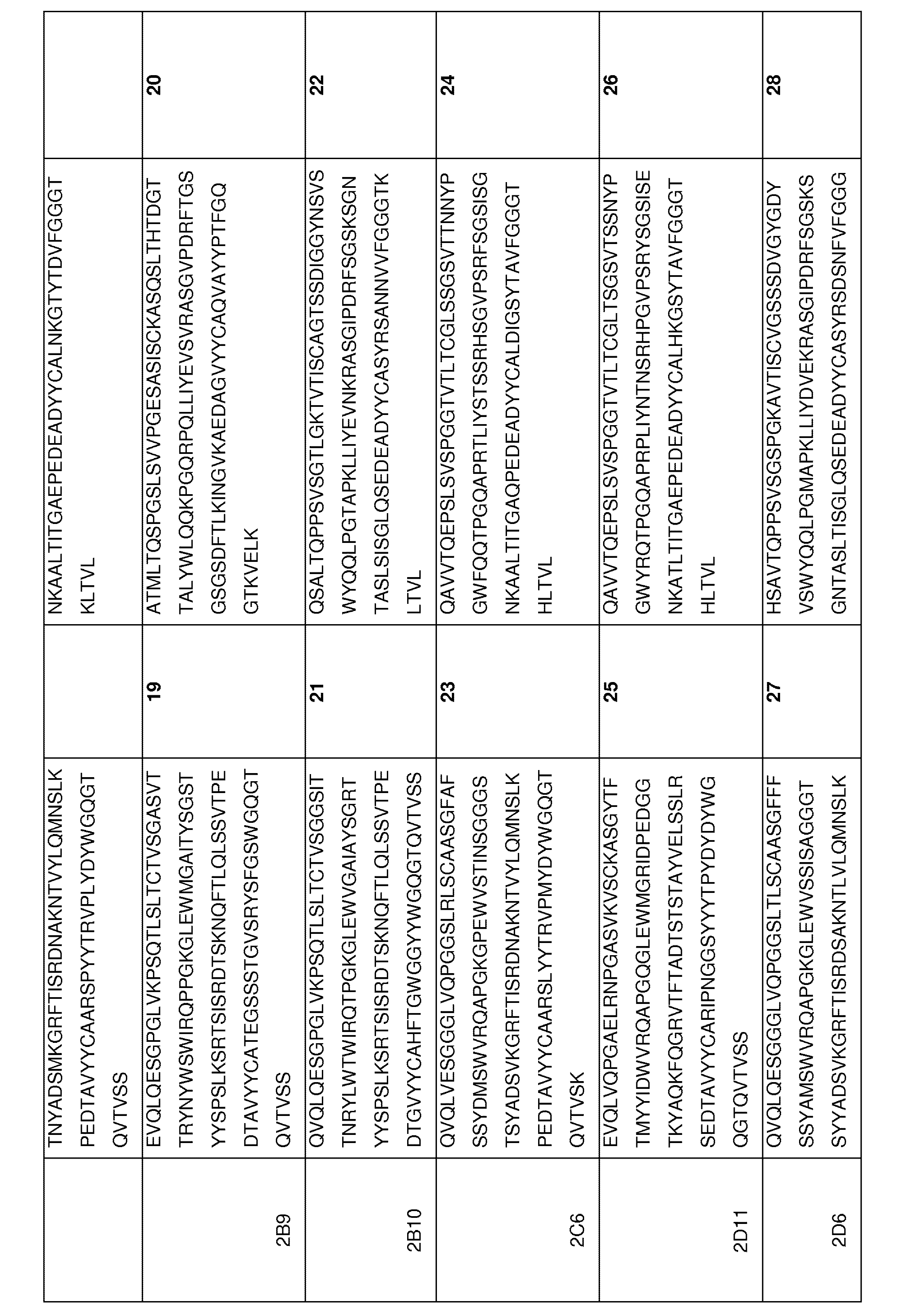

表3 TIM-3に結合するFabの重鎖CDR配列

表4 TIM-3に結合するFabの軽鎖CDR配列

先の表に示したFabは、Biacore分析及びELISAにより、それらのTIM-3結合に関して特徴
付けた。結果を下記表5に示す。
The Fabs shown in the table above were characterized for their TIM-3 binding by Biacore analysis and ELISA. The results are shown in Table 5 below.
表5 Biacore又はELISAにより測定したFabクローンのTIM-3への結合

(実施例2)
例えば引用により本明細書中に組み込まれているWO2010/001251に記載されたように、I
L1RAPに特異的に結合する抗体を、ラマの、組換えヒトIL-1RAP/IL-1 R3 Fcキメラタンパ
ク質(R&D Systems;Ser21 Glu359/C-末端HIS-タグ;カタログ番号676-CP)による免疫化に
より産生し、並びにスクリーニングのためのFabライブラリーを作製した。
(Example 2)
I
Immunization of llamas with recombinant human IL-1RAP/IL-1 R3 Fc chimeric protein (R&D Systems; Ser21 Glu359/C-terminal HIS-tag; Cat. No. 676-CP) with antibodies that specifically bind L1RAP. A Fab library was produced and used for screening.
このライブラリーから選択されたFabクローンのCDR、VH及びVL配列を、以下の表6、7及
び8に示す。
The CDR, VH and VL sequences of Fab clones selected from this library are shown in Tables 6, 7 and 8 below.
表6 IL1RAPに結合するFabのVH及びVL配列

表7 IL1RAPに結合するFabの重鎖CDR配列

表8 IL1RAPに結合するFabの重鎖CDR配列

(実施例3 ADCP活性により測定した抗-TIM-3抗体及び抗-CD70抗体の組合せ有効性)
抗-TIM-3抗体及び抗-CD70抗体の組合せ有効性を、AML-由来細胞株BDCMの抗体依存性細
胞貪食(ADCP)-媒介した死滅を測定することにより、評価した。PKH26-標識した細胞膜を
有するBDCM細胞を、異なる濃度のCD70-標的化抗体ARGX-110の単独、又は10μg/mlの抗-TI
M-3抗体クローン1A11及び2B10(ヒトIgG1)(実施例1参照)との組合せで処理した。貪食可
能なマクロファージを、PMA処理により、単球性THP-1細胞株から分化させた。活性化され
たマクロファージを、抗体で前処理したBDCM細胞へ添加し、癌細胞と、37℃で1時間共-イ
ンキュベーションした。洗浄後、マクロファージを、抗-CD11b-FITC抗体で染色し、取り
込まれた癌細胞を伴うマクロファージ(PKH26+/CD11b+ダブル陽性マクロファージ)の数を
推定するために、フローサイトメトリー分析を行った。
Example 3 Combination efficacy of anti-TIM-3 and anti-CD70 antibodies measured by ADCP activity
The combined efficacy of anti-TIM-3 and anti-CD70 antibodies was evaluated by measuring antibody-dependent cell phagocytosis (ADCP)-mediated killing of the AML-derived cell line BDCM. BDCM cells with PKH26-labeled cell membranes were treated with different concentrations of CD70-targeting antibody ARGX-110 alone or with 10 μg/ml anti-TI.
Treated in combination with M-3 antibody clones 1A11 and 2B10 (human IgG1) (see Example 1). Phagocytotic macrophages were differentiated from the monocytic THP-1 cell line by PMA treatment. Activated macrophages were added to antibody-pretreated BDCM cells and co-incubated with cancer cells for 1 hour at 37°C. After washing, macrophages were stained with anti-CD11b-FITC antibody and flow cytometry analysis was performed to estimate the number of macrophages with engulfed cancer cells (PKH26 + /CD11b + double-positive macrophages).
図1に示したように、CD70及びTIM-3-発現しているBDCM細胞のARGX-110及び抗-TIM3抗体
による前処理は、マクロファージによる癌細胞の貪食の著しい増加を引き起こした。この
増加は、ARGX-110単独による細胞の処理と比較して認められた。AML細胞のADCP-媒介性死
滅における抗-TIM3抗体及び抗-CD70抗体の組合せの有効性は、投与量-依存的様式で示さ
れた。
As shown in Figure 1, pretreatment of CD70- and TIM-3-expressing BDCM cells with ARGX-110 and anti-TIM3 antibodies caused a significant increase in phagocytosis of cancer cells by macrophages. This increase was observed compared to treatment of cells with ARGX-110 alone. The efficacy of the combination of anti-TIM3 and anti-CD70 antibodies in ADCP-mediated killing of AML cells was demonstrated in a dose-dependent manner.
(実施例4 ADCP活性により測定した抗-IL1RAP抗体及び抗-CD70抗体の組合せ有効性)
抗-IL1RAP抗体及び抗-CD70抗体の組合せ有効性を、AML細胞株(MV4-11、U937及びTHP-1)
の抗体依存性細胞貪食(ADCP)-媒介した死滅を測定することにより、評価した。PKH126-標
識したAML細胞株(MV4-11、U937、THP-1)を、異なる濃度のARGX-110の単独、又は10μg/ml
もしくは1μg/mlの抗-IL1RAP抗体(マウスIgG1クローン89412;IgG2aクローン7E4G1E8 mAb
;及びヒトモノクローナルIgG1抗体-クローン1C1及び1F10、実施例2参照)との組合せで
処理した。アッセイは、先に実施例3において説明したように行った。結果を図2に示して
いる。いかなる処置も存在しない状態で測定した貪食バックグラウンド値を、減算した。
(Example 4 Combination efficacy of anti-IL1RAP antibody and anti-CD70 antibody measured by ADCP activity)
The combined efficacy of anti-IL1RAP and anti-CD70 antibodies was demonstrated in AML cell lines (MV4-11, U937 and THP-1).
was assessed by measuring antibody-dependent cell phagocytosis (ADCP)-mediated killing. PKH126-labeled AML cell lines (MV4-11, U937, THP-1) were treated with different concentrations of ARGX-110 alone or 10 μg/ml.
or 1 μg/ml anti-IL1RAP antibody (
; and human monoclonal IgG1 antibodies - clones 1C1 and 1F10, see Example 2). The assay was performed as previously described in Example 3. The results are shown in Figure 2. Phagocytic background values measured in the absence of any treatment were subtracted.
図2に示したように、CD70-及びIL1RAP-発現しているAML細胞株の、ARGX-110及び抗-IL1
RAP抗体による前処理は、マクロファージによる癌細胞の貪食の著しい増加を引き起こし
た。これらの増加は、癌細胞をARGX-110単独で処理した場合の状態と比較して認められた
。共-処理の組合せ作用は、投与量-依存的様式で示された。更に相乗的有効性が、MV4-11
細胞を、1又は10μg/ml ARGX-110+1C1又は1F10抗体の組合せで処理された場合に、認め
られた。
As shown in Figure 2, ARGX-110 and anti-IL1 in CD70- and IL1RAP-expressing AML cell lines
Pretreatment with RAP antibodies caused a significant increase in phagocytosis of cancer cells by macrophages. These increases were observed compared to when cancer cells were treated with ARGX-110 alone. The combinatorial effects of co-treatment were demonstrated in a dose-dependent manner. Furthermore, the synergistic efficacy of MV4-11
observed when cells were treated with a combination of 1 or 10 μg/ml ARGX-110 plus 1C1 or 1F10 antibodies.
(実施例5 ADCP活性により測定した抗-CD47抗体及び抗-CD70抗体の組合せ有効性)
抗-CD47抗体及び抗-CD70抗体の組合せ有効性を、先の実施例3及び4に説明したものと同
様の様式で、評価した。PKH126-染色したAML細胞株(MV4-11、THP-1、GDM-1、U937及びMC-
1010)を、異なる濃度のARGX-110の単独、又は10μg/mlもしくは1μg/mlの抗-CD47抗体(マ
ウスIgG1クローンB6H12及びクローンCC2C6、並びにマウスIgG2bクローンBRIC126)との組
合せで処理した。ADCPアッセイは、先に説明したように行った。
Example 5 Combination efficacy of anti-CD47 and anti-CD70 antibodies measured by ADCP activity
The combined efficacy of anti-CD47 and anti-CD70 antibodies was evaluated in a manner similar to that described in Examples 3 and 4 above. PKH126-stained AML cell lines (MV4-11, THP-1, GDM-1, U937 and MC-
1010) were treated with different concentrations of ARGX-110 alone or in combination with 10 μg/ml or 1 μg/ml of anti-CD47 antibodies (mouse IgG1 clone B6H12 and clone CC2C6, and mouse IgG2b clone BRIC126). ADCP assays were performed as previously described.
図3Aに示したように、CD70-及びCD47-発現しているAML細胞の、ARGX-110及び抗-CD47抗
体による前処理は、いくつかのAML細胞株の場合において、マクロファージによる癌細胞
の貪食の増加を引き起こした。MC-1010細胞を用いる、ARGX-110及びブロック性B6H12抗体
(これはCD47とSIRPαの間の相互作用をブロックし、これにより貪食を促進する)による共
-処理の効果もまた、投与量-依存的様式で示された(図3B)。
As shown in Figure 3A, pre-treatment of CD70- and CD47-expressing AML cells with ARGX-110 and anti-CD47 antibodies inhibits phagocytosis of cancer cells by macrophages in the case of some AML cell lines. caused an increase in ARGX-110 and blocking B6H12 antibody using MC-1010 cells
(which blocks the interaction between CD47 and SIRPα, thereby promoting phagocytosis)
-The effects of treatment were also shown in a dose-dependent manner (Figure 3B).
(実施例6 CDC活性により測定した抗-TIM-3抗体及び抗-CD70抗体の組合せ有効性)
抗-TIM-3抗体及び抗-CD70抗体の組合せ有効性を、補体依存性細胞傷害(CDC)を測定する
ことにより、評価した。BDCM細胞を、異なる濃度のARGX-110の単独、又は10μg/mlの抗-T
IM-3抗体(1A11及び2B10クローン-実施例1参照)との組合せで処理した。前処理した細胞
を、10%新生児期ウサギ補体(COM)と共に、室温で1時間インキュベーションした。ヨウ化
プロピジウム(PI)を含むPBSの1容積を添加し、試料を、暗所で15分間インキュベーション
し、死滅細胞を染色した。細胞数及びヨウ化プロピジウム陽性細胞の測定を、フローサイ
トメトリー(FACS Canto II)により行った。結果を、図4に示している。
Example 6 Combination efficacy of anti-TIM-3 and anti-CD70 antibodies measured by CDC activity
The combined efficacy of anti-TIM-3 and anti-CD70 antibodies was evaluated by measuring complement-dependent cytotoxicity (CDC). BDCM cells were treated with different concentrations of ARGX-110 alone or with 10 μg/ml anti-T.
treated in combination with IM-3 antibody (1A11 and 2B10 clones - see Example 1). Pretreated cells were incubated with 10% neonatal rabbit complement (COM) for 1 hour at room temperature. One volume of PBS containing propidium iodide (PI) was added and the samples were incubated in the dark for 15 minutes to stain dead cells. Cell number and propidium iodide-positive cells were measured by flow cytometry (FACS Canto II). The results are shown in Figure 4.
BDCM細胞のARGX-110及び抗-TIM3抗体による共-処理は、補体依存型の細胞死の増加を引
き起こした。ARGX-110及び抗-TIM-3抗体の組合せの相乗的作用は、ARGX-110濃度が0.37~
0.125μg/mlで認められたのに対し、ARGX-110単独では、濃度1.11μg/mlから細胞死を誘
導することができた。これらの共-処理の相乗効果は、投与量-依存的様式で示された。抗
-TIM-3抗体を、このアッセイにおいて単独で使用した場合に、これは補体依存型の溶解を
引き起こすことができなかった。
Co-treatment of BDCM cells with ARGX-110 and anti-TIM3 antibody caused an increase in complement-dependent cell death. The synergistic effect of the combination of ARGX-110 and anti-TIM-3 antibody was demonstrated when ARGX-110 concentrations ranged from 0.37 to
ARGX-110 alone was able to induce cell death at a concentration of 1.11 μg/ml, whereas it was observed at 0.125 μg/ml. The synergistic effects of these co-treatments were demonstrated in a dose-dependent manner. anti
When the -TIM-3 antibody was used alone in this assay, it was unable to cause complement-dependent lysis.
(実施例7 CDC活性により測定した抗-IL1RAP抗体及び抗-CD70抗体の組合せ有効性)
抗-IL1RAP抗体及び抗-CD70抗体の組合せ有効性を、補体依存性細胞傷害(CDC)を測定す
ることにより、評価した。AML細胞株(MV4-11及びNOMO-1)を、異なる濃度のARGX-110の単
独、又は10μg/mlの抗-IL1RAP抗体(1C1及び1F10クローン)との組合せで処理し、CDCアッ
セイを、実施例6に説明したように行った。結果を、図5に示している。
Example 7 Combination efficacy of anti-IL1RAP and anti-CD70 antibodies measured by CDC activity
The combined efficacy of anti-IL1RAP and anti-CD70 antibodies was evaluated by measuring complement dependent cytotoxicity (CDC). AML cell lines (MV4-11 and NOMO-1) were treated with different concentrations of ARGX-110 alone or in combination with 10 μg/ml anti-IL1RAP antibodies (1C1 and 1F10 clones) and CDC assays were performed. This was done as described in Example 6. The results are shown in Figure 5.
ARGX-110及び抗-IL1RAP抗体による共-処理は、両方の細胞株の補体依存型の細胞死(図5
、暗色バー)を増加した。MV4-11細胞株は、ARGX-110及び抗-IL1RAPの単独による処理に対
し、抵抗性であった。しかし、相乗的効果が、共-処理により認められ、MV4-11細胞の溶
解を投与量-依存的様式で引き起こした。ARGX-110-感受性細胞株NOMO-1は、ARGX-110及び
抗-IL1RAP抗体との共-処理後、ARGX-110単独による処理と比べ、投与量-依存的作用を示
した。NOMO-1細胞の場合、抗-IL1RAP抗体による単剤療法は、この抗体が濃度10μg/mlで
使用された場合に、限定された補体依存性細胞傷害を誘導した。
Co-treatment with ARGX-110 and anti-IL1RAP antibody induced complement-dependent cell death in both cell lines (Figure 5
, dark bar) was increased. The MV4-11 cell line was resistant to treatment with ARGX-110 and anti-IL1RAP alone. However, a synergistic effect was observed upon co-treatment, causing lysis of MV4-11 cells in a dose-dependent manner. ARGX-110-sensitive cell line NOMO-1 showed a dose-dependent effect after co-treatment with ARGX-110 and anti-IL1RAP antibody compared to treatment with ARGX-110 alone. For NOMO-1 cells, monotherapy with anti-IL1RAP antibody induced limited complement-dependent cytotoxicity when this antibody was used at a concentration of 10 μg/ml.
(実施例8 CDC活性により測定した抗-CD47抗体及び抗-CD70抗体の組合せ有効性)
抗-CD47抗体及び抗-CD70抗体の組合せ有効性を、補体依存性細胞傷害(CDC)を測定する
ことにより、評価した。MV4-11及びNOMO-1細胞株を、異なる濃度のARGX-110及びCDC-可能
な抗-CD47抗体BRIC126(マウスIgG2b)の単独又はその組合せで処理した。CDCアッセイを、
先に説明したように行った。結果を、図6に示している。
Example 8 Combination efficacy of anti-CD47 and anti-CD70 antibodies measured by CDC activity
The combined efficacy of anti-CD47 and anti-CD70 antibodies was evaluated by measuring complement-dependent cytotoxicity (CDC). MV4-11 and NOMO-1 cell lines were treated with different concentrations of ARGX-110 and CDC-capable anti-CD47 antibody BRIC126 (mouse IgG2b) alone or in combination. CDC assay,
I went as described earlier. The results are shown in Figure 6.
AML細胞株のARGX-110及びBRIC126による共-処理は、両方の細胞株の補体-依存型の細胞
死を増加したのに対し、抗-CD47ブロック性マウスIgG1抗体は、補体反応を誘導すること
ができなかった(B6H12クローン)(データは示さず)。ARGX-110及びBRIC126による共-処理
の作用は、BRIC126の最適濃度0.041~0.123μg/mlで、投与量-依存的様式で認められた。
MV4-11細胞株は、ARGX-110に対し弱い反応のみであり、従って10μg/mlと高い濃度が、組
合せ作用を得るためには必要であった。ARGX-110-感受性細胞株NOMO-1において、細胞は
、ARGX-110単独の1/10の低い濃度で、補体により溶解した。更に、BRIC126の約0.1μg/ml
の添加は、補体による細胞溶解を更に強化した。比較的高い濃度でのBRIC126による単剤
療法も、補体-依存性細胞傷害性を誘導することができた。
Co-treatment of AML cell lines with ARGX-110 and BRIC126 increased complement-dependent cell death in both cell lines, whereas anti-CD47 blocking mouse IgG1 antibody induced complement responses. (B6H12 clone) (data not shown). The effects of co-treatment with ARGX-110 and BRIC126 were observed in a dose-dependent manner at optimal concentrations of BRIC126 of 0.041-0.123 μg/ml.
The MV4-11 cell line had only a weak response to ARGX-110, so concentrations as high as 10 μg/ml were required to obtain a combinatorial effect. In the ARGX-110-sensitive cell line NOMO-1, cells were lysed by complement at a
addition further enhanced complement-induced cell lysis. Monotherapy with BRIC126 at relatively high concentrations was also able to induce complement-dependent cytotoxicity.
(実施例9 ADCC活性により測定した抗-TIM-3、抗-IL1RAP又は抗-CD47抗体と抗-CD70抗体
の組合せ有効性)
抗-TIM-3抗体、抗-IL1RAP抗体又は抗-CD47抗体のいずれかとの組合せにおける抗-CD70
抗体ARGX-110の有効性を、抗体依存性細胞傷害(ADCC)により測定した。以下の抗体組合せ
のADCC活性を調べた:
1.ARGX-110(抗-CD70)及び2B10(抗-TIM-3)
2.ARGX-110(抗-CD70)及び1F10(抗-IL1RAP)
3.ARGX-110(抗-CD70)及びCC2C6(抗-CD47)。
Example 9 Combination efficacy of anti-TIM-3, anti-IL1RAP or anti-CD47 antibodies and anti-CD70 antibodies measured by ADCC activity
Anti-CD70 in combination with either anti-TIM-3 antibody, anti-IL1RAP antibody or anti-CD47 antibody
The efficacy of antibody ARGX-110 was determined by antibody-dependent cellular cytotoxicity (ADCC). The ADCC activity of the following antibody combinations was investigated:
1.ARGX-110 (anti-CD70) and 2B10 (anti-TIM-3)
2.ARGX-110 (anti-CD70) and 1F10 (anti-IL1RAP)
3. ARGX-110 (anti-CD70) and CC2C6 (anti-CD47).
試験した全ての組合せに関して、ADCCは、以下のプロトコールに従い、測定した。健常
末梢血単核細胞(PBMC)を、組換えIL-2(200IU/mL)により15時間処理した。細胞株BDCM及び
NOMO-1を、各々、CD47及びTIM-3又はIL1RAP1も発現している、CD70-陽性標的細胞として
用いた。標的細胞(3E4細胞)を、10% FCSを含有するRPMI 1640培地(96-ウェルプレート)
中、抗体の存在下で、PBMC(3E5細胞)と共-培養した。標的/エフェクター(E/T)比は、1
/1であった。ARGX-110(0~10μg/mL)の連続希釈の単独で、又は10及び1μg/mLの濃度の
抗体2B10(抗-TIM-3)、1F10(抗-IL1RAP)又はCC2C6(抗-CD47)との組合せで適用した。CC2C6
(マウスIgG1)以外の全ての抗体は、ヒトIgG1アイソタイプであった。48時間のインキュベ
ーション後、細胞を、フローサイトメトリーにより分析し、溶解率(%)を、残存する標的
細胞(CD33+ CD3- CD16-)の数を基に測定した。結果を、図7(抗-CD70+抗-TIM-3)、図8(抗
-CD70+抗-IL1RAP)及び図9(抗-CD70+抗-CD47)に示している。
For all combinations tested, ADCC was measured according to the following protocol. Healthy peripheral blood mononuclear cells (PBMCs) were treated with recombinant IL-2 (200 IU/mL) for 15 hours. Cell line BDCM and
NOMO-1 was used as CD70-positive target cells, also expressing CD47 and TIM-3 or IL1RAP1, respectively. Target cells (3E4 cells) were grown in RPMI 1640 medium containing 10% FCS (96-well plate).
Medium, the cells were co-cultured with PBMC (3E5 cells) in the presence of antibodies. The target/effector (E/T) ratio is 1
/1. Serial dilutions of ARGX-110 (0-10 μg/mL) alone or with antibodies 2B10 (anti-TIM-3), 1F10 (anti-IL1RAP) or CC2C6 (anti-CD47) at concentrations of 10 and 1 μg/mL. It was applied in combination. CC2C6
All antibodies except (mouse IgG1) were of the human IgG1 isotype. After 48 hours of incubation, cells were analyzed by flow cytometry and % lysis was determined based on the number of remaining target cells (CD33 + CD3 − CD16 − ). The results are shown in Figure 7 (anti-CD70 + anti-TIM-3) and Figure 8 (anti-TIM-3).
-CD70 + anti-IL1RAP) and Figure 9 (anti-CD70 + anti-CD47).
図7に示したように、抗-CD70及び抗-TIM-3の両抗体は、強力なADCC活性を単独で示し、
濃度1μg/mL以上で、50~70%の最大細胞溶解に達した。組合せ活性は、ARGX-110の低い
濃度(<0.1μg/ml)で認められた。
As shown in Figure 7, both anti-CD70 and anti-TIM-3 antibodies exhibited strong ADCC activity alone;
Maximal cell lysis of 50-70% was reached at concentrations above 1 μg/mL. Combination activity was observed at low concentrations of ARGX-110 (<0.1 μg/ml).
図8に示したように、組合せたADCC活性が、抗-IL1RAP抗体1F10の1μg/mlと組合せた場
合に、ARGX-110 投与量範囲を通じて達成された。この組合せは、試験した最高ARGX-110
濃度(10μg/ml)で、最大細胞溶解70%に達した。抗-IL1RAP抗体1F10は、強力なADCC活性
を10μg/mlで単独でも示し、これは60~70%細胞溶解を生じた。
As shown in Figure 8, combined ADCC activity was achieved across the ARGX-110 dosage range when combined with 1 μg/ml of anti-IL1RAP antibody 1F10. This combination is the best ARGX-110 tested
(10 μg/ml), a maximum cell lysis of 70% was reached. Anti-IL1RAP antibody 1F10 showed potent ADCC activity even at 10 μg/ml alone, which resulted in 60-70% cell lysis.
図9に示したように、組合せたADCC活性が、抗-CD47抗体CC2C6の1又は10μg/mlと組合せ
た場合に、ARGX-110 投与量範囲を通じて達成された。この組合せは、0.1μg/mL以上のAR
GX-110濃度で、最大細胞溶解80%に達した。
As shown in Figure 9, combined ADCC activity was achieved across the ARGX-110 dosage range when combined with 1 or 10 μg/ml of anti-CD47 antibody CC2C6. This combination has an AR of 0.1μg/mL or higher.
At GX-110 concentration, maximum cell lysis of 80% was reached.
図9に示したように、組合せたADCC活性が、抗-CD47抗体CC2C6の1又は10μg/mlと組合せ
た場合に、ARGX-110 投与量範囲を通じて達成された。この組合せは、0.1μg/mL以上のAR
GX-110濃度で、最大細胞溶解80%に達した。
本件出願は、以下の態様の発明を提供する。
(態様1)
CD70に結合する抗体分子及び白血病幹細胞標的に結合する少なくとも1種の抗体分子を
含む、組合せ。
(態様2)
前記白血病幹細胞標的が、TIM-3;ガレクチン-9;CD47;IL1RAP;LILRB2;CLL-1;CD12
3;CD33;SAIL;GPR56;CD44;E-セレクチン;CXCR4;CD25;CD32;PR1;WT1;ADGRE2;C
CR1;TNFRSF1B及びCD96からなる群から選択される、態様1記載の組合せ。
(態様3)
前記CD70へ結合する抗体分子が、可変重鎖ドメイン(VH)及び可変軽鎖ドメイン(VL)を含
み、ここでVH及びVLドメインが、以下のCDR配列:
配列番号:3を含むか又はこれからなるHCDR3;
配列番号:2を含むか又はこれからなるHCDR2;
配列番号:1を含むか又はこれからなるHCDR1;
配列番号:7を含むか又はこれからなるLCDR3;
配列番号:6を含むか又はこれからなるLCDR2;並びに
配列番号:5を含むか又はこれからなるLCDR1:
を含む、態様1又は2記載の組合せ。
(態様4)
前記CD70へ結合する抗体分子が、配列番号:4と少なくとも70%同一であるアミノ酸配列
を含むVHドメイン及び配列番号:8と少なくとも70%同一であるアミノ酸配列を含むVLドメ
インを含む、態様3記載の組合せ。
(態様5)
前記CD70に結合する抗体分子が、ARGX-110である、態様4記載の組合せ。
(態様6)
前記白血病幹細胞標的が、TIM-3及びガレクチン-9からなる群から選択される、態様1~
5のいずれか一項記載の組合せ。
(態様7)
前記白血病幹細胞標的が、TIM-3である、態様6記載の組合せ。
(態様8)
前記白血病幹細胞標的が、CD47である、態様1~5のいずれか一項記載の組合せ。
(態様9)
前記白血病幹細胞標的が、IL1RAPである、態様1~5のいずれか一項記載の組合せ。
(態様10)
前記白血病幹細胞標的が、LILRB2である、態様1~5のいずれか一項記載の組合せ。
(態様11)
前記組合せが、第一の白血病幹細胞標的に結合する抗体分子及び第二の白血病幹細胞標
的に結合する抗体分子を含み、ここで第一及び第二の白血病幹細胞標的が異なる、態様1
~5のいずれか一項記載の組合せ。
(態様12)
前記第一及び/又は第二の白血病幹細胞標的が、TIM-3;ガレクチン-9;CD47;IL1RAP
;LILRB2;CLL-1;CD123;CD33;SAIL;GPR56;CD44;E-セレクチン;CXCR4;CD25;CD32
;PR1;WT1;ADGRE2;CCR1;TNFRSF1B及びCD96からなる群から選択される、態様11記載の
組合せ。
(態様13)
前記第一の白血病幹細胞標的が、TIM-3;ガレクチン-9;CD47;IL1RAP及びLILRB2から
なる群から選択される、態様11記載の組合せ。
(態様14)
前記第二の白血病幹細胞標的が、TIM-3;ガレクチン-9;CD47;IL1RAP及びLILRB2から
なる群から選択される、態様11又は13記載の組合せ。
(態様15)
前記第一の白血病幹細胞標的が、TIM-3であり、並びに第二の白血病幹細胞標的が、CD4
7である、態様11記載の組合せ。
(態様16)
前記第一の白血病幹細胞標的が、TIM-3であり、並びに第二の白血病幹細胞標的が、IL1
RAPである、態様11記載の組合せ。
(態様17)
IL1RAPに結合する抗体分子を含む、態様1~16のいずれか一項記載の組合せであり、該
抗体分子が、減少したNF-κBシグナル伝達;減少したWntシグナル伝達/β-カテニンシグ
ナル伝達;AML細胞の減少した幹細胞性;又はそれらの組合せを生じる、前記組合せ。
(態様18)
TIM-3に結合する抗体分子を含む、態様1~17のいずれか一項記載の組合せであり、該抗
体分子が、減少したNF-κBシグナル伝達;減少したWntシグナル伝達/β-カテニンシグナ
ル伝達;AML細胞の減少した幹細胞性;又は、それらの組合せを生じる、前記組合せ。
(態様19)
TIM-3に結合する抗体分子を含む、態様1~18のいずれか一項記載の組合せであり、該抗
体分子が、TIM-3の、1種以上のTIM-3相互作用タンパク質との相互作用を阻害する、前記
組合せ。
(態様20)
前記TIM-3相互作用タンパク質が、CEACAM-1;HMGB-1;ホスファチジルセリン;ガレク
チン-9;LILRB2;又は、それらの組合せから選択される、態様19記載の組合せ。
(態様21)
前記TIM-3に結合する抗体分子が、TIM-3のガレクチン-9との相互作用を阻害する、態様
20記載の組合せ。
(態様22)
前記TIM-3に結合する抗体分子が、TIM-3のLILRB2との相互作用を阻害する、態様20記載
の組合せ。
(態様23)
前記白血病幹細胞標的に結合する1又は複数の抗体分子が、白血病幹細胞標的(複数可)
によりラクダ科動物を免疫化する工程を含む方法により得られた1以上の免疫ライブラリ
ーから選択される、態様1~22のいずれか一項記載の組合せ。
(態様24)
前記ラクダ科動物が、ラマである、態様23記載の組合せ。
(態様25)
前記ラクダ科動物が、LSC標的タンパク質もしくはそのポリペプチド断片によるか、又
はLSC標的タンパク質もしくはそのポリペプチド断片を発現するmRNA分子もしくはcDNA分
子により免疫化される、態様23又は24記載の組合せ。
(態様26)
TIM-3に結合する抗体分子を含む、態様1~25のいずれか一項記載の組合せであり、該抗
体分子が、可変重鎖CDR3(HCDR3)、可変重鎖CDR2(HCDR2)及び可変重鎖CDR1(HCDR1)、可変
軽鎖CDR3(LCDR3)、可変軽鎖CDR2(LCDR2)及び可変軽鎖CDR1(LCDR1)の組合せを含む抗体分
子からなる群から選択され、ここでこれらは:
(i)配列番号:41を含むHCDR3;配列番号:40を含むHCDR2;配列番号:39を含むHCDR1;配
列番号:80を含むLCDR3;配列番号:79を含むLCDR2;及び、配列番号:78を含むLCDR1;
(ii)配列番号:43を含むHCDR3;配列番号:42を含むHCDR2;配列番号:39を含むHCDR1;配
列番号:83を含むLCDR3;配列番号:82を含むLCDR2;及び、配列番号:81を含むLCDR1;
(iii)配列番号:46を含むHCDR3;配列番号:45を含むHCDR2;配列番号:44を含むHCDR1;
配列番号:86を含むLCDR3;配列番号:85を含むLCDR2;及び、配列番号:84を含むLCDR1;
(iv)配列番号:49を含むHCDR3;配列番号:48を含むHCDR2;配列番号:47を含むHCDR1;配
列番号:88を含むLCDR3;配列番号:82を含むLCDR2;及び、配列番号:87を含むLCDR1;
(v)配列番号:52を含むHCDR3;配列番号:51を含むHCDR2;配列番号:50を含むHCDR1;配
列番号:91を含むLCDR3;配列番号:90を含むLCDR2;及び、配列番号:89を含むLCDR1;
(vi)配列番号:55を含むHCDR3;配列番号:54を含むHCDR2;配列番号:53を含むHCDR1;配
列番号:94を含むLCDR3;配列番号:93を含むLCDR2;及び、配列番号:92を含むLCDR1;
(vii)配列番号:58を含むHCDR3;配列番号:57を含むHCDR2;配列番号:56を含むHCDR1;
配列番号:97を含むLCDR3;配列番号:96を含むLCDR2;及び、配列番号:95を含むLCDR1;
(viii)配列番号:60を含むHCDR3;配列番号:59を含むHCDR2;配列番号:50を含むHCDR1;
配列番号:100を含むLCDR3;配列番号:99を含むLCDR2;及び、配列番号:98を含むLCDR1;
(ix)配列番号:63を含むHCDR3;配列番号:62を含むHCDR2;配列番号:61を含むHCDR1;配
列番号:103を含むLCDR3;配列番号:102を含むLCDR2;及び、配列番号:101を含むLCDR1;
(x)配列番号:65を含むHCDR3;配列番号:64を含むHCDR2;配列番号:39を含むHCDR1;配
列番号:106を含むLCDR3;配列番号:105を含むLCDR2;及び、配列番号:104を含むLCDR1;
(xi)配列番号:67を含むHCDR3;配列番号:66を含むHCDR2;配列番号:50を含むHCDR1;配
列番号:109を含むLCDR3;配列番号:108を含むLCDR2;及び、配列番号:107を含むLCDR1;
(xii)配列番号:69を含むHCDR3;配列番号:68を含むHCDR2;配列番号:50を含むHCDR1;
配列番号:112を含むLCDR3;配列番号:111を含むLCDR2;及び、配列番号:110を含むLCDR1
;
(xiii)配列番号:72を含むHCDR3;配列番号:71を含むHCDR2;配列番号:70を含むHCDR1;
配列番号:115を含むLCDR3;配列番号:114を含むLCDR2;及び、配列番号:113を含むLCDR1
;
(xiv)配列番号:74を含むHCDR3;配列番号:73を含むHCDR2;配列番号:50を含むHCDR1;
配列番号:117を含むLCDR3;配列番号:111を含むLCDR2;及び、配列番号:116を含むLCDR1
;並びに
(xv)配列番号:77を含むHCDR3;配列番号:76を含むHCDR2;配列番号:75を含むHCDR1;配
列番号:120を含むLCDR3;配列番号:119を含むLCDR2;及び、配列番号:118を含むLCDR1:
から選択される、前記組合せ。
(態様27)
TIM-3に結合する抗体分子を含む、態様1~26のいずれか一項記載の組合せであり、該抗
体分子が:
(i)配列番号:9のアミノ酸配列又はそれと少なくとも80%、90%、95%、98%、99%の
同一性を有するアミノ酸配列を含むか又はこれからなるVHドメイン、及び配列番号:10の
アミノ酸配列又はそれと少なくとも80%、90%、95%、98%、99%の同一性を有するアミ
ノ酸配列を含むか又はこれからなるVLドメイン;
(ii)配列番号:11のアミノ酸配列又はそれと少なくとも80%、90%、95%、98%、99%
の同一性を有するアミノ酸配列を含むか又はこれからなるVHドメイン、及び配列番号:12
のアミノ酸配列又はそれと少なくとも80%、90%、95%、98%、99%の同一性を有するア
ミノ酸配列を含むか又はこれからなるVLドメイン;
(iii)配列番号:13 のアミノ酸配列又はそれと少なくとも80%、90%、95%、98%、99
%の同一性を有するアミノ酸配列を含むか又はこれからなるVHドメイン、及び配列番号:1
4のアミノ酸配列又はそれと少なくとも80%、90%、95%、98%、99%の同一性を有する
アミノ酸配列を含むか又はこれからなるVLドメイン;
(iv)配列番号:15のアミノ酸配列又はそれと少なくとも80%、90%、95%、98%、99%
の同一性を有するアミノ酸配列を含むか又はこれからなるVHドメイン、及び配列番号:16
のアミノ酸配列又はそれと少なくとも80%、90%、95%、98%、99%の同一性を有するア
ミノ酸配列を含むか又はこれからなるVLドメイン;
(v)配列番号:17のアミノ酸配列又はそれと少なくとも80%、90%、95%、98%、99%の
同一性を有するアミノ酸配列を含むか又はこれからなるVHドメイン、及び配列番号:18の
アミノ酸配列又はそれと少なくとも80%、90%、95%、98%、99%の同一性を有するアミ
ノ酸配列を含むか又はこれからなるVLドメイン;
(vi)配列番号:19のアミノ酸配列又はそれと少なくとも80%、90%、95%、98%、99%
の同一性を有するアミノ酸配列を含むか又はこれからなるVHドメイン、及び配列番号:20
のアミノ酸配列又はそれと少なくとも80%、90%、95%、98%、99%の同一性を有するア
ミノ酸配列を含むか又はこれからなるVLドメイン;
(vii)配列番号:21のアミノ酸配列又はそれと少なくとも80%、90%、95%、98%、99%
の同一性を有するアミノ酸配列を含むか又はこれからなるVHドメイン、及び配列番号:22
のアミノ酸配列又はそれと少なくとも80%、90%、95%、98%、99%の同一性を有するア
ミノ酸配列を含むか又はこれからなるVLドメイン;
(viii)配列番号:23のアミノ酸配列又はそれと少なくとも80%、90%、95%、98%、99
%の同一性を有するアミノ酸配列を含むか又はこれからなるVHドメイン、及び配列番号:2
4のアミノ酸配列又はそれと少なくとも80%、90%、95%、98%、99%の同一性を有する
アミノ酸配列を含むか又はこれからなるVLドメイン;
(ix)配列番号:25のアミノ酸配列又はそれと少なくとも80%、90%、95%、98%、99%
の同一性を有するアミノ酸配列を含むか又はこれからなるVHドメイン、及び配列番号:26
のアミノ酸配列又はそれと少なくとも80%、90%、95%、98%、99%の同一性を有するア
ミノ酸配列を含むか又はこれからなるVLドメイン;
(x)配列番号:27のアミノ酸配列又はそれと少なくとも80%、90%、95%、98%、99%の
同一性を有するアミノ酸配列を含むか又はこれからなるVHドメイン、及び配列番号:28の
アミノ酸配列又はそれと少なくとも80%、90%、95%、98%、99%の同一性を有するアミ
ノ酸配列を含むか又はこれからなるVLドメイン;
(xi)配列番号:29のアミノ酸配列又はそれと少なくとも80%、90%、95%、98%、99%
の同一性を有するアミノ酸配列を含むか又はこれからなるVHドメイン、及び配列番号:30
のアミノ酸配列又はそれと少なくとも80%、90%、95%、98%、99%の同一性を有するア
ミノ酸配列を含むか又はこれからなるVLドメイン;
(xii)配列番号:31のアミノ酸配列又はそれと少なくとも80%、90%、95%、98%、99%
の同一性を有するアミノ酸配列を含むか又はこれからなるVHドメイン、及び配列番号:32
のアミノ酸配列又はそれと少なくとも80%、90%、95%、98%、99%の同一性を有するア
ミノ酸配列を含むか又はこれからなるVLドメイン;
(xiii)配列番号:33のアミノ酸配列又はそれと少なくとも80%、90%、95%、98%、99
%の同一性を有するアミノ酸配列を含むか又はこれからなるVHドメイン、及び配列番号:3
4のアミノ酸配列又はそれと少なくとも80%、90%、95%、98%、99%の同一性を有する
アミノ酸配列を含むか又はこれからなるVLドメイン;
(xiv)配列番号:35のアミノ酸配列又はそれと少なくとも80%、90%、95%、98%、99%
の同一性を有するアミノ酸配列を含むか又はこれからなるVHドメイン、及び配列番号:36
のアミノ酸配列又はそれと少なくとも80%、90%、95%、98%、99%の同一性を有するア
ミノ酸配列を含むか又はこれからなるVLドメイン;
(xv)配列番号:37のアミノ酸配列又はそれと少なくとも80%、90%、95%、98%、99%
の同一性を有するアミノ酸配列を含むか又はこれからなるVHドメイン、及び配列番号:38
のアミノ酸配列又はそれと少なくとも80%、90%、95%、98%、99%の同一性を有するア
ミノ酸配列を含むか又はこれからなるVLドメイン:
から選択される、可変重鎖ドメイン(VH)及び可変軽鎖ドメイン(VL)を含むか又はこれから
なる抗体分子から選択される、前記組合せ。
(態様28)
IL1RAPに結合する抗体分子を含む、態様1~27のいずれか一項記載の組合せであり、該
抗体分子が:
(i)配列番号:127を含むHCDR3;配列番号:126を含むHCDR2;配列番号:125を含むHCDR1;
配列番号:133を含むLCDR3;配列番号:132を含むLCDR2;及び、配列番号:131を含むLCDR1
;並びに
(ii)配列番号:130を含むHCDR3;配列番号:129を含むHCDR2;配列番号:128を含むHCDR1
;配列番号:136を含むLCDR3;配列番号:135を含むLCDR2;及び、配列番号:134を含むLCDR
1:
から選択される、可変重鎖CDR3(HCDR3)、可変重鎖CDR2(HCDR2)及び可変重鎖CDR1(HCDR1)
、可変軽鎖CDR3(LCDR3)、可変軽鎖CDR2(LCDR2)及び可変軽鎖CDR1(LCDR1)の組合せを含む
抗体分子からなる群から選択される、前記組合せ。
(態様29)
IL1RAPに結合する抗体分子を含む、態様1~28のいずれか一項記載の組合せであり、該
抗体分子が:
(i)配列番号:121のアミノ酸配列又はそれと少なくとも80%、90%、95%、98%、99%
の同一性を有するアミノ酸配列を含むか又はこれからなるVHドメイン、及び配列番号:122
のアミノ酸配列又はそれと少なくとも80%、90%、95%、98%、99%の同一性を有するア
ミノ酸配列を含むか又はこれからなるVLドメイン;並びに
(ii)配列番号:123のアミノ酸配列又はそれと少なくとも80%、90%、95%、98%、99%
の同一性を有するアミノ酸配列を含むか又はこれからなるVHドメイン、及び配列番号:124
のアミノ酸配列又はそれと少なくとも80%、90%、95%、98%、99%の同一性を有するア
ミノ酸配列を含むか又はこれからなるVLドメイン:
から選択される、可変重鎖ドメイン(VH)及び可変軽鎖ドメイン(VL)を含むか又はこれから
なる抗体分子から選択される、前記組合せ。
(態様30)
CD47に結合する抗体分子を含む、態様1~29のいずれか一項記載の組合せであり、該抗
体分子が、CD47とSIRPαの間の相互作用を阻害する、前記組合せ。
(態様31)
CD47に結合する抗体分子を含む、態様1~30のいずれか一項記載の組合せであり、該抗
体分子が、腫瘍細胞の貪食を増大する、前記組合せ。
(態様32)
CD47に結合する抗体分子を含む、態様1~31のいずれか一項記載の組合せであり、該抗
体分子が、Hu5F9-G4;CC-90002;及び、ALX148から選択される、前記組合せ。
(態様33)
前記組合せの抗体分子が、IgG抗体;抗体軽鎖可変ドメイン(VL);抗体重鎖可変ドメイ
ン(VH);単鎖抗体(scFv);F(ab’)2断片;Fab断片;Fd断片;Fv断片;1本アームの(一価
の)抗体;ダイアボディ、トリアボディ、テトラボディ、又はそのような抗原結合断片の
組合せ、集成もしくはコンジュゲーションにより形成された任意の抗原-結合分子:から
なる群から独立して選択される、態様1~32のいずれか一項記載の組合せ。
(態様34)
前記組合せの抗体分子が、多重特異性抗体において組合せられる、態様1~33のいずれ
か一項記載の組合せ。
(態様35)
前記組合せが、二重特異性抗体において組合せられたCD70に結合する第一の抗体分子及
び白血病幹細胞標的に結合する第二の抗体分子を含む、態様34記載の組合せ。
(態様36)
前記組合せの抗体分子が、共-製剤化される、態様1~33のいずれか一項記載の組合せ。
(態様37)
前記組合せが、CD70に結合する第一の抗体分子及び白血病幹細胞標的に結合する第二の
抗体分子を含み、ここで第一及び第二の抗体分子は、1:1又は1:2又は2:1の比で製剤化さ
れる、態様36記載の組合せ。
(態様38)
前記抗体分子が、個別に提供される、態様1~33のいずれか一項記載の組合せ。
(態様39)
前記抗体分子の少なくとも1つが、その標的の機能を完全に又は部分的にブロックする
、態様1~38のいずれか一項記載の組合せ。
(態様40)
前記抗体分子の少なくとも1つが、ADCC活性を有する、態様1~39のいずれか一項記載の
組合せ。
(態様41)
前記抗体分子の少なくとも1つが、脱フコシル化抗体ドメインを含む、態様40記載の組
合せ。
(態様42)
前記抗体分子の少なくとも1つが、CDC活性を有する、態様1~41のいずれか一項記載の
組合せ。
(態様43)
前記抗体分子の少なくとも1つが、ADCP活性を有する、態様1~42のいずれか一項記載の
組合せ。
(態様44)
前記組合せが、SIRPαシグナル伝達を阻害する物質を追加的に含む、態様1~43のいず
れか一項記載の組合せ。
(態様45)
前記SIRPαシグナル伝達を阻害する物質が、SIRPαに結合し、且つCD47とSIRPαの間の
相互作用を阻害する抗体分子である、態様44記載の組合せ。
(態様46)
前記SIRPαシグナル伝達を阻害する物質が、SIRPα-抗体分子融合タンパク質である、
態様45記載の組合せ。
(態様47)
前記SIRPα-抗体分子が、SIRPα-Fc融合体である、態様46記載の組合せ。
(態様48)
前記SIRPα-抗体分子融合タンパク質が、前記組合せの抗体分子の少なくとも1つを含む
、態様46又は47記載の組合せ。
(態様49)
前記SIRPα-抗体分子融合タンパク質が、CD70に結合する組合せの抗体分子を含む、態
様48記載の組合せ。
(態様50)
前記CD70に結合する抗体分子及びSIRPαシグナル伝達を阻害する物質を含有する、組合
せ。
(態様51)
前記SIRPαシグナル伝達を阻害する物質が、CD47に結合し、且つCD47とSIRPαの間の相
互作用を阻害する抗体分子である、態様50記載の組合せ。
(態様52)
前記SIRPαシグナル伝達を阻害する物質が、SIRPαに結合し、且つCD47とSIRPαの間の
相互作用を阻害する抗体分子である、態様50記載の組合せ。
(態様53)
前記SIRPαシグナル伝達を阻害する物質が、SIRPα-抗体分子融合タンパク質である、
態様50記載の組合せ。
(態様54)
前記SIRPα-抗体分子融合タンパク質が、SIRPα-Fc融合体である、態様53記載の組合せ
。
(態様55)
前記SIRPα-抗体分子融合タンパク質が、CD70に結合する抗体分子へ共有結合的に連結
された少なくとも1つのSIRPαV-様ドメインを含む、態様53記載の組合せ。
(態様56)
前記少なくとも1つのSIRPαV-様ドメインが、リンカーを介して抗体分子へ共有結合的
に連結されている、態様55記載の組合せ。
(態様57)
前記組合せが、少なくとも1種の追加の抗癌剤、好ましくは骨髄性悪性腫瘍の治療のた
めの物質を含む、態様1~56のいずれか一項記載の組合せ。
(態様58)
前記抗癌剤が、AMLの治療のための物質である、態様57記載の組合せ。
(態様59)
前記組合せが、低メチル化剤を追加的に含む、態様1~58のいずれか一項記載の組合せ
。
(態様60)
前記低メチル化剤が、アザシチジンである、態様59記載の組合せ。
(態様61)
前記組合せが、PD-1阻害剤及び/又はPD-L1阻害剤を追加的に含有し、ここで任意に該
阻害剤が、抗体である、態様1~60のいずれか一項記載の組合せ。
(態様62)
前記PD-1及び/又はPD-L1阻害剤が、ニボルマブ;ペムブロリズマブ;ピジリズマブ、R
EGN2810;AMP-224;MEDI0680;PDR001;アテゾリズマブ;又は、アベルマブから選択され
る、態様61記載の組合せ。
(態様63)
ヒト対象における悪性腫瘍の治療における使用のための、態様1~62のいずれか一項記
載の組合せ。
(態様64)
ヒト対象における悪性腫瘍の治療における使用のためのCD70に結合する抗体分子であり
、該抗体分子が、白血病幹細胞標的に結合する抗体分子との組合せで投与される、前記抗
体分子。
(態様65)
ヒト対象における悪性腫瘍の治療における使用のための白血病幹細胞標的に結合する抗
体分子であり、該抗体分子が、CD70に結合する抗体分子と組合せて投与される、前記抗体
分子。
(態様66)
前記白血病幹細胞標的が、TIM-3である、態様64又は65記載の使用のための抗体分子。
(態様67)
前記白血病幹細胞標的が、CD47である、態様64又は65記載の使用のための抗体分子。
(態様68)
前記白血病幹細胞標的が、IL1RAPである、態様64又は65記載の使用のための抗体分子。
(態様69)
前記白血病幹細胞標的が、LILRB2である、態様64又は65記載の使用のための抗体分子。
(態様70)
ヒト対象における悪性腫瘍の治療における使用のためのCD70に結合する抗体分子であり
、該抗体分子が、SIRPαシグナル伝達を阻害する物質との組合せで投与される、前記抗体
分子。
(態様71)
ヒト対象における悪性腫瘍の治療における使用のためのSIRPαシグナル伝達を阻害する
物質であり、該物質が、CD70に結合する抗体分子との組合せで投与される、前記抗体分子
。
(態様72)
ヒト対象における悪性腫瘍の治療方法であり、該方法が、態様1~62のいずれか一項記
載の組合せの有効量を該対象へ投与することを含む、前記方法。
(態様73)
前記悪性腫瘍が、CD70、CD27、又は両方を発現する癌前駆細胞又は幹細胞の生成を含む
悪性腫瘍である、態様72記載の方法。
(態様74)
前記悪性腫瘍が、それに前記組合せの少なくとも1つの抗体分子が結合するLSC標的を発
現する癌前駆細胞又は幹細胞の生成を含む悪性腫瘍である、態様72又は73記載の方法。
(態様75)
前記悪性腫瘍が、骨髄性悪性腫瘍である、態様72~74のいずれか一項記載の方法。
(態様76)
前記骨髄性悪性腫瘍が、新たに診断された又は再発性/不応性骨髄性悪性腫瘍から選択
される、態様75記載の方法。
(態様77)
前記骨髄性悪性腫瘍が、急性骨髄性白血病(AML);骨髄異形成症候群(MDS);骨髄増殖性
腫瘍(MPN);慢性骨髄性白血病(CML);及び、骨髄単球性白血病(CMML)から選択される、態
様75又は76記載の方法。
(態様78)
前記骨髄性悪性腫瘍が、急性骨髄性白血病(AML)である、態様77記載の方法。
(態様79)
患者の芽球カウントをモニタリングすることを更に含む、態様77又は78記載の方法。
(態様80)
前記患者の骨髄芽球カウントが、5%未満減少される、態様79記載の方法。
(態様81)
前記患者の骨髄芽球カウントが、治療前と比べ、5%~25%減少され、且つ骨髄芽球割
合が、50%を超えて減少される、態様79記載の方法。
(態様82)
部分奏効又は完全奏効を誘導する、態様72~79のいずれか一項記載の方法。
(態様83)
血小板回復を伴う完全奏効を誘導する、態様82記載の方法。
(態様84)
好中球回復を伴う完全奏効を誘導する、態様82又は83記載の方法。
(態様85)
8週間又はそれよりも長い、赤血球又は血小板、又は両方の輸血依存離脱を誘導する、
態様72~84のいずれか一項記載の方法。
(態様86)
生存を延長する、態様72~85のいずれか一項記載の方法。
(態様87)
骨髄性悪性腫瘍の治療に使用する標準治療物質に対する生存を延長する、態様72~86の
いずれか一項記載の方法。
(態様88)
陰性である微小残存病変の状態を誘導する、態様72~87のいずれか一項記載の方法。
(態様89)
前記対象へ骨髄移植を供することを更に含む、態様72~88のいずれか一項記載の方法。
(態様90)
1種以上の追加の抗癌剤を投与することを更に含む、態様72~89のいずれか一項記載の
方法。
(態様91)
前記1種以上の追加の抗癌剤が、骨髄性悪性腫瘍の治療に適している物質から選択され
る、態様90記載の方法。
(態様92)
前記1種以上の追加の抗癌剤が、AMLの治療に適している物質から選択される、態様90記
載の方法。
(態様93)
前記1種以上の追加の抗癌剤が、ベネトクラックス;Vyxeos;Idhifa(エナシデニブ);
及び、Rydapt(ミドスタウリン)から選択される、態様92記載の方法。
As shown in Figure 9, combined ADCC activity was achieved across the ARGX-110 dosage range when combined with 1 or 10 μg/ml of anti-CD47 antibody CC2C6. This combination has an AR of 0.1μg/mL or higher.
At GX-110 concentration, maximum cell lysis of 80% was reached.
The present application provides the following aspects of the invention.
(Aspect 1)
an antibody molecule that binds to CD70 and at least one antibody molecule that binds to a leukemia stem cell target;
including, combination.
(Aspect 2)
The leukemia stem cell target is TIM-3; galectin-9; CD47; IL1RAP; LILRB2; CLL-1; CD12
3; CD33; SAIL; GPR56; CD44; E-selectin; CXCR4; CD25; CD32; PR1; WT1; ADGRE2; C
The combination according to
(Aspect 3)
The antibody molecule that binds to CD70 contains a variable heavy chain domain (VH) and a variable light chain domain (VL).
, where the VH and VL domains are the following CDR sequences:
HCDR3 comprising or consisting of SEQ ID NO: 3;
HCDR2 comprising or consisting of SEQ ID NO: 2;
HCDR1 comprising or consisting of SEQ ID NO: 1;
LCDR3 comprising or consisting of SEQ ID NO: 7;
LCDR2 comprising or consisting of SEQ ID NO: 6; and
LCDR1 comprising or consisting of SEQ ID NO:5:
The combination according to
(Aspect 4)
The antibody molecule that binds to CD70 has an amino acid sequence that is at least 70% identical to SEQ ID NO: 4.
and a VL domain comprising an amino acid sequence that is at least 70% identical to SEQ ID NO:8.
The combination according to
(Aspect 5)
5. The combination according to
(Aspect 6)
The combination described in any one of 5.
(Aspect 7)
7. The combination according to embodiment 6, wherein said leukemia stem cell target is TIM-3.
(Aspect 8)
The combination according to any one of
(Aspect 9)
The combination according to any one of
(Aspect 10)
The combination according to any one of
(Aspect 11)
The combination comprises an antibody molecule that binds to a first leukemia stem cell target and a second leukemia stem cell target.
A combination described in any one of
(Aspect 12)
The first and/or second leukemia stem cell target is TIM-3; galectin-9; CD47; IL1RAP.
;LILRB2;CLL-1;CD123;CD33;SAIL;GPR56;CD44;E-selectin;CXCR4;CD25;CD32
PR1; WT1; ADGRE2; CCR1; TNFRSF1B and CD96.
combination.
(Aspect 13)
The first leukemia stem cell target is from TIM-3; galectin-9; CD47; IL1RAP and LILRB2.
The combination according to embodiment 11, selected from the group consisting of:
(Aspect 14)
The second leukemia stem cell target is derived from TIM-3; galectin-9; CD47; IL1RAP and LILRB2.
The combination according to aspect 11 or 13, selected from the group consisting of:
(Aspect 15)
The first leukemia stem cell target is TIM-3 and the second leukemia stem cell target is CD4.
12. The combination according to aspect 11, wherein the combination is 7.
(Aspect 16)
The first leukemia stem cell target is TIM-3, and the second leukemia stem cell target is IL1.
The combination according to aspect 11, which is RAP.
(Aspect 17)
17. The combination according to any one of
Antibody molecules reduce NF-κB signaling; reduced Wnt signaling/β-catenin signaling
reduced stemness of AML cells; or a combination thereof.
(Aspect 18)
18. The combination according to any one of
decreased NF-κB signaling; decreased Wnt signaling/β-catenin signaling
reduced stemness of AML cells; or a combination thereof.
(Aspect 19)
19. The combination according to any one of
said body molecule inhibits interaction of TIM-3 with one or more TIM-3 interacting proteins.
combination.
(Aspect 20)
The TIM-3 interacting protein is CEACAM-1; HMGB-1; phosphatidylserine;
20. A combination according to embodiment 19, selected from Chin-9; LILRB2; or a combination thereof.
(Aspect 21)
An embodiment in which the antibody molecule that binds to TIM-3 inhibits the interaction of TIM-3 with galectin-9.
20 combinations listed.
(Aspect 22)
A combination of
(Aspect 23)
the one or more antibody molecules that bind to the leukemia stem cell target(s)
one or more immune libraries obtained by a method comprising immunizing a camelid with
23. The combination according to any one of
(Aspect 24)
24. The combination according to embodiment 23, wherein the camelid is a llama.
(Aspect 25)
whether the camelid is mediated by an LSC target protein or a polypeptide fragment thereof;
is an mRNA molecule or cDNA segment expressing an LSC target protein or its polypeptide fragment.
25. The combination according to embodiment 23 or 24, wherein the combination is immunized by a child.
(Aspect 26)
26. The combination according to any one of
The body molecules are variable heavy chain CDR3 (HCDR3), variable heavy chain CDR2 (HCDR2) and variable heavy chain CDR1 (HCDR1),
An antibody component containing a combination of light chain CDR3 (LCDR3), variable light chain CDR2 (LCDR2) and variable light chain CDR1 (LCDR1)
selected from a group of children, where these are:
(i) HCDR3 containing SEQ ID NO: 41; HCDR2 containing SEQ ID NO: 40; HCDR1 containing SEQ ID NO: 39;
LCDR3 containing sequence number: 80; LCDR2 containing sequence number: 79; and LCDR1 containing sequence number: 78;
(ii) HCDR3 containing SEQ ID NO: 43; HCDR2 containing SEQ ID NO: 42; HCDR1 containing SEQ ID NO: 39;
LCDR3 containing sequence number: 83; LCDR2 containing sequence number: 82; and LCDR1 containing sequence number: 81;
(iii) HCDR3 containing SEQ ID NO: 46; HCDR2 containing SEQ ID NO: 45; HCDR1 containing SEQ ID NO: 44;
LCDR3 comprising SEQ ID NO: 86; LCDR2 comprising SEQ ID NO: 85; and LCDR1 comprising SEQ ID NO: 84;
(iv) HCDR3 containing SEQ ID NO: 49; HCDR2 containing SEQ ID NO: 48; HCDR1 containing SEQ ID NO: 47;
LCDR3 containing sequence number: 88; LCDR2 containing sequence number: 82; and LCDR1 containing sequence number: 87;
(v) HCDR3 containing SEQ ID NO: 52; HCDR2 containing SEQ ID NO: 51; HCDR1 containing SEQ ID NO: 50;
LCDR3 containing sequence number: 91; LCDR2 containing sequence number: 90; and LCDR1 containing sequence number: 89;
(vi) HCDR3 containing SEQ ID NO: 55; HCDR2 containing SEQ ID NO: 54; HCDR1 containing SEQ ID NO: 53;
LCDR3 containing sequence number: 94; LCDR2 containing sequence number: 93; and LCDR1 containing sequence number: 92;
(vii) HCDR3 containing SEQ ID NO: 58; HCDR2 containing SEQ ID NO: 57; HCDR1 containing SEQ ID NO: 56;
LCDR3 comprising SEQ ID NO: 97; LCDR2 comprising SEQ ID NO: 96; and LCDR1 comprising SEQ ID NO: 95;
(viii) HCDR3 comprising SEQ ID NO: 60; HCDR2 comprising SEQ ID NO: 59; HCDR1 comprising SEQ ID NO: 50;
LCDR3 comprising SEQ ID NO: 100; LCDR2 comprising SEQ ID NO: 99; and LCDR1 comprising SEQ ID NO: 98;
(ix) HCDR3 containing SEQ ID NO: 63; HCDR2 containing SEQ ID NO: 62; HCDR1 containing SEQ ID NO: 61;
LCDR3 containing sequence number: 103; LCDR2 containing sequence number: 102; and LCDR1 containing sequence number: 101;
(x) HCDR3 containing SEQ ID NO: 65; HCDR2 containing SEQ ID NO: 64; HCDR1 containing SEQ ID NO: 39;
LCDR3 containing sequence number: 106; LCDR2 containing sequence number: 105; and LCDR1 containing sequence number: 104;
(xi) HCDR3 containing SEQ ID NO: 67; HCDR2 containing SEQ ID NO: 66; HCDR1 containing SEQ ID NO: 50;
LCDR3 containing sequence number: 109; LCDR2 containing sequence number: 108; and LCDR1 containing sequence number: 107;
(xii) HCDR3 containing SEQ ID NO: 69; HCDR2 containing SEQ ID NO: 68; HCDR1 containing SEQ ID NO: 50;
LCDR3 containing SEQ ID NO: 112; LCDR2 containing SEQ ID NO: 111; and LCDR1 containing SEQ ID NO: 110
;
(xiii) HCDR3 containing SEQ ID NO: 72; HCDR2 containing SEQ ID NO: 71; HCDR1 containing SEQ ID NO: 70;
LCDR3 containing SEQ ID NO: 115; LCDR2 containing SEQ ID NO: 114; and LCDR1 containing SEQ ID NO: 113
;
(xiv) HCDR3 containing SEQ ID NO: 74; HCDR2 containing SEQ ID NO: 73; HCDR1 containing SEQ ID NO: 50;
LCDR3 containing SEQ ID NO: 117; LCDR2 containing SEQ ID NO: 111; and LCDR1 containing SEQ ID NO: 116
;and
(xv) HCDR3 containing SEQ ID NO: 77; HCDR2 containing SEQ ID NO: 76; HCDR1 containing SEQ ID NO: 75;
LCDR3 containing sequence number: 120; LCDR2 containing sequence number: 119; and LCDR1 containing sequence number: 118:
The said combination selected from.
(Aspect 27)
27. The combination according to any one of
Body molecules:
(i) the amino acid sequence of SEQ ID NO: 9 or at least 80%, 90%, 95%, 98%, 99% thereof;
a VH domain comprising or consisting of an identical amino acid sequence, and SEQ ID NO: 10.
an amino acid sequence or an amino acid having at least 80%, 90%, 95%, 98%, 99% identity thereto;
a VL domain comprising or consisting of a amino acid sequence;
(ii) the amino acid sequence of SEQ ID NO: 11 or at least 80%, 90%, 95%, 98%, 99% thereof;
a VH domain comprising or consisting of an amino acid sequence having the identity of and SEQ ID NO: 12
or an amino acid sequence having at least 80%, 90%, 95%, 98%, 99% identity thereto.
VL domain comprising or consisting of a amino acid sequence;
(iii) the amino acid sequence of SEQ ID NO: 13 or at least 80%, 90%, 95%, 98%, 99% thereof;
VH domain comprising or consisting of an amino acid sequence having % identity and SEQ ID NO: 1
4 or at least 80%, 90%, 95%, 98%, 99% identity thereto
a VL domain comprising or consisting of an amino acid sequence;
(iv) the amino acid sequence of SEQ ID NO: 15 or at least 80%, 90%, 95%, 98%, 99% thereof;
a VH domain comprising or consisting of an amino acid sequence having the identity of and SEQ ID NO: 16
or an amino acid sequence having at least 80%, 90%, 95%, 98%, 99% identity thereto.
VL domain comprising or consisting of a amino acid sequence;
(v) the amino acid sequence of SEQ ID NO: 17 or at least 80%, 90%, 95%, 98%, 99% thereof;
a VH domain comprising or consisting of an identical amino acid sequence, and SEQ ID NO: 18.
an amino acid sequence or an amino acid having at least 80%, 90%, 95%, 98%, 99% identity thereto;
a VL domain comprising or consisting of a amino acid sequence;
(vi) the amino acid sequence of SEQ ID NO: 19 or at least 80%, 90%, 95%, 98%, 99% thereof;
a VH domain comprising or consisting of an amino acid sequence having the identity of and SEQ ID NO: 20
or an amino acid sequence having at least 80%, 90%, 95%, 98%, 99% identity thereto.
VL domain comprising or consisting of a amino acid sequence;
(vii) the amino acid sequence of SEQ ID NO: 21 or at least 80%, 90%, 95%, 98%, 99% thereof;
a VH domain comprising or consisting of an amino acid sequence having the identity of and SEQ ID NO: 22
or an amino acid sequence having at least 80%, 90%, 95%, 98%, 99% identity thereto.
VL domain comprising or consisting of a amino acid sequence;
(viii) the amino acid sequence of SEQ ID NO: 23 or at least 80%, 90%, 95%, 98%, 99% thereof;
VH domain comprising or consisting of an amino acid sequence having % identity and SEQ ID NO:2
4 or at least 80%, 90%, 95%, 98%, 99% identity thereto
a VL domain comprising or consisting of an amino acid sequence;
(ix) the amino acid sequence of SEQ ID NO: 25 or at least 80%, 90%, 95%, 98%, 99% thereof;
a VH domain comprising or consisting of an amino acid sequence having the identity of and SEQ ID NO: 26
or an amino acid sequence having at least 80%, 90%, 95%, 98%, 99% identity thereto.
VL domain comprising or consisting of a amino acid sequence;
(x) the amino acid sequence of SEQ ID NO: 27 or at least 80%, 90%, 95%, 98%, 99% thereof;
A VH domain comprising or consisting of an identical amino acid sequence, and SEQ ID NO: 28.
an amino acid sequence or an amino acid having at least 80%, 90%, 95%, 98%, 99% identity thereto;
a VL domain comprising or consisting of a amino acid sequence;
(xi) the amino acid sequence of SEQ ID NO: 29 or at least 80%, 90%, 95%, 98%, 99% thereof;
a VH domain comprising or consisting of an amino acid sequence having the identity of and SEQ ID NO: 30
or an amino acid sequence having at least 80%, 90%, 95%, 98%, 99% identity thereto.
VL domain comprising or consisting of a amino acid sequence;
(xii) the amino acid sequence of SEQ ID NO: 31 or at least 80%, 90%, 95%, 98%, 99% thereof;
a VH domain comprising or consisting of an amino acid sequence having the identity of and SEQ ID NO: 32
or an amino acid sequence having at least 80%, 90%, 95%, 98%, 99% identity thereto.
VL domain comprising or consisting of a amino acid sequence;
(xiii) the amino acid sequence of SEQ ID NO: 33 or at least 80%, 90%, 95%, 98%, 99% thereof;
a VH domain comprising or consisting of an amino acid sequence having % identity and SEQ ID NO:3
4 or at least 80%, 90%, 95%, 98%, 99% identity thereto
a VL domain comprising or consisting of an amino acid sequence;
(xiv) the amino acid sequence of SEQ ID NO: 35 or at least 80%, 90%, 95%, 98%, 99% thereof;
a VH domain comprising or consisting of an amino acid sequence having the identity of and SEQ ID NO: 36
or an amino acid sequence having at least 80%, 90%, 95%, 98%, 99% identity thereto.
VL domain comprising or consisting of a amino acid sequence;
(xv) the amino acid sequence of SEQ ID NO: 37 or at least 80%, 90%, 95%, 98%, 99% thereof;
a VH domain comprising or consisting of an amino acid sequence having the identity of and SEQ ID NO: 38
or an amino acid sequence having at least 80%, 90%, 95%, 98%, 99% identity thereto.
VL domains containing or consisting of amino acid sequences:
comprising or consisting of a variable heavy chain domain (VH) and a variable light chain domain (VL) selected from
The combination is selected from antibody molecules.
(Aspect 28)
28. The combination according to any one of
The antibody molecule:
(i) HCDR3 containing SEQ ID NO: 127; HCDR2 containing SEQ ID NO: 126; HCDR1 containing SEQ ID NO: 125;
LCDR3 containing SEQ ID NO: 133; LCDR2 containing SEQ ID NO: 132; and LCDR1 containing SEQ ID NO: 131
;and
(ii) HCDR3 containing SEQ ID NO: 130; HCDR2 containing SEQ ID NO: 129; HCDR1 containing SEQ ID NO: 128
LCDR3 containing SEQ ID NO: 136; LCDR2 containing SEQ ID NO: 135; and LCDR containing SEQ ID NO: 134
1:
variable heavy chain CDR3 (HCDR3), variable heavy chain CDR2 (HCDR2) and variable heavy chain CDR1 (HCDR1) selected from
, including a combination of variable light chain CDR3 (LCDR3), variable light chain CDR2 (LCDR2) and variable light chain CDR1 (LCDR1)
said combination selected from the group consisting of antibody molecules.
(Aspect 29)
29. The combination according to any one of
The antibody molecule:
(i) the amino acid sequence of SEQ ID NO: 121 or at least 80%, 90%, 95%, 98%, 99% thereof;
a VH domain comprising or consisting of an amino acid sequence having the identity of and SEQ ID NO: 122
or an amino acid sequence having at least 80%, 90%, 95%, 98%, 99% identity thereto.
a VL domain comprising or consisting of a amino acid sequence; and
(ii) the amino acid sequence of SEQ ID NO: 123 or at least 80%, 90%, 95%, 98%, 99% thereof;
a VH domain comprising or consisting of an amino acid sequence having the identity of and SEQ ID NO: 124
or an amino acid sequence having at least 80%, 90%, 95%, 98%, 99% identity thereto.
VL domains containing or consisting of amino acid sequences:
comprising or consisting of a variable heavy chain domain (VH) and a variable light chain domain (VL) selected from
The combination is selected from antibody molecules.
(Aspect 30)
30. A combination according to any one of
said combination, wherein said body molecule inhibits the interaction between CD47 and SIRPα.
(Aspect 31)
31. The combination according to any one of
The combination, wherein the body molecule increases phagocytosis of tumor cells.
(Aspect 32)
32. A combination according to any one of
The above combination, wherein the body molecule is selected from Hu5F9-G4; CC-90002; and ALX148.
(Aspect 33)
The antibody molecules of the combination include an IgG antibody; an antibody light chain variable domain (VL); an antibody heavy chain variable domain.
(VH); single chain antibody (scFv); F(ab')2 fragment; Fab fragment; Fd fragment; Fv fragment; one-armed (monovalent
) antibodies; diabodies, triabodies, tetrabodies, or antigen-binding fragments thereof;
Any antigen-binding molecule formed by combination, assembly or conjugation from:
33. The combination according to any one of
(Aspect 34)
Any of
or the combination described in
(Aspect 35)
The combination comprises a first antibody molecule that binds to CD70 combined in a bispecific antibody;
35. The combination according to embodiment 34, comprising a second antibody molecule that binds to a leukemia stem cell target.
(Aspect 36)
A combination according to any one of
(Aspect 37)
The combination comprises a first antibody molecule that binds to CD70 and a second antibody molecule that binds to a leukemia stem cell target.
antibody molecules, wherein the first and second antibody molecules are formulated in a 1:1 or 1:2 or 2:1 ratio.
37. The combination according to embodiment 36.
(Aspect 38)
A combination according to any one of
(Aspect 39)
at least one of said antibody molecules completely or partially blocks the function of its target
, a combination according to any one of
(Aspect 40)
40. According to any one of
combination.
(Aspect 41)
Match.
(Aspect 42)
42. The method according to any one of
combination.
(Aspect 43)
43. According to any one of
combination.
(Aspect 44)
Any of
The combination mentioned in
(Aspect 45)
The substance that inhibits SIRPα signal transduction binds to SIRPα and inhibits the interaction between CD47 and SIRPα.
45. The combination according to embodiment 44, which is an antibody molecule that inhibits the interaction.
(Aspect 46)
The substance that inhibits SIRPα signal transduction is a SIRPα-antibody molecule fusion protein,
The combination according to embodiment 45.
(Aspect 47)
47. The combination according to embodiment 46, wherein said SIRPα-antibody molecule is a SIRPα-Fc fusion.
(Aspect 48)
said SIRPα-antibody molecule fusion protein comprises at least one antibody molecule of said combination
, the combination according to aspect 46 or 47.
(Aspect 49)
The SIRPα-antibody molecule fusion protein comprises a combination of antibody molecules that bind to CD70.
The combination described in Mr. 48.
(Aspect 50)
A combination comprising an antibody molecule that binds to the CD70 and a substance that inhibits SIRα signaling.
height.
(Aspect 51)
The substance that inhibits SIRPα signal transduction binds to CD47 and inhibits the phase between CD47 and SIRPα.
51. The combination according to
(Aspect 52)
The substance that inhibits SIRPα signal transduction binds to SIRPα and inhibits the interaction between CD47 and SIRPα.
51. The combination according to
(Aspect 53)
The substance that inhibits SIRPα signal transduction is a SIRPα-antibody molecule fusion protein,
The combination according to
(Aspect 54)
The combination according to aspect 53, wherein the SIRPα-antibody molecule fusion protein is a SIRPα-Fc fusion.
.
(Aspect 55)
The SIRPα-antibody molecule fusion protein is covalently linked to an antibody molecule that binds to CD70.
54. A combination according to embodiment 53, comprising at least one SIRPαV-like domain.
(Aspect 56)
said at least one SIRPαV-like domain is covalently attached to an antibody molecule via a linker.
56. A combination according to embodiment 55, wherein the combination is linked to.
(Aspect 57)
Said combination may contain at least one additional anti-cancer agent, preferably for the treatment of myeloid malignancies.
57. The combination according to any one of
(Aspect 58)
58. The combination according to embodiment 57, wherein the anticancer agent is a substance for the treatment of AML.
(Aspect 59)
59. The combination according to any one of
.
(Aspect 60)
60. A combination according to embodiment 59, wherein the hypomethylating agent is azacytidine.
(Aspect 61)
The combination additionally contains a PD-1 inhibitor and/or a PD-L1 inhibitor, optionally comprising a PD-1 inhibitor and/or a PD-L1 inhibitor.
61. The combination according to any one of
(Aspect 62)
The PD-1 and/or PD-L1 inhibitor is nivolumab; pembrolizumab; pidilizumab, R
selected from EGN2810; AMP-224; MEDI0680; PDR001; atezolizumab; or avelumab.
62. The combination according to embodiment 61.
(Aspect 63)
According to any one of
Combinations listed.
(Aspect 64)
an antibody molecule that binds to CD70 for use in the treatment of malignant tumors in human subjects
, wherein said antibody molecule is administered in combination with an antibody molecule that binds to a leukemia stem cell target.
body molecules.
(Aspect 65)
Antibiotics that bind to leukemia stem cell targets for use in the treatment of malignant tumors in human subjects
said antibody molecule, wherein said antibody molecule is administered in combination with an antibody molecule that binds to CD70.
molecule.
(Aspect 66)
66. Antibody molecule for use according to embodiment 64 or 65, wherein said leukemia stem cell target is TIM-3.
(Aspect 67)
66. Antibody molecule for use according to embodiment 64 or 65, wherein said leukemia stem cell target is CD47.
(Aspect 68)
66. Antibody molecule for use according to embodiment 64 or 65, wherein said leukemia stem cell target is IL1RAP.
(Aspect 69)
66. Antibody molecule for use according to embodiment 64 or 65, wherein said leukemia stem cell target is LILRB2.
(Aspect 70)
an antibody molecule that binds to CD70 for use in the treatment of malignant tumors in human subjects
, wherein said antibody molecule is administered in combination with a substance that inhibits SIRPα signaling.
molecule.
(Aspect 71)
Inhibiting SIRPα signaling for use in the treatment of malignant tumors in human subjects
an antibody molecule, wherein the agent is administered in combination with an antibody molecule that binds to CD70.
.
(Aspect 72)
63. A method of treating a malignant tumor in a human subject, the method comprising:
said method comprising administering to said subject an effective amount of said combination.
(Aspect 73)
The malignant tumor comprises the generation of cancer progenitor cells or stem cells that express CD70, CD27, or both.
73. The method according to embodiment 72, which is a malignant tumor.
(Aspect 74)
said malignant tumor produces an LSC target to which at least one antibody molecule of said combination binds;
74. The method according to embodiment 72 or 73, wherein the malignant tumor comprises the generation of cancer progenitor cells or stem cells.
(Aspect 75)
75. The method according to any one of embodiments 72 to 74, wherein the malignant tumor is a myeloid malignant tumor.
(Aspect 76)
The myeloid malignancy is selected from newly diagnosed or relapsed/refractory myeloid malignancies.
76. The method according to embodiment 75, wherein
(Aspect 77)
The myeloid malignant tumor is acute myeloid leukemia (AML); myelodysplastic syndrome (MDS); myeloproliferative
tumor (MPN); chronic myeloid leukemia (CML); and myelomonocytic leukemia (CMML).
75 or 76.
(Aspect 78)
78. The method of embodiment 77, wherein the myeloid malignant tumor is acute myeloid leukemia (AML).
(Aspect 79)
79. The method of embodiment 77 or 78, further comprising monitoring the patient's blast count.
(Aspect 80)
80. The method of embodiment 79, wherein the patient's bone marrow blast count is reduced by less than 5%.
(Aspect 81)
The patient's bone marrow blast count decreased by 5% to 25% compared to before treatment, and the bone marrow blast count decreased by 5% to 25% compared to before treatment.
80. The method according to embodiment 79, wherein the ratio is reduced by more than 50%.
(Aspect 82)
80. The method according to any one of embodiments 72 to 79, which induces a partial response or a complete response.
(Aspect 83)
83. The method of embodiment 82, which induces a complete response with platelet recovery.
(Aspect 84)
84. The method according to embodiment 82 or 83, which induces a complete response with neutrophil recovery.
(Aspect 85)
inducing transfusion-dependent withdrawal of red blood cells or platelets, or both, for 8 weeks or longer;
85. The method according to any one of embodiments 72-84.
(Aspect 86)
86. The method according to any one of embodiments 72-85, which prolongs survival.
(Aspect 87)
The method of embodiments 72-86, which prolongs survival to standard therapeutic agents used in the treatment of myeloid malignancies.
The method described in any one of the above.
(Aspect 88)
88. The method according to any one of embodiments 72 to 87, inducing a minimal residual disease status that is negative.
(Aspect 89)
89. The method of any one of embodiments 72-88, further comprising providing said subject with a bone marrow transplant.
(Aspect 90)
89. The method according to any one of embodiments 72-89, further comprising administering one or more additional anti-cancer agents.
Method.
(Aspect 91)
said one or more additional anticancer agents are selected from substances suitable for the treatment of myeloid malignancies;
91. The method of
(Aspect 92)
How to put it on.
(Aspect 93)
The one or more additional anticancer drugs include venetoclax; Vyxeos; Idhifa (enasidenib);
and Rydapt (midostaurin).
Claims (93)
含む、組合せ。 A combination comprising an antibody molecule that binds to CD70 and at least one antibody molecule that binds to a leukemia stem cell target.
3;CD33;SAIL;GPR56;CD44;E-セレクチン;CXCR4;CD25;CD32;PR1;WT1;ADGRE2;C
CR1;TNFRSF1B及びCD96からなる群から選択される、請求項1記載の組合せ。 The leukemia stem cell target is TIM-3; galectin-9; CD47; IL1RAP; LILRB2; CLL-1; CD12
3; CD33; SAIL; GPR56; CD44; E-selectin; CXCR4; CD25; CD32; PR1; WT1; ADGRE2; C
2. The combination according to claim 1, selected from the group consisting of CR1; TNFRSF1B and CD96.
み、ここでVH及びVLドメインが、以下のCDR配列:
配列番号:3を含むか又はこれからなるHCDR3;
配列番号:2を含むか又はこれからなるHCDR2;
配列番号:1を含むか又はこれからなるHCDR1;
配列番号:7を含むか又はこれからなるLCDR3;
配列番号:6を含むか又はこれからなるLCDR2;並びに
配列番号:5を含むか又はこれからなるLCDR1:
を含む、請求項1又は2記載の組合せ。 The antibody molecule that binds to CD70 comprises a variable heavy chain domain (VH) and a variable light chain domain (VL), where the VH and VL domains have the following CDR sequences:
HCDR3 comprising or consisting of SEQ ID NO: 3;
HCDR2 comprising or consisting of SEQ ID NO: 2;
HCDR1 comprising or consisting of SEQ ID NO: 1;
LCDR3 comprising or consisting of SEQ ID NO: 7;
LCDR2 comprising or consisting of SEQ ID NO: 6; and LCDR1 comprising or consisting of SEQ ID NO: 5:
3. The combination according to claim 1 or 2, comprising:
を含むVHドメイン及び配列番号:8と少なくとも70%同一であるアミノ酸配列を含むVLドメ
インを含む、請求項3記載の組合せ。 3. The antibody molecule that binds to CD70 comprises a VH domain comprising an amino acid sequence that is at least 70% identical to SEQ ID NO: 4 and a VL domain comprising an amino acid sequence that is at least 70% identical to SEQ ID NO: 8. Combinations listed.
~5のいずれか一項記載の組合せ。 Claim 1, wherein said leukemia stem cell target is selected from the group consisting of TIM-3 and Galectin-9.
A combination described in any one of items 5 to 5.
的に結合する抗体分子を含み、ここで第一及び第二の白血病幹細胞標的が異なる、請求項
1~5のいずれか一項記載の組合せ。 12. The combination comprises an antibody molecule that binds to a first leukemia stem cell target and an antibody molecule that binds to a second leukemia stem cell target, wherein the first and second leukemia stem cell targets are different.
A combination described in any one of 1 to 5.
;LILRB2;CLL-1;CD123;CD33;SAIL;GPR56;CD44;E-セレクチン;CXCR4;CD25;CD32
;PR1;WT1;ADGRE2;CCR1;TNFRSF1B及びCD96からなる群から選択される、請求項11記載
の組合せ。 The first and/or second leukemia stem cell target is TIM-3; galectin-9; CD47; IL1RAP.
;LILRB2;CLL-1;CD123;CD33;SAIL;GPR56;CD44;E-selectin;CXCR4;CD25;CD32
12. The combination according to claim 11, selected from the group consisting of; PR1; WT1; ADGRE2; CCR1; TNFRSF1B and CD96.
なる群から選択される、請求項11記載の組合せ。 12. The combination of claim 11, wherein said first leukemia stem cell target is selected from the group consisting of TIM-3; galectin-9; CD47; IL1RAP and LILRB2.
なる群から選択される、請求項11又は13記載の組合せ。 14. The combination according to claim 11 or 13, wherein said second leukemia stem cell target is selected from the group consisting of TIM-3; galectin-9; CD47; IL1RAP and LILRB2.
7である、請求項11記載の組合せ。 The first leukemia stem cell target is TIM-3 and the second leukemia stem cell target is CD4.
12. The combination according to claim 11, wherein the combination is 7.
RAPである、請求項11記載の組合せ。 The first leukemia stem cell target is TIM-3, and the second leukemia stem cell target is IL1.
12. The combination according to claim 11, which is RAP.
該抗体分子が、減少したNF-κBシグナル伝達;減少したWntシグナル伝達/β-カテニンシ
グナル伝達;AML細胞の減少した幹細胞性;又はそれらの組合せを生じる、前記組合せ。 17. The combination according to any one of claims 1 to 16, comprising an antibody molecule that binds to IL1RAP,
The combination, wherein the antibody molecule results in decreased NF-κB signaling; decreased Wnt signaling/β-catenin signaling; decreased stemness of AML cells; or a combination thereof.
抗体分子が、減少したNF-κBシグナル伝達;減少したWntシグナル伝達/β-カテニンシグ
ナル伝達;AML細胞の減少した幹細胞性;又は、それらの組合せを生じる、前記組合せ。 18. The combination according to any one of claims 1 to 17, comprising an antibody molecule that binds to TIM-3, wherein the antibody molecule has decreased NF-κB signaling; decreased Wnt signaling/β-catenin signaling. transmission; reduced stemness of AML cells; or a combination thereof.
抗体分子が、TIM-3の、1種以上のTIM-3相互作用タンパク質との相互作用を阻害する、前
記組合せ。 19. A combination according to any one of claims 1 to 18, comprising an antibody molecule that binds TIM-3, wherein the antibody molecule interacts with one or more TIM-3 interacting proteins. said combination inhibiting the action.
チン-9;LILRB2;又は、それらの組合せから選択される、請求項19記載の組合せ。 20. The combination of claim 19, wherein the TIM-3 interacting protein is selected from CEACAM-1; HMGB-1; phosphatidylserine; galectin-9; LILRB2; or combinations thereof.
項20記載の組合せ。 21. The combination of claim 20, wherein the antibody molecule that binds TIM-3 inhibits the interaction of TIM-3 with galectin-9.
載の組合せ。 21. The combination of claim 20, wherein the antibody molecule that binds TIM-3 inhibits the interaction of TIM-3 with LILRB2.
によりラクダ科動物を免疫化する工程を含む方法により得られた1以上の免疫ライブラリ
ーから選択される、請求項1~22のいずれか一項記載の組合せ。 the one or more antibody molecules that bind to the leukemia stem cell target(s)
23. The combination according to any one of claims 1 to 22, selected from one or more immunization libraries obtained by a method comprising the step of immunizing a camelid with.
はLSC標的タンパク質もしくはそのポリペプチド断片を発現するmRNA分子もしくはcDNA分
子により免疫化される、請求項23又は24記載の組合せ。 25. A combination according to claim 23 or 24, wherein the camelid is immunized with an LSC target protein or a polypeptide fragment thereof, or with an mRNA or cDNA molecule expressing an LSC target protein or a polypeptide fragment thereof.
抗体分子が、可変重鎖CDR3(HCDR3)、可変重鎖CDR2(HCDR2)及び可変重鎖CDR1(HCDR1)、可
変軽鎖CDR3(LCDR3)、可変軽鎖CDR2(LCDR2)及び可変軽鎖CDR1(LCDR1)の組合せを含む抗体
分子からなる群から選択され、ここでこれらは:
(i)配列番号:41を含むHCDR3;配列番号:40を含むHCDR2;配列番号:39を含むHCDR1;配
列番号:80を含むLCDR3;配列番号:79を含むLCDR2;及び、配列番号:78を含むLCDR1;
(ii)配列番号:43を含むHCDR3;配列番号:42を含むHCDR2;配列番号:39を含むHCDR1;配
列番号:83を含むLCDR3;配列番号:82を含むLCDR2;及び、配列番号:81を含むLCDR1;
(iii)配列番号:46を含むHCDR3;配列番号:45を含むHCDR2;配列番号:44を含むHCDR1;
配列番号:86を含むLCDR3;配列番号:85を含むLCDR2;及び、配列番号:84を含むLCDR1;
(iv)配列番号:49を含むHCDR3;配列番号:48を含むHCDR2;配列番号:47を含むHCDR1;配
列番号:88を含むLCDR3;配列番号:82を含むLCDR2;及び、配列番号:87を含むLCDR1;
(v)配列番号:52を含むHCDR3;配列番号:51を含むHCDR2;配列番号:50を含むHCDR1;配
列番号:91を含むLCDR3;配列番号:90を含むLCDR2;及び、配列番号:89を含むLCDR1;
(vi)配列番号:55を含むHCDR3;配列番号:54を含むHCDR2;配列番号:53を含むHCDR1;配
列番号:94を含むLCDR3;配列番号:93を含むLCDR2;及び、配列番号:92を含むLCDR1;
(vii)配列番号:58を含むHCDR3;配列番号:57を含むHCDR2;配列番号:56を含むHCDR1;
配列番号:97を含むLCDR3;配列番号:96を含むLCDR2;及び、配列番号:95を含むLCDR1;
(viii)配列番号:60を含むHCDR3;配列番号:59を含むHCDR2;配列番号:50を含むHCDR1;
配列番号:100を含むLCDR3;配列番号:99を含むLCDR2;及び、配列番号:98を含むLCDR1;
(ix)配列番号:63を含むHCDR3;配列番号:62を含むHCDR2;配列番号:61を含むHCDR1;配
列番号:103を含むLCDR3;配列番号:102を含むLCDR2;及び、配列番号:101を含むLCDR1;
(x)配列番号:65を含むHCDR3;配列番号:64を含むHCDR2;配列番号:39を含むHCDR1;配
列番号:106を含むLCDR3;配列番号:105を含むLCDR2;及び、配列番号:104を含むLCDR1;
(xi)配列番号:67を含むHCDR3;配列番号:66を含むHCDR2;配列番号:50を含むHCDR1;配
列番号:109を含むLCDR3;配列番号:108を含むLCDR2;及び、配列番号:107を含むLCDR1;
(xii)配列番号:69を含むHCDR3;配列番号:68を含むHCDR2;配列番号:50を含むHCDR1;
配列番号:112を含むLCDR3;配列番号:111を含むLCDR2;及び、配列番号:110を含むLCDR1
;
(xiii)配列番号:72を含むHCDR3;配列番号:71を含むHCDR2;配列番号:70を含むHCDR1;
配列番号:115を含むLCDR3;配列番号:114を含むLCDR2;及び、配列番号:113を含むLCDR1
;
(xiv)配列番号:74を含むHCDR3;配列番号:73を含むHCDR2;配列番号:50を含むHCDR1;
配列番号:117を含むLCDR3;配列番号:111を含むLCDR2;及び、配列番号:116を含むLCDR1
;並びに
(xv)配列番号:77を含むHCDR3;配列番号:76を含むHCDR2;配列番号:75を含むHCDR1;配
列番号:120を含むLCDR3;配列番号:119を含むLCDR2;及び、配列番号:118を含むLCDR1:
から選択される、前記組合せ。 26. The combination according to any one of claims 1 to 25, comprising an antibody molecule that binds to TIM-3, wherein the antibody molecule comprises variable heavy chain CDR3 (HCDR3), variable heavy chain CDR2 (HCDR2) and variable heavy chain CDR2 (HCDR2). selected from the group consisting of an antibody molecule comprising a combination of chain CDR1 (HCDR1), variable light chain CDR3 (LCDR3), variable light chain CDR2 (LCDR2) and variable light chain CDR1 (LCDR1), where these are:
(i) HCDR3 containing SEQ ID NO: 41; HCDR2 containing SEQ ID NO: 40; HCDR1 containing SEQ ID NO: 39; LCDR3 containing SEQ ID NO: 80; LCDR2 containing SEQ ID NO: 79; and SEQ ID NO: 78. Contains LCDR1;
(ii) HCDR3 containing SEQ ID NO: 43; HCDR2 containing SEQ ID NO: 42; HCDR1 containing SEQ ID NO: 39; LCDR3 containing SEQ ID NO: 83; LCDR2 containing SEQ ID NO: 82; and SEQ ID NO: 81. Contains LCDR1;
(iii) HCDR3 containing SEQ ID NO: 46; HCDR2 containing SEQ ID NO: 45; HCDR1 containing SEQ ID NO: 44;
LCDR3 comprising SEQ ID NO: 86; LCDR2 comprising SEQ ID NO: 85; and LCDR1 comprising SEQ ID NO: 84;
(iv) HCDR3 containing SEQ ID NO: 49; HCDR2 containing SEQ ID NO: 48; HCDR1 containing SEQ ID NO: 47; LCDR3 containing SEQ ID NO: 88; LCDR2 containing SEQ ID NO: 82; and SEQ ID NO: 87. Contains LCDR1;
(v) HCDR3 containing SEQ ID NO: 52; HCDR2 containing SEQ ID NO: 51; HCDR1 containing SEQ ID NO: 50; LCDR3 containing SEQ ID NO: 91; LCDR2 containing SEQ ID NO: 90; and SEQ ID NO: 89. Contains LCDR1;
(vi) HCDR3 containing SEQ ID NO: 55; HCDR2 containing SEQ ID NO: 54; HCDR1 containing SEQ ID NO: 53; LCDR3 containing SEQ ID NO: 94; LCDR2 containing SEQ ID NO: 93; Contains LCDR1;
(vii) HCDR3 containing SEQ ID NO: 58; HCDR2 containing SEQ ID NO: 57; HCDR1 containing SEQ ID NO: 56;
LCDR3 comprising SEQ ID NO: 97; LCDR2 comprising SEQ ID NO: 96; and LCDR1 comprising SEQ ID NO: 95;
(viii) HCDR3 comprising SEQ ID NO: 60; HCDR2 comprising SEQ ID NO: 59; HCDR1 comprising SEQ ID NO: 50;
LCDR3 comprising SEQ ID NO: 100; LCDR2 comprising SEQ ID NO: 99; and LCDR1 comprising SEQ ID NO: 98;
(ix) HCDR3 containing SEQ ID NO: 63; HCDR2 containing SEQ ID NO: 62; HCDR1 containing SEQ ID NO: 61; LCDR3 containing SEQ ID NO: 103; LCDR2 containing SEQ ID NO: 102; Contains LCDR1;
(x) HCDR3 containing SEQ ID NO: 65; HCDR2 containing SEQ ID NO: 64; HCDR1 containing SEQ ID NO: 39; LCDR3 containing SEQ ID NO: 106; LCDR2 containing SEQ ID NO: 105; and SEQ ID NO: 104 Contains LCDR1;
(xi) HCDR3 containing SEQ ID NO: 67; HCDR2 containing SEQ ID NO: 66; HCDR1 containing SEQ ID NO: 50; LCDR3 containing SEQ ID NO: 109; LCDR2 containing SEQ ID NO: 108; and SEQ ID NO: 107. Contains LCDR1;
(xii) HCDR3 containing SEQ ID NO: 69; HCDR2 containing SEQ ID NO: 68; HCDR1 containing SEQ ID NO: 50;
LCDR3 containing SEQ ID NO: 112; LCDR2 containing SEQ ID NO: 111; and LCDR1 containing SEQ ID NO: 110
;
(xiii) HCDR3 containing SEQ ID NO: 72; HCDR2 containing SEQ ID NO: 71; HCDR1 containing SEQ ID NO: 70;
LCDR3 containing SEQ ID NO: 115; LCDR2 containing SEQ ID NO: 114; and LCDR1 containing SEQ ID NO: 113
;
(xiv) HCDR3 containing SEQ ID NO: 74; HCDR2 containing SEQ ID NO: 73; HCDR1 containing SEQ ID NO: 50;
LCDR3 containing SEQ ID NO: 117; LCDR2 containing SEQ ID NO: 111; and LCDR1 containing SEQ ID NO: 116
;and
(xv) HCDR3 containing SEQ ID NO: 77; HCDR2 containing SEQ ID NO: 76; HCDR1 containing SEQ ID NO: 75; LCDR3 containing SEQ ID NO: 120; LCDR2 containing SEQ ID NO: 119; and SEQ ID NO: 118. LCDR1 including:
The said combination selected from.
抗体分子が:
(i)配列番号:9のアミノ酸配列又はそれと少なくとも80%、90%、95%、98%、99%の
同一性を有するアミノ酸配列を含むか又はこれからなるVHドメイン、及び配列番号:10の
アミノ酸配列又はそれと少なくとも80%、90%、95%、98%、99%の同一性を有するアミ
ノ酸配列を含むか又はこれからなるVLドメイン;
(ii)配列番号:11のアミノ酸配列又はそれと少なくとも80%、90%、95%、98%、99%
の同一性を有するアミノ酸配列を含むか又はこれからなるVHドメイン、及び配列番号:12
のアミノ酸配列又はそれと少なくとも80%、90%、95%、98%、99%の同一性を有するア
ミノ酸配列を含むか又はこれからなるVLドメイン;
(iii)配列番号:13 のアミノ酸配列又はそれと少なくとも80%、90%、95%、98%、99
%の同一性を有するアミノ酸配列を含むか又はこれからなるVHドメイン、及び配列番号:1
4のアミノ酸配列又はそれと少なくとも80%、90%、95%、98%、99%の同一性を有する
アミノ酸配列を含むか又はこれからなるVLドメイン;
(iv)配列番号:15のアミノ酸配列又はそれと少なくとも80%、90%、95%、98%、99%
の同一性を有するアミノ酸配列を含むか又はこれからなるVHドメイン、及び配列番号:16
のアミノ酸配列又はそれと少なくとも80%、90%、95%、98%、99%の同一性を有するア
ミノ酸配列を含むか又はこれからなるVLドメイン;
(v)配列番号:17のアミノ酸配列又はそれと少なくとも80%、90%、95%、98%、99%の
同一性を有するアミノ酸配列を含むか又はこれからなるVHドメイン、及び配列番号:18の
アミノ酸配列又はそれと少なくとも80%、90%、95%、98%、99%の同一性を有するアミ
ノ酸配列を含むか又はこれからなるVLドメイン;
(vi)配列番号:19のアミノ酸配列又はそれと少なくとも80%、90%、95%、98%、99%
の同一性を有するアミノ酸配列を含むか又はこれからなるVHドメイン、及び配列番号:20
のアミノ酸配列又はそれと少なくとも80%、90%、95%、98%、99%の同一性を有するア
ミノ酸配列を含むか又はこれからなるVLドメイン;
(vii)配列番号:21のアミノ酸配列又はそれと少なくとも80%、90%、95%、98%、99%
の同一性を有するアミノ酸配列を含むか又はこれからなるVHドメイン、及び配列番号:22
のアミノ酸配列又はそれと少なくとも80%、90%、95%、98%、99%の同一性を有するア
ミノ酸配列を含むか又はこれからなるVLドメイン;
(viii)配列番号:23のアミノ酸配列又はそれと少なくとも80%、90%、95%、98%、99
%の同一性を有するアミノ酸配列を含むか又はこれからなるVHドメイン、及び配列番号:2
4のアミノ酸配列又はそれと少なくとも80%、90%、95%、98%、99%の同一性を有する
アミノ酸配列を含むか又はこれからなるVLドメイン;
(ix)配列番号:25のアミノ酸配列又はそれと少なくとも80%、90%、95%、98%、99%
の同一性を有するアミノ酸配列を含むか又はこれからなるVHドメイン、及び配列番号:26
のアミノ酸配列又はそれと少なくとも80%、90%、95%、98%、99%の同一性を有するア
ミノ酸配列を含むか又はこれからなるVLドメイン;
(x)配列番号:27のアミノ酸配列又はそれと少なくとも80%、90%、95%、98%、99%の
同一性を有するアミノ酸配列を含むか又はこれからなるVHドメイン、及び配列番号:28の
アミノ酸配列又はそれと少なくとも80%、90%、95%、98%、99%の同一性を有するアミ
ノ酸配列を含むか又はこれからなるVLドメイン;
(xi)配列番号:29のアミノ酸配列又はそれと少なくとも80%、90%、95%、98%、99%
の同一性を有するアミノ酸配列を含むか又はこれからなるVHドメイン、及び配列番号:30
のアミノ酸配列又はそれと少なくとも80%、90%、95%、98%、99%の同一性を有するア
ミノ酸配列を含むか又はこれからなるVLドメイン;
(xii)配列番号:31のアミノ酸配列又はそれと少なくとも80%、90%、95%、98%、99%
の同一性を有するアミノ酸配列を含むか又はこれからなるVHドメイン、及び配列番号:32
のアミノ酸配列又はそれと少なくとも80%、90%、95%、98%、99%の同一性を有するア
ミノ酸配列を含むか又はこれからなるVLドメイン;
(xiii)配列番号:33のアミノ酸配列又はそれと少なくとも80%、90%、95%、98%、99
%の同一性を有するアミノ酸配列を含むか又はこれからなるVHドメイン、及び配列番号:3
4のアミノ酸配列又はそれと少なくとも80%、90%、95%、98%、99%の同一性を有する
アミノ酸配列を含むか又はこれからなるVLドメイン;
(xiv)配列番号:35のアミノ酸配列又はそれと少なくとも80%、90%、95%、98%、99%
の同一性を有するアミノ酸配列を含むか又はこれからなるVHドメイン、及び配列番号:36
のアミノ酸配列又はそれと少なくとも80%、90%、95%、98%、99%の同一性を有するア
ミノ酸配列を含むか又はこれからなるVLドメイン;
(xv)配列番号:37のアミノ酸配列又はそれと少なくとも80%、90%、95%、98%、99%
の同一性を有するアミノ酸配列を含むか又はこれからなるVHドメイン、及び配列番号:38
のアミノ酸配列又はそれと少なくとも80%、90%、95%、98%、99%の同一性を有するア
ミノ酸配列を含むか又はこれからなるVLドメイン:
から選択される、可変重鎖ドメイン(VH)及び可変軽鎖ドメイン(VL)を含むか又はこれから
なる抗体分子から選択される、前記組合せ。 27. A combination according to any one of claims 1 to 26, comprising an antibody molecule that binds to TIM-3, said antibody molecule:
(i) a VH domain comprising or consisting of the amino acid sequence of SEQ ID NO: 9 or an amino acid sequence having at least 80%, 90%, 95%, 98%, 99% identity thereto, and the amino acid sequence of SEQ ID NO: 10; a VL domain comprising or consisting of a sequence or an amino acid sequence having at least 80%, 90%, 95%, 98%, 99% identity thereto;
(ii) the amino acid sequence of SEQ ID NO: 11 or at least 80%, 90%, 95%, 98%, 99% thereof;
a VH domain comprising or consisting of an amino acid sequence having the identity of and SEQ ID NO: 12
or an amino acid sequence having at least 80%, 90%, 95%, 98%, 99% identity thereto;
(iii) the amino acid sequence of SEQ ID NO: 13 or at least 80%, 90%, 95%, 98%, 99% thereof;
VH domain comprising or consisting of an amino acid sequence having % identity and SEQ ID NO: 1
4 or an amino acid sequence having at least 80%, 90%, 95%, 98%, 99% identity thereto;
(iv) the amino acid sequence of SEQ ID NO: 15 or at least 80%, 90%, 95%, 98%, 99% thereof;
a VH domain comprising or consisting of an amino acid sequence having the identity of and SEQ ID NO: 16
or an amino acid sequence having at least 80%, 90%, 95%, 98%, 99% identity thereto;
(v) a VH domain comprising or consisting of the amino acid sequence of SEQ ID NO: 17 or an amino acid sequence having at least 80%, 90%, 95%, 98%, 99% identity thereto, and the amino acid sequence of SEQ ID NO: 18; a VL domain comprising or consisting of a sequence or an amino acid sequence having at least 80%, 90%, 95%, 98%, 99% identity thereto;
(vi) the amino acid sequence of SEQ ID NO: 19 or at least 80%, 90%, 95%, 98%, 99% thereof;
a VH domain comprising or consisting of an amino acid sequence having the identity of and SEQ ID NO: 20
or an amino acid sequence having at least 80%, 90%, 95%, 98%, 99% identity thereto;
(vii) the amino acid sequence of SEQ ID NO: 21 or at least 80%, 90%, 95%, 98%, 99% thereof;
a VH domain comprising or consisting of an amino acid sequence having the identity of and SEQ ID NO: 22
or an amino acid sequence having at least 80%, 90%, 95%, 98%, 99% identity thereto;
(viii) the amino acid sequence of SEQ ID NO: 23 or at least 80%, 90%, 95%, 98%, 99% thereof;
VH domain comprising or consisting of an amino acid sequence having % identity and SEQ ID NO:2
4 or an amino acid sequence having at least 80%, 90%, 95%, 98%, 99% identity thereto;
(ix) the amino acid sequence of SEQ ID NO: 25 or at least 80%, 90%, 95%, 98%, 99% thereof;
a VH domain comprising or consisting of an amino acid sequence having the identity of and SEQ ID NO: 26
or an amino acid sequence having at least 80%, 90%, 95%, 98%, 99% identity thereto;
(x) a VH domain comprising or consisting of the amino acid sequence of SEQ ID NO: 27 or an amino acid sequence having at least 80%, 90%, 95%, 98%, 99% identity thereto, and the amino acid sequence of SEQ ID NO: 28; a VL domain comprising or consisting of a sequence or an amino acid sequence having at least 80%, 90%, 95%, 98%, 99% identity thereto;
(xi) the amino acid sequence of SEQ ID NO: 29 or at least 80%, 90%, 95%, 98%, 99% thereof;
a VH domain comprising or consisting of an amino acid sequence having the identity of and SEQ ID NO: 30
or an amino acid sequence having at least 80%, 90%, 95%, 98%, 99% identity thereto;
(xii) the amino acid sequence of SEQ ID NO: 31 or at least 80%, 90%, 95%, 98%, 99% thereof;
a VH domain comprising or consisting of an amino acid sequence having the identity of and SEQ ID NO: 32
or an amino acid sequence having at least 80%, 90%, 95%, 98%, 99% identity thereto;
(xiii) the amino acid sequence of SEQ ID NO: 33 or at least 80%, 90%, 95%, 98%, 99% thereof;
a VH domain comprising or consisting of an amino acid sequence having % identity and SEQ ID NO:3
4 or an amino acid sequence having at least 80%, 90%, 95%, 98%, 99% identity thereto;
(xiv) the amino acid sequence of SEQ ID NO: 35 or at least 80%, 90%, 95%, 98%, 99% thereof;
a VH domain comprising or consisting of an amino acid sequence having the identity of and SEQ ID NO: 36
or an amino acid sequence having at least 80%, 90%, 95%, 98%, 99% identity thereto;
(xv) the amino acid sequence of SEQ ID NO: 37 or at least 80%, 90%, 95%, 98%, 99% thereof;
a VH domain comprising or consisting of an amino acid sequence having the identity of and SEQ ID NO: 38
or an amino acid sequence having at least 80%, 90%, 95%, 98%, 99% identity thereto:
The combination comprises or consists of a variable heavy chain domain (VH) and a variable light chain domain (VL) selected from:
該抗体分子が:
(i)配列番号:127を含むHCDR3;配列番号:126を含むHCDR2;配列番号:125を含むHCDR1;
配列番号:133を含むLCDR3;配列番号:132を含むLCDR2;及び、配列番号:131を含むLCDR1
;並びに
(ii)配列番号:130を含むHCDR3;配列番号:129を含むHCDR2;配列番号:128を含むHCDR1
;配列番号:136を含むLCDR3;配列番号:135を含むLCDR2;及び、配列番号:134を含むLCDR
1:
から選択される、可変重鎖CDR3(HCDR3)、可変重鎖CDR2(HCDR2)及び可変重鎖CDR1(HCDR1)
、可変軽鎖CDR3(LCDR3)、可変軽鎖CDR2(LCDR2)及び可変軽鎖CDR1(LCDR1)の組合せを含む
抗体分子からなる群から選択される、前記組合せ。 28. The combination according to any one of claims 1 to 27, comprising an antibody molecule that binds to IL1RAP,
The antibody molecule:
(i) HCDR3 containing SEQ ID NO: 127; HCDR2 containing SEQ ID NO: 126; HCDR1 containing SEQ ID NO: 125;
LCDR3 containing SEQ ID NO: 133; LCDR2 containing SEQ ID NO: 132; and LCDR1 containing SEQ ID NO: 131
;and
(ii) HCDR3 containing SEQ ID NO: 130; HCDR2 containing SEQ ID NO: 129; HCDR1 containing SEQ ID NO: 128
LCDR3 containing SEQ ID NO: 136; LCDR2 containing SEQ ID NO: 135; and LCDR containing SEQ ID NO: 134
1:
variable heavy chain CDR3 (HCDR3), variable heavy chain CDR2 (HCDR2) and variable heavy chain CDR1 (HCDR1) selected from
, variable light chain CDR3 (LCDR3), variable light chain CDR2 (LCDR2) and variable light chain CDR1 (LCDR1).
該抗体分子が:
(i)配列番号:121のアミノ酸配列又はそれと少なくとも80%、90%、95%、98%、99%
の同一性を有するアミノ酸配列を含むか又はこれからなるVHドメイン、及び配列番号:122
のアミノ酸配列又はそれと少なくとも80%、90%、95%、98%、99%の同一性を有するア
ミノ酸配列を含むか又はこれからなるVLドメイン;並びに
(ii)配列番号:123のアミノ酸配列又はそれと少なくとも80%、90%、95%、98%、99%
の同一性を有するアミノ酸配列を含むか又はこれからなるVHドメイン、及び配列番号:124
のアミノ酸配列又はそれと少なくとも80%、90%、95%、98%、99%の同一性を有するア
ミノ酸配列を含むか又はこれからなるVLドメイン:
から選択される、可変重鎖ドメイン(VH)及び可変軽鎖ドメイン(VL)を含むか又はこれから
なる抗体分子から選択される、前記組合せ。 29. A combination according to any one of claims 1 to 28, comprising an antibody molecule that binds to IL1RAP,
The antibody molecule:
(i) the amino acid sequence of SEQ ID NO: 121 or at least 80%, 90%, 95%, 98%, 99% thereof;
a VH domain comprising or consisting of an amino acid sequence having the identity of and SEQ ID NO: 122
or an amino acid sequence having at least 80%, 90%, 95%, 98%, 99% identity thereto;
(ii) the amino acid sequence of SEQ ID NO: 123 or at least 80%, 90%, 95%, 98%, 99% thereof;
a VH domain comprising or consisting of an amino acid sequence having the identity of and SEQ ID NO: 124
or an amino acid sequence having at least 80%, 90%, 95%, 98%, 99% identity thereto:
The combination comprises or consists of a variable heavy chain domain (VH) and a variable light chain domain (VL) selected from:
抗体分子が、CD47とSIRPαの間の相互作用を阻害する、前記組合せ。 30. A combination according to any one of claims 1 to 29, comprising an antibody molecule that binds to CD47, said antibody molecule inhibiting the interaction between CD47 and SIRPα.
抗体分子が、腫瘍細胞の貪食を増大する、前記組合せ。 31. A combination according to any one of claims 1 to 30, comprising an antibody molecule that binds to CD47, said combination increasing phagocytosis of tumor cells.
抗体分子が、Hu5F9-G4;CC-90002;及び、ALX148から選択される、前記組合せ。 32. A combination according to any one of claims 1 to 31, comprising an antibody molecule that binds to CD47, said combination being selected from Hu5F9-G4; CC-90002; and ALX148.
ン(VH);単鎖抗体(scFv);F(ab’)2断片;Fab断片;Fd断片;Fv断片;1本アームの(一価
の)抗体;ダイアボディ、トリアボディ、テトラボディ、又はそのような抗原結合断片の
組合せ、集成もしくはコンジュゲーションにより形成された任意の抗原-結合分子:から
なる群から独立して選択される、請求項1~32のいずれか一項記載の組合せ。 The antibody molecules of the combination include: IgG antibody; antibody light chain variable domain (VL); antibody heavy chain variable domain (VH); single chain antibody (scFv); F(ab')2 fragment; Fab fragment; Fd fragment; the group consisting of fragments; one-armed (monovalent) antibodies; diabodies, triabodies, tetrabodies, or any antigen-binding molecule formed by the combination, assembly or conjugation of such antigen-binding fragments. 33. A combination according to any one of claims 1 to 32, independently selected from:
れか一項記載の組合せ。 A combination according to any one of claims 1 to 33, wherein the antibody molecules of the combination are combined in a multispecific antibody.
び白血病幹細胞標的に結合する第二の抗体分子を含む、請求項34記載の組合せ。 35. The combination of claim 34, wherein the combination comprises a first antibody molecule that binds CD70 and a second antibody molecule that binds a leukemia stem cell target combined in a bispecific antibody.
。 A combination according to any one of claims 1 to 33, wherein the antibody molecules of the combination are co-formulated.
抗体分子を含み、ここで第一及び第二の抗体分子は、1:1又は1:2又は2:1の比で製剤化さ
れる、請求項36記載の組合せ。 The combination comprises a first antibody molecule that binds to CD70 and a second antibody molecule that binds to a leukemia stem cell target, wherein the first and second antibody molecules are 1:1 or 1:2 or 2: 37. The combination of claim 36, wherein the combination is formulated in a ratio of 1.
、請求項1~38のいずれか一項記載の組合せ。 A combination according to any one of claims 1 to 38, wherein at least one of said antibody molecules completely or partially blocks the function of its target.
の組合せ。 A combination according to any one of claims 1 to 39, wherein at least one of said antibody molecules has ADCC activity.
組合せ。 41. The combination of claim 40, wherein at least one of said antibody molecules comprises a defucosylated antibody domain.
の組合せ。 42. A combination according to any one of claims 1 to 41, wherein at least one of said antibody molecules has CDC activity.
の組合せ。 43. A combination according to any one of claims 1 to 42, wherein at least one of said antibody molecules has ADCP activity.
ずれか一項記載の組合せ。 44. A combination according to any one of claims 1 to 43, wherein the combination additionally comprises a substance that inhibits SIRPα signaling.
相互作用を阻害する抗体分子である、請求項44記載の組合せ。 45. The combination according to claim 44, wherein the substance that inhibits SIRPα signaling is an antibody molecule that binds SIRPα and inhibits the interaction between CD47 and SIRPα.
請求項45記載の組合せ。 The substance that inhibits SIRPα signal transduction is a SIRPα-antibody molecule fusion protein,
46. The combination according to claim 45.
、請求項46又は47記載の組合せ。 48. The combination of claim 46 or 47, wherein the SIRPα-antibody molecule fusion protein comprises at least one of the antibody molecules of the combination.
求項48記載の組合せ。 49. The combination of claim 48, wherein the SIRPα-antibody molecule fusion protein comprises a combination of antibody molecules that bind to CD70.
せ。 A combination comprising an antibody molecule that binds to said CD70 and a substance that inhibits SIRα signaling.
互作用を阻害する抗体分子である、請求項50記載の組合せ。 51. The combination according to claim 50, wherein the substance that inhibits SIRPα signaling is an antibody molecule that binds to CD47 and inhibits the interaction between CD47 and SIRPα.
相互作用を阻害する抗体分子である、請求項50記載の組合せ。 51. The combination of claim 50, wherein the substance that inhibits SIRPα signaling is an antibody molecule that binds SIRPα and inhibits the interaction between CD47 and SIRPα.
請求項50記載の組合せ。 The substance that inhibits SIRPα signal transduction is a SIRPα-antibody molecule fusion protein,
51. The combination according to claim 50.
せ。 54. The combination of claim 53, wherein the SIRPα-antibody molecule fusion protein is a SIRPα-Fc fusion.
された少なくとも1つのSIRPαV-様ドメインを含む、請求項53記載の組合せ。 54. The combination of claim 53, wherein the SIRPα-antibody molecule fusion protein comprises at least one SIRPαV-like domain covalently linked to an antibody molecule that binds CD70.
に連結されている、請求項55記載の組合せ。 56. The combination of claim 55, wherein said at least one SIRPαV-like domain is covalently linked to an antibody molecule via a linker.
めの物質を含む、請求項1~56のいずれか一項記載の組合せ。 Combination according to any one of claims 1 to 56, wherein the combination comprises at least one additional anti-cancer agent, preferably a substance for the treatment of myeloid malignancies.
せ。 A combination according to any one of claims 1 to 58, wherein the combination additionally comprises a hypomethylating agent.
阻害剤が、抗体である、請求項1~60のいずれか一項記載の組合せ。 61. A combination according to any one of claims 1 to 60, wherein said combination additionally contains a PD-1 inhibitor and/or a PD-L1 inhibitor, optionally said inhibitor being an antibody. .
EGN2810;AMP-224;MEDI0680;PDR001;アテゾリズマブ;又は、アベルマブから選択され
る、請求項61記載の組合せ。 The PD-1 and/or PD-L1 inhibitor is nivolumab; pembrolizumab; pidilizumab, R
62. The combination according to claim 61, selected from EGN2810; AMP-224; MEDI0680; PDR001; atezolizumab; or avelumab.
記載の組合せ。 63. A combination according to any one of claims 1 to 62 for use in the treatment of malignant tumors in human subjects.
、該抗体分子が、白血病幹細胞標的に結合する抗体分子との組合せで投与される、前記抗
体分子。 An antibody molecule that binds CD70 for use in the treatment of malignant tumors in a human subject, said antibody molecule being administered in combination with an antibody molecule that binds a leukemic stem cell target.
体分子であり、該抗体分子が、CD70に結合する抗体分子と組合せて投与される、前記抗体
分子。 An antibody molecule that binds to a leukemic stem cell target for use in the treatment of malignancy in a human subject, said antibody molecule being administered in combination with an antibody molecule that binds CD70.
。 66. An antibody molecule for use according to claim 64 or 65, wherein said leukemia stem cell target is TIM-3.
。 66. An antibody molecule for use according to claim 64 or 65, wherein said leukemia stem cell target is IL1RAP.
。 66. An antibody molecule for use according to claim 64 or 65, wherein said leukemia stem cell target is LILRB2.
、該抗体分子が、SIRPαシグナル伝達を阻害する物質との組合せで投与される、前記抗体
分子。 An antibody molecule that binds CD70 for use in the treatment of malignancy in a human subject, said antibody molecule being administered in combination with an agent that inhibits SIRPα signaling.
物質であり、該物質が、CD70に結合する抗体分子との組合せで投与される、前記抗体分子
。 An antibody molecule that inhibits SIRPα signaling for use in the treatment of malignant tumors in a human subject, said agent being administered in combination with an antibody molecule that binds CD70.
記載の組合せの有効量を該対象へ投与することを含む、前記方法。 63. A method of treating a malignant tumor in a human subject, said method comprising administering to said subject an effective amount of a combination according to any one of claims 1-62.
悪性腫瘍である、請求項72記載の方法。 73. The method of claim 72, wherein the malignant tumor is a malignant tumor that involves the generation of cancer progenitor cells or stem cells that express CD70, CD27, or both.
現する癌前駆細胞又は幹細胞の生成を含む悪性腫瘍である、請求項72又は73記載の方法。 74. The method of claim 72 or 73, wherein the malignant tumor is a malignant tumor comprising the generation of cancer progenitor cells or stem cells expressing an LSC target to which at least one antibody molecule of the combination binds.
される、請求項75記載の方法。 76. The method of claim 75, wherein the myeloid malignancy is selected from newly diagnosed or relapsed/refractory myeloid malignancies.
腫瘍(MPN);慢性骨髄性白血病(CML);及び、骨髄単球性白血病(CMML)から選択される、請
求項75又は76記載の方法。 The myeloid malignant tumor is from acute myeloid leukemia (AML); myelodysplastic syndrome (MDS); myeloproliferative neoplasm (MPN); chronic myeloid leukemia (CML); and myelomonocytic leukemia (CMML). 77. The method of claim 75 or 76, wherein the method is selected.
合が、50%を超えて減少される、請求項79記載の方法。 80. The method of claim 79, wherein the patient's bone marrow blast count is reduced by 5% to 25% and the bone marrow blast percentage is reduced by more than 50% compared to before treatment.
請求項72~84のいずれか一項記載の方法。 inducing transfusion-dependent withdrawal of red blood cells or platelets, or both, for 8 weeks or longer;
85. A method according to any one of claims 72 to 84.
のいずれか一項記載の方法。 Claims 72-86 prolonging survival relative to standard therapeutic agents used in the treatment of myeloid malignancies.
The method described in any one of .
。 89. The method of any one of claims 72-88, further comprising providing the subject with a bone marrow transplant.
の方法。 89. The method of any one of claims 72-89, further comprising administering one or more additional anti-cancer agents.
る、請求項90記載の方法。 91. The method of claim 90, wherein the one or more additional anti-cancer agents are selected from substances suitable for the treatment of myeloid malignancies.
記載の方法。 90. Claim 90, wherein the one or more additional anti-cancer agents are selected from substances suitable for the treatment of AML.
Method described.
及び、Rydapt(ミドスタウリン)から選択される、請求項92記載の方法。 The one or more additional anticancer drugs include venetoclax; Vyxeos; Idhifa (enasidenib);
and Rydapt (midostaurin).
Applications Claiming Priority (4)
| Application Number | Priority Date | Filing Date | Title |
|---|---|---|---|
| GB1800649.4 | 2018-01-16 | ||
| GBGB1800649.4A GB201800649D0 (en) | 2018-01-16 | 2018-01-16 | CD70 Combination Therapy |
| PCT/EP2019/051058 WO2019141732A1 (en) | 2018-01-16 | 2019-01-16 | Cd70 combination therapy |
| JP2020559030A JP7511479B2 (en) | 2018-01-16 | 2019-01-16 | CD70 Combination Therapy |
Related Parent Applications (1)
| Application Number | Title | Priority Date | Filing Date |
|---|---|---|---|
| JP2020559030A Division JP7511479B2 (en) | 2018-01-16 | 2019-01-16 | CD70 Combination Therapy |
Publications (2)
| Publication Number | Publication Date |
|---|---|
| JP2024037765A true JP2024037765A (en) | 2024-03-19 |
| JP2024037765A5 JP2024037765A5 (en) | 2024-06-27 |
Family
ID=61256176
Family Applications (2)
| Application Number | Title | Priority Date | Filing Date |
|---|---|---|---|
| JP2020559030A Active JP7511479B2 (en) | 2018-01-16 | 2019-01-16 | CD70 Combination Therapy |
| JP2023202413A Pending JP2024037765A (en) | 2018-01-16 | 2023-11-30 | CD70 combination therapy |
Family Applications Before (1)
| Application Number | Title | Priority Date | Filing Date |
|---|---|---|---|
| JP2020559030A Active JP7511479B2 (en) | 2018-01-16 | 2019-01-16 | CD70 Combination Therapy |
Country Status (22)
| Country | Link |
|---|---|
| US (2) | US11530271B2 (en) |
| EP (2) | EP3740504B9 (en) |
| JP (2) | JP7511479B2 (en) |
| KR (1) | KR102790232B1 (en) |
| CN (1) | CN111836830B (en) |
| AU (1) | AU2019209503B2 (en) |
| BR (1) | BR112020014321A2 (en) |
| CA (1) | CA3086448A1 (en) |
| DK (1) | DK3740504T5 (en) |
| EA (1) | EA202091714A1 (en) |
| ES (1) | ES2956258T3 (en) |
| FI (1) | FI3740504T3 (en) |
| GB (1) | GB201800649D0 (en) |
| HU (1) | HUE063783T2 (en) |
| IL (1) | IL276103A (en) |
| LT (1) | LT3740504T (en) |
| MX (1) | MX2020007606A (en) |
| PL (1) | PL3740504T3 (en) |
| PT (1) | PT3740504T (en) |
| SG (1) | SG11202006007YA (en) |
| WO (1) | WO2019141732A1 (en) |
| ZA (1) | ZA202003986B (en) |
Families Citing this family (15)
| Publication number | Priority date | Publication date | Assignee | Title |
|---|---|---|---|---|
| BR112013021562B1 (en) | 2011-03-16 | 2023-01-10 | Argenx Bvba | ANTIBODIES TO CD70 |
| US10391168B1 (en) | 2014-08-22 | 2019-08-27 | University Of Bern | Anti-CD70 combination therapy |
| CN110997725B (en) | 2017-06-12 | 2024-08-09 | 蓝鳍生物医药公司 | Anti-IL1RAP Antibodies and Antibody Drug Conjugates |
| GB201800649D0 (en) | 2018-01-16 | 2018-02-28 | Argenx Bvba | CD70 Combination Therapy |
| US11591390B2 (en) | 2018-09-27 | 2023-02-28 | Celgene Corporation | SIRP-α binding proteins and methods of use thereof |
| AU2019349651B2 (en) | 2018-09-27 | 2023-12-07 | Celgene Corporation | SIRP alpha binding proteins and methods of use thereof |
| TWI848030B (en) * | 2018-12-18 | 2024-07-11 | 比利時商阿根思公司 | CD70 combination therapy |
| EP4041394A1 (en) * | 2019-09-16 | 2022-08-17 | Novartis AG | Use of high-affinity, ligand-blocking, humanized anti-t-cell immunoglobulin domain and mucin domain-3 (tim-3) igg4 antibody for the treatment of myelofibrosis |
| WO2021144657A1 (en) * | 2020-01-17 | 2021-07-22 | Novartis Ag | Combination comprising a tim-3 inhibitor and a hypomethylating agent for use in treating myelodysplastic syndrome or chronic myelomonocytic leukemia |
| KR20230020421A (en) * | 2020-05-05 | 2023-02-10 | 티씨알2 테라퓨틱스 인크. | Compositions and methods for TCR reprogramming using CD70 specific fusion proteins |
| EP4232052A4 (en) * | 2020-10-22 | 2025-08-20 | Actinium Pharmaceuticals Inc | COMBINATION OF RADIOIMMUNOTHERAPY AND CD47 BLOCKADE IN THE TREATMENT OF CANCER |
| CN114765061B (en) * | 2021-01-15 | 2024-12-27 | 深圳哲源生物科技有限责任公司 | Data processing system and method for adverse prognosis of PD-1/PD-L1 inhibitors |
| CN113150140B (en) * | 2021-01-25 | 2022-11-04 | 山西农业大学 | SOX6 bivalent nano antibody and application thereof |
| EP4362977A1 (en) * | 2021-06-29 | 2024-05-08 | Seagen Inc. | Methods of treating cancer with a combination of a nonfucosylated anti-cd70 antibody and a cd47 antagonist |
| WO2024126833A1 (en) * | 2022-12-16 | 2024-06-20 | Ichnos Sciences SA | Cd47-il1rap bispecific antibodies |
Family Cites Families (68)
| Publication number | Priority date | Publication date | Assignee | Title |
|---|---|---|---|---|
| US5892019A (en) | 1987-07-15 | 1999-04-06 | The United States Of America, As Represented By The Department Of Health And Human Services | Production of a single-gene-encoded immunoglobulin |
| US5859205A (en) | 1989-12-21 | 1999-01-12 | Celltech Limited | Humanised antibodies |
| US5573924A (en) | 1992-09-08 | 1996-11-12 | Immunex Corporation | CD27 ligand |
| DE19747418C1 (en) | 1997-10-27 | 1999-07-15 | Deutsches Krebsforsch | Inhibitor protein of the wnt signaling pathway |
| US6500633B1 (en) | 2000-04-26 | 2002-12-31 | Atairgin Technologies, Inc. | Method of detecting carcinomas |
| US20030148321A1 (en) | 2001-08-24 | 2003-08-07 | Iris Pecker | Methods and kits for diagnosing and monitoring hematopoietic cancers |
| WO2003039443A2 (en) | 2001-11-05 | 2003-05-15 | Deutsches Krebsforschungszentrum | Novel genetic markers for leukemias |
| US7261892B2 (en) | 2001-11-27 | 2007-08-28 | Celltech R&D Limited | Methods for diagnosis and treatment of epithelial-derived cancers |
| NZ533240A (en) | 2001-11-27 | 2007-12-21 | Oxford Glycosciences Uk Ltd | Use of polypeptide for the treatment of epithelial-derived cancer |
| US8404716B2 (en) | 2002-10-15 | 2013-03-26 | Celgene Corporation | Methods of treating myelodysplastic syndromes with a combination therapy using lenalidomide and azacitidine |
| US8039218B2 (en) | 2002-11-14 | 2011-10-18 | John Wayne Cancer Institute | Detection of cancer cells in body fluids |
| CA2516455C (en) | 2003-02-20 | 2012-05-01 | Seattle Genetics, Inc. | Anti-cd70 antibody-drug conjugates and their use for the treatment of cancer and immune disorders |
| US20080025989A1 (en) | 2003-02-20 | 2008-01-31 | Seattle Genetics, Inc. | Anti-cd70 antibody-drug conjugates and their use for the treatment of cancer and immune disorders |
| KR20110091598A (en) | 2003-03-24 | 2011-08-11 | 지모제넥틱스, 인코포레이티드 | Anti-IL-22RA antibodies and binding partners and methods of use in inflammation |
| EA010350B1 (en) | 2004-06-03 | 2008-08-29 | Новиммун С.А. | Anti-cd3 antibodies and methods of use thereof |
| US7641903B2 (en) | 2004-10-15 | 2010-01-05 | Seattle Genetics, Inc. | Anti-CD70 antibody and its use for the treatment and prevention of cancer and immune disorders |
| JP5222559B2 (en) | 2004-10-15 | 2013-06-26 | シアトル ジェネティックス, インコーポレイテッド | Anti-CD70 antibodies and uses thereof for the treatment and prevention of cancer and immune disorders |
| US8337838B2 (en) | 2004-10-15 | 2012-12-25 | Seattle Genetics, Inc. | Anti-CD70 antibody and its use for the treatment and prevention of cancer and immune disorders |
| BRPI0516975A (en) | 2004-10-22 | 2008-09-30 | Zymogenetics Inc | antibody or antigen-binding fragment thereof, pharmaceutical composition, immunoconjugate, hybridoma, monoclonal antibody, and use of an antibody or antigen-binding fragment thereof |
| EP2511299A1 (en) | 2005-04-19 | 2012-10-17 | Seattle Genetics, Inc. | Humanized anti-CD70 binding agents and uses thereof |
| EP2386854A1 (en) | 2005-04-19 | 2011-11-16 | Prediction Sciences LLC | Diagnostic markers of breast cancer treatment and progression and methods of use thereof |
| US20080280297A1 (en) | 2005-07-15 | 2008-11-13 | The Trustees Of Columbia University In The City Of | Compositions and Methods for Differential Diagnosis of Chronic Lymphocytic Leukemia |
| EA016186B1 (en) | 2005-09-26 | 2012-03-30 | Медарекс, Инк. | Human monoclonal antibodies to cd70 and use thereof |
| US7723477B2 (en) | 2005-10-31 | 2010-05-25 | Oncomed Pharmaceuticals, Inc. | Compositions and methods for inhibiting Wnt-dependent solid tumor cell growth |
| RU2487888C2 (en) * | 2006-06-12 | 2013-07-20 | ЭМЕРДЖЕНТ ПРОДАКТ ДИВЕЛОПМЕНТ СИЭТЛ, ЭлЭлСи | Single-chain multivalent binding proteins with effector function |
| PT2099823E (en) | 2006-12-01 | 2014-12-22 | Seattle Genetics Inc | Variant target binding agents and uses thereof |
| NZ578354A (en) | 2006-12-14 | 2012-01-12 | Medarex Inc | Antibody-partner molecule conjugates that bind cd70 and uses thereof |
| KR100807069B1 (en) | 2007-09-21 | 2008-02-25 | 고려대학교 산학협력단 | Pharmaceutical composition for cancer treatment |
| MX2010004982A (en) | 2007-11-05 | 2010-08-16 | Novartis Ag | Methods and compositions for measuring wnt activation and for treating wnt-related cancers. |
| GB2461546B (en) | 2008-07-02 | 2010-07-07 | Argen X Bv | Antigen binding polypeptides |
| WO2010014948A1 (en) | 2008-08-01 | 2010-02-04 | The University Of Utah Research Foundation | Methods of treatment using wnt inhibitors |
| US20110190157A1 (en) | 2008-08-15 | 2011-08-04 | The Regents Of The University Of California | Biomarkers for Diagnosis and Treatment of Chronic Lymphocytic Leukemia |
| BRPI0919473A2 (en) | 2008-09-26 | 2017-08-29 | Oncomed Pharm Inc | FRIZZLED BINDING AGENTS AND THEIR USES |
| US8647623B2 (en) | 2009-04-10 | 2014-02-11 | Kyowa Hakko Kirin Co., Ltd | Method for treatment of blood tumor using anti-TIM-3 antibody |
| CN105037355B (en) | 2009-08-10 | 2017-06-06 | 萨穆梅德有限公司 | The indazole inhibitors and its therapeutical uses of Wnt signal transduction paths |
| WO2011035433A1 (en) | 2009-09-23 | 2011-03-31 | University Health Network | Selected strains on serum-free growth media for proteomics analysis of lung cancer biomarkers |
| US8545844B2 (en) | 2009-11-19 | 2013-10-01 | Merck Serona Sa | Humanized antibodies against human IL-22RA |
| CA2785964C (en) | 2009-12-29 | 2021-03-30 | Kyowa Hakko Kirin Co., Ltd. | Anti-cd27 antibody |
| GB2476681B (en) | 2010-01-04 | 2012-04-04 | Argen X Bv | Humanized camelid VH, VK and VL immunoglobulin domains |
| JP6158511B2 (en) | 2010-06-11 | 2017-07-05 | 協和発酵キリン株式会社 | Anti-TIM-3 antibody |
| MX354450B (en) | 2011-01-19 | 2018-03-05 | Cantargia Ab | Anti - il1rap antibodies and their use for treating human. |
| BR112013021562B1 (en) | 2011-03-16 | 2023-01-10 | Argenx Bvba | ANTIBODIES TO CD70 |
| WO2013006490A2 (en) | 2011-07-01 | 2013-01-10 | Cellerant Therapeutics, Inc. | Antibodies that specifically bind to tim3 |
| MY173865A (en) | 2011-09-22 | 2020-02-25 | Amgen Inc | Cd27l antigen binding proteins |
| WO2013093508A2 (en) | 2011-12-22 | 2013-06-27 | Oslo University Hospital Hf | Wnt pathway inhibitors |
| HK1206251A1 (en) | 2012-03-15 | 2016-01-08 | Janssen Biotech, Inc. | Human anti-cd27 antibodies, methods and uses |
| SG11201405919QA (en) | 2012-03-21 | 2014-10-30 | Erytech Pharma | Medicament for the treatment of acute myeloid leukemia (aml) |
| WO2013177420A2 (en) | 2012-05-23 | 2013-11-28 | St. Jude Children's Research Hospital | Methods and compositions for the treatment of bcr-abl positive lymphoblastic leukemias |
| WO2013185353A1 (en) | 2012-06-15 | 2013-12-19 | Curegenix Inc. | Compound as wnt signaling inhibitor, composition, and use thereof |
| CA2878712A1 (en) | 2012-08-31 | 2014-03-06 | arGEN-X BV | Method for producing antibody molecules having inter-species, intra-target cross-reactivity |
| WO2014045101A1 (en) | 2012-09-21 | 2014-03-27 | Cellzome Gmbh | Tetrazolo quinoxaline derivatives as tankyrase inhibitors |
| EP2935334A4 (en) | 2012-12-21 | 2016-10-26 | Cellerant Therapeutics Inc | Antibodies that bind membrane-bound il1rap |
| SI2956173T1 (en) | 2013-02-14 | 2017-06-30 | Bristol-Myers Squibb Company | Tubulysin compounds, methods of making and use |
| JOP20200096A1 (en) | 2014-01-31 | 2017-06-16 | Children’S Medical Center Corp | TIM-3 Antibody Molecules and Their Uses |
| EP3116544A4 (en) * | 2014-03-11 | 2017-08-23 | The Board of Trustees of the Leland Stanford Junior University | Anti sirp-alpha antibodies and bi-specific macrophage enhancing antibodies |
| US10391168B1 (en) | 2014-08-22 | 2019-08-27 | University Of Bern | Anti-CD70 combination therapy |
| WO2016111947A2 (en) | 2015-01-05 | 2016-07-14 | Jounce Therapeutics, Inc. | Antibodies that inhibit tim-3:lilrb2 interactions and uses thereof |
| TWI717375B (en) * | 2015-07-31 | 2021-02-01 | 德商安美基研究(慕尼黑)公司 | Antibody constructs for cd70 and cd3 |
| EA039859B1 (en) * | 2015-07-31 | 2022-03-21 | Эмджен Рисерч (Мюник) Гмбх | Bispecific antibody constructs binding egfrviii and cd3 |
| WO2017044752A1 (en) * | 2015-09-10 | 2017-03-16 | University Of Pittsburgh-Of The Commonwealth System Of Higher Education | Anti-fibrotic effect of cd70 |
| LT3370768T (en) * | 2015-11-03 | 2022-05-25 | Janssen Biotech, Inc. | ANTIBODIES SPECIFICLY BINDING PD-1 AND THEIR USE |
| WO2017160954A1 (en) | 2016-03-15 | 2017-09-21 | Seattle Genetics, Inc. | Combinations of pbd-based antibody drug conjugates with bcl-2 inhibitors |
| GB2567613A (en) | 2017-06-16 | 2019-04-24 | Argenx Bvba | Treatment for acute myeloid leukaemia |
| GB201800649D0 (en) | 2018-01-16 | 2018-02-28 | Argenx Bvba | CD70 Combination Therapy |
| TWI848030B (en) | 2018-12-18 | 2024-07-11 | 比利時商阿根思公司 | CD70 combination therapy |
| WO2020181219A1 (en) | 2019-03-06 | 2020-09-10 | The Regents Of The University Of Colorado, A Body Corporate | Methods of detecting and treating venetoclax-resistant acute myeloid leukemia |
| CN116249519A (en) | 2020-08-29 | 2023-06-09 | 阿根思有限公司 | Methods of treating patients with reduced sensitivity to BCL-2 inhibitors |
| JP2023546357A (en) | 2020-10-06 | 2023-11-02 | ザ リージェンツ オブ ザ ユニバーシティ オブ コロラド,ア ボディー コーポレイト | Venetoclax – Target-Specific Treatment for Resistant Acute Myeloid Leukemia |
-
2018
- 2018-01-16 GB GBGB1800649.4A patent/GB201800649D0/en not_active Ceased
-
2019
- 2019-01-16 EP EP19702014.2A patent/EP3740504B9/en active Active
- 2019-01-16 LT LTEPPCT/EP2019/051058T patent/LT3740504T/en unknown
- 2019-01-16 EA EA202091714A patent/EA202091714A1/en unknown
- 2019-01-16 US US16/249,480 patent/US11530271B2/en active Active
- 2019-01-16 EP EP23177089.2A patent/EP4275702A3/en not_active Withdrawn
- 2019-01-16 JP JP2020559030A patent/JP7511479B2/en active Active
- 2019-01-16 HU HUE19702014A patent/HUE063783T2/en unknown
- 2019-01-16 CN CN201980018288.6A patent/CN111836830B/en active Active
- 2019-01-16 AU AU2019209503A patent/AU2019209503B2/en active Active
- 2019-01-16 CA CA3086448A patent/CA3086448A1/en active Pending
- 2019-01-16 DK DK19702014.2T patent/DK3740504T5/en active
- 2019-01-16 SG SG11202006007YA patent/SG11202006007YA/en unknown
- 2019-01-16 MX MX2020007606A patent/MX2020007606A/en unknown
- 2019-01-16 KR KR1020207021983A patent/KR102790232B1/en active Active
- 2019-01-16 PL PL19702014.2T patent/PL3740504T3/en unknown
- 2019-01-16 BR BR112020014321-9A patent/BR112020014321A2/en unknown
- 2019-01-16 PT PT197020142T patent/PT3740504T/en unknown
- 2019-01-16 WO PCT/EP2019/051058 patent/WO2019141732A1/en not_active Ceased
- 2019-01-16 FI FIEP19702014.2T patent/FI3740504T3/en active
- 2019-01-16 ES ES19702014T patent/ES2956258T3/en active Active
-
2020
- 2020-06-30 ZA ZA2020/03986A patent/ZA202003986B/en unknown
- 2020-07-16 IL IL276103A patent/IL276103A/en unknown
-
2022
- 2022-11-10 US US18/054,198 patent/US12180293B2/en active Active
-
2023
- 2023-11-30 JP JP2023202413A patent/JP2024037765A/en active Pending
Also Published As
Similar Documents
| Publication | Publication Date | Title |
|---|---|---|
| US12180293B2 (en) | CD70 combination therapy | |
| Cai et al. | Targeting LAG-3, TIM-3, and TIGIT for cancer immunotherapy | |
| CN112210010B (en) | Anti-human 4-1BB antibodies and their applications | |
| US20210047426A1 (en) | Bi-Specific Monovalent Diabodies That are Capable of Binding CD123 and CD3, and Uses Thereof | |
| JP2023022036A (en) | ANTI-SIRP-α ANTIBODY AND METHOD OF USE THEREOF | |
| CN103703024B (en) | CD3 binding molecules capable of binding human and non-human CD3 | |
| CN101896200A (en) | Method of inhibiting leukemic stem cells | |
| CA3020204A1 (en) | Anti cd25 fc gamma receptor bispecific antibodies for tumor specific cell depletion | |
| JP2021178835A (en) | Combination of t-cell redirecting multifunctional antibodies with immune checkpoint modulators and uses thereof | |
| HK1232243A1 (en) | Anti-b7-h5 antibodies and their uses | |
| CN105744955A (en) | Compositions comprising anti-CEACAM1 antibodies and anti-PD antibodies for cancer treatment | |
| CN111094346A (en) | Compounds and methods for tumor-specific cell depletion | |
| WO2020165374A1 (en) | Bifunctional molecule comprising il-15ra | |
| JP2023015171A (en) | Cancer combination therapy | |
| Zhao et al. | Targeting CD47-SIRPα axis for Hodgkin and non-Hodgkin lymphoma immunotherapy | |
| JP7211952B2 (en) | Combination treatment with netrin-1 inhibitors and immune checkpoint inhibitors | |
| JP2026502759A (en) | T cell costimulatory multimeric binding molecules and uses thereof | |
| HK40095839A (en) | Cd70 combination therapy | |
| HK40031662B (en) | Cd70 combination therapy | |
| HK40031662A (en) | Cd70 combination therapy | |
| HK40033769B (en) | Cd70 combination therapy | |
| HK40033769A (en) | Cd70 combination therapy | |
| Balakrishnan | CAR-T cells: next generation Cancer therapeutics | |
| WO2023001118A1 (en) | Application of anti-ox40 antibody in combined drug | |
| IL324124A (en) | Chimeric antigen receptor |
Legal Events
| Date | Code | Title | Description |
|---|---|---|---|
| A521 | Request for written amendment filed |
Free format text: JAPANESE INTERMEDIATE CODE: A523 Effective date: 20231225 |
|
| A621 | Written request for application examination |
Free format text: JAPANESE INTERMEDIATE CODE: A621 Effective date: 20231225 |
|
| A521 | Request for written amendment filed |
Free format text: JAPANESE INTERMEDIATE CODE: A523 Effective date: 20240619 |
|
| A131 | Notification of reasons for refusal |
Free format text: JAPANESE INTERMEDIATE CODE: A131 Effective date: 20241112 |
|
| A02 | Decision of refusal |
Free format text: JAPANESE INTERMEDIATE CODE: A02 Effective date: 20250507 |