JP2023544197A - Improved methods and formulations of lipid nanoparticles - Google Patents
Improved methods and formulations of lipid nanoparticles Download PDFInfo
- Publication number
- JP2023544197A JP2023544197A JP2023521060A JP2023521060A JP2023544197A JP 2023544197 A JP2023544197 A JP 2023544197A JP 2023521060 A JP2023521060 A JP 2023521060A JP 2023521060 A JP2023521060 A JP 2023521060A JP 2023544197 A JP2023544197 A JP 2023544197A
- Authority
- JP
- Japan
- Prior art keywords
- mrna
- lyophilized composition
- integrity
- temperature
- storage
- Prior art date
- Legal status (The legal status is an assumption and is not a legal conclusion. Google has not performed a legal analysis and makes no representation as to the accuracy of the status listed.)
- Pending
Links
Images


Classifications
-
- A—HUMAN NECESSITIES
- A61—MEDICAL OR VETERINARY SCIENCE; HYGIENE
- A61K—PREPARATIONS FOR MEDICAL, DENTAL OR TOILETRY PURPOSES
- A61K38/00—Medicinal preparations containing peptides
- A61K38/16—Peptides having more than 20 amino acids; Gastrins; Somatostatins; Melanotropins; Derivatives thereof
- A61K38/17—Peptides having more than 20 amino acids; Gastrins; Somatostatins; Melanotropins; Derivatives thereof from animals; from humans
- A61K38/1703—Peptides having more than 20 amino acids; Gastrins; Somatostatins; Melanotropins; Derivatives thereof from animals; from humans from vertebrates
- A61K38/1709—Peptides having more than 20 amino acids; Gastrins; Somatostatins; Melanotropins; Derivatives thereof from animals; from humans from vertebrates from mammals
-
- A—HUMAN NECESSITIES
- A61—MEDICAL OR VETERINARY SCIENCE; HYGIENE
- A61K—PREPARATIONS FOR MEDICAL, DENTAL OR TOILETRY PURPOSES
- A61K9/00—Medicinal preparations characterised by special physical form
- A61K9/14—Particulate form, e.g. powders, Processes for size reducing of pure drugs or the resulting products, Pure drug nanoparticles
- A61K9/19—Particulate form, e.g. powders, Processes for size reducing of pure drugs or the resulting products, Pure drug nanoparticles lyophilised, i.e. freeze-dried, solutions or dispersions
-
- A—HUMAN NECESSITIES
- A61—MEDICAL OR VETERINARY SCIENCE; HYGIENE
- A61K—PREPARATIONS FOR MEDICAL, DENTAL OR TOILETRY PURPOSES
- A61K31/00—Medicinal preparations containing organic active ingredients
- A61K31/70—Carbohydrates; Sugars; Derivatives thereof
- A61K31/7088—Compounds having three or more nucleosides or nucleotides
- A61K31/7105—Natural ribonucleic acids, i.e. containing only riboses attached to adenine, guanine, cytosine or uracil and having 3'-5' phosphodiester links
-
- A—HUMAN NECESSITIES
- A61—MEDICAL OR VETERINARY SCIENCE; HYGIENE
- A61K—PREPARATIONS FOR MEDICAL, DENTAL OR TOILETRY PURPOSES
- A61K39/00—Medicinal preparations containing antigens or antibodies
-
- A—HUMAN NECESSITIES
- A61—MEDICAL OR VETERINARY SCIENCE; HYGIENE
- A61K—PREPARATIONS FOR MEDICAL, DENTAL OR TOILETRY PURPOSES
- A61K47/00—Medicinal preparations characterised by the non-active ingredients used, e.g. carriers or inert additives; Targeting or modifying agents chemically bound to the active ingredient
- A61K47/06—Organic compounds, e.g. natural or synthetic hydrocarbons, polyolefins, mineral oil, petrolatum or ozokerite
- A61K47/08—Organic compounds, e.g. natural or synthetic hydrocarbons, polyolefins, mineral oil, petrolatum or ozokerite containing oxygen, e.g. ethers, acetals, ketones, quinones, aldehydes, peroxides
- A61K47/12—Carboxylic acids; Salts or anhydrides thereof
-
- A—HUMAN NECESSITIES
- A61—MEDICAL OR VETERINARY SCIENCE; HYGIENE
- A61K—PREPARATIONS FOR MEDICAL, DENTAL OR TOILETRY PURPOSES
- A61K47/00—Medicinal preparations characterised by the non-active ingredients used, e.g. carriers or inert additives; Targeting or modifying agents chemically bound to the active ingredient
- A61K47/06—Organic compounds, e.g. natural or synthetic hydrocarbons, polyolefins, mineral oil, petrolatum or ozokerite
- A61K47/16—Organic compounds, e.g. natural or synthetic hydrocarbons, polyolefins, mineral oil, petrolatum or ozokerite containing nitrogen, e.g. nitro-, nitroso-, azo-compounds, nitriles, cyanates
- A61K47/18—Amines; Amides; Ureas; Quaternary ammonium compounds; Amino acids; Oligopeptides having up to five amino acids
- A61K47/183—Amino acids, e.g. glycine, EDTA or aspartame
-
- A—HUMAN NECESSITIES
- A61—MEDICAL OR VETERINARY SCIENCE; HYGIENE
- A61K—PREPARATIONS FOR MEDICAL, DENTAL OR TOILETRY PURPOSES
- A61K47/00—Medicinal preparations characterised by the non-active ingredients used, e.g. carriers or inert additives; Targeting or modifying agents chemically bound to the active ingredient
- A61K47/06—Organic compounds, e.g. natural or synthetic hydrocarbons, polyolefins, mineral oil, petrolatum or ozokerite
- A61K47/22—Heterocyclic compounds, e.g. ascorbic acid, tocopherol or pyrrolidones
-
- A—HUMAN NECESSITIES
- A61—MEDICAL OR VETERINARY SCIENCE; HYGIENE
- A61K—PREPARATIONS FOR MEDICAL, DENTAL OR TOILETRY PURPOSES
- A61K47/00—Medicinal preparations characterised by the non-active ingredients used, e.g. carriers or inert additives; Targeting or modifying agents chemically bound to the active ingredient
- A61K47/06—Organic compounds, e.g. natural or synthetic hydrocarbons, polyolefins, mineral oil, petrolatum or ozokerite
- A61K47/26—Carbohydrates, e.g. sugar alcohols, amino sugars, nucleic acids, mono-, di- or oligo-saccharides; Derivatives thereof, e.g. polysorbates, sorbitan fatty acid esters or glycyrrhizin
-
- A—HUMAN NECESSITIES
- A61—MEDICAL OR VETERINARY SCIENCE; HYGIENE
- A61K—PREPARATIONS FOR MEDICAL, DENTAL OR TOILETRY PURPOSES
- A61K47/00—Medicinal preparations characterised by the non-active ingredients used, e.g. carriers or inert additives; Targeting or modifying agents chemically bound to the active ingredient
- A61K47/50—Medicinal preparations characterised by the non-active ingredients used, e.g. carriers or inert additives; Targeting or modifying agents chemically bound to the active ingredient the non-active ingredient being chemically bound to the active ingredient, e.g. polymer-drug conjugates
- A61K47/51—Medicinal preparations characterised by the non-active ingredients used, e.g. carriers or inert additives; Targeting or modifying agents chemically bound to the active ingredient the non-active ingredient being chemically bound to the active ingredient, e.g. polymer-drug conjugates the non-active ingredient being a modifying agent
- A61K47/54—Medicinal preparations characterised by the non-active ingredients used, e.g. carriers or inert additives; Targeting or modifying agents chemically bound to the active ingredient the non-active ingredient being chemically bound to the active ingredient, e.g. polymer-drug conjugates the non-active ingredient being a modifying agent the modifying agent being an organic compound
- A61K47/543—Lipids, e.g. triglycerides; Polyamines, e.g. spermine or spermidine
-
- A—HUMAN NECESSITIES
- A61—MEDICAL OR VETERINARY SCIENCE; HYGIENE
- A61K—PREPARATIONS FOR MEDICAL, DENTAL OR TOILETRY PURPOSES
- A61K9/00—Medicinal preparations characterised by special physical form
- A61K9/0012—Galenical forms characterised by the site of application
- A61K9/0019—Injectable compositions; Intramuscular, intravenous, arterial, subcutaneous administration; Compositions to be administered through the skin in an invasive manner
-
- A—HUMAN NECESSITIES
- A61—MEDICAL OR VETERINARY SCIENCE; HYGIENE
- A61K—PREPARATIONS FOR MEDICAL, DENTAL OR TOILETRY PURPOSES
- A61K9/00—Medicinal preparations characterised by special physical form
- A61K9/10—Dispersions; Emulsions
- A61K9/127—Synthetic bilayered vehicles, e.g. liposomes or liposomes with cholesterol as the only non-phosphatidyl surfactant
- A61K9/1271—Non-conventional liposomes, e.g. PEGylated liposomes or liposomes coated or grafted with polymers
- A61K9/1272—Non-conventional liposomes, e.g. PEGylated liposomes or liposomes coated or grafted with polymers comprising non-phosphatidyl surfactants as bilayer-forming substances, e.g. cationic lipids or non-phosphatidyl liposomes coated or grafted with polymers
-
- A—HUMAN NECESSITIES
- A61—MEDICAL OR VETERINARY SCIENCE; HYGIENE
- A61K—PREPARATIONS FOR MEDICAL, DENTAL OR TOILETRY PURPOSES
- A61K9/00—Medicinal preparations characterised by special physical form
- A61K9/48—Preparations in capsules, e.g. of gelatin, of chocolate
- A61K9/50—Microcapsules having a gas, liquid or semi-solid filling; Solid microparticles or pellets surrounded by a distinct coating layer, e.g. coated microspheres, coated drug crystals
- A61K9/51—Nanocapsules; Nanoparticles
- A61K9/5107—Excipients; Inactive ingredients
- A61K9/5123—Organic compounds, e.g. fats, sugars
-
- C—CHEMISTRY; METALLURGY
- C12—BIOCHEMISTRY; BEER; SPIRITS; WINE; VINEGAR; MICROBIOLOGY; ENZYMOLOGY; MUTATION OR GENETIC ENGINEERING
- C12N—MICROORGANISMS OR ENZYMES; COMPOSITIONS THEREOF; PROPAGATING, PRESERVING, OR MAINTAINING MICROORGANISMS; MUTATION OR GENETIC ENGINEERING; CULTURE MEDIA
- C12N15/00—Mutation or genetic engineering; DNA or RNA concerning genetic engineering, vectors, e.g. plasmids, or their isolation, preparation or purification; Use of hosts therefor
- C12N15/09—Recombinant DNA-technology
- C12N15/87—Introduction of foreign genetic material using processes not otherwise provided for, e.g. co-transformation
- C12N15/88—Introduction of foreign genetic material using processes not otherwise provided for, e.g. co-transformation using microencapsulation, e.g. using amphiphile liposome vesicle
-
- A—HUMAN NECESSITIES
- A61—MEDICAL OR VETERINARY SCIENCE; HYGIENE
- A61K—PREPARATIONS FOR MEDICAL, DENTAL OR TOILETRY PURPOSES
- A61K39/00—Medicinal preparations containing antigens or antibodies
- A61K2039/51—Medicinal preparations containing antigens or antibodies comprising whole cells, viruses or DNA/RNA
- A61K2039/53—DNA (RNA) vaccination
-
- A—HUMAN NECESSITIES
- A61—MEDICAL OR VETERINARY SCIENCE; HYGIENE
- A61K—PREPARATIONS FOR MEDICAL, DENTAL OR TOILETRY PURPOSES
- A61K39/00—Medicinal preparations containing antigens or antibodies
- A61K2039/555—Medicinal preparations containing antigens or antibodies characterised by a specific combination antigen/adjuvant
- A61K2039/55511—Organic adjuvants
- A61K2039/55555—Liposomes; Vesicles, e.g. nanoparticles; Spheres, e.g. nanospheres; Polymers
Landscapes
- Health & Medical Sciences (AREA)
- Chemical & Material Sciences (AREA)
- Life Sciences & Earth Sciences (AREA)
- Engineering & Computer Science (AREA)
- General Health & Medical Sciences (AREA)
- Veterinary Medicine (AREA)
- Animal Behavior & Ethology (AREA)
- Public Health (AREA)
- Medicinal Chemistry (AREA)
- Pharmacology & Pharmacy (AREA)
- Epidemiology (AREA)
- Bioinformatics & Cheminformatics (AREA)
- Molecular Biology (AREA)
- Chemical Kinetics & Catalysis (AREA)
- General Chemical & Material Sciences (AREA)
- Oil, Petroleum & Natural Gas (AREA)
- Genetics & Genomics (AREA)
- Biomedical Technology (AREA)
- Biophysics (AREA)
- Biochemistry (AREA)
- Zoology (AREA)
- Organic Chemistry (AREA)
- General Engineering & Computer Science (AREA)
- Wood Science & Technology (AREA)
- Physics & Mathematics (AREA)
- Biotechnology (AREA)
- Dispersion Chemistry (AREA)
- Microbiology (AREA)
- Immunology (AREA)
- Proteomics, Peptides & Aminoacids (AREA)
- Plant Pathology (AREA)
- Nanotechnology (AREA)
- Optics & Photonics (AREA)
- Marine Sciences & Fisheries (AREA)
- Gastroenterology & Hepatology (AREA)
- Mycology (AREA)
- Dermatology (AREA)
- Medicinal Preparation (AREA)
- Pharmaceuticals Containing Other Organic And Inorganic Compounds (AREA)
- Medicines That Contain Protein Lipid Enzymes And Other Medicines (AREA)
Abstract

本発明は、治療的使用のために短期的および長期的保存の両方に適した高いmRNA完全性をもたらす、mRNAを封入する脂質ナノ粒子を含む安定な凍結乾燥組成物を製造する改善された方法を提供する。一部の実施形態では、本発明は、安定な凍結乾燥組成物を製造する方法であって、1つまたはそれ以上の脂質ナノ粒子を含む水溶液にアスコルビン酸を添加する工程、水溶液を凍結させて凍結溶液を得る工程、凍結溶液を乾燥させて凍結乾燥組成物を得る工程、ならびに15℃~30℃の間の温度まで凍結乾燥組成物の温度を上昇および保持する工程を含む、方法を提供する。
【選択図】図1
The present invention provides an improved method for producing stable lyophilized compositions containing mRNA-encapsulating lipid nanoparticles that yield high mRNA integrity suitable for both short-term and long-term storage for therapeutic use. I will provide a. In some embodiments, the invention provides a method of making a stable lyophilized composition comprising: adding ascorbic acid to an aqueous solution containing one or more lipid nanoparticles, freezing the aqueous solution; A method is provided that includes obtaining a frozen solution, drying the frozen solution to obtain a lyophilized composition, and increasing and maintaining the temperature of the lyophilized composition to a temperature between 15°C and 30°C. .
[Selection diagram] Figure 1
Description
関連出願
本出願は、その開示全体を参照によって本明細書に組み入れる、2020年10月6日に出願された米国仮特許出願第63/088,047号に対する優先権を主張する。
RELATED APPLICATIONS This application claims priority to U.S. Provisional Patent Application No. 63/088,047, filed October 6, 2020, the entire disclosure of which is incorporated herein by reference.
封入されたメッセンジャーRNA(mRNA)の脂質ナノ粒子送達は、様々な疾患を処置するためのますます重要なアプローチになっている。しかしながら、mRNAは、その固有の安定性および温度に対する感受性に起因して、分解を受けやすい。したがって、治療的使用のための短期的および長期的保存の両方に対して、脂質ナノ粒子中に封入されたmRNAの完全性を維持することが重要である。 Lipid nanoparticle delivery of encapsulated messenger RNA (mRNA) has become an increasingly important approach for treating various diseases. However, mRNA is susceptible to degradation due to its inherent stability and temperature sensitivity. Therefore, it is important to maintain the integrity of mRNA encapsulated in lipid nanoparticles for both short-term and long-term storage for therapeutic use.
本発明は、とりわけ、mRNAを封入する脂質ナノ粒子(mRNA-LNP)を含む凍結乾燥組成物を製造する改善されたプロセスを提供する。本発明は、以下の各工程1)凍結乾燥プロセスのためにアスコルビン酸を添加すること、2)凍結乾燥プロセスの前にpHを維持するために緩衝剤を用いてmRNA-LNP組成物を前処理すること、ならびに3)高温(例えば、15℃~30℃の間)へと凍結乾燥組成物(例えば、二次乾燥工程中)の温度を上昇および保持することが、個別にかつ集合的に、凍結乾燥後の脂質ナノ粒子中に封入されたmRNAの完全性を改善し、それにより、長期的保存に耐えることができる高度に安定な凍結乾燥mRNA-LNP組成物を生じ得るという驚くべき発見に基づく。さらに、本発明による凍結乾燥プロセスは、mRNA-LNPの径、PDI、および封入効率も維持しながら、凍結乾燥中に脂質ナノ粒子に封入されたmRNAの完全性を長引かせる。よって、一態様では、本発明は、長期的および短期的保存に対して、高いmRNA完全性を有する安定な凍結乾燥mRNAを製造する改善された方法を提供する。 The present invention provides, among other things, an improved process for producing lyophilized compositions comprising lipid nanoparticles encapsulating mRNA (mRNA-LNPs). The present invention involves the following steps: 1) adding ascorbic acid for the lyophilization process; 2) pretreating the mRNA-LNP composition with a buffer to maintain pH before the lyophilization process; and 3) increasing and maintaining the temperature of the lyophilized composition (e.g., during a secondary drying step) to an elevated temperature (e.g., between 15°C and 30°C), individually and collectively; The surprising discovery that the integrity of mRNA encapsulated in lipid nanoparticles after lyophilization can be improved, thereby resulting in highly stable lyophilized mRNA-LNP compositions that can withstand long-term storage Based on. Furthermore, the lyophilization process according to the present invention prolongs the integrity of mRNA encapsulated in lipid nanoparticles during lyophilization while also maintaining the size, PDI, and encapsulation efficiency of the mRNA-LNPs. Thus, in one aspect, the present invention provides an improved method of producing stable lyophilized mRNA with high mRNA integrity for long-term and short-term storage.
一態様では、本発明は、とりわけ、mRNAを封入する1つまたはそれ以上の脂質ナノ粒子を含む安定な凍結乾燥組成物を製造する方法であって、(a)当初mRNA完全性を有するmRNAを封入する1つまたはそれ以上の脂質ナノ粒子を含む水溶液へと5mM~200mMの間のアスコルビン酸を添加する工程、(b)水溶液を凍結させて凍結溶液を得る工程を含む、方法を提供する。 In one aspect, the invention provides, among other things, a method of producing a stable lyophilized composition comprising one or more lipid nanoparticles encapsulating mRNA, the method comprising: (a) mRNA having initial mRNA integrity; A method is provided, comprising: adding between 5 mM and 200 mM ascorbic acid to an aqueous solution containing one or more lipid nanoparticles to be encapsulated; (b) freezing the aqueous solution to obtain a frozen solution.
一部の実施形態では、15~25℃の温度での4週間の凍結乾燥組成物の保存後の凍結乾燥組成物の再構成時に、再構成後のmRNA完全性は、当初mRNA完全性の少なくとも50%である。一部の実施形態では、15~25℃の温度での4週間の凍結乾燥組成物の保存後の凍結乾燥組成物の再構成時に、再構成後のmRNA完全性は、当初mRNA完全性の少なくとも55%である。一部の実施形態では、15~25℃の温度での4週間の凍結乾燥組成物の保存後の凍結乾燥組成物の再構成時に、再構成後のmRNA完全性は、当初mRNA完全性の少なくとも60%である。一部の実施形態では、15~25℃の温度での4週間の凍結乾燥組成物の保存後の凍結乾燥組成物の再構成時に、再構成後のmRNA完全性は、当初mRNA完全性の少なくとも65%である。一部の実施形態では、15~25℃の温度での4週間の凍結乾燥組成物の保存後の凍結乾燥組成物の再構成時に、再構成後のmRNA完全性は、当初mRNA完全性の少なくとも70%である。一部の実施形態では、15~25℃の温度での4週間の凍結乾燥組成物の保存後の凍結乾燥組成物の再構成時に、再構成後のmRNA完全性は、当初mRNA完全性の少なくとも75%である。一部の実施形態では、15~25℃の温度での4週間の凍結乾燥組成物の保存後の凍結乾燥組成物の再構成時に、再構成後のmRNA完全性は、当初mRNA完全性の少なくとも80%である。一部の実施形態では、15~25℃の温度での4週間の凍結乾燥組成物の保存後の凍結乾燥組成物の再構成時に、再構成後のmRNA完全性は、当初mRNA完全性の少なくとも85%である。一部の実施形態では、15~25℃の温度での4週間の凍結乾燥組成物の保存後の凍結乾燥組成物の再構成時に、再構成後のmRNA完全性は、当初mRNA完全性の少なくとも90%である。一部の実施形態では、15~25℃の温度での4週間の凍結乾燥組成物の保存後の凍結乾燥組成物の再構成時に、再構成後のmRNA完全性は、当初mRNA完全性の少なくとも95%である。 In some embodiments, upon reconstitution of the lyophilized composition after storage of the lyophilized composition for 4 weeks at a temperature of 15-25°C, the mRNA integrity after reconstitution is at least as high as the original mRNA integrity. It is 50%. In some embodiments, upon reconstitution of the lyophilized composition after storage of the lyophilized composition for 4 weeks at a temperature of 15-25°C, the mRNA integrity after reconstitution is at least as high as the original mRNA integrity. It is 55%. In some embodiments, upon reconstitution of the lyophilized composition after storage of the lyophilized composition for 4 weeks at a temperature of 15-25°C, the mRNA integrity after reconstitution is at least as high as the original mRNA integrity. It is 60%. In some embodiments, upon reconstitution of the lyophilized composition after storage of the lyophilized composition for 4 weeks at a temperature of 15-25°C, the mRNA integrity after reconstitution is at least as high as the original mRNA integrity. It is 65%. In some embodiments, upon reconstitution of the lyophilized composition after storage of the lyophilized composition for 4 weeks at a temperature of 15-25°C, the mRNA integrity after reconstitution is at least as high as the original mRNA integrity. It is 70%. In some embodiments, upon reconstitution of the lyophilized composition after storage of the lyophilized composition for 4 weeks at a temperature of 15-25°C, the mRNA integrity after reconstitution is at least as high as the original mRNA integrity. It is 75%. In some embodiments, upon reconstitution of the lyophilized composition after storage of the lyophilized composition for 4 weeks at a temperature of 15-25°C, the mRNA integrity after reconstitution is at least as high as the original mRNA integrity. It is 80%. In some embodiments, upon reconstitution of the lyophilized composition after storage of the lyophilized composition for 4 weeks at a temperature of 15-25°C, the mRNA integrity after reconstitution is at least as high as the original mRNA integrity. It is 85%. In some embodiments, upon reconstitution of the lyophilized composition after storage of the lyophilized composition for 4 weeks at a temperature of 15-25°C, the mRNA integrity after reconstitution is at least as high as the original mRNA integrity. It is 90%. In some embodiments, upon reconstitution of the lyophilized composition after storage of the lyophilized composition for 4 weeks at a temperature of 15-25°C, the mRNA integrity after reconstitution is at least as high as the original mRNA integrity. It is 95%.
一部の実施形態では、方法は、工程(a)の前に、水溶液からクエン酸を除去する工程を含む。一部の実施形態では、クエン酸を除去する工程は、pH6~pH8のpHにおいてクエン酸およびEDTAを含む水溶液を洗浄することを含む。一部の実施形態では、クエン酸を除去する工程は、pH6~pH8のpHにおいて10mMクエン酸および1mM EDTAを含む水溶液を洗浄することを含む。一部の実施形態では、クエン酸を除去する工程は、pH6~pH8のpHにおいてクエン酸およびEDTAを含む水溶液を洗浄することを含む。一部の実施形態では、水溶液は、1mMクエン酸緩衝液を含む。一部の実施形態では、水溶液は、2mMクエン酸緩衝液を含む。一部の実施形態では、水溶液は、5mMクエン酸緩衝液を含む。一部の実施形態では、水溶液は、8mMクエン酸緩衝液を含む。一部の実施形態では、水溶液は、10mMクエン酸緩衝液を含む。一部の実施形態では、水溶液は、15mMクエン酸緩衝液を含む。一部の実施形態では、水溶液は、20mMクエン酸緩衝液を含む。一部の実施形態では、水溶液は、25mMクエン酸緩衝液を含む。一部の実施形態では、水溶液は、50mMクエン酸緩衝液を含む。一部の実施形態では、水溶液は、0.1mM EDTAを含む。一部の実施形態では、水溶液は、0.5mM EDTAを含む。一部の実施形態では、水溶液は、1mM EDTAを含む。一部の実施形態では、水溶液は、2.5mM EDTAを含む。一部の実施形態では、水溶液は、5mM EDTAを含む。一部の実施形態では、水溶液は、7.5mM EDTAを含む。一部の実施形態では、水溶液は、10mM EDTAを含む。
In some embodiments, the method includes removing citric acid from the aqueous solution prior to step (a). In some embodiments, removing citric acid includes washing an aqueous solution comprising citric acid and EDTA at a pH between
一部の実施形態では、方法は、工程(c)の後に、(d)15℃~30℃の間の温度まで凍結乾燥組成物の温度を上昇および保持する工程を含む。 In some embodiments, the method includes, after step (c), (d) increasing and maintaining the temperature of the lyophilized composition to a temperature between 15°C and 30°C.
一部の実施形態では、水溶液は、約1mM~500mMのアスコルビン酸を含む。一部の実施形態では、水溶液は、約5mM~200mMのアスコルビン酸を含む。一部の実施形態では、水溶液は、約10mM~100mMのアスコルビン酸を含む。一部の実施形態では、水溶液は、約10mM~50mMのアスコルビン酸を含む。一部の実施形態では、水溶液は、約20mM~50mMのアスコルビン酸を含む。一部の実施形態では、水溶液は、約20mM~30mMのアスコルビン酸を含む。一部の実施形態では、水溶液は、約10mM~30mMのアスコルビン酸を含む。一部の実施形態では、水溶液は、約10mM~20mMのアスコルビン酸を含む。 In some embodiments, the aqueous solution comprises about 1 mM to 500 mM ascorbic acid. In some embodiments, the aqueous solution comprises about 5mM to 200mM ascorbic acid. In some embodiments, the aqueous solution comprises about 10 mM to 100 mM ascorbic acid. In some embodiments, the aqueous solution comprises about 10 mM to 50 mM ascorbic acid. In some embodiments, the aqueous solution comprises about 20mM to 50mM ascorbic acid. In some embodiments, the aqueous solution comprises about 20mM to 30mM ascorbic acid. In some embodiments, the aqueous solution comprises about 10 mM to 30 mM ascorbic acid. In some embodiments, the aqueous solution comprises about 10 mM to 20 mM ascorbic acid.
一部の実施形態では、水溶液は、約1mMのアスコルビン酸を含む。一部の実施形態では、水溶液は、約2mMのアスコルビン酸を含む。一部の実施形態では、水溶液は、約3mMのアスコルビン酸を含む。一部の実施形態では、水溶液は、約5mMのアスコルビン酸を含む。一部の実施形態では、水溶液は、約8mMのアスコルビン酸を含む。一部の実施形態では、水溶液は、約10mMのアスコルビン酸を含む。一部の実施形態では、水溶液は、約15mMのアスコルビン酸を含む。一部の実施形態では、水溶液は、約20mMのアスコルビン酸を含む。一部の実施形態では、水溶液は、約25mMのアスコルビン酸を含む。一部の実施形態では、水溶液は、約30mMのアスコルビン酸を含む。一部の実施形態では、水溶液は、約40mMのアスコルビン酸を含む。一部の実施形態では、水溶液は、約50mMのアスコルビン酸を含む。一部の実施形態では、水溶液は、約75mMのアスコルビン酸を含む。一部の実施形態では、水溶液は、約100mMのアスコルビン酸を含む。一部の実施形態では、水溶液は、約125mMのアスコルビン酸を含む。一部の実施形態では、水溶液は、約150mMのアスコルビン酸を含む。一部の実施形態では、水溶液は、約175mMのアスコルビン酸を含む。一部の実施形態では、水溶液は、約200mMのアスコルビン酸を含む。一部の実施形態では、水溶液は、約250mMのアスコルビン酸を含む。一部の実施形態では、水溶液は、約300mMのアスコルビン酸を含む。一部の実施形態では、水溶液は、約400mMのアスコルビン酸を含む。一部の実施形態では、水溶液は、約500mMのアスコルビン酸を含む。 In some embodiments, the aqueous solution includes about 1 mM ascorbic acid. In some embodiments, the aqueous solution includes about 2mM ascorbic acid. In some embodiments, the aqueous solution comprises about 3mM ascorbic acid. In some embodiments, the aqueous solution comprises about 5mM ascorbic acid. In some embodiments, the aqueous solution comprises about 8mM ascorbic acid. In some embodiments, the aqueous solution includes about 10 mM ascorbic acid. In some embodiments, the aqueous solution includes about 15 mM ascorbic acid. In some embodiments, the aqueous solution comprises about 20 mM ascorbic acid. In some embodiments, the aqueous solution comprises about 25 mM ascorbic acid. In some embodiments, the aqueous solution comprises about 30 mM ascorbic acid. In some embodiments, the aqueous solution includes about 40 mM ascorbic acid. In some embodiments, the aqueous solution comprises about 50 mM ascorbic acid. In some embodiments, the aqueous solution comprises about 75 mM ascorbic acid. In some embodiments, the aqueous solution comprises about 100 mM ascorbic acid. In some embodiments, the aqueous solution comprises about 125 mM ascorbic acid. In some embodiments, the aqueous solution comprises about 150 mM ascorbic acid. In some embodiments, the aqueous solution comprises about 175 mM ascorbic acid. In some embodiments, the aqueous solution comprises about 200 mM ascorbic acid. In some embodiments, the aqueous solution comprises about 250 mM ascorbic acid. In some embodiments, the aqueous solution comprises about 300 mM ascorbic acid. In some embodiments, the aqueous solution comprises about 400 mM ascorbic acid. In some embodiments, the aqueous solution comprises about 500 mM ascorbic acid.
一部の実施形態では、乾燥工程は、5時間超にわたって行われる。一部の実施形態では、乾燥工程は、10時間超にわたって行われる。一部の実施形態では、乾燥工程は、15時間超にわたって行われる。一部の実施形態では、乾燥工程は、20時間超にわたって行われる。一部の実施形態では、乾燥工程は、30時間超にわたって行われる。一部の実施形態では、乾燥工程は、50時間超にわたって行われる。一部の実施形態では、乾燥工程は、75時間超にわたって行われる。一部の実施形態では、乾燥工程は、100時間超にわたって行われる。一部の実施形態では、乾燥工程は、110時間超にわたって行われる。一部の実施形態では、乾燥工程は、120時間超にわたって行われる。一部の実施形態では、乾燥工程は、130時間超にわたって行われる。一部の実施形態では、乾燥工程は、140時間超にわたって行われる。一部の実施形態では、乾燥工程は、150時間超にわたって行われる。一部の実施形態では、乾燥工程は、160時間超にわたって行われる。一部の実施形態では、乾燥工程は、170時間超にわたって行われる。一部の実施形態では、乾燥工程は、200時間超にわたって行われる。 In some embodiments, the drying step is performed for more than 5 hours. In some embodiments, the drying step is performed for more than 10 hours. In some embodiments, the drying step is performed for more than 15 hours. In some embodiments, the drying step is performed for more than 20 hours. In some embodiments, the drying step is performed for more than 30 hours. In some embodiments, the drying step is performed for more than 50 hours. In some embodiments, the drying step is performed for more than 75 hours. In some embodiments, the drying step is performed for more than 100 hours. In some embodiments, the drying step is performed for more than 110 hours. In some embodiments, the drying step is performed for more than 120 hours. In some embodiments, the drying step is performed for more than 130 hours. In some embodiments, the drying step is performed for more than 140 hours. In some embodiments, the drying step is performed for more than 150 hours. In some embodiments, the drying step is performed for more than 160 hours. In some embodiments, the drying step is performed for more than 170 hours. In some embodiments, the drying step is performed for more than 200 hours.
一部の実施形態では、乾燥工程は、約10~300時間にわたって行われる。一部の実施形態では、乾燥工程は、約50~200時間にわたって行われる。一部の実施形態では、乾燥工程は、約100~150時間にわたって行われる。一部の実施形態では、乾燥工程は、約120時間にわたって行われる。一部の実施形態では、乾燥工程は、約130時間にわたって行われる。一部の実施形態では、乾燥工程は、約140時間にわたって行われる。一部の実施形態では、乾燥工程は、約150時間にわたって行われる。一部の実施形態では、乾燥工程は、約160時間にわたって行われる。 In some embodiments, the drying step is performed for about 10-300 hours. In some embodiments, the drying step is performed for about 50-200 hours. In some embodiments, the drying step is performed for about 100-150 hours. In some embodiments, the drying step is performed for about 120 hours. In some embodiments, the drying step is performed for about 130 hours. In some embodiments, the drying step is performed for about 140 hours. In some embodiments, the drying step is performed for about 150 hours. In some embodiments, the drying step is performed for about 160 hours.
一部の実施形態では、凍結乾燥組成物は、1時間超にわたって5℃~40℃の間の温度で保持される。一部の実施形態では、凍結乾燥組成物は、2時間超にわたって5℃~40℃の間の温度で保持される。一部の実施形態では、凍結乾燥組成物は、3時間超にわたって5℃~40℃の間の温度で保持される。一部の実施形態では、凍結乾燥組成物は、4時間超にわたって5℃~40℃の間の温度で保持される。一部の実施形態では、凍結乾燥組成物は、5時間超にわたって5℃~40℃の間の温度で保持される。一部の実施形態では、凍結乾燥組成物は、7時間超にわたって5℃~40℃の間の温度で保持される。一部の実施形態では、凍結乾燥組成物は、10時間超にわたって5℃~40℃の間の温度で保持される。一部の実施形態では、凍結乾燥組成物は、15時間超にわたって5℃~40℃の間の温度で保持される。 In some embodiments, the lyophilized composition is maintained at a temperature between 5° C. and 40° C. for more than 1 hour. In some embodiments, the lyophilized composition is maintained at a temperature between 5° C. and 40° C. for more than 2 hours. In some embodiments, the lyophilized composition is maintained at a temperature between 5° C. and 40° C. for more than 3 hours. In some embodiments, the lyophilized composition is maintained at a temperature between 5° C. and 40° C. for more than 4 hours. In some embodiments, the lyophilized composition is maintained at a temperature between 5° C. and 40° C. for more than 5 hours. In some embodiments, the lyophilized composition is maintained at a temperature between 5° C. and 40° C. for more than 7 hours. In some embodiments, the lyophilized composition is maintained at a temperature between 5° C. and 40° C. for more than 10 hours. In some embodiments, the lyophilized composition is maintained at a temperature between 5° C. and 40° C. for more than 15 hours.
一部の実施形態では、凍結乾燥組成物は、1時間超にわたって10℃~30℃の間の温度で保持される。一部の実施形態では、凍結乾燥組成物は、2時間超にわたって10℃~30℃の間の温度で保持される。一部の実施形態では、凍結乾燥組成物は、3時間超にわたって10℃~30℃の間の温度で保持される。一部の実施形態では、凍結乾燥組成物は、4時間超にわたって10℃~30℃の間の温度で保持される。一部の実施形態では、凍結乾燥組成物は、5時間超にわたって10℃~30℃の間の温度で保持される。一部の実施形態では、凍結乾燥組成物は、7時間超にわたって10℃~30℃の間の温度で保持される。一部の実施形態では、凍結乾燥組成物は、10時間超にわたって10℃~30℃の間の温度で保持される。一部の実施形態では、凍結乾燥組成物は、15時間超にわたって10℃~30℃の間の温度で保持される。 In some embodiments, the lyophilized composition is maintained at a temperature between 10° C. and 30° C. for more than 1 hour. In some embodiments, the lyophilized composition is maintained at a temperature between 10° C. and 30° C. for more than 2 hours. In some embodiments, the lyophilized composition is maintained at a temperature between 10° C. and 30° C. for more than 3 hours. In some embodiments, the lyophilized composition is maintained at a temperature between 10°C and 30°C for more than 4 hours. In some embodiments, the lyophilized composition is maintained at a temperature between 10° C. and 30° C. for more than 5 hours. In some embodiments, the lyophilized composition is maintained at a temperature between 10°C and 30°C for more than 7 hours. In some embodiments, the lyophilized composition is maintained at a temperature between 10° C. and 30° C. for more than 10 hours. In some embodiments, the lyophilized composition is maintained at a temperature between 10°C and 30°C for more than 15 hours.
一部の実施形態では、凍結乾燥組成物は、1時間超にわたって20℃~30℃の間の温度で保持される。一部の実施形態では、凍結乾燥組成物は、2時間超にわたって20℃~30℃の間の温度で保持される。一部の実施形態では、凍結乾燥組成物は、3時間超にわたって20℃~30℃の間の温度で保持される。一部の実施形態では、凍結乾燥組成物は、4時間超にわたって20℃~30℃の間の温度で保持される。一部の実施形態では、凍結乾燥組成物は、5時間超にわたって20℃~30℃の間の温度で保持される。一部の実施形態では、凍結乾燥組成物は、7時間超にわたって20℃~30℃の間の温度で保持される。一部の実施形態では、凍結乾燥組成物は、10時間超にわたって20℃~30℃の間の温度で保持される。一部の実施形態では、凍結乾燥組成物は、15時間超にわたって20℃~30℃の間の温度で保持される。 In some embodiments, the lyophilized composition is maintained at a temperature between 20° C. and 30° C. for more than 1 hour. In some embodiments, the lyophilized composition is maintained at a temperature between 20°C and 30°C for more than 2 hours. In some embodiments, the lyophilized composition is maintained at a temperature between 20°C and 30°C for more than 3 hours. In some embodiments, the lyophilized composition is maintained at a temperature between 20° C. and 30° C. for more than 4 hours. In some embodiments, the lyophilized composition is maintained at a temperature between 20°C and 30°C for more than 5 hours. In some embodiments, the lyophilized composition is maintained at a temperature between 20°C and 30°C for more than 7 hours. In some embodiments, the lyophilized composition is maintained at a temperature between 20°C and 30°C for more than 10 hours. In some embodiments, the lyophilized composition is maintained at a temperature between 20°C and 30°C for more than 15 hours.
一部の実施形態では、凍結乾燥組成物は、1時間超にわたって約20℃の温度で保持される。一部の実施形態では、凍結乾燥組成物は、2時間超にわたって約20℃の温度で保持される。一部の実施形態では、凍結乾燥組成物は、3時間超にわたって約20℃の温度で保持される。一部の実施形態では、凍結乾燥組成物は、4時間超にわたって約20℃の温度で保持される。一部の実施形態では、凍結乾燥組成物は、5時間超にわたって約20℃の温度で保持される。一部の実施形態では、凍結乾燥組成物は、7時間超にわたって約20℃の温度で保持される。一部の実施形態では、凍結乾燥組成物は、10時間超にわたって約20℃の温度で保持される。一部の実施形態では、凍結乾燥組成物は、15時間超にわたって約20℃の温度で保持される。 In some embodiments, the lyophilized composition is maintained at a temperature of about 20° C. for more than 1 hour. In some embodiments, the lyophilized composition is maintained at a temperature of about 20° C. for more than 2 hours. In some embodiments, the lyophilized composition is maintained at a temperature of about 20° C. for more than 3 hours. In some embodiments, the lyophilized composition is maintained at a temperature of about 20° C. for more than 4 hours. In some embodiments, the lyophilized composition is maintained at a temperature of about 20°C for more than 5 hours. In some embodiments, the lyophilized composition is maintained at a temperature of about 20° C. for more than 7 hours. In some embodiments, the lyophilized composition is maintained at a temperature of about 20° C. for more than 10 hours. In some embodiments, the lyophilized composition is maintained at a temperature of about 20°C for more than 15 hours.
一部の実施形態では、当初mRNA完全性は40%超であり、再構成後のmRNA完全性は40%超に留まる。一部の実施形態では、当初mRNA完全性は45%超であり、再構成後のmRNA完全性は45%超に留まる。一部の実施形態では、当初mRNA完全性は50%超であり、再構成後のmRNA完全性は50%超に留まる。一部の実施形態では、当初mRNA完全性は55%超であり、再構成後のmRNA完全性は55%超に留まる。一部の実施形態では、当初mRNA完全性は60%超であり、再構成後のmRNA完全性は60%超に留まる。 In some embodiments, the initial mRNA integrity is greater than 40% and the mRNA integrity after reconstitution remains greater than 40%. In some embodiments, the initial mRNA integrity is greater than 45% and the mRNA integrity after reconstitution remains greater than 45%. In some embodiments, the initial mRNA integrity is greater than 50% and the mRNA integrity after reconstitution remains greater than 50%. In some embodiments, the initial mRNA integrity is greater than 55% and the mRNA integrity after reconstitution remains greater than 55%. In some embodiments, the initial mRNA integrity is greater than 60% and the mRNA integrity after reconstitution remains greater than 60%.
一部の実施形態では、当初mRNA完全性は40%超であり、再構成後のmRNA完全性は30%超である。一部の実施形態では、当初mRNA完全性は45%超であり、再構成後のmRNA完全性は35%超である。一部の実施形態では、当初mRNA完全性は50%超であり、再構成後のmRNA完全性は40%超である。一部の実施形態では、当初mRNA完全性は55%超であり、再構成後のmRNA完全性は45%超である。一部の実施形態では、当初mRNA完全性は60%超であり、再構成後のmRNA完全性は50%超である。一部の実施形態では、当初mRNA完全性は65%超であり、再構成後のmRNA完全性は55%超である。 In some embodiments, the initial mRNA integrity is greater than 40% and the post-reconstitution mRNA integrity is greater than 30%. In some embodiments, the initial mRNA integrity is greater than 45% and the post-reconstitution mRNA integrity is greater than 35%. In some embodiments, the initial mRNA integrity is greater than 50% and the post-reconstitution mRNA integrity is greater than 40%. In some embodiments, the initial mRNA integrity is greater than 55% and the post-reconstitution mRNA integrity is greater than 45%. In some embodiments, the initial mRNA integrity is greater than 60% and the mRNA integrity after reconstitution is greater than 50%. In some embodiments, the initial mRNA integrity is greater than 65% and the post-reconstitution mRNA integrity is greater than 55%.
一部の実施形態では、凍結乾燥組成物のmRNA完全性は、1か月超にわたる2℃~8℃の間の温度での保存時に約20%または20%超である。一部の実施形態では、凍結乾燥組成物のmRNA完全性は、1か月超にわたる2℃~8℃の間の温度での保存時に約30%または30%超である。一部の実施形態では、凍結乾燥組成物のmRNA完全性は、1か月超にわたる2℃~8℃の間の温度での保存時に約40%または40%超である。一部の実施形態では、凍結乾燥組成物のmRNA完全性は、1か月超にわたる2℃~8℃の間の温度での保存時に約45%または45%超である。一部の実施形態では、凍結乾燥組成物のmRNA完全性は、1か月超にわたる2℃~8℃の間の温度での保存時に約50%または50%超である。一部の実施形態では、凍結乾燥組成物のmRNA完全性は、1か月超にわたる2℃~8℃の間の温度での保存時に約55%または55%超である。一部の実施形態では、凍結乾燥組成物のmRNA完全性は、1か月超にわたる2℃~8℃の間の温度での保存時に約60%または60%超である。一部の実施形態では、凍結乾燥組成物のmRNA完全性は、1か月超にわたる2℃~8℃の間の温度での保存時に約65%または65%超である。一部の実施形態では、凍結乾燥組成物のmRNA完全性は、1か月超にわたる2℃~8℃の間の温度での保存時に約70%または70%超である。一部の実施形態では、凍結乾燥組成物のmRNA完全性は、1か月超にわたる2℃~8℃の間の温度での保存時に約80%または80%超である。 In some embodiments, the mRNA integrity of the lyophilized composition is about or greater than 20% upon storage at a temperature between 2°C and 8°C for more than 1 month. In some embodiments, the mRNA integrity of the lyophilized composition is about or greater than 30% upon storage at temperatures between 2°C and 8°C for more than 1 month. In some embodiments, the mRNA integrity of the lyophilized composition is about or greater than 40% upon storage at a temperature between 2°C and 8°C for more than 1 month. In some embodiments, the mRNA integrity of the lyophilized composition is about or greater than 45% upon storage at a temperature between 2°C and 8°C for more than 1 month. In some embodiments, the mRNA integrity of the lyophilized composition is about 50% or greater than 50% upon storage at a temperature between 2°C and 8°C for more than 1 month. In some embodiments, the mRNA integrity of the lyophilized composition is about or greater than 55% upon storage at a temperature between 2°C and 8°C for more than 1 month. In some embodiments, the mRNA integrity of the lyophilized composition is about or greater than 60% upon storage at a temperature between 2°C and 8°C for more than 1 month. In some embodiments, the mRNA integrity of the lyophilized composition is about or greater than 65% upon storage at a temperature between 2°C and 8°C for more than 1 month. In some embodiments, the mRNA integrity of the lyophilized composition is about or greater than 70% upon storage at a temperature between 2°C and 8°C for more than 1 month. In some embodiments, the mRNA integrity of the lyophilized composition is about 80% or greater than 80% upon storage at a temperature between 2°C and 8°C for more than 1 month.
一部の実施形態では、凍結乾燥組成物のmRNA完全性は、2か月超にわたる2℃~8℃の間の温度での保存時に約20%または20%超である。一部の実施形態では、凍結乾燥組成物のmRNA完全性は、2か月超にわたる2℃~8℃の間の温度での保存時に約30%または30%超である。一部の実施形態では、凍結乾燥組成物のmRNA完全性は、2か月超にわたる2℃~8℃の間の温度での保存時に約40%または40%超である。一部の実施形態では、凍結乾燥組成物のmRNA完全性は、2か月超にわたる2℃~8℃の間の温度での保存時に約45%または45%超である。一部の実施形態では、凍結乾燥組成物のmRNA完全性は、2か月超にわたる2℃~8℃の間の温度での保存時に約50%または50%超である。一部の実施形態では、凍結乾燥組成物のmRNA完全性は、2か月超にわたる2℃~8℃の間の温度での保存時に約55%または55%超である。一部の実施形態では、凍結乾燥組成物のmRNA完全性は、2か月超にわたる2℃~8℃の間の温度での保存時に約60%または60%超である。一部の実施形態では、凍結乾燥組成物のmRNA完全性は、2か月超にわたる2℃~8℃の間の温度での保存時に約65%または65%超である。一部の実施形態では、凍結乾燥組成物のmRNA完全性は、2か月超にわたる2℃~8℃の間の温度での保存時に約70%または70%超である。一部の実施形態では、凍結乾燥組成物のmRNA完全性は、2か月超にわたる2℃~8℃の間の温度での保存時に約80%または80%超である。 In some embodiments, the mRNA integrity of the lyophilized composition is about or greater than 20% upon storage at temperatures between 2°C and 8°C for more than 2 months. In some embodiments, the mRNA integrity of the lyophilized composition is about or greater than 30% upon storage at temperatures between 2°C and 8°C for more than 2 months. In some embodiments, the mRNA integrity of the lyophilized composition is about 40% or greater than 40% upon storage at a temperature between 2°C and 8°C for more than 2 months. In some embodiments, the mRNA integrity of the lyophilized composition is about or greater than 45% upon storage at a temperature between 2°C and 8°C for more than 2 months. In some embodiments, the mRNA integrity of the lyophilized composition is about or greater than 50% upon storage at temperatures between 2°C and 8°C for more than 2 months. In some embodiments, the mRNA integrity of the lyophilized composition is about or greater than 55% upon storage at a temperature between 2°C and 8°C for more than 2 months. In some embodiments, the mRNA integrity of the lyophilized composition is about or greater than 60% upon storage at a temperature between 2°C and 8°C for more than 2 months. In some embodiments, the mRNA integrity of the lyophilized composition is about or greater than 65% upon storage at a temperature between 2°C and 8°C for more than 2 months. In some embodiments, the mRNA integrity of the lyophilized composition is about or greater than 70% upon storage at temperatures between 2°C and 8°C for more than 2 months. In some embodiments, the mRNA integrity of the lyophilized composition is about or greater than 80% upon storage at a temperature between 2°C and 8°C for more than 2 months.
一部の実施形態では、凍結乾燥組成物のmRNA完全性は、3か月超にわたる2℃~8℃の間の温度での保存時に約20%または20%超である。一部の実施形態では、凍結乾燥組成物のmRNA完全性は、3か月超にわたる2℃~8℃の間の温度での保存時に約30%または30%超である。一部の実施形態では、凍結乾燥組成物のmRNA完全性は、3か月超にわたる2℃~8℃の間の温度での保存時に約40%または40%超である。一部の実施形態では、凍結乾燥組成物のmRNA完全性は、3か月超にわたる2℃~8℃の間の温度での保存時に約45%または45%超である。一部の実施形態では、凍結乾燥組成物のmRNA完全性は、3か月超にわたる2℃~8℃の間の温度での保存時に約50%または50%超である。一部の実施形態では、凍結乾燥組成物のmRNA完全性は、3か月超にわたる2℃~8℃の間の温度での保存時に約55%または55%超である。一部の実施形態では、凍結乾燥組成物のmRNA完全性は、3か月超にわたる2℃~8℃の間の温度での保存時に約60%または60%超である。一部の実施形態では、凍結乾燥組成物のmRNA完全性は、3か月超にわたる2℃~8℃の間の温度での保存時に約65%または65%超である。一部の実施形態では、凍結乾燥組成物のmRNA完全性は、3か月超にわたる2℃~8℃の間の温度での保存時に約70%または70%超である。一部の実施形態では、凍結乾燥組成物のmRNA完全性は、3か月超にわたる2℃~8℃の間の温度での保存時に約80%または80%超である。 In some embodiments, the mRNA integrity of the lyophilized composition is about or greater than 20% upon storage at temperatures between 2°C and 8°C for more than 3 months. In some embodiments, the mRNA integrity of the lyophilized composition is about or greater than 30% upon storage at temperatures between 2°C and 8°C for more than 3 months. In some embodiments, the mRNA integrity of the lyophilized composition is about or greater than 40% upon storage at temperatures between 2°C and 8°C for more than 3 months. In some embodiments, the mRNA integrity of the lyophilized composition is about or greater than 45% upon storage at a temperature between 2°C and 8°C for more than 3 months. In some embodiments, the mRNA integrity of the lyophilized composition is about 50% or greater than 50% upon storage at a temperature between 2°C and 8°C for more than 3 months. In some embodiments, the mRNA integrity of the lyophilized composition is about or greater than 55% upon storage at a temperature between 2°C and 8°C for more than 3 months. In some embodiments, the mRNA integrity of the lyophilized composition is about or greater than 60% upon storage at temperatures between 2°C and 8°C for more than 3 months. In some embodiments, the mRNA integrity of the lyophilized composition is about or greater than 65% upon storage at a temperature between 2°C and 8°C for more than 3 months. In some embodiments, the mRNA integrity of the lyophilized composition is about or greater than 70% upon storage at temperatures between 2°C and 8°C for more than 3 months. In some embodiments, the mRNA integrity of the lyophilized composition is about or greater than 80% upon storage at a temperature between 2°C and 8°C for more than 3 months.
一部の実施形態では、凍結乾燥組成物のmRNA完全性は、5か月超にわたる2℃~8℃の間の温度での保存時に約20%または20%超である。一部の実施形態では、凍結乾燥組成物のmRNA完全性は、5か月超にわたる2℃~8℃の間の温度での保存時に約30%または30%超である。一部の実施形態では、凍結乾燥組成物のmRNA完全性は、5か月超にわたる2℃~8℃の間の温度での保存時に約40%または40%超である。一部の実施形態では、凍結乾燥組成物のmRNA完全性は、5か月超にわたる2℃~8℃の間の温度での保存時に約45%または45%超である。一部の実施形態では、凍結乾燥組成物のmRNA完全性は、5か月超にわたる2℃~8℃の間の温度での保存時に約50%または50%超である。一部の実施形態では、凍結乾燥組成物のmRNA完全性は、5か月超にわたる2℃~8℃の間の温度での保存時に約55%または55%超である。一部の実施形態では、凍結乾燥組成物のmRNA完全性は、5か月超にわたる2℃~8℃の間の温度での保存時に約60%または60%超である。一部の実施形態では、凍結乾燥組成物のmRNA完全性は、5か月超にわたる2℃~8℃の間の温度での保存時に約65%または65%超である。一部の実施形態では、凍結乾燥組成物のmRNA完全性は、5か月超にわたる2℃~8℃の間の温度での保存時に約70%または70%超である。一部の実施形態では、凍結乾燥組成物のmRNA完全性は、5か月超にわたる2℃~8℃の間の温度での保存時に約80%または80%超である。 In some embodiments, the mRNA integrity of the lyophilized composition is about or greater than 20% upon storage at temperatures between 2°C and 8°C for more than 5 months. In some embodiments, the mRNA integrity of the lyophilized composition is about or greater than 30% upon storage at temperatures between 2°C and 8°C for more than 5 months. In some embodiments, the mRNA integrity of the lyophilized composition is about or greater than 40% upon storage at temperatures between 2°C and 8°C for more than 5 months. In some embodiments, the mRNA integrity of the lyophilized composition is about or greater than 45% upon storage at a temperature between 2°C and 8°C for more than 5 months. In some embodiments, the mRNA integrity of the lyophilized composition is about or greater than 50% upon storage at temperatures between 2°C and 8°C for more than 5 months. In some embodiments, the mRNA integrity of the lyophilized composition is about or greater than 55% upon storage at a temperature between 2°C and 8°C for more than 5 months. In some embodiments, the mRNA integrity of the lyophilized composition is about or greater than 60% upon storage at temperatures between 2°C and 8°C for more than 5 months. In some embodiments, the mRNA integrity of the lyophilized composition is about or greater than 65% upon storage at temperatures between 2°C and 8°C for more than 5 months. In some embodiments, the mRNA integrity of the lyophilized composition is about or greater than 70% upon storage at temperatures between 2°C and 8°C for more than 5 months. In some embodiments, the mRNA integrity of the lyophilized composition is about or greater than 80% upon storage at temperatures between 2°C and 8°C for more than 5 months.
一部の実施形態では、凍結乾燥組成物のmRNA完全性は、3日間超にわたる室温(例えば、15℃~25℃の間)での保存時に約20%または20%超である。一部の実施形態では、凍結乾燥組成物のmRNA完全性は、3日間超にわたる15℃~25℃の間の温度での保存時に約20%または20%超である。一部の実施形態では、凍結乾燥組成物のmRNA完全性は、3日間超にわたる15℃~25℃の間の温度での保存時に約30%または30%超である。一部の実施形態では、凍結乾燥組成物のmRNA完全性は、3日間超にわたる15℃~25℃の間の温度での保存時に約40%または40%超である。一部の実施形態では、凍結乾燥組成物のmRNA完全性は、3日間超にわたる15℃~25℃の間の温度での保存時に約45%または45%超である。一部の実施形態では、凍結乾燥組成物のmRNA完全性は、3日間超にわたる15℃~25℃の間の温度での保存時に約50%または50%超である。一部の実施形態では、凍結乾燥組成物のmRNA完全性は、3日間超にわたる15℃~25℃の間の温度での保存時に約55%または55%超である。一部の実施形態では、凍結乾燥組成物のmRNA完全性は、3日間超にわたる15℃~25℃の間の温度での保存時に約60%または60%超である。一部の実施形態では、凍結乾燥組成物のmRNA完全性は、3日間超にわたる15℃~25℃の間の温度での保存時に約65%または65%超である。一部の実施形態では、凍結乾燥組成物のmRNA完全性は、3日間超にわたる15℃~25℃の間の温度での保存時に約70%または70%超である。 In some embodiments, the mRNA integrity of the lyophilized composition is about or greater than 20% upon storage at room temperature (eg, between 15° C. and 25° C.) for more than 3 days. In some embodiments, the mRNA integrity of the lyophilized composition is about or greater than 20% upon storage at a temperature between 15°C and 25°C for more than 3 days. In some embodiments, the mRNA integrity of the lyophilized composition is about or greater than 30% upon storage at a temperature between 15°C and 25°C for more than 3 days. In some embodiments, the mRNA integrity of the lyophilized composition is about 40% or greater than 40% upon storage at a temperature between 15°C and 25°C for more than 3 days. In some embodiments, the mRNA integrity of the lyophilized composition is about 45% or greater than 45% upon storage at a temperature between 15°C and 25°C for more than 3 days. In some embodiments, the mRNA integrity of the lyophilized composition is about 50% or greater than 50% upon storage at a temperature between 15°C and 25°C for more than 3 days. In some embodiments, the mRNA integrity of the lyophilized composition is about 55% or greater than 55% upon storage at a temperature between 15°C and 25°C for more than 3 days. In some embodiments, the mRNA integrity of the lyophilized composition is about 60% or greater than 60% upon storage at a temperature between 15°C and 25°C for more than 3 days. In some embodiments, the mRNA integrity of the lyophilized composition is about or greater than 65% upon storage at a temperature between 15°C and 25°C for more than 3 days. In some embodiments, the mRNA integrity of the lyophilized composition is about 70% or greater than 70% upon storage at a temperature between 15°C and 25°C for more than 3 days.
一部の実施形態では、凍結乾燥組成物のmRNA完全性は、1週間超にわたる室温(例えば、15℃~25℃の間)での保存時に約20%または20%超である。一部の実施形態では、凍結乾燥組成物のmRNA完全性は、1週間超にわたる15℃~25℃の間の温度での保存時に約20%または20%超である。一部の実施形態では、凍結乾燥組成物のmRNA完全性は、1週間超にわたる15℃~25℃の間の温度での保存時に約30%または30%超である。一部の実施形態では、凍結乾燥組成物のmRNA完全性は、1週間超にわたる15℃~25℃の間の温度での保存時に約40%または40%超である。一部の実施形態では、凍結乾燥組成物のmRNA完全性は、1週間超にわたる15℃~25℃の間の温度での保存時に約45%または45%超である。一部の実施形態では、凍結乾燥組成物のmRNA完全性は、1週間超にわたる15℃~25℃の間の温度での保存時に約50%または50%超である。一部の実施形態では、凍結乾燥組成物のmRNA完全性は、1週間超にわたる15℃~25℃の間の温度での保存時に約55%または55%超である。一部の実施形態では、凍結乾燥組成物のmRNA完全性は、1週間超にわたる15℃~25℃の間の温度での保存時に約60%または60%超である。一部の実施形態では、凍結乾燥組成物のmRNA完全性は、1週間超にわたる15℃~25℃の間の温度での保存時に約65%または65%超である。一部の実施形態では、凍結乾燥組成物のmRNA完全性は、1週間超にわたる15℃~25℃の間の温度での保存時に約70%または70%超である。 In some embodiments, the mRNA integrity of the lyophilized composition is about or greater than 20% upon storage at room temperature (eg, between 15° C. and 25° C.) for more than one week. In some embodiments, the mRNA integrity of the lyophilized composition is about or greater than 20% upon storage at a temperature between 15°C and 25°C for more than one week. In some embodiments, the mRNA integrity of the lyophilized composition is about or greater than 30% upon storage at a temperature between 15°C and 25°C for more than one week. In some embodiments, the mRNA integrity of the lyophilized composition is about 40% or greater than 40% upon storage at a temperature between 15°C and 25°C for more than one week. In some embodiments, the mRNA integrity of the lyophilized composition is about 45% or greater than 45% upon storage at a temperature between 15°C and 25°C for more than one week. In some embodiments, the mRNA integrity of the lyophilized composition is about 50% or greater than 50% upon storage at a temperature between 15°C and 25°C for more than one week. In some embodiments, the mRNA integrity of the lyophilized composition is about or greater than 55% upon storage at a temperature between 15°C and 25°C for more than one week. In some embodiments, the mRNA integrity of the lyophilized composition is about or greater than 60% upon storage at a temperature between 15°C and 25°C for more than one week. In some embodiments, the mRNA integrity of the lyophilized composition is about or greater than 65% upon storage at a temperature between 15°C and 25°C for more than one week. In some embodiments, the mRNA integrity of the lyophilized composition is about 70% or greater than 70% upon storage at a temperature between 15°C and 25°C for more than one week.
一部の実施形態では、凍結乾燥組成物のmRNA完全性は、2週間超にわたる室温(例えば、15℃~25℃の間)での保存時に約20%または20%超である。一部の実施形態では、凍結乾燥組成物のmRNA完全性は、2週間超にわたる15℃~25℃の間の温度での保存時に約20%または20%超である。一部の実施形態では、凍結乾燥組成物のmRNA完全性は、2週間超にわたる15℃~25℃の間の温度での保存時に約30%または30%超である。一部の実施形態では、凍結乾燥組成物のmRNA完全性は、2週間超にわたる15℃~25℃の間の温度での保存時に約40%または40%超である。一部の実施形態では、凍結乾燥組成物のmRNA完全性は、2週間超にわたる15℃~25℃の間の温度での保存時に約45%または45%超である。一部の実施形態では、凍結乾燥組成物のmRNA完全性は、2週間超にわたる15℃~25℃の間の温度での保存時に約50%または50%超である。一部の実施形態では、凍結乾燥組成物のmRNA完全性は、2週間超にわたる15℃~25℃の間の温度での保存時に約55%または55%超である。一部の実施形態では、凍結乾燥組成物のmRNA完全性は、2週間超にわたる15℃~25℃の間の温度での保存時に約60%または60%超である。一部の実施形態では、凍結乾燥組成物のmRNA完全性は、2週間超にわたる15℃~25℃の間の温度での保存時に約65%または65%超である。一部の実施形態では、凍結乾燥組成物のmRNA完全性は、2週間超にわたる15℃~25℃の間の温度での保存時に約70%または70%超である。 In some embodiments, the mRNA integrity of the lyophilized composition is about or greater than 20% upon storage at room temperature (eg, between 15° C. and 25° C.) for more than 2 weeks. In some embodiments, the mRNA integrity of the lyophilized composition is about or greater than 20% upon storage at a temperature between 15°C and 25°C for more than 2 weeks. In some embodiments, the mRNA integrity of the lyophilized composition is about 30% or greater than 30% upon storage at a temperature between 15°C and 25°C for more than 2 weeks. In some embodiments, the mRNA integrity of the lyophilized composition is about or greater than 40% upon storage at a temperature between 15°C and 25°C for more than 2 weeks. In some embodiments, the mRNA integrity of the lyophilized composition is about or greater than 45% upon storage at a temperature between 15°C and 25°C for more than 2 weeks. In some embodiments, the mRNA integrity of the lyophilized composition is about 50% or greater than 50% upon storage at a temperature between 15°C and 25°C for more than 2 weeks. In some embodiments, the mRNA integrity of the lyophilized composition is about or greater than 55% upon storage at a temperature between 15°C and 25°C for more than 2 weeks. In some embodiments, the mRNA integrity of the lyophilized composition is about 60% or greater than 60% upon storage at a temperature between 15°C and 25°C for more than 2 weeks. In some embodiments, the mRNA integrity of the lyophilized composition is about or greater than 65% upon storage at a temperature between 15°C and 25°C for more than 2 weeks. In some embodiments, the mRNA integrity of the lyophilized composition is about 70% or greater than 70% upon storage at a temperature between 15°C and 25°C for more than 2 weeks.
一部の実施形態では、凍結乾燥組成物のmRNA完全性は、3週間超にわたる室温(例えば、15℃~25℃の間)での保存時に約20%または20%超である。一部の実施形態では、凍結乾燥組成物のmRNA完全性は、3週間超にわたる15℃~25℃の間の温度での保存時に約20%または20%超である。一部の実施形態では、凍結乾燥組成物のmRNA完全性は、3週間超にわたる15℃~25℃の間の温度での保存時に約30%または30%超である。一部の実施形態では、凍結乾燥組成物のmRNA完全性は、3週間超にわたる15℃~25℃の間の温度での保存時に約40%または40%超である。一部の実施形態では、凍結乾燥組成物のmRNA完全性は、3週間超にわたる15℃~25℃の間の温度での保存時に約45%または45%超である。一部の実施形態では、凍結乾燥組成物のmRNA完全性は、3週間超にわたる15℃~25℃の間の温度での保存時に約50%または50%超である。一部の実施形態では、凍結乾燥組成物のmRNA完全性は、3週間超にわたる15℃~25℃の間の温度での保存時に約55%または55%超である。一部の実施形態では、凍結乾燥組成物のmRNA完全性は、3週間超にわたる15℃~25℃の間の温度での保存時に約60%または60%超である。一部の実施形態では、凍結乾燥組成物のmRNA完全性は、3週間超にわたる15℃~25℃の間の温度での保存時に約65%または65%超である。一部の実施形態では、凍結乾燥組成物のmRNA完全性は、3週間超にわたる15℃~25℃の間の温度での保存時に約70%または70%超である。 In some embodiments, the mRNA integrity of the lyophilized composition is about or greater than 20% upon storage at room temperature (eg, between 15° C. and 25° C.) for more than 3 weeks. In some embodiments, the mRNA integrity of the lyophilized composition is about or greater than 20% upon storage at a temperature between 15°C and 25°C for more than 3 weeks. In some embodiments, the mRNA integrity of the lyophilized composition is about or greater than 30% upon storage at a temperature between 15°C and 25°C for more than 3 weeks. In some embodiments, the mRNA integrity of the lyophilized composition is about 40% or greater than 40% upon storage at a temperature between 15°C and 25°C for more than 3 weeks. In some embodiments, the mRNA integrity of the lyophilized composition is about or greater than 45% upon storage at a temperature between 15°C and 25°C for more than 3 weeks. In some embodiments, the mRNA integrity of the lyophilized composition is about 50% or greater than 50% upon storage at a temperature between 15°C and 25°C for more than 3 weeks. In some embodiments, the mRNA integrity of the lyophilized composition is about or greater than 55% upon storage at a temperature between 15°C and 25°C for more than 3 weeks. In some embodiments, the mRNA integrity of the lyophilized composition is about or greater than 60% upon storage at a temperature between 15°C and 25°C for more than 3 weeks. In some embodiments, the mRNA integrity of the lyophilized composition is about or greater than 65% upon storage at a temperature between 15°C and 25°C for more than 3 weeks. In some embodiments, the mRNA integrity of the lyophilized composition is about 70% or greater than 70% upon storage at a temperature between 15°C and 25°C for more than 3 weeks.
一部の実施形態では、凍結乾燥組成物のmRNA完全性は、4週間超にわたる室温(例えば、15℃~25℃の間)での保存時に約20%または20%超である。一部の実施形態では、凍結乾燥組成物のmRNA完全性は、4週間超にわたる15℃~25℃の間の温度での保存時に約20%または20%超である。一部の実施形態では、凍結乾燥組成物のmRNA完全性は、4週間超にわたる15℃~25℃の間の温度での保存時に約30%または30%超である。一部の実施形態では、凍結乾燥組成物のmRNA完全性は、4週間超にわたる15℃~25℃の間の温度での保存時に約40%または40%超である。一部の実施形態では、凍結乾燥組成物のmRNA完全性は、4週間超にわたる15℃~25℃の間の温度での保存時に約45%または45%超である。一部の実施形態では、凍結乾燥組成物のmRNA完全性は、4週間超にわたる15℃~25℃の間の温度での保存時に約50%または50%超である。一部の実施形態では、凍結乾燥組成物のmRNA完全性は、4週間超にわたる15℃~25℃の間の温度での保存時に約55%または55%超である。一部の実施形態では、凍結乾燥組成物のmRNA完全性は、4週間超にわたる15℃~25℃の間の温度での保存時に約60%または60%超である。一部の実施形態では、凍結乾燥組成物のmRNA完全性は、4週間超にわたる15℃~25℃の間の温度での保存時に約65%または65%超である。一部の実施形態では、凍結乾燥組成物のmRNA完全性は、4週間超にわたる15℃~25℃の間の温度での保存時に約70%または70%超である。 In some embodiments, the mRNA integrity of the lyophilized composition is about or greater than 20% upon storage at room temperature (eg, between 15° C. and 25° C.) for more than 4 weeks. In some embodiments, the mRNA integrity of the lyophilized composition is about or greater than 20% upon storage at a temperature between 15°C and 25°C for more than 4 weeks. In some embodiments, the mRNA integrity of the lyophilized composition is about or greater than 30% upon storage at a temperature between 15°C and 25°C for more than 4 weeks. In some embodiments, the mRNA integrity of the lyophilized composition is about 40% or greater than 40% upon storage at a temperature between 15°C and 25°C for more than 4 weeks. In some embodiments, the mRNA integrity of the lyophilized composition is about or greater than 45% upon storage at a temperature between 15°C and 25°C for more than 4 weeks. In some embodiments, the mRNA integrity of the lyophilized composition is about 50% or greater than 50% upon storage at a temperature between 15°C and 25°C for more than 4 weeks. In some embodiments, the mRNA integrity of the lyophilized composition is about or greater than 55% upon storage at a temperature between 15°C and 25°C for more than 4 weeks. In some embodiments, the mRNA integrity of the lyophilized composition is about or greater than 60% upon storage at a temperature between 15°C and 25°C for more than 4 weeks. In some embodiments, the mRNA integrity of the lyophilized composition is about or greater than 65% upon storage at a temperature between 15°C and 25°C for more than 4 weeks. In some embodiments, the mRNA integrity of the lyophilized composition is about or greater than 70% upon storage at a temperature between 15°C and 25°C for more than 4 weeks.
一部の実施形態では、凍結乾燥組成物のmRNA完全性は、5週間超にわたる室温(例えば、15℃~25℃の間)での保存時に約20%または20%超である。一部の実施形態では、凍結乾燥組成物のmRNA完全性は、5週間超にわたる15℃~25℃の間の温度での保存時に約20%または20%超である。一部の実施形態では、凍結乾燥組成物のmRNA完全性は、5週間超にわたる15℃~25℃の間の温度での保存時に約30%または30%超である。一部の実施形態では、凍結乾燥組成物のmRNA完全性は、5週間超にわたる15℃~25℃の間の温度での保存時に約40%または40%超である。一部の実施形態では、凍結乾燥組成物のmRNA完全性は、5週間超にわたる15℃~25℃の間の温度での保存時に約45%または45%超である。一部の実施形態では、凍結乾燥組成物のmRNA完全性は、5週間超にわたる15℃~25℃の間の温度での保存時に約50%または50%超である。一部の実施形態では、凍結乾燥組成物のmRNA完全性は、5週間超にわたる15℃~25℃の間の温度での保存時に約55%または55%超である。一部の実施形態では、凍結乾燥組成物のmRNA完全性は、5週間超にわたる15℃~25℃の間の温度での保存時に約60%または60%超である。一部の実施形態では、凍結乾燥組成物のmRNA完全性は、5週間超にわたる15℃~25℃の間の温度での保存時に約65%または65%超である。一部の実施形態では、凍結乾燥組成物のmRNA完全性は、5週間超にわたる15℃~25℃の間の温度での保存時に約70%または70%超である。 In some embodiments, the mRNA integrity of the lyophilized composition is about or greater than 20% upon storage at room temperature (eg, between 15° C. and 25° C.) for more than 5 weeks. In some embodiments, the mRNA integrity of the lyophilized composition is about or greater than 20% upon storage at a temperature between 15°C and 25°C for more than 5 weeks. In some embodiments, the mRNA integrity of the lyophilized composition is about or greater than 30% upon storage at a temperature between 15°C and 25°C for more than 5 weeks. In some embodiments, the mRNA integrity of the lyophilized composition is about 40% or greater than 40% upon storage at a temperature between 15°C and 25°C for more than 5 weeks. In some embodiments, the mRNA integrity of the lyophilized composition is about or greater than 45% upon storage at a temperature between 15°C and 25°C for more than 5 weeks. In some embodiments, the mRNA integrity of the lyophilized composition is about 50% or greater than 50% upon storage at a temperature between 15°C and 25°C for more than 5 weeks. In some embodiments, the mRNA integrity of the lyophilized composition is about 55% or greater than 55% upon storage at a temperature between 15°C and 25°C for more than 5 weeks. In some embodiments, the mRNA integrity of the lyophilized composition is about 60% or greater than 60% upon storage at a temperature between 15°C and 25°C for more than 5 weeks. In some embodiments, the mRNA integrity of the lyophilized composition is about or greater than 65% upon storage at a temperature between 15°C and 25°C for more than 5 weeks. In some embodiments, the mRNA integrity of the lyophilized composition is about 70% or greater than 70% upon storage at a temperature between 15°C and 25°C for more than 5 weeks.
一部の実施形態では、mRNAを封入する1つまたはそれ以上の脂質ナノ粒子を含む安定な凍結乾燥組成物は、当初mRNA完全性を有することが測定されるmRNAを封入する脂質ナノ粒子を有する水溶液へと5mM~200mMの間のアスコルビン酸を添加することにより製造され、15~25℃の温度での4週間にわたる凍結乾燥組成物の保存後の凍結乾燥組成物の再構成時に、再構成後のmRNA完全性は、当初mRNA完全性の少なくとも50%である。 In some embodiments, the stable lyophilized composition comprising one or more lipid nanoparticles encapsulating mRNA has lipid nanoparticles encapsulating mRNA initially determined to have mRNA integrity. prepared by adding between 5mM and 200mM ascorbic acid into an aqueous solution and upon reconstitution of the lyophilized composition after storage of the lyophilized composition for 4 weeks at a temperature of 15-25°C. The mRNA integrity of is at least 50% of the original mRNA integrity.
一部の実施形態では、mRNAを封入する1つまたはそれ以上の脂質ナノ粒子を含む安定な凍結乾燥組成物は、当初mRNA完全性を有することが測定されるmRNAを封入する脂質ナノ粒子を有する水溶液へと10mM~30mMの間のアスコルビン酸を添加することにより製造され、15~25℃の温度での4週間にわたる凍結乾燥組成物の保存後の凍結乾燥組成物の再構成時に、再構成後のmRNA完全性は、当初mRNA完全性の少なくとも50%である。 In some embodiments, the stable lyophilized composition comprising one or more lipid nanoparticles encapsulating mRNA has lipid nanoparticles encapsulating mRNA initially determined to have mRNA integrity. prepared by adding between 10mM and 30mM ascorbic acid into an aqueous solution and upon reconstitution of the lyophilized composition after storage of the lyophilized composition for 4 weeks at a temperature of 15-25°C. The mRNA integrity of is at least 50% of the original mRNA integrity.
一部の実施形態では、mRNAを封入する1つまたはそれ以上の脂質ナノ粒子を含む安定な凍結乾燥組成物は、当初mRNA完全性を有することが測定されるmRNAを封入する脂質ナノ粒子を有する水溶液へと約20mMのアスコルビン酸を添加することにより製造され、15~25℃の温度での4週間にわたる凍結乾燥組成物の保存後の凍結乾燥組成物の再構成時に、再構成後のmRNA完全性は、当初mRNA完全性の少なくとも50%である。 In some embodiments, the stable lyophilized composition comprising one or more lipid nanoparticles encapsulating mRNA has lipid nanoparticles encapsulating mRNA initially determined to have mRNA integrity. It is prepared by adding about 20mM ascorbic acid to an aqueous solution and upon reconstitution of the lyophilized composition after storage of the lyophilized composition for 4 weeks at a temperature of 15-25°C, the complete mRNA after reconstitution is The original mRNA integrity is at least 50%.
一部の実施形態では、mRNAを封入する1つまたはそれ以上の脂質ナノ粒子を含む安定な凍結乾燥組成物は、当初mRNA完全性を有することが測定されるmRNAを封入する脂質ナノ粒子を有する水溶液へと5mM~200mMの間のアスコルビン酸を添加することにより製造され、15~25℃の温度での4週間にわたる凍結乾燥組成物の保存後の凍結乾燥組成物の再構成時に、再構成後のmRNA完全性は、当初mRNA完全性の少なくとも60%である。 In some embodiments, the stable lyophilized composition comprising one or more lipid nanoparticles encapsulating mRNA has lipid nanoparticles encapsulating mRNA initially determined to have mRNA integrity. prepared by adding between 5mM and 200mM ascorbic acid into an aqueous solution and upon reconstitution of the lyophilized composition after storage of the lyophilized composition for 4 weeks at a temperature of 15-25°C. The mRNA integrity of is at least 60% of the original mRNA integrity.
一部の実施形態では、mRNAを封入する1つまたはそれ以上の脂質ナノ粒子を含む安定な凍結乾燥組成物は、当初mRNA完全性を有することが測定されるmRNAを封入する脂質ナノ粒子を有する水溶液へと10mM~30mMの間のアスコルビン酸を添加することにより製造され、15~25℃の温度での4週間にわたる凍結乾燥組成物の保存後の凍結乾燥組成物の再構成時に、再構成後のmRNA完全性は、当初mRNA完全性の少なくとも60%である。 In some embodiments, the stable lyophilized composition comprising one or more lipid nanoparticles encapsulating mRNA has lipid nanoparticles encapsulating mRNA initially determined to have mRNA integrity. prepared by adding between 10mM and 30mM ascorbic acid into an aqueous solution and upon reconstitution of the lyophilized composition after storage of the lyophilized composition for 4 weeks at a temperature of 15-25°C. The mRNA integrity of is at least 60% of the original mRNA integrity.
一部の実施形態では、mRNAを封入する1つまたはそれ以上の脂質ナノ粒子を含む安定な凍結乾燥組成物は、当初mRNA完全性を有することが測定されるmRNAを封入する脂質ナノ粒子を有する水溶液へと約20mMのアスコルビン酸を添加することにより製造され、15~25℃の温度での4週間にわたる凍結乾燥組成物の保存後の凍結乾燥組成物の再構成時に、再構成後のmRNA完全性は、当初mRNA完全性の少なくとも60%である。 In some embodiments, the stable lyophilized composition comprising one or more lipid nanoparticles encapsulating mRNA has lipid nanoparticles encapsulating mRNA initially determined to have mRNA integrity. It is prepared by adding about 20mM ascorbic acid to an aqueous solution and upon reconstitution of the lyophilized composition after storage of the lyophilized composition for 4 weeks at a temperature of 15-25°C, the complete mRNA after reconstitution is The original mRNA integrity is at least 60%.
一部の実施形態では、mRNAを封入する1つまたはそれ以上の脂質ナノ粒子を含む安定な凍結乾燥組成物は、当初mRNA完全性を有することが測定されるmRNAを封入する脂質ナノ粒子を有する水溶液へと5mM~200mMの間のアスコルビン酸を添加することにより製造され、15~25℃の温度での4週間にわたる凍結乾燥組成物の保存後の凍結乾燥組成物の再構成時に、再構成後のmRNA完全性は、当初mRNA完全性の少なくとも45%である。 In some embodiments, the stable lyophilized composition comprising one or more lipid nanoparticles encapsulating mRNA has lipid nanoparticles encapsulating mRNA initially determined to have mRNA integrity. prepared by adding between 5mM and 200mM ascorbic acid into an aqueous solution and upon reconstitution of the lyophilized composition after storage of the lyophilized composition for 4 weeks at a temperature of 15-25°C. The mRNA integrity of is at least 45% of the original mRNA integrity.
一部の実施形態では、mRNAを封入する1つまたはそれ以上の脂質ナノ粒子を含む安定な凍結乾燥組成物は、当初mRNA完全性を有することが測定されるmRNAを封入する脂質ナノ粒子を有する水溶液へと10mM~30mMの間のアスコルビン酸を添加することにより製造され、15~25℃の温度での4週間にわたる凍結乾燥組成物の保存後の凍結乾燥組成物の再構成時に、再構成後のmRNA完全性は、当初mRNA完全性の少なくとも45%である。 In some embodiments, the stable lyophilized composition comprising one or more lipid nanoparticles encapsulating mRNA has lipid nanoparticles encapsulating mRNA initially determined to have mRNA integrity. prepared by adding between 10mM and 30mM ascorbic acid into an aqueous solution and upon reconstitution of the lyophilized composition after storage of the lyophilized composition for 4 weeks at a temperature of 15-25°C. The mRNA integrity of is at least 45% of the original mRNA integrity.
一部の実施形態では、mRNAを封入する1つまたはそれ以上の脂質ナノ粒子を含む安定な凍結乾燥組成物は、当初mRNA完全性を有することが測定されるmRNAを封入する脂質ナノ粒子を有する水溶液へと約20mMのアスコルビン酸を添加することにより製造され、15~25℃の温度での4週間にわたる凍結乾燥組成物の保存後の凍結乾燥組成物の再構成時に、再構成後のmRNA完全性は、当初mRNA完全性の少なくとも45%である。 In some embodiments, the stable lyophilized composition comprising one or more lipid nanoparticles encapsulating mRNA has lipid nanoparticles encapsulating mRNA initially determined to have mRNA integrity. It is prepared by adding about 20mM ascorbic acid to an aqueous solution and upon reconstitution of the lyophilized composition after storage of the lyophilized composition for 4 weeks at a temperature of 15-25°C, the complete mRNA after reconstitution is The original mRNA integrity is at least 45%.
一部の実施形態では、mRNAを封入する1つまたはそれ以上の脂質ナノ粒子を含む安定な凍結乾燥組成物は、当初mRNA完全性を有することが測定されるmRNAを封入する脂質ナノ粒子を有する水溶液へと5mM~200mMの間のアスコルビン酸を添加することにより製造され、15~25℃の温度での4週間にわたる凍結乾燥組成物の保存後の凍結乾燥組成物の再構成時に、再構成後のmRNA完全性は、当初mRNA完全性の少なくとも40%である。 In some embodiments, the stable lyophilized composition comprising one or more lipid nanoparticles encapsulating mRNA has lipid nanoparticles encapsulating mRNA initially determined to have mRNA integrity. prepared by adding between 5mM and 200mM ascorbic acid into an aqueous solution and upon reconstitution of the lyophilized composition after storage of the lyophilized composition for 4 weeks at a temperature of 15-25°C. The mRNA integrity of is at least 40% of the original mRNA integrity.
一部の実施形態では、mRNAを封入する1つまたはそれ以上の脂質ナノ粒子を含む安定な凍結乾燥組成物は、当初mRNA完全性を有することが測定されるmRNAを封入する脂質ナノ粒子を有する水溶液へと10mM~30mMの間のアスコルビン酸を添加することにより製造され、15~25℃の温度での4週間にわたる凍結乾燥組成物の保存後の凍結乾燥組成物の再構成時に、再構成後のmRNA完全性は、当初mRNA完全性の少なくとも40%である。 In some embodiments, the stable lyophilized composition comprising one or more lipid nanoparticles encapsulating mRNA has lipid nanoparticles encapsulating mRNA initially determined to have mRNA integrity. prepared by adding between 10mM and 30mM ascorbic acid into an aqueous solution and upon reconstitution of the lyophilized composition after storage of the lyophilized composition for 4 weeks at a temperature of 15-25°C. The mRNA integrity of is at least 40% of the original mRNA integrity.
一部の実施形態では、mRNAを封入する1つまたはそれ以上の脂質ナノ粒子を含む安定な凍結乾燥組成物は、当初mRNA完全性を有することが測定されるmRNAを封入する脂質ナノ粒子を有する水溶液へと約20mMのアスコルビン酸を添加することにより製造され、15~25℃の温度での4週間にわたる凍結乾燥組成物の保存後の凍結乾燥組成物の再構成時に、再構成後のmRNA完全性は、当初mRNA完全性の少なくとも40%である。 In some embodiments, the stable lyophilized composition comprising one or more lipid nanoparticles encapsulating mRNA has lipid nanoparticles encapsulating mRNA initially determined to have mRNA integrity. It is prepared by adding about 20mM ascorbic acid to an aqueous solution and upon reconstitution of the lyophilized composition after storage of the lyophilized composition for 4 weeks at a temperature of 15-25°C, the complete mRNA after reconstitution is The original mRNA integrity is at least 40%.
一部の実施形態では、mRNAを封入する1つまたはそれ以上の脂質ナノ粒子を含む安定な凍結乾燥組成物は、当初mRNA完全性を有することが測定されるmRNAを封入する脂質ナノ粒子を有する水溶液へと5mM~200mMの間のアスコルビン酸を添加することにより製造され、2~8℃の温度での6か月にわたる凍結乾燥組成物の保存後の凍結乾燥組成物の再構成時に、再構成後のmRNA完全性は、当初mRNA完全性の少なくとも75%である。 In some embodiments, the stable lyophilized composition comprising one or more lipid nanoparticles encapsulating mRNA has lipid nanoparticles encapsulating mRNA initially determined to have mRNA integrity. prepared by adding between 5mM and 200mM ascorbic acid to an aqueous solution and reconstituted upon reconstitution of the lyophilized composition after storage of the lyophilized composition for 6 months at a temperature of 2 to 8°C. The subsequent mRNA integrity is at least 75% of the initial mRNA integrity.
一部の実施形態では、mRNAを封入する1つまたはそれ以上の脂質ナノ粒子を含む安定な凍結乾燥組成物は、当初mRNA完全性を有することが測定されるmRNAを封入する脂質ナノ粒子を有する水溶液へと10mM~30mMの間のアスコルビン酸を添加することにより製造され、2~8℃の温度での6か月にわたる凍結乾燥組成物の保存後の凍結乾燥組成物の再構成時に、再構成後のmRNA完全性は、当初mRNA完全性の少なくとも75%である。 In some embodiments, the stable lyophilized composition comprising one or more lipid nanoparticles encapsulating mRNA has lipid nanoparticles encapsulating mRNA initially determined to have mRNA integrity. prepared by adding between 10mM and 30mM ascorbic acid to an aqueous solution and reconstituted upon reconstitution of the lyophilized composition after storage of the lyophilized composition for 6 months at a temperature of 2 to 8°C. The subsequent mRNA integrity is at least 75% of the initial mRNA integrity.
一部の実施形態では、mRNAを封入する1つまたはそれ以上の脂質ナノ粒子を含む安定な凍結乾燥組成物は、当初mRNA完全性を有することが測定されるmRNAを封入する脂質ナノ粒子を有する水溶液へと約20mMのアスコルビン酸を添加することにより製造され、2~8℃の温度での6か月にわたる凍結乾燥組成物の保存後の凍結乾燥組成物の再構成時に、再構成後のmRNA完全性は、当初mRNA完全性の少なくとも75%である。 In some embodiments, the stable lyophilized composition comprising one or more lipid nanoparticles encapsulating mRNA has lipid nanoparticles encapsulating mRNA initially determined to have mRNA integrity. Upon reconstitution of the lyophilized composition after storage of the lyophilized composition for 6 months at a temperature of 2-8°C, the mRNA after reconstitution is prepared by adding about 20mM ascorbic acid to an aqueous solution. Integrity is at least 75% of the original mRNA integrity.
一部の実施形態では、mRNAを封入する1つまたはそれ以上の脂質ナノ粒子を含む安定な凍結乾燥組成物は、当初mRNA完全性を有することが測定されるmRNAを封入する脂質ナノ粒子を有する水溶液へと5mM~200mMの間のアスコルビン酸を添加することにより製造され、2~8℃の温度での6か月にわたる凍結乾燥組成物の保存後の凍結乾燥組成物の再構成時に、再構成後のmRNA完全性は、当初mRNA完全性の少なくとも80%である。 In some embodiments, the stable lyophilized composition comprising one or more lipid nanoparticles encapsulating mRNA has lipid nanoparticles encapsulating mRNA initially determined to have mRNA integrity. prepared by adding between 5mM and 200mM ascorbic acid to an aqueous solution and reconstituted upon reconstitution of the lyophilized composition after storage of the lyophilized composition for 6 months at a temperature of 2 to 8°C. The subsequent mRNA integrity is at least 80% of the initial mRNA integrity.
一部の実施形態では、mRNAを封入する1つまたはそれ以上の脂質ナノ粒子を含む安定な凍結乾燥組成物は、当初mRNA完全性を有することが測定されるmRNAを封入する脂質ナノ粒子を有する水溶液へと10mM~30mMの間のアスコルビン酸を添加することにより製造され、2~8℃の温度での6か月にわたる凍結乾燥組成物の保存後の凍結乾燥組成物の再構成時に、再構成後のmRNA完全性は、当初mRNA完全性の少なくとも80%である。 In some embodiments, the stable lyophilized composition comprising one or more lipid nanoparticles encapsulating mRNA has lipid nanoparticles encapsulating mRNA initially determined to have mRNA integrity. prepared by adding between 10mM and 30mM ascorbic acid to an aqueous solution and reconstituted upon reconstitution of the lyophilized composition after storage of the lyophilized composition for 6 months at a temperature of 2 to 8°C. The subsequent mRNA integrity is at least 80% of the initial mRNA integrity.
一部の実施形態では、mRNAを封入する1つまたはそれ以上の脂質ナノ粒子を含む安定な凍結乾燥組成物は、当初mRNA完全性を有することが測定されるmRNAを封入する脂質ナノ粒子を有する水溶液へと約20mMのアスコルビン酸を添加することにより製造され、2~8℃の温度での6か月にわたる凍結乾燥組成物の保存後の凍結乾燥組成物の再構成時に、再構成後のmRNA完全性は、当初mRNA完全性の少なくとも85%である。 In some embodiments, the stable lyophilized composition comprising one or more lipid nanoparticles encapsulating mRNA has lipid nanoparticles encapsulating mRNA initially determined to have mRNA integrity. Upon reconstitution of the lyophilized composition after storage of the lyophilized composition for 6 months at a temperature of 2-8°C, the mRNA after reconstitution is prepared by adding about 20mM ascorbic acid to an aqueous solution. Integrity is at least 85% of the original mRNA integrity.
一部の実施形態では、mRNAを封入する1つまたはそれ以上の脂質ナノ粒子を含む安定な凍結乾燥組成物は、当初mRNA完全性を有することが測定されるmRNAを封入する脂質ナノ粒子を有する水溶液へと5mM~200mMの間のアスコルビン酸を添加することにより製造され、2~8℃の温度での6か月にわたる凍結乾燥組成物の保存後の凍結乾燥組成物の再構成時に、再構成後のmRNA完全性は、当初mRNA完全性の少なくとも90%である。 In some embodiments, the stable lyophilized composition comprising one or more lipid nanoparticles encapsulating mRNA has lipid nanoparticles encapsulating mRNA initially determined to have mRNA integrity. prepared by adding between 5mM and 200mM ascorbic acid to an aqueous solution and reconstituted upon reconstitution of the lyophilized composition after storage of the lyophilized composition for 6 months at a temperature of 2 to 8°C. The subsequent mRNA integrity is at least 90% of the initial mRNA integrity.
一部の実施形態では、mRNAを封入する1つまたはそれ以上の脂質ナノ粒子を含む安定な凍結乾燥組成物は、当初mRNA完全性を有することが測定されるmRNAを封入する脂質ナノ粒子を有する水溶液へと10mM~30mMの間のアスコルビン酸を添加することにより製造され、2~8℃の温度での6か月にわたる凍結乾燥組成物の保存後の凍結乾燥組成物の再構成時に、再構成後のmRNA完全性は、当初mRNA完全性の少なくとも90%である。 In some embodiments, the stable lyophilized composition comprising one or more lipid nanoparticles encapsulating mRNA has lipid nanoparticles encapsulating mRNA initially determined to have mRNA integrity. prepared by adding between 10mM and 30mM ascorbic acid to an aqueous solution and reconstituted upon reconstitution of the lyophilized composition after storage of the lyophilized composition for 6 months at a temperature of 2 to 8°C. The subsequent mRNA integrity is at least 90% of the initial mRNA integrity.
一部の実施形態では、mRNAを封入する1つまたはそれ以上の脂質ナノ粒子を含む安定な凍結乾燥組成物は、当初mRNA完全性を有することが測定されるmRNAを封入する脂質ナノ粒子を有する水溶液へと約20mMのアスコルビン酸を添加することにより製造され、2~8℃の温度での6か月にわたる凍結乾燥組成物の保存後の凍結乾燥組成物の再構成時に、再構成後のmRNA完全性は、当初mRNA完全性の少なくとも90%である。 In some embodiments, the stable lyophilized composition comprising one or more lipid nanoparticles encapsulating mRNA has lipid nanoparticles encapsulating mRNA initially determined to have mRNA integrity. Upon reconstitution of the lyophilized composition after storage of the lyophilized composition for 6 months at a temperature of 2-8°C, the mRNA after reconstitution is prepared by adding about 20mM ascorbic acid to an aqueous solution. Integrity is at least 90% of the original mRNA integrity.
一部の実施形態では、mRNA完全性は、キャピラリー電気泳動(CE)によって決定される。一部の実施形態では、mRNA完全性は、ゲル電気泳動によって決定される。一部の実施形態では、mRNA完全性は、マイクロ流体デバイスによって決定される。一部の実施形態では、mRNA完全性は、RT-qPCRによって決定される。一部の実施形態では、mRNA完全性は、キャピラリーゲル電気泳動(CGE)によって決定される。一部の実施形態では、mRNA完全性は、キャピラリーゾーン電気泳動(CZE)によって決定される。一部の実施形態では、mRNA完全性は、キャピラリーミセル動電キャピラリークロマトグラフィー(MEKC)によって決定される。一部の実施形態では、mRNA完全性は、キャピラリー等電点電気泳動(cIEF)によって決定される。一部の実施形態では、mRNA完全性は、キャピラリー電気クロマトグラフィー(CEC)によって決定される。 In some embodiments, mRNA integrity is determined by capillary electrophoresis (CE). In some embodiments, mRNA integrity is determined by gel electrophoresis. In some embodiments, mRNA integrity is determined by a microfluidic device. In some embodiments, mRNA integrity is determined by RT-qPCR. In some embodiments, mRNA integrity is determined by capillary gel electrophoresis (CGE). In some embodiments, mRNA integrity is determined by capillary zone electrophoresis (CZE). In some embodiments, mRNA integrity is determined by capillary micelle electrokinetic capillary chromatography (MEKC). In some embodiments, mRNA integrity is determined by capillary isoelectric focusing (cIEF). In some embodiments, mRNA integrity is determined by capillary electrochromatography (CEC).
一部の実施形態では、乾燥工程は、凝固点未満の温度で行われる。一部の実施形態では、乾燥工程は、0℃~-100℃の間の温度で行われる。一部の実施形態では、乾燥工程は、-10℃~-50℃の間の温度で行われる。一部の実施形態では、乾燥工程は、-20℃~-30℃の間の温度で行われる。一部の実施形態では、乾燥工程は、約-30℃の温度で行われる。一部の実施形態では、乾燥工程は、約-25℃の温度で行われる。一部の実施形態では、乾燥工程は、約-20℃の温度で行われる。一部の実施形態では、乾燥工程は、約-15℃の温度で行われる。一部の実施形態では、乾燥工程は、約-10℃の温度で行われる。 In some embodiments, the drying step is performed at a temperature below the freezing point. In some embodiments, the drying step is performed at a temperature between 0°C and -100°C. In some embodiments, the drying step is performed at a temperature between -10°C and -50°C. In some embodiments, the drying step is performed at a temperature between -20°C and -30°C. In some embodiments, the drying step is performed at a temperature of about -30°C. In some embodiments, the drying step is performed at a temperature of about -25°C. In some embodiments, the drying step is performed at a temperature of about -20°C. In some embodiments, the drying step is performed at a temperature of about -15°C. In some embodiments, the drying step is performed at a temperature of about -10°C.
一部の実施形態では、乾燥工程は、4580mTorr(4.58Torr)未満の圧力で行われる。一部の実施形態では、乾燥工程は、0mTorr~300mTorrの間の圧力で行われる。一部の実施形態では、乾燥工程は、10mTorr~200mTorrの間の圧力で行われる。一部の実施形態では、乾燥工程は、20mTorr~60mTorrの間の圧力で行われる。一部の実施形態では、乾燥工程は、約100mTorrの圧力で行われる。一部の実施形態では、乾燥工程は、約80mTorrの圧力で行われる。一部の実施形態では、乾燥工程は、約60mTorrの圧力で行われる。一部の実施形態では、乾燥工程は、約50mTorrの圧力で行われる。一部の実施形態では、乾燥工程は、約40mTorrの圧力で行われる。一部の実施形態では、乾燥工程は、約30mTorrの圧力で行われる。一部の実施形態では、乾燥工程は、約20mTorrの圧力で行われる。 In some embodiments, the drying step is performed at a pressure less than 4580 mTorr (4.58 Torr). In some embodiments, the drying step is performed at a pressure between 0 mTorr and 300 mTorr. In some embodiments, the drying step is performed at a pressure between 10 mTorr and 200 mTorr. In some embodiments, the drying step is performed at a pressure between 20 mTorr and 60 mTorr. In some embodiments, the drying step is performed at a pressure of about 100 mTorr. In some embodiments, the drying step is performed at a pressure of about 80 mTorr. In some embodiments, the drying step is performed at a pressure of about 60 mTorr. In some embodiments, the drying step is performed at a pressure of about 50 mTorr. In some embodiments, the drying step is performed at a pressure of about 40 mTorr. In some embodiments, the drying step is performed at a pressure of about 30 mTorr. In some embodiments, the drying step is performed at a pressure of about 20 mTorr.
一部の実施形態では、凍結乾燥組成物の温度は、工程(d)(例えば、二次乾燥工程)において0℃~40℃の間の温度で上昇および保持される。一部の実施形態では、凍結乾燥組成物の温度は、工程(d)において5℃~30℃の間の温度で上昇および保持される。一部の実施形態では、凍結乾燥組成物の温度は、工程(d)において20℃~30℃の間の温度で上昇および保持される。一部の実施形態では、凍結乾燥組成物の温度は、工程(d)において約10℃の温度で上昇および保持される。一部の実施形態では、凍結乾燥組成物の温度は、工程(d)において約15℃の温度で上昇および保持される。一部の実施形態では、凍結乾燥組成物の温度は、工程(d)において約20℃の温度で上昇および保持される。一部の実施形態では、凍結乾燥組成物の温度は、工程(d)において約25℃の温度で上昇および保持される。一部の実施形態では、凍結乾燥組成物の温度は、工程(d)において約30℃の温度で上昇および保持される。一部の実施形態では、凍結乾燥組成物の温度は、工程(d)において約35℃の温度で上昇および保持される。 In some embodiments, the temperature of the lyophilized composition is increased and maintained at a temperature between 0° C. and 40° C. in step (d) (eg, the secondary drying step). In some embodiments, the temperature of the lyophilized composition is increased and maintained at a temperature between 5°C and 30°C in step (d). In some embodiments, the temperature of the lyophilized composition is increased and maintained at a temperature between 20°C and 30°C in step (d). In some embodiments, the temperature of the lyophilized composition is increased and maintained at a temperature of about 10°C in step (d). In some embodiments, the temperature of the lyophilized composition is increased and maintained at a temperature of about 15°C in step (d). In some embodiments, the temperature of the lyophilized composition is increased and maintained at a temperature of about 20°C in step (d). In some embodiments, the temperature of the lyophilized composition is increased and maintained at a temperature of about 25°C in step (d). In some embodiments, the temperature of the lyophilized composition is increased and maintained at a temperature of about 30°C in step (d). In some embodiments, the temperature of the lyophilized composition is increased and maintained at a temperature of about 35°C in step (d).
一部の実施形態では、水溶液は、凍結乾燥保護剤(lyoprotectant)を含む。一部の実施形態では、水溶液は、グルコース、フルクトース、ガラクトース、ソルボース、マンノース、およびそれらの組合せのような(遊離)炭水化物を含む。一部の実施形態では、水溶液は、ラクトース、マルトース、スクロース、トレハロース、セロビオース、およびそれらの組合せのような二糖を含む。一部の実施形態では、水溶液は、ラフィノース、メレジトース、マルトデキストリン、デキストラン、デキストリン、セルロース、デンプンおよびそれらの組合せのような多糖を含む。一部の実施形態では、水溶液は、グリセリン、マンニトール、キシリトール、マルチトール、ラクチトール、キシリトール、ソルビトール、ピラノシルソルビトール、ミオイノシトール、およびそれらの組合せのようなアルジトールを含む。一部の実施形態では、水溶液は、ラクトースを含む。一部の実施形態では、水溶液は、ラクトースマンノースを含む。一部の実施形態では、水溶液は、ラクトースを含む。一部の実施形態では、水溶液は、マンニトールを含む。一部の実施形態では、水溶液は、スクロースを含む。一部の実施形態では、水溶液は、トレハロースを含む。 In some embodiments, the aqueous solution includes a lyoprotectant. In some embodiments, the aqueous solution comprises (free) carbohydrates such as glucose, fructose, galactose, sorbose, mannose, and combinations thereof. In some embodiments, the aqueous solution includes disaccharides such as lactose, maltose, sucrose, trehalose, cellobiose, and combinations thereof. In some embodiments, the aqueous solution includes polysaccharides such as raffinose, melezitose, maltodextrin, dextran, dextrin, cellulose, starch, and combinations thereof. In some embodiments, the aqueous solution comprises an alditol, such as glycerin, mannitol, xylitol, maltitol, lactitol, xylitol, sorbitol, pyranosylsorbitol, myo-inositol, and combinations thereof. In some embodiments, the aqueous solution includes lactose. In some embodiments, the aqueous solution includes lactosemannose. In some embodiments, the aqueous solution includes lactose. In some embodiments, the aqueous solution includes mannitol. In some embodiments, the aqueous solution includes sucrose. In some embodiments, the aqueous solution includes trehalose.
一部の実施形態では、水溶液は、9.0未満のpHを有する。一部の実施形態では、水溶液は、8.5未満のpHを有する。一部の実施形態では、水溶液は、8.0未満のpHを有する。一部の実施形態では、水溶液は、7.8未満のpHを有する。一部の実施形態では、水溶液は、7.5未満のpHを有する。一部の実施形態では、水溶液は、7.3未満のpHを有する。一部の実施形態では、水溶液は、7.0未満のpHを有する。一部の実施形態では、水溶液は、6.8未満のpHを有する。一部の実施形態では、水溶液は、6.5未満のpHを有する。一部の実施形態では、水溶液は、6.3未満のpHを有する。一部の実施形態では、水溶液は、6.2未満のpHを有する。一部の実施形態では、水溶液は、6.0未満のpHを有する。一部の実施形態では、水溶液は、5.8未満のpHを有する。一部の実施形態では、水溶液は、5.5未満のpHを有する。一部の実施形態では、水溶液は、5.2未満のpHを有する。一部の実施形態では、水溶液は、5.0未満のpHを有する。一部の実施形態では、水溶液は、4.8未満のpHを有する。一部の実施形態では、水溶液は、4.5未満のpHを有する。一部の実施形態では、水溶液は、4.3未満のpHを有する。一部の実施形態では、水溶液は、4.0未満のpHを有する。一部の実施形態では、水溶液は、3.8未満のpHを有する。一部の実施形態では、水溶液は、3.0~7.5の間の範囲のpHを有する。一部の実施形態では、水溶液は、4.0~7.0の間の範囲のpHを有する。一部の実施形態では、水溶液は、4.5~6.5の間の範囲のpHを有する。 In some embodiments, the aqueous solution has a pH of less than 9.0. In some embodiments, the aqueous solution has a pH of less than 8.5. In some embodiments, the aqueous solution has a pH of less than 8.0. In some embodiments, the aqueous solution has a pH of less than 7.8. In some embodiments, the aqueous solution has a pH of less than 7.5. In some embodiments, the aqueous solution has a pH of less than 7.3. In some embodiments, the aqueous solution has a pH of less than 7.0. In some embodiments, the aqueous solution has a pH of less than 6.8. In some embodiments, the aqueous solution has a pH of less than 6.5. In some embodiments, the aqueous solution has a pH of less than 6.3. In some embodiments, the aqueous solution has a pH of less than 6.2. In some embodiments, the aqueous solution has a pH of less than 6.0. In some embodiments, the aqueous solution has a pH of less than 5.8. In some embodiments, the aqueous solution has a pH of less than 5.5. In some embodiments, the aqueous solution has a pH of less than 5.2. In some embodiments, the aqueous solution has a pH of less than 5.0. In some embodiments, the aqueous solution has a pH of less than 4.8. In some embodiments, the aqueous solution has a pH of less than 4.5. In some embodiments, the aqueous solution has a pH of less than 4.3. In some embodiments, the aqueous solution has a pH of less than 4.0. In some embodiments, the aqueous solution has a pH of less than 3.8. In some embodiments, the aqueous solution has a pH ranging between 3.0 and 7.5. In some embodiments, the aqueous solution has a pH ranging between 4.0 and 7.0. In some embodiments, the aqueous solution has a pH ranging between 4.5 and 6.5.
一態様では、本発明は、とりわけ、本発明の方法により製造されるmRNAを封入する1つまたはそれ以上の脂質ナノ粒子を含む安定な凍結乾燥組成物を提供する。 In one aspect, the invention provides, among other things, a stable lyophilized composition comprising one or more lipid nanoparticles encapsulating mRNA produced by the methods of the invention.
一態様では、本発明は、mRNAを封入する1つまたはそれ以上の脂質ナノ粒子および5mM~200mMの間のアスコルビン酸を含む安定な凍結乾燥組成物を提供し、ここで、15~25℃の温度での4週間にわたる凍結乾燥組成物の保存後の凍結乾燥組成物の再構成時に、再構成後のmRNAの完全性は、当初mRNA完全性の少なくとも40%である。 In one aspect, the invention provides a stable lyophilized composition comprising one or more lipid nanoparticles encapsulating mRNA and between 5mM and 200mM ascorbic acid, wherein Upon reconstitution of the lyophilized composition after storage of the lyophilized composition for four weeks at temperature, the integrity of the mRNA after reconstitution is at least 40% of the original mRNA integrity.
一態様では、本発明は、mRNAを封入する1つまたはそれ以上の脂質ナノ粒子および10mM~30mMの間のアスコルビン酸を含む安定な凍結乾燥組成物を提供し、ここで、15~25℃の温度での4週間にわたる凍結乾燥組成物の保存後の凍結乾燥組成物の再構成時に、再構成後のmRNAの完全性は、当初mRNA完全性の少なくとも40%である。 In one aspect, the invention provides a stable lyophilized composition comprising one or more lipid nanoparticles encapsulating mRNA and between 10mM and 30mM ascorbic acid, wherein Upon reconstitution of the lyophilized composition after storage of the lyophilized composition for four weeks at temperature, the integrity of the mRNA after reconstitution is at least 40% of the original mRNA integrity.
一態様では、本発明は、mRNAを封入する1つまたはそれ以上の脂質ナノ粒子および約20mMのアスコルビン酸を含む安定な凍結乾燥組成物を提供し、ここで、15~25℃の温度での4週間にわたる凍結乾燥組成物の保存後の凍結乾燥組成物の再構成時に、再構成後のmRNAの完全性は、当初mRNA完全性の少なくとも40%である。 In one aspect, the invention provides a stable lyophilized composition comprising one or more lipid nanoparticles encapsulating mRNA and about 20 mM ascorbic acid, wherein Upon reconstitution of the lyophilized composition after storage of the lyophilized composition for 4 weeks, the mRNA integrity after reconstitution is at least 40% of the original mRNA integrity.
一態様では、本発明は、mRNAを封入する1つまたはそれ以上の脂質ナノ粒子および5mM~200mMの間のアスコルビン酸を含む安定な凍結乾燥組成物を提供し、ここで、15~25℃の温度での4週間にわたる凍結乾燥組成物の保存後の凍結乾燥組成物の再構成時に、再構成後のmRNAの完全性は、当初mRNA完全性の少なくとも45%である。 In one aspect, the invention provides a stable lyophilized composition comprising one or more lipid nanoparticles encapsulating mRNA and between 5mM and 200mM ascorbic acid, wherein Upon reconstitution of the lyophilized composition after storage of the lyophilized composition for four weeks at temperature, the integrity of the mRNA after reconstitution is at least 45% of the original mRNA integrity.
一態様では、本発明は、mRNAを封入する1つまたはそれ以上の脂質ナノ粒子および10mM~30mMの間のアスコルビン酸を含む安定な凍結乾燥組成物を提供し、ここで、15~25℃の温度での4週間にわたる凍結乾燥組成物の保存後の凍結乾燥組成物の再構成時に、再構成後のmRNAの完全性は、当初mRNA完全性の少なくとも45%である。 In one aspect, the invention provides a stable lyophilized composition comprising one or more lipid nanoparticles encapsulating mRNA and between 10mM and 30mM ascorbic acid, wherein Upon reconstitution of the lyophilized composition after storage of the lyophilized composition for four weeks at temperature, the integrity of the mRNA after reconstitution is at least 45% of the original mRNA integrity.
一態様では、本発明は、mRNAを封入する1つまたはそれ以上の脂質ナノ粒子および約20mMのアスコルビン酸を含む安定な凍結乾燥組成物を提供し、ここで、15~25℃の温度での4週間にわたる凍結乾燥組成物の保存後の凍結乾燥組成物の再構成時に、再構成後のmRNAの完全性は、当初mRNA完全性の少なくとも45%である。 In one aspect, the invention provides a stable lyophilized composition comprising one or more lipid nanoparticles encapsulating mRNA and about 20 mM ascorbic acid, wherein Upon reconstitution of the lyophilized composition after storage of the lyophilized composition for 4 weeks, the mRNA integrity after reconstitution is at least 45% of the original mRNA integrity.
一態様では、本発明は、mRNAを封入する1つまたはそれ以上の脂質ナノ粒子および5mM~200mMの間のアスコルビン酸を含む安定な凍結乾燥組成物を提供し、ここで、15~25℃の温度での4週間にわたる凍結乾燥組成物の保存後の凍結乾燥組成物の再構成時に、再構成後のmRNAの完全性は、当初mRNA完全性の少なくとも50%である。 In one aspect, the invention provides a stable lyophilized composition comprising one or more lipid nanoparticles encapsulating mRNA and between 5mM and 200mM ascorbic acid, wherein Upon reconstitution of the lyophilized composition after storage of the lyophilized composition for four weeks at temperature, the integrity of the mRNA after reconstitution is at least 50% of the original mRNA integrity.
一態様では、本発明は、mRNAを封入する1つまたはそれ以上の脂質ナノ粒子および10mM~30mMの間のアスコルビン酸を含む安定な凍結乾燥組成物を提供し、ここで、15~25℃の温度での4週間にわたる凍結乾燥組成物の保存後の凍結乾燥組成物の再構成時に、再構成後のmRNAの完全性は、当初mRNA完全性の少なくとも50%である。 In one aspect, the invention provides a stable lyophilized composition comprising one or more lipid nanoparticles encapsulating mRNA and between 10mM and 30mM ascorbic acid, wherein Upon reconstitution of the lyophilized composition after storage of the lyophilized composition for four weeks at temperature, the integrity of the mRNA after reconstitution is at least 50% of the original mRNA integrity.
一態様では、本発明は、mRNAを封入する1つまたはそれ以上の脂質ナノ粒子および約20mMのアスコルビン酸を含む安定な凍結乾燥組成物を提供し、ここで、15~25℃の温度での4週間にわたる凍結乾燥組成物の保存後の凍結乾燥組成物の再構成時に、再構成後のmRNAの完全性は、当初mRNA完全性の少なくとも50%である。 In one aspect, the invention provides a stable lyophilized composition comprising one or more lipid nanoparticles encapsulating mRNA and about 20 mM ascorbic acid, wherein Upon reconstitution of the lyophilized composition after storage of the lyophilized composition for 4 weeks, the mRNA integrity after reconstitution is at least 50% of the original mRNA integrity.
一態様では、本発明は、mRNAを封入する1つまたはそれ以上の脂質ナノ粒子および5mM~200mMの間のアスコルビン酸を含む安定な凍結乾燥組成物を提供し、ここで、15~25℃の温度での4週間にわたる凍結乾燥組成物の保存後の凍結乾燥組成物の再構成時に、再構成後のmRNAの完全性は、当初mRNA完全性の少なくとも60%である。 In one aspect, the invention provides a stable lyophilized composition comprising one or more lipid nanoparticles encapsulating mRNA and between 5mM and 200mM ascorbic acid, wherein Upon reconstitution of the lyophilized composition after storage of the lyophilized composition for four weeks at temperature, the integrity of the mRNA after reconstitution is at least 60% of the original mRNA integrity.
一態様では、本発明は、mRNAを封入する1つまたはそれ以上の脂質ナノ粒子および10mM~30mMの間のアスコルビン酸を含む安定な凍結乾燥組成物を提供し、ここで、15~25℃の温度での4週間にわたる凍結乾燥組成物の保存後の凍結乾燥組成物の再構成時に、再構成後のmRNAの完全性は、当初mRNA完全性の少なくとも60%である。 In one aspect, the invention provides a stable lyophilized composition comprising one or more lipid nanoparticles encapsulating mRNA and between 10mM and 30mM ascorbic acid, wherein Upon reconstitution of the lyophilized composition after storage of the lyophilized composition for four weeks at temperature, the integrity of the mRNA after reconstitution is at least 60% of the original mRNA integrity.
一態様では、本発明は、mRNAを封入する1つまたはそれ以上の脂質ナノ粒子および約20mMのアスコルビン酸を含む安定な凍結乾燥組成物を提供し、ここで、15~25℃の温度での4週間にわたる凍結乾燥組成物の保存後の凍結乾燥組成物の再構成時に、再構成後のmRNAの完全性は、当初mRNA完全性の少なくとも60%である。 In one aspect, the invention provides a stable lyophilized composition comprising one or more lipid nanoparticles encapsulating mRNA and about 20 mM ascorbic acid, wherein Upon reconstitution of the lyophilized composition after storage of the lyophilized composition for 4 weeks, the mRNA integrity after reconstitution is at least 60% of the original mRNA integrity.
一態様では、本発明は、mRNAを封入する1つまたはそれ以上の脂質ナノ粒子および5mM~200mMの間のアスコルビン酸を含む安定な凍結乾燥組成物を提供し、ここで、2~8℃の温度での6か月にわたる凍結乾燥組成物の保存後の凍結乾燥組成物の再構成時に、再構成後のmRNAの完全性は、当初mRNA完全性の少なくとも75%である。 In one aspect, the invention provides a stable lyophilized composition comprising one or more lipid nanoparticles encapsulating mRNA and between 5mM and 200mM ascorbic acid, wherein Upon reconstitution of the lyophilized composition after storage of the lyophilized composition for six months at temperature, the integrity of the mRNA after reconstitution is at least 75% of the original mRNA integrity.
一態様では、本発明は、mRNAを封入する1つまたはそれ以上の脂質ナノ粒子および10mM~30mMの間のアスコルビン酸を含む安定な凍結乾燥組成物を提供し、ここで、2~8℃の温度での6か月にわたる凍結乾燥組成物の保存後の凍結乾燥組成物の再構成時に、再構成後のmRNAの完全性は、当初mRNA完全性の少なくとも75%である。 In one aspect, the invention provides a stable lyophilized composition comprising one or more lipid nanoparticles encapsulating mRNA and between 10mM and 30mM ascorbic acid, wherein Upon reconstitution of the lyophilized composition after storage of the lyophilized composition for six months at temperature, the integrity of the mRNA after reconstitution is at least 75% of the original mRNA integrity.
一態様では、本発明は、mRNAを封入する1つまたはそれ以上の脂質ナノ粒子および約20mMのアスコルビン酸を含む安定な凍結乾燥組成物を提供し、ここで、2~8℃の温度での6か月にわたる凍結乾燥組成物の保存後の凍結乾燥組成物の再構成時に、再構成後のmRNAの完全性は、当初mRNA完全性の少なくとも75%である。 In one aspect, the invention provides a stable lyophilized composition comprising one or more lipid nanoparticles encapsulating mRNA and about 20 mM ascorbic acid, wherein Upon reconstitution of the lyophilized composition after storage of the lyophilized composition for 6 months, the mRNA integrity after reconstitution is at least 75% of the original mRNA integrity.
一態様では、本発明は、mRNAを封入する1つまたはそれ以上の脂質ナノ粒子および5mM~200mMの間のアスコルビン酸を含む安定な凍結乾燥組成物を提供し、ここで、2~8℃の温度での6か月にわたる凍結乾燥組成物の保存後の凍結乾燥組成物の再構成時に、再構成後のmRNAの完全性は、当初mRNA完全性の少なくとも80%である。 In one aspect, the invention provides a stable lyophilized composition comprising one or more lipid nanoparticles encapsulating mRNA and between 5mM and 200mM ascorbic acid, wherein Upon reconstitution of the lyophilized composition after storage of the lyophilized composition for six months at temperature, the integrity of the mRNA after reconstitution is at least 80% of the original mRNA integrity.
一態様では、本発明は、mRNAを封入する1つまたはそれ以上の脂質ナノ粒子および10mM~30mMの間のアスコルビン酸を含む安定な凍結乾燥組成物を提供し、ここで、2~8℃の温度での6か月にわたる凍結乾燥組成物の保存後の凍結乾燥組成物の再構成時に、再構成後のmRNAの完全性は、当初mRNA完全性の少なくとも80%である。 In one aspect, the invention provides a stable lyophilized composition comprising one or more lipid nanoparticles encapsulating mRNA and between 10mM and 30mM ascorbic acid, wherein Upon reconstitution of the lyophilized composition after storage of the lyophilized composition for six months at temperature, the integrity of the mRNA after reconstitution is at least 80% of the original mRNA integrity.
一態様では、本発明は、mRNAを封入する1つまたはそれ以上の脂質ナノ粒子および約20mMのアスコルビン酸を含む安定な凍結乾燥組成物を提供し、ここで、2~8℃の温度での6か月にわたる凍結乾燥組成物の保存後の凍結乾燥組成物の再構成時に、再構成後のmRNAの完全性は、当初mRNA完全性の少なくとも80%である。 In one aspect, the invention provides a stable lyophilized composition comprising one or more lipid nanoparticles encapsulating mRNA and about 20 mM ascorbic acid, wherein Upon reconstitution of the lyophilized composition after storage of the lyophilized composition for 6 months, the mRNA integrity after reconstitution is at least 80% of the original mRNA integrity.
一態様では、本発明は、mRNAを封入する1つまたはそれ以上の脂質ナノ粒子および5mM~200mMの間のアスコルビン酸を含む安定な凍結乾燥組成物を提供し、ここで、2~8℃の温度での6か月にわたる凍結乾燥組成物の保存後の凍結乾燥組成物の再構成時に、再構成後のmRNAの完全性は、当初mRNA完全性の少なくとも85%である。 In one aspect, the invention provides a stable lyophilized composition comprising one or more lipid nanoparticles encapsulating mRNA and between 5mM and 200mM ascorbic acid, wherein Upon reconstitution of the lyophilized composition after storage of the lyophilized composition for 6 months at temperature, the integrity of the mRNA after reconstitution is at least 85% of the original mRNA integrity.
一態様では、本発明は、mRNAを封入する1つまたはそれ以上の脂質ナノ粒子および10mM~30mMの間のアスコルビン酸を含む安定な凍結乾燥組成物を提供し、ここで、2~8℃の温度での6か月にわたる凍結乾燥組成物の保存後の凍結乾燥組成物の再構成時に、再構成後のmRNAの完全性は、当初mRNA完全性の少なくとも85%である。 In one aspect, the invention provides a stable lyophilized composition comprising one or more lipid nanoparticles encapsulating mRNA and between 10mM and 30mM ascorbic acid, wherein Upon reconstitution of the lyophilized composition after storage of the lyophilized composition for 6 months at temperature, the integrity of the mRNA after reconstitution is at least 85% of the original mRNA integrity.
一態様では、本発明は、mRNAを封入する1つまたはそれ以上の脂質ナノ粒子および約20mMのアスコルビン酸を含む安定な凍結乾燥組成物を提供し、ここで、2~8℃の温度での6か月にわたる凍結乾燥組成物の保存後の凍結乾燥組成物の再構成時に、再構成後のmRNAの完全性は、当初mRNA完全性の少なくとも85%である。 In one aspect, the invention provides a stable lyophilized composition comprising one or more lipid nanoparticles encapsulating mRNA and about 20 mM ascorbic acid, wherein Upon reconstitution of the lyophilized composition after storage of the lyophilized composition for 6 months, the mRNA integrity after reconstitution is at least 85% of the original mRNA integrity.
一態様では、本発明は、mRNAを封入する1つまたはそれ以上の脂質ナノ粒子および5mM~200mMの間のアスコルビン酸を含む安定な凍結乾燥組成物を提供し、ここで、2~8℃の温度での6か月にわたる凍結乾燥組成物の保存後の凍結乾燥組成物の再構成時に、再構成後のmRNAの完全性は、当初mRNA完全性の少なくとも90%である。 In one aspect, the invention provides a stable lyophilized composition comprising one or more lipid nanoparticles encapsulating mRNA and between 5mM and 200mM ascorbic acid, wherein Upon reconstitution of the lyophilized composition after storage of the lyophilized composition for six months at temperature, the integrity of the mRNA after reconstitution is at least 90% of the original mRNA integrity.
一態様では、本発明は、mRNAを封入する1つまたはそれ以上の脂質ナノ粒子および10mM~30mMの間のアスコルビン酸を含む安定な凍結乾燥組成物を提供し、ここで、2~8℃の温度での6か月にわたる凍結乾燥組成物の保存後の凍結乾燥組成物の再構成時に、再構成後のmRNAの完全性は、当初mRNA完全性の少なくとも90%である。 In one aspect, the invention provides a stable lyophilized composition comprising one or more lipid nanoparticles encapsulating mRNA and between 10mM and 30mM ascorbic acid, wherein Upon reconstitution of the lyophilized composition after storage of the lyophilized composition for six months at temperature, the integrity of the mRNA after reconstitution is at least 90% of the original mRNA integrity.
一態様では、本発明は、mRNAを封入する1つまたはそれ以上の脂質ナノ粒子および約20mMのアスコルビン酸を含む安定な凍結乾燥組成物を提供し、ここで、2~8℃の温度での6か月にわたる凍結乾燥組成物の保存後の凍結乾燥組成物の再構成時に、再構成後のmRNAの完全性は、当初mRNA完全性の少なくとも90%である。 In one aspect, the invention provides a stable lyophilized composition comprising one or more lipid nanoparticles encapsulating mRNA and about 20 mM ascorbic acid, wherein Upon reconstitution of the lyophilized composition after storage of the lyophilized composition for 6 months, the mRNA integrity after reconstitution is at least 90% of the original mRNA integrity.
一部の実施形態では、安定な凍結乾燥組成物のmRNA完全性は、約20%または20%超である。一部の実施形態では、安定な凍結乾燥組成物のmRNA完全性は、約30%または30%超である。一部の実施形態では、安定な凍結乾燥組成物のmRNA完全性は、約40%または40%超である。一部の実施形態では、安定な凍結乾燥組成物のmRNA完全性は、約45%または45%超である。一部の実施形態では、安定な凍結乾燥組成物のmRNA完全性は、約50%または50%超である。一部の実施形態では、安定な凍結乾燥組成物のmRNA完全性は、約55%または55%超である。一部の実施形態では、安定な凍結乾燥組成物のmRNA完全性は、約60%または60%超である。一部の実施形態では、安定な凍結乾燥組成物のmRNA完全性は、約65%または65%超である。一部の実施形態では、安定な凍結乾燥組成物のmRNA完全性は、約70%または70%超である。一部の実施形態では、安定な凍結乾燥組成物のmRNA完全性は、約75%または75%超である。一部の実施形態では、安定な凍結乾燥組成物のmRNA完全性は、約80%または80%超である。一部の実施形態では、安定な凍結乾燥組成物のmRNA完全性は、約85%または85%超である。一部の実施形態では、安定な凍結乾燥組成物のmRNA完全性は、約90%または90%超である。一部の実施形態では、安定な凍結乾燥組成物のmRNA完全性は、約95%または95%超である。 In some embodiments, the mRNA integrity of the stable lyophilized composition is about or greater than 20%. In some embodiments, the mRNA integrity of the stable lyophilized composition is about or greater than 30%. In some embodiments, the mRNA integrity of the stable lyophilized composition is about or greater than 40%. In some embodiments, the mRNA integrity of the stable lyophilized composition is about or greater than 45%. In some embodiments, the mRNA integrity of the stable lyophilized composition is about 50% or greater than 50%. In some embodiments, the mRNA integrity of the stable lyophilized composition is about or greater than 55%. In some embodiments, the mRNA integrity of the stable lyophilized composition is about or greater than 60%. In some embodiments, the mRNA integrity of the stable lyophilized composition is about or greater than 65%. In some embodiments, the mRNA integrity of the stable lyophilized composition is about 70% or greater than 70%. In some embodiments, the mRNA integrity of the stable lyophilized composition is about or greater than 75%. In some embodiments, the mRNA integrity of the stable lyophilized composition is about or greater than 80%. In some embodiments, the mRNA integrity of the stable lyophilized composition is about or greater than 85%. In some embodiments, the mRNA integrity of the stable lyophilized composition is about or greater than 90%. In some embodiments, the mRNA integrity of the stable lyophilized composition is about or greater than 95%.
一部の実施形態では、安定な凍結乾燥組成物は、5mM未満のクエン酸を含む。一部の実施形態では、安定な凍結乾燥組成物は、4mM未満のクエン酸を含む。一部の実施形態では、安定な凍結乾燥組成物は、3mM未満のクエン酸を含む。一部の実施形態では、安定な凍結乾燥組成物は、2mM未満のクエン酸を含む。一部の実施形態では、安定な凍結乾燥組成物は、1mM未満のクエン酸を含む。一部の実施形態では、安定な凍結乾燥組成物は、0.5mM未満のクエン酸を含む。一部の実施形態では、安定な凍結乾燥組成物は、0.3mM未満のクエン酸を含む。一部の実施形態では、安定な凍結乾燥組成物は、0.2mM未満のクエン酸を含む。一部の実施形態では、安定な凍結乾燥組成物は、0.1mM未満のクエン酸を含む。一部の実施形態では、安定な凍結乾燥組成物は、0.05mM未満のクエン酸を含む。一部の実施形態では、安定な凍結乾燥組成物は、残留クエン酸を実質的に含まない。 In some embodiments, the stable lyophilized composition contains less than 5mM citric acid. In some embodiments, the stable lyophilized composition contains less than 4mM citric acid. In some embodiments, the stable lyophilized composition comprises less than 3mM citric acid. In some embodiments, the stable lyophilized composition contains less than 2mM citric acid. In some embodiments, the stable lyophilized composition comprises less than 1 mM citric acid. In some embodiments, the stable lyophilized composition comprises less than 0.5 mM citric acid. In some embodiments, the stable lyophilized composition contains less than 0.3 mM citric acid. In some embodiments, the stable lyophilized composition comprises less than 0.2 mM citric acid. In some embodiments, the stable lyophilized composition comprises less than 0.1 mM citric acid. In some embodiments, the stable lyophilized composition comprises less than 0.05 mM citric acid. In some embodiments, the stable lyophilized composition is substantially free of residual citric acid.
一部の実施形態では、安定な凍結乾燥組成物は、約1mM~500mMのアスコルビン酸を含む。一部の実施形態では、安定な凍結乾燥組成物は、約5mM~200mMのアスコルビン酸を含む。一部の実施形態では、安定な凍結乾燥組成物は、約10mM~100mMのアスコルビン酸を含む。一部の実施形態では、安定な凍結乾燥組成物は、約10mM~50mMのアスコルビン酸を含む。一部の実施形態では、安定な凍結乾燥組成物は、約20mM~50mMのアスコルビン酸を含む。一部の実施形態では、安定な凍結乾燥組成物は、約20mM~30mMのアスコルビン酸を含む。 In some embodiments, the stable lyophilized composition comprises about 1 mM to 500 mM ascorbic acid. In some embodiments, the stable lyophilized composition comprises about 5mM to 200mM ascorbic acid. In some embodiments, the stable lyophilized composition comprises about 10 mM to 100 mM ascorbic acid. In some embodiments, the stable lyophilized composition comprises about 10mM to 50mM ascorbic acid. In some embodiments, the stable lyophilized composition comprises about 20mM to 50mM ascorbic acid. In some embodiments, the stable lyophilized composition comprises about 20mM to 30mM ascorbic acid.
一部の実施形態では、安定な凍結乾燥組成物は、約1mMのアスコルビン酸を含む。一部の実施形態では、安定な凍結乾燥組成物は、約2mMのアスコルビン酸を含む。一部の実施形態では、安定な凍結乾燥組成物は、約3mMのアスコルビン酸を含む。一部の実施形態では、安定な凍結乾燥組成物は、約5mMのアスコルビン酸を含む。一部の実施形態では、安定な凍結乾燥組成物は、約8mMのアスコルビン酸を含む。一部の実施形態では、安定な凍結乾燥組成物は、約10mMのアスコルビン酸を含む。一部の実施形態では、安定な凍結乾燥組成物は、約15mMのアスコルビン酸を含む。一部の実施形態では、安定な凍結乾燥組成物は、約20mMのアスコルビン酸を含む。一部の実施形態では、安定な凍結乾燥組成物は、約25mMのアスコルビン酸を含む。一部の実施形態では、安定な凍結乾燥組成物は、約30mMのアスコルビン酸を含む。一部の実施形態では、安定な凍結乾燥組成物は、約40mMのアスコルビン酸を含む。一部の実施形態では、安定な凍結乾燥組成物は、約50mMのアスコルビン酸を含む。一部の実施形態では、安定な凍結乾燥組成物は、約75mMのアスコルビン酸を含む。一部の実施形態では、安定な凍結乾燥組成物は、約100mMのアスコルビン酸を含む。一部の実施形態では、安定な凍結乾燥組成物は、約125mMのアスコルビン酸を含む。一部の実施形態では、安定な凍結乾燥組成物は、約150mMのアスコルビン酸を含む。一部の実施形態では、安定な凍結乾燥組成物は、約175mMのアスコルビン酸を含む。一部の実施形態では、安定な凍結乾燥組成物は、約200mMのアスコルビン酸を含む。一部の実施形態では、安定な凍結乾燥組成物は、約250mMのアスコルビン酸を含む。一部の実施形態では、安定な凍結乾燥組成物は、約300mMのアスコルビン酸を含む。一部の実施形態では、安定な凍結乾燥組成物は、約400mMのアスコルビン酸を含む。一部の実施形態では、安定な凍結乾燥組成物は、約500mMのアスコルビン酸を含む。 In some embodiments, the stable lyophilized composition comprises about 1 mM ascorbic acid. In some embodiments, the stable lyophilized composition comprises about 2mM ascorbic acid. In some embodiments, the stable lyophilized composition comprises about 3 mM ascorbic acid. In some embodiments, the stable lyophilized composition comprises about 5mM ascorbic acid. In some embodiments, the stable lyophilized composition comprises about 8mM ascorbic acid. In some embodiments, the stable lyophilized composition comprises about 10 mM ascorbic acid. In some embodiments, the stable lyophilized composition comprises about 15 mM ascorbic acid. In some embodiments, the stable lyophilized composition comprises about 20 mM ascorbic acid. In some embodiments, the stable lyophilized composition comprises about 25 mM ascorbic acid. In some embodiments, the stable lyophilized composition comprises about 30 mM ascorbic acid. In some embodiments, the stable lyophilized composition comprises about 40 mM ascorbic acid. In some embodiments, the stable lyophilized composition comprises about 50 mM ascorbic acid. In some embodiments, the stable lyophilized composition comprises about 75 mM ascorbic acid. In some embodiments, the stable lyophilized composition comprises about 100 mM ascorbic acid. In some embodiments, the stable lyophilized composition comprises about 125 mM ascorbic acid. In some embodiments, the stable lyophilized composition comprises about 150 mM ascorbic acid. In some embodiments, the stable lyophilized composition comprises about 175 mM ascorbic acid. In some embodiments, the stable lyophilized composition comprises about 200 mM ascorbic acid. In some embodiments, the stable lyophilized composition comprises about 250 mM ascorbic acid. In some embodiments, the stable lyophilized composition comprises about 300 mM ascorbic acid. In some embodiments, the stable lyophilized composition comprises about 400 mM ascorbic acid. In some embodiments, the stable lyophilized composition comprises about 500 mM ascorbic acid.
定義
本発明がより容易に理解されるようにするために、ある特定の用語をまず以下に定義する。以下の用語および他の用語についての追加の定義は本明細書を通して示される。本発明の背景を説明し、その実施に関する追加の詳細を提供するために本明細書で参照される刊行物および他の参考資料は参照によって本明細書に組み入れる。
DEFINITIONS In order that the present invention may be more easily understood, certain terms are first defined below. Additional definitions for the following terms and other terms are provided throughout this specification. Publications and other references referenced herein to explain the background of the invention and provide additional details regarding its practice are incorporated by reference.
アミノ酸:本明細書で使用される場合、「アミノ酸」という用語は、最も広義の意味で、ポリペプチド鎖に組み込まれる任意の化合物および/または物質を指す。一部の実施形態では、アミノ酸は一般構造H2N-C(H)(R)-COOHを有する。一部の実施形態では、アミノ酸は天然に存在するアミノ酸である。一部の実施形態では、アミノ酸は合成アミノ酸であり;一部の実施形態では、アミノ酸はd-アミノ酸であり;一部の実施形態では、アミノ酸はl-アミノ酸である。「標準アミノ酸」は、天然に存在するペプチドに一般的に見られる20種の標準l-アミノ酸のいずれかを指す。「非標準アミノ酸」は、合成的に製造されるか、天然の供給源から得られるかにかかわらず、標準アミノ酸以外の任意のアミノ酸を指す。本明細書で使用される場合、「合成アミノ酸」は、それだけに限らないが、塩、アミノ酸誘導体(アミドなど)、および/または置換を含む化学修飾アミノ酸を包含する。ペプチド中のカルボキシ-および/またはアミノ末端アミノ酸を含むアミノ酸は、メチル化、アミド化、アセチル化、保護基、および/またはその活性に悪影響を及ぼすことなくペプチドの循環半減期を変化させることができる他の化学基による置換によって修飾される。アミノ酸はジスルフィド結合に参加することができる。アミノ酸は、1つまたはそれ以上の化学実体(例えば、メチル基、酢酸基、アセチル基、リン酸基、ホルミル部分、イソプレノイド基、硫酸基、ポリエチレングリコール部分、脂質部分、炭水化物部分、ビオチン部分等)との会合などの1つまたはそれ以上の翻訳後修飾を含むことができる。「アミノ酸」という用語は、「アミノ酸残基」と互換的に使用され、遊離アミノ酸および/またはペプチドのアミノ酸残基を指す。この用語が遊離アミノ酸を指すか、ペプチドの残基を指すかは、この用語が使用される文脈から明らかになる。 Amino acid: As used herein, the term "amino acid" refers in its broadest sense to any compound and/or substance that is incorporated into a polypeptide chain. In some embodiments, the amino acid has the general structure H 2 NC(H)(R)-COOH. In some embodiments, the amino acids are naturally occurring amino acids. In some embodiments, the amino acid is a synthetic amino acid; in some embodiments, the amino acid is a d-amino acid; in some embodiments, the amino acid is a l-amino acid. "Standard amino acid" refers to any of the twenty standard l-amino acids commonly found in naturally occurring peptides. "Non-standard amino acid" refers to any amino acid other than standard amino acids, whether synthetically produced or obtained from natural sources. As used herein, "synthetic amino acids" include, but are not limited to, salts, amino acid derivatives (such as amides), and/or chemically modified amino acids that include substitutions. Amino acids, including carboxy- and/or amino-terminal amino acids in the peptide, can be methylated, amidated, acetylated, protected groups, and/or alter the circulating half-life of the peptide without adversely affecting its activity. Modified by substitution with other chemical groups. Amino acids can participate in disulfide bonds. Amino acids include one or more chemical entities (e.g., methyl, acetate, acetyl, phosphate, formyl, isoprenoid, sulfate, polyethylene glycol, lipid, carbohydrate, biotin, etc.) may include one or more post-translational modifications, such as association with. The term "amino acid" is used interchangeably with "amino acid residue" and refers to a free amino acid and/or an amino acid residue of a peptide. Whether this term refers to a free amino acid or a residue of a peptide will become clear from the context in which the term is used.
およそまたは約:本明細書で使用される場合、「およそ」または「約」という用語は、目的の1つまたはそれ以上の値に適用される場合、言及される参照値に類似の値を指す。ある特定の実施形態では、「およそ」または「約」という用語は、特に明記されるかまたは文脈から明らかでない限り(そのような数字が可能な値の100%を超える場合を除く)、言及される参照値のいずれかの方向における(より大きいかまたはより小さい)25%、20%、19%、18%、17%、16%、15%、14%、13%、12%、11%、10%、9%、8%、7%、6%、5%、4%、3%、2%、1%またはそれ以下に入る値の範囲を指す。 Approximately or about: As used herein, the term "approximately" or "about" when applied to one or more values of interest refers to a value similar to the reference value mentioned. . In certain embodiments, the term "approximately" or "about" refers to the term "approximately" or "about" unless otherwise specified or clear from the context (unless such number exceeds 100% of the possible values). 25%, 20%, 19%, 18%, 17%, 16%, 15%, 14%, 13%, 12%, 11% in either direction of the reference value Refers to a range of values falling within 10%, 9%, 8%, 7%, 6%, 5%, 4%, 3%, 2%, 1% or less.
バッチ:本明細書で使用される場合、「バッチ」という用語は、例えば、同じ製造サイクル中に単一製造順序に従って精製される、一度に精製されるmRNAの含量または量を指す。バッチは、一反応で精製されるmRNAの量を指すことができる。 Batch: As used herein, the term "batch" refers to the content or amount of mRNA purified at one time, eg, purified according to a single manufacturing sequence during the same manufacturing cycle. A batch can refer to the amount of mRNA purified in one reaction.
生物学的に活性:本明細書で使用される場合、「生物学的に活性」という句は、生物系において、特に生物において活性を有する任意の薬剤の特徴を指す。例えば、生物に投与されると、その生物に生物学的効果を及ぼす薬剤は生物学的に活性と考えられる。 Biologically active: As used herein, the phrase "biologically active" refers to the characteristic of any agent having activity in a biological system, particularly in an organism. For example, an agent that exerts a biological effect on an organism when administered to that organism is considered biologically active.
送達:本明細書で使用される場合、「送達」という用語は、局所送達と全身送達の両方を包含する。例えば、mRNAの送達は、mRNAが標的組織に送達され、コードされるタンパク質が発現されて標的組織内に保持される状況(「局所分配」または「局所送達」とも呼ばれる)、およびmRNAが標的組織に送達され、コードされるタンパク質が発現されて患者の循環系(例えば、血清)内に分泌され、全身に分配され、他の組織によって取り込まれる状況(「全身分配」または「全身送達」とも呼ばれる)を包含する。一部の実施形態では、送達は、例えば噴霧を含む、肺送達である。 Delivery: As used herein, the term "delivery" encompasses both local and systemic delivery. For example, the delivery of mRNA can include situations in which the mRNA is delivered to a target tissue and the encoded protein is expressed and retained within the target tissue (also referred to as "local distribution" or "local delivery"); a situation in which the encoded protein is expressed and secreted into the patient's circulatory system (e.g., serum), distributed throughout the body, and taken up by other tissues (also called "systemic distribution" or "systemic delivery") ). In some embodiments, the delivery is pulmonary, including, for example, nebulization.
効能:本明細書で使用される場合、「効能」という用語、または文法上同等物は、関連するタンパク質またはペプチドをコードするmRNAの送達に関連する、生物学的に関連するエンドポイントの改善を指す。一部の実施形態では、生物学的エンドポイントは、投与後のある特定の時点での塩化アンモニウム負荷に対する保護である。 Efficacy: As used herein, the term "efficacy", or grammatical equivalent, refers to improvement in biologically relevant endpoints associated with the delivery of mRNA encoding the relevant protein or peptide. Point. In some embodiments, the biological endpoint is protection against ammonium chloride challenge at a certain time point after administration.
封入:本明細書で使用される場合、「封入」という用語、またはその文法上同等物は、核酸分子をナノ粒子内に閉じ込めるプロセスを指す。 Encapsulation: As used herein, the term "encapsulation", or its grammatical equivalent, refers to the process of entrapping nucleic acid molecules within nanoparticles.
発現:本明細書で使用される場合、核酸配列の「発現」は、mRNAのポリペプチドへの翻訳、複数のポリペプチド(例えば、抗体の重鎖または軽鎖)のインタクトタンパク質(例えば、抗体)への組み立て、および/またはポリペプチドもしくは完全に組み立てられたタンパク質(例えば、抗体)の翻訳後修飾を指す。本出願において、「発現」および「産生」という用語、ならびにそれらの文法上同等物は互換的に使用される。 Expression: As used herein, "expression" of a nucleic acid sequence refers to the translation of mRNA into a polypeptide, the translation of multiple polypeptides (e.g., the heavy or light chain of an antibody) into an intact protein (e.g., an antibody). refers to assembly into and/or post-translational modification of a polypeptide or fully assembled protein (eg, an antibody). In this application, the terms "expression" and "production" and their grammatical equivalents are used interchangeably.
改善する、増加させる、または減少させる:本明細書で使用される場合、「改善する」、「増加させる」もしくは「減少させる」という用語、または文法上同等物は、本明細書に記載される処置の開始前の同じ個体における測定値、または本明細書に記載される処置の非存在下の対照となる対象(または複数の対照となる対象)における測定値などの、ベースライン測定値に対する値を示す。「対照となる対象」は、処置される対象とほぼ同じ年齢の、処置される対象と同じ形態の疾患に罹患している対象である。 improve, increase, or decrease: As used herein, the terms "improve," "increase," or "decrease," or grammatical equivalents, as described herein values relative to baseline measurements, such as measurements in the same individual before the start of treatment, or measurements in a control subject (or subjects) in the absence of treatment as described herein; shows. A "control subject" is a subject of approximately the same age as the subject being treated and suffering from the same form of the disease as the subject being treated.
不純物:本明細書で使用される場合、「不純物」という用語は、標的材料または化合物の化学組成とは異なる、限られた量の液体、気体、または固体内部の物質を指す。不純物は、汚染物質とも呼ばれる。 Impurity: As used herein, the term "impurity" refers to a limited amount of a substance within a liquid, gas, or solid that differs from the chemical composition of the target material or compound. Impurities are also called contaminants.
インビトロ:本明細書で使用される場合、「インビトロ」という用語は、多細胞生物内ではなく、人工的な環境、例えば、試験管または反応容器、細胞培養物等で起こるイベントを指す。 In vitro: As used herein, the term "in vitro" refers to events that occur in an artificial environment, such as a test tube or reaction vessel, a cell culture, etc., rather than within a multicellular organism.
インビボ:本明細書で使用される場合、「インビボ」という用語は、ヒトおよび非ヒト動物などの多細胞生物内で起こるイベントを指す。細胞系の文脈においては、この用語は、生細胞内で起こるイベントを指すために使用される(例えば、インビトロ系と対照的に)。 In vivo: As used herein, the term "in vivo" refers to events that occur within multicellular organisms, such as humans and non-human animals. In the context of cell systems, the term is used to refer to events that occur within living cells (eg, as opposed to in vitro systems).
単離された:本明細書で使用される場合、「単離された」という用語は、(1)(天然および/または実験設定のいずれにせよ)最初に産生された際に会合していた成分の少なくとも一部から分離された、ならびに/または(2)人の手によって産生、製造、および/もしくは製作された、物質および/または実体を指す。単離された物質および/または実体は、約10%、約20%、約30%、約40%、約50%、約60%、約70%、約80%、約90%、約91%、約92%、約93%、約94%、約95%、約96%、約97%、約98%、約99%、または約99%超のこれらが最初に会合していた他の成分から分離される。一部の実施形態では、単離された薬剤が、約80%、約85%、約90%、約91%、約92%、約93%、約94%、約95%、約96%、約97%、約98%、約99%、または約99%超純粋である。本明細書で使用される場合、物質は、他の成分を実質的に含まない場合に、「純粋」である。本明細書で使用される場合、単離された物質および/または実体のパーセント純度の計算は賦形剤(例えば、緩衝剤、溶媒、水等)を含むべきでない。 Isolated: As used herein, the term "isolated" refers to (1) those that were associated when first produced (whether in nature and/or in an experimental setting); Refers to substances and/or entities that are separated from at least a portion of the components and/or (2) produced, manufactured, and/or fabricated by human hands. The isolated material and/or entity is about 10%, about 20%, about 30%, about 40%, about 50%, about 60%, about 70%, about 80%, about 90%, about 91% , about 92%, about 93%, about 94%, about 95%, about 96%, about 97%, about 98%, about 99%, or more than about 99% of the other components with which they were originally associated. separated from In some embodiments, the isolated agent is about 80%, about 85%, about 90%, about 91%, about 92%, about 93%, about 94%, about 95%, about 96%, About 97%, about 98%, about 99%, or about 99% ultra pure. As used herein, a material is "pure" if it is substantially free of other components. As used herein, calculations of percent purity of isolated substances and/or entities should not include excipients (eg, buffers, solvents, water, etc.).
脂質ナノ粒子:本明細書で使用される場合、「脂質ナノ粒子」または「リポソーム」という用語は、任意の層状、多層状、または固体ナノ粒子小胞を指す。典型的には、リポソームは、本明細書で使用される場合、1つもしくはそれ以上の脂質を混合することによって、または1つもしくはそれ以上の脂質とポリマーを混合することによって形成される。一部の実施形態では、本発明に適したリポソームは、カチオン性脂質および場合により非カチオン性脂質、場合によりコレステロール系脂質、および/または場合によりPEG修飾脂質を含有する。 Lipid nanoparticle: As used herein, the term "lipid nanoparticle" or "liposome" refers to any lamellar, multilamellar, or solid nanoparticle vesicle. Typically, liposomes, as used herein, are formed by mixing one or more lipids or by mixing one or more lipids and a polymer. In some embodiments, liposomes suitable for the invention contain cationic and optionally non-cationic lipids, optionally cholesterol-based lipids, and/or optionally PEG-modified lipids.
局所分配または送達:本明細書で使用される場合、「局所分配」、「局所送達」という用語、または文法上同等物は、組織特異的送達または分配を指す。典型的には、局所分配または送達は、mRNAによってコードされるペプチドまたはタンパク質(例えば、酵素)が、患者の循環系に入るのを回避する細胞内でまたは限られた分泌で翻訳および発現されることを要する。 Local distribution or delivery: As used herein, the terms "local distribution," "local delivery," or grammatical equivalents refer to tissue-specific delivery or distribution. Typically, local distribution or delivery means that the peptide or protein (e.g., enzyme) encoded by the mRNA is translated and expressed within the cells or with limited secretion, avoiding entering the patient's circulatory system. It requires that.
メッセンジャーRNA(mRNA):本明細書で使用される場合、「メッセンジャーRNA(mRNA)」という用語は、少なくとも1つのペプチド、ポリペプチドまたはタンパク質をコードするポリヌクレオチドを指す。mRNAは、本明細書で使用される場合、修飾RNAと未修飾RNAの両方を包含する。mRNAは、1つまたはそれ以上のコード領域および非コード領域を含有する。mRNAは、天然供給源から精製する、組換え発現系を使用して産生し、場合により精製する、化学的に合成すること等が可能である。適切な場合、例えば化学的に合成した分子の場合には、mRNAは、化学修飾塩基または糖、骨格修飾等を有する類似体などのヌクレオシド類似体を含むことができる。mRNA配列は、特に指示しない限り、5’から3’方向に提示される。一部の実施形態では、mRNAは、天然ヌクレオシド(例えば、アデノシン、グアノシン、シチジン、ウリジン);ヌクレオシド類似体(例えば、2-アミノアデノシン、2-チオチミジン、イノシン、ピロロ-ピリミジン、3-メチルアデノシン、5-メチルシチジン、C-5プロピニル-シチジン、C-5プロピニル-ウリジン、2-アミノアデノシン、C5-ブロモウリジン、C5-フルオロウリジン、C5-ヨードウリジン、C5-プロピニル-ウリジン、C5-プロピニル-シチジン、C5-メチルシチジン、2-アミノアデノシン、7-デアザアデノシン、7-デアザグアノシン、8-オキソアデノシン、8-オキソグアノシン、O(6)-メチルグアニン、2-チオシチジン、シュードウリジン、および5-メチルシチジン);化学修飾塩基;生物修飾塩基(例えば、メチル化塩基);挿入塩基;修飾糖(例えば、2’-フルオロリボース、リボース、2’-デオキシリボース、アラビノース、およびヘキソース);および/または修飾リン酸基(例えば、ホスホロチオエートおよび5’-N-ホスホロアミダイト結合)であるか、またはこれらを含む。 Messenger RNA (mRNA): As used herein, the term "messenger RNA (mRNA)" refers to a polynucleotide that encodes at least one peptide, polypeptide or protein. mRNA, as used herein, includes both modified and unmodified RNA. mRNA contains one or more coding regions and non-coding regions. mRNA can be purified from natural sources, produced using recombinant expression systems and optionally purified, chemically synthesized, and the like. Where appropriate, eg, in the case of chemically synthesized molecules, the mRNA may include nucleoside analogs, such as analogs with chemically modified bases or sugars, backbone modifications, and the like. mRNA sequences are presented in the 5' to 3' direction unless otherwise indicated. In some embodiments, the mRNA is a natural nucleoside (e.g., adenosine, guanosine, cytidine, uridine); a nucleoside analog (e.g., 2-aminoadenosine, 2-thiothymidine, inosine, pyrrolo-pyrimidine, 3-methyladenosine, 5-methylcytidine, C-5 propynyl-cytidine, C-5 propynyl-uridine, 2-aminoadenosine, C5-bromouridine, C5-fluorouridine, C5-iodouridine, C5-propynyl-uridine, C5-propynyl-cytidine , C5-methylcytidine, 2-aminoadenosine, 7-deazaadenosine, 7-deazaguanosine, 8-oxoadenosine, 8-oxoguanosine, O(6)-methylguanine, 2-thiocytidine, pseudouridine, and 5 -methylcytidine); chemically modified bases; biologically modified bases (e.g., methylated bases); inserted bases; modified sugars (e.g., 2'-fluororibose, ribose, 2'-deoxyribose, arabinose, and hexose); and/ or modified phosphate groups (eg, phosphorothioate and 5'-N-phosphoramidite linkages).
mRNA完全性:本明細書で使用される場合、「mRNA完全性」という用語は、mRNAの質を指す。特に、mRNA完全性は、分解されていないmRNAのパーセンテージを指す。mRNA完全性は、当技術分野で周知の方法を使用して、例えば、RNAアガロースゲル電気泳動(例えば、Ausubelら、John Weley&Sons,Inc.、1997、Current Protocols in Molecular Biology)またはキャピラリー電気泳動によって決定される。一部の実施形態では、mRNA完全性は、定量化することができ、パーセントとして表すことができる。例えば、キャピラリー電気泳動および同様の方法を、分解されていないmRNAから分解されたmRNAを分離するために用いることができ、続いて、パーセント完全性、すなわち、総mRNAに対する分解されていないmRNAのパーセントを、得られたクロマトグラムからの相対的面積に基づいて算出することができる。 mRNA Integrity: As used herein, the term "mRNA integrity" refers to the quality of mRNA. In particular, mRNA integrity refers to the percentage of undegraded mRNA. mRNA integrity is determined using methods well known in the art, for example, by RNA agarose gel electrophoresis (e.g., Ausubel et al., John Weley & Sons, Inc., 1997, Current Protocols in Molecular Biology) or capillary electrophoresis. be done. In some embodiments, mRNA integrity can be quantified and expressed as a percentage. For example, capillary electrophoresis and similar methods can be used to separate degraded from undegraded mRNA, followed by percent integrity, i.e., the percentage of undegraded mRNA relative to total mRNA. can be calculated based on the relative area from the obtained chromatogram.
N/P比:本明細書で使用される場合、「N/P比」という用語は、脂質ナノ粒子内に封入されたmRNA中の負に帯電した分子単位に対するその脂質ナノ粒子中のカチオン性脂質中の正に帯電した分子単位のモル比を指す。よって、N/P比は、典型的には脂質ナノ粒子内に封入されたmRNA中のリン酸基のモルに対するその脂質ナノ粒子中のカチオン性脂質中のアミン基のモルの比として計算される。 N/P ratio: As used herein, the term "N/P ratio" refers to the ratio of cationicity in a lipid nanoparticle to negatively charged molecular units in the mRNA encapsulated within the lipid nanoparticle. Refers to the molar ratio of positively charged molecular units in a lipid. Thus, the N/P ratio is typically calculated as the ratio of moles of amine groups in the cationic lipid in the lipid nanoparticle to moles of phosphate groups in the mRNA encapsulated within the lipid nanoparticle. .
核酸:本明細書で使用される場合、「核酸」という用語は、最も広義の意味で、ポリヌクレオチド鎖に組み込まれるか、または組み込むことができる任意の化合物および/または物質を指す。一部の実施形態では、核酸は、ホスホジエステル結合を介してポリヌクレオチド鎖に組み込まれるか、または組み込むことができる化合物および/または物質である。一部の実施形態では、「核酸」は、個々の核酸残基(例えば、ヌクレオチドおよび/またはヌクレオシド)を指す。一部の実施形態では、「核酸」は、個々の核酸残基を含むポリヌクレオチド鎖を指す。一部の実施形態では、「核酸」は、RNAならびに一本鎖および/または二本鎖DNAおよび/またはcDNAを包含する。さらに、「核酸」、「DNA」、「RNA」という用語、および/または同様の用語は、核酸類似体、すなわち、ホスホジエステル骨格以外を有する類似体を含む。例えば、当技術分野で公知であり、骨格中にホスホジエステル結合の代わりにペプチド結合を有する、いわゆる「ペプチド核酸」は本発明の範囲内にあると考えられる。「アミノ酸配列をコードするヌクレオチド配列」という用語は、互いの縮重バージョンである、および/または同じアミノ酸配列をコードする全てのヌクレオチド配列を含む。タンパク質をコードするヌクレオチド配列および/またはRNAはイントロンを含む。核酸は、天然供給源から精製する、組換え発現系を使用して産生し、場合により精製する、化学合成すること等が可能である。適切な場合、例えば化学的に合成した分子の場合には、核酸は、化学修飾塩基または糖、骨格修飾等を有する類似体などのヌクレオシド類似体を含むことができる。核酸配列は、特に指示しない限り、5’から3’方向に提示される。一部の実施形態では、核酸は、天然ヌクレオシド(例えば、アデノシン、チミジン、グアノシン、シチジン、ウリジン、デオキシアデノシン、デオキシチミジン、デオキシグアノシン、およびデオキシシチジン);ヌクレオシド類似体(例えば、2-アミノアデノシン、2-チオチミジン、イノシン、ピロロ-ピリミジン、3-メチルアデノシン、5-メチルシチジン、C-5プロピニル-シチジン、C-5プロピニル-ウリジン、2-アミノアデノシン、C5-ブロモウリジン、C5-フルオロウリジン、C5-ヨードウリジン、C5-プロピニル-ウリジン、C5-プロピニル-シチジン、C5-メチルシチジン、2-アミノアデノシン、7-デアザアデノシン、7-デアザグアノシン、8-オキソアデノシン、8-オキソグアノシン、O(6)-メチルグアニン、および2-チオシチジン);化学修飾塩基;生物修飾塩基(例えば、メチル化塩基);挿入塩基;修飾糖(例えば、2’-フルオロリボース、リボース、2’-デオキシリボース、アラビノース、およびヘキソース);および/または修飾リン酸基(例えば、ホスホロチオエートおよび5’-N-ホスホロアミダイト結合)であるか、またはこれらを含む。一部の実施形態では、本発明は、具体的には、送達を容易にするまたは達成するために化学的に修飾されていない核酸(例えば、ヌクレオチドおよび/またはヌクレオシドを含む、ポリヌクレオチドおよび残基)を意味する「未修飾核酸」に関する。一部の実施形態では、ヌクレオチドTおよびUは、配列記述中で互換的に使用される。 Nucleic acid: As used herein, the term "nucleic acid" refers in its broadest sense to any compound and/or substance that is or can be incorporated into a polynucleotide chain. In some embodiments, a nucleic acid is a compound and/or substance that is or can be incorporated into a polynucleotide chain via a phosphodiester bond. In some embodiments, "nucleic acid" refers to individual nucleic acid residues (eg, nucleotides and/or nucleosides). In some embodiments, "nucleic acid" refers to a polynucleotide chain that includes individual nucleic acid residues. In some embodiments, "nucleic acid" includes RNA and single- and/or double-stranded DNA and/or cDNA. Additionally, the terms "nucleic acid," "DNA," "RNA," and/or similar terms include nucleic acid analogs, ie, analogs having other than a phosphodiester backbone. For example, so-called "peptide nucleic acids," which are known in the art and have peptide bonds instead of phosphodiester bonds in the backbone, are considered within the scope of this invention. The term "nucleotide sequence encoding an amino acid sequence" includes all nucleotide sequences that are degenerate versions of each other and/or encode the same amino acid sequence. Nucleotide sequences and/or RNA encoding proteins contain introns. Nucleic acids can be purified from natural sources, produced using recombinant expression systems and optionally purified, chemically synthesized, and the like. Where appropriate, eg, in the case of chemically synthesized molecules, the nucleic acid may include nucleoside analogs, such as analogs with chemically modified bases or sugars, backbone modifications, and the like. Nucleic acid sequences are presented in the 5' to 3' direction unless otherwise indicated. In some embodiments, the nucleic acids include natural nucleosides (e.g., adenosine, thymidine, guanosine, cytidine, uridine, deoxyadenosine, deoxythymidine, deoxyguanosine, and deoxycytidine); nucleoside analogs (e.g., 2-aminoadenosine, 2-Thiothymidine, inosine, pyrrolo-pyrimidine, 3-methyladenosine, 5-methylcytidine, C-5 propynyl-cytidine, C-5 propynyl-uridine, 2-aminoadenosine, C5-bromouridine, C5-fluorouridine, C5 -Iodouridine, C5-propynyl-uridine, C5-propynyl-cytidine, C5-methylcytidine, 2-aminoadenosine, 7-deazaadenosine, 7-deazaguanosine, 8-oxoadenosine, 8-oxoguanosine, O( 6)-methylguanine, and 2-thiocytidine); chemically modified bases; biologically modified bases (e.g., methylated bases); inserted bases; modified sugars (e.g., 2'-fluororibose, ribose, 2'-deoxyribose, arabinose); , and hexoses); and/or modified phosphate groups (eg, phosphorothioate and 5'-N-phosphoramidite linkages). In some embodiments, the invention specifically relates to nucleic acids (e.g., polynucleotides and residues, including nucleotides and/or nucleosides) that are not chemically modified to facilitate or achieve delivery. ) refers to an "unmodified nucleic acid". In some embodiments, nucleotides T and U are used interchangeably in the sequence description.
患者:本明細書で使用される場合、「患者」または「対象」という用語は、提供される組成物を、例えば、実験、診断、予防、化粧、および/または治療目的で投与することができる任意の生物を指す。典型的な患者には、動物(例えば、マウス、ラット、ウサギ、非ヒト霊長類、および/またはヒトなどの哺乳動物)が含まれる。一部の実施形態では、患者がヒトである。ヒトには、出生前および出生後形態が含まれる。 Patient: As used herein, the term "patient" or "subject" to whom a provided composition can be administered, e.g., for experimental, diagnostic, prophylactic, cosmetic, and/or therapeutic purposes. Refers to any living thing. Typical patients include animals (eg, mammals such as mice, rats, rabbits, non-human primates, and/or humans). In some embodiments, the patient is human. Humans include prenatal and postnatal forms.
薬学的に許容される:「薬学的に許容される」という用語は、本明細書で使用される場合、信頼できる医学的判断の範囲内で、合理的なベネフィット/リスク比と釣り合って、過度の毒性、刺激、アレルギー反応、または他の問題もしくは合併症なしに、ヒトおよび動物の組織と接触して使用するのに適した物質を指す。 Pharmaceutically acceptable: As used herein, the term "pharmaceutically acceptable" means, within the scope of sound medical judgment, Refers to materials suitable for use in contact with human and animal tissue without toxicity, irritation, allergic reactions, or other problems or complications.
薬学的に許容される塩:薬学的に許容される塩は当技術分野で周知である。例えば、S.M.Bergeらは、J.Pharmaceutical Sciences(1977)66:1~19において薬学的に許容される塩を詳細に記載している。本発明の化合物の薬学的に許容される塩には、適切な無機および有機酸ならびに塩基から誘導されるものが含まれる。薬学的に許容される、非毒性の酸付加塩の例は、塩酸、臭化水素酸、リン酸、硫酸および過塩素酸などの無機酸により、または酢酸、シュウ酸、マレイン酸、酒石酸、クエン酸、コハク酸もしくはマロン酸などの有機酸により、またはイオン交換などの当技術分野で使用される他の方法を使用することによって形成されるアミノ基の塩である。他の薬学的に許容される塩には、アジピン酸塩、アルギン酸塩、アスコルビン酸塩、アスパラギン酸塩、ベンゼンスルホン酸塩、安息香酸塩、重硫酸塩、ホウ酸塩、酪酸塩、樟脳酸塩、カンファースルホン酸塩、クエン酸塩、シクロペンタンプロピオン酸塩、ジグルコン酸塩、ドデシル硫酸塩、エタンスルホン酸塩、ギ酸塩、フマル酸塩、グルコヘプトン酸塩、グリセロリン酸塩、グルコン酸塩、ヘミ硫酸塩、ヘプタン酸塩、ヘキサン酸塩、ヨウ化水素酸塩、2-ヒドロキシ-エタンスルホン酸塩、ラクトビオン酸塩、乳酸塩、ラウリン酸塩、ラウリル硫酸塩、リンゴ酸塩、マレイン酸塩、マロン酸塩、メタンスルホン酸塩、2-ナフタレンスルホン酸塩、ニコチン酸塩、硝酸塩、オレイン酸塩、シュウ酸塩、パルミチン酸塩、パモ酸塩、ペクチン酸塩、過硫酸塩、3-フェニルプロピオン酸塩、リン酸塩、ピクリン酸塩、ピバル酸塩、プロピオン酸塩、ステアリン酸塩、コハク酸塩、硫酸塩、酒石酸塩、チオシアン酸塩、p-トルエンスルホン酸塩、ウンデカン酸塩、吉草酸塩などが含まれる。適切な塩基から誘導される塩には、アルカリ金属塩、アルカリ土類金属塩、アンモニウム塩およびN+(C1~4アルキル)4塩が含まれる。代表的なアルカリ金属塩またはアルカリ土類金属塩には、ナトリウム、リチウム、カリウム、カルシウム、マグネシウムなどが含まれる。さらなる薬学的に許容される塩には、適切な場合、非毒性アンモニウム、第四級アンモニウム、ならびにハライド、ヒドロキシド、カルボキシレート、サルフェート、ホスフェート、ニトレート、スルホネートおよびアリールスルホネートなどの対イオンを使用して形成されるアミンカチオンが含まれる。さらなる薬学的に許容される塩には、適切な求電子試薬、例えばハロゲン化アルキルを使用してアミンを四級化して、四級化アルキル化アミノ塩を形成することから形成される塩が含まれる。 Pharmaceutically acceptable salts: Pharmaceutically acceptable salts are well known in the art. For example, S. M. Berge et al., J. Pharmaceutical Sciences (1977) 66:1-19 describes pharmaceutically acceptable salts in detail. Pharmaceutically acceptable salts of the compounds of this invention include those derived from suitable inorganic and organic acids and bases. Examples of pharmaceutically acceptable, non-toxic acid addition salts are those with inorganic acids such as hydrochloric, hydrobromic, phosphoric, sulfuric and perchloric acids, or with acetic, oxalic, maleic, tartaric, citric acids. acid, salts of amino groups formed with organic acids such as succinic acid or malonic acid, or by using other methods used in the art such as ion exchange. Other pharmaceutically acceptable salts include adipate, alginate, ascorbate, aspartate, benzenesulfonate, benzoate, bisulfate, borate, butyrate, camphorate. , camphor sulfonate, citrate, cyclopentane propionate, digluconate, dodecyl sulfate, ethanesulfonate, formate, fumarate, glucoheptonate, glycerophosphate, gluconate, hemisulfate Salt, heptanoate, hexanoate, hydroiodide, 2-hydroxy-ethanesulfonate, lactobionate, lactate, laurate, lauryl sulfate, malate, maleate, malonic acid Salt, methanesulfonate, 2-naphthalenesulfonate, nicotinate, nitrate, oleate, oxalate, palmitate, pamoate, pectate, persulfate, 3-phenylpropionate , phosphate, picrate, pivalate, propionate, stearate, succinate, sulfate, tartrate, thiocyanate, p-toluenesulfonate, undecanoate, valerate, etc. is included. Salts derived from appropriate bases include alkali metal salts, alkaline earth metal salts, ammonium salts and N + (C 1-4 alkyl) 4 salts. Representative alkali or alkaline earth metal salts include sodium, lithium, potassium, calcium, magnesium, and the like. Additional pharmaceutically acceptable salts include, where appropriate, non-toxic ammonium, quaternary ammonium, and counterions such as halides, hydroxides, carboxylates, sulfates, phosphates, nitrates, sulfonates and arylsulfonates. This includes amine cations formed by Additional pharmaceutically acceptable salts include those formed from quaternizing an amine using a suitable electrophile, such as an alkyl halide to form a quaternized alkylated amino salt. It will be done.
有効性:本明細書で使用される場合、「有効性」という用語、または文法上同等物は、mRNAがコードするタンパク質もしくはペプチドの発現および/または得られる生物学的効果のレベルを指す。 Efficacy: As used herein, the term "efficacy", or grammatical equivalent, refers to the level of expression and/or resulting biological effect of the mRNA-encoded protein or peptide.
塩:本明細書で使用される場合、「塩」という用語は、酸と塩基との間の中和反応から生じるか、または生じることができるイオン性化合物を指す。 Salt: As used herein, the term "salt" refers to an ionic compound that results or can result from a neutralization reaction between an acid and a base.
全身分配または送達:本明細書で使用される場合、「全身分配」、「全身送達」という用語、または文法上同等物は、全身または生物全体に影響を及ぼす送達または分配の機序またはアプローチを指す。典型的には、全身分配または送達は、体の循環系、例えば血流を介して達成される。「局所分配または送達」の定義と比較されたい。 Systemic Distribution or Delivery: As used herein, the terms "systemic distribution", "systemic delivery", or grammatical equivalents refer to a delivery or distribution mechanism or approach that affects the whole body or an entire organism. Point. Typically, systemic distribution or delivery is accomplished via the body's circulatory system, such as the bloodstream. Compare with the definition of "local distribution or delivery."
対象:本明細書で使用される場合、「対象」という用語は、ヒトまたは任意の非ヒト動物(例えば、マウス、ラット、ウサギ、イヌ、ネコ、ウシ、ブタ、ヒツジ、ウマまたは霊長類)を指す。ヒトには、出生前および出生後形態が含まれる。多くの実施形態では、対象はヒトである。対象は、疾患の診断または処置のために医療提供者にかかっているヒトを指す患者であることができる。「対象」という用語は、本明細書において、「個体」または「患者」と互換的に使用される。対象は、疾患または障害に罹患することができるか、またはかかりやすいが、疾患または障害の症状を示していても、示していなくてもよい。 Subject: As used herein, the term "subject" refers to a human or any non-human animal (e.g., mouse, rat, rabbit, dog, cat, cow, pig, sheep, horse, or primate). Point. Humans include prenatal and postnatal forms. In many embodiments, the subject is a human. A subject can be a patient, which refers to a person who sees a health care provider for diagnosis or treatment of a disease. The term "subject" is used herein interchangeably with "individual" or "patient." A subject can be afflicted with or susceptible to a disease or disorder, and may or may not be exhibiting symptoms of the disease or disorder.
実質的に:本明細書で使用される場合、「実質的に」という用語は、目的の特徴または特性の全部または全部に近い程度または度合いを示す定量的状態を指す。生物分野の当業者であれば、生物および化学現象が、完了するおよび/または完了まで進行するまたは絶対的な結果を達成するもしくは回避することがあったとしてもまれであることを理解するだろう。したがって、「実質的に」という用語は、多くの生物および化学現象に固有の完全性の潜在的な欠如をとらえるために本明細書で使用される。 Substantially: As used herein, the term "substantially" refers to a quantitative state exhibiting a degree or degree of all or close to all of the characteristic or characteristic in question. Those skilled in the biological arts will understand that biological and chemical phenomena rarely, if ever, proceed to completion and/or progress to completion or achieve or avoid an absolute outcome. . Accordingly, the term "substantially" is used herein to capture the potential lack of integrity inherent in many biological and chemical phenomena.
実質的に含まない:本明細書で使用される場合、「実質的に含まない」という用語は、除去される物質(例えば、早期中断RNA配列)が比較的わずかな量しかまたは全く存在しない状態を指す。例えば、「早期中断RNA配列を実質的に含まない」は、早期中断RNA配列がおよそ5%、4%、3%、2%、1.0%、0.9%、0.8%、0.7%、0.6%、0.5%、0.4%、0.3%、0.2%、0.1%未満またはそれ以下(w/w)の不純物のレベルで存在することを意味する。あるいは、「早期中断RNA配列を実質的に含まない」は、早期中断RNA配列が約100ng、90ng、80ng、70ng、60ng、50ng、40ng、30ng、20ng、10ng、1ng、500pg、100pg、50pg、10pg未満、またはそれ以下のレベルで存在することを意味する。 Substantially free: As used herein, the term "substantially free" refers to a condition in which there is relatively little or no material to be removed (e.g., prematurely interrupted RNA sequences). refers to For example, "substantially free of prematurely interrupted RNA sequences" means approximately 5%, 4%, 3%, 2%, 1.0%, 0.9%, 0.8%, 0. be present at an impurity level of less than or equal to .7%, 0.6%, 0.5%, 0.4%, 0.3%, 0.2%, 0.1% (w/w); means. Alternatively, "substantially free of prematurely interrupted RNA sequences" means that the early interrupted RNA sequences are about 100 ng, 90 ng, 80 ng, 70 ng, 60 ng, 50 ng, 40 ng, 30 ng, 20 ng, 10 ng, 1 ng, 500 pg, 100 pg, 50 pg, Means present at a level of less than 10 pg or less.
標的組織:本明細書で使用される場合、「標的組織」という用語は、処置される疾患に罹患している任意の組織を指す。一部の実施形態では、標的組織は、疾患に関連する病態、症状、または機能を示す組織を含む。 Target tissue: As used herein, the term "target tissue" refers to any tissue that is afflicted with the disease being treated. In some embodiments, the target tissue includes tissue exhibiting pathology, symptoms, or functions associated with the disease.
治療上有効量:本明細書で使用される場合、治療剤の「治療上有効量」という用語は、疾患、障害、および/または状態に罹患しているまたはかかりやすい対象に投与した場合に、疾患、障害、および/または状態の症状を処置する、診断する、予防する、および/またはその発症を遅延させるのに十分な量を意味する。治療上有効量は、典型的には少なくとも1単位用量を含む投薬レジメンを介して投与されることが当業者によって認識されよう。 Therapeutically Effective Amount: As used herein, the term "therapeutically effective amount" of a therapeutic agent, when administered to a subject suffering from or susceptible to a disease, disorder, and/or condition, means an amount sufficient to treat, diagnose, prevent, and/or delay the onset of symptoms of a disease, disorder, and/or condition. It will be appreciated by those skilled in the art that a therapeutically effective amount will typically be administered via a dosage regimen comprising at least one unit dose.
治療指数:本明細書で使用される場合、「治療指数」は、毒性になる血中の薬物の濃度と、有効である濃度との比率である。治療指数が大きいほど、薬物はより安全である。 Therapeutic index: As used herein, "therapeutic index" is the ratio of the concentration of a drug in the blood that becomes toxic to the concentration that is effective. The greater the therapeutic index, the safer the drug.
処置すること:本明細書で使用される場合、「処置する」、「処置」、または「処置すること」という用語は、特定の疾患、障害、および/または状態の1つまたは複数の症状または機能を部分的または完全に軽減する、改善する、緩和する、阻害する、予防する、その発症を遅延させる、その重症度を減少させる、および/またはその発生を減少させるために使用される任意の方法を指す。処置は、疾患に関連する病態を発症するリスクを減らす目的で、疾患の徴候を示していない、および/または疾患の早期徴候のみを示す対象に投与することができる。 Treating: As used herein, the term "treat," "treatment," or "treating" refers to one or more symptoms or symptoms of a particular disease, disorder, and/or condition. Any used to partially or completely alleviate, ameliorate, alleviate, inhibit, prevent, delay the onset of, reduce the severity of, and/or reduce the occurrence of Refers to the method. Treatment can be administered to a subject who is not showing signs of the disease and/or who is showing only early signs of the disease in order to reduce the risk of developing a condition associated with the disease.
収率:本明細書で使用される場合、「収率」という用語は、出発物質としての全mRNAと比較した封入後に回収されたmRNAのパーセンテージを指す。一部の実施形態では、「回収率」という用語が「収率」という用語と互換的に使用される。 Yield: As used herein, the term "yield" refers to the percentage of mRNA recovered after encapsulation compared to total mRNA as starting material. In some embodiments, the term "recovery rate" is used interchangeably with the term "yield."
詳細な説明
本発明は、とりわけ、脂質ナノ粒子に封入されたmRNA(mRNA-LNP)を含む安定な凍結乾燥組成物を製造する改善されたプロセスを提供する。一本鎖であるメッセンジャーRNAは、二本鎖DNAまたはsiRNAよりも、構造的に変化しやすくかつ不安定である。哺乳動物細胞のサイトゾルにおける裸の二本鎖DNAの半減期は約50~90分間であるとも推定された一方で、裸のmRNAの半減期は数秒間または1秒間未満であると報告され;半減期に基づいて、mRNAは、DNAよりも約5,500倍不安定である。先行技術は、より安定でありかつ構造変化により拘束されない、裸の核酸またはリポソーム複合体化核酸の凍結乾燥に焦点を当ててきた。しかしながら、mRNAを封入する脂質ナノ粒子は、mRNA完全性も保存しながら、mRNA-LNPの径、PDI、および封入効率を変化させ得る、温度および圧力変化をはじめとする様々な力に耐えなければならない。したがって、mRNA-LNPの径、PDI、および封入効率も維持しながら、凍結乾燥中に脂質ナノ粒子中に封入されたmRNAの質および完全性を維持することは、困難である。本発明は、以下の各工程、1)凍結乾燥プロセスのためにアスコルビン酸を添加すること、2)凍結乾燥プロセスの前にpHを維持するために緩衝剤を用いてmRNA-LNP組成物を前処理すること、ならびに3)高温(例えば、15℃~30℃の間)へと凍結乾燥組成物(例えば、二次乾燥工程中)の温度を上昇および保持することが、個別にかつ集合的に、凍結乾燥後の脂質ナノ粒子に封入されたmRNAの完全性を改善するという驚くべき発見に基づく。よって、一態様では、本発明は、長期的および短期的保存に対して高いmRNA完全性を有する、安定な凍結乾燥mRNAを製造する改善された方法を提供する。
DETAILED DESCRIPTION The present invention provides an improved process for producing stable lyophilized compositions comprising, inter alia, mRNA encapsulated in lipid nanoparticles (mRNA-LNP). Messenger RNA, which is single-stranded, is more structurally variable and unstable than double-stranded DNA or siRNA. The half-life of naked double-stranded DNA in the cytosol of mammalian cells was also estimated to be approximately 50-90 minutes, while the half-life of naked mRNA was reported to be several seconds or less than 1 second; Based on half-life, mRNA is approximately 5,500 times more unstable than DNA. Prior art has focused on the lyophilization of naked or liposome-complexed nucleic acids, which are more stable and less constrained by structural changes. However, lipid nanoparticles that encapsulate mRNA must withstand various forces, including temperature and pressure changes, that can change the size, PDI, and encapsulation efficiency of mRNA-LNPs while also preserving mRNA integrity. No. Therefore, it is difficult to maintain the quality and integrity of mRNA encapsulated in lipid nanoparticles during lyophilization while also maintaining the size, PDI, and encapsulation efficiency of mRNA-LNPs. The present invention involves the following steps: 1) adding ascorbic acid for the lyophilization process; 2) pre-preparing the mRNA-LNP composition with a buffer to maintain pH before the lyophilization process; and 3) increasing and maintaining the temperature of the lyophilized composition (e.g., during a secondary drying step) to an elevated temperature (e.g., between 15° C. and 30° C.) individually and collectively. , based on the surprising discovery of improving the integrity of mRNA encapsulated in lipid nanoparticles after lyophilization. Thus, in one aspect, the present invention provides an improved method of producing stable lyophilized mRNA with high mRNA integrity for long-term and short-term storage.
凍結乾燥プロセス
凍結乾燥または凍結-乾燥は、生成物を凍結しかつ真空下に置き、それにより、氷が液相を通過することなく直接的に固体から蒸気へと変化することを可能にした後に、水が生成物から除去されるプロセスである。プロセスは、3つの別個の固有かつ相互に依存したプロセスからなる;凍結、一次乾燥(昇華)、および二次乾燥(脱着)。
Freeze-drying process Freeze-drying or freeze-drying involves freezing the product and placing it under vacuum, thereby allowing the ice to change directly from solid to vapor without passing through a liquid phase. , is a process in which water is removed from the product. The process consists of three separate, unique and interdependent processes; freezing, primary drying (sublimation), and secondary drying (desorption).
凍結乾燥中、生体分子を含有するサンプルは、溶液およびしたがってその中に含有される水の凝固点未満へと最初に冷却される。結果として、水が凍結する。他のパラメータの中でも温度、冷却速度(凍結速度)、および凍結のための時間に依存して、結晶が形成される。これは、生体分子および溶液の他の成分に対する物理的ストレスを発揮し、これが、核酸の場合には、鎖の破壊、超らせんの喪失等のような生体分子の損傷をもたらし得る。さらに、体積の減少および水和層の喪失に起因して、自己触媒的分解プロセスが、例えば、微量の遷移金属により、支持される。加えて、微量の酸および塩基の濃縮が、pH値の顕著な変化を生じ得る。 During lyophilization, the sample containing biomolecules is first cooled below the freezing point of the solution and therefore the water contained therein. As a result, the water freezes. Depending on the temperature, cooling rate (freezing rate), and time for freezing, among other parameters, crystals are formed. This exerts physical stress on the biomolecules and other components of the solution, which in the case of nucleic acids can lead to damage to the biomolecules, such as strand breaks, loss of supercoils, etc. Furthermore, due to the volume reduction and loss of the hydration layer, the autocatalytic decomposition process is supported, for example by trace amounts of transition metals. In addition, concentration of trace acids and bases can result in significant changes in pH values.
凍結乾燥は、2種類のストレス、すなわち、凍結および乾燥を含む。両方の種類のストレスが、核酸を損傷させることが公知である。文献において、多数の凍結保護剤および凍結乾燥保護剤が、これらの損傷を予防するために、凍結乾燥の目的のために議論される。この文脈では、凍結保護剤は、氷の構造および/または混合物の共晶温度もしくはガラス転移温度に影響することを可能にする、賦形剤であると理解される。凍結乾燥保護剤は、典型的には、分子の周囲の水和層を部分的または完全に置き換え、よって、触媒および加水分解プロセスを少なくとも部分的に予防し得る、賦形剤である。凍結乾燥は、最初の凍結乾燥プロセスに起因して、潜在的には構造の変化、核酸鎖の破壊または混入金属のような反応性元素の濃縮を介して、核酸に対する幾分かの損傷を引き起こし得る。 Freeze-drying involves two types of stress: freezing and drying. Both types of stress are known to damage nucleic acids. In the literature, a large number of cryoprotectants and lyoprotectants are discussed for lyophilization purposes in order to prevent these damages. In this context, cryoprotectants are understood to be excipients that make it possible to influence the structure of the ice and/or the eutectic temperature or glass transition temperature of the mixture. Lyoprotectants are typically excipients that can partially or completely replace the hydration layer around molecules, thus at least partially preventing catalysis and hydrolysis processes. Freeze-drying causes some damage to the nucleic acids due to the initial freeze-drying process, potentially through structural changes, disruption of nucleic acid strands or enrichment of reactive elements such as contaminating metals. obtain.
前処理
凍結前に、凍結乾燥のための組成物は、典型的には「前処理」される。前処理は、凍結前に生成物を処理するいずれかの方法を含む。これは、生成物の濃縮、製剤修正(すなわち、安定性を増加させ、外見を保存し、かつ/または加工を改善するための成分の添加)、高蒸気圧溶媒の減少、および表面積の増加を含むことができる。
Pretreatment Prior to freezing, compositions for lyophilization are typically "pretreated." Pretreatment includes any method of treating the product prior to freezing. This allows for product concentration, formulation modification (i.e., addition of ingredients to increase stability, preserve appearance, and/or improve processing), reduction of high vapor pressure solvents, and increase of surface area. can be included.
一部の実施形態では、脂質ナノ粒子に封入されたmRNAを含む組成物は、凍結前に前処理される。一部の実施形態では、脂質ナノ粒子に封入されたmRNAを含む水溶液は、クエン酸緩衝液、EDTA、およびトレハロースを含む緩衝液を用いて洗浄される。一部の実施形態では、脂質ナノ粒子に封入されたmRNAを含む水溶液は、10mMクエン酸緩衝液(pH7.0)、1mM EDTA、および10%トレハロースを含む緩衝液を用いて洗浄される。一部の実施形態では、脂質ナノ粒子に封入されたmRNAを含む水溶液は、10mMクエン酸緩衝液(pH7.0)、1mM EDTA、および10%トレハロースを含む緩衝液を用いて2回洗浄される。 In some embodiments, compositions comprising mRNA encapsulated in lipid nanoparticles are pretreated prior to freezing. In some embodiments, an aqueous solution containing mRNA encapsulated in lipid nanoparticles is washed with a buffer comprising citrate buffer, EDTA, and trehalose. In some embodiments, an aqueous solution containing mRNA encapsulated in lipid nanoparticles is washed with a buffer containing 10 mM citrate buffer (pH 7.0), 1 mM EDTA, and 10% trehalose. In some embodiments, the aqueous solution containing mRNA encapsulated in lipid nanoparticles is washed twice with a buffer containing 10 mM citrate buffer (pH 7.0), 1 mM EDTA, and 10% trehalose. .
一部の実施形態では、アスコルビン酸が、凍結前に脂質ナノ粒子に封入されたmRNAを含む水溶液へと添加される。一部の実施形態では、脂質ナノ粒子に封入されたmRNAを含む水溶液は、アスコルビン酸を含む緩衝液へと緩衝液交換される。一部の実施形態では、脂質ナノ粒子に封入されたmRNAを含む水溶液は、アスコルビン酸およびトレハロースを含む緩衝液へと緩衝液交換される。 In some embodiments, ascorbic acid is added to an aqueous solution containing mRNA encapsulated in lipid nanoparticles prior to freezing. In some embodiments, an aqueous solution containing mRNA encapsulated in lipid nanoparticles is buffer exchanged into a buffer containing ascorbic acid. In some embodiments, an aqueous solution containing mRNA encapsulated in lipid nanoparticles is buffer exchanged into a buffer containing ascorbic acid and trehalose.
一部の実施形態では、脂質ナノ粒子に封入されたmRNAを含む水溶液は、10mMクエン酸緩衝液(pH7.0)、1mM EDTA、および10%トレハロースを含む緩衝液を用いて洗浄され、引き続いて、20mMのアスコルビン酸および10%トレハロースを含む緩衝液へと緩衝液交換される。 In some embodiments, the aqueous solution containing mRNA encapsulated in lipid nanoparticles is washed with a buffer containing 10 mM citrate buffer (pH 7.0), 1 mM EDTA, and 10% trehalose, followed by , buffer exchanged into a buffer containing 20 mM ascorbic acid and 10% trehalose.
凍結工程
凍結段階中、物質は、物質の固相、液相および気相が共在し得る最低温度である三重点未満へと冷却される。このことは、融解ではなく昇華がその後の工程で起こるであろうことを確実にする。より迅速かつより効率的な凍結-乾燥を容易にするためには、より大きな氷晶が好ましい。大型の氷晶は、生成物内でネットワークを形成し、これが昇華中の水蒸気のより迅速な除去を促進する。より大きな結晶を生成させるために、生成物はゆっくりと凍結しなければならないか、またはアニーリングと称されるプロセスにおいて温度の上昇および低下を繰り返すことができる。凍結方法は、再構成の速度、凍結-乾燥サイクルの持続時間、生成物安定性、および適切な結晶化に影響を及ぼし得るので、凍結相は、凍結-乾燥プロセス全体において最も重要である。
Freezing Step During the freezing step, the material is cooled below the triple point, which is the lowest temperature at which the solid, liquid and gas phases of the material can coexist. This ensures that sublimation rather than melting will occur in subsequent steps. Larger ice crystals are preferred to facilitate faster and more efficient freeze-drying. Large ice crystals form a network within the product, which facilitates faster removal of water vapor during sublimation. To produce larger crystals, the product must be slowly frozen or can be repeatedly raised and lowered in temperature in a process called annealing. The freezing phase is of paramount importance in the entire freeze-drying process, as the freezing method can affect the rate of reconstitution, the duration of the freeze-drying cycle, product stability, and proper crystallization.
一部の実施形態では、mRNA-LNPを含む水溶液は、凍結溶液を得るために、-20℃~-100℃の間の温度にされる。一部の実施形態では、mRNA-LNPを含む水溶液は、凍結溶液を得るために、-30℃~-60℃の間の温度にされる。一部の実施形態では、mRNA-LNPを含む水溶液は、凍結溶液を得るために、-40℃~-50℃の間の温度にされる。一部の実施形態では、mRNA-LNPを含む水溶液は、凍結溶液を得るために、約-40℃の温度にされる。一部の実施形態では、mRNA-LNPを含む水溶液は、凍結溶液を得るために、約-50℃の温度にされる。一部の実施形態では、mRNA-LNPを含む水溶液は、凍結溶液を得るために、約-45℃の温度にされる。一部の実施形態では、mRNA-LNPを含む水溶液は、凍結溶液を得るために、約-40℃の温度にされる。一部の実施形態では、凍結工程は、約20時間持続する。一部の実施形態では、凍結工程は、約15時間持続する。一部の実施形態では、凍結工程は、約12時間持続する。一部の実施形態では、凍結工程は、約10時間持続する。一部の実施形態では、凍結工程は、約8時間持続する。一部の実施形態では、凍結工程は、約5時間持続する。 In some embodiments, the aqueous solution containing mRNA-LNP is brought to a temperature between -20°C and -100°C to obtain a frozen solution. In some embodiments, the aqueous solution containing mRNA-LNP is brought to a temperature between -30°C and -60°C to obtain a frozen solution. In some embodiments, the aqueous solution containing mRNA-LNP is brought to a temperature between -40°C and -50°C to obtain a frozen solution. In some embodiments, the aqueous solution containing mRNA-LNP is brought to a temperature of about -40°C to obtain a frozen solution. In some embodiments, the aqueous solution containing mRNA-LNP is brought to a temperature of about -50°C to obtain a frozen solution. In some embodiments, the aqueous solution containing mRNA-LNP is brought to a temperature of about -45°C to obtain a frozen solution. In some embodiments, the aqueous solution containing mRNA-LNP is brought to a temperature of about -40°C to obtain a frozen solution. In some embodiments, the freezing step lasts about 20 hours. In some embodiments, the freezing step lasts about 15 hours. In some embodiments, the freezing step lasts about 12 hours. In some embodiments, the freezing step lasts about 10 hours. In some embodiments, the freezing step lasts about 8 hours. In some embodiments, the freezing step lasts about 5 hours.
一次乾燥工程
一次乾燥相中、圧力が下げられ(数ミリバールの範囲まで)、氷が昇華するために十分な熱が物質に供給される。必要な熱の量は、昇華する分子の昇華の潜熱を用いて計算することができる。この最初の乾燥相において、物質中の水のうちの約95%が昇華する。この相では、部分真空の適用を介して圧力が制御される。真空は昇華を加速させ、意図的な乾燥プロセスとして有用にする。さらに、冷却凝縮槽および/または凝縮板は、水蒸気がその上で再液化および凝固するための表面を提供する。
Primary Drying Phase During the primary drying phase, the pressure is reduced (to the extent of a few millibars) and sufficient heat is supplied to the substance for the ice to sublimate. The amount of heat required can be calculated using the latent heat of sublimation of the sublimating molecule. In this first drying phase, approximately 95% of the water in the material sublimates. In this phase, the pressure is controlled through the application of a partial vacuum. Vacuum accelerates sublimation, making it useful as a deliberate drying process. In addition, the cooling condensing tank and/or condensing plate provides a surface on which the water vapor reliquefies and solidifies.
一部の実施形態では、一次乾燥工程は、凝固点未満の温度で行われる。一部の実施形態では、一次乾燥工程は、0℃~-100℃の間の温度で行われる。一部の実施形態では、一次乾燥工程は、-10℃~-50℃の間の温度で行われる。一部の実施形態では、一次乾燥工程は、-20℃~-30℃の間の温度で行われる。一部の実施形態では、一次乾燥工程は、約-30℃の温度で行われる。一部の実施形態では、一次乾燥工程は、約-25℃の温度で行われる。一部の実施形態では、一次乾燥工程は、約-20℃の温度で行われる。一部の実施形態では、一次乾燥工程は、約-15℃の温度で行われる。一部の実施形態では、一次乾燥工程は、約-10℃の温度で行われる。 In some embodiments, the primary drying step is performed at a temperature below the freezing point. In some embodiments, the primary drying step is performed at a temperature between 0°C and -100°C. In some embodiments, the primary drying step is performed at a temperature between -10°C and -50°C. In some embodiments, the primary drying step is performed at a temperature between -20°C and -30°C. In some embodiments, the primary drying step is performed at a temperature of about -30°C. In some embodiments, the primary drying step is performed at a temperature of about -25°C. In some embodiments, the primary drying step is performed at a temperature of about -20°C. In some embodiments, the primary drying step is performed at a temperature of about -15°C. In some embodiments, the primary drying step is performed at a temperature of about -10°C.
一部の実施形態では、一次乾燥工程は、4580mTorr(4.58Torr)未満の圧力で行われる。一部の実施形態では、一次乾燥工程は、0mTorr~300mTorrの間の圧力で行われる。一部の実施形態では、一次乾燥工程は、10mTorr~200mTorrの間の圧力で行われる。一部の実施形態では、一次乾燥工程は、20mTorr~60mTorrの間の圧力で行われる。一部の実施形態では、一次乾燥工程は、約100mTorrの圧力で行われる。一部の実施形態では、一次乾燥工程は、約80mTorrの圧力で行われる。一部の実施形態では、一次乾燥工程は、約60mTorrの圧力で行われる。一部の実施形態では、一次乾燥工程は、約50mTorrの圧力で行われる。一部の実施形態では、一次乾燥工程は、約40mTorrの圧力で行われる。一部の実施形態では、一次乾燥工程は、約30mTorrの圧力で行われる。一部の実施形態では、一次乾燥工程は、約20mTorrの圧力で行われる。 In some embodiments, the primary drying step is performed at a pressure less than 4580 mTorr (4.58 Torr). In some embodiments, the primary drying step is performed at a pressure between 0 mTorr and 300 mTorr. In some embodiments, the primary drying step is performed at a pressure between 10 mTorr and 200 mTorr. In some embodiments, the primary drying step is performed at a pressure between 20 mTorr and 60 mTorr. In some embodiments, the primary drying step is performed at a pressure of about 100 mTorr. In some embodiments, the primary drying step is performed at a pressure of about 80 mTorr. In some embodiments, the primary drying step is performed at a pressure of about 60 mTorr. In some embodiments, the primary drying step is performed at a pressure of about 50 mTorr. In some embodiments, the primary drying step is performed at a pressure of about 40 mTorr. In some embodiments, the primary drying step is performed at a pressure of about 30 mTorr. In some embodiments, the primary drying step is performed at a pressure of about 20 mTorr.
一部の実施形態では、一次乾燥工程は、5時間超にわたって行われる。一部の実施形態では、一次乾燥工程は、10時間超にわたって行われる。一部の実施形態では、一次乾燥工程は、15時間超にわたって行われる。一部の実施形態では、一次乾燥工程は、20時間超にわたって行われる。一部の実施形態では、一次乾燥工程は、30時間超にわたって行われる。一部の実施形態では、一次乾燥工程は、50時間超にわたって行われる。一部の実施形態では、一次乾燥工程は、75時間超にわたって行われる。一部の実施形態では、一次乾燥工程は、100時間超にわたって行われる。一部の実施形態では、一次乾燥工程は、110時間超にわたって行われる。一部の実施形態では、一次乾燥工程は、120時間超にわたって行われる。一部の実施形態では、一次乾燥工程は、130時間超にわたって行われる。一部の実施形態では、一次乾燥工程は、140時間超にわたって行われる。一部の実施形態では、一次乾燥工程は、150時間超にわたって行われる。一部の実施形態では、一次乾燥工程は、160時間超にわたって行われる。一部の実施形態では、一次乾燥工程は、170時間超にわたって行われる。一部の実施形態では、一次乾燥工程は、200時間超にわたって行われる。 In some embodiments, the primary drying step is performed for more than 5 hours. In some embodiments, the primary drying step is performed for more than 10 hours. In some embodiments, the primary drying step is performed for more than 15 hours. In some embodiments, the primary drying step is performed for more than 20 hours. In some embodiments, the primary drying step is performed for more than 30 hours. In some embodiments, the primary drying step is performed for more than 50 hours. In some embodiments, the primary drying step is performed for more than 75 hours. In some embodiments, the primary drying step is performed for more than 100 hours. In some embodiments, the primary drying step is performed for more than 110 hours. In some embodiments, the primary drying step is performed for more than 120 hours. In some embodiments, the primary drying step is performed for more than 130 hours. In some embodiments, the primary drying step is performed for more than 140 hours. In some embodiments, the primary drying step is performed for more than 150 hours. In some embodiments, the primary drying step is performed for more than 160 hours. In some embodiments, the primary drying step is performed for more than 170 hours. In some embodiments, the primary drying step is performed for more than 200 hours.
一部の実施形態では、一次乾燥工程は、約10~300時間にわたって行われる。一部の実施形態では、一次乾燥工程は、約50~200時間にわたって行われる。一部の実施形態では、一次乾燥工程は、約100~150時間にわたって行われる。一部の実施形態では、一次乾燥工程は、約120時間にわたって行われる。一部の実施形態では、一次乾燥工程は、約130時間にわたって行われる。一部の実施形態では、一次乾燥工程は、約140時間にわたって行われる。一部の実施形態では、一次乾燥工程は、約150時間にわたって行われる。一部の実施形態では、一次乾燥工程は、約160時間にわたって行われる。 In some embodiments, the primary drying step is performed for about 10 to 300 hours. In some embodiments, the primary drying step is performed for about 50-200 hours. In some embodiments, the primary drying step is performed for about 100-150 hours. In some embodiments, the primary drying step is performed for about 120 hours. In some embodiments, the primary drying step is performed for about 130 hours. In some embodiments, the primary drying step is performed for about 140 hours. In some embodiments, the primary drying step is performed for about 150 hours. In some embodiments, the primary drying step is performed for about 160 hours.
二次乾燥工程
氷は一次乾燥相において除去されたので、二次乾燥相は、未凍結の水分子を除去することを目的とする。凍結-乾燥プロセスのこの部分は、物質の吸着等温線により支配される。この相においては、水分子と凍結物質との間で形成されている物理化学的相互作用を破壊するために、温度は一次乾燥相におけるよりも高く上げられ、0℃(32°F)超でさえあり得る。通常は、脱着を促すために、この段階においては圧力もまた下げられる(典型的には、マイクロバールまたはパスカルの分数の範囲内)。典型的には、慣習的な凍結乾燥プロセスの二次乾燥工程の終了時には、含水率は1%超、例えば、約3~4%である。
Secondary Drying Step Since the ice was removed in the primary drying phase, the secondary drying phase aims to remove unfrozen water molecules. This part of the freeze-drying process is governed by the adsorption isotherm of the material. In this phase, the temperature is raised higher than in the primary drying phase, above 0°C (32°F), in order to destroy the physicochemical interactions that are forming between water molecules and the frozen material. Even possible. Usually the pressure is also reduced at this stage (typically in the microbar or fraction of a Pascal range) to facilitate desorption. Typically, at the end of the secondary drying step of a conventional freeze-drying process, the moisture content is greater than 1%, such as about 3-4%.
一部の実施形態では、二次乾燥工程は、0℃~50℃の間の温度で行われる。一部の実施形態では、二次乾燥工程は、5℃~40℃の間の温度で行われる。一部の実施形態では、二次乾燥工程は、20℃~30℃の間の温度で行われる。一部の実施形態では、二次乾燥工程は、約20℃の温度で行われる。一部の実施形態では、二次乾燥工程は、約25℃の温度で行われる。一部の実施形態では、二次乾燥工程は、約30℃の温度で行われる。一部の実施形態では、二次乾燥工程は、約15℃の温度で行われる。一部の実施形態では、二次乾燥工程は、約10℃の温度で行われる。 In some embodiments, the secondary drying step is performed at a temperature between 0°C and 50°C. In some embodiments, the secondary drying step is performed at a temperature between 5°C and 40°C. In some embodiments, the secondary drying step is performed at a temperature between 20°C and 30°C. In some embodiments, the secondary drying step is performed at a temperature of about 20°C. In some embodiments, the secondary drying step is performed at a temperature of about 25°C. In some embodiments, the secondary drying step is performed at a temperature of about 30°C. In some embodiments, the secondary drying step is performed at a temperature of about 15°C. In some embodiments, the secondary drying step is performed at a temperature of about 10°C.
一部の実施形態では、二次乾燥工程は、4580mTorr(4.58Torr)未満の圧力で行われる。一部の実施形態では、二次乾燥工程は、0mTorr~300mTorrの間の圧力で行われる。一部の実施形態では、二次乾燥工程は、10mTorr~200mTorrの間の圧力で行われる。一部の実施形態では、二次乾燥工程は、20mTorr~60mTorrの間の圧力で行われる。一部の実施形態では、二次乾燥工程は、約100mTorrの圧力で行われる。一部の実施形態では、二次乾燥工程は、約80mTorrの圧力で行われる。一部の実施形態では、二次乾燥工程は、約60mTorrの圧力で行われる。一部の実施形態では、二次乾燥工程は、約50mTorrの圧力で行われる。一部の実施形態では、二次乾燥工程は、約40mTorrの圧力で行われる。一部の実施形態では、二次乾燥工程は、約30mTorrの圧力で行われる。一部の実施形態では、二次乾燥工程は、約20mTorrの圧力で行われる。 In some embodiments, the secondary drying step is performed at a pressure less than 4580 mTorr (4.58 Torr). In some embodiments, the secondary drying step is performed at a pressure between 0 mTorr and 300 mTorr. In some embodiments, the secondary drying step is performed at a pressure between 10 mTorr and 200 mTorr. In some embodiments, the secondary drying step is performed at a pressure between 20 mTorr and 60 mTorr. In some embodiments, the secondary drying step is performed at a pressure of about 100 mTorr. In some embodiments, the secondary drying step is performed at a pressure of about 80 mTorr. In some embodiments, the secondary drying step is performed at a pressure of about 60 mTorr. In some embodiments, the secondary drying step is performed at a pressure of about 50 mTorr. In some embodiments, the secondary drying step is performed at a pressure of about 40 mTorr. In some embodiments, the secondary drying step is performed at a pressure of about 30 mTorr. In some embodiments, the secondary drying step is performed at a pressure of about 20 mTorr.
一部の実施形態では、二次乾燥工程は、5時間未満にわたって行われる。一部の実施形態では、二次乾燥工程は、10時間未満にわたって行われる。一部の実施形態では、二次乾燥工程は、15時間未満にわたって行われる。一部の実施形態では、二次乾燥工程は、20時間未満にわたって行われる。一部の実施形態では、二次乾燥工程は、30時間未満にわたって行われる。一部の実施形態では、二次乾燥工程は、50時間未満にわたって行われる。 In some embodiments, the secondary drying step is performed for less than 5 hours. In some embodiments, the secondary drying step is performed for less than 10 hours. In some embodiments, the secondary drying step is performed for less than 15 hours. In some embodiments, the secondary drying step is performed for less than 20 hours. In some embodiments, the secondary drying step is performed for less than 30 hours. In some embodiments, the secondary drying step is conducted for less than 50 hours.
一部の実施形態では、二次乾燥工程は、約1~20時間にわたって行われる。一部の実施形態では、二次乾燥工程は、約3~15時間にわたって行われる。一部の実施形態では、二次乾燥工程は、約5~12時間にわたって行われる。 In some embodiments, the secondary drying step is performed for about 1 to 20 hours. In some embodiments, the secondary drying step is performed for about 3 to 15 hours. In some embodiments, the secondary drying step is performed for about 5-12 hours.
一部の実施形態では、mRNAを封入する1つまたはそれ以上の脂質ナノ粒子を含む凍結乾燥組成物は、二次乾燥工程後に、3%未満の含水率を含む。一部の実施形態では、mRNAを封入する1つまたはそれ以上の脂質ナノ粒子を含む凍結乾燥組成物は、二次乾燥工程後に、2.5%未満の含水率を含む。一部の実施形態では、mRNAを封入する1つまたはそれ以上の脂質ナノ粒子を含む凍結乾燥組成物は、二次乾燥工程後に、2%未満の含水率を含む。一部の実施形態では、mRNAを封入する1つまたはそれ以上の脂質ナノ粒子を含む凍結乾燥組成物は、二次乾燥工程後に、1%未満の含水率を含む。一部の実施形態では、mRNAを封入する1つまたはそれ以上の脂質ナノ粒子を含む凍結乾燥組成物は、二次乾燥工程後に、0.8%未満の含水率を含む。一部の実施形態では、mRNAを封入する1つまたはそれ以上の脂質ナノ粒子を含む凍結乾燥組成物は、二次乾燥工程後に、0.5%未満の含水率を含む。一部の実施形態では、mRNAを封入する1つまたはそれ以上の脂質ナノ粒子を含む凍結乾燥組成物は、二次乾燥工程後に、0.3%未満の含水率を含む。一部の実施形態では、mRNAを封入する1つまたはそれ以上の脂質ナノ粒子を含む凍結乾燥組成物は、二次乾燥工程後に、約0.1%~3%の含水率を含む。一部の実施形態では、mRNAを封入する1つまたはそれ以上の脂質ナノ粒子を含む凍結乾燥組成物は、二次乾燥工程後に、約0.5%~1%の含水率を含む。 In some embodiments, the lyophilized composition comprising one or more lipid nanoparticles encapsulating mRNA comprises a moisture content of less than 3% after the secondary drying step. In some embodiments, the lyophilized composition comprising one or more lipid nanoparticles encapsulating mRNA comprises a moisture content of less than 2.5% after the secondary drying step. In some embodiments, the lyophilized composition comprising one or more lipid nanoparticles encapsulating mRNA contains less than 2% moisture content after the secondary drying step. In some embodiments, the lyophilized composition comprising one or more lipid nanoparticles encapsulating mRNA contains less than 1% moisture content after the secondary drying step. In some embodiments, the lyophilized composition comprising one or more lipid nanoparticles encapsulating mRNA comprises a moisture content of less than 0.8% after the secondary drying step. In some embodiments, the lyophilized composition comprising one or more lipid nanoparticles encapsulating mRNA comprises a moisture content of less than 0.5% after the secondary drying step. In some embodiments, the lyophilized composition comprising one or more lipid nanoparticles encapsulating mRNA comprises a moisture content of less than 0.3% after the secondary drying step. In some embodiments, the lyophilized composition comprising one or more lipid nanoparticles encapsulating mRNA comprises a moisture content of about 0.1% to 3% after the secondary drying step. In some embodiments, the lyophilized composition comprising one or more lipid nanoparticles encapsulating mRNA comprises a moisture content of about 0.5% to 1% after the secondary drying step.
凍結乾燥保護剤および賦形剤
凍結乾燥保護剤は、乾燥段階中に、有効成分、例えば、mRNA-LNPを保護するために、製剤へと添加される物質である。凍結乾燥保護剤の例は、当技術分野で周知である。一部の実施形態では、凍結乾燥保護剤は、グルコース、フルクトース、ガラクトース、ソルボース、マンノース、およびそれらの組合せのような炭水化物である。一部の実施形態では、凍結乾燥保護剤は、ラクトース、マルトース、スクロース、トレハロース、セロビオース、およびそれらの組合せのような二糖である。一部の実施形態では、凍結乾燥保護剤は、ラフィノース、メレジトース、マルトデキストリン、デキストラン、デキストリン、セルロース、デンプン、およびそれらの組合せのような多糖である。一部の実施形態では、凍結乾燥保護剤は、グリセリン、マンニトール、キシリトール、マルチトール、ラクチトール、キシリトール、ソルビトール、ピラノシルソルビトール、ミオイノシトール、およびそれらの組合せのようなアルジトールである。一部の実施形態では、凍結乾燥保護剤は、ラクトース、マンノース、マンニトール、スクロース、トレハロース、またはそれらの組合せのような糖である。一般的に、この文脈において好ましい糖は、高い水置換活性および高いガラス転移温度を有する。さらに、使用するのに適した糖は、好ましくは親水性であるが、吸湿性でない。加えて、糖は、好ましくは、低い結晶化傾向を有する。一部の実施形態では、凍結乾燥保護剤はトレハロースである。さらに、以下に規定されるさらなる成分のうちのいずれかを、凍結乾燥保護剤として用いることができる。特に、アルコール、例えば、PEG、マンニトール、ソルビトール、シクロデキストラン、DMSO、アミノ酸ならびにタンパク質、例えば、プロリン、グリシン、フェニルアラニン、アルギニン、セリン、アルブミンおよびゼラチンを、凍結乾燥保護剤として用いることができる。加えて、以下に規定される通りの金属イオン、界面活性剤および塩を、凍結乾燥保護剤として用いることができる。さらに、ポリマー、特に、ポリビニルピロリドンを、凍結乾燥保護剤として用いることができる。
Lyoprotectants and Excipients Lyoprotectants are substances added to the formulation to protect the active ingredient, eg mRNA-LNP, during the drying step. Examples of lyoprotectants are well known in the art. In some embodiments, the lyoprotectant is a carbohydrate such as glucose, fructose, galactose, sorbose, mannose, and combinations thereof. In some embodiments, the lyoprotectant is a disaccharide such as lactose, maltose, sucrose, trehalose, cellobiose, and combinations thereof. In some embodiments, the lyoprotectant is a polysaccharide such as raffinose, melezitose, maltodextrin, dextran, dextrin, cellulose, starch, and combinations thereof. In some embodiments, the lyoprotectant is an alditol, such as glycerin, mannitol, xylitol, maltitol, lactitol, xylitol, sorbitol, pyranosylsorbitol, myo-inositol, and combinations thereof. In some embodiments, the lyoprotectant is a sugar such as lactose, mannose, mannitol, sucrose, trehalose, or combinations thereof. Generally, preferred sugars in this context have high water displacement activity and high glass transition temperature. Furthermore, sugars suitable for use are preferably hydrophilic, but not hygroscopic. In addition, the sugar preferably has a low tendency to crystallize. In some embodiments, the lyoprotectant is trehalose. Additionally, any of the additional components defined below can be used as lyoprotectants. In particular, alcohols such as PEG, mannitol, sorbitol, cyclodextran, DMSO, amino acids and proteins such as proline, glycine, phenylalanine, arginine, serine, albumin and gelatin can be used as lyoprotectants. In addition, metal ions, surfactants and salts as defined below can be used as lyoprotectants. Additionally, polymers, especially polyvinylpyrrolidone, can be used as lyoprotectants.
一部の実施形態では、方法は、凍結保護剤を添加することを含む。凍結保護剤は、凍結段階中に、有効成分、例えば、mRNA-LNPを保護するために、製剤へと添加される物質である。凍結保護剤の例は、当技術分野で周知である。一部の実施形態では、凍結保護剤はジメチルスルホキシド(DMSO)である。一部の実施形態では、凍結保護剤はエチレングリコールである。一部の実施形態では、凍結保護剤はグリセリンである。一部の実施形態では、凍結保護剤はプロピレングリコールである。一部の実施形態では、凍結保護剤は2-メチル-2,4-ペンタンジオール(MPD)である。一部の実施形態では、凍結保護剤はトレハロースである。一部の実施形態では、凍結保護剤は、ホルムアミド、グリセリン3-ホスフェート、プロリン、ソルビトール、ジエチルグリコール、スクロース、トリエチレングリコール、またはポリマーである。 In some embodiments, the method includes adding a cryoprotectant. Cryoprotectants are substances added to the formulation to protect the active ingredient, eg mRNA-LNP, during the freezing phase. Examples of cryoprotectants are well known in the art. In some embodiments, the cryoprotectant is dimethyl sulfoxide (DMSO). In some embodiments, the cryoprotectant is ethylene glycol. In some embodiments, the cryoprotectant is glycerin. In some embodiments, the cryoprotectant is propylene glycol. In some embodiments, the cryoprotectant is 2-methyl-2,4-pentanediol (MPD). In some embodiments, the cryoprotectant is trehalose. In some embodiments, the cryoprotectant is formamide, glycerin 3-phosphate, proline, sorbitol, diethyl glycol, sucrose, triethylene glycol, or a polymer.
一部の実施形態では、方法は、賦形剤を添加することを含む。一部の実施形態では、方法は、抗酸化剤を添加することを含む。一部の実施形態では、方法は、アスコルビン酸を添加することを含む。一部の実施形態では、方法は、クエン酸を添加することを含む。一部の実施形態では、方法は、メチオニンを添加することを含む。一部の実施形態では、方法は、トコフェロールを添加することを含む。一部の実施形態では、方法は、没食子酸プロピルを添加することを含む。一部の実施形態では、方法は、第三級ブチルヒドロキノンを添加することを含む。一部の実施形態では、方法は、ブチル化ヒドロキシアニソールを添加することを含む。一部の実施形態では、方法は、ブチル化ヒドロキシトルエン(butylated hydroxytolune)を添加することを含む。一部の実施形態では、凍結工程前に、水溶液へと賦形剤が添加される。一部の実施形態では、凍結工程前に、mRNAを封入する1つまたはそれ以上の脂質ナノ粒子を含む水溶液へとアスコルビン酸が添加される。 In some embodiments, the method includes adding an excipient. In some embodiments, the method includes adding an antioxidant. In some embodiments, the method includes adding ascorbic acid. In some embodiments, the method includes adding citric acid. In some embodiments, the method includes adding methionine. In some embodiments, the method includes adding tocopherol. In some embodiments, the method includes adding propyl gallate. In some embodiments, the method includes adding tertiary butylhydroquinone. In some embodiments, the method includes adding butylated hydroxyanisole. In some embodiments, the method includes adding butylated hydroxytoluene. In some embodiments, excipients are added to the aqueous solution prior to the freezing step. In some embodiments, ascorbic acid is added to an aqueous solution containing one or more lipid nanoparticles encapsulating mRNA prior to the freezing step.
凍結乾燥されたmRNAの特性評価
本明細書で提供される凍結乾燥方法は、実質的に高いmRNA完全性を有し、短期的および長期的保存の両方の後に完全性を維持する、安定な凍結乾燥mRNA-LNP組成物を生じる。本明細書で使用される場合、「mRNA完全性」という用語は、一般的に、凍結乾燥後に脂質ナノ粒子に封入されたmRNAの質を指す。mRNA完全性は、当技術分野で周知の方法を使用して、例えば、RNAアガロースゲル電気泳動またはキャピラリー電気泳動(CE)によって決定される。一部の実施形態では、mRNA完全性は、CEによって決定される。一部の実施形態では、mRNA完全性は、キャピラリーゲル電気泳動(CGE)によって決定される。一部の実施形態では、mRNA完全性は、キャピラリーゾーン電気泳動(CZE)によって決定される。一部の実施形態では、mRNA完全性は、RNAアガロースゲル電気泳動のバンドパターンによって決定することができる。一部の実施形態では、本発明に従って精製されるmRNAは、RNAアガロースゲル電気泳動の参照バンドと比較してほとんどまたは全くバンドを示さない。
Characterization of Lyophilized mRNA The freeze-drying method provided herein provides a stable freeze-dried protein that has substantially high mRNA integrity and maintains integrity after both short-term and long-term storage. A dry mRNA-LNP composition results. As used herein, the term "mRNA integrity" generally refers to the quality of mRNA encapsulated in lipid nanoparticles after lyophilization. mRNA integrity is determined using methods well known in the art, for example, by RNA agarose gel electrophoresis or capillary electrophoresis (CE). In some embodiments, mRNA integrity is determined by CE. In some embodiments, mRNA integrity is determined by capillary gel electrophoresis (CGE). In some embodiments, mRNA integrity is determined by capillary zone electrophoresis (CZE). In some embodiments, mRNA integrity can be determined by RNA agarose gel electrophoresis band pattern. In some embodiments, mRNA purified according to the invention exhibits few or no bands compared to reference bands on RNA agarose gel electrophoresis.
キャピラリー電気泳動(CE)によるRNA完全性分析
RNA完全性は、当技術分野で公知の方法によるキャピラリー電気泳動(CE)を使用して評価することができる。簡潔には、RNAサンプルが電気泳動的に分離され、断片が、UV検出分光計またはレーザー誘導蛍光測定を介して検出される。合成されたmRNAの全長または中断転写産物の相対量は、全長または中断転写産物に対応する相対的ピーク面積により決定される。
RNA Integrity Analysis by Capillary Electrophoresis (CE) RNA integrity can be assessed using capillary electrophoresis (CE) by methods known in the art. Briefly, RNA samples are separated electrophoretically and fragments are detected via UV detection spectrometry or laser-induced fluorescence measurements. The relative amounts of full-length or interrupted transcripts of mRNA synthesized are determined by the relative peak areas corresponding to the full-length or interrupted transcripts.
キャピラリーゲル電気泳動(CGE)によるRNA完全性分析
RNA完全性は、当技術分野で公知の方法によるキャピラリーゲル電気泳動(CGE)を使用して評価することができる。簡潔には、RNAサンプルがゲル上に分離される。続いて、ゲルを分析して、バンドパターンおよび見かけのヌクレオチド長が分析参照標準と一致しているかどうかを決定する。
RNA Integrity Analysis by Capillary Gel Electrophoresis (CGE) RNA integrity can be assessed using capillary gel electrophoresis (CGE) by methods known in the art. Briefly, RNA samples are separated on a gel. The gel is then analyzed to determine if the band pattern and apparent nucleotide length are consistent with the analytical reference standard.
一部の実施形態では、凍結乾燥組成物のmRNA完全性は、1か月超にわたる2℃~8℃の間の温度での保存時に約20%または20%超である。一部の実施形態では、凍結乾燥組成物のmRNA完全性は、1か月超にわたる2℃~8℃の間の温度での保存時に約30%または30%超である。一部の実施形態では、凍結乾燥組成物のmRNA完全性は、1か月超にわたる2℃~8℃の間の温度での保存時に約40%または40%超である。一部の実施形態では、凍結乾燥組成物のmRNA完全性は、1か月超にわたる2℃~8℃の間の温度での保存時に約45%または45%超である。一部の実施形態では、凍結乾燥組成物のmRNA完全性は、1か月超にわたる2℃~8℃の間の温度での保存時に約50%または50%超である。一部の実施形態では、凍結乾燥組成物のmRNA完全性は、1か月超にわたる2℃~8℃の間の温度での保存時に約55%または55%超である。一部の実施形態では、凍結乾燥組成物のmRNA完全性は、1か月超にわたる2℃~8℃の間の温度での保存時に約60%または60%超である。一部の実施形態では、凍結乾燥組成物のmRNA完全性は、1か月超にわたる2℃~8℃の間の温度での保存時に約65%または65%超である。一部の実施形態では、凍結乾燥組成物のmRNA完全性は、1か月超にわたる2℃~8℃の間の温度での保存時に約70%または70%超である。一部の実施形態では、凍結乾燥組成物のmRNA完全性は、1か月超にわたる2℃~8℃の間の温度での保存時に約80%または80%超である。 In some embodiments, the mRNA integrity of the lyophilized composition is about or greater than 20% upon storage at a temperature between 2°C and 8°C for more than 1 month. In some embodiments, the mRNA integrity of the lyophilized composition is about or greater than 30% upon storage at temperatures between 2°C and 8°C for more than 1 month. In some embodiments, the mRNA integrity of the lyophilized composition is about or greater than 40% upon storage at a temperature between 2°C and 8°C for more than 1 month. In some embodiments, the mRNA integrity of the lyophilized composition is about or greater than 45% upon storage at a temperature between 2°C and 8°C for more than 1 month. In some embodiments, the mRNA integrity of the lyophilized composition is about 50% or greater than 50% upon storage at a temperature between 2°C and 8°C for more than 1 month. In some embodiments, the mRNA integrity of the lyophilized composition is about or greater than 55% upon storage at a temperature between 2°C and 8°C for more than 1 month. In some embodiments, the mRNA integrity of the lyophilized composition is about or greater than 60% upon storage at a temperature between 2°C and 8°C for more than 1 month. In some embodiments, the mRNA integrity of the lyophilized composition is about or greater than 65% upon storage at a temperature between 2°C and 8°C for more than 1 month. In some embodiments, the mRNA integrity of the lyophilized composition is about or greater than 70% upon storage at a temperature between 2°C and 8°C for more than 1 month. In some embodiments, the mRNA integrity of the lyophilized composition is about 80% or greater than 80% upon storage at a temperature between 2°C and 8°C for more than 1 month.
一部の実施形態では、凍結乾燥組成物のmRNA完全性は、2か月超にわたる2℃~8℃の間の温度での保存時に約20%または20%超である。一部の実施形態では、凍結乾燥組成物のmRNA完全性は、2か月超にわたる2℃~8℃の間の温度での保存時に約30%または30%超である。一部の実施形態では、凍結乾燥組成物のmRNA完全性は、2か月超にわたる2℃~8℃の間の温度での保存時に約40%または40%超である。一部の実施形態では、凍結乾燥組成物のmRNA完全性は、2か月超にわたる2℃~8℃の間の温度での保存時に約45%または45%超である。一部の実施形態では、凍結乾燥組成物のmRNA完全性は、2か月超にわたる2℃~8℃の間の温度での保存時に約50%または50%超である。一部の実施形態では、凍結乾燥組成物のmRNA完全性は、2か月超にわたる2℃~8℃の間の温度での保存時に約55%または55%超である。一部の実施形態では、凍結乾燥組成物のmRNA完全性は、2か月超にわたる2℃~8℃の間の温度での保存時に約60%または60%超である。一部の実施形態では、凍結乾燥組成物のmRNA完全性は、2か月超にわたる2℃~8℃の間の温度での保存時に約65%または65%超である。一部の実施形態では、凍結乾燥組成物のmRNA完全性は、2か月超にわたる2℃~8℃の間の温度での保存時に約70%または70%超である。一部の実施形態では、凍結乾燥組成物のmRNA完全性は、2か月超にわたる2℃~8℃の間の温度での保存時に約80%または80%超である。 In some embodiments, the mRNA integrity of the lyophilized composition is about or greater than 20% upon storage at temperatures between 2°C and 8°C for more than 2 months. In some embodiments, the mRNA integrity of the lyophilized composition is about or greater than 30% upon storage at temperatures between 2°C and 8°C for more than 2 months. In some embodiments, the mRNA integrity of the lyophilized composition is about 40% or greater than 40% upon storage at a temperature between 2°C and 8°C for more than 2 months. In some embodiments, the mRNA integrity of the lyophilized composition is about or greater than 45% upon storage at a temperature between 2°C and 8°C for more than 2 months. In some embodiments, the mRNA integrity of the lyophilized composition is about or greater than 50% upon storage at temperatures between 2°C and 8°C for more than 2 months. In some embodiments, the mRNA integrity of the lyophilized composition is about or greater than 55% upon storage at a temperature between 2°C and 8°C for more than 2 months. In some embodiments, the mRNA integrity of the lyophilized composition is about or greater than 60% upon storage at temperatures between 2°C and 8°C for more than 2 months. In some embodiments, the mRNA integrity of the lyophilized composition is about or greater than 65% upon storage at a temperature between 2°C and 8°C for more than 2 months. In some embodiments, the mRNA integrity of the lyophilized composition is about or greater than 70% upon storage at a temperature between 2°C and 8°C for more than 2 months. In some embodiments, the mRNA integrity of the lyophilized composition is about or greater than 80% upon storage at a temperature between 2°C and 8°C for more than 2 months.
一部の実施形態では、凍結乾燥組成物のmRNA完全性は、3か月超にわたる2℃~8℃の間の温度での保存時に約20%または20%超である。一部の実施形態では、凍結乾燥組成物のmRNA完全性は、3か月超にわたる2℃~8℃の間の温度での保存時に約30%または30%超である。一部の実施形態では、凍結乾燥組成物のmRNA完全性は、3か月超にわたる2℃~8℃の間の温度での保存時に約40%または40%超である。一部の実施形態では、凍結乾燥組成物のmRNA完全性は、3か月超にわたる2℃~8℃の間の温度での保存時に約45%または45%超である。一部の実施形態では、凍結乾燥組成物のmRNA完全性は、3か月超にわたる2℃~8℃の間の温度での保存時に約50%または50%超である。一部の実施形態では、凍結乾燥組成物のmRNA完全性は、3か月超にわたる2℃~8℃の間の温度での保存時に約55%または55%超である。一部の実施形態では、凍結乾燥組成物のmRNA完全性は、3か月超にわたる2℃~8℃の間の温度での保存時に約60%または60%超である。一部の実施形態では、凍結乾燥組成物のmRNA完全性は、3か月超にわたる2℃~8℃の間の温度での保存時に約65%または65%超である。一部の実施形態では、凍結乾燥組成物のmRNA完全性は、3か月超にわたる2℃~8℃の間の温度での保存時に約70%または70%超である。一部の実施形態では、凍結乾燥組成物のmRNA完全性は、3か月超にわたる2℃~8℃の間の温度での保存時に約80%または80%超である。 In some embodiments, the mRNA integrity of the lyophilized composition is about or greater than 20% upon storage at temperatures between 2°C and 8°C for more than 3 months. In some embodiments, the mRNA integrity of the lyophilized composition is about or greater than 30% upon storage at temperatures between 2°C and 8°C for more than 3 months. In some embodiments, the mRNA integrity of the lyophilized composition is about or greater than 40% upon storage at temperatures between 2°C and 8°C for more than 3 months. In some embodiments, the mRNA integrity of the lyophilized composition is about or greater than 45% upon storage at a temperature between 2°C and 8°C for more than 3 months. In some embodiments, the mRNA integrity of the lyophilized composition is about 50% or greater than 50% upon storage at a temperature between 2°C and 8°C for more than 3 months. In some embodiments, the mRNA integrity of the lyophilized composition is about or greater than 55% upon storage at a temperature between 2°C and 8°C for more than 3 months. In some embodiments, the mRNA integrity of the lyophilized composition is about or greater than 60% upon storage at temperatures between 2°C and 8°C for more than 3 months. In some embodiments, the mRNA integrity of the lyophilized composition is about or greater than 65% upon storage at a temperature between 2°C and 8°C for more than 3 months. In some embodiments, the mRNA integrity of the lyophilized composition is about or greater than 70% upon storage at temperatures between 2°C and 8°C for more than 3 months. In some embodiments, the mRNA integrity of the lyophilized composition is about or greater than 80% upon storage at a temperature between 2°C and 8°C for more than 3 months.
一部の実施形態では、凍結乾燥組成物のmRNA完全性は、5か月超にわたる2℃~8℃の間の温度での保存時に約20%または20%超である。一部の実施形態では、凍結乾燥組成物のmRNA完全性は、5か月超にわたる2℃~8℃の間の温度での保存時に約30%または30%超である。一部の実施形態では、凍結乾燥組成物のmRNA完全性は、5か月超にわたる2℃~8℃の間の温度での保存時に約40%または40%超である。一部の実施形態では、凍結乾燥組成物のmRNA完全性は、5か月超にわたる2℃~8℃の間の温度での保存時に約45%または45%超である。一部の実施形態では、凍結乾燥組成物のmRNA完全性は、5か月超にわたる2℃~8℃の間の温度での保存時に約50%または50%超である。一部の実施形態では、凍結乾燥組成物のmRNA完全性は、5か月超にわたる2℃~8℃の間の温度での保存時に約55%または55%超である。一部の実施形態では、凍結乾燥組成物のmRNA完全性は、5か月超にわたる2℃~8℃の間の温度での保存時に約60%または60%超である。一部の実施形態では、凍結乾燥組成物のmRNA完全性は、5か月超にわたる2℃~8℃の間の温度での保存時に約65%または65%超である。一部の実施形態では、凍結乾燥組成物のmRNA完全性は、5か月超にわたる2℃~8℃の間の温度での保存時に約70%または70%超である。一部の実施形態では、凍結乾燥組成物のmRNA完全性は、5か月超にわたる2℃~8℃の間の温度での保存時に約80%または80%超である。 In some embodiments, the mRNA integrity of the lyophilized composition is about or greater than 20% upon storage at temperatures between 2°C and 8°C for more than 5 months. In some embodiments, the mRNA integrity of the lyophilized composition is about or greater than 30% upon storage at temperatures between 2°C and 8°C for more than 5 months. In some embodiments, the mRNA integrity of the lyophilized composition is about or greater than 40% upon storage at temperatures between 2°C and 8°C for more than 5 months. In some embodiments, the mRNA integrity of the lyophilized composition is about or greater than 45% upon storage at a temperature between 2°C and 8°C for more than 5 months. In some embodiments, the mRNA integrity of the lyophilized composition is about or greater than 50% upon storage at temperatures between 2°C and 8°C for more than 5 months. In some embodiments, the mRNA integrity of the lyophilized composition is about or greater than 55% upon storage at a temperature between 2°C and 8°C for more than 5 months. In some embodiments, the mRNA integrity of the lyophilized composition is about or greater than 60% upon storage at temperatures between 2°C and 8°C for more than 5 months. In some embodiments, the mRNA integrity of the lyophilized composition is about or greater than 65% upon storage at temperatures between 2°C and 8°C for more than 5 months. In some embodiments, the mRNA integrity of the lyophilized composition is about or greater than 70% upon storage at temperatures between 2°C and 8°C for more than 5 months. In some embodiments, the mRNA integrity of the lyophilized composition is about or greater than 80% upon storage at temperatures between 2°C and 8°C for more than 5 months.
一部の実施形態では、凍結乾燥組成物のmRNA完全性は、6か月超にわたる2℃~8℃の間の温度での保存時に約20%または20%超である。一部の実施形態では、凍結乾燥組成物のmRNA完全性は、6か月超にわたる2℃~8℃の間の温度での保存時に約30%または30%超である。一部の実施形態では、凍結乾燥組成物のmRNA完全性は、6か月超にわたる2℃~8℃の間の温度での保存時に約40%または40%超である。一部の実施形態では、凍結乾燥組成物のmRNA完全性は、6か月超にわたる2℃~8℃の間の温度での保存時に約45%または45%超である。一部の実施形態では、凍結乾燥組成物のmRNA完全性は、6か月超にわたる2℃~8℃の間の温度での保存時に約50%または50%超である。一部の実施形態では、凍結乾燥組成物のmRNA完全性は、6か月超にわたる2℃~8℃の間の温度での保存時に約55%または55%超である。一部の実施形態では、凍結乾燥組成物のmRNA完全性は、6か月超にわたる2℃~8℃の間の温度での保存時に約60%または60%超である。一部の実施形態では、凍結乾燥組成物のmRNA完全性は、6か月超にわたる2℃~8℃の間の温度での保存時に約65%または65%超である。一部の実施形態では、凍結乾燥組成物のmRNA完全性は、6か月超にわたる2℃~8℃の間の温度での保存時に約70%または70%超である。一部の実施形態では、凍結乾燥組成物のmRNA完全性は、6か月超にわたる2℃~8℃の間の温度での保存時に約80%または80%超である。 In some embodiments, the mRNA integrity of the lyophilized composition is about or greater than 20% upon storage at temperatures between 2°C and 8°C for more than 6 months. In some embodiments, the mRNA integrity of the lyophilized composition is about or greater than 30% upon storage at temperatures between 2°C and 8°C for more than 6 months. In some embodiments, the mRNA integrity of the lyophilized composition is about or greater than 40% upon storage at temperatures between 2°C and 8°C for more than 6 months. In some embodiments, the mRNA integrity of the lyophilized composition is about or greater than 45% upon storage at temperatures between 2°C and 8°C for more than 6 months. In some embodiments, the mRNA integrity of the lyophilized composition is about or greater than 50% upon storage at temperatures between 2°C and 8°C for more than 6 months. In some embodiments, the mRNA integrity of the lyophilized composition is about or greater than 55% upon storage at temperatures between 2°C and 8°C for more than 6 months. In some embodiments, the mRNA integrity of the lyophilized composition is about or greater than 60% upon storage at temperatures between 2°C and 8°C for more than 6 months. In some embodiments, the mRNA integrity of the lyophilized composition is about or greater than 65% upon storage at temperatures between 2°C and 8°C for more than 6 months. In some embodiments, the mRNA integrity of the lyophilized composition is about or greater than 70% upon storage at temperatures between 2°C and 8°C for more than 6 months. In some embodiments, the mRNA integrity of the lyophilized composition is about or greater than 80% upon storage at temperatures between 2°C and 8°C for more than 6 months.
一部の実施形態では、凍結乾燥組成物のmRNA完全性は、1年超にわたる2℃~8℃の間の温度での保存時に約20%または20%超である。一部の実施形態では、凍結乾燥組成物のmRNA完全性は、1年超にわたる2℃~8℃の間の温度での保存時に約30%または30%超である。一部の実施形態では、凍結乾燥組成物のmRNA完全性は、1年超にわたる2℃~8℃の間の温度での保存時に約40%または40%超である。一部の実施形態では、凍結乾燥組成物のmRNA完全性は、1年超にわたる2℃~8℃の間の温度での保存時に約45%または45%超である。一部の実施形態では、凍結乾燥組成物のmRNA完全性は、1年超にわたる2℃~8℃の間の温度での保存時に約50%または50%超である。一部の実施形態では、凍結乾燥組成物のmRNA完全性は、1年超にわたる2℃~8℃の間の温度での保存時に約55%または55%超である。一部の実施形態では、凍結乾燥組成物のmRNA完全性は、1年超にわたる2℃~8℃の間の温度での保存時に約60%または60%超である。一部の実施形態では、凍結乾燥組成物のmRNA完全性は、1年超にわたる2℃~8℃の間の温度での保存時に約65%または65%超である。一部の実施形態では、凍結乾燥組成物のmRNA完全性は、1年超にわたる2℃~8℃の間の温度での保存時に約70%または70%超である。一部の実施形態では、凍結乾燥組成物のmRNA完全性は、1年超にわたる2℃~8℃の間の温度での保存時に約80%または80%超である。 In some embodiments, the mRNA integrity of the lyophilized composition is about or greater than 20% upon storage at temperatures between 2° C. and 8° C. for more than 1 year. In some embodiments, the mRNA integrity of the lyophilized composition is about or greater than 30% upon storage at temperatures between 2°C and 8°C for more than 1 year. In some embodiments, the mRNA integrity of the lyophilized composition is about or greater than 40% upon storage at temperatures between 2°C and 8°C for more than one year. In some embodiments, the mRNA integrity of the lyophilized composition is about or greater than 45% upon storage at temperatures between 2°C and 8°C for more than one year. In some embodiments, the mRNA integrity of the lyophilized composition is about 50% or greater than 50% upon storage at temperatures between 2°C and 8°C for more than 1 year. In some embodiments, the mRNA integrity of the lyophilized composition is about or greater than 55% upon storage at temperatures between 2°C and 8°C for more than one year. In some embodiments, the mRNA integrity of the lyophilized composition is about or greater than 60% upon storage at temperatures between 2°C and 8°C for more than one year. In some embodiments, the mRNA integrity of the lyophilized composition is about or greater than 65% upon storage at temperatures between 2°C and 8°C for more than one year. In some embodiments, the mRNA integrity of the lyophilized composition is about 70% or greater than 70% upon storage at temperatures between 2°C and 8°C for more than 1 year. In some embodiments, the mRNA integrity of the lyophilized composition is about or greater than 80% upon storage at temperatures between 2°C and 8°C for more than one year.
一部の実施形態では、凍結乾燥組成物のmRNA完全性は、3日間超にわたる室温(例えば、15℃~25℃の間)での保存時に約20%または20%超である。一部の実施形態では、凍結乾燥組成物のmRNA完全性は、3日間超にわたる15℃~25℃の間の温度での保存時に約20%または20%超である。一部の実施形態では、凍結乾燥組成物のmRNA完全性は、3日間超にわたる15℃~25℃の間の温度での保存時に約30%または30%超である。一部の実施形態では、凍結乾燥組成物のmRNA完全性は、3日間超にわたる15℃~25℃の間の温度での保存時に約40%または40%超である。一部の実施形態では、凍結乾燥組成物のmRNA完全性は、3日間超にわたる15℃~25℃の間の温度での保存時に約45%または45%超である。一部の実施形態では、凍結乾燥組成物のmRNA完全性は、3日間超にわたる15℃~25℃の間の温度での保存時に約50%または50%超である。一部の実施形態では、凍結乾燥組成物のmRNA完全性は、3日間超にわたる15℃~25℃の間の温度での保存時に約55%または55%超である。一部の実施形態では、凍結乾燥組成物のmRNA完全性は、3日間超にわたる15℃~25℃の間の温度での保存時に約60%または60%超である。一部の実施形態では、凍結乾燥組成物のmRNA完全性は、3日間超にわたる15℃~25℃の間の温度での保存時に約65%または65%超である。一部の実施形態では、凍結乾燥組成物のmRNA完全性は、3日間超にわたる15℃~25℃の間の温度での保存時に約70%または70%超である。 In some embodiments, the mRNA integrity of the lyophilized composition is about or greater than 20% upon storage at room temperature (eg, between 15° C. and 25° C.) for more than 3 days. In some embodiments, the mRNA integrity of the lyophilized composition is about or greater than 20% upon storage at a temperature between 15°C and 25°C for more than 3 days. In some embodiments, the mRNA integrity of the lyophilized composition is about or greater than 30% upon storage at a temperature between 15°C and 25°C for more than 3 days. In some embodiments, the mRNA integrity of the lyophilized composition is about 40% or greater than 40% upon storage at a temperature between 15°C and 25°C for more than 3 days. In some embodiments, the mRNA integrity of the lyophilized composition is about 45% or greater than 45% upon storage at a temperature between 15°C and 25°C for more than 3 days. In some embodiments, the mRNA integrity of the lyophilized composition is about 50% or greater than 50% upon storage at a temperature between 15°C and 25°C for more than 3 days. In some embodiments, the mRNA integrity of the lyophilized composition is about 55% or greater than 55% upon storage at a temperature between 15°C and 25°C for more than 3 days. In some embodiments, the mRNA integrity of the lyophilized composition is about 60% or greater than 60% upon storage at a temperature between 15°C and 25°C for more than 3 days. In some embodiments, the mRNA integrity of the lyophilized composition is about or greater than 65% upon storage at a temperature between 15°C and 25°C for more than 3 days. In some embodiments, the mRNA integrity of the lyophilized composition is about 70% or greater than 70% upon storage at a temperature between 15°C and 25°C for more than 3 days.
一部の実施形態では、凍結乾燥組成物のmRNA完全性は、1週間超にわたる室温(例えば、15℃~25℃の間)での保存時に約20%または20%超である。一部の実施形態では、凍結乾燥組成物のmRNA完全性は、1週間超にわたる15℃~25℃の間の温度での保存時に約20%または20%超である。一部の実施形態では、凍結乾燥組成物のmRNA完全性は、1週間超にわたる15℃~25℃の間の温度での保存時に約30%または30%超である。一部の実施形態では、凍結乾燥組成物のmRNA完全性は、1週間超にわたる15℃~25℃の間の温度での保存時に約40%または40%超である。一部の実施形態では、凍結乾燥組成物のmRNA完全性は、1週間超にわたる15℃~25℃の間の温度での保存時に約45%または45%超である。一部の実施形態では、凍結乾燥組成物のmRNA完全性は、1週間超にわたる15℃~25℃の間の温度での保存時に約50%または50%超である。一部の実施形態では、凍結乾燥組成物のmRNA完全性は、1週間超にわたる15℃~25℃の間の温度での保存時に約55%または55%超である。一部の実施形態では、凍結乾燥組成物のmRNA完全性は、1週間超にわたる15℃~25℃の間の温度での保存時に約60%または60%超である。一部の実施形態では、凍結乾燥組成物のmRNA完全性は、1週間超にわたる15℃~25℃の間の温度での保存時に約65%または65%超である。一部の実施形態では、凍結乾燥組成物のmRNA完全性は、1週間超にわたる15℃~25℃の間の温度での保存時に約70%または70%超である。 In some embodiments, the mRNA integrity of the lyophilized composition is about or greater than 20% upon storage at room temperature (eg, between 15° C. and 25° C.) for more than one week. In some embodiments, the mRNA integrity of the lyophilized composition is about or greater than 20% upon storage at a temperature between 15°C and 25°C for more than one week. In some embodiments, the mRNA integrity of the lyophilized composition is about or greater than 30% upon storage at a temperature between 15°C and 25°C for more than one week. In some embodiments, the mRNA integrity of the lyophilized composition is about 40% or greater than 40% upon storage at a temperature between 15°C and 25°C for more than one week. In some embodiments, the mRNA integrity of the lyophilized composition is about 45% or greater than 45% upon storage at a temperature between 15°C and 25°C for more than one week. In some embodiments, the mRNA integrity of the lyophilized composition is about 50% or greater than 50% upon storage at a temperature between 15°C and 25°C for more than one week. In some embodiments, the mRNA integrity of the lyophilized composition is about or greater than 55% upon storage at a temperature between 15°C and 25°C for more than one week. In some embodiments, the mRNA integrity of the lyophilized composition is about or greater than 60% upon storage at a temperature between 15°C and 25°C for more than one week. In some embodiments, the mRNA integrity of the lyophilized composition is about or greater than 65% upon storage at a temperature between 15°C and 25°C for more than one week. In some embodiments, the mRNA integrity of the lyophilized composition is about 70% or greater than 70% upon storage at a temperature between 15°C and 25°C for more than one week.
一部の実施形態では、凍結乾燥組成物のmRNA完全性は、2週間超にわたる室温(例えば、15℃~25℃の間)での保存時に約20%または20%超である。一部の実施形態では、凍結乾燥組成物のmRNA完全性は、2週間超にわたる15℃~25℃の間の温度での保存時に約20%または20%超である。一部の実施形態では、凍結乾燥組成物のmRNA完全性は、2週間超にわたる15℃~25℃の間の温度での保存時に約30%または30%超である。一部の実施形態では、凍結乾燥組成物のmRNA完全性は、2週間超にわたる15℃~25℃の間の温度での保存時に約40%または40%超である。一部の実施形態では、凍結乾燥組成物のmRNA完全性は、2週間超にわたる15℃~25℃の間の温度での保存時に約45%または45%超である。一部の実施形態では、凍結乾燥組成物のmRNA完全性は、2週間超にわたる15℃~25℃の間の温度での保存時に約50%または50%超である。一部の実施形態では、凍結乾燥組成物のmRNA完全性は、2週間超にわたる15℃~25℃の間の温度での保存時に約55%または55%超である。一部の実施形態では、凍結乾燥組成物のmRNA完全性は、2週間超にわたる15℃~25℃の間の温度での保存時に約60%または60%超である。一部の実施形態では、凍結乾燥組成物のmRNA完全性は、2週間超にわたる15℃~25℃の間の温度での保存時に約65%または65%超である。一部の実施形態では、凍結乾燥組成物のmRNA完全性は、2週間超にわたる15℃~25℃の間の温度での保存時に約70%または70%超である。 In some embodiments, the mRNA integrity of the lyophilized composition is about or greater than 20% upon storage at room temperature (eg, between 15° C. and 25° C.) for more than 2 weeks. In some embodiments, the mRNA integrity of the lyophilized composition is about or greater than 20% upon storage at a temperature between 15°C and 25°C for more than 2 weeks. In some embodiments, the mRNA integrity of the lyophilized composition is about 30% or greater than 30% upon storage at a temperature between 15°C and 25°C for more than 2 weeks. In some embodiments, the mRNA integrity of the lyophilized composition is about or greater than 40% upon storage at a temperature between 15°C and 25°C for more than 2 weeks. In some embodiments, the mRNA integrity of the lyophilized composition is about or greater than 45% upon storage at a temperature between 15°C and 25°C for more than 2 weeks. In some embodiments, the mRNA integrity of the lyophilized composition is about 50% or greater than 50% upon storage at a temperature between 15°C and 25°C for more than 2 weeks. In some embodiments, the mRNA integrity of the lyophilized composition is about or greater than 55% upon storage at a temperature between 15°C and 25°C for more than 2 weeks. In some embodiments, the mRNA integrity of the lyophilized composition is about 60% or greater than 60% upon storage at a temperature between 15°C and 25°C for more than 2 weeks. In some embodiments, the mRNA integrity of the lyophilized composition is about or greater than 65% upon storage at a temperature between 15°C and 25°C for more than 2 weeks. In some embodiments, the mRNA integrity of the lyophilized composition is about 70% or greater than 70% upon storage at a temperature between 15°C and 25°C for more than 2 weeks.
一部の実施形態では、凍結乾燥組成物のmRNA完全性は、3週間超にわたる室温(例えば、15℃~25℃の間)での保存時に約20%または20%超である。一部の実施形態では、凍結乾燥組成物のmRNA完全性は、3週間超にわたる15℃~25℃の間の温度での保存時に約20%または20%超である。一部の実施形態では、凍結乾燥組成物のmRNA完全性は、3週間超にわたる15℃~25℃の間の温度での保存時に約30%または30%超である。一部の実施形態では、凍結乾燥組成物のmRNA完全性は、3週間超にわたる15℃~25℃の間の温度での保存時に約40%または40%超である。一部の実施形態では、凍結乾燥組成物のmRNA完全性は、3週間超にわたる15℃~25℃の間の温度での保存時に約45%または45%超である。一部の実施形態では、凍結乾燥組成物のmRNA完全性は、3週間超にわたる15℃~25℃の間の温度での保存時に約50%または50%超である。一部の実施形態では、凍結乾燥組成物のmRNA完全性は、3週間超にわたる15℃~25℃の間の温度での保存時に約55%または55%超である。一部の実施形態では、凍結乾燥組成物のmRNA完全性は、3週間超にわたる15℃~25℃の間の温度での保存時に約60%または60%超である。一部の実施形態では、凍結乾燥組成物のmRNA完全性は、3週間超にわたる15℃~25℃の間の温度での保存時に約65%または65%超である。一部の実施形態では、凍結乾燥組成物のmRNA完全性は、3週間超にわたる15℃~25℃の間の温度での保存時に約70%または70%超である。 In some embodiments, the mRNA integrity of the lyophilized composition is about or greater than 20% upon storage at room temperature (eg, between 15° C. and 25° C.) for more than 3 weeks. In some embodiments, the mRNA integrity of the lyophilized composition is about or greater than 20% upon storage at a temperature between 15°C and 25°C for more than 3 weeks. In some embodiments, the mRNA integrity of the lyophilized composition is about or greater than 30% upon storage at a temperature between 15°C and 25°C for more than 3 weeks. In some embodiments, the mRNA integrity of the lyophilized composition is about 40% or greater than 40% upon storage at a temperature between 15°C and 25°C for more than 3 weeks. In some embodiments, the mRNA integrity of the lyophilized composition is about or greater than 45% upon storage at a temperature between 15°C and 25°C for more than 3 weeks. In some embodiments, the mRNA integrity of the lyophilized composition is about 50% or greater than 50% upon storage at a temperature between 15°C and 25°C for more than 3 weeks. In some embodiments, the mRNA integrity of the lyophilized composition is about or greater than 55% upon storage at a temperature between 15°C and 25°C for more than 3 weeks. In some embodiments, the mRNA integrity of the lyophilized composition is about or greater than 60% upon storage at a temperature between 15°C and 25°C for more than 3 weeks. In some embodiments, the mRNA integrity of the lyophilized composition is about or greater than 65% upon storage at a temperature between 15°C and 25°C for more than 3 weeks. In some embodiments, the mRNA integrity of the lyophilized composition is about 70% or greater than 70% upon storage at a temperature between 15°C and 25°C for more than 3 weeks.
一部の実施形態では、凍結乾燥組成物のmRNA完全性は、4週間超にわたる室温(例えば、15℃~25℃の間)での保存時に約20%または20%超である。一部の実施形態では、凍結乾燥組成物のmRNA完全性は、4週間超にわたる15℃~25℃の間の温度での保存時に約20%または20%超である。一部の実施形態では、凍結乾燥組成物のmRNA完全性は、4週間超にわたる15℃~25℃の間の温度での保存時に約30%または30%超である。一部の実施形態では、凍結乾燥組成物のmRNA完全性は、4週間超にわたる15℃~25℃の間の温度での保存時に約40%または40%超である。一部の実施形態では、凍結乾燥組成物のmRNA完全性は、4週間超にわたる15℃~25℃の間の温度での保存時に約45%または45%超である。一部の実施形態では、凍結乾燥組成物のmRNA完全性は、4週間超にわたる15℃~25℃の間の温度での保存時に約50%または50%超である。一部の実施形態では、凍結乾燥組成物のmRNA完全性は、4週間超にわたる15℃~25℃の間の温度での保存時に約55%または55%超である。一部の実施形態では、凍結乾燥組成物のmRNA完全性は、4週間超にわたる15℃~25℃の間の温度での保存時に約60%または60%超である。一部の実施形態では、凍結乾燥組成物のmRNA完全性は、4週間超にわたる15℃~25℃の間の温度での保存時に約65%または65%超である。一部の実施形態では、凍結乾燥組成物のmRNA完全性は、4週間超にわたる15℃~25℃の間の温度での保存時に約70%または70%超である。 In some embodiments, the mRNA integrity of the lyophilized composition is about or greater than 20% upon storage at room temperature (eg, between 15° C. and 25° C.) for more than 4 weeks. In some embodiments, the mRNA integrity of the lyophilized composition is about or greater than 20% upon storage at a temperature between 15°C and 25°C for more than 4 weeks. In some embodiments, the mRNA integrity of the lyophilized composition is about or greater than 30% upon storage at a temperature between 15°C and 25°C for more than 4 weeks. In some embodiments, the mRNA integrity of the lyophilized composition is about 40% or greater than 40% upon storage at a temperature between 15°C and 25°C for more than 4 weeks. In some embodiments, the mRNA integrity of the lyophilized composition is about or greater than 45% upon storage at a temperature between 15°C and 25°C for more than 4 weeks. In some embodiments, the mRNA integrity of the lyophilized composition is about 50% or greater than 50% upon storage at a temperature between 15°C and 25°C for more than 4 weeks. In some embodiments, the mRNA integrity of the lyophilized composition is about or greater than 55% upon storage at a temperature between 15°C and 25°C for more than 4 weeks. In some embodiments, the mRNA integrity of the lyophilized composition is about or greater than 60% upon storage at a temperature between 15°C and 25°C for more than 4 weeks. In some embodiments, the mRNA integrity of the lyophilized composition is about or greater than 65% upon storage at a temperature between 15°C and 25°C for more than 4 weeks. In some embodiments, the mRNA integrity of the lyophilized composition is about or greater than 70% upon storage at a temperature between 15°C and 25°C for more than 4 weeks.
一部の実施形態では、凍結乾燥組成物のmRNA完全性は、5週間超にわたる室温(例えば、15℃~25℃の間)での保存時に約20%または20%超である。一部の実施形態では、凍結乾燥組成物のmRNA完全性は、5週間超にわたる15℃~25℃の間の温度での保存時に約20%または20%超である。一部の実施形態では、凍結乾燥組成物のmRNA完全性は、5週間超にわたる15℃~25℃の間の温度での保存時に約30%または30%超である。一部の実施形態では、凍結乾燥組成物のmRNA完全性は、5週間超にわたる15℃~25℃の間の温度での保存時に約40%または40%超である。一部の実施形態では、凍結乾燥組成物のmRNA完全性は、5週間超にわたる15℃~25℃の間の温度での保存時に約45%または45%超である。一部の実施形態では、凍結乾燥組成物のmRNA完全性は、5週間超にわたる15℃~25℃の間の温度での保存時に約50%または50%超である。一部の実施形態では、凍結乾燥組成物のmRNA完全性は、5週間超にわたる15℃~25℃の間の温度での保存時に約55%または55%超である。一部の実施形態では、凍結乾燥組成物のmRNA完全性は、5週間超にわたる15℃~25℃の間の温度での保存時に約60%または60%超である。一部の実施形態では、凍結乾燥組成物のmRNA完全性は、5週間超にわたる15℃~25℃の間の温度での保存時に約65%または65%超である。一部の実施形態では、凍結乾燥組成物のmRNA完全性は、5週間超にわたる15℃~25℃の間の温度での保存時に約70%または70%超である。 In some embodiments, the mRNA integrity of the lyophilized composition is about or greater than 20% upon storage at room temperature (eg, between 15° C. and 25° C.) for more than 5 weeks. In some embodiments, the mRNA integrity of the lyophilized composition is about or greater than 20% upon storage at a temperature between 15°C and 25°C for more than 5 weeks. In some embodiments, the mRNA integrity of the lyophilized composition is about or greater than 30% upon storage at a temperature between 15°C and 25°C for more than 5 weeks. In some embodiments, the mRNA integrity of the lyophilized composition is about 40% or greater than 40% upon storage at a temperature between 15°C and 25°C for more than 5 weeks. In some embodiments, the mRNA integrity of the lyophilized composition is about or greater than 45% upon storage at a temperature between 15°C and 25°C for more than 5 weeks. In some embodiments, the mRNA integrity of the lyophilized composition is about 50% or greater than 50% upon storage at a temperature between 15°C and 25°C for more than 5 weeks. In some embodiments, the mRNA integrity of the lyophilized composition is about 55% or greater than 55% upon storage at a temperature between 15°C and 25°C for more than 5 weeks. In some embodiments, the mRNA integrity of the lyophilized composition is about 60% or greater than 60% upon storage at a temperature between 15°C and 25°C for more than 5 weeks. In some embodiments, the mRNA integrity of the lyophilized composition is about or greater than 65% upon storage at a temperature between 15°C and 25°C for more than 5 weeks. In some embodiments, the mRNA integrity of the lyophilized composition is about 70% or greater than 70% upon storage at a temperature between 15°C and 25°C for more than 5 weeks.
mRNA合成
本発明によるmRNAは、様々な公知の方法のいずれかに従って合成することができる。様々な方法は米国特許出願公開第2018/0258423号に記載されており、これらの方法を使用して本発明を実施することができ、その全てを参照によって本明細書に組み入れる。例えば、本発明によるmRNAはインビトロ転写(IVT)を介して合成することができる。手短に言えば、IVTは、典型的にはプロモーターを含有する直鎖または環状DNA鋳型、リボヌクレオチド三リン酸のプール、DTTおよびマグネシウムイオンを含むことができる緩衝系、ならびに適切なRNAポリメラーゼ(例えば、T3、T7、またはSP6 RNAポリメラーゼ)、DNAse I、ピロホスファターゼ、および/またはRNAse阻害剤を用いて実施される。正確な条件は具体的な用途によって変化する。
mRNA Synthesis mRNA according to the invention can be synthesized according to any of a variety of known methods. Various methods are described in U.S. Patent Application Publication No. 2018/0258423, which can be used to practice the present invention, all of which are incorporated herein by reference. For example, mRNA according to the invention can be synthesized via in vitro transcription (IVT). Briefly, an IVT typically includes a linear or circular DNA template containing a promoter, a pool of ribonucleotide triphosphates, a buffer system that can include DTT and magnesium ions, and a suitable RNA polymerase (e.g. , T3, T7, or SP6 RNA polymerase), DNAse I, pyrophosphatase, and/or RNAse inhibitors. The exact conditions will vary depending on the specific application.
一部の実施形態では、適切なmRNA配列は、タンパク質またはペプチドをコードするmRNA配列である。一部の実施形態では、適切なmRNA配列は、ヒト細胞での効率的な発現のためにコドン最適化される。一部の実施形態では、適切なmRNA配列は天然に存在する配列または野生型配列である。一部の実施形態では、適切なmRNA配列は、アミノ酸配列に1つまたはそれ以上の突然変異を含有するタンパク質またはペプチドをコードする。 In some embodiments, suitable mRNA sequences are those that encode proteins or peptides. In some embodiments, appropriate mRNA sequences are codon-optimized for efficient expression in human cells. In some embodiments, a suitable mRNA sequence is a naturally occurring or wild type sequence. In some embodiments, a suitable mRNA sequence encodes a protein or peptide that contains one or more mutations in its amino acid sequence.
本発明を使用して、様々な長さの安定な凍結乾燥mRNAを製造することができる。一部の実施形態では、本発明を使用して、約0.5kb、1kb、1.5kb、2kb、2.5kb、3kb、3.5kb、4kb、4.5kb、5kb、6kb、7kb、8kb、9kb、10kb、11kb、12kb、13kb、14kb、15kb、20kb、30kb、40kb、もしくは50kb長のまたはこれを超えるインビトロ合成mRNAを送達することができる。一部の実施形態では、本発明を使用して、約1~20kb、約1~15kb、約1~10kb、約5~20kb、約5~15kb、約5~12kb、約5~10kb、約8~20kb、または約8~50kb長の範囲のインビトロ合成mRNAを送達することができる。 The present invention can be used to produce stable lyophilized mRNA of various lengths. In some embodiments, using the present invention, about 0.5kb, 1kb, 1.5kb, 2kb, 2.5kb, 3kb, 3.5kb, 4kb, 4.5kb, 5kb, 6kb, 7kb, 8kb , 9kb, 10kb, 11kb, 12kb, 13kb, 14kb, 15kb, 20kb, 30kb, 40kb, or 50kb in length or more can be delivered. In some embodiments, the present invention can be used to obtain about 1-20 kb, about 1-15 kb, about 1-10 kb, about 5-20 kb, about 5-15 kb, about 5-12 kb, about 5-10 kb, about In vitro synthesized mRNA ranging in length from 8 to 20 kb, or about 8 to 50 kb can be delivered.
一部の実施形態では、本発明によるmRNAを製造するために、DNA鋳型をインビトロで転写する。適切なDNA鋳型は、典型的にはインビトロ転写のためのプロモーター、例えば、T3、T7またはSP6プロモーター、引き続いて所望のRNAのための所望のヌクレオチド配列および終結シグナルを有する。 In some embodiments, a DNA template is transcribed in vitro to produce mRNA according to the invention. A suitable DNA template typically has a promoter for in vitro transcription, such as a T3, T7 or SP6 promoter, followed by the desired nucleotide sequence and termination signal for the desired RNA.
ヌクレオチド
様々な天然に存在するヌクレオチドまたは修飾ヌクレオチドを使用して本発明によるmRNAを作製することができる。一部の実施形態では、mRNAは、天然に存在するヌクレオシド(または未修飾ヌクレオチド;例えば、アデノシン、グアノシン、シチジン、ウリジン);ヌクレオシド類似体(例えば、2-アミノアデノシン、2-チオチミジン、イノシン、ピロロピリミジン、3-メチルアデノシン、5-メチルシチジン、C-5プロピニル-シチジン、C-5プロピニル-ウリジン、2-アミノアデノシン、C5-ブロモウリジン、C5-フルオロウリジン、C5-ヨードウリジン、C5-プロピニル-ウリジン、C5-プロピニル-シチジン、C5-メチルシチジン、2-アミノアデノシン、7-デアザアデノシン、7-デアザグアノシン、8-オキソアデノシン、8-オキソグアノシン、O(6)-メチルグアニン、シュードウリジン(例えば、N-1-メチルシュードウリジン)、2-チオウリジン、および2-チオシチジン);化学修飾塩基;生物修飾塩基(例えば、メチル化塩基);挿入塩基;修飾糖(例えば、2’-フルオロリボース、リボース、2’-デオキシリボース、アラビノース、およびヘキソース);および/または修飾リン酸基(例えば、ホスホロチオエートおよび5’-N-ホスホロアミダイト結合)であるか、またはこれらを含む。
Nucleotides A variety of naturally occurring or modified nucleotides can be used to generate mRNA according to the invention. In some embodiments, the mRNA includes naturally occurring nucleosides (or unmodified nucleotides; e.g., adenosine, guanosine, cytidine, uridine); nucleoside analogs (e.g., 2-aminoadenosine, 2-thiothymidine, inosine, pyrrolodine); Pyrimidine, 3-methyladenosine, 5-methylcytidine, C-5 propynyl-cytidine, C-5 propynyl-uridine, 2-aminoadenosine, C5-bromouridine, C5-fluorouridine, C5-iodouridine, C5-propynyl- Uridine, C5-propynyl-cytidine, C5-methylcytidine, 2-aminoadenosine, 7-deazaadenosine, 7-deazaguanosine, 8-oxoadenosine, 8-oxoguanosine, O(6)-methylguanine, pseudouridine (e.g., N-1-methylpseudouridine), 2-thiouridine, and 2-thiocytidine); chemically modified bases; biologically modified bases (e.g., methylated bases); inserted bases; , ribose, 2'-deoxyribose, arabinose, and hexose); and/or modified phosphate groups (eg, phosphorothioate and 5'-N-phosphoramidite linkages).
一部の実施形態では、適切なmRNAは、骨格修飾、糖修飾および/または塩基修飾を含有することができる。例えば、修飾ヌクレオチドには、それだけに限らないが、修飾プリン(アデニン(A)、グアニン(G))、またはピリミジン(チミン(T)、シトシン(C)、ウラシル(U))、およびプリンおよびピリミジンの修飾ヌクレオチド類似体または誘導体、例えば1-メチル-アデニン、2-メチル-アデニン、2-メチルチオ-N-6-イソペンテニル-アデニン、N6-メチル-アデニン、N6-イソペンテニル-アデニン、2-チオ-シトシン、3-メチル-シトシン、4-アセチル-シトシン、5-メチル-シトシン、2,6-ジアミノプリン、1-メチル-グアニン、2-メチル-グアニン、2,2-ジメチル-グアニン、7-メチル-グアニン、イノシン、1-メチル-イノシン、シュードウラシル(5-ウラシル)、ジヒドロ-ウラシル、2-チオ-ウラシル、4-チオ-ウラシル、5-カルボキシメチルアミノメチル-2-チオ-ウラシル、5-(カルボキシヒドロキシメチル)-ウラシル、5-フルオロ-ウラシル、5-ブロモ-ウラシル、5-カルボキシメチルアミノメチル-ウラシル、5-メチル-2-チオ-ウラシル、5-メチル-ウラシル、N-ウラシル-5-オキシ酢酸メチルエステル、5-メチルアミノメチル-ウラシル、5-メトキシアミノメチル-2-チオ-ウラシル、5’-メトキシカルボニルメチル-ウラシル、5-メトキシ-ウラシル、ウラシル-5-オキシ酢酸メチルエステル、ウラシル-5-オキシ酢酸(v)、1-メチル-シュードウラシル、キューオシン(queosine)、ベータ-D-マンノシル-キューオシン、ワイブトキソシン(wybutoxosine)、およびホスホロアミダイト、ホスホロチオエート、ペプチドヌクレオチド、メチルホスホネート、7-デアザグアノシン、5-メチルシトシンおよびイノシンが含まれる。このような類似体の製造は、例えばその開示全体を参照によって組み入れる、米国特許第4,373,071号、米国特許第4,401,796号、米国特許第4,415,732号、米国特許第4,458,066号、米国特許第4,500,707号、米国特許第4,668,777号、米国特許第4,973,679号、米国特許第5,047,524号、米国特許第5,132,418号、米国特許第5,153,319号、米国特許第5,262,530号および米国特許第5,700,642号から当業者に公知である。 In some embodiments, suitable mRNAs can contain backbone modifications, sugar modifications, and/or base modifications. For example, modified nucleotides include, but are not limited to, modified purines (adenine (A), guanine (G)), or pyrimidines (thymine (T), cytosine (C), uracil (U)), and purines and pyrimidines. Modified nucleotide analogs or derivatives, such as 1-methyl-adenine, 2-methyl-adenine, 2-methylthio-N-6-isopentenyl-adenine, N6-methyl-adenine, N6-isopentenyl-adenine, 2-thio- Cytosine, 3-methyl-cytosine, 4-acetyl-cytosine, 5-methyl-cytosine, 2,6-diaminopurine, 1-methyl-guanine, 2-methyl-guanine, 2,2-dimethyl-guanine, 7-methyl -Guanine, inosine, 1-methyl-inosine, pseudouracil (5-uracil), dihydro-uracil, 2-thio-uracil, 4-thio-uracil, 5-carboxymethylaminomethyl-2-thio-uracil, 5- (Carboxyhydroxymethyl)-uracil, 5-fluoro-uracil, 5-bromo-uracil, 5-carboxymethylaminomethyl-uracil, 5-methyl-2-thio-uracil, 5-methyl-uracil, N-uracil-5 -oxyacetic acid methyl ester, 5-methylaminomethyl-uracil, 5-methoxyaminomethyl-2-thio-uracil, 5'-methoxycarbonylmethyl-uracil, 5-methoxy-uracil, uracil-5-oxyacetic acid methyl ester, Uracil-5-oxyacetic acid (v), 1-methyl-pseudouracil, queosine, beta-D-mannosyl-queosine, wybutoxosine, and phosphoramidite, phosphorothioate, peptide nucleotide, methylphosphonate, 7- Includes deazaguanosine, 5-methylcytosine and inosine. The preparation of such analogs is described, for example, in U.S. Pat. No. 4,373,071, U.S. Pat. No. 4,401,796, U.S. Pat. No. 4,458,066, U.S. Patent No. 4,500,707, U.S. Patent No. 4,668,777, U.S. Patent No. 4,973,679, U.S. Patent No. 5,047,524, U.S. Pat. No. 5,132,418, US Pat. No. 5,153,319, US Pat. No. 5,262,530 and US Pat. No. 5,700,642.
一部の実施形態では、mRNAは1つまたはそれ以上の非標準ヌクレオチド残基を含む。非標準ヌクレオチド残基には、例えば5-メチル-シチジン(「5mC」)、シュードウリジン(「ΨU」)、および/または2-チオ-ウリジン(「2sU」)が含まれる。このような残基およびこれらのmRNAへの組み込みの議論については、例えば米国特許第8,278,036号または国際公開第2011/012316号を参照されたい。mRNAは、U残基の25%が2-チオ-ウリジンであり、C残基の25%が5-メチルシチジンであるRNAとして定義されるRNAであることができる。RNAの使用についての教示は、共に全体を参照によって本明細書に組み入れる、米国特許出願公開第2012/0195936号および国際公開第2011/012316号に開示される。非標準ヌクレオチド残基の存在は、mRNAを、同じ配列を有するが、標準残基のみを含有する対照mRNAよりも安定におよび/またはあまり免疫原性ではなくすることができる。さらなる実施形態では、mRNAは、イソシトシン、シュードイソシトシン、5-ブロモウラシル、5-プロピニルウラシル、6-アミノプリン、2-アミノプリン、イノシン、ジアミノプリンおよび2-クロロ-6-アミノプリンシトシン、ならびにこれらの修飾および他の核酸塩基修飾の組合せから選択される1つまたはそれ以上の非標準ヌクレオチド残基を含むことができる。一部の実施形態は、フラノース環または核酸塩基に対する追加の修飾をさらに含むことができる。追加の修飾には、例えば、糖修飾または置換(例えば、2’-O-アルキル修飾、ロック核酸(LNA)の1つまたはそれ以上)が含まれる。一部の実施形態では、RNAは追加のポリヌクレオチドおよび/またはペプチドポリヌクレオチド(PNA)と複合体化またはハイブリダイズされる。糖修飾が2’-O-アルキル修飾である一部の実施形態では、このような修飾には、それだけに限らないが、2’-デオキシ-2’-フルオロ修飾、2’-O-メチル修飾、2’-O-メトキシエチル修飾および2’-デオキシ修飾が含まれる。一部の実施形態では、これらの修飾のいずれもヌクレオチドの0~100%-例えば、個別にまたは組み合わせて構成ヌクレオチドの0%、1%、10%、25%、50%、75%、85%、90%、95%超または100%で存在することができる。 In some embodiments, the mRNA includes one or more non-canonical nucleotide residues. Non-standard nucleotide residues include, for example, 5-methyl-cytidine ("5mC"), pseudouridine ("ΨU"), and/or 2-thio-uridine ("2sU"). For a discussion of such residues and their incorporation into mRNA, see, for example, US Pat. No. 8,278,036 or WO 2011/012316. An mRNA can be an RNA defined as an RNA in which 25% of the U residues are 2-thio-uridine and 25% of the C residues are 5-methylcytidine. Teachings on the use of RNA are disclosed in US Patent Application Publication No. 2012/0195936 and WO 2011/012316, both of which are incorporated herein by reference in their entirety. The presence of non-standard nucleotide residues can make an mRNA more stable and/or less immunogenic than a control mRNA having the same sequence but containing only standard residues. In further embodiments, the mRNA is isocytosine, pseudoisocytosine, 5-bromouracil, 5-propynyluracil, 6-aminopurine, 2-aminopurine, inosine, diaminopurine and 2-chloro-6-aminopurinecytosine, and One or more non-standard nucleotide residues selected from combinations of these and other nucleobase modifications can be included. Some embodiments can further include additional modifications to the furanose ring or nucleobase. Additional modifications include, for example, sugar modifications or substitutions (eg, 2'-O-alkyl modifications, one or more of locked nucleic acids (LNAs)). In some embodiments, the RNA is complexed or hybridized with additional polynucleotides and/or peptide polynucleotides (PNAs). In some embodiments where the sugar modification is a 2'-O-alkyl modification, such modification includes, but is not limited to, 2'-deoxy-2'-fluoro modification, 2'-O-methyl modification, Includes 2'-O-methoxyethyl and 2'-deoxy modifications. In some embodiments, any of these modifications can range from 0 to 100% of the nucleotides - such as, individually or in combination, 0%, 1%, 10%, 25%, 50%, 75%, 85% of the constituent nucleotides. , 90%, greater than 95% or 100%.
一部の実施形態では、mRNAはRNA骨格修飾を含有することができる。典型的には、骨格修飾は、RNAに含有されるヌクレオチドの骨格のリン酸エステルが化学修飾される修飾である。例示的な骨格修飾には、典型的には、それだけに限らないが、メチルホスホネート、メチルホスホロアミダイト、ホスホロアミダイト、ホスホロチオエート(例えば、シチジン5’-O-(1-チオホスフェート))、ボラノホスフェート、正に帯電したグアニジニウム基等からなる群の修飾が含まれる(他のアニオン性、カチオン性または中性基によってホスホジエステル結合に取って代わることによることを意味する)。 In some embodiments, the mRNA can contain RNA backbone modifications. Typically, backbone modification is a modification in which a phosphate ester of the backbone of a nucleotide contained in RNA is chemically modified. Exemplary backbone modifications typically include, but are not limited to, methyl phosphonate, methyl phosphoramidite, phosphoramidite, phosphorothioate (e.g., cytidine 5'-O-(1-thiophosphate)), borano Included are modifications of the group consisting of phosphates, positively charged guanidinium groups, etc. (meaning by replacing the phosphodiester linkage by other anionic, cationic or neutral groups).
一部の実施形態では、mRNAは糖修飾を含有することができる。典型的な糖修飾は、それだけに限らないが、2’-デオキシ-2’-フルオロ-オリゴリボヌクレオチド(2’-フルオロ-2’-デオキシシチジン5’-三リン酸、2’-フルオロ-2’-デオキシウリジン5’-三リン酸)、2’-デオキシ-2’-デアミン-オリゴリボヌクレオチド(2’-アミノ-2’-デオキシシチジン5’-三リン酸、2’-アミノ-2’-デオキシウリジン5’-三リン酸)、2’-O-アルキルオリゴリボヌクレオチド、2’-デオキシ-2’-C-アルキルオリゴリボヌクレオチド(2’-O-メチルシチジン5’-三リン酸、2’-メチルウリジン5’-三リン酸)、2’-C-アルキルオリゴリボヌクレオチド、およびこれらの異性体(2’-アラシチジン5’-三リン酸、2’-アラウリジン5’-三リン酸)、またはアジド三リン酸(2’-アジド-2’-デオキシシチジン5’-三リン酸、2’-アジド-2’-デオキシウリジン5’-三リン酸)からなる群から選択される糖修飾を含む、mRNAが含有するヌクレオチドの糖の化学修飾である。 In some embodiments, the mRNA can contain sugar modifications. Typical sugar modifications include, but are not limited to, 2'-deoxy-2'-fluoro-oligoribonucleotides (2'-fluoro-2'-deoxycytidine 5'-triphosphate, 2'-fluoro-2' -deoxyuridine 5'-triphosphate), 2'-deoxy-2'-deamine-oligoribonucleotide (2'-amino-2'-deoxycytidine 5'-triphosphate, 2'-amino-2'- deoxyuridine 5'-triphosphate), 2'-O-alkyl oligoribonucleotide, 2'-deoxy-2'-C-alkyl oligoribonucleotide (2'-O-methylcytidine 5'-triphosphate, 2 '-methyluridine 5'-triphosphate), 2'-C-alkyl oligoribonucleotides, and their isomers (2'-aracitidine 5'-triphosphate, 2'-arauridine 5'-triphosphate) , or a sugar modification selected from the group consisting of azide triphosphate (2'-azido-2'-deoxycytidine 5'-triphosphate, 2'-azido-2'-deoxyuridine 5'-triphosphate) It is a chemical modification of sugars of nucleotides contained in mRNA.
合成後プロセシング
典型的には、5’キャップおよび/または3’テールを合成後に付加することができる。キャップの存在は、ほとんどの真核細胞に見られるヌクレアーゼに対する耐性を提供するのに重要である。「テール」の存在は、mRNAをエキソヌクレアーゼ分解から保護するのに役立つ。
Post-Synthetic Processing Typically, a 5' cap and/or a 3' tail can be added post-synthetically. The presence of the cap is important in providing resistance to nucleases found in most eukaryotic cells. The presence of the "tail" helps protect the mRNA from exonucleolytic degradation.
5’キャップは、典型的には以下のように付加される:最初に、RNA末端ホスファターゼが5’ヌクレオチドから末端リン酸基の1つを除去して、2つの末端リン酸エステルを残し;次いで、グアノシン三リン酸(GTP)を、グアニリルトランスフェラーゼを介して末端リン酸エステルに付加して、5’5’5三リン酸結合を生成し;次いで、グアニンの7-窒素をメチルトランスフェラーゼによってメチル化する。キャップ構造の例としては、それだけに限らないが、m7G(5’)ppp(5’(A,G(5’)ppp(5’)AおよびG(5’)ppp(5’)Gが挙げられる。追加のキャップ構造は、参照によって本明細書に組み入れる、米国特許出願公開第2016/0032356号および米国特許出願公開第2018/0125989号に記載されている。 A 5' cap is typically added as follows: first, an RNA terminal phosphatase removes one of the terminal phosphate groups from the 5' nucleotide, leaving two terminal phosphates; then , guanosine triphosphate (GTP) is added to the terminal phosphate ester via guanylyltransferase to generate a 5'5'5 triphosphate bond; the 7-nitrogen of the guanine is then added by methyltransferase. Methylated. Examples of cap structures include, but are not limited to, m7G(5′)ppp(5′(A,G(5′)ppp(5′)A and G(5′)ppp(5′)G Additional cap structures are described in US Patent Application Publication No. 2016/0032356 and US Patent Application Publication No. 2018/0125989, which are incorporated herein by reference.
典型的には、テール構造はポリ(A)および/またはポリ(C)テールを含む。mRNAの3’末端上のポリAまたはポリCテールは、典型的にはそれぞれ少なくとも50個のアデノシンもしくはシトシンヌクレオチド、少なくとも150個のアデノシンもしくはシトシンヌクレオチド、少なくとも200個のアデノシンもしくはシトシンヌクレオチド、少なくとも250個のアデノシンもしくはシトシンヌクレオチド、少なくとも300個のアデノシンもしくはシトシンヌクレオチド、少なくとも350個のアデノシンもしくはシトシンヌクレオチド、少なくとも400個のアデノシンもしくはシトシンヌクレオチド、少なくとも450個のアデノシンもしくはシトシンヌクレオチド、少なくとも500個のアデノシンもしくはシトシンヌクレオチド、少なくとも550個のアデノシンもしくはシトシンヌクレオチド、少なくとも600個のアデノシンもしくはシトシンヌクレオチド、少なくとも650個のアデノシンもしくはシトシンヌクレオチド、少なくとも700個のアデノシンもしくはシトシンヌクレオチド、少なくとも750個のアデノシンもしくはシトシンヌクレオチド、少なくとも800個のアデノシンもしくはシトシンヌクレオチド、少なくとも850個のアデノシンもしくはシトシンヌクレオチド、少なくとも900個のアデノシンもしくはシトシンヌクレオチド、少なくとも950個のアデノシンもしくはシトシンヌクレオチド、または少なくとも1kbのアデノシンもしくはシトシンヌクレオチドを含む。一部の実施形態では、ポリAまたはポリCテールは、それぞれ約10~800個のアデノシンまたはシトシンヌクレオチド(例えば、約10~200個のアデノシンもしくはシトシンヌクレオチド、約10~300個のアデノシンもしくはシトシンヌクレオチド、約10~400個のアデノシンもしくはシトシンヌクレオチド、約10~500個のアデノシンもしくはシトシンヌクレオチド、約10~550個のアデノシンもしくはシトシンヌクレオチド、約10~600個のアデノシンもしくはシトシンヌクレオチド、約50~600個のアデノシンもしくはシトシンヌクレオチド、約100~600個のアデノシンもしくはシトシンヌクレオチド、約150~600個のアデノシンもしくはシトシンヌクレオチド、約200~600個のアデノシンもしくはシトシンヌクレオチド、約250~600個のアデノシンもしくはシトシンヌクレオチド、約300~600個のアデノシンもしくはシトシンヌクレオチド、約350~600個のアデノシンもしくはシトシンヌクレオチド、約400~600個のアデノシンもしくはシトシンヌクレオチド、約450~600個のアデノシンもしくはシトシンヌクレオチド、約500~600個のアデノシンもしくはシトシンヌクレオチド、約10~150個のアデノシンもしくはシトシンヌクレオチド、約10~100個のアデノシンもしくはシトシンヌクレオチド、約20~70個のアデノシンもしくはシトシンヌクレオチド、または約20~60個のアデノシンもしくはシトシンヌクレオチド)であることができる。一部の実施形態では、テール構造は、本明細書に記載される様々な長さのポリ(A)テールとポリ(C)テールの組合せである。一部の実施形態では、テール構造は、少なくとも50%、55%、65%、70%、75%、80%、85%、90%、92%、94%、95%、96%、97%、98%、または99%のアデノシンヌクレオチドを含む。一部の実施形態では、テール構造は、少なくとも50%、55%、65%、70%、75%、80%、85%、90%、92%、94%、95%、96%、97%、98%、または99%のシトシンヌクレオチドを含む。 Typically, the tail structure includes poly(A) and/or poly(C) tails. The poly A or poly C tail on the 3' end of the mRNA typically has at least 50 adenosine or cytosine nucleotides, at least 150 adenosine or cytosine nucleotides, at least 200 adenosine or cytosine nucleotides, at least 250 adenosine or cytosine nucleotides, respectively. of adenosine or cytosine nucleotides, at least 300 adenosine or cytosine nucleotides, at least 350 adenosine or cytosine nucleotides, at least 400 adenosine or cytosine nucleotides, at least 450 adenosine or cytosine nucleotides, at least 500 adenosine or cytosine nucleotides , at least 550 adenosine or cytosine nucleotides, at least 600 adenosine or cytosine nucleotides, at least 650 adenosine or cytosine nucleotides, at least 700 adenosine or cytosine nucleotides, at least 750 adenosine or cytosine nucleotides, at least 800 adenosine or cytosine nucleotides adenosine or cytosine nucleotides, at least 850 adenosine or cytosine nucleotides, at least 900 adenosine or cytosine nucleotides, at least 950 adenosine or cytosine nucleotides, or at least 1 kb adenosine or cytosine nucleotides. In some embodiments, the poly A or poly C tails each have about 10-800 adenosine or cytosine nucleotides (e.g., about 10-200 adenosine or cytosine nucleotides, about 10-300 adenosine or cytosine nucleotides). , about 10-400 adenosine or cytosine nucleotides, about 10-500 adenosine or cytosine nucleotides, about 10-550 adenosine or cytosine nucleotides, about 10-600 adenosine or cytosine nucleotides, about 50-600 adenosine or cytosine nucleotides about 100-600 adenosine or cytosine nucleotides, about 150-600 adenosine or cytosine nucleotides, about 200-600 adenosine or cytosine nucleotides, about 250-600 adenosine or cytosine nucleotides, about 300-600 adenosine or cytosine nucleotides, about 350-600 adenosine or cytosine nucleotides, about 400-600 adenosine or cytosine nucleotides, about 450-600 adenosine or cytosine nucleotides, about 500-600 adenosine or cytosine nucleotides adenosine or cytosine nucleotides, about 10 to 150 adenosine or cytosine nucleotides, about 10 to 100 adenosine or cytosine nucleotides, about 20 to 70 adenosine or cytosine nucleotides, or about 20 to 60 adenosine or cytosine nucleotides) can be. In some embodiments, the tail structure is a combination of poly(A) and poly(C) tails of various lengths as described herein. In some embodiments, the tail structure is at least 50%, 55%, 65%, 70%, 75%, 80%, 85%, 90%, 92%, 94%, 95%, 96%, 97% , 98%, or 99% adenosine nucleotides. In some embodiments, the tail structure is at least 50%, 55%, 65%, 70%, 75%, 80%, 85%, 90%, 92%, 94%, 95%, 96%, 97% , 98%, or 99% cytosine nucleotides.
本明細書に記載されるように、キャッピングおよび/またはテーリングがないと、早期中断mRNA転写産物のサイズがあまりに小さすぎて検出することができないために、5’キャップおよび/または3’テールの付加によって、インビトロ合成中に産生される中断転写産物の検出が容易になる。よって、一部の実施形態では、mRNAを純度(mRNA中に存在する中断転写産物のレベル)について試験する前に、5’キャップおよび/または3’テールを合成されたmRNAに付加する。一部の実施形態では、mRNAを本明細書に記載されるように精製する前に、5’キャップおよび/または3’テールを合成されたmRNAに付加する。他の実施形態では、mRNAを本明細書に記載されるように精製した後に、5’キャップおよび/または3’テールを合成されたmRNAに付加する。 As described herein, the addition of a 5' cap and/or 3' tail because without capping and/or tailing, the size of prematurely interrupted mRNA transcripts is too small to be detected. facilitates the detection of interrupted transcripts produced during in vitro synthesis. Thus, in some embodiments, a 5' cap and/or a 3' tail is added to the synthesized mRNA before the mRNA is tested for purity (level of interrupted transcripts present in the mRNA). In some embodiments, a 5' cap and/or 3' tail is added to the synthesized mRNA before the mRNA is purified as described herein. In other embodiments, a 5' cap and/or 3' tail is added to the synthesized mRNA after the mRNA is purified as described herein.
本発明に従って合成されるmRNAは、さらに精製することなく使用することができる。特に、本発明に従って合成されるmRNAは、ショートマーを除去する工程なしに使用することができる。一部の実施形態では、本発明に従って合成されるmRNAは、さらに精製することができる。様々な方法を用いて、本発明に従って合成されるmRNAを精製することができる。例えば、遠心分離、濾過および/またはクロマトグラフィー法を使用して、mRNAの精製を実施することができる。一部の実施形態では、合成されたmRNAは、エタノール沈殿もしくは濾過もしくはクロマトグラフィー、もしくはゲル精製または任意の他の適切な手段によって精製される。一部の実施形態では、mRNAはHPLCによって精製される。一部の実施形態では、mRNAは、当業者に周知の、標準フェノール:クロロホルム:イソアミルアルコール溶液中で抽出される。一部の実施形態では、mRNAはタンジェンシャルフローフィルトレーションを使用して精製される。適切な精製方法には、その全てを参照によって本明細書に組み入れ、本発明を実施するために使用することができる、米国特許出願公開第2016/0040154号、米国特許出願公開第2015/0376220号、米国特許出願公開第2018/0251755号、米国特許出願公開第2018/0251754号、2018年11月8日に出願された米国仮特許出願第62/757,612号、および2019年8月26日に出願された米国仮特許出願第62/891,781号に記載されるものが含まれる。 mRNA synthesized according to the invention can be used without further purification. In particular, mRNA synthesized according to the invention can be used without a shortmer removal step. In some embodiments, mRNA synthesized according to the invention can be further purified. A variety of methods can be used to purify mRNA synthesized according to the invention. For example, purification of mRNA can be performed using centrifugation, filtration and/or chromatography methods. In some embodiments, the synthesized mRNA is purified by ethanol precipitation or filtration or chromatography, or gel purification or any other suitable means. In some embodiments, mRNA is purified by HPLC. In some embodiments, mRNA is extracted in standard phenol:chloroform:isoamyl alcohol solutions well known to those skilled in the art. In some embodiments, mRNA is purified using tangential flow filtration. Suitable purification methods include U.S. Pat. , U.S. Patent Application Publication No. 2018/0251755, U.S. Patent Application Publication No. 2018/0251754, U.S. Provisional Patent Application No. 62/757,612 filed November 8, 2018, and August 26, 2019. These include those described in U.S. Provisional Patent Application No. 62/891,781, filed in 1999.
一部の実施形態では、mRNAは、キャッピングおよびテーリング前に精製される。一部の実施形態では、mRNAは、キャッピングおよびテーリング後に精製される。一部の実施形態では、mRNAは、キャッピングおよびテーリングの前と後の両方で精製される。 In some embodiments, the mRNA is purified prior to capping and tailing. In some embodiments, the mRNA is purified after capping and tailing. In some embodiments, mRNA is purified both before and after capping and tailing.
一部の実施形態では、mRNAは、遠心分離によって、キャッピングおよびテーリングの前もしくは後のいずれか、または前と後の両方で精製される。 In some embodiments, the mRNA is purified by centrifugation either before or after capping and tailing, or both before and after capping and tailing.
一部の実施形態では、mRNAは、濾過によって、キャッピングおよびテーリングの前もしくは後のいずれか、または前と後の両方で精製される。 In some embodiments, the mRNA is purified by filtration either before or after capping and tailing, or both before and after capping and tailing.
一部の実施形態では、mRNAは、タンジェンシャルフローフィルトレーション(TFF)によって、キャッピングおよびテーリングの前もしくは後のいずれか、または前と後の両方で精製される。 In some embodiments, the mRNA is purified by tangential flow filtration (TFF) either before or after capping and tailing, or both before and after capping and tailing.
一部の実施形態では、mRNAは、クロマトグラフィーによって、キャッピングおよびテーリングの前もしくは後のいずれか、または前と後の両方で精製される。 In some embodiments, the mRNA is purified by chromatography either before or after capping and tailing, or both before and after capping and tailing.
精製されたmRNAの特性評価
本明細書に記載されるmRNA組成物は、短い中断RNA種、長い中断RNA種、二本鎖RNA(dsRNA)、残留プラスミドDNA、残留インビトロ転写酵素、残留溶媒および/または残留塩を含む汚染物質を実質的に含まない。
Characterization of Purified mRNA The mRNA compositions described herein contain short interrupted RNA species, long interrupted RNA species, double-stranded RNA (dsRNA), residual plasmid DNA, residual in vitro transcriptase, residual solvent and/or or substantially free of contaminants, including residual salts.
本明細書に記載されるmRNA組成物は、約60%~約100%の間の純度を有する。したがって、一部の実施形態では、精製されたmRNAは約60%の純度を有する。一部の実施形態では、精製されたmRNAは約65%の純度を有する。一部の実施形態では、精製されたmRNAは約70%の純度を有する。一部の実施形態では、精製されたmRNAは約75%の純度を有する。一部の実施形態では、精製されたmRNAは約80%の純度を有する。一部の実施形態では、精製されたmRNAは約85%の純度を有する。一部の実施形態では、精製されたmRNAは約90%の純度を有する。一部の実施形態では、精製されたmRNAは約91%の純度を有する。一部の実施形態では、精製されたmRNAは約92%の純度を有する。一部の実施形態では、精製されたmRNAは約93%の純度を有する。一部の実施形態では、精製されたmRNAは約94%の純度を有する。一部の実施形態では、精製されたmRNAは約95%の純度を有する。一部の実施形態では、精製されたmRNAは約96%の純度を有する。一部の実施形態では、精製されたmRNAは約97%の純度を有する。一部の実施形態では、精製されたmRNAは約98%の純度を有する。一部の実施形態では、精製されたmRNAは約99%の純度を有する。一部の実施形態では、精製されたmRNAは約100%の純度を有する。 The mRNA compositions described herein have a purity of between about 60% and about 100%. Thus, in some embodiments, purified mRNA has a purity of about 60%. In some embodiments, the purified mRNA has a purity of about 65%. In some embodiments, the purified mRNA has a purity of about 70%. In some embodiments, the purified mRNA has a purity of about 75%. In some embodiments, the purified mRNA has a purity of about 80%. In some embodiments, the purified mRNA has a purity of about 85%. In some embodiments, the purified mRNA has a purity of about 90%. In some embodiments, the purified mRNA has a purity of about 91%. In some embodiments, the purified mRNA has a purity of about 92%. In some embodiments, the purified mRNA has a purity of about 93%. In some embodiments, the purified mRNA has a purity of about 94%. In some embodiments, the purified mRNA has a purity of about 95%. In some embodiments, the purified mRNA has a purity of about 96%. In some embodiments, the purified mRNA has a purity of about 97%. In some embodiments, the purified mRNA has a purity of about 98%. In some embodiments, the purified mRNA has a purity of about 99%. In some embodiments, the purified mRNA has a purity of about 100%.
一部の実施形態では、本明細書に記載されるmRNA組成物は、10%未満、9%未満、8%未満、7%未満、6%未満、5%未満、4%未満、3%未満、2%未満、1%未満、0.5%未満、および/または0.1%未満の完全長mRNA以外の不純物を有する。不純物には、IVT汚染物質、例えばタンパク質、酵素、DNA鋳型、遊離ヌクレオチド、残留溶媒、残留塩、二本鎖RNA(dsRNA)、早期中断RNA配列(「ショートマー」または「短い中断RNA種」)、および/または長い中断RNA種が含まれる。一部の実施形態では、精製されたmRNAはプロセス酵素を実質的に含まない。 In some embodiments, the mRNA compositions described herein are less than 10%, less than 9%, less than 8%, less than 7%, less than 6%, less than 5%, less than 4%, less than 3%. , having less than 2%, less than 1%, less than 0.5%, and/or less than 0.1% of impurities other than full-length mRNA. Impurities include IVT contaminants such as proteins, enzymes, DNA templates, free nucleotides, residual solvents, residual salts, double-stranded RNA (dsRNA), and prematurely interrupted RNA sequences (“shorters” or “shorter interrupted RNA species”). , and/or long interrupted RNA species. In some embodiments, purified mRNA is substantially free of processing enzymes.
一部の実施形態では、本発明の精製されたmRNA中の残留プラスミドDNAは、約1pg/mg未満、約2pg/mg未満、約3pg/mg未満、約4pg/mg未満、約5pg/mg未満、約6pg/mg未満、約7pg/mg未満、約8pg/mg未満、約9pg/mg未満、約10pg/mg未満、約11pg/mg未満、または約12pg/mg未満である。したがって、精製されたmRNA中の残留プラスミドDNAは約1pg/mg未満である。一部の実施形態では、精製されたmRNA中の残留プラスミドDNAは約2pg/mg未満である。一部の実施形態では、精製されたmRNA中の残留プラスミドDNAは約3pg/mg未満である。一部の実施形態では、精製されたmRNA中の残留プラスミドDNAは約4pg/mg未満である。一部の実施形態では、精製されたmRNA中の残留プラスミドDNAは約5pg/mg未満である。一部の実施形態では、精製されたmRNA中の残留プラスミドDNAは約6pg/mg未満である。一部の実施形態では、精製されたmRNA中の残留プラスミドDNAは約7pg/mg未満である。一部の実施形態では、精製されたmRNA中の残留プラスミドDNAは約8pg/mg未満である。一部の実施形態では、精製されたmRNA中の残留プラスミドDNAは約9pg/mg未満である。一部の実施形態では、精製されたmRNA中の残留プラスミドDNAは約10pg/mg未満である。一部の実施形態では、精製されたmRNA中の残留プラスミドDNAは約11pg/mg未満である。一部の実施形態では、精製されたmRNA中の残留プラスミドDNAは約12pg/mg未満である。 In some embodiments, the residual plasmid DNA in the purified mRNA of the invention is less than about 1 pg/mg, less than about 2 pg/mg, less than about 3 pg/mg, less than about 4 pg/mg, less than about 5 pg/mg. , less than about 6 pg/mg, less than about 7 pg/mg, less than about 8 pg/mg, less than about 9 pg/mg, less than about 10 pg/mg, less than about 11 pg/mg, or less than about 12 pg/mg. Therefore, residual plasmid DNA in the purified mRNA is less than about 1 pg/mg. In some embodiments, the purified mRNA has less than about 2 pg/mg of residual plasmid DNA. In some embodiments, the purified mRNA has less than about 3 pg/mg of residual plasmid DNA. In some embodiments, the purified mRNA has less than about 4 pg/mg of residual plasmid DNA. In some embodiments, the purified mRNA has less than about 5 pg/mg of residual plasmid DNA. In some embodiments, the purified mRNA has less than about 6 pg/mg of residual plasmid DNA. In some embodiments, the purified mRNA has less than about 7 pg/mg of residual plasmid DNA. In some embodiments, residual plasmid DNA in the purified mRNA is less than about 8 pg/mg. In some embodiments, the purified mRNA has less than about 9 pg/mg of residual plasmid DNA. In some embodiments, residual plasmid DNA in the purified mRNA is less than about 10 pg/mg. In some embodiments, the purified mRNA has less than about 11 pg/mg of residual plasmid DNA. In some embodiments, residual plasmid DNA in the purified mRNA is less than about 12 pg/mg.
送達ビヒクル
本発明によると、本明細書に記載されるタンパク質またはペプチド(例えば、タンパク質またはペプチドの完全長、フラグメント、または一部)をコードするmRNAは、脂質ナノ粒子に送達される。
Delivery Vehicles According to the invention, mRNA encoding a protein or peptide described herein (eg, a full length, fragment, or portion of the protein or peptide) is delivered to a lipid nanoparticle.
一部の実施形態では、少なくとも1つのタンパク質またはペプチドをコードするmRNAは単一送達ビヒクルを介して送達される。一部の実施形態では、少なくとも1つのタンパク質またはペプチドをコードするmRNAは、それぞれ異なる組成の1つまたはそれ以上の送達ビヒクルを介して送達される。一部の実施形態では、1つまたはそれ以上のmRNAは同じ脂質ナノ粒子内に封入される。一部の実施形態では、1つまたはそれ以上のmRNAは別々の脂質ナノ粒子内に封入される。一部の実施形態では、脂質ナノ粒子は空である。 In some embodiments, mRNA encoding at least one protein or peptide is delivered via a single delivery vehicle. In some embodiments, mRNA encoding at least one protein or peptide is delivered via one or more delivery vehicles, each of different composition. In some embodiments, one or more mRNAs are encapsulated within the same lipid nanoparticle. In some embodiments, one or more mRNAs are encapsulated within separate lipid nanoparticles. In some embodiments, the lipid nanoparticles are empty.
リポソーム送達ビヒクル
一部の実施形態では、適切な送達ビヒクルはリポソーム送達ビヒクル、例えば脂質ナノ粒子である。本明細書で使用される場合、リポソーム送達ビヒクル、例えば脂質ナノ粒子は、通常、1つまたはそれ以上の二重層の膜によって外側媒体から隔離された内部水空間を有する顕微鏡的小胞として特徴付けられる。リポソームの二重層膜は、典型的には空間的に分離された親水性ドメインおよび疎水性ドメインを含む合成または天然起源の脂質などの両親媒性分子によって形成される(Lasic、Trends Biotechnol.、16:307~321、1998)。リポソームの二重層膜はまた、両親媒性ポリマーおよび界面活性剤によっても形成される(例えば、ポリマーソーム、ニオソーム等)。本発明の文脈において、リポソーム送達ビヒクルは、典型的には所望の核酸(例えば、mRNA)を標的細胞または組織に輸送するのに役立つ。一部の実施形態では、ナノ粒子送達ビヒクルはリポソームである。一部の実施形態では、リポソームは、1つもしくはそれ以上のカチオン性脂質、1つもしくはそれ以上の非カチオン性脂質、1つもしくはそれ以上のコレステロール系脂質、または1つもしくはそれ以上のPEG修飾脂質を含む。一部の実施形態では、リポソームは3つ以下の別個の脂質成分を含む。一部の実施形態では、1つの別個の脂質成分はステロール系カチオン性脂質である。
Liposomal Delivery Vehicles In some embodiments, suitable delivery vehicles are liposomal delivery vehicles, such as lipid nanoparticles. As used herein, liposome delivery vehicles, e.g. lipid nanoparticles, are typically characterized as microscopic vesicles with an internal water space separated from the outer medium by one or more bilayer membranes. It will be done. The bilayer membrane of liposomes is typically formed by amphiphilic molecules such as lipids of synthetic or natural origin containing spatially separated hydrophilic and hydrophobic domains (Lasic, Trends Biotechnol., 16 :307-321, 1998). Bilayer membranes of liposomes are also formed by amphiphilic polymers and surfactants (eg, polymersomes, niosomes, etc.). In the context of the present invention, liposome delivery vehicles typically serve to transport desired nucleic acids (eg, mRNA) to target cells or tissues. In some embodiments, the nanoparticle delivery vehicle is a liposome. In some embodiments, the liposomes include one or more cationic lipids, one or more non-cationic lipids, one or more cholesterol-based lipids, or one or more PEG-modified lipids. Contains lipids. In some embodiments, liposomes include three or fewer distinct lipid components. In some embodiments, one distinct lipid component is a sterol-based cationic lipid.
カチオン性脂質
本明細書で使用される場合、「カチオン性脂質」という句は、生理学的pHなどの選択されたpHで正味の正の電荷を有するいくつかの脂質種のいずれかを指す。
Cationic Lipids As used herein, the phrase "cationic lipids" refers to any of several lipid species that have a net positive charge at a selected pH, such as physiological pH.
本発明の組成物および方法に使用するのに適したカチオン性脂質には、参照によって本明細書に組み入れる、国際公開第2010/144740号に記載されるカチオン性脂質が含まれる。ある特定の実施形態では、本発明の組成物および方法は、

本発明の組成物および方法に使用するのに適した他のカチオン性脂質には、参照によって本明細書に組み入れる、国際公開第2013/149140号に記載されるイオン化可能なカチオン性脂質が含まれる。一部の実施形態では、本発明の組成物および方法は、以下の式:
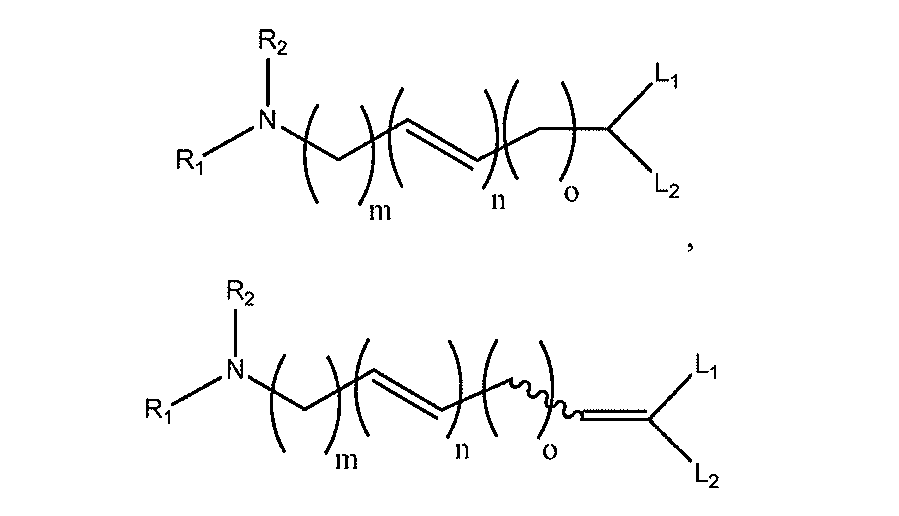
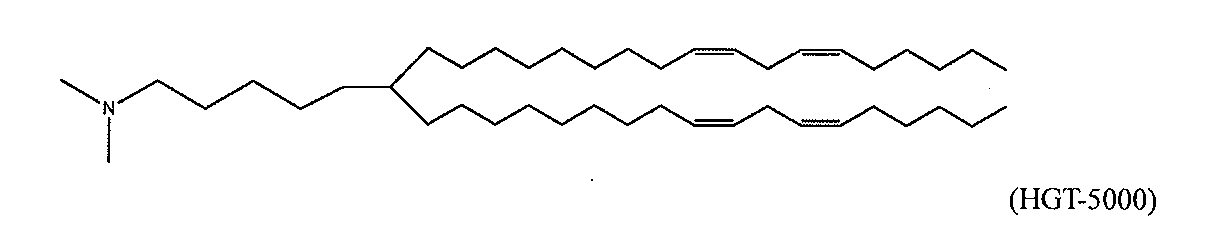
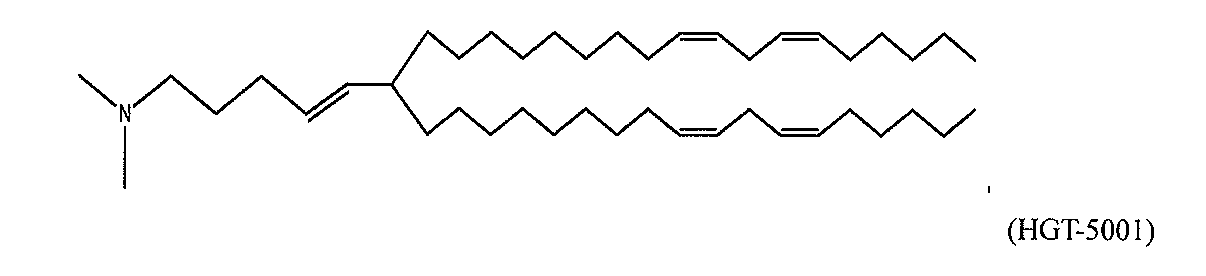

本発明の組成物および方法に使用するのに適した他のカチオン性脂質には、参照によって本明細書に組み入れる、国際公開第2010/053572号にアミノアルコールリピドイドとして記載されるカチオン性脂質が含まれる。ある特定の実施形態では、本発明の組成物および方法は、

本発明の組成物および方法に使用するのに適した他のカチオン性脂質には、参照によって本明細書に組み入れる、国際公開第2016/118725号に記載されるカチオン性脂質が含まれる。ある特定の実施形態では、本発明の組成物および方法は、

本発明の組成物および方法に使用するのに適した他のカチオン性脂質には、参照によって本明細書に組み入れる、国際公開第2016/118724号に記載されるカチオン性脂質が含まれる。ある特定の実施形態では、本発明の組成物および方法は、

本発明の組成物および方法に使用するのに適した他のカチオン性脂質には、14,25-ジトリデシル15,18,21,24-テトラアザ-オクタトリアコンタンの式を有するカチオン性脂質、およびその薬学的に許容される塩が含まれる。 Other cationic lipids suitable for use in the compositions and methods of the invention include cationic lipids having the formula 14,25-ditridecyl 15,18,21,24-tetraaza-octatriacontane; Includes pharmaceutically acceptable salts.
本発明の組成物および方法に使用するのに適した他のカチオン性脂質には、その各々を参照によって本明細書に組み入れる、国際公開第2013/063468号および国際公開第2016/205691号に記載されるカチオン性脂質が含まれる。一部の実施形態では、本発明の組成物および方法は、以下の式:


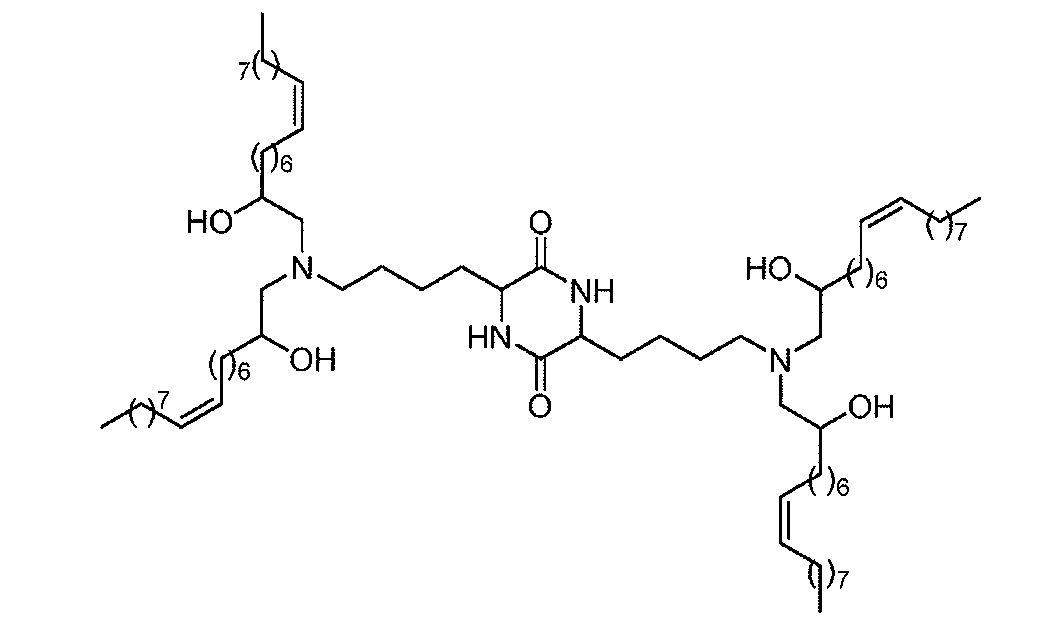
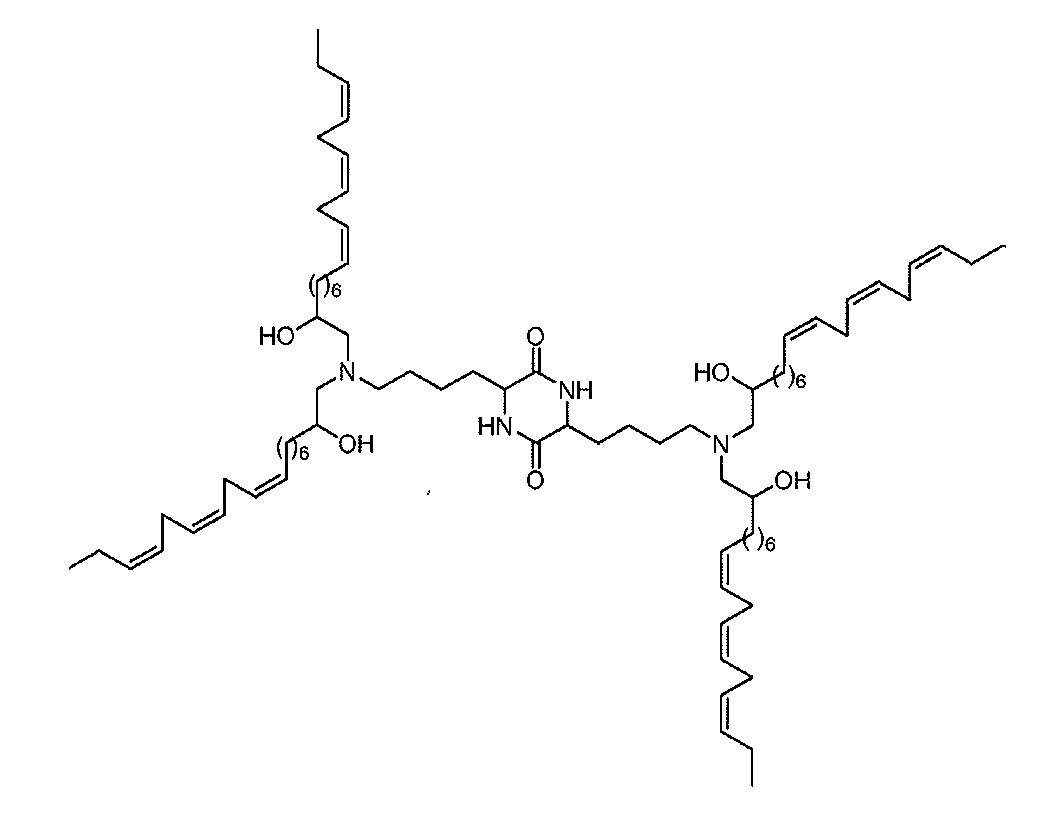
本発明の組成物および方法に使用するのに適した他のカチオン性脂質には、参照によって本明細書に組み入れる、国際公開第2015/184256号に記載されるカチオン性脂質が含まれる。一部の実施形態では、本発明の組成物および方法は、以下の式:
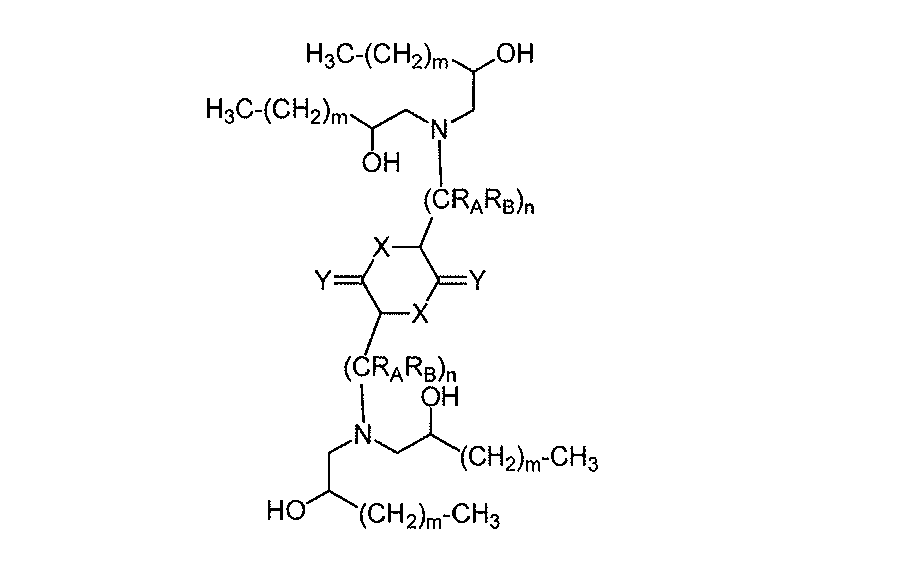

本発明の組成物および方法に使用するのに適した他のカチオン性脂質には、参照によって本明細書に組み入れる、国際公開第2016/004202号に記載されるカチオン性脂質が含まれる。一部の実施形態では、本発明の組成物および方法は、化合物構造:


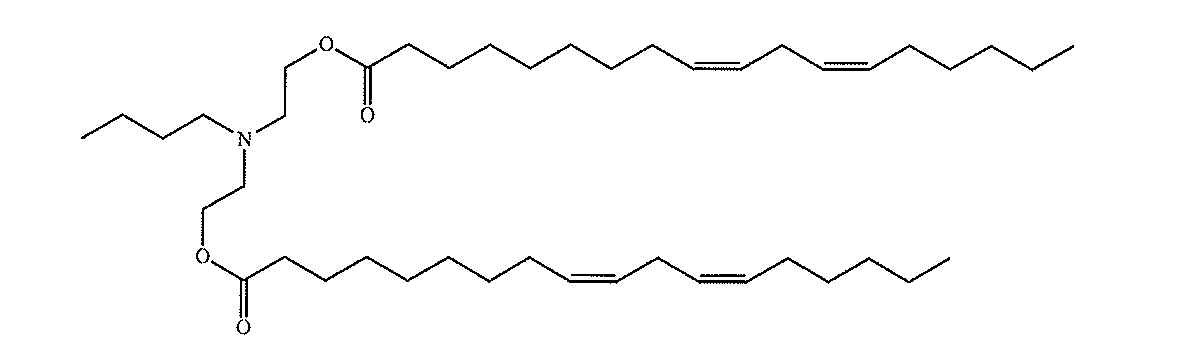
本発明の組成物および方法に使用するのに適した他のカチオン性脂質には、参照によって本明細書に組み入れる、米国仮特許出願第62/758,179号に記載されるカチオン性脂質が含まれる。一部の実施形態では、本発明の組成物および方法は、以下の式:


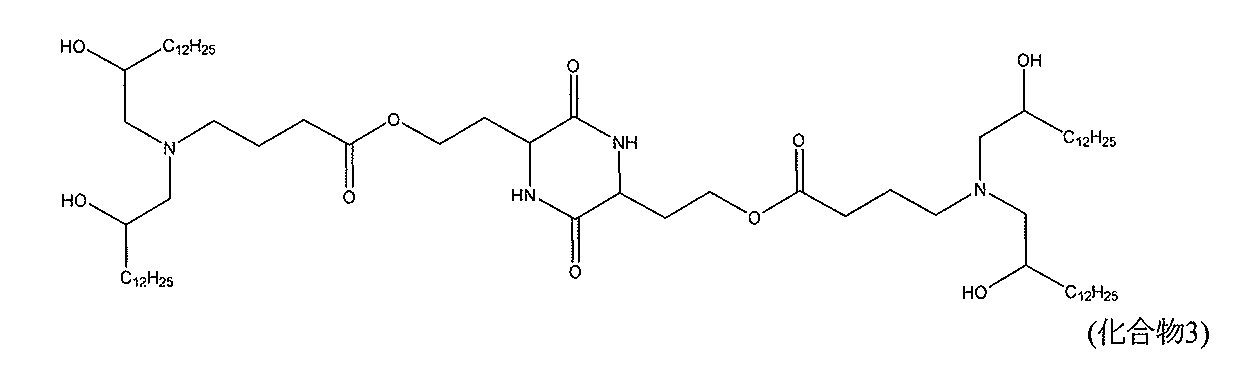
本発明の組成物および方法に使用するのに適した他のカチオン性脂質には、参照によって本明細書に組み入れる、J.McClellan、M.C.King、Cell 2010、141、210~217およびWhiteheadら、Nature Communications(2014)5:4277に記載されるカチオン性脂質が含まれる。ある特定の実施形態では、本発明の組成物および方法のカチオン性脂質は、

本発明の組成物および方法に使用するのに適した他のカチオン性脂質には、参照によって本明細書に組み入れる、国際公開第2015/199952号に記載されるカチオン性脂質が含まれる。一部の実施形態では、本発明の組成物および方法は、化合物構造:


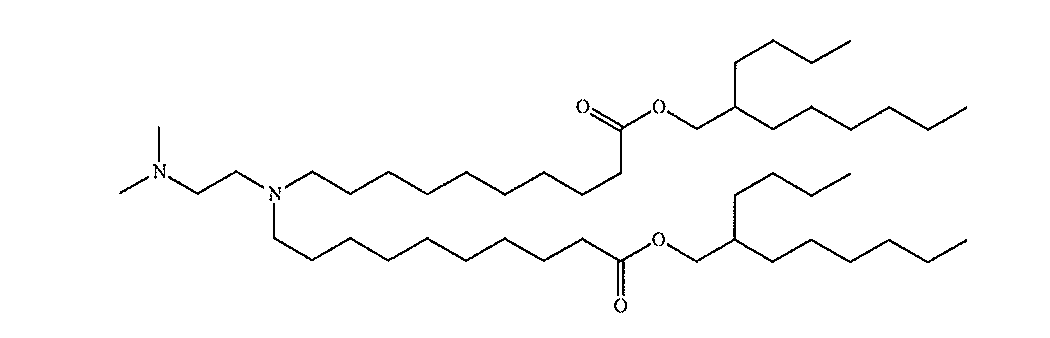


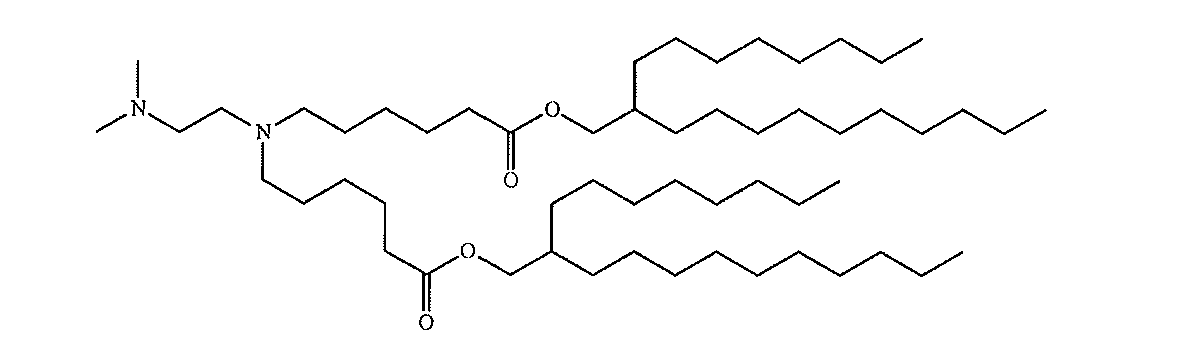
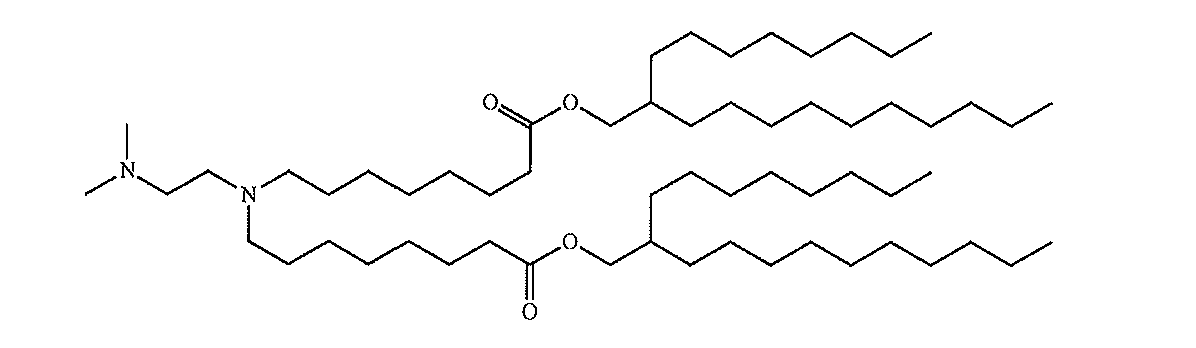
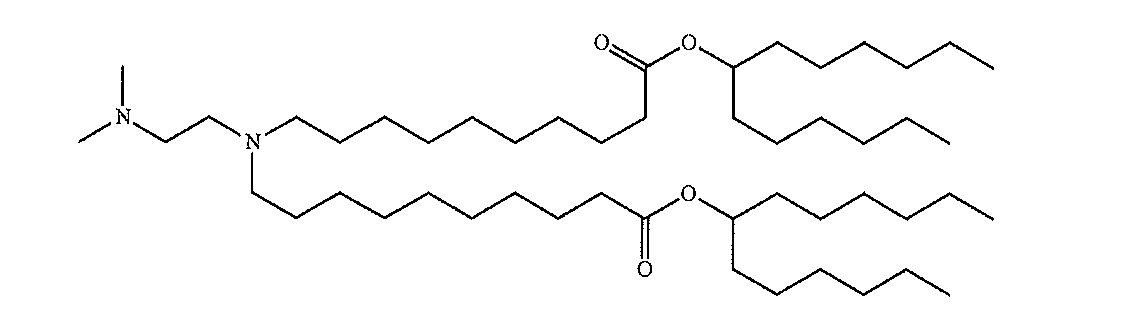

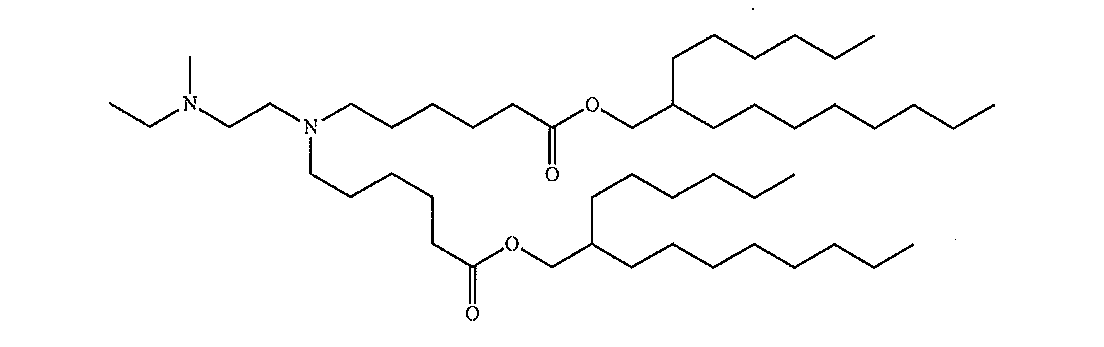

本発明の組成物および方法に使用するのに適した他のカチオン性脂質には、参照によって本明細書に組み入れる、国際公開第2017/004143号に記載されるカチオン性脂質が含まれる。一部の実施形態では、本発明の組成物および方法は、化合物構造:
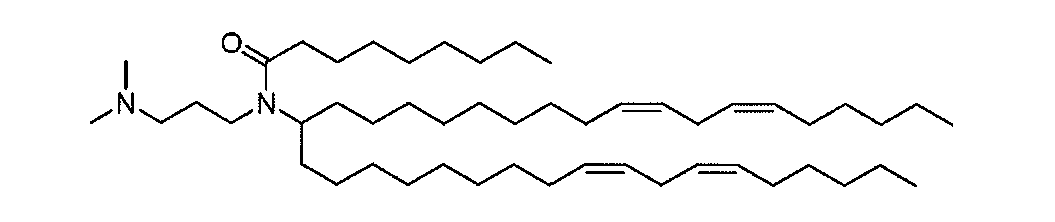

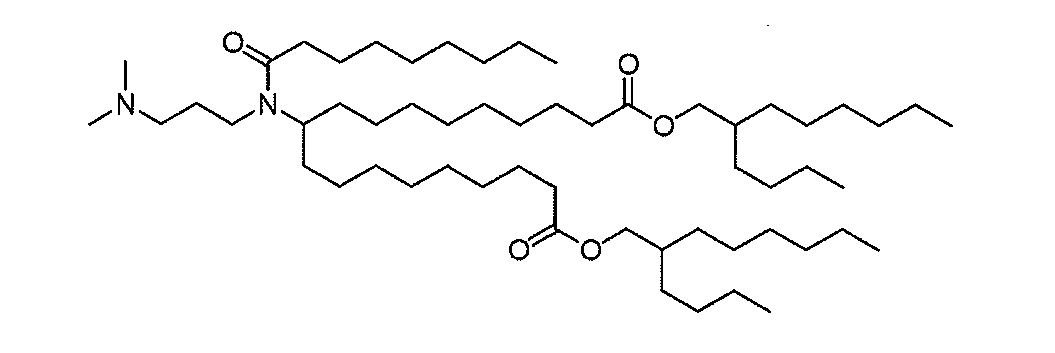
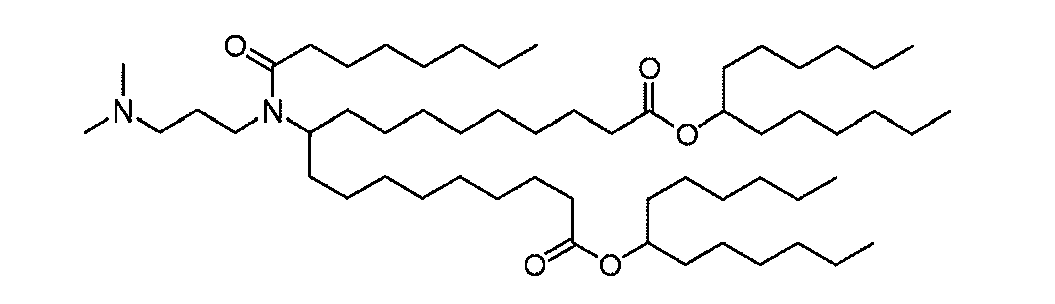
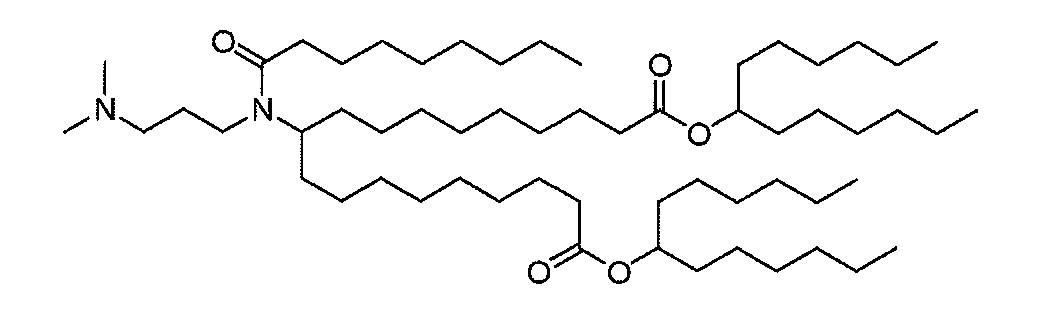
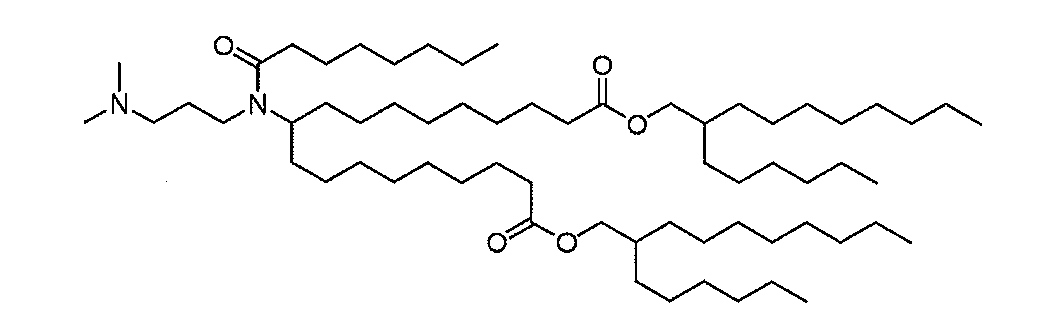


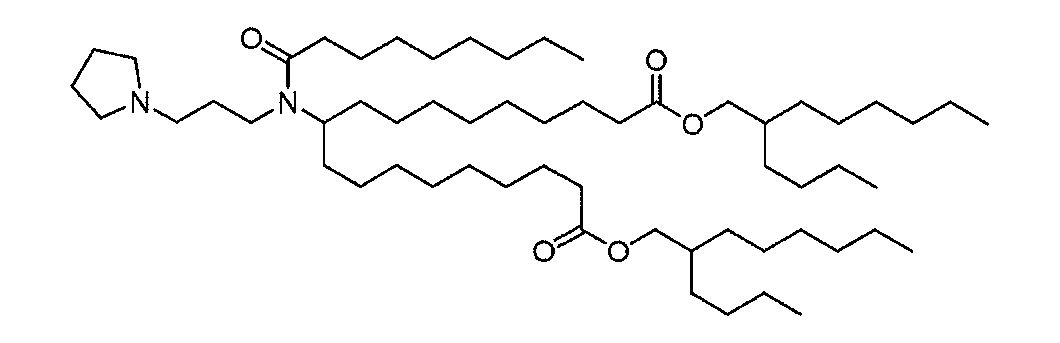


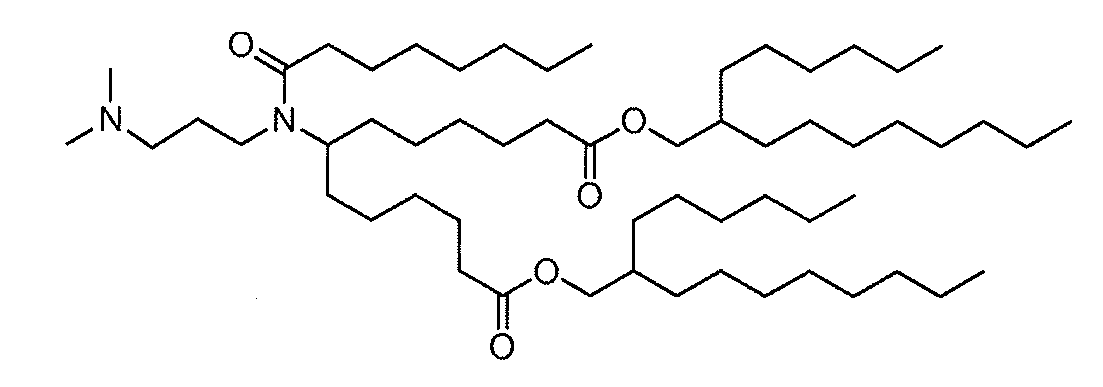
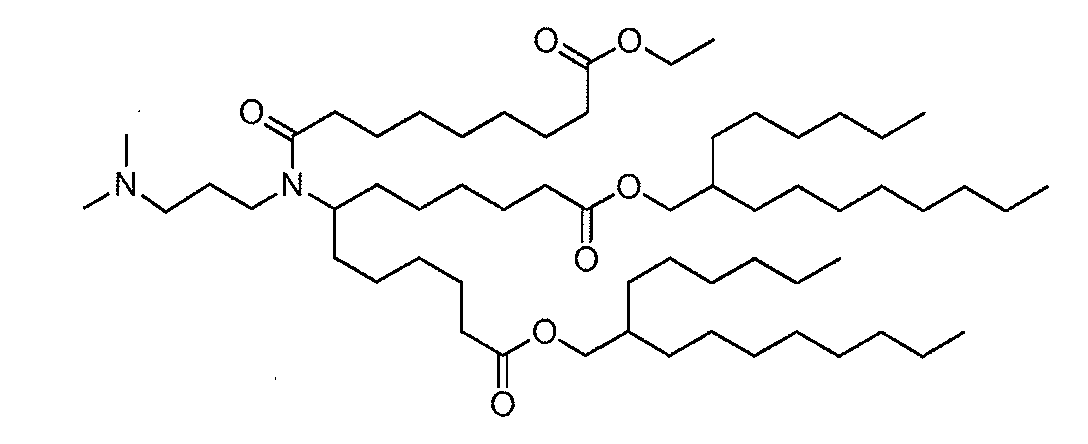

本発明の組成物および方法に使用するのに適した他のカチオン性脂質には、参照によって本明細書に組み入れる、国際公開第2017/075531号に記載されるカチオン性脂質が含まれる。一部の実施形態では、本発明の組成物および方法は、以下の式:

本発明の組成物および方法に使用するのに適した他のカチオン性脂質には、参照によって本明細書に組み入れる、国際公開第2017/117528号に記載されるカチオン性脂質が含まれる。一部の実施形態では、本発明の組成物および方法は、化合物構造:

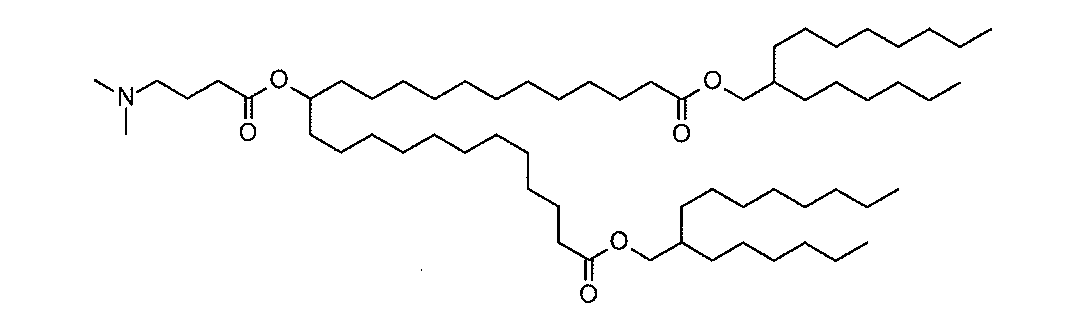

本発明の組成物および方法に使用するのに適した他のカチオン性脂質には、参照によって本明細書に組み入れる、国際公開第2017/049245号に記載されるカチオン性脂質が含まれる。一部の実施形態では、本発明の組成物および方法のカチオン性脂質は、以下の式:


本発明の組成物および方法に使用するのに適した他のカチオン性脂質には、その各々を参照によって本明細書に組み入れる、国際公開第2017/173054号および国際公開第2015/095340号に記載されるカチオン性脂質が含まれる。ある特定の実施形態では、本発明の組成物および方法は、


本発明の組成物および方法に使用するのに適した他のカチオン性脂質には、参照によって本明細書に組み入れる、国際公開第2012/170889号に記載される切断可能なカチオン性脂質が含まれる。一部の実施形態では、本発明の組成物および方法は、以下の式:

(式中、R1はイミダゾール、グアニジニウム、アミノ、イミン、エナミン、場合により置換されたアルキルアミノ(例えば、ジメチルアミノなどのアルキルアミノ)およびピリジルからなる群から選択され;R2は以下の2つの式:
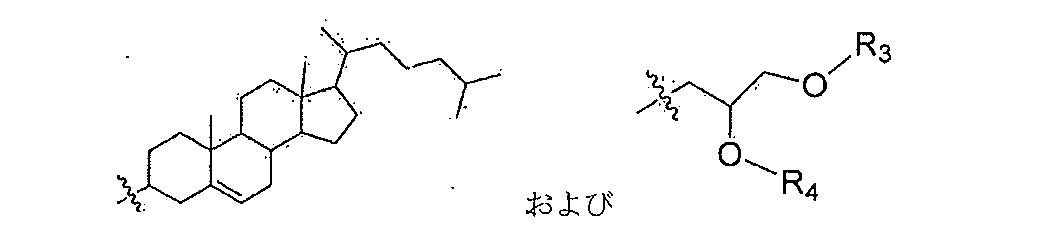
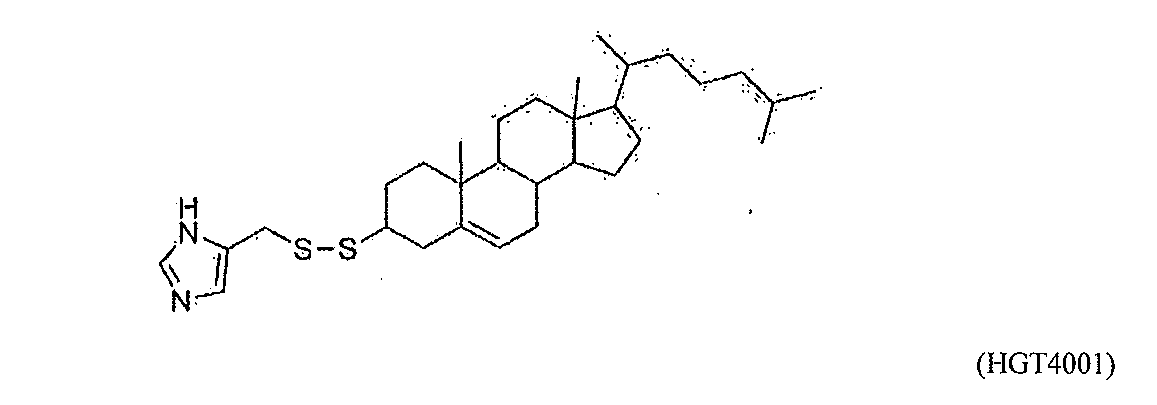




本発明の組成物および方法に使用するのに適した他のカチオン性脂質には、国際出願番号PCT/US2019/032522号に記載され、参照によって本明細書に組み入れる、切断可能なカチオン性脂質が含まれる。ある特定の実施形態では、本発明の組成物および方法は、国際出願番号PCT/US2019/032522号に記載される一般式のいずれかまたは構造(1a)~(21a)および(1b)~(21b)および(22)~(237)のいずれかであるカチオン性脂質を含む。ある特定の実施形態では、本発明の組成物および方法は、式(I’)による構造を有するカチオン性脂質

RXは独立に、-H、-L1-R1、または-L5A-L5B-B’であり;
L1、L2、およびL3の各々は独立に、共有結合、-C(O)-、-C(O)O-、-C(O)S-、または-C(O)NRL-であり;
各L4AおよびL5Aは独立に、-C(O)-、-C(O)O-、または-C(O)NRL-であり;
各L4BおよびL5Bは独立に、C1~C20アルキレン;C2~C20アルケニレン;またはC2~C20アルキニレンであり;
各BおよびB’はNR4R5または5~10員窒素含有ヘテロアリールであり;
各R1、R2、およびR3は独立に、C6~C30アルキル、C6~C30アルケニル、またはC6~C30アルキニルであり;
各R4およびR5は独立に、水素、C1~C10アルキル;C2~C10アルケニル;またはC2~C10アルキニルであり;
各RLは独立に、水素、C1~C20アルキル、C2~C20アルケニル、またはC2~C20アルキニルである)
を含む。
Other cationic lipids suitable for use in the compositions and methods of the invention include the cleavable cationic lipids described in International Application No. PCT/US2019/032522, incorporated herein by reference. included. In certain embodiments, the compositions and methods of the present invention have the following properties: any of the general formulas or structures (1a)-(21a) and (1b)-(21b ) and (22) to (237). In certain embodiments, the compositions and methods of the invention provide a cationic lipid having a structure according to formula (I').
R X is independently -H, -L 1 -R 1 , or -L 5A -L 5B -B';
Each of L 1 , L 2 , and L 3 independently represents a covalent bond, -C(O)-, -C(O)O-, -C(O)S-, or -C(O)NR L - And;
Each L 4A and L 5A is independently -C(O)-, -C(O)O-, or -C(O)NR L -;
Each L 4B and L 5B is independently C 1 -C 20 alkylene; C 2 -C 20 alkenylene; or C 2 -C 20 alkynylene;
each B and B' is NR 4 R 5 or a 5- to 10-membered nitrogen-containing heteroaryl;
each R 1 , R 2 , and R 3 is independently C 6 -C 30 alkyl, C 6 -C 30 alkenyl, or C 6 -C 30 alkynyl;
each R 4 and R 5 is independently hydrogen, C 1 -C 10 alkyl; C 2 -C 10 alkenyl; or C 2 -C 10 alkynyl;
each R L is independently hydrogen, C 1 -C 20 alkyl, C 2 -C 20 alkenyl, or C 2 -C 20 alkynyl)
including.
ある特定の実施形態では、本発明の組成物および方法は、

一部の実施形態では、本発明の組成物および方法は、カチオン性脂質、N-[1-(2,3-ジオレイルオキシ)プロピル]-N,N,N-トリメチルアンモニウムクロリド(「DOTMA」)を含む(参照によって本明細書に組み入れる、Feignerら、(Proc.Nat’l Acad.Sci.84、7413(1987);米国特許第4,897,355号)。本発明の組成物および方法に適した他のカチオン性脂質には、例えば、5-カルボキシスペルミルグリシンジオクタデシルアミド(「DOGS」);2,3-ジオレイルオキシ-N-[2-(スペルミン-カルボキサミド)エチル]-N,N-ジメチル--プロパンアミニウム(「DOSPA」)(Behrら、Proc.Nat.’l Acad.Sci.86、6982(1989)、米国特許第5,171,678号;米国特許第5,334,761号);1,2-ジオレオイル-3-ジメチルアンモニウム-プロパン(「DODAP」);1,2-ジオレオイル-3-トリメチルアンモニウム-プロパン(「DOTAP」)が含まれる。 In some embodiments, the compositions and methods of the invention include the cationic lipid N-[1-(2,3-dioleyloxy)propyl]-N,N,N-trimethylammonium chloride (“DOTMA”). ) (Feigner et al., (Proc. Nat'l Acad. Sci. 84, 7413 (1987); U.S. Pat. No. 4,897,355, herein incorporated by reference). Compositions and methods of the invention Other suitable cationic lipids include, for example, 5-carboxyspermylglycinedioctadecylamide (“DOGS”); , N-dimethyl--propanaminium ("DOSPA") (Behr et al., Proc. Nat.'l Acad. Sci. 86, 6982 (1989), U.S. Pat. No. 5,171,678; U.S. Pat. 334,761); 1,2-dioleoyl-3-dimethylammonium-propane (“DODAP”); and 1,2-dioleoyl-3-trimethylammonium-propane (“DOTAP”).
本発明の組成物および方法に適した追加の例示的なカチオン性脂質には、1,2-ジステアリルオキシ-N,N-ジメチル-3-アミノプロパン(「DSDMA」);1,2-ジオレイルオキシ-N,N-ジメチル-3-アミノプロパン(「DODMA」);1,2-ジリノレイルオキシ-N,N-ジメチル-3-アミノプロパン(「DLinDMA」);1,2-ジリノレニルオキシ-N,N-ジメチル-3-アミノプロパン(「DLenDMA」);N-ジオレイル-N,N-ジメチルアンモニウムクロリド(「DODAC」);N,N-ジステアリル-N,N-ジメチルアンモニウムブロミド(「DDAB」);N-(1,2-ジミリスチルオキシプロパ-3-イル)-N,N-ジメチル-N-ヒドロキシエチルアンモニウムブロミド(「DMRIE」);3-ジメチルアミノ-2-(コレスタ-5-エン-3-ベータ-オキシブタン-4-オキシ)-1-(シス,シス-9,12-オクタデカジエノキシ)プロパン(「CLinDMA」);2-[5’-(コレスタ-5-エン-3-ベータ-オキシ)-3’-オキサペントキシ)-3-ジメチル-1-(シス,シス-9’,1-2’-オクタデカジエノキシ)プロパン(「CpLinDMA」);N,N-ジメチル-3,4-ジオレイルオキシベンジルアミン(「DMOBA」);1,2-N,N’-ジオレイルカルバミル-3-ジメチルアミノプロパン(「DOcarbDAP」);2,3-ジリノレオイルオキシ-Ν,Ν-ジメチルプロピルアミン(「DLinDAP」);1,2-N,N’-ジリノレイルカルバミル-3-ジメチルアミノプロパン(「DLincarbDAP」);1,2-ジリノレオイルカルバミル-3-ジメチルアミノプロパン(「DLinCDAP」);2,2-ジリノレイル-4-ジメチルアミノメチル-[1,3]-ジオキソラン(「DLin-K-DMA」);2-((8-[(3P)-コレスタ-5-エン-3-イルオキシ]オクチル)オキシ)-N,N-ジメチル-3-[(9Z,12Z)-オクタデカ-9,12-ジエン-1-イルオキシ]プロパン-1-アミン(「オクチル-CLinDMA」);(2R)-2-((8-[(3ベータ)-コレスタ-5-エン-3-イルオキシ]オクチル)オキシ)-N,N-ジメチル-3-[(9Z,12Z)-オクタデカ-9,12-ジエン-1-イルオキシ]プロパン-1-アミン(「オクチル-CLinDMA(2R)」);(2S)-2-((8-[(3P)-コレスタ-5-エン-3-イルオキシ]オクチル)オキシ)-N,fsl-dimethyh3-[(9Z,12Z)-オクタデカ-9,12-ジエン-1-イルオキシ]プロパン-1-アミン(「オクチル-CLinDMA(2S)」);2,2-ジリノレイル-4-ジメチルアミノエチル-[1,3]-ジオキソラン(「DLin-K-XTC2-DMA」);および2-(2,2-ジ((9Z,12Z)-オクタデカ-9,12-ジエン-1-イル)-1,3-ジオキソラン-4-イル)-N,N-ジメチルエタンアミン(「DLin-KC2-DMA」)(参照によって本明細書に組み入れる、国際公開第2010/042877号;Sempleら、Nature Biotech.28:172~176(2010)参照)が含まれる(Heyes,J.ら、J Controlled Release 107:276~287(2005);Morrissey,DV.ら、Nat.Biotechnol.23(8):1003~1007(2005);国際公開第2005/121348号)。一部の実施形態では、カチオン性脂質の1つまたはそれ以上は、イミダゾール、ジアルキルアミノ、またはグアニジニウム部分の少なくとも1つを含む。 Additional exemplary cationic lipids suitable for the compositions and methods of the invention include 1,2-distearyloxy-N,N-dimethyl-3-aminopropane (“DSDMA”); Railoxy-N,N-dimethyl-3-aminopropane (“DODMA”); 1,2-dilinoleyloxy-N,N-dimethyl-3-aminopropane (“DLinDMA”); 1,2-dilinoleyloxy-N,N-dimethyl-3-aminopropane (“DLinDMA”); Nyloxy-N,N-dimethyl-3-aminopropane (“DLenDMA”); N-dioleyl-N,N-dimethylammonium chloride (“DODAC”); N,N-distearyl-N,N-dimethylammonium bromide (“DDAB”); N-(1,2-dimyristyloxyprop-3-yl)-N,N-dimethyl-N-hydroxyethylammonium bromide (“DMRIE”); 3-dimethylamino-2-(cholesta -5-ene-3-beta-oxybutan-4-oxy)-1-(cis,cis-9,12-octadecadienoxy)propane ("CLinDMA"); 2-[5'-(Cholesta-5 -en-3-beta-oxy)-3'-oxapentoxy)-3-dimethyl-1-(cis,cis-9',1-2'-octadecadienoxy)propane ("CpLinDMA"); N,N-dimethyl-3,4-dioleyloxybenzylamine (“DMOBA”); 1,2-N,N'-dioleylcarbamyl-3-dimethylaminopropane (“DOcarbDAP”); 2,3- Dilinoleoyloxy-N,N-dimethylpropylamine ("DLinDAP"); 1,2-N,N'-dilinoleylcarbamyl-3-dimethylaminopropane ("DLincarbDAP"); 1,2-dilinole Oilcarbamyl-3-dimethylaminopropane (“DLinCDAP”); 2,2-dilinoleyl-4-dimethylaminomethyl-[1,3]-dioxolane (“DLin-K-DMA”); 2-((8- [(3P)-cholest-5-en-3-yloxy]octyl)oxy)-N,N-dimethyl-3-[(9Z,12Z)-octadec-9,12-dien-1-yloxy]propane-1 -Amine (“Octyl-CLinDMA”); (2R)-2-((8-[(3beta)-cholest-5-en-3-yloxy]octyl)oxy)-N,N-dimethyl-3-[ (9Z,12Z)-octadeca-9,12-dien-1-yloxy]propan-1-amine (“octyl-CLinDMA(2R)”); (2S)-2-((8-[(3P)-cholesta -5-en-3-yloxy]octyl)oxy)-N,fsl-dimethyh3-[(9Z,12Z)-octadec-9,12-dien-1-yloxy]propan-1-amine ("octyl-CLinDMA( 2S)”); 2,2-dilinoleyl-4-dimethylaminoethyl-[1,3]-dioxolane (“DLin-K-XTC2-DMA”); and 2-(2,2-di((9Z,12Z )-octadec-9,12-dien-1-yl)-1,3-dioxolan-4-yl)-N,N-dimethylethanamine (“DLin-KC2-DMA”) (incorporated herein by reference , WO 2010/042877; Semple et al., Nature Biotech. 28:172-176 (2010)) (see Heyes, J. et al., J Controlled Release 107:276-287 (2005); Morrissey, DV. et al., Nat. Biotechnol. 23(8):1003-1007). (2005); International Publication No. 2005/121348). In some embodiments, one or more of the cationic lipids include at least one of an imidazole, dialkylamino, or guanidinium moiety.
一部の実施形態では、本発明の組成物および方法に適した1つまたはそれ以上のカチオン性脂質には、2,2-ジリノレイル-4-ジメチルアミノエチル-[1,3]-ジオキソラン(「XTC」);(3aR,5s,6aS)-N,N-ジメチル-2,2-ジ((9Z,12Z)-オクタデカ-9,12-ジエニル)テトラヒドロ-3aH-シクロペンタ[d][1,3]ジオキソール-5-アミン(「ALNY-100」)および/または4,7,13-トリス(3-オキソ-3-(ウンデシルアミノ)プロピル)-N1,N16-ジウンデシル-4,7,10,13-テトラアザヘキサデカン-1,16-ジアミド(「NC98-5」)が含まれる。 In some embodiments, one or more cationic lipids suitable for the compositions and methods of the invention include 2,2-dilinoleyl-4-dimethylaminoethyl-[1,3]-dioxolane (“ (3aR,5s,6aS)-N,N-dimethyl-2,2-di((9Z,12Z)-octadeca-9,12-dienyl)tetrahydro-3aH-cyclopenta[d][1,3 ] Dioxol-5-amine (“ALNY-100”) and/or 4,7,13-tris(3-oxo-3-(undecylamino)propyl)-N1,N16-diundecyl-4,7,10, Includes 13-tetraazahexadecane-1,16-diamide (“NC98-5”).
一部の実施形態では、本発明の組成物は、組成物、例えば脂質ナノ粒子中の総脂質含有量の、重量によって測定される、少なくとも約5%、10%、20%、30%、35%、40%、45%、50%、55%、60%、65%、または70%を構成する1つまたはそれ以上のカチオン性脂質を含む。一部の実施形態では、本発明の組成物は、組成物、例えば脂質ナノ粒子中の総脂質含有量の、mol%として測定される、少なくとも約5%、10%、20%、30%、35%、40%、45%、50%、55%、60%、65%、または70%を構成する1つまたはそれ以上のカチオン性脂質を含む。一部の実施形態では、本発明の組成物は、組成物、例えば脂質ナノ粒子中の総脂質含有量の、重量によって測定される、約30~70%(例えば、約30~65%、約30~60%、約30~55%、約30~50%、約30~45%、約30~40%、約35~50%、約35~45%、または約35~40%)を構成する1つまたはそれ以上のカチオン性脂質を含む。一部の実施形態では、本発明の組成物は、組成物、例えば脂質ナノ粒子中の総脂質含有量の約30~70%(例えば、約30~65%、約30~60%、約30~55%、約30~50%、約30~45%、約30~40%、約35~50%、約35~45%、または約35~40%)を構成する1つまたはそれ以上のカチオン性脂質を含む。 In some embodiments, the compositions of the invention provide at least about 5%, 10%, 20%, 30%, 35%, by weight, of the total lipid content in the composition, e.g., lipid nanoparticles. %, 40%, 45%, 50%, 55%, 60%, 65%, or 70%. In some embodiments, the compositions of the invention contain at least about 5%, 10%, 20%, 30%, measured as mol%, of the total lipid content in the composition, e.g., lipid nanoparticles. One or more cationic lipids making up 35%, 40%, 45%, 50%, 55%, 60%, 65%, or 70%. In some embodiments, the compositions of the invention contain about 30-70% (e.g., about 30-65%, about 30-60%, about 30-55%, about 30-50%, about 30-45%, about 30-40%, about 35-50%, about 35-45%, or about 35-40%) one or more cationic lipids. In some embodiments, the compositions of the invention contain about 30-70% (e.g., about 30-65%, about 30-60%, about 30%) of the total lipid content in the composition, e.g., lipid nanoparticles. ~55%, about 30-50%, about 30-45%, about 30-40%, about 35-50%, about 35-45%, or about 35-40%) Contains cationic lipids.
非カチオン性/ヘルパー脂質
一部の実施形態では、リポソームは1つまたはそれ以上の非カチオン性(「ヘルパー」)脂質を含有する。本明細書で使用される場合、「非カチオン性脂質」という句は、任意の中性、双性イオン性またはアニオン性脂質を指す。本明細書で使用される場合、「アニオン性脂質」という句は、生理学的pHなどの選択されたpHで正味の負の電荷を有するいくつかの脂質種のいずれかを指す。非カチオン性脂質には、それだけに限らないが、ジステアロイルホスファチジルコリン(DSPC)、ジオレオイルホスファチジルコリン(DOPC)、ジパルミトイルホスファチジルコリン(DPPC)、ジオレオイルホスファチジルグリセロール(DOPG)、ジパルミトイルホスファチジルグリセロール(DPPG)、ジオレオイルホスファチジルエタノールアミン(DOPE)、パルミトイルオレオイルホスファチジルコリン(POPC)、パルミトイルオレオイル-ホスファチジルエタノールアミン(POPE)、ジオレオイル-ホスファチジルエタノールアミン4-(N-マレイミドメチル)-シクロヘキサン-l-カルボキシレート(DOPE-mal)、ジパルミトイルホスファチジルエタノールアミン(DPPE)、ジミリストイルホスホエタノールアミン(DMPE)、ジステアロイル-ホスファチジル-エタノールアミン(DSPE)、ホスファチジルセリン、スフィンゴ脂質、セレブロシド、ガングリオシド、16-O-モノメチルPE、16-O-ジメチルPE、18-1-トランスPE、l-ステアロイル-2-オレオイル-ホスファチジルエタノールアミン(SOPE)、l,2-ジエルコイル-sn-グリセロ-3-ホスホエタノールアミン(DEPE)、またはこれらの混合物が含まれる。
Non-Cationic/Helper Lipids In some embodiments, liposomes contain one or more non-cationic (“helper”) lipids. As used herein, the phrase "non-cationic lipid" refers to any neutral, zwitterionic or anionic lipid. As used herein, the phrase "anionic lipid" refers to any of several lipid species that have a net negative charge at a selected pH, such as physiological pH. Non-cationic lipids include, but are not limited to, distearoyl phosphatidylcholine (DSPC), dioleoylphosphatidylcholine (DOPC), dipalmitoylphosphatidylcholine (DPPC), dioleoylphosphatidylglycerol (DOPG), dipalmitoylphosphatidylglycerol (DPPG) , dioleoylphosphatidylethanolamine (DOPE), palmitoyloleoylphosphatidylcholine (POPC), palmitoyloleoyl-phosphatidylethanolamine (POPE), dioleoylphosphatidylethanolamine 4-(N-maleimidomethyl)-cyclohexane-l-carboxylate (DOPE-mal), dipalmitoylphosphatidylethanolamine (DPPE), dimyristoylphosphoethanolamine (DMPE), distearoyl-phosphatidyl-ethanolamine (DSPE), phosphatidylserine, sphingolipid, cerebroside, ganglioside, 16-O-monomethyl PE, 16-O-dimethyl PE, 18-1-trans PE, l-stearoyl-2-oleoyl-phosphatidylethanolamine (SOPE), l,2-dielcyl-sn-glycero-3-phosphoethanolamine (DEPE) , or mixtures thereof.
一部の実施形態では、非カチオン性脂質は中性脂質、すなわち、組成物が製剤化および/または投与される条件で正味の電荷を有さない脂質である。 In some embodiments, non-cationic lipids are neutral lipids, ie, lipids that have no net charge under the conditions in which the composition is formulated and/or administered.
一部の実施形態では、このような非カチオン性脂質は単独で使用されるが、好ましくは他の脂質、例えばカチオン性脂質と組み合わせて使用される。 In some embodiments, such non-cationic lipids are used alone, but preferably in combination with other lipids, such as cationic lipids.
一部の実施形態では、非カチオン性脂質は、組成物中に存在する全脂質の約5%~約90%、約5%~約70%、約5%~約50%、約5%~約40%、約5%~約30%、約10%~約70%、約10%~約50%、または約10%~約40%のモル比(mol%)で存在することができる。一部の実施形態では、全非カチオン性脂質は、組成物中に存在する全脂質の約5%~約90%、約5%~約70%、約5%~約50%、約5%~約40%、約5%~約30%、約10%~約70%、約10%~約50%、または約10%~約40%のモル比(mol%)で存在することができる。一部の実施形態では、リポソーム中の非カチオン性脂質のパーセンテージは、約5mol%超、約10mol%超、約20mol%超、約30mol%超、または約40mol%超であることができる。一部の実施形態では、リポソーム中の全非カチオン性脂質のパーセンテージは、約5mol%超、約10mol%超、約20mol%超、約30mol%超、または約40mol%超であることができる。一部の実施形態では、リポソーム中の非カチオン性脂質のパーセンテージは、約5mol%以下、約10mol%以下、約20mol%以下、約30mol%以下、または約40mol%以下である。一部の実施形態では、リポソーム中の全非カチオン性脂質のパーセンテージは、約5mol%以下、約10mol%以下、約20mol%以下、約30mol%以下、または約40mol%以下であることができる。 In some embodiments, the non-cationic lipid is from about 5% to about 90%, from about 5% to about 70%, from about 5% to about 50%, from about 5% to about 90% of the total lipids present in the composition. It can be present in a molar ratio (mol%) of about 40%, about 5% to about 30%, about 10% to about 70%, about 10% to about 50%, or about 10% to about 40%. In some embodiments, the total non-cationic lipids are about 5% to about 90%, about 5% to about 70%, about 5% to about 50%, about 5% of the total lipids present in the composition. Can be present in a molar ratio (mol%) of from about 40%, from about 5% to about 30%, from about 10% to about 70%, from about 10% to about 50%, or from about 10% to about 40% . In some embodiments, the percentage of non-cationic lipids in the liposome can be greater than about 5 mol%, greater than about 10 mol%, greater than about 20 mol%, greater than about 30 mol%, or greater than about 40 mol%. In some embodiments, the percentage of total non-cationic lipids in the liposome can be greater than about 5 mol%, greater than about 10 mol%, greater than about 20 mol%, greater than about 30 mol%, or greater than about 40 mol%. In some embodiments, the percentage of non-cationic lipids in the liposome is about 5 mol% or less, about 10 mol% or less, about 20 mol% or less, about 30 mol% or less, or about 40 mol% or less. In some embodiments, the percentage of total non-cationic lipids in the liposome can be about 5 mol% or less, about 10 mol% or less, about 20 mol% or less, about 30 mol% or less, or about 40 mol% or less.
一部の実施形態では、非カチオン性脂質は、組成物中に存在する全脂質の約5%~約90%、約5%~約70%、約5%~約50%、約5%~約40%、約5%~約30%、約10%~約70%、約10%~約50%、または約10%~約40%の重量比(重量%)で存在することができる。一部の実施形態では、全非カチオン性脂質は、組成物中に存在する全脂質の約5%~約90%、約5%~約70%、約5%~約50%、約5%~約40%、約5%~約30%、約10%~約70%、約10%~約50%、または約10%~約40%の重量比(重量%)で存在することができる。一部の実施形態では、リポソーム中の非カチオン性脂質のパーセンテージは、約5重量%超、約10重量%超、約20重量%超、約30重量%超、または約40重量%超であることができる。一部の実施形態では、リポソーム中の全非カチオン性脂質のパーセンテージは、約5重量%超、約10重量%超、約20重量%超、約30重量%超、または約40重量%超であることができる。一部の実施形態では、リポソーム中の非カチオン性脂質のパーセンテージは、約5重量%以下、約10重量%以下、約20重量%以下、約30重量%以下、または約40重量%以下である。一部の実施形態では、リポソーム中の全非カチオン性脂質のパーセンテージは、約5重量%以下、約10重量%以下、約20重量%以下、約30重量%以下、または約40重量%以下であることができる。 In some embodiments, the non-cationic lipid is from about 5% to about 90%, from about 5% to about 70%, from about 5% to about 50%, from about 5% to about 90% of the total lipids present in the composition. It can be present in a weight percentage (wt%) of about 40%, about 5% to about 30%, about 10% to about 70%, about 10% to about 50%, or about 10% to about 40%. In some embodiments, the total non-cationic lipids are about 5% to about 90%, about 5% to about 70%, about 5% to about 50%, about 5% of the total lipids present in the composition. Can be present in a weight percentage (wt%) of ~ about 40%, about 5% to about 30%, about 10% to about 70%, about 10% to about 50%, or about 10% to about 40% . In some embodiments, the percentage of non-cationic lipids in the liposome is greater than about 5%, greater than about 10%, greater than about 20%, greater than about 30%, or greater than about 40% by weight. be able to. In some embodiments, the percentage of total non-cationic lipids in the liposome is greater than about 5%, greater than about 10%, greater than about 20%, greater than about 30%, or greater than about 40% by weight. Something can happen. In some embodiments, the percentage of non-cationic lipids in the liposome is no more than about 5%, no more than about 10%, no more than about 20%, no more than about 30%, or no more than about 40% by weight. . In some embodiments, the percentage of total non-cationic lipids in the liposome is no more than about 5%, no more than about 10%, no more than about 20%, no more than about 30%, or no more than about 40% by weight. Something can happen.
コレステロール系脂質
一部の実施形態では、リポソームは1つまたはそれ以上のコレステロール系脂質を含む。例えば、適切なコレステロール系カチオン性脂質には、例えば、DC-Choi(N,N-ジメチル-N-エチルカルボキサミドコレステロール)、1,4-ビス(3-N-オレイルアミノ-プロピル)ピペラジン(Gaoら Biochem.Biophys.Res.Comm.179、280(1991);Wolfら BioTechniques 23、139(1997);米国特許第5,744,335号)、または以下の構造

一部の実施形態では、コレステロール系脂質はコレステロールである。 In some embodiments, the cholesterol-based lipid is cholesterol.
一部の実施形態では、コレステロール系脂質は、リポソーム中に存在する全脂質の約1%~約30%、または約5%~約20%のモル比(mol%)を構成することができる。一部の実施形態では、脂質ナノ粒子中のコレステロール系脂質のパーセンテージは、約5mol%超、約10mol%超、約20mol%超、約30mol%超、または約40mol%超であることができる。一部の実施形態では、脂質ナノ粒子中のコレステロール系脂質のパーセンテージは、約5mol%以下、約10mol%以下、約20mol%以下、約30mol%以下、または約40mol%以下であることができる。 In some embodiments, cholesterol-based lipids can constitute from about 1% to about 30%, or from about 5% to about 20%, of the total lipids present in the liposomes (mol%). In some embodiments, the percentage of cholesterol-based lipids in the lipid nanoparticles can be greater than about 5 mol%, greater than about 10 mol%, greater than about 20 mol%, greater than about 30 mol%, or greater than about 40 mol%. In some embodiments, the percentage of cholesterol-based lipids in the lipid nanoparticles can be about 5 mol% or less, about 10 mol% or less, about 20 mol% or less, about 30 mol% or less, or about 40 mol% or less.
一部の実施形態では、コレステロール系脂質は、リポソーム中に存在する全脂質の約1%~約30%、または約5%~約20%の重量比(重量%)で存在することができる。一部の実施形態では、脂質ナノ粒子中のコレステロール系脂質のパーセンテージは、約5重量%超、約10重量%超、約20重量%超、約30重量%超、または約40重量%超であることができる。一部の実施形態では、脂質ナノ粒子中のコレステロール系脂質のパーセンテージは、約5重量%以下、約10重量%以下、約20重量%以下、約30重量%以下、または約40重量%以下であることができる。 In some embodiments, cholesterol-based lipids can be present in a weight percentage (wt%) of about 1% to about 30%, or about 5% to about 20% of the total lipids present in the liposome. In some embodiments, the percentage of cholesterol-based lipids in the lipid nanoparticles is greater than about 5%, greater than about 10%, greater than about 20%, greater than about 30%, or greater than about 40% by weight. Something can happen. In some embodiments, the percentage of cholesterol-based lipids in the lipid nanoparticles is about 5% by weight or less, about 10% by weight or less, about 20% by weight or less, about 30% by weight or less, or about 40% by weight or less. Something can happen.
PEG修飾脂質
一部の実施形態では、リポソームは1つまたはそれ以上のPEG化脂質を含む。
PEG-Modified Lipids In some embodiments, liposomes include one or more PEGylated lipids.
例えば、N-オクタノイル-スフィンゴシン-1-[スクシニル(メトキシポリエチレングリコール)-2000](C8 PEG-2000セラミド)を含む、誘導体化セラミド(PEG-CER)などの、ポリエチレングリコール(PEG)修飾リン脂質および誘導体化脂質の使用も、単独でまたは好ましくは導入ビヒクルを含む他の脂質製剤と組み合わせて(例えば、脂質ナノ粒子)、本発明によって企図される。 For example, polyethylene glycol (PEG) modified phospholipids, such as derivatized ceramides (PEG-CER), including N-octanoyl-sphingosine-1-[succinyl(methoxypolyethylene glycol)-2000] (C8 PEG-2000 ceramide); The use of derivatized lipids, either alone or in combination with other lipid formulations (eg, lipid nanoparticles), preferably including an introduction vehicle, is also contemplated by the present invention.
企図されるPEG修飾脂質には、それだけに限らないが、C6~C20長のアルキル鎖を有する脂質に共有結合した最大5kDa長のポリエチレングリコール鎖が含まれる。一部の実施形態では、PEG修飾またはPEG化脂質はPEG化コレステロールまたはPEG-2Kである。このような成分の添加は複雑な凝集を防ぎ、循環寿命を増加させ、脂質-核酸組成物の標的組織への送達を増加させる手段を提供することもできる(Klibanovら(1990)FEBS Letters、268(1):235~237)、またはこれらはインビボで製剤から迅速に交換するよう選択される(米国特許第5,885,613号参照)。特に有用な交換可能な脂質は、より短いアシル鎖(例えば、C14またはC18)を有するPEG-セラミドである。 Contemplated PEG-modified lipids include, but are not limited to, polyethylene glycol chains up to 5 kDa long covalently attached to lipids with C 6 to C 20 long alkyl chains. In some embodiments, the PEG-modified or PEGylated lipid is PEGylated cholesterol or PEG-2K. Addition of such components may also provide a means to prevent complex aggregation, increase circulation life, and increase delivery of lipid-nucleic acid compositions to target tissues (Klibanov et al. (1990) FEBS Letters, 268 (1):235-237), or they are selected for rapid exchange from the formulation in vivo (see US Pat. No. 5,885,613). Particularly useful exchangeable lipids are PEG-ceramides with shorter acyl chains (eg, C 14 or C 18 ).
本発明のPEG修飾リン脂質および誘導体化脂質は、リポソーム導入ビヒクル中に存在する全脂質の約0%~約20%、約0.5%~約20%、約1%~約15%、約4%~約10%、または約2%のモル比を構成することができる。一部の実施形態では、1つまたはそれ以上のPEG修飾脂質は、モル比で全脂質の約4%を構成する。一部の実施形態では、1つまたはそれ以上のPEG修飾脂質は、モル比で全脂質の約5%を構成する。一部の実施形態では、1つまたはそれ以上のPEG修飾脂質は、モル比で全脂質の約6%を構成する。 The PEG-modified phospholipids and derivatized lipids of the present invention are about 0% to about 20%, about 0.5% to about 20%, about 1% to about 15%, about A molar ratio of 4% to about 10%, or about 2% can be comprised. In some embodiments, the one or more PEG-modified lipids constitute about 4% of the total lipids by molar ratio. In some embodiments, the one or more PEG-modified lipids constitute about 5% of the total lipids by molar ratio. In some embodiments, the one or more PEG-modified lipids constitute about 6% of the total lipids by molar ratio.
両親媒性ブロックコポリマー
一部の実施形態では、適切な組成物は両親媒性ブロックコポリマー(例えば、ポロキサマー)を含有する。
Amphiphilic Block Copolymers In some embodiments, suitable compositions contain amphiphilic block copolymers (eg, poloxamers).
様々な両親媒性ブロックコポリマーを使用して本発明を実施することができる。一部の実施形態では、両親媒性ブロックコポリマーは界面活性剤または非イオン性界面活性剤とも呼ばれる。 A variety of amphiphilic block copolymers can be used to practice the invention. In some embodiments, amphiphilic block copolymers are also referred to as surfactants or nonionic surfactants.
一部の実施形態では、本発明に適した両親媒性ポリマーは、ポロキサマー(Pluronic(登録商標))、ポロキサミン(Tetronic(登録商標))、ポリオキシエチレングリコールソルビタンアルキルエステル(ポリソルベート)およびポリビニルピロリドン(PVP)から選択される。 In some embodiments, amphiphilic polymers suitable for the present invention include poloxamers (Pluronic®), poloxamines (Tetronic®), polyoxyethylene glycol sorbitan alkyl esters (polysorbates), and polyvinylpyrrolidone ( PVP).
ポロキサマー
一部の実施形態では、適切な両親媒性ポリマーはポロキサマーである。例えば、適切なポロキサマーは以下の構造:

のものである。例えば、aは約12であり、bは約20である、またはaは約80であり、bは約27である、またはaは約64であり、bは約37である、またはaは約141であり、bは約44である、またはaは約101であり、bは約56である。
Poloxamers In some embodiments, suitable amphiphilic polymers are poloxamers. For example, a suitable poloxamer has the following structure:
belongs to. For example, a is about 12 and b is about 20, or a is about 80 and b is about 27, or a is about 64 and b is about 37, or a is about 141 and b is about 44, or a is about 101 and b is about 56.
一部の実施形態では、本発明に適したポロキサマーは、約10~約150のエチレンオキシド単位を有する。一部の実施形態では、ポロキサマーは、約10~約100のエチレンオキシド単位を有する。 In some embodiments, poloxamers suitable for the present invention have from about 10 to about 150 ethylene oxide units. In some embodiments, the poloxamer has about 10 to about 100 ethylene oxide units.
一部の実施形態では、適切なポロキサマーはポロキサマー84である。一部の実施形態では、適切なポロキサマーはポロキサマー101である。一部の実施形態では、適切なポロキサマーはポロキサマー105である。一部の実施形態では、適切なポロキサマーはポロキサマー108である。一部の実施形態では、適切なポロキサマーはポロキサマー122である。一部の実施形態では、適切なポロキサマーはポロキサマー123である。一部の実施形態では、適切なポロキサマーはポロキサマー124である。一部の実施形態では、適切なポロキサマーはポロキサマー181である。一部の実施形態では、適切なポロキサマーはポロキサマー182である。一部の実施形態では、適切なポロキサマーはポロキサマー183である。一部の実施形態では、適切なポロキサマーはポロキサマー184である。一部の実施形態では、適切なポロキサマーはポロキサマー185である。一部の実施形態では、適切なポロキサマーはポロキサマー188である。一部の実施形態では、適切なポロキサマーはポロキサマー212である。一部の実施形態では、適切なポロキサマーはポロキサマー215である。一部の実施形態では、適切なポロキサマーはポロキサマー217である。一部の実施形態では、適切なポロキサマーはポロキサマー231である。一部の実施形態では、適切なポロキサマーはポロキサマー234である。一部の実施形態では、適切なポロキサマーはポロキサマー235である。一部の実施形態では、適切なポロキサマーはポロキサマー237である。一部の実施形態では、適切なポロキサマーはポロキサマー238である。一部の実施形態では、適切なポロキサマーはポロキサマー282である。一部の実施形態では、適切なポロキサマーはポロキサマー284である。一部の実施形態では、適切なポロキサマーはポロキサマー288である。一部の実施形態では、適切なポロキサマーはポロキサマー304である。一部の実施形態では、適切なポロキサマーはポロキサマー331である。一部の実施形態では、適切なポロキサマーはポロキサマー333である。一部の実施形態では、適切なポロキサマーはポロキサマー334である。一部の実施形態では、適切なポロキサマーはポロキサマー335である。一部の実施形態では、適切なポロキサマーはポロキサマー338である。一部の実施形態では、適切なポロキサマーはポロキサマー401である。一部の実施形態では、適切なポロキサマーはポロキサマー402である。一部の実施形態では、適切なポロキサマーはポロキサマー403である。一部の実施形態では、適切なポロキサマーはポロキサマー407である。一部の実施形態では、適切なポロキサマーはその組合せである。
In some embodiments, a suitable poloxamer is poloxamer 84. In some embodiments, a suitable poloxamer is poloxamer 101. In some embodiments, a suitable poloxamer is poloxamer 105. In some embodiments, a suitable poloxamer is
一部の実施形態では、適切なポロキサマーは約4,000g/mol~約20,000g/molの平均分子量を有する。一部の実施形態では、適切なポロキサマーは約1,000g/mol~約50,000g/molの平均分子量を有する。一部の実施形態では、適切なポロキサマーは約1,000g/molの平均分子量を有する。一部の実施形態では、適切なポロキサマーは約2,000g/molの平均分子量を有する。一部の実施形態では、適切なポロキサマーは約3,000g/molの平均分子量を有する。一部の実施形態では、適切なポロキサマーは約4,000g/molの平均分子量を有する。一部の実施形態では、適切なポロキサマーは約5,000g/molの平均分子量を有する。一部の実施形態では、適切なポロキサマーは約6,000g/molの平均分子量を有する。一部の実施形態では、適切なポロキサマーは約7,000g/molの平均分子量を有する。一部の実施形態では、適切なポロキサマーは約8,000g/molの平均分子量を有する。一部の実施形態では、適切なポロキサマーは約9,000g/molの平均分子量を有する。一部の実施形態では、適切なポロキサマーは約10,000g/molの平均分子量を有する。一部の実施形態では、適切なポロキサマーは約20,000g/molの平均分子量を有する。一部の実施形態では、適切なポロキサマーは約25,000g/molの平均分子量を有する。一部の実施形態では、適切なポロキサマーは約30,000g/molの平均分子量を有する。一部の実施形態では、適切なポロキサマーは約40,000g/molの平均分子量を有する。一部の実施形態では、適切なポロキサマーは約50,000g/molの平均分子量を有する。 In some embodiments, suitable poloxamers have an average molecular weight of about 4,000 g/mol to about 20,000 g/mol. In some embodiments, suitable poloxamers have an average molecular weight of about 1,000 g/mol to about 50,000 g/mol. In some embodiments, suitable poloxamers have an average molecular weight of about 1,000 g/mol. In some embodiments, suitable poloxamers have an average molecular weight of about 2,000 g/mol. In some embodiments, suitable poloxamers have an average molecular weight of about 3,000 g/mol. In some embodiments, suitable poloxamers have an average molecular weight of about 4,000 g/mol. In some embodiments, suitable poloxamers have an average molecular weight of about 5,000 g/mol. In some embodiments, suitable poloxamers have an average molecular weight of about 6,000 g/mol. In some embodiments, suitable poloxamers have an average molecular weight of about 7,000 g/mol. In some embodiments, suitable poloxamers have an average molecular weight of about 8,000 g/mol. In some embodiments, suitable poloxamers have an average molecular weight of about 9,000 g/mol. In some embodiments, suitable poloxamers have an average molecular weight of about 10,000 g/mol. In some embodiments, suitable poloxamers have an average molecular weight of about 20,000 g/mol. In some embodiments, suitable poloxamers have an average molecular weight of about 25,000 g/mol. In some embodiments, suitable poloxamers have an average molecular weight of about 30,000 g/mol. In some embodiments, suitable poloxamers have an average molecular weight of about 40,000 g/mol. In some embodiments, suitable poloxamers have an average molecular weight of about 50,000 g/mol.
他の両親媒性ポリマー
一部の実施形態では、両親媒性ポリマーはポロキサミン、例えばtetronic 304またはtetronic 904である。
Other Amphiphilic Polymers In some embodiments, the amphiphilic polymer is a poloxamine, such as tetronic 304 or tetronic 904.
一部の実施形態では、両親媒性ポリマーは、ポリビニルピロリドン(PVP)、例えば3kDa、10kDa、または29kDaの分子量を有するPVPである。 In some embodiments, the amphiphilic polymer is polyvinylpyrrolidone (PVP), such as PVP having a molecular weight of 3 kDa, 10 kDa, or 29 kDa.
一部の実施形態では、両親媒性ポリマーはポリエチレングリコールエーテル(Brij)、ポリソルベート、ソルビタン、およびこれらの誘導体である。一部の実施形態では、両親媒性ポリマーはポリソルベート、例えばPS20である。 In some embodiments, the amphiphilic polymer is polyethylene glycol ether (Brij), polysorbate, sorbitan, and derivatives thereof. In some embodiments, the amphiphilic polymer is a polysorbate, such as PS20.
一部の実施形態では、両親媒性ポリマーはポリエチレングリコールエーテル(Brij)、ポロキサマー、ポリソルベート、ソルビタン、またはこれらの誘導体である。 In some embodiments, the amphiphilic polymer is polyethylene glycol ether (Brij), poloxamer, polysorbate, sorbitan, or a derivative thereof.
一部の実施形態では、両親媒性ポリマーはポリエチレングリコールエーテルである。一部の実施形態では、適切なポリエチレングリコールエーテルは、式(S-I)の化合物:

(式中、
tは1~100の間の整数であり:
R1BRIJは独立に、C10~40アルキル、C10~40アルケニル、またはC10~40アルキニルであり;場合によりR5PEGの1つまたはそれ以上のメチレン基は、C3~10カルボシクリレン、4~10員ヘテロシクリレン、C6~10アリーレン、4~10員ヘテロアリーレン、-N(RN)-、-O-、-S-、-C(O)-、-C(O)N(RN)-、-NRNC(O)-、-NRC(O)N(R)-、-C(O)O- -OC(O)-、-OC(O)O- -OC(O)N(RN)-、-NRNC(O)O- -C(O)S- -SC(O)-、-C(=NRN)-、-C(=NR)N(R)-、-NRNC(=NRN)- -NRNC(=NRN)N(RN)-、-C(S)-、-C(S)N(RN)-、-NRNC(S)-、-NRNC(S)N(RN)-、-S(O)-、-OS(O)-、-S(O)O- -OS(O)O- -OS(O)2- -S(O)2O- -OS(O)2O- -N(RN)S(O)-、-S(O)N(RN)- -N(RN)S(O)N(RN)- -OS(O)N(RN)- -N(RN)S(O)O- -S(O)2- -N(RN)S(O)2- -S(O)2N(RN)-、-N(RN)S(O)2N(RN)- -OS(O)2N(RN)-または-N(RN)S(O)2O-で独立に置き換えられており;
RNの各例は独立に、水素、C1~6アルキル、または窒素保護基である)
である。
In some embodiments, the amphiphilic polymer is polyethylene glycol ether. In some embodiments, suitable polyethylene glycol ethers are compounds of formula (SI):
t is an integer between 1 and 100:
R 1BRIJ is independently C 10-40 alkyl, C 10-40 alkenyl, or C 10-40 alkynyl; optionally one or more methylene groups of R 5PEG are C 3-10 carbocyclylene, 4-10 membered heterocyclylene, C 6-10 arylene, 4-10 membered heteroarylene, -N(R N )-, -O-, -S-, -C(O)-, -C(O)N (R N )-, -NR N C(O)-, -NRC(O)N(R)-, -C(O)O- -OC(O)-, -OC(O)O- -OC( O)N(R N )-, -NR N C(O)O- -C(O)S- -SC(O)-, -C(=NR N )-, -C(=NR)N(R )-, -NRNC(=NR N )- -NR N C(=NR N )N(R N )-, -C(S)-, -C(S)N(R N )-, -NR N C (S)-, -NR N C(S)N(R N )-, -S(O)-, -OS(O)-, -S(O)O- -OS(O)O- -OS( O) 2 - -S(O) 2 O- -OS(O) 2 O- -N(R N )S(O)-, -S(O)N(R N )- -N(R N )S (O)N(R N )- -OS(O)N(R N )- -N(R N )S(O)O- -S(O) 2 - -N(R N )S(O) 2 - -S(O) 2 N(R N )-, -N(R N )S(O) 2 N(R N )- -OS(O) 2 N(R N )- or -N(R N ) independently replaced by S(O) 2 O-;
Each instance of R N is independently hydrogen, C 1-6 alkyl, or a nitrogen protecting group)
It is.
一部の実施形態では、R1BRIJはアルキルである。例えば、ポリエチレングリコールエーテルは、式(S-Ia)の化合物:

一部の実施形態では、R1BRIJはアルケニルである。例えば、適切なポリエチレングリコールエーテルは、式(S-Ib)の化合物:

典型的には、両親媒性ポリマー(例えば、ポロキサマー)は、その臨界ミセル濃度(CMC)未満の量で製剤中に存在する。一部の実施形態では、両親媒性ポリマー(例えば、ポロキサマー)は、そのCMCより約1%、約2%、約3%、約4%、約5%、約6%、約7%、約8%、約9%、約10%、約15%、約20%、約25%、約30%、約35%、約40%、約45%、または約50%低い量で混合物中に存在する。一部の実施形態では、両親媒性ポリマー(例えば、ポロキサマー)は、そのCMCより約0.9%、0.8%、0.7%、0.6%、0.5%、0.4%、0.3%、0.2%、0.1%低い量で混合物中に存在する。一部の実施形態では、両親媒性ポリマー(例えば、ポロキサマー)は、そのCMCより約55%、60%、65%、70%、75%、80%、90%、または95%低い量で混合物中に存在する。 Typically, the amphiphilic polymer (eg, poloxamer) is present in the formulation in an amount below its critical micelle concentration (CMC). In some embodiments, the amphiphilic polymer (e.g., poloxamer) is about 1%, about 2%, about 3%, about 4%, about 5%, about 6%, about 7%, about present in the mixture in an amount that is 8%, about 9%, about 10%, about 15%, about 20%, about 25%, about 30%, about 35%, about 40%, about 45%, or about 50% lower; do. In some embodiments, the amphiphilic polymer (e.g., poloxamer) is about 0.9%, 0.8%, 0.7%, 0.6%, 0.5%, 0.4% below its CMC. %, 0.3%, 0.2%, 0.1% lower in the mixture. In some embodiments, the amphiphilic polymer (e.g., poloxamer) is present in the mixture in an amount that is about 55%, 60%, 65%, 70%, 75%, 80%, 90%, or 95% lower than its CMC. exists within.
一部の実施形態では、製剤中に存在する両親媒性ポリマー(例えば、ポロキサマー)の元の量の約0.1%、0.09%、0.08%、0.07%、0.06%、0.05%、0.04%、0.03%、0.02%、または0.01%未満は除去時に残る。一部の実施形態では、両親媒性ポリマー(例えば、ポロキサマー)の残留量は除去時に製剤中に残る。本明細書で使用される場合、残留量は、組成物中の物質(本明細書に記載される両親媒性ポリマー、例えばポロキサマー)の実質的に全部を除去した後に残っている量を意味する。残留量は、公知の技術を使用して定性的または定量的に検出可能である。残留量は、公知の技術を使用して検出可能でない場合もある。 In some embodiments, about 0.1%, 0.09%, 0.08%, 0.07%, 0.06 of the original amount of amphiphilic polymer (e.g., poloxamer) present in the formulation %, 0.05%, 0.04%, 0.03%, 0.02%, or less than 0.01% remains upon removal. In some embodiments, residual amounts of amphiphilic polymer (eg, poloxamer) remain in the formulation upon removal. As used herein, residual amount refers to the amount that remains after removing substantially all of the material in the composition (amphiphilic polymers described herein, e.g., poloxamers). . The residual amount can be detected qualitatively or quantitatively using known techniques. Residual amounts may not be detectable using known techniques.
一部の実施形態では、適切な組成物は5%未満の両親媒性ブロックコポリマー(例えば、ポロキサマー)を含む。一部の実施形態では、適切な組成物は3%未満の両親媒性ブロックコポリマー(例えば、ポロキサマー)を含む。一部の実施形態では、適切な組成物は2.5%未満の両親媒性ブロックコポリマー(例えば、ポロキサマー)を含む。一部の実施形態では、適切な組成物は2%未満の両親媒性ブロックコポリマー(例えば、ポロキサマー)を含む。一部の実施形態では、適切な組成物は1.5%未満の両親媒性ブロックコポリマー(例えば、ポロキサマー)を含む。一部の実施形態では、適切な組成物は1%未満の両親媒性ブロックコポリマー(例えば、ポロキサマー)を含む。一部の実施形態では、適切な組成物は0.5%未満(例えば、0.4%、0.3%、0.2%、0.1%未満)の両親媒性ブロックコポリマー(例えば、ポロキサマー)を含む。一部の実施形態では、適切な組成物は0.09%、0.08%、0.07%、0.06%、0.05%、0.04%、0.03%、0.02%、または0.01%未満の両親媒性ブロックコポリマー(例えば、ポロキサマー)を含む。一部の実施形態では、適切な組成物は0.01%未満の両親媒性ブロックコポリマー(例えば、ポロキサマー)を含む。一部の実施形態では、適切な組成物は残留量の両親媒性ポリマー(例えば、ポロキサマー)を含む。本明細書で使用される場合、残留量は、組成物中の物質(本明細書に記載される両親媒性ポリマー、例えばポロキサマー)の実質的に全部を除去した後に残っている量を意味する。残留量は、公知の技術を使用して定性的または定量的に検出可能である。残留量は、公知の技術を使用して検出可能でない場合もある。 In some embodiments, suitable compositions include less than 5% amphiphilic block copolymer (eg, poloxamer). In some embodiments, suitable compositions include less than 3% amphiphilic block copolymer (eg, poloxamer). In some embodiments, suitable compositions include less than 2.5% amphiphilic block copolymer (eg, poloxamer). In some embodiments, suitable compositions include less than 2% amphiphilic block copolymer (eg, poloxamer). In some embodiments, suitable compositions include less than 1.5% amphiphilic block copolymer (eg, poloxamer). In some embodiments, suitable compositions include less than 1% amphiphilic block copolymer (eg, poloxamer). In some embodiments, suitable compositions include less than 0.5% (e.g., less than 0.4%, 0.3%, 0.2%, 0.1%) of an amphiphilic block copolymer (e.g., poloxamer). In some embodiments, suitable compositions include 0.09%, 0.08%, 0.07%, 0.06%, 0.05%, 0.04%, 0.03%, 0.02% %, or less than 0.01% amphiphilic block copolymer (eg, poloxamer). In some embodiments, suitable compositions include less than 0.01% amphiphilic block copolymer (eg, poloxamer). In some embodiments, suitable compositions include a residual amount of an amphiphilic polymer (eg, a poloxamer). As used herein, residual amount refers to the amount that remains after removing substantially all of the material in the composition (amphiphilic polymers described herein, e.g., poloxamers). . The residual amount can be detected qualitatively or quantitatively using known techniques. Residual amounts may not be detectable using known techniques.
ポリマー
一部の実施形態では、適切な組成物は、担体としてのポリマーを単独で、または本明細書に記載される様々な脂質を含む他の担体と組み合わせて使用して製剤化される。よって、一部の実施形態では、リポソーム送達ビヒクルは、本明細書で使用される場合、ポリマーを含むナノ粒子も包含する。適切なポリマーには、例えば、ポリアクリレート、ポリアルキルシアノアクリレート、ポリラクチド、ポリラクチド-ポリグリコリドコポリマー、ポリカプロラクトン、デキストラン、アルブミン、ゼラチン、アルギネート、コラーゲン、キトサン、シクロデキストリン、プロタミン、PEG化プロタミン、PLL、PEG化PLLおよびポリエチレンイミン(PEI)が含まれる。PEIが存在する場合、これは10~40kDaの範囲の分子量の分枝PEI、例えば25kDa分枝PEI(Sigma 番号408727)であることができる。
Polymers In some embodiments, suitable compositions are formulated using polymers as carriers, either alone or in combination with other carriers, including various lipids described herein. Thus, in some embodiments, liposome delivery vehicles as used herein also include nanoparticles that include polymers. Suitable polymers include, for example, polyacrylates, polyalkylcyanoacrylates, polylactides, polylactide-polyglycolide copolymers, polycaprolactone, dextran, albumin, gelatin, alginate, collagen, chitosan, cyclodextrin, protamine, PEGylated protamine, PLL, Includes PEGylated PLL and polyethyleneimine (PEI). If PEI is present, this can be a branched PEI with a molecular weight in the range of 10-40 kDa, such as 25 kDa branched PEI (Sigma No. 408727).
様々な実施形態によると、脂質ナノ粒子を構成するカチオン性脂質、非カチオン性脂質、PEG修飾脂質、コレステロール系脂質、および/または両親媒性ブロックコポリマーの選択、ならびにこのような成分(脂質)の互いに対する相対モル比は、選択される脂質の特徴、意図した標的細胞の性質、送達される核酸の特徴に基づく。追加の考慮事項には、例えば、アルキル鎖の飽和、ならびに選択される脂質のサイズ、電荷、pH、Pak、膜融合性および忍容性が含まれる。よって、それに応じてモル比を調整することができる。 According to various embodiments, the selection of cationic lipids, non-cationic lipids, PEG-modified lipids, cholesterol-based lipids, and/or amphiphilic block copolymers that make up the lipid nanoparticles, as well as the selection of such components (lipids) The relative molar ratios to each other are based on the characteristics of the lipids selected, the nature of the intended target cells, and the characteristics of the nucleic acid being delivered. Additional considerations include, for example, alkyl chain saturation and the size, charge, pH, Pak, fusogenicity and tolerability of the selected lipid. Therefore, the molar ratio can be adjusted accordingly.
別個の脂質成分の比
本発明の適切なリポソームは、カチオン性脂質、非カチオン性脂質、コレステロール脂質、PEG修飾脂質、両親媒性ブロックコポリマーおよび/または本明細書に記載されるポリマーのいずれかの1つまたはそれ以上を様々な比で含むことができる。一部の実施形態では、脂質ナノ粒子は5つおよび5つ以下のナノ粒子の別個の成分を含む。一部の実施形態では、脂質ナノ粒子は4つまたは4つ以下のナノ粒子の別個の成分を含む。一部の実施形態では、脂質ナノ粒子は3つまたは3つ以下のナノ粒子の別個の成分を含む。非限定的な例として、適切なリポソーム製剤は、cKK-E12(ML2としても知られる)、DOPE、コレステロールおよびDMG-PEG2K;C12-200、DOPE、コレステロールおよびDMG-PEG2K;HGT4003、DOPE、コレステロールおよびDMG-PEG2K;ICE、DOPE、コレステロールおよびDMG-PEG2K;またはICE、DOPE、およびDMG-PEG2Kから選択される組合せを含むことができる。
Ratios of Distinct Lipid Components Suitable liposomes of the invention include cationic lipids, non-cationic lipids, cholesterol lipids, PEG-modified lipids, amphiphilic block copolymers and/or any of the polymers described herein. One or more can be included in various ratios. In some embodiments, the lipid nanoparticles include 5 and no more than 5 distinct components of nanoparticles. In some embodiments, the lipid nanoparticles include four or fewer distinct components of nanoparticles. In some embodiments, the lipid nanoparticles include three or fewer distinct components of nanoparticles. By way of non-limiting example, suitable liposomal formulations include cKK-E12 (also known as ML2), DOPE, cholesterol and DMG-PEG2K; C12-200, DOPE, cholesterol and DMG-PEG2K; HGT4003, DOPE, cholesterol and DMG-PEG2K; ICE, DOPE, cholesterol and DMG-PEG2K; or a combination selected from ICE, DOPE, and DMG-PEG2K.
様々な実施形態では、カチオン性脂質(例えば、cKK-E12、C12-200、ICE、および/またはHGT4003)は、モル比でリポソームの約30~60%(例えば、約30~55%、約30~50%、約30~45%、約30~40%、約35~50%、約35~45%、または約35~40%)を構成する。一部の実施形態では、カチオン性脂質(例えば、cKK-E12、C12-200、ICE、および/またはHGT4003)のパーセンテージは、モル比でリポソームの約30%、約35%、約40%、約45%、約50%、約55%、もしくは約60%であるかまたはこれらを超える。 In various embodiments, the cationic lipid (e.g., cKK-E12, C12-200, ICE, and/or HGT4003) is about 30-60% (e.g., about 30-55%, about 30%) of the liposome by molar ratio. ~50%, about 30-45%, about 30-40%, about 35-50%, about 35-45%, or about 35-40%). In some embodiments, the percentage of cationic lipid (e.g., cKK-E12, C12-200, ICE, and/or HGT4003) is about 30%, about 35%, about 40%, about 45%, about 50%, about 55%, or about 60% or more.
一部の実施形態では、カチオン性脂質と非カチオン性脂質とコレステロール系脂質とPEG修飾脂質の比はそれぞれ約30~60:25~35:20~30:1~15の間である。一部の実施形態では、カチオン性脂質と非カチオン性脂質とコレステロール系脂質とPEG修飾脂質の比は、それぞれおよそ40:30:20:10である。一部の実施形態では、カチオン性脂質と非カチオン性脂質とコレステロール系脂質とPEG修飾脂質の比はそれぞれおよそ40:30:25:5である。一部の実施形態では、カチオン性脂質と非カチオン性脂質とコレステロール系脂質とPEG修飾脂質の比はそれぞれおよそ40:32:25:3である。一部の実施形態では、カチオン性脂質と非カチオン性脂質とコレステロール系脂質とPEG修飾脂質の比はおよそ50:25:20:5である。 In some embodiments, the ratio of cationic lipids to non-cationic lipids to cholesterol-based lipids to PEG-modified lipids is between about 30-60:25-35:20-30:1-15, respectively. In some embodiments, the ratio of cationic lipids to non-cationic lipids to cholesterol-based lipids to PEG-modified lipids is approximately 40:30:20:10, respectively. In some embodiments, the ratio of cationic lipids to non-cationic lipids to cholesterol-based lipids to PEG-modified lipids is approximately 40:30:25:5, respectively. In some embodiments, the ratio of cationic lipids to non-cationic lipids to cholesterol-based lipids to PEG-modified lipids is approximately 40:32:25:3, respectively. In some embodiments, the ratio of cationic lipids to non-cationic lipids to cholesterol-based lipids to PEG-modified lipids is approximately 50:25:20:5.
脂質ナノ粒子が3つまたは3つ以下の別個の脂質の成分を含む実施形態では、全脂質含有量の比(すなわち、脂質成分(1):脂質成分(2):脂質成分(3)の比)をx:y:zとして表すことができ、ここでは、
(y+z)=100-x
である。
In embodiments where the lipid nanoparticles include three or fewer distinct lipid components, the ratio of total lipid content (i.e., the ratio of lipid component (1):lipid component (2):lipid component (3)) ) can be expressed as x:y:z, where:
(y+z)=100-x
It is.
一部の実施形態では、「x」、「y」、および「z」の各々は脂質の3つの別個の成分のモルパーセンテージを表し、比はモル比である。 In some embodiments, "x," "y," and "z" each represent a molar percentage of three separate components of the lipid, and the ratio is a molar ratio.
一部の実施形態では、「x」、「y」、および「z」の各々は脂質の3つの別個の成分の重量パーセンテージを表し、比は重量比である。 In some embodiments, "x," "y," and "z" each represent a weight percentage of three separate components of the lipid, and the ratio is a weight ratio.
一部の実施形態では、変数「x」によって表される、脂質成分(1)はステロール系カチオン性脂質である。 In some embodiments, lipid component (1), represented by the variable "x", is a sterol-based cationic lipid.
一部の実施形態では、変数「y」によって表される、脂質成分(2)はヘルパー脂質である。 In some embodiments, lipid component (2), represented by the variable "y", is a helper lipid.
一部の実施形態では、変数「z」によって表される、脂質成分(3)はPEG脂質である。 In some embodiments, lipid component (3), represented by the variable "z", is a PEG lipid.
一部の実施形態では、脂質成分(1)(例えば、ステロール系カチオン性脂質)のモルパーセンテージを表す変数「x」は、少なくとも約10%、約20%、約30%、約40%、約50%、約55%、約60%、約65%、約70%、約75%、約80%、約85%、約90%、または約95%である。 In some embodiments, the variable "x" representing the molar percentage of lipid component (1) (e.g., sterol-based cationic lipid) is at least about 10%, about 20%, about 30%, about 40%, about 50%, about 55%, about 60%, about 65%, about 70%, about 75%, about 80%, about 85%, about 90%, or about 95%.
一部の実施形態では、脂質成分(1)(例えば、ステロール系カチオン性脂質)のモルパーセンテージを表す変数「x」は、約95%、約90%、約85%、約80%、約75%、約70%、約65%、約60%、約55%、約50%、約40%、約30%、約20%、または約10%以下である。実施形態では、変数「x」は約65%、約60%、約55%、約50%、約40%以下である。 In some embodiments, the variable "x" representing the molar percentage of lipid component (1) (e.g., sterol-based cationic lipid) is about 95%, about 90%, about 85%, about 80%, about 75% %, about 70%, about 65%, about 60%, about 55%, about 50%, about 40%, about 30%, about 20%, or about 10%. In embodiments, the variable "x" is less than or equal to about 65%, about 60%, about 55%, about 50%, about 40%.
一部の実施形態では、脂質成分(1)(例えば、ステロール系カチオン性脂質)のモルパーセンテージを表す変数「x」は、少なくとも約50%であるが約95%未満;少なくとも約50%であるが約90%未満;少なくとも約50%であるが約85%未満;少なくとも約50%であるが約80%未満;少なくとも約50%であるが約75%未満;少なくとも約50%であるが約70%未満;少なくとも約50%であるが約65%未満;または少なくとも約50%であるが約60%未満である。実施形態では、変数「x」は少なくとも約50%であるが約70%未満;少なくとも約50%であるが約65%未満;または少なくとも約50%であるが約60%未満である。 In some embodiments, the variable "x" representing the molar percentage of lipid component (1) (e.g., sterol-based cationic lipid) is at least about 50% but less than about 95%; at least about 50% is less than about 90%; at least about 50% but less than about 85%; at least about 50% but less than about 80%; at least about 50% but less than about 75%; at least about 50% but about less than 70%; at least about 50% but less than about 65%; or at least about 50% but less than about 60%. In embodiments, the variable "x" is at least about 50% but less than about 70%; at least about 50% but less than about 65%; or at least about 50% but less than about 60%.
一部の実施形態では、脂質成分(1)(例えば、ステロール系カチオン性脂質)の重量パーセンテージを表す変数「x」は、少なくとも約10%、約20%、約30%、約40%、約50%、約55%、約60%、約65%、約70%、約75%、約80%、約85%、約90%、または約95%である。 In some embodiments, the variable "x" representing the weight percentage of lipid component (1) (e.g., sterol-based cationic lipid) is at least about 10%, about 20%, about 30%, about 40%, about 50%, about 55%, about 60%, about 65%, about 70%, about 75%, about 80%, about 85%, about 90%, or about 95%.
一部の実施形態では、脂質成分(1)(例えば、ステロール系カチオン性脂質)の重量パーセンテージを表す変数「x」は、約95%、約90%、約85%、約80%、約75%、約70%、約65%、約60%、約55%、約50%、約40%、約30%、約20%、または約10%以下である。実施形態では、変数「x」は約65%、約60%、約55%、約50%、約40%以下である。 In some embodiments, the variable "x" representing the weight percentage of lipid component (1) (e.g., sterol-based cationic lipid) is about 95%, about 90%, about 85%, about 80%, about 75% %, about 70%, about 65%, about 60%, about 55%, about 50%, about 40%, about 30%, about 20%, or about 10%. In embodiments, the variable "x" is less than or equal to about 65%, about 60%, about 55%, about 50%, about 40%.
一部の実施形態では、脂質成分(1)(例えば、ステロール系カチオン性脂質)の重量パーセンテージを表す変数「x」は:少なくとも約50%であるが約95%未満;少なくとも約50%であるが約90%未満;少なくとも約50%であるが約85%未満;少なくとも約50%であるが約80%未満;少なくとも約50%であるが約75%未満;少なくとも約50%であるが約70%未満;少なくとも約50%であるが約65%未満;または少なくとも約50%であるが約60%未満である。実施形態では、変数「x」は少なくとも約50%であるが約70%未満;少なくとも約50%であるが約65%未満;または少なくとも約50%であるが約60%未満である。 In some embodiments, the variable "x" representing the weight percentage of lipid component (1) (e.g., sterol-based cationic lipid) is: at least about 50% but less than about 95%; at least about 50% is less than about 90%; at least about 50% but less than about 85%; at least about 50% but less than about 80%; at least about 50% but less than about 75%; at least about 50% but about less than 70%; at least about 50% but less than about 65%; or at least about 50% but less than about 60%. In embodiments, the variable "x" is at least about 50% but less than about 70%; at least about 50% but less than about 65%; or at least about 50% but less than about 60%.
一部の実施形態では、脂質成分(3)(例えば、PEG脂質)のモルパーセンテージを表す変数「z」は、約1%、2%、3%、4%、5%、6%、7%、8%、9%、10%、15%、20%、または25%以下である。実施形態では、脂質成分(3)(例えば、PEG脂質)のモルパーセンテージを表す変数「z」は、約1%、2%、3%、4%、5%、6%、7%、8%、9%、10%である。実施形態では、脂質成分(3)(例えば、PEG脂質)のモルパーセンテージを表す変数「z」は、約1%~約10%、約2%~約10%、約3%~約10%、約4%~約10%、約1%~約7.5%、約2.5%~約10%、約2.5%~約7.5%、約2.5%~約5%、約5%~約7.5%、または約5%~約10%である。 In some embodiments, the variable "z" representing the molar percentage of lipid component (3) (e.g., PEG lipid) is about 1%, 2%, 3%, 4%, 5%, 6%, 7%. , 8%, 9%, 10%, 15%, 20%, or 25% or less. In embodiments, the variable "z" representing the molar percentage of lipid component (3) (e.g., PEG lipid) is about 1%, 2%, 3%, 4%, 5%, 6%, 7%, 8% , 9%, and 10%. In embodiments, the variable "z" representing the molar percentage of lipid component (3) (e.g., PEG lipid) is about 1% to about 10%, about 2% to about 10%, about 3% to about 10%, about 4% to about 10%, about 1% to about 7.5%, about 2.5% to about 10%, about 2.5% to about 7.5%, about 2.5% to about 5%, About 5% to about 7.5%, or about 5% to about 10%.
一部の実施形態では、脂質成分(3)(例えば、PEG脂質)の重量パーセンテージを表す変数「z」は、約1%、2%、3%、4%、5%、6%、7%、8%、9%、10%、15%、20%、または25%以下である。実施形態では、脂質成分(3)(例えば、PEG脂質)の重量パーセンテージを表す変数「z」は、約1%、2%、3%、4%、5%、6%、7%、8%、9%、10%である。実施形態では、脂質成分(3)(例えば、PEG脂質)の重量パーセンテージを表す変数「z」は、約1%~約10%、約2%~約10%、約3%~約10%、約4%~約10%、約1%~約7.5%、約2.5%~約10%、約2.5%~約7.5%、約2.5%~約5%、約5%~約7.5%、または約5%~約10%である。 In some embodiments, the variable "z" representing the weight percentage of lipid component (3) (e.g., PEG lipid) is about 1%, 2%, 3%, 4%, 5%, 6%, 7%. , 8%, 9%, 10%, 15%, 20%, or 25% or less. In embodiments, the variable "z" representing the weight percentage of lipid component (3) (e.g., PEG lipid) is about 1%, 2%, 3%, 4%, 5%, 6%, 7%, 8%. , 9%, and 10%. In embodiments, the variable "z" representing the weight percentage of lipid component (3) (e.g., PEG lipid) is about 1% to about 10%, about 2% to about 10%, about 3% to about 10%, about 4% to about 10%, about 1% to about 7.5%, about 2.5% to about 10%, about 2.5% to about 7.5%, about 2.5% to about 5%, About 5% to about 7.5%, or about 5% to about 10%.
3つおよび3つのみの別個の脂質の成分を有する組成物について、変数「x」、「y」、および「z」は、3つの変数の和が合計して総脂質含有量の100%になる限り、任意の組合せであることができる。 For compositions with three and only three distinct lipid components, the variables "x," "y," and "z" are such that the sum of the three variables sums to 100% of the total lipid content. Any combination is possible as long as it is possible.
組成物の治療的使用
本発明は、とりわけ、患者を処置するために有用な治療用mRNA-LNP組成物を提供する。脂質ナノ粒子に封入されたmRNAは、インビボで細胞または対象へと送達することができ、タンパク質またはポリペプチドをコードすることができる。したがって、ある特定の実施形態では、本発明は、対象の肺または肺細胞への送達またはその処置における使用のためのペプチドまたはポリペプチドをコードするmRNAを含む治療用組成物を製造する方法を提供する。ある特定の実施形態では、本発明は、嚢胞性線維症膜コンダクタンス制御因子(CFTR)タンパク質をコードするmRNAを有する治療用組成物を製造する方法を提供する。ある特定の実施形態では、本発明は、ATP結合カセットサブファミリーAメンバー3タンパク質をコードするmRNAを有する治療用組成物を製造する方法を提供する。ある特定の実施形態では、本発明は、ダイニン軸糸中間鎖1タンパク質をコードするmRNAを有する治療用組成物を製造する方法を提供する。ある特定の実施形態では、本発明は、ダイニン軸糸重鎖5(DNAH5)タンパク質をコードするmRNAを有する治療用組成物を製造する方法を提供する。ある特定の実施形態では、本発明は、アルファ-1-アンチトリプシンタンパク質をコードするmRNAを有する治療用組成物を製造する方法を提供する。ある特定の実施形態では、本発明は、フォークヘッドボックスP3(FOXP3)タンパク質をコードするmRNAを有する治療用組成物を製造する方法を提供する。ある特定の実施形態では、本発明は、1つまたはそれ以上の界面活性剤タンパク質、例えば、界面活性剤Aタンパク質、界面活性剤Bタンパク質、界面活性剤Cタンパク質、および界面活性剤Dタンパク質のうちの1つまたはそれ以上をコードするmRNAを有する治療用組成物を製造する方法を提供する。
Therapeutic Uses of Compositions The present invention provides, among other things, therapeutic mRNA-LNP compositions useful for treating patients. mRNA encapsulated in lipid nanoparticles can be delivered to cells or subjects in vivo and can encode proteins or polypeptides. Accordingly, in certain embodiments, the present invention provides a method of producing a therapeutic composition comprising an mRNA encoding a peptide or polypeptide for delivery to or use in the treatment of lungs or lung cells of a subject. do. In certain embodiments, the invention provides methods of producing therapeutic compositions having mRNA encoding cystic fibrosis transmembrane conductance regulator (CFTR) protein. In certain embodiments, the invention provides a method of producing a therapeutic composition having an mRNA encoding an ATP-binding cassette
ある特定の実施形態では、本発明は、対象の肝臓または肝細胞への送達またはその処置における使用のためのペプチドまたはポリペプチドをコードするmRNAを有する治療用組成物を製造する方法を提供する。そのようなペプチドおよびポリペプチドは、尿素サイクル異常症に関連するもの、リソソーム蓄積障害に関連するもの、グリコーゲン蓄積障害に関連するもの、アミノ酸代謝障害に関連するもの、脂質代謝もしくは線維性障害に関連するもの、メチルマロン酸血症に関連するもの、または富化されたmRNAを用いる肝臓もしくは肝細胞への送達もしくはその処置が治療上の利益を提供するいずれかの他の代謝障害に関連するものを含むことができる。 In certain embodiments, the invention provides methods of producing therapeutic compositions having mRNA encoding a peptide or polypeptide for use in delivery to or treatment of a liver or hepatocytes of a subject. Such peptides and polypeptides may be associated with urea cycle disorders, lysosomal storage disorders, glycogen storage disorders, amino acid metabolism disorders, lipid metabolism or fibrotic disorders. associated with methylmalonic acidemia, or any other metabolic disorder for which delivery to the liver or hepatocytes with enriched mRNA or treatment thereof provides therapeutic benefit. can include.
ある特定の実施形態では、本発明は、尿素サイクル異常症に関連するタンパク質をコードするmRNAを有する治療用組成物を製造する方法を提供する。ある特定の実施形態では、本発明は、オルニチントランスカルバミラーゼ(OTC)タンパク質をコードするmRNAを有する治療用組成物を製造する方法を提供する。ある特定の実施形態では、本発明は、アルギニノコハク酸合成酵素1タンパク質をコードするmRNAを有する治療用組成物を製造する方法を提供する。ある特定の実施形態では、本発明は、カルバモイルリン酸合成酵素Iタンパク質をコードするmRNAを有する治療用組成物を製造する方法を提供する。ある特定の実施形態では、本発明は、アルギニノコハク酸リアーゼタンパク質をコードするmRNAを有する治療用組成物を製造する方法を提供する。ある特定の実施形態では、本発明は、アルギナーゼタンパク質をコードするmRNAを有する治療用組成物を製造する方法を提供する。
In certain embodiments, the invention provides methods for producing therapeutic compositions having mRNA encoding proteins associated with urea cycle disorders. In certain embodiments, the invention provides a method of producing a therapeutic composition having an mRNA encoding an ornithine transcarbamylase (OTC) protein. In certain embodiments, the invention provides methods of producing therapeutic compositions having mRNA
ある特定の実施形態では、本発明は、リソソーム蓄積障害に関連するタンパク質をコードするmRNAを有する治療用組成物を製造する方法を提供する。ある特定の実施形態では、本発明は、アルファガラクトシダーゼタンパク質をコードするmRNAを有する治療用組成物を製造する方法を提供する。ある特定の実施形態では、本発明は、グルコセレブロシダーゼタンパク質をコードするmRNAを有する治療用組成物を製造する方法を提供する。ある特定の実施形態では、本発明は、イズロン酸-2-スルファターゼタンパク質をコードするmRNAを有する治療用組成物を製造する方法を提供する。ある特定の実施形態では、本発明は、イズロニダーゼタンパク質をコードするmRNA分子を有する治療用組成物を製造する方法を提供する。ある特定の実施形態では、本発明は、N-アセチル-アルファ-D-グルコサミニダーゼタンパク質をコードするmRNAを有する治療用組成物を製造する方法を提供する。ある特定の実施形態では、本発明は、ヘパランN-スルファターゼタンパク質をコードするmRNAを有する治療用組成物を製造する方法を提供する。ある特定の実施形態では、本発明は、ガラクトサミン6-スルファターゼタンパク質をコードするmRNAを有する治療用組成物を製造する方法を提供する。ある特定の実施形態では、本発明は、ベータ-ガラクトシダーゼタンパク質をコードするmRNAを有する治療用組成物を製造する方法を提供する。ある特定の実施形態では、本発明は、リソソームリパーゼタンパク質をコードするmRNAを有する治療用組成物を製造する方法を提供する。ある特定の実施形態では、本発明は、アリールスルファターゼB(N-アセチルガラクトサミン-4-スルファターゼ)タンパク質をコードするmRNAを有する治療用組成物を製造する方法を提供する。ある特定の実施形態では、本発明は、転写因子EB(TFEB)をコードするmRNA分子を有する治療用組成物を製造する方法を提供する。 In certain embodiments, the invention provides methods of producing therapeutic compositions having mRNA encoding proteins associated with lysosomal storage disorders. In certain embodiments, the invention provides methods of producing therapeutic compositions having mRNA encoding alpha-galactosidase protein. In certain embodiments, the invention provides methods of producing therapeutic compositions having mRNA encoding glucocerebrosidase protein. In certain embodiments, the invention provides methods of producing therapeutic compositions having mRNA encoding iduronic acid-2-sulfatase protein. In certain embodiments, the invention provides a method of producing a therapeutic composition having an mRNA molecule encoding an iduronidase protein. In certain embodiments, the invention provides methods of producing therapeutic compositions having mRNA encoding N-acetyl-alpha-D-glucosaminidase protein. In certain embodiments, the invention provides methods of producing therapeutic compositions having mRNA encoding heparan N-sulfatase protein. In certain embodiments, the invention provides methods of producing therapeutic compositions having mRNA encoding galactosamine 6-sulfatase protein. In certain embodiments, the invention provides methods of producing therapeutic compositions having mRNA encoding beta-galactosidase protein. In certain embodiments, the invention provides methods of producing therapeutic compositions having mRNA encoding a lysosomal lipase protein. In certain embodiments, the invention provides methods of producing therapeutic compositions having mRNA encoding arylsulfatase B (N-acetylgalactosamine-4-sulfatase) protein. In certain embodiments, the invention provides methods of producing therapeutic compositions having mRNA molecules encoding transcription factor EB (TFEB).
ある特定の実施形態では、本発明は、グリコーゲン蓄積障害に関連するタンパク質をコードするmRNAを有する治療用組成物を製造する方法を提供する。ある特定の実施形態では、本発明は、酸性アルファ-グルコシダーゼタンパク質をコードするmRNAを有する治療用組成物を製造する方法を提供する。ある特定の実施形態では、本発明は、グルコース-6-ホスファターゼ(G6PC)タンパク質をコードするmRNAを有する治療用組成物を製造する方法を提供する。ある特定の実施形態では、本発明は、肝グリコーゲンホスホリラーゼタンパク質をコードするmRNAを有する治療用組成物を製造する方法を提供する。ある特定の実施形態では、本発明は、筋ホスホグリセリン酸ムターゼタンパク質をコードするmRNAを有する治療用組成物を製造する方法を提供する。ある特定の実施形態では、本発明は、グリコーゲン脱分枝酵素をコードするmRNAを有する治療用組成物を製造する方法を提供する。 In certain embodiments, the invention provides methods of producing therapeutic compositions having mRNA encoding proteins associated with glycogen storage disorders. In certain embodiments, the invention provides methods of producing therapeutic compositions having mRNA encoding acid alpha-glucosidase protein. In certain embodiments, the invention provides methods of producing therapeutic compositions having mRNA encoding glucose-6-phosphatase (G6PC) protein. In certain embodiments, the invention provides methods of producing therapeutic compositions having mRNA encoding liver glycogen phosphorylase protein. In certain embodiments, the invention provides methods of producing therapeutic compositions having mRNA encoding muscle phosphoglycerate mutase protein. In certain embodiments, the invention provides methods of producing therapeutic compositions having mRNA encoding glycogen debranching enzyme.
ある特定の実施形態では、本発明は、アミノ酸代謝に関連するタンパク質をコードするmRNAを有する治療用組成物を製造する方法を提供する。ある特定の実施形態では、本発明は、フェニルアラニンヒドロキシラーゼ酵素をコードするmRNAを有する治療用組成物を製造する方法を提供する。ある特定の実施形態では、本発明は、グルタリルCoAデヒドロゲナーゼ酵素をコードするmRNAを有する治療用組成物を製造する方法を提供する。ある特定の実施形態では、本発明は、プロピニルCoAカルボキシラーゼ酵素をコードするmRNAを有する治療用組成物を製造する方法を提供する。ある特定の実施形態では、本発明は、オキサラーゼ(oxalase)アラニン-グリオキシル酸アミノトランスフェラーゼ酵素をコードするmRNAを有する治療用組成物を製造する方法を提供する。 In certain embodiments, the invention provides methods of producing therapeutic compositions having mRNA encoding proteins associated with amino acid metabolism. In certain embodiments, the invention provides methods of producing therapeutic compositions having mRNA encoding a phenylalanine hydroxylase enzyme. In certain embodiments, the invention provides methods of producing therapeutic compositions having mRNA encoding a glutaryl-CoA dehydrogenase enzyme. In certain embodiments, the invention provides methods of producing therapeutic compositions having mRNA encoding a propynyl-CoA carboxylase enzyme. In certain embodiments, the invention provides methods of producing therapeutic compositions having mRNA encoding the oxalase alanine-glyoxylate aminotransferase enzyme.
ある特定の実施形態では、本発明は、脂質代謝または線維性障害に関連するタンパク質をコードするmRNAを有する治療用組成物を製造する方法を提供する。ある特定の実施形態では、本発明は、mTOR阻害因子をコードするmRNAを有する治療用組成物を製造する方法を提供する。ある特定の実施形態では、本発明は、ATPaseリン脂質輸送性8B1(ATP8B1)タンパク質をコードするmRNAを有する治療用組成物を製造する方法を提供する。ある特定の実施形態では、本発明は、1つまたはそれ以上のNF-カッパB阻害因子、例えば、I-カッパBアルファ、インターフェロン関連発生調節因子1(IFRD1)、およびサーチュイン1(SIRT1)のうちの1つまたはそれ以上をコードするmRNAを有する治療用組成物を製造する方法を提供する。ある特定の実施形態では、本発明は、PPAR-ガンマタンパク質または活性変異体をコードするmRNAを有する治療用組成物を製造する方法を提供する。 In certain embodiments, the invention provides methods of producing therapeutic compositions having mRNA encoding proteins associated with lipid metabolism or fibrotic disorders. In certain embodiments, the invention provides methods of producing therapeutic compositions having mRNA encoding an mTOR inhibitor. In certain embodiments, the invention provides methods of producing therapeutic compositions having mRNA encoding ATPase phospholipid transporter 8B1 (ATP8B1) protein. In certain embodiments, the invention provides a method for controlling one or more of the NF-kappaB inhibitors, such as I-kappaB alpha, interferon-related developmental regulator 1 (IFRD1), and sirtuin 1 (SIRT1). A method of producing a therapeutic composition having mRNA encoding one or more of the following is provided. In certain embodiments, the invention provides methods of producing therapeutic compositions having mRNA encoding a PPAR-gamma protein or an active variant.
ある特定の実施形態では、本発明は、メチルマロン酸血症に関連するタンパク質をコードするmRNAを有する治療用組成物を製造する方法を提供する。例えば、ある特定の実施形態では、本発明は、メチルマロニルCoAムターゼタンパク質をコードするmRNAを有する治療用組成物を製造する方法を提供する。ある特定の実施形態では、本発明は、メチルマロニルCoAエピメラーゼタンパク質をコードするmRNAを有する治療用組成物を製造する方法を提供する。 In certain embodiments, the invention provides methods of producing therapeutic compositions having mRNA encoding proteins associated with methylmalonic acidemia. For example, in certain embodiments, the invention provides a method of producing a therapeutic composition having an mRNA encoding a methylmalonyl-CoA mutase protein. In certain embodiments, the invention provides methods of producing therapeutic compositions having mRNA encoding methylmalonyl-CoA epimerase protein.
ある特定の実施形態では、本発明は、肝臓への送達またはその処置が治療上の利益を提供し得る全長mRNAを有する治療用組成物を製造する方法を提供する。ある特定の実施形態では、本発明は、ウィルソン病タンパク質としても知られるATP7Bタンパク質をコードするmRNAを有する治療用組成物を製造する方法を提供する。ある特定の実施形態では、本発明は、ポルホビリノゲンデアミナーゼ酵素をコードするmRNAを有する治療用組成物を製造する方法を提供する。ある特定の実施形態では、本発明は、1つまたはそれ以上の凝固酵素、例えば、第VIII因子、第IX因子、第VII因子、および第X因子をコードするmRNAを有する治療用組成物を製造する方法を提供する。ある特定の実施形態では、本発明は、ヒトヘモクロマトーシス(HFE)タンパク質をコードするmRNAを有する治療用組成物を製造する方法を提供する。 In certain embodiments, the invention provides methods of producing therapeutic compositions having full-length mRNA whose delivery to or treatment of the liver may provide therapeutic benefit. In certain embodiments, the invention provides methods of producing therapeutic compositions having mRNA encoding ATP7B protein, also known as Wilson's disease protein. In certain embodiments, the invention provides methods of producing therapeutic compositions having mRNA encoding a porphobilinogen deaminase enzyme. In certain embodiments, the invention provides therapeutic compositions having mRNA encoding one or more clotting enzymes, e.g., factor VIII, factor IX, factor VII, and factor X. provide a method to do so. In certain embodiments, the invention provides methods of producing therapeutic compositions having mRNA encoding human hemochromatosis (HFE) proteins.
ある特定の実施形態では、本発明は、対象の心血管系または心血管細胞への送達またはその処置における使用のためのペプチドまたはポリペプチドをコードするmRNAを有する治療用組成物を製造する方法を提供する。ある特定の実施形態では、本発明は、血管内皮増殖因子Aタンパク質をコードするmRNAを有する治療用組成物を製造する方法を提供する。ある特定の実施形態では、本発明は、リラキシンタンパク質をコードするmRNAを有する治療用組成物を製造する方法を提供する。ある特定の実施形態では、本発明は、骨形成タンパク質-9タンパク質をコードするmRNAを有する治療用組成物を製造する方法を提供する。ある特定の実施形態では、本発明は、骨形成タンパク質-2受容体タンパク質をコードするmRNAを有する治療用組成物を製造する方法を提供する。 In certain embodiments, the invention provides a method for producing a therapeutic composition having an mRNA encoding a peptide or polypeptide for delivery to or use in the treatment of a subject's cardiovascular system or cardiovascular cells. provide. In certain embodiments, the invention provides methods of producing therapeutic compositions having mRNA encoding vascular endothelial growth factor A protein. In certain embodiments, the invention provides methods of producing therapeutic compositions having mRNA encoding relaxin protein. In certain embodiments, the invention provides methods of producing therapeutic compositions having mRNA encoding bone morphogenetic protein-9 protein. In certain embodiments, the invention provides methods of producing therapeutic compositions having mRNA encoding bone morphogenetic protein-2 receptor protein.
ある特定の実施形態では、本発明は、対象の筋肉または筋細胞への送達またはその処置における使用のためのペプチドまたはポリペプチドをコードするmRNAを有する治療用組成物を製造する方法を提供する。ある特定の実施形態では、本発明は、ジストロフィンタンパク質をコードするmRNAを有する治療用組成物を製造する方法を提供する。ある特定の実施形態では、本発明は、フラタキシンタンパク質をコードするmRNAを有する治療用組成物を製造する方法を提供する。ある特定の実施形態では、本発明は、対象の心筋または心筋細胞への送達またはその処置における使用のためのペプチドまたはポリペプチドをコードするmRNAを有する治療用組成物を製造する方法を提供する。ある特定の実施形態では、本発明は、筋組織または筋細胞中のカリウムチャネルおよびナトリウムチャネルのうちの一方または両方を調節するタンパク質をコードするmRNAを有する治療用組成物を製造する方法を提供する。ある特定の実施形態では、本発明は、筋組織または筋細胞中のKv7.1チャネルを調節するタンパク質をコードするmRNAを有する治療用組成物を製造する方法を提供する。ある特定の実施形態では、本発明は、筋組織または筋細胞中のNav1.5チャネルを調節するタンパク質をコードするmRNAを有する治療用組成物を製造する方法を提供する。 In certain embodiments, the invention provides methods of producing therapeutic compositions having mRNA encoding a peptide or polypeptide for use in delivery to or treatment of a muscle or myocyte of a subject. In certain embodiments, the invention provides methods of producing therapeutic compositions having mRNA encoding dystrophin protein. In certain embodiments, the invention provides methods of producing therapeutic compositions having mRNA encoding frataxin protein. In certain embodiments, the invention provides methods of producing therapeutic compositions having mRNA encoding a peptide or polypeptide for use in delivery to or treatment of myocardium or cardiomyocytes in a subject. In certain embodiments, the invention provides a method of producing a therapeutic composition having an mRNA encoding a protein that modulates one or both of potassium channels and sodium channels in muscle tissue or muscle cells. . In certain embodiments, the invention provides methods of producing therapeutic compositions having mRNA encoding proteins that modulate Kv7.1 channels in muscle tissue or muscle cells. In certain embodiments, the invention provides methods of producing therapeutic compositions having mRNA encoding a protein that modulates Nav1.5 channels in muscle tissue or myocytes.
ある特定の実施形態では、本発明は、対象の神経系または神経系細胞への送達またはその処置における使用のためのペプチドまたはポリペプチドをコードするRNAを有する治療用組成物を製造する方法を提供する。例えば、ある特定の実施形態では、本発明は、生存運動神経1タンパク質をコードするmRNAを有する治療用組成物を製造する方法を提供する。例えば、ある特定の実施形態では、本発明は、生存運動神経2タンパク質をコードするmRNAを有する治療用組成物を製造する方法を提供する。ある特定の実施形態では、本発明は、フラタキシンタンパク質をコードするmRNAを有する治療用組成物を製造する方法を提供する。ある特定の実施形態では、本発明は、ATP結合カセットサブファミリーDメンバー1(ABCD1)タンパク質をコードするmRNAを有する治療用組成物を製造する方法を提供する。ある特定の実施形態では、本発明は、CLN3タンパク質をコードするmRNAを有する治療用組成物を製造する方法を提供する。
In certain embodiments, the invention provides methods for producing therapeutic compositions having RNA encoding a peptide or polypeptide for delivery to or use in the treatment of a subject's nervous system or nervous system cells. do. For example, in certain embodiments, the invention provides methods of producing therapeutic compositions having mRNA encoding
ある特定の実施形態では、本発明は、対象の血液もしくは骨髄もしくは血液もしくは骨髄細胞への送達またはその処置における使用のためのペプチドまたはポリペプチドをコードするmRNAを有する治療用組成物を製造する方法を提供する。ある特定の実施形態では、本発明は、ベータグロビンタンパク質をコードするmRNAを有する治療用組成物を製造する方法を提供する。ある特定の実施形態では、本発明は、ブルトン型チロシンキナーゼタンパク質をコードするmRNAを有する治療用組成物を製造する方法を提供する。ある特定の実施形態では、本発明は、1つまたはそれ以上の凝固酵素、例えば、第VIII因子、第IX因子、第VII因子、および第X因子をコードするmRNAを有する治療用組成物を製造する方法を提供する。 In certain embodiments, the invention provides a method for producing a therapeutic composition having an mRNA encoding a peptide or polypeptide for delivery to or use in the treatment of blood or bone marrow or blood or bone marrow cells of a subject. I will provide a. In certain embodiments, the invention provides methods of producing therapeutic compositions having mRNA encoding beta globin protein. In certain embodiments, the invention provides methods of producing therapeutic compositions having mRNA encoding Bruton's tyrosine kinase protein. In certain embodiments, the invention provides therapeutic compositions having mRNA encoding one or more clotting enzymes, e.g., factor VIII, factor IX, factor VII, and factor X. provide a method to do so.
ある特定の実施形態では、本発明は、対象の腎臓または腎細胞への送達またはその処置における使用のためのペプチドまたはポリペプチドをコードするmRNAを有する治療用組成物を製造する方法を提供する。ある特定の実施形態では、本発明は、IV型コラーゲンアルファ5鎖(COL4A5)タンパク質をコードするmRNAを有する治療用組成物を製造する方法を提供する。 In certain embodiments, the invention provides a method of producing a therapeutic composition having an mRNA encoding a peptide or polypeptide for delivery to or use in the treatment of a kidney or renal cell of a subject. In certain embodiments, the invention provides methods of producing therapeutic compositions having mRNA encoding type IV collagen alpha 5 chain (COL4A5) protein.
ある特定の実施形態では、本発明は、対象の目または目細胞への送達またはその処置における使用のためのペプチドまたはポリペプチドをコードするmRNAを有する治療用組成物を製造する方法を提供する。ある特定の実施形態では、本発明は、ATP結合カセットサブファミリーAメンバー4(ABCA4)タンパク質をコードするmRNAを有する治療用組成物を製造する方法を提供する。ある特定の実施形態では、本発明は、レチノスキシンタンパク質をコードするmRNAを有する治療用組成物を製造する方法を提供する。ある特定の実施形態では、本発明は、網膜色素上皮特異的65kDa(RPE65)タンパク質をコードするmRNAを有する治療用組成物を製造する方法を提供する。ある特定の実施形態では、本発明は、290kDaの中心体タンパク質(CEP290)をコードするmRNAを有する治療用組成物を製造する方法を提供する。 In certain embodiments, the invention provides methods of producing therapeutic compositions having mRNA encoding a peptide or polypeptide for use in delivery to or treatment of an eye or eye cell of a subject. In certain embodiments, the invention provides a method of producing a therapeutic composition having mRNA encoding an ATP-binding cassette subfamily A member 4 (ABCA4) protein. In certain embodiments, the invention provides a method of producing a therapeutic composition having an mRNA encoding a retinosxin protein. In certain embodiments, the invention provides methods of producing therapeutic compositions having mRNA encoding retinal pigment epithelium-specific 65 kDa (RPE65) protein. In certain embodiments, the invention provides methods of producing therapeutic compositions having mRNA encoding centrosome protein 290 kDa (CEP290).
ある特定の実施形態では、本発明は、対象または対象の細胞に対するワクチンの送達またはそれを用いる処置における使用のためのペプチドまたはポリペプチドをコードするmRNAを有する治療用組成物を製造する方法を提供する。例えば、ある特定の実施形態では、本発明は、ウイルスのような感染性物質由来の抗原をコードするmRNAを有する治療用組成物を製造する方法を提供する。ある特定の実施形態では、本発明は、コロナウイルス由来の抗原をコードするmRNAを有する治療用組成物を製造する方法を提供する。ある特定の実施形態では、本発明は、COVIDウイルス由来の抗原をコードするmRNAを有する治療用組成物を製造する方法を提供する。ある特定の実施形態では、本発明は、インフルエンザウイルス由来の抗原をコードするmRNAを有する治療用組成物を製造する方法を提供する。ある特定の実施形態では、本発明は、呼吸器合胞体ウイルス由来の抗原をコードするmRNAを有する治療用組成物を製造する方法を提供する。ある特定の実施形態では、本発明は、狂犬病ウイルス由来の抗原をコードするmRNAを有する治療用組成物を製造する方法を提供する。ある特定の実施形態では、本発明は、サイトメガロウイルス由来の抗原をコードするmRNAを有する治療用組成物を製造する方法を提供する。ある特定の実施形態では、本発明は、ロタウイルス由来の抗原をコードするmRNAを有する治療用組成物を製造する方法を提供する。ある特定の実施形態では、本発明は、肝炎ウイルス、例えば、A型肝炎ウイルス、B型肝炎ウイルス、またはC型肝炎ウイルス由来の抗原をコードするmRNAを有する治療用組成物を製造する方法を提供する。ある特定の実施形態では、本発明は、ヒトパピローマウイルス由来の抗原をコードするmRNAを有する治療用組成物を製造する方法を提供する。ある特定の実施形態では、本発明は、単純ヘルペスウイルス、例えば、単純ヘルペスウイルス1または単純ヘルペスウイルス2由来の抗原をコードするmRNAを有する治療用組成物を製造する方法を提供する。ある特定の実施形態では、本発明は、ヒト免疫不全ウイルス、例えば、ヒト免疫不全ウイルス1型またはヒト免疫不全ウイルス2型由来の抗原をコードするmRNAを有する治療用組成物を製造する方法を提供する。ある特定の実施形態では、本発明は、ヒトメタニューモウイルス由来の抗原をコードするmRNAを有する治療用組成物を製造する方法を提供する。ある特定の実施形態では、本発明は、ヒトパラインフルエンザウイルス、例えば、ヒトパラインフルエンザウイルス1型、ヒトパラインフルエンザウイルス2型、またはヒトパラインフルエンザウイルス3型由来の抗原をコードするmRNAを有する治療用組成物を製造する方法を提供する。ある特定の実施形態では、本発明は、マラリアウイルス由来の抗原をコードするmRNAを有する治療用組成物を製造する方法を提供する。ある特定の実施形態では、本発明は、ジカウイルス由来の抗原をコードするmRNAを有する治療用組成物を製造する方法を提供する。ある特定の実施形態では、本発明は、チクングニアウイルス由来の抗原をコードするmRNAを有する治療用組成物を製造する方法を提供する。
In certain embodiments, the invention provides a method for producing a therapeutic composition having an mRNA encoding a peptide or polypeptide for use in the delivery of a vaccine to or treatment with a subject or cells of a subject. do. For example, in certain embodiments, the invention provides methods for producing therapeutic compositions having mRNA encoding antigens from infectious agents, such as viruses. In certain embodiments, the invention provides methods of producing therapeutic compositions having mRNA encoding antigens derived from coronaviruses. In certain embodiments, the invention provides methods of producing therapeutic compositions having mRNA encoding antigens from the COVID virus. In certain embodiments, the invention provides methods of producing therapeutic compositions having mRNA encoding antigens from influenza viruses. In certain embodiments, the invention provides methods of producing therapeutic compositions having mRNA encoding antigens from respiratory syncytial virus. In certain embodiments, the invention provides methods of producing therapeutic compositions having mRNA encoding antigens derived from rabies virus. In certain embodiments, the invention provides methods of producing therapeutic compositions having mRNA encoding antigens derived from cytomegalovirus. In certain embodiments, the invention provides methods of producing therapeutic compositions having mRNA encoding antigens derived from rotavirus. In certain embodiments, the invention provides a method for producing a therapeutic composition having mRNA encoding an antigen from a hepatitis virus, e.g., hepatitis A virus, hepatitis B virus, or hepatitis C virus. do. In certain embodiments, the invention provides methods of producing therapeutic compositions having mRNA encoding antigens derived from human papillomavirus. In certain embodiments, the invention provides a method of producing a therapeutic composition having mRNA encoding an antigen from a herpes simplex virus, such as
インビボにおいてmRNAの発現を容易にするためには、mRNAを封入する組成物を、1つもしくはそれ以上の追加の核酸、担体、標的化リガンドもしくは安定化試薬と組み合わせて、または適切な賦形剤と混合される薬理学的組成物に製剤化することができる。薬物を製剤化および投与するための技術は、「Remington’s Pharmaceutical Sciences」、Mack Publishing Co.、ペンシルバニア州イーストン、最新版に見られる。 To facilitate expression of mRNA in vivo, compositions encapsulating the mRNA can be combined with one or more additional nucleic acids, carriers, targeting ligands or stabilizing reagents, or with suitable excipients. can be formulated into pharmacological compositions that are mixed with. Techniques for formulating and administering drugs are described in "Remington's Pharmaceutical Sciences", Mack Publishing Co. , Easton, Pennsylvania, as seen in the latest edition.
本発明の凍結乾燥組成物は、それを必要とする対象への投与のために、精製水を用いて再構成することができる。ある特定の実施形態では、適切な再水和媒体(例えば、精製水、脱イオン水、5%デキストロース(w/v)、10%トレハロース(w/v)および/または生理食塩水)を用いる再構成時に、再構成された組成物は、凍結乾燥前に観察されるものと同等の薬理学的または生物学的活性を実証する。一部の実施形態では、本発明の凍結乾燥組成物は、それを必要とする対象に対する投与のために、pH緩衝溶液を用いて再構成することができる。ある特定の実施形態では、適切な緩衝溶液を用いる再構成時に、再構成された組成物は、所望のpHを含むことができる。一部の実施形態では、本発明の凍結乾燥組成物は、pH緩衝溶液を用いて再構成されて、pH5~pH8のpHを有する再構成された組成物が得られる。一部の実施形態では、本発明の凍結乾燥組成物は、pH緩衝溶液を用いて再構成されて、pH5.5~pH7.5のpHを有する再構成された組成物が得られる。一部の実施形態では、本発明の凍結乾燥組成物は、pH緩衝溶液を用いて再構成されて、pH6.0~pH7.0のpHを有する再構成された組成物が得られる。一部の実施形態では、本発明の凍結乾燥組成物は、pH緩衝溶液を用いて再構成されて、pH6.0を有する再構成された組成物が得られる。一部の実施形態では、本発明の凍結乾燥組成物は、pH緩衝溶液を用いて再構成されて、pH6.5を有する再構成された組成物が得られる。一部の実施形態では、本発明の凍結乾燥組成物は、pH緩衝溶液を用いて再構成されて、pH6.8を有する再構成された組成物が得られる。一部の実施形態では、本発明の凍結乾燥組成物は、pH緩衝溶液を用いて再構成されて、pH7.0を有する再構成された組成物が得られる。一部の実施形態では、本発明の凍結乾燥組成物は、pH緩衝溶液を用いて再構成されて、pH7.2を有する再構成された組成物が得られる。一部の実施形態では、本発明の凍結乾燥組成物は、pH緩衝溶液を用いて再構成されて、pH7.5を有する再構成された組成物が得られる。一部の実施形態では、本発明の凍結乾燥組成物は、pH緩衝溶液を用いて再構成されて、pH7.7を有する再構成された組成物が得られる。
The lyophilized compositions of the invention can be reconstituted with purified water for administration to a subject in need thereof. In certain embodiments, rehydration using a suitable rehydration medium (e.g., purified water, deionized water, 5% dextrose (w/v), 10% trehalose (w/v), and/or saline) Upon constitution, the reconstituted composition demonstrates pharmacological or biological activity equivalent to that observed prior to lyophilization. In some embodiments, the lyophilized compositions of the invention can be reconstituted with a pH buffered solution for administration to a subject in need thereof. In certain embodiments, upon reconstitution with an appropriate buffer solution, the reconstituted composition can contain the desired pH. In some embodiments, a lyophilized composition of the invention is reconstituted with a pH buffer solution to obtain a reconstituted composition having a pH between pH 5 and
ナノ粒子内に封入された提供されるmRNA、および同mRNAを含有する組成物は、対象の臨床状態、投与の部位および方法、投与のスケジュール、対象の年齢、性別、体重、ならびに当業者の医師に関連する他の因子を考慮して、現在の医療行為に従って投与および投薬することができる。本明細書における目的のための「有効量」は、実験臨床研究、薬理学、臨床および医学分野の当業者に公知であるような関連する考慮事項によって決定することができる。一部の実施形態では、投与される量は、症状の少なくとも一部の安定化、改善または排除および当業者によって、疾患の進行、退行または改善の適切な尺度として選択されるような他の指標を達成するのに有効である。例えば、適切な量および投薬レジメンは、少なくとも一過的なタンパク質(例えば、酵素)産生を引き起こすものである。 The provided mRNA encapsulated within nanoparticles, and compositions containing the same, can be prepared according to the clinical condition of the subject, the site and method of administration, the schedule of administration, the age, sex, weight of the subject, and a physician of ordinary skill in the art. Administration and dosing can be done in accordance with current medical practice, taking into account other factors related to. An "effective amount" for purposes herein can be determined by relevant considerations as known to those skilled in the experimental, clinical, pharmacological, clinical, and medical arts. In some embodiments, the amount administered stabilizes, ameliorates, or eliminates at least a portion of the symptoms and other indicators as selected by those skilled in the art as appropriate measures of disease progression, regression, or amelioration. is effective in achieving For example, a suitable amount and dosing regimen is one that causes at least transient protein (eg, enzyme) production.
本発明は、インビボタンパク質産生のために脂質ナノ粒子に封入されたmRNA(mRNA-LNP)を送達する方法であって、mRNA-LNPを含む組成物を、送達を必要とする対象に投与することを含む方法を提供する。一部の実施形態では、mRNA-LNPを含む組成物は、静脈内送達、皮下送達、経口送達、真皮下送達、眼送達、気管内注射肺送達(例えば、噴霧)、筋肉内送達、髄腔内送達、または関節内送達を介して投与される。 The present invention provides a method for delivering mRNA encapsulated in lipid nanoparticles (mRNA-LNP) for in vivo protein production, comprising administering a composition comprising mRNA-LNP to a subject in need of delivery. Provide a method including. In some embodiments, compositions comprising mRNA-LNPs can be delivered intravenously, subcutaneously, orally, subdermally, ocularly, intratracheally, pulmonaryly (e.g., nebulized), intramuscularly, intrathecally. Administered via intra-articular or intra-articular delivery.
適切な投与経路には、例えば、経口、直腸、膣、経粘膜、気管内もしくは吸入を含む肺、または腸投与;真皮内、経皮(局所)、筋肉内、皮下、髄内注射、ならびに髄腔内、直接脳室内、静脈内、腹腔内、または鼻腔内を含む非経口送達が含まれる。 Suitable routes of administration include, for example, oral, rectal, vaginal, transmucosal, pulmonary, including intratracheal or inhalation, or enteral administration; intradermal, transdermal (topical), intramuscular, subcutaneous, intramedullary injection, and intrathecal administration. Parenteral delivery includes intracavitary, directly intraventricular, intravenous, intraperitoneal, or intranasal.
一部の実施形態では、mRNA-LNPを含む組成物は、静脈内送達によって投与される。一部の実施形態では、mRNA-LNPを含む組成物は、皮下送達によって投与される。一部の実施形態では、mRNA-LNPを含む組成物は、経口送達によって投与される。一部の実施形態では、mRNA-LNPを含む組成物は、真皮下送達によって投与される。一部の実施形態では、mRNA-LNPを含む組成物は、眼内送達によって投与される。一部の実施形態では、mRNA-LNPを含む組成物は、気管内送達によって投与される。一部の実施形態では、mRNA-LNPを含む組成物は、肺送達によって投与される。一部の実施形態では、mRNA-LNPを含む組成物は、噴霧送達によって投与される。一部の実施形態では、mRNA-LNPを含む組成物は、筋内送達によって投与される。一部の実施形態では、mRNA-LNPを含む組成物は、髄腔内送達によって投与される。一部の実施形態では、mRNA-LNPを含む組成物は、関節内送達によって投与される。一部の実施形態では、mRNA-LNPを含む組成物は、直腸送達によって投与される。一部の実施形態では、mRNA-LNPを含む組成物は、膣送達によって投与される。一部の実施形態では、mRNA-LNPを含む組成物は、経粘膜送達によって投与される。一部の実施形態では、mRNA-LNPを含む組成物は、腸送達によって投与される。一部の実施形態では、mRNA-LNPを含む組成物は、非経口送達によって投与される。一部の実施形態では、mRNA-LNPを含む組成物は、皮内送達によって投与される。一部の実施形態では、mRNA-LNPを含む組成物は、皮下送達によって投与される。一部の実施形態では、mRNA-LNPを含む組成物は、脳室内送達によって投与される。一部の実施形態では、mRNA-LNPを含む組成物は、腹腔内送達によって投与される。一部の実施形態では、mRNA-LNPを含む組成物は、鼻内送達によって投与される。 In some embodiments, compositions comprising mRNA-LNP are administered by intravenous delivery. In some embodiments, compositions comprising mRNA-LNPs are administered by subcutaneous delivery. In some embodiments, compositions comprising mRNA-LNP are administered by oral delivery. In some embodiments, compositions comprising mRNA-LNPs are administered by subdermal delivery. In some embodiments, compositions comprising mRNA-LNPs are administered by intraocular delivery. In some embodiments, compositions comprising mRNA-LNP are administered by intratracheal delivery. In some embodiments, compositions comprising mRNA-LNP are administered by pulmonary delivery. In some embodiments, compositions comprising mRNA-LNPs are administered by nebulized delivery. In some embodiments, compositions comprising mRNA-LNPs are administered by intramuscular delivery. In some embodiments, compositions comprising mRNA-LNPs are administered by intrathecal delivery. In some embodiments, compositions comprising mRNA-LNPs are administered by intra-articular delivery. In some embodiments, compositions comprising mRNA-LNP are administered by rectal delivery. In some embodiments, compositions comprising mRNA-LNP are administered by vaginal delivery. In some embodiments, compositions comprising mRNA-LNPs are administered by transmucosal delivery. In some embodiments, compositions comprising mRNA-LNP are administered by intestinal delivery. In some embodiments, compositions comprising mRNA-LNP are administered by parenteral delivery. In some embodiments, compositions comprising mRNA-LNPs are administered by intradermal delivery. In some embodiments, compositions comprising mRNA-LNPs are administered by subcutaneous delivery. In some embodiments, compositions comprising mRNA-LNP are administered by intracerebroventricular delivery. In some embodiments, compositions comprising mRNA-LNPs are administered by intraperitoneal delivery. In some embodiments, compositions comprising mRNA-LNP are administered by intranasal delivery.
一部の実施形態では、筋肉内投与は、骨格筋、平滑筋および心筋からなる群から選択される筋肉に対するものである。一部の実施形態では、投与によってmRNAが筋細胞に送達される。一部の実施形態では、投与によってmRNAが肝細胞(すなわち、肝臓細胞)に送達される。特定の実施形態では、筋肉内投与によってmRNAが筋細胞に送達される。 In some embodiments, intramuscular administration is to a muscle selected from the group consisting of skeletal muscle, smooth muscle, and cardiac muscle. In some embodiments, the administration delivers the mRNA to muscle cells. In some embodiments, administration delivers the mRNA to hepatocytes (ie, liver cells). In certain embodiments, mRNA is delivered to muscle cells by intramuscular administration.
肺送達および噴霧の追加の教示は、その各々全体を参照によって組み入れる、米国特許出願公開第2018/0125989号および米国特許出願公開第2018/0333457号に記載されている。 Additional teachings of pulmonary delivery and nebulization are described in US Patent Application Publication No. 2018/0125989 and US Patent Application Publication No. 2018/0333457, each of which is incorporated by reference in its entirety.
あるいはまたはさらに、本発明のmRNA搭載ナノ粒子および組成物は、例えば、好ましくは徐放性製剤での、医薬組成物の標的組織への直接の注射を介して、全身的ではなく局所的に投与される。局所送達は、標的化される組織に応じて、様々な方法で行うことができる。例えば、本発明の組成物を含有するエアロゾルを吸入することができ(経鼻、気管、もしくは気管支送達のため);本発明の組成物を、例えば、傷害、疾患顕在化、もしくは疼痛の部位に注射することができ;組成物を経口、気管、もしくは食道施用のためにロゼンジで提供することができ;胃もしくは腸への投与のために液体、錠剤もしくはカプセル剤形態で供給することができ;直腸もしくは膣施用のために坐剤形態で供給することができ;またはクリーム、液滴、もしくはさらには注射の使用によって眼に送達することさえできる。治療用分子またはリガンドと複合体化した提供される組成物を含有する製剤を、例えば、ポリマーまたは組成物が埋込部位から周囲の細胞に拡散するのを可能にすることができる他の構造もしくは物質と合わせて、外科的に投与することさえできる。あるいは、これらを、ポリマーも支持体も使用することなく外科的に施用することができる。 Alternatively or additionally, the mRNA-loaded nanoparticles and compositions of the invention can be administered locally rather than systemically, e.g., via injection of the pharmaceutical composition directly into the target tissue, preferably in a sustained release formulation. be done. Local delivery can be accomplished in a variety of ways depending on the tissue targeted. For example, an aerosol containing a composition of the invention can be inhaled (for nasal, tracheal, or bronchial delivery); a composition of the invention can be applied, for example, to the site of injury, disease manifestation, or pain. can be injected; the composition can be presented in a lozenge for oral, tracheal, or esophageal administration; can be supplied in liquid, tablet or capsule form for gastric or intestinal administration; It can be supplied in suppository form for rectal or vaginal application; or even delivered to the eye by the use of creams, drops, or even injections. A formulation containing a provided composition complexed with a therapeutic molecule or ligand can be prepared by, for example, a polymer or other structure that can allow the composition to diffuse from the implantation site to surrounding cells. It can even be administered surgically in conjunction with substances. Alternatively, they can be applied surgically without the use of polymers or supports.
本発明の提供される方法は、治療上有効量の本明細書に記載される治療剤(例えば、mRNA)の単回ならびに複数回投与を企図する。治療剤は、対象の状態の性質、重症度および程度に応じて、一定の間隔で投与することができる。一部の実施形態では、治療上有効量の本発明の治療剤(例えば、mRNA)を一定の間隔で定期的に(例えば、1年に1回、6か月に1回、5か月に1回、3か月に1回、隔月で(2か月に1回)、毎月(1か月に1回)、隔週で(2週間に1回)、1か月に2回、30日に1回、28日に1回、14日に1回、10日に1回、7日に1回、毎週、1週間に2回、毎日、または連続的に)髄腔内投与することができる。 The provided methods of the invention contemplate single as well as multiple administrations of a therapeutically effective amount of a therapeutic agent (eg, mRNA) described herein. The therapeutic agent can be administered at regular intervals depending on the nature, severity and extent of the subject's condition. In some embodiments, a therapeutically effective amount of a therapeutic agent of the invention (e.g., mRNA) is administered periodically at regular intervals (e.g., once a year, once every 6 months, once every 5 months). Once, once every 3 months, every other month (once every 2 months), every month (once a month), every other week (once every 2 weeks), twice a month, 30 days It can be administered intrathecally (once every day, once every 28 days, once every 14 days, once every 10 days, once every 7 days, weekly, twice a week, daily, or continuously). can.
一部の実施形態では、提供されるリポソームおよび/または組成物は、その中に含有されるmRNAの延長放出に適するように製剤化される。このような延長放出組成物は、延長された投薬間隔で対象に都合よく投与される。例えば、一実施形態では、本発明の組成物は、1日2回、毎日、または1日おきに対象に投与される。好ましい実施形態では、本発明の組成物は、1週間に2回、1週間に1回、7日に1回、10日に1回、14日に1回、28日に1回、30日に1回、2週間に1回、3週間に1回、またはより好ましくは4週間に1回、1か月に1回、1か月に2回、6週間に1回、8週間に1回、隔月1回、3か月に1回、4か月に1回、6か月に1回、8か月に1回、9か月に1回、または毎年、対象に投与される。長期間にわたって治療剤(例えば、mRNA)を送達または放出するデポー投与(例えば、筋肉内、皮下、硝子体内)のために製剤化された組成物およびリポソームも企図される。好ましくは、使用される延長放出手段は、安定性を増強するためにmRNAになされる修飾と組み合わせられる。 In some embodiments, provided liposomes and/or compositions are formulated to be suitable for extended release of mRNA contained therein. Such extended release compositions are conveniently administered to a subject over extended dosing intervals. For example, in one embodiment, a composition of the invention is administered to a subject twice a day, every day, or every other day. In preferred embodiments, the compositions of the invention are administered twice a week, once a week, once every 7 days, once every 10 days, once every 14 days, once every 28 days, once every 30 days. once every 2 weeks, once every 3 weeks, or more preferably once every 4 weeks, once a month, twice a month, once every 6 weeks, once every 8 weeks. It is administered to the subject once, once every two months, once every three months, once every four months, once every six months, once every eight months, once every nine months, or annually. Also contemplated are compositions and liposomes formulated for depot administration (eg, intramuscular, subcutaneous, intravitreal) that deliver or release a therapeutic agent (eg, mRNA) over an extended period of time. Preferably, the extended release means used are combined with modifications made to the mRNA to enhance stability.
本明細書で使用される場合、「治療上有効量」という用語は、主として、本発明の医薬組成物中に含有される治療剤の総量に基づいて決定される。一般的に、治療上有効量は、対象に対する意味のある利益(例えば、疾患または障害を処置する、調節する、治癒する、予防する、および/または改善する)を達成するのに十分である。例えば、治療上有効量は、所望の治療および/または予防効果を達成するのに十分な量である。一般的に、それを必要とする対象に投与される治療剤(例えば、mRNA)の量は、対象の特徴に依存する。このような特徴には、対象の状態、疾患重症度、健康全般、年齢、性別および体重が含まれる。当業者であれば、これらのおよび他の関連する因子に応じて適切な投薬量を容易に決定することができるだろう。さらに、客観的アッセイと主観的アッセイの両方を場合により使用して最適な投薬量範囲を同定することができる。 As used herein, the term "therapeutically effective amount" is determined primarily based on the total amount of therapeutic agent contained in the pharmaceutical compositions of the invention. Generally, a therapeutically effective amount is sufficient to achieve a meaningful benefit to the subject (eg, treat, modulate, cure, prevent, and/or ameliorate a disease or disorder). For example, a therapeutically effective amount is an amount sufficient to achieve the desired therapeutic and/or prophylactic effect. Generally, the amount of therapeutic agent (eg, mRNA) administered to a subject in need thereof will depend on the characteristics of the subject. Such characteristics include the subject's condition, disease severity, general health, age, gender, and weight. Those skilled in the art will be able to readily determine appropriate dosages depending on these and other relevant factors. Additionally, both objective and subjective assays can optionally be used to identify optimal dosage ranges.
治療上有効量は、複数単位用量を含むことができる投薬レジメンで一般的に投与される。特定の治療用タンパク質について、治療上有効量(および/または有効投薬レジメン内の適切な単位用量)は、例えば、投与経路、他の医薬品との組合せに応じて変化する。また、特定の患者のための具体的な治療上有効量(および/または単位用量)は、処置される障害および障害の重症度;使用される具体的な医薬品の活性;使用される具体的な組成物;患者の年齢、体重、健康全般、性別および食事;投与時間、投与経路、および/または使用される具体的なタンパク質の排泄もしくは代謝率;処置の持続時間;ならびに医学分野で周知である同様の因子を含む様々な因子に依存する。 A therapeutically effective amount is generally administered in a dosage regimen that can include multiple unit doses. For a particular therapeutic protein, the therapeutically effective amount (and/or the appropriate unit dose within an effective dosage regimen) will vary depending on, for example, the route of administration, and combination with other pharmaceutical agents. The specific therapeutically effective amount (and/or unit dose) for a particular patient will also depend on the disorder being treated and the severity of the disorder; the activity of the specific drug used; the composition; the age, weight, general health, gender and diet of the patient; the time of administration, route of administration, and/or excretion or metabolic rate of the particular protein used; the duration of the treatment; and those well known in the medical field. Depends on various factors including similar factors.
一部の実施形態では、治療上有効用量は、約0.005mg/kg体重~500mg/kg体重、例えば約0.005mg/kg体重~400mg/kg体重、約0.005mg/kg体重~300mg/kg体重、約0.005mg/kg体重~200mg/kg体重、約0.005mg/kg体重~約100mg/kg体重、約0.005mg/kg体重~90mg/kg体重、約0.005mg/kg体重~80mg/kg体重、約0.005mg/kg体重~70mg/kg体重、約0.005mg/kg体重~60mg/kg体重、約0.005mg/kg体重~50mg/kg体重、約0.005mg/kg体重~40mg/kg体重、約0.005mg/kg体重~30mg/kg体重、約0.005mg/kg体重~25mg/kg体重、約0.005mg/kg体重~20mg/kg体重、約0.005mg/kg体重~15mg/kg体重、約0.005mg/kg体重~10mg/kg体重の範囲である。 In some embodiments, a therapeutically effective dose is about 0.005 mg/kg body weight to 500 mg/kg body weight, such as about 0.005 mg/kg body weight to 400 mg/kg body weight, about 0.005 mg/kg body weight to 300 mg/kg body weight. kg body weight, approximately 0.005 mg/kg body weight to 200 mg/kg body weight, approximately 0.005 mg/kg body weight to approximately 100 mg/kg body weight, approximately 0.005 mg/kg body weight to 90 mg/kg body weight, approximately 0.005 mg/kg body weight ~80mg/kg body weight, approximately 0.005mg/kg body weight~70mg/kg body weight, approximately 0.005mg/kg body weight~60mg/kg body weight, approximately 0.005mg/kg body weight~50mg/kg body weight, approximately 0.005mg/kg body weight kg body weight to 40 mg/kg body weight, approximately 0.005 mg/kg body weight to 30 mg/kg body weight, approximately 0.005 mg/kg body weight to 25 mg/kg body weight, approximately 0.005 mg/kg body weight to 20 mg/kg body weight, approximately 0. 0.005 mg/kg body weight to 15 mg/kg body weight, about 0.005 mg/kg body weight to 10 mg/kg body weight.
一部の実施形態では、治療上有効用量は、約0.1mg/kg体重超、約0.5mg/kg体重超、約1.0mg/kg体重超、約3mg/kg体重超、約5mg/kg体重超、約10mg/kg体重超、約15mg/kg体重超、約20mg/kg体重超、約30mg/kg体重超、約40mg/kg体重超、約50mg/kg体重超、約60mg/kg体重超、約70mg/kg体重超、約80mg/kg体重超、約90mg/kg体重超、約100mg/kg体重超、約150mg/kg体重超、約200mg/kg体重超、約250mg/kg体重超、約300mg/kg体重超、約350mg/kg体重超、約400mg/kg体重超、約450mg/kg体重超、約500mg/kg体重超である。特定の実施形態では、治療上有効用量は1.0mg/kgである。一部の実施形態では、1.0mg/kgの治療上有効用量が筋肉内または静脈内投与される。 In some embodiments, the therapeutically effective dose is greater than about 0.1 mg/kg body weight, greater than about 0.5 mg/kg body weight, greater than about 1.0 mg/kg body weight, greater than about 3 mg/kg body weight, about 5 mg/kg body weight. more than 10 mg/kg body weight, more than about 15 mg/kg body weight, more than about 20 mg/kg body weight, more than about 30 mg/kg body weight, more than about 40 mg/kg body weight, more than about 50 mg/kg body weight, about 60 mg/kg Over body weight, over about 70 mg/kg body weight, over about 80 mg/kg body weight, over about 90 mg/kg body weight, over about 100 mg/kg body weight, over about 150 mg/kg body weight, over about 200 mg/kg body weight, about 250 mg/kg body weight More than about 300 mg/kg body weight, more than about 350 mg/kg body weight, more than about 400 mg/kg body weight, more than about 450 mg/kg body weight, more than about 500 mg/kg body weight. In certain embodiments, the therapeutically effective dose is 1.0 mg/kg. In some embodiments, a therapeutically effective dose of 1.0 mg/kg is administered intramuscularly or intravenously.
本明細書では、適切な剤型(例えば、ディスク、ロッドまたはメンブレンのような皮内剤型)に製剤化され、剤型が個体の体液によってインビボで時間をかけて再水和されるように投与することができる、凍結乾燥された医薬組成物も企図される。 The formulation herein is formulated into a suitable dosage form (e.g., an intradermal dosage form such as a disc, rod or membrane) such that the dosage form is rehydrated over time in vivo by the body fluids of the individual. Also contemplated are lyophilized pharmaceutical compositions that can be administered.
提供されるリポソームおよび組成物は任意の所望の組織に投与される。一部の実施形態では、提供されるリポソームまたは組成物によって送達されるmRNAは、リポソームおよび/または組成物が投与された組織で発現される。一部の実施形態では、送達されたmRNAは、リポソームおよび/または組成物が投与された組織とは異なる組織で発現される。送達されたmRNAが送達および/または発現される例示的な組織には、それだけに限らないが、肝臓、腎臓、心臓、脾臓、血清、脳、骨格筋、リンパ節、皮膚、および/または脳脊髄液が含まれる。 The provided liposomes and compositions are administered to any desired tissue. In some embodiments, the mRNA delivered by a provided liposome or composition is expressed in the tissue to which the liposome and/or composition is administered. In some embodiments, the delivered mRNA is expressed in a different tissue than the tissue to which the liposome and/or composition was administered. Exemplary tissues in which the delivered mRNA is delivered and/or expressed include, but are not limited to, liver, kidney, heart, spleen, serum, brain, skeletal muscle, lymph nodes, skin, and/or cerebrospinal fluid. is included.
一部の実施形態では、提供される組成物の投与が、処置前のベースライン発現レベルと比較して、対象由来の生物学的サンプルにおいて上昇したmRNA発現レベルをもたらす。典型的には、ベースラインレベルは処置直前に測定される。生物学的サンプルには、例えば、全血、血清、血漿、尿および組織サンプル(例えば、筋肉、肝臓、皮膚線維芽細胞)が含まれる。一部の実施形態では、提供される組成物の投与によって、処置直前のベースラインレベルと比較して、少なくとも約10%、20%、30%、40%、50%、60%、70%、80%、90%、または95%上昇したmRNA発現レベルが得られる。一部の実施形態では、提供される組成物の投与によって、処置されていない対象のmRNA発現レベルと比較して上昇したmRNA発現レベルが得られる。 In some embodiments, administration of a provided composition results in increased mRNA expression levels in a biological sample from the subject as compared to a baseline expression level prior to treatment. Typically, baseline levels are measured immediately prior to treatment. Biological samples include, for example, whole blood, serum, plasma, urine and tissue samples (eg, muscle, liver, skin fibroblasts). In some embodiments, administration of the provided compositions results in at least about 10%, 20%, 30%, 40%, 50%, 60%, 70%, as compared to the baseline level immediately before treatment; 80%, 90%, or 95% increased mRNA expression levels are obtained. In some embodiments, administration of provided compositions results in increased mRNA expression levels compared to mRNA expression levels in an untreated subject.
様々な実施形態によると、送達されたmRNAの発現のタイミングを、特定の医療ニーズに適するように調整することができる。一部の実施形態では、送達されたmRNAによってコードされるタンパク質の発現は、提供されるリポソームおよび/または組成物の投与1、2、3、6、12、24、48、72、および/または96時間後に検出可能である。一部の実施形態では、送達されたmRNAによってコードされるタンパク質の発現は、投与1週間、2週間、および/または1か月後に検出可能である。 According to various embodiments, the timing of expression of the delivered mRNA can be adjusted to suit specific medical needs. In some embodiments, expression of the protein encoded by the delivered mRNA is determined by administration of the liposomes and/or compositions provided. Detectable after 96 hours. In some embodiments, expression of the protein encoded by the delivered mRNA is detectable one week, two weeks, and/or one month after administration.
本発明はまた、対象、例えばヒト対象またはヒト対象の細胞または処置され、ヒト対象に送達される細胞の処置に使用するための目的のペプチドまたはポリペプチドをコードするmRNA分子を有する組成物の送達を提供する。 The present invention also provides for the delivery of a composition having an mRNA molecule encoding a peptide or polypeptide of interest for use in the treatment of a subject, such as a human subject or cells of a human subject or cells that are treated and delivered to a human subject. I will provide a.
本発明のある特定の化合物、組成物および方法をある特定の実施形態によって具体的に説明してきたが、以下の実施例は本発明を単に例示するのに役立ち、これを限定することを意図するものではない。 While certain compounds, compositions and methods of the invention have been specifically described in terms of certain embodiments, the following examples serve merely to illustrate the invention and are not intended to limit it. It's not a thing.
アスコルビン酸を用いるmRNAの凍結乾燥
本実施例は、本発明の例示的な凍結乾燥プロセスを例示する。本実施例は、mRNAを封入する脂質ナノ粒子(mRNA-LNP)の凍結乾燥に対するアスコルビン酸の添加が、短期的および長期的保存の両方の後に、mRNA-LNPを含む凍結乾燥組成物のmRNA完全性を増加させることを示す。さらに、比較的高温(例えば、20℃)での二次乾燥工程を行うこともまた、一定期間にわたるmRNA完全性により決定される場合、凍結乾燥組成物の安定性を増加させた。
Lyophilization of mRNA using ascorbic acid This example illustrates an exemplary lyophilization process of the invention. This example shows that the addition of ascorbic acid to the lyophilization of lipid nanoparticles encapsulating mRNA (mRNA-LNPs) resulted in the complete release of mRNA in lyophilized compositions containing mRNA-LNPs after both short-term and long-term storage. Indicates that it increases sex. Additionally, performing a secondary drying step at a relatively high temperature (eg, 20° C.) also increased the stability of the lyophilized composition as determined by mRNA integrity over time.
脂質ナノ粒子に封入されたインビトロ合成CFTR mRNA(mRNA-LNP)を含有する溶液を、表1および表2に示される通り、10mM、20mM、および50mMにおいてアスコルビン酸を伴うかまたは伴わずに凍結乾燥保護剤(例えば、10%トレハロース)を含む水溶液へと緩衝液交換した。サンプルJ(表1および表2に示される通り)に関して、mRNA-LNP製剤を、10mMシトレート(pH7.0)、1mM EDTAおよび10%トレハロースを含む緩衝液を用いて2回洗浄することにより前処理し、続いて、10%トレハロース中の20mMのアスコルビン酸へと緩衝液交換した。続いて、mRNA-LNP製剤溶液を、図1に示される通りの凍結工程、一次乾燥工程、および二次乾燥工程に関する特異的パラメータにより特徴付けられる凍結乾燥プロセスに供し、続いて、凍結乾燥mRNA-LNP組成物を再構成した。注記すべきことに、二次乾燥工程は、約20℃の温度で行われた。mRNAは不安定かつ温度に関して極めて感受性であるので、慣習的には、mRNAの凍結乾燥に関して、二次乾燥工程は4℃で行われる。約20℃の温度での二次乾燥工程を用いて、凍結乾燥mRNAの含水率は約0.5~1%であり、これは慣習的な二次乾燥条件を用いる凍結乾燥サンプルの3~4%の含水率よりも顕著に低い。 Solutions containing in vitro synthesized CFTR mRNA (mRNA-LNP) encapsulated in lipid nanoparticles were lyophilized with or without ascorbic acid at 10mM, 20mM, and 50mM as shown in Tables 1 and 2. Buffer exchange was performed to an aqueous solution containing a protective agent (eg, 10% trehalose). For sample J (as shown in Tables 1 and 2), the mRNA-LNP formulation was pretreated by washing twice with a buffer containing 10 mM citrate (pH 7.0), 1 mM EDTA, and 10% trehalose. followed by a buffer exchange to 20mM ascorbic acid in 10% trehalose. Subsequently, the mRNA-LNP formulation solution was subjected to a lyophilization process characterized by specific parameters for the freezing step, primary drying step, and secondary drying step as shown in FIG. The LNP composition was reconstituted. Of note, the secondary drying step was carried out at a temperature of approximately 20°C. Since mRNA is unstable and extremely sensitive with respect to temperature, customarily for lyophilization of mRNA the secondary drying step is carried out at 4°C. Using a secondary drying step at a temperature of about 20°C, the moisture content of the lyophilized mRNA is about 0.5-1%, which is 3-4% of the lyophilized sample using conventional secondary drying conditions. % moisture content.
凍結乾燥mRNA-LNP組成物の各サンプルを、室温で4週間および2~8℃で3か月保存した。凍結乾燥mRNA-LNP組成物のmRNA完全性を、表1および表2に示される通りに異なる時点で、キャピラリー電気泳動(CE)によって決定した。 Each sample of lyophilized mRNA-LNP composition was stored for 4 weeks at room temperature and 3 months at 2-8°C. The mRNA integrity of the lyophilized mRNA-LNP compositions was determined by capillary electrophoresis (CE) at different time points as shown in Tables 1 and 2.

表1および図2に示される通り、凍結乾燥プロセスに対するアスコルビン酸の添加は、1週間および4週間の両方にわたって室温で保存した場合、mRNA完全性を長引かせた。注記すべきことに、様々な濃度のアスコルビン酸を含有したサンプルF~Jは、いかなるアスコルビン酸も有しなかった対照(サンプルAおよびB)と比較した場合に、4週間後に約20%高いmRNA完全性を有した。 As shown in Table 1 and Figure 2, the addition of ascorbic acid to the lyophilization process prolonged mRNA integrity when stored at room temperature for both 1 week and 4 weeks. Of note, samples F-J that contained various concentrations of ascorbic acid had approximately 20% higher mRNA levels after 4 weeks when compared to controls that did not have any ascorbic acid (Samples A and B). It had integrity.
さらに、凍結乾燥プロセスに対するアスコルビン酸の添加は、表2および図3に示される通り、3か月にわたって2~8℃で保存した場合、mRNA完全性を維持した。20℃での二次乾燥工程を経験したサンプルA~BおよびF~Jは、全体的に、4℃での二次乾燥工程を経験したサンプルC~Eと比較した場合、長期にわたってより高いmRNA完全性を維持した。 Additionally, addition of ascorbic acid to the lyophilization process maintained mRNA integrity when stored at 2-8°C for 3 months, as shown in Table 2 and Figure 3. Samples A-B and F-J that underwent a secondary drying step at 20°C had overall higher mRNA levels over time when compared to samples C-E that underwent a secondary drying step at 4°C. Maintained integrity.

全体として、本実施例のデータは、mRNAを凍結乾燥するためのアスコルビン酸の添加および20℃での二次乾燥工程の実行が、短期的および長期的保存にわたってmRNA完全性を改善することを示す。 Overall, the data of this example show that the addition of ascorbic acid to lyophilize mRNA and performing a secondary drying step at 20°C improves mRNA integrity over short- and long-term storage. .
室温および2~8℃でのLNPに封入された凍結乾燥mRNAのmRNA完全性
本実施例は、凍結乾燥プロセス中の高温(例えば、20℃)での二次乾燥工程、mRNA-LNP製剤中のアスコルビン酸の添加、および緩衝液を用いてmRNA-LNP製剤を前処理すること(「前処理」)が、室温および2~8℃での長期間にわたる脂質ナノ粒子に封入された凍結乾燥mRNAの安定性および完全性に寄与することをさらに例示する。
mRNA Integrity of Lyophilized mRNA Encapsulated in LNPs at Room Temperature and 2-8 °C Addition of ascorbic acid and pre-treatment of the mRNA-LNP formulation with a buffer (“pre-treatment”) results in the formation of lyophilized mRNA encapsulated in lipid nanoparticles over an extended period of time at room temperature and 2-8°C. Further exemplifying contributing to stability and integrity.
脂質ナノ粒子に封入されたインビトロ合成CFTR mRNA(mRNA-LNP)を含有する溶液を、表3~表4に示される通り、20mMのアスコルビン酸を伴うかまたは伴わずに凍結乾燥保護剤(例えば、10%トレハロース)を含む水溶液へと緩衝液交換した。サンプルE(表3および表4に示される通り)に関して、mRNA-LNP製剤を、10mMシトレート(pH7.0)、1mM EDTAおよび10%トレハロースを含む緩衝液を用いて2回洗浄することにより前処理し、続いて、10%トレハロース中の20mMのアスコルビン酸へと緩衝液交換した。 Solutions containing in vitro synthesized CFTR mRNA (mRNA-LNP) encapsulated in lipid nanoparticles were treated with lyoprotectants (e.g., The buffer was exchanged to an aqueous solution containing 10% trehalose). For sample E (as shown in Tables 3 and 4), the mRNA-LNP formulation was pretreated by washing twice with a buffer containing 10 mM citrate (pH 7.0), 1 mM EDTA, and 10% trehalose. followed by a buffer exchange to 20mM ascorbic acid in 10% trehalose.
続いて、mRNA-LNPを含む溶液を、表3~表4に示される通りの異なる条件を用いて、実施例1において説明される通りの凍結乾燥プロセスに供し、続いて、凍結乾燥mRNA-LNP組成物を再構成した。凍結乾燥mRNA-LNP組成物の各サンプルを、室温で4週間および2~8℃で6か月保存した。凍結乾燥mRNAのmRNA完全性を、表3および表4に示される通りに異なる時点で、キャピラリー電気泳動(CE)によって決定した。 The solution containing the mRNA-LNPs was then subjected to a lyophilization process as described in Example 1 using different conditions as shown in Tables 3-4, followed by lyophilization of the lyophilized mRNA-LNPs. The composition was reconstituted. Each sample of lyophilized mRNA-LNP composition was stored for 4 weeks at room temperature and 6 months at 2-8°C. The mRNA integrity of lyophilized mRNA was determined by capillary electrophoresis (CE) at different time points as shown in Tables 3 and 4.

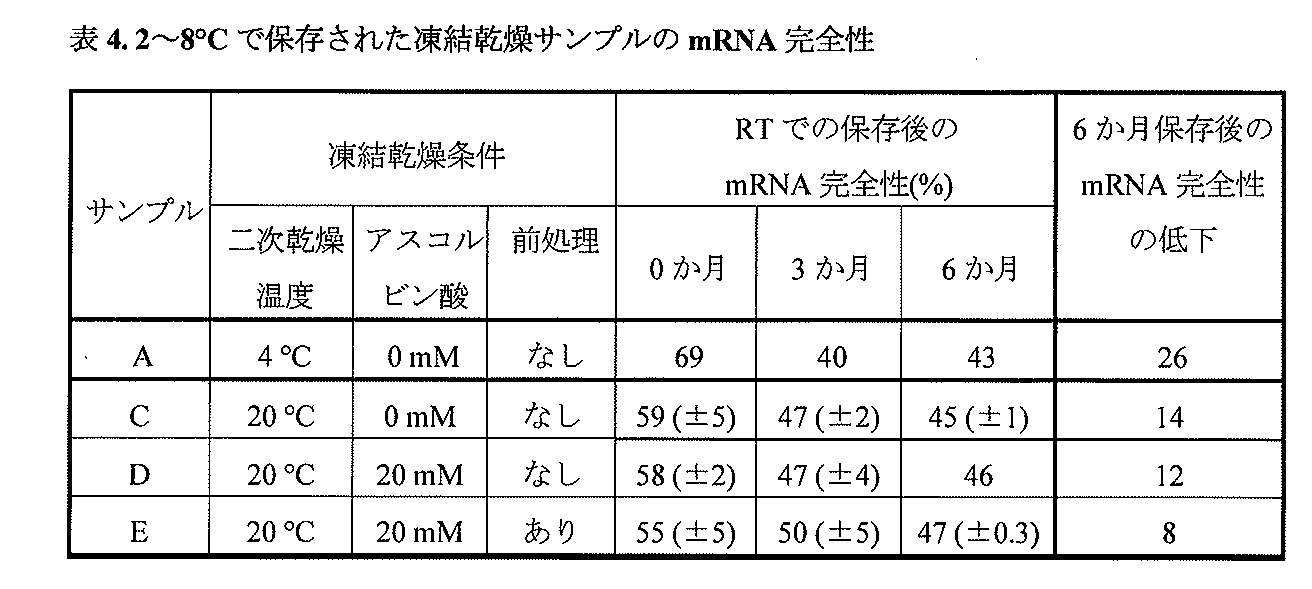
表3および図4に示される通り、凍結乾燥条件のそれぞれ-1)20℃での二次乾燥工程、2)アスコルビン酸の添加、および3)前処理工程-が、1週間および4週間の両方にわたって室温で保存した場合に、mRNA完全性を長引かせた。注記すべきことに、20℃での二次乾燥工程を用いて凍結乾燥されたサンプルC~Eは、4℃での二次乾燥工程を用いて凍結乾燥されたサンプルA~Bと比較した場合に、4週間後にmRNA完全性の顕著に小さな低下を有した。さらに、凍結乾燥前のmRNA-LNP製剤へのアスコルビン酸の添加は、室温での凍結乾燥組成物のmRNA完全性の維持を顕著に助けた。前処理工程もまた、室温での1週間および4週間の保存後のmRNA完全性における顕著に小さな低下により示される通り、mRNA完全性をさらに長引かせた(サンプルE)。 As shown in Table 3 and Figure 4, each of the freeze-drying conditions - 1) secondary drying step at 20°C, 2) addition of ascorbic acid, and 3) pre-treatment step - was performed for both 1 week and 4 weeks. Prolonged mRNA integrity when stored at room temperature for extended periods of time. Of note, samples C-E freeze-dried using a secondary drying step at 20°C compared to samples A-B freeze-dried using a secondary drying step at 4°C. There was a significantly smaller decrease in mRNA integrity after 4 weeks. Furthermore, the addition of ascorbic acid to the mRNA-LNP formulation before lyophilization significantly helped maintain the mRNA integrity of the lyophilized composition at room temperature. The pretreatment step also further prolonged mRNA integrity, as shown by a significantly smaller decrease in mRNA integrity after 1 and 4 weeks of storage at room temperature (Sample E).
表4および図5に示される通り、サンプルを2~8℃で保存した場合に、同じ傾向が観察された。サンプルEの2~8℃での6か月の保存後のmRNA完全性における低下は、サンプルAよりも約6倍低く(表5)、このことは、本発明の凍結乾燥条件が、凍結乾燥mRNA-LNP組成物のmRNA完全性を顕著に長引かせることができることを示した。 As shown in Table 4 and Figure 5, the same trend was observed when the samples were stored at 2-8°C. The decline in mRNA integrity of sample E after 6 months of storage at 2-8°C was about 6 times lower than that of sample A (Table 5), indicating that the lyophilization conditions of the present invention We have shown that the mRNA integrity of mRNA-LNP compositions can be significantly prolonged.
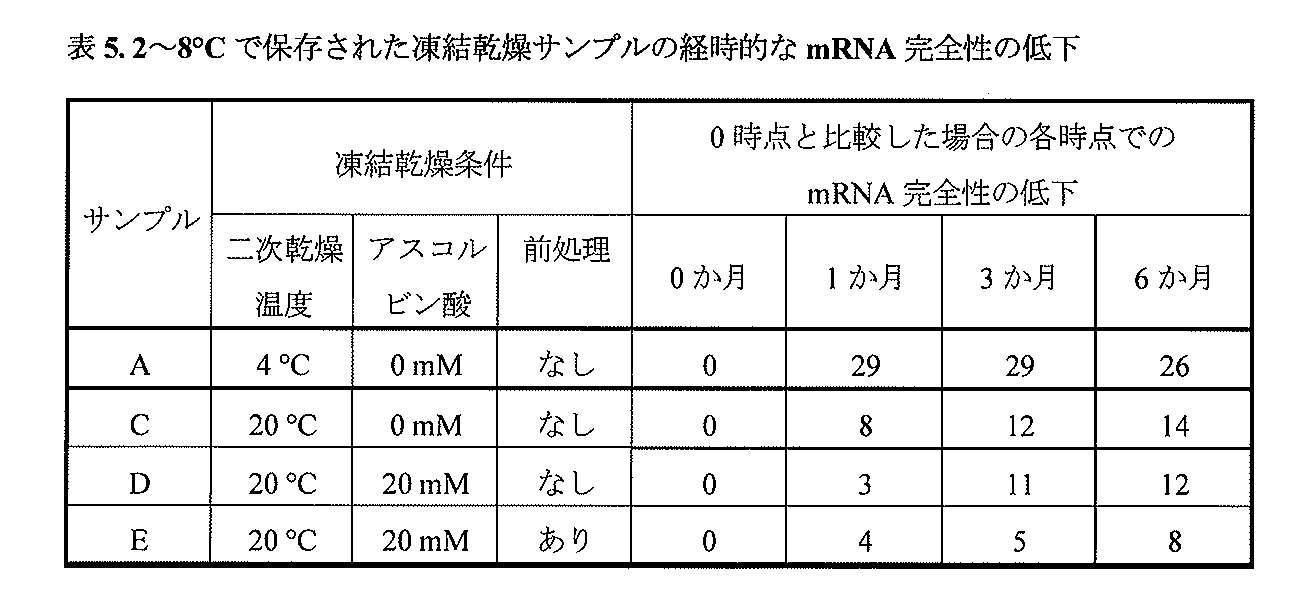
全体として、本実施例は、本発明の凍結乾燥条件のそれぞれ-1)20℃での二次乾燥工程、2)アスコルビン酸の添加、および3)前処理工程-が、個別にかつ集合的に、短期的および長期的保存の両方にわたる凍結乾燥mRNA-LNP組成物のmRNA完全性を長引かせることができることを示す。 Overall, this example shows that each of the freeze-drying conditions of the invention - 1) secondary drying step at 20°C, 2) addition of ascorbic acid, and 3) pretreatment step - individually and collectively , showing that the mRNA integrity of lyophilized mRNA-LNP compositions over both short-term and long-term storage can be prolonged.
アスコルビン酸添加はmRNA-LNPの凍結乾燥中のmRNA完全性の改善に寄与する
本実施例は、実施例2~3に示される通り、低pHまたはアスコルビン酸を用いる前処理が、mRNA完全性を改善し得るか否かを調べる。
Ascorbic acid addition contributes to improving mRNA integrity during freeze-drying of mRNA-LNPs This example shows that pretreatment with low pH or ascorbic acid improves mRNA integrity, as shown in Examples 2-3. Find out if it can be improved.
mRNA-LNPを含む様々なサンプルを、表6に示される通り、凍結乾燥のために製造した。サンプルAに関して、脂質ナノ粒子に封入されたインビトロ合成mRNA(mRNA-LNP)を含有する溶液を、10%トレハロースへと緩衝液交換した。サンプルBに関して、mRNA-LNP製剤を、10%トレハロース中の20mMのアスコルビン酸を含む緩衝液を用いて2回洗浄することにより前処理し、続いて、10%トレハロースへと緩衝液交換した。サンプルCに関して、mRNA-LNP製剤を、3.0のpHおよび10%トレハロースを含む緩衝液へと緩衝液交換した。pH3.0を有する緩衝液は、1N HClを用いて製造した。サンプルDに関して、mRNA-LNP製剤を、20mMのアスコルビン酸を含む10%トレハロースへと緩衝液交換した。 Various samples containing mRNA-LNP were prepared for lyophilization as shown in Table 6. For sample A, the solution containing in vitro synthesized mRNA encapsulated in lipid nanoparticles (mRNA-LNP) was buffer exchanged to 10% trehalose. For sample B, the mRNA-LNP formulation was pretreated by washing twice with a buffer containing 20 mM ascorbic acid in 10% trehalose, followed by a buffer exchange to 10% trehalose. For sample C, the mRNA-LNP formulation was buffer exchanged to a buffer containing pH 3.0 and 10% trehalose. A buffer with pH 3.0 was prepared using 1N HCl. For sample D, the mRNA-LNP formulation was buffer exchanged to 10% trehalose containing 20 mM ascorbic acid.
続いて、それぞれmRNA-LNPを含むサンプルA~Dを、20℃での二次乾燥工程を含む実施例1において説明される通りの凍結乾燥プロセスに供し、続いて、凍結乾燥mRNA-LNP組成物を再構成した。各凍結乾燥mRNA-LNPサンプルを室温で4週間保存し、mRNA完全性を、表6に示される通りに異なる時点で、キャピラリー電気泳動(CE)によって決定した。 Samples A to D, each containing mRNA-LNP, were then subjected to a lyophilization process as described in Example 1, including a secondary drying step at 20° C., followed by lyophilization of the lyophilized mRNA-LNP composition. was reconfigured. Each lyophilized mRNA-LNP sample was stored at room temperature for 4 weeks and mRNA integrity was determined by capillary electrophoresis (CE) at different time points as shown in Table 6.

表6および図6に示される通り、低pH製剤(サンプルC)およびアスコルビン酸を用いる前処理(サンプルB)は、20mMのアスコルビン酸を有したサンプルDと比較して、mRNA-LNPのmRNA完全性を長引かせることにおいて有効でなかった。 As shown in Table 6 and Figure 6, the low pH formulation (sample C) and pretreatment with ascorbic acid (sample B) significantly reduced the mRNA integrity of mRNA-LNPs compared to sample D with 20mM ascorbic acid. It was not effective in prolonging sex.
様々な濃度でのアスコルビン酸の効果
本実施例は、凍結乾燥および再構成後のmRNA-LNP組成物のmRNA完全性に対するアスコルビン酸濃度の効果を調査する。
Effect of Ascorbic Acid at Various Concentrations This example investigates the effect of ascorbic acid concentration on the mRNA integrity of mRNA-LNP compositions after lyophilization and reconstitution.
mRNA-LNPを含有する溶液を、表7に示される通り、3mM、5mM、10mM、20mM、および50mMにおいてアスコルビン酸を伴うかまたは伴わずに凍結乾燥保護剤(例えば、10%トレハロース)を含む水溶液へと緩衝液交換した。続いて、mRNA-LNPを含む溶液を、20℃での二次乾燥工程を含む実施例1に説明される通りの凍結乾燥プロセスに供し、続いて、凍結乾燥mRNA-LNP組成物を再構成した。凍結乾燥mRNA-LNP組成物を4週間にわたって室温で保存し、mRNA完全性を、表7に示される通りに異なる時点で、キャピラリー電気泳動(CE)によって決定した。 Solutions containing mRNA-LNPs were added to an aqueous solution containing a lyoprotectant (e.g., 10% trehalose) with or without ascorbic acid at 3mM, 5mM, 10mM, 20mM, and 50mM as shown in Table 7. The buffer was exchanged. The solution containing mRNA-LNP was then subjected to a lyophilization process as described in Example 1, including a secondary drying step at 20° C., followed by reconstitution of the lyophilized mRNA-LNP composition. . Lyophilized mRNA-LNP compositions were stored at room temperature for 4 weeks and mRNA integrity was determined by capillary electrophoresis (CE) at different time points as shown in Table 7.

表7および図7に示される通り、凍結乾燥前の10mMを超える濃度または10mMでのmRNA-LNP組成物へのアスコルビン酸の添加は、mRNA完全性を長引かせる上で有効であった。室温での4週間の保存にわたって、凍結乾燥mRNA-LNP組成物のmRNA完全性の低下は、10mMまたはそれを超えるアスコルビン酸を添加した場合(表7のサンプルD~F)、顕著に低かった。 As shown in Table 7 and FIG. 7, addition of ascorbic acid to mRNA-LNP compositions at concentrations greater than 10 mM or at 10 mM before lyophilization was effective in prolonging mRNA integrity. Over 4 weeks of storage at room temperature, the decrease in mRNA integrity of the lyophilized mRNA-LNP compositions was significantly lower when 10 mM or more ascorbic acid was added (Samples DF in Table 7).
アスコルビン酸の添加は、表7に示される通り、mRNA-LNP組成物のpHを約2.9~3.4まで低下させる。しかしながら、インビボ研究または臨床目的に対して、mRNA-LNP組成物のpHを生理的pHに近くすることが有益である。アスコルビン酸を用いて凍結乾燥されたmRNA-LNP組成物のpHを上昇させるために、様々な濃度でmRNA-LNP組成物へと異なる緩衝剤を添加し、pHを測定した。 Addition of ascorbic acid lowers the pH of the mRNA-LNP composition to about 2.9-3.4, as shown in Table 7. However, for in vivo studies or clinical purposes, it is beneficial to bring the pH of the mRNA-LNP composition close to physiological pH. To increase the pH of the lyophilized mRNA-LNP composition using ascorbic acid, different buffers were added to the mRNA-LNP composition at various concentrations and the pH was measured.
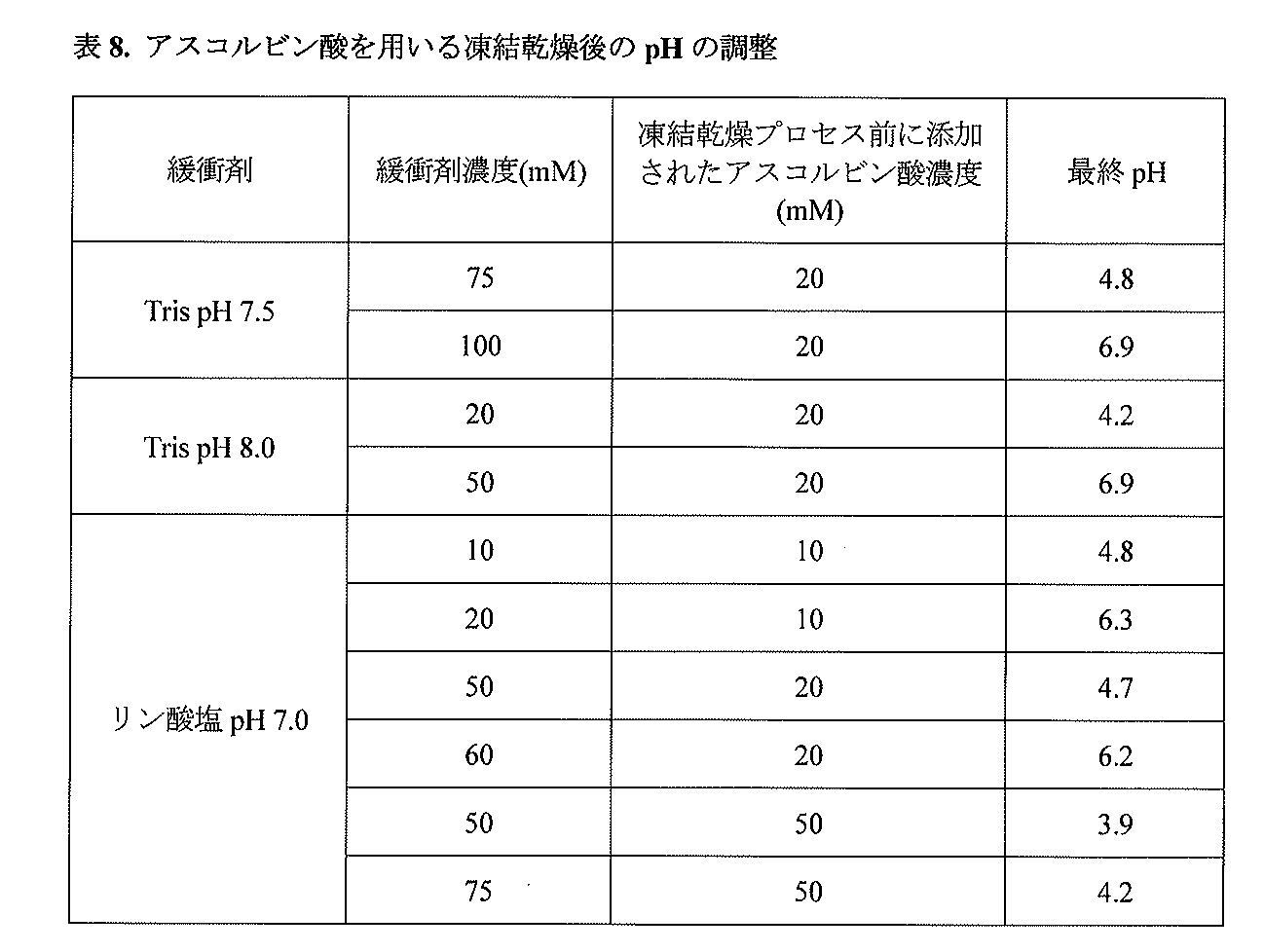
表8は、凍結乾燥プロセス前に10mMまたは20mMのアスコルビン酸が添加されたサンプルに関して、mRNA-LNP組成物のpHを、様々な緩衝剤の添加により上昇させることができたことを示す。しかしながら、凍結乾燥前に50mMのアスコルビン酸を添加されたサンプルのpHは、高濃度(例えば、50mMおよび75mM)の緩衝剤をサンプルに添加した場合でさえも、4付近に留まった。 Table 8 shows that for samples to which 10mM or 20mM ascorbic acid was added before the freeze-drying process, the pH of the mRNA-LNP compositions could be increased by the addition of various buffers. However, the pH of samples spiked with 50 mM ascorbic acid before lyophilization remained around 4 even when high concentrations of buffer (eg, 50 mM and 75 mM) were added to the samples.
凍結乾燥前および後の製剤特徴
本実施例は、mRNA封入LNP(mRNA-LNP)の全体的完全性が凍結乾燥プロセス後に十分維持されること、およびアスコルビン酸の添加が、径、多分散指数(PDI)および封入効率により実証される場合、mRNAを封入する脂質ナノ粒子の完全性に悪影響を及ぼさないことを示す。
Formulation characteristics before and after lyophilization This example demonstrates that the overall integrity of mRNA-encapsulated LNPs (mRNA-LNPs) is well maintained after the lyophilization process and that the addition of ascorbic acid improves the size, polydispersity index ( PDI) and encapsulation efficiency, indicating that the integrity of the lipid nanoparticles encapsulating mRNA is not adversely affected.
脂質ナノ粒子に封入されたインビトロ合成mRNA(mRNA-LNP)を含有する溶液を、表9に示される通り、10mM、20mM、および30mMのアスコルビン酸を伴うかまたは伴わずに凍結乾燥保護剤(例えば、10%トレハロース)を含む水溶液へと緩衝液交換した。続いて、mRNA-LNPを含む溶液を、20℃での二次乾燥工程を含む実施例1に説明される通りの凍結乾燥プロセスに供し、続いて、凍結乾燥mRNA-LNP組成物を再構成した。mRNA-LNPの径、PDI、および封入効率を、表9に示されるサンプルに関して、凍結乾燥/再構成の前および後に測定した。 Solutions containing in vitro synthesized mRNA encapsulated in lipid nanoparticles (mRNA-LNP) were treated with lyoprotectants (e.g. , 10% trehalose). The solution containing mRNA-LNP was then subjected to a lyophilization process as described in Example 1, including a secondary drying step at 20° C., followed by reconstitution of the lyophilized mRNA-LNP composition. . The diameter, PDI, and encapsulation efficiency of mRNA-LNPs were measured before and after lyophilization/reconstitution for the samples shown in Table 9.

表9に示される通り、mRNA-LNPの径、PDI、および封入効率は、mRNA-LNPが本発明の凍結乾燥プロセスを経験した後に維持された。本データは、本発明の凍結乾燥条件およびプロセスが、凍結乾燥後にmRNA-LNPの径、PDI、および封入効率も保存しながら、LNPへと封入されたmRNAの完全性を長引かせる上で有効であることを示す。 As shown in Table 9, the size, PDI, and encapsulation efficiency of mRNA-LNPs were maintained after the mRNA-LNPs underwent the freeze-drying process of the present invention. The present data demonstrate that the lyophilization conditions and process of the present invention are effective in prolonging the integrity of mRNA encapsulated into LNPs while also preserving the size, PDI, and encapsulation efficiency of mRNA-LNPs after lyophilization. Show that something is true.
等価物
当業者であれば、日常的な実験でしかないものを使用して、本明細書に記載される本発明の具体的な実施形態の多くの等価物を認識するか、または確認することができるだろう。本発明の範囲は、上記の明細書に限定されることを意図するものではなく、むしろ以下の特許請求の範囲に示される通りである。
Equivalents Those skilled in the art will recognize, or be able to ascertain using no more than routine experimentation, many equivalents to the specific embodiments of the invention described herein. will be possible. It is not intended that the scope of the invention be limited by the above specification, but rather is as indicated by the claims below.
Claims (39)
(a)当初mRNA完全性を有するmRNAを封入する1つまたはそれ以上の脂質ナノ粒子を含む水溶液へと5mM~200mMの間のアスコルビン酸を添加する工程、
(b)水溶液を凍結させて凍結溶液を得る工程、
(c)10時間超の時間にわたって凍結溶液を乾燥させて、凍結乾燥組成物を得る工程
を含み、
15~25℃の温度での4週間にわたる凍結乾燥組成物の保存後の凍結乾燥組成物の再構成時に、再構成後のmRNA完全性は当初mRNA完全性の少なくとも50%である、方法。 A method of producing a stable lyophilized composition comprising one or more lipid nanoparticles encapsulating mRNA, the method comprising:
(a) adding between 5 mM and 200 mM ascorbic acid to an aqueous solution containing one or more lipid nanoparticles encapsulating mRNA with initial mRNA integrity;
(b) freezing the aqueous solution to obtain a frozen solution;
(c) drying the frozen solution for a period of more than 10 hours to obtain a lyophilized composition;
Upon reconstitution of the lyophilized composition after storage of the lyophilized composition for 4 weeks at a temperature of 15-25°C, the mRNA integrity after reconstitution is at least 50% of the original mRNA integrity.
(d)15℃~30℃の間の温度まで凍結乾燥組成物の温度を上昇および保持すること
を含む、請求項1~6のいずれか1項に記載の方法。 After step (c),
A method according to any one of claims 1 to 6, comprising (d) increasing and maintaining the temperature of the lyophilized composition to a temperature between 15°C and 30°C.
Applications Claiming Priority (3)
| Application Number | Priority Date | Filing Date | Title |
|---|---|---|---|
| US202063088047P | 2020-10-06 | 2020-10-06 | |
| US63/088,047 | 2020-10-06 | ||
| PCT/US2021/053776 WO2022076562A1 (en) | 2020-10-06 | 2021-10-06 | Improved process and formulation of lipid nanoparticles |
Publications (2)
| Publication Number | Publication Date |
|---|---|
| JP2023544197A true JP2023544197A (en) | 2023-10-20 |
| JPWO2022076562A5 JPWO2022076562A5 (en) | 2024-10-15 |
Family
ID=78500735
Family Applications (1)
| Application Number | Title | Priority Date | Filing Date |
|---|---|---|---|
| JP2023521060A Pending JP2023544197A (en) | 2020-10-06 | 2021-10-06 | Improved methods and formulations of lipid nanoparticles |
Country Status (8)
| Country | Link |
|---|---|
| US (1) | US20230372440A1 (en) |
| EP (1) | EP4225268A1 (en) |
| JP (1) | JP2023544197A (en) |
| KR (1) | KR20230083323A (en) |
| CN (1) | CN116546976A (en) |
| AU (1) | AU2021358777A1 (en) |
| CA (1) | CA3194863A1 (en) |
| WO (1) | WO2022076562A1 (en) |
Cited By (1)
| Publication number | Priority date | Publication date | Assignee | Title |
|---|---|---|---|---|
| JP2023552681A (en) * | 2020-11-16 | 2023-12-19 | ビオンテック・ソシエタス・エウロパエア | Improved formulation stabilization and lyophilization process improvements |
Families Citing this family (15)
| Publication number | Priority date | Publication date | Assignee | Title |
|---|---|---|---|---|
| HK1256498A1 (en) | 2015-07-30 | 2019-09-27 | Modernatx, Inc. | Concatemeric peptide epitope rnas |
| EP4349404A3 (en) | 2015-10-22 | 2024-06-19 | ModernaTX, Inc. | Respiratory virus vaccines |
| US10925958B2 (en) | 2016-11-11 | 2021-02-23 | Modernatx, Inc. | Influenza vaccine |
| US11576961B2 (en) | 2017-03-15 | 2023-02-14 | Modernatx, Inc. | Broad spectrum influenza virus vaccine |
| US11905525B2 (en) | 2017-04-05 | 2024-02-20 | Modernatx, Inc. | Reduction of elimination of immune responses to non-intravenous, e.g., subcutaneously administered therapeutic proteins |
| EP3746090A4 (en) | 2018-01-29 | 2021-11-17 | ModernaTX, Inc. | RSV RNA VACCINES |
| US12329811B2 (en) | 2021-01-11 | 2025-06-17 | Modernatx, Inc. | Seasonal RNA influenza virus vaccines |
| EP4329731A1 (en) * | 2021-04-29 | 2024-03-06 | ModernaTX, Inc. | Lyophilization methods for preparing lipid formulated therapeutics |
| CN114557971B (en) * | 2022-04-25 | 2023-05-23 | 康希诺生物股份公司 | Freeze-drying protective agent for nucleic acid-lipid nano particles, and preparation method and application thereof |
| WO2023212696A1 (en) * | 2022-04-29 | 2023-11-02 | Modernatx, Inc. | Lyophilized human cytomegalovirus vaccines |
| CN115624630A (en) * | 2022-12-19 | 2023-01-20 | 北京荷牧生物科技有限公司 | Freeze-drying protection composition, application thereof and nucleic acid lipid nanoparticle cryopreservation method based on composition |
| EP4658239A1 (en) | 2023-02-03 | 2025-12-10 | GlaxoSmithKline Biologicals S.A. | Rna formulation |
| WO2024223724A1 (en) | 2023-04-27 | 2024-10-31 | Glaxosmithkline Biologicals Sa | Influenza virus vaccines |
| WO2024223728A1 (en) | 2023-04-27 | 2024-10-31 | Glaxosmithkline Biologicals Sa | Influenza virus vaccines |
| WO2025029323A1 (en) * | 2023-07-28 | 2025-02-06 | Vitrivax, Inc. | Compositions, methods, and uses for polynucleotide formulations for drying and prolonged storage |
Citations (7)
| Publication number | Priority date | Publication date | Assignee | Title |
|---|---|---|---|---|
| WO2005123078A1 (en) * | 2004-06-18 | 2005-12-29 | Terumo Kabushiki Kaisha | Liposome preparation containing slightly water-soluble camptothecin |
| US20150190343A1 (en) * | 2012-06-05 | 2015-07-09 | Hemarina | Annelid haemoglobin lyophilisation process |
| JP2016145245A (en) * | 2011-05-19 | 2016-08-12 | エア プロダクツ シュリューヒテルン ゲゼルシャフト ミット ベシュレンクテル ハフツング | Charge donor for vesicular carrier system of uv protective agent for skin or hair |
| JP2018141006A (en) * | 2011-06-08 | 2018-09-13 | シャイアー ヒューマン ジェネティック セラピーズ インコーポレイテッド | Cleavable lipid |
| JP2018528269A (en) * | 2015-08-19 | 2018-09-27 | シャンハイ ギンポサム ファーマテック カンパニー リミテッド | Liposome having ginsenoside as membrane material and preparation and use thereof |
| US20180333457A1 (en) * | 2017-05-16 | 2018-11-22 | Translate Bio, Inc. | TREATMENT OF CYSTIC FIBROSIS BY DELIVERY OF CODON-OPTIMIZED mRNA ENCODING CFTR |
| JP2018536679A (en) * | 2015-12-08 | 2018-12-13 | チア タイ ティエンチン ファーマシューティカル グループ カンパニー リミテッドChia Tai Tianqing Pharmaceutical Group Co., Ltd. | Method for producing liposome |
Family Cites Families (45)
| Publication number | Priority date | Publication date | Assignee | Title |
|---|---|---|---|---|
| US4500707A (en) | 1980-02-29 | 1985-02-19 | University Patents, Inc. | Nucleosides useful in the preparation of polynucleotides |
| US4458066A (en) | 1980-02-29 | 1984-07-03 | University Patents, Inc. | Process for preparing polynucleotides |
| US5132418A (en) | 1980-02-29 | 1992-07-21 | University Patents, Inc. | Process for preparing polynucleotides |
| US4668777A (en) | 1981-03-27 | 1987-05-26 | University Patents, Inc. | Phosphoramidite nucleoside compounds |
| US4415732A (en) | 1981-03-27 | 1983-11-15 | University Patents, Inc. | Phosphoramidite compounds and processes |
| US4973679A (en) | 1981-03-27 | 1990-11-27 | University Patents, Inc. | Process for oligonucleo tide synthesis using phosphormidite intermediates |
| US4401796A (en) | 1981-04-30 | 1983-08-30 | City Of Hope Research Institute | Solid-phase synthesis of polynucleotides |
| US4373071A (en) | 1981-04-30 | 1983-02-08 | City Of Hope Research Institute | Solid-phase synthesis of polynucleotides |
| US4897355A (en) | 1985-01-07 | 1990-01-30 | Syntex (U.S.A.) Inc. | N[ω,(ω-1)-dialkyloxy]- and N-[ω,(ω-1)-dialkenyloxy]-alk-1-yl-N,N,N-tetrasubstituted ammonium lipids and uses therefor |
| US5153319A (en) | 1986-03-31 | 1992-10-06 | University Patents, Inc. | Process for preparing polynucleotides |
| US5262530A (en) | 1988-12-21 | 1993-11-16 | Applied Biosystems, Inc. | Automated system for polynucleotide synthesis and purification |
| US5047524A (en) | 1988-12-21 | 1991-09-10 | Applied Biosystems, Inc. | Automated system for polynucleotide synthesis and purification |
| US5334761A (en) | 1992-08-28 | 1994-08-02 | Life Technologies, Inc. | Cationic lipids |
| US5885613A (en) | 1994-09-30 | 1999-03-23 | The University Of British Columbia | Bilayer stabilizing components and their use in forming programmable fusogenic liposomes |
| US5700642A (en) | 1995-05-22 | 1997-12-23 | Sri International | Oligonucleotide sizing using immobilized cleavable primers |
| US5744335A (en) | 1995-09-19 | 1998-04-28 | Mirus Corporation | Process of transfecting a cell with a polynucleotide mixed with an amphipathic compound and a DNA-binding protein |
| EP1766035B1 (en) | 2004-06-07 | 2011-12-07 | Protiva Biotherapeutics Inc. | Lipid encapsulated interfering rna |
| EP4174179B1 (en) | 2005-08-23 | 2025-05-07 | The Trustees of the University of Pennsylvania | Rna containing modified nucleosides and methods of use thereof |
| EP2350043B9 (en) | 2008-10-09 | 2014-08-20 | TEKMIRA Pharmaceuticals Corporation | Improved amino lipids and methods for the delivery of nucleic acids |
| MX353900B (en) | 2008-11-07 | 2018-02-01 | Massachusetts Inst Technology | Aminoalcohol lipidoids and uses thereof. |
| CA2764609C (en) | 2009-06-10 | 2018-10-02 | Alnylam Pharmaceuticals, Inc. | Improved cationic lipid of formula i |
| DK2459231T3 (en) | 2009-07-31 | 2016-09-05 | Ethris Gmbh | RNA with a combination of unmodified and modified nucleotides for protein expression |
| NZ747501A (en) | 2011-10-27 | 2020-05-29 | Massachusetts Inst Technology | Amino acid derivatives functionalized on the n-terminal capable of forming drug encapsulating microspheres |
| BR112014024131A2 (en) | 2012-03-29 | 2017-07-25 | Shire Human Genetic Therapies | ionizable cationic lipids |
| EP4446413A3 (en) | 2013-03-14 | 2024-12-18 | Translate Bio, Inc. | Methods for purification of messenger rna |
| CA2903487A1 (en) | 2013-03-14 | 2014-09-25 | Shire Human Genetic Therapies, Inc. | Quantitative assessment for cap efficiency of messenger rna |
| PL3083556T3 (en) | 2013-12-19 | 2020-06-29 | Novartis Ag | Lipids and lipid compositions for the delivery of active agents |
| CN106164248B (en) | 2014-04-25 | 2019-10-15 | 川斯勒佰尔公司 | Purification of messenger RNA |
| CN106659731A (en) | 2014-05-30 | 2017-05-10 | 夏尔人类遗传性治疗公司 | Topical compositions and methods for treating wounds |
| EP3160938B1 (en) | 2014-06-25 | 2020-09-16 | Acuitas Therapeutics Inc. | Novel lipids and lipid nanoparticle formulations for delivery of nucleic acids |
| US9840479B2 (en) | 2014-07-02 | 2017-12-12 | Massachusetts Institute Of Technology | Polyamine-fatty acid derived lipidoids and uses thereof |
| EP3247363A4 (en) | 2015-01-21 | 2018-10-03 | Moderna Therapeutics, Inc. | Lipid nanoparticle compositions |
| WO2016118725A1 (en) | 2015-01-23 | 2016-07-28 | Moderna Therapeutics, Inc. | Lipid nanoparticle compositions |
| HRP20230494T1 (en) | 2015-06-19 | 2023-08-04 | Massachusetts Institute Of Technology | Alkenyl substituted 2,5-piperazinediones and their use in compositions for delivering an agent to a subject or cell |
| AU2016285852B2 (en) | 2015-06-29 | 2020-12-17 | Acuitas Therapeutics Inc. | Lipids and lipid nanoparticle formulations for delivery of nucleic acids |
| ES2969082T3 (en) | 2015-09-17 | 2024-05-16 | Modernatx Inc | Compounds and compositions for intracellular administration of therapeutic agents |
| FI3368507T3 (en) | 2015-10-28 | 2023-03-21 | Acuitas Therapeutics Inc | New lipids and lipid nanoparticle preparations for delivery of nucleic acids |
| WO2017117528A1 (en) | 2015-12-30 | 2017-07-06 | Acuitas Therapeutics, Inc. | Lipids and lipid nanoparticle formulations for delivery of nucleic acids |
| CA3018978A1 (en) | 2016-03-30 | 2017-10-05 | Intellia Therapeutics, Inc. | Lipid nanoparticle formulations for crispr/cas components |
| WO2017212494A1 (en) * | 2016-06-09 | 2017-12-14 | Opko Biologics Ltd. | Long-acting oxyntomodulin formulation and methods of producing and administering same |
| MX2019005470A (en) | 2016-11-10 | 2019-11-21 | Translate Bio Inc | Improved ice-based lipid nanoparticle formulation for delivery of mrna. |
| EP3971291A1 (en) | 2017-02-27 | 2022-03-23 | Translate Bio, Inc. | Methods for purification of messenger rna |
| EP3585886B1 (en) | 2017-02-27 | 2023-11-22 | Translate Bio, Inc. | Large scale synthesis of messenger rna |
| HUE059594T2 (en) | 2017-02-27 | 2022-11-28 | Translate Bio Inc | Methods for purification of messenger RNA |
| KR20210091120A (en) * | 2018-08-29 | 2021-07-21 | 트랜슬레이트 바이오 인코포레이티드 | Improved Process for Making mRNA-Loaded Lipid Nanoparticles |
-
2021
- 2021-10-06 JP JP2023521060A patent/JP2023544197A/en active Pending
- 2021-10-06 US US18/247,976 patent/US20230372440A1/en active Pending
- 2021-10-06 EP EP21802083.2A patent/EP4225268A1/en active Pending
- 2021-10-06 CN CN202180076850.8A patent/CN116546976A/en active Pending
- 2021-10-06 KR KR1020237015312A patent/KR20230083323A/en active Pending
- 2021-10-06 CA CA3194863A patent/CA3194863A1/en active Pending
- 2021-10-06 AU AU2021358777A patent/AU2021358777A1/en active Pending
- 2021-10-06 WO PCT/US2021/053776 patent/WO2022076562A1/en not_active Ceased
Patent Citations (7)
| Publication number | Priority date | Publication date | Assignee | Title |
|---|---|---|---|---|
| WO2005123078A1 (en) * | 2004-06-18 | 2005-12-29 | Terumo Kabushiki Kaisha | Liposome preparation containing slightly water-soluble camptothecin |
| JP2016145245A (en) * | 2011-05-19 | 2016-08-12 | エア プロダクツ シュリューヒテルン ゲゼルシャフト ミット ベシュレンクテル ハフツング | Charge donor for vesicular carrier system of uv protective agent for skin or hair |
| JP2018141006A (en) * | 2011-06-08 | 2018-09-13 | シャイアー ヒューマン ジェネティック セラピーズ インコーポレイテッド | Cleavable lipid |
| US20150190343A1 (en) * | 2012-06-05 | 2015-07-09 | Hemarina | Annelid haemoglobin lyophilisation process |
| JP2018528269A (en) * | 2015-08-19 | 2018-09-27 | シャンハイ ギンポサム ファーマテック カンパニー リミテッド | Liposome having ginsenoside as membrane material and preparation and use thereof |
| JP2018536679A (en) * | 2015-12-08 | 2018-12-13 | チア タイ ティエンチン ファーマシューティカル グループ カンパニー リミテッドChia Tai Tianqing Pharmaceutical Group Co., Ltd. | Method for producing liposome |
| US20180333457A1 (en) * | 2017-05-16 | 2018-11-22 | Translate Bio, Inc. | TREATMENT OF CYSTIC FIBROSIS BY DELIVERY OF CODON-OPTIMIZED mRNA ENCODING CFTR |
Cited By (1)
| Publication number | Priority date | Publication date | Assignee | Title |
|---|---|---|---|---|
| JP2023552681A (en) * | 2020-11-16 | 2023-12-19 | ビオンテック・ソシエタス・エウロパエア | Improved formulation stabilization and lyophilization process improvements |
Also Published As
| Publication number | Publication date |
|---|---|
| CN116546976A (en) | 2023-08-04 |
| WO2022076562A1 (en) | 2022-04-14 |
| EP4225268A1 (en) | 2023-08-16 |
| US20230372440A1 (en) | 2023-11-23 |
| AU2021358777A1 (en) | 2023-06-15 |
| CA3194863A1 (en) | 2022-04-14 |
| AU2021358777A9 (en) | 2025-04-03 |
| KR20230083323A (en) | 2023-06-09 |
Similar Documents
| Publication | Publication Date | Title |
|---|---|---|
| JP2023544197A (en) | Improved methods and formulations of lipid nanoparticles | |
| JP7764363B2 (en) | Stable composition and process for making mRNA-loaded lipid nanoparticles | |
| EP4467653B1 (en) | Improved mrna-loaded lipid nanoparticles and processes of making the same | |
| JP2023526284A (en) | Lipid nanoparticle formulations for mRNA delivery | |
| JP2023508881A (en) | An improved process for preparing mRNA-loaded lipid nanoparticles | |
| JP2023545128A (en) | Improved method for producing mRNA-loaded lipid nanoparticles | |
| US20220133631A1 (en) | Process of preparing ice-based lipid nanoparticles | |
| AU2020315962B2 (en) | Stable compositions of mRNA-loaded lipid nanoparticles and processes of making | |
| HK40117439A (en) | Improved mrna-loaded lipid nanoparticles and processes of making the same |
Legal Events
| Date | Code | Title | Description |
|---|---|---|---|
| A521 | Request for written amendment filed |
Free format text: JAPANESE INTERMEDIATE CODE: A523 Effective date: 20241004 |
|
| A621 | Written request for application examination |
Free format text: JAPANESE INTERMEDIATE CODE: A621 Effective date: 20241004 |
|
| A131 | Notification of reasons for refusal |
Free format text: JAPANESE INTERMEDIATE CODE: A131 Effective date: 20251111 |