JP2023540673A - Compounds and compositions for treating conditions associated with STING activity - Google Patents
Compounds and compositions for treating conditions associated with STING activity Download PDFInfo
- Publication number
- JP2023540673A JP2023540673A JP2023502899A JP2023502899A JP2023540673A JP 2023540673 A JP2023540673 A JP 2023540673A JP 2023502899 A JP2023502899 A JP 2023502899A JP 2023502899 A JP2023502899 A JP 2023502899A JP 2023540673 A JP2023540673 A JP 2023540673A
- Authority
- JP
- Japan
- Prior art keywords
- group
- independently selected
- alkyl
- ring
- optionally substituted
- Prior art date
- Legal status (The legal status is an assumption and is not a legal conclusion. Google has not performed a legal analysis and makes no representation as to the accuracy of the status listed.)
- Pending
Links
Classifications
-
- C—CHEMISTRY; METALLURGY
- C07—ORGANIC CHEMISTRY
- C07D—HETEROCYCLIC COMPOUNDS
- C07D401/00—Heterocyclic compounds containing two or more hetero rings, having nitrogen atoms as the only ring hetero atoms, at least one ring being a six-membered ring with only one nitrogen atom
- C07D401/14—Heterocyclic compounds containing two or more hetero rings, having nitrogen atoms as the only ring hetero atoms, at least one ring being a six-membered ring with only one nitrogen atom containing three or more hetero rings
-
- A—HUMAN NECESSITIES
- A61—MEDICAL OR VETERINARY SCIENCE; HYGIENE
- A61P—SPECIFIC THERAPEUTIC ACTIVITY OF CHEMICAL COMPOUNDS OR MEDICINAL PREPARATIONS
- A61P35/00—Antineoplastic agents
-
- C—CHEMISTRY; METALLURGY
- C07—ORGANIC CHEMISTRY
- C07D—HETEROCYCLIC COMPOUNDS
- C07D403/00—Heterocyclic compounds containing two or more hetero rings, having nitrogen atoms as the only ring hetero atoms, not provided for by group C07D401/00
- C07D403/02—Heterocyclic compounds containing two or more hetero rings, having nitrogen atoms as the only ring hetero atoms, not provided for by group C07D401/00 containing two hetero rings
- C07D403/12—Heterocyclic compounds containing two or more hetero rings, having nitrogen atoms as the only ring hetero atoms, not provided for by group C07D401/00 containing two hetero rings linked by a chain containing hetero atoms as chain links
-
- C—CHEMISTRY; METALLURGY
- C07—ORGANIC CHEMISTRY
- C07D—HETEROCYCLIC COMPOUNDS
- C07D403/00—Heterocyclic compounds containing two or more hetero rings, having nitrogen atoms as the only ring hetero atoms, not provided for by group C07D401/00
- C07D403/14—Heterocyclic compounds containing two or more hetero rings, having nitrogen atoms as the only ring hetero atoms, not provided for by group C07D401/00 containing three or more hetero rings
-
- C—CHEMISTRY; METALLURGY
- C07—ORGANIC CHEMISTRY
- C07D—HETEROCYCLIC COMPOUNDS
- C07D413/00—Heterocyclic compounds containing two or more hetero rings, at least one ring having nitrogen and oxygen atoms as the only ring hetero atoms
- C07D413/02—Heterocyclic compounds containing two or more hetero rings, at least one ring having nitrogen and oxygen atoms as the only ring hetero atoms containing two hetero rings
- C07D413/12—Heterocyclic compounds containing two or more hetero rings, at least one ring having nitrogen and oxygen atoms as the only ring hetero atoms containing two hetero rings linked by a chain containing hetero atoms as chain links
-
- C—CHEMISTRY; METALLURGY
- C07—ORGANIC CHEMISTRY
- C07D—HETEROCYCLIC COMPOUNDS
- C07D413/00—Heterocyclic compounds containing two or more hetero rings, at least one ring having nitrogen and oxygen atoms as the only ring hetero atoms
- C07D413/14—Heterocyclic compounds containing two or more hetero rings, at least one ring having nitrogen and oxygen atoms as the only ring hetero atoms containing three or more hetero rings
-
- C—CHEMISTRY; METALLURGY
- C07—ORGANIC CHEMISTRY
- C07D—HETEROCYCLIC COMPOUNDS
- C07D417/00—Heterocyclic compounds containing two or more hetero rings, at least one ring having nitrogen and sulfur atoms as the only ring hetero atoms, not provided for by group C07D415/00
- C07D417/02—Heterocyclic compounds containing two or more hetero rings, at least one ring having nitrogen and sulfur atoms as the only ring hetero atoms, not provided for by group C07D415/00 containing two hetero rings
- C07D417/12—Heterocyclic compounds containing two or more hetero rings, at least one ring having nitrogen and sulfur atoms as the only ring hetero atoms, not provided for by group C07D415/00 containing two hetero rings linked by a chain containing hetero atoms as chain links
-
- C—CHEMISTRY; METALLURGY
- C07—ORGANIC CHEMISTRY
- C07D—HETEROCYCLIC COMPOUNDS
- C07D471/00—Heterocyclic compounds containing nitrogen atoms as the only ring hetero atoms in the condensed system, at least one ring being a six-membered ring with one nitrogen atom, not provided for by groups C07D451/00 - C07D463/00
- C07D471/02—Heterocyclic compounds containing nitrogen atoms as the only ring hetero atoms in the condensed system, at least one ring being a six-membered ring with one nitrogen atom, not provided for by groups C07D451/00 - C07D463/00 in which the condensed system contains two hetero rings
- C07D471/04—Ortho-condensed systems
Landscapes
- Chemical & Material Sciences (AREA)
- Organic Chemistry (AREA)
- Health & Medical Sciences (AREA)
- Chemical Kinetics & Catalysis (AREA)
- General Chemical & Material Sciences (AREA)
- Medicinal Chemistry (AREA)
- Nuclear Medicine, Radiotherapy & Molecular Imaging (AREA)
- Pharmacology & Pharmacy (AREA)
- Life Sciences & Earth Sciences (AREA)
- Animal Behavior & Ethology (AREA)
- General Health & Medical Sciences (AREA)
- Public Health (AREA)
- Veterinary Medicine (AREA)
- Pharmaceuticals Containing Other Organic And Inorganic Compounds (AREA)
- Plural Heterocyclic Compounds (AREA)
- Nitrogen Condensed Heterocyclic Rings (AREA)
Abstract
本開示は、STING(Stimulator of Interferon Gene)を阻害(例えば、アンタゴナイズ)する化学的実体(例えば、化合物または前記化合物の薬学的に許容される塩および/もしくは水和物および/もしくは共結晶および/もしくは組合せ薬物)を特徴とする。前記化学的実体は、例えば、STING活性化(例えば、STINGシグナル伝達)の増大(例えば、亢進)が対象(例えば、ヒト)における状態、疾患、または障害(例えば、がん)の病態および/または症状および/または進行の一因となる状態、疾患、または障害を治療するために有用である。本開示はまた、前記化学的実体を含有する組成物、ならびに前記化学的実体を使用および作製する方法も特徴とする。 The present disclosure describes chemical entities (e.g., compounds or pharmaceutically acceptable salts and/or hydrates and/or co-crystals of said compounds) that inhibit (e.g., antagonize) STING (Stimulator of Interferon Gene) and / or combination drugs). The chemical entity may, for example, increase (e.g., enhance) STING activation (e.g., STING signaling) and/or the pathology of a condition, disease, or disorder (e.g., cancer) in a subject (e.g., human). Useful for treating conditions, diseases, or disorders that contribute to the symptoms and/or progression. The disclosure also features compositions containing the chemical entities and methods of using and making the chemical entities.
Description
関連出願の相互参照
本出願は、2020年7月15日に出願された米国特許仮出願第63/052,080号の恩典を主張し、この仮出願は参照により全体が本明細書に組み込まれる。
CROSS-REFERENCE TO RELATED APPLICATIONS This application claims the benefit of U.S. Provisional Application No. 63/052,080, filed July 15, 2020, which is incorporated herein by reference in its entirety.
技術分野
本開示は、STING(Stimulator of Interferon Gene)を阻害(例えば、アンタゴナイズ)する化学的実体(化合物または前記化合物の薬学的に許容される塩および/もしくは水和物および/もしくは共結晶および/もしくは組合せ薬物)を特徴とする。化学的実体は、例えば、STING活性化(例えば、STINGシグナル伝達)の増大(例えば、亢進)が対象(例えば、ヒト)における状態、疾患、または障害(例えば、がん)の病態および/または症状および/または進行の一因となる状態、疾患、または障害を治療するために有用である。本開示はまた、前記化学的実体を含有する組成物、ならびに前記化学的実体を使用および作製する方法を特徴とする。
TECHNICAL FIELD This disclosure relates to chemical entities (compounds or pharmaceutically acceptable salts and/or hydrates and/or co-crystals of said compounds) that inhibit (e.g., antagonize) STING (Stimulator of Interferon Gene). /or combination drugs). The chemical entity may, for example, be associated with an increase (e.g., enhancement) of STING activation (e.g., STING signaling) in a disease state and/or symptom of a condition, disease, or disorder (e.g., cancer) in a subject (e.g., human). and/or are useful for treating conditions, diseases, or disorders that contribute to the progression of the disease. The disclosure also features compositions containing the chemical entities and methods of using and making the chemical entities.
背景
膜貫通タンパク質173(TMEM173)およびMPYS/MITA/ERISとしても公知のSTINGは、ヒトにおいてTMEM173遺伝子によりコードされるタンパク質である。STINGは、自然免疫において役割を果たすことが示されている。STINGは、細胞がウイルス、マイコバクテリアおよび細胞内寄生生物などの細胞内病原体に感染した場合に、I型インターフェロン産生を誘導する。STINGにより媒介されるI型インターフェロンは、オートクラインおよびパラクライン方式において局所感染から感染細胞および近くの細胞を保護する。
Background STING, also known as transmembrane protein 173 (TMEM173) and MPYS/MITA/ERIS, is a protein encoded by the TMEM173 gene in humans. STING has been shown to play a role in innate immunity. STING induces type I interferon production when cells are infected with intracellular pathogens such as viruses, mycobacteria, and intracellular parasites. Type I interferons mediated by STING protect infected cells and nearby cells from local infection in an autocrine and paracrine manner.
STING経路はサイトゾルDNAの認識の媒介において中枢的である。この文脈において、小胞体(ER)に局在化した膜貫通タンパク質であるSTINGは、dsDNA結合後にcGASにより産生される2',3'サイクリックGMP-AMP(以後、cGAMP)の第2のメッセンジャー受容体として作用する。加えて、STINGはまた、細菌の環状ジヌクレオチド(CDN)および小分子アゴニストに対する主要なパターン認識受容体として機能することができる。内因性または原核性CDNの認識はSTINGのカルボキシ末端ドメインを通じて進行し、前記ドメインはサイトゾル中に向いており、STINGホモ二量体により形成されるV形状の結合ポケットを作製する。STINGのリガンド誘導性の活性化はゴルジへのその再局在性を誘発し、これはSTINGのTBK1との相互作用を促進するために必須のプロセスである。このタンパク質複合体は次いで転写因子IRF-3を通じてシグナル伝達を行い、I型インターフェロン(IFN)および他の共調節される抗ウイルス因子を誘導する。加えて、STINGはNF-κBおよびMAPキナーゼの活性化を誘発することが示された。シグナル伝達の開始後、STINGは迅速に分解され、これは炎症応答の終了において重要と考えられる工程である。 The STING pathway is central in mediating the recognition of cytosolic DNA. In this context, STING, an endoplasmic reticulum (ER)-localized transmembrane protein, is a second messenger of 2',3' cyclic GMP-AMP (hereafter cGAMP) produced by cGAS after dsDNA binding. Acts as a receptor. In addition, STING can also function as a major pattern recognition receptor for bacterial cyclic dinucleotides (CDNs) and small molecule agonists. Recognition of endogenous or prokaryotic CDNs proceeds through the carboxy-terminal domain of STING, which is oriented into the cytosol and creates a V-shaped binding pocket formed by STING homodimers. Ligand-induced activation of STING induces its relocalization to the Golgi, a process essential for promoting STING's interaction with TBK1. This protein complex then signals through the transcription factor IRF-3, inducing type I interferon (IFN) and other coregulated antiviral factors. In addition, STING was shown to induce activation of NF-κB and MAP kinases. After initiation of signal transduction, STING is rapidly degraded, a step thought to be important in the termination of the inflammatory response.
STINGの活性化亢進は、単一遺伝子性自己炎症状態のサブセット、いわゆるI型インターフェロン症に関連する。これらの疾患の例としては、TMEM173(STINGの遺伝子名)における機能獲得型突然変異により引き起こされる、乳児発症性STING関連血管炎(SAVI)と称される臨床症候群が挙げられる。さらに、STINGは、エカルディ-グティエール症候群(AGS)および遺伝型のループスの病理発生に関与している。SAVIとは対照的に、AGSにおける連続的な自然免疫活性化の基礎となるのは核酸代謝の調節異常である。これらの遺伝性障害とは別に、新興の証拠は、広範囲の炎症関連障害、例えば、全身性エリテマトーデス、関節リウマチ、およびがんにおけるSTINGのより一般の病原性の役割を指摘している。そのため、STINGシグナル伝達経路への小分子ベースの薬理学的介入は、広範な疾患の治療のための重大な可能性を保持する。 Hyperactivation of STING is associated with a subset of monogenic autoinflammatory conditions, the so-called type I interferonoses. Examples of these diseases include a clinical syndrome called infantile-onset STING-associated vasculitis (SAVI), caused by gain-of-function mutations in TMEM173 (the gene name for STING). Furthermore, STING has been implicated in the pathogenesis of Ecardi-Gouthière syndrome (AGS) and inherited forms of lupus. In contrast to SAVI, dysregulation of nucleic acid metabolism underlies the continuous innate immune activation in AGS. Apart from these genetic disorders, emerging evidence points to a more general pathogenic role for STING in a wide range of inflammation-related disorders, such as systemic lupus erythematosus, rheumatoid arthritis, and cancer. Therefore, small molecule-based pharmacological intervention in the STING signaling pathway holds significant potential for the treatment of a wide range of diseases.
概要
本開示は、STING(Stimulator of Interferon Gene)を阻害(例えば、アンタゴナイズ)する化学的実体(化合物または前記化合物の薬学的に許容される塩および/もしくは水和物および/もしくは共結晶および/もしくは組合せ薬物)を特徴とする。化学的実体は、例えば、STING活性化(例えば、STINGシグナル伝達)の増大(例えば、亢進)が対象(例えば、ヒト)における状態、疾患、または障害(例えば、がん)の病態および/または症状および/または進行の一因となる状態、疾患、または障害を治療するために有用である。本開示はまた、前記化学的実体を含有する組成物、ならびに前記化学的実体を使用および作製する方法を特徴とする。
SUMMARY The present disclosure describes chemical entities (compounds or pharmaceutically acceptable salts and/or hydrates and/or co-crystals and/or co-crystals of said compounds) that inhibit (e.g., antagonize) STING (Stimulator of Interferon Gene). or drug combinations). The chemical entity may, for example, be associated with an increase (e.g., enhancement) of STING activation (e.g., STING signaling) in a disease state and/or symptom of a condition, disease, or disorder (e.g., cancer) in a subject (e.g., human). and/or are useful for treating conditions, diseases, or disorders that contribute to the progression of the disease. The disclosure also features compositions containing the chemical entities and methods of using and making the chemical entities.
STINGの「アンタゴニスト」としては、STINGの活性が、例えば、阻害、アゴニスト媒介性の応答の遮断もしくは減弱、分布の変更、またはその他により減少されるように、タンパク質レベルでSTINGに直接的に結合するかまたはそれを修飾する、化合物が挙げられる。STINGアンタゴニストとしては、STINGシグナル伝達に干渉するかまたはそれを阻害する、化学的実体が挙げられる。 "Antagonists" of STING include those that bind directly to STING at the protein level such that the activity of STING is reduced, e.g., by inhibition, blocking or attenuating agonist-mediated responses, altering distribution, or otherwise. compounds that modify or modify the same. STING antagonists include chemical entities that interfere with or inhibit STING signaling.
一局面では、式(I):

一局面では、式(II):

一局面では、式(III):

一局面では、本明細書に記載の化学的実体(例えば、本明細書中で包括的もしくは具体的に記載される化合物またはその薬学的に許容される塩またはそれを含有する組成物)と、1つまたは複数の薬学的に許容される賦形剤とを含む、薬学的組成物が特徴とされる。 In one aspect, a chemical entity described herein (e.g., a compound described generically or specifically herein or a pharmaceutically acceptable salt thereof or a composition containing the same); and one or more pharmaceutically acceptable excipients.
一局面では、STINGを、本明細書に記載の化学的実体(例えば、本明細書中に包括的もしくは具体的に記載される化合物またはその薬学的に許容される塩またはそれを含有する組成物)と接触させる工程を含む、STING活性を阻害(例えば、アンタゴナイズ)するための方法が特徴とされる。方法は、インビトロの方法、例えば、STINGを含む1つまたは複数の細胞(例えば、自然免疫細胞、例えば、肥満細胞、マクロファージ、樹状細胞(DC)、およびナチュラルキラー細胞)を含む試料を、化学的実体と接触させるインビトロの方法を含む。方法は、インビボの方法、例えば、STINGシグナル伝達の増大(例えば、亢進)が疾患の病態および/または症状および/または進行の一因となる疾患を有する対象(例えば、ヒト)に化学的実体を投与するインビボの方法をさらに含むことができる。 In one aspect, STING is a chemical entity described herein (e.g., a compound described generically or specifically herein or a pharmaceutically acceptable salt thereof or a composition containing the same). ), a method for inhibiting (eg, antagonizing) STING activity is featured. The method includes in vitro methods, e.g., by chemically including in vitro methods of contacting the target entity. Methods include in vivo methods, e.g., administering a chemical entity to a subject (e.g., a human) having a disease in which increased (e.g., enhanced) STING signaling contributes to the pathology and/or symptoms and/or progression of the disease. Can further include in vivo methods of administering.
一局面では、STINGをアンタゴナイズすることにより寛解される状態、疾患、または障害を治療する方法、例えば、STING活性化(例えば、STINGシグナル伝達)の増大(例えば、亢進)が対象(例えば、ヒト)における状態、疾患、または障害(例えば、がん)の病態および/または症状および/または進行の一因となる状態、疾患、または障害を治療する方法が特徴とされる。方法は、そのような治療を必要とする対象に、有効量の本明細書に記載の化学的実体(例えば、本明細書中に包括的もしくは具体的に記載される化合物またはその薬学的に許容される塩またはそれを含有する組成物)を投与する工程を含む。 In one aspect, methods of treating a condition, disease, or disorder that is ameliorated by antagonizing STING, e.g., increasing (e.g., enhancing) STING activation (e.g., STING signaling) in a subject (e.g., human ) features a method of treating a condition, disease, or disorder that contributes to the pathology and/or symptoms and/or progression of a condition, disease, or disorder (e.g., cancer). The method comprises administering to a subject in need of such treatment an effective amount of a chemical entity described herein (e.g., a compound described generically or specifically herein or a pharmaceutically acceptable compound thereof). or a composition containing the same.
別の一局面では、そのような治療を必要とする対象に、有効量の本明細書に記載の化学的実体(例えば、本明細書中に包括的もしくは具体的に記載される化合物またはその薬学的に許容される塩またはそれを含有する組成物)を投与する工程を含む、がんを治療する方法が特徴とされる。 In another aspect, a subject in need of such treatment is administered an effective amount of a chemical entity described herein (e.g., a compound generically or specifically described herein or a pharmaceutical agent thereof). The present invention features a method of treating cancer, the method comprising the step of administering a therapeutically acceptable salt or a composition containing the same.
さらなる局面では、他のSTING関連状態、例えば、I型インターフェロン症(例えば、乳児発症性STING関連血管炎(SAVI))、エカルディ-グティエール症候群(AGS)、遺伝型のループス、ならびに全身性エリテマトーデスおよび関節リウマチなどの炎症関連障害を治療する方法が特徴とされる。方法は、そのような治療を必要とする対象に、有効量の本明細書に記載の化学的実体(例えば、本明細書中に包括的もしくは具体的に記載される化合物またはその薬学的に許容される塩またはそれを含有する組成物)を投与する工程を含む。 In a further aspect, other STING-related conditions, such as type I interferonosis (e.g., infantile-onset STING-associated vasculitis (SAVI)), Ecardi-Gouthière syndrome (AGS), hereditary forms of lupus, and systemic lupus erythematosus and joint It features methods for treating inflammation-related disorders such as rheumatism. The method comprises administering to a subject in need of such treatment an effective amount of a chemical entity described herein (e.g., a compound described generically or specifically herein or a pharmaceutically acceptable compound thereof). or a composition containing the same.
別の一局面では、その必要がある対象に、有効量の本明細書に記載の化学的実体(例えば、本明細書中に包括的もしくは具体的に記載される化合物またはその薬学的に許容される塩またはそれを含有する組成物)を投与する工程を含む、対象においてSTING依存性のI型インターフェロン産生を抑制する方法が特徴とされる。 In another aspect, administering to a subject in need thereof an effective amount of a chemical entity described herein (e.g., a compound described generically or specifically herein or a pharmaceutically acceptable compound thereof). The present invention is characterized by a method for suppressing STING-dependent type I interferon production in a subject, comprising the step of administering a salt containing the same or a composition containing the same.
さらなる局面では、STING活性化(例えば、STINGシグナル伝達)の増大(例えば、亢進)が疾患の病態および/または症状および/または進行の一因となる疾患を治療する方法が特徴とされる。方法は、そのような治療を必要とする対象に、有効量の本明細書に記載の化学的実体(例えば、本明細書中に包括的もしくは具体的に記載される化合物またはその薬学的に許容される塩またはそれを含有する組成物)を投与する工程を含む。 Further aspects feature methods of treating diseases in which increased (eg, enhanced) STING activation (eg, STING signaling) contributes to the pathology and/or symptoms and/or progression of the disease. The method comprises administering to a subject in need of such treatment an effective amount of a chemical entity described herein (e.g., a compound described generically or specifically herein or a pharmaceutically acceptable compound thereof). or a composition containing the same.
別の一局面では、対象に、有効量の本明細書に記載の化学的実体(例えば、本明細書中に包括的もしくは具体的に記載される化合物またはその薬学的に許容される塩またはそれを含有する組成物)を投与する工程を含み、対象が、STING活性化(例えば、STINGシグナル伝達)の増大(例えば、亢進)が疾患の病態および/または症状および/または進行の一因となる疾患を有する(または有する素因がある)、治療の方法が特徴とされる。 In another aspect, the subject receives an effective amount of a chemical entity described herein (e.g., a compound described generically or specifically herein or a pharmaceutically acceptable salt thereof or in which the subject is concerned that increased (e.g., enhanced) STING activation (e.g., STING signaling) contributes to the pathology and/or symptoms and/or progression of the disease. Having (or being predisposed to having) a disease, methods of treatment are featured.
さらなる局面では、治療の方法は、対象に、本明細書に記載の化学的実体(例えば、本明細書中に包括的もしくは具体的に記載される化合物またはその薬学的に許容される塩またはそれを含有する組成物)を投与する工程を含み、STING活性化(例えば、STINGシグナル伝達)の増大(例えば、亢進)が疾患の病態および/または症状および/または進行の一因となる疾患を治療するのに有効な量で化学的実体を投与し、それにより、疾患を治療する。 In a further aspect, the method of treatment comprises administering to a subject a chemical entity described herein (e.g., a compound described herein generically or specifically or a pharmaceutically acceptable salt thereof or to treat a disease in which increased (e.g., enhancement) STING activation (e.g., STING signaling) contributes to the pathology and/or symptoms and/or progression of the disease. The chemical entity is administered in an amount effective to treat the disease.
別の一局面では、STING阻害によってモジュレートされる疾患、状態、または障害の処置において使用するための、本明細書記載の化合物またはその薬学的に許容される塩もしくは互変異性体が提供される。 In another aspect, a compound described herein, or a pharmaceutically acceptable salt or tautomer thereof, is provided for use in the treatment of a disease, condition, or disorder that is modulated by STING inhibition. Ru.
別の一局面では、STING活性化の増大(例えば、亢進)に関連する状態、疾患、または障害の処置において使用するための、本明細書記載の化合物またはその薬学的に許容される塩もしくは互変異性体が提供される。 In another aspect, a compound described herein, or a pharmaceutically acceptable salt or compound thereof, for use in treating a condition, disease, or disorder associated with increased (e.g., enhanced) activation of STING. Variants are provided.
別の一局面では、がんの処置において使用するための、本明細書記載の化合物またはその薬学的に許容される塩もしくは互変異性体が提供される。 In another aspect, a compound described herein, or a pharmaceutically acceptable salt or tautomer thereof, is provided for use in the treatment of cancer.
別の一局面では、黒色腫、子宮頸がん、乳がん、卵巣がん、前立腺がん、精巣がん、尿路上皮がん、膀胱がん、非小細胞肺がん、小細胞肺がん、肉腫、結腸直腸腺がん、消化管間質腫瘍、胃食道がん、結腸直腸がん、膵がん、腎がん、肝細胞がん、悪性中皮腫、白血病、リンパ腫、脊髄形成異常症候群、多発性骨髄腫、移行上皮がん、神経芽細胞腫、形質細胞新生物、ウィルムス腫瘍、または原発性肝細胞がんからなる群より選択されるがんの処置において使用するための、本明細書記載の化合物またはその薬学的に許容される塩もしくは互変異性体が提供される。 In another aspect, melanoma, cervical cancer, breast cancer, ovarian cancer, prostate cancer, testicular cancer, urothelial cancer, bladder cancer, non-small cell lung cancer, small cell lung cancer, sarcoma, colon cancer. Rectal adenocarcinoma, gastrointestinal stromal tumor, gastroesophageal cancer, colorectal cancer, pancreatic cancer, renal cancer, hepatocellular carcinoma, malignant mesothelioma, leukemia, lymphoma, myelodysplastic syndrome, multifocal The method described herein for use in the treatment of a cancer selected from the group consisting of myeloma, transitional cell carcinoma, neuroblastoma, plasma cell neoplasm, Wilms tumor, or primary hepatocellular carcinoma. A compound or a pharmaceutically acceptable salt or tautomer thereof is provided.
別の一局面では、I型インターフェロン症の処置において使用するための、本明細書記載の化合物またはその薬学的に許容される塩もしくは互変異性体が提供される。 In another aspect, a compound described herein, or a pharmaceutically acceptable salt or tautomer thereof, is provided for use in the treatment of type I interferonosis.
別の一局面では、乳児発症性STING関連血管炎(STING-associated vasculopathywith onset in infancy:SAVI))、アイカルディ・グティエール症候群(Aicardi-Goutieres syndrome:AGS)、ループスの遺伝的形態、ならびに炎症関連障害、例えば全身性エリテマトーデスおよび関節リウマチから選択されるI型インターフェロン症の処置において使用するための、本明細書記載の化合物またはその薬学的に許容される塩もしくは互変異性体が提供される。 In another aspect, STING-associated vasculopathy with onset in infancy (SAVI), Aicardi-Goutieres syndrome (AGS), genetic forms of lupus, and inflammation-related disorders A compound as described herein, or a pharmaceutically acceptable salt or tautomer thereof, is provided for use in the treatment of type I interferonosis selected from, for example, systemic lupus erythematosus and rheumatoid arthritis.
別の一局面では、STING活性化の増大(例えば、亢進)に関連する状態、疾患、または障害の処置のための医薬の製造における、本明細書記載の化合物またはその薬学的に許容される塩もしくは互変異性体の使用が提供される。 In another aspect, a compound described herein, or a pharmaceutically acceptable salt thereof, in the manufacture of a medicament for the treatment of a condition, disease, or disorder associated with increased (e.g., enhanced) activation of STING. Alternatively, the use of tautomers is provided.
別の一局面では、がんの処置のための医薬の製造における、本明細書記載の化合物またはその薬学的に許容される塩もしくは互変異性体の使用が提供される。 In another aspect, there is provided the use of a compound described herein, or a pharmaceutically acceptable salt or tautomer thereof, in the manufacture of a medicament for the treatment of cancer.
別の一局面では、黒色腫、子宮頸がん、乳がん、卵巣がん、前立腺がん、精巣がん、尿路上皮がん、膀胱がん、非小細胞肺がん、小細胞肺がん、肉腫、結腸直腸腺がん、消化管間質腫瘍、胃食道がん、結腸直腸がん、膵がん、腎がん、肝細胞がん、悪性中皮腫、白血病、リンパ腫、脊髄形成異常症候群、多発性骨髄腫、移行上皮がん、神経芽細胞腫、形質細胞新生物、ウィルムス腫瘍、または原発性肝細胞がんからなる群より選択されるがんの処置のための医薬の製造における、本明細書記載の化合物またはその薬学的に許容される塩もしくは互変異性体の使用が提供される。 In another aspect, melanoma, cervical cancer, breast cancer, ovarian cancer, prostate cancer, testicular cancer, urothelial cancer, bladder cancer, non-small cell lung cancer, small cell lung cancer, sarcoma, colon Rectal adenocarcinoma, gastrointestinal stromal tumor, gastroesophageal cancer, colorectal cancer, pancreatic cancer, renal cancer, hepatocellular carcinoma, malignant mesothelioma, leukemia, lymphoma, myelodysplastic syndrome, multifocal The present invention in the manufacture of a medicament for the treatment of a cancer selected from the group consisting of myeloma, transitional cell carcinoma, neuroblastoma, plasma cell neoplasm, Wilms tumor, or primary hepatocellular carcinoma. Uses of the described compounds or pharmaceutically acceptable salts or tautomers thereof are provided.
別の一局面では、I型インターフェロン症の処置のための医薬の製造における、本明細書記載の化合物またはその薬学的に許容される塩もしくは互変異性体の使用が提供される。 In another aspect, there is provided the use of a compound described herein, or a pharmaceutically acceptable salt or tautomer thereof, in the manufacture of a medicament for the treatment of type I interferonosis.
別の一局面では、乳児発症性STING関連血管炎(SAVI))、アイカルディ・グティエール症候群(AGS)、ループスの遺伝的形態、ならびに炎症関連障害、例えば全身性エリテマトーデスおよび関節リウマチから選択されるI型インターフェロン症の処置のための医薬の製造において使用するための本明細書記載の化合物またはその薬学的に許容される塩もしくは互変異性体の使用が提供される。 In another aspect, an I.I. Provided is the use of a compound described herein, or a pharmaceutically acceptable salt or tautomer thereof, for use in the manufacture of a medicament for the treatment of type interferonosis.
別の一局面は、STING阻害によってモジュレートされる疾患、状態、または障害を処置するための、本明細書記載の化合物またはその薬学的に許容される塩もしくは互変異性体の使用である。 Another aspect is the use of a compound described herein, or a pharmaceutically acceptable salt or tautomer thereof, to treat a disease, condition, or disorder that is modulated by STING inhibition.
別の一局面では、STING活性化の増大(例えば、亢進)に関連する状態、疾患、または障害を処置するための、本明細書記載の化合物またはその薬学的に許容される塩もしくは互変異性体の使用が提供される。 In another aspect, a compound described herein or a pharmaceutically acceptable salt or tautomer thereof for treating a condition, disease, or disorder associated with increased (e.g., enhanced) activation of STING. Body use provided.
別の一局面では、がんを処置するための、本明細書記載の化合物またはその薬学的に許容される塩もしくは互変異性体の使用が提供される。 In another aspect, there is provided the use of a compound described herein, or a pharmaceutically acceptable salt or tautomer thereof, to treat cancer.
別の一局面では、黒色腫、子宮頸がん、乳がん、卵巣がん、前立腺がん、精巣がん、尿路上皮がん、膀胱がん、非小細胞肺がん、小細胞肺がん、肉腫、結腸直腸腺がん、消化管間質腫瘍、胃食道がん、結腸直腸がん、膵がん、腎がん、肝細胞がん、悪性中皮腫、白血病、リンパ腫、脊髄形成異常症候群、多発性骨髄腫、移行上皮がん、神経芽細胞腫、形質細胞新生物、ウィルムス腫瘍、または原発性肝細胞がんからなる群より選択されるがんを処置するための、本明細書記載の化合物またはその薬学的に許容される塩もしくは互変異性体の使用が提供される。 In another aspect, melanoma, cervical cancer, breast cancer, ovarian cancer, prostate cancer, testicular cancer, urothelial cancer, bladder cancer, non-small cell lung cancer, small cell lung cancer, sarcoma, colon Rectal adenocarcinoma, gastrointestinal stromal tumor, gastroesophageal cancer, colorectal cancer, pancreatic cancer, renal cancer, hepatocellular carcinoma, malignant mesothelioma, leukemia, lymphoma, myelodysplastic syndrome, multifocal A compound or compound as described herein for treating a cancer selected from the group consisting of myeloma, transitional cell carcinoma, neuroblastoma, plasma cell neoplasm, Wilms tumor, or primary hepatocellular carcinoma. Use of pharmaceutically acceptable salts or tautomers thereof is provided.
別の一局面では、I型インターフェロン症を処置するための、本明細書記載の化合物またはその薬学的に許容される塩もしくは互変異性体の使用が提供される。 In another aspect, there is provided the use of a compound described herein, or a pharmaceutically acceptable salt or tautomer thereof, to treat type I interferonosis.
別の一局面では、乳児発症性STING関連血管炎(SAVI))、アイカルディ・グティエール症候群(AGS)、ループスの遺伝的形態、ならびに炎症関連障害、例えば全身性エリテマトーデスおよび関節リウマチから選択されるI型インターフェロン症を処置するための、本明細書記載の化合物またはその薬学的に許容される塩もしくは互変異性体の使用が提供される。 In another aspect, an I.I. Provided is the use of a compound described herein, or a pharmaceutically acceptable salt or tautomer thereof, to treat type interferonosis.
複数の態様は、以下の特徴のうちの1つまたは複数を含むことができる。 Embodiments can include one or more of the following features.
化学的実体は、1つまたは複数の追加の治療剤および/またはレジメンと組み合わせて投与することができる。例えば、方法は、1つまたは複数(例えば、2、3、4、5、6つ、またはそれ以上)の追加の剤を投与する工程をさらに含むことができる。 The chemical entity can be administered in combination with one or more additional therapeutic agents and/or regimens. For example, the method can further include administering one or more (eg, 2, 3, 4, 5, 6, or more) additional agents.
化学的実体は、他のSTING関連状態、例えば、I型インターフェロン症(例えば、乳児発症性STING関連血管炎(SAVI))、エカルディ-グティエール症候群(AGS)、遺伝型のループス、ならびに全身性エリテマトーデスおよび関節リウマチなどの炎症関連障害を治療するために有用な1つまたは複数の追加の治療剤および/またはレジメンと組み合わせて投与することができる。 The chemical entity may be associated with other STING-related conditions, such as type I interferonosis (e.g., infantile-onset STING-associated vasculitis (SAVI)), Ecardi-Gouthière syndrome (AGS), hereditary forms of lupus, and systemic lupus erythematosus and It can be administered in combination with one or more additional therapeutic agents and/or regimens useful for treating inflammation-related disorders such as rheumatoid arthritis.
化学的実体は、1つまたは複数の追加のがん療法(例えば、手術、放射線療法、化学療法、毒素療法、免疫療法、寒冷療法、もしくは遺伝子療法、またはそれらの組合せ、例えば、1つまたは複数(例えば、2、3、4、5、6つ、またはそれ以上)の追加の化学療法剤を投与することを含む化学療法と組み合わせて投与することができる。追加の化学療法剤の非限定的な例は、アルキル化剤(例えば、シスプラチン、カルボプラチン、メクロレタミン、シクロホスファミド、クロラムブシル、イホスファミド、および/またはオキサリプラチン)、代謝拮抗剤(例えば、アザチオプリンおよび/またはメルカプトプリン)、テルペノイド(例えば、ビンカアルカロイドおよび/またはタキサン、例えば、ビンクリスチン、ビンブラスチン、ビノレルビン、および/またはビンデシン タキソール、パクリタキセル、および/またはドセタキセル)、トポイソメラーゼ(例えば、I型トポイソメラーゼおよび/または2型トポイソメラーゼ、例えば、イリノテカンおよび/またはトポテカンなどのカンプトテシン、アムサクリン、エトポシド、エトポシドホスフェート、および/またはテニポシド)、細胞傷害性抗生物質(例えば、アクチノマイシン、アントラサイクリン、ドキソルビシン、ダウノルビシン、バルルビシン、イダルビシン、エピルビシン、ブレオマイシン、プリカマイシン、および/またはマイトマイシン)、ホルモン(例えば、黄体形成ホルモン放出ホルモンアゴニスト、例えば、ロイプロリジン(leuprolidine)、ゴセレリン、トリプトレリン、ヒストレリン、ビカルタミド、フルタミド、および/またはニルタミド)、抗体(例えば、アブシキシマブ、アダリムマブ、アレムツズマブ、アトリズマブ、バシリキシマブ、ベリムマブ、ベバシズマブ、ブレツキシマブベドチン(Bretuximab vedotin)、カナキヌマブ、セツキシマブ、セルトリズマブ(Ceertolizumab)ペゴル、ダクリズマブ、デノスマブ、エクリズマブ、エファリズマブ、ゲムツズマブ、ゴリムマブ、ゴリムマブ、イブリツモマブチウキセタン、インフリキシマブ、イピリムマブ、ムロモナブ-CD3、ナタリズマブ、オファツムマブ、オマリズマブ、パリビズマブ、パニツムマブ(Panitumuab)、ラニビズマブ、リツキシマブ、トシリズマブ、トシツモマブ、および/またはトラスツズマブ)、抗血管新生剤、サイトカイン、血栓剤、増殖阻害性物質、抗蠕虫剤、ならびに、免疫チェックポイント受容体を標的にする免疫チェックポイント阻害物質より選択され、前記免疫チェックポイント受容体は、CTLA-4、PD-1、PD-L1、PD-1-PD-L1、PD-1-PD-L2、インターロイキン-2(IL-2)、インドールアミン2,3-ジオキシゲナーゼ(IDO)、IL-10、トランスフォーミング増殖因子-β(TGFβ)、T細胞免疫グロブリンおよびムチン3(TIM3またはHAVCR2)、ガレクチン9-TIM3、ホスファチジルセリン-TIM3、リンパ球活性化遺伝子3タンパク質(LAG3)、MHCクラスII-LAG3、4-1BB-4-1BBリガンド、OX40-OX40リガンド、GITR、GITRリガンド-GITR、CD27、CD70-CD27、TNFRSF25、TNFRSF25-TL1A、CD40L、CD40-CD40リガンド、HVEM-LIGHT-LTA、HVEM、HVEM-BTLA、HVEM-CD160、HVEM-LIGHT、HVEM-BTLA-CD160、CD80、CD80-PDL-1、PDL2-CD80、CD244、CD48-CD244、CD244、ICOS、ICOS-ICOSリガンド、B7-H3、B7-H4、VISTA、TMIGD2、HHLA2-TMIGD2、BTNL2を含むブチロフィリン、シグレックファミリー、TIGITおよびPVRファミリーメンバー、KIR、ILTおよびLIR、NKG2DおよびNKG2A、MICAおよびMICB、CD244、CD28、CD86-CD28、CD86-CTLA、CD80-CD28、CD39、CD73アデノシン-CD39-CD73、CXCR4-CXCL12、ホスファチジルセリン、TIM3、ホスファチジルセリン-TIM3、SIRPA-CD47、VEGF、ニューロピリン、CD160、CD30、ならびにCD155(例えば、CTLA-4またはPD1またはPD-L1)からなる群より選択される。 The chemical entity may be associated with one or more additional cancer therapies (e.g., surgery, radiation therapy, chemotherapy, toxin therapy, immunotherapy, cryotherapy, or gene therapy, or combinations thereof, e.g., one or more Can be administered in combination with chemotherapy, including administering (e.g., 2, 3, 4, 5, 6, or more) additional chemotherapeutic agents. Non-limiting example of additional chemotherapeutic agents Examples include alkylating agents (e.g. cisplatin, carboplatin, mechlorethamine, cyclophosphamide, chlorambucil, ifosfamide, and/or oxaliplatin), antimetabolites (e.g. azathioprine and/or mercaptopurine), terpenoids (e.g. vinca alkaloids and/or taxanes, such as vincristine, vinblastine, vinorelbine, and/or vindesine; taxol, paclitaxel, and/or docetaxel); camptothecin, amsacrine, etoposide, etoposide phosphate, and/or teniposide), cytotoxic antibiotics (e.g., actinomycin, anthracyclines, doxorubicin, daunorubicin, valrubicin, idarubicin, epirubicin, bleomycin, plicamycin, and/or mitomycin) ), hormones (e.g., luteinizing hormone-releasing hormone agonists such as leuprolidine, goserelin, triptorelin, histrelin, bicalutamide, flutamide, and/or nilutamide), antibodies (e.g., abciximab, adalimumab, alemtuzumab, atolizumab, basiliximab, Belimumab, bevacizumab, bretuximab vedotin, canakinumab, cetuximab, certolizumab pegol, daclizumab, denosumab, eculizumab, efalizumab, gemtuzumab, golimumab, golimumab, ibritumomab tiuxetan, infliximab, ipilimumab, muromonab - CD3, natalizumab, ofatumumab, omalizumab, palivizumab, panitumumab (Panitumuab), ranibizumab, rituximab, tocilizumab, tositumomab, and/or trastuzumab), antiangiogenic agents, cytokines, thrombotic agents, antiproliferative substances, antihelminthic agents, and selected from immune checkpoint inhibitors that target immune checkpoint receptors, said immune checkpoint receptors being CTLA-4, PD-1, PD-L1, PD-1-PD-L1, PD-1- PD-L2, interleukin-2 (IL-2), indoleamine 2,3-dioxygenase (IDO), IL-10, transforming growth factor-β (TGFβ), T cell immunoglobulin and mucin 3 (TIM3 or HAVCR2), galectin 9-TIM3, phosphatidylserine-TIM3, lymphocyte activation gene 3 protein (LAG3), MHC class II-LAG3, 4-1BB-4-1BB ligand, OX40-OX40 ligand, GITR, GITR ligand-GITR , CD27, CD70-CD27, TNFRSF25, TNFRSF25-TL1A, CD40L, CD40-CD40 ligand, HVEM-LIGHT-LTA, HVEM, HVEM-BTLA, HVEM-CD160, HVEM-LIGHT, HVEM-BTLA-CD160, CD80, CD80- Butyrophilin, Siglec family, TIGIT and PVR family members, KIR, ILT and LIR, NKG2D and NKG2A, MICA and MICB, CD244, CD28, CD86-CD28, CD86-CTLA, CD80-CD28, CD39, CD73 Adenosine-CD39-CD73, CXCR4-CXCL12, Phosphatidylserine, selected from the group consisting of TIM3, phosphatidylserine-TIM3, SIRPA-CD47, VEGF, neuropilin, CD160, CD30, and CD155 (eg, CTLA-4 or PD1 or PD-L1).
対象はがんを有することができ、例えば、対象は、1つまたは複数のがん療法を受けたことがあり、かつ/または受けており、かつ/または受けることになっている。 The subject can have cancer, eg, the subject has received and/or is undergoing and/or will undergo one or more cancer therapies.
がんの非限定的な例としては、黒色腫、子宮頸がん、乳がん、卵巣がん、前立腺がん、精巣がん、尿路上皮がん、膀胱がん、非小細胞肺がん、小細胞肺がん、肉腫、結腸直腸腺がん、消化管間質腫瘍、胃食道がん、結腸直腸がん、膵臓がん、腎臓がん、肝細胞がん、悪性中皮腫、白血病、リンパ腫、脊髄形成異常症候群、多発性骨髄腫、移行上皮がん、神経芽腫、形質細胞新生物、ウィルムス腫瘍、または原発性肝細胞がんが挙げられる。ある特定の態様では、がんは難治性がんであり得る。 Non-limiting examples of cancer include melanoma, cervical cancer, breast cancer, ovarian cancer, prostate cancer, testicular cancer, urothelial cancer, bladder cancer, non-small cell lung cancer, small cell cancer. Lung cancer, sarcoma, colorectal adenocarcinoma, gastrointestinal stromal tumor, gastroesophageal cancer, colorectal cancer, pancreatic cancer, kidney cancer, hepatocellular carcinoma, malignant mesothelioma, leukemia, lymphoma, spinal cord formation abnormal syndromes, multiple myeloma, transitional cell carcinoma, neuroblastoma, plasma cell neoplasm, Wilms tumor, or primary hepatocellular carcinoma. In certain embodiments, the cancer can be a refractory cancer.
化学的実体は腫瘍内に投与され得る。 Chemical entities can be administered intratumorally.
前記方法は、対象を同定する工程をさらに含むことができる。 The method can further include identifying the subject.
他の態様としては、詳細な説明および/または特許請求の範囲に記載のものが挙げられる。 Other embodiments include those described in the detailed description and/or claims.
追加の定義
本明細書に記載される開示の理解を促すために、多数の追加の用語が以下において定義される。一般に、本明細書において使用される学術用語ならびに本明細書に記載の有機化学、医薬品化学、および薬理学における実験室手順は、当技術分野において周知かつ一般的に用いられるものである。他に定義されなければ、本明細書において使用される全ての科学技術用語は、一般に、本開示が属する技術分野の当業者により一般的に理解されるものと同じ意味を有する。本明細書および添付物の全体を通じて言及される特許、出願、出願公開、および他の刊行物のそれぞれは、参照により全体が本明細書に組み込まれる。
Additional Definitions A number of additional terms are defined below to facilitate understanding of the disclosure set forth herein. In general, the academic terminology used herein and the laboratory procedures in organic chemistry, medicinal chemistry, and pharmacology described herein are those well known and commonly used in the art. Unless otherwise defined, all scientific and technical terms used herein generally have the same meaning as commonly understood by one of ordinary skill in the art to which this disclosure belongs. Each patent, application, application publication, and other publication mentioned throughout this specification and the appendices is incorporated by reference in its entirety.
本明細書において使用される場合、「STING」という用語は、核酸、ポリヌクレオチド、オリゴヌクレオチド、センスおよびアンチセンスポリヌクレオチド鎖、相補的配列、ペプチド、ポリペプチド、タンパク質、相同的および/またはオルソロガスSTING分子、アイソフォーム、前駆体、突然変異体、バリアント、誘導体、スプライスバリアント、アレル、異なる種、ならびにこれらの活性断片を含むことが意味されるがそれに限定されるわけではない。 As used herein, the term "STING" refers to nucleic acids, polynucleotides, oligonucleotides, sense and antisense polynucleotide strands, complementary sequences, peptides, polypeptides, proteins, homologous and/or orthologous STING It is meant to include, but not be limited to, molecules, isoforms, precursors, mutants, variants, derivatives, splice variants, alleles, different species, and active fragments thereof.
製剤、組成物、または構成要素に関する「許容される」という用語は、本明細書において使用される場合、治療されている対象の全般的健康に対して持続性の有害効果を有しないことを意味する。 The term "acceptable" in reference to a formulation, composition, or component, as used herein, means that it does not have any lasting adverse effects on the general health of the subject being treated. do.
「API」は活性の薬学的構成要素を指す。 "API" refers to active pharmaceutical component.
「有効量」または「治療有効量」という用語は、本明細書において使用される場合、治療されている疾患または状態の症状のうちの1つまたは複数を何らかの程度まで緩和する投与されている化学的実体の十分な量を指す。結果は、疾患の徴候、症状、もしくは原因の低減および/もしくは緩和、または生物学的システムの任意の他の所望の変更を含む。例えば、治療的使用のための「有効量」は、疾患症状における臨床的に有意な減少を提供するために要求される本明細書に開示されるような化合物を含む組成物の量である。任意の個々の症例における適切な「有効」量は、用量漸増研究などの任意の好適な技術を使用して決定される。 The term "effective amount" or "therapeutically effective amount" as used herein refers to the chemical being administered that alleviates to some extent one or more of the symptoms of the disease or condition being treated. refers to a sufficient amount of physical entities. Results include reduction and/or alleviation of signs, symptoms, or causes of disease, or any other desired alteration of biological systems. For example, an "effective amount" for therapeutic use is the amount of a composition comprising a compound as disclosed herein required to provide a clinically significant reduction in disease symptoms. The appropriate "effective" amount in any individual case is determined using any suitable technique, such as dose escalation studies.
「賦形剤」または「薬学的に許容される賦形剤」という用語は、液体もしくは固体充填剤、希釈剤、担体、溶媒、または被包材料などの薬学的に許容される材料、組成物、または媒体を意味する。一態様では、各成分は、薬学的製剤の他の構成要素と適合性であり、かつ合理的なベネフィット/リスク比に見合う過度の毒性、刺激、アレルギー応答、免疫原性、または他の問題もしくは合併症なしでヒトおよび動物の組織または臓器と接触させて使用するために好適であるという意味で「薬学的に許容される」。例えば、Remington:The Science and Practice of Pharmacy,21st ed.;Lippincott Williams&Wilkins:Philadelphia,PA,2005;Handbook of Pharmaceutical Excipients,6th ed.;Rowe et al.,Eds.;The Pharmaceutical Press and the American Pharmaceutical Association:2009;Handbook of Pharmaceutical Additives,3rd ed.;Ash and Ash Eds.;Gower Publishing Company:2007;Pharmaceutical Preformulation and Formulation,2nd ed.;Gibson Ed.;CRC Press LLC:Boca Raton,FL,2009を参照。 The term "excipient" or "pharmaceutically acceptable excipient" refers to a pharmaceutically acceptable material, composition, such as a liquid or solid filler, diluent, carrier, solvent, or encapsulating material. , or means a medium. In one aspect, each component is compatible with the other components of the pharmaceutical formulation and has no undue toxicity, irritation, allergic response, immunogenicity, or other concerns commensurate with a reasonable benefit/risk ratio. "Pharmaceutically acceptable" in the sense of being suitable for use in contact with human and animal tissues or organs without complications. For example, Remington: The Science and Practice of Pharmacy, 21st ed.; Lippincott Williams & Wilkins: Philadelphia, PA, 2005; Handbook of Pharmaceutical Excipients, 6th ed.; Rowe et al., Eds.; The Pharmaceutical Press and the American Pharmaceutical Association: See 2009; Handbook of Pharmaceutical Additives, 3rd ed.; Ash and Ash Eds.; Gower Publishing Company: 2007; Pharmaceutical Preformulation and Formulation, 2nd ed.; Gibson Ed.; CRC Press LLC: Boca Raton, FL, 2009.
「薬学的に許容される塩」という用語は、顕著な刺激をそれが投与される生物に対して引き起こさずかつ化合物の生物学的活性および特性を妨げない化合物の製剤を指す。ある特定の事例では、薬学的に許容される塩は、本明細書に記載の化合物を、塩酸、臭化水素酸、硫酸、硝酸、リン酸、メタンスルホン酸、エタンスルホン酸、p-トルエンスルホン酸、およびサリチル酸などの酸と反応させることにより得られる。一部の事例では、薬学的に許容される塩は、本明細書に記載の酸性基を有する化合物を塩基と反応させて、塩、例えば、アンモニウム塩、アルカリ金属塩、例えば、ナトリウムもしくはカリウム塩、アルカリ土類金属塩、例えば、カルシウムもしくはマグネシウム塩、有機塩基、例えば、ジシクロヘキシルアミン、N-メチル-D-グルカミン、トリス(ヒドロキシメチル)メチルアミンの塩、およびアミノ酸、例えば、アルギニン、およびリジンなどとの塩などを形成させること、または以前に決定された他の方法により得られる。薬理学的に許容される塩は、医薬において使用できる限り、特に限定されない。本明細書に記載の化合物が塩基と共に形成する塩の例としては、無機塩基、例えば、ナトリウム、カリウム、マグネシウム、カルシウム、およびアルミニウムとのその塩、有機塩基、例えば、メチルアミン、エチルアミンおよびエタノールアミンとのその塩、塩基性アミノ酸、例えば、リジンおよびオルニチンとのその塩、ならびにアンモニウム塩が挙げられる。塩は酸付加塩であってもよく、これは、鉱酸、例えば、塩酸、臭化水素酸、ヨウ化水素酸、硫酸、硝酸、およびリン酸、有機酸、例えば、ギ酸、酢酸、プロピオン酸、シュウ酸、マロン酸、コハク酸、フマル酸、マレイン酸、乳酸、リンゴ酸、酒石酸、クエン酸、メタンスルホン酸、およびエタンスルホン酸、酸性アミノ酸、例えば、アスパラギン酸およびグルタミン酸との酸付加塩により特に例示される。 The term "pharmaceutically acceptable salt" refers to a formulation of a compound that does not cause significant irritation to the organism to which it is administered and does not interfere with the biological activities and properties of the compound. In certain instances, pharmaceutically acceptable salts include compounds described herein in combination with hydrochloric acid, hydrobromic acid, sulfuric acid, nitric acid, phosphoric acid, methanesulfonic acid, ethanesulfonic acid, p-toluenesulfonic acid. acid, and an acid such as salicylic acid. In some cases, pharmaceutically acceptable salts are prepared by reacting a compound having an acidic group as described herein with a base to form a salt, such as an ammonium salt, an alkali metal salt, such as a sodium or potassium salt. , alkaline earth metal salts such as calcium or magnesium salts, organic bases such as dicyclohexylamine, N-methyl-D-glucamine, salts of tris(hydroxymethyl)methylamine, and amino acids such as arginine and lysine. or by other previously determined methods. The pharmacologically acceptable salt is not particularly limited as long as it can be used in medicine. Examples of salts that the compounds described herein form with bases include their salts with inorganic bases, such as sodium, potassium, magnesium, calcium, and aluminum, organic bases, such as methylamine, ethylamine, and ethanolamine. its salts with basic amino acids such as lysine and ornithine, and ammonium salts. The salts may be acid addition salts, which include mineral acids such as hydrochloric, hydrobromic, hydroiodic, sulfuric, nitric, and phosphoric acids, organic acids such as formic, acetic, propionic acids, etc. , oxalic acid, malonic acid, succinic acid, fumaric acid, maleic acid, lactic acid, malic acid, tartaric acid, citric acid, methanesulfonic acid, and ethanesulfonic acid, by acid addition salts with acidic amino acids such as aspartic acid and glutamic acid. Particularly exemplified.
「薬学的組成物」という用語は、他の化学成分(本明細書において総称的に「賦形剤」と称される)、例えば、担体、安定化剤、希釈剤、分散剤、懸濁化剤、および/または増粘剤との本明細書に記載の化合物の混合物を指す。薬学的組成物は、生物への化合物の投与を促す。化合物を投与する複数の技術が当技術分野において存在し、これには直腸、経口、静脈内、エアロゾル、非経口、眼、肺、および外用投与が含まれるがそれに限定されるわけではない。 The term "pharmaceutical composition" includes other chemical ingredients (collectively referred to herein as "excipients"), such as carriers, stabilizers, diluents, dispersants, suspending agents, etc. refers to mixtures of the compounds described herein with agents and/or thickeners. Pharmaceutical compositions facilitate administration of a compound to an organism. Multiple techniques exist in the art for administering compounds, including, but not limited to, rectal, oral, intravenous, aerosol, parenteral, ocular, pulmonary, and topical administration.
「対象」という用語は動物を指し、動物としては、霊長動物(例えば、ヒト)、サル、ウシ、ブタ、ヒツジ、ヤギ、ウマ、イヌ、ネコ、ウサギ、ラット、またはマウスが挙げられるがそれに限定されるわけではない。「対象」および「患者」という用語は、例えば、ヒトなどの哺乳動物対象への言及において本明細書において交換可能に使用される。 The term "subject" refers to an animal, including, but not limited to, a primate (e.g., human), monkey, cow, pig, sheep, goat, horse, dog, cat, rabbit, rat, or mouse. Not that it will be done. The terms "subject" and "patient" are used interchangeably herein in reference to a mammalian subject, eg, a human.
疾患または障害の治療の文脈における「治療する(treat)」、「治療すること(treating)」、および「治療」という用語は、障害、疾患、もしくは状態、もしくは前記障害、疾患、もしくは状態に関連する症状のうちの1つもしくは複数を緩和するもしくは妨げることを含むか、または疾患、障害、もしくは状態もしくはそれらの1つもしくは複数の症状の進行、拡大、もしくは悪化を緩慢化させることを含むことが意味される。「がんの治療」は、以下の効果のうちの1つまたは複数を指す:(1)(i)減速および(ii)完全な成長停止を含む、腫瘍成長の何らかの程度までの阻害、(2)腫瘍細胞の数の低減、(3)腫瘍サイズの維持、(4)腫瘍サイズの低減、(5)(i)低減、(ii)減速、もしくは(iii)完全な予防を含む、末梢臓器への腫瘍細胞浸潤の阻害、(6)(i)低減、(ii)減速、もしくは(iii)完全な予防を含む、転移の阻害、(7)(i)腫瘍サイズの維持、(ii)腫瘍サイズの低減、(iii)腫瘍の成長の緩慢化、(iv)浸潤の低減、緩慢化、もしくは予防を結果としてもたらし得る、抗腫瘍免疫応答の増進、ならびに/または(8)障害に関連する1つもしくは複数の症状の重症度もしくは数の何らかの程度までの軽減。 The terms "treat," "treating," and "therapy" in the context of the treatment of a disease or disorder refer to or slowing the progression, spread, or worsening of a disease, disorder, or condition or one or more symptoms thereof. is meant. "Treatment of cancer" refers to one or more of the following effects: (1) inhibition of tumor growth to any extent, including (i) slowing down and (ii) complete growth arrest; ) reduction in the number of tumor cells, (3) maintenance of tumor size, (4) reduction in tumor size, (5) to peripheral organs, including (i) reduction, (ii) slowing down, or (iii) complete prevention. (6) inhibition of metastasis, including (i) reduction, (ii) slowing, or (iii) complete prevention of tumor cell invasion; (7) maintenance of (i) tumor size; (ii) tumor size; (iii) slowing tumor growth; (iv) enhancing anti-tumor immune responses that may result in reducing, slowing, or preventing invasion; and/or (8) one associated with a disorder. or any reduction in the severity or number of symptoms.
「ハロ」という用語は、フルオロ(F)、クロロ(Cl)、ブロモ(Br)、またはヨード(I)を指す。 The term "halo" refers to fluoro (F), chloro (Cl), bromo (Br), or iodo (I).
「アルキル」という用語は、指定した数の炭素原子を含有する、直鎖でも分岐鎖でもよい、飽和非環式炭化水素基を指す。例えばC1~10は、その基が1~10個(両端を含む)の炭素原子をその中に有しうることを示す。アルキル基は、無置換であってもよいか、または1つもしくは複数の置換基で置換されていてもよい。非限定的な例として、メチル、エチル、イソ-プロピル、tert-ブチル、n-ヘキシルが挙げられる。この文脈で使用される「飽和」という用語は、構成炭素原子間には単結合だけが存在し、利用可能な他の原子価は水素および/または本明細書において定義される他の置換基によって占有されることを意味する。 The term "alkyl" refers to a saturated acyclic hydrocarbon group, which may be straight or branched, containing the specified number of carbon atoms. For example, C 1-10 indicates that the group may have 1 to 10 (inclusive) carbon atoms therein. An alkyl group may be unsubstituted or substituted with one or more substituents. Non-limiting examples include methyl, ethyl, iso-propyl, tert-butyl, n-hexyl. The term "saturated" as used in this context means that only single bonds are present between the constituent carbon atoms, and the only other valences available are hydrogen and/or other substituents as defined herein. means to be occupied.
「ハロアルキル」という用語は、1個または複数個の水素原子が、独立して選択されるハロで置き換えられているアルキルを指す。 The term "haloalkyl" refers to alkyl in which one or more hydrogen atoms are replaced with independently selected halo.
「アルコキシ」という用語は、-O-アルキル基(例えば-OCH3)を指す。 The term "alkoxy" refers to the group -O-alkyl (eg -OCH3 ).
「アルキレン」という用語は、二価アルキル(例えば-CH2-)を指す。 The term "alkylene" refers to divalent alkyl (eg, -CH2- ).
「アルケニル」という用語は、1個または複数個の炭素-炭素二重結合を有する、直鎖でも分岐鎖でもよい、非環式炭化水素鎖を指す。アルケニル部分は、示された数の炭素原子を含有する。例えばC2~6は、その基が2~6個(両端を含む)の炭素原子をその中に有しうることを示す。アルケニル基は、無置換であってもよいか、または1つもしくは複数の置換基で置換されていてもよい。 The term "alkenyl" refers to an acyclic hydrocarbon chain, which may be straight or branched, having one or more carbon-carbon double bonds. The alkenyl moiety contains the indicated number of carbon atoms. For example, C 2-6 indicates that the group may have 2 to 6 carbon atoms (inclusive) therein. An alkenyl group may be unsubstituted or substituted with one or more substituents.
「アルキニル」という用語は、1個または複数個の炭素-炭素三重結合を有する、直鎖でも分岐鎖でもよい、非環式炭化水素鎖を指す。アルキニル部分は、示された数の炭素原子を含有する。例えばC2~6は、その基が2~6個(両端を含む)の炭素原子をその中に有しうることを示す。アルキニル基は、無置換であってもよいか、または1つもしくは複数の置換基で置換されていてもよい。 The term "alkynyl" refers to an acyclic hydrocarbon chain, which may be straight or branched, having one or more carbon-carbon triple bonds. Alkynyl moieties contain the indicated number of carbon atoms. For example, C 2-6 indicates that the group may have 2 to 6 carbon atoms (inclusive) therein. An alkynyl group may be unsubstituted or substituted with one or more substituents.
「アリール」という用語は、6~20炭素の単環式、二環式、三環式、または多環式の基であって、系内の少なくとも1つの環は芳香族(例えば6炭素単環式、10炭素二環式、または14炭素三環式芳香環系)であり、各環の0、1、2、3、または4個の原子は置換基で置換されていてもよい、基を指す。アリール基の例として、フェニル、ナフチル、テトラヒドロナフチル、ジヒドロ-1H-インデニルなどが挙げられる。 The term "aryl" refers to a 6-20 carbon monocyclic, bicyclic, tricyclic, or polycyclic group in which at least one ring within the system is aromatic (e.g., a 6-carbon monocyclic a 10-carbon bicyclic, or a 14-carbon tricyclic aromatic ring system), and 0, 1, 2, 3, or 4 atoms of each ring may be substituted with substituents; Point. Examples of aryl groups include phenyl, naphthyl, tetrahydronaphthyl, dihydro-1H-indenyl, and the like.
本明細書において使用される「シクロアルキル」という用語は、例えば3~20個の環炭素、好ましくは3~16個の環炭素、より好ましくは3~12個の環炭素または3~10個の環炭素または3~6個の環炭素を有する、環式飽和炭化水素基を指し、シクロアルキル基は任意で置換されていてもよい。シクロアルキル基の例としては、シクロプロピル、シクロブチル、シクロペンチル、シクロヘキシル、シクロヘプチルおよびシクロオクチルが挙げられるが、それらに限定されるわけではない。シクロアルキルは複数の縮合および/または架橋環を含みうる。縮合/架橋シクロアルキルの非限定的な例としては、ビシクロ[1.1.0]ブタニル、ビシクロ[2.1.0]ペンタニル、ビシクロ[1.1.1]ペンタニル、ビシクロ[3.1.0]ヘキサニル、ビシクロ[2.1.1]ヘキサニル、ビシクロ[3.2.0]ヘプタニル、ビシクロ[4.1.0]ヘプタニル、ビシクロ[2.2.1]ヘプタニル、ビシクロ[3.1.1]ヘプタニル、ビシクロ[4.2.0]オクタニル、ビシクロ[3.2.1]オクタニル、ビシクロ[2.2.2]オクタニルなどが挙げられる。シクロアルキルにはスピロ環式環(例えば2つの環がただ1つの炭素でつながれているスピロ環式二環)も含まれる。スピロ環式シクロアルキルの非限定的な例としては、スピロ[2.2]ペンタニル、スピロ[2.5]オクタニル、スピロ[3.5]ノナニル、スピロ[3.5]ノナニル、スピロ[3.5]ノナニル、スピロ[4.4]ノナニル、スピロ[2.6]ノナニル、スピロ[4.5]デカニル、スピロ[3.6]デカニル、スピロ[5.5]ウンデカニルなどが挙げられる。この文脈で使用される「飽和」という用語は、構成炭素原子間には単結合だけが存在することを意味する。 The term "cycloalkyl" as used herein refers to, for example, 3 to 20 ring carbons, preferably 3 to 16 ring carbons, more preferably 3 to 12 ring carbons or 3 to 10 ring carbons. Refers to a cyclic saturated hydrocarbon group having a ring carbon or 3 to 6 ring carbons, and the cycloalkyl group may be optionally substituted. Examples of cycloalkyl groups include, but are not limited to, cyclopropyl, cyclobutyl, cyclopentyl, cyclohexyl, cycloheptyl and cyclooctyl. Cycloalkyl may contain multiple fused and/or bridged rings. Non-limiting examples of fused/bridged cycloalkyls include bicyclo[1.1.0]butanyl, bicyclo[2.1.0]pentanyl, bicyclo[1.1.1]pentanyl, bicyclo[3.1.0]hexanyl, bicyclo[2.1. 1] Heptanyl, bicyclo [3.2.0] heptanyl, bicyclo [4.1.0] heptanyl, bicyclo [2.2.1] heptanyl, bicyclo [3.1.1] heptanyl, bicyclo [4.2.0] octanyl, bicyclo [3.2.1] Examples include octanyl and bicyclo[2.2.2]octanyl. Cycloalkyl also includes spirocyclic rings (eg, spirocyclic bicycles in which the two rings are joined by only one carbon). Non-limiting examples of spirocyclic cycloalkyl include spiro[2.2]pentanyl, spiro[2.5]octanyl, spiro[3.5]nonanyl, spiro[3.5]nonanyl, spiro[3.5]nonanyl, spiro[4.4]nonanyl, Examples include spiro[2.6]nonanyl, spiro[4.5]decanyl, spiro[3.6]decanyl, spiro[5.5]undecanyl, and the like. The term "saturated" as used in this context means that only single bonds are present between the constituent carbon atoms.
本明細書において使用される「シクロアルケニル」という用語は、3~20個の環炭素、好ましくは3~16個の環炭素、より好ましくは3~12個の環炭素または3~10個の環炭素または3~6個の環炭素を有する、部分不飽和環式炭化水素基を意味し、シクロアルケニル基は任意で置換されていてもよい。シクロアルケニル基の例としては、シクロペンテニル、シクロヘキセニル、シクロヘプテニルおよびシクロオクテニルが挙げられるが、それらに限定されるわけではない。部分不飽和環式炭化水素基として、シクロアルケニル基は、1個または複数個の二重結合が環内に存在し、環系内のどの環も芳香族ではなく、そのシクロアルケニル基が全体として完全飽和でないのであれば、任意の不飽和度を有しうる。シクロアルケニルは、複数の縮合および/または架橋および/またはスピロ環式環を含みうる。 As used herein, the term "cycloalkenyl" refers to 3 to 20 ring carbons, preferably 3 to 16 ring carbons, more preferably 3 to 12 ring carbons or 3 to 10 ring carbons. Refers to a partially unsaturated cyclic hydrocarbon group having carbon or 3 to 6 ring carbons, and the cycloalkenyl group may be optionally substituted. Examples of cycloalkenyl groups include, but are not limited to, cyclopentenyl, cyclohexenyl, cycloheptenyl and cyclooctenyl. As a partially unsaturated cyclic hydrocarbon group, a cycloalkenyl group is one in which one or more double bonds are present within the ring, no ring within the ring system is aromatic, and the cycloalkenyl group as a whole is It can have any degree of unsaturation as long as it is not completely saturated. Cycloalkenyls can contain multiple fused and/or bridged and/or spirocyclic rings.
本明細書において使用される「ヘテロアリール」という用語は、5~20個の環原子、あるいは5、6、9、10、または14個の環原子を有し、環状アレイ(cyclic array)内で共有された6、10、または14個のパイ電子を有する、単環式、二環式、三環式または多環式基を意味し、系内の少なくとも1つの環は芳香族であり、系内の少なくとも1つの環は、N、O、およびSからなる群より独立して選択される1個または複数個のヘテロ原子を含有する(但し、ヘテロ原子を含有する環である必要はない、例えばテトラヒドロイソキノリニル、例えばテトラヒドロキノリニル)。ヘテロアリール基は、無置換であってもよいか、または1つもしくは複数の置換基で置換されていてもよい。ヘテロアリールの例としては、チエニル、ピリジニル、フリル、オキサゾリル、オキサジアゾリル、ピロリル、イミダゾリル、トリアゾリル、チオジアゾリル、ピラゾリル、イソオキサゾリル、チアジアゾリル、ピラニル、ピラジニル、ピリミジニル、ピリダジニル、トリアジニル、チアゾリル ベンゾチエニル、ベンゾオキサジアゾリル、ベンゾフラニル、ベンゾイミダゾリル、ベンゾトリアゾリル、シンノリニル、インダゾリル、インドリル、イソキノリニル、イソチアゾリル、ナフチリジニル、プリニル、チエノピリジニル、ピリド[2,3-d]ピリミジニル、ピロロ[2,3-b]ピリジニル、キナゾリニル、キノリニル、チエノ[2,3-c]ピリジニル、ピラゾロ[3,4-b]ピリジニル、ピラゾロ[3,4-c]ピリジニル、ピラゾロ[4,3-c]ピリジニル、ピラゾロ[4,3-b]ピリジニル、テトラゾリル、クロマニル、2,3-ジヒドロベンゾ[b][1,4]ジオキシニル、ベンゾ[d][1,3]ジオキソリル、2,3-ジヒドロベンゾフラニル、テトラヒドロキノリニル、2,3-ジヒドロベンゾ[b][1,4]オキサチイニル、イソインドリニルなどが挙げられる。一部の態様において、ヘテロアリールは、チエニル、ピリジニル、フリル、ピラゾリル、イミダゾリル、イソインドリニル、ピラニル、ピラジニルおよびピリミジニルから選択される。 As used herein, the term "heteroaryl" has 5 to 20 ring atoms, or 5, 6, 9, 10, or 14 ring atoms, arranged in a cyclic array. means a monocyclic, bicyclic, tricyclic or polycyclic group having 6, 10, or 14 shared pi electrons, at least one ring in the system is aromatic, and the system at least one ring in the ring contains one or more heteroatoms independently selected from the group consisting of N, O, and S (but need not be a ring containing a heteroatom, For example, tetrahydroisoquinolinyl, such as tetrahydroquinolinyl). A heteroaryl group may be unsubstituted or substituted with one or more substituents. Examples of heteroaryl include thienyl, pyridinyl, furyl, oxazolyl, oxadiazolyl, pyrrolyl, imidazolyl, triazolyl, thiodiazolyl, pyrazolyl, isoxazolyl, thiadiazolyl, pyranyl, pyrazinyl, pyrimidinyl, pyridazinyl, triazinyl, thiazolyl benzothienyl, benzoxadiazolyl, Benzofuranyl, benzimidazolyl, benzotriazolyl, cinnolinyl, indazolyl, indolyl, isoquinolinyl, isothiazolyl, naphthyridinyl, purinyl, thienopyridinyl, pyrido[2,3-d]pyrimidinyl, pyrrolo[2,3-b]pyridinyl, quinazolinyl, quinolinyl, thieno [2,3-c]pyridinyl, pyrazolo[3,4-b]pyridinyl, pyrazolo[3,4-c]pyridinyl, pyrazolo[4,3-c]pyridinyl, pyrazolo[4,3-b]pyridinyl, tetrazolyl , chromanyl, 2,3-dihydrobenzo[b][1,4]dioxynyl, benzo[d][1,3]dioxolyl, 2,3-dihydrobenzofuranyl, tetrahydroquinolinyl, 2,3-dihydrobenzo Examples include [b][1,4]oxathiinyl and isoindolinyl. In some embodiments, heteroaryl is selected from thienyl, pyridinyl, furyl, pyrazolyl, imidazolyl, isoindolinyl, pyranyl, pyrazinyl, and pyrimidinyl.
「ヘテロシクリル」という用語は、O、N、またはSから選択されるヘテロ原子を、単環式の場合は1~3個、二環式の場合は1~6個、または三環式もしくは多環式の場合は1~9個有する、環原子3~16個の(例えば炭素原子と、O、N、またはSの、単環式、二環式、または三環式の場合はそれぞれ1~3個、1~6個、または1~9個のヘテロ原子とを持つ)、単環式、二環式、三環式、または多環式飽和環系(例えば5~8員単環式、8~12員二環式、または11~14員三環式環系)を指し、各環の0、1、2、または3個の原子は置換基で置換されていてもよい。ヘテロシクリル基の例としては、ピペラジニル、ピロリジニル、ジオキサニル、モルホリニル、テトラヒドロフラニルなどが挙げられる。ヘテロシクリルは複数の縮合および架橋環を含みうる。縮合/架橋ヘテロシクリルの非限定的な例としては、2-アザビシクロ[1.1.0]ブタニル、2-アザビシクロ[2.1.0]ペンタニル、2-アザビシクロ[1.1.1]ペンタニル、3-アザビシクロ[3.1.0]ヘキサニル、5-アザビシクロ[2.1.1]ヘキサニル、3-アザビシクロ[3.2.0]ヘプタニル、オクタヒドロシクロペンタ[c]ピロリル、3-アザビシクロ[4.1.0]ヘプタニル、7-アザビシクロ[2.2.1]ヘプタニル、6-アザビシクロ[3.1.1]ヘプタニル、7-アザビシクロ[4.2.0]オクタニル、2-アザビシクロ[2.2.2]オクタニル、3-アザビシクロ[3.2.1]オクタニル、2-オキサビシクロ[1.1.0]ブタニル、2-オキサビシクロ[2.1.0]ペンタニル、2-オキサビシクロ[1.1.1]ペンタニル、3-オキサビシクロ[3.1.0]ヘキサニル、5-オキサビシクロ[2.1.1]ヘキサニル、3-オキサビシクロ[3.2.0]ヘプタニル、3-オキサビシクロ[4.1.0]ヘプタニル、7-オキサビシクロ[2.2.1]ヘプタニル、6-オキサビシクロ[3.1.1]ヘプタニル、7-オキサビシクロ[4.2.0]オクタニル、2-オキサビシクロ[2.2.2]オクタニル、3-オキサビシクロ[3.2.1]オクタニルなどが挙げられる。ヘテロシクリルにはスピロ環式環(例えば2つの環がただ1つの炭素でつながれているスピロ環式二環)も含まれる。スピロ環式ヘテロシクリルの非限定的な例としては、2-アザスピロ[2.2]ペンタニル、4-アザスピロ[2.5]オクタニル、1-アザスピロ[3.5]ノナニル、2-アザスピロ[3.5]ノナニル、7-アザスピロ[3.5]ノナニル、2-アザスピロ[4.4]ノナニル、6-アザスピロ[2.6]ノナニル、1,7-ジアザスピロ[4.5]デカニル、7-アザスピロ[4.5]デカニル、2,5-ジアザスピロ[3.6]デカニル、3-アザスピロ[5.5]ウンデカニル、2-オキサスピロ[2.2]ペンタニル、4-オキサスピロ[2.5]オクタニル、1-オキサスピロ[3.5]ノナニル、2-オキサスピロ[3.5]ノナニル、7-オキサスピロ[3.5]ノナニル、2-オキサスピロ[4.4]ノナニル、6-オキサスピロ[2.6]ノナニル、1,7-ジオキサスピロ[4.5]デカニル、2,5-ジオキサスピロ[3.6]デカニル、1-オキサスピロ[5.5]ウンデカニル、3-オキサスピロ[5.5]ウンデカニル、3-オキサ-9-アザスピロ[5.5]ウンデカニルなどが挙げられる。この文脈で使用される「飽和」という用語は、構成環原子間には単結合だけが存在し、利用可能な他の原子価は水素および/または本明細書において定義される他の置換基によって占有されることを意味する。 The term "heterocyclyl" contains 1 to 3 heteroatoms selected from O, N, or S if monocyclic, from 1 to 6 if bicyclic, or tricyclic or polycyclic. having 1 to 9 ring atoms (for example, carbon atoms and 1 to 3 carbon atoms and O, N, or S, respectively, in the case of a monocyclic, bicyclic, or tricyclic , 1 to 6, or 1 to 9 heteroatoms), monocyclic, bicyclic, tricyclic, or polycyclic saturated ring systems (e.g., 5 to 8 membered monocyclic, 8 ~12-membered bicyclic, or 11- to 14-membered tricyclic ring system), and 0, 1, 2, or 3 atoms of each ring may be substituted with a substituent. Examples of heterocyclyl groups include piperazinyl, pyrrolidinyl, dioxanyl, morpholinyl, tetrahydrofuranyl, and the like. Heterocyclyl can contain multiple fused and bridged rings. Non-limiting examples of fused/bridged heterocyclyls include 2-azabicyclo[1.1.0]butanyl, 2-azabicyclo[2.1.0]pentanyl, 2-azabicyclo[1.1.1]pentanyl, 3-azabicyclo[3.1.0 ] hexanyl, 5-azabicyclo[2.1.1]hexanyl, 3-azabicyclo[3.2.0]heptanyl, octahydrocyclopenta[c]pyrrolyl, 3-azabicyclo[4.1.0]heptanyl, 7-azabicyclo[2.2.1] Heptanyl, 6-azabicyclo[3.1.1]heptanyl, 7-azabicyclo[4.2.0]octanyl, 2-azabicyclo[2.2.2]octanyl, 3-azabicyclo[3.2.1]octanyl, 2-oxabicyclo[1.1.0 ] Butanyl, 2-oxabicyclo[2.1.0]pentanyl, 2-oxabicyclo[1.1.1]pentanyl, 3-oxabicyclo[3.1.0]hexanyl, 5-oxabicyclo[2.1.1]hexanyl, 3-oxa Bicyclo[3.2.0]heptanyl, 3-oxabicyclo[4.1.0]heptanyl, 7-oxabicyclo[2.2.1]heptanyl, 6-oxabicyclo[3.1.1]heptanyl, 7-oxabicyclo[4.2.0] Examples include octanyl, 2-oxabicyclo[2.2.2]octanyl, 3-oxabicyclo[3.2.1]octanyl, and the like. Heterocyclyl also includes spirocyclic rings (eg, spirocyclic bicycles in which the two rings are joined by only one carbon). Non-limiting examples of spirocyclic heterocyclyls include 2-azaspiro[2.2]pentanyl, 4-azaspiro[2.5]octanyl, 1-azaspiro[3.5]nonanyl, 2-azaspiro[3.5]nonanyl, 7-azaspiro[3.5] ] Nonanyl, 2-Azaspiro[4.4] Nonanyl, 6-Azaspiro[2.6] Nonanyl, 1,7-Diazaspiro[4.5]decanyl, 7-Azaspiro[4.5]decanyl, 2,5-Diazaspiro[3.6]decanyl, 3-Azaspiro [5.5] Undecanyl, 2-oxaspiro[2.2]pentanyl, 4-oxaspiro[2.5]octanyl, 1-oxaspiro[3.5]nonanyl, 2-oxaspiro[3.5]nonanyl, 7-oxaspiro[3.5]nonanyl, 2-oxaspiro[4.4] ] Nonanyl, 6-oxaspiro[2.6]nonanyl, 1,7-dioxaspiro[4.5]decanyl, 2,5-dioxaspiro[3.6]decanyl, 1-oxaspiro[5.5]undecanyl, 3-oxaspiro[5.5]undecanyl, 3-oxaspiro[5.5]undecanyl Examples include -9-azaspiro[5.5]undecanyl. The term "saturated" as used in this context means that only single bonds are present between the constituent ring atoms and the other available valences are by hydrogen and/or other substituents as defined herein. means to be occupied.
本明細書において使用される「ヘテロシクロアルケニル」という用語は、O、N、またはSから選択されるヘテロ原子を、単環式の場合は1~3個、二環式の場合は1~6個、または三環式もしくは多環式の場合は1~9個有する、環原子3~16個の(例えば炭素原子と、O、N、またはSの、単環式、二環式、または三環式の場合はそれぞれ1~3個、1~6個、または1~9個のヘテロ原子とを持つ)、部分不飽和環式環系(例えば5~8員単環式、8~12員二環式、または11~14員三環式環系)を意味し、各環の0、1、2、または3個の原子は置換基で置換されていてもよい。ヘテロシクロアルケニル基の例としては、テトラヒドロピリジル、ジヒドロピラジニル、ジヒドロピリジル、ジヒドロピロリル、ジヒドロフラニル、ジヒドロチオフェニルが挙げられるが、それらに限定されるわけではない。部分不飽和環式基として、ヘテロシクロアルケニル基は、1個または複数個の二重結合が環内に存在し、環系内のどの環も芳香族ではなく、そのヘテロシクロアルケニル基が全体として完全飽和でないのであれば、任意の不飽和度を有しうる。ヘテロシクロアルケニルは、複数の縮合および/または架橋および/またはスピロ環式環を含みうる。 As used herein, the term "heterocycloalkenyl" contains 1 to 3 heteroatoms selected from O, N, or S if monocyclic, or from 1 to 6 heteroatoms if bicyclic. monocyclic, bicyclic, or tricyclic, having 3 to 16 ring atoms (e.g. carbon atoms and O, N, or S), or 1 to 9 if tricyclic or polycyclic; cyclic, with 1 to 3, 1 to 6, or 1 to 9 heteroatoms, respectively), partially unsaturated cyclic ring systems (e.g., 5 to 8 membered monocyclic, 8 to 12 membered 0, 1, 2, or 3 atoms of each ring may be substituted with a substituent. Examples of heterocycloalkenyl groups include, but are not limited to, tetrahydropyridyl, dihydropyrazinyl, dihydropyridyl, dihydropyrrolyl, dihydrofuranyl, dihydrothiophenyl. As a partially unsaturated cyclic group, a heterocycloalkenyl group is one in which one or more double bonds are present within the ring, no ring within the ring system is aromatic, and the heterocycloalkenyl group as a whole is It can have any degree of unsaturation as long as it is not completely saturated. Heterocycloalkenyl can contain multiple fused and/or bridged and/or spirocyclic rings.
本明細書において環が「芳香族」であると記載される場合、それは、環が連続的な非局在化π電子系を有することを意味する。通例、面外π電子の数はヒュッケル則(4n+2)に対応する。そのような環の例としては、ベンゼン、ピリジン、ピリミジン、ピラジン、ピリダジン、ピリドン、ピロール、ピラゾール、オキサゾール、チオアゾール(thioazole)、イソオキサゾール、イソチアゾールなどが挙げられる。 When a ring is described herein as "aromatic," it is meant that the ring has a continuous delocalized pi-electron system. Typically, the number of out-of-plane π electrons corresponds to Huckel's law (4n+2). Examples of such rings include benzene, pyridine, pyrimidine, pyrazine, pyridazine, pyridone, pyrrole, pyrazole, oxazole, thioazole, isoxazole, isothiazole, and the like.
本明細書において環が「部分不飽和」であると記載される場合、それは、環が芳香族でないという条件の下、環が1個または複数個の追加の不飽和度(環そのものに帰される不飽和度に加えて;例えば1個または複数個の、構成環原子間の二重または三重結合)を有することを意味する。そのような環の例として、シクロペンテン、シクロヘキセン、シクロヘプテン、ジヒドロピリジン、テトラヒドロピリジン、ジヒドロピロール、ジヒドロフラン、ジヒドロチオフェンなどが挙げられる。 When a ring is described herein as "partially unsaturated," it means that the ring has one or more additional degrees of unsaturation (attributable to the ring itself), provided that the ring is not aromatic. In addition to a degree of unsaturation; for example, one or more double or triple bonds between the constituent ring atoms). Examples of such rings include cyclopentene, cyclohexene, cycloheptene, dihydropyridine, tetrahydropyridine, dihydropyrrole, dihydrofuran, dihydrothiophene, and the like.
疑義を避けるために明記すると、別段の指定がある場合を除き、二環式以上の高次の環系(例えば三環式、多環式の環系)を形成するのに十分な数の環原子を含有する環および環式基(例えば本明細書記載のアリール、ヘテロアリール、ヘテロシクリル、ヘテロシクロアルケニル、シクロアルケニル、シクロアルキルなど)について、そのような環および環式基は、縮合環を有するもの、例えば縮合点が(i)隣接環原子上に位置するもの(例えば、0が原子架橋(atom bridge)なしを表す[x.x.0]環系



加えて、本態様の化合物を構成する原子は、そのような原子の全ての同位体形態を含むことが意図される。同位体は、本明細書において使用される場合、同じ原子数を有するが異なる質量数を有する原子を含む。非限定的に一般の例として、水素の同位体としてはトリチウムおよび重水素が挙げられ、炭素の同位体としては13Cおよび14Cが挙げられる。 Additionally, the atoms that make up the compounds of this embodiment are intended to include all isotopic forms of such atoms. Isotopes, as used herein, include atoms having the same number of atoms but different mass numbers. As general, non-limiting examples, isotopes of hydrogen include tritium and deuterium, and isotopes of carbon include 13C and 14C .
加えて、本明細書に包括的または具体的に開示される化合物は、全ての互変異型を含むことが意図される。そのため、例として、部分:


本発明の1つまたは複数の態様の詳細は、添付の図面および以下の説明に示される。本発明の他の特徴および利点は、説明および図面から、ならびに特許請求の範囲から明らかであろう。 The details of one or more embodiments of the invention are set forth in the accompanying drawings and the description below. Other features and advantages of the invention will be apparent from the description and drawings, and from the claims.
詳細な説明
本開示は、STING(Stimulator of Interferon Gene)を阻害(例えば、アンタゴナイズ)する化学的実体(化合物または前記化合物の薬学的に許容される塩および/もしくは水和物および/もしくは共結晶および/もしくはプロドラッグおよび/もしくは互変異性体および/もしくは組合せ薬物)を特徴とする。化学的実体は、例えば、STING活性化(例えば、STINGシグナル伝達)の増大(例えば、亢進)が対象(例えば、ヒト)における状態、疾患、または障害(例えば、がん)の病態および/または症状および/または進行の一因となる状態、疾患、または障害を治療するために有用である。本開示はまた、前記化学的実体を含有する組成物、ならびに前記化学的実体を使用および作製する方法を特徴とする。
DETAILED DESCRIPTION The present disclosure describes chemical entities (compounds or pharmaceutically acceptable salts and/or hydrates and/or co-crystals of said compounds) that inhibit (e.g., antagonize) STING (Stimulator of Interferon Gene). and/or prodrugs and/or tautomers and/or drug combinations). The chemical entity may, for example, be associated with an increase (e.g., enhancement) of STING activation (e.g., STING signaling) in a disease state and/or symptom of a condition, disease, or disorder (e.g., cancer) in a subject (e.g., human). and/or are useful for treating conditions, diseases, or disorders that contribute to the progression of the disease. The disclosure also features compositions containing the chemical entities and methods of using and making the chemical entities.
式Iの化合物
一局面において、本開示は、式I:

式中、
Z、Y1、Y2、およびY3は、CR1、C(=O)、N、およびNR2からなる群より独立して選択され、
X1は、O、S、N、NR2、およびCR1からなる群より選択され、
X2は、O、S、N、NR4、およびCR5からなる群より選択され、
但し、Z、Y1、およびY2のそれぞれ1つがCR1である場合にはY3がNであることはできないか、またはZ、Y1、Y2、およびY3のそれぞれ1つがCR1であるなら場合には少なくとも1個のR1はH以外であり、
各

各R1は、H;Rc;Rg;および-(L1)b1-Rgからなる群より独立して選択され、
各R2は、H;Rd;Rg;および-(L2)b2-Rgからなる群より独立して選択され、
R4は、HおよびRdからなる群より選択され、
R5は、H;Rc;およびRhからなる群より選択され、
R6は、H;Rd;およびRhからなる群より選択され、
環Bは、環原子5個のヘテロアリーレンであって、環原子のうちの1~4個が、N、NH、N(Rd)、O、およびSからなる群よりそれぞれ独立して選択されるヘテロ原子であり、環Bのヘテロアリーレンが、オキソおよびRcからなる群より独立して選択される1~2個の置換基で置換されていてもよく、但し、環Bが環炭素原子を介してC(=O)NR6基に結合している、ヘテロアリーレンであり、
各LAは、1~4個のRa1で置換されていてもよいC1~3アルキレン;-O-;-NH-;-NRd;-S(O)0~2;およびC(O)からなる群より独立して選択され、
a1は、0、1、2、または3であり、
環Cは、
・オキソおよびRcからなる群より独立して選択される1~4個の置換基でそれぞれ置換されていてもよいC3~12シクロアルキルまたはC3~12シクロアルケニル;
・環原子3~12のヘテロシクリルまたはヘテロシクロアルケニルであって、1~3個の環原子が、N、N(H)、N(Rd)、O、およびS(O)0~2からなる群よりそれぞれ独立して選択されるヘテロ原子であり、前記ヘテロシクリルまたはヘテロシクロアルケニルが、オキソおよびRcからなる群より独立して選択される1~4個の置換基で置換されていてもよい、ヘテロシクリルまたはヘテロシクロアルケニル;
・環原子5~12個のヘテロアリールであって、1~4個の環原子が、N、N(H)、N(Rd)、O、およびS(O)0~2からなる群よりそれぞれ独立して選択されるヘテロ原子であり、前記ヘテロアリールが1~4個のRcで置換されていてもよい、ヘテロアリール;ならびに
・1~4個のRcで置換されていてもよいC6~10アリール
からなる群より選択され、
RaおよびRa1の各出現は、-OH;-ハロ;-NReRf;C1~4アルコキシ;C1~4ハロアルコキシ;-C(=O)O(C1~4アルキル);-C(=O)(C1~4アルキル);-C(=O)OH;-CONR'R'';-S(O)1~2NR'R'';-S(O)1~2(C1~4アルキル);およびシアノからなる群より独立して選択され、
Rcの各出現は、ハロ;シアノ;1~6個の独立して選択されるRaで置換されていてもよいC1~10アルキル;C2~6アルケニル;C2~6アルキニル;C1~4アルコキシ;C1~4ハロアルコキシ;-S(O)1~2(C1~4アルキル);-S(O)(=NH)(C1~4アルキル);-NReRf;-OH;-S(O)1~2NR'R'';-C1~4チオアルコキシ;-NO2;-C(=O)(C1~10アルキル);-C(=O)O(C1~4アルキル);-C(=O)OH;-C(=O)NR'R'';および-SF5からなる群より独立して選択され、
Rdの各出現は、1~3個の独立して選択されるRaで置換されていてもよいC1~6アルキル;-C(O)(C1~4アルキル);-C(O)O(C1~4アルキル);-CONR'R'';-S(O)1~2NR'R'';-S(O)1~2(C1~4アルキル);-OH;およびC1~4アルコキシからなる群より独立して選択され、
ReおよびRfの各出現は、H;NR'R''、-OH、およびRiからなる群よりそれぞれ独立して選択される1~3個の置換基で置換されていてもよいC1~6アルキル;-C(O)(C1~4アルキル);-C(O)O(C1~4アルキル);-CONR'R'';-S(O)1~2NR'R'';-S(O)1~2(C1~4アルキル);-OH;ならびにC1~4アルコキシからなる群より独立して選択され、
Rgの各出現は、
・それぞれ、オキソ、Rc、Rh、および-(Lg)bg-Rhからなる群より独立して選択される1~4個の置換基で置換されていてもよい、C3~12シクロアルキルまたはC3~12シクロアルケニル;
・環原子3~12個のヘテロシクリルまたはヘテロシクロアルケニルであって、1~3個の環原子が、N、N(H)、N(Rd)、O、およびS(O)0~2からなる群よりそれぞれ独立して選択されるヘテロ原子であり、前記ヘテロシクリルまたはヘテロシクロアルケニルが、オキソ、Rc、Rh、および-(Lg)bg-Rhからなる群より独立して選択される1~4個の置換基で置換されていてもよい、ヘテロシクリルまたはヘテロシクロアルケニル;
・環原子5~12個のヘテロアリールであって、1~4個の環原子が、N、N(H)、N(Rd)、O、およびS(O)0~2からなる群よりそれぞれ独立して選択されるヘテロ原子であり、前記ヘテロアリールが、Rc、Rh、および-(Lg)bg-Rhからなる群より独立して選択される1~4個の置換基で置換されていてもよい、ヘテロアリール;ならびに
・Rc、Rh、および-(Lg)bg-Rhからなる群より独立して選択される1~4個の置換基で置換されていてもよいC6~10アリール
からなる群より独立して選択され、
Rhの各出現は、
・それぞれ1~4個のRiで置換されていてもよいC3~12シクロアルキルまたはC3~12シクロアルケニル;
・環原子3~12個のヘテロシクリルまたはヘテロシクロアルケニルであって、1~3個の環原子が、N、N(H)、N(Rd)、O、およびS(O)0~2からなる群よりそれぞれ独立して選択されるヘテロ原子であり、前記ヘテロシクリルまたはヘテロシクロアルケニルが1~4個のRiで置換されていてもよい、ヘテロシクリルまたはヘテロシクロアルケニル;
・環原子5~12個のヘテロアリールであって、1~4個の環原子が、N、N(H)、N(Rd)、O、およびS(O)0~2からなる群よりそれぞれ独立して選択されるヘテロ原子であり、前記ヘテロアリールが1~4個のRiで置換されていてもよい、ヘテロアリール;ならびに
・1~4個のRiで置換されていてもよいC6~10アリール
からなる群より独立して選択され、
Riの各出現は、C1~6アルキル;C1~4ハロアルキル;C1~4アルコキシ;C1~4ハロアルコキシ;C1~6アルキル-O-C1~6アルキル-;C1~4ハロアルキル-O-C1~6アルキル-;ハロ;シアノ;-OH;-NR'R'';およびC3~6シクロアルキルからなる群より独立して選択され、
L1、L2、およびLgの各出現は、-O-、-NH-、-NRd、-S(O)0~2、C(O)、および1~3個のRaで置換されていてもよいC1~3アルキレンからなる群より独立して選択され、
b1、b2、およびbgは、それぞれ独立して、1、2、または3であり、かつ
R'およびR''の各出現は、H;-OH;およびC1~4アルキルからなる群より独立して選択される。
Compounds of Formula I In one aspect, the present disclosure provides compounds of Formula I:
During the ceremony,
Z, Y 1 , Y 2 , and Y 3 are independently selected from the group consisting of CR 1 , C(=O), N, and NR 2 ;
X 1 is selected from the group consisting of O, S, N, NR 2 and CR 1 ;
X2 is selected from the group consisting of O, S, N, NR4 , and CR5 ;
However, if each one of Z, Y 1 , and Y 2 is CR 1 , then Y 3 cannot be N, or if each one of Z, Y 1 , Y 2 , and Y 3 is CR 1 , then at least one R 1 is other than H,
each
each R 1 is independently selected from the group consisting of H;R c ;R g ; and -(L 1 ) b1 -R g ;
each R 2 is independently selected from the group consisting of H;R d ;R g ; and -(L 2 ) b2 -R g ;
R 4 is selected from the group consisting of H and R d ;
R 5 is selected from the group consisting of H; R c ; and R h ;
R 6 is selected from the group consisting of H; R d ; and R h ;
Ring B is a 5 ring atom heteroarylene in which 1 to 4 of the ring atoms are each independently selected from the group consisting of N, NH, N(R d ), O, and S. and the heteroarylene of ring B is optionally substituted with 1 to 2 substituents independently selected from the group consisting of oxo and R c , provided that ring B is a ring carbon atom is a heteroarylene bonded to the C(=O)NR 6 group through
and C ( O _ ) are independently selected from the group consisting of
a1 is 0, 1, 2, or 3;
Ring C is
- C 3-12 cycloalkyl or C 3-12 cycloalkenyl, each optionally substituted with 1 to 4 substituents independently selected from the group consisting of oxo and R c ;
-Heterocyclyl or heterocycloalkenyl with 3 to 12 ring atoms, where the 1 to 3 ring atoms consist of N, N(H), N(R d ), O, and S(O) 0 to 2 a heteroatom, each independently selected from the group, wherein the heterocyclyl or heterocycloalkenyl is optionally substituted with 1 to 4 substituents independently selected from the group consisting of oxo and R c , heterocyclyl or heterocycloalkenyl;
- Heteroaryl of 5 to 12 ring atoms, in which 1 to 4 ring atoms are from the group consisting of N, N(H), N(R d ), O, and S(O) 0 to 2 heteroaryl, each independently selected heteroatom, wherein said heteroaryl is optionally substituted with 1 to 4 R c ; and - optionally substituted with 1 to 4 R c selected from the group consisting of C 6-10 aryls,
Each occurrence of R a and R a1 is -OH;-halo;-NR e R f ;C 1-4 alkoxy;C 1-4 haloalkoxy;-C(=O)O(C 1-4 alkyl); -C(=O) (C 1~4 alkyl);-C(=O)OH;-CONR'R'';-S(O) 1~2 NR'R'';-S(O) 1~ 2 (C 1-4 alkyl); and cyano;
Each occurrence of R c represents halo; cyano; C 1-10 alkyl optionally substituted with 1 to 6 independently selected R a ; C 2-6 alkenyl; C 2-6 alkynyl; 1-4 alkoxy;C 1-4 haloalkoxy;-S(O) 1-2 (C 1-4 alkyl);-S(O)(=NH)(C 1-4 alkyl);-NR e R f ;-OH;-S(O) 1~2 NR'R'';-C 1~4thioalkoxy ;-NO 2 ;-C(=O) (C 1~10 alkyl);-C(=O) independently selected from the group consisting of O(C 1-4 alkyl); -C(=O)OH; -C(=O)NR'R''; and -SF 5 ;
Each occurrence of R d is C 1-6 alkyl, optionally substituted with 1 to 3 independently selected R a ;-C(O)(C 1-4 alkyl);-C(O )O(C 1-4 alkyl);-CONR'R'';-S(O) 1-2 NR'R'';-S(O) 1-2 (C 1-4 alkyl);-OH; and C 1-4 alkoxy;
Each occurrence of R e and R f is a C 1-6 alkyl;-C(O)(C 1-4 alkyl);-C(O)O(C 1-4 alkyl);-CONR'R'';-S(O) 1-2 NR'R '';-S(O) 1-2 (C 1-4 alkyl);-OH; and C 1-4 alkoxy;
Each occurrence of R g is
・C 3-12 , each optionally substituted with 1 to 4 substituents independently selected from the group consisting of oxo, R c , R h , and -(L g ) bg -R h cycloalkyl or C 3-12 cycloalkenyl;
- Heterocyclyl or heterocycloalkenyl of 3 to 12 ring atoms, in which 1 to 3 ring atoms are N, N(H), N(R d ), O, and S(O) from 0 to 2 wherein the heterocyclyl or heterocycloalkenyl is independently selected from the group consisting of oxo, R c , Rh , and -(L g ) bg -R h heterocyclyl or heterocycloalkenyl, optionally substituted with 1 to 4 substituents;
- Heteroaryl of 5 to 12 ring atoms, in which 1 to 4 ring atoms are from the group consisting of N, N(H), N(R d ), O, and S(O) 0 to 2 each independently selected heteroatom, and said heteroaryl has 1 to 4 substituents independently selected from the group consisting of R c , R h , and -(L g ) bg -R h and 1 to 4 substituents independently selected from the group consisting of R c , R h , and -(L g ) bg -R h ; independently selected from the group consisting of C 6-10 aryls, which may be
Each occurrence of R h is
・C 3-12 cycloalkyl or C 3-12 cycloalkenyl, each optionally substituted with 1 to 4 R i ;
- Heterocyclyl or heterocycloalkenyl of 3 to 12 ring atoms, in which 1 to 3 ring atoms are N, N(H), N(R d ), O, and S(O) from 0 to 2 a heteroatom each independently selected from the group consisting of heterocyclyl or heterocycloalkenyl, wherein said heterocyclyl or heterocycloalkenyl is optionally substituted with 1 to 4 R i ;
- Heteroaryl of 5 to 12 ring atoms, in which 1 to 4 ring atoms are from the group consisting of N, N(H), N(R d ), O, and S(O) 0 to 2 heteroaryl, each independently selected heteroatom, wherein said heteroaryl is optionally substituted with 1 to 4 R i ; and - optionally substituted with 1 to 4 R i independently selected from the group consisting of C 6-10 aryls,
Each occurrence of R i is C 1-6 alkyl; C 1-4 haloalkyl; C 1-4 alkoxy; C 1-4 haloalkoxy; C 1-6 alkyl-OC 1-6 alkyl-; C 1-4 haloalkyl independently selected from the group consisting of -OC 1-6 alkyl-; halo; cyano; -OH; -NR'R''; and C 3-6 cycloalkyl;
Each occurrence of L 1 , L 2 , and L g is replaced with -O-, -NH-, -NR d , -S(O) 0-2 , C(O), and 1-3 R a independently selected from the group consisting of C 1-3 alkylene, which may be
b1, b2, and bg are each independently 1, 2, or 3, and
Each occurrence of R' and R'' is independently selected from the group consisting of H;-OH; and C 1-4 alkyl.
式(I)の一部の態様では、本明細書における化合物但し書きのうちの1つまたは複数が適用されるものとする。 In some embodiments of Formula (I), one or more of the compound provisos herein shall apply.
別の一局面において、本明細書では、式II:
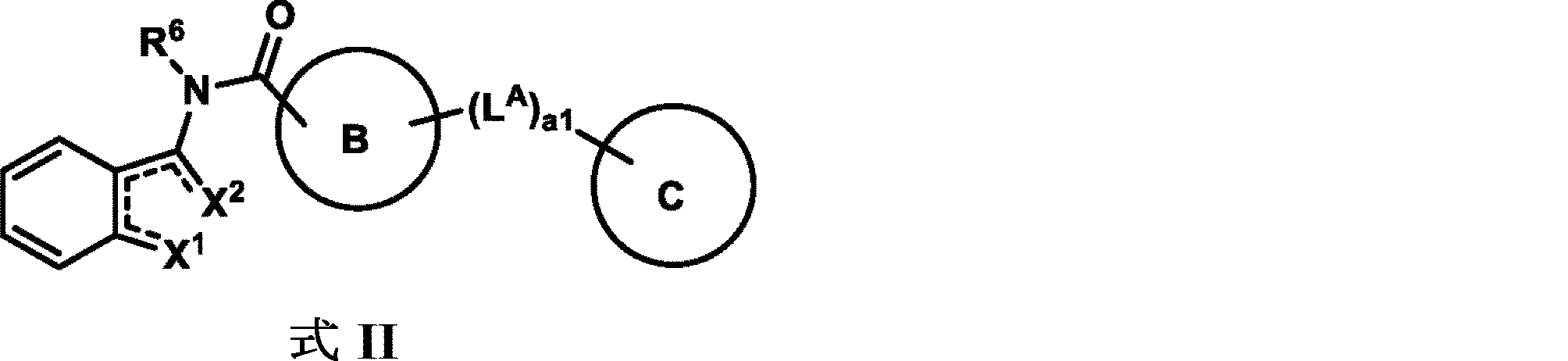
式中、
X1は、O、S、N、NR2、およびCR1からなる群より選択され、
X2は、O、S、N、NR4、およびCR5からなる群より選択され、
各

R1は、H;Rc;Rg;および-(L1)b1-Rgからなる群より選択され、
R2は、H;Rd;Rg;および-(L2)b2-Rgからなる群より選択され、
R4は、HおよびRdからなる群より選択され、
R5は、H;Rc;およびRhからなる群より選択され、
R6は、H;Rd;およびRhからなる群より選択され、
環Bは、環原子5個のヘテロアリーレンであって、環原子のうちの1~4個が、N、NH、N(Rd)、O、およびSからなる群よりそれぞれ独立して選択されるヘテロ原子であり、環Bのヘテロアリーレンが、オキソおよびRcからなる群より独立して選択される1~2個の置換基で置換されていてもよく、但し、環Bが、環炭素原子を介してC(=O)NR6基に結合している、ヘテロアリーレンであり、
各LAは、1~4個のRa1で置換されていてもよいC1~3アルキレン;-O-;-NH-;-NRd;-S(O)0~2;およびC(O)からなる群より独立して選択され、
a1は、0、1、2、または3であり、
環Cは、
・オキソおよびRcからなる群より独立して選択される1~4個の置換基でそれぞれ置換されていてもよいC3~12シクロアルキレンまたはC3~12シクロアルケニレン、
・環原子3~12個のヘテロシクリレンまたはヘテロシクロアルケニレンであって、1~3個の環原子が、N、N(H)、N(Rd)、O、およびS(O)0~2からなる群よりそれぞれ独立して選択されるヘテロ原子であり、前記ヘテロシクリレンまたはヘテロシクロアルケニレンが、オキソおよびRcからなる群より独立して選択される1~4個の置換基で置換されていてもよい、ヘテロシクリレンまたはヘテロシクロアルケニレン、
・環原子5~12個のヘテロアリールであって、1~4個の環原子が、N、N(H)、N(Rd)、O、およびS(O)0~2からなる群よりそれぞれ独立して選択されるヘテロ原子であり、該ヘテロアリーレンが1~4個のRcで置換されていてもよい、ヘテロアリール;ならびに
・1~4個のRcで置換されていてもよいC6~10アリール
からなる群より選択され、
RaおよびRa1の各出現は、-ハロ;-NReRf;C1~4アルコキシ;C1~4ハロアルコキシ;-C(=O)O(C1~4アルキル);-C(=O)(C1~4アルキル);-C(=O)OH;-CONR'R'';-S(O)1~2NR'R'';-S(O)1~2(C1~4アルキル);およびシアノからなる群より独立して選択され、
Rcの各出現は、ハロ;シアノ;1~6個の独立して選択されるRaで置換されていてもよいC1~10アルキル;C2~6アルケニル;C2~6アルキニル;C1~4アルコキシ;C1~4ハロアルコキシ;-S(O)1~2(C1~4アルキル);-S(O)(=NH)(C1~4アルキル);-NReRf;-OH;-S(O)1~2NR'R'';-C1~4チオアルコキシ;-NO2;-C(=O)(C1~10アルキル);-C(=O)O(C1~4アルキル);-C(=O)OH;-C(=O)NR'R'';および-SF5からなる群より独立して選択され、
Rdの各出現は、1~3個の独立して選択されるRaで置換されていてもよいC1~6アルキル;-C(O)(C1~4アルキル);-C(O)O(C1~4アルキル);-CONR'R'';-S(O)1~2NR'R'';-S(O)1~2(C1~4アルキル);-OH;およびC1~4アルコキシからなる群より独立して選択され、
ReおよびRfの各出現は、H;NR'R''、-OH、およびRiからなる群よりそれぞれ独立して選択される1~3個の置換基で置換されていてもよいC1~6アルキル;-C(O)(C1~4アルキル);-C(O)O(C1~4アルキル);-CONR'R'';-S(O)1~2NR'R'';-S(O)1~2(C1~4アルキル);-OH;ならびにC1~4アルコキシからなる群より独立して選択され、
Rgの各出現は、
・それぞれ、オキソ、Rc、Rh、および-(Lg)bg-Rhからなる群より独立して選択される1~4個の置換基で置換されていてもよい、C3~12シクロアルキルまたはC3~12シクロアルケニル;
・環原子3~12個のヘテロシクリルまたはヘテロシクロアルケニルであって、1~3個の環原子が、N、N(H)、N(Rd)、O、およびS(O)0~2からなる群よりそれぞれ独立して選択されるヘテロ原子であり、前記ヘテロシクリルまたはヘテロシクロアルケニルが、オキソ、Rc、Rh、および-(Lg)bg-Rhからなる群より独立して選択される1~4個の置換基で置換されていてもよい、ヘテロシクリルまたはヘテロシクロアルケニル;
・環原子5~12個のヘテロアリールであって、1~4個の環原子が、N、N(H)、N(Rd)、O、およびS(O)0~2からなる群よりそれぞれ独立して選択されるヘテロ原子であり、前記ヘテロアリールが、Rc、Rh、および-(Lg)bg-Rhからなる群より独立して選択される1~4個の置換基で置換されていてもよい、ヘテロアリール;ならびに
・Rc、Rh、および-(Lg)bg-Rhからなる群より独立して選択される1~4個の置換基で置換されていてもよい、C6~10アリール
からなる群より独立して選択され、
Rhの各出現は、
・それぞれ1~4個のRiで置換されていてもよいC3~12シクロアルキルまたはC3~12シクロアルケニル;
・環原子3~12個のヘテロシクリルまたはヘテロシクロアルケニルであって、1~3個の環原子が、N、N(H)、N(Rd)、O、およびS(O)0~2からなる群よりそれぞれ独立して選択されるヘテロ原子であり、前記ヘテロシクリルまたはヘテロシクロアルケニルが1~4個のRiで置換されていてもよい、ヘテロシクリルまたはヘテロシクロアルケニル;
・環原子5~12個のヘテロアリールであって、1~4個の環原子が、N、N(H)、N(Rd)、O、およびS(O)0~2からなる群よりそれぞれ独立して選択されるヘテロ原子であり、前記ヘテロアリールが1~4個のRiで置換されていてもよい、ヘテロアリール;ならびに
・1~4個のRiで置換されていてもよいC6~10アリール
からなる群より独立して選択され、
Riの各出現は、C1~6アルキル;C1~4ハロアルキル;C1~4アルコキシ;C1~4ハロアルコキシ;C1~6アルキル-O-C1~6アルキル-;C1~4ハロアルキル-O-C1~6アルキル-;ハロ;シアノ;-OH;-NR'R'';およびC3~6シクロアルキルからなる群より独立して選択され、
L1、L2、およびLgの各出現は、-O-、-NH-、-NRd、-S(O)0~2、C(O)、および1~3個のRaで置換されていてもよいC1~3アルキレンからなる群より独立して選択され、
b1、b2、およびbgは、それぞれ独立して1、2、または3であり、かつ
R'およびR''の各出現は、H;-OH;およびC1~4アルキルからなる群より独立して選択される。
In another aspect, herein formula II:
During the ceremony,
X 1 is selected from the group consisting of O, S, N, NR 2 and CR 1 ;
X2 is selected from the group consisting of O, S, N, NR4 , and CR5 ;
each
R 1 is selected from the group consisting of H;R c ;R g ; and -(L 1 ) b1 -R g ;
R 2 is selected from the group consisting of H;R d ;R g ; and -(L 2 ) b2 -R g ;
R 4 is selected from the group consisting of H and R d ;
R 5 is selected from the group consisting of H; R c ; and R h ;
R 6 is selected from the group consisting of H; R d ; and R h ;
Ring B is a 5 ring atom heteroarylene in which 1 to 4 of the ring atoms are each independently selected from the group consisting of N, NH, N(R d ), O, and S. and the heteroarylene of ring B is optionally substituted with 1 to 2 substituents independently selected from the group consisting of oxo and R c , provided that ring B is a ring carbon is a heteroarylene bonded to the C(=O)NR 6 group through an atom,
and C ( O _ ) are independently selected from the group consisting of
a1 is 0, 1, 2, or 3;
Ring C is
・C 3-12 cycloalkylene or C 3-12 cycloalkenylene, each optionally substituted with 1 to 4 substituents independently selected from the group consisting of oxo and R c ;
・Heterocyclylene or heterocycloalkenylene with 3 to 12 ring atoms, in which 1 to 3 ring atoms are N, N(H), N(R d ), O, and S(O) 0 to 2 , wherein the heterocyclylene or heterocycloalkenylene is substituted with 1 to 4 substituents independently selected from the group consisting of oxo and R c heterocyclylene or heterocycloalkenylene, which may be
- Heteroaryl of 5 to 12 ring atoms, in which 1 to 4 ring atoms are from the group consisting of N, N(H), N(R d ), O, and S(O) 0 to 2 heteroaryl, each independently selected heteroatom, in which the heteroarylene is optionally substituted with 1 to 4 R c ; and - optionally substituted with 1 to 4 R c selected from the group consisting of C 6-10 aryls,
Each occurrence of R a and R a1 is -halo;-NR e R f ;C 1-4 alkoxy;C 1-4 haloalkoxy;-C(=O)O(C 1-4 alkyl);-C( =O) (C 1~4 alkyl);-C(=O)OH;-CONR'R'';-S(O) 1~2 NR'R'';-S(O) 1~2 (C 1-4 alkyl); and cyano;
Each occurrence of R c represents halo; cyano; C 1-10 alkyl optionally substituted with 1 to 6 independently selected R a ; C 2-6 alkenyl; C 2-6 alkynyl; 1-4 alkoxy;C 1-4 haloalkoxy;-S(O) 1-2 (C 1-4 alkyl);-S(O)(=NH)(C 1-4 alkyl);-NR e R f ;-OH;-S(O) 1~2 NR'R'';-C 1~4thioalkoxy ;-NO 2 ;-C(=O) (C 1~10 alkyl);-C(=O) independently selected from the group consisting of O(C 1-4 alkyl); -C(=O)OH; -C(=O)NR'R''; and -SF 5 ;
Each occurrence of R d is C 1-6 alkyl, optionally substituted with 1 to 3 independently selected R a ;-C(O)(C 1-4 alkyl);-C(O )O(C 1-4 alkyl);-CONR'R'';-S(O) 1-2 NR'R'';-S(O) 1-2 (C 1-4 alkyl);-OH; and C 1-4 alkoxy;
Each occurrence of R e and R f is a C 1-6 alkyl;-C(O)(C 1-4 alkyl);-C(O)O(C 1-4 alkyl);-CONR'R'';-S(O) 1-2 NR'R '';-S(O) 1-2 (C 1-4 alkyl);-OH; and C 1-4 alkoxy;
Each occurrence of R g is
・C 3-12 , each optionally substituted with 1 to 4 substituents independently selected from the group consisting of oxo, R c , R h , and -(L g ) bg -R h cycloalkyl or C 3-12 cycloalkenyl;
- Heterocyclyl or heterocycloalkenyl of 3 to 12 ring atoms, in which 1 to 3 ring atoms are N, N(H), N(R d ), O, and S(O) from 0 to 2 wherein the heterocyclyl or heterocycloalkenyl is independently selected from the group consisting of oxo, R c , Rh , and -(L g ) bg -R h heterocyclyl or heterocycloalkenyl, optionally substituted with 1 to 4 substituents;
- Heteroaryl of 5 to 12 ring atoms, in which 1 to 4 ring atoms are from the group consisting of N, N(H), N(R d ), O, and S(O) 0 to 2 each independently selected heteroatom, and said heteroaryl has 1 to 4 substituents independently selected from the group consisting of R c , R h , and -(L g ) bg -R h and 1 to 4 substituents independently selected from the group consisting of R c , R h , and -(L g ) bg -R h ; independently selected from the group consisting of C 6-10 aryls, which may be
Each occurrence of R h is
・C 3-12 cycloalkyl or C 3-12 cycloalkenyl, each optionally substituted with 1 to 4 R i ;
- Heterocyclyl or heterocycloalkenyl of 3 to 12 ring atoms, in which 1 to 3 ring atoms are N, N(H), N(R d ), O, and S(O) from 0 to 2 a heteroatom each independently selected from the group consisting of heterocyclyl or heterocycloalkenyl, wherein said heterocyclyl or heterocycloalkenyl is optionally substituted with 1 to 4 R i ;
- Heteroaryl of 5 to 12 ring atoms, in which 1 to 4 ring atoms are from the group consisting of N, N(H), N(R d ), O, and S(O) 0 to 2 heteroaryl, each independently selected heteroatom, wherein said heteroaryl is optionally substituted with 1 to 4 R i ; and - optionally substituted with 1 to 4 R i independently selected from the group consisting of C 6-10 aryls,
Each occurrence of R i is C 1-6 alkyl; C 1-4 haloalkyl; C 1-4 alkoxy; C 1-4 haloalkoxy; C 1-6 alkyl-OC 1-6 alkyl-; C 1-4 haloalkyl independently selected from the group consisting of -OC 1-6 alkyl-; halo; cyano; -OH; -NR'R''; and C 3-6 cycloalkyl;
Each occurrence of L 1 , L 2 , and L g is replaced with -O-, -NH-, -NR d , -S(O) 0-2 , C(O), and 1-3 R a independently selected from the group consisting of C 1-3 alkylene, which may be
b1, b2, and bg are each independently 1, 2, or 3, and
Each occurrence of R' and R'' is independently selected from the group consisting of H;-OH; and C 1-4 alkyl.
式(II)の一部の態様において、
1)環Cは、無置換モルホリニル、無置換ピロリジニル、無置換テトラヒドロフラニル、無置換シクロペンチル、一置換オキセタニル、メチルフラニル、無置換チオフェニル、およびメチルピロリル以外であるか、または
2)-(LA)a1-環Cは、無置換ベンジル、ならびに、-F、-OMe、および-OEtからなる群より選択される1個の置換基で置換されていてもよいフェニル以外である
ものとする。
In some embodiments of formula (II),
1) Ring C is other than unsubstituted morpholinyl, unsubstituted pyrrolidinyl, unsubstituted tetrahydrofuranyl, unsubstituted cyclopentyl, monosubstituted oxetanyl, methylfuranyl, unsubstituted thiophenyl, and methylpyrrolyl, or
2) -(L A ) a1 - Ring C is other than unsubstituted benzyl and phenyl optionally substituted with one substituent selected from the group consisting of -F, -OMe, and -OEt. Assume that there is.
式(II)の一部の態様では、本明細書における化合物但し書きのうちの1つまたは複数が適用されるものとする。 In some embodiments of formula (II), one or more of the compound provisos herein shall apply.
別の一局面において、本明細書では、式III:

式中、
X1は、O、S、N、NR2、およびCR1からなる群より選択され、
X2は、O、S、N、NR4、およびCR5からなる群より選択され、
各

R1、R1a、R1b、およびR1cは、H;Rc;Rg;および-(L1)b1-Rgからなる群よりそれぞれ独立して選択され、
R2は、H;Rd;Rg;および-(L2)b2-Rgからなる群より独立して選択され、
R4は、HおよびRdからなる群より選択され、
R5は、H;Rc;およびRhからなる群より選択され、
R6は、H;Rd;およびRhからなる群より選択され、
環Bは、環原子5個のヘテロアリーレンであって、環原子のうちの1~4個が、N、NH、N(Rd)、O、およびSからなる群よりそれぞれ独立して選択されるヘテロ原子であり、環Bのヘテロアリーレンが、オキソおよびRcからなる群より独立して選択される1~2個の置換基で置換されていてもよく、但し、環Bが環炭素原子を介してC(=O)NR6基に結合している、ヘテロアリーレンであり、
各LAは、1~4個のRa1で置換されていてもよいC1~3アルキレン;-O-;-NH-;-NRd;-S(O)0~2;およびC(O)からなる群より独立して選択され、
a1は、0、1、2、または3であり、
環Cは、
・オキソおよびRcからなる群より独立して選択される1~4個の置換基でそれぞれ置換されていてもよいC3~12シクロアルキレンまたはC3~12シクロアルケニレン、
・環原子3~12個のヘテロシクリレンまたはヘテロシクロアルケニレンであって、1~3個の環原子が、N、N(H)、N(Rd)、O、およびS(O)0~2からなる群よりそれぞれ独立して選択されるヘテロ原子であり、前記ヘテロシクリレンまたはヘテロシクロアルケニレンが、オキソおよびRcからなる群より独立して選択される1~4個の置換基で置換されていてもよい、ヘテロシクリレンまたはヘテロシクロアルケニレン、
・環原子5~12個のヘテロアリールであって、1~4個の環原子が、N、N(H)、N(Rd)、O、およびS(O)0~2からなる群よりそれぞれ独立して選択されるヘテロ原子であり、前記ヘテロアリーレンが1~4個のRcで置換されていてもよい、ヘテロアリール;ならびに
・1~4個のRcで置換されていてもよいC6~10アリーレン
からなる群より選択され、
RaおよびRa1の各出現は、-ハロ;-NReRf;C1~4アルコキシ;C1~4ハロアルコキシ;-C(=O)O(C1~4アルキル);-C(=O)(C1~4アルキル);-C(=O)OH;-CONR'R'';-S(O)1~2NR'R'';-S(O)1~2(C1~4アルキル);およびシアノからなる群より独立して選択され、
Rcの各出現は、ハロ;シアノ;1~6個の独立して選択されるRaで置換されていてもよいC1~10アルキル;C2~6アルケニル;C2~6アルキニル;C1~4アルコキシ;C1~4ハロアルコキシ;-S(O)1~2(C1~4アルキル);-S(O)(=NH)(C1~4アルキル);-NReRf;-OH;-S(O)1~2NR'R'';-C1~4チオアルコキシ;-NO2;-C(=O)(C1~10アルキル);-C(=O)O(C1~4アルキル);-C(=O)OH;-C(=O)NR'R'';および-SF5からなる群より独立して選択され、
Rdの各出現は、1~3個の独立して選択されるRaで置換されていてもよいC1~6アルキル;-C(O)(C1~4アルキル);-C(O)O(C1~4アルキル);-CONR'R'';-S(O)1~2NR'R'';-S(O)1~2(C1~4アルキル);-OH;およびC1~4アルコキシからなる群より独立して選択され、
ReおよびRfの各出現は、H;NR'R''、-OH、およびRiからなる群よりそれぞれ独立して選択される1~3個の置換基で置換されていてもよいC1~6アルキル;-C(O)(C1~4アルキル);-C(O)O(C1~4アルキル);-CONR'R'';-S(O)1~2NR'R'';-S(O)1~2(C1~4アルキル);-OH;ならびにC1~4アルコキシからなる群より独立して選択され、
Rgの各出現は、
・それぞれ、オキソ、Rc、Rh、および-(Lg)bg-Rhからなる群より独立して選択される1~4個の置換基で置換されていてもよい、C3~12シクロアルキルまたはC3~12シクロアルケニル;
・環原子3~12個のヘテロシクリルまたはヘテロシクロアルケニルであって、1~3個の環原子が、N、N(H)、N(Rd)、O、およびS(O)0~2からなる群よりそれぞれ独立して選択されるヘテロ原子であり、前記ヘテロシクリルまたはヘテロシクロアルケニルが、オキソ、Rc、Rh、および-(Lg)bg-Rhからなる群より独立して選択される1~4個の置換基で置換されていてもよい、ヘテロシクリルまたはヘテロシクロアルケニル;
・環原子5~12個のヘテロアリールであって、1~4個の環原子が、N、N(H)、N(Rd)、O、およびS(O)0~2からなる群よりそれぞれ独立して選択されるヘテロ原子であり、前記ヘテロアリールが、Rc、Rh、および-(Lg)bg-Rhからなる群より独立して選択される1~4個の置換基で置換されていてもよい、ヘテロアリール;ならびに
・Rc、Rh、および-(Lg)bg-Rhからなる群より独立して選択される1~4個の置換基で置換されていてもよいC6~10アリール
からなる群より独立して選択され、
Rhの各出現は、
・それぞれ1~4個のRiで置換されていてもよいC3~12シクロアルキルまたはC3~12シクロアルケニル;
・環原子3~12個のヘテロシクリルまたはヘテロシクロアルケニルであって、1~3個の環原子が、N、N(H)、N(Rd)、O、およびS(O)0~2からなる群よりそれぞれ独立して選択されるヘテロ原子であり、前記ヘテロシクリルまたはヘテロシクロアルケニルが1~4個のRiで置換されていてもよい、ヘテロシクリルまたはヘテロシクロアルケニル;
・環原子5~12個のヘテロアリールであって、1~4個の環原子が、N、N(H)、N(Rd)、O、およびS(O)0~2からなる群よりそれぞれ独立して選択されるヘテロ原子であり、前記ヘテロアリールが1~4個のRiで置換されていてもよい、ヘテロアリール;ならびに
・1~4個のRiで置換されていてもよいC6~10アリール
からなる群より独立して選択され、
Riの各出現は、C1~6アルキル;C1~4ハロアルキル;C1~4アルコキシ;C1~4ハロアルコキシ;C1~6アルキル-O-C1~6アルキル-;C1~4ハロアルキル-O-C1~6アルキル-;ハロ;シアノ;-OH;-NR'R'';およびC3~6シクロアルキルからなる群より独立して選択され、
L1、L2、およびLgの各出現は、-O-、-NH-、-NRd、-S(O)0~2、C(O)、および1~3個のRaで置換されていてもよいC1~3アルキレンからなる群より独立して選択され、
b1、b2、およびbgは、それぞれ独立して1、2、または3であり、かつ
R'およびR''の各出現は、H;-OH;およびC1~4アルキルからなる群より独立して選択される。
In another aspect, herein formula III:
During the ceremony,
X 1 is selected from the group consisting of O, S, N, NR 2 and CR 1 ;
X2 is selected from the group consisting of O, S, N, NR4 , and CR5 ;
each
R 1 , R 1a , R 1b , and R 1c are each independently selected from the group consisting of H; R c ; R g ; and -(L 1 ) b1 -R g ;
R2 is independently selected from the group consisting of H; Rd ; Rg ; and -( L2 ) b2 - Rg ;
R 4 is selected from the group consisting of H and R d ;
R 5 is selected from the group consisting of H; R c ; and R h ;
R 6 is selected from the group consisting of H; R d ; and R h ;
Ring B is a 5 ring atom heteroarylene in which 1 to 4 of the ring atoms are each independently selected from the group consisting of N, NH, N(R d ), O, and S. and the heteroarylene of ring B is optionally substituted with 1 to 2 substituents independently selected from the group consisting of oxo and R c , provided that ring B is a ring carbon atom is a heteroarylene bonded to the C(=O)NR 6 group through
and C ( O _ ) are independently selected from the group consisting of
a1 is 0, 1, 2, or 3;
Ring C is
・C 3-12 cycloalkylene or C 3-12 cycloalkenylene, each optionally substituted with 1 to 4 substituents independently selected from the group consisting of oxo and R c ;
・Heterocyclylene or heterocycloalkenylene with 3 to 12 ring atoms, in which 1 to 3 ring atoms are N, N(H), N(R d ), O, and S(O) 0 to 2 , wherein the heterocyclylene or heterocycloalkenylene is substituted with 1 to 4 substituents independently selected from the group consisting of oxo and R c heterocyclylene or heterocycloalkenylene, which may be
- Heteroaryl of 5 to 12 ring atoms, in which 1 to 4 ring atoms are from the group consisting of N, N(H), N(R d ), O, and S(O) 0 to 2 Heteroaryl, each independently selected heteroatom, wherein the heteroarylene is optionally substituted with 1 to 4 R c ; and - optionally substituted with 1 to 4 R c selected from the group consisting of C 6-10 arylene,
Each occurrence of R a and R a1 is -halo;-NR e R f ;C 1-4 alkoxy;C 1-4 haloalkoxy;-C(=O)O(C 1-4 alkyl);-C( =O) (C 1~4 alkyl);-C(=O)OH;-CONR'R'';-S(O) 1~2 NR'R'';-S(O) 1~2 (C 1-4 alkyl); and cyano;
Each occurrence of R c represents halo; cyano; C 1-10 alkyl optionally substituted with 1 to 6 independently selected R a ; C 2-6 alkenyl; C 2-6 alkynyl; 1-4 alkoxy;C 1-4 haloalkoxy;-S(O) 1-2 (C 1-4 alkyl);-S(O)(=NH)(C 1-4 alkyl);-NR e R f ;-OH;-S(O) 1~2 NR'R'';-C 1~4thioalkoxy ;-NO 2 ;-C(=O) (C 1~10 alkyl);-C(=O) independently selected from the group consisting of O(C 1-4 alkyl); -C(=O)OH; -C(=O)NR'R''; and -SF 5 ;
Each occurrence of R d is C 1-6 alkyl, optionally substituted with 1 to 3 independently selected R a ;-C(O)(C 1-4 alkyl);-C(O )O(C 1-4 alkyl);-CONR'R'';-S(O) 1-2 NR'R'';-S(O) 1-2 (C 1-4 alkyl);-OH; and C 1-4 alkoxy;
Each occurrence of R e and R f is a C 1-6 alkyl;-C(O)(C 1-4 alkyl);-C(O)O(C 1-4 alkyl);-CONR'R'';-S(O) 1-2 NR'R '';-S(O) 1-2 (C 1-4 alkyl);-OH; and C 1-4 alkoxy;
Each occurrence of R g is
・C 3-12 , each optionally substituted with 1 to 4 substituents independently selected from the group consisting of oxo, R c , R h , and -(L g ) bg -R h cycloalkyl or C 3-12 cycloalkenyl;
- Heterocyclyl or heterocycloalkenyl of 3 to 12 ring atoms, in which 1 to 3 ring atoms are N, N(H), N(R d ), O, and S(O) from 0 to 2 wherein the heterocyclyl or heterocycloalkenyl is independently selected from the group consisting of oxo, R c , Rh , and -(L g ) bg -R h heterocyclyl or heterocycloalkenyl, optionally substituted with 1 to 4 substituents;
- Heteroaryl of 5 to 12 ring atoms, in which 1 to 4 ring atoms are from the group consisting of N, N(H), N(R d ), O, and S(O) 0 to 2 each independently selected heteroatom, and said heteroaryl has 1 to 4 substituents independently selected from the group consisting of R c , R h , and -(L g ) bg -R h and 1 to 4 substituents independently selected from the group consisting of R c , R h , and -(L g ) bg -R h ; independently selected from the group consisting of C 6-10 aryls, which may be
Each occurrence of R h is
・C 3-12 cycloalkyl or C 3-12 cycloalkenyl, each optionally substituted with 1 to 4 R i ;
- Heterocyclyl or heterocycloalkenyl of 3 to 12 ring atoms, in which 1 to 3 ring atoms are N, N(H), N(R d ), O, and S(O) from 0 to 2 a heteroatom each independently selected from the group consisting of heterocyclyl or heterocycloalkenyl, wherein said heterocyclyl or heterocycloalkenyl is optionally substituted with 1 to 4 R i ;
- Heteroaryl of 5 to 12 ring atoms, in which 1 to 4 ring atoms are from the group consisting of N, N(H), N(R d ), O, and S(O) 0 to 2 heteroaryl, each independently selected heteroatom, wherein said heteroaryl is optionally substituted with 1 to 4 R i ; and - optionally substituted with 1 to 4 R i independently selected from the group consisting of C 6-10 aryls,
Each occurrence of R i is C 1-6 alkyl; C 1-4 haloalkyl; C 1-4 alkoxy; C 1-4 haloalkoxy; C 1-6 alkyl-OC 1-6 alkyl-; C 1-4 haloalkyl independently selected from the group consisting of -OC 1-6 alkyl-; halo; cyano; -OH; -NR'R''; and C 3-6 cycloalkyl;
Each occurrence of L 1 , L 2 , and L g is replaced with -O-, -NH-, -NR d , -S(O) 0-2 , C(O), and 1-3 R a independently selected from the group consisting of C 1-3 alkylene, which may be
b1, b2, and bg are each independently 1, 2, or 3, and
Each occurrence of R' and R'' is independently selected from the group consisting of H;-OH; and C 1-4 alkyl.
式(III)の一部の態様において、環Bが、無置換の

式(III)の一部の態様では、本明細書における化合物但し書きのうちの1つまたは複数が適用されるものとする。 In some embodiments of formula (III), one or more of the compound provisos herein shall apply.
可変記号Z、Y1、Y2、Y3、X1、およびX2
式(I)の一部の態様において、Z、Y1、Y2、およびY3のそれぞれは独立してNまたはCR1である。
Variable symbols Z, Y 1 , Y 2 , Y 3 , X 1 , and X 2
In some embodiments of formula (I), each of Z, Y 1 , Y 2 , and Y 3 is independently N or CR 1 .
一部の態様において、式(I)の化合物は、式(Ia):
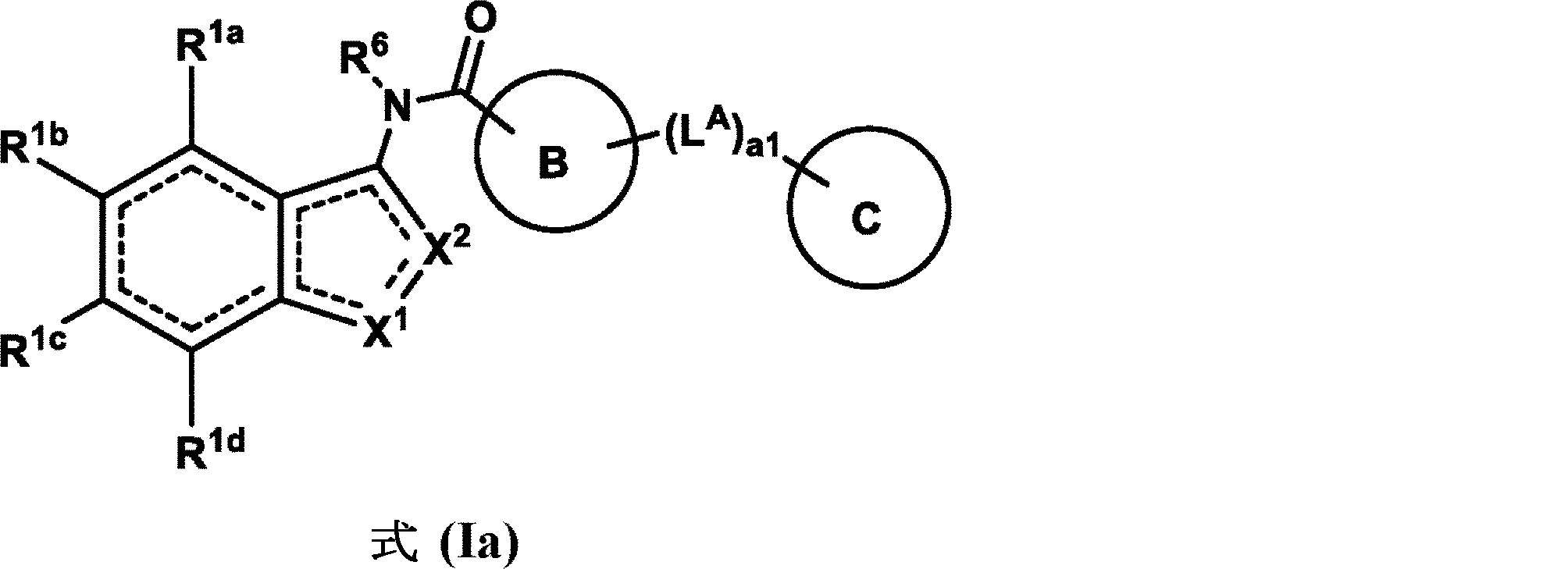
式(I)の一部の態様において、Z、Y1、およびY2のうちの1つはNであり、Z、Y1、Y2、およびY3のうちの残りのそれぞれ1つは、独立して選択されるCR1である。 In some embodiments of formula (I), one of Z, Y 1 , and Y 2 is N, and each remaining one of Z, Y 1 , Y 2 , and Y 3 is CR 1 is independently selected.
一部の態様において、式(I)の化合物は、以下の式:
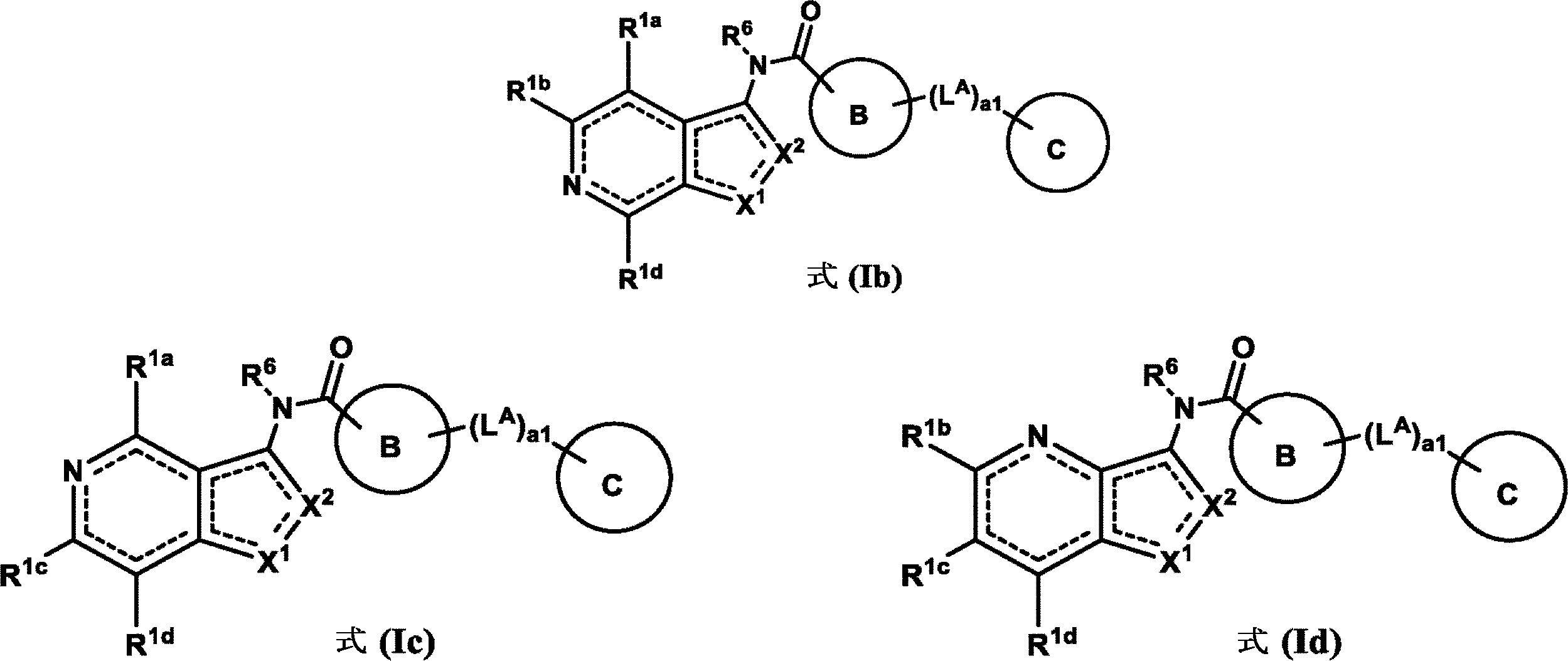
これらの態様のうちのいくつかにおいて、式(I)の化合物は、式(Ib)の化合物またはその薬学的に許容されるものである。 In some of these embodiments, the compound of formula (I) is a compound of formula (Ib) or a pharmaceutically acceptable version thereof.
ある特定の態様において、式(I)の化合物は、式(Ic)の化合物またはその薬学的に許容されるものである。 In certain embodiments, the compound of formula (I) is a compound of formula (Ic) or a pharmaceutically acceptable version thereof.
ある特定の態様において、式(I)の化合物は、式(Id)の化合物またはその薬学的に許容されるものである。 In certain embodiments, the compound of formula (I) is a compound of formula (Id) or a pharmaceutically acceptable version thereof.
式(I)、(II)、または(III)の一部の態様において、X1はNR2である。これらの態様のうちのいくつかにおいて、X1はNHである。 In some embodiments of formula (I), (II), or (III), X 1 is NR 2 . In some of these embodiments, X 1 is NH.
式(I)、(II)、または(III)の一部の態様において、X2はCR5である。これらの態様のうちのいくつかにおいて、X2はCHである。 In some embodiments of formula (I), (II), or (III), X2 is CR5 . In some of these embodiments, X 2 is CH.
式(I)、(II)、または(III)の一部の態様において、X1はNR2であり、X2はCR5である。これらの態様のうちのいくつかにおいて、X1はNHであり、X2はCHである。 In some embodiments of formula (I), (II), or (III), X 1 is NR 2 and X 2 is CR 5 . In some of these embodiments, X 1 is NH and X 2 is CH.
一部の態様において、式(I)の化合物は、式(Ia-1):

一部の態様において、式(I)の化合物は、以下の式:

これらの態様のうちのいくつかにおいて、式(I)の化合物は、式(Ib-1)の化合物またはその薬学的に許容される塩である。 In some of these embodiments, the compound of formula (I) is a compound of formula (Ib-1) or a pharmaceutically acceptable salt thereof.
ある特定の態様において、式(I)の化合物は、式(Ic-1)の化合物またはその薬学的に許容される塩である。 In certain embodiments, the compound of formula (I) is a compound of formula (Ic-1) or a pharmaceutically acceptable salt thereof.
ある特定の態様において、式(I)の化合物は、式(Id-1)の化合物、またはその薬学的に許容される塩である。 In certain embodiments, the compound of formula (I) is a compound of formula (Id-1), or a pharmaceutically acceptable salt thereof.
一部の態様において、式(II)の化合物は、式(II-1):

一部の態様において、式(III)の化合物は、式(III-1):

式(Ia-1)、(Ib-1)、(Ic-1)、(I-d1)、(II-1)、または(III-1)の一部の態様において、R2はHである。式(Ia-1)、(Ib-1)、(Ic-1)、(I-d1)、(II-1)、または(III-1)の一部の態様において、R5はHである。これらの態様のうちのいくつかにおいて、R2はHであり、R5はHである。 In some embodiments of formula (Ia-1), (Ib-1), (Ic-1), (I-d1), (II-1), or (III-1), R2 is H . In some embodiments of formula (Ia-1), (Ib-1), (Ic-1), (I-d1), (II-1), or (III-1), R 5 is H . In some of these embodiments, R 2 is H and R 5 is H.
可変記号R1、R1a、R1b、R1c、およびR1d
式(I)の一部の態様において、1~2個のR1は、Rc1およびRg1からなる群より独立して選択され、残りの各R1はHであり、Rc1は、独立して選択されるRcであり、Rg1は、独立して選択されるRgである。
Variable symbols R 1 , R 1a , R 1b , R 1c , and R 1d
In some embodiments of formula (I), one to two R 1 are independently selected from the group consisting of R c1 and R g1 , each remaining R 1 is H, and R c1 is independently and R g1 is R g that is independently selected.
これらの態様のうちのいくつかにおいて、R1の2個の出現は、Rc1およびRg1からなる群より独立して選択され、残りの各R1はHである。ある特定の態様において、R1の2個の出現は、独立して選択されるRc1であり、残りの各R1はHである。ある特定の態様において、R1の1個の出現は、Rc1およびRg1からなる群より選択され、残りの各R1はHである。ある特定の態様において、R1の1個の出現はRc1であり、残りの各R1はHである。ある特定の態様において、R1の1個の出現はRg1であり、残りの各R1はHである。ある特定の態様において、R1の1個の出現はRc1であり、R1の1個の出現はRg1であり、残りの各R1はHである。 In some of these embodiments, two occurrences of R 1 are independently selected from the group consisting of R c1 and R g1 and each remaining R 1 is H. In certain embodiments, two occurrences of R 1 are independently selected R c1 and each remaining R 1 is H. In certain embodiments, one occurrence of R 1 is selected from the group consisting of R c1 and R g1 and each remaining R 1 is H. In certain embodiments, one occurrence of R 1 is R c1 and each remaining R 1 is H. In certain embodiments, one occurrence of R 1 is R g1 and each remaining R 1 is H. In certain embodiments, one occurrence of R 1 is R c1 , one occurrence of R 1 is R g1 , and each remaining R 1 is H.
ある特定の態様において、各Rc1は、独立して選択されるハロ、シアノ、C1~3アルキル、C1~3アルコキシ、C1~3ハロアルコキシ、または1~6個の独立して選択されるハロで置換されたC1~3アルキルであり、例えばRc1は-F、-Cl、または-CNである。前記態様の非限定的な例として、各Rc1は、独立して、-Fまたは-Cl、例えば-Fである。 In certain embodiments, each R c1 is independently selected halo, cyano, C 1-3 alkyl, C 1-3 alkoxy, C 1-3 haloalkoxy, or 1 to 6 independently selected C 1-3 alkyl substituted with halo, for example R c1 is -F, -Cl, or -CN. As a non-limiting example of the above embodiment, each R c1 is independently -F or -Cl, such as -F.
ある特定の態様において、各Rg1は、
・環原子5~10個のヘテロアリールであって、1~3個の環原子が、N、N(H)、N(Rd)、O、およびSからなる群よりそれぞれ独立して選択されるヘテロ原子であり、前記ヘテロアリールが、Rc、Rh、および-(Lg)bg-Rhからなる群より独立して選択される1~4個の置換基で置換されていてもよい、ヘテロアリール;ならびに
・Rc、Rh、および-(Lg)bg-Rhからなる群より独立して選択される1~4個の置換基で置換されていてもよいC6~10アリール
からなる群より独立して選択される。
In certain embodiments, each R g1 is
- a heteroaryl of 5 to 10 ring atoms, in which 1 to 3 ring atoms are each independently selected from the group consisting of N, N(H), N(R d ), O, and S; and the heteroaryl is substituted with 1 to 4 substituents independently selected from the group consisting of R c , R h , and -(L g ) bg -R h and C 6 - optionally substituted with 1 to 4 substituents independently selected from the group consisting of R c , R h , and -(L g ) bg -R h ; independently selected from the group consisting of 10 aryles.
ある特定の態様において、各Rg1は、
・環原子5~6個のヘテロアリールであって、1~3個の環原子が、N、N(H)、N(Rd)、O、およびSからなる群よりそれぞれ独立して選択されるヘテロ原子であり、前記ヘテロアリールが1~4個のRcで置換されていてもよい、ヘテロアリール;ならびに
・1~4個のRcで置換されていてもよいC6アリール
からなる群より独立して選択される。
In certain embodiments, each R g1 is
- a heteroaryl of 5 to 6 ring atoms, in which 1 to 3 ring atoms are each independently selected from the group consisting of N, N(H), N(R d ), O, and S; a heteroatom, in which the heteroaryl is optionally substituted with 1 to 4 R c ; and - a group consisting of C 6 aryl, which is optionally substituted with 1 to 4 R c more independently selected.
ある特定の態様において、各Rg1は、独立して、環原子5個のヘテロアリールであって、1~3個の環原子が、N、N(H)、N(Rd)、O、およびSからなる群よりそれぞれ独立して選択されるヘテロ原子であり、前記ヘテロアリールが1~4個のRcで置換されていてもよい、ヘテロアリールである。 In certain embodiments, each R g1 is independently a 5 ring atom heteroaryl, wherein 1 to 3 ring atoms are N, N(H), N(R d ), O, and S, wherein the heteroaryl is optionally substituted with 1 to 4 R c .
ある特定の態様において、各Rg1は、1~2個のRcで置換されていてもよいピラゾリル、例えば、1~6個の独立して選択されるRaで置換されていてもよい1~2個の独立して選択されるC1~6(例えばC1~3)アルキル(例えば無置換C1~6(例えばC1~3)アルキル)で置換されていてもよいピラゾリルである。前記態様の非限定的な例として、Rg1は

ある特定の態様において、Rg1は、1~4個のRcで置換されていてもよいフェニルであり、例えば、それぞれ1~6個のRaで置換されていてもよいC1~6アルキル;-ハロ;-シアノ;C1~4アルコキシ;およびC1~4ハロアルコキシからなる群より独立して選択される1~2個の置換基で置換されていてもよいフェニルである。 In certain embodiments, R g1 is phenyl optionally substituted with 1 to 4 R c , for example, C 1-6 alkyl, each optionally substituted with 1 to 6 R a ;-halo;-cyano; phenyl optionally substituted with 1 to 2 substituents independently selected from the group consisting of; -halo ;-cyano;C 1-4 alkoxy;
ある特定の態様において、各Rg1は、
・環原子5~10個のヘテロアリールであって、1~3個の環原子が、N、N(H)、N(Rd)、O、およびSからなる群よりそれぞれ独立して選択されるヘテロ原子であり、前記ヘテロアリールが、Rh1または-(Lg)bg-Rh1の1個の出現で置換されており、1~2個のRcでさらに置換されていてもよい、ヘテロアリール;ならびに
・Rh1または-(Lg)bg-Rh1の1個の出現で置換されており、1~2個のRcでさらに置換されていてもよい、C6~10アリールであって、Rh1が、独立して選択されるRhである、C6~10アリール
からなる群より独立して選択される。
In certain embodiments, each R g1 is
- a heteroaryl of 5 to 10 ring atoms, in which 1 to 3 ring atoms are each independently selected from the group consisting of N, N(H), N(R d ), O, and S; said heteroaryl is substituted with one occurrence of R h1 or -(L g ) bg -R h1 and optionally further substituted with 1 to 2 R c , heteroaryl; and C 6-10 aryl substituted with one occurrence of R h1 or -(L g ) bg -R h1 and optionally further substituted with 1 to 2 R c and R h1 is independently selected from the group consisting of C 6-10 aryls, with R h being independently selected.
これらの態様のうちのいくつかにおいて、各Rg1は、環原子5~6(例えば5)個のヘテロアリールであって、1~3個の環原子が、N、N(H)、N(Rd)、O、およびSからなる群よりそれぞれ独立して選択されるヘテロ原子であり、前記ヘテロアリールが、Rh1または-(Lg)bg-Rh1の1個の出現で置換されており、1~2個のRcでさらに置換されていてもよく、ここで、Rh1が、独立して選択されるRhである、ヘテロアリールである。前記態様の非限定的な例として、各Rg1は、Rh1または-(Lg)bg-Rh1(例えばRh1または-CH2Rh1)で置換されたピラゾリルであって、1~2個のRcでさらに置換されていてもよい、ピラゾリルであることができる。例えば、各Rg1は、それぞれRcで置換されていてもよい

ある特定の態様において、Rh1は、
・環原子5~6個のヘテロアリールであって、1~3個の環原子が、N、N(H)、N(Rd)、O、およびS(O)0~2からなる群よりそれぞれ独立して選択されるヘテロ原子であり、前記ヘテロアリールが、1~4個のRiで置換されていてもよい、ヘテロアリール;ならびに
・1~4個のRiで置換されていてもよいC6アリールであって、例えばRg1が、1~4個のRiで置換されていてもよいフェニルである、C6アリール
からなる群より選択される。
In certain embodiments, R h1 is
- Heteroaryl of 5 to 6 ring atoms, in which 1 to 3 ring atoms are from the group consisting of N, N(H), N(R d ), O, and S(O) 0 to 2 Heteroaryl, each independently selected heteroatom, wherein said heteroaryl is optionally substituted with 1 to 4 R i ; and - optionally substituted with 1 to 4 R i C 6 aryl, for example selected from the group consisting of C 6 aryl, where R g1 is phenyl optionally substituted with 1 to 4 R i .
ある特定の態様において、Rh1は、
・環原子5~6個のヘテロアリールであって、1~3個の環原子が、N、N(H)、N(Rd)、O、およびS(O)0~2からなる群よりそれぞれ独立して選択されるヘテロ原子であり、前記ヘテロアリールが、1~2個のRiで置換されていてもよい、ヘテロアリール;ならびに
・1~2個のRiで置換されていてもよいC6アリールであって、例えばRg1が、1~4個のRiで置換されていてもよいフェニルである、C6アリール
からなる群より選択される。
In certain embodiments, R h1 is
- Heteroaryl of 5 to 6 ring atoms, in which 1 to 3 ring atoms are from the group consisting of N, N(H), N(R d ), O, and S(O) 0 to 2 Heteroaryl, each independently selected heteroatom, wherein said heteroaryl is optionally substituted with 1 to 2 R i ; and - optionally substituted with 1 to 2 R i C 6 aryl, for example selected from the group consisting of C 6 aryl, where R g1 is phenyl optionally substituted with 1 to 4 R i .
式(I)、(Ib)、(Ib-1)、(Ic)、(Ic-1)、(Id)、(Id-1)、(III)、および(III-1)の一部の態様において、各R1はHである。 Some embodiments of formulas (I), (Ib), (Ib-1), (Ic), (Ic-1), (Id), (Id-1), (III), and (III-1) , each R 1 is H.
式(Ia)、(Ib)、(Ic)、(Ia-1)、(Ib-1)、(Ic-1)、(III)、または(III-1)の一部の態様において、R1aはHである。 In some embodiments of formula (Ia), (Ib), (Ic), (Ia-1), (Ib-1), (Ic-1), (III), or (III-1), R 1a is H.
式(Ia)、(Ib)、(Id)、(Ia-1)、(Ib-1)、(Id-1)、(III)、または(III-1)の一部の態様において、R1bはHである。 In some embodiments of formula (Ia), (Ib), (Id), (Ia-1), (Ib-1), (Id-1), (III), or (III-1), R 1b is H.
式(Ia)、(Ib)、(Id)、(Ia-1)、(Ib-1)、(Id-1)、(III)、または(III-1)の一部の態様において、ハロ、例えば-Fまたは-Cl(例えば-F)である。 In some embodiments of formula (Ia), (Ib), (Id), (Ia-1), (Ib-1), (Id-1), (III), or (III-1), halo, For example -F or -Cl (eg -F).
式(Ia)、(Ib)、(Id)、(Ia-1)、(Ib-1)、(Id-1)、(III)、または(III-1)の一部の態様において、R1bは、環原子5個のヘテロアリールであって、1~3個の環原子が、N、N(H)、N(Rd)、O、およびSからなる群よりそれぞれ独立して選択されるヘテロ原子であり、前記ヘテロアリールが1~2個のRcで置換されていてもよい、ヘテロアリールである。 In some embodiments of formula (Ia), (Ib), (Id), (Ia-1), (Ib-1), (Id-1), (III), or (III-1), R 1b is a 5 ring atom heteroaryl, where 1 to 3 ring atoms are each independently selected from the group consisting of N, N(H), N(R d ), O, and S. Heteroaryl is a heteroatom, and the heteroaryl is optionally substituted with 1 to 2 R c .
式(Ia)、(Ib)、(Id)、(Ia-1)、(Ib-1)、(Id-1)、(III)、または(III-1)の一部の態様において、R1bは、1~2個のRcで置換されていてもよい、ピラゾリルであり、例えば各Rcは、1~6個の独立して選択されるRaで置換されていてもよい(例えば無置換の)独立して選択されるC1~6(例えばC1~3)アルキルである。 In some embodiments of formula (Ia), (Ib), (Id), (Ia-1), (Ib-1), (Id-1), (III), or (III-1), R 1b is pyrazolyl, optionally substituted with 1 to 2 R c , such as each R c optionally substituted with 1 to 6 independently selected R a (e.g., none). (substituted) independently selected C 1-6 (eg C 1-3 ) alkyl.
式(Ia)、(Ib)、(Id)、(Ia-1)、(Ib-1)、(Id-1)、(III)、または(III-1)の一部の態様において、R1bは、1~4個のRcで置換されていてもよいフェニルであり、例えば、それぞれ1~6個のRaで置換されていてもよいC1~6アルキル;-ハロ;-シアノ;C1~4アルコキシ;およびC1~4ハロアルコキシからなる群より独立して選択される1~2個の置換基で置換されていてもよいフェニルである。 In some embodiments of formula (Ia), (Ib), (Id), (Ia-1), (Ib-1), (Id-1), (III), or (III-1), R 1b is phenyl optionally substituted with 1 to 4 R c , for example, C 1-6 alkyl ;-halo;-cyano;C phenyl optionally substituted with 1 to 2 substituents independently selected from the group consisting of 1-4 alkoxy; and C 1-4 haloalkoxy.
式(Ia)、(Ib)、(Id)、(Ia-1)、(Ib-1)、(Id-1)、(III)、または(III-1)の一部の態様において、R1bは、環原子5~6(例えば5)個のヘテロアリールであって、1~3個の環原子が、N、N(H)、N(Rd)、O、およびSからなる群よりそれぞれ独立して選択されるヘテロ原子であり、前記ヘテロアリールが、Rh1または-(Lg)bg-Rh1の1個の出現で置換されており、1~2個のRcでさらに置換されていてもよく、ここで、Rh1が、独立して選択されるRhである、ヘテロアリールである。前記態様の非限定的な例として、R1bは、Rh1または-(Lg)bg-Rh1(例えばRh1または-CH2Rh1)で置換されたピラゾリルであって、1~2個のRcでさらに置換されていてもよい、ピラゾリルであることができ、例えばR1bは、それぞれRcで置換されていてもよい

式(Ia)、(Ic)、(Id)、(Ia-1)、(Ic-1)、(Id-1)、(III)、または(III-1)の一部の態様において、R1cはHである。式(Ia)、(Ic)、(Id)、(Ia-1)、(Ic-1)、(Id-1)、(III)、または(III-1)の一部の態様において、R1cはハロ、例えば-Fまたは-Clである。 In some embodiments of formula (Ia), (Ic), (Id), (Ia-1), (Ic-1), (Id-1), (III), or (III-1), R 1c is H. In some embodiments of formula (Ia), (Ic), (Id), (Ia-1), (Ic-1), (Id-1), (III), or (III-1), R 1c is halo, for example -F or -Cl.
式(Ia)、(Ib)、(Ic)、(Id)、(Ia-1)、(Ib-1)、(Ic-1)、または(Id-1)の一部の態様において、R1dはHである。式(Ia)、(Ib)、(Ic)、(Id)、(Ia-1)、(Ib-1)、(Ic-1)、または(Id-1)の一部の態様において、R1dはハロ、例えば-Fまたは-Cl(例えば-F)である。 In some embodiments of formula (Ia), (Ib), (Ic), (Id), (Ia-1), (Ib-1), (Ic-1), or (Id-1), R 1d is H. In some embodiments of formula (Ia), (Ib), (Ic), (Id), (Ia-1), (Ib-1), (Ic-1), or (Id-1), R 1d is halo, eg -F or -Cl (eg -F).
式(Ia)、(Ib)、(Ic)、(Id)、(Ia-1)、(Ib-1)、(Ic-1)、(Id-1)、(III)、または(III-1)の一部の態様において、R1aおよびR1dが存在する場合、R1aおよびR1dはHであり、R1bおよびR1cが存在する場合、R1bおよびR1cは独立して選択されるハロ、例えば-Fまたは-Cl、例えば-Fであり、例えば、R1bおよびR1cが存在する場合、R1bおよびR1cは-Fであるか、またはR1bが存在する場合、R1bは-Fであり、かつR1cが存在する場合、R1cは-Clであるか、またはR1bが存在する場合、R1bは-Clであり、かつR1cが存在する場合、R1cは-Fである。 Formula (Ia), (Ib), (Ic), (Id), (Ia-1), (Ib-1), (Ic-1), (Id-1), (III), or (III-1) ), when R 1a and R 1d are present, R 1a and R 1d are H, and when R 1b and R 1c are present, R 1b and R 1c are independently selected. halo , e.g. -F or -Cl , e.g. -F and R 1c is present, R 1c is -Cl, or if R 1b is present, R 1b is -Cl and R 1c is present, R 1c is - It is F.
式(Ia)、(Ib)、(Ic)、(Id)、(Ia-1)、(Ib-1)、(Ic-1)、(Id-1)、(III)、または(III-1)の一部の態様において、R1aおよびR1dが存在する場合、R1aおよびR1dはHであり、R1bおよびR1cが存在する場合、R1bおよびR1cのうちの一方はHであり、R1bおよびR1cが存在する場合、R1bおよびR1cのうちの他方はハロ、例えば-Fまたは-Cl、例えば-Fであり、例えば、R1bが存在する場合、R1bはHであり、かつR1cが存在する場合、R1cは-Fであるか、またはR1bが存在する場合、R1bはHであり、かつR1cが存在する場合、R1cは-Clであるか、またはR1bが存在する場合、R1bは-Fであり、かつR1cが存在する場合、R1cはHであるか、またはR1bが存在する場合、R1bは-Clであり、かつR1cが存在する場合、R1cはHである。 Formula (Ia), (Ib), (Ic), (Id), (Ia-1), (Ib-1), (Ic-1), (Id-1), (III), or (III-1) ), when R 1a and R 1d are present, R 1a and R 1d are H, and when R 1b and R 1c are present, one of R 1b and R 1c is H. and R 1b and R 1c are present, the other of R 1b and R 1c is halo, e.g. -F or -Cl, e.g. -F, e.g. when R 1b is present, R 1b is H and if R 1c is present, R 1c is -F, or if R 1b is present, R 1b is H, and if R 1c is present, R 1c is -Cl or, if R 1b is present, R 1b is -F, and if R 1c is present, R 1c is H, or if R 1b is present, R 1b is -Cl; and R 1c is H, if R 1c is present.
式(Ia)、(Ib)、(Ic)、(Id)、(Ia-1)、(Ib-1)、(Ic-1)、(Id-1)、(III)、または(III-1)の一部の態様において、R1aおよびR1dが存在する場合、R1aおよびR1dはHであり、R1cが存在する場合、R1cはハロまたはH、例えば-F、-Cl、またはHであり、R1bが存在する場合、R1bは環原子5個のヘテロアリールであって、1~3個の環原子が、N、N(H)、N(Rd)、O、およびSからなる群よりそれぞれ独立して選択されるヘテロ原子であり、前記ヘテロアリールが1~4個のRcで置換されていてもよい、ヘテロアリールである。 Formula (Ia), (Ib), (Ic), (Id), (Ia-1), (Ib-1), (Ic-1), (Id-1), (III), or (III-1) ), when R 1a and R 1d are present, R 1a and R 1d are H, and when R 1c is present, R 1c is halo or H, such as -F, -Cl, or H and R 1b is present, R 1b is a 5 ring atom heteroaryl in which 1 to 3 ring atoms are N, N(H), N(R d ), O, and S is a heteroatom each independently selected from the group consisting of S, and the heteroaryl is optionally substituted with 1 to 4 R c .
式(Ia)、(Ib)、(Ic)、(Id)、(Ia-1)、(Ib-1)、(Ic-1)、(Id-1)、(III)、または(III-1)の一部の態様において、R1aおよびR1dが存在する場合、R1aおよびR1dはHであり、R1cが存在する場合、R1cはハロまたはH、例えば-F、-Cl、またはHであり、R1bが存在する場合、R1bは環原子5~6(例えば5)個のヘテロアリールであって、1~3個の環原子が、N、N(H)、N(Rd)、O、およびSからなる群よりそれぞれ独立して選択されるヘテロ原子であり、前記ヘテロアリールが、Rh1または-(Lg)bg-Rh1(例えばRh1または-CH2-Rh1)の1個の出現で置換されており、1~2個のRcでさらに置換されていてもよい、ヘテロアリールであり、ここで、Rh1は独立して選択されるRhである。 Formula (Ia), (Ib), (Ic), (Id), (Ia-1), (Ib-1), (Ic-1), (Id-1), (III), or (III-1) ), when R 1a and R 1d are present, R 1a and R 1d are H, and when R 1c is present, R 1c is halo or H, such as -F, -Cl, or H and R 1b is present, R 1b is a heteroaryl of 5 to 6 (e.g. 5) ring atoms, and 1 to 3 ring atoms are N, N(H), N(R d ), O, and S, wherein said heteroaryl is R h1 or -(L g ) bg -R h1 (e.g. R h1 or -CH 2 -R h1 ) and optionally further substituted with 1 to 2 R c , where R h1 is an independently selected R h .
式(Ia)、(Ib)、(Ic)、(Id)、(Ia-1)、(Ib-1)、(Ic-1)、(Id-1)、(III)、または(III-1)の一部の態様において、R1aおよびR1dが存在する場合、R1aおよびR1dはHであり、R1cが存在する場合、R1cはハロまたはH、例えば-F、-Cl、またはHであり、R1bが存在する場合、R1bは、1~4個のRcで置換されていてもよいフェニルであり、例えば、それぞれ1~6個のRaで置換されていてもよいC1~6アルキル;-ハロ;-シアノ;C1~4アルコキシ;およびC1~4ハロアルコキシからなる群より独立して選択される1~2個の置換基で置換されていてもよいフェニルである。 Formula (Ia), (Ib), (Ic), (Id), (Ia-1), (Ib-1), (Ic-1), (Id-1), (III), or (III-1) ), when R 1a and R 1d are present, R 1a and R 1d are H, and when R 1c is present, R 1c is halo or H, such as -F, -Cl, or H and R 1b is present, R 1b is phenyl optionally substituted with 1 to 4 R c , for example each optionally substituted with 1 to 6 R a Phenyl optionally substituted with 1 to 2 substituents independently selected from the group consisting of C 1-6 alkyl; -halo; -cyano; C 1-4 alkoxy; and C 1-4 haloalkoxy It is.
式(Ia)、(Ib)、(Ic)、(Id)、(Ia-1)、(Ib-1)、(Ic-1)、(Id-1)、(III)、または(III-1)の一部の態様において、R1aが存在する場合、R1aはHであり、R1dが存在する場合、R1dはハロ、例えば-Fまたは-Clであり、R1cが存在する場合、R1cはHであり、R1bが存在する場合、R1bはRgである。 Formula (Ia), (Ib), (Ic), (Id), (Ia-1), (Ib-1), (Ic-1), (Id-1), (III), or (III-1) ), when R 1a is present, R 1a is H; when R 1d is present, R 1d is halo, such as -F or -Cl, and when R 1c is present, R 1c is H and if R 1b is present, R 1b is R g .
式(Ia)または(Ia-1)の一部の態様において、R1aおよびR1dはHであり、かつR1bおよびR1cは、独立して選択されるハロ、例えば-Fまたは-Cl、例えば-Fであり、例えば、R1bおよびR1cは-Fであるか、またはR1bは-FでありかつR1cは-Clであるか、またはR1bは-ClでありかつR1cは-Fである。 In some embodiments of formula (Ia) or (Ia-1), R 1a and R 1d are H, and R 1b and R 1c are independently selected halo, such as -F or -Cl, For example -F, e.g. R 1b and R 1c are -F, or R 1b is -F and R 1c is -Cl, or R 1b is -Cl and R 1c is -F.
式(Ia)または(Ia-1)の一部の態様において、R1aおよびR1dはHであり、R1bおよびR1cのうちの一方はHであり、かつR1bおよびR1cのうちの他方はハロ、例えば-Fまたは-Cl、例えば-Fであり、例えば、R1bはHでありかつR1cは-Fであるか、またはR1bはHでありかつR1cは-Clであるか、またはR1bは-FでありかつR1cはHであるか、またはR1bは-ClでありかつR1cはHである。 In some embodiments of formula (Ia) or (Ia-1), R 1a and R 1d are H, one of R 1b and R 1c is H, and one of R 1b and R 1c is The other is halo, e.g. -F or -Cl, e.g. -F, e.g. R 1b is H and R 1c is -F, or R 1b is H and R 1c is -Cl or R 1b is -F and R 1c is H, or R 1b is -Cl and R 1c is H.
式(Ia)または(Ia-1)の一部の態様において、R1aおよびR1dはHであり、R1cはハロまたはH、例えば-F、-Cl、またはHであり、R1bは環原子5個のヘテロアリールであって、1~3個の環原子が、N、N(H)、N(Rd)、O、およびSからなる群よりそれぞれ独立して選択されるヘテロ原子であり、前記ヘテロアリールが1~4個のRcで置換されていてもよい、ヘテロアリールである。 In some embodiments of formula (Ia) or (Ia-1), R 1a and R 1d are H, R 1c is halo or H, such as -F, -Cl, or H, and R 1b is a ring a 5-atom heteroaryl in which 1 to 3 ring atoms are each independently selected from the group consisting of N, N(H), N(R d ), O, and S; and the heteroaryl is optionally substituted with 1 to 4 R c .
式(Ia)または(Ia-1)の一部の態様において、R1aおよびR1dはHであり、R1cはハロまたはH、例えば-F、-Cl、またはHであり、R1bは環原子5~6(例えば5)個のヘテロアリールであって、1~3個の環原子が、N、N(H)、N(Rd)、O、およびSからなる群よりそれぞれ独立して選択されるヘテロ原子であり、前記ヘテロアリールが、Rh1または-(Lg)bg-Rh1(例えばRh1または-CH2-Rh1)の1個の出現で置換されており、1~2個のRcでさらに置換されていてもよい、ヘテロアリールであり、ここで、Rh1は独立して選択されるRhである。 In some embodiments of formula (Ia) or (Ia-1), R 1a and R 1d are H, R 1c is halo or H, such as -F, -Cl, or H, and R 1b is a ring Heteroaryl of 5 to 6 (e.g. 5) atoms in which 1 to 3 ring atoms are each independently from the group consisting of N, N(H), N(R d ), O, and S. selected heteroatoms, wherein said heteroaryl is substituted with one occurrence of R h1 or -(L g ) bg -R h1 (e.g. R h1 or -CH 2 -R h1 ), and from 1 to A heteroaryl optionally further substituted with two R c , where R h1 is an independently selected R h .
式(Ia)または(Ia-1)の一部の態様において、R1aおよびR1dはHであり、R1cはハロまたはH、例えば-F、-Cl、またはHであり、R1bは、1~4個のRcで置換されていてもよいフェニルであり、例えば、それぞれ1~6個のRaで置換されていてもよいC1~6アルキル;-ハロ;-シアノ;C1~4アルコキシ;およびC1~4ハロアルコキシからなる群より独立して選択される1~2個の置換基で置換されていてもよいフェニルである。 In some embodiments of formula (Ia) or (Ia-1), R 1a and R 1d are H, R 1c is halo or H, such as -F, -Cl, or H, and R 1b is phenyl optionally substituted with 1 to 4 R c , for example, C 1-6 alkyl;-halo;-cyano;C 1-6, each optionally substituted with 1 to 6 R a ; 4 alkoxy; and C 1-4 haloalkoxy.
式(Ia)、(Ib)、(Ic)、(Id)、(Ia-1)、(Ib-1)、(Ic-1)、(Id-1)、(III)、または(III-1)の一部の態様において、R1aはHであり、R1dはハロ、例えば-Fまたは-Clであり、R1cはHであり、R1bはRgである。 Formula (Ia), (Ib), (Ic), (Id), (Ia-1), (Ib-1), (Ic-1), (Id-1), (III), or (III-1) ), R 1a is H, R 1d is halo, such as -F or -Cl, R 1c is H, and R 1b is R g .
可変記号R6
一部の態様では、R6はHである。
Variable symbol R 6
In some embodiments, R 6 is H.
可変記号環B
一部の態様において、環Bは、環原子5個のヘテロアリーレンであって、環原子のうちの2~3個が、N、NH、N(Rd)、O、およびSからなる群よりそれぞれ独立して選択されるヘテロ原子であり、環Bのヘテロアリーレンが、1~2個のRcで置換されていてもよく、但し、環Bが環炭素原子を介してC(=O)NR6基に結合している、ヘテロアリーレンである。
Variable symbol ring B
In some embodiments, Ring B is a 5 ring atom heteroarylene, wherein 2-3 of the ring atoms are from the group consisting of N, NH, N(R d ), O, and S. Each independently selected heteroatom, and the heteroarylene of ring B may be substituted with 1 to 2 R c , provided that ring B is substituted with C(=O) via a ring carbon atom. It is a heteroarylene bonded to the NR 6 group.
これらの態様のうちのいくつかにおいて、環Bは、それぞれRcで置換されていてもよいピラゾリレン;イミダゾリレン;チアゾリレン;オキサゾリレン;トリアゾリレン、例えば1,2,3-トリアゾリレンまたは1,2,4-トリアゾリレン;イソオキサゾリレン;およびイソチアゾリレンからなる群より選択され、環窒素はRdで置換されていてもよい。 In some of these embodiments, ring B is pyrazolylene, each optionally substituted with R c ; ; isoxazolylene; and isothiazolylene, and the ring nitrogen is optionally substituted with R d .
前記態様の非限定的な例として、環Bは、それぞれRcで置換されていてもよいピラゾリレン;イミダゾリレン;1,2,3-トリアゾリレン;1,2,4-トリアゾリレンであることができ、環窒素はRdで置換されていてもよい。 As a non-limiting example of the above embodiment, Ring B can be pyrazolylene; imidazolylene; 1,2,3-triazolylene; 1,2,4-triazolylene, each optionally substituted with R c , and Nitrogen may be substituted with R d .
一部の態様において、環Bは、式B1またはB2:

B4はCまたはNであり、
B1、B2、およびB3は、それぞれ独立して、CH、CRc、NH、N(Rd)、N、O、またはSであり、
但し、B1、B2、およびB3のうちの0~2つはCRcであり、
aaは(LA)a1への結合点であり、かつ
各

B 4 is C or N,
B 1 , B 2 , and B 3 are each independently CH, CR c , NH, N(R d ), N, O, or S;
However, 0 to 2 of B 1 , B 2 , and B 3 are CR c ,
aa is the attachment point to (L A ) a1 , and each
ある特定の態様において、環Bは式B1を有する。 In certain embodiments, ring B has the formula B1.
(B1)のある特定の態様において、B4はNである。 In certain embodiments of (B1), B 4 is N.
ある特定の態様において、環Bは


ある特定の態様において、環Bは

これらの態様のうちのいくつかにおいて、環Bは

ある特定の態様において、環Bは

これらの態様のうちのいくつかにおいて、環Bは



(B1)のある特定の態様において、B4はCである。 In certain embodiments of (B1), B 4 is C.
ある特定の態様において、環Bは


ある特定の態様において、環Bは

ある特定の態様において、環Bは

非限定的な例として、環Bは、それぞれRcで置換されていてもよい(例えば無置換の)

ある特定の態様において、環Bは式(B2)を有する。(B2)のある特定の態様において、B4はNである。前記態様の非限定的な例として、環Bは、それぞれRcで置換されていてもよい(例えば無置換の)

ある特定の態様において、環Bの各Rc置換基は、独立して、-OH;C1~3アルキル;1~6個の独立して選択されるハロで置換されていてもよいC1~3アルキル;ハロ;シアノ;C1~4アルコキシ;またはC1~4ハロアルコキシである。 In certain embodiments, each R c substituent of ring B is independently substituted with -OH; C 1-3 alkyl; C 1 optionally substituted with 1 to 6 independently selected halo ~3 alkyl; halo; cyano; C 1-4 alkoxy; or C 1-4 haloalkoxy.
可変記号LAおよびa1
一部の態様において、a1は0である。一部の態様において、a1は1である。
Variable symbol L A and a1
In some embodiments, a1 is 0. In some embodiments, a1 is 1.
一部の態様において、LAは、1~4個のRa1で置換されていてもよいC1~3アルキレンである。これらの態様のうちのいくつかにおいて、LAは、1~2個のRa1で置換されていてもよいCH2である。ある特定の態様において、LAは、1~4個のRa1で置換されていてもよいC(H)Meであり、例えばLAはC(H)Meである。ある特定の態様において、LAはCH2CH2である。 In some embodiments, L A is C 1-3 alkylene optionally substituted with 1 to 4 R a1 . In some of these embodiments, L A is CH 2 optionally substituted with 1-2 R a1 . In certain embodiments, L A is C(H)Me optionally substituted with 1 to 4 R a1 , eg, L A is C(H)Me. In certain embodiments , LA is CH2CH2 .
ある特定の態様において、a1は1であり、LAは、1~4個のRa1で置換されていてもよいC1~3アルキレンである。これらの態様のうちのいくつかにおいて、LAは、1~2個のRa1で置換されていてもよいCH2である。ある特定の態様において、LAは、1~4個のRa1で置換されていてもよいC(H)Meであり、例えばLAはC(H)Meである。ある特定の態様において、LAはCH2CH2である。 In certain embodiments, a1 is 1 and L A is C 1-3 alkylene optionally substituted with 1 to 4 R a1 . In some of these embodiments, L A is CH 2 optionally substituted with 1-2 R a1 . In certain embodiments, L A is C(H)Me optionally substituted with 1 to 4 R a1 , eg, L A is C(H)Me. In certain embodiments , LA is CH2CH2 .
ある特定の態様において、a1は2であり、(LA)a1は-LA1-LA2であり、ここで、LA1およびLA2は独立して選択されるLAであり、LA2は環Cへの結合点である。これらの態様のうちのいくつかにおいて、LA1は、1~4個のRa1で置換されていてもよいC1~3アルキレン、例えばCH2、C(H)Me、またはCH2CH2である。前記態様のうちのいくつかにおいて、LA2は-O-である。 In certain embodiments, a1 is 2 and (L A ) a1 is -L A1 -L A2 , where L A1 and L A2 are independently selected L A and L A2 is It is the point of attachment to ring C. In some of these embodiments, L A1 is C 1-3 alkylene optionally substituted with 1 to 4 R a1 , such as CH 2 , C(H)Me, or CH 2 CH 2 be. In some of the above embodiments, L A2 is -O-.
可変記号環C
一部の態様において、環Cは、
・環原子5~12個のヘテロアリールであって、1~3個の環原子が、N、N(H)、N(Rd)、O、およびS(O)0~2からなる群よりそれぞれ独立して選択されるヘテロ原子であり、前記ヘテロアリールが1~4個のRcで置換されていてもよい、ヘテロアリール;ならびに
・1~4個のRcで置換されていてもよいC6~10アリール
からなる群より選択される。
Variable symbol ring C
In some embodiments, ring C is
- Heteroaryl of 5 to 12 ring atoms, in which 1 to 3 ring atoms are from the group consisting of N, N(H), N(R d ), O, and S(O) 0 to 2 heteroaryl, each independently selected heteroatom, wherein said heteroaryl is optionally substituted with 1 to 4 R c ; and - optionally substituted with 1 to 4 R c selected from the group consisting of C 6-10 aryls.
一部の態様において、環Cは、
・環原子5~6個のヘテロアリールであって、1~3個(例えば1~2個)の環原子が、N、N(H)、N(Rd)、O、およびS(O)0~2からなる群よりそれぞれ独立して選択されるヘテロ原子であり、前記ヘテロアリールが1~4個のRcで置換されていてもよい、ヘテロアリール;ならびに
・1~4個のRcで置換されていてもよいフェニル
からなる群より選択される。
In some embodiments, ring C is
- Heteroaryl of 5 to 6 ring atoms, in which 1 to 3 (e.g. 1 to 2) ring atoms are N, N(H), N(R d ), O, and S(O) a heteroaryl, each independently selected from the group consisting of 0 to 2 heteroatoms, wherein said heteroaryl is optionally substituted with 1 to 4 R c ; and - 1 to 4 R c selected from the group consisting of phenyl optionally substituted with
ある特定の態様において、環Cは

これらの態様のうちのいくつかにおいて、Q3はCRcである。ある特定の態様において、Q1、Q2、Q4、およびQ5のそれぞれ1つは、独立して、CHまたはCRcである。前記態様の非限定的な例として、環Cは


ある特定の態様において、Q1およびQ2のうちの一方はNであり、Q1、Q2、Q4、およびQ5のうちの残りのそれぞれ1つは、独立して、CHまたはCRcである。前記態様の非限定的な例として、環Cは

ある特定の態様において、Q2はCRcである。これらの態様のうちのいくつかにおいて、Q1、Q3、Q4、およびQ5のそれぞれ1つは、独立して、CHまたはCRcである。前記態様の非限定的な例として、環Cは


ある特定の態様において、Q2はCRcであり、Q1およびQ3のうちの一方(例えばQ1)はNであり、Q1、Q3、Q4、およびQ5のうちの残りのそれぞれ1つは、独立して、CHまたはCRcである。これらの態様のうちのいくつかにおいて、Q1、Q2、Q3、Q4、およびQ5のそれぞれ1つはCHである(すなわち環Cは無置換フェニルである)。 In certain embodiments, Q 2 is CR c , one of Q 1 and Q 3 (e.g., Q 1 ) is N, and the remaining of Q 1 , Q 3 , Q 4 , and Q 5 Each one is independently CH or CR c . In some of these embodiments, each one of Q 1 , Q 2 , Q 3 , Q 4 , and Q 5 is CH (ie, ring C is unsubstituted phenyl).
ある特定の態様において、Q1およびQ2のうちの一方はNであり、かつQ1、Q2、Q3、Q4、およびQ5のうちの残りのそれぞれ1つはCHであり、例えば、環Cは


一部の態様において、環Cは、
・それぞれ、オキソおよびRcからなる群より独立して選択される1~4個の置換基で置換されていてもよい、C3~12シクロアルキルまたはC3~12シクロアルケニル、ならびに
・環原子3~12個のヘテロシクリルまたはヘテロシクロアルケニルであって、1~3個の環原子が、N、N(H)、N(Rd)、O、およびS(O)0~2からなる群よりそれぞれ独立して選択されるヘテロ原子であり、前記ヘテロシクリルまたはヘテロシクロアルケニルが、オキソおよびRcからなる群より独立して選択される1~4個の置換基で置換されていてもよい、ヘテロシクリルまたはヘテロシクロアルケニル
からなる群より選択される。
In some embodiments, ring C is
・C 3-12 cycloalkyl or C 3-12 cycloalkenyl, each optionally substituted with 1 to 4 substituents independently selected from the group consisting of oxo and R c , and ・Ring atoms 3 to 12 heterocyclyl or heterocycloalkenyl in which 1 to 3 ring atoms are from the group consisting of N, N(H), N(R d ), O, and S(O) 0 to 2 Heterocyclyl, each independently selected heteroatom, wherein said heterocyclyl or heterocycloalkenyl is optionally substituted with 1 to 4 substituents independently selected from the group consisting of oxo and R c or heterocycloalkenyl.
これらの態様のうちのいくつかにおいて、環Cは、
・1~4個のRcで置換されていてもよいC3~6シクロアルキル、ならびに
・環原子4~6個のヘテロシクリルであって、1~2個の環原子が、N、N(H)、N(Rd)、O、およびS(O)0~2からなる群よりそれぞれ独立して選択されるヘテロ原子であり、前記ヘテロシクリルが1~4個のRcで置換されていてもよい、ヘテロシクリル
からなる群より選択される。
In some of these embodiments, ring C is
・C 3-6 cycloalkyl optionally substituted with 1 to 4 R c , and ・Heterocyclyl with 4 to 6 ring atoms, in which 1 to 2 ring atoms are N, N(H ), N(R d ), O, and S(O) are each independently selected from the group consisting of 0 to 2 , even if the heterocyclyl is substituted with 1 to 4 R c selected from the group consisting of, heterocyclyl;
ある特定の態様において、環Cは、1~2個のRcで置換されていてもよいC3~6シクロアルキルであり、例えば、環Cはシクロヘキシルであるか、またはR6は、1~2個のRc(例えばハロ)で置換されたシクロヘキシルである。 In certain embodiments, Ring C is C 3-6 cycloalkyl optionally substituted with 1-2 R c , for example, Ring C is cyclohexyl or R 6 is Cyclohexyl substituted with two R c (eg halo).
ある特定の態様において、環Cの各Rc置換基は、ハロ;シアノ;C1~6アルキル;1~6個のRaで置換されたC1~6アルキル;C1~4アルコキシ;およびC1~4ハロアルコキシからなる群より選択される。これらの態様のうちのいくつかにおいて、環CのRc置換基の1個の出現は、C1~6アルキル、または1~6個のRaで置換されたC1~6アルキル、例えば、1~6個の独立して選択されるハロ、例えば-Fで置換された、C1~6アルキルである。 In certain embodiments, each R c substituent on ring C is halo; cyano; C 1-6 alkyl; C 1-6 alkyl substituted with 1 to 6 R a ; C 1-4 alkoxy; and selected from the group consisting of C 1-4 haloalkoxy. In some of these embodiments, one occurrence of the R c substituent on ring C is C 1-6 alkyl, or C 1-6 alkyl substituted with 1 to 6 R a , e.g. C 1-6 alkyl substituted with 1 to 6 independently selected halo, eg -F.
非限定的な組合せ
一部の態様において、式(I)の化合物は、式(Ia-1-1):

式中、
B4はCまたはNであり、
B1、B2、およびB3は、それぞれ独立して、CH、CRc、NH、N(Rd)、N、O、またはSであり、
但し、B1、B2、およびB3のうちの0~2つはCRcであり、
各

Q1、Q2、Q3、Q4、およびQ5は、独立して、CH、CRc、またはNであり、但し、Q1~Q5のうちの2~5つはCHである。
Non-Limiting Combinations In some embodiments, the compound of formula (I) is of formula (Ia-1-1):
During the ceremony,
B 4 is C or N,
B 1 , B 2 , and B 3 are each independently CH, CR c , NH, N(R d ), N, O, or S;
However, 0 to 2 of B 1 , B 2 , and B 3 are CR c ,
each
Q 1 , Q 2 , Q 3 , Q 4 , and Q 5 are independently CH, CR c , or N, provided that 2 to 5 of Q 1 to Q 5 are CH.
式(Ia-1-1)の一部の態様において、R2はHであり、R5はHである。式(Ia-1-1)の一部の態様において、R6はHである。 In some embodiments of formula (Ia-1-1), R 2 is H and R 5 is H. In some embodiments of formula (Ia-1-1), R 6 is H.
式(Ia-1-1)の一部の態様において、R1aおよびR1dはHであり、かつR1bおよびR1cは、独立して選択されるハロ、例えば-Fまたは-Cl、例えば-Fであり、例えば、R1bおよびR1cは-Fであるか、またはR1bは-FでありかつR1cは-Clであるか、またはR1bは-ClでありかつR1cは-Fである。 In some embodiments of formula (Ia-1-1), R 1a and R 1d are H and R 1b and R 1c are independently selected halo, such as -F or -Cl, such as - F, for example, R 1b and R 1c are -F, or R 1b is -F and R 1c is -Cl, or R 1b is -Cl and R 1c is -F It is.
式(Ia-1-1)の一部の態様において、R1aおよびR1dはHであり、R1bおよびR1cのうちの一方はHであり、かつR1bおよびR1cのうちの他方はハロ、例えば-Fまたは-Cl、例えば-Fであり、例えば、R1cはHでありかつR1bは-Fであるか、またはR1cはHであり、かつR1bは-Clであるか、またはR1cは-ClでありかつR1bはHであるか、またはR1cは-FでありかつR1bはHである。 In some embodiments of formula (Ia-1-1), R 1a and R 1d are H, one of R 1b and R 1c is H, and the other of R 1b and R 1c is halo, e.g. -F or -Cl, e.g. -F, e.g. R 1c is H and R 1b is -F, or R 1c is H and R 1b is -Cl , or R 1c is -Cl and R 1b is H, or R 1c is -F and R 1b is H.
式(Ia-1-1)の一部の態様において、R1aおよびR1dはHであり、R1cはハロまたはH、例えば-F、-Cl、またはHであり、R1bは、環原子5個のヘテロアリールであって、1~3個の環原子が、N、N(H)、N(Rd)、O、およびSからなる群よりそれぞれ独立して選択されるヘテロ原子であり、前記ヘテロアリールが、1~4個のRcで置換されていてもよい、ヘテロアリールであり、例えばR1bは、Rcで置換されていてもよいピラゾリルである。 In some embodiments of formula (Ia-1-1), R 1a and R 1d are H, R 1c is halo or H, such as -F, -Cl, or H, and R 1b is a ring atom 5 heteroaryls in which 1 to 3 ring atoms are each independently selected from the group consisting of N, N(H), N(R d ), O, and S; , the heteroaryl is optionally substituted with 1 to 4 R c , for example R 1b is pyrazolyl optionally substituted with R c .
式(Ia-1-1)の一部の態様において、R1aおよびR1dはHであり、R1cはハロまたはH、例えば-F、-Cl、またはHであり、R1bは、環原子5~6(例えば5)個のヘテロアリールであって、1~3個の環原子が、N、N(H)、N(Rd)、O、およびSからなる群よりそれぞれ独立して選択されるヘテロ原子であり、前記ヘテロアリールがRh1または-(Lg)bg-Rh1の1個の出現で置換されており、1~2個のRcでさらに置換されていてもよい、ヘテロアリールであり、Rh1は独立して選択されるRhであり、例えばR1bは、Rh1で置換されたピラゾリルである。 In some embodiments of formula (Ia-1-1), R 1a and R 1d are H, R 1c is halo or H, such as -F, -Cl, or H, and R 1b is a ring atom 5 to 6 (e.g. 5) heteroaryls in which 1 to 3 ring atoms are each independently selected from the group consisting of N, N(H), N(R d ), O, and S wherein said heteroaryl is substituted with one occurrence of R h1 or -(L g ) bg -R h1 and optionally further substituted with 1 to 2 R c , Heteroaryl, R h1 is independently selected R h eg R 1b is pyrazolyl substituted with R h1 .
式(Ia-1-1)の一部の態様において、R1aおよびR1dはHであり、R1cはハロまたはH、例えば-F、-Cl、またはHであり、R1bは1~4個のRcで置換されていてもよいフェニルであり、例えば、それぞれ1~6個のRaで置換されていてもよいC1~6アルキル;-ハロ;-シアノ;C1~4アルコキシ;およびC1~4ハロアルコキシからなる群より独立して選択される1~2個の置換基で置換されていてもよいフェニルである。 In some embodiments of formula (Ia-1-1), R 1a and R 1d are H, R 1c is halo or H, such as -F, -Cl, or H, and R 1b is 1-4 phenyl optionally substituted with R c , for example, C 1-6 alkyl, each optionally substituted with 1 to 6 R a ;-halo;-cyano;C 1-4 alkoxy; and phenyl optionally substituted with 1 to 2 substituents independently selected from the group consisting of C 1-4 haloalkoxy.
式(Ia-1-1)の一部の態様において、R1aはHであり、R1dはハロ、例えば-Fまたは-Clであり、R1cはHであり、R1bはRgである。 In some embodiments of formula (Ia-1-1), R 1a is H, R 1d is halo, such as -F or -Cl, R 1c is H, and R 1b is R g .
式(Ia-1-1)の一部の態様において、環Bは


式(Ia-1-1)の一部の態様において、環Bは


式(Ia-1-1)の一部の態様において、環Bは


式(Ia-1-1)の一部の態様において、環Bは


式(Ia-1-1)の一部の態様において、環Bは


式(Ia-1-1)の一部の態様において、環Bは、それぞれRcでさらに置換されていてもよい(例えば、さらに任意で置換されていない)、

式(Ia-1-1)の一部の態様において、a1は0である。式(Ia-1-1)の一部の態様において、a1は1であり、LAは、1~4個のRa1で置換されていてもよいC1~3アルキレンである。これらの態様のうちのいくつかにおいて、LAはCH2である。ある特定の態様において、LAはC(H)Meである。 In some embodiments of formula (Ia-1-1), a1 is 0. In some embodiments of formula (Ia-1-1), a1 is 1 and L A is C 1-3 alkylene optionally substituted with 1 to 4 R a1 . In some of these embodiments, LA is CH2 . In certain embodiments, L A is C(H)Me.
式(Ia-1-1)の一部の態様において、


式(Ia-1-1)の一部の態様において、



式(Ia-1-1)の一部の態様において、


一部の態様において、化合物は、式(Ia-1-1)の化合物であり、
式中、
R1aおよびR1dは、それぞれ独立して、Hであり、
R1bおよびR1cは、それぞれ独立して、HおよびRcから選択され、
R2、R5、R6は、それぞれ独立して、Hであり、
B1は、CHおよびNから選択され、
B2およびB4は、それぞれ独立して、Nであり、
B3はCHであり、
LAが存在する場合、LAはCH2であり、
a1は0または1であり、
Q1、Q2、Q3、Q4、およびQ5は、独立して、CH、CRc、またはNであり、但し、Q1~Q5のうちの3~5つはCHであり、
各

ここで、Rcの各出現は、ハロ;1~6個の独立して選択されるRaで置換されていてもよいC1~10アルキルからなる群より独立して選択され、
Raの各出現は、ハロからなる群より独立して選択される。
In some embodiments, the compound is a compound of formula (Ia-1-1),
During the ceremony,
R 1a and R 1d are each independently H;
R 1b and R 1c are each independently selected from H and R c ;
R 2 , R 5 , and R 6 are each independently H;
B 1 is selected from CH and N,
B 2 and B 4 are each independently N;
B3 is CH;
If L A exists, L A is CH 2 ;
a1 is 0 or 1,
Q 1 , Q 2 , Q 3 , Q 4 , and Q 5 are independently CH, CR c , or N, provided that 3 to 5 of Q 1 to Q 5 are CH,
each
wherein each occurrence of R c is independently selected from the group consisting of halo; C 1-10 alkyl optionally substituted with 1 to 6 independently selected R a ;
Each occurrence of R a is independently selected from the group consisting of halos.
化合物但し書き
本明細書における1つまたは複数の式の一部の態様において、化合物は、2020年1月16日に出願されたPCT/US2020/013786(例えば表C1)に開示される化合物以外であり、この文献は参照によりその全体が本明細書に組み入れられる。
Compound Proviso In some embodiments of one or more formulas herein, the compound is other than a compound disclosed in PCT/US2020/013786, filed January 16, 2020 (e.g., Table C1). , this document is incorporated herein by reference in its entirety.
一部の態様において、式(I)の化合物は、2020年1月16日に出願されたPCT/US2020/013786の表C1に列挙されている化合物124、125、126、144、145、146、147、148、149、158、159、160、164、165、166、および167からなる群より選択される化合物以外であり、この文献は参照によりその全体が本明細書に組み入れられる。 In some embodiments, the compound of formula (I) is a compound 124, 125, 126, 144, 145, 146 listed in Table C1 of PCT/US2020/013786 filed January 16, 2020, 147, 148, 149, 158, 159, 160, 164, 165, 166, and 167, which document is incorporated herein by reference in its entirety.
式(I)の化合物の一部の態様において、ZがCHであり、Y1がC-Fであり、Y2がC-Fであり、かつY3がCHである場合には、-(環B)-(LA)a1-(環C)は、
a)B1およびB2がCHまたはNである、

b)B3がOまたはNHであり、B4がNまたはCHである、

c)B6がNまたはCHである、

d)

e)

a) B 1 and B 2 are CH or N,
b) B3 is O or NH and B4 is N or CH,
c) B6 is N or CH,
d)
e)
一部の態様において、式(II)の化合物は、2020年1月16日に出願されたPCT/US2020/013786の表C1に列挙されている化合物156、157、161、162、163、および168からなる群より選択される化合物以外であり、この文献は参照によりその全体が本明細書に組み入れられる。 In some embodiments, the compounds of formula (II) are compounds 156, 157, 161, 162, 163, and 168 listed in Table C1 of PCT/US2020/013786 filed January 16, 2020. This document is incorporated herein by reference in its entirety.
式(II)の化合物の一部の態様において、-(LA)a1-環Cが4-トリフルオロメチル-ベンジルである場合には、環Bは、aaが(LA)a1への接続点である

式(II)の化合物の一部の態様において、環Bは、aaが(LA)a1への接続点である


式(II)の化合物の一部の態様において、化合物は

式(II)の化合物の一部の態様において、化合物は、以下:

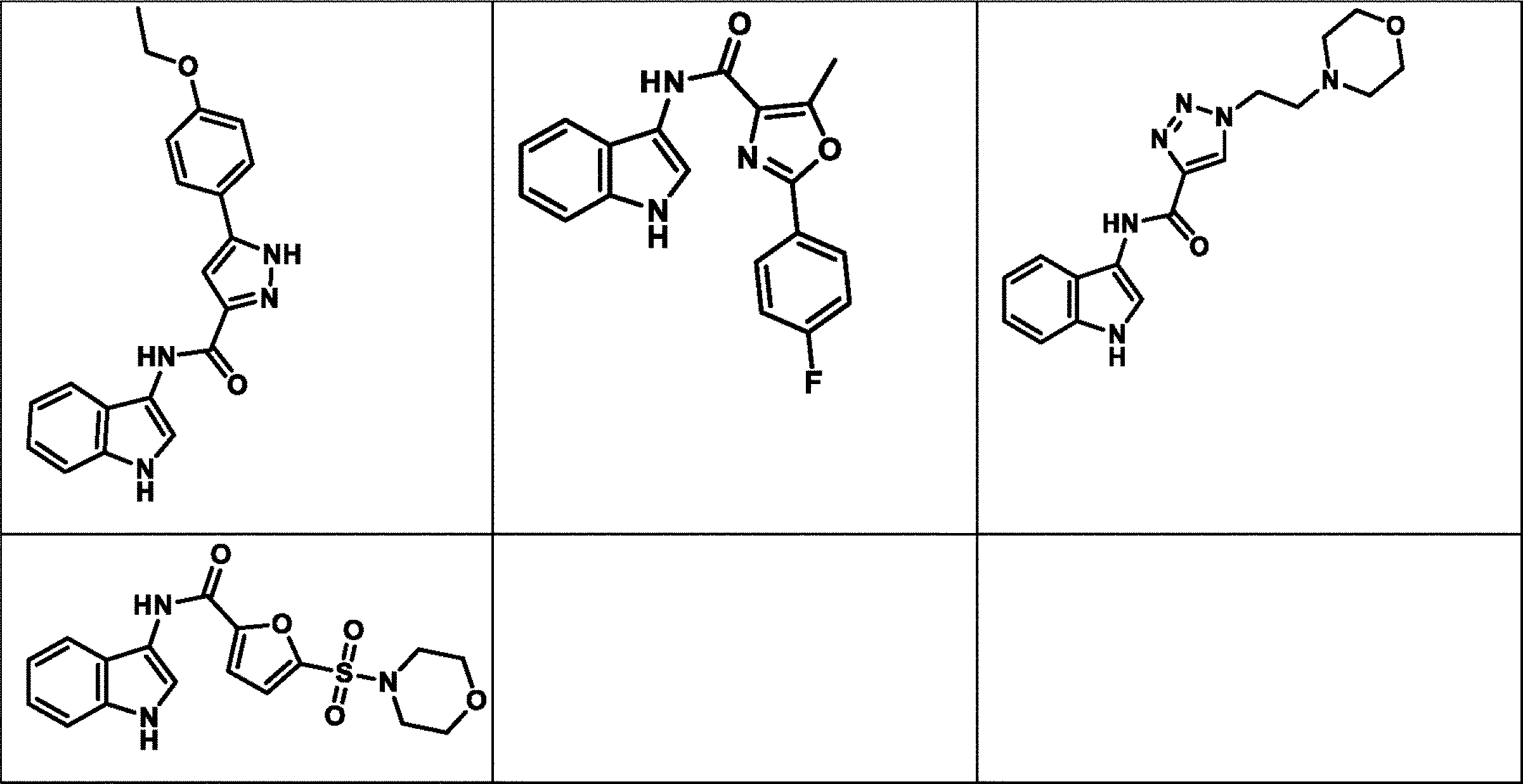
式(II)の化合物の一部の態様において、
1)環Cは、無置換モルホリニル、無置換ピロリジニル、無置換テトラヒドロフラニル、無置換シクロペンチル、一置換オキセタニル、メチルフラニル、無置換チオフェニル、およびメチルピロリル以外であるか、または
2)-(LA)a1-環Cは、無置換ベンジル、ならびに、-F、-OMe、および-OEtからなる群より選択される1個の置換基で置換されていてもよいフェニル以外である
ものとする。
In some embodiments of the compound of formula (II),
1) Ring C is other than unsubstituted morpholinyl, unsubstituted pyrrolidinyl, unsubstituted tetrahydrofuranyl, unsubstituted cyclopentyl, monosubstituted oxetanyl, methylfuranyl, unsubstituted thiophenyl, and methylpyrrolyl, or
2) -(L A ) a1 - Ring C is other than unsubstituted benzyl and phenyl optionally substituted with one substituent selected from the group consisting of -F, -OMe, and -OEt. Assume that there is.
式(III)の化合物の一部の態様において、化合物は

式(III)の化合物の一部の態様において、化合物は、WO 2013/114113または米国特許第10,000,481号に開示されている化合物以外であり、これらの文献のそれぞれは、参照によりその全体が本明細書に組み入れられる。 In some embodiments of the compound of formula (III), the compound is other than the compound disclosed in WO 2013/114113 or U.S. Patent No. 10,000,481, each of which is incorporated herein by reference in its entirety. be incorporated into the book.
式(III)の化合物の一部の態様において、化合物は、WO 2009/140320または米国特許第8,981,085号に開示されている化合物以外であり、これらの文献のそれぞれは、参照によりその全体が本明細書に組み入れられる。 In some embodiments of the compound of formula (III), the compound is other than a compound disclosed in WO 2009/140320 or U.S. Patent No. 8,981,085, each of which is incorporated herein by reference in its entirety. be incorporated into the book.
式(III)の一部の態様において、環Bが

非限定的な例示的化合物
一部の態様では、化合物は、表C1に示す化合物またはこれらの薬学的に許容される塩からなる群より選択される。
Non-Limiting Exemplary Compounds In some embodiments, the compound is selected from the group consisting of the compounds shown in Table C1 or a pharmaceutically acceptable salt thereof.


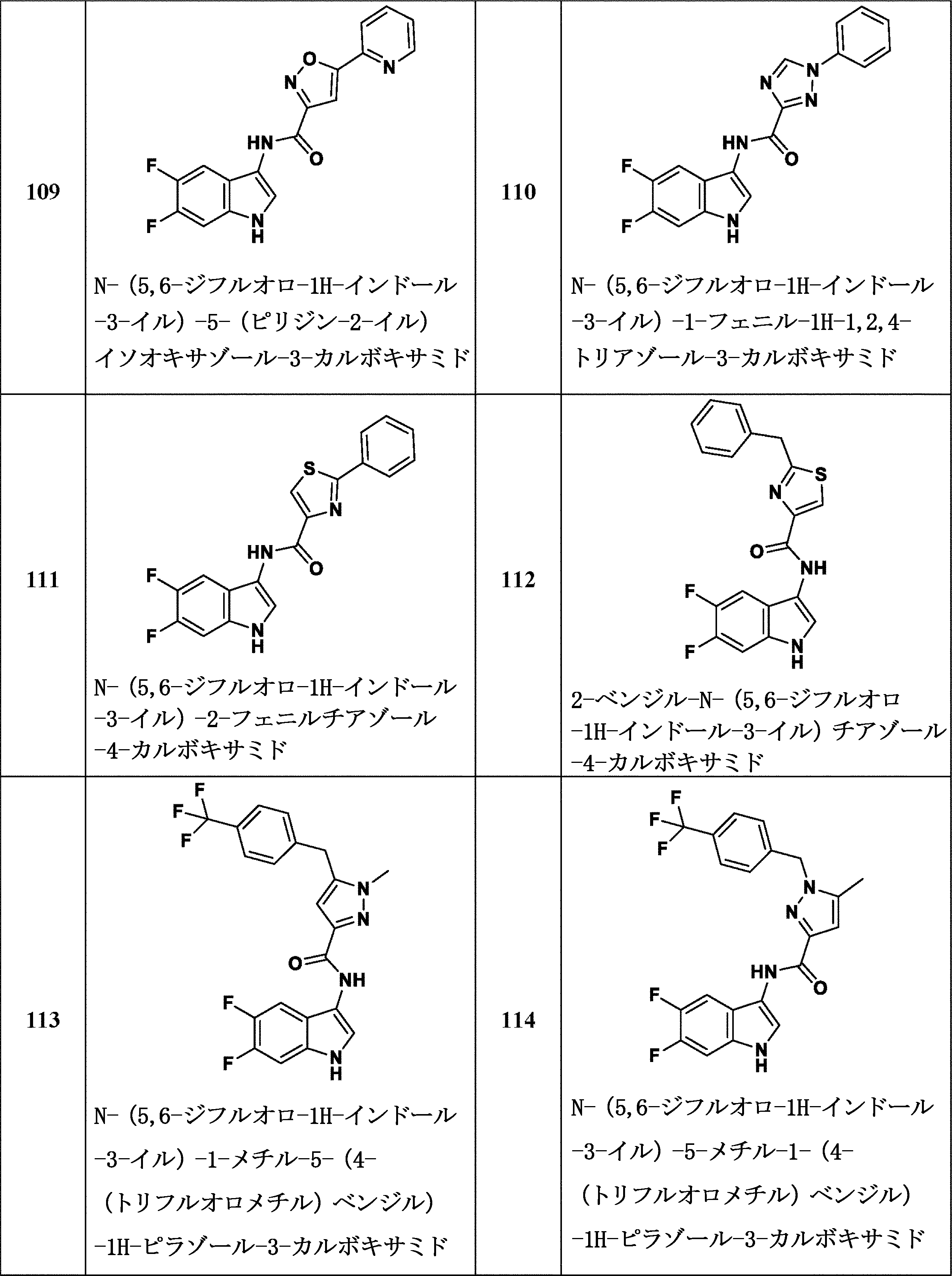
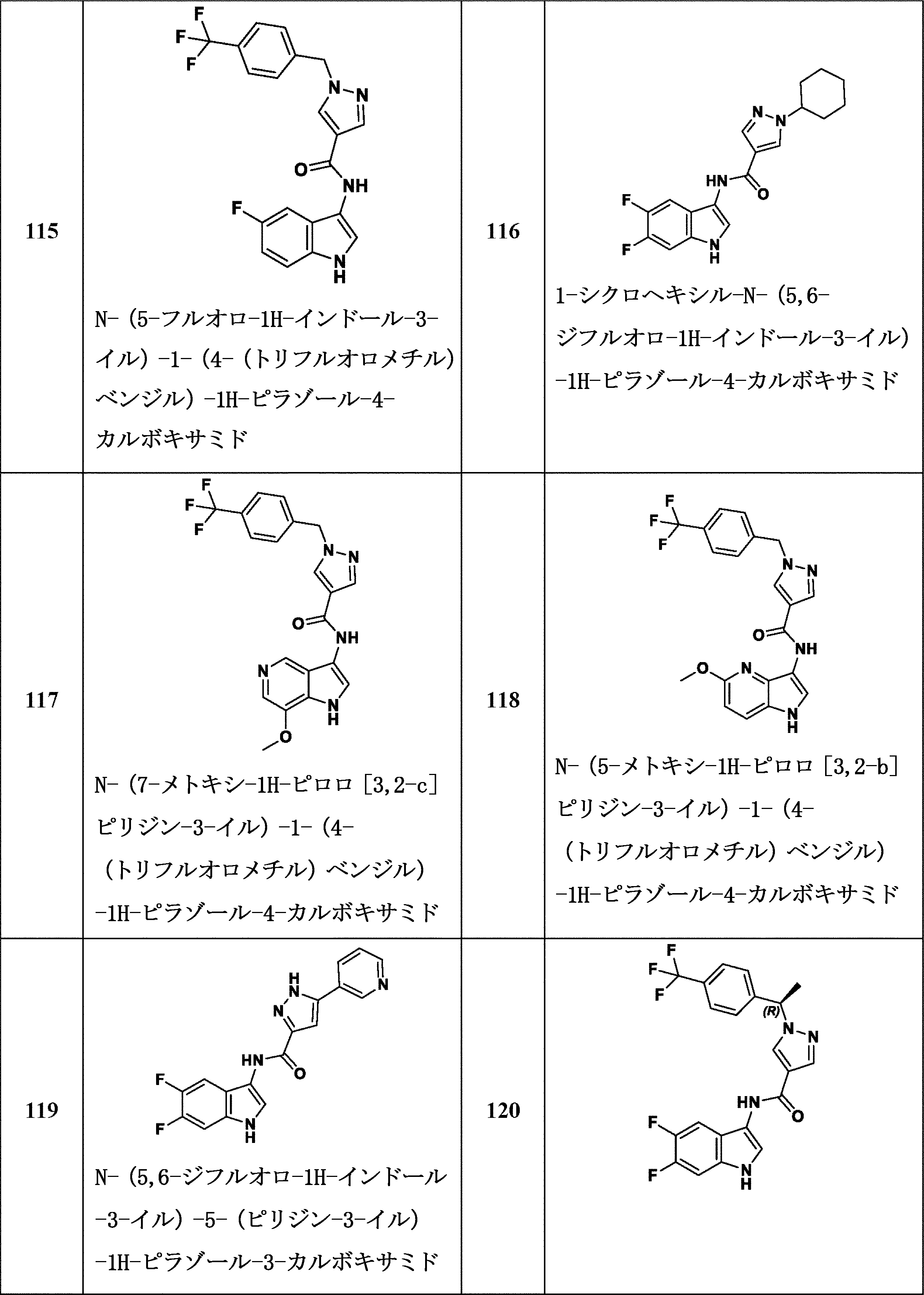


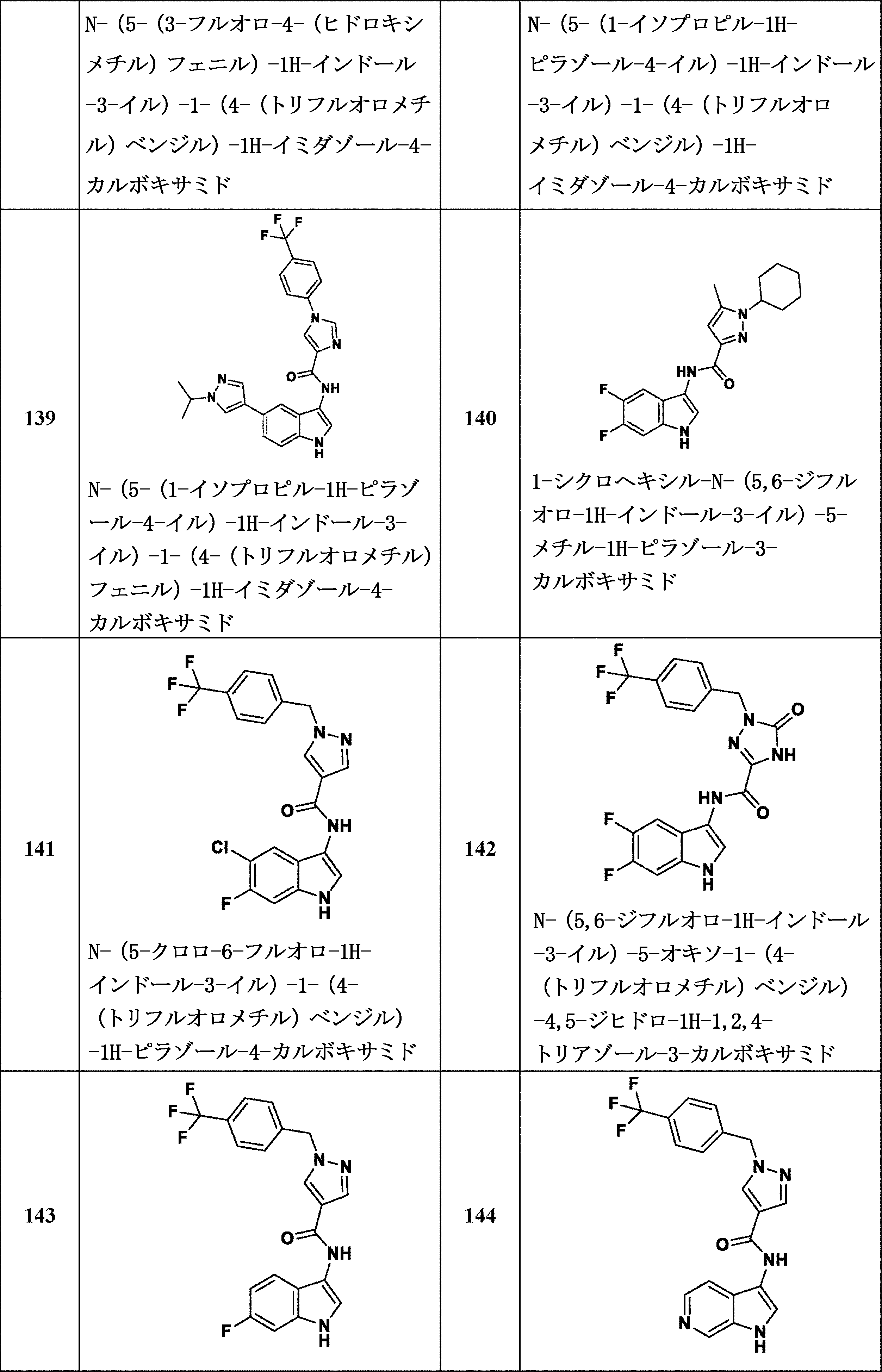


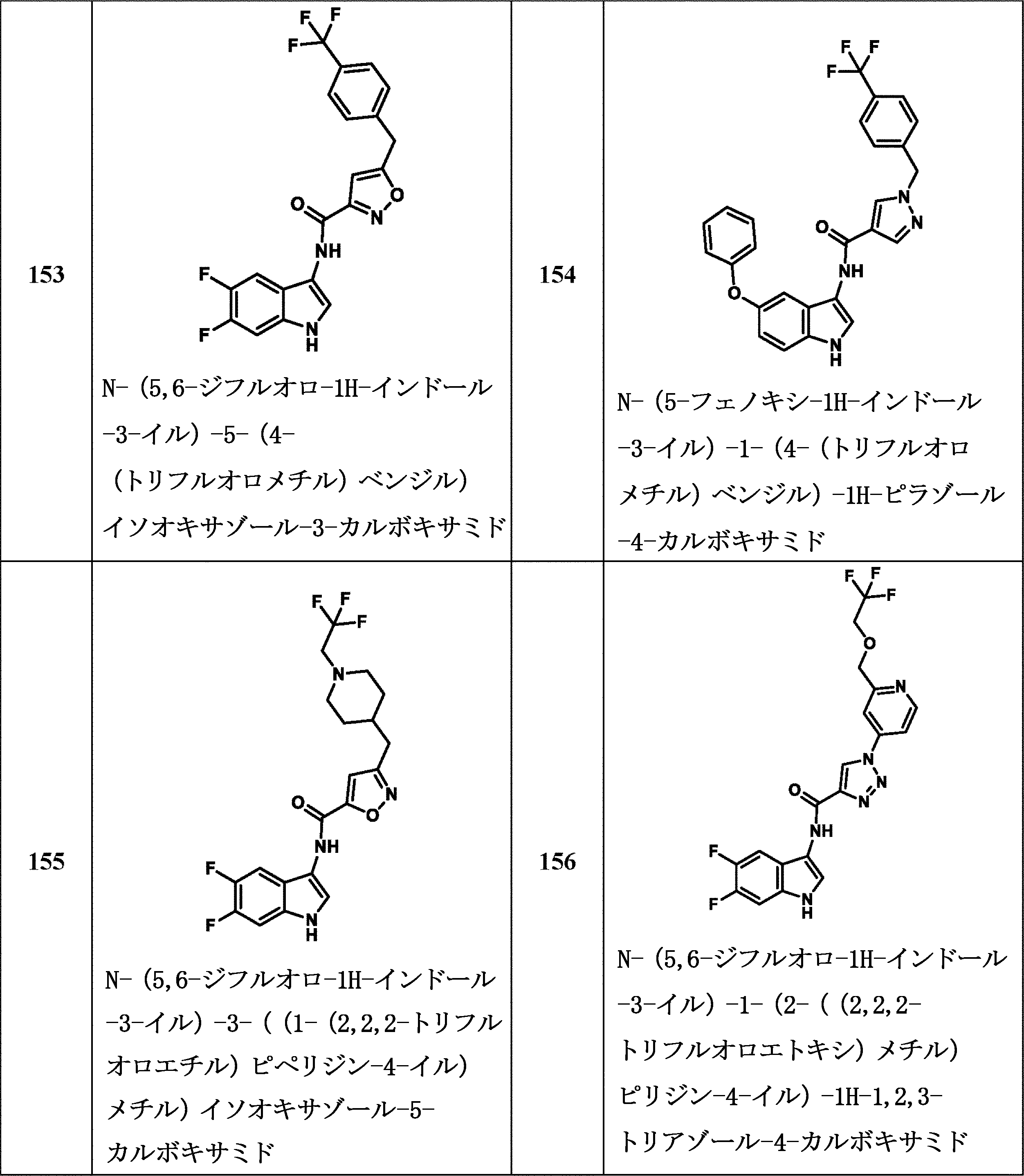


薬学的組成物および投与
概要
一部の態様では、化学的実体(例えば、STINGを阻害(例えば、アンタゴナイズ)する化合物、またはその薬学的に許容される塩、および/もしくは水和物、および/もしくは共結晶、および/もしくは組合せ薬物)は、化学的実体と1つまたは複数の薬学的に許容される賦形剤、および任意で本明細書に記載されるような1つまたは複数の追加の治療剤とを含む薬学的組成物として投与される。
Pharmaceutical Compositions and Administration Overview In some embodiments, a chemical entity, such as a compound that inhibits (e.g., antagonizes) STING, or a pharmaceutically acceptable salt thereof, and/or a hydrated (and/or co-crystals, and/or drug combinations) include a chemical entity and one or more pharmaceutically acceptable excipients, and optionally one or more pharmaceutically acceptable excipients as described herein. and multiple additional therapeutic agents.
一部の態様では、化学的実体は、1つまたは複数の従来の薬学的賦形剤と組み合わせて投与することができる。薬学的に許容される賦形剤としては、イオン交換体、アルミナ、ステアリン酸アルミニウム、レシチン、自己乳化性薬物送達システム(SEDDS)、例えば、コハク酸d-α-トコフェロールポリエチレングリコール1000、Tweenなどの薬学的投薬形態において使用される界面活性剤、ポロキサマーまたは他の類似したポリマー性送達マトリックス、血清タンパク質、例えば、ヒト血清アルブミン、緩衝物質、例えば、リン酸塩、トリス、グリシン、ソルビン酸、ソルビン酸カリウム、飽和植物脂肪酸の部分的グリセリド混合物、水、塩または電解質、例えば、硫酸プロタミン、リン酸水素二ナトリウム、リン酸水素カリウム、塩化ナトリウム、亜鉛塩、コロイダルシリカ、三ケイ酸マグネシウム、ポリビニルピロリドン、セルロースベースの物質、ポリエチレングリコール、カルボキシメチルセルロースナトリウム、ポリアクリル酸塩、ワックス、ポリエチレン-ポリオキシプロピレンブロックポリマー、および羊毛脂が挙げられるがそれに限定されるわけではない。α、β、およびγ-シクロデキストリンなどのシクロデキストリン、または2-および3-ヒドロキシプロピル-β-シクロデキストリンを含むヒドロキシアルキルシクロデキストリンなどの化学修飾誘導体、または他の可溶化された誘導体もまた、本明細書に記載の化合物の送達を増進するために使用することができる。0.005%~100%の範囲内の本明細書に記載されるような化学的実体を含有し、残部は非毒性の賦形剤から構成された投薬形態または組成物が調製されてもよい。想定される組成物は、0.001%~100%、一態様では0.1~95%、別の態様では75~85%、さらなる態様では20~80%の本明細書において提供される化学的実体を含有してもよい。そのような投薬形態を調製する実際の方法は当業者に公知、または明らかであり、例えば、Remington:The Science and Practice of Pharmacy,22ndEdition(Pharmaceutical Press,London,UK. 2012)を参照。 In some embodiments, the chemical entity can be administered in combination with one or more conventional pharmaceutical excipients. Pharmaceutically acceptable excipients include ion exchangers, alumina, aluminum stearate, lecithin, self-emulsifying drug delivery systems (SEDDS), such as d-alpha-tocopheryl succinate polyethylene glycol 1000, Tween, etc. Surfactants, poloxamers or other similar polymeric delivery matrices used in pharmaceutical dosage forms, serum proteins such as human serum albumin, buffer substances such as phosphate, Tris, glycine, sorbic acid, sorbic acid Potassium, partial glyceride mixtures of saturated vegetable fatty acids, water, salts or electrolytes such as protamine sulfate, disodium hydrogen phosphate, potassium hydrogen phosphate, sodium chloride, zinc salts, colloidal silica, magnesium trisilicate, polyvinylpyrrolidone, Examples include, but are not limited to, cellulose-based materials, polyethylene glycols, sodium carboxymethyl cellulose, polyacrylates, waxes, polyethylene-polyoxypropylene block polymers, and wool fat. Cyclodextrins, such as α, β, and γ-cyclodextrins, or chemically modified derivatives such as hydroxyalkylcyclodextrins, including 2- and 3-hydroxypropyl-β-cyclodextrins, or other solubilized derivatives, may also be used. Can be used to enhance the delivery of the compounds described herein. Dosage forms or compositions containing within the range of 0.005% to 100% of the chemical entities as described herein, with the remainder made up of non-toxic excipients, may be prepared. Envisioned compositions contain from 0.001% to 100%, in one aspect 0.1 to 95%, in another aspect 75 to 85%, and in a further aspect 20 to 80% of a chemical entity provided herein. You may. Actual methods of preparing such dosage forms will be known or apparent to those skilled in the art, see, eg, Remington: The Science and Practice of Pharmacy, 22nd Edition (Pharmaceutical Press, London, UK. 2012).
投与の経路および組成物成分
一部の態様では、本明細書に記載の化学的実体またはその薬学的組成物は、任意の承認される投与経路によりその必要がある対象に投与することができる。許容される投与経路としては、頬側、皮膚、子宮頸管内、洞内(endosinusial)、気管内、経腸、硬膜外、間質、腹部内、動脈内、気管支内、滑液包内、脳内、大槽内、冠内、皮内、腺管内、十二指腸内、硬膜内、表皮内、食道内、胃内、歯肉内、回腸内、リンパ内、髄内、髄膜内、筋肉内、卵巣内、腹腔内、前立腺内、肺内、洞内(intrasinal)、脊髄内、滑液嚢内、精巣内、髄腔内、管内、腫瘍内、子宮内、血管内、静脈内、経鼻、経鼻胃、経口、非経口、経皮(percutaneous)、硬膜周囲、直腸、呼吸(吸入)、皮下、舌下、粘膜下、外用、経皮(transdermal)、経粘膜、経気管、尿管、尿道および膣が挙げられるがそれに限定されるわけではない。ある特定の態様では、好ましい投与経路は非経口(例えば、腫瘍内)である。
Routes of Administration and Composition Components In some embodiments, the chemical entities described herein or pharmaceutical compositions thereof can be administered to a subject in need thereof by any approved route of administration. Acceptable routes of administration include buccal, cutaneous, intracervical, endosinusial, intratracheal, enteral, epidural, interstitial, intraabdominal, intraarterial, intrabronchial, intrasynovial, Intracerebral, intracisternal, intracoronary, intradermal, intraductal, intraduodenal, intradural, intraepidermal, intraesophageal, intragastric, intragingival, intraileal, intralymphatic, intramedullary, intrameningeal, intramuscular , intraovarian, intraperitoneal, intraprostatic, intrapulmonary, intrasinal, intraspinal, intrasynovial, intratesticular, intrathecal, intracanal, intratumoral, intrauterine, intravascular, intravenous, nasal, Nasogastric, oral, parenteral, percutaneous, peridural, rectal, respiratory (inhalation), subcutaneous, sublingual, submucosal, topical, transdermal, transmucosal, transtracheal, ureteral including, but not limited to, the urethra, and vagina. In certain embodiments, the preferred route of administration is parenteral (eg, intratumoral).
組成物は、非経口投与用に製剤化することができ、例えば、静脈内、筋肉内、皮下、またはさらには腹腔内経路を介する注射用に製剤化することができる。典型的には、そのような組成物は、注射可能液として、液体溶液または懸濁液のいずれかとして調製することができ、注射前に液体を添加して溶液または懸濁液を調製する使用のために好適な固体形態もまた調製することができ、調製物はまた、乳化され得る。そのような製剤の調製は、本開示に照らして当業者に公知である。 The compositions can be formulated for parenteral administration, eg, for injection via the intravenous, intramuscular, subcutaneous, or even intraperitoneal route. Typically, such compositions are prepared as injectables, either as liquid solutions or suspensions, with the addition of liquid prior to injection to prepare the solution or suspension. Solid forms suitable for the preparation can also be prepared and the preparations can also be emulsified. The preparation of such formulations is known to those skilled in the art in light of this disclosure.
注射可能な使用のために好適な薬学的形態としては、無菌水性溶液または分散体、ゴマ油、ピーナッツ油、または水性プロピレングリコールを含む製剤、および無菌の注射可能な溶液または分散体の即席調製用の無菌粉末が挙げられる。全ての場合に、形態は無菌でなければならず、容易に注射され得る程度まで流体でなければならない。それはまた、生産および貯蔵の条件下で安定であるべきであり、細菌および真菌などの微生物の夾雑作用に対して保護されなければならない。 The pharmaceutical forms suitable for injectable use include sterile aqueous solutions or dispersions, formulations containing sesame oil, peanut oil, or aqueous propylene glycol, and for the extemporaneous preparation of sterile injectable solutions or dispersions. Sterile powders may be mentioned. In all cases, the form must be sterile and must be fluid to the extent that easy syringability exists. It should also be stable under the conditions of production and storage and must be protected against the contaminating action of microorganisms such as bacteria and fungi.
担体はまた、例えば、水、エタノール、ポリオール(例えば、グリセロール、プロピレングリコール、および液体ポリエチレングリコールなど)、これらの好適な混合物、および植物油を含有する溶媒または分散媒体であることができる。適切な流動性は、例えば、レシチンなどのコーティングの使用により、分散体の場合には要求される粒子サイズの維持により、および界面活性剤の使用により維持することができる。微生物の作用の予防は、様々な抗菌剤および抗真菌剤、例えば、パラベン、クロロブタノール、フェノール、ソルビン酸、およびチメロサールなどによりもたらすことができる。多くの場合、等張剤、例えば、糖または塩化ナトリウムを含めることが好ましい。注射可能な組成物の持続吸収は、吸収を遅延させる剤、例えば、モノステアリン酸アルミニウムおよびゼラチンの組成物中での使用によりもたらすことができる。 The carrier can also be a solvent or dispersion medium containing, for example, water, ethanol, polyols such as glycerol, propylene glycol, and liquid polyethylene glycol, suitable mixtures thereof, and vegetable oils. Proper fluidity can be maintained, for example, by the use of coatings such as lecithin, by maintenance of the required particle size in the case of dispersions, and by the use of surfactants. Prevention of the action of microorganisms can be brought about by various antibacterial and antifungal agents, such as parabens, chlorobutanol, phenol, sorbic acid, and thimerosal. In many cases, it will be preferable to include isotonic agents, such as sugars or sodium chloride. Prolonged absorption of the injectable compositions can be brought about by the use in the composition of agents that delay absorption, for example, aluminum monostearate and gelatin.
無菌の注射可能な溶液は、要求に応じて、上記に列記される様々な他の成分と共に適切な溶媒中に要求される量の活性化合物を組み込み、続いて滅菌濾過することにより調製される。一般に、分散体は、基本的な分散媒体および上記に列記されるものからの要求される他の成分を含有する無菌媒体中に様々な滅菌された活性成分を組み込むことにより調製される。無菌の注射可能な溶液の調製用の無菌粉末の場合、調製の好ましい方法は真空乾燥およびフリーズドライ技術であり、これは、活性成分と、以前に滅菌濾過されたその溶液からの任意の追加の所望の成分との粉末をもたらす。 Sterile injectable solutions are prepared by incorporating the active compounds in the required amount in the appropriate solvent with various other ingredients enumerated above, as required, followed by filtered sterilization. Generally, dispersions are prepared by incorporating the various sterilized active ingredient into a sterile vehicle that contains the basic dispersion medium and the required other ingredients from those enumerated above. For sterile powders for the preparation of sterile injectable solutions, the preferred methods of preparation are vacuum drying and freeze-drying techniques, which remove the active ingredient and any additional additives from its previously sterile-filtered solution. yield a powder with the desired ingredients.
腫瘍内注射は、例えば、以下において議論されている:Lammers,et al.,“Effect of Intratumoral Injection on the Biodistribution and the Therapeutic Potential of HPMA Copolymer-Based Drug Delivery Systems”Neoplasia. 2006,10,788-795。 Intratumoral injection is discussed, for example, in: Lammers, et al., “Effect of Intratumoral Injection on the Biodistribution and the Therapeutic Potential of HPMA Copolymer-Based Drug Delivery Systems” Neoplasia. 2006, 10, 788-795.
ゲル、クリーム、浣腸、または直腸用坐剤として直腸組成物中で使用可能な薬理学的に許容される賦形剤としては、ココアバターグリセリド、合成ポリマー、例えば、ポリビニルピロリドン、PEG(PEG軟膏など)、グリセリン、グリセリンゼラチン、水添植物油、ポロキサマー、様々な分子量のポリエチレングリコールおよびポリエチレングリコールの脂肪酸エステルの混合物、ヴァセリン、無水ラノリン、サメ肝油、サッカリン酸ナトリウム、メントール、甘扁桃油、ソルビトール、安息香酸ナトリウム、アノキシドSBN、バニラ精油、エアロゾル、フェノキシエタノール中のパラベン、p-オキシ安息香酸メチルナトリウム、p-オキシ安息香酸プロピルナトリウム、ジエチルアミン、カルボマー、カーボポール、メチルオキシベンゾエート、マクロゴールセトステアリルエーテル、ココイルカプリロカプレート、イソプロピルアルコール、プロピレングリコール、液体パラフィン、キサンタンガム、カルボキシ-メタ重亜硫酸塩、エデト酸ナトリウム、安息香酸ナトリウム、メタ重亜硫酸カリウム、グレープフルーツ種子抽出物、メチルスルホニルメタン(MSM)、乳酸、グリシン、ビタミン、例えば、ビタミンAおよびE、ならびに酢酸カリウムのうちの任意の1つまたは複数が挙げられるがそれに限定されるわけではない。 Pharmacologically acceptable excipients that can be used in rectal compositions as gels, creams, enemas, or rectal suppositories include cocoa butter glycerides, synthetic polymers such as polyvinylpyrrolidone, PEG (PEG ointments, etc.) ), glycerin, glycerinated gelatin, hydrogenated vegetable oil, poloxamer, mixtures of polyethylene glycol and fatty acid esters of polyethylene glycol of various molecular weights, Vaseline, anhydrous lanolin, shark liver oil, sodium saccharinate, menthol, sweet almond oil, sorbitol, benzoic acid Sodium, anoxide SBN, vanilla essential oil, aerosol, parabens in phenoxyethanol, methyl sodium p-oxybenzoate, propyl sodium p-oxybenzoate, diethylamine, carbomer, carbopol, methyloxybenzoate, macrogolcetostearyl ether, cocoyl capri Rocaprate, isopropyl alcohol, propylene glycol, liquid paraffin, xanthan gum, carboxy-metabisulfite, sodium edetate, sodium benzoate, potassium metabisulfite, grapefruit seed extract, methylsulfonylmethane (MSM), lactic acid, glycine, Vitamins include, but are not limited to, any one or more of vitamins A and E, and potassium acetate.
ある特定の態様では、坐剤は、本明細書に記載の化学的実体を、周囲温度において固体であるが体温において液体であり、したがって直腸中で溶けて活性化合物を放出する好適な非刺激性の賦形剤または担体、例えば、ココアバター、ポリエチレングリコールまたは坐剤ワックスと混合することにより調製することができる。他の態様では、直腸投与用の組成物は浣腸の形態である。 In certain embodiments, suppositories contain the chemical entities described herein in a suitable non-irritating compound that is solid at ambient temperature but liquid at body temperature and thus dissolves in the rectum to release the active compound. excipients or carriers such as cocoa butter, polyethylene glycols or suppository waxes. In other embodiments, the composition for rectal administration is in the form of an enema.
他の態様では、本明細書に記載の化合物またはその薬学的組成物は、経口投与を介する消化管またはGI管への局所送達のために好適である(例えば、固体または液体投薬形態)。 In other embodiments, the compounds described herein or pharmaceutical compositions thereof are suitable for local delivery to the gastrointestinal or GI tract via oral administration (eg, solid or liquid dosage forms).
経口投与用の固体投薬形態としては、カプセル、錠剤、丸剤、粉末、および顆粒が挙げられる。そのような固体投薬形態において、化学的実体は、1つまたは複数の薬学的に許容される賦形剤、例えば、クエン酸ナトリウムまたはリン酸二カルシウム、ならびに/または、a)充填剤もしくは増量剤、例えば、デンプン、ラクトース、スクロース、グルコース、マンニトール、およびケイ酸、b)結合剤、例えば、カルボキシメチルセルロース、アルギン酸塩、ゼラチン、ポリビニルピロリジノン、スクロース、およびアカシアなど、c)湿潤剤、例えば、グリセロール、d)崩壊剤、例えば、アガー-アガー、炭酸カルシウム、ジャガイモもしくはタピオカデンプン、アルギン酸、ある特定のケイ酸塩、および炭酸ナトリウム、e)溶液遅延剤、例えば、パラフィン、f)吸収促進剤、例えば、第四級アンモニウム化合物、g)湿潤剤、例えば、セチルアルコールおよびモノステアリン酸グリセロールなど、h)吸収剤、例えば、カオリンおよびベントナイトクレイ、およびi)潤滑剤、例えば、タルク、ステアリン酸カルシウム、ステアリン酸マグネシウム、固体ポリエチレングリコール、ラウリル硫酸ナトリウム、ならびにこれらの混合物と混合される。カプセル、錠剤および丸剤の場合、投薬形態はまた、緩衝化剤を含んでもよい。類似した種類の固体組成物はまた、ラクトースまたは乳糖などのような賦形剤の他に高分子量ポリエチレングリコールなどを使用して軟質および硬質充填ゼラチンカプセル中の充填剤として用いることができる。 Solid dosage forms for oral administration include capsules, tablets, pills, powders, and granules. In such solid dosage forms, the chemical entity may contain one or more pharmaceutically acceptable excipients, such as sodium citrate or dicalcium phosphate, and/or a) fillers or fillers. , for example starch, lactose, sucrose, glucose, mannitol, and silicic acid; b) binders, such as carboxymethyl cellulose, alginate, gelatin, polyvinylpyrrolidinone, sucrose, and acacia; c) humectants, such as glycerol; d) Disintegrants, such as agar-agar, calcium carbonate, potato or tapioca starch, alginic acid, certain silicates, and sodium carbonate, e) Solution retarders, such as paraffin, f) Absorption enhancers, such as quaternary ammonium compounds, g) humectants, such as cetyl alcohol and glycerol monostearate, h) absorbents, such as kaolin and bentonite clay, and i) lubricants, such as talc, calcium stearate, magnesium stearate. , solid polyethylene glycol, sodium lauryl sulfate, as well as mixtures thereof. In the case of capsules, tablets and pills, the dosage form may also contain a buffering agent. Solid compositions of a similar type may also be employed as fillers in soft and hard-filled gelatin capsules using excipients such as lactose or milk sugar, as well as high molecular weight polyethylene glycols and the like.
一態様では、組成物は、丸剤または錠剤などの単位投薬形態の形態をとり、そのため、組成物は、本明細書において提供される化学的実体と共に、希釈剤、例えば、ラクトース、スクロース、またはリン酸二カルシウムなど、潤滑剤、例えば、ステアリン酸マグネシウムなど、および結合剤、例えば、デンプン、アカシアガム、ポリビニルピロリジン、ゼラチン、セルロース、またはセルロース誘導体などを含有してもよい。別の固体投薬形態において、粉末、マルメ(marume)、溶液または懸濁液(例えば、炭酸プロピレン、植物油、PEG、ポロキサマー124またはトリグリセリド中)はカプセル(ゼラチンまたはセルロース基剤カプセル)中に被包される。本明細書において提供される1つまたは複数の化学的実体または追加の活性剤が物理的に分離されている単位投薬形態、例えば、各薬物の顆粒を有するカプセル(またはカプセル中の錠剤)、2層錠剤、2コンパートメントゲルキャップなどもまた想定される。腸溶性コーティングまたは遅延放出経口投薬形態もまた想定される。 In one aspect, the composition takes the form of a unit dosage form, such as a pill or tablet, such that the composition, along with the chemical entities provided herein, contains a diluent, e.g., lactose, sucrose, or It may also contain lubricants such as dicalcium phosphate, such as magnesium stearate, and binders such as starch, gum acacia, polyvinylpyrrolidine, gelatin, cellulose, or cellulose derivatives. In another solid dosage form, the powder, marume, solution or suspension (e.g. in propylene carbonate, vegetable oil, PEG, poloxamer 124 or triglycerides) is encapsulated in capsules (gelatin or cellulose based capsules). Ru. A unit dosage form in which one or more chemical entities or additional active agents provided herein are physically separated, e.g., a capsule (or tablet in a capsule) having granules of each drug, two Layered tablets, two-compartment gel caps, etc. are also envisioned. Enteric coated or delayed release oral dosage forms are also envisioned.
他の生理学的に許容される化合物としては、湿潤剤、乳化剤、分散剤、または微生物の成長もしくは作用を予防するために具体的に有用な防腐剤が挙げられる。様々な防腐剤が周知であり、これには、例えば、フェノールおよびアスコルビン酸が含まれる。 Other physiologically acceptable compounds include wetting agents, emulsifying agents, dispersing agents, or preservatives specifically useful for preventing the growth or action of microorganisms. Various preservatives are well known and include, for example, phenol and ascorbic acid.
ある特定の態様では、賦形剤は無菌であり、かつ望ましくない物質を概して含まない。これらの組成物は、従来の周知の滅菌技術により滅菌することができる。錠剤およびカプセルなどの様々な経口投薬形態の賦形剤について、無菌状態は要求されない。USP/NF標準で通常十分である。 In certain embodiments, the excipient is sterile and generally free of undesirable materials. These compositions can be sterilized by conventional, well-known sterilization techniques. Sterility is not required for excipients in various oral dosage forms such as tablets and capsules. USP/NF standards are usually sufficient.
ある特定の態様では、固体経口投薬形態は、胃または下部GI、例えば、上行結腸および/もしくは横行結腸および/もしくは遠位結腸および/もしくは小腸への化学的実体の送達のための化学的および/または構造的な素因を組成物に与える1つまたは複数の成分をさらに含むことができる。例示的な製剤技術は、例えば、参照により全体が本明細書に組み込まれるFilipski,K. J.,et al.,Current Topics in Medicinal Chemistry,2013,13,776-802において記載されている。 In certain embodiments, the solid oral dosage form contains chemical and/or chemical entities for delivery of chemical entities to the stomach or lower GI, e.g., the ascending and/or transverse colon and/or the distal colon and/or the small intestine. Alternatively, the composition may further include one or more components that impart a structural predisposition to the composition. Exemplary formulation techniques are described, for example, in Filipski, K. J., et al., Current Topics in Medicinal Chemistry, 2013, 13, 776-802, which is incorporated herein by reference in its entirety.
例としては、上部GIターゲティング技術、例えば、Accordion Pill(Intec Pharma)、フローティングカプセル、および粘膜壁に接着できる材料が挙げられる。 Examples include upper GI targeting technologies such as the Accordion Pill (Intec Pharma), floating capsules, and materials that can adhere to mucosal walls.
他の例としては、下部GIターゲティング技術が挙げられる。腸管中の様々な領域を標的にするために、いくつかの腸溶性/pH応答性コーティングおよび賦形剤が使用可能である。これらの材料は、典型的には、所望の薬物放出のGI領域に基づいて選択される特定のpH範囲において溶解または侵食するように設計されるポリマーである。これらの材料はまた、酸不安定性薬物を胃液から保護するように、または、活性成分が上部GIに対して刺激性であり得る場合に曝露を制限するように機能する(例えば、フタル酸ヒドロキシプロピルメチルセルロース系列、Coateric(ポリ酢酸フタル酸ビニル)、酢酸フタル酸セルロース、酢酸コハク酸ヒドロキシプロピルメチルセルロース、Eudragit系列(メタクリル酸-メチルメタクリレートコポリマー)、およびMarcoat)。他の技術としては、GI管中での局所的なフローラに応答する投薬形態、圧力制御結腸送達カプセル、およびPulsincapが挙げられる。 Other examples include lower GI targeting techniques. Several enteric/pH-responsive coatings and excipients are available to target various areas in the intestinal tract. These materials are typically polymers designed to dissolve or erode at specific pH ranges selected based on the GI region of desired drug release. These materials also function to protect acid-labile drugs from gastric fluids or to limit exposure if the active ingredient can be irritating to the upper GI (e.g., hydroxypropyl phthalate). Methylcellulose series, Coateric (polyvinyl acetate phthalate), cellulose acetate phthalate, hydroxypropyl methylcellulose acetate succinate, Eudragit series (methacrylic acid-methyl methacrylate copolymer), and Marcoat). Other techniques include dosage forms that respond to local flora in the GI tract, pressure-controlled colonic delivery capsules, and Pulsincap.
眼用組成物は、ビスコーゲン(例えば、カルボキシメチルセルロース、グリセリン、ポリビニルピロリドン、ポリエチレングリコール)、安定化剤(例えば、Pluronic(トリブロックコポリマー)、シクロデキストリン)、防腐剤(例えば、塩化ベンザルコニウム、ETDA、SofZia(ホウ酸、プロピレングリコール、ソルビトール、および塩化亜鉛、Alcon Laboratories,Inc.)、Purite(安定化オキシクロロ複合体、Allergan,Inc.))のうちのいずれかの1つまたは複数を含むことができるがそれに限定されるわけではない。 Ophthalmic compositions contain viscogen (e.g. carboxymethylcellulose, glycerin, polyvinylpyrrolidone, polyethylene glycol), stabilizers (e.g. Pluronic (triblock copolymer), cyclodextrin), preservatives (e.g. benzalkonium chloride, ETDA). , SofZia (boric acid, propylene glycol, sorbitol, and zinc chloride, Alcon Laboratories, Inc.), Purite (stabilized oxychloro complex, Allergan, Inc.) Yes, but not limited to that.
外用組成物としては、軟膏およびクリームを挙げることができる。軟膏は、典型的にはワセリンまたは他の石油誘導体に基づく半固体調製物である。選択される活性剤を含有するクリームは、多くの場合に水中油または油中水のいずれかの、典型的には粘性液体または半固体エマルションである。クリーム基剤は典型的には水可洗性であり、油相、乳化剤および水性相を含有する。「内」相と呼ばれることもある油相は、一般に、ワセリンおよび脂肪族アルコール、例えば、セチルまたはステアリルアルコールを含み、水性相は、必ずしもそうではないが通常、体積において油相を上回り、一般に湿潤剤を含有する。クリーム製剤中の乳化剤は、一般に、非イオン性、陰イオン性、陽イオン性または両性の界面活性剤である。他の担体または媒体と同様に、軟膏基剤は、不活性、安定、非刺激性および非感作性であるべきである。 External compositions may include ointments and creams. Ointments are semisolid preparations typically based on petrolatum or other petroleum derivatives. Creams containing the active agent of choice are typically viscous liquid or semisolid emulsions, often either oil-in-water or water-in-oil. Cream bases are typically water washable and contain an oil phase, an emulsifier and an aqueous phase. The oil phase, sometimes referred to as the "inner" phase, generally contains petrolatum and an aliphatic alcohol, such as cetyl or stearyl alcohol, and the aqueous phase usually, but not necessarily, exceeds the oil phase in volume and is generally moist. Contains an agent. Emulsifiers in cream formulations are generally nonionic, anionic, cationic or amphoteric surfactants. Like other carriers or vehicles, ointment bases should be inert, stable, nonirritating and nonsensitizing.
前記の態様のいずれかにおいて、本明細書に記載の薬学的組成物は、脂質、二重層間架橋マルチラメラ小胞、生分解性(biodegradeable)ポリ(D,L-乳酸-コ-グリコール酸)[PLGA]ベースまたはポリ無水物ベースのナノ粒子またはマイクロ粒子、およびナノポーラス粒子サポート脂質二重層のうちの1つまたは複数、1つまたは複数を含むことができる。 In any of the foregoing embodiments, the pharmaceutical composition described herein comprises a lipid, an interbilayer crosslinked multilamellar vesicle, a biodegradeable poly(D,L-lactic-co-glycolic acid) [PLGA]-based or polyanhydride-based nanoparticles or microparticles, and nanoporous particles supported lipid bilayers.
投薬量
投薬量は、患者の要求、治療されている状態の重症度および用いられている具体的な化合物に依存して変動してもよい。具体的な状況のための適切な投薬量の決定は、医療分野の当業者により決定され得る。合計の1日当たりの投薬量は、1日を通して小分けで、または連続的な送達を提供する手段により、分割して投与されても投与されてもよい。
Dosage Dosage may vary depending on the needs of the patient, the severity of the condition being treated and the particular compound being used. Determination of the appropriate dosage for a particular situation can be determined by one of ordinary skill in the medical arts. The total daily dosage may be administered in divided doses or by means of providing continuous delivery throughout the day.
一部の態様では、本明細書に記載の化合物は、約0.001mg/Kg~約500mg/Kg(例えば、約0.001mg/Kg~約200mg/Kg、約0.01mg/Kg~約200mg/Kg、約0.01mg/Kg~約150mg/Kg、約0.01mg/Kg~約100mg/Kg、約0.01mg/Kg~約50mg/Kg、約0.01mg/Kg~約10mg/Kg、約0.01mg/Kg~約5mg/Kg、約0.01mg/Kg~約1mg/Kg、約0.01mg/Kg~約0.5mg/Kg、約0.01mg/Kg~約0.1mg/Kg、約0.1mg/Kg~約200mg/Kg、約0.1mg/Kg~約150mg/Kg、約0.1mg/Kg~約100mg/Kg、約0.1mg/Kg~約50mg/Kg、約0.1mg/Kg~約10mg/Kg、約0.1mg/Kg~約5mg/Kg、約0.1mg/Kg~約1mg/Kg、約0.1mg/Kg~約0.5mg/Kg)の投薬量で投与される。 In some embodiments, the compounds described herein are about 0.001 mg/Kg to about 500 mg/Kg (e.g., about 0.001 mg/Kg to about 200 mg/Kg, about 0.01 mg/Kg to about 200 mg/Kg, Approximately 0.01mg/Kg to approximately 150mg/Kg, approximately 0.01mg/Kg to approximately 100mg/Kg, approximately 0.01mg/Kg to approximately 50mg/Kg, approximately 0.01mg/Kg to approximately 10mg/Kg, approximately 0.01mg/Kg to Approx. 5mg/Kg, approx. 0.01mg/Kg to approx. 1mg/Kg, approx. 0.01mg/Kg to approx. 0.5mg/Kg, approx. 0.01mg/Kg to approx. 0.1mg/Kg, approx. 0.1mg/Kg to approx. 200mg/Kg , about 0.1mg/Kg to about 150mg/Kg, about 0.1mg/Kg to about 100mg/Kg, about 0.1mg/Kg to about 50mg/Kg, about 0.1mg/Kg to about 10mg/Kg, about 0.1mg/Kg to about 5 mg/Kg, about 0.1 mg/Kg to about 1 mg/Kg, about 0.1 mg/Kg to about 0.5 mg/Kg).
レジメン
前記の投薬量は、1日毎を基準にして(例えば、単回用量としてまたは2つもしくはそれ以上の分割用量として)または1日毎を基準とせずに(例えば、1日おき、2日毎、3日毎、週に1回、週に2回、2週毎に1回、月に1回)投与することができる。
Regimens The above dosages may be administered on a daily basis (e.g., as a single dose or as two or more divided doses) or on a non-daily basis (e.g., every other day, every 2 days, every 3 days). It can be administered (daily, once a week, twice a week, once every two weeks, once a month).
一部の態様では、本明細書に記載の化合物の投与の期間は、1日、2日、3日、4日、5日、6日、7日、8日、9日、10日、11日、12日、13日、14日、3週、4週、5週、6週、7週、8週、9週、10週、11週、12週、4か月、5か月、6か月、7か月、8か月、9か月、10か月、11か月、12か月、またはそれ以上である。さらなる態様では、投与が中止される期間は、1日、2日、3日、4日、5日、6日、7日、8日、9日、10日、11日、12日、13日、14日、3週、4週、5週、6週、7週、8週、9週、10週、11週、12週、4か月、5か月、6か月、7か月、8か月、9か月、10か月、11か月、12か月、またはそれ以上である。一態様では、治療用化合物は、ある期間に、続いて別々の期間に個体に投与される。別の態様では、治療用化合物は、第1の期間に、および第2の期間中に投与が中止される第1の期間後の第2の期間に、続いて治療用化合物の投与が開始される第3の期間に、次に投与が中止される第3の期間後の第4の期間に投与される。この態様の一局面では、治療用化合物の投与の期間、続いて投与が中止される期間は、決定されたまたは未決定の期間にわたり繰り返される。さらなる態様では、投与の期間は、1日、2日、3日、4日、5日、6日、7日、8日、9日、10日、11日、12日、13日、14日、3週、4週、5週、6週、7週、8週、9週、10週、11週、12週、4か月、5か月、6か月、7か月、8か月、9か月、10か月、11か月、12か月、またはそれ以上である。さらなる態様では、投与が中止される期間は、1日、2日、3日、4日、5日、6日、7日、8日、9日、10日、11日、12日、13日、14日、3週、4週、5週、6週、7週、8週、9週、10週、11週、12週、4か月、5か月、6か月、7か月、8か月、9か月、10か月、11か月、12か月、またはそれ以上である。 In some embodiments, the period of administration of the compounds described herein is 1 day, 2 days, 3 days, 4 days, 5 days, 6 days, 7 days, 8 days, 9 days, 10 days, 11 days. Day, 12th, 13th, 14th, 3 weeks, 4 weeks, 5 weeks, 6 weeks, 7 weeks, 8 weeks, 9 weeks, 10 weeks, 11 weeks, 12 weeks, 4 months, 5 months, 6 months, 7 months, 8 months, 9 months, 10 months, 11 months, 12 months, or more. In further embodiments, the period during which administration is discontinued is 1 day, 2 days, 3 days, 4 days, 5 days, 6 days, 7 days, 8 days, 9 days, 10 days, 11 days, 12 days, 13 days. , 14 days, 3 weeks, 4 weeks, 5 weeks, 6 weeks, 7 weeks, 8 weeks, 9 weeks, 10 weeks, 11 weeks, 12 weeks, 4 months, 5 months, 6 months, 7 months, 8 months, 9 months, 10 months, 11 months, 12 months, or more. In one aspect, the therapeutic compound is administered to an individual in one period followed by separate periods. In another aspect, the therapeutic compound is administered during a first period and a second period after the first period in which administration of the therapeutic compound is subsequently discontinued during the second period. and then in a fourth period after the third period when administration is discontinued. In one aspect of this embodiment, the period of administration of the therapeutic compound, followed by the period of cessation of administration, is repeated for a determined or undetermined period of time. In further embodiments, the period of administration is 1 day, 2 days, 3 days, 4 days, 5 days, 6 days, 7 days, 8 days, 9 days, 10 days, 11 days, 12 days, 13 days, 14 days. , 3 weeks, 4 weeks, 5 weeks, 6 weeks, 7 weeks, 8 weeks, 9 weeks, 10 weeks, 11 weeks, 12 weeks, 4 months, 5 months, 6 months, 7 months, 8 months , 9 months, 10 months, 11 months, 12 months, or more. In further embodiments, the period during which administration is discontinued is 1 day, 2 days, 3 days, 4 days, 5 days, 6 days, 7 days, 8 days, 9 days, 10 days, 11 days, 12 days, 13 days. , 14 days, 3 weeks, 4 weeks, 5 weeks, 6 weeks, 7 weeks, 8 weeks, 9 weeks, 10 weeks, 11 weeks, 12 weeks, 4 months, 5 months, 6 months, 7 months, 8 months, 9 months, 10 months, 11 months, 12 months, or more.
治療の方法
一部の態様では、STING活性(例えば、STINGシグナル伝達など)の増大(例えば、亢進)が状態、疾患、または障害(例えば、免疫障害、がん)の病態および/または症状および/または進行の一因となる状態、疾患、または障害を有する対象を治療するための方法が提供される。
Methods of Treatment In some embodiments, increasing (e.g., enhancing) STING activity (e.g., STING signaling) is associated with the pathology and/or symptoms and/or symptoms of a condition, disease, or disorder (e.g., immune disorder, cancer). Methods are provided for treating a subject having a condition, disease, or disorder that contributes to or contributes to the progression of the disease.
適応症
一部の態様では、状態、疾患、または障害はがんである。がんの非限定的な例としては、黒色腫、がん腫、リンパ腫、芽細胞腫、肉腫、および白血病またはリンパ系悪性腫瘍が挙げられる。そのようながんのより具体的な例としては、乳がん、結腸がん、直腸がん、結腸直腸がん、腎臓(kidney)または腎臓(renal)がん、明細胞がん、小細胞肺がん、非小細胞肺がん、肺の腺がんおよび肺の扁平がんを含む肺がん、扁平細胞がん(例えば、上皮扁平細胞がん)、子宮頸がん、卵巣がん、前立腺がん、前立腺新生物、肝臓がん、膀胱がん、腹膜のがん、肝細胞がん、胃腸がんを含む胃(gastric)または胃(stomach)がん、消化管間質腫瘍、膵臓がん、頭頸部がん、膠芽腫、網膜芽腫、星状細胞腫、莢膜細胞腫、アレノブラストーマ、ヘパトーマ、非ホジキンリンパ腫(NHL)、多発性骨髄腫、脊髄形成異常障害、骨髄増殖性障害、慢性骨髄性白血病、および急性血液学的悪性腫瘍を含む血液学的悪性腫瘍、子宮内膜または子宮がん、子宮内膜症、子宮内膜間質肉腫、線維肉腫、絨毛がん、唾液腺がん、外陰部がん、甲状腺がん(thyroid cancer)、食道がん、肝がん、肛門がん、陰茎がん、鼻咽頭がん、喉頭がん、カポジ肉腫、肥満細胞肉腫、卵巣肉腫、子宮肉腫、黒色腫、悪性中皮腫、皮膚がん、神経鞘腫、乏突起膠腫、神経芽腫、神経外胚葉性腫瘍、横紋筋肉腫、骨原性肉腫、平滑筋肉腫、ユーイング肉腫、末梢性未分化神経外胚葉性腫瘍、尿路がん、甲状腺がん(thyroid carcinoma)、ウィルムス腫瘍の他に、母斑症に関連する異常な血管増殖、浮腫(例えば、脳腫瘍に関連するもの)、ならびにメーグス症候群が挙げられる。一部の場合には、がんは黒色腫である。
Indications In some embodiments, the condition, disease, or disorder is cancer. Non-limiting examples of cancer include melanoma, carcinoma, lymphoma, blastoma, sarcoma, and leukemia or lymphoid malignancies. More specific examples of such cancers include breast cancer, colon cancer, rectal cancer, colorectal cancer, kidney or renal cancer, clear cell cancer, small cell lung cancer, Lung cancer, including non-small cell lung cancer, adenocarcinoma of the lung and squamous carcinoma of the lung, squamous cell carcinoma (e.g. epithelial squamous cell carcinoma), cervical cancer, ovarian cancer, prostate cancer, prostate neoplasm , gastric or stomach cancers, including liver cancer, bladder cancer, peritoneal cancer, hepatocellular carcinoma, gastrointestinal cancer, gastrointestinal stromal tumors, pancreatic cancer, head and neck cancer. , glioblastoma, retinoblastoma, astrocytoma, capsular cell tumor, arenoblastoma, hepatoma, non-Hodgkin's lymphoma (NHL), multiple myeloma, myelodysplasia, myeloproliferative disorder, chronic myeloid Leukemia and hematological malignancies, including acute hematological malignancies, endometrial or uterine cancer, endometriosis, endometrial stromal sarcoma, fibrosarcoma, choriocarcinoma, salivary gland cancer, vulva Cancer, thyroid cancer, esophageal cancer, liver cancer, anal cancer, penile cancer, nasopharyngeal cancer, laryngeal cancer, Kaposi's sarcoma, mast cell sarcoma, ovarian sarcoma, uterine sarcoma, melanoma malignant mesothelioma, skin cancer, schwannoma, oligodendroglioma, neuroblastoma, neuroectodermal tumor, rhabdomyosarcoma, osteogenic sarcoma, leiomyosarcoma, Ewing sarcoma, peripheral tumor Differentiated neuroectodermal tumors, urinary tract cancer, thyroid carcinoma, Wilms tumor, as well as abnormal vascular proliferation associated with nevi, edema (e.g., associated with brain tumors), and Meigs Syndromes include. In some cases, the cancer is melanoma.
一部の態様では、状態、疾患、または障害は神経学的障害であり、これには中枢神経系(脳、脳幹および小脳)、末梢神経系(頭蓋神経を含む)、および自律神経系(その部分は中枢および末梢神経系の両方に位置する)を伴う障害が含まれる。そのような神経学的障害の非限定的な例としては、後天性てんかん性失語症、急性散剤性脳脊髄炎、副腎白質ジストロフィー、加齢黄斑変性症、脳梁の形成不全、失認症、アイカルディ症候群、アレキサンダー病、アルパーズ病、交互性片麻痺、アルツハイマー病、血管性認知症、筋萎縮性側索硬化症、無脳症、アンジェルマン症候群、血管腫症、無酸素症、失語症、失行症、クモ膜嚢胞、クモ膜炎、アンロンル(Anronl)-キアリ奇形、動静脈奇形、アスペルガー症候群、毛細血管拡張性運動失調症(ataxia telegiectasia)、注意欠陥多動性障害、自閉症、自律機能障害、背部痛、バッテン病、ベーチェット病、ベル麻痺、良性本態性眼瞼痙攣、良性巣状(benign focal)、筋萎縮、良性頭蓋内高血圧、ビンスワンガー病、眼瞼痙攣、ブロッホ・サルツバーガー症候群、上腕神経叢傷害、脳膿瘍、脳傷害、脳腫瘍(多形膠芽腫を含む)、脊髄腫瘍、ブラウン-セカール症候群、カナバン病、手根管症候群、灼熱痛、中枢性疼痛症候群、橋中心髄鞘融解、頭部障害、脳動脈瘤、脳動脈硬化症、脳萎縮、脳性巨人症、脳性麻痺、シャルコーマリートゥース病、化学療法誘発性ニューロパチーおよび神経障害性疼痛、キアリ奇形、舞踏病、慢性炎症性脱髄性多発ニューロパチー、慢性疼痛、慢性局所疼痛症候群、コフィン・ローリー症候群、持続性植物状態を含む昏睡、先天性顔面両麻痺、大脳皮質基底核変性症、頭蓋動脈炎、頭蓋縫合早期癒合症、クロイツフェルト・ヤコブ病、累積外傷性障害、クッシング症候群、巨細胞封入体症、サイトメガロウイルス感染症、ダンシングアイズ-ダンシングフィート症候群、ダンディー・ウォーカー症候群、ドーソン病、ドモルシア症候群、デジェリーヌ-クランケ(Klumke)麻痺、認知症、皮膚筋炎、糖尿病性ニューロパチー、びまん性硬化症、自律神経失調症、書字障害、失読症、ジストニア、早期乳児てんかん性脳症、エンプティセラ症候群、脳炎、脳ヘルニア、大脳三叉神経性血管腫症、癲癇、エルブ麻痺、本態性振戦、ファブリー病、ファール症候群、失神、家族性痙性麻痺、熱性発作、フィッシャー症候群、フリードライヒ運動失調症、前頭側頭型認知症および他の「タウオパチー」、ゴーシェ病、ゲルストマン症候群、巨細胞性動脈炎、巨細胞封入体病、グロボイド細胞白質ジストロフィー、ギラン・バレー症候群、HTLV-1関連脊髄症、ハラーホルデン-スパッツ病、頭部傷害、頭痛、片側顔面攣縮、遺伝性痙性対麻痺、多発神経炎型遺伝性失調症、耳帯状疱疹、帯状疱疹、平山症候群、HIV関連認知症およびニューロパチー(AIDSの神経学的症状でもある)、全前脳胞症、ハンチントン病および他のポリグルタミンリピート病、水頭性無脳症、水頭症、高コルチゾール症、低酸素、免疫介在性脳脊髄炎、封入体筋炎、色素失調症、乳児フィタン酸蓄積症、乳児レフサム病、点頭てんかん、炎症性ミオパチー、頭蓋内嚢胞、頭蓋内高血圧、ジュベール症候群、カーンズ-セイヤー症候群、ケネディ病、キンスボーン症候群、クリッペル・ファイル症候群、クラッベ病、クーゲルベルグ-ウェランダー病、クールー、ラフォラ病、ランバート・イートン筋無力症候群、ランダウ-クレフナー症候群、延髄外側(ワレンベルグ)症候群、学習障害、リー病、レノックス-ガストー(Lennox-Gustaut)症候群、レッシュ-ナイハン症候群、白質ジストロフィー、レビー小体型認知症、滑脳症、閉じ込め症候群、ルー-ゲーリッグ病(すなわち、運動ニューロン疾患または筋萎縮性側索硬化症)、腰椎椎間板症、ライム病-神経学的続発症、マチャド-ジョセフ病、大脳症(macrencephaly)、巨脳症(megalencephaly)、メルカーソン-ローゼンタール症候群、メニエール病(Menieres disease)、髄膜炎、メンケス病、異染性白質ジストロフィー、小頭症、片頭痛、ミラー・フィッシャー症候群、小卒中、ミトコンドリアミオパチー、メビウス症候群、単肢筋萎縮、運動ニューロン疾患、もやもや病、ムコ多糖症、多発梗塞性(milti-infarct)認知症、多巣性運動ニューロパチー、多発性硬化症および他の脱髄性障害、起立性低血圧を伴う多系統萎縮(multiple system atrophy)、p筋ジストロフィー(p muscular dystrophy)、重症筋無力症、髄鞘破壊性(myelinoclastic)びまん性硬化症、乳児のミオクローヌス性脳症、ミオクローヌス、ミオパチー、先天性筋硬直症、ナルコレプシー、神経線維腫症、神経遮断薬悪性症候群、AIDSの神経学的症状、ループスの神経学的続発症、神経性筋強直症、神経セロイドリポフスチン症、ニューロン移動障害、ニーマン-ピック病、オサリバン-マクロード症候群、後頭神経痛、潜在性脊椎癒合不全症(occult spinal dysraphism sequence)、大田原症候群、オリーブ橋小脳萎縮症、オプソクローヌス-ミオクローヌス、視神経炎、起立性低血圧、過用症候群、知覚異常、パーキンソン病、先天性パラミオトニア、傍腫瘍随伴性疾患(paraneoplastic disease)、発作、ペイリー・ロンベルク症候群、ペリツェウス-メルツバッハー病、周期性麻痺、末梢性ニューロパチー、有痛性ニューロパチーおよび神経障害性疼痛、持続性植物状態、広汎性発達障害、光くしゃみ反射、フィタン酸蓄積症、ピック病、圧迫神経(pinched nerve)、下垂体腫瘍、多発性筋炎、孔脳症、ポストポリオ症候群、帯状疱疹後神経痛、感染後脳脊髄炎、起立性低血圧、プラダー-ウィリ症候群、原発性側索硬化症、プリオン病、進行性片側顔面萎縮、進行性多巣性白質脳症、進行性硬化性ポリオジストロフィー、進行性核上麻痺、偽脳腫瘍、ラムゼイ-ハント症候群(I型およびII型)、ラスムッセン脳炎、反射性交感神経性ジストロフィー症候群、レフサム病、反復性運動障害、反復性ストレス傷害、レストレスレッグ症候群、レトロウイルス関連脊髄症、レット症候群、ライ症候群、舞踏病、サンドホッフ病、シルダー病、裂脳症、中隔視神経異形成症、乳幼児揺さぶられ症候群、帯状疱疹、シャイ-ドレーガー症候群、シェーグレン症候群、睡眠時無呼吸、ソトス症候群、痙縮、二分脊椎、脊髄傷害、脊髄腫瘍、脊髄性筋萎縮症、スティッフパーソン症候群、卒中、スタージ-ウェーバー症候群、亜急性硬化性全脳炎、皮質下動脈硬化性脳症、シデナム舞踏病、失神、脊髄空洞症、遅発性ジスキネジア、テイ-サックス病、側頭動脈炎、脊髄係留症候群、トムゼン病、胸郭出口症候群、三叉神経痛、トッド麻痺、トゥレット症候群、一過性虚血発作、伝達性海綿状脳症、横断性脊髄炎、外傷性脳傷害、振戦、三叉神経痛、熱帯性痙性対麻痺、結節硬化症、血管性認知症(多発梗塞性認知症)、側頭動脈炎を含む血管炎、フォンヒッペル-リンドウ病、ワレンベルグ症侯群、ウェルドニッヒ-ホフマン病、ウエスト症候群、むち打ち症、ウィリアムズ症候群、ウィルドン病(Wildon's disease)、筋萎縮性(amyotrophe)側索硬化症、ならびにツェルウェーガー症候群が挙げられる。 In some embodiments, the condition, disease, or disorder is a neurological disorder that includes the central nervous system (brain, brainstem, and cerebellum), peripheral nervous system (including cranial nerves), and autonomic nervous system (including the cranial nerves). (parts located in both the central and peripheral nervous systems) are included. Non-limiting examples of such neurological disorders include acquired epileptic aphasia, acute powdery encephalomyelitis, adrenoleukodystrophy, age-related macular degeneration, hypoplasia of the corpus callosum, agnosia, and aneurysms. syndrome, Alexander disease, Alpers disease, alternating hemiplegia, Alzheimer's disease, vascular dementia, amyotrophic lateral sclerosis, anencephaly, Angelman syndrome, angiomatosis, anoxia, aphasia, apraxia, Arachnoid cyst, arachnoiditis, Anronl-Chiari malformation, arteriovenous malformation, Asperger syndrome, ataxia telegiectasia, attention deficit hyperactivity disorder, autism, autonomic dysfunction, Back pain, Batten disease, Behcet's disease, Bell's palsy, benign essential blepharospasm, benign focal, muscle atrophy, benign intracranial hypertension, Binswanger disease, blepharospasm, Bloch-Sulzberger syndrome, brachial plexus injury , brain abscess, brain injury, brain tumor (including glioblastoma multiforme), spinal cord tumor, Brown-Séquard syndrome, Canavan disease, carpal tunnel syndrome, burning pain, central pain syndrome, central pontine myelinolysis, head disorders, cerebral aneurysms, cerebral arteriosclerosis, cerebral atrophy, cerebral gigantism, cerebral palsy, Charcot-Marie-Tooth disease, chemotherapy-induced neuropathy and neuropathic pain, Chiari malformation, chorea, chronic inflammatory demyelinating multiplex Neuropathy, chronic pain, chronic regional pain syndrome, Coffin-Lowry syndrome, coma including persistent vegetative state, congenital facial diplegia, corticobasal degeneration, cranial arteritis, craniosynostosis, Creutzfeldt-Jakob Cumulative Traumatic Disorder, Cushing's Syndrome, Giant Cell Inclusion Body Disease, Cytomegalovirus Infection, Dancing Eyes-Dancing Feet Syndrome, Dandy-Walker Syndrome, Dawson's Disease, Demorcia Syndrome, Dejerine-Klumke Palsy, Dementia , dermatomyositis, diabetic neuropathy, diffuse sclerosis, autonomic imbalance, dysgraphia, dyslexia, dystonia, early infantile epileptic encephalopathy, empty cell syndrome, encephalitis, encephalocele, cerebral trigeminal angiomatosis, Epilepsy, Erb's palsy, essential tremor, Fabry disease, Fahr syndrome, syncope, familial spastic paralysis, febrile seizures, Fischer syndrome, Friedreich's ataxia, frontotemporal dementia and other "tauopathies", Gaucher disease , Gerstmann syndrome, giant cell arteritis, giant cell inclusion body disease, globoid cell leukodystrophy, Guillain-Barre syndrome, HTLV-1-associated myelopathy, Hallerholden-Spatz disease, head injury, headache, hemifacial spasm, hereditary Spastic paraplegia, hereditary ataxia polyneuritis, herpes zoster, herpes zoster, Hirayama syndrome, HIV-associated dementia and neuropathy (also a neurological manifestation of AIDS), holoprosencephaly, Huntington's disease and others Polyglutamine repeat disease, hydrocephalic anencephaly, hydrocephalus, hypercortisolism, hypoxia, immune-mediated encephalomyelitis, inclusion body myositis, ataxia pigmentosa, infantile phytanic acid storage disease, infantile Refsum disease, epilepsy, inflammation sexual myopathy, intracranial cyst, intracranial hypertension, Joubert syndrome, Kearns-Sayre syndrome, Kennedy disease, Kinsborne syndrome, Klippel-Feil syndrome, Krabbe disease, Kugelberg-Wellander disease, Kuru, Lafora disease, Lambert-Eaton myasthenia syndrome, Landau-Kleffner syndrome, lateral medullary (Wallenberg) syndrome, learning disabilities, Leigh disease, Lennox-Gustaut syndrome, Lesch-Nyhan syndrome, leukodystrophy, Lewy body dementia, lissencephaly, locked-in syndrome, Lou Gehrig's disease (i.e., motor neuron disease or amyotrophic lateral sclerosis), lumbar disc disease, Lyme disease - neurological sequelae, Machado-Joseph disease, macrencephaly, megalencephaly, Melkerson-Rosenthal syndrome, Menieres disease, meningitis, Menkes disease, metachromatic leukodystrophy, microcephaly, migraine, Miller-Fisher syndrome, minor stroke, mitochondrial myopathy, Mobius syndrome, single limb Muscular atrophy, motor neuron disease, moyamoya disease, mucopolysaccharidoses, milti-infarct dementia, multifocal motor neuropathy, multiple sclerosis and other demyelinating disorders, orthostatic hypotension. multiple system atrophy, p muscular dystrophy, myasthenia gravis, myelinoclastic diffuse sclerosis, infantile myoclonic encephalopathy, myoclonus, myopathy, congenital muscular rigidity, narcolepsy , neurofibromatosis, neuroleptic malignant syndrome, neurological symptoms of AIDS, neurological sequelae of lupus, neurogenic myotonia, neuronal ceroid lipofuscinosis, neuronal migration disorder, Niemann-Pick disease, O'Sullivan- McLeod syndrome, occipital neuralgia, occult spinal dysraphism sequence, Otahara syndrome, olivopontocerebellar atrophy, opsoclonus-myoclonus, optic neuritis, orthostatic hypotension, overuse syndrome, paresthesia, Parkinson's disease , congenital paramyotonia, paraneoplastic disease, seizures, Paley-Romberg syndrome, Pelizaus-Merzbacher disease, periodic paralysis, peripheral neuropathy, painful neuropathy and neuropathic pain, persistent vegetative state , pervasive developmental disorder, photo-sneeze reflex, phytanic acid storage disease, Pick's disease, pinched nerve, pituitary tumor, polymyositis, porencephaly, post-polio syndrome, postherpetic neuralgia, post-infectious encephalomyelitis , orthostatic hypotension, Prader-Willi syndrome, primary lateral sclerosis, prion disease, progressive hemifacial atrophy, progressive multifocal leukoencephalopathy, progressive sclerosing polyodystrophy, progressive supranuclear palsy, pseudotumor cerebri , Ramsay-Hunt syndrome (types I and II), Rasmussen encephalitis, reflex sympathetic dystrophy syndrome, Refsum disease, repetitive movement disorder, repetitive stress injury, restless leg syndrome, retrovirus-associated myelopathy, Rett syndrome , Reye's syndrome, chorea, Sandhoff's disease, Schilder's disease, schizencephaly, septo-optic dysplasia, shaken baby syndrome, herpes zoster, Shy-Drager syndrome, Sjögren's syndrome, sleep apnea, Sotos syndrome, spasticity, bifidism Spinal cord, spinal cord injury, spinal cord tumor, spinal muscular atrophy, stiff person syndrome, stroke, Sturge-Weber syndrome, subacute sclerosing panencephalitis, subcortical atherosclerotic encephalopathy, Sydenham chorea, syncope, syringomyelia, slow Pathogenic dyskinesia, Tay-Sachs disease, temporal arteritis, spinal cord tethering syndrome, Thomsen's disease, thoracic outlet syndrome, trigeminal neuralgia, Todd's palsy, Tourette's syndrome, transient ischemic attack, transmissible spongiform encephalopathy, transverse spinal cord inflammation, traumatic brain injury, tremor, trigeminal neuralgia, tropical spastic paraplegia, tuberous sclerosis, vascular dementia (multiinfarct dementia), vasculitis including temporal arteritis, von Hippel-Lindau disease, These include Wallenberg syndrome, Werdnig-Hoffmann disease, West syndrome, whiplash syndrome, Williams syndrome, Wildon's disease, amyotrophic lateral sclerosis, and Zellweger syndrome.
一部の態様では、状態、疾患、または障害は、STING関連状態、例えば、I型インターフェロン症(例えば、乳児発症性STING関連血管炎(SAVI))、エカルディ-グティエール症候群(AGS)、遺伝型のループス、ならびに全身性エリテマトーデスおよび関節リウマチなどの炎症関連障害である。ある特定の態様では、状態、疾患、または障害は、自己免疫疾患(例えば、サイトゾルDNA誘発性自己炎症性疾患)である。非限定的な例としては、関節リウマチ、全身性エリテマトーデス、多発性硬化症、多遺伝子感受性を伴う慢性炎症状態であるクローン病(CD)および潰瘍性大腸炎(UC)を含む炎症性腸疾患(IBD)が挙げられる。ある特定の態様では、状態は炎症性腸疾患である。ある特定の態様では、状態は、クローン病、自己免疫性大腸炎、医原性自己免疫性大腸炎、潰瘍性大腸炎、1つまたは複数の化学療法剤により誘導される大腸炎、養子細胞療法を用いる治療により誘導される大腸炎、1つまたは複数の同種免疫疾患(例えば、移植片対宿主病、例えば、急性移植片対宿主病および慢性移植片対宿主病)に関連付けられる大腸炎、放射線性腸炎、膠原性大腸炎、リンパ球性大腸炎、顕微鏡的大腸炎、および放射線性腸炎である。これらの態様のうちのいくつかでは、状態は、同種免疫疾患(例えば、移植片対宿主病、例えば、急性移植片対宿主病および慢性移植片対宿主病)、セリアック病、過敏性腸症候群、関節リウマチ、ループス、強皮症、乾癬、皮膚T細胞リンパ腫、ぶどう膜炎、および粘膜炎(例えば、口腔粘膜炎、食道粘膜炎または腸粘膜炎)である。 In some embodiments, the condition, disease, or disorder is a STING-related condition, e.g., type I interferonosis (e.g., infantile-onset STING-associated vasculitis (SAVI)), Ecardi-Goutière syndrome (AGS), inherited lupus, and inflammation-related disorders such as systemic lupus erythematosus and rheumatoid arthritis. In certain embodiments, the condition, disease, or disorder is an autoimmune disease (eg, a cytosolic DNA-induced autoinflammatory disease). Non-limiting examples include rheumatoid arthritis, systemic lupus erythematosus, multiple sclerosis, inflammatory bowel diseases (including Crohn's disease (CD) and ulcerative colitis (UC), which are chronic inflammatory conditions with polygenic susceptibility). IBD). In certain embodiments, the condition is inflammatory bowel disease. In certain embodiments, the condition is Crohn's disease, autoimmune colitis, iatrogenic autoimmune colitis, ulcerative colitis, colitis induced by one or more chemotherapeutic agents, adoptive cell therapy Colitis induced by treatment with, colitis associated with one or more alloimmune diseases (e.g., graft-versus-host disease, e.g., acute graft-versus-host disease and chronic graft-versus-host disease), radiation These are genital colitis, collagenous colitis, lymphocytic colitis, microscopic colitis, and radiation colitis. In some of these embodiments, the condition is an alloimmune disease (e.g., graft-versus-host disease, e.g., acute graft-versus-host disease and chronic graft-versus-host disease), celiac disease, irritable bowel syndrome, rheumatoid arthritis, lupus, scleroderma, psoriasis, cutaneous T-cell lymphoma, uveitis, and mucositis (eg, oral mucositis, esophageal mucositis, or intestinal mucositis).
一部の態様では、STINGによる免疫系のモジュレーションは、外来因子により引き起こされる疾患を含む疾患の治療を提供する。本発明の方法により治療および/または予防され得る外来因子による例示的な感染症としては、細菌(例えば、グラム陽性またはグラム陰性細菌)による感染症、真菌による感染症、寄生生物による感染症、およびウイルスによる感染症が挙げられる。本発明の一態様では、感染症は、細菌感染症(例えば、大腸菌(E. coli)、クレブシエラ・ニューモニエ(Klebsiella pneumoniae)、シュードモナス・エルギノーサ(Pseudomonas aeruginosa)、サルモネラ属菌(Salmonella spp.)、スタフィロコッカス・アウレウス(Staphylococcus aureus)、ストレプトコッカス属菌(Streptococcus spp.)、またはバンコマイシン耐性エンテロコッカス(enterococcus)による感染症)、または敗血症である。別の態様では、感染症は真菌感染症(例えば、カビ、酵母、または高等真菌による感染症)である。さらに別の態様では、感染症は、寄生生物感染症(例えば、ジアルジア・デュオデナリス(Giardia duodenalis)、クリプトスポリジウム・パルブム(Cryptosporidium parvum)、サイクロスポラ・カイエタネンシス(Cyclospora cayetanensis)、およびトキソプラスマ・ゴンジズ(Toxoplasma gondiz)を含む、単細胞または多細胞寄生生物による感染症)である。さらに別の態様では、感染症は、ウイルス感染症(例えば、AIDS、鳥インフルエンザ、水痘、口唇ヘルペス、感冒、胃腸炎、腺の発熱、インフルエンザ、麻疹、おたふく風邪、咽頭炎、肺炎、風疹、SARS、および下または上気道感染症(例えば、呼吸器合胞体ウイルス)に関連するウイルスによる感染症)である。 In some embodiments, modulation of the immune system by STING provides treatment for diseases, including diseases caused by foreign agents. Exemplary infections caused by foreign agents that may be treated and/or prevented by the methods of the invention include infections caused by bacteria (e.g., gram-positive or gram-negative bacteria), infections caused by fungi, infections caused by parasites, and Examples include infectious diseases caused by viruses. In one aspect of the invention, the infection is a bacterial infection (e.g., E. coli, Klebsiella pneumoniae, Pseudomonas aeruginosa, Salmonella spp., Staphylococcus spp. infection with Staphylococcus aureus, Streptococcus spp., or vancomycin-resistant enterococcus), or sepsis. In another embodiment, the infection is a fungal infection (eg, an infection with mold, yeast, or higher fungi). In yet another aspect, the infection is a parasitic infection (e.g., Giardia duodenalis, Cryptosporidium parvum, Cyclospora cayetanensis, and Toxoplasma gondii). infections caused by unicellular or multicellular parasites, including Toxoplasma gondiz). In yet another aspect, the infectious disease is a viral infection (e.g., AIDS, avian influenza, chickenpox, cold sores, common cold, gastroenteritis, glandular fever, influenza, measles, mumps, pharyngitis, pneumonia, rubella, SARS). , and infections caused by viruses associated with lower or upper respiratory tract infections (e.g., respiratory syncytial virus).
一部の態様では、状態、疾患、または障害はB型肝炎(hepatits B)である(例えば、国際公開第2015/061294号パンフレットを参照)。 In some embodiments, the condition, disease, or disorder is hepatitis B (see, eg, WO 2015/061294).
一部の態様では、状態、疾患、または障害は心臓血管疾患(例えば、心筋梗塞を含む)より選択される。 In some embodiments, the condition, disease, or disorder is selected from cardiovascular disease (eg, including myocardial infarction).
一部の態様では、状態、疾患、または障害は加齢黄斑変性症である。 In some embodiments, the condition, disease, or disorder is age-related macular degeneration.
一部の態様では、状態、疾患、または障害は、単独または組合せのいずれかでの化学療法または放射線療法の他に、放射線療法の状況外の放射線への曝露により引き起こされる損傷の結果としてとして起こり得る、口内炎(stomatitits)としても公知の粘膜炎である。 In some aspects, the condition, disease, or disorder occurs as a result of damage caused by exposure to radiation outside the context of radiation therapy, as well as chemotherapy or radiation therapy, either alone or in combination. canker sores, also known as stomatitis.
一部の態様では、状態、疾患、または障害は、ぶどう膜の炎症であるぶどう膜炎(例えば、前部ぶどう膜炎、例えば、虹彩毛様体炎もしくは虹彩炎、中間部ぶどう膜炎(毛様体扁平部炎としても公知)、後部ぶどう膜炎、または脈絡網膜炎、例えば、汎ぶどう膜炎)である。 In some embodiments, the condition, disease, or disorder is an inflammation of the uvea, such as uveitis (e.g., anterior uveitis, e.g., iridocyclitis or iritis, intermediate uveitis) (also known as pars planitis), posterior uveitis, or chorioretinitis (eg, panuveitis).
一部の態様では、状態、疾患、または障害は、がん、神経学的障害、自己免疫疾患、B型肝炎、ぶどう膜炎(uvetitis)、心臓血管疾患、加齢黄斑変性症、および粘膜炎からなる群より選択される。 In some embodiments, the condition, disease, or disorder is cancer, neurological disorder, autoimmune disease, hepatitis B, uvetitis, cardiovascular disease, age-related macular degeneration, and mucositis. selected from the group consisting of.
さらに他の例としては、本明細書および想定される併用療法レジメンにおいて以下に議論される適応症を挙げることができる。 Still other examples may include the indications discussed below herein and in the envisioned combination therapy regimens.
併用療法
本開示は、単剤療法レジメンの他に併用療法レジメンの両方を想定する。
Combination Therapy The present disclosure contemplates both monotherapy regimens as well as combination therapy regimens.
一部の態様では、本明細書に記載の方法は、本明細書に記載の化合物の投与と組み合わせて1つまたは複数の追加の療法(例えば、1つもしくは複数の追加の治療剤および/または1つもしくは複数の治療レジメン)を投与する工程をさらに含むことができる。 In some embodiments, the methods described herein include administering one or more additional therapies (e.g., one or more additional therapeutic agents and/or The method may further include administering one or more therapeutic regimens.
ある特定の態様では、本明細書に記載の方法は、1つまたは複数の追加のがん療法を投与する工程をさらに含むことができる。 In certain embodiments, the methods described herein can further include administering one or more additional cancer therapies.
1つまたは複数の追加のがん療法としては、手術、放射線療法、化学療法、毒素療法、免疫療法、寒冷療法、がんワクチン(例えば、HPVワクチン、B型肝炎ワクチン、Oncophage、Provenge)、および遺伝子療法の他に、それらの組合せを挙げることができるがそれに限定されるわけではない。免疫療法としては、養子細胞療法、幹細胞および/もしくは樹状細胞の誘導、輸血、洗浄、ならびに/または、腫瘍の凍結が挙げられるがそれに限定されるわけではない他の治療が挙げられるがそれに限定されるわけではない。 One or more additional cancer therapies include surgery, radiation therapy, chemotherapy, toxin therapy, immunotherapy, cryotherapy, cancer vaccines (e.g., HPV vaccine, hepatitis B vaccine, Oncophage, Provenge), and In addition to gene therapy, mention may be made of, but not limited to, combinations thereof. Immunotherapy includes, but is not limited to, other treatments including, but not limited to, adoptive cell therapy, stem cell and/or dendritic cell induction, blood transfusions, lavage, and/or tumor freezing. Not that it will be done.
一部の態様では、1つまたは複数の追加のがん療法は化学療法であり、これは1つまたは複数の追加の化学療法剤を投与することを含むことができる。 In some embodiments, the one or more additional cancer therapies are chemotherapy, which can include administering one or more additional chemotherapeutic agents.
ある特定の態様では、追加の化学療法剤は免疫調節部分、例えば、免疫チェックポイント阻害物質である。これらの態様のうちのいくつかでは、免疫チェックポイント阻害物質は、免疫チェックポイント受容体を標的にし、前記免疫チェックポイント受容体は、CTLA-4、PD-1、PD-L1、PD-1-PD-L1、PD-1-PD-L2、インターロイキン-2(IL-2)、インドールアミン2,3-ジオキシゲナーゼ(IDO)、IL-10、トランスフォーミング増殖因子-β(TGFβ)、T細胞免疫グロブリンおよびムチン3(TIM3またはHAVCR2)、ガレクチン9-TIM3、ホスファチジルセリン-TIM3、リンパ球活性化遺伝子3タンパク質(LAG3)、MHCクラスII-LAG3、4-1BB-4-1BBリガンド、OX40-OX40リガンド、GITR、GITRリガンド-GITR、CD27、CD70-CD27、TNFRSF25、TNFRSF25-TL1A、CD40L、CD40-CD40リガンド、HVEM-LIGHT-LTA、HVEM、HVEM-BTLA、HVEM-CD160、HVEM-LIGHT、HVEM-BTLA-CD160、CD80、CD80-PDL-1、PDL2-CD80、CD244、CD48-CD244、CD244、ICOS、ICOS-ICOSリガンド、B7-H3、B7-H4、VISTA、TMIGD2、HHLA2-TMIGD2、BTNL2を含むブチロフィリン、シグレックファミリー、TIGITおよびPVRファミリーメンバー、KIR、ILTおよびLIR、NKG2DおよびNKG2A、MICAおよびMICB、CD244、CD28、CD86-CD28、CD86-CTLA、CD80-CD28、CD39、CD73アデノシン-CD39-CD73、CXCR4-CXCL12、ホスファチジルセリン、TIM3、ホスファチジルセリン-TIM3、SIRPA-CD47、VEGF、ニューロピリン、CD160、CD30、ならびにCD155、例えば、CTLA-4またはPD1またはPD-L1)からなる群より選択される。例えば、Postow,M. J. Clin. Oncol. 2015,33,1を参照。 In certain embodiments, the additional chemotherapeutic agent is an immunomodulatory moiety, such as an immune checkpoint inhibitor. In some of these embodiments, the immune checkpoint inhibitor targets an immune checkpoint receptor, and the immune checkpoint receptor is CTLA-4, PD-1, PD-L1, PD-1- PD-L1, PD-1-PD-L2, interleukin-2 (IL-2), indoleamine 2,3-dioxygenase (IDO), IL-10, transforming growth factor-β (TGFβ), T cells Immunoglobulin and mucin 3 (TIM3 or HAVCR2), galectin 9-TIM3, phosphatidylserine-TIM3, lymphocyte activation gene 3 protein (LAG3), MHC class II-LAG3, 4-1BB-4-1BB ligand, OX40-OX40 Ligand, GITR, GITR Ligand-GITR, CD27, CD70-CD27, TNFRSF25, TNFRSF25-TL1A, CD40L, CD40-CD40 Ligand, HVEM-LIGHT-LTA, HVEM, HVEM-BTLA, HVEM-CD160, HVEM-LIGHT, HVEM- Contains BTLA-CD160, CD80, CD80-PDL-1, PDL2-CD80, CD244, CD48-CD244, CD244, ICOS, ICOS-ICOS ligand, B7-H3, B7-H4, VISTA, TMIGD2, HHLA2-TMIGD2, BTNL2 Butyrophilin, Siglec family, TIGIT and PVR family members, KIR, ILT and LIR, NKG2D and NKG2A, MICA and MICB, CD244, CD28, CD86-CD28, CD86-CTLA, CD80-CD28, CD39, CD73 Adenosine-CD39-CD73 , CXCR4-CXCL12, phosphatidylserine, TIM3, phosphatidylserine-TIM3, SIRPA-CD47, VEGF, neuropilin, CD160, CD30, and CD155, e.g., CTLA-4 or PD1 or PD-L1). . See, e.g., Postow, M. J. Clin. Oncol. 2015,33,1.
これらの態様のうちのいくつかでは、免疫チェックポイント阻害物質は、ウレルマブ、PF-05082566、MEDI6469、TRX518、バリルマブ、CP-870893、ペムブロリズマブ(PD1)、ニボルマブ(PD1)、アテゾリズマブ(旧名MPDL3280A)(PDL1)、MEDI4736(PD-L1)、アベルマブ(PD-L1)、PDR001(PD1)、BMS-986016、MGA271、リリルマブ、IPH2201、エマクツズマブ、INCB024360、ガルニセルチブ、ウロクプルマブ、BKT140、バビツキシマブ、CC-90002、ベバシズマブ、およびMNRP1685A、およびMGA271からなる群より選択される。 In some of these embodiments, the immune checkpoint inhibitor is urelumumab, PF-05082566, MEDI6469, TRX518, valilumab, CP-870893, pembrolizumab (PD1), nivolumab (PD1), atezolizumab (formerly MPDL3280A) (PDL1 ), MEDI4736 (PD-L1), Avelumab (PD-L1), PDR001 (PD1), BMS-986016, MGA271, Lililumab, IPH2201, Emactuzumab, INCB024360, Galunisertib, Urokupulumab, BKT140, Bavituximab, CC-90002, Bevacizumab, and selected from the group consisting of MNRP1685A, and MGA271.
ある特定の態様では、追加の化学療法剤はアルキル化剤である。アルキル化剤は、がん細胞が挙げられるがそれに限定されるわけではない細胞中に存在する条件下で多くの求核性官能基をアルキル化するその能力のためにそのように命名されている。さらなる態様では、アルキル化剤は、シスプラチン、カルボプラチン、メクロレタミン、シクロホスファミド、クロラムブシル、イホスファミド、および/またはオキサリプラチンを含むがそれに限定されるわけではない。一態様では、アルキル化剤は、生物学的に重要な分子中のアミノ、カルボキシル、スルフヒドリル、およびリン酸基と共有結合を形成することにより細胞機能を障害することにより機能することができるか、またはそれらは、細胞のDNAを修飾することにより働くことができる。さらなる態様では、アルキル化剤は、合成、半合成または誘導体である。 In certain embodiments, the additional chemotherapeutic agent is an alkylating agent. Alkylating agents are so named for their ability to alkylate many nucleophilic functional groups under conditions present in cells, including but not limited to cancer cells. . In further embodiments, alkylating agents include, but are not limited to, cisplatin, carboplatin, mechlorethamine, cyclophosphamide, chlorambucil, ifosfamide, and/or oxaliplatin. In one aspect, alkylating agents can function by impairing cellular function by forming covalent bonds with amino, carboxyl, sulfhydryl, and phosphate groups in biologically important molecules; Or they can work by modifying the DNA of cells. In further embodiments, the alkylating agent is synthetic, semi-synthetic or derivative.
ある特定の態様では、追加の化学療法剤は代謝拮抗剤である。代謝拮抗剤は、DNAのビルディングブロックであるプリンまたはピリミジンになりすまし、一般に、(細胞周期の)「S」期の間にこれらの物質がDNAに組み込まれることを予防して、正常な発生および分裂を中止させる。代謝拮抗剤はまた、RNA合成に影響することができる。一態様では、代謝拮抗物質は、アザチオプリンおよび/またはメルカプトプリンを含むがそれに限定されるわけではない。さらなる態様では、代謝拮抗剤は、合成、半合成または誘導体である。 In certain embodiments, the additional chemotherapeutic agent is an antimetabolite. Antimetabolites impersonate the building blocks of DNA, purines or pyrimidines, and generally prevent the incorporation of these substances into DNA during the "S" phase (of the cell cycle), allowing normal development and division. to be discontinued. Antimetabolites can also affect RNA synthesis. In one aspect, antimetabolites include, but are not limited to, azathioprine and/or mercaptopurine. In further embodiments, the antimetabolite is synthetic, semi-synthetic or derivative.
ある特定の態様では、追加の化学療法剤は植物アルカロイドおよび/またはテルペノイドである。これらのアルカロイドは植物に由来し、一般に、微小管機能を予防することにより細胞分裂を遮断する。一態様では、植物アルカロイドおよび/またはテルペノイドは、ビンカアルカロイド、ポドフィロトキシンおよび/またはタキサンである。ビンカアルカロイドは、一般に、チューブリン上の特定の部位に結合して、一般に細胞周期のM期の間に、微小管へのチューブリンのアセンブリーを阻害する。一態様では、ビンカアルカロイドは、マダガスカル・ペリウィンクル(Madagascar periwinkle)、カタランタス・ロゼウス(Catharanthus roseus)(かつてはビンカ・ロセア(Vinca rosea)として公知)に由来するがそれに限定されるわけではない。一態様では、ビンカアルカロイドは、ビンクリスチン、ビンブラスチン、ビノレルビンおよび/またはビンデシンを含むがそれに限定されるわけではない。一態様では、タキサンは、タキソール、パクリタキセル、および/またはドセタキセルを含むがそれに限定されるわけではない。さらなる態様では、植物アルカロイドまたはテルペノイド(terpernoid)は、合成、半合成または誘導体である。さらなる態様では、ポドフィロトキシンはエトポシドおよび/またはテニポシドであるがそれに限定されるわけではない。一態様では、タキサンはドセタキセルおよび/またはオルタタキセルであるがそれに限定されるわけではない。[021]一態様では、がん治療剤はトポイソメラーゼである。トポイソメラーゼは、DNAのトポロジーを維持する必須の酵素である。I型またはII型トポイソメラーゼの阻害は、適切なDNAスーパーコイル形成を混乱させることによりDNAの転写および複製の両方に干渉する。さらなる態様では、トポイソメラーゼはI型トポイソメラーゼ阻害物質またはII型トポイソメラーゼ阻害物質であるがそれに限定されるわけではない。一態様では、I型トポイソメラーゼ阻害物質はカンプトテシンであるがそれに限定されるわけではない。別の態様では、カンプトテシンは、エキサテカン、イリノテカン、ルルトテカン、トポテカン、BNP 1350、CKD 602、DB 67(AR67)および/またはST 1481であるがそれに限定されるわけではない。一態様では、II型トポイソメラーゼ阻害物質はエピポドフィロトキシンであるがそれに限定されるわけではない。さらなる態様では、エピポドフィロトキシンは、アムサクリン、エトポシド(etoposid)、エトポシドホスフェート、および/またはテニポシドであるがそれに限定されるわけではない。さらなる態様では、トポイソメラーゼは、合成、半合成または誘導体であり、これには、アメリカメイアップル(ポドフィルム・ペルタツム(Podophyllum peltatum))の根に天然に存在する物質であるエピポドフィロトキシンなどであるがそれに限定されるわけではない天然に見出されるものが含まれる。 In certain embodiments, the additional chemotherapeutic agent is a plant alkaloid and/or terpenoid. These alkaloids are derived from plants and generally block cell division by preventing microtubule function. In one embodiment, the plant alkaloids and/or terpenoids are vinca alkaloids, podophyllotoxins and/or taxanes. Vinca alkaloids generally bind to specific sites on tubulin and inhibit tubulin assembly into microtubules, generally during the M phase of the cell cycle. In one aspect, the vinca alkaloid is derived from, but is not limited to, Madagascar periwinkle, Catharanthus roseus (formerly known as Vinca rosea). In one aspect, vinca alkaloids include, but are not limited to, vincristine, vinblastine, vinorelbine and/or vindesine. In one aspect, taxanes include, but are not limited to, taxol, paclitaxel, and/or docetaxel. In further embodiments, the plant alkaloid or terpenoid is synthetic, semi-synthetic or derivative. In a further embodiment, the podophyllotoxin is, but is not limited to, etoposide and/or teniposide. In one embodiment, the taxane is, but is not limited to, docetaxel and/or ortataxel. [021] In one embodiment, the cancer therapeutic agent is a topoisomerase. Topoisomerases are essential enzymes that maintain the topology of DNA. Inhibition of type I or type II topoisomerases interferes with both DNA transcription and replication by disrupting proper DNA supercoiling. In further embodiments, the topoisomerase is, but is not limited to, a type I topoisomerase inhibitor or a type II topoisomerase inhibitor. In one embodiment, the type I topoisomerase inhibitor is, but is not limited to, camptothecin. In another embodiment, the camptothecin is, but is not limited to, exatecan, irinotecan, lurtotecan, topotecan, BNP 1350, CKD 602, DB 67 (AR67) and/or ST 1481. In one embodiment, the type II topoisomerase inhibitor is, but is not limited to, epipodophyllotoxin. In further embodiments, the epipodophyllotoxin is, but is not limited to, amsacrine, etoposide, etoposide phosphate, and/or teniposide. In a further aspect, the topoisomerase is synthetic, semi-synthetic or derivative, such as epipodophyllotoxin, a substance naturally occurring in the roots of Mayapple (Podophyllum peltatum). These include, but are not limited to, those found in nature.
ある特定の態様では、追加の化学療法剤はスチルベノイドである。さらなる態様では、スチルベノイドとしては、レスベラトロール、ピセアタンノール、ピノシルビン、プテロスチルベン、α-ビニフェリン、アンペロプシンA、アンペロプシンE、ジプトインドネシンC、ジプトインドネシンF、イプシロン-ビンフェリン(Epsilon-Vinferin)、フレクスオソールA(Flexuosol A)、グネチンH、ヘムスレヤノールD、ホペアフェノール、トランス-ジプトインドネシンB、アストリンギン、ピセイドおよびジプトインドネシンAが挙げられるがそれに限定されるわけではない。さらなる態様では、スチルベノイドは、合成、半合成または誘導体である。 In certain embodiments, the additional chemotherapeutic agent is a stilbenoid. In further embodiments, the stilbenoids include resveratrol, piceatannol, pinosylvin, pterostilbene, alpha-viniferin, ampelopsin A, ampelopsin E, dyptinodonesin C, dyptinodonesin F, Epsilon-Vinferin, Examples include, but are not limited to, Flexuosol A, Gnetin H, Hemsleyanol D, Hopeaphenol, trans-diptoindonesin B, astringin, piceide and dyptoindonesin A. In further embodiments, the stilbenoid is synthetic, semi-synthetic or derivative.
ある特定の態様では、追加の化学療法剤は細胞傷害性抗生物質である。一態様では、細胞傷害性抗生物質は、アクチノマイシン、アントラセンジオン、アントラサイクリン、サリドマイド、ジクロロ酢酸、ニコチン酸、2-デオキシグルコースおよび/またはクロファジミン(chlofazimine)であるがそれに限定されるわけではない。一態様では、アクチノマイシンは、アクチノマイシンD、バシトラシン、コリスチン(ポリミキシンE)および/またはポリミキシンBであるがそれに限定されるわけではない。別の態様では、アントラセンジオン(antracenedione)はミトキサントロンおよび/またはピクサントロンであるがそれに限定されるわけではない。さらなる態様では、アントラサイクリンは、ブレオマイシン、ドキソルビシン(アドリアマイシン)、ダウノルビシン(ダウノマイシン)、エピルビシン、イダルビシン、マイトマイシン、プリカマイシン、および/またはバルルビシンであるがそれに限定されるわけではない。さらなる態様では、細胞傷害性抗生物質は、合成、半合成または誘導体である。 In certain embodiments, the additional chemotherapeutic agent is a cytotoxic antibiotic. In one aspect, the cytotoxic antibiotic is, but is not limited to, actinomycin, anthracenedione, anthracycline, thalidomide, dichloroacetic acid, nicotinic acid, 2-deoxyglucose, and/or chlofazimine. In one embodiment, the actinomycin is, but is not limited to, actinomycin D, bacitracin, colistin (polymyxin E) and/or polymyxin B. In another embodiment, the anthracenedione is, but is not limited to, mitoxantrone and/or pixantrone. In further embodiments, the anthracycline is, but is not limited to, bleomycin, doxorubicin (Adriamycin), daunorubicin (daunomycin), epirubicin, idarubicin, mitomycin, plicamycin, and/or valrubicin. In further embodiments, the cytotoxic antibiotic is synthetic, semi-synthetic or derivative.
ある特定の態様では、追加の化学療法剤は、エンドスタチン、アンギオゲニン、アンジオスタチン、ケモカイン、アンジオアレスチン、アンジオスタチン(プラスミノーゲン断片)、基底膜コラーゲン由来抗血管新生因子(タムスタチン、カンスタチン、またはアレスチン)、抗血管新生性アンチトロンビンIII、シグナル伝達阻害物質、軟骨由来阻害物質(CDI)、CD59補体断片、フィブロネクチン断片、gro-β、ヘパリナーゼ、ヘパリン六糖断片、ヒト絨毛性ゴナドトロピン(hCG)、インターフェロンα/β/γ、インターフェロン誘導性タンパク質(IP-10)、インターロイキン-12、クリングル5(プラスミノーゲン断片)、メタロプロテイナーゼ阻害物質(TIMP)、2-メトキシエストラジオール、胎盤リボヌクレアーゼ阻害物質、プラスミノーゲン活性化因子阻害物質、血小板因子-4(PF4)、プロラクチン16kD断片、プロリフェリン関連タンパク質(PRP)、様々なレチノイド、テトラヒドロコルチゾール-S、トロンボスポンジン-1(TSP-1)、トランスフォーミング増殖因子-β(TGF-β)、バスキュロスタチン、およびバソスタチン(カルレチクリン断片)などより選択される。 In certain embodiments, the additional chemotherapeutic agent is endostatin, angiogenin, angiostatin, chemokine, angioarrestin, angiostatin (plasminogen fragment), basement membrane collagen-derived anti-angiogenic factor (tumstatin, canstatin, or arrestin), antiangiogenic antithrombin III, signal transduction inhibitor, cartilage-derived inhibitor (CDI), CD59 complement fragment, fibronectin fragment, gro-β, heparinase, heparin hexasaccharide fragment, human chorionic gonadotropin (hCG ), interferon alpha/beta/gamma, interferon-inducible protein (IP-10), interleukin-12, kringle 5 (plasminogen fragment), metalloproteinase inhibitor (TIMP), 2-methoxyestradiol, placental ribonuclease inhibitor , plasminogen activator inhibitor, platelet factor-4 (PF4), prolactin 16kD fragment, proliferin-related protein (PRP), various retinoids, tetrahydrocortisol-S, thrombospondin-1 (TSP-1), trans selected from forming growth factor-β (TGF-β), vasculostatin, and vasostatin (calreticulin fragment).
ある特定の態様では、追加の化学療法剤は、酢酸アビラテロン、アルトレタミン、アンヒドロビンブラスチン、アウリスタチン、ベキサロテン、ビカルタミド、BMS 184476、2,3,4,5,6-ペンタフルオロ-N-(3-フルオロ-4-メトキシフェニル)ベンゼンスルホンアミド、ブレオマイシン、N,N-ジメチル-L-バリル-L-バリル-N-メチル-L-バリル-L-プロリ(proly)-1-Lプロリン-t-ブチルアミド、カケクチン、セマドチン、クロラムブシル、シクロホスファミド、3',4'-ジデヒドロ-4'-デオキシ-8'-ノルビン-カロイコブラスチン、ドセタキソール、ドキセタキセル(doxetaxel)、シクロホスファミド、カルボプラチン、カルムスチン、シスプラチン、クリプトフィシン、シクロホスファミド、シタラビン、ダカルバジン(DTIC)、ダクチノマイシン、ダウノルビシン、デシタビン ドラスタチン、ドキソルビシン(アドリアマイシン)、エトポシド、5-フルオロウラシル、フィナステリド、フルタミド、ヒドロキシウレアおよびヒドロキシウレアタキサン(hydroxyureataxanes)、イホスファミド、リアロゾール、ロニダミン、ロムスチン(CCNU)、MDV3100、メクロレタミン(ナイトロジェンマスタード)、メルファラン、イセチオン酸ミボブリン、リゾキシン、セルテネフ(sertenef)、ストレプトゾシン、マイトマイシン、メトトレキサート、タキサン、ニルタミド、オナプリストン、パクリタキセル、プレドニムスチン、プロカルバジン、RPR109881、リン酸ストラムスチン(stramustine phosphate)、タモキシフェン、タソネルミン、タキソール、トレチノイン、ビンブラスチン、ビンクリスチン、ビンデシン硫酸塩、およびビンフルニンより選択される。 In certain embodiments, the additional chemotherapeutic agent is abiraterone acetate, altretamine, anhydrovinblastine, auristatin, bexarotene, bicalutamide, BMS 184476, 2,3,4,5,6-pentafluoro-N-(3- Fluoro-4-methoxyphenyl)benzenesulfonamide, bleomycin, N,N-dimethyl-L-valyl-L-valyl-N-methyl-L-valyl-L-proly-1-L proline-t-butyramide , cachectin, cemadin, chlorambucil, cyclophosphamide, 3',4'-didehydro-4'-deoxy-8'-norbin-caleukoblastine, docetaxol, doxetaxel, cyclophosphamide, carboplatin, carmustine, Cisplatin, cryptophycin, cyclophosphamide, cytarabine, dacarbazine (DTIC), dactinomycin, daunorubicin, decitabine Dolastatin, doxorubicin (Adriamycin), etoposide, 5-fluorouracil, finasteride, flutamide, hydroxyurea and hydroxyureataxanes , ifosfamide, liarozole, lonidamine, lomustine (CCNU), MDV3100, mechlorethamine (nitrogen mustard), melphalan, mibobulin isethionate, rhizoxin, sertenef (sertenef), streptozocin, mitomycin, methotrexate, taxanes, nilutamide, onapristone, paclitaxel , prednimustine, procarbazine, RPR109881, stramustine phosphate, tamoxifen, tasonermin, taxol, tretinoin, vinblastine, vincristine, vindesine sulfate, and vinflunine.
ある特定の態様では、追加の化学療法剤は、白金、シスプラチン、カルボプラチン、オキサリプラチン、メクロレタミン、シクロホスファミド、クロラムブシル、アザチオプリン、メルカプトプリン、ビンクリスチン、ビンブラスチン、ビノレルビン、ビンデシン、エトポシドおよびテニポシド、パクリタキセル、ドセタキセル、イリノテカン、トポテカン、アムサクリン、エトポシド、エトポシドホスフェート、テニポシド、5-フルオロウラシル、ロイコボリン、メトトレキサート、ゲムシタビン、タキサン、ロイコボリン、マイトマイシンC、テガフール-ウラシル、イダルビシン、フルダラビン、ミトキサントロン、イホスファミドおよびドキソルビシンである。追加の剤としてはmTOR(ラパマイシンの哺乳動物標的)の阻害物質が挙げられ、これには、ラパマイシン、エベロリムス、テムシロリムスおよびデホロリムスが含まれるがそれに限定されるわけではない。 In certain embodiments, the additional chemotherapeutic agent is platinum, cisplatin, carboplatin, oxaliplatin, mechlorethamine, cyclophosphamide, chlorambucil, azathioprine, mercaptopurine, vincristine, vinblastine, vinorelbine, vindesine, etoposide and teniposide, paclitaxel, Docetaxel, irinotecan, topotecan, amsacrine, etoposide, etoposide phosphate, teniposide, 5-fluorouracil, leucovorin, methotrexate, gemcitabine, taxanes, leucovorin, mitomycin C, tegafur-uracil, idarubicin, fludarabine, mitoxantrone, ifosfamide and doxorubicin. Additional agents include inhibitors of mTOR (mammalian target of rapamycin), including, but not limited to, rapamycin, everolimus, temsirolimus, and deforolimus.
さらに他の態様では、追加の化学療法剤は、参照により全体が本明細書に組み込まれる米国特許第7,927,613号において詳細に記述されるものより選択ことができる。 In yet other embodiments, the additional chemotherapeutic agent can be selected from those described in detail in US Pat. No. 7,927,613, which is incorporated herein by reference in its entirety.
一部の態様では、追加の治療剤および/またはレジメンは、他のSTING関連状態、例えば、I型インターフェロン症(例えば、乳児発症性STING関連血管炎(SAVI))、エカルディ-グティエール症候群(AGS)、遺伝型のループス、ならびに全身性エリテマトーデスおよび関節リウマチなどの炎症関連障害などを治療するために使用できるものである。 In some embodiments, additional therapeutic agents and/or regimens may be associated with other STING-related conditions, such as type I interferonism (e.g., infantile-onset STING-associated vasculitis (SAVI)), Ecardi-Gouthière syndrome (AGS) , inherited forms of lupus, and inflammation-related disorders such as systemic lupus erythematosus and rheumatoid arthritis.
関節リウマチを治療するための追加の治療剤および/またはレジメンの非限定的な例としては、非ステロイド抗炎症薬物(NSAID、例えば、イブプロフェンおよびナプロキセン)、コルチコステロイド(例えば、プレドニゾン)、疾患修飾性抗リウマチ薬(DMARD、例えば、メトトレキサート(Trexall(登録商標)、Otrexup(登録商標)、Rasuvo(登録商標)、Rheumatrex(登録商標))、レフルノミド(Arava(登録商標))、ヒドロキシクロロキン(Plaquenil)、PF-06650833、イグラチモド、トファシチニブ(Xeljanz(登録商標))、ABBV-599、エボブルチニブ、およびスルファサラジン(Azulfidine(登録商標)))、および生物製剤(例えば、アバタセプト(Orencia(登録商標))、アダリムマブ(Humira(登録商標))、アナキンラ(Kineret(登録商標))、セルトリズマブ(Cimzia(登録商標))、エタネルセプト(Enbrel(登録商標))、ゴリムマブ(Simponi(登録商標))、インフリキシマブ(Remicade(登録商標))、リツキシマブ(Rituxan(登録商標))、トシリズマブ(Actemra(登録商標))、ボバリリズマブ、サリルマブ(Kevzara(登録商標))、セクキヌマブ、ABP 501、CHS-0214、ABC-3373、およびトシリズマブ(ACTEMRA(登録商標)))が挙げられる。 Non-limiting examples of additional therapeutic agents and/or regimens to treat rheumatoid arthritis include nonsteroidal anti-inflammatory drugs (NSAIDs, e.g., ibuprofen and naproxen), corticosteroids (e.g., prednisone), disease modifying Sexual antirheumatic drugs (DMARDs, e.g., methotrexate (Trexall®, Otrexup®, Rasuvo®, Rheumatrex®), leflunomide (Arava®), hydroxychloroquine (Plaquenil) , PF-06650833, iguratimod, tofacitinib (Xeljanz®), ABBV-599, evobrutinib, and sulfasalazine (Azulfidine®)), and biologics (e.g., abatacept (Orencia®), adalimumab ( Humira®), anakinra (Kineret®), certolizumab (Cimzia®), etanercept (Enbrel®), golimumab (Simponi®), infliximab (Remicade®) ), rituximab (Rituxan®), tocilizumab (Actemra®), bovalizumab, sarilumab (Kevzara®), secukinumab, ABP 501, CHS-0214, ABC-3373, and tocilizumab (ACTEMRA®) Trademark))).
ループスを治療するための追加の治療剤および/またはレジメンの非限定的な例としては、ステロイド、外用免疫調節剤(例えば、タクロリムス軟膏(Protopic(登録商標))およびピメクロリムスクリーム(Elidel(登録商標)))、サリドマイド(Thalomid(登録商標))、非ステロイド抗炎症薬物(NSAID、例えば、イブプロフェンおよびナプロキセン)、抗マラリア薬(例えば、ヒドロキシクロロキン(Plaquenil))、コルチコステロイド(例えば、プレドニゾン)および免疫調節剤(例えば、エボブルチニブ、イベルドミド、ボクロスポリン、セネリモド、アザチオプリン(Imuran(登録商標))、シクロホスファミド(Cytoxan(登録商標)、Neosar(登録商標)、Endoxan(登録商標))、およびサイクロスポリン(Neoral、Sandimmune(登録商標)、Gengraf(登録商標))、およびミコフェノール酸モフェチル)バリシチニブ(baricitinb)、イグラチモド、フィルゴチニブ(filogotinib)、GS-9876、ラパマイシン、およびPF-06650833)、および生物製剤(例えば、ベリムマブ(Benlysta(登録商標))、アニフロルマブ、プレザルマブ(prezalumab)、MEDI0700、オビヌツズマブ、ボバリリズマブ、ルリズマブ(lulizumab)、アタシセプト、PF-06823859、およびルプゾール(lupizor)、リツキシマブ、BT063、BI655064、BIIB059、アルデスロイキン(Proleukin(登録商標))、ダピロリズマブ、エドラチド、IFN-α-キノイド、OMS721、RC18、RSLV-132、セラリズマブ、XmAb5871、およびウステキヌマブ(Stelara(登録商標)))が挙げられる。例えば、全身性エリテマトーデスに対する非限定的な治療としては、非ステロイド抗炎症薬物(NSAID、例えば、イブプロフェンおよびナプロキセン)、抗マラリア薬(例えば、ヒドロキシクロロキン(Plaquenil))、コルチコステロイド(例えば、プレドニゾン)および免疫調節剤(例えば、イベルドミド、ボクロスポリン、アザチオプリン(Imuran(登録商標))、シクロホスファミド(Cytoxan(登録商標)、Neosar(登録商標)、Endoxan(登録商標))、およびサイクロスポリン(Neoral、Sandimmune(登録商標)、Gengraf(登録商標))、およびミコフェノール酸モフェチル、バリシチニブ、フィルゴチニブ、およびPF-06650833)、および生物製剤(例えば、ベリムマブ(Benlysta(登録商標))、アニフロルマブ、プレザルマブ、MEDI0700、ボバリリズマブ、ルリズマブ、アタシセプト、PF-06823859、ルプゾール、リツキシマブ、BT063、BI655064、BIIB059、アルデスロイキン(Proleukin(登録商標))、ダピロリズマブ、エドラチド、IFN-α-キノイド、RC18、RSLV-132、セラリズマブ、XmAb5871、およびウステキヌマブ(Stelara(登録商標)))が挙げられる。別の例として、皮膚ループスに対する治療の非限定的な例としては、ステロイド、免疫調節剤(例えば、タクロリムス軟膏(Protopic(登録商標))およびピメクロリムスクリーム(Elidel(登録商標)))、GS-9876、フィルゴチニブ、およびサリドマイド(Thalomid(登録商標))が挙げられる。薬物誘導性および/または新生児ループスを治療するための剤およびレジメンもまた投与することができる。 Non-limiting examples of additional therapeutic agents and/or regimens to treat lupus include steroids, topical immunomodulators (e.g., tacrolimus ointment (Protopic®)) and pimecrolimus cream (Elidel®). (registered trademark)), thalidomide (Thalomid®), non-steroidal anti-inflammatory drugs (NSAIDs, e.g. ibuprofen and naproxen), antimalarials (e.g. hydroxychloroquine (Plaquenil)), corticosteroids (e.g. prednisone) ) and immunomodulators (e.g., evobrutinib, iberdomide, voclosporin, senelimod, azathioprine (Imuran®), cyclophosphamide (Cytoxan®, Neosar®, Endoxan®), and cyclosporine (Neoral, Sandimmune®, Gengraf®), and mycophenolate mofetil) baricitinib (baricitinb), iguratimod, filgotinib (filogotinib, GS-9876, rapamycin, and PF-06650833), and Biologics (e.g., Benlysta®, anifrolumab, prezalumab, MEDI0700, obinutuzumab, bovalizumab, lulizumab, atacicept, PF-06823859, and lupizor, rituximab, BT063, BI655064, BIIB059, aldesleukin (Proleukin®), dapilrolizumab, edratide, IFN-α-quinoid, OMS721, RC18, RSLV-132, seralizumab, XmAb5871, and ustekinumab (Stelara®). For example, non-limiting treatments for systemic lupus erythematosus include nonsteroidal anti-inflammatory drugs (NSAIDs, e.g., ibuprofen and naproxen), antimalarials (e.g., hydroxychloroquine (Plaquenil)), corticosteroids (e.g., prednisone) and immunomodulators (e.g., iberdomide, voclosporin, azathioprine (Imuran®), cyclophosphamide (Cytoxan®, Neosar®, Endoxan®), and cyclosporine (Neoral , Sandimmune®, Gengraf®), and mycophenolate mofetil, baricitinib, filgotinib, and PF-06650833), and biologics (e.g., belimumab (Benlysta®), anifrolumab, presalumab, MEDI0700) , bovalizumab, lulizumab, atacicept, PF-06823859, lupuzol, rituximab, BT063, BI655064, BIIB059, aldesleukin (Proleukin®), dapirolizumab, edratide, IFN-α-quinoid, RC18, RSLV-132, seralizumab, XmAb5871 , and ustekinumab (Stelara®). As another example, non-limiting examples of treatments for cutaneous lupus include steroids, immunomodulators (e.g., tacrolimus ointment (Protopic®) and pimecrolimus cream (Elidel®)), GS-9876, filgotinib, and thalidomide (Thalomid®). Agents and regimens for treating drug-induced and/or neonatal lupus can also be administered.
乳児発症性STING関連血管炎(SAVI)を治療するための追加の治療剤および/またはレジメンの非限定的な例としては、JAK阻害物質(例えば、トファシチニブ、ルキソリチニブ、フィルゴチニブ、およびバリシチニブ)が挙げられる。 Non-limiting examples of additional therapeutic agents and/or regimens to treat infantile-onset STING-associated vasculitis (SAVI) include JAK inhibitors (e.g., tofacitinib, ruxolitinib, filgotinib, and baricitinib) .
エカルディ-グティエール症候群(AGS)を治療するための追加の治療剤および/またはレジメンの非限定的な例としては、理学療法、呼吸器合併症に対する治療、発作に対する抗痙攣療法、経管栄養、ヌクレオシド逆転写酵素阻害物質(例えば、エムトリシタビン(例えば、Emtriva(登録商標))、テノホビル(例えば、Viread(登録商標))、エムトリシタビン/テノホビル(例えば、Truvada(登録商標))、ジドブジン、ラミブジン、およびアバカビル)、およびJAK阻害物質(例えば、トファシチニブ、ルキソリチニブ、フィルゴチニブ、およびバリシチニブ)が挙げられる。 Non-limiting examples of additional therapeutic agents and/or regimens to treat Ecardi-Gouthière syndrome (AGS) include physical therapy, treatment for respiratory complications, anticonvulsant therapy for seizures, tube feeding, nucleosides. Reverse transcriptase inhibitors (e.g., emtricitabine (e.g., Emtriva®), tenofovir (e.g., Viread®), emtricitabine/tenofovir (e.g., Truvada®), zidovudine, lamivudine, and abacavir) , and JAK inhibitors such as tofacitinib, ruxolitinib, filgotinib, and baricitinib.
IBDを治療するための追加の治療剤および/またはレジメンの非限定的な例としては、6-メルカプトプリン、AbGn-168H、ABX464、ABT-494、アダリムマブ、AJM300、アリカホルセン、AMG139、アンルキンズマブ、アプレミラスト、ATR-107(PF0530900)、自己CD34選択末梢血幹細胞移植、アザチオプリン、ベルチリムマブ、BI 655066、BMS-936557、セルトリズマブペゴル(Cimzia(登録商標))、コビトリモド、コルチコステロイド(例えば、プレドニゾン、メチルプレドニゾロン、プレドニゾン)、CP-690,550、CT-P13、サイクロスポリン、DIMS0150、E6007、E6011、エトラシモド、エトロリズマブ、糞便微生物移植、フィルゴチニブ(figlotinib)、フィンゴリモド、フィラテグラスト(SB-683699)(旧名T-0047)、GED0301、GLPG0634、GLPG0974、グセルクマブ、ゴリムマブ、GSK1399686、HMPL-004(アンドログラフィス・パニクラータ(Andrographis paniculata)抽出物)、IMU-838、インフリキシマブ、インターロイキン2(IL-2)、ヤヌスキナーゼ(JAK)阻害物質、ラキニモド、マシチニブ(AB1010)、マトリックスメタロプロテイナーゼ9(MMP 9)阻害物質(例えば、GS-5745)、MEDI2070、メサラミン、メトトレキサート、ミリキズマブ(LY3074828)、ナタリズマブ、NNC 0142-0000-0002、NNC0114-0006、オザニモド、ペフィシチニブ(JNJ-54781532)、PF-00547659、PF-04236921、PF-06687234、QAX576、RHB-104、リファキシミン、リサンキズマブ、RPC1063、SB012、SHP647、スルファサラジン、TD-1473、サリドマイド、チルドラキズマブ(MK 3222)、TJ301、TNF-Kinoid(登録商標)、トファシチニブ、トラロキヌマブ、TRK-170、ウパダシチニブ、ウステキヌマブ、UTTR1147A、V565、バテリズマブ(vatelizumab)、VB-201、ベドリズマブ、およびビドフルジムス(vidofludimus)が挙げられる。 Non-limiting examples of additional therapeutic agents and/or regimens to treat IBD include 6-mercaptopurine, AbGn-168H, ABX464, ABT-494, adalimumab, AJM300, alicaforsen, AMG139, anlukinsumab, apremilast, ATR-107 (PF0530900), autologous CD34-selected peripheral blood stem cell transplantation, azathioprine, vertilimumab, BI 655066, BMS-936557, certolizumab pegol (Cimzia®), cobitolimod, corticosteroids (e.g., prednisone, methyl prednisolone, prednisone), CP-690,550, CT-P13, cyclosporine, DIMS0150, E6007, E6011, etrasimod, etrolizumab, fecal microbial transplant, filgotinib, fingolimod, filategrast (SB-683699) (formerly known as T- 0047), GED0301, GLPG0634, GLPG0974, Guselkumab, Golimumab, GSK1399686, HMPL-004 (Andrographis paniculata extract), IMU-838, Infliximab, Interleukin 2 (IL-2), Janus Kinase (JAK) ) inhibitors, laquinimod, masitinib (AB1010), matrix metalloproteinase 9 (MMP 9) inhibitors (e.g. GS-5745), MEDI2070, mesalamine, methotrexate, mirikizumab (LY3074828), natalizumab, NNC 0142-0000-0002, NNC0114 -0006, Ozanimod, Peficitinib (JNJ-54781532), PF-00547659, PF-04236921, PF-06687234, QAX576, RHB-104, Rifaximin, Risankizumab, RPC1063, SB012, SHP647, Sulfasalazine, TD-1473, Salide Mide, tildrakizumab ( MK 3222), TJ301, TNF-Kinoid®, tofacitinib, tralokinumab, TRK-170, upadacitinib, ustekinumab, UTTR1147A, V565, vatelizumab, VB-201, vedolizumab, and vidofludimus.
過敏性腸症候群を治療するための追加の治療剤および/またはレジメンの非限定的な例としては、アロセトロン、胆汁酸封鎖剤(bile acid sequesterant)(例えば、コレスチラミン、コレスチポール、コレセベラム)、クロライドチャネル活性化剤(例えば、ルビプロストン)、コーティングペパーミント油カプセル、デシプラミン、ジサイクロミン、エバスチン、エルキサドリン、ファルネソイドX受容体アゴニスト(例えば、オベチコール酸)、糞便マイクロバイオータ移植、フルオキセチン、ガバペンチン、グアニル酸シクラーゼ-Cアゴニスト(例えば、リナクロチド、プレカナチド)、イボデュタント(ibodutant)、イミプラミン、JCM-16021、ロペラミド、ルビプロストン、ノルトリプチリン、オンダンセトロン、オピオイド、パロキセチン、ピナベリウム、ポリエチレングリコール、プレガバリン、プロバイオティクス、ラモセトロン、リファキシミン、およびテナパノール(tanpanor)が挙げられる。 Non-limiting examples of additional therapeutic agents and/or regimens to treat irritable bowel syndrome include alosetron, bile acid sequesterants (e.g., cholestyramine, colestipol, colesevelam), chloride channels activators (e.g., lubiprostone), coated peppermint oil capsules, desipramine, dicyclomine, ebastine, eluxadrine, farnesoid (e.g. linaclotide, plecanatide), ibodutant, imipramine, JCM-16021, loperamide, lubiprostone, nortriptyline, ondansetron, opioids, paroxetine, pinaverium, polyethylene glycol, pregabalin, probiotics, ramosetron, rifaximin, and tenapanol (tanpanor).
強皮症を治療するための追加の治療剤および/またはレジメンの非限定的な例としては、非ステロイド抗炎症薬物(NSAID、例えば、イブプロフェンおよびナプロキセン)、コルチコステロイド(例えば、プレドニゾン)、免疫調節剤(例えば、アザチオプリン、メトトレキサート(Trexall(登録商標)、Otrexup(登録商標)、Rasuvo(登録商標)、Rheumatrex(登録商標))、シクロホスファミド(Cytoxan(登録商標)、Neosar(登録商標)、Endoxan(登録商標))、およびサイクロスポリン(Neoral(登録商標)、Sandimmune(登録商標)、Gengraf(登録商標))、抗胸腺細胞グロブリン、ミコフェノール酸モフェチル、静脈内免疫グロブリン、リツキシマブ、シロリムス、およびアレファセプト)、カルシウムチャネル遮断剤(例えば、ニフェジピン)、α遮断剤、セロトニン受容体アンタゴニスト、アンギオテンシンII受容体阻害物質、スタチン、局所硝酸塩、イロプロスト、ホスホジエステラーゼ5阻害物質(例えば、シルデナフィル)、ボセンタン、テトラサイクリン抗生物質、エンドセリン受容体アンタゴニスト、プロスタノイド、およびチロシンキナーゼ阻害物質(例えば、イマチニブ、ニロチニブおよびダサチニブ)が挙げられる。 Non-limiting examples of additional therapeutic agents and/or regimens to treat scleroderma include nonsteroidal anti-inflammatory drugs (NSAIDs, e.g., ibuprofen and naproxen), corticosteroids (e.g., prednisone), immunotherapy Modulators (e.g. azathioprine, methotrexate (Trexall®, Otrexup®, Rasuvo®, Rheumatrex®), cyclophosphamide (Cytoxan®, Neosar®) , Endoxan®), and cyclosporine (Neoral®, Sandimmune®, Gengraf®), antithymocyte globulin, mycophenolate mofetil, intravenous immunoglobulin, rituximab, sirolimus , and alefacept), calcium channel blockers (e.g., nifedipine), alpha blockers, serotonin receptor antagonists, angiotensin II receptor inhibitors, statins, topical nitrates, iloprost, phosphodiesterase 5 inhibitors (e.g., sildenafil), bosentan, These include tetracycline antibiotics, endothelin receptor antagonists, prostanoids, and tyrosine kinase inhibitors (eg, imatinib, nilotinib, and dasatinib).
クローン病(CD)を治療するための追加の治療剤および/またはレジメンの非限定的な例としては、アダリムマブ、自己CD34選択末梢血幹細胞移植、6-メルカプトプリン、アザチオプリン、セルトリズマブペゴル(Cimzia(登録商標))、コルチコステロイド(例えば、プレドニゾン)、エトロリズマブ、E6011、糞便微生物移植、フィルゴチニブ、グセルクマブ、インフリキシマブ、IL-2、JAK阻害物質、マトリックスメタロプロテイナーゼ9(MMP 9)阻害物質(例えば、GS-5745)、MEDI2070、メサラミン、メトトレキサート、ナタリズマブ、オザニモド、RHB-104、リファキシミン、リサンキズマブ、SHP647、スルファサラジン、サリドマイド、ウパダシチニブ、V565、およびベドリズマブが挙げられる。 Non-limiting examples of additional therapeutic agents and/or regimens to treat Crohn's disease (CD) include adalimumab, autologous CD34-selected peripheral blood stem cell transplantation, 6-mercaptopurine, azathioprine, certolizumab pegol ( Cimzia®), corticosteroids (e.g. prednisone), etrolizumab, E6011, fecal microbial transplantation, filgotinib, guselkumab, infliximab, IL-2, JAK inhibitors, matrix metalloproteinase 9 (MMP 9) inhibitors (e.g. , GS-5745), MEDI2070, mesalamine, methotrexate, natalizumab, ozanimod, RHB-104, rifaximin, risankizumab, SHP647, sulfasalazine, thalidomide, upadacitinib, V565, and vedolizumab.
UCを治療するための追加の治療剤および/またはレジメンの非限定的な例としては、AbGn-168H、ABT-494、ABX464、アプレミラスト、PF-00547659、PF-06687234、6-メルカプトプリン、アダリムマブ、アザチオプリン、ベルチリムマブ、ブラジクマブ(MEDI2070)、コビトリモド、セルトリズマブペゴル(Cimzia(登録商標))、CP-690,550、コルチコステロイド(例えば、マルチマックスブデソニド(multimax budesonide)、メチルプレドニゾロン)、サイクロスポリン、E6007、エトラシモド、エトロリズマブ、糞便微生物移植、フィルゴチニブ、グセルクマブ、ゴリムマブ、IL-2、IMU-838、インフリキシマブ、マトリックスメタロプロテイナーゼ9(MMP9)阻害物質(例えば、GS-5745)、メサラミン、メサラミン、ミリキズマブ(LY3074828)、RPC1063、リサンキズマブ(BI 6555066)、SHP647、スルファサラジン、TD-1473、TJ301、チルドラキズマブ(MK 3222)、トファシチニブ、トファシチニブ、ウステキヌマブ、UTTR1147A、およびベドリズマブが挙げられる。 Non-limiting examples of additional therapeutic agents and/or regimens to treat UC include AbGn-168H, ABT-494, ABX464, apremilast, PF-00547659, PF-06687234, 6-mercaptopurine, adalimumab, Azathioprine, vertilimumab, brazikumab (MEDI2070), cobitolimod, certolizumab pegol (Cimzia®), CP-690,550, corticosteroids (e.g. multimax budesonide, methylprednisolone), cyclosporine, E6007, etrasimod, etrolizumab, fecal microbial transplantation, filgotinib, guselkumab, golimumab, IL-2, IMU-838, infliximab, matrix metalloproteinase 9 (MMP9) inhibitors (e.g., GS-5745), mesalamine, mesalamine, mirikizumab (LY3074828) ), RPC1063, risankizumab (BI 6555066), SHP647, sulfasalazine, TD-1473, TJ301, tildrakizumab (MK 3222), tofacitinib, tofacitinib, ustekinumab, UTTR1147A, and vedolizumab.
自己免疫性大腸炎を治療するための追加の治療剤および/またはレジメンの非限定的な例としては、コルチコステロイド(例えば、ブデソニド、プレドニゾン、プレドニゾロン、ジプロピオン酸ベクロメタゾン)、ジフェノキシレート/アトロピン、インフリキシマブ、ロペラミド、メサラミン、TIP60阻害物質(例えば、米国特許出願公開第2012/0202848号を参照)、およびベドリズマブが挙げられる。 Non-limiting examples of additional therapeutic agents and/or regimens to treat autoimmune colitis include corticosteroids (e.g., budesonide, prednisone, prednisolone, beclomethasone dipropionate), diphenoxylate/atropine , infliximab, loperamide, mesalamine, TIP60 inhibitors (see, eg, US Patent Application Publication No. 2012/0202848), and vedolizumab.
医原性自己免疫性大腸炎を治療するための追加の治療剤および/またはレジメンの非限定的な例としては、コルチコステロイド(例えば、ブデソニド、プレドニゾン、プレドニゾロン、ジプロピオン酸ベクロメタゾン)、ジフェノキシレート/アトロピン、インフリキシマブ、ロペラミド、TIP60阻害物質(例えば、米国特許出願公開第2012/0202848号を参照)、およびベドリズマブが挙げられる。 Non-limiting examples of additional therapeutic agents and/or regimens to treat iatrogenic autoimmune colitis include corticosteroids (e.g., budesonide, prednisone, prednisolone, beclomethasone dipropionate), diphenoxy These include leto/atropine, infliximab, loperamide, TIP60 inhibitors (see, eg, US Patent Application Publication No. 2012/0202848), and vedolizumab.
1つまたは複数の化学療法剤により誘導される大腸炎を治療するための追加の治療剤および/またはレジメンの非限定的な例としては、コルチコステロイド(例えば、ブデソニド、プレドニゾン、プレドニゾロン、ジプロピオン酸ベクロメタゾン)、ジフェノキシレート/アトロピン、インフリキシマブ、ロペラミド、メサラミン、TIP60阻害物質(例えば、米国特許出願公開第2012/0202848号を参照)、およびベドリズマブが挙げられる。 Non-limiting examples of additional therapeutic agents and/or regimens to treat colitis induced by one or more chemotherapeutic agents include corticosteroids (e.g., budesonide, prednisone, prednisolone, dipropion). (beclomethasone acid), diphenoxylate/atropine, infliximab, loperamide, mesalamine, TIP60 inhibitors (see, eg, US Patent Application Publication No. 2012/0202848), and vedolizumab.
養子細胞療法を用いる治療により誘導される大腸炎を治療するための追加の治療剤および/またはレジメンの非限定的な例としては、コルチコステロイド(例えば、ブデソニド、プレドニゾン、プレドニゾロン、ジプロピオン酸ベクロメタゾン)、ジフェノキシレート/アトロピン、インフリキシマブ、ロペラミド、TIP60阻害物質(例えば、米国特許出願公開第2012/0202848号を参照)、およびベドリズマブが挙げられる。 Non-limiting examples of additional therapeutic agents and/or regimens to treat colitis induced by therapy with adoptive cell therapy include corticosteroids (e.g., budesonide, prednisone, prednisolone, beclomethasone dipropionate). ), diphenoxylate/atropine, infliximab, loperamide, TIP60 inhibitors (see, eg, US Patent Application Publication No. 2012/0202848), and vedolizumab.
1つまたは複数の同種免疫疾患に関連する大腸炎を治療するための追加の治療剤および/またはレジメンの非限定的な例としては、コルチコステロイド(例えば、ブデソニド、プレドニゾン、プレドニゾロン、ジプロピオン酸ベクロメタゾン)、スルファサラジン、およびエイコサペンタエン酸(eicopentaenoic acid)が挙げられる。 Non-limiting examples of additional therapeutic agents and/or regimens to treat colitis associated with one or more alloimmune diseases include corticosteroids (e.g., budesonide, prednisone, prednisolone, dipropionic acid) beclomethasone), sulfasalazine, and eicopentaenoic acid.
放射線性腸炎(radaiation enteritis)を治療するための追加の治療剤および/またはレジメンの非限定的な例としては、テデュグルチド、アミホスチン、アンギオテンシン変換酵素(ACE)阻害物質(例えば、ベナゼプリル、カプトプリル、エナラプリル、ホシノプリル、リシノプリル、モエキシプリル、ペリンドプリル、キナプリル、ラミプリル、およびトランドラプリル)、プロバイオティクス、セレニウム補充、スタチン(例えば、アトルバスタチン、フルバスタチン、ロバスタチン、プラバスタチン、ロスバスタチン、シンバスタチン、およびピタバスタチン)、スクラルファート、およびビタミンEが挙げられる。 Non-limiting examples of additional therapeutic agents and/or regimens to treat radiation enteritis include teduglutide, amifostine, angiotensin-converting enzyme (ACE) inhibitors (e.g., benazepril, captopril, enalapril, fosinopril, lisinopril, moexipril, perindopril, quinapril, ramipril, and trandolapril), probiotics, selenium supplements, statins (e.g., atorvastatin, fluvastatin, lovastatin, pravastatin, rosuvastatin, simvastatin, and pitavastatin), sucralfate, and vitamins An example is E.
膠原性大腸炎を治療するための追加の治療剤および/またはレジメンの非限定的な例としては、6-メルカプトプリン、アザチオプリン(azathaioprine)、次サリチル酸ビスマス(bismuth subsalicate)、ボスウェリア・セラータ(Boswellia serrata)抽出物、コレスチラミン、コレスチポール、コルチコステロイド(例えば、ブデソニド、プレドニゾン、プレドニゾロン、ジプロピオン酸ベクロメタゾン)、ロペラミド、メサラミン、メトトレキサート、プロバイオティクス、およびスルファサラジンが挙げられる。 Non-limiting examples of additional therapeutic agents and/or regimens for treating collagenous colitis include 6-mercaptopurine, azathiopurine, bismuth subsalicate, Boswellia serrata. ) extracts, cholestyramine, colestipol, corticosteroids (e.g., budesonide, prednisone, prednisolone, beclomethasone dipropionate), loperamide, mesalamine, methotrexate, probiotics, and sulfasalazine.
リンパ球性(lyphocytic)大腸炎を治療するための追加の治療剤および/またはレジメンの非限定的な例としては、6-メルカプトプリン、アザチオプリン、次サリチル酸ビスマス、コレスチラミン、コレスチポール、コルチコステロイド(例えば、ブデソニド、プレドニゾン、プレドニゾロン、ジプロピオン酸ベクロメタゾン)、ロペラミド、メサラミン、メトトレキサート、およびスルファサラジンが挙げられる。 Non-limiting examples of additional therapeutic agents and/or regimens to treat lymphocytic colitis include 6-mercaptopurine, azathioprine, bismuth subsalicylate, cholestyramine, colestipol, corticosteroids ( Examples include budesonide, prednisone, prednisolone, beclomethasone dipropionate), loperamide, mesalamine, methotrexate, and sulfasalazine.
顕微鏡的大腸炎を治療するための追加の治療剤および/またはレジメンの非限定的な例としては、6-メルカプトプリン、アザチオプリン、次サリチル酸ビスマス、ボスウェリア・セラータ抽出物、コレスチラミン、コレスチポール、コルチコステロイド(例えば、ブデソニド、プレドニゾン、プレドニゾロン、ジプロピオン酸ベクロメタゾン)、糞便微生物移植、ロペラミド、メサラミン、メトトレキサート、プロバイオティクス、およびスルファサラジンが挙げられる。 Non-limiting examples of additional therapeutic agents and/or regimens to treat microscopic colitis include 6-mercaptopurine, azathioprine, bismuth subsalicylate, Boswellia serrata extract, cholestyramine, colestipol, cortico These include steroids (eg, budesonide, prednisone, prednisolone, beclomethasone dipropionate), fecal microbial transplants, loperamide, mesalamine, methotrexate, probiotics, and sulfasalazine.
同種免疫疾患を治療するための追加の治療剤および/またはレジメンの非限定的な例としては、子宮内血小板輸血、静脈内免疫グロブリン(intravenous immunoglobin)、母体ステロイド、アバタセプト、アレムツズマブ、α1-アンチトリプシン、AMG592、抗胸腺細胞グロブリン、バリシチニブ(barcitinib)、バシリキシマブ、ボルテゾミブ、ブレンツキシマブ、カンナビジオール、コルチコステロイド(例えば、メチルプレドニゾロン(methylprednisone)、プレドニゾン)、サイクロスポリン、ダクリズマブ(dacilzumab)、デフィブロチド(defribrotide)、デニロイキンジフチトクス、グラスデギブ、イブルチニブ、IL-2、インフリキシマブ、イタシチニブ、LBH589、マラビロク、ミコフェノール酸モフェチル、ナタリズマブ、ネモリズマブ(neihulizumab)、ペントスタチン、ペボネジスタット、フォトバイオモジュレーション、フォトフェレーシス、ルキソリチニブ、シロリムス、ソニデギブ、タクロリムス、トシリズマブ、およびビスモデギブが挙げられる。 Non-limiting examples of additional therapeutic agents and/or regimens to treat alloimmune diseases include intrauterine platelet transfusions, intravenous immunoglobin, maternal steroids, abatacept, alemtuzumab, alpha1-antitrypsin. , AMG592, antithymocyte globulin, barcitinib, basiliximab, bortezomib, brentuximab, cannabidiol, corticosteroids (e.g., methylprednisone, prednisone), cyclosporine, daclizumab, defibrotide ( defribrotide), denileukin diftitox, glasdegib, ibrutinib, IL-2, infliximab, itacitinib, LBH589, maraviroc, mycophenolate mofetil, natalizumab, neihulizumab, pentostatin, pevonedistat, photobiomodulation, photopheresis, These include ruxolitinib, sirolimus, sonidegib, tacrolimus, tocilizumab, and vismodegib.
多発性硬化症(MS)を治療するための追加の治療剤および/またはレジメンの非限定的な例としては、アレムツズマブ(Lemtrada(登録商標))、ALKS 8700、アミロライド、ATX-MS-1467、アザチオプリン、バクロフェン(Lioresal(登録商標))、βインターフェロン(例えば、IFN-β-1a、IFN-β-1b)、クラドリビン、コルチコステロイド(例えば、メチルプレドニゾロン)、ダクリズマブ、フマル酸ジメチル(Tecfidera(登録商標))、フィンゴリモド(Gilenya(登録商標))、フルオキセチン、グラチラマー酢酸塩(Copaxone(登録商標))、ヒドロキシクロロキン、イブジラスト、イデベノン、ラキニモド、リポ酸、ロサルタン、マシチニブ、MD1003(ビオチン)、ミトキサントロン、モンテルカスト、ナタリズマブ(Tysabri(登録商標))、NeuroVax(商標)、オクレリズマブ、オファツムマブ、ピオグリタゾン、およびRPC1063が挙げられる。 Non-limiting examples of additional therapeutic agents and/or regimens to treat multiple sclerosis (MS) include alemtuzumab (Lemtrada®), ALKS 8700, amiloride, ATX-MS-1467, azathioprine. , baclofen (Lioresal®), beta interferons (e.g., IFN-β-1a, IFN-β-1b), cladribine, corticosteroids (e.g., methylprednisolone), daclizumab, dimethyl fumarate (Tecfidera®) )), fingolimod (Gilenya®), fluoxetine, glatiramer acetate (Copaxone®), hydroxychloroquine, ibudilast, idebenone, laquinimod, lipoic acid, losartan, masitinib, MD1003 (biotin), mitoxantrone, These include montelukast, natalizumab (Tysabri®), NeuroVax®, ocrelizumab, ofatumumab, pioglitazone, and RPC1063.
移植片対宿主病を治療するための追加の治療剤および/またはレジメンの非限定的な例としては、アバタセプト、アレムツズマブ、α1-アンチトリプシン、AMG592、抗胸腺細胞グロブリン、バリシチニブ、バシリキシマブ、ボルテゾミブ、ブレンツキシマブ、カンナビジオール、コルチコステロイド(例えば、メチルプレドニゾロン、プレドニゾン)、サイクロスポリン、ダクリズマブ、デフィブロチド、デニロイキンジフチトクス、グラスデギブ、イブルチニブ、IL-2、イマチニブ、インフリキシマブ、イタシチニブ、LBH589、マラビロク、ミコフェノール酸モフェチル、ナタリズマブ、ネモリズマブ、ペントスタチン、ペボネジスタット、フォトバイオモジュレーション、フォトフェレーシス、ルキソリチニブ、シロリムス、ソニデギブ、タクロリムス、トシリズマブ、およびビスモデギブが挙げられる。 Non-limiting examples of additional therapeutic agents and/or regimens to treat graft-versus-host disease include abatacept, alemtuzumab, alpha1-antitrypsin, AMG592, antithymocyte globulin, baricitinib, basiliximab, bortezomib, bren. Tuximab, cannabidiol, corticosteroids (e.g. methylprednisolone, prednisone), cyclosporine, daclizumab, defibrotide, denileukin diftitox, glasdegib, ibrutinib, IL-2, imatinib, infliximab, itacitinib, LBH589, maraviroc, These include mycophenolate mofetil, natalizumab, nemolizumab, pentostatin, pevonedistat, photobiomodulation, photopheresis, ruxolitinib, sirolimus, sonidegib, tacrolimus, tocilizumab, and vismodegib.
急性移植片対宿主病を治療するための追加の治療剤および/またはレジメンの非限定的な例としては、アレムツズマブ、α-1アンチトリプシン、抗胸腺細胞グロブリン、バシリキシマブ、ブレンツキシマブ、コルチコステロイド(例えば、メチルプレドニゾロン、プレドニゾン)、サイクロスポリン、ダクリズマブ、デフィブロチド、デニロイキンジフチトクス、イブルチニブ、インフリキシマブ、イタシチニブ、LBH589、ミコフェノール酸モフェチル、ナタリズマブ、ネモリズマブ、ペントスタチン、フォトフェレーシス、ルキソリチニブ、シロリムス、タクロリムス、およびトシリズマブが挙げられる。 Non-limiting examples of additional therapeutic agents and/or regimens to treat acute graft-versus-host disease include alemtuzumab, alpha-1 antitrypsin, antithymocyte globulin, basiliximab, brentuximab, and corticosteroids. (e.g. methylprednisolone, prednisone), cyclosporine, daclizumab, defibrotide, denileukin diftitox, ibrutinib, infliximab, itacitinib, LBH589, mycophenolate mofetil, natalizumab, nemolizumab, pentostatin, photopheresis, ruxolitinib, sirolimus , tacrolimus, and tocilizumab.
慢性移植片対宿主病を治療するための追加の治療剤および/またはレジメンの非限定的な例としては、アバタセプト、アレムツズマブ、AMG592、抗胸腺細胞グロブリン、バシリキシマブ、ボルテゾミブ、コルチコステロイド(例えば、メチルプレドニゾロン、プレドニゾン)、サイクロスポリン、ダクリズマブ、デニロイキンジフチトクス、グラスデギブ、イブルチニブ、IL-2、イマチニブ、インフリキシマブ、ミコフェノール酸モフェチル、ペントスタチン、フォトバイオモジュレーション、フォトフェレーシス、ルキソリチニブ、シロリムス、ソニデギブ、タクロリムス、トシリズマブ、およびビスモデギブが挙げられる。 Non-limiting examples of additional therapeutic agents and/or regimens to treat chronic graft-versus-host disease include abatacept, alemtuzumab, AMG592, antithymocyte globulin, basiliximab, bortezomib, corticosteroids (e.g., methyl prednisolone, prednisone), cyclosporine, daclizumab, denileukin diftitox, glasdegib, ibrutinib, IL-2, imatinib, infliximab, mycophenolate mofetil, pentostatin, photobiomodulation, photopheresis, ruxolitinib, sirolimus, sonidegib , tacrolimus, tocilizumab, and vismodegib.
セリアック病を治療するための追加の治療剤および/またはレジメンの非限定的な例としては、AMG 714、AMY01、アスペルギルス・ニガー(Aspergillus niger)プロリルエンドプロテアーゼ、BL-7010、CALY-002、GBR 830、Hu-Mik-Beta-1、IMGX003、KumaMax、酢酸ララゾチド、Nexvan2(登録商標)、パンクレリパーゼ、TIMP-GLIA、ベドリズマブ、およびZED1227が挙げられる。 Non-limiting examples of additional therapeutic agents and/or regimens to treat celiac disease include AMG 714, AMY01, Aspergillus niger prolyl endoprotease, BL-7010, CALY-002, GBR 830, Hu-Mik-Beta-1, IMGX003, KumaMax, larazotide acetate, Nexvan2®, pancrelipase, TIMP-GLIA, vedolizumab, and ZED1227.
乾癬を治療するための追加の治療剤および/またはレジメンの非限定的な例としては、外用コルチコステロイド、外用クリサボロール/AN2728、外用SNA-120、外用SAN021、外用タピナロフ、外用トカフィニブ(tocafinib)、外用IDP-118、外用M518101、外用カルシポトリエンおよびジプロピオン酸ベタメタゾン(例えば、MC2-01クリームおよびTaclonex(登録商標))、外用P-3073、外用LEO 90100(Enstilar(登録商標))、外用ジプロピオン酸ベタメタゾン(betamethasone dipropriate)(Sernivo(登録商標))、プロピオン酸ハロベタゾール(Ultravate(登録商標))、ビタミンDアナログ(例えば、カルシポトリエン(Dovonex(登録商標))およびカルシトリオール(Vectical(登録商標)))、アントラリン(例えば、Dritho-scalp(登録商標)およびDritho-creme(登録商標))、外用レチノイド(例えば、タザロテン(例えば、Tazorac(登録商標)およびAvage(登録商標)))、カルシニューリン阻害物質(例えば、タクロリムス(Prograf(登録商標))およびピメクロリムス(Elidel(登録商標)))、サリチル酸、コールタール、保湿剤、光線療法(例えば、太陽光への曝露、UVB光線療法、ナローバンドUVB光線療法、ゲッケルマン療法、ソラレン+紫外線A(PUVA)療法、およびエキシマレーザー)、レチノイド(例えば、アシトレチン(Soriatane(登録商標)))、メトトレキサート(Trexall(登録商標)、Otrexup(登録商標)、Rasuvo(登録商標)、Rheumatrex(登録商標))、Apo805K1、バリシチニブ、FP187、KD025、プルリソル(prurisol)、VTP-43742、XP23829、ZPL-389、CF101(ピクリデノソン)、LAS41008、VPD-737(セルロピタント)、ウパダシチニブ(ABT-494)、アプレミラスト(aprmilast)、トファシチニブ(tofacitibin)、サイクロスポリン(Neoral(登録商標)、Sandimmune(登録商標)、Gengraf(登録商標))、生物製剤(例えば、エタネルセプト(Enbrel(登録商標))、エタネルセプト-szzs(entanercept-szzs)(Elrezi(登録商標))、インフリキシマブ(Remicade(登録商標))、アダリムマブ(Humira(登録商標))、アダリムマブ-adbm(Cyltezo(登録商標))、ウステキヌマブ(Stelara(登録商標))、ゴリムマブ(Simponi(登録商標))、アプレミラスト(Otezla(登録商標))、セクキヌマブ(Cosentyx(登録商標))、セルトリズマブ(certolixumab)ペゴル、セクキヌマブ、チルドラキズマブ-asmn、インフリキシマブ-dyyb、アバタセプト、イキセキズマブ(Taltz(登録商標))、ABP 710、BCD-057、BI695501、ビメキズマブ(UCB4940)、CHS-1420、GP2017、グセルクマブ(CNTO 1959)、HD203、M923、MSB11022、ミリキズマブ(LY3074828)、PF-06410293、PF-06438179、リサンキズマブ(BI655066)、SB2、SB4、SB5、シリク(siliq)(ブロダルマブ)、ナミルマブ(MT203、チルドラキズマブ(MK-3222)、およびイキセキズマブ(Taltz(登録商標)))、チオグアニン、ならびにヒドロキシウレア(例えば、Droxia(登録商標)およびHydrea(登録商標))が挙げられる。 Non-limiting examples of additional therapeutic agents and/or regimens to treat psoriasis include topical corticosteroids, topical crisaborole/AN2728, topical SNA-120, topical SAN021, topical Tapinarov, topical tocafinib, Topical IDP-118, Topical M518101, Topical Calcipotriene and Betamethasone Dipropionate (e.g., MC2-01 Cream and Taclonex®), Topical P-3073, Topical LEO 90100 (Enstilar®), Topical Dipropionate Betamethasone dipropriate (Sernivo®), halobetasol propionate (Ultravate®), vitamin D analogs (e.g. calcipotriene (Dovonex®)) and calcitriol (Vectical® ))), anthralin (e.g. Dritho-scalp® and Dritho-creme®), topical retinoids (e.g. tazarotene (e.g. Tazorac® and Avage®)), calcineurin inhibition Substances (e.g. tacrolimus (Prograf®) and pimecrolimus (Elidel®)), salicylic acid, coal tar, humectants, phototherapy (e.g. sun exposure, UVB phototherapy, narrowband UVB phototherapy) , Geckelmann therapy, psoralen plus ultraviolet A (PUVA) therapy, and excimer laser), retinoids (e.g., acitretin (Soriatane®)), methotrexate (Trexall®, Otrexup®, Rasuvo®) ), Rheumatrex®), Apo805K1, baricitinib, FP187, KD025, prurisol, VTP-43742, 494), aprmilast, tofacitibin, cyclosporine (Neoral®, Sandimmune®, Gengraf®), biologics (e.g. etanercept (Enbrel®)), etanercept-szzs (Elrezi®), infliximab (Remicade®), adalimumab (Humira®), adalimumab-adbm (Cyltezo®), ustekinumab (Stelara®) ), golimumab (Simponi®), apremilast (Otezla®), secukinumab (Cosentyx®), certolixumab pegol, secukinumab, tildrakizumab-asmn, infliximab-dyyb, abatacept, ixekizumab (Taltz®), ABP 710, BCD-057, BI695501, Bimekizumab (UCB4940), CHS-1420, GP2017, Guselkumab (CNTO 1959), HD203, M923, MSB11022, Milikizumab (LY3074828), PF-06410293, PF -06438179, risankizumab (BI655066), SB2, SB4, SB5, siliq (brodalumab), namilumab (MT203, tildrakizumab (MK-3222), and ixekizumab (Taltz®)), thioguanine, and hydroxyurea ( Examples include Droxia (registered trademark) and Hydrea (registered trademark).
皮膚T細胞リンパ腫を治療するための追加の治療剤および/またはレジメンの非限定的な例としては、光線療法(例えば、太陽光への曝露、UVB光線療法、ナローバンドUVB光線療法、ゲッケルマン療法、ソラレン+紫外線A(PUVA)療法、およびエキシマレーザー)、体外フォトフェレーシス、放射線療法(例えば、スポット放射線および全身皮膚電子線療法)、幹細胞移植、コルチコステロイド、イミキモド、ベキサロテンゲル、外用ビス-クロロエチル-ニトロウレア(bis-chloroethyl-nitrourea)、メクロレタミンゲル、ボリノスタット(Zolinza(登録商標))、ロミデプシン(Istodax(登録商標))、プララトレキサート(Folotyn(登録商標))生物製剤(例えば、アレムツズマブ(Campath(登録商標))、ブレンツキシマブベドチン(SGN-35)、モガムリズマブ、およびIPH4102)が挙げられる。 Non-limiting examples of additional therapeutic agents and/or regimens for treating cutaneous T-cell lymphoma include phototherapy (e.g., sunlight exposure, UVB phototherapy, narrowband UVB phototherapy, Geckelmann therapy, psoralen + ultraviolet A (PUVA) therapy, and excimer laser), extracorporeal photopheresis, radiation therapy (e.g., spot radiation and whole-body skin electron beam therapy), stem cell transplantation, corticosteroids, imiquimod, bexarotene gel, topical bis-chloroethyl-nitrourea. (bis-chloroethyl-nitrourea), mechlorethamine gel, vorinostat (Zolinza®), romidepsin (Istodax®), pralatrexate (Folotyn®) Biologics (e.g., alemtuzumab (Campath®) ), brentuximab vedotin (SGN-35), mogamulizumab, and IPH4102).
ぶどう膜炎を治療するための追加の治療剤および/またはレジメンの非限定的な例としては、コルチコステロイド(例えば、硝子体内トリアムシノロンアセトニド注射可能懸濁液)、抗生物質、抗ウイルス剤(例えば、アシクロビル)、デキサメタゾン、免疫調節剤(例えば、タクロリムス、レフルノミド、シクロホスファミド(Cytoxan(登録商標)、Neosar(登録商標)、Endoxan(登録商標))、およびサイクロスポリン(Neoral(登録商標)、Sandimmune(登録商標)、Gengraf(登録商標))、クロラムブシル、アザチオプリン、メトトレキサート、およびミコフェノール酸モフェチル)、生物製剤(例えば、インフリキシマブ(Remicade(登録商標))、アダリムマブ(Humira(登録商標))、エタネルセプト(Enbrel(登録商標))、ゴリムマブ(Simponi(登録商標))、セルトリズマブ(Cimzia(登録商標))、リツキシマブ(Rituxan(登録商標))、アバタセプト(Orencia(登録商標))、バシリキシマブ(Simulect(登録商標))、アナキンラ(Kineret(登録商標))、カナキヌマブ(Ilaris(登録商標))、ゲボキズマブ(gevokixumab)(XOMA052)、トシリズマブ(Actemra(登録商標))、アレムツズマブ(Campath(登録商標))、エファリズマブ(Raptiva(登録商標))、LFG316、シロリムス(Santen(登録商標))、アバタセプト、サリルマブ(Kevzara(登録商標))、およびダクリズマブ(Zenapax(登録商標)))、細胞傷害性薬物、外科用インプラント(例えば、フルオシノロン挿入物)、および硝子体切除術が挙げられる。 Non-limiting examples of additional therapeutic agents and/or regimens to treat uveitis include corticosteroids (e.g., intravitreal triamcinolone acetonide injectable suspension), antibiotics, antivirals ( For example, acyclovir), dexamethasone, immunomodulators (e.g. tacrolimus, leflunomide, cyclophosphamide (Cytoxan®, Neosar®, Endoxan®), and cyclosporine (Neoral®) ), Sandimmune®, Gengraf®), chlorambucil, azathioprine, methotrexate, and mycophenolate mofetil), biologics (e.g., infliximab (Remicade®), adalimumab (Humira®)) , etanercept (Enbrel®), golimumab (Simponi®), certolizumab (Cimzia®), rituximab (Rituxan®), abatacept (Orencia®), basiliximab (Simulect®) ), anakinra (Kineret®), canakinumab (Ilaris®), gevokixumab (XOMA052), tocilizumab (Actemra®), alemtuzumab (Campath®), efalizumab (Raptiva®), LFG316, sirolimus (Santen®), abatacept, sarilumab (Kevzara®), and daclizumab (Zenapax®)), cytotoxic drugs, surgical implants ( Examples include fluocinolone inserts), and vitrectomy.
粘膜炎を治療するための追加の治療剤および/またはレジメンの非限定的な例としては、AG013、SGX942(デュスケチド(dusquetide))、アミホスチン(Ethyol(登録商標))、寒冷療法、セパコールロゼンジ(cepacol lonzenge)、カプサイシンロゼンジ、粘膜付着剤(例えば、MuGard(登録商標))経口ジフェンヒドラミン(例えば、Benadry(登録商標)エリキシル)、経口生体付着剤(oral bioadherent)(例えば、ポリビニルピロリドン-ヒアルロン酸ナトリウムゲル(Gelclair(登録商標)))、経口潤滑剤(例えば、Oral Balance(登録商標))、カフォゾール(caphosol)、カモミラ・レクティタ(chamomilla recutita)マウスウォッシュ、食用ブドウ植物エキソソーム、消毒用マウスウォッシュ(例えば、クロルヘキシジングルコン酸塩(例えば、Peridex(登録商標)またはPeriogard(登録商標))、外用疼痛緩和剤(例えば、リドカイン、ベンゾカイン、ジクロニン塩酸塩、キシロカイン(例えば、粘性キシロカイン2%)、およびUlcerease(登録商標)(0.6%のフェノール))、コルチコステロイド(例えば、プレドニゾン)、ペインキラー(例えば、イブプロフェン、ナプロキセン、アセトアミノフェン、およびオピオイド)、GC4419、パリフェルミン(ケラチノサイト増殖因子、Kepivance(登録商標))、ATL-104、クロニジンラウリアド(clonidine lauriad)、IZN-6N4、SGX942、レバミピド、ネピデルミン、可溶性β-1,3/1,6グルカン、P276、LP-0004-09、CR-3294、ALD-518、IZN-6N4、ケルセチン、バクシニウム・ミルティルス(vaccinium myrtillus)抽出物を含む顆粒、マクレアヤ・コルダータ(macleaya cordata)アルカロイドおよびエキナセア・アングスティフォリア(echinacea angustifolia)抽出物(例えば、SAMITAL(登録商標))、および胃腸カクテル(酸低減剤、例えば、水酸化アルミニウムおよび水酸化マグネシウム(例えば、Maalox)、抗真菌剤(例えば、ナイスタチン)、および鎮痛剤(例えば、hurricane liquid))が挙げられる。例えば、口腔粘膜炎に対する治療の非限定的な例としては、AG013、アミホスチン(Ethyol(登録商標))、寒冷療法、セパコールロゼンジ、粘膜付着剤(例えば、MuGard(登録商標))経口ジフェンヒドラミン(例えば、Benadry(登録商標)エリキシル)、経口生体付着剤(例えば、ポリビニルピロリドン-ヒアルロン酸ナトリウムゲル(Gelclair(登録商標)))、経口潤滑剤(例えば、Oral Balance(登録商標))、カフォゾール、カモミラ・レクティタマウスウォッシュ、食用ブドウ植物エキソソーム、消毒用マウスウォッシュ(例えば、クロルヘキシジングルコン酸塩(例えば、Peridex(登録商標)またはPeriogard(登録商標))、外用疼痛緩和剤(例えば、リドカイン、ベンゾカイン、ジクロニン塩酸塩、キシロカイン(例えば、粘性キシロカイン2%)、およびUlcerease(登録商標)(0.6%のフェノール))、コルチコステロイド(例えば、プレドニゾン)、ペインキラー(例えば、イブプロフェン、ナプロキセン、アセトアミノフェン、およびオピオイド)、GC4419、パリフェルミン(ケラチノサイト増殖因子、Kepivance(登録商標))、ATL-104、クロニジンラウリアド、IZN-6N4、SGX942、レバミピド、ネピデルミン、可溶性β-1,3/1,6グルカン、P276、LP-0004-09、CR-3294、ALD-518、IZN-6N4、ケルセチン、および胃腸カクテル(酸低減剤、例えば、水酸化アルミニウムおよび水酸化マグネシウム(例えば、Maalox)、抗真菌剤(例えば、ナイスタチン)、および鎮痛剤(例えば、hurricane liquid))が挙げられる。別の例として、食道粘膜炎に対する治療の非限定的な例としては、キシロカイン(例えば、ゲル粘性キシロカイン2%)が挙げられる。別の例として、腸粘膜炎に対する治療、腸粘膜炎を修飾するための治療、ならびに腸粘膜炎の徴候および症状に対する治療としては、胃腸カクテル(酸低減剤、例えば、水酸化アルミニウムおよび水酸化マグネシウム(例えば、Maalox)、抗真菌剤(例えば、ナイスタチン)、および鎮痛剤(例えば、hurricane liquid))が挙げられる。 Non-limiting examples of additional therapeutic agents and/or regimens to treat mucositis include AG013, SGX942 (dusquetide), amifostine (Ethyol®), cryotherapy, sepachol lozenges ( cepacol lonzenge), capsaicin lozenges, mucoadhesives (e.g. MuGard®), oral diphenhydramine (e.g. Benadry® elixir), oral bioadherents (e.g. polyvinylpyrrolidone-sodium hyaluronate gel) (Gelclair®)), oral lubricants (e.g. Oral Balance®), caphosol, chamomilla recutita mouthwash, edible grape plant exosomes, antiseptic mouthwashes (e.g. Chlorhexidine gluconate (e.g., Peridex® or Periogard®), topical pain relievers (e.g., lidocaine, benzocaine, dyclonine hydrochloride, xylocaine (e.g., viscous Xylocaine 2%), and Ulcerease® ) (0.6% phenol)), corticosteroids (e.g., prednisone), pain killers (e.g., ibuprofen, naproxen, acetaminophen, and opioids), GC4419, palifermin (keratinocyte growth factor, Kepivance®) , ATL-104, clonidine lauriad, IZN-6N4, SGX942, rebamipide, nepidermine, soluble β-1,3/1,6 glucan, P276, LP-0004-09, CR-3294, ALD-518 , IZN-6N4, quercetin, granules containing vaccinium myrtillus extract, macleaya cordata alkaloids and echinacea angustifolia extract (e.g. SAMITAL®), and gastrointestinal cocktails (acid reducing agents such as aluminum and magnesium hydroxides (eg, Maalox), antifungals (eg, nystatin), and analgesics (eg, hurricane liquid)). For example, non-limiting examples of treatments for oral mucositis include AG013, amifostine (Ethyol®), cryotherapy, Sepacol lozenges, mucoadhesives (e.g., MuGard®), oral diphenhydramine (e.g. , Benadry® elixir), oral bioadhesives (e.g., polyvinylpyrrolidone-sodium hyaluronate gel (Gelclair®)), oral lubricants (e.g., Oral Balance®), cafozole, chamomilla Rectita mouthwash, edible grape plant exosomes, antiseptic mouthwashes (e.g., chlorhexidine gluconate (e.g., Peridex® or Periogard®)), topical pain relievers (e.g., lidocaine, benzocaine, dyclonine hydrochloride) salts, xylocaine (e.g., viscous xylocaine 2%), and Ulcerease® (0.6% phenol)), corticosteroids (e.g., prednisone), pain killers (e.g., ibuprofen, naproxen, acetaminophen, and opioids) ), GC4419, palifermin (keratinocyte growth factor, Kepivance®), ATL-104, clonidine lauriad, IZN-6N4, SGX942, rebamipide, nepidermin, soluble β-1,3/1,6 glucan, P276, LP-0004-09, CR-3294, ALD-518, IZN-6N4, quercetin, and gastrointestinal cocktail (acid reducers, e.g., aluminum hydroxide and magnesium hydroxide (e.g., Maalox), antifungal agents (e.g., nystatin) ); As an example, treatments for intestinal mucositis, treatments to modify intestinal mucositis, and treatments for signs and symptoms of intestinal mucositis include gastrointestinal cocktails (acid-reducing agents, such as aluminum hydroxide and magnesium hydroxide ( Examples include Maalox), antifungals (eg, nystatin), and analgesics (eg, hurricane liquid).
ある特定の態様では、第2の治療剤またはレジメンは、化学的実体と接触させまたはそれを投与する前(例えば、約1時間前、または約6時間前、または約12時間前、または約24時間前、または約48時間前、または約1週間前、または約1か月前)に対象に投与される。 In certain embodiments, the second therapeutic agent or regimen is administered prior to contacting or administering the chemical entity (e.g., about 1 hour, or about 6 hours, or about 12 hours, or about 24 hours before contacting or administering the chemical entity). or about 48 hours, or about 1 week, or about 1 month).
他の態様では、第2の治療剤またはレジメンは、化学的実体と接触させるかまたはそれを投与するのとおおよそ同じ時間に対象に投与される。例として、第2の治療剤またはレジメンおよび化学的実体は、同じ投薬形態中で同時に対象に提供される。別の例として、第2の治療剤またはレジメンおよび化学的実体は、別々の投薬形態中で並行して対象に提供される。 In other embodiments, the second therapeutic agent or regimen is administered to the subject at approximately the same time as contacting or administering the chemical entity. By way of example, a second therapeutic agent or regimen and a chemical entity are provided to a subject at the same time in the same dosage form. As another example, a second therapeutic agent or regimen and a chemical entity are provided to a subject concurrently in separate dosage forms.
さらに他の態様では、第2の治療剤またはレジメンは、化学的実体と接触させたかまたはそれを投与した後(例えば、約1時間後、または約6時間後、または約12時間後、または約24時間後、または約48時間後、または約1週間後、または約1か月後)に対象に投与される。 In still other embodiments, the second therapeutic agent or regimen is administered after contacting or administering the chemical entity (e.g., about 1 hour, or about 6 hours, or about 12 hours, or about 24 hours later, or about 48 hours later, or about 1 week later, or about 1 month later).
患者選択
一部の態様では、本明細書に記載の方法は、そのような治療を必要とする対象(例えば、患者)を(例えば、生検、内視鏡検査、または当技術分野において公知の他の従来法を介して)同定する工程をさらに含む。ある特定の態様では、STINGタンパク質は、ある特定の種類のがん、例えば、結腸がんおよび前立腺がん用のバイオマーカーとして役立つことができる。他の態様では、対象を同定する工程は、T細胞の非存在および/または疲弊したT細胞の存在について患者の腫瘍微環境、例えば、1つまたは複数の冷腫瘍を有する患者をアッセイすることを含むことができる。そのような患者としては、チェックポイント阻害物質を用いる治療に抵抗性の患者を挙げることができる。ある特定の態様では、そのような患者は、例えば、T細胞を腫瘍にリクルートするために、本明細書における化学的実体を用いて治療することができ、一部の場合には、例えば、T細胞が疲弊したら、1つまたは複数のチェックポイント阻害物質を用いてさらに治療することができる。
Patient Selection In some embodiments, the methods described herein identify a subject (e.g., a patient) in need of such treatment (e.g., by biopsy, endoscopy, or other methods known in the art). (via other conventional methods). In certain embodiments, STING proteins can serve as biomarkers for certain types of cancer, such as colon cancer and prostate cancer. In other embodiments, identifying the subject includes assaying the patient's tumor microenvironment for the absence of T cells and/or the presence of exhausted T cells, e.g., a patient with one or more cold tumors. can be included. Such patients can include those who are refractory to treatment with checkpoint inhibitors. In certain embodiments, such patients can be treated with the chemical entities herein, e.g., to recruit T cells to tumors; in some cases, e.g. Once the cells are exhausted, they can be further treated with one or more checkpoint inhibitors.
一部の態様では、本明細書に記載の化学的実体、方法、および組成物は、ある特定の治療抵抗性の患者集団(例えば、チェックポイント阻害物質に抵抗性の患者、例えば、1つまたは複数の冷腫瘍、例えば、T細胞または疲弊したT細胞を欠いた腫瘍を有する患者)に投与することができる。 In some embodiments, the chemical entities, methods, and compositions described herein are useful for certain treatment-resistant patient populations (e.g., patients resistant to checkpoint inhibitors, e.g., one or Patients with multiple cold tumors, eg, tumors lacking T cells or exhausted T cells).
化合物調製
当業者により認められ得るように、本明細書中の式の化合物を合成する方法は当業者に明らかである。本明細書に記載の化合物の合成において有用な合成化学の変換および保護基の方法論(保護および脱保護)は当技術分野において公知であり、例えば、R. Larock,Comprehensive Organic Transformations,VCH Publishers(1989);T. W. Greene and RGM. Wuts,Protective Groups in Organic Synthesis,2d. Ed.,John Wiley and Sons(1991);L. Fieser and M. Fieser,Fieser and Fieser's Reagents for Organic Synthesis,John Wiley and Sons(1994);およびL. Paquette,ed.,Encyclopedia of Reagents for Organic Synthesis,John Wiley and Sons(1995)、およびこれらのその後の版に記載されるようなものが挙げられる。本発明の化合物の調製において使用される出発物質は公知であるか、公知の方法により作られるか、または商業的に入手可能である。当業者はまた、本明細書に記載の条件および試薬は、当技術分野において認識される代替的な均等物で相互交換できることを認識する。例えば、多くの反応において、トリエチルアミンは、非求核性塩基(例えば、ジイソプロピルアミン、1,8-ジアザビシクロウンデカ-7-エン、2,6-ジ-tert-ブチルピリジン、またはテトラブチルホスファゼン)などの他の塩基で相互交換することができる。
Compound Preparation Methods to synthesize compounds of the formulas herein will be apparent to those skilled in the art, as can be appreciated by those skilled in the art. Synthetic chemistry transformations and protecting group methodologies (protection and deprotection) useful in the synthesis of the compounds described herein are known in the art, and see, for example, R. Larock, Comprehensive Organic Transformations, VCH Publishers, 1989. ); TW Greene and RGM. Wuts, Protective Groups in Organic Synthesis, 2d. Ed., John Wiley and Sons (1991); L. Fieser and M. Fieser, Fieser and Fieser's Reagents for Organic Synthesis, John Wiley and Sons (1994) ); and L. Paquette, ed., Encyclopedia of Reagents for Organic Synthesis, John Wiley and Sons (1995), and subsequent editions thereof. The starting materials used in the preparation of the compounds of the invention are known, made by known methods, or commercially available. Those skilled in the art will also recognize that the conditions and reagents described herein are interchangeable with art-recognized alternative equivalents. For example, in many reactions triethylamine is used as a non-nucleophilic base such as diisopropylamine, 1,8-diazabicycloundec-7-ene, 2,6-di-tert-butylpyridine, or tetrabutylphosphazene. ) can be interchanged with other bases such as
当業者は、本明細書に記載の化合物を特徴決定するために使用することができる様々な分析方法を認識し、これには、例えば、1H NMR、異種核NMR、質量分析、液体クロマトグラフィー、および赤外分光法が含まれる。以上のリストは、当業者にとって使用可能な特徴決定方法のサブセットであり、限定的であることは意図されない。 Those skilled in the art will recognize a variety of analytical methods that can be used to characterize the compounds described herein, including, for example, 1 H NMR, heteronuclear NMR, mass spectrometry, liquid chromatography. , and infrared spectroscopy. The above list is a subset of characterization methods available to those skilled in the art and is not intended to be limiting.
前記をさらに説明するために、以下の非限定的な、例示的な合成スキームが含められる。特許請求の範囲内にあるこれらの実施例のバリエーションは当業者の活動範囲内にあり、記載されるような発明の範囲内に入ると考えられ、本出願において主張される。本開示、および当技術分野における技能を備えた当業者は、網羅的な例なしで本発明を調製および使用できることを読み手は認識する。 To further illustrate the foregoing, the following non-limiting, exemplary synthetic schemes are included. Variations of these embodiments within the scope of the claims are within the purview of those skilled in the art, are considered to be within the scope of the invention as described, and are claimed in this application. The reader will recognize that one of ordinary skill in the art, given this disclosure and skill in the art, can make and use the invention without the exhaustive examples.
以下の略語は、以下に示す意味を有する。 The following abbreviations have the meanings indicated below.
略語
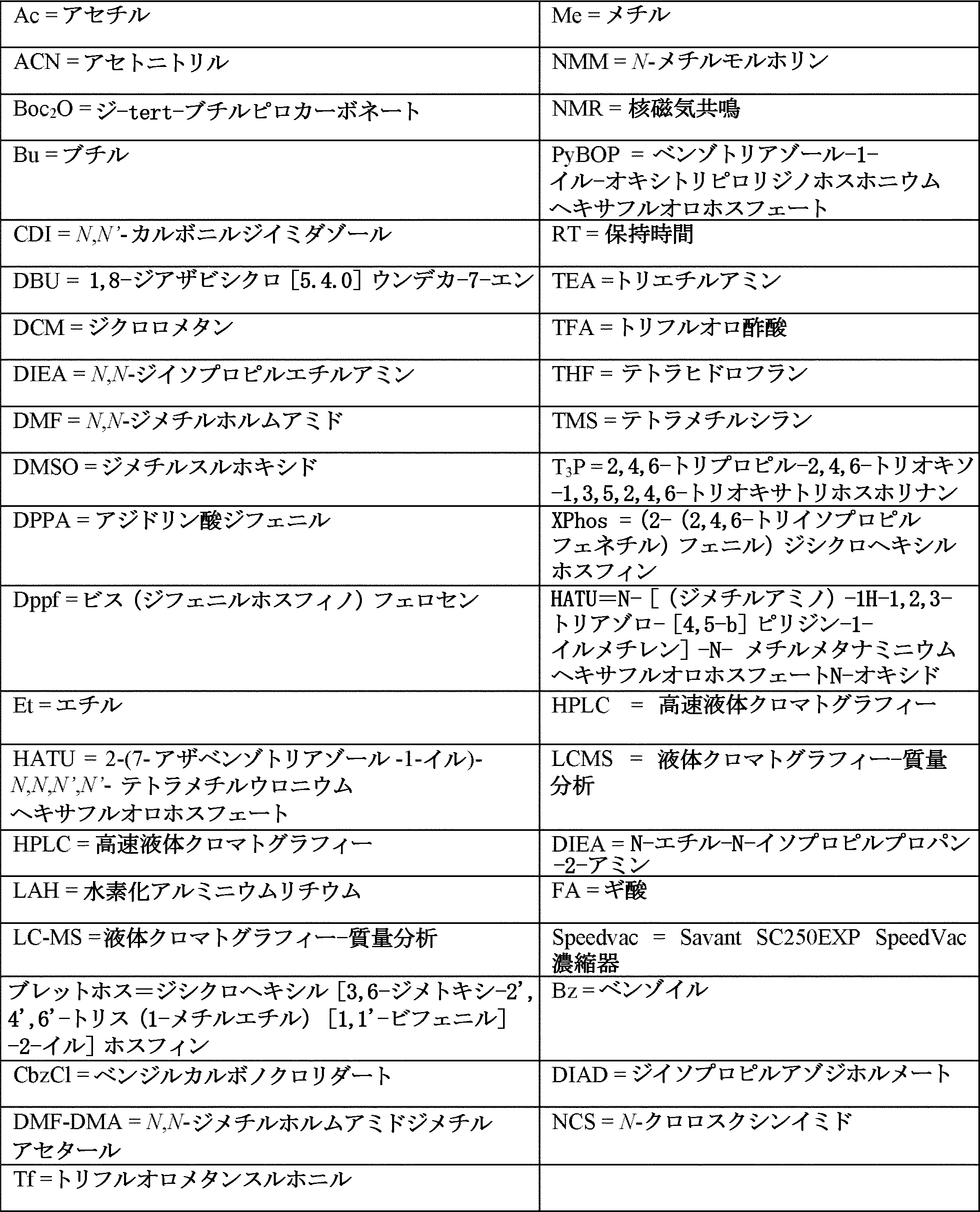
材料および方法
LC-MSは以下の方法のうちの一つを使って記録した。
material and method
LC-MS was recorded using one of the following methods.
LCMS方法A:Kinetex EVO C18 100A、30*3mm、注入量0.5μL、流速1.2mL/分、スキャン範囲90~900amu、UV検出254nm。移動相A(MPA):水/5mM NH4HCO3および移動相B(MPB):アセトニトリル。溶出:2.00分で10%MPBから95%へ、95%MPBで0.30分間保持、0.10分で95%MPBから10%へ。 LCMS method A: Kinetex EVO C18 100A, 30*3mm, injection volume 0.5μL, flow rate 1.2mL/min, scan range 90-900amu, UV detection 254nm. Mobile phase A (MPA): water/ 5mM NH4HCO3 and mobile phase B (MPB): acetonitrile. Elution: 10% MPB to 95% in 2.00 min, hold at 95% MPB for 0.30 min, 95% MPB to 10% in 0.10 min.
LCMS方法B:Xselect CSH C18、50*3mm、注入量1.0μL、流速1.2mL/分、スキャン範囲90~900amu、UV検出254nm。移動相A(MPA):水/0.1%FAおよび移動相B(MPB):アセトニトリル/0.1%FA。溶出:2.00分で5%MPBから100%へ、100%MPBで0.70分間保持、0.05分で100%MPBから5%へ、次に0.15分間、5%MPBに平衡化。 LCMS method B: Xselect CSH C18, 50*3mm, injection volume 1.0μL, flow rate 1.2mL/min, scan range 90-900amu, UV detection 254nm. Mobile phase A (MPA): water/0.1% FA and mobile phase B (MPB): acetonitrile/0.1% FA. Elution: 5% MPB to 100% in 2.00 min, hold at 100% MPB for 0.70 min, 100% MPB to 5% in 0.05 min, then equilibrate to 5% MPB for 0.15 min.
LCMS方法C:Shim-pack XR-ODS、50*3mm、注入量0.3μL、流速1.2mL/分、スキャン範囲30~2000amu、UV検出254nm。移動相A(MPA):水/0.05 TFAおよび移動相B(MPB):アセトニトリル/0.05%TFA。溶出:1.10分で5%MPBから100%へ、100%MPBで0.60分保持、0.05分で100%MPBから5%へ、次に0.25分間、5%MPBに平衡化。 LCMS method C: Shim-pack XR-ODS, 50*3mm, injection volume 0.3μL, flow rate 1.2mL/min, scan range 30-2000amu, UV detection 254nm. Mobile phase A (MPA): water/0.05 TFA and mobile phase B (MPB): acetonitrile/0.05% TFA. Elution: 1.10 min from 5% MPB to 100%, hold at 100% MPB for 0.60 min, 100% MPB to 5% in 0.05 min, then equilibrate to 5% MPB for 0.25 min.
LCMS方法D:Kinetex 2.6μm EVO C18 100A、50*3mm、注入量0.6μL、流速1.2mL/分、スキャン範囲30~2000amu、UV検出254nm。移動相A(MPA):水/5mM NH4HCO3および移動相B(MPB):アセトニトリル。溶出:1.20分で10%MPBから95%へ、95%MPBで0.50分保持、0.05分で95%MPBから10%へ、次に0.10分間、10%MPBに平衡化。 LCMS method D: Kinetex 2.6μm EVO C18 100A, 50*3mm, injection volume 0.6μL, flow rate 1.2mL/min, scan range 30-2000amu, UV detection 254nm. Mobile phase A (MPA): water/ 5mM NH4HCO3 and mobile phase B (MPB): acetonitrile. Elution: 1.20 min from 10% MPB to 95%, hold at 95% MPB for 0.50 min, 0.05 min from 95% MPB to 10%, then equilibrate to 10% MPB for 0.10 min.
LCMS方法E:Kinetex 2.6μm EVO C18 100A、50*3mm、注入量0.6μL、流速1.2mL/分、スキャン範囲30~2000amu、UV検出254nm。移動相A(MPA):水/5mM NH4HCO3および移動相B(MPB):アセトニトリル。溶出:1.20分で10%MPBから95%へ、95%MPBで0.50分保持、0.05分で95%MPBから10%へ、次に0.10分間、10%MPBに平衡化。 LCMS method E: Kinetex 2.6μm EVO C18 100A, 50*3mm, injection volume 0.6μL, flow rate 1.2mL/min, scan range 30-2000amu, UV detection 254nm. Mobile phase A (MPA): water/ 5mM NH4HCO3 and mobile phase B (MPB): acetonitrile. Elution: 1.20 min from 10% MPB to 95%, hold at 95% MPB for 0.50 min, 0.05 min from 95% MPB to 10%, then equilibrate to 10% MPB for 0.10 min.
LCMS方法F:EVO C18、50*3mm、注入量0.1μL、流速1.2mL/分、スキャン範囲30~2000amu、UV検出254nm。移動相A(MPA):水/5mM NH4HCO3および移動相B(MPB):アセトニトリル。溶出:2.00分で10%MPBから95%へ、95%MPBで0.60分間保持、0.15分で95%MPBから10%へ、次に0.25分間、10%MPBに平衡化。 LCMS method F: EVO C18, 50*3mm, injection volume 0.1μL, flow rate 1.2mL/min, scan range 30-2000amu, UV detection 254nm. Mobile phase A (MPA): water/ 5mM NH4HCO3 and mobile phase B (MPB): acetonitrile. Elution: 10% MPB to 95% in 2.00 min, hold at 95% MPB for 0.60 min, 95% MPB to 10% in 0.15 min, then equilibrate to 10% MPB for 0.25 min.
LCMS方法G:Titank C18、50*3mm、注入量0.5μL、流速1.5mL/分、スキャン範囲30~2000amu、UV検出254nm。移動相A(MPA):水/5mM NH4HCO3および移動相B(MPB):アセトニトリル。溶出:1.80分で10%MPBから95%へ、95%MPBで0.80分保持、0.15分で95%MPBから10%へ、次に0.25分間、10%MPBに平衡化。 LCMS method G: Titank C18, 50*3mm, injection volume 0.5μL, flow rate 1.5mL/min, scan range 30-2000amu, UV detection 254nm. Mobile phase A (MPA): water/ 5mM NH4HCO3 and mobile phase B (MPB): acetonitrile. Elution: 10% MPB to 95% in 1.80 min, hold at 95% MPB for 0.80 min, 95% MPB to 10% in 0.15 min, then equilibrate to 10% MPB for 0.25 min.
LCMS方法H:XBridge BEH C18、50*3mm、注入量4.0μL、流速1.2mL/分、スキャン範囲30~2000amu、UV検出254nm。移動相A(MPA):水/5mM NH4HCO3および移動相B(MPB):アセトニトリル。溶出:2.00分で5%MPBから95%へ、95%MPBで0.70分保持、0.05分で95%MPBから5%へ、次に0.25分間、5%MPBに平衡化。 LCMS method H: XBridge BEH C18, 50*3mm, injection volume 4.0μL, flow rate 1.2mL/min, scan range 30-2000amu, UV detection 254nm. Mobile phase A (MPA): water/ 5mM NH4HCO3 and mobile phase B (MPB): acetonitrile. Elution: 5% MPB to 95% in 2.00 min, hold at 95% MPB for 0.70 min, 95% MPB to 5% in 0.05 min, then equilibrate to 5% MPB for 0.25 min.
LCMS方法A-1:Kinetex EVO C18 100A、30*3mm、注入量0.5μL、流速1.2mL/分、スキャン範囲90~900amu、UV検出254nm。移動相A(MPA):水/5mM NH4HCO3および移動相B(MPB):アセトニトリル。溶出:2.00分で10%MPBから95%へ、95%MPBで0.30分間保持、0.10分で95%MPBから10%へ。 LCMS method A-1: Kinetex EVO C18 100A, 30*3mm, injection volume 0.5μL, flow rate 1.2mL/min, scan range 90-900amu, UV detection 254nm. Mobile phase A (MPA): water/ 5mM NH4HCO3 and mobile phase B (MPB): acetonitrile. Elution: 10% MPB to 95% in 2.00 min, hold at 95% MPB for 0.30 min, 95% MPB to 10% in 0.10 min.
LCMS方法B-1:Xselect CSH C18、50*3mm、注入量1.0μL、流速1.2mL/分、スキャン範囲90~900amu、UV検出254nm。移動相A(MPA):水/0.1%FAおよび移動相B(MPB):アセトニトリル/0.1%FA。溶出:2.00分で5%MPBから100%へ、100%MPBで0.70分間保持、0.05分で100%MPBから5%へ、次に0.15分間、5%MPBに平衡化。 LCMS method B-1: Xselect CSH C18, 50*3mm, injection volume 1.0μL, flow rate 1.2mL/min, scan range 90-900amu, UV detection 254nm. Mobile phase A (MPA): water/0.1% FA and mobile phase B (MPB): acetonitrile/0.1% FA. Elution: 5% MPB to 100% in 2.00 min, hold at 100% MPB for 0.70 min, 100% MPB to 5% in 0.05 min, then equilibrate to 5% MPB for 0.15 min.
LCMS方法C-1:Shim-pack XR-ODS、50*3mm、注入量0.3μL、流速1.2mL/分、スキャン範囲30~2000amu、UV検出254nm。移動相A(MPA):水/0.05 TFAおよび移動相B(MPB):アセトニトリル/0.05%TFA。溶出:1.10分で5%MPBから100%へ、100%MPBで0.60分保持、0.05分で100%MPBから5%へ、次に0.25分間、5%MPBに平衡化。 LCMS method C-1: Shim-pack XR-ODS, 50*3mm, injection volume 0.3μL, flow rate 1.2mL/min, scan range 30-2000amu, UV detection 254nm. Mobile phase A (MPA): water/0.05 TFA and mobile phase B (MPB): acetonitrile/0.05% TFA. Elution: 1.10 min from 5% MPB to 100%, hold at 100% MPB for 0.60 min, 100% MPB to 5% in 0.05 min, then equilibrate to 5% MPB for 0.25 min.
LCMS方法D-1:Shim-pack Scepter C18-120、33*3mm、注入量0.5μL、流速1.5mL/分、スキャン範囲30~2000amu、UV検出254nm。移動相A(MPA):水/5mM NH4HCO3および移動相B(MPB):アセトニトリル。溶出:2.00分で50%MPBから95%へ、95%MPBで0.60分保持、0.05分で95%MPBから10%へ、次に0.25分間、10%MPBに平衡化。 LCMS method D-1: Shim-pack Scepter C18-120, 33*3mm, injection volume 0.5μL, flow rate 1.5mL/min, scan range 30-2000amu, UV detection 254nm. Mobile phase A (MPA): water/ 5mM NH4HCO3 and mobile phase B (MPB): acetonitrile. Elution: 50% MPB to 95% in 2.00 min, hold at 95% MPB for 0.60 min, 95% MPB to 10% in 0.05 min, then equilibrate to 10% MPB for 0.25 min.
LCMS方法E-1:kinetex 2.6μm EVO、50*3mm、注入量0.5μL、流速1.2mL/分、スキャン範囲30~2000amu、UV検出254nm。移動相A(MPA):水/5mM NH4HCO3および移動相B(MPB):アセトニトリル。溶出:2.00分で10%MPBから95%へ、95%MPBで0.70分保持、0.05分で95%MPBから10%へ、次に0.25分間、10%MPBに平衡化。 LCMS method E-1: kinetex 2.6μm EVO, 50*3mm, injection volume 0.5μL, flow rate 1.2mL/min, scan range 30-2000amu, UV detection 254nm. Mobile phase A (MPA): water/ 5mM NH4HCO3 and mobile phase B (MPB): acetonitrile. Elution: 10% MPB to 95% in 2.00 min, hold at 95% MPB for 0.70 min, 95% MPB to 10% in 0.05 min, then equilibrate to 10% MPB for 0.25 min.
LCMS方法F-1:HALOC18、30*3mm、注入量0.5μL、流速1.5mL/分、スキャン範囲30~2000amu、UV検出254nm。移動相A(MPA):水/0.05%TFAおよび移動相B(MPB):アセトニトリル/0.05%TFA。溶出:1.20分で5%MPBから100%へ、100%MPBで0.60分間保持、0.02分で100%MPBから5%へ、次に0.18分間、5%MPBに平衡化。 LCMS method F-1: HALOC18, 30*3mm, injection volume 0.5μL, flow rate 1.5mL/min, scan range 30-2000amu, UV detection 254nm. Mobile phase A (MPA): water/0.05% TFA and mobile phase B (MPB): acetonitrile/0.05% TFA. Elution: 1.20 min from 5% MPB to 100%, hold at 100% MPB for 0.60 min, 0.02 min from 100% MPB to 5%, then equilibrate to 5% MPB for 0.18 min.
LCMS方法G-1:HALOC18、30*3mm、注入量0.5μL、流速1.5mL/分、スキャン範囲30~2000amu、UV検出254nm。移動相A(MPA):水/0.1%FAおよび移動相B(MPB):アセトニトリル/0.1%FA。溶出:1.20分で5%MPBから100%へ、100%MPBで0.60分間保持、0.02分で100%MPBから5%へ、次に0.18分間、5%MPBに平衡化。 LCMS method G-1: HALOC18, 30*3mm, injection volume 0.5μL, flow rate 1.5mL/min, scan range 30-2000amu, UV detection 254nm. Mobile phase A (MPA): water/0.1% FA and mobile phase B (MPB): acetonitrile/0.1% FA. Elution: 1.20 min from 5% MPB to 100%, hold at 100% MPB for 0.60 min, 0.02 min from 100% MPB to 5%, then equilibrate to 5% MPB for 0.18 min.
LCMS方法BA
機器:DADおよびELSD検出器を装備したAgilent LCMSシステム。
イオンモード:ポジティブ
カラム:Waters X-Bridge C18、50*2.1mm*5μmまたは相当品
移動相:A:H2O(0.04%TFA);B:CH3CN(0.02%TFA)
勾配:4.5分勾配法、実際の方法は化合物のclogPに依存すると考えられる。
流速:0.6mL/分または0.8mL/分
カラム温度:40℃または50℃
UV:220 nm
LCMS Method BA
Equipment: Agilent LCMS system equipped with DAD and ELSD detectors.
Ion mode: Positive Column: Waters X-Bridge C18, 50*2.1mm*5μm or equivalent Mobile phase: A: H 2 O (0.04% TFA); B: CH 3 CN (0.02% TFA)
Gradient: 4.5 min gradient method, the actual method will depend on the clogP of the compound.
Flow rate: 0.6mL/min or 0.8mL/min Column temperature: 40℃ or 50℃
UV:220nm
LCMS方法BB
機器:DADおよびELSD検出器を装備したAgilent LCMSシステム。
イオンモード:ポジティブ
カラム:Waters X-Bridge ShieldRP18、50*2.1mm*5μmまたは相当品
移動相:A:H2O(0.05%NH3.H2O)または10mM重炭酸アンモニア(ammonia bicarbonate);B:CH3CN。
勾配:4.5分勾配法、実際の方法は化合物のclogPに依存すると考えられる。
流速:0.6mL/分または0.8mL/分
カラム温度:40℃
UV:220 nm
LCMS method BB
Equipment: Agilent LCMS system equipped with DAD and ELSD detectors.
Ion mode: Positive Column: Waters X-Bridge Shield RP18, 50*2.1mm*5μm or equivalent Mobile phase: A: H2O (0.05% NH3 . H2O ) or 10mM ammonia bicarbonate; B : CH3CN .
Gradient: 4.5 min gradient method, the actual method will depend on the clogP of the compound.
Flow rate: 0.6mL/min or 0.8mL/min Column temperature: 40℃
UV:220nm
分取HPLC条件
機器:
1.GILSON 281および島津LCMS 2010A
2.GILSON 215および島津LC-20AP
3.GILSON 215
移動相:
A:NH4OH/H2O=0.05%v/v;B:ACN
A:FA/H2O=0.225%v/v;B:ACN
カラム
Xtimate C18 150*25mm*5μm;流量:25mL/分または30mL/分;モニター波長:220および254nm。勾配:実際の方法は化合物のclogPに依存すると考えられる;検出器:MSトリガーまたはUV
Preparative HPLC conditions
device:
1.GILSON 281 and Shimadzu LCMS 2010A
2.GILSON 215 and Shimadzu LC-20AP
3.GILSON 215
Mobile phase:
A: NH4OH / H2O =0.05%v/v;B:ACN
A:FA/ H2O =0.225%v/v;B:ACN
column
Xtimate C18 150*25mm*5μm; Flow rate: 25mL/min or 30mL/min; Monitor wavelength: 220 and 254nm. Gradient: The actual method will depend on the clogP of the compound; Detector: MS trigger or UV
NMRは、BRUKER NMR 300.03Mz、DUL-C-H,ULTRASHIELD(商標)300、AVANCE II 300 B-ACS(商標)120またはBRUKER NMR 400.13Mz、BBFO、ULTRASHIELD(商標)400、AVANCE III 400、B-ACS(商標)120で記録した。 The NMR is BRUKER NMR 300.03Mz, DUL-C-H, ULTRASHIELD(TM) 300, AVANCE II 300 B-ACS(TM) 120 or BRUKER NMR 400.13Mz, BBFO, ULTRASHIELD(TM) 400, AVANCE III 400, B-ACS( Trademark) recorded at 120.
調製例
中間体1 (1-(4-(トリフルオロメチル)ベンジル)-1H-ピラゾール-4-カルボン酸)の合成

工程1:1-(4-(トリフルオロメチル)ベンジル)-1H-ピラゾール-4-カルボン酸エチル
1H-ピラゾール-4-カルボキシレート(5.0g、35.7mmol、1.0当量)をACN(100.0mL)に溶解し、次にK2CO3(1.5g、107.0mmol、3.0当量)および1-(ブロモメチル)-4-(トリフルオロメチル)ベンゼン(9.4g、39.2mmol、1.1当量)を加えた。結果としてもたらされた溶液を周囲温度で16時間撹拌した。濾過し、固形物をMeOHで洗浄した後、濾液を真空下で濃縮した。残渣をシリカゲルでのフラッシュカラムクロマトグラフィーによって精製し、酢酸エチル/石油エーテル(1:5)で溶出させることにより、1-[[4-(トリフルオロメチル)フェニル]メチル]ピラゾール-4-カルボン酸エチル(5.1g)を白色固形物として得た。LCMS方法E:[M+H]+=299。
Step 1: Ethyl 1-(4-(trifluoromethyl)benzyl)-1H-pyrazole-4-carboxylate
1H-pyrazole-4-carboxylate (5.0 g, 35.7 mmol, 1.0 eq.) was dissolved in ACN (100.0 mL), then K2CO3 (1.5 g, 107.0 mmol, 3.0 eq.) and 1- (bromomethyl) -4-(trifluoromethyl)benzene (9.4g, 39.2mmol, 1.1eq) was added. The resulting solution was stirred at ambient temperature for 16 hours. After filtering and washing the solids with MeOH, the filtrate was concentrated under vacuum. The residue was purified by flash column chromatography on silica gel, eluting with ethyl acetate/petroleum ether (1:5) to give 1-[[4-(trifluoromethyl)phenyl]methyl]pyrazole-4-carboxylic acid. Ethyl (5.1g) was obtained as a white solid. LCMS method E: [M+H] + =299.
工程2:1-(4-(トリフルオロメチル)ベンジル)-1H-ピラゾール-4-カルボン酸
1-[[4-(トリフルオロメチル)フェニル]メチル]ピラゾール-4-カルボン酸エチル(200.0mg、0.7mmol、1.0当量)をMeOH(2.0mL)および水(2.0mL)に溶解し、次にNaOH(80.5mg、2.0mmol、3.0当量)を加えた。反応混合物を2時間、90℃に加熱し、次に周囲温度まで冷却し、真空下で濃縮した。残渣を水で希釈し、HCl水溶液(6M)でpH5に調節した。結果としてもたらされた固形物を濾過によって収集し、水で洗浄し、次に乾燥することにより、1-[[4-(トリフルオロメチル)フェニル]メチル]ピラゾール-4-カルボン酸(200mg)を白色固形物として得た。LCMS方法G:[M-H]-=269。
Step 2: 1-(4-(trifluoromethyl)benzyl)-1H-pyrazole-4-carboxylic acid
Ethyl 1-[[4-(trifluoromethyl)phenyl]methyl]pyrazole-4-carboxylate (200.0 mg, 0.7 mmol, 1.0 eq.) was dissolved in MeOH (2.0 mL) and water (2.0 mL) and then NaOH (80.5 mg, 2.0 mmol, 3.0 eq.) was added. The reaction mixture was heated to 90° C. for 2 hours, then cooled to ambient temperature and concentrated under vacuum. The residue was diluted with water and adjusted to pH 5 with aqueous HCl (6M). The resulting solid was collected by filtration, washed with water, and then dried to give 1-[[4-(trifluoromethyl)phenyl]methyl]pyrazole-4-carboxylic acid (200 mg). was obtained as a white solid. LCMS method G: [MH] - = 269.
中間体1について説明した方法と同じ方法を使って、以下の表の中間体を調製した。

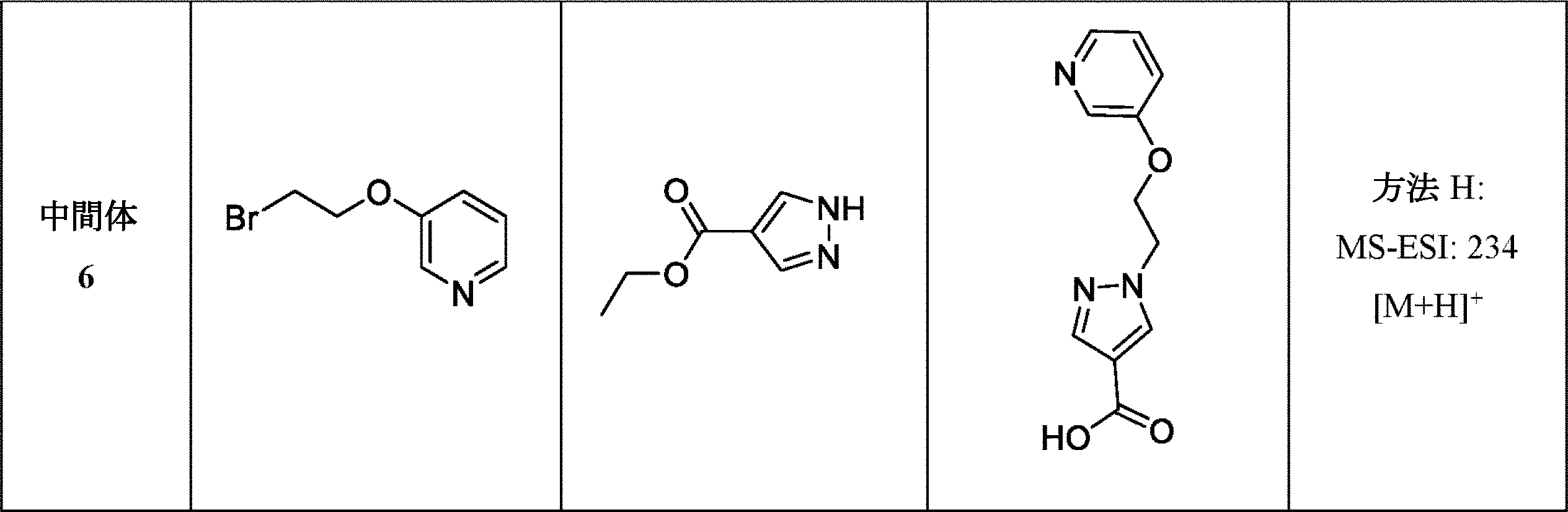
中間体7および38 (1-(2-(ピリジン-3-イルオキシ)エチル)-1H-ピラゾール-5-カルボン酸および1-(2-(ピリジン-3-イルオキシ)エチル)-1H-ピラゾール-3-カルボン酸)の合成

工程1:1-(2-(ピリジン-3-イルオキシ)エチル)-1H-ピラゾール-5-カルボン酸メチルおよび1-(2-(ピリジン-3-イルオキシ)エチル)-1H-ピラゾール-3-カルボン酸メチル
3-(2-ブロモエトキシ)ピリジン(300.0mg、1.5mmol、1.0当量)および1H-イミダゾール-4-カルボン酸メチル(187.3mg、1.5mmol、1.0当量)をACN(10mL)に溶解し、次にK2CO3(413.4mg、3.0mmol、2.0当量)を加えた。反応混合物を2時間、90℃に加熱し、次に周囲温度まで冷却した。固形物を濾過によって除去し、濾過ケーキをMeOHで洗浄し、次に濾液を真空下で濃縮した。残渣をシリカゲルでのフラッシュカラムクロマトグラフィーによって精製し、酢酸エチル/石油エーテル(1:10→1:1)で溶出させることにより、1-(2-(ピリジン-3-イルオキシ)エチル)-1H-ピラゾール-5-カルボン酸メチル(化合物4A、150mg)を白色固形物として、また1-(2-(ピリジン-3-イルオキシ)エチル)-1H-ピラゾール-3-カルボン酸メチル(化合物4B、140mg)を白色固形物として得た。化合物4AのLCMS、方法B:[M+H]+=248。


3-(2-bromoethoxy)pyridine (300.0 mg, 1.5 mmol, 1.0 eq.) and methyl 1H-imidazole-4-carboxylate (187.3 mg, 1.5 mmol, 1.0 eq.) were dissolved in ACN (10 mL) and then K2CO3 ( 413.4mg , 3.0mmol, 2.0eq) was added. The reaction mixture was heated to 90° C. for 2 hours, then cooled to ambient temperature. The solids were removed by filtration, the filter cake was washed with MeOH, and then the filtrate was concentrated under vacuum. The residue was purified by flash column chromatography on silica gel, eluting with ethyl acetate/petroleum ether (1:10 → 1:1) to give 1-(2-(pyridin-3-yloxy)ethyl)-1H- Methyl pyrazole-5-carboxylate (Compound 4A, 150 mg) as a white solid and methyl 1-(2-(pyridin-3-yloxy)ethyl)-1H-pyrazole-3-carboxylate (Compound 4B, 140 mg) was obtained as a white solid. LCMS of Compound 4A, Method B: [M+H] + =248.
工程2:1-(2-(ピリジン-3-イルオキシ)エチル)-1H-ピラゾール-5-カルボン酸
1-(2-(ピリジン-3-イルオキシ)エチル)-1H-ピラゾール-5-カルボン酸メチル(150.0mg、0.6mmol、1.0当量)をMeOH(3mL)および水(3mL)に溶解し、次にNaOH(48.5mg、1.2mmol、2.0当量)を加えた。反応混合物を2時間、80℃に加熱し、次に周囲温度まで冷却し、真空下で濃縮した。残渣を水で希釈し、次に、その溶液をHCl水溶液(6M)でpH5に調節した。固形物を濾過によって収集し、乾燥することにより、1-(2-(ピリジン-3-イルオキシ)エチル)-1H-ピラゾール-5-カルボン酸(110mg)を白色固形物として得た。LCMS方法A:[M-H]-=232。
Step 2: 1-(2-(pyridin-3-yloxy)ethyl)-1H-pyrazole-5-carboxylic acid
Methyl 1-(2-(pyridin-3-yloxy)ethyl)-1H-pyrazole-5-carboxylate (150.0 mg, 0.6 mmol, 1.0 eq.) was dissolved in MeOH (3 mL) and water (3 mL), then NaOH (48.5 mg, 1.2 mmol, 2.0 eq.) was added. The reaction mixture was heated to 80° C. for 2 hours, then cooled to ambient temperature and concentrated under vacuum. The residue was diluted with water and then the solution was adjusted to pH 5 with aqueous HCl (6M). The solid was collected by filtration and dried to give 1-(2-(pyridin-3-yloxy)ethyl)-1H-pyrazole-5-carboxylic acid (110 mg) as a white solid. LCMS method A: [MH] - = 232.
工程3:1-(2-(ピリジン-3-イルオキシ)エチル)-1H-ピラゾール-3-カルボン酸
工程2について説明した方法と同じ方法を使用することにより、1-(2-(ピリジン-3-イルオキシ)エチル)-1H-ピラゾール-3-カルボン酸(120mg)を白色固形物として得た。LCMS方法A:[M-H]-=232。
Step 3: 1-(2-(pyridin-3-yloxy)ethyl)-1H-pyrazole-3-carboxylic acid 1-(2-(pyridin-3-yloxy)ethyl)-1H-pyrazole-3-carboxylic acid -yloxy)ethyl)-1H-pyrazole-3-carboxylic acid (120 mg) was obtained as a white solid. LCMS method A: [MH] - = 232.
中間体7および38について説明した方法と同じ方法を使って、以下の表の中間体を調製した。

中間体11 (1-((5-(トリフルオロメチル)ピリジン-2-イル)メチル)-1H-イミダゾール-4-カルボン酸)の合成

工程1:1-((5-(トリフルオロメチル)ピリジン-2-イル)メチル)-1H-イミダゾール-4-カルボン酸エチル
1-[5-(トリフルオロメチル)ピリジン-2-イル]メタンアミン(200.0mg、1.1mmol、1.0当量)をt-BuOH(5.0mL)に溶解し、次に(2Z)-3-(ジメチルアミノ)-2-ホルモニトリルプロパ-2-エン酸エチル(230.6mg、1.4mmol、1.2当量)を加えた。反応混合物を3日間、130℃に加熱し、次に周囲温度まで冷却し、真空下で濃縮した。残渣を以下の条件でのフラッシュ分取HPLCによって精製した:カラム、C18シリカゲル;移動相、ACN/水(0.1%NH4HCO3)、40分以内に0%から100%まで増加、;検出器、UV254nm。これにより、1-((5-(トリフルオロメチル)ピリジン-2-イル)メチル)-1H-イミダゾール-4-カルボン酸エチル(120mg)が淡黄色固形物として得られた。LCMS方法A:[M+H]+=300。

1-[5-(trifluoromethyl)pyridin-2-yl]methanamine (200.0 mg, 1.1 mmol, 1.0 equiv.) was dissolved in t-BuOH (5.0 mL) and then (2Z)-3-(dimethylamino )-2-formonitrileprop-2-enoate (230.6 mg, 1.4 mmol, 1.2 eq.) was added. The reaction mixture was heated to 130° C. for 3 days, then cooled to ambient temperature and concentrated under vacuum. The residue was purified by flash preparative HPLC with the following conditions: column, C18 silica gel; mobile phase, ACN/water (0.1% NH 4 HCO 3 ), increasing from 0% to 100% within 40 min; detector , UV254nm. This gave ethyl 1-((5-(trifluoromethyl)pyridin-2-yl)methyl)-1H-imidazole-4-carboxylate (120 mg) as a pale yellow solid. LCMS method A: [M+H] + =300.
工程2:1-((5-(トリフルオロメチル)ピリジン-2-イル)メチル)-1H-イミダゾール-4-カルボン酸
1-[[5-(トリフルオロメチル)ピリジン-2-イル]メチル]イミダゾール-4-カルボン酸エチル(100.0mg、0.3mmol、1.0当量)をMeOH(5.0mL)および水(5.0mL)に溶解し、次にNaOH(26.7mg、0.7mmol、2.0当量)を加えた。反応混合物を4時間、80℃に加熱し、次に周囲温度まで冷却し、真空下で濃縮した。残渣を水で希釈し、HCl水溶液(1M)でpH3に調節した。結果としてもたらされた固形物を濾過によって収集し、以下の条件でのフラッシュ分取HPLCによってさらに精製した:カラム、C18シリカゲル;移動相、ACN/水(0.1%TFA)、40分以内に0%から100%に増加;検出器、UV254nm。これにより、1-((5-(トリフルオロメチル)ピリジン-2-イル)メチル)-1H-イミダゾール-4-カルボン酸(70mg)が白色固形物として得られた。LCMS方法A:[M+H]+=272。
Step 2: 1-((5-(trifluoromethyl)pyridin-2-yl)methyl)-1H-imidazole-4-carboxylic acid
Ethyl 1-[[5-(trifluoromethyl)pyridin-2-yl]methyl]imidazole-4-carboxylate (100.0 mg, 0.3 mmol, 1.0 equiv.) was dissolved in MeOH (5.0 mL) and water (5.0 mL). Then NaOH (26.7 mg, 0.7 mmol, 2.0 eq.) was added. The reaction mixture was heated to 80° C. for 4 hours, then cooled to ambient temperature and concentrated under vacuum. The residue was diluted with water and adjusted to pH 3 with aqueous HCl (1M). The resulting solid was collected by filtration and further purified by flash preparative HPLC under the following conditions: column, C18 silica gel; mobile phase, ACN/water (0.1% TFA), 0 within 40 min. Increased from % to 100%; detector, UV254nm. This gave 1-((5-(trifluoromethyl)pyridin-2-yl)methyl)-1H-imidazole-4-carboxylic acid (70 mg) as a white solid. LCMS method A: [M+H] + =272.
中間体11について説明した方法と同じ方法を使って、以下の中間体を調製した。

中間体13 (5-オキソ-1-(4-(トリフルオロメチル)ベンジル)-4,5-ジヒドロ-1H-1,2,4-トリアゾール-3-カルボン酸)の合成

工程1:(Z)-2-アミノ-2-(2-(4-(トリフルオロメチル)ベンジル)ヒドラジンイリデン)酢酸エチル
(4-(トリフルオロメチル)ベンジル)ヒドラジン二塩化水素(1.0g、5.3mmol、1.0当量)をEtOH(30.0mL)に溶解し、次にK2CO3(1.5g、10.5mmol、2.0当量)および2-アミノ-2-チオキソ酢酸エチル(0.7g、5.3mmol、1.0当量)を加えた。反応混合物を周囲温度で16時間撹拌し、次に真空下で濃縮した。残渣をシリカゲルでのフラッシュカラムクロマトグラフィーによって精製し、酢酸エチル/石油エーテル(1:3)で溶出させることにより、(Z)-2-アミノ-2-(2-(4-(トリフルオロメチル)ベンジル)ヒドラジンイリデン)酢酸エチル(590mg)を淡黄色固形物として得た。LCMS方法A:[M+H]+=290。
Step 1: (Z)-2-Amino-2-(2-(4-(trifluoromethyl)benzyl)hydrazineylidene)ethyl acetate (4-(trifluoromethyl)benzyl)hydrazine dihydrogen chloride (1.0g, 5.3 mmol, 1.0 eq) was dissolved in EtOH (30.0 mL), then K 2 CO 3 (1.5 g, 10.5 mmol, 2.0 eq) and ethyl 2-amino-2-thioxoacetate (0.7 g, 5.3 mmol, 1.0 equivalent amount) was added. The reaction mixture was stirred at ambient temperature for 16 hours, then concentrated under vacuum. The residue was purified by flash column chromatography on silica gel, eluting with ethyl acetate/petroleum ether (1:3) to give (Z)-2-amino-2-(2-(4-(trifluoromethyl)). Benzyl)hydrazineylidene)ethyl acetate (590mg) was obtained as a pale yellow solid. LCMS method A: [M+H] + =290.
工程2:5-オキソ-1-(4-(トリフルオロメチル)ベンジル)-4,5-ジヒドロ-1H-1,2,4-トリアゾール-3-カルボン酸エチル
(Z)-2-アミノ-2-(2-(4-(トリフルオロメチル)ベンジル)ヒドラジンイリデン)酢酸エチル(550.0mg、1.9mmol、1.0当量)をDCM(20.0mL)に溶解し、次にCDI(1.2g、7.6mmol、4.0当量)を加えた。結果としてもたらされた溶液を周囲温度で16時間撹拌し、次に真空下で濃縮した。残渣をシリカゲルでのフラッシュカラムクロマトグラフィーによって精製し、酢酸エチル/石油エーテル(1:3)で溶出させることにより、5-オキソ-1-(4-(トリフルオロメチル)ベンジル)-4,5-ジヒドロ-1H-1,2,4-トリアゾール-3-カルボン酸エチル(500mg)を淡黄色固形物として得た。LCMS方法A:[M+H]+=316。
Step 2: Ethyl 5-oxo-1-(4-(trifluoromethyl)benzyl)-4,5-dihydro-1H-1,2,4-triazole-3-carboxylate (Z)-2-amino-2 -(2-(4-(trifluoromethyl)benzyl)hydrazinylidene)ethyl acetate (550.0 mg, 1.9 mmol, 1.0 eq.) was dissolved in DCM (20.0 mL), then CDI (1.2 g, 7.6 mmol, 4.0 equivalents) was added. The resulting solution was stirred at ambient temperature for 16 hours, then concentrated under vacuum. The residue was purified by flash column chromatography on silica gel, eluting with ethyl acetate/petroleum ether (1:3) to give 5-oxo-1-(4-(trifluoromethyl)benzyl)-4,5- Ethyl dihydro-1H-1,2,4-triazole-3-carboxylate (500 mg) was obtained as a pale yellow solid. LCMS method A: [M+H] + =316.
工程3:5-オキソ-1-(4-(トリフルオロメチル)ベンジル)-4,5-ジヒドロ-1H-1,2,4-トリアゾール-3-カルボン酸
5-オキソ-1-(4-(トリフルオロメチル)ベンジル)-4,5-ジヒドロ-1H-1,2,4-トリアゾール-3-カルボン酸エチル(500.0mg、1.6mmol、1.0当量)をMeOH(20.0mL)および水(5.0mL)に溶解し、次にLiOH(76.0mg、3.2mmol、2.0当量)を加えた。反応混合物を周囲温度で1時間撹拌し、真空下で濃縮した。残渣を水で希釈し、HCl水溶液(6M)でpH5に調節した。結果としてもたらされた溶液を酢酸エチルで抽出し、ブラインで洗浄し、無水硫酸ナトリウムで乾燥し、真空下で濃縮することにより、5-オキソ-1-(4-(トリフルオロメチル)ベンジル)-4,5-ジヒドロ-1H-1,2,4-トリアゾール-3-カルボン酸(400mg)を白色固形物として得た。LCMS方法A:[M+H]+=288。
Step 3: 5-oxo-1-(4-(trifluoromethyl)benzyl)-4,5-dihydro-1H-1,2,4-triazole-3-carboxylic acid
Ethyl 5-oxo-1-(4-(trifluoromethyl)benzyl)-4,5-dihydro-1H-1,2,4-triazole-3-carboxylate (500.0 mg, 1.6 mmol, 1.0 eq.) in MeOH (20.0 mL) and water (5.0 mL), then LiOH (76.0 mg, 3.2 mmol, 2.0 eq.) was added. The reaction mixture was stirred at ambient temperature for 1 hour and concentrated under vacuum. The residue was diluted with water and adjusted to pH 5 with aqueous HCl (6M). The resulting solution was extracted with ethyl acetate, washed with brine, dried over anhydrous sodium sulfate, and concentrated under vacuum to give 5-oxo-1-(4-(trifluoromethyl)benzyl). -4,5-dihydro-1H-1,2,4-triazole-3-carboxylic acid (400 mg) was obtained as a white solid. LCMS method A: [M+H] + =288.
中間体14 (5-メチル-1-(4-(トリフルオロメチル)ベンジル)-1H-ピラゾール-3-カルボン酸)の合成

工程1:5-メチル-1-(4-(トリフルオロメチル)ベンジル)-1H-ピラゾール-3-カルボン酸メチル
(4-(トリフルオロメチル)ベンジル)ヒドラジン(1.0g、5.7mmol、1.0当量)を酢酸(10.0mL)に溶解し、次に2,4-ジオキソペンタン酸メチル(0.9g、6.2mmol、1.1当量)を加えた。反応混合物を4時間、90℃に加熱し、次に周囲温度まで冷却し、真空下で濃縮した。残渣をシリカゲルでのフラッシュカラムクロマトグラフィーによって精製し、酢酸エチル/石油エーテル(1:1)で溶出させることにより、5-メチル-1-(4-(トリフルオロメチル)ベンジル)-1H-ピラゾール-3-カルボン酸メチル(810mg)を白色固形物として得た。LCMS方法A:[M+H]+=299。

工程2:5-メチル-1-(4-(トリフルオロメチル)ベンジル)-1H-ピラゾール-3-カルボン酸
5-メチル-1-(4-(トリフルオロメチル)ベンジル)-1H-ピラゾール-3-カルボン酸メチル(500.0mg、1.7mmol、1.0当量)をMeOH(5.0mL)および水(5.0mL)に溶解し、次にNaOH(134.1mg、3.4mmol、2.0当量)を加えた。反応混合物を2時間、80℃に加熱し、真空下で濃縮した。残渣を水で希釈し、HCl水溶液(6M)でpH5に調節した。結果としてもたらされた固形物を濾過によって収集し、水で洗浄し、次に乾燥することにより、5-メチル-1-(4-(トリフルオロメチル)ベンジル)-1H-ピラゾール-3-カルボン酸(250mg)を白色固形物として得た。LCMS方法A:[M+H]+=285。
Step 2: 5-methyl-1-(4-(trifluoromethyl)benzyl)-1H-pyrazole-3-carboxylic acid
Methyl 5-methyl-1-(4-(trifluoromethyl)benzyl)-1H-pyrazole-3-carboxylate (500.0 mg, 1.7 mmol, 1.0 eq.) dissolved in MeOH (5.0 mL) and water (5.0 mL). Then NaOH (134.1 mg, 3.4 mmol, 2.0 eq.) was added. The reaction mixture was heated to 80° C. for 2 hours and concentrated under vacuum. The residue was diluted with water and adjusted to pH 5 with aqueous HCl (6M). The resulting solid was collected by filtration, washed with water, and then dried to give 5-methyl-1-(4-(trifluoromethyl)benzyl)-1H-pyrazole-3-carvone. The acid (250mg) was obtained as a white solid. LCMS method A: [M+H] + =285.
中間体14について説明した方法と同じ方法を使って、以下の中間体を調製した。
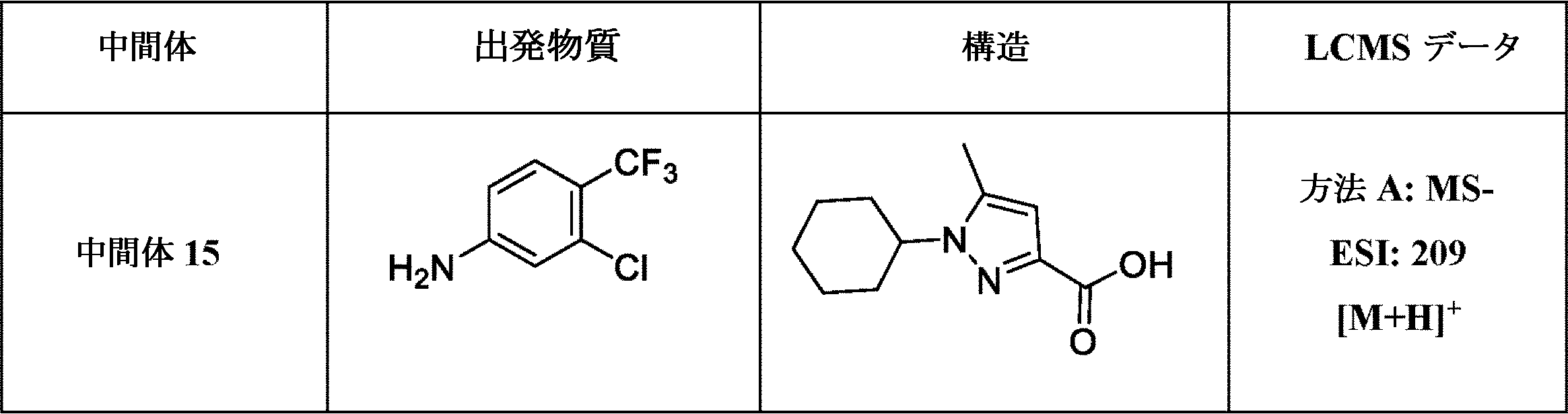
中間体16 (5-(4-(トリフルオロメチル)ベンジル)-1H-ピラゾール-3-カルボン酸)の合成
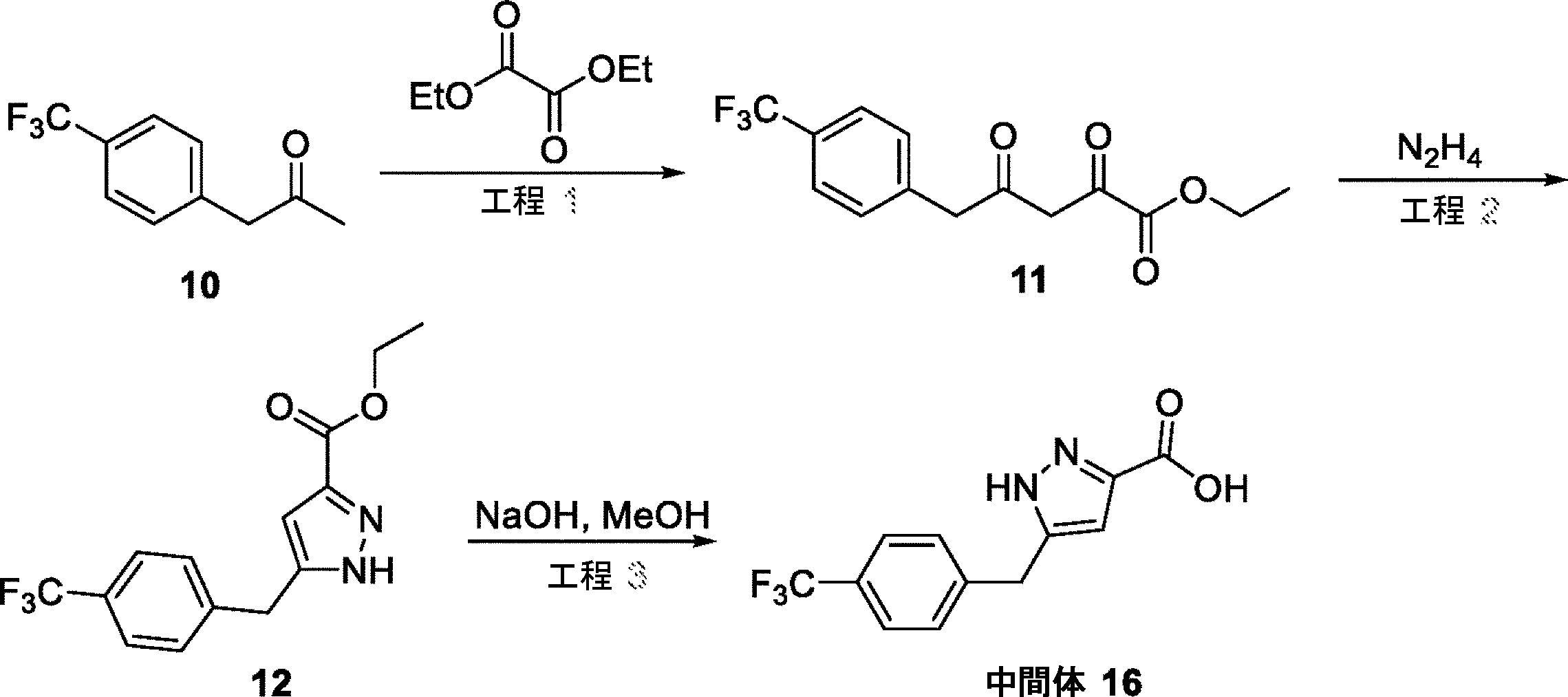
工程1:2,4-ジオキソ-5-(4-(トリフルオロメチル)フェニル)ペンタン酸エチル
1-(4-(トリフルオロメチル)フェニル)プロパン-2-オン(200.0mg、1.0mmol、1.0当量)をEtOH(5.0mL)に溶解して0℃に冷却し、次にシュウ酸エチル(144.6mg、1.0mmol、1.0当量)およびEtONa(74.1mg、1.1mmol、1.1当量)を加えた。結果としてもたらされた混合物を周囲温度で一晩撹拌し、次に水の添加によってクエンチした。結果としてもたらされた溶液を酢酸エチルで抽出し、ブラインで洗浄し、無水Na2SO4で乾燥し、真空下で濃縮することによって得た粗2,4-ジオキソ-5-(4-(トリフルオロメチル)フェニル)ペンタン酸エチルを、それ以上精製することなく、次の工程に使用した。LCMS方法B:[M-H]-=301。
Step 1: Ethyl 2,4-dioxo-5-(4-(trifluoromethyl)phenyl)pentanoate
1-(4-(trifluoromethyl)phenyl)propan-2-one (200.0 mg, 1.0 mmol, 1.0 eq.) was dissolved in EtOH (5.0 mL) and cooled to 0 °C, then ethyl oxalate (144.6 mg, 1.0 mmol, 1.0 eq) and EtONa (74.1 mg, 1.1 mmol, 1.1 eq) were added. The resulting mixture was stirred at ambient temperature overnight and then quenched by the addition of water. Crude 2,4 -dioxo- 5- (4-( Ethyl trifluoromethyl)phenyl)pentanoate was used in the next step without further purification. LCMS method B: [MH] - = 301.
工程2:5-(4-(トリフルオロメチル)ベンジル)-1H-ピラゾール-3-カルボン酸エチル
2,4-ジオキソ-5-(4-(トリフルオロメチル)フェニル)ペンタン酸エチル(200.0mg、0.7mmol、1.0当量)を酢酸(5.0mL)に溶解し、次にヒドラジン塩化水素(32.5mg、0.7mmol、1.0当量)を加えた。反応混合物を周囲温度で一晩撹拌し、水の添加によってクエンチした。結果としてもたらされた溶液をNaOH水溶液(4M)でpH7に調節し、次に酢酸エチルで抽出し、ブラインで洗浄し、無水Na2SO4で乾燥し、真空下で濃縮した。残渣を以下の条件での逆フラッシュクロマトグラフィー(reverse flash chromatography)によって精製した:カラム、C18シリカゲル;ACN/水、30分以内に0%から100%に増加;検出器、UV254nm。これにより、5-[[4-(トリフルオロメチル)フェニル]メチル]-1H-ピラゾール-3-カルボン酸エチル(150mg)が黄色固形物として得られた。LCMS方法B:[M+H]+=299。

Ethyl 2,4-dioxo-5-(4-(trifluoromethyl)phenyl)pentanoate (200.0 mg, 0.7 mmol, 1.0 eq.) was dissolved in acetic acid (5.0 mL), then hydrazine hydrogen chloride (32.5 mg, 0.7 mmol, 1.0 eq) was added. The reaction mixture was stirred at ambient temperature overnight and quenched by the addition of water. The resulting solution was adjusted to pH 7 with aqueous NaOH (4M), then extracted with ethyl acetate, washed with brine, dried over anhydrous Na 2 SO 4 and concentrated under vacuum. The residue was purified by reverse flash chromatography with the following conditions: column, C18 silica gel; ACN/water, increasing from 0% to 100% within 30 min; detector, UV254nm. This gave ethyl 5-[[4-(trifluoromethyl)phenyl]methyl]-1H-pyrazole-3-carboxylate (150 mg) as a yellow solid. LCMS method B: [M+H] + =299.
工程3:5-(4-(トリフルオロメチル)ベンジル)-1H-ピラゾール-3-カルボン酸
5-[[4-(トリフルオロメチル)フェニル]メチル]-1H-ピラゾール-3-カルボン酸エチル(150.0mg、0.5mmol、1.0当量)をMeOH(5.0mL)および水(5.0mL)に溶解し、次にNaOH(40.2mg、1.0mmol、2.0当量)を加えた。反応混合物を周囲温度で一晩撹拌し、次に真空下で濃縮した。残渣を水で希釈し、次にHCl水溶液(1M)でpH6に調節した。結果としてもたらされた固形物を濾過によって収集し、乾燥することによって黄色固形物として得た粗5-(4-(トリフルオロメチル)ベンジル)-1H-ピラゾール-3-カルボン酸(110mg)を、それ以上精製することなく、そのまま次の工程に使用した。LCMS方法A:[M+H]+=271。
Step 3: 5-(4-(trifluoromethyl)benzyl)-1H-pyrazole-3-carboxylic acid
Ethyl 5-[[4-(trifluoromethyl)phenyl]methyl]-1H-pyrazole-3-carboxylate (150.0 mg, 0.5 mmol, 1.0 eq.) was dissolved in MeOH (5.0 mL) and water (5.0 mL). , then NaOH (40.2 mg, 1.0 mmol, 2.0 eq.) was added. The reaction mixture was stirred at ambient temperature overnight, then concentrated under vacuum. The residue was diluted with water and then adjusted to pH 6 with aqueous HCl (1M). The resulting solid was collected by filtration and dried to give crude 5-(4-(trifluoromethyl)benzyl)-1H-pyrazole-3-carboxylic acid (110 mg) as a yellow solid. , was used directly in the next step without further purification. LCMS method A: [M+H] + =271.
中間体17 (5-(4-(トリフルオロメチル)フェニル)-1H-イミダゾール-2-カルボン酸)の合成
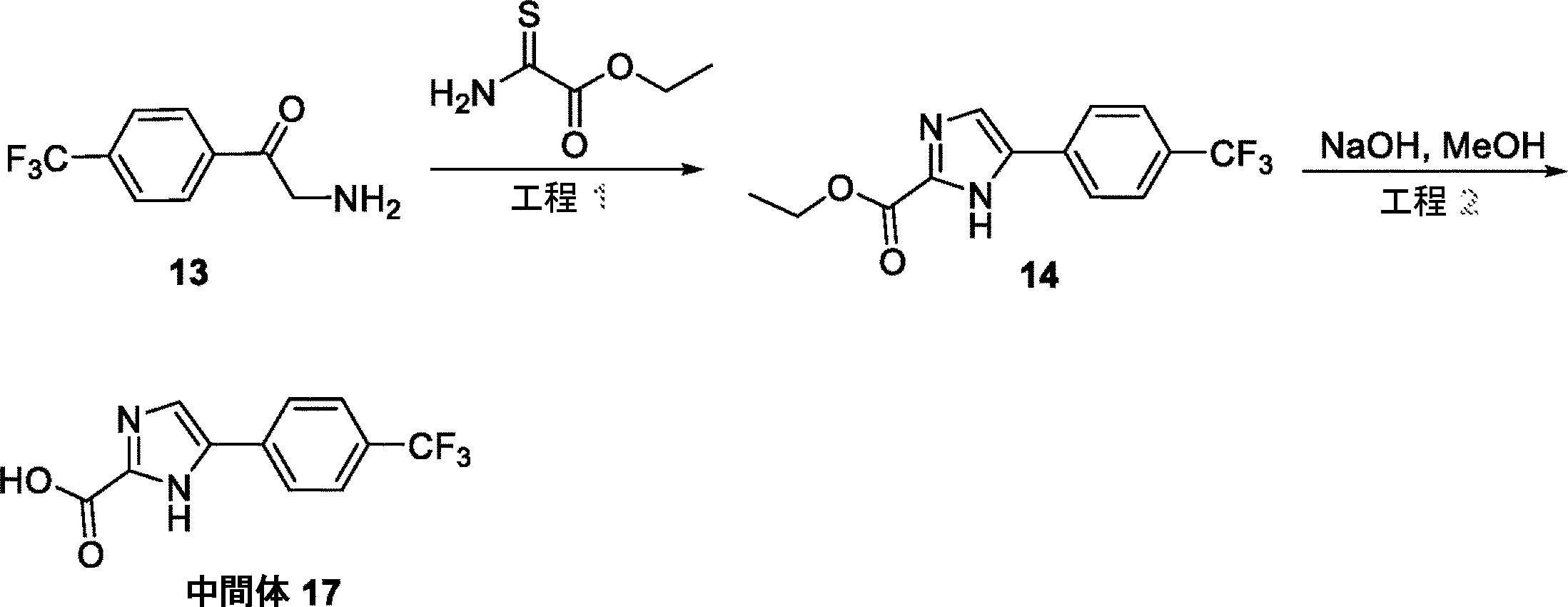
工程1:5-(4-(トリフルオロメチル)フェニル)-1H-イミダゾール-2-カルボン酸エチル
2-アミノ-1-[4-(トリフルオロメチル)フェニル]エタノン(1.0g、4.9mmol、1.0当量)を酢酸(10.0mL)に溶解し、次に2-アミノ-2-チオキソ酢酸エチル(0.7g、5.0mmol、1.0当量)およびNaOAc(1.2g、14.8mmol、3.0当量)を加えた。反応混合物を3時間、100℃に加熱し、周囲温度まで冷却した。その混合物をNaOH水溶液(4M)でpH7に調節し、次に酢酸エチルで抽出し、ブラインで洗浄し、無水Na2SO4で乾燥し、真空下で濃縮した。残渣をシリカゲルでのフラッシュカラムクロマトグラフィーによって精製し、酢酸エチル/石油エーテル(1:1)で溶出させることにより、5-(4-(トリフルオロメチル)フェニル)-1H-イミダゾール-2-カルボン酸エチル(350mg)を黄色固形物として得た。LCMS方法B:[M+H]+=285。

2-Amino-1-[4-(trifluoromethyl)phenyl]ethanone (1.0 g, 4.9 mmol, 1.0 eq.) was dissolved in acetic acid (10.0 mL), then ethyl 2-amino-2-thioxoacetate (0.7 g, 5.0 mmol, 1.0 eq) and NaOAc (1.2 g, 14.8 mmol, 3.0 eq) were added. The reaction mixture was heated to 100° C. for 3 hours and cooled to ambient temperature. The mixture was adjusted to pH 7 with aqueous NaOH (4M), then extracted with ethyl acetate, washed with brine, dried over anhydrous Na 2 SO 4 and concentrated under vacuum. The residue was purified by flash column chromatography on silica gel, eluting with ethyl acetate/petroleum ether (1:1) to give 5-(4-(trifluoromethyl)phenyl)-1H-imidazole-2-carboxylic acid. Ethyl (350mg) was obtained as a yellow solid. LCMS method B: [M+H] + =285.
工程2:5-(4-(トリフルオロメチル)フェニル)-1H-イミダゾール-2-カルボン酸
5-(4-(トリフルオロメチル)フェニル)-1H-イミダゾール-2-カルボン酸エチル(35.0mg、0.1mmol、1.0当量)をMeOH(1.0mL)および水(1.0mL)に溶解し、次にNaOH(10.0mg、0.2mmol、2.0当量)を加えた。反応混合物を2時間、80℃に加熱し、次に周囲温度まで冷却した。残渣を水で希釈し、次にHCl水溶液(1M)でpH5に調節した。結果としてもたらされた混合物を酢酸エチルで抽出し、無水Na2SO4で乾燥し、真空下で濃縮することにより、5-(4-(トリフルオロメチル)フェニル)-1H-イミダゾール-2-カルボン酸(30mg)を黄色固形物として得た。LCMS方法B:[M+H]+=257。
Step 2: 5-(4-(trifluoromethyl)phenyl)-1H-imidazole-2-carboxylic acid
Ethyl 5-(4-(trifluoromethyl)phenyl)-1H-imidazole-2-carboxylate (35.0 mg, 0.1 mmol, 1.0 equiv.) was dissolved in MeOH (1.0 mL) and water (1.0 mL) and then NaOH (10.0 mg, 0.2 mmol, 2.0 eq.) was added. The reaction mixture was heated to 80° C. for 2 hours, then cooled to ambient temperature. The residue was diluted with water and then adjusted to pH 5 with aqueous HCl (1M). The resulting mixture was extracted with ethyl acetate, dried over anhydrous Na SO and concentrated under vacuum to give 5-( 4- (trifluoromethyl)phenyl)-1H-imidazole-2- The carboxylic acid (30mg) was obtained as a yellow solid. LCMS method B: [M+H] + =257.
中間体18 (1-メチル-5-(4-(トリフルオロメチル)ベンジル)-1H-ピラゾール-3-カルボン酸)の合成

工程1:1-メチル-5-[[4-(トリフルオロメチル)フェニル]メチル]ピラゾール-3-カルボン酸エチル
5-[[4-(トリフルオロメチル)フェニル]メチル]-1H-ピラゾール-3-カルボン酸エチル(500.0mg、1.7mmol、1.0当量)をTHF(5.0mL)に溶解して0℃に冷却し、次にNaH(鉱油中60%wt、134.2mg、3.4mmol、2.0当量)を、窒素下、0℃で加えた。結果としてもたらされた混合物を15分間撹拌し、次に、反応混合物を0℃に維持しながら、MeI(356.9mg、2.5mmol、1.5当量)を滴下した。反応混合物を周囲温度で一晩撹拌し、次にHCl水溶液(4M)の添加によってクエンチした。結果としてもたらされた混合物を酢酸エチルで抽出し、ブラインで洗浄し、無水Na2SO4で乾燥し、真空下で濃縮した。残渣をシリカゲルでのフラッシュカラムクロマトグラフィーによって精製し、酢酸エチル/石油エーテル(1:1)で溶出させることにより、1-メチル-5-[[4-(トリフルオロメチル)フェニル]メチル]ピラゾール-3-カルボン酸エチル(280mg)をオフホワイトの固形物として得た。LCMS方法F:[M+H]+=313。
Step 1: Ethyl 1-methyl-5-[[4-(trifluoromethyl)phenyl]methyl]pyrazole-3-carboxylate
Ethyl 5-[[4-(trifluoromethyl)phenyl]methyl]-1H-pyrazole-3-carboxylate (500.0 mg, 1.7 mmol, 1.0 eq.) was dissolved in THF (5.0 mL) and cooled to 0 °C. , then NaH (60% wt in mineral oil, 134.2 mg, 3.4 mmol, 2.0 eq) was added at 0 °C under nitrogen. The resulting mixture was stirred for 15 min, then MeI (356.9 mg, 2.5 mmol, 1.5 eq) was added dropwise while maintaining the reaction mixture at 0 °C. The reaction mixture was stirred at ambient temperature overnight and then quenched by the addition of aqueous HCl (4M). The resulting mixture was extracted with ethyl acetate, washed with brine, dried over anhydrous Na 2 SO 4 and concentrated under vacuum. The residue was purified by flash column chromatography on silica gel, eluting with ethyl acetate/petroleum ether (1:1) to give 1-methyl-5-[[4-(trifluoromethyl)phenyl]methyl]pyrazole- Ethyl 3-carboxylate (280mg) was obtained as an off-white solid. LCMS method F: [M+H] + =313.
工程2:1-メチル-5-[[4-(トリフルオロメチル)フェニル]メチル]ピラゾール-3-カルボン酸
1-メチル-5-[[4-(トリフルオロメチル)フェニル]メチル]ピラゾール-3-カルボン酸エチル(280.0mg、0.9mmol、1.0当量)をMeOH(5.0mL)および水(5.0mL)に溶解し、次にNaOH(71.7mg、1.8mmol、2.0当量)を加えた。反応混合物を2時間、80℃に加熱し、次に周囲温度まで冷却し、真空下で濃縮した。残渣を水で希釈し、次に、HCl水溶液(6M)でpH5に調節した。結果としてもたらされた固形物を濾過によって収集し、水で洗浄し、次に乾燥することにより、1-メチル-5-[[4-(トリフルオロメチル)フェニル]メチル]ピラゾール-3-カルボン酸(150mg)を白色固形物として得た。LCMS方法A:[M+H]+=285。
Step 2: 1-methyl-5-[[4-(trifluoromethyl)phenyl]methyl]pyrazole-3-carboxylic acid
Ethyl 1-methyl-5-[[4-(trifluoromethyl)phenyl]methyl]pyrazole-3-carboxylate (280.0 mg, 0.9 mmol, 1.0 eq.) dissolved in MeOH (5.0 mL) and water (5.0 mL). Then NaOH (71.7 mg, 1.8 mmol, 2.0 eq.) was added. The reaction mixture was heated to 80° C. for 2 hours, then cooled to ambient temperature and concentrated under vacuum. The residue was diluted with water and then adjusted to pH 5 with aqueous HCl (6M). The resulting solid was collected by filtration, washed with water, and then dried to give 1-methyl-5-[[4-(trifluoromethyl)phenyl]methyl]pyrazole-3-carvone. The acid (150mg) was obtained as a white solid. LCMS method A: [M+H] + =285.
中間体19 (5,6-ジフルオロ-1H-インドール-3-アミン塩化水素)の合成

工程1:5,6-ジフルオロ-3-ニトロ-1H-インドール
5,6-ジフルオロ-1H-インドール(25.0g、163.3mmol、1.0当量)をACN(300mL)に溶解して0℃に冷却し、次に、AgNO3(33.3g、195.9mmol、1.2当量)を加えた。結果としてもたらされた混合物を15分間撹拌し、次に、反応混合物を0℃に維持しながら、塩化ベンゾイル(27.5g、195.9mmol、1.2当量)を一度に(batchwise)加えた。0℃でさらに3時間の後、氷水の添加によって、反応混合物をクエンチした。反応混合物を飽和NaHCO3水溶液でpH8に調節し、次にDCMで抽出し、有機層を真空下で濃縮した。残渣をシリカゲルでのフラッシュカラムクロマトグラフィーによって精製し、酢酸エチル/石油エーテル(2:1)で溶出させることにより、5,6-ジフルオロ-3-ニトロ-1H-インドール(24g)を褐色固形物として得た。LCMS方法A:[M+H]+=199。
Step 1: 5,6-difluoro-3-nitro-1H-indole
5,6-difluoro-1H-indole (25.0 g, 163.3 mmol, 1.0 eq.) was dissolved in ACN (300 mL) and cooled to 0 °C, then AgNO3 (33.3 g, 195.9 mmol, 1.2 eq.) added. The resulting mixture was stirred for 15 minutes, then benzoyl chloride (27.5 g, 195.9 mmol, 1.2 eq.) was added batchwise while maintaining the reaction mixture at 0.degree. After an additional 3 hours at 0°C, the reaction mixture was quenched by the addition of ice water. The reaction mixture was adjusted to pH 8 with saturated aqueous NaHCO3, then extracted with DCM and the organic layer was concentrated under vacuum. The residue was purified by flash column chromatography on silica gel, eluting with ethyl acetate/petroleum ether (2:1) to give 5,6-difluoro-3-nitro-1H-indole (24 g) as a brown solid. Obtained. LCMS method A: [M+H] + = 199.
工程2:N-(5,6-ジフルオロ-1H-インドール-3-イル)カルバミン酸tert-ブチル
5,6-ジフルオロ-3-ニトロ-1H-インドール(24.0g、121.1mmol、1.0当量)をMeOH(300mL)に溶解し、次にPd/C(2.4g、wt 10%)および(Boc)2O(39.7g、181.7mmol、1.5当量)を、窒素下で加えた。その混合物を窒素でスパージし、水素ガス雰囲気(バルーン)下に置いてから、周囲温度で一晩撹拌した。固形物を濾過によって除去し、濾液を真空下で濃縮した。残渣をシリカゲルでのフラッシュカラムクロマトグラフィーによって精製し、酢酸エチル/石油エーテル(1:4)で溶出させることにより、N-(5,6-ジフルオロ-1H-インドール-3-イル)カルバミン酸tert-ブチル(22g)を黄色固形物として得た。LCMS方法C:[M+H]+=269。
Step 2: tert-butyl N-(5,6-difluoro-1H-indol-3-yl)carbamate
5,6-difluoro-3-nitro-1H-indole (24.0 g, 121.1 mmol, 1.0 eq.) was dissolved in MeOH (300 mL), then Pd/C (2.4 g, wt 10%) and (Boc) 2 O (39.7g, 181.7mmol, 1.5eq) was added under nitrogen. The mixture was sparged with nitrogen, placed under a hydrogen gas atmosphere (balloon), and then stirred at ambient temperature overnight. The solids were removed by filtration and the filtrate was concentrated under vacuum. The residue was purified by flash column chromatography on silica gel, eluting with ethyl acetate/petroleum ether (1:4) to give N-(5,6-difluoro-1H-indol-3-yl)carbamic acid tert- Butyl (22g) was obtained as a yellow solid. LCMS method C: [M+H] + =269.
工程3:5,6-ジフルオロ-1H-インドール-3-アミン塩酸塩
N-(5,6-ジフルオロ-1H-インドール-3-イル)カルバミン酸tert-ブチル(17.0g、63.4mmol、1.0当量)を1,4-ジオキサン中のHCl(4N、200mL)に溶解した。結果としてもたらされた混合物を周囲温度で30分間撹拌し、次に真空下で濃縮することにより、5,6-ジフルオロ-1H-インドール-3-アミン塩酸塩(12g)を黄色固形物として得た。LCMS方法C:[M+H]+=169。
Step 3: 5,6-difluoro-1H-indol-3-amine hydrochloride
tert-Butyl N-(5,6-difluoro-1H-indol-3-yl)carbamate (17.0 g, 63.4 mmol, 1.0 eq.) was dissolved in HCl in 1,4-dioxane (4N, 200 mL). The resulting mixture was stirred at ambient temperature for 30 min and then concentrated under vacuum to give 5,6-difluoro-1H-indol-3-amine hydrochloride (12 g) as a yellow solid. Ta. LCMS method C: [M+H] + = 169.
中間体19について説明した方法と同じ方法を使って、以下の表の中間体を調製した。


中間体29 (6-クロロ-1H-インドール-3-アミン塩化水素)の合成

工程1:6-クロロ-1H-インドール-3-カルボニルアジド
6-クロロ-1H-インドール-3-カルボン酸(1.0g、5.1mmol、1.0当量)およびDPPA(2.8g、10.2mmol、2.0当量)をTHF(10.0mL)に溶解し、次にTEA(1.6mL、11.1mmol、2.2当量)を加えた。結果としてもたらされた混合物を周囲温度で一晩撹拌し、真空下で濃縮した。残渣を水で希釈し、酢酸エチルで抽出し、無水Na2SO4で乾燥し、真空下で濃縮することにより、6-クロロ-1H-インドール-3-カルボニルアジド(900mg)を白色固形物として得た。LCMS方法D:[M+H]+=221。
Step 1: 6-chloro-1H-indole-3-carbonyl azide
6-chloro-1H-indole-3-carboxylic acid (1.0 g, 5.1 mmol, 1.0 eq.) and DPPA (2.8 g, 10.2 mmol, 2.0 eq.) were dissolved in THF (10.0 mL), then TEA (1.6 mL , 11.1 mmol, 2.2 eq.) were added. The resulting mixture was stirred at ambient temperature overnight and concentrated under vacuum. The residue was diluted with water, extracted with ethyl acetate, dried over anhydrous Na SO and concentrated under vacuum to give 6-chloro- 1H -indole- 3 -carbonyl azide (900 mg) as a white solid. Obtained. LCMS method D: [M+H] + =221.
工程2:(6-クロロ-1H-インドール-3-イル)カルバミン酸tert-ブチル
6-クロロ-1H-インドール-3-カルボニルアジド(300.0mg、1.4mmol、1.0当量)をt-BuOH(8.0mL)に加えた。結果としてもたらされた混合物を100℃で一晩撹拌し、次に真空下で濃縮した。残渣をシリカゲルでのフラッシュカラムクロマトグラフィーによって精製し、酢酸エチル/石油エーテル(1:1)で溶出させることにより、(6-クロロ-1H-インドール-3-イル)カルバミン酸tert-ブチル(350mg)を黄色固形物として得た。LCMS方法D:[M+H]+=267。
Step 2: tert-butyl (6-chloro-1H-indol-3-yl)carbamate
6-Chloro-1H-indole-3-carbonyl azide (300.0 mg, 1.4 mmol, 1.0 eq.) was added to t-BuOH (8.0 mL). The resulting mixture was stirred at 100° C. overnight, then concentrated under vacuum. The residue was purified by flash column chromatography on silica gel, eluting with ethyl acetate/petroleum ether (1:1) to give tert-butyl (6-chloro-1H-indol-3-yl)carbamate (350 mg). was obtained as a yellow solid. LCMS method D: [M+H] + =267.
工程3:6-クロロ-1H-インドール-3-アミン塩化水素
(6-クロロ-1H-インドール-3-イル)カルバミン酸tert-ブチル(300.0mg、1.1mmol、1.0当量)を、1,4-ジオキサン中のHCl(4M、10.0mL)に溶解した。結果としてもたらされた溶液を周囲温度で4時間撹拌し、次に真空下で濃縮することにより、粗6-クロロ-1H-インドール-3-アミン塩化水素塩化水素(350mg)を黄色固形物として得た。LCMS方法D:[M+H]+=167。
Step 3: 6-Chloro-1H-indol-3-amine hydrogen chloride tert-butyl (6-chloro-1H-indol-3-yl)carbamate (300.0mg, 1.1mmol, 1.0eq.), 1,4- Dissolved in HCl in dioxane (4M, 10.0 mL). The resulting solution was stirred at ambient temperature for 4 hours and then concentrated under vacuum to give crude 6-chloro-1H-indol-3-amine hydrogen chloride (350 mg) as a yellow solid. Obtained. LCMS method D: [M+H] + = 167.
中間体29について説明した方法と同じ方法を使って、以下の表の中間体を調製した。
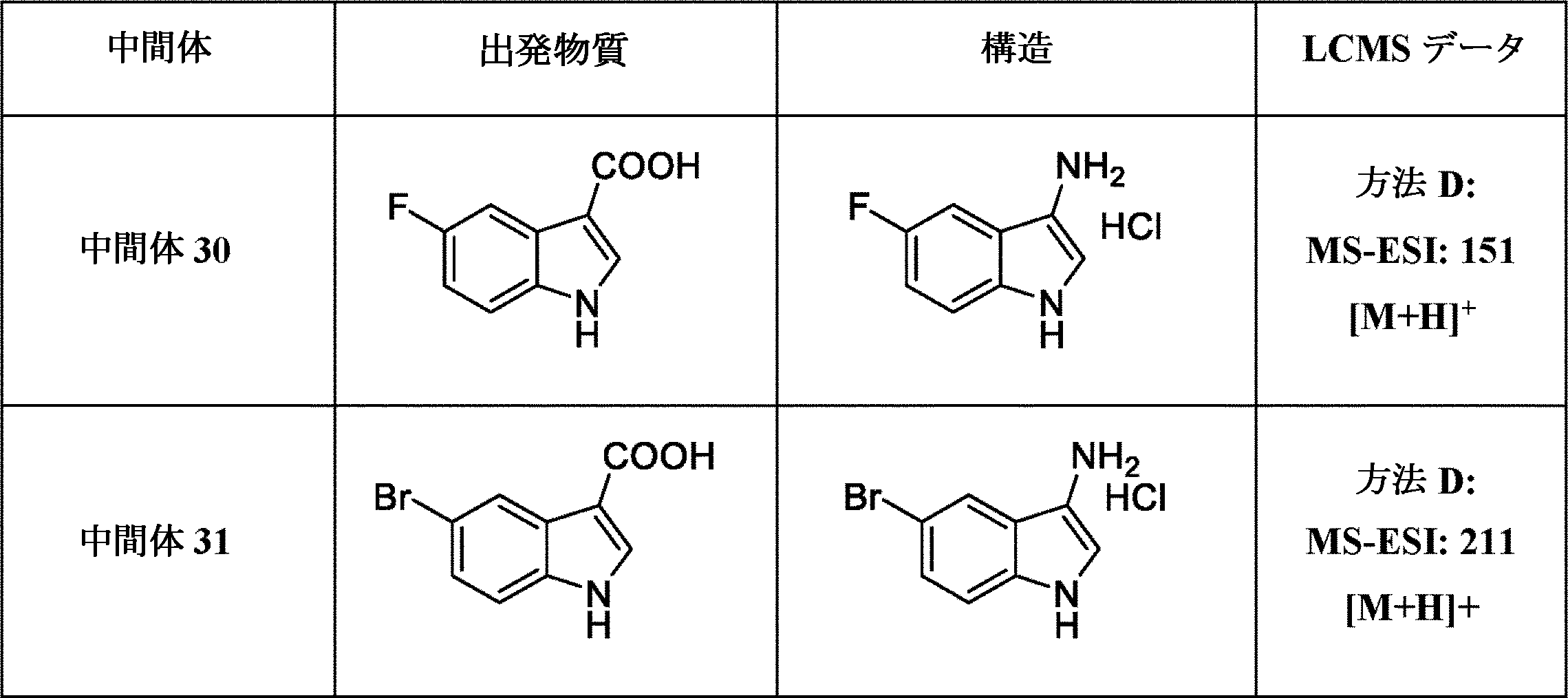
中間体32 (1-(4-(トリフルオロメチル)フェニル)-1H-イミダゾール-4-カルボン酸)の合成
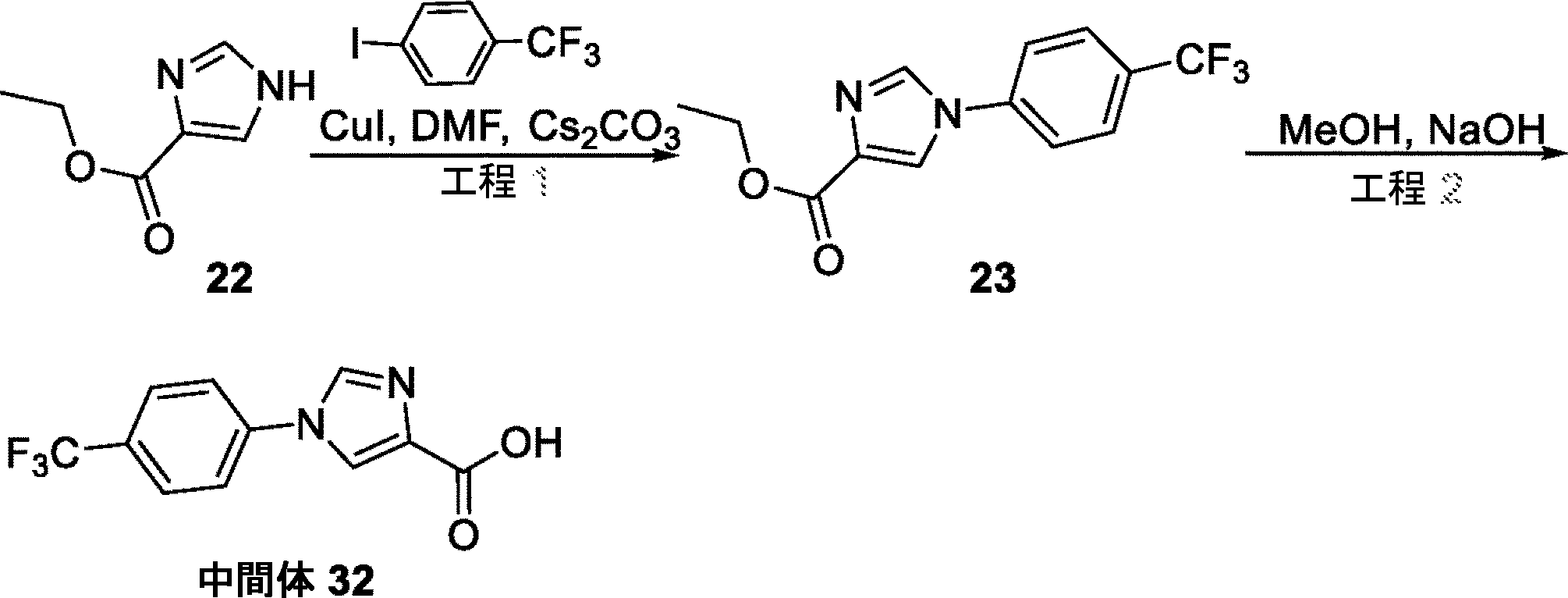
工程1:1-(4-(トリフルオロメチル)フェニル)イミダゾール-4-カルボン酸エチル
1H-イミダゾール-4-カルボン酸エチル(300.0mg、2.1mmol、1.0当量)および1-ヨード-4-(トリフルオロメチル)ベンゼン(698.7mg、2.6mmol、1.2当量)をDMF(10.0mL)に溶解し、次にCuI(40.8mg、0.2mmol、0.1当量)およびCs2CO3(2.1g、6.4mmol、3.0当量)を、窒素雰囲気下で加えた。反応混合物を一晩、100℃に加熱してから周囲温度まで冷却し、水の添加によってクエンチした。結果としてもたらされた溶液を酢酸エチルで抽出し、真空下で濃縮した。残渣を以下の条件でのフラッシュ分取HPLCによって精製した(IntelFlash-1):カラム、C18シリカゲル;移動相、ACN/水(10mM H4HCO3)、25分以内に0%から100%に増加;検出器、UV254nm。これにより、1-[4-(トリフルオロメチル)フェニル]イミダゾール-4-カルボン酸エチル(260mg)が白色固形物として得られた。LCMS方法A:[M+H]+=285。
Step 1: Ethyl 1-(4-(trifluoromethyl)phenyl)imidazole-4-carboxylate
Ethyl 1H-imidazole-4-carboxylate (300.0 mg, 2.1 mmol, 1.0 eq.) and 1-iodo-4-(trifluoromethyl)benzene (698.7 mg, 2.6 mmol, 1.2 eq.) were dissolved in DMF (10.0 mL). Then CuI (40.8 mg, 0.2 mmol, 0.1 eq.) and Cs 2 CO 3 (2.1 g, 6.4 mmol, 3.0 eq.) were added under nitrogen atmosphere. The reaction mixture was heated to 100° C. overnight, then cooled to ambient temperature and quenched by the addition of water. The resulting solution was extracted with ethyl acetate and concentrated under vacuum. The residue was purified by flash preparative HPLC (IntelFlash-1) with the following conditions: column, C18 silica gel; mobile phase, ACN/water (10mM H 4 HCO 3 ), increasing from 0% to 100% within 25 min. ;Detector, UV254nm. This gave ethyl 1-[4-(trifluoromethyl)phenyl]imidazole-4-carboxylate (260 mg) as a white solid. LCMS method A: [M+H] + =285.
工程2:1-[4-(トリフルオロメチル)フェニル]イミダゾール-4-カルボン酸
1-[4-(トリフルオロメチル)フェニル]イミダゾール-4-カルボン酸エチル(270.0mg、1.1mmol、1.0当量)をMeOH(5.0mL)および水(5.0mL)に溶解し、次にNaOH(84.4mg、2.1mmol、2.0当量)を加えた。反応混合物を周囲温度で一晩撹拌し、次に真空下で濃縮した。残渣を以下の条件でのフラッシュ分取HPLCによって精製した:カラム、C18シリカゲル;移動相、ACN/水(10mM NH4HCO3)、25分以内に0%から100%に増加;検出器、UV254nm。これにより、1-[4-(トリフルオロメチル)フェニル]イミダゾール-4-カルボン酸(150mg)が白色固形物として得られた。LCMS方法F:[M+H]+=257。
Step 2: 1-[4-(trifluoromethyl)phenyl]imidazole-4-carboxylic acid
Ethyl 1-[4-(trifluoromethyl)phenyl]imidazole-4-carboxylate (270.0 mg, 1.1 mmol, 1.0 eq.) was dissolved in MeOH (5.0 mL) and water (5.0 mL), then NaOH (84.4 mg, 2.1 mmol, 2.0 eq) was added. The reaction mixture was stirred at ambient temperature overnight, then concentrated under vacuum. The residue was purified by flash preparative HPLC with the following conditions: column, C18 silica gel; mobile phase, ACN/water (10mM NH4HCO3 ) increasing from 0% to 100% within 25 minutes; detector , UV254nm. . This gave 1-[4-(trifluoromethyl)phenyl]imidazole-4-carboxylic acid (150 mg) as a white solid. LCMS method F: [M+H] + =257.
中間体33 (1-(1-ブロモエチル)-4-(トリフルオロメチル)ベンゼン)の合成

1-[4-(トリフルオロメチル)フェニル]エタノール(1.0g、5.3mmol、1.0当量)をDCM(20.0mL)に溶解して0℃に冷却し、次に、反応混合物を0℃に維持しながら、三臭化リン(1.4g、5.2mmol、1.0当量)を加えた。反応混合物を周囲温度で1時間撹拌し、次に飽和NaHCO3水溶液の添加によってクエンチした。結果としてもたらされた溶液をジクロロメタンで抽出し、真空下で濃縮した。残渣をシリカゲルでのフラッシュカラムクロマトグラフィーによって精製し、酢酸エチル/石油エーテル(1:1)で溶出させることにより、1-(1-ブロモエチル)-4-(トリフルオロメチル)ベンゼン(800mg)を白色固形物として得た。 1-[4-(trifluoromethyl)phenyl]ethanol (1.0 g, 5.3 mmol, 1.0 eq.) was dissolved in DCM (20.0 mL) and cooled to 0 °C, then the reaction mixture was maintained at 0 °C. while phosphorus tribromide (1.4 g, 5.2 mmol, 1.0 eq.) was added. The reaction mixture was stirred at ambient temperature for 1 h, then quenched by the addition of saturated aqueous NaHCO3 . The resulting solution was extracted with dichloromethane and concentrated under vacuum. The residue was purified by flash column chromatography on silica gel, eluting with ethyl acetate/petroleum ether (1:1) to give 1-(1-bromoethyl)-4-(trifluoromethyl)benzene (800 mg) as a white product. Obtained as a solid.
中間体34 (7-メトキシ-1H-ピロロ[3,2-c]ピリジン)の合成

工程1:3-メトキシ-4-ニトロピリジン-1-イウム-1-オラート
3-フルオロ-4-ニトロピリジン-1-イウム-1-オラート(10.0g、63.3mmol、1.0当量)をMeOH(200.0mL)に溶解し、次にMeONa(6.8g、126.5mmol、2.0当量)を加えた。反応混合物を周囲温度で16時間撹拌し、次に水の添加によってクエンチした。結果としてもたらされた溶液を酢酸エチルで抽出し、無水硫酸ナトリウムで乾燥し、真空下で濃縮することにより、3-メトキシ-4-ニトロピリジン-1-イウム-1-オラート(6.1g)を黄色固形物として得た。LCMS方法H:[M+H]+=171。

3-Fluoro-4-nitropyridin-1-ium-1-olate (10.0 g, 63.3 mmol, 1.0 eq.) was dissolved in MeOH (200.0 mL), then MeONa (6.8 g, 126.5 mmol, 2.0 eq.) added. The reaction mixture was stirred at ambient temperature for 16 hours and then quenched by the addition of water. 3-Methoxy-4-nitropyridin-1-ium-1-olate (6.1 g) was obtained by extracting the resulting solution with ethyl acetate, drying over anhydrous sodium sulfate, and concentrating under vacuum. Obtained as a yellow solid. LCMS method H: [M+H] + = 171.
工程2:3-メトキシ-4-ニトロピリジン
3-メトキシ-4-ニトロピリジン-1-イウム-1-オラート(5.0g、29.4mmol、1.0当量)を酢酸エチル(200.0mL)に溶解して0℃に冷却し、次にPCl3(6.0g、44.1mmol、1.5当量)を加えた。反応混合物を周囲温度で1時間撹拌し、水の添加によってクエンチした。その溶液をNaOH水溶液(2M)でpH7に調節し、次に酢酸エチルで抽出し、無水硫酸ナトリウムで乾燥し、真空下で濃縮することにより、3-メトキシ-4-ニトロピリジン(4.2g)を黄色固形物として得た。LCMS方法H:[M+H]+=155。

3-Methoxy-4-nitropyridin-1-ium-1-olate (5.0 g, 29.4 mmol, 1.0 eq.) was dissolved in ethyl acetate (200.0 mL) and cooled to 0 °C, then PCl 3 (6.0 g , 44.1 mmol, 1.5 eq.) were added. The reaction mixture was stirred at ambient temperature for 1 hour and quenched by the addition of water. 3-Methoxy-4-nitropyridine (4.2 g) was obtained by adjusting the solution to pH 7 with aqueous NaOH (2M), then extracting with ethyl acetate, drying over anhydrous sodium sulfate, and concentrating under vacuum. Obtained as a yellow solid. LCMS method H: [M+H] + = 155.
工程3:7-メトキシ-1H-ピロロ[3,2-c]ピリジン
3-メトキシ-4-ニトロピリジン(15.0g、97.3mmol、1.0当量)をTHF(500.0mL)に溶解して-50℃に冷却し、次に、反応混合物を-50℃に維持しながら、臭化ビニルマグネシウム(1M、THF中、194.6mL、194.6mmol、2.0当量)を滴下した。反応混合物を-50℃で5時間撹拌し、Na2S2O3(15%wt)水溶液の添加によってクエンチした。結果としてもたらされた溶液を酢酸エチルで抽出し、無水硫酸ナトリウムで乾燥し、真空下で濃縮した。残渣をシリカゲルでのフラッシュカラムクロマトグラフィーによって精製し、ジクロロメタン/メタノール(10:1)で溶出させることにより、7-メトキシ-1H-ピロロ[3,2-c]ピリジン(500mg)を白色固形物として得た。LCMS方法D:[M+H]+=149。

3-Methoxy-4-nitropyridine (15.0 g, 97.3 mmol, 1.0 eq.) was dissolved in THF (500.0 mL) and cooled to -50 °C, then the reaction mixture was odor-treated while maintaining at -50 °C. Vinylmagnesium chloride (1M in THF, 194.6 mL, 194.6 mmol, 2.0 eq.) was added dropwise. The reaction mixture was stirred at −50° C. for 5 h and quenched by the addition of Na 2 S 2 O 3 (15% wt) aqueous solution. The resulting solution was extracted with ethyl acetate, dried over anhydrous sodium sulfate, and concentrated under vacuum. The residue was purified by flash column chromatography on silica gel, eluting with dichloromethane/methanol (10:1) to give 7-methoxy-1H-pyrrolo[3,2-c]pyridine (500 mg) as a white solid. Obtained. LCMS method D: [M+H] + = 149.
中間体35 (7-メチル-1H-ピロロ[3,2-c]ピリジン)の合成

7-ブロモ-1H-ピロロ[3,2-c]ピリジン(1.0g、5.1mmol、1.0当量)を1,4-ジオキサン(20.0mL)および水(2.0mL)に溶解し、次にK2CO3(1.4g、10.2mmol、2.0当量)、Pd(dppf)Cl2(0.4g、0.5mmol、0.1当量)およびメチルボロン酸(0.9g、15.2mmol、3.0当量)を、窒素雰囲気下で加えた。反応混合物を一晩、100℃に加熱し、次に水の添加によってクエンチした。結果としてもたらされた溶液を酢酸エチルで抽出し、無水硫酸ナトリウムで乾燥し、真空下で濃縮した。残渣をシリカゲルでのフラッシュカラムクロマトグラフィーによって精製し、酢酸エチル/石油エーテル(1:5)で溶出させることにより、7-メチル-1H-ピロロ[3,2-c]ピリジン(300mg)を黄色固形物として得た。LCMS方法D:[M+H]+=133。 7-Bromo-1H-pyrrolo[3,2-c]pyridine (1.0 g, 5.1 mmol, 1.0 eq.) was dissolved in 1,4-dioxane (20.0 mL) and water (2.0 mL), then K 2 CO 3 (1.4 g, 10.2 mmol, 2.0 eq.), Pd(dppf) Cl2 (0.4 g, 0.5 mmol, 0.1 eq.) and methylboronic acid (0.9 g, 15.2 mmol, 3.0 eq.) were added under nitrogen atmosphere. The reaction mixture was heated to 100° C. overnight and then quenched by the addition of water. The resulting solution was extracted with ethyl acetate, dried over anhydrous sodium sulfate, and concentrated under vacuum. The residue was purified by flash column chromatography on silica gel, eluting with ethyl acetate/petroleum ether (1:5) to give 7-methyl-1H-pyrrolo[3,2-c]pyridine (300 mg) as a yellow solid. I got it as a thing. LCMS method D: [M+H] + = 133.
中間体36 (1-アジド-4-(トリフルオロメチル)ベンゼン)の合成

4-(トリフルオロメチル)アニリン(800.0mg、5.0mmol、1.0当量)をACNに溶解して0℃に冷却し、次に、内部温度を0℃に維持しながら、t-BuONO(768.0mg、7.4mmol、1.5当量)を滴下した。0℃で0.5時間撹拌した後、TMSN3(858.0mg、7.4mmol、1.5当量)を加えた。結果としてもたらされた混合物を周囲温度で4時間撹拌し、次に真空下で濃縮した。残渣をシリカゲルでのフラッシュカラムクロマトグラフィーによって精製し、酢酸エチル/石油エーテル(1:8)で溶出させることにより、1-アジド-4-(トリフルオロメチル)ベンゼン(400mg)を無色の油状物として得た。 4-(Trifluoromethyl)aniline (800.0 mg, 5.0 mmol, 1.0 eq.) was dissolved in ACN and cooled to 0 °C, then t-BuONO (768.0 mg, 7.4 mmol, 1.5 equivalents) was added dropwise. After stirring at 0° C. for 0.5 h, TMSN 3 (858.0 mg, 7.4 mmol, 1.5 eq.) was added. The resulting mixture was stirred at ambient temperature for 4 hours, then concentrated under vacuum. The residue was purified by flash column chromatography on silica gel, eluting with ethyl acetate/petroleum ether (1:8) to give 1-azido-4-(trifluoromethyl)benzene (400 mg) as a colorless oil. Obtained.
中間体37 (1-(アジドメチル)-4-(トリフルオロメチル)ベンゼン)の合成

(4-(トリフルオロメチル)フェニル)メタノール(1.0g、5.7mmol、1.0当量)をTHF(20.0mL)に溶解し、次にDBU(1.7g、11.2mmol、2.0当量)およびDPPA(2.3g、8.5mmol、1.5当量)を加えた。反応混合物を周囲温度で2時間撹拌し、水の添加によってクエンチした。結果としてもたらされた溶液を酢酸エチルで抽出し、ブラインで洗浄し、無水硫酸ナトリウムで乾燥し、真空下で濃縮した。残渣をシリカゲルでのフラッシュカラムクロマトグラフィーによって精製し、酢酸エチル/石油エーテル(1:10)で溶出させることにより、1-(アジドメチル)-4-(トリフルオロメチル)ベンゼン(400mg)を無色の油状物として得た。 (4-(Trifluoromethyl)phenyl)methanol (1.0 g, 5.7 mmol, 1.0 eq.) was dissolved in THF (20.0 mL), then DBU (1.7 g, 11.2 mmol, 2.0 eq.) and DPPA (2.3 g, 8.5 mmol, 1.5 eq) was added. The reaction mixture was stirred at ambient temperature for 2 hours and quenched by the addition of water. The resulting solution was extracted with ethyl acetate, washed with brine, dried over anhydrous sodium sulfate, and concentrated under vacuum. The residue was purified by flash column chromatography on silica gel, eluting with ethyl acetate/petroleum ether (1:10) to give 1-(azidomethyl)-4-(trifluoromethyl)benzene (400 mg) as a colorless oil. I got it as a thing.
中間体39 (7-メトキシ-1H-ピロロ[3,2-c]ピリジン)の合成

工程1:5-ブロモ-7-フルオロ-3-ニトロ-1H-インドール
5-ブロモ-7-フルオロ-1H-インドール(500.0mg、2.3mmol、1.0当量)をACN(10mL)に溶解して0℃に冷却し、次に、混合物を0℃に維持しながら、AgNO3(595.3mg、3.5mmol、1.5当量)および塩化ベンゾイル(0.4mL、3.5mmol、1.5当量)を加えた。反応混合物を周囲温度で3時間撹拌し、次に水の添加によってクエンチした。残渣をシリカゲルでのフラッシュカラムクロマトグラフィーによって精製し、酢酸エチル/石油エーテル(1:10)で溶出させることにより、5-ブロモ-7-フルオロ-3-ニトロ-1H-インドール(250mg)を褐色固形物として得た。LCMS方法C:[M+H]+=259。
Step 1: 5-bromo-7-fluoro-3-nitro-1H-indole
5-Bromo-7-fluoro-1H-indole (500.0 mg, 2.3 mmol, 1.0 eq.) was dissolved in ACN (10 mL) and cooled to 0 °C, then mixed with AgNO 3 while maintaining the mixture at 0 °C. ( 595.3 mg, 3.5 mmol, 1.5 eq.) and benzoyl chloride (0.4 mL, 3.5 mmol, 1.5 eq.) were added. The reaction mixture was stirred at ambient temperature for 3 hours and then quenched by the addition of water. The residue was purified by flash column chromatography on silica gel, eluting with ethyl acetate/petroleum ether (1:10) to give 5-bromo-7-fluoro-3-nitro-1H-indole (250 mg) as a brown solid. I got it as a thing. LCMS method C: [M+H] + =259.
工程2:N-(5-ブロモ-7-フルオロ-1H-インドール-3-イル)カルバミン酸tert-ブチル
5-ブロモ-7-フルオロ-3-ニトロ-1H-インドール(250.0mg、1.0mmol、1.0当量)および(Boc)2O(252.8mg、1.2mmol、1.2当量)をMeOH(5mL)に加えて0℃に冷却し、次に、混合物を0℃に維持しながら、NaBH4(73.0mg、1.9mmol、2.0当量)およびNiCl2(250.2mg、1.9mmol、2.0当量)を加えた。結果としてもたらされた混合物を0℃で0.5時間撹拌し、次に水の添加によってクエンチした。結果としてもたらされた溶液を酢酸エチルで抽出し、無水硫酸ナトリウムで乾燥し、真空下で濃縮した。残渣をシリカゲルでのフラッシュカラムクロマトグラフィーによって精製し、酢酸エチル/石油エーテル(1:10)で溶出させることにより、N-(5-ブロモ-7-フルオロ-1H-インドール-3-イル)カルバミン酸tert-ブチル(30.0mg)を褐色固形物として得た。LCMS方法A:[M+H]+=329。
Step 2: tert-butyl N-(5-bromo-7-fluoro-1H-indol-3-yl)carbamate
5-bromo-7-fluoro-3-nitro-1H-indole (250.0 mg, 1.0 mmol, 1.0 eq.) and (Boc) 2O (252.8 mg, 1.2 mmol, 1.2 eq.) in MeOH (5 mL) were added to 0 C. and then added NaBH4 (73.0 mg, 1.9 mmol, 2.0 eq.) and NiCl2 (250.2 mg, 1.9 mmol, 2.0 eq.) while maintaining the mixture at 0.degree. The resulting mixture was stirred at 0° C. for 0.5 h and then quenched by the addition of water. The resulting solution was extracted with ethyl acetate, dried over anhydrous sodium sulfate, and concentrated under vacuum. The residue was purified by flash column chromatography on silica gel, eluting with ethyl acetate/petroleum ether (1:10) to give N-(5-bromo-7-fluoro-1H-indol-3-yl)carbamic acid. Tert-butyl (30.0 mg) was obtained as a brown solid. LCMS method A: [M+H] + =329.
工程3:N-[7-フルオロ-5-(1-イソプロピルピラゾール-4-イル)-1H-インドール-3-イル]カルバミン酸tert-ブチル
N-(5-ブロモ-7-フルオロ-1H-インドール-3-イル)カルバミン酸tert-ブチル(30.0mg、0.1mmol、1.0当量)および1-イソプロピル-4-(4,4,5,5-テトラメチル-1,3,2-ジオキサボロラン-2-イル)ピラゾール(32.3mg、0.1mmol、1.5当量)を1,4-ジオキサン(1.0mL)および水(0.1mL)に溶解し、次にCs2CO3(59.4mg、0.2mmol、2.0当量)およびXPhos Pd G3(7.7mg、0.01mmol、0.1当量)を、窒素雰囲気下で加えた。結果としてもたらされた混合物を一晩、100℃に加熱し、次に周囲温度まで冷却し、水の添加によってクエンチした。結果としてもたらされた溶液を酢酸エチルで抽出し、無水硫酸ナトリウムで乾燥し、真空下で濃縮した。残渣をシリカゲルでのフラッシュカラムクロマトグラフィーによって精製し、酢酸エチル/石油エーテル(1:5)で溶出させることにより、N-[7-フルオロ-5-(1-イソプロピルピラゾール-4-イル)-1H-インドール-3-イル]カルバミン酸tert-ブチル(15.0mg)を黄色固形物として得た。LCMS方法A:[M+H]+=359。
Step 3: tert-butyl N-[7-fluoro-5-(1-isopropylpyrazol-4-yl)-1H-indol-3-yl]carbamate
tert-butyl N-(5-bromo-7-fluoro-1H-indol-3-yl)carbamate (30.0 mg, 0.1 mmol, 1.0 eq.) and 1-isopropyl-4-(4,4,5,5- Tetramethyl-1,3,2-dioxaborolan-2-yl)pyrazole (32.3 mg, 0.1 mmol, 1.5 eq.) was dissolved in 1,4-dioxane (1.0 mL) and water (0.1 mL), then dissolved in Cs2 CO3 (59.4 mg, 0.2 mmol, 2.0 eq.) and XPhos Pd G3 (7.7 mg, 0.01 mmol, 0.1 eq.) were added under nitrogen atmosphere. The resulting mixture was heated to 100° C. overnight, then cooled to ambient temperature and quenched by addition of water. The resulting solution was extracted with ethyl acetate, dried over anhydrous sodium sulfate, and concentrated under vacuum. The residue was purified by flash column chromatography on silica gel, eluting with ethyl acetate/petroleum ether (1:5) to give N-[7-fluoro-5-(1-isopropylpyrazol-4-yl)-1H tert-butyl-indol-3-yl]carbamate (15.0 mg) was obtained as a yellow solid. LCMS method A: [M+H] + =359.
工程4:7-フルオロ-5-(1-イソプロピルピラゾール-4-イル)-1H-インドール-3-アミン塩酸塩
N-[7-フルオロ-5-(1-イソプロピルピラゾール-4-イル)-1H-インドール-3-イル]カルバミン酸tert-ブチル(15.0mg、0.04mmol、1.0当量)を、1,4-ジオキサン中のHCl(4M、1.0mL)に溶解した。結果としてもたらされた溶液を周囲温度で8時間撹拌し、次に真空下で濃縮することにより、7-フルオロ-5-(1-イソプロピルピラゾール-4-イル)-1H-インドール-3-アミン塩酸塩(9.0mg)を緑色固形物として得た。LCMS方法C:[M+H]+=259。
Step 4: 7-fluoro-5-(1-isopropylpyrazol-4-yl)-1H-indol-3-amine hydrochloride
Tert-butyl N-[7-fluoro-5-(1-isopropylpyrazol-4-yl)-1H-indol-3-yl]carbamate (15.0 mg, 0.04 mmol, 1.0 equiv.) was added to 1,4-dioxane. HCl (4M, 1.0 mL) in solution. 7-fluoro-5-(1-isopropylpyrazol-4-yl)-1H-indol-3-amine was obtained by stirring the resulting solution at ambient temperature for 8 h and then concentrating under vacuum. The hydrochloride salt (9.0 mg) was obtained as a green solid. LCMS method C: [M+H] + =259.
中間体40 (5-フェノキシ-1H-インドール-3-アミン塩酸塩)の合成
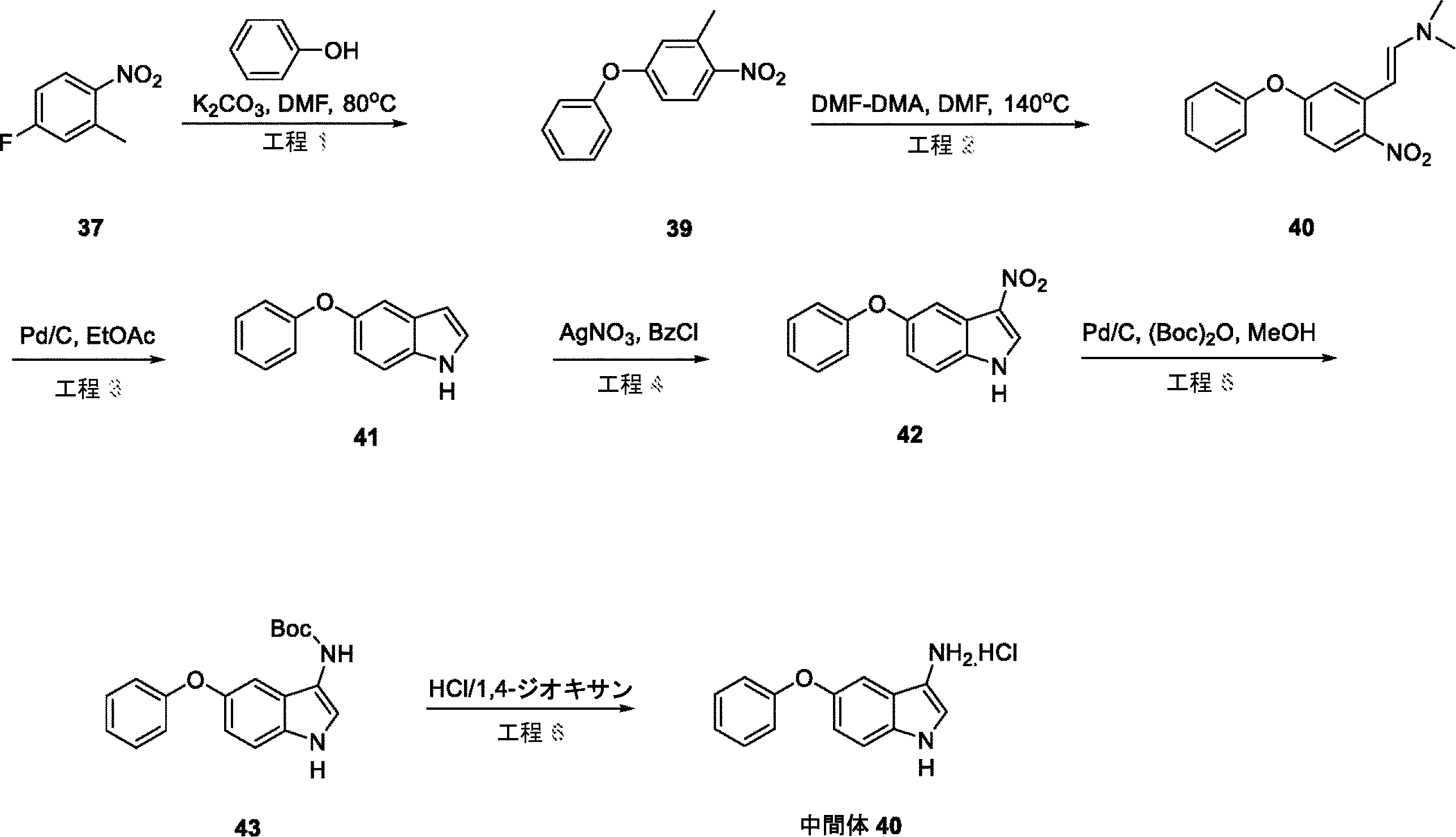
工程1:2-メチル-1-ニトロ-4-フェノキシベンゼン
4-フルオロ-2-メチル-1-ニトロベンゼン(19.0g、122.5mmol、1.0当量)およびフェノール(23.0g、244.7mmol、2.0当量)をDMF(100mL)に溶解し、次にK2CO3(50.8g、367.4mmol、3.0当量)を加えた。反応混合物を2時間、80℃に加熱し、次に周囲温度まで冷却し、水の添加によってクエンチした。結果としてもたらされた溶液を酢酸エチルで抽出し、真空下で濃縮した。残渣をシリカゲルでのフラッシュカラムクロマトグラフィーによって精製し、酢酸エチル/石油エーテル(1:9)で溶出させることにより、2-メチル-1-ニトロ-4-フェノキシベンゼン(31.0g)を黄色固形物として得た。

4-Fluoro-2-methyl-1-nitrobenzene (19.0 g, 122.5 mmol, 1.0 eq.) and phenol (23.0 g, 244.7 mmol, 2.0 eq.) were dissolved in DMF (100 mL), then K 2 CO 3 (50.8 g, 367.4 mmol, 3.0 eq) was added. The reaction mixture was heated to 80° C. for 2 hours, then cooled to ambient temperature and quenched by the addition of water. The resulting solution was extracted with ethyl acetate and concentrated under vacuum. The residue was purified by flash column chromatography on silica gel, eluting with ethyl acetate/petroleum ether (1:9) to give 2-methyl-1-nitro-4-phenoxybenzene (31.0 g) as a yellow solid. Obtained.
工程2:ジメチル[(E)-2-(2-ニトロ-5-フェノキシフェニル)エテニル]アミン
2-メチル-1-ニトロ-4-フェノキシベンゼン(6.9g、30.1mmol、1.0当量)をDMF(40mL)に溶解し、次にDMF-DMA(12.0mL、90.3mmol、3.0当量)を加えた。反応混合物を3時間、90℃に加熱し、周囲温度まで冷却し、真空下で濃縮した。残渣をシリカゲルでのフラッシュカラムクロマトグラフィーによって精製し、酢酸エチル/石油エーテル(1:4)で溶出させることにより、ジメチル[(E)-2-(2-ニトロ-5-フェノキシフェニル)エテニル]アミン(2.2g)を赤色固形物として得た。
Step 2: Dimethyl[(E)-2-(2-nitro-5-phenoxyphenyl)ethenyl]amine
2-Methyl-1-nitro-4-phenoxybenzene (6.9 g, 30.1 mmol, 1.0 eq.) was dissolved in DMF (40 mL), then DMF-DMA (12.0 mL, 90.3 mmol, 3.0 eq.) was added. The reaction mixture was heated to 90° C. for 3 hours, cooled to ambient temperature and concentrated under vacuum. The residue was purified by flash column chromatography on silica gel, eluting with ethyl acetate/petroleum ether (1:4) to give dimethyl[(E)-2-(2-nitro-5-phenoxyphenyl)ethenyl]amine. (2.2g) was obtained as a red solid.
工程3:5-フェノキシ-1H-インドール
ジメチル[(E)-2-(2-ニトロ-5-フェノキシフェニル)エテニル]アミン(11.0g、38.7mmol、1.0当量)を酢酸エチル(20mL)に溶解し、次にPd/C(10%wt.、2.0g)を加えた。反応混合物を窒素でスパージし、水素ガス雰囲気(バルーン)下に置いてから、周囲温度で16時間撹拌した。固形物を濾過によって除去し、濾液を真空下で濃縮した。残渣をシリカゲルでのフラッシュカラムクロマトグラフィーによって精製し、酢酸エチル/石油エーテル(1:2)で溶出させることにより、5-フェノキシ-1H-インドール(2.2g)を濃青色固形物として得た。

工程4:3-ニトロ-5-フェノキシ-1H-インドール
5-フェノキシ-1H-インドール(3.0g、14.3mmol、1.0当量)をACN(15mL)に溶解して0℃に冷却した。次にAgNO3(3.7g、21.5mmol、1.5当量)を加えた。次に塩化ベンゾイル(3.0g、21.5mmol、1.5当量)を添加した。反応混合物を周囲温度で1時間撹拌し、次に氷水の添加によってクエンチした。結果としてもたらされた溶液を酢酸エチルで抽出し、ブラインで洗浄し、無水Na2SO4で乾燥し、真空下で濃縮した。残渣をシリカゲルでのフラッシュカラムクロマトグラフィーによって精製し、酢酸エチル/石油エーテル(1:3)で溶出させることにより、3-ニトロ-5-フェノキシ-1H-インドール(1.7g)を褐色固形物として得た。LCMS方法A-1:[M+H]+=255。
Step 4: 3-nitro-5-phenoxy-1H-indole
5-phenoxy-1H-indole (3.0 g, 14.3 mmol, 1.0 eq) was dissolved in ACN (15 mL) and cooled to 0 °C. AgNO3 (3.7g, 21.5mmol, 1.5eq) was then added. Then benzoyl chloride (3.0g, 21.5mmol, 1.5eq) was added. The reaction mixture was stirred at ambient temperature for 1 hour, then quenched by the addition of ice water. The resulting solution was extracted with ethyl acetate, washed with brine, dried over anhydrous Na 2 SO 4 and concentrated under vacuum. The residue was purified by flash column chromatography on silica gel, eluting with ethyl acetate/petroleum ether (1:3) to give 3-nitro-5-phenoxy-1H-indole (1.7 g) as a brown solid. Ta. LCMS method A-1: [M+H] + =255.
工程5:N-(5-フェノキシ-1H-インドール-3-イル)カルバミン酸tert-ブチル
3-ニトロ-5-フェノキシ-1H-インドール(3.0g、11.8mmol、1.0当量)および(Boc)2O(3.9g、17.7mmol、1.5当量)をMeOH(5mL)に溶解し、次にPd/C(10%wt.、600.0mg)を加えた。反応混合物を窒素でスパージし、水素ガス雰囲気(バルーン)下に置いてから、周囲温度で16時間撹拌した。固形物を濾過によって除去し、濾液を真空下で濃縮した。残渣をシリカゲルでのフラッシュカラムクロマトグラフィーによって精製し、酢酸エチル/石油エーテル(1:4)で溶出させることにより、N-(5-フェノキシ-1H-インドール-3-イル)カルバミン酸tert-ブチル(1.5g)を淡桃色固形物として得た。LCMS方法A-1:[M+H]+=325。
Step 5: tert-butyl N-(5-phenoxy-1H-indol-3-yl)carbamate
3-Nitro-5-phenoxy-1H-indole (3.0 g, 11.8 mmol, 1.0 eq.) and (Boc) 2O (3.9 g, 17.7 mmol, 1.5 eq.) were dissolved in MeOH (5 mL) and then Pd/ C (10% wt., 600.0 mg) was added. The reaction mixture was sparged with nitrogen, placed under an atmosphere of hydrogen gas (balloon), and then stirred at ambient temperature for 16 hours. The solids were removed by filtration and the filtrate was concentrated under vacuum. The residue was purified by flash column chromatography on silica gel, eluting with ethyl acetate/petroleum ether (1:4) to give tert-butyl N-(5-phenoxy-1H-indol-3-yl)carbamate ( 1.5 g) was obtained as a pale pink solid. LCMS method A-1: [M+H] + = 325.
工程6:5-フェノキシ-1H-インドール-3-アミン塩酸塩
N-(5-フェノキシ-1H-インドール-3-イル)カルバミン酸tert-ブチル(120.0mg、0.4mmol、1.0当量)をHCl/1,4-ジオキサン(4M、5mL)に溶解した。反応混合物を周囲温度で30分間撹拌し、次に真空下で濃縮することにより、5-フェノキシ-1H-インドール-3-アミン塩酸塩(60.0mg)を褐色固形物として得た。LCMS方法C-1:[M+H]+=225。
Step 6: 5-phenoxy-1H-indol-3-amine hydrochloride
tert-Butyl N-(5-phenoxy-1H-indol-3-yl)carbamate (120.0 mg, 0.4 mmol, 1.0 eq.) was dissolved in HCl/1,4-dioxane (4M, 5 mL). The reaction mixture was stirred at ambient temperature for 30 minutes and then concentrated under vacuum to give 5-phenoxy-1H-indol-3-amine hydrochloride (60.0 mg) as a brown solid. LCMS method C-1: [M+H] + =225.
中間体41 (5-(1-イソプロピル-1H-ピラゾール-4-イル)-1H-インドール-3-アミン塩酸塩)の合成

工程1:5-ブロモ-1H-インドール-3-カルボニルアジド
5-ブロモ-1H-インドール-3-カルボン酸(30.0g、124.9mmol、1.0当量)をTHF(150mL)に溶解し、次にTEA(26.1mL、187.4mmol、1.5当量)およびDPPA(37.8g、137.4mmol、1.1当量)を加えた。反応混合物を周囲温度で12時間撹拌し、次に水の添加によってクエンチし、さらに10分間撹拌した。沈殿した固形物を濾過によって収集し、乾燥することにより、5-ブロモ-1H-インドール-3-カルボニルアジド(33.6g)をオフホワイトの固形物として得た。LCMS方法B-1:[M-H]-=263。
Step 1: 5-bromo-1H-indole-3-carbonyl azide
5-bromo-1H-indole-3-carboxylic acid (30.0 g, 124.9 mmol, 1.0 eq.) was dissolved in THF (150 mL), then TEA (26.1 mL, 187.4 mmol, 1.5 eq.) and DPPA (37.8 g, 137.4 mmol, 1.1 eq) was added. The reaction mixture was stirred at ambient temperature for 12 hours, then quenched by the addition of water and stirred for an additional 10 minutes. The precipitated solid was collected by filtration and dried to give 5-bromo-1H-indole-3-carbonyl azide (33.6 g) as an off-white solid. LCMS method B-1: [MH] - = 263.
工程2:(5-ブロモ-1H-インドール-3-イル)カルバミン酸tert-ブチル
5-ブロモ-1H-インドール-3-カルボニルアジド(33.6g、126.7mmol、1.0当量)をt-BuOH(300mL)に溶解した。反応混合物を12時間、80℃に加熱し、次に周囲温度まで冷却し、真空下で濃縮した。残渣をシリカゲルでのフラッシュカラムクロマトグラフィーによって精製し、酢酸エチル/石油エーテル(1:10)で溶出させることにより、(5-ブロモ-1H-インドール-3-イル)カルバミン酸tert-ブチル(22.1g)を青白い固形物として得た。LCMS方法A-1:[M+H]+=311。
Step 2: tert-butyl (5-bromo-1H-indol-3-yl)carbamate
5-Bromo-1H-indole-3-carbonyl azide (33.6g, 126.7mmol, 1.0eq) was dissolved in t-BuOH (300mL). The reaction mixture was heated to 80° C. for 12 hours, then cooled to ambient temperature and concentrated under vacuum. The residue was purified by flash column chromatography on silica gel, eluting with ethyl acetate/petroleum ether (1:10) to give tert-butyl (5-bromo-1H-indol-3-yl)carbamate (22.1 g ) was obtained as a pale solid. LCMS method A-1: [M+H] + =311.
工程3:N-[5-(1-イソプロピルピラゾール-4-イル)-1H-インドール-3-イル]カルバミン酸tert-ブチル
N-(5-ブロモ-1H-インドール-3-イル)カルバミン酸tert-ブチル(500.0mg、1.6mmol、1.0当量)および1-イソプロピル-4-(4,4,5,5-テトラメチル-1,3,2-ジオキサボロラン-2-イル)ピラゾール(417.3mg、1.8mmol、1.1当量)を1,4-ジオキサン(6mL)および水(0.6mL)に溶解し、次にXphos Pd G3(136.0mg、0.2mmol、0.1当量)およびCs2CO3(2.1g、6.4mmol、4.0当量)を、窒素雰囲気下で加えた。反応混合物を一晩、100℃に加熱してから周囲温度まで冷却し、水の添加によってクエンチした。結果としてもたらされた溶液を酢酸エチルで抽出し、真空下で濃縮した。残渣をシリカゲルでのフラッシュカラムクロマトグラフィーによって精製し、酢酸エチル/石油エーテル(1:1)で溶出させることにより、N-[5-(1-イソプロピルピラゾール-4-イル)-1H-インドール-3-イル]カルバミン酸tert-ブチル(405.0mg)を白色固形物として得た。LCMS方法C-1:[M+H]+=341。
Step 3: tert-butyl N-[5-(1-isopropylpyrazol-4-yl)-1H-indol-3-yl]carbamate
tert-butyl N-(5-bromo-1H-indol-3-yl)carbamate (500.0 mg, 1.6 mmol, 1.0 equiv.) and 1-isopropyl-4-(4,4,5,5-tetramethyl-1 ,3,2-dioxaborolan-2-yl)pyrazole (417.3 mg, 1.8 mmol, 1.1 eq.) was dissolved in 1,4-dioxane (6 mL) and water (0.6 mL), then Xphos Pd G3 (136.0 mg, 0.2 mmol , 0.1 eq.) and Cs2CO3 (2.1 g, 6.4 mmol, 4.0 eq.) were added under nitrogen atmosphere. The reaction mixture was heated to 100° C. overnight, then cooled to ambient temperature and quenched by the addition of water. The resulting solution was extracted with ethyl acetate and concentrated under vacuum. The residue was purified by flash column chromatography on silica gel, eluting with ethyl acetate/petroleum ether (1:1) to give N-[5-(1-isopropylpyrazol-4-yl)-1H-indole-3 tert-butyl]carbamate (405.0 mg) was obtained as a white solid. LCMS method C-1: [M+H] + =341.
工程4:5-(1-イソプロピルピラゾール-4-イル)-1H-インドール-3-アミン塩酸塩
N-[5-(1-イソプロピルピラゾール-4-イル)-1H-インドール-3-イル]カルバミン酸tert-ブチル(400.0mg、1.2mmol、1.0当量)をHCl/1,4-ジオキサン(4M、8mL)に溶解した。反応混合物を周囲温度で4時間撹拌し、次に真空下で濃縮することにより、5-(1-イソプロピルピラゾール-4-イル)-1H-インドール-3-アミン塩酸塩(400.0mg)を灰色固形物として得た。LCMS方法C-1:[M+H]+=241。
Step 4: 5-(1-isopropylpyrazol-4-yl)-1H-indol-3-amine hydrochloride
Tert-butyl N-[5-(1-isopropylpyrazol-4-yl)-1H-indol-3-yl]carbamate (400.0 mg, 1.2 mmol, 1.0 eq.) was dissolved in HCl/1,4-dioxane (4M, 8 mL). The reaction mixture was stirred at ambient temperature for 4 hours and then concentrated under vacuum to give 5-(1-isopropylpyrazol-4-yl)-1H-indol-3-amine hydrochloride (400.0 mg) as a gray solid. I got it as a thing. LCMS method C-1: [M+H] + =241.
中間体41について説明した方法と同じ方法を使って、以下の表の中間体を調製した。

中間体43 (2-((2,2,2-トリフルオロエトキシ)メチル)ピリジン-4-アミン)の合成

工程1:4-ニトロ-2-[(2,2,2-トリフルオロエトキシ)メチル]ピリジン
(4-ニトロピリジン-2-イル)メタノール(2.0g、13.0mmol、1.0当量)をTHF(20mL)に溶解し、次にMeONa(2.1g、38.9mmol、3.0当量)およびトリフルオロメタンスルホン酸2,2,2-トリフルオロエチル(6.0g、26.0mmol、2.0当量)を加えた。反応混合物を一晩、60℃に加熱し、次に周囲温度まで冷却し、水の添加によってクエンチした。結果としてもたらされた溶液を酢酸エチルで抽出し、無水Na2SO4で乾燥し、真空下で濃縮した。残渣をシリカゲルでのフラッシュカラムクロマトグラフィーによって精製し、酢酸エチル/石油エーテル(1:1)で溶出させることにより、4-ニトロ-2-[(2,2,2-トリフルオロエトキシ)メチル]ピリジン(1.0g)を黄色固形物として得た。LCMS方法A-1:[M+H]+=237。
Step 1: 4-nitro-2-[(2,2,2-trifluoroethoxy)methyl]pyridine (4-nitropyridin-2-yl)methanol (2.0g, 13.0mmol, 1.0eq) in THF (20mL) Then MeONa (2.1 g, 38.9 mmol, 3.0 eq.) and 2,2,2-trifluoroethyl trifluoromethanesulfonate (6.0 g, 26.0 mmol, 2.0 eq.) were added. The reaction mixture was heated to 60° C. overnight, then cooled to ambient temperature and quenched by the addition of water. The resulting solution was extracted with ethyl acetate, dried over anhydrous Na 2 SO 4 and concentrated under vacuum. The residue was purified by flash column chromatography on silica gel, eluting with ethyl acetate/petroleum ether (1:1) to give 4-nitro-2-[(2,2,2-trifluoroethoxy)methyl]pyridine. (1.0 g) was obtained as a yellow solid. LCMS method A-1: [M+H] + =237.
工程2:2-[(2,2,2-トリフルオロエトキシ)メチル]ピリジン-4-アミン
4-ニトロ-2-[(2,2,2-トリフルオロエトキシ)メチル]ピリジン(1.0g、4.2mmol、1.0当量)をEtOH(10mL)に溶解し、次にSnCl2(4.0g、21.2mmol、5.0当量)を加えた。反応混合物を5分間、60℃に加熱し、次に素早く0℃に冷却し、NaOH水溶液(5M)の添加によってクエンチした。結果としてもたらされた溶液を酢酸エチルで抽出し、有機層を合わせ、無水硫酸ナトリウムで乾燥し、次に真空下で濃縮することにより、2-[(2,2,2-トリフルオロエトキシ)メチル]ピリジン-4-アミン(478.0mg)を黄色油状物として得た。LCMS方法B-1:[M+H]+=207。
Step 2: 2-[(2,2,2-trifluoroethoxy)methyl]pyridin-4-amine
4-Nitro-2-[(2,2,2-trifluoroethoxy)methyl]pyridine (1.0 g, 4.2 mmol, 1.0 eq.) was dissolved in EtOH (10 mL), then SnCl2 (4.0 g, 21.2 mmol , 5.0 equivalents) were added. The reaction mixture was heated to 60°C for 5 minutes, then rapidly cooled to 0°C and quenched by the addition of aqueous NaOH (5M). The resulting solution was extracted with ethyl acetate, the organic layers were combined, dried over anhydrous sodium sulfate, and then concentrated under vacuum to obtain 2-[(2,2,2-trifluoroethoxy) Methyl]pyridin-4-amine (478.0 mg) was obtained as a yellow oil. LCMS method B-1: [M+H] + =207.
中間体44 (1-(4-(トリフルオロメチル)ベンジル)-1H-ピラゾール-4-カルボン酸)の合成

工程1:5-メチル-6-(2,2,2-トリフルオロエトキシ)ピリジン-3-カルボン酸メチル
6-クロロ-5-メチルピリジン-3-カルボン酸メチル(1.0g、5.4mmol、1.0当量)およびトリフルオロエタノール(0.4mL、5.4mmol、1.0当量)をトルエン(10mL)に溶解し、次に、窒素雰囲気下で、Cs2CO3(3.5g、10.8mmol、2.0当量)、ブレットホス(578.4mg、1.1mmol、0.2当量)およびブレットホスPd G3(488.4mg、0.5mmol、0.1当量)を加えた。反応混合物を一晩、80℃に加熱し、次に周囲温度まで冷却し、真空下で濃縮した。残渣をシリカゲルでのフラッシュカラムクロマトグラフィーによって精製し、酢酸エチル/石油エーテル(1:5)で溶出させることにより、5-メチル-6-(2,2,2-トリフルオロエトキシ)ピリジン-3-カルボン酸メチル(900mg)を黄色固形物として得た。LCMS方法A-1:[M+H]+=250。
Step 1: Methyl 5-methyl-6-(2,2,2-trifluoroethoxy)pyridine-3-carboxylate
Methyl 6-chloro-5-methylpyridine-3-carboxylate (1.0 g, 5.4 mmol, 1.0 eq.) and trifluoroethanol (0.4 mL, 5.4 mmol, 1.0 eq.) were dissolved in toluene (10 mL), then Under nitrogen atmosphere, Cs2CO3 (3.5g, 10.8mmol, 2.0eq), Brettphos (578.4mg, 1.1mmol, 0.2eq) and Brettphos Pd G3 ( 488.4mg, 0.5mmol, 0.1eq) were added. The reaction mixture was heated to 80° C. overnight, then cooled to ambient temperature and concentrated under vacuum. The residue was purified by flash column chromatography on silica gel, eluting with ethyl acetate/petroleum ether (1:5) to give 5-methyl-6-(2,2,2-trifluoroethoxy)pyridine-3- Methyl carboxylate (900mg) was obtained as a yellow solid. LCMS method A-1: [M+H] + =250.
工程2:[5-メチル-6-(2,2,2-トリフルオロエトキシ)ピリジン-3-イル]メタノール
5-メチル-6-(2,2,2-トリフルオロエトキシ)ピリジン-3-カルボン酸メチル(900.0mg、3.6mmol、1.0当量)をTHF(20mL)に溶解して0℃に冷却し、次にLiAlH4(274.2mg、7.2mmol、2.0当量)を加えた。反応混合物を0℃で2時間撹拌し、次にNa2SO4・10H2Oの添加によってクエンチした。固形物を濾去し、その分解溶液を真空下で濃縮した。残渣をシリカゲルでのフラッシュカラムクロマトグラフィーによって精製し、酢酸エチル/石油エーテル(1:1)で溶出させることにより、[5-メチル-6-(2,2,2-トリフルオロエトキシ)ピリジン-3-イル]メタノール(700mg)を黄色固形物として得た。LCMS方法A-1:[M+H]+=222。
Step 2: [5-methyl-6-(2,2,2-trifluoroethoxy)pyridin-3-yl]methanol
Methyl 5-methyl-6-(2,2,2-trifluoroethoxy)pyridine-3-carboxylate (900.0 mg, 3.6 mmol, 1.0 eq.) was dissolved in THF (20 mL) and cooled to 0 °C, then LiAlH 4 (274.2 mg, 7.2 mmol, 2.0 eq.) was added to the solution. The reaction mixture was stirred at 0° C. for 2 hours and then quenched by the addition of Na 2 SO 4 .10H 2 O. The solids were filtered off and the decomposed solution was concentrated under vacuum. The residue was purified by flash column chromatography on silica gel, eluting with ethyl acetate/petroleum ether (1:1) to give [5-methyl-6-(2,2,2-trifluoroethoxy)pyridine-3 -yl]methanol (700 mg) was obtained as a yellow solid. LCMS method A-1: [M+H] + =222.
工程3:-(ブロモメチル)-3-メチル-2-(2,2,2-トリフルオロエトキシ)ピリジン
[5-メチル-6-(2,2,2-トリフルオロエトキシ)ピリジン-3-イル]メタノール(700.0mg、3.2mmol、1.0当量)をHBr(10mL)に溶解した。反応混合物を一晩、80℃に加熱し、次に周囲温度まで冷却し、水の添加によってクエンチした。結果としてもたらされた溶液を酢酸エチルで抽出し、真空下で濃縮した。残渣をシリカゲルでのフラッシュカラムクロマトグラフィーによって精製し、酢酸エチル/石油エーテル(1:5)で溶出させることにより、5-(ブロモメチル)-3-メチル-2-(2,2,2-トリフルオロエトキシ)ピリジン(510mg)を黄色固形物として得た。LCMS方法B-1:[M+H]+=284。
Step 3: -(bromomethyl)-3-methyl-2-(2,2,2-trifluoroethoxy)pyridine [5-methyl-6-(2,2,2-trifluoroethoxy)pyridin-3-yl] Methanol (700.0 mg, 3.2 mmol, 1.0 eq.) was dissolved in HBr (10 mL). The reaction mixture was heated to 80° C. overnight, then cooled to ambient temperature and quenched by the addition of water. The resulting solution was extracted with ethyl acetate and concentrated under vacuum. The residue was purified by flash column chromatography on silica gel, eluting with ethyl acetate/petroleum ether (1:5) to give 5-(bromomethyl)-3-methyl-2-(2,2,2-trifluoro Ethoxy)pyridine (510 mg) was obtained as a yellow solid. LCMS method B-1: [M+H] + =284.
中間体45 (1-(4-(トリフルオロメチル)ベンジル)-1H-ピラゾール-4-カルボン酸)の合成
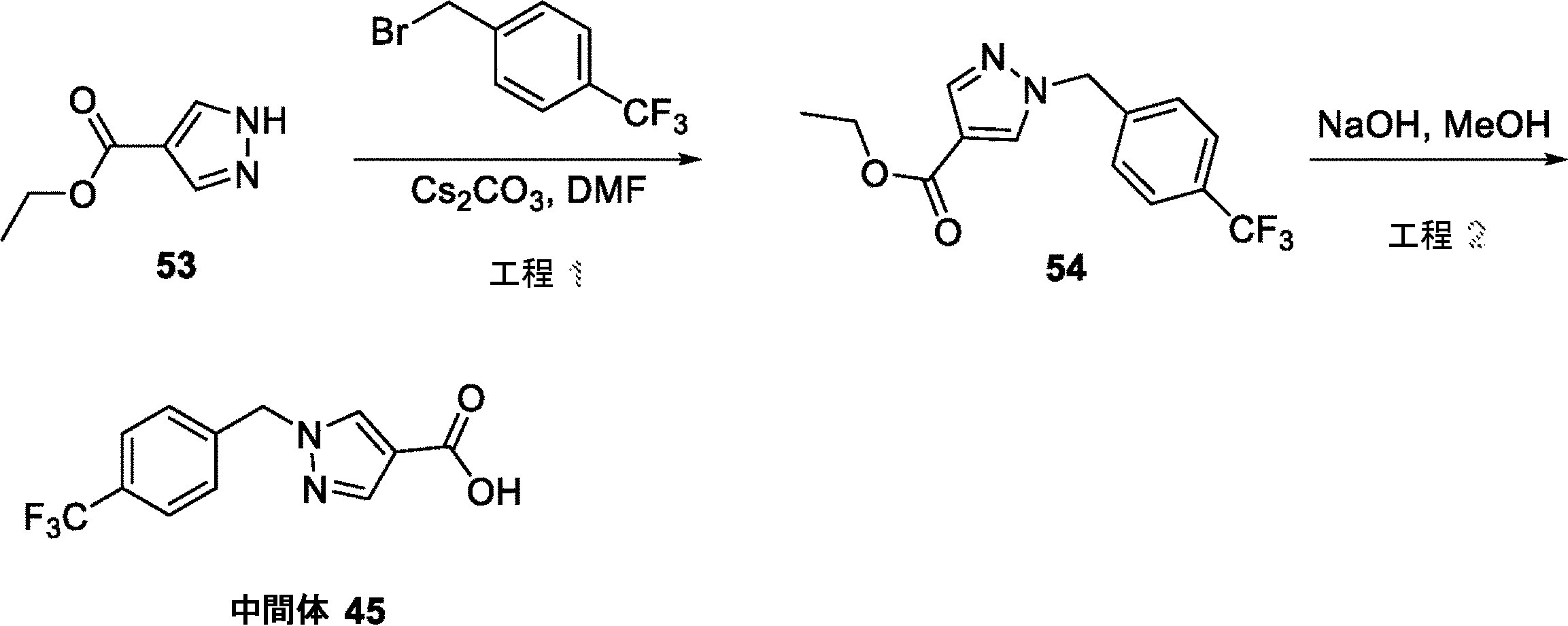
工程1:1-[[4-(トリフルオロメチル)フェニル]メチル]ピラゾール-4-カルボン酸エチル
1H-ピラゾール-4-カルボン酸エチル(300.0mg、2.1mmol、1.0当量)および1-(ブロモメチル)-4-(トリフルオロメチル)ベンゼン(511.7mg、2.1mmol、1.0当量)をDMF(6mL)に溶解し、次にCs2CO3(2.1g、6.4mmol、3.0当量)を加えた。反応混合物を周囲温度で一晩撹拌し、次に水の添加によってクエンチした。結果としてもたらされた溶液を酢酸エチルで抽出し、真空下で濃縮した。残渣を以下の条件でのフラッシュ分取HPLCによって精製した:カラム、C18シリカゲル;移動相、水(NH4HCO3、1g/1L)およびACN、0%ACNから25分以内に100%ACNに増加;検出器、UV254nm。これにより、1-[[4-(トリフルオロメチル)フェニル]メチル]ピラゾール-4-カルボン酸エチル(310mg)を白色固形物として得た。LCMS方法A-1:[M+H]+=299。
Step 1: Ethyl 1-[[4-(trifluoromethyl)phenyl]methyl]pyrazole-4-carboxylate
Ethyl 1H-pyrazole-4-carboxylate (300.0 mg, 2.1 mmol, 1.0 eq.) and 1-(bromomethyl)-4-(trifluoromethyl)benzene (511.7 mg, 2.1 mmol, 1.0 eq.) in DMF (6 mL). Dissolve and then add Cs 2 CO 3 (2.1 g, 6.4 mmol, 3.0 eq.). The reaction mixture was stirred at ambient temperature overnight and then quenched by the addition of water. The resulting solution was extracted with ethyl acetate and concentrated under vacuum. The residue was purified by flash preparative HPLC with the following conditions: column, C18 silica gel; mobile phase, water (NH 4 HCO 3 , 1 g/1L) and ACN, increasing from 0% ACN to 100% ACN within 25 min. ;Detector, UV254nm. This gave ethyl 1-[[4-(trifluoromethyl)phenyl]methyl]pyrazole-4-carboxylate (310 mg) as a white solid. LCMS method A-1: [M+H] + =299.
工程2:1-[[4-(トリフルオロメチル)フェニル]メチル]ピラゾール-4-カルボン酸
1-[[4-(トリフルオロメチル)フェニル]メチル]ピラゾール-4-カルボン酸エチル(200.0mg、0.7mmol、1.0当量)をMeOH(2mL)および水(2mL)に溶解し、次にNaOH(53.6mg、1.3mmol、2.0当量)を加えた。反応混合物を周囲温度で1時間撹拌し、次に真空下で濃縮した。残渣を以下の条件でのフラッシュ分取HPLCによって精製した:カラム、C18シリカゲル;移動相、水(10mM NH4HCO3)およびACN、0%ACNから25分以内に100%に増加;検出器、UV254nm。これにより、1-[[4-(トリフルオロメチル)フェニル]メチル]ピラゾール-4-カルボン酸(130mg)を白色固形物として得た。LCMS方法B-1:[M-H]-=269。
Step 2: 1-[[4-(trifluoromethyl)phenyl]methyl]pyrazole-4-carboxylic acid
Ethyl 1-[[4-(trifluoromethyl)phenyl]methyl]pyrazole-4-carboxylate (200.0 mg, 0.7 mmol, 1.0 eq.) was dissolved in MeOH (2 mL) and water (2 mL), then dissolved in NaOH ( 53.6mg, 1.3mmol, 2.0eq) was added. The reaction mixture was stirred at ambient temperature for 1 hour, then concentrated under vacuum. The residue was purified by flash preparative HPLC with the following conditions: column, C18 silica gel; mobile phase, water (10mM NH4HCO3 ) and ACN, increasing from 0% ACN to 100% within 25 min ; detector, UV254nm. This gave 1-[[4-(trifluoromethyl)phenyl]methyl]pyrazole-4-carboxylic acid (130 mg) as a white solid. LCMS method B-1: [MH] - = 269.
中間体45について説明した方法と同じ方法を使って、以下の表の中間体を調製した。

中間体48 (1-(2-((5-(トリフルオロメチル)ピリジン-3-イル)オキシ)エチル)-1H-ピラゾール-4-カルボン酸)の合成

工程1:1-[2-(オキサン-2-イルオキシ)エチル]ピラゾール-4-カルボン酸エチル
2-(2-ブロモエトキシ)オキサン(2.0g、9.6mmol、1.0当量)および1H-ピラゾール-4-カルボン酸エチル(1.3g、9.6mmol、1.0当量)をACN(15mL)に溶解し、次にK2CO3(4.0g、28.7mmol、3.0当量)を加えた。反応混合物を一晩、80℃に加熱し、次に周囲温度まで冷却し、真空下で濃縮した。残渣をシリカゲルでのフラッシュカラムクロマトグラフィーによって精製し、酢酸エチル/石油エーテル(1:1)で溶出させることにより、1-[2-(オキサン-2-イルオキシ)エチル]ピラゾール-4-カルボン酸エチル(1.8g)を無色の油状物として得た。LCMS方法A-1:[M+H]+=269。
Step 1: Ethyl 1-[2-(oxan-2-yloxy)ethyl]pyrazole-4-carboxylate
2-(2-bromoethoxy)oxane (2.0 g, 9.6 mmol, 1.0 eq.) and ethyl 1H-pyrazole-4-carboxylate (1.3 g, 9.6 mmol, 1.0 eq.) were dissolved in ACN (15 mL) and then K2CO3 ( 4.0g, 28.7mmol, 3.0eq) was added. The reaction mixture was heated to 80° C. overnight, then cooled to ambient temperature and concentrated under vacuum. The residue was purified by flash column chromatography on silica gel, eluting with ethyl acetate/petroleum ether (1:1) to give ethyl 1-[2-(oxan-2-yloxy)ethyl]pyrazole-4-carboxylate. (1.8g) was obtained as a colorless oil. LCMS method A-1: [M+H] + =269.
工程2:1-(2-ヒドロキシエチル)ピラゾール-4-カルボン酸エチル
1-[2-(オキサン-2-イルオキシ)エチル]ピラゾール-4-カルボン酸エチル(1.0g、3.7mmol、1.0当量)をMeOH(5mL)に溶解し、次にHCl/1,4-ジオキサン(4M、10mL)を加えた。反応混合物を周囲温度で一晩撹拌し、次に真空下で濃縮した。残渣を以下の条件での逆フラッシュクロマトグラフィーによって精製した:カラム、C18シリカゲル;移動相A:水(0.1%TFA)、移動相B:ACN;10%相Bから10分で30%への勾配;検出器、UV254nm。これにより、1-(2-ヒドロキシエチル)ピラゾール-4-カルボン酸エチル(900mg)を無色油状物として得た。LCMS方法A-1:[M+H]+=185。
Step 2: Ethyl 1-(2-hydroxyethyl)pyrazole-4-carboxylate
Ethyl 1-[2-(oxan-2-yloxy)ethyl]pyrazole-4-carboxylate (1.0 g, 3.7 mmol, 1.0 eq.) was dissolved in MeOH (5 mL) and then dissolved in HCl/1,4-dioxane ( 4M, 10mL) was added. The reaction mixture was stirred at ambient temperature overnight, then concentrated under vacuum. The residue was purified by back-flash chromatography with the following conditions: column, C18 silica gel; mobile phase A: water (0.1% TFA), mobile phase B: ACN; gradient from 10% phase B to 30% in 10 min. ;Detector, UV254nm. This gave ethyl 1-(2-hydroxyethyl)pyrazole-4-carboxylate (900 mg) as a colorless oil. LCMS method A-1: [M+H] + = 185.
工程3:1-(2-[[5-(トリフルオロメチル)ピリジン-3-イル]オキシ]エチル)ピラゾール-4-カルボン酸エチル
1-(2-ヒドロキシエチル)ピラゾール-4-カルボン酸エチル(500.0mg、2.7mmol、1.0当量)および5-(トリフルオロメチル)ピリジン-3-オール(442.7mg、2.7mmol、1.0当量)をTHF(5mL)に溶解して0℃に冷却し、次にPPh3(1.1g、4.1mmol、1.5当量)を加えた。次に、DIAD(0.7mL、4.1mmol、1.5当量)を、窒素雰囲気下、0℃で滴下した。反応混合物を周囲温度で一晩撹拌し、次に真空下で濃縮した。残渣をシリカゲルでのフラッシュカラムクロマトグラフィーによって精製し、酢酸エチル/石油エーテル(1:1)で溶出させることにより、1-(2-[[5-(トリフルオロメチル)ピリジン-3-イル]オキシ]エチル)ピラゾール-4-カルボン酸エチル(400mg)を黄色油状物として得た。LCMS方法A-1:[M+H]+=320。
Step 3: Ethyl 1-(2-[[5-(trifluoromethyl)pyridin-3-yl]oxy]ethyl)pyrazole-4-carboxylate
Ethyl 1-(2-hydroxyethyl)pyrazole-4-carboxylate (500.0 mg, 2.7 mmol, 1.0 eq.) and 5-(trifluoromethyl)pyridin-3-ol (442.7 mg, 2.7 mmol, 1.0 eq.) in THF (5 mL) and cooled to 0° C., then PPh 3 (1.1 g, 4.1 mmol, 1.5 eq.) was added. Next, DIAD (0.7 mL, 4.1 mmol, 1.5 eq.) was added dropwise at 0° C. under nitrogen atmosphere. The reaction mixture was stirred at ambient temperature overnight, then concentrated under vacuum. The residue was purified by flash column chromatography on silica gel, eluting with ethyl acetate/petroleum ether (1:1) to give 1-(2-[[5-(trifluoromethyl)pyridin-3-yl]oxy ] Ethyl) pyrazole-4-carboxylate (400 mg) was obtained as a yellow oil. LCMS method A-1: [M+H] + =320.
工程4:-(2-[[5-(トリフルオロメチル)ピリジン-3-イル]オキシ]エチル)ピラゾール-4-カルボン酸
1-(2-[[5-(トリフルオロメチル)ピリジン-3-イル]オキシ]エチル)ピラゾール-4-カルボン酸エチル(400.0mg、1.2mmol、1.0当量)をMeOH(5mL)および水(5mL)に溶解し、次にNaOH(97.2mg、2.4mmol、2.0当量)を加えた。反応混合物を2時間、80℃に加熱し、次に周囲温度まで冷却し、真空下で濃縮した。残渣を水で希釈し、HCl水溶液(1N)でpH7に調節し、ジクロロメタンで抽出し、真空下で濃縮した。残渣を以下の条件での逆フラッシュクロマトグラフィーによって精製した:カラム、C18シリカゲル;移動相A:水(0.1%NH4CO3)、相B:ACN;10分で10%相Bから50%への勾配;検出器、UV254nm。これにより、1-(2-[[5-(トリフルオロメチル)ピリジン-3-イル]オキシ]エチル)ピラゾール-4-カルボン酸(320mg)を無色油状物として得た。LCMS方法A-1:[M+H]+=302。
Step 4: -(2-[[5-(trifluoromethyl)pyridin-3-yl]oxy]ethyl)pyrazole-4-carboxylic acid
Ethyl 1-(2-[[5-(trifluoromethyl)pyridin-3-yl]oxy]ethyl)pyrazole-4-carboxylate (400.0 mg, 1.2 mmol, 1.0 eq.) was dissolved in MeOH (5 mL) and water (5 mL). ) and then NaOH (97.2 mg, 2.4 mmol, 2.0 eq.) was added. The reaction mixture was heated to 80° C. for 2 hours, then cooled to ambient temperature and concentrated under vacuum. The residue was diluted with water, adjusted to pH 7 with aqueous HCl (1N), extracted with dichloromethane and concentrated under vacuum. The residue was purified by back-flash chromatography under the following conditions: column, C18 silica gel; mobile phase A: water (0.1% NH 4 CO 3 ), phase B: ACN; 10% phase B to 50% in 10 min. gradient; detector, UV254nm. This gave 1-(2-[[5-(trifluoromethyl)pyridin-3-yl]oxy]ethyl)pyrazole-4-carboxylic acid (320 mg) as a colorless oil. LCMS method A-1: [M+H] + =302.
中間体49 (1-(5-フルオロ-6-((2,2,2-トリフルオロエチル)アミノ)ピリジン-3-イル)-1H-1,2,3-トリアゾール-4-カルボン酸)の合成

工程1:3-フルオロ-5-ニトロ-N-(2,2,2-トリフルオロエチル)ピリジン-2-アミン
2-クロロ-3-フルオロ-5-ニトロピリジン(1.0g、5.7mmol、1.0当量)および2,2,2-トリフルオロエチルアミン(561.1mg、5.7mmol、1.0当量)をACN(10mL)に溶解し、次にK2CO3(2.3g、17.0mmol、3.0当量)を加えた。反応混合物を16時間、80℃に加熱し、次に周囲温度まで冷却し、酢酸エチルで希釈した。結果としてもたらされた溶液をブラインで洗浄し、無水Na2SO4で乾燥し、真空下で濃縮した。残渣をシリカゲルでのフラッシュカラムクロマトグラフィーによって精製し、酢酸エチル/石油エーテル(1:1)で溶出させることにより、3-フルオロ-5-ニトロ-N-(2,2,2-トリフルオロエチル)ピリジン-2-アミン(510.0mg)を白色固形物として得た。LCMS方法A-1:[M+H]+=240。
Step 1: 3-fluoro-5-nitro-N-(2,2,2-trifluoroethyl)pyridin-2-amine
2-Chloro-3-fluoro-5-nitropyridine (1.0 g, 5.7 mmol, 1.0 eq.) and 2,2,2-trifluoroethylamine (561.1 mg, 5.7 mmol, 1.0 eq.) were dissolved in ACN (10 mL). , then K2CO3 ( 2.3g, 17.0mmol, 3.0eq) was added. The reaction mixture was heated to 80° C. for 16 hours, then cooled to ambient temperature and diluted with ethyl acetate. The resulting solution was washed with brine, dried over anhydrous Na 2 SO 4 and concentrated under vacuum. The residue was purified by flash column chromatography on silica gel, eluting with ethyl acetate/petroleum ether (1:1) to give 3-fluoro-5-nitro-N-(2,2,2-trifluoroethyl). Pyridin-2-amine (510.0 mg) was obtained as a white solid. LCMS method A-1: [M+H] + =240.
工程2:3-フルオロ-N2-(2,2,2-トリフルオロエチル)ピリジン-2,5-ジアミン
3-フルオロ-5-ニトロ-N-(2,2,2-トリフルオロエチル)ピリジン-2-アミン(500.0mg、2.1mmol、1.0当量)をMeOH(10mL)に溶解し、次にPd/C(10%wt.、100.0mg)を加えた。反応混合物を窒素でスパージし、水素ガス雰囲気(バルーン)下に置いてから、周囲温度で16時間撹拌した。固形物を濾過によって除去し、濾液を真空下で濃縮することにより、3-フルオロ-N2-(2,2,2-トリフルオロエチル)ピリジン-2,5-ジアミン(400.0mg)を白色固形物として得た。LCMS方法A-1:[M+H]+=210。
Step 2: 3-fluoro-N2-(2,2,2-trifluoroethyl)pyridine-2,5-diamine
3-Fluoro-5-nitro-N-(2,2,2-trifluoroethyl)pyridin-2-amine (500.0 mg, 2.1 mmol, 1.0 eq.) was dissolved in MeOH (10 mL) and then Pd/C (10% wt., 100.0 mg) was added. The reaction mixture was sparged with nitrogen, placed under an atmosphere of hydrogen gas (balloon), and then stirred at ambient temperature for 16 hours. The solids were removed by filtration and the filtrate was concentrated under vacuum to give 3-fluoro-N2-(2,2,2-trifluoroethyl)pyridine-2,5-diamine (400.0 mg) as a white solid. obtained as. LCMS method A-1: [M+H] + =210.
工程3:5-アジド-3-フルオロ-N-(2,2,2-トリフルオロエチル)ピリジン-2-アミン
3-フルオロ-N2-(2,2,2-トリフルオロエチル)ピリジン-2,5-ジアミン(400.0mg、1.9mmol、1.0当量)をACN(10mL)に溶解して0℃に冷却し、次にt-BuNO2(295.8mg、2.9mmol、1.5当量)を加えた。0℃で1時間後に、TMSN3(340.1mg、2.5mmol、1.3当量)を加えた。結果としてもたらされた溶液を0℃でさらに2時間撹拌し、次に水の添加によってクエンチした。結果としてもたらされた溶液を酢酸エチルで抽出し、ブラインで洗浄し、無水Na2SO4で乾燥し、真空下で濃縮した。残渣をシリカゲルでのフラッシュカラムクロマトグラフィーによって精製し、酢酸エチル/石油エーテル(1:1)で溶出させることにより、5-アジド-3-フルオロ-N-(2,2,2-トリフルオロエチル)ピリジン-2-アミン(250.0mg)を白色固形物として得た。LCMS方法A-1:[M+H]+=236。
Step 3: 5-azido-3-fluoro-N-(2,2,2-trifluoroethyl)pyridin-2-amine
3-Fluoro-N2-(2,2,2-trifluoroethyl)pyridine-2,5-diamine (400.0 mg, 1.9 mmol, 1.0 eq.) was dissolved in ACN (10 mL) and cooled to 0 °C, then t- BuNO2 (295.8 mg, 2.9 mmol, 1.5 eq.) was added to the solution. After 1 hour at 0°C, TMSN 3 (340.1 mg, 2.5 mmol, 1.3 eq.) was added. The resulting solution was stirred for an additional 2 hours at 0°C and then quenched by the addition of water. The resulting solution was extracted with ethyl acetate, washed with brine, dried over anhydrous Na 2 SO 4 and concentrated under vacuum. The residue was purified by flash column chromatography on silica gel, eluting with ethyl acetate/petroleum ether (1:1) to give 5-azido-3-fluoro-N-(2,2,2-trifluoroethyl). Pyridin-2-amine (250.0 mg) was obtained as a white solid. LCMS method A-1: [M+H] + =236.
工程4:1-[5-フルオロ-6-[(2,2,2-トリフルオロエチル)アミノ]ピリジン-3-イル]-1,2,3-トリアゾール-4-カルボン酸メチル
5-アジド-3-フルオロ-N-(2,2,2-トリフルオロエチル)ピリジン-2-アミン(250.0mg、1.1mmol、1.0当量)を1,4-ジオキサン(10mL)に溶解し、次にCuSO4(17.0mg、0.1mmol、0.1当量)、アスコルビン酸ナトリウム(18.7mg、0.1mmol、0.1当量)およびプロピオル酸メチル(134.1mg、1.6mmol、1.5当量)を加えた。反応混合物を周囲温度で16時間撹拌し、次に酢酸エチルで希釈した。結果としてもたらされた溶液をブラインで洗浄し、無水Na2SO4で乾燥し、真空下で濃縮した。残渣をシリカゲルでのフラッシュカラムクロマトグラフィーによって精製し、酢酸エチル/石油エーテル(1:5)で溶出させることにより、1-[5-フルオロ-6-[(2,2,2-トリフルオロエチル)アミノ]ピリジン-3-イル]-1,2,3-トリアゾール-4-カルボン酸メチル(200.0mg)を白色固形物として得た。LCMS方法A-1:[M+H]+=320。
Step 4: Methyl 1-[5-fluoro-6-[(2,2,2-trifluoroethyl)amino]pyridin-3-yl]-1,2,3-triazole-4-carboxylate
5-azido-3-fluoro-N-(2,2,2-trifluoroethyl)pyridin-2-amine (250.0 mg, 1.1 mmol, 1.0 equiv.) was dissolved in 1,4-dioxane (10 mL) and then To was added CuSO 4 (17.0 mg, 0.1 mmol, 0.1 eq.), sodium ascorbate (18.7 mg, 0.1 mmol, 0.1 eq.) and methyl propionate (134.1 mg, 1.6 mmol, 1.5 eq.). The reaction mixture was stirred at ambient temperature for 16 hours, then diluted with ethyl acetate. The resulting solution was washed with brine, dried over anhydrous Na 2 SO 4 and concentrated under vacuum. The residue was purified by flash column chromatography on silica gel, eluting with ethyl acetate/petroleum ether (1:5) to give 1-[5-fluoro-6-[(2,2,2-trifluoroethyl) Methyl amino]pyridin-3-yl]-1,2,3-triazole-4-carboxylate (200.0 mg) was obtained as a white solid. LCMS method A-1: [M+H] + =320.
工程5:1-[5-フルオロ-6-[(2,2,2-トリフルオロエチル)アミノ]ピリジン-3-イル]-1,2,3-トリアゾール-4-カルボン酸
1-[5-フルオロ-6-[(2,2,2-トリフルオロエチル)アミノ]ピリジン-3-イル]-1,2,3-トリアゾール-4-カルボン酸メチル(200.0mg、0.6mmol、1.0当量)をMeOH(2mL)および水(2mL)に溶解し、次にNaOH(50.1mg、1.3mmol、2.0当量)を加えた。反応混合物を30分間、80℃に加熱し、次に周囲温度まで冷却し、真空下で濃縮した。残渣を水で希釈し、HCl水溶液(4N)でpH6に調節し、ジクロロメタンで抽出し、真空下で濃縮することにより、1-[5-フルオロ-6-[(2,2,2-トリフルオロエチル)アミノ]ピリジン-3-イル]-1,2,3-トリアゾール-4-カルボン酸(110.0mg)を白色固形物として得た。LCMS方法A-1:[M+H]+=306。
Step 5: 1-[5-fluoro-6-[(2,2,2-trifluoroethyl)amino]pyridin-3-yl]-1,2,3-triazole-4-carboxylic acid
Methyl 1-[5-fluoro-6-[(2,2,2-trifluoroethyl)amino]pyridin-3-yl]-1,2,3-triazole-4-carboxylate (200.0 mg, 0.6 mmol, 1.0 eq.) was dissolved in MeOH (2 mL) and water (2 mL), then NaOH (50.1 mg, 1.3 mmol, 2.0 eq.) was added. The reaction mixture was heated to 80° C. for 30 minutes, then cooled to ambient temperature and concentrated under vacuum. 1-[5-fluoro-6-[(2,2,2-trifluoro Ethyl)amino]pyridin-3-yl]-1,2,3-triazole-4-carboxylic acid (110.0mg) was obtained as a white solid. LCMS method A-1: [M+H] + =306.
中間体50 (1-(5-フルオロ-6-(2,2,2-トリフルオロエトキシ)ピリジン-3-イル)-1H-1,2,3-トリアゾール-4-カルボン酸)の合成

工程1:3-フルオロ-5-ニトロ-2-(2,2,2-トリフルオロエトキシ)ピリジン
2-クロロ-3-フルオロ-5-ニトロピリジン(1.0g、5.7mmol、1.0当量)およびトリフルオロエタノール(510.0mg、5.1mmol、0.9当量)をDMF(20mL)に溶解し、次にK2CO3(1.2g、8.5mmol、1.5当量)を加えた。反応混合物を2時間、80℃に加熱し、次に周囲温度まで冷却し、真空下で濃縮した。残渣を以下の条件でのフラッシュ分取HPLCによって精製した:カラム、C18シリカゲル;移動相、H2O/ACN、10%ACNから30分で90%に増加;検出器、254nm。これにより、3-フルオロ-5-ニトロ-2-(2,2,2-トリフルオロエトキシ)ピリジン(700.0mg)を、暗黄色固形物として得た。LCMS方法A-1:[M+H]+=241。
Step 1: 3-fluoro-5-nitro-2-(2,2,2-trifluoroethoxy)pyridine
2-Chloro-3-fluoro-5-nitropyridine (1.0 g, 5.7 mmol, 1.0 eq.) and trifluoroethanol (510.0 mg, 5.1 mmol, 0.9 eq.) were dissolved in DMF (20 mL), then K 2 CO 3 (1.2g, 8.5mmol, 1.5eq) was added. The reaction mixture was heated to 80° C. for 2 hours, then cooled to ambient temperature and concentrated under vacuum. The residue was purified by flash preparative HPLC with the following conditions: column, C18 silica gel; mobile phase, H 2 O/ACN, 10% ACN increasing to 90% in 30 min; detector, 254 nm. This gave 3-fluoro-5-nitro-2-(2,2,2-trifluoroethoxy)pyridine (700.0 mg) as a dark yellow solid. LCMS method A-1: [M+H] + =241.
工程2~5:1-[5-フルオロ-6-(2,2,2-トリフルオロエトキシ)ピリジン-3-イル]-1,2,3-トリアゾール-4-カルボン酸
中間体49の工程2~5について説明した方法と同じ方法を使って、標題の化合物を調製した。LCMS:方法B-1、[M+H]+=307。
Steps 2 to 5: Step 2 of 1-[5-fluoro-6-(2,2,2-trifluoroethoxy)pyridin-3-yl]-1,2,3-triazole-4-carboxylic acid Intermediate 49 The title compound was prepared using the same method described for ~5. LCMS: Method B-1, [M+H] + =307.
中間体51 (1-(5-メチル-6-(2,2,2-トリフルオロエトキシ)ピリジン-3-イル)-1H-1,2,3-トリアゾール-4-カルボン酸)の合成

工程1:5-ブロモ-3-メチル-2-(2,2,2-トリフルオロエトキシ)ピリジン
2,5-ジブロモ-3-メチルピリジン(1.0g、4.0mmol、1.0当量)をTHF(20mL)に溶解し、次に(2,2,2-トリフルオロエトキシ)ナトリウム(583.6mg、4.8mmol、1.2当量)を加えた。反応混合物を一晩、60℃に加熱し、次に周囲温度まで冷却し、水の添加によってクエンチした。結果としてもたらされた溶液を酢酸エチルで抽出し、真空下で濃縮した。残渣をシリカゲルでのフラッシュカラムクロマトグラフィーによって精製し、酢酸エチル/石油エーテル(1:10)で溶出させることにより、5-ブロモ-3-メチル-2-(2,2,2-トリフルオロエトキシ)ピリジン(800mg)を黄色油状物として得た。LCMS方法A-1:[M+H]+=270。
Step 1: 5-bromo-3-methyl-2-(2,2,2-trifluoroethoxy)pyridine
2,5-dibromo-3-methylpyridine (1.0 g, 4.0 mmol, 1.0 eq.) was dissolved in THF (20 mL), then sodium (2,2,2-trifluoroethoxy) (583.6 mg, 4.8 mmol, 1.2 equivalents) were added. The reaction mixture was heated to 60° C. overnight, then cooled to ambient temperature and quenched by the addition of water. The resulting solution was extracted with ethyl acetate and concentrated under vacuum. The residue was purified by flash column chromatography on silica gel, eluting with ethyl acetate/petroleum ether (1:10) to give 5-bromo-3-methyl-2-(2,2,2-trifluoroethoxy). Pyridine (800mg) was obtained as a yellow oil. LCMS method A-1: [M+H] + =270.
工程2:5-アジド-3-メチル-2-(2,2,2-トリフルオロエトキシ)ピリジン
5-ブロモ-3-メチル-2-(2,2,2-トリフルオロエトキシ)ピリジン(800.0mg、3.0mmol、1.0当量)をDMF(15mL)に溶解し、次にメチル[2-(メチルアミノ)エチル]アミン(0.7mL、5.9mmol、2.0当量)、NaN3(385.2mg、5.9mmol、2.0当量)、CuI(56.4mg、0.3mmol、0.1当量)およびアスコルビン酸ナトリウム(59.0mg、0.3mmol、0.1当量)を加えた。結果としてもたらされた溶液を一晩、80℃に加熱し、次に周囲温度まで冷却し、水の添加によってクエンチした。結果としてもたらされた溶液を酢酸エチルで抽出し、ブラインで洗浄し、無水Na2SO4で乾燥し、真空下で濃縮した。残渣をシリカゲルでのフラッシュカラムクロマトグラフィーによって精製し、酢酸エチル/石油エーテル(1:10)で溶出させることにより、5-アジド-3-メチル-2-(2,2,2-トリフルオロエトキシ)ピリジン(500mg)を黄色油状物として得た。LCMS方法A-1:[M+H]+=233。
Step 2: 5-azido-3-methyl-2-(2,2,2-trifluoroethoxy)pyridine
5-Bromo-3-methyl-2-(2,2,2-trifluoroethoxy)pyridine (800.0 mg, 3.0 mmol, 1.0 eq.) was dissolved in DMF (15 mL) and then methyl[2-(methylamino ) ethyl]amine (0.7 mL, 5.9 mmol, 2.0 eq.), NaN3 (385.2 mg, 5.9 mmol, 2.0 eq.), CuI (56.4 mg, 0.3 mmol, 0.1 eq.) and sodium ascorbate (59.0 mg, 0.3 mmol, 0.1 equivalent) was added. The resulting solution was heated to 80° C. overnight, then cooled to ambient temperature and quenched by the addition of water. The resulting solution was extracted with ethyl acetate, washed with brine, dried over anhydrous Na 2 SO 4 and concentrated under vacuum. The residue was purified by flash column chromatography on silica gel, eluting with ethyl acetate/petroleum ether (1:10) to give 5-azido-3-methyl-2-(2,2,2-trifluoroethoxy). Pyridine (500mg) was obtained as a yellow oil. LCMS method A-1: [M+H] + =233.
工程3~4:1-[5-メチル-6-(2,2,2-トリフルオロエトキシ)ピリジン-3-イル]-1,2,3-トリアゾール-4-カルボン酸
中間体49の工程4~5について説明した方法と同じ方法を使って、標題の化合物を調製した。LCMS:方法A-1,[M+H]+=303。
Steps 3 to 4: Step 4 of 1-[5-methyl-6-(2,2,2-trifluoroethoxy)pyridin-3-yl]-1,2,3-triazole-4-carboxylic acid Intermediate 49 The title compound was prepared using the same method described for ~5. LCMS: Method A-1, [M+H] + =303.
中間体52 (1-(4-(トリフルオロメチル)ベンジル)-1H-1,2,3-トリアゾール-4-カルボン酸)の合成

工程1:1-(アジドメチル)-4-(トリフルオロメチル)ベンゼン
1-(ブロモメチル)-4-(トリフルオロメチル)ベンゼン(500.0mg、2.1mmol、1.0当量)をDMF(10mL)に溶解し、次にNaN3(272.0mg、4.2mmol、2.0当量)を加えた。反応混合物を4時間、80℃に加熱し、次に周囲温度まで冷却し、酢酸エチルで希釈した。結果としてもたらされた溶液をブラインで洗浄し、無水Na2SO4で乾燥し、真空下で濃縮することにより、1-(アジドメチル)-4-(トリフルオロメチル)ベンゼン(300mg)を黄色油状物として得た。LCMS方法A-1:[M+H]+=202。
Step 1: 1-(azidomethyl)-4-(trifluoromethyl)benzene
1-(Bromomethyl)-4-(trifluoromethyl)benzene (500.0 mg, 2.1 mmol, 1.0 eq.) was dissolved in DMF (10 mL), then NaN3 (272.0 mg, 4.2 mmol, 2.0 eq.) was added. . The reaction mixture was heated to 80° C. for 4 hours, then cooled to ambient temperature and diluted with ethyl acetate. 1-(azidomethyl)-4-(trifluoromethyl)benzene ( 300 mg) was obtained as a yellow oil by washing the resulting solution with brine, drying over anhydrous Na SO and concentrating under vacuum. I got it as a thing. LCMS method A-1: [M+H] + =202.
工程2:1-[[4-(トリフルオロメチル)フェニル]メチル]-1,2,3-トリアゾール-4-カルボン酸
中間体49の工程4~5について説明した方法と同じ方法を使って、標題の化合物を調製した。LCMS方法A-1、[M+H]+=272。
Step 2: 1-[[4-(trifluoromethyl)phenyl]methyl]-1,2,3-triazole-4-carboxylic acid using the same method described for steps 4-5 for intermediate 49. The title compound was prepared. LCMS method A-1, [M+H] + =272.
中間体53 (5-(4-(トリフルオロメチル)ベンジル)イソオキサゾール-3-カルボン酸)の合成

工程1:N-メトキシ-N-メチル-2-[4-(トリフルオロメチル)フェニル]アセトアミド
2-[4-(トリフルオロメチル)フェニル]アセトアルデヒド(5.0g、26.6mmol、1.0当量)、HATU(15.2g、39.9mmol、1.5当量)およびN,O-ジメチルヒドロキシルアミン塩酸塩(1.6g、26.5mmol、1.0当量)をDCM(50mL)に溶解し、次にDIEA(18.5mL、106.3mmol、4.0当量)を滴下した。反応混合物を周囲温度で2時間撹拌し、次に水の添加によってクエンチした。結果としてもたらされた溶液を酢酸エチルで抽出し、ブラインで洗浄し、無水Na2SO4で乾燥し、真空下で濃縮することにより、N-メトキシ-N-メチル-2-[4-(トリフルオロメチル)フェニル]アセトアミド(5.0g)を黄色固形物として得た。LCMS方法A-1:[M+H]+=248。
Step 1: N-methoxy-N-methyl-2-[4-(trifluoromethyl)phenyl]acetamide
2-[4-(trifluoromethyl)phenyl]acetaldehyde (5.0 g, 26.6 mmol, 1.0 eq.), HATU (15.2 g, 39.9 mmol, 1.5 eq.) and N,O-dimethylhydroxylamine hydrochloride (1.6 g, 26.5 mmol, 1.0 eq.) was dissolved in DCM (50 mL), then DIEA (18.5 mL, 106.3 mmol, 4.0 eq.) was added dropwise. The reaction mixture was stirred at ambient temperature for 2 hours and then quenched by the addition of water. N-methoxy - N-methyl- 2- [4-( Trifluoromethyl)phenyl]acetamide (5.0g) was obtained as a yellow solid. LCMS method A-1: [M+H] + =248.
工程2:1-[4-(トリフルオロメチル)フェニル]プロパン-2-オン
N-メトキシ-N-メチル-2-[4-(トリフルオロメチル)フェニル]アセトアミド(5.0g、20.2mmol、1.0当量)をTHF(50mL)に溶解して0℃に冷却し、次に、その溶液を0℃に維持しながら、窒素雰囲気下で、MeMgBr(1M、THF中、24.2mL、24.2mmol、1.2当量)を滴下した。反応混合物を0℃で2時間撹拌し、次に飽和NH4Cl水溶液の添加によってクエンチした。結果としてもたらされた溶液を酢酸エチルで抽出し、ブラインで洗浄し、無水Na2SO4で乾燥し、真空下で濃縮した。残渣をシリカゲルでのフラッシュカラムクロマトグラフィーによって精製し、酢酸エチル/石油エーテル(1:5)で溶出させることにより、1-[4-(トリフルオロメチル)フェニル]プロパン-2-オン(1.5g)を黄色固形物として得た。LCMS方法A-1:[M+H]+=203。
Step 2: 1-[4-(trifluoromethyl)phenyl]propan-2-one
N-Methoxy-N-methyl-2-[4-(trifluoromethyl)phenyl]acetamide (5.0 g, 20.2 mmol, 1.0 eq.) was dissolved in THF (50 mL) and cooled to 0 °C; MeMgBr (1M in THF, 24.2 mL, 24.2 mmol, 1.2 eq.) was added dropwise under nitrogen atmosphere while maintaining the solution at 0.degree. The reaction mixture was stirred at 0° C. for 2 hours, then quenched by the addition of saturated aqueous NH 4 Cl. The resulting solution was extracted with ethyl acetate, washed with brine, dried over anhydrous Na 2 SO 4 and concentrated under vacuum. The residue was purified by flash column chromatography on silica gel, eluting with ethyl acetate/petroleum ether (1:5) to give 1-[4-(trifluoromethyl)phenyl]propan-2-one (1.5 g). was obtained as a yellow solid. LCMS method A-1: [M+H] + =203.
工程3:2,4-ジオキソ-5-[4-(トリフルオロメチル)フェニル]ペンタン酸エチル
1-[4-(トリフルオロメチル)フェニル]プロパン-2-オン(1.0g、4.9mmol、1.0当量)をEtOH(10mL)に溶解して0℃に冷却し、次にEtONa(0.4g、5.4mmol、1.1当量)を加えた。次に、シュウ酸エチル(0.7mL、4.9mmol、1.0当量)を、0℃で滴下した。反応混合物を周囲温度で2時間撹拌し、次に水の添加によってクエンチした。結果としてもたらされた溶液をHCl水溶液(4M)でpH5に調節し、酢酸エチルで抽出し、ブラインで洗浄し、無水Na2SO4で乾燥し、真空下で濃縮することにより、2,4-ジオキソ-5-[4-(トリフルオロメチル)フェニル]ペンタン酸エチル(600.0mg)を黄色固形物として得た。LCMS方法C-1:[M+H]+=303。
Step 3: Ethyl 2,4-dioxo-5-[4-(trifluoromethyl)phenyl]pentanoate
1-[4-(trifluoromethyl)phenyl]propan-2-one (1.0 g, 4.9 mmol, 1.0 eq.) was dissolved in EtOH (10 mL) and cooled to 0 °C, then EtONa (0.4 g, 5.4 mmol, 1.1 eq) was added. Ethyl oxalate (0.7 mL, 4.9 mmol, 1.0 eq.) was then added dropwise at 0°C. The reaction mixture was stirred at ambient temperature for 2 hours and then quenched by the addition of water. The resulting solution was adjusted to pH 5 with aqueous HCl (4M), extracted with ethyl acetate, washed with brine, dried over anhydrous Na 2 SO 4 and concentrated under vacuum to give 2,4 Ethyl -dioxo-5-[4-(trifluoromethyl)phenyl]pentanoate (600.0 mg) was obtained as a yellow solid. LCMS method C-1: [M+H] + =303.
工程4:5-[[4-(トリフルオロメチル)フェニル]メチル]-1,2-オキサゾール-3-カルボン酸エチル
2,4-ジオキソ-5-[4-(トリフルオロメチル)フェニル]ペンタン酸エチル(700.0mg、2.3mmol、1.0当量)をEtOH(10mL)に溶解し、次にヒドロキシルアミン塩酸塩(193.1mg、2.8mmol、1.2当量)を加えた。反応混合物に60℃で3時間、マイクロ波放射線を照射し、次に周囲温度まで冷却し、水の添加によってクエンチした。結果としてもたらされた溶液を酢酸エチルで抽出し、ブラインで洗浄し、無水Na2SO4で乾燥し、真空下で濃縮した。残渣をシリカゲルでのフラッシュカラムクロマトグラフィーによって精製し、酢酸エチル/石油エーテル(1:1)で溶出させることにより、5-[[4-(トリフルオロメチル)フェニル]メチル]-1,2-オキサゾール-3-カルボン酸エチル(650mg)をオフホワイトの固形物として得た。LCMS方法A-1:[M+H]+=300。
Step 4: Ethyl 5-[[4-(trifluoromethyl)phenyl]methyl]-1,2-oxazole-3-carboxylate
Ethyl 2,4-dioxo-5-[4-(trifluoromethyl)phenyl]pentanoate (700.0 mg, 2.3 mmol, 1.0 eq.) was dissolved in EtOH (10 mL), then hydroxylamine hydrochloride (193.1 mg, 2.8 mmol, 1.2 eq) was added. The reaction mixture was irradiated with microwave radiation at 60° C. for 3 hours, then cooled to ambient temperature and quenched by addition of water. The resulting solution was extracted with ethyl acetate, washed with brine, dried over anhydrous Na 2 SO 4 and concentrated under vacuum. The residue was purified by flash column chromatography on silica gel, eluting with ethyl acetate/petroleum ether (1:1) to give 5-[[4-(trifluoromethyl)phenyl]methyl]-1,2-oxazole. Ethyl -3-carboxylate (650mg) was obtained as an off-white solid. LCMS method A-1: [M+H] + =300.
工程5:5-[[4-(トリフルオロメチル)フェニル]メチル]-1,2-オキサゾール-3-カルボン酸
5-[[4-(トリフルオロメチル)フェニル]メチル]-1,2-オキサゾール-3-カルボン酸エチル(650.0mg、2.2mmol、1.0当量)をMeOH(4mL)および水(4mL)に溶解し、次にLiOH(78.0mg、3.3mmol、1.5当量)を加えた。反応混合物を周囲温度で1時間撹拌し、次に真空下で濃縮した。残渣を水で希釈し、HCl水溶液(4M)でpH6に調節し、次に酢酸エチルで抽出し、ブラインで洗浄し、無水Na2SO4で乾燥し、真空下で濃縮した。残渣をシリカゲルでのフラッシュカラムクロマトグラフィーによって精製し、酢酸エチル/石油エーテル(1:1)で溶出させることにより、5-[[4-(トリフルオロメチル)フェニル]メチル]-1,2-オキサゾール-3-カルボン酸(500mg)をオフホワイトの固形物として得た。LCMS方法C-1:[M+H]+=272。
Step 5: 5-[[4-(trifluoromethyl)phenyl]methyl]-1,2-oxazole-3-carboxylic acid
Ethyl 5-[[4-(trifluoromethyl)phenyl]methyl]-1,2-oxazole-3-carboxylate (650.0 mg, 2.2 mmol, 1.0 eq.) was dissolved in MeOH (4 mL) and water (4 mL). , then LiOH (78.0 mg, 3.3 mmol, 1.5 eq.) was added. The reaction mixture was stirred at ambient temperature for 1 hour, then concentrated under vacuum. The residue was diluted with water, adjusted to pH 6 with aqueous HCl (4M), then extracted with ethyl acetate, washed with brine, dried over anhydrous Na 2 SO 4 and concentrated under vacuum. The residue was purified by flash column chromatography on silica gel, eluting with ethyl acetate/petroleum ether (1:1) to give 5-[[4-(trifluoromethyl)phenyl]methyl]-1,2-oxazole. -3-Carboxylic acid (500mg) was obtained as an off-white solid. LCMS method C-1: [M+H] + =272.
中間体18 (1-メチル-5-(4-(トリフルオロメチル)ベンジル)-1H-ピラゾール-3-カルボン酸)の合成

工程1:5-[[4-(トリフルオロメチル)フェニル]メチル]-1H-ピラゾール-3-カルボン酸エチル
2,4-ジオキソ-5-[4-(トリフルオロメチル)フェニル]ペンタン酸エチル(850.0mg、2.8mmol、1.0当量)をAcOH(10mL)に溶解し、次にヒドラジン塩酸塩(138.0mg、2.8mmol、1.0当量)を加えた。反応混合物を周囲温度で2時間撹拌し、次に真空下で濃縮した。残渣を以下の条件での逆フラッシュクロマトグラフィーによって精製した:カラム、C18シリカゲル;移動相、ACN/水、0%ACNから15分で100%への勾配;検出器、UV254nm。これにより、5-[[4-(トリフルオロメチル)フェニル]メチル]-1H-ピラゾール-3-カルボン酸エチル(400mg)を黄色固形物として得た。LCMS方法C-1:[M+H]+=299。
Step 1: Ethyl 5-[[4-(trifluoromethyl)phenyl]methyl]-1H-pyrazole-3-carboxylate
Ethyl 2,4-dioxo-5-[4-(trifluoromethyl)phenyl]pentanoate (850.0 mg, 2.8 mmol, 1.0 equiv.) was dissolved in AcOH (10 mL), then hydrazine hydrochloride (138.0 mg, 2.8 mmol, 1.0 eq) was added. The reaction mixture was stirred at ambient temperature for 2 hours, then concentrated under vacuum. The residue was purified by back-flash chromatography with the following conditions: column, C18 silica gel; mobile phase, ACN/water, gradient from 0% ACN to 100% in 15 min; detector, UV254 nm. This gave ethyl 5-[[4-(trifluoromethyl)phenyl]methyl]-1H-pyrazole-3-carboxylate (400 mg) as a yellow solid. LCMS method C-1: [M+H] + =299.
工程2:1-メチル-5-[[4-(トリフルオロメチル)フェニル]メチル]ピラゾール-3-カルボン酸エチル
5-[[4-(トリフルオロメチル)フェニル]メチル]-1H-ピラゾール-3-カルボン酸エチル(400.0mg、1.3mmol、1.0当量)をTHF(4mL)に溶解して0℃に冷却し、次に、溶液を0℃に維持しながら、NaH(107.3mg、2.7mmol、2.0当量)を加えた。0℃で5分の後、MeI(0.15mL、2.0mmol、1.5当量)を加えた。反応混合物を周囲温度で一晩撹拌し、次に、HCl水溶液(1M)の添加によってクエンチした。結果としてもたらされた溶液を酢酸エチルで抽出し、ブラインで洗浄し、無水Na2SO4で乾燥し、真空下で濃縮した。残渣をシリカゲルでのフラッシュカラムクロマトグラフィーによって精製し、酢酸エチル/石油エーテル(1:1)で溶出させることにより、1-メチル-5-[[4-(トリフルオロメチル)フェニル]メチル]ピラゾール-3-カルボン酸エチル(200mg)をオフホワイトの固形物として得た。LCMS方法A-1:[M+H]+=313。
Step 2: Ethyl 1-methyl-5-[[4-(trifluoromethyl)phenyl]methyl]pyrazole-3-carboxylate
Ethyl 5-[[4-(trifluoromethyl)phenyl]methyl]-1H-pyrazole-3-carboxylate (400.0 mg, 1.3 mmol, 1.0 eq.) was dissolved in THF (4 mL) and cooled to 0 °C. NaH (107.3 mg, 2.7 mmol, 2.0 eq.) was then added while maintaining the solution at 0 °C. After 5 min at 0°C, MeI (0.15 mL, 2.0 mmol, 1.5 eq.) was added. The reaction mixture was stirred at ambient temperature overnight and then quenched by the addition of aqueous HCl (1M). The resulting solution was extracted with ethyl acetate, washed with brine, dried over anhydrous Na 2 SO 4 and concentrated under vacuum. The residue was purified by flash column chromatography on silica gel, eluting with ethyl acetate/petroleum ether (1:1) to give 1-methyl-5-[[4-(trifluoromethyl)phenyl]methyl]pyrazole- Ethyl 3-carboxylate (200mg) was obtained as an off-white solid. LCMS method A-1: [M+H] + =313.
工程3:1-メチル-5-[[4-(トリフルオロメチル)フェニル]メチル]ピラゾール-3-カルボン酸
1-メチル-5-[[4-(トリフルオロメチル)フェニル]メチル]ピラゾール-3-カルボン酸エチル(300.0mg、1.0mmol、1.0当量)をMeOH(3mL)および水(3mL)に溶解し、次にNaOH(76.9mg、1.9mmol、2.0当量)を加えた。反応混合物を2時間、80℃に加熱し、次に周囲温度まで冷却し、真空下で濃縮した。残渣を水で希釈し、次にHCl水溶液(4M)でpH5に調節した。固形物を濾過によって収集し、乾燥することにより、1-メチル-5-[[4-(トリフルオロメチル)フェニル]メチル]ピラゾール-3-カルボン酸(210.0mg)を白色固形物として得た。LCMS方法B-1:[M+H]+=285。
Step 3: 1-methyl-5-[[4-(trifluoromethyl)phenyl]methyl]pyrazole-3-carboxylic acid
Ethyl 1-methyl-5-[[4-(trifluoromethyl)phenyl]methyl]pyrazole-3-carboxylate (300.0 mg, 1.0 mmol, 1.0 eq.) was dissolved in MeOH (3 mL) and water (3 mL), NaOH (76.9 mg, 1.9 mmol, 2.0 eq.) was then added. The reaction mixture was heated to 80° C. for 2 hours, then cooled to ambient temperature and concentrated under vacuum. The residue was diluted with water and then adjusted to pH 5 with aqueous HCl (4M). The solid was collected by filtration and dried to give 1-methyl-5-[[4-(trifluoromethyl)phenyl]methyl]pyrazole-3-carboxylic acid (210.0 mg) as a white solid. LCMS method B-1: [M+H] + =285.
中間体18について説明した方法と同じ方法を使って、以下の表の中間体を調製した。

中間体55 (5-((1-(2,2,2-トリフルオロエチル)ピペリジン-4-イル)メチル)イソオキサゾール-3-カルボン酸)の合成

工程1~4:4-[[3-(エトキシカルボニル)-1,2-オキサゾール-5-イル]メチル]ピペリジン-1-カルボン酸ベンジル
中間体53の合成、工程1~4について説明した方法と同じ方法を使って、標題の化合物を調製した。LCMS方法C-1,[M+H]+=373。
Steps 1-4: Synthesis of benzyl 4-[[3-(ethoxycarbonyl)-1,2-oxazol-5-yl]methyl]piperidine-1-carboxylate intermediate 53, as described for steps 1-4 and The title compound was prepared using the same method. LCMS method C-1, [M+H] + =373.
工程5:5-(ピペリジン-4-イルメチル)-1,2-オキサゾール-3-カルボン酸エチル
4-[[3-(エトキシカルボニル)-1,2-オキサゾール-5-イル]メチル]ピペリジン-1-カルボン酸ベンジル(700.0mg、1.9mmol、1.0当量)をHBr-AcOH(7mL)に溶解した。反応混合物を周囲温度で2時間撹拌し、次に真空下で濃縮した。残渣をシリカゲルでのフラッシュカラムクロマトグラフィーによって精製し、酢酸エチル/石油エーテル(1:1)で溶出させることにより、5-(ピペリジン-4-イルメチル)-1,2-オキサゾール-3-カルボン酸エチル(400mg)を淡黄色固形物として得た。LCMS方法A-1:[M+H]+=239。
Step 5: Ethyl 5-(piperidin-4-ylmethyl)-1,2-oxazole-3-carboxylate
Benzyl 4-[[3-(ethoxycarbonyl)-1,2-oxazol-5-yl]methyl]piperidine-1-carboxylate (700.0 mg, 1.9 mmol, 1.0 equiv.) was dissolved in HBr-AcOH (7 mL). . The reaction mixture was stirred at ambient temperature for 2 hours, then concentrated under vacuum. The residue was purified by flash column chromatography on silica gel, eluting with ethyl acetate/petroleum ether (1:1) to give ethyl 5-(piperidin-4-ylmethyl)-1,2-oxazole-3-carboxylate. (400 mg) was obtained as a pale yellow solid. LCMS method A-1: [M+H] + =239.
工程6:5-[[1-(2,2,2-トリフルオロエチル)ピペリジン-4-イル]メチル]-1,2-オキサゾール-3-カルボン酸エチル
5-(ピペリジン-4-イルメチル)-1,2-オキサゾール-3-カルボン酸エチル(400.0mg、1.7mmol、1.0当量)およびトリフルオロメタンスルホン酸2,2,2-トリフルオロエチル(304.8mg、2.5mmol、1.5当量)をDMF(4mL)に溶解し、次にCs2CO3(1.1g、3.4mmol、2.0当量)を加えた。反応混合物を一晩、60℃に加熱し、次に周囲温度まで冷却し、真空下で濃縮した。残渣をシリカゲルでのフラッシュカラムクロマトグラフィーによって精製し、酢酸エチル/石油エーテル(1:2)で溶出させることにより、5-[[1-(2,2,2-トリフルオロエチル)ピペリジン-4-イル]メチル]-1,2-オキサゾール-3-カルボン酸エチル(200.0mg)を淡黄色固形物として得た。LCMS方法B-1:[M+H]+=321。
Step 6: 5-ethyl [[1-(2,2,2-trifluoroethyl)piperidin-4-yl]methyl]-1,2-oxazole-3-carboxylate
Ethyl 5-(piperidin-4-ylmethyl)-1,2-oxazole-3-carboxylate (400.0 mg, 1.7 mmol, 1.0 eq.) and 2,2,2-trifluoroethyl trifluoromethanesulfonate (304.8 mg, 2.5 mmol, 1.5 eq.) was dissolved in DMF (4 mL) , then Cs2CO3 (1.1 g, 3.4 mmol, 2.0 eq.) was added. The reaction mixture was heated to 60° C. overnight, then cooled to ambient temperature and concentrated under vacuum. The residue was purified by flash column chromatography on silica gel, eluting with ethyl acetate/petroleum ether (1:2) to give 5-[[1-(2,2,2-trifluoroethyl)piperidine-4- Ethyl]methyl]-1,2-oxazole-3-carboxylate (200.0 mg) was obtained as a pale yellow solid. LCMS method B-1: [M+H] + =321.
工程7:5-[[1-(2,2,2-トリフルオロエチル)ピペリジン-4-イル]メチル]-1,2-オキサゾール-3-カルボン酸
5-[[1-(2,2,2-トリフルオロエチル)ピペリジン-4-イル]メチル]-1,2-オキサゾール-3-カルボン酸エチル(200.0mg、0.6mmol、1.0当量)をMeOH(2mL)および水(2mL)に溶解し、次にLiOH(59.8mg、2.5mmol、4.0当量)を加えた。反応混合物を室温で一晩撹拌し、真空下で濃縮した。残渣を以下の条件での逆フラッシュクロマトグラフィーによって精製した:カラム、C18シリカゲル;移動相10%ACNから30分以内に90%へ増加;検出器、UV254nm。これにより、5-[[1-(2,2,2-トリフルオロエチル)ピペリジン-4-イル]メチル]-1,2-オキサゾール-3-カルボン酸(130.0mg)を白色固形物として得た。LCMS方法A-1:[M+H]+=293。
Step 7: 5-[[1-(2,2,2-trifluoroethyl)piperidin-4-yl]methyl]-1,2-oxazole-3-carboxylic acid
Ethyl 5-[[1-(2,2,2-trifluoroethyl)piperidin-4-yl]methyl]-1,2-oxazole-3-carboxylate (200.0 mg, 0.6 mmol, 1.0 eq.) was dissolved in MeOH ( 2 mL) and water (2 mL), then LiOH (59.8 mg, 2.5 mmol, 4.0 eq.) was added. The reaction mixture was stirred at room temperature overnight and concentrated under vacuum. The residue was purified by back-flash chromatography under the following conditions: column, C18 silica gel; mobile phase 10% ACN increasing to 90% within 30 minutes; detector, UV254nm. This gave 5-[[1-(2,2,2-trifluoroethyl)piperidin-4-yl]methyl]-1,2-oxazole-3-carboxylic acid (130.0 mg) as a white solid. . LCMS method A-1: [M+H] + =293.
中間体56 (3-(4-(トリフルオロメチル)フェネチル)イソオキサゾール-5-カルボン酸)の合成

工程1:3-[4-(トリフルオロメチル)フェニル]プロパン-1-オール
3-[4-(トリフルオロメチル)フェニル]プロパン酸(1.0g、4.6mmol、1.0当量)をTHF(10mL)に溶解して0℃に冷却し、次にLiAlH4(347.9mg、9.2mmol、2.0当量)を加えた。反応混合物を周囲温度で一晩撹拌し、次に氷水の添加によってクエンチした。結果としてもたらされた溶液を酢酸エチルで抽出し、ブラインで洗浄し、無水Na2SO4で乾燥し、真空下で濃縮することにより、3-[4-(トリフルオロメチル)フェニル]プロパン-1-オール(750.0mg)を黄色油状物として得て、それをさらに精製することなく使用した。LCMS方法A-1:[M+H]+=205。
Step 1: 3-[4-(trifluoromethyl)phenyl]propan-1-ol
3-[4-(trifluoromethyl)phenyl]propanoic acid (1.0 g, 4.6 mmol, 1.0 eq.) was dissolved in THF (10 mL) and cooled to 0 °C, then LiAlH4 (347.9 mg, 9.2 mmol, 2.0 equivalents) was added. The reaction mixture was stirred at ambient temperature overnight and then quenched by the addition of ice water. 3-[ 4- ( trifluoromethyl )phenyl]propane- 1-ol (750.0 mg) was obtained as a yellow oil, which was used without further purification. LCMS method A-1: [M+H] + =205.
工程2:3-[4-(トリフルオロメチル)フェニル]プロパナール
3-[4-(トリフルオロメチル)フェニル]プロパン-1-オール(750.0mg、3.7mmol、1.0当量)をDCM(8mL)に溶解して0℃に冷却し、次にデス-マーチン試薬(3.1g、7.3mmol、2.0当量)を℃で加えた。反応混合物を周囲温度で一晩撹拌し、次に真空下で濃縮した。残渣をシリカゲルでのフラッシュカラムクロマトグラフィーによって精製し、酢酸エチル/石油エーテル(1:9)で溶出させることにより、3-[4-(トリフルオロメチル)フェニル]プロパナール(510.0mg)を黄色油状物として得た。LCMS方法B-1:[M+H]+=203。
Step 2: 3-[4-(trifluoromethyl)phenyl]propanal
3-[4-(trifluoromethyl)phenyl]propan-1-ol (750.0 mg, 3.7 mmol, 1.0 eq.) was dissolved in DCM (8 mL) and cooled to 0 °C, then treated with Dess-Martin reagent (3.1 g, 7.3 mmol, 2.0 eq.) was added at °C. The reaction mixture was stirred at ambient temperature overnight, then concentrated under vacuum. The residue was purified by flash column chromatography on silica gel, eluting with ethyl acetate/petroleum ether (1:9) to give 3-[4-(trifluoromethyl)phenyl]propanal (510.0 mg) as a yellow oil. I got it as a thing. LCMS method B-1: [M+H] + =203.
工程3:N-[3-[4-(トリフルオロメチル)フェニル]プロピリデン]ヒドロキシルアミン
3-[4-(トリフルオロメチル)フェニル]プロパナール(500.0mg、2.5mmol、1.0当量)およびヒドロキシルアミン塩酸塩(257.8mg、3.7mmol、1.5当量)をEtOH(5mL)および水(5mL)に溶解し、次にNaOH(197.8mg、4.9mmol、2.0当量)を加えた。反応混合物を2時間、90℃に加熱し、次に周囲温度まで冷却し、水の添加によってクエンチした。結果としてもたらされた溶液を酢酸エチルで抽出し、ブラインで洗浄し、無水Na2SO4で乾燥し、真空下で濃縮した。残渣をシリカゲルでのフラッシュカラムクロマトグラフィーによって精製し、酢酸エチル/石油エーテル(1:3)で溶出させることにより、N-[3-[4-(トリフルオロメチル)フェニル]プロピリデン]ヒドロキシルアミン(405.0mg)を黄色固形物として得た。LCMS方法A-1:[M+H]+=218。
Step 3: N-[3-[4-(trifluoromethyl)phenyl]propylidene]hydroxylamine
3-[4-(trifluoromethyl)phenyl]propanal (500.0 mg, 2.5 mmol, 1.0 eq.) and hydroxylamine hydrochloride (257.8 mg, 3.7 mmol, 1.5 eq.) in EtOH (5 mL) and water (5 mL). Dissolve and then add NaOH (197.8 mg, 4.9 mmol, 2.0 eq.). The reaction mixture was heated to 90° C. for 2 hours, then cooled to ambient temperature and quenched by the addition of water. The resulting solution was extracted with ethyl acetate, washed with brine, dried over anhydrous Na 2 SO 4 and concentrated under vacuum. The residue was purified by flash column chromatography on silica gel, eluting with ethyl acetate/petroleum ether (1:3) to give N-[3-[4-(trifluoromethyl)phenyl]propylidene]hydroxylamine (405.0 mg) was obtained as a yellow solid. LCMS method A-1: [M+H] + =218.
工程4:N-ヒドロキシ-3-[4-(トリフルオロメチル)フェニル]プロパンカルボンイミドイルクロリド
N-[3-[4-(トリフルオロメチル)フェニル]プロピリデン]ヒドロキシルアミン(400.0mg、1.8mmol、1.0当量)をDMF(4mL)に溶解し、次にNCS(245.9mg、1.8mmol、1.0当量)を加えた。反応混合物を2時間、50℃に加熱し、次に周囲温度まで冷却し、水の添加によってクエンチした。結果としてもたらされた溶液を酢酸エチルで抽出し、ブラインで洗浄し、無水Na2SO4で乾燥し、真空下で濃縮することにより、N-ヒドロキシ-3-[4-(トリフルオロメチル)フェニル]プロパンカルボンイミドイルクロリド(410.0mg)を黄色固形物として得た。LCMS方法C-1:[M+H]+=252。
Step 4: N-hydroxy-3-[4-(trifluoromethyl)phenyl]propanecarbonimidoyl chloride
N-[3-[4-(trifluoromethyl)phenyl]propylidene]hydroxylamine (400.0 mg, 1.8 mmol, 1.0 eq.) was dissolved in DMF (4 mL), then NCS (245.9 mg, 1.8 mmol, 1.0 eq. ) was added. The reaction mixture was heated to 50° C. for 2 hours, then cooled to ambient temperature and quenched by the addition of water. N-Hydroxy- 3- [ 4- (trifluoromethyl) Phenyl]propanecarbonimidoyl chloride (410.0 mg) was obtained as a yellow solid. LCMS method C-1: [M+H] + =252.
工程5:3-[2-[4-(トリフルオロメチル)フェニル]エチル]-1,2-オキサゾール-5-カルボン酸メチル
N-ヒドロキシ-3-[4-(トリフルオロメチル)フェニル]プロパンカルボンイミドイルクロリド(400.0mg、1.6mmol、1.0当量)およびプロピオル酸メチル(133.7mg、1.6mmol、1.0当量)をCHCl3(4mL)に溶解し、次にNaOH(127.2mg、3.2mmol、2.0当量)を加えた。反応混合物を周囲温度で一晩撹拌し、次に水の添加によってクエンチした。結果としてもたらされた溶液を酢酸エチルで抽出し、ブラインで洗浄し、無水Na2SO4で乾燥し、真空下で濃縮した。残渣をシリカゲルでのフラッシュカラムクロマトグラフィーによって精製し、酢酸エチル/石油エーテル(1:5)で溶出させることにより、3-[2-[4-(トリフルオロメチル)フェニル]エチル]-1,2-オキサゾール-5-カルボン酸メチル(250.0mg)を黄色固形物として得た。LCMS方法A-1:[M+H]+=300。
Step 5: Methyl 3-[2-[4-(trifluoromethyl)phenyl]ethyl]-1,2-oxazole-5-carboxylate
N-Hydroxy-3-[4-(trifluoromethyl)phenyl]propanecarbonimidoyl chloride (400.0 mg, 1.6 mmol, 1.0 eq.) and methyl propionate (133.7 mg, 1.6 mmol, 1.0 eq.) were dissolved in CHCl ( 4 mL). ) and then NaOH (127.2 mg, 3.2 mmol, 2.0 eq.) was added. The reaction mixture was stirred at ambient temperature overnight and then quenched by the addition of water. The resulting solution was extracted with ethyl acetate, washed with brine, dried over anhydrous Na 2 SO 4 and concentrated under vacuum. The residue was purified by flash column chromatography on silica gel, eluting with ethyl acetate/petroleum ether (1:5) to give 3-[2-[4-(trifluoromethyl)phenyl]ethyl]-1,2 Methyl -oxazole-5-carboxylate (250.0 mg) was obtained as a yellow solid. LCMS method A-1: [M+H] + =300.
工程6:3-[2-[4-(トリフルオロメチル)フェニル]エチル]-1,2-オキサゾール-5-カルボン酸
3-[2-[4-(トリフルオロメチル)フェニル]エチル]-1,2-オキサゾール-5-カルボン酸メチル(250.0mg、0.8mmol、1.0当量)をMeOH(2mL)および水(2mL)に溶解し、次にNaOH(66.8mg、1.7mmol、2.0当量)を加えた。反応混合物を2時間、80℃に加熱し、次に周囲温度まで冷却し、真空下で濃縮した。残渣を水で希釈し、結果としてもたらされた溶液をHCl水溶液(4M)でpH6に調節し、ジクロロメタンで抽出し、真空下で濃縮することにより、3-[2-[4-(トリフルオロメチル)フェニル]エチル]-1,2-オキサゾール-5-カルボン酸(180.0mg)を黄色固形物として得た。LCMS方法C-1:[M+H]+=286。
Step 6: 3-[2-[4-(trifluoromethyl)phenyl]ethyl]-1,2-oxazole-5-carboxylic acid
Methyl 3-[2-[4-(trifluoromethyl)phenyl]ethyl]-1,2-oxazole-5-carboxylate (250.0 mg, 0.8 mmol, 1.0 eq.) in MeOH (2 mL) and water (2 mL). Dissolve and then add NaOH (66.8 mg, 1.7 mmol, 2.0 eq.). The reaction mixture was heated to 80° C. for 2 hours, then cooled to ambient temperature and concentrated under vacuum. The 3-[2-[4-(trifluoro) Methyl)phenyl]ethyl]-1,2-oxazole-5-carboxylic acid (180.0 mg) was obtained as a yellow solid. LCMS method C-1: [M+H] + =286.
中間体57 (3-(4-(トリフルオロメチル)ベンジル)イソオキサゾール-5-カルボン酸)の合成

工程1~5:3-[[4-(トリフルオロメチル)フェニル]メチル]-1,2-オキサゾール-5-カルボン酸
中間体56の合成、工程2~6について説明した方法と同じ方法を使って、標題の化合物を調製した。LCMS方法C-1,[M+H]+=272。
Steps 1-5: Synthesis of 3-[[4-(trifluoromethyl)phenyl]methyl]-1,2-oxazole-5-carboxylic acid intermediate 56, using the same method as described for steps 2-6. The title compound was prepared. LCMS method C-1, [M+H] + =272.
中間体58 (7-メチル-1H-ピロロ[3,2-c]ピリジン)の合成

工程1~3:4-[[5-(メトキシカルボニル)-1,2-オキサゾール-3-イル]メチル]ピペリジン-1-カルボン酸tert-ブチル
中間体56の合成、工程2~4について説明した方法と同じ方法を使って、標題の化合物を調製した。LCMS方法C-1、[M+H]+=325。
Steps 1 to 3: Synthesis of tert-butyl 4-[[5-(methoxycarbonyl)-1,2-oxazol-3-yl]methyl]piperidine-1-carboxylate intermediate 56, Steps 2 to 4 were explained. The title compound was prepared using the same method. LCMS method C-1, [M+H] + =325.
工程4:3-(ピペリジン-4-イルメチル)-1,2-オキサゾール-5-カルボン酸メチル塩酸塩
4-[[5-(メトキシカルボニル)-1,2-オキサゾール-3-イル]メチル]ピペリジン-1-カルボン酸tert-ブチル(1.0g、3.1mmol、1.0当量)を酢酸エチル(10mL)に溶解し、次にHCl/1,4-ジオキサン(4M、10mL)を加えた。反応混合物を周囲温度で3時間撹拌した。沈殿した固形物を濾過によって収集し、エチルエーテルで洗浄することにより、3-(ピペリジン-4-イルメチル)-1,2-オキサゾール-5-カルボン酸メチル塩酸塩(510.0mg)を白色固形物として得た。LCMS方法A-1:[M+H]+=225。
Step 4: Methyl 3-(piperidin-4-ylmethyl)-1,2-oxazole-5-carboxylate hydrochloride
Tert-butyl 4-[[5-(methoxycarbonyl)-1,2-oxazol-3-yl]methyl]piperidine-1-carboxylate (1.0 g, 3.1 mmol, 1.0 equiv.) was dissolved in ethyl acetate (10 mL). Then HCl/1,4-dioxane (4M, 10 mL) was added. The reaction mixture was stirred at ambient temperature for 3 hours. The precipitated solid was collected by filtration and washed with ethyl ether to give methyl 3-(piperidin-4-ylmethyl)-1,2-oxazole-5-carboxylate hydrochloride (510.0 mg) as a white solid. Obtained. LCMS method A-1: [M+H] + =225.
工程5:3-[[1-(2,2,2-トリフルオロエチル)ピペリジン-4-イル]メチル]-1,2-オキサゾール-5-カルボン酸メチル
3-(ピペリジン-4-イルメチル)-1,2-オキサゾール-5-カルボン酸メチル塩酸塩(700.0mg、3.1mmol、1.0当量)およびトリフルオロメタンスルホン酸2,2,2-トリフルオロエチル(566.8mg、4.7mmol、1.5当量)をDMF(7mL)に溶解し、次にCs2CO3(2.0g、6.2mmol、2.0当量)を加えた。反応混合物を一晩、60℃に加熱し、次に周囲温度まで冷却し、水の添加によってクエンチした。結果としてもたらされた溶液を酢酸エチルで抽出し、ブラインで洗浄し、無水Na2SO4で乾燥し、真空下で濃縮することにより、3-[[1-(2,2,2-トリフルオロエチル)ピペリジン-4-イル]メチル]-1,2-オキサゾール-5-カルボン酸メチル(550.0mg)を淡黄色油状物として得た。LCMS方法A-1:[M+H]+=307。
Step 5: Methyl 3-[[1-(2,2,2-trifluoroethyl)piperidin-4-yl]methyl]-1,2-oxazole-5-carboxylate
Methyl 3-(piperidin-4-ylmethyl)-1,2-oxazole-5-carboxylate hydrochloride (700.0 mg, 3.1 mmol, 1.0 eq.) and 2,2,2-trifluoroethyl trifluoromethanesulfonate (566.8 mg , 4.7 mmol , 1.5 eq.) was dissolved in DMF (7 mL), then Cs2CO3 (2.0 g, 6.2 mmol, 2.0 eq.) was added. The reaction mixture was heated to 60° C. overnight, then cooled to ambient temperature and quenched by the addition of water. The resulting solution was extracted with ethyl acetate, washed with brine, dried over anhydrous Na SO and concentrated under vacuum to obtain 3-[[1-(2,2,2-tri Methyl fluoroethyl)piperidin-4-yl]methyl]-1,2-oxazole-5-carboxylate (550.0 mg) was obtained as a pale yellow oil. LCMS method A-1: [M+H] + =307.
工程6:3-[[1-(2,2,2-トリフルオロエチル)ピペリジン-4-イル]メチル]-1,2-オキサゾール-5-カルボン酸
3-[[1-(2,2,2-トリフルオロエチル)ピペリジン-4-イル]メチル]-1,2-オキサゾール-5-カルボン酸メチル(550.0mg、1.8mmol、1.0当量)をMeOH(6mL)および水(6mL)に溶解し、次にLiOH(172.0mg、7.2mmol、4.0当量)を加えた。反応混合物を周囲温度で一晩撹拌し、真空下で濃縮した。残渣を水で希釈し、濃HClでpH5に調節した。沈殿した固形物を濾過によって収集し、水で洗浄し、以下の条件での逆フラッシュクロマトグラフィーによってさらに精製した:カラム、C18シリカゲル;移動相、20分で10%ACNから100%への勾配;検出器、UV254nm。これにより、3-[[1-(2,2,2-トリフルオロエチル)ピペリジン-4-イル]メチル]-1,2-オキサゾール-5-カルボン酸(320.0mg)を白色固形物として得た。LCMS方法C-1:[M+H]+=293。
Step 6: 3-[[1-(2,2,2-trifluoroethyl)piperidin-4-yl]methyl]-1,2-oxazole-5-carboxylic acid
Methyl 3-[[1-(2,2,2-trifluoroethyl)piperidin-4-yl]methyl]-1,2-oxazole-5-carboxylate (550.0 mg, 1.8 mmol, 1.0 eq.) in MeOH ( 6 mL) and water (6 mL), then LiOH (172.0 mg, 7.2 mmol, 4.0 eq.) was added. The reaction mixture was stirred at ambient temperature overnight and concentrated under vacuum. The residue was diluted with water and adjusted to pH 5 with concentrated HCl. The precipitated solid was collected by filtration, washed with water, and further purified by back-flash chromatography with the following conditions: column, C18 silica gel; mobile phase, gradient from 10% ACN to 100% in 20 min; Detector, UV254nm. This gave 3-[[1-(2,2,2-trifluoroethyl)piperidin-4-yl]methyl]-1,2-oxazole-5-carboxylic acid (320.0 mg) as a white solid. . LCMS method C-1: [M+H] + =293.
実施例1:N-(5,6-ジフルオロ-1H-インドール-3-イル)-5-オキソ-1-(4-(トリフルオロメチル)ベンジル)-4,5-ジヒドロ-1H-1,2,4-トリアゾール-3-カルボキサミド(化合物142)

5-オキソ-1-[[4-(トリフルオロメチル)フェニル]メチル]-4H-1,2,4-トリアゾール-3-カルボン酸(300.0mg、1.0mmol、1.0当量)をDMF(10.0mL)に溶解し、次に5,6-ジフルオロ-1H-インドール-3-アミン塩化水素(204.5mg、1.0mmol、1.0当量)、NMM(0.2mL、2.1mmol、2.0当量)およびPyBOP(1.1g、2.1mmol、2.0当量)を加えた。反応混合物を周囲温度で3時間撹拌し、次に水の添加によってクエンチした。結果としてもたらされた溶液を酢酸エチルで抽出し、ブラインで洗浄し、無水硫酸ナトリウムで乾燥し、真空下で濃縮した。残渣をシリカゲルでのフラッシュカラムクロマトグラフィーによって精製し、酢酸エチル/石油エーテル(1:3)で溶出させた。その物質を以下の条件での分取HPLCによってさらに精製した:カラム、YMC-Actus Triart C18、30*250、5μm;移動相、水(10mM NH4HCO3+0.1%NH4OH)およびACN(7分で20%相Bから45%まで);検出器、UV254nm。これにより、N-(5,6-ジフルオロ-1H-インドール-3-イル)-5-オキソ-1-[[4-(トリフルオロメチル)フェニル]メチル]-4H-1,2,4-トリアゾール-3-カルボキサミド(106.0mg)がオフホワイトの固形物として得られた。LCMS方法C:[M+H]+=438。

実施例1について説明した方法と同じ方法を使って、以下の化合物を調製した。

実施例4:N-(5-クロロ-6-フルオロ-1H-インドール-3-イル)-1-(4-(トリフルオロメチル)ベンジル)-1H-ピラゾール-4-カルボキサミド(化合物141)

5-クロロ-6-フルオロ-1H-インドール-3-アミン塩酸塩(200.0mg、0.9mmol、1.0当量)をACN(5.0mL)に加え、次に1-[[4-(トリフルオロメチル)フェニル]メチル]ピラゾール-4-カルボン酸(244.4mg、0.9mmol、1.0当量)、T3P(863.6mg、1.3mmol、1.5当量)およびTEA(0.3mL、1.8mmol、2.0当量)を加えた。反応混合物を2時間、60℃に加熱し、次に周囲温度まで冷却し、NaOH水溶液(1N)の添加によってクエンチした。固形物を濾過によって収集し、以下の条件での分取HPLCによってさらに精製した:カラム、XBridge Prep OBD C18カラム、30*150mm、5μm;移動相、水(10mM NH4HCO3)およびACN(7分で40%相Bから65%まで);検出器、UV254nm。これにより、N-(5-クロロ-6-フルオロ-1H-インドール-3-イル)-1-[[4-(トリフルオロメチル)フェニル]メチル]ピラゾール-4-カルボキサミド(96.6mg)が桃色固形物として得られた。方法A:[M+H]+=437。

実施例4について説明した方法と同じ方法を使って、以下の化合物を調製した。


実施例12:N-(6-クロロ-1H-インドール-3-イル)-1-[[4-(トリフルオロメチル)フェニル]メチル]ピラゾール-4-カルボキサミド(化合物102)

1-[[4-(トリフルオロメチル)フェニル]メチル]ピラゾール-4-カルボン酸(194.6mg、0.7mmol、1.0当量)をDCM(20.0mL)に溶解し、次にDIEA(0.2mL、1.4mmol、2.0当量)、HATU(547.7mg、1.4mmol、2.0当量)および6-クロロ-1H-インドール-3-アミン塩化水素(146.2mg、0.7mmol、1.0当量)を加えた。反応混合物を周囲温度で3時間撹拌し、次に真空下で濃縮した。残渣をシリカゲルでのフラッシュカラムクロマトグラフィーによって精製し、酢酸エチル/石油エーテル(1:4)で溶出させた。その物質を以下の条件での分取HPLCによってさらに精製した:カラム:YMC-Actus Triart C18、30*250、5μm;移動相A:水(10NM NH4HCO3+0.1%NH4OH)、移動相B:ACN;流量:60mL/分;勾配:10分で45%Bから65%Bへ;254/210nm。これにより、N-(6-クロロ-1H-インドール-3-イル)-1-[[4-(トリフルオロメチル)フェニル]メチル]ピラゾール-4-カルボキサミド(116.8mg)がオフホワイトの固形物として得られた。LCMS方法C:[M+H]+=419。

実施例12について説明した方法と同じ方法を使って、以下の表の化合物を調製した。
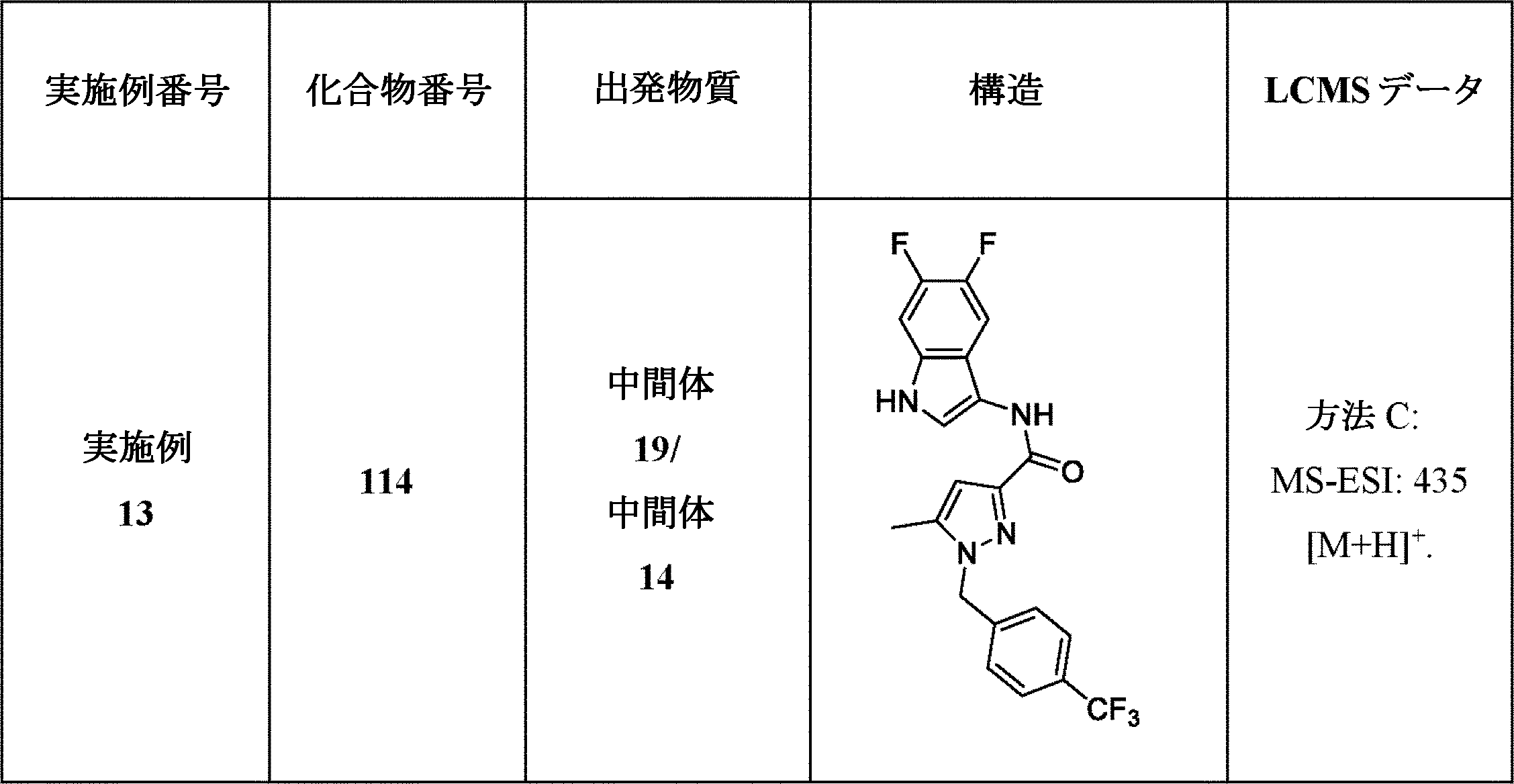


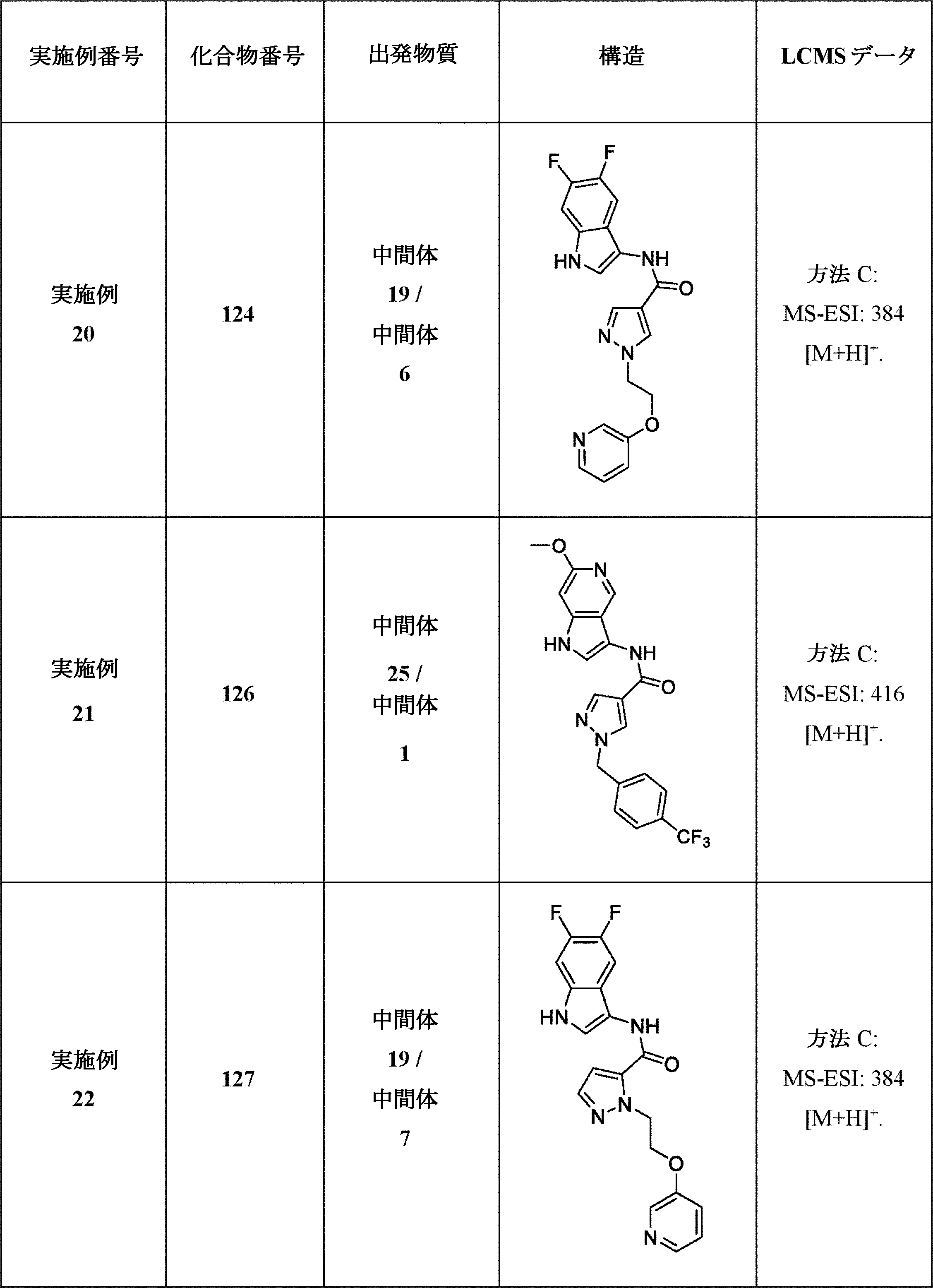
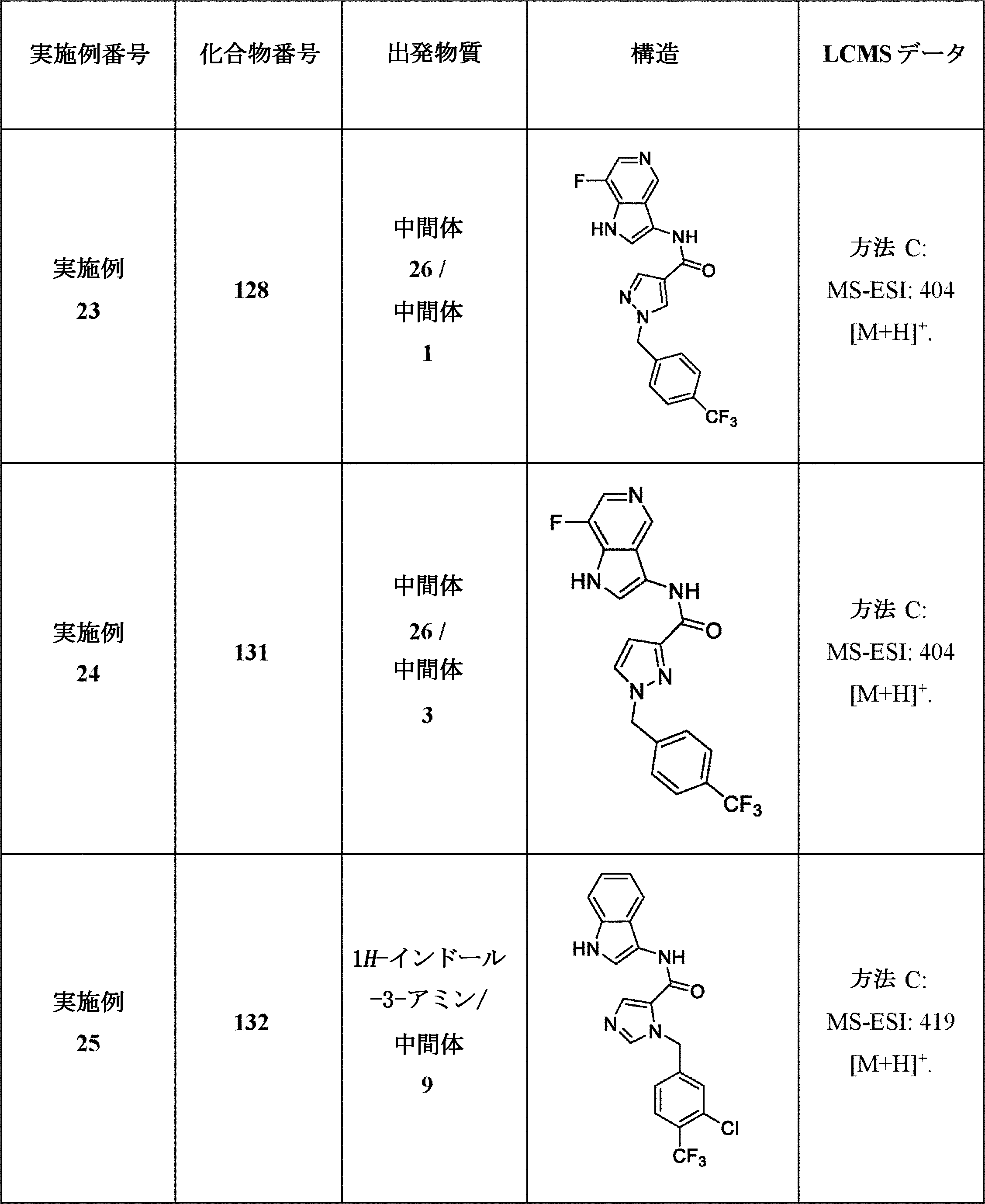

実施例30/31:(RまたはS)-N-(5,6-ジフルオロ-1H-インドール-3-イル)-1-(1-(4-(トリフルオロメチル)フェニル)エチル)-1H-ピラゾール-4-カルボキサミド;化合物121(先頭ピーク、立体化学未確定)および(RまたはS)-N-(5,6-ジフルオロ-1H-インドール-3-イル)-1-(1-(4-(トリフルオロメチル)フェニル)エチル)-1H-ピラゾール-4-カルボキサミド;化合物120(第2ピーク、立体化学未確定)。

実施例12について説明した方法と同じ方法を使用し、中間体4および中間体19を使って、ラセミ型N-(5,6-ジフルオロ-1H-インドール-3-イル)-1-(1-(4-(トリフルオロメチル)フェニル)エチル)-1H-ピラゾール-4-カルボキサミドを調製し、次に、以下の条件での分取キラルHPLCによって分離した:カラム:CHIRAL ART Cellulose-SC、2*25cm、5μm;移動相A:Hex(0.5%2M NH3-MeOH)--HPLC、移動相B:EtOH--HPLC;流量:20mL/分;勾配:12分で20Bから20Bへ;220/254nm。RT1:5.485;RT2:9.178。これにより、先頭ピーク(立体化学未確定、化合物121に割り当て、76.2mg)を桃色固形物として、また第2ピーク(立体化学未確定、化合物120に割り当て、68.3mg)を桃色固形物として得た。 Using the same method as described for Example 12 and using Intermediate 4 and Intermediate 19, racemic N-(5,6-difluoro-1H-indol-3-yl)-1-(1- (4-(Trifluoromethyl)phenyl)ethyl)-1H-pyrazole-4-carboxamide was prepared and then separated by preparative chiral HPLC with the following conditions: Column: CHIRAL ART Cellulose-SC, 2* 25 cm, 5 μm; Mobile phase A: Hex (0.5% 2M NH 3 -MeOH) -- HPLC, Mobile phase B: EtOH -- HPLC; Flow rate: 20 mL/min; Gradient: 20B to 20B in 12 min; 220/254 nm . RT1:5.485;RT2:9.178. As a result, the first peak (stereochemistry undetermined, assigned to compound 121, 76.2 mg) was obtained as a pink solid, and the second peak (stereochemistry undetermined, assigned to compound 120, 68.3 mg) was obtained as a pink solid. .
化合物121:(RまたはS)-N-(5,6-ジフルオロ-1H-インドール-3-イル)-1-(1-(4-(トリフルオロメチル)フェニル)エチル)-1H-ピラゾール-4-カルボキサミド;LCMS方法C:[M+H]+=435。

化合物120:(RまたはS)-N-(5,6-ジフルオロ-1H-インドール-3-イル)-1-(1-(4-(トリフルオロメチル)フェニル)エチル)-1H-ピラゾール-4-カルボキサミド;LCMS方法C:[M+H]+=435。

実施例32:N-(5-(1-イソプロピル-1H-ピラゾール-4-イル)-1H-インドール-3-イル)-1-(4-(トリフルオロメチル)フェニル)-1H-イミダゾール-4-カルボキサミド(化合物139)

工程1:N-(5-ブロモ-1H-インドール-3-イル)-1-(4-(トリフルオロメチル)フェニル)-1H-イミダゾール-4-カルボキサミド
1-[4-(トリフルオロメチル)フェニル]イミダゾール-4-カルボン酸(200.0mg、0.8mmol、1.0当量)をDMF(5.0mL)に溶解し、次にDIEA(0.4mL、2.3mmol、3.0当量)、HATU(445.3mg、1.2mmol、1.5当量)および5-ブロモ-1H-インドール-3-アミン塩化水素(231.9mg、0.9mmol、1.2当量)を加えた。反応混合物を周囲温度で一晩撹拌し、次に真空下で濃縮した。その粗生成物を以下の条件でのフラッシュ分取HPLCによって精製した:カラム、C18シリカゲル;移動相、水(10mM NH4HCO3)およびACN(40分以内に10%ACNから90%ACNに);検出器、UV254nm。これにより、2-(5-ブロモ-1H-インドール-3-イル)-1-[1-[4-(トリフルオロメチル)フェニル]イミダゾール-4-イル]エタノン(140mg)が白色固形物として得られた。LCMS方法C:[M+H]+=449。
Step 1: N-(5-bromo-1H-indol-3-yl)-1-(4-(trifluoromethyl)phenyl)-1H-imidazole-4-carboxamide
1-[4-(trifluoromethyl)phenyl]imidazole-4-carboxylic acid (200.0 mg, 0.8 mmol, 1.0 eq.) was dissolved in DMF (5.0 mL), then DIEA (0.4 mL, 2.3 mmol, 3.0 eq. ), HATU (445.3 mg, 1.2 mmol, 1.5 eq.) and 5-bromo-1H-indol-3-amine hydrogen chloride (231.9 mg, 0.9 mmol, 1.2 eq.) were added. The reaction mixture was stirred at ambient temperature overnight, then concentrated under vacuum. The crude product was purified by flash preparative HPLC with the following conditions: column, C18 silica gel; mobile phase, water (10mM NH 4 HCO 3 ) and ACN (10% ACN to 90% ACN within 40 min). ;Detector, UV254nm. This gave 2-(5-bromo-1H-indol-3-yl)-1-[1-[4-(trifluoromethyl)phenyl]imidazol-4-yl]ethanone (140 mg) as a white solid. It was done. LCMS method C: [M+H] + =449.
工程2:N-(5-(1-イソプロピル-1H-ピラゾール-4-イル)-1H-インドール-3-イル)-1-(4-(トリフルオロメチル)フェニル)-1H-イミダゾール-4-カルボキサミド
2-(5-ブロモ-1H-インドール-3-イル)-1-[1-[4-(トリフルオロメチル)フェニル]イミダゾール-4-イル]エタノン(100.0mg、0.2mmol、1.0当量)を1,4-ジオキサン(3.0ml)および水(0.3mL)に溶解し、次に1-イソプロピル-4-(4,4,5,5-テトラメチル-1,3,2-ジオキサボロラン-2-イル)ピラゾール(63.2mg、0.3mmol、1.2当量)、Cs2CO3(218.1mg、0.7mmol、3.0当量)およびXPhos(10.6mg、0.02mmol、0.1当量)を、窒素雰囲気下で加えた。反応混合物を一晩、90℃に加熱してから周囲温度まで冷却し、水の添加によってクエンチした。結果としてもたらされた溶液を酢酸エチルで抽出し、真空下で濃縮した。残渣を以下の条件での分取HPLCによって精製した:カラム、YMC-Actus Triart C18、30*250、5μm;移動相、水(10mM NH4HCO3)およびACN(7分で42%相Bから66%まで);検出器、UV254分。これにより、N-[5-(1-イソプロピルピラゾール-4-イル)-1H-インドール-3-イル]-1-[4-(トリフルオロメチル)フェニル]イミダゾール-4-カルボキサミド(13.0mg)が白色固形物として得られた。LCMS方法C:[M+H]+=479。

2-(5-bromo-1H-indol-3-yl)-1-[1-[4-(trifluoromethyl)phenyl]imidazol-4-yl]ethanone (100.0 mg, 0.2 mmol, 1.0 eq.) at 1 ,4-dioxane (3.0 ml) and water (0.3 ml), then 1-isopropyl-4-(4,4,5,5-tetramethyl-1,3,2-dioxaborolan-2-yl) Pyrazole (63.2 mg, 0.3 mmol, 1.2 eq.), Cs2CO3 (218.1 mg, 0.7 mmol, 3.0 eq.) and XPhos (10.6 mg , 0.02 mmol, 0.1 eq.) were added under nitrogen atmosphere. The reaction mixture was heated to 90° C. overnight, then cooled to ambient temperature and quenched by the addition of water. The resulting solution was extracted with ethyl acetate and concentrated under vacuum. The residue was purified by preparative HPLC with the following conditions: column, YMC-Actus Triart C18, 30*250, 5 μm; mobile phase, water (10 mM NH 4 HCO 3 ) and ACN (42% from phase B in 7 min). up to 66%); detector, UV254 min. This resulted in N-[5-(1-isopropylpyrazol-4-yl)-1H-indol-3-yl]-1-[4-(trifluoromethyl)phenyl]imidazole-4-carboxamide (13.0 mg). Obtained as a white solid. LCMS method C: [M+H] + =479.
実施例32について説明した方法と同じ方法を使って、以下の表の化合物を調製した。

実施例35:N-(5-(3-フルオロ-4-(ヒドロキシメチル)フェニル)-1H-インドール-3-イル)-1-(4-(トリフルオロメチル)ベンジル)-1H-イミダゾール-4-カルボキサミド(化合物137)

化合物32は実施例32について説明した方法と同じ方法を使って調製した。 Compound 32 was prepared using the same method described for Example 32.
2-フルオロ-4-[3-(1-[[4-(トリフルオロメチル)フェニル]メチル]イミダゾール-4-アミド)-1H-インドール-5-イル]安息香酸メチル(200.0mg、0.4mmol、1.0当量)をTHF(15.0mL)に溶解し、その溶液を0℃に冷却した。次に、内部温度を0℃に維持しながら、LiAlH4(28.3mg、0.7mmol、2.0当量)を少しずつ加えた。反応混合物を周囲温度で1時間撹拌し、次に氷水の添加によってクエンチした。結果としてもたらされた溶液を酢酸エチルで抽出し、無水硫酸ナトリウムで乾燥し、真空下で濃縮した。残渣を以下の条件での分取HPLCによって精製した:カラム:XBridge Shield RP18 OBD カラム、5μm、19*150mm;移動相A:水(10mM NH4HCO3+0.1%NH4OH)、移動相B:ACN;流量:60mL/分;勾配:10分で38Bから58Bへ;210/254nm。これにより、N-[5-[3-フルオロ-4-(ヒドロキシメチル)フェニル]-1H-インドール-3-イル]-1-[[4-(トリフルオロメチル)フェニル]メチル]イミダゾール-4-カルボキサミド(27.1mg)が黄褐色固形物として得られた。LCMS方法C:[M+H]+=509。

実施例36:N-(5,6-ジフルオロ-1H-インドール-3-イル)-1-(4-(トリフルオロメチル)フェニル)-1H-1,2,3-トリアゾール-4-カルボキサミド(化合物106)

工程1:N-(5,6-ジフルオロ-1H-インドール-3-イル)プロピオルアミド
5,6-ジフルオロ-1H-インドール-3-アミン塩化水素(730.0mg、3.6mmol、1.0当量)をTHF(30.0mL)に溶解して0℃に冷却し、次にプロピオル酸(499.9mg、7.1mmol、2.0当量)、TEA(1.5mL、10.7mmol、3.0当量)およびT3P(6.8g、10.7mmol、3.0当量)を、0℃で加えた。反応混合物を周囲温度で3時間撹拌し、次に水の添加によってクエンチした。結果としてもたらされた溶液を酢酸エチルで抽出し、ブラインで洗浄し、無水硫酸ナトリウムで乾燥し、真空下で濃縮した。残渣をシリカゲルでのフラッシュカラムクロマトグラフィーによって精製し、酢酸エチル/石油エーテル(1:3)で溶出させることにより、N-(5,6-ジフルオロ-1H-インドール-3-イル)プロパ-2-インアミド(350mg)を淡黄色固形物として得た。LCMS方法A:[M+H]+=221。
Step 1: N-(5,6-difluoro-1H-indol-3-yl)propiolamide
5,6-difluoro-1H-indol-3-amine hydrogen chloride (730.0 mg, 3.6 mmol, 1.0 eq.) was dissolved in THF (30.0 mL) and cooled to 0 °C, then propiolic acid (499.9 mg, 7.1 mmol, 2.0 eq.), TEA (1.5 mL, 10.7 mmol, 3.0 eq.) and T3P (6.8 g, 10.7 mmol, 3.0 eq.) were added at 0<0>C. The reaction mixture was stirred at ambient temperature for 3 hours and then quenched by the addition of water. The resulting solution was extracted with ethyl acetate, washed with brine, dried over anhydrous sodium sulfate, and concentrated under vacuum. The residue was purified by flash column chromatography on silica gel, eluting with ethyl acetate/petroleum ether (1:3) to give N-(5,6-difluoro-1H-indol-3-yl)prop-2- Inamide (350mg) was obtained as a pale yellow solid. LCMS method A: [M+H] + =221.
工程2:N-(5,6-ジフルオロ-1H-インドール-3-イル)-1-(4-(トリフルオロメチル)フェニル)-1H-1,2,3-トリアゾール-4-カルボキサミド
N-(5,6-ジフルオロ-1H-インドール-3-イル)プロパ-2-インアミド(150.0mg、0.7mmol、1.0当量)および1-アジド-4-(トリフルオロメチル)ベンゼン(191.2mg、1.0mmol、1.5当量)をMeOH(4.0mL)および水(1.0mL)に溶解し、次にアスコルビン酸ナトリウム(13.6mg、0.1mmol、0.1当量)およびCuSO4(10.9mg、0.1mmol、0.1当量)を加えた。反応混合物を40℃で16時間撹拌し、次に水の添加によってクエンチした。結果としてもたらされた溶液を酢酸エチルで抽出し、ブラインで洗浄し、無水硫酸ナトリウムで乾燥し、真空下で濃縮した。残渣を以下の条件での分取HPLCによって精製した:カラム:Atlantis HILIC OBD カラム、19*150mm*5μm;移動相A:水(10mM NH4HCO3)、移動相B:ACN;流量:50mL/分;勾配:8分で40%Bから80%Bへ;254nm。RT1:6.64分。これにより、N-(5,6-ジフルオロ-1H-インドール-3-イル)-1-[4-(トリフルオロメチル)フェニル]-1,2,3-トリアゾール-4-カルボキサミド(42.5mg)が白色固形物として得られた。LCMS方法G:[M+H]+=408。

N-(5,6-difluoro-1H-indol-3-yl)prop-2-ynamide (150.0 mg, 0.7 mmol, 1.0 eq.) and 1-azido-4-(trifluoromethyl)benzene (191.2 mg, 1.0 mmol, 1.5 eq.) in MeOH (4.0 mL) and water (1.0 mL), then sodium ascorbate (13.6 mg, 0.1 mmol, 0.1 eq.) and CuSO4 (10.9 mg, 0.1 mmol, 0.1 eq.) added. The reaction mixture was stirred at 40° C. for 16 hours and then quenched by the addition of water. The resulting solution was extracted with ethyl acetate, washed with brine, dried over anhydrous sodium sulfate, and concentrated under vacuum. The residue was purified by preparative HPLC under the following conditions: Column: Atlantis HILIC OBD column, 19*150mm*5μm; Mobile phase A: Water (10mM NH 4 HCO 3 ), Mobile phase B: ACN; Flow rate: 50mL/ min; gradient: 40% B to 80% B in 8 min; 254 nm. RT1:6.64 minutes. This produced N-(5,6-difluoro-1H-indol-3-yl)-1-[4-(trifluoromethyl)phenyl]-1,2,3-triazole-4-carboxamide (42.5 mg). Obtained as a white solid. LCMS method G: [M+H] + =408.
以下の化合物を、実施例36について説明した方法と同じ方法を使って調製した。

実施例38:3-(4-クロロフェニル)-N-(5,6-ジフルオロ-1H-インドール-3-イル)-1H-ピラゾール-5-カルボキサミド(化合物108)の合成

5,6-ジフルオロ-1H-インドール-3-アミン(24.9mg、0.148mmol、1.0当量)および3-(4-クロロフェニル)-1H-ピラゾール-5-カルボン酸(42.7mg、0.192mmol、1.3当量)をDMF(1.0mL)に溶解した。次に、1mL DMFに溶解したDIEA(103μl、0.592mmol、4.0当量)およびHATU(59.1mg、0.155mmol、1.05当量)を加えた。反応混合物を30℃で16時間撹拌した。反応混合物をSpeedvacで濃縮した。残渣を分取HPLCで精製することにより、3-(4-クロロフェニル)-N-(5,6-ジフルオロ-1H-インドール-3-イル)-1H-ピラゾール-5-カルボキサミド(13.7mg、0.038mmol)を得た。MS-ESI、373.1[M+H+]。

上記の手順を使って以下の表の化合物を調製した。


以下の実施例を、実施例12について説明した方法と同じ方法を使って調製した。
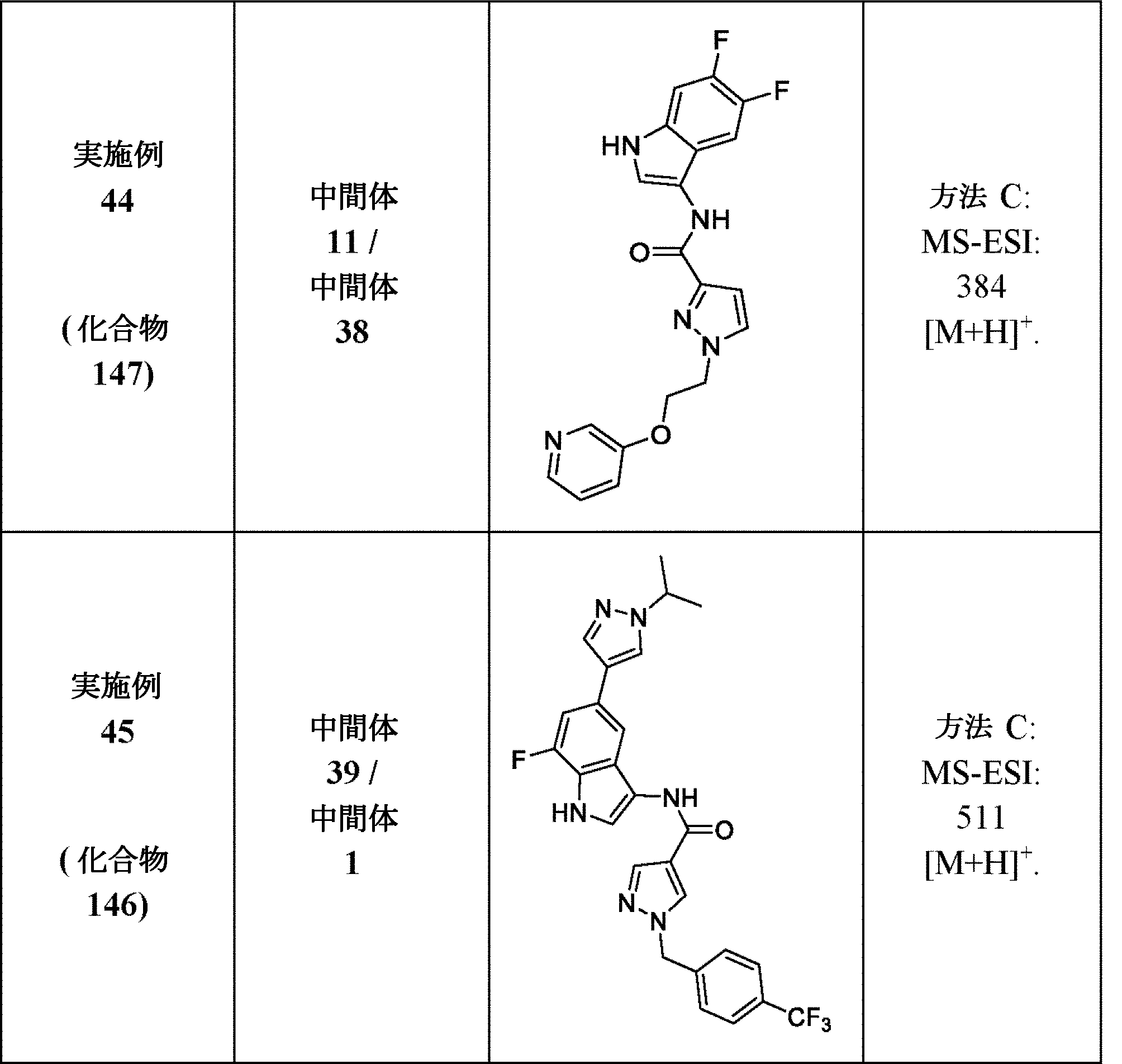
実施例46:N-(5,6-ジフルオロ-1H-インドール-3-イル)-1-((5-メチル-6-(2,2,2-トリフルオロエトキシ)ピリジン-3-イル)メチル)-1H-ピラゾール-4-カルボキサミド(化合物163)

1-[[5-メチル-6-(2,2,2-トリフルオロエトキシ)ピリジン-3-イル]メチル]ピラゾール-4-カルボン酸(300.0mg、1.0mmol、1.0当量)をDMF(5mL)に溶解し、次に5,6-ジフルオロ-1H-インドール-3-アミン塩化水素(204.5mg、1.0mmol、1.0当量)、HATU(542.8mg、1.4mmol、1.5当量)、およびDIEA(0.5mL、2.9mmol、3.0当量)を加えた。反応混合物を周囲温度で1時間撹拌し、次に水の添加によってクエンチした。結果としてもたらされた溶液を酢酸エチルで抽出し、ブラインで洗浄し、無水硫酸ナトリウムで乾燥し、真空下で濃縮した。残渣をシリカゲルでのフラッシュカラムクロマトグラフィーによって精製し、酢酸エチル/石油エーテル(1:4)で溶出させることによって得た物質を、以下の条件を用いる分取HPLCによってさらに精製した:カラム、YMC-Actus Triart C18、30*250、5μm;移動相、水(10mM NH4HCO3+0.1%NH4OH)およびACN(7分で20%相Bから43%まで);検出器、UV254nm。これにより、N-(5,6-ジフルオロ-1H-インドール-3-イル)-1-[[5-メチル-6-(2,2,2-トリフルオロエトキシ)ピリジン-3-イル]メチル]ピラゾール-4-カルボキサミド(57.7mg)を白色固形物として得た。LCMS方法D-1:[M+H]+=466。

実施例46について説明した方法と同じ方法を使って、以下の化合物を調製した。
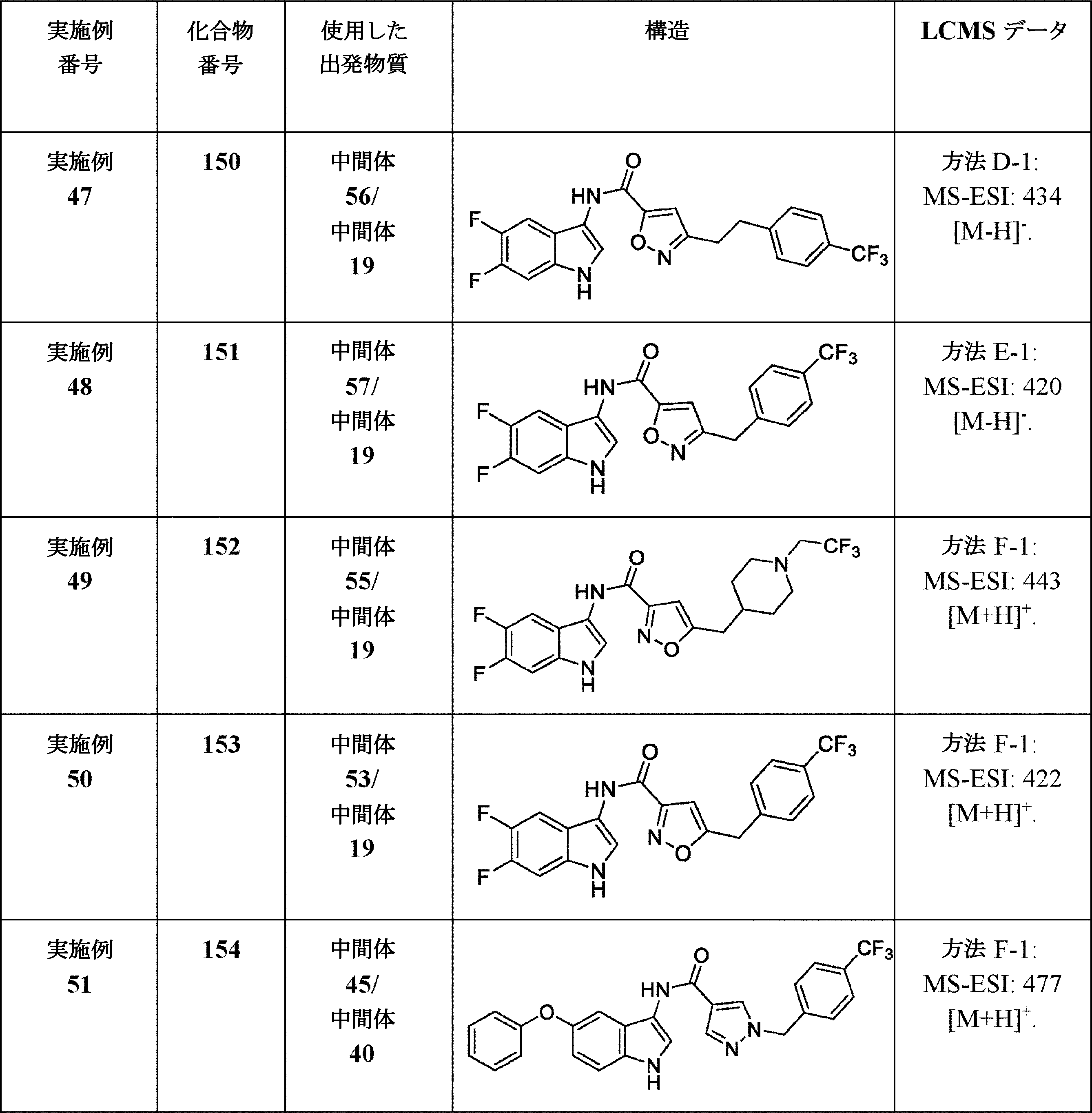


実施例62:N-(5,6-ジフルオロ-1H-インドール-3-イル)-1-(5-メチル-6-(2,2,2-トリフルオロエトキシ)ピリジン-3-イル)-1H-1,2,3-トリアゾール-4-カルボキサミド(化合物165)

1-[5-メチル-6-(2,2,2-トリフルオロエトキシ)ピリジン-3-イル]-1,2,3-トリアゾール-4-カルボン酸(300.0mg、1.0mmol、1.0当量)をDMF(5mL)に溶解し、次にHATU(566.2mg、1.5mmol、1.5当量)、DIEA(0.6mL、3.3mmol、3.0当量)、および5,6-ジフルオロ-1H-インドール-3-アミン塩化水素(204.5mg、1.0mmol、1.0当量)を加えた。反応混合物を周囲温度で一晩撹拌し、次に水の添加によってクエンチした。結果としてもたらされた溶液を酢酸エチルで抽出し、ブラインで洗浄し、無水Na2SO4で乾燥し、真空下で濃縮した。残渣をMeOH(4mL)で洗浄し、濾過によって収集することにより、N-(5,6-ジフルオロ-1H-インドール-3-イル)-1-[5-メチル-6-(2,2,2-トリフルオロエトキシ)ピリジン-3-イル]-1,2,3-トリアゾール-4-カルボキサミド(105.2mg)を白色固形物として得た。LCMS方法F-1:[M+H]+=453。

実施例63:N-(5,6-ジフルオロ-1H-インドール-3-イル)-1-(2-((2,2,2-トリフルオロエトキシ)メチル)ピリジン-4-イル)-1H-1,2,3-トリアゾール-4-カルボキサミド(化合物156)

工程1:N-(5,6-ジフルオロ-1H-インドール-3-イル)プロピオルアミド
5,6-ジフルオロ-1H-インドール-3-アミン塩化水素(730.0mg、3.6mmol、1.0当量)をTHF(30.0mL)に溶解して0℃に冷却し、次にプロピオル酸(499.9mg、7.1mmol、2.0当量)、TEA(1.5mL、10.7mmol、3.0当量)およびT3P(6.8g、10.7mmol、3.0当量)を、0℃で加えた。反応混合物を周囲温度で3時間撹拌し、次に水の添加によってクエンチした。結果としてもたらされた溶液を酢酸エチルで抽出し、ブラインで洗浄し、無水硫酸ナトリウムで乾燥し、真空下で濃縮した。残渣をシリカゲルでのフラッシュカラムクロマトグラフィーによって精製し、酢酸エチル/石油エーテル(1:3)で溶出させることにより、N-(5,6-ジフルオロ-1H-インドール-3-イル)プロパ-2-インアミド(350mg)を淡黄色固形物として得た。LCMS方法A-1:[M+H]+=221。
Step 1: N-(5,6-difluoro-1H-indol-3-yl)propiolamide
5,6-difluoro-1H-indol-3-amine hydrogen chloride (730.0 mg, 3.6 mmol, 1.0 eq.) was dissolved in THF (30.0 mL) and cooled to 0 °C, then propiolic acid (499.9 mg, 7.1 mmol, 2.0 eq.), TEA (1.5 mL, 10.7 mmol, 3.0 eq.) and T3P (6.8 g, 10.7 mmol, 3.0 eq.) were added at 0<0>C. The reaction mixture was stirred at ambient temperature for 3 hours and then quenched by the addition of water. The resulting solution was extracted with ethyl acetate, washed with brine, dried over anhydrous sodium sulfate, and concentrated under vacuum. The residue was purified by flash column chromatography on silica gel, eluting with ethyl acetate/petroleum ether (1:3) to give N-(5,6-difluoro-1H-indol-3-yl)prop-2- Inamide (350mg) was obtained as a pale yellow solid. LCMS method A-1: [M+H] + =221.
工程2:4-アジド-2-[(2,2,2-トリフルオロエトキシ)メチル]ピリジン
2-[(2,2,2-トリフルオロエトキシ)メチル]ピリジン-4-アミン(500.0mg、2.4mmol、1.0当量)およびt-BuONO(0.9mL、7.3mmol、3.0当量)をACN(10mL)に溶解した。結果としてもたらされた溶液を30分間、60℃に加熱し、次にトリメチルシリルアジド(838.2mg、7.3mmol、3.0当量)を滴下した。結果としてもたらされた混合物を60℃でさらに12時間撹拌し、次に周囲温度まで冷却し、水の添加によってクエンチした。結果としてもたらされた溶液を酢酸エチルで抽出し、真空下で濃縮した。残渣をシリカゲルでのフラッシュカラムクロマトグラフィーによって精製し、酢酸エチル/石油エーテル(1:1)で溶出させることにより、4-アジド-2-[(2,2,2-トリフルオロエトキシ)メチル]ピリジン(103.5mg)を黄色油状物として得た。LCMS方法A-1:[M+H]+=233。
Step 2: 4-azido-2-[(2,2,2-trifluoroethoxy)methyl]pyridine
2-[(2,2,2-trifluoroethoxy)methyl]pyridin-4-amine (500.0 mg, 2.4 mmol, 1.0 eq.) and t-BuONO (0.9 mL, 7.3 mmol, 3.0 eq.) in ACN (10 mL) dissolved in. The resulting solution was heated to 60° C. for 30 minutes, then trimethylsilyl azide (838.2 mg, 7.3 mmol, 3.0 eq.) was added dropwise. The resulting mixture was stirred at 60° C. for an additional 12 hours, then cooled to ambient temperature and quenched by addition of water. The resulting solution was extracted with ethyl acetate and concentrated under vacuum. The residue was purified by flash column chromatography on silica gel, eluting with ethyl acetate/petroleum ether (1:1) to give 4-azido-2-[(2,2,2-trifluoroethoxy)methyl]pyridine. (103.5 mg) was obtained as a yellow oil. LCMS method A-1: [M+H] + =233.
工程3:N-(5,6-ジフルオロ-1H-インドール-3-イル)-1-[2-[(2,2,2-トリフルオロエトキシ)メチル]ピリジン-4-イル]-1,2,3-トリアゾール-4-カルボキサミド
4-アジド-2-[(2,2,2-トリフルオロエトキシ)メチル]ピリジン(100.0mg、0.4mmol、1.0当量)およびN-(5,6-ジフルオロ-1H-インドール-3-イル)プロパ-2-インアミド(113.8mg、0.5mmol、1.2当量)を1,4-ジオキサン(5mL)および水(0.5mL)に溶解し、次にアスコルビン酸ナトリウム(17.2mg、0.1mmol、0.2当量)およびCuSO4(13.8mg、0.1mmol、0.2当量)を加えた。反応混合物を周囲温度で一晩撹拌し、次に酢酸エチルで希釈した。結果としてもたらされた溶液をブラインで洗浄し、無水Na2SO4で乾燥し、真空下で濃縮した。残渣を以下の条件での分取HPLCによって精製した:カラム、XBridge Prep OBD C18カラム、30*150mm、5μm;移動相、水(10mmol/L NH4HCO3+0.1%NH4OH)およびACN(7分で40%相Bから55%まで);検出器、UV254nm。これにより、N-(5,6-ジフルオロ-1H-インドール-3-イル)-1-[2-[(2,2,2-トリフルオロエトキシ)メチル]ピリジン-4-イル]-1,2,3-トリアゾール-4-カルボキサミド(14.4mg)を黄色固形物として得た。LCMS方法E:[M-H]-=451。

4-Azido-2-[(2,2,2-trifluoroethoxy)methyl]pyridine (100.0 mg, 0.4 mmol, 1.0 equiv.) and N-(5,6-difluoro-1H-indol-3-yl) propyl -2-ynamide (113.8 mg, 0.5 mmol, 1.2 eq.) was dissolved in 1,4-dioxane (5 mL) and water (0.5 mL), then sodium ascorbate (17.2 mg, 0.1 mmol, 0.2 eq.) and CuSO 4 (13.8mg, 0.1mmol, 0.2eq) was added. The reaction mixture was stirred at ambient temperature overnight, then diluted with ethyl acetate. The resulting solution was washed with brine, dried over anhydrous Na 2 SO 4 and concentrated under vacuum. The residue was purified by preparative HPLC with the following conditions: column, XBridge Prep OBD C18 column, 30*150 mm, 5 μm; mobile phase, water (10 mmol/L NH 4 HCO 3 + 0.1% NH 4 OH) and ACN. (from 40% phase B to 55% in 7 minutes); detector, UV254nm. This allows N-(5,6-difluoro-1H-indol-3-yl)-1-[2-[(2,2,2-trifluoroethoxy)methyl]pyridin-4-yl]-1,2 ,3-triazole-4-carboxamide (14.4 mg) was obtained as a yellow solid. LCMS method E: [MH] - = 451.
実施例63について説明した方法と同じ方法を使って、以下の化合物を調製した。

生物学的アッセイ
THP1-Dual(商標)細胞(KO-IFNAR2)を使って、本明細書記載の化合物によるSTING経路活性化を測定した。
biological assay
THP1-Dual™ cells (KO-IFNAR2) were used to measure STING pathway activation by compounds described herein.
THP1-Dual(商標)KO-IFNAR2細胞(invivogenから入手)は、RPMI、10%FCS、5ml P/S、2mM L-glut、10mM Hepes、および1mMピルビン酸ナトリウムにおいて維持した。化合物を、Echoにより、最終濃度が0.0017~100μMになるように、空の384ウェル組織培養プレート(Greiner 781182)にスポットした。細胞を、1ウェルあたり40μL、2×10E6細胞/mLで、TCプレートにプレーティングした。STINGリガンドによる活性化のために、2'3'cGAMP(MW718.38、Invivogenから入手)をOptimem培地に調製した。 THP1-Dual™ KO-IFNAR2 cells (obtained from invivogen) were maintained in RPMI, 10% FCS, 5ml P/S, 2mM L-glut, 10mM Hepes, and 1mM sodium pyruvate. Compounds were spotted by Echo into empty 384-well tissue culture plates (Greiner 781182) at final concentrations of 0.0017-100 μM. Cells were plated in TC plates at 40 μL per well, 2×10E6 cells/mL. 2'3'cGAMP (MW718.38, obtained from Invivogen) was prepared in Optimem medium for activation by STING ligand.
各1×384プレートにつき、以下の溶液を調製した。
○溶液A:以下の刺激物質の1つを含む2mLのOptimem
・60μLの10mM 2'3'cGAMP→150μM原液
○溶液B:60μLのLipofectamine 2000を含む2mLのOptimem→RTで5分間インキュベート
The following solutions were prepared for each 1 x 384 plate.
○ Solution A: 2mL Optimem containing one of the following irritants:
・60μL of 10mM 2'3'cGAMP → 150μM stock solution ○Solution B: 2mL of Optimem containing 60μL of Lipofectamine 2000 → Incubate at RT for 5 minutes
2mLの溶液Aと2mlの溶液Bを混合し、室温(RT)で20分インキュベートした。プレーティングされた細胞の上に20μLのトランスフェクション溶液(A+B)を加え、最終2',3'cGAMP濃度を15μMとした。次に、プレートを直ちに340gで1分間遠心分離し、その後、それらを37℃、5%CO2、>98%の湿度で、24時間インキュベートした。次に、ルシフェラーゼレポーター活性を測定した。EC50値は当技術分野において公知の標準的方法を使用することによって算出した。 2 mL of solution A and 2 ml of solution B were mixed and incubated at room temperature (RT) for 20 minutes. 20 μL of transfection solution (A+B) was added on top of the plated cells to give a final 2',3'cGAMP concentration of 15 μM. The plates were then immediately centrifuged at 340g for 1 min, after which they were incubated for 24 hours at 37°C, 5% CO2 , >98% humidity. Next, luciferase reporter activity was measured. EC50 values were calculated by using standard methods known in the art.
ルシフェラーゼレポーターアッセイ:アッセイから上清10μLを平底方形ウェルの白色384プレートに移した。一袋のQUANTI-Luc(商標)Plusを25mLの水に溶解した。25mLのQUANTI-Luc(商標)Plus溶液につき100μLのQLC安定剤を加えた。次に、1ウェルにつき50μLのQUANTI-Luc(商標)Plus/QLC溶液を加えた。ルミネセンスをプレートリーダー(例えばSpectramax I3X(Molecular Devices GF3637001))で測定した。 Luciferase reporter assay: 10 μL of supernatant from the assay was transferred to a white 384 plate in flat bottom square wells. One bag of QUANTI-Luc™ Plus was dissolved in 25 mL of water. 100 μL of QLC stabilizer was added per 25 mL of QUANTI-Luc™ Plus solution. Next, 50 μL of QUANTI-Luc™ Plus/QLC solution was added per well. Luminescence was measured with a plate reader (eg Spectramax I3X (Molecular Devices GF3637001)).
次に、ルシフェラーゼレポーター活性を測定した。EC50値は当技術分野において公知の標準的方法を使用することによって算出した。 Next, luciferase reporter activity was measured. EC50 values were calculated by using standard methods known in the art.
表BAはSTINGレポーターアッセイにおける化合物の活性を示している:<0.008μM=「++++++」、≧0.008かつ<0.04μM=「+++++」、≧0.04かつ<0.2μM=「++++」、≧0.2かつ<1μM=「+++」、≧1かつ<5μM=「++」、≧5かつ<100μM=「+」。 Table BA shows the activity of the compounds in the STING reporter assay: <0.008 μM = "++++++", ≥0.008 and <0.04 μM = "++++", ≥0.04 and <0.2 μM = "++++", ≥0.2 and <1 μM = “+++”, ≧1 and <5 μM = “++”, ≧5 and <100 μM = “+”.

番号付き項目
本明細書記載の化合物、組成物、方法、および他の主題を、以下の番号付き項目において、さらに説明する。
1. 式I:

式中、
Z、Y1、Y2、およびY3は、CR1、C(=O)、N、およびNR2からなる群より独立して選択され、
X1は、O、S、N、NR2、およびCR1からなる群より選択され、
X2は、O、S、N、NR4、およびCR5からなる群より選択され、
但し、Z、Y1、およびY2のそれぞれ1つがCR1である場合にはY3がNであることはできないか、もしくはZ、Y1、Y2、およびY3のそれぞれ1つがCR1である場合には少なくとも1個のR1はH以外であり、
各

各R1は、H;Rc;Rg;および-(L1)b1-Rgからなる群より独立して選択され、
各R2は、H;Rd;Rg;および-(L2)b2-Rgからなる群より独立して選択され、
R4は、HおよびRdからなる群より選択され、
R5は、H;Rc;およびRhからなる群より選択され、
R6は、H;Rd;およびRhからなる群より選択され、
環Bは、環原子5個のヘテロアリーレンであって、環原子のうちの1~4個が、N、NH、N(Rd)、O、およびSからなる群よりそれぞれ独立して選択されるヘテロ原子であり、環Bのヘテロアリーレンが、オキソおよびRcからなる群より独立して選択される1~2個の置換基で置換されていてもよく、但し、環Bが環炭素原子を介してC(=O)NR6基に結合している、ヘテロアリーレンであり、
各LAは、1~4個のRa1で置換されていてもよいC1~3アルキレン;-O-;-NH-;-NRd;-S(O)0~2;およびC(O)からなる群より独立して選択され、
a1は、0、1、2、もしくは3であり、
環Cは、
・オキソおよびRcからなる群より独立して選択される1~4個の置換基でそれぞれ置換されていてもよい、C3~12シクロアルキルもしくはC3~12シクロアルケニル;
・環原子3~12個のヘテロシクリルもしくはヘテロシクロアルケニルであって、1~3個の環原子が、N、N(H)、N(Rd)、O、およびS(O)0~2からなる群よりそれぞれ独立して選択されるヘテロ原子であり、ヘテロシクリルもしくはヘテロシクロアルケニルが、オキソおよびRcからなる群より独立して選択される1~4個の置換基で置換されていてもよい、ヘテロシクリルもしくはヘテロシクロアルケニル;
・環原子5~12個のヘテロアリールであって、1~4個の環原子が、N、N(H)、N(Rd)、O、およびS(O)0~2からなる群よりそれぞれ独立して選択されるヘテロ原子であり、ヘテロアリールが1~4個のRcで置換されていてもよい、ヘテロアリール;ならびに
・1~4個のRcで置換されていてもよいC6~10アリール
からなる群より選択され、
RaおよびRa1の各出現は、-OH;-ハロ;-NReRf;C1~4アルコキシ;C1~4ハロアルコキシ;-C(=O)O(C1~4アルキル);-C(=O)(C1~4アルキル);-C(=O)OH;-CONR'R'';-S(O)1~2NR'R'';-S(O)1~2(C1~4アルキル);およびシアノからなる群より独立して選択され、
Rcの各出現は、ハロ;シアノ;1~6個の独立して選択されるRaで置換されていてもよいC1~10アルキル;C2~6アルケニル;C2~6アルキニル;C1~4アルコキシ;C1~4ハロアルコキシ;-S(O)1~2(C1~4アルキル);-S(O)(=NH)(C1~4アルキル);-NReRf;-OH;-S(O)1~2NR'R'';-C1~4チオアルコキシ;-NO2;-C(=O)(C1~10アルキル);-C(=O)O(C1~4アルキル);-C(=O)OH;-C(=O)NR'R'';および-SF5からなる群より独立して選択され、
Rdの各出現は、1~3個の独立して選択されるRaで置換されていてもよいC1~6アルキル;-C(O)(C1~4アルキル);-C(O)O(C1~4アルキル);-CONR'R'';-S(O)1~2NR'R'';-S(O)1~2(C1~4アルキル);-OH;およびC1~4アルコキシからなる群より独立して選択され、
ReおよびRfの各出現は、H;NR'R''、-OH、およびRiからなる群よりそれぞれ独立して選択される1~3個の置換基で置換されていてもよいC1~6アルキル;-C(O)(C1~4アルキル);-C(O)O(C1~4アルキル);-CONR'R'';-S(O)1~2NR'R'';-S(O)1~2(C1~4アルキル);-OH;ならびにC1~4アルコキシからなる群より独立して選択され、
Rgの各出現は、
・それぞれ、オキソ、Rc、Rh、および-(Lg)bg-Rhからなる群より独立して選択される1~4個の置換基で置換されていてもよい、C3~12シクロアルキルもしくはC3~12シクロアルケニル;
・環原子3~12個のヘテロシクリルもしくはヘテロシクロアルケニルであって、1~3個の環原子が、N、N(H)、N(Rd)、O、およびS(O)0~2からなる群よりそれぞれ独立して選択されるヘテロ原子であり、ヘテロシクリルもしくはヘテロシクロアルケニルが、オキソ、Rc、Rh、および-(Lg)bg-Rhからなる群より独立して選択される1~4個の置換基で置換されていてもよい、ヘテロシクリルもしくはヘテロシクロアルケニル;
・環原子5~12個のヘテロアリールであって、1~4個の環原子が、N、N(H)、N(Rd)、O、およびS(O)0~2からなる群よりそれぞれ独立して選択されるヘテロ原子であり、ヘテロアリールが、Rc、Rh、および-(Lg)bg-Rhからなる群より独立して選択される1~4個の置換基で置換されていてもよい、ヘテロアリール;ならびに
・Rc、Rh、および-(Lg)bg-Rhからなる群より独立して選択される1~4個の置換基で置換されていてもよいC6~10アリール
からなる群より独立して選択され、
Rhの各出現は、
・それぞれ1~4個のRiで置換されていてもよいC3~12シクロアルキルもしくはC3~12シクロアルケニル;
・環原子3~12個のヘテロシクリルもしくはヘテロシクロアルケニルであって、1~3個の環原子が、N、N(H)、N(Rd)、O、およびS(O)0~2からなる群よりそれぞれ独立して選択されるヘテロ原子であり、ヘテロシクリルもしくはヘテロシクロアルケニルが1~4個のRiで置換されていてもよい、ヘテロシクリルもしくはヘテロシクロアルケニル;
・環原子5~12個のヘテロアリールであって、1~4個の環原子が、N、N(H)、N(Rd)、O、およびS(O)0~2からなる群よりそれぞれ独立して選択されるヘテロ原子であり、ヘテロアリールが1~4個のRiで置換されていてもよい、ヘテロアリール;ならびに
・1~4個のRiで置換されていてもよいC6~10アリール
からなる群より独立して選択され、
Riの各出現は、C1~6アルキル;C1~4ハロアルキル;C1~4アルコキシ;C1~4ハロアルコキシ;C1~6アルキル-O-C1~6アルキル-;C1~4ハロアルキル-O-C1~6アルキル-;ハロ;シアノ;-OH;-NR'R'';およびC3~6シクロアルキルからなる群より独立して選択され、
L1、L2、およびLgの各出現は、-O-、-NH-、-NRd、-S(O)0~2、C(O)、および1~3個のRaで置換されていてもよいC1~3アルキレンからなる群より独立して選択され、
b1、b2、およびbgは、それぞれ独立して1、2、もしくは3であり、かつ
R'およびR''の各出現は、H;-OH;およびC1~4アルキルからなる群より独立して選択される、
化合物、またはその薬学的に許容される塩もしくはその互変異性体。
2. 式II:

式中、
X1は、O、S、N、NR2、およびCR1からなる群より選択され、
X2は、O、S、N、NR4、およびCR5からなる群より選択され、
各

R1は、H;Rc;Rg;および-(L1)b1-Rgからなる群より選択され、
R2は、H;Rd;Rg;および-(L2)b2-Rgからなる群より選択され、
R4は、HおよびRdからなる群より選択され、
R5は、H;Rc;およびRhからなる群より選択され、
R6は、H;Rd;およびRhからなる群より選択され、
環Bは、環原子5個のヘテロアリーレンであって、環原子のうちの1~4個が、N、NH、N(Rd)、O、およびSからなる群よりそれぞれ独立して選択されるヘテロ原子であり、環Bのヘテロアリーレンが、オキソおよびRcからなる群より独立して選択される1~2個の置換基で置換されていてもよく、但し、環Bが、環炭素原子を介してC(=O)NR6基に結合している、ヘテロアリーレンであり、
各LAは、1~4個のRa1で置換されていてもよいC1~3アルキレン;-O-;-NH-;-NRd;-S(O)0~2;およびC(O)からなる群より独立して選択され、
a1は、0、1、2、もしくは3であり、
環Cは、
・オキソおよびRcからなる群より独立して選択される1~4個の置換基でそれぞれ置換されていてもよい、C3~12シクロアルキレンもしくはC3~12シクロアルケニレン、
・環原子3~12個のヘテロシクリレンもしくはヘテロシクロアルケニレンであって、1~3個の環原子が、N、N(H)、N(Rd)、O、およびS(O)0~2からなる群よりそれぞれ独立して選択されるヘテロ原子であり、ヘテロシクリレンもしくはヘテロシクロアルケニレンが、オキソおよびRcからなる群より独立して選択される1~4個の置換基で置換されていてもよい、ヘテロシクリレンもしくはヘテロシクロアルケニレン、
・環原子5~12個のヘテロアリールであって、1~4個の環原子が、N、N(H)、N(Rd)、O、およびS(O)0~2からなる群よりそれぞれ独立して選択されるヘテロ原子であり、ヘテロアリーレンが1~4個のRcで置換されていてもよい、ヘテロアリール;ならびに
・1~4個のRcで置換されていてもよいC6~10アリール
からなる群より選択され、
RaおよびRa1の各出現は、-ハロ;-NReRf;C1~4アルコキシ;C1~4ハロアルコキシ;-C(=O)O(C1~4アルキル);-C(=O)(C1~4アルキル);-C(=O)OH;-CONR'R'';-S(O)1~2NR'R'';-S(O)1~2(C1~4アルキル);およびシアノからなる群より独立して選択され、
Rcの各出現は、ハロ;シアノ;1~6個の独立して選択されるRaで置換されていてもよいC1~10アルキル;C2~6アルケニル;C2~6アルキニル;C1~4アルコキシ;C1~4ハロアルコキシ;-S(O)1~2(C1~4アルキル);-S(O)(=NH)(C1~4アルキル);-NReRf;-OH;-S(O)1~2NR'R'';-C1~4チオアルコキシ;-NO2;-C(=O)(C1~10アルキル);-C(=O)O(C1~4アルキル);-C(=O)OH;-C(=O)NR'R'';および-SF5からなる群より独立して選択され、
Rdの各出現は、1~3個の独立して選択されるRaで置換されていてもよいC1~6アルキル;-C(O)(C1~4アルキル);-C(O)O(C1~4アルキル);-CONR'R'';-S(O)1~2NR'R'';-S(O)1~2(C1~4アルキル);-OH;およびC1~4アルコキシからなる群より独立して選択され、
ReおよびRfの各出現は、H;NR'R''、-OH、およびRiからなる群よりそれぞれ独立して選択される1~3個の置換基で置換されていてもよいC1~6アルキル;-C(O)(C1~4アルキル);-C(O)O(C1~4アルキル);-CONR'R'';-S(O)1~2NR'R'';-S(O)1~2(C1~4アルキル);-OH;ならびにC1~4アルコキシからなる群より独立して選択され、
Rgの各出現は、
・それぞれ、オキソ、Rc、Rh、および-(Lg)bg-Rhからなる群より独立して選択される1~4個の置換基で置換されていてもよい、C3~12シクロアルキルもしくはC3~12シクロアルケニル;
・環原子3~12個のヘテロシクリルもしくはヘテロシクロアルケニルであって、1~3個の環原子が、N、N(H)、N(Rd)、O、およびS(O)0~2からなる群よりそれぞれ独立して選択されるヘテロ原子であり、ヘテロシクリルもしくはヘテロシクロアルケニルが、オキソ、Rc、Rh、および-(Lg)bg-Rhからなる群より独立して選択される1~4個の置換基で置換されていてもよい、ヘテロシクリルもしくはヘテロシクロアルケニル;
・環原子5~12個のヘテロアリールであって、1~4個の環原子が、N、N(H)、N(Rd)、O、およびS(O)0~2からなる群よりそれぞれ独立して選択されるヘテロ原子であり、ヘテロアリールが、Rc、Rh、および-(Lg)bg-Rhからなる群より独立して選択される1~4個の置換基で置換されていてもよい、ヘテロアリール;ならびに
・Rc、Rh、および-(Lg)bg-Rhからなる群より独立して選択される1~4個の置換基で置換されていてもよい、C6~10アリール
からなる群より独立して選択され、
Rhの各出現は、
・それぞれ1~4個のRiで置換されていてもよいC3~12シクロアルキルもしくはC3~12シクロアルケニル;
・環原子3~12個のヘテロシクリルもしくはヘテロシクロアルケニルであって、1~3個の環原子が、N、N(H)、N(Rd)、O、およびS(O)0~2からなる群よりそれぞれ独立して選択されるヘテロ原子であり、ヘテロシクリルもしくはヘテロシクロアルケニルが1~4個のRiで置換されていてもよい、ヘテロシクリルもしくはヘテロシクロアルケニル;
・環原子5~12個のヘテロアリールであって、1~4個の環原子が、N、N(H)、N(Rd)、O、およびS(O)0~2からなる群よりそれぞれ独立して選択されるヘテロ原子であり、ヘテロアリールが1~4個のRiで置換されていてもよい、ヘテロアリール;ならびに
・1~4個のRiで置換されていてもよいC6~10アリール
からなる群より独立して選択され、
Riの各出現は、C1~6アルキル;C1~4ハロアルキル;C1~4アルコキシ;C1~4ハロアルコキシ;C1~6アルキル-O-C1~6アルキル-;C1~4ハロアルキル-O-C1~6アルキル-;ハロ;シアノ;-OH;-NR'R'';およびC3~6シクロアルキルからなる群より独立して選択され、
L1、L2、およびLgの各出現は、-O-、-NH-、-NRd、-S(O)0~2、C(O)、および1~3個のRaで置換されていてもよいC1~3アルキレンからなる群より独立して選択され、
b1、b2、およびbgは、それぞれ独立して1、2、もしくは3であり、かつ
R'およびR''の各出現は、H;-OH;およびC1~4アルキルからなる群より独立して選択され、
但し、
1)環Cは、無置換モルホリニル、無置換ピロリジニル、無置換テトラヒドロフラニル、無置換シクロペンチル、一置換オキセタニル、メチルフラニル、無置換チオフェニル、およびメチルピロリル以外であるか、もしくは
2)-(LA)a1-環Cは、無置換ベンジル、ならびに、-F、-OMe、および-OEtからなる群より選択される1個の置換基で置換されていてもよいフェニル以外である、
化合物、またはその薬学的に許容される塩もしくはその互変異性体。
3. 式III:
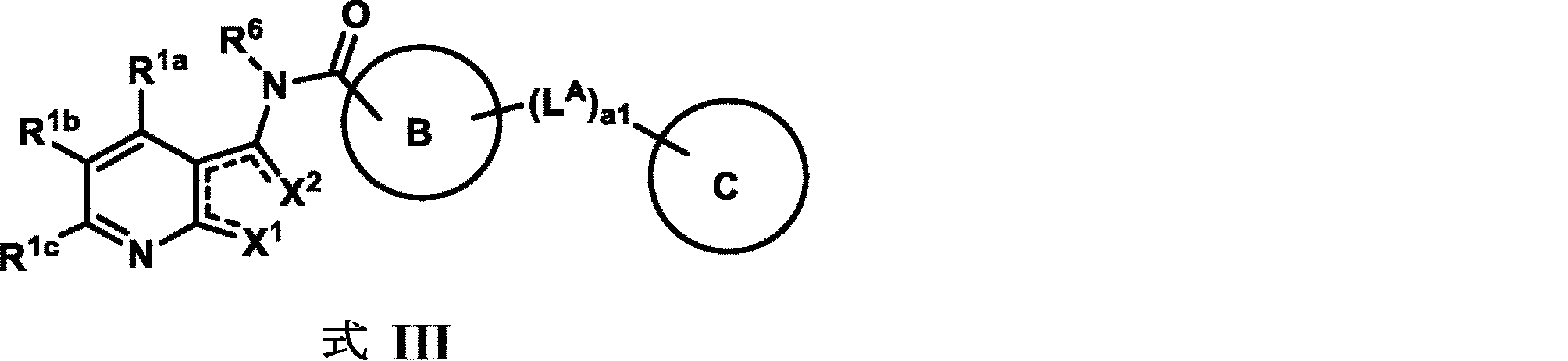
式中、
X1は、O、S、N、NR2、およびCR1からなる群より選択され、
X2は、O、S、N、NR4、およびCR5からなる群より選択され、
各

R1、R1a、R1b、およびR1cは、H;Rc;Rg;および-(L1)b1-Rgからなる群よりそれぞれ独立して選択され、
R2は、H;Rd;Rg;および-(L2)b2-Rgからなる群より独立して選択され、
R4は、HおよびRdからなる群より選択され、
R5は、H;Rc;およびRhからなる群より選択され、
R6は、H;Rd;およびRhからなる群より選択され、
環Bは、環原子5個のヘテロアリーレンであって、環原子のうちの1~4個が、N、NH、N(Rd)、O、およびSからなる群よりそれぞれ独立して選択されるヘテロ原子であり、環Bのヘテロアリーレンが、オキソおよびRcからなる群より独立して選択される1~2個の置換基で置換されていてもよく、但し、環Bが、環炭素原子を介してC(=O)NR6基に結合している、ヘテロアリーレンであり、
各LAは、1~4個のRa1で置換されていてもよいC1~3アルキレン;-O-;-NH-;-NRd;-S(O)0~2;およびC(O)からなる群より独立して選択され、
a1は、0、1、2、もしくは3であり、
環Cは、
・オキソおよびRcからなる群より独立して選択される1~4個の置換基でそれぞれ置換されていてもよい、C3~12シクロアルキレンもしくはC3~12シクロアルケニレン、
・環原子3~12個のヘテロシクリレンもしくはヘテロシクロアルケニレンであって、1~3個の環原子が、N、N(H)、N(Rd)、O、およびS(O)0~2からなる群よりそれぞれ独立して選択されるヘテロ原子であり、ヘテロシクリレンもしくはヘテロシクロアルケニレンが、オキソおよびRcからなる群より独立して選択される1~4個の置換基で置換されていてもよい、ヘテロシクリレンもしくはヘテロシクロアルケニレン、
・環原子5~12個のヘテロアリールであって、1~4個の環原子が、N、N(H)、N(Rd)、O、およびS(O)0~2からなる群よりそれぞれ独立して選択されるヘテロ原子であり、ヘテロアリーレンが1~4個のRcで置換されていてもよい、ヘテロアリール;ならびに
・1~4個のRcで置換されていてもよいC6~10アリーレン
からなる群より選択され、
RaおよびRa1の各出現は、-ハロ;-NReRf;C1~4アルコキシ;C1~4ハロアルコキシ;-C(=O)O(C1~4アルキル);-C(=O)(C1~4アルキル);-C(=O)OH;-CONR'R'';-S(O)1~2NR'R'';-S(O)1~2(C1~4アルキル);およびシアノからなる群より独立して選択され、
Rcの各出現は、ハロ;シアノ;1~6個の独立して選択されるRaで置換されていてもよいC1~10アルキル;C2~6アルケニル;C2~6アルキニル;C1~4アルコキシ;C1~4ハロアルコキシ;-S(O)1~2(C1~4アルキル);-S(O)(=NH)(C1~4アルキル);-NReRf;-OH;-S(O)1~2NR'R'';-C1~4チオアルコキシ;-NO2;-C(=O)(C1~10アルキル);-C(=O)O(C1~4アルキル);-C(=O)OH;-C(=O)NR'R'';および-SF5からなる群より独立して選択され、
Rdの各出現は、1~3個の独立して選択されるRaで置換されていてもよいC1~6アルキル;-C(O)(C1~4アルキル);-C(O)O(C1~4アルキル);-CONR'R'';-S(O)1~2NR'R'';-S(O)1~2(C1~4アルキル);-OH;およびC1~4アルコキシからなる群より独立して選択され、
ReおよびRfの各出現は、H;NR'R''、-OH、およびRiからなる群よりそれぞれ独立して選択される1~3個の置換基で置換されていてもよいC1~6アルキル;-C(O)(C1~4アルキル);-C(O)O(C1~4アルキル);-CONR'R'';-S(O)1~2NR'R'';-S(O)1~2(C1~4アルキル);-OH;ならびにC1~4アルコキシからなる群より独立して選択され、
Rgの各出現は、
・それぞれ、オキソ、Rc、Rh、および-(Lg)bg-Rhからなる群より独立して選択される1~4個の置換基で置換されていてもよい、C3~12シクロアルキルもしくはC3~12シクロアルケニル;
・環原子3~12個のヘテロシクリルもしくはヘテロシクロアルケニルであって、1~3個の環原子が、N、N(H)、N(Rd)、O、およびS(O)0~2からなる群よりそれぞれ独立して選択されるヘテロ原子であり、ヘテロシクリルもしくはヘテロシクロアルケニルが、オキソ、Rc、Rh、および-(Lg)bg-Rhからなる群より独立して選択される1~4個の置換基で置換されていてもよい、ヘテロシクリルもしくはヘテロシクロアルケニル;
・環原子5~12個のヘテロアリールであって、1~4個の環原子が、N、N(H)、N(Rd)、O、およびS(O)0~2からなる群よりそれぞれ独立して選択されるヘテロ原子であり、ヘテロアリールが、Rc、Rh、および-(Lg)bg-Rhからなる群より独立して選択される1~4個の置換基で置換されていてもよい、ヘテロアリール;ならびに
・Rc、Rh、および-(Lg)bg-Rhからなる群より独立して選択される1~4個の置換基で置換されていてもよいC6~10アリール
からなる群より独立して選択され、
Rhの各出現は、
・それぞれ1~4個のRiで置換されていてもよいC3~12シクロアルキルもしくはC3~12シクロアルケニル;
・環原子3~12個のヘテロシクリルもしくはヘテロシクロアルケニルであって、1~3個の環原子が、N、N(H)、N(Rd)、O、およびS(O)0~2からなる群よりそれぞれ独立して選択されるヘテロ原子であり、ヘテロシクリルもしくはヘテロシクロアルケニルが1~4個のRiで置換されていてもよい、ヘテロシクリルもしくはヘテロシクロアルケニル;
・環原子5~12個のヘテロアリールであって、1~4個の環原子が、N、N(H)、N(Rd)、O、およびS(O)0~2からなる群よりそれぞれ独立して選択されるヘテロ原子であり、ヘテロアリールが1~4個のRiで置換されていてもよい、ヘテロアリール;ならびに
・1~4個のRiで置換されていてもよいC6~10アリール
からなる群より独立して選択され、
Riの各出現は、C1~6アルキル;C1~4ハロアルキル;C1~4アルコキシ;C1~4ハロアルコキシ;C1~6アルキル-O-C1~6アルキル-;C1~4ハロアルキル-O-C1~6アルキル-;ハロ;シアノ;-OH;-NR'R'';およびC3~6シクロアルキルからなる群より独立して選択され、
L1、L2、およびLgの各出現は、-O-、-NH-、-NRd、-S(O)0~2、C(O)、および1~3個のRaで置換されていてもよいC1~3アルキレンからなる群より独立して選択され、
b1、b2、およびbgは、それぞれ独立して1、2、もしくは3であり、かつ
R'およびR''の各出現は、H;-OH;およびC1~4アルキルからなる群より独立して選択され、
但し、環Bが、無置換の

化合物、またはその薬学的に許容される塩もしくはその互変異性体。
4. Z、Y1、Y2、およびY3のそれぞれが独立してNまたはCR1である、項目1の化合物。
5. 式(Ia):
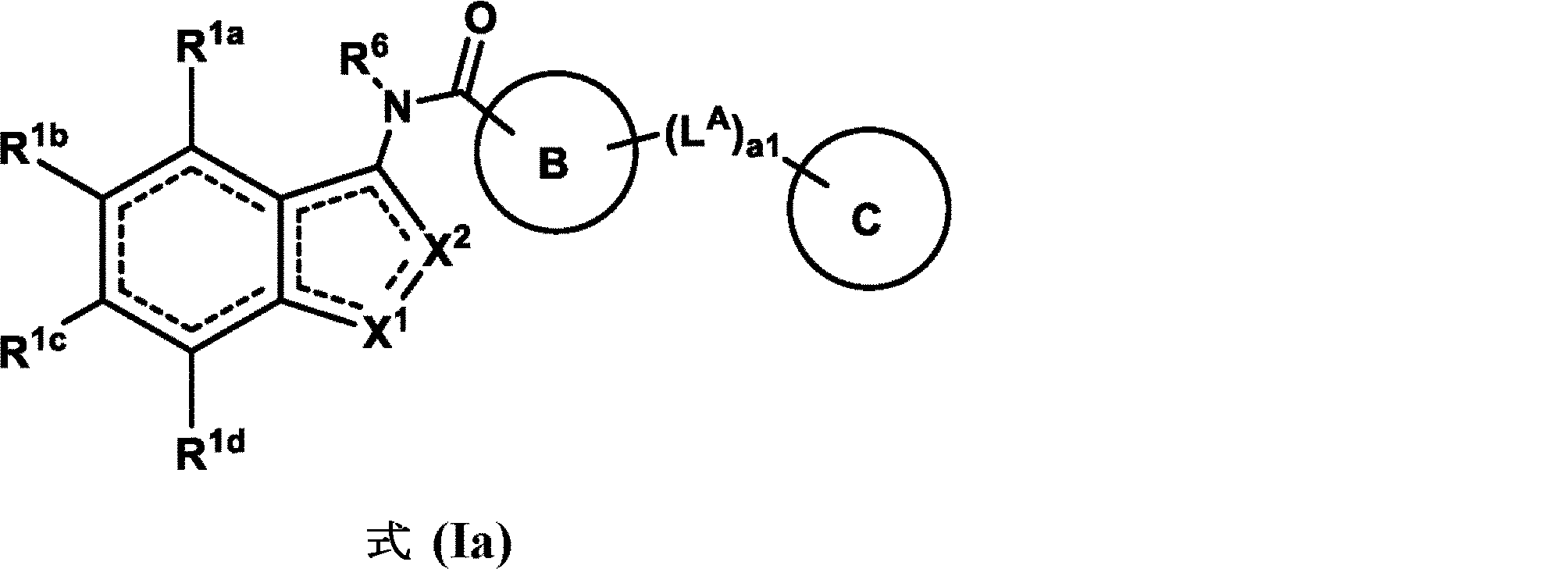
6. Z、Y1、およびY2のうちの1つがNであり、Z、Y1、Y2、およびY3のうちの残りのそれぞれ1つが、独立して選択されるCR1である、項目1または項目4の化合物。
7. 以下の式:

8. X1がNR2である、項目1~項目7のいずれかの化合物。
9. X1がNHである、項目1~項目8のいずれかの化合物。
10. X2がCR5である、項目1~項目9のいずれかの化合物。
11. X2がCHである、項目1~項目10のいずれかの化合物。
12. X1がNR2であり、X2がCR5である、項目1~項目7のいずれかの化合物。
13. X1がNHであり、X2がCHである、項目1~項目7または項目12のいずれかの化合物。
14. 式(Ia-1):

15. 以下の式:

16. 式(II-1):
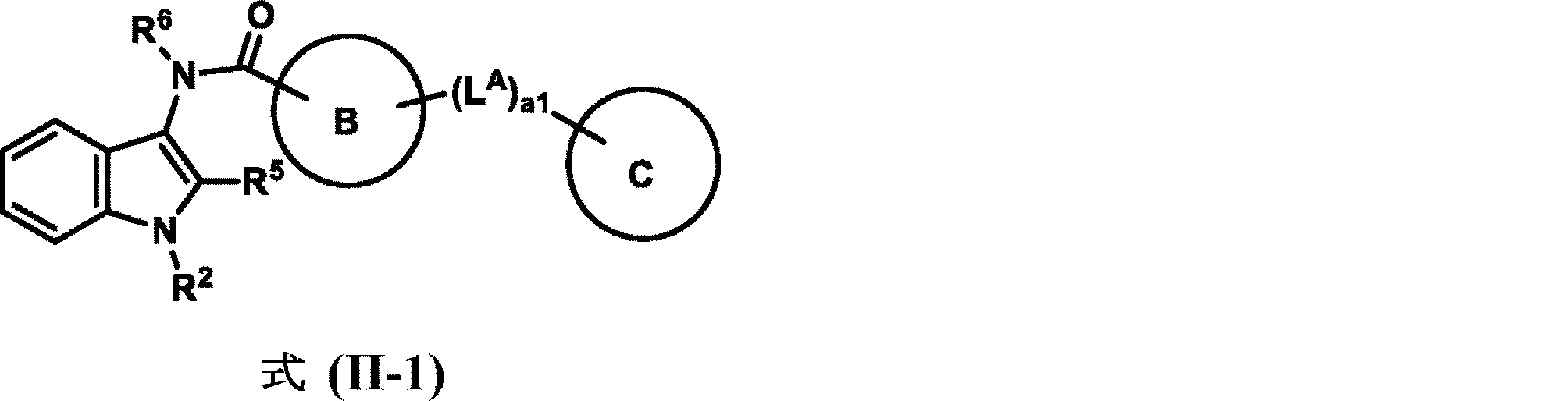
17. 式(III-1):

18. R2がHである、項目14~項目17のいずれかの化合物。
19. R5がHである、項目14~項目18のいずれかの化合物。
20. 1~2個のR1が、Rc1およびRg1からなる群より独立して選択され、残りの各R1がHであり、Rc1が、独立して選択されるRcであり、Rg1が、独立して選択されるRgである、項目1または項目4~項目15のいずれかの化合物。
21. R1の2個の出現が、Rc1およびRg1からなる群より独立して選択され、残りの各R1がHである、項目20の化合物。
22. R1の2個の出現が、独立して選択されるRc1であり、残りの各R1がHである、項目20または項目21の化合物。
23. R1の1個の出現が、Rc1およびRg1からなる群より選択され、残りの各R1がHである、項目20の化合物。
24. R1の1個の出現がRc1であり、残りの各R1がHである、項目20または項目23の化合物。
25. R1の1個の出現がRg1であり、残りの各R1がHである、項目20または項目23の化合物。
26. R1の1個の出現がRc1であり、R1の1個の出現がRg1であり、残りの各R1がHである、項目20の化合物。
27. 各Rc1が、独立して選択されるハロまたはシアノ、例えば-F、-Cl、または-CNである、項目20~項目26のいずれかの化合物。
28. 各Rc1が独立して-Fまたは-Cl、例えば-Fである、項目27の化合物。
29. 各Rg1が、
・環原子5~10個のヘテロアリールであって、1~3個の環原子が、N、N(H)、N(Rd)、O、およびSからなる群よりそれぞれ独立して選択されるヘテロ原子であり、ヘテロアリールが、Rc、Rh、および-(Lg)bg-Rhからなる群より独立して選択される1~4個の置換基で置換されていてもよい、ヘテロアリール;ならびに
・Rc、Rh、および-(Lg)bg-Rhからなる群より独立して選択される1~4個の置換基で置換されていてもよいC6~10アリール
からなる群より独立して選択される、項目20~項目28のいずれかの化合物。
30. 各Rg1が、
・環原子5~6個のヘテロアリールであって、1~3個の環原子が、N、N(H)、N(Rd)、O、およびSからなる群よりそれぞれ独立して選択されるヘテロ原子であり、ヘテロアリールが1~4個のRcで置換されていてもよい、ヘテロアリール;ならびに
・1~4個のRcで置換されていてもよいC6アリール
からなる群より独立して選択される、項目29の化合物。
31. 各Rg1が、独立して、環原子5個のヘテロアリールであって、1~3個の環原子が、N、N(H)、N(Rd)、O、およびSからなる群よりそれぞれ独立して選択されるヘテロ原子であり、ヘテロアリールが1~4個のRcで置換されていてもよい、ヘテロアリールである、項目29または項目30の化合物。
32. 各Rg1が、1~2個のRcで置換されていてもよいピラゾリル、例えば、1~6個の独立して選択されるRaで置換されていてもよい1~2個の独立して選択されるC1~6(例えばC1~3)アルキル(例えば無置換C1~6(例えばC1~3)アルキル)で置換されていてもよいピラゾリルである、項目31の化合物。
33. Rg1が

34. Rg1が、1~4個のRcで置換されていてもよいフェニルであり、例えば、それぞれ1~6個のRaで置換されていてもよいC1~6アルキル;-ハロ;-シアノ;C1~4アルコキシ;およびC1~4ハロアルコキシからなる群より独立して選択される1~2個の置換基で置換されていてもよいフェニルである、項目29または項目30の化合物。
35. 各Rg1が、
・環原子5~10個のヘテロアリールであって、1~3個の環原子が、N、N(H)、N(Rd)、O、およびSからなる群よりそれぞれ独立して選択されるヘテロ原子であり、ヘテロアリールが、Rh1または-(Lg)bg-Rh1の1個の出現で置換されており、1~2個のRcでさらに置換されていてもよい、ヘテロアリール;ならびに
・Rh1または-(Lg)bg-Rh1の1個の出現で置換されており、1~2個のRcでさらに置換されていてもよい、C6~10アリールであって、Rh1が、独立して選択されるRhである、C6~10アリール
からなる群より独立して選択される、項目29の化合物。
36. 各Rg1が、環原子5~6(例えば5)個のヘテロアリールであって、1~3個の環原子が、N、N(H)、N(Rd)、O、およびSからなる群よりそれぞれ独立して選択されるヘテロ原子であり、ヘテロアリールが、Rh1または-(Lg)bg-Rh1の1個の出現で置換されており、1~2個のRcでさらに置換されていてもよく、ここで、Rh1が、独立して選択されるRhである、ヘテロアリールである、項目35の化合物。
37. 各Rg1が、Rh1または-(Lg)bg-Rh1(例えばRh1または-CH2Rh1)で置換されたピラゾリルであって、1~2個のRcでさらに置換されていてもよい、ピラゾリルである、項目36の化合物。
38. 各Rg1が、それぞれRcで置換されていてもよい

39. Rh1が、
・環原子5~6個のヘテロアリールであって、1~3個の環原子が、N、N(H)、N(Rd)、O、およびS(O)0~2からなる群よりそれぞれ独立して選択されるヘテロ原子であり、ヘテロアリールが、1~4個のRiで置換されていてもよい、ヘテロアリール;ならびに
・1~4個のRiで置換されていてもよいC6アリールであって、例えばRg1が、1~4個のRiで置換されていてもよいフェニルである、C6アリール
からなる群より選択される、項目35~項目38のいずれかの化合物。
40. Rh1が、
・環原子5~6個のヘテロアリールであって、1~3個の環原子が、N、N(H)、N(Rd)、O、およびS(O)0~2からなる群よりそれぞれ独立して選択されるヘテロ原子であり、ヘテロアリールが、1~2個のRiで置換されていてもよい、ヘテロアリール;ならびに
・1~2個のRiで置換されていてもよいC6アリールであって、例えばRg1が、1~4個のRiで置換されていてもよいフェニルである、C6アリール
からなる群より選択される、項目39の化合物。
41. 各R1がHである、項目1、項目4、項目6~項目13、項目15、または項目18~項目19のいずれかの化合物。
42. R1aがHである、項目3、項目5、項目7、項目14~項目15、または項目17のいずれかの化合物。
43. R1bがHである、項目3、項目5、項目7、項目14~項目15、項目17、または項目42のいずれかの化合物。
44. R1bがハロ、例えば-Fまたは-Cl(例えば-F)である、項目3、項目5、項目7、項目14~項目15、項目17、または項目42のいずれかの化合物。
45. R1bが、環原子5個のヘテロアリールであって、1~3個の環原子が、N、N(H)、N(Rd)、O、およびSからなる群よりそれぞれ独立して選択されるヘテロ原子であり、ヘテロアリールが1~2個のRcで置換されていてもよい、ヘテロアリールである、項目3、項目5、項目7、項目14~項目15、項目17、または項目42のいずれかの化合物。
46. R1bが、1~2個のRcで置換されていてもよいピラゾリルであり、例えば各Rcが、1~6個の独立して選択されるRaで置換されていてもよい(例えば無置換の)独立して選択されるC1~6(例えばC1~3)アルキルである、項目45の化合物。
47. R1bが、1~4個のRcで置換されていてもよいフェニルであり、例えば、それぞれ1~6個のRaで置換されていてもよいC1~6アルキル;-ハロ;-シアノ;C1~4アルコキシ;およびC1~4ハロアルコキシからなる群より独立して選択される1~2個の置換基で置換されていてもよいフェニルである、項目3、項目5、項目7、項目14~項目15、項目17、または項目42のいずれかの化合物。
48. R1bが、環原子5~6(例えば5)個のヘテロアリールであって、1~3個の環原子が、N、N(H)、N(Rd)、O、およびSからなる群よりそれぞれ独立して選択されるヘテロ原子であり、ヘテロアリールが、Rh1または-(Lg)bg-Rh1の1個の出現で置換されており、1~2個のRcでさらに置換されていてもよく、ここで、Rh1が、独立して選択されるRhである、ヘテロアリールである、項目3、項目5、項目7、項目14~項目15、項目17、または項目42のいずれかの化合物。
49. R1bが、Rh1または-(Lg)bg-Rh1(例えばRh1または-CH2Rh1)で置換されたピラゾリルであって、1~2個のRcでさらに置換されていてもよい、ピラゾリルであり、例えばR1bが、それぞれRcで置換されていてもよい

50. R1cがHである、項目3、項目5、項目7、項目14~項目15、項目17、または項目42~項目48のいずれかの化合物。
51. R1cがハロ、例えば-Fまたは-Clである、項目3、項目5、項目7、項目14~項目15、項目17、または項目42~項目48のいずれかの化合物。
52. R1dがHである、項目3、項目5、項目7、項目14~項目15、項目17、または項目42~項目48のいずれかの化合物。
53. R1dがハロ、例えば-Fまたは-Cl(例えば-F)である、項目3、項目5、項目7、項目14~項目15、項目17、または項目42~項目51のいずれかの化合物。
54. R1aおよびR1dがHであり、かつR1bおよびR1cが、独立して選択されるハロ、例えば-Fまたは-Cl、例えば-Fであり、例えば、R1bおよびR1cが-Fであるか、またはR1bが-FでありかつR1cが-Clであるか、またはR1bが-ClでありかつR1cが-Fである、項目3、項目5、項目7、項目14~項目15、または項目17のいずれかの化合物。
55. R1aおよびR1dがHであり、R1bおよびR1cのうちの一方がHであり、かつR1bおよびR1cのうちの他方がハロ、例えば-Fまたは-Cl、例えば-Fであり、例えば、R1cがHでありかつR1bがハロであるか、またはR1cがハロでありかつR1bがHである、項目3、項目5、項目7、項目14~項目15、または項目17のいずれかの化合物。
56. R1aおよびR1dがHであり、R1cがハロまたはH、例えば-F、-Cl、またはHであり、R1bが、環原子5個のヘテロアリールであって、1~3個の環原子が、N、N(H)、N(Rd)、O、およびSからなる群よりそれぞれ独立して選択されるヘテロ原子であり、ヘテロアリールが1~4個のRcで置換されていてもよい、ヘテロアリールである、項目3、項目5、項目7、項目14~項目15、または項目17のいずれかの化合物。
57. R1aおよびR1dがHであり、R1cがハロまたはH、例えば-F、-Cl、またはHであり、R1bが、環原子5~6(例えば5)個のヘテロアリールであって、1~3個の環原子が、N、N(H)、N(Rd)、O、およびSからなる群よりそれぞれ独立して選択されるヘテロ原子であり、ヘテロアリールが、Rh1または-(Lg)bg-Rh1の1個の出現で置換されており、1~2個のRcでさらに置換されていてもよく、ここで、Rh1が、独立して選択されるRhである、ヘテロアリールである、項目3、項目5、項目7、項目14~項目15、または項目17のいずれかの化合物。
58. R1aおよびR1dがHであり、R1cがハロまたはH、例えば-F、-Cl、またはHであり、R1bが、1~4個のRcで置換されていてもよいフェニルであり、例えば、それぞれ1~6個のRaで置換されていてもよいC1~6アルキル;-ハロ;-シアノ;C1~4アルコキシ;およびC1~4ハロアルコキシからなる群より独立して選択される1~2個の置換基で置換されていてもよいフェニルである、項目3、項目5、項目7、項目14~項目15、または項目17のいずれかの化合物。
59. R1aがHであり、R1dがハロ、例えば-Fまたは-Clであり、R1cがHであり、R1bがRgである、項目3、項目5、項目7、項目14~項目15、または項目17のいずれかの化合物。
60. R6がHである、項目1~項目59のいずれかの化合物。
61. 環Bが、環原子5個のヘテロアリーレンであって、環原子のうちの2~3個が、N、NH、N(Rd)、O、およびSからなる群よりそれぞれ独立して選択されるヘテロ原子であり、環Bのヘテロアリーレンが、1~2個のRcで置換されていてもよく、但し、環Bが、環炭素原子を介してC(=O)NR6基に結合している、ヘテロアリーレンである、項目1~項目60のいずれかの化合物。
62. 環Bが、
それぞれRcで置換されていてもよい、ピラゾリレン;イミダゾリレン;チアゾリレン;オキサゾリレン;トリアゾリレン、例えば1,2,3-トリアゾリレンまたは1,2,4-トリアゾリレン;イソオキサゾリレン;およびイソチアゾリレン
からなる群より選択され、環窒素がRdで置換されていてもよく、
例えば、環Bが、
それぞれRcで置換されていてもよい、ピラゾリレン;イミダゾリレン;1,2,3-トリアゾリレン;1,2,4-トリアゾリレン
であり、環窒素がRdで置換されていてもよい、
項目1~項目60のいずれかの化合物。
63. 環Bが、式B1またはB2:

B4がCまたはNであり、
B1、B2、およびB3が、それぞれ独立して、CH、CRc、NH、N(Rd)、N、O、またはSであり、
但し、B1、B2、およびB3のうちの0~2つがCRcであり、
aaが(LA)a1への結合点であり、かつ
各

項目1~項目61のいずれかの化合物。
64. 環Bが式B1を有する、項目1~項目63のいずれかの化合物。
65. B4がNである、項目1~項目64のいずれかの化合物。
66. 環Bが

67. 環Bが

68. 環Bが

69. 環Bが

70. 環Bが

71. 環Bが

72. 環Bが

73. 環Bが

74. 環Bが

75. 環Bが

76. 環Bが

77. B4がCである、項目64の化合物。
78. 環Bが

79. B3がCHまたはCRc、例えばCHである、項目78の化合物。
80. 環Bが、それぞれRcでさらに置換されていてもよい(例えば、さらに任意で置換されていない)

81. 環Bが

環Bが

項目1~項目64または項目77のいずれかの化合物。
82. 環Bが、それぞれRcで置換されていてもよい(例えば無置換の)

83. 環Bが式B2を有する、項目63の化合物。
84. B4がNである、項目83の化合物。
85. 環Bが、それぞれRcで置換されていてもよい(例えば無置換の)

86. 環Bの各Rc置換基が、独立して、-OH;C1~3アルキル;1~6個の独立して選択されるハロで置換されていてもよいC1~3アルキル;ハロ;シアノ;C1~4アルコキシ;またはC1~4ハロアルコキシである、項目61~項目85のいずれかの化合物。
87. a1が0である、項目1~項目86のいずれかの化合物。
88. a1が1である、項目1~項目87のいずれかの化合物。
89. LAが、1~4個のRa1で置換されていてもよいC1~3アルキレンである、項目1~項目86または項目88のいずれかの化合物。
90. LAが、1~2個のRa1で置換されていてもよいCH2である、項目1~項目86または項目88~項目89のいずれかの化合物。
91. LAが、1~4個のRa1で置換されていてもよいC(H)Meであり、例えばLAがC(H)Meである、項目1~項目86または項目88~項目89のいずれかの化合物。
92. LAがCH2CH2である、項目1~項目86または項目88~項目89のいずれかの化合物。
93. a1が2であり、(LA)a1が-LA1-LA2であり、ここで、LA1およびLA2が、独立して選択されるLAであり、LA2が環Cへの結合点である、項目1~項目86のいずれかの化合物。
94. LA1が、1~4個のRa1で置換されていてもよいC1~3アルキレン、例えばCH2、C(H)Me、またはCH2CH2である、項目93の化合物。
95. LA2が-O-である、項目93または項目94の化合物。
96. 環Cが、
・環原子5~12個のヘテロアリールであって、1~3個の環原子が、N、N(H)、N(Rd)、O、およびS(O)0~2からなる群よりそれぞれ独立して選択されるヘテロ原子であり、ヘテロアリールが1~4個のRcで置換されていてもよい、ヘテロアリール;ならびに
・1~4個のRcで置換されていてもよいC6~10アリール
からなる群より選択される、項目1~項目95のいずれかの化合物。
97. 環Cが、
・環原子5~6個のヘテロアリールであって、1~3個(例えば1~2個)の環原子が、N、N(H)、N(Rd)、O、およびS(O)0~2からなる群よりそれぞれ独立して選択されるヘテロ原子であり、ヘテロアリールが1~4個のRcで置換されていてもよい、ヘテロアリール;ならびに
・1~4個のRcで置換されていてもよいフェニル
からなる群より選択される、項目1~項目96のいずれかの化合物。
98. 環Cが

99. Q3がCRcである、項目98の化合物。
100. Q1、Q2、Q4、およびQ5のそれぞれ1つが、独立して、CHまたはCRcである、項目99の化合物。
101. 環Cが


102. Q1およびQ2のうちの一方がNであり、Q1、Q2、Q4、およびQ5のうちの残りのそれぞれ1つが、独立して、CHまたはCRcである、項目99の化合物。
103. 環Cが

104. Q2がCRcである、項目98の化合物。
105. Q1、Q3、Q4、およびQ5のそれぞれ1つが、独立して、CHまたはCRcである、項目104の化合物。
106. 環Cが


107. Q1およびQ3のうちの一方(例えばQ1)がNであり、Q1、Q3、Q4、およびQ5のうちの残りのそれぞれ1つが、独立して、CHまたはCRcである、項目104の化合物。
108. Q1、Q2、Q3、Q4、およびQ5のそれぞれ1つがCHである(すなわち環Cが無置換フェニルである)、項目98の化合物。
109. Q1およびQ2のうちの一方がNであり、かつQ1、Q2、Q3、Q4、およびQ5のうちの残りのそれぞれ1つがCHであり、例えば、環Cが


110. 環Cが、
・それぞれ、オキソおよびRcからなる群より独立して選択される1~4個の置換基で置換されていてもよい、C3~12シクロアルキルまたはC3~12シクロアルケニル、ならびに
・環原子3~12個のヘテロシクリルまたはヘテロシクロアルケニルであって、1~3個の環原子が、N、N(H)、N(Rd)、O、およびS(O)0~2からなる群よりそれぞれ独立して選択されるヘテロ原子であり、ヘテロシクリルまたはヘテロシクロアルケニルが、オキソおよびRcからなる群より独立して選択される1~4個の置換基で置換されていてもよい、ヘテロシクリルまたはヘテロシクロアルケニル
からなる群より選択される、項目1~項目95のいずれかの化合物。
111. 環Cが、
・1~4個のRcで置換されていてもよいC3~6シクロアルキル、ならびに
・環原子4~6個のヘテロシクリルであって、1~2個の環原子が、N、N(H)、N(Rd)、O、およびS(O)0~2からなる群よりそれぞれ独立して選択されるヘテロ原子であり、ヘテロシクリルが1~4個のRcで置換されていてもよい、ヘテロシクリル
からなる群より選択される、項目1~項目95または項目110のいずれかの化合物。
112. 環Cが、1~2個のRcで置換されていてもよいC3~6シクロアルキルであり、例えば、環Cがシクロヘキシルであるか、またはR6が、1~2個のRc(例えばハロ)で置換されたシクロヘキシルである、項目111の化合物。
113. 環Cの各Rc置換基が、ハロ;シアノ;C1~6アルキル;1~6個のRaで置換されたC1~6アルキル;C1~4アルコキシ;およびC1~4ハロアルコキシからなる群より選択される、項目96~項目112のいずれかの化合物。
114. 環CのRc置換基の1個の出現が、C1~6アルキル、または1~6個のRaで置換されたC1~6アルキル、例えば、1~6個の独立して選択されるハロ、例えば-Fで置換された、C1~6アルキルである、項目113の化合物。
115. 式(Ia-1-1):

式中、
B4はCまたはNであり、
B1、B2、およびB3は、それぞれ独立して、CH、CRc、NH、N(Rd)、N、O、またはSであり、
但し、B1、B2、およびB3のうちの0~2つはCRcであり、
各

Q1、Q2、Q3、Q4、およびQ5は、独立して、CH、CRc、またはNであり、但し、Q1~Q5のうちの2~5つはCHである、項目1の化合物。
116. R2がHであり、R5がHである、項目115の化合物。
117. R6がHである、項目115または項目116の化合物。
118. R1aおよびR1dがHであり、かつR1bおよびR1cが、独立して選択されるハロ、例えば-Fまたは-Cl、例えば-Fであり、例えば、R1bおよびR1cが-Fであるか、またはR1bが-FでありかつR1cが-Clであるか、またはR1bが-ClでありかつR1cが-Fである、項目115~項目117のいずれかの化合物。
119. R1aおよびR1dがHであり、R1bおよびR1cのうちの一方がHであり、かつR1bおよびR1cのうちの他方がハロ、例えば-Fまたは-Cl、例えば-Fであり、例えば、R1cがHでありかつR1bが-Fであるか、またはR1cがHでありかつR1bが-Clであるか、またはR1cが-ClでありかつR1bがHであるか、またはR1cが-FでありかつR1bがHである、項目115~項目117のいずれかの化合物。
120. R1aおよびR1dがHであり、R1cがハロまたはH、例えば-F、-Cl、またはHであり、R1bが、環原子5個のヘテロアリールであって、1~3個の環原子が、N、N(H)、N(Rd)、O、およびSからなる群よりそれぞれ独立して選択されるヘテロ原子であり、ヘテロアリールが、1~4個のRcで置換されていてもよい、ヘテロアリールであり、例えばR1bが、Rcで置換されていてもよいピラゾリルである、項目115~項目117のいずれかの化合物。
121. R1aおよびR1dがHであり、R1cがハロまたはH、例えば-F、-Cl、またはHであり、R1bが、環原子5~6(例えば5)個のヘテロアリールであって、1~3個の環原子が、N、N(H)、N(Rd)、O、およびSからなる群よりそれぞれ独立して選択されるヘテロ原子であり、ヘテロアリールがRh1または-(Lg)bg-Rh1の1個の出現で置換されており、1~2個のRcでさらに置換されていてもよい、ヘテロアリールであり、Rh1が、独立して選択されるRhであり、例えばR1bが、Rh1で置換されたピラゾリルである、項目115~項目117のいずれかの化合物。
122. R1aおよびR1dがHであり、R1cがハロまたはH、例えば-F、-Cl、またはHであり、R1bが、1~4個のRcで置換されていてもよいフェニルであり、例えば、それぞれ1~6個のRaで置換されていてもよいC1~6アルキル;-ハロ;-シアノ;C1~4アルコキシ;およびC1~4ハロアルコキシからなる群より独立して選択される1~2個の置換基で置換されていてもよいフェニルである、項目115~項目117のいずれかの化合物。
123. R1aがHであり、R1dがハロ、例えば-Fまたは-Clであり、R1cがHであり、R1bがRgである、項目115~項目117のいずれかの化合物。
124. 環Bが


125. 環Bが


126. 環Bが


127. 環Bが


128. 環Bが


129. 環Bが、それぞれRcでさらに置換されていてもよい(例えば、さらに任意で置換されていない)

130. a1が0である、項目115~項目130のいずれかの化合物。
131. a1が1であり、LAが、1~4個のRa1で置換されていてもよいC1~3アルキレンである、項目115~項目130のいずれかの化合物。
132. LAがCH2であるか、またはLAがC(H)Meである、項目131の化合物。
133.


134.



135.


136. 表C1に示す化合物およびそれらの薬学的に許容される塩からなる群より選択される、項目1の化合物。
137. 項目1~項目136のいずれかの化合物と1つまたは複数の薬学的に許容される賦形剤とを含む、薬学的組成物。
138. STING活性を阻害するための方法であって、STINGを項目1~項目136のいずれかに定義される化合物もしくはその薬学的に許容される塩または項目137に定義される薬学的組成物と接触させる工程を含む、方法。
139. 阻害することが、STINGをアンタゴナイズすることを含む、項目138の方法。
140. インビトロで実行される、項目138~項目139のいずれかの方法。
141. STINGを含む1つまたは複数の細胞を含む試料を化合物と接触させる工程を含む、項目140の方法。
142. 1つまたは複数の細胞が1つまたは複数のがん細胞である、項目140または項目141の方法。
143. 試料が1つまたは複数のがん細胞をさらに含み、がんが、黒色腫、子宮頸がん、乳がん、卵巣がん、前立腺がん、精巣がん、尿路上皮がん、膀胱がん、非小細胞肺がん、小細胞肺がん、肉腫、結腸直腸腺がん、消化管間質腫瘍、胃食道がん、結腸直腸がん、膵がん、腎がん、肝細胞がん、悪性中皮腫、白血病、リンパ腫、脊髄形成異常症候群、多発性骨髄腫、移行上皮がん、神経芽細胞腫、形質細胞新生物、ウィルムス腫瘍、または原発性肝細胞がんからなる群より選択される、項目141または項目142の方法。
144. インビボで実行される、項目138または項目139の方法。
145. STINGシグナル伝達の増大(例えば亢進)が疾患の病態および/または症状および/または進行の一因となる疾患を有する対象に、化合物を投与する工程を含む、項目144の方法。
146. 対象がヒトである、項目145の方法。
147. 疾患ががんである、項目146の方法。
148. がんが、黒色腫、子宮頸がん、乳がん、卵巣がん、前立腺がん、精巣がん、尿路上皮がん、膀胱がん、非小細胞肺がん、小細胞肺がん、肉腫、結腸直腸腺がん、消化管間質腫瘍、胃食道がん、結腸直腸がん、膵がん、腎がん、肝細胞がん、悪性中皮腫、白血病、リンパ腫、脊髄形成異常症候群、多発性骨髄腫、移行上皮がん、神経芽細胞腫、形質細胞新生物、ウィルムス腫瘍、または原発性肝細胞がんからなる群より選択される、項目147の方法。
149. がんが難治性のがんである、項目147または項目148の方法。
150. 化合物が、1つまたは複数の追加のがん治療と組み合わせて投与される、項目145の方法。
151. 1つまたは複数の追加のがん治療が、外科手術、放射線治療、化学治療、毒素治療、免疫治療、寒冷治療、もしくは遺伝子治療、またはそれらの組み合わせを含む、項目150の方法。
152. 化学治療が、1つまたは複数の追加の化学治療剤を投与することを含む、項目151の方法。
153. 1つまたは複数の追加の化学治療剤が、アルキル化剤(例えばシスプラチン、カルボプラチン、メクロレタミン、シクロホスファミド、クロラムブシル、イホスファミドおよび/またはオキサリプラチン);代謝拮抗物質(例えばアザチオプリンおよび/またはメルカプトプリン);テルペノイド(例えばビンカアルカロイドおよび/またはタキサン;例えばビンクリスチン、ビンブラスチン、ビノレルビンおよび/またはビンデシン、タキソール、パクリタキセルおよび/またはドセタキセル);トポイソメラーゼ(例えばI型トポイソメラーゼおよび/または2型トポイソメラーゼ;例えばカンプトテシン、例えばイリノテカンおよび/またはトポテカン;アムサクリン、エトポシド、リン酸エトポシドおよび/またはテニポシド);細胞傷害性抗生物質(例えばアクチノマイシン、アントラサイクリン、ドキソルビシン、ダウノルビシン、バルルビシン、イダルビシン、エピルビシン、ブレオマイシン、プリカマイシンおよび/またはマイトマイシン);ホルモン(例えば黄体形成ホルモン放出ホルモンアゴニスト;例えばロイプロリジン、ゴセレリン、トリプトレリン、ヒストレリン、ビカルタミド、フルタミドおよび/またはニルタミド);抗体(例えばアブシキシマブ、アダリムマブ、アレムツズマブ、アトリズマブ、バシリキシマブ、ベリムマブ、ベバシズマブ、ブレツキシマブベドチン、カナキヌマブ、セツキシマブ、セルトリズマブペゴル、ダクリズマブ、デノスマブ、エクリズマブ、エファリズマブ、ゲムツズマブ、ゴリムマブ、ゴリムマブ、イブリツモマブチウキセタン、インフリキシマブ、イピリムマブ、ムロモナブ-CD3、ナタリズマブ、オファツムマブ、オマリズマブ、パリビズマブ、パニツムマブ、ラニビズマブ、リツキシマブ、トシリズマブ、トシツモマブおよび/またはトラスツズマブ);抗血管新生剤;サイトカイン;血栓剤;増殖阻害性物質;駆虫剤;ならびに、免疫チェックポイント阻害物質から選択され、免疫チェックポイント阻害物質が、CTLA-4、PD-1、PD-L1、PD-1-PD-L1、PD-1-PD-L2、インターロイキン-2(IL-2)、インドールアミン2,3-ジオキシゲナーゼ(IDO)、IL-10、トランスフォーミング増殖因子-β(TGFβ)、T細胞免疫グロブリンおよびムチン3(TIM3またはHAVCR2)、ガレクチン9-TIM3、ホスファチジルセリン-TIM3、リンパ球活性化遺伝子3タンパク質(LAG3)、MHCクラスII-LAG3、4-1BB-4-1BBリガンド、OX40-OX40リガンド、GITR、GITRリガンド-GITR、CD27、CD70-CD27、TNFRSF25、TNFRSF25-TL1A、CD40L、CD40-CD40リガンド、HVEM-LIGHT-LTA、HVEM、HVEM-BTLA、HVEM-CD160、HVEM-LIGHT、HVEM-BTLA-CD160、CD80、CD80-PDL-1、PDL2-CD80、CD244、CD48-CD244、CD244、ICOS、ICOS-ICOSリガンド、B7-H3、B7-H4、VISTA、TMIGD2、HHLA2-TMIGD2、BTNL2を含むブチロフィリン類、シグレックファミリー、TIGITおよびPVRファミリーメンバー、KIR、ILTおよびLIR、NKG2DおよびNKG2A、MICAおよびMICB、CD244、CD28、CD86-CD28、CD86-CTLA、CD80-CD28、CD39、CD73アデノシン-CD39-CD73、CXCR4-CXCL12、ホスファチジルセリン、TIM3、ホスファチジルセリン-TIM3、SIRPA-CD47、VEGF、ニューロピリン、CD160、CD30、ならびにCD155(例えばCTLA-4またはPD1またはPD-L1)からなる群より選択される、項目152の方法。
154. 化合物が腫瘍内に投与される、項目145~項目153のいずれかの方法。
155. がんを処置する方法であって、そのような処置を必要とする対象に、有効量の項目1~項目136のいずれかに定義される化合物または項目137に定義される薬学的組成物を投与する工程を含む、方法。
156. がんが、黒色腫、子宮頸がん、乳がん、卵巣がん、前立腺がん、精巣がん、尿路上皮がん、膀胱がん、非小細胞肺がん、小細胞肺がん、肉腫、結腸直腸腺がん、消化管間質腫瘍、胃食道がん、結腸直腸がん、膵がん、腎がん、肝細胞がん、悪性中皮腫、白血病、リンパ腫、脊髄形成異常症候群、多発性骨髄腫、移行上皮がん、神経芽細胞腫、形質細胞新生物、ウィルムス腫瘍、または原発性肝細胞がんからなる群より選択される、項目155の方法。
157. がんが難治性のがんである、項目155または項目156の方法。
158. 化合物が、1つまたは複数の追加のがん治療と組み合わせて投与される、項目155の方法。
159. 1つまたは複数の追加のがん治療が、外科手術、放射線治療、化学治療、毒素治療、免疫治療、寒冷治療、もしくは遺伝子治療、またはそれらの組み合わせを含む、項目158の方法。
160. 化学治療が、1つまたは複数の追加の化学治療剤を投与することを含む、項目159の方法。
161. 1つまたは複数の追加の化学治療剤が、アルキル化剤(例えばシスプラチン、カルボプラチン、メクロレタミン、シクロホスファミド、クロラムブシル、イホスファミドおよび/またはオキサリプラチン);代謝拮抗物質(例えばアザチオプリンおよび/またはメルカプトプリン);テルペノイド(例えばビンカアルカロイドおよび/またはタキサン;例えばビンクリスチン、ビンブラスチン、ビノレルビンおよび/またはビンデシン、タキソール、パクリタキセルおよび/またはドセタキセル);トポイソメラーゼ(例えばI型トポイソメラーゼおよび/または2型トポイソメラーゼ;例えばカンプトテシン、例えばイリノテカンおよび/またはトポテカン;アムサクリン、エトポシド、リン酸エトポシドおよび/またはテニポシド);細胞傷害性抗生物質(例えばアクチノマイシン、アントラサイクリン、ドキソルビシン、ダウノルビシン、バルルビシン、イダルビシン、エピルビシン、ブレオマイシン、プリカマイシンおよび/またはマイトマイシン);ホルモン(例えば黄体形成ホルモン放出ホルモンアゴニスト;例えばロイプロリジン、ゴセレリン、トリプトレリン、ヒストレリン、ビカルタミド、フルタミドおよび/またはニルタミド);抗体(例えばアブシキシマブ、アダリムマブ、アレムツズマブ、アトリズマブ、バシリキシマブ、ベリムマブ、ベバシズマブ、ブレツキシマブベドチン、カナキヌマブ、セツキシマブ、セルトリズマブペゴル、ダクリズマブ、デノスマブ、エクリズマブ、エファリズマブ、ゲムツズマブ、ゴリムマブ、ゴリムマブ、イブリツモマブチウキセタン、インフリキシマブ、イピリムマブ、ムロモナブ-CD3、ナタリズマブ、オファツムマブ、オマリズマブ、パリビズマブ、パニツムマブ、ラニビズマブ、リツキシマブ、トシリズマブ、トシツモマブおよび/またはトラスツズマブ);抗血管新生剤;サイトカイン;血栓剤;増殖阻害性物質;駆虫剤;ならびに、免疫チェックポイント受容体を標的とする免疫チェックポイント阻害物質から選択され、免疫チェックポイント阻害物質が、CTLA-4、PD-1、PD-L1、PD-1-PD-L1、PD-1-PD-L2、インターロイキン-2(IL-2)、インドールアミン2,3-ジオキシゲナーゼ(IDO)、IL-10、トランスフォーミング増殖因子-β(TGFβ)、T細胞免疫グロブリンおよびムチン3(TIM3またはHAVCR2)、ガレクチン9-TIM3、ホスファチジルセリン-TIM3、リンパ球活性化遺伝子3タンパク質(LAG3)、MHCクラスII-LAG3、4-1BB-4-1BBリガンド、OX40-OX40リガンド、GITR、GITRリガンド-GITR、CD27、CD70-CD27、TNFRSF25、TNFRSF25-TL1A、CD40L、CD40-CD40リガンド、HVEM-LIGHT-LTA、HVEM、HVEM-BTLA、HVEM-CD160、HVEM-LIGHT、HVEM-BTLA-CD160、CD80、CD80-PDL-1、PDL2-CD80、CD244、CD48-CD244、CD244、ICOS、ICOS-ICOSリガンド、B7-H3、B7-H4、VISTA、TMIGD2、HHLA2-TMIGD2、BTNL2を含むブチロフィリン類、シグレックファミリー、TIGITおよびPVRファミリーメンバー、KIR、ILTおよびLIR、NKG2DおよびNKG2A、MICAおよびMICB、CD244、CD28、CD86-CD28、CD86-CTLA、CD80-CD28、CD39、CD73アデノシン-CD39-CD73、CXCR4-CXCL12、ホスファチジルセリン、TIM3、ホスファチジルセリン-TIM3、SIRPA-CD47、VEGF、ニューロピリン、CD160、CD30、ならびにCD155(例えばCTLA-4またはPD1またはPD-L1)からなる群より選択される、項目160の方法。
162. 化合物が腫瘍内に投与される、項目155~項目161のいずれかの方法。
163. その必要がある対象における免疫応答を誘導する方法であって、有効量の、項目1~項目136のいずれかに定義される化合物または項目137に定義される薬学的組成物を対象に投与する工程を含む、方法。
164. 対象ががんを有する、項目163の方法。
165. 対象が、1つまたは複数のがん治療を受けたことがあり、かつ/または受けており、かつ/または受けることになっている、項目164の方法。
166. がんが、黒色腫、子宮頸がん、乳がん、卵巣がん、前立腺がん、精巣がん、尿路上皮がん、膀胱がん、非小細胞肺がん、小細胞肺がん、肉腫、結腸直腸腺がん、消化管間質腫瘍、胃食道がん、結腸直腸がん、膵がん、腎がん、肝細胞がん、悪性中皮腫、白血病、リンパ腫、脊髄形成異常症候群、多発性骨髄腫、移行上皮がん、神経芽細胞腫、形質細胞新生物、ウィルムス腫瘍、または原発性肝細胞がんからなる群より選択される、項目164の方法。
167. がんが難治性のがんである、項目164~項目166のいずれかの方法。
168. 免疫応答が先天性免疫応答である、項目163の方法。
169. 少なくとも1つまたは複数のがん治療が、外科手術、放射線治療、化学治療、毒素治療、免疫治療、寒冷治療、もしくは遺伝子治療、またはそれらの組み合わせを含む、項目168の方法。
170. 化学治療が、1つまたは複数の追加の化学治療剤を投与することを含む、項目169の方法。
171. 1つまたは複数の追加の化学治療剤が、アルキル化剤(例えばシスプラチン、カルボプラチン、メクロレタミン、シクロホスファミド、クロラムブシル、イホスファミドおよび/またはオキサリプラチン);代謝拮抗物質(例えばアザチオプリンおよび/またはメルカプトプリン);テルペノイド(例えばビンカアルカロイドおよび/またはタキサン;例えばビンクリスチン、ビンブラスチン、ビノレルビンおよび/またはビンデシン、タキソール、パクリタキセルおよび/またはドセタキセル);トポイソメラーゼ(例えばI型トポイソメラーゼおよび/または2型トポイソメラーゼ;例えばカンプトテシン、例えばイリノテカンおよび/またはトポテカン;アムサクリン、エトポシド、リン酸エトポシドおよび/またはテニポシド);細胞傷害性抗生物質(例えばアクチノマイシン、アントラサイクリン、ドキソルビシン、ダウノルビシン、バルルビシン、イダルビシン、エピルビシン、ブレオマイシン、プリカマイシンおよび/またはマイトマイシン);ホルモン(例えば黄体形成ホルモン放出ホルモンアゴニスト;例えばロイプロリジン、ゴセレリン、トリプトレリン、ヒストレリン、ビカルタミド、フルタミドおよび/またはニルタミド);抗体(例えばアブシキシマブ、アダリムマブ、アレムツズマブ、アトリズマブ、バシリキシマブ、ベリムマブ、ベバシズマブ、ブレツキシマブベドチン、カナキヌマブ、セツキシマブ、セルトリズマブペゴル、ダクリズマブ、デノスマブ、エクリズマブ、エファリズマブ、ゲムツズマブ、ゴリムマブ、ゴリムマブ、イブリツモマブチウキセタン、インフリキシマブ、イピリムマブ、ムロモナブ-CD3、ナタリズマブ、オファツムマブ、オマリズマブ、パリビズマブ、パニツムマブ、ラニビズマブ、リツキシマブ、トシリズマブ、トシツモマブおよび/またはトラスツズマブ);抗血管新生剤;サイトカイン;血栓剤;増殖阻害阻害性物質;駆虫剤;ならびに、免疫チェックポイント受容体を標的とする免疫チェックポイント阻害物質から選択され、免疫チェックポイント阻害物質が、CTLA-4、PD-1、PD-L1、PD-1-PD-L1、PD-1-PD-L2、インターロイキン-2(IL-2)、インドールアミン2,3-ジオキシゲナーゼ(IDO)、IL-10、トランスフォーミング増殖因子-β(TGFβ)、T細胞免疫グロブリンおよびムチン3(TIM3またはHAVCR2)、ガレクチン9-TIM3、ホスファチジルセリン-TIM3、リンパ球活性化遺伝子3タンパク質(LAG3)、MHCクラスII-LAG3、4-1BB-4-1BBリガンド、OX40-OX40リガンド、GITR、GITRリガンド-GITR、CD27、CD70-CD27、TNFRSF25、TNFRSF25-TL1A、CD40L、CD40-CD40リガンド、HVEM-LIGHT-LTA、HVEM、HVEM-BTLA、HVEM-CD160、HVEM-LIGHT、HVEM-BTLA-CD160、CD80、CD80-PDL-1、PDL2-CD80、CD244、CD48-CD244、CD244、ICOS、ICOS-ICOSリガンド、B7-H3、B7-H4、VISTA、TMIGD2、HHLA2-TMIGD2、BTNL2を含むブチロフィリン類、シグレックファミリー、TIGITおよびPVRファミリーメンバー、KIR、ILTおよびLIR、NKG2DおよびNKG2A、MICAおよびMICB、CD244、CD28、CD86-CD28、CD86-CTLA、CD80-CD28、CD39、CD73アデノシン-CD39-CD73、CXCR4-CXCL12、ホスファチジルセリン、TIM3、ホスファチジルセリン-TIM3、SIRPA-CD47、VEGF、ニューロピリン、CD160、CD30、ならびにCD155(例えばCTLA-4またはPD1またはPD-L1)からなる群より選択される、項目170の方法。
172. STINGシグナル伝達の増大(例えば亢進)が疾患の病態および/または症状および/または進行の一因となる疾患の処置方法であって、そのような処置を必要とする対象に、有効量の項目1~項目136のいずれかに定義される化合物または項目137に定義される薬学的組成物を投与する工程を含む、方法。
173. STINGシグナル伝達の増大(例えば亢進)が疾患の病態および/または症状および/または進行の一因となる疾患を有する対象に、有効量の項目1~項目136のいずれかに定義される化合物または項目137に定義される薬学的組成物を投与する工程を含む、処置の方法。
174. 項目1~項目136のいずれかに定義される化合物または項目137に定義される薬学的組成物を対象に投与する工程を含み、STINGシグナル伝達の増大(例えば亢進)が疾患の病態および/または症状および/または進行の一因となる疾患を処置するのに有効な量で化合物または組成物を投与し、それによって、疾患を処置する、処置の方法。
175. 疾患ががんである、項目172~項目174のいずれかの方法。
176. がんが、黒色腫、子宮頸がん、乳がん、卵巣がん、前立腺がん、精巣がん、尿路上皮がん、膀胱がん、非小細胞肺がん、小細胞肺がん、肉腫、結腸直腸腺がん、消化管間質腫瘍、胃食道がん、結腸直腸がん、膵がん、腎がん、肝細胞がん、悪性中皮腫、白血病、リンパ腫、脊髄形成異常症候群、多発性骨髄腫、移行上皮がん、神経芽細胞腫、形質細胞新生物、ウィルムス腫瘍、または原発性肝細胞がんからなる群より選択される、項目175の方法。
177. がんが難治性のがんである、項目175または項目176の方法。
178. 化合物が、1つまたは複数の追加のがん治療と組み合わせて投与される、項目175~項目177のいずれかの方法。
179. 1つまたは複数の追加のがん治療が、外科手術、放射線治療、化学治療、毒素治療、免疫治療、寒冷治療、もしくは遺伝子治療、またはそれらの組み合わせを含む、項目178の方法。
180. 化学治療が、1つまたは複数の追加の化学治療剤を投与することを含む、項目179の方法。
181. 1つまたは複数の追加の化学治療剤が、アルキル化剤(例えばシスプラチン、カルボプラチン、メクロレタミン、シクロホスファミド、クロラムブシル、イホスファミドおよび/またはオキサリプラチン);代謝拮抗物質(例えばアザチオプリンおよび/またはメルカプトプリン);テルペノイド(例えばビンカアルカロイドおよび/またはタキサン;例えばビンクリスチン、ビンブラスチン、ビノレルビンおよび/またはビンデシン、タキソール、パクリタキセルおよび/またはドセタキセル);トポイソメラーゼ(例えばI型トポイソメラーゼおよび/または2型トポイソメラーゼ;例えばカンプトテシン、例えばイリノテカンおよび/またはトポテカン;アムサクリン、エトポシド、リン酸エトポシドおよび/またはテニポシド);細胞傷害性抗生物質(例えばアクチノマイシン、アントラサイクリン、ドキソルビシン、ダウノルビシン、バルルビシン、イダルビシン、エピルビシン、ブレオマイシン、プリカマイシンおよび/またはマイトマイシン);ホルモン(例えば黄体形成ホルモン放出ホルモンアゴニスト;例えばロイプロリジン、ゴセレリン、トリプトレリン、ヒストレリン、ビカルタミド、フルタミドおよび/またはニルタミド);抗体(例えばアブシキシマブ、アダリムマブ、アレムツズマブ、アトリズマブ、バシリキシマブ、ベリムマブ、ベバシズマブ、ブレツキシマブベドチン、カナキヌマブ、セツキシマブ、セルトリズマブペゴル、ダクリズマブ、デノスマブ、エクリズマブ、エファリズマブ、ゲムツズマブ、ゴリムマブ、ゴリムマブ、イブリツモマブチウキセタン、インフリキシマブ、イピリムマブ、ムロモナブ-CD3、ナタリズマブ、オファツムマブ、オマリズマブ、パリビズマブ、パニツムマブ、ラニビズマブ、リツキシマブ、トシリズマブ、トシツモマブおよび/またはトラスツズマブ);抗血管新生剤;サイトカイン;血栓剤;増殖阻害性物質;駆虫剤;ならびに、免疫チェックポイント受容体を標的とする免疫チェックポイント阻害物質から選択され、免疫チェックポイント阻害物質が、CTLA-4、PD-1、PD-L1、PD-1-PD-L1、PD-1-PD-L2、インターロイキン-2(IL-2)、インドールアミン2,3-ジオキシゲナーゼ(IDO)、IL-10、トランスフォーミング増殖因子-β(TGFβ)、T細胞免疫グロブリンおよびムチン3(TIM3またはHAVCR2)、ガレクチン9-TIM3、ホスファチジルセリン-TIM3、リンパ球活性化遺伝子3タンパク質(LAG3)、MHCクラスII-LAG3、4-1BB-4-1BBリガンド、OX40-OX40リガンド、GITR、GITRリガンド-GITR、CD27、CD70-CD27、TNFRSF25、TNFRSF25-TL1A、CD40L、CD40-CD40リガンド、HVEM-LIGHT-LTA、HVEM、HVEM-BTLA、HVEM-CD160、HVEM-LIGHT、HVEM-BTLA-CD160、CD80、CD80-PDL-1、PDL2-CD80、CD244、CD48-CD244、CD244、ICOS、ICOS-ICOSリガンド、B7-H3、B7-H4、VISTA、TMIGD2、HHLA2-TMIGD2、BTNL2を含むブチロフィリン類、シグレックファミリー、TIGITおよびPVRファミリーメンバー、KIR、ILTおよびLIR、NKG2DおよびNKG2A、MICAおよびMICB、CD244、CD28、CD86-CD28、CD86-CTLA、CD80-CD28、CD39、CD73アデノシン-CD39-CD73、CXCR4-CXCL12、ホスファチジルセリン、TIM3、ホスファチジルセリン-TIM3、SIRPA-CD47、VEGF、ニューロピリン、CD160、CD30、ならびにCD155(例えばCTLA-4またはPD1またはPD-L1)からなる群より選択される、項目180の方法。
182. 化合物が腫瘍内に投与される、項目172~項目181のいずれかの方法。
183. STINGに関連する疾患、障害、または状態の処置方法であって、そのような処置を必要とする対象に、有効量の項目1~項目136のいずれかに定義される化合物または項目137に定義される薬学的組成物を投与する工程を含む、方法。
184. 疾患、障害、または状態が、I型インターフェロン症、アイカルディ・グティエール症候群(AGS)、ループスの遺伝的形態、炎症関連障害、および関節リウマチから選択される、項目183の方法。
185. 疾患、障害、または状態がI型インターフェロン症(例えば乳児発症性STING関連血管炎(SAVI))である、項目184の方法。
186. I型インターフェロン症が乳児発症性STING関連血管炎(SAVI))である、項目185の方法。
187. 疾患、障害、または状態がアイカルディ・グティエール症候群(AGS)である、項目184の方法。
188. 疾患、障害、または状態がループスの遺伝的形態である、項目184の方法。
189. 疾患、障害、または状態が炎症関連障害である、項目184の方法。
190. 炎症関連障害が全身性エリテマトーデスである、項目189の方法。
191. 対象を特定する工程をさらに含む、項目138~項目190のいずれかの方法。
192. 項目1~項目136のいずれかに定義される化合物またはその薬学的に許容される塩もしくは互変異性体と、1つまたは複数の治療活性作用物質とを含む、組合せ。
193. 医薬として使用するための、項目1~項目136のいずれかに定義される化合物またはその薬学的に許容される塩もしくは互変異性体、または、項目137に定義される薬学的組成物。
194. STING阻害によってモジュレートされる疾患、状態、または障害の処置において使用するための、項目1~項目136のいずれかに定義される化合物、またはその薬学的に許容される塩もしくは互変異性体、または項目137に定義される薬学的組成物。
195. 項目138~項目191のいずれかにおいて言及される疾患の処置において使用するための、項目1~項目136のいずれかに定義される化合物またはその薬学的に許容される塩もしくは互変異性体、または、項目137に定義される薬学的組成物。
196. 項目138~項目191のいずれかにおいて言及される疾患を処置するための医薬の製造における、項目1~項目136のいずれかに定義される化合物またはその薬学的に許容される塩もしくは互変異性体、または、項目137に定義される薬学的組成物の使用。
numbered items
The compounds, compositions, methods, and other subject matter described herein are further described in the numbered sections below.
1. Formula I:
During the ceremony,
Z, Y1,Y2, and Y3is CR1, C(=O), N, and NR2independently selected from the group consisting of;
X1is O, S, N, NR2, and CR1selected from the group consisting of
X2is O, S, N, NRFour, and CRFiveselected from the group consisting of
However, Z, Y1, and Y2one of each is CR1Y if3cannot be N or Z, Y1,Y2, and Y3one of each is CR1at least one R if1is other than H,
each
Each R1H;Rc;Rg; and -(L1)b1-Rgindependently selected from the group consisting of;
Each R2H;Rd;Rg; and -(L2)b2-Rgindependently selected from the group consisting of;
RFourare H and Rdselected from the group consisting of
RFiveH;Rc; and Rhselected from the group consisting of
R6H;Rd; and Rhselected from the group consisting of
Ring B is a heteroarylene of 5 ring atoms, in which 1 to 4 of the ring atoms are N, NH, N(Rd), O, and S, and the heteroarylene of ring B is oxo and Rcmay be substituted with one or two substituents independently selected from the group consisting of, provided that ring B is C(=O)NR via a ring carbon atom.6a heteroarylene bonded to the group;
Each LAis 1 to 4 Ra1C may be replaced with1~3Alkylene;-O-;-NH-;-NRd;-S(O)0-2; and C(O);
a1 is 0, 1, 2, or 3;
Ring C is
・Oxo and Rcoptionally substituted with 1 to 4 substituents independently selected from the group consisting of C3~12cycloalkyl or C3~12cycloalkenyl;
・Heterocyclyl or heterocycloalkenyl having 3 to 12 ring atoms, in which 1 to 3 ring atoms are N, N(H), N(Rd), O, and S(O)0-2heteroatoms each independently selected from the group consisting of oxo and Rcheterocyclyl or heterocycloalkenyl, optionally substituted with 1 to 4 substituents independently selected from the group consisting of;
・Heteroaryl of 5 to 12 ring atoms, in which 1 to 4 ring atoms are N, N(H), N(Rd), O, and S(O)0-2heteroatoms each independently selected from the group consisting of 1 to 4 Rcheteroaryl, optionally substituted with; and
・1 to 4 RcC may be replaced with6~10aryl
selected from the group consisting of
Raand Ra1Each occurrence of -OH;-halo;-NReRf;C1-4Alkoxy;C1-4Haloalkoxy;-C(=O)O(C1-4alkyl);-C(=O)(C1-4alkyl);-C(=O)OH;-CONR'R'';-S(O)1~2NR'R'';-S(O)1~2(C1-4alkyl); and cyano;
RcEach occurrence of halo;cyano;1 to 6 independently selected RaC may be replaced with1-10Alkyl;C2-6Alkenyl;C2-6Alkynyl;C1-4Alkoxy;C1-4Haloalkoxy;-S(O)1~2(C1-4alkyl);-S(O)(=NH)(C1-4alkyl);-NReRf;-OH;-S(O)1~2NR'R'';-C1-4thioalkoxy;-NO2;-C(=O)(C1-10alkyl);-C(=O)O(C1-4alkyl);-C(=O)OH;-C(=O)NR'R''; and -SFFiveindependently selected from the group consisting of
RdEach occurrence of RaC may be replaced with1-6Alkyl;-C(O)(C1-4alkyl);-C(O)O(C1-4alkyl);-CONR'R'';-S(O)1~2NR'R'';-S(O)1~2(C1-4alkyl);-OH; and C1-4independently selected from the group consisting of alkoxy;
Reand RfEach occurrence of H;NR'R'', -OH, and RiC optionally substituted with 1 to 3 substituents each independently selected from the group consisting of1-6Alkyl;-C(O)(C1-4alkyl);-C(O)O(C1-4alkyl);-CONR'R'';-S(O)1~2NR'R'';-S(O)1~2(C1-4alkyl);-OH; and C1-4independently selected from the group consisting of alkoxy;
RgEach occurrence of
・Oxo, R respectivelyc,Rh, and -(Lg)bg-Rhoptionally substituted with 1 to 4 substituents independently selected from the group consisting of C3~12cycloalkyl or C3~12cycloalkenyl;
・Heterocyclyl or heterocycloalkenyl having 3 to 12 ring atoms, in which 1 to 3 ring atoms are N, N(H), N(Rd), O, and S(O)0-2heteroatoms each independently selected from the group consisting of oxo, Rc,Rh, and -(Lg)bg-Rhheterocyclyl or heterocycloalkenyl, optionally substituted with 1 to 4 substituents independently selected from the group consisting of;
・Heteroaryl of 5 to 12 ring atoms, in which 1 to 4 ring atoms are N, N(H), N(Rd), O, and S(O)0-2heteroatoms each independently selected from the group consisting of Rc,Rh, and -(Lg)bg-Rhheteroaryl, optionally substituted with 1 to 4 substituents independently selected from the group consisting of; and
・Rc,Rh, and -(Lg)bg-RhC optionally substituted with 1 to 4 substituents independently selected from the group consisting of6~10aryl
independently selected from the group consisting of;
RhEach occurrence of
・1 to 4 R eachiC may be replaced with3~12cycloalkyl or C3~12cycloalkenyl;
・Heterocyclyl or heterocycloalkenyl having 3 to 12 ring atoms, in which 1 to 3 ring atoms are N, N(H), N(Rd), O, and S(O)0-2heteroatoms each independently selected from the group consisting of 1 to 4 Riheterocyclyl or heterocycloalkenyl, optionally substituted with;
・Heteroaryl of 5 to 12 ring atoms, in which 1 to 4 ring atoms are N, N(H), N(Rd), O, and S(O)0-2heteroatoms each independently selected from the group consisting of 1 to 4 Riheteroaryl, optionally substituted with; and
・1 to 4 RiC may be replaced with6~10aryl
independently selected from the group consisting of;
RiEach occurrence of C1-6Alkyl;C1-4haloalkyl;C1-4Alkoxy;C1-4Haloalkoxy;C1-6Alkyl-O-C1-6Alkyl-;C1-4haloalkyl-O-C1-6Alkyl-;halo;cyano;-OH;-NR'R''; and C3~6independently selected from the group consisting of cycloalkyl;
L1,L2, and LgEach occurrence of -O-, -NH-, -NRd,-S(O)0-2, C(O), and 1 to 3 RaC may be replaced with1~3independently selected from the group consisting of alkylene;
b1, b2, and bg are each independently 1, 2, or 3, and
Each occurrence of R' and R'' is H;-OH; and C1-4independently selected from the group consisting of alkyl,
A compound, or a pharmaceutically acceptable salt thereof or a tautomer thereof.
2. Formula II:
During the ceremony,
X1is O, S, N, NR2, and CR1selected from the group consisting of
X2is O, S, N, NRFour, and CRFiveselected from the group consisting of
each
R1H;Rc;Rg; and -(L1)b1-Rgselected from the group consisting of
R2H;Rd;Rg; and -(L2)b2-Rgselected from the group consisting of
RFourare H and Rdselected from the group consisting of
RFiveH;Rc; and Rhselected from the group consisting of
R6H;Rd; and Rhselected from the group consisting of
Ring B is a heteroarylene of 5 ring atoms, in which 1 to 4 of the ring atoms are N, NH, N(Rd), O, and S, and the heteroarylene of ring B is oxo and Rcmay be substituted with one or two substituents independently selected from the group consisting of, provided that ring B is C(=O)NR via a ring carbon atom.6a heteroarylene bonded to the group;
Each LAis 1 to 4 Ra1C may be replaced with1~3Alkylene;-O-;-NH-;-NRd;-S(O)0-2; and C(O);
a1 is 0, 1, 2, or 3;
Ring C is
・Oxo and Rcoptionally substituted with 1 to 4 substituents independently selected from the group consisting of C3~12Cycloalkylene or C3~12cycloalkenylene,
・Heterocyclylene or heterocycloalkenylene with 3 to 12 ring atoms, in which 1 to 3 ring atoms are N, N(H), N(Rd), O, and S(O)0-2heteroatoms each independently selected from the group consisting of oxo and Rcheterocyclylene or heterocycloalkenylene, optionally substituted with 1 to 4 substituents independently selected from the group consisting of;
・Heteroaryl of 5 to 12 ring atoms, in which 1 to 4 ring atoms are N, N(H), N(Rd), O, and S(O)0-2heteroatoms each independently selected from the group consisting of 1 to 4 Rcheteroaryl, optionally substituted with; and
・1 to 4 RcC may be replaced with6~10aryl
selected from the group consisting of
Raand Ra1Each occurrence of -halo;-NReRf;C1-4Alkoxy;C1-4Haloalkoxy;-C(=O)O(C1-4alkyl);-C(=O)(C1-4alkyl);-C(=O)OH;-CONR'R'';-S(O)1~2NR'R'';-S(O)1~2(C1-4alkyl); and cyano;
RcEach occurrence of halo;cyano;1 to 6 independently selected RaC may be replaced with1-10Alkyl;C2-6Alkenyl;C2-6Alkynyl;C1-4Alkoxy;C1-4Haloalkoxy;-S(O)1~2(C1-4alkyl);-S(O)(=NH)(C1-4alkyl);-NReRf;-OH;-S(O)1~2NR'R'';-C1-4thioalkoxy;-NO2;-C(=O)(C1-10alkyl);-C(=O)O(C1-4alkyl);-C(=O)OH;-C(=O)NR'R''; and -SFFiveindependently selected from the group consisting of;
RdEach occurrence of RaC may be replaced with1-6Alkyl;-C(O)(C1-4alkyl);-C(O)O(C1-4alkyl);-CONR'R'';-S(O)1~2NR'R'';-S(O)1~2(C1-4alkyl);-OH; and C1-4independently selected from the group consisting of alkoxy;
Reand RfEach occurrence of H;NR'R'', -OH, and RiC optionally substituted with 1 to 3 substituents each independently selected from the group consisting of1-6Alkyl;-C(O)(C1-4alkyl);-C(O)O(C1-4alkyl);-CONR'R'';-S(O)1~2NR'R'';-S(O)1~2(C1-4alkyl);-OH; and C1-4independently selected from the group consisting of alkoxy;
RgEach occurrence of
・Oxo, R respectivelyc,Rh, and -(Lg)bg-Rhoptionally substituted with 1 to 4 substituents independently selected from the group consisting of C3~12cycloalkyl or C3~12cycloalkenyl;
・Heterocyclyl or heterocycloalkenyl having 3 to 12 ring atoms, in which 1 to 3 ring atoms are N, N(H), N(Rd), O, and S(O)0-2heteroatoms each independently selected from the group consisting of oxo, Rc,Rh, and -(Lg)bg-Rhheterocyclyl or heterocycloalkenyl, optionally substituted with 1 to 4 substituents independently selected from the group consisting of;
・Heteroaryl of 5 to 12 ring atoms, in which 1 to 4 ring atoms are N, N(H), N(Rd), O, and S(O)0-2heteroatoms each independently selected from the group consisting of Rc,Rh, and -(Lg)bg-Rhheteroaryl, optionally substituted with 1 to 4 substituents independently selected from the group consisting of; and
・Rc,Rh, and -(Lg)bg-Rhoptionally substituted with 1 to 4 substituents independently selected from the group consisting of C6~10aryl
independently selected from the group consisting of;
RhEach occurrence of
・1 to 4 R eachiC may be replaced with3~12cycloalkyl or C3~12cycloalkenyl;
・Heterocyclyl or heterocycloalkenyl having 3 to 12 ring atoms, in which 1 to 3 ring atoms are N, N(H), N(Rd), O, and S(O)0-2heteroatoms each independently selected from the group consisting of 1 to 4 Riheterocyclyl or heterocycloalkenyl, optionally substituted with;
・Heteroaryl of 5 to 12 ring atoms, in which 1 to 4 ring atoms are N, N(H), N(Rd), O, and S(O)0-2heteroatoms each independently selected from the group consisting of 1 to 4 Riheteroaryl, optionally substituted with; and
・1 to 4 RiC may be replaced with6~10aryl
independently selected from the group consisting of;
RiEach occurrence of C1-6Alkyl;C1-4haloalkyl;C1-4Alkoxy;C1-4Haloalkoxy;C1-6Alkyl-O-C1-6Alkyl-;C1-4haloalkyl-O-C1-6Alkyl-;halo;cyano;-OH;-NR'R''; and C3~6independently selected from the group consisting of cycloalkyl;
L1,L2, and LgEach occurrence of -O-, -NH-, -NRd,-S(O)0-2, C(O), and 1 to 3 RaC may be replaced with1~3independently selected from the group consisting of alkylene;
b1, b2, and bg are each independently 1, 2, or 3, and
Each occurrence of R' and R'' is H;-OH; and C1-4independently selected from the group consisting of alkyl;
however,
1) Ring C is other than unsubstituted morpholinyl, unsubstituted pyrrolidinyl, unsubstituted tetrahydrofuranyl, unsubstituted cyclopentyl, monosubstituted oxetanyl, methylfuranyl, unsubstituted thiophenyl, and methylpyrrolyl, or
2)-(LA)a1- Ring C is other than unsubstituted benzyl and phenyl optionally substituted with one substituent selected from the group consisting of -F, -OMe, and -OEt,
A compound, or a pharmaceutically acceptable salt thereof or a tautomer thereof.
3. Formula III:
During the ceremony,
X1is O, S, N, NR2, and CR1selected from the group consisting of
X2is O, S, N, NRFour, and CRFiveselected from the group consisting of
each
R1,R1a,R1b, and R1cH;Rc;Rg; and -(L1)b1-Rgeach independently selected from the group consisting of
R2H;Rd;Rg; and -(L2)b2-Rgindependently selected from the group consisting of;
RFourare H and Rdselected from the group consisting of
RFiveH;Rc; and Rhselected from the group consisting of
R6H;Rd; and Rhselected from the group consisting of
Ring B is a heteroarylene of 5 ring atoms, in which 1 to 4 of the ring atoms are N, NH, N(Rd), O, and S, and the heteroarylene of ring B is oxo and Rcmay be substituted with one or two substituents independently selected from the group consisting of, provided that ring B is C(=O)NR via a ring carbon atom.6a heteroarylene bonded to the group;
Each LAis 1 to 4 Ra1C may be replaced with1~3Alkylene;-O-;-NH-;-NRd;-S(O)0-2; and C(O);
a1 is 0, 1, 2, or 3;
Ring C is
・Oxo and Rcoptionally substituted with 1 to 4 substituents independently selected from the group consisting of C3~12Cycloalkylene or C3~12cycloalkenylene,
・Heterocyclylene or heterocycloalkenylene with 3 to 12 ring atoms, in which 1 to 3 ring atoms are N, N(H), N(Rd), O, and S(O)0-2heteroatoms each independently selected from the group consisting of oxo and Rcheterocyclylene or heterocycloalkenylene, optionally substituted with 1 to 4 substituents independently selected from the group consisting of;
・Heteroaryl of 5 to 12 ring atoms, in which 1 to 4 ring atoms are N, N(H), N(Rd), O, and S(O)0-2heteroatoms each independently selected from the group consisting of 1 to 4 Rcheteroaryl, optionally substituted with; and
・1 to 4 RcC may be replaced with6~10Arilene
selected from the group consisting of
Raand Ra1Each occurrence of -halo;-NReRf;C1-4Alkoxy;C1-4Haloalkoxy;-C(=O)O(C1-4alkyl);-C(=O)(C1-4alkyl);-C(=O)OH;-CONR'R'';-S(O)1~2NR'R'';-S(O)1~2(C1-4alkyl); and cyano;
RcEach occurrence of halo;cyano;1 to 6 independently selected RaC may be replaced with1-10Alkyl;C2-6Alkenyl;C2-6Alkynyl;C1-4Alkoxy;C1-4Haloalkoxy;-S(O)1~2(C1-4alkyl);-S(O)(=NH)(C1-4alkyl);-NReRf;-OH;-S(O)1~2NR'R'';-C1-4thioalkoxy;-NO2;-C(=O)(C1-10alkyl);-C(=O)O(C1-4alkyl);-C(=O)OH;-C(=O)NR'R''; and -SFFiveindependently selected from the group consisting of;
RdEach occurrence of RaC may be replaced with1-6Alkyl;-C(O)(C1-4alkyl);-C(O)O(C1-4alkyl);-CONR'R'';-S(O)1~2NR'R'';-S(O)1~2(C1-4alkyl);-OH; and C1-4independently selected from the group consisting of alkoxy;
Reand RfEach occurrence of H;NR'R'', -OH, and RiC optionally substituted with 1 to 3 substituents each independently selected from the group consisting of1-6Alkyl;-C(O)(C1-4alkyl);-C(O)O(C1-4alkyl);-CONR'R'';-S(O)1~2NR'R'';-S(O)1~2(C1-4alkyl);-OH; and C1-4independently selected from the group consisting of alkoxy;
RgEach occurrence of
・Oxo, R respectivelyc,Rh, and -(Lg)bg-Rhoptionally substituted with 1 to 4 substituents independently selected from the group consisting of C3~12cycloalkyl or C3~12cycloalkenyl;
・Heterocyclyl or heterocycloalkenyl having 3 to 12 ring atoms, in which 1 to 3 ring atoms are N, N(H), N(Rd), O, and S(O)0-2heteroatoms each independently selected from the group consisting of oxo, Rc,Rh, and -(Lg)bg-Rhheterocyclyl or heterocycloalkenyl, optionally substituted with 1 to 4 substituents independently selected from the group consisting of;
・Heteroaryl of 5 to 12 ring atoms, in which 1 to 4 ring atoms are N, N(H), N(Rd), O, and S(O)0-2heteroatoms each independently selected from the group consisting of Rc,Rh, and -(Lg)bg-Rhheteroaryl, optionally substituted with 1 to 4 substituents independently selected from the group consisting of; and
・Rc,Rh, and -(Lg)bg-RhC optionally substituted with 1 to 4 substituents independently selected from the group consisting of6~10aryl
independently selected from the group consisting of;
RhEach occurrence of
・1 to 4 R eachiC may be replaced with3~12cycloalkyl or C3~12cycloalkenyl;
・Heterocyclyl or heterocycloalkenyl having 3 to 12 ring atoms, in which 1 to 3 ring atoms are N, N(H), N(Rd), O, and S(O)0-2heteroatoms each independently selected from the group consisting of 1 to 4 Riheterocyclyl or heterocycloalkenyl, optionally substituted with;
・Heteroaryl of 5 to 12 ring atoms, in which 1 to 4 ring atoms are N, N(H), N(Rd), O, and S(O)0-2heteroatoms each independently selected from the group consisting of 1 to 4 Riheteroaryl, optionally substituted with; and
・1 to 4 RiC may be replaced with6~10aryl
independently selected from the group consisting of;
RiEach occurrence of C1-6Alkyl;C1-4haloalkyl;C1-4Alkoxy;C1-4Haloalkoxy;C1-6Alkyl-O-C1-6Alkyl-;C1-4haloalkyl-O-C1-6Alkyl-;halo;cyano;-OH;-NR'R''; and C3~6independently selected from the group consisting of cycloalkyl;
L1,L2, and LgEach occurrence of -O-, -NH-, -NRd,-S(O)0-2, C(O), and 1 to 3 RaC may be replaced with1~3independently selected from the group consisting of alkylene;
b1, b2, and bg are each independently 1, 2, or 3, and
Each occurrence of R' and R'' is H;-OH; and C1-4independently selected from the group consisting of alkyl;
However, if ring B is unsubstituted
A compound, or a pharmaceutically acceptable salt thereof or a tautomer thereof.
4. Z, Y1,Y2, and Y3each independently N or CR1, the compound of item 1.
5. Formula (Ia):
6. Z, Y1, and Y2One of them is N, Z, Y1,Y2, and Y3Each remaining one of the independently selected CRs1The compound of item 1 or item 4, which is
7. The following formula:
8.X1is NR2The compound according to any one of items 1 to 7, which is
9.X1A compound according to any of items 1 to 8, where is NH.
10.X2is CRFiveThe compound according to any one of items 1 to 9.
11.X2The compound according to any of items 1 to 10, where is CH.
12.X1is NR2and X2is CRFiveThe compound according to any one of items 1 to 7, which is
13.X1is NH and X2The compound of any of items 1 to 7 or 12, wherein is CH.
14. Formula (Ia-1):
15. The following formula:
16. Formula (II-1):
17. Formula (III-1):
18.R2is H, the compound according to any of items 14 to 17.
19.RFiveThe compound according to any of items 14 to 18, wherein is H.
20. 1-2 R1But, Rc1and Rg1each remaining R1is H and Rc1are independently selected Rcand Rg1are independently selected RgThe compound of item 1 or any one of items 4 to 15, which is.
21.R1The two occurrences of Rc1and Rg1each remaining R1The compound of item 20, where is H.
22.R1Two occurrences of R are independently selectedc1and each remaining R1The compound of item 20 or item 21, where is H.
23.R1One occurrence of Rc1and Rg1each remaining R1The compound of item 20, where is H.
24.R1One occurrence of Rc1and each remaining R1The compound of item 20 or item 23, where is H.
25.R1One occurrence of Rg1and each remaining R1The compound of item 20 or item 23, where is H.
26.R1One occurrence of Rc1and R1One occurrence of Rg1and each remaining R1The compound of item 20, where is H.
27. Each Rc1is independently selected halo or cyano, such as -F, -Cl, or -CN.
28. Each Rc1A compound of item 27, wherein is independently -F or -Cl, such as -F.
29. Each Rg1but,
・Heteroaryl of 5 to 10 ring atoms, in which 1 to 3 ring atoms are N, N(H), N(Rd), O, and S, and the heteroaryl is Rc,Rh, and -(Lg)bg-Rhheteroaryl, optionally substituted with 1 to 4 substituents independently selected from the group consisting of; and
・Rc,Rh, and -(Lg)bg-RhC optionally substituted with 1 to 4 substituents independently selected from the group consisting of6~10aryl
The compound of any of Items 20 to 28, independently selected from the group consisting of.
30. Each Rg1but,
・Heteroaryl with 5 to 6 ring atoms, in which 1 to 3 ring atoms are N, N(H), N(Rd), O, and S, and the heteroaryl is 1 to 4 Rcheteroaryl, optionally substituted with; and
・1 to 4 RcC may be replaced with6aryl
The compound of item 29 independently selected from the group consisting of.
31. Each Rg1are independently heteroaryls of 5 ring atoms, in which 1 to 3 ring atoms are N, N(H), N(Rd), O, and S, and the heteroaryl is 1 to 4 RcA compound of item 29 or item 30 which is a heteroaryl, optionally substituted with .
32. Each Rg1but 1-2 Rcpyrazolyl optionally substituted with, for example, 1 to 6 independently selected Ra1 or 2 independently selected C optionally replaced with1-6(For example, C1~3) alkyl (e.g. unsubstituted C1-6(For example, C1~3) pyrazolyl optionally substituted with )alkyl).
33.Rg1but
34.Rg1but 1 to 4 Rcphenyl optionally substituted with, for example, 1 to 6 RaC may be replaced with1-6alkyl;-halo;-cyano;C1-4alkoxy; and C1-4The compound of item 29 or item 30, which is phenyl optionally substituted with 1 to 2 substituents independently selected from the group consisting of haloalkoxy.
35. Each Rg1but,
・Heteroaryl of 5 to 10 ring atoms, in which 1 to 3 ring atoms are N, N(H), N(Rd), O, and S, and the heteroaryl is Rh1or -(Lg)bg-Rh1is replaced by one occurrence of Rcheteroaryl, optionally further substituted with; and
・Rh1or -(Lg)bg-Rh1is replaced by one occurrence of Rcmay be further substituted with C6~10aryl, Rh1are independently selected Rhis, C6~10aryl
The compound of item 29 independently selected from the group consisting of.
36. Each Rg1is a heteroaryl of 5 to 6 (e.g. 5) ring atoms, and 1 to 3 ring atoms are N, N(H), N(Rd), O, and S, and the heteroaryl is Rh1or -(Lg)bg-Rh1is replaced by one occurrence of Rcmay be further substituted with, where Rh1are independently selected RhA compound of item 35 that is a heteroaryl.
37. Each Rg1But, Rh1or -(Lg)bg-Rh1(For example, Rh1or -CH2Rh1) pyrazolyl substituted with 1 to 2 RcA compound of item 36 which is pyrazolyl, optionally further substituted with.
38. Each Rg1are each Rcmay be replaced with
39.Rh1but,
・Heteroaryl with 5 to 6 ring atoms, in which 1 to 3 ring atoms are N, N(H), N(Rd), O, and S(O)0-2heteroatoms each independently selected from the group consisting of 1 to 4 Riheteroaryl, optionally substituted with; and
・1 to 4 RiC may be replaced with6aryl, for example Rg1but 1 to 4 Riphenyl optionally substituted with C6aryl
The compound of any one of items 35 to 38, selected from the group consisting of.
40.Rh1but,
・Heteroaryl with 5 to 6 ring atoms, in which 1 to 3 ring atoms are N, N(H), N(Rd), O, and S(O)0-2heteroatoms each independently selected from the group consisting ofiheteroaryl, optionally substituted with; and
・1-2 RiC may be replaced with6aryl, for example Rg1but 1 to 4 Riphenyl optionally substituted with C6aryl
The compound of item 39 selected from the group consisting of.
41. Each R1is H, the compound of any of Item 1, Item 4, Item 6 to Item 13, Item 15, or Item 18 to Item 19.
42.R1ais H, the compound of any of Item 3, Item 5, Item 7, Item 14 to Item 15, or Item 17.
43.R1bis H, the compound of any of Item 3, Item 5, Item 7, Item 14 to Item 15, Item 17, or Item 42.
44.R1bThe compound of any of item 3, item 5, item 7, item 14-15, item 17, or item 42, wherein is halo, such as -F or -Cl (e.g. -F).
45.R1bis a heteroaryl of 5 ring atoms, and 1 to 3 ring atoms are N, N(H), N(Rd), O, and S, and the heteroaryl is 1 to 2 RcThe compound of any of item 3, item 5, item 7, item 14-15, item 17, or item 42, which is a heteroaryl, optionally substituted with .
46.R1bbut 1-2 Rcpyrazolyl optionally substituted with, for example, each Rcare 1 to 6 independently selected Raan independently selected C that may be substituted (e.g., unsubstituted) with1-6(For example, C1~3) Compounds of item 45 that are alkyl.
47.R1bbut 1 to 4 Rcphenyl optionally substituted with, for example, 1 to 6 RaC may be replaced with1-6alkyl;-halo;-cyano;C1-4alkoxy; and C1-4Item 3, Item 5, Item 7, Item 14 to Item 15, Item 17, or Item which is phenyl optionally substituted with 1 to 2 substituents independently selected from the group consisting of haloalkoxy. Any of the 42 compounds.
48.R1bis a heteroaryl of 5 to 6 (e.g. 5) ring atoms, and 1 to 3 ring atoms are N, N(H), N(Rd), O, and S, and the heteroaryl is Rh1or -(Lg)bg-Rh1is replaced by one occurrence of Rcmay be further substituted with, where Rh1are independently selected RhThe compound of any of Items 3, 5, 7, 14-15, 17, or 42, which is a heteroaryl.
49.R1bBut, Rh1or -(Lg)bg-Rh1(For example, Rh1or -CH2Rh1) pyrazolyl substituted with 1 to 2 Rcpyrazolyl, optionally further substituted with, for example R1bare each Rcmay be replaced with
50.R1cis H, the compound of any of Item 3, Item 5, Item 7, Item 14 to Item 15, Item 17, or Item 42 to Item 48.
51.R1cThe compound of any of item 3, item 5, item 7, item 14 to item 15, item 17, or item 42 to item 48, wherein is halo, such as -F or -Cl.
52.R1dis H, the compound of any of Item 3, Item 5, Item 7, Item 14 to Item 15, Item 17, or Item 42 to Item 48.
53.R1dThe compound of any of item 3, item 5, item 7, item 14 to item 15, item 17, or item 42 to item 51, wherein is halo, such as -F or -Cl (eg -F).
54.R1aand R1dis H and R1band R1cis independently selected halo, e.g. -F or -Cl, e.g. -F, e.g. R1band R1cis -F or R1bis -F and R1cis -Cl or R1bis -Cl and R1cis -F, the compound of any of Item 3, Item 5, Item 7, Item 14 to Item 15, or Item 17.
55.R1aand R1dis H and R1band R1cone of them is H and R1band R1cthe other of which is halo, e.g. -F or -Cl, e.g. -F, e.g. R1cis H and R1bis halo or R1cis halo and R1bis H, the compound of any of Item 3, Item 5, Item 7, Item 14 to Item 15, or Item 17.
56.R1aand R1dis H and R1cis halo or H, such as -F, -Cl, or H, and R1bis a heteroaryl of 5 ring atoms, and 1 to 3 ring atoms are N, N(H), N(Rd), O, and S, and the heteroaryl is 1 to 4 RcThe compound of any of Items 3, 5, 7, 14-15, or 17, which is a heteroaryl, optionally substituted with .
57.R1aand R1dis H and R1cis halo or H, such as -F, -Cl, or H, and R1bis a heteroaryl of 5 to 6 (e.g. 5) ring atoms, and 1 to 3 ring atoms are N, N(H), N(Rd), O, and S, and the heteroaryl is Rh1or -(Lg)bg-Rh1is replaced by one occurrence of Rcmay be further substituted with, where Rh1are independently selected RhThe compound of any of Items 3, 5, 7, 14-15, or 17, which is a heteroaryl.
58.R1aand R1dis H and R1cis halo or H, such as -F, -Cl, or H, and R1bbut 1 to 4 Rcphenyl optionally substituted with, for example, 1 to 6 RaC may be replaced with1-6alkyl;-halo;-cyano;C1-4alkoxy; and C1-4Any of item 3, item 5, item 7, item 14 to item 15, or item 17, which is phenyl optionally substituted with 1 to 2 substituents independently selected from the group consisting of haloalkoxy. That compound.
59.R1ais H and R1dis halo, e.g. -F or -Cl, and R1cis H and R1bis RgThe compound of any of Item 3, Item 5, Item 7, Item 14 to Item 15, or Item 17, which is
60.R6The compound according to any of items 1 to 59, wherein is H.
61. Ring B is a heteroarylene of 5 ring atoms, and 2 to 3 of the ring atoms are N, NH, N(Rd), O, and S, and the heteroarylene of ring B has 1 to 2 Rcmay be substituted with, provided that ring B is substituted with C(=O)NR via a ring carbon atom.6The compound of any of items 1 to 60, which is a heteroarylene bonded to a group.
62. Ring B is
each Rcpyrazolylene; imidazolylene; thiazolylene;
selected from the group consisting of, the ring nitrogen is Rdmay be replaced with
For example, ring B is
each Rcpyrazolylene; imidazolylene; 1,2,3-triazolylene; 1,2,4-triazolylene, optionally substituted with
and the ring nitrogen is Rdmay be replaced with
Any compound from item 1 to item 60.
63. Ring B is of formula B1 or B2:
BFouris C or N,
B1, B2, and B3But independently, CH, CRc,NH,N(Rd), N, O, or S;
However, B1, B2, and B30-2 of them are CRcand
aa is (LA)a1is the connection point to, and
each
Any compound from item 1 to item 61.
64. A compound according to any of items 1 to 63, wherein ring B has formula B1.
65.BFouris N, the compound according to any of items 1 to 64.
66. Ring B
67. Ring B
68. Ring B
69. Ring B
70. Ring B
71. Ring B
72. Ring B
73. Ring B
74. Ring B
75. Ring B
76. Ring B
77.BFourThe compound of item 64, where is C.
78. Ring B
79.B3is CH or CRc, for example CH.
80. Ring B is each Rcmay be further substituted with (e.g., not further optionally substituted with)
81. Ring B
Ring B
A compound of any of Items 1 to 64 or Item 77.
82. Ring B is each RcMay be substituted with (e.g. unsubstituted)
83. A compound of item 63, wherein ring B has formula B2.
84.BFourThe compound of item 83, where is N.
85. Ring B is each RcMay be substituted with (e.g. unsubstituted)
86. Each R of ring BcThe substituents are independently -OH;C1~3Alkyl; C optionally substituted with 1 to 6 independently selected halo1~3Alkyl;halo;cyano;C1-4alkoxy; or C1-4The compound of any of items 61 to 85, which is haloalkoxy.
87. A compound according to any of items 1 to 86, where a1 is 0.
88. A compound according to any of items 1 to 87, where a1 is 1.
89.LAbut 1 to 4 Ra1C may be replaced with1~3A compound of any of Items 1 to 86 or Item 88 that is alkylene.
90.LAbut 1-2 Ra1CH may be substituted with2The compound of any of Items 1 to 86 or Items 88 to 89.
91.LAbut 1 to 4 Ra1C(H)Me, which may be substituted with, for example, LAThe compound of any of Items 1 to 86 or Items 88 to 89, wherein is C(H)Me.
92.LAis CH2CH2The compound of any of Items 1 to 86 or Items 88 to 89.
93. a1 is 2 and (LA)a1ga-LA1-LA2, where LA1and LA2are independently selected LAand LA2The compound of any of items 1 to 86, wherein is the point of attachment to ring C.
94.LA1but 1 to 4 Ra1C may be replaced with1~3Alkylene, e.g. CH2, C(H)Me, or CH2CH2The compound of Item 93, which is
95.LA2The compound of item 93 or item 94, wherein is -O-.
96. Ring C is
・Heteroaryl of 5 to 12 ring atoms, in which 1 to 3 ring atoms are N, N(H), N(Rd), O, and S(O)0-2heteroatoms each independently selected from the group consisting of 1 to 4 Rcheteroaryl, optionally substituted with; and
・1 to 4 RcC may be replaced with6~10aryl
The compound of any one of items 1 to 95 selected from the group consisting of.
97. Ring C is
・Heteroaryl of 5 to 6 ring atoms, in which 1 to 3 (for example 1 to 2) ring atoms are N, N(H), N(Rd), O, and S(O)0-2heteroatoms each independently selected from the group consisting of 1 to 4 Rcheteroaryl, optionally substituted with; and
・1 to 4 RcPhenyl optionally substituted with
The compound of any one of items 1 to 96 selected from the group consisting of.
98. Ring C
99.Q3is CRcThe compound of item 98, which is
100.Q1,Q2,QFour, and QFiveeach one independently CH or CRcThe compound of item 99, which is
101. Ring C is
102.Q1and Q2One of them is N and Q1,Q2,QFour, and QFiveEach of the remaining ones is independently CH or CRcThe compound of item 99, which is
103. Ring C is
104.Q2is CRcThe compound of item 98, which is
105.Q1,Q3,QFour, and QFiveeach one independently CH or CRcThe compound of item 104, which is
106. Ring C is
107.Q1and Q3one of them (e.g. Q1) is N and Q1,Q3,QFour, and QFiveEach of the remaining ones is independently CH or CRcThe compound of item 104, which is
108.Q1,Q2,Q3,QFour, and QFiveis CH (i.e. ring C is unsubstituted phenyl).
109.Q1and Q2one of them is N and Q1,Q2,Q3,QFour, and QFiveEach of the remaining ones is CH, for example, if ring C is
110. Ring C is
・Oxo and R respectivelycoptionally substituted with 1 to 4 substituents independently selected from the group consisting of C3~12cycloalkyl or C3~12cycloalkenyl, and
・Heterocyclyl or heterocycloalkenyl with 3 to 12 ring atoms, in which 1 to 3 ring atoms are N, N(H), N(Rd), O, and S(O)0-2heteroatoms each independently selected from the group consisting of oxo and Rcheterocyclyl or heterocycloalkenyl, optionally substituted with 1 to 4 substituents independently selected from the group consisting of
The compound of any one of items 1 to 95 selected from the group consisting of.
111. Ring C is
・1 to 4 RcC may be replaced with3~6cycloalkyl, and
・Heterocyclyl with 4 to 6 ring atoms, in which 1 to 2 ring atoms are N, N(H), N(Rd), O, and S(O)0-2heteroatoms each independently selected from the group consisting of 1 to 4 Rcheterocyclyl, optionally substituted with
The compound of any of Items 1 to 95 or 110, selected from the group consisting of.
112. Ring C has 1 or 2 RcC may be replaced with3~6cycloalkyl, for example, ring C is cyclohexyl or R6but 1-2 RcA compound of item 111 that is cyclohexyl substituted with (e.g. halo).
113. Each R of ring CcThe substituent is halo;cyano;C1-6Alkyl; 1 to 6 RaC replaced with1-6Alkyl;C1-4alkoxy; and C1-4A compound according to any one of items 96 to 112, selected from the group consisting of haloalkoxy.
114. R of ring CcOne occurrence of a substituent is C1-6alkyl, or 1 to 6 RaC replaced with1-6alkyl, e.g. C substituted with 1 to 6 independently selected halo, e.g. -F1-6A compound of item 113 that is alkyl.
115. Formula (Ia-1-1):
During the ceremony,
BFouris C or N,
B1, B2, and B3are independently CH, CRc,NH,N(Rd), N, O, or S;
However, B1, B2, and B30-2 of them are CRcand
each
Q1,Q2,Q3,QFour, and QFiveare independently CH, CRc, or N, where Q1~QFiveCompounds of item 1, of which 2 to 5 are CH.
116.R2is H and RFiveThe compound of item 115, where is H.
117.R6The compound of item 115 or item 116, where is H.
118.R1aand R1dis H and R1band R1cis independently selected halo, e.g. -F or -Cl, e.g. -F, e.g. R1band R1cis -F or R1bis -F and R1cis -Cl or R1bis -Cl and R1cThe compound of any of items 115 to 117, where is -F.
119.R1aand R1dis H and R1band R1cone of them is H and R1band R1cthe other of which is halo, e.g. -F or -Cl, e.g. -F, e.g. R1cis H and R1bis -F or R1cis H and R1bis -Cl or R1cis -Cl and R1bis H or R1cis -F and R1bis H, the compound according to any of items 115 to 117.
120.R1aand R1dis H and R1cis halo or H, such as -F, -Cl, or H, and R1bis a heteroaryl of 5 ring atoms, and 1 to 3 ring atoms are N, N(H), N(Rd), O, and S, and the heteroaryl has 1 to 4 Rcis a heteroaryl optionally substituted with, for example, R1bBut, RcThe compound according to any one of items 115 to 117, which is pyrazolyl optionally substituted with .
121.R1aand R1dis H and R1cis halo or H, such as -F, -Cl, or H, and R1bis a heteroaryl of 5 to 6 (e.g. 5) ring atoms, and 1 to 3 ring atoms are N, N(H), N(Rd), O, and S, and the heteroaryl is Rh1or -(Lg)bg-Rh1is replaced by one occurrence of Rcis a heteroaryl optionally further substituted with Rh1are independently selected RhFor example, R1bBut, Rh1The compound of any of items 115 to 117, which is pyrazolyl substituted with.
122.R1aand R1dis H and R1cis halo or H, such as -F, -Cl, or H, and R1bbut 1 to 4 Rcphenyl optionally substituted with, for example, 1 to 6 RaC may be replaced with1-6alkyl;-halo;-cyano;C1-4alkoxy; and C1-4The compound according to any one of items 115 to 117, which is phenyl optionally substituted with 1 to 2 substituents independently selected from the group consisting of haloalkoxy.
123.R1ais H and R1dis halo, e.g. -F or -Cl, and R1cis H and R1bis RgThe compound according to any one of Items 115 to 117, which is
124. Ring B
125. Ring B
126. Ring B
127. Ring B
128. Ring B
129. Ring B is each Rcmay be further substituted with (e.g., not further optionally substituted with)
130. The compound of any of items 115 to 130, where a1 is 0.
131. a1 is 1 and LAbut 1 to 4 Ra1C may be replaced with1~3The compound of any of items 115 to 130, which is alkylene.
132.LAis CH2or LAThe compound of item 131, where is C(H)Me.
133.
134.
135.
136. A compound of item 1 selected from the group consisting of the compounds shown in Table C1 and their pharmaceutically acceptable salts.
137. A pharmaceutical composition comprising a compound of any of items 1 to 136 and one or more pharmaceutically acceptable excipients.
138. A method for inhibiting STING activity, comprising inhibiting STING with a compound defined in any of items 1 to 136 or a pharmaceutically acceptable salt thereof or a pharmaceutical composition defined in item 137. A method comprising the step of contacting.
139. The method of item 138, wherein inhibiting comprises antagonizing STING.
140. Any method of items 138 to 139 performed in vitro.
141. The method of item 140, comprising contacting a sample containing one or more cells containing STING with a compound.
142. The method of item 140 or item 141, wherein the one or more cells are one or more cancer cells.
143. The sample further contains one or more cancer cells, and the cancer is melanoma, cervical cancer, breast cancer, ovarian cancer, prostate cancer, testicular cancer, urothelial cancer, or bladder cancer. Non-small cell lung cancer, small cell lung cancer, sarcoma, colorectal adenocarcinoma, gastrointestinal stromal tumor, gastroesophageal cancer, colorectal cancer, pancreatic cancer, renal cancer, hepatocellular carcinoma, medium malignant selected from the group consisting of dermoma, leukemia, lymphoma, myelodysplastic syndrome, multiple myeloma, transitional cell carcinoma, neuroblastoma, plasma cell neoplasm, Wilms tumor, or primary hepatocellular carcinoma; Method of item 141 or item 142.
144. The method of item 138 or item 139, performed in vivo.
145. The method of item 144, comprising administering the compound to a subject having a disease in which increased (e.g., enhanced) STING signaling contributes to the pathology and/or symptoms and/or progression of the disease.
146. The method of item 145, where the subject is a human.
147. The method of item 146, where the disease is cancer.
148. Cancer is melanoma, cervical cancer, breast cancer, ovarian cancer, prostate cancer, testicular cancer, urothelial cancer, bladder cancer, non-small cell lung cancer, small cell lung cancer, sarcoma, colon cancer. Rectal adenocarcinoma, gastrointestinal stromal tumor, gastroesophageal cancer, colorectal cancer, pancreatic cancer, renal cancer, hepatocellular carcinoma, malignant mesothelioma, leukemia, lymphoma, myelodysplastic syndrome, multifocal The method of item 147 selected from the group consisting of myeloma, transitional cell carcinoma, neuroblastoma, plasma cell neoplasm, Wilms tumor, or primary hepatocellular carcinoma.
149. The method of item 147 or item 148, where the cancer is intractable cancer.
150. The method of item 145, wherein the compound is administered in combination with one or more additional cancer treatments.
151. The method of item 150, wherein the one or more additional cancer treatments include surgery, radiation therapy, chemotherapy, toxin therapy, immunotherapy, cryotherapy, or gene therapy, or a combination thereof.
152. The method of item 151, wherein the chemotherapy comprises administering one or more additional chemotherapeutic agents.
153. The one or more additional chemotherapeutic agents may include alkylating agents (e.g. cisplatin, carboplatin, mechlorethamine, cyclophosphamide, chlorambucil, ifosfamide and/or oxaliplatin); antimetabolites (e.g. azathioprine and/or mercapto); terpenoids (e.g. vinca alkaloids and/or taxanes; e.g. vincristine, vinblastine, vinorelbine and/or vindesine, taxol, paclitaxel and/or docetaxel); topoisomerases (e.g. type I topoisomerase and/or type 2 topoisomerase; e.g. camptothecin, e.g. irinotecan and/or topotecan; amsacrine, etoposide, etoposide phosphate and/or teniposide); cytotoxic antibiotics (e.g. actinomycin, anthracyclines, doxorubicin, daunorubicin, valrubicin, idarubicin, epirubicin, bleomycin, plicamycin and/or mitomycin) ); hormones (e.g. luteinizing hormone-releasing hormone agonists; e.g. leuprolidine, goserelin, triptorelin, histrelin, bicalutamide, flutamide and/or nilutamide); antibodies (e.g. abciximab, adalimumab, alemtuzumab, atolizumab, basiliximab, belimumab, bevacizumab, bretuximab); Vedotin, canakinumab, cetuximab, certolizumab pegol, daclizumab, denosumab, eculizumab, efalizumab, gemtuzumab, golimumab, golimumab, ibritumomab tiuxetan, infliximab, ipilimumab, muromonab-CD3, natalizumab, ofatumumab, omalizumab, palivizumab, panitumumab , ranibizumab, rituximab, tocilizumab, tositumomab and/or trastuzumab); antiangiogenic agents; cytokines; thrombotic agents; antiproliferative agents; anthelmintic agents; and immune checkpoint inhibitors; CTLA-4, PD-1, PD-L1, PD-1-PD-L1, PD-1-PD-L2, interleukin-2 (IL-2), indoleamine 2,3-dioxygenase (IDO), IL-10, transforming growth factor-β (TGFβ), T cell immunoglobulin and mucin 3 (TIM3 or HAVCR2), galectin 9-TIM3, phosphatidylserine-TIM3, lymphocyte activation gene 3 protein (LAG3), MHC class II-LAG3, 4-1BB-4-1BB ligand, OX40-OX40 ligand, GITR, GITR ligand-GITR, CD27, CD70-CD27, TNFRSF25, TNFRSF25-TL1A, CD40L, CD40-CD40 ligand, HVEM-LIGHT-LTA, HVEM, HVEM-BTLA, HVEM-CD160, HVEM-LIGHT, HVEM-BTLA-CD160, CD80, CD80-PDL-1, PDL2-CD80, CD244, CD48-CD244, CD244, ICOS, ICOS-ICOS ligand, B7-H3 , B7-H4, VISTA, TMIGD2, HHLA2-TMIGD2, butyrophilins including BTNL2, Siglec family, TIGIT and PVR family members, KIR, ILT and LIR, NKG2D and NKG2A, MICA and MICB, CD244, CD28, CD86-CD28 , CD86-CTLA, CD80-CD28, CD39, CD73 Adenosine-CD39-CD73, CXCR4-CXCL12, Phosphatidylserine, TIM3, Phosphatidylserine-TIM3, SIRPA-CD47, VEGF, Neuropilin, CD160, CD30, and CD155 (e.g. CTLA -4 or PD1 or PD-L1).
154. The method of any of items 145 to 153, wherein the compound is administered intratumorally.
155. A method of treating cancer, comprising administering to a subject in need of such treatment an effective amount of a compound as defined in any of Items 1 to 136 or a pharmaceutical composition as defined in Item 137. A method comprising the step of administering.
156. Cancer is melanoma, cervical cancer, breast cancer, ovarian cancer, prostate cancer, testicular cancer, urothelial cancer, bladder cancer, non-small cell lung cancer, small cell lung cancer, sarcoma, colon Rectal adenocarcinoma, gastrointestinal stromal tumor, gastroesophageal cancer, colorectal cancer, pancreatic cancer, renal cancer, hepatocellular carcinoma, malignant mesothelioma, leukemia, lymphoma, myelodysplastic syndrome, multifocal The method of item 155 selected from the group consisting of myeloma, transitional cell carcinoma, neuroblastoma, plasma cell neoplasm, Wilms tumor, or primary hepatocellular carcinoma.
157. The method of item 155 or item 156, where the cancer is intractable cancer.
158. The method of item 155, wherein the compound is administered in combination with one or more additional cancer treatments.
159. The method of item 158, wherein the one or more additional cancer treatments include surgery, radiation therapy, chemotherapy, toxin therapy, immunotherapy, cryotherapy, or gene therapy, or a combination thereof.
160. The method of item 159, wherein the chemotherapy comprises administering one or more additional chemotherapeutic agents.
161. The one or more additional chemotherapeutic agents may include alkylating agents (e.g. cisplatin, carboplatin, mechlorethamine, cyclophosphamide, chlorambucil, ifosfamide and/or oxaliplatin); antimetabolites (e.g. azathioprine and/or mercapto); terpenoids (e.g. vinca alkaloids and/or taxanes; e.g. vincristine, vinblastine, vinorelbine and/or vindesine, taxol, paclitaxel and/or docetaxel); topoisomerases (e.g. type I topoisomerase and/or type 2 topoisomerase; e.g. camptothecin, e.g. irinotecan and/or topotecan; amsacrine, etoposide, etoposide phosphate and/or teniposide); cytotoxic antibiotics (e.g. actinomycin, anthracyclines, doxorubicin, daunorubicin, valrubicin, idarubicin, epirubicin, bleomycin, plicamycin and/or mitomycin) ); hormones (e.g. luteinizing hormone-releasing hormone agonists; e.g. leuprolidine, goserelin, triptorelin, histrelin, bicalutamide, flutamide and/or nilutamide); antibodies (e.g. abciximab, adalimumab, alemtuzumab, atolizumab, basiliximab, belimumab, bevacizumab, bretuximab); Vedotin, canakinumab, cetuximab, certolizumab pegol, daclizumab, denosumab, eculizumab, efalizumab, gemtuzumab, golimumab, golimumab, ibritumomab tiuxetan, infliximab, ipilimumab, muromonab-CD3, natalizumab, ofatumumab, omalizumab, palivizumab, panitumumab , ranibizumab, rituximab, tocilizumab, tositumomab and/or trastuzumab); antiangiogenic agents; cytokines; thrombotic agents; antiproliferative agents; anthelmintics; and immune checkpoint inhibitors that target immune checkpoint receptors. The immune checkpoint inhibitors include CTLA-4, PD-1, PD-L1, PD-1-PD-L1, PD-1-PD-L2, interleukin-2 (IL-2), and indoleamine 2. ,3-dioxygenase (IDO), IL-10, transforming growth factor-β (TGFβ), T cell immunoglobulin and mucin 3 (TIM3 or HAVCR2), galectin 9-TIM3, phosphatidylserine-TIM3, lymphocyte activation Gene 3 protein (LAG3), MHC class II-LAG3, 4-1BB-4-1BB ligand, OX40-OX40 ligand, GITR, GITR ligand-GITR, CD27, CD70-CD27, TNFRSF25, TNFRSF25-TL1A, CD40L, CD40- CD40 ligand, HVEM-LIGHT-LTA, HVEM, HVEM-BTLA, HVEM-CD160, HVEM-LIGHT, HVEM-BTLA-CD160, CD80, CD80-PDL-1, PDL2-CD80, CD244, CD48-CD244, CD244, ICOS , ICOS-ICOS ligands, B7-H3, B7-H4, VISTA, TMIGD2, HHLA2-TMIGD2, butyrophilins including BTNL2, Siglec family, TIGIT and PVR family members, KIR, ILT and LIR, NKG2D and NKG2A, MICA and MICB, CD244, CD28, CD86-CD28, CD86-CTLA, CD80-CD28, CD39, CD73 adenosine-CD39-CD73, CXCR4-CXCL12, phosphatidylserine, TIM3, phosphatidylserine-TIM3, SIRPA-CD47, VEGF, neuropilin, The method of item 160, wherein the method is selected from the group consisting of CD160, CD30, and CD155 (eg, CTLA-4 or PD1 or PD-L1).
162. The method of any of items 155 to 161, wherein the compound is administered intratumorally.
163. A method of inducing an immune response in a subject in need thereof, comprising administering to the subject an effective amount of a compound as defined in any of Items 1 to 136 or a pharmaceutical composition as defined in Item 137. A method comprising the step of:
164. The method of item 163, where the subject has cancer.
165. The method of item 164, wherein the subject has received and/or is receiving and/or will receive one or more cancer treatments.
166. Cancer is melanoma, cervical cancer, breast cancer, ovarian cancer, prostate cancer, testicular cancer, urothelial cancer, bladder cancer, non-small cell lung cancer, small cell lung cancer, sarcoma, colon Rectal adenocarcinoma, gastrointestinal stromal tumor, gastroesophageal cancer, colorectal cancer, pancreatic cancer, renal cancer, hepatocellular carcinoma, malignant mesothelioma, leukemia, lymphoma, myelodysplastic syndrome, multifocal The method of item 164 selected from the group consisting of myeloma, transitional cell carcinoma, neuroblastoma, plasma cell neoplasm, Wilms tumor, or primary hepatocellular carcinoma.
167. Any method from item 164 to item 166 where the cancer is intractable.
168. The method of item 163, wherein the immune response is an innate immune response.
169. The method of item 168, wherein the at least one or more cancer treatments include surgery, radiation therapy, chemotherapy, toxin therapy, immunotherapy, cryotherapy, or gene therapy, or a combination thereof.
170. The method of item 169, wherein the chemotherapy comprises administering one or more additional chemotherapeutic agents.
171. The one or more additional chemotherapeutic agents may include alkylating agents (e.g. cisplatin, carboplatin, mechlorethamine, cyclophosphamide, chlorambucil, ifosfamide and/or oxaliplatin); antimetabolites (e.g. azathioprine and/or mercapto); terpenoids (e.g. vinca alkaloids and/or taxanes; e.g. vincristine, vinblastine, vinorelbine and/or vindesine, taxol, paclitaxel and/or docetaxel); topoisomerases (e.g. type I topoisomerase and/or type 2 topoisomerase; e.g. camptothecin, e.g. irinotecan and/or topotecan; amsacrine, etoposide, etoposide phosphate and/or teniposide); cytotoxic antibiotics (e.g. actinomycin, anthracyclines, doxorubicin, daunorubicin, valrubicin, idarubicin, epirubicin, bleomycin, plicamycin and/or mitomycin) ); hormones (e.g. luteinizing hormone-releasing hormone agonists; e.g. leuprolidine, goserelin, triptorelin, histrelin, bicalutamide, flutamide and/or nilutamide); antibodies (e.g. abciximab, adalimumab, alemtuzumab, atolizumab, basiliximab, belimumab, bevacizumab, bretuximab); Vedotin, canakinumab, cetuximab, certolizumab pegol, daclizumab, denosumab, eculizumab, efalizumab, gemtuzumab, golimumab, golimumab, ibritumomab tiuxetan, infliximab, ipilimumab, muromonab-CD3, natalizumab, ofatumumab, omalizumab, palivizumab, panitumumab , ranibizumab, rituximab, tocilizumab, tositumomab and/or trastuzumab); antiangiogenic agents; cytokines; thrombotic agents; antiproliferative agents; anthelmintic agents; and immune checkpoint inhibitors that target immune checkpoint receptors. The selected immune checkpoint inhibitors are CTLA-4, PD-1, PD-L1, PD-1-PD-L1, PD-1-PD-L2, interleukin-2 (IL-2), and indoleamines. 2,3-dioxygenase (IDO), IL-10, transforming growth factor-β (TGFβ), T cell immunoglobulin and mucin 3 (TIM3 or HAVCR2), galectin 9-TIM3, phosphatidylserine-TIM3, lymphocyte activity LAG3, MHC class II-LAG3, 4-1BB-4-1BB ligand, OX40-OX40 ligand, GITR, GITR ligand-GITR, CD27, CD70-CD27, TNFRSF25, TNFRSF25-TL1A, CD40L, CD40 -CD40 ligand, HVEM-LIGHT-LTA, HVEM, HVEM-BTLA, HVEM-CD160, HVEM-LIGHT, HVEM-BTLA-CD160, CD80, CD80-PDL-1, PDL2-CD80, CD244, CD48-CD244, CD244, ICOS, ICOS-ICOS ligand, B7-H3, B7-H4, VISTA, TMIGD2, HHLA2-TMIGD2, butyrophilins including BTNL2, Siglec family, TIGIT and PVR family members, KIR, ILT and LIR, NKG2D and NKG2A, MICA and MICB, CD244, CD28, CD86-CD28, CD86-CTLA, CD80-CD28, CD39, CD73 Adenosine-CD39-CD73, CXCR4-CXCL12, Phosphatidylserine, TIM3, Phosphatidylserine-TIM3, SIRPA-CD47, VEGF, Neuropilin , CD160, CD30, and CD155 (e.g., CTLA-4 or PD1 or PD-L1).
172. A method of treating a disease in which increased (e.g., enhanced) STING signaling contributes to the pathology and/or symptoms and/or progression of the disease, the method comprising: administering to a subject in need of such treatment an effective amount of A method comprising administering a compound as defined in any of items 1 to 136 or a pharmaceutical composition as defined in item 137.
173. An effective amount of a compound as defined in any of items 1 to 136 in a subject having a disease in which increased (e.g., enhanced) STING signaling contributes to the pathology and/or symptoms and/or progression of the disease. or a method of treatment comprising administering a pharmaceutical composition as defined in item 137.
174. The step of administering to a subject a compound defined in any of items 1 to 136 or a pharmaceutical composition defined in item 137, wherein the increase (e.g., enhancement) of STING signaling is associated with the pathology of a disease and/or the pharmaceutical composition defined in item 137. or a method of treatment, wherein the compound or composition is administered in an amount effective to treat the symptoms and/or the disease contributing to the progression, thereby treating the disease.
175. Any method from item 172 to item 174 where the disease is cancer.
176. Cancer is melanoma, cervical cancer, breast cancer, ovarian cancer, prostate cancer, testicular cancer, urothelial cancer, bladder cancer, non-small cell lung cancer, small cell lung cancer, sarcoma, colon Rectal adenocarcinoma, gastrointestinal stromal tumor, gastroesophageal cancer, colorectal cancer, pancreatic cancer, renal cancer, hepatocellular carcinoma, malignant mesothelioma, leukemia, lymphoma, myelodysplastic syndrome, multifocal The method of item 175 selected from the group consisting of myeloma, transitional cell carcinoma, neuroblastoma, plasma cell neoplasm, Wilms tumor, or primary hepatocellular carcinoma.
177. The method of item 175 or item 176, where the cancer is intractable cancer.
178. The method of any of Items 175 through 177, wherein the compound is administered in combination with one or more additional cancer treatments.
179. The method of item 178, wherein the one or more additional cancer treatments include surgery, radiation therapy, chemotherapy, toxin therapy, immunotherapy, cryotherapy, or gene therapy, or a combination thereof.
180. The method of item 179, wherein the chemotherapy comprises administering one or more additional chemotherapeutic agents.
181. The one or more additional chemotherapeutic agents may include alkylating agents (e.g. cisplatin, carboplatin, mechlorethamine, cyclophosphamide, chlorambucil, ifosfamide and/or oxaliplatin); antimetabolites (e.g. azathioprine and/or mercapto); terpenoids (e.g. vinca alkaloids and/or taxanes; e.g. vincristine, vinblastine, vinorelbine and/or vindesine, taxol, paclitaxel and/or docetaxel); topoisomerases (e.g. type I topoisomerase and/or type 2 topoisomerase; e.g. camptothecin, e.g. irinotecan and/or topotecan; amsacrine, etoposide, etoposide phosphate and/or teniposide); cytotoxic antibiotics (e.g. actinomycin, anthracyclines, doxorubicin, daunorubicin, valrubicin, idarubicin, epirubicin, bleomycin, plicamycin and/or mitomycin) ); hormones (e.g. luteinizing hormone-releasing hormone agonists; e.g. leuprolidine, goserelin, triptorelin, histrelin, bicalutamide, flutamide and/or nilutamide); antibodies (e.g. abciximab, adalimumab, alemtuzumab, atolizumab, basiliximab, belimumab, bevacizumab, bretuximab); Vedotin, canakinumab, cetuximab, certolizumab pegol, daclizumab, denosumab, eculizumab, efalizumab, gemtuzumab, golimumab, golimumab, ibritumomab tiuxetan, infliximab, ipilimumab, muromonab-CD3, natalizumab, ofatumumab, omalizumab, palivizumab, panitumumab , ranibizumab, rituximab, tocilizumab, tositumomab and/or trastuzumab); antiangiogenic agents; cytokines; thrombotic agents; antiproliferative agents; anthelmintics; and immune checkpoint inhibitors that target immune checkpoint receptors. The immune checkpoint inhibitors include CTLA-4, PD-1, PD-L1, PD-1-PD-L1, PD-1-PD-L2, interleukin-2 (IL-2), and indoleamine 2. ,3-dioxygenase (IDO), IL-10, transforming growth factor-β (TGFβ), T cell immunoglobulin and mucin 3 (TIM3 or HAVCR2), galectin 9-TIM3, phosphatidylserine-TIM3, lymphocyte activation Gene 3 protein (LAG3), MHC class II-LAG3, 4-1BB-4-1BB ligand, OX40-OX40 ligand, GITR, GITR ligand-GITR, CD27, CD70-CD27, TNFRSF25, TNFRSF25-TL1A, CD40L, CD40- CD40 ligand, HVEM-LIGHT-LTA, HVEM, HVEM-BTLA, HVEM-CD160, HVEM-LIGHT, HVEM-BTLA-CD160, CD80, CD80-PDL-1, PDL2-CD80, CD244, CD48-CD244, CD244, ICOS , ICOS-ICOS ligands, B7-H3, B7-H4, VISTA, TMIGD2, HHLA2-TMIGD2, butyrophilins including BTNL2, Siglec family, TIGIT and PVR family members, KIR, ILT and LIR, NKG2D and NKG2A, MICA and MICB, CD244, CD28, CD86-CD28, CD86-CTLA, CD80-CD28, CD39, CD73 adenosine-CD39-CD73, CXCR4-CXCL12, phosphatidylserine, TIM3, phosphatidylserine-TIM3, SIRPA-CD47, VEGF, neuropilin, The method of item 180, wherein the method is selected from the group consisting of CD160, CD30, and CD155 (eg, CTLA-4 or PD1 or PD-L1).
182. The method of any of items 172 to 181, wherein the compound is administered intratumorally.
183. A method of treating a disease, disorder, or condition associated with STING, comprising administering to a subject in need of such treatment an effective amount of a compound defined in any of Items 1 to 136 or Item 137. A method comprising administering a defined pharmaceutical composition.
184. The method of item 183, wherein the disease, disorder, or condition is selected from type I interferonism, Aicardi-Gouthière syndrome (AGS), genetic forms of lupus, inflammation-related disorders, and rheumatoid arthritis.
185. The method of item 184, wherein the disease, disorder, or condition is type I interferonosis (e.g., infantile-onset STING-associated vasculitis (SAVI)).
186. The method of item 185, wherein the type I interferonosis is infantile-onset STING-associated vasculitis (SAVI).
187. The method of item 184, where the disease, disorder, or condition is Aicardi-Gouthière syndrome (AGS).
188. The method of item 184, wherein the disease, disorder, or condition is a genetic form of lupus.
189. The method of item 184, wherein the disease, disorder, or condition is an inflammation-related disorder.
190. The method of item 189, wherein the inflammation-related disorder is systemic lupus erythematosus.
191. The method of any one of items 138 to 190, further including the step of identifying the target.
192. A combination comprising a compound as defined in any of items 1 to 136, or a pharmaceutically acceptable salt or tautomer thereof, and one or more therapeutically active agents.
193. A compound as defined in any of items 1 to 136, or a pharmaceutically acceptable salt or tautomer thereof, or a pharmaceutical composition as defined in item 137, for use as a medicament.
194. A compound as defined in any of items 1 to 136, or a pharmaceutically acceptable salt or tautomer thereof, for use in the treatment of a disease, condition, or disorder modulated by STING inhibition. body, or a pharmaceutical composition as defined in item 137.
195. A compound as defined in any of items 1 to 136 or a pharmaceutically acceptable salt or tautomer thereof for use in the treatment of a disease mentioned in any of items 138 to 191. , or a pharmaceutical composition as defined in item 137.
196. A compound defined in any of items 1 to 136, or a pharmaceutically acceptable salt or tautomer thereof, in the manufacture of a medicament for treating a disease referred to in any of items 138 to 191. use of a pharmaceutical composition as defined in item 137.
Claims (20)

式中、
Z、Y1、Y2、およびY3は、CR1、C(=O)、N、およびNR2からなる群より独立して選択され、
X1は、O、S、N、NR2、およびCR1からなる群より選択され、
X2は、O、S、N、NR4、およびCR5からなる群より選択され、
但し、Z、Y1、およびY2のそれぞれ1つがCR1である場合にはY3がNであることはできないか、もしくはZ、Y1、Y2、およびY3のそれぞれ1つがCR1である場合には少なくとも1個のR1はH以外であり、
各

各R1は、H;Rc;Rg;および-(L1)b1-Rgからなる群より独立して選択され、
各R2は、H;Rd;Rg;および-(L2)b2-Rgからなる群より独立して選択され、
R4は、HおよびRdからなる群より選択され、
R5は、H;Rc;およびRhからなる群より選択され、
R6は、H;Rd;およびRhからなる群より選択され、
環Bは、環原子5個のヘテロアリーレンであって、前記環原子のうちの1~4個が、N、NH、N(Rd)、O、およびSからなる群よりそれぞれ独立して選択されるヘテロ原子であり、環Bのヘテロアリーレンが、オキソおよびRcからなる群より独立して選択される1~2個の置換基で置換されていてもよく、但し、環Bが環炭素原子を介してC(=O)NR6基に結合している、前記ヘテロアリーレンであり、
各LAは、1~4個のRa1で置換されていてもよいC1~3アルキレン;-O-;-NH-;-NRd;-S(O)0~2;およびC(O)からなる群より独立して選択され、
a1は、0、1、2、もしくは3であり、
環Cは、
・オキソおよびRcからなる群より独立して選択される1~4個の置換基でそれぞれ置換されていてもよい、C3~12シクロアルキルもしくはC3~12シクロアルケニル;
・環原子3~12個のヘテロシクリルもしくはヘテロシクロアルケニルであって、1~3個の環原子が、N、N(H)、N(Rd)、O、およびS(O)0~2からなる群よりそれぞれ独立して選択されるヘテロ原子であり、前記ヘテロシクリルもしくはヘテロシクロアルケニルが、オキソおよびRcからなる群より独立して選択される1~4個の置換基で置換されていてもよい、前記ヘテロシクリルもしくはヘテロシクロアルケニル;
・環原子5~12個のヘテロアリールであって、1~4個の環原子が、N、N(H)、N(Rd)、O、およびS(O)0~2からなる群よりそれぞれ独立して選択されるヘテロ原子であり、前記ヘテロアリールが1~4個のRcで置換されていてもよい、前記ヘテロアリール;ならびに
・1~4個のRcで置換されていてもよいC6~10アリール
からなる群より選択され、
RaおよびRa1の各出現は、-OH;-ハロ;-NReRf;C1~4アルコキシ;C1~4ハロアルコキシ;-C(=O)O(C1~4アルキル);-C(=O)(C1~4アルキル);-C(=O)OH;-CONR'R'';-S(O)1~2NR'R'';-S(O)1~2(C1~4アルキル);およびシアノからなる群より独立して選択され、
Rcの各出現は、ハロ;シアノ;1~6個の独立して選択されるRaで置換されていてもよいC1~10アルキル;C2~6アルケニル;C2~6アルキニル;C1~4アルコキシ;C1~4ハロアルコキシ;-S(O)1~2(C1~4アルキル);-S(O)(=NH)(C1~4アルキル);-NReRf;-OH;-S(O)1~2NR'R'';-C1~4チオアルコキシ;-NO2;-C(=O)(C1~10アルキル);-C(=O)O(C1~4アルキル);-C(=O)OH;-C(=O)NR'R'';および-SF5からなる群より独立して選択され、
Rdの各出現は、1~3個の独立して選択されるRaで置換されていてもよいC1~6アルキル;-C(O)(C1~4アルキル);-C(O)O(C1~4アルキル);-CONR'R'';-S(O)1~2NR'R'';-S(O)1~2(C1~4アルキル);-OH;およびC1~4アルコキシからなる群より独立して選択され、
ReおよびRfの各出現は、H;NR'R''、-OH、およびRiからなる群よりそれぞれ独立して選択される1~3個の置換基で置換されていてもよいC1~6アルキル;-C(O)(C1~4アルキル);-C(O)O(C1~4アルキル);-CONR'R'';-S(O)1~2NR'R'';-S(O)1~2(C1~4アルキル);-OH;ならびにC1~4アルコキシからなる群より独立して選択され、
Rgの各出現は、
・それぞれ、オキソ、Rc、Rh、および-(Lg)bg-Rhからなる群より独立して選択される1~4個の置換基で置換されていてもよい、C3~12シクロアルキルもしくはC3~12シクロアルケニル;
・環原子3~12個のヘテロシクリルもしくはヘテロシクロアルケニルであって、1~3個の環原子が、N、N(H)、N(Rd)、O、およびS(O)0~2からなる群よりそれぞれ独立して選択されるヘテロ原子であり、前記ヘテロシクリルもしくはヘテロシクロアルケニルが、オキソ、Rc、Rh、および-(Lg)bg-Rhからなる群より独立して選択される1~4個の置換基で置換されていてもよい、前記ヘテロシクリルもしくはヘテロシクロアルケニル;
・環原子5~12個のヘテロアリールであって、1~4個の環原子が、N、N(H)、N(Rd)、O、およびS(O)0~2からなる群よりそれぞれ独立して選択されるヘテロ原子であり、前記ヘテロアリールが、Rc、Rh、および-(Lg)bg-Rhからなる群より独立して選択される1~4個の置換基で置換されていてもよい、前記ヘテロアリール;ならびに
・Rc、Rh、および-(Lg)bg-Rhからなる群より独立して選択される1~4個の置換基で置換されていてもよいC6~10アリール
からなる群より独立して選択され、
Rhの各出現は、
・それぞれ1~4個のRiで置換されていてもよいC3~12シクロアルキルもしくはC3~12シクロアルケニル;
・環原子3~12個のヘテロシクリルもしくはヘテロシクロアルケニルであって、1~3個の環原子が、N、N(H)、N(Rd)、O、およびS(O)0~2からなる群よりそれぞれ独立して選択されるヘテロ原子であり、前記ヘテロシクリルもしくはヘテロシクロアルケニルが1~4個のRiで置換されていてもよい、前記ヘテロシクリルもしくはヘテロシクロアルケニル;
・環原子5~12個のヘテロアリールであって、1~4個の環原子が、N、N(H)、N(Rd)、O、およびS(O)0~2からなる群よりそれぞれ独立して選択されるヘテロ原子であり、前記ヘテロアリールが1~4個のRiで置換されていてもよい、前記ヘテロアリール;ならびに
・1~4個のRiで置換されていてもよいC6~10アリール
からなる群より独立して選択され、
Riの各出現は、C1~6アルキル;C1~4ハロアルキル;C1~4アルコキシ;C1~4ハロアルコキシ;C1~6アルキル-O-C1~6アルキル-;C1~4ハロアルキル-O-C1~6アルキル-;ハロ;シアノ;-OH;-NR'R'';およびC3~6シクロアルキルからなる群より独立して選択され、
L1、L2、およびLgの各出現は、-O-、-NH-、-NRd、-S(O)0~2、C(O)、および1~3個のRaで置換されていてもよいC1~3アルキレンからなる群より独立して選択され、
b1、b2、およびbgは、それぞれ独立して1、2、もしくは3であり、かつ
R'およびR''の各出現は、H;-OH;およびC1~4アルキルからなる群より独立して選択される、
前記化合物、またはその薬学的に許容される塩もしくはその互変異性体。 Formula I:
During the ceremony,
Z, Y 1 , Y 2 , and Y 3 are independently selected from the group consisting of CR 1 , C(=O), N, and NR 2 ;
X 1 is selected from the group consisting of O, S, N, NR 2 and CR 1 ;
X2 is selected from the group consisting of O, S, N, NR4 , and CR5 ;
However, if one each of Z, Y 1 , and Y 2 is CR 1 , Y 3 cannot be N, or one each of Z, Y 1 , Y 2 , and Y 3 is CR 1 , then at least one R 1 is other than H,
each
each R 1 is independently selected from the group consisting of H;R c ;R g ; and -(L 1 ) b1 -R g ;
each R 2 is independently selected from the group consisting of H;R d ;R g ; and -(L 2 ) b2 -R g ;
R 4 is selected from the group consisting of H and R d ;
R 5 is selected from the group consisting of H; R c ; and R h ;
R 6 is selected from the group consisting of H; R d ; and R h ;
Ring B is a 5 ring atom heteroarylene, wherein 1 to 4 of the ring atoms are each independently selected from the group consisting of N, NH, N(R d ), O, and S. and the heteroarylene of ring B is optionally substituted with 1 to 2 substituents independently selected from the group consisting of oxo and R c , provided that ring B is a ring carbon said heteroarylene bonded to the C(=O)NR 6 group via an atom;
and C ( O _ ) are independently selected from the group consisting of
a1 is 0, 1, 2, or 3;
Ring C is
- C 3-12 cycloalkyl or C 3-12 cycloalkenyl, each optionally substituted with 1 to 4 substituents independently selected from the group consisting of oxo and R c ;
- Heterocyclyl or heterocycloalkenyl with 3 to 12 ring atoms, in which 1 to 3 ring atoms are N, N(H), N(R d ), O, and S(O) from 0 to 2 a heteroatom , each independently selected from the group consisting of , said heterocyclyl or heterocycloalkenyl;
- Heteroaryl of 5 to 12 ring atoms, in which 1 to 4 ring atoms are from the group consisting of N, N(H), N(R d ), O, and S(O) 0 to 2 each independently selected heteroatom, wherein said heteroaryl is optionally substituted with 1 to 4 R c ; and - optionally substituted with 1 to 4 R c selected from the group consisting of good C 6-10 aryls,
Each occurrence of R a and R a1 is -OH;-halo;-NR e R f ;C 1-4 alkoxy;C 1-4 haloalkoxy;-C(=O)O(C 1-4 alkyl); -C(=O) (C 1~4 alkyl);-C(=O)OH;-CONR'R'';-S(O) 1~2 NR'R'';-S(O) 1~ 2 (C 1-4 alkyl); and cyano;
Each occurrence of R c represents halo; cyano; C 1-10 alkyl optionally substituted with 1 to 6 independently selected R a ; C 2-6 alkenyl; C 2-6 alkynyl; 1-4 alkoxy;C 1-4 haloalkoxy;-S(O) 1-2 (C 1-4 alkyl);-S(O)(=NH)(C 1-4 alkyl);-NR e R f ;-OH;-S(O) 1~2 NR'R'';-C 1~4thioalkoxy ;-NO 2 ;-C(=O) (C 1~10 alkyl);-C(=O) independently selected from the group consisting of O(C 1-4 alkyl); -C(=O)OH; -C(=O)NR'R''; and -SF 5 ;
Each occurrence of R d is C 1-6 alkyl, optionally substituted with 1 to 3 independently selected R a ;-C(O)(C 1-4 alkyl);-C(O )O(C 1-4 alkyl);-CONR'R'';-S(O) 1-2 NR'R'';-S(O) 1-2 (C 1-4 alkyl);-OH; and C 1-4 alkoxy;
Each occurrence of R e and R f is a C 1-6 alkyl;-C(O)(C 1-4 alkyl);-C(O)O(C 1-4 alkyl);-CONR'R'';-S(O) 1-2 NR'R '';-S(O) 1-2 (C 1-4 alkyl);-OH; and C 1-4 alkoxy;
Each occurrence of R g is
・C 3-12 , each optionally substituted with 1 to 4 substituents independently selected from the group consisting of oxo, R c , R h , and -(L g ) bg -R h cycloalkyl or C 3-12 cycloalkenyl;
- Heterocyclyl or heterocycloalkenyl with 3 to 12 ring atoms, in which 1 to 3 ring atoms are N, N(H), N(R d ), O, and S(O) from 0 to 2 wherein the heterocyclyl or heterocycloalkenyl is independently selected from the group consisting of oxo, R c , Rh , and -(L g ) bg -R h the above-mentioned heterocyclyl or heterocycloalkenyl, optionally substituted with 1 to 4 substituents;
- Heteroaryl of 5 to 12 ring atoms, in which 1 to 4 ring atoms are from the group consisting of N, N(H), N(R d ), O, and S(O) 0 to 2 each independently selected heteroatom, and said heteroaryl has 1 to 4 substituents independently selected from the group consisting of R c , R h , and -(L g ) bg -R h and 1 to 4 substituents independently selected from the group consisting of -R c , R h , and -(L g ) bg -R h ; independently selected from the group consisting of C 6-10 aryls, which may be
Each occurrence of R h is
・C 3-12 cycloalkyl or C 3-12 cycloalkenyl, each optionally substituted with 1 to 4 R i ;
- Heterocyclyl or heterocycloalkenyl with 3 to 12 ring atoms, in which 1 to 3 ring atoms are N, N(H), N(R d ), O, and S(O) from 0 to 2 each heteroatom independently selected from the group consisting of: said heterocyclyl or heterocycloalkenyl, wherein said heterocyclyl or heterocycloalkenyl is optionally substituted with 1 to 4 R i ;
- Heteroaryl of 5 to 12 ring atoms, in which 1 to 4 ring atoms are from the group consisting of N, N(H), N(R d ), O, and S(O) 0 to 2 each independently selected heteroatom, wherein said heteroaryl is optionally substituted with 1 to 4 R i ; and - optionally substituted with 1 to 4 R i independently selected from the group consisting of good C 6-10 aryls,
Each occurrence of R i is C 1-6 alkyl; C 1-4 haloalkyl; C 1-4 alkoxy; C 1-4 haloalkoxy; C 1-6 alkyl-OC 1-6 alkyl-; C 1-4 haloalkyl independently selected from the group consisting of -OC 1-6 alkyl-; halo; cyano; -OH; -NR'R''; and C 3-6 cycloalkyl;
Each occurrence of L 1 , L 2 , and L g is replaced with -O-, -NH-, -NR d , -S(O) 0-2 , C(O), and 1-3 R a independently selected from the group consisting of C 1-3 alkylene, which may be
b1, b2, and bg are each independently 1, 2, or 3, and
each occurrence of R' and R'' is independently selected from the group consisting of H;-OH; and C 1-4 alkyl;
The above compound, or a pharmaceutically acceptable salt thereof or a tautomer thereof.

式中、
X1は、O、S、N、NR2、およびCR1からなる群より選択され、
X2は、O、S、N、NR4、およびCR5からなる群より選択され、
各

R1は、H;Rc;Rg;および-(L1)b1-Rgからなる群より選択され、
R2は、H;Rd;Rg;および-(L2)b2-Rgからなる群より選択され、
R4は、HおよびRdからなる群より選択され、
R5は、H;Rc;およびRhからなる群より選択され、
R6は、H;Rd;およびRhからなる群より選択され、
環Bは、環原子5個のヘテロアリーレンであって、前記環原子のうちの1~4個が、N、NH、N(Rd)、O、およびSからなる群よりそれぞれ独立して選択されるヘテロ原子であり、環Bのヘテロアリーレンが、オキソおよびRcからなる群より独立して選択される1~2個の置換基で置換されていてもよく、但し、環Bが、環炭素原子を介してC(=O)NR6基に結合している、前記ヘテロアリーレンであり、
各LAは、1~4個のRa1で置換されていてもよいC1~3アルキレン;-O-;-NH-;-NRd;-S(O)0~2;およびC(O)からなる群より独立して選択され、
a1は、0、1、2、もしくは3であり、
環Cは、
・オキソおよびRcからなる群より独立して選択される1~4個の置換基でそれぞれ置換されていてもよい、C3~12シクロアルキレンもしくはC3~12シクロアルケニレン、
・環原子3~12個のヘテロシクリレンもしくはヘテロシクロアルケニレンであって、1~3個の環原子が、N、N(H)、N(Rd)、O、およびS(O)0~2からなる群よりそれぞれ独立して選択されるヘテロ原子であり、前記ヘテロシクリレンもしくはヘテロシクロアルケニレンが、オキソおよびRcからなる群より独立して選択される1~4個の置換基で置換されていてもよい、前記ヘテロシクリレンもしくはヘテロシクロアルケニレン、
・環原子5~12個のヘテロアリールであって、1~4個の環原子が、N、N(H)、N(Rd)、O、およびS(O)0~2からなる群よりそれぞれ独立して選択されるヘテロ原子であり、前記ヘテロアリーレンが1~4個のRcで置換されていてもよい、前記ヘテロアリール;ならびに
・1~4個のRcで置換されていてもよいC6~10アリール
からなる群より選択され、
RaおよびRa1の各出現は、-ハロ;-NReRf;C1~4アルコキシ;C1~4ハロアルコキシ;-C(=O)O(C1~4アルキル);-C(=O)(C1~4アルキル);-C(=O)OH;-CONR'R'';-S(O)1~2NR'R'';-S(O)1~2(C1~4アルキル);およびシアノからなる群より独立して選択され、
Rcの各出現は、ハロ;シアノ;1~6個の独立して選択されるRaで置換されていてもよいC1~10アルキル;C2~6アルケニル;C2~6アルキニル;C1~4アルコキシ;C1~4ハロアルコキシ;-S(O)1~2(C1~4アルキル);-S(O)(=NH)(C1~4アルキル);-NReRf;-OH;-S(O)1~2NR'R'';-C1~4チオアルコキシ;-NO2;-C(=O)(C1~10アルキル);-C(=O)O(C1~4アルキル);-C(=O)OH;-C(=O)NR'R'';および-SF5からなる群より独立して選択され、
Rdの各出現は、1~3個の独立して選択されるRaで置換されていてもよいC1~6アルキル;-C(O)(C1~4アルキル);-C(O)O(C1~4アルキル);-CONR'R'';-S(O)1~2NR'R'';-S(O)1~2(C1~4アルキル);-OH;およびC1~4アルコキシからなる群より独立して選択され、
ReおよびRfの各出現は、H;NR'R''、-OH、およびRiからなる群よりそれぞれ独立して選択される1~3個の置換基で置換されていてもよいC1~6アルキル;-C(O)(C1~4アルキル);-C(O)O(C1~4アルキル);-CONR'R'';-S(O)1~2NR'R'';-S(O)1~2(C1~4アルキル);-OH;ならびにC1~4アルコキシからなる群より独立して選択され、
Rgの各出現は、
・それぞれ、オキソ、Rc、Rh、および-(Lg)bg-Rhからなる群より独立して選択される1~4個の置換基で置換されていてもよい、C3~12シクロアルキルもしくはC3~12シクロアルケニル;
・環原子3~12個のヘテロシクリルもしくはヘテロシクロアルケニルであって、1~3個の環原子が、N、N(H)、N(Rd)、O、およびS(O)0~2からなる群よりそれぞれ独立して選択されるヘテロ原子であり、前記ヘテロシクリルもしくはヘテロシクロアルケニルが、オキソ、Rc、Rh、および-(Lg)bg-Rhからなる群より独立して選択される1~4個の置換基で置換されていてもよい、前記ヘテロシクリルもしくはヘテロシクロアルケニル;
・環原子5~12個のヘテロアリールであって、1~4個の環原子が、N、N(H)、N(Rd)、O、およびS(O)0~2からなる群よりそれぞれ独立して選択されるヘテロ原子であり、前記ヘテロアリールが、Rc、Rh、および-(Lg)bg-Rhからなる群より独立して選択される1~4個の置換基で置換されていてもよい、前記ヘテロアリール;ならびに
・Rc、Rh、および-(Lg)bg-Rhからなる群より独立して選択される1~4個の置換基で置換されていてもよいC6~10アリール
からなる群より独立して選択され、
Rhの各出現は、
・それぞれ1~4個のRiで置換されていてもよいC3~12シクロアルキルもしくはC3~12シクロアルケニル;
・環原子3~12個のヘテロシクリルもしくはヘテロシクロアルケニルであって、1~3個の環原子が、N、N(H)、N(Rd)、O、およびS(O)0~2からなる群よりそれぞれ独立して選択されるヘテロ原子であり、前記ヘテロシクリルもしくはヘテロシクロアルケニルが1~4個のRiで置換されていてもよい、前記ヘテロシクリルもしくはヘテロシクロアルケニル;
・環原子5~12個のヘテロアリールであって、1~4個の環原子が、N、N(H)、N(Rd)、O、およびS(O)0~2からなる群よりそれぞれ独立して選択されるヘテロ原子であり、前記ヘテロアリールが1~4個のRiで置換されていてもよい、前記ヘテロアリール;ならびに
・1~4個のRiで置換されていてもよいC6~10アリール
からなる群より独立して選択され、
Riの各出現は、C1~6アルキル;C1~4ハロアルキル;C1~4アルコキシ;C1~4ハロアルコキシ;C1~6アルキル-O-C1~6アルキル-;C1~4ハロアルキル-O-C1~6アルキル-;ハロ;シアノ;-OH;-NR'R'';およびC3~6シクロアルキルからなる群より独立して選択され、
L1、L2、およびLgの各出現は、-O-、-NH-、-NRd、-S(O)0~2、C(O)、および1~3個のRaで置換されていてもよいC1~3アルキレンからなる群より独立して選択され、
b1、b2、およびbgは、それぞれ独立して1、2、もしくは3であり、かつ
R'およびR''の各出現は、H;-OH;およびC1~4アルキルからなる群より独立して選択され、
但し、
1)環Cは、無置換モルホリニル、無置換ピロリジニル、無置換テトラヒドロフラニル、無置換シクロペンチル、一置換オキセタニル、メチルフラニル、無置換チオフェニル、およびメチルピロリル以外であるか、もしくは
2)-(LA)a1-環Cは、無置換ベンジル、ならびに、-F、-OMe、および-OEtからなる群より選択される1個の置換基で置換されていてもよいフェニル以外である、
前記化合物、またはその薬学的に許容される塩もしくはその互変異性体。 Formula II:
During the ceremony,
X 1 is selected from the group consisting of O, S, N, NR 2 and CR 1 ;
X2 is selected from the group consisting of O, S, N, NR4 , and CR5 ;
each
R 1 is selected from the group consisting of H;R c ;R g ; and -(L 1 ) b1 -R g ;
R 2 is selected from the group consisting of H;R d ;R g ; and -(L 2 ) b2 -R g ;
R 4 is selected from the group consisting of H and R d ;
R 5 is selected from the group consisting of H; R c ; and R h ;
R 6 is selected from the group consisting of H; R d ; and R h ;
Ring B is a 5 ring atom heteroarylene, wherein 1 to 4 of the ring atoms are each independently selected from the group consisting of N, NH, N(R d ), O, and S. and the heteroarylene of ring B is optionally substituted with 1 to 2 substituents independently selected from the group consisting of oxo and R c , provided that ring B is said heteroarylene bonded to the C(=O)NR 6 group via a carbon atom;
and C ( O _ ) are independently selected from the group consisting of
a1 is 0, 1, 2, or 3;
Ring C is
・C 3-12 cycloalkylene or C 3-12 cycloalkenylene, each optionally substituted with 1 to 4 substituents independently selected from the group consisting of oxo and R c ;
・Heterocyclylene or heterocycloalkenylene with 3 to 12 ring atoms, in which 1 to 3 ring atoms are N, N(H), N(R d ), O, and S(O) 0 to 2 , wherein the heterocyclylene or heterocycloalkenylene is substituted with 1 to 4 substituents independently selected from the group consisting of oxo and R c The above heterocyclylene or heterocycloalkenylene, which may be
- Heteroaryl of 5 to 12 ring atoms, in which 1 to 4 ring atoms are from the group consisting of N, N(H), N(R d ), O, and S(O) 0 to 2 each independently selected heteroatom, wherein said heteroarylene is optionally substituted with 1 to 4 R c ; and - optionally substituted with 1 to 4 R c selected from the group consisting of good C 6-10 aryls,
Each occurrence of R a and R a1 is -halo;-NR e R f ;C 1-4 alkoxy;C 1-4 haloalkoxy;-C(=O)O(C 1-4 alkyl);-C( =O) (C 1~4 alkyl);-C(=O)OH;-CONR'R'';-S(O) 1~2 NR'R'';-S(O) 1~2 (C 1-4 alkyl); and cyano;
Each occurrence of R c represents halo; cyano; C 1-10 alkyl optionally substituted with 1 to 6 independently selected R a ; C 2-6 alkenyl; C 2-6 alkynyl; 1-4 alkoxy;C 1-4 haloalkoxy;-S(O) 1-2 (C 1-4 alkyl);-S(O)(=NH)(C 1-4 alkyl);-NR e R f ;-OH;-S(O) 1~2 NR'R'';-C 1~4thioalkoxy ;-NO 2 ;-C(=O) (C 1~10 alkyl);-C(=O) independently selected from the group consisting of O(C 1-4 alkyl); -C(=O)OH; -C(=O)NR'R''; and -SF 5 ;
Each occurrence of R d is C 1-6 alkyl, optionally substituted with 1 to 3 independently selected R a ;-C(O)(C 1-4 alkyl);-C(O )O(C 1-4 alkyl);-CONR'R'';-S(O) 1-2 NR'R'';-S(O) 1-2 (C 1-4 alkyl);-OH; and C 1-4 alkoxy;
Each occurrence of R e and R f is a C 1-6 alkyl;-C(O)(C 1-4 alkyl);-C(O)O(C 1-4 alkyl);-CONR'R'';-S(O) 1-2 NR'R '';-S(O) 1-2 (C 1-4 alkyl);-OH; and C 1-4 alkoxy;
Each occurrence of R g is
・C 3-12 , each optionally substituted with 1 to 4 substituents independently selected from the group consisting of oxo, R c , R h , and -(L g ) bg -R h cycloalkyl or C 3-12 cycloalkenyl;
- Heterocyclyl or heterocycloalkenyl with 3 to 12 ring atoms, in which 1 to 3 ring atoms are N, N(H), N(R d ), O, and S(O) from 0 to 2 wherein the heterocyclyl or heterocycloalkenyl is independently selected from the group consisting of oxo, R c , Rh , and -(L g ) bg -R h the above-mentioned heterocyclyl or heterocycloalkenyl, optionally substituted with 1 to 4 substituents;
- Heteroaryl of 5 to 12 ring atoms, in which 1 to 4 ring atoms are from the group consisting of N, N(H), N(R d ), O, and S(O) 0 to 2 each independently selected heteroatom, and said heteroaryl has 1 to 4 substituents independently selected from the group consisting of R c , R h , and -(L g ) bg -R h and 1 to 4 substituents independently selected from the group consisting of -R c , R h , and -(L g ) bg -R h ; independently selected from the group consisting of C 6-10 aryls, which may be
Each occurrence of R h is
・C 3-12 cycloalkyl or C 3-12 cycloalkenyl, each optionally substituted with 1 to 4 R i ;
- Heterocyclyl or heterocycloalkenyl with 3 to 12 ring atoms, in which 1 to 3 ring atoms are N, N(H), N(R d ), O, and S(O) from 0 to 2 each heteroatom independently selected from the group consisting of: said heterocyclyl or heterocycloalkenyl, wherein said heterocyclyl or heterocycloalkenyl is optionally substituted with 1 to 4 R i ;
- Heteroaryl of 5 to 12 ring atoms, in which 1 to 4 ring atoms are from the group consisting of N, N(H), N(R d ), O, and S(O) 0 to 2 each independently selected heteroatom, wherein said heteroaryl is optionally substituted with 1 to 4 R i ; and - optionally substituted with 1 to 4 R i independently selected from the group consisting of good C 6-10 aryls,
Each occurrence of R i is C 1-6 alkyl; C 1-4 haloalkyl; C 1-4 alkoxy; C 1-4 haloalkoxy; C 1-6 alkyl-OC 1-6 alkyl-; C 1-4 haloalkyl independently selected from the group consisting of -OC 1-6 alkyl-; halo; cyano; -OH; -NR'R''; and C 3-6 cycloalkyl;
Each occurrence of L 1 , L 2 , and L g is replaced with -O-, -NH-, -NR d , -S(O) 0-2 , C(O), and 1-3 R a independently selected from the group consisting of C 1-3 alkylene, which may be
b1, b2, and bg are each independently 1, 2, or 3, and
each occurrence of R' and R'' is independently selected from the group consisting of H;-OH; and C 1-4 alkyl;
however,
1) Ring C is other than unsubstituted morpholinyl, unsubstituted pyrrolidinyl, unsubstituted tetrahydrofuranyl, unsubstituted cyclopentyl, monosubstituted oxetanyl, methylfuranyl, unsubstituted thiophenyl, and methylpyrrolyl, or
2) -(L A ) a1 - Ring C is other than unsubstituted benzyl and phenyl optionally substituted with one substituent selected from the group consisting of -F, -OMe, and -OEt. be,
The above compound, or a pharmaceutically acceptable salt thereof or a tautomer thereof.

式中、
X1は、O、S、N、NR2、およびCR1からなる群より選択され、
X2は、O、S、N、NR4、およびCR5からなる群より選択され、
各

R1、R1a、R1b、およびR1cは、H;Rc;Rg;および-(L1)b1-Rgからなる群よりそれぞれ独立して選択され、
R2は、H;Rd;Rg;および-(L2)b2-Rgからなる群より独立して選択され、
R4は、HおよびRdからなる群より選択され、
R5は、H;Rc;およびRhからなる群より選択され、
R6は、H;Rd;およびRhからなる群より選択され、
環Bは、環原子5個のヘテロアリーレンであって、前記環原子のうちの1~4個が、N、NH、N(Rd)、O、およびSからなる群よりそれぞれ独立して選択されるヘテロ原子であり、環Bのヘテロアリーレンが、オキソおよびRcからなる群より独立して選択される1~2個の置換基で置換されていてもよく、但し、環Bが環炭素原子を介してC(=O)NR6基に結合している、前記ヘテロアリーレンであり、
各LAは、1~4個のRa1で置換されていてもよいC1~3アルキレン;-O-;-NH-;-NRd;-S(O)0~2;およびC(O)からなる群より独立して選択され、
a1は、0、1、2、もしくは3であり、
環Cは、
・オキソおよびRcからなる群より独立して選択される1~4個の置換基でそれぞれ置換されていてもよい、C3~12シクロアルキレンもしくはC3~12シクロアルケニレン、
・環原子3~12個のヘテロシクリレンもしくはヘテロシクロアルケニレンであって、1~3個の環原子が、N、N(H)、N(Rd)、O、およびS(O)0~2からなる群よりそれぞれ独立して選択されるヘテロ原子であり、前記ヘテロシクリレンもしくはヘテロシクロアルケニレンが、オキソおよびRcからなる群より独立して選択される1~4個の置換基で置換されていてもよい、前記ヘテロシクリレンもしくはヘテロシクロアルケニレン、
・環原子5~12個のヘテロアリールであって、1~4個の環原子が、N、N(H)、N(Rd)、O、およびS(O)0~2からなる群よりそれぞれ独立して選択されるヘテロ原子であり、前記ヘテロアリーレンが1~4個のRcで置換されていてもよい、前記ヘテロアリール;ならびに
・1~4個のRcで置換されていてもよいC6~10アリーレン
からなる群より選択され、
RaおよびRa1の各出現は、-ハロ;-NReRf;C1~4アルコキシ;C1~4ハロアルコキシ;-C(=O)O(C1~4アルキル);-C(=O)(C1~4アルキル);-C(=O)OH;-CONR'R'';-S(O)1~2NR'R'';-S(O)1~2(C1~4アルキル);およびシアノからなる群より独立して選択され、
Rcの各出現は、ハロ;シアノ;1~6個の独立して選択されるRaで置換されていてもよいC1~10アルキル;C2~6アルケニル;C2~6アルキニル;C1~4アルコキシ;C1~4ハロアルコキシ;-S(O)1~2(C1~4アルキル);-S(O)(=NH)(C1~4アルキル);-NReRf;-OH;-S(O)1~2NR'R'';-C1~4チオアルコキシ;-NO2;-C(=O)(C1~10アルキル);-C(=O)O(C1~4アルキル);-C(=O)OH;-C(=O)NR'R'';および-SF5からなる群より独立して選択され、
Rdの各出現は、1~3個の独立して選択されるRaで置換されていてもよいC1~6アルキル;-C(O)(C1~4アルキル);-C(O)O(C1~4アルキル);-CONR'R'';-S(O)1~2NR'R'';-S(O)1~2(C1~4アルキル);-OH;およびC1~4アルコキシからなる群より独立して選択され、
ReおよびRfの各出現は、H;NR'R''、-OH、およびRiからなる群よりそれぞれ独立して選択される1~3個の置換基で置換されていてもよいC1~6アルキル;-C(O)(C1~4アルキル);-C(O)O(C1~4アルキル);-CONR'R'';-S(O)1~2NR'R'';-S(O)1~2(C1~4アルキル);-OH;ならびにC1~4アルコキシからなる群より独立して選択され、
Rgの各出現は、
・それぞれ、オキソ、Rc、Rh、および-(Lg)bg-Rhからなる群より独立して選択される1~4個の置換基で置換されていてもよい、C3~12シクロアルキルもしくはC3~12シクロアルケニル;
・環原子3~12個のヘテロシクリルもしくはヘテロシクロアルケニルであって、1~3個の環原子が、N、N(H)、N(Rd)、O、およびS(O)0~2からなる群よりそれぞれ独立して選択されるヘテロ原子であり、前記ヘテロシクリルもしくはヘテロシクロアルケニルが、オキソ、Rc、Rh、および-(Lg)bg-Rhからなる群より独立して選択される1~4個の置換基で置換されていてもよい、前記ヘテロシクリルもしくはヘテロシクロアルケニル;
・環原子5~12個のヘテロアリールであって、1~4個の環原子が、N、N(H)、N(Rd)、O、およびS(O)0~2からなる群よりそれぞれ独立して選択されるヘテロ原子であり、前記ヘテロアリールが、Rc、Rh、および-(Lg)bg-Rhからなる群より独立して選択される1~4個の置換基で置換されていてもよい、前記ヘテロアリール;ならびに
・Rc、Rh、および-(Lg)bg-Rhからなる群より独立して選択される1~4個の置換基で置換されていてもよいC6~10アリール
からなる群より独立して選択され、
Rhの各出現は、
・それぞれ1~4個のRiで置換されていてもよいC3~12シクロアルキルもしくはC3~12シクロアルケニル;
・環原子3~12個のヘテロシクリルもしくはヘテロシクロアルケニルであって、1~3個の環原子が、N、N(H)、N(Rd)、O、およびS(O)0~2からなる群よりそれぞれ独立して選択されるヘテロ原子であり、前記ヘテロシクリルもしくはヘテロシクロアルケニルが1~4個のRiで置換されていてもよい、前記ヘテロシクリルもしくはヘテロシクロアルケニル;
・環原子5~12個のヘテロアリールであって、1~4個の環原子が、N、N(H)、N(Rd)、O、およびS(O)0~2からなる群よりそれぞれ独立して選択されるヘテロ原子であり、前記ヘテロアリールが1~4個のRiで置換されていてもよい、前記ヘテロアリール;ならびに
・1~4個のRiで置換されていてもよいC6~10アリール
からなる群より独立して選択され、
Riの各出現は、C1~6アルキル;C1~4ハロアルキル;C1~4アルコキシ;C1~4ハロアルコキシ;C1~6アルキル-O-C1~6アルキル-;C1~4ハロアルキル-O-C1~6アルキル-;ハロ;シアノ;-OH;-NR'R'';およびC3~6シクロアルキルからなる群より独立して選択され、
L1、L2、およびLgの各出現は、-O-、-NH-、-NRd、-S(O)0~2、C(O)、および1~3個のRaで置換されていてもよいC1~3アルキレンからなる群より独立して選択され、
b1、b2、およびbgは、それぞれ独立して1、2、もしくは3であり、かつ
R'およびR''の各出現は、H;-OH;およびC1~4アルキルからなる群より独立して選択され、
但し、環Bが、無置換の

前記化合物、またはその薬学的に許容される塩もしくはその互変異性体。 Formula III:
During the ceremony,
X 1 is selected from the group consisting of O, S, N, NR 2 and CR 1 ;
X2 is selected from the group consisting of O, S, N, NR4 , and CR5 ;
each
R 1 , R 1a , R 1b , and R 1c are each independently selected from the group consisting of H; R c ; R g ; and -(L 1 ) b1 -R g ;
R2 is independently selected from the group consisting of H; Rd ; Rg ; and -( L2 ) b2 - Rg ;
R 4 is selected from the group consisting of H and R d ;
R 5 is selected from the group consisting of H; R c ; and R h ;
R 6 is selected from the group consisting of H; R d ; and R h ;
Ring B is a 5 ring atom heteroarylene, wherein 1 to 4 of the ring atoms are each independently selected from the group consisting of N, NH, N(R d ), O, and S. and the heteroarylene of ring B is optionally substituted with 1 to 2 substituents independently selected from the group consisting of oxo and R c , provided that ring B is a ring carbon said heteroarylene bonded to the C(=O)NR 6 group via an atom;
and C ( O _ ) are independently selected from the group consisting of
a1 is 0, 1, 2, or 3;
Ring C is
・C 3-12 cycloalkylene or C 3-12 cycloalkenylene, each optionally substituted with 1 to 4 substituents independently selected from the group consisting of oxo and R c ;
・Heterocyclylene or heterocycloalkenylene with 3 to 12 ring atoms, in which 1 to 3 ring atoms are N, N(H), N(R d ), O, and S(O) 0 to 2 , wherein the heterocyclylene or heterocycloalkenylene is substituted with 1 to 4 substituents independently selected from the group consisting of oxo and R c The above heterocyclylene or heterocycloalkenylene, which may be
- Heteroaryl of 5 to 12 ring atoms, in which 1 to 4 ring atoms are from the group consisting of N, N(H), N(R d ), O, and S(O) 0 to 2 each independently selected heteroatom, wherein said heteroarylene is optionally substituted with 1 to 4 R c ; and - optionally substituted with 1 to 4 R c selected from the group consisting of good C 6-10 arylene,
Each occurrence of R a and R a1 is -halo;-NR e R f ;C 1-4 alkoxy;C 1-4 haloalkoxy;-C(=O)O(C 1-4 alkyl);-C( =O) (C 1~4 alkyl);-C(=O)OH;-CONR'R'';-S(O) 1~2 NR'R'';-S(O) 1~2 (C 1-4 alkyl); and cyano;
Each occurrence of R c represents halo; cyano; C 1-10 alkyl optionally substituted with 1 to 6 independently selected R a ; C 2-6 alkenyl; C 2-6 alkynyl; 1-4 alkoxy;C 1-4 haloalkoxy;-S(O) 1-2 (C 1-4 alkyl);-S(O)(=NH)(C 1-4 alkyl);-NR e R f ;-OH;-S(O) 1~2 NR'R'';-C 1~4thioalkoxy ;-NO 2 ;-C(=O) (C 1~10 alkyl);-C(=O) independently selected from the group consisting of O(C 1-4 alkyl); -C(=O)OH; -C(=O)NR'R''; and -SF 5 ;
Each occurrence of R d is C 1-6 alkyl, optionally substituted with 1 to 3 independently selected R a ;-C(O)(C 1-4 alkyl);-C(O )O(C 1-4 alkyl);-CONR'R'';-S(O) 1-2 NR'R'';-S(O) 1-2 (C 1-4 alkyl);-OH; and C 1-4 alkoxy;
Each occurrence of R e and R f is a C 1-6 alkyl;-C(O)(C 1-4 alkyl);-C(O)O(C 1-4 alkyl);-CONR'R'';-S(O) 1-2 NR'R '';-S(O) 1-2 (C 1-4 alkyl);-OH; and C 1-4 alkoxy;
Each occurrence of R g is
・C 3-12 , each optionally substituted with 1 to 4 substituents independently selected from the group consisting of oxo, R c , R h , and -(L g ) bg -R h cycloalkyl or C 3-12 cycloalkenyl;
- Heterocyclyl or heterocycloalkenyl with 3 to 12 ring atoms, in which 1 to 3 ring atoms are N, N(H), N(R d ), O, and S(O) from 0 to 2 wherein the heterocyclyl or heterocycloalkenyl is independently selected from the group consisting of oxo, R c , Rh , and -(L g ) bg -R h the above-mentioned heterocyclyl or heterocycloalkenyl, optionally substituted with 1 to 4 substituents;
- Heteroaryl of 5 to 12 ring atoms, in which 1 to 4 ring atoms are from the group consisting of N, N(H), N(R d ), O, and S(O) 0 to 2 each independently selected heteroatom, and said heteroaryl has 1 to 4 substituents independently selected from the group consisting of R c , R h , and -(L g ) bg -R h and 1 to 4 substituents independently selected from the group consisting of -R c , R h , and -(L g ) bg -R h ; independently selected from the group consisting of C 6-10 aryls, which may be
Each occurrence of R h is
・C 3-12 cycloalkyl or C 3-12 cycloalkenyl, each optionally substituted with 1 to 4 R i ;
- Heterocyclyl or heterocycloalkenyl with 3 to 12 ring atoms, in which 1 to 3 ring atoms are N, N(H), N(R d ), O, and S(O) from 0 to 2 each heteroatom independently selected from the group consisting of: said heterocyclyl or heterocycloalkenyl, wherein said heterocyclyl or heterocycloalkenyl is optionally substituted with 1 to 4 R i ;
- Heteroaryl of 5 to 12 ring atoms, in which 1 to 4 ring atoms are from the group consisting of N, N(H), N(R d ), O, and S(O) 0 to 2 each independently selected heteroatom, wherein said heteroaryl is optionally substituted with 1 to 4 R i ; and - optionally substituted with 1 to 4 R i independently selected from the group consisting of good C 6-10 aryls,
Each occurrence of R i is C 1-6 alkyl; C 1-4 haloalkyl; C 1-4 alkoxy; C 1-4 haloalkoxy; C 1-6 alkyl-OC 1-6 alkyl-; C 1-4 haloalkyl independently selected from the group consisting of -OC 1-6 alkyl-; halo; cyano; -OH; -NR'R''; and C 3-6 cycloalkyl;
Each occurrence of L 1 , L 2 , and L g is replaced with -O-, -NH-, -NR d , -S(O) 0-2 , C(O), and 1-3 R a independently selected from the group consisting of C 1-3 alkylene, which may be
b1, b2, and bg are each independently 1, 2, or 3, and
each occurrence of R' and R'' is independently selected from the group consisting of H;-OH; and C 1-4 alkyl;
However, if ring B is unsubstituted
The above compound, or a pharmaceutically acceptable salt thereof or a tautomer thereof.

R1aおよびR1dがHであり、R1bおよびR1cのうちの一方がHであり、かつR1bおよびR1cのうちの他方がハロ、例えば-Fもしくは-Cl、例えば-Fであり、例えば、R1cがHでありかつR1bがハロであるか、もしくはR1cがハロでありかつR1bがHであるか、または
R1aおよびR1dがHであり、R1cがハロもしくはH、例えば-F、-Cl、もしくはHであり、R1bが、環原子5個のヘテロアリールであって、1~3個の環原子が、N、N(H)、N(Rd)、O、およびSからなる群よりそれぞれ独立して選択されるヘテロ原子であり、前記ヘテロアリールが1~4個のRcで置換されていてもよい、前記ヘテロアリールであるか、または
R1aおよびR1dがHであり、R1cがハロもしくはH、例えば-F、-Cl、もしくはHであり、R1bが、環原子5~6個、例えば5個のヘテロアリールであって、1~3個の環原子が、N、N(H)、N(Rd)、O、およびSからなる群よりそれぞれ独立して選択されるヘテロ原子であり、前記ヘテロアリールが、Rh1もしくは-(Lg)bg-Rhの1個の出現で置換されており、1~2個のRcでさらに置換されていてもよい、前記ヘテロアリールであるか、または
R1aおよびR1dがHであり、R1cがハロもしくはH、例えば-F、-Cl、もしくはHであり、R1bが、1~4個のRcで置換されていてもよいフェニルであり、例えば、1~6個のRaで置換されていてもよいC1~6アルキル;-ハロ;-シアノ;C1~4アルコキシ;およびC1~4ハロアルコキシからなる群よりそれぞれ独立して選択される1~2個の置換基で置換されていてもよいフェニルである、
請求項4記載の化合物。 R 1a and R 1d are H and R 1b and R 1c are independently selected halo, such as -F or -Cl, such as -F, for example R 1b and R 1c are -F. or R 1b is -F and R 1c is -Cl, or R 1b is -Cl and R 1c is -F, or
R 1a and R 1d are H, one of R 1b and R 1c is H, and the other of R 1b and R 1c is halo, such as -F or -Cl, such as -F; For example, R 1c is H and R 1b is halo, or R 1c is halo and R 1b is H, or
R 1a and R 1d are H, R 1c is halo or H, such as -F, -Cl, or H, and R 1b is a heteroaryl of 5 ring atoms, the atoms are heteroatoms each independently selected from the group consisting of N, N(H), N(R d ), O, and S, and the heteroaryl is substituted with 1 to 4 R c or
R 1a and R 1d are H, R 1c is halo or H, such as -F, -Cl, or H, and R 1b is a heteroaryl of 5 to 6 ring atoms, such as 5; 1 to 3 ring atoms are heteroatoms each independently selected from the group consisting of N, N(H), N(R d ), O, and S, and said heteroaryl is R h1 or -(L g ) bg is the above heteroaryl substituted with one occurrence of -R h and optionally further substituted with 1 to 2 R c , or
R 1a and R 1d are H, R 1c is halo or H, such as -F, -Cl, or H, and R 1b is phenyl optionally substituted with 1 to 4 R c , for example, each independently from the group consisting of C 1-6 alkyl optionally substituted with 1 to 6 R a ;-halo;-cyano;C 1-4 alkoxy; and C 1-4 haloalkoxy; phenyl optionally substituted with 1 to 2 selected substituents,
5. A compound according to claim 4.

式中、
B4はCまたはNであり、
B1、B2、およびB3は、それぞれ独立して、CH、CRc、NH、N(Rd)、N、O、またはSであり、
但し、B1、B2、およびB3のうちの0~2つはCRcであり、
aaは(LA)a1への結合点であり、かつ
各

請求項1~9のいずれか一項記載の化合物。 Ring B is of formula B1 or B2:
During the ceremony,
B 4 is C or N,
B 1 , B 2 , and B 3 are each independently CH, CR c , NH, N(R d ), N, O, or S;
However, 0 to 2 of B 1 , B 2 , and B 3 are CR c ,
aa is the attachment point to (L A ) a1 , and each
A compound according to any one of claims 1 to 9.


・環原子5~12個のヘテロアリールであって、1~3個の環原子が、N、N(H)、N(Rd)、O、およびS(O)0~2からなる群よりそれぞれ独立して選択されるヘテロ原子であり、前記ヘテロアリールが1~4個のRcで置換されていてもよい、前記ヘテロアリール;ならびに
・1~4個のRcで置換されていてもよいC6~10アリール
からなる群より選択され、
例えば、環Cが、
・環原子5~6個のヘテロアリールであって、1~3個、例えば1~2個の環原子が、N、N(H)、N(Rd)、O、およびS(O)0~2からなる群よりそれぞれ独立して選択されるヘテロ原子であり、前記ヘテロアリールが1~4個のRcで置換されていてもよい、前記ヘテロアリール;ならびに
・1~4個のRcで置換されていてもよいフェニル
からなる群より選択され、
例えば、環Cが

請求項1~13のいずれか一項記載の化合物。 Ring C is
- Heteroaryl of 5 to 12 ring atoms, in which 1 to 3 ring atoms are from the group consisting of N, N(H), N(R d ), O, and S(O) 0 to 2 each independently selected heteroatom, wherein said heteroaryl is optionally substituted with 1 to 4 R c ; and - optionally substituted with 1 to 4 R c selected from the group consisting of good C 6-10 aryls,
For example, ring C is
- Heteroaryl of 5 to 6 ring atoms, in which 1 to 3, for example 1 to 2 ring atoms are N, N(H), N(R d ), O, and S(O) 0 heteroatoms each independently selected from the group consisting of ~2 , wherein said heteroaryl is optionally substituted with 1 to 4 R c ; and 1 to 4 R c selected from the group consisting of phenyl optionally substituted with,
For example, if ring C is
A compound according to any one of claims 1 to 13.

式中、
B4はCまたはNであり、
B1、B2、およびB3は、それぞれ独立して、CH、CRc、NH、N(Rd)、N、O、またはSであり、
但し、B1、B2、およびB3のうちの0~2つはCRcであり、
各

Q1、Q2、Q3、Q4、およびQ5は、独立して、CH、CRc、またはNであり、但し、Q1~Q5のうちの少なくとも2つはCHである、
請求項1記載の化合物。 Formula (Ia-1-1):
During the ceremony,
B 4 is C or N,
B 1 , B 2 , and B 3 are each independently CH, CR c , NH, N(R d ), N, O, or S;
However, 0 to 2 of B 1 , B 2 , and B 3 are CR c ,
each
Q 1 , Q 2 , Q 3 , Q 4 , and Q 5 are independently CH, CR c , or N, provided that at least two of Q 1 to Q 5 are CH;
A compound according to claim 1.
Applications Claiming Priority (3)
| Application Number | Priority Date | Filing Date | Title |
|---|---|---|---|
| US202063052080P | 2020-07-15 | 2020-07-15 | |
| US63/052,080 | 2020-07-15 | ||
| PCT/US2021/041817 WO2022015975A1 (en) | 2020-07-15 | 2021-07-15 | Compounds and compositions for treating conditions associated with sting activity |
Publications (1)
| Publication Number | Publication Date |
|---|---|
| JP2023540673A true JP2023540673A (en) | 2023-09-26 |
Family
ID=77265260
Family Applications (1)
| Application Number | Title | Priority Date | Filing Date |
|---|---|---|---|
| JP2023502899A Pending JP2023540673A (en) | 2020-07-15 | 2021-07-15 | Compounds and compositions for treating conditions associated with STING activity |
Country Status (5)
| Country | Link |
|---|---|
| US (1) | US20230271941A1 (en) |
| EP (1) | EP4182310A1 (en) |
| JP (1) | JP2023540673A (en) |
| CN (1) | CN116157394A (en) |
| WO (1) | WO2022015975A1 (en) |
Families Citing this family (11)
| Publication number | Priority date | Publication date | Assignee | Title |
|---|---|---|---|---|
| MA53095A (en) | 2018-07-03 | 2021-05-12 | Ifm Due Inc | COMPOUNDS AND COMPOSITIONS FOR TREATING CONDITIONS ASSOCIATED WITH STING ACTIVITY |
| EP3846793B1 (en) | 2018-09-07 | 2024-01-24 | PIC Therapeutics, Inc. | Eif4e inhibitors and uses thereof |
| TW202146393A (en) | 2020-03-03 | 2021-12-16 | 美商皮克醫療公司 | Eif4e inhibitors and uses thereof |
| WO2022150585A1 (en) | 2021-01-08 | 2022-07-14 | Ifm Due, Inc. | Heterobicyclic compounds having an urea or analogue and their compositions for treating conditions associated with sting activity |
| IL310724A (en) * | 2021-08-10 | 2024-04-01 | Ifm Due Inc | Compounds and compositions for treating conditions associated with sting activity |
| JP2024532276A (en) | 2021-08-25 | 2024-09-05 | ピク セラピューティクス, インコーポレイテッド | eIF4E inhibitors and uses thereof |
| US12234231B2 (en) | 2021-08-25 | 2025-02-25 | PIC Therapeutics, Inc. | EIF4E inhibitors and uses thereof |
| GB202210443D0 (en) | 2022-07-15 | 2022-08-31 | Syngenta Crop Protection Ag | Improvements in or relating to organic compounds |
| WO2024032597A1 (en) * | 2022-08-11 | 2024-02-15 | 杭州中美华东制药有限公司 | Amide compound having sting inhibitory effect, and pharmaceutical composition and use thereof |
| WO2024064358A1 (en) | 2022-09-23 | 2024-03-28 | Ifm Due, Inc. | Compounds and compositions for treating conditions associated with sting activity |
| CN117720526A (en) * | 2023-12-13 | 2024-03-19 | 威海纽兰生物科技有限公司 | A STING agonist and its preparation and application |
Citations (3)
| Publication number | Priority date | Publication date | Assignee | Title |
|---|---|---|---|---|
| JP2007526271A (en) * | 2004-03-03 | 2007-09-13 | シンジェンタ パーティシペーションズ アクチェンゲゼルシャフト | New insecticide |
| JP2010516724A (en) * | 2007-01-26 | 2010-05-20 | ビーエーエスエフ ソシエタス・ヨーロピア | 3-Amino-1,2-benzisothiazole compound II for controlling animal pests |
| JP2011502959A (en) * | 2007-07-20 | 2011-01-27 | ネルビアーノ・メデイカル・サイエンシーズ・エツセ・エルレ・エルレ | Substituted indazole derivatives active as kinase inhibitors |
Family Cites Families (9)
| Publication number | Priority date | Publication date | Assignee | Title |
|---|---|---|---|---|
| US7927613B2 (en) | 2002-02-15 | 2011-04-19 | University Of South Florida | Pharmaceutical co-crystal compositions |
| CL2009001152A1 (en) | 2008-05-13 | 2009-10-16 | Array Biopharma Inc | Compounds derived from n- (4- (nitrogen cycloalkyl-1-yl) -1h-pyrrolo [2,3-b] pyridin-3-yl) amide, kinase inhibitors; Preparation process; pharmaceutical composition; and its use for the treatment of a proliferative disease. |
| WO2010069966A1 (en) * | 2008-12-18 | 2010-06-24 | Nerviano Medical Sciences S.R.L. | Substituted indazole derivatives active as kinase inhibitors |
| US8497285B2 (en) | 2010-12-03 | 2013-07-30 | The Trustees Of The University Of Pennsylvania | Therapy of autoimmune colitis using a TIP60 inhibitor |
| GB201201566D0 (en) | 2012-01-30 | 2012-03-14 | Vernalis R&D Ltd | New chemical compounds |
| KR20160065858A (en) | 2013-10-21 | 2016-06-09 | 드렉셀유니버시티 | Use of sting agonists to treat chronic hepatitis b virus infection |
| JP6445684B2 (en) * | 2014-08-19 | 2018-12-26 | シャンハイ ハイヘ ファーマシューティカル カンパニー リミテッドShanghai Haihe Pharmaceutical Co., Ltd. | Indazole compounds as FGFR kinase inhibitors and their production and use |
| CN106146493A (en) * | 2015-04-21 | 2016-11-23 | 中国科学院上海药物研究所 | Pyrazolo [3,4-b] pyridines and the preparation method of indazole compounds and purposes |
| WO2020150417A2 (en) * | 2019-01-17 | 2020-07-23 | Ifm Due, Inc. | Compounds and compositions for treating conditions associated with sting activity |
-
2021
- 2021-07-15 JP JP2023502899A patent/JP2023540673A/en active Pending
- 2021-07-15 EP EP21752368.7A patent/EP4182310A1/en active Pending
- 2021-07-15 WO PCT/US2021/041817 patent/WO2022015975A1/en not_active Ceased
- 2021-07-15 CN CN202180063059.3A patent/CN116157394A/en active Pending
- 2021-07-15 US US18/015,799 patent/US20230271941A1/en active Pending
Patent Citations (3)
| Publication number | Priority date | Publication date | Assignee | Title |
|---|---|---|---|---|
| JP2007526271A (en) * | 2004-03-03 | 2007-09-13 | シンジェンタ パーティシペーションズ アクチェンゲゼルシャフト | New insecticide |
| JP2010516724A (en) * | 2007-01-26 | 2010-05-20 | ビーエーエスエフ ソシエタス・ヨーロピア | 3-Amino-1,2-benzisothiazole compound II for controlling animal pests |
| JP2011502959A (en) * | 2007-07-20 | 2011-01-27 | ネルビアーノ・メデイカル・サイエンシーズ・エツセ・エルレ・エルレ | Substituted indazole derivatives active as kinase inhibitors |
Non-Patent Citations (1)
| Title |
|---|
| REGISTRY(STN)[ONLINE], JPN7025001631, ISSN: 0005722870 * |
Also Published As
| Publication number | Publication date |
|---|---|
| EP4182310A1 (en) | 2023-05-24 |
| US20230271941A1 (en) | 2023-08-31 |
| WO2022015975A1 (en) | 2022-01-20 |
| CN116157394A (en) | 2023-05-23 |
Similar Documents
| Publication | Publication Date | Title |
|---|---|---|
| TWI873145B (en) | Compounds and compositions for treating conditions associated with sting activity | |
| JP7756643B2 (en) | Compounds and compositions for treating conditions associated with STING activity | |
| JP7482122B2 (en) | Compounds and compositions for treating conditions associated with STING activity | |
| JP7566731B2 (en) | Compounds and compositions for treating conditions associated with STING activity | |
| JP2023540673A (en) | Compounds and compositions for treating conditions associated with STING activity | |
| JP2023540672A (en) | Compounds and compositions for treating conditions associated with STING activity | |
| JP2025066719A (en) | Compounds and compositions for treating conditions associated with STING activity | |
| US12152018B2 (en) | Compounds and compositions for treating conditions associated with STING activity | |
| JP2022535743A (en) | Compounds and compositions for treating conditions associated with STING activity | |
| JP2023540674A (en) | Compounds and compositions for treating conditions associated with STING activity | |
| JP2024502472A (en) | Compounds and compositions for treating conditions associated with STING activity | |
| JP2023554393A (en) | Compounds and compositions for treating conditions associated with STING activity | |
| WO2022015938A1 (en) | Compounds and compositions for treating conditions associated with sting activity | |
| JP2024502470A (en) | Compounds and compositions for treating conditions associated with STING activity | |
| JP2025503675A (en) | Compounds and compositions for treating conditions associated with STING activity | |
| JP2023554392A (en) | Compounds and compositions for treating conditions associated with STING activity | |
| JP2024502473A (en) | Oxalamide compounds and compositions for treating conditions associated with STING activity | |
| JP2025504415A (en) | Compounds and compositions for treating conditions associated with STING activity | |
| JP2024532798A (en) | Compounds and compositions for treating conditions associated with STING activity | |
| HK40048003B (en) | Compounds and compositions for treating conditions associated with sting activity |
Legal Events
| Date | Code | Title | Description |
|---|---|---|---|
| RD04 | Notification of resignation of power of attorney |
Free format text: JAPANESE INTERMEDIATE CODE: A7424 Effective date: 20230628 |
|
| A621 | Written request for application examination |
Free format text: JAPANESE INTERMEDIATE CODE: A621 Effective date: 20240711 |
|
| RD03 | Notification of appointment of power of attorney |
Free format text: JAPANESE INTERMEDIATE CODE: A7423 Effective date: 20241018 |
|
| RD04 | Notification of resignation of power of attorney |
Free format text: JAPANESE INTERMEDIATE CODE: A7424 Effective date: 20241025 |
|
| A711 | Notification of change in applicant |
Free format text: JAPANESE INTERMEDIATE CODE: A711 Effective date: 20250207 |
|
| RD03 | Notification of appointment of power of attorney |
Free format text: JAPANESE INTERMEDIATE CODE: A7423 Effective date: 20250319 |
|
| A977 | Report on retrieval |
Free format text: JAPANESE INTERMEDIATE CODE: A971007 Effective date: 20250408 |
|
| A131 | Notification of reasons for refusal |
Free format text: JAPANESE INTERMEDIATE CODE: A131 Effective date: 20250415 |
|
| A601 | Written request for extension of time |
Free format text: JAPANESE INTERMEDIATE CODE: A601 Effective date: 20250703 |
|
| A02 | Decision of refusal |
Free format text: JAPANESE INTERMEDIATE CODE: A02 Effective date: 20251104 |