JP2023529982A - Protease-activated T-cell bispecific antibody - Google Patents
Protease-activated T-cell bispecific antibody Download PDFInfo
- Publication number
- JP2023529982A JP2023529982A JP2022577275A JP2022577275A JP2023529982A JP 2023529982 A JP2023529982 A JP 2023529982A JP 2022577275 A JP2022577275 A JP 2022577275A JP 2022577275 A JP2022577275 A JP 2022577275A JP 2023529982 A JP2023529982 A JP 2023529982A
- Authority
- JP
- Japan
- Prior art keywords
- seq
- amino acid
- protease
- acid sequence
- cdr
- Prior art date
- Legal status (The legal status is an assumption and is not a legal conclusion. Google has not performed a legal analysis and makes no representation as to the accuracy of the status listed.)
- Pending
Links
Images


Classifications
-
- C—CHEMISTRY; METALLURGY
- C07—ORGANIC CHEMISTRY
- C07K—PEPTIDES
- C07K16/00—Immunoglobulins [IGs], e.g. monoclonal or polyclonal antibodies
- C07K16/18—Immunoglobulins [IGs], e.g. monoclonal or polyclonal antibodies against material from animals or humans
- C07K16/28—Immunoglobulins [IGs], e.g. monoclonal or polyclonal antibodies against material from animals or humans against receptors, cell surface antigens or cell surface determinants
-
- C—CHEMISTRY; METALLURGY
- C07—ORGANIC CHEMISTRY
- C07K—PEPTIDES
- C07K16/00—Immunoglobulins [IGs], e.g. monoclonal or polyclonal antibodies
- C07K16/46—Hybrid immunoglobulins
- C07K16/468—Immunoglobulins having two or more different antigen binding sites, e.g. multifunctional antibodies
-
- C—CHEMISTRY; METALLURGY
- C07—ORGANIC CHEMISTRY
- C07K—PEPTIDES
- C07K16/00—Immunoglobulins [IGs], e.g. monoclonal or polyclonal antibodies
- C07K16/18—Immunoglobulins [IGs], e.g. monoclonal or polyclonal antibodies against material from animals or humans
- C07K16/28—Immunoglobulins [IGs], e.g. monoclonal or polyclonal antibodies against material from animals or humans against receptors, cell surface antigens or cell surface determinants
- C07K16/2803—Immunoglobulins [IGs], e.g. monoclonal or polyclonal antibodies against material from animals or humans against receptors, cell surface antigens or cell surface determinants against the immunoglobulin superfamily
- C07K16/2809—Immunoglobulins [IGs], e.g. monoclonal or polyclonal antibodies against material from animals or humans against receptors, cell surface antigens or cell surface determinants against the immunoglobulin superfamily against the T-cell receptor (TcR)-CD3 complex
-
- A—HUMAN NECESSITIES
- A61—MEDICAL OR VETERINARY SCIENCE; HYGIENE
- A61P—SPECIFIC THERAPEUTIC ACTIVITY OF CHEMICAL COMPOUNDS OR MEDICINAL PREPARATIONS
- A61P35/00—Antineoplastic agents
-
- A—HUMAN NECESSITIES
- A61—MEDICAL OR VETERINARY SCIENCE; HYGIENE
- A61P—SPECIFIC THERAPEUTIC ACTIVITY OF CHEMICAL COMPOUNDS OR MEDICINAL PREPARATIONS
- A61P37/00—Drugs for immunological or allergic disorders
-
- C—CHEMISTRY; METALLURGY
- C07—ORGANIC CHEMISTRY
- C07K—PEPTIDES
- C07K16/00—Immunoglobulins [IGs], e.g. monoclonal or polyclonal antibodies
- C07K16/18—Immunoglobulins [IGs], e.g. monoclonal or polyclonal antibodies against material from animals or humans
- C07K16/28—Immunoglobulins [IGs], e.g. monoclonal or polyclonal antibodies against material from animals or humans against receptors, cell surface antigens or cell surface determinants
- C07K16/30—Immunoglobulins [IGs], e.g. monoclonal or polyclonal antibodies against material from animals or humans against receptors, cell surface antigens or cell surface determinants from tumour cells
- C07K16/3053—Skin, nerves, brain
-
- C—CHEMISTRY; METALLURGY
- C12—BIOCHEMISTRY; BEER; SPIRITS; WINE; VINEGAR; MICROBIOLOGY; ENZYMOLOGY; MUTATION OR GENETIC ENGINEERING
- C12N—MICROORGANISMS OR ENZYMES; COMPOSITIONS THEREOF; PROPAGATING, PRESERVING, OR MAINTAINING MICROORGANISMS; MUTATION OR GENETIC ENGINEERING; CULTURE MEDIA
- C12N15/00—Mutation or genetic engineering; DNA or RNA concerning genetic engineering, vectors, e.g. plasmids, or their isolation, preparation or purification; Use of hosts therefor
- C12N15/09—Recombinant DNA-technology
- C12N15/63—Introduction of foreign genetic material using vectors; Vectors; Use of hosts therefor; Regulation of expression
-
- A—HUMAN NECESSITIES
- A61—MEDICAL OR VETERINARY SCIENCE; HYGIENE
- A61K—PREPARATIONS FOR MEDICAL, DENTAL OR TOILETRY PURPOSES
- A61K39/00—Medicinal preparations containing antigens or antibodies
- A61K2039/505—Medicinal preparations containing antigens or antibodies comprising antibodies
-
- C—CHEMISTRY; METALLURGY
- C07—ORGANIC CHEMISTRY
- C07K—PEPTIDES
- C07K2317/00—Immunoglobulins specific features
- C07K2317/30—Immunoglobulins specific features characterized by aspects of specificity or valency
- C07K2317/31—Immunoglobulins specific features characterized by aspects of specificity or valency multispecific
-
- C—CHEMISTRY; METALLURGY
- C07—ORGANIC CHEMISTRY
- C07K—PEPTIDES
- C07K2317/00—Immunoglobulins specific features
- C07K2317/30—Immunoglobulins specific features characterized by aspects of specificity or valency
- C07K2317/33—Crossreactivity, e.g. for species or epitope, or lack of said crossreactivity
-
- C—CHEMISTRY; METALLURGY
- C07—ORGANIC CHEMISTRY
- C07K—PEPTIDES
- C07K2317/00—Immunoglobulins specific features
- C07K2317/30—Immunoglobulins specific features characterized by aspects of specificity or valency
- C07K2317/35—Valency
-
- C—CHEMISTRY; METALLURGY
- C07—ORGANIC CHEMISTRY
- C07K—PEPTIDES
- C07K2317/00—Immunoglobulins specific features
- C07K2317/50—Immunoglobulins specific features characterized by immunoglobulin fragments
- C07K2317/52—Constant or Fc region; Isotype
-
- C—CHEMISTRY; METALLURGY
- C07—ORGANIC CHEMISTRY
- C07K—PEPTIDES
- C07K2317/00—Immunoglobulins specific features
- C07K2317/50—Immunoglobulins specific features characterized by immunoglobulin fragments
- C07K2317/55—Fab or Fab'
-
- C—CHEMISTRY; METALLURGY
- C07—ORGANIC CHEMISTRY
- C07K—PEPTIDES
- C07K2317/00—Immunoglobulins specific features
- C07K2317/50—Immunoglobulins specific features characterized by immunoglobulin fragments
- C07K2317/56—Immunoglobulins specific features characterized by immunoglobulin fragments variable (Fv) region, i.e. VH and/or VL
- C07K2317/565—Complementarity determining region [CDR]
-
- C—CHEMISTRY; METALLURGY
- C07—ORGANIC CHEMISTRY
- C07K—PEPTIDES
- C07K2317/00—Immunoglobulins specific features
- C07K2317/60—Immunoglobulins specific features characterized by non-natural combinations of immunoglobulin fragments
- C07K2317/62—Immunoglobulins specific features characterized by non-natural combinations of immunoglobulin fragments comprising only variable region components
- C07K2317/622—Single chain antibody (scFv)
-
- C—CHEMISTRY; METALLURGY
- C07—ORGANIC CHEMISTRY
- C07K—PEPTIDES
- C07K2317/00—Immunoglobulins specific features
- C07K2317/70—Immunoglobulins specific features characterized by effect upon binding to a cell or to an antigen
- C07K2317/71—Decreased effector function due to an Fc-modification
-
- C—CHEMISTRY; METALLURGY
- C07—ORGANIC CHEMISTRY
- C07K—PEPTIDES
- C07K2317/00—Immunoglobulins specific features
- C07K2317/70—Immunoglobulins specific features characterized by effect upon binding to a cell or to an antigen
- C07K2317/73—Inducing cell death, e.g. apoptosis, necrosis or inhibition of cell proliferation
-
- C—CHEMISTRY; METALLURGY
- C07—ORGANIC CHEMISTRY
- C07K—PEPTIDES
- C07K2317/00—Immunoglobulins specific features
- C07K2317/90—Immunoglobulins specific features characterized by (pharmaco)kinetic aspects or by stability of the immunoglobulin
- C07K2317/92—Affinity (KD), association rate (Ka), dissociation rate (Kd) or EC50 value
-
- C—CHEMISTRY; METALLURGY
- C07—ORGANIC CHEMISTRY
- C07K—PEPTIDES
- C07K2317/00—Immunoglobulins specific features
- C07K2317/90—Immunoglobulins specific features characterized by (pharmaco)kinetic aspects or by stability of the immunoglobulin
- C07K2317/94—Stability, e.g. half-life, pH, temperature or enzyme-resistance
-
- C—CHEMISTRY; METALLURGY
- C07—ORGANIC CHEMISTRY
- C07K—PEPTIDES
- C07K2319/00—Fusion polypeptide
- C07K2319/33—Fusion polypeptide fusions for targeting to specific cell types, e.g. tissue specific targeting, targeting of a bacterial subspecies
-
- C—CHEMISTRY; METALLURGY
- C07—ORGANIC CHEMISTRY
- C07K—PEPTIDES
- C07K2319/00—Fusion polypeptide
- C07K2319/50—Fusion polypeptide containing protease site
Landscapes
- Health & Medical Sciences (AREA)
- Chemical & Material Sciences (AREA)
- Immunology (AREA)
- Organic Chemistry (AREA)
- Life Sciences & Earth Sciences (AREA)
- General Health & Medical Sciences (AREA)
- Medicinal Chemistry (AREA)
- Genetics & Genomics (AREA)
- Biochemistry (AREA)
- Molecular Biology (AREA)
- Biophysics (AREA)
- Proteomics, Peptides & Aminoacids (AREA)
- Engineering & Computer Science (AREA)
- Veterinary Medicine (AREA)
- Public Health (AREA)
- Chemical Kinetics & Catalysis (AREA)
- Nuclear Medicine, Radiotherapy & Molecular Imaging (AREA)
- Biomedical Technology (AREA)
- Animal Behavior & Ethology (AREA)
- General Chemical & Material Sciences (AREA)
- Pharmacology & Pharmacy (AREA)
- Bioinformatics & Cheminformatics (AREA)
- Neurology (AREA)
- Cell Biology (AREA)
- Biotechnology (AREA)
- Zoology (AREA)
- Wood Science & Technology (AREA)
- General Engineering & Computer Science (AREA)
- Microbiology (AREA)
- Plant Pathology (AREA)
- Physics & Mathematics (AREA)
- Peptides Or Proteins (AREA)
- Micro-Organisms Or Cultivation Processes Thereof (AREA)
- Preparation Of Compounds By Using Micro-Organisms (AREA)
- Enzymes And Modification Thereof (AREA)
- Medicines Containing Antibodies Or Antigens For Use As Internal Diagnostic Agents (AREA)
- Medicinal Preparation (AREA)
- Medicines That Contain Protein Lipid Enzymes And Other Medicines (AREA)
- Pharmaceuticals Containing Other Organic And Inorganic Compounds (AREA)
Abstract
本発明は、概して、新規のプロテアーゼ活性化可能T細胞活性化二重特異性分子及びイディオタイプ特異的ポリペプチドに関する。また、本発明は、このようなプロテアーゼ活性化可能T細胞活性化二重特異性分子とイディオタイプ特異的ポリペプチドとをコードするポリヌクレオチド、並びにこのようなポリヌクレオチドを含むベクター及び宿主細胞に関する。更に、本発明は、本発明のプロテアーゼ活性化可能T細胞活性化二重特異性分子及びイディオタイプ特異的ポリペプチドを製造するための方法、並びにこれらのプロテアーゼ活性化可能T細胞活性化二重特異性分子及びイディオタイプ特異的ポリペプチドを疾患の治療において使用する方法に関する。
【選択図】なし
The present invention relates generally to novel protease-activatable T cell activation bispecific molecules and idiotype-specific polypeptides. The invention also relates to polynucleotides encoding such protease-activatable T cell-activating bispecific molecules and idiotype-specific polypeptides, as well as vectors and host cells containing such polynucleotides. Further, the invention provides methods for producing the protease-activatable T-cell activation bispecific molecules and idiotype-specific polypeptides of the invention, as well as these protease-activatable T-cell activation bispecifics. The present invention relates to methods of using sex molecules and idiotype-specific polypeptides in the treatment of disease.
[Selection figure] None
Description
本発明は、概して、新規のプロテアーゼ活性化可能(protease-activatable)抗原結合分子に関する。該プロテアーゼ活性化可能抗原結合分子は、その抗原結合を可逆的にマスクする抗イディオタイプ抗原結合部分を含む。具体的には、本発明は、プロテアーゼによって切断されるまでCD3結合部分をマスクする抗イディオタイプ抗原結合部分を有する、T細胞結合分子に関する。これにより、CD3結合部分は、腫瘍、例えば腫瘍浸潤T細胞などの標的組織に接近するまでアクセスできないか又は「マスク」されることになる。加えて、本発明は、このようなプロテアーゼ活性化型(protease-activated)T細胞抗原結合分子とイディオタイプ特異的ポリペプチドとをコードするポリヌクレオチド、並びにこのようなポリヌクレオチドを含むベクター及び宿主細胞に関する。本発明は更に、本発明のプロテアーゼ活性化型T細胞結合分子を製造するための方法、及び、例えば疾患の治療において、当該分子を使用する方法に関する。 The present invention relates generally to novel protease-activatable antigen binding molecules. The protease activatable antigen binding molecule comprises an anti-idiotypic antigen binding portion that reversibly masks its antigen binding. Specifically, the invention relates to T cell binding molecules having an anti-idiotypic antigen binding portion that masks the CD3 binding portion until cleaved by a protease. This renders the CD3 binding portion inaccessible or "masked" until the target tissue, such as the tumor, eg, tumor-infiltrating T-cells, is in close proximity. Additionally, the invention provides polynucleotides encoding such protease-activated T-cell antigen binding molecules and idiotype-specific polypeptides, as well as vectors and host cells comprising such polynucleotides. Regarding. The invention further relates to methods for producing the protease-activated T-cell binding molecules of the invention and methods of using such molecules, eg, in the treatment of disease.
個々の標的細胞又は特定の標的細胞型の選択的破壊は、様々な臨床現場でしばしば望まれることである。例えば、がん治療の主要な目標は、腫瘍細胞を特異的に破壊する一方で、健康な細胞や組織を無傷のまま損傷させずに残すことである。 Selective destruction of individual target cells or specific target cell types is often desired in a variety of clinical settings. For example, a major goal of cancer therapy is to specifically destroy tumor cells while leaving healthy cells and tissues intact and undamaged.
これを達成する魅力的な方法は、腫瘍に対する免疫応答を誘導することにより、ナチュラルキラー(NK)細胞又は細胞傷害性Tリンパ球(CTL)のような免疫エフェクター細胞に、腫瘍細胞を攻撃させて破壊させることである。これに関し、1つの「アーム」で標的細胞上の表面抗原に結合し、第2の「アーム」でT細胞受容体(TCR)複合体の活性化インバリアント構成要素に結合するように設計された二重特異性抗体が近年注目されている。このような抗体がその標的の両方に同時結合することにより、標的細胞とT細胞の間に一時的な相互作用が生じ、あらゆる細胞傷害性T細胞の活性化とそれに続く標的細胞の溶解が引き起こされる。したがって免疫応答は、標的細胞にリダイレクトされ、CTLの正常なMHC制限活性化に適するような、標的細胞によるペプチド抗原提示又はT細胞の特異性とは無関係である。 An attractive way to achieve this is to induce immune effector cells such as natural killer (NK) cells or cytotoxic T lymphocytes (CTL) to attack the tumor cells by inducing an immune response against the tumor. It is to destroy. In this regard, it was designed to bind a surface antigen on a target cell with one "arm" and the activating invariant component of the T-cell receptor (TCR) complex with a second "arm". Bispecific antibodies have attracted attention in recent years. Simultaneous binding of such an antibody to both of its targets results in a transient interaction between the target cell and the T cell, causing activation of any cytotoxic T cells and subsequent lysis of the target cell. be Thus, the immune response is redirected to target cells and is independent of peptide antigen presentation by target cells or T-cell specificity as appropriate for normal, MHC-restricted activation of CTLs.
このような観点から、標的細胞に近接している場合、すなわち免疫シナプスが模倣されている場合にのみ、CTLが活性化されることが極めて重要である。標的細胞の効率のよい溶解を引き起こすために、特に望ましいのは、リンパ球のプレコンディショニング又は共刺激を必要としないT細胞活性化二重特異性分子である。いくつかの二重特異性抗体のフォーマットが開発されており、T細胞媒介免疫療法へのこれらの適合性が調査されている。これらには、BiTE(二重特異性T細胞エンゲージャー)分子(Nagorsen and Bauerle,Exp Cell Res 317,1255-1260(2011))、ダイアボディ(Holliger et al.,Prot Eng 9,299-305(1996))及びこれらの誘導体、例えばタンデムダイアボディ(Kipriyanov et al.,J Mol Biol 293,41-66(1999))、DART(デュアル・アフィニティー・リターゲティング)分子(Moore et al.,Blood 117,4542-51(2011))及びトリオマブ(Seimetz et al.,Cancer Treat Rev 36,458-467(2010))が含まれる。 From this point of view, it is crucial that CTLs are activated only when they are in close proximity to target cells, ie when immune synapses are mimicked. Particularly desirable are T-cell activating bispecific molecules that do not require lymphocyte preconditioning or co-stimulation to cause efficient lysis of target cells. Several bispecific antibody formats have been developed and their suitability for T cell-mediated immunotherapy investigated. These include BiTE (bispecific T cell engager) molecules (Nagorsen and Bauerle, Exp Cell Res 317, 1255-1260 (2011)), diabodies (Holliger et al., Prot Eng 9, 299-305). 1996)) and derivatives thereof such as tandem diabodies (Kipriyanov et al., J Mol Biol 293, 41-66 (1999)), DART (dual affinity retargeting) molecules (Moore et al., Blood 117, 4542-51 (2011)) and triomab (Seimetz et al., Cancer Treat Rev 36, 458-467 (2010)).
治療に適した二重特異性分子を生成するタスクは、有効性、毒性、適用性及び生産性に関連する、満たさなければならないいくつかの技術的課題を提供する。二重特異性分子は、標的細胞(例えばがん細胞)上の抗原であって非標的組織内でも発現する抗原を標的とする場合、毒性が発生する可能性がある。したがって、標的細胞の存在下ではT細胞活性化抑制を完全に解除し、正常な細胞又は組織の存在下では解除しない、有効なT細胞活性化二重特異性分子に対するニーズが存在する。 The task of generating therapeutically suitable bispecific molecules presents several technical challenges that must be met, related to efficacy, toxicity, applicability and productivity. Toxicity can occur when bispecific molecules target antigens on target cells (eg, cancer cells) that are also expressed in non-target tissues. Thus, there is a need for effective T cell activation bispecific molecules that completely release suppression of T cell activation in the presence of target cells, but not in the presence of normal cells or tissues.
本発明は、概して、標的細胞の存在下で選択的に活性化されるT細胞活性化二重特異性分子に関する。 The present invention relates generally to T-cell activating bispecific molecules that are selectively activated in the presence of target cells.
ある態様では、提供されるのは、
(a)以下の(i)及び(ii)を含む、CD3に結合することができる第1の抗原結合部分:
(i)配列番号2の重鎖相補性決定領域(HCDR)1、配列番号4のHCDR 2、及び配列番号10のHCDR 3を含む重鎖可変領域(VH)
(ii)配列番号20の軽鎖相補性決定領域(LCDR)1、配列番号21のLCDR 2、及び配列番号22のLCDR 3を含む軽鎖可変領域(VL);
(b)標的細胞抗原に結合することができる第2の抗原結合部分;並びに
(c)プロテアーゼ切断可能リンカーを介してT細胞二重特異性結合分子に共有結合されたマスキング部分であって、第1の抗原結合部分のイディオタイプに結合することができ、それによって第1又は第2の抗原結合部分を可逆的に隠すマスキング部分
を含む、プロテアーゼ活性化可能T細胞活性化二重特異性分子である。
In one aspect, provided is
(a) a first antigen-binding portion capable of binding to CD3, comprising (i) and (ii):
(i) a heavy chain variable region (VH) comprising heavy chain complementarity determining region (HCDR) 1 of SEQ ID NO: 2,
(ii) a light chain variable region (VL) comprising light chain complementarity determining region (LCDR) 1 of SEQ ID NO: 20,
(b) a second antigen binding moiety capable of binding to a target cell antigen; and (c) a masking moiety covalently attached to the T cell bispecific binding molecule via a protease cleavable linker, wherein A protease activatable T cell activation bispecific molecule comprising a masking moiety capable of binding to one idiotype of an antigen binding moiety, thereby reversibly hiding the first or second antigen binding moiety be.
ある態様では、VHは、配列番号16のアミノ酸配列に対して少なくとも約95%、96%、97%、98%、99%若しくは100%同一であるアミノ酸配列を含み、且つ/又はVLは、配列番号23のアミノ酸配列に対して少なくとも約95%、96%、97%、98%、99%若しくは100%同一であるアミノ酸配列を含む。 In some embodiments, VH comprises an amino acid sequence that is at least about 95%, 96%, 97%, 98%, 99% or 100% identical to the amino acid sequence of SEQ ID NO: 16, and/or VL comprises the sequence An amino acid sequence that is at least about 95%, 96%, 97%, 98%, 99% or 100% identical to the amino acid sequence of number 23.
ある態様では、マスキング部分は、第1の抗原結合部分に共有結合され、第1の抗原結合部分を可逆的に隠す。 In some aspects, the masking moiety is covalently attached to the first antigen-binding portion and reversibly masks the first antigen-binding portion.
ある態様では、マスキング部分は、第1の抗原結合部分の重鎖可変領域に共有結合される。 In some aspects, the masking moiety is covalently linked to the heavy chain variable region of the first antigen binding portion.
ある態様では、マスキング部分は、抗イディオタイプscFvである。 In one aspect, the masking moiety is an anti-idiotypic scFv.
ある態様では、第2の抗原結合部分は、Fab軽鎖とFab重鎖の可変領域又は定常領域が交換されているクロスオーバーFab分子である。 In one aspect, the second antigen binding portion is a crossover Fab molecule in which the variable or constant regions of the Fab light and Fab heavy chains are exchanged.
ある態様では、第1の抗原結合部分は、一般的なFab分子である。 In one aspect, the first antigen-binding portion is a generic Fab molecule.
ある態様では、提供されるのは、CD3に結合できる抗原結合部分を1つまで含む、本明細書で上述したプロテアーゼ活性化可能T細胞活性化二重特異性分子である。 In one aspect, provided is a protease activatable T cell activation bispecific molecule as described herein above comprising up to one antigen binding moiety capable of binding to CD3.
ある態様では、提供されるのは、標的細胞抗原に結合することができるFab分子である第3の抗原結合部分を含む、本明細書で上述したプロテアーゼ活性化可能T細胞活性化二重特異性分子である。 In one aspect, provided is a protease activatable T cell activation bispecific as described herein above, comprising a third antigen binding moiety that is a Fab molecule capable of binding to a target cell antigen is a molecule.
ある態様では、第3の抗原結合部分は第2の抗原結合部分と同一である。 In one aspect, the third antigen binding portion is the same as the second antigen binding portion.
ある態様では、第2の抗原結合部分は、FolR1及びTYRP1から成る群より選択される標的細胞抗原に結合することができる。 In one aspect, the second antigen-binding portion can bind a target cell antigen selected from the group consisting of FolR1 and TYRP1.
ある態様では、第1の抗原結合部分と第2の抗原結合部分は互いに融合され、場合によってペプチドリンカーを介して融合される。 In some aspects, the first antigen-binding portion and the second antigen-binding portion are fused to each other, optionally via a peptide linker.
ある態様では、第2の抗原結合部分は、Fab重鎖のC末端において第1の抗原結合部分のFab重鎖のN末端に融合される。 In one aspect, the second antigen binding portion is fused at the C-terminus of the Fab heavy chain to the N-terminus of the Fab heavy chain of the first antigen binding portion.
ある態様では、第1の抗原結合部分は、Fab重鎖のC末端において第2の抗原結合部分のFab重鎖のN末端に融合される。 In one aspect, the first antigen binding portion is fused at the C-terminus of the Fab heavy chain to the N-terminus of the Fab heavy chain of the second antigen binding portion.
ある態様では、提供されるのは、安定に会合することができる第1のサブユニットと第2のサブユニットで構成されるFcドメインを更に含む、本明細書で上述したプロテアーゼ活性化可能T細胞活性化二重特異性分子である。 In one aspect, provided is a protease activatable T cell as described herein above, further comprising an Fc domain composed of a first subunit and a second subunit capable of stably associating. It is an activated bispecific molecule.
ある態様では、Fcドメインは、IgG、具体的にはIgG1又はIgG4のFcドメインである。 In one aspect, the Fc domain is an IgG, particularly an IgG1 or IgG4 Fc domain.
ある態様では、Fcドメインは、天然のIgG1 Fcドメインと比較して、Fc受容体への結合親和性の低下及び/又はエフェクター機能の低下を示す。 In some aspects, the Fc domain exhibits reduced binding affinity to an Fc receptor and/or reduced effector function compared to a native IgG1 Fc domain.
ある態様では、マスキング部分は、
(a)DYSMN(配列番号58)の重鎖相補性決定領域(CDR H)1アミノ酸配列;
(b)WINTETGEPRYTDDFKG(配列番号59)、WINTETGEPRYTDDFTG(配列番号84)、及びWINTETGEPRYTQGFKG(配列番号86)から成る群より選択されるCDR H2アミノ酸配列;
(c)EGDYDVFDY(配列番号60)のCDR H3アミノ酸配列
を含む重鎖可変領域と、
(d)RASKSVSTSSYSYMH(配列番号62)及びKSSKSVSTSSYSYMH(配列番号82)から成る群より選択される軽鎖(CDR L)1アミノ酸配列;
(e)YVSYLES(配列番号63)のCDR L2アミノ酸配列;並びに
(f)QHSREFPYT(配列番号64)及びQQSREFPYT(配列番号88)から成る群より選択されるCDR L3アミノ酸配列
を含む軽鎖可変領域とを含む。
In one aspect, the masking portion comprises:
(a) heavy chain complementarity determining region (CDR H) 1 amino acid sequence of DYSMN (SEQ ID NO: 58);
(b) a CDR H2 amino acid sequence selected from the group consisting of WINTETGEPRYTDDFKG (SEQ ID NO:59), WINTETGEPRYTDDFTG (SEQ ID NO:84), and WINTETGEPRYTQGFKG (SEQ ID NO:86);
(c) a heavy chain variable region comprising the CDR H3 amino acid sequence of EGDYDVFDY (SEQ ID NO: 60);
(d) a light chain (CDR L) 1 amino acid sequence selected from the group consisting of RASKSVSTSSYSYMH (SEQ ID NO: 62) and KSSKSVSTSSYSYMH (SEQ ID NO: 82);
(e) a CDR L2 amino acid sequence of YVSYLES (SEQ ID NO:63); and (f) a CDR L3 amino acid sequence selected from the group consisting of QHSREFPYT (SEQ ID NO:64) and QQSREFPYT (SEQ ID NO:88), and including.
ある態様では、マスキング部分は、
(a)DYSMN(配列番号58)の重鎖相補性決定領域(CDR H)1アミノ酸配列;
(b)WINTETGEPRYTDDFKG(配列番号59)のCDR H2アミノ酸配列;
(c)EGDYDVFDY(配列番号60)のCDR H3アミノ酸配列
を含む重鎖可変領域と、
(d)RASKSVSTSSYSYMH(配列番号62)の軽鎖(CDR L)1アミノ酸配列;
(e)YVSYLES(配列番号63)のCDR L2アミノ酸配列;並びに
(f)QHSREFPYT(配列番号64)のCDR L3アミノ酸配列
を含む軽鎖可変領域とを含む。
In one aspect, the masking portion comprises:
(a) heavy chain complementarity determining region (CDR H) 1 amino acid sequence of DYSMN (SEQ ID NO: 58);
(b) the CDR H2 amino acid sequence of WINTETGEPRYTDDFKG (SEQ ID NO: 59);
(c) a heavy chain variable region comprising the CDR H3 amino acid sequence of EGDYDVFDY (SEQ ID NO: 60);
(d) the light chain (CDR L) 1 amino acid sequence of RASKSVSTSTSSYSYMH (SEQ ID NO: 62);
(e) the CDR L2 amino acid sequence of YVSYLES (SEQ ID NO:63); and (f) a light chain variable region comprising the CDR L3 amino acid sequence of QHSREFPYT (SEQ ID NO:64).
ある態様では、マスキング部分は、
(a)SYGVS(配列番号58)の重鎖相補性決定領域(CDR H)1アミノ酸配列;
(b)IIWGDGSTNYHSALIS(配列番号59)のCDR H2アミノ酸配列;
(c)GITTVVDDYYAMDY(配列番号60)のCDR H3アミノ酸配列
を含む重鎖可変領域と、
(d)KSSKSVSTSSYSYMH(配列番号82)の軽鎖(CDR L)1アミノ酸配列;
(e)AATFLAD(配列番号63)のCDR L2アミノ酸配列;及び
(f)QHYYSTPYT(配列番号64)のCDR L3アミノ酸配列
を含む軽鎖可変領域とを含む。
In one aspect, the masking portion comprises:
(a) heavy chain complementarity determining region (CDR H) 1 amino acid sequence of SYGVS (SEQ ID NO: 58);
(b) CDR H2 amino acid sequence of IIWGDGSTNYHSALIS (SEQ ID NO: 59);
(c) a heavy chain variable region comprising the CDR H3 amino acid sequence of GITTVVDDYYAMDY (SEQ ID NO: 60);
(d) light chain (CDR L) 1 amino acid sequence of KSSKSVSTSSYSYMH (SEQ ID NO: 82);
(e) the CDR L2 amino acid sequence of AATFLAD (SEQ ID NO:63); and (f) a light chain variable region comprising the CDR L3 amino acid sequence of QHYYSTPYT (SEQ ID NO:64).
ある態様では、マスキング部分は、
(a)SYGVS(配列番号58)の重鎖相補性決定領域(CDR H)1アミノ酸配列;
(b)WINTETGEPRYTDDFTG(配列番号84)のCDR H2アミノ酸配列;
(c)GITTVVDDYYAMDY(配列番号60)のCDR H3アミノ酸配列
を含む重鎖可変領域と、
(d)KSSKSVSTSSYSYMH(配列番号82)の軽鎖(CDR L)1アミノ酸配列;
(e)AATFLAD(配列番号63)のCDR L2アミノ酸配列;及び
(f)QHYYSTPYT(配列番号64)のCDR L3アミノ酸配列
を含む軽鎖可変領域とを含む。
In one aspect, the masking portion comprises:
(a) heavy chain complementarity determining region (CDR H) 1 amino acid sequence of SYGVS (SEQ ID NO: 58);
(b) the CDR H2 amino acid sequence of WINTETGEPRYTDDFTG (SEQ ID NO: 84);
(c) a heavy chain variable region comprising the CDR H3 amino acid sequence of GITTVVDDYYAMDY (SEQ ID NO: 60);
(d) light chain (CDR L) 1 amino acid sequence of KSSKSVSTSSYSYMH (SEQ ID NO: 82);
(e) the CDR L2 amino acid sequence of AATFLAD (SEQ ID NO:63); and (f) a light chain variable region comprising the CDR L3 amino acid sequence of QHYYSTPYT (SEQ ID NO:64).
ある態様では、マスキング部分は、
(a)SYGVS(配列番号58)の重鎖相補性決定領域(CDR H)1アミノ酸配列;
(b)WINTETGEPRYTQGFKG(配列番号86)のCDR H2アミノ酸配列;
(c)GITTVVDDYYAMDY(配列番号60)のCDR H3アミノ酸配列
を含む重鎖可変領域と、
(d)KSSKSVSTSSYSYMH(配列番号82)の軽鎖(CDR L)1アミノ酸配列;
(e)AATFLAD(配列番号63)のCDR L2アミノ酸配列;及び
(f)QHYYSTPYT(配列番号64)のCDR L3アミノ酸配列
を含む軽鎖可変領域とを含む。
In one aspect, the masking portion comprises:
(a) heavy chain complementarity determining region (CDR H) 1 amino acid sequence of SYGVS (SEQ ID NO: 58);
(b) the CDR H2 amino acid sequence of WINTETGEPRYTQGFKG (SEQ ID NO: 86);
(c) a heavy chain variable region comprising the CDR H3 amino acid sequence of GITTVVDDYYAMDY (SEQ ID NO: 60);
(d) light chain (CDR L) 1 amino acid sequence of KSSKSVSTSSYSYMH (SEQ ID NO: 82);
(e) the CDR L2 amino acid sequence of AATFLAD (SEQ ID NO:63); and (f) a light chain variable region comprising the CDR L3 amino acid sequence of QHYYSTPYT (SEQ ID NO:64).
ある態様では、プロテアーゼ切断可能リンカーは、少なくとも1つのプロテアーゼ認識配列を含む。 In one aspect, the protease cleavable linker comprises at least one protease recognition sequence.
ある態様では、プロテアーゼ認識配列は、
(a)RQARVVNG(配列番号100);
(b)VHMPLGFLGPGRSRGSFP(配列番号101);
(c)RQARVVNGXXXXXVPLSLYSG(配列番号102);
(d)RQARVVNGVPLSLYSG(配列番号103);
(e)PLGLWSQ(配列番号104);
(f)VHMPLGFLGPRQARVVNG(配列番号105);
(g)FVGGTG(配列番号106);
(h)KKAAPVNG(配列番号107);
(i)PMAKKVNG(配列番号108);
(j)QARAKVNG(配列番号109);
(k)VHMPLGFLGP(配列番号110);
(l)QARAK(配列番号111);
(m)VHMPLGFLGPPMAKK(配列番号112);
(n)KKAAP(配列番号113);及び
(o)PMAKK(配列番号114)
から成る群より選択され、Xは任意のアミノ酸である。
In one aspect, the protease recognition sequence is
(a) RQARVVNG (SEQ ID NO: 100);
(b) VHMPLGFLGPGRSRGSFP (SEQ ID NO: 101);
(c) RQARVVNGXXXXXXVPLSLYSG (SEQ ID NO: 102);
(d) RQARVVNGVPLSLYSG (SEQ ID NO: 103);
(e) PLGLWSQ (SEQ ID NO: 104);
(f) VHMPLGFLGPRQARVVNG (SEQ ID NO: 105);
(g) FVGGTG (SEQ ID NO: 106);
(h) KKAAPVNG (SEQ ID NO: 107);
(i) PMAKKVNG (SEQ ID NO: 108);
(j) QARAKVNG (SEQ ID NO: 109);
(k) VHMPLGFLGP (SEQ ID NO: 110);
(l) QARAK (SEQ ID NO: 111);
(m) VHMPLGFLGPPMAK (SEQ ID NO: 112);
(n) KKAAP (SEQ ID NO: 113); and (o) PMAKK (SEQ ID NO: 114)
and X is any amino acid.
ある態様において、プロテアーゼ切断可能リンカーは、プロテアーゼ認識配列PMAKK(配列番号114)を含む。 In some embodiments, the protease cleavable linker comprises the protease recognition sequence PMAKK (SEQ ID NO: 114).
ある態様では、第2の抗原結合部分は、FolR1に結合することができ、且つ、
a)NAWMS(配列番号54)の重鎖相補性決定領域(CDR H)1アミノ酸配列;
b)RIKSKTDGGTTDYAAPVKG(配列番号55)のCDR H2アミノ酸配列;及び
c)PWEWSWYDY(配列番号56)のCDR H3アミノ酸配列
を含む重鎖可変領域と、
d)GSSTGAVTTSNYAN(配列番号20)の軽鎖(CDR L)1アミノ酸配列;
e)GTNKRAP(配列番号21)のCDR L2アミノ酸配列;及び
(f)ALWYSNLWV(配列番号22)のCDR L3アミノ酸配列
を含む軽鎖可変領域とを含む。
In one aspect, the second antigen-binding portion is capable of binding FolR1, and
a) the heavy chain complementarity determining region (CDR H) 1 amino acid sequence of NAWMS (SEQ ID NO: 54);
b) the CDR H2 amino acid sequence of RIKSKTDGGTTDYAAPVKG (SEQ ID NO: 55); and c) the CDR H3 amino acid sequence of PWEWSWYDY (SEQ ID NO: 56);
d) the light chain (CDR L) 1 amino acid sequence of GSSTGAVTTSNYAN (SEQ ID NO: 20);
e) the CDR L2 amino acid sequence of GTNKRAP (SEQ ID NO:21); and (f) a light chain variable region comprising the CDR L3 amino acid sequence of ALWYSNLWV (SEQ ID NO:22).
ある態様では、第2の抗原結合部分は、TYRP1に結合することができ、且つ、
a)DYFLH(配列番号24)の重鎖相補性決定領域(CDR H)1アミノ酸配列;
b)WINPDNGNTVYAQKFQG(配列番号25)のCDR H2アミノ酸配列;及び
c)RDYTYEKAALDY(配列番号26)のCDR H3アミノ酸配列
を含む重鎖可変領域と、
d)RASGNIYNYLA(配列番号28)の軽鎖(CDR L)1アミノ酸配列;
e)DAKTLAD(配列番号29)のCDR L2アミノ酸配列;及び
f)QHFWSLPFT(配列番号30)のCDR L3アミノ酸配列
を含む軽鎖可変領域とを含む:。
In one aspect, the second antigen-binding portion is capable of binding TYRP1, and
a) heavy chain complementarity determining region (CDR H) 1 amino acid sequence of DYFLH (SEQ ID NO: 24);
b) the CDR H2 amino acid sequence of WINPDNGNTVYAQKFQG (SEQ ID NO: 25); and c) the CDR H3 amino acid sequence of RDYTYEKAALDY (SEQ ID NO: 26);
d) the light chain (CDR L) 1 amino acid sequence of RASGNIYNYLA (SEQ ID NO: 28);
e) the CDR L2 amino acid sequence of DAKTLAD (SEQ ID NO:29); and f) a light chain variable region comprising the CDR L3 amino acid sequence of QHFWSLPFT (SEQ ID NO:30).
別の態様では、提供されるのは、
(a)DYSMN(配列番号58)の重鎖相補性決定領域(CDR H)1アミノ酸配列;
(b)WINTETGEPRYTDDFKG(配列番号59)、WINTETGEPRYTDDFTG(配列番号84)、及びWINTETGEPRYTQGFKG(配列番号86)から成る群より選択されるCDR H2アミノ酸配列;
(c)EGDYDVFDY(配列番号60)のCDR H3アミノ酸配列
を含む重鎖可変領域と、
(d)RASKSVSTSSYSYMH(配列番号62)及びKSSKSVSTSSYSYMH(配列番号82)から成る群より選択される軽鎖(CDR L)1アミノ酸配列;
(e)YVSYLES(配列番号63)のCDR L2アミノ酸配列;並びに
(f)QHSREFPYT(配列番号64)及びQQSREFPYT(配列番号88)から成る群より選択されるCDR L3アミノ酸配列
を含む軽鎖可変領域とを含む、分子の抗CD3抗原結合部位を可逆的に隠すためのイディオタイプ特異的ポリペプチドである。
In another aspect, provided are:
(a) heavy chain complementarity determining region (CDR H) 1 amino acid sequence of DYSMN (SEQ ID NO: 58);
(b) a CDR H2 amino acid sequence selected from the group consisting of WINTETGEPRYTDDFKG (SEQ ID NO:59), WINTETGEPRYTDDFTG (SEQ ID NO:84), and WINTETGEPRYTQGFKG (SEQ ID NO:86);
(c) a heavy chain variable region comprising the CDR H3 amino acid sequence of EGDYDVFDY (SEQ ID NO: 60);
(d) a light chain (CDR L) 1 amino acid sequence selected from the group consisting of RASKSVSTSSYSYMH (SEQ ID NO:62) and KSSKSVSTSSYSYMH (SEQ ID NO:82);
(e) the CDR L2 amino acid sequence of YVSYLES (SEQ ID NO:63); and (f) a CDR L3 amino acid sequence selected from the group consisting of QHSREFPYT (SEQ ID NO:64) and QQSREFPYT (SEQ ID NO:88); is an idiotype-specific polypeptide for reversibly masking the anti-CD3 antigen binding site of the molecule, comprising:
ある態様では、イディオタイプ特異的ポリペプチドは、
(a)DYSMN(配列番号58)の重鎖相補性決定領域(CDR H)1アミノ酸配列;
(b)WINTETGEPRYTDDFKG(配列番号59)のCDR H2アミノ酸配列;
(c)EGDYDVFDY(配列番号60)のCDR H3アミノ酸配列
を含む重鎖可変領域と、
(d)RASKSVSTSSYSYMH(配列番号62)の軽鎖(CDR L)1アミノ酸配列;
(e)YVSYLES(配列番号63)のCDR L2アミノ酸配列;並びに
(f)QHSREFPYT(配列番号64)のCDR L3アミノ酸配列
を含む軽鎖可変領域とを含む。
In one aspect, the idiotype-specific polypeptide is
(a) heavy chain complementarity determining region (CDR H) 1 amino acid sequence of DYSMN (SEQ ID NO: 58);
(b) the CDR H2 amino acid sequence of WINTETGEPRYTDDFKG (SEQ ID NO: 59);
(c) a heavy chain variable region comprising the CDR H3 amino acid sequence of EGDYDVFDY (SEQ ID NO: 60);
(d) the light chain (CDR L) 1 amino acid sequence of RASKSVSTSTSSYSYMH (SEQ ID NO: 62);
(e) the CDR L2 amino acid sequence of YVSYLES (SEQ ID NO:63); and (f) a light chain variable region comprising the CDR L3 amino acid sequence of QHSREFPYT (SEQ ID NO:64).
ある態様では、イディオタイプ特異的ポリペプチドは、
(a)SYGVS(配列番号58)の重鎖相補性決定領域(CDR H)1アミノ酸配列;
(b)IIWGDGSTNYHSALIS(配列番号59)のCDR H2アミノ酸配列;
(c)GITTVVDDYYAMDY(配列番号60)のCDR H3アミノ酸配列
を含む重鎖可変領域と、
(d)KSSKSVSTSSYSYMH(配列番号82)の軽鎖(CDR L)1アミノ酸配列;
(e)AATFLAD(配列番号63)のCDR L2アミノ酸配列;及び
(f)QHYYSTPYT(配列番号64)のCDR L3アミノ酸配列
を含む軽鎖可変領域とを含む。
In one aspect, the idiotype-specific polypeptide is
(a) heavy chain complementarity determining region (CDR H) 1 amino acid sequence of SYGVS (SEQ ID NO: 58);
(b) CDR H2 amino acid sequence of IIWGDGSTNYHSALIS (SEQ ID NO: 59);
(c) a heavy chain variable region comprising the CDR H3 amino acid sequence of GITTVVDDYYAMDY (SEQ ID NO: 60);
(d) light chain (CDR L) 1 amino acid sequence of KSSKSVSTSSYSYMH (SEQ ID NO: 82);
(e) the CDR L2 amino acid sequence of AATFLAD (SEQ ID NO:63); and (f) a light chain variable region comprising the CDR L3 amino acid sequence of QHYYSTPYT (SEQ ID NO:64).
ある態様では、イディオタイプ特異的ポリペプチドは、
(a)SYGVS(配列番号58)の重鎖相補性決定領域(CDR H)1アミノ酸配列;
(b)WINTETGEPRYTDDFTG(配列番号84)のCDR H2アミノ酸配列;
(c)GITTVVDDYYAMDY(配列番号60)のCDR H3アミノ酸配列
を含む重鎖可変領域と、
(d)KSSKSVSTSSYSYMH(配列番号82)の軽鎖(CDR L)1アミノ酸配列;
(e)AATFLAD(配列番号63)のCDR L2アミノ酸配列;及び
(f)QHYYSTPYT(配列番号64)のCDR L3アミノ酸配列
を含む軽鎖可変領域とを含む。
In one aspect, the idiotype-specific polypeptide is
(a) heavy chain complementarity determining region (CDR H) 1 amino acid sequence of SYGVS (SEQ ID NO: 58);
(b) the CDR H2 amino acid sequence of WINTETGEPRYTDDFTG (SEQ ID NO: 84);
(c) a heavy chain variable region comprising the CDR H3 amino acid sequence of GITTVVDDYYAMDY (SEQ ID NO: 60);
(d) light chain (CDR L) 1 amino acid sequence of KSSKSVSTSSYSYMH (SEQ ID NO: 82);
(e) the CDR L2 amino acid sequence of AATFLAD (SEQ ID NO:63); and (f) a light chain variable region comprising the CDR L3 amino acid sequence of QHYYSTPYT (SEQ ID NO:64).
ある態様では、イディオタイプ特異的ポリペプチドは、
(a)SYGVS(配列番号58)の重鎖相補性決定領域(CDR H)1アミノ酸配列;
(b)WINTETGEPRYTQGFKG(配列番号86)のCDR H2アミノ酸配列;
(c)GITTVVDDYYAMDY(配列番号60)のCDR H3アミノ酸配列
を含む重鎖可変領域と、
(d)KSSKSVSTSSYSYMH(配列番号82)の軽鎖(CDR L)1アミノ酸配列;
(e)AATFLAD(配列番号63)のCDR L2アミノ酸配列;及び
(f)QHYYSTPYT(配列番号64)のCDR L3アミノ酸配列
を含む軽鎖可変領域とを含む。
In one aspect, the idiotype-specific polypeptide is
(a) heavy chain complementarity determining region (CDR H) 1 amino acid sequence of SYGVS (SEQ ID NO: 58);
(b) the CDR H2 amino acid sequence of WINTETGEPRYTQGFKG (SEQ ID NO: 86);
(c) a heavy chain variable region comprising the CDR H3 amino acid sequence of GITTVVDDYYAMDY (SEQ ID NO: 60);
(d) light chain (CDR L) 1 amino acid sequence of KSSKSVSTSSYSYMH (SEQ ID NO: 82);
(e) the CDR L2 amino acid sequence of AATFLAD (SEQ ID NO:63); and (f) a light chain variable region comprising the CDR L3 amino acid sequence of QHYYSTPYT (SEQ ID NO:64).
ある態様では、イディオタイプ特異的ポリペプチドは、抗イディオタイプscFvである。 In one aspect, the idiotype-specific polypeptide is an anti-idiotype scFv.
ある態様では、イディオタイプ特異的ポリペプチドは、リンカーを介して分子に共有結合される。 In some aspects, the idiotype-specific polypeptide is covalently attached to the molecule via a linker.
ある態様では、リンカーは、ペプチドリンカーである。 In one aspect, the linker is a peptide linker.
ある態様では、ンカーは、プロテアーゼ切断可能リンカーである。 In one aspect, the linker is a protease cleavable linker.
ある態様では、ペプチドリンカーは、少なくとも1つのプロテアーゼ認識部位を含む。 In one aspect, the peptide linker comprises at least one protease recognition site.
ある態様では、プロテアーゼ認識配列は、
(a)RQARVVNG(配列番号100);
(b)VHMPLGFLGPGRSRGSFP(配列番号101);
(c)RQARVVNGXXXXXVPLSLYSG(配列番号102);
(d)RQARVVNGVPLSLYSG(配列番号103);
(e)PLGLWSQ(配列番号104);
(f)VHMPLGFLGPRQARVVNG(配列番号105);
(g)FVGGTG(配列番号106);
(h)KKAAPVNG(配列番号107);
(i)PMAKKVNG(配列番号108);
(j)QARAKVNG(配列番号109);
(k)VHMPLGFLGP(配列番号110);
(l)QARAK(配列番号111);
(m)VHMPLGFLGPPMAKK(配列番号112);
(n)KKAAP(配列番号113);及び
(o)PMAKK(配列番号114)
から成る群より選択され、Xは任意のアミノ酸である。
In one aspect, the protease recognition sequence is
(a) RQARVVNG (SEQ ID NO: 100);
(b) VHMPLGFLGPGRSRGSFP (SEQ ID NO: 101);
(c) RQARVVNGXXXXXXVPLSLYSG (SEQ ID NO: 102);
(d) RQARVVNGVPLSLYSG (SEQ ID NO: 103);
(e) PLGLWSQ (SEQ ID NO: 104);
(f) VHMPLGFLGPRQARVVNG (SEQ ID NO: 105);
(g) FVGGTG (SEQ ID NO: 106);
(h) KKAAPVNG (SEQ ID NO: 107);
(i) PMAKKVNG (SEQ ID NO: 108);
(j) QARAKVNG (SEQ ID NO: 109);
(k) VHMPLGFLGP (SEQ ID NO: 110);
(l) QARAK (SEQ ID NO: 111);
(m) VHMPLGFLGPPMAK (SEQ ID NO: 112);
(n) KKAAP (SEQ ID NO: 113); and (o) PMAKK (SEQ ID NO: 114)
and X is any amino acid.
ある態様において、プロテアーゼ切断可能リンカーは、プロテアーゼ認識配列PMAKK(配列番号114)を含む。 In some embodiments, the protease cleavable linker comprises the protease recognition sequence PMAKK (SEQ ID NO: 114).
ある態様では、イディオタイプ特異的ポリペプチドは、T細胞活性化二重特異性分子の一部である。 In one aspect, the idiotype-specific polypeptide is part of a T cell activation bispecific molecule.
別の態様では、提供されるのは、前述のプロテアーゼ活性化可能T細胞活性化二重特異性分子又は前述のイディオタイプ特異的ポリペプチドと薬学的に許容される担体とを含む薬学的組成物である。 In another aspect, provided is a pharmaceutical composition comprising a protease-activatable T-cell activating bispecific molecule as described above or an idiotype-specific polypeptide as described above and a pharmaceutically acceptable carrier is.
別の態様では、提供されるのは、前述のプロテアーゼ活性化可能T細胞活性化二重特異性抗原結合分子又は前述のイディオタイプ特異的ポリペプチドをコードする単離ポリヌクレオチドである。 In another aspect, provided is an isolated polynucleotide encoding a protease-activatable T-cell-activating bispecific antigen binding molecule as described above or an idiotype-specific polypeptide as described above.
ある態様では、提供されるのは、前述のポリヌクレオチドを含むベクター、特に発現ベクターである。 In one aspect, provided are vectors, particularly expression vectors, comprising the aforementioned polynucleotides.
ある態様では、提供されるのは、前述のポリヌクレオチド又は前述のベクターを含む宿主細胞である。 In one aspect, provided is a host cell comprising a polynucleotide as described above or a vector as described above.
別の態様では、提供されるのは、プロテアーゼ活性化可能T細胞活性化二重特異性分子を製造する方法であって、a)前述の宿主細胞をプロテアーゼ活性化可能T細胞活性化二重特異性分子の発現に適した条件下で培養する工程と、b)プロテアーゼ活性化可能T細胞活性化二重特異性分子を回収する工程とを含む、方法である。 In another aspect, provided is a method of producing a protease-activatable T-cell activation bispecific molecule comprising: a) transforming said host cell into a protease-activatable T-cell activation bispecific molecule; and b) retrieving the protease activatable T cell activating bispecific molecule.
別の態様では、提供されるのは、医薬としての使用のための、前述のプロテアーゼ活性化可能T細胞活性化二重特異性分子、前述のイディオタイプ特異的ポリペプチド又は前述の薬学的組成物である。 In another aspect, provided is a protease-activatable T-cell activating bispecific molecule as described above, an idiotype-specific polypeptide as described above or a pharmaceutical composition as described above for use as a medicament. is.
ある態様では、上記医薬は、個体におけるがんの治療若しくは進行の遅延、免疫関連疾患の治療若しくは進行の遅延又は免疫応答若しくは機能の向上若しくは刺激のためのものである。 In some embodiments, the medicament is for treating or slowing progression of cancer, treating or slowing progression of an immune-related disease, or enhancing or stimulating an immune response or function in an individual.
別の態様では、提供されるのは、疾患の治療のための医薬の製造のための、前述のプロテアーゼ活性化可能T細胞活性化二重特異性分子又は前述のイディオタイプ特異的ポリペプチドの使用である。 In another aspect, provided is the use of a protease activatable T cell activation bispecific molecule as described above or an idiotype specific polypeptide as described above for the manufacture of a medicament for the treatment of a disease is.
ある態様では、上記疾患はがんである。 In one aspect, the disease is cancer.
別の態様では、提供されるのは、個体における疾患の治療方法であって、前述のプロテアーゼ活性化可能T細胞活性化二重特異性分子を含む治療的有効量の組成物を前記個体に投与することを含む方法である。 In another aspect, provided is a method of treating a disease in an individual, comprising administering to said individual a therapeutically effective amount of a composition comprising a protease activatable T cell activating bispecific molecule as described above. is a method that includes
ある態様では、この方法は、個体におけるがんの治療若しくは進行の遅延、免疫関連疾患の治療若しくは進行の遅延又は免疫応答若しくは機能の向上若しくは刺激のためのものである。 In some embodiments, the method is for treating or slowing progression of cancer, treating or slowing progression of an immune-related disease, or enhancing or stimulating an immune response or function in an individual.
定義
ここでの用語は、以下で別途定義されない限り、当技術分野で一般的に使用されるように使用される。
Definitions Terms herein are used as commonly used in the art unless otherwise defined below.
本明細書で使用される場合、用語「抗原結合分子」は、その最も広い意味で、抗原決定基に特異的に結合する分子を指す。抗原結合分子の例は、免疫グロブリン及び誘導体、例えばそれらの断片である。 As used herein, the term "antigen-binding molecule" refers in its broadest sense to a molecule that specifically binds to an antigenic determinant. Examples of antigen binding molecules are immunoglobulins and derivatives such as fragments thereof.
用語「二重特異性」とは、抗原結合分子が少なくとも2つの異なる抗原決定基に特異的に結合することができることを意味する。典型的には、二重特異性抗原結合分子は2つの抗原結合部位を含み、それらの各々が異なる抗原決定基に対して特異的である。特定の実施態様では、二重特異性抗原結合分子は、2つの抗原決定基、特に2つの別個の細胞上に発現した2つの抗原決定基に同時に結合することができる。 The term "bispecific" means that an antigen-binding molecule can specifically bind to at least two different antigenic determinants. Typically, a bispecific antigen binding molecule contains two antigen binding sites, each of which is specific for a different antigenic determinant. In certain embodiments, the bispecific antigen binding molecule can simultaneously bind two antigenic determinants, particularly two antigenic determinants expressed on two separate cells.
本明細書で使用される用語「価」は、特定数の抗原結合部位が抗原結合分子内に存在することを示すものである。したがって、「抗原への一価の結合」という用語は、抗原に特異的な1つの(且つ1つまで)抗原結合部位が抗原結合分子内に存在することを示すものである。 As used herein, the term "valence" indicates that a specified number of antigen-binding sites are present within the antigen-binding molecule. Thus, the term "monovalent binding to an antigen" indicates that one (and up to one) antigen-binding site specific for the antigen is present within the antigen-binding molecule.
「抗原結合部位」は、抗原との相互作用をもたらす抗原結合分子の部位、すなわち1又は複数のアミノ酸残基を指す。例えば、抗体の抗原結合部位は、相補性決定領域(CDR)のアミノ酸残基を含む。天然免疫グロブリン分子は、典型的には2つの抗原結合部位を有し、Fab分子は、典型的には単一の抗原結合部位を有する。 An "antigen-binding site" refers to the site, ie, one or more amino acid residues, of an antigen-binding molecule that confers interaction with an antigen. For example, the antigen-binding site of an antibody includes amino acid residues of the complementarity determining regions (CDRs). A native immunoglobulin molecule typically has two antigen-binding sites, and a Fab molecule typically has a single antigen-binding site.
本目明細書で使用される用語「抗原結合部分」は、抗原決定基に特異的に結合するポリペプチド分子を指す。ある実施態様では、抗原結合部分は、それが結合する実体(例えば、第2の抗原結合部分)を標的部位へ、例えば特定の型の腫瘍細胞又は抗原決定基を有する腫瘍間質へと方向付けることができる。別の実施態様では、抗原結合部分は、その標的抗原、例えばT細胞受容体複合抗原を通して、シグナル伝達を活性化することができる。抗原結合部分には、抗体及びその断片が含まれる。これについては後述する。特定の抗原結合部分には、抗体重鎖可変領域及び抗体軽鎖可変領域を含む、抗体の抗原結合ドメインが含まれる。特定の実施態様では、抗原結合部分は、本明細書で更に定義され、且つ当技術分野において既知である抗体定常領域を含み得る。有用な重鎖定常領域には、5つのアイソタイプ:α、δ、ε、γ又はμのいずれかが含まれる。有用な軽鎖定常領域には、2つのアイソタイプ:κ及びλのいずれかが含まれる。 As used herein, the term "antigen-binding portion" refers to a polypeptide molecule that specifically binds to an antigenic determinant. In certain embodiments, an antigen binding moiety directs the entity it binds (e.g., a second antigen binding moiety) to a target site, e.g., a specific type of tumor cell or tumor stroma with antigenic determinants. be able to. In another embodiment, the antigen-binding portion is capable of activating signaling through its target antigen, eg, a T-cell receptor complex antigen. Antigen-binding portions include antibodies and fragments thereof. This will be discussed later. Particular antigen-binding portions include antigen-binding domains of antibodies, including antibody heavy chain variable regions and antibody light chain variable regions. In certain embodiments, the antigen binding portion may comprise an antibody constant region as further defined herein and known in the art. Useful heavy chain constant regions include any of the five isotypes: α, δ, ε, γ or μ. Useful light chain constant regions include either of two isotypes: kappa and lambda.
本明細書で使用される場合、用語「抗原決定基」は「抗原」及び「エピトープ」と同義であり、抗原結合部分が結合して抗原結合部分-抗原複合体を形成する、ポリペプチド高分子上の部位(例えばアミノ酸の連続ストレッチ又は非連続アミノ酸の異なる領域から構成される立体構造(conformational configuration)を指す。有用な抗原決定基は、例えば、腫瘍細胞の表面上に、ウイルス感染細胞の表面上に、その他の疾患細胞の表面上に、免疫細胞の表面上に、血清中で遊離した状態で、及び/又は細胞外マトリックス(ECM)中に見出すことができる。特に断らない限り、本明細書において抗原と呼ばれるタンパク質(例えばFolR1、HER1、HER2、CD3、メソテリン)は、霊長類(例えばヒト)及びげっ歯類(例えばマウス及びラット)などの哺乳動物を含む任意の脊椎動物源由来のタンパク質の天然型を指す。特定の実施態様では、抗原はヒトタンパク質である。本明細書において特定のタンパク質が言及される場合、その用語は、「完全長」、未処理のタンパク質だけではなく、細胞内でのプロセシングから生じる任意の形態のタンパク質を包含する。また、その用語は、天然に存在するタンパク質バリアント、例えば、スプライスバリアント又は対立遺伝子バリアントも包含する。抗原として有用なヒトタンパク質の例としては、限定されないが、FolR1、HER1及びCD3、特にCD3のイプシロンサブユニット(ヒト配列についてUniProt no.P07766(バージョン130)、NCBI RefSeq no.Np_000724.1、配列番号54を;又はカニクイザル[Macaca fascicularis]配列についてはUniProt no.Q95LI5(バージョン49)、NCBI GenBank no.BAB71849.1を参照)が挙げられる。特定の実施態様では、本発明のプロテアーゼ活性化可能T細胞活性化二重特異性分子は、様々な種由来のCD3又は標的抗原の間で保存されているCD3又は標的細胞抗原のエピトープに結合する。特定の実施態様では、本発明のプロテアーゼ活性化可能T細胞活性化二重特異性分子は、CD3及びFolR1に結合するが、FolR2又はFolR3には結合しない。特定の実施態様では、本発明のプロテアーゼ活性化可能T細胞活性化二重特異性分子は、CD3及びHER1に結合する。特定の実施態様では、本発明のプロテアーゼ活性化可能T細胞活性化二重特異性分子は、CD3及びメソテリンに結合する。特定の実施態様では、本発明のプロテアーゼ活性化可能T細胞活性化二重特異性分子は、CD3及びHER2に結合する。「特異的結合」とは、結合が抗原について選択的であり、望ましくない又は非特異的な相互作用とは区別可能であることを意味する。抗原結合部分の、特定の抗原決定基への結合能は、酵素結合免疫吸着法(ELISA)又は当業者によく知られた他の技術、例えば表面プラズモン共鳴(SPR)技術(BIAcore機器での分析)(Liljeblad et al.,Glyco J 17,323-329(2000))及び古典的な結合アッセイ(Heeley,Endocr Res 28,217-229(2002))により測定することができる。ある実施態様では、抗原結合部分の無関係なタンパク質への結合の程度は、例えばSPRによって測定した場合、抗原結合部分の抗原への結合の約10%未満である。特定の実施態様では、抗原に結合する抗原結合部分、又は抗原結合部分を含む抗原結合分子は、≦1μM、≦100nM、≦10nM,、≦1nM、≦0.1nM、≦0.01nM又は≦0.001nM(例えば10-8M以下、例えば10-8Mから10-13M、例えば10-9Mから10-13M)の解離定数(KD)を有する。
As used herein, the term "antigenic determinant" is synonymous with "antigen" and "epitope" and is a polypeptide macromolecule to which an antigen-binding moiety binds to form an antigen-binding moiety-antigen complex. Refers to upper sites (e.g., conformational configurations made up of continuous stretches of amino acids or different regions of non-contiguous amino acids. Useful antigenic determinants are, for example, on the surface of tumor cells, on the surface of virus-infected cells, above, on the surface of other diseased cells, on the surface of immune cells, in free form in serum, and/or in the extracellular matrix (ECM). Proteins (e.g. FolR1, HER1, HER2, CD3, mesothelin) referred to in literature as antigens may be proteins from any vertebrate source, including mammals such as primates (e.g. humans) and rodents (e.g. mice and rats). In certain embodiments, the antigen is a human protein.When a particular protein is referred to herein, the term refers to the "full-length", intact protein, as well as the cellular It includes any form of protein that results from processing within the body.The term also includes naturally occurring protein variants, such as splice variants or allelic variants.Examples of human proteins useful as antigens include: , but not limited to, FolR1, HER1 and CD3, especially the epsilon subunit of CD3 (for human sequences UniProt no. P07766 (version 130), NCBI RefSeq no. Np_000724.1, SEQ ID NO: 54; or cynomolgus [Macaca fascicularis] sequence UniProt no.Q95LI5 (version 49), NCBI GenBank no.BAB71849.1) In certain embodiments, the protease activatable T cell activation bispecific molecules of the invention are binds to epitopes of CD3 or target cell antigens that are conserved among CD3 or target antigens from different species.In a particular embodiment, the protease activatable T cell activation bispecific molecule of the invention comprises: Binds CD3 and FolR1, but not FolR2 or FolR3 In certain embodiments, the protease activatable T cell activation bispecific molecules of the invention bind CD3 and HER1. In certain embodiments, the protease activatable T cell activation bispecific molecules of the invention bind CD3 and mesothelin. In certain embodiments, the protease activatable T cell activation bispecific molecules of the invention bind CD3 and HER2. By "specific binding" is meant that binding is selective for antigen and distinguishable from unwanted or non-specific interactions. The ability of the antigen-binding portion to bind to a particular antigenic determinant can be determined by enzyme-linked immunosorbent assay (ELISA) or other techniques well known to those skilled in the art, such as surface plasmon resonance (SPR) techniques (analyzed on BIAcore instruments). ) (Liljeblad et al.,
「親和性」は、分子(例えば受容体)の単一結合部位とその結合パートナー(例えばリガンド)との間の非共有結合的相互作用の総和の強度を指す。特に断らない限り、本明細書で使用する「結合親和性」とは、結合対(例えば、抗原結合部位と抗原、又は受容体とそのリガンド)のメンバー間の1対1の相互作用を反映する、固有の結合親和性を指す。分子Xの、そのパートナーYに対する親和性は、通常、解離定数(KD)で表され、この解離定数(KD)は、解離速度定数と会合速度定数(それぞれ、koff及びkon)の比である。したがって、速度定数の比が同じままである限り、同等の親和性は異なる速度定数を含んでもよい。親和性は、本明細書に記載のものを含む当技術分野で既知の確立された方法により測定することができる。親和性を測定するための特定の方法は、表面プラズモン共鳴(SPR)である。 "Affinity" refers to the strength of the sum of non-covalent interactions between a single binding site on a molecule (eg receptor) and its binding partner (eg ligand). Unless otherwise specified, "binding affinity" as used herein reflects a one-to-one interaction between members of a binding pair (e.g., antigen-binding site and antigen, or receptor and its ligand). , refers to the intrinsic binding affinity. The affinity of a molecule X for its partner Y is usually expressed as a dissociation constant ( KD ), which is a measure of the dissociation and association rate constants (koff and kon , respectively). ratio. Thus, equivalent affinities may involve different rate constants, as long as the ratio of rate constants remains the same. Affinity can be measured by established methods known in the art, including those described herein. A particular method for measuring affinity is surface plasmon resonance (SPR).
「結合の低下」、例えばFc受容体への結合の低下は、例えばSPRで測定される、それぞれの相互作用の親和性の低下を指す。明確性のために、本用語はまた、親和性のゼロ(又は分析方法の検出限界を下回る)までの低下、すなわち相互作用の完全な終止も含む。逆に、「結合の増大」は、それぞれの相互作用の結合親和性の上昇を指す。 "Reduced binding", eg reduced binding to Fc receptors, refers to decreased affinity of the respective interaction as measured eg by SPR. For the sake of clarity, the term also includes a reduction in affinity to zero (or below the detection limit of the analytical method), ie complete termination of the interaction. Conversely, "increased binding" refers to an increase in binding affinity of the respective interaction.
本明細書で使用する「T細胞活性化」は、Tリンパ球、特に細胞傷害性Tリンパ球の、増殖、分化、サイトカイン分泌、細胞傷害性エフェクター分子の放出、細胞傷害性活性、及び活性化マーカーの発現から選択される1又は複数の細胞応答を指す。本発明のプロテアーゼ活性化可能T細胞活性化二重特異性分子は、T細胞活性化を誘導することができる。T細胞活性化を測定するための適切なアッセイは、当技術分野で既知であり、本明細書に記載されている。 As used herein, "T cell activation" refers to proliferation, differentiation, cytokine secretion, release of cytotoxic effector molecules, cytotoxic activity, and activation of T lymphocytes, particularly cytotoxic T lymphocytes. Refers to one or more cellular responses selected from the expression of markers. The protease activatable T cell activation bispecific molecules of the invention are capable of inducing T cell activation. Suitable assays for measuring T cell activation are known in the art and described herein.
「標的細胞抗原」は、本明細書で使用される場合、標的細胞、例えば、がん細胞又は腫瘍間質の細胞などの腫瘍内の細胞の表面に提示される抗原決定基を指す。 A "target cell antigen" as used herein refers to an antigenic determinant that is presented on the surface of a target cell, eg, a cancer cell or a cell within a tumor, such as a cell of the tumor stroma.
本明細書で使用される場合、抗原結合部分などに関する「第1の」及び「第2の」という用語は、各タイプの部分が1つより多い場合に区別する便宜上、使用される。これら用語の使用は、明示的に記載されていない限り、プロテアーゼ活性化可能T細胞活性化二重特異性分子の特定の順序又は方向を付与することを意図していない。 As used herein, the terms "first" and "second" with respect to antigen-binding moieties and the like are used for convenience to distinguish when there is more than one of each type of moiety. The use of these terms is not intended to imply any particular order or orientation of the protease activatable T cell activation bispecific molecule unless explicitly stated.
「Fab分子」とは、免疫グロブリンの重鎖のVH及びCH1ドメイン(「Fab重鎖」)と軽鎖のVL及びCLドメイン(「Fab軽鎖」)とから成るタンパク質を指す。 A “Fab molecule” refers to a protein consisting of the VH and CH1 domains of an immunoglobulin heavy chain (“Fab heavy chain”) and the VL and CL domains of a light chain (“Fab light chain”).
「融合した(される)」とは、構成要素(例えばFab分子とFcドメインサブユニット)が、直接的に又は1若しくは複数のペプチドリンカーを介して、ペプチド結合で連結されていることを意味する。 By "fused" is meant that the components (e.g., Fab molecule and Fc domain subunit) are joined by peptide bonds, either directly or via one or more peptide linkers. .
本明細書において使用される用語「一本鎖」は、ペプチド結合により直線状に結合したアミノ酸単量体を含む分子を指す。特定の実施態様では、抗原結合部分の一方は、一本鎖Fab分子、すなわちFab軽鎖とFab重鎖がペプチドリンカーにより接続されて一本のペプチド鎖を形成しているFab分子である。このような特定の実施態様では、一本鎖Fab分子においてFab軽鎖のC末端がFab重鎖のN末端に接続されている。 As used herein, the term "single chain" refers to a molecule comprising amino acid monomers linearly linked by peptide bonds. In certain embodiments, one of the antigen-binding moieties is a single-chain Fab molecule, ie, a Fab molecule in which the Fab light chain and the Fab heavy chain are connected by a peptide linker to form a single peptide chain. In certain such embodiments, the C-terminus of the Fab light chain is connected to the N-terminus of the Fab heavy chain in a single chain Fab molecule.
「クロスオーバー」Fab分子(「Crossfab」とも表記される)は、Fab重鎖と軽鎖の可変領域同士又は定常領域同士が交換されているFab分子を意味し、すなわち、クロスオーバーFab分子は、軽鎖可変領域と重鎖定常領域から構成されるペプチド鎖及び重鎖可変領域と軽鎖定常領域から構成されるペプチド鎖を含む。明確にするために、Fab軽鎖の可変ドメインとFab重鎖の可変ドメインが交換されているクロスオーバーFab分子において、重鎖定常領域を含むペプチド鎖を、本明細書ではクロスオーバーFab分子の「重鎖」と呼ぶ。逆に、Fab軽鎖の定常ドメインとFab重鎖の定常ドメインが交換されているクロスオーバーFab分子において、重鎖可変領域を含むペプチド鎖を、本明細書ではクロスオーバーFab分子の「重鎖」と呼ぶ。 A "crossover" Fab molecule (also denoted as "Crossfab") refers to a Fab molecule in which the variable regions or constant regions of the Fab heavy and light chains are exchanged, i.e., the crossover Fab molecule It includes peptide chains composed of light chain variable regions and heavy chain constant regions and peptide chains composed of heavy chain variable regions and light chain constant regions. For clarity, in crossover Fab molecules in which the variable domain of the Fab light chain and the variable domain of the Fab heavy chain are exchanged, the peptide chain comprising the heavy chain constant region is referred to herein as the crossover Fab molecule " called "heavy chain". Conversely, in crossover Fab molecules in which the constant domains of the Fab light chain and the constant domains of the Fab heavy chain are exchanged, the peptide chain comprising the heavy chain variable region is referred to herein as the "heavy chain" of the crossover Fab molecule. call.
これに対して、「従来の」Fab分子とは、その天然フォーマットのFab分子、すなわち重鎖可変領域及び定常領域(VH-CH1)から構成される重鎖と、軽鎖可変領域及び定常領域(VL-CL)から構成される軽鎖とを含むFab分子を意味する。 In contrast, a "conventional" Fab molecule is a Fab molecule in its native format, ie a heavy chain composed of the heavy chain variable and constant regions (VH-CH1) and the light chain variable and constant regions ( A Fab molecule comprising a light chain composed of VL-CL).
用語「免疫グロブリン分子」は、天然に存在する抗体の構造を有するタンパク質を指す。例えば、IgGクラスの免疫グロブリンは、ジスルフィド結合している2つの軽鎖及び2つの重鎖から構成される約150000ダルトンのヘテロ四量体糖タンパク質である。N末端からC末端に、各重鎖は可変重鎖ドメイン又は重鎖可変ドメインとも呼ばれる可変領域(VH)を有し、その後に重鎖定常領域とも呼ばれる3つの定常ドメイン(CH1、CH2及びCH3)が続いている。同様に、N末端からC末端に、各軽鎖は可変軽鎖ドメイン又は軽鎖可変ドメインとも呼ばれる可変領域(VL)を有し、その後に、軽鎖定常領域とも呼ばれる定常軽鎖(CL)ドメインが続いている。免疫グロブリンの重鎖は、α(IgA)、δ(IgD)、ε(IgE)、γ(IgG)又はμ(IgM)と呼ばれる5種類のうちのいずれか1つに割り当てることができ、これらの種類のいくつかは、例えばγ1(IgG1)、γ2(IgG2)、γ3(IgG3)、γ4(IgG4)、α1(IgA1)及びα2(IgA2)などのサブタイプに更に分けることができる。免疫グロブリンの軽鎖は、その定常ドメインのアミノ酸配列に基づいて、カッパ(κ)とラムダ(λ)と呼ばれる2種類のうちのいずれか1つに割り当てることができる。免疫グロブリンは、免疫グロブリンのヒンジ領域を介して結合された、2つのFab分子とFcドメインとから実質的に成る。 The term "immunoglobulin molecule" refers to a protein having the structure of a naturally occurring antibody. For example, the IgG class immunoglobulin is a heterotetrameric glycoprotein of approximately 150,000 daltons composed of two light and two heavy chains that are disulfide-linked. From N-terminus to C-terminus, each heavy chain has a variable region (VH), also called a variable heavy domain or heavy chain variable domain, followed by three constant domains (CH1, CH2 and CH3), also called heavy chain constant regions. It is continuing. Similarly, from N-terminus to C-terminus, each light chain has a variable region (VL), also called a variable light domain or light chain variable domain, followed by a constant light (CL) domain, also called a light chain constant region. It is continuing. The heavy chains of immunoglobulins can be assigned to any one of five types called alpha (IgA), delta (IgD), epsilon (IgE), gamma (IgG) or mu (IgM). Some of the types are e.g. γi ( IgGi ), γ2 (IgG2 ) , γ3 ( IgG3 ), γ4 ( IgG4 ), αi ( IgAi ) and α2 ( IgA2 ) It can be further divided into subtypes. The light chains of immunoglobulins can be assigned to one of two types, called kappa (κ) and lambda (λ), based on the amino acid sequences of their constant domains. Immunoglobulins consist essentially of two Fab molecules and an Fc domain, joined through the immunoglobulin hinge region.
「抗体」という用語は、本明細書では最も広い意味で使用され、限定されないが、所望の抗原結合活性を示す限り、モノクローナル抗体、ポリクローナル抗体、及び抗体断片を含めた、様々な抗体構造を包含する。 The term "antibody" is used herein in its broadest sense and encompasses a variety of antibody structures, including but not limited to monoclonal antibodies, polyclonal antibodies, and antibody fragments, so long as they exhibit the desired antigen-binding activity. do.
「抗体断片」は、インタクトな抗体が結合する抗原に結合するインタクトな抗体の一部分を含む、インタクトな抗体以外の分子を指す。抗体断片の例には、限定されないが、Fv、Fab、Fab‘、Fab’-SHは、F(ab’)2、ダイアボディ、直鎖状抗体、一本鎖抗体分子(例えばscFv)、及び単一ドメイン抗体が含まれる。特定の抗体断片の総説については、Hudson et al.Nat.Med.9:129-134(2003)を参照されたい。scFv断片の総説については、例えば、Pluckthun,The Pharmacology of Monoclonal Antibodies,vol.113,Rosenburg and Moore eds.,Springer-Verlag,New York,269-315頁(1994)を参照されたい。また、国際公開第93/16185号;並びに米国特許第5571894号及び同第5587458号も参照のこと。サルベージ受容体結合エピトープ残基を含み、且つin vivo半減期が増加したFab及びF(ab’)2断片の議論については、米国特許第5869046号を参照のこと。「ダイアボディ」は、2つの抗原結合部位を有する抗体断片であり、二価であっても二重特異性であってもよい。例えば、EP404097号;国際公開第1993/01161号;Hudson et al.,Nat Med.9,129-134(2003);及びHollinger et al.,Proc Natl Acad Sci USA 90,6444-6448(1993)を参照。トリアボディ及びテトラボディもHudson et al.,Nat Med 9,129-134(2003)に記載されている。単一ドメイン抗体は、抗体の重鎖可変ドメインの全部若しくは一部又は軽鎖可変ドメインの全部若しくは一部を含む抗体断片である。特定の実施態様では、単一ドメイン抗体は、ヒト単一ドメイン抗体(Domantis社,マサチューセッツ州ウォルサム;例えば米国特許第6248516号参照)である。抗体断片は、本明細書に記載のように、組換え宿主細胞(例えば大腸菌又はファージ)による産生の他、インタクトな抗体のタンパク質消化を含むがこれらに限定されない種々の技術で作製することができる。 An "antibody fragment" refers to a molecule other than an intact antibody that contains a portion of the intact antibody that binds to the antigen to which the intact antibody binds. Examples of antibody fragments include, but are not limited to, Fv, Fab, Fab′, Fab′-SH, F(ab′) 2 , diabodies, linear antibodies, single chain antibody molecules (eg scFv), and Single domain antibodies are included. For a review of particular antibody fragments, see Hudson et al. Nat. Med. 9:129-134 (2003). For a review of scFv fragments, see, eg, Pluckthun, The Pharmacology of Monoclonal Antibodies, vol. 113, Rosenburg and Moore eds. , Springer-Verlag, New York, pp. 269-315 (1994). See also WO 93/16185; and US Pat. Nos. 5,571,894 and 5,587,458. See US Pat. No. 5,869,046 for a discussion of Fab and F(ab′) 2 fragments containing salvage receptor binding epitope residues and having increased in vivo half-lives. A "diabody" is an antibody fragment that has two antigen-binding sites and may be bivalent or bispecific. See, for example, EP 404097; WO 1993/01161; Hudson et al. , Nat Med. 9, 129-134 (2003); and Hollinger et al. , Proc Natl Acad Sci USA 90, 6444-6448 (1993). Triabodies and tetrabodies are also described in Hudson et al. , Nat Med 9, 129-134 (2003). Single domain antibodies are antibody fragments that contain all or part of the heavy chain variable domain or all or part of the light chain variable domain of an antibody. In certain embodiments, the single domain antibody is a human single domain antibody (Domantis Inc., Waltham, Mass.; see, eg, US Pat. No. 6,248,516). Antibody fragments, as described herein, can be produced by a variety of techniques including, but not limited to, proteolytic digestion of intact antibodies, as well as production by recombinant host cells (e.g., E. coli or phage). .
用語「抗原結合ドメイン」は、抗原の一部又は全部に特異的に結合し且つ抗原の一部又は全部に相補的な領域を含む、抗体の部分を指す。抗原結合ドメインは、例えば、1又は複数の抗体可変ドメイン(抗体可変領域ともいう)によって提供されてもよい。特に、抗原結合ドメインは、抗体軽鎖可変ドメイン(VL)と抗体重鎖可変ドメイン(VH)とを含む。 The term "antigen-binding domain" refers to the portion of an antibody that contains a region that specifically binds to and is complementary to part or all of an antigen. An antigen-binding domain may be provided, for example, by one or more antibody variable domains (also called antibody variable regions). In particular, an antigen-binding domain comprises an antibody light chain variable domain (VL) and an antibody heavy chain variable domain (VH).
用語「可変領域」又は「可変ドメイン」は、抗体の抗原への結合に関与する抗体重鎖又は軽鎖のドメインを指す。天然抗体の重鎖及び軽鎖の可変ドメイン(それぞれVH、VL)は一般に、各ドメインが4つの保存されたフレームワーク領域(FR)と3つの超可変領域(HVR)とを含んでいる、類似の構造を有する。例えば、Kindt et al.,Kuby Immunology,6th ed.,W.H.Freeman and Co.,91頁(2007)を参照されたい。抗原結合特異性を付与するには、単一のVHドメイン又はVLドメインで十分である。 The terms "variable region" or "variable domain" refer to the domains of an antibody heavy or light chain that are responsible for binding the antibody to antigen. The variable domains of the heavy and light chains of native antibodies (VH, VL, respectively) are generally similar, with each domain comprising four conserved framework regions (FR) and three hypervariable regions (HVR). has the structure For example, Kindt et al. , Kuby Immunology, 6th ed. , W. H. Freeman and Co. , page 91 (2007). A single VH or VL domain is sufficient to confer antigen-binding specificity.
本明細書で使用される用語「超可変領域」又は「HVR」は、配列が超可変であり、且つ/又は構造的に定義されたループ(「超可変ループ」)を形成する抗体可変ドメインの各領域を指す。一般に、天然の四鎖抗体は6つのHVR:VHに3つ(H1、H2、H3)、VLに3つ(L1、L2、L3)を含む。一般に、HVRは超可変ループの及び/又は相補性決定領域(CDR)のアミノ酸残基を含み、後者は配列可変性が最も高く、且つ/又は抗原認識に関与している。VHのCDR1を除き、CDRは一般に、超可変ループを形成するアミノ酸残基を含む。超可変領域(HVR)は、「相補性決定領域」(CDR)とも呼ばれ、本明細書では、抗原結合領域を形成する可変領域の部分に関して、これらの用語を互換的に使用する。この特定の領域は、Kabat et al.,U.S.Dept.of Health and Human Services,Sequences of Proteins of Immunological Interest(1983)及びChothia et al.,J Mol Biol 196:901-917(1987)に記載されており、これらにおける定義には、互いに比較した場合にアミノ酸残基の重複又はサブセットが含まれる。とはいえ、抗体又はそのバリアントのCDRを指すためにいずれかの定義を適用することは、本明細書で定義され使用される用語の範囲内にあることが意図される。上記引用文献の各々により定義されるCDRを包含する適切なアミノ酸残基を、比較として以下の表1に明記する。特定のCDRを包含する正確な残基番号は、CDRの配列と大きさに応じて変化するであろう。当業者であれば、抗体の可変領域アミノ酸配列があれば、どの残基が特定のCDRを含むかを日常的に決定することができる。 The term "hypervariable region" or "HVR" as used herein refers to antibody variable domains that are hypervariable in sequence and/or form structurally defined loops ("hypervariable loops"). Point to each area. In general, natural four-chain antibodies contain six HVRs: three in VH (H1, H2, H3) and three in VL (L1, L2, L3). In general, HVRs contain amino acid residues of hypervariable loops and/or complementarity determining regions (CDRs), the latter of which have the highest sequence variability and/or are involved in antigen recognition. With the exception of CDR1 of VH, CDRs generally comprise amino acid residues that form hypervariable loops. Hypervariable regions (HVRs) are also referred to as "complementarity determining regions" (CDRs), and these terms are used interchangeably herein for the portions of the variable region that form the antigen-binding regions. This particular region is described in Kabat et al. , U. S. Dept. of Health and Human Services, Sequences of Proteins of Immunological Interest (1983) and Chothia et al. , J Mol Biol 196:901-917 (1987), where the definitions include overlapping or subsets of amino acid residues when compared to each other. Nonetheless, application of either definition to refer to the CDRs of an antibody or variant thereof is intended to be within the terms defined and used herein. Suitable amino acid residues encompassing the CDRs defined by each of the above references are specified in Table 1 below for comparison. The exact residue numbers encompassing a particular CDR will vary depending on the sequence and size of the CDR. Given the variable region amino acid sequence of the antibody, those skilled in the art can routinely determine which residues comprise a particular CDR.
表1.CDRの定義1
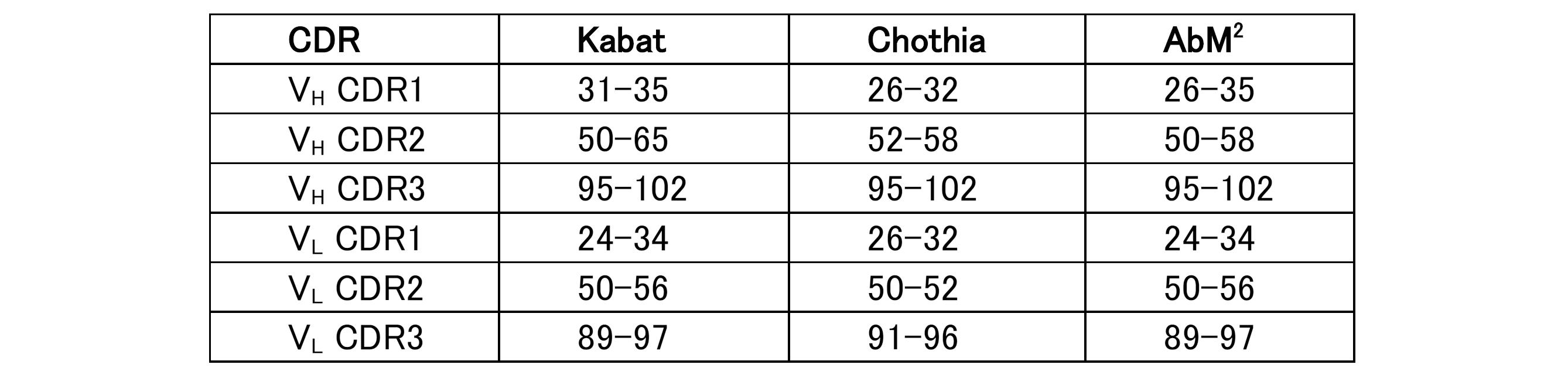
2表1で使用されている、「b」が小文字の「AbM」は、Oxford Molecularの「AbM」抗体モデリングソフトウエアによって定義されているCDRを指す。
Table 1. CDR definition 1
2 As used in Table 1, "AbM" with lower case "b" refers to CDRs as defined by Oxford Molecular's "AbM" antibody modeling software.
Kabatらは、あらゆる抗体に適用可能な可変領域配列の番号付けシステムも規定した。当業者であれば、配列自体以外の実験データに頼らなくとも、この「Kabat番号付け」のシステムを任意の可変領域配列に明確に割り当てることができる。本明細書で使用する場合、「Kabat番号付け」は、Kabatら、U.S.Dept.of Health and Human Services,“Sequence of Proteins of Immunological Interest”(1983)により規定された番号付けシステムを意味する。特に指定しない限り、抗体可変領域における特定のアミノ酸残基位置の番号付けへの言及は、Kabat番号付けシステムによるものである。 Kabat et al. also defined a variable region sequence numbering system that is applicable to any antibody. One skilled in the art can unambiguously assign this system of "Kabat numbering" to any variable region sequence without reliance on experimental data other than the sequence itself. As used herein, "Kabat numbering" refers to Kabat et al. S. Dept. of Health and Human Services, "Sequence of Proteins of Immunological Interest" (1983). Unless otherwise specified, references to the numbering of specific amino acid residue positions in antibody variable regions are by the Kabat numbering system.
配列表のポリペプチド配列は、Kabat番号付けシステムに従って番号付けされてたものではない。しかしながら、配列表の配列の番号付けをKabat番号付けに変換することは、十分に当業者の通常の技術の範囲内である。 The polypeptide sequences in the sequence listing are not numbered according to the Kabat numbering system. However, it is well within the ordinary skill of the person skilled in the art to convert the sequence numbering of the sequence listing to Kabat numbering.
「フレームワーク」又は「FR」は、超可変領域(HVR)残基以外の可変ドメイン残基を指す。通常、可変ドメインのFRは4つのFRドメイン:FR1、FR2、FR3、FR4から成る。したがって、HVR配列及びFR配列は一般に、VH(又はVL)の次の配列:FR1-H1(L1)-FR2-H2(L2)-FR3-H3(L3)-FR4に現れる。 "Framework" or "FR" refers to variable domain residues other than hypervariable region (HVR) residues. The FRs of a variable domain usually consist of four FR domains: FR1, FR2, FR3, FR4. Thus, HVR and FR sequences generally appear in the following sequence of VH (or VL): FR1-H1(L1)-FR2-H2(L2)-FR3-H3(L3)-FR4.
抗体又は免疫グロブリンの「クラス」は、抗体又は免疫グロブリンの重鎖が有する定常ドメイン又は定常領域の種類を指す。抗体の主要なクラスにはIgA、IgD、IgE、IgG、及びIgMの5つがあり、これらのうちのいくつかはサブクラス(アイソタイプ)、例えばIgG1、IgG2、IgG3、IgG4、IgA1、及びIgA2に更に分けることができる。免疫グロブリンの異なるクラスに対応する重鎖定常ドメインは、それぞれα、δ、ε、γ、μと呼ばれる。 A "class" of an antibody or immunoglobulin refers to the type of constant domain or constant region possessed by the heavy chain of an antibody or immunoglobulin. There are five major classes of antibodies, IgA, IgD, IgE, IgG, and IgM, some of which have subclasses (isotypes), such as IgG 1 , IgG 2 , IgG 3 , IgG 4 , IgA 1 , and IgA2 . The heavy-chain constant domains that correspond to the different classes of immunoglobulins are called α, δ, ε, γ, and μ, respectively.
本明細書において用語「Fc領域」は、定常領域の少なくとも一部を含む、免疫グロブリン重鎖のC末端領域を指すのに用いられる。この用語は、天然配列Fc領域及びバリアントFc領域を包含する。ある態様において、ヒトIgG重鎖Fc領域は、重鎖のCys226から又はPro230からカルボキシル末端にまで及ぶ。しかしながら、宿主細胞によって産生された抗体は、重鎖のC末端から1又は複数(特に1又は2)のアミノ酸の翻訳後切断を受けることがある。したがって、完全長重鎖をコードする特定の核酸分子の発現によって宿主細胞が産生する抗体は、完全長重鎖を含んでいても、完全長重鎖の切断バリアントを含んでいてもよい。これは、重鎖の最後の2つのC末端アミノ酸がグリシン(G446)とリジン(K447、EU番号付けシステム)である場合に当てはまる。したがって、Fc領域のC末端リジン(Lys447)又はC末端グリシン(Gly446)及びリジン(Lys447)は、存在することもしないこともあり得る。Fc領域を含む重鎖のアミノ酸配列は、特に断らない限り、本明細書ではC末端グリシン-リジンジペプチドなしで示される。ある態様において、本発明による抗体に含まれる、本明細書に明記されたFc領域を含む重鎖は、更なるC末端グリシン-リジンジペプチド(G446及びK447、EU番号付けシステム)を含む。ある態様では、本発明による抗体に含まれる、本明細書に明記されたFc領域を含む重鎖は、更なるC末端グリシン残基(G446、EUインデックスによる番号付け)を含む。本明細書において別段の定めがない限り、Fc領域又は定常領域内のアミノ酸残基の番号付けは、Kabat et al.,Sequences of Proteins of Immunological Interest, 5th Ed.Public Health Service,National Institutes of Health,Bethesda,MD,1991に記載のEU番号付けシステム(別名EUインデックス)に従う。本明細書において使用されるFcドメインの「サブユニット」は、二量体Fcドメインを形成する2つのポリペプチドの一方、すなわち、免疫グロブリン重鎖のC末端定常領域を含み、安定な自己会合能を有するポリペプチドを指す。例えば、IgG Fcドメインのサブユニットは、IgG CH2及びIgG CH3定常ドメインを含む。 The term "Fc region" is used herein to refer to the C-terminal region of an immunoglobulin heavy chain, including at least part of the constant region. The term encompasses native sequence Fc regions and variant Fc regions. In some embodiments, the human IgG heavy chain Fc region extends from Cys226 or from Pro230 to the carboxyl terminus of the heavy chain. However, antibodies produced by host cells may undergo post-translational cleavage of one or more (especially one or two) amino acids from the C-terminus of the heavy chain. Thus, an antibody produced by a host cell by expression of a particular nucleic acid molecule encoding a full-length heavy chain may contain the full-length heavy chain or a truncated variant of the full-length heavy chain. This is the case when the last two C-terminal amino acids of the heavy chain are glycine (G446) and lysine (K447, EU numbering system). Thus, the C-terminal lysine (Lys447) or the C-terminal glycine (Gly446) and lysine (Lys447) of the Fc region may or may not be present. Heavy chain amino acid sequences, including the Fc region, are presented herein without the C-terminal glycine-lysine dipeptide, unless otherwise indicated. In certain embodiments, heavy chains comprising the Fc regions specified herein included in antibodies according to the invention comprise additional C-terminal glycine-lysine dipeptides (G446 and K447, EU numbering system). In one aspect, the heavy chains comprising the Fc regions specified herein included in the antibodies according to the invention comprise an additional C-terminal glycine residue (G446, numbering according to the EU index). Unless otherwise specified herein, the numbering of amino acid residues within the Fc region or constant region is that of Kabat et al. , Sequences of Proteins of Immunological Interest, 5th Ed. The EU numbering system (also known as the EU index) as set forth in Public Health Service, National Institutes of Health, Bethesda, MD, 1991 is followed. As used herein, a "subunit" of an Fc domain comprises one of the two polypeptides forming a dimeric Fc domain, i.e., the C-terminal constant region of an immunoglobulin heavy chain, and is capable of stable self-association. refers to a polypeptide having a For example, an IgG Fc domain subunit includes IgG CH2 and IgG CH3 constant domains.
「融合された(されている)」とは、構成要素(例えばFab分子とFcドメインサブユニット)が、直接的に又は1若しくは複数のペプチドリンカーを介して、ペプチド結合で連結されていることを意味する。 "Fused" means that the components (e.g., Fab molecule and Fc domain subunit) are joined by peptide bonds, either directly or via one or more peptide linkers. means.
「Fcドメインの第1のサブユニットと第2のサブユニットとの会合を促進する修飾」とは、Fcドメインサブユニットを含むポリペプチドの、同一のポリペプチドとの会合によるホモ二量体の形成を低減又は防止する、ペプチド骨格の改変又はFcドメインサブユニットの翻訳後修飾のことである。会合を促進する修飾は、本明細書で使用される場合、特に、会合することが望ましい2つのFcドメインサブユニット(すなわち、Fcドメインの第1及び第2のサブユニット)の各々に対して行われる別個の修飾を含み、これらの修飾は、2つのFcドメインサブユニットの会合を促進するように互いに相補的である。例えば、会合を促進する修飾は、これらのFcドメインサブユニットの一方又は両方の構造又は電荷を変化させて、それぞれ立体的に、静電気的に、それらの会合を有利にすることができる。したがって、(ヘテロ)二量体化は、第1のFcドメインサブユニットを含むポリペプチドと、第2のFcドメインサブユニットを含むポリペプチドとの間で起こり、これらのサブユニットの各々に融合された更なる構成要素(例えば抗原結合部分)が同じではない可能性があるという意味で、同一でなくてもよい。いくつかの実施態様では、会合を促進する修飾は、Fcドメイン内のアミノ酸変異、具体的にはアミノ酸置換を含む。特定の実施態様では、会合を促進する修飾は、Fcドメインの2つのサブユニットの各々における別々のアミノ酸変異、特にアミノ酸置換を含む。 A "modification that promotes association of a first subunit and a second subunit of an Fc domain" refers to the formation of a homodimer by association of a polypeptide comprising an Fc domain subunit with the same polypeptide. Modifications of the peptide backbone or post-translational modifications of Fc domain subunits that reduce or prevent Modifications that promote association, as used herein, are specifically made to each of the two Fc domain subunits (i.e., the first and second subunits of the Fc domain) with which it is desired to associate. , which are complementary to each other so as to promote association of the two Fc domain subunits. For example, association-promoting modifications can alter the structure or charge of one or both of these Fc domain subunits to favor their association, sterically and electrostatically, respectively. Thus, (hetero)dimerization occurs between a polypeptide comprising a first Fc domain subunit and a polypeptide comprising a second Fc domain subunit, and fused to each of these subunits. They do not have to be identical in the sense that further components (eg antigen binding portions) may not be the same. In some embodiments, modifications that promote association comprise amino acid mutations, particularly amino acid substitutions, within the Fc domain. In certain embodiments, the modifications that promote association comprise separate amino acid mutations, particularly amino acid substitutions, in each of the two subunits of the Fc domain.
用語「エフェクター機能」とは、抗体のFc領域に起因する生物学的活性を指し、抗体のアイソタイプによって変わる。抗体エフェクター機能の例には、以下が含まれる:C1q結合及び補体依存性細胞傷害(CDC)、Fc受容体結合、抗体依存性細胞媒介性細胞傷害(ADCC)、抗体依存性細胞貪食(ADCP)、サイトカイン分泌、抗原提示細胞による免疫複合体媒介性抗原取り込み、細胞表面受容体(例えば、B細胞受容体)のダウンレギュレーション、及びB細胞活性化。 The term "effector functions" refers to those biological activities attributable to the Fc region of an antibody, and varies with the antibody isotype. Examples of antibody effector functions include: C1q binding and complement dependent cytotoxicity (CDC), Fc receptor binding, antibody dependent cell-mediated cytotoxicity (ADCC), antibody dependent cell phagocytosis (ADCP) ), cytokine secretion, immune complex-mediated antigen uptake by antigen-presenting cells, downregulation of cell surface receptors (eg, B-cell receptors), and B-cell activation.
本明細書で使用される場合、「操作(する)/改変(する)、操作された(る)/改変された(る)(“engineer,engineered,engineering”)」という用語は、天然に存在するポリペプチド又は組換えポリペプチド又はそれらの断片の、ペプチド骨格のいかなる改変又は翻訳後修飾をも含むと考えられる。改変には、アミノ酸配列の、グリコシル化パターンの、又は個々のアミノ酸の側鎖基の修飾と、これらの手法の組み合わせとが含まれる。 As used herein, the terms “engineer, engineered, engineering” refer to naturally occurring Any alteration of the peptide backbone or post-translational modification of the polypeptide or recombinant polypeptide or fragment thereof is also considered to include. Modifications include modifications of the amino acid sequence, of the glycosylation pattern, or of the side-chain groups of individual amino acids, as well as combinations of these techniques.
本明細書中で使用される用語「アミノ酸突然変異」は、アミノ酸置換、欠失、挿入及び修飾を包含することを意味する。最終構築物が所望の特徴(例えば、Fc受容体への結合の低下又は別のペプチドとの会合の増加)を有することを条件として、置換、欠失、挿入及び修飾のいかなる組み合わせも、最終構築物に到達するために行うことが可能である。アミノ酸配列の欠失及び挿入には、アミノ末端及び/又はカルボキシ末端の欠失、並びにアミノ酸の挿入が含まれる。特にアミノ酸の変異は、アミノ酸の置換である。例えばFc領域の結合特性を変化させるためには、非保存的アミノ酸置換、すなわち1つのアミノ酸を異なる構造的及び/又は化学的特性を有する別のアミノ酸で置き換えることが特に好ましい。アミノ酸置換には、天然に存在しないアミノ酸による置き換え、又は20種類の一般的なアミノ酸の天然に存在するアミノ酸誘導体による置き換えが含まれる(例えば、4-ヒドロキシプロリン、3-メチルヒスチジン、オルニチン、ホモセリン、5-ヒドロキシリジン)。アミノ酸変異は、当技術分野で周知の遺伝学的方法又は化学的方法を用いて生じさせることができる。遺伝学的方法には、部位特異的変異誘発、PCR、遺伝子合成等が含まれ得る。遺伝子操作以外の方法、例えば化学修飾によるアミノ酸の側鎖基を変化させる方法も有用であり得ると考えられる。本明細書では、同じアミノ酸変異を示すために、様々な表記が使用される。例えば、Fcドメインの329位におけるプロリンからグリシンへの置換は、329G、G329、G329、P329G又はPro329Glyと示され得る。 The term "amino acid mutation" as used herein is meant to encompass amino acid substitutions, deletions, insertions and modifications. Any combination of substitutions, deletions, insertions and modifications may be made to the final construct, provided that the final construct possesses the desired characteristics (e.g., decreased binding to Fc receptors or increased association with another peptide). It is possible to do to reach Amino acid sequence deletions and insertions include amino- and/or carboxy-terminal deletions and amino acid insertions. In particular amino acid mutations are amino acid substitutions. Non-conservative amino acid substitutions, ie replacement of one amino acid with another amino acid having different structural and/or chemical properties, are particularly preferred, for example to alter the binding properties of the Fc region. Amino acid substitutions include replacement by non-naturally occurring amino acids or by naturally occurring amino acid derivatives of the 20 common amino acids (eg, 4-hydroxyproline, 3-methylhistidine, ornithine, homoserine, 5-hydroxylysine). Amino acid mutations can be produced using genetic or chemical methods well known in the art. Genetic methods can include site-directed mutagenesis, PCR, gene synthesis, and the like. It is believed that methods other than genetic engineering, such as changing the side-chain groups of amino acids by chemical modification, may also be useful. Various notations are used herein to denote the same amino acid mutation. For example, a proline to glycine substitution at position 329 of the Fc domain could be designated 329G, G329, G329 , P329G or Pro329Gly.
本明細書において使用される用語「ポリペプチド」は、アミノ結合(ペプチド結合としても知られる)により直鎖状に結合した単量体(アミノ酸)で構成される分子を指す。用語「ポリペプチド」は、2つ以上のアミノ酸から成る鎖を指すのであって、該生成物の特定の長さのものを指すのではない。したがって、ペプチド、ジペプチド、トリペプチド、オリゴペプチド、「タンパク質」、「アミノ酸鎖」又は2つ以上のアミノ酸の鎖を指す他のいずれの用語も「ポリペプチド」の定義の範囲内に含まれ、用語「ポリペプチド」は、これら用語の代わりに、又はこれらと互換的に使用され得る。用語「ポリペプチド」は、ポリペプチドの発現後修飾の産物を指すことも意図されており、このような産物には、限定されないが、グリコシル化、アセチル化、リン酸化、アミド化、既知の保護基/ブロッキング基による誘導体化、タンパク質切断、又は天然に存在しないアミノ酸による修飾が含まれる。ポリペプチドは、天然の生物学的供給源から得られるか又は組換え技術により生産されるが、必ずしも指定された核酸配列から翻訳されたものであるとは限らない。ポリペプチドは、化学合成を含むあらゆる手法で製造することができる。本発明のポリペプチドは、約3以上、5以上、10以上、20以上、25以上、50以上、75以上、100以上、200以上、500以上、1000以上、又は2000以上のアミノ酸から成るサイズのものである。ポリペプチドは、定義された三次元構造を有する場合もあるが、必ずしもそのような構造を有するとは限らない。定義された三次元構造を有するポリペプチドは、「フォールディングされた」と言われ、定義された三次元構造を有せずに多数の異なるコンフォメーションを採り得るポリペプチドは、「フォールディングされていない」と言われる。 As used herein, the term "polypeptide" refers to a molecule composed of monomers (amino acids) linked in a linear chain by amino bonds (also known as peptide bonds). The term "polypeptide" refers to a chain of two or more amino acids and does not refer to a specific length of the product. Thus, peptides, dipeptides, tripeptides, oligopeptides, "proteins", "amino acid chains" or any other term referring to chains of two or more amino acids are included within the definition of "polypeptide" and the terms "Polypeptide" may be used instead of or interchangeably with these terms. The term "polypeptide" is also intended to refer to products of post-expression modification of polypeptides, including, but not limited to, glycosylation, acetylation, phosphorylation, amidation, known protected Derivatization with groups/blocking groups, proteolytic cleavage, or modification with non-naturally occurring amino acids are included. A polypeptide may be obtained from a natural biological source or produced by recombinant technology, but is not necessarily translated from a designated nucleic acid sequence. Polypeptides can be produced by any technique, including chemical synthesis. Polypeptides of the invention can be of a size of about 3 or more, 5 or more, 10 or more, 20 or more, 25 or more, 50 or more, 75 or more, 100 or more, 200 or more, 500 or more, 1000 or more, or 2000 or more amino acids. It is. Polypeptides may, but do not necessarily have, a defined three-dimensional structure. A polypeptide that has a defined three-dimensional structure is said to be "folded," and a polypeptide that can adopt a number of different conformations without a defined three-dimensional structure is "unfolded." It is said.
「単離」ポリペプチド若しくはバリアント又はその誘導体とは、その自然の環境にないポリペプチドの意味である。特に精製は必要ではない。例えば、単離ポリペプチドは、その天然又は自然の環境から取り除くことができる。宿主細胞で発現した組換え生産ポリペプチド及びタンパクは、任意の適切な技術により分離、画分化又は部分的若しくは実質的に精製された天然又は組換えポリペプチドと同様に、本発明のために単離されたものと見なされる。 By "isolated" polypeptide or variant or derivative thereof is meant a polypeptide that is not in its natural environment. No special purification is required. For example, an isolated polypeptide can be removed from its native or natural environment. Recombinantly produced polypeptides and proteins expressed in host cells, as well as natural or recombinant polypeptides that have been isolated, fractionated, or partially or substantially purified by any suitable technique, may be used alone for purposes of the present invention. considered to be detached.
参照ポリペプチド配列に関する「アミノ酸配列同一性パーセント(%)」とは、配列を整列させ、最大の配列同一性パーセントを得るために必要ならばギャップを導入した後、いかなる保存的置換も配列同一性の一部として考慮しない場合の、参照ポリペプチドのアミノ酸残基と同一である候補配列中のアミノ酸残基のパーセンテージであると定義される。アミノ酸配列同一性パーセントを決定するためのアラインメントは、当分野の技術の範囲内にある様々な方法、例えばBLAST、BLAST-2、ALIGN又はMegalign(DNASTAR)ソフトウェアのような一般に入手可能なコンピュータソフトウェアを使用して得ることができる。当業者であれば、比較される配列の完全長にわたる最大のアライメントを得るために必要なアルゴリズムを含む、配列を整列させるための適切なパラメーターを決定することができる。しかしながら、本明細書において、アミノ酸配列同一性%値は、配列比較コンピュータプログラムALIGN-2を使用して生成される。ALIGN-2配列比較コンピュータプログラムはジェネンテック社によって作成されたもので、そのソースコードは、利用者向け文書と共に米国著作権庁(ワシントンD.C.,20559)に提出されており、そこで米国著作権登録番号TXU510087として登録されている。ALIGN-2プログラムは、ジェネンテック社(カリフォルニア州サウスサンフランシスコ)から一般に入手可能であり、或いはそのソースコードからコンパイルすることもできる。ALIGN-2プログラムは、デジタルUNIXのV4.0Dを含む、UNIXオペレーティングシステム上での使用のためにコンパイルされる必要がある。全ての配列比較パラメーターは、ALIGN-2プログラムによって設定され、変化しない。アミノ酸配列比較にALIGN-2が用いられる状況では、所与のアミノ酸配列Aの、所与のアミノ酸配列Bとの(又はこれに対する)アミノ酸配列同一性%(或いは、所与のアミノ酸配列Aは、所与のアミノ酸配列Bと(又はこれに対して)特定のアミノ酸配列同一性%を有するか又は含む所与のアミノ酸配列A、ということもできる)は次のように計算される:
分数X/Y x 100
式中、Xは、配列アライメントプログラムALIGN-2により、そのプログラムのAとBのアライメントにおいて完全一致としてスコアされたアミノ酸残基の数であり、Yは、Bにおけるアミノ酸残基の総数である。アミノ酸配列Aの長さがアミノ酸配列Bの長さと異なる場合、Bに対するAのアミノ酸配列同一性%は、Aに対するBのアミノ酸配列同一性%とは異なると認識されるであろう。特に断らない限り、本明細書で使用される全てのアミノ酸配列同一性%値は、ALIGN-2コンピュータプログラムを使用して、直前の段落で説明したようにして得られる。
A "percent (%) amino acid sequence identity" with respect to a reference polypeptide sequence means that after aligning the sequences and introducing gaps if necessary to obtain the maximum percent sequence is defined as the percentage of amino acid residues in a candidate sequence that are identical to amino acid residues in a reference polypeptide, if not considered as part of the sequence. Alignments to determine percent amino acid sequence identity can be performed using a variety of methods within the skill in the art, for example, commonly available computer software such as BLAST, BLAST-2, ALIGN or Megalign (DNASTAR) software. can be obtained by using Those skilled in the art can determine appropriate parameters for aligning sequences, including algorithms necessary to obtain maximal alignment over the full length of the sequences being compared. As used herein, however, % amino acid sequence identity values are generated using the sequence comparison computer program ALIGN-2. The ALIGN-2 sequence comparison computer program was created by Genentech, Inc. and its source code has been submitted, along with user documentation, to the US Copyright Office (Washington, DC, 20559), where US Copyright It is registered as registration number TXU510087. The ALIGN-2 program is publicly available from Genentech, Inc. (South San Francisco, Calif.) or can be compiled from its source code. ALIGN-2 programs must be compiled for use on UNIX operating systems, including Digital UNIX V4.0D. All sequence comparison parameters were set by the ALIGN-2 program and remain unchanged. In situations where ALIGN-2 is used for amino acid sequence comparison, the % amino acid sequence identity of a given amino acid sequence A with (or to) a given amino acid sequence B (or, if a given amino acid sequence A A given amino acid sequence A, which has or contains a certain % amino acid sequence identity with (or to) a given amino acid sequence B) is calculated as follows:
Fraction X/
where X is the number of amino acid residues scored as perfect matches in the alignment of A and B by the sequence alignment program ALIGN-2, and Y is the total number of amino acid residues in B. It will be appreciated that the % amino acid sequence identity of A to B differs from the % amino acid sequence identity of B to A if the length of amino acid sequence A differs from the length of amino acid sequence B. Unless otherwise specified, all % amino acid sequence identity values used herein are obtained using the ALIGN-2 computer program as described in the immediately preceding paragraph.
用語「ポリヌクレオチド」は、単離核酸分子又は構築物、例えばメッセンジャーRNA(mRNA)、ウイルス由来のRNA又はプラスミドDNA(pDNA)を指す。ポリヌクレオチドは、一般的なホスホジエステル結合又は非一般的な結合(例えばペプチド核酸(PNA)に見られるようなアミド結合)を含み得る。用語「核酸分子」は、ポリヌクレオチド中に存在する、任意の1又は複数の核酸セグメント、例えばDNA断片又はRNA断片を指す。 The term "polynucleotide" refers to an isolated nucleic acid molecule or construct, such as messenger RNA (mRNA), viral RNA or plasmid DNA (pDNA). Polynucleotides may contain conventional phosphodiester bonds or unconventional bonds (eg, amide bonds, such as those found in peptide nucleic acids (PNA)). The term "nucleic acid molecule" refers to any one or more nucleic acid segments, such as DNA or RNA fragments, present in a polynucleotide.
「単離」核酸分子又はポリヌクレオチドは、その天然環境から取り除かれた核酸分子、DNA又はRNAである。例えば、ベクターに含有されるポリペプチドをコードする組換えポリヌクレオチドは、本発明のために単離されたものと見なされる。単離ポリヌクレオチドの更なる例には、異種宿主細胞内に維持されている組換えポリヌクレオチド、又は溶液中の(部分的に又は実質的に)精製されたポリヌクレオチドが含まれる。単離ポリヌクレオチドは、ポリヌクレオチド分子を通常含む細胞に含まれるポリヌクレオチド分子を含むが、そのポリヌクレオチド分子は、染色体外に、又はその本来の染色体上の位置とは異なる染色体上の位置に存在している。単離RNA分子は、in vivo又はin vitroの本発明のRNA転写物、並びにプラス鎖型とマイナス鎖型及び二本鎖型を含む。本発明の単離ポリヌクレオチド又は核酸は、合成により製造されたそのような分子を更に含む。また、ポリヌクレオチド又は核酸は、プロモーター、リボソーム結合部位又は転写ターミネーター等の調節エレメントを含んでも含まなくてもよい。 An "isolated" nucleic acid molecule or polynucleotide is a nucleic acid molecule, DNA or RNA, that has been removed from its natural environment. For example, a recombinant polynucleotide encoding a polypeptide contained in a vector is considered isolated for the purposes of the present invention. Further examples of isolated polynucleotides include recombinant polynucleotides maintained in heterologous host cells, or purified (partially or substantially) polynucleotides in solution. An isolated polynucleotide includes a polynucleotide molecule contained in cells that normally contain the polynucleotide molecule, but the polynucleotide molecule is present extrachromosomally or at a chromosomal location different from its natural chromosomal location. are doing. Isolated RNA molecules include in vivo or in vitro RNA transcripts of the present invention, as well as positive and negative stranded forms and double-stranded forms. Isolated polynucleotides or nucleic acids of the invention further include such molecules produced synthetically. Also, a polynucleotide or nucleic acid may or may not contain regulatory elements such as promoters, ribosome binding sites or transcription terminators.
本発明の参照ヌクレオチド配列と、例えば、少なくとも95%「同一」のヌクレオチド配列を有する核酸又はポリヌクレオチドとは、ポリヌクレオチドのヌクレオチド配列が、参照ヌクレオチド配列の各100ヌクレオチドあたり5つまでの点変異を含み得ること以外は、参照配列と同一であることを意味する。換言すれば、参照ヌクレオチド配列と少なくとも95%同一であるヌクレオチド配列を有するポリヌクレオチドを得るために、参照配列中最大5%のヌクレオチドが欠失しているか又は別のヌクレオチドで置換されてもよく、或いは参照配列中の全ヌクレオチドの最大5%の数のヌクレオチドが参照配列に挿入されてもよい。参照配列のこのような変更は、参照ヌクレオチド配列の5’若しくは3’末端位置又はこれら末端位置の間の任意の位置において、参照配列中の残基間で個別に散在して、又は参照配列内の1つ若しくは複数の連続したかたまりで散在して、起こる可能性がある。実際問題として、特定のポリヌクレオチド配列が本発明のヌクレオチド配列と少なくとも80%、85%、90%、95%、96%、97%、98%又は99%同一であるかどうかは、ポリペプチドについて上述したもの(例えばALIGN-2)などの既知のコンピュータプログラムを用いて慣例的に判定することができる。 A nucleic acid or polynucleotide having, for example, at least 95% “identical” nucleotide sequence with a reference nucleotide sequence of the present invention is one in which the nucleotide sequence of the polynucleotide contains up to 5 point mutations for each 100 nucleotides of the reference nucleotide sequence. It means identical to the reference sequence, except that it may contain. In other words, up to 5% of the nucleotides in the reference sequence may be deleted or replaced with different nucleotides to obtain a polynucleotide having a nucleotide sequence that is at least 95% identical to the reference nucleotide sequence; Alternatively, up to 5% of all nucleotides in the reference sequence may be inserted into the reference sequence. Such alterations of the reference sequence may be at the 5' or 3' terminal positions of the reference nucleotide sequence or at any position between these terminal positions, individually interspersed between residues in the reference sequence, or within the reference sequence. can occur interspersed in one or more contiguous clusters of As a practical matter, whether a particular polynucleotide sequence is at least 80%, 85%, 90%, 95%, 96%, 97%, 98% or 99% identical to a nucleotide sequence of the invention is It can be routinely determined using known computer programs such as those described above (eg, ALIGN-2).
用語「発現カセット」とは、標的細胞内の特定の核酸の転写を可能にする一連の特定の核酸エレメントを用いて、組換え又は合成で生産されたポリヌクレオチドを指す。組換え発現カセットは、プラスミド、染色体、ミトコンドリアDNA、プラスチドDNA、ウイルス又は核酸断片に組み入れることができる。典型的には、発現ベクターの組換え発現カセット部分は、数ある配列の中でも、転写される核酸配列とプロモーターを含む。特定の実施態様では、本発明の発現カセットは、本発明の二重特異性抗原結合分子をコードするポリヌクレオチド配列又はその断片を含む。 The term "expression cassette" refers to a polynucleotide produced recombinantly or synthetically using a series of specific nucleic acid elements that permit transcription of a specific nucleic acid in a target cell. A recombinant expression cassette can be incorporated into a plasmid, chromosome, mitochondrial DNA, plastid DNA, virus or nucleic acid fragment. Typically, the recombinant expression cassette portion of an expression vector includes, among other sequences, a transcribed nucleic acid sequence and a promoter. In certain embodiments, an expression cassette of the invention comprises a polynucleotide sequence or fragment thereof encoding a bispecific antigen binding molecule of the invention.
用語「ベクター」又は「発現ベクター」は、「発現構築物」と同義であり、標的細胞内で自身が作動可能に会合する特定の遺伝子を導入し、その発現を指示するために使用されるDNA分子を指す。この用語は、導入された宿主細胞のゲノムに組み入れたベクターだけでなく、自己複製核酸構造物としてのベクターも含む。本発明の発現ベクターは、発現カセットを含む。発現ベクターは、安定したmRNAを大量に転写することができる。発現ベクターが標的細胞内部に入ると、遺伝子によってコードされるリボ核酸分子又はタンパク質が、細胞転写及び/又は翻訳機構によって産生される。ある実施態様では、本発明の発現ベクターは、本発明の二重特異性抗原結合分子をコードするポリヌクレオチド配列又はその断片を含む発現カセットを含む。 The term "vector" or "expression vector" is synonymous with "expression construct" and is a DNA molecule used to introduce and direct the expression of a specific gene with which it is operably associated within a target cell. point to The term includes vectors as self-replicating nucleic acid constructs as well as vectors that have integrated into the genome of the host cell into which they are introduced. The expression vector of the invention contains an expression cassette. Expression vectors are capable of stably transcribing large amounts of mRNA. Once the expression vector is inside the target cell, the ribonucleic acid molecule or protein encoded by the gene is produced by the cellular transcription and/or translation machinery. In one embodiment, an expression vector of the invention comprises an expression cassette comprising a polynucleotide sequence encoding a bispecific antigen binding molecule of the invention or a fragment thereof.
用語「宿主細胞」、「宿主細胞株」及び「宿主細胞培養物」は、互換的に使用され、外因性の核酸が導入された細胞を指し、そのような細胞の子孫も含む。宿主細胞は「形質転換体」及び「形質転換細胞」を含み、それには初代形質転換細胞及び、継代の数に関係なく、それに由来する子孫が含まれる。子孫は、親細胞と核酸の含有量が完全に同一でなくてもよく、変異を含んでいてもよい。元の形質転換細胞においてスクリーニング又は選択されたのと同じ機能又は生物学的活性を有する変異子孫が本明細書に含まれる。宿主細胞は、本発明の二重特異性抗原結合分子を生産するのに使用できる任意の種類の細胞系である。宿主細胞には、培養細胞、例えばいくつか例を挙げると、CHO細胞、BHK細胞、NS0細胞、SP2/0細胞、YO骨髄腫細胞、P3X63マウス骨髄腫細胞、PER細胞、PER.C6細胞等の哺乳動物の培養細胞、又はハイブリドーマ細胞、酵母細胞、昆虫細胞、及び植物細胞が含まれるだけでなく、トランスジェニック動物、トランスジェニック植物又は培養された植物若しくは動物組織内部に含まれる細胞も含まれる。 The terms "host cell," "host cell line," and "host cell culture" are used interchangeably and refer to a cell into which exogenous nucleic acid has been introduced, including the progeny of such cells. Host cells include "transformants" and "transformed cells," which include primary transformants and progeny derived therefrom, regardless of passage number. Progeny may not be completely identical in nucleic acid content to the parent cell, and may contain mutations. Mutant progeny that have the same function or biological activity as screened for or selected in the originally transformed cell are included herein. A host cell is any type of cell line that can be used to produce the bispecific antigen binding molecules of the invention. Host cells include cultured cells such as CHO cells, BHK cells, NS0 cells, SP2/0 cells, YO myeloma cells, P3X63 mouse myeloma cells, PER cells, PER. C6 cells, or hybridoma cells, yeast cells, insect cells, and plant cells, as well as cells contained within transgenic animals, transgenic plants, or cultured plant or animal tissue. is also included.
「活性化Fc受容体」とは、抗体のFcドメインと結合した後、受容体保有細胞を刺激してエフェクター機能を発揮させるシグナル伝達事象を引き起こすFc受容体である。ヒト活性化Fc受容体としては、FcγRIIIa(CD16a)、FcγRI(CD64)、FcγRIIa(CD32)及びFcαRI(CD89)が挙げられる。 An "activating Fc receptor" is an Fc receptor that, following binding to the Fc domain of an antibody, triggers signaling events that stimulate receptor-bearing cells to exert effector functions. Human activating Fc receptors include FcγRIIIa (CD16a), FcγRI (CD64), FcγRIIa (CD32) and FcαRI (CD89).
抗体依存性細胞媒介性細胞傷害(ADCC)は、免疫エフェクター細胞によって、抗体でコートした標的細胞の溶解につながる免疫機構である。この標的細胞は、Fc領域を含む抗体又はその誘導体が特異的に結合する細胞であり、通常、Fc領域のN末端にあるタンパク質部分を介して結合する。本明細書で使用される用語「ADCCの低下」は、上で定義したADCCの機構によって、標的細胞を囲む培地中の所定の抗体濃度で、所定の時間内に溶解する標的細胞の数の減少及び/又はADCCの機構によって、所定の時間内に所定の数の標的細胞の溶解を達成するのに必要な、標的細胞を囲む培地中の抗体濃度の上昇のいずれかと定義される。ADCCの低下は、(当業者に既知の)同じ標準的な製造、精製、製剤化及び保管方法を用いて、同じ種類の宿主細胞により産生された同じ抗体であるが改変されていない抗体によって媒介されるADCCと比較される。例えば、FcドメインにADCCを低下させるアミノ酸置換を含む抗体によって媒介されるADCCの低下は、このようなアミノ酸置換をFcドメインに含まない同じ抗体によって媒介されるADCCと比較される。ADCCを測定するのに適したアッセイは、当技術分野でよく知られている(例えば、国際公開第2006/082515号又は同第2012/130831号参照)。 Antibody-dependent cell-mediated cytotoxicity (ADCC) is an immune mechanism that leads to the lysis of antibody-coated target cells by immune effector cells. This target cell is a cell to which an antibody or derivative thereof containing the Fc region specifically binds, usually via a protein moiety at the N-terminus of the Fc region. As used herein, the term "reduced ADCC" refers to a reduction in the number of target cells that lyse within a given time period at a given antibody concentration in the medium surrounding the target cells by the mechanism of ADCC defined above. and/or by the mechanism of ADCC as the increase in antibody concentration in the medium surrounding the target cells required to achieve lysis of a given number of target cells in a given time. The reduction in ADCC is mediated by the same, but unmodified, antibody produced by the same type of host cell using the same standard manufacturing, purification, formulation and storage methods (known to those skilled in the art). ADCC is compared with the For example, reduction in ADCC mediated by an antibody comprising an ADCC-lowering amino acid substitution in the Fc domain is compared to ADCC mediated by the same antibody that does not contain such an amino acid substitution in the Fc domain. Assays suitable for measuring ADCC are well known in the art (see, eg, WO2006/082515 or WO2012/130831).
「有効量」の薬剤は、それが投与される細胞又は組織の生理学的変化をもたらすために必要な量である。 An "effective amount" of an agent is the amount necessary to effect a physiological change in the cells or tissues to which it is administered.
薬剤、例えば薬学的組成物の「治療的有効量」とは、所望の治療的又は予防的結果を得るのに必要な用量及び期間での有効な量を指す。薬剤の治療的有効量は、疾患の有害作用を、例えば排除し、低下させ、遅延させ、最小化し、又は防止する。 A "therapeutically effective amount" of an agent, eg, a pharmaceutical composition, refers to an amount effective, at dosages and for periods of time necessary, to achieve the desired therapeutic or prophylactic result. A therapeutically effective amount of an agent, for example, eliminates, reduces, delays, minimizes, or prevents the adverse effects of disease.
「個体」又は「対象」は、哺乳動物である。哺乳動物には、限定されないが、家畜動物(例えばウシ、ヒツジ、ネコ、イヌ、ウマ)、霊長類(例えばヒト、及びサルなどの非ヒト霊長類)、ウサギ、齧歯類(例えばマウス、ラット)が含まれる。特に、上記個体又は対象はヒトである。 An "individual" or "subject" is a mammal. Mammals include, but are not limited to, livestock animals (e.g., cows, sheep, cats, dogs, horses), primates (e.g., humans and non-human primates such as monkeys), rabbits, rodents (e.g., mice, rats). ) is included. In particular, said individual or subject is a human.
用語「薬学的組成物」とは、中に含まれる活性成分の生物学的活性を有効にするような形態であり、その製剤が投与されるであろう対象にとって許容できないほど毒性である追加の成分を何も含有しない調製物を指す。 The term "pharmaceutical composition" means that the active ingredients contained therein are in such a form as to effect the biological activity of the active ingredients and do not contain additional ingredients that are unacceptably toxic to subjects to whom the formulation will be administered. It refers to preparations that do not contain any ingredients.
「薬学的に許容される担体」は、薬学的組成物中の活性成分以外の成分であって、対象にとって非毒性である成分を指す。薬学的に許容される担体には、限定されないが、バッファー、賦形剤、安定剤又は保存剤が含まれる。 "Pharmaceutically acceptable carrier" refers to an ingredient in a pharmaceutical composition other than the active ingredient that is non-toxic to the subject. Pharmaceutically acceptable carriers include, but are not limited to, buffers, excipients, stabilizers or preservatives.
本明細書において用いられる場合、「治療(“treatment”)」(及び「治療する(“treat”又は“treating”)」など、その文法的変形)は、治療される個体の疾患の自然経過を変えようと試みる臨床的介入を指し、予防のために又は臨床病理の過程において実施され得る。治療の望ましい作用としては、疾患の発症又は再発を予防すること、症状の軽減、疾患の直接的又は間接的な病理学的帰結の縮小、転移を予防すること、疾患進行の速度を低下させること、病状の寛解又は緩和、及び緩解又は予後の改善が挙げられるが、これらに限定されない。いくつかの実施態様では、本発明のプロテアーゼ活性化可能T細胞活性化二重特異性分子は、疾患の発症を遅延させるか又は疾患の進行を遅らせるために使用される。 As used herein, "treatment" (and grammatical variations thereof such as "treat" or "treating") refers to the natural history of the disease in the individual being treated. Refers to clinical interventions that attempt to change and may be implemented for prevention or in the course of clinicopathology. Desirable effects of treatment include preventing the onset or recurrence of disease, alleviating symptoms, reducing direct or indirect pathological consequences of disease, preventing metastasis, and slowing the rate of disease progression. , remission or alleviation of a medical condition, and remission or improvement in prognosis. In some embodiments, the protease-activatable T-cell activating bispecific molecules of the invention are used to delay disease onset or slow disease progression.
「添付文書」という用語は、治療製品の商品包装に通例含まれる説明書を指すのに用いられ、そのような治療製品の適応症、用法、用量、投与、併用療法、使用に関する禁忌及び/又は注意事項についての情報を含む。 The term "package insert" is used to refer to instructions customarily included in the commercial packaging of therapeutic products, including indications, dosage, dosage, administration, concomitant therapies, contraindications for use and/or of such therapeutic products. Contains information about precautions.
本明細書で使用される「イディオタイプ特異的ポリペプチド」とは、抗原結合部分(例えばCD3に対して抗原結合部分)のイディオタイプを認識するポリペプチドを指す。イディオタイプ特異的ポリペプチドは、抗原結合部分の可変領域に特異的に結合し、それによって抗原結合部分のその同族抗原への特異的結合を低減又は防止することができる。抗原結合部分を含む分子と会合すると、イディオタイプ特異的ポリペプチドは分子のマスキング部分として機能することができる。本明細書において具体的に開示されるのは、抗CD3結合分子のイディオタイプに特異的な抗イディオタイプ抗体又は抗イディオタイプ結合抗体断片である。 As used herein, an "idiotype-specific polypeptide" refers to a polypeptide that recognizes the idiotype of an antigen binding moiety (eg, antigen binding moiety for CD3). An idiotype-specific polypeptide can specifically bind to the variable region of an antigen-binding portion, thereby reducing or preventing specific binding of the antigen-binding portion to its cognate antigen. When associated with a molecule that contains an antigen-binding portion, the idiotype-specific polypeptide can function as a masking portion of the molecule. Specifically disclosed herein are anti-idiotype antibodies or anti-idiotype-binding antibody fragments that are specific for the idiotype of an anti-CD3 binding molecule.
本明細書で使用される「プロテアーゼ」又は「タンパク質分解酵素」は、リンカーを認識部位で切断し、標的細胞によって発現される任意のタンパク質分解酵素を指す。このようなプロテアーゼは、標的細胞によって分泌されても、標的細胞と会合したまま残っても(例えば標的細胞表面に)よい。プロテアーゼの例には、限定されないが、メタロプロテイナーゼ、例えばマトリックスメタロプロテイナーゼ1-28、並びにA Disintegrin And Metalloproteinase(ADAM)2、7-12、15、17-23、28-30及び33;セリンプロテアーゼ、例えばウロキナーゼ型プラスミノーゲン活性化因子及びマトリプターゼ;システインプロテアーゼ;アスパラギン酸プロテアーゼ;並びにカテプシンファミリーのメンバーが含まれる。 As used herein, "protease" or "proteolytic enzyme" refers to any proteolytic enzyme that cleaves the linker at the recognition site and is expressed by the target cell. Such proteases may be secreted by the target cell or may remain associated with the target cell (eg, on the target cell surface). Examples of proteases include, but are not limited to, metalloproteinases such as matrix metalloproteinases 1-28, and A Disintegrin And Metalloproteinase (ADAM) 2, 7-12, 15, 17-23, 28-30 and 33; serine proteases, Examples include urokinase-type plasminogen activator and matriptase; cysteine proteases; aspartic proteases; and members of the cathepsin family.
T細胞活性化二重特異性分子に関して本明細書で用いられる「プロテアーゼ活性化可能」とは、T細胞活性化二重特異性分子がCD3に結合するその能力を低下又は消失させるマスキング部分によりT細胞を活性化する能力が低下又は消失したT細胞活性化二重特異性分子をいう。タンパク質切断によって(例えば、マスキング部位とT細胞活性化二重特異性分子をつなぐリンカーのタンパク質切断によって)マスキング部分が解離すると、CD3への結合が回復し、T細胞活性化二重特異性分子がそれによって活性化される。 "Protease activatable" as used herein with respect to a T-cell activating bispecific molecule means that a T-cell activating bispecific molecule has a masking moiety that reduces or eliminates its ability to bind CD3. Refers to a T-cell activating bispecific molecule with reduced or abolished ability to activate cells. Dissociation of the masking moiety by proteolytic cleavage (e.g., by proteolytic cleavage of the linker that connects the masking moiety and the T cell-activating bispecific molecule) restores binding to CD3 and allows the T-cell-activating bispecific molecule to be released. activated by it.
本明細書で用いられる「可逆的に隠す」とは、抗原結合部分又は分子がその抗原、例えばCD3から妨げられるように、マスキング部分又はイディオタイプ特異的ポリペプチドを抗原結合部分又は分子に結合させることをいう。この隠蔽は、イディオタイプ特異的ポリペプチドが、例えばプロテアーゼ切断によって抗原結合部分又は分子から解放され、それによって抗原結合部分又は分子がその抗原に結合するために遊離することができるという点で、可逆的である。 As used herein, "reversibly masking" refers to binding a masking moiety or idiotype-specific polypeptide to an antigen-binding portion or molecule such that the antigen-binding portion or molecule is prevented from its antigen, e.g., CD3. Say things. This masking is reversible in that the idiotype-specific polypeptide can be released from the antigen-binding portion or molecule, for example by protease cleavage, thereby freeing the antigen-binding portion or molecule to bind its antigen. target.
詳細な説明
ある態様では、本発明は、プロテアーゼ活性化可能T細胞活性化二重特異性分子であって、
(a)CD3に結合することができる第1の抗原結合部分;
(b)標的細胞抗原に結合することができる第2の抗原結合部分;及び
(c)プロテアーゼ切断可能リンカーを介してT細胞二重特異性結合分子に共有結合されたマスキング部分であって、第1又は第2の抗原結合部分のイディオタイプに結合することができ、それによって第1又は第2の抗原結合部分を可逆的に隠す、マスキング部分
を含む、プロテアーゼ活性化可能T細胞活性化二重特異性分子に関する。
DETAILED DESCRIPTION In one aspect, the invention provides a protease activatable T cell activation bispecific molecule comprising:
(a) a first antigen-binding portion capable of binding CD3;
(b) a second antigen binding moiety capable of binding to a target cell antigen; and (c) a masking moiety covalently attached to the T cell bispecific binding molecule via a protease cleavable linker, wherein A protease activatable T cell activation duplex comprising a masking moiety capable of binding to an idiotype of one or a second antigen binding moiety, thereby reversibly hiding the first or second antigen binding moiety It relates to specificity molecules.
CD3に結合することができる第1の抗原結合部分はイディオタイプを含む。ある実施態様では、プロテアーゼ活性化可能T細胞活性化二重特異性分子のマスキング部分は、第1の抗原結合部分に共有結合される。ある実施態様では、マスキング部分は、第1の抗原結合部分の重鎖可変領域に共有結合される。ある実施態様では、マスキング部分は、第1の抗原結合部分の軽鎖可変領域に共有結合される。この共有結合は、イディオタイプの第1の抗原結合部位へのマスキング部分の特異的結合(好ましくは非共有結合)とは別のものである。第1の抗原結合部分のイディオタイプは、その可変領域を含む。ある実施態様では、マスキング部分は、第1の抗原結合部分がCD3に結合したときにCD3と接触するアミノ酸残基に結合する。好ましい実施態様では、マスキング部分は、第1の抗原結合部分の同族抗原又はその断片ではなく、すなわち、マスキング部分はCD3又はその断片ではない。ある実施態様において、マスキング部分は、抗イディオタイプ抗体又はその断片である。ある実施態様では、マスキング部分は、抗イディオタイプscFvである。抗イディオタイプscFvであるマスキング部分及びそのようなマスキング部分を含むプロテアーゼ活性化可能T細胞活性化分子の例示的実施態様は、実施例にて詳述される。 A first antigen-binding portion capable of binding CD3 comprises an idiotype. In certain embodiments, the masking moiety of the protease-activatable T-cell activating bispecific molecule is covalently linked to the first antigen-binding moiety. In some embodiments, the masking moiety is covalently attached to the heavy chain variable region of the first antigen binding portion. In some embodiments, the masking moiety is covalently linked to the light chain variable region of the first antigen binding portion. This covalent binding is distinct from the specific binding (preferably non-covalent binding) of the masking moiety to the idiotypic first antigen binding site. The idiotype of the first antigen-binding portion includes its variable region. In some embodiments, the masking moiety binds to amino acid residues that contact CD3 when the first antigen binding moiety binds to CD3. In preferred embodiments, the masking moiety is not the cognate antigen of the first antigen binding moiety or a fragment thereof, ie the masking moiety is not CD3 or a fragment thereof. In some embodiments, the masking moiety is an anti-idiotypic antibody or fragment thereof. In one embodiment, the masking moiety is an anti-idiotypic scFv. Exemplary embodiments of masking moieties that are anti-idiotypic scFvs and protease-activatable T-cell activation molecules comprising such masking moieties are detailed in the Examples.
ある実施態様では、プロテアーゼ活性化可能T細胞活性化二重特異性分子は、
(i)CD3に結合することができるFab分子である第1の抗原結合部分であって、配列番号2、配列番号4及び配列番号10から成る群より選択される少なくとも1つの重鎖相補性決定領域(CDR)と、配列番号20、配列番号21、配列番号22から成る群より選択される少なくとも1つの軽鎖CDRとを含む第1の抗原結合部分;並びに
(ii)標的細胞抗原に結合することができるFab分子である第2の抗原結合部分
を含む。
In one embodiment, the protease activatable T cell activation bispecific molecule comprises
(i) a first antigen binding portion, which is a Fab molecule capable of binding CD3, wherein at least one heavy chain complementarity determination is selected from the group consisting of SEQ ID NO:2, SEQ ID NO:4 and SEQ ID NO:10; (ii) binds to a target cell antigen; a second antigen-binding portion, which is a Fab molecule capable of
ある実施態様では、第1の抗原結合部分は、配列番号16のアミノ酸配列と少なくとも約95%、96%、97%、98%、99%又は100%同一であるアミノ酸配列を含む重鎖可変領域と、配列番号23のアミノ酸配列と少なくとも約95%、96%、97%、98%、99%又は100%同一であるアミノ酸配列を含む軽鎖可変領域とを含む。 In some embodiments, the first antigen-binding portion is a heavy chain variable region comprising an amino acid sequence that is at least about 95%, 96%, 97%, 98%, 99% or 100% identical to the amino acid sequence of SEQ ID NO:16 and a light chain variable region comprising an amino acid sequence that is at least about 95%, 96%, 97%, 98%, 99% or 100% identical to the amino acid sequence of SEQ ID NO:23.
ある実施態様において、第1の抗原結合部分は、配列番号16のアミノ酸配列を含む重鎖可変領域と、配列番号23のアミノ酸配列を含む軽鎖可変領域とを含む。 In certain embodiments, the first antigen-binding portion comprises a heavy chain variable region comprising the amino acid sequence of SEQ ID NO:16 and a light chain variable region comprising the amino acid sequence of SEQ ID NO:23.
特定の実施態様では、第2の抗原結合部分は、FolR1に結合することができ、配列番号54、配列番号55及び配列番号56からな成る群より選択される少なくとも1つの重鎖相補性決定領域(CDR)と、配列番号20、配列番号21及び配列番号22から成る群より選択される少なくとも1つの軽鎖CDRとを含む。 In certain embodiments, the second antigen binding portion is capable of binding to FolR1 and at least one heavy chain complementarity determining region selected from the group consisting of SEQ ID NO:54, SEQ ID NO:55 and SEQ ID NO:56. (CDRs) and at least one light chain CDR selected from the group consisting of SEQ ID NO:20, SEQ ID NO:21 and SEQ ID NO:22.
別の特定の実施態様では、第2の抗原結合部分は、FolR1に結合することができ、配列番号53のアミノ酸配列と少なくとも約95%、96%、97%、98%、99%又は100%同一であるアミノ酸配列を含む重鎖可変領域と、配列番号23のアミノ酸配列と少なくとも約95%、96%、97%、98%、99%又は100%同一であるアミノ酸配列を含む軽鎖可変領域とを含む。 In another specific embodiment, the second antigen-binding portion is capable of binding FolR1 and is at least about 95%, 96%, 97%, 98%, 99% or 100% identical to the amino acid sequence of SEQ ID NO:53. A heavy chain variable region comprising an amino acid sequence that is identical and a light chain variable region comprising an amino acid sequence that is at least about 95%, 96%, 97%, 98%, 99% or 100% identical to the amino acid sequence of SEQ ID NO:23 including.
別の特定の実施態様では、第2の抗原結合部分は、TYRP1に結合することができ、配列番号24、配列番号25及び配列番号26から成る群より選択される少なくとも1つの重鎖相補性決定領域(CDR)と、配列番号28、配列番号29及び配列番号30から成る群より選択される少なくとも1つの軽鎖CDRとを含む。 In another specific embodiment, the second antigen binding portion is capable of binding TYRP1 and comprises at least one heavy chain complementarity determination selected from the group consisting of SEQ ID NO:24, SEQ ID NO:25 and SEQ ID NO:26. and at least one light chain CDR selected from the group consisting of SEQ ID NO:28, SEQ ID NO:29 and SEQ ID NO:30.
別の特定の実施態様では、第2の抗原結合部分は、TYRP1に結合することができ、配列番号27のアミノ酸配列と少なくとも約95%、96%、97%、98%、99%又は100%同一であるアミノ酸配列を含む重鎖と、配列番号31のアミノ酸配列と少なくとも約95%、96%、97%、98%、99%又は100%同一であるアミノ酸配列を含む軽鎖とを含む。 In another specific embodiment, the second antigen-binding portion is capable of binding TYRP1 and is at least about 95%, 96%, 97%, 98%, 99% or 100% identical to the amino acid sequence of SEQ ID NO:27. A heavy chain comprising an amino acid sequence that is identical and a light chain comprising an amino acid sequence that is at least about 95%, 96%, 97%, 98%, 99% or 100% identical to the amino acid sequence of SEQ ID NO:31.
ある実施態様では、本発明は、プロテアーゼ活性化可能T細胞活性化二重特異性分子であって、
(i)CD3に結合することができるFab分子である第1の抗原結合部分であって、配列番号2、配列番号4及び配列番号10から成る群より選択される少なくとも1つの重鎖相補性決定領域(CDR)と、配列番号20、配列番号21、配列番号22から成る群より選択される少なくとも1つの軽鎖CDRとを含む第1の抗原結合部分;並びに
(ii)FolR1に結合することができるFab分子である第2の抗原結合部分であって、配列番号54、配列番号55及び配列番号56から成る群より選択される少なくとも1つの重鎖相補性決定領域(CDR)と、配列番号20、配列番号21及び配列番号22から成る群より選択される少なくとも1つの軽鎖CDRとを含む第2の抗原結合部分
を含む、プロテアーゼ活性化可能T細胞活性化二重特異性分子を提供する。
In one embodiment, the invention provides a protease activatable T cell activation bispecific molecule comprising:
(i) a first antigen binding portion, which is a Fab molecule capable of binding CD3, wherein at least one heavy chain complementarity determination is selected from the group consisting of SEQ ID NO:2, SEQ ID NO:4 and SEQ ID NO:10; (ii) a first antigen-binding portion comprising a region (CDR) and at least one light chain CDR selected from the group consisting of SEQ ID NO:20, SEQ ID NO:21, SEQ ID NO:22; and (ii) capable of binding FolR1 at least one heavy chain complementarity determining region (CDR) selected from the group consisting of SEQ ID NO:54, SEQ ID NO:55 and SEQ ID NO:56; and SEQ ID NO:20 , and at least one light chain CDR selected from the group consisting of SEQ ID NO:21 and SEQ ID NO:22.
ある実施態様では、本発明は、プロテアーゼ活性化可能T細胞活性化二重特異性分子であって、
(i)CD3に結合することができるFab分子である第1の抗原結合部分であって、配列番号16のアミノ酸配列と少なくとも約95%、96%、97%、98%、99%又は100%同一であるアミノ酸配列を含む重鎖可変領域と、配列番号23のアミノ酸配列と少なくとも約95%、96%、97%、98%、99%又は100%同一であるアミノ酸配列を含む軽鎖可変領域とを含む第1の抗原結合部分、並びに
(ii)FolR1に結合することができるFab分子である第2の抗原結合部分であって、配列番号53のアミノ酸配列と少なくとも約95%、96%、97%、98%、99%又は100%同一であるアミノ酸配列を含む重鎖可変領域と、配列番号23のアミノ酸配列と少なくとも約95%、96%、97%、98%、99%又は100%同一であるアミノ酸配列を含む軽鎖可変領域とを含む第2の抗原結合部分
を含む、プロテアーゼ活性化可能T細胞活性化二重特異性分子を提供する。
In one embodiment, the invention provides a protease activatable T cell activation bispecific molecule comprising:
(i) a first antigen-binding portion that is a Fab molecule capable of binding to CD3 and is at least about 95%, 96%, 97%, 98%, 99% or 100% identical to the amino acid sequence of SEQ ID NO: 16; A heavy chain variable region comprising an amino acid sequence that is identical and a light chain variable region comprising an amino acid sequence that is at least about 95%, 96%, 97%, 98%, 99% or 100% identical to the amino acid sequence of SEQ ID NO:23 and (ii) a second antigen binding portion that is a Fab molecule capable of binding to FolR1, wherein the amino acid sequence of SEQ ID NO: 53 is at least about 95%, 96%, A heavy chain variable region comprising an amino acid sequence that is 97%, 98%, 99% or 100% identical to the amino acid sequence of SEQ ID NO:23 at least about 95%, 96%, 97%, 98%, 99% or 100% A protease activatable T cell activation bispecific molecule is provided, comprising a second antigen binding portion comprising a light chain variable region comprising an identical amino acid sequence.
ある実施態様では、本発明は、プロテアーゼ活性化可能T細胞活性化二重特異性分子であって、
(i)CD3に結合することができるFab分子である第1の抗原結合部分であって、配列番号2、配列番号4及び配列番号10から成る群より選択される少なくとも1つの重鎖相補性決定領域(CDR)と、配列番号20、配列番号21、配列番号22から成る群より選択される少なくとも1つの軽鎖CDRとを含む第1の抗原結合部分;並びに
(ii)TYRP1に結合することができるFab分子である第2の抗原結合部分であって、配列番号24、配列番号25及び配列番号26から成る群より選択される少なくとも1つの重鎖相補性決定領域(CDR)と、配列番号28、配列番号29、配列番号30から成る群より選択される少なくとも1つの軽鎖CDRとを含む第2の抗原結合部分
を含む、プロテアーゼ活性化可能T細胞活性化二重特異性分子を提供する。
In one embodiment, the invention provides a protease activatable T cell activation bispecific molecule comprising:
(i) a first antigen binding portion, which is a Fab molecule capable of binding CD3, wherein at least one heavy chain complementarity determination is selected from the group consisting of SEQ ID NO:2, SEQ ID NO:4 and SEQ ID NO:10; (ii) a first antigen binding portion comprising a region (CDR) and at least one light chain CDR selected from the group consisting of SEQ ID NO:20, SEQ ID NO:21, SEQ ID NO:22; and (ii) capable of binding TYRP1 at least one heavy chain complementarity determining region (CDR) selected from the group consisting of SEQ ID NO:24, SEQ ID NO:25 and SEQ ID NO:26; and SEQ ID NO:28 , SEQ ID NO:29, SEQ ID NO:30.
ある実施態様では、本発明は、プロテアーゼ活性化可能T細胞活性化二重特異性分子であって、
(i)CD3に結合することができるFab分子である第1の抗原結合部分であって、配列番号16のアミノ酸配列と少なくとも約95%、96%、97%、98%、99%又は100%同一であるアミノ酸配列を含む重鎖可変領域と、配列番号23のアミノ酸配列と少なくとも約95%、96%、97%、98%、99%又は100%同一であるアミノ酸配列を含む軽鎖可変領域とを含む第1の抗原結合部分、並びに
(ii)TYRP1に結合することができるFab分子である第2の抗原結合部分であって、配列番号27のアミノ酸配列と少なくとも約95%、96%、97%、98%、99%又は100%同一であるアミノ酸配列を含む重鎖可変領域と、配列番号31のアミノ酸配列と少なくとも約95%、96%、97%、98%、99%又は100%同一であるアミノ酸配列を含む軽鎖可変領域とを含む第2の抗原結合部分
を含む、プロテアーゼ活性化可能T細胞活性化二重特異性分子を提供する。
In one embodiment, the invention provides a protease activatable T cell activation bispecific molecule comprising:
(i) a first antigen-binding portion that is a Fab molecule capable of binding to CD3 and is at least about 95%, 96%, 97%, 98%, 99% or 100% identical to the amino acid sequence of SEQ ID NO: 16; A heavy chain variable region comprising an amino acid sequence that is identical and a light chain variable region comprising an amino acid sequence that is at least about 95%, 96%, 97%, 98%, 99% or 100% identical to the amino acid sequence of SEQ ID NO:23 and (ii) a second antigen binding portion that is a Fab molecule capable of binding to TYRP1, wherein the amino acid sequence of SEQ ID NO: 27 is at least about 95%, 96%, A heavy chain variable region comprising an amino acid sequence that is 97%, 98%, 99% or 100% identical to the amino acid sequence of SEQ ID NO:31 at least about 95%, 96%, 97%, 98%, 99% or 100% A protease activatable T cell activation bispecific molecule is provided, comprising a second antigen binding portion comprising a light chain variable region comprising an identical amino acid sequence.
ある実施態様では、第2の抗原結合部分は従来のFab分子である。 In one embodiment, the second antigen binding portion is a conventional Fab molecule.
特定の実施態様では、第1の抗原結合部分はFab軽鎖とFab重鎖の定常領域が交換されているクロスオーバーFab分子であり、第2の抗原結合部分は従来のFab分子である。更に特定の実施態様では、第1及び第2の抗原結合部分は互いに融合され、場合によってペプチドリンカーを介して融合される。 In certain embodiments, the first antigen binding portion is a crossover Fab molecule in which the constant regions of the Fab light and Fab heavy chains are exchanged, and the second antigen binding portion is a conventional Fab molecule. In a more specific embodiment, the first and second antigen binding moieties are fused to each other, optionally via a peptide linker.
特定の実施態様では、プロテアーゼ活性化可能T細胞活性化二重特異性分子は、安定な会合が可能な第1及び第2のサブユニットで構成されるFcドメインを更に含む。 In certain embodiments, the protease-activatable T-cell activating bispecific molecule further comprises an Fc domain composed of first and second subunits capable of stable association.
更なる特定の実施態様では、CD3に結合することができる抗原結合部分がプロテアーゼ活性化可能T細胞活性化二重特異性分子中に1つまで存在する(すなわち、プロテアーゼ活性化可能T細胞活性化二重特異性分子はCD3への一価結合を提供する)。 In a further specific embodiment, up to one antigen binding moiety capable of binding CD3 is present in the protease activatable T cell activation bispecific molecule (i.e., the protease activatable T cell activation Bispecific molecules provide monovalent binding to CD3).
プロテアーゼ活性化可能T細胞活性化二重特異性分子フォーマット
プロテアーゼ活性化可能T細胞活性化二重特異性分子の構成要素を、様々な構造で互いに融合させることができる。図1A-1Z、図2、図9A-9C、及び図17A-17DHに例示的な構造を示す。
Protease Activatable T Cell Activation Bispecific Molecule Formats The components of the protease activatable T cell activation bispecific molecule can be fused together in a variety of configurations. Exemplary structures are shown in FIGS. 1A-1Z, 2, 9A-9C, and 17A-17DH.
特定の実施態様では、プロテアーゼ活性化可能T細胞活性化二重特異性分子は、安定な会合が可能な第1及び第2のサブユニットで構成されるFcドメインを含む。いくつかの実施態様では、第2の抗原結合部分は、Fab重鎖のC末端においてFcドメインの第1又は第2のサブユニットのN末端に融合される。 In certain embodiments, the protease-activatable T-cell activating bispecific molecule comprises an Fc domain composed of first and second subunits capable of stable association. In some embodiments, the second antigen binding portion is fused to the N-terminus of the first or second subunit of the Fc domain at the C-terminus of the Fab heavy chain.
このような実施態様では、第1の抗原結合部分は、Fab重鎖のC末端において第2の抗原結合部分のFab重鎖のN末端に融合される。このような特定の実施態様では、プロテアーゼ活性化可能T細胞活性化二重特異性分子は、第1及び第2の抗原結合部分、第1及び第2のサブユニットで構成されるFcドメイン、並びに場合によって1又は複数のペプチドリンカーから実質的に成り、第1の抗原結合部分はFab重鎖のC末端において第2の抗原結合部分のFab重鎖のN末端に融合され、第2の抗原結合部分は、Fab重鎖のC末端においてFcドメインの第1又は第2のサブユニットのN末端に融合される。場合によって、更に、第1の抗原結合部分のFab軽鎖と第2の抗原結合部分のFab軽鎖とを、互いに融合させてもよい。 In such embodiments, the first antigen binding portion is fused at the C-terminus of the Fab heavy chain to the N-terminus of the Fab heavy chain of the second antigen binding portion. In certain such embodiments, the protease activatable T cell activating bispecific molecule comprises first and second antigen binding portions, an Fc domain composed of first and second subunits, and optionally consisting essentially of one or more peptide linkers, wherein the first antigen binding portion is fused at the C-terminus of the Fab heavy chain to the N-terminus of the Fab heavy chain of the second antigen binding portion; The portion is fused to the N-terminus of the first or second subunit of the Fc domain at the C-terminus of the Fab heavy chain. Optionally, the Fab light chain of the first antigen binding portion and the Fab light chain of the second antigen binding portion may also be fused together.
別のこのような実施態様では、第1の抗原結合部分はFab重鎖のC末端においてFcドメインの第1又は第2のサブユニットのN末端に融合される。このような特定の実施態様では、プロテアーゼ活性化可能T細胞活性化二重特異性分子は、第1及び第2の抗原結合部分、第1及び第2のサブユニットで構成されるFcドメイン、並びに場合によって1又は複数のペプチドリンカーから実質的に成り、第1及び第2の抗原結合部分はそれぞれ、Fab重鎖のC末端においてFcドメインの一方のサブユニットのN末端に融合される。 In another such embodiment, the first antigen-binding portion is fused at the C-terminus of the Fab heavy chain to the N-terminus of the first or second subunit of the Fc domain. In certain such embodiments, the protease activatable T cell activating bispecific molecule comprises first and second antigen binding portions, an Fc domain composed of first and second subunits, and Optionally consisting essentially of one or more peptide linkers, the first and second antigen binding moieties are each fused at the C-terminus of the Fab heavy chain to the N-terminus of one subunit of the Fc domain.
他の実施態様では、第1の抗原結合部分は、Fab重鎖のC末端においてFcドメインの第1又は第2のサブユニットのN末端に融合される。 In other embodiments, the first antigen-binding portion is fused to the N-terminus of the first or second subunit of the Fc domain at the C-terminus of the Fab heavy chain.
このような特定の実施態様では、第2の抗原結合部分は、Fab重鎖のC末端において第1の抗原結合部分のFab重鎖のN末端に融合される。このような特定の実施態様では、プロテアーゼ活性化可能T細胞活性化二重特異性分子は、第1及び第2の抗原結合部分、第1及び第2のサブユニットで構成されるFcドメイン、並びに場合によって1又は複数のペプチドリンカーから実質的に成り、第2の抗原結合部分は、Fab重鎖のC末端において第1の抗原結合部分のFab重鎖のN末端に融合され、第1の抗原結合部分は、Fab重鎖のC末端においてFcドメインの第1又は第2のサブユニットのN末端に融合される。場合によって、更に、第1の抗原結合部分のFab軽鎖と第2の抗原結合部分のFab軽鎖とを、互いに融合させてもよい。 In certain such embodiments, the second antigen binding portion is fused at the C-terminus of the Fab heavy chain to the N-terminus of the Fab heavy chain of the first antigen binding portion. In certain such embodiments, the protease activatable T cell activating bispecific molecule comprises first and second antigen binding portions, an Fc domain composed of first and second subunits, and optionally consisting essentially of one or more peptide linkers, wherein the second antigen binding portion is fused at the C-terminus of the Fab heavy chain to the N-terminus of the Fab heavy chain of the first antigen binding portion; The binding moiety is fused to the N-terminus of the first or second subunit of the Fc domain at the C-terminus of the Fab heavy chain. Optionally, the Fab light chain of the first antigen binding portion and the Fab light chain of the second antigen binding portion may also be fused together.
抗原結合部分は、Fcドメインに融合させてもよいし、直接的に、又は1若しくは複数のアミノ酸、典型的には約2-20アミノ酸を含むペプチドリンカーを介して互いに融合させてもよい。ペプチドリンカーは当技術分野において既知であり、本明細書に記載されている。適切な非免疫原性ペプチドリンカーには、例えば、(G4S)n、(SG4)n、(G4S)n又は4(SG4)nペプチドリンカーが含まれる。「n」は、一般には1から10の間、典型的には2から4の間の整数である。第1及び第2の抗原結合部分を互いに融合させるのに特に適したペプチドリンカーは(G4S)2である。第1及び第2の抗原結合部分のFab重鎖を接続するのに適した例示的ペプチドリンカーはEPKSC(D)-(G4S)2(配列番号105及び106)である。加えて、リンカーは免疫グロブリンヒンジ領域(の一部)を含むことができる。特に、抗原結合部分は、FcドメインサブユニットのN末端に融合される場合、追加のペプチドリンカーの有無に関わらず、免疫グロブリンヒンジ領域又はその一部を介して融合されてもよい。 Antigen-binding portions may be fused to the Fc domain, directly or to each other via a peptide linker containing one or more amino acids, typically about 2-20 amino acids. Peptide linkers are known in the art and described herein. Suitable non-immunogenic peptide linkers include, for example, ( G4S ) n , ( SG4 ) n , ( G4S ) n or 4 ( SG4 ) n peptide linkers. "n" is an integer generally between 1 and 10, typically between 2 and 4. A particularly suitable peptide linker for fusing together the first and second antigen binding moieties is (G 4 S) 2 . An exemplary peptide linker suitable for connecting the Fab heavy chains of the first and second antigen binding portions is EPKSC(D)-(G 4 S) 2 (SEQ ID NOs: 105 and 106). In addition, the linker can comprise (part of) an immunoglobulin hinge region. In particular, when the antigen-binding portion is fused to the N-terminus of an Fc domain subunit, it may be fused through an immunoglobulin hinge region or part thereof, with or without an additional peptide linker.
標的細胞抗原に結合することができる単一の抗原結合部分を有するプロテアーゼ活性化可能T細胞活性化二重特異性分子は、特に高親和性抗原結合部分の結合に続いて標的細胞抗原の内部移行が予想される場合に有用である。このような場合、標的細胞抗原に特異的な1つより多い抗原結合部分の存在は、標的細胞抗原の内部移行を促進し、それによってその利用可能性を低下させ得る。 A protease activatable T-cell activating bispecific molecule having a single antigen binding moiety capable of binding to a target cell antigen is particularly useful for internalization of the target cell antigen following binding of the high affinity antigen binding moiety. is expected. In such cases, the presence of more than one antigen-binding moiety specific for a target cell antigen can facilitate internalization of the target cell antigen, thereby reducing its availability.
しかしながら、他の多くの場合、標的細胞抗原に特異的な2つ以上の抗原結合部分を含むT細胞活性化二重特異性抗原結合分子(図1B、1C、1E、1F、1G、1H、1I、1J、1K、1L、1M、1N、1Q、1R、1U、1Vに示す例を参照)を有することは、例えば標的部位への標的化を最適化するため、又は標的細胞抗原の架橋を可能にするために有利であろう。 However, many other T-cell-activating bispecific antigen-binding molecules (FIGS. 1B, 1C, 1E, 1F, 1G, 1H, 1I , 1J, 1K, 1L, 1M, 1N, 1Q, 1R, 1U, 1V) can be used, for example, to optimize targeting to target sites or to allow cross-linking of target cell antigens. would be advantageous to
したがって、特定の実施態様では、本発明のプロテアーゼ活性化可能T細胞活性化二重特異性分子は、標的細胞抗原に結合することができる第3の抗原結合部分を更に含む。ある実施態様では、第3の抗原結合部分は従来のFab分子である。ある実施態様では、第3の抗原結合部分は、第2の原結合部分と同じ標的細胞抗原に結合することができる。特定の実施態様では、第1の抗原結合部分はCD3に結合することができ、第2及び第3の抗原結合部分は標的細胞抗原に結合することができる。特定の実施態様では、第2及び第3の抗原結合部分は同一である(すなわち、それらは同じアミノ酸配列を含む)。 Accordingly, in certain embodiments, the protease-activatable T-cell activating bispecific molecules of the invention further comprise a third antigen binding moiety capable of binding a target cell antigen. In one embodiment, the third antigen binding portion is a conventional Fab molecule. In some embodiments, the third antigen binding portion can bind to the same target cell antigen as the second original binding portion. In certain embodiments, the first antigen binding portion is capable of binding CD3 and the second and third antigen binding portions are capable of binding target cell antigens. In certain embodiments, the second and third antigen-binding portions are identical (ie, they contain the same amino acid sequence).
特定の実施態様では、第1の抗原結合部分はCD3に結合することができ、第2及び第3の抗原結合部分はFolR1に結合することができ、ここで第2及び第3の抗原結合部分は、配列番号54、配列番号55及び配列番号56から成る群より選択される少なくとも1つの重鎖相補性決定領域(CDR)と、配列番号20、配列番号21及び配列番号22の群より選択される少なくとも1つの軽鎖CDRとを含む。 In certain embodiments, the first antigen-binding portion can bind CD3 and the second and third antigen-binding portions can bind FolR1, wherein the second and third antigen-binding portions is at least one heavy chain complementarity determining region (CDR) selected from the group consisting of SEQ ID NO:54, SEQ ID NO:55 and SEQ ID NO:56 and is selected from the group of SEQ ID NO:20, SEQ ID NO:21 and SEQ ID NO:22 and at least one light chain CDR.
特定の実施態様では、第1の抗原結合部分はCD3に結合することができ、配列番号2、配列番号4及び配列番号10から成る群より選択される少なくとも1つの重鎖相補性決定領域(CDR)と、配列番号20、配列番号21、配列番号22の群より選択される少なくとも1つの軽鎖CDRとを含み;第2及び第3の抗原結合部分はFolR1に結合することができ、ここで第2及び第3の抗原結合部分は、配列番号54、配列番号55及び配列番号56から成る群より選択される少なくとも1つの重鎖相補性決定領域(CDR)と、配列番号20、配列番号21及び配列番号22の群より選択される少なくとも1つの軽鎖CDRとを含む。 In certain embodiments, the first antigen binding portion is capable of binding CD3 and comprises at least one heavy chain complementarity determining region (CDR) selected from the group consisting of SEQ ID NO:2, SEQ ID NO:4 and SEQ ID NO:10. ) and at least one light chain CDR selected from the group of SEQ ID NO:20, SEQ ID NO:21, SEQ ID NO:22; the second and third antigen binding portions are capable of binding to FolR1, wherein The second and third antigen-binding portions comprise at least one heavy chain complementarity determining region (CDR) selected from the group consisting of SEQ ID NO:54, SEQ ID NO:55 and SEQ ID NO:56, and SEQ ID NO:20, SEQ ID NO:21 and at least one light chain CDR selected from the group of SEQ ID NO:22.
特定の実施態様では、第1の抗原結合部分はCD3に結合することができ、配列番号2、配列番号4及び配列番号10から成る群より選択される少なくとも1つの重鎖相補性決定領域(CDR)と、配列番号20、配列番号21、配列番号22の群より選択される少なくとも1つの軽鎖CDRとを含み;第2及び第3の抗原結合部分はFolR1に結合することができ、ここで第2及び第3の抗原結合部分は、配列番号54、配列番号55及び配列番号56から成る群より選択される少なくとも1つの重鎖相補性決定領域(CDR)と、配列番号20、配列番号21及び配列番号22の群より選択される少なくとも1つの軽鎖CDRとを含む。 In certain embodiments, the first antigen binding portion is capable of binding CD3 and comprises at least one heavy chain complementarity determining region (CDR) selected from the group consisting of SEQ ID NO:2, SEQ ID NO:4 and SEQ ID NO:10. ) and at least one light chain CDR selected from the group of SEQ ID NO:20, SEQ ID NO:21, SEQ ID NO:22; the second and third antigen binding portions are capable of binding to FolR1, wherein The second and third antigen-binding portions comprise at least one heavy chain complementarity determining region (CDR) selected from the group consisting of SEQ ID NO:54, SEQ ID NO:55 and SEQ ID NO:56, and SEQ ID NO:20, SEQ ID NO:21 and at least one light chain CDR selected from the group of SEQ ID NO:22.
特定の実施態様では、第1の抗原結合部分は、CD3に結合することができ、配列番号16のアミノ酸配列と少なくとも約95%、96%、97%、98%、99%又は100%同一であるアミノ酸配列を含む重鎖可変領域と、配列番号23のアミノ酸配列と少なくとも約95%、96%、97%、98%、99%又は100%同一であるアミノ酸配列を含む軽鎖可変領域とを含み、第2及び第3の抗原結合部分はFolR1に結合することができ、ここで第2及び第3の抗原結合部分は、配列番号53のアミノ酸配列と少なくとも約95%、96%、97%、98%、99%又は100%同一であるアミノ酸配列を含む重鎖可変領域と、配列番号23のアミノ酸配列と少なくとも約95%、96%、97%、98%、99%又は100%同一であるアミノ酸配列を含む軽鎖可変領域とを含む。 In certain embodiments, the first antigen-binding portion is capable of binding CD3 and is at least about 95%, 96%, 97%, 98%, 99% or 100% identical to the amino acid sequence of SEQ ID NO:16. a heavy chain variable region comprising an amino acid sequence and a light chain variable region comprising an amino acid sequence that is at least about 95%, 96%, 97%, 98%, 99% or 100% identical to the amino acid sequence of SEQ ID NO:23 wherein the second and third antigen-binding portions can bind to FolR1, wherein the second and third antigen-binding portions are at least about 95%, 96%, 97% the amino acid sequence of SEQ ID NO:53 , 98%, 99% or 100% identical to a heavy chain variable region comprising an amino acid sequence that is at least about 95%, 96%, 97%, 98%, 99% or 100% identical to the amino acid sequence of SEQ ID NO:23 and a light chain variable region comprising an amino acid sequence.
ある実施態様では、第1の抗原結合部分はCD3に結合することができ、第2及び第3の抗原結合部分はTYRP1に結合することができ、ここで第2及び第3の抗原結合部分は、配列番号2、配列番号4及び配列番号10から成る群より選択される少なくとも1つの重鎖相補性決定領域(CDR)と、配列番号20、配列番号21及び配列番号22の群より選択される少なくとも1つの軽鎖CDRとを含む。 In certain embodiments, the first antigen-binding portion can bind CD3 and the second and third antigen-binding portions can bind TYRP1, wherein the second and third antigen-binding portions are , at least one heavy chain complementarity determining region (CDR) selected from the group consisting of SEQ ID NO:2, SEQ ID NO:4 and SEQ ID NO:10, and SEQ ID NO:20, SEQ ID NO:21 and SEQ ID NO:22 and at least one light chain CDR.
ある実施態様では、第1の抗原結合部分はCD3に結合することができ、配列番号2、配列番号4及び配列番号10から成る群より選択される少なくとも1つの重鎖相補性決定領域(CDR)と、配列番号20、配列番号21、配列番号22の群より選択される少なくとも1つの軽鎖CDRとを含み;第2及び第3の抗原結合部分はTYRP1に結合することができ、ここで第2及び第3の抗原結合部分は、配列番号24、配列番号25及び配列番号26から成る群より選択される少なくとも1つの重鎖相補性決定領域(CDR)と、配列番号28、配列番号29及び配列番号30の群より選択される少なくとも1つの軽鎖CDRとを含む。 In some embodiments, the first antigen binding portion is capable of binding CD3 and comprises at least one heavy chain complementarity determining region (CDR) selected from the group consisting of SEQ ID NO:2, SEQ ID NO:4 and SEQ ID NO:10 and at least one light chain CDR selected from the group of SEQ ID NO:20, SEQ ID NO:21, SEQ ID NO:22; the second and third antigen-binding portions are capable of binding TYRP1, wherein the second The second and third antigen-binding portions comprise at least one heavy chain complementarity determining region (CDR) selected from the group consisting of SEQ ID NO:24, SEQ ID NO:25 and SEQ ID NO:26, SEQ ID NO:28, SEQ ID NO:29 and and at least one light chain CDR selected from the group of SEQ ID NO:30.
ある実施態様では、第1の抗原結合部分はCD3に結合することができ、配列番号2、配列番号4及び配列番号10から成る群より選択される少なくとも1つの重鎖相補性決定領域(CDR)と、配列番号20、配列番号21及び配列番号22の群より選択される少なくとも1つの軽鎖CDRとを含み;第2及び第3の抗原結合部分はTYRP1に結合することができ、ここで第2及び第3の抗原結合部分は、配列番号24、配列番号25及び配列番号26から成る群より選択される少なくとも1つの重鎖相補性決定領域(CDR)と、配列番号28、配列番号29及び配列番号30の群より選択される少なくとも1つの軽鎖CDRとを含む。 In some embodiments, the first antigen binding portion is capable of binding CD3 and comprises at least one heavy chain complementarity determining region (CDR) selected from the group consisting of SEQ ID NO:2, SEQ ID NO:4 and SEQ ID NO:10 and at least one light chain CDR selected from the group of SEQ ID NO:20, SEQ ID NO:21 and SEQ ID NO:22; the second and third antigen-binding portions are capable of binding TYRP1, wherein the second The second and third antigen-binding portions comprise at least one heavy chain complementarity determining region (CDR) selected from the group consisting of SEQ ID NO:24, SEQ ID NO:25 and SEQ ID NO:26, SEQ ID NO:28, SEQ ID NO:29 and and at least one light chain CDR selected from the group of SEQ ID NO:30.
ある実施態様では、第1の抗原結合部分は、CD3に結合することができ、配列番号16のアミノ酸配列と少なくとも約95%、96%、97%、98%、99%又は100%同一であるアミノ酸配列を含む重鎖可変領域と、配列番号23のアミノ酸配列と少なくとも約95%、96%、97%、98%、99%又は100%同一であるアミノ酸配列を含む軽鎖可変領域とを含み、第2及び第3の抗原結合部分はTYRP1に結合することができ、ここで第2及び第3の抗原結合部分は、配列番号27のアミノ酸配列と少なくとも約95%、96%、97%、98%、99%又は100%同一であるアミノ酸配列を含む重鎖可変領域と、配列番号31のアミノ酸配列と少なくとも約95%、96%、97%、98%、99%又は100%同一であるアミノ酸配列を含む軽鎖可変領域とを含む。 In some embodiments, the first antigen-binding portion is capable of binding CD3 and is at least about 95%, 96%, 97%, 98%, 99% or 100% identical to the amino acid sequence of SEQ ID NO: 16 a heavy chain variable region comprising an amino acid sequence and a light chain variable region comprising an amino acid sequence that is at least about 95%, 96%, 97%, 98%, 99% or 100% identical to the amino acid sequence of SEQ ID NO:23 , the second and third antigen-binding portions can bind to TYRP1, wherein the second and third antigen-binding portions are at least about 95%, 96%, 97%, the amino acid sequence of SEQ ID NO:27, A heavy chain variable region comprising an amino acid sequence that is 98%, 99% or 100% identical to a heavy chain variable region that is at least about 95%, 96%, 97%, 98%, 99% or 100% identical to the amino acid sequence of SEQ ID NO:31 and a light chain variable region comprising the amino acid sequence.
第2及び第3の抗原結合部分は、直接融合されていても、又はペプチドリンカーを介してFcドメインに融合されていてもよい。特定の実施態様において、第2及び第3の抗原結合部分は、各々が免疫グロブリンのヒンジ領域を介してFcドメインに融合される。具体的な実施態様では、免疫グロブリンのヒンジ領域は、ヒトIgG1ヒンジ領域である。ある実施態様では、第2及び第3の抗原結合部分及びFcドメインは、免疫グロブリン分子の一部である。特定の実施態様において、免疫グロブリン分子はIgGクラスの免疫グロブリンである。更に特定の実施態様では、免疫グロブリンはIgG1サブクラスの免疫グロブリンである。別の実施態様において、免疫グロブリンはIgG4サブクラスの免疫グロブリンである。更に特定の実施態様では、免疫グロブリンはヒト免疫グロブリンである。他の実施態様において、免疫グロブリンは、キメラ免疫グロブリン又はヒト化免疫グロブリンである。ある実施態様では、プロテアーゼ活性化可能T細胞活性化二重特異性分子は、標的細胞抗原に結合することができる免疫グロブリン分子と、CD3に結合することができる抗原結合部分とから実質的に成り、ここで抗原結合部分は、一方の免疫グロブリン重鎖のN末端に(場合によってペプチドリンカーを介して)融合されたFab分子である。 The second and third antigen binding portions may be directly fused or fused to the Fc domain via a peptide linker. In certain embodiments, the second and third antigen-binding portions are each fused to the Fc domain via an immunoglobulin hinge region. In a specific embodiment, the immunoglobulin hinge region is a human IgG 1 hinge region. In one embodiment, the second and third antigen binding portions and the Fc domain are part of an immunoglobulin molecule. In certain embodiments, the immunoglobulin molecule is an IgG class immunoglobulin. In a more particular embodiment, the immunoglobulin is an IgG 1 subclass immunoglobulin. In another embodiment, the immunoglobulin is an IgG4 subclass immunoglobulin. In a more particular embodiment the immunoglobulin is a human immunoglobulin. In other embodiments, the immunoglobulin is a chimeric or humanized immunoglobulin. In one embodiment, the protease activatable T cell activating bispecific molecule consists essentially of an immunoglobulin molecule capable of binding a target cell antigen and an antigen binding portion capable of binding CD3. , where the antigen-binding portion is a Fab molecule fused (optionally via a peptide linker) to the N-terminus of one immunoglobulin heavy chain.
特定の実施態様では、第1及び第3の抗原結合部分は、それぞれFab重鎖のC末端においてFcドメインの一方のサブユニットのN末端に融合され、第2の抗原結合部分はFab重鎖のC末端において第1の抗原結合部分のFab重鎖のN末端に融合される。特定の実施態様では、プロテアーゼ活性化可能T細胞活性化二重特異性分子は、第1、第2及び第3の抗原結合部分、第1及び第2のサブユニットで構成されるFcドメイン、並びに場合によって1又は複数のペプチドリンカーから実質的に成り、ここで第2の抗原結合部分はFab重鎖のC末端において第1の抗原結合部分のFab重鎖のN末端に融合され、第1の抗原結合部分はFab重鎖のC末端においてFcドメインの第1のサブユニットのN末端に融合され、ここで第3の抗原結合部分はFab重鎖のC末端においてFcドメインの第2のサブユニットのN末端に融合される。場合によって、更に、第1の抗原結合部分のFab軽鎖と第2の抗原結合部分のFab軽鎖とを、互いに融合させてもよい。 In certain embodiments, the first and third antigen-binding portions are each fused at the C-terminus of the Fab heavy chain to the N-terminus of one subunit of the Fc domain, and the second antigen-binding portion is the It is fused at the C-terminus to the N-terminus of the Fab heavy chain of the first antigen binding portion. In certain embodiments, the protease activatable T cell activating bispecific molecule comprises first, second and third antigen binding portions, an Fc domain composed of first and second subunits, and optionally consisting essentially of one or more peptide linkers, wherein the second antigen binding portion is fused at the C-terminus of the Fab heavy chain to the N-terminus of the Fab heavy chain of the first antigen binding portion; The antigen-binding portion is fused at the C-terminus of the Fab heavy chain to the N-terminus of the first subunit of the Fc domain, where the third antigen-binding portion is fused at the C-terminus of the Fab heavy chain to the second subunit of the Fc domain is fused to the N-terminus of Optionally, the Fab light chain of the first antigen binding portion and the Fab light chain of the second antigen binding portion may also be fused together.
ある実施態様では、本発明は、プロテアーゼ活性化可能T細胞活性化二重特異性分子であって、
(i)CD3に結合することができるFab分子である第1の抗原結合部分であって、配列番号2の重鎖相補性決定領域(CDR)1、配列番号4の重鎖CDR 2、配列番号10の重鎖CDR 3、配列番号20の軽鎖CDR 1、配列番号21の軽鎖CDR 2、及び配列番号22の軽鎖CDR 3を含み、第1の抗原結合部分が、Fab軽鎖及びFab重鎖の可変領域又は定常領域、特に定常領域が交換されているクロスオーバーFab分子である、第1の抗原結合部分;
(ii)各々がFolR1に結合することができるFab分子である第2及び第3の抗原結合部分であって、配列番号54の重鎖CDR 1、配列番号55の重鎖CDR 2、配列番号56の重鎖CDR 3、配列番号20の軽鎖CDR 1、配列番号21の軽鎖CDR 2、及び配列番号22の軽鎖CDR3を含む第2及び第3の抗原結合部分
を含む、プロテアーゼ活性化可能T細胞活性化二重特異性分子を提供する。
In one embodiment, the invention provides a protease activatable T cell activation bispecific molecule comprising:
(i) a first antigen binding portion, which is a Fab molecule capable of binding to CD3, comprising heavy chain complementarity determining region (CDR) 1 of SEQ ID NO: 2,
(ii) a second and third antigen binding portion, each being a Fab molecule capable of binding to FolR1, wherein
ある実施態様では、本発明は、プロテアーゼ活性化可能T細胞活性化二重特異性分子であって、
(i)CD3に結合することができるFab分子である第1の抗原結合部分であって、配列番号16のアミノ酸配列と少なくとも約95%、96%、97%、98%、99%又は100%同一であるアミノ酸配列を含む重鎖可変領域と、配列番号23のアミノ酸配列と少なくとも約95%、96%、97%、98%、99%又は100%同一であるアミノ酸配列を含む軽鎖可変領域とを含み、Fab軽鎖及びFab重鎖の可変領域又は定常領域、特に定常領域が交換されているクロスオーバーFab分子である、第1の抗原結合部分;
(ii)各々がFolR1に結合することができるFab分子である第2及び第3の抗原結合部分であって、配列番号53のアミノ酸配列と少なくとも約95%、96%、97%、98%、99%又は100%同一であるアミノ酸配列を含む重鎖可変領域と、配列番号23のアミノ酸配列と少なくとも約95%、96%、97%、98%、99%又は100%同一であるアミノ酸配列を含む軽鎖可変領域とを含む第2及び第3の抗原結合部分
を含む、プロテアーゼ活性化可能T細胞活性化二重特異性分子を提供する。
In one embodiment, the invention provides a protease activatable T cell activation bispecific molecule comprising:
(i) a first antigen-binding portion that is a Fab molecule capable of binding to CD3 and is at least about 95%, 96%, 97%, 98%, 99% or 100% identical to the amino acid sequence of SEQ ID NO: 16; A heavy chain variable region comprising an amino acid sequence that is identical and a light chain variable region comprising an amino acid sequence that is at least about 95%, 96%, 97%, 98%, 99% or 100% identical to the amino acid sequence of SEQ ID NO:23 is a crossover Fab molecule in which the variable or constant regions, particularly the constant regions, of the Fab light and Fab heavy chains are exchanged;
(ii) second and third antigen-binding portions, each being a Fab molecule capable of binding to FolR1, having at least about 95%, 96%, 97%, 98% the amino acid sequence of SEQ ID NO:53; A heavy chain variable region comprising an amino acid sequence that is 99% or 100% identical to an amino acid sequence that is at least about 95%, 96%, 97%, 98%, 99% or 100% identical to the amino acid sequence of SEQ ID NO:23 A protease activatable T cell activation bispecific molecule is provided which comprises a light chain variable region comprising a second and third antigen binding portion comprising a light chain variable region.
ある実施態様では、本発明は、プロテアーゼ活性化可能T細胞活性化二重特異性分子であって、
(i)CD3に結合することができるFab分子である第1の抗原結合部分であって、配列番号2の重鎖相補性決定領域(CDR)1、配列番号4の重鎖CDR 2、配列番号10の重鎖CDR 3、配列番号20の軽鎖CDR 1、配列番号21の軽鎖CDR 2、及び配列番号22の軽鎖CDR 3を含み、第1の抗原結合部分が、Fab軽鎖及びFab重鎖の可変領域又は定常領域、特に定常領域が交換されているクロスオーバーFab分子である、第1の抗原結合部分;
(ii)各々がTYRP1に結合することができるFab分子である第2及び第3の抗原結合部分であって、配列番号24の重鎖CDR 1、配列番号25の重鎖CDR 2、配列番号26の重鎖CDR 3、配列番号28の軽鎖CDR 1、配列番号29の軽鎖CDR 2、及び配列番号30の軽鎖CDR3を含む第2及び第3の抗原結合部分
を含む、プロテアーゼ活性化可能T細胞活性化二重特異性分子を提供する。
In one embodiment, the invention provides a protease activatable T cell activation bispecific molecule comprising:
(i) a first antigen binding portion, which is a Fab molecule capable of binding to CD3, comprising heavy chain complementarity determining region (CDR) 1 of SEQ ID NO: 2,
(ii) a second and third antigen binding portion, each being a Fab molecule capable of binding to TYRP1, comprising
上記10の実施態様のいずれかによるプロテアーゼ活性化可能T細胞活性化二重特異性分子は、更に、(iii)安定に結合することができる第1及び第2のサブユニットで構成されるFcドメインを含むことができ、ここで、第2の抗原結合部分がFab重鎖のC末端において第1の抗原結合部分のFab重鎖のN末端に融合しており、第1の抗原結合部分がFab重鎖のC末端においてFcドメインの第1のサブユニットのN末端に融合しており、第3の抗原結合部分がFab重鎖のC末端においてFcドメインの第2のサブユニットのN末端に融合している。 The protease activatable T cell activating bispecific molecule according to any of the ten embodiments above further comprises (iii) an Fc domain composed of first and second subunits capable of stably binding wherein the second antigen binding portion is fused at the C-terminus of the Fab heavy chain to the N-terminus of the Fab heavy chain of the first antigen binding portion and the first antigen binding portion is Fab fused at the C-terminus of the heavy chain to the N-terminus of the first subunit of the Fc domain and a third antigen binding portion fused at the C-terminus of the Fab heavy chain to the N-terminus of the second subunit of the Fc domain are doing.
本発明のプロテアーゼ活性化可能T細胞活性化二重特異性分子のいくつかにおいては、第1の抗原結合部分のFab軽鎖と第2の抗原結合部分のFab軽鎖は互いに融合しており、場合によってペプチドリンカーを介して融合している。第1及び第2の抗原結合部分の構成に応じて、第1の抗原結合部分のFab軽鎖は、そのC末端において第2の抗原結合部分のFab軽鎖のN末端に融合していてもよく、又は第2の抗原結合部分のFab軽鎖は、そのC末端において第1の抗原結合部分のFab軽鎖のN末端に融合していてもよい。第1及び第2のFab分子のFab軽鎖の融合は、一致しないFab重鎖と軽鎖の誤対合を更に減らし、本発明のプロテアーゼ活性化可能T細胞活性化二重特異性分子の一部の発現に必要なプラスミドの数も減少させる。 In some of the protease activatable T cell activation bispecific molecules of the invention, the Fab light chain of the first antigen binding portion and the Fab light chain of the second antigen binding portion are fused together; Optionally fused via a peptide linker. Depending on the configuration of the first and second antigen binding portions, the Fab light chain of the first antigen binding portion may be fused at its C-terminus to the N-terminus of the Fab light chain of the second antigen binding portion. Alternatively, the Fab light chain of the second antigen binding portion may be fused at its C-terminus to the N-terminus of the Fab light chain of the first antigen binding portion. Fusion of the Fab light chains of the first and second Fab molecules further reduces mispairing of the mismatched Fab heavy and light chains and provides one of the protease-activatable T-cell activating bispecific molecules of the invention. It also reduces the number of plasmids required for expression of the gene.
特定の実施態様において、プロテアーゼ活性化可能T細胞活性化二重特異性分子は、第1の抗原結合部分のFab軽鎖可変領域がカルボキシ末端ペプチド結合を第1の抗原結合部分のFab重鎖定常領域と共有し(すなわち、第1の抗原結合部分は、重鎖可変領域が軽鎖可変領域で置き換えられているクロスオーバーFab重鎖を含む)、これが次に、カルボキシ末端ペプチド結合をFcドメインサブユニットと共有するポリペプチド(VL(1)-CH1(1)-CH2-CH3(-CH4))と、第2の抗原結合部分のFab重鎖がカルボキシ末端ペプチド結合をFcドメインサブユニットと共有するポリペプチド(VH(2)-CH1(2)-CH2-CH3(-CH4))とを含む。いくつかの実施態様では、プロテアーゼ活性化可能T細胞活性化二重特異性分子は、第1の抗原結合部分のFab重鎖可変領域が、カルボキシ末端ペプチド結合を、第1の抗原結合部分のFab軽鎖定常領域(VH(1)-CL(1))及び第2の抗原結合部分のFab軽鎖ポリペプチド(VL(2)-CL(2))と共有するポリペプチドを更に含む。特定の実施態様において、これらのポリペプチドは、例えばジスルフィド結合によって、共有結合的に連結している。 In certain embodiments, the protease activatable T-cell activating bispecific molecule is such that the Fab light chain variable region of the first antigen binding portion connects the carboxy-terminal peptide bond to the Fab heavy chain constant of the first antigen binding portion. domain (i.e., the first antigen-binding portion comprises a crossover Fab heavy chain in which the heavy chain variable region is replaced with a light chain variable region), which in turn makes the carboxy-terminal peptide bond to the Fc domain sub The polypeptide (VL (1) -CH1 (1) -CH2-CH3 (-CH4)) shared with the unit and the Fab heavy chain of the second antigen-binding portion share the carboxy-terminal peptide bond with the Fc domain subunit and polypeptides (VH (2) -CH1 (2) -CH2-CH3 (-CH4)). In some embodiments, the protease activatable T-cell activating bispecific molecule is such that the Fab heavy chain variable region of the first antigen binding moiety connects the carboxy-terminal peptide bond to the Fab of the first antigen binding moiety. It further comprises a polypeptide shared with the light chain constant region (VH (1) -CL (1) ) and the Fab light chain polypeptide (VL (2) -CL (2) ) of the second antigen binding portion. In certain embodiments, the polypeptides are covalently linked, eg, by disulfide bonds.
代替的な実施態様において、プロテアーゼ活性化可能T細胞活性化二重特異性分子は、第1の抗原結合部分のFab重鎖可変領域がカルボキシ末端ペプチド結合を第1の抗原結合部分のFab軽鎖定常領域と共有し(すなわち、第1の抗原結合部分は、重鎖定常領域が軽鎖定常領域で置き換えられているクロスオーバーFab重鎖を含む)、これが次に、カルボキシ末端ペプチド結合をFcドメインサブユニットと共有するポリペプチド(VH(1)-CL(1)-CH2-CH3(-CH4))と、第2の抗原結合部分のFab重鎖がカルボキシ末端ペプチド結合をFcドメインサブユニットと共有するポリペプチド(VH(2)-CH1(2)-CH2-CH3(-CH4))とを含む。いくつかの実施態様では、プロテアーゼ活性化可能T細胞活性化二重特異性分子は、第1の抗原結合部分のFab軽鎖可変領域がカルボキシ末端ペプチド結合を第1の抗原結合部分のFab重鎖定常領域と共有するポリペプチド(VL(1)-CH1(1))と、第2の抗原結合部分から成るFab軽鎖ポリペプチド(VL(2)-CL(2))とを更に含む。特定の実施態様において、これらのポリペプチドは、例えばジスルフィド結合によって、共有結合的に連結している。 In an alternative embodiment, the protease activatable T-cell activating bispecific molecule is such that the Fab heavy chain variable region of the first antigen binding moiety makes a carboxy-terminal peptide bond to the Fab light chain constant of the first antigen binding moiety. constant region (i.e., the first antigen-binding portion comprises a crossover Fab heavy chain in which the heavy chain constant region is replaced by a light chain constant region), which in turn directs the carboxy-terminal peptide bond to the Fc domain. A polypeptide shared with the subunit (VH (1) -CL (1) -CH2-CH3(-CH4)) and the Fab heavy chain of the second antigen-binding portion shares the carboxy-terminal peptide bond with the Fc domain subunit (VH (2) -CH1 (2) -CH2-CH3(-CH4)). In some embodiments, the protease activatable T-cell activating bispecific molecule is such that the Fab light chain variable region of the first antigen binding moiety makes a carboxy-terminal peptide bond to the Fab heavy chain domain of the first antigen binding moiety. It further includes a polypeptide shared with the constant region (VL (1) -CH1 (1) ) and a Fab light chain polypeptide (VL (2) -CL (2) ) consisting of a second antigen binding portion. In certain embodiments, the polypeptides are covalently linked, eg, by disulfide bonds.
いくつかの実施態様において、プロテアーゼ活性化可能T細胞活性化二重特異性分子は、第1の抗原結合部分のFab軽鎖可変領域がカルボキシ末端ペプチド結合を第1の抗原結合部分のFab重鎖定常領域と共有し(すなわち、第1の抗原結合部分は、重鎖可変領域が軽鎖可変領域で置き換えられているクロスオーバーFab重鎖を含む)、これが次に、カルボキシ末端ペプチド結合を第2の抗原結合部分のFab重鎖と共有し、これが次に、カルボキシ末端ペプチド結合をFcドメインサブユニットと共有するポリペプチド(VL(1)-CH1(1)-VH(2)-CH1(2)-CH2-CH3(-CH4))を含む。他の実施態様において、プロテアーゼ活性化可能T細胞活性化二重特異性分子は、第1の抗原結合部分のFab重鎖可変領域がカルボキシ末端ペプチド結合を第1の抗原結合部分のFab軽鎖定常領域と共有し(すなわち、第1の抗原結合部分は、重鎖定常領域が軽鎖定常領域で置き換えられているクロスオーバーFab重鎖を含む)、これが次に、カルボキシ末端ペプチド結合を第2の抗原結合部分のFab重鎖と共有し、これが次に、カルボキシ末端ペプチド結合をFcドメインサブユニットと共有するポリペプチド(VH(1)-CL(1)-VH(2)-CH1(2)-CH2-CH3(-CH4))を含む。更に他の実施態様では、プロテアーゼ活性化可能T細胞活性化二重特異性分子は、第2の抗原結合部分のFab重鎖がカルボキシ末端ペプチド結合を第1の抗原結合部分のFab軽鎖可変領域と共有し、これが次に、カルボキシ末端ペプチド結合を第1の抗原結合部分のFab重鎖定常領域と共有し(すなわち、第1の抗原結合部分は、重鎖可変領域が軽鎖可変領域で置き換えられているクロスオーバーFab重鎖を含む)、これが次に、カルボキシ末端ペプチド結合をFcドメインサブユニットと共有するポリペプチド(VH(2)-CH1(2)-VL(1)-CH1(1)-CH2-CH3(-CH4))を含む。他の実施態様では、プロテアーゼ活性化可能T細胞活性化二重特異性分子は、第2の抗原結合部分のFab重鎖がカルボキシ末端ペプチド結合を第1の抗原結合部分のFab重鎖可変領域と共有し、これが次に、カルボキシ末端ペプチド結合を第1の抗原結合部分のFab軽鎖定常領域と共有し(すなわち、第1の抗原結合部分は、重鎖定常領域が軽鎖定常領域で置き換えられているクロスオーバーFab重鎖を含む)、これが次に、カルボキシ末端ペプチド結合をFcドメインサブユニットと共有するポリペプチド(VH(2)-CH1(2)-VH(1)-CL(1)-CH2-CH3(-CH4))を含む。 In some embodiments, the protease activatable T-cell activating bispecific molecule is such that the Fab light chain variable region of the first antigen binding moiety makes a carboxy-terminal peptide bond to the Fab heavy chain domain of the first antigen binding moiety. shared with the constant region (i.e., the first antigen-binding portion comprises a crossover Fab heavy chain in which the heavy chain variable region is replaced by the light chain variable region), which in turn connects the carboxy-terminal peptide bond to the second of the antigen-binding portion of the Fab heavy chain, which in turn shares a carboxy-terminal peptide bond with the Fc domain subunit (VL (1) -CH1 (1) -VH (2) -CH1 (2) -CH2-CH3(-CH4)). In another embodiment, the protease activatable T-cell activating bispecific molecule is such that the Fab heavy chain variable region of the first antigen binding moiety joins the carboxy-terminal peptide bond to the Fab light chain constant of the first antigen binding moiety. region (i.e., the first antigen-binding portion comprises a crossover Fab heavy chain in which the heavy chain constant region is replaced by the light chain constant region), which in turn connects the carboxy-terminal peptide bond to the second shared with the Fab heavy chain of the antigen-binding portion, which in turn shares a carboxy-terminal peptide bond with the Fc domain subunit (VH (1) -CL (1) -VH (2) -CH1 (2) - CH2-CH3(-CH4)). In still other embodiments, the protease activatable T-cell activating bispecific molecule is such that the Fab heavy chain of the second antigen binding moiety joins the carboxy-terminal peptide bond to the Fab light chain variable region of the first antigen binding moiety. which in turn shares a carboxy-terminal peptide bond with the Fab heavy chain constant region of the first antigen binding portion (i.e., the first antigen binding portion replaces the heavy chain variable region with the light chain variable region cross-over Fab heavy chain, which is in turn linked to a polypeptide (VH (2) -CH1 (2) -VL (1) -CH1 (1)) that shares the carboxy-terminal peptide bond with the Fc domain subunit -CH2-CH3(-CH4)). In another embodiment, the protease activatable T-cell activating bispecific molecule is such that the Fab heavy chain of the second antigen binding moiety has a carboxy-terminal peptide bond with the Fab heavy chain variable region of the first antigen binding moiety. which in turn shares the carboxy-terminal peptide bond with the Fab light chain constant region of the first antigen binding portion (i.e., the first antigen binding portion has the heavy chain constant region replaced with the light chain constant region crossover Fab heavy chain), which in turn shares a carboxy-terminal peptide bond with the Fc domain subunit (VH (2) -CH1 (2) -VH (1) -CL (1) - CH2-CH3(-CH4)).
これらの実施態様のうちの一部では、プロテアーゼ活性化可能T細胞活性化二重特異性分子は、第1の抗原結合部分のFab重鎖可変領域がカルボキシ末端ペプチド結合を第1の抗原結合部分のFab軽鎖定常領域と共有する第1の抗原結合部分のクロスオーバーFab軽鎖ポリペプチド(VH(1)-CL(1))と、第2の抗原結合部分のFab軽鎖ポリペプチド(VL(2)-CL(2))とを更に含む。これらの実施態様のうちの他のものでは、プロテアーゼ活性化可能T細胞活性化二重特異性分子は、第1の抗原結合部分のFab軽鎖可変領域がカルボキシ末端ペプチド結合を第1の抗原結合部分のFab重鎖定常領域と共有するクロスオーバーFab軽鎖ポリペプチド(VL(1)-CH1(1))と、第2の抗原結合部分のFab軽鎖ポリペプチド(VL(2)-CL(2))を更に含む。これらの実施態様のうちの更に他のものでは、プロテアーゼ活性化可能T細胞活性化二重特異性分子は、第1の抗原結合部分のFab軽鎖可変領域がカルボキシ末端ペプチド結合を第1の抗原結合部分のFab重鎖定常領域と共有し、これが次に、カルボキシ末端ペプチド結合を第2の抗原結合部分のFab軽鎖ポリペプチドと共有するポリペプチド(VL(1)-CH1(1)-VL(2)-CL(2))ポリペプチド、第1の抗原結合部分のFab重鎖可変領域がカルボキシ末端ペプチド結合を第1の抗原結合部分のFab軽鎖定常領域と共有し、これが次に、カルボキシ末端ペプチド結合を第2の抗原結合部分のFab軽鎖ポリペプチドと共有するポリペプチド(VH(1)-CL(1)-VL(2)-CL(2))、第2の抗原結合部分のFab軽鎖ポリペプチドがカルボキシ末端ペプチド結合を第1の抗原結合部分のFab軽鎖可変領域と共有し、これが次に、カルボキシ末端ペプチド結合を第1の抗原結合部分のFab重鎖定常領域と共有するポリペプチド(VL(2)-CL(2)-VL(1)-CH1(1))、又は第2の抗原結合部分のFab軽鎖ポリペプチドがカルボキシ末端ペプチド結合を第1の抗原結合部分のFab重鎖可変領域と共有し、これが次に、カルボキシ末端ペプチド結合を第1の抗原結合部分のFab軽鎖定常領域と共有するポリペプチド(VL(2)-CL(2)-VH(1)-CL(1))を更に含む。 In some of these embodiments, the protease activatable T cell activating bispecific molecule is such that the Fab heavy chain variable region of the first antigen binding moiety connects the carboxy-terminal peptide bond to the first antigen binding moiety. crossover Fab light chain polypeptide of the first antigen binding portion (VH (1) -CL (1) ) shared with the Fab light chain constant region of the second antigen binding portion of the Fab light chain polypeptide (VL (2) -CL (2) ). In other of these embodiments, the protease-activatable T-cell activating bispecific molecule is such that the Fab light chain variable region of the first antigen-binding portion connects the carboxy-terminal peptide bond to the first antigen-binding portion. A crossover Fab light chain polypeptide (VL (1) -CH1 (1) ) shared with the Fab heavy chain constant region of the portion and a Fab light chain polypeptide of the second antigen binding portion (VL (2) -CL ( 2) ) is further included. In still other of these embodiments, the protease-activatable T-cell activating bispecific molecule is such that the Fab light chain variable region of the first antigen-binding portion connects the carboxy-terminal peptide bond to the first antigen. A polypeptide shared with the Fab heavy chain constant region of the binding moiety, which in turn shares a carboxy-terminal peptide bond with the Fab light chain polypeptide of the second antigen binding moiety (VL (1) -CH1 (1) -VL (2) -CL (2) ) polypeptide, the Fab heavy chain variable region of the first antigen binding portion shares a carboxy-terminal peptide bond with the Fab light chain constant region of the first antigen binding portion, which in turn a polypeptide sharing a carboxy-terminal peptide bond with the Fab light chain polypeptide of the second antigen binding portion (VH (1) -CL (1) -VL (2) -CL (2) ), second antigen binding portion shares a carboxy-terminal peptide bond with the Fab light chain variable region of the first antigen binding portion, which in turn shares a carboxy-terminal peptide bond with the Fab heavy chain constant region of the first antigen binding portion The shared polypeptide (VL (2) -CL (2) -VL (1) -CH1 (1) ), or the Fab light chain polypeptide of the second antigen-binding portion connects the carboxy-terminal peptide bond to the first antigen-binding portion shared with the Fab heavy chain variable region, which in turn shares a carboxy-terminal peptide bond with the Fab light chain constant region of the first antigen binding portion (VL (2) -CL (2) -VH ( 1) -CL (1) ).
これらの実施態様によるプロテアーゼ活性化可能T細胞活性化二重特異性分子は、(i)Fcドメインサブユニットポリペプチド(CH2-CH3(-CH4))、又は(ii)第3の抗原結合部分のFab重鎖がカルボキシ末端ペプチド結合をFcドメインサブユニットと共有するポリペプチド(VH(3)-CH1(3)-CH2-CH3(-CH4))及び第3の抗原結合部分のFab軽鎖ポリペプチド(VL(3)-CL(3))を更に含み得る。特定の実施態様において、これらのポリペプチドは、例えばジスルフィド結合によって、共有結合的に連結している。 The protease-activatable T-cell activating bispecific molecule according to these embodiments comprises (i) an Fc domain subunit polypeptide (CH2-CH3(-CH4)), or (ii) a third antigen-binding portion A polypeptide in which the Fab heavy chain shares a carboxy-terminal peptide bond with the Fc domain subunit (VH (3) -CH1 (3) -CH2-CH3(-CH4)) and a third antigen-binding portion of the Fab light chain polypeptide (VL (3) - CL (3) ) may further be included. In certain embodiments, the polypeptides are covalently linked, eg, by disulfide bonds.
これら上記の実施態様によると、プロテアーゼ活性化可能T細胞活性化二重特異性分子の構成要素(例えば抗原結合部分、Fcドメイン)は、直接的に融合されてもよく、又は種々のリンカー、特に、本明細書に記載されている又は当技術分野で知られている1又は複数のアミノ酸、典型的には約2-20アミノ酸を含むペプチドリンカーを介して融合されてもよい。適切な非免疫原性ペプチドリンカーには、例えば、(G4S)n、(SG4)n、(G4S)n又はG4(SG4)nペプチドリンカーが含まれ、ここでnは通常1から10、典型的には2から4の数である。 According to these above embodiments, the components of the protease-activatable T-cell activating bispecific molecule (e.g. antigen binding portion, Fc domain) may be fused directly or may be linked to various linkers, in particular , may be fused via a peptide linker containing one or more amino acids, typically about 2-20 amino acids, as described herein or known in the art. Suitable non-immunogenic peptide linkers include, for example, ( G4S ) n , ( SG4 ) n , ( G4S ) n or G4 ( SG4 ) n peptide linkers, where n is It is usually a number from 1 to 10, typically from 2 to 4.
Fcドメイン
プロテアーゼ活性化可能T細胞活性化二重特異性分子のFcドメインは、免疫グロブリン分子の重鎖ドメインを含む一対のポリペプチド鎖から成る。例えば、免疫グロブリンG(IgG)分子のFcドメインは二量体であり、その各サブユニットは、CH2 IgG重鎖定常ドメイン及びCH3 IgG重鎖定常ドメインを含む。Fcドメインの2つのサブユニットは、互いに安定に会合することができる。ある実施態様では、本発明のプロテアーゼ活性化可能T細胞活性化二重特異性分子は、1つまでのFcドメインを含む。
Fc Domain The Fc domain of a protease-activatable T cell activation bispecific molecule consists of a pair of polypeptide chains comprising the heavy chain domains of an immunoglobulin molecule. For example, the Fc domain of an immunoglobulin G (IgG) molecule is a dimer, each subunit of which contains a CH2 IgG heavy chain constant domain and a CH3 IgG heavy chain constant domain. The two subunits of the Fc domain can be stably associated with each other. In one embodiment, the protease activatable T cell activation bispecific molecule of the invention comprises up to one Fc domain.
本発明による実施態様では、プロテアーゼ活性化可能T細胞活性化二重特異性分子のFcドメインはIgG Fcドメインである。特定の実施態様では、Fcドメインは、IgG1 Fcドメインである。別の実施態様では、Fcドメインは、IgG4 Fcドメインである。より具体的な態様において、Fcドメインは、S228位(Kabat番号付け)にアミノ酸置換、特にアミノ酸置換S228Pを含むIgG4 Fcドメインである。このアミノ酸置換は、in vivoでのIgG4抗体のFabアーム交換を減少させる(Stubenrauch et al.,Drug Metabolism and Disposition 38,84-91(2010)を参照)。更なる特定の実施態様では、Fcドメインはヒトのものである。 In an embodiment according to the invention the Fc domain of the protease activatable T cell activation bispecific molecule is an IgG Fc domain. In certain embodiments, the Fc domain is an IgG 1 Fc domain. In another embodiment, the Fc domain is an IgG4 Fc domain. In a more specific embodiment, the Fc domain is an IgG 4 Fc domain comprising an amino acid substitution at position S228 (Kabat numbering), particularly the amino acid substitution S228P. This amino acid substitution reduces Fab arm exchange of IgG4 antibodies in vivo (see Stubenrauch et al., Drug Metabolism and Disposition 38, 84-91 (2010)). In a further particular embodiment, the Fc domain is human.
ヘテロ二量体化を促進するFcドメイン修飾
本発明によるプロテアーゼ活性化可能T細胞活性化二重特異性分子は、Fcドメインの2つのサブユニ部分を含み、したがってFcドメインの2つのサブユニットは、典型的には2つの非同一ポリペプチド鎖に含まれる。これらのポリペプチドの組換え共発現とそれに続く二量体化により、上記2つのポリペプチドのいくつかの可能な組み合わせが生じる。組換え生産におけるプロテアーゼ活性化可能T細胞活性化二重特異性分子の収率及び純度を改善するため、プロテアーゼ活性化可能T細胞活性化二重特異性分子のFcドメインに、所望のポリペプチドの会合を促進する修飾を導入することが有利である。
Fc Domain Modifications That Facilitate Heterodimerization Protease-activatable T-cell activating bispecific molecules according to the invention comprise two subunit portions of an Fc domain, thus the two subunits of the Fc domain are typically essentially contained in two non-identical polypeptide chains. Recombinant co-expression of these polypeptides followed by dimerization yields several possible combinations of the two polypeptides. In order to improve the yield and purity of the protease-activatable T-cell-activating bispecific molecule in recombinant production, the Fc domain of the protease-activatable T-cell-activating bispecific molecule is labeled with the desired polypeptide. It is advantageous to introduce modifications that promote association.
したがって、特定の態様において、本発明によるプロテアーゼ活性化可能T細胞活性化二重特異性分子は、Fcドメインの第1のサブユニットと第2のサブユニットとの会合を促進する修飾を含む。ヒトIgG Fcドメインの2つのサブユニット間のタンパク質間相互作用が最も広範囲に及ぶ部位は、FcドメインのCH3ドメインにある。したがって、ある実施態様では、前記修飾はFcドメインのCH3ドメイン内にある。 Thus, in a particular embodiment, a protease-activatable T-cell activating bispecific molecule according to the invention comprises a modification that promotes association of the first and second subunits of the Fc domain. The most extensive site of protein-protein interaction between the two subunits of the human IgG Fc domain is in the CH3 domain of the Fc domain. Thus, in one embodiment said modification is within the CH3 domain of the Fc domain.
具体的な実施態様では、前記修飾は、いわゆる「ノブ・イントゥ・ホール」修飾であり、Fcドメインの2つのサブユニットの一方に「ノブ」修飾を、Fcドメインの2つのサブユニットのもう一方に「ホール」修飾を含む。 In a specific embodiment, said modification is a so-called "knob-into-hole" modification, in which a "knob" modification to one of the two subunits of the Fc domain and a "knob" modification to the other of the two subunits of the Fc domain. Includes "hole" modifiers.
このノブ・イントゥ・ホール技術は、例えば、米国特許第5731168号、米国特許第7695936号;Ridgway et al.,Prot Eng 9,617-621(1996)及びCarter,J Immunol Meth 248,7-15(2001)に記載されている。一般的に、この方法は、第1のポリペプチドの境界面にある突起(「ノブ」)と、第2のポリペプチドの境界面にある対応する空洞(「ホール」)とを導入し、突起を空洞内に配置してヘテロ二量体形成を促進し、ホモ二量体形成を妨げるようにする方法である。突起は、第1のポリペプチドの境界面からの小さなアミノ酸側鎖を、より大きな側鎖(例えばチロシン又はトリプトファン)で置き換えることによって構築される。大きなアミノ酸側鎖をより小さなアミノ酸側鎖(例えばアラニン又はスレオニン)で置き換えることにより、突起と同じ又は同様の大きさの相補的な空洞が第2のポリペプチドの境界面に作られる。 This knob-into-hole technique is described, for example, in US Pat. No. 5,731,168, US Pat. No. 7,695,936; Ridgway et al. , Prot Eng 9, 617-621 (1996) and Carter, J Immunol Meth 248, 7-15 (2001). In general, the method introduces a protrusion (a "knob") at the interface of the first polypeptide and a corresponding cavity (a "hole") at the interface of the second polypeptide, the protrusion is placed in the cavity to promote heterodimer formation and prevent homodimer formation. Protrusions are constructed by replacing small amino acid side chains from the interface of the first polypeptide with larger side chains (eg, tyrosine or tryptophan). Complementary cavities of the same or similar size as the protrusions are created at the interface of the second polypeptide by replacing large amino acid side chains with smaller amino acid side chains (eg, alanine or threonine).
したがって、特定の実施態様では、プロテアーゼ活性化可能T細胞活性化二重特異性分子のFcドメインの第1のサブユニットのCH3ドメインにおいて、アミノ酸残基は、より大きな側鎖体積を有するアミノ酸残基で置き換えられ、それによって、第2のサブユニットのCH3ドメイン内の空洞内に収容可能な突起が第1のサブユニットのCH3ドメイン内に生成され、Fcドメインの第2のサブユニットのCH3ドメインにおいて、アミノ酸残基は、より小さな側鎖体積を有するアミノ酸残基で置き換えられ、それによって、第1のサブユニットのCH3ドメイン内の突起を収容可能な空洞が第2のサブユニットのCH3ドメイン内に生成される。 Thus, in certain embodiments, in the CH3 domain of the first subunit of the Fc domain of the protease-activatable T-cell-activating bispecific molecule, the amino acid residue is an amino acid residue with a larger side chain volume in the CH3 domain of the second subunit of the Fc domain, thereby creating a protrusion in the CH3 domain of the first subunit that can accommodate a cavity in the CH3 domain of the second subunit, and , an amino acid residue is replaced with an amino acid residue with a smaller side chain volume, thereby creating a cavity within the CH3 domain of the second subunit that can accommodate protrusions within the CH3 domain of the first subunit. generated.
突起及び空洞は、例えば部位特異的(site-specific)変異導入又はペプチド合成などでポリペプチドをコードする核酸を変化させることにより、作製することができる。 Protrusions and cavities can be created by altering the nucleic acid encoding the polypeptide, such as by site-specific mutagenesis or peptide synthesis.
具体的な実施態様では、Fcドメインの第1のサブユニットのCH3ドメインにおいて、366位のスレオニン残基がトリプトファン残基で置き換えられ(T366W)、Fcドメインの第2のサブユニットのCH3ドメイン)において、407位のチロシン残基がバリン残基で置き換えられる(Y407V)。ある実施態様では、Fcドメインの第2のサブユニットにおいて、追加的に、366位のスレオニン残基がセリン残基で置き換えられ(T366S)、368位のロイシン残基がアラニン残基で置き換えられる(L368A)。 In a specific embodiment, in the CH3 domain of the first subunit of the Fc domain, the threonine residue at position 366 is replaced with a tryptophan residue (T366W) and in the CH3 domain of the second subunit of the Fc domain , the tyrosine residue at position 407 is replaced with a valine residue (Y407V). In one embodiment, in the second subunit of the Fc domain, the threonine residue at position 366 is additionally replaced with a serine residue (T366S) and the leucine residue at position 368 is replaced with an alanine residue ( L368A).
また更なる実施態様では、Fcドメインの第1のサブユニットにおいて、354位のセリン残基がシステイン残基で置き換えられ(S354C)、Fcドメインの第2のサブユニットにおいて、更に349位のチロシン残基がセリン残基で置き換えられる(Y349C)。これら2つのシステイン残基の導入によりFcドメインの2つのサブユニット間にジスルフィド架橋が形成され、二量体を更に安定させる(Carter,J Immunol Methods 248,7-15(2001))。 In a still further embodiment, in the first subunit of the Fc domain, the serine residue at position 354 is replaced with a cysteine residue (S354C), and in the second subunit of the Fc domain, a further tyrosine residue at position 349. group is replaced with a serine residue (Y349C). Introduction of these two cysteine residues forms a disulfide bridge between the two subunits of the Fc domain, further stabilizing the dimer (Carter, J Immunol Methods 248, 7-15 (2001)).
特定の実施態様において、CD3に結合することができる抗原結合部分は、(場合によって、標的細胞抗原に結合することができる抗原結合部分を介して)Fcドメインの(「ノブ」修飾を含む)第1のサブユニットに融合される。理論に束縛されることを望むものではないが、Fcドメインのノブ含有サブユニットへのCD3に結合することができる抗原結合部分の融合は、CD3に結合することができる2つの抗原結合部分を含む抗原結合分子の生成(2つのノブ含有ポリペプチドの立体衝突)を(更に)最小化する。 In certain embodiments, the antigen binding portion capable of binding CD3 is the first (including a "knob" modification) of the Fc domain (optionally via an antigen binding portion capable of binding a target cell antigen). fused into one subunit. Without wishing to be bound by theory, fusion of an antigen-binding portion capable of binding CD3 to a knob-containing subunit of an Fc domain comprises two antigen-binding portions capable of binding CD3. It (further) minimizes the production of antigen-binding molecules (steric clashes of two knob-containing polypeptides).
代替的な実施態様では、Fcドメインの第1のサブユニットと第2のサブユニットの会合を促進する修飾は、例えば国際公開第2009/089004号に記載されているような静電的ステアリング効果(electrostatic steering effect)を媒介する修飾を含む。一般的に、この方法は、2つのFcドメインサブユニットの境界面にある1又は複数のアミノ酸残基を荷電アミノ酸残基で置換して、ホモ二量体形成は静電的に不利になるがヘテロ二量化は静電的に有利になるようにする。 In an alternative embodiment, the modification that promotes association of the first and second subunits of the Fc domain is an electrostatic steering effect (e.g., as described in WO 2009/089004). (including modifications that mediate the electrostatic steering effect). Generally, this method replaces one or more amino acid residues at the interface of two Fc domain subunits with charged amino acid residues such that homodimer formation becomes electrostatically unfavorable. Heterodimerization renders it electrostatically favorable.
Fc受容体の結合及び/又はエフェクター機能を低下させるFcドメイン修飾
Fcドメインは、標的組織における良好な蓄積に寄与する長い血清半減期や好ましい組織-血液分配比などの好ましい薬物動態特性をプロテアーゼ活性化可能T細胞活性化二重特異性分子に付与する。しかしながら、それは同時に、好ましい抗原保有細胞に対するのではなく、Fc受容体を発現する細胞に対するプロテアーゼ活性化可能T細胞活性化二重特異性分子の望ましくない標的化をもたらす可能性がある。更に、Fc受容体シグナル伝達経路の共活性化はサイトカイン放出をもたらすことがあり、これは、抗原結合分子のT細胞活性化特性及び長い半減期と相俟って、全身投与時にサイトカイン受容体の過剰な活性化や重篤な副作用を生じさせる。T細胞以外の(Fc受容体保有)免疫細胞の活性化は、例えばNK細胞によるT細胞の破壊の可能性のために、プロテアーゼ活性化可能T細胞活性化二重特異性分子の効力を低下させることさえある。
Fc domain-modified Fc domains that reduce Fc receptor binding and/or effector function have favorable pharmacokinetic properties such as long serum half-life and favorable tissue-to-blood partition ratios that contribute to better accumulation in target tissues. confers a potential T-cell activation bispecific molecule. However, it may also result in undesired targeting of the protease-activatable T-cell activating bispecific molecule to cells expressing Fc receptors rather than to preferred antigen-bearing cells. In addition, co-activation of Fc receptor signaling pathways can lead to cytokine release, which, coupled with the T-cell activating properties and long half-lives of antigen-binding molecules, is associated with cytokine receptor activation upon systemic administration. It causes excessive activation and serious side effects. Activation of immune cells other than T cells (Fc receptor-bearing) reduces efficacy of protease activatable T cell activating bispecific molecules, for example due to possible destruction of T cells by NK cells There are even things.
したがって、特定の実施態様では、本発明によるプロテアーゼ活性化可能T細胞活性化二重特異性分子のFcドメインは、天然のIgG1のFcドメインと比較して、Fc受容体に対する結合親和性の低下及び/又はエフェクター機能の低下を呈する。このような実施態様において、Fcドメイン(又は前記Fcドメインを含むプロテアーゼ活性化可能T細胞活性化二重特異性分子)は、天然のIgG1 Fcドメイン(又は天然のIgG1 Fcドメインを含むプロテアーゼ活性化可能T細胞活性化二重特異性分子)と比較して50%未満、好ましくは20%未満、更に好ましくは10%未満、最も好ましくは5%未満の、Fc受容体に対する結合親和性及び/又は天然のIgG1 Fcドメイン(又は天然のIgG1 Fcドメインを含むプロテアーゼ活性化可能T細胞活性化二重特異性分子)と比較して50%未満、好ましくは20%未満、更に好ましくは10%未満、最も好ましくは5%未満のエフェクター機能を呈する。ある実施態様において、Fcドメイン(又は前記Fcドメインを含むプロテアーゼ活性化可能T細胞活性化二重特異性分子)は、Fc受容体に実質的に結合せず、且つ/又はエフェクター機能を誘導しない。特定の実施態様では、Fc受容体は、Fcγ受容体である。ある実施態様において、Fc受容体は、ヒトFc受容体である。ある実施態様において、Fc受容体は、活性化Fc受容体である。具体的な実施態様では、Fc受容体は、活性化ヒトFcγ受容体であり、更に具体的にはヒトFcγRIIIa、FcγRI又はFcγRIIa、最も具体的にはヒトFcγRIIIaである。ある実施態様において、エフェクター機能は、CDC、ADCC、ADCP及びサイトカイン分泌の群から選択される1又は複数である。特定の実施態様では、エフェクター機能はADCCである。ある実施態様において、Fcドメインは、天然のIgG1 Fcドメインと比較して実質的に同様の、新生児Fc受容体(FcRn)に対する結合親和性を呈する。FcRnへの実質的に同様の結合は、Fcドメイン(又は前記Fcドメインを含むプロテアーゼ活性化可能T細胞活性化二重特異性分子)が天然のIgG1 Fcドメイン(又は天然のIgG1 Fcドメインを含むプロテアーゼ活性化可能T細胞活性化二重特異性分子)の約70%超、特に約80%超、更に詳細には約90%超の、FcRnに対する結合親和性を呈するとき、達成される。 Thus, in certain embodiments, the Fc domain of a protease-activatable T-cell activating bispecific molecule according to the invention has reduced binding affinity for Fc receptors compared to the Fc domain of native IgG1 . and/or exhibit reduced effector function. In such embodiments, the Fc domain (or protease-activatable T-cell activating bispecific molecule comprising said Fc domain) is a native IgG 1 Fc domain (or protease activity comprising a native IgG 1 Fc domain). less than 50%, preferably less than 20%, more preferably less than 10%, most preferably less than 5% binding affinity for Fc receptors and/or or less than 50%, preferably less than 20%, more preferably less than 10% compared to a native IgG 1 Fc domain (or a protease-activatable T cell activation bispecific molecule comprising a native IgG 1 Fc domain) exhibit less than, most preferably less than 5% effector function. In certain embodiments, the Fc domain (or protease-activatable T cell activation bispecific molecule comprising said Fc domain) does not substantially bind to Fc receptors and/or induce effector functions. In certain embodiments, the Fc receptor is an Fcγ receptor. In some embodiments, the Fc receptor is a human Fc receptor. In some embodiments, the Fc receptor is an activated Fc receptor. In a specific embodiment, the Fc receptor is an activating human Fcγ receptor, more specifically human FcγRIIIa, FcγRI or FcγRIIa, most specifically human FcγRIIIa. In certain embodiments, the effector function is one or more selected from the group of CDC, ADCC, ADCP and cytokine secretion. In certain embodiments, the effector function is ADCC. In certain embodiments, the Fc domain exhibits substantially similar binding affinity to a neonatal Fc receptor (FcRn) as compared to a native IgG 1 Fc domain. Substantially similar binding to FcRn is achieved when the Fc domain (or a protease-activatable T-cell activating bispecific molecule comprising said Fc domain) binds to a native IgG 1 Fc domain (or a native IgG 1 Fc domain). protease-activatable T-cell-activating bispecific molecules (including protease-activatable bispecific molecules) exhibit a binding affinity for FcRn of greater than about 70%, particularly greater than about 80%, more particularly greater than about 90%.
特定の実施態様では、Fcドメインは、Fc受容体への結合親和性及び/又はエフェクター機能が非改変型Fcドメインと比較して低下するように改変される。特定の実施態様において、プロテアーゼ活性化可能T細胞活性化二重特異性分子のFcドメインは、Fc受容体へのFcドメインの結合親和性及び/又はエフェクター機能を低下させる1又は複数のアミノ酸変異を含む。典型的には、同じ1又は複数のアミノ酸変異がFcドメインの2つのサブユニットの各々に存在する。ある実施態様では、アミノ酸変異は、Fc受容体へのFcドメインの結合親和性を低下させる。ある実施態様において、アミノ酸変異は、Fc受容体へのFcドメインの結合親和性を、少なくとも2分の1、少なくとも5分の1又は少なくとも10分の1低下させる。Fc受容体へのFcドメインの結合親和性を低下させる、1つより多いアミノ酸変異が存在する実施態様において、これらのアミノ酸変異の組み合わせは、Fc受容体へのFcドメインの結合親和性を少なくとも10分の1、少なくとも20分の1又は更には少なくとも50分の1低下させ得る。ある実施態様において、改変されたFcドメインを含むプロテアーゼ活性化可能T細胞活性化二重特異性分子は、非改変Fcドメインを含むプロテアーゼ活性化可能T細胞活性化二重特異性分子と比較して20%未満、特に10%未満、更に詳細には5%未満の、Fc受容体に対する結合親和性を呈する。特定の実施態様において、Fc受容体は、Fcγ受容体である。いくつかの実施態様において、Fc受容体は、ヒトFc受容体である。いくつかの実施態様では、Fc受容体は、活性化Fc受容体である。具体的な実施態様では、Fc受容体は、活性化ヒトFcγ受容体であり、更に具体的にはヒトFcγRIIIa、FcγRI又はFcγRIIa、最も具体的にはヒトFcγRIIIaである。好ましくは、これらの各受容体への結合が低下する。いくつかの実施態様では、補体成分に対する結合親和性、特にC1qに対する結合親和性も低下する。ある実施態様では、新生児型Fc受容体(FcRn)に対する結合親和性は低下しない。FcRnへの実質的に同様の結合、すなわち前記受容体に対するFcドメインの結合親和性の保存は、Fcドメイン(又は前記Fcドメインを含むプロテアーゼ活性化可能T細胞活性化二重特異性分子)が、非改変型のFcドメイン(又は前記非改変型のFcドメインを含むプロテアーゼ活性化可能T細胞活性化二重特異性分子)のFcRn対する結合親和性の約70%超を呈するとき、達成される。Fcドメイン又は前記Fcドメインを含む本発明のプロテアーゼ活性化可能T細胞活性化二重特異性分子は、そのような親和性の約80%超、更には約90%超を呈し得る。特定の実施態様において、プロテアーゼ活性化可能T細胞活性化二重特異性分子のFcドメインは、非改変Fcドメインと比較して低下したフェクター機能を有するように改変される。エフェクター機能の低下は、限定されないが、補体依存性細胞傷害(CDC)の低下、抗体依存性細胞媒介性細胞傷害(ADCC)の低下、抗体依存性細胞貪食(ADCP)の低下、サイトカイン分泌の低下、抗原提示細胞による免疫複合体媒介性抗原取り込みの減少、NK細胞への結合の低下、マクロファージへの結合の低下、単球への結合の低下、多形核細胞への結合の低下、アポトーシスを誘導する直接的シグナル伝達の減少、標的結合抗体の架橋の減少、樹状細胞成熟の低下、又はT細胞プライミングの低下のうちの1又は複数を含み得る。ある実施態様において、エフェクター機能の低下は、CDCの低下、ADCCの低下、ADCPの低下及びサイトカイン分泌の低下の群から選択される1又は複数である。特定の実施態様では、エフェクター機能の低下はADCCの低下である。ある実施態様において、ADCCの低下は、非改変Fcドメイン(又は非改変Fcドメインを含むプロテアーゼ活性化可能T細胞活性化二重特異性分子)により誘導されるADCCの20%未満である。 In certain embodiments, the Fc domain is modified such that it has reduced binding affinity to Fc receptors and/or effector function compared to an unmodified Fc domain. In certain embodiments, the Fc domain of the protease-activatable T cell activation bispecific molecule has one or more amino acid mutations that reduce the binding affinity and/or effector function of the Fc domain to Fc receptors. include. Typically the same one or more amino acid mutations are present in each of the two subunits of the Fc domain. In one embodiment, the amino acid mutation reduces the binding affinity of the Fc domain to Fc receptors. In certain embodiments, the amino acid mutation reduces the binding affinity of the Fc domain to an Fc receptor by at least 2-fold, at least 5-fold, or at least 10-fold. In embodiments in which there is more than one amino acid mutation that reduces the binding affinity of the Fc domain to an Fc receptor, the combination of these amino acid mutations reduces the binding affinity of the Fc domain to an Fc receptor by at least 10 It can be reduced by a factor of 1, at least 20 times or even at least 50 times. In certain embodiments, a protease-activatable T-cell activation bispecific molecule comprising an altered Fc domain is compared to a protease-activatable T-cell activation bispecific molecule comprising an unaltered Fc domain. It exhibits a binding affinity for Fc receptors of less than 20%, in particular less than 10%, more particularly less than 5%. In certain embodiments, the Fc receptor is an Fcγ receptor. In some embodiments, the Fc receptor is a human Fc receptor. In some embodiments, the Fc receptor is an activating Fc receptor. In a specific embodiment, the Fc receptor is an activating human Fcγ receptor, more specifically human FcγRIIIa, FcγRI or FcγRIIa, most specifically human FcγRIIIa. Preferably, binding to each of these receptors is reduced. In some embodiments, the binding affinity to complement components, particularly to C1q, is also reduced. In one embodiment, the binding affinity for the neonatal Fc receptor (FcRn) is not reduced. Substantially similar binding to FcRn, i.e. preservation of the binding affinity of the Fc domain for said receptor, means that the Fc domain (or protease-activatable T-cell-activating bispecific molecule comprising said Fc domain) is This is achieved when the unmodified Fc domain (or a protease-activatable T cell activation bispecific molecule comprising said unmodified Fc domain) exhibits greater than about 70% of the binding affinity to FcRn. An Fc domain or a protease-activatable T-cell activating bispecific molecule of the invention comprising said Fc domain may exhibit greater than about 80%, even greater than about 90% of such affinity. In certain embodiments, the Fc domain of the protease-activatable T-cell activating bispecific molecule is modified to have reduced effector function compared to an unmodified Fc domain. Reduced effector function includes, but is not limited to, reduced complement-dependent cytotoxicity (CDC), reduced antibody-dependent cell-mediated cytotoxicity (ADCC), reduced antibody-dependent cellular phagocytosis (ADCP), reduced cytokine secretion. decreased immune complex-mediated antigen uptake by antigen-presenting cells, decreased binding to NK cells, decreased binding to macrophages, decreased binding to monocytes, decreased binding to polymorphonuclear cells, apoptosis reduced direct signaling that induces cytotoxicity, reduced cross-linking of target-bound antibodies, reduced dendritic cell maturation, or reduced T cell priming. In certain embodiments, the decreased effector function is one or more selected from the group of decreased CDC, decreased ADCC, decreased ADCP and decreased cytokine secretion. In certain embodiments, the reduced effector function is reduced ADCC. In certain embodiments, the reduction in ADCC is less than 20% of the ADCC induced by an unmodified Fc domain (or a protease-activatable T cell activation bispecific molecule comprising an unmodified Fc domain).
ある実施態様において、Fc受容体へのFcドメインの結合親和性及び/又はエフェクター機能を低下させるアミノ酸変異は、アミノ酸置換である。ある実施態様において、Fcドメインは、E233、L234、L235、N297、P331及びP329の群から選択される位置にアミノ酸置換を含む。より具体的な実施態様において、Fcドメインは、L234、L235及びP329の群から選択される位置にアミノ酸置換を含む。いくつかの実施態様において、Fcドメインは、アミノ酸置換L234A及びL235Aを含む。このような実施態様では、Fcドメインは、IgG1 Fcドメイン、特にヒトIgG1 Fcドメインである。ある実施態様では、Fcドメインは、P329位にアミノ酸置換を含む。より具体的な実施態様において、アミノ酸置換は、P329A又はP329G、特にP329Gである。ある実施態様において、Fcドメインは、P329位にアミノ酸置換を含み、E233、L234、L235、N297、及びP331から選択される位置に更なるアミノ酸置換を含む。より具体的な実施態様において、更なるアミノ酸置換は、E233P、L234A、L235A、L235E、N297A、N297D又はP331Sである。特定の実施態様では、Fcドメインは、位置P329、L234、及びL235にアミノ酸置換を含む。更に特定の実施態様において、Fcドメインは、アミノ酸変異L234A、L235A、及びP329G(「P329G LALA」)を含む。このような実施態様では、Fcドメインは、IgG1 Fcドメイン、特にヒトIgG1 Fcドメインである。アミノ酸置換の「P329G LALA」の組み合わせは、参照により全体が本明細書に援用される国際公開第2012/130831号に記載のように、ヒトIgG1 FcドメインのFcγ受容体(並びに補体)結合をほぼ完全に消失させる。国際公開第2012/130831号には、このような変異体Fcドメインを調製する方法及びその特性(Fc受容体結合又はエフェクター機能など)を決定する方法も記載されている。 In certain embodiments, amino acid mutations that reduce the binding affinity and/or effector function of the Fc domain for Fc receptors are amino acid substitutions. In certain embodiments, the Fc domain comprises an amino acid substitution at a position selected from the group E233, L234, L235, N297, P331 and P329. In a more specific embodiment, the Fc domain comprises an amino acid substitution at a position selected from the group L234, L235 and P329. In some embodiments, the Fc domain comprises amino acid substitutions L234A and L235A. In such embodiments, the Fc domain is an IgG 1 Fc domain, particularly a human IgG 1 Fc domain. In one embodiment, the Fc domain comprises an amino acid substitution at position P329. In a more specific embodiment, the amino acid substitution is P329A or P329G, especially P329G. In one embodiment, the Fc domain comprises an amino acid substitution at position P329 and further amino acid substitutions at positions selected from E233, L234, L235, N297, and P331. In a more specific embodiment the further amino acid substitution is E233P, L234A, L235A, L235E, N297A, N297D or P331S. In a particular embodiment, the Fc domain comprises amino acid substitutions at positions P329, L234 and L235. In a more specific embodiment, the Fc domain comprises amino acid mutations L234A, L235A, and P329G (“P329G LALA”). In such embodiments, the Fc domain is an IgG 1 Fc domain, particularly a human IgG 1 Fc domain. The "P329G LALA" combination of amino acid substitutions enhances Fcγ receptor (as well as complement) binding of the human IgG 1 Fc domain as described in WO2012/130831, which is incorporated herein by reference in its entirety. disappears almost completely. WO2012/130831 also describes methods for preparing such variant Fc domains and methods for determining their properties (such as Fc receptor binding or effector function).
IgG4抗体は、IgG1抗体と比較して、Fc受容体に対する結合親和性の低下及びエフェクター機能の低下を呈する。したがって、いくつかの実施態様において、本発明のプロテアーゼ活性化可能T細胞活性化二重特異性分子のFcドメインは、IgG4 Fcドメイン、特にヒトIgG4 Fcドメインである。ある実施態様において、IgG4 Fcドメインは、S228位にアミノ酸置換、具体的にはアミノ酸置換S228Pを含む。Fc受容体へのその結合親和性及び/又はエフェクター機能を更に低下させるために、ある実施態様において、IgG4 Fcドメインは、L235位にアミノ酸置換、具体的にはアミノ酸置換L235Eを含む。別の実施態様において、IgG4 Fcドメインは、P329位にアミノ酸置換、具体的にはアミノ酸置換P329Gを含む。特定の実施態様において、IgG4 Fcドメインは、位置S228、L235、及びP329にアミノ酸置換、具体的にはアミノ酸置換S228P、L235E、及びP329Gを含む。このようなIgG4 Fcドメイン変異体及びそのFcγ受容体結合特性は、国際公開第2012/130831号(参照により全体が本明細書に援用される)に記載されている。 IgG4 antibodies exhibit reduced binding affinity to Fc receptors and reduced effector function compared to IgG1 antibodies. Accordingly, in some embodiments, the Fc domain of the protease-activatable T-cell activating bispecific molecules of the invention is an IgG4 Fc domain, particularly a human IgG4 Fc domain. In one embodiment, the IgG 4 Fc domain comprises an amino acid substitution at position S228, specifically amino acid substitution S228P. To further reduce its binding affinity to Fc receptors and/or effector function, in one embodiment the IgG 4 Fc domain comprises an amino acid substitution at position L235, specifically the amino acid substitution L235E. In another embodiment, the IgG 4 Fc domain comprises an amino acid substitution at position P329, specifically the amino acid substitution P329G. In a particular embodiment, the IgG 4 Fc domain comprises amino acid substitutions at positions S228, L235 and P329, specifically amino acid substitutions S228P, L235E and P329G. Such IgG 4 Fc domain variants and their Fcγ receptor binding properties are described in WO 2012/130831, herein incorporated by reference in its entirety.
特定の実施態様において、天然のIgG1 Fcドメインと比較してFc受容体への結合親和性の低下及び/又はエフェクター機能の低下を呈するFcドメインは、アミノ酸置換L234Aと、L235Aと、場合によりP329Gとを含むヒトIgG1 Fcドメイン、又はアミノ酸置換S228Pと、L235Eと、場合によりP329Gとを含むヒトIgG4 Fcドメインである。 In a particular embodiment, the Fc domain exhibiting reduced binding affinity to Fc receptors and/or reduced effector function compared to a native IgG 1 Fc domain comprises amino acid substitutions L234A, L235A, and optionally P329G or a human IgG4 Fc domain comprising the amino acid substitutions S228P, L235E and optionally P329G.
特定の実施態様では、FcドメインのNグリコシル化は排除されている。このような実施態様では、FcドメインはN297位にアミノ酸置換、特にアラニン(N297A)又はアスパラギン酸(N297D)でアスパラギンを置き換えるアミノ酸置換を含む。 In certain embodiments, N-glycosylation of the Fc domain is eliminated. In such embodiments, the Fc domain comprises an amino acid substitution at position N297, particularly an amino acid substitution replacing asparagine with alanine (N297A) or aspartic acid (N297D).
本明細書上記及び国際公開第2012/130831号に記載のFcドメインに加えて、Fc受容体結合及び/又はエフェクター機能の低下を伴うFcドメインは、Fcドメイン残基238、265、269、270、297、327、及び329の1又は複数の置換を有するものも含む(米国特許第6737056号)。このようなFc変異体は、残基265及び297のアラニンへの置換を伴ういわゆる「DANA」Fc変異体(米国特許第7332581号)など、アミノ酸位置265、269、270、297、及び327のうちの2以上に置換を有するFc変異体を含む。 In addition to the Fc domains described herein above and in WO2012/130831, Fc domains with reduced Fc receptor binding and/or effector function include Fc domain residues 238, 265, 269, 270, Also included are those with one or more substitutions of 297, 327, and 329 (US Pat. No. 6,737,056). Such Fc variants have amino acid positions 265, 269, 270, 297, and 327, such as the so-called "DANA" Fc variant with substitutions of residues 265 and 297 to alanine (U.S. Pat. No. 7,332,581). includes Fc variants having two or more substitutions of
変異体Fcドメインは、当技術分野で周知の遺伝学的又は化学的方法を用いるアミノ酸の欠失、置換、挿入又は修飾により調製することができる。遺伝学的方法は、コード化DNA配列の部位特異的変異導入、PCR、遺伝子合成等を含み得る。正確なヌクレオチド変化は、例えば配列決定により検証することができる。 Variant Fc domains can be prepared by amino acid deletion, substitution, insertion or modification using genetic or chemical methods well known in the art. Genetic methods can include site-directed mutagenesis of encoding DNA sequences, PCR, gene synthesis, and the like. Precise nucleotide changes can be verified, for example, by sequencing.
Fc受容体への結合は、例えばELISAにより、又はBIAcore機器(GEヘルスケア)のような標準的な器具類を用いた表面プラズモン共鳴(SPR)により容易に決定することができ、Fc受容体は組換え発現により得ることができる。適切なこのような結合アッセイが本明細書に記載されている。代替的に、Fcドメイン又はFcドメインを含む細胞活性化二重特異性抗原結合分子のFc受容体に対する結合親和性は、特定のFc受容体を発現することが知られている細胞株、例えばFcγIIIa受容体を発現するヒトNK細胞を用いて評価してもよい。 Binding to Fc receptors can be readily determined, for example, by ELISA or by surface plasmon resonance (SPR) using standard instrumentation such as the BIAcore instrument (GE Healthcare), where Fc receptors are It can be obtained by recombinant expression. Suitable such binding assays are described herein. Alternatively, the binding affinity of an Fc domain or a cell-activating bispecific antigen binding molecule comprising an Fc domain to an Fc receptor can be determined using a cell line known to express a particular Fc receptor, e.g. Human NK cells expressing the receptor may be used for evaluation.
Fcドメイン又はFcドメインを含むプロテアーゼ活性化可能T細胞活性化二重特異性分子のエフェクター機能は、当技術分野で既知の方法で測定することができる。ADCCを測定するための適切なアッセイは、本明細書に記載されている。目的の分子のADCC活性を評価するためのin vitroアッセイの例は、米国特許第5500362号;Hellstrom et al.Proc Natl Acad Sci USA 83,7059-7063(1986)、及びHellstrom et al.,Proc Natl Acad Sci USA 82,1499-1502(1985);米国特許第5821337号;Bruggemann et al.,J Exp Med 166,1351-1361(1987)に記載されている。代替的に、非放射性アッセイ法を用いてもよい(例えば、フローサイトメトリー用のACTITM非放射性細胞傷害性アッセイ(CellTechnology社、カリフォルニア州マウンテンビュー.;及びCytoTox 96(登録商標)非放射性細胞傷害性アッセイ(プロメガ社、ウィスコンシン州マディソン)参照)。このようなアッセイに有用なエフェクター細胞は、末梢血単核球(PBMC)及びナチュラルキラー(NK)細胞を含む。代替的又は追加的に、目的の分子のADCC活性は、in vivoで、例えば動物モデル(Clynes et al.,Proc Natl Acad Sci USA 95,652-656(1998)に開示されているものなど)において評価されてもよい。 The effector function of the Fc domain or a protease-activatable T cell activation bispecific molecule comprising the Fc domain can be measured by methods known in the art. Suitable assays for measuring ADCC are described herein. Examples of in vitro assays for assessing ADCC activity of a molecule of interest are described in US Pat. No. 5,500,362; Hellstrom et al. Proc Natl Acad Sci USA 83, 7059-7063 (1986), and Hellstrom et al. , Proc Natl Acad Sci USA 82, 1499-1502 (1985); US Pat. No. 5,821,337; Bruggemann et al. , J Exp Med 166, 1351-1361 (1987). Alternatively, non-radioactive assays may be used (e.g., the ACTI ™ Non-Radioactive Cytotoxicity Assay for Flow Cytometry (CellTechnology, Inc., Mountain View, Calif.; and the CytoTox 96® Non-Radioactive Cytotoxicity (Promega Corp., Madison, Wis.).Effector cells useful in such assays include peripheral blood mononuclear cells (PBMC) and natural killer (NK) cells. The ADCC activity of the molecule may be assessed in vivo, eg, in animal models such as those disclosed in Clynes et al., Proc Natl Acad Sci USA 95, 652-656 (1998).
いくつかの実施態様では、補体成分への、特にC1qへのFcドメインの結合が低下する。したがって、Fcドメインがエフェクター機能が低下するように改変されているいくつかの実施態様では、前記エフェクター機能の低下はCDCの低下を含む。C1q結合アッセイが、プロテアーゼ活性化可能T細胞活性化二重特異性分子がC1qに結合でき、ゆえにCDC活性を有するかどうかを決定するために実行され得る。例えば、国際公開第2006/029879号及び国際公開第2005/100402号のC1q及びC3c結合ELISAを参照のこと。補体活性化を評価するために、CDCアッセイを行うことができる(例えば、Gazzano-Santoro et al.,J.Immunol.Methods 202:163(1996);Cragg,et al.,Blood 101:1045-1052(2003);及びCragg and Glennie,Blood 103:2738-2743(2004)を参照)。 In some embodiments, binding of the Fc domain to complement components, particularly to C1q, is reduced. Thus, in some embodiments in which the Fc domain is modified to have reduced effector function, said reduced effector function comprises reduced CDC. A C1q binding assay can be performed to determine whether a protease activatable T cell activation bispecific molecule can bind to C1q and thus have CDC activity. See, for example, the C1q and C3c binding ELISAs of WO2006/029879 and WO2005/100402. CDC assays can be performed to assess complement activation (eg, Gazzano-Santoro et al., J. Immunol. Methods 202:163 (1996); Cragg, et al., Blood 101:1045- 1052 (2003); and Cragg and Glennie, Blood 103:2738-2743 (2004)).
抗原結合部分
本発明の抗原結合分子は、二重特異性であり、すなわち2つの異なる抗原決定基に特異的に結合することができる少なくとも2つの抗原結合部分を含む。本発明によれば、抗原結合部分はFab分子(すなわち、各々が可変領域及び定常領域を含む重鎖と軽鎖とから構成される抗原結合ドメイン)である。ある実施態様では、前記Fab分子はヒトのものである。別の実施態様では、前記Fab分子はヒト化されている。更に別の実施態様では、前記Fab分子はヒト重鎖定常領域及びヒト軽鎖定常領域を含む。
Antigen-Binding Portions Antigen-binding molecules of the invention are bispecific, ie, comprise at least two antigen-binding portions capable of specifically binding to two different antigenic determinants. According to the invention, the antigen-binding portion is a Fab molecule (ie, an antigen-binding domain composed of heavy and light chains, each containing variable and constant regions). In one embodiment, the Fab molecule is human. In another embodiment, said Fab molecule is humanized. In yet another embodiment, said Fab molecule comprises a human heavy chain constant region and a human light chain constant region.
抗原結合部分の少なくとも一方はクロスオーバーFab分子である。このような修飾は、異なるFab分子の重鎖と軽鎖の誤対合を防ぎ、それにより組換え生産における本発明のプロテアーゼ活性化可能T細胞活性化二重特異性分子の収率及び純度を向上させる。本発明のプロテアーゼ活性化可能T細胞活性化二重特異性分子に有用な特定のクロスオーバーFab分子では、Fab軽鎖とFab重鎖の定常領域同士が交換されている。本発明のプロテアーゼ活性化可能T細胞活性化二重特異性分子に有用な別のクロスオーバーFab分子では、Fab軽鎖とFab重鎖の可変領域同士が交換されている。 At least one of the antigen binding portions is a crossover Fab molecule. Such modifications prevent mispairing of the heavy and light chains of different Fab molecules, thereby increasing the yield and purity of the protease-activatable T-cell-activating bispecific molecules of the invention in recombinant production. Improve. In certain crossover Fab molecules useful in the protease-activatable T-cell activating bispecific molecules of the invention, the constant regions of the Fab light and Fab heavy chains are exchanged. In another crossover Fab molecule useful in the protease-activatable T-cell activating bispecific molecules of the invention, the variable regions of the Fab light and Fab heavy chains are exchanged.
本発明による特定の実施態様では、プロテアーゼ活性化可能T細胞活性化二重特異性分子は、標的細胞抗原(特に腫瘍細胞抗原)及びCD3に同時結合することができる。ある実施態様では、プロテアーゼ活性化可能T細胞活性化二重特異性分子は、標的細胞抗原とCD3に同時結合することにより、T細胞と標的細胞を架橋することができる。更に特定の実施態様では、このような同時結合は、標的細胞、特に腫瘍細胞の溶解を引き起こす。ある実施態様では、このような同時結合は、T細胞の活性化を引き起こす。他の実施態様では、このような同時結合は、活性化マーカーの増殖、分化、サイトカイン分泌、細胞傷害性エフェクター分子放出、細胞傷害活性、及び発現の群から選択される、Tリンパ球、特に細胞傷害性Tリンパ球の細胞応答を引き起こす。ある実施態様では、プロテアーゼ活性化可能T細胞活性化二重特異性分子のCD3への、標的細胞抗原への同時結合を伴わない結合は、T細胞活性化を引き起こさない。 In certain embodiments according to the invention, the protease activatable T cell activating bispecific molecule is capable of simultaneously binding a target cell antigen (especially a tumor cell antigen) and CD3. In one embodiment, the protease activatable T cell activating bispecific molecule is capable of bridging T cells and target cells by simultaneously binding target cell antigens and CD3. In a more particular embodiment, such simultaneous binding causes lysis of target cells, particularly tumor cells. In one embodiment, such simultaneous binding causes T cell activation. In another embodiment, such co-binding is T lymphocytes, particularly cells, selected from the group of proliferation, differentiation, cytokine secretion, cytotoxic effector molecule release, cytotoxic activity, and expression of activation markers. Triggers a cellular response of toxic T lymphocytes. In one embodiment, binding of a protease-activatable T cell activation bispecific molecule to CD3 without concomitant binding to a target cell antigen does not result in T cell activation.
ある実施態様では、プロテアーゼ活性化可能T細胞活性化二重特異性分子は、T細胞の細胞傷害活性を標的細胞へリダイレクトすることができる。特定の実施態様では、前記リダイレクトは、標的細胞によるMHC媒介性ペプチド抗原提示及び/又はT細胞の特異性とは無関係である。 In certain embodiments, the protease activatable T cell activating bispecific molecule can redirect T cell cytotoxic activity to a target cell. In a particular embodiment, said redirection is independent of MHC-mediated peptide antigen presentation by target cells and/or T cell specificity.
特に、本発明の実施態様によるT細胞は細胞傷害性T細胞である。いくつかの実施態様では、T細胞は、CD4+又はCD8+ T細胞、特にCD8+ T細胞である。 In particular, T cells according to embodiments of the present invention are cytotoxic T cells. In some embodiments, the T cells are CD4 + or CD8 + T cells, particularly CD8 + T cells.
CD3結合部分
本発明のプロテアーゼ活性化可能T細胞活性化二重特異性分子は、CD3に結合することができる少なくとも1つの抗原結合部分(本明細書では「CD3抗原結合部分」又は「第1の抗原結合部分」ともいう)を含む。特定の実施態様では、プロテアーゼ活性化可能T細胞活性化二重特異性分子は、CD3に結合できる抗原結合部分を1つまで含む。ある実施態様では、プロテアーゼ活性化型T細胞活性化二重特異性分子は、CD3への一価結合を提供する。CD3抗原結合は、クロスオーバーFab分子、すなわち、Fab重鎖と軽鎖の可変領域又は定常領域が交換されているFab分子である。プロテアーゼ活性化可能T細胞活性化二重特異性分子に含まれる標的細胞抗原に結合することができる1つより多い抗原結合部分が存在する実施態様では、CD3に結合することができる抗原結合部分は好ましくはクロスオーバーFab分子であり、標的細胞抗原に結合することができる抗原結合部分は従来のFab分子である。
CD3 Binding Moiety The protease activatable T cell activating bispecific molecule of the invention comprises at least one antigen binding moiety capable of binding to CD3 (herein "CD3 antigen binding moiety" or "first (also referred to as "antigen-binding portion"). In certain embodiments, the protease activatable T cell activation bispecific molecule comprises up to one antigen binding moiety capable of binding CD3. In one embodiment, the protease-activated T cell activation bispecific molecule provides monovalent binding to CD3. CD3 antigen binding is a crossover Fab molecule, ie, a Fab molecule in which the variable or constant regions of the Fab heavy and light chains are exchanged. In embodiments where there is more than one antigen binding moiety capable of binding to a target cell antigen comprised in the protease activatable T cell activation bispecific molecule, the antigen binding moiety capable of binding CD3 is Preferably it is a crossover Fab molecule and the antigen binding portion capable of binding to the target cell antigen is a conventional Fab molecule.
特定の実施態様では、CD3は、ヒトCD3又はカニクイザルCD3、とりわけヒトCD3である。特定の実施態様において、CD3抗原結合部分は、ヒトCD3及びカニクイザルCD3に対して交差反応性である(すなわち、それらに特異的に結合する)。いくつかの実施態様では、第1の抗原結合部分は、CD3のイプシロンサブユニットに結合することができる。 In certain embodiments, the CD3 is human CD3 or cynomolgus monkey CD3, especially human CD3. In certain embodiments, the CD3 antigen-binding portion is cross-reactive with (ie, specifically binds to) human CD3 and cynomolgus monkey CD3. In some embodiments, the first antigen-binding portion can bind to the epsilon subunit of CD3.
CD3抗原結合部分は、配列番号2、配列番号4、及び配列番号10からな成る群より選択される少なくとも1つの重鎖相補性決定領域(CDR)と、配列番号20、配列番号21、及び配列番号22から成る群より選択される少なくとも1つの軽鎖CDRとを含む。
The CD3 antigen-binding portion comprises at least one heavy chain complementarity determining region (CDR) selected from the group consisting of SEQ ID NO:2, SEQ ID NO:4, and SEQ ID NO:10; and at least one light chain CDR selected from the group consisting of
ある実施態様では、CD3抗原結合部分は、配列番号2の重鎖CDR1、配列番号4の重鎖CDR2、配列番号10の重鎖CDR3、配列番号20の軽鎖CDR1、配列番号21の軽鎖CDR2、及び配列番号22の軽鎖CDR3を含む。 In some embodiments, the CD3 antigen binding portion is heavy chain CDR1 of SEQ ID NO:2, heavy chain CDR2 of SEQ ID NO:4, heavy chain CDR3 of SEQ ID NO:10, light chain CDR1 of SEQ ID NO:20, light chain CDR2 of SEQ ID NO:21 , and the light chain CDR3 of SEQ ID NO:22.
ある実施態様において、CD3抗原結合部分は、配列番号16のアミノ酸配列と少なくとも約95%、96%、97%、98%、99%又は100%同一である重鎖可変領域配列と、配列番号23のアミノ酸配列と少なくとも約95%、96%、97%、98%、99%又は100%同一である軽鎖可変領域配列とを含む。 In some embodiments, the CD3 antigen-binding portion comprises a heavy chain variable region sequence that is at least about 95%, 96%, 97%, 98%, 99% or 100% identical to the amino acid sequence of SEQ ID NO:16; light chain variable region sequences that are at least about 95%, 96%, 97%, 98%, 99% or 100% identical to the amino acid sequence of
ある実施態様では、CD3抗原結合部分は、配列番号16の重鎖可変領域配列と、配列番号23の軽鎖可変領域配列とを含んでいる。 In one embodiment, the CD3 antigen binding portion comprises the heavy chain variable region sequence of SEQ ID NO:16 and the light chain variable region sequence of SEQ ID NO:23.
標的細胞抗原結合部分
本発明のプロテアーゼ活性化可能T細胞活性化二重特異性分子は、標的細胞抗原に結合することができる少なくとも1つの抗原結合部分(本明細書では「標的細胞抗原結合部分」又は「第2の」若しくは「第3の」抗原結合部分ともいう)を含む。特定の実施態様では、プロテアーゼ活性化可能T細胞活性化二重特異性分子は、標的細胞抗原に結合することができる2つの抗原結合部分を含む。このような特定の実施態様では、これらの抗原結合部分の各々は、同じ抗原決定基に特異的に結合する。更に特定の実施態様では、これらの抗原結合部分は全て同一である。ある実施態様では、プロテアーゼ活性化可能T細胞活性化二重特異性分子は、標的細胞抗原に結合することができる免疫グロブリン分子を含む。ある実施態様では、プロテアーゼ活性化可能T細胞活性化二重特異性分子は、標的細胞抗原に結合することができる抗原結合部分を2つまで含む。
Target Cell Antigen-Binding Portion The protease-activatable T-cell activating bispecific molecule of the invention comprises at least one antigen-binding portion capable of binding to a target cell antigen (herein “target cell antigen-binding portion”). or "second" or "third" antigen-binding portion). In certain embodiments, the protease activatable T cell activation bispecific molecule comprises two antigen binding moieties capable of binding target cell antigens. In certain such embodiments, each of these antigen-binding portions specifically binds to the same antigenic determinant. In a more specific embodiment, these antigen binding portions are all identical. In one embodiment, the protease activatable T cell activation bispecific molecule comprises an immunoglobulin molecule capable of binding a target cell antigen. In certain embodiments, the protease activatable T cell activation bispecific molecule comprises up to two antigen binding moieties capable of binding target cell antigens.
好ましい実施態様では、標的細胞抗原結合部分はFab分子、特に、特定の抗原決定基に結合し、プロテアーゼ活性化可能T細胞活性化二重特異性分子を標的部位(例えば、抗原決定基を保持する特定のタイプの腫瘍細胞)に方向付けることができる従来のFab分子である。 In a preferred embodiment, the target cell antigen-binding portion binds to a Fab molecule, particularly a specific antigenic determinant, and binds the protease-activatable T-cell activation bispecific molecule to a targeting site (e.g., antigenic determinant-bearing A conventional Fab molecule that can be directed to a specific type of tumor cell).
特定の実施態様では、標的細胞抗原結合部分は、細胞表面抗原に特異的に結合する。特定の実施態様では、標的細胞抗原結合部分は、標的細胞の表面の葉酸受容体1(FolR1)に特異的に結合する。別のこのような実施態様では、標的細胞抗原結合部分は、チロシナーゼ関連タンパク質1(TYRP1)、具体的にはヒトTYRP1に特異的に結合する。 In certain embodiments, the target cell antigen binding portion specifically binds to a cell surface antigen. In certain embodiments, the target cell antigen-binding portion specifically binds to folate receptor 1 (FolR1) on the surface of target cells. In another such embodiment, the target cell antigen-binding portion specifically binds to tyrosinase-related protein 1 (TYRP1), particularly human TYRP1.
特定の実施態様では、標的細胞抗原結合部分は、腫瘍細胞上又はウイルス感染細胞上に提示された抗原などの、病的状態に関連する抗原に方向付けられる。適切な抗原は、細胞表面抗原、例えば細胞表面受容体であるが、これに限定されない。特定の実施態様では、抗原はヒト抗原である。特定の実施態様では、標的細胞抗原は、葉酸受容体1(FolR1)及びチロシナーゼ関連タンパク質1(TYRP1)から選択される。 In certain embodiments, the target cell antigen-binding portion is directed to an antigen associated with a disease state, such as an antigen presented on tumor cells or virus-infected cells. Suitable antigens are cell surface antigens such as, but not limited to, cell surface receptors. In certain embodiments, the antigen is a human antigen. In certain embodiments, the target cell antigen is selected from folate receptor 1 (FolR1) and tyrosinase-related protein 1 (TYRP1).
特定の実施態様では、プロテアーゼ活性化可能T細胞活性化二重特異性分子は、FolR1に特異的な少なくとも1つの抗原結合部分を含む。ある実施態様では、FolR1はヒトFolR1である。ある実施態様では、プロテアーゼ活性化可能T細胞活性化二重特異性分子は、ヒトFolR1に特異的であり、ヒトFolR2又はヒトFolR3に結合しない少なくとも1つの抗原結合部分を含む。ある実施態様では、FolR1に特異的な抗原結合部分は、配列番号54、配列番号55、及び配列番号56から成る群より選択される少なくとも1つの重鎖相補性決定領域(CDR)と、配列番号20、配列番号21、及び配列番号22の群より選択される少なくとも1つの軽鎖CDRとを含んでいる。 In certain embodiments, the protease activatable T cell activation bispecific molecule comprises at least one antigen binding moiety specific for FolR1. In some embodiments, FolR1 is human FolR1. In certain embodiments, the protease activatable T cell activating bispecific molecule comprises at least one antigen binding moiety that is specific for human FolR1 and does not bind human FolR2 or human FolR3. In some embodiments, the FolR1-specific antigen-binding portion comprises at least one heavy chain complementarity determining region (CDR) selected from the group consisting of SEQ ID NO:54, SEQ ID NO:55, and SEQ ID NO:56; 20, SEQ ID NO:21, and at least one light chain CDR selected from the group of SEQ ID NO:22.
ある実施態様では、FolR1に特異的な抗原結合部分は、配列番号54の重鎖CDR1、配列番号55の重鎖CDR2、配列番号56の重鎖CDR3、配列番号20の軽鎖CDR1、配列番号21の軽鎖CDR2、及び配列番号22の軽鎖CDR3を含む。 In some embodiments, the FolR1-specific antigen-binding portion is heavy chain CDR1 of SEQ ID NO:54, heavy chain CDR2 of SEQ ID NO:55, heavy chain CDR3 of SEQ ID NO:56, light chain CDR1 of SEQ ID NO:20, SEQ ID NO:21 and the light chain CDR3 of SEQ ID NO:22.
更なる実施態様では、FolR1に特異的な抗原結合部分は、配列番号53と少なくとも約95%、96%、97%、98%、99%若しくは100%同一である重鎖可変領域配列、及び配列番号23と少なくとも約95%、96%、97%、98%、99%若しくは100%同一である軽鎖可変領域配列、又は機能性を保持するそのバリアントを含む。 In further embodiments, the FolR1-specific antigen-binding portion is a heavy chain variable region sequence that is at least about 95%, 96%, 97%, 98%, 99% or 100% identical to SEQ ID NO:53; A light chain variable region sequence that is at least about 95%, 96%, 97%, 98%, 99% or 100% identical to number 23, or a variant thereof that retains functionality.
ある実施態様では、FolR1に特異的な抗原結合部分は、配列番号53のアミノ酸配列を含む重鎖可変領域と配列番号23のアミノ酸配列を含む軽鎖可変領域とを含んでいる。 In some embodiments, the FolR1-specific antigen-binding portion comprises a heavy chain variable region comprising the amino acid sequence of SEQ ID NO:53 and a light chain variable region comprising the amino acid sequence of SEQ ID NO:23.
マスキング部分
本発明のプロテアーゼ活性化可能T細胞活性化二重特異性分子は、少なくとも1つのマスキング部分を含む。他の研究者は、結合部分によって認識される抗原の断片で結合部分をキャップすることによって、抗体の結合をマスクすることを試みてきた(例;国際公開第2013128194号)。このアプローチにはいくつかの限界がある。例えば、抗原を使用すると、結合部分の親和性を低下させる際に柔軟性が低下する。それというのも、抗原マスクによって確実にマスクされるためには、親和性が十分高くなければならないためである。また、解離した抗原は、in vivoでその同族受容体と結合して相互作用し、当該受容体を発現する細胞に望ましくないシグナルを引き起こす可能性がある。それに対して、本明細書に記載のアプローチは、抗イディオタイプ抗体又はその断片をマスクとして使用する。効果的なマスキング部分を設計するための2つの相反する考慮事項は、1.マスキングの効果及び2.マスキングの可逆性である。親和性が低すぎると、マスキングの効果がなくなる。しかし、親和性が高すぎると、マスキングプロセスを簡単に元に戻すことができない場合がある。高親和性の抗イディオタイプマスクと低親和性の抗イディオタイプマスクのどちらがより良く機能するかは予測できなかった。本明細書に記載のように、親和性の高いマスキング部分は、抗原結合側をマスキングする際に全体的に良好に機能し、同時に、分子の活性化のために効果的に除去することができた。ある実施態様では、抗イディオタイプマスクは、1-8nMのKDを有する。ある実施態様では、抗イディオタイプマスクは、37℃で2nMのKDを有する。ある特定の実施態様では、マスキング部分は、CD3、例えばヒトCD3に結合することができる第1の抗原結合部分のイディオタイプを認識する。ある特定の実施態様では、マスキング部分は、標的細胞抗原に結合することができる第2の抗原結合部分のイディオタイプを認識する。
Masking Moiety The protease activatable T cell activation bispecific molecule of the invention comprises at least one masking moiety. Other researchers have attempted to mask antibody binding by capping the binding moiety with a fragment of the antigen recognized by the binding moiety (eg WO2013128194). This approach has some limitations. For example, the use of antigens reduces flexibility in reducing the affinity of binding moieties. This is because the affinity must be high enough to be reliably masked by the antigen mask. Dissociated antigens can also bind and interact with their cognate receptors in vivo, causing unwanted signals in cells expressing the receptors. In contrast, the approach described here uses anti-idiotypic antibodies or fragments thereof as masks. Two conflicting considerations for designing an effective masking portion are:1. 2. the effect of masking; reversibility of masking. If the affinity is too low, the masking will be ineffective. However, if the affinity is too high, the masking process may not be easily reversed. We could not predict whether a high-affinity anti-idiotype mask or a low-affinity anti-idiotype mask would perform better. As described herein, high affinity masking moieties perform well overall in masking the antigen-binding side while being able to be effectively removed for activation of the molecule. rice field. In one embodiment, the anti-idiotypic mask has a KD of 1-8 nM. In one embodiment, the anti-idiotypic mask has a KD of 2 nM at 37°C. In certain embodiments, the masking moiety recognizes an idiotype of the first antigen binding moiety capable of binding CD3, eg, human CD3. In certain embodiments, the masking moiety recognizes an idiotype of the second antigen binding moiety capable of binding to target cell antigen.
ある実施態様では、マスキング部分は、CD3結合部分をマスクし、配列番号2の重鎖CDR1、配列番号4の重鎖CDR2、配列番号10の重鎖CDR3、配列番号20の軽鎖CDR1、配列番号21の軽鎖CDR2、及び配列番号22の軽鎖CDR3のうちの少なくとも1つを含む。ある実施態様では、マスキング部分は、配列番号2の重鎖CDR1、配列番号4の重鎖CDR2、配列番号10の重鎖CDR3、配列番号20の軽鎖CDR1、配列番号21の軽鎖CDR2、及び配列番号22の軽鎖CDR3を含む。 In some embodiments, the masking moiety masks the CD3 binding moiety, heavy chain CDR1 of SEQ ID NO:2, heavy chain CDR2 of SEQ ID NO:4, heavy chain CDR3 of SEQ ID NO:10, light chain CDR1 of SEQ ID NO:20, SEQ ID NO:20. 21 light chain CDR2s and at least one of the light chain CDR3 of SEQ ID NO:22. In some embodiments, the masking moiety comprises heavy chain CDR1 of SEQ ID NO:2, heavy chain CDR2 of SEQ ID NO:4, heavy chain CDR3 of SEQ ID NO:10, light chain CDR1 of SEQ ID NO:20, light chain CDR2 of SEQ ID NO:21, and It contains the light chain CDR3 of SEQ ID NO:22.
ある実施態様において、マスキング部分は、CD3結合部分をマスクし、配列番号16と少なくとも約95%、96%、97%、98%、99%又は100%同一であるポリペプチド配列を含む。ある実施態様において、マスキング部分は、CD3結合部分をマスクし、配列番号23のポリペプチド配列を含む。 In some embodiments, the masking moiety masks the CD3 binding moiety and comprises a polypeptide sequence that is at least about 95%, 96%, 97%, 98%, 99% or 100% identical to SEQ ID NO:16. In some embodiments, the masking moiety masks the CD3 binding moiety and comprises the polypeptide sequence of SEQ ID NO:23.
ある実施態様において、マスキング部分は、配列番号58の重鎖CDR1、配列番号59、配列番号84及び配列番号86から成る群より選択される重鎖CDR2、配列番号60の重鎖CDR3、配列番号62及び配列番号82から成る群より選択される軽鎖CDR1、配列番号63の軽鎖CDR2、並びに配列番号64及び配列番号88から成る群より選択される軽鎖CDR3のうちの少なくとも1つを含む。 In some embodiments, the masking moiety is heavy chain CDR1 of SEQ ID NO:58, heavy chain CDR2 of SEQ ID NO:59, SEQ ID NO:84 and SEQ ID NO:86, heavy chain CDR3 of SEQ ID NO:60, SEQ ID NO:62 and at least one of a light chain CDR1 selected from the group consisting of SEQ ID NO:82, a light chain CDR2 of SEQ ID NO:63, and a light chain CDR3 selected from the group consisting of SEQ ID NO:64 and SEQ ID NO:88.
ある実施態様では、マスキング部分は、配列番号58の重鎖CDR1、配列番号59の重鎖CDR2、配列番号60の重鎖CDR3、配列番号62の軽鎖CDR1、配列番号63の軽鎖CDR2、及び配列番号64の軽鎖CDR3のうちの少なくとも1つを含む。ある実施態様では、マスキング部分は、配列番号57と少なくとも約95%、96%、97%、98%、99%若しくは100%同一である重鎖可変領域配列、及び配列番号61と少なくとも約95%、96%、97%、98%、99%若しくは100%同一である軽鎖可変領域配列、又は機能性を保持するそのバリアントを含む。 In some embodiments, the masking moiety comprises heavy chain CDR1 of SEQ ID NO:58, heavy chain CDR2 of SEQ ID NO:59, heavy chain CDR3 of SEQ ID NO:60, light chain CDR1 of SEQ ID NO:62, light chain CDR2 of SEQ ID NO:63, and at least one of the light chain CDR3s of SEQ ID NO:64. In some embodiments, the masking moiety is a heavy chain variable region sequence that is at least about 95%, 96%, 97%, 98%, 99% or 100% identical to SEQ ID NO:57 and at least about 95% identical to SEQ ID NO:61. , 96%, 97%, 98%, 99% or 100% identical light chain variable region sequences, or variants thereof that retain functionality.
ある実施態様では、マスキング部分は、配列番号58の重鎖CDR1、配列番号59の重鎖CDR2、配列番号60の重鎖CDR3、配列番号82の軽鎖CDR1、配列番号63の軽鎖CDR2、及び配列番号64の軽鎖CDR3のうちの少なくとも1つを含む。 In some embodiments, the masking moiety comprises heavy chain CDR1 of SEQ ID NO:58, heavy chain CDR2 of SEQ ID NO:59, heavy chain CDR3 of SEQ ID NO:60, light chain CDR1 of SEQ ID NO:82, light chain CDR2 of SEQ ID NO:63, and at least one of the light chain CDR3s of SEQ ID NO:64.
ある実施態様では、マスキング部分は、配列番号58の重鎖CDR1、配列番号84の重鎖CDR2、配列番号60の重鎖CDR3、配列番号82の軽鎖CDR1、配列番号63の軽鎖CDR2、及び配列番号64の軽鎖CDR3のうちの少なくとも1つを含む。 In some embodiments, the masking moiety comprises heavy chain CDR1 of SEQ ID NO:58, heavy chain CDR2 of SEQ ID NO:84, heavy chain CDR3 of SEQ ID NO:60, light chain CDR1 of SEQ ID NO:82, light chain CDR2 of SEQ ID NO:63, and at least one of the light chain CDR3s of SEQ ID NO:64.
ある実施態様では、マスキング部分は、配列番号58の重鎖CDR1、配列番号86の重鎖CDR2、配列番号60の重鎖CDR3、配列番号82の軽鎖CDR1、配列番号63の軽鎖CDR2、及び配列番号64の軽鎖CDR3のうちの少なくとも1つを含む。 In some embodiments, the masking moiety comprises heavy chain CDR1 of SEQ ID NO:58, heavy chain CDR2 of SEQ ID NO:86, heavy chain CDR3 of SEQ ID NO:60, light chain CDR1 of SEQ ID NO:82, light chain CDR2 of SEQ ID NO:63, and at least one of the light chain CDR3s of SEQ ID NO:64.
ある実施態様では、マスキング部分は、配列番号59の重鎖CDR1、配列番号86の重鎖CDR2、配列番号60の重鎖CDR3、配列番号62の軽鎖CDR1、配列番号63の軽鎖CDR2、及び配列番号88の軽鎖CDR3のうちの少なくとも1つを含む。 In some embodiments, the masking moiety comprises heavy chain CDR1 of SEQ ID NO:59, heavy chain CDR2 of SEQ ID NO:86, heavy chain CDR3 of SEQ ID NO:60, light chain CDR1 of SEQ ID NO:62, light chain CDR2 of SEQ ID NO:63, and at least one of the light chain CDR3s of SEQ ID NO:88.
好ましい実施態様では、マスキング部分はヒト化されている。好ましい実施態様では、分子の抗CD3抗原結合部位を可逆的に隠すためのイディオタイプ特異的ポリペプチドはヒト化されている。免疫グロブリンをヒト化する方法は、当技術分野で周知であり、本明細書に記載されている。 In preferred embodiments, the masking moiety is humanized. In a preferred embodiment, the idiotype-specific polypeptide for reversibly masking the anti-CD3 antigen binding site of the molecule is humanized. Methods for humanizing immunoglobulins are well known in the art and described herein.
ある実施態様において、提供されるのは、分子の抗CD3抗原結合部位を可逆的に隠すためのイディオタイプ特異的ポリペプチドであり、該イディオタイプ特異的ポリペプチドは、配列番号79、配列番号83、配列番号84、配列番号85及び配列番号89から成る群より選択されるアミノ酸配列と少なくとも約95%、96%、97%、98%、99%又は100%同一である重鎖可変領域配列と、配列番号80、配列番号81、配列番号87及び配列番号90から成る群より選択されるアミノ酸配列と少なくとも約95%、96%、97%、98%、99%又は100%同一である軽鎖可変領域配列とを含む。 In certain embodiments, provided are idiotype-specific polypeptides for reversibly masking an anti-CD3 antigen binding site of a molecule, wherein the idiotype-specific polypeptides are SEQ ID NO:79, SEQ ID NO:83 a heavy chain variable region sequence that is at least about 95%, 96%, 97%, 98%, 99% or 100% identical to an amino acid sequence selected from the group consisting of: SEQ ID NO:84, SEQ ID NO:85 and SEQ ID NO:89 , SEQ ID NO:80, SEQ ID NO:81, SEQ ID NO:87 and SEQ ID NO:90 at least about 95%, 96%, 97%, 98%, 99% or 100% identical to an amino acid sequence selected from the group consisting of and variable region sequences.
好ましい実施態様において、提供されるのは、分子の抗CD3抗原結合部位を可逆的に隠すためのイディオタイプ特異的ポリペプチドであり、該イディオタイプ特異的ポリペプチドは、配列番号79、配列番号83及び配列番号85から成る群より選択されるアミノ酸配列と少なくとも約95%、96%、97%、98%、99%又は100%同一である重鎖可変領域配列と、配列番号80及び配列番号81から成る群より選択されるアミノ酸配列と少なくとも約95%、96%、97%、98%、99%又は100%同一である軽鎖可変領域配列とを含む。 In preferred embodiments, provided are idiotype-specific polypeptides for reversibly masking the anti-CD3 antigen binding site of a molecule, the idiotype-specific polypeptides comprising SEQ ID NO:79, SEQ ID NO:83 and a heavy chain variable region sequence that is at least about 95%, 96%, 97%, 98%, 99% or 100% identical to an amino acid sequence selected from the group consisting of SEQ ID NO:80 and SEQ ID NO:81 light chain variable region sequences that are at least about 95%, 96%, 97%, 98%, 99% or 100% identical to an amino acid sequence selected from the group consisting of:
ある実施態様において、提供されるのは、分子の抗CD3抗原結合部位を可逆的に隠すためのイディオタイプ特異的ポリペプチドであり、該イディオタイプ特異的ポリペプチドは、配列番号79と少なくとも約95%、96%、97%、98%、99%又は100%同一である重鎖可変領域配列と、配列番号80と少なくとも約95%、96%、97%、98%、99%又は100%同一である軽鎖可変領域配列とを含む。好ましい実施態様において、提供されるのは、分子の抗CD3抗原結合部位を可逆的に隠すためのイディオタイプ特異的ポリペプチドであり、該イディオタイプ特異的ポリペプチドは、配列番号79の重鎖可変領域配列と配列番号80の軽鎖可変領域配列とを含む。 In one embodiment, provided is an idiotype-specific polypeptide for reversibly masking an anti-CD3 antigen binding site of a molecule, the idiotype-specific polypeptide comprising SEQ ID NO: 79 and at least about 95 %, 96%, 97%, 98%, 99% or 100% identical to a heavy chain variable region sequence that is at least about 95%, 96%, 97%, 98%, 99% or 100% identical to SEQ ID NO:80 and a light chain variable region sequence that is In a preferred embodiment, provided is an idiotype-specific polypeptide for reversibly masking the anti-CD3 antigen binding site of a molecule, said idiotype-specific polypeptide comprising the heavy chain variable SEQ ID NO:79. It contains the region sequence and the light chain variable region sequence of SEQ ID NO:80.
ある実施態様において、提供されるのは、分子の抗CD3抗原結合部位を可逆的に隠すためのイディオタイプ特異的ポリペプチドであり、該イディオタイプ特異的ポリペプチドは、配列番号79と少なくとも約95%、96%、97%、98%、99%又は100%同一である重鎖可変領域配列と、配列番号81と少なくとも約95%、96%、97%、98%、99%又は100%同一である軽鎖可変領域配列とを含む。好ましい実施態様において、提供されるのは、分子の抗CD3抗原結合部位を可逆的に隠すためのイディオタイプ特異的ポリペプチドであり、該イディオタイプ特異的ポリペプチドは、配列番号79の重鎖可変領域配列と配列番号81の軽鎖可変領域配列とを含む。 In one embodiment, provided is an idiotype-specific polypeptide for reversibly masking an anti-CD3 antigen binding site of a molecule, the idiotype-specific polypeptide comprising SEQ ID NO: 79 and at least about 95 %, 96%, 97%, 98%, 99% or 100% identical to a heavy chain variable region sequence that is at least about 95%, 96%, 97%, 98%, 99% or 100% identical to SEQ ID NO:81 and a light chain variable region sequence that is In a preferred embodiment, provided is an idiotype-specific polypeptide for reversibly masking the anti-CD3 antigen binding site of a molecule, said idiotype-specific polypeptide comprising the heavy chain variable SEQ ID NO:79. containing the region sequence and the light chain variable region sequence of SEQ ID NO:81.
ある実施態様において、提供されるのは、分子の抗CD3抗原結合部位を可逆的に隠すためのイディオタイプ特異的ポリペプチドであり、該イディオタイプ特異的ポリペプチドは、配列番号83と少なくとも約95%、96%、97%、98%、99%又は100%同一である重鎖可変領域配列と、配列番号81と少なくとも約95%、96%、97%、98%、99%又は100%同一である軽鎖可変領域配列とを含む。好ましい実施態様において、提供されるのは、分子の抗CD3抗原結合部位を可逆的に隠すためのイディオタイプ特異的ポリペプチドであり、該イディオタイプ特異的ポリペプチドは、配列番号83の重鎖可変領域配列と配列番号81の軽鎖可変領域配列とを含む。 In one embodiment, provided is an idiotype-specific polypeptide for reversibly masking an anti-CD3 antigen binding site of a molecule, the idiotype-specific polypeptide comprising SEQ ID NO: 83 and at least about 95 %, 96%, 97%, 98%, 99% or 100% identical to a heavy chain variable region sequence that is at least about 95%, 96%, 97%, 98%, 99% or 100% identical to SEQ ID NO:81 and a light chain variable region sequence that is In a preferred embodiment, provided is an idiotype-specific polypeptide for reversibly masking the anti-CD3 antigen binding site of a molecule, said idiotype-specific polypeptide comprising the heavy chain variable It contains the region sequence and the light chain variable region sequence of SEQ ID NO:81.
ある実施態様において、提供されるのは、分子の抗CD3抗原結合部位を可逆的に隠すためのイディオタイプ特異的ポリペプチドであり、該イディオタイプ特異的ポリペプチドは、配列番号85と少なくとも約95%、96%、97%、98%、99%又は100%同一である重鎖可変領域配列と、配列番号81と少なくとも約95%、96%、97%、98%、99%又は100%同一である軽鎖可変領域配列とを含む。好ましい実施態様において、提供されるのは、分子の抗CD3抗原結合部位を可逆的に隠すためのイディオタイプ特異的ポリペプチドであり、該イディオタイプ特異的ポリペプチドは、配列番号85の重鎖可変領域配列と配列番号81の軽鎖可変領域配列とを含む。 In one embodiment, provided is an idiotype-specific polypeptide for reversibly masking an anti-CD3 antigen binding site of a molecule, the idiotype-specific polypeptide comprising SEQ ID NO: 85 and at least about 95 %, 96%, 97%, 98%, 99% or 100% identical to a heavy chain variable region sequence that is at least about 95%, 96%, 97%, 98%, 99% or 100% identical to SEQ ID NO:81 and a light chain variable region sequence that is In a preferred embodiment, provided is an idiotype-specific polypeptide for reversibly masking the anti-CD3 antigen binding site of a molecule, said idiotype-specific polypeptide comprising the heavy chain variable containing the region sequence and the light chain variable region sequence of SEQ ID NO:81.
ある実施態様において、提供されるのは、分子の抗CD3抗原結合部位を可逆的に隠すためのイディオタイプ特異的ポリペプチドであり、該イディオタイプ特異的ポリペプチドは、配列番号84と少なくとも約95%、96%、97%、98%、99%又は100%同一である重鎖可変領域配列と、配列番号87と少なくとも約95%、96%、97%、98%、99%又は100%同一である軽鎖可変領域配列とを含む。ある実施態様において、提供されるのは、分子の抗CD3抗原結合部位を可逆的に隠すためのイディオタイプ特異的ポリペプチドであり、該イディオタイプ特異的ポリペプチドは、配列番号84の重鎖可変領域配列と配列番号87の軽鎖可変領域配列とを含む。 In one embodiment, provided is an idiotype-specific polypeptide for reversibly masking an anti-CD3 antigen binding site of a molecule, the idiotype-specific polypeptide comprising SEQ ID NO: 84 and at least about 95 %, 96%, 97%, 98%, 99% or 100% identical to a heavy chain variable region sequence that is at least about 95%, 96%, 97%, 98%, 99% or 100% identical to SEQ ID NO:87 and a light chain variable region sequence that is In one embodiment, provided is an idiotype-specific polypeptide for reversibly masking the anti-CD3 antigen binding site of a molecule, the idiotype-specific polypeptide comprising the heavy chain variable SEQ ID NO:84 containing the region sequence and the light chain variable region sequence of SEQ ID NO:87.
ある実施態様において、提供されるのは、分子の抗CD3抗原結合部位を可逆的に隠すためのイディオタイプ特異的ポリペプチドであり、該イディオタイプ特異的ポリペプチドは、配列番号89と少なくとも約95%、96%、97%、98%、99%又は100%同一である重鎖可変領域配列と、配列番号90と少なくとも約95%、96%、97%、98%、99%又は100%同一である軽鎖可変領域配列とを含む。ある実施態様において、提供されるのは、分子の抗CD3抗原結合部位を可逆的に隠すためのイディオタイプ特異的ポリペプチドであり、該イディオタイプ特異的ポリペプチドは、配列番号89の重鎖可変領域配列と配列番号90の軽鎖可変領域配列とを含む。 In one embodiment, provided is an idiotype-specific polypeptide for reversibly masking an anti-CD3 antigen binding site of a molecule, the idiotype-specific polypeptide comprising SEQ ID NO: 89 and at least about 95 %, 96%, 97%, 98%, 99% or 100% identical to a heavy chain variable region sequence that is at least about 95%, 96%, 97%, 98%, 99% or 100% identical to SEQ ID NO:90 and a light chain variable region sequence that is In one embodiment, provided is an idiotype-specific polypeptide for reversibly masking the anti-CD3 antigen binding site of a molecule, the idiotype-specific polypeptide comprising the heavy chain variable contains the region sequence and the light chain variable region sequence of SEQ ID NO:90.
ある実施態様において、マスキング部分は、配列番号91と少なくとも約95%、96%、97%、98%、99%又は100%同一であるポリペプチド配列を含む抗イディオタイプscFvである。ある実施態様において、抗イディオタイプscFvは、配列番号91のポリペプチド配列を含む。 In some embodiments, the masking moiety is an anti-idiotypic scFv comprising a polypeptide sequence that is at least about 95%, 96%, 97%, 98%, 99% or 100% identical to SEQ ID NO:91. In some embodiments, the anti-idiotypic scFv comprises the polypeptide sequence of SEQ ID NO:91.
ある実施態様において、マスキング部分は、配列番号92と少なくとも約95%、96%、97%、98%、99%又は100%同一であるポリペプチド配列を含む抗イディオタイプscFvである。ある実施態様において、抗イディオタイプscFvは、配列番号92のポリペプチド配列を含む。 In some embodiments, the masking moiety is an anti-idiotypic scFv comprising a polypeptide sequence that is at least about 95%, 96%, 97%, 98%, 99% or 100% identical to SEQ ID NO:92. In some embodiments, the anti-idiotypic scFv comprises the polypeptide sequence of SEQ ID NO:92.
ある実施態様において、マスキング部分は、配列番号93と少なくとも約95%、96%、97%、98%、99%又は100%同一であるポリペプチド配列を含む抗イディオタイプscFvである。ある実施態様において、抗イディオタイプscFvは、配列番号93のポリペプチド配列を含む。 In some embodiments, the masking moiety is an anti-idiotypic scFv comprising a polypeptide sequence that is at least about 95%, 96%, 97%, 98%, 99% or 100% identical to SEQ ID NO:93. In some embodiments, the anti-idiotypic scFv comprises the polypeptide sequence of SEQ ID NO:93.
ある実施態様において、マスキング部分は、配列番号94と少なくとも約95%、96%、97%、98%、99%又は100%同一であるポリペプチド配列を含む抗イディオタイプscFvである。ある実施態様において、抗イディオタイプscFvは、配列番号94のポリペプチド配列を含む。 In some embodiments, the masking moiety is an anti-idiotypic scFv comprising a polypeptide sequence that is at least about 95%, 96%, 97%, 98%, 99% or 100% identical to SEQ ID NO:94. In some embodiments, the anti-idiotypic scFv comprises the polypeptide sequence of SEQ ID NO:94.
CD3とFolR1に結合可能なプロテアーゼ活性化可能T細胞活性化二重特異性分子
CD3に結合することができる上記の第1の抗原結合部分、FolR1に結合することができる上記の第2の抗原結合部分、上記のFcドメイン、及び上記のマスキング部分は、様々な構成で互いに融合され得る。以下に、例示的な構成と配列を開示する。
A protease-activatable T-cell activating bispecific molecule capable of binding CD3 and FolR1 A first antigen-binding moiety as described above capable of binding CD3, a second antigen-binding moiety as described above capable of binding FolR1 The moieties, the Fc domain above, and the masking portion above, can be fused together in a variety of configurations. Exemplary configurations and arrangements are disclosed below.
ある実施態様では、プロテアーゼ活性化可能T細胞活性化二重特異性分子は、配列番号65と少なくとも約95%、96%、97%、98%、99%又は100%同一であるポリペプチド配列、配列番号66と少なくとも約95%、96%、97%、98%、99%又は100%同一であるポリペプチド配列、及び配列番号67と少なくとも約95%、96%、97%、98%、99%又は100%同一であるポリペプチド配列を含む。 In some embodiments, the protease activatable T cell activation bispecific molecule is a polypeptide sequence that is at least about 95%, 96%, 97%, 98%, 99% or 100% identical to SEQ ID NO:65; a polypeptide sequence that is at least about 95%, 96%, 97%, 98%, 99% or 100% identical to SEQ ID NO:66 and at least about 95%, 96%, 97%, 98%, 99 to SEQ ID NO:67 It includes polypeptide sequences that are % or 100% identical.
ある実施態様では、プロテアーゼ活性化可能T細胞活性化二重特異性分子は、配列番号65のポリペプチド配列、配列番号66のポリペプチド配列、及び配列番号67のポリペプチド配列を含む。 In some embodiments, the protease activatable T cell activation bispecific molecule comprises the polypeptide sequence of SEQ ID NO:65, the polypeptide sequence of SEQ ID NO:66, and the polypeptide sequence of SEQ ID NO:67.
ある実施態様では、プロテアーゼ活性化可能T細胞活性化二重特異性分子は、配列番号74と少なくとも約95%、96%、97%、98%、99%又は100%同一であるポリペプチド配列、配列番号66と少なくとも約95%、96%、97%、98%、99%又は100%同一であるポリペプチド配列、及び配列番号67と少なくとも約95%、96%、97%、98%、99%又は100%同一であるポリペプチド配列を含む。 In some embodiments, the protease activatable T cell activating bispecific molecule is a polypeptide sequence that is at least about 95%, 96%, 97%, 98%, 99% or 100% identical to SEQ ID NO:74; a polypeptide sequence that is at least about 95%, 96%, 97%, 98%, 99% or 100% identical to SEQ ID NO:66 and at least about 95%, 96%, 97%, 98%, 99 to SEQ ID NO:67 It includes polypeptide sequences that are % or 100% identical.
ある実施態様では、プロテアーゼ活性化可能T細胞活性化二重特異性分子は、配列番号74のポリペプチド配列、配列番号66のポリペプチド配列、及び配列番号67のポリペプチド配列を含む。 In some embodiments, the protease activatable T cell activation bispecific molecule comprises the polypeptide sequence of SEQ ID NO:74, the polypeptide sequence of SEQ ID NO:66, and the polypeptide sequence of SEQ ID NO:67.
ある実施態様では、プロテアーゼ活性化可能T細胞活性化二重特異性分子は、配列番号76と少なくとも約95%、96%、97%、98%、99%又は100%同一であるポリペプチド配列、配列番号66と少なくとも約95%、96%、97%、98%、99%又は100%同一であるポリペプチド配列、及び配列番号67と少なくとも約95%、96%、97%、98%、99%又は100%同一であるポリペプチド配列を含む。 In some embodiments, the protease activatable T cell activation bispecific molecule is a polypeptide sequence that is at least about 95%, 96%, 97%, 98%, 99% or 100% identical to SEQ ID NO:76; a polypeptide sequence that is at least about 95%, 96%, 97%, 98%, 99% or 100% identical to SEQ ID NO:66 and at least about 95%, 96%, 97%, 98%, 99 to SEQ ID NO:67 It includes polypeptide sequences that are % or 100% identical.
ある実施態様では、プロテアーゼ活性化可能T細胞活性化二重特異性分子は、配列番号76のポリペプチド配列、配列番号66のポリペプチド配列、及び配列番号67のポリペプチド配列を含む。 In some embodiments, the protease activatable T cell activation bispecific molecule comprises the polypeptide sequence of SEQ ID NO:76, the polypeptide sequence of SEQ ID NO:66, and the polypeptide sequence of SEQ ID NO:67.
ある実施態様では、プロテアーゼ活性化可能T細胞活性化二重特異性分子は、配列番号95と少なくとも約95%、96%、97%、98%、99%又は100%同一であるポリペプチド配列、配列番号66と少なくとも約95%、96%、97%、98%、99%又は100%同一であるポリペプチド配列、及び配列番号67と少なくとも約95%、96%、97%、98%、99%又は100%同一であるポリペプチド配列を含む。 In some embodiments, the protease activatable T cell activation bispecific molecule is a polypeptide sequence that is at least about 95%, 96%, 97%, 98%, 99% or 100% identical to SEQ ID NO:95; a polypeptide sequence that is at least about 95%, 96%, 97%, 98%, 99% or 100% identical to SEQ ID NO:66 and at least about 95%, 96%, 97%, 98%, 99 to SEQ ID NO:67 It includes polypeptide sequences that are % or 100% identical.
ある実施態様では、プロテアーゼ活性化可能T細胞活性化二重特異性分子は、配列番号95のポリペプチド配列、配列番号66のポリペプチド配列、及び配列番号67のポリペプチド配列を含む。ある実施態様では、プロテアーゼ活性化可能T細胞活性化二重特異性分子は、配列番号95の1つのポリペプチド配列、配列番号661つのポリペプチド配列、及び配列番号67の2つのポリペプチド配列を含む。 In some embodiments, the protease activatable T cell activation bispecific molecule comprises the polypeptide sequence of SEQ ID NO:95, the polypeptide sequence of SEQ ID NO:66, and the polypeptide sequence of SEQ ID NO:67. In some embodiments, the protease activatable T cell activating bispecific molecule comprises one polypeptide sequence of SEQ ID NO:95, one polypeptide sequence of SEQ ID NO:66, and two polypeptide sequences of SEQ ID NO:67. .
ある実施態様では、プロテアーゼ活性化可能T細胞活性化二重特異性分子は、配列番号96と少なくとも約95%、96%、97%、98%、99%又は100%同一であるポリペプチド配列、配列番号66と少なくとも約95%、96%、97%、98%、99%又は100%同一であるポリペプチド配列、及び配列番号67と少なくとも約95%、96%、97%、98%、99%又は100%同一であるポリペプチド配列を含む。 In some embodiments, the protease activatable T cell activation bispecific molecule is a polypeptide sequence that is at least about 95%, 96%, 97%, 98%, 99% or 100% identical to SEQ ID NO:96; a polypeptide sequence that is at least about 95%, 96%, 97%, 98%, 99% or 100% identical to SEQ ID NO:66 and at least about 95%, 96%, 97%, 98%, 99 to SEQ ID NO:67 It includes polypeptide sequences that are % or 100% identical.
ある実施態様では、プロテアーゼ活性化可能T細胞活性化二重特異性分子は、配列番号96のポリペプチド配列、配列番号66のポリペプチド配列、及び配列番号67のポリペプチド配列を含む。ある実施態様では、プロテアーゼ活性化可能T細胞活性化二重特異性分子は、配列番号96の1つのポリペプチド配列、配列番号66の1つのポリペプチド配列、及び配列番号67の2つのポリペプチド配列を含む。 In some embodiments, the protease activatable T cell activating bispecific molecule comprises the polypeptide sequence of SEQ ID NO:96, the polypeptide sequence of SEQ ID NO:66, and the polypeptide sequence of SEQ ID NO:67. In one embodiment, the protease activatable T cell activating bispecific molecule has one polypeptide sequence of SEQ ID NO:96, one polypeptide sequence of SEQ ID NO:66, and two polypeptide sequences of SEQ ID NO:67 including.
ある実施態様では、プロテアーゼ活性化可能T細胞活性化二重特異性分子は、配列番号97と少なくとも約95%、96%、97%、98%、99%又は100%同一であるポリペプチド配列、配列番号66と少なくとも約95%、96%、97%、98%、99%又は100%同一であるポリペプチド配列、及び配列番号67と少なくとも約95%、96%、97%、98%、99%又は100%同一であるポリペプチド配列を含む。 In some embodiments, the protease activatable T cell activation bispecific molecule is a polypeptide sequence that is at least about 95%, 96%, 97%, 98%, 99% or 100% identical to SEQ ID NO:97; a polypeptide sequence that is at least about 95%, 96%, 97%, 98%, 99% or 100% identical to SEQ ID NO:66 and at least about 95%, 96%, 97%, 98%, 99 to SEQ ID NO:67 It includes polypeptide sequences that are % or 100% identical.
ある実施態様では、プロテアーゼ活性化可能T細胞活性化二重特異性分子は、配列番号97のポリペプチド配列、配列番号66のポリペプチド配列、及び配列番号67のポリペプチド配列を含む。ある実施態様では、プロテアーゼ活性化可能T細胞活性化二重特異性分子は、配列番号97の1つのポリペプチド配列、配列番号66の1つのポリペプチド配列、及び配列番号67の2つのポリペプチド配列を含む。 In some embodiments, the protease activatable T cell activation bispecific molecule comprises the polypeptide sequence of SEQ ID NO:97, the polypeptide sequence of SEQ ID NO:66, and the polypeptide sequence of SEQ ID NO:67. In one embodiment, the protease activatable T cell activating bispecific molecule has one polypeptide sequence of SEQ ID NO:97, one polypeptide sequence of SEQ ID NO:66, and two polypeptide sequences of SEQ ID NO:67 including.
ある実施態様では、プロテアーゼ活性化可能T細胞活性化二重特異性分子は、配列番号98と少なくとも約95%、96%、97%、98%、99%又は100%同一であるポリペプチド配列、配列番号66と少なくとも約95%、96%、97%、98%、99%又は100%同一であるポリペプチド配列、及び配列番号67と少なくとも約95%、96%、97%、98%、99%又は100%同一であるポリペプチド配列を含む。 In certain embodiments, the protease activatable T cell activation bispecific molecule is a polypeptide sequence that is at least about 95%, 96%, 97%, 98%, 99% or 100% identical to SEQ ID NO:98; a polypeptide sequence that is at least about 95%, 96%, 97%, 98%, 99% or 100% identical to SEQ ID NO:66 and at least about 95%, 96%, 97%, 98%, 99 to SEQ ID NO:67 It includes polypeptide sequences that are % or 100% identical.
ある実施態様では、プロテアーゼ活性化可能T細胞活性化二重特異性分子は、配列番号98のポリペプチド配列、配列番号66のポリペプチド配列、及び配列番号67のポリペプチド配列を含む。ある実施態様では、プロテアーゼ活性化可能T細胞活性化二重特異性分子は、配列番号98の1つのポリペプチド配列、配列番号66の1つのポリペプチド配列、及び配列番号67の2つのポリペプチド配列を含む。 In some embodiments, the protease activatable T cell activation bispecific molecule comprises the polypeptide sequence of SEQ ID NO:98, the polypeptide sequence of SEQ ID NO:66, and the polypeptide sequence of SEQ ID NO:67. In one embodiment, the protease activatable T cell activating bispecific molecule has one polypeptide sequence of SEQ ID NO:98, one polypeptide sequence of SEQ ID NO:66, and two polypeptide sequences of SEQ ID NO:67 including.
リンカー
ある態様では、本発明は、分子の抗原結合を可逆的に隠すためのイディオタイプ特異的ポリペプチドに関する。ある実施態様では、本発明は、分子の抗CD3抗原結合部位を可逆的に隠すためのイディオタイプ特異的ポリペプチドに関する。抗CD3抗原結合部位を可逆的に隠すためのこのようなイディオタイプ特異的ポリペプチドは、抗CD3抗原結合部位のイディオタイプに結合し、それによって抗CD3抗原結合部位のCD3への結合を低減又は排除することが可能である必要がある。ある実施態様では、イディオタイプ特異的ポリペプチドは、抗イディオタイプscFvである。ある実施態様では、イディオタイプ特異的ポリペプチドは、リンカーを介して分子に共有結合される。ある実施態様では、イディオタイプ特異的ポリペプチドは、1つより多いリンカーを介して分子に共有結合される。ある実施態様では、イディオタイプ特異的ポリペプチドは、2つのリンカーを介して分子に共有結合される。ある実施態様では、リンカーは、ペプチドリンカーである。ある実施態様では、リンカーは、プロテアーゼ切断可能リンカーである。
Linkers In one aspect, the invention relates to idiotype-specific polypeptides for reversibly masking antigen binding of molecules. In one embodiment, the invention relates to idiotype-specific polypeptides for reversibly masking the anti-CD3 antigen binding site of the molecule. Such idiotype-specific polypeptides for reversibly masking the anti-CD3 antigen binding site bind to the idiotype of the anti-CD3 antigen binding site, thereby reducing binding of the anti-CD3 antigen binding site to CD3 or It must be possible to eliminate In some embodiments, the idiotype-specific polypeptide is an anti-idiotype scFv. In some embodiments, the idiotype-specific polypeptide is covalently attached to the molecule via a linker. In some embodiments, idiotype-specific polypeptides are covalently linked to the molecule via more than one linker. In some embodiments, the idiotype-specific polypeptide is covalently linked to the molecule via two linkers. In some embodiments the linker is a peptide linker. In some embodiments, the linker is a protease cleavable linker.
ある実施態様では、プロテアーゼ活性化型T細胞活性化二重特異性分子は、配列番号68、70、75、99、115、116、117、118、119、120、121、122、123、124、125、126又は127に少なくとも約95%、96%、97%、98%、99%又は100%同一であるポリペプチド配列を含むプロテアーゼ認識部位を含むリンカーを含む。ある実施態様において、プロテアーゼ認識部位は、配列番号100、101、102、103、104、105、106、107、108、109、110、111、112、113又は114のポリペプチド配列を含む。好ましい実施態様において、プロテアーゼ認識部位は、配列番号114のポリペプチド配列を含む。 In some embodiments, the protease-activated T-cell activating bispecific molecule comprises A linker comprising a protease recognition site comprising a polypeptide sequence that is at least about 95%, 96%, 97%, 98%, 99% or 100% identical to 125, 126 or 127 is included. In some embodiments, the protease recognition site comprises the polypeptide sequence of SEQ ID NO: 100, 101, 102, 103, 104, 105, 106, 107, 108, 109, 110, 111, 112, 113 or 114. In a preferred embodiment, the protease recognition site comprises the polypeptide sequence of SEQ ID NO:114.
ある実施態様において、プロテイナーゼは、メタロプロテイナーゼ(例えばマトリックスメタロプロテイナーゼ(MMP)1-28、並びにA Disintegrin And Metalloproteinase(ADAM)2、7-12、15、17-23、28-30及び33;セリンプロテアーゼ(例えばウロキナーゼ型プラスミノーゲン活性化因子及びマトリプターゼ);システインプロテアーゼ;アスパラギン酸プロテアーゼ;並びにカテプシンプロテアーゼから成る群より選択される。ある特定の実施態様では、プロテアーゼはMMP9又はMMP2である。更なる特定の実施態様において、プロテアーゼはマトリプターゼである。 In some embodiments, the proteinase is a metalloproteinase such as matrix metalloproteinase (MMP) 1-28, and A Disintegrin And Metalloproteinase (ADAM) 2, 7-12, 15, 17-23, 28-30 and 33; (eg urokinase-type plasminogen activator and matriptase), cysteine proteases, aspartic proteases, and cathepsin proteases, hi certain embodiments, the protease is MMP9 or MMP2. In certain embodiments, the protease is matriptase.
ポリヌクレオチド
本発明は、本明細書に記載のプロテアーゼ活性化可能T細胞活性化二重特異性分子をコードする単離ポリヌクレオチド又はその断片を更に提供する。いくつかの実施態様では、前記断片は、抗原結合断片である。
Polynucleotides The present invention further provides isolated polynucleotides or fragments thereof that encode the protease-activatable T-cell activating bispecific molecules described herein. In some embodiments, said fragment is an antigen-binding fragment.
本発明のプロテアーゼ活性化可能T細胞活性化二重特異性分子をコードするポリヌクレオチドは、プロテアーゼ活性化可能T細胞活性化二重特異性分子全体をコードする単一のポリヌクレオチドとして発現させてもよく、又は共発現される複数(例えば2つ以上)のポリヌクレオチドとして発現させてもよい。共発現しているポリヌクレオチドによってコードされるポリペプチドは、例えばジスルフィド結合又は他の手段を介して会合し、機能性のプロテアーゼ活性化可能T細胞活性化二重特異性分子を形成することができる。例えば、抗原結合部分の軽鎖部分は、抗原結合部分の重鎖部分と、Fcドメインサブユニットと、場合により別の抗原結合部分(の一部)とを含むプロテアーゼ活性化可能T細胞活性化二重特異性分子の部分とは別のポリヌクレオチドによってコードされてもよい。共発現されると、重鎖ポリペプチドは軽鎖ポリペプチドと会合して、抗原結合部分を形成する。別の例では、2つのFcドメインサブユニットの一方及び場合によって1又は複数の抗原結合部分(の一部)を含むプロテアーゼ活性化可能T細胞活性化二重特異性分子の部分は、2つのFcドメインサブユニットの他方及び場合によって抗原結合部分(の一部)を含むプロテアーゼ活性化可能T細胞活性化二重特異性分子の部分とは別のポリヌクレオチドによってコードされ得る。共発現されると、Fcドメインサブユニットは会合して、Fcドメインを形成する。 A polynucleotide encoding a protease-activatable T-cell activating bispecific molecule of the invention may be expressed as a single polynucleotide encoding the entire protease-activatable T-cell activating bispecific molecule. or may be expressed as multiple (eg, two or more) polynucleotides that are co-expressed. Polypeptides encoded by co-expressing polynucleotides can associate, eg, via disulfide bonds or other means, to form a functional protease-activatable T-cell activation bispecific molecule. . For example, the light chain portion of the antigen binding portion can be a protease activatable T cell activating molecule comprising (a portion of) a heavy chain portion of the antigen binding portion, an Fc domain subunit, and optionally another antigen binding portion. It may be encoded by a separate polynucleotide from the portion of the bispecific molecule. When co-expressed, the heavy chain polypeptide associates with the light chain polypeptide to form an antigen binding portion. In another example, the portion of the protease-activatable T-cell activating bispecific molecule comprising (a portion of) one of the two Fc domain subunits and optionally one or more antigen-binding portions comprises two Fc It may be encoded by a separate polynucleotide from the portion of the protease-activatable T cell activation bispecific molecule comprising (part of) the other of the domain subunits and optionally the antigen-binding portion. When co-expressed, the Fc domain subunits associate to form the Fc domain.
いくつかの実施態様では、単離ポリヌクレオチドは、本明細書に記載の本発明によるプロテアーゼ活性化可能T細胞活性化二重特異性分子全体をコードする。他の実施態様では、単離ポリヌクレオチドは、本明細書に記載される、本発明によるプロテアーゼ活性化可能T細胞活性化二重特異性分子に含まれるポリペプチドをコードする。 In some embodiments, the isolated polynucleotide encodes the entire protease activatable T cell activation bispecific molecule according to the invention described herein. In other embodiments, the isolated polynucleotide encodes a polypeptide included in a protease-activatable T-cell activation bispecific molecule according to the invention as described herein.
別の実施態様では、本発明は、本発明のプロテアーゼ活性化可能T細胞活性化二重特異性分子又はその断片をコードする単離ポリヌクレオチドに関するものであり、該ポリヌクレオチドは可変領域配列をコードする配列を含む。別の実施態様では、本発明は、プロテアーゼ活性化可能T細胞活性化二重特異性分子又はその断片をコードする単離ポリヌクレオチドに関するものであり、該ポリヌクレオチドは、配列番号65、66、67、69、74、76、91、92、93、94、95、96、97、98に示すポリペプチド配列又はそれらの断片をコードする配列を含む。 In another embodiment, the invention relates to an isolated polynucleotide encoding a protease-activatable T-cell activating bispecific molecule of the invention or a fragment thereof, wherein the polynucleotide encodes a variable region sequence contains an array that In another embodiment, the invention relates to an isolated polynucleotide encoding a protease-activatable T-cell activating bispecific molecule or fragment thereof, wherein the polynucleotide comprises SEQ ID NO: 65, 66, 67 , 69, 74, 76, 91, 92, 93, 94, 95, 96, 97, 98, or sequences encoding fragments thereof.
本発明のイディオタイプ特異的ポリペプチドをコードするポリヌクレオチドは、イディオタイプ特異的ポリペプチド全体をコードする単一のポリヌクレオチドとして発現させてもよく、又は共発現される複数の(例えば2つ以上の)ポリヌクレオチドとして発現させてもよい。共発現されるポリヌクレオチドによりコードされるポリペプチドは、例えばジスルフィド結合又は他の手段により会合し、機能的イディオタイプ特異的ポリペプチド、例えばマスキング部分を形成することができる。例えば、ある実施態様では、イディオタイプ特異的ポリペプチドは抗イディオタイプscFv(一本鎖可変断片)であり、抗イディオタイプscFvの軽鎖可変部分は、抗イディオタイプscFvの重鎖可変部分を含む部分とは別のポリヌクレオチドによりコードされてもよい。共発現されると、重鎖ポリペプチドは軽鎖ポリペプチドと会合して、抗イディオタイプscFvを形成する。いくつかの実施態様では、単離ポリヌクレオチドは、本明細書に記載の本発明によるイディオタイプ特異的ポリペプチドをコードする。 A polynucleotide encoding an idiotype-specific polypeptide of the invention may be expressed as a single polynucleotide encoding the entire idiotype-specific polypeptide, or may be expressed as multiple (e.g., two or more) polynucleotides that are co-expressed. ) as a polynucleotide. Polypeptides encoded by co-expressed polynucleotides can be associated, eg, by disulfide bonds or other means, to form functional idiotype-specific polypeptides, eg, masking moieties. For example, in one embodiment, the idiotype-specific polypeptide is an anti-idiotypic scFv (single chain variable fragment) and the light chain variable portion of the anti-idiotypic scFv comprises the heavy chain variable portion of the anti-idiotypic scFv. It may be encoded by a polynucleotide separate from the portion. When co-expressed, the heavy chain polypeptide associates with the light chain polypeptide to form an anti-idiotypic scFv. In some embodiments, the isolated polynucleotide encodes an idiotype-specific polypeptide according to the invention described herein.
特定の実施態様では、上記ポリヌクレオチド又は核酸はDNAである。他の実施態様では、本発明のポリヌクレオチドはRNA、例えばメッセンジャーRNA(mRNA)の形態のRNAである。本発明のRNAは、一本鎖でも二本鎖でもよい。 In certain embodiments, the polynucleotide or nucleic acid is DNA. In other embodiments, the polynucleotide of the invention is RNA, eg, in the form of messenger RNA (mRNA). The RNA of the invention may be single-stranded or double-stranded.
組換え法
本発明のプロテアーゼ活性化可能T細胞活性化二重特異性分子は、例えば固相ペプチド合成(例えばメリフィールド固相合成法)又は組換え生産によって得られてもよい。組換え生産の場合、例えば上記のような、プロテアーゼ活性化可能T細胞活性化二重特異性分子(断片)をコードする1又は複数のポリヌクレオチドが単離され、宿主細胞における更なるクローニング及び/又は発現のために1又は複数のベクターに挿入される。このようなポリヌクレオチドは、従来の手順を用いて容易に単離及び配列決定することができる。ある実施態様において、本発明のポリヌクレオチドの1又は複数を含むベクタ-、好ましくは発現ベクターが提供される。当業者によく知られている方法を使用して、プロテアーゼ活性化可能T細胞活性化二重特異性分子(断片)のコード配列を適切な転写/翻訳制御シグナルと共に含む発現ベクターを構築することができる。これらの方法は、in vitro組換えDNA技術、合成技術、及びin vivo組換え/遺伝子組換えを含む。例えば、Maniatis et al.,Molecular Cloning:A Laboratory Manual,Cold Spring Harbor Laboratory,N.Y.(1989);及びAusubel et al.,Current Protocols in Molecular Biology,Greene Publishing Associates and Wiley Interscience,N.Y(1989)に記載の技術を参照。発現ベクターはプラスミド、ウイルスの一部であっても、又は核酸断片であってもよい。発現ベクターは、プロテアーゼ活性化可能T細胞活性化二重特異性分子(断片)をコードするポリヌクレオチド(すなわちコード領域)がプロモーター及び/又は他の転写若しくは翻訳制御エレメントと作動可能に会合してクローニングされている発現カセットを含む。本明細書で使用する場合、「コード領域」は、アミノ酸に翻訳されるコドンから成る、核酸の一部である。「停止コドン」(TAG、TGA又はTAA)はアミノ酸に翻訳されないが、コード領域(存在する場合)の一部と見なすことができる、但し、プロモーター、リボソーム結合部位、転写ターミネーター、イントロン、5’及び3’未翻訳領域等の隣接配列は、コード領域の一部ではない。2つ以上のコード領域が、単一のポリヌクレオチド構築物中(例えば単一のベクター上)に、又は別々のポリヌクレオチド構築物中(例えば別々の(異なる)ベクター上)に存在することができる。更に、いかなるベクターも、単一のコード領域を含んでいても、2つ以上のコード領域を含んでいてもよく、例えば本発明のベクターは、タンパク質切断によって翻訳後又は翻訳と同時に最終タンパク質に分離される1又は複数のポリペプチドをコードすることができる。加えて、本発明のベクター、ポリヌクレオチド又は核酸は異種コード領域をコードしていてもよく、該異種コード領域は本発明のプロテアーゼ活性化可能T細胞活性化二重特異性分子(断片)又はそのバリアント若しくは誘導体をコードするポリヌクレオチドに融合していても、融合していなくてもよい。異種コード領域としては、限定されないが、分泌シグナルペプチド又は異種機能ドメインなどの特殊なエレメント又はモチーフが挙げられる。作動可能な会合とは、ポリペプチドなどの遺伝子産物のコード領域が、遺伝子産物の発現を調節配列の影響又は制御下に置くような方法で、1又は複数の調節配列と会合している場合である。2つのDNA断片(ポリペプチドコード領域とそれに会合するプロモーターなど)は、プロモーター機能の誘導が所望の遺伝子産物をコードするmRNAの転写をもたらす場合、且つ、2つのDNA断片間の連結の性質が遺伝子産物の発現を指示する発現調節配列の能力を妨げないか又は転写されるDNA鋳型の能力を妨げない場合、「作動可能に会合」している。したがって、プロモーター領域は、プロモーターがその核酸の転写を行うことができる場合、ポリペプチドをコードする核酸と作動可能に会合している。プロモーターは、所定の細胞においてのみDNAの実質的な転写を指示する、細胞特異的プロモーターであってもよい。プロモーター以外に、他の転写調節エレメント、例えばエンハンサー、オペレーター、リプレッサー及び転写終結シグナルが、細胞特異的転写を指示するポリヌクレオチドと作動可能に会合することができる。適切なプロモーター及び他の転写調節領域は、本明細書に開示されている。様々な転写調節領域が当業者に知られている。これらには、限定されないが、脊椎動物細胞において機能する転写調節領域、例えば、限定されないが、サイトメガロウイルス(例えば、イントロンAと連結した最初期プロモーター)、シミアンウイルス40(例えば初期プロモーター)、及びレトロウイルス(例えばラウス肉腫ウイルス)由来のプロモーターセグメント及びエンハンサーセグメントが含まれる。他の転写調節領域としては、脊椎動物の遺伝子由来のもの、例えばアクチン、熱ショックタンパク質、ウシ成長ホルモン及びウサギαグロビン、並びに、真核細胞における遺伝子発現を制御することができる他の配列が挙げられる。更なる適切な転写調節領域には、組織特異的プロモーター及びエンハンサー、並びに誘導性プロモーター(例えば、テトラサイクリンを誘導可能なプロモーター)が含まれる。同様に、様々な翻訳調節エレメントが当業者に知られている。これらには、限定されないが、リボソーム結合部位、翻訳開始及び終結コドン、並びにウイルス系由来のエレメント(特に、配列内リボソーム進入部位すなわちIRES、別名CITE配列)が含まれる。また、発現カセットは、複製起点及び/又はレトロウイルスの長い末端反復(LTR)若しくはアデノ随伴ウイルス(AAV)逆位末端反復(ITR)などの染色体組み込みエレメントなどの他の特徴を含んでいてもよい。
Recombinant Methods A protease-activatable T-cell activating bispecific molecule of the invention may be obtained, for example, by solid-phase peptide synthesis (eg Merrifield solid-phase synthesis) or by recombinant production. For recombinant production, one or more polynucleotides encoding a protease-activatable T-cell activating bispecific molecule (fragment), e.g., as described above, are isolated and subjected to further cloning in host cells and/or or inserted into one or more vectors for expression. Such polynucleotides can be readily isolated and sequenced using conventional procedures. In one embodiment, a vector, preferably an expression vector, comprising one or more of the polynucleotides of the invention is provided. Methods which are well known to those skilled in the art can be used to construct expression vectors containing the coding sequences for protease-activatable T-cell-activating bispecific molecules (fragments) together with appropriate transcriptional/translational control signals. can. These methods include in vitro recombinant DNA techniques, synthetic techniques, and in vivo recombination/genetic recombination. For example, Maniatis et al. , Molecular Cloning: A Laboratory Manual, Cold Spring Harbor Laboratory, N.M. Y. (1989); and Ausubel et al. , Current Protocols in Molecular Biology, Greene Publishing Associates and Wiley Interscience, N.P. See the technique described in Y (1989). The expression vector can be part of a plasmid, virus, or can be a nucleic acid fragment. An expression vector is a cloned polynucleotide (i.e., coding region) encoding a protease-activatable T-cell-activating bispecific molecule (fragment) in operable association with a promoter and/or other transcriptional or translational control elements. contains an expression cassette that is As used herein, a "coding region" is a portion of nucleic acid that consists of codons translated into amino acids. "Stop codons" (TAG, TGA or TAA) are not translated into amino acids, but can be considered part of the coding region (if present), except for promoters, ribosome binding sites, transcription terminators, introns, 5' and Flanking sequences, such as the 3' untranslated region, are not part of the coding region. The two or more coding regions can be present in a single polynucleotide construct (eg on a single vector) or in separate polynucleotide constructs (eg on separate (different) vectors). Furthermore, any vector may contain a single coding region or more than one coding region, e.g., the vectors of the present invention may be separated post-translationally or co-translationally into their final proteins by proteolytic cleavage. can encode one or more polypeptides that are Additionally, the vector, polynucleotide or nucleic acid of the invention may encode a heterologous coding region, which heterologous coding region is a protease-activatable T-cell activating bispecific molecule (fragment) of the invention or It may or may not be fused to a polynucleotide encoding a variant or derivative. Heterologous coding regions include, but are not limited to, specialized elements or motifs such as secretory signal peptides or heterologous functional domains. Operably associated is when a coding region for a gene product, such as a polypeptide, associates with one or more regulatory sequences in such a way as to place the expression of the gene product under the influence or control of the regulatory sequences. be. Two DNA fragments (such as a polypeptide coding region and its associated promoter) are separated if induction of promoter function results in transcription of the mRNA encoding the desired gene product and if the nature of the junction between the two DNA fragments is gene They are "operably associated" if they do not interfere with the ability of the expression control sequences to direct product expression or interfere with the ability of the DNA template to be transcribed. Thus, a promoter region would be operably associated with a nucleic acid encoding a polypeptide if the promoter was capable of effecting transcription of that nucleic acid. The promoter may be a cell-specific promoter that directs substantial transcription of DNA only in a given cell. In addition to promoters, other transcriptional regulatory elements, such as enhancers, operators, repressors and transcription termination signals, can be operably associated with a polynucleotide to direct cell-specific transcription. Suitable promoters and other transcriptional regulatory regions are disclosed herein. Various transcriptional regulatory regions are known to those of skill in the art. These include, but are not limited to, transcriptional regulatory regions that function in vertebrate cells, such as, but not limited to, cytomegalovirus (e.g., immediate early promoter linked to intron A), simian virus 40 (e.g., early promoter), and Included are promoter and enhancer segments from retroviruses (eg, Rous sarcoma virus). Other transcriptional regulatory regions include those derived from vertebrate genes, such as actin, heat shock protein, bovine growth hormone and rabbit alpha globin, as well as other sequences capable of regulating gene expression in eukaryotic cells. be done. Additional suitable transcriptional regulatory regions include tissue-specific promoters and enhancers, and inducible promoters (eg, tetracycline-inducible promoters). Similarly, various translational control elements are known to those skilled in the art. These include, but are not limited to, ribosome binding sites, translation initiation and termination codons, and viral-derived elements (particularly the internal ribosome entry site or IRES, also known as the CITE sequence). Expression cassettes may also contain other features such as origins of replication and/or chromosomal integration elements such as retroviral long terminal repeats (LTRs) or adeno-associated virus (AAV) inverted terminal repeats (ITRs). .
本発明のポリヌクレオチド及び核酸コード領域は、本発明のポリヌクレオチドによってコードされるポリペプチドの分泌を指示する分泌ペプチド又はシグナルペプチドをコードする更なるコード領域と会合させることができる。例えば、プロテアーゼ活性化可能T細胞活性化二重特異性分子の分泌が望まれる場合、シグナル配列をコードするDNAは、本発明のプロテアーゼ活性化可能T細胞活性化二重特異性分子又はその断片をコードする核酸の上流に位置していてもよい。シグナル仮説によると、哺乳動物細胞によって分泌されるタンパク質は、粗面小胞体を横切る成長途中のタンパク質鎖の輸送が開始されると成熟タンパク質から切断されるシグナルペプチド又は分泌リーダー配列を有する。当業者は、脊椎動物細胞によって分泌されるポリペプチドが一般に、ポリペプチドのN末端に融合されたシグナルペプチドを有し、それが翻訳されたポリペプチドから切断されて分泌又は「成熟」型のポリペプチドを産生することを知っている。特定の実施態様では、天然のシグナルペプチド、例えば免疫グロブリン重鎖若しくは軽鎖シグナルペプチド、又はそれと作動可能に会合しているポリペプチドの分泌を指示する能力を保持する、その配列の機能的誘導体が使用される。或いは、異種哺乳動物シグナルペプチド又はその機能性誘導体を使用してもよい。例えば、野生型リーダー配列は、ヒト組織プラスミノーゲン活性化因子(TPA)又はマウスβ-グルクロニダーゼのリーダー配列で置換されてもよい。 The polynucleotide and nucleic acid coding regions of the invention can be associated with additional coding regions that encode secretory peptides or signal peptides that direct secretion of the polypeptides encoded by the polynucleotides of the invention. For example, if secretion of a protease-activatable T-cell activating bispecific molecule is desired, the DNA encoding the signal sequence can be used to induce the protease-activatable T-cell-activating bispecific molecule of the invention, or a fragment thereof. It may be located upstream of the encoding nucleic acid. According to the signal hypothesis, proteins secreted by mammalian cells have a signal peptide or secretory leader sequence that is cleaved from the mature protein upon initiation of transport of the growing protein chain across the rough endoplasmic reticulum. Those skilled in the art will appreciate that polypeptides secreted by vertebrate cells generally have a signal peptide fused to the N-terminus of the polypeptide, which is cleaved from the translated polypeptide to produce a secreted or "mature" form of the polypeptide. I know it produces peptides. In certain embodiments, a native signal peptide, such as an immunoglobulin heavy or light chain signal peptide, or a functional derivative of that sequence that retains the ability to direct secretion of a polypeptide with which it is operably associated is used. Alternatively, a heterologous mammalian signal peptide or functional derivative thereof may be used. For example, the wild-type leader sequence may be replaced with a human tissue plasminogen activator (TPA) or mouse β-glucuronidase leader sequence.
後の精製を容易にするため又はプロテアーゼ活性化可能T細胞活性化二重特異性分子を標識するのに役立てるために使用可能な短いタンパク質配列(例えば、ヒスチジンタグ)をコードするDNAが、ポリヌクレオチドをコードするプロテアーゼ活性化可能T細胞活性化二重特異性分子(断片)の中に、又はその末端に含まれていてもよい。 A DNA encoding a short protein sequence (e.g., a histidine tag) that can be used to facilitate subsequent purification or to help label the protease-activatable T-cell-activating bispecific molecule is a polynucleotide. within or at the end of a protease-activatable T-cell-activating bispecific molecule (fragment) encoding
更なる実施態様では、本発明の1又は複数のポリヌクレオチドを含む宿主細胞が提供される。特定の実施態様では、本発明の1又は複数のベクターを含む宿主細胞が提供される。ポリヌクレオチド及びベクターは、それぞれポリヌクレオチド、ベクターに関連して本明細書に記載されている特徴のいずれかを単独で又は組み合わせて組み入れることができる。そのような実施態様において、宿主細胞は、本発明のプロテアーゼ活性化可能T細胞活性化二重特異性分子(の一部)をコードするポリヌクレオチドを含むベクターを含む(例えば該ベクターで形質転換又はトランスフェクトされている)。本明細書で使用される場合、「宿主細胞」という用語は、本発明のプロテアーゼ活性化可能T細胞活性化二重特異性分子又はその断片を生成するように操作することが可能な任意の種類の細胞系を指す。プロテアーゼ活性化可能T細胞活性化二重特異性分子の発現を助けるのに適した宿主細胞が当技術分野でよく知られている。このような細胞は、特定の発現ベクターで適宜トランスフェクション又は形質導入し、大量のベクター含有細胞を増殖させて大規模な発酵槽に播種し、臨床応用に十分な量のプロテアーゼ活性化可能T細胞活性化二重特異性分子を得ることができる。適切な宿主細胞は、原核微生物(prokaryotic microorganism)(例えば大腸菌)又は種々の真核生物細胞(チャイニーズハムスター卵巣細胞(CHO)、昆虫細胞等を含む。例えば、特にグリコシル化が必要でない場合、ポリペプチドは細菌中で産生され得る。発現後、ポリペプチドを菌体ペーストから可溶性画分として単離することができ、更に精製することができる。原核生物に加えて、糸状菌又は酵母などの真核微生物がポリペプチドをコードするベクターのクローニング又は発現宿主として適しており、これには、グリコシル化経路が「ヒト化」されており、部分的に又は完全にヒトグリコシル化パターンを有するポリペプチドの産生をもたらす真菌及び酵母株も含まれる。Gerngross,Nat Biotech 22,1409-1414(2004)及びLi et al.,Nat Biotech 24,210-215(2006)を参照。(グリコシル化)ポリペプチドの発現に適した宿主細胞は、多細胞生物(無脊椎動物及び脊椎動物)にも由来する。無脊椎動物細胞の例には、植物細胞及び昆虫細胞が含まれる。特にヨトウガ(Spodoptera frugiperda)細胞のトランスフェクションのために昆虫細胞と併せて使用できる多数のバキュロウイルス株が同定されている。植物細胞培養物も、宿主として利用することができる。例えば、米国特許第5959177号、同第6040498号、同第6420548号、同第7125978号、及び同第6417429号(トランスジェニック植物において抗体を産生するためのPLANTIBODIESTM技術を記載)を参照。脊椎動物細胞も宿主として用いることができる。例えば、懸濁液中で増殖するように適合されている哺乳動物細胞株が有用である場合がある。有用な哺乳動物宿主細胞株の他の例は、SV40(COS-7)によって形質転換されたサル腎臓CV1株;ヒト胚腎臓株(例えばGraham et al.,J Gen Virol36,59(1977)に記載されているような293細胞又は293T細胞)、ベビーハムスター腎臓細胞(BHK)、マウスセルトリ細胞(例えばMather,Biol Reprod 23、243-251(1980)に記載されているようなTM4細胞)、サル腎臓細胞(CV1)、アフリカミドリサル腎臓細胞(VERO-76)、ヒト子宮頸癌細胞(HELA)、イヌ腎臓細胞(MDCK)、バッファローラット肝臓細胞(BRL 3A)、ヒト肺細胞(W138)、ヒト肝臓細胞(Hep G2)、マウス乳房腫瘍細胞(MMT 060562)、TRI細胞(例えばMather et al.,Annals N.Y.Acad Sci 383,44-68(1982)に記載されているもの)、MRC 5細胞、及びFS4細胞である。他の有用な哺乳動物宿主細胞株には、dhfr-CHO細胞(Urlaub et al.,Proc.Natl.Acad.Sci.USA 77:4216(1980))を含むチャイニーズハムスター卵巣(CHO)細胞;及びYO、NS0、P3X63、及びSp2/0などの骨髄腫細胞株が含まれる。タンパク質産生に適した特定の哺乳動物宿主細胞の総説としては、例えば、Yazaki and Wu,Methods in Molecular Biology,Vol.248(B.K.C.Lo,ed.,Humana Press,Totowa,NJ),255-268頁(2003)を参照されたい。宿主細胞としては、培養細胞、例えば、ほんの数例を挙げると、哺乳動物培養細胞、酵母細胞、昆虫細胞、細菌細胞、及び植物細胞が挙げられるが、トランスジェニック動物、トランスジェニック植物又は培養植物若しくは動物組織内部に含まれる細胞も挙げられる。ある実施態様では、宿主細胞は、真核細胞、好ましくは、チャイニーズハムスター卵巣(CHO)細胞、ヒト胚腎臓(HEK)細胞又はリンパ球細胞(例えばY0、NS0、Sp20細胞)などの哺乳動物細胞である。
A further embodiment provides a host cell comprising one or more polynucleotides of the invention. In certain embodiments, host cells are provided that contain one or more vectors of the invention. Polynucleotides and vectors, respectively, may incorporate any of the features described herein in connection with polynucleotides and vectors, alone or in combination. In such embodiments, the host cell comprises a vector comprising a polynucleotide encoding (part of) a protease-activatable T-cell activating bispecific molecule of the invention (e.g., transformed or transfected). As used herein, the term "host cell" refers to any type that can be engineered to produce the protease-activatable T-cell-activating bispecific molecules or fragments thereof of the invention. refers to the cell line of Suitable host cells to support the expression of protease activatable T cell activation bispecific molecules are well known in the art. Such cells are suitably transfected or transduced with a particular expression vector, and large numbers of vector-containing cells are grown and seeded into large-scale fermenters to obtain sufficient amounts of protease-activatable T cells for clinical application. An activated bispecific molecule can be obtained. Suitable host cells include prokaryotic microorganisms (eg E. coli) or various eukaryotic cells (Chinese hamster ovary cells (CHO), insect cells, etc. For example, polypeptide can be produced in bacteria.After expression, the polypeptide can be isolated from the fungal paste as a soluble fraction and further purified.In addition to prokaryotes, eukaryotes such as filamentous fungi or yeast Microorganisms are suitable as cloning or expression hosts for vectors encoding polypeptides, which have been "humanized" in the glycosylation pathway to produce polypeptides with a partially or fully human glycosylation pattern. See Gerngross,
これらの系において外来遺伝子を発現させるための標準的な技術が当技術分野で知られている。抗体などの抗原結合ドメインの重鎖又は軽鎖のいずれか一方を含むポリペプチドを発現する細胞を、もう一方の抗体鎖も発現するように操作して、発現産物が重鎖と軽鎖の両方を有する抗体であるようにしてもよい。 Standard techniques are known in the art for expressing foreign genes in these systems. A cell that expresses a polypeptide comprising either the heavy or light chain of an antigen binding domain, such as an antibody, is engineered to also express the other antibody chain so that the expression product is both a heavy and a light chain. It may be an antibody having
ある実施態様において、本発明によるプロテアーゼ活性化可能T細胞活性化二重特異性分子を生産する方法が提供され、この方法は、本明細書に提供されるように、プロテアーゼ活性化可能T細胞活性化二重特異性分子の発現に適した条件下で、T細胞活性化二重特異性抗原結合分子をコードするポリヌクレオチドを含む宿主細胞を培養することと、宿主細胞(又は宿主細胞培養培地)からプロテアーゼ活性化可能T細胞活性化二重特異性分子を回収することとを含む。 In one embodiment, a method of producing a protease-activatable T-cell activating bispecific molecule according to the invention is provided, the method comprising protease-activatable T-cell activation as provided herein. culturing a host cell comprising a polynucleotide encoding a T cell-activating bispecific antigen binding molecule under conditions suitable for expression of the bispecific antigen-binding molecule; recovering the protease-activatable T-cell activating bispecific molecule from.
プロテアーゼ活性化可能T細胞活性化二重特異性分子の構成要素は、互いに遺伝的に融合している。プロテアーゼ活性化可能T細胞活性化二重特異性分子は、その構成要素が互いに直接的に又はリンカー配列を介して間接的に融合されるように設計することができる。リンカーの組成及び長さは、当技術分野で周知の方法に従って決定することができ、有効性について試験することができる。プロテアーゼ活性化可能T細胞活性化二重特異性分子の異なる成分間のリンカー配列の例は、本明細書に提供される配列に見出される。また、望ましい場合、切断部位を組み入れて融合体の個々の構成要素を分離するために、追加の配列(例えばエンドペプチダーゼ認識配列)を含めることもできる。 The components of the protease activatable T cell activation bispecific molecule are genetically fused together. A protease activatable T cell activating bispecific molecule can be designed such that its components are fused to each other directly or indirectly through a linker sequence. The composition and length of the linker can be determined according to methods well known in the art and tested for efficacy. Examples of linker sequences between different components of protease-activatable T-cell-activating bispecific molecules are found in the sequences provided herein. Additional sequences (eg, endopeptidase recognition sequences) can also be included, if desired, to incorporate cleavage sites and separate the individual components of the fusion.
特定の実施態様では、プロテアーゼ活性化可能T細胞活性化二重特異性分子の1又は複数の抗原結合部分は、抗原決定基に結合することができる抗体可変領域を少なくとも含む。可変領域は、天然又は非天然の抗体及びその断片の一部を形成することができ、且つ、それらに由来し得る。ポリクローナル抗体及びモノクローナル抗体を生産する方法は、当技術分野で周知である(例えば、Harlow and Lane,「Antibodies,a laboratory manual」,Cold Spring Harbor Laboratory,1988参照)。非天然の抗体は、固相ペプチド合成を使用して構築することができ、(例えば米国特許第4186567号に記載のように)組換え生産することも、又は例えば可変重鎖及び可変軽鎖を含むコンビナトリアルライブラリーをスクリーニングすることによって得ることができる(例えばMcCaffertyへの米国特許第5969108号を参照)。 In certain embodiments, one or more antigen-binding portions of the protease-activatable T-cell activating bispecific molecule comprises at least an antibody variable region capable of binding an antigenic determinant. The variable region can form part of and be derived from natural or non-natural antibodies and fragments thereof. Methods for producing polyclonal and monoclonal antibodies are well known in the art (see, eg, Harlow and Lane, "Antibodies, a laboratory manual", Cold Spring Harbor Laboratory, 1988). Non-naturally occurring antibodies can be constructed using solid-phase peptide synthesis, can be produced recombinantly (for example, as described in US Pat. No. 4,186,567), or can be produced, for example, by combining variable heavy and variable light chains. It can be obtained by screening a combinatorial library containing (see, eg, US Pat. No. 5,969,108 to McCafferty).
あらゆる動物種の抗体、抗体断片、抗原結合ドメイン又は可変領域を、本発明のプロテアーゼ活性化可能T細胞活性化二重特異性分子に用いることができる。本発明において有用な非限定的抗体、抗体断片、抗原結合ドメイン又は可変領域は、マウス、霊長類又はヒト起源のものとすることができる。プロテアーゼ活性化可能T細胞活性化二重特異性分子のヒトでの使用が意図される場合、抗体の定常領域がヒトに由来する抗体のキメラ形態を使用することができる。「ヒト化」又は完全ヒト形態の抗体も、当技術分野でよく知られている方法に従って調製することができる(例えばWinterへの米国特許第5565332号を参照)。ヒト化は、様々な方法によって達成することができ、それらの方法には、限定されないが、(a)非ヒト(例えばドナー抗体)のCDRを、重要なフレームワーク残基(例えば、良好な抗原結合親和性又は抗体機能を維持するために重要な残基)の保持の有無に関わらず、ヒト(例えばレシピエント抗体)のフレームワーク領域及び定常領域に移植すること、(b)非ヒト特異性決定領域(SDR又はa-CDR;抗体-抗原相互作用に重要な残基)のみをヒトフレームワーク領域及び定常領域に移植すること、又は(c)非ヒト可変ドメイン全体を移植するが、表面残基の置き換えによってそれらをヒト様セクションで「クローキング」することが含まれる。ヒト化抗体及びその製造方法は、例えば、Almagro and Fransson,Front.Biosci.13:1619-1633(2008)に総説され、更に、例えばRiechmann et al.,Nature 332,323-329(1988);Queen et al.,Proc Natl Acad Sci USA 86,10029-10033(1989);米国特許第5821337号、同第7527791号、同第6982321号、及び同第7087409号;Jones et al.,Nature 321,522-525(1986);Morrison et al.,Proc Natl Acad Sci 81,6851-6855(1984);Morrison and Oi,Adv Immunol 44,65-92(1988);Verhoeyen et al.,Science 239,1534-1536(1988);Padlan,Molec Immun 31(3),169-217(1994);Kashmiri et al.,Methods 36,25-34(2005)(SDR(a-CDR)移植について記載);Padlan,Mol Immunol 28,489-498(1991)(「リサーフェイシング」について記載);Dall’Acqua et al.,Methods 36,43-60(2005)(「FRシャフリング」について記載);並びにOsbourn et al.,Methods 36,61-68(2005)及びKlimka et al.,Br J Cancer 83,252-260(2000)(FRシャフリングへの「誘導選択(guided selection)」アプローチについて記載)に記載されている。ヒト抗体及びヒト可変領域は、当技術分野において既知の様々な技術を用いて作製することができる。ヒト抗体は、van Dijk and van de Winkel,Curr.Opin.Pharmacol.5:368-74(2001)及びLonberg,Curr.Opin.Immunol.20:450-459(2008)に一般的に記載されている。ヒト可変領域は、ハイブリドーマ法によって作製されたヒトモノクローナル抗体の一部を形成することができ、且つそれに由来し得る(例えば、Monoclonal Antibody Production Techniques and Applications,51-63頁(Marcel Dekker,Inc.,New York,1987)を参照)。ヒト抗体及びヒト可変領域は、抗原チャレンジに応答して、インタクトなヒト抗体又はヒト可変領域を持つインタクトな抗体を産生するように改変されたトランスジェニック動物に、免疫原を投与することによっても調製することができる(例えば、Lonberg,Nat Biotech 23,1117-1125(2005)を参照)。ヒト抗体及びヒト可変領域はまた、ヒト由来のファージディスプレイライブラリーから選択されたFvクローン可変領域配列を単離することによっても作製することができる(例えば、Hoogenboom et al.,Methods in Molecular Biology 178,1-37(O’Brien et al.,ed.,Human Press,Totowa,NJ,2001);及びMcCafferty et al.,Nature 348,552-554;Clackson et al.,Nature 352,624-628(1991)参照)。ファージは通常、抗体断片を、一本鎖Fv(scFv)断片又はFab断片として表示する。 Antibodies, antibody fragments, antigen binding domains or variable regions of any animal species can be used in the protease activatable T cell activation bispecific molecules of the invention. Non-limiting antibodies, antibody fragments, antigen binding domains or variable regions useful in the invention can be of murine, primate or human origin. When the protease-activatable T-cell activating bispecific molecule is intended for human use, chimeric forms of antibodies in which the constant region of the antibody is of human origin can be used. "Humanized" or fully human forms of antibodies can also be prepared according to methods well known in the art (see, eg, US Pat. No. 5,565,332 to Winter). Humanization can be accomplished by a variety of methods, including, but not limited to: (a) replacing the CDRs of a non-human (e.g., donor antibody) with critical framework residues (e.g., good antigenic (residues important for maintaining binding affinity or antibody function), (b) non-human specificity Grafting only the critical regions (SDRs or a-CDRs; residues important for antibody-antigen interaction) into human framework and constant regions, or (c) grafting the entire non-human variable domain, but not surface residues. Including "cloaking" them with human-like sections by replacement of groups. Humanized antibodies and methods for their production are described, for example, in Almagro and Fransson, Front. Biosci. 13:1619-1633 (2008) and further, for example, Riechmann et al. , Nature 332, 323-329 (1988); Queen et al. , Proc Natl Acad Sci USA 86, 10029-10033 (1989); US Pat. , Nature 321, 522-525 (1986); Morrison et al. , Proc Natl Acad Sci 81, 6851-6855 (1984); Morrison and Oi, Adv Immunol 44, 65-92 (1988); Verhoeyen et al. , Science 239, 1534-1536 (1988); Padlan, Molec Immun 31(3), 169-217 (1994); Kashmiri et al. , Methods 36, 25-34 (2005) (describing SDR (a-CDR) transplantation); Padlan, Mol Immunol 28, 489-498 (1991) (describing "resurfacing"); Dall'Acqua et al. , Methods 36, 43-60 (2005) (describing "FR shuffling"); and Osbourn et al. , Methods 36, 61-68 (2005) and Klimka et al. , Br J Cancer 83, 252-260 (2000), describing a "guided selection" approach to FR shuffling. Human antibodies and human variable regions can be produced using various techniques known in the art. Human antibodies are reviewed in van Dijk and van de Winkel, Curr. Opin. Pharmacol. 5:368-74 (2001) and Lonberg, Curr. Opin. Immunol. 20:450-459 (2008). The human variable region can form part of, and be derived from, a human monoclonal antibody produced by the hybridoma method (see, for example, Monoclonal Antibody Production Techniques and Applications, pp. 51-63 (Marcel Dekker, Inc., New York, 1987)). Human antibodies and human variable regions can also be prepared by administering immunogens to transgenic animals that have been engineered to produce intact human antibodies or intact antibodies with human variable regions in response to antigenic challenge. (see, eg, Lonberg, Nat Biotech 23, 1117-1125 (2005)). Human antibodies and human variable regions can also be generated by isolating selected Fv clone variable region sequences from human-derived phage display libraries (see, e.g., Hoogenboom et al., Methods in Molecular Biology 178 , 1-37 (O'Brien et al., ed., Human Press, Totowa, NJ, 2001); and McCafferty et al., Nature 348, 552-554; 1991)). Phage usually display antibody fragments, either as single-chain Fv (scFv) fragments or Fab fragments.
特定の実施態様では、本発明において有用な抗原結合部分は、例えば米国特許出願公開第2004/0132066号(この全内容は参照により本明細書に援用される)に開示される方法に従い、増強された結合親和性を有するように改変される。本発明のプロテアーゼ活性化可能T細胞活性化二重特異性分子の、特定の抗原決定基への結合能は、酵素結合免疫吸着法(ELISA)又は当業者によく知られた他の技術、例えば表面プラズモン共鳴技術(BIACORE T100システムでの分析)(Liljeblad et al.,Glyco J 17,323-329(2000))及び古典的な結合アッセイ(Heeley,Endocr Res 28,217-229(2002))により測定することができる。競合アッセイを使用して、特定の抗原への結合について参照抗体と競合する抗体、抗体断片、抗原結合ドメイン又は可変ドメイン、例えばCD3への結合についてV9抗体と競合する抗体を同定することができる。特定の実施態様では、このような競合抗体は、参照抗体によって結合される同じエピトープ(例えば直鎖状又はコンフォメーションエピトープ)に結合する。抗体が結合するエピトープをマッピングするための詳細な例示的な方法が、Morris(1996)によるMethods in Molecular Biology第66巻の「Epitope Mapping Protocols」(Humana Press,Totowa,NJ)に提供されている。例示的な競合アッセイにおいて、固定化抗原(例えばCD3)は、抗原に結合する第1の標識抗体(例えばV9抗体、米国特許第6054297号に記載)と、抗原への結合について第1の抗体と競合する能力について試験される第2の非標識抗体とを含む溶液中でインキュベートされる。第2の抗体は、ハイブリドーマ上清中に存在してもよい。コントロールとして、固定化抗原が、第1の標識抗体を含むが第2の非標識抗体は含まない溶液中でインキュベートされる。第1の抗体の該抗原への結合を許容する条件下でインキュベートした後、過剰な未結合抗体が除去され、固定化抗原と会合した標識の量が測定される。固定化抗原と会合した標識の量がコントロール試料と比較して試験試料中で実質的に減少している場合、それは、第2の抗体が、該抗原への結合について第1の抗体と競合していることを示している。Harlow and Lane (1988)Antibodies:A Laboratory Manual 14章(Cold Spring Harbor Laboratory,Cold Spring Harbor,NY)を参照。
In certain embodiments, antigen-binding moieties useful in the invention are enhanced, for example, according to the methods disclosed in US Patent Application Publication No. 2004/0132066, the entire contents of which are incorporated herein by reference. modified to have different binding affinities. The ability of the protease-activatable T-cell activating bispecific molecules of the invention to bind to a particular antigenic determinant can be determined by enzyme-linked immunosorbent assay (ELISA) or other techniques well known to those skilled in the art, such as e.g. by surface plasmon resonance techniques (analysis on the BIACORE T100 system) (Liljeblad et al.,
本明細書に記載されるように調製されたプロテアーゼ活性化可能T細胞活性化二重特異性分子は、当分野で知られている技術、例えば高速液体クロマトグラフィー、イオン交換クロマトグラフィー、ゲル電気泳動、アフィニティークロマトグラフィー、サイズ排除クロマトグラフィー等によって精製することができる。特定のタンパク質を精製するために用いられる実際の条件は、正味荷電、疎水性、親水性などの因子に部分的に依存し、当業者には明らかであろう。アフィニティークロマトグラフィー精製では、プロテアーゼ活性化可能T細胞活性化二重特異性分子が結合する抗体、リガンド、受容体又は抗原が使用され得る。例えば、本発明のプロテアーゼ活性化可能T細胞活性化二重特異性分子のアフィニティークロマトグラフィー精製の場合、プロテインA又はプロテインGを含むマトリックスを使用することができる。連続的なプロテインA又はGアフィニティークロマトグラフィー及びサイズ排除クロマトグラフィーを使用して、基本的に実施例に記載されるように、プロテアーゼ活性化可能T細胞活性化二重特異性分子を単離することができる。プロテアーゼ活性化可能T細胞活性化二重特異性分子の純度は、ゲル電気泳動、高圧液体クロマトグラフィーなどを含む様々な周知の分析方法のいずれかによって決定することができる。例えば、実施例に記載されるように発現させた重鎖融合タンパク質は、還元SDS-PAGEにより実証されるように、無傷で適切に組み立てられていることが示された(図8-12参照)。プロテアーゼ活性化可能T細胞活性化二重特異性分子の軽鎖、重鎖、及び重鎖/軽鎖融合タンパク質の予測される分子量に対応する、概ねMr25000,Mr50000及びMr75000の3つのバンドが分離された。 Protease activatable T cell activating bispecific molecules prepared as described herein can be analyzed using techniques known in the art, such as high performance liquid chromatography, ion exchange chromatography, gel electrophoresis. , affinity chromatography, size exclusion chromatography, and the like. The actual conditions used to purify a particular protein will depend, in part, on factors such as net charge, hydrophobicity, hydrophilicity, etc., and will be apparent to those skilled in the art. Affinity chromatography purification can use an antibody, ligand, receptor or antigen to which the protease activatable T cell activation bispecific molecule binds. For example, for affinity chromatography purification of the protease-activatable T-cell activating bispecific molecules of the invention, matrices comprising protein A or protein G can be used. Isolating protease activatable T cell activating bispecific molecules using sequential protein A or G affinity chromatography and size exclusion chromatography essentially as described in the Examples. can be done. The purity of the protease activatable T cell activating bispecific molecule can be determined by any of a variety of well known analytical methods including gel electrophoresis, high pressure liquid chromatography and the like. For example, heavy chain fusion proteins expressed as described in the Examples were shown to be intact and properly assembled as demonstrated by reducing SDS-PAGE (see Figures 8-12). . Three bands of approximately Mr 25,000, Mr 50,000 and Mr 75,000 were separated, corresponding to the predicted molecular weights of the light chain, heavy chain, and heavy/light chain fusion protein of the protease-activatable T-cell-activating bispecific molecule. rice field.
アッセイ
本明細書で提供されるプロテアーゼ活性化可能T細胞活性化二重特異性分子は、その物理的/化学的性質及び/又は生物学的活性について、当技術分野で既知の様々なアッセイによって、同定、スクリーニング又は特性評価することができる。
Assays The protease-activatable T-cell activating bispecific molecules provided herein may be assayed for their physical/chemical properties and/or biological activity by various assays known in the art. It can be identified, screened or characterized.
親和性アッセイ
プロテアーゼ活性化可能T細胞活性化二重特異性分子のFc受容体又は標的抗原に対する親和性は、実施例に記載の方法に従い、BIAcore機器(GEヘルスケア)などの標準的な器具類と、組換え発現によって得ることができる受容体又は標的タンパク質とを使用する表面プラズモン共鳴アッセイ(SPR)によって決定することができる。或いは、プロテアーゼ活性化可能T細胞活性化二重特異性分子の異なる受容体又は標的抗原に対する結合は、特定の受容体又は標的抗原を発現する細胞株を使用して、例えばフローサイトメトリー(FACS)により評価することも可能である。結合親和性を測定するための特定の実例となる例示的な実施態様は、以下及び後述の実施例に記載されている。
Affinity Assays Affinity of protease-activatable T-cell activating bispecific molecules for Fc receptors or target antigens is measured using standard instrumentation, such as a BIAcore instrument (GE Healthcare), according to the methods described in the Examples. and a receptor or target protein obtainable by recombinant expression. Alternatively, binding of protease-activatable T-cell activating bispecific molecules to different receptors or target antigens can be determined using cell lines expressing specific receptors or target antigens, for example by flow cytometry (FACS). It is also possible to evaluate by Certain illustrative exemplary embodiments for measuring binding affinity are described below and in the Examples below.
ある実施態様によれば、KDは、25 ℃でBIACORE(登録商標)T100マシン(GEヘルスケア)を用いた表面プラズモン共鳴により測定される。 According to one embodiment, the K D is measured by surface plasmon resonance using a BIACORE® T100 machine (GE Healthcare) at 25°C.
Fc-部分とFc受容体との相互作用を分析するために、Hisタグを付した組換えFc受容体を、CM5チップ上に固定化した抗ペンタHis抗体(Qiagen)により捕捉し、二重特異性コンストラクトをアナライトとして使用する。端的に言えば、カルボキシメチル化デキストランバイオセンサーチップ(CM5、GEヘルスエア)を、供給業者の説明書に従ってN-エチル-N’-(3-ジメチルアミノプロピル)-カルボジイミド塩酸塩(EDC)及びN-ヒドロキシスクシンイミド(NHS)で活性化させる。抗ペンタHis抗体を、10mM酢酸ナトリウム(pH5.0)で40μg/mlに希釈した後、5μl/minの流量で注入し、約6500反応単位(RU)の結合タンパク質を得る。リガンドの注入後、1Mのエタノールアミンを注入し、未反応基をブロックする。その後、Fc受容体を4又は10nMで60秒間捕捉する。反応速度測定のため、二重特異性構築物の4倍の連続希釈物(500nMから4000nMの間の範囲)を、HBS-EP(GEヘルスケア、10mM HEPES、150mM NaCl、3mM EDTA、0.05 %Surfactant P20、pH 7.4)に25 ℃で流量30μl/minで120秒間注入する。 To analyze the interaction of the Fc-moiety with Fc receptors, His-tagged recombinant Fc receptors were captured by an anti-penta-His antibody (Qiagen) immobilized on a CM5 chip and bispecific Sex constructs are used as analytes. Briefly, a carboxymethylated dextran biosensor chip (CM5, GE Health Air) was spiked with N-ethyl-N'-(3-dimethylaminopropyl)-carbodiimide hydrochloride (EDC) and N- Activate with hydroxysuccinimide (NHS). Anti-penta-His antibody is diluted to 40 μg/ml with 10 mM sodium acetate (pH 5.0) before injection at a flow rate of 5 μl/min, yielding approximately 6500 response units (RU) of bound protein. After injection of the ligand, 1M ethanolamine is injected to block unreacted groups. Fc receptors are then captured at 4 or 10 nM for 60 seconds. For kinetic measurements, 4-fold serial dilutions (ranging between 500 nM and 4000 nM) of bispecific constructs were added to HBS-EP (GE Healthcare, 10 mM HEPES, 150 mM NaCl, 3 mM EDTA, 0.05%). Surfactant P20, pH 7.4) at 25° C. with a flow rate of 30 μl/min for 120 seconds.
標的抗原に対する親和性を決定するため、抗ペンタHis抗体について記載したように、活性化させたCM5センサーチップ表面に固定化した抗ヒトFab特異的抗体(GEヘルスケア)によって二重特異性構築物を捕捉する。結合タンパク質の最終的な量は、約12000RUである。二重特異性構築物を、300nMで90秒間捕捉する。標的抗原は、250から1000nMの濃度範囲で、流量30μl/minで180秒間フローセルに通過させる。解離を180秒間モニターする。 To determine the affinity for the target antigen, the bispecific constructs were sensitized by an anti-human Fab-specific antibody (GE Healthcare) immobilized on an activated CM5 sensor chip surface as described for the anti-penta-His antibody. Capture. The final amount of binding protein is approximately 12000 RU. Bispecific constructs are captured at 300 nM for 90 seconds. Target antigens are passed through the flow cell for 180 seconds at a flow rate of 30 μl/min at concentrations ranging from 250 to 1000 nM. Dissociation is monitored for 180 seconds.
バルク屈折率差を、参照フローセルで得られた応答を差し引くことによって補正する。定常応答を用いて、ラングミュア結合等温線の非線形曲線フィッティングにより解離定数KDを導出した。会合センサーグラム及び解離センサーグラムを同時にフィッティングすることによる単純な一対一ラングミュア結合モデル(BIACORE(登録商標)T100 Evaluation Softwareバージョン1.1.1)を用いて、会合速度(kon)と解離速度(koff)を算出する。平衡解離定数(KD)は、比率koff/konとして算出される。例えば、Chen et al.,J Mol Biol 293,865-881(1999)を参照。 Bulk refractive index differences are corrected by subtracting the response obtained with the reference flow cell. The steady-state response was used to derive the dissociation constant K D by nonlinear curve fitting of the Langmuir binding isotherm. Association (k on ) and dissociation ( k off ). The equilibrium dissociation constant (K D ) is calculated as the ratio k off /k on . For example, Chen et al. , J Mol Biol 293, 865-881 (1999).
活性アッセイ
本発明のプロテアーゼ活性化可能T細胞活性化二重特異性分子の生物学的活性は、実施例に記載の様々なアッセイにより測定することができる。生物学的活性には、例えば、T細胞の増殖の誘導、T細胞中のシグナル伝達の誘導、T細胞中の活性化マーカーの発現の誘導、T細胞によるサイトカイン分泌の誘導、腫瘍細胞などの標的細胞の溶解の誘導、及び腫瘍後退の誘導及び/又は生存率の改善が含まれる。
Activity Assays The biological activity of the protease-activatable T-cell activating bispecific molecules of the invention can be measured by various assays described in the Examples. Biological activities include, for example, induction of T cell proliferation, induction of signaling in T cells, induction of expression of activation markers in T cells, induction of cytokine secretion by T cells, targeting of tumor cells and the like. Induction of cell lysis and induction of tumor regression and/or improvement in survival are included.
組成物、製剤、及び投与経路
更なる態様において、本発明は、本明細書で提供されるプロテアーゼ活性化可能T細胞活性化二重特異性分子のいずれかを含む薬学的組成物、例えば、下記の治療方法のいずれかに使用するための薬学的組成物を提供する。実施態様では、薬学的組成物は、本明細書で提供されるプロテアーゼ活性化可能T細胞活性化二重特異性分子のいずれかと、薬学的に許容される担体とを含む。別の実施態様において、薬学的組成物は、本明細書で提供されるプロテアーゼ活性化可能T細胞活性化二重特異性分子のいずれかと、例えば後述するような少なくとも1種の追加の治療剤とを含む。
Compositions, Formulations, and Routes of Administration In a further aspect, the invention provides a pharmaceutical composition comprising any of the protease-activatable T-cell activating bispecific molecules provided herein, e.g. provides a pharmaceutical composition for use in any of the methods of treatment of In embodiments, the pharmaceutical compositions comprise any of the protease-activatable T-cell activating bispecific molecules provided herein and a pharmaceutically acceptable carrier. In another embodiment, the pharmaceutical composition comprises any of the protease-activatable T-cell activating bispecific molecules provided herein and at least one additional therapeutic agent, e.g., as described below. including.
更には、in vivoでの投与に適した形態の、本発明のプロテアーゼ活性化可能T細胞活性化二重特異性分子を生成する方法であって、(a)本発明によるプロテアーゼ活性化可能T細胞活性化二重特異性分子を得ることと、(b)少なくとも1種の薬学的に許容される担体と共にプロテアーゼ活性化可能T細胞活性化二重特異性分子を配合し、それによってプロテアーゼ活性化可能T細胞活性化二重特異性分子の調製物がin vivo投与用に製剤化されることとを含む方法が提供される。 Further, a method of producing a protease-activatable T-cell activating bispecific molecule of the invention in a form suitable for administration in vivo, comprising: (a) a protease-activatable T-cell according to the invention; obtaining an activated bispecific molecule; and (b) formulating the protease-activatable T-cell-activating bispecific molecule with at least one pharmaceutically acceptable carrier, thereby protease-activatable. wherein the preparation of the T cell activating bispecific molecule is formulated for in vivo administration.
本発明の薬学的組成物は、薬学的に許容される担体に溶解又は分散した1又は複数のプロテアーゼ活性化可能T細胞活性化二重特異性分子の治療的有効量を含む。「薬学的に許容される又は薬理学的に許容される」という語句は、用いられる用量及び濃度でレシピエントに対して一般に無毒である、すなわち、例えばヒトなどの動物に必要に応じて投与されたとき、副作用、アレルギー反応又は他の有害反応を生じない分子実体及び組成物を指す。少なくとも1のプロテアーゼ活性化可能T細胞活性化二重特異性分子と、任意選択的に追加の活性成分とを含有する薬学的組成物の調製は、Remington’s Pharmaceutical Sciences,18th Ed.Mack Printing Company,1990(参照により本明細書に援用される)によって例示されているとおりであり、本開示に照らして当業者には既知であろう。更に、動物(例えばヒト)への投与の場合、調製物は、FDAのOffice of Biological Standards又は他国のそれに相当する機関が求める無菌状態、発熱性、一般的安全性及び純度の基準を満たさねばならない。好ましい組成物は、凍結乾燥製剤又は水性液剤である。本明細書で使用される場合、「薬学的に許容される担体」は、あらゆる溶媒、バッファー、分散媒体、コーティング、界面活性剤、抗酸化剤、防腐剤(例えば抗菌剤、抗真菌剤)、等張化剤、吸収遅延剤、塩、保存剤、酸化防止剤、タンパク質、薬物、薬物安定化剤、ポリマー、ゲル、バインダー、賦形剤、崩壊剤、滑剤、甘味剤、香味剤、染料など、当業者には知られているような材料及びそれらの組み合わせを含む(例えば、参照により本明細書に援用されるRemington’s Pharmaceutical Sciences,18th Ed.Mack Printing Company,1990,1289-1329頁を参照)。従来の担体が活性成分と配合禁忌でない限り、治療用組成物又は薬学的組成物におけるその使用が企図される。 Pharmaceutical compositions of the invention comprise a therapeutically effective amount of one or more protease-activatable T-cell activating bispecific molecules dissolved or dispersed in a pharmaceutically acceptable carrier. The phrase "pharmaceutically acceptable or pharmacologically acceptable" is generally non-toxic to recipients at the dosages and concentrations employed, i.e., administered to animals such as humans as needed. Refers to molecular entities and compositions that do not produce side effects, allergic reactions, or other adverse reactions when administered. The preparation of pharmaceutical compositions containing at least one protease-activatable T-cell activating bispecific molecule and, optionally, additional active ingredients is described in Remington's Pharmaceutical Sciences, 18th Ed. Mack Printing Company, 1990 (incorporated herein by reference), and would be known to those skilled in the art in light of the present disclosure. Moreover, for veterinary (e.g., human) administration, preparations should meet sterility, pyrogenicity, general safety and purity standards as required by the FDA's Office of Biological Standards or equivalent bodies in other countries. . Preferred compositions are lyophilized formulations or aqueous solutions. As used herein, "pharmaceutically acceptable carrier" means any solvent, buffer, dispersion medium, coating, surfactant, antioxidant, preservative (e.g., antibacterial agent, antifungal agent), Tonicity agents, absorption retardants, salts, preservatives, antioxidants, proteins, drugs, drug stabilizers, polymers, gels, binders, excipients, disintegrants, lubricants, sweeteners, flavoring agents, dyes, etc. , including materials and combinations thereof as known to those of skill in the art (see, for example, Remington's Pharmaceutical Sciences, 18th Ed. Mack Printing Company, 1990, pp. 1289-1329, incorporated herein by reference). reference). To the extent the conventional carrier is not incompatible with the active ingredient, its use in therapeutic or pharmaceutical compositions is contemplated.
組成物は、それが固体、液体又はエアロゾルの形態で投与されるかどうか、及び注射などの投与経路のために無菌である必要があるかどうかに応じて、異なる種類の担体を含むことができる。本発明のプロテアーゼ活性化可能T細胞活性化二重特異性分子(及び任意の追加の治療剤)は、静脈内、皮内、動脈内、腹腔内、病巣内、頭蓋内、関節内、前立腺内、脾臓内、腎臓内、胸膜内、気管内、鼻腔内、硝子体内、膣内、直腸内、腫瘍内、筋肉内、腹腔内、皮下、結膜下、小胞内、経粘膜、心膜内、臍内、眼内、経口で、局所的に、局部的に、吸入(例えばエアロゾル吸入)、注射、注入、持続注入、標的細胞を直接浸す局所灌流で、カテーテルを介して、洗浄液を介して、クリーム剤で(in cremes)、脂質組成物(例えばリポソーム)で、又は当業者に知られているであろう他の方法若しくは上記の任意の組み合わせによって投与することができる(例えば、参照により本明細書に援用されるRemington’s Pharmaceutical Sciences,18th Ed.Mack Printing Company,1990参照)。非経口投与、特に静脈内注入が、本発明のプロテアーゼ活性化可能T細胞活性化二重特異性分子などのポリペプチド分子を投与するために最も一般的に使用される。 A composition can contain different types of carriers depending on whether it is to be administered in solid, liquid or aerosol form and whether it must be sterile for routes of administration such as injection. . The protease activatable T cell activating bispecific molecules of the invention (and any additional therapeutic agents) may be administered intravenously, intradermally, intraarterially, intraperitoneally, intralesionally, intracranially, intraarticularly, intraprostaticly , intrasplenic, intrarenal, intrapleural, intratracheal, intranasal, intravitreal, intravaginal, intrarectal, intratumoral, intramuscular, intraperitoneal, subcutaneous, subconjunctival, intravesicular, transmucosal, intrapericardial, intraumbilically, intraocularly, orally, topically, regionally, by inhalation (e.g. aerosol inhalation), injection, infusion, continuous infusion, local perfusion directly immersing the target cells, through catheters, through lavages, Administration can be in creams, in lipid compositions (e.g., liposomes), or by other methods that would be known to those skilled in the art or any combination of the above (e.g., see herein for example See Remington's Pharmaceutical Sciences, 18th Ed. Mack Printing Company, 1990). Parenteral administration, particularly intravenous infusion, is most commonly used to administer polypeptide molecules such as the protease-activatable T-cell activating bispecific molecules of the invention.
非経口組成物には、注射による投与、例えば皮下、皮内、病巣内、静脈内、動脈内、筋肉内、髄腔内又は腹腔内注射用に設計されたものが含まれる。注射の場合、本発明のプロテアーゼ活性化可能T細胞活性化二重特異性分子は、水性液剤、好ましくはハンクス液、リンゲル液又は生理食塩水バッファーなどの生理学的に適合性のバッファーに配合され得る。該液剤は、配合剤、例えば、懸濁剤、安定化剤、及び/又は分散剤を含有していてもよい。或いは、プロテアーゼ活性化可能T細胞活性化二重特異性分子は、使用前に、適切なビヒクル(例えばパイロジェンフリー滅菌水)と共に構成するために、粉末形態であってもよい。無菌の注射剤は、必要に応じて、必要量の本発明のプロテアーゼ活性化可能T細胞活性化二重特異性分子を以下に列挙する他の様々な成分と共に適切な溶媒に組み入れることによって、調製される。滅菌状態は、例えば滅菌濾過膜を通す濾過により容易に達成することができる。分散体は通常、塩基性分散媒及び/又は他の成分を含有する滅菌ビヒクルに、様々な滅菌した活性成分を組み入れることによって調製される。滅菌注射剤、懸濁液又はエマルジョンの調製のための滅菌粉末の場合、好ましい調製方法は、予め濾過滅菌したその液体培地から該活性成分+任意の所望の追加的成分の粉末を得る、真空乾燥又は凍結乾燥法である。必要に応じて液体培地を適切に緩衝化し、注射の前に、液体希釈剤をまず十分な生理食塩水又はグルコースと等張にする必要がある。本組成物は、製造及び貯蔵条件下で安定でなければならず、細菌及び真菌といった微生物の汚染作用から保護されなければならない。エンドトキシン汚染は最小限の安全レベルに、例えば、0.5ng/mgタンパク質未満に抑える必要があることが理解されよう。薬学的に許容される適切な担体には、限定されないが、リン酸、クエン酸、及びその他の有機酸などのバッファー;アスコルビン酸及びメチオニンを含む抗酸化剤;防腐剤(オクタデシルジメチオルベンジルアンモニウムクロリド;ヘキサメトニウムクロリド;ベンザルコニウムクロリド、ベンゼトニウムクロリド、フェノール、ブチル若しくはベンジルアルコール;メチル若しくはプロピルパラベンなどのアルキルパラベン;カテコール;レゾルシノール;シクロヘキサノール;3-ペンタノール;及びm-クレゾールなど);低分子量(約10残基未満)のポリペプチド;タンパク質(血清アルブミン、ゼラチン又は免疫グロブリンなど);親水性ポリマー(ポリビニルピロリドン;アミノ酸(グリシン、グルタミン、アスパラギン、ヒスチジン、アルギニン又はリジンなど);グルコース、マンノース若しくはデキストリンを含む、単糖類、二糖類その他の糖質;EDTAなどのキレート剤;スクロース、マンニトール、トレハロース若しくはソルビトールなどの糖;ナトリウムなどの塩形成対イオン;金属錯体(例:Zn-タンパク質錯体);及び/又はポリエチレングリコール(PEG)などの非イオン性界面活性剤が含まれる。水性注射懸濁液には、カルボキシメチルセルロースナトリウム、ソルビトール、デキストランなどの懸濁液の粘度を上昇させる化合物が含有されていてもよい。また、場合によって、該懸濁液には、適切な安定剤、又は上記化合物の溶解度を上昇させて高濃度の溶液の調製を可能にする薬剤が含有されていてもよい。加えて、上記活性化合物の懸濁液は、適切な油性注射懸濁液として調製することもできる。適切な親油性溶媒又はビヒクルには、ゴマ油などの脂肪油、又はオレイン酸エチル(ethyl cleat)若しくはトリグリセリドなどの合成脂肪酸エステル、又はリポソームが含まれる。 Parenteral compositions include those designed for administration by injection, eg, subcutaneous, intradermal, intralesional, intravenous, intraarterial, intramuscular, intrathecal, or intraperitoneal injection. For injection, the protease-activatable T-cell activating bispecific molecules of the invention may be formulated in aqueous solutions, preferably in physiologically compatible buffers such as Hank's solution, Ringer's solution, or physiological saline buffer. The solution may contain formulatory agents such as suspending, stabilizing and/or dispersing agents. Alternatively, the protease-activatable T-cell activating bispecific molecule may be in powder form for constitution with a suitable vehicle (eg, sterile pyrogen-free water) before use. Sterile injectables are prepared by incorporating the required amount of the protease-activatable T-cell activating bispecific molecule of the invention in an appropriate solvent with various other ingredients listed below, as required. be done. Sterility can be readily accomplished, for example, by filtration through sterile filtration membranes. Dispersions are generally prepared by incorporating the various sterilized active ingredients into a sterile vehicle which contains the basic dispersion medium and/or the other ingredients. In the case of sterile powders for the preparation of sterile injectables, suspensions or emulsions, the preferred method of preparation is vacuum drying to obtain a powder of the active ingredient plus any desired additional ingredients from its liquid medium which has been previously sterile filtered. Or a freeze-drying method. The liquid media should be suitably buffered if necessary and the liquid diluent first rendered isotonic with sufficient saline or glucose prior to injection. The composition must be stable under the conditions of manufacture and storage and must be preserved against the contaminating action of microorganisms such as bacteria and fungi. It will be appreciated that endotoxin contamination should be kept to a minimum safe level, eg, less than 0.5 ng/mg protein. Suitable pharmaceutically acceptable carriers include, but are not limited to, buffers such as phosphate, citrate, and other organic acids; antioxidants, including ascorbic acid and methionine; preservatives (octadecyldimethyolbenzylammonium chloride; hexamethonium chloride; benzalkonium chloride, benzethonium chloride, phenol, butyl or benzyl alcohol; alkylparabens such as methyl or propylparaben; catechol; resorcinol; cyclohexanol; Polypeptides of molecular weight (less than about 10 residues); proteins (serum albumin, gelatin or immunoglobulins, etc.); hydrophilic polymers (polyvinylpyrrolidone; amino acids (glycine, glutamine, asparagine, histidine, arginine or lysine, etc.); glucose, mannose chelating agents such as EDTA; sugars such as sucrose, mannitol, trehalose or sorbitol; salt-forming counterions such as sodium; metal complexes (e.g. Zn-protein complexes). and/or nonionic surfactants, such as polyethylene glycol (PEG).Aqueous injection suspensions may contain compounds that increase the viscosity of the suspension, such as sodium carboxymethyl cellulose, sorbitol, and dextran. Optionally, the suspension may also contain suitable stabilizers or agents which increase the solubility of the compounds to allow for the preparation of highly concentrated solutions. Additionally, suspensions of the active compounds may be prepared as appropriate oily injection suspensions, suitable lipophilic solvents or vehicles include fatty oils such as sesame oil, or ethyl cleat. or synthetic fatty acid esters such as triglycerides, or liposomes.
活性成分は、例えばコアセルベーション技術又は界面重合法によって調製されたマイクロカプセル(例えばそれぞれ、ヒドロキシメチルセルロースマイクロカプセル又はゼラチン-マイクロカプセル、ポリ-(メチルメタクリレート)(poly-(methylmethacylate))マイクロカプセル)に、コロイド薬物送達系(例えばリポソーム、アルブミンミクロスフィア、マイクロクロエマルジョン、ナノ粒子、及びナノカプセル)に、又はマクロエマルジョンに封入することができる。これらの技術は、Remington’s Pharmaceutical Sciences(18th Ed.Mack Printing Company,1990)に開示されている。徐放性調製物が調製されてもよい。徐放性調製物の適切な例は、ポリペプチドを含有する固体疎水性ポリマーの半透性マトリクスを含み、そのマトリックスは、成形品、例えばフィルム又はマイクロカプセルの形態である。特定の実施態様では、注射可能な組成物の持続性吸収は、吸収を遅らせる薬剤(例えばアルミニウムモノステアレート、ゼラチン又はこれらの組み合わせ)の組成物における使用によってもたらすことができる。 The active ingredient is contained in microcapsules (eg hydroxymethylcellulose microcapsules or gelatin-microcapsules, poly-(methylmethacylate) microcapsules, respectively) prepared for example by coacervation techniques or interfacial polymerization methods. , colloidal drug delivery systems (eg, liposomes, albumin microspheres, microemulsions, nanoparticles, and nanocapsules), or in macroemulsions. These techniques are disclosed in Remington's Pharmaceutical Sciences (18th Ed. Mack Printing Company, 1990). Sustained-release preparations may be prepared. Suitable examples of sustained-release preparations include semipermeable matrices of solid hydrophobic polymers containing the polypeptide, which matrices are in the form of shaped articles, eg films, or microcapsules. In certain embodiments, prolonged absorption of an injectable composition can be brought about by the use in the composition of agents that delay absorption, such as aluminum monostearate, gelatin, or combinations thereof.
既述の組成物に加え、プロテアーゼ活性化可能T細胞活性化二重特異性分子は、デポ剤として製剤化されてもよい。このような長時間作用型の製剤は、埋め込み(implantation)(例えば、皮下又は筋肉内)により、又は筋肉内注射により投与することができる。したがって、例えば、プロテアーゼ活性化可能T細胞活性化二重特異性分子は、適切なポリマー若しくは疎水性材料(例えば、許容される油中のエマルジョンとして)若しくはイオン交換樹脂と共に、又は難溶性の誘導体として、例えば難溶性の塩として製剤化されてもよい。 In addition to the compositions described previously, the protease-activatable T-cell activating bispecific molecule may also be formulated as a depot preparation. Such long acting formulations may be administered by implantation (for example subcutaneously or intramuscularly) or by intramuscular injection. Thus, for example, a protease-activatable T-cell-activating bispecific molecule may be combined with a suitable polymer or hydrophobic material (e.g., as an emulsion in an acceptable oil) or ion-exchange resin, or as a sparingly soluble derivative. , for example, as sparingly soluble salts.
本発明のプロテアーゼ活性化可能T細胞活性化二重特異性分子を含む薬学的組成物は、一般的な混合、溶解、乳化、カプセル化、封入又は凍結乾燥プロセスにより製造することができる。薬学的組成物は、1種以上の生理学的に許容される担体、希釈剤、賦形剤、又はタンパク質の薬学的に使用可能な調製物への加工を容易にする補助剤を使用して、従来の方法で製剤化できる。適した製剤は、選択される投与経路に応じて決まる。 A pharmaceutical composition comprising a protease-activatable T-cell activating bispecific molecule of the invention can be manufactured by common mixing, dissolving, emulsifying, encapsulating, encapsulating or lyophilizing processes. Pharmaceutical compositions may be prepared using one or more physiologically acceptable carriers, diluents, excipients, or adjuvants that facilitate the processing of proteins into pharmaceutically usable preparations. It can be formulated by conventional methods. Proper formulation is dependent on the route of administration chosen.
プロテアーゼ活性化可能T細胞活性化二重特異性分子は、遊離酸又は遊離塩基、中性又は塩の形態で組成物に配合することができる。薬学的に許容される塩は、遊離酸又は塩基の生物学的活性を実質的に保持する塩である。上記塩には、酸付加塩、例えば、タンパク質性組成物の遊離アミノ基と共に形成されたもの、又は例えば塩酸若しくはリン酸といった無機酸、又は酢酸、シュウ酸、酒石酸若しくはマンデル酸といった有機酸と共に形成されたものが含まれる。また、遊離カルボキシル基と共に形成される塩は、例えばナトリウム、カリウム、アンモニウム、カルシウム若しくは水酸化第二鉄などの無機塩基;又はイソプロピルアミン、トリメチルアミン、ヒスチジン若しくはプロカインなどの有機塩基から得ることも可能である。薬学的塩は、対応する遊離塩基形態よりも、水性や他のプロトン性溶媒に溶けやすい傾向がある。 The protease activatable T cell activating bispecific molecule can be formulated into the composition in free acid or free base, neutral or salt form. Pharmaceutically acceptable salts are those salts that substantially retain the biological activity of the free acids or bases. Such salts include acid addition salts, e.g., those formed with free amino groups of proteinaceous compositions, or with inorganic acids, e.g., hydrochloric or phosphoric acid, or organic acids, such as acetic, oxalic, tartaric, or mandelic. included. Salts formed with free carboxyl groups can also be obtained from inorganic bases such as sodium, potassium, ammonium, calcium or ferric hydroxide; or organic bases such as isopropylamine, trimethylamine, histidine or procaine. be. Pharmaceutical salts tend to be more soluble in aqueous and other protic solvents than the corresponding free base forms.
治療方法及び組成物
本明細書で提供されるプロテアーゼ活性化可能T細胞活性化二重特異性分子はいずれも、治療方法に使用することができる。本発明のプロテアーゼ活性化可能T細胞活性化二重特異性分子は、例えばがんの治療において、免疫治療剤として使用され得る。
Therapeutic Methods and Compositions Any of the protease-activatable T-cell activating bispecific molecules provided herein can be used in therapeutic methods. The protease activatable T cell activation bispecific molecules of the invention can be used as immunotherapeutic agents, eg, in the treatment of cancer.
治療方法における使用のために、本発明のプロテアーゼ活性化可能T細胞活性化二重特異性分子は、良質な医学の原則に適う方式で配合、調薬、及び投与される。これに関連して考慮すべき因子としては治療される特定の障害、治療される特定の哺乳動物、個々の患者の臨床状態、障害の原因、薬剤の送達部位、投与方法、投与スケジュール、及び医療従事者に既知であるその他の因子が挙げられる。 For use in therapeutic methods, the protease-activatable T-cell activating bispecific molecules of the invention are formulated, dosed, and administered in a manner consistent with good medical practice. Factors to be considered in this regard include the particular disorder being treated, the particular mammal being treated, the clinical condition of the individual patient, the cause of the disorder, the site of delivery of the drug, the method of administration, the schedule of administration, and medical treatment. Other factors known to the practitioner are included.
ある態様では、医薬としての使用のための本発明のプロテアーゼ活性化可能T細胞活性化二重特異性分子が提供される。更なる態様では、疾患の治療における使用のための本発明のプロテアーゼ活性化可能T細胞活性化二重特異性分子が提供される。特定の実施態様では、治療方法における使用のための本発明のプロテアーゼ活性化可能T細胞活性化二重特異性分子が提供される。ある実施態様では、本発明は、疾患の治療を必要とする個体における疾患の治療において使用するための、本明細書に記載のプロテアーゼ活性化可能T細胞活性化二重特異性分子を提供する。特定の実施態様では、本発明は、疾患を有する個体を治療する方法における使用のためのプロテアーゼ活性化可能T細胞活性化二重特異性分子を提供し、該方法は、該個体に治療的有効量の該プロテアーゼ活性化可能T細胞活性化二重特異性分子を投与することを含む。特定の実施態様では、治療される疾患は増殖性障害である。特定の実施態様では、該疾患はがんである。特定の実施態様では、本方法は、少なくとも1種の追加の治療剤(例えば、治療される疾患ががんである場合は抗がん剤)の治療的有効量を上記個体に投与することを更に含む。更なる実施態様では、本発明は、標的細胞、特に腫瘍細胞の溶解の誘導における使用のための、本明細書に記載のプロテアーゼ活性化可能T細胞活性化二重特異性分子を提供する。特定の実施態様では、本発明は、個体における標的細胞、特に腫瘍細胞の溶解を誘導する方法における使用のためのプロテアーゼ活性化可能T細胞活性化二重特異性分子を提供し、該方法は、該個体に有効量の該プロテアーゼ活性化可能T細胞活性化二重特異性分子を投与して、標的細胞の溶解を誘導することを含む。上記実施態様のいずれかによる「個体」は、哺乳動物、好ましくはヒトである。 In one aspect, a protease activatable T cell activation bispecific molecule of the invention is provided for use as a medicament. In a further aspect there is provided a protease activatable T cell activation bispecific molecule of the invention for use in treating disease. In certain embodiments, protease activatable T cell activation bispecific molecules of the invention are provided for use in therapeutic methods. In one embodiment, the invention provides a protease activatable T-cell activating bispecific molecule as described herein for use in treating disease in an individual in need thereof. In certain embodiments, the present invention provides a protease activatable T cell activating bispecific molecule for use in a method of treating an individual with a disease, said method comprising treating said individual with a therapeutic effect. administering an amount of said protease activatable T cell activation bispecific molecule. In certain embodiments, the disease to be treated is a proliferative disorder. In certain embodiments, the disease is cancer. In certain embodiments, the method further comprises administering to said individual a therapeutically effective amount of at least one additional therapeutic agent (e.g., an anti-cancer agent if the disease being treated is cancer). include. In a further embodiment, the present invention provides a protease activatable T cell activating bispecific molecule as described herein for use in inducing lysis of target cells, particularly tumor cells. In a particular embodiment, the present invention provides a protease activatable T cell activating bispecific molecule for use in a method of inducing lysis of target cells, particularly tumor cells, in an individual, said method comprising: administering to said individual an effective amount of said protease activatable T cell activation bispecific molecule to induce lysis of target cells. An "individual" according to any of the above embodiments is a mammal, preferably a human.
更なる態様では、本発明は、医薬の製造又は調製における本発明のプロテアーゼ活性化可能T細胞活性化二重特異性分子の使用を提供する。ある実施態様では、医薬は、疾患の治療を必要とする個体における、疾患の治療のためのものである。更なる実施態様では、医薬は、疾患を有する個体に治療的有効量の医薬を投与することを含む、疾患を治療する方法における使用のためのものである。特定の実施態様では、治療される疾患は増殖性障害である。特定の実施態様では、該疾患はがんである。ある実施態様では、本方法は、少なくとも1種の追加の治療剤(例えば、治療される疾患ががんである場合は抗がん剤)の治療的有効量を上記個体に投与することを更に含む。更なる実施態様では、医薬は、標的細胞、特に腫瘍細胞の溶解を誘導するためのものである。また更なる実施態様では、医薬は、個体における標的細胞、特に腫瘍細胞の溶解を誘導する方法における使用のためのものであり、該方法は、医薬の有効量を該個体に投与して、標的細胞の溶解を誘導する方法を含む。上記いずれの実施態様による「個体」も、哺乳動物、好ましくはヒトであってよい。 In a further aspect the invention provides the use of the protease activatable T cell activation bispecific molecule of the invention in the manufacture or preparation of a medicament. In certain embodiments, the medicament is for the treatment of disease in an individual in need of such treatment. In a further embodiment, the medicament is for use in a method of treating a disease comprising administering a therapeutically effective amount of the medicament to an individual with the disease. In certain embodiments, the disease to be treated is a proliferative disorder. In certain embodiments, the disease is cancer. In some embodiments, the method further comprises administering to said individual a therapeutically effective amount of at least one additional therapeutic agent (e.g., an anti-cancer agent if the disease being treated is cancer). . In a further embodiment, the medicament is for inducing lysis of target cells, particularly tumor cells. In a still further embodiment, the medicament is for use in a method of inducing lysis of target cells, particularly tumor cells, in an individual, the method comprising administering to the individual an effective amount of the medicament to target Methods of inducing cell lysis are included. An "individual" according to any of the above embodiments may be a mammal, preferably a human.
更なる態様において、本発明は、疾患を治療するための方法を提供する。ある実施態様では、本方法は、このような疾患を有する個体に、有効量の本発明のプロテアーゼ活性化可能T細胞活性化二重特異性分子を投与することを含む。ある実施態様では、本発明のプロテアーゼ活性化可能T細胞活性化二重特異性分子を薬学的に許容される形態で含む組成物が前記個体に投与される。特定の実施態様では、治療される疾患は増殖性障害である。特定の実施態様では、該疾患はがんである。特定の実施態様では、本方法は、少なくとも1種の追加の治療剤(例えば、治療される疾患ががんである場合は抗がん剤)の治療的有効量を上記個体に投与することを更に含む。上記いずれの実施態様による「個体」も、哺乳動物、好ましくはヒトであってよい。 In a further aspect, the invention provides methods for treating disease. In some embodiments, the method comprises administering to an individual having such a disease an effective amount of a protease-activatable T-cell activating bispecific molecule of the invention. In one embodiment, the individual is administered a composition comprising a protease-activatable T-cell activating bispecific molecule of the invention in a pharmaceutically acceptable form. In certain embodiments, the disease to be treated is a proliferative disorder. In certain embodiments, the disease is cancer. In certain embodiments, the method further comprises administering to said individual a therapeutically effective amount of at least one additional therapeutic agent (e.g., an anti-cancer agent if the disease being treated is cancer). include. An "individual" according to any of the above embodiments may be a mammal, preferably a human.
更なる態様では、本発明は、標的細胞、特に腫瘍細胞の溶解を誘導するための方法を提供する。ある実施態様では、本方法は、T細胞、特に細胞傷害性T細胞の存在下で、標的細胞を本発明のプロテアーゼ活性化可能T細胞活性化二重特異性分子と接触させることを含む。更なる態様では、個体における標的細胞、特に腫瘍細胞の溶解を誘導するための方法が提供される。このような実施態様では、本方法は、有効量の本発明の抗体を個体に投与して、標的細胞の溶解を誘導することを含む。ある実施態様では、「個体」は、ヒトである。 In a further aspect, the invention provides methods for inducing lysis of target cells, particularly tumor cells. In one embodiment, the method comprises contacting a target cell with a protease-activatable T-cell activating bispecific molecule of the invention in the presence of T-cells, particularly cytotoxic T-cells. In a further aspect, methods are provided for inducing lysis of target cells, particularly tumor cells, in an individual. In such embodiments, the method comprises administering to the individual an effective amount of an antibody of the invention to induce lysis of the target cells. In some embodiments, the "individual" is a human.
特定の実施態様では、治療される疾患は、増殖性障害、特にがんである。がんの非限定的な例としては、膀胱がん、脳がん、頭頸部がん、膵臓がん、肺がん、乳がん、卵巣がん、子宮がん、子宮頸がん、子宮内膜がん、食道がん、結腸がん、結腸直腸がん、直腸がん、胃がん、前立腺がん、血液のがん、皮膚がん、扁平上皮癌、骨がん、及び腎臓がんが挙げられる。本発明のプロテアーゼ活性化可能T細胞活性化二重特異性分子を用いて治療され得る他の細胞増殖障害としては、限定されないが、腹部、骨、乳房、消化器系、肝臓、膵臓、腹膜、内分泌腺(副腎、副甲状腺、脳下垂体、睾丸、卵巣、胸腺、甲状腺)、眼、頭頸部、神経系(中枢及び末梢)、リンパ系、骨盤、皮膚、軟組織、脾臓、胸部領域、及び泌尿生殖器系に位置する新生物が挙げられる。更には、前がん性状態又は病変及びがん転移も含まれる。特定の実施態様では、がんは、腎細胞がん、皮膚がん、肺がん、結腸直腸がん、乳がん、脳がん、頭頸部がんから成る群より選択される。当業者は、プロテアーゼ活性化可能T細胞活性化二重特異性分子は多くの場合、治癒をもたらすわけではなく、部分的恩恵をもたらすことができるだけであることを容易に認識する。いくつかの実施態様では、何らかの利点を有する生理学的変化も治療的に有益であると見なされる。したがって、いくつかの実施態様では、生理学的変化をもたらすプロテアーゼ活性化可能T細胞活性化二重特異性分子の量は、「有効量」又は「治療的有効量」と見なされる。治療を必要とする対象、患者又は個体は、典型的には哺乳動物であり、より具体的にはヒトである。 In certain embodiments, the disease to be treated is a proliferative disorder, particularly cancer. Non-limiting examples of cancer include bladder cancer, brain cancer, head and neck cancer, pancreatic cancer, lung cancer, breast cancer, ovarian cancer, uterine cancer, cervical cancer, endometrial cancer. , esophageal cancer, colon cancer, colorectal cancer, rectal cancer, gastric cancer, prostate cancer, blood cancer, skin cancer, squamous cell carcinoma, bone cancer, and renal cancer. Other cell proliferation disorders that may be treated using the protease activatable T cell activating bispecific molecules of the invention include, but are not limited to, abdominal, bone, breast, gastrointestinal, liver, pancreas, peritoneum, Endocrine glands (adrenal, parathyroid, pituitary, testicle, ovary, thymus, thyroid), eye, head and neck, nervous system (central and peripheral), lymphatic system, pelvis, skin, soft tissue, spleen, thoracic region, and urinary Neoplasms located in the reproductive system are mentioned. Also included are precancerous conditions or lesions and cancer metastases. In certain embodiments, the cancer is selected from the group consisting of renal cell cancer, skin cancer, lung cancer, colorectal cancer, breast cancer, brain cancer, head and neck cancer. Those skilled in the art will readily recognize that protease-activatable T-cell activating bispecific molecules often do not provide a cure, but can only provide partial benefit. In some embodiments, physiological changes that have some benefit are also considered therapeutically beneficial. Thus, in some embodiments, an amount of a protease-activatable T-cell activating bispecific molecule that results in a physiological change is considered an "effective amount" or a "therapeutically effective amount." A subject, patient or individual in need of treatment is typically a mammal, more particularly a human.
いくつかの実施態様では、本発明のプロテアーゼ活性化可能T細胞活性化二重特異性分子の有効量が細胞に投与される。他の実施態様では、本発明のプロテアーゼ活性化可能T細胞活性化二重特異性分子の治療的有効量が、疾患の治療のために個体に投与される。 In some embodiments, an effective amount of a protease-activatable T-cell activating bispecific molecule of the invention is administered to the cells. In other embodiments, a therapeutically effective amount of a protease-activatable T-cell activating bispecific molecule of the invention is administered to an individual for treatment of disease.
疾患の予防又は治療に関し、本発明のプロテアーゼ活性化可能T細胞活性化二重特異性分子の(単独での使用又は1種以上の他の追加の治療剤との併用の際の)適切な投与量は、治療される疾患の種類、投与経路、患者の体重、T細胞活性化二重特異性抗原結合分子の種類、疾患の重症度及び経過、T細胞活性化二重特異性抗原結合分子が予防目的で投与されるのか又は治療目的で投与されるか、以前又は同時の治療的介入、患者の病歴及びプロテアーゼ活性化可能T細胞活性化二重特異性分子に対する応答、並びに主治医の裁量によって決定されるであろう。いずれにせよ、投与を担当する医師は、組成物中の
活性成分の濃度及び個々の対象に対する適切な用量を決定する。本明細書では、単回投与又は様々な時点にわたる複数回投与、ボーラス投与、パルス注入を含むがこれらに限定されない様々な投与スケジュールが企図される。
Appropriate administration (either alone or in combination with one or more other additional therapeutic agents) of the protease-activatable T-cell activating bispecific molecules of the invention for the prevention or treatment of disease The amount depends on the type of disease to be treated, the route of administration, the weight of the patient, the type of T cell-activating bispecific antigen-binding molecule, the severity and course of the disease, and the amount of T-cell-activating bispecific antigen-binding molecule. Whether administered prophylactically or therapeutically is determined by previous or concurrent therapeutic interventions, patient history and response to protease-activatable T cell-activating bispecific molecules, and discretion of the attending physician. will be done. In any event, the administering physician will decide the concentration of active ingredient in the composition and appropriate dosage for each individual subject. Various dosing schedules are contemplated herein including, but not limited to, single doses or multiple doses over various time points, bolus doses, pulse infusions.
プロテアーゼ活性化可能T細胞活性化二重特異性分子は、一度に又は一連の治療にわたって適切に上記患者に投与される。疾患の種類及び重症度に応じて、例えば単回又は複数回の個別投与によるか、持続注入によるかに関わらず、約1μg/kg-15mg/kg(例えば0.1mg/kg-10mg/kg)のプロテアーゼ活性化可能T細胞活性化二重特異性分子が上記患者への投与のための初期候補用量となり得る。典型的な1日投与量は、上述の因子に依存して、約1μg/kg-100mg/kg又はそれ以上の範囲であってもよい。数日間又はそれ以上にわたる反復投与の場合、治療は通常、状態に応じて、疾患症状の所望の抑制が生じるまで続けられる。T細胞活性化抗原結合分子の1つの例示的な投与量は、約0.005mg/kg-約10mg/kgの範囲であろう。他の非限定的な例では、用量は、1回の投与につき、約1マイクログラム/kg体重、約5マイクログラム/kg体重、約10マイクログラム/kg体重、約50マイクログラム/kg体重、約100マイクログラム/kg体重、約200マイクログラム/kg体重、約350マイクログラム/kg体重、約500マイクログラム/kg体重、約1ミリグラム/kg体重、約5ミリグラム/kg体重、約10ミリグラム/kg体重、約50ミリグラム/kg体重、約100ミリグラム/kg体重、約200ミリグラム/kg体重、約350ミリグラム/kg体重、約500ミリグラム/kg体重、約1000mg/kg体重又はそれ以上、及びこれらの中で導き出される任意の範囲も含む。本明細書に列挙される数字から導き出される範囲の非限定的な例では、上記の数字に基づいて、約5mg/kg体重-約100mg/kg体重、約5マイクログラム/kg体重-約500ミリグラム/kg体重などの範囲が投与され得る。したがって、約0.5mg/kg、2.0mg/kg、5.0mg/kg又は10mg/kgの1又は複数の用量(又はこれらの任意の組み合わせ)を上記患者に投与してよい。かかる用量は、断続的に、例えば毎週又は3週間毎に(例えば、上記患者が約2-約20用量、又は例えば約6用量のプロテアーゼ活性化可能T細胞活性化二重特異性分子を受けるように)投与されてもよい。初期の高負荷量の後、1又は複数の低用量を投与してよい。しかしながら、他の投与レジメンも有用である。この療法の進行は、従来の技術及びアッセイによって容易にモニターされる。 The protease activatable T cell activating bispecific molecule is suitably administered to the patient at one time or over a series of treatments. Depending on the type and severity of the disease, for example, about 1 μg/kg-15 mg/kg (eg, 0.1 mg/kg-10 mg/kg), whether by single or multiple individual administrations or by continuous infusion of protease-activatable T-cell activating bispecific molecules may be initial candidate doses for administration to the patient. A typical daily dosage might range from about 1 μg/kg-100 mg/kg or more, depending on the factors mentioned above. For repeated administrations over several days or longer, treatment is usually sustained, depending on the condition, until a desired suppression of disease symptoms occurs. One exemplary dosage of T cell activating antigen binding molecule would range from about 0.005 mg/kg to about 10 mg/kg. In other non-limiting examples, doses are about 1 microgram/kg body weight, about 5 micrograms/kg body weight, about 10 micrograms/kg body weight, about 50 micrograms/kg body weight, about 50 micrograms/kg body weight per administration, about 100 micrograms/kg body weight, about 200 micrograms/kg body weight, about 350 micrograms/kg body weight, about 500 micrograms/kg body weight, about 1 milligram/kg body weight, about 5 milligrams/kg body weight, about 10 milligrams/kg body weight kg body weight, about 50 mg/kg body weight, about 100 mg/kg body weight, about 200 mg/kg body weight, about 350 mg/kg body weight, about 500 mg/kg body weight, about 1000 mg/kg body weight or more, and these It also includes any range derived therein. Non-limiting examples of ranges deduced from the numbers recited herein are about 5 mg/kg body weight to about 100 mg/kg body weight, about 5 micrograms/kg body weight to about 500 milligrams, based on the numbers above. /kg body weight may be administered. Accordingly, one or more doses (or any combination thereof) of about 0.5 mg/kg, 2.0 mg/kg, 5.0 mg/kg or 10 mg/kg may be administered to the patient. Such doses may be administered intermittently, eg, every week or every three weeks (eg, such that the patient receives from about 2 to about 20 doses, or, eg, about 6 doses of the protease-activatable T-cell activating bispecific molecule). to). After an initial high loading dose, one or more lower doses may be administered. However, other dosing regimens are also useful. The progress of this therapy is easily monitored by conventional techniques and assays.
本発明のプロテアーゼ活性化可能T細胞活性化二重特異性分子は、通常、意図した目的を達成するのに有効な量で使用される。疾患状態を治療又は予防するための使用の場合、本発明のプロテアーゼ活性化可能T細胞活性化二重特異性分子又はその薬学的組成物が、治療的有効量で投与又は塗布される。治療的有効量の決定は、特に本明細書に提供される詳細な開示に照らして、十分に当業者の能力の範囲内である。 The protease-activatable T-cell activating bispecific molecules of the invention are generally used in amounts effective to achieve the intended purpose. For use to treat or prevent a disease state, the protease activatable T cell activating bispecific molecules of the invention or pharmaceutical compositions thereof are administered or applied in therapeutically effective amounts. Determination of a therapeutically effective amount is well within the capability of those skilled in the art, especially in light of the detailed disclosure provided herein.
全身投与の場合、治療的に有効な用量は、in vitroアッセイ、例えば細胞培養アッセイから最初に推定することができる。その後、細胞培養で決定されたIC50を含む血中濃度範囲を達成するために、動物モデルにおいて用量を策定してもよい。このような情報を使用し、ヒトにおける有用な用量をより正確に決定することができる。 For systemic administration, a therapeutically effective dose can be estimated initially from in vitro assays, such as cell culture assays. A dose can then be formulated in animal models to achieve a blood concentration range that includes the IC50 as determined in cell culture. Such information can be used to more accurately determine useful doses in humans.
初期投与量は、in vivoデータ、例えば動物モデルから、当技術分野で周知の技術を用いて推定することもできる。当業者であれば、動物データに基づいて、ヒトへの投与を容易に最適化することができるであろう。 Initial doses can also be estimated from in vivo data, such as animal models, using techniques well known in the art. One skilled in the art could readily optimize administration to humans based on animal data.
投与量及び投与間隔は、治療効果を維持するのに十分なプロテアーゼ活性化可能T細胞活性化二重特異性分子の血漿濃度が得られるように個別に調節することができる。注射による投与に有用な通常の患者投与量は、約0.1-50mg/kg/day、典型的には約0.5-1mg/kg/dayの範囲である。治療的に有効な血漿レベルは、毎日複数の用量を投与することにより達成することができる。血漿中のレベルは、例えばHPLCにより測定することができる。 Dosage amount and interval may be adjusted individually to provide plasma concentrations of the protease-activatable T-cell activating bispecific molecule that are sufficient to maintain therapeutic effect. Usual patient doses useful for administration by injection range from about 0.1-50 mg/kg/day, typically about 0.5-1 mg/kg/day. A therapeutically effective plasma level can be achieved by administering multiple doses daily. Levels in plasma may be measured, for example, by HPLC.
局所投与又は選択的取り込みの場合、プロテアーゼ活性化可能T細胞活性化二重特異性分子の有効な局所濃度は血漿濃度に関連していなくてもよい。当業者であれば、過度の実験をせずとも、治療的に有効な局所投与量を最適化することができるであろう。 In the case of local administration or selective uptake, the effective local concentration of protease-activatable T-cell activating bispecific molecule may not be related to plasma concentration. Those skilled in the art will be able to optimize therapeutically effective local dosages without undue experimentation.
通常、本明細書に記載のプロテアーゼ活性化可能T細胞活性化二重特異性分子の治療的有効量は、実質的な毒性を引き起こすことなく治療効果をもたらすであろう。プロテアーゼ活性化可能T細胞活性化二重特異性分子の毒性及び治療効果は、細胞培養又は実験動物で、標準の薬学的手順により決定することができる。細胞培養アッセイ及び動物試験により、LD50(集団の50%が死に至る用量)及びED50(集団の50%で治療的に有効な用量)を決定することができる。毒性作用と治療効果の用量比が治療指数であり、これはLD50/ED50の比率として表すことができる。大きな治療指数を示すプロテアーゼ活性化可能T細胞活性化二重特異性分子が好ましい。ある実施態様では、本発明によるプロテアーゼ活性化可能T細胞活性化二重特異性分子は、高い治療指数を示す。細胞培養アッセイ及び動物試験から得られたデータは、ヒトにおける使用に適した様々な投与量を策定する際に使用することができる。投与量は、好ましくは、毒性がほとんどないか全くない状態で、ED50を含む血中濃度の範囲内にある。投与量は、様々な因子、例えば、用いられる投与形態、使用される投与経路、対象の状態などに応じて、上記の範囲内で変動してよい。患者の状態を考慮して個々の医師によって、的確な製剤、投与経路及び用量が選択され得る(例えば、参照により全体が本明細書に援用されるFingl et al.,1975,The Pharmacological Basis of Therapeutics,1章,1頁を参照)。
Generally, a therapeutically effective amount of a protease-activatable T-cell activating bispecific molecule described herein will provide therapeutic benefit without causing substantial toxicity. Toxicity and therapeutic efficacy of protease-activatable T-cell activating bispecific molecules can be determined by standard pharmaceutical procedures in cell cultures or experimental animals. Cell culture assays and animal studies allow the determination of LD50 (dose lethal to 50% of the population) and ED50 (dose therapeutically effective in 50% of the population). The dose ratio between toxic and therapeutic effects is the therapeutic index and it can be expressed as the ratio LD50 / ED50 . Protease activatable T cell activation bispecific molecules that exhibit large therapeutic indices are preferred. In one embodiment, the protease activatable T cell activation bispecific molecule according to the invention exhibits a high therapeutic index. The data obtained from cell culture assays and animal studies can be used in formulating various dosages suitable for use in humans. The dosage lies preferably within a range of circulating concentrations that include the ED50 with little or no toxicity. The dosage may vary within the above range, depending on a variety of factors, such as the dosage form used, the route of administration used, the condition of the subject, and the like. The exact formulation, route of administration and dosage can be selected by the individual physician considering the patient's condition (see, for example, Fingl et al., 1975, The Pharmacological Basis of Therapeutics, which is incorporated herein by reference in its entirety). ,
本発明のプロテアーゼ活性化可能T細胞活性化二重特異性分子で治療される患者の主治医は、毒性、臓器不全などのために投与を終了、中断又は調整する方法と時期を知っているであろう。逆に、主治医は、臨床応答が十分ではない場合(毒性を除く)、治療をより高レベルにするように調整することも知っているであろう。目的の障害の管理における投与量の大きさは、治療される病状の重症度、投与経路などによって変わる。例えば、病状の重症度は、部分的には標準の予後評価方法により評価することができる。更に、用量及び恐らくは投薬頻度も、個々の患者の年齢、体重及び応答応じて変化するであろう。 The attending physician of a patient treated with a protease-activatable T-cell activating bispecific molecule of the invention will know how and when to terminate, interrupt, or adjust administration due to toxicity, organ failure, and the like. deaf. Conversely, the attending physician will also know to adjust treatment to higher levels if the clinical response is not adequate (precluding toxicity). Dosage size in the management of the desired disorder will vary with the severity of the condition being treated, route of administration, and the like. For example, the severity of a medical condition can be assessed in part by standard prognostic assessment methods. Further, the dose and possibly dosing frequency will also vary according to the age, weight and response of the individual patient.
他の薬剤及び治療
治療において、本発明のプロテアーゼ活性化可能T細胞活性化二重特異性分子は、1種以上の他の薬剤と組み合わせて投与されてもよい。例えば、本発明のプロテアーゼ活性化可能T細胞活性化二重特異性分子は、少なくとも1種の追加の治療剤と共投与されてもよい。用語「治療剤」は、症状又は疾患の治療を必要とする個体における症状又は疾患を治療するために投与されるあらゆる薬剤を包含する。このような追加の治療剤は、治療される特定の適応症に適した任意の活性成分、好ましくは、互いに有害な影響を与えない相補的な活性を有するものを含むことができる。特定の実施態様では、追加的治療剤は、免疫調節剤、細胞分裂阻害剤、細胞接着阻害剤、細胞傷害性剤、細胞アポトーシスの活性化剤、又はアポトーシス誘導因子に対する細胞の感受性を高める薬剤である。特定の実施態様では、追加の治療剤は、抗がん剤、例えば微小管破壊剤、抗代謝剤、トポイソメラーゼ阻害剤、DNAインターカレーター、アルキル化剤、ホルモン療法、キナーゼ阻害剤、受容体アンタゴニスト、腫瘍細胞アポトーシスの活性化剤、又は抗血管新生剤である。
Other Agents and Therapies In therapy, the protease-activatable T-cell activating bispecific molecules of the invention may be administered in combination with one or more other agents. For example, the protease-activatable T-cell activating bispecific molecules of the invention may be co-administered with at least one additional therapeutic agent. The term "therapeutic agent" includes any agent administered to treat a condition or disease in an individual in need of such treatment. Such additional therapeutic agents can include any active ingredients suitable for the particular indication being treated, preferably those with complementary activities that do not adversely affect each other. In certain embodiments, the additional therapeutic agent is an immunomodulatory agent, a cytostatic agent, an inhibitor of cell adhesion, a cytotoxic agent, an activator of cell apoptosis, or an agent that sensitizes a cell to an apoptosis inducer. be. In certain embodiments, the additional therapeutic agent is an anti-cancer agent such as microtubule disrupting agents, antimetabolic agents, topoisomerase inhibitors, DNA intercalators, alkylating agents, hormone therapy, kinase inhibitors, receptor antagonists, It is an activator of tumor cell apoptosis or an anti-angiogenic agent.
このような他の薬剤は、好適には、意図する目的にとって有効な量で組み合わせた状態で存在する。このような他の薬剤の有効量は、使用されるプロテアーゼ活性化可能T細胞活性化二重特異性分子の量、障害又は治療の種類、及び上述の他の因子に依存する。通常、プロテアーゼ活性化可能T細胞活性化二重特異性分子は、本明細書に記載されているのと同じ用量及び投与経路で、又は本明細書に記載の投与量の約1%から99%で、又は経験的に/臨床的に妥当であると決定された任意の投与量及び経路で使用される。 Such other agents are preferably present in combination in amounts effective for the intended purpose. Effective amounts of such other agents will depend on the amount of protease-activatable T-cell-activating bispecific molecule used, the type of disorder or treatment, and other factors mentioned above. Typically, the protease activatable T cell activating bispecific molecule will be administered at the same doses and routes of administration as described herein, or from about 1% to 99% of the doses described herein. or at any dose and route determined empirically/clinically justified.
上記のような併用療法は、併用投与(2種以上の治療剤が同じ又は別々の組成物に含まれる)及び個別投与を包含し、本発明のプロテアーゼ活性化可能T細胞活性化二重特異性分子の投与は、追加の治療剤及び/又はアジュバントの投与の前、同時及び/又は後に行われる。本発明のプロテアーゼ活性化可能T細胞活性化二重特異性分子は、放射線療法と組み合わせて使用することもできる。 Combination therapy, as described above, encompasses combined administration (where two or more therapeutic agents are included in the same or separate compositions) and separate administration of the protease-activatable T-cell activating bispecific protease-activatable T-cell activating bispecifics of the present invention. Administration of the molecule may occur before, concurrently with and/or after administration of additional therapeutic agents and/or adjuvants. The protease activatable T cell activating bispecific molecules of the invention can also be used in combination with radiation therapy.
製造品
本発明の別の態様では、上述の障害の治療、予防及び/又は診断に有用な材料を含む製造品が提供される。製造品は、容器と、容器に貼られているか又は付随しているラベル又は添付文書とを備える。好適な容器としては、例えば、ボトル、バイアル、シリンジ、IV輸液バッグ等が挙げられる。容器はガラス又はプラスチックなどの様々な材料から製作することができる。容器は、単独の組成物又は病状を治療、予防及び/若しくは診断するのに有効な別の組成物と組み合わされた組成物を収容し、無菌アクセスポートを有していてもよい(容器は、例えば、皮下注射針で穿孔可能な栓を有する静脈内溶液バッグ又はバイアルであってもよい)。該組成物中の少なくとも1種の活性剤は、本発明のプロテアーゼ活性化可能T細胞活性化二重特異性分子である。ラベル又は添付文書には、選択された病態の治療のために該組成物が使用されることが記される。更に、本製造品は、(a)本発明のプロテアーゼ活性化可能T細胞活性化二重特異性分子を含む組成物が中に収容されている第1の容器;及び(b)更なる細胞傷害性剤又はその他の治療剤を含む組成物が中に収容されている第2の容器を備えていてもよい。本発明のこの実施態様における製造品は、特定の状態を治療するために上記組成物が使用可能であることを示す添付文書を更に備えてもよい。代替的に又は追加的に、本製造品は、薬学的に許容されるバッファー、例えば注射用静菌水(BWFI)、リン酸緩衝化生理食塩水、リンゲル液、及びデキストロース溶液を含む第2の(又は第3の)容器を更に備えていてもよい。本製造品は、他のバッファー、希釈剤、フィルター、針及びシリンジを含む、商業的及びユーザーの観点から望ましい他の材料を更に備えてもよい。
Articles of Manufacture In another aspect of the invention, an article of manufacture containing materials useful for the treatment, prevention and/or diagnosis of the disorders described above is provided. The article of manufacture comprises a container and a label or package insert affixed to or associated with the container. Suitable containers include, for example, bottles, vials, syringes, IV infusion bags, and the like. The container can be made from various materials such as glass or plastic. The container holds a composition alone or in combination with another composition effective in treating, preventing and/or diagnosing a medical condition, and may have a sterile access port. For example, an intravenous solution bag or vial having a stopper pierceable by a hypodermic injection needle). At least one active agent in the composition is a protease activatable T cell activation bispecific molecule of the invention. The label or package insert indicates that the composition is used for treating the condition of choice. Further, the article of manufacture comprises (a) a first container having housed therein a composition comprising a protease-activatable T-cell activating bispecific molecule of the invention; and (b) a further cytotoxic A second container may be provided in which is contained a composition comprising a sex agent or other therapeutic agent. The article of manufacture in this embodiment of the invention may further comprise a package insert indicating that the composition can be used to treat a particular condition. Alternatively or additionally, the article of manufacture comprises a second ( or a third) container. The article of manufacture may further comprise other materials desirable from a commercial and user standpoint, including other buffers, diluents, filters, needles and syringes.
例示的な実施態様
1.プロテアーゼ活性化可能T細胞活性化二重特異性分子であって、
(a)以下の(i)及び(ii)を含む、CD3に結合することができる第1の抗原結合部分:
(a)以下の(i)及び(ii)を含む、CD3に結合することができる第1の抗原結合部分:
(i)配列番号2の重鎖相補性決定領域(HCDR)1、配列番号4のHCDR 2、及び配列番号10のHCDR 3を含む重鎖可変領域(VH)
(ii)配列番号20の軽鎖相補性決定領域(LCDR)1、配列番号21のLCDR 2、及び配列番号22のLCDR 3を含む軽鎖可変領域(VL);
(b)標的細胞抗原に結合することができる第2の抗原結合部分;並びに
(c)プロテアーゼ切断可能リンカーを介してT細胞二重特異性結合分子に共有結合されたマスキング部分であって、第1又は第2の抗原結合部分のイディオタイプに結合することができ、それによって第1の抗原結合部分を可逆的に隠すマスキング部分
を含む、プロテアーゼ活性化可能T細胞活性化二重特異性分子。
2.VHが、配列番号16のアミノ酸配列に対して少なくとも約95%、96%、97%、98%、99%若しくは100%同一であるアミノ酸配列を含み、且つ/又はVLが、配列番号23のアミノ酸配列に対して少なくとも約95%、96%、97%、98%、99%若しくは100%同一であるアミノ酸配列を含む、実施態様1に記載のプロテアーゼ活性化可能T細胞活性化二重特異性分子。
3.マスキング部分が、第1の抗原結合部分に共有結合され、第1の抗原結合部分を可逆的に隠す、実施態様1又は2に記載のプロテアーゼ活性化可能T細胞活性化二重特異性分子。
4.マスキング部分が第1の抗原結合部分の重鎖可変領域に共有結合される、実施態様1-3のいずれか1つに記載のプロテアーゼ活性化可能T細胞活性化二重特異性分子。
5.マスキング部分が第1の抗原結合部分の軽鎖可変領域に共有結合される、実施態様1-3のいずれか1つに記載のプロテアーゼ活性化可能T細胞活性化二重特異性分子。
6.マスキング部分がscFvである、実施態様1-5のいずれか1つに記載のプロテアーゼ活性化可能T細胞活性化二重特異性分子。
7.第2の抗原結合部分を可逆的に隠す第2のマスキング部分を含む、実施態様2-6のいずれか1つに記載のプロテアーゼ活性化可能T細胞活性化二重特異性分子。
8.プロテアーゼが標的細胞によって発現される、実施態様1-7のいずれか1つに記載のプロテアーゼ活性化可能T細胞活性化二重特異性分子。
9.第2の抗原結合部分が、Fab軽鎖及びFab重鎖の可変領域又は定常領域が交換されているクロスオーバーFab分子である、実施態様1-8のいずれか1つに記載のプロテアーゼ活性化可能T細胞活性化二重特異性分子。
10.第2の抗原結合部分が、Fab軽鎖及びFab重鎖の定常領域が交換されているクロスオーバーFab分子である、実施態様1-9のいずれか1つに記載のプロテアーゼ活性化可能T細胞活性化二重特異性分子。
11.第1の抗原結合部分が従来のFab分子である、実施態様1-10のいずれか1つに記載のプロテアーゼ活性化可能T細胞活性化二重特異性分子。
12.CD3に結合することができる抗原結合部分を1つまで含む、実施態様1-11のいずれか1つに記載のプロテアーゼ活性化可能T細胞活性化二重特異性分子。
13.標的細胞抗原に結合することができるFab分子である第3の抗原結合部分を含む、実施態様1-12のいずれか1つに記載のプロテアーゼ活性化可能T細胞活性化二重特異性分子。
14.第3の抗原部分が第2の抗原結合部分と同一である、実施態様13に記載のプロテアーゼ活性化可能T細胞活性化二重特異性分子。
15.第2の抗原結合部分がFolR1又はTYRP1に結合することができる、実施態様1-14のいずれか1つに記載のプロテアーゼ活性化可能T細胞活性化二重特異性分子。
16.第2の抗原結合部分がFolR1に結合することができる、実施態様1-14のいずれか1つに記載のプロテアーゼ活性化可能T細胞活性化二重特異性分子。
17.第2の抗原結合部分がTYRP1に結合することができる、実施態様1-14のいずれか1つに記載のプロテアーゼ活性化可能T細胞活性化二重特異性分子。
18.第1及び第2の抗原結合部分が、互いに融合され、場合によってペプチドリンカーを介して融合される、実施態様1-17のいずれか1つに記載のプロテアーゼ活性化可能T細胞活性化二重特異性分子。
19.第2の抗原結合部分が、Fab重鎖のC末端において第1の抗原結合部分のFab重鎖のN末端に融合される、実施態様1-18のいずれか1つに記載のプロテアーゼ活性化可能T細胞活性化二重特異性分子。
20.第1の抗原結合部分が、Fab重鎖のC末端において第2の抗原結合部分のFab重鎖のN末端に融合される、実施態様1-18のいずれか1つに記載のプロテアーゼ活性化可能T細胞活性化二重特異性分子。
21.第1の抗原結合部分のFab軽鎖及び第2の抗原結合部分のFab軽鎖が、互いに融合され、場合によってペプチドリンカーを介して融合される、実施態様1-20のいずれか1つに記載のプロテアーゼ活性化可能T細胞活性化二重特異性分子。
22.安定な会合が可能な第1及び第2のサブユニットで構成されるFcドメインを追加的に含む、実施態様1-21のいずれか1つに記載のプロテアーゼ活性化可能T細胞活性化二重特異性分子。
23.FcドメインがIgG、具体的にはIgG1又はIgG4 Fcドメインである、実施態様22に記載のプロテアーゼ活性化可能T細胞活性化二重特異性分子。
24.FcドメインがヒトFcドメインである、実施態様22又は23に記載のプロテアーゼ活性化可能T細胞活性化二重特異性分子。
25.Fcドメインが、天然のIgG1 Fcドメインと比較して、Fc受容体に対する結合親和性の低下及び/又はエフェクター機能の低下を示す、実施態様22-24のいずれか1つに記載のプロテアーゼ活性化可能T細胞活性化二重特異性分子。
26.Fcドメインが、Fc受容体への結合及び/又はエフェクター機能を低下させる1又は複数のアミノ酸置換を含む、実施態様25に記載のプロテアーゼ活性化可能T細胞活性化二重特異性分子。
27.前記1又は複数のアミノ酸置換が、L234、L235及びP329(Kabat番号付け)の群より選択される1又は複数の位置にある、実施態様26に記載のプロテアーゼ活性化可能T細胞活性化二重特異性分子。
28.Fcドメインの各サブユニットが、活性化Fc受容体への結合及び/又はエフェクター機能を低下させる3つのアミノ酸置換を含み、前記アミノ酸置換がL234A、L235A及びP329Gである、実施態様27に記載のプロテアーゼ活性化可能T細胞活性化二重特異性分子。
29.Fc受容体がFcγ受容体である、実施態様25-28のいずれか1つに記載のプロテアーゼ活性化可能T細胞活性化二重特異性分子。
30.エフェクター機能が抗体依存性細胞媒介性細胞傷害(ADCC)である、実施態様25-28のいずれか1つに記載のプロテアーゼ活性化可能T細胞活性化二重特異性分子。
31.マスキング部分が、
(a)DYSMN(配列番号58)の重鎖相補性決定領域(CDR H)1アミノ酸配列;
(b)WINTETGEPRYTDDFKG(配列番号59)、WINTETGEPRYTDDFTG(配列番号84)、及びWINTETGEPRYTQGFKG(配列番号86)から成る群より選択されるCDR H2アミノ酸配列;
(c)EGDYDVFDY(配列番号60)のCDR H3アミノ酸配列
のうちの少なくとも1つを含む重鎖可変領域を含む、実施態様1-30のいずれか1つに記載のプロテアーゼ活性化可能T細胞活性化二重特異性分子。
32.マスキング部分が、
(d)RASKSVSTSSYSYMH(配列番号62)及びKSSKSVSTSSYSYMH(配列番号82)から成る群より選択される軽鎖(CDR L)1アミノ酸配列;
(e)YVSYLES(配列番号63)のCDR L2アミノ酸配列;並びに
(f)QHSREFPYT(配列番号64)及びQQSREFPYT(配列番号88)から成る群より選択されるCDR L3アミノ酸配列
のうちの少なくとも1つを含む軽鎖可変領域を含む、実施態様1-31のいずれか1つに記載のプロテアーゼ活性化可能T細胞活性化二重特異性分子。
33.マスキング部分が、
(a)DYSMN(配列番号58)の重鎖相補性決定領域(CDR H)1アミノ酸配列;
(b)WINTETGEPRYTDDFKG(配列番号59)、WINTETGEPRYTDDFTG(配列番号84)、及びWINTETGEPRYTQGFKG(配列番号86)から成る群より選択されるCDR H2アミノ酸配列;
(c)EGDYDVFDY(配列番号60)のCDR H3アミノ酸配列
を含む重鎖可変領域と、
(d)RASKSVSTSSYSYMH(配列番号62)及びKSSKSVSTSSYSYMH(配列番号82)から成る群より選択される軽鎖(CDR L)1アミノ酸配列;
(e)YVSYLES(配列番号63)のCDR L2アミノ酸配列;並びに
(f)QHSREFPYT(配列番号64)及びQQSREFPYT(配列番号88)から成る群より選択されるCDR L3アミノ酸配列
を含む軽鎖可変領域とを含む、実施態様1-30のいずれか1つに記載のプロテアーゼ活性化可能T細胞活性化二重特異性分子。
34.マスキング部分が、
(a)DYSMN(配列番号58)の重鎖相補性決定領域(CDR H)1アミノ酸配列;
(b)WINTETGEPRYTDDFKG(配列番号59)のCDR H2アミノ酸配列;
(c)EGDYDVFDY(配列番号60)のCDR H3アミノ酸配列
を含む重鎖可変領域と、
(d)RASKSVSTSSYSYMH(配列番号62)の軽鎖(CDR L)1アミノ酸配列;
(e)YVSYLES(配列番号63)のCDR L2アミノ酸配列;並びに
(f)QHSREFPYT(配列番号64)のCDR L3アミノ酸配列
を含む軽鎖可変領域とを含む、実施態様1-30のいずれか1つに記載のプロテアーゼ活性化可能T細胞活性化二重特異性分子。
35.マスキング部分が、
(a)SYGVS(配列番号58)の重鎖相補性決定領域(CDR H)1アミノ酸配列;
(b)IIWGDGSTNYHSALIS(配列番号59)のCDR H2アミノ酸配列;
(c)GITTVVDDYYAMDY(配列番号60)のCDR H3アミノ酸配列
を含む重鎖可変領域と、
(d)KSSKSVSTSSYSYMH(配列番号82)の軽鎖(CDR L)1アミノ酸配列;
(e)AATFLAD(配列番号63)のCDR L2アミノ酸配列;及び
(f)QHYYSTPYT(配列番号64)のCDR L3アミノ酸配列
を含む軽鎖可変領域とを含む、実施態様1-30のいずれか1つに記載のプロテアーゼ活性化可能T細胞活性化二重特異性分子。
36.マスキング部分が、
(a)SYGVS(配列番号58)の重鎖相補性決定領域(CDR H)1アミノ酸配列;
(b)WINTETGEPRYTDDFTG(配列番号84)のCDR H2アミノ酸配列;
(c)GITTVVDDYYAMDY(配列番号60)のCDR H3アミノ酸配列
を含む重鎖可変領域と、
(d)KSSKSVSTSSYSYMH(配列番号82)の軽鎖(CDR L)1アミノ酸配列;
(e)AATFLAD(配列番号63)のCDR L2アミノ酸配列;及び
(f)QHYYSTPYT(配列番号64)のCDR L3アミノ酸配列
を含む軽鎖可変領域とを含む、実施態様1-30のいずれか1つに記載のプロテアーゼ活性化可能T細胞活性化二重特異性分子。
37.マスキング部分が、
(a)SYGVS(配列番号58)の重鎖相補性決定領域(CDR H)1アミノ酸配列;
(b)WINTETGEPRYTQGFKG(配列番号86)のCDR H2アミノ酸配列;
(c)GITTVVDDYYAMDY(配列番号60)のCDR H3アミノ酸配列
を含む重鎖可変領域と、
(d)KSSKSVSTSSYSYMH(配列番号82)の軽鎖(CDR L)1アミノ酸配列;
(e)AATFLAD(配列番号63)のCDR L2アミノ酸配列;及び
(f)QHYYSTPYT(配列番号64)のCDR L3アミノ酸配列
を含む軽鎖可変領域とを含む、実施態様1-30のいずれか1つに記載のプロテアーゼ活性化可能T細胞活性化二重特異性分子。
38.マスキング部分がヒト化されている、実施態様1-37のいずれか1つに記載のプロテアーゼ活性化可能T細胞活性化二重特異性分子。
39.マスキング部分がヒトのものである、実施態様1-38のいずれか1つに記載のプロテアーゼ活性化可能T細胞活性化二重特異性分子。
40.プロテアーゼ切断可能リンカーが少なくとも1つのプロテアーゼ認識配列を含む、実施態様1-39のいずれか1つに記載のプロテアーゼ活性化可能T細胞活性化二重特異性分子。
41.プロテアーゼ切断可能リンカーがプロテアーゼ認識配列を含む、実施態様40に記載のプロテアーゼ活性化可能T細胞活性化二重特異性分子。
42.プロテアーゼ認識配列が、
(a)RQARVVNG(配列番号100);
(b)VHMPLGFLGPGRSRGSFP(配列番号101);
(c)RQARVVNGXXXXXVPLSLYSG(配列番号102)(ここで、Xは任意のアミノ酸である);
(d)RQARVVNGVPLSLYSG(配列番号103);
(e)PLGLWSQ(配列番号104);
(f)VHMPLGFLGPRQARVVNG(配列番号105);
(g)FVGGTG(配列番号106);
(h)KKAAPVNG(配列番号107);
(i)PMAKKVNG(配列番号108);
(j)QARAKVNG(配列番号109);
(k)VHMPLGFLGP(配列番号110);
(l)QARAK(配列番号111);
(m)VHMPLGFLGPPMAKK(配列番号112);
(n)KKAAP(配列番号113);及び
(o)PMAKK(配列番号114)
から成る群より選択される、実施態様41に記載のプロテアーゼ活性化可能T細胞活性化二重特異性分子。
43.プロテアーゼ切断可能リンカーがプロテアーゼ認識配列PMAKK(配列番号114)を含む、実施態様41又は42に記載のプロテアーゼ活性化可能T細胞活性化二重特異性分子。
44.プロテアーゼ切断可能リンカーがプロテアーゼ認識配列VHMPLGFLGPPMAKK(配列番号112)を含む、実施態様40又は41に記載のプロテアーゼ活性化可能T細胞活性化二重特異性分子。
45.プロテアーゼ切断可能リンカーがプロテアーゼ認識配列VHMPLGFLGPRQARVVNG(配列番号105)を含む、実施態様40又は41に記載のプロテアーゼ活性化可能T細胞活性化二重特異性分子。
46.プロテアーゼ切断可能リンカーがプロテアーゼ認識配列RQARVVNG(配列番号100)又はプロテアーゼ認識配列VHMPLGFLGPRQARVVNG(配列番号105)を含む、実施態様40又は41に記載のプロテアーゼ活性化型T細胞活性化二重特異性分子。
47.プロテアーゼが、メタロプロテイナーゼ、セリンプロテアーゼ、システインプロテアーゼ、アスパラギン酸プロテアーゼ、及びカテプシンプロテアーゼから成る群より選択される、実施態様1-46のいずれか1つに記載のプロテアーゼ活性化可能T細胞活性化二重特異性分子。
48.メタロプロテイナーゼがマトリックスメタロプロテイナーゼ(MMP)、好ましくはMMP9又はMMP2である、実施態様47に記載のプロテアーゼ活性化可能T細胞活性化二重特異性分子。
49.セリンプロテアーゼがマトリプターゼである、実施態様47に記載のプロテアーゼ活性化可能T細胞活性化二重特異性分子。
50.第2の抗原結合部分が、FolR1に結合することができ、配列番号54、配列番号55及び配列番号56から成る群より選択される少なくとも1つの重鎖相補性決定領域(CDR)及び/又は配列番号20、配列番号21及び配列番号22から成る群より選択される少なくとも1つの軽鎖CDRを含む、実施態様1-49のいずれか1つに記載のプロテアーゼ活性化可能T細胞活性化二重特異性分子。
51.第2の抗原結合部分が、FolR1に結合することができ、配列番号54、配列番号55及び配列番号56からな成る群より選択される少なくとも1つの重鎖相補性決定領域(CDR)と、配列番号20、配列番号21及び配列番号22から成る群より選択される少なくとも1つの軽鎖CDRとを含む、実施態様1-49のいずれか1つに記載のプロテアーゼ活性化可能T細胞活性化二重特異性分子。
52.第2の抗原結合部分が、FolR1に結合することができ、且つ、
a)NAWMS(配列番号54)の重鎖相補性決定領域(CDR H)1アミノ酸配列;
b)RIKSKTDGGTTDYAAPVKG(配列番号55)のCDR H2アミノ酸配列;及び
c)PWEWSWYDY(配列番号56)のCDR H3アミノ酸配列
を含む重鎖可変領域と、
d)GSSTGAVTTSNYAN(配列番号20)の軽鎖(CDR L)1アミノ酸配列;
e)GTNKRAP(配列番号21)のCDR L2アミノ酸配列;及び
(f)ALWYSNLWV(配列番号22)のCDR L3アミノ酸配列
を含む軽鎖可変領域とを含む、実施態様1-51のいずれか1つに記載のプロテアーゼ活性化可能T細胞活性化二重特異性分子。
53.第2の抗原結合部分が、配列番号53のアミノ酸配列と少なくとも約95%、96%、97%、98%、99%又は100%同一であるアミノ酸配列を含む重鎖可変領域と、配列番号23のアミノ酸配列と少なくとも約95%、96%、97%、98%、99%又は100%同一であるアミノ酸配列を含む軽鎖可変領域とを含む、実施態様1-52のいずれか1つに記載のプロテアーゼ活性化可能T細胞活性化二重特異性分子。
54.第2の抗原結合部分が、FolR1に結合することができ、且つ、配列番号53のアミノ酸配列を含む重鎖可変領域と、配列番号23のアミノ酸配列を含む軽鎖可変領域とを含む、実施態様1-53のいずれか1つに記載のプロテアーゼ活性化可能T細胞活性化二重特異性分子。
55.第2の抗原結合部分が、TYRP1に結合することができ、且つ、配列番号24、配列番号25及び配列番号26からな成る群より選択される少なくとも1つの重鎖相補性決定領域(CDR)及び/又は配列番号28、配列番号29及び配列番号30から成る群より選択される少なくとも1つの軽鎖CDRを含む、実施態様1-49のいずれか1つに記載のプロテアーゼ活性化可能T細胞活性化二重特異性分子。
56.第2の抗原結合部分が、TYRP1に結合することができ、且つ、配列番号24、配列番号25及び配列番号26からな成る群より選択される少なくとも1つの重鎖相補性決定領域(CDR)と、配列番号28、配列番号29及び配列番号30から成る群より選択される少なくとも1つの軽鎖CDRとを含む、実施態様1-49及び55のいずれか1つに記載のプロテアーゼ活性化可能T細胞活性化二重特異性分子。
57.第2の抗原結合部分が、TYRP1に結合することができ、且つ、
a)NAWMS(配列番号24)の重鎖相補性決定領域(CDR H)1アミノ酸配列;
b)RIKSKTDGGTTDYAAPVKG(配列番号25)のCDR H2アミノ酸配列;及び
c)PWEWSWYDY(配列番号26)のCDR H3アミノ酸配列
を含む重鎖可変領域と、
d)GSSTGAVTTSNYAN(配列番号28)の軽鎖(CDR L)1アミノ酸配列;
e)GTNKRAP(配列番号29)のCDR L2アミノ酸配列;及び
f)ALWYSNLWV(配列番号30)のCDR L3アミノ酸配列
を含む軽鎖可変領域とを含む、実施態様1-49及び55-56のいずれか1つに記載のプロテアーゼ活性化可能T細胞活性化二重特異性分子。
58.第2の抗原結合部分が、配列番号27のアミノ酸配列と少なくとも約95%、96%、97%、98%、99%又は100%同一であるアミノ酸配列を含む重鎖可変領域と、配列番号31のアミノ酸配列と少なくとも約95%、96%、97%、98%、99%又は100%同一であるアミノ酸配列を含む軽鎖可変領域とを含む、実施態様1-49及び55-57のいずれか1つに記載のプロテアーゼ活性化可能T細胞活性化二重特異性分子。
59.第2の抗原結合部分が、TYRP1に結合することができ、且つ、配列番号27のアミノ酸配列を含む重鎖可変領域と、配列番号31のアミノ酸配列を含む軽鎖可変領域とを含む、実施態様1-53のいずれか1つに記載のプロテアーゼ活性化可能T細胞活性化二重特異性分子。
60.プロテアーゼ活性化可能T細胞活性化二重特異性分子であって、
a)配列番号66のアミノ酸配列を含む少なくとも1つの重鎖、
b)配列番号67のアミノ酸配列を含む少なくとも1つの軽鎖
を含む、実施態様1-54のいずれか1つに記載のプロテアーゼ活性化可能T細胞活性化二重特異性分子。
61.プロテアーゼ活性化可能T細胞活性化二重特異性分子であって、
(a)配列番号65のアミノ酸配列を含む第1の重鎖、
(b)配列番号66のアミノ酸配列を含む第2の重鎖、及び
(c)配列番号67のアミノ酸配列を含む軽鎖
を含む、実施態様1-50のいずれか1つに記載のプロテアーゼ活性化可能T細胞活性化二重特異性分子。
62.プロテアーゼ活性化可能T細胞活性化二重特異性分子であって、
(a)配列番号69のアミノ酸配列を含む第1の重鎖、
(b)配列番号66のアミノ酸配列を含む第2の重鎖、及び
(c)配列番号67のアミノ酸配列を含む軽鎖
を含む、実施態様1-54のいずれか1つに記載のプロテアーゼ活性化可能T細胞活性化二重特異性分子。
63.プロテアーゼ活性化可能T細胞活性化二重特異性分子であって、
(a)配列番号74のアミノ酸配列を含む第1の重鎖、
(b)配列番号66のアミノ酸配列を含む第2の重鎖、及び
(c)配列番号67のアミノ酸配列を含む軽鎖
を含む、実施態様1-54のいずれか1つに記載のプロテアーゼ活性化可能T細胞活性化二重特異性分子。
64.プロテアーゼ活性化可能T細胞活性化二重特異性分子であって、
(a)配列番号76のアミノ酸配列を含む第1の重鎖、
(b)配列番号66のアミノ酸配列を含む第2の重鎖、及び
(c)配列番号67のアミノ酸配列を含む軽鎖
を含む、実施態様1-54のいずれか1つに記載のプロテアーゼ活性化可能T細胞活性化二重特異性分子。
65.プロテアーゼ活性化可能T細胞活性化二重特異性分子であって、
(a)配列番号95のアミノ酸配列を含む第1の重鎖、
(b)配列番号66のアミノ酸配列を含む第2の重鎖、及び
(c)配列番号67のアミノ酸配列を含む軽鎖
を含む、実施態様1-54のいずれか1つに記載のプロテアーゼ活性化可能T細胞活性化二重特異性分子。
66.プロテアーゼ活性化可能T細胞活性化二重特異性分子であって、
(a)配列番号96のアミノ酸配列を含む第1の重鎖、
(b)配列番号66のアミノ酸配列を含む第2の重鎖、及び
(c)配列番号67のアミノ酸配列を含む軽鎖
を含む、実施態様1-54のいずれか1つに記載のプロテアーゼ活性化可能T細胞活性化二重特異性分子。
67.プロテアーゼ活性化可能T細胞活性化二重特異性分子であって、
(a)配列番号97のアミノ酸配列を含む第1の重鎖、
(b)配列番号66のアミノ酸配列を含む第2の重鎖、及び
(c)配列番号67のアミノ酸配列を含む軽鎖
を含む、実施態様1-54のいずれか1つに記載のプロテアーゼ活性化可能T細胞活性化二重特異性分子。
68.プロテアーゼ活性化可能T細胞活性化二重特異性分子であって、
(a)配列番号98のアミノ酸配列を含む第1の重鎖、
(b)配列番号66のアミノ酸配列を含む第2の重鎖、及び
(c)配列番号67のアミノ酸配列を含む軽鎖
を含む、実施態様1-54のいずれか1つに記載のプロテアーゼ活性化可能T細胞活性化二重特異性分子。
69.プロテアーゼ活性化可能T細胞活性化二重特異性分子であって、
(c)配列番号67のアミノ酸配列を含2つの軽鎖
を含む、実施態様60-68のいずれか1つに記載のプロテアーゼ活性化可能T細胞活性化二重特異性分子。
70.マスキング部分が、配列番号91のアミノ酸配列のアミノ酸配列と少なくとも約95%、96%、97%、98%、99%又は100%同一であるアミノ酸配列を含むscFvを含む、実施態様1-69のいずれか1つに記載のプロテアーゼ活性化可能T細胞活性化二重特異性分子。
71.マスキング部分が、配列番号92のアミノ酸配列のアミノ酸配列と少なくとも約95%、96%、97%、98%、99%又は100%同一であるアミノ酸配列を含むscFvを含む、実施態様1-69のいずれか1つに記載のプロテアーゼ活性化可能T細胞活性化二重特異性分子。
72.マスキング部分が、配列番号93のアミノ酸配列のアミノ酸配列と少なくとも約95%、96%、97%、98%、99%又は100%同一であるアミノ酸配列を含むscFvを含む、実施態様1-69のいずれか1つに記載のプロテアーゼ活性化可能T細胞活性化二重特異性分子。
73.マスキング部分が、配列番号94のアミノ酸配列のアミノ酸配列と少なくとも約95%、96%、97%、98%、99%又は100%同一であるアミノ酸配列を含むscFvを含む、実施態様1-69のいずれか1つに記載のプロテアーゼ活性化可能T細胞活性化二重特異性分子。
74.SPRによって測定される第1の抗原結合部分に対するマスキング部分の結合親和性が、配列番号91、配列番号92、配列番号93及び配列番号94から成る群より選択させるアミノ酸配列を含むマスキング部分の結合親和性と比較して、ほぼ同じか又は高い、実施態様70-73のいずれか1つに記載のプロテアーゼ活性化可能T細胞活性化二重特異性分子。
75.分子の抗CD3抗原結合部位を可逆的に隠すことができるイディオタイプ特異的ポリペプチドであって、配列番号79、配列番号83及び配列番号85から成る群より選択されるアミノ酸配列と少なくとも約95%、96%、97%、98%、99%又は100%同一である重鎖可変領域配列と、配列番号80及び配列番号81から成る群より選択されるアミノ酸配列と少なくとも約95%、96%、97%、98%、99%又は100%同一である軽鎖可変領域配列とを含む、イディオタイプ特異的ポリペプチド。
76.配列番号79と少なくとも約95%、96%、97%、98%、99%又は100%同一である重鎖可変領域配列と、配列番号80と少なくとも約95%、96%、97%、98%、99%又は100%同一である軽鎖可変領域配列とを含む、請求項28に記載のイディオタイプ特異的ポリペプチド。
77.配列番号79と少なくとも約95%、96%、97%、98%、99%又は100%同一である重鎖可変領域配列と、配列番号81と少なくとも約95%、96%、97%、98%、99%又は100%同一である軽鎖可変領域配列とを含む、請求項28に記載のイディオタイプ特異的ポリペプチド。
78.配列番号83と少なくとも約95%、96%、97%、98%、99%又は100%同一である重鎖可変領域配列と、配列番号81と少なくとも約95%、96%、97%、98%、99%又は100%同一である軽鎖可変領域配列とを含む、請求項28に記載のイディオタイプ特異的ポリペプチド。
79.配列番号85と少なくとも約95%、96%、97%、98%、99%又は100%同一である重鎖可変領域配列と、配列番号81と少なくとも約95%、96%、97%、98%、99%又は100%同一である軽鎖可変領域配列とを含む、請求項28に記載のイディオタイプ特異的ポリペプチド。
80.抗イディオタイプscFv、抗イディオタイプFab又は抗イディオタイプscFabである、実施態様75に記載のイディオタイプ特異的ポリペプチド。
81.scFvである、実施態様75-80のいずれか1つに記載のイディオタイプ特異的ポリペプチド。
82.リンカーを介して分子に共有結合される、実施態様75-80のいずれか1つに記載のイディオタイプ特異的ポリペプチド。
83.リンカーがペプチドリンカーである、実施態様82に記載のイディオタイプ特異的ポリペプチド。
84.リンカーがプロテアーゼ切断可能リンカーである、実施態様82又は83に記載のイディオタイプ特異的ポリペプチド。
85.ペプチドリンカーが少なくとも1つのプロテアーゼ認識配列を含む、実施態様82-84のいずれか1つに記載のイディオタイプ特異的ポリペプチド。
86.プロテアーゼが、メタロプロテイナーゼ、セリンプロテアーゼ、システインプロテアーゼ、アスパラギン酸プロテアーゼ、及びカテプシンプロテアーゼから成る群より選択される、実施態様85に記載のイディオタイプ特異的ポリペプチド。
87.メタロプロテイナーゼがマトリックスメタロプロテイナーゼ(MMP)、好ましくはMMP9又はMMP2である、実施態様91に記載のイディオタイプ特異的ポリペプチド。
88.セリンプロテアーゼがマトリプターゼである、実施態様86に記載のイディオタイプ特異的ポリペプチド。
89.プロテアーゼ認識配列が、
(a)RQARVVNG(配列番号100);
(b)VHMPLGFLGPGRSRGSFP(配列番号101);
(c)RQARVVNGXXXXXVPLSLYSG(配列番号102)(ここで、X は任意のアミノ酸である);
(d)RQARVVNGVPLSLYSG(配列番号103);
(e)PLGLWSQ(配列番号104);
(f)VHMPLGFLGPRQARVVNG(配列番号105);
(g)FVGGTG(配列番号106);
(h)KKAAPVNG(配列番号107);
(i)PMAKKVNG(配列番号108);
(j)QARAKVNG(配列番号109);
(k)VHMPLGFLGP(配列番号110);
(l)QARAK(配列番号111);
(m)VHMPLGFLGPPMAKK(配列番号112);
(n)KKAAP(配列番号113);及び
(o)PMAKK(配列番号114)
から成る群より選択される、実施態様85-88のいずれか1つに記載のイディオタイプ特異的ポリペプチド。
90.プロテアーゼ切断可能リンカーがプロテアーゼ認識配列PMAKK(配列番号114)を含む、実施態様80-83のいずれか1つに記載のイディオタイプ特異的ポリペプチド。
91.T細胞活性化二重特異性分子の一部である、実施態様80-90のいずれか1つに記載のイディオタイプ特異的ポリペプチド。
92.配列番号79のアミノ酸配列を含む重鎖可変領域と、配列番号80のアミノ酸配列を含む軽鎖可変領域とを含む、実施態様75-92のいずれか1つに記載のイディオタイプ特異的ポリペプチド。
93.配列番号79のアミノ酸配列を含む重鎖可変領域と、配列番号81のアミノ酸配列を含む軽鎖可変領域とを含む、実施態様75-92のいずれか1つに記載のイディオタイプ特異的ポリペプチド。
94.配列番号83のアミノ酸配列を含む重鎖可変領域と、配列番号84のアミノ酸配列を含む軽鎖可変領域とを含む、実施態様75-92のいずれか1つに記載のイディオタイプ特異的ポリペプチド。
95.配列番号85のアミノ酸配列を含む重鎖可変領域と、配列番号86のアミノ酸配列を含む軽鎖可変領域とを含む、実施態様75-92のいずれか1つに記載のイディオタイプ特異的ポリペプチド。
96.配列番号84のアミノ酸配列を含む重鎖可変領域と、配列番号87のアミノ酸配列を含む軽鎖可変領域とを含む、実施態様75-92のいずれか1つに記載のイディオタイプ特異的ポリペプチド。
97.配列番号89のアミノ酸配列を含む重鎖可変領域と、配列番号90のアミノ酸配列を含む軽鎖可変領域とを含む、実施態様75-92のいずれか1つに記載のイディオタイプ特異的ポリペプチド。
98.抗CD3抗原結合部位が、配列番号16のアミノ酸配列を含む重鎖可変領域と、配列番号23のアミノ酸配列を含む軽鎖可変領域とを含む、実施態様75-97のいずれか1つに記載のイディオタイプ特異的ポリペプチド。
99.ヒト化されている、実施態様75-98のいずれか1つに記載のイディオタイプ特異的ポリペプチド。
100.実施態様1-74のいずれか1つに記載のプロテアーゼ活性化可能T細胞活性化二重特異性抗原結合分子又は実施態様75-99のいずれか1つに記載のイディオタイプ特異的ポリペプチドをコードする、単離ポリヌクレオチド。
101.実施態様100に記載のポリヌクレオチドによりコードされたポリペプチド。
102.実施態様100に記載のポリヌクレオチドを含むベクター、特に発現ベクター。
103.実施態様99に記載のポリヌクレオチド又は実施態様102に記載のベクターを含む、宿主細胞。
104.プロテアーゼ活性化可能T細胞活性化二重特異性分子を製造する方法であって、a)実施態様103に記載の宿主細胞をプロテアーゼ活性化可能T細胞活性化二重特異性分子の発現に適した条件下で培養する工程と、b)プロテアーゼ活性化可能T細胞活性化二重特異性分子を回収する工程とを含む、方法。
105.実施態様104に記載の方法によって製造されるプロテアーゼ活性化可能T細胞活性化二重特異性分子。
106.イディオタイプ特異的ポリペプチドを製造する方法であって、a)実施態様103に記載の宿主細胞をイディオタイプ特異的ポリペプチドの発現に適した条件下で培養する工程と、b)イディオタイプ特異的ポリペプチドを回収する工程とを含む、方法。
107.実施態様106に記載の方法によって製造されたイディオタイプ特異的ポリペプチド。
108.実施態様1-74のいずれか1つに記載のプロテアーゼ活性化可能T細胞活性化二重特異性分子と薬学的に許容される担体とを含む、薬学的組成物。
109.実施態様75-99のいずれか1つに記載のイディオタイプ特異的ポリペプチドと薬学的に許容される担体とを含む、薬学的組成物。
110.医薬としての使用のための、実施態様1-74のいずれか1つに記載のプロテアーゼ活性化可能T細胞活性化二重特異性分子、実施態様75-99のいずれか1つに記載のイディオタイプ特異的ポリペプチド、又は実施態様108に記載の組成物。
111.医薬が、個体におけるがんの治療若しくは進行の遅延、免疫関連疾患の治療若しくは進行の遅延、又は免疫応答若しくは機能の向上若しくは刺激のためのものである、実施態様110に記載のプロテアーゼ活性化可能T細胞活性化二重特異性分子。
112.疾患の治療を必要とする個体における疾患の治療における使用のための、実施態様1-74のいずれか1つに記載のプロテアーゼ活性化可能T細胞活性化二重特異性分子又は実施態様75-99のいずれか1つに記載のイディオタイプ特異的ポリペプチド。
113.疾患ががんである、疾患の治療を必要とする個体における疾患の治療における使用のための、実施態様112に記載のプロテアーゼ活性化可能T細胞活性化二重特異性分子又はイディオタイプ特異的ポリペプチド。
114.疾患の治療のための医薬の製造のための、実施態様1-74のいずれか1つに記載のプロテアーゼ活性化可能T細胞活性化二重特異性分子又は実施態様75-99のいずれか1つに記載のイディオタイプ特異的ポリペプチドの使用。
115.疾患ががんである、実施態様114に記載の使用。
116.個体における疾患の治療方法であって、治療的有効量の、実施態様1-74のいずれか1つに記載のプロテアーゼ活性化可能T細胞活性化二重特異性分子を含む組成物又は実施態様108に記載の組成物を前記個体に投与することを含む、治療方法。
117.T細胞の存在下で、標的細胞を、実施態様1-74のいずれか1つに記載のプロテアーゼ活性化可能T細胞活性化二重特異性分子又は実施態様108に記載の組成物と接触させることを含む、標的細胞の溶解を誘導するための方法。
118.標的細胞ががん細胞である、実施態様117に記載の方法。
119.標的細胞が、プロテアーゼ活性化可能T細胞活性化二重特異性分子を活性化することができるプロテアーゼを発現する、実施態様117又は118に記載の方法。
120.抗イディオタイプCD3抗体又はその断片が、抗CD3抗原結合分子に結合したとき、抗CD3抗原結合分子のCD3への結合を特異的にブロックする、抗CD3抗原結合分子のイディオタイプに特異的なヒト化抗イディオタイプCD3抗体又はその抗原結合断片。
121.抗イディオタイプCD3抗体又はその断片が、プロテアーゼ認識部位を含むペプチドリンカーを介して抗CD3抗原結合分子と可逆的に会合している、実施態様120に記載の抗イディオタイプCD3抗体又はその抗原結合断片。
122.CD3がマウス、サル又はヒトCD3である、実施態様120又は121に記載の抗イディオタイプCD3抗体又はその抗原結合断片。
123.実施態様75-99のいずれか1つに記載のイディオタイプ特異的ポリペプチドをプロテアーゼ切断可能リンカーによってT細胞活性化二重特異性分子に結合させて、プロテアーゼ活性化可能T細胞活性化二重特異性分子を形成することを含む、T細胞活性化二重特異性分子のin vivo毒性を低減する方法であって、プロテアーゼ活性化可能T細胞活性化二重特異性分子のin vivo毒性がT細胞活性化二重特異性分子の毒性に比べて低減される、方法。
124.上述の発明。
(a) a first antigen-binding portion capable of binding to CD3, comprising (i) and (ii):
(a) a first antigen-binding portion capable of binding to CD3, comprising (i) and (ii):
(i) a heavy chain variable region (VH) comprising heavy chain complementarity determining region (HCDR) 1 of SEQ ID NO: 2,
(ii) a light chain variable region (VL) comprising the light chain complementarity determining region (LCDR) 1 of SEQ ID NO: 20,
(b) a second antigen binding moiety capable of binding to a target cell antigen; and (c) a masking moiety covalently attached to the T cell bispecific binding molecule via a protease cleavable linker, wherein A protease activatable T cell activation bispecific molecule comprising a masking moiety capable of binding to the idiotype of one or a second antigen binding moiety, thereby reversibly hiding the first antigen binding moiety.
2. VH comprises an amino acid sequence that is at least about 95%, 96%, 97%, 98%, 99% or 100% identical to the amino acid sequence of SEQ ID NO: 16, and/or VL comprises the amino acid sequence of SEQ ID NO: 23 The protease activatable T cell activation bispecific molecule of
3. 3. A protease activatable T cell activation bispecific molecule according to
4. A protease activatable T cell activation bispecific molecule according to any one of embodiments 1-3, wherein the masking moiety is covalently linked to the heavy chain variable region of the first antigen binding moiety.
5. A protease activatable T cell activation bispecific molecule according to any one of embodiments 1-3, wherein the masking moiety is covalently linked to the light chain variable region of the first antigen binding moiety.
6. A protease activatable T cell activation bispecific molecule according to any one of embodiments 1-5, wherein the masking moiety is a scFv.
7. A protease activatable T cell activation bispecific molecule according to any one of embodiments 2-6, comprising a second masking moiety that reversibly masks the second antigen binding moiety.
8. A protease activatable T cell activation bispecific molecule according to any one of embodiments 1-7, wherein the protease is expressed by the target cell.
9. 9. The protease-activatable according to any one of embodiments 1-8, wherein the second antigen binding portion is a crossover Fab molecule in which the variable or constant regions of the Fab light and Fab heavy chains are exchanged. T cell activation bispecific molecules.
10. Protease activatable T cell activity according to any one of embodiments 1-9, wherein the second antigen binding portion is a crossover Fab molecule in which the constant regions of the Fab light and Fab heavy chains are exchanged. bispecific molecule.
11. A protease activatable T cell activation bispecific molecule according to any one of embodiments 1-10, wherein the first antigen binding portion is a conventional Fab molecule.
12. A protease activatable T cell activation bispecific molecule according to any one of embodiments 1-11, comprising up to one antigen binding moiety capable of binding CD3.
13. A protease activatable T cell activation bispecific molecule according to any one of embodiments 1-12, comprising a third antigen binding portion which is a Fab molecule capable of binding a target cell antigen.
14. 14. A protease activatable T cell activation bispecific molecule according to embodiment 13, wherein the third antigen portion is the same as the second antigen binding portion.
15. 15. A protease activatable T cell activation bispecific molecule according to any one of embodiments 1-14, wherein the second antigen binding portion is capable of binding to FolR1 or TYRP1.
16. A protease activatable T cell activation bispecific molecule according to any one of embodiments 1-14, wherein the second antigen binding portion is capable of binding FolR1.
17. A protease activatable T cell activation bispecific molecule according to any one of embodiments 1-14, wherein the second antigen binding portion is capable of binding TYRP1.
18. Protease activatable T cell activation bispecific according to any one of embodiments 1-17, wherein the first and second antigen binding moieties are fused to each other, optionally via a peptide linker. sex molecule.
19. 19. The protease-activatable according to any one of embodiments 1-18, wherein the second antigen binding portion is fused at the C-terminus of the Fab heavy chain to the N-terminus of the Fab heavy chain of the first antigen binding portion. T cell activation bispecific molecules.
20. 19. The protease-activatable according to any one of embodiments 1-18, wherein the first antigen binding portion is fused at the C-terminus of the Fab heavy chain to the N-terminus of the Fab heavy chain of the second antigen binding portion. T cell activation bispecific molecules.
21. 21. Any one of embodiments 1-20, wherein the Fab light chain of the first antigen binding portion and the Fab light chain of the second antigen binding portion are fused to each other, optionally via a peptide linker. A protease-activatable T-cell activation bispecific molecule.
22. Protease activatable T cell activation bispecific according to any one of embodiments 1-21, additionally comprising an Fc domain composed of first and second subunits capable of stable association. sex molecule.
23. 23. A protease activatable T cell activation bispecific molecule according to
24. 24. A protease activatable T cell activation bispecific molecule according to
25. 25. The protease-activatable according to any one of embodiments 22-24, wherein the Fc domain exhibits reduced binding affinity for Fc receptors and/or reduced effector function compared to a native IgG1 Fc domain. T cell activation bispecific molecules.
26. 26. A protease activatable T cell activating bispecific molecule according to embodiment 25, wherein the Fc domain comprises one or more amino acid substitutions that reduce Fc receptor binding and/or effector function.
27. 27. A protease activatable T cell activating bispecific according to embodiment 26, wherein said one or more amino acid substitutions are at one or more positions selected from the group of L234, L235 and P329 (Kabat numbering). sex molecule.
28. 28. The protease according to embodiment 27, wherein each subunit of the Fc domain comprises three amino acid substitutions that reduce binding to activated Fc receptors and/or effector function, said amino acid substitutions being L234A, L235A and P329G. An activatable T cell activation bispecific molecule.
29. A protease activatable T cell activation bispecific molecule according to any one of embodiments 25-28, wherein the Fc receptor is an Fcγ receptor.
30. A protease activatable T cell activating bispecific molecule according to any one of embodiments 25-28, wherein the effector function is antibody dependent cell-mediated cytotoxicity (ADCC).
31. the masking part
(a) heavy chain complementarity determining region (CDR H) 1 amino acid sequence of DYSMN (SEQ ID NO: 58);
(b) a CDR H2 amino acid sequence selected from the group consisting of WINTETGEPRYTDDFKG (SEQ ID NO:59), WINTETGEPRYTDDFTG (SEQ ID NO:84), and WINTETGEPRYTQGFKG (SEQ ID NO:86);
(c) a protease activatable T cell activator according to any one of embodiments 1-30, comprising a heavy chain variable region comprising at least one of the CDR H3 amino acid sequences of EGDYDVFDY (SEQ ID NO: 60) Bispecific molecule.
32. the masking part
(d) a light chain (CDR L) 1 amino acid sequence selected from the group consisting of RASKSVSTSSYSYMH (SEQ ID NO:62) and KSSKSVSTSSYSYMH (SEQ ID NO:82);
(e) the CDR L2 amino acid sequence of YVSYLES (SEQ ID NO:63); and (f) at least one CDR L3 amino acid sequence selected from the group consisting of QHSREFPYT (SEQ ID NO:64) and QQSREFPYT (SEQ ID NO:88). 32. A protease activatable T cell activation bispecific molecule according to any one of embodiments 1-31, comprising a light chain variable region comprising.
33. the masking part
(a) heavy chain complementarity determining region (CDR H) 1 amino acid sequence of DYSMN (SEQ ID NO: 58);
(b) a CDR H2 amino acid sequence selected from the group consisting of WINTETGEPRYTDDFKG (SEQ ID NO:59), WINTETGEPRYTDDFTG (SEQ ID NO:84), and WINTETGEPRYTQGFKG (SEQ ID NO:86);
(c) a heavy chain variable region comprising the CDR H3 amino acid sequence of EGDYDVFDY (SEQ ID NO: 60);
(d) a light chain (CDR L) 1 amino acid sequence selected from the group consisting of RASKSVSTSSYSYMH (SEQ ID NO:62) and KSSKSVSTSSYSYMH (SEQ ID NO:82);
(e) the CDR L2 amino acid sequence of YVSYLES (SEQ ID NO:63); and (f) a CDR L3 amino acid sequence selected from the group consisting of QHSREFPYT (SEQ ID NO:64) and QQSREFPYT (SEQ ID NO:88); A protease activatable T cell activation bispecific molecule according to any one of embodiments 1-30, comprising a
34. the masking part
(a) heavy chain complementarity determining region (CDR H) 1 amino acid sequence of DYSMN (SEQ ID NO: 58);
(b) the CDR H2 amino acid sequence of WINTETGEPRYTDDFKG (SEQ ID NO: 59);
(c) a heavy chain variable region comprising the CDR H3 amino acid sequence of EGDYDVFDY (SEQ ID NO: 60);
(d) the light chain (CDR L) 1 amino acid sequence of RASKSVSTSTSSYSYMH (SEQ ID NO: 62);
(e) a CDR L2 amino acid sequence of YVSYLES (SEQ ID NO:63); and (f) a light chain variable region comprising a CDR L3 amino acid sequence of QHSREFPYT (SEQ ID NO:64). A protease activatable T cell activation bispecific molecule as described in .
35. the masking part
(a) heavy chain complementarity determining region (CDR H) 1 amino acid sequence of SYGVS (SEQ ID NO: 58);
(b) CDR H2 amino acid sequence of IIWGDGSTNYHSALIS (SEQ ID NO: 59);
(c) a heavy chain variable region comprising the CDR H3 amino acid sequence of GITTVVDDYYAMDY (SEQ ID NO: 60);
(d) light chain (CDR L) 1 amino acid sequence of KSSKSVSTSSYSYMH (SEQ ID NO: 82);
(e) the CDR L2 amino acid sequence of AATFLAD (SEQ ID NO:63); and (f) a light chain variable region comprising the CDR L3 amino acid sequence of QHYYSTPYT (SEQ ID NO:64). A protease activatable T cell activation bispecific molecule as described in .
36. the masking part
(a) heavy chain complementarity determining region (CDR H) 1 amino acid sequence of SYGVS (SEQ ID NO: 58);
(b) the CDR H2 amino acid sequence of WINTETGEPRYTDDFTG (SEQ ID NO: 84);
(c) a heavy chain variable region comprising the CDR H3 amino acid sequence of GITTVVDDYYAMDY (SEQ ID NO: 60);
(d) light chain (CDR L) 1 amino acid sequence of KSSKSVSTSSYSYMH (SEQ ID NO: 82);
(e) the CDR L2 amino acid sequence of AATFLAD (SEQ ID NO:63); and (f) a light chain variable region comprising the CDR L3 amino acid sequence of QHYYSTPYT (SEQ ID NO:64). A protease activatable T cell activation bispecific molecule as described in .
37. the masking part
(a) heavy chain complementarity determining region (CDR H) 1 amino acid sequence of SYGVS (SEQ ID NO: 58);
(b) the CDR H2 amino acid sequence of WINTETGEPRYTQGFKG (SEQ ID NO: 86);
(c) a heavy chain variable region comprising the CDR H3 amino acid sequence of GITTVVDDYYAMDY (SEQ ID NO: 60);
(d) light chain (CDR L) 1 amino acid sequence of KSSKSVSTSSYSYMH (SEQ ID NO: 82);
(e) the CDR L2 amino acid sequence of AATFLAD (SEQ ID NO:63); and (f) a light chain variable region comprising the CDR L3 amino acid sequence of QHYYSTPYT (SEQ ID NO:64). A protease activatable T cell activation bispecific molecule as described in .
38. 38. A protease activatable T cell activation bispecific molecule according to any one of embodiments 1-37, wherein the masking moiety is humanized.
39. A protease activatable T cell activation bispecific molecule according to any one of embodiments 1-38, wherein the masking moiety is human.
40. 40. A protease activatable T cell activation bispecific molecule according to any one of embodiments 1-39, wherein the protease cleavable linker comprises at least one protease recognition sequence.
41. 41. A protease activatable T cell activation bispecific molecule according to
42. a protease recognition sequence
(a) RQARVVNG (SEQ ID NO: 100);
(b) VHMPLGFLGPGRSRGSFP (SEQ ID NO: 101);
(c) RQARVVNGXXXXXXVPLSLYSG (SEQ ID NO: 102), where X is any amino acid;
(d) RQARVVNGVPLSLYSG (SEQ ID NO: 103);
(e) PLGLWSQ (SEQ ID NO: 104);
(f) VHMPLGFLGPRQARVVNG (SEQ ID NO: 105);
(g) FVGGTG (SEQ ID NO: 106);
(h) KKAAPVNG (SEQ ID NO: 107);
(i) PMAKKVNG (SEQ ID NO: 108);
(j) QARAKVNG (SEQ ID NO: 109);
(k) VHMPLGFLGP (SEQ ID NO: 110);
(l) QARAK (SEQ ID NO: 111);
(m) VHMPLGFLGPPMAK (SEQ ID NO: 112);
(n) KKAAP (SEQ ID NO: 113); and (o) PMAKK (SEQ ID NO: 114)
42. A protease activatable T cell activation bispecific molecule according to embodiment 41, selected from the group consisting of:
43. 43. A protease activatable T cell activation bispecific molecule according to embodiments 41 or 42, wherein the protease cleavable linker comprises the protease recognition sequence PMAKK (SEQ ID NO: 114).
44. 42. A protease activatable T cell activation bispecific molecule according to
45. 42. A protease activatable T cell activation bispecific molecule according to
46. 42. A protease-activated T-cell activation bispecific molecule according to
47. 47. The protease activatable T cell activation duplex of any one of embodiments 1-46, wherein the protease is selected from the group consisting of metalloproteinases, serine proteases, cysteine proteases, aspartic proteases, and cathepsin proteases. Specificity molecule.
48. 48. A protease activatable T cell activation bispecific molecule according to embodiment 47, wherein the metalloproteinase is a matrix metalloproteinase (MMP), preferably MMP9 or MMP2.
49. 48. A protease activatable T cell activation bispecific molecule according to embodiment 47, wherein the serine protease is matriptase.
50. the second antigen binding portion is capable of binding to FolR1 and at least one heavy chain complementarity determining region (CDR) and/or sequence selected from the group consisting of SEQ ID NO:54, SEQ ID NO:55 and SEQ ID NO:56 50. The protease activatable T cell activation bispecific according to any one of embodiments 1-49, comprising at least one light chain CDR selected from the group consisting of: No. 20, SEQ ID No. 21 and SEQ ID No. 22. sex molecule.
51. the second antigen-binding portion is capable of binding to FolR1 and has at least one heavy chain complementarity determining region (CDR) selected from the group consisting of SEQ ID NO:54, SEQ ID NO:55 and SEQ ID NO:56; and at least one light chain CDR selected from the group consisting of: No. 20, SEQ ID No. 21 and SEQ ID No. 22. Specificity molecule.
52. the second antigen-binding portion is capable of binding to FolR1, and
a) the heavy chain complementarity determining region (CDR H) 1 amino acid sequence of NAWMS (SEQ ID NO: 54);
b) a CDR H2 amino acid sequence of RIKSKTDGGTTDYAAPVKG (SEQ ID NO: 55); and c) a CDR H3 amino acid sequence of PWEWSWYDY (SEQ ID NO: 56);
d) the light chain (CDR L) 1 amino acid sequence of GSSTGAVTTSNYAN (SEQ ID NO: 20);
e) the CDR L2 amino acid sequence of GTNKRAP (SEQ ID NO:21); and (f) a light chain variable region comprising the CDR L3 amino acid sequence of ALWYSNLWV (SEQ ID NO:22). A protease activatable T cell activation bispecific molecule as described.
53. a heavy chain variable region wherein the second antigen-binding portion comprises an amino acid sequence that is at least about 95%, 96%, 97%, 98%, 99% or 100% identical to the amino acid sequence of SEQ ID NO:53; and a light chain variable region comprising an amino acid sequence that is at least about 95%, 96%, 97%, 98%, 99% or 100% identical to the amino acid sequence of A protease-activatable T-cell activation bispecific molecule.
54. An embodiment wherein the second antigen-binding portion is capable of binding to FolR1 and comprises a heavy chain variable region comprising the amino acid sequence of SEQ ID NO:53 and a light chain variable region comprising the amino acid sequence of SEQ ID NO:23 The protease activatable T cell activation bispecific molecule of any one of 1-53.
55. the second antigen binding portion is capable of binding TYRP1 and at least one heavy chain complementarity determining region (CDR) selected from the group consisting of SEQ ID NO:24, SEQ ID NO:25 and SEQ ID NO:26; 50. A protease activatable T cell activator according to any one of embodiments 1-49, comprising at least one light chain CDR selected from the group consisting of SEQ ID NO:28, SEQ ID NO:29 and SEQ ID NO:30. Bispecific molecule.
56. the second antigen binding portion is capable of binding TYRP1 and at least one heavy chain complementarity determining region (CDR) selected from the group consisting of SEQ ID NO:24, SEQ ID NO:25 and SEQ ID NO:26; , and at least one light chain CDR selected from the group consisting of SEQ ID NO:28, SEQ ID NO:29 and SEQ ID NO:30. Activated Bispecific Molecules.
57. the second antigen-binding portion is capable of binding TYRP1, and
a) the heavy chain complementarity determining region (CDR H) 1 amino acid sequence of NAWMS (SEQ ID NO: 24);
b) a CDR H2 amino acid sequence of RIKSKTDGGTTDYAAPVKG (SEQ ID NO: 25); and c) a CDR H3 amino acid sequence of PWEWSWYDY (SEQ ID NO: 26);
d) the light chain (CDR L) 1 amino acid sequence of GSSTGAVTTSNYAN (SEQ ID NO: 28);
e) the CDR L2 amino acid sequence of GTNKRAP (SEQ ID NO:29); and f) a light chain variable region comprising the CDR L3 amino acid sequence of ALWYSNLWV (SEQ ID NO:30). 1. A protease activatable T cell activation bispecific molecule according to one.
58. a heavy chain variable region wherein the second antigen-binding portion comprises an amino acid sequence that is at least about 95%, 96%, 97%, 98%, 99% or 100% identical to the amino acid sequence of SEQ ID NO:27; and a light chain variable region comprising an amino acid sequence that is at least about 95%, 96%, 97%, 98%, 99% or 100% identical to the amino acid sequence of 1. A protease activatable T cell activation bispecific molecule according to one.
59. An embodiment wherein the second antigen-binding portion is capable of binding TYRP1 and comprises a heavy chain variable region comprising the amino acid sequence of SEQ ID NO:27 and a light chain variable region comprising the amino acid sequence of SEQ ID NO:31 The protease activatable T cell activation bispecific molecule of any one of 1-53.
60. A protease activatable T cell activation bispecific molecule comprising:
a) at least one heavy chain comprising the amino acid sequence of SEQ ID NO:66;
b) a protease activatable T cell activation bispecific molecule according to any one of embodiments 1-54, comprising at least one light chain comprising the amino acid sequence of SEQ ID NO:67.
61. A protease activatable T cell activation bispecific molecule comprising:
(a) a first heavy chain comprising the amino acid sequence of SEQ ID NO:65;
(b) a second heavy chain comprising the amino acid sequence of SEQ ID NO:66; and (c) a light chain comprising the amino acid sequence of SEQ ID NO:67. A bispecific molecule capable of activating T cells.
62. A protease activatable T cell activation bispecific molecule comprising:
(a) a first heavy chain comprising the amino acid sequence of SEQ ID NO:69;
(b) a second heavy chain comprising the amino acid sequence of SEQ ID NO:66; and (c) a light chain comprising the amino acid sequence of SEQ ID NO:67. A bispecific molecule capable of activating T cells.
63. A protease activatable T cell activation bispecific molecule comprising:
(a) a first heavy chain comprising the amino acid sequence of SEQ ID NO:74;
(b) a second heavy chain comprising the amino acid sequence of SEQ ID NO:66; and (c) a light chain comprising the amino acid sequence of SEQ ID NO:67. A bispecific molecule capable of activating T cells.
64. A protease activatable T cell activation bispecific molecule comprising:
(a) a first heavy chain comprising the amino acid sequence of SEQ ID NO:76;
(b) a second heavy chain comprising the amino acid sequence of SEQ ID NO:66; and (c) a light chain comprising the amino acid sequence of SEQ ID NO:67. A bispecific molecule capable of activating T cells.
65. A protease activatable T cell activation bispecific molecule comprising:
(a) a first heavy chain comprising the amino acid sequence of SEQ ID NO:95;
(b) a second heavy chain comprising the amino acid sequence of SEQ ID NO:66; and (c) a light chain comprising the amino acid sequence of SEQ ID NO:67. A bispecific molecule capable of activating T cells.
66. A protease activatable T cell activation bispecific molecule comprising:
(a) a first heavy chain comprising the amino acid sequence of SEQ ID NO:96;
(b) a second heavy chain comprising the amino acid sequence of SEQ ID NO:66; and (c) a light chain comprising the amino acid sequence of SEQ ID NO:67. A bispecific molecule capable of activating T cells.
67. A protease activatable T cell activation bispecific molecule comprising:
(a) a first heavy chain comprising the amino acid sequence of SEQ ID NO:97;
(b) a second heavy chain comprising the amino acid sequence of SEQ ID NO:66; and (c) a light chain comprising the amino acid sequence of SEQ ID NO:67. A bispecific molecule capable of activating T cells.
68. A protease activatable T cell activation bispecific molecule comprising:
(a) a first heavy chain comprising the amino acid sequence of SEQ ID NO:98;
(b) a second heavy chain comprising the amino acid sequence of SEQ ID NO:66; and (c) a light chain comprising the amino acid sequence of SEQ ID NO:67. A bispecific molecule capable of activating T cells.
69. A protease activatable T cell activation bispecific molecule comprising:
(c) a protease activatable T cell activation bispecific molecule according to any one of embodiments 60-68, comprising two light chains comprising the amino acid sequence of SEQ ID NO:67.
70. of embodiment 1-69, wherein the masking moiety comprises an scFv comprising an amino acid sequence that is at least about 95%, 96%, 97%, 98%, 99% or 100% identical to the amino acid sequence of SEQ ID NO:91 A protease activatable T cell activation bispecific molecule according to any one of the preceding claims.
71. of embodiment 1-69, wherein the masking moiety comprises an scFv comprising an amino acid sequence that is at least about 95%, 96%, 97%, 98%, 99% or 100% identical to the amino acid sequence of SEQ ID NO:92 A protease activatable T cell activation bispecific molecule according to any one of the preceding claims.
72. of embodiment 1-69, wherein the masking moiety comprises an scFv comprising an amino acid sequence that is at least about 95%, 96%, 97%, 98%, 99% or 100% identical to the amino acid sequence of SEQ ID NO:93. A protease activatable T cell activation bispecific molecule according to any one of the preceding claims.
73. of embodiment 1-69, wherein the masking moiety comprises an scFv comprising an amino acid sequence that is at least about 95%, 96%, 97%, 98%, 99% or 100% identical to the amino acid sequence of SEQ ID NO:94. A protease activatable T cell activation bispecific molecule according to any one of the preceding claims.
74. A binding affinity of a masking moiety comprising an amino acid sequence that causes the binding affinity of the masking moiety for the first antigen-binding moiety as measured by SPR to be selected from the group consisting of SEQ ID NO:91, SEQ ID NO:92, SEQ ID NO:93 and SEQ ID NO:94 74. The protease activatable T cell activation bispecific molecule according to any one of embodiments 70-73, wherein the protease activatable T cell activation bispecific molecule according to any one of embodiments 70-73, is about the same or higher compared to the sex.
75. An idiotype-specific polypeptide capable of reversibly masking the anti-CD3 antigen binding site of a molecule, the amino acid sequence selected from the group consisting of SEQ ID NO:79, SEQ ID NO:83 and SEQ ID NO:85 and at least about 95% , a heavy chain variable region sequence that is 96%, 97%, 98%, 99% or 100% identical to an amino acid sequence selected from the group consisting of SEQ ID NO:80 and SEQ ID NO:81, at least about 95%, 96%; A light chain variable region sequence that is 97%, 98%, 99% or 100% identical.
76. a heavy chain variable region sequence that is at least about 95%, 96%, 97%, 98%, 99% or 100% identical to SEQ ID NO:79 and at least about 95%, 96%, 97%, 98% to SEQ ID NO:80 , and a light chain variable region sequence that is 99% or 100% identical.
77. a heavy chain variable region sequence that is at least about 95%, 96%, 97%, 98%, 99% or 100% identical to SEQ ID NO:79 and at least about 95%, 96%, 97%, 98% to SEQ ID NO:81 , and a light chain variable region sequence that is 99% or 100% identical.
78. a heavy chain variable region sequence that is at least about 95%, 96%, 97%, 98%, 99% or 100% identical to SEQ ID NO:83 and at least about 95%, 96%, 97%, 98% to SEQ ID NO:81 , and a light chain variable region sequence that is 99% or 100% identical.
79. a heavy chain variable region sequence that is at least about 95%, 96%, 97%, 98%, 99% or 100% identical to SEQ ID NO:85 and at least about 95%, 96%, 97%, 98% to SEQ ID NO:81 , and a light chain variable region sequence that is 99% or 100% identical.
80. 76. The idiotype-specific polypeptide according to
81. The idiotype-specific polypeptide according to any one of embodiments 75-80, which is a scFv.
82. 81. The idiotype-specific polypeptide according to any one of embodiments 75-80, covalently linked to the molecule via a linker.
83. 83. The idiotype-specific polypeptide according to embodiment 82, wherein the linker is a peptide linker.
84. 84. The idiotype-specific polypeptide according to embodiment 82 or 83, wherein the linker is a protease cleavable linker.
85. 85. The idiotype-specific polypeptide according to any one of embodiments 82-84, wherein the peptide linker comprises at least one protease recognition sequence.
86. 86. The idiotype-specific polypeptide according to embodiment 85, wherein the protease is selected from the group consisting of metalloproteinases, serine proteases, cysteine proteases, aspartic proteases, and cathepsin proteases.
87. 92. The idiotype-specific polypeptide according to embodiment 91, wherein the metalloproteinase is a matrix metalloproteinase (MMP), preferably MMP9 or MMP2.
88. 87. The idiotype-specific polypeptide according to embodiment 86, wherein the serine protease is matriptase.
89. a protease recognition sequence
(a) RQARVVNG (SEQ ID NO: 100);
(b) VHMPLGFLGPGRSRGSFP (SEQ ID NO: 101);
(c) RQARVVNGXXXXXXVPLSLYSG (SEQ ID NO: 102), where X is any amino acid;
(d) RQARVVNGVPLSLYSG (SEQ ID NO: 103);
(e) PLGLWSQ (SEQ ID NO: 104);
(f) VHMPLGFLGPRQARVVNG (SEQ ID NO: 105);
(g) FVGGTG (SEQ ID NO: 106);
(h) KKAAPVNG (SEQ ID NO: 107);
(i) PMAKKVNG (SEQ ID NO: 108);
(j) QARAKVNG (SEQ ID NO: 109);
(k) VHMPLGFLGP (SEQ ID NO: 110);
(l) QARAK (SEQ ID NO: 111);
(m) VHMPLGFLGPPMAK (SEQ ID NO: 112);
(n) KKAAP (SEQ ID NO: 113); and (o) PMAKK (SEQ ID NO: 114)
89. The idiotype-specific polypeptide according to any one of embodiments 85-88, selected from the group consisting of:
90. 84. The idiotype-specific polypeptide according to any one of embodiments 80-83, wherein the protease cleavable linker comprises the protease recognition sequence PMAKK (SEQ ID NO: 114).
91. An idiotype-specific polypeptide according to any one of embodiments 80-90, which is part of a T-cell activating bispecific molecule.
92. 93. The idiotype-specific polypeptide according to any one of embodiments 75-92, comprising a heavy chain variable region comprising the amino acid sequence of SEQ ID NO:79 and a light chain variable region comprising the amino acid sequence of SEQ ID NO:80.
93. 93. The idiotype-specific polypeptide according to any one of embodiments 75-92, comprising a heavy chain variable region comprising the amino acid sequence of SEQ ID NO:79 and a light chain variable region comprising the amino acid sequence of SEQ ID NO:81.
94. 93. The idiotype-specific polypeptide according to any one of embodiments 75-92, comprising a heavy chain variable region comprising the amino acid sequence of SEQ ID NO:83 and a light chain variable region comprising the amino acid sequence of SEQ ID NO:84.
95. 93. The idiotype-specific polypeptide according to any one of embodiments 75-92, comprising a heavy chain variable region comprising the amino acid sequence of SEQ ID NO:85 and a light chain variable region comprising the amino acid sequence of SEQ ID NO:86.
96. 93. The idiotype-specific polypeptide according to any one of embodiments 75-92, comprising a heavy chain variable region comprising the amino acid sequence of SEQ ID NO:84 and a light chain variable region comprising the amino acid sequence of SEQ ID NO:87.
97. 93. The idiotype-specific polypeptide according to any one of embodiments 75-92, comprising a heavy chain variable region comprising the amino acid sequence of SEQ ID NO:89 and a light chain variable region comprising the amino acid sequence of SEQ ID NO:90.
98. 98. Any one of embodiments 75-97, wherein the anti-CD3 antigen binding site comprises a heavy chain variable region comprising the amino acid sequence of SEQ ID NO:16 and a light chain variable region comprising the amino acid sequence of SEQ ID NO:23 Idiotype-specific polypeptide.
99. An idiotype-specific polypeptide according to any one of embodiments 75-98, which is humanized.
100. encodes a protease-activatable T-cell activating bispecific antigen binding molecule according to any one of embodiments 1-74 or an idiotype-specific polypeptide according to any one of embodiments 75-99 , an isolated polynucleotide.
101. A polypeptide encoded by the polynucleotide of
102. 100. A vector, in particular an expression vector, comprising a polynucleotide according to
103. A host cell comprising a polynucleotide according to embodiment 99 or a vector according to embodiment 102.
104. A method of producing a protease-activatable T-cell activating bispecific molecule comprising: a) transforming a host cell according to embodiment 103 suitable for expression of a protease-activatable T-cell activating bispecific molecule; and b) recovering the protease-activatable T-cell activating bispecific molecule.
105. 105. A protease activatable T cell activation bispecific molecule produced by the method of embodiment 104.
106. A method of producing an idiotype-specific polypeptide comprising the steps of: a) culturing a host cell according to embodiment 103 under conditions suitable for expression of the idiotype-specific polypeptide; recovering the polypeptide.
107. 107. An idiotype-specific polypeptide produced by the method of embodiment 106.
108. A pharmaceutical composition comprising a protease activatable T cell activation bispecific molecule according to any one of embodiments 1-74 and a pharmaceutically acceptable carrier.
109. A pharmaceutical composition comprising an idiotype-specific polypeptide according to any one of embodiments 75-99 and a pharmaceutically acceptable carrier.
110. A protease activatable T cell activation bispecific molecule according to any one of embodiments 1-74, an idiotype according to any one of embodiments 75-99, for use as a medicament 109. A specific polypeptide, or composition according to embodiment 108.
111. 111. Protease activatable according to embodiment 110, wherein the medicament is for treating or slowing progression of cancer, treating or slowing progression of an immune-related disease, or enhancing or stimulating an immune response or function in an individual. T cell activation bispecific molecules.
112. A protease activatable T cell activating bispecific molecule according to any one of embodiments 1-74 or embodiments 75-99 for use in treating a disease in an individual in need thereof The idiotype-specific polypeptide according to any one of
113. 113. A protease activatable T cell activation bispecific molecule or idiotype specific polypeptide according to embodiment 112 for use in treating a disease in an individual in need of treatment of the disease, wherein the disease is cancer .
114. A protease activatable T cell activation bispecific molecule according to any one of embodiments 1-74 or any one of embodiments 75-99 for the manufacture of a medicament for the treatment of a disease Use of the idiotype-specific polypeptides described in .
115. 115. Use according to embodiment 114, wherein the disease is cancer.
116. A method of treating a disease in an individual, comprising a therapeutically effective amount of a composition comprising a protease activatable T cell activating bispecific molecule according to any one of embodiments 1-74 or embodiment 108 A method of treatment comprising administering to said individual a composition as described in .
117. contacting a target cell with a protease activatable T cell activating bispecific molecule according to any one of embodiments 1-74 or a composition according to embodiment 108 in the presence of T cells A method for inducing lysis of a target cell, comprising:
118. 118. The method of embodiment 117, wherein the target cells are cancer cells.
119. 119. The method of embodiment 117 or 118, wherein the target cell expresses a protease capable of activating the protease activatable T cell activation bispecific molecule.
120. An anti-CD3 antigen-binding molecule idiotype-specific human that specifically blocks binding of an anti-CD3 antigen-binding molecule to CD3 when the anti-idiotypic CD3 antibody or fragment thereof binds to the anti-CD3 antigen-binding molecule an anti-idiotypic CD3 antibody or an antigen-binding fragment thereof.
121. 121. The anti-idiotypic CD3 antibody or antigen-binding fragment thereof according to embodiment 120, wherein the anti-idiotypic CD3 antibody or fragment thereof is reversibly associated with the anti-CD3 antigen binding molecule via a peptide linker comprising a protease recognition site. .
122. 122. An anti-idiotypic CD3 antibody or antigen-binding fragment thereof according to embodiments 120 or 121, wherein the CD3 is murine, monkey or human CD3.
123. The idiotype-specific polypeptide according to any one of embodiments 75-99 is attached to the T cell activation bispecific molecule by a protease cleavable linker to provide a protease activatable T cell activation bispecific molecule. 1. A method of reducing in vivo toxicity of a T cell activating bispecific molecule comprising forming a toxic molecule, wherein the in vivo toxicity of the protease activatable T cell activating bispecific molecule is A method wherein the toxicity is reduced relative to the activated bispecific molecule.
124. The above invention.
例示的な配列
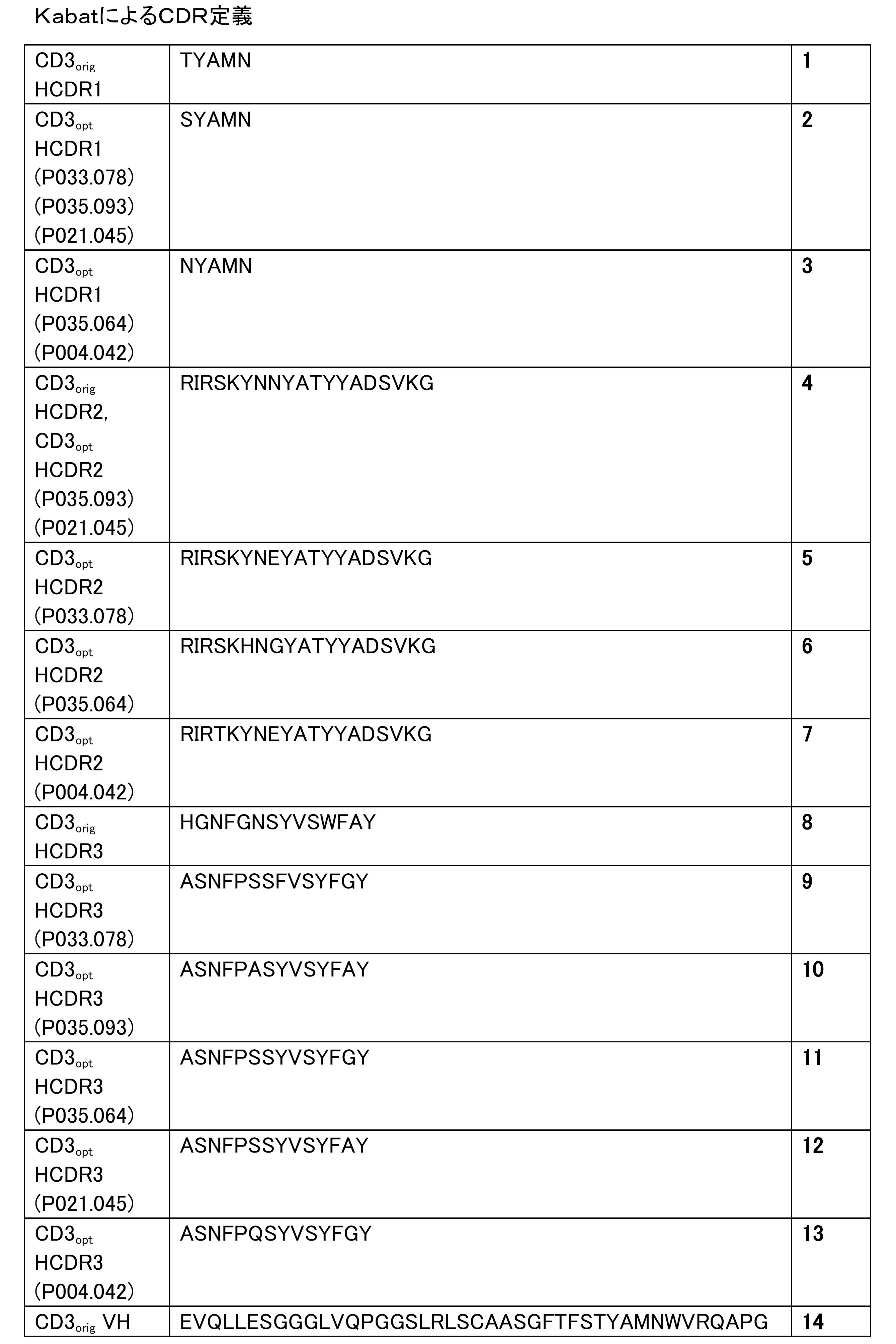
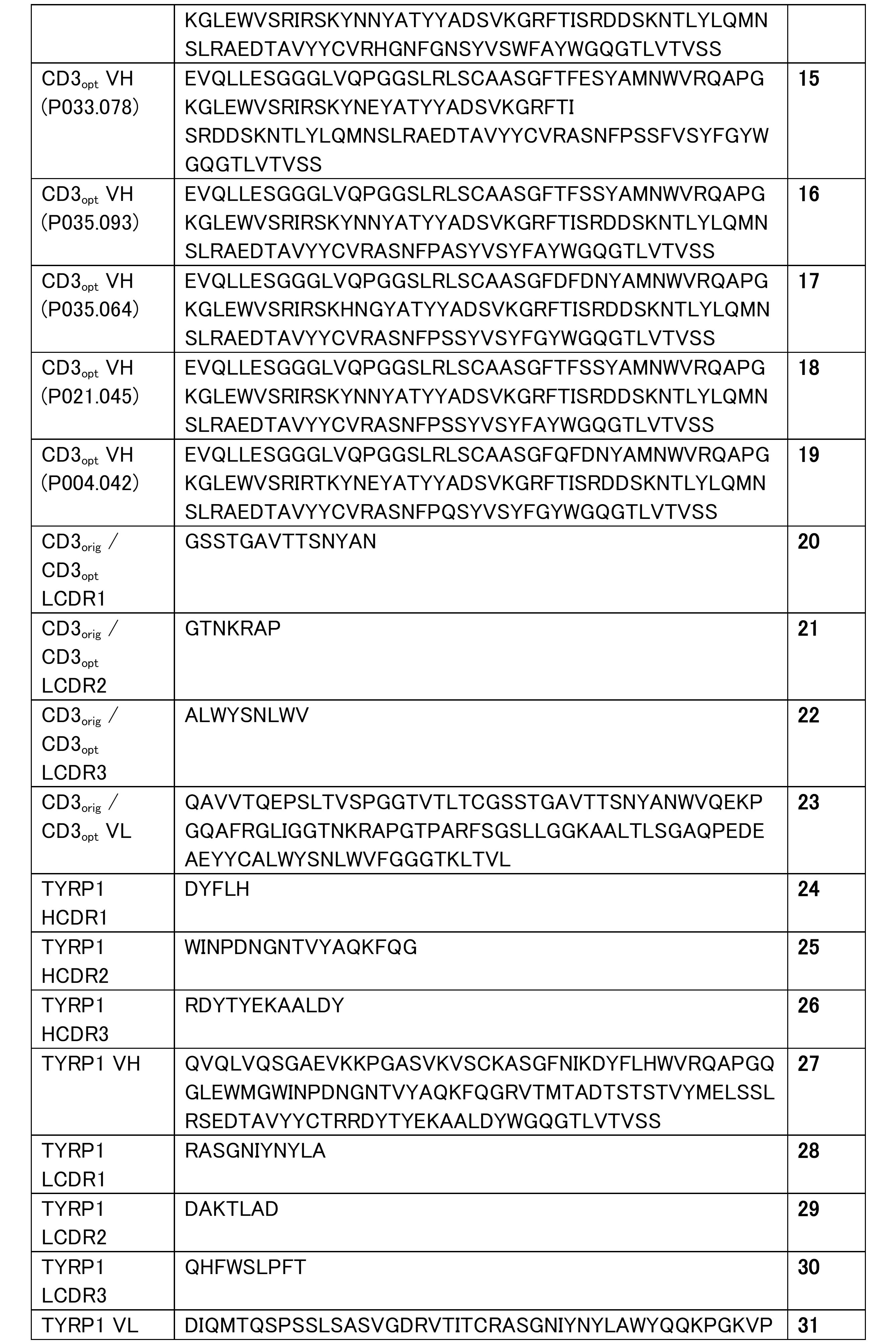


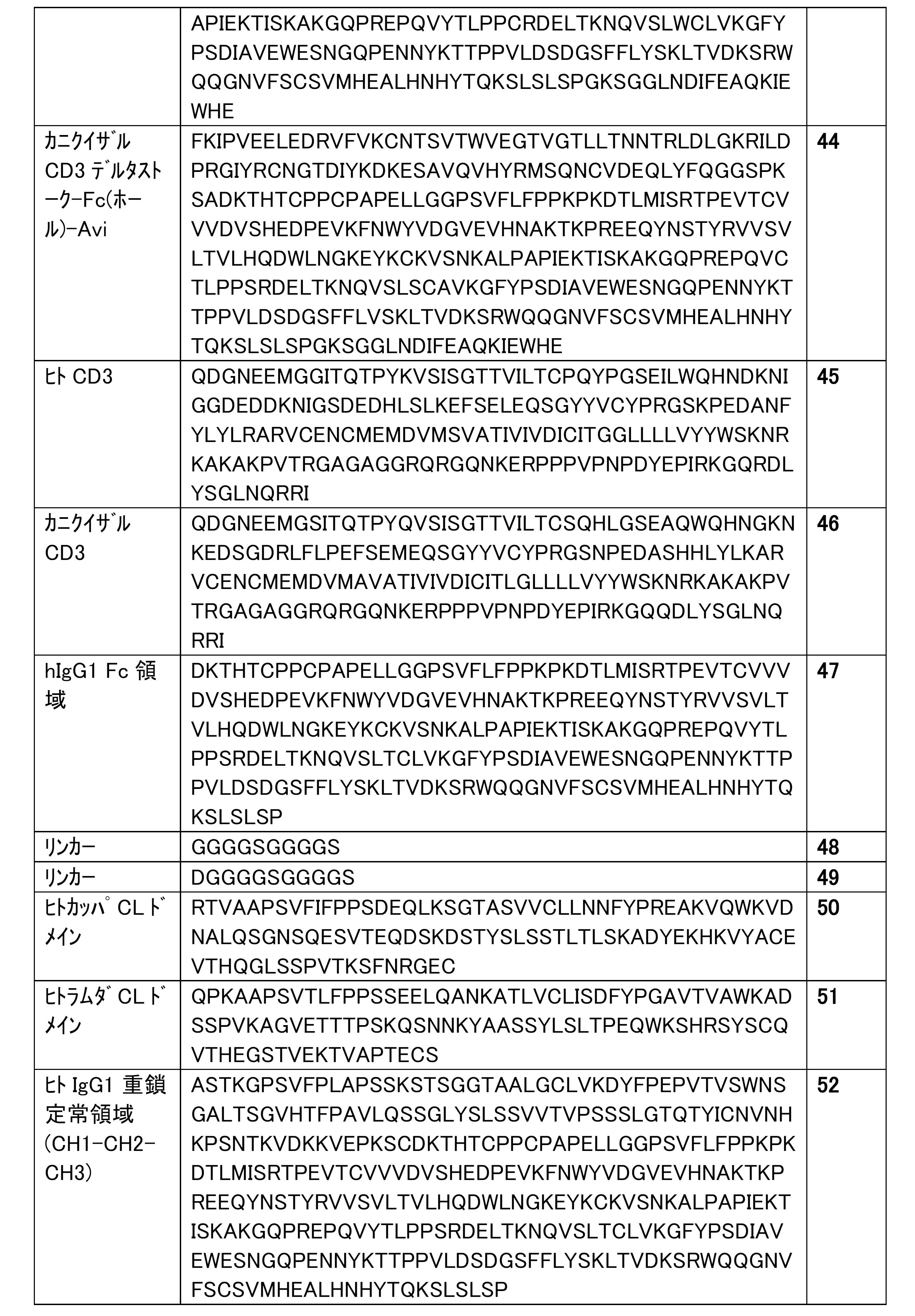
改善された抗CD3(P035.093)バインダーを含む、プロテアーゼ活性化可能T細胞活性化二重特異性分子
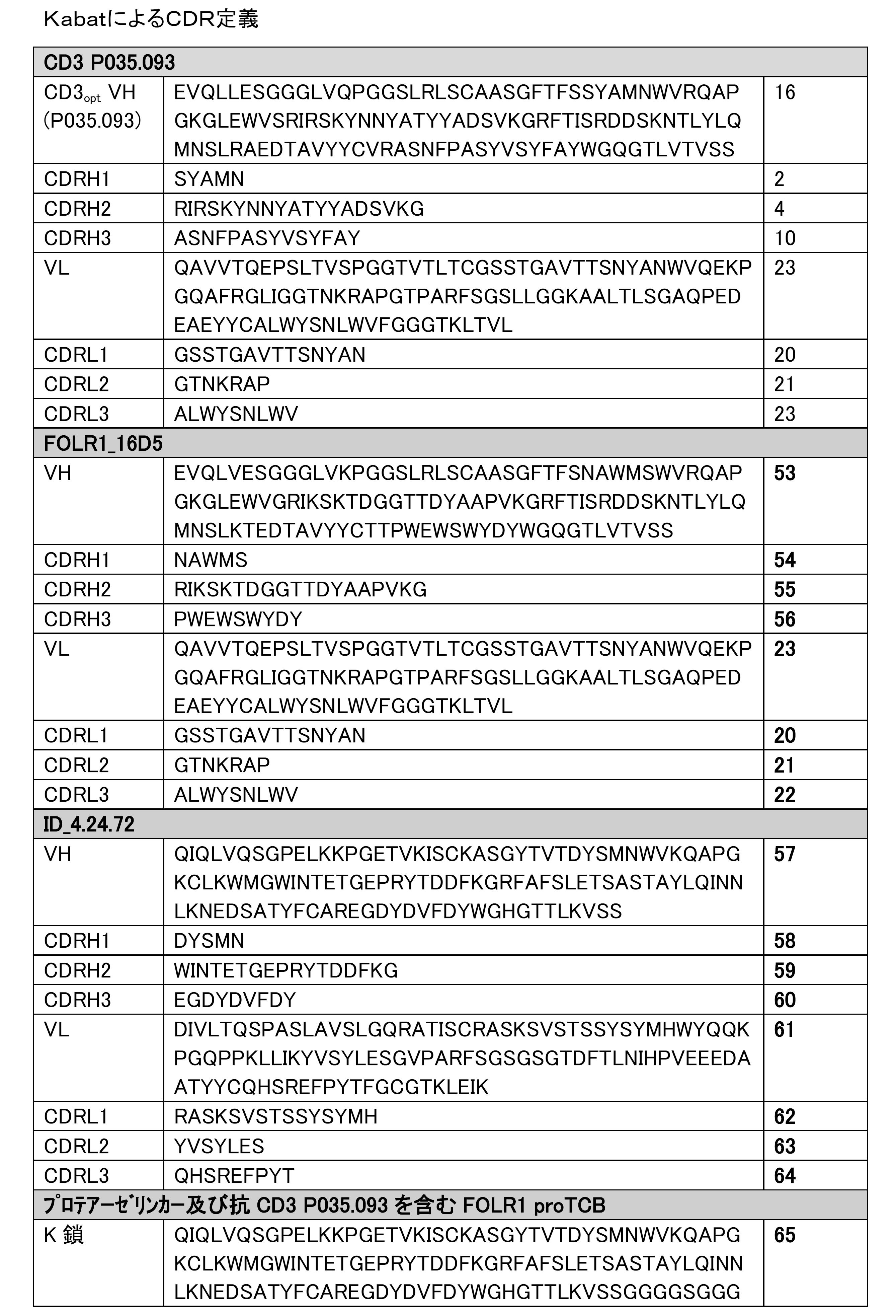
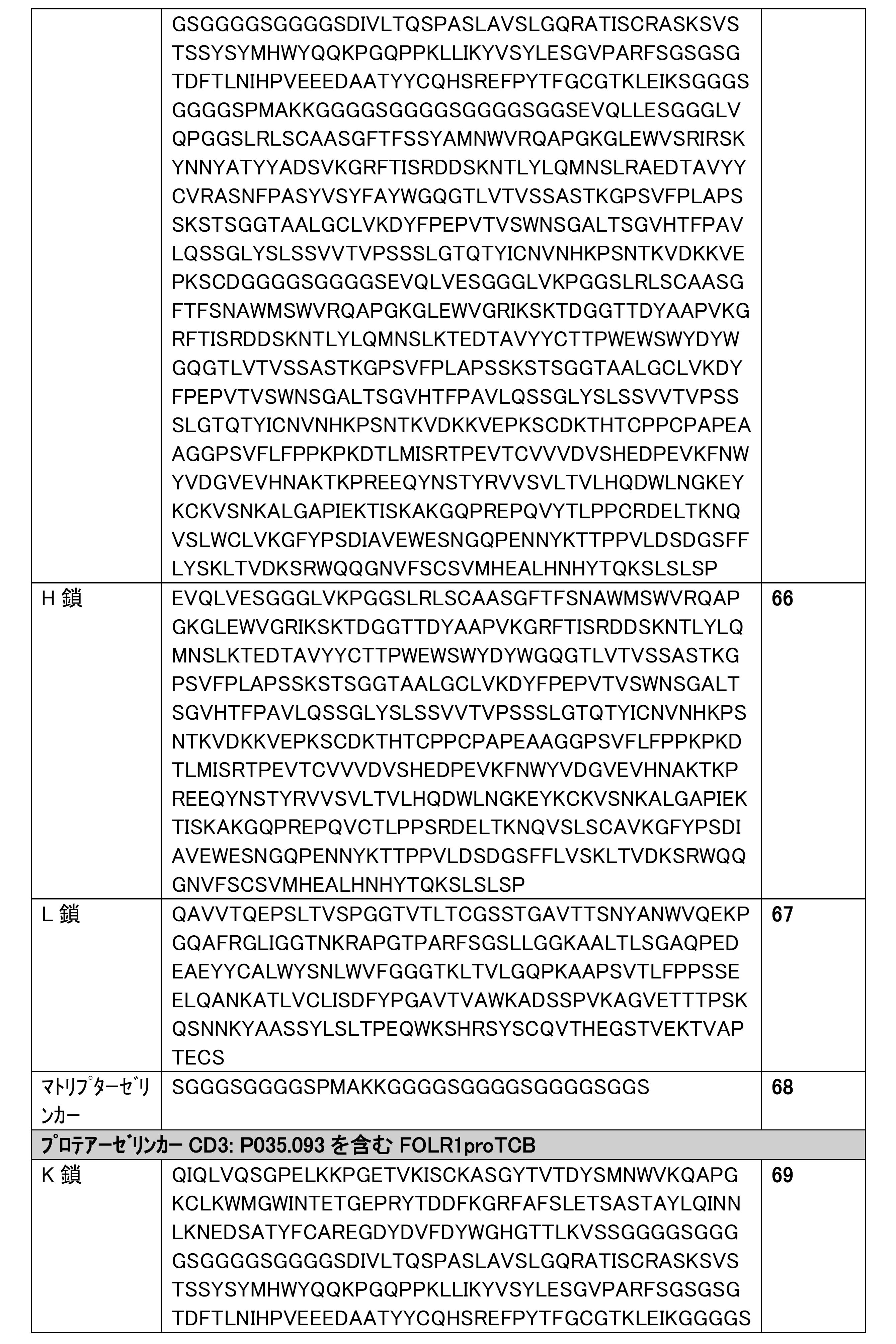


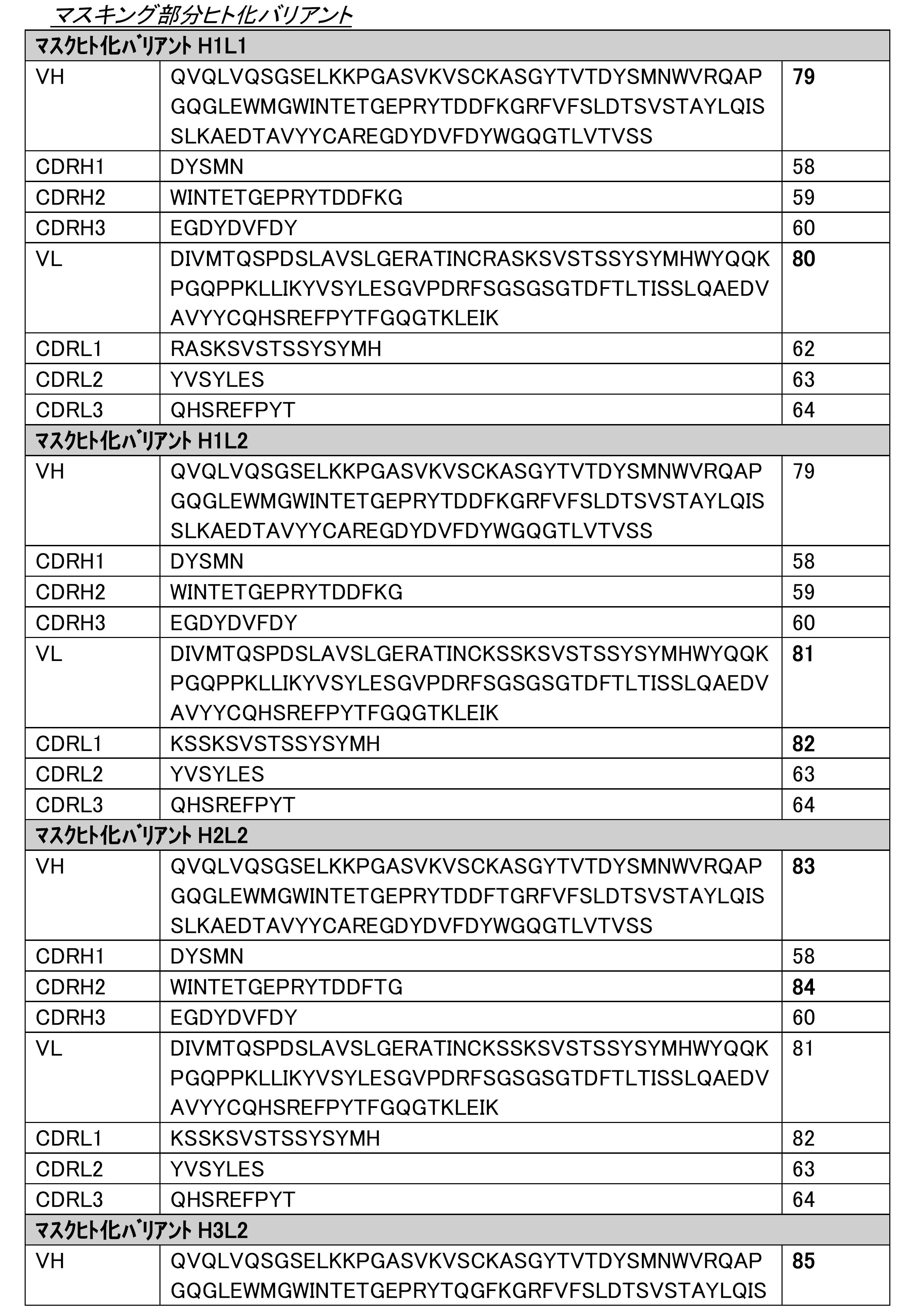


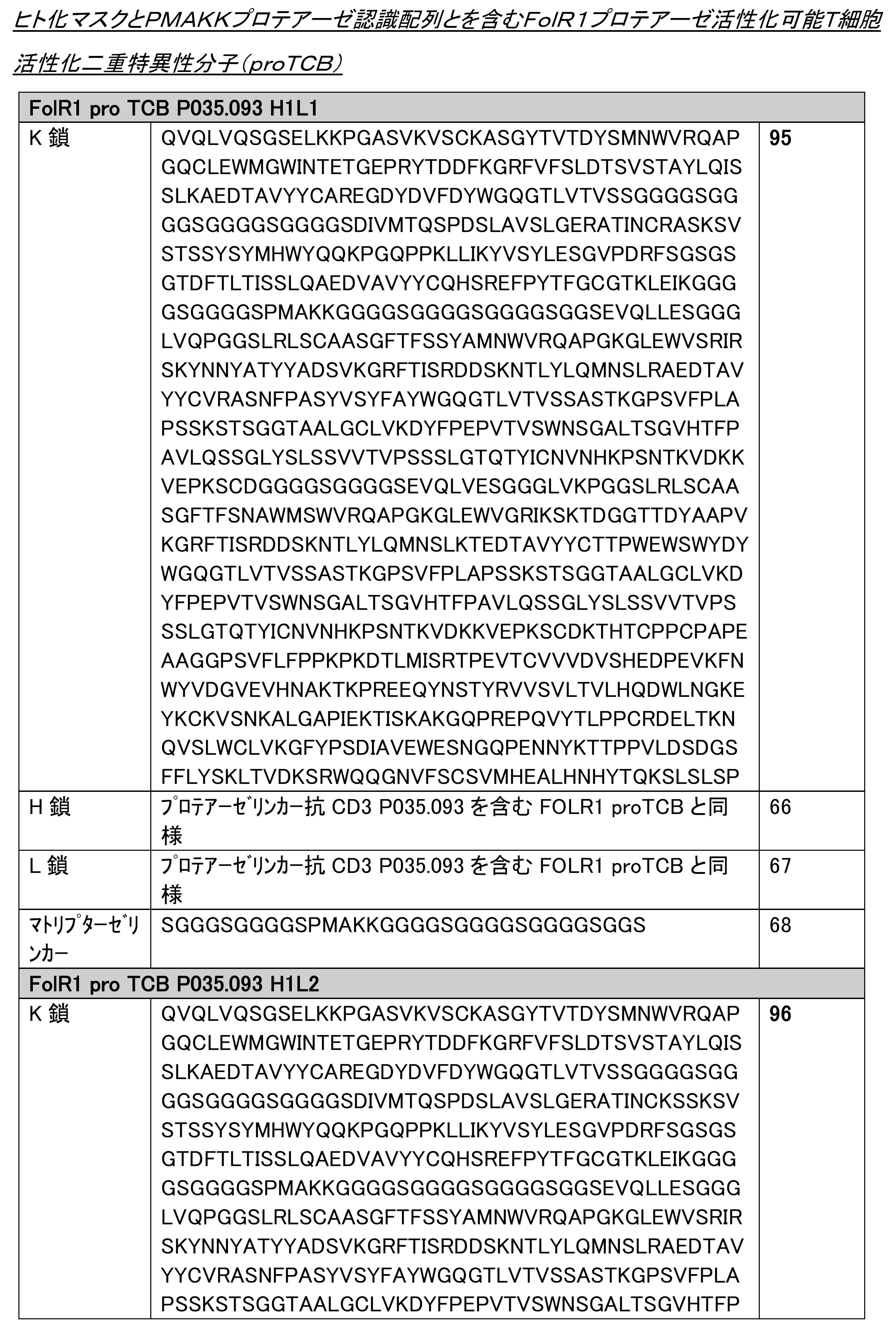
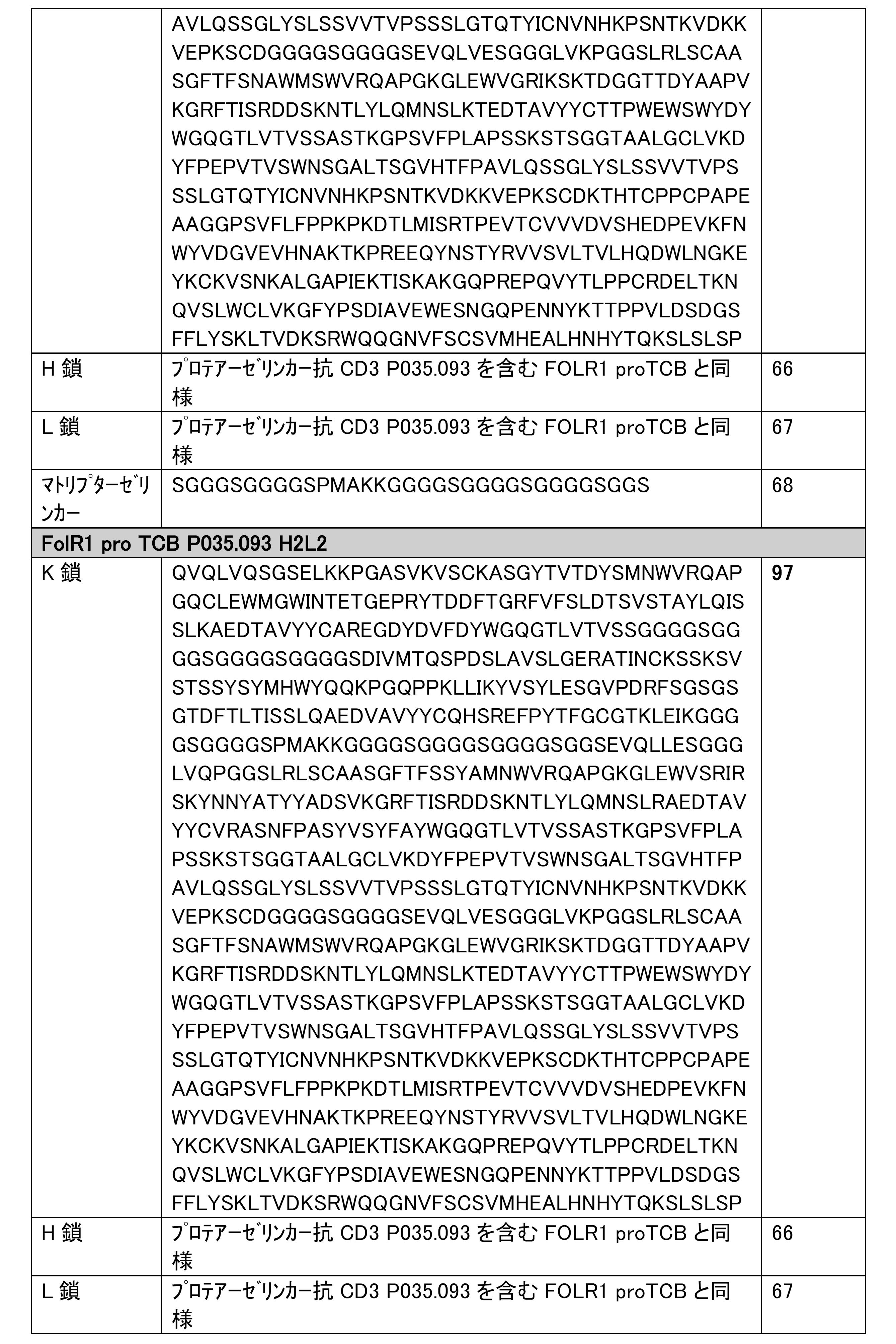


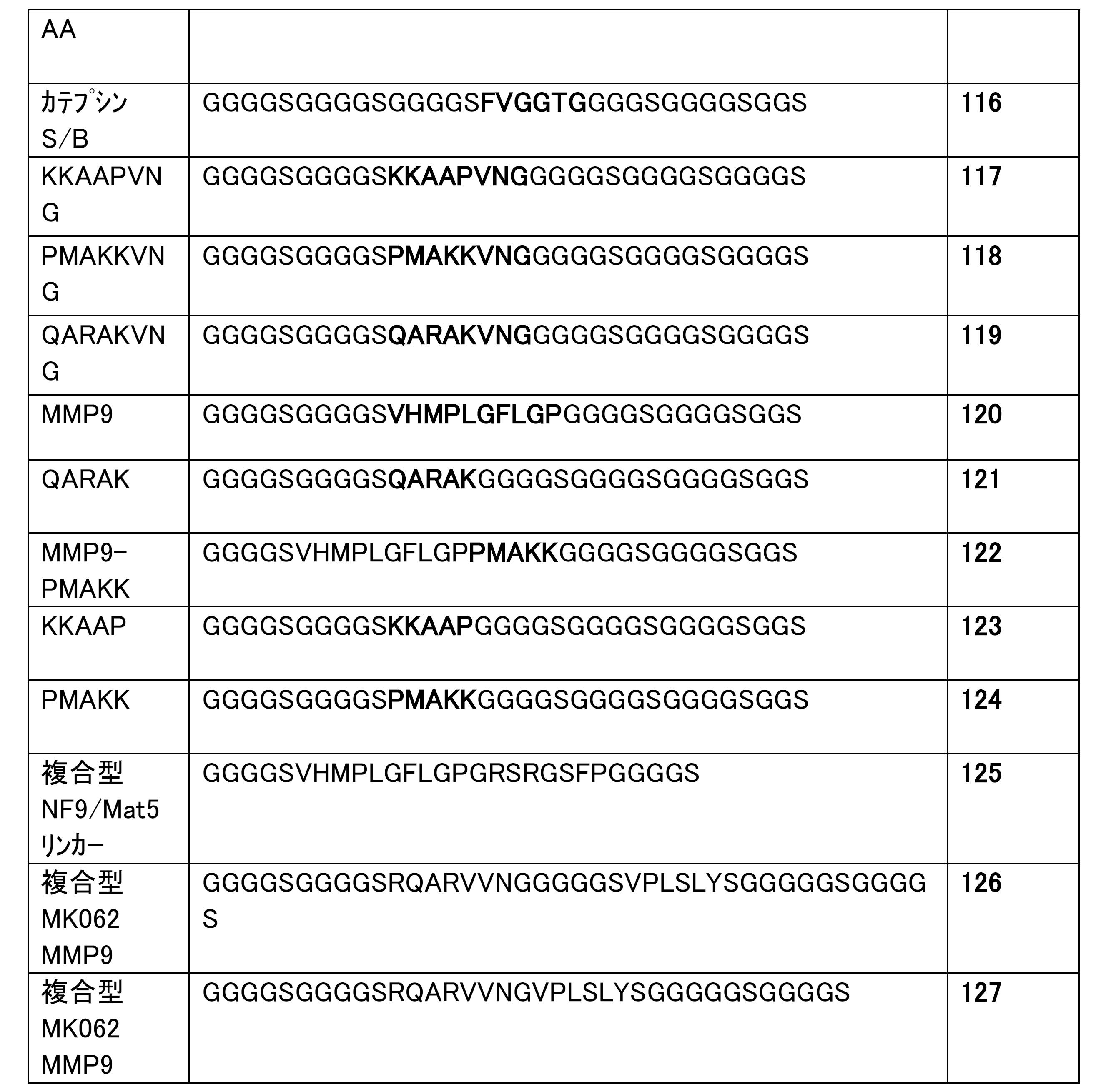
以下は、本発明の方法及び組成物の実施例である。上記の一般的な説明を所与として、他の様々な実施態様が実施され得ることが理解される。 The following are examples of the methods and compositions of the present invention. It is understood that various other embodiments may be practiced, given the general description above.
実施例1-最適化抗CD3(多重特異性)抗体の調製
最適化抗CD3抗体(クローンP033.078、P035.093、P035.064、P021.045、P004.042)は全て、既述の(例えば、参照により本明細書に援用される国際公開第2014/131712号参照)CD3バインダー(ここでは「CD3orig」ともいう)から得られたライブラリーを用いたファージディスプレイ選択操作(selection campaign)により生成したものであり、それぞれ配列番号14、23のVHとVLを含む。これらのライブラリーでは、重鎖のCDR3領域にある位置N97とN100(Kabat番号付け)は、サイレンシングされたか又は除去された。直接比較するために、全ての分子を、図2Aに描かれているように、抗TYRP1抗体を例示的な標的細胞抗原結合部位(配列番号24-31)として用いてT細胞二重特異性抗体(TCB)フォーマットに変換した。
Example 1 Preparation of Optimized Anti-CD3 (Multispecific) Antibodies Optimized anti-CD3 antibodies (clone P033.078, P035.093, P035.064, P021.045, P004.042) were all prepared as previously described ( See, e.g., WO 2014/131712, incorporated herein by reference) by phage display selection campaign using libraries obtained from CD3 binders (also referred to herein as "CD3orig") containing VH and VL of SEQ ID NOS: 14 and 23, respectively. In these libraries, positions N97 and N100 (Kabat numbering) in the CDR3 region of the heavy chain were silenced or deleted. For direct comparison, all molecules were conjugated to T cell bispecific antibodies using anti-TYRP1 antibodies as exemplary target cell antigen binding sites (SEQ ID NOs:24-31), as depicted in FIG. 2A. (TCB) format.
図2B-Eに示すように、重鎖DNA配列及び軽鎖DNA配列の可変領域を、それぞれのレシピエント哺乳動物発現ベクターに予め挿入された定常重鎖又は定常軽鎖とインフレームでサブクローニングした。 As shown in Figures 2B-E, the variable regions of the heavy and light chain DNA sequences were subcloned in-frame with the constant heavy or light chain previously inserted into the respective recipient mammalian expression vectors.
最適化抗CD3抗体の配列は、表1に示す配列番号に示されている。 The sequences of optimized anti-CD3 antibodies are shown in the SEQ ID NOs shown in Table 1.
表1.本発明の実施例で生成された最適化抗CD3抗体の配列
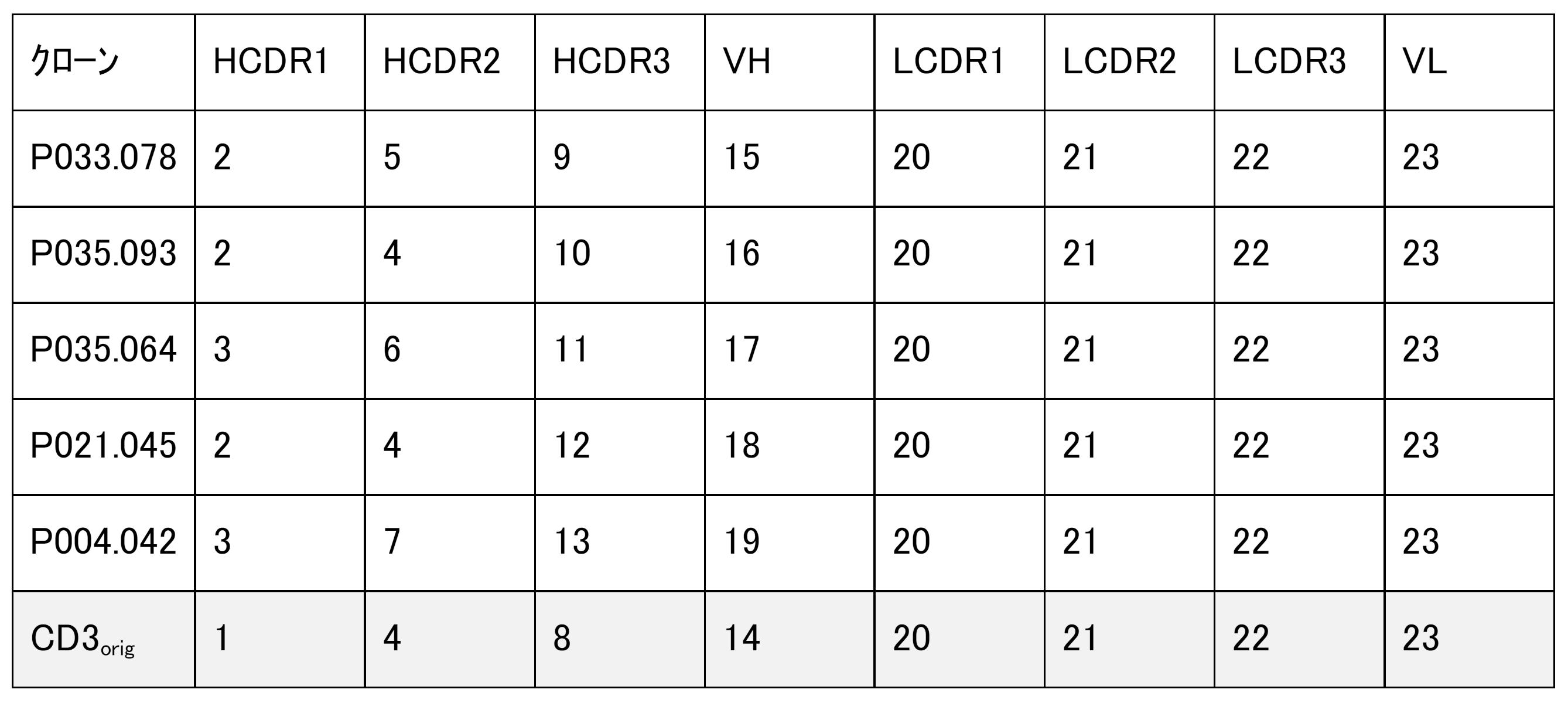
軽鎖の対応する重鎖との正確な対合を更に改善するために、TYRP1結合性Fab分子のヒトCL(E123R、Q124K)及びヒトCH1(K147E、K213E)に変異が導入された。 Mutations were introduced into the TYRP1-binding Fab molecules human CL (E123R, Q124K) and human CH1 (K147E, K213E) to further improve the correct pairing of the light chain with the corresponding heavy chain.
重鎖の正確な対合(ヘテロ二量体分子の形成)のために、各抗体重鎖の定常領域にノブ・イントゥ・ホール変異を導入した(それぞれ、T366W/S354C、T366S/L368A/Y407V/Y349C)。 For correct pairing of heavy chains (formation of heterodimeric molecules), knob-into-hole mutations were introduced in the constant region of each antibody heavy chain (T366W/S354C, T366S/L368A/Y407V/ Y349C).
更に、各抗体重鎖の定常領域にP329G、L234A及びL235A変異を導入し、Fcγ受容体との結合を無効にした。 Furthermore, P329G, L234A and L235A mutations were introduced into the constant region of each antibody heavy chain to abolish binding to Fcγ receptors.
調製したTCB分子の完全な配列は、配列番号32、33、34及び36(P033.078)、配列番号32、33、34及び37(P035.093)、配列番号32、33、34及び38(P035.064)、配列番号32、33、34及び39(P021.045)、配列番号32、33、34及び40(P004.042)に示されている。 The complete sequences of the TCB molecules prepared are SEQ ID NOs: 32, 33, 34 and 36 (P033.078), SEQ ID NOs: 32, 33, 34 and 37 (P035.093), SEQ ID NOs: 32, 33, 34 and 38 ( P035.064), SEQ ID NOs: 32, 33, 34 and 39 (P021.045), SEQ ID NOs: 32, 33, 34 and 40 (P004.042).
CD3origをCD3バインダーとして含む、対応する分子も調製した。 A corresponding molecule was also prepared containing CD3 orig as the CD3 binder.
TCBは、Evitria社(スイス)により、独自のベクター系と従来の(非PCRベースの)クローニング技術を使用し、懸濁適応CHO K1細胞(もともとATCCから譲り受け、Evitria社で懸濁培養液中での無血清培養に適応させたもの)を用いて調製された。作製にあたっては、Evitria社は、独自の動物成分非含有無血清培地(eviGrow及びeviMake2)と独自のトランスフェクション試薬(eviFect)を用いた。これらの細胞は、1:1:2:1(「ベクターノブ重鎖」::「ベクターホール重鎖」:「ベクターCD3軽鎖」:「ベクターTYRP1軽鎖」)の対応する発現ベクターでトランスフェクトされた。遠心分離及びその後の濾過(0.2μmフィルター)により上清を回収し、標準的な方法により、回収した上清からタンパク質を精製した。 TCB was produced by Evitria (Switzerland) using a proprietary vector system and conventional (non-PCR-based) cloning techniques in suspension-adapted CHO K1 cells (originally a gift from the ATCC and grown in suspension culture at Evitria). adapted to serum-free culture). For production, Evitria used proprietary animal component-free, serum-free media (eviGrow and eviMake2) and a proprietary transfection reagent (eviFect). These cells were transfected with the corresponding expression vectors at 1:1:2:1 (“vector knob heavy chain”::“vector hole heavy chain”:“vector CD3 light chain”:“vector TYRP1 light chain”). was done. Supernatant was collected by centrifugation followed by filtration (0.2 μm filter) and protein was purified from the collected supernatant by standard methods.
端的に言えば、Fc含有タンパク質を、プロテインAアフィニティクロマトグラフィー(平衡化バッファー: 20mMクエン酸ナトリウム、20mMリン酸ナトリウム、pH 7.5; 溶出バッファー: 20mMクエン酸ナトリウム、pH 3.0)によって、濾過した細胞培養上清から精製した。pH3.0で溶出した後、直ちに試料のpHを中和した。遠心分離(Millipore Amicon(登録商標)ULTRA-15、#UFC903096)によりタンパク質を濃縮し、凝集したタンパク質を、20mMヒスチジン、140mM塩化ナトリウム、pH 6.0のサイズ排除クロマトグラフィーにより、単量体タンパク質から分離した。 Briefly, Fc-containing proteins were isolated by protein A affinity chromatography (equilibration buffer: 20 mM sodium citrate, 20 mM sodium phosphate, pH 7.5; elution buffer: 20 mM sodium citrate, pH 3.0). Purified from filtered cell culture supernatant. After elution at pH 3.0, the pH of the sample was immediately neutralized. Proteins were concentrated by centrifugation (Millipore Amicon® ULTRA-15, #UFC903096) and aggregated proteins were separated from monomeric proteins by size exclusion chromatography with 20 mM histidine, 140 mM sodium chloride, pH 6.0. separated.
Pace,et al.,Protein Science,1995,4,2411-1423に従ったアミノ酸配列に基づき計算した質量消散係数を用いて、280nmにおける吸収を測定することにより、精製したタンパク質の濃度を決定した。LabChipGXII(Perkin Elmer)を使用して、還元剤の存在下及び非存在下にて、CE-SDSにより、タンパク質の純度及び分子量を分析した。凝集体含量の測定は、分析用サイズ排除カラム(TSKgel G3000 SW XL又はUP-SW3000)をランニングバッファーで平衡化して(それぞれ、25mM K2HPO4、125mM NaCl、200mM Lアルギニンモノヒドロクロリド、pH6.7又は200mM KH2PO4、250mM KCl、pH6.2)使用して、25℃でのHPLCクロマトグラフィーによって行われた。 Pace, et al. , Protein Science, 1995, 4, 2411-1423. Protein purity and molecular weight were analyzed by CE-SDS in the presence and absence of reducing agents using LabChipGXII (Perkin Elmer). Aggregate content was measured by equilibrating an analytical size exclusion column (TSKgel G3000 SW XL or UP-SW3000) with running buffer (25 mM K 2 HPO 4 , 125 mM NaCl, 200 mM L arginine monohydrochloride, pH 6.0, respectively). 7 or 200 mM KH 2 PO 4 , 250 mM KCl, pH 6.2) at 25° C. by HPLC chromatography.
調製したTCB分子の生化学的及び生物物理学的解析の結果を表2に示す。 Table 2 shows the results of biochemical and biophysical analysis of the prepared TCB molecules.
全てのTCB分子を良好な品質で生産することができた。 All TCB molecules could be produced with good quality.
表2.TCBフォーマットの抗CD3抗体の生化学的及び生物物理学的解析。
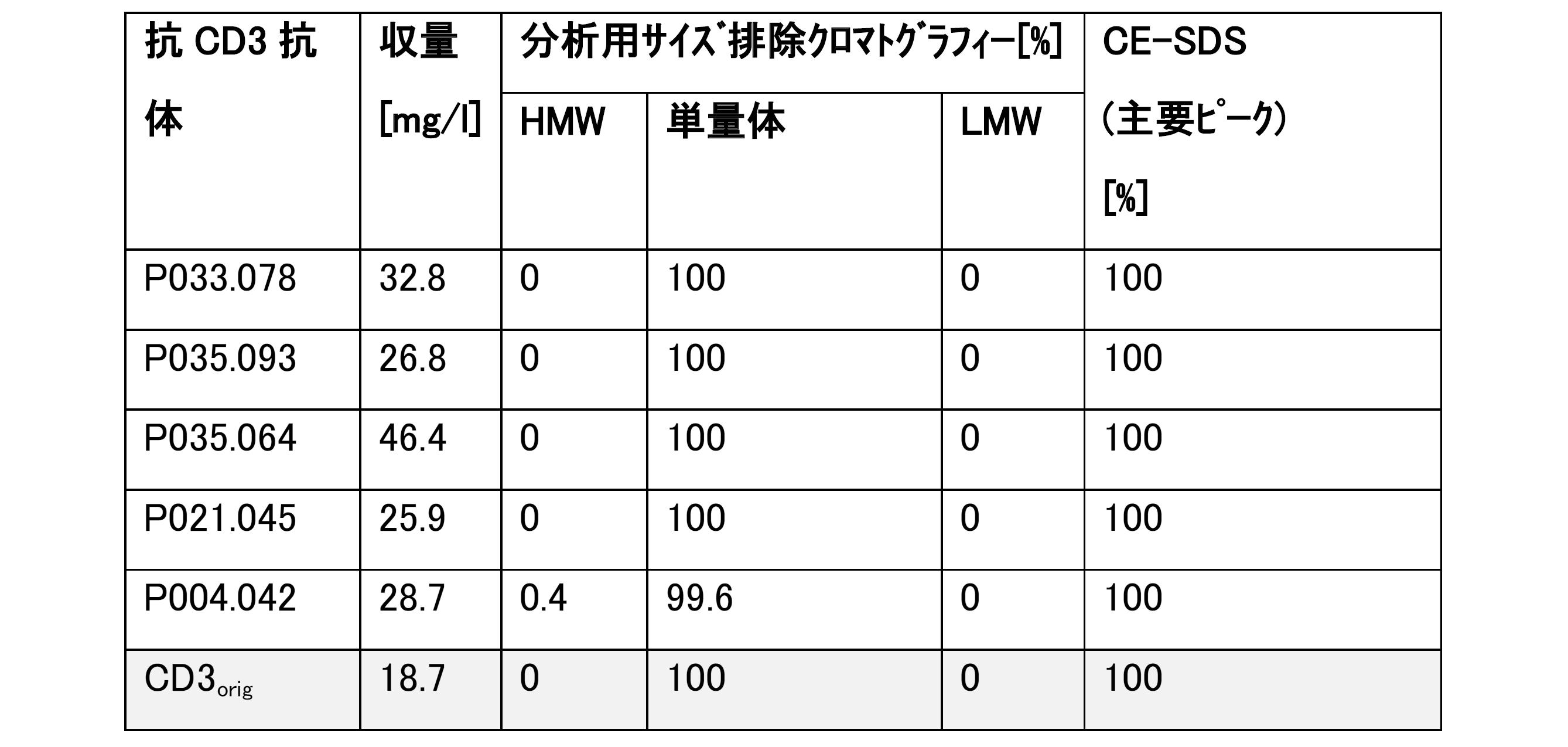
実施例2-最適化抗CD3(多重特異性)抗体の熱安定性の測定
実施例1で調製した抗CD3抗体(TCBフォーマット)の熱安定性を、Optim2装置(Avacta Analytical社、英国)を使用して、動的光散乱法(DLS)により、及び温度傾斜を加えることによる温度依存性固有タンパク質蛍光のモニタリングにより、モニターした。
Example 2 Measurement of Thermal Stability of Optimized Anti-CD3 (Multispecific) Antibodies Thermal stability of the anti-CD3 antibody (TCB format) prepared in Example 1 was measured using an Optim2 instrument (Avacta Analytical, UK). was monitored by dynamic light scattering (DLS) and by monitoring temperature-dependent intrinsic protein fluorescence by applying a temperature ramp.
タンパク質濃度1mg/mlの10μgの濾過したタンパク質試料をOptim2に2回かけた。温度を0.1℃/minで25℃から85℃まで上昇させ、350nm/330nmでの蛍光強度と266nmでの散乱強度の比を収集した。 A 10 μg filtered protein sample with a protein concentration of 1 mg/ml was applied twice to Optim2. The temperature was increased from 25° C. to 85° C. at 0.1° C./min and the ratio of fluorescence intensity at 350 nm/330 nm to scattering intensity at 266 nm was collected.
結果を表3に示す。実施例1で製造した全ての最適化CD3バインダーの凝集温度(Tagg)と観察された温度誘導アンフォールディング転移の中点(Tm)は、既述のCD3バインダーCD3origのものと同等かそれ以上である。 Table 3 shows the results. The aggregation temperature (T agg ) and the observed midpoint of the temperature-induced unfolding transition (T m ) for all optimized CD3 binders prepared in Example 1 were comparable or lower than those of the previously described CD3 binder CD3 orig . That's it.
表3.動的光散乱及び温度依存性固有タンパク質蛍光の変化により測定した、TCBフォーマットの抗CD3抗体の熱安定性。
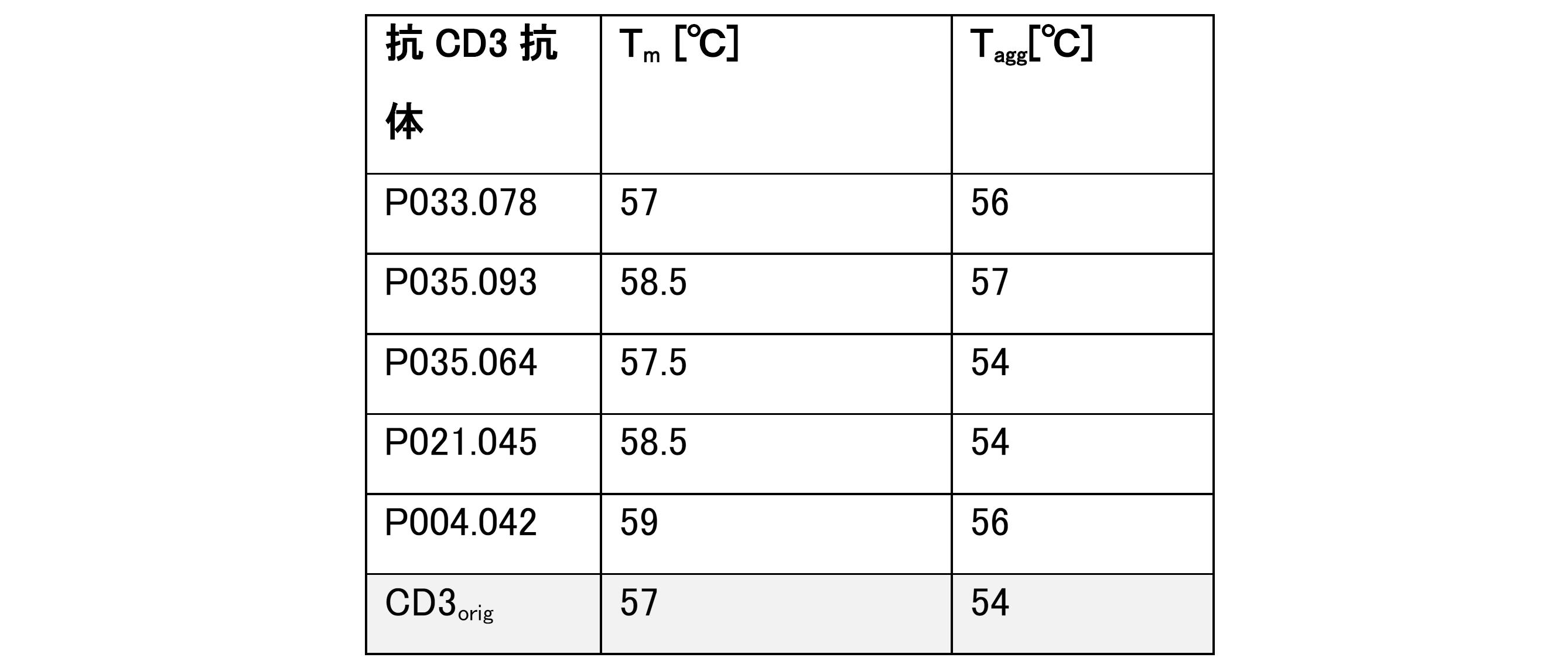
実施例3-表面プラズモン共鳴(SPR)による最適化抗CD3(多重特異性)抗体の機能特性評価
表面プラズモン共鳴(SPR)実験をBiacore T200で、ランニングバッファーとしてHBS-EP+(0.01M HEPES pH7.4、0.15M NaCl、3mM EDTA、0.005% Surfactant P20;Biacore社、ドイツ/フライブルク)を用いて25℃で行った。
Example 3 - Functional Characterization of Optimized Anti-CD3 (Multispecific) Antibodies by Surface Plasmon Resonance (SPR) Surface plasmon resonance (SPR) experiments were performed on a Biacore T200 with HBS-EP+ (0.01 M HEPES pH 7.0) as running buffer. 4, 0.15 M NaCl, 3 mM EDTA, 0.005% Surfactant P20; Biacore, Freiburg/Germany) at 25°C.
親和性測定では、抗Fc(P329G)IgG(ヒトIgG1 Fc(P329G)に特異的に結合する抗体;「抗PG抗体」-参照により本明細書に援用される国際公開第2017/072210号を参照)を固定化したC1センサーチップ(GEヘルスケア)表面で、TCB分子を捕捉した。実験設定を図3に模式的に示す。捕捉IgGを、標準的なアミンカップリングキット(GEヘルスケアライフサイエンス)を用いて、約400レゾナンスユニット(RU)の直接固定化によりセンサーチップ表面にカップリングした。 For affinity measurements, anti-Fc (P329G) IgG (an antibody that specifically binds to human IgG 1 Fc (P329G); “anti-PG antibody”—see WO2017/072210, incorporated herein by reference). See) was immobilized on the surface of the C1 sensor chip (GE Healthcare), and TCB molecules were captured. The experimental setup is shown schematically in FIG. Captured IgG was coupled to the sensor chip surface by direct immobilization of approximately 400 resonance units (RU) using a standard amine coupling kit (GE Healthcare Life Sciences).
CD3との相互作用を分析するために、TCB分子を80秒間、25nMで、10μl/minの流量で捕捉した。ヒト及びカニクイザルCD3εストーク-Fc(ノブ)-Avi/CD3δストーク-Fc(ホール)(CD3ε/δ、配列番号41及び42(ヒト)並びに配列番号43及び44(カニクイザル)参照)を0.122-125nMの濃度で、30μl/minの流量で、300秒間フローセルを通過させた。解離を800秒間モニターした。 To analyze interactions with CD3, TCB molecules were captured for 80 seconds at 25 nM at a flow rate of 10 μl/min. 0.122-125 nM of human and cynomolgus monkey CD3ε stalk-Fc(knob)-Avi/CD3δ stalk-Fc(hole) (CD3ε/δ, see SEQ ID NOS: 41 and 42 (human) and SEQ ID NOS: 43 and 44 (cynomolgus monkey)) was passed through the flow cell for 300 seconds at a flow rate of 30 μl/min. Dissociation was monitored for 800 seconds.
バルク屈折率差を、参照フローセルで得られた応答を差し引くことによって補正した。ここでは、抗原が、抗PG抗体を固定化したがTCB分子の代わりにHBS-EPを注入した表面上を飛行した。 Bulk refractive index differences were corrected by subtracting the response obtained with the reference flow cell. Here, antigen flew over a surface immobilized with anti-PG antibody but injected with HBS-EP instead of TCB molecules.
Biacore T200 Evaluation Software(GEヘルスケアライフサイエンス)を用いて反応速度定数を導出し、数値積分によって反応速度式を1:1ラングミュア結合に当てはめた。相互作用の半減期(t1/2)を、式t1/2=ln2/koffを用いて計算した。 Biacore T200 Evaluation Software (GE Healthcare Life Sciences) was used to derive kinetic constants and kinetic equations were fitted to 1:1 Langmuir binding by numerical integration. The half-life of the interaction (t 1/2 ) was calculated using the formula t 1/2 =ln2/k off .
表4には、既述のバインダーCD3origと比較した最適化抗CD3抗体の結合に関する全ての反応速度パラメーターが列挙されている。最適化抗CD3抗体(TCBフォーマット)は、低nM範囲から高pM範囲のKD値でCD3ε/δに結合する(ヒトCD3ε/δ には600pMから1.54nM、カニクイザルCD3ε/δには200pMから700pMのKD値で)。CD3origと比較して、最適化抗CD3抗体のヒトCD3ε/δへの結合の親和性は、SPRによって同一条件下で測定した場合、7から10倍まで向上する。 Table 4 lists all kinetic parameters for binding of the optimized anti-CD3 antibodies compared to the previously described binder CD3 orig . Optimized anti-CD3 antibodies (TCB format) bind CD3 ε/δ with K D values in the low to high pM range (600 pM to 1.54 nM for human CD3 ε/δ and 200 pM for cynomolgus monkey CD3 ε/δ). with a KD value of 700 pM). Compared to CD3 orig , the affinity of the optimized anti-CD3 antibody binding to human CD3ε/δ is enhanced by 7- to 10-fold when measured under identical conditions by SPR.
ヒトCD3ε/δに対する一価結合の半減期は、抗CD3抗体クローンP033.078の場合11.6分で、CD3origの結合半減期の最大6倍である。 The half-life of monovalent binding to human CD3ε/δ is 11.6 minutes for the anti-CD3 antibody clone P033.078, which is up to 6 times the binding half-life of CD3 orig .
表4.抗CD3抗体(TCBフォーマット)のヒトCD3ε/δ及びカニクイザルCD3ε/δに対する親和性

実施例4-ストレス後の最適化抗CD3(多重特異性)抗体の表面プラズモン共鳴(SPR)による特性評価
脱アミド化部位の除去とその抗体の安定性への影響を評価するため、最適化抗CD3抗体(TCBフォーマット)を37℃、pH7.4及び40℃、pH6で14日間インキュべ―トし、更にそれらのヒトCD3ε/δへの結合能をSPRで分析した。-80℃、pH6で保存した試料を基準として使用した。基準試料及び40℃でストレスを与えた試料は20mM His、140mM NaCl、pH6.0に、37℃でストレスを与えた試料は、PBS、pH7.4に、全て濃度1.0mg/mlで存在させた。ストレス期間(14日間)後、更なる分析のために、PBS中の試料を透析して20mM His、140mM NaCl、pH6.0に戻した。
Example 4 - Surface Plasmon Resonance (SPR) Characterization of Optimized Anti-CD3 (Multispecific) Antibodies After Stress CD3 antibodies (TCB format) were incubated at 37° C., pH 7.4 and 40° C., pH 6 for 14 days, and their binding ability to human CD3 ε/δ was analyzed by SPR. A sample stored at -80°C, pH 6 was used as a reference. Reference samples and 40° C. stressed samples were present in 20 mM His, 140 mM NaCl, pH 6.0, and 37° C. stressed samples were present in PBS, pH 7.4, all at a concentration of 1.0 mg/ml. rice field. After the stress period (14 days), samples in PBS were dialyzed back to 20 mM His, 140 mM NaCl, pH 6.0 for further analysis.
全てのSPR実験は、Biacore T200機器(GEヘルスケア)で、25℃で、HBS-P+(10mM HEPES、150mM NaCl pH7.4、0.05%Surfactant P20)をランニング及び希釈バッファーとして用いて実施された。ビオチン化ヒトCD3ε/δ(実施例3、配列番号41及び42参照)及びビオチン化抗huIgG(Capture Select、Thermo Scientific,#7103262100)を、Series S Sensor Chip SA(GEヘルスケア、#29104992)上に固定化し、少なくとも1000レゾナンスユニット(RU)の表面密度を得た。濃度2μg/mlの抗CD3抗体を流量5μl/minで30秒間注入し、解離を120秒間モニターした。10mMグリシンpH1.5を60秒間注入することによって表面を再生した。バルクの屈折率差を、ブランク注入を差し引くことと、ブランクコントロールフローセルから得られた応答を差し引くことによって補正した。評価には、注入終了5秒後の結合反応をとった。結合シグナルを正規化するために、CD3結合を、抗huIgG応答(固定化された抗huIgG抗体上でのCD3抗体の捕捉時に得られるシグナル(RU))で割った。相対結合活性を、各温度ストレスを与えられた試料の基準を、対応するストレスを与えられていない試料にすることにより計算した。 All SPR experiments were performed on a Biacore T200 instrument (GE Healthcare) at 25° C. using HBS-P+ (10 mM HEPES, 150 mM NaCl pH 7.4, 0.05% Surfactant P20) as running and dilution buffer. rice field. Biotinylated human CD3 epsilon/delta (see Example 3, SEQ ID NOs:41 and 42) and biotinylated anti-huIgG (Capture Select, Thermo Scientific, #7103262100) were placed on a Series S Sensor Chip SA (GE Healthcare, #29104992). Immobilization yielded a surface density of at least 1000 resonance units (RU). Anti-CD3 antibody at a concentration of 2 μg/ml was injected at a flow rate of 5 μl/min for 30 seconds and dissociation was monitored for 120 seconds. The surface was regenerated by a 60 second injection of 10 mM glycine pH 1.5. Bulk refractive index differences were corrected by subtracting the blank injection and the response obtained from the blank control flow cell. For evaluation, the binding reaction was taken 5 seconds after the end of the injection. To normalize binding signals, CD3 binding was divided by the anti-huIgG response (signal (RU) obtained upon capture of CD3 antibody on immobilized anti-huIgG antibody). Relative binding activity was calculated by referencing each temperature stressed sample to the corresponding unstressed sample.
表5に示すように、実施例1で調製した全ての抗CD3抗体は、CD3origと比較して、CD3ε/δへのストレス時の結合が改善されていることがわかる。 As shown in Table 5, all the anti-CD3 antibodies prepared in Example 1 have improved binding to CD3ε/δ under stress compared to CD3 orig .
表5.pH6/40℃又はpH7.4/37℃で2週間インキュベートした後の抗CD3抗体(TCBフォーマット)のヒトCD3ε/δに対する結合活性。
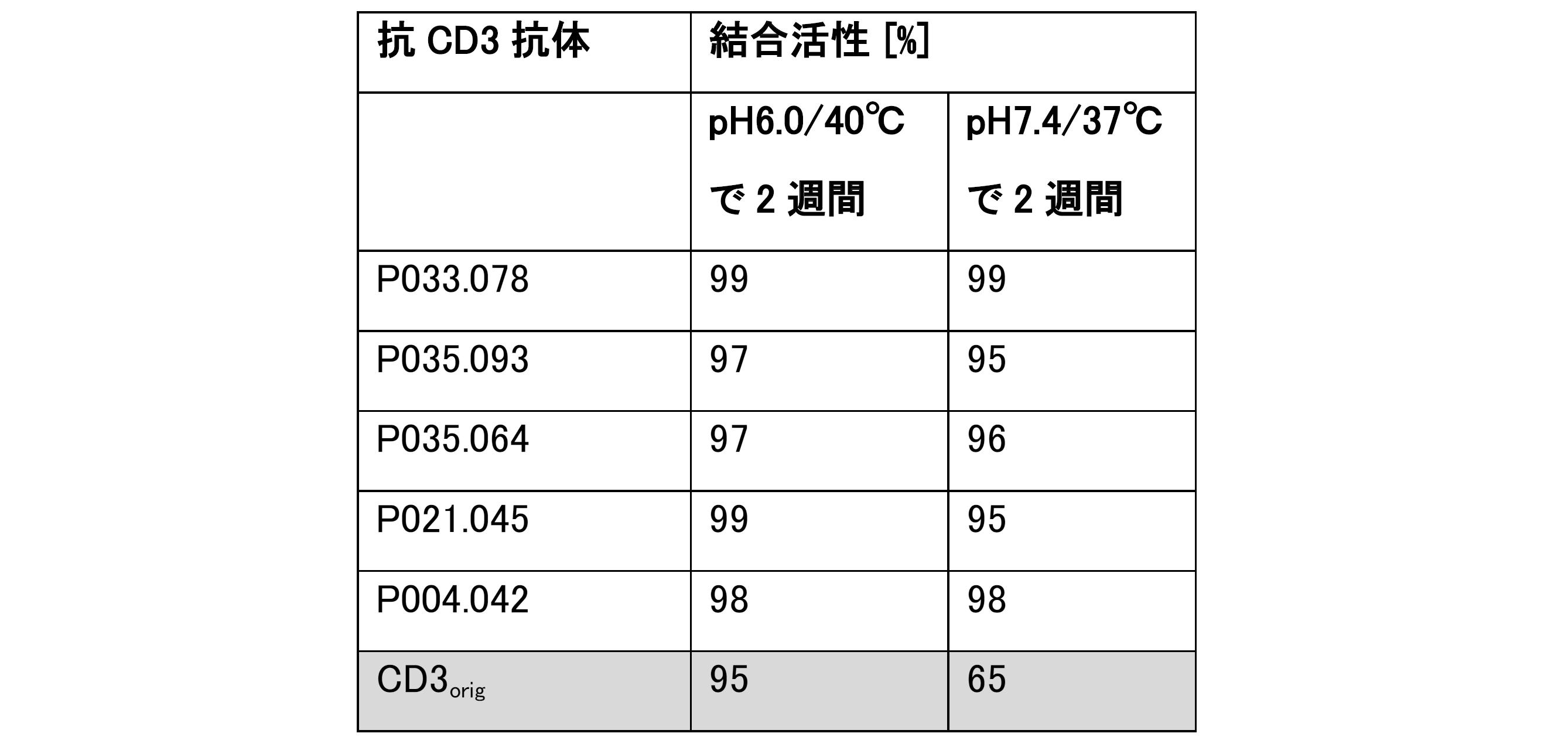
実施例5-最適化抗CD3(多重特異性)抗体を用いたJurkat NFATレポーター細胞アッセイ
最適化抗CD3抗体含有(TYRP1標的)TCBを、標的細胞としてCHO-K1 TYRP1クローン76(CHO-K1細胞の安定的な形質導入により生成した細胞)の存在下でJurkat NFATレポーター細胞アッセイで試験した。Jurkat NFATレポーター細胞(Promega)を、10%FBS含有RPMI 1640(Gibco)、2g/lグルコース(Sigma)、2g/l NaHCO3(Sigma)、25mM HEPES(Gibco)、1%GlutaMax(Gibco)、1xNEAA(Sigma)、1%SoPyr(Sigma)(Jurkat NFAT培地)で、0.1-0.5mio細胞/mlで培養した。CHO-K1 TYRP1クローン76細胞を、10%FBS含有DMEM/F12+GlutaMAX(1x)(Gibco)及び6μg/mlピューロマイシン(Invivogen)で培養した。本アッセイは、Jurkat NFAT培地で実施した。
Example 5 - Jurkat NFAT Reporter Cell Assay Using Optimized Anti-CD3 (Multispecific) Antibodies Optimized anti-CD3 antibody-containing (TYRP1-targeted) TCBs were used as target cells with CHO-K1 TYRP1 clone 76 (CHO-K1 cells cells generated by stable transduction) were tested in the Jurkat NFAT reporter cell assay. Jurkat NFAT reporter cells (Promega) were mixed with 10% FBS in RPMI 1640 (Gibco), 2 g/l glucose (Sigma), 2 g/l NaHCO3 (Sigma), 25 mM HEPES (Gibco), 1% GlutaMax (Gibco), 1xNEAA (Sigma), cultured at 0.1-0.5 mio cells/ml in 1% SoPyr (Sigma) (Jurkat NFAT medium). CHO-K1 TYRP1 clone 76 cells were cultured in DMEM/F12+GlutaMAX (1×) containing 10% FBS (Gibco) and 6 μg/ml puromycin (Invivogen). The assay was performed in Jurkat NFAT medium.
CHO-K1 TYRP1クローン76細胞をトリプシン(Gibco)を用いて剥離した。細胞をカウントし、生存率を確認した。標的細胞をアッセイ用培地に再懸濁させ、白色平底384ウェルプレートに1ウェルあたり10000細胞を播種した。その後、TCBを表示濃度で添加した。Jurkat NFATレポーター細胞をカウントし、生存率を確認し、エフェクター対標的(E:T)比2:1に相当する1ウェルあたり20000細胞を播種した。また、2%最終体積のGloSensor cAMP Reagent(E1291、Promega)を各ウェルに添加した。指定のインキュベーション時間後、Tecan Spark10M装置を用いて発光を測定した。 CHO-K1 TYRP1 clone 76 cells were detached using trypsin (Gibco). Cells were counted to confirm viability. Target cells were resuspended in assay medium and seeded at 10,000 cells per well in white flat-bottomed 384-well plates. Afterwards, TCB was added at the concentrations indicated. Jurkat NFAT reporter cells were counted to confirm viability and seeded at 20000 cells per well corresponding to an effector to target (E:T) ratio of 2:1. 2% final volume of GloSensor cAMP Reagent (E1291, Promega) was also added to each well. After the indicated incubation times, luminescence was measured using a Tecan Spark 10M instrument.
図4A‐Bに示すように、最適化抗CD3抗体含有TCBは、親バインダーCD3orig含有TCBと同様にJurkat NFATレポーター細胞に対して機能活性を有していた。試験したTCBは、濃度依存的にCD3活性化を誘導した。 As shown in Figures 4A-B, TCBs containing optimized anti-CD3 antibodies had functional activity against Jurkat NFAT reporter cells similar to TCBs containing the parental binder CD3 orig . The TCBs tested induced CD3 activation in a concentration dependent manner.
実施例6-最適化抗CD3(多重特異性)抗体による原発性黒色腫細胞の腫瘍細胞死滅
(TYRP1標的)TCBフォーマットの最適化抗CD3抗体を、ヒト黒色腫細胞株M150543(チューリッヒ大学の皮膚科細胞バンクから入手した原発性黒色腫細胞株)と共インキュベートした新鮮な単離ヒトPBMCを用いて、腫瘍細胞死滅アッセイで試験した。腫瘍細胞の溶解を、24時間後と48時間後にアポトーシス細胞又はネクローシス細胞によって細胞上清に放出されたLDHの定量化により決定した。CD4及びCD8 T細胞の活性化を、48時間後の両細胞のサブセットでのCD69とCD25のアップレギュレーションによって分析した。
Example 6 - Tumor Cell Killing of Primary Melanoma Cells by Optimized Anti-CD3 (Multispecific) Antibodies Optimized anti-CD3 antibodies in TCB format (TYRP1 targeting) were administered to the human melanoma cell line M150543 (Department of Dermatology, University of Zurich). Freshly isolated human PBMCs co-incubated with a primary melanoma cell line obtained from a cell bank) were tested in a tumor cell killing assay. Tumor cell lysis was determined by quantification of LDH released into the cell supernatant by apoptotic or necrotic cells after 24 and 48 hours. Activation of CD4 and CD8 T cells was analyzed by upregulation of CD69 and CD25 in both cell subsets after 48 hours.
アッセイ開始前日に、標的細胞(M150543)をトリプシン(Gibco)を用いて剥離し、PBSで1回洗浄後、増殖培地(10%FBS含有RPMI1640(Gibco)、1%GlutaMax(Gibco)、及び1%SoPyr(Sigma))に0.3mio細胞/mlの密度で再懸濁させた。100μlのこの細胞懸濁液(30000細胞を含有)を、96ウェルの平底プレートに播種した。これらの細胞をインキュベーター内で37℃で一晩インキュベートした。 On the day before the start of the assay, target cells (M150543) were detached using trypsin (Gibco), washed once with PBS, and then growth medium (RPMI1640 containing 10% FBS (Gibco), 1% GlutaMax (Gibco), and 1% SoPyr (Sigma)) at a density of 0.3 mio cells/ml. 100 μl of this cell suspension (containing 30000 cells) was seeded in 96-well flat bottom plates. These cells were incubated overnight at 37°C in an incubator.
翌日、健常ドナーの血液からPBMCを分離し、生存率を確認した。プレーティングした標的細胞から培地を除去し、アッセイ用培地(2%FBS含有RPMI1640(Gibco)と1%GlutaMax(Gibco))100μlをウェルに添加した。抗体をアッセイ用培地で表示濃度に希釈し、1ウェルあたり50μlを標的細胞に添加した。コントロールウェルに、アッセイ培地を添加した。単離したPBMCを6mio細胞/mlの密度で再懸濁させ、1ウェルあたり50μlを添加し、300000細胞/ウェルとした(E:T 10:1)。自然発生的なLDH放出(最小溶解=0%)の測定には、PBMCと標的細胞のみを共培養した。最大LDH放出(最大溶解=100%)の測定には、標的細胞にはアッセイ培地のみを添加した。標的細胞の非存在下でPBMCとTCBを加えたコントロールウェルを使用して、TCBの特異性を試験した。標的を発現している腫瘍細胞の非存在下でCD8及びCD4 T細胞が活性化されるかどうかを決定するために、48時間後にCD25の発現を分析した。 The next day, PBMCs were isolated from blood of healthy donors and viability was confirmed. Media was removed from the plated target cells and 100 μl of assay media (RPMI 1640 containing 2% FBS (Gibco) and 1% GlutaMax (Gibco)) was added to the wells. Antibodies were diluted in assay medium to the indicated concentrations and 50 μl per well was added to target cells. Assay medium was added to control wells. Isolated PBMCs were resuspended at a density of 6 mio cells/ml and 50 μl added per well for 300,000 cells/well (E:T 10:1). For measurement of spontaneous LDH release (minimal lysis = 0%), only PBMC and target cells were co-cultured. For determination of maximal LDH release (maximal lysis=100%) target cells were supplemented with assay medium only. Control wells with PBMC and TCB added in the absence of target cells were used to test the specificity of TCB. CD25 expression was analyzed after 48 hours to determine whether CD8 and CD4 T cells were activated in the absence of target-expressing tumor cells.
最初のLDH測定の数時間前に、4%Triton X-100(Bio-Rad)を含有するアッセイ培地50μlを標的細胞のみを含むウェルに加え(結果として、ウェルあたりの最終濃度は1%Triton X-100)、LDH放出を最大にした。本アッセイは、インキュベーター内で37℃で合計48時間インキュベートした。最初のLDH測定は、アッセイ開始の24時間後に行った。このために、Cytotoxicity Detection Kit(LDH)(Roche/Sigma、#11644793001)を測定前に室温に調整した。アッセイプレートを420×gで4分間遠心分離し、1ウェルあたり50μlの上清を、分析のために96ウェル平底プレートに移した。その後、1ウェルあたり1.25μlのLDH Catalystと56.25μlのLDH Substrateの反応混合物を調製した。その後、各ウェルに50μlのLDH反応混合物を加え、TECAN Infinite F50装置を使用して直ちに吸光度を測定した。アッセイ開始の48時間後にこの測定を繰り返した。 A few hours before the first LDH measurement, 50 μl of assay medium containing 4% Triton X-100 (Bio-Rad) was added to wells containing only target cells (resulting in a final concentration of 1% Triton X per well). −100), maximizing LDH release. The assay was incubated at 37°C in an incubator for a total of 48 hours. The first LDH measurement was taken 24 hours after starting the assay. For this, the Cytotoxicity Detection Kit (LDH) (Roche/Sigma, #11644793001) was adjusted to room temperature prior to measurement. Assay plates were centrifuged at 420×g for 4 minutes and 50 μl of supernatant per well was transferred to a 96-well flat bottom plate for analysis. A reaction mixture of 1.25 μl of LDH Catalyst and 56.25 μl of LDH Substrate was then prepared per well. 50 μl of LDH reaction mixture was then added to each well and the absorbance was measured immediately using a TECAN Infinite F50 instrument. This measurement was repeated 48 hours after starting the assay.
その後、PBMCを回収し、CD25とCD69の活性化のアップレギュレーションを測定して分析した。具体的には、各ウェルに100μlのFACSバッファーを加え、FACS染色のために96ウェルU底プレートに細胞を移した。そのプレートを400xgで4分間遠心分離し、上清を除去した後、1ウェルあたり150μlのFACSバッファーで細胞を洗浄した。そのプレートを4分間400×gで再び遠心分離し、上清を取り除いた。その後、CD4 APC(クローンRPA-T4、BioLegend)、CD8 FITC(クローンSK1、BioLegend)、CD25 BV421(クローンBC96、BioLegend)、及びCD69 PE(クローンFN50、BioLegend)を含む抗体ミックスをウェルあたり30μl添加した。これらの細胞を冷蔵庫で30分間インキュベートした。その後、これらの細胞をFACSバッファーで2回洗浄し、ウェルあたり1%PFAを含有するFACSバッファー100μlに再懸濁させた。測定前に、これらの細胞を150μlのFACSバッファーに再懸濁させた。BD LSR Fortessa装置を用いて分析を行った。 PBMCs were then harvested and analyzed to measure upregulation of CD25 and CD69 activation. Specifically, 100 μl of FACS buffer was added to each well and cells were transferred to a 96-well U-bottom plate for FACS staining. The plate was centrifuged at 400×g for 4 minutes, the supernatant was removed and the cells were washed with 150 μl per well of FACS buffer. The plate was centrifuged again at 400 xg for 4 minutes and the supernatant was removed. Then 30 μl per well of antibody mix containing CD4 APC (clone RPA-T4, BioLegend), CD8 FITC (clone SK1, BioLegend), CD25 BV421 (clone BC96, BioLegend), and CD69 PE (clone FN50, BioLegend) was added. . These cells were incubated in the refrigerator for 30 minutes. The cells were then washed twice with FACS buffer and resuspended in 100 μl of FACS buffer containing 1% PFA per well. These cells were resuspended in 150 μl FACS buffer before measurement. Analysis was performed using a BD LSR Fortessa instrument.
抗CD3抗体クローンP035.093及びクローンP021.045を含有するTCBでの処理は、最大の腫瘍細胞死滅をもたらし、クローンP033.078とクローンP035.064は中程度の腫瘍細胞死滅をもたらし、それに続くクローンP004.042は親バインダーCD3origを含有するTCBと比較して同等の腫瘍細胞死滅を誘導した(図5A‐B)。T細胞の活性化は、抗CD3抗体クローンP035.093とクローンP021.045を含有するTCBで処理した場合に最も高く、他の抗CD3抗体クローンを含有するTCBは親バインダーCD3origを含有するTCBと同等のT細胞活性化を導いた(図6A‐D)。 Treatment with TCB containing anti-CD3 antibodies clone P035.093 and clone P021.045 resulted in maximal tumor cell killing, clone P033.078 and clone P035.064 resulted in moderate tumor cell killing followed by Clone P004.042 induced comparable tumor cell killing compared to TCB containing the parental binder CD3 orig (Fig. 5A-B). T-cell activation was highest when treated with TCBs containing anti-CD3 antibody clones P035.093 and P021.045, and TCBs containing other anti-CD3 antibody clones compared to TCBs containing the parental binder CD3 orig . led to T-cell activation comparable to that of (Fig. 6A-D).
図7A-Bに示すように、試験したTCBは、腫瘍標的細胞の非存在下でCD8 T細胞及びCD4 T細胞上のCD25アップレギュレーションを誘導することはなかった。この結果は、試験したCD3バインダーは、例えば腫瘍細胞との結合を介した架橋に依存してT細胞活性化を誘導し、一価フォーマットではT細胞活性化を誘導することができないことを示すものである。 As shown in Figures 7A-B, the tested TCBs did not induce CD25 upregulation on CD8 and CD4 T cells in the absence of tumor target cells. This result indicates that the CD3 binders tested rely on cross-linking, e.g., through binding to tumor cells, to induce T cell activation and are unable to induce T cell activation in a monovalent format. is.
実施例7-最適化抗CD3抗体の調製
最適化抗CD3抗体クローンP033.078、P035.093及びP004.042を、図8Aに示すような、CD3結合部分上のVHドメインとVLドメインを交差させた一価ヒトIgG1フォーマットに変換した。
Example 7 Preparation of Optimized Anti-CD3 Antibodies Optimized anti-CD3 antibody clones P033.078, P035.093 and P004.042 were crossed over the VH and VL domains on the CD3 binding portion as shown in Figure 8A. converted to monovalent human IgG1 format.
図8B-Dに示すように、重鎖DNA配列及び軽鎖DNA配列の可変領域を、それぞれのレシピエント哺乳動物発現ベクターに予め挿入された定常重鎖又は定常軽鎖とインフレームでサブクローニングした。 The variable regions of the heavy and light chain DNA sequences were subcloned in-frame with the constant heavy or constant light chain previously inserted into the respective recipient mammalian expression vectors, as shown in Figures 8B-D.
重鎖の正確な対合(ヘテロ二量体分子の形成)のために、各抗体重鎖の定常領域にノブ・イントゥ・ホール変異を導入した(それぞれ、T366W/S354C、T366S/L368A/Y407V/Y349C)。 For correct pairing of heavy chains (formation of heterodimeric molecules), knob-into-hole mutations were introduced in the constant region of each antibody heavy chain (T366W/S354C, T366S/L368A/Y407V/ Y349C).
更に、各抗体重鎖の定常領域にP329G、L234A及びL235A変異を導入し、Fcγ受容体との結合を無効にした。 Furthermore, P329G, L234A and L235A mutations were introduced into the constant region of each antibody heavy chain to abolish binding to Fcγ receptors.
CD3origをCD3バインダーとして含む、対応する分子も調製した。 A corresponding molecule was also prepared containing CD3 orig as the CD3 binder.
一価IgG分子は、Evitria社(スイス)で調製され、実施例1のTCB分子について記載したように精製され、分析された。これらの細胞のトランスフェクションのために、対応する発現ベクターを1:1:1の比率(「ベクターノブ重鎖」:「ベクターホール重鎖」:「ベクター軽鎖」)で用いた。 Monovalent IgG molecules were prepared by Evitria (Switzerland), purified and analyzed as described in Example 1 for TCB molecules. For transfection of these cells, the corresponding expression vectors were used in a 1:1:1 ratio (“vector knob heavy chain”:“vector hole heavy chain”:“vector light chain”).
調製した一価IgG分子の生化学的及び生物物理学的解析の結果を表6に示す。 Table 6 shows the results of biochemical and biophysical analysis of the prepared monovalent IgG molecules.
全ての一価IgG分子を良好な品質で生産することができた。 All monovalent IgG molecules could be produced with good quality.
表6.一価IgGフォーマットでの抗CD3抗体の生化学的及び生物物理学的解析
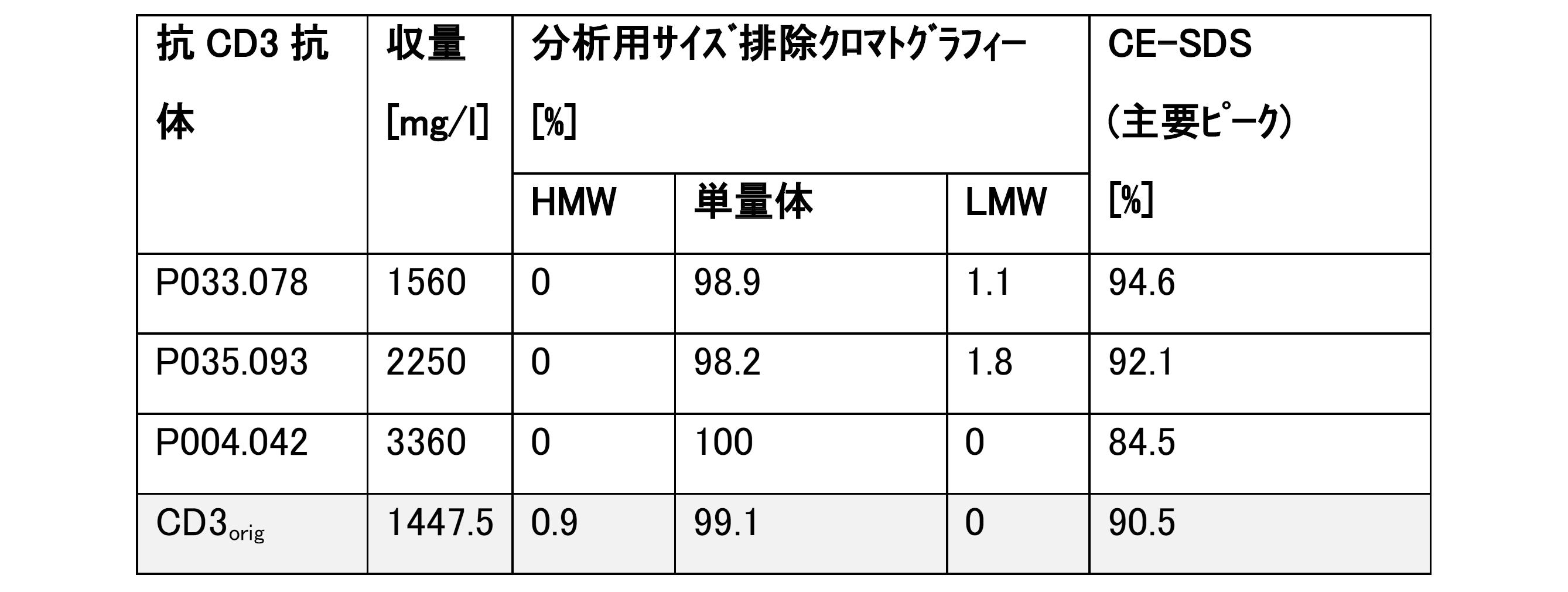
実施例8-最適化抗CD3抗体の熱安定性の測定
(実施例19で調製した)一価IgGフォーマットでの抗CD3抗体の熱安定性を、動的光散乱法(DLS)により、及び実施例2に記載の温度依存性固有タンパク質蛍光のモニタリングにより、モニターした。
Example 8 Measurement of Thermal Stability of Optimized Anti-CD3 Antibodies Thermal stability of anti-CD3 antibodies in monovalent IgG format (prepared in Example 19) was measured by dynamic light scattering (DLS) and performed. Monitored by monitoring temperature dependent intrinsic protein fluorescence as described in Example 2.
結果を表7に示す。一価IgGフォーマットでの全ての最適化CD3バインダーの凝集温度(Tagg)と観察された温度誘導アンフォールディング転移の中点(Tm)は、既述のCD3バインダーCD3origのものと同等かそれ以上である。 Table 7 shows the results. The aggregation temperatures (T agg ) and the observed temperature-induced unfolding transition midpoints (T m ) of all optimized CD3 binders in monovalent IgG format are comparable to or lower than those of the previously described CD3 binder CD3 orig . That's it.
表7.動的光散乱及び温度依存性固有タンパク質蛍光の変化により測定した、一価IgGフォーマットでの抗CD3抗体の熱安定性。
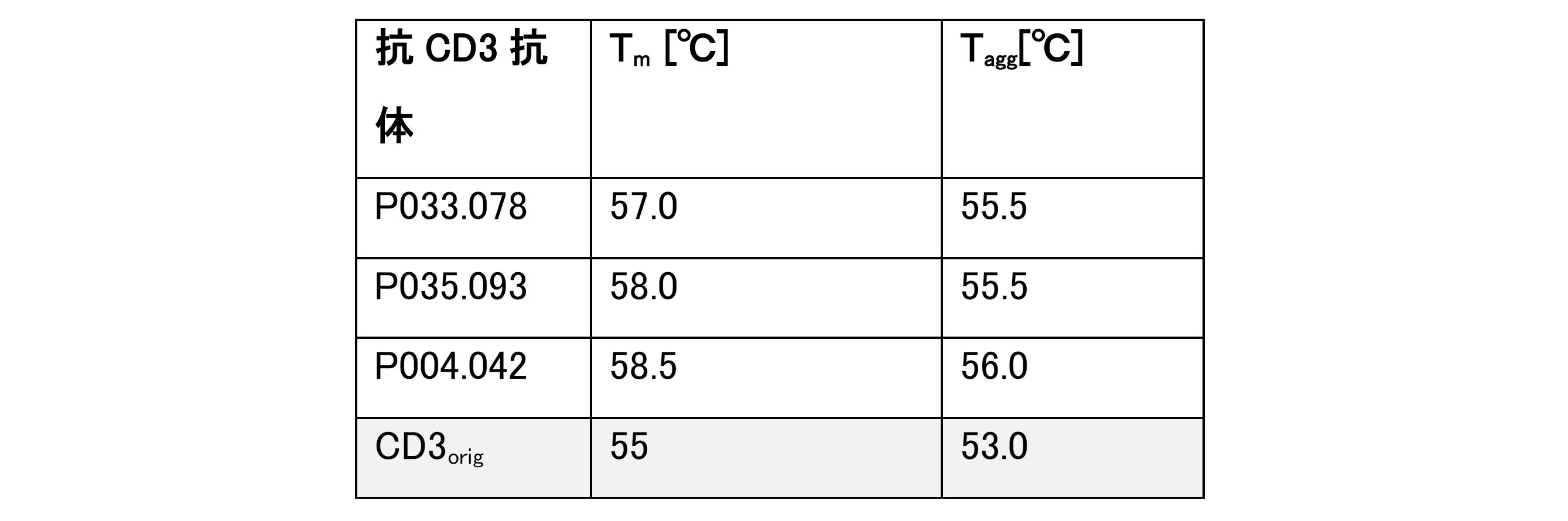
実施例9-表面プラズモン共鳴(SPR)による最適化抗CD3抗体の機能特性評価
SPR実験は、実施例7で調製した一価IgG分子を用いて、実施例3に記載のとおりに実施された。
Example 9 Functional Characterization of Optimized Anti-CD3 Antibodies by Surface Plasmon Resonance (SPR) SPR experiments were performed as described in Example 3 using the monovalent IgG molecules prepared in Example 7.
CD3との相互作用を分析するために、一価IgG分子を240秒間、50nMで、5μl/minの流量で捕捉した。ヒト及びカニクイザルCD3εストーク-Fc(ノブ)-Avi/CD3δストーク-Fc(ホール)を0.061-250nMの濃度で、30μl/minの流量で、300秒間フローセルを通過させた。解離を800秒間モニターした。 To analyze interactions with CD3, monovalent IgG molecules were captured for 240 seconds at 50 nM at a flow rate of 5 μl/min. Human and cynomolgus monkey CD3ε stalk-Fc(nob)-Avi/CD3δ stalk-Fc(hole) at concentrations of 0.061-250 nM were passed through the flow cell for 300 seconds at a flow rate of 30 μl/min. Dissociation was monitored for 800 seconds.
表8には、既述のバインダーCD3origと比較した最適化抗CD3抗体の結合に関する全ての反応速度パラメーターが列挙されている。最適化抗CD3抗体(一価IgGフォーマット)は、低nM範囲から高pM範囲のKD値でCD3ε/δに結合する(ヒトCD3ε/δ には770pMから1.36nM、カニクイザルCD3ε/δには200pMから400pMのKD値で)。CD3origと比較して、最適化抗CD3抗体のヒトCD3ε/δへの結合の親和性は、SPRによって同一条件下で測定した場合、3.5から15倍まで向上する。 Table 8 lists all kinetic parameters for binding of the optimized anti-CD3 antibodies compared to the previously described binder CD3 orig . Optimized anti-CD3 antibodies (monovalent IgG format) bind CD3ε/δ with KD values in the low to high pM range (770 pM to 1.36 nM for human CD3ε/δ and with KD values from 200 pM to 400 pM). Compared to CD3 orig , the affinity of optimized anti-CD3 antibody binding to human CD3ε/δ is enhanced by 3.5 to 15-fold when measured under identical conditions by SPR.
ヒトCD3ε/δに対する一価結合の半減期は、抗CD3抗体クローンP033.078の場合8.69分で、CD3origの結合半減期の2倍以上である。 The half-life of monovalent binding to human CD3ε/δ is 8.69 minutes for the anti-CD3 antibody clone P033.078, more than twice the binding half-life of CD3 orig .
表8.抗CD3抗体(一価IgGフォーマット)のヒトCD3ε/δ及びカニクイザルCD3ε/δに対する親和性3回の測定から得られたデータ。
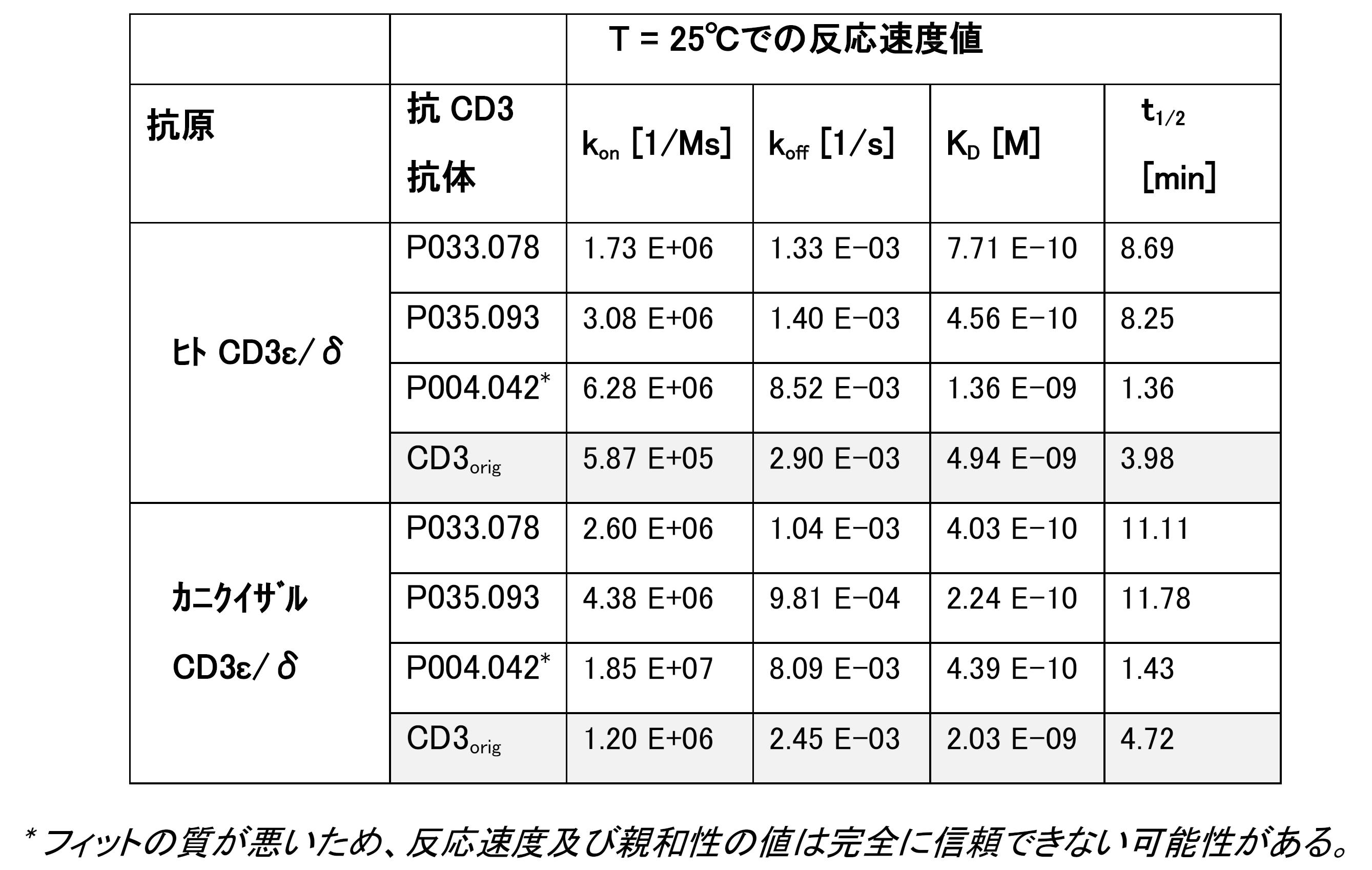
実施例10-抗イディオタイプマスクの生成
キメラIgGとしての抗イディオタイプマスクの作製と評価
ここに記載のキメラIgGは、Evitria社により、独自のベクター系と従来の(非PCRベースの)クローニング技術を使用し、懸濁適応CHO K1細胞(もともとATCCから譲り受け、Evitria社で懸濁培養液中での無血清培養に適応させたもの)を用いて調製された。作製にあたっては、Evitria社は、独自の動物成分非含有無血清培地(eviGrow及びeviMake2)と独自のトランスフェクション試薬(eviFect)を用いた。遠心分離及びその後の濾過(0.2μmフィルター)により上清を回収し、標準的な方法で精製した。
Example 10 - Generation of anti-idiotypic masks
Preparation and evaluation of anti-idiotypic masks as chimeric IgG
The chimeric IgG described here was produced by Evitria using a proprietary vector system and conventional (non-PCR-based) cloning techniques in suspension-adapted CHO K1 cells (originally a gift from the ATCC and grown in suspension culture at Evitria). (adapted to serum-free culture in ). For production, Evitria used proprietary animal component-free, serum-free media (eviGrow and eviMake2) and a proprietary transfection reagent (eviFect). Supernatants were collected by centrifugation followed by filtration (0.2 μm filter) and purified by standard methods.
抗イディオタイプマスクの特性評価-異なるCD3 mAbとの結合
SPR実験は、Biacore T200で、HBS-EP+をランニングバッファーとして(0.01M HEPES pH7.4、0.15M NaCl、0.005%Surfactant P20(BR-1006-69、GEヘルスケア))を使用して実施された。3種類の抗イディオタイプ抗体をCM5チップ(GEヘルスケア)上にアミンカップリングにより直接固定化した。異なるT細胞二重特異性(TCB)の3倍希釈系列を、30μl/minで180秒間リガンド上を通過させ、結合相を記録した。解離相を、600秒間モニターし、試料溶液からHBS-EP+へと切り替えることによってトリガーした。チップ表面は、10mMグリシンpH2.1の60秒の注入を1回、続いて30秒の注入を2回行うことにより、各サイクル後に再生された。バルク屈折率差を、参照フローセル1で得られた応答を差し引くことによって補正した。親和定数を、Biaevalソフトウェア(GEヘルスケア)を使用して、1:1ラングミュア結合へのフィッティングによって反応速度定数から導出した。測定は、1つの希釈系列で行われた。
Characterization of anti-idiotypic masks - binding SPR experiments with different CD3 mAbs were performed on a Biacore T200 with HBS-EP+ as running buffer (0.01 M HEPES pH 7.4, 0.15 M NaCl, 0.005% Surfactant P20). BR-1006-69, GE Healthcare)). Three anti-idiotypic antibodies were directly immobilized on a CM5 chip (GE Healthcare) by amine coupling. A 3-fold dilution series of different T cell bispecifics (TCB) was passed over the ligand at 30 μl/min for 180 sec and the binding phase recorded. The dissociation phase was monitored for 600 seconds and triggered by switching from the sample solution to HBS-EP+. The chip surface was regenerated after each cycle with one 60 second injection of 10 mM glycine pH 2.1 followed by two 30 second injections. Bulk refractive index differences were corrected by subtracting the response obtained with
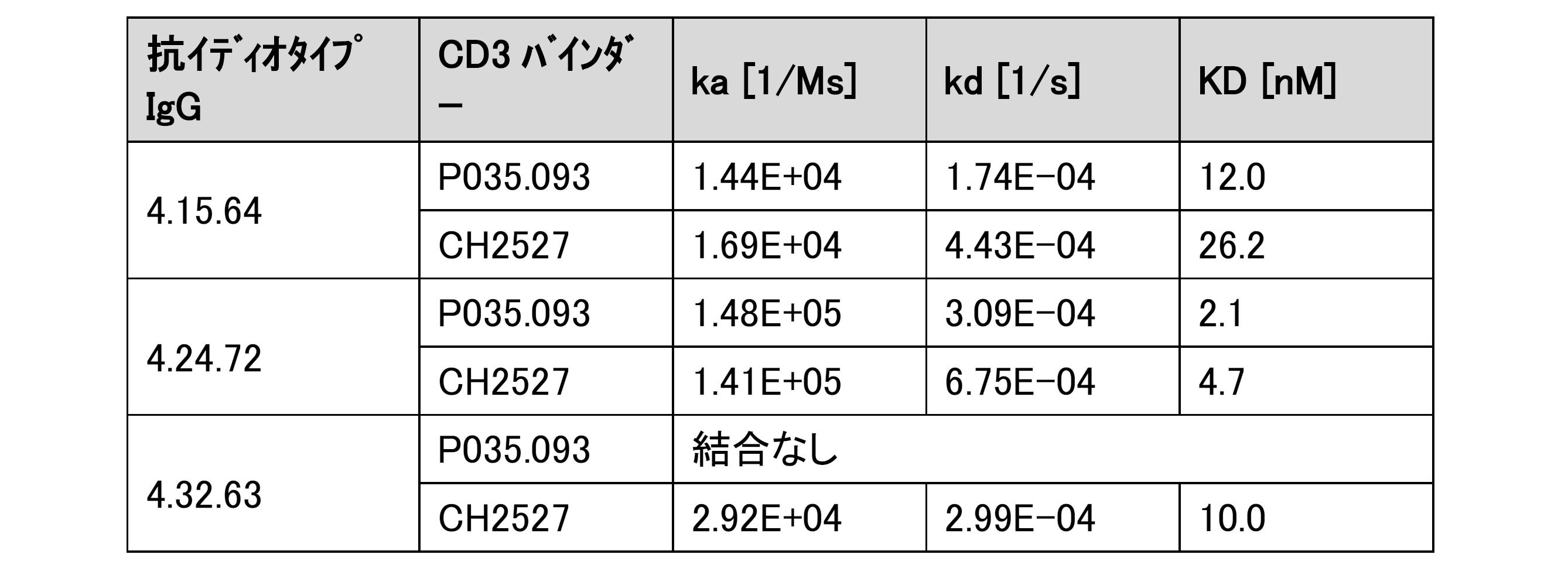
抗イディオタイプマスクの特性評価-開発可能性
抗イディオタイプマスクの1つ(4.15.64)はCDRL1(NYS)のN-グリコシル化部位を示すため、この分子はそれ以上考慮されず、4.24.72と4.32.63マスクのみが異なるCD3バインダーのブロッキングに使用可能であることから更に評価された。
Characterization of anti-idiotypic masks - development potential One of the anti-idiotypic masks (4.15.64) shows the N-glycosylation site of CDRL1 (NYS), so this molecule was not considered further and 4 The .24.72 and 4.32.63 masks were further evaluated since only the .24.72 and 4.32.63 masks can be used to block different CD3 binders.
20mM His/HCl、140mM NaCl pH6.0、40℃又は1xPBS pH7.4、37℃のいずれかで14日間インキュベートした後の抗イディオタイプ抗体4.32.63及び4.24.72の結合を、T200装置(GEヘルスケア)を用いて表面プラズモン共鳴で調べた。端的に言うと、単量体FolR1-Fc(フローセル2)と抗PGLALA抗体(フローセル4)を、標準的なアミンカップリング化学を用いてシリーズSセンサーチップCM5(CEヘルスケア)上に固定化し、10000レゾナンスユニット(RU)を超える表面密度を得た。フローセル1及び3は、モックコントロールとして使用した。CD3-CH2527結合ドメインを含むFolR1 TCB-D-16D5をFolR1-Fc表面のみに10μg/mlの濃度で5μl/minの流量で120秒間注入し、1000RUを超える表面密度を得た。その後、抗イディオタイプ抗体を全てのフローセルに濃度1μg/mlで60秒間及び120秒間、流量5μl/minで注入した解離を60秒間モニターした。FolR1-Fc表面は10mMグリシンpH1.7を60秒間注入することによって再生され、抗PGLALA表面は10mM NaOHを60秒間注入することによって再生された。バルク屈折率の差異は、フローセル1及び3(モック表面)から得られた応答を差し引くことにより修正された。
The binding of anti-idiotypic antibodies 4.32.63 and 4.24.72 after 14 days of incubation in either 20 mM His/HCl, 140 mM NaCl pH 6.0 at 40°C or 1x PBS pH 7.4 at 37°C was Surface plasmon resonance was investigated using a T200 instrument (GE Healthcare). Briefly, monomeric FolR1-Fc (flow cell 2) and anti-PGLALA antibody (flow cell 4) were immobilized onto a series S sensor chip CM5 (CE Healthcare) using standard amine coupling chemistry, Surface densities in excess of 10000 resonance units (RU) were obtained.
抗イディオタイプ抗体の結合シグナルを正規化するために、FOLR1 TCB-D-16D5表面の結合応答を抗PGLALA表面の結合応答で割った。相対活性濃度は、各分子について、ストレスをかけた試料の正規化応答をストレスをかけていない参照試料の正規化応答で割ることによって得られた。 To normalize the binding signal of the anti-idiotype antibody, the binding response of the FOLR1 TCB-D-16D5 surface was divided by the binding response of the anti-PGLALA surface. Relative activity concentrations were obtained for each molecule by dividing the normalized response of the stressed sample by the normalized response of the unstressed reference sample.

4.32.63マスクでは40℃、pH6.0で14日間インキュベートした後、相対活性濃度の著しい低下(残存する標的結合73%)が観察されたが、4.24.72はこの条件で残存する標的結合活性96%と安定であった。 A significant decrease in relative activity concentration (73% target binding remaining) was observed for the 4.32.63 mask after 14 days of incubation at 40° C., pH 6.0, whereas 4.24.72 remained at this condition. It was stable with a target binding activity of 96%.
実施例11-CD3バインダーP035.093に対する抗イディオタイプクローンのスクリーニング
抗イディオタイプ(抗ID)クロ―ン(4.24.72、4.32.63、4.21及び4.15.64)のCD3バインダーに対する結合及びブロッキング能を、TYRP1 TCB(異なるCD3バインダー)を用いたJurkat NFAT活性化アッセイで試験した。抗ID IgGのブロッキングは、ブロックされたCD3バインダーの結果としてのJurkat NFAT活性化の減少に見ることができる(図10)。
Example 11 - Screening of anti-idiotypic clones against CD3 binder P035.093 Binding and blocking ability to CD3 binders was tested in the Jurkat NFAT activation assay using TYRP1 TCB (different CD3 binders). Blocking of anti-ID IgG can be seen in the reduction of Jurkat NFAT activation as a result of blocked CD3 binders (Figure 10).
TYRP1標的化T細胞二重特異性抗体(TCB)は、標的細胞上のTYRP1とT細胞(Jurkat NFAT)上のCD3イプシロンに同時に結合し、それによりT細胞の活性化を誘導する。Jurkat NFAT細胞はCD3イプシロン(CD3ε)を介した活性化によりルシフェラーゼを発現するため、T細胞の活性化は発光と相関する。Jurkat-NFATレポーター細胞株(Promega)は、NFATプロモーターを持ち、ヒトCD3εを発現するヒト急性リンパ性白血病レポーター細胞株である。TCBが腫瘍標的に結合し、CD3(架橋)がCD3εに結合する場合、ルシフェラーゼ発現は、One-Glo基質(Promega)の添加後にLuminescenceで測定することができる。 A TYRP1-targeting T cell bispecific antibody (TCB) simultaneously binds TYRP1 on target cells and CD3 epsilon on T cells (Jurkat NFAT), thereby inducing T cell activation. Since Jurkat NFAT cells express luciferase upon CD3 epsilon (CD3ε)-mediated activation, T cell activation correlates with luminescence. The Jurkat-NFAT reporter cell line (Promega) is a human acute lymphoblastic leukemia reporter cell line with an NFAT promoter and expressing human CD3ε. If TCB binds to tumor targets and CD3 (crosslinking) binds to CD3ε, luciferase expression can be measured by Luminescence after addition of One-Glo substrate (Promega).
Jurkat NFATアッセイ培地:RPMI1640、2g/lグルコース、2g/l NaHCO3、10% FCS、25mM HEPES、2mM L-グルタミン、1xNEAA、1xピルビン酸ナトリウム
Jurkat NFAT培養培地:RPMI1640、2g/lグルコース、2g/l NaHCO3、10%FCS、25mM HEPES、2mM L-グルタミン、1xNEAA、1xピルビン酸ナトリウム;新たにハイグロマイシンB200μg/mlを添加したもの。
Jurkat NFAT assay medium: RPMI1640, 2 g/l glucose, 2 g/l NaHCO3, 10% FCS, 25 mM HEPES, 2 mM L-glutamine, 1x NEAA, 1x sodium pyruvate Jurkat NFAT culture medium: RPMI1640, 2 g/l glucose, 2 g/l NaHCO3, 10% FCS, 25 mM HEPES, 2 mM L-glutamine, 1x NEAA, 1x sodium pyruvate; freshly supplemented with
TYRP1陽性標的細胞(CHO-huTYRP1 cl 76)及びエフェクター細胞(Jurkat NFAT)を回収し、カウントして生存率を確認した。TCBをJurkatアッセイ培地で希釈した(最終濃度:前のアッセイで決定したEC90濃度、50μl/ウェル)。TCB、標的細胞(50μl/ウェルで20.000/ウェル)、及び、cAMP(最終体積2%)を含むJurkat NFATエフェクター細胞(50μl/ウェルで50.000細胞/ウェル)を混合し、96ウェルのホワイトウォール平底プレート(Greiner BioOne)に加えた。したがって、E:T比は2.5:1であった。抗イディオタイプIgGをJurkatアッセイ培地で希釈してから希釈列を調製し、1ウェルあたり50μlを添加した。細胞は、加湿インキュベーター内で37℃、22時間インキュベートした後、インキュベーターから約10分間取り出し、室温に適応させてから、Tecan Sparkで0.5秒/ウェルを検出時間としてLuminescenceを読み取った。TYRP1 TCB(異なるCD3バインダー)はJurkat NFAT活性化を誘導するが、非標的TCB(CD3 CH2527)はそうではない(図10A)。抗ID IgGがCD3バインダーに結合すると、CD3クローン22とCD3 P033.005以外のここで使用した全てのCD3バインダーをブロックする抗ID 4.24.72IgGについて示されたように、活性化をブロックできる(図3B)。抗ID4.32.63IgGは、CD3バインダーCH2527のみをブロックする(図10C)。抗ID4.15.64IgGは、CD3クローン22を除き、ここで使用した全てのCD3バインダーをブロックする(図10D)。抗ID4.21.64IgGは、CD3クローン22を除き、ここで使用した全てのCD3バインダーをブロックするが、最も強いブロッキングはCD3 CH2527で観察された(図10E)。全体として、抗ID4.24.72がこのアッセイ設定で最高のブロッキング能力を示しため、CD3 P035.093を用いてpro-TCBフォーマットに変換した。
TYRP1-positive target cells (CHO-huTYRP1 cl 76) and effector cells (Jurkat NFAT) were harvested and counted to confirm viability. TCB was diluted in Jurkat assay medium (final concentration: EC90 concentration determined in previous assay, 50 μl/well). TCB, target cells (20.000/well in 50 μl/well) and Jurkat NFAT effector cells (50.000 cells/well in 50 μl/well) containing cAMP (2% final volume) were mixed and plated in 96 wells. It was added to a whitewall flat bottom plate (Greiner BioOne). The E:T ratio was therefore 2.5:1. Anti-idiotypic IgG was diluted in Jurkat assay medium to prepare a dilution series and 50 μl was added per well. Cells were incubated for 22 hours at 37° C. in a humidified incubator, then removed from the incubator for approximately 10 minutes, allowed to adapt to room temperature, and then read for Luminescence on a Tecan Spark with a detection time of 0.5 sec/well. TYRP1 TCB (a different CD3 binder), but not a non-targeted TCB (CD3 CH2527), induces Jurkat NFAT activation (Fig. 10A). Anti-ID IgG binding to CD3 binders can block activation as shown for anti-ID 4.24.72 IgG which blocks all CD3 binders used here except
実施例12-FOLR1 pro-TCBフォーマットでの抗ID4.24.72のマスキング効率
FOLR1 proTCBと様々なCD3バインダーとの比較
抗イディオタイプマスク4.24.72と異なるCD3結合体のマスキングを比較するために、FOLR1 proTCBとそれぞれのFOLR1 TCB分子を作製した。proTCB分子は、マスクとCD3 Fabとの間に非切断性のGSリンカー、又はMMP2/9とマトリプターゼによって切断可能リンカー配列を含んでいた。
Example 12 - Masking efficiency of anti-ID 4.24.72 in FOLR1 pro-TCB format
Comparison of FOLR1 proTCB with various CD3 binders
To compare the masking of different CD3 conjugates with the anti-idiotypic mask 4.24.72, FOLR1 proTCB and the respective FOLR1 TCB molecules were generated. The proTCB molecules contained either a non-cleavable GS linker between the mask and the CD3 Fab, or a linker sequence cleavable by MMP2/9 and matriptase.
全ての分子は十分な量と良好な品質で生成された。予想通り、proTCB分子は親TCBと比較して、通常、低い収率を示した。 All molecules were produced in sufficient quantity and good quality. As expected, the proTCB molecules usually showed lower yields compared to the parent TCB.
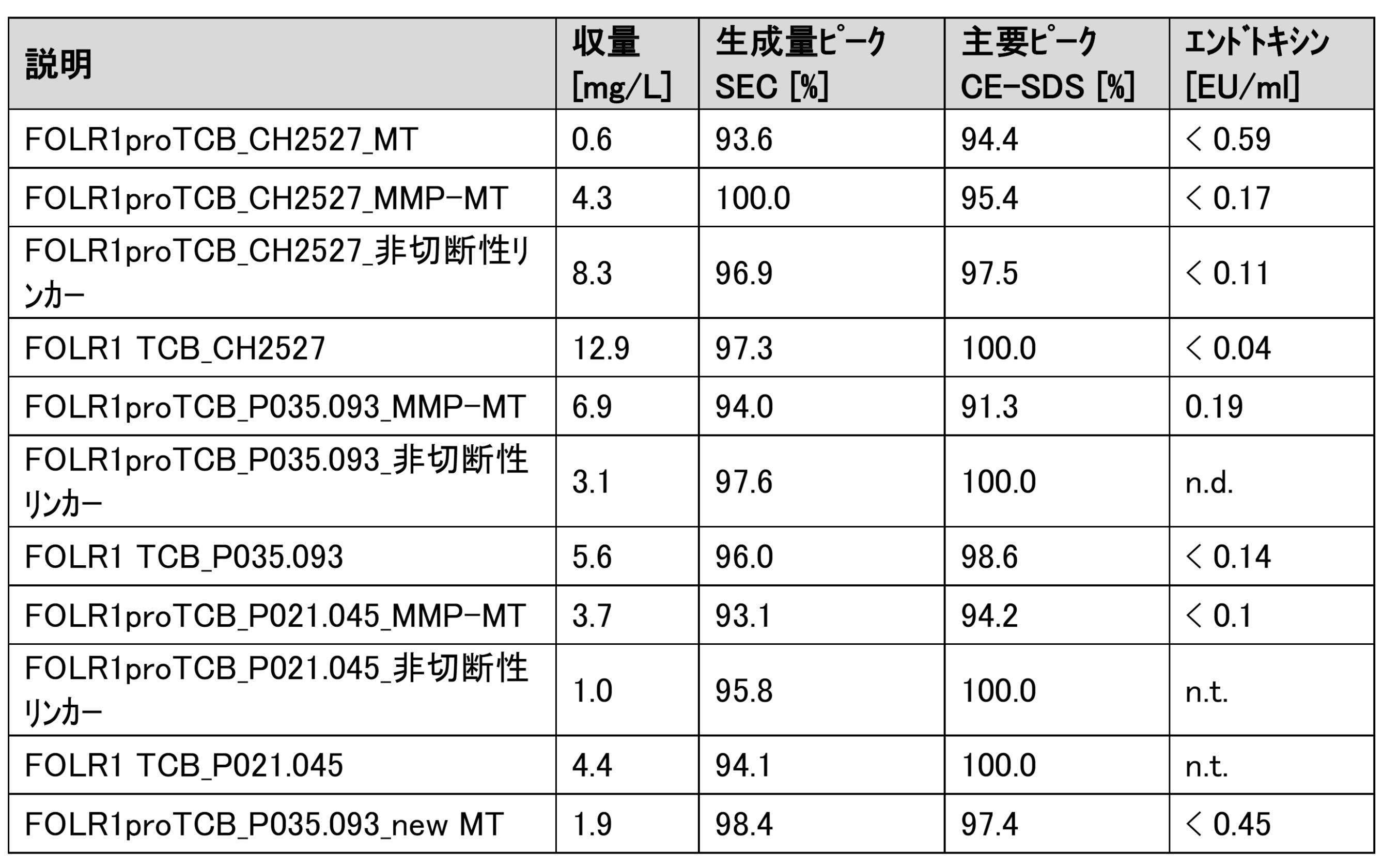
FOLR1 TCBとFOLR1 pro-TCBをJurkat NFAT活性化アッセイで試験し、抗IDマスク4.24.72がpro-TCBフォーマットのCD3バインダー(CD3バインダーにN末端で融合した抗IDジスルフィド安定化scFv)をブロックするかどうかを確かめた。Jurkat NFATアッセイは、標的細胞の代わりに、huFOLR1でコートしたビーズを使用して実施した。2x30μl Streptavidin Dynabeadsをそれぞれ5mlDPBSで希釈した。ビーズを400rcfで4分間遠心分離し、上清を吸引した。ビーズを、1ml中20μgのビオチン化FolR1抗原で4℃で1時間、ゆっくりと回転させてコーティングした。インキュベーション後、ビーズ-agコンジュゲートをそれぞれ5mlのDPBSで洗浄し、4mlのアッセイ培地に再懸濁させた。エフェクター細胞(Jurkat NFAT)を回収し、カウントし、生存率を確認した。TCBをJurkatアッセイ培地で希釈した。TCB(10μl/ウェル)、コーティングされたビーズ(10μl/ウェル)、及び、cAMP(最終体積2%)を含むJurkat NFATエフェクター細胞(20μl/ウェル中に20.000細胞/ウェル)を混合して、384ウェルホワイトウォール平底プレート(ファルコン/コーニング社)に添加した。プレートは、加湿インキュベーター内で37℃、5-6時間インキュベートした後、インキュベーターから取り出し、Tecan Sparkで0.5秒/ウェルを検出時間としてLuminescenceを読み取った。 FOLR1 TCB and FOLR1 pro-TCB were tested in the Jurkat NFAT activation assay, anti-ID mask 4.24.72 was shown to be a CD3 binder (anti-ID disulfide-stabilized scFv N-terminally fused to CD3 binder) in pro-TCB format. Checked to see if it was blocked. The Jurkat NFAT assay was performed using huFOLR1-coated beads instead of target cells. 2x30 μl Streptavidin Dynabeads were each diluted in 5 ml DPBS. The beads were centrifuged at 400 rcf for 4 minutes and the supernatant was aspirated. The beads were coated with 20 μg biotinylated FolR1 antigen in 1 ml for 1 hour at 4° C. with gentle rotation. After incubation, the bead-ag conjugates were each washed with 5 ml DPBS and resuspended in 4 ml assay medium. Effector cells (Jurkat NFAT) were harvested, counted and checked for viability. TCB was diluted in Jurkat assay medium. Mix TCB (10 μl/well), coated beads (10 μl/well) and Jurkat NFAT effector cells (20.000 cells/well in 20 μl/well) containing cAMP (2% final volume) Additions were made to 384 well white wall flat bottom plates (Falcon/Corning). Plates were incubated for 5-6 hours at 37° C. in a humidified incubator, then removed from the incubator and read for Luminescence on a Tecan Spark with a detection time of 0.5 sec/well.
抗IDマスク4.24.72を持つFOLR1 pro-TCBは、表示の濃度範囲でJurkat NFAT活性化を媒介しないが、FOLR1 TCBは用量依存的にJurkat NFAT活性化を媒介する(図11A)。これは、抗ID4.24.72もブロックに関してはpro-TCBフォーマットで機能するということである。 FOLR1 pro-TCB with anti-ID mask 4.24.72 does not mediate Jurkat NFAT activation in the indicated concentration range, whereas FOLR1 TCB mediates Jurkat NFAT activation in a dose-dependent manner (FIG. 11A). This means that anti-ID 4.24.72 also works in pro-TCB format for blocking.
次の工程は、死滅におけるマスキング効率(Jurkat NFATよりも高感度)とリンカー切断時のマスクの解除を調べるために、切断可能リンカーを持つFOLR1 pro-TCBを試験することであった。FOLR1(pro-)TCBによって媒介されるT細胞死滅は、HeLa(FolR1+++)細胞を用いて評価された。E:T比10:1で、ヒトPBMCを標的細胞をエフェクター細胞として使用した。ヒト末梢血単核球(PBMC)を健常なヒトドナーから得たバフィーコートから単離した。バフィーコートを、滅菌PBSで1:1に希釈し、Histopaque勾配(Sigma、#H8889)の上部に層状に重ねた。遠心分離(450xg,、30分、ブレーキなし、室温)後、50mlのPBSで満たしたファルコンチューブにPBMC含有界面を移した。この混合物を遠心分離(400xg、10分間、室温)し、上清を棄て、PBMCペレットを赤血球溶解用のACKバッファー2mlに再懸濁させた。37℃で約2-3分間インキュベートした後、3℃で約2-3分間インキュベートし、350xgで10分間遠心分離した。この洗浄工程を1回繰り返してから、10%FCS、1X GlutaMaxと10%DMSOとを含むRPMI1640培地にPBMCを再懸濁させた。PBMCをCoolCell(登録商標)Cell Freezing Containers(BioCision)で-80℃にてゆっくりと凍結させ、その後液体質素に移した。アッセイ開始の1日前に、接着標的細胞をトリプシン/EDTAで回収し、カウントして生存率を確認した後、アッセイ培地(RPMI1640、2%FCS、1X GlutaMax)に再懸濁させた。アッセイ開始の約24時間前に、PBMCを(Adavnced RPMI1640培地(+2%FCS、1X GlutaMax)で融解した。PBMCを350gで7分間遠心分離し、新鮮な培地(Adavnced RPMI1640、2%FCS、1X GlutaMax)に再懸濁させた。PBMCは最大24時間保存してからアッセイに使用した。96ウェル平底プレートを用いて、標的細胞を20000細胞/ウェルの密度でプレーティングした。分子をアッセイ培地(RPMI1640、2%FCS、1X GlutaMax)で希釈し、3連で表示濃度で添加した。プレートを、加湿インキュベーター内で約20時間、37℃でインキュベートした。PBMCを回収し、350gで7分間遠心分離した後、アッセイ培地(RPMI1640、2%FCS、1X GlutaMax)に再懸濁させた。100μl/ウェルの0.2mioのPBMC(E:T 10:1、播種した標的細胞の数に基づく)を添加し、プレートを48時間37℃でインキュベートした。標的細胞の死滅を、37℃、5%CO2での48時間のインキュベーションの後に、アポトーシス/壊死細胞によって細胞上清中に放出されたLDHの定量化(LDH検出キット、Roche Applied Science、#11644793001)により評価した。標準応答は、TCBなしでエフェクター細胞と共培養された標的細胞を指す。
The next step was to test FOLR1 pro-TCB with cleavable linkers to examine the masking efficiency in killing (more sensitive than Jurkat NFAT) and unmasking upon linker cleavage. T cell killing mediated by FOLR1 (pro-) TCB was assessed using HeLa (FolR1+++) cells. Human PBMCs were used as target and effector cells at an E:T ratio of 10:1. Human peripheral blood mononuclear cells (PBMC) were isolated from buffy coats obtained from healthy human donors. The buffy coat was diluted 1:1 with sterile PBS and layered on top of a Histopaque gradient (Sigma, #H8889). After centrifugation (450×g, 30 min, no brake, room temperature), the PBMC-containing interface was transferred to a Falcon tube filled with 50 ml PBS. The mixture was centrifuged (400×g, 10 min, room temperature), the supernatant was discarded, and the PBMC pellet was resuspended in 2 ml ACK buffer for erythrocyte lysis. After incubation at 37° C. for about 2-3 minutes, incubation at 3° C. for about 2-3 minutes and centrifugation at 350×g for 10 minutes. This washing step was repeated once before resuspending the PBMCs in RPMI 1640 medium containing 10% FCS, 1X GlutaMax and 10% DMSO. PBMCs were slowly frozen at −80° C. in CoolCell® Cell Freezing Containers (BioCision) and then transferred to liquid crystals. One day before starting the assay, adherent target cells were harvested with trypsin/EDTA, counted to determine viability, and resuspended in assay medium (
FOLR1 TCBは用量依存的にHeLa細胞の死滅を誘導し、EC50値は約0.29pMであった。活性化されたpro-TCB(リンカー切断のために組換えマトリプターゼとプレインキュべートしたもの)の効力はFOLR1 TCBと同程度であった。非切断性リンカーを含むpro-TCBは、標的細胞死滅の減少を媒介した(EC50は約239倍に増加)(図11C)。標的細胞の死滅に加えて、T細胞の活性化は、37℃、5%CO2で48時間のインキュベーションの後にCD8陽性T細胞上のCD69を定量化することにより評価した。CD8陽性T細胞におけるCD69のMFIについては、FOLR1 TCB及び予備活性化されたFOR1 pro-TCBの効力は同等であり、マスクされたpro-TCB(非切断性)ではCD8 T細胞の活性化は検出できない。CD69陽性CD8 T細胞の割合については、マスクされたpro-TCBは、>5nMでCD69陽性CD8 T細胞の増加を示し、ここで用いた最高濃度では約30%まで増加した。抗ID4.24.72のマスキング効率を、FOLR1発現量レベルを有する異なる細胞株と比較した。
FOLR1 TCB dose-dependently induced killing of HeLa cells with an EC50 value of approximately 0.29 pM. The potency of activated pro-TCB (pre-incubated with recombinant matriptase for linker cleavage) was comparable to FOLR1 TCB. A pro-TCB containing a non-cleavable linker mediated a decrease in target cell killing (EC50 increased approximately 239-fold) (FIG. 11C). In addition to target cell killing, T cell activation was assessed by quantifying CD69 on CD8 positive T cells after 48 hours of incubation at 37° C., 5
CD3 P035.093を用いたpro-TCBフォーマットでの抗ID4.24.72のマスキング効率を分析するために、huPBMCを48時間インキュベートした後に用量依存性の標的細胞死滅(FOLR1高発現のHela、FOLR1中発現のOvcar-3及びSkov-3、FOLR1低発現のHT-29)を測定した。TCB及びFOLR1陽性標的細胞(E:T=10:1、エフェクターはヒトPBMC)。FOLR1 TCBは全ての細胞株(Hela、Skov-3、Ovcar-3、HT-29)で用量依存的な標的細胞死滅を誘導するが、マスクされたFOLR1 pro-TCBは標的細胞死滅の減少を示す(図12Aと12B)。マスキング効率はFOLR1発現レベルに依存するようである。FOLR1 pro-TCB(非切断性)によって誘導される標的細胞死滅は、FOLR1発現レベルの低い細胞で最も減少するようである。CD3バインダーCH2527を含むFOLR1 TCBと、CD3バインダーP035.93を含むFOLR1 TCBとの比較は、CD3 P035.093を含むTCBの効力がわずかに高いことを示す(図12B)。抗ID 4.24.72で両方のCD3バインダーのマスキングが可能である。 To analyze the masking efficiency of anti-ID 4.24.72 in pro-TCB format with CD3 P035.093, huPBMCs were incubated for 48 h followed by dose-dependent target cell killing (Hela with high FOLR1 expression, FOLR1 Intermediately expressing Ovcar-3 and Skov-3, and FOLR1 low expressing HT-29) were measured. TCB and FOLR1 positive target cells (E:T=10:1, effector is human PBMC). FOLR1 TCB induces dose-dependent target cell killing in all cell lines (Hela, Skov-3, Ovcar-3, HT-29), whereas masked FOLR1 pro-TCB shows reduced target cell killing (Figures 12A and 12B). Masking efficiency appears to be dependent on FOLR1 expression levels. Target cell killing induced by FOLR1 pro-TCB (non-cleavable) appears to be most reduced in cells with low levels of FOLR1 expression. A comparison of FOLR1 TCB with CD3 binder CH2527 to FOLR1 TCB with CD3 binder P035.93 shows that TCB with CD3 P035.093 is slightly more potent (FIG. 12B). Masking of both CD3 binders is possible with anti-ID 4.24.72.
実施例13-マスク4.24.72のヒト化
実施例12に示すように、FOLR1 proTCBは、Jurkat NFAT T細胞活性化アッセイで示すように、マスク4.24.72で効率的にブロックされた。リンカー切断後、このproTCB分子は、標的細胞死滅アッセイにおいて完全に活性であった。したがって、このマスクは様々なCD3バインダーで使用できるため、この抗イディオタイプ抗体をヒト化のために選択した。10の可変重鎖と8の可変軽鎖が設計され、単量体のワンアームIgGとして製造された(図13)。分子のヘテロ二量化は、ノブ・イントゥ・ホール技術を適用することで可能となった。ワンアームIgGはExpi293F細胞で2mlの小スケールで一過性に生産された(トランスフェクションは製造元の推奨に従って実施された)。CD3 IgG(P035.093)への初期結合及びJurkat NFATレポーターアッセイ(後述)におけるT細胞活性化のブロッキングを、ワンアーム分子を含む生成上清を使用して直接評価した。
Example 13 - Humanization of Mask 4.24.72 As shown in Example 12, FOLR1 proTCB was efficiently blocked with Mask 4.24.72 as shown in the Jurkat NFAT T cell activation assay. . After linker cleavage, this proTCB molecule was fully active in the target cell killing assay. Therefore, this anti-idiotypic antibody was selected for humanization because this mask can be used with different CD3 binders. Ten variable heavy chains and eight variable light chains were designed and manufactured as a monomeric one-arm IgG (Figure 13). Molecular heterodimerization was made possible by applying the knob-in-to-hole technique. One-arm IgG was transiently produced in Expi293F cells at a small scale of 2 ml (transfection was performed according to manufacturer's recommendations). Initial binding to CD3 IgG (P035.093) and blocking of T cell activation in the Jurkat NFAT reporter assay (described below) were directly assessed using the resulting supernatant containing the one-arm molecules.
ヒト化バリアントのCD3 P035.093のブロッキングについてのスクリーニング-Jukat NFAT活性化アッセイ
前述のJurkat NFATアッセイを用いて、ヒト化バリアント(IgGフォーマット)を、CD3バインダーP035.093(及びCH2527)のブロッキング能力についてスクリーニングした。TCBをEC90濃度(既述のアッセイで決定)で使用し、抗ID IgGは滴定した。親の4.24.72IgGはコントロールとして使用した。親の4.24.72は、CD3 CH2527及びP035.09をブロックした。ヒト化バリアントもCD3 CH2527とP035.093をブロックするが、CD3 CH2527と比較してP035.093をわずかに良好にブロックするようである(図14)。まとめると、これらは全てCD3 P035.093をマスキングしている。親クローンと比較するために、これらの結果に基づいて6つのバリアントを選択し、上記のようにIgG及びproTCBとして(proTCB形式の場合は非切断性リンカーを用いて)製造・精製した。
Screening of Humanized Variants for Blocking of CD3 P035.093 - Jukat NFAT Activation Assay Humanized variants (IgG format) were screened for their ability to block the CD3 binder P035.093 (and CH2527) using the Jukat NFAT assay described above. Screened. TCB was used at an EC90 concentration (determined in assays previously described) and anti-ID IgG was titrated. Parental 4.24.72 IgG was used as a control. Parental 4.24.72 blocked CD3 CH2527 and P035.09. The humanized variant also blocks CD3 CH2527 and P035.093, but appears to block P035.093 slightly better than CD3 CH2527 (Figure 14). Taken together, they all mask CD3 P035.093. Based on these results, 6 variants were selected for comparison with the parental clones and produced and purified as IgG and proTCB (using non-cleavable linkers in the proTCB format) as described above.
開発可能性 抗CD3 P035.093 4.24.72抗イディオタイプ抗体及び対応するヒト化バリアント
マスク4.24.72のヒト化バリアントは、分子の不安定性を引き起こす可能性のある配列のホットスポットを含んでいる。そこで、14日間のストレス条件下(40℃、pH6.0又は37℃、pH7.4)後の熱安定性及び残存する標的結合を分析した。
Development Potential The anti-CD3 P035.093 4.24.72 anti-idiotypic antibody and the corresponding humanized variant mask the humanized variant of 4.24.72 to eliminate sequence hotspots that can cause molecular instability. contains. Therefore, thermostability and residual target binding after 14 days of stress conditions (40° C., pH 6.0 or 37° C., pH 7.4) were analyzed.
20mM His/HCl、140mM NaCl pH6.0、40℃又は1xPBS pH7.4、37℃のいずれかで14日間インキュベートした後の抗イディオタイプ抗体4.24.7並びにそのヒト化バリアントH1L1 H1L2、H2L2、H3L2、H3L3及びH7L5の結合を、T200装置(GEヘルスケア)を用いて表面プラズモン共鳴で調べた。端的に言うと、Biotin CAPture Kit(GEヘルスケア)を使用して製造元の説明書に従い、ビオチン化抗ヒトCD3 IgG(抗CD3 P035.093)とビオチン化抗ヒトIgG(ThermoScientific)をシリーズs CAPチップ上に固定化した。抗体を、フローセル2及び3にそれぞれ5μg/mlを5μl/minの流量で120秒間注入することにより固定化し、1000レゾナンスユニット(RU)を上回る表面密度を得た。フローセル1は、モック表面として保持した。その後、抗イディオタイプ抗体を全てのフローセルに濃度1μg/mlで30秒間注入した。解離を30秒間モニターし、流量を5μl/minに設定した。ビオチンキャプチャーキットに含まれるNaOHと塩酸グアニジ二ウム(Guadinium)の混合物を120秒間注入することによってCAPチップを再生させた。バルク屈折率の差異は、フローセル1(モック表面)から得られた応答を差し引くことにより修正された。
anti-idiotypic antibody 4.24.7 and its humanized variants H1L1 H1L2, H2L2 after 14 days of incubation in either 20 mM His/HCl, 140 mM NaCl pH 6.0 at 40° C. or 1×PBS pH 7.4 at 37° C.; Binding of H3L2, H3L3 and H7L5 was investigated by surface plasmon resonance using a T200 instrument (GE Healthcare). Briefly, biotinylated anti-human CD3 IgG (anti-CD3 P035.093) and biotinylated anti-human IgG (ThermoScientific) were added to series CAP chips according to the manufacturer's instructions using the Biotin CAPture Kit (GE Healthcare). immobilized on top. Antibodies were immobilized by injecting 5 μg/ml each into
抗イディオタイプ抗体の結合シグナルを正規化するために、抗ヒトIgG表面の結合応答を抗ヒトCD3 IgG表面の結合応答で割った。相対活性濃度は、各分子について、ストレスをかけた試料の正規化応答をストレスをかけていない参照試料の正規化応答で割ることによって得られた。 To normalize the binding signal of the anti-idiotype antibody, the binding response of the anti-human IgG surface was divided by the binding response of the anti-human CD3 IgG surface. Relative activity concentrations were obtained for each molecule by dividing the normalized response of the stressed sample by the normalized response of the unstressed reference sample.
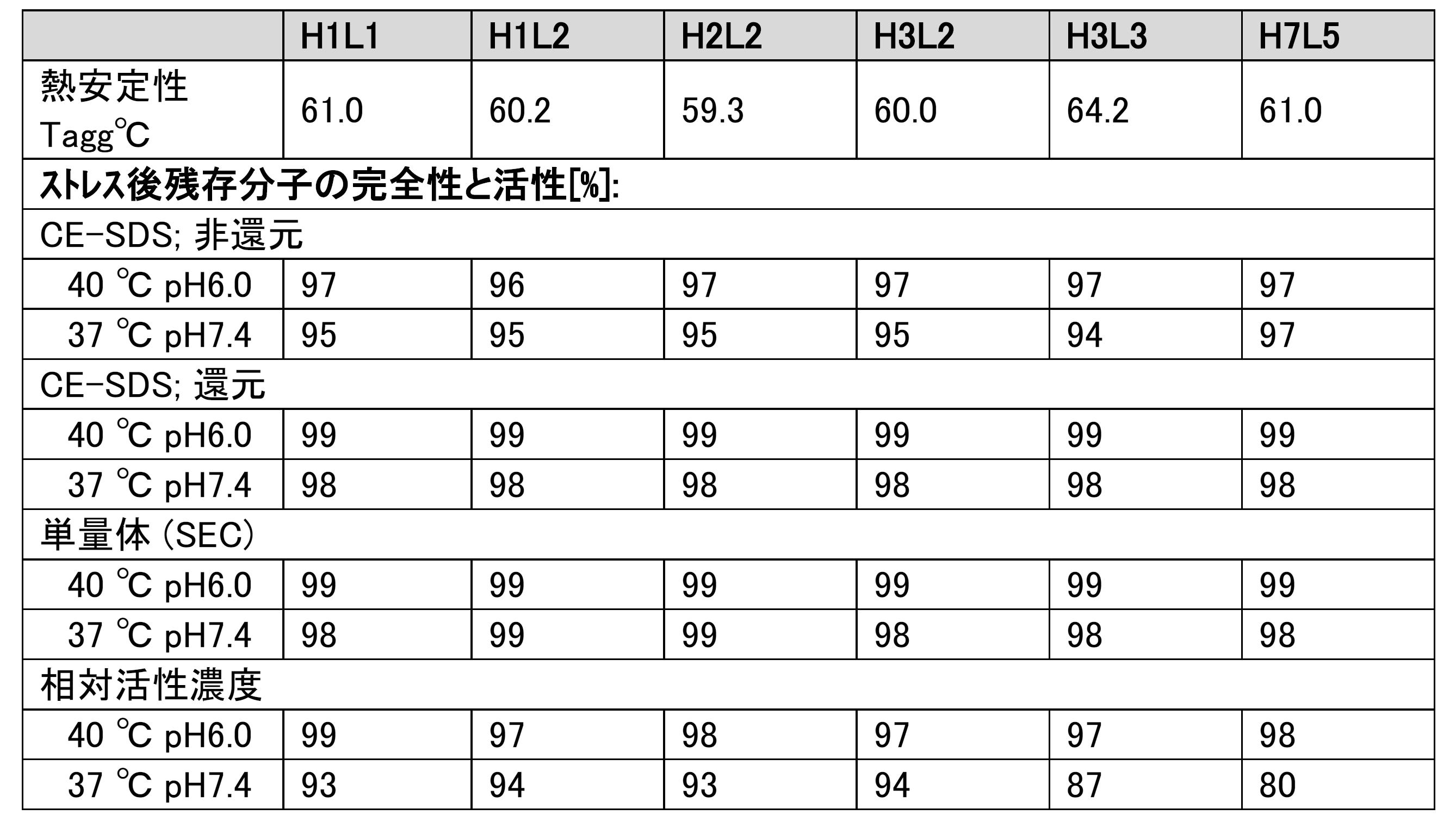
SPRを用いた、抗イディオタイプ抗体の抗CD3 P035-093に対する結合反応速度
ヒト化バリアントH1L1、4.24.72 H1L2、H2L2、及び4.24.72 H3L2と比較した親抗CD3 P035.093抗イディオタイプ抗体4.24.72の結合を、Biacore T200装置(GEヘルスケア)を使用して表面プラズモン共鳴によって調査した。端的に言うと、FOLR1-Fcを、製造元の指示書に従って標準的なアミンカップリング化学を用い、シリーズsセンサーチップC1に固定化した。最終的な表面密度は、700から1000RUの間で得られた。その後、FOLR1 CD3 TCB P035.093を第2のフローセルに30秒間注入した。第1のフローセルはモック表面として保持された。抗イディオタイプ抗体を1.2から100nM(1:3希釈系列の濃度で両方のフローセルに120秒間注入した。解離を300秒間モニターし、流量を30μl/minに設定した。10mMグリシン pH2.0を60秒間注入し、続いて5mM NaOHを5μl/minの流量で60秒間注入することにより、表面を再生させた。バルク屈折率の差異は、フローセル1(モック表面)から得られた応答及びバッファー注入(二重参照)を差し引くことにより修正された。得られた曲線を、BIAevaluationソフトウェア(GEヘルスケア)を用いて1:1ラングミュア結合モデルにフィッティングした。得られたフィッティング結果は、1から4RUの間のRmax値を示した。全ての実験は、HBS-N(10mM HEPES、150mM NaCl pH7.4、0.05%Surfactant P-20)を使用して37℃で実施された。
Binding kinetics of anti-idiotypic antibodies to anti-CD3 P035-093 using SPR Parental anti-CD3 P035.093 anti compared to humanized variants H1L1, 4.24.72 H1L2, H2L2, and 4.24.72 H3L2 Binding of the idiotypic antibody 4.24.72 was investigated by surface plasmon resonance using a Biacore T200 instrument (GE Healthcare). Briefly, FOLR1-Fc was immobilized on series s sensor chip C1 using standard amine coupling chemistry according to the manufacturer's instructions. Final surface densities were obtained between 700 and 1000 RU. FOLR1 CD3 TCB P035.093 was then injected into the second flow cell for 30 seconds. The first flow cell was kept as a mock surface. Anti-idiotypic antibodies were injected over both flow cells at concentrations from 1.2 to 100 nM (1:3 dilution series) for 120 seconds. Dissociation was monitored for 300 seconds and the flow rate was set at 30 μl/min. The surface was regenerated by a 60 second injection followed by a 60 second injection of 5 mM NaOH at a flow rate of 5 μl/min Differences in bulk refractive index were compared to the response obtained from flow cell 1 (mock surface) and buffer injection. (double referencing).The resulting curves were fitted to a 1:1 Langmuir binding model using BIAevaluation software (GE Healthcare).The fitting results obtained are from 1 to 4 RU. All experiments were performed at 37° C. using HBS-N (10 mM HEPES, 150 mM NaCl pH 7.4, 0.05% Surfactant P-20).
結果(n=5):

実施例14-FOLR1 pro-TCBによって媒介される標的細胞死滅(CD3 P035.93及びヒト化バリアントをマスクとした場合)
pro-TCBフォーマットの4.24.72抗IDマスクのヒト化バリアントのマスキング効率を試験するために、標的細胞死滅を行った。FOLR1陽性標的細胞(FOLR1中発現のOvcar-3)を、上記のようにhuPBMC及びTCBと共にインキュベートした。FOLR1 TCBを陽性コントロールとして使用した(図15)。全てのFOLR1 pro-TCB(マスク及び非切断性リンカーとしての様々なヒト化バリアント)が、FOLR1 TCBと比較して標的細胞死滅の減少を示している。マスキング効率は、このアッセイ設定における全てのヒト化バリアントで同等であった(図7)。更に、T細胞の活性化も分析した。FOLR1 TCBは用量依存的にT細胞の活性化を誘導する(CD8陽性T細胞ではCD69の増加)。非切断性リンカーを含むマスクされたFOLR1 pro-TCB(CD3 P035.093、マスク4.24.72 scFvのヒト化バリアント)は、表示の濃度範囲でT細胞の活性化(CD8 T細胞についてはCD69)の減少を示し、マスキング効率に関する差異はヒト化バリアントでは検出できなかった。
Example 14 - Target cell killing mediated by FOLR1 pro-TCB (CD3 P035.93 and humanized variants as mask)
To test the masking efficiency of the humanized variants of the 4.24.72 anti-ID mask in pro-TCB format, target cell killing was performed. FOLR1-positive target cells (Ovcar-3 expressed in FOLR1) were incubated with huPBMC and TCB as described above. FOLR1 TCB was used as a positive control (Figure 15). All FOLR1 pro-TCBs (various humanized variants as masks and non-cleavable linkers) show reduced target cell killing compared to FOLR1 TCB. Masking efficiency was comparable for all humanized variants in this assay setup (Fig. 7). In addition, T cell activation was also analyzed. FOLR1 TCB dose-dependently induces T cell activation (CD69 increase in CD8 positive T cells). A masked FOLR1 pro-TCB containing a non-cleavable linker (CD3 P035.093, a humanized variant of the masked 4.24.72 scFv) activates T cells (CD69 for CD8 T cells) at the concentrations indicated. ) and no difference in masking efficiency could be detected with the humanized variants.
実施例15-ストレス後の最適化抗CD3抗体の表面プラズモン共鳴(SPR)による特性評価
この実験は、実施例7で調製した一価IgG分子を用いて、実施例4に記載のとおりに実施された。表14に示すように、全ての最適化抗CD3抗体は、CD3origと比較して、CD3/δへのストレス時の結合が改善されていることがわかる。
Example 15 - Surface Plasmon Resonance (SPR) Characterization of Optimized Anti-CD3 Antibodies After Stress This experiment was performed as described in Example 4 using the monovalent IgG molecules prepared in Example 7. rice field. As shown in Table 14, all optimized anti-CD3 antibodies show improved binding to CD3/delta under stress compared to CD3 orig .
表14.pH6/40℃又はpH7.4/37℃で2週間インキュベートした後の(一価IgGフォーマットでの)抗CD3抗体のヒトCD3ε/δに対する結合活性。
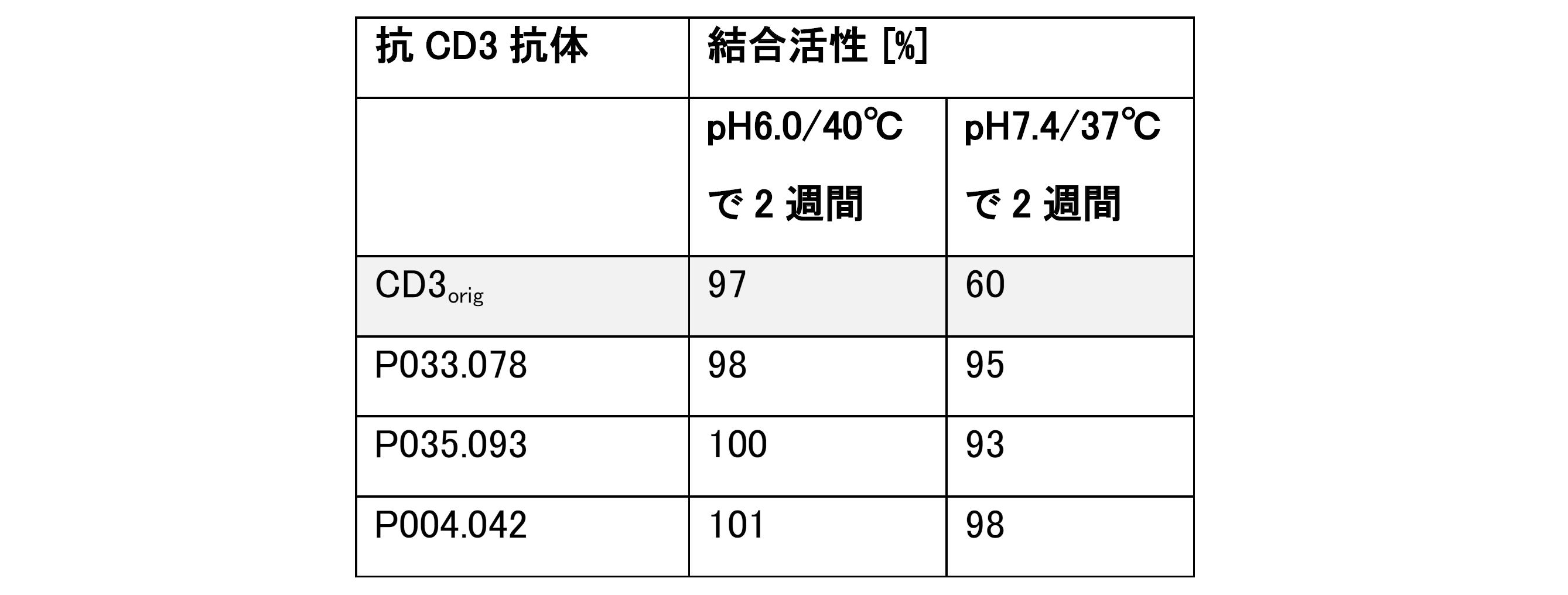
理解を明確にするために、上記発明は図示及び例示によって程度詳細に説明されているが、これらの説明及び例示は、本発明の範囲を限定するものとして解釈されるべきではない。本明細書で引用した全ての特許及び科学文献の開示内容は、参照により全体が明示的に援用される。
* * *
Although the above invention has been described in some detail by way of illustration and illustration for clarity of understanding, these descriptions and illustrations should not be construed as limiting the scope of the invention. The disclosures of all patent and scientific literature cited herein are expressly incorporated by reference in their entireties.
* * *
Claims (51)
(a)以下の(i)及び(ii)を含む、CD3に結合することができる第1の抗原結合部分:
(i)配列番号2の重鎖相補性決定領域(HCDR)1、配列番号4のHCDR 2、及び配列番号10のHCDR 3を含む重鎖可変領域(VH)
(ii)配列番号20の軽鎖相補性決定領域(LCDR)1、配列番号21のLCDR 2、及び配列番号22のLCDR 3を含む軽鎖可変領域(VL);
(b)標的細胞抗原に結合することができる第2の抗原結合部分;並びに
(c)プロテアーゼ切断可能リンカーを介してT細胞二重特異性結合分子に共有結合されたマスキング部分であって、第1の抗原結合部分のイディオタイプに結合することができ、それによって第1の抗原結合部分を可逆的に隠す、マスキング部分
を含む、プロテアーゼ活性化可能T細胞活性化二重特異性分子。 A protease activatable T cell activation bispecific molecule comprising:
(a) a first antigen-binding portion capable of binding to CD3, comprising (i) and (ii):
(i) a heavy chain variable region (VH) comprising heavy chain complementarity determining region (HCDR) 1 of SEQ ID NO: 2, HCDR 2 of SEQ ID NO: 4, and HCDR 3 of SEQ ID NO: 10;
(ii) a light chain variable region (VL) comprising the light chain complementarity determining region (LCDR) 1 of SEQ ID NO: 20, LCDR 2 of SEQ ID NO: 21, and LCDR 3 of SEQ ID NO: 22;
(b) a second antigen binding moiety capable of binding to a target cell antigen; and (c) a masking moiety covalently attached to the T cell bispecific binding molecule via a protease cleavable linker, wherein A protease activatable T cell activation bispecific molecule comprising a masking moiety capable of binding to the idiotype of one antigen binding moiety, thereby reversibly hiding the first antigen binding moiety.
(a)DYSMN(配列番号58)の重鎖相補性決定領域(CDR H)1アミノ酸配列;
(b)WINTETGEPRYTDDFKG(配列番号59)、WINTETGEPRYTDDFTG(配列番号84)、及びWINTETGEPRYTQGFKG(配列番号86)から成る群より選択されるCDR H2アミノ酸配列;
(c)EGDYDVFDY(配列番号60)のCDR H3アミノ酸配列
を含む重鎖可変領域と、
(d)RASKSVSTSSYSYMH(配列番号62)及びKSSKSVSTSSYSYMH(配列番号82)から成る群より選択される軽鎖(CDR L)1アミノ酸配列;
(e)YVSYLES(配列番号63)のCDR L2アミノ酸配列;並びに
(f)QHSREFPYT(配列番号64)及びQQSREFPYT(配列番号88)から成る群より選択されるCDR L3アミノ酸配列
を含む軽鎖可変領域とを含む、請求項1から17のいずれか一項に記載のプロテアーゼ活性化可能T細胞活性化二重特異性分子。 the masking part
(a) heavy chain complementarity determining region (CDR H) 1 amino acid sequence of DYSMN (SEQ ID NO: 58);
(b) a CDR H2 amino acid sequence selected from the group consisting of WINTETGEPRYTDDFKG (SEQ ID NO:59), WINTETGEPRYTDDFTG (SEQ ID NO:84), and WINTETGEPRYTQGFKG (SEQ ID NO:86);
(c) a heavy chain variable region comprising the CDR H3 amino acid sequence of EGDYDVFDY (SEQ ID NO: 60);
(d) a light chain (CDR L) 1 amino acid sequence selected from the group consisting of RASKSVSTSSYSYMH (SEQ ID NO:62) and KSSKSVSTSSYSYMH (SEQ ID NO:82);
(e) the CDR L2 amino acid sequence of YVSYLES (SEQ ID NO:63); and (f) a CDR L3 amino acid sequence selected from the group consisting of QHSREFPYT (SEQ ID NO:64) and QQSREFPYT (SEQ ID NO:88); 18. The protease activatable T cell activation bispecific molecule of any one of claims 1-17, comprising:
(a)DYSMN(配列番号58)の重鎖相補性決定領域(CDR H)1アミノ酸配列;
(b)WINTETGEPRYTDDFKG(配列番号59)のCDR H2アミノ酸配列;
(c)EGDYDVFDY(配列番号60)のCDR H3アミノ酸配列
を含む重鎖可変領域と、
(d)RASKSVSTSSYSYMH(配列番号62)の軽鎖(CDR L)1アミノ酸配列;
(e)YVSYLES(配列番号63)のCDR L2アミノ酸配列;及び
(f)QHSREFPYT(配列番号64)のCDR L3アミノ酸配列
を含む軽鎖可変領域とを含む、請求項1から17のいずれか一項に記載のプロテアーゼ活性化可能T細胞活性化二重特異性分子。 the masking part
(a) heavy chain complementarity determining region (CDR H) 1 amino acid sequence of DYSMN (SEQ ID NO: 58);
(b) the CDR H2 amino acid sequence of WINTETGEPRYTDDFKG (SEQ ID NO: 59);
(c) a heavy chain variable region comprising the CDR H3 amino acid sequence of EGDYDVFDY (SEQ ID NO: 60);
(d) the light chain (CDR L) 1 amino acid sequence of RASKSVSTSTSSYSYMH (SEQ ID NO: 62);
(e) a CDR L2 amino acid sequence of YVSYLES (SEQ ID NO:63); and (f) a light chain variable region comprising a CDR L3 amino acid sequence of QHSREFPYT (SEQ ID NO:64). A protease activatable T cell activation bispecific molecule as described in .
(a)SYGVS(配列番号58)の重鎖相補性決定領域(CDR H)1アミノ酸配列;
(b)IIWGDGSTNYHSALIS(配列番号59)のCDR H2アミノ酸配列;
(c)GITTVVDDYYAMDY(配列番号60)のCDR H3アミノ酸配列を含む重鎖可変領域と、
(d)KSSKSVSTSSYSYMH(配列番号82)の軽鎖(CDR L)1アミノ酸配列;
(e)AATFLAD(配列番号63)のCDR L2アミノ酸配列;及び
(f)QHYYSTPYT(配列番号64)のCDR L3アミノ酸配列
を含む軽鎖可変領域とを含む、請求項1から17のいずれか一項に記載のプロテアーゼ活性化可能T細胞活性化二重特異性分子。 the masking part
(a) heavy chain complementarity determining region (CDR H) 1 amino acid sequence of SYGVS (SEQ ID NO: 58);
(b) CDR H2 amino acid sequence of IIWGDGSTNYHSALIS (SEQ ID NO: 59);
(c) a heavy chain variable region comprising the CDR H3 amino acid sequence of GITTVVDDYYAMDY (SEQ ID NO: 60);
(d) light chain (CDR L) 1 amino acid sequence of KSSKSVSTSSYSYMH (SEQ ID NO: 82);
(e) the CDR L2 amino acid sequence of AATFLAD (SEQ ID NO:63); and (f) a light chain variable region comprising the CDR L3 amino acid sequence of QHYYSTPYT (SEQ ID NO:64). A protease activatable T cell activation bispecific molecule as described in .
(a)SYGVS(配列番号58)の重鎖相補性決定領域(CDR H)1アミノ酸配列;
(b)WINTETGEPRYTDDFTG(配列番号84)のCDR H2アミノ酸配列;
(c)GITTVVDDYYAMDY(配列番号60)のCDR H3アミノ酸配列を含む重鎖可変領域と、
(d)KSSKSVSTSSYSYMH(配列番号82)の軽鎖(CDR L)1アミノ酸配列;
(e)AATFLAD(配列番号63)のCDR L2アミノ酸配列;及び
(f)QHYYSTPYT(配列番号64)のCDR L3アミノ酸配列
を含む軽鎖可変領域とを含む、請求項1から17のいずれか一項に記載のプロテアーゼ活性化可能T細胞活性化二重特異性分子。 the masking part
(a) heavy chain complementarity determining region (CDR H) 1 amino acid sequence of SYGVS (SEQ ID NO: 58);
(b) the CDR H2 amino acid sequence of WINTETGEPRYTDDFTG (SEQ ID NO: 84);
(c) a heavy chain variable region comprising the CDR H3 amino acid sequence of GITTVVDDYYAMDY (SEQ ID NO: 60);
(d) light chain (CDR L) 1 amino acid sequence of KSSKSVSTSSYSYMH (SEQ ID NO: 82);
(e) the CDR L2 amino acid sequence of AATFLAD (SEQ ID NO:63); and (f) a light chain variable region comprising the CDR L3 amino acid sequence of QHYYSTPYT (SEQ ID NO:64). A protease activatable T cell activation bispecific molecule as described in .
(a)SYGVS(配列番号58)の重鎖相補性決定領域(CDR H)1アミノ酸配列;
(b)WINTETGEPRYTQGFKG(配列番号86)のCDR H2アミノ酸配列;
(c)GITTVVDDYYAMDY(配列番号60)のCDR H3アミノ酸配列を含む重鎖可変領域と、
(d)KSSKSVSTSSYSYMH(配列番号82)の軽鎖(CDR L)1アミノ酸配列;
(e)AATFLAD(配列番号63)のCDR L2アミノ酸配列;及び
(f)QHYYSTPYT(配列番号64)のCDR L3アミノ酸配列
を含む軽鎖可変領域とを含む、請求項1から17のいずれか一項に記載のプロテアーゼ活性化可能T細胞活性化二重特異性分子。 the masking part
(a) heavy chain complementarity determining region (CDR H) 1 amino acid sequence of SYGVS (SEQ ID NO: 58);
(b) the CDR H2 amino acid sequence of WINTETGEPRYTQGFKG (SEQ ID NO: 86);
(c) a heavy chain variable region comprising the CDR H3 amino acid sequence of GITTVVDDYYAMDY (SEQ ID NO: 60);
(d) light chain (CDR L) 1 amino acid sequence of KSSKSVSTSSYSYMH (SEQ ID NO: 82);
(e) the CDR L2 amino acid sequence of AATFLAD (SEQ ID NO:63); and (f) a light chain variable region comprising the CDR L3 amino acid sequence of QHYYSTPYT (SEQ ID NO:64). A protease activatable T cell activation bispecific molecule as described in .
(a)RQARVVNG (配列番号100);
(b)VHMPLGFLGPGRSRGSFP(配列番号101);
(c)RQARVVNGXXXXXVPLSLYSG(配列番号102)(ここで、Xは任意のアミノ酸である);
(d)RQARVVNGVPLSLYSG(配列番号103);
(e)PLGLWSQ(配列番号104);
(f)VHMPLGFLGPRQARVVNG(配列番号105);
(g)FVGGTG(配列番号106);
(h)KKAAPVNG(配列番号107);
(i)PMAKKVNG(配列番号108);
(j)QARAKVNG(配列番号109);
(k)VHMPLGFLGP(配列番号110);
(l)QARAK(配列番号111);
(m)VHMPLGFLGPPMAKK(配列番号112);
(n)KKAAP(配列番号113);及び
(o)PMAKK(配列番号114)
から成る群より選択される、請求項1から23のいずれか一項に記載のプロテアーゼ活性化可能T細胞活性化二重特異性分子。 a protease recognition sequence
(a) RQARVVNG (SEQ ID NO: 100);
(b) VHMPLGFLGPGRSRGSFP (SEQ ID NO: 101);
(c) RQARVVNGXXXXXXVPLSLYSG (SEQ ID NO: 102), where X is any amino acid;
(d) RQARVVNGVPLSLYSG (SEQ ID NO: 103);
(e) PLGLWSQ (SEQ ID NO: 104);
(f) VHMPLGFLGPRQARVVNG (SEQ ID NO: 105);
(g) FVGGTG (SEQ ID NO: 106);
(h) KKAAPVNG (SEQ ID NO: 107);
(i) PMAKKVNG (SEQ ID NO: 108);
(j) QARAKVNG (SEQ ID NO: 109);
(k) VHMPLGFLGP (SEQ ID NO: 110);
(l) QARAK (SEQ ID NO: 111);
(m) VHMPLGFLGPPMAK (SEQ ID NO: 112);
(n) KKAAP (SEQ ID NO: 113); and (o) PMAKK (SEQ ID NO: 114)
24. The protease activatable T cell activation bispecific molecule of any one of claims 1-23, selected from the group consisting of:
a)NAWMS(配列番号54)の重鎖相補性決定領域(CDR H)1アミノ酸配列;
b)RIKSKTDGGTTDYAAPVKG(配列番号55)のCDR H2アミノ酸配列;及び
c)PWEWSWYDY(配列番号56)のCDR H3アミノ酸配列
を含む重鎖可変領域と、
d)GSSTGAVTTSNYAN(配列番号20)の軽鎖(CDR L)1アミノ酸配列;
e)GTNKRAP(配列番号21)のCDR L2アミノ酸配列;及び
f)ALWYSNLWV(配列番号22)のCDR L3アミノ酸配列
を含む軽鎖可変領域とを含む、請求項1から25のいずれか一項に記載のプロテアーゼ活性化可能T細胞活性化二重特異性分子。 the second antigen-binding portion is capable of binding to FolR1, and
a) the heavy chain complementarity determining region (CDR H) 1 amino acid sequence of NAWMS (SEQ ID NO: 54);
b) a CDR H2 amino acid sequence of RIKSKTDGGTTDYAAPVKG (SEQ ID NO: 55); and c) a CDR H3 amino acid sequence of PWEWSWYDY (SEQ ID NO: 56);
d) the light chain (CDR L) 1 amino acid sequence of GSSTGAVTTSNYAN (SEQ ID NO: 20);
e) the CDR L2 amino acid sequence of GTNKRAP (SEQ ID NO:21); and f) a light chain variable region comprising the CDR L3 amino acid sequence of ALWYSNLWV (SEQ ID NO:22). A protease-activatable T-cell activation bispecific molecule.
a)DYFLH(配列番号24)の重鎖相補性決定領域(CDR H)1アミノ酸配列;
b)WINPDNGNTVYAQKFQG(配列番号25)のCDR H2アミノ酸配列;及び
c)RDYTYEKAALDY(配列番号26)のCDR H3アミノ酸配列
を含む重鎖可変領域と、
d)RASGNIYNYLA(配列番号28)の軽鎖(CDR L)1アミノ酸配列;
e)DAKTLAD(配列番号29)のCDR L2アミノ酸配列;及び
f)QHFWSLPFT(配列番号30)のCDR L3アミノ酸配列
を含む軽鎖可変領域とを含む、請求項1から21のいずれか一項に記載のプロテアーゼ活性化可能T細胞活性化二重特異性分子。 the second antigen-binding portion is capable of binding TYRP1, and
a) heavy chain complementarity determining region (CDR H) 1 amino acid sequence of DYFLH (SEQ ID NO: 24);
b) the CDR H2 amino acid sequence of WINPDNGNTVYAQKFQG (SEQ ID NO: 25); and c) the CDR H3 amino acid sequence of RDYTYEKAALDY (SEQ ID NO: 26);
d) the light chain (CDR L) 1 amino acid sequence of RASGNIYNYLA (SEQ ID NO: 28);
e) the CDR L2 amino acid sequence of DAKTLAD (SEQ ID NO: 29); and f) the light chain variable region comprising the CDR L3 amino acid sequence of QHFWSLPFT (SEQ ID NO: 30). A protease-activatable T-cell activation bispecific molecule.
(a)RQARVVNG(配列番号100);
(b)VHMPLGFLGPGRSRGSFP(配列番号101);
(c)RQARVVNGXXXXXVPLSLYSG(配列番号102)(ここで、Xは任意のアミノ酸である);
(d)RQARVVNGVPLSLYSG(配列番号103);
(e)PLGLWSQ(配列番号104);
(f)VHMPLGFLGPRQARVVNG(配列番号105);
(g)FVGGTG(配列番号106);
(h)KKAAPVNG(配列番号107);
(i)PMAKKVNG(配列番号108);
(j)QARAKVNG(配列番号109);
(k)VHMPLGFLGP(配列番号110);
(l)QARAK(配列番号111);
(m)VHMPLGFLGPPMAKK(配列番号112);
(n)KKAAP(配列番号113);及び
(o)PMAKK(配列番号114)
から成る群より選択される、請求項37に記載のイディオタイプ特異的ポリペプチド。 a protease recognition sequence
(a) RQARVVNG (SEQ ID NO: 100);
(b) VHMPLGFLGPGRSRGSFP (SEQ ID NO: 101);
(c) RQARVVNGXXXXXXVPLSLYSG (SEQ ID NO: 102), where X is any amino acid;
(d) RQARVVNGVPLSLYSG (SEQ ID NO: 103);
(e) PLGLWSQ (SEQ ID NO: 104);
(f) VHMPLGFLGPRQARVVNG (SEQ ID NO: 105);
(g) FVGGTG (SEQ ID NO: 106);
(h) KKAAPVNG (SEQ ID NO: 107);
(i) PMAKKVNG (SEQ ID NO: 108);
(j) QARAKVNG (SEQ ID NO: 109);
(k) VHMPLGFLGP (SEQ ID NO: 110);
(l) QARAK (SEQ ID NO: 111);
(m) VHMPLGFLGPPMAK (SEQ ID NO: 112);
(n) KKAAP (SEQ ID NO: 113); and (o) PMAKK (SEQ ID NO: 114)
38. The idiotype-specific polypeptide of claim 37, selected from the group consisting of:
Applications Claiming Priority (3)
| Application Number | Priority Date | Filing Date | Title |
|---|---|---|---|
| EP20181072 | 2020-06-19 | ||
| EP20181072.8 | 2020-06-19 | ||
| PCT/EP2021/066335 WO2021255137A1 (en) | 2020-06-19 | 2021-06-17 | Protease-activated t cell bispecific antibodies |
Publications (1)
| Publication Number | Publication Date |
|---|---|
| JP2023529982A true JP2023529982A (en) | 2023-07-12 |
Family
ID=71111324
Family Applications (1)
| Application Number | Title | Priority Date | Filing Date |
|---|---|---|---|
| JP2022577275A Pending JP2023529982A (en) | 2020-06-19 | 2021-06-17 | Protease-activated T-cell bispecific antibody |
Country Status (18)
| Country | Link |
|---|---|
| US (1) | US20230287145A1 (en) |
| EP (1) | EP4168444A1 (en) |
| JP (1) | JP2023529982A (en) |
| KR (1) | KR20230025667A (en) |
| CN (1) | CN115698080A (en) |
| AR (1) | AR122659A1 (en) |
| AU (1) | AU2021291002A1 (en) |
| BR (1) | BR112022024469A2 (en) |
| CA (1) | CA3177239A1 (en) |
| CL (1) | CL2022003522A1 (en) |
| CO (1) | CO2022017261A2 (en) |
| CR (1) | CR20220604A (en) |
| IL (1) | IL296429A (en) |
| MX (1) | MX2022015890A (en) |
| PE (1) | PE20231552A1 (en) |
| PH (1) | PH12022500026A1 (en) |
| TW (1) | TW202214704A (en) |
| WO (1) | WO2021255137A1 (en) |
Families Citing this family (5)
| Publication number | Priority date | Publication date | Assignee | Title |
|---|---|---|---|---|
| AR128876A1 (en) * | 2022-03-28 | 2024-06-19 | Hoffmann La Roche | ENHANCED FOLR1 PROTEASE ACTIVATABLE T LYMPHOCYTE BISPECIFIC ANTIBODIES |
| WO2024040127A2 (en) * | 2022-08-16 | 2024-02-22 | Northwestern University | Anti-tyrp1 bi-specific t cell engaging protein for treatment of tyrp1-expressing melanoma |
| WO2024068572A1 (en) * | 2022-09-28 | 2024-04-04 | F. Hoffmann-La Roche Ag | Improved protease-activatable t cell bispecific antibodies |
| WO2025040567A1 (en) * | 2023-08-18 | 2025-02-27 | F. Hoffmann-La Roche Ag | Protease activatable fc domain binding molecules |
| WO2025125118A1 (en) * | 2023-12-11 | 2025-06-19 | F. Hoffmann-La Roche Ag | Protease activatable fc domain binding molecules |
Citations (4)
| Publication number | Priority date | Publication date | Assignee | Title |
|---|---|---|---|---|
| JP2007524105A (en) * | 2004-02-25 | 2007-08-23 | バイオエンハンスメンツ リミテッド | Binding substance |
| JP2016508723A (en) * | 2013-02-26 | 2016-03-24 | ロシュ グリクアート アーゲー | Bispecific T cell activation antigen binding molecule |
| JP2019514850A (en) * | 2016-03-22 | 2019-06-06 | エフ・ホフマン−ラ・ロシュ・アクチェンゲゼルシャフト | Protease activated T cell bispecific molecule |
| JP2020504829A (en) * | 2016-12-13 | 2020-02-13 | エフ.ホフマン−ラ ロシュ アーゲーF. Hoffmann−La Roche Aktiengesellschaft | Method for determining the presence of a target antigen in a tumor sample |
Family Cites Families (32)
| Publication number | Priority date | Publication date | Assignee | Title |
|---|---|---|---|---|
| CA1096187A (en) | 1977-04-18 | 1981-02-24 | Souhei Monden | Ornament adapted to be fixed by permanent magnets |
| US6548640B1 (en) | 1986-03-27 | 2003-04-15 | Btg International Limited | Altered antibodies |
| IL85035A0 (en) | 1987-01-08 | 1988-06-30 | Int Genetic Eng | Polynucleotide molecule,a chimeric antibody with specificity for human b cell surface antigen,a process for the preparation and methods utilizing the same |
| WO1990005144A1 (en) | 1988-11-11 | 1990-05-17 | Medical Research Council | Single domain ligands, receptors comprising said ligands, methods for their production, and use of said ligands and receptors |
| DE3920358A1 (en) | 1989-06-22 | 1991-01-17 | Behringwerke Ag | BISPECIFIC AND OLIGO-SPECIFIC, MONO- AND OLIGOVALENT ANTI-BODY CONSTRUCTS, THEIR PRODUCTION AND USE |
| US5959177A (en) | 1989-10-27 | 1999-09-28 | The Scripps Research Institute | Transgenic plants expressing assembled secretory antibodies |
| GB9015198D0 (en) | 1990-07-10 | 1990-08-29 | Brien Caroline J O | Binding substance |
| US5571894A (en) | 1991-02-05 | 1996-11-05 | Ciba-Geigy Corporation | Recombinant antibodies specific for a growth factor receptor |
| WO1994004679A1 (en) | 1991-06-14 | 1994-03-03 | Genentech, Inc. | Method for making humanized antibodies |
| JP4124480B2 (en) | 1991-06-14 | 2008-07-23 | ジェネンテック・インコーポレーテッド | Immunoglobulin variants |
| GB9114948D0 (en) | 1991-07-11 | 1991-08-28 | Pfizer Ltd | Process for preparing sertraline intermediates |
| ES2136092T3 (en) | 1991-09-23 | 1999-11-16 | Medical Res Council | PROCEDURES FOR THE PRODUCTION OF HUMANIZED ANTIBODIES. |
| FI941572L (en) | 1991-10-07 | 1994-05-27 | Oncologix Inc | Combination and method of use of anti-erbB-2 monoclonal antibodies |
| ATE503496T1 (en) | 1992-02-06 | 2011-04-15 | Novartis Vaccines & Diagnostic | BIOSYNTHETIC BINDING PROTEIN FOR TUMOR MARKERS |
| US5731168A (en) | 1995-03-01 | 1998-03-24 | Genentech, Inc. | Method for making heteromultimeric polypeptides |
| US5869046A (en) | 1995-04-14 | 1999-02-09 | Genentech, Inc. | Altered polypeptides with increased half-life |
| US6040498A (en) | 1998-08-11 | 2000-03-21 | North Caroline State University | Genetically engineered duckweed |
| WO1999029888A1 (en) | 1997-12-05 | 1999-06-17 | The Scripps Research Institute | Humanization of murine antibody |
| US6737056B1 (en) | 1999-01-15 | 2004-05-18 | Genentech, Inc. | Polypeptide variants with altered effector function |
| KR100797667B1 (en) | 1999-10-04 | 2008-01-23 | 메디카고 인코포레이티드 | How to regulate transcription of foreign genes |
| US7125978B1 (en) | 1999-10-04 | 2006-10-24 | Medicago Inc. | Promoter for regulating expression of foreign genes |
| US7432063B2 (en) | 2002-02-14 | 2008-10-07 | Kalobios Pharmaceuticals, Inc. | Methods for affinity maturation |
| MXPA06011199A (en) | 2004-03-31 | 2007-04-16 | Genentech Inc | Humanized anti-tgf-beta antibodies. |
| PL1737891T3 (en) | 2004-04-13 | 2013-08-30 | Hoffmann La Roche | Anti-p-selectin antibodies |
| TWI380996B (en) | 2004-09-17 | 2013-01-01 | Hoffmann La Roche | Anti-ox40l antibodies |
| RU2488597C2 (en) | 2005-02-07 | 2013-07-27 | Гликарт Биотехнологи Аг | Antigen-binding molecules, which bind egfr, their coding vectors and their usage |
| SI2235064T1 (en) | 2008-01-07 | 2016-04-29 | Amgen Inc. | Method for making antibody fc-heterodimeric molecules using electrostatic steering effects |
| KR101614195B1 (en) | 2011-03-29 | 2016-04-20 | 로슈 글리카트 아게 | Antibody fc variants |
| GB201203442D0 (en) | 2012-02-28 | 2012-04-11 | Univ Birmingham | Immunotherapeutic molecules and uses |
| EP3368568B1 (en) | 2015-10-29 | 2022-04-06 | F. Hoffmann-La Roche AG | Anti-variant fc-region antibodies and methods of use |
| WO2017162587A1 (en) * | 2016-03-22 | 2017-09-28 | F. Hoffmann-La Roche Ag | Protease-activated t cell bispecific molecules |
| CN113621062B (en) * | 2018-12-21 | 2024-07-02 | 豪夫迈·罗氏有限公司 | Antibodies that bind to CD3 |
-
2021
- 2021-06-17 AU AU2021291002A patent/AU2021291002A1/en not_active Abandoned
- 2021-06-17 KR KR1020227044179A patent/KR20230025667A/en active Pending
- 2021-06-17 CA CA3177239A patent/CA3177239A1/en active Pending
- 2021-06-17 TW TW110122178A patent/TW202214704A/en unknown
- 2021-06-17 EP EP21731532.4A patent/EP4168444A1/en active Pending
- 2021-06-17 IL IL296429A patent/IL296429A/en unknown
- 2021-06-17 JP JP2022577275A patent/JP2023529982A/en active Pending
- 2021-06-17 WO PCT/EP2021/066335 patent/WO2021255137A1/en not_active Ceased
- 2021-06-17 CR CR20220604A patent/CR20220604A/en unknown
- 2021-06-17 MX MX2022015890A patent/MX2022015890A/en unknown
- 2021-06-17 CN CN202180042820.5A patent/CN115698080A/en active Pending
- 2021-06-17 PE PE2022002744A patent/PE20231552A1/en unknown
- 2021-06-17 AR ARP210101663A patent/AR122659A1/en not_active Application Discontinuation
- 2021-06-17 BR BR112022024469A patent/BR112022024469A2/en unknown
- 2021-06-20 PH PH1/2022/500026A patent/PH12022500026A1/en unknown
-
2022
- 2022-11-30 CO CONC2022/0017261A patent/CO2022017261A2/en unknown
- 2022-12-12 CL CL2022003522A patent/CL2022003522A1/en unknown
- 2022-12-15 US US18/066,529 patent/US20230287145A1/en active Pending
Patent Citations (4)
| Publication number | Priority date | Publication date | Assignee | Title |
|---|---|---|---|---|
| JP2007524105A (en) * | 2004-02-25 | 2007-08-23 | バイオエンハンスメンツ リミテッド | Binding substance |
| JP2016508723A (en) * | 2013-02-26 | 2016-03-24 | ロシュ グリクアート アーゲー | Bispecific T cell activation antigen binding molecule |
| JP2019514850A (en) * | 2016-03-22 | 2019-06-06 | エフ・ホフマン−ラ・ロシュ・アクチェンゲゼルシャフト | Protease activated T cell bispecific molecule |
| JP2020504829A (en) * | 2016-12-13 | 2020-02-13 | エフ.ホフマン−ラ ロシュ アーゲーF. Hoffmann−La Roche Aktiengesellschaft | Method for determining the presence of a target antigen in a tumor sample |
Non-Patent Citations (1)
| Title |
|---|
| SCIENTIFIC REPORTS, vol. 7, no. 11587, JPN6025023941, 2017, pages 1 - 12, ISSN: 0005619297 * |
Also Published As
| Publication number | Publication date |
|---|---|
| CO2022017261A2 (en) | 2023-02-27 |
| US20230287145A1 (en) | 2023-09-14 |
| IL296429A (en) | 2022-11-01 |
| PE20231552A1 (en) | 2023-10-03 |
| CL2022003522A1 (en) | 2023-07-21 |
| EP4168444A1 (en) | 2023-04-26 |
| BR112022024469A2 (en) | 2023-01-17 |
| WO2021255137A1 (en) | 2021-12-23 |
| KR20230025667A (en) | 2023-02-22 |
| TW202214704A (en) | 2022-04-16 |
| PH12022500026A1 (en) | 2024-05-06 |
| MX2022015890A (en) | 2023-01-24 |
| CR20220604A (en) | 2023-01-23 |
| CN115698080A (en) | 2023-02-03 |
| AR122659A1 (en) | 2022-09-28 |
| CA3177239A1 (en) | 2021-12-23 |
| AU2021291002A1 (en) | 2022-10-13 |
Similar Documents
| Publication | Publication Date | Title |
|---|---|---|
| JP7175291B2 (en) | Bispecific T cell activation antigen binding molecule | |
| US20230119537A1 (en) | Protease-activated t cell bispecific molecules | |
| EP3433280B1 (en) | Protease-activated t cell bispecific molecules | |
| CN108026177B (en) | Bispecific anti-CD 19XCD 3T cell activating antigen binding molecules | |
| JP6464255B2 (en) | Bispecific T cell activation antigen binding molecule | |
| CN109843926B (en) | Bispecific antibodies against CD3 | |
| CN104936986B (en) | Bispecific T cell activating antigen binding molecules | |
| TWI756164B (en) | T cell activating bispecific antigen binding molecules | |
| KR20230025783A (en) | immune activation Fc domain binding molecule | |
| TW201726735A (en) | Bispecific T cell activating antigen binding molecules | |
| HK1254967A1 (en) | Bispecific t cell activating antigen binding molecules binding mesothelin and cd3 | |
| TW201726736A (en) | Bispecific T cell activating antigen binding molecules | |
| CN104936985A (en) | Bispecific T cell activating antigen binding molecules | |
| JP2023529982A (en) | Protease-activated T-cell bispecific antibody | |
| JP2025514623A (en) | Improved FOLR1 protease activatable T cell bispecific antibodies | |
| US20260035462A1 (en) | Protease-activatable t cell bispecific antibodies | |
| HK40088901A (en) | Protease-activated t cell bispecific antibodies | |
| EP4594353A1 (en) | Improved protease-activatable t cell bispecific antibodies | |
| HK1233664A1 (en) | Bispecific t cell activating antigen binding molecules | |
| HK1211300B (en) | Bispecific t cell activating antigen binding molecules | |
| HK1192761B (en) | Bispecific t cell activating antigen binding molecules |
Legal Events
| Date | Code | Title | Description |
|---|---|---|---|
| A621 | Written request for application examination |
Free format text: JAPANESE INTERMEDIATE CODE: A621 Effective date: 20240617 |
|
| A131 | Notification of reasons for refusal |
Free format text: JAPANESE INTERMEDIATE CODE: A131 Effective date: 20250617 |
|
| A601 | Written request for extension of time |
Free format text: JAPANESE INTERMEDIATE CODE: A601 Effective date: 20250822 |
|
| A521 | Request for written amendment filed |
Free format text: JAPANESE INTERMEDIATE CODE: A523 Effective date: 20251217 |
|
| A01 | Written decision to grant a patent or to grant a registration (utility model) |
Free format text: JAPANESE INTERMEDIATE CODE: A01 Effective date: 20260106 |