JP2023515664A - Modified short interfering nucleic acid (siNA) molecules and their uses - Google Patents
Modified short interfering nucleic acid (siNA) molecules and their uses Download PDFInfo
- Publication number
- JP2023515664A JP2023515664A JP2022552538A JP2022552538A JP2023515664A JP 2023515664 A JP2023515664 A JP 2023515664A JP 2022552538 A JP2022552538 A JP 2022552538A JP 2022552538 A JP2022552538 A JP 2022552538A JP 2023515664 A JP2023515664 A JP 2023515664A
- Authority
- JP
- Japan
- Prior art keywords
- nucleotides
- sina
- nucleotide sequence
- nucleotide
- methyl
- Prior art date
- Legal status (The legal status is an assumption and is not a legal conclusion. Google has not performed a legal analysis and makes no representation as to the accuracy of the status listed.)
- Pending
Links
Images


Classifications
-
- C—CHEMISTRY; METALLURGY
- C12—BIOCHEMISTRY; BEER; SPIRITS; WINE; VINEGAR; MICROBIOLOGY; ENZYMOLOGY; MUTATION OR GENETIC ENGINEERING
- C12N—MICROORGANISMS OR ENZYMES; COMPOSITIONS THEREOF; PROPAGATING, PRESERVING, OR MAINTAINING MICROORGANISMS; MUTATION OR GENETIC ENGINEERING; CULTURE MEDIA
- C12N15/00—Mutation or genetic engineering; DNA or RNA concerning genetic engineering, vectors, e.g. plasmids, or their isolation, preparation or purification; Use of hosts therefor
- C12N15/09—Recombinant DNA-technology
- C12N15/11—DNA or RNA fragments; Modified forms thereof; Non-coding nucleic acids having a biological activity
- C12N15/113—Non-coding nucleic acids modulating the expression of genes, e.g. antisense oligonucleotides; Antisense DNA or RNA; Triplex- forming oligonucleotides; Catalytic nucleic acids, e.g. ribozymes; Nucleic acids used in co-suppression or gene silencing
- C12N15/1131—Non-coding nucleic acids modulating the expression of genes, e.g. antisense oligonucleotides; Antisense DNA or RNA; Triplex- forming oligonucleotides; Catalytic nucleic acids, e.g. ribozymes; Nucleic acids used in co-suppression or gene silencing against viruses
-
- A—HUMAN NECESSITIES
- A61—MEDICAL OR VETERINARY SCIENCE; HYGIENE
- A61K—PREPARATIONS FOR MEDICAL, DENTAL OR TOILETRY PURPOSES
- A61K31/00—Medicinal preparations containing organic active ingredients
- A61K31/70—Carbohydrates; Sugars; Derivatives thereof
- A61K31/7088—Compounds having three or more nucleosides or nucleotides
- A61K31/713—Double-stranded nucleic acids or oligonucleotides
-
- A—HUMAN NECESSITIES
- A61—MEDICAL OR VETERINARY SCIENCE; HYGIENE
- A61K—PREPARATIONS FOR MEDICAL, DENTAL OR TOILETRY PURPOSES
- A61K45/00—Medicinal preparations containing active ingredients not provided for in groups A61K31/00 - A61K41/00
- A61K45/06—Mixtures of active ingredients without chemical characterisation, e.g. antiphlogistics and cardiaca
-
- A—HUMAN NECESSITIES
- A61—MEDICAL OR VETERINARY SCIENCE; HYGIENE
- A61P—SPECIFIC THERAPEUTIC ACTIVITY OF CHEMICAL COMPOUNDS OR MEDICINAL PREPARATIONS
- A61P1/00—Drugs for disorders of the alimentary tract or the digestive system
- A61P1/16—Drugs for disorders of the alimentary tract or the digestive system for liver or gallbladder disorders, e.g. hepatoprotective agents, cholagogues, litholytics
-
- A—HUMAN NECESSITIES
- A61—MEDICAL OR VETERINARY SCIENCE; HYGIENE
- A61P—SPECIFIC THERAPEUTIC ACTIVITY OF CHEMICAL COMPOUNDS OR MEDICINAL PREPARATIONS
- A61P31/00—Antiinfectives, i.e. antibiotics, antiseptics, chemotherapeutics
- A61P31/12—Antivirals
-
- A—HUMAN NECESSITIES
- A61—MEDICAL OR VETERINARY SCIENCE; HYGIENE
- A61P—SPECIFIC THERAPEUTIC ACTIVITY OF CHEMICAL COMPOUNDS OR MEDICINAL PREPARATIONS
- A61P31/00—Antiinfectives, i.e. antibiotics, antiseptics, chemotherapeutics
- A61P31/12—Antivirals
- A61P31/20—Antivirals for DNA viruses
-
- C—CHEMISTRY; METALLURGY
- C12—BIOCHEMISTRY; BEER; SPIRITS; WINE; VINEGAR; MICROBIOLOGY; ENZYMOLOGY; MUTATION OR GENETIC ENGINEERING
- C12N—MICROORGANISMS OR ENZYMES; COMPOSITIONS THEREOF; PROPAGATING, PRESERVING, OR MAINTAINING MICROORGANISMS; MUTATION OR GENETIC ENGINEERING; CULTURE MEDIA
- C12N15/00—Mutation or genetic engineering; DNA or RNA concerning genetic engineering, vectors, e.g. plasmids, or their isolation, preparation or purification; Use of hosts therefor
- C12N15/09—Recombinant DNA-technology
- C12N15/11—DNA or RNA fragments; Modified forms thereof; Non-coding nucleic acids having a biological activity
- C12N15/113—Non-coding nucleic acids modulating the expression of genes, e.g. antisense oligonucleotides; Antisense DNA or RNA; Triplex- forming oligonucleotides; Catalytic nucleic acids, e.g. ribozymes; Nucleic acids used in co-suppression or gene silencing
-
- C—CHEMISTRY; METALLURGY
- C12—BIOCHEMISTRY; BEER; SPIRITS; WINE; VINEGAR; MICROBIOLOGY; ENZYMOLOGY; MUTATION OR GENETIC ENGINEERING
- C12N—MICROORGANISMS OR ENZYMES; COMPOSITIONS THEREOF; PROPAGATING, PRESERVING, OR MAINTAINING MICROORGANISMS; MUTATION OR GENETIC ENGINEERING; CULTURE MEDIA
- C12N2310/00—Structure or type of the nucleic acid
- C12N2310/10—Type of nucleic acid
- C12N2310/14—Type of nucleic acid interfering nucleic acids [NA]
-
- C—CHEMISTRY; METALLURGY
- C12—BIOCHEMISTRY; BEER; SPIRITS; WINE; VINEGAR; MICROBIOLOGY; ENZYMOLOGY; MUTATION OR GENETIC ENGINEERING
- C12N—MICROORGANISMS OR ENZYMES; COMPOSITIONS THEREOF; PROPAGATING, PRESERVING, OR MAINTAINING MICROORGANISMS; MUTATION OR GENETIC ENGINEERING; CULTURE MEDIA
- C12N2310/00—Structure or type of the nucleic acid
- C12N2310/30—Chemical structure
- C12N2310/31—Chemical structure of the backbone
- C12N2310/315—Phosphorothioates
-
- C—CHEMISTRY; METALLURGY
- C12—BIOCHEMISTRY; BEER; SPIRITS; WINE; VINEGAR; MICROBIOLOGY; ENZYMOLOGY; MUTATION OR GENETIC ENGINEERING
- C12N—MICROORGANISMS OR ENZYMES; COMPOSITIONS THEREOF; PROPAGATING, PRESERVING, OR MAINTAINING MICROORGANISMS; MUTATION OR GENETIC ENGINEERING; CULTURE MEDIA
- C12N2310/00—Structure or type of the nucleic acid
- C12N2310/30—Chemical structure
- C12N2310/31—Chemical structure of the backbone
- C12N2310/317—Chemical structure of the backbone with an inverted bond, e.g. a cap structure
-
- C—CHEMISTRY; METALLURGY
- C12—BIOCHEMISTRY; BEER; SPIRITS; WINE; VINEGAR; MICROBIOLOGY; ENZYMOLOGY; MUTATION OR GENETIC ENGINEERING
- C12N—MICROORGANISMS OR ENZYMES; COMPOSITIONS THEREOF; PROPAGATING, PRESERVING, OR MAINTAINING MICROORGANISMS; MUTATION OR GENETIC ENGINEERING; CULTURE MEDIA
- C12N2310/00—Structure or type of the nucleic acid
- C12N2310/30—Chemical structure
- C12N2310/32—Chemical structure of the sugar
- C12N2310/321—2'-O-R Modification
-
- C—CHEMISTRY; METALLURGY
- C12—BIOCHEMISTRY; BEER; SPIRITS; WINE; VINEGAR; MICROBIOLOGY; ENZYMOLOGY; MUTATION OR GENETIC ENGINEERING
- C12N—MICROORGANISMS OR ENZYMES; COMPOSITIONS THEREOF; PROPAGATING, PRESERVING, OR MAINTAINING MICROORGANISMS; MUTATION OR GENETIC ENGINEERING; CULTURE MEDIA
- C12N2310/00—Structure or type of the nucleic acid
- C12N2310/30—Chemical structure
- C12N2310/32—Chemical structure of the sugar
- C12N2310/322—2'-R Modification
-
- C—CHEMISTRY; METALLURGY
- C12—BIOCHEMISTRY; BEER; SPIRITS; WINE; VINEGAR; MICROBIOLOGY; ENZYMOLOGY; MUTATION OR GENETIC ENGINEERING
- C12N—MICROORGANISMS OR ENZYMES; COMPOSITIONS THEREOF; PROPAGATING, PRESERVING, OR MAINTAINING MICROORGANISMS; MUTATION OR GENETIC ENGINEERING; CULTURE MEDIA
- C12N2310/00—Structure or type of the nucleic acid
- C12N2310/30—Chemical structure
- C12N2310/32—Chemical structure of the sugar
- C12N2310/323—Chemical structure of the sugar modified ring structure
- C12N2310/3231—Chemical structure of the sugar modified ring structure having an additional ring, e.g. LNA, ENA
-
- C—CHEMISTRY; METALLURGY
- C12—BIOCHEMISTRY; BEER; SPIRITS; WINE; VINEGAR; MICROBIOLOGY; ENZYMOLOGY; MUTATION OR GENETIC ENGINEERING
- C12N—MICROORGANISMS OR ENZYMES; COMPOSITIONS THEREOF; PROPAGATING, PRESERVING, OR MAINTAINING MICROORGANISMS; MUTATION OR GENETIC ENGINEERING; CULTURE MEDIA
- C12N2310/00—Structure or type of the nucleic acid
- C12N2310/30—Chemical structure
- C12N2310/34—Spatial arrangement of the modifications
- C12N2310/346—Spatial arrangement of the modifications having a combination of backbone and sugar modifications
-
- C—CHEMISTRY; METALLURGY
- C12—BIOCHEMISTRY; BEER; SPIRITS; WINE; VINEGAR; MICROBIOLOGY; ENZYMOLOGY; MUTATION OR GENETIC ENGINEERING
- C12N—MICROORGANISMS OR ENZYMES; COMPOSITIONS THEREOF; PROPAGATING, PRESERVING, OR MAINTAINING MICROORGANISMS; MUTATION OR GENETIC ENGINEERING; CULTURE MEDIA
- C12N2310/00—Structure or type of the nucleic acid
- C12N2310/30—Chemical structure
- C12N2310/35—Nature of the modification
- C12N2310/351—Conjugate
-
- C—CHEMISTRY; METALLURGY
- C12—BIOCHEMISTRY; BEER; SPIRITS; WINE; VINEGAR; MICROBIOLOGY; ENZYMOLOGY; MUTATION OR GENETIC ENGINEERING
- C12N—MICROORGANISMS OR ENZYMES; COMPOSITIONS THEREOF; PROPAGATING, PRESERVING, OR MAINTAINING MICROORGANISMS; MUTATION OR GENETIC ENGINEERING; CULTURE MEDIA
- C12N2320/00—Applications; Uses
- C12N2320/30—Special therapeutic applications
- C12N2320/31—Combination therapy
Landscapes
- Health & Medical Sciences (AREA)
- Life Sciences & Earth Sciences (AREA)
- Engineering & Computer Science (AREA)
- Genetics & Genomics (AREA)
- Chemical & Material Sciences (AREA)
- Biomedical Technology (AREA)
- Molecular Biology (AREA)
- Organic Chemistry (AREA)
- General Health & Medical Sciences (AREA)
- Biotechnology (AREA)
- Bioinformatics & Cheminformatics (AREA)
- Wood Science & Technology (AREA)
- Zoology (AREA)
- General Engineering & Computer Science (AREA)
- Biochemistry (AREA)
- Pharmacology & Pharmacy (AREA)
- Public Health (AREA)
- Veterinary Medicine (AREA)
- Animal Behavior & Ethology (AREA)
- Medicinal Chemistry (AREA)
- Virology (AREA)
- Microbiology (AREA)
- Physics & Mathematics (AREA)
- Biophysics (AREA)
- Plant Pathology (AREA)
- Epidemiology (AREA)
- Chemical Kinetics & Catalysis (AREA)
- General Chemical & Material Sciences (AREA)
- Nuclear Medicine, Radiotherapy & Molecular Imaging (AREA)
- Communicable Diseases (AREA)
- Oncology (AREA)
- Gastroenterology & Hepatology (AREA)
- Pharmaceuticals Containing Other Organic And Inorganic Compounds (AREA)
- Medicines That Contain Protein Lipid Enzymes And Other Medicines (AREA)
- Saccharide Compounds (AREA)
- Cosmetics (AREA)
Abstract
修飾ヌクレオチドを含む短い干渉核酸(siNA)分子、およびその使用が本明細書で開示される。siNA分子は、二本鎖であってもよく、2’-O-メチルヌクレオチドおよび2’-フルオロヌクレオチドから選択される修飾ヌクレオチドを含んでいてもよい。(a)リン酸化ブロッカー、コンジュゲート化部分、または5’安定化エンドキャップと、(b)短い干渉核酸(siNA)とを含む、siNA分子が、本明細書でさらに開示される。【選択図】図1Disclosed herein are short interfering nucleic acid (siNA) molecules comprising modified nucleotides, and uses thereof. The siNA molecule may be double-stranded and may contain modified nucleotides selected from 2'-O-methyl nucleotides and 2'-fluoro nucleotides. Further disclosed herein are siNA molecules comprising (a) a phosphorylation blocker, conjugated moiety, or 5' stabilizing endcap, and (b) a short interfering nucleic acid (siNA). [Selection drawing] Fig. 1
Description
関連出願の相互参照
本出願は、2020年3月6日に出願された米国仮特許出願第62/986,150号、および2020年11月3日に出願された米国仮特許出願第63/109,196号に対する優先権を主張し、それらの開示は、参照によりそれらの全体が本明細書に組み込まれる。
CROSS-REFERENCE TO RELATED APPLICATIONS This application is part of U.S. Provisional Application No. 62/986,150, filed March 6, 2020, and U.S. Provisional Application No. 63/109, filed November 3, 2020. , 196, the disclosures of which are hereby incorporated by reference in their entireties.
修飾ヌクレオチドを含む短い干渉核酸(siNA)分子、組成物、およびそれらの使用が記載される。 Short interfering nucleic acid (siNA) molecules comprising modified nucleotides, compositions, and uses thereof are described.
RNA干渉(RNAi)は、内因性寄生性核酸および外因性病原性核酸の両方に対する抵抗性を媒介し、タンパク質コード遺伝子の発現を調節する、二本鎖RNAに対する生物学的応答である。短い干渉核酸(siNA)、例えば、siRNAは、様々な疾患を治療するためのRNAi療法のために開発されてきた。例えば、RNAi療法は、代謝性疾患、神経変性疾患、がん、および病原性感染症の治療のために提案されてきた(例えば、Rondindone,Biotechniques,2018,40(4S),doi.org/10.2144/000112163、Boudreau and Davidson,Curr Top Dev Biol,2006,75:73-92、Chalbatani et al.,Int J Nanomedicine,2019,14:3111-3128、Arbuthnot,Drug News Perspect,2010,23(6):341-50、およびChernikov et.al.,Front.Pharmacol.,2019,doi.org/10.3389/fphar.2019.00444を参照されたい、それらの各々が、参照によりそれらの全体が本明細書に組み込まれる)。しかしながら、RNAi療法の主な制限は、siRNAを標的細胞に効果的に送達する能力および、siRNAの分解である。 RNA interference (RNAi) is a biological response to double-stranded RNA that mediates resistance to both endogenous parasitic and exogenous pathogenic nucleic acids and regulates the expression of protein-coding genes. Short interfering nucleic acids (siNA), such as siRNA, have been developed for RNAi therapy to treat various diseases. For example, RNAi therapy has been proposed for the treatment of metabolic diseases, neurodegenerative diseases, cancer, and pathogenic infections (see, e.g., Rondindone, Biotechniques, 2018, 40(4S), doi.org/10 .2144/000112163, Boudreau and Davidson, Curr Top Dev Biol, 2006, 75: 73-92, Chalbatani et al., Int J Nanomedicine, 2019, 14: 3111-3128, Arbuthnot, Drug 0 ): 341-50, and Chernikov et al., Front.Pharmacol., 2019, doi.org/10.3389/fphar. incorporated in the specification). However, a major limitation of RNAi therapy is its ability to effectively deliver siRNA to target cells and degradation of siRNA.
本開示は、修飾ヌクレオチドを含むsiNA分子を提供することによって、siNA分子の送達および安定性を改善する。本開示のsiNA分子は、siNA分子の送達および安定性を改善するための最適化された組み合わせおよび数の修飾ヌクレオチド、ヌクレオチド長、設計(平滑末端またはオーバーハング、ヌクレオシド間連結、コンジュゲート)、ならびに修飾パターンを提供する。 The present disclosure improves delivery and stability of siNA molecules by providing siNA molecules comprising modified nucleotides. The siNA molecules of the present disclosure have optimized combinations and numbers of modified nucleotides, nucleotide lengths, designs (blunt ends or overhangs, internucleoside linkages, conjugates), and optimized combinations to improve delivery and stability of the siNA molecules. Provide a modification pattern.
本明細書に開示されるのは、短い干渉核酸(siNA)分子であって、(a)標的遺伝子に対応するRNAに対して少なくとも約60%、65%、70%、75%、80%、85%、90%、95%、または100%同一である第1のヌクレオチド配列を含むセンス鎖であって、第1のヌクレオチド配列が、(i)15~30ヌクレオチド長であり、(ii)2’-O-メチルヌクレオチドおよび2’-フルオロヌクレオチドから独立して選択される15個以上の修飾ヌクレオチドを含み、少なくとも1つの修飾ヌクレオチドが、2’-O-メチルヌクレオチドであり、第1のヌクレオチド配列の5’末端から3、5、7、8、9、10、11、12、14、17、および/または19位置のヌクレオチドが、2’-フルオロヌクレオチドである、センス鎖と、(b)標的遺伝子に対応するRNAに対して少なくとも約60%、65%、70%、75%、80%、85%、90%、95%、または100%相補的である第2のヌクレオチド配列を含むアンチセンス鎖であって、第2のヌクレオチド配列が、(i)15~30ヌクレオチド長であり、(ii)2’-O-メチルヌクレオチドおよび2’-フルオロヌクレオチドから独立して選択される15個以上の修飾ヌクレオチドを含み、少なくとも1つの修飾ヌクレオチドが、2’-O-メチルヌクレオチドであり、少なくとも1つの修飾ヌクレオチドが、2’-フルオロヌクレオチドである、アンチセンス鎖と、を含む、短い干渉核酸(siNA)分子である。 Disclosed herein are short interfering nucleic acid (siNA) molecules comprising: (a) at least about 60%, 65%, 70%, 75%, 80% relative to the RNA corresponding to the target gene; a sense strand comprising a first nucleotide sequence that is 85%, 90%, 95%, or 100% identical, wherein the first nucleotide sequence is (i) 15-30 nucleotides in length; a first nucleotide sequence comprising 15 or more modified nucleotides independently selected from '-O-methyl nucleotides and 2'-fluoro nucleotides, wherein at least one modified nucleotide is a 2'-O-methyl nucleotide; (b) a target An antisense comprising a second nucleotide sequence that is at least about 60%, 65%, 70%, 75%, 80%, 85%, 90%, 95%, or 100% complementary to the RNA corresponding to the gene strand, wherein the second nucleotide sequence is (i) 15-30 nucleotides in length and (ii) 15 or more independently selected from 2'-O-methyl nucleotides and 2'-fluoro nucleotides; an antisense strand comprising modified nucleotides, wherein at least one modified nucleotide is a 2′-O-methyl nucleotide and at least one modified nucleotide is a 2′-fluoro nucleotide; and a short interfering nucleic acid (siNA) ) is a molecule.
本明細書に開示されるのは、短い干渉核酸(siNA)分子であって、(a)標的遺伝子に対応するRNAに対して少なくとも約60%、65%、70%、75%、80%、85%、90%、95%、または100%同一である第1のヌクレオチド配列を含むセンス鎖であって、第1のヌクレオチド配列が、(i)15~30ヌクレオチド長であり、(ii)2’-O-メチルヌクレオチドおよび2’-フルオロヌクレオチドから独立して選択される15個以上の修飾ヌクレオチドを含み、少なくとも1つの修飾ヌクレオチドが、2’-O-メチルヌクレオチドであり、少なくとも1つの修飾ヌクレオチドが、2’-フルオロヌクレオチドである、センス鎖と、(b)標的遺伝子に対応するRNAに対して少なくとも約60%、65%、70%、75%、80%、85%、90%、95%、または100%相補的である第2のヌクレオチド配列を含むアンチセンス鎖であって、第2のヌクレオチド配列が、(i)15~30ヌクレオチド長であり、(ii)2’-O-メチルヌクレオチドおよび2’-フルオロヌクレオチドから独立して選択される15個以上の修飾ヌクレオチドを含み、少なくとも1つの修飾ヌクレオチドが、2’-O-メチルヌクレオチドであり、第2のヌクレオチド配列の5’末端から2、5、6、8、10、14、16、17、および/または18位置のヌクレオチドが、2’-フルオロヌクレオチドである、アンチセンス鎖と、を含む、短い干渉核酸(siNA)分子である。
Disclosed herein are short interfering nucleic acid (siNA) molecules comprising: (a) at least about 60%, 65%, 70%, 75%, 80% of the RNA corresponding to the target gene; a sense strand comprising a first nucleotide sequence that is 85%, 90%, 95%, or 100% identical, wherein the first nucleotide sequence is (i) 15-30 nucleotides in length; 15 or more modified nucleotides independently selected from '-O-methyl nucleotides and 2'-fluoro nucleotides, wherein at least one modified nucleotide is a 2'-O-methyl nucleotide and at least one modified nucleotide is a 2'-fluoronucleotide; and (b) at least about 60%, 65%, 70%, 75%, 80%, 85%, 90%, 95% of the RNA corresponding to the target gene. %, or 100% complementary second nucleotide sequence, wherein the second nucleotide sequence is (i) 15-30 nucleotides in length and (ii) 2′-O-
いくつかの実施形態では、第1のヌクレオチド配列は、2’-O-メチルヌクレオチドおよび2’-フルオロヌクレオチドから独立して選択される16、17、18、19、20、21、22、23個、またはそれより多い修飾ヌクレオチドを含む。いくつかの実施形態では、第1のヌクレオチド配列中のヌクレオチドの70%、75%、80%、85%、90%、95%、または100%が、2’-O-メチルヌクレオチドおよび2’-フルオロヌクレオチドから独立して選択される修飾ヌクレオチドである。いくつかの実施形態では、第1のヌクレオチド配列の2~15個の修飾ヌクレオチドは、2’-フルオロヌクレオチドである。いくつかの実施形態では、第1のヌクレオチド配列の2~10個の修飾ヌクレオチドは、2’-フルオロヌクレオチドである。いくつかの実施形態では、第1のヌクレオチド配列の2~6個の修飾ヌクレオチドは、2’-フルオロヌクレオチドである。いくつかの実施形態では、第1のヌクレオチド配列の少なくとも2、3、4、5、または6個の修飾ヌクレオチドは、2’-フルオロヌクレオチドである。いくつかの実施形態では、第1のヌクレオチド配列の10、9、8、7、6、5、4、3、または2個以下の修飾ヌクレオチドは、2’-フルオロヌクレオチドである。いくつかの実施形態では、第1のヌクレオチド配列の約2~25個の修飾ヌクレオチドは、2’-O-メチルヌクレオチドである。いくつかの実施形態では、第1のヌクレオチド配列の約2~20個の修飾ヌクレオチドは、2’-O-メチルヌクレオチドである。いくつかの実施形態では、第1のヌクレオチド配列の約5~25個の修飾ヌクレオチドは、2’-O-メチルヌクレオチドである。いくつかの実施形態では、第1のヌクレオチド配列の約10~25個の修飾ヌクレオチドは、2’-O-メチルヌクレオチドである。いくつかの実施形態では、第1のヌクレオチド配列の約12~25個の修飾ヌクレオチドは、2’-O-メチルヌクレオチドである。いくつかの実施形態では、第1のヌクレオチド配列の少なくとも10、11、12、13、14、15、16、17、18、19、20、21、または22個の修飾ヌクレオチドは、2’-O-メチルヌクレオチドである。いくつかの実施形態では、第1のヌクレオチド配列の25、24、23、22、21、20、19、18、17、16、15、14、13、12、11、10、9、8、7、6、5、4、3、または2個以下の修飾ヌクレオチドは、2’-O-メチルヌクレオチドである。 In some embodiments, the first nucleotide sequence is 16, 17, 18, 19, 20, 21, 22, 23 independently selected from 2'-O-methyl nucleotides and 2'-fluoro nucleotides. , or more modified nucleotides. In some embodiments, 70%, 75%, 80%, 85%, 90%, 95%, or 100% of the nucleotides in the first nucleotide sequence are 2'-O-methyl nucleotides and 2'- Modified nucleotides independently selected from fluoronucleotides. In some embodiments, 2-15 modified nucleotides of the first nucleotide sequence are 2'-fluoronucleotides. In some embodiments, 2-10 modified nucleotides of the first nucleotide sequence are 2'-fluoronucleotides. In some embodiments, 2-6 modified nucleotides of the first nucleotide sequence are 2'-fluoronucleotides. In some embodiments, at least 2, 3, 4, 5, or 6 modified nucleotides of the first nucleotide sequence are 2'-fluoronucleotides. In some embodiments, no more than 10, 9, 8, 7, 6, 5, 4, 3, or 2 modified nucleotides of the first nucleotide sequence are 2'-fluoro nucleotides. In some embodiments, about 2-25 modified nucleotides of the first nucleotide sequence are 2'-O-methyl nucleotides. In some embodiments, about 2-20 modified nucleotides of the first nucleotide sequence are 2'-O-methyl nucleotides. In some embodiments, about 5-25 modified nucleotides of the first nucleotide sequence are 2'-O-methyl nucleotides. In some embodiments, about 10-25 modified nucleotides of the first nucleotide sequence are 2'-O-methyl nucleotides. In some embodiments, about 12-25 modified nucleotides of the first nucleotide sequence are 2'-O-methyl nucleotides. In some embodiments, at least 10, 11, 12, 13, 14, 15, 16, 17, 18, 19, 20, 21, or 22 modified nucleotides of the first nucleotide sequence are 2'-O - is a methyl nucleotide. In some embodiments, 25, 24, 23, 22, 21, 20, 19, 18, 17, 16, 15, 14, 13, 12, 11, 10, 9, 8, 7 of the first nucleotide sequence , 6, 5, 4, 3, or 2 or fewer modified nucleotides are 2'-O-methyl nucleotides.
いくつかの実施形態では、第2のヌクレオチド配列は、2’-O-メチルヌクレオチドおよび2’-フルオロヌクレオチドから独立して選択される16、17、18、19、20、21、22、23個、またはそれより多い修飾ヌクレオチドを含む。いくつかの実施形態では、第2のヌクレオチド配列中のヌクレオチドの70%、75%、80%、85%、90%、95%、または100%が、2’-O-メチルヌクレオチドおよび2’-フルオロヌクレオチドから独立して選択される修飾ヌクレオチドである。いくつかの実施形態では、第2のヌクレオチド配列の2~15個の修飾ヌクレオチドは、2’-フルオロヌクレオチドである。いくつかの実施形態では、第2のヌクレオチド配列の2~10個の修飾ヌクレオチドは、2’-フルオロヌクレオチドである。いくつかの実施形態では、第2のヌクレオチド配列の2~6個の修飾ヌクレオチドは、2’-フルオロヌクレオチドである。いくつかの実施形態では、第2のヌクレオチド配列の少なくとも2、3、4、5、または6個の修飾ヌクレオチドは、2’-フルオロヌクレオチドである。いくつかの実施形態では、第2のヌクレオチド配列の10、9、8、7、6、5、4、3、または2個以下の修飾ヌクレオチドは、2’-フルオロヌクレオチドである。いくつかの実施形態では、第2のヌクレオチド配列の約2~25個の修飾ヌクレオチドは、2’-O-メチルヌクレオチドである。いくつかの実施形態では、第2のヌクレオチド配列の約2~20個の修飾ヌクレオチドは、2’-O-メチルヌクレオチドである。いくつかの実施形態では、第2のヌクレオチド配列の約5~25個の修飾ヌクレオチドは、2’-O-メチルヌクレオチドである。いくつかの実施形態では、第2のヌクレオチド配列の約10~25個の修飾ヌクレオチドは、2’-O-メチルヌクレオチドである。いくつかの実施形態では、第2のヌクレオチド配列の約12~25個の修飾ヌクレオチドは、2’-O-メチルヌクレオチドである。いくつかの実施形態では、第2のヌクレオチド配列の少なくとも10、11、12、13、14、15、16、17、18、19、20、21、または22個の修飾ヌクレオチドは、2’-O-メチルヌクレオチドである。いくつかの実施形態では、第2のヌクレオチド配列の25、24、23、22、21、20、19、18、17、16、15、14、13、12、11、10、9、8、7、6、5、4、3、または2個以下の修飾ヌクレオチドは、2’-O-メチルヌクレオチドである。 In some embodiments, the second nucleotide sequence is 16, 17, 18, 19, 20, 21, 22, 23 independently selected from 2'-O-methyl nucleotides and 2'-fluoro nucleotides. , or more modified nucleotides. In some embodiments, 70%, 75%, 80%, 85%, 90%, 95%, or 100% of the nucleotides in the second nucleotide sequence are 2'-O-methyl nucleotides and 2'- Modified nucleotides independently selected from fluoronucleotides. In some embodiments, 2-15 modified nucleotides of the second nucleotide sequence are 2'-fluoro nucleotides. In some embodiments, 2-10 modified nucleotides of the second nucleotide sequence are 2'-fluoronucleotides. In some embodiments, 2-6 modified nucleotides of the second nucleotide sequence are 2'-fluoro nucleotides. In some embodiments, at least 2, 3, 4, 5, or 6 modified nucleotides of the second nucleotide sequence are 2'-fluoro nucleotides. In some embodiments, no more than 10, 9, 8, 7, 6, 5, 4, 3, or 2 modified nucleotides of the second nucleotide sequence are 2'-fluoro nucleotides. In some embodiments, about 2-25 modified nucleotides of the second nucleotide sequence are 2'-O-methyl nucleotides. In some embodiments, about 2-20 modified nucleotides of the second nucleotide sequence are 2'-O-methyl nucleotides. In some embodiments, about 5-25 modified nucleotides of the second nucleotide sequence are 2'-O-methyl nucleotides. In some embodiments, about 10-25 modified nucleotides of the second nucleotide sequence are 2'-O-methyl nucleotides. In some embodiments, about 12-25 modified nucleotides of the second nucleotide sequence are 2'-O-methyl nucleotides. In some embodiments, at least 10, 11, 12, 13, 14, 15, 16, 17, 18, 19, 20, 21, or 22 modified nucleotides of the second nucleotide sequence are 2'-O - is a methyl nucleotide. In some embodiments, 25, 24, 23, 22, 21, 20, 19, 18, 17, 16, 15, 14, 13, 12, 11, 10, 9, 8, 7 of the second nucleotide sequence , 6, 5, 4, 3, or 2 or fewer modified nucleotides are 2'-O-methyl nucleotides.
本明細書に開示されるのは、短い干渉核酸(siNA)分子であって、(a)標的遺伝子に対応するRNAに対して少なくとも約60%、65%、70%、75%、80%、85%、90%、95%、または100%同一である第1のヌクレオチド配列を含むセンス鎖であって、第1のヌクレオチド配列が、(i)15~30ヌクレオチド長であり、(ii)2’-O-メチルヌクレオチドおよび2’-フルオロヌクレオチドから独立して選択される15個以上の修飾ヌクレオチドを含み、少なくとも1つの修飾ヌクレオチドが、2’-O-メチルヌクレオチドであり、少なくとも1つの修飾ヌクレオチドが、2’-フルオロヌクレオチドであり、(iii)1個以上のホスホロチオエートヌクレオシド間連結を含む、センス鎖と、(b)標的遺伝子に対応するRNAに対して少なくとも約60%、65%、70%、75%、80%、85%、90%、95%、または100%相補的である第2のヌクレオチド配列を含むアンチセンス鎖であって、第2のヌクレオチド配列が、(i)15~30ヌクレオチド長であり、(ii)2’-O-メチルヌクレオチドおよび2’-フルオロヌクレオチドから独立して選択される15個以上の修飾ヌクレオチドを含み、少なくとも1つの修飾ヌクレオチドが、2’-O-メチルヌクレオチドであり、少なくとも1つの修飾ヌクレオチドが、2’-フルオロヌクレオチドであり、(iii)1個以上のホスホロチオエートヌクレオシド間連結を含む、アンチセンス鎖と、を含む、短い干渉核酸(siNA)分子である。 Disclosed herein are short interfering nucleic acid (siNA) molecules comprising: (a) at least about 60%, 65%, 70%, 75%, 80% relative to the RNA corresponding to the target gene; a sense strand comprising a first nucleotide sequence that is 85%, 90%, 95%, or 100% identical, wherein the first nucleotide sequence is (i) 15-30 nucleotides in length; 15 or more modified nucleotides independently selected from '-O-methyl nucleotides and 2'-fluoro nucleotides, wherein at least one modified nucleotide is a 2'-O-methyl nucleotide and at least one modified nucleotide is a 2′-fluoronucleotide and (iii) contains one or more phosphorothioate internucleoside linkages; and (b) at least about 60%, 65%, 70% of the RNA corresponding to the target gene. , 75%, 80%, 85%, 90%, 95% or 100% complementary second nucleotide sequence, wherein the second nucleotide sequence is (i) 15-30 is nucleotides in length and (ii) comprises 15 or more modified nucleotides independently selected from 2′-O-methyl nucleotides and 2′-fluoro nucleotides, wherein at least one modified nucleotide is 2′-O-methyl nucleotides, wherein at least one modified nucleotide is a 2′-fluoronucleotide; and (iii) an antisense strand comprising one or more phosphorothioate internucleoside linkages. .
本明細書に開示されるのは、短い干渉核酸(siNA)分子であって、(a)標的遺伝子に対応するRNAに対して少なくとも約60%、65%、70%、75%、80%、85%、90%、95%、または100%同一である第1のヌクレオチド配列を含むセンス鎖であって、第1のヌクレオチド配列が、(i)15~30ヌクレオチド長であり、(ii)2’-O-メチルヌクレオチドおよび2’-フルオロヌクレオチドから独立して選択される15個以上の修飾ヌクレオチドを含み、少なくとも1つの修飾ヌクレオチドが、2’-O-メチルヌクレオチドであり、少なくとも1つの修飾ヌクレオチドが、2’-フルオロヌクレオチドである、センス鎖と、(b)標的遺伝子に対応するRNAに対して少なくとも約60%、65%、70%、75%、80%、85%、90%、95%、または100%相補的である第2のヌクレオチド配列を含むアンチセンス鎖であって、第2のヌクレオチド配列が、(i)15~30ヌクレオチド長であり、(ii)2’-O-メチルヌクレオチドおよび2’-フルオロヌクレオチドから独立して選択される15個以上の修飾ヌクレオチドを含み、少なくとも1つの修飾ヌクレオチドが、2’-O-メチルヌクレオチドであり、少なくとも1つの修飾ヌクレオチドが、2’-フルオロヌクレオチドであり、siNAが、リン酸化ブロッカー、ガラクトサミン、または5’安定化エンドキャップをさらに含む、短い干渉核酸(siNA)分子である。
Disclosed herein are short interfering nucleic acid (siNA) molecules comprising: (a) at least about 60%, 65%, 70%, 75%, 80% of the RNA corresponding to the target gene; a sense strand comprising a first nucleotide sequence that is 85%, 90%, 95%, or 100% identical, wherein the first nucleotide sequence is (i) 15-30 nucleotides in length; 15 or more modified nucleotides independently selected from '-O-methyl nucleotides and 2'-fluoro nucleotides, wherein at least one modified nucleotide is a 2'-O-methyl nucleotide and at least one modified nucleotide is a 2'-fluoronucleotide; and (b) at least about 60%, 65%, 70%, 75%, 80%, 85%, 90%, 95% of the RNA corresponding to the target gene. %, or 100% complementary second nucleotide sequence, wherein the second nucleotide sequence is (i) 15-30 nucleotides in length and (ii) 2′-O-
いくつかの実施形態では、第1のヌクレオチド配列の5’末端から3、5、7、8、9、10、11、12、および/または17位置の少なくとも1、2、3、4、5、6、または7個のヌクレオチドは、2’-フルオロヌクレオチドである。いくつかの実施形態では、第1のヌクレオチド配列の5’末端から3位置のヌクレオチドは、2’-フルオロヌクレオチドである。いくつかの実施形態では、第1のヌクレオチド配列の5’末端から5位置のヌクレオチドは、2’-フルオロヌクレオチドである。いくつかの実施形態では、第1のヌクレオチド配列の5’末端から7位置のヌクレオチドは、2’-フルオロヌクレオチドである。いくつかの実施形態では、第1のヌクレオチド配列の5’末端から8位置のヌクレオチドは、2’-フルオロヌクレオチドである。いくつかの実施形態では、第1のヌクレオチド配列の5’末端から9位置のヌクレオチドは、2’-フルオロヌクレオチドである。いくつかの実施形態では、第1のヌクレオチド配列の5’末端から12位置のヌクレオチドは、2’-フルオロヌクレオチドである。いくつかの実施形態では、第1のヌクレオチド配列の5’末端から17位置のヌクレオチドは、2’-フルオロヌクレオチドである。いくつかの実施形態では、第1のヌクレオチド配列の5’末端から10位置のヌクレオチドは、2’-フルオロヌクレオチドである。いくつかの実施形態では、第1のヌクレオチド配列の5’末端から11位置のヌクレオチドは、2’-フルオロヌクレオチドである。
In some embodiments, at least 1, 2, 3, 4, 5 at
いくつかの実施形態では、第2のヌクレオチド配列の5’末端から2、5、6、8、10、14、16、17、および/または18位置の少なくとも1、2、3、4、5、6、7、8、または9個のヌクレオチドは、2’-フルオロヌクレオチドである。いくつかの実施形態では、第2のヌクレオチド配列の5’末端から2位置のヌクレオチドは、2’-フルオロヌクレオチドである。いくつかの実施形態では、第2のヌクレオチド配列の5’末端から5位置のヌクレオチドは、2’-フルオロヌクレオチドである。いくつかの実施形態では、第2のヌクレオチド配列の5’末端から6位置のヌクレオチドは、2’-フルオロヌクレオチドである。いくつかの実施形態では、第2のヌクレオチド配列の5’末端から8位置のヌクレオチドは、2’-フルオロヌクレオチドである。いくつかの実施形態では、第2のヌクレオチド配列の5’末端から10位置のヌクレオチドは、2’-フルオロヌクレオチドである。いくつかの実施形態では、第2のヌクレオチド配列の5’末端から14位置のヌクレオチドは、2’-フルオロヌクレオチドである。いくつかの実施形態では、第2のヌクレオチド配列の5’末端から16位置のヌクレオチドは、2’-フルオロヌクレオチドである。いくつかの実施形態では、第2のヌクレオチド配列の5’末端から17位置のヌクレオチドは、2’-フルオロヌクレオチドである。いくつかの実施形態では、第2のヌクレオチド配列の5’末端から18位置のヌクレオチドは、2’-フルオロヌクレオチドである。
In some embodiments, at least 1, 2, 3, 4, 5 at
いくつかの実施形態では、第2のヌクレオチド配列中のヌクレオチドは、交互1:3修飾パターンで整列し、1個のヌクレオチドは、2’-フルオロヌクレオチドであり、3個のヌクレオチドは、2’-O-メチルヌクレオチドである。いくつかの実施形態では、交互1:3修飾パターンは、2~5回生じる。いくつかの実施形態では、交互1:3修飾パターンのうちの少なくとも2つは、連続して生じる。いくつかの実施形態では、交互1:3修飾パターンのうちの少なくとも2つは、非連続的に生じる。いくつかの実施形態では、少なくとも1、2、3、4、または5個の交互1:3修飾パターンは、アンチセンス鎖の5’末端から2、6、10、14、および/または18のヌクレオチド位置で始まる。いくつかの実施形態では、少なくとも1個の交互1:3修飾パターンは、アンチセンス鎖の5’末端から2のヌクレオチド位置で始まる。いくつかの実施形態では、少なくとも1個の交互1:3修飾パターンは、アンチセンス鎖の5’末端から6のヌクレオチド位置で始まる。いくつかの実施形態では、少なくとも1個の交互1:3修飾パターンは、アンチセンス鎖の5’末端から10のヌクレオチド位置で始まる。いくつかの実施形態では、少なくとも1個の交互1:3修飾パターンは、アンチセンス鎖の5’末端から14のヌクレオチド位置で始まる。いくつかの実施形態では、少なくとも1個の交互1:3修飾パターンは、アンチセンス鎖の5’末端から18のヌクレオチド位置で始まる。 In some embodiments, the nucleotides in the second nucleotide sequence are aligned in an alternating 1:3 modification pattern, 1 nucleotide is a 2'-fluoronucleotide and 3 nucleotides are 2'- It is an O-methyl nucleotide. In some embodiments, the alternating 1:3 modification pattern occurs 2-5 times. In some embodiments, at least two of the alternating 1:3 modification patterns occur consecutively. In some embodiments, at least two of the alternating 1:3 modification patterns occur non-contiguously. In some embodiments, at least 1, 2, 3, 4, or 5 alternating 1:3 modification patterns are 2, 6, 10, 14, and/or 18 nucleotides from the 5' end of the antisense strand. Start with position. In some embodiments, at least one alternating 1:3 modification pattern begins two nucleotide positions from the 5' end of the antisense strand. In some embodiments, at least one alternating 1:3 modification pattern begins 6 nucleotide positions from the 5' end of the antisense strand. In some embodiments, at least one alternating 1:3 modification pattern begins 10 nucleotide positions from the 5' end of the antisense strand. In some embodiments, at least one alternating 1:3 modification pattern begins 14 nucleotide positions from the 5' end of the antisense strand. In some embodiments, at least one alternating 1:3 modification pattern begins 18 nucleotide positions from the 5' end of the antisense strand.
いくつかの実施形態では、第2のヌクレオチド配列中のヌクレオチドは、交互1:2修飾パターンで整列し、1個のヌクレオチドは、2’-フルオロヌクレオチドであり、2個のヌクレオチドは、2’-O-メチルヌクレオチドである。いくつかの実施形態では、交互1:2修飾パターンは、2~5回生じる。いくつかの実施形態では、交互1:2修飾パターンのうちの少なくとも2つは、連続して生じる。いくつかの実施形態では、交互1:2修飾パターンのうちの少なくとも2つは、非連続的に生じる。いくつかの実施形態では、少なくとも1、2、3、4、または5個の交互1:2修飾パターンは、アンチセンス鎖の5’末端から2、5、8、14、および/または17のヌクレオチド位置で始まる。いくつかの実施形態では、少なくとも1個の交互1:2修飾パターンは、アンチセンス鎖の5’末端から2のヌクレオチド位置で始まる。いくつかの実施形態では、少なくとも1個の交互1:2修飾パターンは、アンチセンス鎖の5’末端から5のヌクレオチド位置で始まる。いくつかの実施形態では、少なくとも1個の交互1:2修飾パターンは、アンチセンス鎖の5’末端から8のヌクレオチド位置で始まる。いくつかの実施形態では、少なくとも1個の交互1:2修飾パターンは、アンチセンス鎖の5’末端から14のヌクレオチド位置で始まる。いくつかの実施形態では、少なくとも1個の交互1:2修飾パターンは、アンチセンス鎖の5’末端から17のヌクレオチド位置で始まる。 In some embodiments, the nucleotides in the second nucleotide sequence are aligned in an alternating 1:2 modification pattern, one nucleotide is a 2'-fluoronucleotide and two nucleotides are 2'- It is an O-methyl nucleotide. In some embodiments, the alternating 1:2 modification pattern occurs 2-5 times. In some embodiments, at least two of the alternating 1:2 modification patterns occur consecutively. In some embodiments, at least two of the alternating 1:2 modification patterns occur non-contiguously. In some embodiments, at least 1, 2, 3, 4, or 5 alternating 1:2 modification patterns are 2, 5, 8, 14, and/or 17 nucleotides from the 5' end of the antisense strand. Start with position. In some embodiments, at least one alternating 1:2 modification pattern begins two nucleotide positions from the 5' end of the antisense strand. In some embodiments, at least one alternating 1:2 modification pattern begins 5 nucleotide positions from the 5' end of the antisense strand. In some embodiments, at least one alternating 1:2 modification pattern begins 8 nucleotide positions from the 5' end of the antisense strand. In some embodiments, at least one alternating 1:2 modification pattern begins 14 nucleotide positions from the 5' end of the antisense strand. In some embodiments, at least one alternating 1:2 modification pattern begins 17 nucleotide positions from the 5' end of the antisense strand.
本明細書に開示されるのは、式(VIII)によって表される短い干渉核酸(siNA)分子であって、
5’-An
1Bn
2An
3Bn
4An
5Bn
6An
7Bn
8An
9-3’
3’-Cq
1Aq
2Bq
3Aq
4Bq
5Aq
6Bq
7Aq
8Bq
9Aq
10Bq
11Aq
12-5’
上鎖が、標的遺伝子に対応するRNAに対して少なくとも約60%、65%、70%、75%、80%、85%、90%、95%、または100%同一である第1のヌクレオチド配列を含むセンス鎖であり、第1のヌクレオチド配列が、15~30個のヌクレオチドを含み、
下鎖が、標的遺伝子に対応するRNAに対して少なくとも約60%、65%、70%、75%、80%、85%、90%、95%、または100%相補的である第2のヌクレオチド配列を含むアンチセンス鎖であり、第2のヌクレオチド配列が、15~30個のヌクレオチドを含み、
各Aが、独立して、2’-O-メチルヌクレオチド、または5’安定化エンドキャップもしくはリン酸化ブロッカーを含むヌクレオチドであり、
Bが、2’-フルオロヌクレオチドであり、
Cが、オーバーハンギングヌクレオチドを表し、2’-O-メチルヌクレオチドであり、
n1=1~4ヌクレオチド長であり、
各n2、n6、n8、q3、q5、q7、q9、q11、およびq12が、独立して、0~1ヌクレオチド長であり、
各n3およびn4が、独立して、1~3ヌクレオチド長であり、
n5が、1~10ヌクレオチド長であり、
n7が、0~4ヌクレオチド長であり、
各n9、q1、およびq2が、独立して、0~2ヌクレオチド長であり、
q4が、0~3ヌクレオチド長であり、
q6が、0~5ヌクレオチド長であり、
q8が、2~7ヌクレオチド長であり、
q10が、2~11ヌクレオチド長である、短い干渉核酸(siNA)分子である。
Disclosed herein are short interfering nucleic acid (siNA) molecules represented by Formula (VIII),
5′-A n 1 B n 2 A n 3 B n 4 A n 5 B n 6 A n 7 B n 8 A n 9 -3′
3′-C q 1 A q 2 B q 3 A q 4 B q 5 A q 6 B q 7 A q 8 B q 9 A q 10 B q 11 A q 12 -5′
a first nucleotide sequence whose top strand is at least about 60%, 65%, 70%, 75%, 80%, 85%, 90%, 95%, or 100% identical to an RNA corresponding to a target gene wherein the first nucleotide sequence comprises 15-30 nucleotides;
a second nucleotide whose bottom strand is at least about 60%, 65%, 70%, 75%, 80%, 85%, 90%, 95%, or 100% complementary to the RNA corresponding to the target gene an antisense strand comprising a sequence, the second nucleotide sequence comprising 15-30 nucleotides,
each A is independently a 2′-O-methyl nucleotide or a nucleotide containing a 5′ stabilizing endcap or phosphorylation blocker;
B is a 2'-fluoronucleotide,
C represents an overhanging nucleotide and is a 2'-O-methyl nucleotide;
n 1 = 1-4 nucleotides long,
each n 2 , n 6 , n 8 , q 3 , q 5 , q 7 , q 9 , q 11 , and q 12 is independently 0-1 nucleotides in length;
each n3 and n4 is independently 1-3 nucleotides in length;
n5 is 1-10 nucleotides long,
n7 is 0-4 nucleotides in length,
each n 9 , q 1 , and q 2 is independently 0-2 nucleotides in length;
q4 is 0-3 nucleotides long,
q 6 is 0-5 nucleotides long,
q 8 is 2-7 nucleotides long,
q10 is a short interfering nucleic acid (siNA) molecule that is 2-11 nucleotides long.
本明細書に開示されるのは、式(IX)によって表される短い干渉核酸(siNA)分子であって、
5’-A2~4B1A1~3B2~3A2~10B0~1A0~4B0~1A0~2-3’
3’-C2A0~2B0~1A0~3B0~1A0~5B0~1A2~7B1A2~11B1A1-5’
式中、
上鎖が、標的遺伝子に対応するRNAに対して少なくとも約60%、65%、70%、75%、80%、85%、90%、95%、または100%同一である第1のヌクレオチド配列を含むセンス鎖であり、第1のヌクレオチド配列が、15~30個のヌクレオチドを含み、
下鎖が、標的遺伝子に対応するRNAに対して少なくとも約60%、65%、70%、75%、80%、85%、90%、95%、または100%相補的である第2のヌクレオチド配列を含むアンチセンス鎖であり、第2のヌクレオチド配列が、15~30個のヌクレオチドを含み、
各Aが、独立して、2’-O-メチルヌクレオチド、または5’安定化エンドキャップもしくはリン酸化ブロッカーを含むヌクレオチドであり、
Bが、2’-フルオロヌクレオチドであり、
Cが、オーバーハンギングヌクレオチドを表し、2’-O-メチルヌクレオチドである、短い干渉核酸(siNA)分子である。
Disclosed herein are short interfering nucleic acid (siNA) molecules represented by Formula (IX),
5'-A 2-4 B 1 A 1-3 B 2-3 A 2-10 B 0-1 A 0-4 B 0-1 A 0-2 -3'
3′-C 2 A 0-2 B 0-1 A 0-3 B 0-1 A 0-5 B 0-1 A 2-7 B 1 A 2-11 B 1 A 1 -5′
During the ceremony,
a first nucleotide sequence whose top strand is at least about 60%, 65%, 70%, 75%, 80%, 85%, 90%, 95%, or 100% identical to an RNA corresponding to a target gene wherein the first nucleotide sequence comprises 15-30 nucleotides;
a second nucleotide whose bottom strand is at least about 60%, 65%, 70%, 75%, 80%, 85%, 90%, 95%, or 100% complementary to the RNA corresponding to the target gene an antisense strand comprising a sequence, the second nucleotide sequence comprising 15-30 nucleotides,
each A is independently a 2′-O-methyl nucleotide or a nucleotide containing a 5′ stabilizing endcap or phosphorylation blocker;
B is a 2'-fluoronucleotide,
A short interfering nucleic acid (siNA) molecule where C represents the overhanging nucleotide and is a 2'-O-methyl nucleotide.
本明細書に開示されるのは、短い干渉核酸(siNA)分子であって、(a)17~23個のヌクレオチドからなる第1のヌクレオチド配列を含むセンス鎖であって、2’-フルオロヌクレオチドが、第1のヌクレオチド配列の5’末端から3、7~9、12、および17位置にあり、2’-O-メチルヌクレオチドが、第1のヌクレオチド配列の5’末端から1、2、4~6、10、11、および13~16位置にある、センス鎖と、(b)17~23個のヌクレオチドからなる第2のヌクレオチド配列を含むアンチセンス鎖であって、2’-フルオロヌクレオチドが、第2のヌクレオチド配列の5’末端から2および14位置にあり、2’-O-メチルヌクレオチドが、第2のヌクレオチド配列の5’末端から1、3~13、および15~17位置にある、アンチセンス鎖と、を含む、短い干渉核酸(siNA)分子である。いくつかの実施形態では、第1のヌクレオチド配列は、19個のヌクレオチドからなる。いくつかの実施形態では、2’-O-メチルヌクレオチドは、第1のヌクレオチド配列の5’末端から18および19位置にある。いくつかの実施形態では、第2のヌクレオチド配列は、21個のヌクレオチドからなる。いくつかの実施形態では、2’-O-メチルヌクレオチドは、第2のヌクレオチド配列の5’末端から18~21位置にある。
Disclosed herein are short interfering nucleic acid (siNA) molecules, the sense strand comprising (a) a first nucleotide sequence consisting of 17-23 nucleotides, wherein the 2'-fluoro nucleotide are at
本明細書に開示されるのは、短い干渉核酸(siNA)分子であって、(a)17~23個のヌクレオチドからなる第1のヌクレオチド配列を含むセンス鎖であって、2’-フルオロヌクレオチドが、第1のヌクレオチド配列の5’末端から3、7、8、および17位置にあり、2’-O-メチルヌクレオチドが、第1のヌクレオチド配列の5’末端から1、2、4~6、および9~16位置にある、センス鎖と、(b)17~23個のヌクレオチドからなる第2のヌクレオチド配列を含むアンチセンス鎖であって、2’-フルオロヌクレオチドが、第1のヌクレオチド配列の5’末端から2および14位置にあり、2’-O-メチルヌクレオチドが、第1のヌクレオチド配列の5’末端から1、3~13、および15~17位置にある、アンチセンス鎖と、を含む、短い干渉核酸(siNA)分子である。いくつかの実施形態では、第1のヌクレオチド配列は、19個のヌクレオチドからなる。いくつかの実施形態では、2’-O-メチルヌクレオチドは、第1のヌクレオチド配列の5’末端から18および19位置にある。いくつかの実施形態では、第2のヌクレオチド配列は、21個のヌクレオチドからなる。いくつかの実施形態では、2’-O-メチルヌクレオチドは、第2のヌクレオチド配列の5’末端から18~21位置にある。
Disclosed herein are short interfering nucleic acid (siNA) molecules, the sense strand comprising (a) a first nucleotide sequence consisting of 17-23 nucleotides, wherein the 2'-fluoro nucleotide are at
本明細書に開示されるのは、短い干渉核酸(siNA)分子であって、(a)17~23個のヌクレオチドからなる第1のヌクレオチド配列を含むセンス鎖であって、2’-フルオロヌクレオチドが、第1のヌクレオチド配列の5’末端から3、7~9、12、および17位置にあり、2’-O-メチルヌクレオチドが、第1のヌクレオチド配列の5’末端から1、2、4~6、10、11、および13~16位置にある、センス鎖と、(b)17~23個のヌクレオチドからなる第2のヌクレオチド配列を含むアンチセンス鎖であって、第2のヌクレオチド配列中のヌクレオチドが、交互1:3修飾パターンで整列し、1個のヌクレオチドが、2’-フルオロヌクレオチドであり、3個のヌクレオチドが、2’-O-メチルヌクレオチドである、アンチセンス鎖と、を含む、短い干渉核酸(siNA)分子である。いくつかの実施形態では、第1のヌクレオチド配列は、19個のヌクレオチドからなる。いくつかの実施形態では、2’-O-メチルヌクレオチドは、第1のヌクレオチド配列の5’末端から18および19位置にある。いくつかの実施形態では、第2のヌクレオチド配列は、21個のヌクレオチドからなる。いくつかの実施形態では、2’-O-メチルヌクレオチドは、第2のヌクレオチド配列の5’末端から19~21位置にある。いくつかの実施形態では、交互1:3修飾パターンは、2~5回生じる。いくつかの実施形態では、交互1:3修飾パターンのうちの少なくとも2つは、連続して生じる。いくつかの実施形態では、交互1:3修飾パターンのうちの少なくとも2つは、非連続的に生じる。いくつかの実施形態では、少なくとも1、2、3、4、または5個の交互1:3修飾パターンは、アンチセンス鎖の5’末端から2、6、10、14、および/または18のヌクレオチド位置で始まる。いくつかの実施形態では、少なくとも1個の交互1:3修飾パターンは、アンチセンス鎖の5’末端から2のヌクレオチド位置で始まる。いくつかの実施形態では、少なくとも1個の交互1:3修飾パターンは、アンチセンス鎖の5’末端から6のヌクレオチド位置で始まる。いくつかの実施形態では、少なくとも1個の交互1:3修飾パターンは、アンチセンス鎖の5’末端から10のヌクレオチド位置で始まる。いくつかの実施形態では、少なくとも1個の交互1:3修飾パターンは、アンチセンス鎖の5’末端から14のヌクレオチド位置で始まる。いくつかの実施形態では、少なくとも1個の交互1:3修飾パターンは、アンチセンス鎖の5’末端から18のヌクレオチド位置で始まる。
Disclosed herein are short interfering nucleic acid (siNA) molecules, the sense strand comprising (a) a first nucleotide sequence consisting of 17-23 nucleotides, wherein the 2'-fluoro nucleotide are at
本明細書に開示されるのは、短い干渉核酸(siNA)分子であって、(a)17~23個のヌクレオチドからなる第1のヌクレオチド配列を含むセンス鎖であって、2’-フルオロヌクレオチドが、第1のヌクレオチド配列の5’末端から5および7~9位置にあり、2’-O-メチルヌクレオチドが、第1のヌクレオチド配列の5’末端から1~4、6、および10~17位置にある、センス鎖と、(b)17~23個のヌクレオチドからなる第2のヌクレオチド配列を含むアンチセンス鎖であって、第2のヌクレオチド配列中のヌクレオチドが、交互1:3修飾パターンで整列し、1個のヌクレオチドが、2’-フルオロヌクレオチドであり、3個のヌクレオチドが、2’-O-メチルヌクレオチドである、アンチセンス鎖と、を含む、短い干渉核酸(siNA)分子である。いくつかの実施形態では、第1のヌクレオチド配列は、19個のヌクレオチドからなる。いくつかの実施形態では、2’-O-メチルヌクレオチドは、第1のヌクレオチド配列の5’末端から18および19位置にある。いくつかの実施形態では、第2のヌクレオチド配列は、21個のヌクレオチドからなる。いくつかの実施形態では、2’-O-メチルヌクレオチドは、第2のヌクレオチド配列の5’末端から19~21位置にある。いくつかの実施形態では、交互1:3修飾パターンは、2~5回生じる。いくつかの実施形態では、交互1:3修飾パターンのうちの少なくとも2つは、連続して生じる。いくつかの実施形態では、交互1:3修飾パターンのうちの少なくとも2つは、非連続的に生じる。いくつかの実施形態では、少なくとも1、2、3、4、または5個の交互1:3修飾パターンは、アンチセンス鎖の5’末端から2、6、10、14、および/または18のヌクレオチド位置で始まる。いくつかの実施形態では、少なくとも1個の交互1:3修飾パターンは、アンチセンス鎖の5’末端から2のヌクレオチド位置で始まる。いくつかの実施形態では、少なくとも1個の交互1:3修飾パターンは、アンチセンス鎖の5’末端から6のヌクレオチド位置で始まる。いくつかの実施形態では、少なくとも1個の交互1:3修飾パターンは、アンチセンス鎖の5’末端から10のヌクレオチド位置で始まる。いくつかの実施形態では、少なくとも1個の交互1:3修飾パターンは、アンチセンス鎖の5’末端から14のヌクレオチド位置で始まる。いくつかの実施形態では、少なくとも1個の交互1:3修飾パターンは、アンチセンス鎖の5’末端から18のヌクレオチド位置で始まる。
Disclosed herein are short interfering nucleic acid (siNA) molecules, the sense strand comprising (a) a first nucleotide sequence consisting of 17-23 nucleotides, wherein the 2'-fluoro nucleotide are at
本明細書に開示されるのは、短い干渉核酸(siNA)分子であって、(a)17~23個のヌクレオチドからなる第1のヌクレオチド配列を含むセンス鎖であって、2’-フルオロヌクレオチドが、第1のヌクレオチド配列の5’末端から5および7~9位置にあり、2’-O-メチルヌクレオチドが、第1のヌクレオチド配列の5’末端から1~4、6、および10~17位置にある、センス鎖と、(b)17~23個のヌクレオチドからなる第2のヌクレオチド配列を含むアンチセンス鎖であって、第2のヌクレオチド配列中のヌクレオチドが、交互1:2修飾パターンで整列し、1個のヌクレオチドが、2’-フルオロヌクレオチドであり、2個のヌクレオチドが、2’-O-メチルヌクレオチドである、アンチセンス鎖と、を含む、短い干渉核酸(siNA)分子である。いくつかの実施形態では、第1のヌクレオチド配列は、19個のヌクレオチドからなる。いくつかの実施形態では、2’-O-メチルヌクレオチドは、第1のヌクレオチド配列の5’末端から18および19位置にある。いくつかの実施形態では、第2のヌクレオチド配列は、21個のヌクレオチドからなる。いくつかの実施形態では、2’-O-メチルヌクレオチドは、第2のヌクレオチド配列の5’末端から18~21位置にある。いくつかの実施形態では、交互1:2修飾パターンは、2~5回生じる。いくつかの実施形態では、交互1:2修飾パターンのうちの少なくとも2つは、連続して生じる。いくつかの実施形態では、交互1:2修飾パターンのうちの少なくとも2つは、非連続的に生じる。いくつかの実施形態では、少なくとも1、2、3、4、または5個の交互1:2修飾パターンは、アンチセンス鎖の5’末端から2、5、8、14、および/または17のヌクレオチド位置で始まる。いくつかの実施形態では、少なくとも1個の交互1:2修飾パターンは、アンチセンス鎖の5’末端から2のヌクレオチド位置で始まる。いくつかの実施形態では、少なくとも1個の交互1:2修飾パターンは、アンチセンス鎖の5’末端から5のヌクレオチド位置で始まる。いくつかの実施形態では、少なくとも1個の交互1:2修飾パターンは、アンチセンス鎖の5’末端から8のヌクレオチド位置で始まる。いくつかの実施形態では、少なくとも1個の交互1:2修飾パターンは、アンチセンス鎖の5’末端から14のヌクレオチド位置で始まる。いくつかの実施形態では、少なくとも1個の交互1:2修飾パターンは、アンチセンス鎖の5’末端から17のヌクレオチド位置で始まる。
Disclosed herein are short interfering nucleic acid (siNA) molecules, the sense strand comprising (a) a first nucleotide sequence consisting of 17-23 nucleotides, wherein the 2'-fluoro nucleotide are at
本明細書に開示されるのは、短い干渉核酸(siNA)分子であって、(a)17~23個のヌクレオチドからなる第1のヌクレオチド配列を含むセンス鎖であって、2’-フルオロヌクレオチドが、第1のヌクレオチド配列の5’末端から5および7~9位置にあり、2’-O-メチルヌクレオチドが、第1のヌクレオチド配列の5’末端から1~4、6、および10~17位置にある、センス鎖と、(b)17~23個のヌクレオチドからなる第2のヌクレオチド配列を含むアンチセンス鎖であって、2’-フルオロヌクレオチドが、第2のヌクレオチド配列の5’末端から2、6、14、および16位置にあり、2’-O-メチルヌクレオチドが、第2のヌクレオチド配列の5’末端から1、3~5、7~13、15、および17位置にある、アンチセンス鎖と、を含む、短い干渉核酸(siNA)分子である。いくつかの実施形態では、第1のヌクレオチド配列は、19個のヌクレオチドからなる。いくつかの実施形態では、2’-O-メチルヌクレオチドは、第1のヌクレオチド配列の5’末端から18および19位置にある。いくつかの実施形態では、第2のヌクレオチド配列は、21個のヌクレオチドからなる。いくつかの実施形態では、2’-O-メチルヌクレオチドは、第2のヌクレオチド配列の5’末端から18~21位置にある。
Disclosed herein are short interfering nucleic acid (siNA) molecules, the sense strand comprising (a) a first nucleotide sequence consisting of 17-23 nucleotides, wherein the 2'-fluoro nucleotide are at
本明細書に開示されるのは、短い干渉核酸(siNA)分子であって、(a)17~23個のヌクレオチドからなる第1のヌクレオチド配列を含むセンス鎖であって、2’-フルオロヌクレオチドが、第1のヌクレオチド配列の5’末端から5、9~11、および14位置にあり、2’-O-メチルヌクレオチドが、第1のヌクレオチド配列の5’末端から1~4、6~8、および12~17位置にある、センス鎖と、(b)17~23個のヌクレオチドからなる第2のヌクレオチド配列を含むアンチセンス鎖であって、2’-フルオロヌクレオチドが、第2のヌクレオチド配列の5’末端から2および14位置にあり、2’-O-メチルヌクレオチドが、第2のヌクレオチド配列の5’末端から1、3~13、および15~17位置にある、アンチセンス鎖と、を含む、短い干渉核酸(siNA)分子である。いくつかの実施形態では、第1のヌクレオチド配列は、21個のヌクレオチドからなる。いくつかの実施形態では、2’-O-メチルヌクレオチドは、第1のヌクレオチド配列の5’末端から18~21位置にある。いくつかの実施形態では、第2のヌクレオチド配列は、23個のヌクレオチドからなる。いくつかの実施形態では、2’-O-メチルヌクレオチドは、第2のヌクレオチド配列の5’末端から18~23位置にある。
Disclosed herein are short interfering nucleic acid (siNA) molecules, the sense strand comprising (a) a first nucleotide sequence consisting of 17-23 nucleotides, wherein the 2'-fluoro nucleotide are at
いくつかの実施形態では、本明細書に開示されるセンス鎖のいずれかは、第1のヌクレオチド配列に隣接するTT配列をさらに含む。 In some embodiments, any of the sense strands disclosed herein further comprise a TT sequence flanking the first nucleotide sequence.
いくつかの実施形態では、本明細書に開示されるセンス鎖のいずれかは、少なくとも1、2、3、4、5、6、7、8、9、10、11、12、13、14、15個、またはそれより多くのホスホロチオエートヌクレオシド間連結をさらに含む。いくつかの実施形態では、少なくとも1個のホスホロチオエートヌクレオシド間連結は、第1のヌクレオチド配列の5’末端から1および2位置のヌクレオチド間にある。いくつかの実施形態では、少なくとも1個のホスホロチオエートヌクレオシド間連結は、第1のヌクレオチド配列の5’末端から2および3位置のヌクレオチド間にある。
In some embodiments, any of the sense strands disclosed herein comprise at least 1, 2, 3, 4, 5, 6, 7, 8, 9, 10, 11, 12, 13, 14, Further comprising 15 or more phosphorothioate internucleoside linkages. In some embodiments, the at least one phosphorothioate internucleoside linkage is between
いくつかの実施形態では、本明細書に開示されるアンチセンス鎖のいずれかは、第2のヌクレオチド配列に隣接するTT配列をさらに含む。いくつかの実施形態では、アンチセンス鎖は、少なくとも1、2、3、4、5、6、7、8、9、10、11、12、13、14、15個、またはそれより多くのホスホロチオエートヌクレオシド間連結をさらに含む。いくつかの実施形態では、少なくとも1個のホスホロチオエートヌクレオシド間連結は、第2のヌクレオチド配列の5’末端から1および2位置のヌクレオチド間にある。いくつかの実施形態では、少なくとも1個のホスホロチオエートヌクレオシド間連結は、第2のヌクレオチド配列の5’末端から2および3位置のヌクレオチド間にある。いくつかの実施形態では、少なくとも1個のホスホロチオエートヌクレオシド間連結は、第2のヌクレオチド配列の3’末端から1および2位置のヌクレオチド間にある。いくつかの実施形態では、少なくとも1個のホスホロチオエートヌクレオシド間連結は、第2のヌクレオチド配列の3’末端から2および3位置のヌクレオチド間にある。
In some embodiments, any of the antisense strands disclosed herein further comprise a TT sequence flanking the second nucleotide sequence. In some embodiments, the antisense strand comprises at least 1, 2, 3, 4, 5, 6, 7, 8, 9, 10, 11, 12, 13, 14, 15, or more phosphorothioate Further includes internucleoside linkages. In some embodiments, the at least one phosphorothioate internucleoside linkage is between
いくつかの実施形態では、本明細書に開示される第1のヌクレオチド配列のいずれかの5’末端からの第1のヌクレオチドは、5’安定化エンドキャップを含む。 In some embodiments, the first nucleotide from the 5' end of any of the first nucleotide sequences disclosed herein comprises a 5' stabilizing endcap.
いくつかの実施形態では、本明細書に開示される第2のヌクレオチド配列のいずれかの5’末端からの第1のヌクレオチドは、5’安定化エンドキャップを含む。 In some embodiments, the first nucleotide from the 5' end of any of the second nucleotide sequences disclosed herein comprises a 5' stabilizing endcap.
いくつかの実施形態では、本明細書に開示される第1のヌクレオチド配列のいずれかの5’末端からの第1のヌクレオチドは、リン酸化ブロッカーを含む。 In some embodiments, the first nucleotide from the 5' end of any of the first nucleotide sequences disclosed herein comprises a phosphorylation blocker.
いくつかの実施形態では、本明細書に開示される第2のヌクレオチド配列のいずれかの5’末端からの第1のヌクレオチドは、リン酸化ブロッカーを含む。 In some embodiments, the first nucleotide from the 5' end of any of the second nucleotide sequences disclosed herein comprises a phosphorylation blocker.
いくつかの実施形態では、本明細書に開示される第1のヌクレオチド配列または第2のヌクレオチド配列のいずれかは、


本明細書に開示されるのは、短い干渉核酸(siNA)分子であって、(a)式(IV)のリン酸化ブロッカー:

R1が、核酸塩基であり、
R4が、-O-R30または-NR31R32であり、
R30が、C1~C8置換または非置換アルキルであり、
R31およびR32が、それらが接続する窒素と一緒になって、置換または非置換複素環式環を形成する)と、
(b)短い干渉核酸(siNA)と、を含む、短い干渉核酸(siNA)分子である。いくつかの実施形態では、siNAは、本明細書に開示されるsiNAのいずれかである。いくつかの実施形態では、siNAは、本明細書に開示されるセンス鎖、第1のヌクレオチド配列、アンチセンス鎖、または第2のヌクレオチド配列のいずれかを含む。いくつかの実施形態では、siNAは、本明細書に開示されるセンス鎖のいずれかを含む。いくつかの実施形態では、siNAは、本明細書に開示されるアンチセンス鎖のいずれかを含む。いくつかの実施形態では、siNAは、配列番号1~56、103~158、および205~260のうちのいずれか1つから選択される第1のヌクレオチド配列を含む。いくつかの実施形態では、siNAは、配列番号57~102、159~204、および261~306のうちのいずれか1つから選択される第2のヌクレオチド配列を含む。いくつかの実施形態では、siNAは、配列番号307~362および415~444のうちのいずれか1つから選択されるセンス配列を含む。いくつかの実施形態では、siNAは、配列番号363~409、445~533、および536~539のうちのいずれか1つから選択されるアンチセンス配列を含む。いくつかの実施形態では、siNAは、ds-siNA-001~ds-siNA-0178のうちのいずれか1つから選択されるds-siNA配列を含む。いくつかの実施形態では、siNAは、本明細書に開示される5’エンドキャップのいずれかをさらに含む。いくつかの実施形態では、siNAは、本明細書に開示されるコンジュゲート化部分のいずれかをさらに含む。いくつかの実施形態では、siNAは、本明細書に開示される不安定化ヌクレオチドのいずれかをさらに含む。いくつかの実施形態では、siNAは、本明細書に開示される修飾ヌクレオチドのうちのいずれかをさらに含む。
Disclosed herein are short interfering nucleic acid (siNA) molecules comprising (a) a phosphorylation blocker of formula (IV):
R 1 is a nucleobase;
R 4 is —OR 30 or —NR 31 R 32 ;
R 30 is C 1 -C 8 substituted or unsubstituted alkyl;
R 31 and R 32 together with the nitrogen to which they are attached form a substituted or unsubstituted heterocyclic ring;
(b) a short interfering nucleic acid (siNA) molecule. In some embodiments, the siNA is any siNA disclosed herein. In some embodiments, a siNA comprises any of the sense strand, first nucleotide sequence, antisense strand, or second nucleotide sequence disclosed herein. In some embodiments, the siNA comprises any of the sense strands disclosed herein. In some embodiments, a siNA comprises any of the antisense strands disclosed herein. In some embodiments, the siNA comprises a first nucleotide sequence selected from any one of SEQ ID NOs: 1-56, 103-158, and 205-260. In some embodiments, the siNA comprises a second nucleotide sequence selected from any one of SEQ ID NOs:57-102, 159-204, and 261-306. In some embodiments, the siNA comprises a sense sequence selected from any one of SEQ ID NOS:307-362 and 415-444. In some embodiments, the siNA comprises an antisense sequence selected from any one of SEQ ID NOs:363-409, 445-533, and 536-539. In some embodiments, the siNA comprises a ds-siNA sequence selected from any one of ds-siNA-001 through ds-siNA-0178. In some embodiments, the siNA further comprises any of the 5' endcaps disclosed herein. In some embodiments, the siNA further comprises any of the conjugation moieties disclosed herein. In some embodiments, the siNA further comprises any of the destabilizing nucleotides disclosed herein. In some embodiments, the siNA further comprises any of the modified nucleotides disclosed herein.
本明細書に開示されるのは、短い干渉核酸(siNA)分子であって、(a)式(Ia)の5’安定化エンドキャップ:

R1が、核酸塩基、アリール、ヘテロアリール、またはHであり、
R2が、

R2およびR20が、一緒になって、-(CR21R22)n-Zもしくは-(C2-C6アルケニレン)-Zで置換された3~7員の炭素環式環を形成し、
nが、1、2、3、または4であり、
Zが、-ONR23R24、-OP(O)OH(CH2)mCO2R23、-OP(S)OH(CH2)mCO2R23、-P(O)(OH)2、-P(O)(OH)(OCH3)、-P(O)(OH)(OCD3)、-SO2(CH2)mP(O)(OH)2、-SO2NR23R25、-NR23R24であり、
R21およびR22が、独立して、水素またはC1~C6アルキルであり、R21およびR22が、一緒になってオキソ基を形成し、
R23が、水素、もしくはC1~C6アルキルであり、
R24が、-SO2R25もしくは-C(O)R25であるか、または
R23およびR24が、それらが接続する窒素と一緒になって、置換もしくは非置換複素環式環を形成し、
R25が、C1~C6アルキルであり、
mが、1、2、3、または4である)と、
(b)短い干渉核酸(siNA)と、を含む、短い干渉核酸(siNA)分子である。いくつかの実施形態では、siNAは、本明細書に開示されるセンス鎖のいずれかを含む。いくつかの実施形態では、siNAは、本明細書に開示されるアンチセンス鎖のいずれかを含む。いくつかの実施形態では、siNAは、配列番号1~56、103~158、および205~260のうちのいずれか1つから選択される第1のヌクレオチド配列を含む。いくつかの実施形態では、siNAは、配列番号57~102、159~204、および261~306のうちのいずれか1つから選択される第2のヌクレオチド配列を含む。いくつかの実施形態では、siNAは、配列番号307~362および415~444のうちのいずれか1つから選択されるセンス配列を含む。いくつかの実施形態では、siNAは、配列番号363~409、445~533、および536~539のうちのいずれか1つから選択されるアンチセンス配列を含む。いくつかの実施形態では、siNAは、ds-siNA-001~ds-siNA-0178のうちのいずれか1つから選択されるds-siNA配列を含む。いくつかの実施形態では、siNAは、本明細書に開示されるリン酸化ブロッカーのいずれかをさらに含む。いくつかの実施形態では、siNAは、本明細書に開示されるコンジュゲート化部分のいずれかをさらに含む。いくつかの実施形態では、siNAは、本明細書に開示される不安定化ヌクレオチドのいずれかをさらに含む。いくつかの実施形態では、siNAは、本明細書に開示される修飾ヌクレオチドのうちのいずれかをさらに含む。
Disclosed herein are short interfering nucleic acid (siNA) molecules comprising (a) a 5' stabilizing endcap of Formula (Ia):
R 1 is nucleobase, aryl, heteroaryl, or H;
R2 is
n is 1, 2, 3, or 4;
Z is —ONR 23 R 24 , —OP(O)OH(CH 2 ) m CO 2 R 23 , —OP(S)OH(CH 2 ) m CO 2 R 23 , —P(O)(OH) 2 , —P(O)(OH)(OCH 3 ), —P(O)(OH)(OCD 3 ), —SO 2 (CH 2 ) m P(O)(OH) 2 , —SO 2 NR 23 R 25 , —NR 23 R 24 ,
R 21 and R 22 are independently hydrogen or C 1 -C 6 alkyl, and R 21 and R 22 together form an oxo group;
R 23 is hydrogen or C 1 -C 6 alkyl,
R 24 is —SO 2 R 25 or —C(O)R 25 , or R 23 and R 24 together with the nitrogen to which they are attached form a substituted or unsubstituted heterocyclic ring death,
R 25 is C 1 -C 6 alkyl;
m is 1, 2, 3, or 4);
(b) a short interfering nucleic acid (siNA) molecule. In some embodiments, the siNA comprises any of the sense strands disclosed herein. In some embodiments, a siNA comprises any of the antisense strands disclosed herein. In some embodiments, the siNA comprises a first nucleotide sequence selected from any one of SEQ ID NOs: 1-56, 103-158, and 205-260. In some embodiments, the siNA comprises a second nucleotide sequence selected from any one of SEQ ID NOs:57-102, 159-204, and 261-306. In some embodiments, the siNA comprises a sense sequence selected from any one of SEQ ID NOS:307-362 and 415-444. In some embodiments, the siNA comprises an antisense sequence selected from any one of SEQ ID NOs:363-409, 445-533, and 536-539. In some embodiments, the siNA comprises a ds-siNA sequence selected from any one of ds-siNA-001 through ds-siNA-0178. In some embodiments, the siNA further comprises any of the phosphorylation blockers disclosed herein. In some embodiments, the siNA further comprises any of the conjugation moieties disclosed herein. In some embodiments, the siNA further comprises any of the destabilizing nucleotides disclosed herein. In some embodiments, the siNA further comprises any of the modified nucleotides disclosed herein.
本明細書に開示されるのは、短い干渉核酸(siNA)分子であって、(a)式(Ib)の5’安定化エンドキャップ:

R1が、核酸塩基、アリール、ヘテロアリール、またはHであり、
R2が、
R2およびR20が、一緒になって、-(CR21R22)n-Zもしくは-(C2-C6アルケニレン)-Zで置換された3~7員の炭素環式環を形成し、
nが、1、2、3、または4であり、
Zが、-ONR23R24、-OP(O)OH(CH2)mCO2R23、-OP(S)OH(CH2)mCO2R23、-P(O)(OH)2、-P(O)(OH)(OCH3)、-P(O)(OH)(OCD3)、-SO2(CH2)mP(O)(OH)2、-SO2NR23R25、-NR23R24であり、
R21およびR22が、独立して、水素またはC1~C6アルキルであり、R21およびR22が、一緒になってオキソ基を形成し、
R23が、水素、もしくはC1~C6アルキルであり、
R24が、-SO2R25もしくは-C(O)R25であるか、または
R23およびR24が、それらが接続する窒素と一緒になって、置換もしくは非置換複素環式環を形成し、
R25が、C1~C6アルキルであり、
mが、1、2、3、または4である)と、
(b)短い干渉核酸(siNA)と、を含む、短い干渉核酸(siNA)分子である。いくつかの実施形態では、siNAは、本明細書に開示されるセンス鎖のいずれかを含む。いくつかの実施形態では、siNAは、本明細書に開示されるアンチセンス鎖のいずれかを含む。いくつかの実施形態では、siNAは、配列番号1~56、103~158、および205~260のうちのいずれか1つから選択される第1のヌクレオチド配列を含む。いくつかの実施形態では、siNAは、配列番号57~102、159~204、および261~306のうちのいずれか1つから選択される第2のヌクレオチド配列を含む。いくつかの実施形態では、siNAは、配列番号307~362および415~444のうちのいずれか1つから選択されるセンス配列を含む。いくつかの実施形態では、siNAは、配列番号363~409、445~533、および536~539のうちのいずれか1つから選択されるアンチセンス配列を含む。いくつかの実施形態では、siNAは、ds-siNA-001~ds-siNA-0178のうちのいずれか1つから選択されるds-siNA配列を含む。いくつかの実施形態では、siNAは、本明細書に開示されるリン酸化ブロッカーのいずれかをさらに含む。いくつかの実施形態では、siNAは、本明細書に開示されるコンジュゲート化部分のいずれかをさらに含む。いくつかの実施形態では、siNAは、本明細書に開示される不安定化ヌクレオチドのいずれかをさらに含む。いくつかの実施形態では、siNAは、本明細書に開示される修飾ヌクレオチドのうちのいずれかをさらに含む。
Disclosed herein are short interfering nucleic acid (siNA) molecules comprising (a) a 5' stabilizing endcap of formula (Ib):
R 1 is nucleobase, aryl, heteroaryl, or H;
R2 is
n is 1, 2, 3, or 4;
Z is —ONR 23 R 24 , —OP(O)OH(CH 2 ) m CO 2 R 23 , —OP(S)OH(CH 2 ) m CO 2 R 23 , —P(O)(OH) 2 , —P(O)(OH)(OCH 3 ), —P(O)(OH)(OCD 3 ), —SO 2 (CH 2 ) m P(O)(OH) 2 , —SO 2 NR 23 R 25 , —NR 23 R 24 ,
R 21 and R 22 are independently hydrogen or C 1 -C 6 alkyl, and R 21 and R 22 together form an oxo group;
R 23 is hydrogen or C 1 -C 6 alkyl,
R 24 is —SO 2 R 25 or —C(O)R 25 , or R 23 and R 24 together with the nitrogen to which they are attached form a substituted or unsubstituted heterocyclic ring death,
R 25 is C 1 -C 6 alkyl;
m is 1, 2, 3, or 4);
(b) a short interfering nucleic acid (siNA) molecule. In some embodiments, the siNA comprises any of the sense strands disclosed herein. In some embodiments, a siNA comprises any of the antisense strands disclosed herein. In some embodiments, the siNA comprises a first nucleotide sequence selected from any one of SEQ ID NOs: 1-56, 103-158, and 205-260. In some embodiments, the siNA comprises a second nucleotide sequence selected from any one of SEQ ID NOs:57-102, 159-204, and 261-306. In some embodiments, the siNA comprises a sense sequence selected from any one of SEQ ID NOS:307-362 and 415-444. In some embodiments, the siNA comprises an antisense sequence selected from any one of SEQ ID NOs:363-409, 445-533, and 536-539. In some embodiments, the siNA comprises a ds-siNA sequence selected from any one of ds-siNA-001 through ds-siNA-0178. In some embodiments, the siNA further comprises any of the phosphorylation blockers disclosed herein. In some embodiments, the siNA further comprises any of the conjugation moieties disclosed herein. In some embodiments, the siNA further comprises any of the destabilizing nucleotides disclosed herein. In some embodiments, the siNA further comprises any of the modified nucleotides disclosed herein.
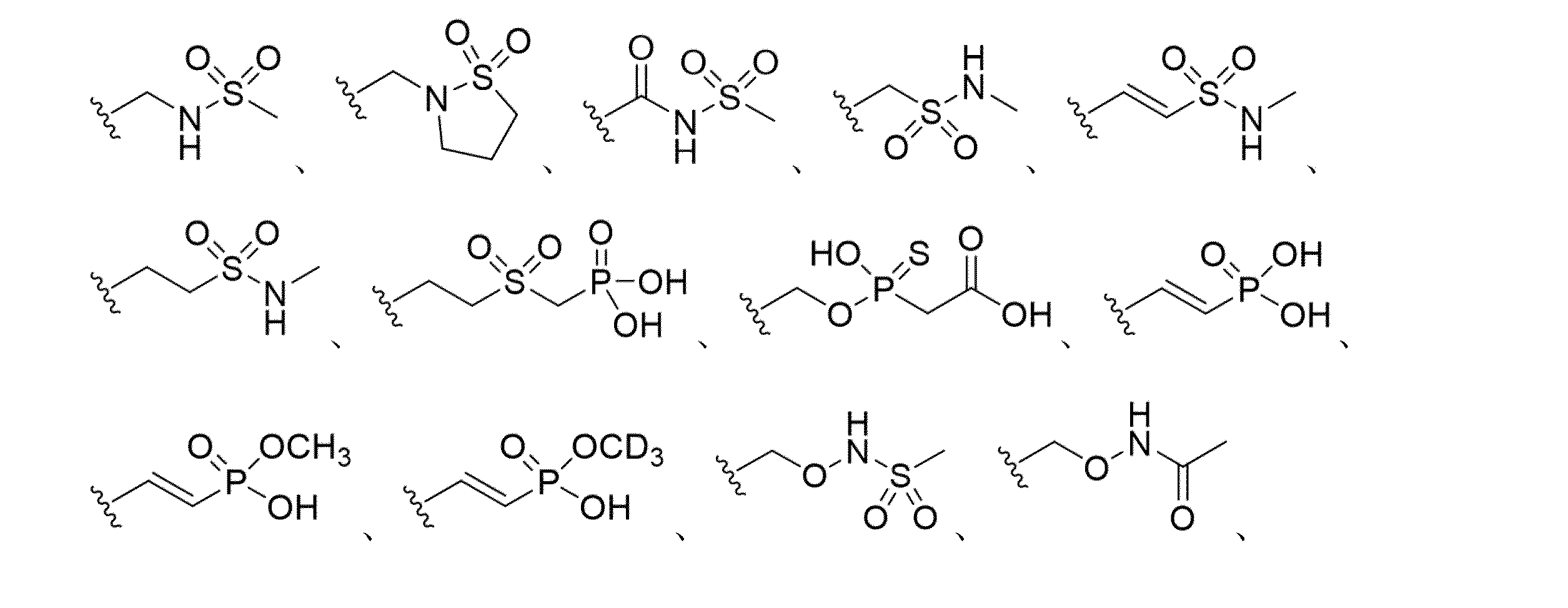
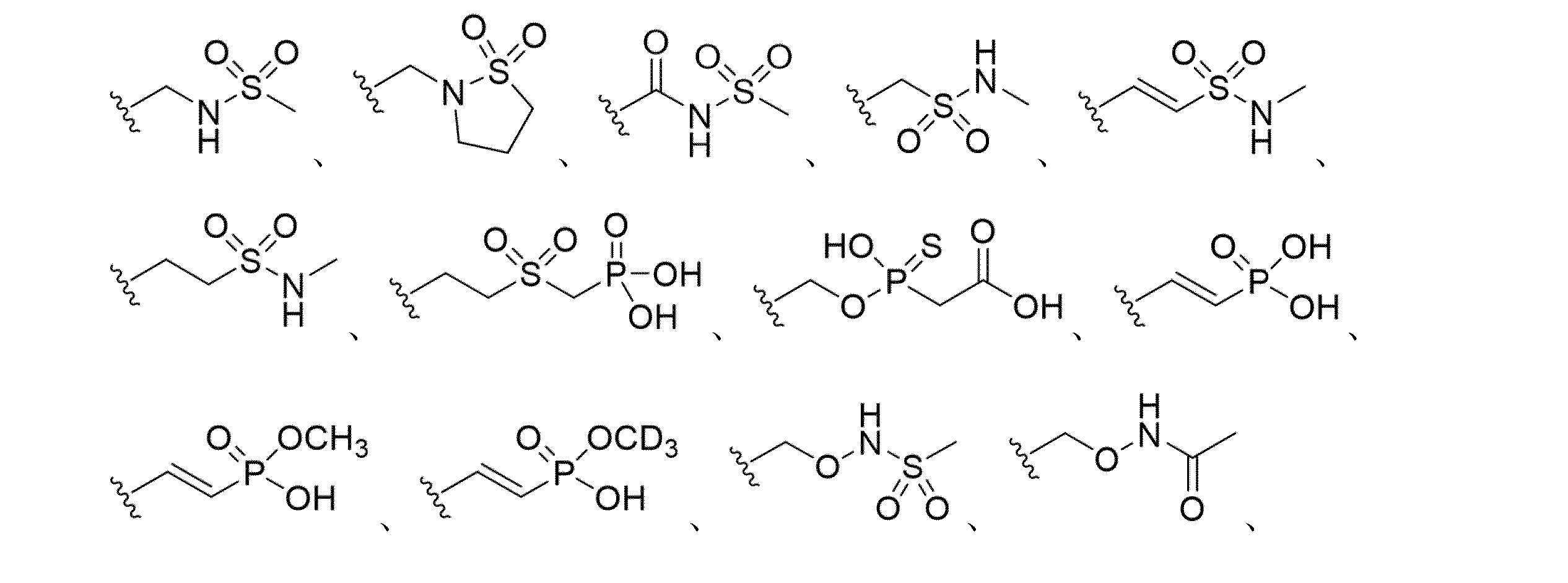
本明細書に開示されるのは、短い干渉核酸(siNA)分子であって、(a)式(1)~式(15)、式(9X)~式(12X)、および式(9Y)~式(12Y)からなる群から選択される5’安定化エンドキャップ:

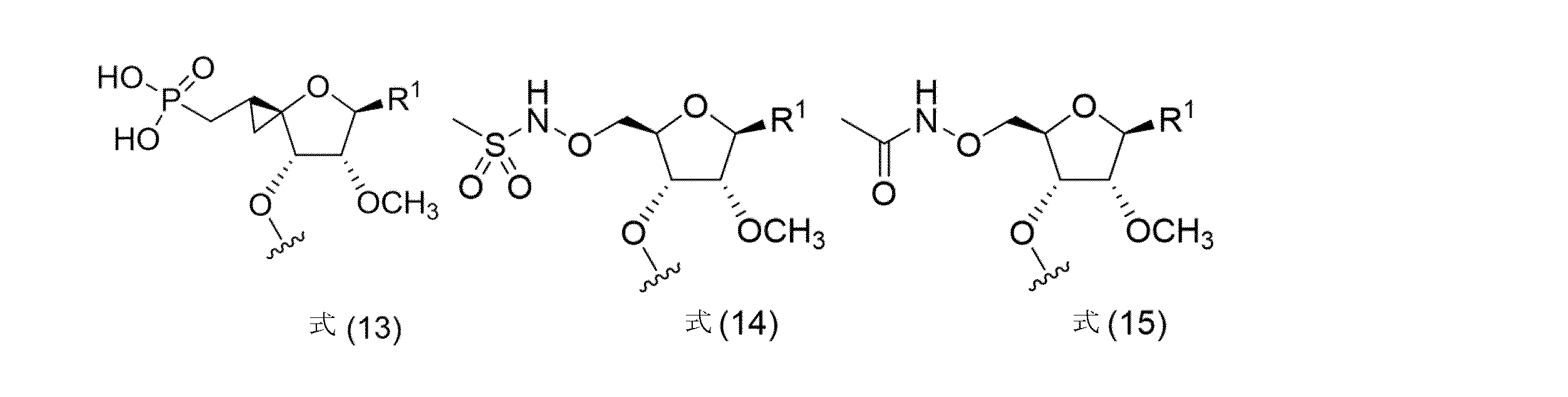
本明細書に開示されるのは、短い干渉核酸(siNA)分子であって、式(1A)~(15A)、式(9B)~(12B)、式(9AX)~(12AX)、式(9AY)~(12AY)、式(9BX)~(12BX)、および式(9BY)~(12BY)からなる群から選択される5’安定化エンドキャップ:


本明細書に開示されるのは、短い干渉核酸(siNA)分子であって、(a)式(Ic)の5’安定化エンドキャップ:

R1が、核酸塩基、アリール、ヘテロアリール、またはHであり、
R2が、
R2およびR20が、一緒になって、-(CR21R22)n-Zもしくは-(C2-C6アルケニレン)-Zで置換された3~7員の炭素環式環を形成し、
nが、1、2、3、または4であり、
Zが、-ONR23R24、-OP(O)OH(CH2)mCO2R23、-OP(S)OH(CH2)mCO2R23、-P(O)(OH)2、-P(O)(OH)(OCH3)、-P(O)(OH)(OCD3)、-SO2(CH2)mP(O)(OH)2、-SO2NR23R25、-NR23R24、または-NR23SO2R24であり、
R21およびR22のいずれかが、独立して、水素もしくはC1~C6アルキルであるか、またはR21およびR22が、一緒になってオキソ基を形成し、
R23が、水素、もしくはC1~C6アルキルであり、
R24が、-SO2R25もしくは-C(O)R25であるか、または
R23およびR24が、それらが接続する窒素と一緒になって、置換もしくは非置換複素環式環を形成し、
R25が、C1~C6アルキルであり、
mが、1、2、3、または4である)と、
(b)短い干渉核酸(siNA)と、を含む、短い干渉核酸(siNA)分子である。いくつかの実施形態では、siNAは、本明細書に開示されるセンス鎖のいずれかを含む。いくつかの実施形態では、siNAは、本明細書に開示されるアンチセンス鎖のいずれかを含む。いくつかの実施形態では、siNAは、配列番号1~56、103~158、および205~260のうちのいずれか1つから選択される第1のヌクレオチド配列を含む。いくつかの実施形態では、siNAは、配列番号57~102、159~204、および261~306のうちのいずれか1つから選択される第2のヌクレオチド配列を含む。いくつかの実施形態では、siNAは、配列番号307~362および415~444のうちのいずれか1つから選択されるセンス配列を含む。いくつかの実施形態では、siNAは、配列番号363~409、445~533、および536~539のうちのいずれか1つから選択されるアンチセンス配列を含む。いくつかの実施形態では、siNAは、ds-siNA-001~ds-siNA-0178のうちのいずれか1つから選択されるds-siNA配列を含む。いくつかの実施形態では、siNAは、本明細書に開示されるリン酸化ブロッカーのいずれかをさらに含む。いくつかの実施形態では、siNAは、本明細書に開示されるコンジュゲート化部分のいずれかをさらに含む。いくつかの実施形態では、siNAは、本明細書に開示される不安定化ヌクレオチドのいずれかをさらに含む。いくつかの実施形態では、siNAは、本明細書に開示される修飾ヌクレオチドのうちのいずれかをさらに含む。
Disclosed herein are short interfering nucleic acid (siNA) molecules comprising (a) a 5' stabilizing endcap of formula (Ic):
R 1 is nucleobase, aryl, heteroaryl, or H;
R2 is
n is 1, 2, 3, or 4;
Z is —ONR 23 R 24 , —OP(O)OH(CH 2 ) m CO 2 R 23 , —OP(S)OH(CH 2 ) m CO 2 R 23 , —P(O)(OH) 2 , —P(O)(OH)(OCH 3 ), —P(O)(OH)(OCD 3 ), —SO 2 (CH 2 ) m P(O)(OH) 2 , —SO 2 NR 23 R 25 , —NR 23 R 24 , or —NR 23 SO 2 R 24 ;
either R 21 and R 22 are independently hydrogen or C 1 -C 6 alkyl, or R 21 and R 22 together form an oxo group;
R 23 is hydrogen or C 1 -C 6 alkyl,
R 24 is —SO 2 R 25 or —C(O)R 25 , or R 23 and R 24 together with the nitrogen to which they are attached form a substituted or unsubstituted heterocyclic ring death,
R 25 is C 1 -C 6 alkyl;
m is 1, 2, 3, or 4);
(b) a short interfering nucleic acid (siNA) molecule. In some embodiments, the siNA comprises any of the sense strands disclosed herein. In some embodiments, a siNA comprises any of the antisense strands disclosed herein. In some embodiments, the siNA comprises a first nucleotide sequence selected from any one of SEQ ID NOs: 1-56, 103-158, and 205-260. In some embodiments, the siNA comprises a second nucleotide sequence selected from any one of SEQ ID NOs:57-102, 159-204, and 261-306. In some embodiments, the siNA comprises a sense sequence selected from any one of SEQ ID NOS:307-362 and 415-444. In some embodiments, the siNA comprises an antisense sequence selected from any one of SEQ ID NOs:363-409, 445-533, and 536-539. In some embodiments, the siNA comprises a ds-siNA sequence selected from any one of ds-siNA-001 through ds-siNA-0178. In some embodiments, the siNA further comprises any of the phosphorylation blockers disclosed herein. In some embodiments, the siNA further comprises any of the conjugation moieties disclosed herein. In some embodiments, the siNA further comprises any of the destabilizing nucleotides disclosed herein. In some embodiments, the siNA further comprises any of the modified nucleotides disclosed herein.
本明細書に開示されるのは、短い干渉核酸(siNA)分子であって、(a)式(21)~式(35)からなる群から選択される5’安定化エンドキャップ:

本明細書に開示されるのは、短い干渉核酸(siNA)分子であって、式(21A)~(35A)、式(29B)~(32B)、式(29AX)~(32AX)、式(29AY)~(32AY)、式(29BX)~(32BX)、および式(29BY)~(32BY)からなる群から選択される5’安定化エンドキャップ:

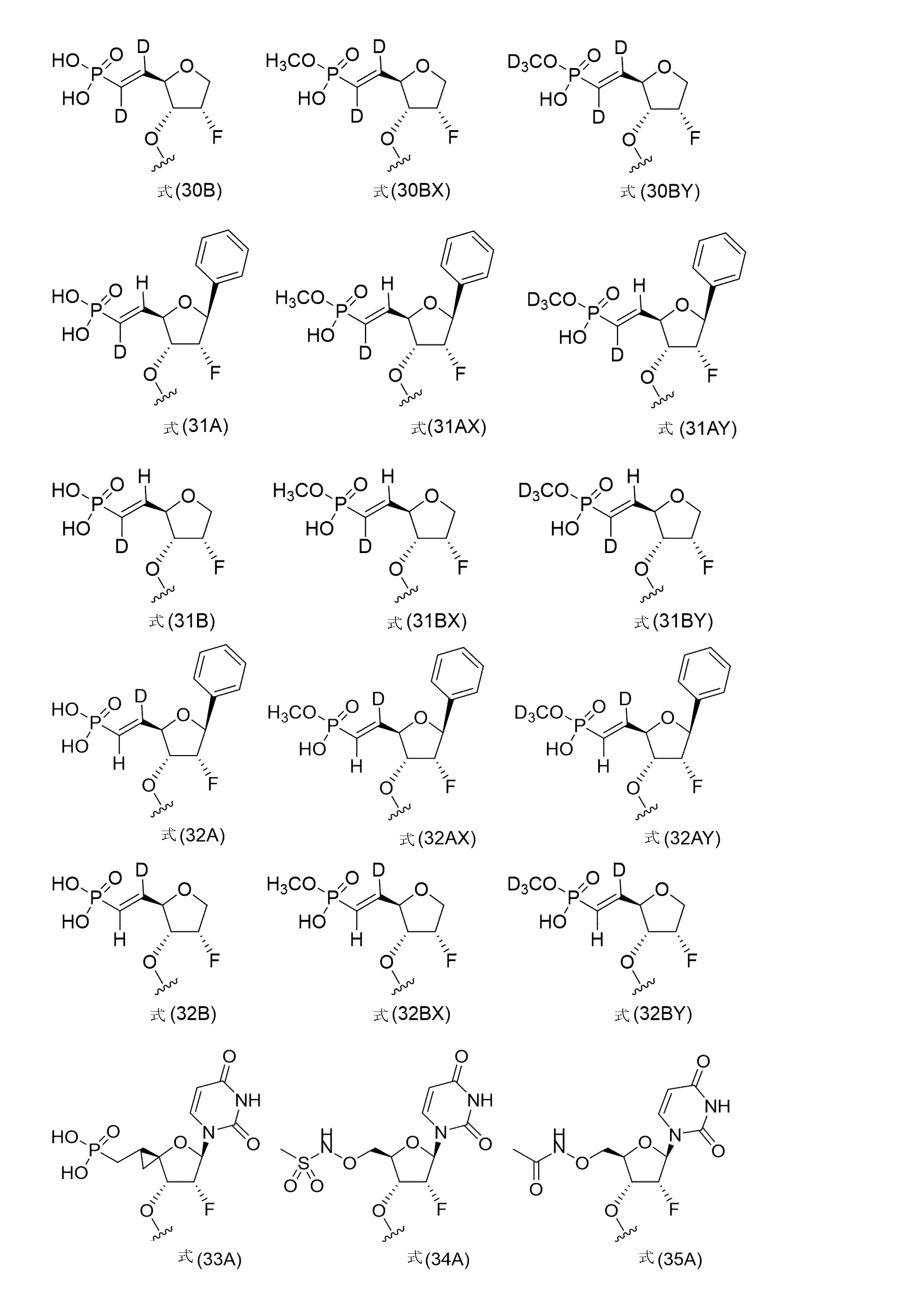
本明細書に開示されるのは、短い干渉核酸(siNA)分子であって、(a)標的遺伝子に対応するRNAに対して少なくとも約60%、65%、70%、75%、80%、85%、90%、95%、または100%同一である第1のヌクレオチド配列を含むセンス鎖であって、第1のヌクレオチド配列が、いずれか1つの配列番号1~56、103~158、および205~260のヌクレオチド配列を含む、センス鎖と、(b)標的遺伝子に対応するRNAに対して少なくとも約60%、65%、70%、75%、80%、85%、90%、95%、または100%相補的である第2のヌクレオチド配列を含むアンチセンス鎖であって、第2のヌクレオチド配列が、配列番号57~102、159~204、および261~306のうちのいずれか1つのヌクレオチド配列を含む、アンチセンス鎖と、を含む、短い干渉核酸(siNA)分子である。いくつかの実施形態では、siNAは、本明細書に開示される5’エンドキャップのいずれかをさらに含む。いくつかの実施形態では、siNAは、本明細書に開示されるリン酸化ブロッカーのいずれかをさらに含む。いくつかの実施形態では、siNAは、本明細書に開示されるコンジュゲート化部分のいずれかをさらに含む。いくつかの実施形態では、siNAは、本明細書に開示される不安定化ヌクレオチドのいずれかをさらに含む。いくつかの実施形態では、siNAは、本明細書に開示される修飾ヌクレオチドのうちのいずれかをさらに含む。 Disclosed herein are short interfering nucleic acid (siNA) molecules comprising: (a) at least about 60%, 65%, 70%, 75%, 80% of the RNA corresponding to the target gene; a sense strand comprising a first nucleotide sequence that is 85%, 90%, 95%, or 100% identical, wherein the first nucleotide sequence is any one of SEQ ID NOs: 1-56, 103-158, and and (b) at least about 60%, 65%, 70%, 75%, 80%, 85%, 90%, 95% of the RNA corresponding to the target gene, comprising a sequence of 205-260 nucleotides. or an antisense strand comprising a second nucleotide sequence that is 100% complementary, wherein the second nucleotide sequence is any one of SEQ ID NOS: 57-102, 159-204, and 261-306 A short interfering nucleic acid (siNA) molecule comprising an antisense strand comprising a nucleotide sequence. In some embodiments, the siNA further comprises any of the 5' endcaps disclosed herein. In some embodiments, the siNA further comprises any of the phosphorylation blockers disclosed herein. In some embodiments, the siNA further comprises any of the conjugation moieties disclosed herein. In some embodiments, the siNA further comprises any of the destabilizing nucleotides disclosed herein. In some embodiments, the siNA further comprises any of the modified nucleotides disclosed herein.
本明細書に開示されるのは、干渉核酸(siNA)分子であって、(a)配列番号307~362および415~444のうちのいずれか1つのヌクレオチド配列を含むセンス鎖と、(b)配列番号363~409、445~533および536~539のうちのいずれか1つのヌクレオチド配列を含むアンチセンス鎖と、を含む、干渉核酸(siNA)分子である。 Disclosed herein are interfering nucleic acid (siNA) molecules comprising (a) a sense strand comprising the nucleotide sequence of any one of SEQ ID NOS: 307-362 and 415-444; and (b) an antisense strand comprising the nucleotide sequence of any one of SEQ ID NOS:363-409, 445-533 and 536-539.
いくつかの実施形態では、本明細書に開示されるsiNAのいずれかは、リン酸化ブロッカーをさらに含む。 In some embodiments, any of the siNAs disclosed herein further comprise a phosphorylation blocker.
いくつかの実施形態では、リン酸化ブロッカーは、式(IV)の構造:

R1が、核酸塩基であり、
R4が、-O-R30または-NR31R32であり、R30が、C1~C8置換または非置換アルキルであり、
R31およびR32が、それらが接続する窒素と一緒になって、置換または非置換複素環式環を形成する。
In some embodiments, the phosphorylation blocker has the structure of formula (IV):
R 1 is a nucleobase;
R 4 is —OR 30 or —NR 31 R 32 and R 30 is C 1 -C 8 substituted or unsubstituted alkyl;
R 31 and R 32 together with the nitrogen to which they are attached form a substituted or unsubstituted heterocyclic ring.
いくつかの実施形態では、R4は、-OCH3または-N(CH2CH2)2Oである。 In some embodiments, R 4 is -OCH 3 or -N(CH 2 CH 2 ) 2 O.
いくつかの実施形態では、リン酸化ブロッカーは、センス鎖の5’末端に接続する。 In some embodiments, the phosphorylation blocker is attached to the 5' end of the sense strand.
いくつかの実施形態では、リン酸化ブロッカーは、ホスホジエステルリンカー、ホスホロチオエートリンカー、およびホスホロジチオエートリンカーから独立して選択される1つ以上のリンカーを介して、センス鎖の5’末端に接続する。 In some embodiments, the phosphorylation blocker is attached to the 5' end of the sense strand via one or more linkers independently selected from phosphodiester, phosphorothioate, and phosphorodithioate linkers. .
いくつかの実施形態では、リン酸化ブロッカーは、センス鎖の3’末端に接続する。 In some embodiments, the phosphorylation blocker is attached to the 3' end of the sense strand.
いくつかの実施形態では、リン酸化ブロッカーは、ホスホジエステルリンカー、ホスホロチオエートリンカー、およびホスホロジチオエートリンカーから独立して選択される1つ以上のリンカーを介して、センス鎖の3’末端に接続する。 In some embodiments, the phosphorylation blocker is attached to the 3' end of the sense strand via one or more linkers independently selected from phosphodiester, phosphorothioate, and phosphorodithioate linkers. .
いくつかの実施形態では、リン酸化ブロッカーは、アンチセンス鎖の5’末端に接続する。いくつかの実施形態では、リン酸化ブロッカーは、ホスホジエステルリンカー、ホスホロチオエートリンカー、およびホスホロジチオエートリンカーから独立して選択される1つ以上のリンカーを介して、アンチセンス鎖の5’末端に接続する。いくつかの実施形態では、リン酸化ブロッカーは、アンチセンス鎖の3’末端に接続する。いくつかの実施形態では、リン酸化ブロッカーは、ホスホジエステルリンカー、ホスホロチオエートリンカー、およびホスホロジチオエートリンカーから独立して選択される1つ以上のリンカーを介して、アンチセンス鎖の3’末端に接続する。 In some embodiments, the phosphorylation blocker is attached to the 5' end of the antisense strand. In some embodiments, the phosphorylation blocker is attached to the 5' end of the antisense strand via one or more linkers independently selected from phosphodiester linkers, phosphorothioate linkers, and phosphorodithioate linkers. do. In some embodiments, the phosphorylation blocker is attached to the 3' end of the antisense strand. In some embodiments, the phosphorylation blocker is attached to the 3' end of the antisense strand via one or more linkers independently selected from phosphodiester linkers, phosphorothioate linkers, and phosphorodithioate linkers. do.
いくつかの実施形態では、本明細書に開示されるsiNAのいずれかは、コンジュゲート化部分をさらに含む。いくつかの実施形態では、コンジュゲート化部分は、ガラクトサミンを含む。いくつかの実施形態では、ガラクトサミンは、式(VII)のN-アセチルガラクトサミン(GalNAc)であり、

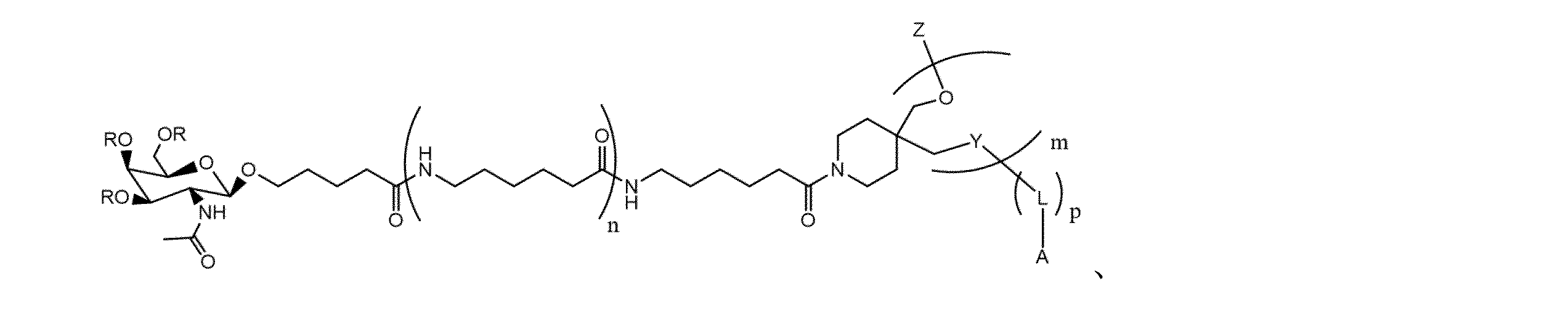
mが、1、2、3、4、または5であり、
各nが、独立して、1または2であり、
pが、0または1であり、
各Rが、独立して、Hであり、
各Yが、独立して、-O-P(=O)(SH)-、-O-P(=O)(O)-、-O-P(=O)(OH)-、および-O-P(S)S-から選択され、
Zが、H、または第2の保護基であり、
いずれかのLがリンカーであるか、またはLおよびYが、組み合わせてリンカーであり、
Aが、H、OH、第3の保護基、活性化基、またはオリゴヌクレオチドである。いくつかの実施形態では、Aは、オリゴヌクレオチドである。いくつかの実施形態では、Aは、1~2個のオリゴヌクレオチドである。いくつかの実施形態では、オリゴヌクレオチドは、dTdTである。いくつかの実施形態では、ガラクトサミンは、センス鎖の3’末端に接続する。いくつかの実施形態では、ガラクトサミンは、ホスホジエステルリンカー、ホスホロチオエートリンカー、またはホスホロジチオエートリンカーから独立して選択される1つ以上のリンカーを介して、センス鎖の3’末端に接続する。いくつかの実施形態では、ガラクトサミンは、センス鎖の5’末端に接続する。いくつかの実施形態では、ガラクトサミンは、ホスホジエステルリンカー、ホスホロチオエートリンカー、またはホスホロジチオエートリンカーから独立して選択される1つ以上のリンカーを介して、センス鎖の5’末端に接続する。いくつかの実施形態では、ガラクトサミンは、アンチセンス鎖の3’末端に接続する。いくつかの実施形態では、ガラクトサミンは、ホスホジエステルリンカー、ホスホロチオエートリンカー、またはホスホロジチオエートリンカーから独立して選択される1つ以上のリンカーを介して、アトニセンス鎖(atnisense strand)の3’末端に接続する。いくつかの実施形態では、ガラクトサミンは、アンチセンス鎖の5’末端に接続する。いくつかの実施形態では、ガラクトサミンは、ホスホジエステルリンカー、ホスホロチオエートリンカー、またはホスホロジチオエートリンカーから独立して選択される1つ以上のリンカーを介して、アトニセンス鎖の5’末端に接続する。
In some embodiments, any of the siNAs disclosed herein further comprise a conjugation moiety. In some embodiments, the conjugating moiety comprises galactosamine. In some embodiments, the galactosamine is N-acetylgalactosamine (GalNAc) of Formula (VII),
m is 1, 2, 3, 4, or 5;
each n is independently 1 or 2;
p is 0 or 1,
each R is independently H;
Each Y is independently -O-P(=O)(SH)-, -O-P(=O)(O)-, -O-P(=O)(OH)-, and -O -P(S)S-,
Z is H or a second protecting group;
either L is a linker or L and Y in combination are a linker;
A is H, OH, a tertiary protecting group, an activating group, or an oligonucleotide. In some embodiments A is an oligonucleotide. In some embodiments, A is 1-2 oligonucleotides. In some embodiments the oligonucleotide is dTdT. In some embodiments, galactosamine is attached to the 3' end of the sense strand. In some embodiments, the galactosamine is attached to the 3' end of the sense strand via one or more linkers independently selected from phosphodiester, phosphorothioate, or phosphorodithioate linkers. In some embodiments, galactosamine is attached to the 5' end of the sense strand. In some embodiments, the galactosamine is attached to the 5' end of the sense strand via one or more linkers independently selected from phosphodiester, phosphorothioate, or phosphorodithioate linkers. In some embodiments, galactosamine is attached to the 3' end of the antisense strand. In some embodiments, the galactosamine is attached to the 3' end of the atnisense strand via one or more linkers independently selected from phosphodiester, phosphorothioate, or phosphorodithioate linkers. Connecting. In some embodiments, galactosamine is attached to the 5' end of the antisense strand. In some embodiments, the galactosamine is attached to the 5' end of the atonisense strand via one or more linkers independently selected from phosphodiester, phosphorothioate, or phosphorodithioate linkers.
いくつかの実施形態では、本明細書に開示されるsiNAのいずれかは、5’安定化エンドキャップをさらに含む。いくつかの実施形態では、5’安定化エンドキャップは、5’ビニルホスホネートまたは重水素化5’ビニルホスホネートである。いくつかの実施形態では、5’安定化エンドキャップは、式(Ia)の構造:

R1が、核酸塩基、アリール、ヘテロアリール、またはHであり、
R2が、

R2およびR20が、一緒になって、-(CR21R22)n-Zもしくは-(C2-C6アルケニレン)-Zで置換された3~7員の炭素環式環を形成し、
nが、1、2、3、または4であり、
Zが、-ONR23R24、-OP(O)OH(CH2)mCO2R23、-OP(S)OH(CH2)mCO2R23、-P(O)(OH)2、-P(O)(OH)(OCH3)、-P(O)(OH)(OCD3)、-SO2(CH2)mP(O)(OH)2、-SO2NR23R25、-NR23R24、または-NR23SO2R24であり、
R21およびR22のいずれかが、独立して、水素もしくはC1~C6アルキルであるか、またはR21およびR22が、一緒になってオキソ基を形成し、
R23が、水素、もしくはC1~C6アルキルであり、
R24が、-SO2R25もしくは-C(O)R25であるか、または
R23およびR24が、それらが接続する窒素と一緒になって、置換もしくは非置換複素環式環を形成し、
R25が、C1~C6アルキルであり、
mが、1、2、3、または4である。いくつかの実施形態では、5’安定化エンドキャップは、式(Ib)の構造:

R1が、核酸塩基、アリール、ヘテロアリール、またはHであり、
R2が、

R2およびR20が、一緒になって、-(CR21R22)n-Zもしくは-(C2-C6アルケニレン)-Zで置換された3~7員の炭素環式環を形成し、
nが、1、2、3、または4であり、
Zが、-ONR23R24、-OP(O)OH(CH2)mCO2R23、-OP(S)OH(CH2)mCO2R23、-P(O)(OH)2、-P(O)(OH)(OCH3)、-P(O)(OH)(OCD3)、-SO2(CH2)mP(O)(OH)2、-SO2NR23R25、-NR23R24、または-NR23SO2R24であり、
R21およびR22のいずれかが、独立して、水素もしくはC1~C6アルキルであるか、またはR21およびR22が、一緒になってオキソ基を形成し、
R23が、水素、もしくはC1~C6アルキルであり、
R24が、-SO2R25もしくは-C(O)R25であるか、または
R23およびR24が、それらが接続する窒素と一緒になって、置換もしくは非置換複素環式環を形成し、
R25が、C1~C6アルキルであり、
mが、1、2、3、または4である。いくつかの実施形態では、5’安定化エンドキャップは、式(Ic)の構造:

R1が、核酸塩基、アリール、ヘテロアリール、またはHであり、
R2が、

R2およびR20が、一緒になって、-(CR21R22)n-Zもしくは-(C2-C6アルケニレン)-Zで置換された3~7員の炭素環式環を形成し、
nが、1、2、3、または4であり、
Zが、-ONR23R24、-OP(O)OH(CH2)mCO2R23、-OP(S)OH(CH2)mCO2R23、-P(O)(OH)2、-P(O)(OH)(OCH3)、-P(O)(OH)(OCD3)、-SO2(CH2)mP(O)(OH)2、-SO2NR23R25、-NR23R24、または-NR23SO2R24であり、
R21およびR22のいずれかが、独立して、水素もしくはC1~C6アルキルであるか、またはR21およびR22が、一緒になってオキソ基を形成し、
R23が、水素、もしくはC1~C6アルキルであり、
R24が、-SO2R25もしくは-C(O)R25であるか、または
R23およびR24が、それらが接続する窒素と一緒になって、置換もしくは非置換複素環式環を形成し、
R25が、C1~C6アルキルであり、
mが、1、2、3、または4である。いくつかの実施形態では、R1は、アリールである。いくつかの実施形態では、アリールは、フェニルである。いくつかの実施形態では、5’安定化エンドキャップは、式(1)~式(15)、式(9X)~式(12X)、および式(9Y)~式(12Y)からなる群から選択され、


R 1 is nucleobase, aryl, heteroaryl, or H;
R2 is
n is 1, 2, 3, or 4;
Z is —ONR 23 R 24 , —OP(O)OH(CH 2 ) m CO 2 R 23 , —OP(S)OH(CH 2 ) m CO 2 R 23 , —P(O)(OH) 2 , —P(O)(OH)(OCH 3 ), —P(O)(OH)(OCD 3 ), —SO 2 (CH 2 ) m P(O)(OH) 2 , —SO 2 NR 23 R 25 , —NR 23 R 24 , or —NR 23 SO 2 R 24 ;
either R 21 and R 22 are independently hydrogen or C 1 -C 6 alkyl, or R 21 and R 22 together form an oxo group;
R 23 is hydrogen or C 1 -C 6 alkyl,
R 24 is —SO 2 R 25 or —C(O)R 25 , or R 23 and R 24 together with the nitrogen to which they are attached form a substituted or unsubstituted heterocyclic ring death,
R 25 is C 1 -C 6 alkyl;
m is 1, 2, 3, or 4; In some embodiments, the 5' stabilizing endcap has the structure of Formula (Ib):
R 1 is nucleobase, aryl, heteroaryl, or H;
R2 is
n is 1, 2, 3, or 4;
Z is —ONR 23 R 24 , —OP(O)OH(CH 2 ) m CO 2 R 23 , —OP(S)OH(CH 2 ) m CO 2 R 23 , —P(O)(OH) 2 , —P(O)(OH)(OCH 3 ), —P(O)(OH)(OCD 3 ), —SO 2 (CH 2 ) m P(O)(OH) 2 , —SO 2 NR 23 R 25 , —NR 23 R 24 , or —NR 23 SO 2 R 24 ;
either R 21 and R 22 are independently hydrogen or C 1 -C 6 alkyl, or R 21 and R 22 together form an oxo group;
R 23 is hydrogen or C 1 -C 6 alkyl,
R 24 is —SO 2 R 25 or —C(O)R 25 , or R 23 and R 24 together with the nitrogen to which they are attached form a substituted or unsubstituted heterocyclic ring death,
R 25 is C 1 -C 6 alkyl;
m is 1, 2, 3, or 4; In some embodiments, the 5' stabilizing endcap has the structure of Formula (Ic):
R 1 is nucleobase, aryl, heteroaryl, or H;
R2 is
n is 1, 2, 3, or 4;
Z is —ONR 23 R 24 , —OP(O)OH(CH 2 ) m CO 2 R 23 , —OP(S)OH(CH 2 ) m CO 2 R 23 , —P(O)(OH) 2 , —P(O)(OH)(OCH 3 ), —P(O)(OH)(OCD 3 ), —SO 2 (CH 2 ) m P(O)(OH) 2 , —SO 2 NR 23 R 25 , —NR 23 R 24 , or —NR 23 SO 2 R 24 ;
either R 21 and R 22 are independently hydrogen or C 1 -C 6 alkyl, or R 21 and R 22 together form an oxo group;
R 23 is hydrogen or C 1 -C 6 alkyl,
R 24 is —SO 2 R 25 or —C(O)R 25 , or R 23 and R 24 together with the nitrogen to which they are attached form a substituted or unsubstituted heterocyclic ring death,
R 25 is C 1 -C 6 alkyl;
m is 1, 2, 3, or 4; In some embodiments, R 1 is aryl. In some embodiments, aryl is phenyl. In some embodiments, the 5′ stabilizing endcap is selected from the group consisting of Formula (1)-Formula (15), Formula (9X)-Formula (12X), and Formula (9Y)-Formula (12Y) is,
いくつかの実施形態では、本明細書に開示されるsiNA、センス鎖、第1のヌクレオチド配列、アンチセンス鎖、または第2のヌクレオチド配列のいずれかは、少なくとも1つの熱的に不安定化するヌクレオチドをさらに含む。いくつかの実施形態では、本明細書に開示されるアンチセンス鎖のいずれかは、さらに、
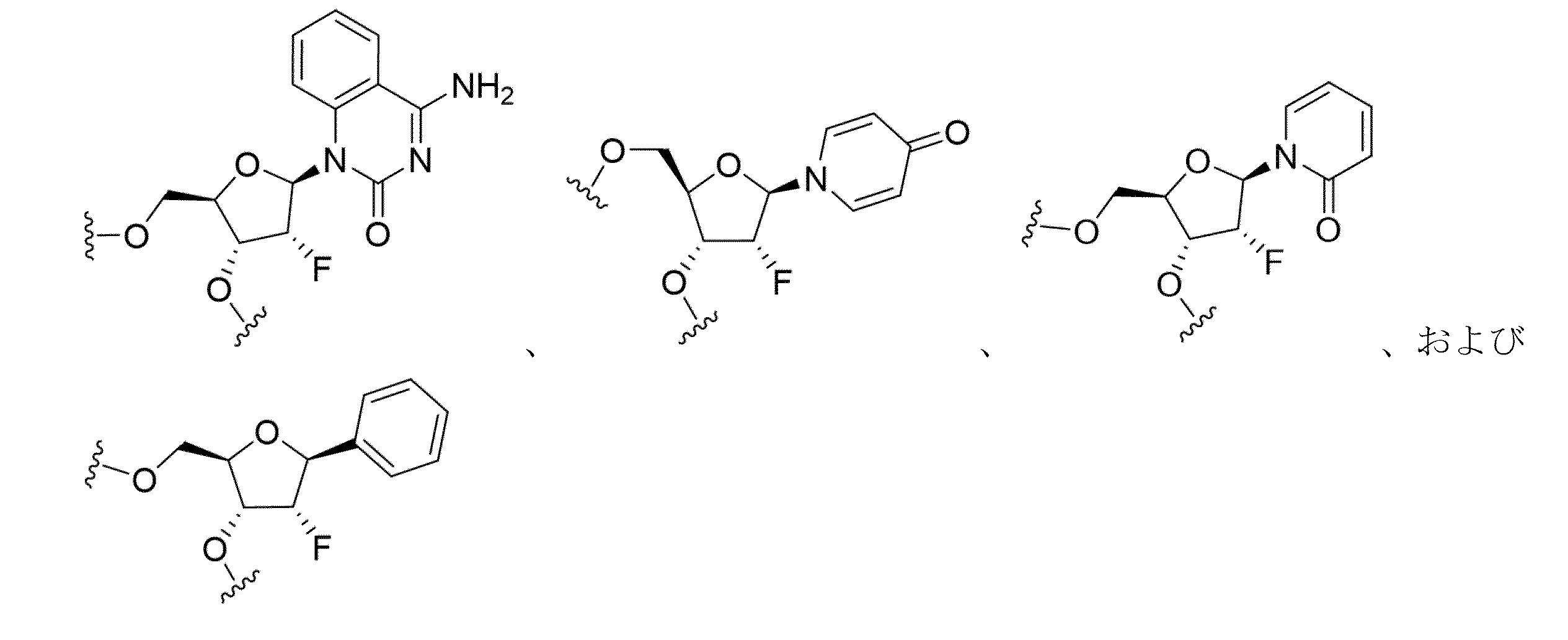


いくつかの実施形態では、本明細書に開示されるsiNAのいずれかは、標的遺伝子の発現を特異的に下方調節または減少させる。いくつかの実施形態では、標的遺伝子は、ウイルス遺伝子である。いくつかの実施形態では、ウイルス遺伝子は、DNAウイルス由来である。いくつかの実施形態では、DNAウイルスは、二本鎖DNA(dsDNA)ウイルスである。いくつかの実施形態では、dsDNAウイルスは、ヘパドナウイルスである。いくつかの実施形態では、ヘパドナウイルスは、B型肝炎ウイルス(HBV)である。いくつかの実施形態では、HBVは、HBV遺伝子型A~Jから選択される。いくつかの実施形態では、標的遺伝子は、HBVのS遺伝子またはX遺伝子から選択される。 In some embodiments, any of the siNAs disclosed herein specifically downregulate or decrease expression of a target gene. In some embodiments, the target gene is a viral gene. In some embodiments, the viral genes are derived from DNA viruses. In some embodiments, the DNA virus is a double-stranded DNA (dsDNA) virus. In some embodiments, the dsDNA virus is a hepadnavirus. In some embodiments, the hepadnavirus is hepatitis B virus (HBV). In some embodiments, the HBV is selected from HBV genotypes AJ. In some embodiments, the target gene is selected from the HBV S or X gene.
いくつかの実施形態では、第2のヌクレオチド配列は、配列番号410の200~720または1100~1700位置内の15~30個のヌクレオチドに対して少なくとも約60%、65%、70%、75%、80%、85%、90%、95%、または100%相補的である。いくつかの実施形態では、第2のヌクレオチド配列は、配列番号410の200~280、300~445、460~510、650~720、1170~1220、1250~1300、または1550~1630位置内の15~30個のヌクレオチドに対して少なくとも約60%、65%、70%、75%、80%、85%、90%、95%、または100%相補的である。いくつかの実施形態では、第2のヌクレオチド配列は、配列番号410の200~230、250~280、300~330、370~400、405~445、460~500、670~700、1180~1210、1260~1295、1520~1550、または1570~1610位置内の15~30個のヌクレオチドに対して少なくとも約60%、65%、70%、75%、80%、85%、90%、95%、または100%相補的である。いくつかの実施形態では、第2のヌクレオチド配列は、配列番号410の203、206、254、305、375、409、412、415、416、419、462、466、467、674、676、1182、1262、1263、1268、1526、1577、1578、1580、1581、1583、または1584位置で開始する15~30個のヌクレオチドに対して少なくとも約60%、65%、70%、75%、80%、85%、90%、95%、または100%相補的である。 In some embodiments, the second nucleotide sequence is at least about 60%, 65%, 70%, 75% of 15-30 nucleotides within positions 200-720 or 1100-1700 of SEQ ID NO:410. , 80%, 85%, 90%, 95%, or 100% complementary. In some embodiments the second nucleotide sequence is 15 At least about 60%, 65%, 70%, 75%, 80%, 85%, 90%, 95%, or 100% complementary to ˜30 nucleotides. In some embodiments, the second nucleotide sequence is 200-230, 250-280, 300-330, 370-400, 405-445, 460-500, 670-700, 1180-1210 of SEQ ID NO:410, at least about 60%, 65%, 70%, 75%, 80%, 85%, 90%, 95% for 15-30 nucleotides within positions 1260-1295, 1520-1550, or 1570-1610; or 100% complementary. In some embodiments, the second nucleotide sequence is 203, 206, 254, 305, 375, 409, 412, 415, 416, 419, 462, 466, 467, 674, 676, 1182, at least about 60%, 65%, 70%, 75%, 80% for the 15-30 nucleotides starting at positions 1262, 1263, 1268, 1526, 1577, 1578, 1580, 1581, 1583, or 1584; 85%, 90%, 95% or 100% complementary.
いくつかの実施形態では、第1のヌクレオチド配列は、配列番号410の200~720または1100~1700位置内の15~30個のヌクレオチドに対して少なくとも約60%、65%、70%、75%、80%、85%、90%、95%、または100%同一である。いくつかの実施形態では、第1のヌクレオチド配列は、配列番号410の200~280、300~445、460~510、650~720、1170~1220、1250~1300、または1550~1630位置内の15~30個のヌクレオチドに対して少なくとも約60%、65%、70%、75%、80%、85%、90%、95%、または100%同一である。いくつかの実施形態では、第1のヌクレオチド配列は、配列番号410の200~230、250~280、300~330、370~400、405~445、460~500、670~700、1180~1210、1260~1295、1520~1550、または1570~1610位置内の15~30個のヌクレオチドに対して少なくとも約60%、65%、70%、75%、80%、85%、90%、95%、または100%同一である。いくつかの実施形態では、第1のヌクレオチド配列は、配列番号410の203、206、254、305、375、409、412、415、416、419、462、466、467、674、676、1182、1262、1263、1268、1526、1577、1578、1580、1581、1583、または1584位置で開始する15~30個のヌクレオチドに対して少なくとも約60%、65%、70%、75%、80%、85%、90%、95%、または100%同一である。 In some embodiments, the first nucleotide sequence is at least about 60%, 65%, 70%, 75% of 15-30 nucleotides within positions 200-720 or 1100-1700 of SEQ ID NO:410 , 80%, 85%, 90%, 95%, or 100% identical. In some embodiments, the first nucleotide sequence is 15 At least about 60%, 65%, 70%, 75%, 80%, 85%, 90%, 95%, or 100% identical to -30 nucleotides. In some embodiments, the first nucleotide sequence is 200-230, 250-280, 300-330, 370-400, 405-445, 460-500, 670-700, 1180-1210, at least about 60%, 65%, 70%, 75%, 80%, 85%, 90%, 95% for 15-30 nucleotides within positions 1260-1295, 1520-1550, or 1570-1610; or 100% identical. In some embodiments, the first nucleotide sequence of SEQ ID NO: 410 is at least about 60%, 65%, 70%, 75%, 80% for the 15-30 nucleotides starting at positions 1262, 1263, 1268, 1526, 1577, 1578, 1580, 1581, 1583, or 1584; 85%, 90%, 95% or 100% identical.
いくつかの実施形態では、第1のヌクレオチド配列は、いずれか1つの配列番号1~56、103~158および205~260のヌクレオチド配列を含む。 In some embodiments, the first nucleotide sequence comprises the nucleotide sequences of any one of SEQ ID NOs: 1-56, 103-158 and 205-260.
いくつかの実施形態では、第2のヌクレオチド配列は、配列番号57~102、159~204、および261~306のうちのいずれか1つのヌクレオチド配列を含む。 In some embodiments, the second nucleotide sequence comprises the nucleotide sequence of any one of SEQ ID NOs:57-102, 159-204, and 261-306.
いくつかの実施形態では、センス鎖は、配列番号307~362および415~444のうちのいずれか1つのヌクレオチド配列を含む。 In some embodiments, the sense strand comprises the nucleotide sequence of any one of SEQ ID NOS:307-362 and 415-444.
いくつかの実施形態では、アンチセンス鎖は、配列番号363~409、445~533および536~539のうちのいずれか1つのヌクレオチド配列を含む。 In some embodiments, the antisense strand comprises the nucleotide sequence of any one of SEQ ID NOs:363-409, 445-533 and 536-539.
いくつかの実施形態では、siNAの少なくとも1つの末端は、平滑末端である。 In some embodiments, at least one end of the siNA is blunt ended.
いくつかの実施形態では、siNAの少なくとも1つの末端は、オーバーハングを含み、オーバーハングは、少なくとも1つのヌクレオチドを含む。 In some embodiments, at least one end of the siNA comprises an overhang, and the overhang comprises at least one nucleotide.
いくつかの実施形態では、siNAの両方の末端は、オーバーハングを含み、オーバーハングは、少なくとも1つのヌクレオチドを含む。 In some embodiments both ends of the siNA comprise an overhang, the overhang comprising at least one nucleotide.
いくつかの実施形態では、siNAは、ds-siNA-001~ds-siNA-0178から選択される。 In some embodiments, the siNA is selected from ds-siNA-001 through ds-siNA-0178.
いくつかの実施形態では、少なくとも1つの2’-フルオロヌクレオチドまたは2’-O-メチルヌクレオチドは、式(V)の2’-フルオロまたは2-O-メチルヌクレオチド模倣物

R1が、独立して、核酸塩基、アリール、ヘテロアリール、またはHであり、Q1およびQ2が、独立して、SまたはOであり、
R5が、独立して、-OCD3、-F、または-OCH3であり、
R6およびR7が、独立して、H、D、またはCD3である。
In some embodiments, at least one 2'-fluoro nucleotide or 2'-O-methyl nucleotide is a 2'-fluoro or 2-O-methyl nucleotide mimetic of formula (V)
R 1 is independently nucleobase, aryl, heteroaryl, or H; Q 1 and Q 2 are independently S or O;
R 5 is independently —OCD 3 , —F, or —OCH 3 ;
R6 and R7 are independently H, D, or CD3.
いくつかの実施形態では、2’-フルオロまたは2’-O-メチルヌクレオチド模倣物は、式(16)~式(20)のヌクレオチド模倣物であり、

本明細書にさらに開示されるのは、本明細書に開示されるsiNAのいずれかを含む組成物である。いくつかの実施形態では、siNAは、HBVのS遺伝子を標的とする。いくつかの実施形態では、siNAは、HBVのS遺伝子の発現を特異的に下方調節または減少させる。いくつかの実施形態では、siNAは、HBVのX遺伝子を標的とする。いくつかの実施形態では、siNAは、HBVのX遺伝子の発現を特異的に下方調節または減少させる。いくつかの実施形態では、siNAは、第1のヌクレオチド配列を含む。いくつかの実施形態では、第1のヌクレオチド配列は、いずれか1つの配列番号1~56、103~158および205~260のヌクレオチド配列を含む。いくつかの実施形態では、siNAは、第2のヌクレオチド配列を含む。いくつかの実施形態では、第2のヌクレオチド配列は、配列番号57~102、159~204、および261~306のうちのいずれか1つのヌクレオチド配列を含む。いくつかの実施形態では、siNAは、センス鎖を含む。いくつかの実施形態では、センス鎖は、配列番号307~362および415~444のうちのいずれか1つのヌクレオチド配列を含む。いくつかの実施形態では、siNAは、アンチセンス鎖を含む。いくつかの実施形態では、アンチセンス鎖は、配列番号363~409、445~533および536~539のうちのいずれか1つのヌクレオチド配列を含む。いくつかの実施形態では、siNAは、本明細書に開示される5’エンドキャップのいずれかをさらに含む。いくつかの実施形態では、siNAは、本明細書に開示されるリン酸化ブロッカーのいずれかをさらに含む。いくつかの実施形態では、siNAは、本明細書に開示されるコンジュゲート化部分のいずれかをさらに含む。いくつかの実施形態では、siNAは、本明細書に開示される不安定化ヌクレオチドのいずれかをさらに含む。いくつかの実施形態では、siNAは、本明細書に開示される修飾ヌクレオチドのうちのいずれかをさらに含む。 Further disclosed herein are compositions comprising any of the siNAs disclosed herein. In some embodiments, the siNA targets the HBV S gene. In some embodiments, the siNA specifically downregulates or decreases expression of the HBV S gene. In some embodiments, the siNA targets the X gene of HBV. In some embodiments, the siNA specifically downregulates or decreases the expression of the HBV X gene. In some embodiments, a siNA comprises a first nucleotide sequence. In some embodiments, the first nucleotide sequence comprises the nucleotide sequences of any one of SEQ ID NOs: 1-56, 103-158 and 205-260. In some embodiments, a siNA includes a second nucleotide sequence. In some embodiments, the second nucleotide sequence comprises the nucleotide sequence of any one of SEQ ID NOs:57-102, 159-204, and 261-306. In some embodiments, a siNA includes a sense strand. In some embodiments, the sense strand comprises the nucleotide sequence of any one of SEQ ID NOS:307-362 and 415-444. In some embodiments, a siNA includes an antisense strand. In some embodiments, the antisense strand comprises the nucleotide sequence of any one of SEQ ID NOs:363-409, 445-533 and 536-539. In some embodiments, the siNA further comprises any of the 5' endcaps disclosed herein. In some embodiments, the siNA further comprises any of the phosphorylation blockers disclosed herein. In some embodiments, the siNA further comprises any of the conjugation moieties disclosed herein. In some embodiments, the siNA further comprises any of the destabilizing nucleotides disclosed herein. In some embodiments, the siNA further comprises any of the modified nucleotides disclosed herein.
本明細書にさらに開示されるのは、本明細書に開示されるsiNAのうちのいずれかの2、3、4、5、6、7、8、9、10個、またはそれより多くを含む組成物である。いくつかの実施形態では、少なくとも1、2、3、4、5個、またはそれより多くのsiNAは、HBVのS遺伝子を標的とする。いくつかの実施形態では、少なくとも1、2、3、4、5個、またはそれより多くのsiNAは、HBVのS遺伝子の発現を特異的に下方調節または減少させる。いくつかの実施形態では、少なくとも1、2、3、4、5個、またはそれより多くのsiNAは、HBVのX遺伝子を標的とする。いくつかの実施形態では、少なくとも1、2、3、4、5個、またはそれより多くのsiNAは、HBVのX遺伝子の発現を特異的に下方調節または減少させる。いくつかの実施形態では、siNAは、第1のヌクレオチド配列を含む。いくつかの実施形態では、第1のヌクレオチド配列は、いずれか1つの配列番号1~56、103~158および205~260のヌクレオチド配列を含む。いくつかの実施形態では、siNAは、第2のヌクレオチド配列を含む。いくつかの実施形態では、第2のヌクレオチド配列は、配列番号57~102、159~204、および261~306のうちのいずれか1つのヌクレオチド配列を含む。いくつかの実施形態では、siNAは、センス鎖を含む。いくつかの実施形態では、センス鎖は、配列番号307~362および415~444のうちのいずれか1つのヌクレオチド配列を含む。いくつかの実施形態では、siNAは、アンチセンス鎖を含む。いくつかの実施形態では、アンチセンス鎖は、配列番号363~409、445~533および536~539のうちのいずれか1つのヌクレオチド配列を含む。いくつかの実施形態では、siNAは、本明細書に開示される5’エンドキャップのいずれかをさらに含む。いくつかの実施形態では、siNAは、本明細書に開示されるリン酸化ブロッカーのいずれかをさらに含む。いくつかの実施形態では、siNAは、本明細書に開示されるコンジュゲート化部分のいずれかをさらに含む。いくつかの実施形態では、siNAは、本明細書に開示される不安定化ヌクレオチドのいずれかをさらに含む。いくつかの実施形態では、siNAは、本明細書に開示される修飾ヌクレオチドのうちのいずれかをさらに含む。 Further disclosed herein include 2, 3, 4, 5, 6, 7, 8, 9, 10, or more of any of the siNAs disclosed herein composition. In some embodiments, at least 1, 2, 3, 4, 5, or more siNAs target the HBV S gene. In some embodiments, at least 1, 2, 3, 4, 5, or more siNAs specifically downregulate or decrease expression of the HBV S gene. In some embodiments, at least 1, 2, 3, 4, 5, or more siNAs target the X gene of HBV. In some embodiments, at least 1, 2, 3, 4, 5, or more siNAs specifically down-regulate or decrease expression of the HBV X gene. In some embodiments, a siNA comprises a first nucleotide sequence. In some embodiments, the first nucleotide sequence comprises the nucleotide sequences of any one of SEQ ID NOs: 1-56, 103-158 and 205-260. In some embodiments, a siNA includes a second nucleotide sequence. In some embodiments, the second nucleotide sequence comprises the nucleotide sequence of any one of SEQ ID NOs:57-102, 159-204, and 261-306. In some embodiments, a siNA includes a sense strand. In some embodiments, the sense strand comprises the nucleotide sequence of any one of SEQ ID NOS:307-362 and 415-444. In some embodiments, a siNA includes an antisense strand. In some embodiments, the antisense strand comprises the nucleotide sequence of any one of SEQ ID NOs:363-409, 445-533 and 536-539. In some embodiments, the siNA further comprises any of the 5' endcaps disclosed herein. In some embodiments, the siNA further comprises any of the phosphorylation blockers disclosed herein. In some embodiments, the siNA further comprises any of the conjugation moieties disclosed herein. In some embodiments, the siNA further comprises any of the destabilizing nucleotides disclosed herein. In some embodiments, the siNA further comprises any of the modified nucleotides disclosed herein.
いくつかの実施形態では、本明細書に開示される組成物のいずれかは、追加のHBV治療薬剤をさらに含む。いくつかの実施形態では、追加のHBV治療薬剤は、ヌクレオチド類似体、ヌクレオシド類似体、カプシドアセンブリモジュレーター(CAM)、組換えインターフェロン、侵入阻害剤、小分子免疫モジュレーター、およびオリゴヌクレオチド療法から選択される。いくつかの実施形態では、オリゴヌクレオチ療法は、追加のsiNAである。いくつかの実施形態では、追加のsiNAは、ds-siNA-001~ds-siNA-0178のうちのいずれかから選択される。いくつかの実施形態では、オリゴヌクレオチド療法は、アンチセンスオリゴヌクレオチド(ASO)、NAP、またはSTOPである。いくつかの実施形態では、ASOは、ASO1またはASO2である。いくつかの実施形態では、ASOは、HBVのS遺伝子を特異的に標的とする。いくつかの実施形態では、ASOは、HBVのX遺伝子を特異的に標的とする。いくつかの実施形態では、追加のHBV治療薬剤は、HBV STOPS(商標)ALG-010133、HBV CAM ALG-000184、ASO1、組換えインターフェロンアルファ2b、IFN-a、PEG-IFN-a-2a、ラミブジン、テルビブジン、アデホビルジピボキシル、クレブジン、エンテカビル、テノホビルアラフェナミド、テノホビルジソプロキシル、NVR3-778、BAY41-4109、JNJ-632、JNJ-3989(ARO-HBV)、RG6004、GSK3228836、REP-2139、REP-2165、AB-729、VIR-2218、RG6346(DCR-HBVS)、JNJ-6379、GLS4、ABI-HO731、JNJ-440、NZ-4、RG7907、EDP-514、AB-423、AB-506、ABI-H03733、およびABI-H2158から選択される。 In some embodiments, any of the compositions disclosed herein further comprise an additional HBV therapeutic agent. In some embodiments, the additional HBV therapeutic agent is selected from nucleotide analogues, nucleoside analogues, capsid assembly modulators (CAMs), recombinant interferons, entry inhibitors, small molecule immune modulators, and oligonucleotide therapeutics . In some embodiments, the oligonucleotide therapy is an additional siNA. In some embodiments, the additional siNA is selected from any of ds-siNA-001 through ds-siNA-0178. In some embodiments, the oligonucleotide therapy is an antisense oligonucleotide (ASO), NAP, or STOP. In some embodiments, ASO is ASO1 or ASO2. In some embodiments, the ASO specifically targets the HBV S gene. In some embodiments, the ASO specifically targets the X gene of HBV. In some embodiments, the additional HBV therapeutic agent is HBV STOPS™ ALG-010133, HBV CAM ALG-000184, ASO1, recombinant interferon alpha 2b, IFN-a, PEG-IFN-a-2a, lamivudine , telbivudine, adefovir dipivoxil, clevudine, entecavir, tenofovir alafenamide, tenofovir disoproxil, NVR3-778, BAY41-4109, JNJ-632, JNJ-3989 (ARO-HBV), RG6004, GSK3228836, REP-2139, REP-2165, AB-729, VIR-2218, RG6346 (DCR-HBVS), JNJ-6379, GLS4, ABI-HO731, JNJ-440, NZ-4, RG7907, EDP-514, AB-423, AB-506 , ABI-H03733, and ABI-H2158.
いくつかの実施形態では、本明細書に開示される組成物のいずれかは、肝臓疾患治療薬剤をさらに含む。いくつかの実施形態では、肝臓疾患治療薬剤は、ペルオキシソーム増殖剤活性化受容体(PPAR)アゴニスト、ファルネソイドX受容体(FXR)アゴニスト、脂質改変剤、およびインクレチン系療法から選択される。いくつかの実施形態では、PPARアゴニストは、PPARαアゴニスト、デュアルPPARα/δアゴニスト、PPARγアゴニスト、およびデュアルPPARα/γアゴニストから選択される。いくつかの実施形態では、デュアルPPARαアゴニストは、フィブラートである。いくつかの実施形態では、PPARα/δアゴニストは、エラフィブラノールである。いくつかの実施形態では、PPARγアゴニストは、チアゾリジンジオン(TZD)である。いくつかの実施形態では、TZDは、ピオグリタゾンである。いくつかの実施形態では、デュアルPPARα/γアゴニストは、サログリタザールである。いくつかの実施形態では、FXRアゴニストは、オベチコールアシス(obeticholic acis)(OCA)である。いくつかの実施形態では、脂質改変剤は、アラムコールである。いくつかの実施形態では、インクレチン系療法は、グルカゴン様ペプチド1(GLP-1)受容体アゴニストまたはジペプチジルペプチダーゼ4(DPP-4)阻害剤である。いくつかの実施形態では、GLP-1受容体アゴニストは、エキセナチドまたはリラグルチドである。いくつかの実施形態では、DPP-4阻害剤は、シタグリプチンまたはビルダプリプチンである。 In some embodiments, any of the compositions disclosed herein further comprise a liver disease treating agent. In some embodiments, the liver disease therapeutic agent is selected from peroxisome proliferator-activated receptor (PPAR) agonists, farnesoid X receptor (FXR) agonists, lipid modifying agents, and incretin-based therapies. In some embodiments, the PPAR agonist is selected from PPARα agonists, dual PPARα/δ agonists, PPARγ agonists, and dual PPARα/γ agonists. In some embodiments, the dual PPARα agonist is a fibrate. In some embodiments, the PPARα/δ agonist is elafibranol. In some embodiments, the PPARγ agonist is a thiazolidinedione (TZD). In some embodiments, the TZD is pioglitazone. In some embodiments, the dual PPARα/γ agonist is saloglitazar. In some embodiments, the FXR agonist is obeticholic asis (OCA). In some embodiments, the lipid modifying agent is aramchol. In some embodiments, the incretin therapy is a glucagon-like peptide 1 (GLP-1) receptor agonist or dipeptidyl peptidase 4 (DPP-4) inhibitor. In some embodiments, the GLP-1 receptor agonist is exenatide or liraglutide. In some embodiments, the DPP-4 inhibitor is sitagliptin or vildapliptin.
本明細書にさらに開示されるのは、疾患の治療を必要とする対象においてそれを行う方法であって、本明細書に開示されるsiNAのいずれかを対象に投与することを含む、方法である。いくつかの実施形態では、siNAは、第1のヌクレオチド配列を含む。いくつかの実施形態では、第1のヌクレオチド配列は、いずれか1つの配列番号1~56、103~158および205~260のヌクレオチド配列を含む。いくつかの実施形態では、siNAは、第2のヌクレオチド配列を含む。いくつかの実施形態では、第2のヌクレオチド配列は、配列番号57~102、159~204、および261~306のうちのいずれか1つのヌクレオチド配列を含む。いくつかの実施形態では、siNAは、センス鎖を含む。いくつかの実施形態では、センス鎖は、配列番号307~362および415~444のうちのいずれか1つのヌクレオチド配列を含む。いくつかの実施形態では、siNAは、アンチセンス鎖を含む。いくつかの実施形態では、アンチセンス鎖は、配列番号363~409、445~533および536~539のうちのいずれか1つのヌクレオチド配列を含む。いくつかの実施形態では、siNAは、本明細書に開示される5’エンドキャップのいずれかをさらに含む。いくつかの実施形態では、siNAは、本明細書に開示されるリン酸化ブロッカーのいずれかをさらに含む。いくつかの実施形態では、siNAは、本明細書に開示されるコンジュゲート化部分のいずれかをさらに含む。いくつかの実施形態では、siNAは、本明細書に開示される不安定化ヌクレオチドのいずれかをさらに含む。いくつかの実施形態では、siNAは、本明細書に開示される修飾ヌクレオチドのうちのいずれかをさらに含む。 Further disclosed herein are methods of doing so in a subject in need of treatment for a disease, comprising administering to the subject any of the siNAs disclosed herein. be. In some embodiments, a siNA comprises a first nucleotide sequence. In some embodiments, the first nucleotide sequence comprises the nucleotide sequences of any one of SEQ ID NOs: 1-56, 103-158 and 205-260. In some embodiments, a siNA includes a second nucleotide sequence. In some embodiments, the second nucleotide sequence comprises the nucleotide sequence of any one of SEQ ID NOs:57-102, 159-204, and 261-306. In some embodiments, a siNA includes a sense strand. In some embodiments, the sense strand comprises the nucleotide sequence of any one of SEQ ID NOS:307-362 and 415-444. In some embodiments, a siNA includes an antisense strand. In some embodiments, the antisense strand comprises the nucleotide sequence of any one of SEQ ID NOs:363-409, 445-533 and 536-539. In some embodiments, the siNA further comprises any of the 5' endcaps disclosed herein. In some embodiments, the siNA further comprises any of the phosphorylation blockers disclosed herein. In some embodiments, the siNA further comprises any of the conjugation moieties disclosed herein. In some embodiments, the siNA further comprises any of the destabilizing nucleotides disclosed herein. In some embodiments, the siNA further comprises any of the modified nucleotides disclosed herein.
本明細書にさらに開示されるのは、疾患の治療を必要とする対象においてそれを行う方法であって、本明細書に開示される組成物のいずれかを対象に投与することを含む、方法である。いくつかの実施形態では、組成物は、本明細書に開示されるsiNAのうちのいずれかの少なくとも1、2、3、4、5、6、7、8、9、10個、またはそれより多くを含む。いくつかの実施形態では、siNAは、第1のヌクレオチド配列を含む。いくつかの実施形態では、第1のヌクレオチド配列は、いずれか1つの配列番号1~56、103~158および205~260のヌクレオチド配列を含む。いくつかの実施形態では、siNAは、第2のヌクレオチド配列を含む。いくつかの実施形態では、第2のヌクレオチド配列は、配列番号57~102、159~204、および261~306のうちのいずれか1つのヌクレオチド配列を含む。いくつかの実施形態では、siNAは、センス鎖を含む。いくつかの実施形態では、センス鎖は、配列番号307~362および415~444のうちのいずれか1つのヌクレオチド配列を含む。いくつかの実施形態では、siNAは、アンチセンス鎖を含む。いくつかの実施形態では、アンチセンス鎖は、配列番号363~409、445~533および536~539のうちのいずれか1つのヌクレオチド配列を含む。いくつかの実施形態では、siNAは、本明細書に開示される5’エンドキャップのいずれかをさらに含む。いくつかの実施形態では、siNAは、本明細書に開示されるリン酸化ブロッカーのいずれかをさらに含む。いくつかの実施形態では、siNAは、本明細書に開示されるコンジュゲート化部分のいずれかをさらに含む。いくつかの実施形態では、siNAは、本明細書に開示される不安定化ヌクレオチドのいずれかをさらに含む。いくつかの実施形態では、siNAは、本明細書に開示される修飾ヌクレオチドのうちのいずれかをさらに含む。いくつかの実施形態では、組成物は、本明細書に開示される追加のHBV治療薬剤のいずれかをさらに含む。いくつかの実施形態では、疾患は、ウイルス性疾患である。いくつかの実施形態では、ウイルス性疾患は、DNAウイルスによって引き起こされる。いくつかの実施形態では、DNAウイルスは、二本鎖DNA(dsDNA)ウイルスである。いくつかの実施形態では、dsDNAウイルスは、ヘパドナウイルスである。いくつかの実施形態では、ヘパドナウイルスは、B型肝炎ウイルス(HBV)である。いくつかの実施形態では、HBVは、HBV遺伝子型A~Jから選択される。いくつかの実施形態では、本方法は、追加のHBV治療薬剤を投与することをさらに含む。いくつかの実施形態では、siNAまたは組成物および追加のHBV治療薬剤は、同時に投与される。いくつかの実施形態では、siNAまたは組成物および追加のHBV治療薬剤は、順次投与される。いくつかの実施形態では、siNAまたは組成物は、追加のHBV治療薬剤を投与する前に投与される。いくつかの実施形態では、siNAまたは組成物は、追加のHBV治療薬剤を投与した後に投与される。いくつかの実施形態では、追加のHBV治療薬剤は、ヌクレオチド類似体、ヌクレオシド類似体、カプシドアセンブリモジュレーター(CAM)、組換えインターフェロン、侵入阻害剤、小分子免疫モジュレーター、およびオリゴヌクレオチド療法から選択される。いくつかの実施形態では、オリゴヌクレオチ療法は、追加のsiNAである。いくつかの実施形態では、追加のsiNAは、ds-siNA-001~ds-siNA-0178のうちのいずれかから選択される。いくつかの実施形態では、オリゴヌクレオチド療法は、アンチセンスオリゴヌクレオチド(ASO)、NAP、またはSTOPである。いくつかの実施形態では、ASOは、ASO1またはASO2である。いくつかの実施形態では、追加のHBV治療薬剤は、HBV STOPS(商標)ALG-010133、HBV CAM ALG-000184、ASO1、組換えインターフェロンアルファ2b、IFN-a、PEG-IFN-a-2a、ラミブジン、テルビブジン、アデホビルジピボキシル、クレブジン、エンテカビル、テノホビルアラフェナミド、テノホビルジソプロキシル、NVR3-778、BAY41-4109、JNJ-632、JNJ-3989(ARO-HBV)、RG6004、GSK3228836、REP-2139、REP-2165、AB-729、VIR-2218、RG6346(DCR-HBVS)、JNJ-6379、GLS4、ABI-HO731、JNJ-440、NZ-4、RG7907、EDP-514、AB-423、AB-506、ABI-H03733、およびABI-H2158から選択される。 Further disclosed herein are methods of doing so in a subject in need of treatment for a disease comprising administering to the subject any of the compositions disclosed herein. is. In some embodiments, the composition comprises at least 1, 2, 3, 4, 5, 6, 7, 8, 9, 10, or more of any of the siNAs disclosed herein. Including many. In some embodiments, a siNA comprises a first nucleotide sequence. In some embodiments, the first nucleotide sequence comprises the nucleotide sequences of any one of SEQ ID NOs: 1-56, 103-158 and 205-260. In some embodiments, a siNA includes a second nucleotide sequence. In some embodiments, the second nucleotide sequence comprises the nucleotide sequence of any one of SEQ ID NOs:57-102, 159-204, and 261-306. In some embodiments, a siNA includes a sense strand. In some embodiments, the sense strand comprises the nucleotide sequence of any one of SEQ ID NOS:307-362 and 415-444. In some embodiments, a siNA includes an antisense strand. In some embodiments, the antisense strand comprises the nucleotide sequence of any one of SEQ ID NOs:363-409, 445-533 and 536-539. In some embodiments, the siNA further comprises any of the 5' endcaps disclosed herein. In some embodiments, the siNA further comprises any of the phosphorylation blockers disclosed herein. In some embodiments, the siNA further comprises any of the conjugation moieties disclosed herein. In some embodiments, the siNA further comprises any of the destabilizing nucleotides disclosed herein. In some embodiments, the siNA further comprises any of the modified nucleotides disclosed herein. In some embodiments, the composition further comprises any of the additional HBV therapeutic agents disclosed herein. In some embodiments the disease is a viral disease. In some embodiments, the viral disease is caused by a DNA virus. In some embodiments, the DNA virus is a double-stranded DNA (dsDNA) virus. In some embodiments, the dsDNA virus is a hepadnavirus. In some embodiments, the hepadnavirus is hepatitis B virus (HBV). In some embodiments, the HBV is selected from HBV genotypes AJ. In some embodiments, the method further comprises administering an additional HBV therapeutic agent. In some embodiments, the siNA or composition and the additional HBV therapeutic agent are administered simultaneously. In some embodiments, the siNA or composition and the additional HBV therapeutic agent are administered sequentially. In some embodiments, the siNA or composition is administered prior to administration of the additional HBV therapeutic agent. In some embodiments, the siNA or composition is administered after administration of an additional HBV therapeutic agent. In some embodiments, the additional HBV therapeutic agent is selected from nucleotide analogues, nucleoside analogues, capsid assembly modulators (CAMs), recombinant interferons, entry inhibitors, small molecule immune modulators, and oligonucleotide therapeutics . In some embodiments, the oligonucleotide therapy is an additional siNA. In some embodiments, the additional siNA is selected from any of ds-siNA-001 through ds-siNA-0178. In some embodiments, the oligonucleotide therapy is an antisense oligonucleotide (ASO), NAP, or STOP. In some embodiments, ASO is ASO1 or ASO2. In some embodiments, the additional HBV therapeutic agent is HBV STOPS™ ALG-010133, HBV CAM ALG-000184, ASO1, recombinant interferon alpha 2b, IFN-a, PEG-IFN-a-2a, lamivudine , telbivudine, adefovir dipivoxil, clevudine, entecavir, tenofovir alafenamide, tenofovir disoproxil, NVR3-778, BAY41-4109, JNJ-632, JNJ-3989 (ARO-HBV), RG6004, GSK3228836, REP-2139, REP-2165, AB-729, VIR-2218, RG6346 (DCR-HBVS), JNJ-6379, GLS4, ABI-HO731, JNJ-440, NZ-4, RG7907, EDP-514, AB-423, AB-506 , ABI-H03733, and ABI-H2158.
いくつかの実施形態では、疾患は、肝臓疾患である。いくつかの実施形態では、肝臓疾患は、非アルコール性脂肪肝疾患(NAFLD)または肝細胞がん腫(HCC)である。いくつかの実施形態では、NAFLDは、非アルコール性脂肪性肝炎(NASH)である。いくつかの実施形態では、本方法は、肝臓疾患治療薬剤を対象に投与することをさらに含む。いくつかの実施形態では、肝臓疾患治療薬剤は、ペルオキシソーム増殖剤活性化受容体(PPAR)アゴニスト、ファルネソイドX受容体(FXR)アゴニスト、脂質改変剤、およびインクレチン系療法から選択される。いくつかの実施形態では、PPARアゴニストは、PPARαアゴニスト、デュアルPPARα/δアゴニスト、PPARγアゴニスト、およびデュアルPPARα/γアゴニストから選択される。いくつかの実施形態では、デュアルPPARαアゴニストは、フィブラートである。いくつかの実施形態では、PPARα/δアゴニストは、エラフィブラノールである。いくつかの実施形態では、PPARγアゴニストは、チアゾリジンジオン(TZD)である。いくつかの実施形態では、TZDは、ピオグリタゾンである。いくつかの実施形態では、デュアルPPARα/γアゴニストは、サログリタザールである。いくつかの実施形態では、FXRアゴニストは、オベチコールアシス(OCA)である。いくつかの実施形態では、脂質改変剤は、アラムコールである。いくつかの実施形態では、インクレチン系療法は、グルカゴン様ペプチド1(GLP-1)受容体アゴニストまたはジペプチジルペプチダーゼ4(DPP-4)阻害剤である。いくつかの実施形態では、GLP-1受容体アゴニストは、エキセナチドまたはリラグルチドである。いくつかの実施形態では、DPP-4阻害剤は、シタグリプチンまたはビルダプリプチンである。いくつかの実施形態では、siNAまたは組成物および肝臓疾患治療薬剤は、同時に投与される。いくつかの実施形態では、siNAまたは組成物および肝臓疾患治療薬剤は、順次投与される。いくつかの実施形態では、siNAまたは組成物は、肝臓疾患治療薬剤を投与する前に投与される。いくつかの実施形態では、siNAまたは組成物は、肝臓疾患治療薬剤を投与した後に投与される。 In some embodiments, the disease is liver disease. In some embodiments, the liver disease is nonalcoholic fatty liver disease (NAFLD) or hepatocellular carcinoma (HCC). In some embodiments, the NAFLD is non-alcoholic steatohepatitis (NASH). In some embodiments, the method further comprises administering a liver disease treatment agent to the subject. In some embodiments, the liver disease therapeutic agent is selected from peroxisome proliferator-activated receptor (PPAR) agonists, farnesoid X receptor (FXR) agonists, lipid modifying agents, and incretin-based therapies. In some embodiments, the PPAR agonist is selected from PPARα agonists, dual PPARα/δ agonists, PPARγ agonists, and dual PPARα/γ agonists. In some embodiments, the dual PPARα agonist is a fibrate. In some embodiments, the PPARα/δ agonist is elafibranol. In some embodiments, the PPARγ agonist is a thiazolidinedione (TZD). In some embodiments, the TZD is pioglitazone. In some embodiments, the dual PPARα/γ agonist is saloglitazar. In some embodiments, the FXR agonist is obeticholasis (OCA). In some embodiments, the lipid modifying agent is aramchol. In some embodiments, the incretin therapy is a glucagon-like peptide 1 (GLP-1) receptor agonist or dipeptidyl peptidase 4 (DPP-4) inhibitor. In some embodiments, the GLP-1 receptor agonist is exenatide or liraglutide. In some embodiments, the DPP-4 inhibitor is sitagliptin or vildapliptin. In some embodiments, the siNA or composition and the agent treating liver disease are administered simultaneously. In some embodiments, the siNA or composition and the agent treating liver disease are administered sequentially. In some embodiments, the siNA or composition is administered prior to administration of the liver disease treatment agent. In some embodiments, the siNA or composition is administered after administration of an agent treating liver disease.
いくつかの実施形態では、siNAまたは組成物は、少なくとも1mg/kg、2mg/kg、3mg/kg、4mg/kg、5mg/kg、6mg/kg、7mg/kg、8mg/kg、9mg/kg、10mg/kg、11mg/kg、12mg/kg、13mg/kg、14mg/kg、または15mg/kgの用量で投与される。いくつかの実施形態では、siNAまたは組成物は、0.5mg/kg~50mg/kg、0.5mg/kg~40mg/kg、0.5mg/kg~30mg/kg、1mg/kg~50mg/kg、1mg/kg~40mg/kg、1mg/kg~30mg/kg、1mg/kg~20mg/kg、3mg/kg~50mg/kg、3mg/kg~40mg/kg、3mg/kg~30mg/kg、3mg/kg~20mg/kg、3mg/kg~15mg/kg、3mg/kg~10mg/kg、4mg/kg~50mg/kg、4mg/kg~40mg/kg、4mg/kg~30mg/kg、4mg/kg~20mg/kg、4mg/kg~15mg/kg、4mg/kg~10mg/kg、5mg/kg~50mg/kg、5mg/kg~40mg/kg、5mg/kg~30mg/kg、5mg/kg~20mg/kg、5mg/kg~15mg/kg、または5mg/kg~10mg/kgの用量で投与される。 In some embodiments, the siNA or composition is at least 1 mg/kg, 2 mg/kg, 3 mg/kg, 4 mg/kg, 5 mg/kg, 6 mg/kg, 7 mg/kg, 8 mg/kg, 9 mg/kg, It is administered at doses of 10 mg/kg, 11 mg/kg, 12 mg/kg, 13 mg/kg, 14 mg/kg, or 15 mg/kg. In some embodiments, the siNA or composition is 0.5 mg/kg to 50 mg/kg, 0.5 mg/kg to 40 mg/kg, 0.5 mg/kg to 30 mg/kg, 1 mg/kg to 50 mg/kg , 1 mg/kg to 40 mg/kg, 1 mg/kg to 30 mg/kg, 1 mg/kg to 20 mg/kg, 3 mg/kg to 50 mg/kg, 3 mg/kg to 40 mg/kg, 3 mg/kg to 30 mg/kg, 3 mg /kg to 20 mg/kg, 3 mg/kg to 15 mg/kg, 3 mg/kg to 10 mg/kg, 4 mg/kg to 50 mg/kg, 4 mg/kg to 40 mg/kg, 4 mg/kg to 30 mg/kg, 4 mg/kg ~20 mg/kg, 4 mg/kg to 15 mg/kg, 4 mg/kg to 10 mg/kg, 5 mg/kg to 50 mg/kg, 5 mg/kg to 40 mg/kg, 5 mg/kg to 30 mg/kg, 5 mg/kg to 20 mg /kg, 5 mg/kg to 15 mg/kg, or 5 mg/kg to 10 mg/kg.
いくつかの実施形態では、siNAまたは組成物は、少なくとも1、2、3、4、5、6、7、8、9、または10回投与される。いくつかの実施形態では、siNAまたは組成物は、1日に少なくとも1、2、3、4、5、6、7、8、9、または10回、1週間に少なくとも1、2、3、4、5、6、7、8、9、または10回、または1ヶ月に少なくとも1、2、3、4、5、6、7、8、9、または10回投与される。いくつかの実施形態では、siNAまたは組成物は、1、2、3、4、5、6、7、8、9、10、11、12、13、14、15、16、17、18、19、20、または21日ごとに少なくとも1回投与される。いくつかの実施形態では、siNAまたは組成物は、少なくとも1、2、3、4、5、6、7、8、9、10、11、12、13、14、15、16、17、18、19、20、または21日間、または少なくとも1、2、3、4、5、6、7、8、9、10、11、12、13、14、15、16、17、18、19、20、21、22、23、24、25、26、27、28、29、30、35、40、45、50、51、52、53、54、または55週間の期間にわたって投与される。 In some embodiments, the siNA or composition is administered at least 1, 2, 3, 4, 5, 6, 7, 8, 9, or 10 times. In some embodiments, the siNA or composition is administered at least 1, 2, 3, 4, 5, 6, 7, 8, 9, or 10 times per day and at least 1, 2, 3, 4 times per week. , 5, 6, 7, 8, 9, or 10 times, or at least 1, 2, 3, 4, 5, 6, 7, 8, 9, or 10 times per month. In some embodiments, the siNA or composition is , at least once every 20, or 21 days. In some embodiments, the siNA or composition comprises at least 1, 2, 3, 4, 5, 6, 7, 8, 9, 10, 11, 12, 13, 14, 15, 16, 17, 18, 19, 20, or 21 days, or at least 1, 2, 3, 4, 5, 6, 7, 8, 9, 10, 11, 12, 13, 14, 15, 16, 17, 18, 19, 20, It is administered over a period of 21, 22, 23, 24, 25, 26, 27, 28, 29, 30, 35, 40, 45, 50, 51, 52, 53, 54, or 55 weeks.
いくつかの実施形態では、siNAまたは組成物は、5mg/kgの単回用量で投与される。いくつかの実施形態では、siNAまたは組成物は、10mg/kgの単回用量で投与される。いくつかの実施形態では、siNAまたは組成物は、10mg/kgの3回用量で、1週間に1回投与される。いくつかの実施形態では、siNAまたは組成物は、10mg/kgの3回用量で、3日に1回投与される。いくつかの実施形態では、siNAまたは組成物は、10mg/kgの5回用量で、3日に1回投与される。いくつかの実施形態では、siNAまたは組成物は、1mg/kg~15mg/kg、1mg/kg~10mg/kg、2mg/kg~15mg/kg、2mg/kg~10mg/kg、3mg/kg~15mg/kg、または3mg/kg~10mg/kgの範囲の6回用量で投与される。いくつかの実施形態では、第1の用量および第2の用量は、少なくとも3日間離れて投与される。いくつかの実施形態では、第2の用量および第3の用量は、少なくとも4日間離れて投与される。いくつかの実施形態では、第3の用量および第4の用量、第4の用量および第5の用量、または第5の用量および第6の用量は、少なくとも7日間離れて投与される。 In some embodiments, the siNA or composition is administered at a single dose of 5 mg/kg. In some embodiments, the siNA or composition is administered at a single dose of 10 mg/kg. In some embodiments, the siNA or composition is administered once weekly at three doses of 10 mg/kg. In some embodiments, the siNA or composition is administered once every three days at three doses of 10 mg/kg. In some embodiments, the siNA or composition is administered once every three days at 5 doses of 10 mg/kg. In some embodiments, the siNA or composition is 1 mg/kg to 15 mg/kg, 1 mg/kg to 10 mg/kg, 2 mg/kg to 15 mg/kg, 2 mg/kg to 10 mg/kg, 3 mg/kg to 15 mg /kg, or 6 doses ranging from 3 mg/kg to 10 mg/kg. In some embodiments, the first dose and the second dose are administered at least 3 days apart. In some embodiments, the second and third doses are administered at least four days apart. In some embodiments, the third and fourth doses, the fourth and fifth doses, or the fifth and sixth doses are administered at least 7 days apart.
いくつかの実施形態では、本明細書に開示されるsiNAまたは組成物のいずれかは、粒子またはウイルスベクターとして製剤化される。いくつかの実施形態では、siNAまたは組成物は、粒子またはウイルスベクターで投与される。いくつかの実施形態では、ウイルスベクターは、アデノウイルス、アデノ随伴ウイルス(AAV)、アルファウイルス、フラビウイルス、単純ヘルペスウイルス、レンチウイルス、麻疹ウイルス、ピコルナウイルス、ポックスウイルス、レトロウイルス、またはラブドウイルスのベクターである。いくつかの実施形態では、ウイルスベクターは、組換えウイルスベクターである。いくつかの実施形態では、ウイルスベクターは、AAVrh.74、AAVrh.10、AAVrh.20、AAV-1、AAV-2、AAV-3、AAV-4、AAV-5、AAV-6、AAV-7、AAV-8、AAV-9、AAV-10、AAV-11、AAV-12、およびAAV-13から選択される。いくつかの実施形態では、siNAまたは組成物は、全身的に投与される。いくつかの実施形態では、siNAまたは組成物は、局所的に投与される。いくつかの実施形態では、siNAまたは組成物は、静脈内、皮下、または筋肉内に投与される。 In some embodiments, any of the siNAs or compositions disclosed herein are formulated as particles or viral vectors. In some embodiments, siNAs or compositions are administered in particles or viral vectors. In some embodiments, the viral vector is adenovirus, adeno-associated virus (AAV), alphavirus, flavivirus, herpes simplex virus, lentivirus, measles virus, picornavirus, poxvirus, retrovirus, or rhabdovirus. is a vector of In some embodiments, the viral vector is a recombinant viral vector. In some embodiments, the viral vector is AAVrh. 74, AAVrh. 10, AAVrh. 20, AAV-1, AAV-2, AAV-3, AAV-4, AAV-5, AAV-6, AAV-7, AAV-8, AAV-9, AAV-10, AAV-11, AAV-12, and AAV-13. In some embodiments, siNAs or compositions are administered systemically. In some embodiments, siNAs or compositions are administered locally. In some embodiments, the siNA or composition is administered intravenously, subcutaneously, or intramuscularly.
いくつかの実施形態では、本明細書に開示されるsiRNAまたは組成物のいずれかは、疾患を治療するための医薬の製造に使用される。いくつかの実施形態では、疾患は、ウイルス性疾患である。いくつかの実施形態では、ウイルス性疾患は、DNAウイルスによって引き起こされる。いくつかの実施形態では、DNAウイルスは、二本鎖DNA(dsDNA)ウイルスである。いくつかの実施形態では、dsDNAウイルスは、ヘパドナウイルスである。いくつかの実施形態では、ヘパドナウイルスは、B型肝炎ウイルス(HBV)である。いくつかの実施形態では、HBVは、HBV遺伝子型A~Jから選択される。いくつかの実施形態では、追加のHBV治療薬剤は、医薬の製造にさらに使用される。いくつかの実施形態では、追加のHBV治療薬剤は、ヌクレオチド類似体、ヌクレオシド類似体、カプシドアセンブリモジュレーター(CAM)、組換えインターフェロン、侵入阻害剤、小分子免疫モジュレーター、およびオリゴヌクレオチド療法から選択される。いくつかの実施形態では、オリゴヌクレオチ療法は、追加のsiNAである。いくつかの実施形態では、追加のsiNAは、ds-siNA-001~ds-siNA-0178のうちのいずれかから選択される。いくつかの実施形態では、オリゴヌクレオチド療法は、アンチセンスオリゴヌクレオチド(ASO)、NAP、またはSTOPである。いくつかの実施形態では、ASOは、ASO1またはASO2である。いくつかの実施形態では、追加のHBV治療薬剤は、HBV STOPS(商標)ALG-010133、HBV CAM ALG-000184、ASO1、組換えインターフェロンアルファ2b、IFN-a、PEG-IFN-a-2a、ラミブジン、テルビブジン、アデホビルジピボキシル、クレブジン、エンテカビル、テノホビルアラフェナミド、テノホビルジソプロキシル、NVR3-778、BAY41-4109、JNJ-632、JNJ-3989(ARO-HBV)、RG6004、GSK3228836、REP-2139、REP-2165、AB-729、VIR-2218、RG6346(DCR-HBVS)、JNJ-6379、GLS4、ABI-HO731、JNJ-440、NZ-4、RG7907、EDP-514、AB-423、AB-506、ABI-H03733、およびABI-H2158から選択される。 In some embodiments, any of the siRNAs or compositions disclosed herein are used in the manufacture of a medicament to treat disease. In some embodiments the disease is a viral disease. In some embodiments, the viral disease is caused by a DNA virus. In some embodiments, the DNA virus is a double-stranded DNA (dsDNA) virus. In some embodiments, the dsDNA virus is a hepadnavirus. In some embodiments, the hepadnavirus is hepatitis B virus (HBV). In some embodiments, the HBV is selected from HBV genotypes AJ. In some embodiments, additional HBV therapeutic agents are further used in the manufacture of a medicament. In some embodiments, the additional HBV therapeutic agent is selected from nucleotide analogues, nucleoside analogues, capsid assembly modulators (CAMs), recombinant interferons, entry inhibitors, small molecule immune modulators, and oligonucleotide therapeutics . In some embodiments, the oligonucleotide therapy is an additional siNA. In some embodiments, the additional siNA is selected from any of ds-siNA-001 through ds-siNA-0178. In some embodiments, the oligonucleotide therapy is an antisense oligonucleotide (ASO), NAP, or STOP. In some embodiments, ASO is ASO1 or ASO2. In some embodiments, the additional HBV therapeutic agent is HBV STOPS™ ALG-010133, HBV CAM ALG-000184, ASO1, recombinant interferon alpha 2b, IFN-a, PEG-IFN-a-2a, lamivudine , telbivudine, adefovir dipivoxil, clevudine, entecavir, tenofovir alafenamide, tenofovir disoproxil, NVR3-778, BAY41-4109, JNJ-632, JNJ-3989 (ARO-HBV), RG6004, GSK3228836, REP-2139, REP-2165, AB-729, VIR-2218, RG6346 (DCR-HBVS), JNJ-6379, GLS4, ABI-HO731, JNJ-440, NZ-4, RG7907, EDP-514, AB-423, AB-506 , ABI-H03733, and ABI-H2158.
いくつかの実施形態では、本明細書に開示されるsiRNAまたは組成物のいずれかは、疾患を治療するための医薬の製造に使用される。いくつかの実施形態では、疾患は、肝臓疾患である。いくつかの実施形態では、肝臓疾患は、非アルコール性脂肪肝疾患(NAFLD)または肝細胞がん腫(HCC)である。いくつかの実施形態では、NAFLDは、非アルコール性脂肪性肝炎(NASH)である。いくつかの実施形態では、siNAは、第1のヌクレオチド配列を含む。いくつかの実施形態では、第1のヌクレオチド配列は、いずれか1つの配列番号1~56、103~158および205~260のヌクレオチド配列を含む。いくつかの実施形態では、siNAは、第2のヌクレオチド配列を含む。いくつかの実施形態では、第2のヌクレオチド配列は、配列番号57~102、159~204、および261~306のうちのいずれか1つのヌクレオチド配列を含む。いくつかの実施形態では、siNAは、センス鎖を含む。いくつかの実施形態では、センス鎖は、配列番号307~362および415~444のうちのいずれか1つのヌクレオチド配列を含む。いくつかの実施形態では、siNAは、アンチセンス鎖を含む。いくつかの実施形態では、アンチセンス鎖は、配列番号363~409、445~533および536~539のうちのいずれか1つのヌクレオチド配列を含む。いくつかの実施形態では、siNAは、本明細書に開示される5’エンドキャップのいずれかをさらに含む。いくつかの実施形態では、siNAは、本明細書に開示されるリン酸化ブロッカーのいずれかをさらに含む。いくつかの実施形態では、siNAは、本明細書に開示されるコンジュゲート化部分のいずれかをさらに含む。いくつかの実施形態では、siNAは、本明細書に開示される不安定化ヌクレオチドのいずれかをさらに含む。いくつかの実施形態では、siNAは、本明細書に開示される修飾ヌクレオチドのうちのいずれかをさらに含む。いくつかの実施形態では、肝臓疾患治療薬剤は、医薬の製造にさらに使用される。いくつかの実施形態では、肝臓疾患治療薬剤は、ペルオキシソーム増殖剤活性化受容体(PPAR)アゴニスト、ファルネソイドX受容体(FXR)アゴニスト、脂質改変剤、およびインクレチン系療法から選択される。いくつかの実施形態では、PPARアゴニストは、PPARαアゴニスト、デュアルPPARα/δアゴニスト、PPARγアゴニスト、およびデュアルPPARα/γアゴニストから選択される。いくつかの実施形態では、デュアルPPARαアゴニストは、フィブラートである。いくつかの実施形態では、PPARα/δアゴニストは、エラフィブラノールである。いくつかの実施形態では、PPARγアゴニストは、チアゾリジンジオン(TZD)である。いくつかの実施形態では、TZDは、ピオグリタゾンである。いくつかの実施形態では、デュアルPPARα/γアゴニストは、サログリタザールである。いくつかの実施形態では、FXRアゴニストは、オベチコールアシス(OCA)である。いくつかの実施形態では、脂質改変剤は、アラムコールである。いくつかの実施形態では、インクレチン系療法は、グルカゴン様ペプチド1(GLP-1)受容体アゴニストまたはジペプチジルペプチダーゼ4(DPP-4)阻害剤である。いくつかの実施形態では、GLP-1受容体アゴニストは、エキセナチドまたはリラグルチドである。いくつかの実施形態では、DPP-4阻害剤は、シタグリプチンまたはビルダプリプチンである。 In some embodiments, any of the siRNAs or compositions disclosed herein are used in the manufacture of a medicament to treat disease. In some embodiments, the disease is liver disease. In some embodiments, the liver disease is nonalcoholic fatty liver disease (NAFLD) or hepatocellular carcinoma (HCC). In some embodiments, the NAFLD is non-alcoholic steatohepatitis (NASH). In some embodiments, a siNA comprises a first nucleotide sequence. In some embodiments, the first nucleotide sequence comprises the nucleotide sequences of any one of SEQ ID NOs: 1-56, 103-158 and 205-260. In some embodiments, a siNA includes a second nucleotide sequence. In some embodiments, the second nucleotide sequence comprises the nucleotide sequence of any one of SEQ ID NOs:57-102, 159-204, and 261-306. In some embodiments, a siNA includes a sense strand. In some embodiments, the sense strand comprises the nucleotide sequence of any one of SEQ ID NOS:307-362 and 415-444. In some embodiments, a siNA includes an antisense strand. In some embodiments, the antisense strand comprises the nucleotide sequence of any one of SEQ ID NOs:363-409, 445-533 and 536-539. In some embodiments, the siNA further comprises any of the 5' endcaps disclosed herein. In some embodiments, the siNA further comprises any of the phosphorylation blockers disclosed herein. In some embodiments, the siNA further comprises any of the conjugation moieties disclosed herein. In some embodiments, the siNA further comprises any of the destabilizing nucleotides disclosed herein. In some embodiments, the siNA further comprises any of the modified nucleotides disclosed herein. In some embodiments, the liver disease therapeutic agent is further used in the manufacture of a medicament. In some embodiments, the liver disease therapeutic agent is selected from peroxisome proliferator-activated receptor (PPAR) agonists, farnesoid X receptor (FXR) agonists, lipid modifying agents, and incretin-based therapies. In some embodiments, the PPAR agonist is selected from PPARα agonists, dual PPARα/δ agonists, PPARγ agonists, and dual PPARα/γ agonists. In some embodiments, the dual PPARα agonist is a fibrate. In some embodiments, the PPARα/δ agonist is elafibranol. In some embodiments, the PPARγ agonist is a thiazolidinedione (TZD). In some embodiments, the TZD is pioglitazone. In some embodiments, the dual PPARα/γ agonist is saloglitazar. In some embodiments, the FXR agonist is obeticholasis (OCA). In some embodiments, the lipid modifying agent is aramchol. In some embodiments, the incretin therapy is a glucagon-like peptide 1 (GLP-1) receptor agonist or dipeptidyl peptidase 4 (DPP-4) inhibitor. In some embodiments, the GLP-1 receptor agonist is exenatide or liraglutide. In some embodiments, the DPP-4 inhibitor is sitagliptin or vildapliptin.
いくつかの実施形態では、本明細書に開示されるsiNAのいずれかは、医薬として使用される。いくつかの実施形態では、siNAは、第1のヌクレオチド配列を含む。いくつかの実施形態では、第1のヌクレオチド配列は、いずれか1つの配列番号1~56、103~158および205~260のヌクレオチド配列を含む。いくつかの実施形態では、siNAは、第2のヌクレオチド配列を含む。いくつかの実施形態では、第2のヌクレオチド配列は、配列番号57~102、159~204、および261~306のうちのいずれか1つのヌクレオチド配列を含む。いくつかの実施形態では、siNAは、センス鎖を含む。いくつかの実施形態では、センス鎖は、配列番号307~362および415~444のうちのいずれか1つのヌクレオチド配列を含む。いくつかの実施形態では、siNAは、アンチセンス鎖を含む。いくつかの実施形態では、アンチセンス鎖は、配列番号363~409、445~533および536~539のうちのいずれか1つのヌクレオチド配列を含む。いくつかの実施形態では、siNAは、本明細書に開示される5’エンドキャップのいずれかをさらに含む。いくつかの実施形態では、siNAは、本明細書に開示されるリン酸化ブロッカーのいずれかをさらに含む。いくつかの実施形態では、siNAは、本明細書に開示されるコンジュゲート化部分のいずれかをさらに含む。いくつかの実施形態では、siNAは、本明細書に開示される不安定化ヌクレオチドのいずれかをさらに含む。いくつかの実施形態では、siNAは、本明細書に開示される修飾ヌクレオチドのうちのいずれかをさらに含む。 In some embodiments, any of the siNAs disclosed herein are used as pharmaceuticals. In some embodiments, a siNA comprises a first nucleotide sequence. In some embodiments, the first nucleotide sequence comprises the nucleotide sequences of any one of SEQ ID NOs: 1-56, 103-158 and 205-260. In some embodiments, a siNA includes a second nucleotide sequence. In some embodiments, the second nucleotide sequence comprises the nucleotide sequence of any one of SEQ ID NOs:57-102, 159-204, and 261-306. In some embodiments, a siNA includes a sense strand. In some embodiments, the sense strand comprises the nucleotide sequence of any one of SEQ ID NOS:307-362 and 415-444. In some embodiments, a siNA includes an antisense strand. In some embodiments, the antisense strand comprises the nucleotide sequence of any one of SEQ ID NOs:363-409, 445-533 and 536-539. In some embodiments, the siNA further comprises any of the 5' endcaps disclosed herein. In some embodiments, the siNA further comprises any of the phosphorylation blockers disclosed herein. In some embodiments, the siNA further comprises any of the conjugation moieties disclosed herein. In some embodiments, the siNA further comprises any of the destabilizing nucleotides disclosed herein. In some embodiments, the siNA further comprises any of the modified nucleotides disclosed herein.
いくつかの実施形態では、本明細書に開示される組成物のいずれかは、医薬として使用される。いくつかの実施形態では、組成物は、本明細書に開示されるsiNAのいずれかを含む。いくつかの実施形態では、siNAは、第1のヌクレオチド配列を含む。いくつかの実施形態では、第1のヌクレオチド配列は、いずれか1つの配列番号1~56、103~158および205~260のヌクレオチド配列を含む。いくつかの実施形態では、siNAは、第2のヌクレオチド配列を含む。いくつかの実施形態では、第2のヌクレオチド配列は、配列番号57~102、159~204、および261~306のうちのいずれか1つのヌクレオチド配列を含む。いくつかの実施形態では、siNAは、センス鎖を含む。いくつかの実施形態では、センス鎖は、配列番号307~362および415~444のうちのいずれか1つのヌクレオチド配列を含む。いくつかの実施形態では、siNAは、アンチセンス鎖を含む。いくつかの実施形態では、アンチセンス鎖は、配列番号363~409、445~533および536~539のうちのいずれか1つのヌクレオチド配列を含む。いくつかの実施形態では、siNAは、本明細書に開示される5’エンドキャップのいずれかをさらに含む。いくつかの実施形態では、siNAは、本明細書に開示されるリン酸化ブロッカーのいずれかをさらに含む。いくつかの実施形態では、siNAは、本明細書に開示されるコンジュゲート化部分のいずれかをさらに含む。いくつかの実施形態では、siNAは、本明細書に開示される不安定化ヌクレオチドのいずれかをさらに含む。いくつかの実施形態では、siNAは、本明細書に開示される修飾ヌクレオチドのうちのいずれかをさらに含む。 In some embodiments, any of the compositions disclosed herein are used as medicaments. In some embodiments, the composition comprises any of the siNAs disclosed herein. In some embodiments, a siNA comprises a first nucleotide sequence. In some embodiments, the first nucleotide sequence comprises the nucleotide sequences of any one of SEQ ID NOs: 1-56, 103-158 and 205-260. In some embodiments, a siNA includes a second nucleotide sequence. In some embodiments, the second nucleotide sequence comprises the nucleotide sequence of any one of SEQ ID NOs:57-102, 159-204, and 261-306. In some embodiments, a siNA includes a sense strand. In some embodiments, the sense strand comprises the nucleotide sequence of any one of SEQ ID NOS:307-362 and 415-444. In some embodiments, a siNA includes an antisense strand. In some embodiments, the antisense strand comprises the nucleotide sequence of any one of SEQ ID NOs:363-409, 445-533 and 536-539. In some embodiments, the siNA further comprises any of the 5' endcaps disclosed herein. In some embodiments, the siNA further comprises any of the phosphorylation blockers disclosed herein. In some embodiments, the siNA further comprises any of the conjugation moieties disclosed herein. In some embodiments, the siNA further comprises any of the destabilizing nucleotides disclosed herein. In some embodiments, the siNA further comprises any of the modified nucleotides disclosed herein.
いくつかの実施形態では、本明細書に開示されるsiNAのいずれかは、疾患の治療に使用される。いくつかの実施形態では、siNAは、第1のヌクレオチド配列を含む。いくつかの実施形態では、第1のヌクレオチド配列は、いずれか1つの配列番号1~56、103~158および205~260のヌクレオチド配列を含む。いくつかの実施形態では、siNAは、第2のヌクレオチド配列を含む。いくつかの実施形態では、第2のヌクレオチド配列は、配列番号57~102、159~204、および261~306のうちのいずれか1つのヌクレオチド配列を含む。いくつかの実施形態では、siNAは、センス鎖を含む。いくつかの実施形態では、センス鎖は、配列番号307~362および415~444のうちのいずれか1つのヌクレオチド配列を含む。いくつかの実施形態では、siNAは、アンチセンス鎖を含む。いくつかの実施形態では、アンチセンス鎖は、配列番号363~409、445~533および536~539のうちのいずれか1つのヌクレオチド配列を含む。いくつかの実施形態では、siNAは、本明細書に開示される5’エンドキャップのいずれかをさらに含む。いくつかの実施形態では、siNAは、本明細書に開示されるリン酸化ブロッカーのいずれかをさらに含む。いくつかの実施形態では、siNAは、本明細書に開示されるコンジュゲート化部分のいずれかをさらに含む。いくつかの実施形態では、siNAは、本明細書に開示される不安定化ヌクレオチドのいずれかをさらに含む。いくつかの実施形態では、siNAは、本明細書に開示される修飾ヌクレオチドのうちのいずれかをさらに含む。いくつかの実施形態では、疾患は、ウイルス性疾患である。いくつかの実施形態では、ウイルス性疾患は、DNAウイルスによって引き起こされる。いくつかの実施形態では、DNAウイルスは、二本鎖DNA(dsDNA)ウイルスである。いくつかの実施形態では、dsDNAウイルスは、ヘパドナウイルスである。いくつかの実施形態では、ヘパドナウイルスは、B型肝炎ウイルス(HBV)である。いくつかの実施形態では、HBVは、HBV遺伝子型A~Jから選択される。いくつかの実施形態では、疾患は、肝臓疾患である。いくつかの実施形態では、肝臓疾患は、非アルコール性脂肪肝疾患(NAFLD)または肝細胞がん腫(HCC)である。いくつかの実施形態では、NAFLDは、非アルコール性脂肪性肝炎(NASH)である。 In some embodiments, any of the siNAs disclosed herein are used to treat disease. In some embodiments, a siNA comprises a first nucleotide sequence. In some embodiments, the first nucleotide sequence comprises the nucleotide sequences of any one of SEQ ID NOs: 1-56, 103-158 and 205-260. In some embodiments, a siNA includes a second nucleotide sequence. In some embodiments, the second nucleotide sequence comprises the nucleotide sequence of any one of SEQ ID NOs:57-102, 159-204, and 261-306. In some embodiments, a siNA includes a sense strand. In some embodiments, the sense strand comprises the nucleotide sequence of any one of SEQ ID NOS:307-362 and 415-444. In some embodiments, a siNA includes an antisense strand. In some embodiments, the antisense strand comprises the nucleotide sequence of any one of SEQ ID NOs:363-409, 445-533 and 536-539. In some embodiments, the siNA further comprises any of the 5' endcaps disclosed herein. In some embodiments, the siNA further comprises any of the phosphorylation blockers disclosed herein. In some embodiments, the siNA further comprises any of the conjugation moieties disclosed herein. In some embodiments, the siNA further comprises any of the destabilizing nucleotides disclosed herein. In some embodiments, the siNA further comprises any of the modified nucleotides disclosed herein. In some embodiments the disease is a viral disease. In some embodiments, the viral disease is caused by a DNA virus. In some embodiments, the DNA virus is a double-stranded DNA (dsDNA) virus. In some embodiments, the dsDNA virus is a hepadnavirus. In some embodiments, the hepadnavirus is hepatitis B virus (HBV). In some embodiments, the HBV is selected from HBV genotypes AJ. In some embodiments, the disease is liver disease. In some embodiments, the liver disease is nonalcoholic fatty liver disease (NAFLD) or hepatocellular carcinoma (HCC). In some embodiments, the NAFLD is non-alcoholic steatohepatitis (NASH).
いくつかの実施形態では、本明細書に開示される組成物のいずれかは、疾患の治療に使用される。いくつかの実施形態では、組成物は、本明細書に開示されるsiNAのいずれかを含む。いくつかの実施形態では、siNAは、第1のヌクレオチド配列を含む。いくつかの実施形態では、第1のヌクレオチド配列は、いずれか1つの配列番号1~56、103~158および205~260のヌクレオチド配列を含む。いくつかの実施形態では、siNAは、第2のヌクレオチド配列を含む。いくつかの実施形態では、第2のヌクレオチド配列は、配列番号57~102、159~204、および261~306のうちのいずれか1つのヌクレオチド配列を含む。いくつかの実施形態では、siNAは、センス鎖を含む。いくつかの実施形態では、センス鎖は、配列番号307~362および415~444のうちのいずれか1つのヌクレオチド配列を含む。いくつかの実施形態では、siNAは、アンチセンス鎖を含む。いくつかの実施形態では、アンチセンス鎖は、配列番号363~409、445~533および536~539のうちのいずれか1つのヌクレオチド配列を含む。いくつかの実施形態では、siNAは、本明細書に開示される5’エンドキャップのいずれかをさらに含む。いくつかの実施形態では、siNAは、本明細書に開示されるリン酸化ブロッカーのいずれかをさらに含む。いくつかの実施形態では、siNAは、本明細書に開示されるコンジュゲート化部分のいずれかをさらに含む。いくつかの実施形態では、siNAは、本明細書に開示される不安定化ヌクレオチドのいずれかをさらに含む。いくつかの実施形態では、siNAは、本明細書に開示される修飾ヌクレオチドのうちのいずれかをさらに含む。いくつかの実施形態では、疾患は、ウイルス性疾患である。いくつかの実施形態では、ウイルス性疾患は、DNAウイルスによって引き起こされる。いくつかの実施形態では、DNAウイルスは、二本鎖DNA(dsDNA)ウイルスである。いくつかの実施形態では、dsDNAウイルスは、ヘパドナウイルスである。いくつかの実施形態では、ヘパドナウイルスは、B型肝炎ウイルス(HBV)である。いくつかの実施形態では、HBVは、HBV遺伝子型A~Jから選択される。いくつかの実施形態では、疾患は、肝臓疾患である。いくつかの実施形態では、肝臓疾患は、非アルコール性脂肪肝疾患(NAFLD)または肝細胞がん腫(HCC)である。いくつかの実施形態では、NAFLDは、非アルコール性脂肪性肝炎(NASH)である。 In some embodiments, any of the compositions disclosed herein are used to treat disease. In some embodiments, the composition comprises any of the siNAs disclosed herein. In some embodiments, a siNA comprises a first nucleotide sequence. In some embodiments, the first nucleotide sequence comprises the nucleotide sequences of any one of SEQ ID NOs: 1-56, 103-158 and 205-260. In some embodiments, a siNA includes a second nucleotide sequence. In some embodiments, the second nucleotide sequence comprises the nucleotide sequence of any one of SEQ ID NOs:57-102, 159-204, and 261-306. In some embodiments, a siNA includes a sense strand. In some embodiments, the sense strand comprises the nucleotide sequence of any one of SEQ ID NOS:307-362 and 415-444. In some embodiments, a siNA includes an antisense strand. In some embodiments, the antisense strand comprises the nucleotide sequence of any one of SEQ ID NOs:363-409, 445-533 and 536-539. In some embodiments, the siNA further comprises any of the 5' endcaps disclosed herein. In some embodiments, the siNA further comprises any of the phosphorylation blockers disclosed herein. In some embodiments, the siNA further comprises any of the conjugation moieties disclosed herein. In some embodiments, the siNA further comprises any of the destabilizing nucleotides disclosed herein. In some embodiments, the siNA further comprises any of the modified nucleotides disclosed herein. In some embodiments the disease is a viral disease. In some embodiments, the viral disease is caused by a DNA virus. In some embodiments, the DNA virus is a double-stranded DNA (dsDNA) virus. In some embodiments, the dsDNA virus is a hepadnavirus. In some embodiments, the hepadnavirus is hepatitis B virus (HBV). In some embodiments, the HBV is selected from HBV genotypes AJ. In some embodiments, the disease is liver disease. In some embodiments, the liver disease is nonalcoholic fatty liver disease (NAFLD) or hepatocellular carcinoma (HCC). In some embodiments, the NAFLD is non-alcoholic steatohepatitis (NASH).
本明細書に開示されるのは、修飾ヌクレオチドを含む短い干渉核酸(siNA)分子である。本明細書に記載のsiNA分子は、二本鎖siNA(ds-siNA)分子であってもよい。本明細書に記載のsiNA分子は、2’-O-メチルヌクレオチドおよび2’-フルオロヌクレオチドから選択される修飾ヌクレオチドを含んでいてもよい。本明細書に記載のsiNA分子は、1、2、3、4、5、6、7、8、9、もしくは10個、またはそれより多くのホスホロチオエートヌクレオシド間連結を含んでいてもよい。本明細書に記載のsiNA分子は、リン酸化ブロッカーを含んでいてもよい。本明細書に記載のsiNA分子は、5’安定化エンドキャップを含んでいてもよい。本明細書に記載のsiNA分子は、ガラクトサミンを含んでいてもよい。本明細書に記載のsiNA分子は、1つ以上の平滑末端を含んでいてもよい。本明細書に記載のsiNA分子は、1つ以上のオーバーハングを含んでいてもよい。 Disclosed herein are short interfering nucleic acid (siNA) molecules comprising modified nucleotides. The siNA molecules described herein may be double-stranded siNA (ds-siNA) molecules. The siNA molecules described herein may comprise modified nucleotides selected from 2'-O-methyl nucleotides and 2'-fluoro nucleotides. The siNA molecules described herein may contain 1, 2, 3, 4, 5, 6, 7, 8, 9, or 10 or more phosphorothioate internucleoside linkages. A siNA molecule described herein may include a phosphorylation blocker. The siNA molecules described herein may include 5' stabilizing endcaps. The siNA molecules described herein may contain galactosamine. The siNA molecules described herein may contain one or more blunt ends. The siNA molecules described herein may contain one or more overhangs.
本明細書にさらに開示されるのは、(a)リン酸化ブロッカーと、(b)短い干渉核酸(siNA)と、を含む、短い干渉核酸(siNA)分子である。siNAは、少なくとも5個のヌクレオチドを含んでいてもよい。ヌクレオチドは、修飾ヌクレオチド、非修飾ヌクレオチド、またはこれらの任意の組み合わせであってもよい。ヌクレオチドは、リボヌクレオチド、デオキシリボヌクレオチド、またはこれらの任意の組み合わせであってもよい。siNAは、一本鎖であってもよい。代替的に、siNAは、二本鎖である。二本鎖siNAは、1つ以上の平滑末端を含んでいてもよい。二本鎖siNAは、1つ以上のオーバーハングを含んでいてもよい。二本鎖siNAは、平滑末端およびオーバーハングを含んでいてもよい。 Further disclosed herein are short interfering nucleic acid (siNA) molecules comprising (a) a phosphorylation blocker and (b) a short interfering nucleic acid (siNA). A siNA may comprise at least 5 nucleotides. Nucleotides may be modified nucleotides, unmodified nucleotides, or any combination thereof. The nucleotides may be ribonucleotides, deoxyribonucleotides, or any combination thereof. A siNA may be single stranded. Alternatively, the siNA is double stranded. A double stranded siNA may contain one or more blunt ends. A double-stranded siNA may contain one or more overhangs. The double stranded siNA may contain blunt ends and overhangs.
本明細書にさらに開示されるのは、(a)コンジュゲート化部分と、(b)短い干渉核酸(siNA)と、を含む、短い干渉核酸(siNA)分子である。siNAは、少なくとも5個のヌクレオチドを含んでいてもよい。ヌクレオチドは、修飾ヌクレオチド、非修飾ヌクレオチド、またはこれらの任意の組み合わせであってもよい。ヌクレオチドは、リボヌクレオチド、デオキシリボヌクレオチド、またはこれらの任意の組み合わせであってもよい。siNAは、一本鎖であってもよい。代替的に、siNAは、二本鎖である。二本鎖siNAは、1つ以上の平滑末端を含んでいてもよい。二本鎖siNAは、1つ以上のオーバーハングを含んでいてもよい。二本鎖siNAは、平滑末端およびオーバーハングを含んでいてもよい。 Further disclosed herein are short interfering nucleic acid (siNA) molecules comprising (a) a conjugated moiety and (b) a short interfering nucleic acid (siNA). A siNA may comprise at least 5 nucleotides. Nucleotides may be modified nucleotides, unmodified nucleotides, or any combination thereof. The nucleotides may be ribonucleotides, deoxyribonucleotides, or any combination thereof. A siNA may be single stranded. Alternatively, the siNA is double stranded. A double stranded siNA may contain one or more blunt ends. A double-stranded siNA may contain one or more overhangs. The double stranded siNA may contain blunt ends and overhangs.
本明細書にさらに開示されるのは、(a)5’安定化エンドキャップと、(b)短い干渉核酸(siNA)と、を含む、短い干渉核酸(siNA)分子である。siNAは、少なくとも5個のヌクレオチドを含んでいてもよい。ヌクレオチドは、修飾ヌクレオチド、非修飾ヌクレオチド、またはこれらの任意の組み合わせであってもよい。ヌクレオチドは、リボヌクレオチド、デオキシリボヌクレオチド、またはこれらの任意の組み合わせであってもよい。siNAは、一本鎖であってもよい。代替的に、siNAは、二本鎖である。二本鎖siNAは、1つ以上の平滑末端を含んでいてもよい。二本鎖siNAは、1つ以上のオーバーハングを含んでいてもよい。二本鎖siNAは、平滑末端およびオーバーハングを含んでいてもよい。 Further disclosed herein are short interfering nucleic acid (siNA) molecules comprising (a) a 5' stabilizing endcap and (b) a short interfering nucleic acid (siNA). A siNA may comprise at least 5 nucleotides. Nucleotides may be modified nucleotides, unmodified nucleotides, or any combination thereof. The nucleotides may be ribonucleotides, deoxyribonucleotides, or any combination thereof. A siNA may be single stranded. Alternatively, the siNA is double stranded. A double stranded siNA may contain one or more blunt ends. A double-stranded siNA may contain one or more overhangs. The double stranded siNA may contain blunt ends and overhangs.
本明細書にさらに開示されるのは、(a)少なくとも1つのリン酸化ブロッカー、コンジュゲート化部分、または5’安定化エンドキャップと、(b)短い干渉核酸(siNA)とを含む、短い干渉核酸(siNA)分子である。siNAは、少なくとも5個のヌクレオチドを含んでいてもよい。ヌクレオチドは、修飾ヌクレオチド、非修飾ヌクレオチド、またはこれらの任意の組み合わせであってもよい。ヌクレオチドは、リボヌクレオチド、デオキシリボヌクレオチド、またはこれらの任意の組み合わせであってもよい。siNAは、一本鎖であってもよい。代替的に、siNAは、二本鎖である。二本鎖siNAは、1つ以上の平滑末端を含んでいてもよい。二本鎖siNAは、1つ以上のオーバーハングを含んでいてもよい。二本鎖siNAは、平滑末端およびオーバーハングを含んでいてもよい。 Further disclosed herein are short interfering agents comprising (a) at least one phosphorylation blocker, conjugated moiety, or 5′ stabilizing endcap, and (b) a short interfering nucleic acid (siNA). Nucleic acid (siNA) molecules. A siNA may comprise at least 5 nucleotides. Nucleotides may be modified nucleotides, unmodified nucleotides, or any combination thereof. The nucleotides may be ribonucleotides, deoxyribonucleotides, or any combination thereof. A siNA may be single stranded. Alternatively, the siNA is double stranded. A double stranded siNA may contain one or more blunt ends. A double-stranded siNA may contain one or more overhangs. The double stranded siNA may contain blunt ends and overhangs.
本開示の例示的なsiNA分子を図1に示す。図1に示されるように、例示的なsiNA分子は、センス鎖(101)と、アンチセンス鎖(102)と、を含む。センス鎖(101)は、第1のオリゴヌクレオチド配列(103)を含んでいてもよい。第1のオリゴヌクレオチド配列(103)は、1つ以上のホスホロチオエートヌクレオシド間連結(109)を含んでいてもよい。ホスホロチオエートヌクレオシド間連結(109)は、第1のオリゴヌクレオチド配列(103)の5’末端または3’末端のヌクレオチド間にあってもよい。ホスホロチオエートヌクレオシド間連結(109)は、第1のオリゴヌクレオチド配列(103)の5’末端からの第1の3個のヌクレオチド間にあってもよい。第1のオリゴヌクレオチド配列(103)は、1つ以上の2’-フルオロヌクレオチド(110)を含んでいてもよい。第1のオリゴヌクレオチド配列(103)は、1つ以上の2’-O-メチルヌクレオチド(111)を含んでいてもよい。第1のオリゴヌクレオチド配列(103)は、2’-フルオロヌクレオチド(110)および2’-O-メチルヌクレオチド(111)から独立して選択される15個以上の修飾ヌクレオチドを含んでいてもよい。センス鎖(101)は、リン酸化ブロッカー(105)をさらに含んでいてもよい。センス鎖(101)は、ガラクトサミン(106)をさらに含んでいてもよい。アンチセンス鎖(102)は、第2のオリゴヌクレオチド配列(104)を含んでいてもよい。第2のオリゴヌクレオチド配列(104)は、1つ以上のホスホロチオエートヌクレオシド間連結(109)を含んでいてもよい。ホスホロチオエートヌクレオシド間連結(109)は、第2のオリゴヌクレオチド配列(104)の5’末端または3’末端のヌクレオチド間にあってもよい。ホスホロチオエートヌクレオシド間連結(109)は、第2のオリゴヌクレオチド配列(104)の5’末端からの第1の3個のヌクレオチド間にあってもよい。ホスホロチオエートヌクレオシド間連結(109)は、第2のオリゴヌクレオチド配列(104)の3’末端からの第1の3個のヌクレオチド間にあってもよい。第2のオリゴヌクレオチド配列(104)は、1つ以上の2’-フルオロヌクレオチド(110)を含んでいてもよい。第2のオリゴヌクレオチド配列(104)は、1つ以上の2’-O-メチルヌクレオチド(111)を含んでいてもよい。第2のオリゴヌクレオチド配列(104)は、2’-フルオロヌクレオチド(110)および2’-O-メチルヌクレオチド(111)から独立して選択される15個以上の修飾ヌクレオチドを含んでいてもよい。アンチセンス鎖(102)は、5’安定化エンドキャップ(107)をさらに含んでいてもよい。siNAは、1つ以上の平滑末端をさらに含んでいてもよい。代替的に、または追加的に、siNAの一端は、オーバーハング(108)を含んでいてもよい。オーバーハング(108)は、センス鎖(101)の一部であってもよい。オーバーハング(108)は、アンチセンス鎖(102)の一部であってもよい。オーバーハング(108)は、第1のヌクレオチド配列(103)とは異なっていてもよい。オーバーハング(108)は、第2のヌクレオチド配列(104)とは異なっていてもよい。オーバーハング(108)は、第1のヌクレオチド配列(103)の一部であってもよい。オーバーハング(108)は、第2のヌクレオチド配列(104)の一部であってもよい。オーバーハング(108)は、1個以上のヌクレオチドを含んでいてもよい。オーバーハング(108)は、1個以上のデオキシリボヌクレオチドを含んでいてもよい。オーバーハング(108)は、1個以上の修飾ヌクレオチドを含んでいてもよい。オーバーハング(108)は、1個以上の修飾リボヌクレオチドを含んでいてもよい。センス鎖(101)は、アンチセンス鎖(102)よりも短くてもよい。センス鎖(101)は、アンチセンス鎖(102)と同じ長さであってもよい。センス鎖(101)は、アンチセンス鎖(102)よりも長くてもよい。 An exemplary siNA molecule of this disclosure is shown in FIG. As shown in Figure 1, an exemplary siNA molecule comprises a sense strand (101) and an antisense strand (102). The sense strand (101) may comprise a first oligonucleotide sequence (103). The first oligonucleotide sequence (103) may comprise one or more phosphorothioate internucleoside linkages (109). The phosphorothioate internucleoside linkage (109) may be between nucleotides at the 5' or 3' end of the first oligonucleotide sequence (103). A phosphorothioate internucleoside linkage (109) may be between the first three nucleotides from the 5' end of the first oligonucleotide sequence (103). The first oligonucleotide sequence (103) may contain one or more 2'-fluoronucleotides (110). The first oligonucleotide sequence (103) may contain one or more 2'-O-methyl nucleotides (111). The first oligonucleotide sequence (103) may comprise 15 or more modified nucleotides independently selected from 2'-fluoro nucleotides (110) and 2'-O-methyl nucleotides (111). The sense strand (101) may further comprise a phosphorylation blocker (105). The sense strand (101) may further comprise galactosamine (106). The antisense strand (102) may contain a second oligonucleotide sequence (104). The second oligonucleotide sequence (104) may contain one or more phosphorothioate internucleoside linkages (109). The phosphorothioate internucleoside linkage (109) may be between nucleotides at the 5' or 3' end of the second oligonucleotide sequence (104). A phosphorothioate internucleoside linkage (109) may be between the first three nucleotides from the 5' end of the second oligonucleotide sequence (104). A phosphorothioate internucleoside linkage (109) may be between the first three nucleotides from the 3' end of the second oligonucleotide sequence (104). The second oligonucleotide sequence (104) may contain one or more 2'-fluoronucleotides (110). The second oligonucleotide sequence (104) may contain one or more 2'-O-methyl nucleotides (111). The second oligonucleotide sequence (104) may comprise 15 or more modified nucleotides independently selected from 2'-fluoro nucleotides (110) and 2'-O-methyl nucleotides (111). The antisense strand (102) may further include a 5' stabilizing endcap (107). A siNA may further comprise one or more blunt ends. Alternatively or additionally, one end of the siNA may contain an overhang (108). The overhang (108) may be part of the sense strand (101). The overhang (108) may be part of the antisense strand (102). The overhang (108) may differ from the first nucleotide sequence (103). The overhang (108) may differ from the second nucleotide sequence (104). The overhang (108) may be part of the first nucleotide sequence (103). The overhang (108) may be part of the second nucleotide sequence (104). Overhang (108) may comprise one or more nucleotides. Overhang (108) may comprise one or more deoxyribonucleotides. The overhang (108) may contain one or more modified nucleotides. The overhang (108) may contain one or more modified ribonucleotides. The sense strand (101) may be shorter than the antisense strand (102). The sense strand (101) may be the same length as the antisense strand (102). The sense strand (101) may be longer than the antisense strand (102).
本開示の例示的なsiNA分子を図2に示す。図2に示されるように、例示的なsiNA分子は、センス鎖(201)と、アンチセンス鎖(202)と、を含む。センス鎖(201)は、第1のオリゴヌクレオチド配列(203)を含んでいてもよい。第1のオリゴヌクレオチド配列(203)は、1つ以上のホスホロチオエートヌクレオシド間連結(209)を含んでいてもよい。ホスホロチオエートヌクレオシド間連結(209)は、第1のオリゴヌクレオチド配列(203)の5’末端または3’末端のヌクレオチド間にあってもよい。ホスホロチオエートヌクレオシド間連結(209)は、第1のオリゴヌクレオチド配列(203)の5’末端からの第1の3個のヌクレオチド間にあってもよい。第1のオリゴヌクレオチド配列(203)は、1つ以上の2’-フルオロヌクレオチド(210)を含んでいてもよい。第1のオリゴヌクレオチド配列(203)は、1つ以上の2’-O-メチルヌクレオチド(211)を含んでいてもよい。第1のオリゴヌクレオチド配列(203)は、2’-フルオロヌクレオチド(210)および2’-O-メチルヌクレオチド(211)から独立して選択される15個以上の修飾ヌクレオチドを含んでいてもよい。センス鎖(201)は、リン酸化ブロッカー(205)をさらに含んでいてもよい。センス鎖(201)は、ガラクトサミン(206)をさらに含んでいてもよい。アンチセンス鎖(202)は、第2のオリゴヌクレオチド配列(204)を含んでいてもよい。第2のオリゴヌクレオチド配列(204)は、1つ以上のホスホロチオエートヌクレオシド間連結(209)を含んでいてもよい。ホスホロチオエートヌクレオシド間連結(209)は、第2のオリゴヌクレオチド配列(204)の5’末端または3’末端のヌクレオチド間にあってもよい。ホスホロチオエートヌクレオシド間連結(209)は、第2のオリゴヌクレオチド配列(204)の5’末端からの第1の3個のヌクレオチド間にあってもよい。ホスホロチオエートヌクレオシド間連結(209)は、第2のオリゴヌクレオチド配列(204)の3’末端からの第1の3個のヌクレオチド間にあってもよい。第2のオリゴヌクレオチド配列(204)は、1つ以上の2’-フルオロヌクレオチド(210)を含んでいてもよい。第2のオリゴヌクレオチド配列(204)は、1つ以上の2’-O-メチルヌクレオチド(211)を含んでいてもよい。第2のオリゴヌクレオチド配列(204)は、2’-フルオロヌクレオチド(210)および2’-O-メチルヌクレオチド(211)から独立して選択される15個以上の修飾ヌクレオチドを含んでいてもよい。アンチセンス鎖(202)は、5’安定化エンドキャップ(207)をさらに含んでいてもよい。siNAは、1つ以上のオーバーハング(208)をさらに含んでいてもよい。オーバーハング(208)は、センス鎖(201)の一部であってもよい。オーバーハング(208)は、アンチセンス鎖(202)の一部であってもよい。オーバーハング(208)は、第1のヌクレオチド配列(203)とは異なっていてもよい。オーバーハング(208)は、第2のヌクレオチド配列(204)とは異なっていてもよい。オーバーハング(208)は、第1のヌクレオチド配列(203)の一部であってもよい。オーバーハング(208)は、第2のヌクレオチド配列(204)の一部であってもよい。オーバーハング(208)は、第1のヌクレオチド配列(203)の3’末端に隣接していてもよい。オーバーハング(208)は、第1のヌクレオチド配列(203)の5’末端に隣接していてもよい。オーバーハング(208)は、第2のヌクレオチド配列(204)の3’末端に隣接していてもよい。オーバーハング(208)は、第2のヌクレオチド配列(204)の5’末端に隣接していてもよい。オーバーハング(208)は、1個以上のヌクレオチドを含んでいてもよい。オーバーハング(208)は、1個以上のデオキシリボヌクレオチドを含んでいてもよい。オーバーハング(208)は、TT配列を含んでいてもよい。オーバーハング(208)は、1個以上の修飾ヌクレオチドを含んでいてもよい。オーバーハング(208)は、本明細書に開示される1個以上の修飾ヌクレオチド(例えば、2’-フルオロヌクレオチド、2’-O-メチルヌクレオチド、2’-フルオロヌクレオチド模倣物、2’-O-メチルヌクレオチド模倣物、または修飾核酸塩基を含むヌクレオチド)を含んでいてもよい。オーバーハング(208)は、1個以上の修飾リボヌクレオチドを含んでいてもよい。センス鎖(201)は、アンチセンス鎖(202)よりも短くてもよい。センス鎖(201)は、アンチセンス鎖(202)と同じ長さであってもよい。センス鎖(201)は、アンチセンス鎖(202)よりも長くてもよい。 An exemplary siNA molecule of this disclosure is shown in FIG. As shown in Figure 2, an exemplary siNA molecule comprises a sense strand (201) and an antisense strand (202). The sense strand (201) may comprise a first oligonucleotide sequence (203). The first oligonucleotide sequence (203) may comprise one or more phosphorothioate internucleoside linkages (209). The phosphorothioate internucleoside linkage (209) may be between nucleotides at the 5' or 3' end of the first oligonucleotide sequence (203). A phosphorothioate internucleoside linkage (209) may be between the first three nucleotides from the 5' end of the first oligonucleotide sequence (203). The first oligonucleotide sequence (203) may contain one or more 2'-fluoronucleotides (210). The first oligonucleotide sequence (203) may contain one or more 2'-O-methyl nucleotides (211). The first oligonucleotide sequence (203) may comprise 15 or more modified nucleotides independently selected from 2'-fluoro nucleotides (210) and 2'-O-methyl nucleotides (211). The sense strand (201) may further comprise a phosphorylation blocker (205). The sense strand (201) may further comprise galactosamine (206). The antisense strand (202) may comprise a second oligonucleotide sequence (204). The second oligonucleotide sequence (204) may contain one or more phosphorothioate internucleoside linkages (209). The phosphorothioate internucleoside linkage (209) may be between nucleotides at the 5' or 3' end of the second oligonucleotide sequence (204). A phosphorothioate internucleoside linkage (209) may be between the first three nucleotides from the 5' end of the second oligonucleotide sequence (204). A phosphorothioate internucleoside linkage (209) may be between the first three nucleotides from the 3' end of the second oligonucleotide sequence (204). The second oligonucleotide sequence (204) may contain one or more 2'-fluoronucleotides (210). The second oligonucleotide sequence (204) may contain one or more 2'-O-methyl nucleotides (211). The second oligonucleotide sequence (204) may comprise 15 or more modified nucleotides independently selected from 2'-fluoro nucleotides (210) and 2'-O-methyl nucleotides (211). The antisense strand (202) may further include a 5' stabilizing endcap (207). The siNA may further comprise one or more overhangs (208). The overhang (208) may be part of the sense strand (201). The overhang (208) may be part of the antisense strand (202). The overhang (208) may differ from the first nucleotide sequence (203). The overhang (208) may differ from the second nucleotide sequence (204). The overhang (208) may be part of the first nucleotide sequence (203). The overhang (208) may be part of the second nucleotide sequence (204). An overhang (208) may flank the 3' end of the first nucleotide sequence (203). An overhang (208) may flank the 5' end of the first nucleotide sequence (203). An overhang (208) may flank the 3' end of the second nucleotide sequence (204). An overhang (208) may flank the 5' end of the second nucleotide sequence (204). Overhang (208) may comprise one or more nucleotides. Overhangs (208) may comprise one or more deoxyribonucleotides. The overhang (208) may contain a TT sequence. The overhang (208) may contain one or more modified nucleotides. The overhangs (208) are one or more modified nucleotides disclosed herein (eg, 2'-fluoro nucleotides, 2'-O-methyl nucleotides, 2'-fluoro nucleotide mimetics, 2'-O- nucleotides, including methyl nucleotide mimetics, or modified nucleobases). Overhangs (208) may comprise one or more modified ribonucleotides. The sense strand (201) may be shorter than the antisense strand (202). The sense strand (201) may be the same length as the antisense strand (202). The sense strand (201) may be longer than the antisense strand (202).
図3A~3Gは、例示的なds-siNA修飾パターンを示す。図3A~3Gに示されるように、例示的なds-siNA分子は、以下の式を有していてもよく、
5’-An
1Bn
2An
3Bn
4An
5Bn
6An
7Bn
8An
9-3’
3’-Cq
1Aq
2Bq
3Aq
4Bq
5Aq
6Bq
7Aq
8Bq
9Aq
10Bq
11Aq
12-5’
式中、
上鎖が、標的遺伝子に対応するRNAに対して少なくとも約60%、65%、70%、75%、80%、85%、90%、95%、または100%同一である第1のヌクレオチド配列を含むセンス鎖であり、第1のヌクレオチド配列が、15~30個のヌクレオチドを含み、
下鎖が、標的遺伝子に対応するRNAに対して少なくとも約60%、65%、70%、75%、80%、85%、90%、95%、または100%相補的である第2のヌクレオチド配列を含むアンチセンス鎖であり、第2のヌクレオチド配列が、15~30個のヌクレオチドを含み、
各Aが、独立して、2’-O-メチルヌクレオチド、または5’安定化エンドキャップもしくはリン酸化ブロッカーを含むヌクレオチドであり、
Bが、2’-フルオロヌクレオチドであり、
Cが、オーバーハンギングヌクレオチドを表し、2’-O-メチルヌクレオチドであり、
n1=1~4ヌクレオチド長であり、
各n2、n6、n8、q3、q5、q7、q9、q11、およびq12が、独立して、0~1ヌクレオチド長であり、
各n3およびn4が、独立して、1~3ヌクレオチド長であり、
n5が、1~10ヌクレオチド長であり、
n7が、0~4ヌクレオチド長であり、
各n9、q1、およびq2が、独立して、0~2ヌクレオチド長であり、
q4が、0~3ヌクレオチド長であり、
q6が、0~5ヌクレオチド長であり、
q8が、2~7ヌクレオチド長であり、
q10が、2~11ヌクレオチド長である。
ds-siNAは、コンジュゲート化部分をさらに含んでいてもよい。コンジュゲート化部分は、本明細書に開示されるガラクトサミンのいずれかを含んでいてもよい。ds-siNAは、(i)センス鎖の5’末端から1および2位置ならびに2および3位置のヌクレオチド間にあるホスホロチオエートヌクレオシド間連結と、(ii)アンチセンス鎖の5’末端から1および2位置、2および3位置、19および20位置、ならびに20および21位置のヌクレオチド間にあるホスホロチオエートヌクレオシド間連結と、をさらに含んでいてもよい。ds-siNAは、5’安定化エンドキャップをさらに含んでいてもよい。5’安定化エンドキャップは、ビニルホスホネートであってもよい。5’安定化エンドキャップは、アンチセンス鎖の5’末端に接続してもよい。いくつかの実施形態では、センス鎖の5’末端から1位置の2’-O-メチルヌクレオチドは、5’安定化エンドキャップを含有するようにさらに修飾される。いくつかの実施形態では、アンチセンス鎖の5’末端から1位置の2’-O-メチルヌクレオチドは、5’安定化エンドキャップを含有するようにさらに修飾される。いくつかの実施形態では、センス鎖の5’末端から1位置の2’-O-メチルヌクレオチドは、リン酸化ブロッカーを含有するようにさらに修飾される。いくつかの実施形態では、センス鎖の3’末端から1位置の2’-O-メチルヌクレオチドは、リン酸化ブロッカーを含有するようにさらに修飾される。いくつかの実施形態では、アンチセンス鎖の5’末端から1位置の2’-O-メチルヌクレオチドは、リン酸化ブロッカーを含有するようにさらに修飾される。いくつかの実施形態では、アンチセンス鎖の3’末端から1位置の2’-O-メチルヌクレオチドは、リン酸化ブロッカーを含有するようにさらに修飾される。例示的なds-siNA分子は、以下の式を有していてもよく、
5’-A2~4B1A1~3B2~3A2~10B0~1A0~4B0~1A0~2-3’
3’-C2A0~2B0~1A0~3B0~1A0~5B0~1A2~7B1A2~11B1A1-5’
式中、
上鎖が、標的遺伝子に対応するRNAに対して少なくとも約60%、65%、70%、75%、80%、85%、90%、95%、または100%同一である第1のヌクレオチド配列を含むセンス鎖であり、第1のヌクレオチド配列が、15~30個のヌクレオチドを含み、
下鎖が、標的遺伝子に対応するRNAに対して少なくとも約60%、65%、70%、75%、80%、85%、90%、95%、または100%相補的である第2のヌクレオチド配列を含むアンチセンス鎖であり、第2のヌクレオチド配列が、15~30個のヌクレオチドを含み、
各Aが、独立して、2’-O-メチルヌクレオチド、または5’安定化エンドキャップもしくはリン酸化ブロッカーを含むヌクレオチドであり、
Bが、2’-フルオロヌクレオチドであり、
Cが、オーバーハンギングヌクレオチドを表し、2’-O-メチルヌクレオチドである。
ds-siNAは、コンジュゲート化部分をさらに含んでいてもよい。コンジュゲート化部分は、本明細書に開示されるガラクトサミンのいずれかを含んでいてもよい。ds-siNAは、(i)センス鎖の5’末端から1および2位置ならびに2および3位置のヌクレオチド間にあるホスホロチオエートヌクレオシド間連結と、(ii)アンチセンス鎖の5’末端から1および2位置、2および3位置、19および20位置、ならびに20および21位置のヌクレオチド間にあるホスホロチオエートヌクレオシド間連結と、をさらに含んでいてもよい。ds-siNAは、5’安定化エンドキャップをさらに含んでいてもよい。5’安定化エンドキャップは、ビニルホスホネートであってもよい。ビニルホスホネートは、重水素化ビニルホスホネートであってもよい。重水素化ビニルホスホネートは、モノ-重水素化ビニルホスホネートであってもよい。重水素化ビニルホスホネートは、モノ-ジ-重水素化ビニルホスホネートであってもよい。5’安定化エンドキャップは、アンチセンス鎖の5’末端に接続していてもよい。5’安定化エンドキャップは、アンチセンス鎖の3’末端に接続してもよい。5’安定化エンドキャップは、センス鎖の5’末端に接続してもよい。5’安定化エンドキャップは、センス鎖の3’末端に接続してもよい。いくつかの実施形態では、センス鎖の5’末端から1位置の2’-O-メチルヌクレオチドは、5’安定化エンドキャップを含有するようにさらに修飾される。いくつかの実施形態では、アンチセンス鎖の5’末端から1位置の2’-O-メチルヌクレオチドは、5’安定化エンドキャップを含有するようにさらに修飾される。いくつかの実施形態では、センス鎖の5’末端から1位置の2’-O-メチルヌクレオチドは、リン酸化ブロッカーを含有するようにさらに修飾される。いくつかの実施形態では、センス鎖の3’末端から1位置の2’-O-メチルヌクレオチドは、リン酸化ブロッカーを含有するようにさらに修飾される。いくつかの実施形態では、アンチセンス鎖の5’末端から1位置の2’-O-メチルヌクレオチドは、リン酸化ブロッカーを含有するようにさらに修飾される。いくつかの実施形態では、アンチセンス鎖の3’末端から1位置の2’-O-メチルヌクレオチドは、リン酸化ブロッカーを含有するようにさらに修飾される。
Figures 3A-3G show exemplary ds-siNA modification patterns. As shown in Figures 3A-3G, an exemplary ds-siNA molecule may have the formula:
5′-A n 1 B n 2 A n 3 B n 4 A n 5 B n 6 A n 7 B n 8 A n 9 -3′
3′-C q 1 A q 2 B q 3 A q 4 B q 5 A q 6 B q 7 A q 8 B q 9 A q 10 B q 11 A q 12 -5′
During the ceremony,
a first nucleotide sequence whose top strand is at least about 60%, 65%, 70%, 75%, 80%, 85%, 90%, 95%, or 100% identical to an RNA corresponding to a target gene wherein the first nucleotide sequence comprises 15-30 nucleotides;
a second nucleotide whose bottom strand is at least about 60%, 65%, 70%, 75%, 80%, 85%, 90%, 95%, or 100% complementary to the RNA corresponding to the target gene an antisense strand comprising a sequence, the second nucleotide sequence comprising 15-30 nucleotides,
each A is independently a 2′-O-methyl nucleotide or a nucleotide containing a 5′ stabilizing endcap or phosphorylation blocker;
B is a 2'-fluoronucleotide,
C represents an overhanging nucleotide and is a 2'-O-methyl nucleotide;
n 1 = 1-4 nucleotides long,
each n 2 , n 6 , n 8 , q 3 , q 5 , q 7 , q 9 , q 11 , and q 12 is independently 0-1 nucleotides in length;
each n3 and n4 is independently 1-3 nucleotides in length;
n5 is 1-10 nucleotides long,
n7 is 0-4 nucleotides in length,
each n 9 , q 1 , and q 2 is independently 0-2 nucleotides in length;
q4 is 0-3 nucleotides long,
q 6 is 0-5 nucleotides long,
q 8 is 2-7 nucleotides long,
q10 is 2-11 nucleotides long.
A ds-siNA may further comprise a conjugating moiety. Conjugating moieties may include any of the galactosamines disclosed herein. The ds-siNA consists of (i) phosphorothioate internucleoside linkages between nucleotides at
5'-A 2-4 B 1 A 1-3 B 2-3 A 2-10 B 0-1 A 0-4 B 0-1 A 0-2 -3'
3′-C 2 A 0-2 B 0-1 A 0-3 B 0-1 A 0-5 B 0-1 A 2-7 B 1 A 2-11 B 1 A 1 -5′
During the ceremony,
a first nucleotide sequence whose top strand is at least about 60%, 65%, 70%, 75%, 80%, 85%, 90%, 95%, or 100% identical to an RNA corresponding to a target gene wherein the first nucleotide sequence comprises 15-30 nucleotides;
a second nucleotide whose bottom strand is at least about 60%, 65%, 70%, 75%, 80%, 85%, 90%, 95%, or 100% complementary to the RNA corresponding to the target gene an antisense strand comprising a sequence, the second nucleotide sequence comprising 15-30 nucleotides,
each A is independently a 2′-O-methyl nucleotide or a nucleotide containing a 5′ stabilizing endcap or phosphorylation blocker;
B is a 2'-fluoronucleotide,
C represents the overhanging nucleotide and is a 2'-O-methyl nucleotide.
A ds-siNA may further comprise a conjugating moiety. Conjugating moieties may include any of the galactosamines disclosed herein. The ds-siNA consists of (i) phosphorothioate internucleoside linkages between nucleotides at
図3A~3Gに示される例示的なds-siNAは、(i)19~21個のヌクレオチドを含むセンス鎖と、(ii)21~23個のヌクレオチドを含むアンチセンス鎖と、を含む。ds-siNAは、(iii)コンジュゲート化部分をさらに含んでいてもよく、コンジュゲート化部分は、アンチセンス鎖の3’末端に接続する。ds-siNAは、アンチセンス鎖の5’末端から20および21位置のヌクレオチドからなる2個のヌクレオチドオーバーハングを含んでいてもよい。ds-siNAは、アンチセンス鎖の5’末端から22および23位置のヌクレオチドからなる2個のヌクレオチドオーバーハングを含んでいてもよい。ds-siNAは、1、2、3、4、5、6個、またはそれより多くのホスホロチオエート(ps)ヌクレオシド間連結をさらに含んでいてもよい。少なくとも1つのホスホロチオエートヌクレオシド間連結は、センス鎖の5’末端から1および2位置、または2および3位置のヌクレオチド間にあってもよい。少なくとも1つのホスホロチオエートヌクレオシド間連結は、アンチセンス鎖の5’末端から1および2位置、または2および3位置のヌクレオチド間にあってもよい。少なくとも1つのホスホロチオエートヌクレオシド間連結は、アンチセンス鎖の5’末端から19および20位置、20および21位置、21および22位置、または22および23位置のヌクレオチド間にあってもよい。図3A~3Gに示されるように、センス鎖中の4~6個のヌクレオチドは、2’-フルオロヌクレオチドであってもよい。図3A~3Gに示されるように、アンチセンス鎖中の2~5個のヌクレオチドは、2’-フルオロヌクレオチドであってもよい。図3A~3Gに示されるように、センス鎖中の13~15個のヌクレオチドは、2’-O-メチルヌクレオチドであってもよい。図3A~3Gに示されるように、アンチセンス鎖中の14~19個のヌクレオチドは、2’-O-メチルヌクレオチドであってもよい。図3A~3Gに示されるように、ds-siNAは、センス鎖およびアンチセンス鎖上の2’-フルオロヌクレオチド間に塩基対を含有しない。いくつかの実施形態では、センス鎖の5’末端から1位置の2’-O-メチルヌクレオチドは、5’安定化エンドキャップを含有するようにさらに修飾される。いくつかの実施形態では、アンチセンス鎖の5’末端から1位置の2’-O-メチルヌクレオチドは、5’安定化エンドキャップを含有するようにさらに修飾される。いくつかの実施形態では、センス鎖の5’末端から1位置の2’-O-メチルヌクレオチドは、リン酸化ブロッカーを含有するようにさらに修飾される。いくつかの実施形態では、センス鎖の3’末端から1位置の2’-O-メチルヌクレオチドは、リン酸化ブロッカーを含有するようにさらに修飾される。いくつかの実施形態では、アンチセンス鎖の5’末端から1位置の2’-O-メチルヌクレオチドは、リン酸化ブロッカーを含有するようにさらに修飾される。いくつかの実施形態では、アンチセンス鎖の3’末端から1位置の2’-O-メチルヌクレオチドは、リン酸化ブロッカーを含有するようにさらに修飾される。
The exemplary ds-siNA shown in Figures 3A-3G comprise (i) a sense strand comprising 19-21 nucleotides and (ii) an antisense strand comprising 21-23 nucleotides. The ds-siNA may further comprise (iii) a conjugating moiety, which is attached to the 3' end of the antisense strand. The ds-siNA may contain a two nucleotide overhang consisting of
図3Aに示されるように、ds-siNAは、(a)19個のヌクレオチドからなるセンス鎖であって、2’-フルオロヌクレオチドが、センス鎖の5’末端から3、7~9、12、および17位置にあり、2’-O-メチルヌクレオチドが、センス鎖の5’末端から1、2、4~6、10、11、13~16、18、および19位置にある、センス鎖と、(b)21個のヌクレオチドからなるアンチセンス鎖であって、アンチセンス鎖の5’末端から2および14位置のヌクレオチドが、2’-フルオロヌクレオチドであり、1、3~13、および15~21位置のヌクレオチドが、2’-O-メチルヌクレオチドである、アンチセンス鎖と、を含んでいてもよい。ds-siNAは、センス鎖の3’末端に接続したコンジュゲート化部分をさらに含んでいてもよい。ds-siNAは、(i)センス鎖の5’末端から1および2位置ならびに2および3位置のヌクレオチド間にあるホスホロチオエートヌクレオシド間連結と、(ii)アンチセンス鎖の5’末端から1および2位置、2および3位置、19および20位置、ならびに20および21位置のヌクレオチド間にあるホスホロチオエートヌクレオシド間連結と、をさらに含んでいてもよい。いくつかの実施形態では、センス鎖の5’末端から1位置の2’-O-メチルヌクレオチドは、5’安定化エンドキャップを含有するようにさらに修飾される。いくつかの実施形態では、アンチセンス鎖の5’末端から1位置の2’-O-メチルヌクレオチドは、5’安定化エンドキャップを含有するようにさらに修飾される。いくつかの実施形態では、センス鎖の5’末端から1位置の2’-O-メチルヌクレオチドは、リン酸化ブロッカーを含有するようにさらに修飾される。いくつかの実施形態では、センス鎖の3’末端から1位置の2’-O-メチルヌクレオチドは、リン酸化ブロッカーを含有するようにさらに修飾される。いくつかの実施形態では、アンチセンス鎖の5’末端から1位置の2’-O-メチルヌクレオチドは、リン酸化ブロッカーを含有するようにさらに修飾される。いくつかの実施形態では、アンチセンス鎖の3’末端から1位置の2’-O-メチルヌクレオチドは、リン酸化ブロッカーを含有するようにさらに修飾される。いくつかの実施形態では、センス鎖の5’末端から1位置の2’-O-メチルヌクレオチドは、d2vd3ヌクレオチドである。いくつかの実施形態では、アンチセンス鎖の5’末端から1位置の2’-O-メチルヌクレオチドは、d2vd3ヌクレオチドである。いくつかの実施形態では、センス鎖の3’末端から1位置の2’-O-メチルヌクレオチドは、d2vd3ヌクレオチドである。いくつかの実施形態では、アンチセンス鎖の3’末端から1位置の2’-O-メチルヌクレオチドは、d2vd3ヌクレオチドである。いくつかの実施形態では、センス鎖またはアンチセンス鎖上の少なくとも1、2、3、4個、またはそれより多くの2’-フルオロヌクレオチドは、2’-フルオロヌクレオチド模倣物である。いくつかの実施形態では、センス鎖またはアンチセンス鎖上の少なくとも1、2、3、4個、またはそれより多くの2’-フルオロヌクレオチドは、f4P、f2P、またはfXヌクレオチドである。いくつかの実施形態では、センス鎖またはアンチセンス鎖上の少なくとも1、2、3、4個、またはそれより多くの2’-O-メチルヌクレオチドは、2’-O-メチルヌクレオチド模倣物である。
As shown in FIG. 3A, the ds-siNA is (a) a sense strand consisting of 19 nucleotides, with 2′-fluoronucleotides extending from the 5′ end of the sense strand to and 17 positions, and the 2'-O-methyl nucleotides are at
図3Bに示されるように、ds-siNAは、(a)19個のヌクレオチドからなるセンス鎖であって、2’-フルオロヌクレオチドが、センス鎖の5’末端から3、7、8、および17位置にあり、2’-O-メチルヌクレオチドが、センス鎖の5’末端から1、2、4~6、9~16、18、および19位置にある、センス鎖と、(b)21個のヌクレオチドからなるアンチセンス鎖であって、アンチセンス鎖の5’末端から2および14位置のヌクレオチドが、2’-フルオロヌクレオチドであり、1、3~13、および15~21位置のヌクレオチドが、2’-O-メチルヌクレオチドである、アンチセンス鎖と、を含んでいてもよい。ds-siNAは、センス鎖の3’末端に接続したコンジュゲート化部分をさらに含んでいてもよい。ds-siNAは、(i)センス鎖の5’末端から1および2位置ならびに2および3位置のヌクレオチド間にあるホスホロチオエートヌクレオシド間連結と、(ii)アンチセンス鎖の5’末端から1および2位置、2および3位置、19および20位置、ならびに20および21位置のヌクレオチド間にあるホスホロチオエートヌクレオシド間連結と、をさらに含んでいてもよい。いくつかの実施形態では、センス鎖の5’末端から1位置の2’-O-メチルヌクレオチドは、5’安定化エンドキャップを含有するようにさらに修飾される。いくつかの実施形態では、アンチセンス鎖の5’末端から1位置の2’-O-メチルヌクレオチドは、5’安定化エンドキャップを含有するようにさらに修飾される。いくつかの実施形態では、センス鎖の5’末端から1位置の2’-O-メチルヌクレオチドは、リン酸化ブロッカーを含有するようにさらに修飾される。いくつかの実施形態では、センス鎖の3’末端から1位置の2’-O-メチルヌクレオチドは、リン酸化ブロッカーを含有するようにさらに修飾される。いくつかの実施形態では、アンチセンス鎖の5’末端から1位置の2’-O-メチルヌクレオチドは、リン酸化ブロッカーを含有するようにさらに修飾される。いくつかの実施形態では、アンチセンス鎖の3’末端から1位置の2’-O-メチルヌクレオチドは、リン酸化ブロッカーを含有するようにさらに修飾される。いくつかの実施形態では、センス鎖の5’末端から1位置の2’-O-メチルヌクレオチドは、d2vd3ヌクレオチドである。いくつかの実施形態では、アンチセンス鎖の5’末端から1位置の2’-O-メチルヌクレオチドは、d2vd3ヌクレオチドである。いくつかの実施形態では、センス鎖の3’末端から1位置の2’-O-メチルヌクレオチドは、d2vd3ヌクレオチドである。いくつかの実施形態では、アンチセンス鎖の3’末端から1位置の2’-O-メチルヌクレオチドは、d2vd3ヌクレオチドである。いくつかの実施形態では、センス鎖またはアンチセンス鎖上の少なくとも1、2、3、4個、またはそれより多くの2’-フルオロヌクレオチドは、2’-フルオロヌクレオチド模倣物である。いくつかの実施形態では、センス鎖またはアンチセンス鎖上の少なくとも1、2、3、4個、またはそれより多くの2’-フルオロヌクレオチドは、f4P、f2P、またはfXヌクレオチドである。いくつかの実施形態では、センス鎖またはアンチセンス鎖上の少なくとも1、2、3、4個、またはそれより多くの2’-O-メチルヌクレオチドは、2’-O-メチルヌクレオチド模倣物である。
As shown in FIG. 3B, the ds-siNA is (a) a 19-nucleotide sense strand with 2′-
図3Cに示されるように、ds-siNAは、(a)19個のヌクレオチドからなるセンス鎖であって、2’-フルオロヌクレオチドが、センス鎖の5’末端から3、7~9、12、および17位置にあり、2’-O-メチルヌクレオチドが、センス鎖の5’末端から1、2、4~6、10、11、13~16、18、および19位置にある、センス鎖と、(b)21個のヌクレオチドからなるアンチセンス鎖であって、アンチセンス鎖中のヌクレオチドが、交互1:3修飾パターンを含み、1個のヌクレオチドが、2’-フルオロヌクレオチドであり、3個のヌクレオチドが、2’-O-メチルヌクレオチドである、アンチセンス鎖と、を含んでいてもよい。ds-siNAは、センス鎖の3’末端に接続したコンジュゲート化部分をさらに含んでいてもよい。ds-siNAは、(i)センス鎖の5’末端から1および2位置ならびに2および3位置のヌクレオチド間にあるホスホロチオエートヌクレオシド間連結と、(ii)アンチセンス鎖の5’末端から1および2位置、2および3位置、19および20位置、ならびに20および21位置のヌクレオチド間にあるホスホロチオエートヌクレオシド間連結と、をさらに含んでいてもよい。ds-siNAは、アンチセンス鎖上に2~5個の交互1:3修飾パターンを含んでいてもよい。いくつかの実施形態では、センス鎖の5’末端から1位置の2’-O-メチルヌクレオチドは、5’安定化エンドキャップを含有するようにさらに修飾される。いくつかの実施形態では、アンチセンス鎖の5’末端から1位置の2’-O-メチルヌクレオチドは、5’安定化エンドキャップを含有するようにさらに修飾される。いくつかの実施形態では、センス鎖の5’末端から1位置の2’-O-メチルヌクレオチドは、リン酸化ブロッカーを含有するようにさらに修飾される。いくつかの実施形態では、センス鎖の3’末端から1位置の2’-O-メチルヌクレオチドは、リン酸化ブロッカーを含有するようにさらに修飾される。いくつかの実施形態では、アンチセンス鎖の5’末端から1位置の2’-O-メチルヌクレオチドは、リン酸化ブロッカーを含有するようにさらに修飾される。いくつかの実施形態では、アンチセンス鎖の3’末端から1位置の2’-O-メチルヌクレオチドは、リン酸化ブロッカーを含有するようにさらに修飾される。いくつかの実施形態では、センス鎖の5’末端から1位置の2’-O-メチルヌクレオチドは、d2vd3ヌクレオチドである。いくつかの実施形態では、アンチセンス鎖の5’末端から1位置の2’-O-メチルヌクレオチドは、d2vd3ヌクレオチドである。いくつかの実施形態では、センス鎖の3’末端から1位置の2’-O-メチルヌクレオチドは、d2vd3ヌクレオチドである。いくつかの実施形態では、アンチセンス鎖の3’末端から1位置の2’-O-メチルヌクレオチドは、d2vd3ヌクレオチドである。いくつかの実施形態では、センス鎖またはアンチセンス鎖上の少なくとも1、2、3、4個、またはそれより多くの2’-フルオロヌクレオチドは、2’-フルオロヌクレオチド模倣物である。いくつかの実施形態では、センス鎖上の少なくとも1、2、3、4個、またはそれより多くの2’-フルオロヌクレオチドは、f4P、f2P、またはfXヌクレオチドである。いくつかの実施形態では、アンチセンス鎖上の少なくとも1、2、3、4個、またはそれより多くの2’-フルオロヌクレオチドは、f4P、f2P、またはfXヌクレオチドである。いくつかの実施形態では、センス鎖またはアンチセンス鎖上の少なくとも1、2、3、4個、またはそれより多くの2’-O-メチルヌクレオチドは、2’-O-メチルヌクレオチド模倣物である。
As shown in FIG. 3C, the ds-siNA is (a) a sense strand consisting of 19 nucleotides, with 2′-fluoronucleotides from the 5′ end of the sense strand and 17 positions, and the 2'-O-methyl nucleotides are at
図3Dに示されるように、ds-siNAは、(a)19個のヌクレオチドからなるセンス鎖であって、2’-フルオロヌクレオチドが、センス鎖の5’末端から5および7~9位置にあり、2’-O-メチルヌクレオチドが、センス鎖の5’末端から1~4、6、および10~19位置にある、センス鎖と、(b)21個のヌクレオチドからなるアンチセンス鎖であって、アンチセンス鎖中のヌクレオチドが、交互1:3修飾パターンを含み、1個のヌクレオチドが、2’-フルオロヌクレオチドであり、3個のヌクレオチドが、2’-O-メチルヌクレオチドである、アンチセンス鎖と、を含んでいてもよい。ds-siNAは、センス鎖の3’末端に接続したコンジュゲート化部分をさらに含んでいてもよい。ds-siNAは、(i)センス鎖の5’末端から1および2位置ならびに2および3位置のヌクレオチド間にあるホスホロチオエートヌクレオシド間連結と、(ii)アンチセンス鎖の5’末端から1および2位置、2および3位置、19および20位置、ならびに20および21位置のヌクレオチド間にあるホスホロチオエートヌクレオシド間連結と、をさらに含んでいてもよい。ds-siNAは、アンチセンス鎖上に2~5個の交互1:3修飾パターンを含んでいてもよい。交互1:3修飾パターンは、アンチセンス鎖の5’末端から2、6、10、14、および/または18位置のいずれかのヌクレオチド位置で始まってもよい。いくつかの実施形態では、センス鎖の5’末端から1位置の2’-O-メチルヌクレオチドは、5’安定化エンドキャップを含有するようにさらに修飾される。いくつかの実施形態では、アンチセンス鎖の5’末端から1位置の2’-O-メチルヌクレオチドは、5’安定化エンドキャップを含有するようにさらに修飾される。いくつかの実施形態では、センス鎖の5’末端から1位置の2’-O-メチルヌクレオチドは、リン酸化ブロッカーを含有するようにさらに修飾される。いくつかの実施形態では、センス鎖の3’末端から1位置の2’-O-メチルヌクレオチドは、リン酸化ブロッカーを含有するようにさらに修飾される。いくつかの実施形態では、アンチセンス鎖の5’末端から1位置の2’-O-メチルヌクレオチドは、リン酸化ブロッカーを含有するようにさらに修飾される。いくつかの実施形態では、アンチセンス鎖の3’末端から1位置の2’-O-メチルヌクレオチドは、リン酸化ブロッカーを含有するようにさらに修飾される。いくつかの実施形態では、センス鎖の5’末端から1位置の2’-O-メチルヌクレオチドは、d2vd3ヌクレオチドである。いくつかの実施形態では、アンチセンス鎖の5’末端から1位置の2’-O-メチルヌクレオチドは、d2vd3ヌクレオチドである。いくつかの実施形態では、センス鎖の3’末端から1位置の2’-O-メチルヌクレオチドは、d2vd3ヌクレオチドである。いくつかの実施形態では、アンチセンス鎖の3’末端から1位置の2’-O-メチルヌクレオチドは、d2vd3ヌクレオチドである。いくつかの実施形態では、センス鎖またはアンチセンス鎖上の少なくとも1、2、3、4個、またはそれより多くの2’-フルオロヌクレオチドは、2’-フルオロヌクレオチド模倣物である。いくつかの実施形態では、センス鎖上の少なくとも1、2、3、4個、またはそれより多くの2’-フルオロヌクレオチドは、f4P、f2P、またはfXヌクレオチドである。いくつかの実施形態では、アンチセンス鎖上の少なくとも1、2、3、4個、またはそれより多くの2’-フルオロヌクレオチドは、f4P、f2P、またはfXヌクレオチドである。いくつかの実施形態では、センス鎖またはアンチセンス鎖上の少なくとも1、2、3、4個、またはそれより多くの2’-O-メチルヌクレオチドは、2’-O-メチルヌクレオチド模倣物である。
As shown in Figure 3D, the ds-siNA is (a) a 19-nucleotide sense strand with 2'-fluoronucleotides at
図3Eに示されるように、ds-siNAは、(a)19個のヌクレオチドからなるセンス鎖であって、2’-フルオロヌクレオチドが、センス鎖の5’末端から5および7~9位置にあり、2’-O-メチルヌクレオチドが、センス鎖の5’末端から1~4、6、および10~19位置にある、センス鎖と、(b)21個のヌクレオチドからなるアンチセンス鎖であって、アンチセンス鎖中のヌクレオチドが、交互1:2修飾パターンを含み、1個のヌクレオチドが、2’-フルオロヌクレオチドであり、2個のヌクレオチドが、2’-O-メチルヌクレオチドである、アンチセンス鎖と、を含んでいてもよい。ds-siNAは、センス鎖の3’末端に接続したコンジュゲート化部分をさらに含んでいてもよい。ds-siNAは、(i)センス鎖の5’末端から1および2位置ならびに2および3位置のヌクレオチド間にあるホスホロチオエートヌクレオシド間連結と、(ii)アンチセンス鎖の5’末端から1および2位置、2および3位置、19および20位置、ならびに20および21位置のヌクレオチド間にあるホスホロチオエートヌクレオシド間連結と、をさらに含んでいてもよい。ds-siNAは、アンチセンス鎖上に2~5個の交互1:2修飾パターンを含んでいてもよい。交互1:2修飾パターンは、アンチセンス鎖の5’末端から2、5、8、14、および/または17位置のいずれかのヌクレオチド位置で始まってもよい。いくつかの実施形態では、ds-siNAは、(a)19個のヌクレオチドからなるセンス鎖であって、2’-フルオロヌクレオチドが、センス鎖の5’末端から5および7~9位置にあり、2’-O-メチルヌクレオチドが、センス鎖の5’末端から1~4、6、および10~19位置にある、センス鎖と、(b)21個のヌクレオチドからなるアンチセンス鎖であって、2’-フルオロヌクレオチドが、アンチセンス鎖の5’末端から2、5、8、14、および17位置にあり、2’-O-メチルヌクレオチドが、センス鎖の5’末端から1、3、4、6、7、9-13、15、16、および18~21位置にある、アンチセンス鎖と、を含む。いくつかの実施形態では、センス鎖の5’末端から1位置の2’-O-メチルヌクレオチドは、5’安定化エンドキャップを含有するようにさらに修飾される。いくつかの実施形態では、アンチセンス鎖の5’末端から1位置の2’-O-メチルヌクレオチドは、5’安定化エンドキャップを含有するようにさらに修飾される。いくつかの実施形態では、センス鎖の5’末端から1位置の2’-O-メチルヌクレオチドは、リン酸化ブロッカーを含有するようにさらに修飾される。いくつかの実施形態では、センス鎖の3’末端から1位置の2’-O-メチルヌクレオチドは、リン酸化ブロッカーを含有するようにさらに修飾される。いくつかの実施形態では、アンチセンス鎖の5’末端から1位置の2’-O-メチルヌクレオチドは、リン酸化ブロッカーを含有するようにさらに修飾される。いくつかの実施形態では、アンチセンス鎖の3’末端から1位置の2’-O-メチルヌクレオチドは、リン酸化ブロッカーを含有するようにさらに修飾される。いくつかの実施形態では、センス鎖の5’末端から1位置の2’-O-メチルヌクレオチドは、d2vd3ヌクレオチドである。いくつかの実施形態では、アンチセンス鎖の5’末端から1位置の2’-O-メチルヌクレオチドは、d2vd3ヌクレオチドである。いくつかの実施形態では、センス鎖の3’末端から1位置の2’-O-メチルヌクレオチドは、d2vd3ヌクレオチドである。いくつかの実施形態では、アンチセンス鎖の3’末端から1位置の2’-O-メチルヌクレオチドは、d2vd3ヌクレオチドである。いくつかの実施形態では、センス鎖またはアンチセンス鎖上の少なくとも1、2、3、4個、またはそれより多くの2’-フルオロヌクレオチドは、2’-フルオロヌクレオチド模倣物である。いくつかの実施形態では、センス鎖上の少なくとも1、2、3、4個、またはそれより多くの2’-フルオロヌクレオチドは、f4P、f2P、またはfXヌクレオチドである。いくつかの実施形態では、アンチセンス鎖上の少なくとも1、2、3、4個、またはそれより多くの2’-フルオロヌクレオチドは、f4P、f2P、またはfXヌクレオチドである。いくつかの実施形態では、センス鎖またはアンチセンス鎖上の少なくとも1、2、3、4個、またはそれより多くの2’-O-メチルヌクレオチドは、2’-O-メチルヌクレオチド模倣物である。
As shown in FIG. 3E, the ds-siNA is (a) a 19-nucleotide sense strand with 2′-fluoronucleotides at
図3Fに示されるように、ds-siNAは、(a)19個のヌクレオチドからなるセンス鎖であって、2’-フルオロヌクレオチドが、センス鎖の5’末端から5および7~9位置にあり、2’-O-メチルヌクレオチドが、センス鎖の5’末端から1~4、6、および10~19位置にある、センス鎖と、(b)21個のヌクレオチドからなるアンチセンス鎖であって、2’-フルオロヌクレオチドが、アンチセンス鎖の5’末端から2、6、14、および16位置にあり、2’-O-メチルヌクレオチドが、アンチセンス鎖の5’末端から1、3~5、7~13、15、および17~21位置にある、アンチセンス鎖と、を含んでいてもよい。ds-siNAは、センス鎖の3’末端に接続したコンジュゲート化部分をさらに含んでいてもよい。ds-siNAは、(i)センス鎖の5’末端から1および2位置ならびに2および3位置のヌクレオチド間にあるホスホロチオエートヌクレオシド間連結と、(ii)アンチセンス鎖の5’末端から1および2位置、2および3位置、19および20位置、ならびに20および21位置のヌクレオチド間にあるホスホロチオエートヌクレオシド間連結と、をさらに含んでいてもよい。いくつかの実施形態では、センス鎖またはアンチセンス鎖上の少なくとも1、2、3、4個、またはそれより多くの2’-フルオロヌクレオチドは、f4P、f2P、またはfXヌクレオチドである。いくつかの実施形態では、センス鎖またはアンチセンス鎖上の少なくとも1、2、3、4個、またはそれより多くの2’-フルオロヌクレオチドは、f4Pヌクレオチドである。いくつかの実施形態では、アンチセンス鎖の5’末端から2、6、14、および16位置の2’-フルオロヌクレオチドのうちの少なくとも1、2、3、または4個は、f4Pヌクレオチドである。いくつかの実施形態では、アンチセンス鎖の5’末端から2、6、14、および16位置の2’-フルオロヌクレオチドのうちの少なくとも1つは、f4Pヌクレオチドである。いくつかの実施形態では、アンチセンス鎖の5’末端から2、6、14、および16位置の2’-フルオロヌクレオチドのうちの少なくとも2つは、f4Pヌクレオチドである。いくつかの実施形態では、アンチセンス鎖の5’末端から2、6、14、および16位置の2’-フルオロヌクレオチドのうちの3個以下は、f4Pヌクレオチドである。いくつかの実施形態では、アンチセンス鎖の5’末端から2、6、14、および16位置の2’-フルオロヌクレオチドのうちの2個以下は、f4Pヌクレオチドである。いくつかの実施形態では、アンチセンス鎖の5’末端から2位置の2’-フルオロヌクレオチドは、f4Pヌクレオチドである。いくつかの実施形態では、アンチセンス鎖の5’末端から6位置の2’-フルオロヌクレオチドは、f4Pヌクレオチドである。いくつかの実施形態では、アンチセンス鎖の5’末端から14位置の2’-フルオロヌクレオチドは、f4Pヌクレオチドである。いくつかの実施形態では、アンチセンス鎖の5’末端から16位置の2’-フルオロヌクレオチドは、f4Pヌクレオチドである。いくつかの実施形態では、センス鎖またはアンチセンス鎖上の少なくとも1、2、3、4個、またはそれより多くの2’-フルオロヌクレオチドは、f2Pヌクレオチドである。いくつかの実施形態では、アンチセンス鎖の5’末端から2、6、14、および16位置の2’-フルオロヌクレオチドのうちの少なくとも1、2、3、または4個は、f2Pヌクレオチドである。いくつかの実施形態では、アンチセンス鎖の5’末端から2、6、14、および16位置の2’-フルオロヌクレオチドのうちの少なくとも1つは、f2Pヌクレオチドである。いくつかの実施形態では、アンチセンス鎖の5’末端から2、6、14、および16位置の2’-フルオロヌクレオチドのうちの少なくとも2つは、f2Pヌクレオチドである。いくつかの実施形態では、アンチセンス鎖の5’末端から2、6、14、および16位置の2’-フルオロヌクレオチドのうちの3個以下は、f2Pヌクレオチドである。いくつかの実施形態では、アンチセンス鎖の5’末端から2、6、14、および16位置の2’-フルオロヌクレオチドのうちの2個以下は、f2Pヌクレオチドである。いくつかの実施形態では、アンチセンス鎖の5’末端から2位置の2’-フルオロヌクレオチドは、f2Pヌクレオチドである。いくつかの実施形態では、アンチセンス鎖の5’末端から6位置の2’-フルオロヌクレオチドは、f2Pヌクレオチドである。いくつかの実施形態では、アンチセンス鎖の5’末端から14位置の2’-フルオロヌクレオチドは、f2Pヌクレオチドである。いくつかの実施形態では、アンチセンス鎖の5’末端から16位置の2’-フルオロヌクレオチドは、f2Pヌクレオチドである。いくつかの実施形態では、センス鎖またはアンチセンス鎖上の少なくとも1、2、3、4個、またはそれより多くの2’-フルオロヌクレオチドは、fXヌクレオチドである。いくつかの実施形態では、アンチセンス鎖の5’末端から2、6、14、および16位置の2’-フルオロヌクレオチドのうちの少なくとも1、2、3、または4個は、fXヌクレオチドである。いくつかの実施形態では、アンチセンス鎖の5’末端から2、6、14、および16位置の2’-フルオロヌクレオチドのうちの少なくとも1つは、fXヌクレオチドである。いくつかの実施形態では、アンチセンス鎖の5’末端から2、6、14、および16位置の2’-フルオロヌクレオチドのうちの少なくとも2つは、fXヌクレオチドである。いくつかの実施形態では、アンチセンス鎖の5’末端から2、6、14、および16位置の2’-フルオロヌクレオチドのうちの3個以下は、fXヌクレオチドである。いくつかの実施形態では、アンチセンス鎖の5’末端から2、6、14、および16位置の2’-フルオロヌクレオチドのうちの2個以下は、fXヌクレオチドである。いくつかの実施形態では、アンチセンス鎖の5’末端から2位置の2’-フルオロヌクレオチドは、fXヌクレオチドである。いくつかの実施形態では、アンチセンス鎖の5’末端から6位置の2’-フルオロヌクレオチドは、fXヌクレオチドである。いくつかの実施形態では、アンチセンス鎖の5’末端から14位置の2’-フルオロヌクレオチドは、fXヌクレオチドである。いくつかの実施形態では、アンチセンス鎖の5’末端から16位置の2’-フルオロヌクレオチドは、fXヌクレオチドである。いくつかの実施形態では、センス鎖の5’末端から1位置の2’-O-メチルヌクレオチドは、5’安定化エンドキャップを含有するようにさらに修飾される。いくつかの実施形態では、アンチセンス鎖の5’末端から1位置の2’-O-メチルヌクレオチドは、5’安定化エンドキャップを含有するようにさらに修飾される。いくつかの実施形態では、センス鎖の5’末端から1位置の2’-O-メチルヌクレオチドは、リン酸化ブロッカーを含有するようにさらに修飾される。いくつかの実施形態では、センス鎖の3’末端から1位置の2’-O-メチルヌクレオチドは、リン酸化ブロッカーを含有するようにさらに修飾される。いくつかの実施形態では、アンチセンス鎖の5’末端から1位置の2’-O-メチルヌクレオチドは、リン酸化ブロッカーを含有するようにさらに修飾される。いくつかの実施形態では、アンチセンス鎖の3’末端から1位置の2’-O-メチルヌクレオチドは、リン酸化ブロッカーを含有するようにさらに修飾される。いくつかの実施形態では、センス鎖の5’末端から1位置の2’-O-メチルヌクレオチドは、d2vd3ヌクレオチドである。いくつかの実施形態では、アンチセンス鎖の5’末端から1位置の2’-O-メチルヌクレオチドは、d2vd3ヌクレオチドである。いくつかの実施形態では、センス鎖の3’末端から1位置の2’-O-メチルヌクレオチドは、d2vd3ヌクレオチドである。いくつかの実施形態では、アンチセンス鎖の3’末端から1位置の2’-O-メチルヌクレオチドは、d2vd3ヌクレオチドである。いくつかの実施形態では、センス鎖またはアンチセンス鎖上の少なくとも1、2、3、4個、またはそれより多くの2’-フルオロヌクレオチドは、2’-フルオロヌクレオチド模倣物である。いくつかの実施形態では、センス鎖上の少なくとも1、2、3、4個、またはそれより多くの2’-フルオロヌクレオチドは、f4P、f2P、またはfXヌクレオチドである。いくつかの実施形態では、アンチセンス鎖上の少なくとも1、2、3、4個、またはそれより多くの2’-フルオロヌクレオチドは、f4P、f2P、またはfXヌクレオチドである。いくつかの実施形態では、センス鎖またはアンチセンス鎖上の少なくとも1、2、3、4個、またはそれより多くの2’-O-メチルヌクレオチドは、2’-O-メチルヌクレオチド模倣物である。
As shown in FIG. 3F, the ds-siNA is (a) a 19-nucleotide sense strand with 2′-fluoronucleotides at
図3Gに示されるように、ds-siNAは、(a)21個のヌクレオチドからなるセンス鎖であって、2’-フルオロヌクレオチドが、センス鎖の5’末端から5、9~11、14、および19位置にあり、2’-O-メチルヌクレオチドが、センス鎖の5’末端から1~4、6~8、12、13、15~18、20、および21位置にある、センス鎖と、(b)23個のヌクレオチドからなるアンチセンス鎖であって、2’-フルオロヌクレオチドが、アンチセンス鎖の5’末端から2および14位置にあり、2’-O-メチルヌクレオチドが、アンチセンス鎖の5’末端から1、3~13、および15~23位置にある、アンチセンス鎖と、を含んでいてもよい。ds-siNAは、センス鎖の3’末端に接続したコンジュゲート化部分をさらに含んでいてもよい。ds-siNAは、(i)センス鎖の5’末端から1および2位置ならびに2および3位置のヌクレオチド間にあるホスホロチオエートヌクレオシド間連結と、(ii)アンチセンス鎖の5’末端から1および2位置、2および3位置、19および20位置、ならびに20および21位置のヌクレオチド間にあるホスホロチオエートヌクレオシド間連結と、をさらに含んでいてもよい。いくつかの実施形態では、センス鎖の5’末端から1位置の2’-O-メチルヌクレオチドは、5’安定化エンドキャップを含有するようにさらに修飾される。いくつかの実施形態では、アンチセンス鎖の5’末端から1位置の2’-O-メチルヌクレオチドは、5’安定化エンドキャップを含有するようにさらに修飾される。いくつかの実施形態では、センス鎖の5’末端から1位置の2’-O-メチルヌクレオチドは、リン酸化ブロッカーを含有するようにさらに修飾される。いくつかの実施形態では、センス鎖の3’末端から1位置の2’-O-メチルヌクレオチドは、リン酸化ブロッカーを含有するようにさらに修飾される。いくつかの実施形態では、アンチセンス鎖の5’末端から1位置の2’-O-メチルヌクレオチドは、リン酸化ブロッカーを含有するようにさらに修飾される。いくつかの実施形態では、アンチセンス鎖の3’末端から1位置の2’-O-メチルヌクレオチドは、リン酸化ブロッカーを含有するようにさらに修飾される。いくつかの実施形態では、センス鎖の5’末端から1位置の2’-O-メチルヌクレオチドは、d2vd3ヌクレオチドである。いくつかの実施形態では、アンチセンス鎖の5’末端から1位置の2’-O-メチルヌクレオチドは、d2vd3ヌクレオチドである。いくつかの実施形態では、センス鎖の3’末端から1位置の2’-O-メチルヌクレオチドは、d2vd3ヌクレオチドである。いくつかの実施形態では、アンチセンス鎖の3’末端から1位置の2’-O-メチルヌクレオチドは、d2vd3ヌクレオチドである。いくつかの実施形態では、センス鎖またはアンチセンス鎖上の少なくとも1、2、3、4個、またはそれより多くの2’-フルオロヌクレオチドは、2’-フルオロヌクレオチド模倣物である。いくつかの実施形態では、センス鎖上の少なくとも1、2、3、4個、またはそれより多くの2’-フルオロヌクレオチドは、f4P、f2P、またはfXヌクレオチドである。いくつかの実施形態では、アンチセンス鎖上の少なくとも1、2、3、4個、またはそれより多くの2’-フルオロヌクレオチドは、f4P、f2P、またはfXヌクレオチドである。いくつかの実施形態では、センス鎖またはアンチセンス鎖上の少なくとも1、2、3、4個、またはそれより多くの2’-O-メチルヌクレオチドは、2’-O-メチルヌクレオチド模倣物である。
As shown in FIG. 3G, the ds-siNA is (a) a sense strand consisting of 21 nucleotides, with 2′-fluoronucleotides extending from the 5′ end of the sense strand to and 19 positions, and the 2'-O-methyl nucleotides are at positions 1-4, 6-8, 12, 13, 15-18, 20, and 21 from the 5' end of the sense strand; (b) an antisense strand consisting of 23 nucleotides, with 2′-fluoro nucleotides at
本明細書に開示されるsiNAのいずれも、センス鎖と、アンチセンス鎖と、を含んでいてもよい。センス鎖は、15~30ヌクレオチド長である第1のヌクレオチド配列を含んでいてもよい。アンチセンス鎖は、15~30ヌクレオチド長である第2のヌクレオチド配列を含んでいてもよい。 Any of the siNAs disclosed herein may comprise a sense strand and an antisense strand. The sense strand may comprise a first nucleotide sequence that is 15-30 nucleotides in length. The antisense strand may contain a second nucleotide sequence that is 15-30 nucleotides in length.
いくつかの実施形態では、二本鎖の短い干渉核酸(ds-siNA)分子は、(a)標的遺伝子に対応するRNAに対して少なくとも約60%、65%、70%、75%、80%、85%、90%、95%、または100%同一である第1のヌクレオチド配列を含むセンス鎖であって、第1のヌクレオチド配列が、(i)15~30ヌクレオチド長であり、(ii)2’-O-メチルヌクレオチドおよび2’-フルオロヌクレオチドから独立して選択される15個以上の修飾ヌクレオチドを含み、少なくとも1つの修飾ヌクレオチドが、2’-O-メチルヌクレオチドであり、第1のヌクレオチド配列の5’末端から3、5、7、8、9、10、11、12、14、17、および/または19位置のヌクレオチドが、2’-フルオロヌクレオチドである、センス鎖と、(b)標的遺伝子に対応するRNAに対して少なくとも約60%、65%、70%、75%、80%、85%、90%、95%、または100%相補的である第2のヌクレオチド配列を含むアンチセンス鎖であって、第2のヌクレオチド配列が、(i)15~30ヌクレオチド長であり、(ii)2’-O-メチルヌクレオチドおよび2’-フルオロヌクレオチドから独立して選択される15個以上の修飾ヌクレオチドを含み、少なくとも1つの修飾ヌクレオチドが、2’-O-メチルヌクレオチドであり、少なくとも1つの修飾ヌクレオチドが、2’-フルオロヌクレオチドである、アンチセンス鎖と、を含む。
In some embodiments, the double-stranded short interfering nucleic acid (ds-siNA) molecule has (a) at least about 60%, 65%, 70%, 75%, 80% of the RNA corresponding to the target gene , 85%, 90%, 95%, or 100% identical to a first nucleotide sequence, wherein the first nucleotide sequence is (i) 15-30 nucleotides in length, and (ii) 15 or more modified nucleotides independently selected from 2'-O-methyl nucleotides and 2'-fluoro nucleotides, wherein at least one modified nucleotide is a 2'-O-methyl nucleotide; (b) a sense strand, wherein the nucleotides at
いくつかの実施形態では、二本鎖の短い干渉核酸(ds-siNA)分子は、(a)標的遺伝子に対応するRNAに対して少なくとも約60%、65%、70%、75%、80%、85%、90%、95%、または100%同一である第1のヌクレオチド配列を含むセンス鎖であって、第1のヌクレオチド配列が、(i)15~30ヌクレオチド長であり、(ii)2’-O-メチルヌクレオチドおよび2’-フルオロヌクレオチドから独立して選択される15個以上の修飾ヌクレオチドを含み、少なくとも1つの修飾ヌクレオチドが、2’-O-メチルヌクレオチドであり、第1のヌクレオチド配列の5’末端から3、5、7、8、9、10、11、12、14、17、および/または19位置のヌクレオチドが、2’-フルオロヌクレオチドである、センス鎖と、(b)標的遺伝子に対応するRNAに対して少なくとも約60%、65%、70%、75%、80%、85%、90%、95%、または100%相補的である第2のヌクレオチド配列を含むアンチセンス鎖であって、第2のヌクレオチド配列が、(i)15~30ヌクレオチド長であり、(ii)2’-O-メチルヌクレオチドおよび2’-フルオロヌクレオチドから独立して選択される15個以上の修飾ヌクレオチドを含み、少なくとも1つの修飾ヌクレオチドが、2’-O-メチルヌクレオチドであり、少なくとも1つの修飾ヌクレオチドが、2’-フルオロヌクレオチドである、アンチセンス鎖と、を含む。
In some embodiments, the double-stranded short interfering nucleic acid (ds-siNA) molecule has (a) at least about 60%, 65%, 70%, 75%, 80% of the RNA corresponding to the target gene , 85%, 90%, 95%, or 100% identical to a first nucleotide sequence, wherein the first nucleotide sequence is (i) 15-30 nucleotides in length, and (ii) 15 or more modified nucleotides independently selected from 2'-O-methyl nucleotides and 2'-fluoro nucleotides, wherein at least one modified nucleotide is a 2'-O-methyl nucleotide; (b) a sense strand, wherein the nucleotides at
いくつかの実施形態では、二本鎖の短い干渉核酸(ds-siNA)分子は、(a)標的遺伝子に対応するRNAに対して少なくとも約60%、65%、70%、75%、80%、85%、90%、95%、または100%同一である第1のヌクレオチド配列を含むセンス鎖であって、第1のヌクレオチド配列が、(i)15~30ヌクレオチド長であり、(ii)2’-O-メチルヌクレオチドおよび2’-フルオロヌクレオチドから独立して選択される15個以上の修飾ヌクレオチドを含み、少なくとも1つの修飾ヌクレオチドが、2’-O-メチルヌクレオチドであり、第1のヌクレオチド配列の5’末端から7位置のヌクレオチドが、2’-フルオロヌクレオチドである、センス鎖と、(b)標的遺伝子に対応するRNAに対して少なくとも約60%、65%、70%、75%、80%、85%、90%、95%、または100%相補的である第2のヌクレオチド配列を含むアンチセンス鎖であって、第2のヌクレオチド配列が、(i)15~30ヌクレオチド長であり、(ii)2’-O-メチルヌクレオチドおよび2’-フルオロヌクレオチドから独立して選択される15個以上の修飾ヌクレオチドを含み、少なくとも1つの修飾ヌクレオチドが、2’-O-メチルヌクレオチドであり、少なくとも1つの修飾ヌクレオチドが、2’-フルオロヌクレオチドである、アンチセンス鎖と、を含む。 In some embodiments, the double-stranded short interfering nucleic acid (ds-siNA) molecule has (a) at least about 60%, 65%, 70%, 75%, 80% of the RNA corresponding to the target gene , 85%, 90%, 95%, or 100% identical to a first nucleotide sequence, wherein the first nucleotide sequence is (i) 15-30 nucleotides in length, and (ii) 15 or more modified nucleotides independently selected from 2'-O-methyl nucleotides and 2'-fluoro nucleotides, wherein at least one modified nucleotide is a 2'-O-methyl nucleotide; (b) at least about 60%, 65%, 70%, 75% of the RNA corresponding to the target gene, wherein the nucleotide at position 7 from the 5' end of the sequence is a 2'-fluoro nucleotide; An antisense strand comprising a second nucleotide sequence that is 80%, 85%, 90%, 95%, or 100% complementary, wherein the second nucleotide sequence is (i) 15-30 nucleotides in length; , (ii) 15 or more modified nucleotides independently selected from 2′-O-methyl nucleotides and 2′-fluoro nucleotides, wherein at least one modified nucleotide is a 2′-O-methyl nucleotide; and an antisense strand, wherein at least one modified nucleotide is a 2'-fluoro nucleotide.
いくつかの実施形態では、二本鎖の短い干渉核酸(ds-siNA)分子は、(a)標的遺伝子に対応するRNAに対して少なくとも約60%、65%、70%、75%、80%、85%、90%、95%、または100%同一である第1のヌクレオチド配列を含むセンス鎖であって、第1のヌクレオチド配列が、(i)15~30ヌクレオチド長であり、(ii)2’-O-メチルヌクレオチドおよび2’-フルオロヌクレオチドから独立して選択される15個以上の修飾ヌクレオチドを含み、少なくとも1つの修飾ヌクレオチドが、2’-O-メチルヌクレオチドであり、第1のヌクレオチド配列の5’末端から7、9、10、および/または11位置のヌクレオチドが、2’-フルオロヌクレオチドである、センス鎖と、(b)標的遺伝子に対応するRNAに対して少なくとも約60%、65%、70%、75%、80%、85%、90%、95%、または100%相補的である第2のヌクレオチド配列を含むアンチセンス鎖であって、第2のヌクレオチド配列が、(i)15~30ヌクレオチド長であり、(ii)2’-O-メチルヌクレオチドおよび2’-フルオロヌクレオチドから独立して選択される15個以上の修飾ヌクレオチドを含み、少なくとも1つの修飾ヌクレオチドが、2’-O-メチルヌクレオチドであり、少なくとも1つの修飾ヌクレオチドが、2’-フルオロヌクレオチドである、アンチセンス鎖と、を含む。 In some embodiments, the double-stranded short interfering nucleic acid (ds-siNA) molecule has (a) at least about 60%, 65%, 70%, 75%, 80% of the RNA corresponding to the target gene , 85%, 90%, 95%, or 100% identical to a first nucleotide sequence, wherein the first nucleotide sequence is (i) 15-30 nucleotides in length, and (ii) 15 or more modified nucleotides independently selected from 2'-O-methyl nucleotides and 2'-fluoro nucleotides, wherein at least one modified nucleotide is a 2'-O-methyl nucleotide; (b) at least about 60% for the RNA corresponding to the target gene; An antisense strand comprising a second nucleotide sequence that is 65%, 70%, 75%, 80%, 85%, 90%, 95%, or 100% complementary, wherein the second nucleotide sequence is ( i) is 15 to 30 nucleotides in length and (ii) comprises 15 or more modified nucleotides independently selected from 2′-O-methyl nucleotides and 2′-fluoro nucleotides, at least one modified nucleotide being 2 '-O-methyl nucleotides, wherein at least one modified nucleotide is a 2'-fluoro nucleotide.
いくつかの実施形態では、二本鎖の短い干渉核酸(ds-siNA)分子は、(a)標的遺伝子に対応するRNAに対して少なくとも約60%、65%、70%、75%、80%、85%、90%、95%、または100%同一である第1のヌクレオチド配列を含むセンス鎖であって、第1のヌクレオチド配列が、(i)15~30ヌクレオチド長であり、(ii)2’-O-メチルヌクレオチドおよび2’-フルオロヌクレオチドから独立して選択される15個以上の修飾ヌクレオチドを含み、少なくとも1つの修飾ヌクレオチドが、2’-O-メチルヌクレオチドであり、少なくとも1つの修飾ヌクレオチドが、2’-フルオロヌクレオチドである、センス鎖と、(b)標的遺伝子に対応するRNAに対して少なくとも約60%、65%、70%、75%、80%、85%、90%、95%、または100%相補的である第2のヌクレオチド配列を含むアンチセンス鎖であって、第2のヌクレオチド配列が、(i)15~30ヌクレオチド長であり、(ii)2’-O-メチルヌクレオチドおよび2’-フルオロヌクレオチドから独立して選択される15個以上の修飾ヌクレオチドを含み、少なくとも1つの修飾ヌクレオチドが、2’-O-メチルヌクレオチドであり、第2のヌクレオチド配列の5’末端から2、5、6、8、10、14、16、17、および/または18位置のヌクレオチドが、2’-フルオロヌクレオチドである、アンチセンス鎖と、を含む。 In some embodiments, the double-stranded short interfering nucleic acid (ds-siNA) molecule has (a) at least about 60%, 65%, 70%, 75%, 80% of the RNA corresponding to the target gene , 85%, 90%, 95%, or 100% identical to a first nucleotide sequence, wherein the first nucleotide sequence is (i) 15-30 nucleotides in length, and (ii) 15 or more modified nucleotides independently selected from 2'-O-methyl nucleotides and 2'-fluoro nucleotides, wherein at least one modified nucleotide is a 2'-O-methyl nucleotide and at least one modification (b) at least about 60%, 65%, 70%, 75%, 80%, 85%, 90% for the RNA corresponding to the target gene, wherein the nucleotides are 2'-fluoro nucleotides; An antisense strand comprising a second nucleotide sequence that is 95% or 100% complementary, wherein the second nucleotide sequence is (i) 15-30 nucleotides in length and (ii) 2'-O- 15 or more modified nucleotides independently selected from methyl nucleotides and 2'-fluoro nucleotides, wherein at least one modified nucleotide is a 2'-O-methyl nucleotide and is at the 5' end of the second nucleotide sequence and an antisense strand in which the nucleotides at positions 2, 5, 6, 8, 10, 14, 16, 17, and/or 18 from are 2'-fluoronucleotides.
いくつかの実施形態では、二本鎖の短い干渉核酸(ds-siNA)分子は、(a)標的遺伝子に対応するRNAに対して少なくとも約60%、65%、70%、75%、80%、85%、90%、95%、または100%同一である第1のヌクレオチド配列を含むセンス鎖であって、第1のヌクレオチド配列が、(i)15~30ヌクレオチド長であり、(ii)2’-O-メチルヌクレオチドおよび2’-フルオロヌクレオチドから独立して選択される15個以上の修飾ヌクレオチドを含み、少なくとも1つの修飾ヌクレオチドが、2’-O-メチルヌクレオチドであり、少なくとも1つの修飾ヌクレオチドが、2’-フルオロヌクレオチドである、センス鎖と、(b)標的遺伝子に対応するRNAに対して少なくとも約60%、65%、70%、75%、80%、85%、90%、95%、または100%相補的である第2のヌクレオチド配列を含むアンチセンス鎖であって、第2のヌクレオチド配列が、(i)15~30ヌクレオチド長であり、(ii)2’-O-メチルヌクレオチドおよび2’-フルオロヌクレオチドから独立して選択される15個以上の修飾ヌクレオチドを含み、少なくとも1つの修飾ヌクレオチドが、2’-O-メチルヌクレオチドであり、第2のヌクレオチド配列の2位置のヌクレオチドが、2’-フルオロヌクレオチドである、アンチセンス鎖と、を含む。 In some embodiments, the double-stranded short interfering nucleic acid (ds-siNA) molecule has (a) at least about 60%, 65%, 70%, 75%, 80% of the RNA corresponding to the target gene , 85%, 90%, 95%, or 100% identical to a first nucleotide sequence, wherein the first nucleotide sequence is (i) 15-30 nucleotides in length, and (ii) 15 or more modified nucleotides independently selected from 2'-O-methyl nucleotides and 2'-fluoro nucleotides, wherein at least one modified nucleotide is a 2'-O-methyl nucleotide and at least one modification (b) at least about 60%, 65%, 70%, 75%, 80%, 85%, 90% for the RNA corresponding to the target gene, wherein the nucleotides are 2'-fluoro nucleotides; An antisense strand comprising a second nucleotide sequence that is 95% or 100% complementary, wherein the second nucleotide sequence is (i) 15-30 nucleotides in length and (ii) 2'-O- 15 or more modified nucleotides independently selected from methyl nucleotides and 2'-fluoro nucleotides, wherein at least one modified nucleotide is a 2'-O-methyl nucleotide and at position 2 of the second nucleotide sequence and an antisense strand, wherein the nucleotides are 2'-fluoronucleotides.
いくつかの実施形態では、二本鎖の短い干渉核酸(ds-siNA)分子は、(a)標的遺伝子に対応するRNAに対して少なくとも約60%、65%、70%、75%、80%、85%、90%、95%、または100%同一である第1のヌクレオチド配列を含むセンス鎖であって、第1のヌクレオチド配列が、(i)15~30ヌクレオチド長であり、(ii)2’-O-メチルヌクレオチドおよび2’-フルオロヌクレオチドから独立して選択される15個以上の修飾ヌクレオチドを含み、少なくとも1つの修飾ヌクレオチドが、2’-O-メチルヌクレオチドであり、少なくとも1つの修飾ヌクレオチドが、2’-フルオロヌクレオチドであり、(iii)1個以上のホスホロチオエートヌクレオシド間連結を含む、センス鎖と、(b)標的遺伝子に対応するRNAに対して少なくとも約60%、65%、70%、75%、80%、85%、90%、95%、または100%相補的である第2のヌクレオチド配列を含むアンチセンス鎖であって、第2のヌクレオチド配列が、(i)15~30ヌクレオチド長であり、(ii)2’-O-メチルヌクレオチドおよび2’-フルオロヌクレオチドから独立して選択される15個以上の修飾ヌクレオチドを含み、少なくとも1つの修飾ヌクレオチドが、2’-O-メチルヌクレオチドであり、少なくとも1つの修飾ヌクレオチドが、2’-フルオロヌクレオチドであり、(iii)1個以上のホスホロチオエートヌクレオシド間連結を含む、アンチセンス鎖と、を含む。 In some embodiments, the double-stranded short interfering nucleic acid (ds-siNA) molecule has (a) at least about 60%, 65%, 70%, 75%, 80% of the RNA corresponding to the target gene , 85%, 90%, 95%, or 100% identical to a first nucleotide sequence, wherein the first nucleotide sequence is (i) 15-30 nucleotides in length, and (ii) 15 or more modified nucleotides independently selected from 2'-O-methyl nucleotides and 2'-fluoro nucleotides, wherein at least one modified nucleotide is a 2'-O-methyl nucleotide and at least one modification (iii) the sense strand, wherein the nucleotides are 2′-fluoronucleotides and contain one or more phosphorothioate internucleoside linkages; and (b) at least about 60%, 65%, 70% of the RNA corresponding to the target gene. %, 75%, 80%, 85%, 90%, 95%, or 100% complementary second nucleotide sequence, wherein the second nucleotide sequence is (i) 15- is 30 nucleotides in length and comprises (ii) 15 or more modified nucleotides independently selected from 2′-O-methyl nucleotides and 2′-fluoro nucleotides, wherein at least one modified nucleotide is 2′-O- methyl nucleotides, wherein at least one modified nucleotide is a 2'-fluoro nucleotide; and (iii) an antisense strand comprising one or more phosphorothioate internucleoside linkages.
いくつかの実施形態では、二本鎖の短い干渉核酸(ds-siNA)分子は、(a)標的遺伝子に対応するRNAに対して少なくとも約60%、65%、70%、75%、80%、85%、90%、95%、または100%同一である第1のヌクレオチド配列を含むセンス鎖であって、第1のヌクレオチド配列が、(i)15~30ヌクレオチド長であり、(ii)2’-O-メチルヌクレオチドおよび2’-フルオロヌクレオチドから独立して選択される15個以上の修飾ヌクレオチドを含み、少なくとも1つの修飾ヌクレオチドが、2’-O-メチルヌクレオチドであり、少なくとも1つの修飾ヌクレオチドが、2’-フルオロヌクレオチドである、センス鎖と、(b)標的遺伝子に対応するRNAに対して少なくとも約60%、65%、70%、75%、80%、85%、90%、95%、または100%相補的である第2のヌクレオチド配列を含むアンチセンス鎖であって、第2のヌクレオチド配列が、(i)15~30ヌクレオチド長であり、(ii)2’-O-メチルヌクレオチドおよび2’-フルオロヌクレオチドから独立して選択される15個以上の修飾ヌクレオチドを含み、少なくとも1つの修飾ヌクレオチドが、2’-O-メチルヌクレオチドであり、少なくとも1つの修飾ヌクレオチドが、2’-フルオロヌクレオチドであり、ds-siNAが、リン酸化ブロッカー、ガラクトサミン、または5’安定化エンドキャップをさらに含んでいてもよい。 In some embodiments, the double-stranded short interfering nucleic acid (ds-siNA) molecule has (a) at least about 60%, 65%, 70%, 75%, 80% of the RNA corresponding to the target gene , 85%, 90%, 95%, or 100% identical to a first nucleotide sequence, wherein the first nucleotide sequence is (i) 15-30 nucleotides in length, and (ii) 15 or more modified nucleotides independently selected from 2'-O-methyl nucleotides and 2'-fluoro nucleotides, wherein at least one modified nucleotide is a 2'-O-methyl nucleotide and at least one modification (b) at least about 60%, 65%, 70%, 75%, 80%, 85%, 90% for the RNA corresponding to the target gene, wherein the nucleotides are 2'-fluoro nucleotides; An antisense strand comprising a second nucleotide sequence that is 95% or 100% complementary, wherein the second nucleotide sequence is (i) 15-30 nucleotides in length and (ii) 2'-O- 15 or more modified nucleotides independently selected from methyl nucleotides and 2'-fluoro nucleotides, wherein at least one modified nucleotide is a 2'-O-methyl nucleotide and at least one modified nucleotide is a 2' -fluoronucleotide, and the ds-siNA may further comprise a phosphorylation blocker, galactosamine, or a 5' stabilizing endcap.
いくつかの実施形態では、二本鎖の短い干渉核酸(ds-siNA)分子は、(I)センス鎖であって、(A)標的遺伝子に対応するRNAに対して少なくとも約60%、65%、70%、75%、80%、85%、90%、95%、または100%同一である第1のヌクレオチド配列であって、第1のヌクレオチド配列が、(i)15~30ヌクレオチド長であり、(ii)2’-O-メチルヌクレオチドおよび2’-フルオロヌクレオチドから独立して選択される15個以上の修飾ヌクレオチドを含み、少なくとも1つの修飾ヌクレオチドが、2’-O-メチルヌクレオチドであり、少なくとも1つの修飾ヌクレオチドが、2’-フルオロヌクレオチドである、第1のヌクレオチド配列、ならびに(B)リン酸化ブロッカーまたはガラクトサミンを含む、センス鎖と、(II)標的遺伝子に対応するRNAに対して少なくとも約60%、65%、70%、75%、80%、85%、90%、95%、または100%相補的である第2のヌクレオチド配列を含むアンチセンス鎖であって、第2のヌクレオチド配列が、(a)15~30ヌクレオチド長であり、(b)2’-O-メチルヌクレオチドおよび2’-フルオロヌクレオチドから独立して選択される15個以上の修飾ヌクレオチドを含み、少なくとも1つの修飾ヌクレオチドが、2’-O-メチルヌクレオチドであり、少なくとも1つの修飾ヌクレオチドが、2’-フルオロヌクレオチドである、アンチセンス鎖と、を含む。 In some embodiments, the double-stranded short interfering nucleic acid (ds-siNA) molecule is (I) the sense strand and (A) at least about 60%, 65% of the RNA corresponding to the target gene. , 70%, 75%, 80%, 85%, 90%, 95%, or 100% identical to and (ii) 15 or more modified nucleotides independently selected from 2′-O-methyl nucleotides and 2′-fluoro nucleotides, wherein at least one modified nucleotide is a 2′-O-methyl nucleotide , a first nucleotide sequence wherein at least one modified nucleotide is a 2′-fluoro nucleotide, and (B) a sense strand comprising a phosphorylation blocker or galactosamine, and (II) an RNA corresponding to a target gene. an antisense strand comprising a second nucleotide sequence that is at least about 60%, 65%, 70%, 75%, 80%, 85%, 90%, 95%, or 100% complementary; The nucleotide sequence is (a) 15-30 nucleotides in length and (b) comprises 15 or more modified nucleotides independently selected from 2′-O-methyl nucleotides and 2′-fluoro nucleotides, and at least one an antisense strand in which the modified nucleotides are 2'-O-methyl nucleotides and at least one modified nucleotide is a 2'-fluoro nucleotide.
いくつかの実施形態では、二本鎖の短い干渉核酸(ds-siNA)分子は、(I)標的遺伝子に対応するRNAに対して少なくとも約60%、65%、70%、75%、80%、85%、90%、95%、または100%同一である第1のヌクレオチド配列を含むセンス鎖であって、第1のヌクレオチド配列が、(a)15~30ヌクレオチド長であり、(b)2’-O-メチルヌクレオチドおよび2’-フルオロヌクレオチドから独立して選択される15個以上の修飾ヌクレオチドを含み、少なくとも1つの修飾ヌクレオチドが、2’-O-メチルヌクレオチドであり、少なくとも1つの修飾ヌクレオチドが、2’-フルオロヌクレオチドである、センス鎖と、(II)アンチセンス鎖であって、(A)標的遺伝子に対応するRNAに対して少なくとも約60%、65%、70%、75%、80%、85%、90%、95%、または100%相補的である第2のヌクレオチド配列であって、第2のヌクレオチド配列が、(i)15~30ヌクレオチド長であり、(ii)2’-O-メチルヌクレオチドおよび2’-フルオロヌクレオチドから独立して選択される15個以上の修飾ヌクレオチドを含み、少なくとも1つの修飾ヌクレオチドが、2’-O-メチルヌクレオチドであり、少なくとも1つの修飾ヌクレオチドが、2’-フルオロヌクレオチドである、第2のヌクレオチド配列、ならびに(B)5’安定化エンドキャップを含む、アンチセンス鎖と、を含む。 In some embodiments, the double-stranded short interfering nucleic acid (ds-siNA) molecule is (I) at least about 60%, 65%, 70%, 75%, 80% of the RNA corresponding to the target gene , 85%, 90%, 95%, or 100% identical to a first nucleotide sequence, wherein the first nucleotide sequence is (a) 15-30 nucleotides in length, and (b) 15 or more modified nucleotides independently selected from 2'-O-methyl nucleotides and 2'-fluoro nucleotides, wherein at least one modified nucleotide is a 2'-O-methyl nucleotide and at least one modification (II) the antisense strand, wherein the nucleotides are 2'-fluoronucleotides, and (A) at least about 60%, 65%, 70%, 75% of the RNA corresponding to the target gene; , 80%, 85%, 90%, 95%, or 100% complementary second nucleotide sequence, wherein the second nucleotide sequence is (i) 15-30 nucleotides in length, and (ii) 15 or more modified nucleotides independently selected from 2'-O-methyl nucleotides and 2'-fluoro nucleotides, wherein at least one modified nucleotide is a 2'-O-methyl nucleotide and at least one modification a second nucleotide sequence, wherein the nucleotides are 2'-fluoronucleotides; and (B) an antisense strand comprising a 5' stabilizing endcap.
いくつかの実施形態では、二本鎖の短い干渉核酸(ds-siNA)分子は、(I)センス鎖であって、(A)標的遺伝子に対応するRNAに対して少なくとも約60%、65%、70%、75%、80%、85%、90%、95%、または100%同一である第1のヌクレオチド配列であって、第1のヌクレオチド配列が、(i)15~30ヌクレオチド長であり、(ii)2’-O-メチルヌクレオチドおよび2’-フルオロヌクレオチドから独立して選択される15個以上の修飾ヌクレオチドを含み、少なくとも1つの修飾ヌクレオチドが、2’-O-メチルヌクレオチドであり、少なくとも1つの修飾ヌクレオチドが、2’-フルオロヌクレオチドである、第1のヌクレオチド配列、ならびに(B)リン酸化ブロッカーまたはガラクトサミンを含む、センス鎖と、(II)アンチセンス鎖であって、(A)標的遺伝子に対応するRNAに対して少なくとも約60%、65%、70%、75%、80%、85%、90%、95%、または100%相補的である第2のヌクレオチド配列であって、第2のヌクレオチド配列が、(i)15~30ヌクレオチド長であり、(ii)2’-O-メチルヌクレオチドおよび2’-フルオロヌクレオチドから独立して選択される15個以上の修飾ヌクレオチドを含み、少なくとも1つの修飾ヌクレオチドが、2’-O-メチルヌクレオチドであり、少なくとも1つの修飾ヌクレオチドが、2’-フルオロヌクレオチドである、第2のヌクレオチド配列、ならびに(B)5’安定化エンドキャップを含む、アンチセンス鎖と、を含む。 In some embodiments, the double-stranded short interfering nucleic acid (ds-siNA) molecule is (I) the sense strand and (A) at least about 60%, 65% of the RNA corresponding to the target gene. , 70%, 75%, 80%, 85%, 90%, 95%, or 100% identical to and (ii) 15 or more modified nucleotides independently selected from 2′-O-methyl nucleotides and 2′-fluoro nucleotides, wherein at least one modified nucleotide is a 2′-O-methyl nucleotide , a first nucleotide sequence, wherein at least one modified nucleotide is a 2′-fluoro nucleotide, and (B) a sense strand comprising a phosphorylation blocker or galactosamine, and (II) an antisense strand, wherein (A ) a second nucleotide sequence that is at least about 60%, 65%, 70%, 75%, 80%, 85%, 90%, 95%, or 100% complementary to the RNA corresponding to the target gene; wherein the second nucleotide sequence is (i) 15-30 nucleotides in length and (ii) 15 or more modified nucleotides independently selected from 2'-O-methyl nucleotides and 2'-fluoro nucleotides; a second nucleotide sequence, wherein at least one modified nucleotide is a 2'-O-methyl nucleotide and at least one modified nucleotide is a 2'-fluoro nucleotide; and (B) a 5' stabilized endcap. and an antisense strand.
いくつかの実施形態では、二本鎖の短い干渉核酸(ds-siNA)分子は、(a)標的遺伝子に対応するRNAに対して少なくとも約60%、65%、70%、75%、80%、85%、90%、95%、または100%同一である第1のヌクレオチド配列を含むセンス鎖であって、第1のヌクレオチド配列が、いずれか1つの配列番号1~56、103~158、および205~260のヌクレオチド配列を含む、センス鎖と、(b)標的遺伝子に対応するRNAに対して少なくとも約60%、65%、70%、75%、80%、85%、90%、95%、または100%相補的である第2のヌクレオチド配列を含むアンチセンス鎖であって、第2のヌクレオチド配列が、配列番号57~102、159~204、および261~306のうちのいずれか1つのヌクレオチド配列を含む、アンチセンス鎖と、を含む。いくつかの実施形態では、二本鎖の短い干渉核酸(ds-siNA)分子は、(a)標的遺伝子に対応するRNAに対して少なくとも約60%、65%、70%、75%、80%、85%、90%、95%、または100%同一である第1のヌクレオチド配列を含むセンス鎖であって、第1のヌクレオチド配列が、表1~3に示されるヌクレオチド配列を含む、センス鎖と、(b)標的遺伝子に対応するRNAに対して少なくとも約60%、65%、70%、75%、80%、85%、90%、95%、または100%相補的である第2のヌクレオチド配列を含むアンチセンス鎖であって、第2のヌクレオチド配列が、表1~3に示されるヌクレオチド配列を含む、アンチセンス鎖と、を含む。 In some embodiments, the double-stranded short interfering nucleic acid (ds-siNA) molecule has (a) at least about 60%, 65%, 70%, 75%, 80% of the RNA corresponding to the target gene , 85%, 90%, 95%, or 100% identical to a first nucleotide sequence, wherein the first nucleotide sequence is any one of SEQ ID NOS: 1-56, 103-158, and (b) at least about 60%, 65%, 70%, 75%, 80%, 85%, 90%, 95% of the RNA corresponding to the target gene. %, or 100% complementary second nucleotide sequence, wherein the second nucleotide sequence is any one of SEQ ID NOS: 57-102, 159-204, and 261-306 an antisense strand comprising one nucleotide sequence; In some embodiments, the double-stranded short interfering nucleic acid (ds-siNA) molecule has (a) at least about 60%, 65%, 70%, 75%, 80% of the RNA corresponding to the target gene , 85%, 90%, 95%, or 100% identical to the sense strand comprising a first nucleotide sequence, wherein the first nucleotide sequence comprises a nucleotide sequence shown in Tables 1-3. and (b) a second gene that is at least about 60%, 65%, 70%, 75%, 80%, 85%, 90%, 95%, or 100% complementary to the RNA corresponding to the target gene. an antisense strand comprising a nucleotide sequence, wherein the second nucleotide sequence comprises the nucleotide sequence shown in Tables 1-3.
いくつかの実施形態では、二本鎖の短い干渉核酸(ds-siNA)分子は、(a)配列番号307~362および415~444のうちのいずれか1つのヌクレオチド配列を含むセンス鎖と、(b)配列番号363~409、445~533および536~539のうちのいずれか1つのヌクレオチド配列を含むアンチセンス鎖と、を含む。いくつかの実施形態では、ds-siNA分子は、表6および10に示される二本鎖ID(例えば、ds-siNA-001~ds-siNA-0178)によって特定される二本鎖分子を含む。 In some embodiments, the double-stranded short interfering nucleic acid (ds-siNA) molecule comprises (a) a sense strand comprising the nucleotide sequence of any one of SEQ ID NOs: 307-362 and 415-444; b) an antisense strand comprising the nucleotide sequence of any one of SEQ ID NOS:363-409, 445-533 and 536-539. In some embodiments, the ds-siNA molecule comprises a double-stranded molecule identified by a duplex ID shown in Tables 6 and 10 (eg, ds-siNA-001 to ds-siNA-0178).
本明細書にさらに開示されるのは、本明細書に記載されるsiNA分子のうちの2つ以上を含む組成物である。 Further disclosed herein are compositions comprising two or more of the siNA molecules described herein.
本明細書にさらに開示されるのは、記載されるsiNA分子のいずれかと、薬学的に許容される担体または希釈剤と、を含む組成物である。 Further disclosed herein are compositions comprising any of the described siNA molecules and a pharmaceutically acceptable carrier or diluent.
本明細書にさらに開示されるのは、医薬として使用するための、本明細書に記載されるsiNA分子のうちの2つ以上を含む組成物である。 Further disclosed herein are compositions comprising two or more of the siNA molecules described herein for use as a pharmaceutical.
本明細書にさらに開示されるのは、医薬として使用するための、記載されるsiNA分子のいずれかと、薬学的に許容される担体または希釈剤と、を含む組成物である。 Further disclosed herein are compositions comprising any of the described siNA molecules and a pharmaceutically acceptable carrier or diluent for use as a pharmaceutical.
本明細書にさらに開示されるのは、疾患の治療を必要とする対象においてそれを行う方法であって、本明細書に記載のsiNA分子のいずれかを対象に投与することを含む、方法である。 Further disclosed herein are methods of doing so in a subject in need of treatment for a disease comprising administering to the subject any of the siNA molecules described herein. be.
本明細書にさらに開示されるのは、疾患を治療するための医薬の製造における、本明細書に記載のsiNA分子のいずれかの使用である。 Further disclosed herein is the use of any of the siNA molecules described herein in the manufacture of a medicament for treating disease.
短い干渉核酸(siNA)分子
上述のように、本開示は、修飾ヌクレオチドを含むsiNA分子を提供する。本明細書に記載のsiNA分子のいずれも、二本鎖siNA(ds-siNA)分子であってもよい。「siNA分子」および「ds-siNA分子」という用語は、互換的に使用されてもよい。いくつかの実施形態では、ds-siNA分子は、センス鎖と、アンチセンス鎖と、を含む。
Short Interfering Nucleic Acid (siNA) Molecules As noted above, the present disclosure provides siNA molecules comprising modified nucleotides. Any of the siNA molecules described herein can be double-stranded siNA (ds-siNA) molecules. The terms "siNA molecule" and "ds-siNA molecule" may be used interchangeably. In some embodiments, a ds-siNA molecule comprises a sense strand and an antisense strand.
本明細書にさらに開示されるのは、(a)少なくとも1つのリン酸化ブロッカー、コンジュゲート化部分、または5’安定化エンドキャップと、(b)短い干渉核酸(siNA)とを含む、siNA分子である。いくつかの実施形態では、リン酸化ブロッカーは、本明細書に開示されるリン酸化ブロッカーである。いくつかの実施形態では、コンジュゲート化部分は、本明細書に開示されるガラクトサミンである。いくつかの実施形態では、5’安定化エンドキャップは、本明細書に開示される5’安定化エンドキャップである。siNAは、本明細書に開示される第1のヌクレオチド、第2のヌクレオチド、センス鎖、またはアンチセンス鎖配列のうちのいずれかを含んでいてもよい。siNAは、5~100、5~90、10~100、10~90、10~80、10~70、10~60、10~50、10~30、10~25、15~100、15~90、15~80、15~70、15~60、15~50、15~30、または15~25個のヌクレオチドを含んでいてもよい。siNAは、少なくとも5、10、11、12、13、14、15、16、17、18、19、20、21、22、23、24、25、26、27、28、29、30、31、32、33、34、35、36、37、38、39、または40個のヌクレオチドを含んでいてもよい。siNAは、50、45、40、39、38、37、36、35、34、33、32、31、30、29、28、27、26、25、24、23、22、21、20、または19個以下のヌクレオチドを含んでいてもよい。ヌクレオチドは、修飾ヌクレオチドであってもよい。siNAは、一本鎖であってもよい。siNAは、二本鎖であってもよい。siNAは、(a)15~30、15~25、15~24、15~23、15~22、15~21、17~30、17~25、17~24、17~23、17~22、17~21、18~30、18~25、18~24、18~23、18~22、18~21、19~30、19~25、19~24、19~23、19~22、19~21、20~25、20~24、20~23、21~25、21~24、または21~23個のヌクレオチドを含むセンス鎖と、(b)15~30、15~25、15~24、15~23、15~22、15~21、17~30、17~25、17~24、17~23、17~22、17~21、18~30、18~25、18~24、18~23、18~22、18~21、19~30、19~25、19~24、19~23、19~22、19~21、20~25、20~24、20~23、21~25、21~24、または21~23個のヌクレオチドを含むアンチセンス鎖と、を含んでいてもよい。siNAは、(a)約15、16、17、18、19、20、21、22、または23個のヌクレオチドを含むセンス鎖と、(b)約15、16、17、18、19、20、21、22、または23個のヌクレオチドを含むアンチセンス鎖と、を含んでいてもよい。siNAは、(a)約19個のヌクレオチドを含むセンス鎖と、(b)約21個のヌクレオチドを含むアンチセンス鎖と、を含んでいてもよい。siNAは、(a)約21個のヌクレオチドを含むセンス鎖と、(b)約23個のヌクレオチドを含むアンチセンス鎖と、を含んでいてもよい。 Further disclosed herein are siNA molecules comprising (a) at least one phosphorylation blocker, conjugated moiety, or 5' stabilizing endcap, and (b) a short interfering nucleic acid (siNA). is. In some embodiments, the phosphorylation blocker is a phosphorylation blocker disclosed herein. In some embodiments, the conjugating moiety is a galactosamine disclosed herein. In some embodiments, the 5' stabilized endcap is a 5' stabilized endcap disclosed herein. A siNA may comprise any of the first nucleotide, second nucleotide, sense strand, or antisense strand sequences disclosed herein. siNA is 5-100, 5-90, 10-100, 10-90, 10-80, 10-70, 10-60, 10-50, 10-30, 10-25, 15-100, 15-90 , 15-80, 15-70, 15-60, 15-50, 15-30, or 15-25 nucleotides. siNA is at least 5, 10, 11, 12, 13, 14, 15, 16, 17, 18, 19, 20, 21, 22, 23, 24, 25, 26, 27, 28, 29, 30, 31, It may contain 32, 33, 34, 35, 36, 37, 38, 39, or 40 nucleotides. siNA is 50, 45, 40, 39, 38, 37, 36, 35, 34, 33, 32, 31, 30, 29, 28, 27, 26, 25, 24, 23, 22, 21, 20, or It may contain up to 19 nucleotides. Nucleotides may be modified nucleotides. A siNA may be single stranded. The siNA may be double stranded. siNAs are (a) 15-30, 15-25, 15-24, 15-23, 15-22, 15-21, 17-30, 17-25, 17-24, 17-23, 17-22, 17-21, 18-30, 18-25, 18-24, 18-23, 18-22, 18-21, 19-30, 19-25, 19-24, 19-23, 19-22, 19- (b) a sense strand comprising 21, 20-25, 20-24, 20-23, 21-25, 21-24, or 21-23 nucleotides; 15-23, 15-22, 15-21, 17-30, 17-25, 17-24, 17-23, 17-22, 17-21, 18-30, 18-25, 18-24, 18- 23, 18-22, 18-21, 19-30, 19-25, 19-24, 19-23, 19-22, 19-21, 20-25, 20-24, 20-23, 21-25, and an antisense strand comprising 21-24, or 21-23 nucleotides. siNAs comprise (a) a sense strand comprising about 15, 16, 17, 18, 19, 20, 21, 22, or 23 nucleotides and (b) about 15, 16, 17, 18, 19, 20, and an antisense strand comprising 21, 22, or 23 nucleotides. The siNA may comprise (a) a sense strand comprising about 19 nucleotides and (b) an antisense strand comprising about 21 nucleotides. The siNA may comprise (a) a sense strand comprising about 21 nucleotides and (b) an antisense strand comprising about 23 nucleotides.
いくつかの実施形態では、本明細書に開示されるsiNA分子のいずれかは、ホスホジエステル(PO)リンカー、ホスホロチオエート(PS)リンカー、ホスホロジチオエートリンカー、およびPS-模倣物リンカーから独立して選択される1つ以上のリンカーをさらに含む。いくつかの実施形態では、PS-模倣物リンカーは、硫黄リンカーである。いくつかの実施形態では、リンカーは、ヌクレオシド間リンカーである。代替的に、または追加的に、リンカーは、少なくとも1つのリン酸化ブロッカー、コンジュゲート化部分、または5’安定化エンドキャップに対し、siNA分子のヌクレオチドを接続する。いくつかの実施形態では、リンカーは、リン酸化ブロッカーまたは5’安定化エンドキャップに対し、コンジュゲート化部分を接続する。 In some embodiments, any of the siNA molecules disclosed herein are independent of phosphodiester (PO) linkers, phosphorothioate (PS) linkers, phosphorodithioate linkers, and PS-mimetic linkers Further comprising one or more selected linkers. In some embodiments, the PS-mimetic linker is a sulfur linker. In some embodiments, the linker is an internucleoside linker. Alternatively or additionally, a linker connects nucleotides of the siNA molecule to at least one phosphorylation blocker, conjugation moiety, or 5' stabilizing endcap. In some embodiments, a linker connects the conjugated moiety to a phosphorylation blocker or 5' stabilizing endcap.
siNAセンス鎖
本明細書に記載のsiNA分子のいずれかは、センス鎖を含んでいてもよい。センス鎖は、第1のヌクレオチド配列を含んでいてもよい。第1のヌクレオチド配列は、15~30、15~25、15~23、17~23、19~23、または19~21ヌクレオチド長であってよい。いくつかの実施形態では、第1のヌクレオチド配列は、15、16、17、18、19、20、21、22、23、24、25、26、27、28、29、または30ヌクレオチド長である。いくつかの実施形態では、第1のヌクレオチド配列は、少なくとも19ヌクレオチド長である。いくつかの実施形態では、第1のヌクレオチド配列は、少なくとも21ヌクレオチド長である。
siNA sense strand Any of the siNA molecules described herein may include a sense strand. The sense strand may comprise the first nucleotide sequence. The first nucleotide sequence can be 15-30, 15-25, 15-23, 17-23, 19-23, or 19-21 nucleotides in length. In some embodiments, the first nucleotide sequence is 15, 16, 17, 18, 19, 20, 21, 22, 23, 24, 25, 26, 27, 28, 29, or 30 nucleotides in length . In some embodiments, the first nucleotide sequence is at least 19 nucleotides long. In some embodiments, the first nucleotide sequence is at least 21 nucleotides long.
いくつかの実施形態では、センス鎖は、第1のヌクレオチド配列と同じ長さである。いくつかの実施形態では、センス鎖は、第1のヌクレオチド配列よりも長い。いくつかの実施形態では、センス鎖は、第1のヌクレオチド配列よりも1、2、3、4、もしくは5個、またはそれより多いヌクレオチドをさらに含んでいてもよい。いくつかの実施形態では、センス鎖は、デオキシリボ核酸(DNA)をさらに含んでいてもよい。いくつかの実施形態では、DNAは、チミン(T)である。いくつかの実施形態では、センス鎖は、TT配列をさらに含んでいてもよい。いくつかの実施形態では、センス鎖は、第1のヌクレオチド配列に隣接する1つ以上の修飾ヌクレオチドをさらに含んでいてもよい。いくつかの実施形態では、1つ以上の修飾ヌクレオチドは、本明細書に開示される修飾ヌクレオチド(例えば、2’-フルオロヌクレオチド、2’-O-メチルヌクレオチド、2’-フルオロヌクレオチド模倣物、2’-O-メチルヌクレオチド模倣物、または修飾核酸塩基を含むヌクレオチド)のいずれかから独立して選択される。 In some embodiments, the sense strand is the same length as the first nucleotide sequence. In some embodiments the sense strand is longer than the first nucleotide sequence. In some embodiments, the sense strand may further comprise 1, 2, 3, 4, or 5 or more nucleotides than the first nucleotide sequence. In some embodiments, the sense strand may further comprise deoxyribonucleic acid (DNA). In some embodiments, the DNA is thymine (T). In some embodiments, the sense strand may further comprise a TT sequence. In some embodiments, the sense strand may further comprise one or more modified nucleotides flanking the first nucleotide sequence. In some embodiments, one or more modified nucleotides are modified nucleotides disclosed herein (e.g., 2'-fluoro nucleotides, 2'-O-methyl nucleotides, 2'-fluoro nucleotide mimetics, 2 '-O-methyl nucleotide mimetics, or nucleotides containing modified nucleobases).
いくつかの実施形態では、第1のヌクレオチド配列は、2’-O-メチルヌクレオチドおよび2’-フルオロヌクレオチドから独立して選択される15、16、17、18、19、20、21、22、23個、またはそれより多い修飾ヌクレオチドを含む。いくつかの実施形態では、第1のヌクレオチド配列中のヌクレオチドの70%、75%、80%、85%、90%、95%、または100%が、2’-O-メチルヌクレオチドおよび2’-フルオロヌクレオチドから独立して選択される修飾ヌクレオチドである。いくつかの実施形態では、第1のヌクレオチド配列中のヌクレオチドの100%が、2’-O-メチルヌクレオチドおよび2’-フルオロヌクレオチドから独立して選択される修飾ヌクレオチドである。いくつかの実施形態では、2’-O-メチルヌクレオチドは、2’-O-メチルヌクレオチド模倣物である。いくつかの実施形態では、2’-フルオロヌクレオチドは、2’-フルオロヌクレオチド模倣物である。
In some embodiments, the first nucleotide sequence is independently selected from 2'-O-methyl nucleotides and 2'-
いくつかの実施形態では、第1のヌクレオチド配列の約15~30、15~25、15~24、15~23、15~22、15~21、17~30、17~25、17~24、17~23、17~22、17~21、18~30、18~25、18~24、18~23、18~22、18~21、19~30、19~25、19~24、19~23、19~22、19~21、20~25、20~24、20~23、21~25、21~24、または21~23個の修飾ヌクレオチドは、2’-O-メチルヌクレオチドである。いくつかの実施形態では、第1のヌクレオチド配列の約2~20個の修飾ヌクレオチドは、2’-O-メチルヌクレオチドである。いくつかの実施形態では、第1のヌクレオチド配列の約5~25個の修飾ヌクレオチドは、2’-O-メチルヌクレオチドである。いくつかの実施形態では、第1のヌクレオチド配列の約10~25個の修飾ヌクレオチドは、2’-O-メチルヌクレオチドである。いくつかの実施形態では、第1のヌクレオチド配列の約12~25個の修飾ヌクレオチドは、2’-O-メチルヌクレオチドである。いくつかの実施形態では、第1のヌクレオチド配列の少なくとも約10、11、12、13、14、15、16、17、18、19、20、21、または22個の修飾ヌクレオチドは、2’-O-メチルヌクレオチドである。いくつかの実施形態では、第1のヌクレオチド配列の少なくとも約12個の修飾ヌクレオチドは、2’-O-メチルヌクレオチドである。いくつかの実施形態では、第1のヌクレオチド配列の少なくとも約13個の修飾ヌクレオチドは、2’-O-メチルヌクレオチドである。いくつかの実施形態では、第1のヌクレオチド配列の少なくとも約14個の修飾ヌクレオチドは、2’-O-メチルヌクレオチドである。いくつかの実施形態では、第1のヌクレオチド配列の少なくとも約15個の修飾ヌクレオチドは、2’-O-メチルヌクレオチドである。いくつかの実施形態では、第1のヌクレオチド配列の少なくとも約16個の修飾ヌクレオチドは、2’-O-メチルヌクレオチドである。いくつかの実施形態では、第1のヌクレオチド配列の少なくとも約17個の修飾ヌクレオチドは、2’-O-メチルヌクレオチドである。いくつかの実施形態では、第1のヌクレオチド配列の少なくとも約18個の修飾ヌクレオチドは、2’-O-メチルヌクレオチドである。いくつかの実施形態では、第1のヌクレオチド配列の少なくとも約19個の修飾ヌクレオチドは、2’-O-メチルヌクレオチドである。いくつかの実施形態では、第1のヌクレオチド配列の25、24、23、22、21、20、19、18、17、16、15、14、13、12、11、10、9、8、7、6、5、4、3、または2個以下の修飾ヌクレオチドは、2’-O-メチルヌクレオチドである。いくつかの実施形態では、第1のヌクレオチド配列の21個以下の修飾ヌクレオチドは、2’-O-メチルヌクレオチドである。いくつかの実施形態では、第1のヌクレオチド配列の20個以下の修飾ヌクレオチドは、2’-O-メチルヌクレオチドである。いくつかの実施形態では、第1のヌクレオチド配列の19個以下の修飾ヌクレオチドは、2’-O-メチルヌクレオチドである。いくつかの実施形態では、第1のヌクレオチド配列の18個以下の修飾ヌクレオチドは、2’-O-メチルヌクレオチドである。いくつかの実施形態では、第1のヌクレオチド配列の17個以下の修飾ヌクレオチドは、2’-O-メチルヌクレオチドである。いくつかの実施形態では、第1のヌクレオチド配列の16個以下の修飾ヌクレオチドは、2’-O-メチルヌクレオチドである。いくつかの実施形態では、第1のヌクレオチド配列の15個以下の修飾ヌクレオチドは、2’-O-メチルヌクレオチドである。いくつかの実施形態では、第1のヌクレオチド配列の14個以下の修飾ヌクレオチドは、2’-O-メチルヌクレオチドである。いくつかの実施形態では、第1のヌクレオチド配列の13個以下の修飾ヌクレオチドは、2’-O-メチルヌクレオチドである。いくつかの実施形態では、第1のヌクレオチド配列の少なくとも1個の修飾ヌクレオチドは、2’-O-メチルピリミジンである。いくつかの実施形態では、第1のヌクレオチド配列の少なくとも5、6、7、8、9、または10個の修飾ヌクレオチドは、2’-O-メチルピリミジンである。いくつかの実施形態では、第1のヌクレオチド配列の少なくとも1個の修飾ヌクレオチドは、2’-O-メチルプリンである。いくつかの実施形態では、第1のヌクレオチド配列の少なくとも5、6、7、8、9、または10個の修飾ヌクレオチドは、2’-O-メチルプリンである。いくつかの実施形態では、2’-O-メチルヌクレオチドは、2’-O-メチルヌクレオチド模倣物である。 In some embodiments, about 15-30, 15-25, 15-24, 15-23, 15-22, 15-21, 17-30, 17-25, 17-24 of the first nucleotide sequence, 17-23, 17-22, 17-21, 18-30, 18-25, 18-24, 18-23, 18-22, 18-21, 19-30, 19-25, 19-24, 19- 23, 19-22, 19-21, 20-25, 20-24, 20-23, 21-25, 21-24, or 21-23 modified nucleotides are 2'-O-methyl nucleotides. In some embodiments, about 2-20 modified nucleotides of the first nucleotide sequence are 2'-O-methyl nucleotides. In some embodiments, about 5-25 modified nucleotides of the first nucleotide sequence are 2'-O-methyl nucleotides. In some embodiments, about 10-25 modified nucleotides of the first nucleotide sequence are 2'-O-methyl nucleotides. In some embodiments, about 12-25 modified nucleotides of the first nucleotide sequence are 2'-O-methyl nucleotides. In some embodiments, at least about 10, 11, 12, 13, 14, 15, 16, 17, 18, 19, 20, 21, or 22 modified nucleotides of the first nucleotide sequence are 2'- It is an O-methyl nucleotide. In some embodiments, at least about 12 modified nucleotides of the first nucleotide sequence are 2'-O-methyl nucleotides. In some embodiments, at least about 13 modified nucleotides of the first nucleotide sequence are 2'-O-methyl nucleotides. In some embodiments, at least about 14 modified nucleotides of the first nucleotide sequence are 2'-O-methyl nucleotides. In some embodiments, at least about 15 modified nucleotides of the first nucleotide sequence are 2'-O-methyl nucleotides. In some embodiments, at least about 16 modified nucleotides of the first nucleotide sequence are 2'-O-methyl nucleotides. In some embodiments, at least about 17 modified nucleotides of the first nucleotide sequence are 2'-O-methyl nucleotides. In some embodiments, at least about 18 modified nucleotides of the first nucleotide sequence are 2'-O-methyl nucleotides. In some embodiments, at least about 19 modified nucleotides of the first nucleotide sequence are 2'-O-methyl nucleotides. In some embodiments, 25, 24, 23, 22, 21, 20, 19, 18, 17, 16, 15, 14, 13, 12, 11, 10, 9, 8, 7 of the first nucleotide sequence , 6, 5, 4, 3, or 2 or fewer modified nucleotides are 2'-O-methyl nucleotides. In some embodiments, 21 or fewer modified nucleotides of the first nucleotide sequence are 2'-O-methyl nucleotides. In some embodiments, the 20 or fewer modified nucleotides of the first nucleotide sequence are 2'-O-methyl nucleotides. In some embodiments, 19 or fewer modified nucleotides of the first nucleotide sequence are 2'-O-methyl nucleotides. In some embodiments, the 18 or fewer modified nucleotides of the first nucleotide sequence are 2'-O-methyl nucleotides. In some embodiments, the 17 or fewer modified nucleotides of the first nucleotide sequence are 2'-O-methyl nucleotides. In some embodiments, the 16 or fewer modified nucleotides of the first nucleotide sequence are 2'-O-methyl nucleotides. In some embodiments, 15 or fewer modified nucleotides of the first nucleotide sequence are 2'-O-methyl nucleotides. In some embodiments, the 14 or fewer modified nucleotides of the first nucleotide sequence are 2'-O-methyl nucleotides. In some embodiments, no more than 13 modified nucleotides of the first nucleotide sequence are 2'-O-methyl nucleotides. In some embodiments at least one modified nucleotide of the first nucleotide sequence is a 2'-O-methylpyrimidine. In some embodiments, at least 5, 6, 7, 8, 9, or 10 modified nucleotides of the first nucleotide sequence are 2'-O-methylpyrimidines. In some embodiments, at least one modified nucleotide of the first nucleotide sequence is a 2'-O-methylpurine. In some embodiments, at least 5, 6, 7, 8, 9, or 10 modified nucleotides of the first nucleotide sequence are 2'-O-methylpurines. In some embodiments, the 2'-O-methyl nucleotide is a 2'-O-methyl nucleotide mimetic.
いくつかの実施形態では、第1のヌクレオチド配列の2~15個の修飾ヌクレオチドは、2’-フルオロヌクレオチドである。いくつかの実施形態では、第1のヌクレオチド配列の2~10個の修飾ヌクレオチドは、2’-フルオロヌクレオチドである。いくつかの実施形態では、第1のヌクレオチド配列の2~6個の修飾ヌクレオチドは、2’-フルオロヌクレオチドである。いくつかの実施形態では、第1のヌクレオチド配列の1~6、1~5、1~4、または1~3個の修飾ヌクレオチドは、2’-フルオロヌクレオチドである。いくつかの実施形態では、第1のヌクレオチド配列の少なくとも1、2、3、4、5、または6個の修飾ヌクレオチドは、2’-フルオロヌクレオチドである。いくつかの実施形態では、第1のヌクレオチド配列の少なくとも1個の修飾ヌクレオチドは、2’-フルオロヌクレオチドである。いくつかの実施形態では、第1のヌクレオチド配列の少なくとも2個の修飾ヌクレオチドは、2’-フルオロヌクレオチドである。いくつかの実施形態では、第1のヌクレオチド配列の少なくとも3個の修飾ヌクレオチドは、2’-フルオロヌクレオチドである。いくつかの実施形態では、第1のヌクレオチド配列の少なくとも4個の修飾ヌクレオチドは、2’-フルオロヌクレオチドである。いくつかの実施形態では、第1のヌクレオチド配列の少なくとも5個の修飾ヌクレオチドは、2’-フルオロヌクレオチドである。いくつかの実施形態では、第1のヌクレオチド配列の少なくとも6個の修飾ヌクレオチドは、2’-フルオロヌクレオチドである。いくつかの実施形態では、第1のヌクレオチド配列の10、9、8、7、6、5、4、3個、またはそれより少ない修飾ヌクレオチドは、2’-フルオロヌクレオチドである。いくつかの実施形態では、第1のヌクレオチド配列の10個以下の修飾ヌクレオチドは、2’-フルオロヌクレオチドである。いくつかの実施形態では、第1のヌクレオチド配列の7個以下の修飾ヌクレオチドは、2’-フルオロヌクレオチドである。いくつかの実施形態では、第1のヌクレオチド配列の6個以下の修飾ヌクレオチドは、2’-フルオロヌクレオチドである。いくつかの実施形態では、第1のヌクレオチド配列の5個以下の修飾ヌクレオチドは、2’-フルオロヌクレオチドである。いくつかの実施形態では、第1のヌクレオチド配列の4個以下の修飾ヌクレオチドは、2’-フルオロヌクレオチドである。いくつかの実施形態では、第1のヌクレオチド配列の3個以下の修飾ヌクレオチドは、2’-フルオロヌクレオチドである。いくつかの実施形態では、第1のヌクレオチド配列の2個以下の修飾ヌクレオチドは、2’-フルオロヌクレオチドである。いくつかの実施形態では、第1のヌクレオチド配列の少なくとも1個の修飾ヌクレオチドは、2’-フルオロピリミジンである。いくつかの実施形態では、第1のヌクレオチド配列の1、2、3、4、5、または6個の修飾ヌクレオチドは、2’-フルオロピリミジンである。いくつかの実施形態では、第1のヌクレオチド配列の少なくとも1個の修飾ヌクレオチドは、2’-フルオロプリンである。いくつかの実施形態では、第1のヌクレオチド配列の1、2、3、4、5、または6個の修飾ヌクレオチドは、2’-フルオロプリンである。いくつかの実施形態では、2’-フルオロヌクレオチドは、2’-フルオロヌクレオチド模倣物である。 In some embodiments, 2-15 modified nucleotides of the first nucleotide sequence are 2'-fluoronucleotides. In some embodiments, 2-10 modified nucleotides of the first nucleotide sequence are 2'-fluoronucleotides. In some embodiments, 2-6 modified nucleotides of the first nucleotide sequence are 2'-fluoronucleotides. In some embodiments, 1-6, 1-5, 1-4, or 1-3 modified nucleotides of the first nucleotide sequence are 2'-fluoro nucleotides. In some embodiments, at least 1, 2, 3, 4, 5, or 6 modified nucleotides of the first nucleotide sequence are 2'-fluoronucleotides. In some embodiments, at least one modified nucleotide of the first nucleotide sequence is a 2'-fluoronucleotide. In some embodiments, at least two modified nucleotides of the first nucleotide sequence are 2'-fluoronucleotides. In some embodiments, at least 3 modified nucleotides of the first nucleotide sequence are 2'-fluoro nucleotides. In some embodiments, at least 4 modified nucleotides of the first nucleotide sequence are 2'-fluoro nucleotides. In some embodiments, at least 5 modified nucleotides of the first nucleotide sequence are 2'-fluoro nucleotides. In some embodiments, at least 6 modified nucleotides of the first nucleotide sequence are 2'-fluoro nucleotides. In some embodiments, 10, 9, 8, 7, 6, 5, 4, 3 or fewer modified nucleotides of the first nucleotide sequence are 2'-fluoro nucleotides. In some embodiments, no more than 10 modified nucleotides of the first nucleotide sequence are 2'-fluoronucleotides. In some embodiments, no more than 7 modified nucleotides of the first nucleotide sequence are 2'-fluoro nucleotides. In some embodiments, no more than 6 modified nucleotides of the first nucleotide sequence are 2'-fluoronucleotides. In some embodiments, no more than 5 modified nucleotides of the first nucleotide sequence are 2'-fluoronucleotides. In some embodiments, no more than 4 modified nucleotides of the first nucleotide sequence are 2'-fluoronucleotides. In some embodiments, no more than 3 modified nucleotides of the first nucleotide sequence are 2'-fluoro nucleotides. In some embodiments, no more than two modified nucleotides of the first nucleotide sequence are 2'-fluoronucleotides. In some embodiments at least one modified nucleotide of the first nucleotide sequence is a 2'-fluoropyrimidine. In some embodiments, 1, 2, 3, 4, 5, or 6 modified nucleotides of the first nucleotide sequence are 2'-fluoropyrimidines. In some embodiments, at least one modified nucleotide of the first nucleotide sequence is 2'-fluoropurine. In some embodiments, 1, 2, 3, 4, 5, or 6 modified nucleotides of the first nucleotide sequence are 2'-fluoropurines. In some embodiments, the 2'-fluoronucleotide is a 2'-fluoronucleotide mimetic.
いくつかの実施形態では、第1のヌクレオチド配列の5’末端から3、5、7、8、9、10、11、12、14、17、および/または19位置のヌクレオチドは、2’-フルオロヌクレオチドである。いくつかの実施形態では、第1のヌクレオチド配列の5’末端から3、5、7、8、9、10、11、12、14、17、および/または19位置の少なくとも2個のヌクレオチドは、2’-フルオロヌクレオチドである。いくつかの実施形態では、第1のヌクレオチド配列の5’末端から3、5、7、8、9、10、11、12、14、17、および/または19位置の少なくとも3個のヌクレオチドは、2’-フルオロヌクレオチドである。いくつかの実施形態では、第1のヌクレオチド配列の5’末端から3、5、7、8、9、10、11、12、14、17、および/または19位置の少なくとも4個のヌクレオチドは、2’-フルオロヌクレオチドである。いくつかの実施形態では、第1のヌクレオチド配列の5’末端から3、5、7、8、9、10、11、12、14、17、および/または19位置の少なくとも5個のヌクレオチドは、2’-フルオロヌクレオチドである。いくつかの実施形態では、第1のヌクレオチド配列の5’末端から3、5、7、8、9、10、11、12、14、17、および/または19位置のヌクレオチドは、2’-フルオロヌクレオチドである。いくつかの実施形態では、第1のヌクレオチド配列の5’末端から3位置のヌクレオチドは、2’-フルオロヌクレオチドである。いくつかの実施形態では、第1のヌクレオチド配列の5’末端から7位置のヌクレオチドは、2’-フルオロヌクレオチドである。いくつかの実施形態では、第1のヌクレオチド配列の5’末端から8位置のヌクレオチドは、2’-フルオロヌクレオチドである。いくつかの実施形態では、第1のヌクレオチド配列の5’末端から9位置のヌクレオチドは、2’-フルオロヌクレオチドである。いくつかの実施形態では、第1のヌクレオチド配列の5’末端から12位置のヌクレオチドは、2’-フルオロヌクレオチドである。いくつかの実施形態では、第1のヌクレオチド配列の5’末端から17位置のヌクレオチドは、2’-フルオロヌクレオチドである。いくつかの実施形態では、2’-フルオロヌクレオチドは、2’-フルオロヌクレオチド模倣物である。
In some embodiments, the nucleotides at
いくつかの実施形態では、第1のヌクレオチド配列の5’末端から3、5、7、8、9、10、11、12、14、17、および/または19位置の少なくとも1、2、3、4、5、6、または7個のヌクレオチドは、2’-フルオロヌクレオチドである。いくつかの実施形態では、第1のヌクレオチド配列の5’末端から3、5、7、8、9、10、11、12、14、17、および/または19位置のヌクレオチドは、2’-フルオロヌクレオチドである。いくつかの実施形態では、第1のヌクレオチド配列の5’末端から3、5、7、8、9、10、11、12、14、17、および/または19位置の少なくとも2個のヌクレオチドは、2’-フルオロヌクレオチドである。いくつかの実施形態では、第1のヌクレオチド配列の5’末端から3、5、7、8、9、10、11、12、14、17、および/または19位置の少なくとも3個のヌクレオチドは、2’-フルオロヌクレオチドである。いくつかの実施形態では、第1のヌクレオチド配列の5’末端から3、5、7、8、9、10、11、12、14、17、および/または19位置のヌクレオチドは、2’-フルオロヌクレオチドである。いくつかの実施形態では、第1のヌクレオチド配列の5’末端から3位置のヌクレオチドは、2’-フルオロヌクレオチドである。いくつかの実施形態では、第1のヌクレオチド配列の5’末端から5位置のヌクレオチドは、2’-フルオロヌクレオチドである。いくつかの実施形態では、第1のヌクレオチド配列の5’末端から7位置のヌクレオチドは、2’-フルオロヌクレオチドである。いくつかの実施形態では、第1のヌクレオチド配列の5’末端から8位置のヌクレオチドは、2’-フルオロヌクレオチドである。いくつかの実施形態では、第1のヌクレオチド配列の5’末端から9位置のヌクレオチドは、2’-フルオロヌクレオチドである。いくつかの実施形態では、第1のヌクレオチド配列の5’末端から10位置のヌクレオチドは、2’-フルオロヌクレオチドである。いくつかの実施形態では、第1のヌクレオチド配列の5’末端から11位置のヌクレオチドは、2’-フルオロヌクレオチドである。いくつかの実施形態では、第1のヌクレオチド配列の5’末端から12位置のヌクレオチドは、2’-フルオロヌクレオチドである。いくつかの実施形態では、第1のヌクレオチド配列の5’末端から14位置のヌクレオチドは、2’-フルオロヌクレオチドである。いくつかの実施形態では、第1のヌクレオチド配列の5’末端から17位置のヌクレオチドは、2’-フルオロヌクレオチドである。いくつかの実施形態では、第1のヌクレオチド配列の5’末端から19位置のヌクレオチドは、2’-フルオロヌクレオチドである。いくつかの実施形態では、第1のヌクレオチド配列の5’末端から3、7、8、9、12、および/または17位置のヌクレオチドは、2’-フルオロヌクレオチドである。いくつかの実施形態では、第1のヌクレオチド配列の5’末端から3、7、8、および/または17位置のヌクレオチドは、2’-フルオロヌクレオチドである。いくつかの実施形態では、第1のヌクレオチド配列の5’末端から3、7、8、9、12、および/または17位置のヌクレオチドは、2’-フルオロヌクレオチドである。いくつかの実施形態では、第1のヌクレオチド配列の5’末端から5、7、8、および/または9位置のヌクレオチドは、2’-フルオロヌクレオチドである。いくつかの実施形態では、第1のヌクレオチド配列の5’末端から5、9、10、11、12、および/または19位置のヌクレオチドは、2’-フルオロヌクレオチドである。いくつかの実施形態では、2’-フルオロヌクレオチドは、2’-フルオロヌクレオチド模倣物である。
In some embodiments, at least 1, 2, 3 at
いくつかの実施形態では、2’-フルオロヌクレオチドまたは2’-O-メチルヌクレオチドは、2’-フルオロまたは2’-O-メチルヌクレオチド模倣物である。いくつかの実施形態では、2’-フルオロまたは2’-O-メチルヌクレオチド模倣物は、式(V)のヌクレオチド模倣物

いくつかの実施形態では、2’-フルオロまたは2’-O-メチルヌクレオチド模倣物は、式(16)~式(20)のヌクレオチド模倣物であり、

いくつかの実施形態では、第1のヌクレオチド配列は、リボ核酸(RNA)を含むか、それからなるか、または本質的にそれからなる。いくつかの実施形態では、第1のヌクレオチド配列は、修飾RNAを含むか、それからなるか、または本質的にそれからなる。いくつかの実施形態では、修飾RNAは、2’-O-メチルRNAおよび2’-フルオロRNAから選択される。いくつかの実施形態では、第1のヌクレオチド配列の15、16、17、18、19、20、21、22、または23個の修飾ヌクレオチドは、独立して、2’-O-メチルRNAおよび2’-フルオロRNAから選択される。 In some embodiments, the first nucleotide sequence comprises, consists of, or consists essentially of ribonucleic acid (RNA). In some embodiments, the first nucleotide sequence comprises, consists of, or consists essentially of a modified RNA. In some embodiments the modified RNA is selected from 2'-O-methyl RNA and 2'-fluoro RNA. In some embodiments, the 15, 16, 17, 18, 19, 20, 21, 22, or 23 modified nucleotides of the first nucleotide sequence are independently 2'-O-methyl RNA and 2 '- is selected from fluoro RNA.
いくつかの実施形態では、センス鎖は、ホスホジエステル(PO)ヌクレオシド間連結、ホスホロチオエート(PS)ヌクレオシド間連結、ホスホロジチオエートヌクレオシド間連結、およびPS-模倣物ヌクレオシド間連結から独立して選択される1つ以上のヌクレオシド間連結をさらに含んでいてもよい。いくつかの実施形態では、PS-模倣物ヌクレオシド間連結は、スルホヌクレオシド間連結である。 In some embodiments, the sense strand is independently selected from phosphodiester (PO) internucleoside linkages, phosphorothioate (PS) internucleoside linkages, phosphorodithioate internucleoside linkages, and PS-mimetic internucleoside linkages. may further comprise one or more internucleoside linkages. In some embodiments, the PS-mimetic internucleoside linkage is a sulfo-internucleoside linkage.
いくつかの実施形態では、センス鎖は、少なくとも1、2、3、4、5、6、7、8、9、10、11、12、13、14、もしくは15個、またはそれより多くのホスホロチオエートヌクレオシド間連結をさらに含んでいてもよい。いくつかの実施形態では、センス鎖は、20、19、18、17、16、15、14、13、12、11、10、9、8、7、6、5、4、もしくは3個、またはそれより少ないホスホロチオエートヌクレオシド間連結を含む。いくつかの実施形態では、センス鎖は、2~10、2~8、2~6、1~5、1~4、1~3、または1~2個のホスホロチオエートヌクレオシド間連結を含む。いくつかの実施形態では、センス鎖は、1~2個のホスホロチオエートヌクレオシド間連結を含む。いくつかの実施形態では、センス鎖は、2~4個のホスホロチオエートヌクレオシド間連結を含む。いくつかの実施形態では、少なくとも1個のホスホロチオエートヌクレオシド間連結は、第1のヌクレオチド配列の5’末端から1および2位置のヌクレオチド間にある。いくつかの実施形態では、少なくとも1個のホスホロチオエートヌクレオシド間連結は、第1のヌクレオチド配列の5’末端から2および3位置のヌクレオチド間にある。いくつかの実施形態では、センス鎖は、第1のヌクレオチド配列の5’末端から1~3位置のヌクレオチド間にある2個のホスホロチオエートヌクレオシド間連結を含む。
In some embodiments, the sense strand has at least 1, 2, 3, 4, 5, 6, 7, 8, 9, 10, 11, 12, 13, 14, or 15, or more phosphorothioate It may further comprise internucleoside linkages. In some embodiments, the sense strand is 20, 19, 18, 17, 16, 15, 14, 13, 12, 11, 10, 9, 8, 7, 6, 5, 4, or 3, or Contains fewer phosphorothioate internucleoside linkages. In some embodiments, the sense strand comprises 2-10, 2-8, 2-6, 1-5, 1-4, 1-3, or 1-2 phosphorothioate internucleoside linkages. In some embodiments, the sense strand comprises 1-2 phosphorothioate internucleoside linkages. In some embodiments, the sense strand comprises 2-4 phosphorothioate internucleoside linkages. In some embodiments, the at least one phosphorothioate internucleoside linkage is between
いくつかの実施形態では、本明細書に開示されるセンス鎖のいずれかは、実施例21~32、36、37、40~42、および44~46モノマーから選択されるモノマーをさらに含む。いくつかの実施形態では、本明細書に開示されるセンス鎖のいずれかは、5’エンドキャップモノマーをさらに含む。いくつかの実施形態では、5’エンドキャップモノマーは、実施例5~11、33~35、38、39、43、および49~53の5’エンドキャップモノマーから選択される。 In some embodiments, any of the sense strands disclosed herein further comprise a monomer selected from Examples 21-32, 36, 37, 40-42, and 44-46 monomers. In some embodiments, any of the sense strands disclosed herein further comprise a 5' endcap monomer. In some embodiments, the 5' endcap monomer is selected from the 5' endcap monomers of Examples 5-11, 33-35, 38, 39, 43, and 49-53.
いくつかの実施形態では、本明細書に開示される第1のヌクレオチド配列のいずれかは、実施例21~32、36、37、40~42、および44~46モノマーから選択されるモノマーをさらに含む。いくつかの実施形態では、本明細書に開示される第1のヌクレオチド配列のいずれかは、5’エンドキャップモノマーをさらに含む。いくつかの実施形態では、5’エンドキャップモノマーは、実施例5~11、33~35、38、39、43、および49~53の5’エンドキャップモノマーから選択される。 In some embodiments, any of the first nucleotide sequences disclosed herein further comprise a monomer selected from Examples 21-32, 36, 37, 40-42, and 44-46 monomers. include. In some embodiments, any of the first nucleotide sequences disclosed herein further comprise a 5' endcap monomer. In some embodiments, the 5' endcapped monomer is selected from the 5' endcapped monomers of Examples 5-11, 33-35, 38, 39, 43, and 49-53.
siNAアンチセンス鎖
本明細書に記載のsiNA分子のいずれかは、アンチセンス鎖を含んでいてもよい。アンチセンス鎖は、第2のヌクレオチド配列を含んでいてもよい。第2のヌクレオチド配列は、15~30、15~25、15~23、17~23、19~23、または19~21ヌクレオチド長であってよい。いくつかの実施形態では、第2のヌクレオチド配列は、15、16、17、18、19、20、21、22、23、24、25、26、27、28、29、または30ヌクレオチド長である。いくつかの実施形態では、第2のヌクレオチド配列は、少なくとも19ヌクレオチド長である。いくつかの実施形態では、第2のヌクレオチド配列は、少なくとも21ヌクレオチド長である。
siNA Antisense Strand Any of the siNA molecules described herein may include an antisense strand. The antisense strand may contain a second nucleotide sequence. The second nucleotide sequence can be 15-30, 15-25, 15-23, 17-23, 19-23, or 19-21 nucleotides in length. In some embodiments, the second nucleotide sequence is 15, 16, 17, 18, 19, 20, 21, 22, 23, 24, 25, 26, 27, 28, 29, or 30 nucleotides in length . In some embodiments, the second nucleotide sequence is at least 19 nucleotides long. In some embodiments, the second nucleotide sequence is at least 21 nucleotides long.
いくつかの実施形態では、アンチセンス鎖は、第2のヌクレオチド配列と同じ長さである。いくつかの実施形態では、アンチセンス鎖は、第2のヌクレオチド配列よりも長い。いくつかの実施形態では、アンチセンス鎖は、第2のヌクレオチド配列よりも1、2、3、4、もしくは5個、またはそれより多いヌクレオチドをさらに含んでいてもよい。いくつかの実施形態では、アンチセンス鎖は、センス鎖と同じ長さである。いくつかの実施形態では、アンチセンス鎖は、センス鎖よりも長い。いくつかの実施形態では、アンチセンス鎖は、センス鎖よりも1、2、3、4、もしくは5個、またはそれより多いヌクレオチドをさらに含んでいてもよい。いくつかの実施形態では、アンチセンス鎖は、デオキシリボ核酸(DNA)をさらに含んでいてもよい。いくつかの実施形態では、DNAは、チミン(T)である。いくつかの実施形態では、アンチセンス鎖は、TT配列をさらに含んでいてもよい。いくつかの実施形態では、アンチセンス鎖は、第2のヌクレオチド配列に隣接する1つ以上の修飾ヌクレオチドをさらに含んでいてもよい。いくつかの実施形態では、1つ以上の修飾ヌクレオチドは、本明細書に開示される修飾ヌクレオチド(例えば、2’-フルオロヌクレオチド、2’-O-メチルヌクレオチド、2’-フルオロヌクレオチド模倣物、2’-O-メチルヌクレオチド模倣物、または修飾核酸塩基を含むヌクレオチド)のいずれかから独立して選択される。 In some embodiments, the antisense strand is the same length as the second nucleotide sequence. In some embodiments, the antisense strand is longer than the second nucleotide sequence. In some embodiments, the antisense strand may further comprise 1, 2, 3, 4, or 5 or more nucleotides than the second nucleotide sequence. In some embodiments, the antisense strand is the same length as the sense strand. In some embodiments, the antisense strand is longer than the sense strand. In some embodiments, the antisense strand may further comprise 1, 2, 3, 4, or 5 or more nucleotides than the sense strand. In some embodiments, the antisense strand may further comprise deoxyribonucleic acid (DNA). In some embodiments, DNA is thymine (T). In some embodiments, the antisense strand may further comprise a TT sequence. In some embodiments, the antisense strand may further comprise one or more modified nucleotides flanking the second nucleotide sequence. In some embodiments, one or more modified nucleotides are modified nucleotides disclosed herein (e.g., 2'-fluoro nucleotides, 2'-O-methyl nucleotides, 2'-fluoro nucleotide mimetics, 2 '-O-methyl nucleotide mimetics, or nucleotides containing modified nucleobases).
いくつかの実施形態では、第2のヌクレオチド配列は、2’-O-メチルヌクレオチドおよび2’-フルオロヌクレオチドから独立して選択される15、16、17、18、19、20、21、22、23個、またはそれより多い修飾ヌクレオチドを含む。いくつかの実施形態では、第2のヌクレオチド配列中のヌクレオチドの70%、75%、80%、85%、90%、95%、または100%が、2’-O-メチルヌクレオチドおよび2’-フルオロヌクレオチドから独立して選択される修飾ヌクレオチドである。いくつかの実施形態では、第2のヌクレオチド配列中のヌクレオチドの100%が、2’-O-メチルヌクレオチドおよび2’-フルオロヌクレオチドから独立して選択される修飾ヌクレオチドである。 In some embodiments, the second nucleotide sequence is independently selected from 2'-O-methyl nucleotides and 2'-fluoro nucleotides. Contains 23 or more modified nucleotides. In some embodiments, 70%, 75%, 80%, 85%, 90%, 95%, or 100% of the nucleotides in the second nucleotide sequence are 2'-O-methyl nucleotides and 2'- Modified nucleotides independently selected from fluoronucleotides. In some embodiments, 100% of the nucleotides in the second nucleotide sequence are modified nucleotides independently selected from 2'-O-methyl nucleotides and 2'-fluoro nucleotides.
いくつかの実施形態では、第2のヌクレオチド配列の約15~30、15~25、15~24、15~23、15~22、15~21、17~30、17~25、17~24、17~23、17~22、17~21、18~30、18~25、18~24、18~23、18~22、18~21、19~30、19~25、19~24、19~23、19~22、19~21、20~25、20~24、20~23、21~25、21~24、または21~23個の修飾ヌクレオチドは、2’-O-メチルヌクレオチドである。いくつかの実施形態では、第2のヌクレオチド配列の約2~20個の修飾ヌクレオチドは、2’-O-メチルヌクレオチドである。いくつかの実施形態では、第2のヌクレオチド配列の約5~25個の修飾ヌクレオチドは、2’-O-メチルヌクレオチドである。いくつかの実施形態では、第2のヌクレオチド配列の約10~25個の修飾ヌクレオチドは、2’-O-メチルヌクレオチドである。いくつかの実施形態では、第2のヌクレオチド配列の約12~25個の修飾ヌクレオチドは、2’-O-メチルヌクレオチドである。いくつかの実施形態では、第2のヌクレオチド配列の少なくとも10、11、12、13、14、15、16、17、18、19、20、21、または22個の修飾ヌクレオチドは、2’-O-メチルヌクレオチドである。いくつかの実施形態では、第2のヌクレオチド配列の少なくとも約12個の修飾ヌクレオチドは、2’-O-メチルヌクレオチドである。いくつかの実施形態では、第2のヌクレオチド配列の少なくとも約13個の修飾ヌクレオチドは、2’-O-メチルヌクレオチドである。いくつかの実施形態では、第2のヌクレオチド配列の少なくとも約14個の修飾ヌクレオチドは、2’-O-メチルヌクレオチドである。いくつかの実施形態では、第2のヌクレオチド配列の少なくとも約15個の修飾ヌクレオチドは、2’-O-メチルヌクレオチドである。いくつかの実施形態では、第2のヌクレオチド配列の少なくとも約16個の修飾ヌクレオチドは、2’-O-メチルヌクレオチドである。いくつかの実施形態では、第2のヌクレオチド配列の少なくとも約17個の修飾ヌクレオチドは、2’-O-メチルヌクレオチドである。いくつかの実施形態では、第2のヌクレオチド配列の少なくとも約18個の修飾ヌクレオチドは、2’-O-メチルヌクレオチドである。いくつかの実施形態では、第2のヌクレオチド配列の少なくとも約19個の修飾ヌクレオチドは、2’-O-メチルヌクレオチドである。いくつかの実施形態では、第2のヌクレオチド配列の25、24、23、22、21、20、19、18、17、16、15、14、13、12、11、10、9、8、7、6、5、4、3、または2個以下の修飾ヌクレオチドは、2’-O-メチルヌクレオチドである。いくつかの実施形態では、第2のヌクレオチド配列の21個以下の修飾ヌクレオチドは、2’-O-メチルヌクレオチドである。いくつかの実施形態では、第2のヌクレオチド配列の20個以下の修飾ヌクレオチドは、2’-O-メチルヌクレオチドである。いくつかの実施形態では、第2のヌクレオチド配列の19個以下の修飾ヌクレオチドは、2’-O-メチルヌクレオチドである。いくつかの実施形態では、第2のヌクレオチド配列の18個以下の修飾ヌクレオチドは、2’-O-メチルヌクレオチドである。いくつかの実施形態では、第2のヌクレオチド配列の17個以下の修飾ヌクレオチドは、2’-O-メチルヌクレオチドである。いくつかの実施形態では、第2のヌクレオチド配列の16個以下の修飾ヌクレオチドは、2’-O-メチルヌクレオチドである。いくつかの実施形態では、第2のヌクレオチド配列の15個以下の修飾ヌクレオチドは、2’-O-メチルヌクレオチドである。いくつかの実施形態では、第2のヌクレオチド配列の14個以下の修飾ヌクレオチドは、2’-O-メチルヌクレオチドである。いくつかの実施形態では、第2のヌクレオチド配列の13個以下の修飾ヌクレオチドは、2’-O-メチルヌクレオチドである。いくつかの実施形態では、第2のヌクレオチド配列の少なくとも1個の修飾ヌクレオチドは、2’-O-メチルピリミジンである。いくつかの実施形態では、第2のヌクレオチド配列の少なくとも5、6、7、8、9、または10個の修飾ヌクレオチドは、2’-O-メチルピリミジンである。いくつかの実施形態では、第2のヌクレオチド配列の少なくとも1個の修飾ヌクレオチドは、2’-O-メチルプリンである。いくつかの実施形態では、第2のヌクレオチド配列の少なくとも5、6、7、8、9、または10個の修飾ヌクレオチドは、2’-O-メチルプリンである。いくつかの実施形態では、2’-O-メチルヌクレオチドは、2’-O-メチルヌクレオチド模倣物である。 In some embodiments, about 15-30, 15-25, 15-24, 15-23, 15-22, 15-21, 17-30, 17-25, 17-24 of the second nucleotide sequence, 17-23, 17-22, 17-21, 18-30, 18-25, 18-24, 18-23, 18-22, 18-21, 19-30, 19-25, 19-24, 19- 23, 19-22, 19-21, 20-25, 20-24, 20-23, 21-25, 21-24, or 21-23 modified nucleotides are 2'-O-methyl nucleotides. In some embodiments, about 2-20 modified nucleotides of the second nucleotide sequence are 2'-O-methyl nucleotides. In some embodiments, about 5-25 modified nucleotides of the second nucleotide sequence are 2'-O-methyl nucleotides. In some embodiments, about 10-25 modified nucleotides of the second nucleotide sequence are 2'-O-methyl nucleotides. In some embodiments, about 12-25 modified nucleotides of the second nucleotide sequence are 2'-O-methyl nucleotides. In some embodiments, at least 10, 11, 12, 13, 14, 15, 16, 17, 18, 19, 20, 21, or 22 modified nucleotides of the second nucleotide sequence are 2'-O - is a methyl nucleotide. In some embodiments, at least about 12 modified nucleotides of the second nucleotide sequence are 2'-O-methyl nucleotides. In some embodiments, at least about 13 modified nucleotides of the second nucleotide sequence are 2'-O-methyl nucleotides. In some embodiments, at least about 14 modified nucleotides of the second nucleotide sequence are 2'-O-methyl nucleotides. In some embodiments, at least about 15 modified nucleotides of the second nucleotide sequence are 2'-O-methyl nucleotides. In some embodiments, at least about 16 modified nucleotides of the second nucleotide sequence are 2'-O-methyl nucleotides. In some embodiments, at least about 17 modified nucleotides of the second nucleotide sequence are 2'-O-methyl nucleotides. In some embodiments, at least about 18 modified nucleotides of the second nucleotide sequence are 2'-O-methyl nucleotides. In some embodiments, at least about 19 modified nucleotides of the second nucleotide sequence are 2'-O-methyl nucleotides. In some embodiments, 25, 24, 23, 22, 21, 20, 19, 18, 17, 16, 15, 14, 13, 12, 11, 10, 9, 8, 7 of the second nucleotide sequence , 6, 5, 4, 3, or 2 or fewer modified nucleotides are 2'-O-methyl nucleotides. In some embodiments, 21 or fewer modified nucleotides of the second nucleotide sequence are 2'-O-methyl nucleotides. In some embodiments, the 20 or fewer modified nucleotides of the second nucleotide sequence are 2'-O-methyl nucleotides. In some embodiments, the 19 or fewer modified nucleotides of the second nucleotide sequence are 2'-O-methyl nucleotides. In some embodiments, the 18 or fewer modified nucleotides of the second nucleotide sequence are 2'-O-methyl nucleotides. In some embodiments, the 17 or fewer modified nucleotides of the second nucleotide sequence are 2'-O-methyl nucleotides. In some embodiments, the 16 or fewer modified nucleotides of the second nucleotide sequence are 2'-O-methyl nucleotides. In some embodiments, the 15 or fewer modified nucleotides of the second nucleotide sequence are 2'-O-methyl nucleotides. In some embodiments, the 14 or fewer modified nucleotides of the second nucleotide sequence are 2'-O-methyl nucleotides. In some embodiments, no more than 13 modified nucleotides of the second nucleotide sequence are 2'-O-methyl nucleotides. In some embodiments at least one modified nucleotide of the second nucleotide sequence is a 2'-O-methylpyrimidine. In some embodiments, at least 5, 6, 7, 8, 9, or 10 modified nucleotides of the second nucleotide sequence are 2'-O-methylpyrimidines. In some embodiments, at least one modified nucleotide of the second nucleotide sequence is a 2'-O-methylpurine. In some embodiments, at least 5, 6, 7, 8, 9, or 10 modified nucleotides of the second nucleotide sequence are 2'-O-methylpurines. In some embodiments, the 2'-O-methyl nucleotide is a 2'-O-methyl nucleotide mimetic.
いくつかの実施形態では、第2のヌクレオチド配列の2~15個の修飾ヌクレオチドは、2’-フルオロヌクレオチドである。いくつかの実施形態では、第2のヌクレオチド配列の2~10個の修飾ヌクレオチドは、2’-フルオロヌクレオチドである。いくつかの実施形態では、第2のヌクレオチド配列の2~6個の修飾ヌクレオチドは、2’-フルオロヌクレオチドである。いくつかの実施形態では、第2のヌクレオチド配列の1~6、1~5、1~4、または1~3個の修飾ヌクレオチドは、2’-フルオロヌクレオチドである。いくつかの実施形態では、第2のヌクレオチド配列の少なくとも1、2、3、4、5、または6個の修飾ヌクレオチドは、2’-フルオロヌクレオチドである。いくつかの実施形態では、第2のヌクレオチド配列の少なくとも1個の修飾ヌクレオチドは、2’-フルオロヌクレオチドである。いくつかの実施形態では、第2のヌクレオチド配列の少なくとも2個の修飾ヌクレオチドは、2’-フルオロヌクレオチドである。いくつかの実施形態では、第2のヌクレオチド配列の少なくとも3個の修飾ヌクレオチドは、2’-フルオロヌクレオチドである。いくつかの実施形態では、第2のヌクレオチド配列の少なくとも4個の修飾ヌクレオチドは、2’-フルオロヌクレオチドである。いくつかの実施形態では、第2のヌクレオチド配列の少なくとも5個の修飾ヌクレオチドは、2’-フルオロヌクレオチドである。いくつかの実施形態では、第2のヌクレオチド配列の10、9、8、7、6、5、4、3個、またはそれより少ない修飾ヌクレオチドは、2’-フルオロヌクレオチドである。いくつかの実施形態では、第2のヌクレオチド配列の10個以下の修飾ヌクレオチドは、2’-フルオロヌクレオチドである。いくつかの実施形態では、第2のヌクレオチド配列の7個以下の修飾ヌクレオチドは、2’-フルオロヌクレオチドである。いくつかの実施形態では、第2のヌクレオチド配列の6個以下の修飾ヌクレオチドは、2’-フルオロヌクレオチドである。いくつかの実施形態では、第2のヌクレオチド配列の5個以下の修飾ヌクレオチドは、2’-フルオロヌクレオチドである。いくつかの実施形態では、第2のヌクレオチド配列の4個以下の修飾ヌクレオチドは、2’-フルオロヌクレオチドである。いくつかの実施形態では、第2のヌクレオチド配列の3個以下の修飾ヌクレオチドは、2’-フルオロヌクレオチドである。いくつかの実施形態では、第2のヌクレオチド配列の2個以下の修飾ヌクレオチドは、2’-フルオロヌクレオチドである。いくつかの実施形態では、第2のヌクレオチド配列の少なくとも1個の修飾ヌクレオチドは、2’-フルオロピリミジンである。いくつかの実施形態では、第2のヌクレオチド配列の1、2、3、4、5、または6個の修飾ヌクレオチドは、2’-フルオロピリミジンである。いくつかの実施形態では、第2のヌクレオチド配列の少なくとも1個の修飾ヌクレオチドは、2’-フルオロプリンである。いくつかの実施形態では、第2のヌクレオチド配列の1、2、3、4、5、または6個の修飾ヌクレオチドは、2’-フルオロプリンである。いくつかの実施形態では、2’-フルオロヌクレオチドは、2’-フルオロヌクレオチド模倣物である。 In some embodiments, 2-15 modified nucleotides of the second nucleotide sequence are 2'-fluoro nucleotides. In some embodiments, 2-10 modified nucleotides of the second nucleotide sequence are 2'-fluoronucleotides. In some embodiments, 2-6 modified nucleotides of the second nucleotide sequence are 2'-fluoro nucleotides. In some embodiments, 1-6, 1-5, 1-4, or 1-3 modified nucleotides of the second nucleotide sequence are 2'-fluoro nucleotides. In some embodiments, at least 1, 2, 3, 4, 5, or 6 modified nucleotides of the second nucleotide sequence are 2'-fluoronucleotides. In some embodiments, at least one modified nucleotide of the second nucleotide sequence is a 2'-fluoronucleotide. In some embodiments, at least two modified nucleotides of the second nucleotide sequence are 2'-fluoronucleotides. In some embodiments, at least 3 modified nucleotides of the second nucleotide sequence are 2'-fluoro nucleotides. In some embodiments, at least 4 modified nucleotides of the second nucleotide sequence are 2'-fluoro nucleotides. In some embodiments, at least 5 modified nucleotides of the second nucleotide sequence are 2'-fluoro nucleotides. In some embodiments, 10, 9, 8, 7, 6, 5, 4, 3 or fewer modified nucleotides of the second nucleotide sequence are 2'-fluoro nucleotides. In some embodiments, no more than 10 modified nucleotides of the second nucleotide sequence are 2'-fluoronucleotides. In some embodiments, no more than 7 modified nucleotides of the second nucleotide sequence are 2'-fluoro nucleotides. In some embodiments, no more than 6 modified nucleotides of the second nucleotide sequence are 2'-fluoro nucleotides. In some embodiments, no more than 5 modified nucleotides of the second nucleotide sequence are 2'-fluoronucleotides. In some embodiments, no more than 4 modified nucleotides of the second nucleotide sequence are 2'-fluoronucleotides. In some embodiments, no more than 3 modified nucleotides of the second nucleotide sequence are 2'-fluoro nucleotides. In some embodiments, no more than two modified nucleotides of the second nucleotide sequence are 2'-fluoronucleotides. In some embodiments at least one modified nucleotide of the second nucleotide sequence is a 2'-fluoropyrimidine. In some embodiments, 1, 2, 3, 4, 5, or 6 modified nucleotides of the second nucleotide sequence are 2'-fluoropyrimidines. In some embodiments, at least one modified nucleotide of the second nucleotide sequence is 2'-fluoropurine. In some embodiments, 1, 2, 3, 4, 5, or 6 modified nucleotides of the second nucleotide sequence are 2'-fluoropurines. In some embodiments, the 2'-fluoronucleotide is a 2'-fluoronucleotide mimetic.
いくつかの実施形態では、2’-フルオロヌクレオチドまたは2’-O-メチルヌクレオチドは、2’-フルオロまたは2-O-メチルヌクレオチド模倣物である。いくつかの実施形態では、2’-フルオロまたは2-O-メチルヌクレオチド模倣物は、式(V)のヌクレオチド模倣物

いくつかの実施形態では、2’-フルオロまたは2’-O-メチルヌクレオチド模倣物は、式(16)~式(20)のヌクレオチド模倣物であり、
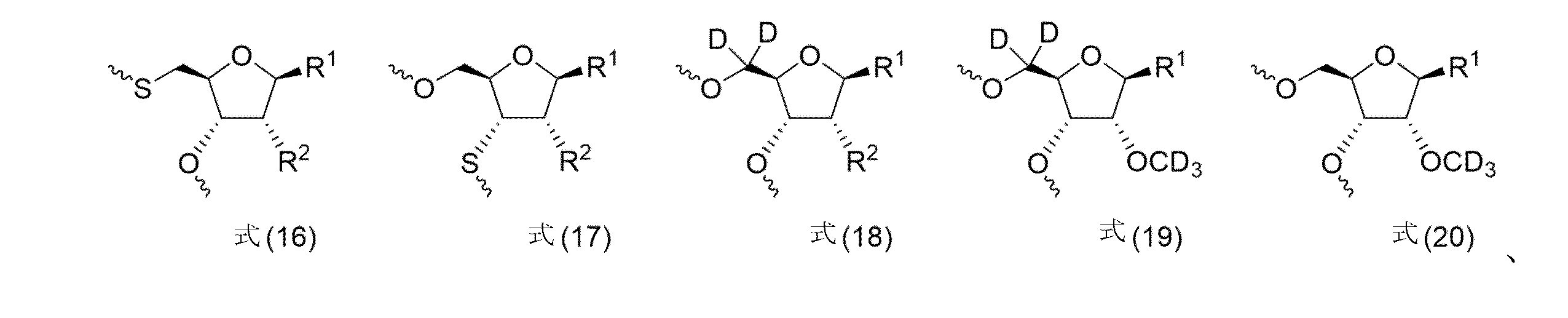
いくつかの実施形態では、第2のヌクレオチド配列の5’末端から2、5、6、8、10、14、16、17、および/または18位置の少なくとも1、2、3、4、5、6、7、8、または9個のヌクレオチドは、2’-フルオロヌクレオチドである。いくつかの実施形態では、第2のヌクレオチド配列の5’末端から2、5、6、8、10、14、16、17、および/または18位置のヌクレオチドは、2’-フルオロヌクレオチドである。いくつかの実施形態では、第2のヌクレオチド配列の5’末端から2、5、6、8、10、14、16、17、および/または18位置の少なくとも2個のヌクレオチドは、2’-フルオロヌクレオチドである。いくつかの実施形態では、第2のヌクレオチド配列の5’末端から2、5、6、8、10、14、16、17、および/または18位置の少なくとも3個のヌクレオチドは、2’-フルオロヌクレオチドである。いくつかの実施形態では、第2のヌクレオチド配列の5’末端から2、5、6、8、10、14、16、17、および/または18位置の少なくとも4個のヌクレオチドは、2’-フルオロヌクレオチドである。いくつかの実施形態では、第2のヌクレオチド配列の5’末端から2、5、6、8、10、14、16、17、および/または18位置の少なくとも5個のヌクレオチドは、2’-フルオロヌクレオチドである。いくつかの実施形態では、第2のヌクレオチド配列の5’末端から2および/または14位置のヌクレオチドは、2’-フルオロヌクレオチドである。いくつかの実施形態では、第2のヌクレオチド配列の5’末端から2、6、および/または16位置のヌクレオチドは、2’-フルオロヌクレオチドである。いくつかの実施形態では、第2のヌクレオチド配列の5’末端から2、6、14、および/または16位置のヌクレオチドは、2’-フルオロヌクレオチドである。いくつかの実施形態では、第2のヌクレオチド配列の5’末端から2、6、10、14、および/または18位置のヌクレオチドは、2’-フルオロヌクレオチドである。いくつかの実施形態では、第2のヌクレオチド配列の5’末端から2、5、8、14、および/または17位置のヌクレオチドは、2’-フルオロヌクレオチドである。いくつかの実施形態では、第2のヌクレオチド配列の5’末端から2位置のヌクレオチドは、2’-フルオロヌクレオチドである。いくつかの実施形態では、第2のヌクレオチド配列の5’末端から5位置のヌクレオチドは、2’-フルオロヌクレオチドである。いくつかの実施形態では、第2のヌクレオチド配列の5’末端から6位置のヌクレオチドは、2’-フルオロヌクレオチドである。いくつかの実施形態では、第2のヌクレオチド配列の5’末端から8位置のヌクレオチドは、2’-フルオロヌクレオチドである。いくつかの実施形態では、第2のヌクレオチド配列の5’末端から10位置のヌクレオチドは、2’-フルオロヌクレオチドである。いくつかの実施形態では、第2のヌクレオチド配列の5’末端から14位置のヌクレオチドは、2’-フルオロヌクレオチドである。いくつかの実施形態では、第2のヌクレオチド配列の5’末端から16位置のヌクレオチドは、2’-フルオロヌクレオチドである。いくつかの実施形態では、第2のヌクレオチド配列の5’末端から17位置のヌクレオチドは、2’-フルオロヌクレオチドである。いくつかの実施形態では、第2のヌクレオチド配列の5’末端から18位置のヌクレオチドは、2’-フルオロヌクレオチドである。いくつかの実施形態では、2’-フルオロヌクレオチドは、2’-フルオロヌクレオチド模倣物である。
In some embodiments, at least 1, 2, 3, 4, 5 at
いくつかの実施形態では、第2のヌクレオチド配列中のヌクレオチドは、交互1:3修飾パターンで整列し、1個のヌクレオチドは、2’-フルオロヌクレオチドであり、3個のヌクレオチドは、2’-O-メチルヌクレオチドであり、交互1:3修飾パターンは、少なくとも2回生じる。いくつかの実施形態では、交互1:3修飾パターンは、2~5回生じる。いくつかの実施形態では、交互1:3修飾パターンのうちの少なくとも2つは、連続して生じる。いくつかの実施形態では、交互1:3修飾パターンのうちの少なくとも2つは、非連続的に生じる。いくつかの実施形態では、少なくとも1、2、3、4、または5個の交互1:3修飾パターンは、アンチセンス鎖の5’末端から2、6、10、14、および/または18のヌクレオチド位置で始まる。いくつかの実施形態では、少なくとも1個の交互1:3修飾パターンは、アンチセンス鎖の5’末端から2のヌクレオチド位置で始まる。いくつかの実施形態では、少なくとも1個の交互1:3修飾パターンは、アンチセンス鎖の5’末端から6のヌクレオチド位置で始まる。いくつかの実施形態では、少なくとも1個の交互1:3修飾パターンは、アンチセンス鎖の5’末端から10のヌクレオチド位置で始まる。いくつかの実施形態では、少なくとも1個の交互1:3修飾パターンは、アンチセンス鎖の5’末端から14のヌクレオチド位置で始まる。いくつかの実施形態では、少なくとも1個の交互1:3修飾パターンは、アンチセンス鎖の5’末端から18のヌクレオチド位置で始まる。いくつかの実施形態では、2’-フルオロヌクレオチドは、2’-フルオロヌクレオチド模倣物である。 In some embodiments, the nucleotides in the second nucleotide sequence are aligned in an alternating 1:3 modification pattern, 1 nucleotide is a 2'-fluoronucleotide and 3 nucleotides are 2'- An O-methyl nucleotide, the alternating 1:3 modification pattern occurs at least twice. In some embodiments, the alternating 1:3 modification pattern occurs 2-5 times. In some embodiments, at least two of the alternating 1:3 modification patterns occur consecutively. In some embodiments, at least two of the alternating 1:3 modification patterns occur non-contiguously. In some embodiments, at least 1, 2, 3, 4, or 5 alternating 1:3 modification patterns are 2, 6, 10, 14, and/or 18 nucleotides from the 5' end of the antisense strand. Start with position. In some embodiments, at least one alternating 1:3 modification pattern begins two nucleotide positions from the 5' end of the antisense strand. In some embodiments, at least one alternating 1:3 modification pattern begins 6 nucleotide positions from the 5' end of the antisense strand. In some embodiments, at least one alternating 1:3 modification pattern begins 10 nucleotide positions from the 5' end of the antisense strand. In some embodiments, at least one alternating 1:3 modification pattern begins 14 nucleotide positions from the 5' end of the antisense strand. In some embodiments, at least one alternating 1:3 modification pattern begins 18 nucleotide positions from the 5' end of the antisense strand. In some embodiments, the 2'-fluoronucleotide is a 2'-fluoronucleotide mimetic.
いくつかの実施形態では、第2のヌクレオチド配列中のヌクレオチドは、交互1:2修飾パターンで整列し、1個のヌクレオチドは、2’-フルオロヌクレオチドであり、2個のヌクレオチドは、2’-O-メチルヌクレオチドであり、交互1:2修飾パターンは、少なくとも2回生じる。いくつかの実施形態では、交互1:2修飾パターンは、2~5回生じる。いくつかの実施形態では、交互1:2修飾パターンのうちの少なくとも2つは、連続して生じる。いくつかの実施形態では、交互1:2修飾パターンのうちの少なくとも2つは、非連続的に生じる。いくつかの実施形態では、少なくとも1、2、3、4、または5個の交互1:2修飾パターンは、アンチセンス鎖の5’末端から2、5、8、14、および/または17のヌクレオチド位置で始まる。いくつかの実施形態では、少なくとも1個の交互1:2修飾パターンは、アンチセンス鎖の5’末端から2のヌクレオチド位置で始まる。いくつかの実施形態では、少なくとも1個の交互1:2修飾パターンは、アンチセンス鎖の5’末端から5のヌクレオチド位置で始まる。いくつかの実施形態では、少なくとも1個の交互1:2修飾パターンは、アンチセンス鎖の5’末端から8のヌクレオチド位置で始まる。いくつかの実施形態では、少なくとも1個の交互1:2修飾パターンは、アンチセンス鎖の5’末端から14のヌクレオチド位置で始まる。いくつかの実施形態では、少なくとも1個の交互1:2修飾パターンは、アンチセンス鎖の5’末端から17のヌクレオチド位置で始まる。いくつかの実施形態では、2’-フルオロヌクレオチドは、2’-フルオロヌクレオチド模倣物である。 In some embodiments, the nucleotides in the second nucleotide sequence are aligned in an alternating 1:2 modification pattern, one nucleotide is a 2'-fluoronucleotide and two nucleotides are 2'- An O-methyl nucleotide, the alternating 1:2 modification pattern occurs at least twice. In some embodiments, the alternating 1:2 modification pattern occurs 2-5 times. In some embodiments, at least two of the alternating 1:2 modification patterns occur consecutively. In some embodiments, at least two of the alternating 1:2 modification patterns occur non-contiguously. In some embodiments, at least 1, 2, 3, 4, or 5 alternating 1:2 modification patterns are 2, 5, 8, 14, and/or 17 nucleotides from the 5' end of the antisense strand. Start with position. In some embodiments, at least one alternating 1:2 modification pattern begins two nucleotide positions from the 5' end of the antisense strand. In some embodiments, at least one alternating 1:2 modification pattern begins 5 nucleotide positions from the 5' end of the antisense strand. In some embodiments, at least one alternating 1:2 modification pattern begins 8 nucleotide positions from the 5' end of the antisense strand. In some embodiments, at least one alternating 1:2 modification pattern begins 14 nucleotide positions from the 5' end of the antisense strand. In some embodiments, at least one alternating 1:2 modification pattern begins 17 nucleotide positions from the 5' end of the antisense strand. In some embodiments, the 2'-fluoronucleotide is a 2'-fluoronucleotide mimetic.
いくつかの実施形態では、第2のヌクレオチド配列は、リボ核酸(RNA)を含むか、それからなるか、または本質的にそれからなる。いくつかの実施形態では、第2のヌクレオチド配列は、修飾RNAを含むか、それからなるか、または本質的にそれからなる。いくつかの実施形態では、修飾RNAは、2’-O-メチルRNAおよび2’-フルオロRNAから選択される。いくつかの実施形態では、第2のヌクレオチド配列の15、16、17、18、19、20、21、22、または23個の修飾ヌクレオチドは、独立して、2’-O-メチルRNAおよび2’-フルオロRNAから選択される。いくつかの実施形態では、2’-フルオロヌクレオチドは、2’-フルオロヌクレオチド模倣物である。 In some embodiments, the second nucleotide sequence comprises, consists of, or consists essentially of ribonucleic acid (RNA). In some embodiments, the second nucleotide sequence comprises, consists of, or consists essentially of a modified RNA. In some embodiments the modified RNA is selected from 2'-O-methyl RNA and 2'-fluoro RNA. In some embodiments, the 15, 16, 17, 18, 19, 20, 21, 22, or 23 modified nucleotides of the second nucleotide sequence are independently 2'-O-methyl RNA and 2 '- is selected from fluoro RNA. In some embodiments, the 2'-fluoronucleotide is a 2'-fluoronucleotide mimetic.
いくつかの実施形態では、センス鎖は、ホスホジエステル(PO)ヌクレオシド間連結、ホスホロチオエート(PS)ヌクレオシド間連結、ホスホロジチオエートヌクレオシド間連結、およびPS-模倣物ヌクレオシド間連結から独立して選択される1つ以上のヌクレオシド間連結をさらに含んでいてもよい。いくつかの実施形態では、PS-模倣物ヌクレオシド間連結は、スルホヌクレオシド間連結である。 In some embodiments, the sense strand is independently selected from phosphodiester (PO) internucleoside linkages, phosphorothioate (PS) internucleoside linkages, phosphorodithioate internucleoside linkages, and PS-mimetic internucleoside linkages. may further comprise one or more internucleoside linkages. In some embodiments, the PS-mimetic internucleoside linkage is a sulfo-internucleoside linkage.
いくつかの実施形態では、アンチセンス鎖は、少なくとも1、2、3、4、5、6、7、8、9、10、11、12、13、14、もしくは15個、またはそれより多くのホスホロチオエートヌクレオシド間連結をさらに含んでいてもよい。いくつかの実施形態では、アンチセンス鎖は、20、19、18、17、16、15、14、13、12、11、10、9、8、7、6、5、4、もしくは3個、またはそれより少ないホスホロチオエートヌクレオシド間連結を含む。いくつかの実施形態では、アンチセンス鎖は、2~10、2~8、2~6、1~5、1~4、1~3、または1~2個のホスホロチオエートヌクレオシド間連結を含む。いくつかの実施形態では、アンチセンス鎖は、2~10、2~8、2~6、1~5、1~4、1~3、または1~2個のホスホロチオエートヌクレオシド間連結を含む。いくつかの実施形態では、アンチセンス鎖は、2~8個のホスホロチオエートヌクレオシド間連結を含む。いくつかの実施形態では、アンチセンス鎖は、3~8個のホスホロチオエートヌクレオシド間連結を含む。いくつかの実施形態では、アンチセンス鎖は、4~8個のホスホロチオエートヌクレオシド間連結を含む。いくつかの実施形態では、少なくとも1個のホスホロチオエートヌクレオシド間連結は、第2のヌクレオチド配列の5’末端から1および2位置のヌクレオチド間にある。いくつかの実施形態では、少なくとも1個のホスホロチオエートヌクレオシド間連結は、第2のヌクレオチド配列の5’末端から2および3位置のヌクレオチド間にある。いくつかの実施形態では、少なくとも1個のホスホロチオエートヌクレオシド間連結は、第2のヌクレオチド配列の3’末端から1および2位置のヌクレオチド間にある。いくつかの実施形態では、少なくとも1個のホスホロチオエートヌクレオシド間連結は、第2のヌクレオチド配列の3’末端から2および3位置のヌクレオチド間にある。いくつかの実施形態では、アンチセンス鎖は、第1のヌクレオチド配列の5’末端から1~3位置のヌクレオチド間にある2個のホスホロチオエートヌクレオシド間連結を含む。いくつかの実施形態では、アンチセンス鎖は、第1のヌクレオチド配列の3’末端から1~3位置のヌクレオチド間にある2個のホスホロチオエートヌクレオシド間連結を含む。いくつかの実施形態では、アンチセンス鎖は、(a)第1のヌクレオチド配列の5’末端から1~3位置のヌクレオチド間にある2個のホスホロチオエートヌクレオシド間連結と、(b)第1のヌクレオチド配列の3’末端から1~3位置のヌクレオチド間にある2個のホスホロチオエートヌクレオシド間連結と、を含む。
In some embodiments, the antisense strand has at least 1, 2, 3, 4, 5, 6, 7, 8, 9, 10, 11, 12, 13, 14, or 15, or more Phosphorothioate internucleoside linkages may also be included. In some embodiments, the antisense strand has 20, 19, 18, 17, 16, 15, 14, 13, 12, 11, 10, 9, 8, 7, 6, 5, 4, or 3 or fewer phosphorothioate internucleoside linkages. In some embodiments, the antisense strand comprises 2-10, 2-8, 2-6, 1-5, 1-4, 1-3, or 1-2 phosphorothioate internucleoside linkages. In some embodiments, the antisense strand comprises 2-10, 2-8, 2-6, 1-5, 1-4, 1-3, or 1-2 phosphorothioate internucleoside linkages. In some embodiments, the antisense strand comprises 2-8 phosphorothioate internucleoside linkages. In some embodiments, the antisense strand comprises 3-8 phosphorothioate internucleoside linkages. In some embodiments, the antisense strand comprises 4-8 phosphorothioate internucleoside linkages. In some embodiments, at least one phosphorothioate internucleoside linkage is between
いくつかの実施形態では、ds-siNAの少なくとも1つの末端は、平滑末端である。いくつかの実施形態では、ds-siNAの少なくとも1つの末端は、オーバーハングを含み、オーバーハングは、少なくとも1つのヌクレオチドを含む。いくつかの実施形態では、ds-siNAの両方の末端は、オーバーハングを含み、オーバーハングは、少なくとも1つのヌクレオチドを含む。いくつかの実施形態では、オーバーハングは、1~5個のヌクレオチド、1~4個のヌクレオチド、1~3個のヌクレオチド、または1~2個のヌクレオチドを含む。いくつかの実施形態では、オーバーハングは、1~2個のヌクレオチドからなる。 In some embodiments, at least one end of the ds-siNA is blunt ended. In some embodiments, at least one end of the ds-siNA comprises an overhang, and the overhang comprises at least one nucleotide. In some embodiments both ends of the ds-siNA comprise an overhang, the overhang comprising at least one nucleotide. In some embodiments, the overhang comprises 1-5 nucleotides, 1-4 nucleotides, 1-3 nucleotides, or 1-2 nucleotides. In some embodiments the overhang consists of 1-2 nucleotides.
いくつかの実施形態では、第1のヌクレオチド配列は、いずれか1つの配列番号1~56、103~158および205~260のヌクレオチド配列を含む。いくつかの実施形態では、第2のヌクレオチド配列は、配列番号57~102、159~204、および261~306のうちのいずれか1つのヌクレオチド配列を含む。いくつかの実施形態では、センス鎖は、配列番号307~362および415~444のうちのいずれか1つのヌクレオチド配列を含む。いくつかの実施形態では、アンチセンス鎖は、配列番号363~409、445~533および536~539のうちのいずれか1つのヌクレオチド配列を含む。 In some embodiments, the first nucleotide sequence comprises the nucleotide sequences of any one of SEQ ID NOs: 1-56, 103-158 and 205-260. In some embodiments, the second nucleotide sequence comprises the nucleotide sequence of any one of SEQ ID NOs:57-102, 159-204, and 261-306. In some embodiments, the sense strand comprises the nucleotide sequence of any one of SEQ ID NOs:307-362 and 415-444. In some embodiments, the antisense strand comprises the nucleotide sequence of any one of SEQ ID NOs:363-409, 445-533 and 536-539.
いくつかの実施形態では、本明細書に開示されるアンチセンス鎖のいずれかは、実施例21~32、36、37、40~42、および44~46モノマーから選択されるモノマーをさらに含む。いくつかの実施形態では、本明細書に開示されるアンチセンス鎖のいずれかは、5’エンドキャップモノマーをさらに含む。いくつかの実施形態では、5’エンドキャップモノマーは、実施例5~11、33~35、38、39、43、および49~53の5’エンドキャップモノマーから選択される。 In some embodiments, any of the antisense strands disclosed herein further comprise a monomer selected from Examples 21-32, 36, 37, 40-42, and 44-46 monomers. In some embodiments, any of the antisense strands disclosed herein further comprise a 5' endcap monomer. In some embodiments, the 5' endcapped monomer is selected from the 5' endcapped monomers of Examples 5-11, 33-35, 38, 39, 43, and 49-53.
いくつかの実施形態では、本明細書に開示される第2のヌクレオチド配列のいずれかは、実施例21~32、36、37、40~42、および44~46モノマーから選択されるモノマーをさらに含む。いくつかの実施形態では、本明細書に開示される第2のヌクレオチド配列のいずれかは、5’エンドキャップモノマーをさらに含む。いくつかの実施形態では、5’エンドキャップモノマーは、実施例5~11、33~35、38、39、43、および49~53の5’エンドキャップモノマーから選択される。 In some embodiments, any of the second nucleotide sequences disclosed herein further comprise a monomer selected from Examples 21-32, 36, 37, 40-42, and 44-46 monomers. include. In some embodiments, any of the second nucleotide sequences disclosed herein further comprise a 5' endcap monomer. In some embodiments, the 5' endcap monomer is selected from the 5' endcap monomers of Examples 5-11, 33-35, 38, 39, 43, and 49-53.
修飾ヌクレオチド
本明細書にさらに開示されるのは、1つ以上の修飾ヌクレオチドを含むsiNA分子である。いくつかの実施形態では、本明細書に開示されるsiNAのいずれかは、1つ以上の修飾ヌクレオチドを含む。いくつかの実施形態では、本明細書に開示されるセンス鎖のいずれかは、1つ以上の修飾ヌクレオチドを含む。いくつかの実施形態では、本明細書に開示される第1のヌクレオチド配列のいずれかは、1つ以上の修飾ヌクレオチドを含む。いくつかの実施形態では、本明細書に開示されるアンチセンス鎖のいずれかは、1つ以上の修飾ヌクレオチドを含む。いくつかの実施形態では、本明細書に開示される第2のヌクレオチド配列のいずれかは、1つ以上の修飾ヌクレオチドを含む。いくつかの実施形態では、1つ以上の修飾ヌクレオチドは、第1のヌクレオチド配列に隣接する。いくつかの実施形態では、少なくとも1つの修飾ヌクレオチドは、第1のヌクレオチド配列の5’末端に隣接する。いくつかの実施形態では、少なくとも1つの修飾ヌクレオチドは、第1のヌクレオチド配列の3’末端に隣接する。いくつかの実施形態では、少なくとも1つの修飾ヌクレオチドは、第1のヌクレオチド配列の5’末端に隣接し、少なくとも1つの修飾ヌクレオチドは、第1のヌクレオチド配列の3’末端に隣接する。いくつかの実施形態では、1つ以上の修飾ヌクレオチドは、第2のヌクレオチド配列に隣接する。いくつかの実施形態では、少なくとも1つの修飾ヌクレオチドは、第2のヌクレオチド配列の5’末端に隣接する。いくつかの実施形態では、少なくとも1つの修飾ヌクレオチドは、第2のヌクレオチド配列の3’末端に隣接する。いくつかの実施形態では、少なくとも1つの修飾ヌクレオチドは、第2のヌクレオチド配列の5’末端に隣接し、少なくとも1つの修飾ヌクレオチドは、第2のヌクレオチド配列の3’末端に隣接する。いくつかの実施形態では、本明細書に開示されるセンス鎖または第1のヌクレオチド配列のいずれかの中の2’-O-メチルヌクレオチドは、修飾ヌクレオチドで置き換えられる。いくつかの実施形態では、本明細書に開示されるアンチセンス鎖または第2のヌクレオチド配列のいずれかの中の2’-O-メチルヌクレオチドは、修飾ヌクレオチドで置き換えられる。
Modified Nucleotides Further disclosed herein are siNA molecules comprising one or more modified nucleotides. In some embodiments, any of the siNAs disclosed herein comprise one or more modified nucleotides. In some embodiments, any of the sense strands disclosed herein comprise one or more modified nucleotides. In some embodiments, any of the first nucleotide sequences disclosed herein comprise one or more modified nucleotides. In some embodiments, any of the antisense strands disclosed herein comprise one or more modified nucleotides. In some embodiments, any of the second nucleotide sequences disclosed herein comprise one or more modified nucleotides. In some embodiments, one or more modified nucleotides flank the first nucleotide sequence. In some embodiments, the at least one modified nucleotide flanks the 5' end of the first nucleotide sequence. In some embodiments, the at least one modified nucleotide flanks the 3' end of the first nucleotide sequence. In some embodiments, at least one modified nucleotide flanks the 5' end of the first nucleotide sequence and at least one modified nucleotide flanks the 3' end of the first nucleotide sequence. In some embodiments, the one or more modified nucleotides flank the second nucleotide sequence. In some embodiments, the at least one modified nucleotide flanks the 5' end of the second nucleotide sequence. In some embodiments, the at least one modified nucleotide flanks the 3' end of the second nucleotide sequence. In some embodiments, at least one modified nucleotide flanks the 5' end of the second nucleotide sequence and at least one modified nucleotide flanks the 3' end of the second nucleotide sequence. In some embodiments, 2'-O-methyl nucleotides in any of the sense strand or first nucleotide sequences disclosed herein are replaced with modified nucleotides. In some embodiments, 2'-O-methyl nucleotides in any of the antisense strands or second nucleotide sequences disclosed herein are replaced with modified nucleotides.
いくつかの実施形態では、本明細書に開示されるsiNA分子、siNA、センス鎖、第1のヌクレオチド配列、アンチセンス鎖、および第2のヌクレオチド配列のいずれかは、1、2、3、4、5、6、7、8、9、10、11、12、13、14、15、16、17、18、19、20、21、22、23、24、25、26、27、28、29、もしくは30個、またはそれより多くの修飾ヌクレオチドを含む。いくつかの実施形態では、siNA分子、siNA、センス鎖、第1のヌクレオチド配列、アンチセンス鎖、または第2のヌクレオチド配列中のヌクレオチドの1%、2%、3%、4%、5%、10%、15%、20%、25%、30%、35%、40%、45%、50%、55%、60%、70%、75%、80%、85%、86%、87%、88%、90%、91%、92%、93%、94%、95%、96%、97%、98%、99%、または100%が修飾ヌクレオチドである。 In some embodiments, any of the siNA molecules, siNA, sense strand, first nucleotide sequence, antisense strand, and second nucleotide sequence disclosed herein are 1, 2, 3, 4 , 5, 6, 7, 8, 9, 10, 11, 12, 13, 14, 15, 16, 17, 18, 19, 20, 21, 22, 23, 24, 25, 26, 27, 28, 29 , or 30 or more modified nucleotides. In some embodiments, 1%, 2%, 3%, 4%, 5% of the nucleotides in the siNA molecule, siNA, sense strand, first nucleotide sequence, antisense strand, or second nucleotide sequence, 10%, 15%, 20%, 25%, 30%, 35%, 40%, 45%, 50%, 55%, 60%, 70%, 75%, 80%, 85%, 86%, 87% , 88%, 90%, 91%, 92%, 93%, 94%, 95%, 96%, 97%, 98%, 99%, or 100% are modified nucleotides.
いくつかの実施形態では、修飾ヌクレオチドは、2’-フルオロヌクレオチド、2’-O-メチルヌクレオチド、2’-フルオロヌクレオチド模倣物、2’-O-メチルヌクレオチド模倣物、ロックド核酸、および修飾核酸塩基を含むヌクレオチドからなる群から選択される。 In some embodiments, modified nucleotides are 2'-fluoro nucleotides, 2'-O-methyl nucleotides, 2'-fluoro nucleotide mimetics, 2'-O-methyl nucleotide mimetics, locked nucleic acids, and modified nucleobases. is selected from the group consisting of nucleotides comprising
いくつかの実施形態では、本明細書に開示されるsiRNAのいずれかは、少なくとも1、2、3、4、5、6、7、8、9、もしくは10個、またはそれより多くの2’-フルオロまたは2’-O-メチルヌクレオチド模倣物を含む。いくつかの実施形態では、本明細書に開示されるセンス鎖のいずれかは、少なくとも1、2、3、4、5、6、7、8、9、もしくは10個、またはそれより多くの2’-フルオロまたは2’-O-メチルヌクレオチド模倣物を含む。いくつかの実施形態では、本明細書に開示される第1のヌクレオチド配列のいずれかは、少なくとも1、2、3、4、5、6、7、8、9、もしくは10個、またはそれより多くの2’-フルオロまたは2’-O-メチルヌクレオチド模倣物を含む。いくつかの実施形態では、本明細書に開示されるアンチセンス鎖のいずれかは、少なくとも1、2、3、4、5、6、7、8、9、もしくは10個、またはそれより多くの2’-フルオロまたは2’-O-メチルヌクレオチド模倣物を含む。いくつかの実施形態では、本明細書に開示される第2のヌクレオチド配列のいずれかは、少なくとも1、2、3、4、5、6、7、8、9、もしくは10個、またはそれより多くの2’-フルオロまたは2’-O-メチルヌクレオチド模倣物を含む。いくつかの実施形態では、2’-フルオロまたは2’-O-メチルヌクレオチド模倣物は、式(16)~式(20)のヌクレオチド模倣物であり、

いくつかの実施形態では、本明細書に開示されるsiRNAのいずれかは、少なくとも1、2、3、4、5、6、7、8、9、もしくは10個、またはそれより多くのロックド核酸を含む。いくつかの実施形態では、本明細書に開示されるセンス鎖のいずれかは、少なくとも1、2、3、4、5、6、7、8、9、もしくは10個、またはそれより多くのロックド核酸を含む。いくつかの実施形態では、本明細書に開示される第1のヌクレオチド配列のいずれかは、少なくとも1、2、3、4、5、6、7、8、9、もしくは10個、またはそれより多くのロックド核酸を含む。いくつかの実施形態では、本明細書に開示されるアンチセンス鎖のいずれかは、少なくとも1、2、3、4、5、6、7、8、9、もしくは10個、またはそれより多くのロックド核酸を含む。いくつかの実施形態では、本明細書に開示される第2のヌクレオチド配列のいずれかは、少なくとも1、2、3、4、5、6、7、8、9、もしくは10個、またはそれより多くのロックド核酸を含む。いくつかの実施形態では、ロックド核酸は、
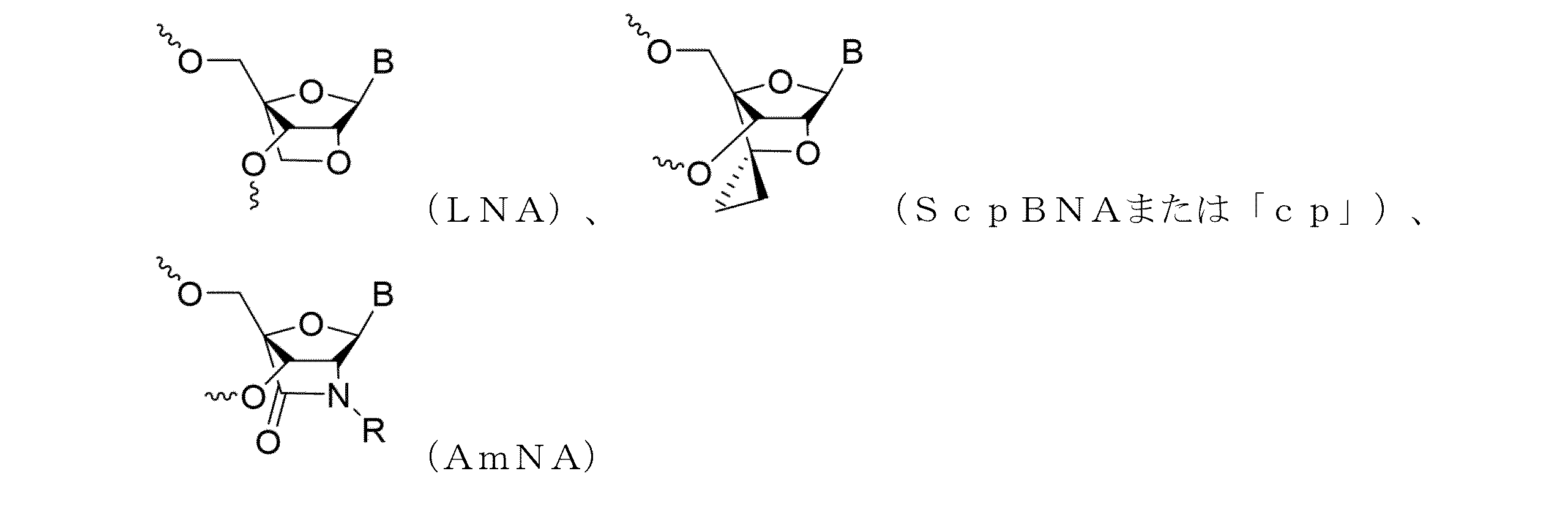
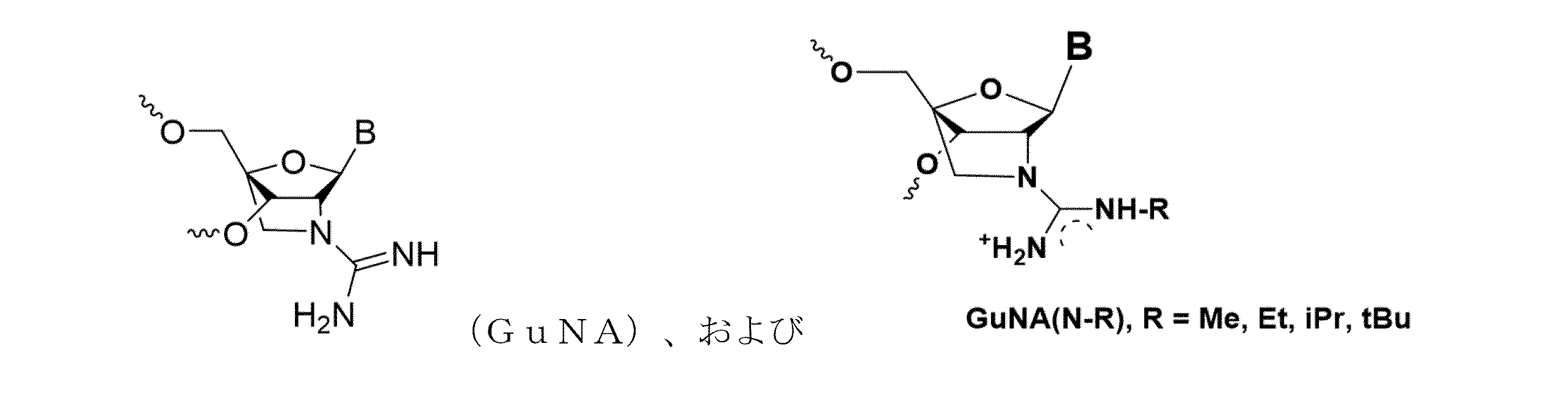



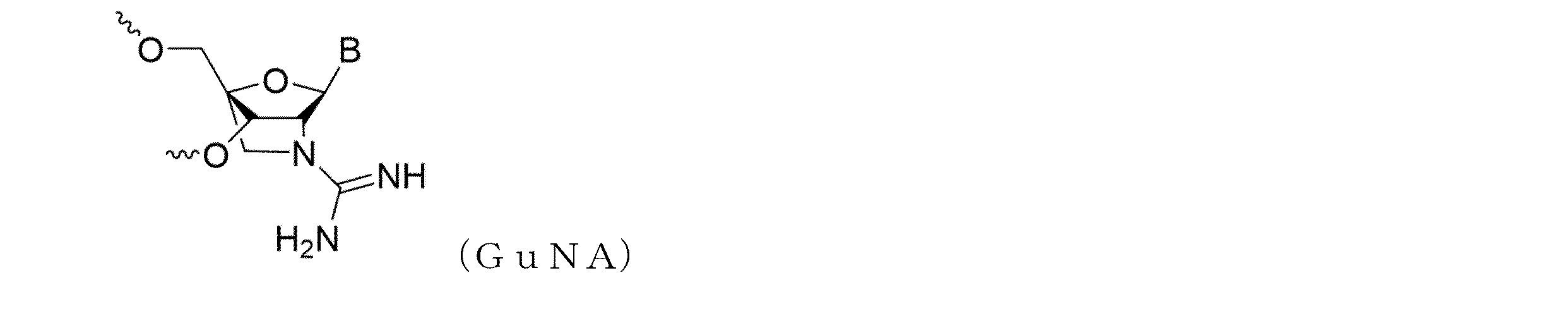

リン酸化ブロッカー
本明細書にさらに開示されるのは、リン酸化ブロッカーを含むsiNA分子である。いくつかの実施形態では、本明細書に開示されるセンス鎖または第1のヌクレオチド配列のいずれかの中の2’-O-メチルヌクレオチドは、リン酸化ブロッカーを含有するヌクレオチドで置き換えられる。いくつかの実施形態では、本明細書に開示されるアンチセンス鎖または第2のヌクレオチド配列のいずれかの中の2’-O-メチルヌクレオチドは、リン酸化ブロッカーを含有するヌクレオチドで置き換えられる。いくつかの実施形態では、本明細書に開示されるセンス鎖または第1のヌクレオチド配列のいずれかの中の2’-O-メチルヌクレオチドは、リン酸化ブロッカーを含有するようにさらに修飾される。いくつかの実施形態では、本明細書に開示されるアンチセンス鎖または第2のヌクレオチド配列のいずれかの中の2’-O-メチルヌクレオチドは、リン酸化ブロッカーを含有するようにさらに修飾される。
Phosphorylation Blockers Further disclosed herein are siNA molecules that include phosphorylation blockers. In some embodiments, 2'-O-methyl nucleotides in any of the sense strand or first nucleotide sequences disclosed herein are replaced with nucleotides containing phosphorylation blockers. In some embodiments, 2'-O-methyl nucleotides in any of the antisense strands or second nucleotide sequences disclosed herein are replaced with nucleotides containing phosphorylation blockers. In some embodiments, the 2'-O-methyl nucleotides in any of the sense strand or first nucleotide sequences disclosed herein are further modified to contain phosphorylation blockers. In some embodiments, a 2'-O-methyl nucleotide in any of the antisense strands or second nucleotide sequences disclosed herein is further modified to contain a phosphorylation blocker. .
いくつかの実施形態では、本明細書に開示されるsiNA分子のいずれかは、式(IV)のリン酸化ブロッカーを含み、

いくつかの実施形態では、本明細書に開示されるsiNA分子のいずれかは、式(IV)のリン酸化ブロッカーを含み、

いくつかの実施形態では、siNA分子は、式(IV)のリン酸化ブロッカー:

いくつかの実施形態では、siNA分子は、(a)式(IV)のリン酸化ブロッカー:

いくつかの実施形態では、リン酸化ブロッカーは、センス鎖または第1のヌクレオチド配列の3’末端に接続する。いくつかの実施形態では、リン酸化ブロッカーは、1、2、3、4、もしくは5個、またはそれより多くのリンカーを介して、センス鎖または第1のヌクレオチド配列の3’末端に接続する。いくつかの実施形態では、リン酸化ブロッカーは、センス鎖または第1のヌクレオチド配列の5’末端に接続する。いくつかの実施形態では、リン酸化ブロッカーは、1、2、3、4、もしくは5個、またはそれより多くのリンカーを介して、センス鎖または第1のヌクレオチド配列の5’末端に接続する。いくつかの実施形態では、リン酸化ブロッカーは、アンチセンス鎖または第2のヌクレオチド配列の3’末端に接続する。いくつかの実施形態では、リン酸化ブロッカーは、1、2、3、4、もしくは5個、またはそれより多くのリンカーを介して、アンチセンス鎖または第2のヌクレオチド配列の3’末端に接続する。いくつかの実施形態では、リン酸化ブロッカーは、アンチセンス鎖または第2のヌクレオチド配列の5’末端に接続する。いくつかの実施形態では、リン酸化ブロッカーは、1、2、3、4、もしくは5個、またはそれより多くのリンカーを介して、アンチセンス鎖または第2のヌクレオチド配列の5’末端に接続する。いくつかの実施形態では、1つ以上のリンカーは、ホスホジエステルリンカー、ホスホロチオエートリンカー、およびホスホロジチオエートリンカーからなる群から独立して選択される。 In some embodiments, the phosphorylation blocker is attached to the 3' end of the sense strand or first nucleotide sequence. In some embodiments, the phosphorylation blocker is attached to the 3' end of the sense strand or first nucleotide sequence via 1, 2, 3, 4, or 5 or more linkers. In some embodiments, the phosphorylation blocker is attached to the 5' end of the sense strand or first nucleotide sequence. In some embodiments, the phosphorylation blocker is attached to the 5' end of the sense strand or first nucleotide sequence via 1, 2, 3, 4, or 5 or more linkers. In some embodiments, the phosphorylation blocker is attached to the 3' end of the antisense strand or second nucleotide sequence. In some embodiments, the phosphorylation blocker is attached to the 3' end of the antisense strand or second nucleotide sequence via 1, 2, 3, 4, or 5 or more linkers . In some embodiments, the phosphorylation blocker is attached to the 5' end of the antisense strand or second nucleotide sequence. In some embodiments, the phosphorylation blocker is attached to the 5' end of the antisense strand or second nucleotide sequence via 1, 2, 3, 4, or 5 or more linkers . In some embodiments, the one or more linkers are independently selected from the group consisting of phosphodiester linkers, phosphorothioate linkers, and phosphorodithioate linkers.
コンジュゲート化部分
本明細書にさらに開示されるのは、コンジュゲート化部分を含むsiNA分子である。いくつかの実施形態では、コンジュゲート化部分は、ガラクトサミン、ペプチド、タンパク質、ステロール、脂質、リン脂質、ビオチン、フェノキサジン、活性薬物基質、コレステロール、フェナントリジン、アントラキノン、アクリジン、フルオレセイン、ローダミン、クマリン、および染料から選択される。いくつかの実施形態では、コンジュゲート化部分は、センス鎖または第1のヌクレオチド配列の3’末端に接続する。いくつかの実施形態では、コンジュゲート化部分は、1、2、3、4、もしくは5個、またはそれより多くのリンカーを介して、センス鎖または第1のヌクレオチド配列の3’末端に接続する。いくつかの実施形態では、コンジュゲート化部分は、センス鎖または第1のヌクレオチド配列の5’末端に接続する。いくつかの実施形態では、コンジュゲート化部分は、1、2、3、4、もしくは5個、またはそれより多くのリンカーを介して、センス鎖または第1のヌクレオチド配列の5’末端に接続する。いくつかの実施形態では、コンジュゲート化部分は、アンチセンス鎖または第2のヌクレオチド配列の3’末端に接続する。いくつかの実施形態では、コンジュゲート化部分は、1、2、3、4、もしくは5個、またはそれより多くのリンカーを介して、アンチセンス鎖または第2のヌクレオチド配列の3’末端に接続する。いくつかの実施形態では、コンジュゲート化部分は、アンチセンス鎖または第2のヌクレオチド配列の5’末端に接続する。いくつかの実施形態では、コンジュゲート化部分は、1、2、3、4、もしくは5個、またはそれより多くのリンカーを介して、アンチセンス鎖または第2のヌクレオチド配列の5’末端に接続する。いくつかの実施形態では、1つ以上のリンカーは、ホスホジエステルリンカー、ホスホロチオエートリンカー、およびホスホロジチオエートリンカーからなる群から独立して選択される。
Conjugating Moieties Further disclosed herein are siNA molecules that include a conjugating moiety. In some embodiments, the conjugate moieties are galactosamines, peptides, proteins, sterols, lipids, phospholipids, biotin, phenoxazines, active drug substrates, cholesterol, phenanthridines, anthraquinones, acridines, fluoresceins, rhodamines, coumarins. , and dyes. In some embodiments, the conjugating moiety is attached to the 3' end of the sense strand or first nucleotide sequence. In some embodiments, the conjugated moiety is connected to the 3' end of the sense strand or first nucleotide sequence via 1, 2, 3, 4, or 5 or more linkers . In some embodiments, the conjugating moiety is attached to the sense strand or the 5' end of the first nucleotide sequence. In some embodiments, the conjugated moiety is connected to the 5' end of the sense strand or first nucleotide sequence via 1, 2, 3, 4, or 5 or more linkers . In some embodiments, the conjugating moiety is attached to the 3' end of the antisense strand or second nucleotide sequence. In some embodiments, the conjugated moiety is connected to the 3' end of the antisense strand or second nucleotide sequence via 1, 2, 3, 4, or 5 or more linkers do. In some embodiments, the conjugating moiety is attached to the 5' end of the antisense strand or second nucleotide sequence. In some embodiments, the conjugated moiety is connected to the 5' end of the antisense strand or second nucleotide sequence via 1, 2, 3, 4, or 5 or more linkers do. In some embodiments, the one or more linkers are independently selected from the group consisting of phosphodiester linkers, phosphorothioate linkers, and phosphorodithioate linkers.
いくつかの実施形態では、コンジュゲート化部分は、ガラクトサミンである。いくつかの実施形態では、本明細書に開示されるsiNAのいずれかは、ガラクトサミンであるコンジュゲート化部分に接続する。いくつかの実施形態では、ガラクトサミンは、N-アセチルガラクトサミン(GalNAc)である。いくつかの実施形態では、本明細書に開示されるsiNA分子のいずれかは、GalNAcを含む。いくつかの実施形態では、GalNAcは、式(VI)を有し、

いくつかの実施形態では、GalNAcは、式(VII)を有し、
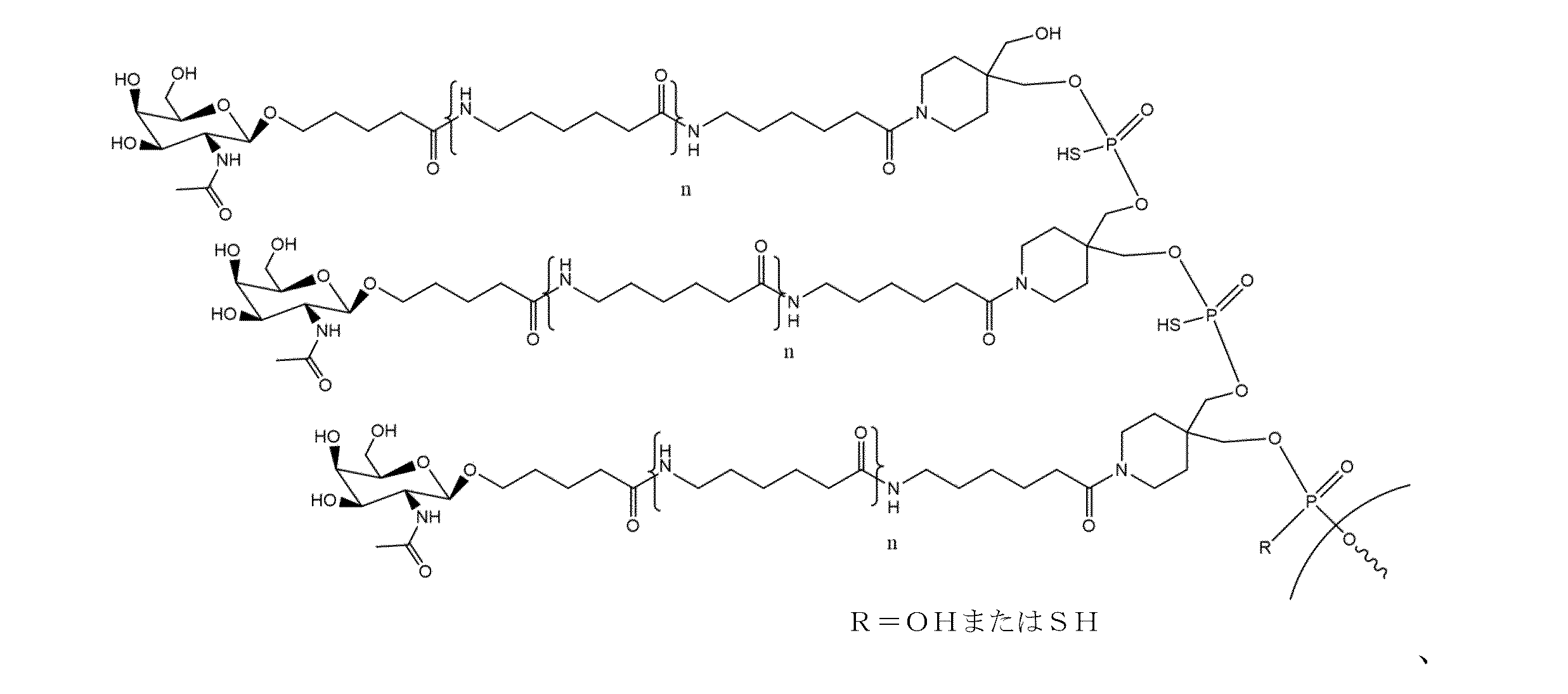
いくつかの実施形態では、ガラクトサミンは、センス鎖または第1のヌクレオチド配列の3’末端に接続する。いくつかの実施形態では、ガラクトサミンは、1、2、3、4、もしくは5個、またはそれより多くのリンカーを介して、センス鎖または第1のヌクレオチド配列の3’末端に接続する。いくつかの実施形態では、ガラクトサミンは、センス鎖または第1のヌクレオチド配列の5’末端に接続する。いくつかの実施形態では、ガラクトサミンは、1、2、3、4、もしくは5個、またはそれより多くのリンカーを介して、センス鎖または第1のヌクレオチド配列の5’末端に接続する。いくつかの実施形態では、ガラクトサミンは、アンチセンス鎖または第2のヌクレオチド配列の3’末端に接続する。いくつかの実施形態では、ガラクトサミンは、1、2、3、4、もしくは5個、またはそれより多くのリンカーを介して、アンチセンス鎖または第2のヌクレオチド配列の3’末端に接続する。いくつかの実施形態では、ガラクトサミンは、アンチセンス鎖または第2のヌクレオチド配列の5’末端に接続する。いくつかの実施形態では、ガラクトサミンは、1、2、3、4、もしくは5個、またはそれより多くのリンカーを介して、アンチセンス鎖または第2のヌクレオチド配列の5’末端に接続する。いくつかの実施形態では、1つ以上のリンカーは、ホスホジエステル(pまたはpo)リンカー、ホスホロチオエート(ps)リンカー、ホスホラミダイト(HEG)リンカー、トリエチレングリコール(TEG)リンカー、および/またはホスホロジチオエートリンカーからなる群から独立して選択される。いくつかの実施形態では、1つ以上のリンカーは、p-(PS)2、(PS)2-p-TEG-p、(PS)2-p-HEG-p、および(PS)2-p-(HEG-p)2からなる群から独立して選択される。 In some embodiments, the galactosamine is attached to the 3' end of the sense strand or first nucleotide sequence. In some embodiments, galactosamine is attached to the 3' end of the sense strand or first nucleotide sequence via 1, 2, 3, 4, or 5 or more linkers. In some embodiments, the galactosamine is attached to the 5' end of the sense strand or first nucleotide sequence. In some embodiments, the galactosamine is attached to the sense strand or the 5' end of the first nucleotide sequence via 1, 2, 3, 4, or 5 or more linkers. In some embodiments, galactosamine is attached to the 3' end of the antisense strand or second nucleotide sequence. In some embodiments, the galactosamine is attached to the 3' end of the antisense strand or second nucleotide sequence via 1, 2, 3, 4, or 5 or more linkers. In some embodiments, galactosamine is attached to the 5' end of the antisense strand or second nucleotide sequence. In some embodiments, the galactosamine is attached to the 5' end of the antisense strand or second nucleotide sequence via 1, 2, 3, 4, or 5 or more linkers. In some embodiments, the one or more linkers are phosphodiester (p or po) linkers, phosphorothioate (ps) linkers, phosphoramidite (HEG) linkers, triethylene glycol (TEG) linkers, and/or phosphorodithioate independently selected from the group consisting of linkers; In some embodiments, the one or more linkers are p-(PS)2, (PS)2-p-TEG-p, (PS)2-p-HEG-p, and (PS)2-p is independently selected from the group consisting of -(HEG-p)2;
いくつかの実施形態では、コンジュゲート化部分は、脂質部分である。いくつかの実施形態では、本明細書に開示されるsiNAのいずれかは、脂質部分であるコンジュゲート化部分に接続する。脂質部分の例としては、限定されないが、コレステロール部分、チオエーテル、例えば、ヘキシル-S-トリチルチオール、チオコレステロール、脂肪族鎖、例えば、ドデカンジオールまたはウンデシル残基、リン脂質、例えば、ジ-ヘキサデシル-rac-グリセロールまたはトリエチルアンモニウム 1-ジ-O-ヘキサデシル-rac-グリセロ-S-H-ホスホネート、ポリアミンまたはポリエチレングリコール鎖、アダマンタン酢酸、パルミチル部分、またはオクタデシルアミンもしくはヘキシルアミノ-カルボニル-オキシコレステロール部分が挙げられる。 In some embodiments, the conjugating moiety is a lipid moiety. In some embodiments, any of the siNAs disclosed herein are attached to a conjugation moiety that is a lipid moiety. Examples of lipid moieties include, but are not limited to, cholesterol moieties, thioethers such as hexyl-S-tritylthiol, thiocholesterol, aliphatic chains such as dodecanediol or undecyl residues, phospholipids such as di-hexadecyl- rac-glycerol or triethylammonium 1-di-O-hexadecyl-rac-glycero-SH-phosphonate, polyamine or polyethylene glycol chains, adamantaneacetic acid, palmityl moieties, or octadecylamine or hexylamino-carbonyl-oxycholesterol moieties. be done.
いくつかの実施形態では、コンジュゲート化部分は、活性薬物基質である。いくつかの実施形態では、本明細書に開示されるsiNAのいずれかは、活性薬物基質であるコンジュゲート化部分に接続する。活性薬物基質の例としては、限定されないが、アスピリン、ワルファリン、フェニルブタゾン、イブプロフェン、スプロフェン、フェンブフェン、ケトプロフェン、(5)-(+)-プラノプロフェン、カルプロフェン、ダンシルサルコシン、2,3,5-トリヨード安息香酸、フルフェナム酸、葉酸、ベンゾチアジアジド、クロロチアジド、ジアゼピン、インドメチシン、バルビツレート、セファロスポリン、サルファ剤、抗糖尿病薬、抗菌剤、または抗生物質が挙げられる。 In some embodiments, the conjugated moiety is the active drug substrate. In some embodiments, any of the siNAs disclosed herein are attached to a conjugate moiety that is an active drug substrate. Examples of active drug substrates include, but are not limited to, aspirin, warfarin, phenylbutazone, ibuprofen, suprofen, fenbufen, ketoprofen, (5)-(+)-pranoprofen, carprofen, dansylsarcosine, 2,3,5 - triiodobenzoic acid, flufenamic acid, folic acid, benzothiadiazide, chlorothiazide, diazepines, indomethicine, barbiturates, cephalosporins, sulfa drugs, antidiabetics, antibacterial agents, or antibiotics.
5’安定化エンドキャップ
本明細書にさらに開示されるのは、5’安定化エンドキャップを含むsiNA分子である。本明細書で使用される場合、「5’安定化エンドキャップ」および「5’エンドキャップ」という用語は、互換的に使用される。いくつかの実施形態では、本明細書に開示されるセンス鎖または第1のヌクレオチド配列のいずれかの中の2’-O-メチルヌクレオチドは、5’安定化エンドキャップを含有するヌクレオチドで置き換えられる。いくつかの実施形態では、本明細書に開示されるアンチセンス鎖または第2のヌクレオチド配列のいずれかの中の2’-O-メチルヌクレオチドは、5’安定化エンドキャップを含有するヌクレオチドで置き換えられる。いくつかの実施形態では、本明細書に開示されるセンス鎖または第1のヌクレオチド配列のいずれかの中の2’-O-メチルヌクレオチドは、5’安定化エンドキャップを含有するようにさらに修飾される。いくつかの実施形態では、本明細書に開示されるアンチセンス鎖または第2のヌクレオチド配列のいずれかの中の2’-O-メチルヌクレオチドは、5’安定化エンドキャップを含有するようにさらに修飾される。
5' Stabilizing Endcaps Further disclosed herein are siNA molecules comprising 5' stabilizing endcaps. As used herein, the terms "5' stabilizing endcap" and "5'endcap" are used interchangeably. In some embodiments, 2'-O-methyl nucleotides in any of the sense strand or first nucleotide sequences disclosed herein are replaced with nucleotides containing a 5' stabilizing endcap. . In some embodiments, 2'-O-methyl nucleotides in any of the antisense strands or second nucleotide sequences disclosed herein are replaced with nucleotides containing a 5' stabilizing endcap. be done. In some embodiments, the 2'-O-methyl nucleotides in any of the sense strand or first nucleotide sequences disclosed herein are further modified to contain 5' stabilizing endcaps. be done. In some embodiments, the 2'-O-methyl nucleotides in any of the antisense strands or second nucleotide sequences disclosed herein are further modified to contain a 5' stabilizing endcap. Qualified.
いくつかの実施形態では、5’安定化エンドキャップは、5’ホスフェート模倣物である。いくつかの実施形態では、5’安定化エンドキャップは、修飾5’ホスフェート模倣物である。いくつかの実施形態では、修飾5’ホスフェートは、化学修飾5’ホスフェートである。いくつかの実施形態では、5’安定化エンドキャップは、5’-ビニルホスホネートである。いくつかの実施形態では、5’-ビニルホスホネートは、5’-(E)-ビニルホスホネートまたは5’-(Z)-ビニルホスホネートである。いくつかの実施形態では、5’-ビニルホスホネートは、重水素化ビニルホスホネートである。いくつかの実施形態では、重水素化ビニルホスホネートは、モノ-重水素化ビニルホスホネートである。いくつかの実施形態では、重水素化ビニルホスホネートは、ジ-重水素化ビニルホスホネートである。いくつかの実施形態では、5’安定化エンドキャップは、ホスフェート模倣物である。ホスフェート模倣物の例は、Parmar et al.,2018,J Med Chem,61(3):734-744、国際公開第2018/045317号および同第2018/044350号、ならびに米国特許第10,087,210号に開示されており、これらはそれぞれ、参照によりその全体が組み込まれる。 In some embodiments, the 5' stabilizing endcap is a 5' phosphate mimetic. In some embodiments, the 5' stabilizing endcap is a modified 5' phosphate mimetic. In some embodiments, the modified 5' phosphate is a chemically modified 5' phosphate. In some embodiments, the 5' stabilizing endcap is 5'-vinylphosphonate. In some embodiments, the 5'-vinyl phosphonate is 5'-(E)-vinyl phosphonate or 5'-(Z)-vinyl phosphonate. In some embodiments, the 5'-vinyl phosphonate is a deuterated vinyl phosphonate. In some embodiments, the deuterated vinyl phosphonate is a mono-deuterated vinyl phosphonate. In some embodiments, the deuterated vinyl phosphonate is a di-deuterated vinyl phosphonate. In some embodiments, the 5' stabilizing endcap is a phosphate mimetic. Examples of phosphate mimetics are found in Parmar et al. , 2018, J Med Chem, 61(3):734-744, WO 2018/045317 and WO 2018/044350, and US Pat. No. 10,087,210, each of which , which is incorporated by reference in its entirety.
いくつかの実施形態では、本明細書に開示されるsiNA分子、センス鎖、第1のヌクレオチド配列、アンチセンス鎖、または第2のヌクレオチド配列のいずれかは、式(Ia)の5’安定化エンドキャップ:


いくつかの実施形態では、本明細書に開示されるsiNA分子、センス鎖、第1のヌクレオチド配列、アンチセンス鎖、または第2のヌクレオチド配列のいずれかは、式(Ib)の5’安定化エンドキャップ:


いくつかの実施形態では、本明細書に開示されるsiNA分子、センス鎖、第1のヌクレオチド配列、アンチセンス鎖、または第2のヌクレオチド配列のいずれかは、式(Ic)の5’安定化エンドキャップ:

R2が、

Zが、-ONR23R24、-OP(O)OH(CH2)mCO2R23、-OP(S)OH(CH2)mCO2R23、-P(O)(OH)2、-P(O)(OH)(OCH3)、-P(O)(OH)(OCD3)、-SO2(CH2)mP(O)(OH)2、-SO2NR23R25、-NR23R24、もしくは-NR23SO2R24であり、R21およびR22のいずれかが、独立して、水素もしくはC1~C6アルキルであるか、またはR21およびR22が、一緒になって、オキソ基を形成し、R23が、水素もしくはC1~C6アルキルであり、R24が、-SO2R25もしくは-C(O)R25であるか、または
R23およびR24が、それらが接続する窒素と一緒になって、置換または非置換複素環式環を形成し、R25が、C1~C6アルキルであり、mが、1、2、3、または4である。いくつかの実施形態では、R1は、アリールである。いくつかの実施形態では、アリールは、フェニルである。
In some embodiments, any of the siNA molecules, the sense strand, the first nucleotide sequence, the antisense strand, or the second nucleotide sequence disclosed herein comprises the 5'-stabilized end cap:
R2 is
Z is —ONR 23 R 24 , —OP(O)OH(CH 2 ) m CO 2 R 23 , —OP(S)OH(CH 2 ) m CO 2 R 23 , —P(O)(OH) 2 , —P(O)(OH)(OCH 3 ), —P(O)(OH)(OCD 3 ), —SO 2 (CH 2 ) m P(O)(OH) 2 , —SO 2 NR 23 R 25 , —NR 23 R 24 , or —NR 23 SO 2 R 24 and either R 21 and R 22 are independently hydrogen or C 1 -C 6 alkyl, or R 21 and R 22 together form an oxo group, R 23 is hydrogen or C 1 -C 6 alkyl and R 24 is —SO 2 R 25 or —C(O)R 25 ; or R 23 and R 24 together with the nitrogen to which they are attached form a substituted or unsubstituted heterocyclic ring, R 25 is C 1 -C 6 alkyl and m is 1, 2 , 3, or 4. In some embodiments, R 1 is aryl. In some embodiments, aryl is phenyl.
いくつかの実施形態では、本明細書に開示されるsiNA分子、センス鎖、第1のヌクレオチド配列、アンチセンス鎖、または第2のヌクレオチド配列のいずれかは、式(IIa)の5’安定化エンドキャップ:

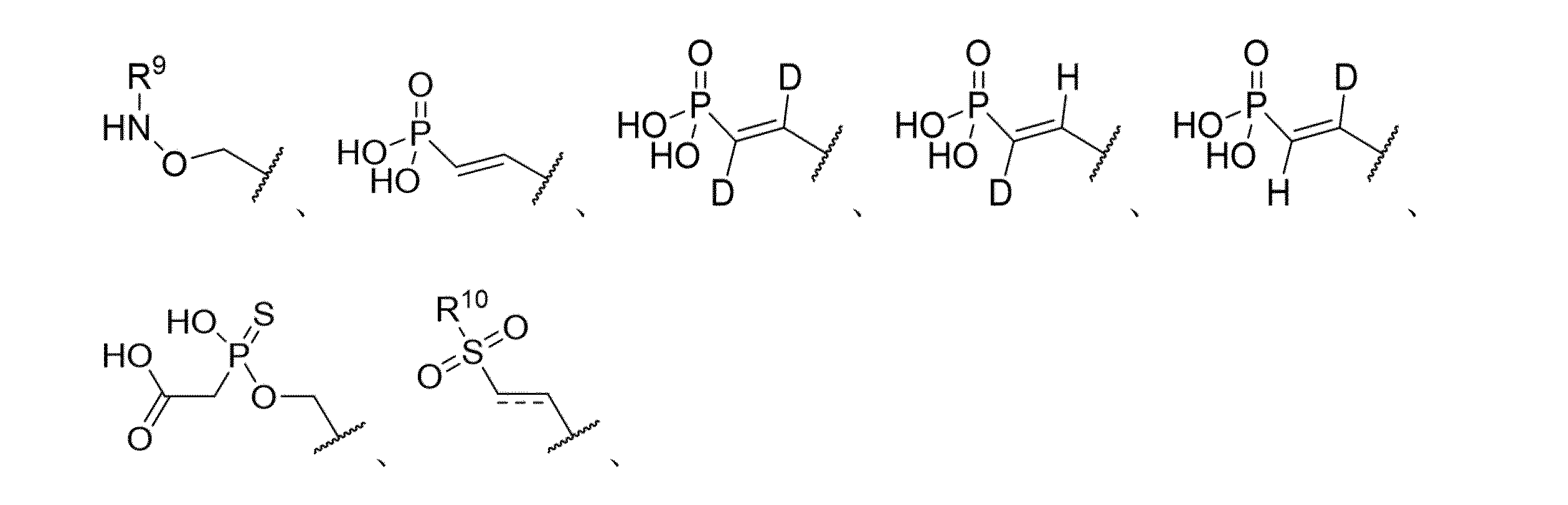


いくつかの実施形態では、本明細書に開示されるsiNA分子、センス鎖、第1のヌクレオチド配列、アンチセンス鎖、または第2のヌクレオチド配列のいずれかは、式(IIb)の5’安定化エンドキャップ:


いくつかの実施形態では、本明細書に開示されるsiNA分子、センス鎖、第1のヌクレオチド配列、アンチセンス鎖、または第2のヌクレオチド配列のいずれかは、式(III)の5’安定化エンドキャップ:

いくつかの実施形態では、本明細書に開示されるsiNA分子、センス鎖、第1のヌクレオチド配列、アンチセンス鎖、または第2のヌクレオチド配列のいずれかは、実施例5~11、33~35、38、39、43、および49~53の5’エンドキャップモノマーから選択される5’エンドキャップを含む。 In some embodiments, any of the siNA molecules, the sense strand, the first nucleotide sequence, the antisense strand, or the second nucleotide sequence disclosed herein are in Examples 5-11, 33-35 , 38, 39, 43, and 49-53.
本明細書にさらに開示されるのは、siNA分子であって、(a)式(Ia)の5’安定化エンドキャップ:


本明細書にさらに開示されるのは、siNA分子であって、(a)式(Ib)の5’安定化エンドキャップ:


本明細書にさらに開示されるのは、siNA分子であって、(a)式(Ic)の5’安定化エンドキャップ:


Zが、-ONR23R24、-OP(O)OH(CH2)mCO2R23、-OP(S)OH(CH2)mCO2R23、-P(O)(OH)2、-P(O)(OH)(OCH3)、-P(O)(OH)(OCD3)、-SO2(CH2)mP(O)(OH)2、-SO2NR23R25、-NR23R24、もしくは-NR23SO2R24であり、R21およびR22のいずれかが、独立して、水素もしくはC1~C6アルキルであるか、またはR21およびR22が、一緒になって、オキソ基を形成し、R23が、水素もしくはC1~C6アルキルであり、R24が、-SO2R25もしくは-C(O)R25であるか、または
R23およびR24が、それらが接続する窒素と一緒になって、置換または非置換複素環式環を形成し、R25が、C1~C6アルキルであり、mが、1、2、3、または4である)と、(b)短い干渉核酸(siNA)と、を含み、5’安定化エンドキャップが、siNAにコンジュゲートする、siNA分子である。いくつかの実施形態では、R1は、アリールである。いくつかの実施形態では、アリールは、フェニルである。
Further disclosed herein are siNA molecules comprising (a) a 5' stabilizing endcap of formula (Ic):
Z is —ONR 23 R 24 , —OP(O)OH(CH 2 ) m CO 2 R 23 , —OP(S)OH(CH 2 ) m CO 2 R 23 , —P(O)(OH) 2 , —P(O)(OH)(OCH 3 ), —P(O)(OH)(OCD 3 ), —SO 2 (CH 2 ) m P(O)(OH) 2 , —SO 2 NR 23 R 25 , —NR 23 R 24 , or —NR 23 SO 2 R 24 and either R 21 and R 22 are independently hydrogen or C 1 -C 6 alkyl, or R 21 and R 22 together form an oxo group, R 23 is hydrogen or C 1 -C 6 alkyl and R 24 is —SO 2 R 25 or —C(O)R 25 ; or R 23 and R 24 together with the nitrogen to which they are attached form a substituted or unsubstituted heterocyclic ring, R 25 is C 1 -C 6 alkyl and m is 1, 2 , 3, or 4), and (b) a short interfering nucleic acid (siNA), wherein a 5' stabilizing endcap is conjugated to the siNA, the siNA molecule. In some embodiments, R 1 is aryl. In some embodiments, aryl is phenyl.
いくつかの実施形態では、siNA分子は、(a)式(IIa)の5’安定化エンドキャップ:

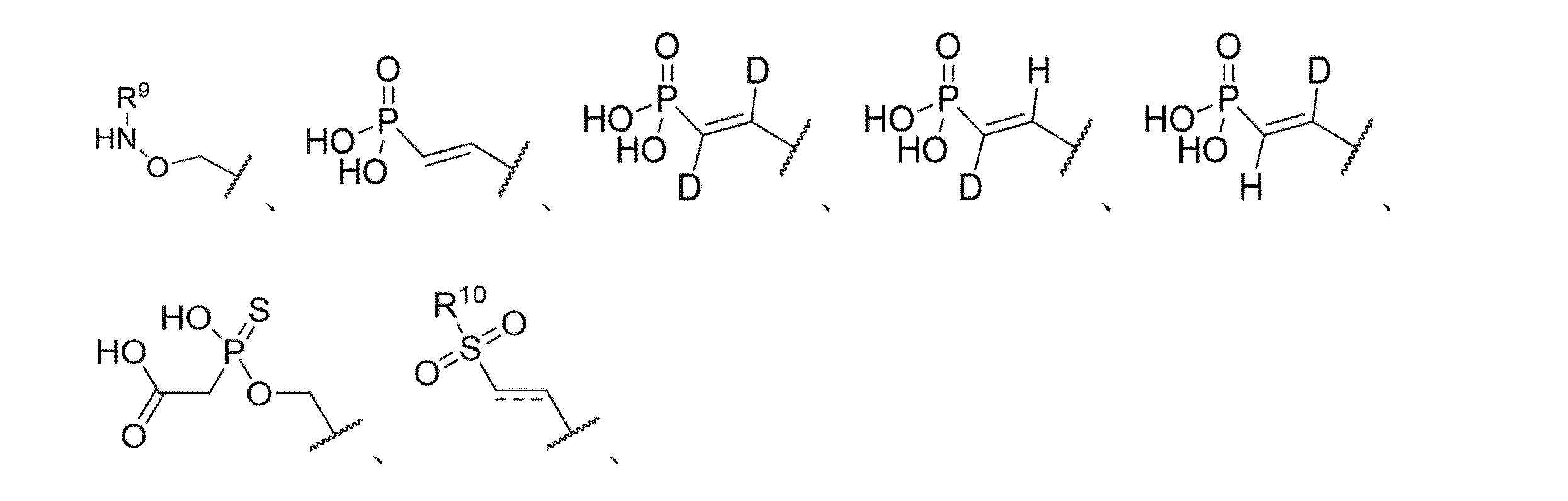


いくつかの実施形態では、siNA分子は、(a)式(IIb)の5’安定化エンドキャップ:


いくつかの実施形態では、siNA分子は、(a)式(III)の5’安定化エンドキャップ:

いくつかの実施形態では、本明細書に開示されるsiNA分子のいずれかは、式(1)~式(15)、式(9X)~式(12X)、および式(9Y)~式(12Y)からなる群から選択される5’安定化エンドキャップを含み、
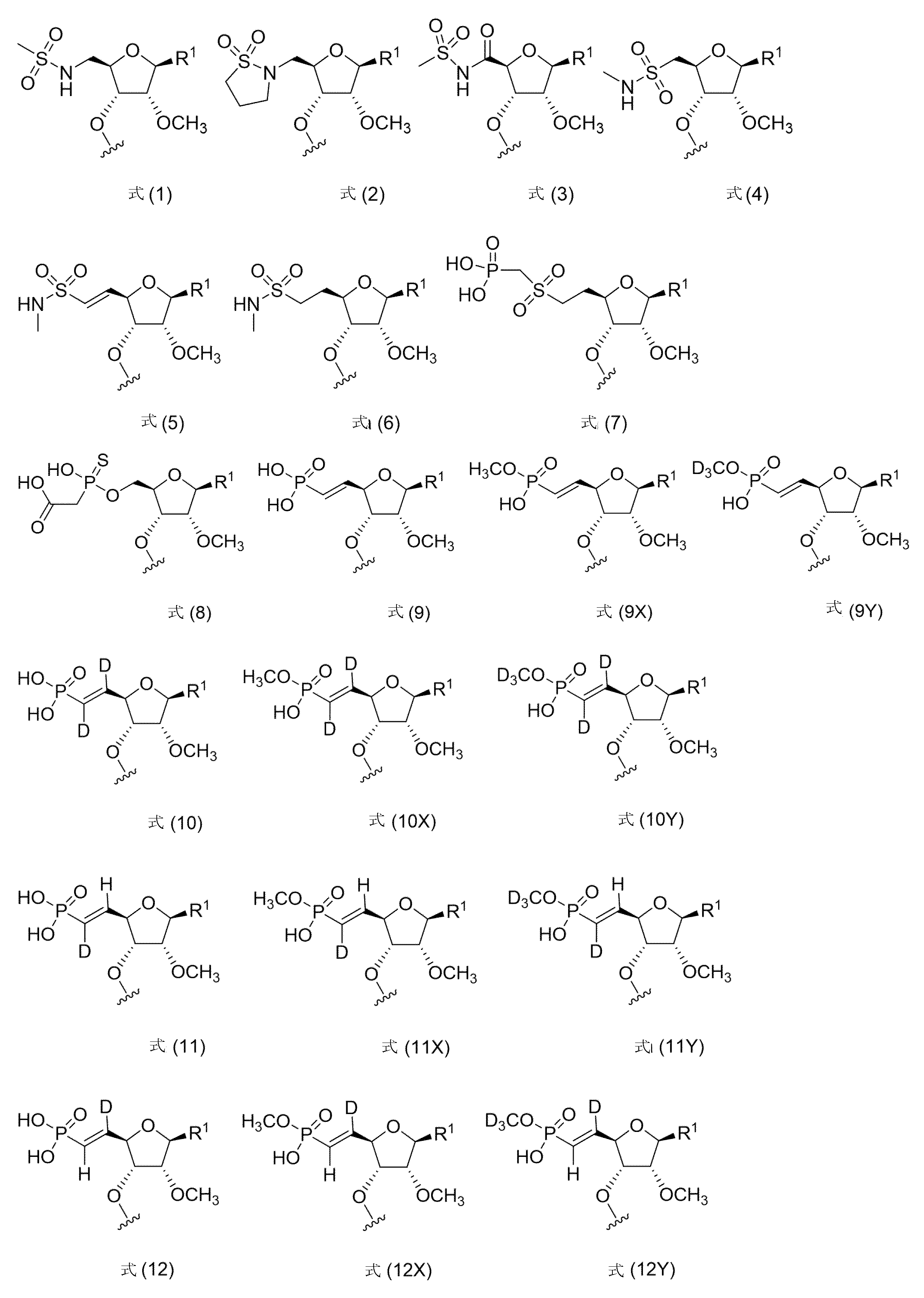
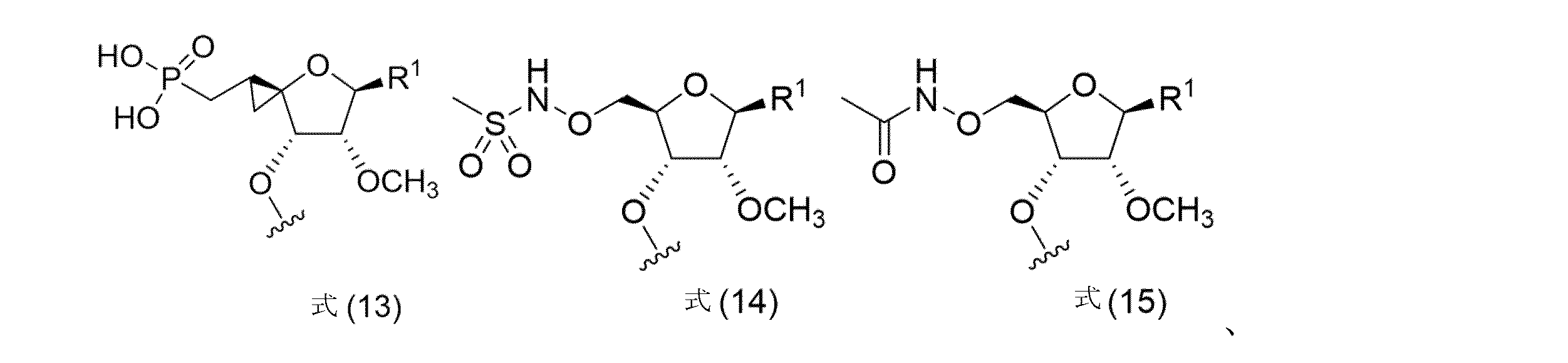
いくつかの実施形態では、本明細書に開示されるsiNA分子のいずれかは、式(1A)~(15A)、式(9B)~(12B)、式(9AX)~(12AX)、式(9AY)~(12AY)、式(9BX)~(12BX)、および式(9BY)~(12BY)からなる群から選択される5’安定化エンドキャップを含み、


いくつかの実施形態では、本明細書に開示されるsiNA分子のいずれかは、式(21)~式(35)からなる群から選択される5’安定化エンドキャップを含み、

いくつかの実施形態では、本明細書に開示されるsiNA分子のいずれかは、式(21A)~(35A)、式(29B)~(32B)、式(29AX)~(32AX)、式(29AY)~(32AY)、式(29BX)~(32BX)、および式(29BY)~(32BY)からなる群から選択される5’安定化エンドキャップを含み、


いくつかの実施形態では、5’安定化エンドキャップは、アンチセンス鎖の5’末端に接続する。いくつかの実施形態では、5’安定化エンドキャップは、1、2、3、4、もしくは5個、またはそれより多くのリンカーを介して、アンチセンス鎖の5’末端に接続する。いくつかの実施形態では、1つ以上のリンカーは、ホスホジエステル(pまたはpo)リンカー、ホスホロチオエート(ps)リンカー(ps)、ホスホラミダイト(HEG)リンカー、トリエチレングリコール(TEG)リンカー、および/またはホスホロジチオエートリンカーからなる群から独立して選択される。いくつかの実施形態では、1つ以上のリンカーは、p-(PS)2、(PS)2-p-TEG-p、(PS)2-p-HEG-p、および(PS)2-p-(HEG-p)2からなる群から独立して選択される。 In some embodiments, a 5' stabilizing endcap is attached to the 5' end of the antisense strand. In some embodiments, the 5' stabilizing endcap is attached to the 5' end of the antisense strand via 1, 2, 3, 4, or 5 or more linkers. In some embodiments, the one or more linkers are phosphodiester (p or po) linkers, phosphorothioate (ps) linkers (ps), phosphoramidite (HEG) linkers, triethylene glycol (TEG) linkers, and/or phospho independently selected from the group consisting of rhodithioate linkers. In some embodiments, the one or more linkers are p-(PS)2, (PS)2-p-TEG-p, (PS)2-p-HEG-p, and (PS)2-p is independently selected from the group consisting of -(HEG-p)2;
リンカー
いくつかの実施形態では、本明細書に開示されるsiRNA、センス鎖、第1のヌクレオチド配列、アンチセンス鎖、および/または第2のヌクレオチド配列のいずれかは、1、2、3、4、5、6、7、8、9、10、11、12、13、14、15、16、17、18、19、20、21、22、23個、またはそれより多くのヌクレオシド間リンカーを含む。いくつかの実施形態では、1、2、3、4、5、6、7、8、9、10個、またはそれより多くのヌクレオシド間リンカーは、独立して、ホスホジエステル(pまたはpo)リンカー、ホスホロチオエート(ps)リンカー、またはホスホロジチオエートリンカーからなる群から選択される。
Linker In some embodiments, any of the siRNA, sense strand, first nucleotide sequence, antisense strand, and/or second nucleotide sequence disclosed herein are 1, 2, 3, 4 , 5, 6, 7, 8, 9, 10, 11, 12, 13, 14, 15, 16, 17, 18, 19, 20, 21, 22, 23, or more internucleoside linkers . In some embodiments, 1, 2, 3, 4, 5, 6, 7, 8, 9, 10, or more internucleoside linkers are independently phosphodiester (p or po) linkers , a phosphorothioate (ps) linker, or a phosphorodithioate linker.
いくつかの実施形態では、本明細書に開示されるsiRNA、センス鎖、第1のヌクレオチド配列、アンチセンス鎖、および/または第2のヌクレオチド配列のいずれかは、コンジュゲート化部分、リン酸化ブロッカー、および/または5’エンドキャップをsiRNA、センス鎖、第1のヌクレオチド配列、アンチセンス鎖、および/または第2のヌクレオチド配列に接続する1、2、3、4個、またはそれより多くのリンカーをさらに含む。いくつかの実施形態では、1、2、3、4個、またはそれより多くのリンカーは、ホスホジエステル(pまたはpo)リンカー、ホスホロチオエート(ps)リンカー、ホスホラミダイト(HEG)リンカー、トリエチレングリコール(TEG)リンカー、および/またはホスホロジチオエートリンカーからなる群から独立して選択される。いくつかの実施形態では、1つ以上のリンカーは、p-(PS)2、(PS)2-p-TEG-p、(PS)2-p-HEG-p、および(PS)2-p-(HEG-p)2からなる群から独立して選択される。 In some embodiments, any of the siRNA, sense strand, first nucleotide sequence, antisense strand, and/or second nucleotide sequence disclosed herein comprise a conjugate moiety, a phosphorylation blocker , and/or 1, 2, 3, 4, or more linkers connecting the 5' endcap to the siRNA, the sense strand, the first nucleotide sequence, the antisense strand, and/or the second nucleotide sequence further includes In some embodiments, the 1, 2, 3, 4, or more linkers are phosphodiester (p or po) linkers, phosphorothioate (ps) linkers, phosphoramidite (HEG) linkers, triethylene glycol (TEG ) linkers, and/or phosphorodithioate linkers. In some embodiments, the one or more linkers are p-(PS)2, (PS)2-p-TEG-p, (PS)2-p-HEG-p, and (PS)2-p is independently selected from the group consisting of -(HEG-p)2;
標的遺伝子
理論に拘束されることを望まないが、細胞内に入ると、本明細書に開示されるds-siNA分子のいずれかは、細胞中のタンパク質と相互作用して、RNA誘導サイレンシング複合体(RISC)を形成し得る。ds-siNAがRISCの一部であるとき、ds-siNAは巻き戻されて一本鎖siNA(ss-siNA)を形成し得る。ss-siNAは、ds-siNAのアンチセンス鎖を含んでいてもよい。アンチセンス鎖は、相補的メッセンジャーRNA(mRNA)に結合してもよく、これにより、mRNAをコードする遺伝子がサイレンシングされる。
While not wishing to be bound by gene target theory, once inside the cell, any of the ds-siNA molecules disclosed herein interact with proteins in the cell to initiate the RNA-induced silencing complex. body (RISC). When the ds-siNA is part of RISC, the ds-siNA can be unwound to form a single-stranded siNA (ss-siNA). The ss-siNA may include an antisense strand of ds-siNA. The antisense strand may bind to complementary messenger RNA (mRNA), thereby silencing the gene encoding the mRNA.
標的遺伝子は、細胞中の任意の遺伝子であってもよい。いくつかの実施形態では、標的遺伝子は、ウイルス遺伝子である。いくつかの実施形態では、ウイルス遺伝子は、DNAウイルス由来である。いくつかの実施形態では、DNAウイルスは、二本鎖DNA(dsDNA)ウイルスである。いくつかの実施形態では、dsDNAウイルスは、ヘパドナウイルスである。いくつかの実施形態では、ヘパドナウイルスは、B型肝炎ウイルス(HBV)である。いくつかの実施形態では、HBVは、HBV遺伝子型A~Jから選択される。 A target gene can be any gene in a cell. In some embodiments, the target gene is a viral gene. In some embodiments, the viral genes are derived from DNA viruses. In some embodiments, the DNA virus is a double-stranded DNA (dsDNA) virus. In some embodiments, the dsDNA virus is a hepadnavirus. In some embodiments, the hepadnavirus is hepatitis B virus (HBV). In some embodiments, the HBV is selected from HBV genotypes AJ.
いくつかの実施形態では、標的遺伝子は、HBVのS遺伝子またはX遺伝子から選択される。いくつかの実施形態では、HBVは、その全体が参照により組み込まれるGenBank受託番号U95551.1のヌクレオチド配列に対応する、配列番号410のヌクレオチド配列に示されるゲノム配列を有する。 In some embodiments, the target gene is selected from the HBV S or X gene. In some embodiments, HBV has the genomic sequence shown in the nucleotide sequence of SEQ ID NO:410, which corresponds to the nucleotide sequence of GenBank Accession No. U95551.1, which is incorporated by reference in its entirety.
例示的なHBVゲノム配列は、参照によりその全体が組み込まれるGenbank受託番号KC315400.1に対応する配列番号415に示される。配列番号415のヌクレオチド2307~3215、1~1623は、ポリメラーゼタンパク質をコードするポリメラーゼ/RT遺伝子配列に対応する。配列番号415のヌクレオチド2848~3215、1~835は、大きなSタンパク質をコードするPreS1/S2/S遺伝子配列に対応する。配列番号415のヌクレオチド3205~3215、1~835は、中間のSタンパク質をコードするPreS2/S遺伝子配列に対応する。配列番号415のヌクレオチド155~835は、小さなSタンパク質をコードするS遺伝子配列に対応する。配列番号415のヌクレオチド1374~1838は、Xタンパク質をコードするX遺伝子配列に対応する。配列番号415のヌクレオチド1814~2452は、プレコア/コアタンパク質をコードするPreC/C遺伝子配列に対応する。配列番号415のヌクレオチド1901~2452は、コアタンパク質をコードするC遺伝子配列に対応する。HBVゲノムは、ウイルスプロモーター(preS2、preS1、Core、およびX)ならびにエンハンサー要素(ENH1およびENH2)などのウイルス調節エレメントをさらに含む。配列番号415のヌクレオチド1624~1771は、ENH2に対応する。配列番号415のヌクレオチド1742~1849は、Coreプロモーターに対応する。配列番号415のヌクレオチド1818~3215、1~1930は、コアおよびポリメラーゼタンパク質をコードするプレゲノムRNA(pgRNA)に対応する。 An exemplary HBV genome sequence is shown in SEQ ID NO: 415, corresponding to Genbank Accession No. KC315400.1, which is incorporated by reference in its entirety. Nucleotides 2307-3215, 1-1623 of SEQ ID NO:415 correspond to the polymerase/RT gene sequence encoding the polymerase protein. Nucleotides 2848-3215, 1-835 of SEQ ID NO:415 correspond to the PreS1/S2/S gene sequence encoding the large S protein. Nucleotides 3205-3215, 1-835 of SEQ ID NO:415 correspond to the PreS2/S gene sequence encoding the intermediate S protein. Nucleotides 155-835 of SEQ ID NO:415 correspond to the S gene sequence encoding the small S protein. Nucleotides 1374-1838 of SEQ ID NO:415 correspond to the X gene sequence encoding the X protein. Nucleotides 1814-2452 of SEQ ID NO:415 correspond to the PreC/C gene sequence encoding the precore/core protein. Nucleotides 1901-2452 of SEQ ID NO:415 correspond to the C gene sequence encoding core protein. The HBV genome further comprises viral regulatory elements such as the viral promoters (preS2, preS1, Core, and X) and enhancer elements (ENH1 and ENH2). Nucleotides 1624-1771 of SEQ ID NO:415 correspond to ENH2. Nucleotides 1742-1849 of SEQ ID NO:415 correspond to the Core promoter. Nucleotides 1818-3215, 1-1930 of SEQ ID NO:415 correspond to the pregenomic RNA (pgRNA) encoding the core and polymerase proteins.
いくつかの実施形態では、ASOは、HBVのX領域またはHBVのS領域から始まるウイルス標的RNA配列に対して少なくとも約60%、65%、70%、75%、80%、85%、90%、95%、または100%相補的であるか、またはそのウイルス標的RNA配列にハイブリダイズする。重要な標的は、例えば、acc.KC315400.1(遺伝子型B、「gt B」)における、またはA、C、もしくはD遺伝子型のいずれか1つにおける標的部位の5’末端から始まってもよい。当業者は、例えば、Wing-Kin Sung,et al.,Nature Genetics 44:765(2012)に記載されているようなHBV位置について理解するであろう。いくつかの実施形態では、S領域は、小さなSタンパク質の開始(遺伝子型BKC315400.1単離物、位置番号155)からXタンパク質(遺伝子型BKC315400.1単離物、位置番号1373)の開始前までと定義される。いくつかの実施形態では、X領域は、Xタンパク質(遺伝子型BKC315400.1単離物、位置番号1374)の始まりからDR2部位(遺伝子型BKC315400.1単離物、位置番号1603)の終わりまでと定義される。 In some embodiments, the ASO is at least about 60%, 65%, 70%, 75%, 80%, 85%, 90% of the viral target RNA sequence starting from the HBV X region or the HBV S region. , 95%, or 100% complementary to or hybridizes to its viral target RNA sequence. Important targets are, for example, acc. It may begin at the 5' end of the target site in KC315400.1 (genotype B, "gt B") or in any one of the A, C, or D genotypes. Those skilled in the art are familiar with, for example, Wing-Kin Sung, et al. , Nature Genetics 44:765 (2012). In some embodiments, the S region extends from the start of the small S protein (genotype BKC315400.1 isolate, position number 155) to before the start of the X protein (genotype BKC315400.1 isolate, position number 1373). defined as up to In some embodiments, the X region extends from the beginning of the X protein (genotype BKC315400.1 isolate, position number 1374) to the end of the DR2 site (genotype BKC315400.1 isolate, position number 1603) and Defined.
いくつかの実施形態では、第2のヌクレオチド配列は、配列番号410の200~720、または1100~1700位置内の15~30、15~25、15~23、15~22、15~21、17~25、17~23、17~22、17~21、または19~21個のヌクレオチドに対して少なくとも約60%、65%、70%、75%、80%、85%、90%、95%または100%相補的である。いくつかの実施形態では、第2のヌクレオチド配列は、配列番号410の200~280、300~445、460~510、650~720、1170~1220、1250~1300、または1550~1630位置内の15~30、15~25、15~23、15~22、15~21、17~25、17~23、17~22、17~21、または19~21個のヌクレオチドに対して少なくとも約60%、65%、70%、75%、80%、85%、90%、95%または100%相補的である。いくつかの実施形態では、第2のヌクレオチド配列は、配列番号410の200~230、250~280、300~330、370~400、405~445、460~500、670~700、1180~1210、1260~1295、1520~1550、または1570~1610位置内の15~30、15~25、15~23、15~22、15~21、17~25、17~23、17~22、17~21、または19~21個のヌクレオチドに対して少なくとも約60%、65%、70%、75%、80%、85%、90%、95%、または100%相補的である。いくつかの実施形態では、第2のヌクレオチド配列は、配列番号410の203、206、254、305、375、409、412、415、416、419、462、466、467、674、676、1182、1262、1263、1268、1526、1577、1578、1580、1581、1583、または1584位置で開始する15~30、15~25、15~23、15~22、15~21、17~25、17~23、17~22、17~21、または19~21個のヌクレオチドに対して少なくとも約60%、65%、70%、75%、80%、85%、90%、95%、または100%相補的である。 In some embodiments, the second nucleotide sequence is 15-30, 15-25, 15-23, 15-22, 15-21, 17 within positions 200-720, or 1100-1700 of SEQ ID NO:410 at least about 60%, 65%, 70%, 75%, 80%, 85%, 90%, 95% for ~25, 17-23, 17-22, 17-21, or 19-21 nucleotides or 100% complementary. In some embodiments the second nucleotide sequence is 15 at least about 60% for ~30, 15-25, 15-23, 15-22, 15-21, 17-25, 17-23, 17-22, 17-21, or 19-21 nucleotides; 65%, 70%, 75%, 80%, 85%, 90%, 95% or 100% complementary. In some embodiments, the second nucleotide sequence is 200-230, 250-280, 300-330, 370-400, 405-445, 460-500, 670-700, 1180-1210 of SEQ ID NO:410, 15-30, 15-25, 15-23, 15-22, 15-21, 17-25, 17-23, 17-22, 17-21 within positions 1260-1295, 1520-1550, or 1570-1610 , or at least about 60%, 65%, 70%, 75%, 80%, 85%, 90%, 95%, or 100% complementary to 19-21 nucleotides. In some embodiments, the second nucleotide sequence is 203, 206, 254, 305, 375, 409, 412, 415, 416, 419, 462, 466, 467, 674, 676, 1182, 15-30, 15-25, 15-23, 15-22, 15-21, 17-25, 17-, starting at position 1262, 1263, 1268, 1526, 1577, 1578, 1580, 1581, 1583, or 1584 at least about 60%, 65%, 70%, 75%, 80%, 85%, 90%, 95%, or 100% complementary to 23, 17-22, 17-21, or 19-21 nucleotides target.
いくつかの実施形態では、第1のヌクレオチドは、配列番号410内のヌクレオチド領域に対して少なくとも約60%、65%、70%、75%、80%、85%、90%、95%、または100%同一であるが、例外として、配列番号410中のチミン(Ts)が、ウラシル(U)で置き換えられている。いくつかの実施形態では、第1のヌクレオチド配列は、配列番号410の200~720、または1100~1700位置内の15~30、15~25、15~23、15~22、15~21、17~25、17~23、17~22、17~21、または19~21個のヌクレオチドに対して少なくとも約60%、65%、70%、75%、80%、85%、90%、95%または100%同一である。いくつかの実施形態では、第1のヌクレオチド配列は、配列番号410の200~280、300~445、460~510、650~720、1170~1220、1250~1300、または1550~1630位置内の15~30、15~25、15~23、15~22、15~21、17~25、17~23、17~22、17~21、または19~21個のヌクレオチドに対して少なくとも約60%、65%、70%、75%、80%、85%、90%、95%または100%同一である。いくつかの実施形態では、第1のヌクレオチド配列は、配列番号410の200~230、250~280、300~330、370~400、405~445、460~500、670~700、1180~1210、1260~1295、1520~1550、または1570~1610位置内の15~30、15~25、15~23、15~22、15~21、17~25、17~23、17~22、17~21、または19~21個のヌクレオチドに対して少なくとも約60%、65%、70%、75%、80%、85%、90%、95%、または100%同一である。いくつかの実施形態では、第1のヌクレオチド配列は、配列番号410の203、206、254、305、375、409、412、415、416、419、462、466、467、674、676、1182、1262、1263、1268、1526、1577、1578、1580、1581、1583、または1584位置で開始する15~30、15~25、15~23、15~22、15~21、17~25、17~23、17~22、17~21、または19~21個のヌクレオチドに対して少なくとも約60%、65%、70%、75%、80%、85%、90%、95%、または100%同一である。 In some embodiments, the first nucleotide is at least about 60%, 65%, 70%, 75%, 80%, 85%, 90%, 95%, or 100% identical, with the exception that thymine (Ts) in SEQ ID NO:410 is replaced with uracil (U). In some embodiments, the first nucleotide sequence is 15-30, 15-25, 15-23, 15-22, 15-21, 17 within positions 200-720, or 1100-1700 of SEQ ID NO:410 at least about 60%, 65%, 70%, 75%, 80%, 85%, 90%, 95% for ~25, 17-23, 17-22, 17-21, or 19-21 nucleotides or 100% identical. In some embodiments, the first nucleotide sequence is 15 at least about 60% for ~30, 15-25, 15-23, 15-22, 15-21, 17-25, 17-23, 17-22, 17-21, or 19-21 nucleotides; 65%, 70%, 75%, 80%, 85%, 90%, 95% or 100% identical. In some embodiments, the first nucleotide sequence is 200-230, 250-280, 300-330, 370-400, 405-445, 460-500, 670-700, 1180-1210, 15-30, 15-25, 15-23, 15-22, 15-21, 17-25, 17-23, 17-22, 17-21 within positions 1260-1295, 1520-1550, or 1570-1610 , or at least about 60%, 65%, 70%, 75%, 80%, 85%, 90%, 95%, or 100% identical over 19-21 nucleotides. In some embodiments, the first nucleotide sequence of SEQ ID NO: 410 is 15-30, 15-25, 15-23, 15-22, 15-21, 17-25, 17-, starting at position 1262, 1263, 1268, 1526, 1577, 1578, 1580, 1581, 1583, or 1584 at least about 60%, 65%, 70%, 75%, 80%, 85%, 90%, 95%, or 100% identical to 23, 17-22, 17-21, or 19-21 nucleotides is.
いくつかの実施形態では、標的遺伝子は、肝臓代謝に関与する。いくつかの実施形態では、標的遺伝子は、電子輸送鎖の阻害剤である。いくつかの実施形態では、標的遺伝子は、MCJタンパク質(MCJ/DnaJC15またはメチル化制御されたJタンパク質)をコードする。いくつかの実施形態では、MCJタンパク質は、参照によりその全体が組み込まれるGenBank受託番号NM_013238.3のヌクレオチド配列に対応する配列番号411のmRNA配列によってコードされる。 In some embodiments, the target gene is involved in liver metabolism. In some embodiments, the target gene is an inhibitor of the electron transport chain. In some embodiments, the target gene encodes the MCJ protein (MCJ/DnaJC15 or methylation-regulated J protein). In some embodiments, the MCJ protein is encoded by the mRNA sequence of SEQ ID NO:411, which corresponds to the nucleotide sequence of GenBank Accession No. NM_013238.3, which is incorporated by reference in its entirety.
いくつかの実施形態では、標的遺伝子は、TAZである。いくつかの実施形態では、TAZは、参照によりその全体が組み込まれる、GenBank受託番号NM_000116.5のヌクレオチド配列に対応する、配列番号412のヌクレオチド配列を含む。 In some embodiments, the target gene is TAZ. In some embodiments, TAZ comprises the nucleotide sequence of SEQ ID NO:412, which corresponds to the nucleotide sequence of GenBank Accession No. NM_000116.5, which is incorporated by reference in its entirety.
いくつかの実施形態では、標的遺伝子は、アンジオポエチン様3(ANGPTL3)である。いくつかの実施形態では、ANGPTL3は、参照によりその全体が組み込まれる、GenBank受託番号NM_014495.4のヌクレオチド配列に対応する、配列番号413のヌクレオチド配列を含む。 In some embodiments, the target gene is angiopoietin-like 3 (ANGPTL3). In some embodiments, ANGPTL3 comprises the nucleotide sequence of SEQ ID NO:413, which corresponds to the nucleotide sequence of GenBank Accession No. NM_014495.4, which is incorporated by reference in its entirety.
いくつかの実施形態では、標的遺伝子は、ジアシルグリセロールアシルトランスフェラーゼ2(DGAT2)である。いくつかの実施形態では、DGAT2は、参照によりその全体が組み込まれる、GenBank受託番号NM_001253891.1のヌクレオチド配列に対応する、配列番号414のヌクレオチド配列を含む。 In some embodiments, the target gene is diacylglycerol acyltransferase 2 (DGAT2). In some embodiments, DGAT2 comprises the nucleotide sequence of SEQ ID NO:414, which corresponds to the nucleotide sequence of GenBank Accession No. NM_001253891.1, which is incorporated by reference in its entirety.
組成物
上述のように、本開示は、本明細書に記載されるsiNA分子、センス鎖、アンチセンス鎖、第1のヌクレオチド配列、または第2のヌクレオチド配列のいずれかを含む組成物を提供する。組成物は、本明細書に記載される1、2、3、4、5、6、7、8、9、10、11、12個、またはそれより多くのsiNA分子を含んでいてもよい。組成物は、いずれか1つの配列番号1~56、103~158および205~260のヌクレオチド配列を含む第1のヌクレオチド配列を含んでいてもよい。いくつかの実施形態では、組成物は、配列番号57~102、159~204、および261~306のうちのいずれか1つのヌクレオチド配列を含む第2のヌクレオチド配列を含む。いくつかの実施形態では、組成物は、配列番号307~362および415~444のうちのいずれか1つのヌクレオチド配列を含むセンス鎖を含む。いくつかの実施形態では、組成物は、配列番号363~409、445~533および536~539のうちのいずれか1つのヌクレオチド配列を含むアンチセンス鎖を含む。
Compositions As noted above, the present disclosure provides compositions comprising any of the siNA molecules, sense strands, antisense strands, first nucleotide sequences, or second nucleotide sequences described herein. . The composition may comprise 1, 2, 3, 4, 5, 6, 7, 8, 9, 10, 11, 12, or more siNA molecules described herein. The composition may comprise a first nucleotide sequence comprising the nucleotide sequences of any one of SEQ ID NOs: 1-56, 103-158 and 205-260. In some embodiments, the composition comprises a second nucleotide sequence comprising the nucleotide sequence of any one of SEQ ID NOS:57-102, 159-204, and 261-306. In some embodiments, the composition comprises a sense strand comprising the nucleotide sequence of any one of SEQ ID NOs:307-362 and 415-444. In some embodiments, the composition comprises an antisense strand comprising the nucleotide sequence of any one of SEQ ID NOs:363-409, 445-533 and 536-539.
代替的に、組成物は、(a)リン酸化ブロッカーと、(b)短い干渉核酸(siNA)と、を含んでいてもよい。いくつかの実施形態では、リン酸化ブロッカーは、本明細書に開示されるリン酸化ブロッカーのいずれかである。いくつかの実施形態では、siNAは、本明細書に開示されるsiNAのいずれかである。いくつかの実施形態では、siNAは、本明細書に記載されるセンス鎖、アンチセンス鎖、第1のヌクレオチド配列、または第2のヌクレオチド配列のいずれかを含む。いくつかの実施形態では、siNAは、本明細書に記載されるセンス鎖、アンチセンス鎖、第1のヌクレオチド配列、または第2のヌクレオチド配列のいずれかを含む。いくつかの実施形態では、siNAは、1つ以上の修飾ヌクレオチドを含む。いくつかの実施形態では、1つ以上の修飾ヌクレオチドは、独立して、2’-フルオロヌクレオチドおよび2’-O-メチルヌクレオチドから選択される。いくつかの実施形態では、2’-フルオロヌクレオチドまたは2’-O-メチルヌクレオチドは、本明細書に開示される2’-フルオロまたは2’-O-メチルヌクレオチド模倣物のいずれかから独立して選択される。いくつかの実施形態では、siNAは、本明細書に開示される修飾パターンのいずれかを含むヌクレオチド配列を含む。 Alternatively, the composition may comprise (a) a phosphorylation blocker and (b) a short interfering nucleic acid (siNA). In some embodiments, the phosphorylation blocker is any phosphorylation blocker disclosed herein. In some embodiments, the siNA is any siNA disclosed herein. In some embodiments, a siNA comprises any of the sense strand, antisense strand, first nucleotide sequence, or second nucleotide sequence described herein. In some embodiments, a siNA comprises any of the sense strand, antisense strand, first nucleotide sequence, or second nucleotide sequence described herein. In some embodiments, a siNA comprises one or more modified nucleotides. In some embodiments, the one or more modified nucleotides are independently selected from 2'-fluoro nucleotides and 2'-O-methyl nucleotides. In some embodiments, the 2'-fluoro nucleotide or 2'-O-methyl nucleotide is independently from any of the 2'-fluoro or 2'-O-methyl nucleotide mimetics disclosed herein selected. In some embodiments, a siNA comprises a nucleotide sequence comprising any of the modification patterns disclosed herein.
いくつかの実施形態では、組成物は、(a)コンジュゲート化部分と、(b)短い干渉核酸(siNA)と、を含む。いくつかの実施形態では、コンジュゲート化部分は、本明細書に開示されるガラクトサミンのいずれかである。いくつかの実施形態では、siNAは、本明細書に開示されるsiNAのいずれかである。いくつかの実施形態では、siNAは、本明細書に記載されるセンス鎖、アンチセンス鎖、第1のヌクレオチド配列、または第2のヌクレオチド配列のいずれかを含む。いくつかの実施形態では、siNAは、本明細書に記載されるセンス鎖、アンチセンス鎖、第1のヌクレオチド配列、または第2のヌクレオチド配列のいずれかを含む。いくつかの実施形態では、siNAは、1つ以上の修飾ヌクレオチドを含む。いくつかの実施形態では、1つ以上の修飾ヌクレオチドは、独立して、2’-フルオロヌクレオチドおよび2’-O-メチルヌクレオチドから選択される。いくつかの実施形態では、2’-フルオロヌクレオチドまたは2’-O-メチルヌクレオチドは、本明細書に開示される2’-フルオロまたは2’-O-メチルヌクレオチド模倣物のいずれかから独立して選択される。いくつかの実施形態では、siNAは、本明細書に開示される修飾パターンのいずれかを含むヌクレオチド配列を含む。 In some embodiments, the composition comprises (a) a conjugated moiety and (b) a short interfering nucleic acid (siNA). In some embodiments, the conjugating moiety is any of the galactosamines disclosed herein. In some embodiments, the siNA is any siNA disclosed herein. In some embodiments, a siNA comprises any of the sense strand, antisense strand, first nucleotide sequence, or second nucleotide sequence described herein. In some embodiments, a siNA comprises any of the sense strand, antisense strand, first nucleotide sequence, or second nucleotide sequence described herein. In some embodiments, a siNA comprises one or more modified nucleotides. In some embodiments, the one or more modified nucleotides are independently selected from 2'-fluoro nucleotides and 2'-O-methyl nucleotides. In some embodiments, the 2'-fluoro nucleotide or 2'-O-methyl nucleotide is independently from any of the 2'-fluoro or 2'-O-methyl nucleotide mimetics disclosed herein selected. In some embodiments, a siNA comprises a nucleotide sequence comprising any of the modification patterns disclosed herein.
いくつかの実施形態では、組成物は、(a)5’安定化エンドキャップと、(b)短い干渉核酸(siNA)と、を含む。いくつかの実施形態では、5’安定化エンドキャップは、本明細書に開示される5’安定化エンドキャップのいずれかである。いくつかの実施形態では、siNAは、本明細書に開示されるsiNAのいずれかである。いくつかの実施形態では、siNAは、本明細書に記載されるセンス鎖、アンチセンス鎖、第1のヌクレオチド配列、または第2のヌクレオチド配列のいずれかを含む。いくつかの実施形態では、siNAは、1つ以上の修飾ヌクレオチドを含む。いくつかの実施形態では、1つ以上の修飾ヌクレオチドは、独立して、2’-フルオロヌクレオチドおよび2’-O-メチルヌクレオチドから選択される。いくつかの実施形態では、2’-フルオロヌクレオチドまたは2’-O-メチルヌクレオチドは、本明細書に開示される2’-フルオロまたは2’-O-メチルヌクレオチド模倣物のいずれかから独立して選択される。いくつかの実施形態では、siNAは、本明細書に開示される修飾パターンのいずれかを含むヌクレオチド配列を含む。 In some embodiments, the composition comprises (a) a 5' stabilizing endcap and (b) a short interfering nucleic acid (siNA). In some embodiments, the 5' stabilized endcap is any of the 5' stabilized endcaps disclosed herein. In some embodiments, the siNA is any siNA disclosed herein. In some embodiments, a siNA comprises any of the sense strand, antisense strand, first nucleotide sequence, or second nucleotide sequence described herein. In some embodiments, a siNA comprises one or more modified nucleotides. In some embodiments, the one or more modified nucleotides are independently selected from 2'-fluoro nucleotides and 2'-O-methyl nucleotides. In some embodiments, the 2'-fluoro nucleotide or 2'-O-methyl nucleotide is independently from any of the 2'-fluoro or 2'-O-methyl nucleotide mimetics disclosed herein selected. In some embodiments, a siNA comprises a nucleotide sequence comprising any of the modification patterns disclosed herein.
いくつかの実施形態では、組成物は、(a)少なくとも1つのリン酸化ブロッカー、コンジュゲート化部分、または5’安定化エンドキャップと、(b)短い干渉核酸(siNA)と、を含む。いくつかの実施形態では、リン酸化ブロッカーは、本明細書に開示されるリン酸化ブロッカーのいずれかである。いくつかの実施形態では、コンジュゲート化部分は、本明細書に開示されるガラクトサミンのいずれかである。いくつかの実施形態では、5’安定化エンドキャップは、本明細書に開示される5’安定化エンドキャップのいずれかである。いくつかの実施形態では、siNAは、本明細書に開示されるsiNAのいずれかである。いくつかの実施形態では、siNAは、本明細書に記載されるセンス鎖、アンチセンス鎖、第1のヌクレオチド配列、または第2のヌクレオチド配列のいずれかを含む。いくつかの実施形態では、siNAは、1つ以上の修飾ヌクレオチドを含む。いくつかの実施形態では、1つ以上の修飾ヌクレオチドは、独立して、2’-フルオロヌクレオチドおよび2’-O-メチルヌクレオチドから選択される。いくつかの実施形態では、2’-フルオロヌクレオチドまたは2’-O-メチルヌクレオチドは、本明細書に開示される2’-フルオロまたは2’-O-メチルヌクレオチド模倣物のいずれかから独立して選択される。いくつかの実施形態では、siNAは、本明細書に開示される修飾パターンのいずれかを含むヌクレオチド配列を含む。 In some embodiments, the composition comprises (a) at least one phosphorylation blocker, conjugated moiety, or 5' stabilizing endcap, and (b) a short interfering nucleic acid (siNA). In some embodiments, the phosphorylation blocker is any phosphorylation blocker disclosed herein. In some embodiments, the conjugating moiety is any of the galactosamines disclosed herein. In some embodiments, the 5' stabilized endcap is any of the 5' stabilized endcaps disclosed herein. In some embodiments, the siNA is any siNA disclosed herein. In some embodiments, a siNA comprises any of the sense strand, antisense strand, first nucleotide sequence, or second nucleotide sequence described herein. In some embodiments, a siNA comprises one or more modified nucleotides. In some embodiments, the one or more modified nucleotides are independently selected from 2'-fluoro nucleotides and 2'-O-methyl nucleotides. In some embodiments, the 2'-fluoro nucleotide or 2'-O-methyl nucleotide is independently from any of the 2'-fluoro or 2'-O-methyl nucleotide mimetics disclosed herein selected. In some embodiments, a siNA comprises a nucleotide sequence comprising any of the modification patterns disclosed herein.
組成物は、医薬組成物であってもよい。いくつかの実施形態では、医薬組成物は、1つ以上の薬学的に許容される担体(添加剤)および/または希釈剤とともに製剤化される、ある量の本明細書に記載されるsiNA分子のうちの1つ以上を含む。医薬組成物は、固体または液体形態での投与のために特別に製剤化されてもよく、以下に適合されるものを含む。(1)経口投与、例えば、ドレンチ(水性もしくは非水性の溶液もしくは懸濁液)、錠剤、例えば、口腔、舌下、および全身吸収を標的としたもの、ボーラス、粉末、顆粒、舌に適用するためのペースト、(2)例えば、滅菌溶液もしくは懸濁液、もしくは徐放性製剤などの、例えば、皮下、筋肉内、静脈内もしくは硬膜外注射による、非経口投与、(3)例えば、クリーム、軟膏、または皮膚に適用される制御放出性パッチもしくはスプレーなどの、局所投与、(4)例えば、ペッサリー、クリームもしくはフォームとしての膣内または直腸内、(5)舌下、(6)眼、(7)経皮、あるいは(8)鼻腔。 The composition may be a pharmaceutical composition. In some embodiments, pharmaceutical compositions are an amount of a siNA molecule described herein formulated with one or more pharmaceutically acceptable carriers (excipients) and/or diluents. including one or more of Pharmaceutical compositions may be specially formulated for administration in solid or liquid form and include those adapted for: (1) Oral administration, e.g. drench (aqueous or non-aqueous solution or suspension), tablets e.g. buccal, sublingual and systemic targeted absorption, bolus, powder, granules, lingual application (2) parenteral administration, e.g., by subcutaneous, intramuscular, intravenous or epidural injection, e.g., as sterile solutions or suspensions, or sustained release formulations; , ointments, or controlled release patches or sprays applied to the skin; (4) intravaginally or intrarectally, e.g., as a pessary, cream or foam; (5) sublingual; (7) transdermal, or (8) nasal.
本明細書で使用される「治療有効量」という語句は、任意の医学的治療に適用可能な合理的な利益/リスク比で動物において細胞の少なくとも亜集団において所望ないくつかの治療効果をもたらすのに有効な、本開示のsiNAを含む化合物、材料、または組成物の量を意味する。 As used herein, the phrase "therapeutically effective amount" provides some desired therapeutic effect in at least a subpopulation of cells in an animal at a reasonable benefit/risk ratio applicable to any medical treatment. means an amount of a compound, material, or composition comprising a siNA of the present disclosure that is effective to
「薬学的に許容される」という語句は、合理的な利益/リスク比に見合った、過度の毒性、刺激、アレルギー応答、または他の問題もしくは合併症を伴わずに、健全な医学的判断の範囲内で、ヒトおよび動物の組織と接触して使用するのに好適な化合物、材料、組成物、および/または剤形を指すために本明細書で使用される。 The phrase "pharmaceutically acceptable" means a drug, commensurate with a reasonable benefit/risk ratio, and without undue toxicity, irritation, allergic response, or other problems or complications, of sound medical judgment. In scope, is used herein to refer to compounds, materials, compositions and/or dosage forms suitable for use in contact with human and animal tissue.
湿潤剤、乳化剤および潤滑剤、例えばラウリル硫酸ナトリウムおよびステアリン酸マグネシウム、ならびに着色剤、剥離剤、コーティング剤、甘味剤、香味剤および芳香剤、保存剤および抗酸化剤も組成物中に存在し得る。 Wetting agents, emulsifying agents and lubricants such as sodium lauryl sulfate and magnesium stearate, as well as coloring agents, exfoliating agents, coating agents, sweetening, flavoring and perfuming agents, preservatives and antioxidants can also be present in the compositions. .
薬学的に許容される抗酸化剤の例としては、以下が挙げられる。(1)水溶性抗酸化剤、例えば、アスコルビン酸、塩酸システイン、重硫酸ナトリウム、メタ重亜硫酸ナトリウム、亜硫酸ナトリウムなど、(2)油溶性抗酸化剤、例えば、パルミチン酸アスコルビル、ブチル化ヒドロキシアニソール(BHA)、ブチル化ヒドロキシトルエン(BHT)、レシチン、没食子酸プロピル、アルファ-トコフェロールなど、および(3)金属キレート剤、例えば、クエン酸、エチレンジアミン四酢酸(EDTA)、ソルビトール、酒石酸、リン酸など。 Examples of pharmaceutically acceptable antioxidants include: (1) water-soluble antioxidants such as ascorbic acid, cysteine hydrochloride, sodium bisulfate, sodium metabisulfite, sodium sulfite, etc. (2) oil-soluble antioxidants such as ascorbyl palmitate, butylated hydroxyanisole ( BHA), butylated hydroxytoluene (BHT), lecithin, propyl gallate, alpha-tocopherol, etc., and (3) metal chelating agents such as citric acid, ethylenediaminetetraacetic acid (EDTA), sorbitol, tartaric acid, phosphoric acid, and the like.
本開示の製剤は、経口、経鼻、局所(頬側および舌下を含む)、直腸、膣および/または非経口投与に好適なものを含む。製剤は、好都合には、単位剤形で提示されてもよく、薬学の分野で周知の任意の方法によって調製されてもよい。単一の剤形を作製するために担体材料と組み合わせることができる活性成分の量は、治療される宿主、特定の投与態様に応じて様々である。単一剤形を作製するために担体材料と組み合わせることができる活性成分の量は、一般に、治療効果を作製する化合物(例えば、siNA分子)の量である。一般に、100%のうち、この量は、活性成分の約0.1%~約99%、好ましくは約5%~約70%、最も好ましくは約10%~約30%の範囲である。 Formulations of the present disclosure include those suitable for oral, nasal, topical (including buccal and sublingual), rectal, vaginal and/or parenteral administration. The formulations may conveniently be presented in unit dosage form and may be prepared by any methods well known in the art of pharmacy. The amount of active ingredient that can be combined with the carrier materials to produce a single dosage form will vary depending upon the host treated, the particular mode of administration. The amount of active ingredient that can be combined with the carrier materials to produce a single dosage form will generally be the amount of compound (eg, siNA molecule) that produces a therapeutic effect. Generally, out of 100%, this amount will range from about 0.1% to about 99%, preferably from about 5% to about 70%, most preferably from about 10% to about 30% of active ingredient.
特定の実施形態では、本開示の製剤は、シクロデキストリン、セルロース、リポソーム、ミセル形成剤、例えば、胆汁酸、および高分子担体、例えば、ポリエステルおよびポリ無水物からなる群から選択される賦形剤と、本開示の化合物(例えば、siNA分子)と、を含む。特定の実施形態では、前述の製剤は、本開示の化合物(例えば、siNA分子)を経口的に生体利用可能にする。 In certain embodiments, the formulations of the present disclosure contain excipients selected from the group consisting of cyclodextrins, celluloses, liposomes, micelle-forming agents such as bile acids, and polymeric carriers such as polyesters and polyanhydrides. and compounds of the present disclosure (eg, siNA molecules). In certain embodiments, such formulations render compounds of the present disclosure (eg, siNA molecules) orally bioavailable.
これらの製剤または組成物を調製する方法は、本開示の化合物(例えば、siNA分子)を、担体、および任意選択で1つ以上の付属成分と会合させるステップを含む。一般に、製剤は、本開示の化合物(例えば、siNA分子)を液体担体、または細かく分割された固体担体、またはその両方と均一かつ密接に会合させ、必要に応じて、生成物を成形することによって調製される。 Methods of preparing these formulations or compositions include the step of bringing into association a compound of this disclosure (eg, siNA molecule) with the carrier and, optionally, one or more accessory ingredients. Generally, formulations are made by uniformly and intimately bringing into association a compound of the present disclosure (e.g., a siNA molecule) with liquid carriers or finely divided solid carriers or both, and, if necessary, shaping the product. prepared.
経口投与に好適な本開示の製剤は、カプセル、カシェ、丸剤、錠剤、ロゼンジ(風味付けされたベース、通常はスクロースおよびアカシアまたはトラガカントを使用する)、粉末、顆粒、または水性もしくは非水性液体中の溶液もしくは懸濁液として、または水中油もしくは油中水液体エマルションとして、またはエリキシルもしくはシロップとして、またはパスティル(ゼラチンおよびグリセリン、もしくはスクロースおよびアカシアなどの不活性塩基を使用する)として、および/またはマウスウォッシュの形態であってよく、それぞれ、活性成分として所定量の本開示の化合物(例えば、siNA分子)を含有する。本開示の化合物(例えば、siNA分子)はまた、ボーラス、なめ薬(electuary)、またはペーストとして投与され得る。 Formulations of the disclosure suitable for oral administration include capsules, cachets, pills, tablets, lozenges (flavored bases, usually using sucrose and acacia or tragacanth), powders, granules, or aqueous or non-aqueous liquids. as a solution or suspension in water, or as an oil-in-water or water-in-oil liquid emulsion, or as an elixir or syrup, or as a pastille (using gelatin and glycerin, or an inert base such as sucrose and acacia), and/or or in the form of mouthwashes, each containing a predetermined amount of a compound of the disclosure (eg, siNA molecule) as the active ingredient. A compound of the disclosure (eg, siNA molecule) can also be administered as a bolus, electuary, or paste.
経口投与のための本開示の固体剤形(カプセル、錠剤、丸剤、糖衣剤、粉末、顆粒、トローチ剤など)では、活性成分は、クエン酸ナトリウムまたはリン酸二カルシウムなどの1つ以上の薬学的に許容される担体、および/または以下のいずれかと混合される。(1)デンプン、ラクトース、スクロース、グルコース、マンニトール、および/またはケイ酸などの充填剤または延長剤、(2)カルボキシメチルセルロース、アルギネート、ゼラチン、ポリビニルピロリドン、スクロース、および/またはアカシアなどの結合剤、(3)グリセロールなどの湿潤剤、(4)寒天、炭酸カルシウム、ジャガイモまたはタピオカデンプン、アルギン酸、ある種のケイ酸塩、および炭酸ナトリウムなどの崩壊剤、(5)パラフィンなどの溶液遅延剤、(6)吸収促進剤、例えば、四級アンモニウム化合物および界面活性剤、例えば、ポロキサマーおよびラウリル硫酸ナトリウム、(7)湿潤剤、例えば、セチルアルコール、グリセロールモノステアレート、および非イオン性界面活性剤、(8)カオリンおよびベントナイトクレイなどの吸収剤、(9)タルク、ステアリン酸カルシウム、ステアリン酸マグネシウム、固体ポリエチレングリコール、ラウリル硫酸ナトリウム、ステアリン酸亜鉛、ステアリン酸ナトリウム、ステアリン酸、およびこれらの混合物などの潤滑剤、(10)着色剤、ならびに(11)クロスポビドンまたはエチルセルロースなどの制御放出剤。 In solid dosage forms (capsules, tablets, pills, dragees, powders, granules, lozenges, etc.) of this disclosure for oral administration, the active ingredient is one or more mixed with a pharmaceutically acceptable carrier and/or any of the following: (1) fillers or extenders such as starch, lactose, sucrose, glucose, mannitol, and/or silicic acid; (2) binders such as carboxymethylcellulose, alginate, gelatin, polyvinylpyrrolidone, sucrose, and/or acacia; (3) humectants such as glycerol; (4) disintegrants such as agar, calcium carbonate, potato or tapioca starch, alginic acid, certain silicates, and sodium carbonate; (5) solution retardants such as paraffin; 6) absorption enhancers such as quaternary ammonium compounds and surfactants such as poloxamers and sodium lauryl sulfate, (7) wetting agents such as cetyl alcohol, glycerol monostearate, and nonionic surfactants, ( 8) Absorbents such as kaolin and bentonite clays; (9) Lubricants such as talc, calcium stearate, magnesium stearate, solid polyethylene glycol, sodium lauryl sulfate, zinc stearate, sodium stearate, stearic acid, and mixtures thereof. , (10) a colorant, and (11) a controlled release agent such as crospovidone or ethylcellulose.
カプセル、錠剤、および丸剤の場合、医薬組成物は、緩衝剤も含み得る。同様の種類の固体組成物は、ラクトースまたは乳糖、ならびに高分子量ポリエチレングリコールなどの賦形剤を使用して、軟質および硬質殻のゼラチンカプセル中の充填剤としても用いられ得る。 In the case of capsules, tablets, and pills, the pharmaceutical composition can also contain buffering agents. Solid compositions of a similar type can also be employed as fillers in soft and hard shell gelatin capsules, using such excipients as lactose or milk sugar, and high molecular weight polyethylene glycols.
錠剤は、任意選択で、1つ以上の付属成分とともに、圧縮または成形によって作製され得る。圧縮錠剤は、結合剤(例えば、ゼラチンまたはヒドロキシプロピルメチルセルロース)、潤滑剤、不活性希釈剤、保存剤、崩壊剤(例えば、デンプングリコール酸ナトリウムまたは架橋カルボキシメチルセルロースナトリウム)、表面活性剤または分散剤を使用して調製してよい。成形錠剤は、不活性液体希釈剤で湿らせた粉末化合物の混合物を好適な機械で成形することによって作製されてもよい。 A tablet may be made by compression or molding, optionally with one or more accessory ingredients. Compressed tablets may contain binders such as gelatin or hydroxypropylmethylcellulose, lubricants, inert diluents, preservatives, disintegrants such as sodium starch glycolate or cross-linked sodium carboxymethylcellulose, surfactants or dispersing agents. may be prepared using Molded tablets may be made by molding in a suitable machine a mixture of the powdered compound moistened with an inert liquid diluent.
本開示の医薬組成物の錠剤、および他の固体剤形、例えば、糖衣剤、カプセル、丸剤および顆粒は、任意選択で、腸溶性コーティングおよび薬学的製剤化技術で周知の他のコーティングなどのコーティングおよびシェルを用いて割線が入れられるか、または調製され得る。これらはまた、例えば、所望の放出プロファイルを提供するための様々な割合のヒドロキシプロピルメチルセルロース、他のポリマーマトリックス、リポソーム、および/またはマイクロスフェアを使用して、その中の活性成分の遅延放出または制御放出を提供するように製剤化されてもよい。それらは、迅速な放出のために製剤化(例えば、凍結乾燥)されてもよい。 Tablets and other solid dosage forms of the pharmaceutical compositions of this disclosure, such as dragees, capsules, pills and granules, are optionally coated with enteric coatings and other coatings well known in the pharmaceutical formulating art. It can be scored or prepared with coatings and shells. They also employ, for example, varying proportions of hydroxypropylmethylcellulose, other polymeric matrices, liposomes, and/or microspheres to provide the desired release profile, to delay or control the release of active ingredients therein. It may be formulated to provide release. They may be formulated (eg, lyophilized) for rapid release.
これらは、例えば、細菌保持フィルターを通して濾過することによって、または、使用直前に滅菌水もしくはいくつかの他の滅菌注射用媒体に溶解することができる滅菌固体組成物の形態で滅菌剤を組み込むことによって、滅菌してもよい。これらの組成物はまた、任意選択で不透明化剤を含有してもよく、活性成分のみを放出する組成物であってもよく、または優先的に、任意選択で、遅延した方法で消化管の特定の部分において放出する組成物であってもよい。使用することができる埋め込み組成物の例としては、高分子物質およびワックスが挙げられる。活性成分はまた、適切であれば、上述の賦形剤のうちの1つ以上とともにマイクロカプセル化された形態であってもよい。 These may be obtained, for example, by filtration through a bacteria-retaining filter, or by incorporating sterilizing agents in the form of sterile solid compositions which can be dissolved in sterile water, or some other sterile injectable medium immediately prior to use. , may be sterilized. These compositions may also optionally contain opacifying agents, and may be compositions that release only the active ingredient(s), or preferentially, optionally, in a delayed manner in the gastrointestinal tract. It may also be a composition that releases in a specific portion. Examples of embedding compositions that can be used include polymeric substances and waxes. The active ingredient can also be in micro-encapsulated form, if appropriate, with one or more of the above-mentioned excipients.
本開示の化合物(例えば、siNA分子)の経口投与のための液体剤形としては、薬学的に許容されるエマルション、マイクロエマルション、溶液、懸濁液、シロップ、およびエリキシル剤が挙げられる。活性成分に加えて、液体剤形は、当該技術分野で一般的に使用される不活性希釈剤、例えば、水または他の溶媒、可溶化剤および乳化剤、例えば、エチルアルコール、イソプロピルアルコール、炭酸エチル、酢酸エチル、ベンジルアルコール、安息香酸ベンジル、プロピレングリコール、1,3-ブチレングリコール、油(特に、綿実油、ラッカセイ油、トウモロコシ油、胚芽油、オリーブ油、ヒマシ油およびゴマ油)、グリセロール、テトラヒドロフリルアルコール、ポリエチレングリコールおよびソルビタンの脂肪酸エステル、ならびにこれらの混合物を含有してもよい。 Liquid dosage forms for oral administration of the disclosed compounds (eg, siNA molecules) include pharmaceutically acceptable emulsions, microemulsions, solutions, suspensions, syrups, and elixirs. In addition to the active ingredient, liquid dosage forms may contain inert diluents commonly used in the art such as water or other solvents, solubilizers and emulsifiers such as ethyl alcohol, isopropyl alcohol, ethyl carbonate , ethyl acetate, benzyl alcohol, benzyl benzoate, propylene glycol, 1,3-butylene glycol, oils (especially cottonseed, peanut, corn, germ, olive, castor and sesame), glycerol, tetrahydrofuryl alcohol, It may also contain polyethylene glycol and fatty acid esters of sorbitan, and mixtures thereof.
不活性希釈剤に加えて、経口組成物は、湿潤剤、乳化剤および懸濁化剤、甘味料、香味料、着色剤、芳香剤、ならびに防腐剤などのアジュバントも含み得る。 Besides inert diluents, the oral compositions can also include adjuvants such as wetting agents, emulsifying and suspending agents, sweetening, flavoring, coloring, perfuming and preserving agents.
懸濁液は、活性化合物(例えば、siNA分子)に加えて、例えば、エトキシル化イソステアリルアルコール、ポリオキシエチレンソルビトールおよびソルビタンエステル、微結晶セルロース、メタ水酸化アルミニウム、ベントナイト、寒天およびトラガカント、ならびにこれらの混合物などの懸濁剤を含有してもよい。 Suspensions contain, in addition to the active compound (eg, siNA molecule), for example, ethoxylated isostearyl alcohols, polyoxyethylene sorbitol and sorbitan esters, microcrystalline cellulose, aluminum metahydroxide, bentonite, agar and tragacanth, and these suspending agents such as mixtures of
直腸または膣投与のための本開示の医薬組成物の製剤は、座薬として提示されてもよく、これは、本開示の1つ以上の化合物(例えば、siNA分子)を、例えば、カカオバター、ポリエチレングリコール、座薬ワックスまたはサリチル酸塩を含み、室温では固体であるが、体温では液体であり、したがって、直腸または膣腔で融解し、活性化合物(例えば、siNA分子)を放出する1つ以上の好適な非刺激性賦形剤または担体と混合することによって調製されてもよい。 Formulations of pharmaceutical compositions of this disclosure for rectal or vaginal administration may be presented as suppositories, which incorporate one or more compounds of this disclosure (eg, siNA molecules) in, for example, cocoa butter, polyethylene One or more suitable substances, including glycols, suppository waxes or salicylates, which are solid at room temperature but liquid at body temperature and thus melt in the rectal or vaginal cavity, releasing the active compound (eg, siNA molecule). It may be prepared by mixing with non-irritating excipients or carriers.
膣投与に好適な本開示の製剤には、適切であることが当該技術分野で既知であるような担体を含有するペッサリー、タンポン、クリーム、ゲル、ペースト、フォーム、またはスプレー製剤も含まれる。 Formulations of the present disclosure suitable for vaginal administration also include pessaries, tampons, creams, gels, pastes, foams, or spray formulations containing such carriers as are known in the art to be suitable.
本開示の化合物(例えば、siNA分子)の局所投与または経皮投与のための剤形としては、粉末、スプレー、軟膏、ペースト、クリーム、ローション、ゲル、溶液、パッチおよび吸入剤が挙げられる。活性化合物(例えば、siNA分子)は、滅菌条件下で、薬学的に許容される担体と、必要とされ得る任意の防腐剤、緩衝剤、または推進剤と混合してもよい。 Dosage forms for topical or transdermal administration of a compound of this disclosure (eg, siNA molecules) include powders, sprays, ointments, pastes, creams, lotions, gels, solutions, patches and inhalants. The active compound (eg, siNA molecule) may be mixed under sterile conditions with a pharmaceutically acceptable carrier, and with any preservatives, buffers, or propellants that may be required.
軟膏、ペースト、クリームおよびゲルは、本開示の活性化合物(例えば、siNA分子)に加えて、動物および植物性脂肪、油、ワックス、パラフィン、デンプン、トラガカント、セルロース誘導体、ポリエチレングリコール、シリコーン、ベントナイト、ケイ酸、タルクおよび酸化亜鉛、またはそれらの混合物などの賦形剤を含有してもよい。 Ointments, pastes, creams and gels can contain, in addition to the active compounds (eg, siNA molecules) of this disclosure, animal and vegetable fats, oils, waxes, paraffins, starches, tragacanth, cellulose derivatives, polyethylene glycols, silicones, bentonite, Excipients such as silicic acid, talc and zinc oxide, or mixtures thereof may be included.
粉末およびスプレーは、本開示の化合物(例えば、siNA分子)に加えて、ラクトース、タルク、ケイ酸、水酸化アルミニウム、ケイ酸カルシウムおよびポリアミド粉末などの賦形剤、またはこれらの物質の混合物を含有し得る。スプレーは、追加的に、クロロフルオロ炭化水素、ならびにブタンおよびプロパンなどの揮発性非置換炭化水素などの通常の推進剤を含有し得る。 Powders and sprays contain, in addition to a compound of the disclosure (e.g., siNA molecules), excipients such as lactose, talc, silicic acid, aluminum hydroxide, calcium silicates and polyamide powder, or mixtures of these substances. can. Sprays can additionally contain customary propellants, such as chlorofluorohydrocarbons and volatile unsubstituted hydrocarbons, such as butane and propane.
経皮パッチは、本開示の化合物(例えば、siNA分子)の身体への制御送達を提供する追加の利点を有する。かかる剤形は、化合物(例えば、siNA分子)を適切な培地中に溶解または分散させることによって作製することができる。吸収促進剤もまた、皮膚を通る化合物(例えば、siNA分子)の流束を増加させるために使用され得る。かかる流束の速度は、速度を制御する膜を提供するか、またはポリマーマトリックスもしくはゲル中に化合物(例えば、siNA分子)を分散させるかのいずれかによって制御することができる。 Transdermal patches have the added advantage of providing controlled delivery of a compound of the present disclosure (eg, siNA molecules) to the body. Such dosage forms can be made by dissolving or dispersing the compound (eg, siNA molecule) in the proper medium. Absorption enhancers can also be used to increase the flux of the compound (eg, siNA molecule) across the skin. The rate of such flux can be controlled either by providing a rate-controlling membrane or by dispersing the compound (eg, siNA molecules) in a polymer matrix or gel.
眼用製剤、眼用軟膏、粉末、溶液などもまた、本発明の範囲内であると企図される。 Ophthalmic formulations, eye ointments, powders, solutions and the like are also contemplated as being within the scope of this invention.
非経口投与に好適な本開示の医薬組成物は、1つ以上の薬学的に許容される滅菌等張水溶液もしくは非水溶液、分散液、懸濁液もしくはエマルション、または使用直前に滅菌注射用溶液もしくは分散液に再構成され得る滅菌粉末と組み合わせた本開示の1つ以上の化合物(例えば、siNA分子)を含み、糖、アルコール、抗酸化剤、緩衝液、静菌剤、製剤を意図されるレシピエントの血液と等張性にする溶質、または懸濁剤もしくは増粘剤を含有し得る。 Pharmaceutical compositions of the present disclosure suitable for parenteral administration may be formulated in one or more pharmaceutically acceptable sterile isotonic aqueous or non-aqueous solutions, dispersions, suspensions or emulsions, or sterile injectable solutions or solutions immediately prior to use. Recipes comprising one or more compounds of the present disclosure (e.g., siNA molecules) in combination with sterile powders that can be reconstituted into dispersions, sugars, alcohols, antioxidants, buffers, bacteriostats, formulations intended It may contain solutes that make it isotonic with the blood of the ent, or suspending or thickening agents.
本開示の医薬組成物に使用され得る好適な水性および非水性担体の例としては、水、エタノール、ポリオール(例えば、グリセロール、プロピレングリコール、ポリエチレングリコールなど)、およびそれらの好適な混合物、オリーブ油などの植物油、およびオレイン酸エチルなどの注射可能な有機エステルが挙げられる。適切な流動性は、例えば、レシチンなどのコーティング材料の使用によって、分散液の場合には必要な粒径の維持によって、および界面活性剤の使用によって維持することができる。 Examples of suitable aqueous and non-aqueous carriers that can be used in pharmaceutical compositions of the present disclosure include water, ethanol, polyols (eg, glycerol, propylene glycol, polyethylene glycol, etc.), and suitable mixtures thereof, olive oil, and the like. Vegetable oils and injectable organic esters such as ethyl oleate. Proper fluidity can be maintained, for example, by the use of coating materials such as lecithin, by maintenance of the required particle size in the case of dispersions, and by the use of surfactants.
これらの組成物はまた、防腐剤、湿潤剤、乳化剤、および分散剤などのアジュバントを含有し得る。対象化合物に対する微生物の作用の防止は、様々な抗菌剤および抗真菌剤、例えば、パラベン、クロロブタノール、フェノールソルビン酸などを含むことによって確保し得る。また、糖、塩化ナトリウムなどの等張剤を組成物に含めることが望ましい場合がある。加えて、注射用医薬形態の長期にわたる吸収は、モノステアリン酸アルミニウムおよびゼラチンなどの吸収を遅延させる薬剤を含むことによってもたらされ得る。 These compositions may also contain adjuvants such as preserving, wetting, emulsifying, and dispersing agents. Prevention of the action of microorganisms on the subject compounds can be ensured by the inclusion of various antibacterial and antifungal agents such as parabens, chlorobutanol, phenolsorbic acid, and the like. It may also be desirable to include isotonic agents, such as sugars, sodium chloride, and the like into the compositions. In addition, prolonged absorption of the injectable pharmaceutical form can be brought about by the inclusion of agents that delay absorption such as aluminum monostearate and gelatin.
いくつかの場合に、薬物の効果を延長するために、皮下注射または筋肉内注射からの薬物の吸収を遅くすることが望ましい。このことは、水溶性が低い結晶性材料または非晶質材料の液体懸濁液を使用することによって達成され得る。次いで、薬物の吸収速度は、その溶解速度に依存し、次いで、その溶解速度は、結晶サイズおよび結晶形態に依存し得る。代替的に、非経口投与された薬物形態の吸収の遅れは、薬物を油ビヒクル中に溶解または懸濁させることによって達成される。 In some cases it is desirable to slow the absorption of a drug from a subcutaneous or intramuscular injection in order to prolong the drug's effect. This can be accomplished by using a liquid suspension of crystalline or amorphous material with poor water solubility. The absorption rate of a drug then depends on its dissolution rate, which in turn can depend on crystal size and crystalline form. Alternatively, delayed absorption of a parenterally administered drug form is accomplished by dissolving or suspending the drug in an oil vehicle.
注射可能なデポー形態は、ポリラクチド-ポリグリコリドなどの生分解性ポリマー中で対象化合物(例えば、siNA分子)のマイクロカプセルマトリックスを形成することによって作製される。ポリマーに対する薬物の比率、および用いられる特定のポリマーの性質に応じて、薬物放出速度を制御することができる。他の生分解性ポリマーの例としては、ポリ(オルトエステル)およびポリ(無水物)が挙げられる。注射可能なデポー形態も、薬物を、体組織と適合性のあるリポソームまたはマイクロエマルションに封入することによって調製される。 Injectable depot forms are made by forming microencapsule matrices of the subject compounds (eg, siNA molecules) in biodegradable polymers such as polylactide-polyglycolide. Depending on the ratio of drug to polymer and the nature of the particular polymer used, the drug release rate can be controlled. Examples of other biodegradable polymers include poly(orthoesters) and poly(anhydrides). Injectable depot forms are also prepared by entrapping the drug in liposomes or microemulsions that are compatible with body tissues.
本開示の化合物(例えば、siNA分子)が、医薬品としてヒトおよび動物に投与される場合、本開示の化合物は、それ自体で、または例えば0.1~99%(より好ましくは、10~30%)の活性成分を薬学的に許容される担体と組み合わせて含有する医薬組成物として与えることができる。 When compounds of the present disclosure (eg, siNA molecules) are administered to humans and animals as pharmaceuticals, the compounds of the present disclosure may be administered per se or, for example, from 0.1-99% (more preferably from 10-30%). ) in combination with a pharmaceutically acceptable carrier.
治療および投与の方法
本開示のsiNA分子は、疾患の治療を必要とする対象においてそれを行うために使用されてもよい。いくつかの実施形態では、疾患の治療を必要とする対象においてそれを行う方法は、本明細書に開示されるsiNA分子のいずれかを対象に投与することを含む。いくつかの実施形態では、疾患の治療を必要とする対象においてそれを行う方法は、本明細書に開示される組成物のいずれかを対象に投与することを含む。
Methods of Treatment and Administration siNA molecules of the disclosure may be used to effect treatment of disease in a subject in need thereof. In some embodiments, a method for treating a disease in a subject in need thereof comprises administering to the subject any of the siNA molecules disclosed herein. In some embodiments, a method for treating a disease in a subject in need thereof comprises administering to the subject any of the compositions disclosed herein.
本開示の調製物(例えば、siNA分子または組成物)は、経口的、非経口的、局所的、または直腸的に与えられ得る。これらはもちろん、各投与経路に好適な形態で与えられる。例えば、これらは、錠剤またはカプセル形態で投与され、注射、注入または吸入による投与、ローションまたは軟膏による局所投与、および坐剤による直腸投与である。経口投与が好ましい。 Preparations (eg, siNA molecules or compositions) of this disclosure can be given orally, parenterally, topically, or rectally. They are of course given in forms suitable for each administration route. For example, they are administered in tablet or capsule form, administration by injection, infusion or inhalation, topical administration by lotions or ointments, and rectal administration by suppositories. Oral administration is preferred.
本明細書で使用される場合、「非経口投与」および「非経口的に投与される」という語句は、通常、注射による、経腸および局所投与以外の投与様式を意味し、静脈内、筋肉内、動脈内、くも膜下腔内、被膜内、眼窩内、心臓内、皮内、腹腔内、経気管、皮下、表皮下、関節内、被膜下、くも膜下、脊髄内および胸腔内注射および注入を含むが、これらに限定されない。 As used herein, the phrases "parenteral administration" and "administered parenterally" refer to modes of administration other than enteral and topical administration, usually by injection, including intravenous, intramuscular, Intraarterial, intrathecal, intracapsular, intraorbital, intracardiac, intradermal, intraperitoneal, transtracheal, subcutaneous, subepidermal, intraarticular, subcapsular, subarachnoid, intraspinal and intrathoracic injections and infusions including but not limited to.
本明細書で使用される場合、「全身投与」、「全身的に投与される」、「末梢投与」、および「末梢的に投与される」という語句は、中枢神経系への直接投与以外の化合物、薬物、または他の物質の投与であって、その結果、それは患者のシステムに入り、したがって、代謝および他の同様のプロセス、例えば、皮下投与を受ける、投与を意味する。 As used herein, the phrases "systemic administration," "systemically administered," "peripheral administration," and "peripherally administered" refer to administration other than direct administration to the central nervous system. It means administration of a compound, drug or other substance so that it enters the patient's system and thus undergoes metabolism and other similar processes, eg subcutaneous administration.
これらの化合物は、経口的、経鼻的を含む、例えば、スプレー、直腸、膣内、非経口、大槽内、および局所、例えば、粉末、軟膏または滴下による、口腔および舌下を含む、任意の好適な投与経路によって治療のためにヒトおよび他の動物に投与され得る。 These compounds may be administered orally, including nasally, including, for example, by spray, rectal, intravaginal, parenteral, intracisternal, and topical, such as by powder, ointment or drops, buccal and sublingual. can be administered to humans and other animals for therapy by any suitable route of administration.
選択される投与経路に関係なく、好適な水和形態で使用され得る本開示の化合物(例えば、siNA分子)および/または本開示の医薬組成物は、当業者に既知の従来の方法によって薬学的に許容される剤形に製剤化される。 Regardless of the route of administration selected, compounds of the disclosure (e.g., siNA molecules) and/or pharmaceutical compositions of the disclosure, which may be used in a suitable hydrated form, may be formulated into pharmaceutical formulations by conventional methods known to those of skill in the art. are formulated into acceptable dosage forms.
本開示の医薬組成物中の活性成分の実際の投与量レベルは、患者に対して毒性であることなく、特定の患者、組成物、および投与様式に対して所望の治療応答を達成するのに有効な活性成分の量を得るように変化させてよい。 The actual dosage level of the active ingredients in the pharmaceutical compositions of this disclosure will be selected to achieve the desired therapeutic response for a particular patient, composition, and mode of administration without being toxic to the patient. Variations may be made to obtain an effective amount of active ingredient.
選択された投薬量レベルは、使用される本開示の特定の化合物(例えば、siNA分子)、またはそのエステル、塩もしくはアミドの活性、投与経路、投与時間、使用される特定の化合物の排泄もしくは代謝速度、吸収速度および程度、治療期間、使用される特定の化合物と組み合わせて使用される他の薬物、化合物および/または材料、治療される患者の年齢、性別、体重、状態、全身の健康および既往歴、ならびに医学分野において周知の同様の因子を含む、様々な因子に依存する。 The selected dosage level depends on the activity of the particular compound of the present disclosure (e.g., siNA molecule), or ester, salt or amide thereof, used, route of administration, time of administration, excretion or metabolism of the particular compound used. Rate, rate and extent of absorption, duration of treatment, other drugs, compounds and/or materials used in combination with the particular compound used, age, sex, weight, condition, general health and medical history of the patient being treated. It depends on a variety of factors, including history, as well as similar factors well known in the medical field.
当業者である医師または獣医師は、必要とされる有効量の医薬組成物を容易に決定かつ処方することができる。例えば、医師または獣医師は、所望の治療効果を達成し、所望の効果が達成されるまで徐々に投与量を増加させるために、医薬組成物に用いられる本開示の化合物(例えば、siNA分子)の用量を、必要とされるレベルよりも低いレベルで開始することができる。 A physician or veterinarian having ordinary skill in the art can readily determine and prescribe the effective amount of the pharmaceutical composition required. For example, a physician or veterinarian may use a compound of this disclosure (e.g., a siNA molecule) used in a pharmaceutical composition to achieve a desired therapeutic effect and gradually increase the dosage until the desired effect is achieved. can be started at a level lower than that required.
一般に、本開示の化合物(例えば、siNA分子)の好適な1日用量は、治療効果をもたらすのに有効な最低用量の化合物の量である。そのような有効用量は、一般に、上述の因子に依存する。好ましくは、化合物は、約0.01mg/kg~約200mg/kg、より好ましくは約0.1mg/kg~約100mg/kg、さらにより好ましくは約0.5mg/kg~約50mg/kgで投与される。いくつかの実施形態では、本発明の化合物は、0.01、0.02、0.03、0.04、0.05、0.06、0.07、0.08、0.09、0.10、0.11、0.12、0.13、0.14、0.15、0.16、0.17、0.18、0.19、0.20、0.21、0.22、0.23、0.24、0.25、0.26、0.27、0.28、0.29、0.30、0.35、0.40、0.45、0.50、0.55、0.60、0.65、0.7、0.75、0.8、0.85、0.9、0.95、または1mg/kgの用量以上で投与される。いくつかの実施形態では、化合物は、200、190、180、170、160、150、140、130、120、110、100、95、90、85、80、75、70、65、60、55、50、45、40、35、30、25、20、または15mg/kg以下の用量で投与される。いくつかの実施形態では、化合物の1日の総用量は、10、15、20、25、30、35、40、45、50、55、60、65、70、75、80、85、90、95、100、105、110、115、120、125、130、135、140、145、150、155、160、165、170、175、180、185、190、195、または100mg以上である。 In general, a suitable daily dose of a compound (eg, siNA molecule) of the disclosure will be that amount of the compound that is the lowest dose effective to produce a therapeutic effect. Such effective doses generally depend on the factors mentioned above. Preferably, the compound is administered at about 0.01 mg/kg to about 200 mg/kg, more preferably about 0.1 mg/kg to about 100 mg/kg, still more preferably about 0.5 mg/kg to about 50 mg/kg. be done. In some embodiments, the compounds of the invention are 0.01, 0.02, 0.03, 0.04, 0.05, 0.06, 0.07, 0.08, 0.09, .10, 0.11, 0.12, 0.13, 0.14, 0.15, 0.16, 0.17, 0.18, 0.19, 0.20, 0.21, 0.22 , 0.23, 0.24, 0.25, 0.26, 0.27, 0.28, 0.29, 0.30, 0.35, 0.40, 0.45, 0.50, 0 0.55, 0.60, 0.65, 0.7, 0.75, 0.8, 0.85, 0.9, 0.95, or at doses of 1 mg/kg or higher. In some embodiments, the compounds are Dosages of 50, 45, 40, 35, 30, 25, 20, or 15 mg/kg or less. In some embodiments, the total daily dose of the compound is 95, 100, 105, 110, 115, 120, 125, 130, 135, 140, 145, 150, 155, 160, 165, 170, 175, 180, 185, 190, 195, or 100 mg or more.
本明細書に記載の化合物(例えば、siNA分子)が、別のものとともに同時投与される場合、有効量は、その化合物を単独で使用する場合よりも少ない場合がある。 When a compound described herein (eg, a siNA molecule) is co-administered with another, the effective amount may be less than when the compound is used alone.
所望であれば、活性化合物(例えば、siNA分子)の有効な1日用量は、1日を通して適切な間隔で、任意選択で、単位剤形で別々に投与される、2、3、4、5、6個、またはそれより多いサブ用量として投与されてもよい。好ましい投薬は、1日1回投与である。いくつかの実施形態では、化合物は、1週間に少なくとも1、2、3、4、5、6、7、8、9、10、11、12、13、14、15、16、17、18、19、20、または21回投与される。いくつかの実施形態では、化合物は、1ヶ月に少なくとも1、2、3、4、5、6、7、8、9、10、11、12、13、14、15、16、17、18、19、20、または21回投与される。いくつかの実施形態では、化合物は、1、2、3、4、5、6、7、8、9、10、11、12、13、14、15、16、17、18、19、20、または21日に1回投与される。いくつかの実施形態では、化合物は、1、2、3、4、5、6、7、または8週間に1回投与される。 If desired, the effective daily dose of the active compound (eg, siNA molecule) is administered at appropriate intervals throughout the day, optionally in separate unit dosage forms, 2, 3, 4, 5 , 6 or more sub-doses. A preferred dosing is once daily administration. In some embodiments, the compound is administered at least 1, 2, 3, 4, 5, 6, 7, 8, 9, 10, 11, 12, 13, 14, 15, 16, 17, 18 per week, 19, 20, or 21 doses are administered. In some embodiments, the compound is administered at least 1, 2, 3, 4, 5, 6, 7, 8, 9, 10, 11, 12, 13, 14, 15, 16, 17, 18, 19, 20, or 21 doses are administered. In some embodiments, the compound is 1, 2, 3, 4, 5, 6, 7, 8, 9, 10, 11, 12, 13, 14, 15, 16, 17, 18, 19, 20, Or administered once every 21 days. In some embodiments, the compound is administered once every 1, 2, 3, 4, 5, 6, 7, or 8 weeks.
疾患
本明細書に記載のsiNA分子および組成物は、疾患を治療するために対象に投与されてもよい。本明細書にさらに開示されるのは、疾患を治療するための医薬の製造における、本明細書に開示されるsiNA分子または組成物のいずれかの使用である。
Diseases The siNA molecules and compositions described herein may be administered to a subject to treat disease. Further disclosed herein is the use of any of the siNA molecules or compositions disclosed herein in the manufacture of a medicament for treating disease.
いくつかの実施形態では、疾患は、ウイルス性疾患である。いくつかの実施形態では、ウイルス性疾患は、DNAウイルスによって引き起こされる。いくつかの実施形態では、DNAウイルスは、二本鎖DNA(dsDNA)ウイルスである。いくつかの実施形態では、dsDNAウイルスは、ヘパドナウイルスである。いくつかの実施形態では、ヘパドナウイルスは、B型肝炎ウイルス(HBV)である。 In some embodiments the disease is a viral disease. In some embodiments, the viral disease is caused by a DNA virus. In some embodiments, the DNA virus is a double-stranded DNA (dsDNA) virus. In some embodiments, the dsDNA virus is a hepadnavirus. In some embodiments, the hepadnavirus is hepatitis B virus (HBV).
いくつかの実施形態では、疾患は、肝臓疾患である。いくつかの実施形態では、肝臓疾患は、非アルコール性脂肪肝疾患(NAFLD)である。いくつかの実施形態では、NAFLDは、非アルコール性脂肪性肝炎(NASH)である。いくつかの実施形態では、肝臓疾患は、肝細胞がん腫(HCC)である。 In some embodiments, the disease is liver disease. In some embodiments, the liver disease is nonalcoholic fatty liver disease (NAFLD). In some embodiments, the NAFLD is non-alcoholic steatohepatitis (NASH). In some embodiments, the liver disease is hepatocellular carcinoma (HCC).
siNAの投与
本明細書に開示されるsiNAのいずれかの投与は、当該技術分野で既知の方法によって行われてもよい。いくつかの実施形態では、siNAは、皮下(SC)または静脈内(IV)送達によって投与される。本開示の調製物(例えば、siNAまたは組成物)は、経口的、非経口的、局所的、または直腸的に与えられ得る。これらはもちろん、各投与経路に好適な形態で与えられる。例えば、これらは、錠剤またはカプセル形態で投与され、注射、注入または吸入による投与、ローションまたは軟膏による局所投与、および坐剤による直腸投与である。いくつかの実施形態では、皮下投与が好ましい。
Administration of siNA Administration of any of the siNAs disclosed herein may be performed by methods known in the art. In some embodiments, the siNA is administered by subcutaneous (SC) or intravenous (IV) delivery. A preparation (eg, siNA or composition) of this disclosure can be given orally, parenterally, topically, or rectally. They are of course given in forms suitable for each administration route. For example, they are administered in tablet or capsule form, by injection, infusion or inhalation, topical by lotions or ointments, and rectal by suppositories. In some embodiments subcutaneous administration is preferred.
本明細書で使用される場合、「非経口投与」および「非経口的に投与される」という語句は、通常、注射による、経腸および局所投与以外の投与様式を意味し、静脈内、筋肉内、動脈内、くも膜下腔内、被膜内、眼窩内、心臓内、皮内、腹腔内、経気管、皮下、表皮下、関節内、被膜下、くも膜下、脊髄内および胸腔内注射および注入を含むが、これらに限定されない。 As used herein, the phrases "parenteral administration" and "administered parenterally" refer to modes of administration other than enteral and topical administration, usually by injection, including intravenous, intramuscular, Intraarterial, intrathecal, intracapsular, intraorbital, intracardiac, intradermal, intraperitoneal, transtracheal, subcutaneous, subepidermal, intraarticular, subcapsular, subarachnoid, intraspinal and intrathoracic injections and infusions including but not limited to.
本明細書で使用される場合、「全身投与」、「全身的に投与される」、「末梢投与」、および「末梢的に投与される」という語句は、中枢神経系への直接投与以外の化合物、薬物、または他の物質の投与であって、その結果、それは患者のシステムに入り、したがって、代謝および他の同様のプロセス、例えば、皮下投与を受ける、投与を意味する。 As used herein, the phrases "systemic administration," "systemically administered," "peripheral administration," and "peripherally administered" refer to administration other than direct administration to the central nervous system. It means administration of a compound, drug or other substance so that it enters the patient's system and thus undergoes metabolism and other similar processes, eg subcutaneous administration.
これらの化合物は、経口的、経鼻的を含む、例えば、スプレー、直腸、膣内、非経口、大槽内、および局所、例えば、粉末、軟膏または滴下による、口腔および舌下を含む、任意の好適な投与経路によって治療のためにヒトおよび他の動物に投与され得る。 These compounds may be administered orally, including nasally, including, for example, by spray, rectal, intravaginal, parenteral, intracisternal, and topical, such as by powder, ointment or drops, buccal and sublingual. can be administered to humans and other animals for therapy by any suitable route of administration.
選択される投与経路に関係なく、好適な水和形態で使用され得る本開示の化合物(例えば、siNA)および/または本開示の医薬組成物は、当業者に既知の従来の方法によって薬学的に許容される剤形に製剤化される。 Regardless of the route of administration selected, compounds of the disclosure (e.g., siNA) and/or pharmaceutical compositions of the disclosure, which may be used in a suitable hydrated form, may be formulated pharmaceutically by conventional methods known to those of ordinary skill in the art. Formulated into an acceptable dosage form.
本開示の医薬組成物中の活性成分の実際の投与量レベルは、患者に対して毒性であることなく、特定の患者、組成物、および投与様式に対して所望の治療応答を達成するのに有効な活性成分の量を得るように変化させてよい。 The actual dosage level of the active ingredients in the pharmaceutical compositions of this disclosure will be selected to achieve the desired therapeutic response for a particular patient, composition, and mode of administration without being toxic to the patient. Variations may be made to obtain an effective amount of active ingredient.
選択された投薬量レベルは、使用される本開示の特定の化合物(例えば、siNA)、またはそのエステル、塩もしくはアミドの活性、投与経路、投与時間、使用される特定の化合物の排泄もしくは代謝速度、吸収速度および程度、治療期間、使用される特定の化合物と組み合わせて使用される他の薬物、化合物および/または材料、治療される患者の年齢、性別、体重、状態、全身の健康および既往歴、ならびに医学分野において周知の同様の因子を含む、様々な因子に依存する。 The selected dosage level will depend on the activity of the particular compound of this disclosure (e.g., siNA), or ester, salt or amide thereof, used, route of administration, time of administration, excretion or metabolism rate of the particular compound used. , rate and extent of absorption, duration of treatment, other drugs, compounds and/or materials used in combination with the particular compound used, age, sex, weight, condition, general health and medical history of the patient being treated. , as well as similar factors well known in the medical arts.
当業者である医師または獣医師は、必要とされる有効量の医薬組成物を容易に決定かつ処方することができる。例えば、医師または獣医師は、所望の治療効果を達成し、所望の効果が達成されるまで徐々に投薬量を増加させるために、医薬組成物に用いられる本開示の化合物(例えば、siNA)の用量を、必要とされるレベルよりも低いレベルで開始することができる。 A physician or veterinarian having ordinary skill in the art can readily determine and prescribe the effective amount of the pharmaceutical composition required. For example, a physician or veterinarian may use a compound of the present disclosure (e.g., siNA) used in a pharmaceutical composition to achieve the desired therapeutic effect and gradually increase the dosage until the desired effect is achieved. Dosage can be initiated at levels lower than required.
一般に、本開示の化合物(例えば、siNA)の好適な1日用量は、治療効果をもたらすのに有効な最低用量の化合物の量である。そのような有効用量は、一般に、上述の因子に依存する。好ましくは、化合物は、約0.01mg/kg~約200mg/kg、より好ましくは約0.1mg/kg~約100mg/kg、さらにより好ましくは約0.5mg/kg~約50mg/kgで投与される。いくつかの実施形態では、化合物は、約1mg/kg~約40mg/kg、約1mg/kg~約30mg/kg、約1mg/kg~約20mg/kg、約1mg/kg~約15mg/kg、または1mg/kg~約10mg/kgで投与される。いくつかの実施形態では、本発明の化合物は、0.01、0.02、0.03、0.04、0.05、0.06、0.07、0.08、0.09、0.10、0.11、0.12、0.13、0.14、0.15、0.16、0.17、0.18、0.19、0.20、0.21、0.22、0.23、0.24、0.25、0.26、0.27、0.28、0.29、0.30、0.35、0.40、0.45、0.50、0.55、0.60、0.65、0.7、0.75、0.8、0.85、0.9、0.95、または1mg/kgの用量以上で投与される。いくつかの実施形態では、化合物は、1、2、3、4、5、6、7、8、9、10、11、12、13、14、15、16、17、18、19、20、21、22、23、24、25、26、27、28、29、または30mg/kg以上の用量で投与される。いくつかの実施形態では、化合物は、200、190、180、170、160、150、140、130、120、110、100、95、90、85、80、75、70、65、60、55、50、45、40、35、30、25、20、または15mg/kg以下の用量で投与される。いくつかの実施形態では、化合物の1日の総用量は、10、15、20、25、30、35、40、45、50、55、60、65、70、75、80、85、90、95、100、105、110、115、120、125、130、135、140、145、150、155、160、165、170、175、180、185、190、195、または100mg以上である。 In general, a suitable daily dose of a compound of the disclosure (eg, siNA) will be that amount of the compound that is the lowest dose effective to produce a therapeutic effect. Such effective doses generally depend on the factors mentioned above. Preferably, the compound is administered at about 0.01 mg/kg to about 200 mg/kg, more preferably about 0.1 mg/kg to about 100 mg/kg, still more preferably about 0.5 mg/kg to about 50 mg/kg. be done. In some embodiments, the compound is about 1 mg/kg to about 40 mg/kg, about 1 mg/kg to about 30 mg/kg, about 1 mg/kg to about 20 mg/kg, about 1 mg/kg to about 15 mg/kg, Or from 1 mg/kg to about 10 mg/kg. In some embodiments, the compounds of the invention are 0.01, 0.02, 0.03, 0.04, 0.05, 0.06, 0.07, 0.08, 0.09, .10, 0.11, 0.12, 0.13, 0.14, 0.15, 0.16, 0.17, 0.18, 0.19, 0.20, 0.21, 0.22 , 0.23, 0.24, 0.25, 0.26, 0.27, 0.28, 0.29, 0.30, 0.35, 0.40, 0.45, 0.50, 0 0.55, 0.60, 0.65, 0.7, 0.75, 0.8, 0.85, 0.9, 0.95, or at doses of 1 mg/kg or higher. In some embodiments, the compound is 1, 2, 3, 4, 5, 6, 7, 8, 9, 10, 11, 12, 13, 14, 15, 16, 17, 18, 19, 20, It is administered at doses of 21, 22, 23, 24, 25, 26, 27, 28, 29, or 30 mg/kg or greater. In some embodiments, the compounds are Dosages of 50, 45, 40, 35, 30, 25, 20, or 15 mg/kg or less. In some embodiments, the total daily dose of the compound is 95, 100, 105, 110, 115, 120, 125, 130, 135, 140, 145, 150, 155, 160, 165, 170, 175, 180, 185, 190, 195, or 100 mg or more.
所望であれば、活性化合物(例えば、siNA)の有効な1日用量は、1日を通して適切な間隔で、任意選択で、単位剤形で別々に投与される、2、3、4、5、6、7、8、9、10個、またはそれより多い用量またはサブ用量として投与されてもよい。いくつかの実施形態では、化合物は、少なくとも1、2、3、4、5、6、7、8、9、10、11、12、13、14、または15回投与される。好ましい投薬は、1日1回投与である。いくつかの実施形態では、化合物は、1週間に少なくとも1、2、3、4、5、6、7、8、9、10、11、12、13、14、15、16、17、18、19、20、または21回投与される。いくつかの実施形態では、化合物は、1ヶ月に少なくとも1、2、3、4、5、6、7、8、9、10、11、12、13、14、15、16、17、18、19、20、または21回投与される。いくつかの実施形態では、化合物は、1、2、3、4、5、6、7、8、9、10、11、12、13、14、15、16、17、18、19、20、または21日に1回投与される。いくつかの実施形態では、化合物は、3日ごとに投与される。いくつかの実施形態では、化合物は、1、2、3、4、5、6、7、8、9、10、11、12、13、14、または15週間に1回投与される。いくつかの実施形態では、化合物は、毎月投与される。いくつかの実施形態では、化合物は、1、2、3、4、5、6、7、8、9、10、11、12、13、14、または15ヶ月に1回投与される。いくつかの実施形態では、化合物は、少なくとも1、2、3、4、5、6、7、8、9、10、11、12、13、14、15、16、17、18、19、20、21、22、23、24、25、26、27、28、29、30、31、32、33、34、35、36、37、38、39、40、41、42、43、44、45、46、47、48、49、50、51、52、または53回、少なくとも1、2、3、4、5、6、7、8、9、10、11、12、13、14、15、16、17、18、19、20、21、22、23、24、25、26、27、28、29、30、31、32、33、34、35、36、37、38、39、40、41、42、43、44、45、46、47、48、49、50、51、52、53、54、55、56、57、58、59、60、61、62、63、64、65、66、67、68、69、70日間にわたって投与される。いくつかの実施形態では、化合物は、少なくとも1、2、3、4、5、6、7、8、9、10、11、12、13、14、15、16、17、18、19、20、21、22、23、24、25、26、27、28、29、30、31、32、33、34、35、36、37、38、39、40、41、42、43、44、45、46、47、48、49、50、51、52、または53回、少なくとも1、2、3、4、5、6、7、8、9、10、11、12、13、14、15、16、17、18、19、20、21、22、23、24、25、26、27、28、29、30、31、32、33、34、35、36、37、38、39、40、41、42、43、44、45、46、47、48、49、50、51、52、または53週間にわたって投与される。いくつかの実施形態では、化合物は、少なくとも1、2、3、4、5、6、7、8、9、10、11、12、13、14、15、16、17、18、19、20、21、22、23、24、25、26、27、28、29、30、31、32、33、34、35、36、37、38、39、40、41、42、43、44、45、46、47、48、49、50、51、52、または53回、少なくとも1、2、3、4、5、6、7、8、9、10、11、12、13、14、15、16、17、18、19、20、21、22、23、24、25、26、27、28、29、30、31、32、33、34、35、36、37、38、39、40、41、42、43、44、45、46、47、48、49、50、51、52、または53ヶ月の期間にわたって投与される。いくつかの実施形態では、化合物は、少なくとも1、2、3、4、5、6、7、8、9、10、11、12、13、14、15、16、17、18、19、20、21、22、23、24、25、26、27、28、29、30、31、32、33、34、35、36、37、38、39、40、41、42、43、44、45、46、47、48、49、50、51、52、53、54、55、56、57、58、59、60、61、62、63、64、65、66、67、68、69、または70週間の期間にわたって、1週間に少なくとも1回投与される。いくつかの実施形態では、化合物は、少なくとも1、2、3、4、5、6、7、8、9、10、11、12、13、14、15、16、17、18、19、20、21、22、23、24、25、26、27、28、29、30、31、32、33、34、35、36、37、38、39、40、41、42、43、44、45、46、47、48、49、50、51、52、53、54、55、56、57、58、59、60、61、62、63、64、65、66、67、68、69、または70ヶ月の期間にわたって、1週間に少なくとも1回投与される。いくつかの実施形態では、化合物は、少なくとも1、2、3、4、5、6、7、8、9、10、11、12、13、14、15、16、17、18、19、20、21、22、23、24、25、26、27、28、29、30、31、32、33、34、35、36、37、38、39、40、41、42、43、44、45、46、47、48、49、50、51、52、53、54、55、56、57、58、59、60、61、62、63、64、65、66、67、68、69、または70週間の期間にわたって、1週間に少なくとも2回投与される。いくつかの実施形態では、化合物は、少なくとも1、2、3、4、5、6、7、8、9、10、11、12、13、14、15、16、17、18、19、20、21、22、23、24、25、26、27、28、29、30、31、32、33、34、35、36、37、38、39、40、41、42、43、44、45、46、47、48、49、50、51、52、53、54、55、56、57、58、59、60、61、62、63、64、65、66、67、68、69、または70ヶ月の期間にわたって、1週間に少なくとも2回投与される。いくつかの実施形態では、化合物は、少なくとも2、3、4、5、6、7、8、9、10、11、12、13、14、15、16、17、18、19、20、21、22、23、24、25、26、27、28、29、30、31、32、33、34、35、36、37、38、39、40、41、42、43、44、45、46、47、48、49、50、51、52、53、54、55、56、57、58、59、60、61、62、63、64、65、66、67、68、69、または70週間の期間にわたって、2週間に少なくとも1回投与される。いくつかの実施形態では、化合物は、少なくとも2、3、4、5、6、7、8、9、10、11、12、13、14、15、16、17、18、19、20、21、22、23、24、25、26、27、28、29、30、31、32、33、34、35、36、37、38、39、40、41、42、43、44、45、46、47、48、49、50、51、52、53、54、55、56、57、58、59、60、61、62、63、64、65、66、67、68、69、または70ヶ月の期間にわたって、2週間に少なくとも1回投与される。いくつかの実施形態では、化合物は、少なくとも4、5、6、7、8、9、10、11、12、13、14、15、16、17、18、19、20、21、22、23、24、25、26、27、28、29、30、31、32、33、34、35、36、37、38、39、40、41、42、43、44、45、46、47、48、49、50、51、52、53、54、55、56、57、58、59、60、61、62、63、64、65、66、67、68、69、または70週間の期間にわたって、4週間に1回投与される。いくつかの実施形態では、化合物は、少なくとも4、5、6、7、8、9、10、11、12、13、14、15、16、17、18、19、20、21、22、23、24、25、26、27、28、29、30、31、32、33、34、35、36、37、38、39、40、41、42、43、44、45、46、47、48、49、50、51、52、53、54、55、56、57、58、59、60、61、62、63、64、65、66、67、68、69、または70ヶ月の期間にわたって、4週間に少なくとも1回投与される。 If desired, the effective daily dose of the active compound (eg, siNA) is administered at appropriate intervals throughout the day, optionally in separate unit dosage forms, 2, 3, 4, 5, It may be administered as 6, 7, 8, 9, 10 or more doses or sub-doses. In some embodiments, the compound is administered at least 1, 2, 3, 4, 5, 6, 7, 8, 9, 10, 11, 12, 13, 14, or 15 times. A preferred dosing is once daily administration. In some embodiments, the compound is administered at least 1, 2, 3, 4, 5, 6, 7, 8, 9, 10, 11, 12, 13, 14, 15, 16, 17, 18 per week, 19, 20, or 21 doses are administered. In some embodiments, the compound is administered at least 1, 2, 3, 4, 5, 6, 7, 8, 9, 10, 11, 12, 13, 14, 15, 16, 17, 18, 19, 20, or 21 doses are administered. In some embodiments, the compound is 1, 2, 3, 4, 5, 6, 7, 8, 9, 10, 11, 12, 13, 14, 15, 16, 17, 18, 19, 20, Or administered once every 21 days. In some embodiments, the compound is administered every 3 days. In some embodiments, the compound is administered once every 1, 2, 3, 4, 5, 6, 7, 8, 9, 10, 11, 12, 13, 14, or 15 weeks. In some embodiments, the compound is administered monthly. In some embodiments, the compound is administered once every 1, 2, 3, 4, 5, 6, 7, 8, 9, 10, 11, 12, 13, 14, or 15 months. In some embodiments, the compound has at least , 21, 22, 23, 24, 25, 26, 27, 28, 29, 30, 31, 32, 33, 34, 35, 36, 37, 38, 39, 40, 41, 42, 43, 44, 45 , 46, 47, 48, 49, 50, 51, 52, or 53 times, at least 1, 2, 3, 4, 5, 6, 7, 8, 9, 10, 11, 12, 13, 14, 15, 16, 17, 18, 19, 20, 21, 22, 23, 24, 25, 26, 27, 28, 29, 30, 31, 32, 33, 34, 35, 36, 37, 38, 39, 40, 41, 42, 43, 44, 45, 46, 47, 48, 49, 50, 51, 52, 53, 54, 55, 56, 57, 58, 59, 60, 61, 62, 63, 64, 65, Administered for 66, 67, 68, 69, 70 days. In some embodiments, the compound has at least , 21, 22, 23, 24, 25, 26, 27, 28, 29, 30, 31, 32, 33, 34, 35, 36, 37, 38, 39, 40, 41, 42, 43, 44, 45 , 46, 47, 48, 49, 50, 51, 52, or 53 times, at least 1, 2, 3, 4, 5, 6, 7, 8, 9, 10, 11, 12, 13, 14, 15, 16, 17, 18, 19, 20, 21, 22, 23, 24, 25, 26, 27, 28, 29, 30, 31, 32, 33, 34, 35, 36, 37, 38, 39, 40, Administered for 41, 42, 43, 44, 45, 46, 47, 48, 49, 50, 51, 52, or 53 weeks. In some embodiments, the compound has at least , 21, 22, 23, 24, 25, 26, 27, 28, 29, 30, 31, 32, 33, 34, 35, 36, 37, 38, 39, 40, 41, 42, 43, 44, 45 , 46, 47, 48, 49, 50, 51, 52, or 53 times, at least 1, 2, 3, 4, 5, 6, 7, 8, 9, 10, 11, 12, 13, 14, 15, 16, 17, 18, 19, 20, 21, 22, 23, 24, 25, 26, 27, 28, 29, 30, 31, 32, 33, 34, 35, 36, 37, 38, 39, 40, Administered over a period of 41, 42, 43, 44, 45, 46, 47, 48, 49, 50, 51, 52, or 53 months. In some embodiments, the compound has at least , 21, 22, 23, 24, 25, 26, 27, 28, 29, 30, 31, 32, 33, 34, 35, 36, 37, 38, 39, 40, 41, 42, 43, 44, 45 , 46, 47, 48, 49, 50, 51, 52, 53, 54, 55, 56, 57, 58, 59, 60, 61, 62, 63, 64, 65, 66, 67, 68, 69 or It is administered at least once a week for a period of 70 weeks. In some embodiments, the compound has at least , 21, 22, 23, 24, 25, 26, 27, 28, 29, 30, 31, 32, 33, 34, 35, 36, 37, 38, 39, 40, 41, 42, 43, 44, 45 , 46, 47, 48, 49, 50, 51, 52, 53, 54, 55, 56, 57, 58, 59, 60, 61, 62, 63, 64, 65, 66, 67, 68, 69 or It is administered at least once a week for a period of 70 months. In some embodiments, the compound has at least , 21, 22, 23, 24, 25, 26, 27, 28, 29, 30, 31, 32, 33, 34, 35, 36, 37, 38, 39, 40, 41, 42, 43, 44, 45 , 46, 47, 48, 49, 50, 51, 52, 53, 54, 55, 56, 57, 58, 59, 60, 61, 62, 63, 64, 65, 66, 67, 68, 69 or It is administered at least twice weekly for a period of 70 weeks. In some embodiments, the compound has at least , 21, 22, 23, 24, 25, 26, 27, 28, 29, 30, 31, 32, 33, 34, 35, 36, 37, 38, 39, 40, 41, 42, 43, 44, 45 , 46, 47, 48, 49, 50, 51, 52, 53, 54, 55, 56, 57, 58, 59, 60, 61, 62, 63, 64, 65, 66, 67, 68, 69 or It is administered at least twice weekly for a period of 70 months. In some embodiments, the compound has at least , 22, 23, 24, 25, 26, 27, 28, 29, 30, 31, 32, 33, 34, 35, 36, 37, 38, 39, 40, 41, 42, 43, 44, 45, 46 , 47, 48, 49, 50, 51, 52, 53, 54, 55, 56, 57, 58, 59, 60, 61, 62, 63, 64, 65, 66, 67, 68, 69, or 70 weeks administered at least once every two weeks for a period of In some embodiments, the compound has at least , 22, 23, 24, 25, 26, 27, 28, 29, 30, 31, 32, 33, 34, 35, 36, 37, 38, 39, 40, 41, 42, 43, 44, 45, 46 , 47, 48, 49, 50, 51, 52, 53, 54, 55, 56, 57, 58, 59, 60, 61, 62, 63, 64, 65, 66, 67, 68, 69, or 70 months administered at least once every two weeks for a period of In some embodiments, the compound has at least , 24, 25, 26, 27, 28, 29, 30, 31, 32, 33, 34, 35, 36, 37, 38, 39, 40, 41, 42, 43, 44, 45, 46, 47, 48 , over a period of 49, 50, 51, 52, 53, 54, 55, 56, 57, 58, 59, 60, 61, 62, 63, 64, 65, 66, 67, 68, 69, or 70 weeks, It is administered once every 4 weeks. In some embodiments, the compound has at least , 24, 25, 26, 27, 28, 29, 30, 31, 32, 33, 34, 35, 36, 37, 38, 39, 40, 41, 42, 43, 44, 45, 46, 47, 48 , over a period of 49, 50, 51, 52, 53, 54, 55, 56, 57, 58, 59, 60, 61, 62, 63, 64, 65, 66, 67, 68, 69, or 70 months, It is administered at least once every 4 weeks.
いくつかの実施形態では、本明細書に開示されるsiNAまたは組成物のいずれか1つは、粒子またはウイルスベクターで投与される。いくつかの実施形態では、ウイルスベクターは、アデノウイルス、アデノ随伴ウイルス(AAV)、アルファウイルス、フラビウイルス、単純ヘルペスウイルス、レンチウイルス、麻疹ウイルス、ピコルナウイルス、ポックスウイルス、レトロウイルス、またはラブドウイルスのベクターである。いくつかの実施形態では、ウイルスベクターは、組換えウイルスベクターである。いくつかの実施形態では、ウイルスベクターは、AAVrh.74、AAVrh.10、AAVrh.20、AAV-1、AAV-2、AAV-3、AAV-4、AAV-5、AAV-6、AAV-7、AAV-8、AAV-9、AAV-10、AAV-11、AAV-12、およびAAV-13から選択される。 In some embodiments, any one of the siNAs or compositions disclosed herein is administered in a particle or viral vector. In some embodiments, the viral vector is adenovirus, adeno-associated virus (AAV), alphavirus, flavivirus, herpes simplex virus, lentivirus, measles virus, picornavirus, poxvirus, retrovirus, or rhabdovirus. is a vector of In some embodiments, the viral vector is a recombinant viral vector. In some embodiments, the viral vector is AAVrh. 74, AAVrh. 10, AAVrh. 20, AAV-1, AAV-2, AAV-3, AAV-4, AAV-5, AAV-6, AAV-7, AAV-8, AAV-9, AAV-10, AAV-11, AAV-12, and AAV-13.
記載される方法の対象は、哺乳動物であってもよく、ヒトおよび非ヒト哺乳動物を含む。いくつかの実施形態では、対象は、成体ヒトなどのヒトである。 The subject of the described methods can be a mammal, including humans and non-human mammals. In some embodiments, the subject is a human, such as an adult human.
いくつかの実施形態は、ウイルスに感染した対象におけるHBVウイルスを治療するための方法であって、治療有効量の本開示の1つ以上の本開示のsiNAまたは本開示の組成物を、それを必要とする対象に投与し、それにより、対象におけるウイルスのウイルス負荷を低減すること、および/または対象におけるウイルス抗原のレベルを低減することを含む、方法を含む。siNAは、ウイルスにおける標的RNAの一部分、例えば、HBVのX領域および/またはS領域に相補的であってもよく、またはハイブリダイズしてもよい。 Some embodiments are methods for treating HBV virus in a subject infected with the virus, comprising administering a therapeutically effective amount of one or more siNAs of this disclosure or compositions of this disclosure to administering to a subject in need thereof, thereby reducing the viral load of the virus in the subject and/or reducing the level of viral antigens in the subject. The siNA may be complementary to or hybridize to a portion of the target RNA in the virus, eg, the X and/or S regions of HBV.
併用療法
本明細書に開示される方法のいずれかは、対象に追加のHBV治療薬剤を投与することをさらに含み得る。本明細書に開示される組成物のいずれかは、追加のHBV治療薬剤をさらに含んでいてもよい。いくつかの実施形態では、追加のHBV治療薬剤は、ヌクレオチド類似体、ヌクレオシド類似体、カプシドアセンブリモジュレーター(CAM)、組換えインターフェロン、侵入阻害剤、小分子免疫モジュレーター、およびオリゴヌクレオチド療法から選択される。いくつかの実施形態では、追加のHBV治療薬剤は、HBV STOPS(商標)ALG-010133、HBV CAM ALG-000184、ASO1、組換えインターフェロンアルファ2b、IFN-a、PEG-IFN-a-2a、ラミブジン、テルビブジン、アデホビルジピボキシル、クレブジン、エンテカビル、テノホビルアラフェナミド、テノホビルジソプロキシル、NVR3-778、BAY41-4109、JNJ-632、JNJ-3989(ARO-HBV)、RG6004、GSK3228836、REP-2139、REP-2165、AB-729、VIR-2218、RG6346(DCR-HBVS)、JNJ-6379、GLS4、ABI-HO731、JNJ-440、NZ-4、RG7907、EDP-514、AB-423、AB-506、ABI-H03733、およびABI-H2158から選択される。いくつかの実施形態では、オリゴヌクレオチド療法は、核酸ポリマーまたはS-抗原輸送阻害オリゴヌクレオチドポリマー(NAPまたはSTOPS)、siRNA、およびASOから選択される。いくつかの実施形態では、オリゴヌクレオチ療法は、追加のsiNAである。いくつかの実施形態では、追加のsiNAは、ds-siNA-001~ds-siNA-0178のうちのいずれかから選択される。いくつかの実施形態では、オリゴヌクレオチド療法は、アンチセンスオリゴヌクレオチド(ASO)である。いくつかの実施形態では、ASOは、ASO1である。いくつかの実施形態では、本明細書に開示されるsiNAのいずれかは、STOPSと同時投与される。例示的なSTOPSは、国際公開第2020/097342号および米国公開第2020/0147124号に記載されており、これらは両方とも、参照によりそれらの全体が組み込まれる。いくつかの実施形態では、STOPSは、ALG-010133である。いくつかの実施形態では、本明細書に開示されるsiNAのいずれかは、テノフォビルと同時投与される。いくつかの実施形態では、本明細書に開示されるsiNAのいずれかは、CAMと同時投与される。例示的なCAMについては、Berke et al.、Antimicrob Agents Chemother、2017,61(8):e00560-17、Klumpp,et al.,Gastroenterology,2018,154(3):652-662.e8、国際出願第PCT/US2020/017974号、同第PCT/US2020/026116号、および同第PCT/US2020/028349号、ならびに米国出願第16/789,298号、同第16/837,515号、および同第16/849,851号を参照されたい。いくつかの実施形態では、CAMは、ALG-000184、ALG-001075、ALG-001024、JNJ-632、BAY41-4109、またはNVR3-778である。いくつかの実施形態では、siNAおよびHBV治療薬剤は、同時に投与される。いくつかの実施形態では、siNAおよびHBV治療薬剤は、同時に投与される。いくつかの実施形態では、siNAおよびHBV治療薬剤は、順次投与される。いくつかの実施形態では、siNAは、HBV治療薬剤を投与する前に投与される。いくつかの実施形態では、siNAは、HBV治療薬剤を投与した後に投与される。いくつかの実施形態では、siNAおよびHBV治療薬剤は、別々の容器の中にある。いくつかの実施形態では、siNAおよびHBV治療薬剤は、同じ容器の中にある。
Combination Therapy Any of the methods disclosed herein can further comprise administering to the subject an additional HBV therapeutic agent. Any of the compositions disclosed herein may further comprise additional HBV therapeutic agents. In some embodiments, the additional HBV therapeutic agent is selected from nucleotide analogues, nucleoside analogues, capsid assembly modulators (CAMs), recombinant interferons, entry inhibitors, small molecule immune modulators, and oligonucleotide therapeutics . In some embodiments, the additional HBV therapeutic agent is HBV STOPS™ ALG-010133, HBV CAM ALG-000184, ASO1, recombinant interferon alpha 2b, IFN-a, PEG-IFN-a-2a, lamivudine , telbivudine, adefovir dipivoxil, clevudine, entecavir, tenofovir alafenamide, tenofovir disoproxil, NVR3-778, BAY41-4109, JNJ-632, JNJ-3989 (ARO-HBV), RG6004, GSK3228836, REP-2139, REP-2165, AB-729, VIR-2218, RG6346 (DCR-HBVS), JNJ-6379, GLS4, ABI-HO731, JNJ-440, NZ-4, RG7907, EDP-514, AB-423, AB-506 , ABI-H03733, and ABI-H2158. In some embodiments, the oligonucleotide therapy is selected from nucleic acid polymers or S-antigen transport-inhibiting oligonucleotide polymers (NAP or STOPS), siRNA, and ASO. In some embodiments, the oligonucleotide therapy is an additional siNA. In some embodiments, the additional siNA is selected from any of ds-siNA-001 through ds-siNA-0178. In some embodiments, the oligonucleotide therapy is an antisense oligonucleotide (ASO). In some embodiments, ASO is ASO1. In some embodiments, any of the siNAs disclosed herein are co-administered with STOPS. Exemplary STOPS are described in WO2020/097342 and US Publication No. 2020/0147124, both of which are incorporated by reference in their entireties. In some embodiments, STOPS is ALG-010133. In some embodiments, any of the siNAs disclosed herein are co-administered with tenofovir. In some embodiments, any of the siNAs disclosed herein are co-administered with the CAM. For exemplary CAMs, see Berke et al. , Antimicrob Agents Chemother, 2017, 61(8):e00560-17, Klumpp, et al. , Gastroenterology, 2018, 154(3):652-662. e8, International Application Nos. PCT/US2020/017974, PCT/US2020/026116, and PCT/US2020/028349, and U.S. Application Nos. 16/789,298, 16/837,515 , and US Pat. No. 16/849,851. In some embodiments, the CAM is ALG-000184, ALG-001075, ALG-001024, JNJ-632, BAY41-4109, or NVR3-778. In some embodiments, the siNA and HBV therapeutic agent are administered simultaneously. In some embodiments, the siNA and HBV therapeutic agent are administered simultaneously. In some embodiments, the siNA and HBV therapeutic agent are administered sequentially. In some embodiments, the siNA is administered prior to administration of the HBV therapeutic agent. In some embodiments, the siNA is administered after administering the HBV therapeutic agent. In some embodiments, the siNA and HBV therapeutic agent are in separate containers. In some embodiments, the siNA and HBV therapeutic agent are in the same container.
本明細書に開示される方法のいずれかは、肝臓疾患治療薬剤を対象に投与することをさらに含んでいてもよい。本明細書に開示される組成物のいずれかは、肝臓疾患治療薬剤をさらに含んでいてもよい。いくつかの実施形態では、肝臓疾患治療薬剤は、ペルオキシソーム増殖剤活性化受容体(PPAR)アゴニスト、ファルネソイドX受容体(FXR)アゴニスト、脂質改変剤、およびインクレチン系療法から選択される。いくつかの実施形態では、PPARアゴニストは、PPARαアゴニスト、デュアルPPARα/δアゴニスト、PPARγアゴニスト、およびデュアルPPARα/γアゴニストから選択される。いくつかの実施形態では、デュアルPPARαアゴニストは、フィブラートである。いくつかの実施形態では、PPARα/δアゴニストは、エラフィブラノールである。いくつかの実施形態では、PPARγアゴニストは、チアゾリジンジオン(TZD)である。いくつかの実施形態では、TZDは、ピオグリタゾンである。いくつかの実施形態では、デュアルPPARα/γアゴニストは、サログリタザールである。いくつかの実施形態では、FXRアゴニストは、オベチコールアシス(OCA)である。いくつかの実施形態では、脂質改変剤は、アラムコールである。いくつかの実施形態では、インクレチン系療法は、グルカゴン様ペプチド1(GLP-1)受容体アゴニストまたはジペプチジルペプチダーゼ4(DPP-4)阻害剤である。いくつかの実施形態では、GLP-1受容体アゴニストは、エキセナチドまたはリラグルチドである。いくつかの実施形態では、DPP-4阻害剤は、シタグリプチンまたはビルダプリプチンである。いくつかの実施形態では、siNAおよび肝臓疾患治療薬剤は、同時に投与される。いくつかの実施形態では、siNAおよび肝臓疾患治療薬剤は、順次投与される。いくつかの実施形態では、siNAは、肝臓疾患治療薬剤を投与する前に投与される。いくつかの実施形態では、siNAは、肝臓疾患治療薬剤を投与した後に投与される。いくつかの実施形態では、siNAおよび肝臓疾患治療薬剤は、別々の容器の中にある。いくつかの実施形態では、siNAおよび肝臓疾患治療薬剤は、同じ容器の中にある。 Any of the methods disclosed herein may further comprise administering a liver disease treatment agent to the subject. Any of the compositions disclosed herein may further comprise a liver disease treating agent. In some embodiments, the liver disease therapeutic agent is selected from peroxisome proliferator-activated receptor (PPAR) agonists, farnesoid X receptor (FXR) agonists, lipid modifying agents, and incretin-based therapies. In some embodiments, the PPAR agonist is selected from PPARα agonists, dual PPARα/δ agonists, PPARγ agonists, and dual PPARα/γ agonists. In some embodiments, the dual PPARα agonist is a fibrate. In some embodiments, the PPARα/δ agonist is elafibranol. In some embodiments, the PPARγ agonist is a thiazolidinedione (TZD). In some embodiments, the TZD is pioglitazone. In some embodiments, the dual PPARα/γ agonist is saloglitazar. In some embodiments, the FXR agonist is obeticholasis (OCA). In some embodiments, the lipid modifying agent is aramchol. In some embodiments, the incretin therapy is a glucagon-like peptide 1 (GLP-1) receptor agonist or dipeptidyl peptidase 4 (DPP-4) inhibitor. In some embodiments, the GLP-1 receptor agonist is exenatide or liraglutide. In some embodiments, the DPP-4 inhibitor is sitagliptin or vildapliptin. In some embodiments, the siNA and liver disease therapeutic agent are administered simultaneously. In some embodiments, the siNA and liver disease therapeutic agent are administered sequentially. In some embodiments, the siNA is administered prior to administration of the liver disease treating agent. In some embodiments, the siNA is administered after administration of an agent treating liver disease. In some embodiments, the siNA and the liver disease therapeutic agent are in separate containers. In some embodiments, the siNA and liver disease therapeutic agent are in the same container.
定義
別途定義されない限り、本明細書で使用されるすべての技術用語および科学用語は、本発明が属する技術分野の当業者に一般に理解される意味と同じ意味を有する。以下の参考文献は、本発明で使用される多くの用語の一般的な定義を当業者に提供する。Singleton et al.,Dictionary of Microbiology and Molecular Biology(2nd ed.1994)、The Cambridge Dictionary of Science and Technology(Walker編集,1988)、The Glossary of Genetics,5th Ed.,R.Rieger et al.,(編集),Springer Verlag(1991)、およびHale&Marham,The Harper Collins Dictionary of Biology(1991)。本明細書で使用される場合、以下の用語は、別途指定されない限り、以下に付与される意味を有する。本明細書で使用される専門用語は、特定の実施形態を説明するための目的のものにすぎず、本開示を限定することを意図しない。
Definitions Unless defined otherwise, all technical and scientific terms used herein have the same meaning as commonly understood by one of ordinary skill in the art to which this invention belongs. The following references provide those skilled in the art with general definitions of many of the terms used in this invention. Singleton et al. , Dictionary of Microbiology and Molecular Biology (2nd ed. 1994), The Cambridge Dictionary of Science and Technology (Walker ed., 1988), The Glossary of 5 Genetics. , R. Rieger et al. , (eds.), Springer Verlag (1991), and Hale & Marham, The Harper Collins Dictionary of Biology (1991). As used herein, the following terms have the meanings given below, unless specified otherwise. The terminology used herein is for the purpose of describing particular embodiments only and is not intended to be limiting of the disclosure.
本明細書で使用される「a」および「an」という用語は、「1つ以上」を意味し、文脈が不適切でない限り、複数形を含む。 As used herein, the terms "a" and "an" mean "one or more" and include plural forms unless the context dictates otherwise.
本明細書で使用される場合、「患者」および「対象」という用語は、本開示の方法によって治療される生物を指す。そのような生物は、好ましくは哺乳動物(例えば、海洋生物、類人猿、ウマ、ウシ、ブタ、イヌ、ネコなど)であり、より好ましくはヒトである。 As used herein, the terms "patient" and "subject" refer to organisms treated by the methods of the present disclosure. Such organisms are preferably mammals (eg, marine organisms, apes, horses, cows, pigs, dogs, cats, etc.), more preferably humans.
本明細書で使用される場合、「有効量」という用語は、有益な結果または所望の結果をもたらすのに十分な化合物(例えば、本開示のsiNA)の量を指す。有効量は、1つ以上の投与、適用、または投薬量で投与することができ、特定の製剤または投与経路に限定されることは意図されない。 As used herein, the term "effective amount" refers to an amount of a compound (eg, siNA of the present disclosure) sufficient to produce beneficial or desired results. An effective amount can be administered in one or more administrations, applications, or dosages, and is not intended to be limited to particular formulations or routes of administration.
本明細書で使用される場合、「治療すること」という用語は、状態、疾患、障害などの改善をもたらす、またはその症状を改善する、任意の効果、例えば、軽減、低減、調節、緩和、または排除することを含む。 As used herein, the term "treating" means any effect, e.g., alleviation, reduction, modulation, amelioration, amelioration, amelioration, or amelioration of symptoms of a condition, disease, disorder, etc. or exclude.
本明細書で使用される場合、「緩和する」および「緩和すること」という用語は、例えば、少なくとも10%、20%、30%、40%、50%、60%、70%、80%、90%、または95%重症度を低減させることなどの、状態の重症度を低減することを指す。 As used herein, the terms "mitigate" and "mitigating" are, for example, at least 10%, 20%, 30%, 40%, 50%, 60%, 70%, 80%, Refers to reducing the severity of a condition, such as reducing the severity by 90%, or 95%.
本明細書で使用される場合、「医薬組成物」という用語は、組成物をインビボまたはエクスビボでの診断的用途または治療的使用に特に好適であるようにする、活性薬剤と、不活性または活性の担体との組み合わせを指す。 As used herein, the term "pharmaceutical composition" refers to an active agent and an inert or active agent that renders the composition particularly suitable for in vivo or ex vivo diagnostic or therapeutic use. refers to a combination with a carrier.
本明細書で使用される場合、「薬学的に許容される担体」という用語は、リン酸緩衝生理食塩水、水、エマルション(例えば、油/水または水/油エマルション)、および様々な種類の湿潤剤などの標準的な薬学的担体のいずれかを指す。組成物はまた、安定剤および保存剤を含み得る。担体、安定剤およびアジュバントの例については、例えば、Martin,Remington’s Pharmaceutical Sciences,15th Ed.,Mack Publ.Co.,Easton,PA[1975]を参照。 As used herein, the term "pharmaceutically acceptable carrier" includes phosphate buffered saline, water, emulsions (e.g., oil/water or water/oil emulsions), and various types of Refers to any of the standard pharmaceutical carriers such as wetting agents. The composition may also contain stabilizers and preservatives. For examples of carriers, stabilizers and adjuvants, see, eg, Martin, Remington's Pharmaceutical Sciences, 15th Ed. , Mack Publ. Co. , Easton, PA [1975].
本明細書で使用される「約」という用語は、測定可能な値(例えば、体重、時間、および用量)を指す場合、指定された値の±10%、±5%、±1%、または±0.1%などの変動を包含することを意味する。 As used herein, the term "about," when referring to a measurable value (e.g., body weight, time, and dose), ±10%, ±5%, ±1%, or Variations such as ±0.1% are meant to be included.
本明細書で使用される場合、「核酸塩基」という用語は、ヌクレオシドを形成する窒素含有生物学的化合物を指す。核酸塩基の例としては、チミン、ウラシル、アデニン、シトシン、グアニン、アリール、ヘテロアリール、およびそれらの類似体または誘導体が挙げられるが、これらに限定されない。 As used herein, the term "nucleobase" refers to nitrogen-containing biological compounds that form nucleosides. Examples of nucleobases include, but are not limited to, thymine, uracil, adenine, cytosine, guanine, aryl, heteroaryl, and analogs or derivatives thereof.
本明細書全体を通して、組成物が特定の構成要素を有する、含む(including)、または含む(comprising)と記載される場合、またはプロセスおよび方法が特定のステップを有する、含む(including)、または含む(comprising)と記載される場合、追加的に、列挙される構成要素から本質的になるか、またはそれからなる本開示の組成物が存在し、列挙される処理ステップから本質的になるか、またはそれからなる本開示によるプロセスおよび方法が存在することが企図される。 Throughout this specification, when compositions are described as having, including, or comprising particular components, or processes and methods have, including, or comprising particular steps, When described as comprising, additionally present is a composition of the present disclosure consisting essentially of or consisting of the recited components, consisting essentially of the recited processing steps, or It is contemplated that there are processes and methods according to the present disclosure consisting thereof.
一般的事柄として、パーセンテージを特定する組成物は特に指定されない限り重量によるものである。さらに、変数が定義を伴わない場合、変数の以前の定義が制御する。 As a general matter, compositions specifying percentages are by weight unless otherwise specified. Additionally, if a variable is not accompanied by a definition, the variable's previous definition controls.
本明細書で引用されるすべての刊行物および特許は、各々個々の刊行物または特許が、参照により組み込まれることが具体的かつ個別に示されるかのように、参照により本明細書に組み込まれ、刊行物が引用される方法および/または材料を開示し、説明するために、参照により本明細書に組み込まれる。任意の刊行物の引用は、出願日の前にその開示のためのものであり、本発明が先行発明によりそのような刊行物に先行する権利を有さないことを認めるものと解釈されるべきではない。さらに、提供される公開日は、独立して確認する必要があり得る実際の公開日とは異なり得る。 All publications and patents cited in this specification are herein incorporated by reference as if each individual publication or patent was specifically and individually indicated to be incorporated by reference. , which are incorporated herein by reference to disclose and describe the methods and/or materials for which the publications are cited. Citation of any publication is for its disclosure prior to the filing date of the application and should be construed as an admission that the present invention is not entitled to antedate such publication by virtue of prior invention. isn't it. Further, the dates of publication provided may be different from the actual publication dates which may need to be independently confirmed.
[実施例1:siNA合成]
この実施例は、ds-siNA、例えば、表6に開示されるsiNA(ds-siNA IDによって特定されるような)を合成するための例示的な方法を記載する。
[Example 1: siNA synthesis]
This example describes an exemplary method for synthesizing a ds-siNA, eg, the siNAs disclosed in Table 6 (as identified by the ds-siNA ID).
2’-OMeホスホラミダイト5’-O-DMT-デオキシアデノシン(NH-Bz)、3’-O-(2-シアノエチル-N,N-ジイソプロピルホスホラミダイト、5’-O-DMT-デオキシグアノシン(NH-ibu)、3’-O-(2-シアノエチル-N,N-ジイソプロピルホスホラミダイト、5’-O-DMT-デオキシシトシン(NH-Bz)、3’-O-(2-シアノエチル-N,N-ジイソプロピルホスホラミダイト、5’-O-DMT-ウリジン3’-O-(2-シアノエチル-N,N-ジイソプロピルホスホラミダイト、および固体支持体は、Chemgenes Corp.MAから購入した。
2′-

2’-F-5’-O-DMT-(NH-Bz)アデノシン-3’-O-(2-シアノエチル-N,N-ジイソプロピルホスホラミダイト、2’-F-5’-O-DMT-(NH-ibu)-グアノシン、3’-O-(2-シアノエチル-N,N-ジイソプロピルホスホラミダイト、5’-O-DMT-(NH-Bz)-シトシン、2’-F-3’-O-(2-シアノエチル-N,N-ジイソプロピルホスホラミダイト、5’-O-DMT-ウリジン、2’-F-3’-O-(2-シアノエチル-N,N-ジイソプロピルホスホラミダイト、および固体支持体は、Milwaukee WI、USAから購入した。 2'-F-5'-O-DMT-(NH-Bz) adenosine-3'-O-(2-cyanoethyl-N,N-diisopropyl phosphoramidite, 2'-F-5'-O-DMT- (NH-ibu)-guanosine, 3′-O-(2-cyanoethyl-N,N-diisopropyl phosphoramidite, 5′-O-DMT-(NH-Bz)-cytosine, 2′-F-3′- O-(2-cyanoethyl-N,N-diisopropylphosphoramidite, 5′-O-DMT-uridine, 2′-F-3′-O-(2-cyanoethyl-N,N-diisopropylphosphoramidite, and Solid supports were purchased from Milwaukee WI, USA.

すべての単量体を、乾燥剤(P2O5、室温で24時間)を用いて真空乾燥器中で乾燥させた。ヌクレオシドおよび普遍的な支持体に接続した固体支持体(CPG)は、LGCおよびChemgenesから得た。合成後ワークフローのための化学物質および溶媒を、VWR/Sigmaなどの商業的に入手可能な供給源から購入し、いかなる精製または処理もせずに使用した。溶媒(アセトニトリル)および溶液(アミダイトおよび活性化剤)を、合成中に分子ふるいにかけて保管した。 All monomers were dried in a vacuum oven with a drying agent ( P2O5 , room temperature for 24 hours). Nucleosides and universal support-coupled solid supports (CPG) were obtained from LGC and Chemgenes. Chemicals and solvents for the post-synthesis workflow were purchased from commercially available sources such as VWR/Sigma and used without any purification or treatment. Solvents (acetonitrile) and solutions (amidite and activator) were stored over molecular sieves during synthesis.
CPG支持体上に予めロードされたオリゴヌクレオチドの3’残基から始まる標準的なオリゴヌクレオチドホスホラミダイト化学を使用して、オリゴヌクレオチドをDNA/RNAシンセサイザー(Expedite 8909またはABI-394)で合成した。5-(エチルチオ)-1H-テトラゾール活性化剤の存在下でのCH3CN中の0.1Mのホスホラミダイト溶液の固体結合オリゴヌクレオチドへの伸長カップリング、その後の標準的なキャッピング、酸化および脱保護により、修飾オリゴヌクレオチドを得た。0.1MのI2、THF:ピリジン;水-7:2:1を酸化剤として使用しつつ、DDTT((ジメチルアミノ-メチリデン)アミノ)-3H-1,2,4-ジチアザオリン-3-チオンを、オリゴリボヌクレオチドホスホロチオエートの合成のための硫黄移送剤として使用した。すべての修飾ホスホロアミダイトの段階的カップリング効率は、98%超であった。 Oligonucleotides were synthesized on a DNA/RNA synthesizer (Expedite 8909 or ABI-394) using standard oligonucleotide phosphoramidite chemistry starting from the 3' residue of the oligonucleotide preloaded on the CPG support. . Extensional coupling of a 0.1 M phosphoramidite solution in CH 3 CN to solid-bound oligonucleotides in the presence of a 5-(ethylthio)-1H-tetrazole activating agent, followed by standard capping, oxidation and deprotection. yielded the modified oligonucleotides. DDTT ((dimethylamino-methylidene)amino)-3H-1,2,4-dithiazaolin-3-thione using 0.1 M I 2 , THF:pyridine; water-7:2:1 as oxidant. was used as a sulfur transfer agent for the synthesis of oligoribonucleotide phosphorothioates. Stepwise coupling efficiencies for all modified phosphoramidites were greater than 98%.

切断および脱保護:
固体支持体からの脱保護および切断は、アンモニアメチルアミン(1:1、AMA)の混合物を用い、65℃、15分間で達成され、普遍的なリンカーを使用したとき、脱保護は65℃で90分間放置されるか、または固体支持体をアンモニア(28%)水溶液を用い、55℃で16時間加熱して、塩基不安定性保護基を脱保護した。
Cleavage and deprotection:
Deprotection and cleavage from the solid support was accomplished with a mixture of ammonia methylamine (1:1, AMA) at 65°C for 15 min, deprotection was at 65°C when the universal linker was used. The base-labile protecting groups were deprotected either by standing for 90 minutes or by heating the solid support with aqueous ammonia (28%) at 55° C. for 16 hours.
粗siNAの定量または原料分析
試料を脱イオン水(1.0mL)に溶解し、以下のように定量した。まず、Nanodropで、水のみ(2ul)を用いてブランキングを行い、次いで、オリゴサンプルの読み取りを260nmで得た。粗物質を乾燥させ、-20℃で保管する。
Quantification of Crude siNA or Raw Material Analysis Samples were dissolved in deionized water (1.0 mL) and quantified as follows. Blanking was first performed on the Nanodrop with water only (2 ul), then readings of the oligo samples were obtained at 260 nm. The crude material is dried and stored at -20°C.
粗HPLC/LC-MS分析
粗HPLCおよびLC-MS分析には、粗試料の0.1ODを分析した。粗LC-MSデータを確認した後、精製ステップを実行した。
Crude HPLC/LC-MS Analysis For crude HPLC and LC-MS analysis, 0.1 OD of crude sample was analyzed. After confirming the crude LC-MS data, purification steps were performed.
HPLC精製
非コンジュゲート化GalNac修飾オリゴヌクレオチドを、アニオン交換HPLCによって精製した。緩衝液は、10%CH3CN中の20mMリン酸ナトリウム、pH8.5(緩衝液A)、および10%CH3CN中の20mMリン酸ナトリウム、1.0MのNaBr、pH8.5(緩衝液B)であった。全長オリゴヌクレオチドを含有する画分をプールした。
HPLC Purification Unconjugated GalNac modified oligonucleotides were purified by anion exchange HPLC. The buffers were 20 mM sodium phosphate in 10% CH 3 CN, pH 8.5 (buffer A) and 20 mM sodium phosphate, 1.0 M NaBr, pH 8.5 in 10% CH 3 CN (buffer A). B). Fractions containing full-length oligonucleotides were pooled.
精製siNAの脱塩
次いで、精製した乾燥siNAを、Sephadex G-25M(Amersham Biosciences)を使用して脱塩した。カートリッジを、10mLの脱イオン水で3回調整した。最後に、2.5mLのRNAseを含まない水に完全に溶解した精製siNAを、非常にゆっくりと滴下して溶離させつつカートリッジに適用した。塩を含まないsiNAを、3.5mLの脱イオン水でスクリューキャップバイアルに直接溶離させた。
Desalting of Purified siNA The purified, dry siNA was then desalted using Sephadex G-25M (Amersham Biosciences). The cartridge was conditioned three times with 10 mL of deionized water. Finally, purified siNA completely dissolved in 2.5 mL of RNAse-free water was applied to the cartridge with very slow drop-wise elution. Salt-free siNA was eluted directly into screw-cap vials with 3.5 mL of deionized water.
IEX HPLCおよびエレクトロスプレーLC/MS分析
およそ0.10ODのsiNAを、水に溶解させ、次いで、IEX-HPLCおよびLC/MS分析のための特別なバイアルにピペッティングした。分析HPLCおよびES LC-MSは、化合物の完全性が確立した。
IEX HPLC and Electrospray LC/MS Analysis Approximately 0.10 OD of siNA was dissolved in water and then pipetted into special vials for IEX-HPLC and LC/MS analysis. Analytical HPLC and ES LC-MS established the integrity of the compound.
二本鎖の調製:
一本鎖オリゴヌクレオチド(センス鎖およびアンチセンス鎖)をアニーリングし(モル当量により1:1、90℃で3分間、続いて室温で20分間加熱し)、二本鎖ds-siNAを得た。最終化合物をサイズ排除クロマトグラフィー(SEC)で分析した。
Duplex preparation:
Single-stranded oligonucleotides (sense and antisense strands) were annealed (1:1 by molar equivalents, heated at 90° C. for 3 minutes, followed by heating at room temperature for 20 minutes) to yield double-stranded ds-siNA. Final compounds were analyzed by size exclusion chromatography (SEC).
[実施例2:ds-siNA活性]
この実施例は、実施例1で合成されたds-siNAの活性を調査する。
[Example 2: ds-siNA activity]
This example investigates the activity of the ds-siNA synthesized in Example 1.
Homo sapiens HepG2.2.15細胞を、10%胎児仔牛血清(FCS)も含有するように補充したダルベッコ改変イーグル培地(DMEM)(ATCC30-2002)中で培養した。細胞を、加湿したインキュベーター中、5%CO2を含む雰囲気において、37℃でインキュベートした。siRNAを標的とするHBVによるHepG2.2.15細胞のトランスフェクションのために、細胞を、15000細胞/ウェルの密度で、96ウェルの通常の組織培養プレートに播種した。製造業者の指示に従って、RNAiMAX(Invitrogen/Life Technologies)を使用して細胞のトランスフェクションを行った。用量応答実験を、40、20、10、5、2.5、1.25、0.625、0.3125、0.15625、および0.07813nMのオリゴ濃度で行った。siRNA(例えば、表6のds-siNA IDによって特定されるds-siRNA)処理を標的とする各HBVについて、4つのウェルを並行してトランスフェクトし、個々のデータポイントを各ウェルから収集した。siRNAで24時間インキュベーションした後、培地を除去し、細胞を、細胞株HepG2.2.15中に存在するHBV遺伝子型D(B型肝炎ウイルスサブタイプaywとも呼ばれる、3182塩基対の完全ゲノム)に特異的なQuantiGene2.0分岐DNA(bDNA)プローブセットで溶解し、分析した。 Homo sapiens HepG2.2.15 cells were cultured in Dulbecco's Modified Eagle Medium (DMEM) (ATCC 30-2002) supplemented to also contain 10% fetal calf serum (FCS). Cells were incubated at 37° C. in a humidified incubator in an atmosphere containing 5% CO2. For transfection of HepG2.2.15 cells with HBV targeting siRNA, cells were seeded in 96-well regular tissue culture plates at a density of 15000 cells/well. Cells were transfected using RNAiMAX (Invitrogen/Life Technologies) according to the manufacturer's instructions. Dose-response experiments were performed at oligo concentrations of 40, 20, 10, 5, 2.5, 1.25, 0.625, 0.3125, 0.15625, and 0.07813 nM. For each HBV targeting siRNA (eg, ds-siRNA identified by ds-siNA ID in Table 6) treatment, 4 wells were transfected in parallel and individual data points were collected from each well. After 24 hours of incubation with siRNA, the medium was removed and cells were transferred to HBV genotype D (complete genome of 3182 base pairs, also called hepatitis B virus subtype ayw) present in cell line HepG2.2.15. Lysed with a specific QuantiGene 2.0 branched DNA (bDNA) probe set and analyzed.
各ウェルについて、HBVオンターゲットmRNAレベルを、GAPDH mRNAレベルに対して正規化した。表6に示されるように、ds-siRNAを標的とするHBVの活性は、EC50(薬物なしの対照からの正規化されたHBV RNAレベルの50%低減)として表された。表6に示されるように、ds-siRNAを標的とするHBVの細胞毒性は、薬物なしの対照からのGAPDH mRNAの50%低減のCC50によって表された。 HBV on-target mRNA levels were normalized to GAPDH mRNA levels for each well. As shown in Table 6, the activity of HBV targeting ds-siRNA was expressed as EC50 (50% reduction in normalized HBV RNA levels from no drug control). As shown in Table 6, the cytotoxicity of HBV targeting ds-siRNA was represented by a CC50 of 50% reduction in GAPDH mRNA from drug-free controls.
[実施例3:B型肝炎ウイルス感染を治療するためのds-siNAの使用]
この実施例では、実施例1で合成されたds-siNAを使用して、対象におけるB型肝炎ウイルス感染を治療する。一般に、表6からのds-siNA(ds-siNA IDによって特定されるような)と、薬学的に許容される担体と、を含む組成物が、B型肝炎ウイルスに罹患している対象に投与される。表6からのds-siNAは、N-アセチルガラクトサミンにコンジュゲートされる。ds-siNAは、3週間毎に、皮下注射または静脈内注入によって、0.3~5mg/kgの用量で投与される。
Example 3: Use of ds-siNA to treat hepatitis B virus infection
In this example, the ds-siNA synthesized in Example 1 is used to treat hepatitis B virus infection in a subject. Generally, a composition comprising a ds-siNA from Table 6 (as identified by the ds-siNA ID) and a pharmaceutically acceptable carrier is administered to a subject suffering from hepatitis B virus. be done. A ds-siNA from Table 6 is conjugated to N-acetylgalactosamine. The ds-siNA is administered at a dose of 0.3-5 mg/kg by subcutaneous injection or intravenous infusion every 3 weeks.
[実施例4:ds-siNA B型肝炎臨床試験]
この実施例では、表6Aおよび6Bからのds-siNA(ds-siNA IDによって特定される)を、健康なボランティアおよび慢性B型肝炎患者における安全性および有効性について評価する。
[Example 4: ds-siNA hepatitis B clinical trial]
In this example, ds-siNAs (identified by ds-siNA ID) from Tables 6A and 6B are evaluated for safety and efficacy in healthy volunteers and chronic hepatitis B patients.
ds-siNAは、成人における慢性B型肝炎(CHB)の治療のために開発されている。この試験は、健康なボランティアにおける単回投与漸増(SAD)段階(グループA)、CHBを有する患者における単回用量(SD)段階(グループB)、およびCHBを有する患者における反復投与漸増(MAD)段階(グループC)の3つの部分で実施される。 ds-siNA is being developed for the treatment of chronic hepatitis B (CHB) in adults. The study includes a single escalating dose (SAD) phase in healthy volunteers (Group A), a single dose (SD) phase in patients with CHB (Group B), and a multiple escalating dose (MAD) phase in patients with CHB. Stage (Group C) is carried out in three parts.
治験設計Trial design

アームおよび介入


転帰の指標
主要転帰の指標:
CTCAE v5.0によって評価される有害事象を有する健康なボランティアの数[タイムフレーム:4週間]
Outcome indicators
Primary outcome measures:
Number of healthy volunteers with adverse events assessed by CTCAE v5.0 [timeframe: 4 weeks]
バイタルサイン、心電図(ECG)、および臨床的に有意な検査所見に異常を有する参加者の数。 Number of participants with abnormal vital signs, electrocardiogram (ECG), and clinically significant laboratory findings.
非肝硬変性慢性B型肝炎を有し、CTCAE v5.0によって評価される有害事象を有する健康なボランティアの数[タイムフレーム:16週間] Number of healthy volunteers with non-cirrhotic chronic hepatitis B and adverse events as assessed by CTCAE v5.0 [timeframe: 16 weeks]
バイタルサイン、心電図(ECG)、および臨床的に有意な検査所見に異常を有する参加者の数。 Number of participants with abnormal vital signs, electrocardiogram (ECG), and clinically significant laboratory findings.
副次的転帰の指標:
血漿薬物動態プロファイルをモニタリングすることによって、健康なボランティアにおけるds-siNAの薬物動態を特徴付けること[タイムフレーム:4週間]尿中に排泄されるds-siNAの量を測定する
Secondary outcome measures:
To characterize the pharmacokinetics of ds-siNA in healthy volunteers by monitoring the plasma pharmacokinetic profile [timeframe: 4 weeks] to measure the amount of ds-siNA excreted in the urine
濃度によるモニタリングによって、健康なボランティアにおけるds-siNAの薬物動態を特徴付けること[タイムフレーム:4週間] To characterize the pharmacokinetics of ds-siNA in healthy volunteers by concentration monitoring [timeframe: 4 weeks]
ds-siNA腎クリアランス(CLR)の量を測定する。 The amount of ds-siNA renal clearance (CLR) is measured.
ds-siNAの血漿薬物動態プロファイルをモニタリングすることによって、非肝硬変性CHBを有する参加者におけるds-siNAの薬物動態を特徴付けること。[タイムフレーム:12週間] To characterize the pharmacokinetics of ds-siNA in participants with non-cirrhotic CHB by monitoring the plasma pharmacokinetic profile of ds-siNA. [Timeframe: 12 weeks]
尿中に排泄されるds-siNAの量を測定する。 The amount of ds-siNA excreted in urine is measured.
ds-siNAの濃度によるモニタリングによって、非肝硬変性CHBを有する参加者におけるds-siNAの薬物動態を特徴付けること。[タイムフレーム:[タイムフレーム:12週間] To characterize the pharmacokinetics of ds-siNA in participants with non-cirrhotic CHB by monitoring the concentration of ds-siNA. [Timeframe: [Timeframe: 12 weeks]
ds-siNA腎クリアランス(CLR)を測定する。 ds-siNA renal clearance (CLR) is measured.
他の転帰の指標:
DCR HBVSによる単回用量および12週間の治療の間およびその後の血清HBsAgレベル(すべてのグループBおよびCの参加者)における変化をモニタリングすることにより、CHBを有する参加者におけるds-siNAの予備的な抗ウイルス有効性を評価すること。[タイムフレーム:12週間]
Other outcome measures:
Preliminary study of ds-siNA in participants with CHB by monitoring changes in serum HBsAg levels (all group B and C participants) during and after a single dose and 12 weeks of treatment with DCR HBVS to assess its antiviral efficacy. [Timeframe: 12 weeks]
最後に予定された来院時にHBsAgの少なくとも1log低減を達成し、100IU/mL未満のHBsAgレベルを達成した参加者の割合。HBsAg消失(カプラン・メイヤー)から、抗HBS血清変換までの時間。 Percentage of participants who achieved at least a 1-log reduction in HBsAg and achieved HBsAg levels <100 IU/mL at the last scheduled visit. Time from HBsAg disappearance (Kaplan-Meier) to anti-HBS seroconversion.
DCR HBVSによる単回用量および12週間の治療の間およびその後のHBeAgレベル(HBeAg+参加者のみ)をモニタリングすることにより、CHBを有する参加者におけるds-siNAの予備的な抗ウイルス有効性を評価すること。[タイムフレーム:12週間] Evaluate preliminary antiviral efficacy of ds-siNA in participants with CHB by monitoring HBeAg levels during and after single dose and 12-week treatment with DCR HBVS (HBeAg+ participants only) matter. [Timeframe: 12 weeks]
最後に予定された来院時に、HBeAg消失および抗HBeを有する参加者の%(試験エントリー時にHBeAg陽性の場合) % of participants with HBeAg loss and anti-HBe at last scheduled visit (if HBeAg positive at study entry)
DCR HBVSによる単回用量および12週間の治療の間およびその後のHBV DNAレベル(すべてのグループBおよびCの参加者)をモニタリングすることにより、CHBを有する参加者におけるds-siNAの予備的な抗ウイルス有効性を評価すること。[タイムフレーム:12週間] By monitoring HBV DNA levels (all Group B and C participants) during and after a single dose and 12 weeks of treatment with DCR HBVS, a preliminary antidote of ds-siNA in participants with CHB was demonstrated. To assess viral efficacy. [Timeframe: 12 weeks]
HBV DNA<2000IU/mLを達成した参加者の割合(ベースラインで2,000IU/mLを超えている場合)、およびPCR非検出性HBV DNAを達成した参加者の割合(ベースラインでHBV DNAが検出可能であった場合)。 Percentage of participants achieving HBV DNA <2000 IU/mL (if >2,000 IU/mL at baseline) and percentage of participants achieving PCR-undetectable HBV DNA (if HBV DNA was >2000 IU/mL at baseline) detectable).
血液中のHBsAgおよびHBVの血漿レベルに対するds-siNAの薬力学(PD)を特徴付けること。[タイムフレーム:12週間] To characterize the pharmacodynamics (PD) of ds-siNA on plasma levels of HBsAg and HBV in blood. [Timeframe: 12 weeks]
観察された有効性効果の治療後の持続時間を追跡する。 The post-treatment duration of the observed efficacy effects will be followed.
適格性基準eligibility criteria

組み入れ基準:
医学的評価により決定される、スクリーニング時の健康。
Inclusion Criteria:
Health at screening as determined by medical evaluation.
インフォームドコンセントを行うことができる。 Informed consent can be given.
正常範囲内にあるか、または臨床的に有意な異常を有しない、12誘導ECG。 A 12-lead ECG within normal range or without clinically significant abnormalities.
アルコールまたは薬物乱用の陰性スクリーニング。 Negative screening for alcohol or drug abuse.
スクリーニング時に尿中コチニン濃度が陰性である、少なくとも3ヶ月間の非喫煙者。 Non-smokers for at least 3 months with negative urinary cotinine levels at screening.
18.0~32.0kg/m2(境界を含む)の範囲内のBMI。 BMI within the range of 18.0-32.0 kg/m2 (inclusive).
妊娠しておらず、授乳しておらず、出産の可能性がないか、または避妊指導に従う意思がある女性の参加者。 Female participants who are not pregnant, not breastfeeding, of childbearing potential, or willing to follow contraceptive advice.
慢性B型肝炎感染(グループBおよびCのみ)。 Chronic hepatitis B infection (groups B and C only).
代償性肝臓疾患に適合し、肝硬変の証拠を有しない、臨床歴(グループBおよびCのみ)。 Clinical history compatible with compensated liver disease and no evidence of cirrhosis (groups B and C only).
スクリーニング前に少なくとも12週間、ヌクレオチド(NUC)療法を継続的に実施している(グループCのみ)。 Ongoing nucleotide (NUC) therapy for at least 12 weeks prior to screening (Group C only).
除外基準:
試験薬物の吸収、分布、または排除を妨害し得る任意の医学的状態の既往歴。
Exclusion Criteria:
History of any medical condition that may interfere with absorption, distribution, or elimination of study drug.
制御不良または不安定な高血圧。 Poorly controlled or unstable high blood pressure.
インスリンまたは低血糖薬剤で治療された糖尿病の病歴。 History of diabetes treated with insulin or hypoglycemic agents.
過去12ヶ月以内に入院を必要とする喘息の病歴。 History of asthma requiring hospitalization within the last 12 months.
G-6-PD欠乏症の証拠。 Evidence for G-6-PD deficiency.
甲状腺の状態を除く、現時点での制御不良の内分泌疾患。 Current poorly controlled endocrine disorders, except thyroid conditions.
複数の薬物アレルギーの病歴、またはオリゴヌクレオチドまたはGalNAcに対するアレルギー反応の病歴。 History of multiple drug allergies or history of allergic reaction to oligonucleotides or GalNAc.
臨床的に関連する手術歴。 Clinically relevant surgical history.
試験介入の投与前4週間以内の処方薬の使用(女性の避妊を除く)。 Prescription drug use (excluding female contraception) within 4 weeks prior to administration of study intervention.
最初の投薬から7日以内に、臨床的に関連する市販薬またはサプリメント(通常のビタミンを除く)の使用。 Use of clinically relevant over-the-counter medications or supplements (except regular vitamins) within 7 days of first dose.
投薬前の3ヶ月以内に治験薬を受けたか、または別の治験をフォローアップしている。 Received study drug within 3 months prior to dosing or following another study.
過去3年間のインターフェロンによるスクリーニングまたは治療から3ヶ月以内の抗ウイルス療法(エンテカビルまたはテノフォビルを除く)(グループBおよびCのみ)。 Antiviral therapy (excluding entecavir or tenofovir) within 3 months of screening or treatment with interferon in the past 3 years (groups B and C only).
抗凝固剤または全身投与コルチコステロイド、免疫調節剤、または免疫抑制剤の過去6ヶ月以内の使用(グループBおよびCのみ)。 Use of anticoagulants or systemic corticosteroids, immunomodulatory agents, or immunosuppressive agents within the past 6 months (Groups B and C only).
[実施例5:5’エンドキャップモノマーの合成]

(2)の調製:1(15g、57.90mmol)のDMF(150mL)溶液に、AcSK(11.24g、98.43mmol)およびTBAI(1.07g、2.89mmol)を添加し、混合物を25℃で12時間撹拌した。LCMSによってモニタリングされる場合の完了時に、混合物をH2O(10mL)で希釈し、EA(200mL×3)で抽出した。合わせた有機層をブライン(200mL×3)で洗浄し、無水Na2SO4上で乾燥させ、濾過し、減圧下で濃縮して、2(14.5g、収率96.52%、純度98%)を無色油状物として得た。ESI-LCMS:254.28[M+H]+、1H NMR(400MHz,CDCl3)δ=4.78-4.65(m,2H)、3.19(d,J=14.1Hz,2H)、2.38(s,3H)、1.32(t,J=6.7Hz,12H)、31P NMR(162MHz,CDCl3)δ=20.59。 Preparation of (2): To a solution of 1 (15 g, 57.90 mmol) in DMF (150 mL) was added AcSK (11.24 g, 98.43 mmol) and TBAI (1.07 g, 2.89 mmol) and the mixture was C. for 12 hours. Upon completion as monitored by LCMS, the mixture was diluted with H 2 O (10 mL) and extracted with EA (200 mL×3). The combined organic layers were washed with brine (200 mL×3), dried over anhydrous Na 2 SO 4 , filtered and concentrated under reduced pressure to afford 2 (14.5 g, 96.52% yield, 98 purity). %) was obtained as a colorless oil. ESI-LCMS: 254.28 [M+H] + , 1 H NMR (400 MHz, CDCl 3 ) δ=4.78-4.65 (m, 2H), 3.19 (d, J=14.1 Hz, 2H) , 2.38 (s, 3H), 1.32 (t, J=6.7 Hz, 12 H), 31 P NMR (162 MHz, CDCl 3 ) δ=20.59.
(3)の調製:CH3CN(50mL)およびMeOH(25mL)中の2(14.5g、57.02mmol)の溶液に、NaOH(3M、28.51mL)を添加し、混合物をAr下、25℃で12時間撹拌した。TLCによってモニタリングされる場合の完了時に、反応混合物を減圧下で濃縮して、CH3CNおよびCH3OHを除去した。残渣を水(50mL)で希釈し、6M HClによってpH=7に調整し、混合物をEA(50mL×3)で抽出した。合わせた有機層を、ブライン(50mL×3)で洗浄し、無水Na2SO4上で乾燥させ、濾過し、減圧下で濃縮して、3(12.1g、粗)を無色油状物として得た。 Preparation of (3): To a solution of 2 (14.5 g, 57.02 mmol) in CH 3 CN (50 mL) and MeOH (25 mL) was added NaOH (3 M, 28.51 mL) and the mixture was stirred under Ar. Stir at 25° C. for 12 hours. Upon completion as monitored by TLC, the reaction mixture was concentrated under reduced pressure to remove CH 3 CN and CH 3 OH. The residue was diluted with water (50 mL), adjusted to pH=7 by 6M HCl and the mixture was extracted with EA (50 mL×3). The combined organic layers were washed with brine (50 mL x 3), dried over anhydrous Na2SO4 , filtered and concentrated under reduced pressure to give 3 (12.1 g, crude) as a colorless oil . rice field.
(4)の調製:CH3CN(25mL)およびMeOH(25mL)中の3(12.1g、57.01mmol)の溶液に、A(14.77g、57.01mmol)を25℃で滴下し、混合物をAr下、25℃で12時間撹拌した。LCMSによってモニタリングされる場合の完了時に、反応混合物を減圧下で濃縮して、4(19.5g、収率78.85%)を無色油状物として得た。1H NMR(400MHz,CDCl3)δ=4.80-4.66(m,4H)、2.93(d,J=11.3Hz,4H)、1.31(dd,J=3.9,6.1Hz,24H)、31P NMR(162MHz,CDCl3)δ=22.18。 Preparation of (4): To a solution of 3 (12.1 g, 57.01 mmol) in CH 3 CN (25 mL) and MeOH (25 mL) was added dropwise A (14.77 g, 57.01 mmol) at 25°C, The mixture was stirred under Ar at 25° C. for 12 hours. Upon completion as monitored by LCMS, the reaction mixture was concentrated under reduced pressure to afford 4 (19.5 g, 78.85% yield) as a colorless oil. 1 H NMR (400 MHz, CDCl 3 ) δ = 4.80-4.66 (m, 4H), 2.93 (d, J = 11.3 Hz, 4H), 1.31 (dd, J = 3.9 , 6.1 Hz, 24 H), 31 P NMR (162 MHz, CDCl 3 ) δ=22.18.
(5)の調製:MeOH(100mL)およびH2O(100mL)中の4(19.5g、49.95mmol)の溶液に、オキソン(61.41g、99.89mmol)を25℃で何回かに分けて添加し、混合物をAr下、25℃で12時間撹拌した。LCMSによってモニタリングされる場合の完了時に、反応混合物を濾過し、濾液を減圧下で濃縮して、MeOHを除去した。残渣をEA(50mL×3)で抽出した。合わせた有機層を、ブライン(50mL×3)で洗浄し、無水Na2SO4上で乾燥させ、濾過し、減圧下で濃縮して、残渣を得た。粗生成物をi-Pr2Oおよびn-ヘキサン(1:2、100mL)を用い、25℃で30分間粉砕し、5(15.6g、収率73.94%)を白色固体として得た。1H NMR(400MHz,CDCl3)δ=4.92-4.76(m,4H)、4.09(d,J=16.1Hz,4H)、1.37(dd,J=3.5,6.3Hz,24H)、31P NMR(162MHz,CDCl3)δ=10.17。 Preparation of (5): To a solution of 4 (19.5 g, 49.95 mmol) in MeOH (100 mL) and H2O (100 mL) was added oxone (61.41 g, 99.89 mmol) portionwise at 25°C. was added in portions and the mixture was stirred under Ar at 25° C. for 12 hours. Upon completion as monitored by LCMS, the reaction mixture was filtered and the filtrate was concentrated under reduced pressure to remove MeOH. The residue was extracted with EA (50 mL x 3). The combined organic layers were washed with brine (50 mL x 3), dried over anhydrous Na2SO4 , filtered and concentrated under reduced pressure to give a residue. The crude product was triturated with i-Pr 2 O and n-hexane (1:2, 100 mL) at 25° C. for 30 min to give 5 (15.6 g, 73.94% yield) as a white solid. . 1 H NMR (400 MHz, CDCl 3 ) δ = 4.92-4.76 (m, 4H), 4.09 (d, J = 16.1 Hz, 4H), 1.37 (dd, J = 3.5 , 6.3 Hz, 24 H), 31 P NMR (162 MHz, CDCl 3 ) δ=10.17.
(7)の調製:THF(20mL)中の5(6.84g、16.20mmol)の混合物に、溶解するまでLiBr(937.67mg、10.80mmol)を添加し、続いてアルゴン下、15℃でDIEA(1.40g、10.80mmol、1.88mL)を添加した。混合物を15℃で15分間撹拌し、6(4g、10.80mmol)を添加した。混合物を15℃で3時間撹拌した。LCMSによってモニタリングされる場合の完了時に、反応混合物を、H2O(40mL)を添加することによってクエンチし、EA(40mL×3)で抽出した。合わせた有機層をブライン(100mL)で洗浄し、Na2SO4上で乾燥させ、濾過し、減圧下で濃縮して、残渣を得た。残渣を、フラッシュ逆相クロマトグラフィー(120g C-18カラム、0~60%ACN/H2O勾配の溶離液、80mL/分)によって精製して、7(5.7g、収率61.95%)を無色油状物として得た。ESI-LCMS:611.2[M+H]+ 、 1H NMR(400MHz,CDCl3)、δ=9.26(s,1H)、7.50(d,J=8.1Hz,1H)、7.01(s,2H)、5.95(d,J=2.7Hz,1H)、5.80(dd,J=2.1,8.2Hz,1H)、4.89-4.72(m,2H)、4.66(d,J=7.2Hz,1H)、4.09-4.04(m,1H)、3.77(dd,J=2.7,4.9Hz,1H)、3.62(d,J=3.1Hz,1H)、3.58(d,J=3.1Hz,1H)、3.52(s,3H)、1.36(td,J=1.7,6.1Hz,12H)、0.92(s,9H)、0.12(s,6H)、31P NMR(162MHz,CDCl3)δ=9.02 Preparation of (7): To a mixture of 5 (6.84 g, 16.20 mmol) in THF (20 mL) was added LiBr (937.67 mg, 10.80 mmol) until dissolved followed by 15° C. under argon. DIEA (1.40 g, 10.80 mmol, 1.88 mL) was added at . The mixture was stirred at 15° C. for 15 minutes and 6 (4 g, 10.80 mmol) was added. The mixture was stirred at 15° C. for 3 hours. Upon completion as monitored by LCMS, the reaction mixture was quenched by adding H2O (40 mL) and extracted with EA (40 mL x 3). The combined organic layers were washed with brine (100 mL) , dried over Na2SO4 , filtered and concentrated under reduced pressure to give a residue. The residue was purified by flash reverse phase chromatography (120 g C-18 column, 0-60% ACN/H 2 O gradient eluent, 80 mL/min) to give 7 (5.7 g, 61.95% yield). ) as a colorless oil. ESI-LCMS: 611.2 [M+H] + , 1 H NMR (400 MHz, CDCl 3 ), δ=9.26 (s, 1 H), 7.50 (d, J=8.1 Hz, 1 H),7. 01 (s, 2H), 5.95 (d, J = 2.7Hz, 1H), 5.80 (dd, J = 2.1, 8.2Hz, 1H), 4.89-4.72 (m , 2H), 4.66 (d, J = 7.2Hz, 1H), 4.09-4.04 (m, 1H), 3.77 (dd, J = 2.7, 4.9Hz, 1H) , 3.62 (d, J=3.1 Hz, 1 H), 3.58 (d, J=3.1 Hz, 1 H), 3.52 (s, 3 H), 1.36 (td, J=1. 7, 6.1 Hz, 12 H), 0.92 (s, 9 H), 0.12 (s, 6 H), 31 P NMR (162 MHz, CDCl 3 ) δ=9.02
(8)の調製:THF(80mL)中の7(5.4g、8.84mmol)の混合物に、Pd/C(5.4g、純度10%)をN2下で添加した。懸濁液を真空下で脱気し、H2で数回パージした。混合物を、H2(15psi)下、20℃で1時間撹拌した。LCMSによってモニタリングされる場合の完了時に、反応混合物を濾過し、濾液を濃縮して、8(5.12g、収率94.5%)を白色固体として得た。ESI-LCMS:613.3[M+H]+ 、H NMR(400MHz,CD3CN)δ=9.31(s,1H)、7.37(d,J=8.0Hz,1H)、5.80-5.69(m,2H)、4.87-4.75(m,2H)、4.11-4.00(m,1H)、3.93-3.85(m,1H)、3.80-3.74(m,1H)、3.66-3.60(m,1H)、3.57-3.52(m,1H)、3.49(s,3H)、3.46-3.38(m,1H)、2.35-2.24(m,1H)、2.16-2.03(m,1H)、1.89-1.80(m,1H)、1.37-1.34(m,12H)、0.90(s,9H)、0.09(s,6H)、31P NMR(162MHz,CD3CN)δ=9.41。 Preparation of (8): To a mixture of 7 (5.4 g, 8.84 mmol) in THF (80 mL) was added Pd/C (5.4 g, 10% purity) under N2 . The suspension was degassed under vacuum and purged with H2 several times. The mixture was stirred at 20° C. under H 2 (15 psi) for 1 hour. Upon completion as monitored by LCMS, the reaction mixture was filtered and the filtrate was concentrated to give 8 (5.12 g, 94.5% yield) as a white solid. ESI-LCMS: 613.3 [M+H] + , H NMR (400 MHz, CD 3 CN) δ = 9.31 (s, 1H), 7.37 (d, J = 8.0 Hz, 1H), 5.80 -5.69 (m, 2H), 4.87-4.75 (m, 2H), 4.11-4.00 (m, 1H), 3.93-3.85 (m, 1H), 3 .80-3.74 (m, 1H), 3.66-3.60 (m, 1H), 3.57-3.52 (m, 1H), 3.49 (s, 3H), 3.46 -3.38 (m, 1H), 2.35-2.24 (m, 1H), 2.16-2.03 (m, 1H), 1.89-1.80 (m, 1H), 1 .37-1.34 (m, 12H), 0.90 (s, 9H), 0.09 (s, 6H), 31 P NMR (162 MHz, CD 3 CN) δ=9.41.
(9)の調製:8(4.4g、7.18mmol)のTHF(7.2mL)溶液に、TBAF(1M、7.18mL)を添加し、混合物を20℃で1時間撹拌した。LCMSによってモニタリングされる場合の完了時に、反応混合物をH2O(50mL)で希釈し、EA(50mL×4)で抽出した。合わせた有機層をブライン(50mL)で洗浄し、Na2SO4上で乾燥させ、濾過し、減圧下で濃縮して、残渣を得た。残渣をフラッシュシリカゲルクロマトグラフィー(ISCO(登録商標)、40g SepaFlash(登録商標)シリカフラッシュカラム、0~5%のMeOH/DCM勾配の溶離液、40mL/分)によって精製して、9(3.2g、収率88.50%)を白色固体として得た。ESI-LCMS:499.2[M+H]+1 、 1H NMR(400MHz,CD3CN)δ=9.21(s,1H)、7.36(d,J=8.3Hz,1H)、5.81-5.72(m,2H)、4.88-4.74(m,2H)、3.99-3.87(m,2H)、3.84(dd,J=1.9,5.4Hz,1H)、3.66-3.47(m,7H)、2.98(s,1H)、2.44-2.15(m,2H)、1.36(d,J=6.0Hz,12H)、31P NMR(162MHz,CD3CN)δ=9.48。 Preparation of (9): To a solution of 8 (4.4 g, 7.18 mmol) in THF (7.2 mL) was added TBAF (1 M, 7.18 mL) and the mixture was stirred at 20° C. for 1 hour. Upon completion as monitored by LCMS, the reaction mixture was diluted with H2O (50 mL) and extracted with EA (50 mL x 4). The combined organic layers were washed with brine (50 mL), dried over Na2SO4 , filtered and concentrated under reduced pressure to give a residue. The residue was purified by flash silica gel chromatography (ISCO®, 40 g SepaFlash® silica flash column, 0-5% MeOH/DCM gradient eluent, 40 mL/min) to give 9 (3.2 g , yield 88.50%) as a white solid. ESI-LCMS: 499.2 [M+H] +1 , 1 H NMR (400 MHz, CD 3 CN) δ = 9.21 (s, 1 H), 7.36 (d, J = 8.3 Hz, 1 H), 5. 81-5.72 (m, 2H), 4.88-4.74 (m, 2H), 3.99-3.87 (m, 2H), 3.84 (dd, J = 1.9, 5 .4Hz, 1H), 3.66-3.47 (m, 7H), 2.98 (s, 1H), 2.44-2.15 (m, 2H), 1.36 (d, J = 6 .0 Hz, 12 H), 31 P NMR (162 MHz, CD 3 CN) δ=9.48.
(実施例5のモノマー)の調製:MeCN(50mL)中の9(3.4g、6.82mmol、1当量)および4A MS(3.4g)の混合物に、P1(2.67g、8.87mmol、2.82mL、1.3当量)を0℃で添加し、続いて1H-イミダゾール-4,5-ジカルボニトリル(886.05mg、7.50mmol)を0℃で添加した。混合物を20℃で2時間撹拌した。LCMSによってモニタリングされる場合の完了時に、反応混合物を、飽和NaHCO3水溶液(50mL)を添加することによってクエンチし、DCM(100mL)で希釈した。有機層を、飽和NaHCO3水溶液(50mL×2)で洗浄し、Na2SO4上で乾燥させ、濾過し、減圧下で濃縮して、残渣を得た。残渣を、分取HPLC:カラム:YMC-Triart Prep C18 250*50mm*10um、移動相:[水(10mM NH4HCO3)-ACN]、B%:15%によって精製し、不純生成物を得た。不純生成物を、フラッシュシリカゲルカラム(0.5%TEAを含むDCM中の0%~5%i-PrOH)によってさらに精製して、実施例5のモノマー(2.1g、収率43.18%)を白色固体として得た。ESI-LCMS:721.2[M+Na]+、H NMR(400MHz,CD3CN)δ=9.29(s,1H)、7.45(d,J=8.1Hz,1H)、5.81(d,J=4.2Hz,1H)、5.65(d,J=8.1Hz,1H)、4.79-4.67(m,2H)、4.26-4.05(m,2H)、4.00-3.94(m,1H)、3.89-3.63(m,6H)、3.53-3.33(m,5H)、2.77-2.61(m,2H)、2.31-2.21(m,1H)、2.16-2.07(m,1H)、1.33-1.28(m,12H)、1.22-1.16(m,1H)、1.22-1.16(m,11H)、31P NMR(162MHz,CD3CN)δ=149.89,149.78,10.07,10.02。 Preparation of (monomer of Example 5): To a mixture of 9 (3.4 g, 6.82 mmol, 1 eq) and 4A MS (3.4 g) in MeCN (50 mL) was added P1 (2.67 g, 8.87 mmol). , 2.82 mL, 1.3 eq.) was added at 0°C followed by 1H-imidazole-4,5-dicarbonitrile (886.05 mg, 7.50 mmol) at 0°C. The mixture was stirred at 20° C. for 2 hours. Upon completion as monitored by LCMS, the reaction mixture was quenched by adding saturated aqueous NaHCO 3 (50 mL) and diluted with DCM (100 mL). The organic layer was washed with saturated aqueous NaHCO 3 (50 mL×2), dried over Na 2 SO 4 , filtered and concentrated under reduced pressure to give a residue. The residue was purified by preparative HPLC: Column: YMC-Triart Prep C18 250*50mm*10um, mobile phase: [water (10 mM NH 4 HCO 3 )-ACN], B%: 15% to give impure product. rice field. The impure product was further purified by flash silica gel column (0% to 5% i-PrOH in DCM with 0.5% TEA) to give the monomer of Example 5 (2.1 g, 43.18% yield). ) as a white solid. ESI-LCMS: 721.2 [M+Na] +, 1 H NMR (400 MHz, CD 3 CN) δ = 9.29 (s, 1H), 7.45 (d, J = 8.1 Hz, 1H), 5.81. (d, J = 4.2Hz, 1H), 5.65 (d, J = 8.1Hz, 1H), 4.79-4.67 (m, 2H), 4.26-4.05 (m, 2H), 4.00-3.94 (m, 1H), 3.89-3.63 (m, 6H), 3.53-3.33 (m, 5H), 2.77-2.61 ( m, 2H), 2.31-2.21 (m, 1H), 2.16-2.07 (m, 1H), 1.33-1.28 (m, 12H), 1.22-1. 16 (m, 1 H), 1.22-1.16 (m, 11 H), 31 P NMR (162 MHz, CD 3 CN) δ = 149.89, 149.78, 10.07, 10.02.
[実施例6:5’エンドキャップモノマーの合成]

(2)の調製:1(5g、13.42mmol)のDMF(50mL)溶液に、PPh3(4.58g、17.45mmol)および2-ヒドロキシイソインドリン-1,3-ジオン(2.85g、17.45mmol)を添加し、続いてDIAD(4.07g、20.13mmol、3.91mL)のDMF(10mL)溶液を15℃で滴下した。得られた溶液を、15℃で18時間撹拌した。次いで、反応混合物をDCM(50mL)で希釈し、H2O(60mL×3)およびブライン(30mL)で洗浄し、Na2SO4上で乾燥させ、濾過し、蒸発させて、残渣を得た。次いで、残渣をEtOH(55mL)で30分間粉砕し、収集した白色粉末をEtOH(10mL×2)で洗浄し、乾燥させて、2(12.2g、収率85.16%)を白色粉末として得た(反応物を2バッチに分けてセットアップし、合わせた)。ESI-LCMS:518.1[M+H]+。 Preparation of (2): To a solution of 1 (5 g, 13.42 mmol) in DMF (50 mL) was added PPh 3 (4.58 g, 17.45 mmol) and 2-hydroxyisoindoline-1,3-dione (2.85 g, 17.45 mmol) was added, followed by the dropwise addition of a solution of DIAD (4.07 g, 20.13 mmol, 3.91 mL) in DMF (10 mL) at 15°C. The resulting solution was stirred at 15° C. for 18 hours. The reaction mixture was then diluted with DCM (50 mL), washed with H2O (60 mL x 3) and brine (30 mL), dried over Na2SO4 , filtered and evaporated to give a residue . The residue was then triturated with EtOH (55 mL) for 30 min, and the white powder collected was washed with EtOH (10 mL x 2) and dried to give 2 (12.2 g, 85.16% yield) as a white powder. (the reaction was set up in two batches and combined). ESI-LCMS: 518.1 [M+H] + .
(3)の調製:2(6g、11.59mmol)をMeOH(50mL)中に懸濁し、次いで、NH2NH2.H2O(3.48g、34.74mmol、3.38mL、50%純度)を20℃で滴下した。反応混合物を、20℃で4時間撹拌した。完了時に、反応混合物をEA(20mL)で希釈し、NaHCO3(10mL×2)およびブライン(10mL)で洗浄した。次いで、合わせた有機層を、Na2SO4上で乾燥させ、濾過し、蒸発させて、3(8.3g、収率92.5%)を白色粉末として得た。(反応物を2バッチに分けてセットアップし、合わせた)。ESI-LCMS:388.0[M+H]+ 、 1H NMR(400MHz,DMSO-d6)δ=11.39(br s,1H)、7.72(d,J=8.1Hz,1H)、6.24-6.09(m,2H)、5.80(d,J=4.9Hz,1H)、5.67(d,J=8.1Hz,1H)、4.26(t,J=4.9Hz,1H)、4.03-3.89(m,1H)、3.87-3.66(m,3H)、3.33(s,3H)、0.88(s,9H)、0.09(d,J=1.3Hz,6H) Preparation of (3): 2 (6 g, 11.59 mmol) was suspended in MeOH (50 mL) followed by NH 2 NH 2 . H2O (3.48 g, 34.74 mmol, 3.38 mL, 50% pure) was added dropwise at 20<0>C. The reaction mixture was stirred at 20° C. for 4 hours. Upon completion, the reaction mixture was diluted with EA (20 mL) and washed with NaHCO 3 (10 mL×2) and brine (10 mL). The combined organic layers were then dried over Na 2 SO 4 , filtered and evaporated to give 3 (8.3 g, 92.5% yield) as a white powder. (The reaction was set up in two batches and combined). ESI-LCMS: 388.0 [M+H] + , 1 H NMR (400 MHz, DMSO-d 6 ) δ=11.39 (br s, 1 H), 7.72 (d, J=8.1 Hz, 1 H), 6.24-6.09 (m, 2H), 5.80 (d, J = 4.9Hz, 1H), 5.67 (d, J = 8.1Hz, 1H), 4.26 (t, J = 4.9 Hz, 1H), 4.03-3.89 (m, 1H), 3.87-3.66 (m, 3H), 3.33 (s, 3H), 0.88 (s, 9H) ), 0.09 (d, J=1.3Hz, 6H)
(4)の調製:3(7g、18.06mmol)およびPy(1.43g、18.06mmol、1.46mL)のDCM(130mL)溶液に、MsCl(2.48g、21.68mmol、1.68mL)のDCM(50mL)溶液を、N2下、-78℃で滴下した。反応混合物を30分間で15℃まで加温し、15℃で3時間撹拌した。反応混合物を、氷水(70mL)を0℃で添加することによってクエンチし、次いでDCM(50mL×3)で抽出した。合わせた有機層を、飽和NaHCO3水溶液(50mL)およびブライン(30mL)で洗浄し、Na2SO4上で乾燥させ、濾過し、減圧下で濃縮して、残渣を得た。残渣をフラッシュシリカゲルクロマトグラフィー(ISCO(登録商標)、30g SepaFlash(登録商標)シリカフラッシュカラム、0~20%のi-PrOH/DCM勾配の溶離液、30mL/分)によって精製して、4(6.9g、収率77.94%)を白色固体として得た。ESI-LCMS:466.1[M+H]+ 、 1H NMR(400MHz,DMSO-d6)δ=11.41(br s,1H)、10.15(s,1H)、7.69(d,J=8.1Hz,1H)、5.80(d,J=4.4Hz,1H)、5.65(d,J=8.1Hz,1H)、4.24(t,J=5.2Hz,1H)、4.16-3.98(m,3H)、3.87(t,J=4.8Hz,1H)、3.00(s,3H)、2.07(s,3H)、0.88(s,9H)、0.10(d,J=1.5Hz,6H) Preparation of (4): In a solution of 3 (7 g, 18.06 mmol) and Py (1.43 g, 18.06 mmol, 1.46 mL) in DCM (130 mL), MsCl (2.48 g, 21.68 mmol, 1.68 mL) ) in DCM (50 mL) was added dropwise at −78° C. under N 2 . The reaction mixture was warmed to 15° C. over 30 minutes and stirred at 15° C. for 3 hours. The reaction mixture was quenched by adding ice water (70 mL) at 0° C. and then extracted with DCM (50 mL×3). The combined organic layers were washed with saturated aqueous NaHCO3 (50 mL) and brine (30 mL ), dried over Na2SO4 , filtered and concentrated under reduced pressure to give a residue. The residue was purified by flash silica gel chromatography (ISCO®, 30 g SepaFlash® silica flash column, 0-20% i-PrOH/DCM gradient eluent, 30 mL/min) to give 4(6 .9 g, 77.94% yield) as a white solid. ESI-LCMS: 466.1 [M+H] + , 1 H NMR (400 MHz, DMSO-d 6 ) δ = 11.41 (br s, 1H), 10.15 (s, 1H), 7.69 (d, J = 8.1Hz, 1H), 5.80 (d, J = 4.4Hz, 1H), 5.65 (d, J = 8.1Hz, 1H), 4.24 (t, J = 5.2Hz , 1H), 4.16-3.98 (m, 3H), 3.87 (t, J = 4.8Hz, 1H), 3.00 (s, 3H), 2.07 (s, 3H), 0.88 (s, 9H), 0.10 (d, J=1.5Hz, 6H)
(5)の調製:4(6.9g、14.82mmol)のTHF(70mL)溶液に、TBAF(1M、16.30mL)を15℃で添加した。反応混合物を15℃で18時間撹拌し、次いで、蒸発させて、残渣を得た。残渣をフラッシュシリカゲルクロマトグラフィー(ISCO(登録商標)、24g SepaFlash(登録商標)シリカフラッシュカラム、0~9%のMeOH/酢酸エチル勾配の溶離液、30mL/分)によって精製して、5(1.8g、収率50.8%)を白色固体として得た。ESI-LCMS:352.0[M+H]+、1H NMR(400MHz,DMSO-d6)δ=11.40(s,1H)、10.13(s,1H)、7.66(d,J=8.1Hz,1H)、5.83(d,J=4.9Hz,1H)、5.65(dd,J=1.8,8.1Hz,1H)、5.36(d,J=6.2Hz,1H)、4.13-4.00(m,4H)、3.82(t,J=5.1Hz,1H)、3.36(s,3H)、3.00(s,3H) Preparation of (5): To a solution of 4 (6.9 g, 14.82 mmol) in THF (70 mL) was added TBAF (1M, 16.30 mL) at 15°C. The reaction mixture was stirred at 15° C. for 18 hours and then evaporated to give a residue. The residue was purified by flash silica gel chromatography (ISCO®, 24 g SepaFlash® silica flash column, 0-9% MeOH/ethyl acetate gradient eluent, 30 mL/min) to give 5 (1. 8 g, 50.8% yield) as a white solid. ESI-LCMS: 352.0 [M+H] + , 1 H NMR (400 MHz, DMSO-d 6 ) δ = 11.40 (s, 1H), 10.13 (s, 1H), 7.66 (d, J = 8.1Hz, 1H), 5.83 (d, J = 4.9Hz, 1H), 5.65 (dd, J = 1.8, 8.1Hz, 1H), 5.36 (d, J = 6.2Hz, 1H), 4.13-4.00 (m, 4H), 3.82 (t, J = 5.1Hz, 1H), 3.36 (s, 3H), 3.00 (s, 3H)
(実施例6のモノマー)の調製:5(3g、8.54mmol)およびDIEA(2.21g、17.08mmol、2.97mL)のACN(90mL)中の混合物に、P2(3.03g、12.81mmol)を15℃で滴下した。反応混合物を15℃で5時間撹拌した。完了時に、反応混合物をEA(40mL)で希釈し、5%のNaHCO3(20mL)でクエンチした。有機層をブライン(30mL)で洗浄し、Na2SO4上で乾燥させ、濾過し、蒸発させて残渣を得た。残渣をフラッシュシリカゲルクロマトグラフィー(ISCO(登録商標)、12g SepaFlash(登録商標)シリカフラッシュカラム、0~15%のi-PrOH(2%TEAを含むDCM)勾配の溶離液、20mL/分)によって精製して、実施例6のモノマー(2.1g、収率43.93%)を白色固体として得た。ESI-LCMS:552.3[M+H]+、1H NMR(400MHz,CD3CN)δ=8.78(br s,1H)、7.57(dd,J=4.6,8.2Hz,1H)、5.97-5.80(m,1H)、5.67(d,J=8.3Hz,1H)、4.46-4.11(m,4H)、3.95-3.58(m,5H)、3.44(d,J=16.3Hz,3H)、3.02(d,J=7.5Hz,3H)、2.73-2.59(m,2H)、1.23-1.15(m,12H)、31P NMR(162MHz,CD3CN)δ=150.30,150.10 Preparation of (monomer of Example 6): To a mixture of 5 (3 g, 8.54 mmol) and DIEA (2.21 g, 17.08 mmol, 2.97 mL) in ACN (90 mL) was added P2 (3.03 g, 12 .81 mmol) was added dropwise at 15°C. The reaction mixture was stirred at 15° C. for 5 hours. Upon completion, the reaction mixture was diluted with EA (40 mL) and quenched with 5% NaHCO 3 (20 mL). The organic layer was washed with brine (30 mL), dried over Na2SO4 , filtered and evaporated to give a residue . The residue was purified by flash silica gel chromatography (ISCO®, 12 g SepaFlash® silica flash column, 0-15% i-PrOH (DCM with 2% TEA) gradient eluent, 20 mL/min). As a result, the monomer of Example 6 (2.1 g, 43.93% yield) was obtained as a white solid. ESI-LCMS: 552.3 [M+H] + , 1 H NMR (400 MHz, CD 3 CN) δ = 8.78 (br s, 1 H), 7.57 (dd, J = 4.6, 8.2 Hz, 1H), 5.97-5.80 (m, 1H), 5.67 (d, J=8.3Hz, 1H), 4.46-4.11 (m, 4H), 3.95-3. 58 (m, 5H), 3.44 (d, J = 16.3Hz, 3H), 3.02 (d, J = 7.5Hz, 3H), 2.73-2.59 (m, 2H), 1.23-1.15 (m, 12H), 31 P NMR (162 MHz, CD 3 CN) δ=150.30, 150.10
[実施例7:5’エンドキャップモノマーの合成]

(2)の調製:1(5g、12.90mmol)およびTEA(1.57g、15.48mmol、2.16mL)のDCM(50mL)溶液に、DCM(10mL)中のP-4(2.24g、15.48mmol、1.67mL)をN2下、15℃で滴下した。反応混合物を15℃で3時間撹拌した。LCMSおよびTLC(PE:EtOAc=0:1)によってモニタリングされる場合の完了時に、反応混合物を濃縮して乾燥させ、H2O(20mL)で希釈し、EA(50mL×3)で抽出した。合わせた有機層をブライン(30mL×3)で洗浄し、無水Na2SO4上で乾燥させ、濾過し、濾液を減圧下で濃縮して、残渣を得た。残渣をフラッシュシリカゲルクロマトグラフィー(ISCO(登録商標)、40g SepaFlash(登録商標)シリカフラッシュカラム、0~95%の酢酸エチル/石油エーテル勾配の溶離液、60mL/分)によって精製して、2(5.3g、収率71.3%)を白色固体として得た。ESI-LCMS:496.1[M+H]+、H NMR(400MHz,CDCl3)δ=0.10(d,J=4.02Hz,6H)0.91(s,9H)3.42-3.54(m,3H)3.65-3.70(m,1H)3.76-3.89(m,6H)4.00(dd,J=10.92,2.89Hz,1H)4.08-4.13(m,1H)4.15-4.23(m,2H)5.73(dd,J=8.28,2.01Hz,1H)5.84(d,J=2.76Hz,1H)6.86(d,J=15.81Hz,1H)7.72(d,J=8.03Hz,1H)9.10(s,1H)、31P NMR(162MHz,CD3CN)δ=9.65 Preparation of (2): To a solution of 1 (5 g, 12.90 mmol) and TEA (1.57 g, 15.48 mmol, 2.16 mL) in DCM (50 mL) was added P-4 (2.24 g) in DCM (10 mL). , 15.48 mmol, 1.67 mL) was added dropwise at 15 °C under N2 . The reaction mixture was stirred at 15° C. for 3 hours. Upon completion as monitored by LCMS and TLC (PE:EtOAc=0:1), the reaction mixture was concentrated to dryness, diluted with H 2 O (20 mL) and extracted with EA (50 mL×3). The combined organic layers were washed with brine (30 mL x 3), dried over anhydrous Na2SO4 , filtered, and the filtrate was concentrated under reduced pressure to give a residue . The residue was purified by flash silica gel chromatography (ISCO®, 40 g SepaFlash® silica flash column, 0-95% ethyl acetate/petroleum ether gradient eluent, 60 mL/min) to give 2 (5 .3 g, 71.3% yield) as a white solid. ESI-LCMS: 496.1 [M+H] + , H NMR (400 MHz, CDCl 3 ) δ=0.10 (d, J=4.02 Hz, 6H) 0.91 (s, 9H) 3.42-3. 54 (m, 3H) 3.65-3.70 (m, 1H) 3.76-3.89 (m, 6H) 4.00 (dd, J = 10.92, 2.89Hz, 1H)4. 08-4.13 (m, 1H) 4.15-4.23 (m, 2H) 5.73 (dd, J=8.28, 2.01Hz, 1H) 5.84 (d, J=2. 76 Hz, 1 H) 6.86 (d, J=15.81 Hz, 1 H) 7.72 (d, J=8.03 Hz, 1 H) 9.10 (s, 1 H), 31 P NMR (162 MHz, CD 3 CN ) δ = 9.65
(3)の調製:2(8.3g、16.75mmol)のTHF(50mL)溶液に、TBAF(1M、16.75mL)およびCH3COOH(1.01g、16.75mmol、957.95uL)を添加した。混合物を、20℃で12時間撹拌した。LCMSによってモニタリングされる場合の完了時に、反応混合物を減圧下で濃縮した。残渣を、カラムクロマトグラフィ(SiO2、PE:EA=0~100%、MeOH/EA=0~10%)によって精製し、3(5g、収率77.51%)を白色固体として得た。ESI-LCMS:382.1[M+H]+、1H NMR(400MHz,CDCl3)δ=3.35(s,3H)3.65(br d,J=2.76Hz,3H)3.68(d,J=2.76Hz,3H)3.77(t,J=5.08Hz,1H)3.84-4.10(m,4H)5.33(br d,J=5.52Hz,1H)5.62(d,J=7.77Hz,1H)5.83(d,J=4.94Hz,1H)7.69(d,J=7.71Hz,1H)9.08(d,J=16.81Hz,1H)11.39(br s,1H)、31P NMR(162MHz,CD3CN)δ=15.41 Preparation of (3): To a solution of 2 (8.3 g, 16.75 mmol) in THF (50 mL) was added TBAF (1 M, 16.75 mL) and CH3COOH (1.01 g, 16.75 mmol, 957.95 uL). added. The mixture was stirred at 20° C. for 12 hours. Upon completion as monitored by LCMS, the reaction mixture was concentrated under reduced pressure. The residue was purified by column chromatography (SiO 2 , PE:EA=0-100%, MeOH/EA=0-10%) to give 3 (5 g, 77.51% yield) as a white solid. ESI-LCMS: 382.1 [M+H] + , 1 H NMR (400 MHz, CDCl 3 ) δ = 3.35 (s, 3H) 3.65 (br d, J = 2.76 Hz, 3H) 3.68 ( d, J = 2.76Hz, 3H) 3.77 (t, J = 5.08Hz, 1H) 3.84-4.10 (m, 4H) 5.33 (br d, J = 5.52Hz, 1H) ) 5.62 (d, J = 7.77 Hz, 1H) 5.83 (d, J = 4.94 Hz, 1H) 7.69 (d, J = 7.71 Hz, 1H) 9.08 (d, J = 16.81 Hz, 1 H) 11.39 (br s, 1 H), 31 P NMR (162 MHz, CD 3 CN) δ = 15.41
(実施例7のモノマー)の調製:MeCN(21mL)およびピリジン(7mL)中の3(2g、5.25mmol)およびDIPEA(2.03g、15.74mmol、2.74mL、3当量)の溶液に、P2(1.86g、7.87mmol)を20℃で滴下し、混合物を20℃で3時間撹拌した。LCMSによってモニタリングされる場合の完了時に、反応混合物を水(20mL)で希釈し、EA(50mL)で抽出した。合わせた有機層をブライン(30mL)で洗浄し、無水Na2SO4上で乾燥させ、濾過し、濾液を減圧下で濃縮して、残渣を得た。残渣をフラッシュシリカゲルクロマトグラフィー(ISCO(登録商標)、25g SepaFlash(登録商標)シリカフラッシュカラム、0~45%(酢酸エチル:EtOH=4:1)/石油エーテル勾配)の溶離液によって精製し、実施例7のモノマー(1.2g、収率38.2%)を白色固体として得た。ESI-LCMS:604.1[M+H]+、1H NMR(400MHz,CD3CN)δ=1.12-1.24(m,12H)2.61-2.77(m,2H)3.43(d,J=17.64Hz,3H)3.59-3.69(m,2H)3.71-3.78(m,6H)3.79-4.14(m,5H)4.16-4.28(m,1H)4.29-4.42(m,1H)5.59-5.72(m,1H)5.89(t,J=4.53Hz,1H)7.48(br d,J=12.76Hz,1H)7.62-7.74(m,1H)9.26(br s,1H)、31P NMR(162MHz,CD3CN)δ=150.57,149.96,9.87 Preparation of (monomer of Example 7): To a solution of 3 (2 g, 5.25 mmol) and DIPEA (2.03 g, 15.74 mmol, 2.74 mL, 3 eq) in MeCN (21 mL) and pyridine (7 mL) , P2 (1.86 g, 7.87 mmol) was added dropwise at 20° C. and the mixture was stirred at 20° C. for 3 hours. Upon completion as monitored by LCMS, the reaction mixture was diluted with water (20 mL) and extracted with EA (50 mL). The combined organic layers were washed with brine (30 mL), dried over anhydrous Na2SO4 , filtered , and the filtrate was concentrated under reduced pressure to give a residue. The residue was purified by flash silica gel chromatography (ISCO®, 25 g SepaFlash® silica flash column, 0-45% (ethyl acetate:EtOH=4:1)/petroleum ether gradient) eluent, followed by The monomer of Example 7 (1.2 g, 38.2% yield) was obtained as a white solid. ESI-LCMS: 604.1 [M+H] + , 1 H NMR (400 MHz, CD 3 CN) δ=1.12-1.24 (m, 12H) 2.61-2.77 (m, 2H)3. 43 (d, J=17.64 Hz, 3H) 3.59-3.69 (m, 2H) 3.71-3.78 (m, 6H) 3.79-4.14 (m, 5H)4. 16-4.28 (m, 1H) 4.29-4.42 (m, 1H) 5.59-5.72 (m, 1H) 5.89 (t, J=4.53Hz, 1H)7. 48 (br d, J=12.76 Hz, 1 H) 7.62-7.74 (m, 1 H) 9.26 (br s, 1 H), 31 P NMR (162 MHz, CD 3 CN) δ=150.57 , 149.96, 9.87
[実施例8:5’エンドキャップモノマーの合成]
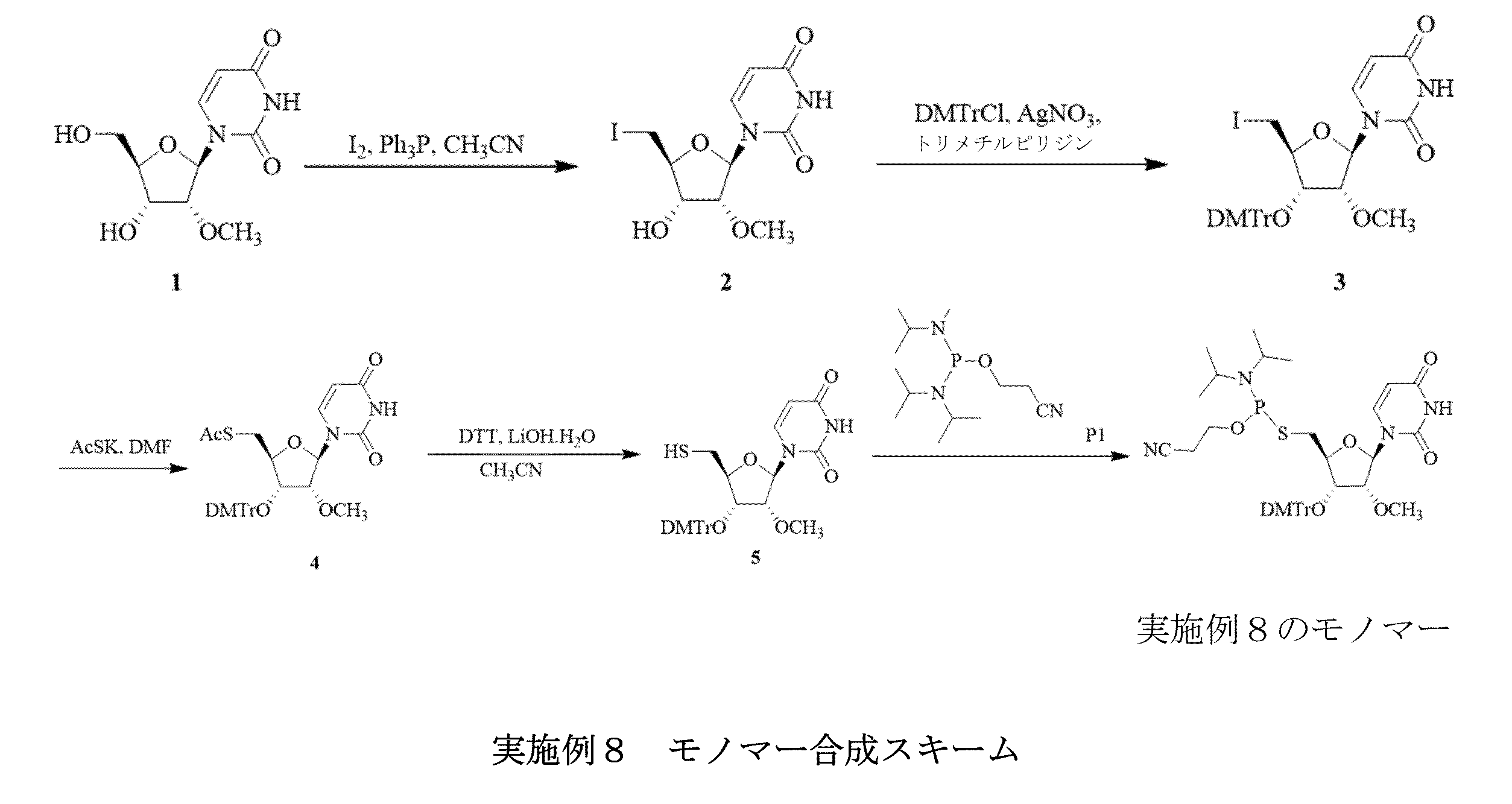
(2)の調製:CH3CN(1.2L)およびPy(60mL)中の1(30g、101.07mmol、純度87%)の溶液に、I2(33.35g、131.40mmol、26.47mL)およびPPh3(37.11g、141.50mmol)を10℃で一度に添加した。反応物を25℃で48時間撹拌した。完了時に、混合物を飽和Na2S2O3水溶液(300mL)および飽和NaHCO3水溶液(300mL)で希釈し、濃縮してCH3CNを除去し、EtOAc(300mL×3)で抽出した。合わせた有機層をブライン(300mL)で洗浄し、Na2SO4上で乾燥させ、濾過し、減圧下で濃縮して、残渣を得た。残渣をフラッシュシリカゲルクロマトグラフィー(ISCO(登録商標)、330g SepaFlash(登録商標)シリカフラッシュカラム、0~60%のメタノール/ジクロロメタン勾配の溶離液、100mL/分)によって精製して、2(28.2g、収率72%)を褐色固体として得た。ESI-LCMS:369.1[M+H]+、H NMR(400MHz,DMSO-d6)δ=11.43(s,1H)、7.68(d,J=8.1Hz,1H)、5.86(d,J=5.5Hz,1H)、5.69(d,J=8.1Hz,1H)、5.46(d,J=6.0Hz,1H)、4.08-3.96(m,2H)、3.90-3.81(m,1H)、3.60-3.51(m,1H)、3.40(dd,J=6.9,10.6Hz,1H)、3.34(s,3H)。 Preparation of (2): To a solution of 1 (30 g, 101.07 mmol, 87% purity) in CH 3 CN (1.2 L) and Py (60 mL) was added I 2 (33.35 g, 131.40 mmol, 26.35 g, 131.40 mmol). 47 mL) and PPh 3 (37.11 g, 141.50 mmol) were added at 10° C. in one portion. The reaction was stirred at 25° C. for 48 hours. Upon completion, the mixture was diluted with saturated aqueous Na 2 S 2 O 3 (300 mL) and saturated aqueous NaHCO 3 (300 mL), concentrated to remove CH 3 CN, and extracted with EtOAc (300 mL×3). The combined organic layers were washed with brine (300 mL) , dried over Na2SO4 , filtered and concentrated under reduced pressure to give a residue. The residue was purified by flash silica gel chromatography (ISCO®, 330 g SepaFlash® silica flash column, 0-60 % methanol/dichloromethane gradient eluent, 100 mL/min) to give 2 (28.2 g , yield 72%) as a brown solid. ESI-LCMS: 369.1 [M+H] +, 1 H NMR (400 MHz, DMSO-d 6 ) δ = 11.43 (s, 1 H), 7.68 (d, J = 8.1 Hz, 1 H), 5. 86 (d, J = 5.5Hz, 1H), 5.69 (d, J = 8.1Hz, 1H), 5.46 (d, J = 6.0Hz, 1H), 4.08-3.96 (m, 2H), 3.90-3.81 (m, 1H), 3.60-3.51 (m, 1H), 3.40 (dd, J = 6.9, 10.6Hz, 1H) , 3.34(s, 3H).
(3)の調製:2(12g、32.6mmol)のDCM(150mL)溶液に、AgNO3(11.07g、65.20mmol)、2,4,6-トリメチルピリジン(11.85g、97.79mmol、12.92mL)、およびDMTCl(22.09g、65.20mmol)を10℃で添加し、反応混合物を10℃で16時間撹拌した。完了時に、混合物を濾過し、濾液を減圧下で濃縮した。残渣をフラッシュシリカゲルクロマトグラフィー(ISCO(登録商標)、120g SepaFlash(登録商標)シリカフラッシュカラム、0~50%の酢酸エチル/石油エーテル勾配の溶離液、60mL/分)によって精製して、3(17g、収率70.78%)を黄色固体として得た。ESI-LCMS:693.1[M+Na]+1、H NMR(400MHz,DMSO-d6)δ=11.46(s,1H)、7.60(d,J=8.4Hz,1H)、7.49(d,J=7.2Hz,2H)、7.40-7.30(m,6H)、7.29-7.23(m,1H)、6.93(d,J=8.8Hz,4H)、5.97(d,J=6.0Hz,1H)、5.69(d,J=8.0Hz,1H)、4.05-4.02(m,1H)、3.75(d,J=1.2Hz,6H)、3.57(t,J=5.6Hz,1H)、3.27(s,4H)、3.06(t,J=10.4Hz,1H)、2.98-2.89(m,1H)。 Preparation of (3): To a solution of 2 (12 g, 32.6 mmol) in DCM (150 mL) was dissolved AgNO 3 (11.07 g, 65.20 mmol), 2,4,6-trimethylpyridine (11.85 g, 97.79 mmol). , 12.92 mL), and DMTCl (22.09 g, 65.20 mmol) were added at 10° C. and the reaction mixture was stirred at 10° C. for 16 h. Upon completion, the mixture was filtered and the filtrate was concentrated under reduced pressure. The residue was purified by flash silica gel chromatography (ISCO®, 120 g SepaFlash® silica flash column, 0-50% ethyl acetate/petroleum ether gradient eluent, 60 mL/min) to give 3 (17 g , yield 70.78%) as a yellow solid. ESI-LCMS: 693.1 [M+Na] +1 , H NMR (400 MHz, DMSO-d 6 ) δ = 11.46 (s, 1 H), 7.60 (d, J = 8.4 Hz, 1 H), 7. 49 (d, J = 7.2Hz, 2H), 7.40-7.30 (m, 6H), 7.29-7.23 (m, 1H), 6.93 (d, J = 8.8Hz , 4H), 5.97 (d, J = 6.0Hz, 1H), 5.69 (d, J = 8.0Hz, 1H), 4.05-4.02 (m, 1H), 3.75 (d, J = 1.2Hz, 6H), 3.57 (t, J = 5.6Hz, 1H), 3.27 (s, 4H), 3.06 (t, J = 10.4Hz, 1H) , 2.98-2.89 (m, 1H).
(4)の調製:3(17g、25.35mmol)のDMF(200mL)溶液に、AcSK(11.58g、101.42mmol)を25℃で添加し、反応物を60℃で2時間撹拌した。混合物をH2O(600mL)で希釈し、EtOAc(300mL×4)で抽出した。合わせた有機層をブライン(300mL)で洗浄し、Na2SO4上で乾燥させ、濾過し、減圧下で濃縮して、4(15.6g、粗)を褐色固体として得て、これをさらに精製することなく直接的に使用した。ESI-LCMS:641.3[M+H]+。 Preparation of (4): To a solution of 3 (17 g, 25.35 mmol) in DMF (200 mL) was added AcSK (11.58 g, 101.42 mmol) at 25° C. and the reaction was stirred at 60° C. for 2 hours. The mixture was diluted with H2O (600 mL) and extracted with EtOAc (300 mL x 4). The combined organic layers were washed with brine (300 mL), dried over Na 2 SO 4 , filtered and concentrated under reduced pressure to give 4 (15.6 g, crude) as a brown solid which was further purified. Used directly without purification. ESI-LCMS: 641.3 [M+H] + .
(5)の調製:4(15.6g、25.21mmol)のCH3CN(200mL)溶液に、DTT(11.67g、75.64mmol、11.22mL)およびLiOH.H2O(1.06g、25.21mmol)をAr下、10℃で添加した。反応物を、10℃で1時間撹拌した。混合物を減圧下で濃縮してCH3CNを除去し、残渣をH2O(400mL)で希釈し、EtOAc(200mL×3)で抽出した。合わせた有機層をブライン(300mL)で洗浄し、Na2SO4上で乾燥させ、濾過し、減圧下で濃縮して、残渣を得た。残渣をフラッシュシリカゲルクロマトグラフィー(ISCO(登録商標)、220g SepaFlash(登録商標)シリカフラッシュカラム、0~60%の酢酸エチル/石油エーテル勾配の溶離液、100mL/分)によって精製して、5(8.6g、収率56.78%)を白色固体として得た。ESI-LCMS:599.3[M+Na]+、1H NMR(400MHz,DMSO-d6)δ=8.79(s,1H)、7.61(d,J=8.0Hz,1H)、7.56-7.46(m,2H)、7.45-7.37(m,4H)、7.36-7.27(m,3H)、6.85(dd,J=2.8,8.8Hz,4H)、5.85(d,J=1.3Hz,1H)、5.68(dd,J=2.0,8.2Hz,1H)、4.33-4.29(m,1H)、3.91(dd,J=4.8,8.2Hz,1H)、3.81(d,J=1.6Hz,6H)、3.33(s,3H)、2.85-2.80(m,1H)、2.67-2.55(m,2H)、1.11(t,J=8.8Hz,1H)。 Preparation of (5): To a solution of 4 (15.6 g, 25.21 mmol) in CH 3 CN (200 mL) was added DTT (11.67 g, 75.64 mmol, 11.22 mL) and LiOH. H 2 O (1.06 g, 25.21 mmol) was added at 10° C. under Ar. The reaction was stirred at 10° C. for 1 hour. The mixture was concentrated under reduced pressure to remove CH 3 CN, the residue was diluted with H 2 O (400 mL) and extracted with EtOAc (200 mL x 3). The combined organic layers were washed with brine (300 mL) , dried over Na2SO4 , filtered and concentrated under reduced pressure to give a residue. The residue was purified by flash silica gel chromatography (ISCO®, 220 g SepaFlash® silica flash column, 0-60% ethyl acetate/petroleum ether gradient eluent, 100 mL/min) to give 5 (8 .6 g, 56.78% yield) as a white solid. ESI-LCMS: 599.3 [M+Na] + , 1 H NMR (400 MHz, DMSO-d 6 ) δ = 8.79 (s, 1 H), 7.61 (d, J = 8.0 Hz, 1 H), 7 .56-7.46 (m, 2H), 7.45-7.37 (m, 4H), 7.36-7.27 (m, 3H), 6.85 (dd, J = 2.8, 8.8Hz, 4H), 5.85 (d, J = 1.3Hz, 1H), 5.68 (dd, J = 2.0, 8.2Hz, 1H), 4.33-4.29 (m , 1H), 3.91 (dd, J = 4.8, 8.2Hz, 1H), 3.81 (d, J = 1.6Hz, 6H), 3.33 (s, 3H), 2.85 −2.80 (m, 1H), 2.67-2.55 (m, 2H), 1.11 (t, J=8.8Hz, 1H).
(実施例8のモノマー)の調製:5(6g、10.40mmol)のDCM(120mL)溶液に、P1(4.08g、13.53mmol、4.30mL)およびDCI(1.35g、11.45mmol)をAr下、10℃で一度に添加した。反応物を、10℃で2時間撹拌した。反応混合物を飽和NaHCO3水溶液(50mL)で希釈し、DCM(20mL×3)で抽出した。合わせた有機層をブライン(30mL)で洗浄し、Na2SO4上で乾燥させ、濾過し、減圧下で濃縮して、残渣を得た。残渣を、分取HPLC(カラム:YMC-Triart Prep C18 250×50mm×10um、移動相:[水(10mM NH4HCO3)-ACN]、B%:35%~81%、20分)によって精製し、実施例8のモノマー(3.54g、収率43.36%)を黄色固体として得た。ESI-LCMS:776.4[M+H]+ 、 1H NMR(400MHz,DMSO-d6)δ=7.65-7.38(m,7H)、7.37-7.22(m,3H)、6.90(d,J=8.4Hz,4H)、5.92(s,1H)、5.66(t,J=8.2Hz,1H)、4.13(d,J=4.0Hz,1H)、4.00-3.88(m,1H)、3.87-3.59(m,10H)、3.33(d,J=5.8Hz,3H)、3.12-2.94(m,1H)、2.78-2.60(m,3H)、2.55-2.48(m,1H)、1.36-0.98(m,12H)、31P NMR(162MHz,DMSO-d6)δ=162.69。 Preparation of (monomer of Example 8): To a solution of 5 (6 g, 10.40 mmol) in DCM (120 mL) was added P1 (4.08 g, 13.53 mmol, 4.30 mL) and DCI (1.35 g, 11.45 mmol). ) was added in one portion at 10° C. under Ar. The reaction was stirred at 10° C. for 2 hours. The reaction mixture was diluted with saturated aqueous NaHCO 3 (50 mL) and extracted with DCM (20 mL×3). The combined organic layers were washed with brine (30 mL), dried over Na2SO4 , filtered and concentrated under reduced pressure to give a residue. The residue was purified by preparative HPLC (column: YMC-Triart Prep C18 250×50 mm×10 um, mobile phase: [water (10 mM NH 4 HCO 3 )-ACN], B %: 35%-81%, 20 min). to give the monomer of Example 8 (3.54 g, 43.36% yield) as a yellow solid. ESI-LCMS: 776.4 [M+H] + , 1 H NMR (400 MHz, DMSO-d 6 ) δ = 7.65-7.38 (m, 7H), 7.37-7.22 (m, 3H) , 6.90 (d, J=8.4 Hz, 4H), 5.92 (s, 1H), 5.66 (t, J=8.2 Hz, 1H), 4.13 (d, J=4. 0Hz, 1H), 4.00-3.88 (m, 1H), 3.87-3.59 (m, 10H), 3.33 (d, J = 5.8Hz, 3H), 3.12- 2.94 (m, 1H), 2.78-2.60 (m, 3H), 2.55-2.48 (m, 1H), 1.36-0.98 (m, 12H), 31 P NMR (162 MHz, DMSO-d 6 ) δ=162.69.
[実施例9:5’エンドキャップモノマーの合成]

(2)の調製:DCM(500mL)およびH2O(125mL)中の1(22.6g、45.23mmol)の溶液に、TEMPO(6.40g、40.71mmol)およびDIB(29.14g、90.47mmol)を0℃で添加した。混合物を20℃で20時間撹拌した。LCMSによってモニタリングされる場合の完了時に、飽和NaHCO3水溶液を混合物に添加し、pHが8より大きくなるように調整した。混合物をH2O(200mL)で希釈し、DCM(100mL×3)で洗浄した。水層を収集し、HCl(4M)によってpHが5未満になるように調整し、DCM(200mL×3)で抽出した。合わせた有機層をブライン(300mL)で洗浄し、無水Na2SO4上で乾燥させ、濾過し、減圧下で濃縮して、2(17.5g、収率68.55%)を黄色固体として得た。ESI-LCMS:514.2[M+H]+ 、 1H NMR(400MHz,DMSO-d6)δ=11.27(s,1H)、8.86(s,1H)、8.78(s,1H)、8.06(d,J=7.5Hz,2H)、7.68-7.62(m,1H)、7.59-7.52(m,2H)、6.28(d,J=6.8Hz,1H)、4.82-4.76(m,1H)、4.54(dd,J=4.1,6.7Hz,1H)、4.48(d,J=1.8Hz,1H)、3.32(s,3H)、0.94(s,9H)、0.18(d,J=4.8Hz,6H)。 Preparation of (2): To a solution of 1 (22.6 g, 45.23 mmol) in DCM (500 mL) and H2O (125 mL) was added TEMPO (6.40 g, 40.71 mmol) and DIB (29.14 g, 90.47 mmol) was added at 0°C. The mixture was stirred at 20° C. for 20 hours. Upon completion as monitored by LCMS, saturated aqueous NaHCO 3 was added to the mixture to adjust the pH to >8. The mixture was diluted with H2O (200 mL) and washed with DCM (100 mL x 3). The aqueous layer was collected, adjusted to pH<5 with HCl (4M) and extracted with DCM (200 mL×3). The combined organic layers were washed with brine (300 mL), dried over anhydrous Na 2 SO 4 , filtered and concentrated under reduced pressure to give 2 (17.5 g, 68.55% yield) as a yellow solid. Obtained. ESI-LCMS: 514.2 [M+H] + , 1 H NMR (400 MHz, DMSO-d 6 ) δ = 11.27 (s, 1H), 8.86 (s, 1H), 8.78 (s, 1H ), 8.06 (d, J = 7.5 Hz, 2H), 7.68-7.62 (m, 1H), 7.59-7.52 (m, 2H), 6.28 (d, J = 6.8 Hz, 1 H), 4.82-4.76 (m, 1 H), 4.54 (dd, J = 4.1, 6.7 Hz, 1 H), 4.48 (d, J = 1. 8 Hz, 1 H), 3.32 (s, 3 H), 0.94 (s, 9 H), 0.18 (d, J = 4.8 Hz, 6 H).
(3)の調製:2(9.3g、18.11mmol)のMeOH(20mL)溶液に、0℃でSOCl2(3.23g、27.16mmol、1.97mL)を滴下した。混合物を、20℃で0.5時間撹拌した。LCMSによってモニタリングされる場合の完了時に、反応混合物を、飽和NaHCO3(80mL)水溶液を添加することによってクエンチし、減圧下で濃縮して、MeOHを除去した。水層をDCM(80mL×3)で抽出した。合わせた有機層をブライン(200mL)で洗浄し、Na2SO4上で乾燥させ、濾過し、減圧下で濃縮して、残渣を得た。残渣をフラッシュシリカゲルクロマトグラフィー(ISCO(登録商標)、120g SepaFlash(登録商標)シリカフラッシュカラム、0~5%のMeOH/DCM勾配の溶離液、85mL/分)によって精製して、3(5.8g、収率60%)を黄色固体として得た。ESI-LCMS:528.3[M+H]+ 、 1H NMR(400MHz,DMSO-d6)δ=11.28(s,1H)、8.79(d,J=7.3Hz,2H)、8.06(d,J=7.5Hz,2H)、7.68-7.62(m,1H)、7.60-7.53(m,2H)、6.28(d,J=6.6Hz,1H)、4.87(dd,J=2.4,4.0Hz,1H)、4.61(dd,J=4.3,6.5Hz,1H)、4.57(d,J=2.2Hz,1H)、3.75(s,3H)、3.32(s,3H)、0.94(s,9H)、0.17(d,J=2.2Hz,6H)。 Preparation of (3): To a solution of 2 (9.3 g, 18.11 mmol) in MeOH (20 mL) was added dropwise SOCl2 (3.23 g, 27.16 mmol, 1.97 mL) at 0 <0>C. The mixture was stirred at 20° C. for 0.5 hours. Upon completion as monitored by LCMS, the reaction mixture was quenched by adding saturated aqueous NaHCO 3 (80 mL) and concentrated under reduced pressure to remove MeOH. The aqueous layer was extracted with DCM (80 mL x 3). The combined organic layers were washed with brine (200 mL) , dried over Na2SO4 , filtered and concentrated under reduced pressure to give a residue. The residue was purified by flash silica gel chromatography (ISCO®, 120 g SepaFlash® silica flash column, 0-5% MeOH/DCM gradient eluent, 85 mL/min) to give 3 (5.8 g , yield 60%) as a yellow solid. ESI-LCMS: 528.3 [M+H] + , 1 H NMR (400 MHz, DMSO-d 6 ) δ=11.28 (s, 1 H), 8.79 (d, J=7.3 Hz, 2 H), 8 .06 (d, J=7.5Hz, 2H), 7.68-7.62 (m, 1H), 7.60-7.53 (m, 2H), 6.28 (d, J=6. 6Hz, 1H), 4.87 (dd, J = 2.4, 4.0Hz, 1H), 4.61 (dd, J = 4.3, 6.5Hz, 1H), 4.57 (d, J = 2.2 Hz, 1 H), 3.75 (s, 3 H), 3.32 (s, 3 H), 0.94 (s, 9 H), 0.17 (d, J = 2.2 Hz, 6 H).
(4)の調製:CD3OD(120mL)中の3(5.7g、10.80mmol)の混合物に、NaBD4(1.63g、43.21mmol)を0℃で何回かに分けて添加し、混合物を20℃で1時間撹拌した。LCMSによってモニタリングされる場合の完了時に、反応混合物をAcOH(約10mL)によって中和し、減圧下で濃縮して、残渣を得た。残渣をフラッシュシリカゲルクロマトグラフィー(ISCO(登録商標)、40g SepaFlash(登録商標)シリカフラッシュカラム、0~5%のMeOH/DCM勾配の溶離液、40mL/分)によって精製して、4(4.15g、7.61mmol、収率70.45%)を黄色固体として得た。ESI-LCMS:502.2[M+H]+、1H NMR(400MHz,DMSO-d6)δ=11.23(s,1H)、8.76(s,2H)、8.04(d,J=7.3Hz,2H)、7.69-7.62(m,1H)、7.60-7.52(m,2H)、6.14(d,J=6.0Hz,1H)、5.18(s,1H)、4.60-4.51(m,2H)、3.98(d,J=3.0Hz,1H)、3.32(s,3H)、0.92(s,9H)、0.13(d,J=1.5Hz,6H)。 Preparation of (4): To a mixture of 3 (5.7 g, 10.80 mmol) in CD3OD (120 mL) was added portionwise NaBD4 (1.63 g, 43.21 mmol) at 0 <0>C. and the mixture was stirred at 20° C. for 1 hour. Upon completion as monitored by LCMS, the reaction mixture was neutralized with AcOH (~10 mL) and concentrated under reduced pressure to give a residue. The residue was purified by flash silica gel chromatography (ISCO®, 40 g SepaFlash® silica flash column, 0-5% MeOH/DCM gradient eluent, 40 mL/min) to give 4 (4.15 g , 7.61 mmol, 70.45% yield) as a yellow solid. ESI-LCMS: 502.2 [M+H] + , 1 H NMR (400 MHz, DMSO-d 6 ) δ = 11.23 (s, 1H), 8.76 (s, 2H), 8.04 (d, J = 7.3Hz, 2H), 7.69-7.62 (m, 1H), 7.60-7.52 (m, 2H), 6.14 (d, J = 6.0Hz, 1H), 5 .18 (s, 1H), 4.60-4.51 (m, 2H), 3.98 (d, J = 3.0 Hz, 1H), 3.32 (s, 3H), 0.92 (s , 9H), 0.13 (d, J=1.5 Hz, 6H).
(5)の調製:4(4.85g、9.67mmol)のピリジン(50mL)溶液に、DMTrCl(5.90g、17.40mmol)を25℃で添加し、混合物を2時間撹拌した。LCMSによってモニタリングされる場合の完了時に、反応混合物を減圧下で濃縮して、ピリジンを除去した。残渣をEtOAc(150mL)で希釈し、H2O(50mL×3)で洗浄し、Na2SO4上で乾燥させ、濾過し、減圧下で濃縮して残渣を得た。残渣をフラッシュシリカゲルクロマトグラフィー(ISCO(登録商標)、80g SepaFlash(登録商標)シリカフラッシュカラム、0~70%のEA/PE勾配の溶離液、60mL/分)によって精製して、5(6.6g、収率84.06%)を黄色固体として得た。ESI-LCMS:804.3[M+H]+,1H NMR(400MHz,DMSO-d6)δ=11.22(s,1H)、8.68(d,J=11.0Hz,2H)、8.03(d,J=7.3Hz,2H)、7.68-7.60(m,1H)、7.58-7.49(m,2H)、7.37-7.30(m,2H)、7.27-7.16(m,7H)、6.88-6.79(m,4H)、6.17(d,J=4.2Hz,1H)、4.72(t,J=5.0Hz,1H)、4.60(t,J=4.5Hz,1H)、4.03-3.98(m,1H)、3.71(s,6H)、0.83(s,9H)、0.12-0.03(m,6H)。 Preparation of (5): To a solution of 4 (4.85 g, 9.67 mmol) in pyridine (50 mL) was added DMTrCl (5.90 g, 17.40 mmol) at 25° C. and the mixture was stirred for 2 hours. Upon completion as monitored by LCMS, the reaction mixture was concentrated under reduced pressure to remove pyridine. The residue was diluted with EtOAc ( 150 mL), washed with H2O (50 mL x 3), dried over Na2SO4 , filtered and concentrated under reduced pressure to give a residue. The residue was purified by flash silica gel chromatography (ISCO®, 80 g SepaFlash® silica flash column, 0-70% EA/PE gradient eluent, 60 mL/min) to give 5 (6.6 g , yield 84.06%) as a yellow solid. ESI-LCMS: 804.3 [M+H] + , 1 H NMR (400 MHz, DMSO-d 6 ) δ=11.22 (s, 1 H), 8.68 (d, J=11.0 Hz, 2 H), 8 .03 (d, J = 7.3Hz, 2H), 7.68-7.60 (m, 1H), 7.58-7.49 (m, 2H), 7.37-7.30 (m, 2H), 7.27-7.16 (m, 7H), 6.88-6.79 (m, 4H), 6.17 (d, J = 4.2Hz, 1H), 4.72 (t, J = 5.0Hz, 1H), 4.60 (t, J = 4.5Hz, 1H), 4.03-3.98 (m, 1H), 3.71 (s, 6H), 0.83 ( s, 9H), 0.12-0.03 (m, 6H).
(6)の調製:5(6.6g、8.21mmol)のTHF(16mL)溶液に、TBAF(1M、8.21mL)を添加し、混合物を20℃で2時間撹拌した。LCMSによってモニタリングされる場合の完了時に、反応混合物をEA(150mL)で希釈し、H2O(50mL×3)で洗浄した。有機層を、ブライン(150mL)で洗浄し、Na2SO4上で乾燥させ、濾過し、減圧下で濃縮して、残渣を得た。残渣をフラッシュシリカゲルクロマトグラフィー(ISCO(登録商標)、80g SepaFlash(登録商標)シリカフラッシュカラム、10~100%のEA/PE勾配の溶離液、30mL/分)によって精製して、6(5.4g、収率94.4%)を黄色固体として得た。ESI-LCMS:690.3[M+H]+、1H NMR(400MHz,DMSO-d6)δ=11.24(s,1H)、8.69(s,1H)、8.62(s,1H)、8.05(d,J=7.3Hz,2H)、7.69-7.62(m,1H)、7.60-7.52(m,2H)、7.40-7.33(m,2H)、7.30-7.18(m,7H)、6.84(dd,J=5.9,8.9Hz,4H)、6.19(d,J=4.8Hz,1H)、5.36(d,J=6.0Hz,1H)、4.59-4.52(m,1H)、4.48(q,J=5.1Hz,1H)、4.11(d,J=4.8Hz,1H)、3.72(d,J=1.0Hz,6H)、3.40(s,3H)。 Preparation of (6): To a solution of 5 (6.6 g, 8.21 mmol) in THF (16 mL) was added TBAF (1 M, 8.21 mL) and the mixture was stirred at 20° C. for 2 hours. Upon completion as monitored by LCMS, the reaction mixture was diluted with EA (150 mL) and washed with H2O (50 mL x 3). The organic layer was washed with brine (150 mL), dried over Na2SO4 , filtered and concentrated under reduced pressure to give a residue. The residue was purified by flash silica gel chromatography (ISCO®, 80 g SepaFlash® silica flash column, eluent with a 10-100% EA/PE gradient, 30 mL/min) to give 6 (5.4 g , 94.4% yield) as a yellow solid. ESI-LCMS: 690.3 [M+H] + , 1 H NMR (400 MHz, DMSO-d 6 ) δ = 11.24 (s, 1H), 8.69 (s, 1H), 8.62 (s, 1H ), 8.05 (d, J = 7.3 Hz, 2H), 7.69-7.62 (m, 1H), 7.60-7.52 (m, 2H), 7.40-7.33 (m, 2H), 7.30-7.18 (m, 7H), 6.84 (dd, J = 5.9, 8.9Hz, 4H), 6.19 (d, J = 4.8Hz, 1H), 5.36 (d, J = 6.0Hz, 1H), 4.59-4.52 (m, 1H), 4.48 (q, J = 5.1Hz, 1H), 4.11 ( d, J=4.8 Hz, 1 H), 3.72 (d, J=1.0 Hz, 6 H), 3.40 (s, 3 H).
(実施例9のモノマー)の調製:6(8.0g、11.60mmol)のMeCN(150mL)溶液に、P-1(4.54g、15.08mmol、4.79mL)を0℃で添加し、続いてDCI(1.51g、12.76mmol)を一度に添加した。混合物を20℃まで加温し、2時間撹拌した。LCMSによってモニタリングされる場合の完了時に、反応混合物を、飽和NaHCO3水溶液(50mL)を添加することによってクエンチし、DCM(250mL)で希釈した。有機層を飽和NaHCO3水溶液(50mL×2)で洗浄し、Na2SO4上で乾燥させ、濾過し、減圧下で濃縮した。残渣を、フラッシュシリカゲルカラム(PE中の0%~60%のEA、0.5%TEAを含有する)によって精製して、実施例9のモノマー(5.75g、収率55.37%、純度99.4%)を白色固体として得た。ESI-LCMS:890.4[M+H]+ 、 1H NMR(400MHz,CD3CN)δ=9.55(s,1H)、8.63-8.51(m,1H)、8.34-8.24(m,1H)、7.98(br d,J=7.5Hz,2H)、7.65-7.55(m,1H)、7.53-7.46(m,2H)、7.44-7.37(m,2H)、7.32-7.17(m,7H)、6.84-6.77(m,4H)、6.14(d,J=4.3Hz,1H)、4.84-4.73(m,1H)、4.72-4.65(m,1H)、4.34-4.27(m,1H)、3.91-3.61(m,9H)、3.50-3.43(m,3H)、2.72-2.61(m,1H)、2.50(t,J=6.0Hz,1H)、1.21-1.15(m,10H)、1.09(d,J=6.8Hz,2H)、31P NMR(162MHz,CD3CN)δ=150.01,149.65 Preparation of (monomer of Example 9): To a solution of 6 (8.0 g, 11.60 mmol) in MeCN (150 mL) was added P-1 (4.54 g, 15.08 mmol, 4.79 mL) at 0°C. was added in one portion followed by DCI (1.51 g, 12.76 mmol). The mixture was warmed to 20° C. and stirred for 2 hours. Upon completion as monitored by LCMS, the reaction mixture was quenched by adding saturated aqueous NaHCO 3 (50 mL) and diluted with DCM (250 mL). The organic layer was washed with saturated aqueous NaHCO3 (50 mL x 2), dried over Na2SO4 , filtered and concentrated under reduced pressure . The residue was purified by flash silica gel column (0%-60% EA in PE, containing 0.5% TEA) to give the monomer of Example 9 (5.75 g, 55.37% yield, purity 99.4%) as a white solid. ESI-LCMS: 890.4 [M+H] + , 1 H NMR (400 MHz, CD 3 CN) δ=9.55 (s, 1H), 8.63-8.51 (m, 1H), 8.34- 8.24 (m, 1H), 7.98 (br d, J=7.5Hz, 2H), 7.65-7.55 (m, 1H), 7.53-7.46 (m, 2H) , 7.44-7.37 (m, 2H), 7.32-7.17 (m, 7H), 6.84-6.77 (m, 4H), 6.14 (d, J=4. 3Hz, 1H), 4.84-4.73 (m, 1H), 4.72-4.65 (m, 1H), 4.34-4.27 (m, 1H), 3.91-3. 61 (m, 9H), 3.50-3.43 (m, 3H), 2.72-2.61 (m, 1H), 2.50 (t, J=6.0Hz, 1H), 1. 21-1.15 (m, 10H), 1.09 (d, J=6.8Hz, 2H), 31P NMR (162MHz, CD3CN ) δ=150.01, 149.65
[実施例10:5’エンドキャップモノマーの合成]
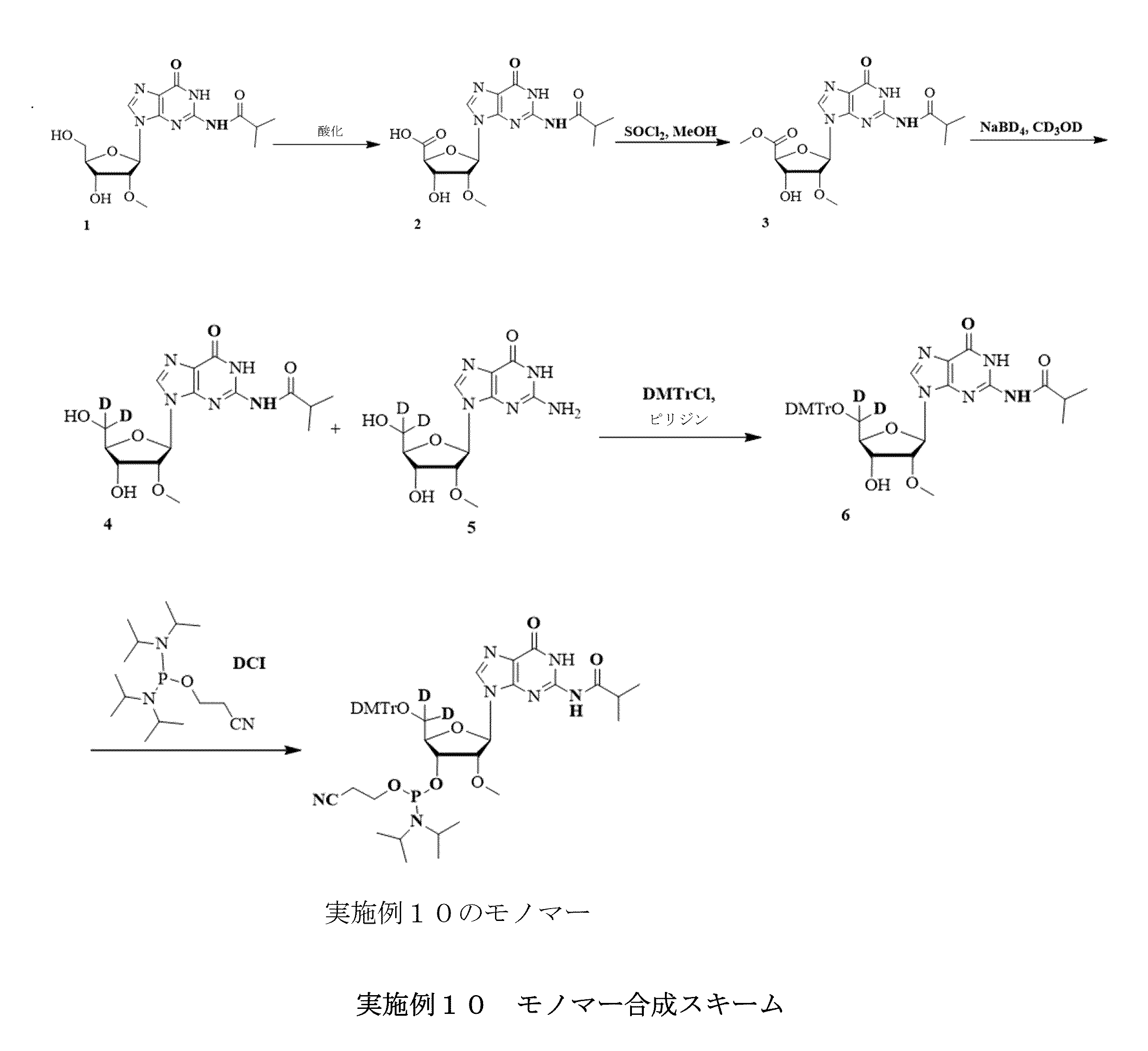
(2)の調製:CH3CN(200mL)およびH2O(50mL)中の1(10g、27.22mmol)の溶液に、TEMPO(3.85g、24.50mmol)およびDIB(17.54g、54.44mmol)を添加した。混合物を25℃で12時間撹拌した。LCMSによってモニタリングされる場合の完了時に、反応混合物を減圧下で濃縮し、残渣を得た。残渣をEtOAc(600mL)で30分間粉砕した。得られた懸濁液を濾過し、収集した固体をEtOAc(300mL×2)で洗浄し、2(20.09g、収率91.5%)を白色固体として得た。ESI-LCMS:382.0[M+H]+。 Preparation of (2): To a solution of 1 (10 g, 27.22 mmol) in CH 3 CN (200 mL) and H 2 O (50 mL) was added TEMPO (3.85 g, 24.50 mmol) and DIB (17.54 g, 54.44 mmol) was added. The mixture was stirred at 25° C. for 12 hours. Upon completion as monitored by LCMS, the reaction mixture was concentrated under reduced pressure to give a residue. The residue was triturated with EtOAc (600 mL) for 30 minutes. The resulting suspension was filtered and the collected solid was washed with EtOAc (300 mL x 2) to give 2 (20.09 g, 91.5% yield) as a white solid. ESI-LCMS: 382.0 [M+H] + .
(3)の調製:2(6g、15.73mmol)のMeOH(100mL)溶液に、0℃でSOCl2(2.81g、23.60mmol、1.71mL)を滴下した。混合物を25℃で12時間撹拌した。LCMSによってモニタリングされる場合の完了時に、反応混合物をNaHCO3(4g)の添加によってクエンチし、25℃で30分間撹拌した。反応混合物を濾過し、濾液を減圧下で濃縮して、3(18.8g、収率95.6%)を白色固体として得た。粗生成物を、さらに精製することなく、次のステップのために使用した。(反応物を3バッチに分けて並行にセットアップし、合わせた)。ESI-LCMS:396.1[M+H]+、1H NMR(400MHz,DMSO-d6)δ=12.26-11.57(m,2H)、8.42-8.06(m,1H)、6.14-5.68(m,2H)、4.56(s,2H)、4.33(dd,J=4.0,7.3Hz,1H)、3.77(m,3H)、,3.30(s,3H)、2.81-2.69(m,1H)、1.11(s,6H) Preparation of (3): To a solution of 2 (6 g, 15.73 mmol) in MeOH (100 mL) was added dropwise SOCl2 (2.81 g, 23.60 mmol, 1.71 mL) at 0 <0>C. The mixture was stirred at 25° C. for 12 hours. Upon completion as monitored by LCMS, the reaction mixture was quenched by the addition of NaHCO 3 (4 g) and stirred at 25° C. for 30 min. The reaction mixture was filtered and the filtrate was concentrated under reduced pressure to give 3 (18.8 g, 95.6% yield) as a white solid. The crude product was used for next step without further purification. (Reactions were set up in parallel in 3 batches and combined). ESI-LCMS: 396.1 [M+H] + , 1 H NMR (400 MHz, DMSO-d 6 ) δ=12.26-11.57 (m, 2H), 8.42-8.06 (m, 1H) , 6.14-5.68 (m, 2H), 4.56 (s, 2H), 4.33 (dd, J = 4.0, 7.3Hz, 1H), 3.77 (m, 3H) , , 3.30 (s, 3H), 2.81-2.69 (m, 1H), 1.11 (s, 6H)
(4および5)の調製:CD3OD(120mL)中の3(10.1g、25.55mmol)の混合物に、NaBD4(3.29g、86.86mmol、3.4当量)を0℃で何回かに分けて添加した。混合物を25℃で1時間撹拌した。LCMSによってモニタリングされる場合の完了時に、反応混合物をAcOH(約15mL)で中和し、減圧下で濃縮して残渣を得た。残渣をフラッシュシリカゲルクロマトグラフィー(ISCO(登録商標)、120g SepaFlash(登録商標)シリカフラッシュカラム、0~7.4%のMeOH/DCM勾配の溶離液、80mL/分)によって精製して、4(2.98g、6.88mmol、収率27%)を黄色固体として得た。ESI-LCMS:370.1[M+H]+、および5(10.9g、粗)を黄色固体として得た。ESI-LCMS:300.1[M+H]+、1H NMR(400MHz,CD3OD)δ=7.85(s,1H)、5.87(d,J=6.0Hz,1H)、4.46-4.39(m,1H)、4.34(t,J=5.4Hz,1H)、4.08(d,J=3.1Hz,1H)、3.49-3.38(m,4H) Preparation of (4 and 5): To a mixture of 3 (10.1 g, 25.55 mmol) in CD3OD (120 mL) was added NaBD4 (3.29 g, 86.86 mmol, 3.4 eq) at 0 <0>C. It was added in several portions. The mixture was stirred at 25° C. for 1 hour. Upon completion as monitored by LCMS, the reaction mixture was neutralized with AcOH (~15 mL) and concentrated under reduced pressure to give a residue. The residue was purified by flash silica gel chromatography (ISCO®, 120 g SepaFlash® silica flash column, 0-7.4% MeOH/DCM gradient eluent, 80 mL/min) to give 4 (2 .98 g, 6.88 mmol, 27% yield) as a yellow solid. ESI-LCMS: 370.1 [M+H] + , and 5 (10.9 g, crude) was obtained as a yellow solid. ESI-LCMS: 300.1 [M+H] + , 1 H NMR (400 MHz, CD 3 OD) δ=7.85 (s, 1 H), 5.87 (d, J=6.0 Hz, 1 H), 4. 46-4.39 (m, 1H), 4.34 (t, J = 5.4Hz, 1H), 4.08 (d, J = 3.1Hz, 1H), 3.49-3.38 (m , 4H)
6の調製:4(1.9g、4.58mmol、純度85.7%)のピリジン(19mL)溶液に、DMTrCl(2.02g、5.96mmol)を添加した。混合物を、N2下、25℃で2時間撹拌した。LCMSによってモニタリングされる場合の完了時に、反応混合物をMeOH(10mL)によってクエンチし、減圧下で濃縮して、残渣を得た。残渣をH2O(10mL×3)で希釈し、EA(20mL×3)で抽出した。合わせた有機層をブライン(20mL)で洗浄し、無水Na2SO4上で乾燥させ、濾過し、減圧下で濃縮して、残渣を得た。残渣をフラッシュシリカゲルクロマトグラフィー(ISCO(登録商標);25g SepaFlash(登録商標)シリカフラッシュカラム、0~77%の溶離液、PE:(10%EtOHを含むEA):1%TEA、35mL/分)によって精製して、6(2.6g、収率81.71%、純度96.71%)を白色泡状物として得た。ESI-LCMS:672.2[M+H]+、1H NMR(400MHz,CDCl3)δ=12.02(s,1H)、7.96(s,1H)、7.83(s,1H)、7.51(d,J=7.4Hz,2H)、7.37(d,J=8.6Hz,4H)、7.25-7.17(m,2H)、6.80(t,J=8.4Hz,4H)、5.88(d,J=6.3Hz,1H)、4.69(t,J=5.7Hz,1H)、4.64(s,1H)、4.54(s,1H)、4.19(d,J=2.9Hz,1H)、3.77(d,J=4.5Hz,6H)、3.60-3.38(m,3H)、2.81(s,1H)、1.81(td,J=6.9,13.7Hz,1H)、0.97(d,J=6.8Hz,3H)、0.80(d,J=6.9Hz,3H) Preparation of 6: To a solution of 4 (1.9 g, 4.58 mmol, 85.7% purity) in pyridine (19 mL) was added DMTrCl (2.02 g, 5.96 mmol). The mixture was stirred at 25° C. for 2 hours under N 2 . Upon completion as monitored by LCMS, the reaction mixture was quenched with MeOH (10 mL) and concentrated under reduced pressure to give a residue. The residue was diluted with H2O (10 mL x 3) and extracted with EA (20 mL x 3). The combined organic layers were washed with brine (20 mL), dried over anhydrous Na2SO4 , filtered and concentrated under reduced pressure to give a residue. The residue was subjected to flash silica gel chromatography (ISCO®; 25 g SepaFlash® silica flash column, 0-77% eluent, PE: (EA with 10% EtOH): 1% TEA, 35 mL/min). to give 6 (2.6 g, 81.71% yield, 96.71% purity) as a white foam. ESI-LCMS: 672.2 [M+H] + , 1 H NMR (400 MHz, CDCl 3 ) δ=12.02 (s, 1H), 7.96 (s, 1H), 7.83 (s, 1H), 7.51 (d, J = 7.4 Hz, 2H), 7.37 (d, J = 8.6 Hz, 4H), 7.25-7.17 (m, 2H), 6.80 (t, J = 8.4Hz, 4H), 5.88 (d, J = 6.3Hz, 1H), 4.69 (t, J = 5.7Hz, 1H), 4.64 (s, 1H), 4.54 (s, 1H), 4.19 (d, J = 2.9Hz, 1H), 3.77 (d, J = 4.5Hz, 6H), 3.60-3.38 (m, 3H), 2 .81 (s, 1H), 1.81 (td, J = 6.9, 13.7Hz, 1H), 0.97 (d, J = 6.8Hz, 3H), 0.80 (d, J = 6.9Hz, 3H)
実施例10のモノマーの調製:6(8.4g、12.5mmol)のMeCN(80mL)溶液に、P-1(4.9g、16.26mmol、5.16mL)を0℃で添加し、続いてDCI(1.624g、13.76mmol)をAr下、0℃で一度に添加した。混合物を25℃で2時間撹拌した。LCMSによってモニタリングされる場合の完了時に、反応混合物を、NaHCO3水溶液(20mL)でクエンチし、DCM(50mL×2)で抽出した。合わせた有機層を無水Na2SO4上で乾燥させ、濾過し、減圧下で濃縮して残渣を得た。残渣をフラッシュシリカゲルクロマトグラフィー(ISCO(登録商標);40g SepaFlash(登録商標)シリカフラッシュカラム、0~52%の溶離液、PE:EA(10%EtOH):5%TEA、80mL/分)によって精製し、実施例10のモノマー(3.4g、収率72.1%)を白色泡状物として得た。ESI-LCMS:872.4[M+H]+、1H NMR(400MHz,CD3CN)δ=12.46-11.07(m,1H)、9.29(s,1H)、7.84(d,J=14.6Hz,1H)、7.42(t,J=6.9Hz,2H)、7.34-7.17(m,7H)、6.85-6.77(m,4H)、5.95-5.77(m,1H)、4.56-4.40(m,2H)、4.24(dd,J=4.0,13.3Hz,1H)、3.72(d,J=2.0Hz,7H)、3.66-3.53(m,3H)、3.42(d,J=11.8Hz,3H)、2.69-2.61(m,1H)、2.60-2.42(m,2H)、1.16-1.00(m,18H)、31P NMR(162MHz,CD3CN)δ=149.975,149.9 Preparation of monomer for Example 10: To a solution of 6 (8.4 g, 12.5 mmol) in MeCN (80 mL) was added P-1 (4.9 g, 16.26 mmol, 5.16 mL) at 0°C followed by DCI (1.624 g, 13.76 mmol) was added in one portion at 0° C. under Ar. The mixture was stirred at 25° C. for 2 hours. Upon completion as monitored by LCMS, the reaction mixture was quenched with aqueous NaHCO 3 (20 mL) and extracted with DCM (50 mL×2). The combined organic layers were dried over anhydrous Na2SO4 , filtered and concentrated under reduced pressure to give a residue. The residue was purified by flash silica gel chromatography (ISCO®; 40 g SepaFlash® silica flash column, 0-52% eluent, PE:EA (10% EtOH):5% TEA, 80 mL/min). to give the monomer of Example 10 (3.4 g, 72.1% yield) as a white foam. ESI-LCMS: 872.4 [M+H] + , 1 H NMR (400 MHz, CD 3 CN) δ=12.46-11.07 (m, 1H), 9.29 (s, 1H), 7.84 ( d, J = 14.6Hz, 1H), 7.42 (t, J = 6.9Hz, 2H), 7.34-7.17 (m, 7H), 6.85-6.77 (m, 4H) ), 5.95-5.77 (m, 1H), 4.56-4.40 (m, 2H), 4.24 (dd, J = 4.0, 13.3Hz, 1H), 3.72 (d, J = 2.0Hz, 7H), 3.66-3.53 (m, 3H), 3.42 (d, J = 11.8Hz, 3H), 2.69-2.61 (m, 1H), 2.60-2.42 (m, 2H), 1.16-1.00 (m, 18H), 31 P NMR (162 MHz, CD 3 CN) δ = 149.975, 149.9
[実施例11:5’エンドキャップモノマーの合成]

(2)の調製:1(40g、58.16mmol)のDMF(60mL)溶液に、イミダゾール(11.88g、174.48mmol)、NaI(13.08g、87.24mmol)、およびTBSCl(17.52g、116.32mmol)を20℃で一度に添加した。反応混合物を20℃で12時間撹拌した。完了時に、混合物をEA(200mL)で希釈した。有機層をブライン/水(80mL/80mL×4)で洗浄し、Na2SO4上で乾燥させ、濾過し、蒸発させて、2(50.8g、粗)を黄色固体として得た。ESI-LCMS:802.3[M+H]+ Preparation of (2): To a solution of 1 (40 g, 58.16 mmol) in DMF (60 mL) was added imidazole (11.88 g, 174.48 mmol), NaI (13.08 g, 87.24 mmol), and TBSCl (17.52 g). , 116.32 mmol) was added in one portion at 20°C. The reaction mixture was stirred at 20° C. for 12 hours. Upon completion, the mixture was diluted with EA (200 mL). The organic layer was washed with brine/water (80 mL/80 mL x 4), dried over Na2SO4 , filtered and evaporated to give 2 (50.8 g, crude) as a yellow solid. ESI-LCMS: 802.3 [M+H] +
(3)の調製:2(8.4g、10.47mmol)のDCM(120mL)溶液に、Et3SiH(3.06g、26.3mmol、4.2mL)およびTFA(1.29g、0.84mL)を0℃で滴下した。反応混合物を20℃で2時間撹拌した。反応混合物を飽和NaHCO3水溶液(15mL)およびブライン(80mL)で洗浄した。有機層をNa2SO4上で乾燥させ、濾過し、蒸発させた。残渣をフラッシュシリカゲルクロマトグラフィー(ISCO(登録商標)、80g SepaFlash(登録商標)シリカフラッシュカラム、0~83%のEA/PE勾配の溶離液、80mL/分)によって精製して、3(2.92g、収率55.8%)を白色固体として得た。ESI-LCMS:500.2[M+H]+、1H NMR(400MHz,CDCl3)δ=8.79(s,1H)、8.14(s,1H)、8.02(d,J=7.6Hz,2H)、7.64-7.58(m,1H)、7.56-7.49(m,2H)、5.98-5.93(m,1H)、4.63-4.56(m,2H)、4.23(s,1H)、3.98(dd,J=1.5,13.1Hz,1H)、3.75(dd,J=1.5,13.1Hz,1H)、3.28(s,3H)、2.06-1.99(m,1H)、1.00-0.90(m,9H)、0.15(d,J=7.0Hz,6H)。 Preparation of (3): To a solution of 2 (8.4 g, 10.47 mmol) in DCM (120 mL) was added Et3SiH (3.06 g, 26.3 mmol, 4.2 mL) and TFA (1.29 g, 0.84 mL). ) was added dropwise at 0°C. The reaction mixture was stirred at 20° C. for 2 hours. The reaction mixture was washed with saturated aqueous NaHCO 3 (15 mL) and brine (80 mL). The organic layer was dried over Na2SO4 , filtered and evaporated. The residue was purified by flash silica gel chromatography (ISCO®, 80 g SepaFlash® silica flash column, 0-83% EA/PE gradient eluent, 80 mL/min) to give 3 (2.92 g , yield 55.8%) as a white solid. ESI-LCMS: 500.2 [M+H] + , 1 H NMR (400 MHz, CDCl 3 ) δ=8.79 (s, 1H), 8.14 (s, 1H), 8.02 (d, J=7 .6Hz, 2H), 7.64-7.58 (m, 1H), 7.56-7.49 (m, 2H), 5.98-5.93 (m, 1H), 4.63-4 .56 (m, 2H), 4.23 (s, 1H), 3.98 (dd, J = 1.5, 13.1 Hz, 1H), 3.75 (dd, J = 1.5, 13. 1Hz, 1H), 3.28 (s, 3H), 2.06-1.99 (m, 1H), 1.00-0.90 (m, 9H), 0.15 (d, J=7. 0Hz, 6H).
(4)の調製:3(6g、12.01mmol)およびtert-ブチル N-メチルスルホニルカルバメート(3.52g、18.01mmol)をトルエン(50mL)とともに蒸発させ、乾燥THF(100mL)に溶解させ、0℃まで冷却した。次いで、PPh3(9.45g、36.03mmol、)を添加し、続いて乾燥THF(30mL)中のDIAD(7.28g、36.03mmol、7.00mL)を滴下した。反応混合物を20℃で18時間撹拌した。完了時に、反応混合物をDCM(100mL)で希釈し、水(70mL)およびブライン(70mL)で洗浄し、Na2SO4上で乾燥させ、濾過し、蒸発させて、残渣を得た。残渣をフラッシュシリカゲルクロマトグラフィー(ISCO(登録商標)、80g SepaFlash(登録商標)シリカフラッシュカラム、0~100%の酢酸エチル/石油エーテル勾配の溶離液、60mL/分)、その後、逆相HPLC(0.1%NH3.H2O条件、74%での溶離液)によって精製して、4(2.88g、収率25%)を白色固体として得た。ESI-LCMS:677.1[M+H]+、1H NMR(400MHz,CDCl3)δ=9.24(s,1H)、8.84(s,1H)、8.36(s,1H)、8.05(br d,J=7.3Hz,2H)、7.66-7.42(m,4H)、6.16(d,J=5.0Hz,1H)、4.52(br t,J=4.5Hz,1H)、4.25-4.10(m,1H)、3.97(br dd,J=8.0,14.8Hz,1H)、3.48(s,3H)、3.27(s,3H)、1.54(s,9H)、0.95(s,9H)、0.14(d,J=0.8Hz,6H)。 Preparation of (4): 3 (6 g, 12.01 mmol) and tert-butyl N-methylsulfonylcarbamate (3.52 g, 18.01 mmol) were evaporated with toluene (50 mL) and dissolved in dry THF (100 mL), Cool to 0°C. PPh 3 (9.45 g, 36.03 mmol, ) was then added, followed by dropwise addition of DIAD (7.28 g, 36.03 mmol, 7.00 mL) in dry THF (30 mL). The reaction mixture was stirred at 20° C. for 18 hours. Upon completion, the reaction mixture was diluted with DCM (100 mL), washed with water (70 mL) and brine (70 mL), dried over Na2SO4 , filtered and evaporated to give a residue. The residue was subjected to flash silica gel chromatography (ISCO®, 80 g SepaFlash® silica flash column, 0-100% ethyl acetate/petroleum ether gradient eluent, 60 mL/min) followed by reverse phase HPLC (0 Purification by .1% NH 3 .H 2 O conditions, eluent at 74%) gave 4 (2.88 g, 25% yield) as a white solid. ESI-LCMS: 677.1 [M+H] + , 1 H NMR (400 MHz, CDCl 3 ) δ=9.24 (s, 1H), 8.84 (s, 1H), 8.36 (s, 1H), 8.05 (br d, J = 7.3 Hz, 2H), 7.66-7.42 (m, 4H), 6.16 (d, J = 5.0 Hz, 1H), 4.52 (br t , J = 4.5 Hz, 1 H), 4.25-4.10 (m, 1 H), 3.97 (br dd, J = 8.0, 14.8 Hz, 1 H), 3.48 (s, 3 H ), 3.27 (s, 3H), 1.54 (s, 9H), 0.95 (s, 9H), 0.14 (d, J = 0.8 Hz, 6H).
(5)の調製:4(2.8g、4.14mmol)のTHF(20mL)溶液に、TBAF(4M、1.03mL)を添加し、混合物を20℃で12時間撹拌した。次いで、反応混合物を蒸発させた。残渣をフラッシュシリカゲルクロマトグラフィー(ISCO(登録商標)、12g SepaFlash(登録商標)シリカフラッシュカラム、0~6%のMeOH/酢酸エチル勾配の溶離液、20mL/分)によって精製して、5(2.1g、収率83.92%)を白色固体として得た。ESI-LCMS:563.1[M+H]+、1H NMR(400MHz,CDCl3)δ=8.85-8.77(m,1H)、8.38(s,1H)、8.11-7.99(m,2H)、7.64-7.50(m,4H)、6.19(d,J=2.8Hz,1H)、4.36-4.33(m,1H)、4.29(br d,J=4.3Hz,1H)、4.22-4.02(m,2H)、3.65-3.59(m,3H)、3.28(s,3H)、1.54(s,9H)。 Preparation of (5): To a solution of 4 (2.8 g, 4.14 mmol) in THF (20 mL) was added TBAF (4 M, 1.03 mL) and the mixture was stirred at 20° C. for 12 hours. The reaction mixture was then evaporated. The residue was purified by flash silica gel chromatography (ISCO®, 12 g SepaFlash® silica flash column, 0-6% MeOH/ethyl acetate gradient eluent, 20 mL/min) to give 5 (2. 1 g, 83.92% yield) as a white solid. ESI-LCMS: 563.1 [M+H] + , 1 H NMR (400 MHz, CDCl 3 ) δ=8.85-8.77 (m, 1H), 8.38 (s, 1H), 8.11-7. .99 (m, 2H), 7.64-7.50 (m, 4H), 6.19 (d, J=2.8Hz, 1H), 4.36-4.33 (m, 1H), 4 .29 (br d, J=4.3Hz, 1H), 4.22-4.02 (m, 2H), 3.65-3.59 (m, 3H), 3.28 (s, 3H), 1.54 (s, 9H).
(6)の調製:5(2.1g、3.73mmol)のDCM(20mL)溶液に、0℃でTFA(7.70g、67.53mmol、5mL)を添加した。反応混合物を20℃で24時間撹拌した。完了時に、反応物を飽和NaHCO3水溶液でクエンチし、pH7に到達させた。有機層をNa2SO4上で乾燥させ、濾過し、低圧で蒸発させた。残渣をフラッシュシリカゲルクロマトグラフィー(ISCO(登録商標)、12g SepaFlash(登録商標)シリカフラッシュカラム、0~7%のDCM/MeOH勾配の溶離液、20mL/分)によって精製して、1.6g(不純物、LCMS純度75%)を得て、その後、分取HPLC[FA条件、カラム:Boston Uni C18 40*150*5um、移動相:[水(0.225%FA)-ACN]、B%:8%~38%、7.7分間]によって精製し、6(1.04g、収率63.7%)を白色固体として得た。ESI-LCMS:485.0[M+Na]+、1H NMR(400MHz,DMSO-d6)δ=11.27-11.21(m,1H)、8.77(s,1H)、8.74(s,1H)、8.05(d,J=7.3Hz,2H)、7.68-7.62(m,1H)、7.59-7.53(m,2H)、7.39(t,J=6.3Hz,1H)、6.16(d,J=6.0Hz,1H)、5.48(d,J=5.5Hz,1H)、4.55(t,J=5.5Hz,1H)、4.43-4.37(m,1H)、4.08-4.02(m,1H)、3.41-3.36(m,1H)、3.35(s,3H)、3.31-3.22(m,1H)、2.91(s,3H)。
Preparation of (6): To a solution of 5 (2.1 g, 3.73 mmol) in DCM (20 mL) at 0° C. was added TFA (7.70 g, 67.53 mmol, 5 mL). The reaction mixture was stirred at 20° C. for 24 hours. Upon completion, the reaction was quenched with saturated aqueous NaHCO 3 to reach
(実施例11のモノマー)の調製:6(1g、2.16mmol)のDCM(30mL)溶液に、P1(977.58mg、3.24mmol、1.03mL)、続いてDCI(306.43mg、2.59mmol)を、Ar雰囲気下、0℃で一度に添加した。混合物を脱気し、Arで3回パージし、20℃まで加温し、Ar雰囲気下で2時間撹拌した。LCMSおよびTLC(PE:EtOAc=4:1)によってモニタリングされる場合の完了時に、反応混合物を飽和NaHCO3水溶液(30mL)で希釈し、DCM(50mL×2)で抽出した。合わせた有機層を無水Na2SO4上で乾燥させ、濾過し、濾液を減圧下で濃縮して残渣を得た。粗生成物を逆相HPLC(40g C18カラム:中性条件、H2O/CH3CNエーテル中0.3% NH4HCO3の0~57%の勾配の溶離液、35mL/分)によって精製して、実施例11のモノマー(0.49g、収率33.7%)を白色固体として得た。ESI-LCMS:663.1[M+H]+、1H NMR(400MHz,CD3CN)δ=1.19-1.29(m,12H)2.71(q,J=5.77Hz,2H)2.94(d,J=6.27Hz,3H)3.35(d,J=15.56Hz,3H)3.40-3.52(m,2H)3.61-3.97(m,4H)4.23-4.45(m,1H)4.55-4.74(m,2H)6.02(dd,J=10.67,6.40Hz,1H)7.25(br s,1H)7.47-7.57(m,2H)7.59-7.68(m,1H)8.01(d,J=7.78Hz,2H)8.28(s,1H)8.66(s,1H)9.69(br s,1H)、31P NMR(162MHz,CD3CN)δ=150.92,149.78。 Preparation of (monomer of Example 11): To a solution of 6 (1 g, 2.16 mmol) in DCM (30 mL) was added P1 (977.58 mg, 3.24 mmol, 1.03 mL) followed by DCI (306.43 mg, 2 .59 mmol) was added in one portion at 0° C. under an Ar atmosphere. The mixture was degassed, purged with Ar three times, warmed to 20° C. and stirred under Ar atmosphere for 2 hours. Upon completion as monitored by LCMS and TLC (PE:EtOAc=4:1), the reaction mixture was diluted with saturated aqueous NaHCO 3 (30 mL) and extracted with DCM (50 mL×2). The combined organic layers were dried over anhydrous Na2SO4 , filtered, and the filtrate was concentrated under reduced pressure to give a residue. The crude product was purified by reverse-phase HPLC (40 g C18 column: neutral conditions, eluent with a gradient of 0-57% of 0.3% NH 4 HCO 3 in H 2 O/CH 3 CN ether, 35 mL/min). As a result, the monomer of Example 11 (0.49 g, 33.7% yield) was obtained as a white solid. ESI-LCMS: 663.1 [M+H] + , 1 H NMR (400 MHz, CD 3 CN) δ = 1.19-1.29 (m, 12H) 2.71 (q, J = 5.77 Hz, 2H) 2.94 (d, J = 6.27Hz, 3H) 3.35 (d, J = 15.56Hz, 3H) 3.40-3.52 (m, 2H) 3.61-3.97 (m, 4H) 4.23-4.45 (m, 1H) 4.55-4.74 (m, 2H) 6.02 (dd, J = 10.67, 6.40Hz, 1H) 7.25 (br s , 1H) 7.47-7.57 (m, 2H) 7.59-7.68 (m, 1H) 8.01 (d, J = 7.78Hz, 2H) 8.28 (s, 1H) 8 .66 (s, 1H) 9.69 (br s, 1H), 31 P NMR (162 MHz, CD 3 CN) δ = 150.92, 149.78.
[実施例12:5’安定化エンドキャップ修飾オリゴヌクレオチドの合成]
この実施例は、本明細書に開示される5’安定化エンドキャップを含むsiNAを合成するための例示的な方法を提供する。5’安定化エンドキャップおよび/または重水素化ホスホラミダイトを無水アセトニトリルに溶解し、オリゴヌクレオチド合成を、標準的なホスホラミダイト化学を使用して、Expedite 8909 Synthesizerで実施した。ベンジル-チオ-テトラゾール(BTT)活性化剤の存在下での無水CH3CN中の0.12Mのホスホラミダイト溶液の固体結合オリゴヌクレオチドへの伸長カップリング(12分間)、その後の標準的なキャッピング、酸化および硫化により、修飾オリゴヌクレオチドを生成した。0.02M I2、THF:ピリジン;水 7:2:1を酸化剤として使用しつつ、DDTT(ジメチルアミノ-メチリデン)アミノ)-3H-1,2,4-ジチアザオリン-3-チオンを、ホスホロチオエート骨格を有するオリゴリボヌクレオチドの合成のための硫黄移送剤として使用した。すべての修飾ホスホラミダイトの段階的カップリング効率は、およそ98%に達した。合成後、固体支持体を、アンモニア水溶液(28%)とともに45℃で16時間加熱するか、または0.05M K2CO3メタノール溶液を使用して、塩基不安定性保護基を脱保護した。粗オリゴヌクレオチドをイソプロパノールで沈殿させ、遠心分離し(Eppendorf 5810R、3000g、4℃、15分間)、ペレットを得た。次いで、粗生成物を、イオン交換クロマトグラフィー(TSKゲルカラム、20mMのNaH2PO4、10%のCH3CN、1MのNaBr、20~60%Bの勾配を20カラム体積にわたって)を使用して精製し、画分をHPLC上のイオン変化クロマトグラフィーによって分析した。純粋な画分をプールし、Sephadex G-25カラムによって脱塩し、乾燥するまで蒸発させた。純度および分子量は、HPLC分析およびESI-MS分析によって決定した。一本鎖RNAオリゴヌクレオチド(センス鎖およびアンチセンス鎖)を90℃で3分間(モル当量で1:1)、続いて室温で40分間アニーリングし)、二本鎖を生成した。
[Example 12: Synthesis of 5' stabilized endcap modified oligonucleotide]
This example provides an exemplary method for synthesizing siNAs containing the 5' stabilizing endcaps disclosed herein. 5' stabilized endcaps and/or deuterated phosphoramidites were dissolved in anhydrous acetonitrile and oligonucleotide synthesis was performed on an Expedite 8909 Synthesizer using standard phosphoramidite chemistry. Extensional coupling of a 0.12 M phosphoramidite solution in anhydrous CH 3 CN to solid-bound oligonucleotides in the presence of benzyl-thio-tetrazole (BTT) activator (12 min), followed by standard capping. Modified oligonucleotides were generated by oxidation and sulfurization. DDTT (dimethylamino-methylidene)amino)-3H-1,2,4-dithiazaolin-3-thione was converted to a phosphorothioate backbone using 0.02M I2, THF:pyridine; water 7:2:1 as oxidant. was used as a sulfur transfer agent for the synthesis of oligoribonucleotides with The stepwise coupling efficiency of all modified phosphoramidites reached approximately 98%. After synthesis, the solid support was heated with aqueous ammonia solution (28%) at 45° C. for 16 h, or 0.05 M K 2 CO 3 in methanol was used to deprotect the base-labile protecting groups. Crude oligonucleotides were precipitated with isopropanol and centrifuged (
[実施例13:siNA活性アッセイ]
この実施例は、本明細書に開示されるsiNAの活性を試験するための例示的な方法を提供する。
[Example 13: siNA activity assay]
This example provides an exemplary method for testing the activity of the siNAs disclosed herein.
インビトロアッセイ:
Homo sapiens HepG2.2.15細胞を、10%胎児仔牛血清(FCS)も含有するように補充したダルベッコ改変イーグル培地(DMEM)(ATCC 30-2002)中で培養した。細胞を、加湿したインキュベーター中、5%CO2を含む雰囲気において、37℃でインキュベートした。siRNAを標的とするHBVによるHepG2.2.15細胞のトランスフェクションのために、細胞を、15000細胞/ウェルの密度で、96ウェルの通常の組織培養プレートに播種した。製造業者の指示に従って、RNAiMAX(Invitrogen/Life Technologies)を使用して細胞のトランスフェクションを行った。用量応答実験を、40、20、10、5、2.5、1.25、0.625、0.3125、0.15625、および0.07813nMのオリゴ濃度で行った。siRNA(例えば、表6のds-siNA IDによって特定されるds-siRNA)処理を標的とする各HBVについて、4つのウェルを並行してトランスフェクトし、個々のデータポイントを各ウェルから収集した。siRNAで24時間インキュベーションした後、培地を除去し、細胞を、細胞株HepG2.2.15中に存在するHBV遺伝子型D(B型肝炎ウイルスサブタイプaywとも呼ばれる、3182塩基対の完全ゲノム)に特異的なQuantiGene2.0分岐DNA(bDNA)プローブセットで溶解し、分析した。
In vitro assay:
Homo sapiens HepG2.2.15 cells were cultured in Dulbecco's Modified Eagle Medium (DMEM) (ATCC 30-2002) supplemented to also contain 10% fetal calf serum (FCS). Cells were incubated at 37°C in a humidified incubator in an atmosphere containing 5% CO2. For transfection of HepG2.2.15 cells with HBV targeting siRNA, cells were seeded in 96-well regular tissue culture plates at a density of 15000 cells/well. Cells were transfected using RNAiMAX (Invitrogen/Life Technologies) according to the manufacturer's instructions. Dose-response experiments were performed at oligo concentrations of 40, 20, 10, 5, 2.5, 1.25, 0.625, 0.3125, 0.15625, and 0.07813 nM. For each HBV targeting siRNA (eg, ds-siRNA identified by ds-siNA ID in Table 6) treatment, 4 wells were transfected in parallel and individual data points were collected from each well. After 24 hours of incubation with siRNA, the medium was removed and cells were transferred to HBV genotype D (complete genome of 3182 base pairs, also called hepatitis B virus subtype ayw) present in cell line HepG2.2.15. Lysed with specific QuantiGene 2.0 branched DNA (bDNA) probe sets and analyzed.
各ウェルについて、HBVオンターゲットmRNAレベルを、GAPDH mRNAレベルに対して正規化した。表6に示されるように、ds-siRNAを標的とするHBVの活性は、EC50(薬物なしの対照からの正規化されたHBV RNAレベルの50%低減)として表された。表6に示されるように、ds-siRNAを標的とするHBVの細胞毒性は、薬物なしの対照からのGAPDH mRNAの50%低減のCC50によって表された。 HBV on-target mRNA levels were normalized to GAPDH mRNA levels for each well. As shown in Table 6, the activity of HBV targeting ds-siRNA was expressed as EC50 (50% reduction in normalized HBV RNA levels from no drug control). As shown in Table 6, the cytotoxicity of HBV targeting ds-siRNA was represented by a CC50 of 50% reduction in GAPDH mRNA from drug-free controls.
1)リン酸化ブロッカーを有するか、または有しない、および2)エンドキャップ(5’安定化エンドキャップ)を有するか、または有しない、非コンジュゲート化siRNAを、インビトロ疾患モデルまたはインビトロ毒性モデルにトランスフェクトする。トランスフェクションの後、標的低減および/または細胞生存率を測定し、インキュベーション期間の後に比較する。HBVの場合、例示的な疾患細胞モデルとしては、限定されないが、HepG2.2.15、HepG2.117または生きているHBV感染したHepG2-NTCP、あるいは初代ヒト肝細胞が挙げられる。 Unconjugated siRNA, 1) with or without a phosphorylation blocker and 2) with or without an endcap (5' stabilizing endcap), is transfected into an in vitro disease model or in vitro toxicity model. effect. After transfection, target reduction and/or cell viability are measured and compared after an incubation period. For HBV, exemplary disease cell models include, but are not limited to, HepG2.2.15, HepG2.117 or live HBV-infected HepG2-NTCP, or primary human hepatocytes.
インビボアッセイ:
1)リン酸化ブロッカーを有するか、または有しない、および2)5’エンドキャップを有するか、または有しない、GalNAcコンジュゲート化siRNAを、動物疾患モデルにおいて皮下投与または条約内投与する。標的ノックダウンの大きさおよび持続時間は、血清または肝臓試料から測定され、互いに、および/または対照動物(例えば、未治療疾患動物)と比較する。いくつかの場合では、siRNAの毒性を、通常のClinpathまたはHistopathアッセイによって比較する。HBVの場合、例示的な動物有効性モデルとしては、限定されないが、AAV-HBVマウスモデル、HBVトランスジェニックマウスモデル、PXBまたはFRGマウスモデルが挙げられる。
In vivo assay:
GalNAc-conjugated siRNAs, 1) with or without a phosphorylation blocker and 2) with or without a 5' endcap, are administered subcutaneously or intra-artificially in animal disease models. The magnitude and duration of target knockdown are measured from serum or liver samples and compared to each other and/or to control animals (eg, untreated diseased animals). In some cases, siRNA toxicity is compared by routine Clinpath or Histopath assays. For HBV, exemplary animal efficacy models include, but are not limited to, AAV-HBV mouse models, HBV transgenic mouse models, PXB or FRG mouse models.
[実施例14:AAV-HBVマウスモデルにおけるds-siNA試験]
この実施例において、アデノ随伴ウイルス(AAV)-HBVマウスモデルにおいてHBVを治療する際のds-siNAの有効性を評価した。AAV-HBVマウスに、(a)5mL/kgのビヒクル、または(b)5mg/kgのds-siNAの単回用量を0日目に皮下注射した。この実施例で試験されるds-siNAの配列を表7に示す。
[Example 14: ds-siNA test in AAV-HBV mouse model]
In this example, the efficacy of ds-siNA in treating HBV in an adeno-associated virus (AAV)-HBV mouse model was evaluated. AAV-HBV mice were injected subcutaneously on
図4は、ビヒクル(G01)、ds-siNA-0160(G03)、ds-siNA-0165(G04)、ds-siNA-0163(G05)、またはds-siNA-0166(G06)で治療されたAAV-HBVマウス由来の血清HBsAgの変化のグラフを示す。これらの結果は、2’-フルオロヌクレオチドおよび2’-O-メチルヌクレオチドの様々なパターンを含有するds-siNAが、HBVを効果的に治療することができることを実証している。 FIG. 4 shows AAV treated with vehicle (G01), ds-siNA-0160 (G03), ds-siNA-0165 (G04), ds-siNA-0163 (G05), or ds-siNA-0166 (G06) - shows a graph of changes in serum HBsAg from HBV mice. These results demonstrate that ds-siNA containing various patterns of 2'-fluoronucleotides and 2'-O-methyl nucleotides can effectively treat HBV.

[実施例15:AAV-HBVマウスモデルにおけるds-siNA活性アッセイおよび試験]
この実施例では、ds-siNAのインビトロおよびインビボでの活性を調査する。この実施例で試験されるds-siNAの配列を表8に示す。表8に示されるように、ds-siNAは、2’-フルオロおよび2’-O-メチルヌクレオチドの混合物を含むセンス鎖およびアンチセンス鎖を含む。ds-siNA中の2’-フルオロヌクレオチドの総数は、6~8である。2’-フルオロヌクレオチドは、センス鎖の5’末端から3、5、7、8、9、10、11、12、および/もしくは17のヌクレオチド位置、または2、5、6、8、10、14、16、17、および/もしくは18のヌクレオチド位置などの特定の位置にあってもよい。2’-フルオロヌクレオチドおよび2’-O-メチルヌクレオチドは、アンチセンス鎖に対して特定のパターンで生じてもよく(例えば、交互1:2または1:3修飾パターン)、1個のヌクレオチドは、2’-フルオロヌクレオチドであり、2または3個のヌクレオチドは、2’-O-メチルヌクレオチドである。
[Example 15: ds-siNA activity assay and test in AAV-HBV mouse model]
This example investigates the in vitro and in vivo activity of ds-siNA. The sequences of the ds-siNA tested in this example are shown in Table 8. As shown in Table 8, the ds-siNAs contain sense and antisense strands containing a mixture of 2'-fluoro and 2'-O-methyl nucleotides. The total number of 2'-fluoronucleotides in the ds-siNA is 6-8. The 2'-fluoro nucleotides are at
インビトロ活性アッセイ
Homo sapiens HepG2.2.15細胞を、10%胎児仔牛血清(FCS)も含有するように補充したダルベッコ改変イーグル培地(DMEM)(ATCC 30-2002)中で培養した。細胞を、加湿したインキュベーター中、5%CO2を含む雰囲気において、37℃でインキュベートした。siRNAを標的とするHBVによるHepG2.2.15細胞のトランスフェクションのために、細胞を、15000細胞/ウェルの密度で、96ウェルの通常の組織培養プレートに播種した。製造業者の指示に従って、RNAiMAX(Invitrogen/Life Technologies)を使用して細胞のトランスフェクションを行った。用量応答実験を、40、20、10、5、2.5、1.25、0.625、0.3125、0.15625、および0.07813nMのオリゴ濃度で行った。siRNA(例えば、表8のds-siNA IDによって特定されるds-siRNA)処理を標的とする各HBVについて、4つのウェルを並行してトランスフェクトし、個々のデータポイントを各ウェルから収集した。siRNAで24時間インキュベーションした後、培地を除去し、細胞を、細胞株HepG2.2.15中に存在するHBV遺伝子型D(B型肝炎ウイルスサブタイプaywとも呼ばれる、3182塩基対の完全ゲノム)に特異的なQuantiGene2.0分岐DNA(bDNA)プローブセットで溶解し、分析した。
In Vitro Activity Assay Homo sapiens HepG2.2.15 cells were cultured in Dulbecco's Modified Eagle Medium (DMEM) (ATCC 30-2002) supplemented to also contain 10% fetal calf serum (FCS). Cells were incubated at 37° C. in a humidified incubator in an atmosphere containing 5% CO 2 . For transfection of HepG2.2.15 cells with HBV targeting siRNA, cells were seeded in 96-well regular tissue culture plates at a density of 15000 cells/well. Cells were transfected using RNAiMAX (Invitrogen/Life Technologies) according to the manufacturer's instructions. Dose-response experiments were performed at oligo concentrations of 40, 20, 10, 5, 2.5, 1.25, 0.625, 0.3125, 0.15625, and 0.07813 nM. For each HBV targeting siRNA (eg, ds-siRNA identified by ds-siNA ID in Table 8) treatment, 4 wells were transfected in parallel and individual data points were collected from each well. After 24 hours of incubation with siRNA, the medium was removed and cells were transferred to HBV genotype D (complete genome of 3182 base pairs, also called hepatitis B virus subtype ayw) present in cell line HepG2.2.15. Lysed with a specific QuantiGene 2.0 branched DNA (bDNA) probe set and analyzed.
各ウェルについて、HBVオンターゲットmRNAレベルを、GAPDH mRNAレベルに対して正規化した。表8は、ds-siRNAを標的とするHBVの活性が、EC50(薬物なしの対照からの正規化されたHBV RNAレベルの50%低減)として表されることを示し、ここで、A=EC50<0.5nM、B=0.5nM<EC50<1、およびC=EC50>1。 HBV on-target mRNA levels were normalized to GAPDH mRNA levels for each well. Table 8 shows that the activity of HBV targeting ds-siRNA is expressed as EC50 (50% reduction in normalized HBV RNA levels from drug-free control), where A=EC50. <0.5 nM, B=0.5 nM<EC50<1, and C=EC50>1.
AAV-HBVマウスモデルにおけるインビボ試験:
AAV/HBVは、複製可能なHBVゲノムを保有する組換えAAVである。遺伝子型8AAVの高度な肝臓向性特徴を利用して、HBVゲノムをマウス肝臓細胞に効率的に送達することができる。免疫能のあるマウスにAAV/HBVを感染させると、患者の慢性HBV感染を模倣する長期HBVウイルス血症をもたらす可能性がある。AAV/HBVモデルを使用して、様々なタイプの抗HBV剤のインビボ活性を評価することができる。マウスを、試験の28日目にAAV-HBVに感染させた。試験物品または陰性対照(PBS)を、5mg/kgで、0日目に単回用量として皮下投与した(特に明記しない限り)。連続採血は、通常、試験終了まで、0、5、10、および15日目などに5日ごとに行われた。血清HBV S抗原(HBsAg)をELISAによってアッセイした。
In vivo studies in AAV-HBV mouse model:
AAV/HBV is a recombinant AAV carrying a replication-competent HBV genome. The highly hepatotropic characteristics of
GalNAcコンジュゲート化ds-siNAを、アデノ随伴ウイルス(AAV)-HBVマウスモデルにおいて、0日目に5mg/kgの単回用量でさらに試験した。得られた血清HBsAgにおけるnadir log10の低減が表8に示されており、ここで、X≧1のHBsAgにおけるlog10の低減、Yは、0.5~1のHBsAgにおけるlog10の低減、Zは、<0.5のHBsAgにおけるlog10の低減。
GalNAc-conjugated ds-siNA was further tested at a single dose of 5 mg/kg on
図5Aは、ビヒクル(G01)またはds-siNA-0160(G03)で治療されたAAV-HBVマウス由来の血清HBsAgの変化のグラフを示す。AAV-HBVマウスに、5mL/kgのビヒクルまたは5mg/kgのds-siNA-0160の単回用量を0日目に皮下注射した。
FIG. 5A shows a graph of changes in serum HBsAg from AAV-HBV mice treated with vehicle (G01) or ds-siNA-0160 (G03). AAV-HBV mice were injected subcutaneously on
図5Bは、ビヒクル(G01)またはds-siNA-0160(G15)で治療されたAAV-HBVマウス由来の血清HBsAgの変化のグラフを示す。AAV-HBVマウスに、5mL/kgのビヒクルまたは5mg/kgのds-siNA-0160の単回用量を0日目に皮下注射した。
FIG. 5B shows a graph of changes in serum HBsAg from AAV-HBV mice treated with vehicle (G01) or ds-siNA-0160 (G15). AAV-HBV mice were injected subcutaneously on
図5Cは、ビヒクル(G01)またはds-siNA-0160(G03)で治療されたAAV-HBVマウス由来の血清HBsAgの変化のグラフを示す。AAV-HBVマウスに、5mL/kgのビヒクルまたは5mg/kgの各ds-siNAの単回用量を0日目に皮下注射した。
FIG. 5C shows a graph of changes in serum HBsAg from AAV-HBV mice treated with vehicle (G01) or ds-siNA-0160 (G03). AAV-HBV mice were injected subcutaneously on
図5Dは、ビヒクル(G01)、ds-siNA-0160(G03)、またはds-siNA-0109(G09)で治療されたAAV-HBVマウス由来の血清HBsAgの変化のグラフを示す。AAV-HBVマウスに、5mL/kgのビヒクルまたは5mg/kgの各ds-siNAの単回用量を0日目に皮下注射した。
FIG. 5D shows a graph of changes in serum HBsAg from AAV-HBV mice treated with vehicle (G01), ds-siNA-0160 (G03), or ds-siNA-0109 (G09). AAV-HBV mice were injected subcutaneously on
図5E~5Fは、ビヒクル(G01)またはds-siNA-0169(G18)で治療されたAAV-HBVマウス由来の血清HBsAgの変化のグラフを示す。AAV-HBVマウスに、5mL/kgのビヒクルまたは5mg/kgのds-siNA-0169の単回用量を0日目に皮下注射した。
Figures 5E-5F show graphs of changes in serum HBsAg from AAV-HBV mice treated with vehicle (G01) or ds-siNA-0169 (G18). AAV-HBV mice were injected subcutaneously on
図5Gは、ビヒクル(G01)またはds-siNA-0169(G04)で治療されたAAV-HBVマウス由来の血清HBsAgの変化のグラフを示す。AAV-HBVマウスに、5mL/kgのビヒクルまたは5mg/kgのds-siNA-0169の単回用量を0日目に皮下注射した。
FIG. 5G shows a graph of changes in serum HBsAg from AAV-HBV mice treated with vehicle (G01) or ds-siNA-0169 (G04). AAV-HBV mice were injected subcutaneously on
図5Hは、ビヒクル(G01)またはds-siNA-0169(G04)で治療されたAAV-HBVマウス由来の血清HBsAgの変化のグラフを示す。AAV-HBVマウスに、5mL/kgのビヒクルまたは5mg/kgの各ds-siNAの単回用量を0日目に皮下注射した。
FIG. 5H shows a graph of changes in serum HBsAg from AAV-HBV mice treated with vehicle (G01) or ds-siNA-0169 (G04). AAV-HBV mice were injected subcutaneously on
図5Iは、ビヒクル(G01)、ds-siNA-0169(G04)、またはds-siNA-0147(G08)で治療されたAAV-HBVマウス由来の血清HBsAgの変化のグラフを示す。AAV-HBVマウスに、5mL/kgのビヒクルまたは5mg/kgの各ds-siNAの単回用量を0日目に皮下注射した。
FIG. 5I shows a graph of changes in serum HBsAg from AAV-HBV mice treated with vehicle (G01), ds-siNA-0169 (G04), or ds-siNA-0147 (G08). AAV-HBV mice were injected subcutaneously on
図5Jは、ビヒクル(G01)、ds-siNA-0166(G06)、またはds-siNA-0153(G14)で治療されたAAV-HBVマウス由来の血清HBsAgの変化のグラフを示す。AAV-HBVマウスに、5mL/kgのビヒクルまたは5mg/kgの各ds-siNAの単回用量を0日目に皮下注射した。
FIG. 5J shows a graph of changes in serum HBsAg from AAV-HBV mice treated with vehicle (G01), ds-siNA-0166 (G06), or ds-siNA-0153 (G14). AAV-HBV mice were injected subcutaneously on
図5Kは、ビヒクル(G01)、ds-siNA-0163(G05)、またはds-siNA-0119(G13)で治療されたAAV-HBVマウス由来の血清HBsAgの変化のグラフを示す。AAV-HBVマウスに、5mL/kgのビヒクルまたは5mg/kgの各ds-siNAの単回用量を0日目に皮下注射した。
FIG. 5K shows a graph of changes in serum HBsAg from AAV-HBV mice treated with vehicle (G01), ds-siNA-0163 (G05), or ds-siNA-0119 (G13). AAV-HBV mice were injected subcutaneously on
これらの結果は、2’-フルオロヌクレオチドおよび2’-O-メチルヌクレオチドの組み合わせを含むds-siNAを使用して、HBV XおよびS遺伝子配列を標的化することができ、これにより、HBVの治療が成功したことを実証している。 These results demonstrate that ds-siNAs containing a combination of 2'-fluoronucleotides and 2'-O-methyl nucleotides can be used to target HBV X and S gene sequences, resulting in treatment of HBV. has proven successful.
ds-siNA-0160およびds-siNA-0165によって例示されるように、(a)19個のヌクレオチドを含み、6個のヌクレオチドが2’-フルオロヌクレオチドであり、13個のヌクレオチドが2’-O-メチルヌクレオチドである、センス鎖と、(b)21個のヌクレオチドを含み、2個のヌクレオチドが2’-フルオロヌクレオチドであり、19個のヌクレオチドが2’-O-メチルヌクレオチドである、アンチセンス鎖と、(c)コンジュゲート化部分と、を含み、コンジュゲート化部分がセンス鎖の3’末端に接続しているdi-siNAは、血清中のHBsAgの低減によって証明されるように、HBVの治療に成功した。図4および5A~5D、ならびに表8を参照されたい。ds-siNA-0160およびds-siNA-0165の場合、2’-フルオロヌクレオチドは、センス鎖の5’末端から3、7~9、12、および17位置、ならびにアンチセンス鎖の5’末端から2および14位置に位置していた。 As exemplified by ds-siNA-0160 and ds-siNA-0165, (a) comprising 19 nucleotides, 6 nucleotides being 2'-fluoronucleotides and 13 nucleotides being 2'-O - the sense strand, which is methyl nucleotides; and (b) the antisense, which comprises 21 nucleotides, 2 of which are 2'-fluoro nucleotides and 19 of which are 2'-O-methyl nucleotides. and (c) a conjugating moiety, wherein the conjugating moiety is attached to the 3′ end of the sense strand, is associated with HBV, as evidenced by a reduction of HBsAg in serum. was successfully treated. See FIGS. 4 and 5A-5D and Table 8. For ds-siNA-0160 and ds-siNA-0165, the 2′-fluoronucleotides are located 3, 7-9, 12, and 17 positions from the 5′ end of the sense strand and 2′ from the 5′ end of the antisense strand. and 14 positions.
ds-siNA-0166によって例示されるように、(a)19個のヌクレオチドを含み、4個のヌクレオチドが2’-フルオロヌクレオチドであり、15個のヌクレオチドが2’-O-メチルヌクレオチドである、センス鎖と、(b)21個のヌクレオチドを含み、2個のヌクレオチドが2’-フルオロヌクレオチドであり、19個のヌクレオチドが2’-O-メチルヌクレオチドである、アンチセンス鎖と、(c)コンジュゲート化部分と、を含み、コンジュゲート化部分がセンス鎖の3’末端に接続しているdi-siNAは、血清中のHBsAgの低減によって証明されるように、HBVの治療に成功した。図4および5J、ならびに表8を参照されたい。ds-siNA-0166の場合、2’-フルオロヌクレオチドは、センス鎖の5’末端から3、7、8、および17位置、ならびにアンチセンス鎖の5’末端から2および14位置に位置していた。
As exemplified by ds-siNA-0166, (a) comprises 19 nucleotides, 4 of which are 2'-fluoro nucleotides and 15 of which are 2'-O-methyl nucleotides; (b) an antisense strand comprising 21 nucleotides, 2 of which are 2'-fluoronucleotides and 19 of which are 2'-O-methyl nucleotides; and (c) A di-siNA comprising a conjugating moiety and wherein the conjugating moiety is attached to the 3' end of the sense strand successfully treated HBV, as evidenced by the reduction of HBsAg in serum. See FIGS. 4 and 5J and Table 8. For ds-siNA-0166, the 2'-fluoro nucleotides were located at
ds-siNA-0153によって例示されるように、(a)19個のヌクレオチドを含む、センス鎖と、(b)21個のヌクレオチドを含み、アンチセンス鎖中のヌクレオチドが、少なくとも2つの交互1:3修飾パターンを含み、およそ1個のヌクレオチドが2’-フルオロヌクレオチドであり、3個のヌクレオチドが反復パターンにおける2’-O-メチルヌクレオチドである、アンチセンス鎖と、(c)コンジュゲート化部分と、を含み、コンジュゲート化部分がセンス鎖の3’末端に接続しているdi-siNAは、血清中のHBsAgの低減によって証明されるように、HBVの治療に成功した。図5Jを参照されたい。ds-siNA-0153の場合、センス鎖は、センス鎖の5’末端から3、7~9、12、および17位置に6個の2’-フルオロヌクレオチドを含む。加えて、アンチセンス鎖は、アンチセンス鎖の5’末端から2位置で開始する1:3修飾パターンの5個の反復を含む。
As exemplified by ds-siNA-0153, (a) a sense strand comprising 19 nucleotides and (b) an antisense strand comprising 21 nucleotides, the nucleotides in the antisense strand comprise at least two alternating 1: an antisense strand comprising a pattern of 3 modifications, approximately 1 nucleotide being a 2'-fluoro nucleotide and 3 nucleotides being a 2'-O-methyl nucleotide in the repeat pattern; and (c) a conjugated moiety. and where the conjugating moiety is attached to the 3' end of the sense strand successfully treated HBV, as evidenced by the reduction of HBsAg in serum. See Figure 5J. For ds-siNA-0153, the sense strand contains six 2'-fluoronucleotides at
ds-siNA-0109によって例示されるように、(a)19個のヌクレオチドを含み、4個のヌクレオチドが2’-フルオロヌクレオチドであり、15個のヌクレオチドが2’-O-メチルヌクレオチドである、センス鎖と、(b)21個のヌクレオチドを含み、4個のヌクレオチドが2’-フルオロヌクレオチドであり、17個のヌクレオチドが2’-O-メチルヌクレオチドである、アンチセンス鎖と、(c)コンジュゲート化部分と、を含み、コンジュゲート化部分がセンス鎖の3’末端に接続しているdi-siNAは、血清中のHBsAgの低減によって証明されるように、HBVの治療に成功した。図5Dを参照されたい。ds-siNA-0109の場合、センス鎖は、センス鎖の5’末端から5および7~9位置に4個の2’-フルオロヌクレオチドを含む。加えて、アンチセンス鎖は、アンチセンス鎖の5’末端から2、5、8、14、および17位置で開始する1:2修飾パターンの5個の反復を含む。
As exemplified by ds-siNA-0109, (a) comprises 19 nucleotides, 4 of which are 2'-fluoro nucleotides and 15 of which are 2'-O-methyl nucleotides; (b) an antisense strand comprising 21 nucleotides, 4 of which are 2'-fluoronucleotides and 17 of which are 2'-O-methyl nucleotides; and (c) A di-siNA comprising a conjugating moiety and wherein the conjugating moiety is attached to the 3' end of the sense strand successfully treated HBV, as evidenced by the reduction of HBsAg in serum. See Figure 5D. For ds-siNA-0109, the sense strand contains four 2'-fluoronucleotides at
ds-siNA-0147によって例示されるように、(a)19個のヌクレオチドを含む、センス鎖と、(b)21個のヌクレオチドを含み、アンチセンス鎖中のヌクレオチドが、少なくとも2つの交互1:2修飾パターンを含み、およそ1個のヌクレオチドが2’-フルオロヌクレオチドであり、2個のヌクレオチドが反復パターンにおける2’-O-メチルヌクレオチドである、アンチセンス鎖と、(c)コンジュゲート化部分と、を含み、コンジュゲート化部分がセンス鎖の3’末端に接続しているdi-siNAは、血清中のHBsAgの低減によって証明されるように、HBVの治療に成功した。図5Iを参照されたい。ds-siNA-0147の場合、2’-フルオロヌクレオチドは、センス鎖の5’末端から5および7~9位置、ならびにアンチセンス鎖の5’末端から2、6、14、および16位置に位置していた。
As exemplified by ds-siNA-0147, (a) a sense strand comprising 19 nucleotides and (b) an antisense strand comprising 21 nucleotides, the nucleotides in the antisense strand comprise at least two alternating 1: an antisense strand comprising two modification patterns, approximately one nucleotide being a 2'-fluoro nucleotide and two nucleotides being a 2'-O-methyl nucleotide in the repeating pattern; and (c) a conjugated moiety. and where the conjugating moiety is attached to the 3' end of the sense strand successfully treated HBV, as evidenced by the reduction of HBsAg in serum. See FIG. 5I. For ds-siNA-0147, the 2'-fluoro nucleotides are located at


[実施例16:AAV-HBVマウスモデルにおける5’安定化エンドキャップを有するds-siNAの試験]
この実施例は、5’安定化エンドキャップを有するds-siNAのインビボ活性を調査する。この実施例で試験されるds-siNAの配列を表9に示す。
[Example 16: Testing of ds-siNA with 5' stabilizing endcaps in AAV-HBV mouse model]
This example investigates the in vivo activity of ds-siNA with a 5' stabilizing endcap. The sequences of the ds-siNA tested in this example are shown in Table 9.
図6Aは、ビヒクル(G01)、ds-siNA-0160(G15)(5’安定化エンドキャップ、例えば、ビニルホスホネートを有しないds-siNA)、またはds-siNA-080(G14)(5’安定化エンドキャップ、例えば、ビニルホスホネートを有するds-siNA)で治療したAAV-HBVマウスからの血清HBsAgの変化のグラフを示す。AAV-HBVマウスに、5mL/kgのビヒクルまたは5mg/kgの各ds-siNAの単回用量を0日目に皮下注射した。得られた血清HBsAgにおけるnadir log10の低減が表9に示されており、ここで、X≧1のHBsAgにおけるlog10の低減、Yは、0.5~1のHBsAgにおけるlog10の低減、Zは、<0.5のHBsAgにおけるlog10の低減。
Figure 6A shows vehicle (G01), ds-siNA-0160 (G15) (ds-siNA without a 5' stabilizing endcap, e.g., vinyl phosphonate), or ds-siNA-080 (G14) (5' stabilizing Figure 2 shows a graph of changes in serum HBsAg from AAV-HBV mice treated with modified endcaps (eg, ds-siNA with vinyl phosphonate). AAV-HBV mice were injected subcutaneously on
図6Bは、ビヒクル(G01)、ds-siNA-0169(G16)(5’安定化エンドキャップ、例えば、ビニルホスホネートを有しないds-siNA)、またはds-siNA-081(G13)(5’安定化エンドキャップ、例えば、ビニルホスホネートを有するds-siNA)で治療したAAV-HBVマウスからの血清HBsAgの変化のグラフを示す。AAV-HBVマウスに、5mL/kgのビヒクルまたは5mg/kgの各ds-siNAの単回用量を0日目に皮下注射した。得られた血清HBsAgにおけるnadir log10の低減が表9に示されており、ここで、X≧1のHBsAgにおけるlog10の低減、Yは、0.5~1のHBsAgにおけるlog10の低減、Zは、<0.5のHBsAgにおけるlog10の低減。
Figure 6B shows vehicle (G01), ds-siNA-0169 (G16) (ds-siNA without a 5' stabilizing endcap, e.g., vinyl phosphonate), or ds-siNA-081 (G13) (5' stabilizing Figure 2 shows a graph of changes in serum HBsAg from AAV-HBV mice treated with modified endcaps (eg, ds-siNA with vinyl phosphonate). AAV-HBV mice were injected subcutaneously on
図7Aは、ビヒクル(G01)、ds-siNA-0165(G18)(5’安定化エンドキャップ、例えば、ビニルホスホネートを有しないds-siNA)、またはds-siNA-0127(G17)(5’安定化エンドキャップ、例えば、ビニルホスホネートを有するds-siNA)で治療したAAV-HBVマウスからの血清HBsAgの変化のグラフを示す。AAV-HBVマウスに、5mL/kgのビヒクルまたは5mg/kgの各ds-siNAの単回用量を0日目に皮下注射した。得られた血清HBsAgにおけるnadir log10の低減が表9に示されており、ここで、X≧1のHBsAgにおけるlog10の低減、Yは、0.5~1のHBsAgにおけるlog10の低減、Zは、<0.5のHBsAgにおけるlog10の低減。
Figure 7A shows vehicle (G01), ds-siNA-0165 (G18) (ds-siNA without a 5' stabilizing endcap, e.g., vinyl phosphonate), or ds-siNA-0127 (G17) (5' stabilizing Figure 2 shows a graph of changes in serum HBsAg from AAV-HBV mice treated with modified endcaps (eg, ds-siNA with vinyl phosphonate). AAV-HBV mice were injected subcutaneously on
図7Bは、ビヒクル(G01)、ds-siNA-0168(G20)(5’安定化エンドキャップ、例えば、ビニルホスホネートを有しないds-siNA)、またはds-siNA-0150(G19)(5’安定化エンドキャップ、例えば、ビニルホスホネートを有するds-siNA)で治療したAAV-HBVマウスからの血清HBsAgの変化のグラフを示す。AAV-HBVマウスに、5mL/kgのビヒクルまたは5mg/kgの各ds-siNAの単回用量を0日目に皮下注射した。得られた血清HBsAgにおけるnadir log10の低減が表9に示されており、ここで、X≧1のHBsAgにおけるlog10の低減、Yは、0.5~1のHBsAgにおけるlog10の低減、Zは、<0.5のHBsAgにおけるlog10の低減。
Figure 7B shows vehicle (G01), ds-siNA-0168 (G20) (ds-siNA without a 5' stabilizing endcap, e.g., vinyl phosphonate), or ds-siNA-0150 (G19) (5' stabilizing Figure 2 shows a graph of changes in serum HBsAg from AAV-HBV mice treated with modified endcaps (eg, ds-siNA with vinyl phosphonate). AAV-HBV mice were injected subcutaneously on
これらの結果により、5’安定化エンドキャッププを添加することにより、5’安定化エンドキャップを有しないds-siNAの有効性を向上させることができることが実証される。 These results demonstrate that the addition of a 5' stabilizing endcap can improve the efficacy of ds-siNA without a 5' stabilizing endcap.

[実施例17:AAV-HBVマウスモデルにおける併用療法の有効性]
この実施例は、AAV-HBVマウスモデルにおいてHBVを治療するために、アンチセンスオリゴヌクレオチド(ASO1、5’GalNAc4-ps-GalNAc4-ps-GalNAc4-po-mA-po-lnGpslnApslnTpslnApslnApsApsAps(5OH)CpsGps(5m)Cps(5m)CpsGps(5m)CpslnApslnGpslnApscp(5m)C-3’(配列番号534))およびds-siNA-0160を含む併用療法の有効性を調査する。
[Example 17: Efficacy of combination therapy in AAV-HBV mouse model]
This example demonstrates the use of antisense oligonucleotides (ASO1, 5′GalNAc4-ps-GalNAc4-ps-GalNAc4-po-mA-po-lnGpslnApslnTpslnApslnApsApsAps(5OH)CpsGps(5m) to treat HBV in an AAV-HBV mouse model. )Cps(5m)CpsGps(5m)CpslnApslnGpslnApscp(5m)C-3' (SEQ ID NO: 534)) and ds-siNA-0160 to investigate the efficacy of combination therapy.
図8Aは、ビヒクル(G01)、ds-siNA-0160(G06)、ASO1(G18)、またはds-siNA-0160とASO1との組み合わせ(G20)で治療されたAAV-HBVマウス由来の血清HBsAgの変化のグラフを示す。AAV-HBVマウスに、(a)5mL/kgのビヒクルを0~42日目まで週3回(G01)、(b)0日目に3mg/kgのds-siNA-0160の単回用量(G06)、(c)0~21日目まで週1回の3mg/kgのASO1(G18)、または(d)ASO1とds-siNA-0160との組み合わせ(ASO1は、0~21日目まで週1回、3mg/kgの用量で投与され、ds-siNA-0160は、0日目に3mg/kgの単回用量として投与された)を皮下注射した。
FIG. 8A shows serum HBsAg from AAV-HBV mice treated with vehicle (G01), ds-siNA-0160 (G06), ASO1 (G18), or a combination of ds-siNA-0160 and ASO1 (G20). Show a graph of changes. AAV-HBV mice were treated with (a) 5 mL/kg vehicle three times per week from
図8Bは、ビヒクル(G01)、ds-siNA-0160(G06)、ASO1(G18)、またはds-siNA-0160とASO1との組み合わせ(G20)で治療されたAAV-HBVマウス由来の血清HBsAgの変化のグラフを示す。AAV-HBVマウスに、(a)5mL/kgのビヒクルを0~42日目まで週3回(G01)、(b)0日目に10mg/kgのds-siNA-0160の単回用量(G06)、(c)0~21日目まで週1回の10mg/kgのASO1(G18)、または(d)ASO1とds-siNA-0160との組み合わせ(ASO1は、0~21日目まで週1回、10mg/kgの用量で投与され、ds-siNA-0160は、0日目に3mg/kgの単回用量として投与された)を皮下注射した。
FIG. 8B shows serum HBsAg from AAV-HBV mice treated with vehicle (G01), ds-siNA-0160 (G06), ASO1 (G18), or a combination of ds-siNA-0160 and ASO1 (G20). Show a graph of changes. AAV-HBV mice were treated with (a) 5 mL/kg vehicle three times per week from
図8Cは、ASO2およびds-siNA-0164を用いたインビトロ併用療法の相乗分析のグラフを示す。ASO2とds-siNA-0164の併用試験について、ウェル当たり35,000個の細胞を、コラーゲンIコーティング96ウェルプレート(Corning、Biocoat;カタログ356698)において逆トランスフェクトした。試験物品であるds-siNA-0164およびASO2を、Opti-MEM(商標)I低減血清培地(Thermo Fisher Scientific;カタログ31985088)中で所望の最終試験濃度の40倍まで希釈し、次いで、それぞれ5または9個の異なる濃度まで段階希釈した(1:3)。各希釈化合物の3.25μLのアリコートをチェッカーボード方式で組み合わせた。化合物のこの組み合わせを、0.3μLのLipofectamine(登録商標)RNAiMAXトランスフェクション試薬(Thermo Fisher Scientific、カタログ13778150)および6.2μLのOpti-MEM(商標)I低減血清培地と混合した。20分間インキュベートした後、混合物を細胞に添加した。参照対照として、各化合物単独の滴定のためにも空間を割り当てた。細胞を、5%CO2雰囲気中で、化合物とともに37℃で3日間インキュベートした。その後、細胞培養物の上清中のHBsAgを、ELISAによってアッセイし、細胞生存率を、HepG2.2.15インビトロアッセイセクションと同じ手順であるCell Titer Glowで測定した。2つの試験物品間のHBsAg低減の相乗効果を、MacSynergy Softwareを使用して分析した。 FIG. 8C shows a graph of synergy analysis of in vitro combination therapy with ASO2 and ds-siNA-0164. For ASO2 and ds-siNA-0164 combination studies, 35,000 cells per well were reverse transfected in collagen I-coated 96-well plates (Corning, Biocoat; catalog 356698). The test articles, ds-siNA-0164 and ASO2, were diluted in Opti-MEM ™ I Reduced Serum Medium (Thermo Fisher Scientific; catalog 31985088) to 40-fold the desired final test concentration and then Serially diluted (1:3) to 9 different concentrations. 3.25 μL aliquots of each diluted compound were combined in a checkerboard fashion. This combination of compounds was mixed with 0.3 μL of Lipofectamine® RNAiMAX transfection reagent (Thermo Fisher Scientific, catalog 13778150) and 6.2 μL of Opti-MEM™ I reduced serum medium. After incubating for 20 minutes, the mixture was added to the cells. Space was also allocated for the titration of each compound alone as a reference control. Cells were incubated with compounds for 3 days at 37° C. in a 5% CO 2 atmosphere. HBsAg in cell culture supernatants was then assayed by ELISA and cell viability was measured by Cell Titer Glow, the same procedure as in the HepG2.2.15 in vitro assay section. The synergistic effect of HBsAg reduction between the two test articles was analyzed using MacSynergy Software.
これらの結果により、ASO1およびds-siNA-0160を用いた併用療法が、ASO1またはds-siNA-0160単独での治療と比較して、血清HBsAgのより大きな低減をもたらしたことが実証される。 These results demonstrate that combination therapy with ASO1 and ds-siNA-0160 resulted in greater reduction in serum HBsAg compared to treatment with ASO1 or ds-siNA-0160 alone.
[実施例18:siNA活性アッセイ]
この実施例は、表10に開示されたsiNA(ds-siNA IDによって特定される)の活性を評価する。siRNAを、実施例1に記載されるように合成した。コンジュゲート化部分(例えば、リガンドモノマー)を、センス鎖の3’末端にさらにコンジュゲートした(注:ds-siNA-067およびds-siNA-083の場合、リガンドモノマーを、センス鎖の5’末端にコンジュゲートした)。5’安定化エンドキャップを、いくつかのsiRNAのアンチセンス鎖の5’末端にさらに接続した。
[Example 18: siNA activity assay]
This example evaluates the activity of the siNAs disclosed in Table 10 (identified by ds-siNA ID). siRNAs were synthesized as described in Example 1. A conjugating moiety (eg, ligand monomer) was further conjugated to the 3′ end of the sense strand (Note: For ds-siNA-067 and ds-siNA-083, the ligand monomer was attached to the 5′ end of the sense strand). conjugated to). A 5' stabilizing end cap was additionally attached to the 5' end of the antisense strand of some siRNAs.
インビトロアッセイ:
Homo sapiens HepG2.2.15細胞を、10%胎児仔牛血清(FCS)も含有するように補充したダルベッコ改変イーグル培地(DMEM)(ATCC30-2002)中で培養した。細胞を、加湿したインキュベーター中、5%CO2を含む雰囲気において、37℃でインキュベートした。siRNAを標的とするHBVによるHepG2.2.15細胞のトランスフェクションのために、細胞を、15000細胞/ウェルの密度で、96ウェルの通常の組織培養プレートに播種した。製造業者の指示に従って、RNAiMAX(Invitrogen/Life Technologies)を使用して細胞のトランスフェクションを行った。用量応答実験を、40、20、10、5、2.5、1.25、0.625、0.3125、0.15625、および0.07813nMのオリゴ濃度で行った。siRNA(例えば、表6のds-siNA IDによって特定されるds-siRNA)処理を標的とする各HBVについて、4つのウェルを並行してトランスフェクトし、個々のデータポイントを各ウェルから収集した。siRNAで24時間インキュベーションした後、培地を除去し、細胞を、細胞株HepG2.2.15中に存在するHBV遺伝子型D(B型肝炎ウイルスサブタイプaywとも呼ばれる、3182塩基対の完全ゲノム)に特異的なQuantiGene2.0分岐DNA(bDNA)プローブセットで溶解し、分析した。
In vitro assay:
Homo sapiens HepG2.2.15 cells were cultured in Dulbecco's Modified Eagle Medium (DMEM) (ATCC 30-2002) supplemented to also contain 10% fetal calf serum (FCS). Cells were incubated at 37°C in a humidified incubator in an atmosphere containing 5% CO2. For transfection of HepG2.2.15 cells with HBV targeting siRNA, cells were seeded in 96-well regular tissue culture plates at a density of 15000 cells/well. Cells were transfected using RNAiMAX (Invitrogen/Life Technologies) according to the manufacturer's instructions. Dose-response experiments were performed at oligo concentrations of 40, 20, 10, 5, 2.5, 1.25, 0.625, 0.3125, 0.15625, and 0.07813 nM. For each HBV targeting siRNA (eg, ds-siRNA identified by ds-siNA ID in Table 6) treatment, 4 wells were transfected in parallel and individual data points were collected from each well. After 24 hours of incubation with siRNA, the medium was removed and cells were transferred to HBV genotype D (complete genome of 3182 base pairs, also called hepatitis B virus subtype ayw) present in cell line HepG2.2.15. Lysed with specific QuantiGene 2.0 branched DNA (bDNA) probe sets and analyzed.
各ウェルについて、HBVオンターゲットmRNAレベルを、GAPDH mRNAレベルに対して正規化した。表10に示されるように、ds-siRNAを標的とするHBVの活性は、EC50(薬物なしの対照からの正規化されたHBV RNAレベルの50%低減)として表された。ここで、A=EC50≦5nM、B=5nM<EC50<10、C=EC50≧10。表10に示されるように、ds-siRNAを標的とするHBVの細胞毒性は、薬物なしの対照からのGAPDH mRNAの50%低減のCC50によって表された。 HBV on-target mRNA levels were normalized to GAPDH mRNA levels for each well. As shown in Table 10, the activity of HBV targeting ds-siRNA was expressed as EC50 (50% reduction in normalized HBV RNA levels from no drug control). where A=EC50≦5 nM, B=5 nM<EC50<10, C=EC50≧10. As shown in Table 10, the cytotoxicity of HBV targeting ds-siRNA was represented by a CC50 of 50% reduction in GAPDH mRNA from drug-free controls.
インビボアッセイ:
5’安定化エンドキャップを有するか、または有しない、GalNAcコンジュゲート化siRNAを、5mg/kgの単回用量でAAV-HBVマウスに皮下注射した。標的ノックダウンの大きさは、血清から測定された。得られた最大HBsAgノックダウン(log10)は、表10に示されており、ここで、X≧1のHBsAgにおけるlog10の低減、Yは、0.5~1のHBsAgにおけるlog10の低減、Zは、<0.5のHBsAgにおけるlog10の低減。
In vivo assay:
GalNAc-conjugated siRNAs with or without 5′ stabilizing endcaps were injected subcutaneously into AAV-HBV mice at a single dose of 5 mg/kg. The magnitude of target knockdown was measured from serum. The maximum HBsAg knockdowns (log 10 ) obtained are shown in Table 10, where X is the log 10 reduction in HBsAg of ≧1 and Y is the log 10 reduction in HBsAg of 0.5-1. , Z is the log 10 reduction in <0.5 HBsAg.
[実施例19:siNAの有効性に関する5’安定化エンドキャップの分析]
この実施例では、siNAの有効性に対する5’安定化エンドキャップの役割を調査した。具体的には、アンチセンス鎖の5’末端上の第1のヌクレオチドを、5’安定化エンドキャップを含有するように修飾した。この実施例で調査されるds-siNAを以下の表に示す。
Example 19 Analysis of 5' Stabilizing Endcaps for siNA Efficacy
In this example, the role of 5' stabilizing endcaps on siNA efficacy was investigated. Specifically, the first nucleotide on the 5' end of the antisense strand was modified to contain a 5' stabilizing endcap. The ds-siNAs investigated in this example are shown in the table below.

AAV-HBVマウスに、ビヒクルまたはds-siNAを皮下注射した。ds-siNA-0166、ds-siNA-0155、またはds-siNA-0157を、5mg/kgの単回用量でAAV-HBVマウスに皮下注射した。標的ノックダウンの大きさは、血清から測定される。図9に示すように、ds-siNA-0155(三角形)およびds-siNA-0157(四角形)における、アンチセンス鎖の5’末端からの第1のヌクレオチドにおける5’安定化エンドキャップの存在は、5’安定化エンドキャップを有しないsiNA(ds-siNA-0166、ひし形)と比較して、siNAの有効性を改善した(四角形および三角形)。加えて、ds-siNA-0157における重水素化5’ビニルホスホネートの存在は、ds-siNA-0155における5’ビニルホスホネートの存在と比較して、ds-siNAの有効性のより大きな改善をもたらした。これらの結果は、5’安定化エンドキャップが、siNAの有効性を改善し、重水素化5’ビニルホスホネートを含有するsiNAにおいて最大の改善がみられることを実証する。 AAV-HBV mice were injected subcutaneously with vehicle or ds-siNA. AAV-HBV mice were injected subcutaneously with ds-siNA-0166, ds-siNA-0155, or ds-siNA-0157 at a single dose of 5 mg/kg. The magnitude of target knockdown is measured from serum. As shown in Figure 9, the presence of a 5' stabilizing endcap at the first nucleotide from the 5' end of the antisense strand in ds-siNA-0155 (triangles) and ds-siNA-0157 (squares) Improved siNA potency (squares and triangles) compared to siNA without a 5′ stabilizing endcap (ds-siNA-0166, diamonds). In addition, the presence of deuterated 5' vinyl phosphonate in ds-siNA-0157 resulted in greater improvement in ds-siNA efficacy compared to the presence of 5' vinyl phosphonate in ds-siNA-0155. . These results demonstrate that 5' stabilizing endcapping improves siNA efficacy, with the greatest improvement seen for siNA containing deuterated 5' vinyl phosphonate.
[実施例20:HBV siRNA SおよびX併用療法の分析]
この実施例では、HBVのS遺伝子を標的とするsiNAおよびHBVのX遺伝子を標的とするsiNAを用いた併用療法を検討した。AAV-HBVマウスを、ビヒクル、単一のsiNA療法、またはHBVのS遺伝子およびX遺伝子を標的とする併用siNA療法で治療した。AAV-HBVマウスに、ds-siNA-0160またはds-siNA-0165の単回用量を0日目に皮下注射した。併用siNA療法の場合、AAV-HBVマウスに、1.5mg/kgのds-siNA-0165(Sトリガー)および1.5mg/kgのds-siNA-0160(Xトリガー)の単回用量を0日目に皮下注射した。図10に示されるように、S遺伝子を標的とするsiNAおよびX遺伝子を標的とするsiNAによる併用療法は、ds-siNA-0165またはds-siNA-0160による単一療法よりも強力であった。
Example 20: Analysis of HBV siRNA S and X combination therapy
In this example, combination therapy with siNAs targeting the HBV S gene and siNAs targeting the HBV X gene was examined. AAV-HBV mice were treated with vehicle, single siNA therapy, or combined siNA therapy targeting the HBV S and X genes. AAV-HBV mice were injected subcutaneously on
[実施例21:モノマーの合成]

(2a)の調製:1a(10.0g、29.5mmol)のACN(200.0mL)溶液に、KSAc(13.5g、118.6mmol)を室温で添加し、混合物を室温で15時間撹拌し、TLCは、1aが完全に消費されたことを示した。混合物をシリカゲルによって濾過し、濾過ケーキをDCM(100.0mL)で洗浄し、濾液を濃縮して、粗2a(11.1g)を油状物として得た。1H-NMR(400MHz,CDCl3):δ 7.32-7.24(m,5H)、7.16(d,J=8.9Hz,4H)、6.82(d,J=8.9Hz,4H)、3.82(s,6H)、2.28(s,3H)。 Preparation of (2a): To a solution of 1a (10.0 g, 29.5 mmol) in ACN (200.0 mL) was added KSAc (13.5 g, 118.6 mmol) at room temperature and the mixture was stirred at room temperature for 15 hours. , TLC showed that 1a was completely consumed. The mixture was filtered through silica gel, the filter cake was washed with DCM (100.0 mL) and the filtrate was concentrated to give crude 2a (11.1 g) as an oil. 1 H-NMR (400 MHz, CDCl 3 ): δ 7.32-7.24 (m, 5H), 7.16 (d, J=8.9 Hz, 4H), 6.82 (d, J=8. 9Hz, 4H), 3.82 (s, 6H), 2.28 (s, 3H).
(3a)の調製:粗2a(11.1g、29.2mmol)のTHF(290.0mL)溶液に、LiAlH4(2.0g、52.6mmol)を0℃で添加し、10分間保持し、N2下で、反応物を室温で5時間撹拌し、TLCは、2aが完全に消費されたことを示した。混合物をNaHCO3水溶液に入れ、EA(500.0mL×2)で抽出し、有機相を濃縮して粗製物を得て、これをカラムクロマトグラフィー(SiO2、PE/EA=30:1~10:1)によって精製して、3a(8.1g、95%純度)を白色固体として得た。ESI-LCMS:m/z 335.3[M-H]-、1H-NMR(400MHz,CDCl3):δ 7.33-7.24(m,5H)、7.19(d,J=8.8Hz,4H)、6.82(d,J=8.8Hz,4H)、3.83(s,6H)、3.09(s,1H)。 Preparation of (3a): To a solution of crude 2a (11.1 g, 29.2 mmol) in THF (290.0 mL) was added LiAlH 4 (2.0 g, 52.6 mmol) at 0° C. and held for 10 min. The reaction was stirred at room temperature under N2 for 5 hours and TLC indicated complete consumption of 2a. The mixture was taken into aqueous NaHCO 3 solution and extracted with EA (500.0 mL×2), the organic phase was concentrated to give crude product, which was subjected to column chromatography (SiO 2 , PE/EA=30:1-10). :1) to give 3a (8.1 g, 95% pure) as a white solid. ESI-LCMS: m/z 335.3 [M−H] −, 1 H-NMR (400 MHz, CDCl 3 ): δ 7.33-7.24 (m, 5H), 7.19 (d, J= 8.8 Hz, 4H), 6.82 (d, J=8.8 Hz, 4H), 3.83 (s, 6H), 3.09 (s, 1H).
(2)の調製:1(20.0g、81.3mmol)のピリジン(400.0mL)溶液に、MsCl(10.23g、89.43mmol)を-10℃で滴下し、反応物を-10℃で1時間撹拌し、LCMSは、1が完全に消費されたことを示し、100.0mLのNaHCO3水溶液を添加し、DCM(100.0mL×2)で抽出し、有機相を濃縮して粗製物を得て、これをカラムクロマトグラフィー(SiO2、DCM/MeOH=30:1~10:1)によって精製して、2(9.5g、純度97%)を白色固体として得た。ESI-LCMS:m/z 325.3[M+H]+、1H-NMR(400MHz,DMSO-d6):δ 11.45(s,1H)、7.64-7.62(d,J=8.0Hz,1H)、5.92-5.85(m,2H)、5.65-5.63(d,J=8.0Hz,1H)、5.26-5.11(m,1H)、4.53-4.37(m,2H)、4.27-4.16(m,1H)、4.10-4.04(m,1H)、3.23(s,3H)。 Preparation of (2): To a solution of 1 (20.0 g, 81.3 mmol) in pyridine (400.0 mL) was added dropwise MsCl (10.23 g, 89.43 mmol) at -10°C, and the reaction was cooled to -10°C. for 1 hour, LCMS indicated complete consumption of 1, added 100.0 mL of NaHCO 3 aqueous solution, extracted with DCM (100.0 mL x 2), concentrated the organic phase to give crude which was purified by column chromatography (SiO 2 , DCM/MeOH=30:1 to 10:1) to give 2 (9.5 g, 97% purity) as a white solid. ESI-LCMS: m/z 325.3 [M+H] + , 1 H-NMR (400 MHz, DMSO-d 6 ): δ 11.45 (s, 1H), 7.64-7.62 (d, J= 8.0Hz, 1H), 5.92-5.85 (m, 2H), 5.65-5.63 (d, J = 8.0Hz, 1H), 5.26-5.11 (m, 1H) ), 4.53-4.37 (m, 2H), 4.27-4.16 (m, 1H), 4.10-4.04 (m, 1H), 3.23 (s, 3H).
(3)の調製:中間体3を、参考文献Helvetica Chimica Acta,2004,87.2812に記載の反応条件に従って調製することによって調製した。2(9.2g、28.3mmol)の乾燥DMSO(130.0mL)溶液に。DMTrSH(14.31g、42.5mmol)を添加し、続いてテトラメチルグアニジン(3.6g、31.2mmol)をN2下で添加し、反応物を室温で3時間撹拌し、LCMSは、2が完全に消費されたことを示した。100.0mLのH2Oを添加し、EA(100.0mL×2)で抽出し、有機相を濃縮して粗製物を得て、これをカラムクロマトグラフィー(SiO2、PE/EA=5:1~1:1)によって精製して、3(12.0g、純度97%)を白色固体として得た。ESI-LCMS:m/z 563.2[M-H]-、1H-NMR(400MHz,DMSO-d6):δ 11.43-11.42(d,J=4.0Hz,1H)、7.57-7.55(d,J=8.0Hz,1H)、7.33-7.17(m,9H)、6.89-6.86(m,4H)、5.80-5.74(m,1H)、5.65-5.62(m,1H)、5.58-5.57(d,J=4.0Hz,1H)、5.16-5.01(m,1H)、3.98-3.90(m,1H)、3.73(s,6H)、3.73-3.67(m,1H)、2.50-2.37(m,2H)。
Preparation of (3):
実施例21のモノマーの調製:3(10.0g、17.7mmol)のジクロロメタン(120.0mL)溶液に、窒素の不活性雰囲気状態で、CEOP[N(iPr)2]2(6.4g、21.2mmol)およびDCI(1.8g、15.9mmol)を室温でこの順に添加した。得られた溶液を、室温で1.0時間撹拌し、50mLのジクロロメタンで希釈し、それぞれ2×50mLの飽和炭酸水素ナトリウム水溶液および1×50mLの飽和塩化ナトリウム水溶液で洗浄した。有機相を無水硫酸ナトリウム上で乾燥させ、濾過し、減圧下で残留溶媒が残らなくなるまで濃縮した。残渣を、以下の条件(IntelFlash-1):カラム、C18シリカゲル;移動相、CH3CN/H2O(0.5%NH4HCO3)=1/1を20分以内でCH3CN/H2O(0.5%NH4HCO3)=1/0まで増加させつつ、Flash-Prep-HPLCによって精製し、溶出した生成物を、CH3CN/H2O(0.5%NH4HCO3)=6/1、検出器、UV254nmで集めた。これにより、実施例21のモノマー(12.8g、純度98%、収率93%)を油状物として得た。ESI-LCMS:m/z 765.2[M+H]+、1H-NMR(400MHz,DMSO-d6):δ 11.44(s,1H)、7.70-7.66(m,1H)、7.32-7.18(m,9H)、6.89-6.85(m,4H)、5.80-5.64(m,2H)、5.38-5.22(m,1H)、4.38-4.15(m,1H)、3.81-3.70(m,8H)、3.61-3.43(m,3H)、2.76-2.73(m,1H)、2.66-2.63(m,1H)、2.50-2.41(m,2H)、1.12-1.05(m,9H)、0.97-0.95(m,3H)、31P-NMR(162MHz,DMSO-d6):δ 149.01,148.97,148.74,148.67、19F-NMR(376MHz,DMSO-d6):δ 149.01,148.97,148.74,148.67。 Preparation of the monomer of Example 21: To a solution of 3 (10.0 g, 17.7 mmol) in dichloromethane (120.0 mL) under an inert atmosphere of nitrogen was added CEOP[N(iPr) 2 ] 2 (6.4 g, 21.2 mmol) and DCI (1.8 g, 15.9 mmol) were added in that order at room temperature. The resulting solution was stirred at room temperature for 1.0 hour, diluted with 50 mL of dichloromethane and washed with 2 x 50 mL of saturated aqueous sodium bicarbonate and 1 x 50 mL of saturated aqueous sodium chloride respectively. The organic phase was dried over anhydrous sodium sulfate, filtered, and concentrated under reduced pressure until no residual solvent remained. The residue was purified under the following conditions (Intel Flash-1): column, C18 silica gel; mobile phase, CH 3 CN/H 2 O (0.5% NH 4 HCO 3 ) = 1/1 within 20 minutes. Purify by Flash-Prep-HPLC with increasing H 2 O (0.5% NH 4 HCO 3 )=1/0 and eluted product was purified by CH 3 CN/H 2 O (0.5% NH 4 HCO 3 )=6/1, collected at detector, UV 254 nm. This gave the monomer of Example 21 (12.8 g, 98% purity, 93% yield) as an oil. ESI-LCMS: m/z 765.2 [M+H] + , 1 H-NMR (400 MHz, DMSO-d 6 ): δ 11.44 (s, 1H), 7.70-7.66 (m, 1H) , 7.32-7.18 (m, 9H), 6.89-6.85 (m, 4H), 5.80-5.64 (m, 2H), 5.38-5.22 (m, 1H), 4.38-4.15 (m, 1H), 3.81-3.70 (m, 8H), 3.61-3.43 (m, 3H), 2.76-2.73 ( m, 1H), 2.66-2.63 (m, 1H), 2.50-2.41 (m, 2H), 1.12-1.05 (m, 9H), 0.97-0. 95 (m, 3H), 31 P-NMR (162 MHz, DMSO-d 6 ): δ 149.01, 148.97, 148.74, 148.67, 19 F-NMR (376 MHz, DMSO-d 6 ): δ 149.01, 148.97, 148.74, 148.67.
[実施例22:モノマーの合成]

(2)の調製:1(2.0g、8.8mmol)の撹拌ピリジン(20mL)溶液に、DMTrCl(3.3g、9.7mmol)を室温で添加した。反応混合物を室温で2.5時間撹拌した。氷浴で冷却しつつ、反応物を水でクエンチし、生成物をEA(100mL)で抽出した。有機相を減圧下で乾燥させて、残渣を得て、これをシリカゲルカラムクロマトグラフィー(溶離液、DCM:MeOH(50:1~20:1))によって精製し、2(3.7g、7.2mmol、80.1%)を白色固体として得た。ESI-LCMS:m/z 527[M-H]-。 Preparation of (2): To a stirred solution of 1 (2.0 g, 8.8 mmol) in pyridine (20 mL) was added DMTrCl (3.3 g, 9.7 mmol) at room temperature. The reaction mixture was stirred at room temperature for 2.5 hours. With ice bath cooling, the reaction was quenched with water and the product was extracted with EA (100 mL). The organic phase was dried under reduced pressure to give a residue, which was purified by silica gel column chromatography (eluent, DCM:MeOH (50:1 to 20:1)) to give 2 (3.7 g, 7.7 g, 7.7 g). 2 mmol, 80.1%) as a white solid. ESI-LCMS: m/z 527 [MH] − .
(3)の調製:2(2.8g、5.3mmol)の乾燥DMF(56mL)溶液に、N2雰囲気下、室温で(CD3O)2Mg(2.9g、31.8mmol)を添加した。反応混合物を、100℃で15時間撹拌した。氷浴で冷却しつつ、反応物を、飽和NH4Cl水溶液によりクエンチし、EA(300mL)で抽出した。合わせた有機層を水およびブラインで洗浄し、Na2SO4上で乾燥させ、濃縮して残渣を得て、これを以下の条件(IntelFlash-1)カラム、C18シリカゲル;移動相、CH3CN/H2O(0.5%NH4HCO3)=2/3を20分以内でCH3CN/H2O(0.5%NH4HCO3)=3/2まで増加させつつ、Flash-Prep-HPLCによって精製し、溶出した生成物を、CH3CN/H2O(0.5%NH4HCO3)=1/1、検出器、UV254nmで集めた。これにより、3(2.0g、3.6mmol、67.9%)を白色固体として得た。ESI-LCMS:m/z 562[M-H]- 、 1H-NMR(400MHz,DMSO-d6):δ 11.38(s,1H)、7.73(d,J=8Hz,1H)、7.46-7.19(m,9H)、6.91(d,J=7.4Hz,4H)、5.81-5.76(AB,J=20Hz,1H)、5.30(d,J=8Hz,1H)、5.22(s,1H)、4.25-4.15(m,1H)、3.99-3.92(m,1H)、3.85-3.79(m,1H)、3.74(s,6H)、3.34-3.18(m,31H)。 Preparation of (3): To a solution of 2 (2.8 g, 5.3 mmol) in dry DMF (56 mL) was added ( CD3O ) 2Mg (2.9 g, 31.8 mmol) at room temperature under N2 atmosphere. bottom. The reaction mixture was stirred at 100° C. for 15 hours. With ice bath cooling, the reaction was quenched with saturated aqueous NH 4 Cl and extracted with EA (300 mL). The combined organic layers were washed with water and brine, dried over Na 2 SO 4 and concentrated to give a residue which was purified under the following conditions (Intel Flash-1) column, C18 silica gel; mobile phase, CH 3 CN. / H2O (0.5% NH4HCO3 ) = 2/3 to CH3CN / H2O (0.5% NH4HCO3 ) = 3/2 within 20 minutes, Flash Purified by -Prep-HPLC, the eluted product was collected in CH 3 CN/H 2 O (0.5% NH 4 HCO 3 ) = 1/1, detector, UV 254 nm. This gave 3 (2.0 g, 3.6 mmol, 67.9%) as a white solid. ESI-LCMS: m/z 562 [M−H] − , 1 H-NMR (400 MHz, DMSO-d 6 ): δ 11.38 (s, 1H), 7.73 (d, J=8Hz, 1H) , 7.46-7.19 (m, 9H), 6.91 (d, J = 7.4Hz, 4H), 5.81-5.76 (AB, J = 20Hz, 1H), 5.30 ( d, J=8 Hz, 1 H), 5.22 (s, 1 H), 4.25-4.15 (m, 1 H), 3.99-3.92 (m, 1 H), 3.85-3. 79 (m, 1H), 3.74 (s, 6H), 3.34-3.18 (m, 31H).
実施例22のモノマーの調製:3(2.0g、3.5mmol)のDCM(20mL)懸濁液に、DCI(357mg、3.0mmol)およびCEP[N(iPr)2]2(1.3g、4.3mmol)を添加した。混合物を室温で1時間撹拌した。LC-MSは、3が完全に消費されたことを示した。溶液を水で2回洗浄し、ブラインで洗浄し、Na2SO4上で乾燥させた。次いで濃縮して残渣を得て、これを以下の条件(IntelFlash-1):カラム、C18シリカゲル;移動相、CH3CN/H2O(0.5%NH4HCO3)=1/1を20分以内でCH3CN/H2O(0.5%NH4HCO3)=1/0まで増加させつつ、Flash-Prep-HPLCによって精製し、溶出した生成物を、CH3CN/H2O(0.5%NH4HCO3)=1/0、検出器、UV254nmで集めた。これにより、実施例22のモノマー(2.1g、2.7mmol、77.1%)を白色固体として得た。ESI-LCMS:m/z 764[M+H]+、1H-NMR(400MHz,ACN-d3):δ 9.45-8.90(m,1H,D2Oと交換された)、7.88-7.66(m,1H)、7.50-7.18(m,9H)、6.93-6.80(m,4H)、5.85(d,J=8.2Hz,1H)、5.29-5.16(m,1H)、4.57-4.37(m,1H)、4.18-4.09(m,1H)、3.98-3.90(m,1H)、3.90-3.74(m,7H)、3.74-3.50(m,3H)、3.48-3.31(m,2H)、2.70-2.61(m,1H)、2.56-2.46(m,1H)、1.24-1.12(m,9H)、1.09-0.99(m,3H)。31P-NMR(162MHz,ACN-d3):δ=149.87,149.55。 Preparation of monomer for Example 22: To a suspension of 3 (2.0 g, 3.5 mmol) in DCM (20 mL) was added DCI (357 mg, 3.0 mmol) and CEP[N(iPr) 2 ] 2 (1.3 g). , 4.3 mmol) was added. The mixture was stirred at room temperature for 1 hour. LC-MS indicated complete consumption of 3. The solution was washed twice with water, washed with brine and dried over Na2SO4 . It was then concentrated to give a residue, which was subjected to the following conditions (Intel Flash-1): column, C18 silica gel; mobile phase, CH 3 CN/H 2 O (0.5% NH 4 HCO 3 ) = 1/1. Purified by Flash-Prep-HPLC increasing to CH 3 CN/H 2 O (0.5% NH 4 HCO 3 ) = 1/0 within 20 min, the eluted product was purified by CH 3 CN/H 2 O (0.5% NH 4 HCO 3 ) = 1/0, detector, collected at UV 254 nm. This gave the monomer of Example 22 (2.1 g, 2.7 mmol, 77.1%) as a white solid. ESI-LCMS: m/z 764 [M+H] + , 1 H-NMR (400 MHz, ACN-d 3 ): δ 9.45-8.90 (m, 1H, exchanged with D 2 O),7. 88-7.66 (m, 1H), 7.50-7.18 (m, 9H), 6.93-6.80 (m, 4H), 5.85 (d, J = 8.2Hz, 1H ), 5.29-5.16 (m, 1H), 4.57-4.37 (m, 1H), 4.18-4.09 (m, 1H), 3.98-3.90 (m , 1H), 3.90-3.74 (m, 7H), 3.74-3.50 (m, 3H), 3.48-3.31 (m, 2H), 2.70-2.61 (m, 1H), 2.56-2.46 (m, 1H), 1.24-1.12 (m, 9H), 1.09-0.99 (m, 3H). 31 P-NMR (162 MHz, ACN-d 3 ): δ=149.87, 149.55.
[実施例23:モノマーの合成]

(2)の調製:1(39.2g、151.9mmol)のDMF(390.0mL)溶液に、イミダゾール(33.0g、485.3mmol)およびTBSCl(57.2g、379.6mmol)を0℃で添加した。反応混合物を、N2雰囲気下、室温で15時間撹拌した。水の添加後、得られた混合物を、EA(500.0mL)で抽出した。合わせた有機層を水およびブラインで洗浄し、Na2SO4上で乾燥させ、濃縮して、粗物質2(85.6g)を白色固体として得て、これを次のステップに直接的に使用した。ESI-LCMS:m/z 487.7[M+H]+。 Preparation of (2): To a solution of 1 (39.2 g, 151.9 mmol) in DMF (390.0 mL) was added imidazole (33.0 g, 485.3 mmol) and TBSCl (57.2 g, 379.6 mmol) at 0 °C. was added. The reaction mixture was stirred at room temperature for 15 hours under N2 atmosphere. After adding water, the resulting mixture was extracted with EA (500.0 mL). The combined organic layers were washed with water and brine, dried over Na 2 SO 4 and concentrated to give crude 2 (85.6 g) as a white solid, which was used directly in the next step. bottom. ESI-LCMS: m/z 487.7 [M+H] + .
(3)の調製:TFA/H2O=1/1(400.0mL)およびTHF(400.0mL)の混合溶媒中の粗2(85.6g)の溶液を、0℃で30分間撹拌した。反応完了後、得られた混合物を濃NH3*H2OをpH=7になるまで添加し、次いでEA(500.0mL)で抽出した。有機層をブラインで洗浄し、硫酸ナトリウム上で乾燥させ、除去して残渣を得て、これを以下の条件(IntelFlash-1):カラム、C18シリカゲル;移動相、CH3CN/H2O(0.5%NH4HCO3)=2/3を20分以内でCH3CN/H2O(0.5%NH4HCO3)=3/2まで増加させつつ、Flash-Prep-HPLCによって精製し、溶出した生成物を、CH3CN/H2O(0.5%NH4HCO3)=1/1、検出器、UV254nmで集めた。これにより、3(36.6g、98.4mmol、2ステップで64.7%)を白色固体として得た。ESI-LCMS:m/z 372.5[M+H]+、1H-NMR(400MHz,DMSO-d6):δ 11.36(d,J=1Hz,1H)、7.92(d,J=8Hz,1H)、5.83(d,J=5Hz,1H)、5.67-5.65(m,1H)、5.19(s,1H)、4.30(t,J=5Hz,1H)、3.85-3.83(m,2H)、3.68-3.52(m,2H)、0.88(s,9H)、0.09(s,6H)。 Preparation of (3): A solution of crude 2 (85.6 g) in a mixed solvent of TFA/ H2O = 1/1 (400.0 mL) and THF (400.0 mL) was stirred at 0°C for 30 min. . After completion of the reaction, the resulting mixture was added concentrated NH 3 *H 2 O until pH=7 and then extracted with EA (500.0 mL). The organic layer was washed with brine, dried over sodium sulfate and stripped to give a residue which was subjected to the following conditions (Intel Flash-1): column, C18 silica gel; mobile phase, CH 3 CN/H 2 O ( 0.5% NH 4 HCO 3 ) = 2/3 by Flash-Prep-HPLC increasing to CH 3 CN/H 2 O (0.5% NH 4 HCO 3 ) = 3/2 within 20 minutes. The purified and eluted product was collected in CH 3 CN/H 2 O (0.5% NH 4 HCO 3 )=1/1, detector, UV 254 nm. This gave 3 (36.6 g, 98.4 mmol, 64.7% over two steps) as a white solid. ESI-LCMS: m/z 372.5 [M+H] + , 1 H-NMR (400 MHz, DMSO-d 6 ): δ 11.36 (d, J=1 Hz, 1 H), 7.92 (d, J= 8Hz, 1H), 5.83 (d, J = 5Hz, 1H), 5.67-5.65 (m, 1H), 5.19 (s, 1H), 4.30 (t, J = 5Hz, 1H), 3.85-3.83 (m, 2H), 3.68-3.52 (m, 2H), 0.88 (s, 9H), 0.09 (s, 6H).
(4)の調製:乾燥DCM(200.0mL)およびDMF(50.0mL)中の3(36.6g、98.4mmol)の溶液に、PDC(73.9g、196.7mmol)、tert-ブチルアルコール(188.0mL)およびAc2O(93.0mL)を室温で、N2雰囲気下で添加し、反応混合物を室温で2時間撹拌した。溶媒を除去して残渣を得て、これをシリカゲルカラムクロマトグラフィー(溶離液、PE/EA=4:1~2:1)によって精製して残渣を得て、これを以下の条件(IntelFlash-1):カラム、C18シリカゲル;移動相、CH3CN/H2O(0.5%NH4HCO3)=1/1を20分以内でCH3CN/H2O(0.5%NH4HCO3)=1/0まで増加させつつ、Flash-Prep-HPLCによって精製し、溶出した生成物を、CH3CN/H2O(0.5%NH4HCO3)=1/0、検出器、UV254nmで集めた。これにより、4(24.3g、54.9mmol、55.8%)を白色固体として得た。ESI-LCMS:m/z 443.2[M+H]+、1H-NMR(400MHz,DMSO-d6):δ 11.30(d,J=1Hz,1H)、7.92(d,J=8Hz,1H)、5.86(d,J=6Hz,1H)、5.67-5.65(m,1H)、4.33-4.31(m,1H)、4.13(d,J=3Hz,1H)、3.73-3.70(m,1H)、1.34(s,9H)、0.77(s,9H)、0.08(s,6H)。 Preparation of (4): To a solution of 3 (36.6 g, 98.4 mmol) in dry DCM (200.0 mL) and DMF (50.0 mL), PDC (73.9 g, 196.7 mmol), tert-butyl Alcohol (188.0 mL) and Ac 2 O (93.0 mL) were added at room temperature under N 2 atmosphere and the reaction mixture was stirred at room temperature for 2 hours. Removal of the solvent gave a residue, which was purified by silica gel column chromatography (eluent, PE/EA=4:1 to 2:1) to give a residue, which was subjected to the following conditions (Intel Flash-1 ): column, C18 silica gel; mobile phase, CH3CN / H2O ( 0.5% NH4HCO3) = 1/1 within 20 minutes CH3CN/H2O ( 0.5 % NH4 HCO 3 ) = 1/0, purifying by Flash-Prep-HPLC, eluting product with CH 3 CN/H 2 O (0.5% NH 4 HCO 3 ) = 1/0, detection collected at UV 254 nm. This gave 4 (24.3 g, 54.9 mmol, 55.8%) as a white solid. ESI-LCMS: m/z 443.2 [M+H] + , 1 H-NMR (400 MHz, DMSO-d 6 ): δ 11.30 (d, J = 1 Hz, 1 H), 7.92 (d, J = 8Hz, 1H), 5.86 (d, J = 6Hz, 1H), 5.67-5.65 (m, 1H), 4.33-4.31 (m, 1H), 4.13 (d, J=3 Hz, 1 H), 3.73-3.70 (m, 1 H), 1.34 (s, 9 H), 0.77 (s, 9 H), 0.08 (s, 6 H).
(5)の調製:4(18.0g、40.7mmol)の乾燥THF/MeOD/D2O=10/2/1(145.0mL)溶液に、50℃で1時間の間にNaBD4(5.1g、122.1mmol)を3回添加し、反応混合物を室温で2時間撹拌した。反応完了後、CH3COODでpH値を7に調整し、水の添加後、得られた混合物をEA(300.0mL)で抽出した。合わせた有機層を水およびブラインで洗浄し、Na2SO4上で乾燥させ、濃縮して残渣を得て、これを以下の条件(IntelFlash-1):カラム、C18シリカゲル;移動相、CH3CN/H2O(0.5%NH4HCO3)=2/3を20分以内でCH3CN/H2O(0.5%NH4HCO3)=3/2まで増加させつつ、Flash-Prep-HPLCによって精製し、溶出した生成物を、CH3CN/H2O(0.5%NH4HCO3)=1/1、検出器、UV254nmで集めた。これにより、5(10.4g、27.8mmol、68.3%)を白色固体として得た。ESI-LCMS:m/z 375.2[M+H]+、1H-NMR(400MHz,DMSO-d6):δ 11.36(d,J=1Hz,1H)、7.92(d,J=8Hz,1H)、5.83(d,J=5Hz,1H)、5.67-5.65(m,1H)、5.19(s,1H)、4.30(t,J=5Hz,1H)、3.85-3.83(m,2H)、0.88(s,9H)、0.09(s,6H)。 Preparation of (5): NaBD 4 ( 5.1 g, 122.1 mmol) was added three times and the reaction mixture was stirred at room temperature for 2 hours. After the reaction was completed, the pH value was adjusted to 7 with CH 3 COOD, and after adding water, the resulting mixture was extracted with EA (300.0 mL). The combined organic layers were washed with water and brine, dried over Na 2 SO 4 and concentrated to give a residue which was subjected to the following conditions (Intel Flash-1): column, C18 silica gel; mobile phase, CH 3 . CN/ H2O (0.5% NH4HCO3 ) = 2/3 increasing to CH3CN / H2O (0.5% NH4HCO3 ) = 3/2 within 20 minutes, Purified by Flash-Prep-HPLC, the eluted product was collected in CH 3 CN/H 2 O (0.5% NH 4 HCO 3 )=1/1, detector, UV 254 nm. This gave 5 (10.4 g, 27.8 mmol, 68.3%) as a white solid. ESI-LCMS: m/z 375.2 [M+H] + , 1 H-NMR (400 MHz, DMSO-d 6 ): δ 11.36 (d, J = 1 Hz, 1 H), 7.92 (d, J = 8Hz, 1H), 5.83 (d, J = 5Hz, 1H), 5.67-5.65 (m, 1H), 5.19 (s, 1H), 4.30 (t, J = 5Hz, 1H), 3.85-3.83 (m, 2H), 0.88 (s, 9H), 0.09 (s, 6H).
(6)の調製:5(10.4g、27.8mmol)の撹拌ピリジン(100.0mL)溶液に、DMTrCl(12.2g、36.1mmol)を室温で添加し、反応混合物を室温で2.5時間撹拌し、反応物を水でクエンチし、EA(200.0mL)で抽出した。有機相を減圧下で乾燥するまで蒸発させ、残渣を得て、これを以下の条件(IntelFlash-1):カラム、C18シリカゲル;移動相、CH3CN/H2O(0.5%NH4HCO3)=1/1を20分以内でCH3CN/H2O(0.5%NH4HCO3)=1/0まで増加させつつ、Flash-Prep-HPLCによって精製し、溶出した生成物を、CH3CN/H2O(0.5%NH4HCO3)=1/0、検出器、UV254nmで集めた。これにより、6(13.5g、19.9mmol、71.6%)を白色固体として得た。ESI-LCMS:m/z 677.8[M+H]+、1H-NMR(400MHz,DMSO-d6):δ 11.39(d,J=1Hz,1H)、7.86(d,J=4Hz,1H)、7.35-7.21(m,9H)、6.90-6.88(m,4H)、5.78(d,J=2Hz,1H)、5.30-5.27(m,1H)、4.33-4.30(m,1H)、3.91(d,J=7Hz,1H)、3.85-3.83(m,1H)、3.73(s,6H)、3.38(s,3H)、0.77(s,9H)、0.03(s,3H)、0.01(s,3H)。 Preparation of (6): To a stirring solution of 5 (10.4 g, 27.8 mmol) in pyridine (100.0 mL) at room temperature was added DMTrCl (12.2 g, 36.1 mmol) and the reaction mixture was stirred at room temperature for 2.5 hours. After stirring for 5 hours, the reaction was quenched with water and extracted with EA (200.0 mL). The organic phase was evaporated to dryness under reduced pressure to give a residue which was subjected to the following conditions (Intel Flash-1): column, C18 silica gel; mobile phase, CH 3 CN/H 2 O (0.5% NH 4 ). The product was purified and eluted by Flash-Prep-HPLC with increasing CH 3 CN/H 2 O (0.5% NH 4 HCO 3 ) = 1/0 within 20 min. Material was collected in CH3CN / H2O (0.5% NH4HCO3 ) = 1/0, detector, UV 254 nm. This gave 6 (13.5 g, 19.9 mmol, 71.6%) as a white solid. ESI-LCMS: m/z 677.8 [M+H] + , 1 H-NMR (400 MHz, DMSO-d 6 ): δ 11.39 (d, J = 1 Hz, 1 H), 7.86 (d, J = 4Hz, 1H), 7.35-7.21 (m, 9H), 6.90-6.88 (m, 4H), 5.78 (d, J = 2Hz, 1H), 5.30-5. 27 (m, 1H), 4.33-4.30 (m, 1H), 3.91 (d, J = 7Hz, 1H), 3.85-3.83 (m, 1H), 3.73 ( s, 6H), 3.38 (s, 3H), 0.77 (s, 9H), 0.03 (s, 3H), 0.01 (s, 3H).
(7)の調製:6(13.5g、19.9mmol)のTHF(130.0mL)溶液に、1M TBAF溶液(19.0mL)を添加した。反応混合物を室温で1.5時間撹拌した。LC-MSは、6が完全に消費されたことを示した。水(500.0mL)を添加し、EA(300.0mL)で抽出し、有機層をブラインで洗浄し、Na2SO4上で乾燥させた。次いで、有機層を濃縮して残渣を得て、これを以下の条件(IntelFlash-1):カラム、C18シリカゲル;移動相、CH3CN/H2O(0.5%NH4HCO3)=2/3を20分以内でCH3CN/H2O(0.5%NH4HCO3)=3/2まで増加させつつ、Flash-Prep-HPLCによって精製し、溶出した生成物を、CH3CN/H2O(0.5%NH4HCO3)=1/1、検出器、UV254nmで集めた。これにより、7(10.9g、19.4mmol、97.5%)を白色固体として得た。ESI-LCMS:m/z 563.6[M+H]+、1H-NMR(400MHz,DMSO-d6):δ 11.39(s,1H)、7.23(d,J=8Hz,1H)、7.73(d,J=8Hz,1H)、7.36-7.23(m,9H)、6.90(d,J=8Hz,4H)、5.81(d,J=3Hz,1H)、5.30-5.28(m,1H)、5.22(d,J=7Hz,1H)、4.20(q,J=7Hz,1H)、3.93(d,J=7Hz,1H)、3.81(t,J=5Hz,1H)、3.74(s,6H)、3.41(s,3H)。 Preparation of (7): To a solution of 6 (13.5 g, 19.9 mmol) in THF (130.0 mL) was added 1 M TBAF solution (19.0 mL). The reaction mixture was stirred at room temperature for 1.5 hours. LC-MS indicated complete consumption of 6. Water ( 500.0 mL) was added, extracted with EA (300.0 mL), the organic layer was washed with brine and dried over Na2SO4 . The organic layer was then concentrated to give a residue, which was subjected to the following conditions (Intel Flash-1): column, C18 silica gel; mobile phase, CH 3 CN/H 2 O (0.5% NH 4 HCO 3 )= Purify by Flash-Prep-HPLC, increasing 2/3 to CH 3 CN/H 2 O (0.5% NH 4 HCO 3 ) = 3/2 within 20 minutes, and the eluted product is purified by CH 3 CN/H 2 O (0.5% NH 4 HCO 3 ) = 1/1, detector, collected at UV 254 nm. This gave 7 (10.9 g, 19.4 mmol, 97.5%) as a white solid. ESI-LCMS: m/z 563.6 [M+H] + , 1 H-NMR (400 MHz, DMSO-d 6 ): δ 11.39 (s, 1H), 7.23 (d, J=8Hz, 1H) , 7.73 (d, J = 8Hz, 1H), 7.36-7.23 (m, 9H), 6.90 (d, J = 8Hz, 4H), 5.81 (d, J = 3Hz, 1H), 5.30-5.28 (m, 1H), 5.22 (d, J = 7Hz, 1H), 4.20 (q, J = 7Hz, 1H), 3.93 (d, J = 7 Hz, 1 H), 3.81 (t, J = 5 Hz, 1 H), 3.74 (s, 6 H), 3.41 (s, 3 H).
実施例23のモノマーの調製:7(10.9g、19.4mmol)のDCM(100.0mL)懸濁液に、DCI(1.8g、15.7mmol)およびCEP[N(iPr)2]2(6.1g、20.4mmol)を添加した。混合物を室温で1時間撹拌した。LC-MSは、7が完全に消費されたことを示した。混合物を水で2回洗浄し、ブラインで洗浄し、Na2SO4上で乾燥させた。次いで濃縮して残渣を得て、これを以下の条件(IntelFlash-1):カラム、C18シリカゲル;移動相、CH3CN/H2O(0.5%NH4HCO3)=1/1を20分以内でCH3CN/H2O(0.5%NH4HCO3)=1/0まで増加させつつ、Flash-Prep-HPLCによって精製し、溶出した生成物を、CH3CN/H2O(0.5%NH4HCO3)=1/0、検出器、UV254nmで集めた。これにより、実施例23のモノマー(12.5g、14.5mmol、74.7%)を白色固体として得た。ESI-LCMS:m/z 863.6[M+H]+、1H-NMR(400MHz,DMSO-d6):δ 11.39(s,1H)、7.81-7.55(m,1H)、7.40-7.22(m,9H)、6.92-6.87(m,4H)、5.83-5.80(m,1H)、5.32-5.25(m,1H)、4.46-4.34(m,1H)、4.10-3.98(m,2H)、3.84-3.73(m,7H)、3.60-3.50(m,3H)、3.42,3.40(s,3H)、2.78(t,J=6Hz,1H)、2.62-2.59(m,1H)、2.07(s,1H)、1.17-0.96(m,12H)、31P-NMR(162MHz,DMSO-d6):δ 149.37,149.06。 Preparation of monomer for Example 23: To a suspension of 7 (10.9 g, 19.4 mmol) in DCM (100.0 mL) was added DCI (1.8 g, 15.7 mmol) and CEP[N(iPr) 2 ] 2. (6.1 g, 20.4 mmol) was added. The mixture was stirred at room temperature for 1 hour. LC-MS indicated complete consumption of 7. The mixture was washed twice with water, washed with brine and dried over Na2SO4 . It was then concentrated to give a residue, which was subjected to the following conditions (Intel Flash-1): column, C18 silica gel; mobile phase, CH 3 CN/H 2 O (0.5% NH 4 HCO 3 ) = 1/1. Purified by Flash-Prep-HPLC increasing to CH 3 CN/H 2 O (0.5% NH 4 HCO 3 ) = 1/0 within 20 min, the eluted product was purified by CH 3 CN/H 2 O (0.5% NH 4 HCO 3 ) = 1/0, detector, collected at UV 254 nm. This gave the monomer of Example 23 (12.5 g, 14.5 mmol, 74.7%) as a white solid. ESI-LCMS: m/z 863.6 [M+H] + , 1 H-NMR (400 MHz, DMSO-d 6 ): δ 11.39 (s, 1H), 7.81-7.55 (m, 1H) , 7.40-7.22 (m, 9H), 6.92-6.87 (m, 4H), 5.83-5.80 (m, 1H), 5.32-5.25 (m, 1H), 4.46-4.34 (m, 1H), 4.10-3.98 (m, 2H), 3.84-3.73 (m, 7H), 3.60-3.50 ( m, 3H), 3.42, 3.40 (s, 3H), 2.78 (t, J = 6Hz, 1H), 2.62-2.59 (m, 1H), 2.07 (s, 1H), 1.17-0.96 (m, 12H), 31 P-NMR (162 MHz, DMSO-d 6 ): δ 149.37, 149.06.
[実施例24:モノマーの合成]
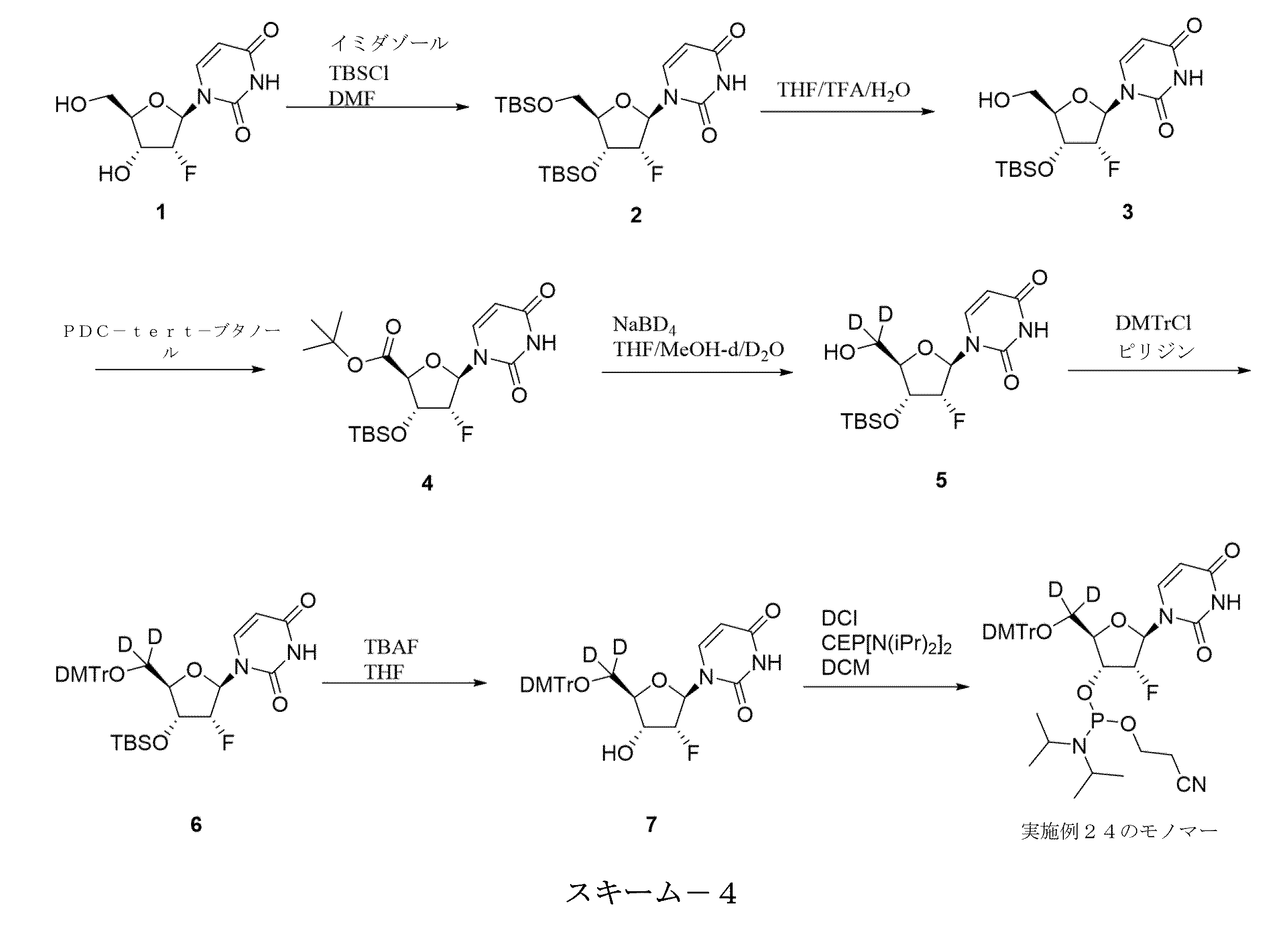
(2)の調製:1(13.0g、52.8mmol)のDMF(100mL)溶液に、0℃でイミダゾール(12.6g、184.8mmol)およびTBSCl(19.8g、132.0mmol)を添加し、反応混合物をN2雰囲気下、室温で15時間撹拌した。水の添加後、得られた生成物を、EA(500mL)で抽出した。合わせた有機層を水およびブラインで洗浄し、Na2SO4上で乾燥させ、濃縮して、粗物質2(30.6g)を白色固体として得て、これを次のステップに直接的に使用した。ESI-LCMS:m/z 475[M+H]+.WO2017106710A1 Preparation of (2): To a solution of 1 (13.0 g, 52.8 mmol) in DMF (100 mL) at 0° C. was added imidazole (12.6 g, 184.8 mmol) and TBSCl (19.8 g, 132.0 mmol). and the reaction mixture was stirred at room temperature for 15 hours under N2 atmosphere. After adding water, the product obtained was extracted with EA (500 mL). The combined organic layers were washed with water and brine, dried over Na 2 SO 4 and concentrated to give crude 2 (30.6 g) as a white solid, which was used directly in the next step. bottom. ESI-LCMS: m/z 475 [M+H] + . WO2017106710A1
(3)の調製:TFA/H2O=1/1(100mL)およびTHF(100mL)の混合溶媒中の粗2(30.6g)の溶液を、0℃で30分間撹拌した。反応完了後、得られた混合物を濃NH3*H2OをpH=7.5になるまで添加し、次いで混合物をEA(500mL)で抽出し、有機層をブラインで洗浄し、Na2SO4上で乾燥させ、除去して残渣を得て、これを以下の条件(IntelFlash-1):カラム、C18シリカゲル;移動相、CH3CN/H2O(0.5%NH4HCO3)=2/3を20分以内でCH3CN/H2O(0.5%NH4HCO3)=3/2まで増加させつつ、Flash-Prep-HPLCによって精製し、溶出した生成物を、CH3CN/H2O(0.5%NH4HCO3)=1/1、検出器、UV254nmで集めた。これにより、3(12.0g、33.3mmol、2ステップで65.8%)を白色固体として得た。ESI-LCMS:m/z 361[M+H]+、1H-NMR(400MHz,DMSO-d6):δ 11.39(s,J=1Hz,1H,D2Oと交換される)、7.88(d,J=8Hz,1H)、5.91-5.86(m,1H)、5.66-5.62(m,1H)、5.21(t,J=5.2Hz,1H,D2Oと交換される)、5.18-5.03(m,1H)、4.37-4.29(m,1H)、3.87-3.83(m,1H)、3.78-3.73(m,1H)、3.56-3.51(m,1H)、0.87(s,9H)、0.09(s,6H)。WO2017106710A1。 Preparation of (3): A solution of crude 2 (30.6 g) in a mixed solvent of TFA/H 2 O=1/1 (100 mL) and THF (100 mL) was stirred at 0° C. for 30 min. After completion of the reaction, concentrated NH 3 *H 2 O was added to the resulting mixture until pH=7.5, then the mixture was extracted with EA (500 mL), the organic layer was washed with brine and Na 2 SO 4 and stripped to give a residue which was subjected to the following conditions (Intel Flash-1): column, C18 silica gel; mobile phase, CH 3 CN/H 2 O (0.5% NH 4 HCO 3 ). = 2/3 to CH 3 CN/H 2 O (0.5% NH 4 HCO 3 ) = 3/2 within 20 minutes, purifying by Flash-Prep-HPLC and eluting the product with CH3CN / H2O (0.5% NH4HCO3 ) = 1/1 , detector, UV collected at 254 nm. This gave 3 (12.0 g, 33.3 mmol, 65.8% over two steps) as a white solid. ESI-LCMS: m/z 361 [M+H] + , 1 H-NMR (400 MHz, DMSO-d 6 ): δ 11.39 (s, J=1 Hz, 1H, exchanged with D 2 O),7. 88 (d, J = 8Hz, 1H), 5.91-5.86 (m, 1H), 5.66-5.62 (m, 1H), 5.21 (t, J = 5.2Hz, 1H) , D 2 O), 5.18-5.03 (m, 1H), 4.37-4.29 (m, 1H), 3.87-3.83 (m, 1H), 3 .78-3.73 (m, 1H), 3.56-3.51 (m, 1H), 0.87 (s, 9H), 0.09 (s, 6H). WO2017106710A1.
(4)の調製:乾燥DCM(60mL)およびDMF(15mL)中の3(11.0g、30.5mmol)の溶液に、PDC(21.g、61.0mmol)、tert-ブチルアルコール(45mL)およびAc2O(32mL)を、N2雰囲気下、室温で添加した。反応混合物を室温で2時間撹拌した。溶媒を除去して残渣を得て、これをシリカゲルカラムクロマトグラフィー(溶離液、PE:EA=4:1~2:1)によって精製し、残渣を得て、これを以下の条件(IntelFlash-1):カラム、C18シリカゲル;移動相、CH3CN/H2O(0.5%NH4HCO3)=1/1を20分以内でCH3CN/H2O(0.5%NH4HCO3)=1/0まで増加させつつ、Flash-Prep-HPLCによって精製し、溶出した生成物を、CH3CN/H2O(0.5%NH4HCO3)=1/0、検出器、UV254nmで集めた。これにより、4(9.5g、22.0mmol、72.3%)を白色固体として得た。ESI-LCMS:m/z 431[M+H]+ 、 1H-NMR(400MHz,DMSO-d6):δ 11.45(s,J=1Hz,1H,D2Oと交換される)、7.93(d,J=8.5Hz,1H)、6.02-5.97(m,1H)、5.76-5.74(m,1H)、5.29-5.14(m,1H)、4.59-4.52(m,1H)、4.29-4.27(m,1H)、1.46(s,9H)、0.89(s,9H)、0.12(s,6H)。 Preparation of (4): To a solution of 3 (11.0 g, 30.5 mmol) in dry DCM (60 mL) and DMF (15 mL), PDC (21. g, 61.0 mmol), tert-butyl alcohol (45 mL) and Ac 2 O (32 mL) were added at room temperature under N 2 atmosphere. The reaction mixture was stirred at room temperature for 2 hours. Solvent was removed to give a residue, which was purified by silica gel column chromatography (eluent, PE:EA=4:1 to 2:1) to give a residue, which was subjected to the following conditions (Intel Flash-1 ): column, C18 silica gel; mobile phase, CH3CN / H2O ( 0.5% NH4HCO3) = 1/1 within 20 minutes CH3CN/H2O ( 0.5 % NH4 HCO 3 ) = 1/0, purifying by Flash-Prep-HPLC, eluting product with CH 3 CN/H 2 O (0.5% NH 4 HCO 3 ) = 1/0, detection collected at UV 254 nm. This gave 4 (9.5 g, 22.0 mmol, 72.3%) as a white solid. ESI-LCMS: m/z 431 [M+H] + , 1 H-NMR (400 MHz, DMSO-d 6 ): δ 11.45 (s, J=1 Hz, 1H, exchanged with D 2 O),7. 93 (d, J = 8.5Hz, 1H), 6.02-5.97 (m, 1H), 5.76-5.74 (m, 1H), 5.29-5.14 (m, 1H) ), 4.59-4.52 (m, 1H), 4.29-4.27 (m, 1H), 1.46 (s, 9H), 0.89 (s, 9H), 0.12 ( s, 6H).
(5)の調製:4(8.5g、19.7mmol)の乾燥THF/MeOD/D2O=10/2/1(80mL)溶液に、NaBD4(2.5g、59.1mmol)を50℃で1時間に3回添加した。反応混合物を室温で2時間撹拌した。反応完了後、CH3COODでpH値を7に調整し、水の添加後、得られた混合物をEA(300mL)で抽出した。合わせた有機層を水およびブラインで洗浄し、Na2SO4上で乾燥させ、濃縮して残渣を得て、これを以下の条件(IntelFlash-1)カラム、C18シリカゲル;移動相、CH3CN/H2O(0.5%NH4HCO3)=2/3を20分以内でCH3CN/H2O(0.5%NH4HCO3)=3/2まで増加させつつ、Flash-Prep-HPLCによって精製し、溶出した生成物を、CH3CN/H2O(0.5%NH4HCO3)=1/1、検出器、UV254nmで集めた。これにより、5(3.5g、9.7mmol、50.3%)を白色固体として得た。ESI-LCMS:m/z 363[M+H]+、1H-NMR(400MHz,DMSO-d6):δ 11.41(s,J=1Hz,1H,D2Oと交換される)、7.88(d,J=8Hz,1H)、5.91-5.86(m,1H)、5.66-5.62(m,1H)、5.19(t,J=5.2Hz,1H,D2Oと交換される)、5.18-5.03(m,1H)、4.37-4.29(m,1H)、3.87-3.83(m,1H)、0.88(s,9H)、0.10(s,6H)。 Preparation of (5): To a solution of 4 (8.5 g, 19.7 mmol) in dry THF/MeOD/ D2O =10/2/1 (80 mL) was added 50 NaBD4 (2.5 g, 59.1 mmol). C. and added 3 times in 1 hour. The reaction mixture was stirred at room temperature for 2 hours. After completion of the reaction, the pH value was adjusted to 7 with CH 3 COOD, and after adding water, the resulting mixture was extracted with EA (300 mL). The combined organic layers were washed with water and brine, dried over Na 2 SO 4 and concentrated to give a residue which was purified under the following conditions (Intel Flash-1) column, C18 silica gel; mobile phase, CH 3 CN. / H2O (0.5% NH4HCO3 ) = 2/3 to CH3CN / H2O (0.5% NH4HCO3 ) = 3/2 within 20 minutes, Flash Purified by -Prep-HPLC, the eluted product was collected in CH 3 CN/H 2 O (0.5% NH 4 HCO 3 ) = 1/1, detector, UV 254 nm. This gave 5 (3.5 g, 9.7 mmol, 50.3%) as a white solid. ESI-LCMS: m/z 363 [M+H] + , 1 H-NMR (400 MHz, DMSO-d 6 ): δ 11.41 (s, J=1 Hz, 1 H, exchanged with D 2 O),7. 88 (d, J = 8Hz, 1H), 5.91-5.86 (m, 1H), 5.66-5.62 (m, 1H), 5.19 (t, J = 5.2Hz, 1H) , D 2 O), 5.18-5.03 (m, 1H), 4.37-4.29 (m, 1H), 3.87-3.83 (m, 1H), 0 .88 (s, 9H), 0.10 (s, 6H).
(6)の調製:5(3.4g、9.7mmol)の撹拌ピリジン(35mL)溶液に、DMTrCl(3.4g、10.1mmol)を室温で添加した。反応混合物を室温で2.5時間撹拌した。氷浴で冷却しつつ、反応物を水でクエンチし、生成物をEA(200mL)で抽出した。有機相を減圧下で乾燥するまで蒸発させ、残渣を得て、これを以下の条件(IntelFlash-1):カラム、C18シリカゲル;移動相、CH3CN/H2O(0.5%NH4HCO3)=1/1を20分以内でCH3CN/H2O(0.5%NH4HCO3)=1/0まで増加させつつ、Flash-Prep-HPLCによって精製し、溶出した生成物を、CH3CN/H2O(0.5%NH4HCO3)=1/0、検出器、UV254nmで集めた。これにより、6(PCT国際出願第2019/173602号)(5.5g、8.3mmol、85.3%)を白色固体として得た。ESI-LCMS:m/z 665[M+H]+、1H-NMR(400MHz,DMSO-d6):δ11.50(d,J=1Hz,1H,D2Oと交換される)、7.92(d,J=4Hz,1H)、7.44-7.27(m,9H)、6.96-6.93(m,4H)、5.94(d,J=20.5Hz,1H)、5.39-5.37(m,1H)、5.32-5.17(m,1H)、4.60-4.51(m,1H)、4.01(d,J=8.8Hz,1H)、3.80(s,6H)、0.80(s,9H)、0.09(s,3H)、-0.05(s,3H)。 Preparation of (6): To a stirred solution of 5 (3.4 g, 9.7 mmol) in pyridine (35 mL) was added DMTrCl (3.4 g, 10.1 mmol) at room temperature. The reaction mixture was stirred at room temperature for 2.5 hours. With ice bath cooling, the reaction was quenched with water and the product was extracted with EA (200 mL). The organic phase was evaporated to dryness under reduced pressure to give a residue which was subjected to the following conditions (Intel Flash-1): column, C18 silica gel; mobile phase, CH 3 CN/H 2 O (0.5% NH 4 ). The product was purified and eluted by Flash-Prep-HPLC with increasing CH 3 CN/H 2 O (0.5% NH 4 HCO 3 ) = 1/0 within 20 min. Material was collected in CH3CN / H2O (0.5% NH4HCO3 ) = 1/0, detector, UV 254 nm. This gave 6 (PCT International Application No. 2019/173602) (5.5 g, 8.3 mmol, 85.3%) as a white solid. ESI-LCMS: m/z 665 [M+H] + , 1 H-NMR (400 MHz, DMSO-d 6 ): δ 11.50 (d, J=1 Hz, 1 H, exchanged with D 2 O), 7.92. (d, J = 4Hz, 1H), 7.44-7.27 (m, 9H), 6.96-6.93 (m, 4H), 5.94 (d, J = 20.5Hz, 1H) , 5.39-5.37 (m, 1H), 5.32-5.17 (m, 1H), 4.60-4.51 (m, 1H), 4.01 (d, J=8. 8Hz, 1H), 3.80 (s, 6H), 0.80 (s, 9H), 0.09 (s, 3H), -0.05 (s, 3H).
(7)の調製:6(5.5g、8.3mmol)のTHF(50mL)溶液に、1M TBAF溶液(9mL)を添加した。反応混合物を室温で1.5時間撹拌した。LC-MSは、6が完全に消費されたことを示した。水(500mL)を添加した。生成物をEA(300mL)で抽出し、有機層をブラインで洗浄し、Na2SO4上で乾燥させた。次いで、有機層を濃縮して残渣を得て、これを以下の条件(IntelFlash-1):カラム、C18シリカゲル;移動相、CH3CN/H2O(0.5%NH4HCO3)=2/3を20分以内でCH3CN/H2O(0.5%NH4HCO3)=3/2まで増加させつつ、Flash-Prep-HPLCによって精製し、溶出した生成物を、CH3CN/H2O(0.5%NH4HCO3)=1/1、検出器、UV254nmで集めた。これにより、7(4.1g、7.5mmol、90.0%)を白色固体として得た。ESI-LCMS:m/z 551[M+H]+、1H-NMR(400MHz,DMSO-d6):δ 11.42(s,1H,D2Oと交換される)、7.76(d,J=8.2Hz,1H)、7.39-7.22(m,9H)、6.90-6.88(m,4H)、5.83(d,J=20.5Hz,1H)、5.65(d,J=7.0Hz,1H,D2Oと交換される)、5.29(d,J=7.2Hz,1H)、5.18-5.03(m,1H)、4.40-4.28(m,1H)、4.01(d,J=8.8Hz,1H)、3.74(s,6H)。 Preparation of (7): To a solution of 6 (5.5 g, 8.3 mmol) in THF (50 mL) was added 1 M TBAF solution (9 mL). The reaction mixture was stirred at room temperature for 1.5 hours. LC-MS indicated complete consumption of 6. Water (500 mL) was added. The product was extracted with EA (300 mL) and the organic layer was washed with brine and dried over Na2SO4 . The organic layer was then concentrated to give a residue, which was subjected to the following conditions (Intel Flash-1): column, C18 silica gel; mobile phase, CH 3 CN/H 2 O (0.5% NH 4 HCO 3 )= Purify by Flash-Prep-HPLC, increasing 2/3 to CH 3 CN/H 2 O (0.5% NH 4 HCO 3 ) = 3/2 within 20 minutes, and the eluted product is purified by CH 3 CN/H 2 O (0.5% NH 4 HCO 3 ) = 1/1, detector, collected at UV 254 nm. This gave 7 (4.1 g, 7.5 mmol, 90.0%) as a white solid. ESI-LCMS: m/z 551 [M+H] + , 1 H-NMR (400 MHz, DMSO-d 6 ): δ 11.42 (s, 1H, exchanged with D 2 O), 7.76 (d, J = 8.2Hz, 1H), 7.39-7.22 (m, 9H), 6.90-6.88 (m, 4H), 5.83 (d, J = 20.5Hz, 1H), 5.65 (d, J=7.0 Hz, 1 H, replaced by D 2 O), 5.29 (d, J=7.2 Hz, 1 H), 5.18-5.03 (m, 1 H) , 4.40-4.28 (m, 1H), 4.01 (d, J=8.8 Hz, 1H), 3.74 (s, 6H).
実施例24のモノマーの調製:7(4.1g、7.5mmol)のDCM(40mL)懸濁液に、DCI(0.7g、6.4mmol)およびCEP[N(iPr)2]2(2.9g、9.7mmol)を添加した。混合物を室温で1時間撹拌した。LC-MSは、7が完全に消費されたことを示した。溶液を水で2回洗浄し、ブラインで洗浄し、Na2SO4上で乾燥させた。次いで濃縮して残渣を得て、これを以下の条件(IntelFlash-1):カラム、C18シリカゲル;移動相、CH3CN/H2O(0.5%NH4HCO3)=1/1を20分以内でCH3CN/H2O(0.5%NH4HCO3)=1/0まで増加させつつ、Flash-Prep-HPLCによって精製し、溶出した生成物を、CH3CN/H2O(0.5%NH4HCO3)=1/0、検出器、UV254nmで集めた。これにより、実施例24のモノマー(5.0g、6.6mmol、90.0%)を白色固体として得た。ESI-LCMS:m/z 751[M+H]+、1H-NMR(400MHz,DMSO-d6):δ 11.43(s,1H)、7.85-7.82(m,1H)、7.40-7.23(m,9H)、6.90-6.85(m,4H)、5.94-5.86(m,1H)、5.40-5.24(m,2H)、4.74-4.49(m,1H)、4.12-4.09(m,2H)、3.79-3.47(m,10H)、2.78-2.59(m,2H)、1.14-0.93(m,12H).31P-NMR(162MHz,DMSO-d6):δ 149.67,149.61,149.32,149.27。 Preparation of monomer for Example 24: To a suspension of 7 (4.1 g, 7.5 mmol) in DCM (40 mL) was added DCI (0.7 g, 6.4 mmol) and CEP[N(iPr) 2 ] 2 (2). .9 g, 9.7 mmol) was added. The mixture was stirred at room temperature for 1 hour. LC-MS indicated complete consumption of 7. The solution was washed twice with water, washed with brine and dried over Na2SO4 . It was then concentrated to give a residue, which was subjected to the following conditions (Intel Flash-1): column, C18 silica gel; mobile phase, CH 3 CN/H 2 O (0.5% NH 4 HCO 3 ) = 1/1. Purified by Flash-Prep-HPLC increasing to CH 3 CN/H 2 O (0.5% NH 4 HCO 3 ) = 1/0 within 20 min, the eluted product was purified by CH 3 CN/H 2 O (0.5% NH 4 HCO 3 ) = 1/0, detector, collected at UV 254 nm. This gave the monomer of Example 24 (5.0 g, 6.6 mmol, 90.0%) as a white solid. ESI-LCMS: m/z 751 [M+H] + , 1 H-NMR (400 MHz, DMSO-d 6 ): δ 11.43 (s, 1H), 7.85-7.82 (m, 1H), 7 .40-7.23 (m, 9H), 6.90-6.85 (m, 4H), 5.94-5.86 (m, 1H), 5.40-5.24 (m, 2H) , 4.74-4.49 (m, 1H), 4.12-4.09 (m, 2H), 3.79-3.47 (m, 10H), 2.78-2.59 (m, 2H), 1.14-0.93 (m, 12H). 31 P-NMR (162 MHz, DMSO-d 6 ): δ 149.67, 149.61, 149.32, 149.27.
[実施例25:モノマーの合成]

(4)の調製:3(14.3g、25.4mmol、スキーム2)のピリジン(150mL)溶液に、イミダゾール(4.5g、66.6mmol)およびTBSCl(6.0g、40.0mmol)を0℃で添加し、反応混合物をN2雰囲気下、室温で15時間撹拌した。水の添加後、得られた混合物を、EA(500mL)で抽出した。合わせた有機層を水およびブラインで洗浄し、Na2SO4上で乾燥させ、濃縮して、粗物質4(18.0g)を白色固体として得て、これを次のステップに直接的に使用した。ESI-LCMS:m/z 676[M-H]-。 Preparation of (4): To a solution of 3 (14.3 g, 25.4 mmol, Scheme 2) in pyridine (150 mL) was added imidazole (4.5 g, 66.6 mmol) and TBSCl (6.0 g, 40.0 mmol). °C and the reaction mixture was stirred at room temperature for 15 hours under N2 atmosphere. After adding water, the resulting mixture was extracted with EA (500 mL). The combined organic layers were washed with water and brine, dried over Na 2 SO 4 and concentrated to give crude 4 (18.0 g) as a white solid, which was used directly in the next step. bottom. ESI-LCMS: m/z 676 [MH] − .
(5)の調製:DCM(200mL)中のDCA(6%)溶液中の粗4(18.0g)の溶液に、室温でTES(50mL)を添加し、反応混合物を室温で5~10分間撹拌した。反応完了後、得られた混合物を、pH=7になるまでピリジンを添加し、次いで溶媒を除去し、残渣を、以下の条件(IntelFlash-1):カラム、C18シリカゲル;移動相、CH3CN/H2O(0.5%NH4HCO3)=2/3を20分以内でCH3CN/H2O(0.5%NH4HCO3)=3/2まで増加させつつ、Flash-Prep-HPLCによって精製し、溶出した生成物を、CH3CN/H2O(0.5%NH4HCO3)=1/1、検出器、UV254nmで集めた。これにより、5(6.5g、17.2mmol、2ステップで67.7%)を白色固体として得た。ESI-LCMS:m/z 376[M+H]+、1H-NMR(400MHz,DMSO-d6):δ 7.92(d,J=8Hz,1H)、5.82(d,J=5.2Hz,1H)、5.68-5.63(m,1H)、5.20-5.15(m,1H)、4.32-4.25(m,1H)、3.87-3.80(m,2H)、3.69-3.61(m,1H)、3.57-3.49(m,1H)、0.88(s,9H)、0.09(s,6H)。 Preparation of (5): To a solution of crude 4 (18.0 g) in DCA (6%) solution in DCM (200 mL) at room temperature was added TES (50 mL) and the reaction mixture was stirred at room temperature for 5-10 minutes. Stirred. After completion of the reaction, pyridine was added to the resulting mixture until pH=7, then the solvent was removed and the residue was subjected to the following conditions (Intel Flash-1): column, C18 silica gel; mobile phase, CH 3 CN. / H2O (0.5% NH4HCO3 ) = 2/3 to CH3CN / H2O (0.5% NH4HCO3 ) = 3/2 within 20 minutes, Flash Purified by -Prep-HPLC, the eluted product was collected in CH 3 CN/H 2 O (0.5% NH 4 HCO 3 ) = 1/1, detector, UV 254 nm. This gave 5 (6.5 g, 17.2 mmol, 67.7% over two steps) as a white solid. ESI-LCMS: m/z 376 [M+H] + , 1 H-NMR (400 MHz, DMSO-d 6 ): δ 7.92 (d, J=8 Hz, 1 H), 5.82 (d, J=5. 2Hz, 1H), 5.68-5.63 (m, 1H), 5.20-5.15 (m, 1H), 4.32-4.25 (m, 1H), 3.87-3. 80 (m, 2H), 3.69-3.61 (m, 1H), 3.57-3.49 (m, 1H), 0.88 (s, 9H), 0.09 (s, 6H) .
(6)の調製:乾燥DCM(35mL)およびDMF(9mL)中の5(6.5g、17.2mmol)の溶液に、PDC(12.9g、34.3mmol)、tert-ブチルアルコール(34mL)およびAc2O(17mL)を、N2雰囲気下、室温で添加した。反応混合物を室温で2時間撹拌した。溶媒を除去して残渣を得て、これをシリカゲルカラムクロマトグラフィー(溶離液、PE:EA=4:1~2:1)によって精製し、残渣を得て、これを以下の条件(IntelFlash-1):カラム、C18シリカゲル;移動相、CH3CN/H2O(0.5%NH4HCO3)=1/1を20分以内でCH3CN/H2O(0.5%NH4HCO3)=1/0まで増加させつつ、Flash-Prep-HPLCによって精製し、溶出した生成物を、CH3CN/H2O(0.5%NH4HCO3)=1/0、検出器、UV254nmで集めた。これにより、6(5.5g、12.3mmol、70.1%)を白色固体として得た。ESI-LCMS:m/z 446[M+H]+、1H-NMR(400MHz,DMSO-d6):δ=11.29(s,1H)、7.91(d,J=8.4Hz,1H)、5.85(d,J=6.4Hz,1H)、5.71-5.61(m,1H)、4.35-4.28(m,1H)、4.12(d,J=3.2Hz,1H)、3.75-3.67(m,1H)、1.33(s,9H)、0.76(s,9H)、0.00(d,J=1.6Hz,6H)。 Preparation of (6): To a solution of 5 (6.5 g, 17.2 mmol) in dry DCM (35 mL) and DMF (9 mL), PDC (12.9 g, 34.3 mmol), tert-butyl alcohol (34 mL) and Ac 2 O (17 mL) were added at room temperature under N 2 atmosphere. The reaction mixture was stirred at room temperature for 2 hours. Solvent was removed to give a residue, which was purified by silica gel column chromatography (eluent, PE:EA=4:1 to 2:1) to give a residue, which was subjected to the following conditions (Intel Flash-1 ): column, C18 silica gel; mobile phase, CH3CN / H2O ( 0.5% NH4HCO3) = 1/1 within 20 minutes CH3CN/H2O ( 0.5 % NH4 HCO 3 ) = 1/0, purifying by Flash-Prep-HPLC, eluting product with CH 3 CN/H 2 O (0.5% NH 4 HCO 3 ) = 1/0, detection collected at UV 254 nm. This gave 6 (5.5 g, 12.3 mmol, 70.1%) as a white solid. ESI-LCMS: m/z 446 [M+H] + , 1 H-NMR (400 MHz, DMSO-d 6 ): δ = 11.29 (s, 1H), 7.91 (d, J = 8.4 Hz, 1H ), 5.85 (d, J = 6.4 Hz, 1H), 5.71-5.61 (m, 1H), 4.35-4.28 (m, 1H), 4.12 (d, J = 3.2Hz, 1H), 3.75-3.67 (m, 1H), 1.33 (s, 9H), 0.76 (s, 9H), 0.00 (d, J = 1.6Hz , 6H).
(7)の調製:6(5.4g、12.1mmol)のTHF/MeOD/D2O=10/2/1(44mL)溶液に、NaBD4(1.5g、36.3mmol)を室温で添加し、反応混合物を50℃で2時間撹拌した。反応完了後、CH3COODでpH値を7に調整した。水を添加し、得られた混合物を、EA(500mL)で抽出した。合わせた有機層を水およびブラインで洗浄し、Na2SO4上で乾燥させ、濃縮して残渣を得て、これを以下の条件(IntelFlash-1)カラム、C18シリカゲル;移動相、CH3CN/H2O(0.5%NH4HCO3)=2/3を20分以内でCH3CN/H2O(0.5%NH4HCO3)=3/2まで増加させつつ、Flash-Prep-HPLCによって精製し、溶出した生成物を、CH3CN/H2O(0.5%NH4HCO3)=1/1、検出器、UV254nmで集めた。これにより、7(2.6g、6.8mmol、56.1%)を白色固体として得た。ESI-LCMS:m/z 378[M+H]+、1H-NMR(400MHz,DMSO-d6):δ 11.35(s,1H)、7.91(d,J=8.0Hz,1H)、5.82(d,J=5.2Hz,1H)、5.69-5.60(m,1H)、5.14(s,1H)、4.34-4.20(m,1H)、3.88-3.76(m,2H)、0.87(s,9H)、0.08(s,6H)。 Preparation of (7): NaBD4 (1.5 g, 36.3 mmol) was added to a solution of 6 (5.4 g, 12.1 mmol) in THF/MeOD/ D2O = 10/2/1 (44 mL) at room temperature . was added and the reaction mixture was stirred at 50° C. for 2 hours. After the reaction was completed, the pH value was adjusted to 7 with CH 3 COOD. Water was added and the resulting mixture was extracted with EA (500 mL). The combined organic layers were washed with water and brine, dried over Na 2 SO 4 and concentrated to give a residue which was purified under the following conditions (Intel Flash-1) column, C18 silica gel; mobile phase, CH 3 CN. / H2O (0.5% NH4HCO3 ) = 2/3 to CH3CN / H2O (0.5% NH4HCO3 ) = 3/2 within 20 minutes, Flash - Purified by Prep-HPLC and collected the eluted product in CH 3 CN/H 2 O (0.5% NH 4 HCO 3 ) = 1/1, detector, UV 254 nm. This gave 7 (2.6 g, 6.8 mmol, 56.1%) as a white solid. ESI-LCMS: m/z 378 [M+H] + , 1 H-NMR (400 MHz, DMSO-d 6 ): δ 11.35 (s, 1H), 7.91 (d, J=8.0Hz, 1H) , 5.82 (d, J=5.2Hz, 1H), 5.69-5.60 (m, 1H), 5.14 (s, 1H), 4.34-4.20 (m, 1H) , 3.88-3.76 (m, 2H), 0.87 (s, 9H), 0.08 (s, 6H).
(8)の調製:7(2.6g、6.8mmol)の撹拌ピリジン(30mL)溶液に、DMTrCl(3.5g、10.3mmol)を室温で添加した。反応混合物を室温で2.5時間撹拌した。氷浴で冷却しつつ、反応物を水でクエンチし、生成物をEA(200mL)で抽出した。有機相を減圧下で乾燥するまで蒸発させ、残渣を得て、これを以下の条件(IntelFlash-1):カラム、C18シリカゲル;移動相、CH3CN/H2O(0.5%NH4HCO3)=1/1を20分以内でCH3CN/H2O(0.5%NH4HCO3)=1/0まで増加させつつ、Flash-Prep-HPLCによって精製し、溶出した生成物を、CH3CN/H2O(0.5%NH4HCO3)=1/0、検出器、UV254nmで集めた。これにより、8(4.3g、6.3mmol、90.1%)を白色固体として得た。ESI-LCMS:m/z 678[M-H]-、1H-NMR(400MHz,DMSO-d6):δ 11.39(s,1H)、7.86(d,J=8.0Hz,1H)、7.42-7.17(m,9H)、6.96-6.83(m,4H)、5.82-5.69(m,2H)、5.29(d,J=8.4Hz,1H)、4.36-4.25(m,1H)、3.90(d,J=7.2Hz,1H)、3.86-3.80(m,1H)、3.73(s,6H)、0.75(s,9H)、0.02(s,3H)、-0.04(s,3H)。 Preparation of (8): To a stirred solution of 7 (2.6 g, 6.8 mmol) in pyridine (30 mL) was added DMTrCl (3.5 g, 10.3 mmol) at room temperature. The reaction mixture was stirred at room temperature for 2.5 hours. With ice bath cooling, the reaction was quenched with water and the product was extracted with EA (200 mL). The organic phase was evaporated to dryness under reduced pressure to give a residue which was subjected to the following conditions (Intel Flash-1): column, C18 silica gel; mobile phase, CH 3 CN/H 2 O (0.5% NH 4 ). The product was purified and eluted by Flash-Prep-HPLC with increasing CH 3 CN/H 2 O (0.5% NH 4 HCO 3 ) = 1/0 within 20 min. Material was collected in CH3CN / H2O (0.5% NH4HCO3 ) = 1/0, detector, UV 254 nm. This gave 8 (4.3 g, 6.3 mmol, 90.1%) as a white solid. ESI-LCMS: m/z 678 [MH] − , 1 H-NMR (400 MHz, DMSO-d 6 ): δ 11.39 (s, 1H), 7.86 (d, J=8.0 Hz, 1H), 7.42-7.17 (m, 9H), 6.96-6.83 (m, 4H), 5.82-5.69 (m, 2H), 5.29 (d, J = 8.4 Hz, 1 H), 4.36-4.25 (m, 1 H), 3.90 (d, J = 7.2 Hz, 1 H), 3.86-3.80 (m, 1 H), 3. 73 (s, 6H), 0.75 (s, 9H), 0.02 (s, 3H), -0.04 (s, 3H).
(9)の調製:8(4.3g、6.3mmol)のTHF(45mL)溶液に、1M TBAF溶液(6mL)を添加した。反応混合物を室温で1.5時間撹拌した。LCMSは、8が完全に消費されたことを示した。水(200mL)を添加した。生成物をEA(200mL)で抽出し、有機層をブラインで洗浄し、Na2SO4上で乾燥させた。次いで、有機層を濃縮して残渣を得て、これを以下の条件(IntelFlash-1):カラム、C18シリカゲル;移動相、CH3CN/H2O(0.5%NH4HCO3)=2/3を20分以内でCH3CN/H2O(0.5%NH4HCO3)=3/2まで増加させつつ、Flash-Prep-HPLCによって精製し、溶出した生成物を、CH3CN/H2O(0.5%NH4HCO3)=1/1、検出器、UV254nmで集めた。これにより、8(3.5g、6.1mmol、90.1%)を白色固体として得た。ESI-LCMS:m/z 678[M-H]-、1H-NMR(400MHz,DMSO-d6):δ 11.38(d,J=2.0Hz,1H)、7.23(d,J=8.0Hz,1H)、7.41-7.19(m,9H)、6.94-6.85(m,4H)、5.81(d,J=4.0Hz,1H)、5.33-5.26(m,1H)、5.21(d,J=7.2Hz,1H)、4.06-3.90(m,2H)、3.83-3.77(m,1H)、3.74(s,6H)。 Preparation of (9): To a solution of 8 (4.3 g, 6.3 mmol) in THF (45 mL) was added 1 M TBAF solution (6 mL). The reaction mixture was stirred at room temperature for 1.5 hours. LCMS showed 8 was completely consumed. Water (200 mL) was added. The product was extracted with EA (200 mL) and the organic layer was washed with brine and dried over Na2SO4 . The organic layer was then concentrated to give a residue, which was subjected to the following conditions (Intel Flash-1): column, C18 silica gel; mobile phase, CH 3 CN/H 2 O (0.5% NH 4 HCO 3 )= Purify by Flash-Prep-HPLC, increasing 2/3 to CH 3 CN/H 2 O (0.5% NH 4 HCO 3 ) = 3/2 within 20 minutes, and the eluted product is purified by CH 3 CN/H 2 O (0.5% NH 4 HCO 3 ) = 1/1, detector, collected at UV 254 nm. This gave 8 (3.5 g, 6.1 mmol, 90.1%) as a white solid. ESI-LCMS: m/z 678 [MH] − , 1 H-NMR (400 MHz, DMSO-d 6 ): δ 11.38 (d, J=2.0 Hz, 1H), 7.23 (d, J = 8.0Hz, 1H), 7.41-7.19 (m, 9H), 6.94-6.85 (m, 4H), 5.81 (d, J = 4.0Hz, 1H), 5.33-5.26 (m, 1H), 5.21 (d, J=7.2Hz, 1H), 4.06-3.90 (m, 2H), 3.83-3.77 (m , 1H), 3.74 (s, 6H).
実施例25のモノマーの調製:9(2.1g、3.7mmol)のDCM(20mL)懸濁液に、DCI(373mg、3.1mmol)およびCEP[N(iPr)2]2(1.3g、4.4mmol)を添加した。混合物を室温で1時間撹拌した。LC-MSは、9が完全に消費されたことを示した。溶液を水で2回洗浄し、ブラインで洗浄し、Na2SO4上で乾燥させた。次いで濃縮して残渣を得て、これを以下の条件(IntelFlash-1):カラム、C18シリカゲル;移動相、CH3CN/H2O(0.5%NH4HCO3)=1/1を20分以内でCH3CN/H2O(0.5%NH4HCO3)=1/0まで増加させつつ、Flash-Prep-HPLCによって精製し、溶出した生成物を、CH3CN/H2O(0.5%NH4HCO3)=1/0、検出器、UV254nmで集めた。これにより、実施例25のモノマー(2.2g、3.5mmol、80%)を白色固体として得た。ESI-LCMS:m/z 766[M+H]+、1H-NMR(400MHz,ACN-d3):δ 9.65-8.86(m,1H,D2Oと交換される)、7.93-7.68(m,1H)、7.52-7.19(m,9H)、6.94-6.78(m,4H)、5.95-5.77(m,1H)、5.31-5.17(m,1H)、4.61-4.37(m,1H)、4.20-4.07(m,1H)、4.01-3.51(m,10H)、2.74-2.59(m,1H)、2.57-2.43(m,1H)、1.27-1.10(m,9H)、1.09-0.95(m,3H)。31P-NMR(162MHz,ACN-d3):δ=149.88,149.55。 Preparation of monomer for Example 25: To a suspension of 9 (2.1 g, 3.7 mmol) in DCM (20 mL) was added DCI (373 mg, 3.1 mmol) and CEP[N(iPr) 2 ] 2 (1.3 g). , 4.4 mmol) was added. The mixture was stirred at room temperature for 1 hour. LC-MS indicated complete consumption of 9. The solution was washed twice with water, washed with brine and dried over Na2SO4 . It was then concentrated to give a residue, which was subjected to the following conditions (Intel Flash-1): column, C18 silica gel; mobile phase, CH 3 CN/H 2 O (0.5% NH 4 HCO 3 ) = 1/1. Purified by Flash-Prep-HPLC increasing to CH 3 CN/H 2 O (0.5% NH 4 HCO 3 ) = 1/0 within 20 min, the eluted product was purified by CH 3 CN/H 2 O (0.5% NH 4 HCO 3 ) = 1/0, detector, collected at UV 254 nm. This gave the monomer of Example 25 (2.2 g, 3.5 mmol, 80%) as a white solid. ESI-LCMS: m/z 766 [M+H] + , 1 H-NMR (400 MHz, ACN-d 3 ): δ 9.65-8.86 (m, 1H, exchanged with D 2 O),7. 93-7.68 (m, 1H), 7.52-7.19 (m, 9H), 6.94-6.78 (m, 4H), 5.95-5.77 (m, 1H), 5.31-5.17 (m, 1H), 4.61-4.37 (m, 1H), 4.20-4.07 (m, 1H), 4.01-3.51 (m, 10H) ), 2.74-2.59 (m, 1H), 2.57-2.43 (m, 1H), 1.27-1.10 (m, 9H), 1.09-0.95 (m , 3H). 31 P-NMR (162 MHz, ACN-d 3 ): δ=149.88, 149.55.
[実施例26:モノマーの合成]

(7)の調製:6(17g、25.1mmol、スキーム3)のACN(170mL)溶液に、DMAP(6.13g、50.3mmol)およびTEA(5.1g、50.3mmol、7.2mL)を添加し、次いで、TPSCl(11.4g、37.7mmol)を0℃、N2雰囲気下で添加し、混合物をN2雰囲気下、室温で3時間撹拌した。次いで、濃NH3.H2O(27.3g、233.7mmol)を室温で添加し、混合物を室温で16時間撹拌した。反応物を水でクエンチし、生成物をEA(200mL)で抽出した。有機相を濃縮して、粗物質7(17.0g)を白色固体として得て、これを次のステップに直接的に使用した。 Preparation of (7): To a solution of 6 (17 g, 25.1 mmol, Scheme 3) in ACN (170 mL) was DMAP (6.13 g, 50.3 mmol) and TEA (5.1 g, 50.3 mmol, 7.2 mL). was added, then TPSCl (11.4 g, 37.7 mmol) was added at 0° C. under N 2 atmosphere and the mixture was stirred at room temperature for 3 hours under N 2 atmosphere. Then concentrated NH 3 . H 2 O (27.3 g, 233.7 mmol) was added at room temperature and the mixture was stirred at room temperature for 16 hours. The reaction was quenched with water and the product was extracted with EA (200 mL). The organic phase was concentrated to give crude 7 (17.0 g) as a white solid, which was used directly in the next step.
(8)の調製:7(17.0g、25.1mmol)の撹拌ピリジン(170mL)溶液に、BzCl(4.3g、30.1mmol)をN2雰囲気下、0℃で添加した。反応混合物を室温で2.5時間撹拌した。氷浴で冷却しつつ、反応物を水でクエンチし、生成物をEA(200mL)で抽出した。有機相を減圧下で乾燥するまで蒸発させ、残渣を得て、これを以下の条件(IntelFlash-1):カラム、C18シリカゲル;移動相、CH3CN/H2O(0.5%NH4HCO3)=1/1を20分以内でCH3CN/H2O(0.5%NH4HCO3)=1/0まで増加させつつ、Flash-Prep-HPLCによって精製し、溶出した生成物を、CH3CN/H2O(0.5%NH4HCO3)=1/0、検出器、UV254nmで集めた。これにより、8(19.0g、24.3mmol、2ステップで95.6%)を白色固体として得た。ESI-LCMS:m/z 780[M+H]+。 Preparation of (8): To a stirred solution of 7 (17.0 g, 25.1 mmol) in pyridine (170 mL) was added BzCl (4.3 g, 30.1 mmol) at 0° C. under N2 atmosphere. The reaction mixture was stirred at room temperature for 2.5 hours. With ice bath cooling, the reaction was quenched with water and the product was extracted with EA (200 mL). The organic phase was evaporated to dryness under reduced pressure to give a residue which was subjected to the following conditions (Intel Flash-1): column, C18 silica gel; mobile phase, CH 3 CN/H 2 O (0.5% NH 4 ). The product was purified by Flash-Prep-HPLC and eluted with increasing CH 3 CN/H 2 O (0.5% NH 4 HCO 3 ) = 1/0 within 20 min. The material was collected in CH3CN / H2O (0.5% NH4HCO3 ) = 1/0, detector, UV 254 nm. This gave 8 (19.0 g, 24.3 mmol, 95.6% over two steps) as a white solid. ESI-LCMS: m/z 780 [M+H] + .
(9)の調製:8(19.0g、24.3mmol)のTHF(190mL)溶液に、1M TBAF溶液(24mL)を添加した。反応混合物を室温で1.0時間撹拌した。LC-MSは、8が完全に消費されたことを示した。水(500mL)を添加した。生成物をEA(300mL)で抽出し、有機層をブラインで洗浄し、Na2SO4上で乾燥させた。次いで、有機層を濃縮して残渣を得て、これを以下の条件(IntelFlash-1):カラム、C18シリカゲル;移動相、CH3CN/H2O(0.5%NH4HCO3)=2/3を20分以内でCH3CN/H2O(0.5%NH4HCO3)=3/2まで増加させつつ、Flash-Prep-HPLCによって精製し、溶出した生成物を、CH3CN/H2O(0.5%NH4HCO3)=1/1、検出器、UV254nmで集めた。これにより、9(15.2g、23.1mmol、95.5%)を白色固体として得た。ESI-LCMS:m/z 666[M+H]+、1H-NMR(400MHz,DMSO-d6):δ 11.28(s,1H)、8.41(m,1H)、8.00-7.99(m,2H)、7.63-7.15(m,13H)、6.93-6.89(m,4H)、5.87(s,1H)、5.20(d,J=7.4Hz,1H)、4.30(m,1H)、4.02(m,1H)、3.75(s,7H)、3.53(s,3H)。 Preparation of (9): To a solution of 8 (19.0 g, 24.3 mmol) in THF (190 mL) was added 1M TBAF solution (24 mL). The reaction mixture was stirred at room temperature for 1.0 hour. LC-MS indicated complete consumption of 8. Water (500 mL) was added. The product was extracted with EA (300 mL) and the organic layer was washed with brine and dried over Na2SO4 . The organic layer was then concentrated to give a residue, which was subjected to the following conditions (Intel Flash-1): column, C18 silica gel; mobile phase, CH 3 CN/H 2 O (0.5% NH 4 HCO 3 )= Purify by Flash-Prep-HPLC, increasing 2/3 to CH 3 CN/H 2 O (0.5% NH 4 HCO 3 ) = 3/2 within 20 minutes, and the eluted product is purified by CH 3 CN/H 2 O (0.5% NH 4 HCO 3 ) = 1/1, detector, collected at UV 254 nm. This gave 9 (15.2 g, 23.1 mmol, 95.5%) as a white solid. ESI-LCMS: m/z 666 [M+H] + , 1 H-NMR (400 MHz, DMSO-d 6 ): δ 11.28 (s, 1H), 8.41 (m, 1H), 8.00-7 .99 (m, 2H), 7.63-7.15 (m, 13H), 6.93-6.89 (m, 4H), 5.87 (s, 1H), 5.20 (d, J = 7.4 Hz, 1 H), 4.30 (m, 1 H), 4.02 (m, 1 H), 3.75 (s, 7 H), 3.53 (s, 3 H).
実施例26のモノマーの調製:9(10.0g、15.0mmol)のDCM(100mL)懸濁液に、DCI(1.5g、12.7mmol)およびCEP[N(iPr)2]2(5.4g、18.0mmol)を添加した。混合物を室温で1時間撹拌した。LC-MSは、9が完全に消費されたことを示した。溶液を水で2回洗浄し、ブラインで洗浄し、Na2SO4上で乾燥させた。次いで濃縮して残渣を得て、これを以下の条件(IntelFlash-1):カラム、C18シリカゲル;移動相、CH3CN/H2O(0.5%NH4HCO3)=1/1を20分以内でCH3CN/H2O(0.5%NH4HCO3)=1/0まで増加させつつ、Flash-Prep-HPLCによって精製し、溶出した生成物を、CH3CN/H2O(0.5%NH4HCO3)=1/0、検出器、UV254nmで集めた。これにより、実施例26のモノマー(11.5g、13.5mmol、90.7%)を白色固体として得た。ESI-LCMS:m/z 866[M+H]+ 、 1H-NMR(400MHz,DMSO-d6):δ=11.28(s,1H)、8.48-8.41(m,1H)、8.00-7.99(m,2H)、7.63-7.11(m,13H)、6.93-6.89(m,4H)、5.92(m,1H)、4.55-4.44(m,1H)、4.17(m,1H)、3.95(m,1H)、3.80-3.62(m,7H)、3.57-3.46(m,5H)、3.32(s,1H)、2.78(m,1H)、2.62-2.59(m,1H)、1.19-0.94(m,12H)、31P-NMR(162MHz,DMSO-d6):δ=149.52,148.82。 Preparation of the monomer for Example 26: To a suspension of 9 (10.0 g, 15.0 mmol) in DCM (100 mL) was added DCI (1.5 g, 12.7 mmol) and CEP[N(iPr) 2 ] 2 (5 .4 g, 18.0 mmol) was added. The mixture was stirred at room temperature for 1 hour. LC-MS indicated complete consumption of 9. The solution was washed twice with water, washed with brine and dried over Na2SO4 . It was then concentrated to give a residue, which was subjected to the following conditions (Intel Flash-1): column, C18 silica gel; mobile phase, CH 3 CN/H 2 O (0.5% NH 4 HCO 3 ) = 1/1. Purified by Flash-Prep-HPLC increasing to CH 3 CN/H 2 O (0.5% NH 4 HCO 3 ) = 1/0 within 20 min, the eluted product was purified by CH 3 CN/H 2 O (0.5% NH 4 HCO 3 ) = 1/0, detector, collected at UV 254 nm. This gave the monomer of Example 26 (11.5 g, 13.5 mmol, 90.7%) as a white solid. ESI-LCMS: m/z 866 [M+H] + , 1 H-NMR (400 MHz, DMSO-d 6 ): δ = 11.28 (s, 1H), 8.48-8.41 (m, 1H), 8.00-7.99 (m, 2H), 7.63-7.11 (m, 13H), 6.93-6.89 (m, 4H), 5.92 (m, 1H), 4. 55-4.44 (m, 1H), 4.17 (m, 1H), 3.95 (m, 1H), 3.80-3.62 (m, 7H), 3.57-3.46 ( m, 5H), 3.32 (s, 1H), 2.78 (m, 1H), 2.62-2.59 (m, 1H), 1.19-0.94 (m, 12H), 31 P-NMR (162 MHz, DMSO-d 6 ): δ = 149.52, 148.82.
[実施例27:モノマーの合成]
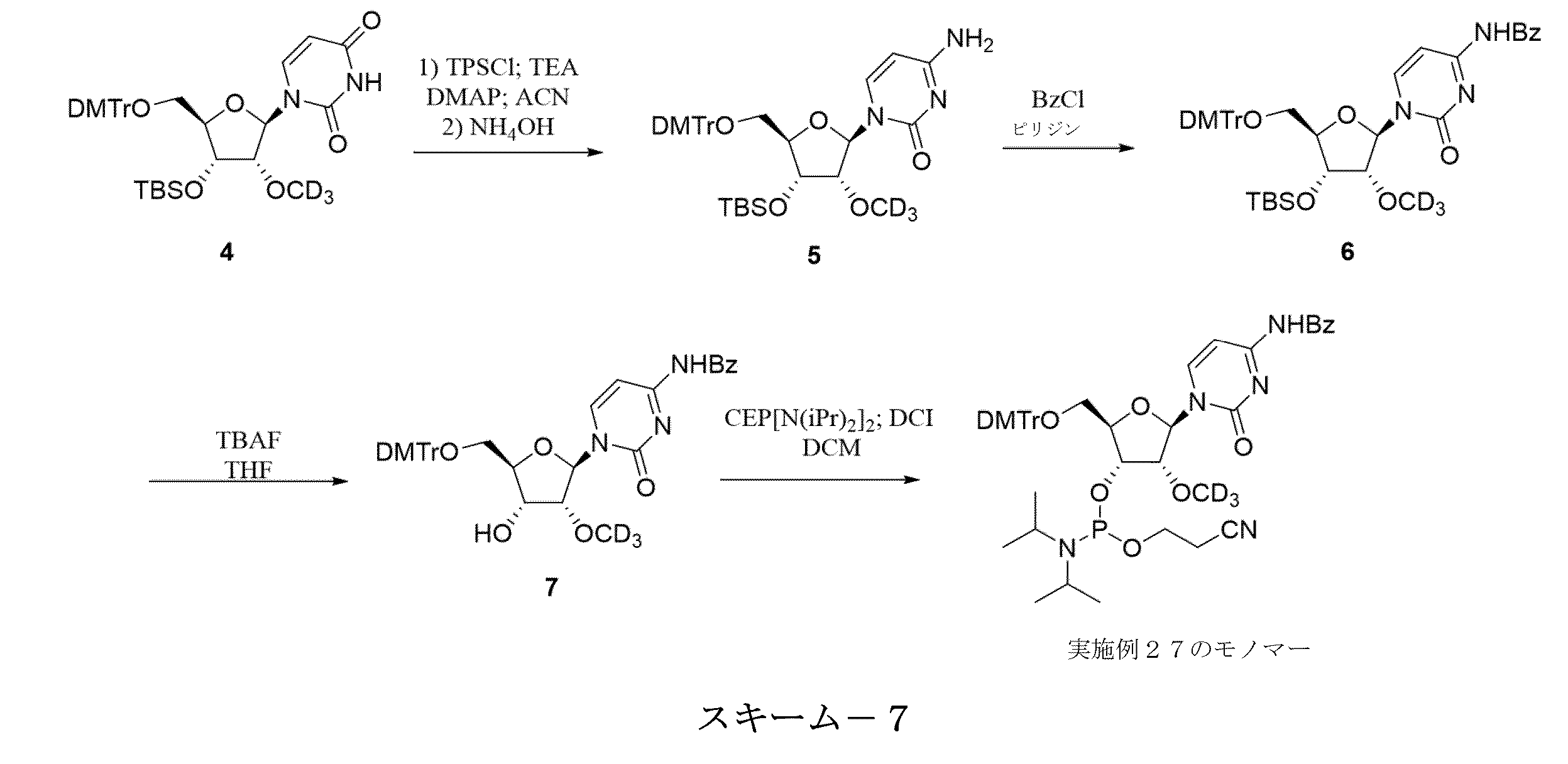
(5)の調製:4(18.8g、スキーム5)の乾燥ACN(200mL)溶液に、TPSCl(16.8g、65.2mmol)およびTEA(5.6g、65.2mmol)およびDMAP(6.8g、65.2mmol)を添加し、反応混合物をN2雰囲気下、室温で3.5時間撹拌した。水の添加後、得られた混合物を、EA(300mL)で抽出した。合わせた有機層を水およびブラインで洗浄し、Na2SO4上で乾燥させ、濃縮して、粗物質5(22.0g)を白色固体として得て、これを次のステップに直接的に使用した。ESI-LCMS:m/z 677[M-H]+。 Preparation of (5): To a solution of 4 (18.8 g, Scheme 5) in dry ACN (200 mL) was added TPSCl (16.8 g, 65.2 mmol) and TEA (5.6 g, 65.2 mmol) and DMAP (6.8 g, 65.2 mmol). 8 g, 65.2 mmol) was added and the reaction mixture was stirred at room temperature for 3.5 hours under N2 atmosphere. After adding water, the resulting mixture was extracted with EA (300 mL). The combined organic layers were washed with water and brine, dried over Na 2 SO 4 and concentrated to give crude 5 (22.0 g) as a white solid, which was used directly in the next step. bottom. ESI-LCMS: m/z 677 [MH] + .
(6)の調製:5(22.0g)のピリジン(150mL)溶液に、BzCl(6.8g、48.9mmol)を氷浴下で添加した。反応混合物を室温で2.5時間撹拌した。LCMSは、5が消費されたことを示した。混合物をEAで希釈し、水を添加した。生成物をEAで抽出した。粗物質を、以下の条件(IntelFlash-1):カラム、C18シリカゲル;移動相、CH3CN/H2O(0.5%NH4HCO3)=1/1を25分以内でCH3CN/H2O(0.5%NH4HCO3)=1/0まで増加させつつ、Flash-Prep-HPLCによって精製し、溶出した生成物を、CH3CN/H2O(0.5%NH4HCO3)=1/0、検出器、UV254nmで集めた。これにより、粗物質6(20.8g、26.7mmol、2ステップで82%)を白色固体として得た。ESI-LCMS:m/z 781[M+H]+、1H-NMR(400MHz,DMSO-d6):δ 11.30(s,1H)、8.55(d,J=8.0Hz,1H)、8.00-7.98(m,2H)、7.74-7.66(m,1H)、7.60-7.50(m,2H)、7.47-7.31(m,4H)、7.30-7.2(m,5H)、7.20-7.1(m,1H)、6.91(d,J=7.4Hz,4H)、5.91-5.86(AB,J=20.0Hz,1H)、4.30(d,J=8.0Hz,1H)、3.87-3.78(s,1H)、3.78-3.70(m,6H)、3.62-3.51(m,1H)、3.28-3.2(m,1H)、2.15-2.05(m,3H)、0.73(s,9H)、0.00(m,6H)。 Preparation of (6): To a solution of 5 (22.0 g) in pyridine (150 mL) was added BzCl (6.8 g, 48.9 mmol) under ice bath. The reaction mixture was stirred at room temperature for 2.5 hours. LCMS showed 5 was consumed. The mixture was diluted with EA and water was added. The product was extracted with EA. The crude material was subjected to the following conditions (Intel Flash -1): column, C18 silica gel; Purified by Flash-Prep-HPLC increasing to 2 O (0.5% NH 4 HCO 3 ) = 1/0, the eluted product was purified by CH 3 CN/H 2 O (0.5% NH 4 HCO 3 )=1/0, detector, collected at UV 254 nm. This gave crude 6 (20.8 g, 26.7 mmol, 82% over two steps) as a white solid. ESI-LCMS: m/z 781 [M+H] + , 1 H-NMR (400 MHz, DMSO-d 6 ): δ 11.30 (s, 1H), 8.55 (d, J=8.0Hz, 1H) , 8.00-7.98 (m, 2H), 7.74-7.66 (m, 1H), 7.60-7.50 (m, 2H), 7.47-7.31 (m, 4H), 7.30-7.2 (m, 5H), 7.20-7.1 (m, 1H), 6.91 (d, J=7.4Hz, 4H), 5.91-5. 86 (AB, J = 20.0Hz, 1H), 4.30 (d, J = 8.0Hz, 1H), 3.87-3.78 (s, 1H), 3.78-3.70 (m , 6H), 3.62-3.51 (m, 1H), 3.28-3.2 (m, 1H), 2.15-2.05 (m, 3H), 0.73 (s, 9H) ), 0.00 (m, 6H).
(7)の調製:6(20.8g、26.7mmol)のTHF(210mL)溶液に、1M TBAF溶液(32mL)を添加した。反応混合物を室温で1.5時間撹拌した。LCMSは、6が完全に消費されたことを示した。水(600mL)を添加した。生成物をEA(400mL)で抽出し、有機層をブラインで洗浄し、Na2SO4上で乾燥させた。次いで、有機層を濃縮して残渣を得て、これを以下の条件(IntelFlash-1):カラム、C18シリカゲル;移動相、CH3CN/H2O(0.5%NH4HCO3)=2/3を20分以内でCH3CN/H2O(0.5%NH4HCO3)=3/2まで増加させつつ、Flash-Prep-HPLCによって精製し、溶出した生成物を、CH3CN/H2O(0.5%NH4HCO3)=1/1、検出器、UV254nmで集めた。これにより、7(12.4g、18.6mmol、70%)を白色固体として得た。ESI-LCMS:m/z 667[M+H]+、1H-NMR(400MHz,DMSO-d6):δ 11.03(m,1H)、8.51-8.48(m,1H)、8.08-7.95(m,2H)、7.63-7.54(m,1H)、7.52-7.19(m,9H)、7.16-7.07(m,1H)、6.94-6.89(m,3H)、5.95-5.87(m,1H)、5.31-5.17(m,1H)、4.61-4.37(m,1H)、4.20-4.07(m,1H)、3.82-3.47(m,7H)、2.57-2.42(m,2H)。 Preparation of (7): To a solution of 6 (20.8 g, 26.7 mmol) in THF (210 mL) was added 1 M TBAF solution (32 mL). The reaction mixture was stirred at room temperature for 1.5 hours. LCMS showed 6 was completely consumed. Water (600 mL) was added. The product was extracted with EA (400 mL) and the organic layer was washed with brine and dried over Na2SO4 . The organic layer was then concentrated to give a residue, which was subjected to the following conditions (Intel Flash-1): column, C18 silica gel; mobile phase, CH 3 CN/H 2 O (0.5% NH 4 HCO 3 )= Purify by Flash-Prep-HPLC, increasing 2/3 to CH 3 CN/H 2 O (0.5% NH 4 HCO 3 ) = 3/2 within 20 minutes, and the eluted product is purified by CH 3 CN/H 2 O (0.5% NH 4 HCO 3 ) = 1/1, detector, collected at UV 254 nm. This gave 7 (12.4 g, 18.6 mmol, 70%) as a white solid. ESI-LCMS: m/z 667 [M+H] + , 1 H-NMR (400 MHz, DMSO-d 6 ): δ 11.03 (m, 1H), 8.51-8.48 (m, 1H), 8 .08-7.95 (m, 2H), 7.63-7.54 (m, 1H), 7.52-7.19 (m, 9H), 7.16-7.07 (m, 1H) , 6.94-6.89 (m, 3H), 5.95-5.87 (m, 1H), 5.31-5.17 (m, 1H), 4.61-4.37 (m, 1H), 4.20-4.07 (m, 1H), 3.82-3.47 (m, 7H), 2.57-2.42 (m, 2H).
実施例27のモノマーの調製:7(12.4g、18.6mmol)のDCM(120mL)懸濁液に、DCI(1.7g、15.8mmol)およびCEP[N(iPr)2]2(7.3g、24.2mmol)を添加した。混合物を室温で2時間撹拌した。LC-MSは、7が完全に消費されたことを示した。溶液を水で2回洗浄し、ブラインで洗浄し、Na2SO4上で乾燥させた。次いで濃縮して残渣を得て、これを以下の条件(IntelFlash-1):カラム、C18シリカゲル;移動相、CH3CN/H2O(0.5%NH4HCO3)=1/1を20分以内でCH3CN/H2O(0.5%NH4HCO3)=1/0まで増加させつつ、Flash-Prep-HPLCによって精製し、溶出した生成物を、CH3CN/H2O(0.5%NH4HCO3)=1/0、検出器、UV254nmで集めた。これにより、実施例27のモノマー(13.6g、15.7mmol、84.0%)を白色固体として得た。ESI-LCMS:m/z 867[M+H]+、1H-NMR(400MHz,DMSO-d6):δ 11.03(m,1H)、8.51-8.48(m,1H)、8.08-7.95(m,2H)、7.63-7.54(m,1H)、7.52-7.19(m,9H)、7.16-7.07(m,1H)、6.94-6.89(m,3H)、5.95-5.87(m,1H)、5.31-5.17(m,1H)、4.61-4.37(m,1H)、4.20-4.07(m,1H)、3.82-3.47(m,10H)、2.74-2.59(m,1H)、2.57-2.43(m,1H)、1.27-1.10(m,9H)、1.09-0.95(m,3H).31P-NMR(162MHz,DMSO-d6):δ 149.59,148.85。 Preparation of monomer for Example 27: To a suspension of 7 (12.4 g, 18.6 mmol) in DCM (120 mL) was added DCI (1.7 g, 15.8 mmol) and CEP[N(iPr) 2 ] 2 (7). .3 g, 24.2 mmol) was added. The mixture was stirred at room temperature for 2 hours. LC-MS indicated complete consumption of 7. The solution was washed twice with water, washed with brine and dried over Na2SO4 . It was then concentrated to give a residue, which was subjected to the following conditions (Intel Flash-1): column, C18 silica gel; mobile phase, CH 3 CN/H 2 O (0.5% NH 4 HCO 3 ) = 1/1. Purified by Flash-Prep-HPLC increasing to CH 3 CN/H 2 O (0.5% NH 4 HCO 3 ) = 1/0 within 20 min, the eluted product was purified by CH 3 CN/H 2 O (0.5% NH 4 HCO 3 ) = 1/0, detector, collected at UV 254 nm. This gave the monomer of Example 27 (13.6 g, 15.7 mmol, 84.0%) as a white solid. ESI-LCMS: m/z 867 [M+H] + , 1 H-NMR (400 MHz, DMSO-d 6 ): δ 11.03 (m, 1H), 8.51-8.48 (m, 1H), 8 .08-7.95 (m, 2H), 7.63-7.54 (m, 1H), 7.52-7.19 (m, 9H), 7.16-7.07 (m, 1H) , 6.94-6.89 (m, 3H), 5.95-5.87 (m, 1H), 5.31-5.17 (m, 1H), 4.61-4.37 (m, 1H), 4.20-4.07 (m, 1H), 3.82-3.47 (m, 10H), 2.74-2.59 (m, 1H), 2.57-2.43 ( m, 1H), 1.27-1.10 (m, 9H), 1.09-0.95 (m, 3H). 31 P-NMR (162 MHz, DMSO-d 6 ): δ 149.59, 148.85.
[実施例28:モノマーの合成]
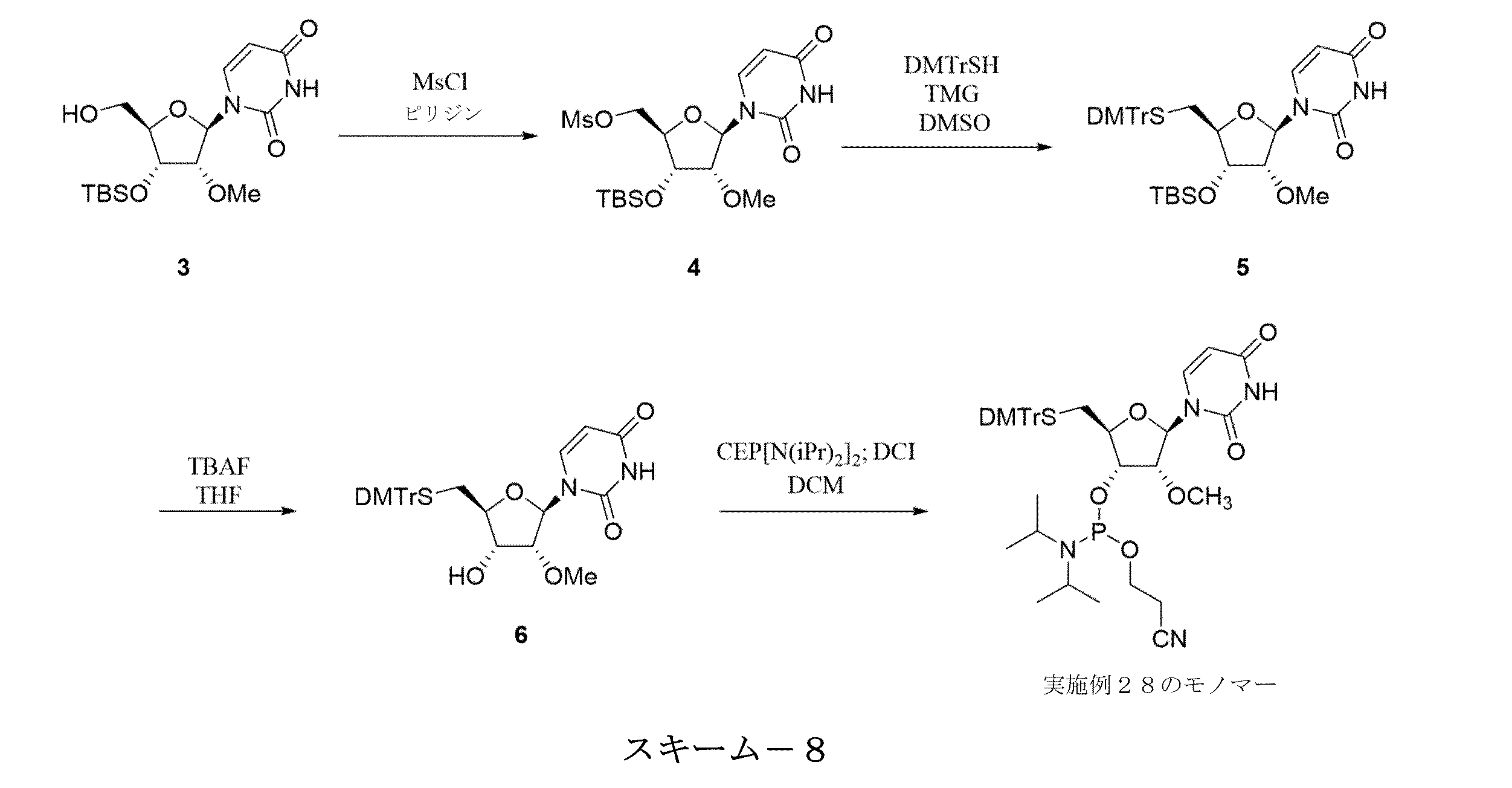
(4)の調製:3(13.1g、35.2mmol、スキーム3)のピリジン(130mL)溶液に、MsCl(4.8g、42.2mmol)を-10~0℃で添加した。反応混合物を、N2雰囲気下、室温で2.5時間撹拌した。TLC(DCM/MeOH=15:1)は、反応が消費されたことを示した。混合物をEAで希釈し、水を添加した。生成物をEAで抽出した。有機層をブラインで洗浄し、Na2SO4上で乾燥させ、濃縮して粗物質を得た。これにより、生成物4(14.2g)を得て、これを次のステップに直接的に使用した。ESI-LCMS:m/z 451[M+H]+ 、 1H-NMR(400MHz,DMSO-d6)δ 11.43(m,1H)、7.67-7.65(m,1H)、5.90-5.80(m,1H)、5.75-5.64(m,1H)、4.52-4.21(m,3H)、4.12-3.90(m,2H)、3.48-3.21(m,6H)、0.95-0.78(s,9H)、0.13-0.03(s,6H)。 Preparation of (4): To a solution of 3 (13.1 g, 35.2 mmol, Scheme 3) in pyridine (130 mL) was added MsCl (4.8 g, 42.2 mmol) at -10 to 0°C. The reaction mixture was stirred at room temperature for 2.5 hours under N2 atmosphere. TLC (DCM/MeOH=15:1) indicated the reaction was consumed. The mixture was diluted with EA and water was added. The product was extracted with EA. The organic layer was washed with brine, dried over Na2SO4 and concentrated to give crude material. This gave product 4 (14.2 g), which was used directly in the next step. ESI-LCMS: m/z 451 [M+H] + , 1 H-NMR (400 MHz, DMSO-d 6 ) δ 11.43 (m, 1H), 7.67-7.65 (m, 1H), 5. 90-5.80 (m, 1H), 5.75-5.64 (m, 1H), 4.52-4.21 (m, 3H), 4.12-3.90 (m, 2H), 3.48-3.21 (m, 6H), 0.95-0.78 (s, 9H), 0.13-0.03 (s, 6H).
(5)の調製:4(14.2g)のDMSO(200mL)溶液に、DMTrSH(19.6g、63.2mmol)およびテトラメチルグアニジン(5.1g、47.4mmol)を室温で添加した。反応混合物を、N2雰囲気下、室温で3.5時間撹拌した。LCMSは、4反応物が消費されたことを示した。混合物をEAで希釈し、水を添加した。生成物をEAで抽出した。有機層をブラインで洗浄し、Na2SO4上で乾燥させ、濃縮して粗物質を得た。粗物質をシリカゲルカラム(SiO2、PE/EA=10:1~1:1)によって精製して、5(14.2g、20.6mmol、2ステップで収率58.5%)を白色固体として得た。ESI-LCMS:m/z 689[M+H]- 、 1H-NMR(400MHz,DMSO-d6)δ 11.39(m,1H)、7.63-7.61(d,J=8.0Hz,1H)、7.45-7.1(m,9H)、6.91-6.81(m,4H)、5.80-5.70(m,2H)、4.01-3.91(m,1H)、3.85-3.78(m,1H)、3.78-3.65(m,6H)、3.60-3.51(m,1H)、3.43-3.2(m,3H)、2.50-2.32(m,2H)、0.95-0.77(s,9H)、-0.00-0.02(s,6H)。 Preparation of (5): To a solution of 4 (14.2 g) in DMSO (200 mL) was added DMTrSH (19.6 g, 63.2 mmol) and tetramethylguanidine (5.1 g, 47.4 mmol) at room temperature. The reaction mixture was stirred at room temperature for 3.5 hours under N2 atmosphere. LCMS indicated 4 reactants were consumed. The mixture was diluted with EA and water was added. The product was extracted with EA. The organic layer was washed with brine, dried over Na2SO4 and concentrated to give crude material. The crude material was purified by silica gel column (SiO 2 , PE/EA=10:1 to 1:1) to give 5 (14.2 g, 20.6 mmol, 58.5% yield over two steps) as a white solid. Obtained. ESI-LCMS: m/z 689 [M+H] − , 1 H-NMR (400 MHz, DMSO-d 6 ) δ 11.39 (m, 1H), 7.63-7.61 (d, J=8.0 Hz , 1H), 7.45-7.1 (m, 9H), 6.91-6.81 (m, 4H), 5.80-5.70 (m, 2H), 4.01-3.91 (m, 1H), 3.85-3.78 (m, 1H), 3.78-3.65 (m, 6H), 3.60-3.51 (m, 1H), 3.43-3 .2 (m, 3H), 2.50-2.32 (m, 2H), 0.95-0.77 (s, 9H), -0.00-0.02 (s, 6H).
(6)の調製:5(14.2g、20.6mmol)のTHF(140mL)溶液に、1M TBAF溶液(20mL)を添加した。反応混合物をN2雰囲気下、室温で2.5時間撹拌した。LCMSは、5が完全に消費されたことを示した。水を添加した。生成物をEAで抽出し、有機層をブラインで洗浄し、Na2SO4上で乾燥させた。次いで、有機層を濃縮して残渣を得て、これを以下の条件(IntelFlash-1):カラム、C18シリカゲル;移動相、CH3CN/H2O(0.5%NH4HCO3)=2/3を20分以内でCH3CN/H2O(0.5%NH4HCO3)=3/2まで増加させつつ、Flash-Prep-HPLCによって精製し、溶出した生成物を、CH3CN/H2O(0.5%NH4HCO3)=1/1、検出器、UV254nmで集めた。これにより、6(10.5g、18.2mmol、88.5%)を白色固体として得た。ESI-LCMS:m/z 576[M+H]+ 、 1H-NMR(400MHz,DMSO-d6)δ 11.38(m,1H)、7.56-7.54(d,J=8.0Hz,1H)、7.45-7.1(m,9H)、6.91-6.81(m,4H)、5.80-5.70(m,2H)、4.05-4.00(m,1H)、3.81-3.79(m,1H)、3.74(m,2H)、3.78-3.65(m,6H)、3.60-3.51(m,1H)、3.43-3.2(m,3H)、2.40-2.32(m,1H)。 Preparation of (6): To a solution of 5 (14.2 g, 20.6 mmol) in THF (140 mL) was added 1M TBAF solution (20 mL). The reaction mixture was stirred at room temperature under N2 atmosphere for 2.5 hours. LCMS showed 5 was completely consumed. Water was added. The product was extracted with EA, the organic layer was washed with brine and dried over Na2SO4 . The organic layer was then concentrated to give a residue, which was subjected to the following conditions (Intel Flash-1): column, C18 silica gel; mobile phase, CH 3 CN/H 2 O (0.5% NH 4 HCO 3 )= Purify by Flash-Prep-HPLC, increasing 2/3 to CH 3 CN/H 2 O (0.5% NH 4 HCO 3 ) = 3/2 within 20 minutes, and the eluted product is purified by CH 3 CN/H 2 O (0.5% NH 4 HCO 3 ) = 1/1, detector, collected at UV 254 nm. This gave 6 (10.5 g, 18.2 mmol, 88.5%) as a white solid. ESI-LCMS: m/z 576 [M+H] + , 1 H-NMR (400 MHz, DMSO-d 6 ) δ 11.38 (m, 1H), 7.56-7.54 (d, J=8.0 Hz , 1H), 7.45-7.1 (m, 9H), 6.91-6.81 (m, 4H), 5.80-5.70 (m, 2H), 4.05-4.00 (m, 1H), 3.81-3.79 (m, 1H), 3.74 (m, 2H), 3.78-3.65 (m, 6H), 3.60-3.51 (m , 1H), 3.43-3.2 (m, 3H), 2.40-2.32 (m, 1H).
実施例28のモノマーの調製:9(10.5g、18.2mmol)のDCM(100mL)懸濁液に、DCI(1.7g、15.5mmol)およびCEP[N(iPr)2]2(7.2g、23.7mmol)を添加した。混合物を室温で1時間撹拌した。LC-MSは、9が完全に消費されたことを示した。溶液を水で2回洗浄し、ブラインで洗浄し、Na2SO4上で乾燥させた。次いで濃縮して残渣を得て、これを以下の条件(IntelFlash-1):カラム、C18シリカゲル;移動相、CH3CN/H2O(0.5%NH4HCO3)=1/1を20分以内でCH3CN/H2O(0.5%NH4HCO3)=1/0まで増加させつつ、Flash-Prep-HPLCによって精製し、溶出した生成物を、CH3CN/H2O(0.5%NH4HCO3)=1/0、検出器、UV254nmで集めた。これにより、実施例28のモノマー(12.5g、16.1mmol、88%)を白色固体として得た。ESI-LCMS:m/z 776[M+H]+ 、 1H-NMR(400MHz,DMSO-d6)δ 11.41(m,1H)、7.64-7.59(m,1H)、7.40-7.25(m,4H)、7.25-7.10(m,5H)、6.89-6.86(m,4H)、5.72-5.67(m,2H)、4.02-4.00(m,2H)、3.76-3.74(m,8H)、3.74-3.73(m,3H)、3.51-3.49(d,J=8Hz,1H)、3.33-3.29(m,1H)、2.77-2.73(m,1H)、2.63-2.60(m,1H)、2.50-2.47(m,1H)、1.12-0.99(m,12H).31P-NMR(162MHz,DMSO-d6):δ 148.92,148.84。 Preparation of monomer for Example 28: To a suspension of 9 (10.5 g, 18.2 mmol) in DCM (100 mL) was added DCI (1.7 g, 15.5 mmol) and CEP[N(iPr) 2 ] 2 (7 .2 g, 23.7 mmol) was added. The mixture was stirred at room temperature for 1 hour. LC-MS indicated complete consumption of 9. The solution was washed twice with water, washed with brine and dried over Na2SO4 . It was then concentrated to give a residue, which was subjected to the following conditions (Intel Flash-1): column, C18 silica gel; mobile phase, CH 3 CN/H 2 O (0.5% NH 4 HCO 3 ) = 1/1. Purified by Flash-Prep-HPLC increasing to CH 3 CN/H 2 O (0.5% NH 4 HCO 3 ) = 1/0 within 20 min, the eluted product was purified by CH 3 CN/H 2 O (0.5% NH 4 HCO 3 ) = 1/0, detector, collected at UV 254 nm. This gave the monomer of Example 28 (12.5 g, 16.1 mmol, 88%) as a white solid. ESI-LCMS: m/z 776 [M+H] + , 1 H-NMR (400 MHz, DMSO-d 6 ) δ 11.41 (m, 1H), 7.64-7.59 (m, 1H), 7. 40-7.25 (m, 4H), 7.25-7.10 (m, 5H), 6.89-6.86 (m, 4H), 5.72-5.67 (m, 2H), 4.02-4.00 (m, 2H), 3.76-3.74 (m, 8H), 3.74-3.73 (m, 3H), 3.51-3.49 (d, J = 8Hz, 1H), 3.33-3.29 (m, 1H), 2.77-2.73 (m, 1H), 2.63-2.60 (m, 1H), 2.50-2 .47 (m, 1H), 1.12-0.99 (m, 12H). 31 P-NMR (162 MHz, DMSO-d 6 ): δ 148.92, 148.84.
[実施例29:モノマーの合成]

(7)の調製:6(16g、24.1mmol、スキーム4)のACN(160mL)溶液に、DMAP(5.9g、48.2mmol)およびTEA(4.8g、48.2mmol)を添加し、次いでTPSCl(10.9g、36.1mmol)をN2雰囲気下、0℃で添加し、混合物を室温で5時間、N2雰囲気下で撹拌した。次いで、濃NH3.H2O(30mL)を室温で添加し、混合物を室温で16時間撹拌した。反応物を水でクエンチし、生成物をEA(200mL)で抽出した。有機相を濃縮して、粗物質7(16.0g)を白色固体として得て、これを次のステップに直接的に使用した。 Preparation of (7): To a solution of 6 (16 g, 24.1 mmol, Scheme 4) in ACN (160 mL) was added DMAP (5.9 g, 48.2 mmol) and TEA (4.8 g, 48.2 mmol), TPSCl (10.9 g, 36.1 mmol) was then added at 0° C. under N 2 atmosphere and the mixture was stirred at room temperature for 5 h under N 2 atmosphere. Then concentrated NH 3 . H 2 O (30 mL) was added at room temperature and the mixture was stirred at room temperature for 16 hours. The reaction was quenched with water and the product was extracted with EA (200 mL). The organic phase was concentrated to give crude 7 (16.0 g) as a white solid, which was used directly in the next step.
(8)の調製:7(16.0g、24.1mmol)の撹拌ピリジン(160mL)溶液に、BzCl(4.1g、28.9mmol)をN2雰囲気下、0℃で添加した。反応混合物を室温で2.5時間撹拌した。氷浴で冷却しつつ、反応物を水でクエンチし、生成物をEA(200mL)で抽出した。有機相を減圧下で乾燥するまで蒸発させ、残渣を得て、これを以下の条件(IntelFlash-1):カラム、C18シリカゲル;移動相、CH3CN/H2O(0.5%NH4HCO3)=1/1を20分以内でCH3CN/H2O(0.5%NH4HCO3)=1/0まで増加させつつ、Flash-Prep-HPLCによって精製し、溶出した生成物を、CH3CN/H2O(0.5%NH4HCO3)=1/0、検出器、UV254nmで集めた。これにより、8(18.0g、23.4mmol、97.0%)を白色固体として得た。ESI-LCMS:m/z 768[M+H]+ 、 1H-NMR(400MHz,DMSO-d6):δ 11.31(s,1H)、8.47(d,J=7.2Hz,1H)、7.99(d,J=7.6Hz,2H)、7.65-7.16(m,13H)、6.92(d,J=8.8Hz,4H)、6.01(d,J=18.4Hz,1H)、5.18-5.04(dd,1H)、4.58-4.52(m,1H)、4.07(d,J=9.6Hz,1H)、3.75(s,6H)、0.73(s,9H)、0.05(s,3H)、-0.06(s,3H)。 Preparation of (8): To a stirring solution of 7 (16.0 g, 24.1 mmol) in pyridine (160 mL) was added BzCl (4.1 g, 28.9 mmol) at 0° C. under N2 atmosphere. The reaction mixture was stirred at room temperature for 2.5 hours. With ice bath cooling, the reaction was quenched with water and the product was extracted with EA (200 mL). The organic phase was evaporated to dryness under reduced pressure to give a residue which was subjected to the following conditions (Intel Flash-1): column, C18 silica gel; mobile phase, CH 3 CN/H 2 O (0.5% NH 4 ). The product was purified and eluted by Flash-Prep-HPLC with increasing CH 3 CN/H 2 O (0.5% NH 4 HCO 3 ) = 1/0 within 20 min. Material was collected in CH3CN / H2O (0.5% NH4HCO3 ) = 1/0, detector, UV 254 nm. This gave 8 (18.0 g, 23.4 mmol, 97.0%) as a white solid. ESI-LCMS: m/z 768 [M+H] + , 1 H-NMR (400 MHz, DMSO-d 6 ): δ 11.31 (s, 1H), 8.47 (d, J=7.2Hz, 1H) , 7.99 (d, J = 7.6 Hz, 2H), 7.65-7.16 (m, 13H), 6.92 (d, J = 8.8 Hz, 4H), 6.01 (d, J = 18.4Hz, 1H), 5.18-5.04 (dd, 1H), 4.58-4.52 (m, 1H), 4.07 (d, J = 9.6Hz, 1H), 3.75 (s, 6H), 0.73 (s, 9H), 0.05 (s, 3H), -0.06 (s, 3H).
(9)の調製:8(18.0g、23.4mmol)のTHF(180mL)溶液に、1M TBAF溶液(23mL)を添加した。反応混合物を室温で1.5時間撹拌した。LC-MSは、8が完全に消費されたことを示した。水(500mL)を添加した。生成物をEA(300mL)で抽出し、有機層をブラインで洗浄し、Na2SO4上で乾燥させた。次いで、有機層を濃縮して残渣を得て、これを以下の条件(IntelFlash-1):カラム、C18シリカゲル;移動相、CH3CN/H2O(0.5%NH4HCO3)=2/3を20分以内でCH3CN/H2O(0.5%NH4HCO3)=3/2まで増加させつつ、Flash-Prep-HPLCによって精製し、溶出した生成物を、CH3CN/H2O(0.5%NH4HCO3)=1/1、検出器、UV254nmで集めた。これにより、7(13.7g、21.1mmol、90.5%)を白色固体として得た。ESI-LCMS:m/z 654.2[M+H]+、1H-NMR(400MHz,DMSO-d6):δ 11.31(s,1H)、8.35(d,J=7.4Hz,1H)、8.01(m,2H)、7.65-7.16(m,13H)、6.92(d,J=8.8Hz,4H)、5.94(d,J=18.0Hz,1H)、5.71(d,J=7.0Hz,1H)、5.12-4.98(dd,1H)、4.51-4.36(m,1H)、4.09(d,J=9.6Hz,1H)、3.75(s,6H)。 Preparation of (9): To a solution of 8 (18.0 g, 23.4 mmol) in THF (180 mL) was added 1M TBAF solution (23 mL). The reaction mixture was stirred at room temperature for 1.5 hours. LC-MS indicated complete consumption of 8. Water (500 mL) was added. The product was extracted with EA (300 mL) and the organic layer was washed with brine and dried over Na2SO4 . The organic layer was then concentrated to give a residue, which was subjected to the following conditions (Intel Flash-1): column, C18 silica gel; mobile phase, CH 3 CN/H 2 O (0.5% NH 4 HCO 3 )= Purify by Flash-Prep-HPLC, increasing 2/3 to CH 3 CN/H 2 O (0.5% NH 4 HCO 3 ) = 3/2 within 20 minutes, and the eluted product is purified by CH 3 CN/H 2 O (0.5% NH 4 HCO 3 ) = 1/1, detector, collected at UV 254 nm. This gave 7 (13.7 g, 21.1 mmol, 90.5%) as a white solid. ESI-LCMS: m/z 654.2 [M+H] + , 1 H-NMR (400 MHz, DMSO-d 6 ): δ 11.31 (s, 1H), 8.35 (d, J=7.4 Hz, 1H), 8.01 (m, 2H), 7.65-7.16 (m, 13H), 6.92 (d, J=8.8Hz, 4H), 5.94 (d, J=18. 0Hz, 1H), 5.71 (d, J = 7.0Hz, 1H), 5.12-4.98 (dd, 1H), 4.51-4.36 (m, 1H), 4.09 ( d, J=9.6 Hz, 1 H), 3.75 (s, 6 H).
実施例29のモノマーの調製:9(10.6g、16.2mmol)のDCM(100mL)懸濁液に、DCI(1.6g、13.7mmol)およびCEP[N(iPr)2]2(5.8g、19.4mmol)を添加した。混合物を室温で1時間撹拌した。LC-MSは、9が完全に消費されたことを示した。溶液を水で2回洗浄し、ブラインで洗浄し、Na2SO4上で乾燥させた。次いで濃縮して残渣を得て、これを以下の条件(IntelFlash-1):カラム、C18シリカゲル;移動相、CH3CN/H2O(0.5%NH4HCO3)=1/1を20分以内でCH3CN/H2O(0.5%NH4HCO3)=1/0まで増加させつつ、Flash-Prep-HPLCによって精製し、溶出した生成物を、CH3CN/H2O(0.5%NH4HCO3)=1/0、検出器、UV254nmで集めた。これにより、実施例29のモノマー(10.5g、14.5mmol、75.9%)を白色固体として得た。ESI-LCMS:m/z 854.3[M+H]+、1H-NMR(400MHz,DMSO-d6):δ 11.31(s,1H)、8.41-8.37(m,1H)、8.01(d,J=7.7Hz,2H)、7.65-7.16(m,13H)、6.92-6.88(m,4H)、6.06-5.98(m,1H)、5.33-5.15(m,1H)、4.78-4.58(m,1H)、4.23-4.19(m,1H)、3.81-3.73(m,6H)、3.60-3.50(m,3H)、3.32(s,1H)、2.76(t,J=6.0Hz,1H)、2.60(t,J=5.8Hz,1H)、1.15-0.94(m,12H)、31P-NMR(162MHz,DMSO-d6):δ 150.23,150.18,149.43,149.38。 Preparation of the monomer for Example 29: To a suspension of 9 (10.6 g, 16.2 mmol) in DCM (100 mL) was added DCI (1.6 g, 13.7 mmol) and CEP[N(iPr) 2 ] 2 (5 .8 g, 19.4 mmol) was added. The mixture was stirred at room temperature for 1 hour. LC-MS indicated complete consumption of 9. The solution was washed twice with water, washed with brine and dried over Na2SO4 . It was then concentrated to give a residue, which was subjected to the following conditions (Intel Flash-1): column, C18 silica gel; mobile phase, CH 3 CN/H 2 O (0.5% NH 4 HCO 3 ) = 1/1. Purified by Flash-Prep-HPLC increasing to CH 3 CN/H 2 O (0.5% NH 4 HCO 3 ) = 1/0 within 20 min, the eluted product was purified by CH 3 CN/H 2 O (0.5% NH 4 HCO 3 ) = 1/0, detector, collected at UV 254 nm. This gave the monomer of Example 29 (10.5 g, 14.5 mmol, 75.9%) as a white solid. ESI-LCMS: m/z 854.3 [M+H] + , 1 H-NMR (400 MHz, DMSO-d 6 ): δ 11.31 (s, 1H), 8.41-8.37 (m, 1H) , 8.01 (d, J = 7.7 Hz, 2H), 7.65-7.16 (m, 13H), 6.92-6.88 (m, 4H), 6.06-5.98 ( m, 1H), 5.33-5.15 (m, 1H), 4.78-4.58 (m, 1H), 4.23-4.19 (m, 1H), 3.81-3. 73 (m, 6H), 3.60-3.50 (m, 3H), 3.32 (s, 1H), 2.76 (t, J = 6.0Hz, 1H), 2.60 (t, J=5.8 Hz, 1 H), 1.15-0.94 (m, 12 H), 31 P-NMR (162 MHz, DMSO-d 6 ): δ 150.23, 150.18, 149.43, 149. 38.
[実施例30:モノマーの合成]

(9)の調製:8(18.8g、26.4mmol、スキーム5)のACN(200mL)溶液に、TPSCl(16.8g、55.3mmol)およびDMAP(5.6g、55.3mmol)およびTEA(6.8g、55.3mmol)を添加した。反応混合物を室温で3.5時間撹拌した。LCMSは、反応物が消費されたことを示した。混合物を、濃NH4OH(28mL)で希釈した。混合物を水およびEAで希釈した。生成物をEAで抽出した。有機層をブラインで洗浄し、Na2SO4上で乾燥させ、濃縮して、粗物質9(18.5g)を得て、これを次のステップに直接的に使用した。 Preparation of (9): To a solution of 8 (18.8 g, 26.4 mmol, Scheme 5) in ACN (200 mL) was added TPSCl (16.8 g, 55.3 mmol) and DMAP (5.6 g, 55.3 mmol) and TEA. (6.8 g, 55.3 mmol) was added. The reaction mixture was stirred at room temperature for 3.5 hours. LCMS indicated the reaction was consumed. The mixture was diluted with concentrated NH 4 OH (28 mL). The mixture was diluted with water and EA. The product was extracted with EA. The organic layer was washed with brine, dried over Na 2 SO 4 and concentrated to give crude material 9 (18.5 g), which was used directly in the next step.
(10)の調製:9(18.8g、27.69mmol)のピリジン(200mL)溶液に、BzCl(5.8g、41.5mmol)を氷浴下で添加した。反応混合物を室温で2.5時間撹拌した。LCMSは、9が消費されたことを示した。混合物をEAで希釈し、水を添加した。生成物をEAで抽出した。粗物質を、以下の条件(IntelFlash-1):カラム、C18シリカゲル;移動相、CH3CN/H2O(0.5%NH4HCO3)=1/1を25分以内でCH3CN/H2O(0.5%NH4HCO3)=1/0まで増加させつつ、Flash-Prep-HPLCによって精製し、溶出した生成物を、CH3CN/H2O(0.5%NH4HCO3)=1/0、検出器、UV254nmで集めた。これにより、10(19.8g、25.3mmol、収率91%)を白色固体として得た。ESI-LCMS:m/z 783[M-H]-、1H-NMR(400MHz,DMSO-d6):δ 11.29(d,J=2.0Hz,1H)、8.42(d,J=8.0Hz,1H)、8.02-8.00(m,2H)、7.64-7.62(m,1H)、7.60-7.41(m,2H)、7.47.41-7.19(m,9H)、6.94-6.85(m,4H)、5.81(d,J=4.0Hz,1H)、5.33-5.26(m,1H)、5.21(d,J=7.2Hz,1H)、4.06-3.90(m,2H)、3.83-3.77(m,1H)、3.74(s,6H)。 Preparation of (10): To a solution of 9 (18.8 g, 27.69 mmol) in pyridine (200 mL) was added BzCl (5.8 g, 41.5 mmol) under ice bath. The reaction mixture was stirred at room temperature for 2.5 hours. LCMS indicated that 9 was consumed. The mixture was diluted with EA and water was added. The product was extracted with EA. The crude material was purified under the following conditions (Intel Flash-1): column, C18 silica gel; mobile phase, CH 3 CN/H 2 O (0.5% NH 4 HCO 3 )=1/1 to CH 3 CN within 25 minutes Purified by Flash-Prep-HPLC increasing to H 2 O (0.5% NH 4 HCO 3 ) = 1/0 and the eluted product was purified by CH 3 CN/H 2 O (0.5% NH4HCO3 ) = 1/0, detector, collected at UV 254 nm. This gave 10 (19.8 g, 25.3 mmol, 91% yield) as a white solid. ESI-LCMS: m/z 783 [MH] − , 1 H-NMR (400 MHz, DMSO-d 6 ): δ 11.29 (d, J=2.0 Hz, 1H), 8.42 (d, J=8.0 Hz, 1H), 8.02-8.00 (m, 2H), 7.64-7.62 (m, 1H), 7.60-7.41 (m, 2H), 7. 47.41-7.19 (m, 9H), 6.94-6.85 (m, 4H), 5.81 (d, J = 4.0Hz, 1H), 5.33-5.26 (m , 1H), 5.21 (d, J = 7.2 Hz, 1H), 4.06-3.90 (m, 2H), 3.83-3.77 (m, 1H), 3.74 (s , 6H).
(11)の調製:10(18.8g、26.4mmol)のTHF(190mL)溶液に、1M TBAF溶液(28mL)を添加した。反応混合物を室温で1.5時間撹拌した。LCMSは、10が完全に消費されたことを示した。水(200mL)を添加した。生成物をEA(200mL)で抽出し、有機層をブラインで洗浄し、Na2SO4上で乾燥させた。次いで、有機層を濃縮して残渣を得て、これを以下の条件(IntelFlash-1):カラム、C18シリカゲル;移動相、CH3CN/H2O(0.5%NH4HCO3)=2/3を20分以内でCH3CN/H2O(0.5%NH4HCO3)=3/2まで増加させつつ、Flash-Prep-HPLCによって精製し、溶出した生成物を、CH3CN/H2O(0.5%NH4HCO3)=1/1、検出器、UV254nmで集めた。これにより、11(17.1g、25.6mmol、96%)を白色固体として得た。ESI-LCMS:m/z 669[M-H]-、1H-NMR(400MHz,DMSO-d6):δ 11.29(d,J=2.0Hz,1H)、8.42(d,J=8.0Hz,1H)、8.02-8.00(m,2H)、7.64-7.62(m,1H)、7.60-7.41(m,2H)、7.47.41-7.19(m,9H)、6.94-6.85(m,4H)、5.81(d,J=4.0Hz,1H)、5.33-5.26(m,1H)、5.21(d,J=7.2Hz,1H)、4.06-3.90(m,2H)、3.83-3.77(m,1H)、3.74(s,6H)。 Preparation of (11): To a solution of 10 (18.8 g, 26.4 mmol) in THF (190 mL) was added 1 M TBAF solution (28 mL). The reaction mixture was stirred at room temperature for 1.5 hours. LCMS showed 10 was completely consumed. Water (200 mL) was added. The product was extracted with EA (200 mL) and the organic layer was washed with brine and dried over Na2SO4 . The organic layer was then concentrated to give a residue, which was subjected to the following conditions (Intel Flash-1): column, C18 silica gel; mobile phase, CH 3 CN/H 2 O (0.5% NH 4 HCO 3 )= Purify by Flash-Prep-HPLC, increasing 2/3 to CH 3 CN/H 2 O (0.5% NH 4 HCO 3 ) = 3/2 within 20 minutes, and the eluted product is purified by CH 3 CN/H 2 O (0.5% NH 4 HCO 3 ) = 1/1, detector, collected at UV 254 nm. This gave 11 (17.1 g, 25.6 mmol, 96%) as a white solid. ESI-LCMS: m/z 669 [MH] − , 1 H-NMR (400 MHz, DMSO-d 6 ): δ 11.29 (d, J=2.0 Hz, 1H), 8.42 (d, J=8.0 Hz, 1H), 8.02-8.00 (m, 2H), 7.64-7.62 (m, 1H), 7.60-7.41 (m, 2H), 7. 47.41-7.19 (m, 9H), 6.94-6.85 (m, 4H), 5.81 (d, J = 4.0Hz, 1H), 5.33-5.26 (m , 1H), 5.21 (d, J = 7.2 Hz, 1H), 4.06-3.90 (m, 2H), 3.83-3.77 (m, 1H), 3.74 (s , 6H).
実施例30のモノマーの調製:11(10.8g、16.2mmol)のDCM(100mL)懸濁液に、DCI(1.5g、13.7mmol)およびCEP[N(iPr)2]2(5.8g、19.3mmol)を添加した。混合物を室温で2時間撹拌した。LC-MSは、11が完全に消費されたことを示した。溶液を水で2回洗浄し、ブラインで洗浄し、Na2SO4上で乾燥させた。次いで濃縮して残渣を得て、これを以下の条件(IntelFlash-1):カラム、C18シリカゲル;移動相、CH3CN/H2O(0.5%NH4HCO3)=1/1を20分以内でCH3CN/H2O(0.5%NH4HCO3)=1/0まで増加させつつ、Flash-Prep-HPLCによって精製し、溶出した生成物を、CH3CN/H2O(0.5%NH4HCO3)=1/0、検出器、UV254nmで集めた。これにより、実施例30のモノマー(11.3g、13mmol、80%)を白色固体として得た。ESI-LCMS:m/z 868[M+H]+、1H-NMR(400MHz,DMSO-d6):δ 11.03(m,1H)、8.51-8.48(m,1H)、8.08-7.95(m,2H)、7.63-7.54(m,1H)、7.52-7.19(m,9H)、7.16-7.07(m,1H)、6.94-6.89(m,3H)、5.95-5.87(m,1H)、5.31-5.17(m,1H)、4.61-4.37(m,1H)、4.20-4.07(m,1H)、3.82-3.47(m,10H)、2.74-2.59(m,1H)、2.57-2.43(m,1H)、1.27-1.10(m,9H)、1.09-0.95(m,3H).31P-NMR(162MHz,DMSO-d6):δ 149.52,148.81。 Preparation of monomer for Example 30: To a suspension of 11 (10.8 g, 16.2 mmol) in DCM (100 mL) was added DCI (1.5 g, 13.7 mmol) and CEP[N(iPr) 2 ] 2 (5 .8 g, 19.3 mmol) was added. The mixture was stirred at room temperature for 2 hours. LC-MS indicated complete consumption of 11. The solution was washed twice with water, washed with brine and dried over Na2SO4 . It was then concentrated to give a residue, which was subjected to the following conditions (Intel Flash-1): column, C18 silica gel; mobile phase, CH 3 CN/H 2 O (0.5% NH 4 HCO 3 ) = 1/1. Purified by Flash-Prep-HPLC increasing to CH 3 CN/H 2 O (0.5% NH 4 HCO 3 ) = 1/0 within 20 min, the eluted product was purified by CH 3 CN/H 2 O (0.5% NH 4 HCO 3 ) = 1/0, detector, collected at UV 254 nm. This gave the monomer of Example 30 (11.3 g, 13 mmol, 80%) as a white solid. ESI-LCMS: m/z 868 [M+H] + , 1 H-NMR (400 MHz, DMSO-d 6 ): δ 11.03 (m, 1H), 8.51-8.48 (m, 1H), 8 .08-7.95 (m, 2H), 7.63-7.54 (m, 1H), 7.52-7.19 (m, 9H), 7.16-7.07 (m, 1H) , 6.94-6.89 (m, 3H), 5.95-5.87 (m, 1H), 5.31-5.17 (m, 1H), 4.61-4.37 (m, 1H), 4.20-4.07 (m, 1H), 3.82-3.47 (m, 10H), 2.74-2.59 (m, 1H), 2.57-2.43 ( m, 1H), 1.27-1.10 (m, 9H), 1.09-0.95 (m, 3H). 31 P-NMR (162 MHz, DMSO-d 6 ): δ 149.52, 148.81.
[実施例31:モノマーの合成]

(2)の調製:1(100.0g、406.5mmol)の撹拌ピリジン(1000mL)溶液に、DMTrCl(151.2g、447.1mmol)を室温で添加した。反応混合物を室温で2.5時間撹拌した。氷浴で冷却しつつ、反応物を水でクエンチし、生成物をEA(3000mL)で抽出した。有機相を減圧下で乾燥するまで蒸発させて、残渣を得て、これをシリカゲルカラムクロマトグラフィー(SiO2、ジクロロメタン:メタノール=100:1)によって精製して、2(210.0g、90%)を白色固体として得た。ESI-LCMS:m/z 548.2[M+H]+、1H-NMR(400MHz,DMSO-d6):δ 11.43(d,J=1.8Hz,1H)、7.77(d,J=8.0Hz,1H)、7.40-7.21(m,9H)、6.92-6.88(m,4H)、5.89(d,J=20.0Hz,1H)、5.31-5.29(m,1H)、5.19-5.04(dd,1H)、4.38-4.31(m,1H)、4.02-3.98(m,1H)、3.74(s,6H)、3.30(d,J=3.2Hz,2H)、19F-NMR(376MHz,DMSO-d6):δ-199.51。 Preparation of (2): To a stirred solution of 1 (100.0 g, 406.5 mmol) in pyridine (1000 mL) was added DMTrCl (151.2 g, 447.1 mmol) at room temperature. The reaction mixture was stirred at room temperature for 2.5 hours. With ice bath cooling, the reaction was quenched with water and the product was extracted with EA (3000 mL). The organic phase was evaporated to dryness under reduced pressure to give a residue, which was purified by silica gel column chromatography (SiO 2 , dichloromethane:methanol=100:1) to give 2 (210.0 g, 90%). was obtained as a white solid. ESI-LCMS: m/z 548.2 [M+H] + , 1 H-NMR (400 MHz, DMSO-d 6 ): δ 11.43 (d, J=1.8 Hz, 1H), 7.77 (d, J = 8.0Hz, 1H), 7.40-7.21 (m, 9H), 6.92-6.88 (m, 4H), 5.89 (d, J = 20.0Hz, 1H), 5.31-5.29 (m, 1H), 5.19-5.04 (dd, 1H), 4.38-4.31 (m, 1H), 4.02-3.98 (m, 1H) ), 3.74 (s, 6H), 3.30 (d, J=3.2 Hz, 2H), 19 F-NMR (376 MHz, DMSO-d 6 ): δ -199.51.
(3)の調製:2(100.0g、182.8mmol)の撹拌ピリジン(1000mL)溶液に、MsCl(31.2g、274.2mmol)をN2雰囲気下、0℃で添加した。反応混合物を室温で2.5時間撹拌した。氷浴で冷却しつつ、反応物を水でクエンチし、生成物をEA(200mL)で抽出した。有機相を減圧下で乾燥するまで蒸発させて、粗物質(114.0g)を白色固体として得て、これを次のステップに直接的に使用した。粗物質(114.0g、187.8mmol)のDMF(2000mL)溶液に、K2CO3(71.5g、548.4mmol)を添加し、反応混合物をN2雰囲気下、90℃で15時間撹拌した。水の添加後、得られた混合物を、EA(500mL)で抽出した。合わせた有機層を水およびブラインで洗浄し、Na2SO4上で乾燥させ、濃縮して残渣を得て、これをシリカゲルカラムクロマトグラフィー(SiO2、ジクロロメタン:メタノール=30:1)によって精製して、3(100.0g、90%)を白色固体として得た。ESI-LCMS:m/z 531.2[M+H]+、1H-NMR(400MHz,DMSO-d6):δ 7.79(d,J=8.0Hz,1H)、7.40-7.21(m,9H)、6.89-6.83(m,4H)、6.14(d,J=5.4Hz,1H)、6.02-5.90(dd,1H)、5.87(d,J=20.0Hz,1H)、5.45(m,1H)、4.61(m,1H)、3.73(d,J=1.9Hz,6H)、3.30-3.15(m,2H)、1.24-1.16(m,1H)、19F-NMR(376MHz,DMSO-d6):δ-204.23。 Preparation of (3): To a stirring solution of 2 (100.0 g, 182.8 mmol) in pyridine (1000 mL) was added MsCl (31.2 g, 274.2 mmol) at 0° C. under N 2 atmosphere. The reaction mixture was stirred at room temperature for 2.5 hours. With ice bath cooling, the reaction was quenched with water and the product was extracted with EA (200 mL). The organic phase was evaporated to dryness under reduced pressure to give crude material (114.0 g) as a white solid, which was used directly in the next step. To a solution of the crude material (114.0 g, 187.8 mmol) in DMF (2000 mL) was added K2CO3 (71.5 g, 548.4 mmol) and the reaction mixture was stirred at 90°C under N2 atmosphere for 15 h . bottom. After adding water, the resulting mixture was extracted with EA (500 mL). The combined organic layers were washed with water and brine, dried over Na 2 SO 4 and concentrated to give a residue, which was purified by silica gel column chromatography (SiO 2 , dichloromethane:methanol=30:1). gave 3 (100.0 g, 90%) as a white solid. ESI-LCMS: m/z 531.2 [M+H] + , 1 H-NMR (400 MHz, DMSO-d 6 ): δ 7.79 (d, J=8.0 Hz, 1 H), 7.40-7. 21 (m, 9H), 6.89-6.83 (m, 4H), 6.14 (d, J=5.4Hz, 1H), 6.02-5.90 (dd, 1H), 5. 87 (d, J = 20.0Hz, 1H), 5.45 (m, 1H), 4.61 (m, 1H), 3.73 (d, J = 1.9Hz, 6H), 3.30- 3.15 (m, 2H), 1.24-1.16 (m, 1H), 19 F-NMR (376 MHz, DMSO-d 6 ): δ -204.23.
(4)の調製:3(100g、187.8mmol)のTHF(1000mL)溶液に、6NのNaOH(34mL、206.5mmol)を添加した。混合物を室温で6時間撹拌した。反応完了後、得られた混合物にH2Oを加え、次いで混合物をEAで抽出し、有機層をブラインで洗浄し、硫酸ナトリウム上で乾燥させ、除去して残渣を得て、これをシリカゲルカラムクロマトグラフィー(SiO2、ジクロロメタン:メタノール=30:1)によって精製し、4(90.4g、90%)を白色固体として得た。ESI-LCMS:m/z 548.2[M+H]+、19F-NMR(376MHz,DMSO-d6):δ-184.58。 Preparation of (4): To a solution of 3 (100 g, 187.8 mmol) in THF (1000 mL) was added 6N NaOH (34 mL, 206.5 mmol). The mixture was stirred at room temperature for 6 hours. After completion of the reaction, H 2 O was added to the resulting mixture, then the mixture was extracted with EA, the organic layer was washed with brine, dried over sodium sulfate and removed to obtain a residue, which was purified on a silica gel column. Purification by chromatography (SiO 2 , dichloromethane:methanol=30:1) gave 4 (90.4 g, 90%) as a white solid. ESI-LCMS: m/z 548.2 [M+H] + , 19 F-NMR (376 MHz, DMSO-d 6 ): δ-184.58.
(5)の調製:4(90.4g、165.2mmol)の撹拌ピリジン(1000mL)溶液に、MsCl(61.5g、495.6mmol)をN2雰囲気下、0℃で添加した。反応混合物を室温で16時間撹拌した。氷浴で冷却しつつ、反応物を水でクエンチし、生成物をEAで抽出し、有機層をブラインで洗浄し、硫酸ナトリウム上で乾燥させ、除去して残渣を得て、これをシリカゲルカラムクロマトグラフィー(SiO2、PE:EA=1:1)によって精製し、5(75.0g、90%)を白色固体として得た。ESI-LCMS:m/z 626.2[M+H]+、1H-NMR(400MHz,DMSO-d6):δ 11.51(d,J=1.6Hz,1H)、7.43-7.23(m,10H)、6.92-6.88(m,4H)、6.08(d,J=20.0Hz,1H)、5.55-5.39(m,2H)、4.59(m,1H)、3.74(s,6H)、3.48-3.28(m,2H)、3.17(s,3H)、19F-NMR(376MHz,DMSO-d6):δ-187.72。 Preparation of (5): To a stirring solution of 4 (90.4 g, 165.2 mmol) in pyridine (1000 mL) was added MsCl (61.5 g, 495.6 mmol) at 0 °C under N2 atmosphere. The reaction mixture was stirred at room temperature for 16 hours. With ice bath cooling, the reaction was quenched with water, the product was extracted with EA, the organic layer was washed with brine, dried over sodium sulfate and stripped to give a residue, which was applied to a silica gel column. Purification by chromatography (SiO 2 , PE:EA=1:1) gave 5 (75.0 g, 90%) as a white solid. ESI-LCMS: m/z 626.2 [M+H] + , 1 H-NMR (400 MHz, DMSO-d 6 ): δ 11.51 (d, J=1.6 Hz, 1 H), 7.43-7. 23 (m, 10H), 6.92-6.88 (m, 4H), 6.08 (d, J=20.0Hz, 1H), 5.55-5.39 (m, 2H), 4. 59 (m, 1H), 3.74 (s, 6H), 3.48-3.28 (m, 2H), 3.17 (s, 3H), 19 F-NMR (376 MHz, DMSO-d 6 ) : δ-187.72.
(6)の調製:5(75.0g、120.4mmol)のDMF(1500mL)溶液に、KSAc(71.5g、548.4mmol)をN2雰囲気下、110℃で添加した。反応混合物を110℃で3時間撹拌した後、KSAc(71.5g、548.4mmol)をN2雰囲気下で添加した。反応混合物を、室温で16時間撹拌した。水の添加後、得られた混合物を、EAで抽出した。合わせた有機層を水およびブラインで洗浄し、Na2SO4上で乾燥させ、濃縮して残渣を得て、これをシリカゲルカラムクロマトグラフィー(SiO2、PE:EA=1:1)によって精製し、6(29.0g、90%)を白色固体として得た。ESI-LCMS:m/z 605.2[M+H]+ 、 1H-NMR(400MHz,DMSO-d6):δ 11.45(d,J=1.9Hz,1H)、7.95(d,J=8.0Hz,1H)、7.38-7.21(m,9H)、6.92-6.87(m,4H)、5.93(m,1H)、5.50-5.36(dd,1H)、5.25-5.23(dd,1H)、4.54-4.42(m,1H)、4.17-4.12(m,1H)、3.74(m,7H)、3.35-3.22(m,2H)、2.39(s,1H)、19F-NMR(376MHz,DMSO-d6):δ-181.97。 Preparation of (6): To a solution of 5 (75.0 g, 120.4 mmol) in DMF (1500 mL) was added KSAc (71.5 g, 548.4 mmol) at 110° C. under N2 atmosphere. After the reaction mixture was stirred at 110° C. for 3 hours, KSAc (71.5 g, 548.4 mmol) was added under N 2 atmosphere. The reaction mixture was stirred at room temperature for 16 hours. After adding water, the resulting mixture was extracted with EA. The combined organic layers were washed with water and brine, dried over Na 2 SO 4 and concentrated to give a residue, which was purified by silica gel column chromatography (SiO 2 , PE:EA=1:1). , 6 (29.0 g, 90%) as a white solid. ESI-LCMS: m/z 605.2 [M+H] + , 1 H-NMR (400 MHz, DMSO-d 6 ): δ 11.45 (d, J=1.9 Hz, 1H), 7.95 (d, J=8.0 Hz, 1H), 7.38-7.21 (m, 9H), 6.92-6.87 (m, 4H), 5.93 (m, 1H), 5.50-5. 36 (dd, 1H), 5.25-5.23 (dd, 1H), 4.54-4.42 (m, 1H), 4.17-4.12 (m, 1H), 3.74 ( m, 7H), 3.35-3.22 (m, 2H), 2.39 (s, 1H), 19 F-NMR (376 MHz, DMSO-d 6 ): δ -181.97.
(7)の調製:THF/MeOH(1:1、200mL)の混合溶媒中の6(22g、36.3mmol)の溶液に、1N NaOMe(70mL、72.6mmol)を添加し、20℃で4時間撹拌した。反応完了後、得られた混合物にH2Oを添加し、次いで混合物をEAで抽出し、有機層をブラインで洗浄し、硫酸ナトリウム上で乾燥させ、除去して残渣を得て、これを以下の条件(IntelFlash-1):カラム、C18シリカゲル;移動相、CH3CN/H2O(0.5%NH4HCO3)=2/3を25分以内でCH3CN/H2O(0.5%NH4HCO3)=3/2まで増加させつつ、Flash-Prep-HPLCによって精製し、溶出した生成物を、CH3CN/H2O(0.5%NH4HCO3)=4/3、検出器、UV254nmで集めた。これにより、7(10.5g、14.5mmol、75.9%)を白色固体として得た。ESI-LCMS:m/z 565.1[M+H]+ 、 1H-NMR(400MHz,DMSO-d6):δ 11.45(s,1H)、7.83(d,J=8.0Hz,1H)、7.40-7.23(m,9H)、6.90(d,J=8.8Hz,4H)、5.88(m,1H)、5.29-5.15(m,2H)、3.72(m,7H)、3.43(m,2H)、2.78(d,J=10.6Hz,1H)。 Preparation of (7): To a solution of 6 (22 g, 36.3 mmol) in a mixed solvent of THF/MeOH (1:1, 200 mL) was added 1N NaOMe (70 mL, 72.6 mmol) and 4 Stirred for an hour. After completion of the reaction, H 2 O was added to the resulting mixture, then the mixture was extracted with EA, the organic layer was washed with brine, dried over sodium sulfate and removed to give a residue, which is described below. conditions (Intel Flash-1): column, C18 silica gel; mobile phase, CH 3 CN/H 2 O (0.5% NH 4 HCO 3 ) = 2/3 to CH 3 CN/H 2 O ( Purified by Flash-Prep-HPLC increasing to 0.5% NH 4 HCO 3 ) = 3/2 and the eluted product was treated with CH 3 CN/H 2 O (0.5% NH 4 HCO 3 ). = 4/3, detector, collected at UV 254 nm. This gave 7 (10.5 g, 14.5 mmol, 75.9%) as a white solid. ESI-LCMS: m/z 565.1 [M+H] + , 1 H-NMR (400 MHz, DMSO-d 6 ): δ 11.45 (s, 1H), 7.83 (d, J=8.0 Hz, 1H), 7.40-7.23 (m, 9H), 6.90 (d, J = 8.8Hz, 4H), 5.88 (m, 1H), 5.29-5.15 (m, 2H), 3.72 (m, 7H), 3.43 (m, 2H), 2.78 (d, J = 10.6Hz, 1H).
実施例31のモノマーの調製:7(10.5g、18.6mmol)のDCM(100mL)懸濁液に、DCI(1.8g、15.7mmol)およびCEP[N(iPr)2]2(6.7g、22.3mmol)を添加した。混合物を室温で1時間撹拌した。LC-MSは、8が完全に消費されたことを示した。溶液を水で2回洗浄し、ブラインで洗浄し、Na2SO4上で乾燥させた。次いで濃縮して残渣を得て、これを以下の条件(IntelFlash-1):カラム、C18シリカゲル;移動相、CH3CN/H2O(0.5%NH4HCO3)=1/1を20分以内でCH3CN/H2O(0.5%NH4HCO3)=1/0まで増加させつつ、Flash-Prep-HPLCによって精製し、溶出した生成物を、CH3CN/H2O(0.5%NH4HCO3)=1/0、検出器、UV254nmで集めた。これにより、実施例31のモノマー(10.5g、14.5mmol、75.9%)を白色固体として得た。ESI-LCMS:m/z 765.3[M+H]+、1H-NMR(400MHz,DMSO-d6):δ 11.40(d,J=12.2Hz,1H)、7.90-7.86(m,1H)、7.41-7.24(m,9H)、6.91-6.89(m,4H)、5.97(m,1H)、5.33-5.10(m,2H)、4.18-4.16(m,1H)、3.91-3.39(m,17H)、2.81(t,J=5.6Hz,1H)、2.66(t,J=6.0Hz,1H)、1.33-0.97(m,12H)、31P-NMR(162MHz,DMSO-d6):δ 164.57,160.13。 Preparation of the monomer of Example 31: To a suspension of 7 (10.5 g, 18.6 mmol) in DCM (100 mL) was added DCI (1.8 g, 15.7 mmol) and CEP[N(iPr) 2 ] 2 (6 .7 g, 22.3 mmol) was added. The mixture was stirred at room temperature for 1 hour. LC-MS indicated complete consumption of 8. The solution was washed twice with water, washed with brine and dried over Na2SO4 . It was then concentrated to give a residue, which was subjected to the following conditions (Intel Flash-1): column, C18 silica gel; mobile phase, CH 3 CN/H 2 O (0.5% NH 4 HCO 3 ) = 1/1. Purified by Flash-Prep-HPLC increasing to CH 3 CN/H 2 O (0.5% NH 4 HCO 3 ) = 1/0 within 20 min, the eluted product was purified by CH 3 CN/H 2 O (0.5% NH 4 HCO 3 ) = 1/0, detector, collected at UV 254 nm. This gave the monomer of Example 31 (10.5 g, 14.5 mmol, 75.9%) as a white solid. ESI-LCMS: m/z 765.3 [M+H] + , 1 H-NMR (400 MHz, DMSO-d 6 ): δ 11.40 (d, J=12.2 Hz, 1H), 7.90-7. 86 (m, 1H), 7.41-7.24 (m, 9H), 6.91-6.89 (m, 4H), 5.97 (m, 1H), 5.33-5.10 ( m, 2H), 4.18-4.16 (m, 1H), 3.91-3.39 (m, 17H), 2.81 (t, J = 5.6Hz, 1H), 2.66 ( t, J=6.0 Hz, 1 H), 1.33-0.97 (m, 12 H), 31 P-NMR (162 MHz, DMSO-d 6 ): δ 164.57, 160.13.
[実施例32:モノマーの合成]
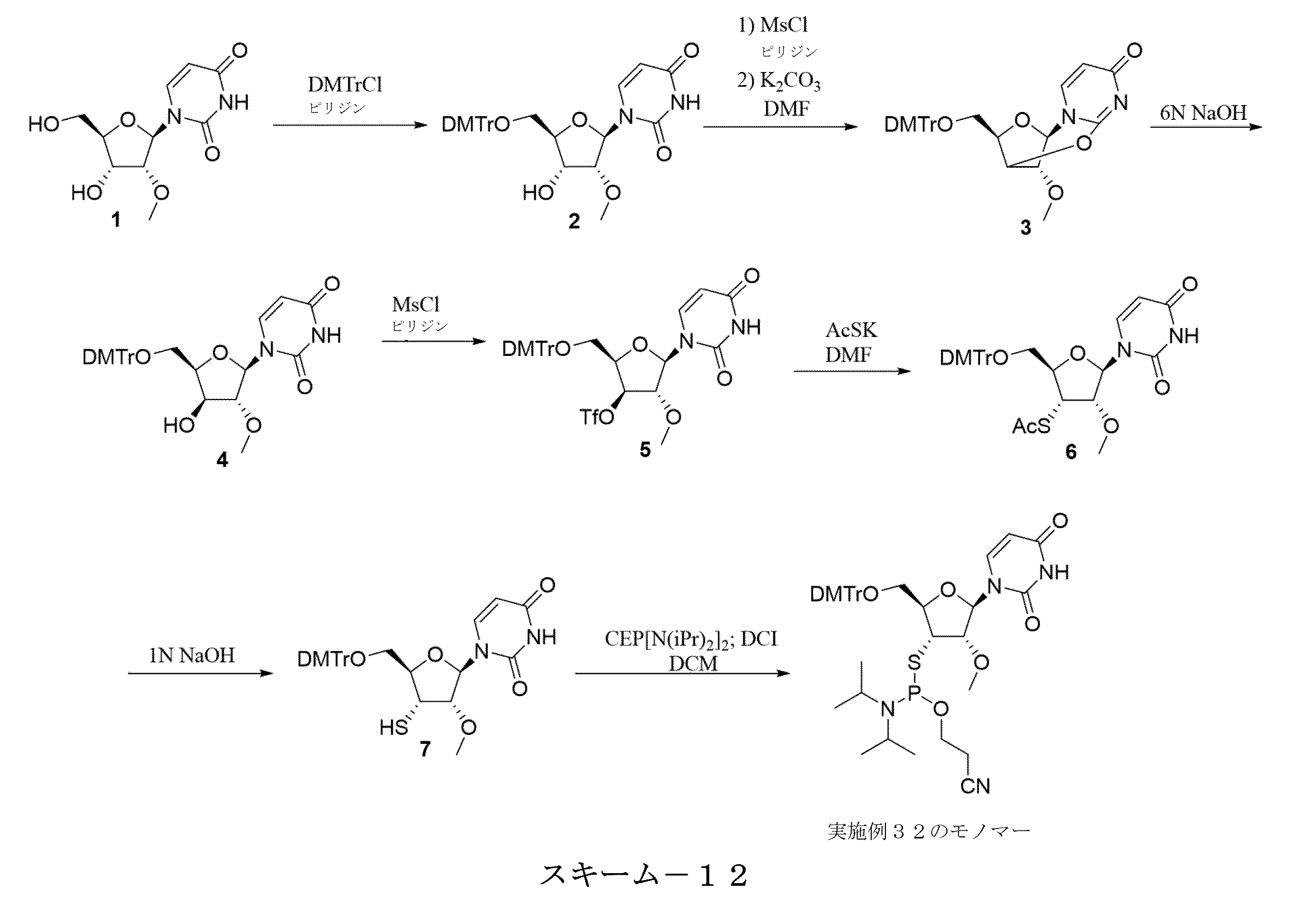
(2)の調製:1(100.0g、387.5mmol)の撹拌ピリジン(1000mL)溶液に、DMTrCl(151.2g、447.1mmol)を室温で添加した。反応混合物を室温で2.5時間撹拌した。氷浴で冷却しつつ、反応物を水でクエンチし、生成物をEA(3000mL)で抽出した。有機相を減圧下で乾燥するまで蒸発させて、残渣を得て、これをシリカゲルカラムクロマトグラフィー(SiO2、ジクロロメタン:メタノール=100:1)によって精製して、2(200.0g、90%)を白色固体として得た。ESI-LCMS:m/z 561[M+H]+。 Preparation of (2): To a stirred solution of 1 (100.0 g, 387.5 mmol) in pyridine (1000 mL) was added DMTrCl (151.2 g, 447.1 mmol) at room temperature. The reaction mixture was stirred at room temperature for 2.5 hours. With ice bath cooling, the reaction was quenched with water and the product was extracted with EA (3000 mL). The organic phase was evaporated to dryness under reduced pressure to give a residue, which was purified by silica gel column chromatography (SiO 2 , dichloromethane:methanol=100:1) to give 2 (200.0 g, 90%). was obtained as a white solid. ESI-LCMS: m/z 561 [M+H] + .
(3)の調製:2(73.0g、130.3mmol)の撹拌ピリジン(730mL)溶液に、MsCl(19.5g、169.2mmol)をN2雰囲気下、0℃で添加した。反応混合物を室温で2.5時間撹拌した。氷浴で冷却しつつ、反応物を水でクエンチし、生成物をEA(200mL)で抽出した。有機相を減圧下で乾燥するまで蒸発させて、粗物質(80.0g)を白色固体として得て、これを次のステップに直接的に使用した。粗物質(80.0g、130.3mmol)のDMF(1600mL)溶液に、K2CO3(71.5g、390.9mmol)を添加し、反応混合物をN2雰囲気下、90℃で15時間撹拌した。水の添加後、得られた混合物を、EA(500mL)で抽出した。合わせた有機層を水およびブラインで洗浄し、Na2SO4上で乾燥させ、濃縮して残渣を得て、これをシリカゲルカラムクロマトグラフィー(SiO2、ジクロロメタン:メタノール=30:1)によって精製して、3(55.0g、90%)を白色固体として得た。ESI-LCMS:m/z 543.[M+H]+、1H-NMR(400MHz,DMSO-d6):δ 7.68(d,J=8.0Hz,1H)、7.40-7.21(m,9H)、6.89-6.83(m,4H)、5.96(s,1H)、5.83(d,J=5.4Hz,1H)、5.26(s,1H)、4.59(s,1H)、4.46(t,J=6.0Hz,1H)、3.72(s,6H)、3.44(s,3H)、3.18-3.12(m,2H)。 Preparation of (3): To a stirring solution of 2 (73.0 g, 130.3 mmol) in pyridine (730 mL) was added MsCl (19.5 g, 169.2 mmol) at 0°C under N2 atmosphere. The reaction mixture was stirred at room temperature for 2.5 hours. With ice bath cooling, the reaction was quenched with water and the product was extracted with EA (200 mL). The organic phase was evaporated to dryness under reduced pressure to give crude material (80.0 g) as a white solid, which was used directly in the next step. To a solution of crude material (80.0 g, 130.3 mmol) in DMF (1600 mL) was added K2CO3 (71.5 g, 390.9 mmol) and the reaction mixture was stirred at 90° C. for 15 h under N2 atmosphere. bottom. After adding water, the resulting mixture was extracted with EA (500 mL). The combined organic layers were washed with water and brine, dried over Na 2 SO 4 and concentrated to give a residue, which was purified by silica gel column chromatography (SiO 2 , dichloromethane:methanol=30:1). gave 3 (55.0 g, 90%) as a white solid. ESI-LCMS: m/z 543. [M+H] + , 1 H-NMR (400 MHz, DMSO-d 6 ): δ 7.68 (d, J=8.0 Hz, 1 H), 7.40-7.21 (m, 9 H), 6.89 -6.83 (m, 4H), 5.96 (s, 1H), 5.83 (d, J = 5.4Hz, 1H), 5.26 (s, 1H), 4.59 (s, 1H) ), 4.46 (t, J=6.0 Hz, 1H), 3.72 (s, 6H), 3.44 (s, 3H), 3.18-3.12 (m, 2H).
(4)の調製:3(55g、101.8mmol)のTHF(550mL)溶液を、6NのNaOH(34mL、206.5mmol)を添加した。混合物を20℃で6時間撹拌した。反応完了後、得られた混合物にH2Oを加え、次いで混合物をEAで抽出し、有機層をブラインで洗浄し、硫酸ナトリウム上で乾燥させ、除去して残渣を得て、これをシリカゲルカラムクロマトグラフィー(SiO2、ジクロロメタン:メタノール=30:1)によって精製し、4(57.4g、87%)を白色固体として得た。ESI-LCMS:m/z 561[M+H]+ 。 Preparation of (4): To a solution of 3 (55 g, 101.8 mmol) in THF (550 mL) was added 6N NaOH (34 mL, 206.5 mmol). The mixture was stirred at 20° C. for 6 hours. After completion of the reaction, H 2 O was added to the resulting mixture, then the mixture was extracted with EA, the organic layer was washed with brine, dried over sodium sulfate and removed to obtain a residue, which was purified on a silica gel column. Purification by chromatography (SiO 2 , dichloromethane:methanol=30:1) gave 4 (57.4 g, 87%) as a white solid. ESI-LCMS: m/z 561 [M+H] + .
(5)の調製:4(57.4g、101.8mmol)の撹拌ピリジン(550mL)溶液に、MsCl(61.5g、495.6mmol)をN2雰囲気下、0℃で添加した。反応混合物を室温で16時間撹拌した。氷浴で冷却しつつ、反応物を水でクエンチし、生成物をEAで抽出し、有機層をブラインで洗浄し、硫酸ナトリウム上で乾燥させ、除去して残渣を得て、これをシリカゲルカラムクロマトグラフィー(SiO2、PE:EA=1:1)によって精製し、5(57.0g、90%)を白色固体として得た。ESI-LCMS:m/z 639[M+H]+ 。 Preparation of (5): To a stirring solution of 4 (57.4 g, 101.8 mmol) in pyridine (550 mL) was added MsCl (61.5 g, 495.6 mmol) at 0 °C under N2 atmosphere. The reaction mixture was stirred at room temperature for 16 hours. With ice bath cooling, the reaction was quenched with water, the product was extracted with EA, the organic layer was washed with brine, dried over sodium sulfate and stripped to give a residue, which was applied to a silica gel column. Purification by chromatography (SiO 2 , PE:EA=1:1) gave 5 (57.0 g, 90%) as a white solid. ESI-LCMS: m/z 639 [M+H] + .
(6)の調製:5(57.0g、89.2mmol)のDMF(600mL)溶液に、KSAc(71.5g、448.4mmol)をN2雰囲気下、110℃で添加し、反応混合物を110℃で3時間撹拌した後、KSAc(71.5g、448.4mmol)をN2雰囲気下で添加した。反応混合物を、室温で16時間撹拌した。水の添加後、得られた混合物を、EAで抽出した。合わせた有機層を水およびブラインで洗浄し、Na2SO4上で乾燥させ、濃縮して残渣を得て、これをシリカゲルカラムクロマトグラフィー(SiO2、PE:EA=1:1)によって精製し、6(29.0g、47%)を白色固体として得た。ESI-LCMS:m/z 619.2[M+H]+、1H-NMR(400MHz,DMSO-d6):δ 11.41(s,1H)、8.06(s,1H)、7.40-7.23(m,9H)、6.90(d,J=8.8Hz,4H)、5.82(s,1H)、5.10-5.08(dd,1H)、4.38-4.34(m,1H)、4.08-4.02(m,3H)、3.74(s,6H)、3.45(s,3H)、3.25(m,2H)、2.37(s,3H)、ESI-LCMS:m/z 619[M+H]+。 Preparation of (6): To a solution of 5 (57.0 g, 89.2 mmol) in DMF (600 mL) was added KSAc (71.5 g, 448.4 mmol) at 110 °C under N2 atmosphere and the reaction mixture was After stirring for 3 hours at °C, KSAc (71.5 g, 448.4 mmol) was added under N2 atmosphere. The reaction mixture was stirred at room temperature for 16 hours. After adding water, the resulting mixture was extracted with EA. The combined organic layers were washed with water and brine, dried over Na 2 SO 4 and concentrated to give a residue, which was purified by silica gel column chromatography (SiO 2 , PE:EA=1:1). , 6 (29.0 g, 47%) as a white solid. ESI-LCMS: m/z 619.2 [M+H] + , 1 H-NMR (400 MHz, DMSO-d 6 ): δ 11.41 (s, 1H), 8.06 (s, 1H), 7.40 -7.23 (m, 9H), 6.90 (d, J=8.8Hz, 4H), 5.82 (s, 1H), 5.10-5.08 (dd, 1H), 4.38 -4.34 (m, 1H), 4.08-4.02 (m, 3H), 3.74 (s, 6H), 3.45 (s, 3H), 3.25 (m, 2H), 2.37 (s, 3H), ESI-LCMS: m/z 619 [M+H] + .
(7)の調製:THF/MeOH(1:1、200mL)の混合溶媒中の6(22g、35.3mmol)の溶液に、1N NaOMe(70mL、72.6mmol)を添加し、20℃で4時間撹拌した。反応完了後、得られた混合物にH2Oを添加し、次いで混合物をEAで抽出し、有機層をブラインで洗浄し、硫酸ナトリウム上で乾燥させ、除去して残渣を得て、これを以下の条件(IntelFlash-1):カラム、C18シリカゲル;移動相、CH3CN/H2O(0.5%NH4HCO3)=2/3を25分以内でCH3CN/H2O(0.5%NH4HCO3)=3/2まで増加させつつ、Flash-Prep-HPLCによって精製し、溶出した生成物を、CH3CN/H2O(0.5%NH4HCO3)=4/3、検出器、UV254nmで集めた。これにより、7(14.0g、70.9%)を白色固体として得た。ESI-LCMS:m/z 576.1[M+H]+、1H-NMR(400MHz,DMSO-d6):δ 11.38(s,1H)、7.90(d,J=8.0Hz,1H)、7.40-7.23(m,9H)、6.90(d,J=8.8Hz,4H)、5.80(s,1H)、5.15-5.13(dd,1H)、3.93(m,1H)、3.87(d,J=5.0Hz,1H)、3.74(s,6H)、3.59(m,2H)、3.49(s,3H)、3.39(d,J=2.2Hz,2H)、2.40(d,J=10.2Hz,1H)。 Preparation of (7): To a solution of 6 (22 g, 35.3 mmol) in a mixed solvent of THF/MeOH (1:1, 200 mL) was added 1N NaOMe (70 mL, 72.6 mmol) and 4 Stirred for an hour. After completion of the reaction, H 2 O was added to the resulting mixture, then the mixture was extracted with EA, the organic layer was washed with brine, dried over sodium sulfate and removed to give a residue, which is described below. conditions (Intel Flash-1): column, C18 silica gel; mobile phase, CH 3 CN/H 2 O (0.5% NH 4 HCO 3 ) = 2/3 to CH 3 CN/H 2 O ( Purified by Flash-Prep-HPLC increasing to 0.5% NH 4 HCO 3 ) = 3/2 and the eluted product was treated with CH 3 CN/H 2 O (0.5% NH 4 HCO 3 ). = 4/3, detector, collected at UV 254 nm. This gave 7 (14.0 g, 70.9%) as a white solid. ESI-LCMS: m/z 576.1 [M+H] + , 1 H-NMR (400 MHz, DMSO-d 6 ): δ 11.38 (s, 1H), 7.90 (d, J=8.0 Hz, 1H), 7.40-7.23 (m, 9H), 6.90 (d, J = 8.8Hz, 4H), 5.80 (s, 1H), 5.15-5.13 (dd, 1H), 3.93 (m, 1H), 3.87 (d, J = 5.0Hz, 1H), 3.74 (s, 6H), 3.59 (m, 2H), 3.49 (s , 3 H), 3.39 (d, J=2.2 Hz, 2 H), 2.40 (d, J=10.2 Hz, 1 H).
実施例32のモノマーの調製:7(10.5g、18.6mmol)のDCM(100mL)懸濁液に、DCI(1.8g、15.7mmol)およびCEP[N(iPr)2]2(6.7g、22.3mmol)を添加した。混合物を室温で1時間撹拌した。LC-MSは、7が完全に消費されたことを示した。溶液を水で2回洗浄し、ブラインで洗浄し、Na2SO4上で乾燥させた。次いで濃縮して残渣を得て、これを以下の条件(IntelFlash-1):カラム、C18シリカゲル;移動相、CH3CN/H2O(0.5%NH4HCO3)=1/1を20分以内でCH3CN/H2O(0.5%NH4HCO3)=1/0まで増加させつつ、Flash-Prep-HPLCによって精製し、溶出した生成物を、CH3CN/H2O(0.5%NH4HCO3)=1/0、検出器、UV254nmで集めた。これにより、実施例32のモノマー(10.5g、14.5mmol、75.9%)を白色固体として得た。ESI-LCMS:m/z 776.3[M+H]+ 、 1H-NMR(400MHz,DMSO-d6):δ 11.40(d,J=12.2Hz,1H)、8.04-7.96(dd,1H)、7.43-7.24(m,9H)、6.92-6.87(m,4H)、5.84(m,1H)、4.93(m,1H)、4.13(m,1H)、3.91-3.39(m,17H)、2.82(t,J=5.6Hz,1H)、2.68(t,J=6.0Hz,1H)、1.22-0.97(m,12H)、31P-NMR(162MHz,DMSO-d6):δ 165.06,157.59。 Preparation of monomer for Example 32: To a suspension of 7 (10.5 g, 18.6 mmol) in DCM (100 mL) was added DCI (1.8 g, 15.7 mmol) and CEP[N(iPr) 2 ] 2 (6 .7 g, 22.3 mmol) was added. The mixture was stirred at room temperature for 1 hour. LC-MS indicated complete consumption of 7. The solution was washed twice with water, washed with brine and dried over Na2SO4 . It was then concentrated to give a residue, which was subjected to the following conditions (Intel Flash-1): column, C18 silica gel; mobile phase, CH 3 CN/H 2 O (0.5% NH 4 HCO 3 ) = 1/1. Purified by Flash-Prep-HPLC increasing to CH 3 CN/H 2 O (0.5% NH 4 HCO 3 ) = 1/0 within 20 min, the eluted product was purified by CH 3 CN/H 2 O (0.5% NH 4 HCO 3 ) = 1/0, detector, collected at UV 254 nm. This gave the monomer of Example 32 (10.5 g, 14.5 mmol, 75.9%) as a white solid. ESI-LCMS: m/z 776.3 [M+H] + , 1 H-NMR (400 MHz, DMSO-d 6 ): δ 11.40 (d, J=12.2 Hz, 1H), 8.04-7. 96 (dd, 1H), 7.43-7.24 (m, 9H), 6.92-6.87 (m, 4H), 5.84 (m, 1H), 4.93 (m, 1H) , 4.13 (m, 1H), 3.91-3.39 (m, 17H), 2.82 (t, J = 5.6Hz, 1H), 2.68 (t, J = 6.0Hz, 1H), 1.22-0.97 (m, 12H), 31 P-NMR (162 MHz, DMSO-d 6 ): δ 165.06, 157.59.
[実施例33:5’エンドキャップモノマーの合成]

(2)の調製:1(11.2g、24.7mmol)のDCM(120mL)溶液に、イミダゾール(4.2g、61.9mmol)およびTBSCl(5.6g、37.1mmol)を室温で添加し、混合物を室温で15時間撹拌し、LCMSは、1が完全に消費されたことを示した。混合物に水(500mL)を希釈し、DCM(50mL×2)で抽出した。有機相をNa2SO4上で乾燥させ、濃縮して、2(16.0g)次のステップのための油状物として得た。 Preparation of (2): To a solution of 1 (11.2 g, 24.7 mmol) in DCM (120 mL) was added imidazole (4.2 g, 61.9 mmol) and TBSCl (5.6 g, 37.1 mmol) at room temperature. , the mixture was stirred at room temperature for 15 hours and LCMS indicated complete consumption of 1. The mixture was diluted with water (500 mL) and extracted with DCM (50 mL x 2). The organic phase was dried over Na 2 SO 4 and concentrated to give 2 (16.0 g) as an oil for the next step.
(3)の調製:2(16.0g、28.4mmol)の溶液に、DCM(160mL)中の6%のDCAおよびトリエチルシラン(40mL)を室温で添加した。反応混合物を室温で2時間撹拌した。TLCは、2が完全に消費されたことを示した。水(300mL)を添加し、混合物をDCM(50mL×4)で抽出し、有機相をNa2SO4によって乾燥させ、減圧によって濃縮して粗物質を得て、これをカラムクロマトグラフィー(SiO2、PE/EA=10:1~1:1)によって精製して、3(4.9g、収率65.9%)を油状物として得た。ESI-LCMS:m/z 263[M+H]+ 、 1H-NMR(400MHz,DMSO-d6)δ 4.84-4.50(m,1H)、4.3-4.09(m,1H)、3.90-3.80(m,1H)、3.75-3.67(m,1H)、3.65-3.57(m,2H)、3.50-3.44(m,1H)、3.37-3.28(m,4H)、0.95-0.78(s,9H)、0.13-0.03(s,6H)。 Preparation of (3): To a solution of 2 (16.0 g, 28.4 mmol) was added 6% DCA in DCM (160 mL) and triethylsilane (40 mL) at room temperature. The reaction mixture was stirred at room temperature for 2 hours. TLC indicated complete consumption of 2. Water (300 mL) was added, the mixture was extracted with DCM (50 mL×4), the organic phase was dried over Na 2 SO 4 and concentrated by reduced pressure to give crude material, which was subjected to column chromatography (SiO 2 , PE/EA=10:1 to 1:1) to give 3 (4.9 g, 65.9% yield) as an oil. ESI-LCMS: m/z 263 [M+H] + , 1 H-NMR (400 MHz, DMSO-d 6 ) δ 4.84-4.50 (m, 1H), 4.3-4.09 (m, 1H) ), 3.90-3.80 (m, 1H), 3.75-3.67 (m, 1H), 3.65-3.57 (m, 2H), 3.50-3.44 (m , 1H), 3.37-3.28 (m, 4H), 0.95-0.78 (s, 9H), 0.13-0.03 (s, 6H).
(4)の調製:3(3.3g、12.6mmol)のDMSO(33mL)溶液に、EDCI(7.2g、37.7mmol)を添加した。混合物にピリジン(1.1g、13.8mmol)およびTFA(788.6mg、6.9mmol)を添加した。反応混合物を室温で3時間撹拌した。TLC(PE/EA=4:1)は、3が消費されたことを示した。混合物をEAで希釈し、水を添加した。生成物をEAで抽出した。有機層をブラインで洗浄し、Na2SO4上で乾燥させ、濃縮して粗物質を得た。これにより、生成物4(3.23g)を次のステップのための油状物として得た。 Preparation of (4): To a solution of 3 (3.3 g, 12.6 mmol) in DMSO (33 mL) was added EDCI (7.2 g, 37.7 mmol). Pyridine (1.1 g, 13.8 mmol) and TFA (788.6 mg, 6.9 mmol) were added to the mixture. The reaction mixture was stirred at room temperature for 3 hours. TLC (PE/EA=4:1) indicated that 3 was consumed. The mixture was diluted with EA and water was added. The product was extracted with EA. The organic layer was washed with brine, dried over Na2SO4 and concentrated to give crude material. This gave the product 4 (3.23g) as an oil for the next step.
(5)の調製:4(3.3g、12.6mmol)のトルエン(30mL)溶液に、室温でPOMエステル4a(4aについての参考文献Journal of Medicinal Chemistry,2018,61(3),734-744)(7.9g、12.6mmol)およびKOH(1.3g、22.6mmol)を添加した。反応混合物を40℃で8時間撹拌した。LCMSは、4が消費されたことを示した。混合物を水で希釈し、EAを添加した。生成物をEAで抽出した。有機層をブラインで洗浄し、Na2SO4上で乾燥させ、濃縮して粗物質を得た。粗物質を、以下の条件(IntelFlash-1):カラム、C18シリカゲル;移動相、CH3CN/H2O(0.5%NH4HCO3)=1/1を20分以内でCH3CN/H2O(0.5%NH4HCO3)=1/0まで増加させつつ、Flash-Prep-HPLCによって精製し、溶出した生成物を、CH3CN/H2O(0.5%NH4HCO3)=91/9、検出器、UV254nmで集めた。これにより、5(5.4g、9.5mmol、収率75.9%)を油状物として得た。ESI-LCMS:m/z 567.2[M+H]+、1H-NMR(400MHz,CDCl3)δ 6.89-6.77(m,1H)、6.07-5.96(m,1H)、5.86-5.55(m,4H)、4.85-4.73(m,1H)、4.36-4.27(m,1H)、4.05-3.96(m,1H)、3.95-3.85(m,1H)、3.73-3.65(m,1H)、3.44-3.35(m,3H)、1.30-1.25(s,18H)、0.94-0.84(s,9H)、0.14-0.05(s,6H).31P-NMR(162MHz,CDCl3)δ 18.30,15.11。 Preparation of (5): POM ester 4a (reference for 4a Journal of Medicinal Chemistry, 2018, 61(3), 734-744) in a solution of 4 (3.3 g, 12.6 mmol) in toluene (30 mL) at room temperature. ) (7.9 g, 12.6 mmol) and KOH (1.3 g, 22.6 mmol) were added. The reaction mixture was stirred at 40° C. for 8 hours. LCMS showed 4 was consumed. The mixture was diluted with water and EA was added. The product was extracted with EA. The organic layer was washed with brine, dried over Na2SO4 and concentrated to give crude material. The crude material was subjected to the following conditions (Intel Flash-1): column, C18 silica gel; mobile phase, CH 3 CN/H 2 O (0.5% NH 4 HCO 3 )=1/1 to CH 3 CN within 20 minutes Purified by Flash-Prep-HPLC increasing to H 2 O (0.5% NH 4 HCO 3 ) = 1/0 and the eluted product was purified by CH 3 CN/H 2 O (0.5% NH4HCO3 ) = 91/9, collected at detector , UV 254 nm. This gave 5 (5.4 g, 9.5 mmol, 75.9% yield) as an oil. ESI-LCMS: m/z 567.2 [M+H] + , 1 H-NMR (400 MHz, CDCl 3 ) δ 6.89-6.77 (m, 1H), 6.07-5.96 (m, 1H) ), 5.86-5.55 (m, 4H), 4.85-4.73 (m, 1H), 4.36-4.27 (m, 1H), 4.05-3.96 (m , 1H), 3.95-3.85 (m, 1H), 3.73-3.65 (m, 1H), 3.44-3.35 (m, 3H), 1.30-1.25 (s, 18H), 0.94-0.84 (s, 9H), 0.14-0.05 (s, 6H). 31 P-NMR (162 MHz, CDCl 3 ) δ 18.30, 15.11.
(6)の調製:5(5.4g、9.5mmol)のHCOOH(30mL)/H2O(30mL)=1:1溶液に、室温で。反応混合物を室温で15時間撹拌した。LCMSは、反応物が消費されたことを示した。混合物を、濃NH4OHでpH=7.5になるまで希釈した。生成物をEAで抽出した。有機層をブラインで洗浄し、Na2SO4上で乾燥させ、濃縮して粗物質を得た。粗物質を、以下の条件(IntelFlash-1):カラム、C18シリカゲル;移動相、CH3CN/H2O(0.5%HCOOH)=30/70を45分以内でCH3CN/H2O(0.5%HCOOH)=70/30まで増加させつつ、Flash-Prep-HPLCによって精製し、溶出した生成物を、CH3CN/H2O(0.5%HCOOH)=59/41、検出器、UV220nmで集めた。これにより、6(2.4g、5.7mmol、収率59.4%)を油状物として得た。ESI-LCMS:m/z 453.2[M+H]+、1H-NMR(400MHz,DMSO-d6)δ 6.84-6.68(m,1H)、6.07-5.90(m,1H)、5.64-5.55(m,4H)、5.32-5.24(m,1H)、4.23-4.15(m,1H)、4.00-3.90(m,1H)、3.89-3.80(m,1H)、3.78-3.69(m,2H)、3.37-3.30(s,3H)、1.30-1.10(s,18H).31P-NMR(162MHz,DMSO-d6)δ 18.14。
Preparation of (6): 5 (5.4 g, 9.5 mmol) in HCOOH (30 mL)/ H2O (30 mL) = 1:1 at room temperature. The reaction mixture was stirred at room temperature for 15 hours. LCMS indicated the reaction was consumed. The mixture was diluted with concentrated NH 4 OH until pH=7.5. The product was extracted with EA. The organic layer was washed with brine, dried over Na2SO4 and concentrated to give crude material. The crude material was subjected to the following conditions (Intel Flash-1): column, C18 silica gel; mobile phase, CH 3 CN/H 2 O (0.5% HCOOH) = 30/70 to CH 3 CN/H 2 within 45 minutes. Purified by Flash-Prep-HPLC with increasing O (0.5% HCOOH) = 70/30 and the eluted product was purified with CH 3 CN/H 2 O (0.5% HCOOH) = 59/41. , detector, collected at
実施例33のモノマーの調製:6(2.1g、4.5mmol)のDCM(21mL)溶液に、DCI(452.5mg、3.8mmol)およびCEP[N(iPr)2]2(1.8g、5.9mmol)を室温で添加した。反応混合物を、N2雰囲気下、室温で15時間撹拌した。LCMSは、6が消費されたことを示した。混合物を水で希釈した。生成物をDCM(30mL)で抽出した。有機層をブラインで洗浄し、Na2SO4上で乾燥させ、濃縮して粗物質を得た。粗物質を、以下の条件(IntelFlash-1):カラム、C18シリカゲル;移動相、CH3CN/H2O(0.5%NH4HCO3)=1/1を28分以内でCH3CN/H2O(0.5%NH4HCO3)=1/0まで増加させつつ、Flash-Prep-HPLCによって精製し、溶出した生成物を、CH3CN/H2O(0.5%NH4HCO3)=80/20、検出器、UV254nmで集めた。これにより、実施例33のモノマー(2.8g、4.3mmol、収率95.2%)を油状物として得た。ESI-LCMS:m/z 653.2[M+H]+、1H-NMR(400MHz,DMSO-d6)δ 6.89-6.77(m,1H)、6.11-5.96(m,1H)、5.65-5.50(m,4H)、4.39-4.34(d,J=20Hz,1H)、4.18-3.95(m,2H)、3.94-3.48(s,6H)、3.40-3.28(m,4H)、2.84-2.75(m,2H)、1.26-1.98(s,30H).31P-NMR(162MHz,DMSO-d6)δ 149.018,148.736,17.775,17.508。 Preparation of monomer for Example 33: To a solution of 6 (2.1 g, 4.5 mmol) in DCM (21 mL) was added DCI (452.5 mg, 3.8 mmol) and CEP[N(iPr) 2 ] 2 (1.8 g). , 5.9 mmol) was added at room temperature. The reaction mixture was stirred at room temperature for 15 hours under N2 atmosphere. LCMS showed 6 was consumed. The mixture was diluted with water. The product was extracted with DCM (30 mL). The organic layer was washed with brine, dried over Na2SO4 and concentrated to give crude material. The crude material was subjected to the following conditions (Intel Flash-1): column, C18 silica gel; mobile phase, CH 3 CN/H 2 O (0.5% NH 4 HCO 3 )=1/1 to CH 3 CN within 28 minutes Purified by Flash-Prep-HPLC increasing to H 2 O (0.5% NH 4 HCO 3 ) = 1/0 and the eluted product was purified by CH 3 CN/H 2 O (0.5% NH 4 HCO 3 )=80/20, detector, collected at UV 254 nm. This gave the monomer of Example 33 (2.8 g, 4.3 mmol, 95.2% yield) as an oil. ESI-LCMS: m/z 653.2 [M+H] + , 1 H-NMR (400 MHz, DMSO-d 6 ) δ 6.89-6.77 (m, 1H), 6.11-5.96 (m , 1H), 5.65-5.50 (m, 4H), 4.39-4.34 (d, J=20Hz, 1H), 4.18-3.95 (m, 2H), 3.94 -3.48 (s, 6H), 3.40-3.28 (m, 4H), 2.84-2.75 (m, 2H), 1.26-1.98 (s, 30H). 31 P-NMR (162 MHz, DMSO-d 6 ) δ 149.018, 148.736, 17.775, 17.508.
[実施例34:5’エンドキャップモノマーの合成]

(2)の調製:1(1についての参考文献Tetrahedron,2013,69,600-606)(10.60g、47.32mmol)のDMF(106mL)溶液に、イミダゾール(11.26g、165.59mmol)およびTBSCl(19.88g、132.53mmol)を添加した。混合物を室温で3.5時間撹拌し、LCMSは、1が完全に消費されたことを示した。水を添加し、EAで抽出し、Na2SO4によって乾燥させた。濾液を減圧下で蒸発させ、2(20.80g、45.94mmol、収率97.19%)を次のステップのために得た。 Preparation of (2): In a solution of 1 (reference Tetrahedron, 2013, 69, 600-606 for 1) (10.60 g, 47.32 mmol) in DMF (106 mL), imidazole (11.26 g, 165.59 mmol) and TBSCl (19.88 g, 132.53 mmol) were added. The mixture was stirred at room temperature for 3.5 hours and LCMS indicated complete consumption of 1. Water was added, extracted with EA, dried with Na2SO4 . The filtrate was evaporated under reduced pressure to give 2 (20.80 g, 45.94 mmol, 97.19% yield) for the next step.
(3)の調製:2(20.80g、45.94mmol)のTHF(248mL)溶液に、TFA(124mL)およびH2O(124mL)を0℃で添加し、反応混合物を30分間撹拌した。LCMSは、2が完全に消費されたことを示した。次いで、EAで抽出し、飽和NaCl(水溶液)で洗浄し、Na2SO4によって乾燥させた。濾液を減圧下で蒸発させ、粗生成物を得て、これを以下の条件(IntelFlash-1):カラム、C18シリカゲル;移動相、CH3CN/H2O(0.5%NH4HCO3)=1/1を20分以内でCH3CN/H2O(0.5%NH4HCO3)=1/0まで増加させつつ、Flash-Prep-HPLCによって精製し、溶出した生成物を、CH3CN/H2O(0.5%NH4HCO3)=1/0、検出器、UV254nmで集めた。これにより、3(10.00g、29.59mmol、収率64.31%)を得た。1H-NMR(400MHz,DMSO-d6):δ 7.33-7.18(m,5H)、4.83-4.80(m,1H)、4.61-4.59(m,1H)、4.21-4.19(m,1H)、3.75-3.74(m,1H)、3.23(m,3H)、3.13(m,3H)、2.41-2.40(m,1H)、0.81(m,9H)、0.00(m,6H)。 Preparation of (3): To a solution of 2 (20.80 g, 45.94 mmol) in THF (248 mL) was added TFA (124 mL) and H 2 O (124 mL) at 0° C. and the reaction mixture was stirred for 30 min. LCMS showed 2 was completely consumed. It was then extracted with EA, washed with saturated NaCl(aq) and dried over Na2SO4 . The filtrate was evaporated under reduced pressure to give the crude product, which was subjected to the following conditions (Intel Flash-1): column, C18 silica gel; mobile phase, CH 3 CN/H 2 O (0.5% NH 4 HCO 3 ). ) = 1/1 to CH 3 CN/H 2 O (0.5% NH 4 HCO 3 ) = 1/0 within 20 min, purifying by Flash-Prep-HPLC, eluting the product. , CH 3 CN/H 2 O (0.5% NH 4 HCO 3 )=1/0, detector, UV collected at 254 nm. This gave 3 (10.00 g, 29.59 mmol, 64.31% yield). 1 H-NMR (400 MHz, DMSO-d 6 ): δ 7.33-7.18 (m, 5H), 4.83-4.80 (m, 1H), 4.61-4.59 (m, 1H), 4.21-4.19 (m, 1H), 3.75-3.74 (m, 1H), 3.23 (m, 3H), 3.13 (m, 3H), 2.41 -2.40 (m, 1H), 0.81 (m, 9H), 0.00 (m, 6H).
(4)の調製:3(3.70g、10.95mmol)のDMSO(37mL)溶液に、EDCI(6.30g、32.84mmol)を添加した。次いで、ピリジン(0.95g、12.05mmol)およびTFA(0.69g、6.02mmol)をN2雰囲気中で添加した。混合物を、室温で3時間撹拌した。LCMSは、3が完全に消費されたことを示した。水を注ぎ、EAで抽出し、飽和NaCl(水溶液)で洗浄し、Na2SO4によって乾燥させた。濾液を減圧下で蒸発させて、粗生成物を得て、これを次のステップに直接的に使用した。 Preparation of (4): To a solution of 3 (3.70 g, 10.95 mmol) in DMSO (37 mL) was added EDCI (6.30 g, 32.84 mmol). Pyridine (0.95 g, 12.05 mmol) and TFA (0.69 g, 6.02 mmol) were then added under N2 atmosphere. The mixture was stirred at room temperature for 3 hours. LCMS showed 3 was completely consumed. Poured in water, extracted with EA, washed with saturated NaCl (aq), dried over Na 2 SO 4 . The filtrate was evaporated under reduced pressure to give the crude product, which was used directly in the next step.
(5)の調製:4のトルエン(100.00mL)溶液に、4a(6.93g、10.97mmol)およびKOH(1.11g、19.78mmol)を添加した。N2雰囲気中、40℃で3.5時間撹拌した。TLCおよびLCMSは、4が完全に消費されたことを示した。次いで、EAで抽出し、水および飽和NaCl(水溶液)で洗浄し、Na2SO4によって乾燥させた。濾液を減圧下で蒸発させ、粗生成物を得て、これを以下の条件(IntelFlash-1):カラム、C18シリカゲル;移動相、CH3CN/H2O(0.5%NH4HCO3)=1/1を20分以内でCH3CN/H2O(0.5%NH4HCO3)=1/0まで増加させつつ、Flash-Prep-HPLCによって精製し、溶出した生成物を、CH3CN/H2O(0.5%NH4HCO3)=1/0、検出器、UV254nmで集めた。これにより、5(4.30g、6.70mmol、収率61.17%)を得た。1H-NMR(400MHz,CDCl3):δ 7.27-7.26(m,4H)、7.17(m,1H)、6.94-6.82(m,1H)、6.13-6.02(m,1H)、5.63-5.56(m,4H)、4.90-4.89(m,1H)、4.45-4.41(m,1H)、3.98-3.95(m,1H)、3.39-3.29(m,4H)、1.90(m,1H)、1.12-0.83(m,29H)、0.00(m,7H)、31P-NMR(162MHz,CDCl3):δ 18.021,14.472。 Preparation of (5): To a solution of 4 in toluene (100.00 mL) was added 4a (6.93 g, 10.97 mmol) and KOH (1.11 g, 19.78 mmol). Stir at 40° C. for 3.5 h in N 2 atmosphere. TLC and LCMS indicated complete consumption of 4. It was then extracted with EA, washed with water and saturated NaCl(aq), dried over Na2SO4 . The filtrate was evaporated under reduced pressure to give the crude product, which was subjected to the following conditions (Intel Flash-1): column, C18 silica gel; mobile phase, CH 3 CN/H 2 O (0.5% NH 4 HCO 3 ). ) = 1/1 to CH 3 CN/H 2 O (0.5% NH 4 HCO 3 ) = 1/0 within 20 min, purifying by Flash-Prep-HPLC, eluting the product. , CH 3 CN/H 2 O (0.5% NH 4 HCO 3 )=1/0, detector, UV collected at 254 nm. This gave 5 (4.30 g, 6.70 mmol, 61.17% yield). 1 H-NMR (400 MHz, CDCl 3 ): δ 7.27-7.26 (m, 4H), 7.17 (m, 1H), 6.94-6.82 (m, 1H), 6.13 -6.02 (m, 1H), 5.63-5.56 (m, 4H), 4.90-4.89 (m, 1H), 4.45-4.41 (m, 1H), 3 .98-3.95 (m, 1H), 3.39-3.29 (m, 4H), 1.90 (m, 1H), 1.12-0.83 (m, 29H), 0.00 (m, 7H), 31 P-NMR (162 MHz, CDCl 3 ): δ 18.021, 14.472.
(6)の調製:5(4.30g、6.70mmol)のTHF(43.00mL)溶液に、HCOOH(100mL)およびH2O(100mL)を添加した。室温で一晩撹拌した。LCMSは、5が完全に消費されたことを示した。NH4OHをそれに注ぎ、EAで抽出し、飽和NaCl(水溶液)で洗浄し、Na2SO4によって乾燥させた。濾液を減圧下で蒸発させ、粗生成物を得て、これを以下の条件(IntelFlash-1):カラム、C18シリカゲル;移動相、CH3CN/H2O(0.5%NH4HCO3)=1/1を20分以内でCH3CN/H2O(0.5%NH4HCO3)=1/0まで増加させつつ、Flash-Prep-HPLCによって精製し、溶出した生成物を、CH3CN/H2O(0.5%NH4HCO3)=1/0、検出器、UV254nmで集めた。これにより、6(2.10g、3.98mmol、収率59.32%)を得た。1H-NMR(400MHz,CDCl3):δ 7.40-7.28(m,5H)、7.11-7.00(m,1H)、6.19-6.14(m,1H)、5.71-5.68(m,4H)、4.95-4.94(m,1H)、4.48-4.47(m,1H)、4.05-4.03(m,1H)、3.62-3.61(m,1H)、3.46(m,3H)、3.00-2.99(m,1H)、1.22(m,18H)、31P-NMR(162MHz,CDCl3):δ 18.134。 Preparation of (6): To a solution of 5 (4.30 g, 6.70 mmol) in THF (43.00 mL) was added HCOOH (100 mL) and H2O (100 mL). Stir overnight at room temperature. LCMS showed 5 was completely consumed. NH 4 OH was poured into it, extracted with EA, washed with saturated NaCl(aq), dried with Na 2 SO 4 . The filtrate was evaporated under reduced pressure to give the crude product, which was subjected to the following conditions (Intel Flash-1): column, C18 silica gel; mobile phase, CH 3 CN/H 2 O (0.5% NH 4 HCO 3 ). ) = 1/1 to CH 3 CN/H 2 O (0.5% NH 4 HCO 3 ) = 1/0 within 20 min, purifying by Flash-Prep-HPLC, eluting the product. , CH 3 CN/H 2 O (0.5% NH 4 HCO 3 )=1/0, detector, UV collected at 254 nm. This gave 6 (2.10 g, 3.98 mmol, 59.32% yield). 1 H-NMR (400 MHz, CDCl 3 ): δ 7.40-7.28 (m, 5H), 7.11-7.00 (m, 1H), 6.19-6.14 (m, 1H) , 5.71-5.68 (m, 4H), 4.95-4.94 (m, 1H), 4.48-4.47 (m, 1H), 4.05-4.03 (m, 1H), 3.62-3.61 (m, 1H), 3.46 (m, 3H), 3.00-2.99 (m, 1H), 1.22 (m, 18H), 31 P- NMR (162 MHz, CDCl3 ): ? 18.134.
実施例34のモノマーの調製:6(2.10g、3.98mmol)のDCM(21mL)溶液に、DCI(410mg、3.47mmol)を添加した。CEP(1.40g、4.65mmol)をN2雰囲気中で添加した。LCMSは、6が完全に消費されたことを示した。DCMおよびH2Oを注ぎ、有機相を水および飽和NaCl(水溶液)で洗浄し、Na2SO4によって乾燥させた。濾液を減圧下で40℃で蒸発させ、粗生成物を得て、これを以下の条件(IntelFlash-1):カラム、C18シリカゲル;移動相、CH3CN/H2O(0.5%NH4HCO3)=1/1を20分以内でCH3CN/H2O(0.5%NH4HCO3)=1/0まで増加させつつ、Flash-Prep-HPLCによって精製し、溶出した生成物を、CH3CN/H2O(0.5%NH4HCO3)=1/0、検出器、UV254nmで集めた。これにより、実施例34のモノマー(2.10g、2.88mmol)を得た。1H-NMR(400MHz,DMSO-d6):δ 7.39-7.32(m,6H)、6.21-6.11(m,1H)、5.64-5.61(m,4H)、4.91-4.85(m,1H)、4.59(m,1H)、4.28-4.25(m,1H)、3.84-3.60(m,5H)、3.36-3.36(m,2H)、2.83-2.79(m,2H)、1.18-1.14(m,29H)、31P-NMR(162MHz,DMSO-d6):δ 149.588,148.920,17.355,17.010。 Preparation of monomer for Example 34: To a solution of 6 (2.10 g, 3.98 mmol) in DCM (21 mL) was added DCI (410 mg, 3.47 mmol). CEP (1.40 g, 4.65 mmol) was added under N2 atmosphere. LCMS showed 6 was completely consumed. DCM and H 2 O were poured in and the organic phase was washed with water and saturated NaCl (aq) and dried over Na 2 SO 4 . The filtrate was evaporated under reduced pressure at 40° C. to give the crude product, which was subjected to the following conditions (Intel Flash-1): column, C18 silica gel; mobile phase, CH 3 CN/H 2 O (0.5% NH 4 HCO 3 ) = 1/1 was purified by Flash-Prep-HPLC and eluted with increasing CH 3 CN/H 2 O (0.5% NH 4 HCO 3 ) = 1/0 within 20 minutes. The product was collected in CH 3 CN/H 2 O (0.5% NH 4 HCO 3 )=1/0, detector, UV 254 nm. This gave the monomer of Example 34 (2.10 g, 2.88 mmol). 1 H-NMR (400 MHz, DMSO-d 6 ): δ 7.39-7.32 (m, 6H), 6.21-6.11 (m, 1H), 5.64-5.61 (m, 4H), 4.91-4.85 (m, 1H), 4.59 (m, 1H), 4.28-4.25 (m, 1H), 3.84-3.60 (m, 5H) , 3.36-3.36 (m, 2H), 2.83-2.79 (m, 2H), 1.18-1.14 (m, 29H), 31 P-NMR (162 MHz, DMSO-d 6 ): δ 149.588, 148.920, 17.355, 17.010.
[実施例35:5’エンドキャップモノマーの合成]

(2)の調製:1(5.90g、21.50mmol)のDMF(60.00mL)溶液に、イミダゾール(4.39g、64.51mmol)およびTBSCl(7.63g、49.56mmol)を添加した。混合物を室温で3.5時間撹拌し、LCMSは、1が完全に消費されたことを示した。水を添加し、EAで抽出し、Na2SO4によって乾燥させた。濾液を減圧下で蒸発させ、2(11.00g、21.91mmol、収率98.19%)を次のステップのために得た。ESI-LCMS:m/z 225.1[M+H]+。 Preparation of (2): To a solution of 1 (5.90 g, 21.50 mmol) in DMF (60.00 mL) was added imidazole (4.39 g, 64.51 mmol) and TBSCl (7.63 g, 49.56 mmol) . The mixture was stirred at room temperature for 3.5 hours and LCMS indicated complete consumption of 1. Water was added, extracted with EA, dried with Na2SO4 . The filtrate was evaporated under reduced pressure to give 2 (11.00 g, 21.91 mmol, 98.19% yield) for the next step. ESI-LCMS: m/z 225.1 [M+H] + .
(3)の調製:2(11.00g、21.91mmol)のTHF(55.00mL)溶液に、TFA(110.00mL)およびH2O(55.00mL)を0℃で添加し、反応混合物を30分間撹拌した。LCMSは、2が完全に消費されたことを示した。次いで、EAで抽出し、飽和NaCl(水溶液)で洗浄し、Na2SO4によって乾燥させた。濾液を減圧下で蒸発させ、粗生成物を得て、これを以下の条件(IntelFlash-1):カラム、C18シリカゲル;移動相、CH3CN/H2O(0.5%NH4HCO3)=1/1を20分以内でCH3CN/H2O(0.5%NH4HCO3)=1/0まで増加させつつ、Flash-Prep-HPLCによって精製し、溶出した生成物を、CH3CN/H2O(0.5%NH4HCO3)=1/0、検出器、UV254nmで集めた。これにより、3(6.20g、16.32mmol、収率72.94%)を得た。ESI-LCMS:m/z 411.2[M+H]+。 Preparation of (3): To a solution of 2 (11.00 g, 21.91 mmol) in THF (55.00 mL) was added TFA (110.00 mL) and H 2 O (55.00 mL) at 0° C. and the reaction mixture was was stirred for 30 minutes. LCMS showed 2 was completely consumed. It was then extracted with EA, washed with saturated NaCl(aq) and dried over Na2SO4 . The filtrate was evaporated under reduced pressure to give the crude product, which was subjected to the following conditions (Intel Flash-1): column, C18 silica gel; mobile phase, CH 3 CN/H 2 O (0.5% NH 4 HCO 3 ). ) = 1/1 to CH 3 CN/H 2 O (0.5% NH 4 HCO 3 ) = 1/0 within 20 min, purifying by Flash-Prep-HPLC, eluting the product. , CH 3 CN/H 2 O (0.5% NH 4 HCO 3 )=1/0, detector, UV collected at 254 nm. This gave 3 (6.20 g, 16.32 mmol, 72.94% yield). ESI-LCMS: m/z 411.2 [M+H] + .
(4)の調製:3(3.50g、9.02mmol)のDMSO(35.00mL)溶液に、EDCI(5.19g、27.06mmol)を添加した。次いで、ピリジン(0.78g、9.92mmol)およびTFA(0.57g、4.96mmol)をN2雰囲気中で添加した。混合物を、室温で3時間撹拌した。水を注ぎ、EAで抽出し、飽和NaCl(水溶液)で洗浄し、Na2SO4によって乾燥させた。濾液を減圧下で蒸発させて、粗生成物を得て、これを次のステップに直接的に使用した。ESI-LCMS:m/z 406.2[M+H]+。 Preparation of (4): To a solution of 3 (3.50 g, 9.02 mmol) in DMSO (35.00 mL) was added EDCI (5.19 g, 27.06 mmol). Pyridine (0.78 g, 9.92 mmol) and TFA (0.57 g, 4.96 mmol) were then added under N2 atmosphere. The mixture was stirred at room temperature for 3 hours. Poured in water, extracted with EA, washed with saturated NaCl (aq), dried over Na 2 SO 4 . The filtrate was evaporated under reduced pressure to give the crude product, which was used directly in the next step. ESI-LCMS: m/z 406.2 [M+H] + .
(5)の調製:4のトルエン(100.00mL)溶液に、4a(5.73g、9.07mmol)およびKOH(916.3g、16.33mmol)を添加した。N2雰囲気中、40℃で3.5時間撹拌した。次いで、EAで抽出し、水および飽和NaCl(水溶液)で洗浄し、Na2SO4によって乾燥させた。濾液を減圧下で蒸発させ、粗生成物を得て、これを以下の条件(IntelFlash-1):カラム、C18シリカゲル;移動相、CH3CN/H2O(0.5%NH4HCO3)=1/1を20分以内でCH3CN/H2O(0.5%NH4HCO3)=1/0まで増加させつつ、Flash-Prep-HPLCによって精製し、溶出した生成物を、CH3CN/H2O(0.5%NH4HCO3)=1/0、検出器、UV254nmで集めた。これにより、5(5.02g、7.25mmol、収率80.44%)を得た。ESI-LCMS:m/z 693.2[M+H]+、31P-NMR(162MHz,DMSO-d6):δ 17.811 Preparation of (5): To a solution of 4 in toluene (100.00 mL) was added 4a (5.73 g, 9.07 mmol) and KOH (916.3 g, 16.33 mmol). Stir at 40° C. for 3.5 h in N 2 atmosphere. It was then extracted with EA , washed with water and saturated NaCl(aq), dried over Na2SO4 . The filtrate was evaporated under reduced pressure to give the crude product, which was subjected to the following conditions (Intel Flash-1): column, C18 silica gel; mobile phase, CH 3 CN/H 2 O (0.5% NH 4 HCO 3 ). ) = 1/1 to CH 3 CN/H 2 O (0.5% NH 4 HCO 3 ) = 1/0 within 20 min, purifying by Flash-Prep-HPLC, eluting the product. , CH 3 CN/H 2 O (0.5% NH 4 HCO 3 )=1/0, detector, UV collected at 254 nm. This gave 5 (5.02 g, 7.25 mmol, 80.44% yield). ESI-LCMS: m/z 693.2 [M+H] + , 31 P-NMR (162 MHz, DMSO-d 6 ): δ 17.811
(6)の調製:5(4.59g、6.63mmol)のTHF(46.00mL)溶液に、HCOOH(92.00mL)およびH2O(92.00mL)を添加した。室温で一晩撹拌した。NH4OHをそれに注ぎ、EAで抽出し、飽和NaCl(水溶液)で洗浄し、Na2SO4によって乾燥させた。濾液を減圧下で蒸発させ、粗生成物を得て、これを以下の条件(IntelFlash-1):カラム、C18シリカゲル;移動相、CH3CN/H2O(0.5%NH4HCO3)=1/1を20分以内でCH3CN/H2O(0.5%NH4HCO3)=1/0まで増加させつつ、Flash-Prep-HPLCによって精製し、溶出した生成物を、CH3CN/H2O(0.5%NH4HCO3)=1/0、検出器、UV254nmで集めた。これにより、6(2.52g、4.36mmol、収率65.80%)を得た。 Preparation of (6): To a solution of 5 (4.59 g, 6.63 mmol) in THF (46.00 mL) was added HCOOH (92.00 mL) and H2O (92.00 mL). Stir overnight at room temperature. NH 4 OH was poured into it, extracted with EA, washed with saturated NaCl(aq), dried with Na 2 SO 4 . The filtrate was evaporated under reduced pressure to give the crude product, which was subjected to the following conditions (Intel Flash-1): column, C18 silica gel; mobile phase, CH 3 CN/H 2 O (0.5% NH 4 HCO 3 ). ) = 1/1 to CH 3 CN/H 2 O (0.5% NH 4 HCO 3 ) = 1/0 within 20 min, purifying by Flash-Prep-HPLC, eluting the product. , CH 3 CN/H 2 O (0.5% NH 4 HCO 3 )=1/0, detector, UV collected at 254 nm. This gave 6 (2.52 g, 4.36 mmol, 65.80% yield).
実施例35のモノマーの調製:6(2.00g、3.46mmol)のDCM(21.00mL)溶液に、DCI(370.00mg、3.11mmol)を添加し、CEP(1.12g、4.15mmol)をN2雰囲気中で添加した。DCMおよびH2Oを注ぎ、有機相を水および飽和NaCl(水溶液)で洗浄し、Na2SO4によって乾燥させた。濾液を減圧下38℃で蒸発させ、粗生成物を得て、これを以下の条件(IntelFlash-1):カラム、C18シリカゲル;移動相、CH3CN/H2O(0.5%NH4HCO3)=1/1を20分以内でCH3CN/H2O(0.5%NH4HCO3)=1/0まで増加させつつ、Flash-Prep-HPLCによって精製し、溶出した生成物を、CH3CN/H2O(0.5%NH4HCO3)=1/0、検出器、UV254nmで集めた。これにより、実施例35のモノマー(2.10g、2.70mmol、収率78.07%)を得た。1H-NMR(400MHz,DMSO-d6):δ 7.39-7.32(m,6H)、6.21-6.11(m,1H)、5.64-5.61(m,4H)、4.91-4.85(m,1H)、4.59(m,1H)、4.28-4.25(m,1H)、3.84-3.60(m,5H)、3.36-3.36(m,2H)、2.83-2.79(m,2H)、1.18-1.14(m,29H).31P-NMR(162MHz,DMSO-d6):δ 149.588,148.920,17.355,17.010。 Preparation of Monomer for Example 35: To a solution of 6 (2.00 g, 3.46 mmol) in DCM (21.00 mL) was added DCI (370.00 mg, 3.11 mmol) and CEP (1.12 g, 4.46 mmol) was added. 15 mmol) was added under N2 atmosphere. DCM and H 2 O were poured in and the organic phase was washed with water and saturated NaCl (aq) and dried over Na 2 SO 4 . The filtrate was evaporated under reduced pressure at 38° C. to give the crude product, which was subjected to the following conditions (Intel Flash-1): column, C18 silica gel; mobile phase, CH 3 CN/H 2 O (0.5% NH 4 ) . The product was purified and eluted by Flash-Prep-HPLC with increasing CH 3 CN/H 2 O (0.5% NH 4 HCO 3 ) = 1/0 within 20 min. Material was collected in CH3CN / H2O (0.5% NH4HCO3 ) = 1/0, detector, UV 254 nm. This gave the monomer of Example 35 (2.10 g, 2.70 mmol, 78.07% yield). 1 H-NMR (400 MHz, DMSO-d 6 ): δ 7.39-7.32 (m, 6H), 6.21-6.11 (m, 1H), 5.64-5.61 (m, 4H), 4.91-4.85 (m, 1H), 4.59 (m, 1H), 4.28-4.25 (m, 1H), 3.84-3.60 (m, 5H) , 3.36-3.36 (m, 2H), 2.83-2.79 (m, 2H), 1.18-1.14 (m, 29H). 31 P-NMR (162 MHz, DMSO-d 6 ): δ 149.588, 148.920, 17.355, 17.010.
[実施例36:モノマーの合成]

(2)の調製:1(35.0g、53.2mmol)のDMF(350mL)溶液に、イミダゾール(9.0g、133.0mmol)を添加し、次に0℃でTBSCl(12.0g、79.8mmol)を添加した。混合物を室温で14時間撹拌した。TLCは、1が完全に消費されたことを示した。反応物に水を添加した。生成物をEAで抽出し、有機層をNaHCO3およびブラインで洗浄した。次いで、溶液を減圧下で濃縮し、白色固体としての粗2(41.6g)、これを次のステップに直接的に使用した。ESI-LCMS:m/z 772[M+H]+。 Preparation of (2): To a solution of 1 (35.0 g, 53.2 mmol) in DMF (350 mL) was added imidazole (9.0 g, 133.0 mmol) followed by TBSCl (12.0 g, 79 .8 mmol) was added. The mixture was stirred at room temperature for 14 hours. TLC indicated complete consumption of 1. Water was added to the reaction. The product was extracted with EA and the organic layer was washed with NaHCO 3 and brine. The solution was then concentrated under reduced pressure to give crude 2 (41.6 g) as a white solid, which was used directly in the next step. ESI-LCMS: m/z 772 [M+H] + .
(3)の調製:3%DCA(53.1mmol、350mL)およびEt3SiH(53.1mmol、100mL)中の2(41.0g、53.1mmol)の溶液に、0℃で。混合物を0℃で0.5時間撹拌した。TLCは、2が完全に消費されたことを示した。NaHCO3を反応物に添加した。生成物をEAで抽出し、有機層をNaHCO3およびブラインで洗浄した。次いで、溶液を減圧下で濃縮した。残渣シリカゲルカラムクロマトグラフィー(溶離液、DCM/MeOH=100:1~20:1)。これにより、3(20.0g、41.7mmol、2ステップで78.6%)を白色固体として得た。ESI-LCMS:m/z 470[M+H]+、1H-NMR(400MHz,DMSO-d6):δ 12.12(s,1H)、11.67(s,1H)、8.28(s,1H)、6.12-6.07(dd,J=15Hz,1H)、5.75(d,J=5Hz,1H)、5.48-5.24(m,2H)、4.55-4.49(m,1H)、3.97(s,1H)、3.75-3.55(m,2H)、2.79-2.76(m,1H)、1.12(d,J=6Hz,6H)、0.88(s,9H)、0.11(d,J=6Hz,6H)。 Preparation of (3): To a solution of 2 (41.0 g, 53.1 mmol) in 3% DCA (53.1 mmol, 350 mL) and Et3SiH (53.1 mmol, 100 mL) at 0 <0>C. The mixture was stirred at 0° C. for 0.5 hours. TLC indicated complete consumption of 2. NaHCO 3 was added to the reaction. The product was extracted with EA and the organic layer was washed with NaHCO 3 and brine. The solution was then concentrated under reduced pressure. Silica gel column chromatography of the residue (eluent, DCM/MeOH=100:1 to 20:1). This gave 3 (20.0 g, 41.7 mmol, 78.6% over two steps) as a white solid. ESI-LCMS: m/z 470 [M+H] + , 1 H-NMR (400 MHz, DMSO-d 6 ): δ 12.12 (s, 1H), 11.67 (s, 1H), 8.28 (s , 1H), 6.12-6.07 (dd, J = 15Hz, 1H), 5.75 (d, J = 5Hz, 1H), 5.48-5.24 (m, 2H), 4.55 -4.49 (m, 1H), 3.97 (s, 1H), 3.75-3.55 (m, 2H), 2.79-2.76 (m, 1H), 1.12 (d , J=6 Hz, 6 H), 0.88 (s, 9 H), 0.11 (d, J=6 Hz, 6 H).
(4)の調製:乾燥DCM(100mL)およびDMF(60mL)中の3(20g、42.6mmol)の溶液に、PDC(20.g、85.1mmol)、tert-ブチルアルコール(63.1g、851.8mmol)、およびAc2O(43.4g、425.9mmol)を、N2雰囲気下、室温で添加した。反応混合物を室温で2時間撹拌した。溶媒を除去して残渣を得て、これをシリカゲルカラムクロマトグラフィー(溶離液、PE:EA=4:1~2:1)によって精製し、残渣を得て、これを以下の条件(IntelFlash-1):カラム、C18シリカゲル;移動相、CH3CN/H2O(0.5%NH4HCO3)=1/1を20分以内でCH3CN/H2O(0.5%NH4HCO3)=1/0まで増加させつつ、Flash-Prep-HPLCによって精製し、溶出した生成物を、CH3CN/H2O(0.5%NH4HCO3)=1/0、検出器、UV254nmで集めた。これにより、4(16.0g、29.0mmol、収率68.2%)を白色固体として得た。ESI-LCMS:m/z 540[M+H]+ 、 1H-NMR(400MHz,DMSO-d6):δ 12.12(s,1H)、11.69(s,1H)、8.28(s,1H)、6.21-6.17(dd,J=15Hz,1H)、5.63-5.55(m,1H)、4.75-4.72(m,1H)、4.41(d,J=5Hz,1H)、2.79-2.76(m,1H)、1.46(s,9H)、1.13-1.11(m,6H)、0.90(s,9H)、0.14(d,J=2Hz,6H)。 Preparation of (4): To a solution of 3 (20 g, 42.6 mmol) in dry DCM (100 mL) and DMF (60 mL) was added PDC (20. g, 85.1 mmol), tert-butyl alcohol (63.1 g, 851.8 mmol), and Ac 2 O (43.4 g, 425.9 mmol) were added at room temperature under N 2 atmosphere. The reaction mixture was stirred at room temperature for 2 hours. Solvent was removed to give a residue, which was purified by silica gel column chromatography (eluent, PE:EA=4:1 to 2:1) to give a residue, which was subjected to the following conditions (Intel Flash-1 ): column, C18 silica gel; mobile phase, CH3CN / H2O ( 0.5% NH4HCO3) = 1/1 within 20 minutes CH3CN/H2O ( 0.5 % NH4 HCO 3 ) = 1/0, purifying by Flash-Prep-HPLC, eluting product with CH 3 CN/H 2 O (0.5% NH 4 HCO 3 ) = 1/0, detection collected at UV 254 nm. This gave 4 (16.0 g, 29.0 mmol, 68.2% yield) as a white solid. ESI-LCMS: m/z 540 [M+H] + , 1 H-NMR (400 MHz, DMSO-d 6 ): δ 12.12 (s, 1H), 11.69 (s, 1H), 8.28 (s , 1H), 6.21-6.17 (dd, J=15Hz, 1H), 5.63-5.55 (m, 1H), 4.75-4.72 (m, 1H), 4.41 (d, J = 5Hz, 1H), 2.79-2.76 (m, 1H), 1.46 (s, 9H), 1.13-1.11 (m, 6H), 0.90 (s , 9H), 0.14 (d, J = 2Hz, 6H).
(5)の調製:4(16.0g、29.6mmol)の乾燥THF/MeOD/D2O=10/2/1(195mL)溶液に、NaBD4(3.4g、88.9mmol)を室温で添加し、反応混合物を50℃で2時間撹拌した。反応完了後、CH3COODでpH値を7に調整し、水を添加した後、得られた混合物をEA(300mL)で抽出した。合わせた有機層を水およびブラインで洗浄し、Na2SO4上で乾燥させ、次いで、溶液を減圧下で濃縮し、白色固体としての粗5(11.8g)、これを次のステップに直接的に使用した。ESI-LCMS:m/z 402[M+H]+。 Preparation of (5): To a solution of 4 (16.0 g, 29.6 mmol) in dry THF/MeOD/ D2O =10/2/1 (195 mL) was added NaBD4 (3.4 g, 88.9 mmol) at room temperature. was added and the reaction mixture was stirred at 50° C. for 2 hours. After the reaction was completed, the pH value was adjusted to 7 with CH 3 COOD, water was added, and the resulting mixture was extracted with EA (300 mL). The combined organic layers were washed with water and brine, dried over Na 2 SO 4 , then the solution was concentrated under reduced pressure to give crude 5 (11.8 g) as a white solid, which was carried directly into the next step. used for purposes. ESI-LCMS: m/z 402 [M+H] + .
(6)の調製:5(5.0g、12.4mmol)のピリジン(50mL)溶液に、N2雰囲気下、0℃でiBuCl(2.6g、24.9mmol)を添加した。混合物を室温で14時間撹拌した。TLCは、5が完全に消費されたことを示した。その後、溶液をEAで希釈した。有機層をNaHCO3およびブラインで洗浄した。次いで、溶液を減圧下で濃縮して、粗物質を得た。粗物質のピリジン溶液(50mL)に、2NのNaOH(MeOH/H2O=4:1、15mL)を0℃で添加した。混合物を0℃で10分間撹拌した。次いで、溶液をEAで希釈した。有機層を、NH4Clおよびブラインで洗浄した。次いで、溶液を減圧下で濃縮し、残渣を以下の条件(IntelFlash-1):カラム、C18シリカゲル;移動相、CH3CN/H2O(0.5%NH4HCO3)=1/3を25分以内でCH3CN/H2O(0.5%NH4HCO3)=4/1まで増加させつつ、Flash-Prep-HPLCによって精製し、溶出した生成物を、CH3CN/H2O(0.5%NH4HCO3)=3/2、検出器、UV254nmで集めた。これにより、6(6g、10.86mmol、収率87.17%)を白色固体として得た。ESI-LCMS:m/z 472.2[M+H]+、1H-NMR(400MHz,DMSO-d6):δ 12.12(s,1H)、11.67(s,1H)、8.28(s,1H)、6.12-6.07(dd,J=15Hz,1H)、5.48-5.24(m,2H)、5.22(s,1H)、4.55-4.49(m,1H)、3.97(d,J=5Hz,1H)、2.79-2.76(m,1H)、1.12(d,J=6Hz,6H)、0.88(s,9H)、0.11(d,J=6Hz,6H)。 Preparation of (6): To a solution of 5 (5.0 g, 12.4 mmol) in pyridine (50 mL) was added iBuCl (2.6 g, 24.9 mmol) at 0 °C under N2 atmosphere. The mixture was stirred at room temperature for 14 hours. TLC showed that 5 was completely consumed. The solution was then diluted with EA. The organic layer was washed with NaHCO 3 and brine. The solution was then concentrated under reduced pressure to give crude material. To a pyridine solution (50 mL) of the crude material was added 2N NaOH (MeOH/ H2O =4:1, 15 mL) at 0<0>C. The mixture was stirred at 0° C. for 10 minutes. The solution was then diluted with EA. The organic layer was washed with NH4Cl and brine. The solution was then concentrated under reduced pressure and the residue was subjected to the following conditions (Intel Flash-1): column, C18 silica gel; mobile phase, CH 3 CN/H 2 O (0.5% NH 4 HCO 3 )=1/3. was purified by Flash-Prep-HPLC, increasing to CH 3 CN/H 2 O (0.5% NH 4 HCO 3 ) = 4/1 within 25 minutes, and the eluted product was purified by CH 3 CN/ H2O (0.5% NH4HCO3 ) = 3/2 , detector, collected at UV 254 nm. This gave 6 (6 g, 10.86 mmol, 87.17% yield) as a white solid. ESI-LCMS: m/z 472.2 [M+H] + , 1 H-NMR (400 MHz, DMSO-d 6 ): δ 12.12 (s, 1H), 11.67 (s, 1H), 8.28 (s, 1H), 6.12-6.07 (dd, J=15Hz, 1H), 5.48-5.24 (m, 2H), 5.22 (s, 1H), 4.55-4 .49 (m, 1H), 3.97 (d, J = 5Hz, 1H), 2.79-2.76 (m, 1H), 1.12 (d, J = 6Hz, 6H), 0.88 (s, 9H), 0.11 (d, J = 6Hz, 6H).
(7)の調製:6(3.8g、8.1mmol)のピリジン(40mL)溶液に、20℃でDMTrCl(4.1g、12.1mmol)を添加した。混合物を20℃で1時間撹拌した。TLCは、7が完全に消費されたことを示した。反応物に水を添加した。生成物をEAで抽出し、有機層をNaHCO3およびブラインで洗浄した。次いで、溶液を減圧下で濃縮して、7の粗生成物(6g、7.6mmol、収率94.3%)を黄色固体として得た。ESI-LCMS:m/z 775[M+H]+。 Preparation of (7): To a solution of 6 (3.8 g, 8.1 mmol) in pyridine (40 mL) at 20° C. was added DMTrCl (4.1 g, 12.1 mmol). The mixture was stirred at 20° C. for 1 hour. TLC indicated complete consumption of 7. Water was added to the reaction. The product was extracted with EA and the organic layer was washed with NaHCO 3 and brine. The solution was then concentrated under reduced pressure to give the crude product of 7 (6 g, 7.6 mmol, 94.3% yield) as a yellow solid. ESI-LCMS: m/z 775 [M+H] + .
(8)の調製:7(6.0g、7.75mmol)のTHF(60mL)溶液に、TBAF(2.4g、9.3mmol)を添加した。混合物を室温で1時間撹拌した。TLCは、7が完全に消費されたことを示した。反応物に水を添加した。生成物をEAで抽出し、有機層をNaHCO3およびブラインで洗浄した。次いで、溶液を減圧下で濃縮し、残渣を以下の条件(IntelFlash-1):カラム、C18シリカゲル;移動相、CH3CN/H2O(0.5%NH4HCO3)=1/1を25分以内でCH3CN/H2O(0.5%NH4HCO3)=1/0まで増加させつつ、Flash-Prep-HPLCによって精製し、溶出した生成物を、CH3CN/H2O(0.5%NH4HCO3)=4/1、検出器、UV254nmで集めた。これにより、8(4.0g、5.9mmol、収率76.6%)を白色固体として得た。ESI-LCMS:m/z 660[M+H]+、1H-NMR(400MHz,DMSO-d6):δ 12.12(s,1H)、11.67(s,1H)、8.12(s,1H)、7.34-7.17(m,9H)、6.83-6.78(m,4H)、6.23-6.18(m,1H)、5.66(d,J=7Hz,1H)、5.48-5.35(m,1H)、4.65-4.54(m,1H)、3.72(d,J=2Hz,6H)、2.79-2.73(m,1H)、1.19-1.06(m,6H)。 Preparation of (8): To a solution of 7 (6.0 g, 7.75 mmol) in THF (60 mL) was added TBAF (2.4 g, 9.3 mmol). The mixture was stirred at room temperature for 1 hour. TLC indicated complete consumption of 7. Water was added to the reaction. The product was extracted with EA and the organic layer was washed with NaHCO 3 and brine. The solution was then concentrated under reduced pressure and the residue was subjected to the following conditions (Intel Flash-1): column, C18 silica gel; mobile phase, CH 3 CN/H 2 O (0.5% NH 4 HCO 3 )=1/1. Purified by Flash-Prep-HPLC, increasing to CH 3 CN/H 2 O (0.5% NH 4 HCO 3 ) = 1/0 within 25 minutes, and the eluted product was purified by CH 3 CN/ H2O (0.5% NH4HCO3 ) = 4/1 , detector, collected at UV 254 nm. This gave 8 (4.0 g, 5.9 mmol, 76.6% yield) as a white solid. ESI-LCMS: m/z 660 [M+H] + , 1 H-NMR (400 MHz, DMSO-d6): δ 12.12 (s, 1H), 11.67 (s, 1H), 8.12 (s, 1H), 7.34-7.17 (m, 9H), 6.83-6.78 (m, 4H), 6.23-6.18 (m, 1H), 5.66 (d, J = 7Hz, 1H), 5.48-5.35 (m, 1H), 4.65-4.54 (m, 1H), 3.72 (d, J = 2Hz, 6H), 2.79-2. 73 (m, 1H), 1.19-1.06 (m, 6H).
実施例36のモノマーの調製:9(4.0g、6.1mmol)のDCM(40mL)溶液に、DCI(608mg、5.1mmol)およびCEP(2.2g、7.3mmol)をN2pro下で添加した。混合物を20℃で0.5時間撹拌した。TLCは、9が完全に消費されたことを示した。生成物をDCMで抽出し、有機層をH2Oおよびブラインで洗浄した。次いで、溶液を減圧下で濃縮し、残渣を以下の条件(IntelFlash-1):カラム、C18シリカゲル;移動相、CH3CN/H2O(0.5%NH4HCO3)=1/1を25分以内でCH3CN/H2O(0.5%NH4HCO3)=1/0まで増加させつつ、Flash-Prep-HPLCによって精製し、溶出した生成物を、CH3CN/H2O(0.5%NH4HCO3)=1/0、検出器、UV254nmで集めた。これにより、実施例36のモノマー(5.1g、5.81mmol、収率95.8%)を白色固体として得た。ESI-LCMS:m/z 860[M+H]+、1H-NMR(400MHz,DMSO-d6):δ 12.12(s,1H)、11.67(s,1H)、8.12(s,1H)、7.34-7.17(m,9H)、6.83-6.78(m,4H)、6.23-6.18(m,1H)、5.67-5.54(m,1H)、4.70-4.67(m,1H)、4.23-4.20(m,1H)、3.72(m,6H)、3.60-3.48(m,3H)、2.79-2.58(m,3H)、1.13-0.94(m,18H)、31P-NMR(162MHz,DMSO-d6):δ 150.31,150.26,140.62,149.57。 Preparation of monomer for Example 36: To a solution of 9 (4.0 g, 6.1 mmol) in DCM (40 mL) was added DCI (608 mg, 5.1 mmol) and CEP (2.2 g, 7.3 mmol) under N2 pressure. was added with The mixture was stirred at 20° C. for 0.5 hours. TLC indicated complete consumption of 9. The product was extracted with DCM and the organic layer was washed with H2O and brine. The solution was then concentrated under reduced pressure and the residue was subjected to the following conditions (Intel Flash-1): column, C18 silica gel; mobile phase, CH 3 CN/H 2 O (0.5% NH 4 HCO 3 )=1/1. Purified by Flash-Prep-HPLC, increasing to CH 3 CN/H 2 O (0.5% NH 4 HCO 3 ) = 1/0 within 25 minutes, the eluted product was purified by CH 3 CN/ H2O (0.5% NH4HCO3 ) = 1/0, detector, collected at UV 254 nm. This gave the monomer of Example 36 (5.1 g, 5.81 mmol, 95.8% yield) as a white solid. ESI-LCMS: m/z 860 [M+H] + , 1 H-NMR (400 MHz, DMSO-d 6 ): δ 12.12 (s, 1H), 11.67 (s, 1H), 8.12 (s , 1H), 7.34-7.17 (m, 9H), 6.83-6.78 (m, 4H), 6.23-6.18 (m, 1H), 5.67-5.54 (m, 1H), 4.70-4.67 (m, 1H), 4.23-4.20 (m, 1H), 3.72 (m, 6H), 3.60-3.48 (m , 3H), 2.79-2.58 (m, 3H), 1.13-0.94 (m, 18H), 31 P-NMR (162 MHz, DMSO-d 6 ): δ 150.31, 150. 26, 140.62, 149.57.
[実施例37:モノマーの合成]

(2)の調製:1(35g、130.2mmol)のDMF(350mL)溶液に、イミダゾール(26.5g、390.0mmol)を添加し、次いで0℃でTBSCl(48.7g、325.8mmol)を添加した。混合物を室温で14時間撹拌した。TLCは、1が完全に消費されたことを示した。反応物に水を添加した。生成物をEAで抽出し、有機層をNaHCO3およびブラインで洗浄した。次いで、溶液を減圧下で濃縮し、白色固体としての粗2(64.6g)、これを次のステップに直接的に使用した。ESI-LCMS:m/z 498[M+H]+。 Preparation of (2): To a solution of 1 (35 g, 130.2 mmol) in DMF (350 mL) was added imidazole (26.5 g, 390.0 mmol) followed by TBSCl (48.7 g, 325.8 mmol) at 0 °C. was added. The mixture was stirred at room temperature for 14 hours. TLC indicated complete consumption of 1. Water was added to the reaction. The product was extracted with EA and the organic layer was washed with NaHCO 3 and brine. The solution was then concentrated under reduced pressure to give crude 2 (64.6 g) as a white solid, which was used directly in the next step. ESI-LCMS: m/z 498 [M+H] + .
(3)の調製:2(64.6g、130.2mmol)のTHF(300mL)溶液に、TFA/H2O(1:1、300mL)を0℃で添加した。混合物を0℃で2時間撹拌した。TLCは、2が完全に消費されたことを示した。NaHCO3を反応物に添加した。生成物をEAで抽出し、有機層をNaHCO3およびブラインで洗浄した。次いで、溶液を減圧下で濃縮した。残渣をシリカカラムクロマトグラフィー(溶離液、DCM:MeOH=100:1~20:1)によって精製した。これにより、3(31.3g、81.7mmol、2ステップで62.6%)を白色固体として得た。ESI-LCMS:m/z 384[M+H]+。 Preparation of (3): To a solution of 2 (64.6 g, 130.2 mmol) in THF (300 mL) was added TFA/H 2 O (1:1, 300 mL) at 0°C. The mixture was stirred at 0° C. for 2 hours. TLC indicated complete consumption of 2. NaHCO 3 was added to the reaction. The product was extracted with EA and the organic layer was washed with NaHCO 3 and brine. The solution was then concentrated under reduced pressure. The residue was purified by silica column chromatography (eluent, DCM:MeOH=100:1 to 20:1). This gave 3 (31.3 g, 81.7 mmol, 62.6% over two steps) as a white solid. ESI-LCMS: m/z 384 [M+H] + .
(4)の調製:3(31.3g、81.7mmol)のACN/H2O(1:1、350mL)溶液に、DAIB(78.0g、244.0mmol)およびTempo(3.8g、24.4mmol)を添加した。混合物を40℃で2時間撹拌した。TLCは、3が完全に消費されたことを示した。次いで濾過し、4(22.5g、55.5mmol、70.9%)を白色固体として得た。ESI-LCMS:m/z 398[M+H]+。 Preparation of (4): To a solution of 3 (31.3 g, 81.7 mmol) in ACN/H 2 O (1:1, 350 mL) was added DAIB (78.0 g, 244.0 mmol) and Tempo (3.8 g, 24 .4 mmol) was added. The mixture was stirred at 40° C. for 2 hours. TLC indicated complete consumption of 3. Filtration then gave 4 (22.5 g, 55.5 mmol, 70.9%) as a white solid. ESI-LCMS: m/z 398 [M+H] + .
(5)の調製:氷/MeOH浴で、-15℃で保持したMeOH(225mL)中の4(22.5g、55.5mmol)の溶液に、反応温度が7℃を超えないような速度で、SOCl2(7.6mL、94.5mmol)を滴下した。添加が完了した後、冷却を除去し、反応物を室温で撹拌した。混合物を室温で14時間撹拌した。TLCは、4が完全に消費されたことを示した。次いで、溶液を減圧下で濃縮して、粗5(23.0g)を白色の固体として得て、これを次のステップに直接的に使用した。ESI-LCMS:m/z 298[M+H]+。 Preparation of (5): In an ice/MeOH bath, add a solution of 4 (22.5 g, 55.5 mmol) in MeOH (225 mL) maintained at -15°C at a rate such that the reaction temperature does not exceed 7°C. , SOCl 2 (7.6 mL, 94.5 mmol) was added dropwise. After the addition was complete, the cooling was removed and the reaction was stirred at room temperature. The mixture was stirred at room temperature for 14 hours. TLC showed that 4 was completely consumed. The solution was then concentrated under reduced pressure to give crude 5 (23.0 g) as a white solid, which was used directly in the next step. ESI-LCMS: m/z 298 [M+H] + .
(6)の調製:5(23g、55.5mmol)のDMF(220mL)溶液に、イミダゾール(11.6g、165.0mmol)を添加し、次いでTBSCl(12.3g、82.3mmol)を0℃で添加した。混合物を20℃で14時間撹拌した。TLCは、1が完全に消費されたことを示した。反応物に水を添加した。生成物をEAで抽出し、有機層をNaHCO3およびブラインで洗浄した。次いで、溶液を減圧下で濃縮した。残渣をシリカカラムクロマトグラフィー(溶離液、DCM:MeOH=100:1~20:1)によって精製した。これにより、6(21.3g、51.1mmol、2ステップで90%)を白色固体として得た。ESI-LCMS:m/z 412[M+H]+。 Preparation of (6): To a solution of 5 (23 g, 55.5 mmol) in DMF (220 mL) was added imidazole (11.6 g, 165.0 mmol) followed by TBSCl (12.3 g, 82.3 mmol) at 0 °C. was added. The mixture was stirred at 20° C. for 14 hours. TLC indicated complete consumption of 1. Water was added to the reaction. The product was extracted with EA and the organic layer was washed with NaHCO 3 and brine. The solution was then concentrated under reduced pressure. The residue was purified by silica column chromatography (eluent, DCM:MeOH=100:1 to 20:1). This gave 6 (21.3 g, 51.1 mmol, 90% over two steps) as a white solid. ESI-LCMS: m/z 412 [M+H] + .
(7)の調製:6(21.0g、51.0mmol)の乾燥THF/MeOD/D2O=10/2/1(260.5mL)溶液に、NaBD4(6.4g、153.1mmol)を室温で添加し、反応混合物を50℃で2時間撹拌した。反応完了後、得られた混合物に、pH=7になるまでCH3COODを添加し、水の添加後、得られた混合物をEA(300mL)で抽出した。合わせた有機層を水およびブラインで洗浄し、Na2SO4上で乾燥させた。次いで、溶液を減圧下で濃縮し、残渣をさらに精製することなく次のステップに使用した。ESI-LCMS:m/z 386[M+H]+。 Preparation of (7): To a solution of 6 (21.0 g, 51.0 mmol) in dry THF/MeOD/ D2O =10/2/1 (260.5 mL) was NaBD4 (6.4 g, 153.1 mmol). was added at room temperature and the reaction mixture was stirred at 50° C. for 2 hours. After completion of the reaction, CH 3 COOD was added to the resulting mixture until pH=7, and after addition of water, the resulting mixture was extracted with EA (300 mL). The combined organic layers were washed with water and brine and dried over Na2SO4 . The solution was then concentrated under reduced pressure and the residue was used in the next step without further purification. ESI-LCMS: m/z 386 [M+H] + .
(8)の調製:7(14.0g、35mmol)の撹拌ピリジン(50mL)溶液に、BzCl(17.2g、122.5mmol)をN2雰囲気下、0℃で添加した。混合物を室温で14時間撹拌した。TLCは、7が完全に消費されたことを示した。次いで、溶液をEAで抽出した。有機層をNaHCO3およびブラインで洗浄した。次いで、溶液を減圧下で濃縮し、残渣をさらに精製することなく次のステップに使用した。粗物質のピリジン(300mL)溶液に、次いで、2MのNaOH(MeOH:H2O(4:1、60mL)を0℃で添加した。混合物を0℃で10分間撹拌した。その後、溶液をEAで希釈した。有機層をNH4Clおよびブラインで洗浄した。次いで、溶液を減圧下で濃縮し、残渣を以下の条件(IntelFlash-1):カラム、C18シリカゲル;移動相、CH3CN/H2O(0.5%NH4HCO3)=1/3を25分以内でCH3CN/H2O(0.5%NH4HCO3)=4/1まで増加させつつ、Flash-Prep-HPLCによって精製し、溶出した生成物を、CH3CN/H2O(0.5%NH4HCO3)=3/2、検出器、UV254nmで集めた。これにより、8(14g、28.02mmol、収率69.21%)を白色固体として得た。ESI-LCMS:m/z 490[M+H]+、1H-NMR(400MHz,DMSO-d6):δ 11.24(s,1H)、8.76(s,1H)、8.71(m,1H)、8.04(d,J=7Hz,2H)、7.66-7.10(m,5H)、6.40-6.35(dd,1H)、5.71-5.56(m,1H)、5.16(s,1H)、4.79-4.72(m,1H)、4.01(m,1H)、0.91(s,9H)、0.14(m,6H)。 Preparation of (8): To a stirring solution of 7 (14.0 g, 35 mmol) in pyridine (50 mL) was added BzCl (17.2 g, 122.5 mmol) at 0° C. under N2 atmosphere. The mixture was stirred at room temperature for 14 hours. TLC indicated complete consumption of 7. The solution was then extracted with EA. The organic layer was washed with NaHCO 3 and brine. The solution was then concentrated under reduced pressure and the residue was used in the next step without further purification. To a pyridine (300 mL) solution of the crude material was then added 2M NaOH (MeOH:H 2 O (4:1, 60 mL) at 0° C. The mixture was stirred at 0° C. for 10 minutes. The organic layer was washed with NH 4 Cl and brine.The solution was then concentrated under reduced pressure and the residue was subjected to the following conditions (Intel Flash-1): column, C18 silica gel; Flash-Prep while increasing 2 O (0.5% NH 4 HCO 3 ) = 1/3 to CH 3 CN/H 2 O (0.5% NH 4 HCO 3 ) = 4/1 within 25 min. -Purified by HPLC, the eluted product was collected in CH 3 CN/H 2 O (0.5% NH 4 HCO 3 ) = 3/2, detector, UV 254 nm, which gave 8 (14 g, 28 .02 mmol, 69.21% yield) as a white solid, ESI-LCMS: m/z 490 [M+H] + , 1 H-NMR (400 MHz, DMSO-d 6 ): δ 11.24 (s, 1H), 8.76 (s, 1H), 8.71 (m, 1H), 8.04 (d, J=7Hz, 2H), 7.66-7.10 (m, 5H), 6.40 -6.35 (dd, 1H), 5.71-5.56 (m, 1H), 5.16 (s, 1H), 4.79-4.72 (m, 1H), 4.01 (m , 1H), 0.91 (s, 9H), 0.14 (m, 6H).
(9)の調製:8(5.1g、10.4mmol)のピリジン(50mL)溶液に、DMTrCl(5.3g、15.6mmol)を添加した。混合物を室温で1時間撹拌した。TLCは、8が完全に消費されたことを示した。反応物に水を添加した。生成物をEAで抽出し、有機層をNaHCO3およびブラインで洗浄した。次いで、溶液を減圧下で濃縮し、残渣をさらに精製することなく次のステップに使用した。ESI-LCMS:m/z 792[M+H]+。 Preparation of (9): To a solution of 8 (5.1 g, 10.4 mmol) in pyridine (50 mL) was added DMTrCl (5.3 g, 15.6 mmol). The mixture was stirred at room temperature for 1 hour. TLC showed that 8 was completely consumed. Water was added to the reaction. The product was extracted with EA and the organic layer was washed with NaHCO 3 and brine. The solution was then concentrated under reduced pressure and the residue was used in the next step without further purification. ESI-LCMS: m/z 792 [M+H] + .
(10)の調製:9(7.9g、10.0mmol)のTHF(80mL)溶液に、THF中の1M TBAF(12mL)を添加した。混合物を室温で1時間撹拌した。TLCは、9が完全に消費されたことを示した。反応物に水を添加した。生成物をEAで抽出し、有機層をNaHCO3およびブラインで洗浄した。次いで、溶液を減圧下で濃縮し、残渣を以下の条件(IntelFlash-1):カラム、C18シリカゲル;移動相、CH3CN/H2O(0.5%NH4HCO3)=1/1を25分以内でCH3CN/H2O(0.5%NH4HCO3)=1/0まで増加させつつ、Flash-Prep-HPLCによって精製し、溶出した生成物を、CH3CN/H2O(0.5%NH4HCO3)=4/1、検出器、UV254nmで集めた。これにより、10を白色固体として得た。ESI-LCMS:m/z 678[M+H]+、1H-NMR(400MHz,DMSO-d6):δ 11.25(s,1H)、8.74(s,1H)、8.62(s,1H)、8.04(d,J=7Hz,2H)、7.66-7.53(m,3H)、7.33-7.15(m,9H)、6.82-6.78(m,4H)、6.43(d,J=20Hz,1H)、5.76-5.60(m,1H)、4.88-4.80(m,1H)、4.13(d,J=8Hz,1H)、3.71(m,6H)。 Preparation of (10): To a solution of 9 (7.9 g, 10.0 mmol) in THF (80 mL) was added 1 M TBAF in THF (12 mL). The mixture was stirred at room temperature for 1 hour. TLC indicated complete consumption of 9. Water was added to the reaction. The product was extracted with EA and the organic layer was washed with NaHCO 3 and brine. The solution was then concentrated under reduced pressure and the residue was subjected to the following conditions (Intel Flash-1): column, C18 silica gel; mobile phase, CH 3 CN/H 2 O (0.5% NH 4 HCO 3 )=1/1. Purified by Flash-Prep-HPLC, increasing to CH 3 CN/H 2 O (0.5% NH 4 HCO 3 ) = 1/0 within 25 minutes, the eluted product was purified by CH 3 CN/ H2O (0.5% NH4HCO3 ) = 4/1 , detector, collected at UV 254 nm. This gave 10 as a white solid. ESI-LCMS: m/z 678 [M+H] + , 1 H-NMR (400 MHz, DMSO-d 6 ): δ 11.25 (s, 1H), 8.74 (s, 1H), 8.62 (s , 1H), 8.04 (d, J=7Hz, 2H), 7.66-7.53 (m, 3H), 7.33-7.15 (m, 9H), 6.82-6.78 (m, 4H), 6.43 (d, J = 20Hz, 1H), 5.76-5.60 (m, 1H), 4.88-4.80 (m, 1H), 4.13 (d , J=8 Hz, 1 H), 3.71 (m, 6 H).
実施例37のモノマーの調製:10(6.2g、9.1mmol)のDCM(60mL)溶液に、DCI(1.1g、9.4mmol)およびCEP(3.3g、10.9mmol)をN2pro下で添加した。混合物を20℃で0.5時間撹拌した。TLCは、10が完全に消費されたことを示した。生成物をDCMで抽出し、有機層をH2Oおよびブラインで洗浄した。次いで、溶液を減圧下で濃縮し、残渣を以下の条件(IntelFlash-1):カラム、C18シリカゲル;移動相、CH3CN/H2O(0.5%NH4HCO3)=1/1を20分以内でCH3CN/H2O(0.5%NH4HCO3)=1/0まで増加させつつ、Flash-Prep-HPLCによって精製し、溶出した生成物を、CH3CN/H2O(0.5%NH4HCO3)=1/0、検出器、UV254nmで集めた。これにより、実施例37のモノマー(7.5g、8.3mmol、90.7%)を白色固体として得た。ESI-LCMS:m/z 878[M+H]+、1H-NMR(400MHz,DMSO-d6):δ 11.25(s,1H)、8.68-8.65(dd,2H)、8.04(m,2H)、7.66-7.53(m,3H)、7.33-7.15(m,9H)、6.82-6.78(m,4H)、6.53-6.43(m,1H)、5.96-5.81(m,1H)、5.36-5.15(m,1H)、4.21(m,1H)、3.86-3.52(m,10H)、2.79-2.61(m,2H)、1.21-0.99(m,12H)、31P-NMR(162MHz,DMSO-d6):δ 149.60,149.56,149.48。 Preparation of monomer for Example 37: To a solution of 10 (6.2 g, 9.1 mmol) in DCM (60 mL) was added DCI (1.1 g, 9.4 mmol) and CEP (3.3 g, 10.9 mmol) in N2. Added under pro. The mixture was stirred at 20° C. for 0.5 hours. TLC indicated complete consumption of 10. The product was extracted with DCM and the organic layer was washed with H2O and brine. The solution was then concentrated under reduced pressure and the residue was subjected to the following conditions (Intel Flash-1): column, C18 silica gel; mobile phase, CH 3 CN/H 2 O (0.5% NH 4 HCO 3 )=1/1. Purified by Flash-Prep-HPLC, increasing to CH 3 CN/H 2 O (0.5% NH 4 HCO 3 ) = 1/0 within 20 minutes, the eluted product was purified by CH 3 CN/ H2O (0.5% NH4HCO3 ) = 1/0, detector, collected at UV 254 nm. This gave the monomer of Example 37 (7.5 g, 8.3 mmol, 90.7%) as a white solid. ESI-LCMS: m/z 878 [M+H] + , 1 H-NMR (400 MHz, DMSO-d 6 ): δ 11.25 (s, 1H), 8.68-8.65 (dd, 2H), 8 .04 (m, 2H), 7.66-7.53 (m, 3H), 7.33-7.15 (m, 9H), 6.82-6.78 (m, 4H), 6.53 -6.43 (m, 1H), 5.96-5.81 (m, 1H), 5.36-5.15 (m, 1H), 4.21 (m, 1H), 3.86-3 .52 (m, 10H), 2.79-2.61 (m, 2H), 1.21-0.99 (m, 12H), 31 P-NMR (162 MHz, DMSO-d 6 ): δ 149. 60, 149.56, 149.48.
[実施例38:エンドキャップモノマーの合成]

(2)の調製:1(20.0g、71.2mmol)の乾燥ピリジン(200.0mL)溶液に、TBSCl(26.8g、177.9mmol)およびイミダゾール(15.6g、227.8mmol)を添加した。混合物を室温で15時間撹拌した。TLCは、1が完全に消費されたことを示した。反応混合物を濃縮して残渣を得た。残渣をDCM(300.0mL)でクエンチした。DCM層を、H2O(100.0mL×2)およびブラインで洗浄した。DCM層を濃縮して、粗2(45.8g)を黄色油状物として得た。粗物質を次のステップに直接的に使用した。ESI-LCMS m/z 510.5[M+H]+。 Preparation of (2): To a solution of 1 (20.0 g, 71.2 mmol) in dry pyridine (200.0 mL) was added TBSCl (26.8 g, 177.9 mmol) and imidazole (15.6 g, 227.8 mmol). bottom. The mixture was stirred at room temperature for 15 hours. TLC indicated complete consumption of 1. The reaction mixture was concentrated to give a residue. The residue was quenched with DCM (300.0 mL). The DCM layer was washed with H2O (100.0 mL x 2) and brine. The DCM layer was concentrated to give crude 2 (45.8 g) as a yellow oil. The crude material was used directly in the next step. ESI-LCMS m/z 510.5 [M+H] + .
(3)の調製:THF(300.0mL)中の2(45.8g)の混合物溶液に、H2O(100.0mL)およびTFA(100.0mL)の混合物を、0℃で30分間かけて添加した。次いで、反応混合物を0℃で4時間撹拌した。TLCは、2が完全に消費されたことを示した。反応混合物のpHを、NH3.H2O(100mL)で7~8に調整した。次いで、混合物をEA(500.0mL×2)で抽出した。合わせたEA層をブラインで洗浄し、濃縮して粗物質を得て、これをc.c.PE:EA=5:1~1:0)によって精製し、化合物3(21.0g、53.2mmol、2ステップで収率74.7%)を白色固体として得た。ESI-LCMS m/z 396.2[M+H]+。 Preparation of (3): A mixture solution of 2 (45.8 g) in THF (300.0 mL) was treated with a mixture of H 2 O (100.0 mL) and TFA (100.0 mL) at 0° C. for 30 min. was added. The reaction mixture was then stirred at 0° C. for 4 hours. TLC indicated complete consumption of 2. The pH of the reaction mixture was adjusted to NH 3 . Adjusted to 7-8 with H 2 O (100 mL). The mixture was then extracted with EA (500.0 mL x 2). The combined EA layers were washed with brine and concentrated to give crude material, which was purified by c. c. PE:EA=5:1-1:0) to give compound 3 (21.0 g, 53.2 mmol, 74.7% yield over two steps) as a white solid. ESI-LCMS m/z 396.2 [M+H] + .
(4)の調製:ACN(100.0mL)および水(100.0mL)中の3(21.0g、53.2mmol)の溶液に、(ジアセトキシヨード)ベンゼン(51.0g、159.5mmol)およびTEMPO(2.5g、15.9mmol)を添加し、反応混合物を40℃で1時間撹拌した。TLCは、3が完全に消費されたことを示した。反応混合物を室温まで冷却し、濾過し、濾液を濃縮して粗物質を得て、これを結晶化(ACN)によって精製して、4(14.5g、35.4mmol、収率66.2%)を得た。ESI-LCMS m/z 410.1[M+H]+。 Preparation of (4): To a solution of 3 (21.0 g, 53.2 mmol) in ACN (100.0 mL) and water (100.0 mL) was added (diacetoxyiodo)benzene (51.0 g, 159.5 mmol). and TEMPO (2.5 g, 15.9 mmol) were added and the reaction mixture was stirred at 40° C. for 1 hour. TLC indicated complete consumption of 3. The reaction mixture was cooled to room temperature, filtered, and the filtrate was concentrated to give crude material, which was purified by crystallization (ACN) to give 4 (14.5 g, 35.4 mmol, 66.2% yield). ). ESI-LCMS m/z 410.1 [M+H] + .
(5)の調製:トルエン(90.0mL)およびMeOH(60.0mL)中の4(14.5g、35.4mmol)の溶液に、トリメチルシリルジアゾメタン(62.5mL、2.0M、141.8mmol)を0℃で添加し、次いで室温で2時間撹拌した。TLCは、4が完全に消費されたことを示した。溶媒を減圧下で除去し、残渣を結晶化(ACN)によって精製して、5(10.0g、23.6mmol、収率66.6%)を得た。ESI-LCMS m/z 424.2[M+H]+ Preparation of (5): To a solution of 4 (14.5 g, 35.4 mmol) in toluene (90.0 mL) and MeOH (60.0 mL) was added trimethylsilyldiazomethane (62.5 mL, 2.0 M, 141.8 mmol). was added at 0° C. and then stirred at room temperature for 2 hours. TLC indicated that 4 was completely consumed. The solvent was removed under reduced pressure and the residue was purified by crystallization (ACN) to give 5 (10.0 g, 23.6 mmol, 66.6% yield). ESI-LCMS m/z 424.2 [M+H] +
(6)の調製:5(10.0g、23.6mmol)の乾燥THF/MeOD/D2O=10/2/1(100.0mL)溶液に、NaBD4(2.98g、70.9mmol)を、40℃で1時間の間に3回添加し、反応混合物を、室温で2.0時間撹拌した。得られた混合物に、CH3COODを添加し、pH=7.5に変化させ、水の添加後、得られた混合物を、EA(50.0mL×3)で抽出した。合わせた有機層を水およびブラインで洗浄し、Na2SO4上で乾燥させ、濃縮して残渣を得て、これをc.c.(PE/EA=1:1~1:0)によって精製した。これにより、6(6.1g、15.4mmol、収率65.3%)を白色固体として得た。ESI-LCMS m/z 398.1[M+H]+、1H-NMR(400MHz,DMSO-d6)δ 8.28(s,1H)、8.02(s,1H)、7.23(s,2H)、5.86(d,J=6.4Hz,1H)、5.26(s,1H)、4.42-4.41(m,1H)、4.35-4.32(m,1H)、3.82(d,J=2.6Hz,1H)、3.14(s,3H)、0.78(s,9H)、0.00(d,J=0.9Hz,6H)。 Preparation of (6): To a solution of 5 (10.0 g, 23.6 mmol) in dry THF/MeOD/ D2O = 10/2/1 (100.0 mL) was NaBD4 (2.98 g, 70.9 mmol). was added three times during 1 hour at 40° C. and the reaction mixture was stirred at room temperature for 2.0 hours. To the resulting mixture, CH 3 COOD was added to change pH=7.5, and after adding water, the resulting mixture was extracted with EA (50.0 mL×3). The combined organic layers were washed with water and brine , dried over Na2SO4 and concentrated to give a residue, which was purified by c. c. (PE/EA=1:1-1:0). This gave 6 (6.1 g, 15.4 mmol, 65.3% yield) as a white solid. ESI-LCMS m/z 398.1 [M+H] + , 1 H-NMR (400 MHz, DMSO-d 6 ) δ 8.28 (s, 1H), 8.02 (s, 1H), 7.23 (s , 2H), 5.86 (d, J = 6.4Hz, 1H), 5.26 (s, 1H), 4.42-4.41 (m, 1H), 4.35-4.32 (m , 1H), 3.82 (d, J = 2.6Hz, 1H), 3.14 (s, 3H), 0.78 (s, 9H), 0.00 (d, J = 0.9Hz, 6H ).
(7)の調製:6(6.1g、15.4mmol)のピリジン(60.0mL)溶液に、塩化ベンゾイル(6.5g、46.2mmol)を5℃で滴下した。反応混合物を、室温で2時間撹拌した。TLCは、6が完全に消費されたことを示した。反応混合物を10℃まで冷却し、H2O(20.0mL)でクエンチし、EA(200.0mL×2)で抽出し、EA層を合わせた。有機相をブラインで洗浄し、Na2SO4上で乾燥させ、濃縮して粗物質(12.0g)を得て、これをピリジン(60.0mL)に溶解させ、0℃まで冷却し、20.0mLのNaOH(2Mメタノール:H2O=4:1)を添加し、10分間撹拌した。反応物を塩化アンモニウムの飽和溶液によってクエンチし、水層をEA(200.0mL×2)で抽出し、EA層を合わせ、ブラインで洗浄し、Na2SO4上で乾燥させ、濃縮した。残渣をc.c.(PE/EA=10:1~1:1)によって精製し、7(7.0g、13.9mmol、収率90.2%)を得た。ESI-LCMS m/z 502.2[M+H]+、1H-NMR(400MHz,DMSO-d6)δ11.24(s,1H,D2Oと交換される)8.77(s,2H)、8.04-8.06(m,2H)、7.64-7.66(m,2H)、7.54-7.58(m,2H)、6.14-6.16(d,J=5.9Hz,1H)、5.20-5.23(m,1H)、4.58-4.60(m,1H)、4.52-4.55(m,1H)、3.99-4.01(m,1H)、3.34(s,4H)、0.93(s,9H)、0.14-0.15(d,J=1.44Hz,6H)。 Preparation of (7): To a solution of 6 (6.1 g, 15.4 mmol) in pyridine (60.0 mL) was added benzoyl chloride (6.5 g, 46.2 mmol) dropwise at 5°C. The reaction mixture was stirred at room temperature for 2 hours. TLC showed that 6 was completely consumed. The reaction mixture was cooled to 10° C., quenched with H 2 O (20.0 mL), extracted with EA (200.0 mL×2), and the EA layers were combined. The organic phase was washed with brine, dried over Na 2 SO 4 and concentrated to give crude material (12.0 g), which was dissolved in pyridine (60.0 mL), cooled to 0° C. and 20 0 mL of NaOH (2M methanol:H 2 O=4:1) was added and stirred for 10 minutes. The reaction was quenched with a saturated solution of ammonium chloride, the aqueous layer was extracted with EA (200.0 mL x 2), the EA layers were combined, washed with brine, dried over Na2SO4 and concentrated . c. c. (PE/EA=10:1 to 1:1) to give 7 (7.0 g, 13.9 mmol, 90.2% yield). ESI-LCMS m/z 502.2 [M+H] + , 1 H-NMR (400 MHz, DMSO-d 6 ) δ 11.24 (s, 1H, exchanged with D 2 O) 8.77 (s, 2H). , 8.04-8.06 (m, 2H), 7.64-7.66 (m, 2H), 7.54-7.58 (m, 2H), 6.14-6.16 (d, J=5.9 Hz, 1H), 5.20-5.23 (m, 1H), 4.58-4.60 (m, 1H), 4.52-4.55 (m, 1H), 3. 99-4.01 (m, 1H), 3.34 (s, 4H), 0.93 (s, 9H), 0.14-0.15 (d, J=1.44Hz, 6H).
(8)の調製:7(5.5g、10.9mmol)の撹拌DMSO(55.0mL)溶液に、EDCI(6.3g、32.9mmol)、ピリジン(0.9g、10.9mmol)およびTFA(0.6g、5.5mmol)を添加し、反応混合物を室温で15時間撹拌した。反応物を水でクエンチし、EA(100.0mL)で抽出した。有機相をブラインによって洗浄し、Na2SO4上で乾燥させた。有機相を減圧下で乾燥するまで蒸発させ、残渣8(4.8g)を得て、これを直接的に次のステップに使用した。ESI-LCMS:m/z 517.1[M+H2O]+ 。 Preparation of (8): To a stirred solution of 7 (5.5 g, 10.9 mmol) in DMSO (55.0 mL) was added EDCI (6.3 g, 32.9 mmol), pyridine (0.9 g, 10.9 mmol) and TFA. (0.6 g, 5.5 mmol) was added and the reaction mixture was stirred at room temperature for 15 hours. The reaction was quenched with water and extracted with EA (100.0 mL). The organic phase was washed with brine and dried over Na2SO4 . The organic phase was evaporated to dryness under reduced pressure to give residue 8 (4.8 g), which was used directly in the next step. ESI-LCMS: m/z 517.1 [M+H 2 O] + .
(9b)の調製:9a(35.0g、150.8mmol)およびNaI(90.5g、603.4mmol)の乾燥ACN(180.0mL)溶液に、室温でピバル酸クロロメチル(113.6g、754.3mmol)に添加し、反応物を80℃で4時間撹拌した。反応物を室温まで冷却し、水によってクエンチし、次いで混合物をEA(500.0mL×3)で抽出し、有機層を合わせ、塩化アンモニウムの飽和溶液で洗浄し、次いでブラインで洗浄し、Na2SO4上で乾燥した。次いで、有機層を濃縮して残渣を得て、これをc.c.によって精製して、9b(38.0g、60.1mmol、収率39.8%)を白色固体として得た。ESI-LCMS m/z 655.2[M+Na]+、1H-NMR(400MHz,CDCl3):δ 5.74-5.67(m,8H)、2.67(t,J=21.6Hz,2H)、1.23(s,36H)。 Preparation of (9b): To a solution of 9a (35.0 g, 150.8 mmol) and NaI (90.5 g, 603.4 mmol) in dry ACN (180.0 mL) was added chloromethyl pivalate (113.6 g, 754 mmol) at room temperature. .3 mmol) and the reaction was stirred at 80° C. for 4 hours. The reaction was cooled to room temperature, quenched with water, then the mixture was extracted with EA (500.0 mL x 3), the organic layers were combined, washed with a saturated solution of ammonium chloride, then brine, washed with Na 2 Dried over SO4 . The organic layer was then concentrated to give a residue which was treated with c. c. to give 9b (38.0 g, 60.1 mmol, 39.8% yield) as a white solid. ESI-LCMS m/z 655.2 [M+Na] + , 1 H-NMR (400 MHz, CDCl 3 ): δ 5.74-5.67 (m, 8H), 2.67 (t, J=21.6 Hz , 2H), 1.23 (s, 36H).
(9)の調製:3.8gの10%Pd/Cを乾燥THF(30.0mL)で3回洗浄した。次いで、9b(38.0g、60.1mmol)および溶媒(乾燥THF:D2O=5:1、400.0mL)を投入した丸底フラスコに移し、混合物を1LのH2バルーン下、80℃で15時間撹拌した。反応物を室温まで冷却し、EA(500.0mL×3)で抽出し、有機層を合わせ、ブラインで洗浄し、Na2SO4上で乾燥させた。白色固体としての残渣9(3.0g、3.7mmol、収率38.8%)をさらに精製することなく次のステップに直接的に使用した。ESI-LCMS m/z 657.2[M+Na]+、1H-NMR(400MHz,CDCl3):δ 5.74-5.67(m,8H)、1.23(s,36H)。 Preparation of (9): 3.8 g of 10% Pd/C was washed with dry THF (30.0 mL) three times. Then transferred to a round bottom flask charged with 9b (38.0 g, 60.1 mmol) and solvent (dry THF: D2O =5:1, 400.0 mL) and the mixture was heated to 80° C. under a 1 L H2 balloon. and stirred for 15 hours. The reaction was cooled to room temperature, extracted with EA (500.0 mL x 3), the organic layers were combined, washed with brine and dried over Na2SO4 . Residue 9 (3.0 g, 3.7 mmol, 38.8% yield) as a white solid was used directly for the next step without further purification. ESI-LCMS m/z 657.2 [M+Na] + , 1 H-NMR (400 MHz, CDCl 3 ): δ 5.74-5.67 (m, 8H), 1.23 (s, 36H).
(10)の調製:乾燥THF(60.0mL)およびD2O(20.0mL)中の8(4.8g、9.6mmol)、9(7.3g、11.5mmol)およびK2CO3(4.0g、38.8mmol)の溶液を室温で撹拌した。18h.LC-MSは、8が完全に消費されたことを示した。生成物をEA(300.0mL)で抽出し、有機層をブラインで洗浄し、Na2SO4上で乾燥させた。次いで、有機層を濃縮して、残渣を得て、これをc.c.(PE/EA=5:1~1:1)およびMPLCによって精製した。これにより、10(3.0g、3.7mmol、収率38.8%)を白色固体として得た。ESI-LCMS m/z 806.4[M+H]+、1H-NMR(400MHz,DMSO-d6):δ 11.25(s,1H,D2Oと交換される)8.75(s,2H)、8.07-8.05(d,J=8.0Hz,2H)、7.67-7.54(m,3H)、6.05(d,J=5.1Hz,1H)、5.65-5.58(m,4H)、4.80-4.70(m,2H)、4.59-4.57(m,1H)、3.36(s,3H)、1.11(s,9H)、1.10(s,9H)、0.94(s,9H)、0.17-0.16(m,6H)、31P NMR(162MHz,DMSO-d6)δ 17.02。 Preparation of (10): 8 (4.8 g, 9.6 mmol), 9 (7.3 g, 11.5 mmol) and K2CO3 in dry THF (60.0 mL) and D2O (20.0 mL) . (4.0 g, 38.8 mmol) was stirred at room temperature. 18h. LC-MS indicated complete consumption of 8. The product was extracted with EA (300.0 mL) and the organic layer was washed with brine and dried over Na2SO4 . The organic layer is then concentrated to give a residue which is treated with c. c. (PE/EA=5:1-1:1) and purified by MPLC. This gave 10 (3.0 g, 3.7 mmol, 38.8% yield) as a white solid. ESI-LCMS m/z 806.4 [M+H] + , 1 H-NMR (400 MHz, DMSO-d 6 ): δ 11.25 (s, 1H, exchanged with D 2 O) 8.75 (s, 2H), 8.07-8.05 (d, J = 8.0Hz, 2H), 7.67-7.54 (m, 3H), 6.05 (d, J = 5.1Hz, 1H), 5.65-5.58 (m, 4H), 4.80-4.70 (m, 2H), 4.59-4.57 (m, 1H), 3.36 (s, 3H), 1. 11 (s, 9H), 1.10 (s, 9H), 0.94 (s, 9H), 0.17-0.16 (m, 6H), 31 P NMR (162 MHz, DMSO-d 6 ) δ 17.02.
(11)の調製:丸底フラスコに、H2O(30.0mL)、HCOOH(30.0mL)の混合物中の10(3.0g、3.7mmol)を添加した。反応混合物を40℃で15時間撹拌した。LC-MSは、10が完全に消費されたことを示した。反応混合物を、濃NH3.H2O(100.0mL)でpH=6~7に調整した。次いで、混合物を、DCM(100.0mL×3)で抽出した。合わせたDCM層を、Na2SO4上で乾燥させた。濾過し、濾液を濃縮して粗物質を得て、これを以下の条件(IntelFlash-1):カラム、C18シリカゲル;移動相、CH3CN/H2O(0.5%NH4HCO3)=1/2を20分以内でCH3CN/H2O(0.5%NH4HCO3)=1/0まで増加させつつ、Flash-Prep-HPLCによって精製し、溶出した生成物を、CH3CN/H2O(0.5%NH4HCO3)=3/2、検出器、UV254nmで集めた。生成物11(1.8g、2.6mmol、収率70.3%)を得るために。ESI-LCMS m/z=692.2[M+H]+、1H-NMR(400MHz,DMSO-d6):δ 11.11(s,1H,D2Oと交換される)8.71-8.75(d,J=14.4,2H)、8.04-8.06(m,2H)、7.64-7.65(m,1H)、7.54-7.58(m,2H)、6.20-6.22(d,J=5.4,2H)、5.74-5.75(d,J=5.72,2H)、5.56-5.64(m,4H)、4.64-4.67(m,1H)、4.58-4.59(m,1H)、4.49-4.52(m,1H)、3.37(s,3H)、1.09-1.10(d,J=1.96,18H)、31P NMR(162MHz,DMSO-d6)δ 17.46。 Preparation of (11): To a round bottom flask was added 10 (3.0 g, 3.7 mmol) in a mixture of H2O (30.0 mL), HCOOH (30.0 mL). The reaction mixture was stirred at 40° C. for 15 hours. LC-MS indicated complete consumption of 10. The reaction mixture was added to concentrated NH 3 . Adjust pH=6-7 with H 2 O (100.0 mL). The mixture was then extracted with DCM (100.0 mL x 3). The combined DCM layers were dried over Na2SO4 . Filtration and concentration of the filtrate gave crude material, which was subjected to the following conditions (Intel Flash-1): column, C18 silica gel; mobile phase, CH 3 CN/H 2 O (0.5% NH 4 HCO 3 ). = 1/2 to CH 3 CN/H 2 O (0.5% NH 4 HCO 3 ) = 1/0 within 20 minutes, purifying by Flash-Prep-HPLC, eluting the product with CH3CN / H2O (0.5% NH4HCO3 ) = 3/2, detector, UV collected at 254 nm. To obtain product 11 (1.8 g, 2.6 mmol, 70.3% yield). ESI-LCMS m/z=692.2 [M+H] + , 1 H-NMR (400 MHz, DMSO-d 6 ): δ 11.11 (s, 1H, exchanged with D 2 O) 8.71-8. .75 (d, J = 14.4, 2H), 8.04-8.06 (m, 2H), 7.64-7.65 (m, 1H), 7.54-7.58 (m, 2H), 6.20-6.22 (d, J = 5.4, 2H), 5.74-5.75 (d, J = 5.72, 2H), 5.56-5.64 (m , 4H), 4.64-4.67 (m, 1H), 4.58-4.59 (m, 1H), 4.49-4.52 (m, 1H), 3.37 (s, 3H) ), 1.09-1.10 (d, J=1.96, 18H), 31 P NMR (162 MHz, DMSO-d 6 ) δ 17.46.
実施例38のモノマーの調製:11(1.8g、2.6mmol)のDCM(18.0mL)溶液に、DCI(276.0mg、2.3mmol)を添加し、次いでCEP[N(ipr)2]2(939.5mg、3.1mmol)を添加した。混合物を室温で1時間撹拌した。TLCは、11が完全に消費されたことを示した。反応混合物をH2O(50.0mL×2)およびブライン(50.0mL×2)で洗浄し、Na2SO4上で乾燥させ、濃縮して粗物質を得て、これを以下の条件(IntelFlash-1)カラム、C18シリカゲル;移動相、CH3CN/H2O(0.5%NH4HCO3)=1/1を20分以内でCH3CN/H2O(0.5%NH4HCO3)=1/0まで増加させつつ、Flash-Prep-HPLCによって精製し、溶出した生成物を、CH3CN/H2O(0.5%NH4HCO3)=9/1、検出器、UV254nmで集めた。生成物を濃縮して、実施例38のモノマー(2.0g、2.2mmol、収率86.2%)を白色固体として得た。ESI-LCMS m/z 892.3[M+H]+、1H-NMR(400MHz,DMSO-d6):δ 11.27(s,1H,D2Oと交換される)8.72-8.75(m,2H)、8.04-8.06(m,2H)、7.54-7.68(m,3H)、6.20-6.26(m,1H)、5.57-5.64(m,4H)、4.70-4.87(m,3H)、3.66-3.88(m,4H)、3.37-3.41(m,3H)、2.82-2.86(m,2H)、1.20-1.21(m,12H)、1.08-1.09(m,18H)、31P-NMR(162MHz,DMSO-d6):δ 150.03,149.19,17.05,16.81。 Preparation of monomer for Example 38: To a solution of 11 (1.8 g, 2.6 mmol) in DCM (18.0 mL) was added DCI (276.0 mg, 2.3 mmol) followed by CEP[N(ipr) 2. ] 2 (939.5 mg, 3.1 mmol) was added. The mixture was stirred at room temperature for 1 hour. TLC indicated complete consumption of 11. The reaction mixture was washed with H 2 O (50.0 mL x 2) and brine (50.0 mL x 2), dried over Na 2 SO 4 and concentrated to give crude material, which was subjected to the following conditions ( Intel Flash-1) column, C18 silica gel; mobile phase, CH 3 CN/H 2 O (0.5% NH 4 HCO 3 ) = 1/1 within 20 minutes CH 3 CN/H 2 O (0.5% NH 4 HCO 3 ) = 1/0 and purified by Flash-Prep-HPLC increasing the eluted product to CH 3 CN/H 2 O (0.5% NH 4 HCO 3 ) = 9/1. , detector, collected at UV 254 nm. The product was concentrated to give Example 38 monomer (2.0 g, 2.2 mmol, 86.2% yield) as a white solid. ESI-LCMS m/z 892.3 [M+H] + , 1 H-NMR (400 MHz, DMSO-d 6 ): δ 11.27 (s, 1H, exchanged with D 2 O) 8.72-8. 75 (m, 2H), 8.04-8.06 (m, 2H), 7.54-7.68 (m, 3H), 6.20-6.26 (m, 1H), 5.57- 5.64 (m, 4H), 4.70-4.87 (m, 3H), 3.66-3.88 (m, 4H), 3.37-3.41 (m, 3H), 2. 82-2.86 (m, 2H), 1.20-1.21 (m, 12H), 1.08-1.09 (m, 18H), 31 P-NMR (162 MHz, DMSO-d 6 ): δ 150.03, 149.19, 17.05, 16.81.
[実施例39:5’エンドキャップモノマーの合成]

(6)の調製:5(8.0g、21.3mmol、スキーム3)の撹拌DMSO(80.0mL)溶液に、EDCI(12.2g、63.9mmol)、ピリジン(1.7g、21.3mmol)、TFA(1.2g、10.6mmol)を室温で添加した。反応混合物を室温で1.5時間撹拌した。反応物を水でクエンチし、EA(200.0mL)で抽出した。有機相をブラインによって洗浄し、Na2SO4上で乾燥させた。有機相を減圧下で乾燥するまで蒸発させ、残渣6を得て、これを直接的に次のステップに使用した。ESI-LCMS:m/z 372.3[M+H]+。
Preparation of (6): To a stirred solution of 5 (8.0 g, 21.3 mmol, Scheme 3) in DMSO (80.0 mL) was added EDCI (12.2 g, 63.9 mmol), pyridine (1.7 g, 21.3 mmol). ), TFA (1.2 g, 10.6 mmol) was added at room temperature. The reaction mixture was stirred at room temperature for 1.5 hours. The reaction was quenched with water and extracted with EA (200.0 mL). The organic phase was washed with brine and dried over Na2SO4 . The organic phase was evaporated to dryness under reduced pressure to give
(8)の調製:乾燥THF(60.0mL)およびD2O(20.0mL)中のK2CO3(5.5g、8.3mmol)の溶液に、乾燥THF(10.0mL)中の6(8.0g、21.5mmol)の溶液を添加した。この反応混合物を室温で一晩撹拌した。LC-MSは、6が完全に消費されたことを示した。生成物をEA(300.0mL)で抽出し、有機層をブラインで洗浄し、Na2SO4上で乾燥させた。次いで、有機層を濃縮して残渣を得て、これを以下の条件(IntelFlash-1):カラム、C18シリカゲル;移動相、CH3CN/H2O(0.5%NH4HCO3)=2/3を20分以内でCH3CN/H2O(0.5%NH4HCO3)=3/2まで増加させつつ、Flash-Prep-HPLCによって精製し、溶出した生成物を、CH3CN/H2O(0.5%NH4HCO3)=1/1、検出器、UV254nmで集めた。これにより、8(5.0g、7.3mmol、40.0%)を白色固体として得た。ESI-LCMS:m/z 679.3[M+H]+、1H-NMR(400MHz,クロロホルム-d):δ9.91(s,1H)、7.29(d,J=8.1Hz,1H)、5.82(d,J=2.7Hz,1H)、5.72(d,J=8.1Hz,1H)、5.65-5.54(m,4H)、4.43(dd,J=7.2,3.2Hz,1H)、3.92(dd,J=7.2,5.0Hz,1H)、3.65(dd,J=5.1,2.7Hz,1H)、3.44(s,3H)、1.13(s,18H)、0.82(s,9H)、0.01(d,J=4.8Hz,6H)、31P NMR(162MHz,クロロホルム-d):δ 16.40。 Preparation of (8): To a solution of K2CO3 (5.5 g, 8.3 mmol) in dry THF (60.0 mL) and D2O (20.0 mL) was added A solution of 6 (8.0 g, 21.5 mmol) was added. The reaction mixture was stirred overnight at room temperature. LC-MS indicated complete consumption of 6. The product was extracted with EA (300.0 mL) and the organic layer was washed with brine and dried over Na2SO4 . The organic layer was then concentrated to give a residue, which was subjected to the following conditions (Intel Flash-1): column, C18 silica gel; mobile phase, CH 3 CN/H 2 O (0.5% NH 4 HCO 3 )= Purify by Flash-Prep-HPLC, increasing 2/3 to CH 3 CN/H 2 O (0.5% NH 4 HCO 3 ) = 3/2 within 20 minutes, and the eluted product is purified by CH 3 CN/H 2 O (0.5% NH 4 HCO 3 ) = 1/1, detector, collected at UV 254 nm. This gave 8 (5.0 g, 7.3 mmol, 40.0%) as a white solid. ESI-LCMS: m/z 679.3 [M+H] + , 1 H-NMR (400 MHz, chloroform-d): δ 9.91 (s, 1H), 7.29 (d, J=8.1 Hz, 1H) , 5.82 (d, J = 2.7 Hz, 1H), 5.72 (d, J = 8.1 Hz, 1H), 5.65-5.54 (m, 4H), 4.43 (dd, J = 7.2, 3.2Hz, 1H), 3.92 (dd, J = 7.2, 5.0Hz, 1H), 3.65 (dd, J = 5.1, 2.7Hz, 1H) , 3.44 (s, 3H), 1.13 (s, 18H), 0.82 (s, 9H), 0.01 (d, J = 4.8 Hz, 6H), 31 P NMR (162 MHz, chloroform -d): δ 16.40.
(9)の調製:HCOOH(50.0mL)およびH2O(50.0mL)の溶液に、8(5.0g、7.3mmol)を添加した。この反応混合物を40℃で一晩撹拌した。LC-MSは、8が完全に消費されたことを示した。NaHCO3(500.0mL)の溶液を添加した。生成物をEA(300.0mL)で抽出し、有機層をブラインで洗浄し、Na2SO4上で乾燥させた。次いで、有機層を濃縮して残渣を得て、これを以下の条件(IntelFlash-1):カラム、C18シリカゲル;移動相、CH3CN/H2O(0.5%NH4HCO3)=2/3を20分以内でCH3CN/H2O(0.5%NH4HCO3)=3/2まで増加させつつ、Flash-Prep-HPLCによって精製し、溶出した生成物を、CH3CN/H2O(0.5%NH4HCO3)=1/1、検出器、UV254nmで集めた。これにより、9(3.0g、5.4mmol、73.2%)を白色固体として得た。ESI-LCMS:m/z 565.2[M+H]+、1H-NMR(400MHz,DMSO-d6):δ 11.43(s,1H)、7.64(d,J=8.1Hz,1H)、5.83(d,J=4.3Hz,1H)、5.69-5.56(m,5H)、5.54(d,J=6.7Hz,1H)、4.37(dd,J=6.1,2.9Hz,1H)、4.12(q,J=6.1Hz,1H)、3.96(dd,J=5.4,4.3Hz,1H)、3.39(s,3H)、1.16(s,18H)、31P NMR(162MHz,DMSO-d6):δ 17.16。 Preparation of (9): To a solution of HCOOH (50.0 mL) and H2O (50.0 mL) was added 8 (5.0 g, 7.3 mmol). The reaction mixture was stirred overnight at 40°C. LC-MS indicated complete consumption of 8. A solution of NaHCO 3 (500.0 mL) was added. The product was extracted with EA (300.0 mL) and the organic layer was washed with brine and dried over Na2SO4 . The organic layer was then concentrated to give a residue, which was subjected to the following conditions (Intel Flash-1): column, C18 silica gel; mobile phase, CH 3 CN/H 2 O (0.5% NH 4 HCO 3 )= Purify by Flash-Prep-HPLC, increasing 2/3 to CH 3 CN/H 2 O (0.5% NH 4 HCO 3 ) = 3/2 within 20 minutes, and the eluted product is purified by CH 3 CN/H 2 O (0.5% NH 4 HCO 3 ) = 1/1, detector, collected at UV 254 nm. This gave 9 (3.0 g, 5.4 mmol, 73.2%) as a white solid. ESI-LCMS: m/z 565.2 [M+H] + , 1 H-NMR (400 MHz, DMSO-d 6 ): δ 11.43 (s, 1H), 7.64 (d, J=8.1 Hz, 1H), 5.83 (d, J = 4.3Hz, 1H), 5.69-5.56 (m, 5H), 5.54 (d, J = 6.7Hz, 1H), 4.37 ( dd, J = 6.1, 2.9 Hz, 1 H), 4.12 (q, J = 6.1 Hz, 1 H), 3.96 (dd, J = 5.4, 4.3 Hz, 1 H), 3 .39 (s, 3H), 1.16 (s, 18H), 31 P NMR (162 MHz, DMSO-d 6 ): δ 17.16.
実施例39のモノマーの調製:9(2.6g、4.6mmol)のDCM(40.0mL)懸濁液に、DCI(0.5g、5.6mmol)およびCEP[N(iPr)2]2(1.7g、5.6mmol)を添加した。混合物を室温で1.0時間撹拌した。LC-MSは、9が完全に消費されたことを示した。溶液を水で2回洗浄し、ブラインで洗浄し、Na2SO4上で乾燥させた。次いで濃縮して残渣を得て、これを以下の条件(IntelFlash-1):カラム、C18シリカゲル;移動相、CH3CN/H2O(0.5%NH4HCO3)=1/1を20分以内でCH3CN/H2O(0.5%NH4HCO3)=1/0まで増加させつつ、Flash-Prep-HPLCによって精製し、溶出した生成物を、CH3CN/H2O(0.5%NH4HCO3)=1/0、検出器、UV254nmで集めた。これにより、実施例39のモノマー(3.0g、3.9mmol、85.2%)を白色固体として得た。。ESI-LCMS:m/z 765.3[M+H]+、1H-NMR(400MHz,DMSO-d6):δ 11.44(s,1H)、7.71(dd,J=8.1,3.8Hz,1H)、5.81(dd,J=4.4,2.5Hz,1H)、5.74-5.53(m,5H)、4.59-4.33(m,2H)、4.20-4.14(m,1H)、3.88-3.53(m,4H)、3.39(d,J=16.2Hz,3H)、2.80(td,J=5.9,2.9Hz,2H)、1.16(d,J=1.9Hz,30H)、31P-NMR(162MHz,DMSO-d6):δ 147.68,149.16,16.84,16.55。 Preparation of monomer for Example 39: To a suspension of 9 (2.6 g, 4.6 mmol) in DCM (40.0 mL) was added DCI (0.5 g, 5.6 mmol) and CEP[N(iPr) 2 ] 2. (1.7 g, 5.6 mmol) was added. The mixture was stirred at room temperature for 1.0 hour. LC-MS indicated complete consumption of 9. The solution was washed twice with water, washed with brine and dried over Na2SO4 . It was then concentrated to give a residue, which was subjected to the following conditions (Intel Flash-1): column, C18 silica gel; mobile phase, CH 3 CN/H 2 O (0.5% NH 4 HCO 3 ) = 1/1. Purified by Flash-Prep-HPLC increasing to CH 3 CN/H 2 O (0.5% NH 4 HCO 3 ) = 1/0 within 20 min, the eluted product was purified by CH 3 CN/H 2 O (0.5% NH 4 HCO 3 ) = 1/0, detector, collected at UV 254 nm. This gave the monomer of Example 39 (3.0 g, 3.9 mmol, 85.2%) as a white solid. . ESI-LCMS: m/z 765.3 [M+H] + , 1 H-NMR (400 MHz, DMSO-d 6 ): δ 11.44 (s, 1H), 7.71 (dd, J=8.1, 3.8Hz, 1H), 5.81 (dd, J = 4.4, 2.5Hz, 1H), 5.74-5.53 (m, 5H), 4.59-4.33 (m, 2H) ), 4.20-4.14 (m, 1H), 3.88-3.53 (m, 4H), 3.39 (d, J = 16.2Hz, 3H), 2.80 (td, J = 5.9, 2.9 Hz, 2 H), 1.16 (d, J = 1.9 Hz, 30 H), 31 P-NMR (162 MHz, DMSO-d 6 ): δ 147.68, 149.16, 16 .84, 16.55.
[実施例40:モノマーの合成]

(2)の調製:1(26.7g×2、0.1mol)のDMF(400mL)溶液に、水素化ナトリウム(4.8g、0.1mol)を30分間添加し、次いで、CD3I(16g、0.1mol)を0℃で2.5時間添加した(選択的2’-O-アルキル化反応条件についての参考文献J.Org.Chem.1991,56,5846-5859)。混合物を室温でさらに1時間撹拌した。LCMSは、反応物が消費されたことを示した。混合物を濾過し、透明溶液を乾燥するまで蒸発させ、CH3OHで蒸発させた。粗物質をシリカゲルカラム(SiO2、DCM:MeOH=50:1~15:1)によって精製した。これにより、生成物2(35.5g、124.6mmol、収率62%)を固体として得た。ESI-LCMS:m/z 285[M+H]+。
Preparation of (2): To a solution of 1 (26.7
(3)の調製:2(35.5g、124.6mmol)のピリジン(360mL)溶液に、イミダゾール(29.7g、436.1mmol)およびTBSCl(46.9g、311.5mmol)を添加した。混合物を室温で一晩撹拌した。LCMSは、2が完全に消費されたことを示した。水(500mL)で反応物をクエンチした。生成物を酢酸エチル(1L)に抽出した。有機層をブラインで洗浄し、無水Na2SO4上で乾燥させた。粗物質をシリカゲルカラム(SiO2、PE/EA=4:1~1:1)によって精製した。これにより、生成物3(20.3g、39.6mmol、収率31.8%)を固体として得た。ESI-LCMS:m/z 513[M+H]+、1H-NMR(400MHz,DMSO-d6):δ 8.32(m,1H)、8.13(m,1H)、7.31(m,2H)、6.02-6.01(d,J=4.0Hz,1H)、4.60-4.58(m,1H)、4.49-4.47(m,1H)、3.96-3.86(m,2H)、3.72-3.68(m,1H)、0.91-0.85(m,18H)、0.13-0.01(m,12H)。 Preparation of (3): To a solution of 2 (35.5 g, 124.6 mmol) in pyridine (360 mL) was added imidazole (29.7 g, 436.1 mmol) and TBSCl (46.9 g, 311.5 mmol). The mixture was stirred overnight at room temperature. LCMS showed 2 was completely consumed. Quench the reaction with water (500 mL). The product was extracted into ethyl acetate (1 L). The organic layer was washed with brine and dried over anhydrous Na2SO4 . The crude material was purified by silica gel column (SiO 2 , PE/EA=4:1 to 1:1). This gave the product 3 (20.3 g, 39.6 mmol, 31.8% yield) as a solid. ESI-LCMS: m/z 513 [M+H] + , 1 H-NMR (400 MHz, DMSO-d 6 ): δ 8.32 (m, 1H), 8.13 (m, 1H), 7.31 (m , 2H), 6.02-6.01 (d, J = 4.0 Hz, 1H), 4.60-4.58 (m, 1H), 4.49-4.47 (m, 1H), 3 .96-3.86 (m, 2H), 3.72-3.68 (m, 1H), 0.91-0.85 (m, 18H), 0.13-0.01 (m, 12H) .
(4)の調製:3(20.3g、39.6mmol)のTHF(80mL)溶液に、TFA(20mL)および水(20mL)を0℃で添加した。反応混合物を0℃で5時間撹拌した。LC-MSは、3が完全に消費されたことを示した。濃NH4OHを混合物に0℃で添加し、pH=7.5になるまで反応物をクエンチした。生成物を酢酸エチル(200mL)に抽出した。有機層をブラインで洗浄し、無水Na2SO4上で乾燥させた。次いで、溶液を減圧下で濃縮し、残渣をPE/EA=5:1によって洗浄した。これにより、4(10.5g、26.4mmol、収率66.6%)を白色固体として得た。ESI-LCMS:m/z 399[M+H]+、1H-NMR(400MHz,DMSO-d6):δ 8.41(m,1H)、8.14(m,1H)、7.37(m,2H)、5.99-5.97(d,J=8.0Hz,1H)、5.43(m,1H)、4.54-4.44(m,2H)、3.97-3.94(m,1H)、3.70-3.53(m,2H)、0.91(m,9H)、0.13-0.12(m,6H)。 Preparation of (4): To a solution of 3 (20.3 g, 39.6 mmol) in THF (80 mL) was added TFA (20 mL) and water (20 mL) at 0°C. The reaction mixture was stirred at 0° C. for 5 hours. LC-MS indicated complete consumption of 3. Concentrated NH 4 OH was added to the mixture at 0° C. to quench the reaction until pH=7.5. The product was extracted into ethyl acetate (200 mL). The organic layer was washed with brine and dried over anhydrous Na2SO4 . The solution was then concentrated under reduced pressure and the residue was washed with PE/EA=5:1. This gave 4 (10.5 g, 26.4 mmol, 66.6% yield) as a white solid. ESI-LCMS: m/z 399 [M+H] + , 1 H-NMR (400 MHz, DMSO-d 6 ): δ 8.41 (m, 1H), 8.14 (m, 1H), 7.37 (m , 2H), 5.99-5.97 (d, J = 8.0 Hz, 1H), 5.43 (m, 1H), 4.54-4.44 (m, 2H), 3.97-3 .94 (m, 1H), 3.70-3.53 (m, 2H), 0.91 (m, 9H), 0.13-0.12 (m, 6H).
(5)の調製:4(10.5g、26.4mmol)のACN/H2O=1:1(100mL)溶液に、DAIB(25.4g、79.2mmol)およびTEMPO(1.7g、7.9mmol)を添加した。反応混合物を40℃で2時間撹拌した。LCMSは、4が消費されたことを示した。混合物をEAで希釈し、水を添加した。生成物をEAで抽出した。有機層をブラインで洗浄し、無水Na2SO4上で乾燥させた。次いで、溶液を減圧下で濃縮し、残渣をACNによって洗浄した。これにより、5(6.3g、15.3mmol、収率57.9%)を白色固体として得た。ESI-LCMS:m/z 413[M+H]+、1H-NMR(400MHz,DMSO-d6):δ=8.48(m,1H)、8.16(m,1H)、7.41(m,2H)、6.12-6.10(d,J=8.0Hz,1H)、4.75-4.73(m,1H)、4.42-4.36(m,2H)、3.17(m,6H)、2.07(m,2H)、0.93(m,9H)、0.17-0.15(m,6H)。 Preparation of (5): To a 1:1 (100 mL) solution of 4 (10.5 g, 26.4 mmol) in ACN/H 2 O was added DAIB (25.4 g, 79.2 mmol) and TEMPO (1.7 g, 7 .9 mmol) was added. The reaction mixture was stirred at 40° C. for 2 hours. LCMS showed 4 was consumed. The mixture was diluted with EA and water was added. The product was extracted with EA. The organic layer was washed with brine and dried over anhydrous Na2SO4 . The solution was then concentrated under reduced pressure and the residue was washed with ACN. This gave 5 (6.3 g, 15.3 mmol, 57.9% yield) as a white solid. ESI-LCMS: m/z 413 [M+H] + , 1 H-NMR (400 MHz, DMSO-d 6 ): δ = 8.48 (m, 1H), 8.16 (m, 1H), 7.41 ( m, 2H), 6.12-6.10 (d, J = 8.0Hz, 1H), 4.75-4.73 (m, 1H), 4.42-4.36 (m, 2H), 3.17 (m, 6H), 2.07 (m, 2H), 0.93 (m, 9H), 0.17-0.15 (m, 6H).
(6)の調製:トルエン(36mL)およびメタノール(24mL)中の5(6.3g、15.3mmol)の溶液に、室温で2分間黄色が消失しなくなるまで、(トリメチルシリル)ジアゾメタン(7.0g、61.2mmol)を添加した。LCMSは、反応物が消費されたことを示した。溶媒を除去して、硬化した6(6.0g)を次のステップに使用される固体として得た。ESI-LCMS:m/z 427[M+H]+ 、 1H-NMR(400MHz,DMSO-d6):δ 8.45(m,1H)、8.15(m,1H)、7.35(m,2H)、6.12-6.10(d,J=8.0Hz,1H)、4.83-4.81(m,1H)、4.50-4.46(m,1H)、3.73(m,3H)、3.31(m,1H)、0.93(m,9H)、0.15-0.14(m,6H)。 Preparation of (6): To a solution of 5 (6.3 g, 15.3 mmol) in toluene (36 mL) and methanol (24 mL) was added (trimethylsilyl)diazomethane (7.0 g) at room temperature for 2 minutes until the yellow color persisted. , 61.2 mmol) was added. LCMS indicated the reaction was consumed. Removal of the solvent gave the cured 6 (6.0 g) as a solid used in the next step. ESI-LCMS: m/z 427 [M+H] + , 1 H-NMR (400 MHz, DMSO-d 6 ): δ 8.45 (m, 1H), 8.15 (m, 1H), 7.35 (m , 2H), 6.12-6.10 (d, J = 8.0 Hz, 1H), 4.83-4.81 (m, 1H), 4.50-4.46 (m, 1H), 3 .73 (m, 3H), 3.31 (m, 1H), 0.93 (m, 9H), 0.15-0.14 (m, 6H).
(7)の調製:6(6g)の乾燥THF/MeOD/D2O=10/2/1(78mL)溶液に、NaBD4(2.3g、54.8mmol)を室温で添加した。反応混合物を、室温で2.5時間撹拌した。反応完了後、CH3COODでpH値を7に調整し、水の添加後、得られた混合物をEA(100mL)で抽出した。合わせた有機層を水およびブラインで洗浄し、Na2SO4上で乾燥させ、濃縮して、7(5.7g)を得て、これを次のステップに使用した。ESI-LCMS:m/z 401[M+H]+。 Preparation of (7): To a dry THF/MeOD/ D2O =10/2/1 (78 mL) solution of 6 (6 g) was added NaBD4 (2.3 g, 54.8 mmol) at room temperature. The reaction mixture was stirred at room temperature for 2.5 hours. After the reaction was completed, the pH value was adjusted to 7 with CH 3 COOD, and after adding water, the resulting mixture was extracted with EA (100 mL). The combined organic layers were washed with water and brine , dried over Na2SO4 and concentrated to give 7 (5.7 g), which was used in the next step. ESI-LCMS: m/z 401 [M+H] + .
(8)の調製:7(5.7g)のピリジン(60mL)溶液に、BzCl(10.0g、71.3mmol)を氷浴下で添加した。反応混合物を室温で2.5時間撹拌した。LCMSは、7が消費されたことを示した。混合物をEAで希釈し、水を添加した。生成物をEAで抽出した。粗物質を、以下の条件(IntelFlash-1):カラム、C18シリカゲル;移動相、CH3CN/H2O(0.5%NH4HCO3)=1/1を25分以内でCH3CN/H2O(0.5%NH4HCO3)=1/0まで増加させつつ、Flash-Prep-HPLCによって精製し、溶出した生成物を、CH3CN/H2O(0.5%NH4HCO3)=7/3、検出器、UV254nmで集めた。これにより、粗物質8(6.2g、8.7mmol、2ステップで57%)を白色固体として得た。ESI-LCMS:m/z 713[M+H]+。 Preparation of (8): To a solution of 7 (5.7 g) in pyridine (60 mL) was added BzCl (10.0 g, 71.3 mmol) under ice bath. The reaction mixture was stirred at room temperature for 2.5 hours. LCMS showed 7 was consumed. The mixture was diluted with EA and water was added. The product was extracted with EA. The crude material was subjected to the following conditions (Intel Flash-1): column, C18 silica gel; mobile phase, CH 3 CN/H2O (0.5% NH 4 HCO 3 ) = 1/1 to CH 3 CN/H within 25 min. Purified by Flash-Prep-HPLC increasing to 2 O (0.5% NH 4 HCO 3 ) = 1/0, the eluted product was purified by CH 3 CN/H 2 O (0.5% NH 4 HCO 3 )=7/3, collected at detector, UV 254 nm. This gave crude 8 (6.2 g, 8.7 mmol, 57% over two steps) as a white solid. ESI-LCMS: m/z 713 [M+H] + .
(9)の調製:8(6.2g、8.7mmol)のピリジン(70mL)溶液に、1MのNaOH(MeOH/H2O=4/1)(24mL)を添加した。LCMSは、8が消費されたことを示した。混合物に、飽和NH4ClをpH=7.5になるまで添加した。混合物を水およびEAで希釈した。有機層をブラインで洗浄し、Na2SO4上で乾燥させ、濃縮して粗物質を得た。粗物質を、以下の条件(IntelFlash-1):カラム、C18シリカゲル;移動相、CH3CN/H2O(0.5%NH4HCO3)=1/1を25分以内でCH3CN/H2O(0.5%NH4HCO3)=1/0まで増加させつつ、Flash-Prep-HPLCによって精製し、溶出した生成物を、CH3CN/H2O(0.5%NH4HCO3)=67/33、検出器、UV254nmで集めた。これにより、生成物10(4.3g、8.5mmol、収率98%)を白色固体として得た。ESI-LCMS:m/z 505[M+H]+、1H-NMR(400MHz,DMSO-d6):δ 11.23(m,1H)、8.77(m,2H)、8.06-8.04(m,2H)、7.66-7.63(m,2H)、7.57-7.53(m,3H)、6.16-6.14(d,J=8.0Hz,1H)、5.17(m,1H)、4.60-4.52(m,2H)、3.34(m,1H)、0.93(m,9H)、0.14(m,6H)。 Preparation of (9): To a solution of 8 (6.2 g, 8.7 mmol) in pyridine (70 mL) was added 1M NaOH (MeOH/ H2O =4/1) (24 mL). LCMS showed 8 was consumed. To the mixture was added saturated NH 4 Cl until pH=7.5. The mixture was diluted with water and EA. The organic layer was washed with brine, dried over Na2SO4 and concentrated to give crude material. The crude material was purified under the following conditions (Intel Flash-1): column, C18 silica gel; mobile phase, CH 3 CN/H 2 O (0.5% NH 4 HCO 3 )=1/1 to CH 3 CN within 25 minutes Purified by Flash-Prep-HPLC increasing to H 2 O (0.5% NH 4 HCO 3 ) = 1/0 and the eluted product was purified by CH 3 CN/H 2 O (0.5% NH4HCO3 ) = 67/33, detector, collected at UV 254 nm. This gave the product 10 (4.3 g, 8.5 mmol, 98% yield) as a white solid. ESI-LCMS: m/z 505 [M+H] + , 1 H-NMR (400 MHz, DMSO-d 6 ): δ 11.23 (m, 1H), 8.77 (m, 2H), 8.06-8 .04 (m, 2H), 7.66-7.63 (m, 2H), 7.57-7.53 (m, 3H), 6.16-6.14 (d, J = 8.0Hz, 1H), 5.17 (m, 1H), 4.60-4.52 (m, 2H), 3.34 (m, 1H), 0.93 (m, 9H), 0.14 (m, 6H) ).
(10)の調製:9(4.3g、8.5mmol)の撹拌ピリジン(45mL)溶液に、DMTrCl(3.3g、9.8mmol)を室温で添加した。反応混合物を、室温で2.5時間撹拌した。氷浴で冷却しつつ、反応物を水でクエンチし、生成物をEAに抽出した。有機層をブラインで洗浄し、Na2SO4上で乾燥させ、濃縮して粗物質を得た。粗物質を、以下の条件(IntelFlash-1):カラム、C18シリカゲル;移動相、CH3CN/H2O(0.5%NH4HCO3)=1/1を25分以内でCH3CN/H2O(0.5%NH4HCO3)=1/0まで増加させつつ、Flash-Prep-HPLCによって精製し、溶出した生成物を、CH3CN/H2O(0.5%NH4HCO3)=97/3、検出器、UV254nmで集めた。これにより、生成物10(6.5g、8.1mmol、収率95%)を白色固体として得た。ESI-LCMS:m/z 807[M+H]+、1H-NMR(400MHz,DMSO-d6):δ 11.23(m,1H)、8.70-8.68(m,2H)、8.04-8.02(m,2H)、7.66-7.62(m,1H)、7.56-7.52(m,2H)、7.35-7.26(m,2H)、7.25-7.17(m,7H)、6.85-6.82(m,4H)、6.18-6.16(d,J=8.0Hz,1H)、4.73-4.70(m,1H)、4.61-4.58(m,1H)、3.71(m,6H)、3.32(m,1H)、0.83(m,9H)、0.09-0.03(m,6H)。 Preparation of (10): To a stirred solution of 9 (4.3 g, 8.5 mmol) in pyridine (45 mL) was added DMTrCl (3.3 g, 9.8 mmol) at room temperature. The reaction mixture was stirred at room temperature for 2.5 hours. While cooling with an ice bath, the reaction was quenched with water and the product was extracted into EA. The organic layer was washed with brine, dried over Na2SO4 and concentrated to give crude material. The crude material was purified under the following conditions (Intel Flash-1): column, C18 silica gel; mobile phase, CH 3 CN/H 2 O (0.5% NH 4 HCO 3 )=1/1 to CH 3 CN within 25 minutes Purified by Flash-Prep-HPLC increasing to H 2 O (0.5% NH 4 HCO 3 ) = 1/0 and the eluted product was purified by CH 3 CN/H 2 O (0.5% NH4HCO3 ) = 97/3 , collected at detector, UV 254 nm. This gave the product 10 (6.5 g, 8.1 mmol, 95% yield) as a white solid. ESI-LCMS: m/z 807 [M+H] + , 1 H-NMR (400 MHz, DMSO-d 6 ): δ 11.23 (m, 1H), 8.70-8.68 (m, 2H), 8 .04-8.02 (m, 2H), 7.66-7.62 (m, 1H), 7.56-7.52 (m, 2H), 7.35-7.26 (m, 2H) , 7.25-7.17 (m, 7H), 6.85-6.82 (m, 4H), 6.18-6.16 (d, J = 8.0Hz, 1H), 4.73- 4.70 (m, 1H), 4.61-4.58 (m, 1H), 3.71 (m, 6H), 3.32 (m, 1H), 0.83 (m, 9H), 0 .09-0.03 (m, 6H).
(11)の調製:10(3.5g、4.3mmol)のTHF(35mL)溶液に、1M TBAF溶液(5mL)を添加した。反応混合物を室温で1.5時間撹拌した。LCMSは、10が完全に消費されたことを示した。水(100mL)を添加した。生成物をEA(100mL)で抽出し、有機層をブラインで洗浄し、Na2SO4上で乾燥させた。次いで、有機層を濃縮して残渣を得て、これを以下の条件(IntelFlash-1):カラム、C18シリカゲル;移動相、CH3CN/H2O(0.5%NH4HCO3)=2/3を20分以内でCH3CN/H2O(0.5%NH4HCO3)=1/0まで増加させつつ、Flash-Prep-HPLCによって精製し、溶出した生成物を、CH3CN/H2O(0.5%NH4HCO3)=62/38、検出器、UV254nmで集めた。これにより、11(2.7g、3.9mmol、90.7%)を白色固体として得た。ESI-LCMS:m/z 693[M+H]+。 Preparation of (11): To a solution of 10 (3.5 g, 4.3 mmol) in THF (35 mL) was added 1 M TBAF solution (5 mL). The reaction mixture was stirred at room temperature for 1.5 hours. LCMS showed 10 was completely consumed. Water (100 mL) was added. The product was extracted with EA (100 mL) and the organic layer was washed with brine and dried over Na2SO4. The organic layer was then concentrated to give a residue, which was subjected to the following conditions (Intel Flash-1): column, C18 silica gel; mobile phase, CH 3 CN/H 2 O (0.5% NH 4 HCO 3 )= Purified by Flash-Prep-HPLC, increasing 2/3 to CH 3 CN/H 2 O (0.5% NH 4 HCO 3 ) = 1/0 within 20 min, and the eluted product was purified by CH 3 CN/H 2 O (0.5% NH 4 HCO 3 ) = 62/38, detector, collected at UV 254 nm. This gave 11 (2.7 g, 3.9 mmol, 90.7%) as a white solid. ESI-LCMS: m/z 693 [M+H] + .
実施例40のモノマーの調製:11(2.7g、3.9mmol)のDCM(30mL)懸濁液に、DCI(0.39g、3.3mmol)およびCEP[N(iPr)2]2(1.4g、4.7mmol)を添加した。混合物を室温で2時間撹拌した。LC-MSは、11が完全に消費されたことを示した。溶液を水で2回洗浄し、ブラインで洗浄し、Na2SO4上で乾燥させた。次いで濃縮して残渣を得て、これを以下の条件(IntelFlash-1):カラム、C18シリカゲル;移動相、CH3CN/H2O(0.5%NH4HCO3)=1/1を20分以内でCH3CN/H2O(0.5%NH4HCO3)=1/0まで増加させつつ、Flash-Prep-HPLCによって精製し、溶出した生成物を、CH3CN/H2O(0.5%NH4HCO3)=73/27、検出器、UV254nmで集めた。これにより、実施例40のモノマー(3.3g、3.7mmol、94.9%)を白色固体として得た。ESI-LCMS:m/z 893[M+H]+、1H-NMR(400MHz,DMSO-d6):δ=11.24(m,1H)、8.66-8.64(m,2H)、8.06-8.03(m,2H)、7.65-7.53(m,3H)、7.42-7.38(m,2H)、7.37-7.34(m,2H)、7.25-7.19(m,7H)、6.86-6.80(m,4H)、6.20-6.19(d,J=4.0Hz,1H)、4.78(m,2H)、4.22-4.21(m,1H)、3.92-3.83(m,1H)、3.72(m,6H)、3.62-3.57(m,3H)、2.81-2.78(m,1H)、2.64-2.61(m,1H)、1.17-1.04(m,12H)、31P-NMR(162MHz,DMSO-d6):δ 149.51,149.30。 Preparation of monomer for Example 40: To a suspension of 11 (2.7 g, 3.9 mmol) in DCM (30 mL) was added DCI (0.39 g, 3.3 mmol) and CEP[N(iPr) 2 ] 2 (1 .4 g, 4.7 mmol) was added. The mixture was stirred at room temperature for 2 hours. LC-MS indicated complete consumption of 11. The solution was washed twice with water, washed with brine and dried over Na2SO4 . It was then concentrated to give a residue, which was subjected to the following conditions (Intel Flash-1): column, C18 silica gel; mobile phase, CH 3 CN/H 2 O (0.5% NH 4 HCO 3 ) = 1/1. Purified by Flash-Prep-HPLC increasing to CH 3 CN/H 2 O (0.5% NH 4 HCO 3 ) = 1/0 within 20 min, the eluted product was purified by CH 3 CN/H 2 O (0.5% NH 4 HCO 3 ) = 73/27, detector, collected at UV 254 nm. This gave the monomer of Example 40 (3.3 g, 3.7 mmol, 94.9%) as a white solid. ESI-LCMS: m/z 893 [M+H] + , 1 H-NMR (400 MHz, DMSO-d 6 ): δ=11.24 (m, 1H), 8.66-8.64 (m, 2H), 8.06-8.03 (m, 2H), 7.65-7.53 (m, 3H), 7.42-7.38 (m, 2H), 7.37-7.34 (m, 2H) ), 7.25-7.19 (m, 7H), 6.86-6.80 (m, 4H), 6.20-6.19 (d, J = 4.0Hz, 1H), 4.78 (m, 2H), 4.22-4.21 (m, 1H), 3.92-3.83 (m, 1H), 3.72 (m, 6H), 3.62-3.57 (m , 3H), 2.81-2.78 (m, 1H), 2.64-2.61 (m, 1H), 1.17-1.04 (m, 12H), 31 P-NMR (162MHz, DMSO-d 6 ): δ 149.51, 149.30.
[実施例41:モノマーの合成]

(3)の調製:1(70g、138.9mmol)の乾燥アセトニトリル(700mL)溶液に、2(27.0g、166.7mmol)、BSA(112.8g、555.5mmol)を添加した。混合物を50℃で1時間撹拌した。次いで、混合物を-5℃まで冷却し、TMSOTf(46.2g、208.3mmol)をゆっくりと混合物に添加した。次いで反応混合物を室温で48時間撹拌した。次いで溶液を0℃まで冷却し、飽和NaHCO3水溶液を添加し、得られた混合物をEAで抽出した。合わせた有機層を水およびブラインで洗浄し、Na2SO4上で乾燥させ、減圧下で濃縮して残渣を得て、これをシリカゲルカラムクロマトグラフィー(溶離液、PE:EA=3:1~1:1)によって精製し、3(70g、115.3mmol、81.6%)を白色固体として得た。ESI-LCMS:m/z 605[M-H]+。 Preparation of (3): To a solution of 1 (70 g, 138.9 mmol) in dry acetonitrile (700 mL) was added 2 (27.0 g, 166.7 mmol), BSA (112.8 g, 555.5 mmol). The mixture was stirred at 50° C. for 1 hour. The mixture was then cooled to −5° C. and TMSOTf (46.2 g, 208.3 mmol) was slowly added to the mixture. The reaction mixture was then stirred at room temperature for 48 hours. The solution was then cooled to 0° C., saturated aqueous NaHCO 3 solution was added and the resulting mixture was extracted with EA. The combined organic layers were washed with water and brine, dried over Na 2 SO 4 and concentrated under reduced pressure to give a residue, which was subjected to silica gel column chromatography (eluent, PE:EA=3:1˜ 1:1) to give 3 (70 g, 115.3 mmol, 81.6%) as a white solid. ESI-LCMS: m/z 605 [MH] + .
(4)の調製:3(70.0g、115.3mmol)のメチルアンモニウム溶液(1M、700mL)の溶液に、反応混合物を40℃で15時間撹拌した。反応完了後、得られた混合物を濃縮した。残渣をEAから結晶化した。固体を濾過によって単離し、PEで洗浄し、真空中、45℃で一晩乾燥させ、4(31.0g、105.4mmol、91.1%)を白色固体として得た。ESI-LCMS:m/z 295[M+H]+、1H-NMR(400MHz,DMSO):δ 11.63(s,1H)、8.07-7.99(m,1H)、7.81(d,J=8.4Hz,1H)、7.72-7.63(m,1H)、7.34-7.26(m,1H)、6.18(d,J=6.4Hz,1H)、5.24(s,1H)、5.00(s,2H)、4.58-4.47(m,1H)、4.19-4.10(m,1H)、3.85-3.77(m,1H)、3.75-3.66(m,1H)、3.66-3.57(m,1H)。 Preparation of (4): To a solution of 3 (70.0 g, 115.3 mmol) in methylammonium solution (1 M, 700 mL) was stirred the reaction mixture at 40° C. for 15 hours. After completion of the reaction, the resulting mixture was concentrated. The residue was crystallized from EA. The solid was isolated by filtration, washed with PE and dried in vacuo at 45° C. overnight to give 4 (31.0 g, 105.4 mmol, 91.1%) as a white solid. ESI-LCMS: m/z 295 [M+H] + , 1 H-NMR (400 MHz, DMSO): δ 11.63 (s, 1H), 8.07-7.99 (m, 1H), 7.81 ( d, J = 8.4 Hz, 1 H), 7.72-7.63 (m, 1 H), 7.34-7.26 (m, 1 H), 6.18 (d, J = 6.4 Hz, 1 H ), 5.24 (s, 1H), 5.00 (s, 2H), 4.58-4.47 (m, 1H), 4.19-4.10 (m, 1H), 3.85- 3.77 (m, 1H), 3.75-3.66 (m, 1H), 3.66-3.57 (m, 1H).
(5)の調製:4(20.0g、68.0mmol)の乾燥DMF(200mL)溶液に、DPC(18.9g、88.0mmol)およびNaHCO3(343mg、4mmol)を室温で添加し、反応混合物を150℃で35分間撹拌した。反応完了後、得られた混合物をtert-ブチルメチルエーテル(4L)に注いだ。固体を濾過によって単離し、PEで洗浄し、真空中で乾燥して、粗5(21.0g)を褐色固体として得て、次のステップに直接的に使用した(5についての参考文献Journal of Organic Chemistry,1989,vol.33,p.1219-1225)。ESI-LCMS:m/z 275[M-H]-。 Preparation of (5): To a solution of 4 (20.0 g, 68.0 mmol) in dry DMF (200 mL) was added DPC (18.9 g, 88.0 mmol) and NaHCO3 (343 mg, 4 mmol) at room temperature and the reaction The mixture was stirred at 150° C. for 35 minutes. After completion of reaction, the resulting mixture was poured into tert-butyl methyl ether (4 L). The solid was isolated by filtration, washed with PE and dried in vacuo to give crude 5 (21.0 g) as a brown solid which was used directly in the next step (reference for 5, Journal of Organic Chemistry, 1989, vol.33, p.1219-1225). ESI-LCMS: m/z 275 [MH] − .
(6)の調製:5(粗物質、21.0g)のピリジン(200mL)溶液に、AgNO3(31.0g、180.0mmol)およびコリジン(88.0g、720mmol)およびTrtCl(41.5g、181mmol)を室温で添加し、反応混合物を室温で15時間撹拌した。水の添加後、得られた混合物をEAで抽出した。合わせた有機層を水およびブラインで洗浄し、Na2SO4上で乾燥させ、濃縮して粗物質を得た。粗物質を、以下の条件(IntelFlash-1):カラム、C18シリカゲル;移動相、CH3CN/H2O(0.5%NH4HCO3)=1/1を20分以内でCH3CN/H2O(0.5%NH4HCO3)=1/0まで増加させつつ、Flash-Prep-HPLCによって精製し、溶出した生成物を、CH3CN/H2O(0.5%NH4HCO3)=1/0、検出器、UV254nmで集めた。これにより、6(10.0g、13.1mmol、3ステップで20%)を白色固体として得た。ESI-LCMS:m/z 761[M+H]+。 Preparation of (6): To a solution of 5 (crude, 21.0 g) in pyridine (200 mL) was dissolved AgNO3 (31.0 g, 180.0 mmol) and collidine (88.0 g, 720 mmol) and TrtCl (41.5 g, 181 mmol) was added at room temperature and the reaction mixture was stirred at room temperature for 15 hours. After adding water, the resulting mixture was extracted with EA. The combined organic layers were washed with water and brine , dried over Na2SO4 and concentrated to give crude material. The crude material was purified under the following conditions (Intel Flash-1): column, C18 silica gel; mobile phase, CH 3 CN/H 2 O (0.5% NH 4 HCO 3 )=1/1 to CH 3 CN within 20 minutes Purified by Flash-Prep-HPLC increasing to H 2 O (0.5% NH 4 HCO 3 ) = 1/0 and the eluted product was purified by CH 3 CN/H 2 O (0.5% NH 4 HCO 3 )=1/0, detector, collected at UV 254 nm. This gave 6 (10.0 g, 13.1 mmol, 20% over 3 steps) as a white solid. ESI-LCMS: m/z 761 [M+H] + .
(7)の調製:6(10.0g、13.1mmol)のTHF(100mL)溶液に、6NのNaOH(30mL)を室温で添加し、反応混合物を室温で1時間撹拌した。NH4Clの添加後、得られた混合物をEAで抽出した。合わせた有機層を水およびブラインで洗浄し、Na2SO4上で乾燥させ、減圧下で濃縮し、残渣を以下の条件(IntelFlash-1)カラム、C18シリカゲル;移動相、CH3CN/H2O(0.5%NH4HCO3)=1/1を20分以内でCH3CN/H2O(0.5%NH4HCO3)=1/0まで増加させつつ、Flash-Prep-HPLCによって精製し、溶出した生成物を、CH3CN/H2O(0.5%NH4HCO3)=9/1、検出器、UV254nmで集めた。これにより、7(9.3g、11.9mmol、90%)を白色固体として得た。ESI-LCMS:m/z 777[M-H]- 、 1H-NMR(400MHz,DMSO-d6):δ 11.57(s,1H)、8.02(d,J=8.7Hz,1H)、7.88-7.81(m,1H)、7.39-7.18(m,30H)、7.09-6.99(m,30H)、6.92-6.84(m,30H)、6.44(d,J=4.0Hz,1H)、4.87(d,J=4.0Hz,1H)、4.37-4.29(m,1H)、4.00-3.96(m,1H)、3.76-3.70(m,1H)、3.22-3.13(m,1H)、3.13-3.04(m,1H)。 Preparation of (7): To a solution of 6 (10.0 g, 13.1 mmol) in THF (100 mL) was added 6N NaOH (30 mL) at room temperature and the reaction mixture was stirred at room temperature for 1 hour. After addition of NH4Cl , the resulting mixture was extracted with EA. The combined organic layers were washed with water and brine, dried over Na 2 SO 4 , concentrated under reduced pressure and the residue was subjected to the following conditions (Intel Flash-1) column, C18 silica gel; mobile phase, CH 3 CN/H. Flash-Prep while increasing 2 O (0.5% NH 4 HCO 3 ) = 1/1 to CH 3 CN/H 2 O (0.5% NH 4 HCO 3 ) = 1/0 within 20 min. -Purified by HPLC, the eluted product was collected in CH 3 CN/H 2 O (0.5% NH 4 HCO 3 ) = 9/1, detector, UV 254 nm. This gave 7 (9.3 g, 11.9 mmol, 90%) as a white solid. ESI-LCMS: m/z 777 [MH] − , 1 H-NMR (400 MHz, DMSO-d 6 ): δ 11.57 (s, 1H), 8.02 (d, J=8.7 Hz, 1H), 7.88-7.81 (m, 1H), 7.39-7.18 (m, 30H), 7.09-6.99 (m, 30H), 6.92-6.84 ( m, 30H), 6.44 (d, J = 4.0Hz, 1H), 4.87 (d, J = 4.0Hz, 1H), 4.37-4.29 (m, 1H), 4. 00-3.96 (m, 1H), 3.76-3.70 (m, 1H), 3.22-3.13 (m, 1H), 3.13-3.04 (m, 1H).
(8)の調製:7(8.3g、10.7mmol)の乾燥DCM(80mL)溶液に、ピリジン(5.0g、64.2mmol)およびDAST(6.9g、42.8mmol)を0℃で添加し、反応混合物を室温で15時間撹拌した。NH4Clの添加後、得られた混合物をDCMで抽出した。合わせた有機層を水およびブラインで洗浄し、Na2SO4上で乾燥させ、減圧下で濃縮し、残渣を以下の条件(IntelFlash-1)カラム、C18シリカゲル;移動相、CH3CN/H2O(0.5%NH4HCO3)=1/1を20分以内でCH3CN/H2O(0.5%NH4HCO3)=1/0まで増加させつつ、Flash-Prep-HPLCによって精製し、溶出した生成物を、CH3CN/H2O(0.5%NH4HCO3)=1/0、検出器、UV254nmで集めた。これにより、8(6.8g、8.7mmol、81.2%)を白色固体として得た。ESI-LCMS:m/z 779[M-H]+、19F-NMR(376MHz,DMSO-d6):δ-183.05。 Preparation of (8): To a solution of 7 (8.3 g, 10.7 mmol) in dry DCM (80 mL) was added pyridine (5.0 g, 64.2 mmol) and DAST (6.9 g, 42.8 mmol) at 0°C. was added and the reaction mixture was stirred at room temperature for 15 hours. After addition of NH4Cl , the resulting mixture was extracted with DCM. The combined organic layers were washed with water and brine, dried over Na 2 SO 4 , concentrated under reduced pressure and the residue was subjected to the following conditions (Intel Flash-1) column, C18 silica gel; mobile phase, CH 3 CN/H. Flash-Prep while increasing 2 O (0.5% NH 4 HCO 3 ) = 1/1 to CH 3 CN/H 2 O (0.5% NH 4 HCO 3 ) = 1/0 within 20 min. -Purified by HPLC, the eluted product was collected in CH 3 CN/H 2 O (0.5% NH 4 HCO 3 )=1/0, detector, UV 254 nm. This gave 8 (6.8 g, 8.7 mmol, 81.2%) as a white solid. ESI-LCMS: m/z 779 [MH] + , 19 F-NMR (376 MHz, DMSO-d 6 ): δ -183.05.
(9)の調製:8(5.8g、7.5mmol)の乾燥ACN(60mL)溶液に、室温でTEA(1.5g、15.1mmol)、DMAP(1.84g、15.1mmol)およびTPSCl(4.1g、13.6mmol)を添加し、反応混合物をN2雰囲気下、室温で3時間撹拌した。反応完了後、混合物をNH3.H2O(12mL)を添加した。水の添加後、得られた混合物を、EAで抽出した。合わせた有機層を水およびブラインで洗浄し、Na2SO4上で乾燥させ、減圧下で濃縮し、残渣を以下の条件(IntelFlash-1)カラム、C18シリカゲル;移動相、CH3CN/H2O(0.5%NH4HCO3)=1/1を20分以内でCH3CN/H2O(0.5%NH4HCO3)=1/0まで増加させつつ、Flash-Prep-HPLCによって精製し、溶出した生成物を、CH3CN/H2O(0.5%NH4HCO3)=1/0、検出器、UV254nmで集めた。これにより、9(5.5g、7mmol、90.2%)を白色固体として得た。ESI-LCMS:m/z 780[M+H]+。 Preparation of (9): To a solution of 8 (5.8 g, 7.5 mmol) in dry ACN (60 mL) at room temperature was added TEA (1.5 g, 15.1 mmol), DMAP (1.84 g, 15.1 mmol) and TPSCl. (4.1 g, 13.6 mmol) was added and the reaction mixture was stirred at room temperature for 3 hours under N2 atmosphere. After completion of the reaction, the mixture was diluted with NH 3 . H2O (12 mL) was added. After adding water, the resulting mixture was extracted with EA. The combined organic layers were washed with water and brine, dried over Na 2 SO 4 , concentrated under reduced pressure and the residue was subjected to the following conditions (Intel Flash-1) column, C18 silica gel; mobile phase, CH 3 CN/H. Flash-Prep while increasing 2 O (0.5% NH 4 HCO 3 ) = 1/1 to CH 3 CN/H 2 O (0.5% NH 4 HCO 3 ) = 1/0 within 20 min. -Purified by HPLC, the eluted product was collected in CH 3 CN/H 2 O (0.5% NH 4 HCO 3 )=1/0, detector, UV 254 nm. This gave 9 (5.5 g, 7 mmol, 90.2%) as a white solid. ESI-LCMS: m/z 780 [M+H] + .
(10)の調製:窒素の不活性雰囲気で、9(5.5g、7mmol)のDCM(50mL)溶液に、ピリジン(5.6g、70.0mmol)およびBzCl(1.2g、8.5mmol)を0℃でこの順に添加した。反応溶液を室温で30分間撹拌した。溶液をDCM(100mL)で希釈し、合わせた有機層を水およびブラインで洗浄し、Na2SO4上で乾燥させ、減圧下で濃縮して残渣を得て、これをシリカゲルカラムクロマトグラフィー(溶離液、PE:EA=5:1~2:1)によって精製し、10(5.4g、6.1mmol、90.6%)を白色固体として得た。ESI-LCMS:m/z 884[M+H]+、19F-NMR(376MHz,DMSO-d6):δ-183.64。 Preparation of (10): To a solution of 9 (5.5 g, 7 mmol) in DCM (50 mL) under an inert atmosphere of nitrogen, pyridine (5.6 g, 70.0 mmol) and BzCl (1.2 g, 8.5 mmol). were added in this order at 0°C. The reaction solution was stirred at room temperature for 30 minutes. The solution was diluted with DCM (100 mL) and the combined organic layers were washed with water and brine, dried over Na 2 SO 4 and concentrated under reduced pressure to give a residue which was subjected to silica gel column chromatography (elution liquid, PE:EA=5:1 to 2:1) to give 10 (5.4 g, 6.1 mmol, 90.6%) as a white solid. ESI-LCMS: m/z 884 [M+H] + , 19 F-NMR (376 MHz, DMSO-d 6 ): δ -183.64.
(11)の調製:DCA(6%)のDCM溶液(60mL)中の10(5.4g、6.1mmol)の溶液に、TES(15mL)を室温で添加し、反応混合物を室温で5~10分間撹拌した。反応完了後、得られた混合物にNaHCO3を添加し、得られた混合物をDCMで抽出した。合わせた有機層を水およびブラインで洗浄し、Na2SO4上で乾燥させ、減圧下で濃縮し、残渣をEAから結晶化した。固体を濾過によって単離し、PEで洗浄し、真空中、45℃で一晩乾燥させ、11(2.0g、5.0mmol、83.2%)を白色固体として得た。ESI-LCMS:m/z 400[M+H]+。 Preparation of (11): To a solution of 10 (5.4 g, 6.1 mmol) in DCM solution (60 mL) of DCA (6%) at room temperature was added TES (15 mL) and the reaction mixture was allowed to Stir for 10 minutes. After completion of the reaction, NaHCO 3 was added to the resulting mixture and the resulting mixture was extracted with DCM. The combined organic layers were washed with water and brine, dried over Na2SO4 , concentrated under reduced pressure and the residue was crystallized from EA. The solid was isolated by filtration, washed with PE and dried in vacuo at 45° C. overnight to give 11 (2.0 g, 5.0 mmol, 83.2%) as a white solid. ESI-LCMS: m/z 400 [M+H] + .
(12)の調製:11(2.0g、5.0mmol)の乾燥ピリジン(20mL)溶液に、DMTrCl(2.0g、6.0mmol)を添加した。反応混合物を、室温で2.5時間撹拌した。LCMSは、11を消費したことを示し、水(200mL)を添加した。生成物をEA(200mL)で抽出し、有機層をブラインで洗浄し、Na2SO4上で乾燥させ、濃縮して粗物質を得た。粗物質をc.c.(PE:EA=4:1~1:1)によって精製し、粗物質12を得た。粗物質を、さらに、以下の条件(IntelFlash-1):カラム、C18シリカゲル;移動相、CH3CN/H2O(0.5%NH4HCO3)=1/1を20分以内でCH3CN/H2O(0.5%NH4HCO3)=1/0まで増加させつつ、Flash-Prep-HPLCによって精製し、溶出した生成物を、CH3CN/H2O(0.5%NH4HCO3)=1/0、検出器、UV254nmで集めた。これにより、12(2.1g、3mmol、60%)を白色固体として得た。ESI-LCMS:m/z 702[M+H]+
、
1H-NMR(400MHz,DMSO-d6):δ 12.63(s,1H)、8.54(d,J=7.8Hz,1H)、8.25(d,J=7.2Hz,2H)、7.82(d,J=3.6Hz,2H)、7.67-7.58(m,1H)、7.57-7.49(m,2H)、7.49-7.39(m,1H)、7.39-7.31(m,2H)、7.27-7.09(m,7H)、6.82-6.69(m,4H)、6.23(d,J=26.1Hz,1H)、5.59-5.49(m,1H)、4.83-4.61(m,1H)、4.15-4.01(m,1H)、3.74-3.59(m,6H)、3.33-3.28(m,1H)、3.16-3.05(m,1H).19F-NMR(376MHz,DMSO-d6):δ-191.66。
Preparation of (12): To a solution of 11 (2.0 g, 5.0 mmol) in dry pyridine (20 mL) was added DMTrCl (2.0 g, 6.0 mmol). The reaction mixture was stirred at room temperature for 2.5 hours. LCMS showed 11 was consumed and water (200 mL) was added. The product was extracted with EA (200 mL) and the organic layer was washed with brine, dried over Na2SO4 and concentrated to give crude material. Crude material is added to c. c. (PE:EA=4:1 to 1:1) to give
実施例41のモノマーの調製:12(2.1g、3.0mmol)のDCM(20mL)懸濁液に、DCI(310mg、2.6mmol)およびCEP[N(iPr)2]2(1.1g、3.7mmol)を添加した。混合物を室温で1時間撹拌した。LC-MSは、12が完全に消費されたことを示した。溶液を水で2回洗浄し、ブラインで洗浄し、Na2SO4上で乾燥させた。次に、濃縮して粗物質を得た。粗物質を、以下の条件(IntelFlash-1):カラム、C18シリカゲル;移動相、CH3CN/H2O(0.5%NH4HCO3)=1/1を20分以内でCH3CN/H2O(0.5%NH4HCO3)=1/0まで増加させつつ、Flash-Prep-HPLCによって精製し、溶出した生成物を、CH3CN/H2O(0.5%NH4HCO3)=1/0、検出器、UV254nmで集めた。これにより、実施例41のモノマー(2.1g、2.3mmol、80.0%)を白色固体として得た。ESI-LCMS:m/z 902[M+H]+ 、 1H-NMR(400MHz,DMSO-d6):δ 12.64(s,1H)、8.54(d,J=7.6Hz,1H)、8.24(d,J=7.7Hz,2H)、7.93-7.88(m,2H)、7.67-7.58(m,1H)、7.56-7.42(m,3H)、7.41-7.29(m,2H)、7.27-7.08(m,7H)、6.82-6.64(m,4H)、6.37-6.18(m,1H)、6.03-5.72(m,1H)、5.26-4.83(m,1H)、4.28-4.12(m,1H)、3.88-3.72(m,1H)、3.71-3.37(m,9H)、3.15-3.00(m,1H)、2.83-2.75(m,1H)、2.66-2.57(m,1H)、1.21-0.88(m,12H).19F-NMR(376MHz,DMSO-d6):δ-189.71.31P-NMR(162MHz,DMSO-d6):δ 149.48,149.50,148.95,148.88。 Preparation of the monomer of Example 41: To a suspension of 12 (2.1 g, 3.0 mmol) in DCM (20 mL) was added DCI (310 mg, 2.6 mmol) and CEP[N(iPr) 2 ] 2 (1.1 g). , 3.7 mmol) was added. The mixture was stirred at room temperature for 1 hour. LC-MS indicated complete consumption of 12. The solution was washed twice with water, washed with brine and dried over Na2SO4 . Then concentrated to give crude material. The crude material was purified under the following conditions (Intel Flash-1): column, C18 silica gel; mobile phase, CH 3 CN/H 2 O (0.5% NH 4 HCO 3 )=1/1 to CH 3 CN within 20 minutes Purified by Flash-Prep-HPLC increasing to H 2 O (0.5% NH 4 HCO 3 ) = 1/0 and the eluted product was purified by CH 3 CN/H 2 O (0.5% NH 4 HCO 3 )=1/0, detector, collected at UV 254 nm. This gave the monomer of Example 41 (2.1 g, 2.3 mmol, 80.0%) as a white solid. ESI-LCMS: m/z 902 [M+H] + , 1 H-NMR (400 MHz, DMSO-d 6 ): δ 12.64 (s, 1H), 8.54 (d, J=7.6Hz, 1H) , 8.24 (d, J = 7.7 Hz, 2H), 7.93-7.88 (m, 2H), 7.67-7.58 (m, 1H), 7.56-7.42 ( m, 3H), 7.41-7.29 (m, 2H), 7.27-7.08 (m, 7H), 6.82-6.64 (m, 4H), 6.37-6. 18 (m, 1H), 6.03-5.72 (m, 1H), 5.26-4.83 (m, 1H), 4.28-4.12 (m, 1H), 3.88- 3.72 (m, 1H), 3.71-3.37 (m, 9H), 3.15-3.00 (m, 1H), 2.83-2.75 (m, 1H), 2. 66-2.57 (m, 1H), 1.21-0.88 (m, 12H). 19 F-NMR (376 MHz, DMSO-d 6 ): δ -189.71. 31 P-NMR (162 MHz, DMSO-d 6 ): δ 149.48, 149.50, 148.95, 148.88.
[実施例42:モノマーの合成]

(2)の調製:1(40.0g、79.3mmol)、1a(7.6g、80.1mmol)のACN(100mL)溶液に。次いで、BSA(35.2g、174.4mmol)をN2雰囲気下で添加した。溶液が透明になるまで、混合物を50℃で1時間撹拌した。次いで、0℃まで冷却し、TMSOTf(18.5g、83.2mmol)を落とした。混合物を75℃で1時間撹拌し、TLCは、1が完全に消費されたことを示した。次いで、溶液をEAで希釈し、H2Oで2回洗浄した。溶媒を減圧下で濃縮し、残渣を次のステップに使用した。ESI-LCMS:m/z 540[M+H]+。 Preparation of (2): 1 (40.0 g, 79.3 mmol), 1a (7.6 g, 80.1 mmol) in ACN (100 mL). BSA (35.2 g, 174.4 mmol) was then added under N2 atmosphere. The mixture was stirred at 50° C. for 1 hour until the solution became clear. It was then cooled to 0° C. and TMSOTf (18.5 g, 83.2 mmol) was dropped. The mixture was stirred at 75° C. for 1 hour and TLC indicated complete consumption of 1. The solution was then diluted with EA and washed with H2O twice. The solvent was concentrated under reduced pressure and the residue used in the next step. ESI-LCMS: m/z 540 [M+H] + .
(3)の調製:30%CH2NH2/MeOH溶液(200mL)中の2(37.1g、68.7mmol)の溶液に。混合物を25℃で2時間撹拌した。TLCは、2が完全に消費されたことを示した。溶媒を減圧下で濃縮し、残渣をEAで2回洗浄して、3(12.5g、55.2mmol)(中間体3についての参考文献Bioorganic&Medicinal Chemistry Letters,1996,Vol.6,No.4,pp.373-378)を得て、これを次のステップに直接的に使用した。ESI-LCMS:m/z 228[M+H]+。 Preparation of (3): To a solution of 2 (37.1 g, 68.7 mmol) in 30 % CH2NH2 /MeOH solution (200 mL). The mixture was stirred at 25° C. for 2 hours. TLC indicated complete consumption of 2. The solvent was concentrated under reduced pressure and the residue was washed with EA twice to give 3 (12.5 g, 55.2 mmol) (reference for intermediate 3 Bioorganic & Medicinal Chemistry Letters, 1996, Vol. 6, No. 4, pp. 373-378), which was used directly in the next step. ESI-LCMS: m/z 228 [M+H] + .
(4)の調製:3(12.5g、55.2mmol)のピリジン(125mL)溶液に、DMAP(1.3g、11.0mmol)、TrtCl(30.7g、110.5mmol)を添加した。混合物を室温で24時間撹拌した。TLCは、3が完全に消費されたことを示した。H2Oを混合物に添加した。次いで、濾過し、溶液をEAで希釈した。有機層をNaHCO3およびブラインで洗浄した。溶媒を減圧下で濃縮し、次いでACNを添加し、濾過して、4a(17.0g、35.4mmol、収率64%)を白色固体として得た。 Preparation of (4): To a solution of 3 (12.5 g, 55.2 mmol) in pyridine (125 mL) was added DMAP (1.3 g, 11.0 mmol), TrtCl (30.7 g, 110.5 mmol). The mixture was stirred at room temperature for 24 hours. TLC indicated complete consumption of 3. H2O was added to the mixture. Then filtered and the solution was diluted with EA. The organic layer was washed with NaHCO 3 and brine. The solvent was concentrated under reduced pressure, then ACN was added and filtered to give 4a (17.0 g, 35.4 mmol, 64% yield) as a white solid.
4a(17.0g、35.4mmol)のDMF(200mL)溶液に、2時間後にコリジン(5.2g、43.5mmol)、TrCl(13.1g、47.1mmol)を加え、次いで3時間後に再びTrCl(13.1g、47.1mmol)、AgNO3(8.0g、47.1mmol)を添加した。混合物を25℃で24時間撹拌した。TLCは、4aが完全に消費されたことを示した。次いで、濾過し、溶液をEAで希釈した。有機層をNaHCO3およびブラインで洗浄した。溶媒を減圧下で濃縮し、次いでACNを添加し、濾過して、4(14.2g、19.5mmol、収率54%)を白色固体として得た。ESI-LCMS:m/z 712[M+H]+ 、 1H-NMR(400MHz,DMSO-d6):δ 7.83(d,J=8Hz,2H)、7.42-7.20(m,30H)、6.18(d,J=7Hz,1H)、6.09(d,J=8Hz,2H)、5.60(d,J=7Hz,1H)、4.22(m,1H)、3.90(d,J=5Hz,1H)、2.85(d,J=10Hz,1H)、2.76(s,1H)、2.55-2.50(dd,1H)。 To a solution of 4a (17.0 g, 35.4 mmol) in DMF (200 mL) was added collidine (5.2 g, 43.5 mmol), TrCl (13.1 g, 47.1 mmol) after 2 hours and then again after 3 hours. TrCl (13.1 g, 47.1 mmol), AgNO3 (8.0 g, 47.1 mmol) were added. The mixture was stirred at 25° C. for 24 hours. TLC indicated complete consumption of 4a. Then filtered and the solution was diluted with EA. The organic layer was washed with NaHCO 3 and brine. The solvent was concentrated under reduced pressure, then ACN was added and filtered to give 4 (14.2 g, 19.5 mmol, 54% yield) as a white solid. ESI-LCMS: m/z 712 [M+H] + , 1 H-NMR (400 MHz, DMSO-d 6 ): δ 7.83 (d, J=8 Hz, 2H), 7.42-7.20 (m, 30H), 6.18 (d, J = 7Hz, 1H), 6.09 (d, J = 8Hz, 2H), 5.60 (d, J = 7Hz, 1H), 4.22 (m, 1H) , 3.90 (d, J=5 Hz, 1 H), 2.85 (d, J=10 Hz, 1 H), 2.76 (s, 1 H), 2.55-2.50 (dd, 1 H).
(5)の調製:4(14.2g、19.9mmol)のDCM(150mL)溶液に、DMAP(2.4g、19.9mmol)、TEA(4.0g、39.9mmol、5.6mL)を添加した。次いで、0℃まで冷却し、DCM(150mL)中に溶解させたTfCl(6.7g、39.9mmol)を落とした。混合物を25℃で1時間撹拌した。TLCは、4が完全に消費されたことを示した。次いで、濾過し、溶液をEAで希釈した。有機層をNaHCO3およびブラインで洗浄した。溶媒を減圧下で濃縮し、5(16.8g、19.9mmol)を褐色固体として得た。ESI-LCMS:m/z 844[M+H]+。 Preparation of (5): To a solution of 4 (14.2 g, 19.9 mmol) in DCM (150 mL) was added DMAP (2.4 g, 19.9 mmol), TEA (4.0 g, 39.9 mmol, 5.6 mL). added. It was then cooled to 0° C. and TfCl (6.7 g, 39.9 mmol) dissolved in DCM (150 mL) was dropped. The mixture was stirred at 25° C. for 1 hour. TLC indicated that 4 was completely consumed. Then filtered and the solution was diluted with EA. The organic layer was washed with NaHCO 3 and brine. The solvent was concentrated under reduced pressure to give 5 (16.8 g, 19.9 mmol) as a brown solid. ESI-LCMS: m/z 844 [M+H] + .
(6)の調製:5(16.8g、19.9mmol)のDMF(200mL)溶液に、KOAc(9.7g、99.6mmol)を添加し、混合物を25℃で14時間、50℃で3時間撹拌し、TLCは、5が完全に消費されたことを示した。次いで、濾過し、溶液をEAで希釈した。有機層をH2Oおよびブラインで洗浄した。溶媒を減圧下で濃縮し、6a(15.0g、18.9mmol、収率90%)を褐色固体として得た。6a(15.0g、19.9mmol)の30%CH3NH2/MeOH溶液(100mL)溶液に加えた。混合物を25℃で2時間撹拌し、TLCは、6aが完全に消費されたことを示した。次いで、溶媒を減圧下で濃縮し、残渣をcc(DCM中0~5%MeOH)によって精製し、6(11.6g、16.3mmol、収率82%)を黄色固体として得た。ESI-LCMS:m/z 712[M+H]+、1H-NMR(400MHz,DMSO-d6):δ 7.59(d,J=8Hz,2H)、7.37-7.22(m,30H)、6.01(d,J=8Hz,2H)、5.84(d,J=3Hz,1H)、5.42(d,J=4Hz,1H)、3.78-3.70(m,3H)、3.10(t,J=9Hz,1H)、2.53(d,J=4Hz,6H)、1.77(s,6H)。 Preparation of (6): To a solution of 5 (16.8 g, 19.9 mmol) in DMF (200 mL) was added KOAc (9.7 g, 99.6 mmol) and the mixture was stirred at 25° C. for 14 hours and at 50° C. for 3 Stirred for an hour and TLC showed 5 was completely consumed. Then filtered and the solution was diluted with EA. The organic layer was washed with H2O and brine. The solvent was concentrated under reduced pressure to give 6a (15.0 g, 18.9 mmol, 90% yield) as a brown solid. A solution of 6a (15.0 g, 19.9 mmol) in 30% CH 3 NH 2 /MeOH (100 mL) was added. The mixture was stirred at 25° C. for 2 hours and TLC indicated complete consumption of 6a. The solvent was then concentrated under reduced pressure and the residue was purified by cc (0-5% MeOH in DCM) to give 6 (11.6 g, 16.3 mmol, 82% yield) as a yellow solid. ESI-LCMS: m/z 712 [M+H] + , 1 H-NMR (400 MHz, DMSO-d 6 ): δ 7.59 (d, J=8 Hz, 2H), 7.37-7.22 (m, 30H), 6.01 (d, J = 8Hz, 2H), 5.84 (d, J = 3Hz, 1H), 5.42 (d, J = 4Hz, 1H), 3.78-3.70 ( m, 3H), 3.10 (t, J = 9Hz, 1H), 2.53 (d, J = 4Hz, 6H), 1.77 (s, 6H).
(7)の調製:6(11.6g、16.32mmol)のDCM(200mL)溶液に、0℃でDAST(7.9g、48.9mmol)を添加し、混合物を25℃で16時間撹拌し、TLCは、6が完全に消費されたことを示した。次いで、溶液をEAで希釈し、NaHCO3で2回洗浄し、溶媒を減圧下で濃縮し、残渣を以下の条件(IntelFlash-1):カラム、C18シリカゲル;移動相、CH3CN/H2O(0.5%NH4HCO3)=1/1を25分以内でCH3CN/H2O(0.5%NH4HCO3)=1/0まで増加させつつ、Flash-Prep-HPLCによって精製し、溶出した生成物を、CH3CN/H2O(0.5%NH4HCO3)=4/1、検出器、UV254nmで集めた。これにより、7(11.6g、13.8mmol、収率84%)を白色固体として得た。ESI-LCMS:m/z 714[M+H]+。 Preparation of (7): To a solution of 6 (11.6 g, 16.32 mmol) in DCM (200 mL) at 0° C. was added DAST (7.9 g, 48.9 mmol) and the mixture was stirred at 25° C. for 16 h. , TLC showed that 6 was completely consumed. The solution was then diluted with EA, washed twice with NaHCO 3 , the solvent was concentrated under reduced pressure and the residue was subjected to the following conditions (Intel Flash-1): column, C18 silica gel; mobile phase, CH 3 CN/H 2 . Flash-Prep- while increasing O (0.5% NH 4 HCO 3 ) = 1/1 to CH 3 CN/H 2 O (0.5% NH 4 HCO 3 ) = 1/0 within 25 min. Purified by HPLC, the eluted product was collected in CH 3 CN/H 2 O (0.5% NH 4 HCO 3 )=4/1, detector, UV 254 nm. This gave 7 (11.6 g, 13.8 mmol, 84% yield) as a white solid. ESI-LCMS: m/z 714 [M+H] + .
(8)の調製:7(11.6g、16.2mmol)のDCM(100mL)溶液に、TFA(10mL)を添加した。混合物を20℃で1時間撹拌した。TLCは、7が完全に消費されたことを示した。次いで、溶液を減圧下で濃縮し、残渣をシリカゲルカラム(DCM中の0~20%MeOH)、および以下の条件(IntelFlash-1):カラム、C18シリカゲル;移動相、CH3CN/H2O(0.5%NH4HCO3)=0/1を25分以内でCH3CN/H2O(0.5%NH4HCO3)=1/3まで増加させつつ、Flash-Prep-HPLCによって精製し、溶出した生成物を、CH3CN/H2O(0.5%NH4HCO3)=0/1、検出器、UV254nmで集めた。これにより、9(1.7g、7.2mmol、収率45%)を白色固体として得た。ESI-LCMS:m/z 229.9[M+H]+、1H-NMR(400MHz,DMSO-d6):δ 7.91(d,J=8Hz,2H)、6.14(d,J=8Hz,2H)、5.81-5.76(m,2H)、5.28(t,J=5Hz,1H)、5.13-4.97(t,J=4Hz,1H)、4.23(m,1H)、3.97(m,1H)、3.74-3.58(m,2H)、19F-NMR(376MHz,DMSO-d6):δ-206.09。 Preparation of (8): To a solution of 7 (11.6 g, 16.2 mmol) in DCM (100 mL) was added TFA (10 mL). The mixture was stirred at 20° C. for 1 hour. TLC indicated complete consumption of 7. The solution was then concentrated under reduced pressure and the residue was applied to a silica gel column (0-20% MeOH in DCM) and the following conditions (Intel Flash-1): column, C18 silica gel; mobile phase, CH 3 CN/H 2 O. Flash-Prep-HPLC while increasing (0.5% NH 4 HCO 3 ) = 0/1 to CH 3 CN/H 2 O (0.5% NH 4 HCO 3 ) = 1/3 within 25 min. The eluted product was collected in CH3CN / H2O (0.5% NH4HCO3 ) = 0/1, detector, UV 254 nm. This gave 9 (1.7 g, 7.2 mmol, 45% yield) as a white solid. ESI-LCMS: m/z 229.9 [M+H] + , 1 H-NMR (400 MHz, DMSO-d 6 ): δ 7.91 (d, J = 8 Hz, 2H), 6.14 (d, J = 8Hz, 2H), 5.81-5.76 (m, 2H), 5.28 (t, J = 5Hz, 1H), 5.13-4.97 (t, J = 4Hz, 1H), 4. 23 (m, 1H), 3.97 (m, 1H), 3.74-3.58 (m, 2H), 19 F-NMR (376 MHz, DMSO-d 6 ): δ -206.09.
(9)の調製:8(1.4g、6.1mmol)のピリジン(14mL)溶液に、20℃でDMTrCl(2.5g、7.3mmol)を添加した。混合物を20℃で1時間撹拌した。TLCは、8が完全に消費されたことを示した。反応物に水を添加した。生成物をEAで抽出し、有機層をNaHCO3およびブラインで洗浄した。次いで、溶液を減圧下で濃縮し、残渣を以下の条件(IntelFlash-1):カラム、C18シリカゲル;移動相、CH3CN/H2O(0.5%NH4HCO3)=1/3を25分以内でCH3CN/H2O(0.5%NH4HCO3)=4/1まで増加させつつ、Flash-Prep-HPLCによって精製し、溶出した生成物を、CH3CN/H2O(0.5%NH4HCO3)=1/1、検出器、UV254nmで集めた。これにより、9(2.5g、4.6mmol、収率76)を白色固体として得た。ESI-LCMS:m/z 532.2[M+H]+ 、 1H-NMR(400MHz,DMSO-d6):δ 7.87-7.84(m,2H)、7.40-7.22(m,9H)、6.91-6.87(m,4H)、5.98-5.95(m,2H)、5.88-5.77(m,2H)、5.16-5.02(m,1H)、4.42(m,1H)、4.05(m,1H)、3.74(s,6H)、3.35(m,2H)、19F-NMR(376MHz,DMSO-d6):δ-202.32。 Preparation of (9): To a solution of 8 (1.4 g, 6.1 mmol) in pyridine (14 mL) at 20° C. was added DMTrCl (2.5 g, 7.3 mmol). The mixture was stirred at 20° C. for 1 hour. TLC showed that 8 was completely consumed. Water was added to the reaction. The product was extracted with EA and the organic layer was washed with NaHCO 3 and brine. The solution was then concentrated under reduced pressure and the residue was subjected to the following conditions (Intel Flash-1): column, C18 silica gel; mobile phase, CH 3 CN/H 2 O (0.5% NH 4 HCO 3 )=1/3. was purified by Flash-Prep-HPLC, increasing to CH 3 CN/H 2 O (0.5% NH 4 HCO 3 ) = 4/1 within 25 minutes, and the eluted product was purified by CH 3 CN/ H2O (0.5% NH4HCO3 ) = 1/1, detector, collected at UV 254 nm. This gave 9 (2.5 g, 4.6 mmol, 76 yield) as a white solid. ESI-LCMS: m/z 532.2 [M+H] + , 1 H-NMR (400 MHz, DMSO-d 6 ): δ 7.87-7.84 (m, 2H), 7.40-7.22 ( m, 9H), 6.91-6.87 (m, 4H), 5.98-5.95 (m, 2H), 5.88-5.77 (m, 2H), 5.16-5. 02 (m, 1H), 4.42 (m, 1H), 4.05 (m, 1H), 3.74 (s, 6H), 3.35 (m, 2H), 19 F-NMR (376MHz, DMSO-d 6 ): δ-202.32.
実施例42のモノマーの調製:9(2.2g、4.1mmol)のDCM(20mL)溶液に、DCI(415mg、3.5mmol)およびCEP(1.5g、4.9mmol)をN2pro下で添加した。混合物を20℃で0.5時間撹拌した。TLCは、9が完全に消費されたことを示した。生成物をDCMで抽出し、有機層をH2Oおよびブラインで洗浄した。次いで、溶液を減圧下で濃縮し、残渣を以下の条件(IntelFlash-1):カラム、C18シリカゲル;移動相、CH3CN/H2O(0.5%NH4HCO3)=1/3を25分以内でCH3CN/H2O(0.5%NH4HCO3)=1/0まで増加させつつ、Flash-Prep-HPLCによって精製し、溶出した生成物を、CH3CN/H2O(0.5%NH4HCO3)=1/0、検出器、UV254nmで集めた。これにより、実施例42のモノマー(2.6g、3.5mmol、収率85%)を白色固体として得た。ESI-LCMS:m/z 732.2[M+H]+、1H-NMR(400MHz,DMSO-d6):δ 7.87-7.84(m,2H)、7.40-7.22(m,9H)、6.91-6.87(m,4H)、5.98-5.95(m,2H)、5.90-5.88(m,1H)、5.30-5.17(m,1H)、4.62(m,1H)、4.19(m,1H)、3.78-3.73(m,7H)、3.62-3.35(m,5H)、2.78(t,J=5Hz,1H)、2.63(t,J=6Hz,1H)、1.14-0.96(m,12H)、19F-NMR(376MHz,DMSO-d6):δ-200.77,200.80,201.62,201.64.31P-NMR(162MHz,DMSO-d6):δ 150.31,150.24,149.66,149.60。 Preparation of monomer for Example 42: To a solution of 9 (2.2 g, 4.1 mmol) in DCM (20 mL) was added DCI (415 mg, 3.5 mmol) and CEP (1.5 g, 4.9 mmol) under N2 pressure. was added. The mixture was stirred at 20° C. for 0.5 hours. TLC indicated complete consumption of 9. The product was extracted with DCM and the organic layer was washed with H2O and brine. The solution was then concentrated under reduced pressure and the residue was subjected to the following conditions (Intel Flash-1): column, C18 silica gel; mobile phase, CH 3 CN/H 2 O (0.5% NH 4 HCO 3 )=1/3. Purified by Flash-Prep-HPLC, increasing to CH 3 CN/H 2 O (0.5% NH 4 HCO 3 ) = 1/0 within 25 minutes, the eluted product was purified by CH 3 CN/ H2O (0.5% NH4HCO3 ) = 1/0, detector, collected at UV 254 nm. This gave the monomer of Example 42 (2.6 g, 3.5 mmol, 85% yield) as a white solid. ESI-LCMS: m/z 732.2 [M+H] + , 1 H-NMR (400 MHz, DMSO-d 6 ): δ 7.87-7.84 (m, 2H), 7.40-7.22 ( m, 9H), 6.91-6.87 (m, 4H), 5.98-5.95 (m, 2H), 5.90-5.88 (m, 1H), 5.30-5. 17 (m, 1H), 4.62 (m, 1H), 4.19 (m, 1H), 3.78-3.73 (m, 7H), 3.62-3.35 (m, 5H) , 2.78 (t, J = 5 Hz, 1 H), 2.63 (t, J = 6 Hz, 1 H), 1.14-0.96 (m, 12 H), 19 F-NMR (376 MHz, DMSO-d 6 ): δ-200.77, 200.80, 201.62, 201.64. 31 P-NMR (162 MHz, DMSO-d 6 ): δ 150.31, 150.24, 149.66, 149.60.
[実施例43:エンドキャップモノマーの合成]

(8)の調製:7(13.4g、35.5mmol、スキーム5)の撹拌DMSO(135mL)溶液に、EDCI(6.3g、32.9mmol)およびピリジン(0.9g、10.9mmol)、TFA(0.6g、5.5mmol)を室温で添加した。反応混合物を室温で2時間撹拌した。LCMSは、7が完全に消費されたことを示した。反応物を水でクエンチし、生成物をEA(1800mL)で抽出した。有機相をブラインによって洗浄し、Na2SO4上で乾燥させた。有機相を減圧下で乾燥するまで蒸発させ、残渣8(13.2g、35.3mmol、収率99.3%)を得た。それを次のステップに直接的に使用した。ESI-LCMS:m/z=375[M+H2O]+ Preparation of (8): To a stirring solution of 7 (13.4 g, 35.5 mmol, Scheme 5) in DMSO (135 mL) was added EDCI (6.3 g, 32.9 mmol) and pyridine (0.9 g, 10.9 mmol). TFA (0.6 g, 5.5 mmol) was added at room temperature. The reaction mixture was stirred at room temperature for 2 hours. LCMS showed 7 was completely consumed. The reaction was quenched with water and the product was extracted with EA (1800 mL). The organic phase was washed with brine and dried over Na2SO4 . The organic phase was evaporated to dryness under reduced pressure to give residue 8 (13.2 g, 35.3 mmol, 99.3% yield). It was used directly for the next step. ESI-LCMS: m/z = 375 [M+H 2 O] +
(10)の調製:乾燥THF(160mL)およびD2O(53mL)中の8(13.2g、35.3mmol)、9(26.8g、42.3mmol、スキーム18)およびK2CO3(19.5g、141.0mmol)の溶液を室温で17時間撹拌した。LCMSは、8のほとんどが消費されたことを示した。生成物をEA(2500mL)で抽出し、有機層をブラインで洗浄し、Na2SO4上で乾燥させた。次いで、有機層を濃縮して、残渣を得て、これをc.c.(PE:EA=10:1~1:2)によって精製し、生成物10(8.1g、11.8mmol、収率33.4%)を白色固体として得た。ESI-LCMS m/z=682[M+H]+ 、 1H-NMR(400MHz,DMSO-d6):δ 11.42(s,1H)、7.69-7.71(d,J=8.1Hz,1H)、5.78-5.79(d,J=3.7Hz,1H)、5.65-5.67(m,1H)、5.59-5.63(m,4H)、4.29-4.35(m,2H)、3.97-3.99(m,1H)、1.15(s,18H)、0.87(s,9H)、0.07-0.08(d,J=5.1Hz,6H).31P-NMR(162MHz,DMS O-d6)δ 16.62。 Preparation of (10): 8 ( 13.2 g, 35.3 mmol), 9 (26.8 g, 42.3 mmol, scheme 18 ) and K2CO3 ( 19.5 g, 141.0 mmol) was stirred at room temperature for 17 hours. LCMS indicated that most of 8 was consumed. The product was extracted with EA (2500 mL) and the organic layer was washed with brine and dried over Na2SO4 . The organic layer is then concentrated to give a residue which is treated with c. c. (PE:EA=10:1 to 1:2) to give product 10 (8.1 g, 11.8 mmol, 33.4% yield) as a white solid. ESI-LCMS m/z=682 [M+H] + , 1 H-NMR (400 MHz, DMSO-d 6 ): δ 11.42 (s, 1H), 7.69-7.71 (d, J=8. 1Hz, 1H), 5.78-5.79 (d, J = 3.7Hz, 1H), 5.65-5.67 (m, 1H), 5.59-5.63 (m, 4H), 4.29-4.35 (m, 2H), 3.97-3.99 (m, 1H), 1.15 (s, 18H), 0.87 (s, 9H), 0.07-0. 08 (d, J=5.1 Hz, 6H). 31 P-NMR (162 MHz, DMS Od 6 ) δ 16.62.
(11)の調製:丸底フラスコに、HCOOH(80mL)およびH2O(80mL)の混合物中の10(7.7g、11.1mmol)を添加した。反応混合物を、40℃で3時間撹拌した。LCMSは、10が完全に消費されたことを示した。反応混合物を、濃NH3.H2O(100mL)でpH=7.0に調整した。次いで、混合物を、DCM(100mL×3)で抽出した。合わせたDCM層を、Na2SO4上で乾燥させた。濾過し、濾液を濃縮して粗物質を得て、これを以下の条件(IntelFlash-1):カラム、C18シリカゲル;移動相、CH3CN/H2O(0.5%NH4HCO3)=1/2を20分以内でCH3CN/H2O(0.5%NH4HCO3)=1/1まで増加させつつ、Flash-Prep-HPLCによって精製し、溶出した生成物を、CH3CN/H2O(0.5%NH4HCO3)=1/0、検出器、UV254nmで集めた。生成物11(5.5g、9.6mmol、収率86.1%)を白色固体として得るために。ESI-LCMS m/z=568[M+H]+ 、 1H-NMR(400MHz,DMSO-d6):δ 11.42(s,1H,D2Oと交換される)、7.62-7.64(d,J=8.1,1H)、5.81-5.82(d,J=4.3,1H)、5.58-5.66(m,5H)、5.52-5.53(d,J=6.6,1H)、4.34-4.37(m,1H)、4.09-4.13(m,1H)、3.94-3.96(t,J=9.7,1H)、1.15(s,18H)、0(s,1H)。31P NMR(162MHz,DMSO-d6)δ 17.16。 Preparation of (11): To a round bottom flask was added 10 (7.7 g, 11.1 mmol) in a mixture of HCOOH (80 mL) and H2O (80 mL). The reaction mixture was stirred at 40° C. for 3 hours. LCMS showed 10 was completely consumed. The reaction mixture was added to concentrated NH 3 . Adjusted to pH=7.0 with H 2 O (100 mL). The mixture was then extracted with DCM (100 mL x 3). The combined DCM layers were dried over Na2SO4 . Filtration and concentration of the filtrate gave crude material, which was subjected to the following conditions (Intel Flash-1): column, C18 silica gel; mobile phase, CH 3 CN/H 2 O (0.5% NH 4 HCO 3 ). = 1/2 to CH 3 CN/H 2 O (0.5% NH 4 HCO 3 ) = 1/1 within 20 min, purifying by Flash-Prep-HPLC, eluting the product with CH3CN / H2O (0.5% NH4HCO3 ) = 1/0, detector, collected at UV 254 nm. To obtain product 11 (5.5 g, 9.6 mmol, 86.1% yield) as a white solid. ESI-LCMS m/z=568 [M+H] + , 1 H-NMR (400 MHz, DMSO-d 6 ): δ 11.42 (s, 1H, exchanged with D 2 O), 7.62-7. 64 (d, J = 8.1, 1H), 5.81-5.82 (d, J = 4.3, 1H), 5.58-5.66 (m, 5H), 5.52-5 .53 (d, J = 6.6, 1H), 4.34-4.37 (m, 1H), 4.09-4.13 (m, 1H), 3.94-3.96 (t, J=9.7, 1H), 1.15 (s, 18H), 0 (s, 1H). 31 P NMR (162 MHz, DMSO-d 6 ) δ 17.16.
実施例43のモノマーの調製:11(5.3g、9.3mmol)のDCM(40mL)溶液に、DCI(1.1g、7.9mmol)を添加し、次いで、CEP[N(ipr)2]2(3.4g、11.2mmol)を添加した。混合物を室温で1時間撹拌した。LCMSは、11が完全に消費されたことを示した。反応混合物をH2O(50mL×2)およびブライン(50mL×1)で洗浄した。Na2SO4上で乾燥させ、濃縮して粗物質を得て、これを以下の条件(IntelFlash-1):カラム、C18シリカゲル;移動相、CH3CN/H2O(0.5%NH4HCO3)=1/3を20分以内でCH3CN/H2O(0.5%NH4HCO3)=1/0まで増加させつつ、Flash-Prep-HPLCによって精製し、溶出した生成物を、CH3CN/H2O(0.5%NH4HCO3)=1/0、検出器、UV254nmで集めた。生成物を濃縮して、実施例43のモノマー(6.2g、8.0mmol、収率85.6%)を白色固体として得た。ESI-LCMS m/z=768[M+H]+ 、 1H-NMR(400MHz,DMSO-d6):δ 11.43(s,1H)、7.68-7.71(m,1H)、5.79-5.81(m,1H)、5.58-5.67(m,5H)、4.34-4.56(m,2H)、4.14-4.17(m,1H)、3.54-3.85(m,4H)、2.78-2.81(m,2H)、1.13-1.17(m,30H).31P-NMR(162MHz,DMSO-d6):δ 149.66,149.16,16.84,16.56。 Preparation of monomer for Example 43: To a solution of 11 (5.3 g, 9.3 mmol) in DCM (40 mL) was added DCI (1.1 g, 7.9 mmol) followed by CEP[N(ipr) 2 ]. 2 (3.4 g, 11.2 mmol) was added. The mixture was stirred at room temperature for 1 hour. LCMS showed 11 was completely consumed. The reaction mixture was washed with H2O (50 mL x 2) and brine (50 mL x 1). Dried over Na 2 SO 4 and concentrated to give crude material, which was subjected to the following conditions (Intel Flash-1): column, C18 silica gel; mobile phase, CH 3 CN/H 2 O (0.5% NH). 4 HCO 3 ) = 1/3 was purified by Flash-Prep-HPLC and eluted with increasing CH 3 CN/H 2 O (0.5% NH 4 HCO 3 ) = 1/0 within 20 min. The product was collected in CH 3 CN/H 2 O (0.5% NH 4 HCO 3 )=1/0, detector, UV 254 nm. The product was concentrated to give Example 43 monomer (6.2 g, 8.0 mmol, 85.6% yield) as a white solid. ESI-LCMS m/z=768 [M+H] + , 1 H-NMR (400 MHz, DMSO-d 6 ): δ 11.43 (s, 1H), 7.68-7.71 (m, 1H), 5 .79-5.81 (m, 1H), 5.58-5.67 (m, 5H), 4.34-4.56 (m, 2H), 4.14-4.17 (m, 1H) , 3.54-3.85 (m, 4H), 2.78-2.81 (m, 2H), 1.13-1.17 (m, 30H). 31 P-NMR (162 MHz, DMSO-d 6 ): δ 149.66, 149.16, 16.84, 16.56.
[実施例44:モノマーの合成]

(2)の調製:1(20.0g、66.4mmol)の乾燥DMF(400mL)溶液に、水素化ナトリウム(1.9g、79.7mmol)を30分間添加し、次いで、乾燥DCM(40mL)中のCD3I(9.1g、79.7mmol)を-20℃で5.5時間添加した。LCMSは、反応物が消費されたことを示した。混合物を濾過し、透明溶液を乾燥するまで蒸発させ、CH3OHで蒸発させた。粗物質をシリカゲルカラム(SiO2、DCM:MeOH=50:1~10:1)によって精製した。これにより、生成物2(7.5g、23.5mmol、収率35.5%)を固体として得た。ESI-LCMS:m/z 319[M+H]+ 、 1H-NMR(400MHz,DMSO-d3):δ=8.38(m,1H)、6.97(m,2H)、5.93-5.81(m,1H)、5.27-5.26(d,J=4Hz,1H)、5.13-5.11(m,1H)、4.39-4.31(m,1H)、4.31-4.25(m,1H)、3.96-3.94(m,1H)、3.66-3.63(m,1H)、3.63-3.56(m,1H)。 Preparation of (2): To a solution of 1 (20.0 g, 66.4 mmol) in dry DMF (400 mL) was added sodium hydride (1.9 g, 79.7 mmol) for 30 minutes followed by dry DCM (40 mL). CD 3 I (9.1 g, 79.7 mmol) in the solution was added at −20° C. for 5.5 hours. LCMS indicated the reaction was consumed. The mixture was filtered and the clear solution was evaporated to dryness and with CH 3 OH. The crude material was purified by silica gel column (SiO 2 , DCM:MeOH=50:1 to 10:1). This gave the product 2 (7.5 g, 23.5 mmol, 35.5% yield) as a solid. ESI-LCMS: m/z 319 [M+H] + , 1 H-NMR (400 MHz, DMSO-d 3 ): δ = 8.38 (m, 1H), 6.97 (m, 2H), 5.93- 5.81 (m, 1H), 5.27-5.26 (d, J=4Hz, 1H), 5.13-5.11 (m, 1H), 4.39-4.31 (m, 1H) ), 4.31-4.25 (m, 1H), 3.96-3.94 (m, 1H), 3.66-3.63 (m, 1H), 3.63-3.56 (m , 1H).
(3)の調製:2(7.5g、23.5mmol)の乾燥DMF(75mL)溶液に、イミダゾール(5.6g、82.3mmol)およびTBSCl(8.9g、58.8mmol)を添加した。混合物を室温で一晩撹拌した。LCMSは、2が完全に消費されたことを示した。水(300mL)で反応物をクエンチした。生成物を酢酸エチル(100mL)に抽出した。有機層をブラインで洗浄し、無水Na2SO4上で乾燥させた。溶媒を除去して、硬化した3(9.8g)を次のステップに使用される固体として得た。ESI-LCMS:m/z 547[M+H]+。 Preparation of (3): To a solution of 2 (7.5 g, 23.5 mmol) in dry DMF (75 mL) was added imidazole (5.6 g, 82.3 mmol) and TBSCl (8.9 g, 58.8 mmol). The mixture was stirred overnight at room temperature. LCMS showed 2 was completely consumed. Quench the reaction with water (300 mL). The product was extracted into ethyl acetate (100 mL). The organic layer was washed with brine and dried over anhydrous Na2SO4 . Removal of the solvent gave the cured 3 (9.8 g) as a solid used in the next step. ESI-LCMS: m/z 547 [M+H] + .
(4)の調製:3(9.8g)のTHF(40mL)溶液に、TFA(10mL)および水(10mL)を0℃で添加した。反応混合物を0℃で5時間撹拌した。LC-MSは、3が完全に消費されたことを示した。濃NH4OHを混合物に0℃で添加し、pH=7.5になるまで反応物をクエンチした。生成物を酢酸エチル(200mL)に抽出した。有機層をブラインで洗浄し、無水Na2SO4上で乾燥させた。溶媒を除去して、硬化した4(8.4g)を次のステップに使用される固体として得た。ESI-LCMS:m/z 433[M+H]+。 Preparation of (4): To a solution of 3 (9.8 g) in THF (40 mL) was added TFA (10 mL) and water (10 mL) at 0°C. The reaction mixture was stirred at 0° C. for 5 hours. LC-MS indicated complete consumption of 3. Concentrated NH 4 OH was added to the mixture at 0° C. to quench the reaction until pH=7.5. The product was extracted into ethyl acetate (200 mL). The organic layer was washed with brine and dried over anhydrous Na2SO4 . Removal of the solvent gave the cured 4 (8.4 g) as a solid used in the next step. ESI-LCMS: m/z 433 [M+H] + .
(5)の調製:4(8.4g)のDCM/H2O=2:1(84mL)溶液に、DAIB(18.8g、58.4mmol)およびTEMPO(0.87g、5.8mmol)を添加した。反応混合物を40℃で2時間撹拌した。LCMSは、4が消費されたことを示した。混合物をDCMで希釈し、水を添加した。生成物をDCMで抽出した。有機層をブラインで洗浄し、無水Na2SO4上で乾燥させた。次いで、溶液を減圧下で濃縮した。これにより、5(14.4g)を白色固体として得た。ESI-LCMS:m/z 447[M+H]+。 Preparation of (5): To a solution of 4 (8.4 g) in DCM/ H2O =2:1 (84 mL) was added DAIB (18.8 g, 58.4 mmol) and TEMPO (0.87 g, 5.8 mmol). added. The reaction mixture was stirred at 40° C. for 2 hours. LCMS showed 4 was consumed. The mixture was diluted with DCM and water was added. The product was extracted with DCM. The organic layer was washed with brine and dried over anhydrous Na2SO4 . The solution was then concentrated under reduced pressure. This gave 5 (14.4 g) as a white solid. ESI-LCMS: m/z 447 [M+H] + .
(6)の調製:トルエン(90mL)およびメタノール(60mL)中の5(14.4g)の溶液に、室温で10分間黄色が消失しなくなるまで、2MのTMSCHN2(8.9g、78.1mmol)を添加した。LCMSは、5が消費されたことを示した。粗物質を、以下の条件(IntelFlash-1):カラム、C18シリカゲル;移動相、CH3CN/H2O(0.5%NH4HCO3)=1/1を25分以内でCH3CN/H2O(0.5%NH4HCO3)=1/0まで増加させつつ、Flash-Prep-HPLCによって精製し、溶出した生成物を、CH3CN/H2O(0.5%NH4HCO3)=65/35、検出器、UV254nmで集めた。これにより、生成物6(3.5g、7.6mmol、3ステップで32.3%、純度70%)を白色固体として得た。ESI-LCMS:m/z 461[M+H]+。 Preparation of (6): To a solution of 5 (14.4 g) in toluene (90 mL) and methanol (60 mL) was added 2 M TMSCHN2 (8.9 g, 78.1 mmol) at room temperature for 10 minutes until the yellow color persisted. ) was added. LCMS showed 5 was consumed. The crude material was purified under the following conditions (Intel Flash-1): column, C18 silica gel; mobile phase, CH 3 CN/H 2 O (0.5% NH 4 HCO 3 ) = 1/1 to CH 3 CN within 25 minutes. Purified by Flash-Prep-HPLC increasing to H 2 O (0.5% NH 4 HCO 3 ) = 1/0 and the eluted product was purified by CH 3 CN/H 2 O (0.5% NH4HCO3 ) = 65/35, detector, collected at UV 254 nm. This gave the product 6 (3.5 g, 7.6 mmol, 32.3% over 3 steps, 70% purity) as a white solid. ESI-LCMS: m/z 461 [M+H] + .
(7)の調製:6(3.5g、7.6mmol)の乾燥THF/MeOD/D2O=10/2/1(45mL)溶液に、NaBD4(0.96g、22.8mmol)を添加した。反応混合物を、室温で2.5時間撹拌した。反応完了後、得られた混合物に、CH3COODをpH値を7になるまで添加し、水の添加後、得られた混合物をEA(100mL)で抽出した。合わせた有機層を水およびブラインで洗浄し、Na2SO4上で乾燥させ、濃縮して、7(3.3g)を得て、これを次のステップに使用した。ESI-LCMS:m/z 435[M+H]+。 Preparation of (7): To a solution of 6 (3.5 g, 7.6 mmol) in dry THF/MeOD/ D2O = 10/2/1 (45 mL) was added NaBD4 (0.96 g, 22.8 mmol). bottom. The reaction mixture was stirred at room temperature for 2.5 hours. After completion of the reaction, CH 3 COOD was added to the resulting mixture until the pH value was 7, and after adding water, the resulting mixture was extracted with EA (100 mL). The combined organic layers were washed with water and brine , dried over Na2SO4 and concentrated to give 7 (3.3 g), which was used in the next step. ESI-LCMS: m/z 435 [M+H] + .
(8)の調製:7(3.3g)の乾燥DCM(30mL)溶液に、ピリジン(5.9g、74.5mmol)およびDCM(6mL)中のiBuCl(2.4g、22.4mmol)を氷浴下で添加した。反応混合物を、0℃で2.5時間撹拌した。LCMSは、7が消費されたことを示した。混合物をEAで希釈し、水を添加した。生成物をEAで抽出した。粗物質を、以下の条件(IntelFlash-1):カラム、C18シリカゲル;移動相、CH3CN/H2O(0.5%NH4HCO3)=1/1を25分以内でCH3CN/H2O(0.5%NH4HCO3)=1/0まで増加させつつ、Flash-Prep-HPLCによって精製し、溶出した生成物を、CH3CN/H2O(0.5%NH4HCO3)=87/13、検出器、UV254nmで集めた。これにより、粗物質8(1.6g、2.8mmol、2ステップで36.8%)を白色固体として得た。ESI-LCMS:m/z 575[M+H]+。 Preparation of (8): To a solution of 7 (3.3 g) in dry DCM (30 mL) was added pyridine (5.9 g, 74.5 mmol) and iBuCl (2.4 g, 22.4 mmol) in DCM (6 mL) on ice. Added under bath. The reaction mixture was stirred at 0° C. for 2.5 hours. LCMS showed 7 was consumed. The mixture was diluted with EA and water was added. The product was extracted with EA. The crude material was purified under the following conditions (Intel Flash-1): column, C18 silica gel; mobile phase, CH 3 CN/H 2 O (0.5% NH 4 HCO 3 )=1/1 to CH 3 CN within 25 minutes Purified by Flash-Prep-HPLC increasing to H 2 O (0.5% NH 4 HCO 3 ) = 1/0 and the eluted product was purified by CH 3 CN/H 2 O (0.5% NH4HCO3 ) = 87/13, detector, collected at UV 254 nm. This gave crude 8 (1.6 g, 2.8 mmol, 36.8% over two steps) as a white solid. ESI-LCMS: m/z 575 [M+H] + .
(9)の調製:8(1.6g、2.8mmol)のH2O/ジオキサン=1:1(30mL)溶液に、K2CO3(772.8mg、5.6mmol)およびDABCO(739.2mg、2.9mmol)を添加した。反応混合物を、50℃で3時間撹拌した。LCMSは、8が消費されたことを示した。混合物をEAで希釈し、水を添加した。生成物をEAで抽出した。合わせた有機層を水およびブラインで洗浄し、Na2SO4上で乾燥させ、濃縮して、9(1.8g)を得て、これを次のステップに使用した。ESI-LCMS:m/z 557[M+H]+。 Preparation of (9): To a solution of 8 (1.6 g, 2.8 mmol) in 1:1 H2O /dioxane (30 mL) was added K2CO3 ( 772.8 mg, 5.6 mmol) and DABCO (739. 2 mg, 2.9 mmol) was added. The reaction mixture was stirred at 50° C. for 3 hours. LCMS showed 8 was consumed. The mixture was diluted with EA and water was added. The product was extracted with EA. The combined organic layers were washed with water and brine , dried over Na2SO4 and concentrated to give 9 (1.8 g), which was used in the next step. ESI-LCMS: m/z 557 [M+H] + .
(10)の調製:9(1.8g)のピリジン(20mL)溶液に、2MのNaOH(MeOH/H2O=4/1)(5mL)を0℃で1時間添加した。LCMSは、9が消費されたことを示した。混合物に、飽和NH4ClをpH=7.5になるまで添加した。混合物を水およびEAで希釈した。有機層をブラインで洗浄し、Na2SO4上で乾燥させ、濃縮して粗物質を得た。これにより、生成物10(1.5g)を白色固体として得て、これを次のステップに使用した。ESI-LCMS:m/z 487[M+H]+。 Preparation of (10): To a solution of 9 (1.8 g) in pyridine (20 mL) was added 2M NaOH (MeOH/H 2 O=4/1) (5 mL) at 0° C. for 1 hour. LCMS indicated that 9 was consumed. To the mixture was added saturated NH 4 Cl until pH=7.5. The mixture was diluted with water and EA. The organic layer was washed with brine, dried over Na2SO4 and concentrated to give crude material. This gave the product 10 (1.5g) as a white solid, which was used in the next step. ESI-LCMS: m/z 487 [M+H] + .
(11)の調製:10(1.5g)の撹拌ピリジン(20mL)溶液に、DMTrCl(1.1g、3mmol)を室温で添加した。反応混合物を、室温で2.5時間撹拌した。氷浴で冷却しつつ、反応物を水でクエンチし、生成物をEAに抽出した。有機層をブラインで洗浄し、Na2SO4上で乾燥させ、濃縮して粗物質を得た。粗物質を、以下の条件(IntelFlash-1):カラム、C18シリカゲル;移動相、CH3CN/H2O(0.5%NH4HCO3)=1/1を25分以内でCH3CN/H2O(0.5%NH4HCO3)=1/0まで増加させつつ、Flash-Prep-HPLCによって精製し、溶出した生成物を、CH3CN/H2O(0.5%NH4HCO3)=7/3、検出器、UV254nmで集めた。これにより、生成物11(1.9g、2.4mmol、2ステップで85.7%)を白色固体として得た。ESI-LCMS:m/z 789.3[M+H]+、1H-NMR(400MHz,DMSO-d6):δ 12.10(m,1H)、11.63(m,1H)、8.20(m,1H)、7.35-7.33(m,2H)、7.29-7.19(m,7H)、6.86-6.83(m,4H)、5.89-5.88(d,J=4Hz,1H)、4.40-4.28(m,2H)、3.72(m,6H)、2.81-2.76(m,1H)、1.13-1.11(m,6H)、0.80(m,9H)、0.05-0.01(m,7H)。 Preparation of (11): To a stirred solution of 10 (1.5 g) in pyridine (20 mL) was added DMTrCl (1.1 g, 3 mmol) at room temperature. The reaction mixture was stirred at room temperature for 2.5 hours. While cooling with an ice bath, the reaction was quenched with water and the product was extracted into EA. The organic layer was washed with brine, dried over Na2SO4 and concentrated to give crude material. The crude material was subjected to the following conditions (Intel Flash- 1 ): column, C18 silica gel; mobile phase, CH3CN/H2O (0.5% NH4HCO3 ) = 1/1 to CH3CN / H2O within 25 minutes. Purify by Flash-Prep-HPLC, increasing to (0.5% NH 4 HCO 3 )=1/0, the eluted product was treated with CH 3 CN/H 2 O (0.5% NH 4 HCO 3 ) = 7/3, collected at detector, UV 254 nm. This gave the product 11 (1.9 g, 2.4 mmol, 85.7% over two steps) as a white solid. ESI-LCMS: m/z 789.3 [M+H] + , 1 H-NMR (400 MHz, DMSO-d 6 ): δ 12.10 (m, 1H), 11.63 (m, 1H), 8.20 (m, 1H), 7.35-7.33 (m, 2H), 7.29-7.19 (m, 7H), 6.86-6.83 (m, 4H), 5.89-5 .88 (d, J=4Hz, 1H), 4.40-4.28 (m, 2H), 3.72 (m, 6H), 2.81-2.76 (m, 1H), 1.13 -1.11 (m, 6H), 0.80 (m, 9H), 0.05-0.01 (m, 7H).
(12)の調製:11(1.9g、2.4mmol)のTHF(20mL)溶液に、1M TBAF溶液(3mL)を添加した。反応混合物を室温で1.5時間撹拌した。LCMSは、11が完全に消費されたことを示した。水(100mL)を添加した。生成物をEA(50mL)で抽出し、有機層をブラインで洗浄し、Na2SO4上で乾燥させた。次いで、有機層を濃縮して残渣を得て、これを以下の条件(IntelFlash-1):カラム、C18シリカゲル;移動相、CH3CN/H2O(0.5%NH4HCO3)=2/3を20分以内でCH3CN/H2O(0.5%NH4HCO3)=1/0まで増加させつつ、Flash-Prep-HPLCによって精製し、溶出した生成物を、CH3CN/H2O(0.5%NH4HCO3)=58/42、検出器、UV254nmで集めた。これにより、12(1.5g、2.2mmol、収率91.6%)を白色固体として得た。ESI-LCMS:m/z 675.3[M+H]+、1H-NMR(400MHz,DMSO-d6):δ 12.09(m,1H)、11.60(m,1H)、8.14(m,1H)、7.35-7.27(m,2H)、7.25-7.20(m,7H)、6.85-6.80(m,4H)、5.96-5.94(d,J=8Hz,1H)、5.26-5.24(m,1H)、4.35-4.28(m,2H)、3.72(m,6H)、3.32(m,1H)、2.79-2.72(m,1H)、1.13-1.11(m,6H)。
Preparation of (12): To a solution of 11 (1.9 g, 2.4 mmol) in THF (20 mL) was added 1 M TBAF solution (3 mL). The reaction mixture was stirred at room temperature for 1.5 hours. LCMS showed 11 was completely consumed. Water (100 mL) was added. The product was extracted with
実施例44のモノマーの調製:11(1.5g、2.2mmol)のDCM(15mL)懸濁液に、DCI(220.8mg、1.9mmol)およびCEP[N(iPr)2]2(795.7mg、2.6mmol)をN2pro下で添加した。混合物を室温で2時間撹拌した。LCMSは、11が完全に消費されたことを示した。溶液を水で2回洗浄し、ブラインで洗浄し、Na2SO4上で乾燥させた。次いで濃縮して残渣を得て、これを以下の条件(IntelFlash-1):カラム、C18シリカゲル;移動相、CH3CN/H2O(0.5%NH4HCO3)=1/1を20分以内でCH3CN/H2O(0.5%NH4HCO3)=1/0まで増加させつつ、Flash-Prep-HPLCによって精製し、溶出した生成物を、CH3CN/H2O(0.5%NH4HCO3)=4/1、検出器、UV254nmで集めた。これにより、実施例44のモノマー(1.6g、1.8mmol、収率83%)を白色固体として得た。ESI-LCMS:m/z 875[M+H]+、1H-NMR(400MHz,DMSO-d6):δ 12.12(m,1H)、11.60(m,1H)、8.15(m,1H)、7.37-7.29(m,2H)、7.27-7.20(m,7H)、6.86-6.81(m,4H)、5.94-5.88(m,1H)、4.54-4.51(m,2H)、4.21-4.20(m,1H)、3.73-3.54(m,10H)、2.80-2.75(m,1H)、2.61-2.58(m,1H)、1.19-1.11(m,19H).31P-NMR(162MHz,DMSO-d6):δ=149.77,149.71。 Preparation of the monomer of Example 44: To a suspension of 11 (1.5 g, 2.2 mmol) in DCM (15 mL) was added DCI (220.8 mg, 1.9 mmol) and CEP[N(iPr) 2 ] 2 (795 .7 mg, 2.6 mmol) was added under N2pro . The mixture was stirred at room temperature for 2 hours. LCMS showed 11 was completely consumed. The solution was washed twice with water, washed with brine and dried over Na2SO4 . It was then concentrated to give a residue, which was subjected to the following conditions (Intel Flash-1): column, C18 silica gel; mobile phase, CH 3 CN/H 2 O (0.5% NH 4 HCO 3 ) = 1/1. Purified by Flash-Prep-HPLC increasing to CH 3 CN/H 2 O (0.5% NH 4 HCO 3 ) = 1/0 within 20 min, the eluted product was purified by CH 3 CN/H 2 O (0.5% NH 4 HCO 3 ) = 4/1, detector, collected at UV 254 nm. This gave the monomer of Example 44 (1.6 g, 1.8 mmol, 83% yield) as a white solid. ESI-LCMS: m/z 875 [M+H] + , 1 H-NMR (400 MHz, DMSO-d 6 ): δ 12.12 (m, 1H), 11.60 (m, 1H), 8.15 (m , 1H), 7.37-7.29 (m, 2H), 7.27-7.20 (m, 7H), 6.86-6.81 (m, 4H), 5.94-5.88 (m, 1H), 4.54-4.51 (m, 2H), 4.21-4.20 (m, 1H), 3.73-3.54 (m, 10H), 2.80-2 .75 (m, 1H), 2.61-2.58 (m, 1H), 1.19-1.11 (m, 19H). 31 P-NMR (162 MHz, DMSO-d 6 ): δ=149.77, 149.71.
[実施例45:モノマーの合成]

(2)の調製:1(50.0g、99.2mmol)および1a(11.3g、119.0mmol)のACN(500.0mL)溶液に。次いで、BSA(53.2g、218.0mmol)をN2Pro下で添加した。溶液が透明になるまで、混合物を50℃で1時間撹拌した。次いで、0℃まで冷却し、TMSOTf(26.4g、119.0mmol)を落とした。混合物を75℃で1時間撹拌し、TLCは、1が完全に消費されたことを示した。反応物を炭酸水素ナトリウム溶液によって0℃でクエンチし、次いで、溶液をEAで希釈し、H2Oで2回洗浄した。溶媒を減圧下で濃縮し、粗物質2(60.1g)を次のステップに使用した。ESI-LCMS:m/z 540.2[M+H]+。 Preparation of (2): A solution of 1 (50.0 g, 99.2 mmol) and 1a (11.3 g, 119.0 mmol) in ACN (500.0 mL). BSA (53.2 g, 218.0 mmol) was then added under N2Pro . The mixture was stirred at 50° C. for 1 hour until the solution became clear. It was then cooled to 0° C. and TMSOTf (26.4 g, 119.0 mmol) was dropped. The mixture was stirred at 75° C. for 1 hour and TLC indicated complete consumption of 1. The reaction was quenched with sodium bicarbonate solution at 0° C., then the solution was diluted with EA and washed with H 2 O twice. The solvent was concentrated under reduced pressure and crude material 2 (60.1 g) was used for the next step. ESI-LCMS: m/z 540.2 [M+H] + .
(3)の調製:2(60.1g)のCH3NH2/エタノール(500.0mL)溶液に。混合物を25℃で2時間撹拌した。TLCは、2が完全に消費されたことを示した。溶媒を減圧下で濃縮し、残渣をc.c.MeOH:DCM=50:1~10:1)によって精製し、3(22.0g、96.9mmol、2ステップで収率97.3%)を得た。ESI-LCMS:m/z 228.0[M+H]+、1H-NMR(400MHz,DMSO-d6):δ 8.01-7.98(m,1H)、7.43-7.38(m,1H)、6.37-6.35(m,1H)、6.27-6.23(m,1H)、6.03(d,J=3.5Hz,1H)、5.39(d,J=4.2Hz,1H)、5.11(t,J=5.1Hz,1H)、5.03(d,J=5.1Hz,1H)、3.98-3.95(m,2H)、3.91-3.88(m,1H)、3.74-3.57(m,2H)。 Preparation of (3): To a solution of 2 (60.1 g) in CH 3 NH 2 /ethanol (500.0 mL). The mixture was stirred at 25° C. for 2 hours. TLC indicated complete consumption of 2. The solvent is concentrated under reduced pressure and the residue is washed in c. c. MeOH:DCM=50:1 to 10:1) to give 3 (22.0 g, 96.9 mmol, 97.3% yield over two steps). ESI-LCMS: m/z 228.0 [M+H] + , 1 H-NMR (400 MHz, DMSO-d 6 ): δ 8.01-7.98 (m, 1H), 7.43-7.38 ( m, 1H), 6.37-6.35 (m, 1H), 6.27-6.23 (m, 1H), 6.03 (d, J = 3.5Hz, 1H), 5.39 ( d, J = 4.2 Hz, 1 H), 5.11 (t, J = 5.1 Hz, 1 H), 5.03 (d, J = 5.1 Hz, 1 H), 3.98-3.95 (m , 2H), 3.91-3.88 (m, 1H), 3.74-3.57 (m, 2H).
(4)の調製:3(22.0g、96.9mmol)のピリジン(250.0mL)溶液に、TrtCl(30.7g、110.5mmol)を添加した。混合物を25℃で24時間撹拌した。TLCは、3が完全に消費されたことを示し、H2Oを混合物に添加した。次いで、濾過し、濾液をEAで希釈し、有機層をNaHCO3およびブラインで洗浄した。溶媒を減圧下で濃縮し、次いで、c.c.(PE/EA=5:1~0:1)によって精製し、4(38.8g、82.5mmol、収率85.1%)を白色固体として得た。ESI-LCMS:m/z 470.1[M+H]+。 Preparation of (4): To a solution of 3 (22.0 g, 96.9 mmol) in pyridine (250.0 mL) was added TrtCl (30.7 g, 110.5 mmol). The mixture was stirred at 25° C. for 24 hours. TLC indicated complete consumption of 3 and H2O was added to the mixture. It was then filtered, the filtrate was diluted with EA and the organic layer was washed with NaHCO 3 and brine. Concentrate the solvent under reduced pressure, then c. c. (PE/EA=5:1 to 0:1) to give 4 (38.8 g, 82.5 mmol, 85.1% yield) as a white solid. ESI-LCMS: m/z 470.1 [M+H] + .
(5)の調製:4(38.8g、82.5mmol)のDMF(500.0mL)溶液に、コリジン(10.0g、107.3mmol)、TrtCl(27.6g、99.1mmol)、続いてAgNO3(18.0g、105.1mmol)を添加した。混合物を25℃で4時間撹拌した。TLCは、4が完全に消費されたことを示した。次いで、濾過し、濾液をEAで希釈した。有機層をNaHCO3およびブラインで洗浄した。溶媒を減圧下で濃縮し、次いで、c.c.(PE/EA=5:1~1:1)によって精製し、5の混合物(52.3g、73.5mmol、収率86.3%)を白色固体として得た。ESI-LCMS:m/z 711.1[M+H]+。 Preparation of (5): To a solution of 4 (38.8 g, 82.5 mmol) in DMF (500.0 mL) was added collidine (10.0 g, 107.3 mmol), TrtCl (27.6 g, 99.1 mmol) followed by AgNO3 (18.0 g, 105.1 mmol) was added. The mixture was stirred at 25° C. for 4 hours. TLC indicated that 4 was completely consumed. It was then filtered and the filtrate was diluted with EA. The organic layer was washed with NaHCO 3 and brine. Concentrate the solvent under reduced pressure, then c. c. (PE/EA=5:1 to 1:1) to give a mixture of 5 (52.3 g, 73.5 mmol, 86.3% yield) as a white solid. ESI-LCMS: m/z 711.1 [M+H] + .
(6)の調製:5(52.3g、73.5mmol)のDCM(500.0mL)溶液に、DMAP(8.9g、73.5mmol)、TEA(14.9g、147.3mmol、20.6mL)を添加し、0℃まで冷却し、DCM(100.0mL)中に溶解したTfCl(16.1g、95.6mmol)を落とした。混合物を25℃で1時間撹拌した。TLCは、5が完全に消費されたことを示した。次いで、濾過し、溶液をEAで希釈した。有機層をNaHCO3およびブラインで洗浄した。溶媒を減圧下で濃縮して、粗物質6(60.2g)を褐色固体として得た。ESI-LCMS:m/z 844.2[M+H]+。 Preparation of (6): DMAP (8.9 g, 73.5 mmol), TEA (14.9 g, 147.3 mmol, 20.6 mL) in a solution of 5 (52.3 g, 73.5 mmol) in DCM (500.0 mL). ) was added, cooled to 0° C. and TfCl (16.1 g, 95.6 mmol) dissolved in DCM (100.0 mL) was dropped. The mixture was stirred at 25° C. for 1 hour. TLC showed that 5 was completely consumed. Then filtered and the solution was diluted with EA. The organic layer was washed with NaHCO 3 and brine. The solvent was concentrated under reduced pressure to give crude material 6 (60.2 g) as a brown solid. ESI-LCMS: m/z 844.2 [M+H] + .
(7)の調製:6(60.2g)のDMF(500.0mL)溶液に、KOAc(36.1g、367.8mmol)を添加し、混合物を25℃で14時間、50℃で3時間撹拌し、TLCは、6が完全に消費されたことを示した。次いで、濾過し、溶液をEAで希釈した。有機層をH2Oおよびブラインで洗浄した。溶媒を減圧下で濃縮し、残渣をc.c.(PE/EA=5:1~1:1)によって精製し、7(28.0g、39.3mmol、収率53.5%)を黄色固体として得た。ESI-LCMS:m/z 710.2[M-H]- 、 1H-NMR(400MHz,DMSO-d6):δ 7.37-7.25(m,33H)、6.34-6.31(m,2H)、6.13-6.10(m,1H)、5.08(d,J=4.2Hz,1H)、3.99(d,J=7.6Hz,1H)、3.74(s,1H)、3.12(t,J=9.2Hz,1H)、2.72-2.69(m,1H)。 Preparation of (7): To a solution of 6 (60.2 g) in DMF (500.0 mL) was added KOAc (36.1 g, 367.8 mmol) and the mixture was stirred at 25°C for 14 hours and at 50°C for 3 hours. and TLC indicated that 6 was completely consumed. Then filtered and the solution was diluted with EA. The organic layer was washed with H2O and brine. The solvent is concentrated under reduced pressure and the residue is washed in c. c. (PE/EA=5:1 to 1:1) to give 7 (28.0 g, 39.3 mmol, 53.5% yield) as a yellow solid. ESI-LCMS: m/z 710.2 [MH] − , 1 H-NMR (400 MHz, DMSO-d 6 ): δ 7.37-7.25 (m, 33H), 6.34-6. 31 (m, 2H), 6.13-6.10 (m, 1H), 5.08 (d, J = 4.2Hz, 1H), 3.99 (d, J = 7.6Hz, 1H), 3.74 (s, 1H), 3.12 (t, J=9.2Hz, 1H), 2.72-2.69 (m, 1H).
(8)の調製:7(28.0g、39.3mmol)のDCM(300.0mL)溶液に、DAST(31.6g、196.6mmol)を0℃で添加し、混合物を25℃で16時間撹拌し、TLCは、7が完全に消費されたことを示した。次いで、溶液をEAで希釈し、NaHCO3で2回洗浄し、溶媒を減圧下で濃縮し、残渣をc.c.(PE/EA=5:1~3:1)によって精製し、8(5.0g、7.0mmol、収率17.8%)を白色固体として得た。ESI-LCMS:m/z 748.2[M+2NH4]+、1H-NMR(400MHz,DMSO-d6):δ 7.57-7.18(m,35H)、6.30(d,J=8.8Hz,1H)、6.00(d,J=19.5Hz,1H)、5.92-5.88(m,1H)、4.22-4.17(m,2H)、3.94(s,0.5H)、3.80(s,0.5H)、3.35-3.31(m,1H)、3.14-3.10(m,1H)、19F-NMR(376MHz,DMSO-d6):δ-193.54。 Preparation of (8): To a solution of 7 (28.0 g, 39.3 mmol) in DCM (300.0 mL) was added DAST (31.6 g, 196.6 mmol) at 0° C. and the mixture was stirred at 25° C. for 16 h. Stirred and TLC showed 7 was completely consumed. The solution was then diluted with EA, washed twice with NaHCO 3 , the solvent was concentrated under reduced pressure and the residue was washed with c. c. (PE/EA=5:1 to 3:1) to give 8 (5.0 g, 7.0 mmol, 17.8% yield) as a white solid. ESI-LCMS: m/z 748.2 [M+2NH 4 ] + , 1 H-NMR (400 MHz, DMSO-d 6 ): δ 7.57-7.18 (m, 35H), 6.30 (d, J = 8.8Hz, 1H), 6.00 (d, J = 19.5Hz, 1H), 5.92-5.88 (m, 1H), 4.22-4.17 (m, 2H), 3 .94 (s, 0.5H), 3.80 (s, 0.5H), 3.35-3.31 (m, 1H), 3.14-3.10 (m, 1H), 19 F- NMR (376 MHz, DMSO-d 6 ): δ -193.54.
(9)の調製:8(5.0g、7.0mmol)のDCM(60.0mL)溶液に、DCA(3.6mL)およびTES(15.0mL)を添加した。混合物を20℃で1時間撹拌し、TLCは、8が完全に消費されたことを示した。次いで、溶液を減圧下で濃縮し、残渣を以下の条件(IntelFlash-1):カラム、C18シリカゲル;移動相、CH3CN/H2O(0.5%NH4HCO3)=0/1を25分以内でCH3CN/H2O(0.5%NH4HCO3)=1/3まで増加させつつ、Flash-Prep-HPLCによって精製し、溶出した生成物を、CH3CN/H2O(0.5%NH4HCO3)=0/1、検出器、UV254nmで集めた。これにより、9(1.6g、6.9mmol、収率98.5%)を白色固体として得た。ESI-LCMS:m/z 229.9[M+H]+、1H-NMR(400MHz,DMSO-d6):δ 8.06-8.04(m,1H)、7.48-7.43(m,1H)、6.39(d,J=9.0Hz,1H)、6.31-6.27(m,1H)、6.16-6.11(m,1H)、5.63(s,1H)、5.26(s,1H)、4.95-4.81(m,1H)、4.20-411(m,1H)、3.95(d,J=8.2Hz,1H)、3.84(d,J=12.4Hz,1H)、3.64(d,J=12.1Hz,1H)、19F-NMR(376MHz,DMSO-d6):δ-201.00。 Preparation of (9): To a solution of 8 (5.0 g, 7.0 mmol) in DCM (60.0 mL) was added DCA (3.6 mL) and TES (15.0 mL). The mixture was stirred at 20° C. for 1 hour and TLC indicated complete consumption of 8. The solution was then concentrated under reduced pressure and the residue subjected to the following conditions (Intel Flash-1): column, C18 silica gel; mobile phase, CH 3 CN/H 2 O (0.5% NH 4 HCO 3 )=0/1. was purified by Flash-Prep-HPLC, increasing to CH 3 CN/H 2 O (0.5% NH 4 HCO 3 ) = 1/3 within 25 minutes, and the eluted product was purified by CH 3 CN/ H2O (0.5% NH4HCO3 ) = 0/1 , detector, collected at UV 254 nm. This gave 9 (1.6 g, 6.9 mmol, 98.5% yield) as a white solid. ESI-LCMS: m/z 229.9 [M+H] + , 1 H-NMR (400 MHz, DMSO-d 6 ): δ 8.06-8.04 (m, 1H), 7.48-7.43 ( m, 1H), 6.39 (d, J = 9.0Hz, 1H), 6.31-6.27 (m, 1H), 6.16-6.11 (m, 1H), 5.63 ( s, 1H), 5.26 (s, 1H), 4.95-4.81 (m, 1H), 4.20-411 (m, 1H), 3.95 (d, J = 8.2Hz, 1H), 3.84 (d, J=12.4 Hz, 1H), 3.64 (d, J=12.1 Hz, 1H), 19 F-NMR (376 MHz, DMSO-d 6 ): δ-201. 00.
(10)の調製:9(1.6g、6.9mmol)のピリジン(20.0mL)溶液に、DMTrCl(3.5g、10.5mmol)を20℃で添加し、1時間撹拌した。TLCは、9が完全に消費されたことを示した。水を添加し、EAで抽出し、有機層をNaHCO3およびブラインで洗浄した。次いで、溶液を減圧下で濃縮し、残渣を以下の条件(IntelFlash-1):カラム、C18シリカゲル;移動相、CH3CN/H2O(0.5%NH4HCO3)=1/3を25分以内でCH3CN/H2O(0.5%NH4HCO3)=4/1まで増加させつつ、Flash-Prep-HPLCによって精製し、溶出した生成物を、CH3CN/H2O(0.5%NH4HCO3)=1/1、検出器、UV254nmで集めた。これにより、10(2.2g、4.2mmol、収率60.8%)を白色固体として得た。ESI-LCMS:m/z 530.1[M-H]-、1H-NMR(400MHz,DMSO-d6):δ 7.93-7.91(m,1H)、7.47-7.23(m,10H)、6.91-6.89(m,4H)、6.41(d,J=8.8Hz,1H)、6.13(d,J=18.8Hz,1H)、6.00-5.96(m,1H)、5.68(d,J=6.6Hz,1H)、5.01(d,J=4.2Hz,0.5H)、4.88(d,J=4.2Hz,0.5H)、4.42-4.31(m,1H)、4.10-4.08(m,1H)、3.74(s,6H)、3.40-3.34(m,2H)、19F-NMR(376MHz,DMSO-d6):δ-199.49。 Preparation of (10): To a solution of 9 (1.6 g, 6.9 mmol) in pyridine (20.0 mL) was added DMTrCl (3.5 g, 10.5 mmol) at 20° C. and stirred for 1 hour. TLC indicated complete consumption of 9. Water was added, extracted with EA, the organic layer was washed with NaHCO 3 and brine. The solution was then concentrated under reduced pressure and the residue was subjected to the following conditions (Intel Flash-1): column, C18 silica gel; mobile phase, CH 3 CN/H 2 O (0.5% NH 4 HCO 3 )=1/3. Purified by Flash-Prep-HPLC, increasing to CH 3 CN/H 2 O (0.5% NH 4 HCO 3 ) = 4/1 within 25 minutes, the eluted product was purified by CH 3 CN/ H2O (0.5% NH4HCO3 ) = 1/1, detector, collected at UV 254 nm. This gave 10 (2.2 g, 4.2 mmol, 60.8% yield) as a white solid. ESI-LCMS: m/z 530.1 [MH] − , 1 H-NMR (400 MHz, DMSO-d 6 ): δ 7.93-7.91 (m, 1H), 7.47-7. 23 (m, 10H), 6.91-6.89 (m, 4H), 6.41 (d, J = 8.8Hz, 1H), 6.13 (d, J = 18.8Hz, 1H), 6.00-5.96 (m, 1H), 5.68 (d, J = 6.6Hz, 1H), 5.01 (d, J = 4.2Hz, 0.5H), 4.88 (d , J = 4.2Hz, 0.5H), 4.42-4.31 (m, 1H), 4.10-4.08 (m, 1H), 3.74 (s, 6H), 3.40 −3.34 (m, 2H), 19 F-NMR (376 MHz, DMSO-d 6 ): δ −199.49.
実施例45のモノマーの調製:10(2.2g、4.2mmol)のDCM(20.0mL)溶液に、DCI(415mg、3.5mmol)およびCEP(1.5g、4.9mmol)をN2pro下で添加した。混合物を20℃で0.5時間撹拌した。TLCは、10が完全に消費されたことを示した。生成物をDCMで抽出し、有機層をH2Oおよびブラインで洗浄した。次いで、溶液を減圧下で濃縮し、残渣をcc(PE/EA=5:1~1:1)、および以下の条件(IntelFlash-1):カラム、C18シリカゲル;移動相、CH3CN/H2O(0.5%NH4HCO3)=1/3を25分以内でCH3CN/H2O(0.5%NH4HCO3)=1/0まで増加させつつ、Flash-Prep-HPLCによって精製し、溶出した生成物を、CH3CN/H2O(0.5%NH4HCO3)=1/0、検出器、UV254nmで集めた。これにより、実施例45のモノマー(2.1g、3.0mmol、収率73.1%)を白色固体として得た。ESI-ESI-LCMS:m/z 732.2[M+H]+、1H-NMR(400MHz,DMSO-d6):δ 7.98-7.92(m,1H)、7.42-7.24(m,10H)、6.91-6.85(m,4H)、6.43-6.39(m,1H)、6.18-6.11(m,1H)、6.01-5.97(m,1H)、5.22-5.19(m,0.5H)、5.09-5.06(m,0.5H)、4.73-4.52(m,1H)、4.21-4.19(m,1H)、3.79-3.62(m,7H)、3.57-3.47(m,4H)、3.32-3.28(m,1H)、2.75-2.58(m,1H)、1.13-0.92(m,12H)、19F-NMR(376MHz,DMSO-d6):δ-196.82,-196.84,-197.86,-197.88、31P-NMR(162MHz,DMSO-d6):δ 149.88,149.83,149.39,149.35。 Preparation of monomer for Example 45: To a solution of 10 (2.2 g, 4.2 mmol) in DCM (20.0 mL) was added DCI (415 mg, 3.5 mmol) and CEP (1.5 g, 4.9 mmol) in N2. Added under pro. The mixture was stirred at 20° C. for 0.5 hours. TLC indicated complete consumption of 10. The product was extracted with DCM and the organic layer was washed with H2O and brine. The solution was then concentrated under reduced pressure, the residue was cc (PE/EA=5:1-1:1) and the following conditions (Intel Flash-1): column, C18 silica gel; mobile phase, CH 3 CN/H. Flash-Prep while increasing 2 O (0.5% NH 4 HCO 3 ) = 1/3 to CH 3 CN/H 2 O (0.5% NH 4 HCO 3 ) = 1/0 within 25 min. -Purified by HPLC, the eluted product was collected in CH 3 CN/H 2 O (0.5% NH 4 HCO 3 )=1/0, detector, UV 254 nm. This gave the monomer of Example 45 (2.1 g, 3.0 mmol, 73.1% yield) as a white solid. ESI-ESI-LCMS: m/z 732.2 [M+H] + , 1 H-NMR (400 MHz, DMSO-d 6 ): δ 7.98-7.92 (m, 1H), 7.42-7. 24 (m, 10H), 6.91-6.85 (m, 4H), 6.43-6.39 (m, 1H), 6.18-6.11 (m, 1H), 6.01- 5.97 (m, 1H), 5.22-5.19 (m, 0.5H), 5.09-5.06 (m, 0.5H), 4.73-4.52 (m, 1H) ), 4.21-4.19 (m, 1H), 3.79-3.62 (m, 7H), 3.57-3.47 (m, 4H), 3.32-3.28 (m , 1H), 2.75-2.58 (m, 1H), 1.13-0.92 (m, 12H), 19 F-NMR (376 MHz, DMSO-d 6 ): δ-196.82,- 196.84, −197.86, −197.88, 31 P-NMR (162 MHz, DMSO-d 6 ): δ 149.88, 149.83, 149.39, 149.35.
[実施例46:モノマーの合成]

(2)の調製:ブロモベンゼン(2.1g、13.6mmol)の乾燥THF(15mL)溶液に、-78℃で1.6Mのn-BuLi(7mL、11.8mmol)を滴下した。混合物を-78℃で0.5時間撹拌した。次いで、1(3.0g、9.1mmol、Wang,Guangyi et al,Journal of Medicinal Chemistry,2016,59(10),4611-4624)をTHF(15mL)中に溶解し、-78℃に維持しながら混合物に添加した。次いで、反応混合物を、-78℃で1時間撹拌した。LC-MSは、1が完全に消費されたことを示した。次いで、溶液を飽和NH4Cl水溶液に添加し、得られた混合物をEAで抽出した。合わせた有機層を水およびブラインで洗浄し、Na2SO4上で乾燥させ、減圧下で濃縮して残渣を得て、これを以下の条件(IntelFlash-1)カラム、C18シリカゲル;移動相、CH3CN/H2O(0.5%NH4HCO3)=2/3を25分以内でCH3CN/H2O(0.5%NH4HCO3)=4/1まで増加させつつ、Flash-Prep-HPLCによって精製し、溶出した生成物を、CH3CN/H2O(0.5%NH4HCO3)=3/2、検出器、UV254nmで集めた。これにより、2(3.0g、7.3mmol、80.0%)を白色固体として得た。ESI-LCMS:m/z 391[M-OH]-。 Preparation of (2): To a solution of bromobenzene (2.1 g, 13.6 mmol) in dry THF (15 mL) at -78°C was added 1.6 M n-BuLi (7 mL, 11.8 mmol) dropwise. The mixture was stirred at -78°C for 0.5 hours. 1 (3.0 g, 9.1 mmol, Wang, Guangyi et al, Journal of Medicinal Chemistry, 2016, 59(10), 4611-4624) was then dissolved in THF (15 mL) and maintained at -78°C. was added to the mixture while The reaction mixture was then stirred at -78°C for 1 hour. LC-MS indicated complete consumption of 1. The solution was then added to saturated aqueous NH 4 Cl and the resulting mixture was extracted with EA. The combined organic layers were washed with water and brine, dried over Na 2 SO 4 and concentrated under reduced pressure to give a residue which was subjected to the following conditions (Intel Flash-1) column, C18 silica gel; Increase CH3CN / H2O (0.5% NH4HCO3 ) = 2/3 to CH3CN / H2O (0.5% NH4HCO3 ) = 4/1 within 25 min. While purified by Flash-Prep-HPLC, the eluted product was collected in CH 3 CN/H 2 O (0.5% NH 4 HCO 3 )=3/2, detector, UV 254 nm. This gave 2 (3.0 g, 7.3 mmol, 80.0%) as a white solid. ESI-LCMS: m/z 391 [M-OH] - .
(3)の調製:2(4.0g、9.8mmol)のDCM(40mL)溶液に、TES(1.9g、11.7mmol)を-78℃で添加し、混合物に、-78℃でBF3.OEt2(2.1g、14.7mmol)を添加した。混合物を、-40℃で1時間撹拌した。LC-MSは、2が完全に消費されたことを示した。次いで、溶液を飽和NaHCO3水溶液に添加し、得られた混合物をDCMで抽出した。合わせた有機層を水およびブラインで洗浄し、Na2SO4上で乾燥させ、減圧下で濃縮して残渣を得て、これを以下の条件(IntelFlash-1)カラム、C18シリカゲル;移動相、CH3CN/H2O(0.5%NH4HCO3)=2/3を25分以内でCH3CN/H2O(0.5%NH4HCO3)=4/1まで増加させつつ、Flash-Prep-HPLCによって精製し、溶出した生成物を、CH3CN/H2O(0.5%NH4HCO3)=7/3、検出器、UV254nmで集めた。これにより、3(3.1g、5.3mmol、54.0%)を水透明油状物として得た。ESI-LCMS:m/z 410[M+H2O]+ 、 1H-NMR(400MHz,CDCl3:δ 7.48-7.25(m,15H)、5.24-5.13(m,1H)、4.93-4.74(m,1H)、4.74-4.46(m,4H)、4.37-4.25(m,1H)、4.19-4.05(m,1H)、4.00-3.80(m,1H)、3.77-3.63(m,1H).19F-NMR(376MHz,CDCl3):δ-196.84。 Preparation of (3): To a solution of 2 (4.0 g, 9.8 mmol) in DCM (40 mL) was added TES (1.9 g, 11.7 mmol) at −78° C. and the mixture was treated with BF at −78° C. 3 . OEt 2 (2.1 g, 14.7 mmol) was added. The mixture was stirred at -40°C for 1 hour. LC-MS indicated complete consumption of 2. The solution was then added to saturated aqueous NaHCO 3 and the resulting mixture was extracted with DCM. The combined organic layers were washed with water and brine, dried over Na 2 SO 4 and concentrated under reduced pressure to give a residue which was subjected to the following conditions (Intel Flash-1) column, C18 silica gel; Increase CH3CN / H2O (0.5% NH4HCO3 ) = 2/3 to CH3CN / H2O (0.5% NH4HCO3 ) = 4/1 within 25 minutes . While purified by Flash-Prep-HPLC, the eluted product was collected in CH 3 CN/H 2 O (0.5% NH 4 HCO 3 )=7/3, detector, UV 254 nm. This gave 3 (3.1 g, 5.3 mmol, 54.0%) as a water clear oil. ESI-LCMS: m/z 410 [M+H 2 O] + , 1 H-NMR (400 MHz, CDCl 3 : δ 7.48-7.25 (m, 15H), 5.24-5.13 (m, 1H ), 4.93-4.74 (m, 1H), 4.74-4.46 (m, 4H), 4.37-4.25 (m, 1H), 4.19-4.05 (m , 1 H), 4.00-3.80 (m, 1 H), 3.77-3.63 (m, 1 H) .19 F-NMR (376 MHz, CDCl 3 ): δ-196.84.
(4)の調製:3(2.1g、5.3mmol)の乾燥DCM(20mL)溶液に、-78℃で1MのBCl3(25mL、25.5mmol)を滴下し、反応混合物を-78℃で0.5時間撹拌した。LC-MSは、3が完全に消費されたことを示した。反応完了後、得られた混合物を水(50mL)に注いだ。溶液をDCMで抽出し、合わせた有機層を減圧下で濃縮して、粗物質を得た。MeOH(4mL)中の粗物質に、1MのNaOH(15mL)を添加し、混合物を室温で5~10分間撹拌した。混合物をEAで抽出した。合わせた有機層をブラインで洗浄し、Na2SO4上で乾燥させ、減圧下で濃縮して残渣を得て、これをシリカゲルカラムクロマトグラフィー(溶離液、DCM:MeOH(40:1~15:1)によって精製し、4(1.0g、4.7mmol、88.6%)を水透明油状物として得た。ESI-LCMS:m/z 211[M-H]- 、 1H-NMR(400MHz,DMSO-d6):δ 7.58-7.19(m,5H)、5.41(d,J=6.1Hz,1H)、5.09-5.95(m,1H)、5.95-4.84(m,1H)、4.82-4.59(m,1H)、4.14-3.94(m,1H)、3.89-3.80(m,1H)、3.78-3.67(m,1H)、3.65-3.53(m,1H).19F-NMR(376MHz,DMSO-d6):δ-196.46。 Preparation of (4): To a solution of 3 (2.1 g, 5.3 mmol) in dry DCM (20 mL) at -78°C was added 1M BCl 3 (25 mL, 25.5 mmol) dropwise and the reaction mixture was for 0.5 hour. LC-MS indicated complete consumption of 3. After completion of the reaction, the resulting mixture was poured into water (50 mL). The solution was extracted with DCM and the combined organic layers were concentrated under reduced pressure to give crude material. To the crude material in MeOH (4 mL) was added 1M NaOH (15 mL) and the mixture was stirred at room temperature for 5-10 minutes. The mixture was extracted with EA. The combined organic layers were washed with brine, dried over Na 2 SO 4 and concentrated under reduced pressure to give a residue which was subjected to silica gel column chromatography (eluent, DCM:MeOH (40:1-15: 1) to give 4 (1.0 g, 4.7 mmol, 88.6%) as a water clear oil, ESI-LCMS: m/z 211 [M−H] − , 1 H-NMR ( 400 MHz, DMSO-d 6 ): δ 7.58-7.19 (m, 5H), 5.41 (d, J = 6.1 Hz, 1H), 5.09-5.95 (m, 1H), 5.95-4.84 (m, 1H), 4.82-4.59 (m, 1H), 4.14-3.94 (m, 1H), 3.89-3.80 (m, 1H) ), 3.78-3.67 (m, 1 H), 3.65-3.53 (m, 1 H) .19 F-NMR (376 MHz, DMSO-d 6 ): δ -196.46.
(5)の調製:4(1.0g、4.7mmol)のピリジン(10mL)溶液に、DMTrCl(2.0g、5.7mmol)を添加した。反応混合物を、室温で2時間撹拌した。LCMSは、4が消費されたことを示し、水(100mL)を添加した。生成物をEA(100mL)で抽出し、有機層をブラインで洗浄し、Na2SO4上で乾燥させ、濃縮して粗物質を得た。粗物質を、さらに、以下の条件(IntelFlash-1):カラム、C18シリカゲル;移動相、CH3CN/H2O(0.5%NH4HCO3)=1/1を20分以内でCH3CN/H2O(0.5%NH4HCO3)=1/0まで増加させつつ、Flash-Prep-HPLCによって精製し、溶出した生成物を、CH3CN/H2O(0.5%NH4HCO3)=9/1、検出器、UV254nmで集めた。これにより、5(2.1g、4.1mmol、87.0%)を赤色油状物として得た。ESI-LCMS:m/z 513[M-H]-、1H-NMR(400MHz,DMSO-d6):δ 7.56-7.16(m,14H)、6.94-9.80(m,4H)、5.45(d,J=6.3Hz,1H)、5.21-5.09(m,1H)、4.89-4.68(m,1H)、4.18-4.03(m,2H)、3.74(s,6H)、3.33-3.29(m,1H)、3.26-3.17(m,1H).19F-NMR(376MHz,DMSO-d6):δ-194.08。 Preparation of (5): To a solution of 4 (1.0 g, 4.7 mmol) in pyridine (10 mL) was added DMTrCl (2.0 g, 5.7 mmol). The reaction mixture was stirred at room temperature for 2 hours. LCMS showed 4 was consumed and water (100 mL) was added. The product was extracted with EA (100 mL), the organic layer was washed with brine, dried over Na2SO4 and concentrated to give crude material. The crude material was further purified under the following conditions (Intel Flash-1): column, C18 silica gel; mobile phase, CH 3 CN/H 2 O (0.5% NH 4 HCO 3 ) = 1/1 to CH Purified by Flash-Prep-HPLC with increasing 3 CN/H 2 O (0.5% NH 4 HCO 3 ) = 1/0 and the eluted product was washed with CH 3 CN/H 2 O (0.5%). 5% NH4HCO3 ) = 9/1 , collected with detector, UV at 254 nm. This gave 5 (2.1 g, 4.1 mmol, 87.0%) as a red oil. ESI-LCMS: m/z 513 [MH] − , 1 H-NMR (400 MHz, DMSO-d 6 ): δ 7.56-7.16 (m, 14H), 6.94-9.80 ( m, 4H), 5.45 (d, J = 6.3Hz, 1H), 5.21-5.09 (m, 1H), 4.89-4.68 (m, 1H), 4.18- 4.03 (m, 2H), 3.74 (s, 6H), 3.33-3.29 (m, 1H), 3.26-3.17 (m, 1H). 19 F-NMR (376 MHz, DMSO-d 6 ): δ -194.08.
実施例46のモノマーの調製:5(2.1g、4.1mmol)のDCM(20mL)懸濁液に、DCI(410mg、3.4mmol)およびCEP[N(iPr)2]2(1.5g、4.9mmol)を添加した。混合物を室温で1時間撹拌した。LC-MSは、5が完全に消費されたことを示した。溶液を水で2回洗浄し、ブラインで洗浄し、Na2SO4上で乾燥させた。次に、濃縮して粗物質を得た。粗物質を、以下の条件(IntelFlash-1):カラム、C18シリカゲル;移動相、CH3CN/H2O(0.5%NH4HCO3)=1/1を20分以内でCH3CN/H2O(0.5%NH4HCO3)=1/0まで増加させつつ、Flash-Prep-HPLCによって精製し、溶出した生成物を、CH3CN/H2O(0.5%NH4HCO3)=1/0、検出器、UV254nmで集めた。これにより、実施例46のモノマー(2.1g、2.9mmol、70.0%)を白色固体として得た。ESI-LCMS:m/z 715[M+H]+ 、 1H-NMR(400MHz,DMSO-d6):δ 7.59-7.16(m,14H)、6.94-9.80(m,4H)、5.26-5.12(m,1H)、5.06-4.77(m,1H)、4.50-4.20(m,1H)、4.20-4.10(m,1H)、3.83-3.63(m,7H)、3.59-3.37(m,4H)、3.25-3.13(m,1H)、2.80-2.66(m,1H)、2.63-2.53(m,1H)、1.18-0.78(m,12H).19F-NMR(376MHz,DMSO-d6):δ-194.40,-194.42,-194.50,-194.53.31P-NMR(162MHz,DMSO-d6):δ 149.38,149.30,149.02,148.98。 Preparation of monomer for Example 46: To a suspension of 5 (2.1 g, 4.1 mmol) in DCM (20 mL) was added DCI (410 mg, 3.4 mmol) and CEP[N(iPr) 2 ] 2 (1.5 g). , 4.9 mmol) was added. The mixture was stirred at room temperature for 1 hour. LC-MS indicated complete consumption of 5. The solution was washed twice with water, washed with brine and dried over Na2SO4 . Then concentrated to give crude material. The crude material was purified under the following conditions (Intel Flash-1): column, C18 silica gel; mobile phase, CH 3 CN/H 2 O (0.5% NH 4 HCO 3 )=1/1 to CH 3 CN within 20 minutes Purified by Flash-Prep-HPLC increasing to H 2 O (0.5% NH 4 HCO 3 ) = 1/0 and the eluted product was purified by CH 3 CN/H 2 O (0.5% NH 4 HCO 3 )=1/0, detector, collected at UV 254 nm. This gave the monomer of Example 46 (2.1 g, 2.9 mmol, 70.0%) as a white solid. ESI-LCMS: m/z 715 [M+H] + , 1 H-NMR (400 MHz, DMSO-d 6 ): δ 7.59-7.16 (m, 14H), 6.94-9.80 (m, 4H), 5.26-5.12 (m, 1H), 5.06-4.77 (m, 1H), 4.50-4.20 (m, 1H), 4.20-4.10 ( m, 1H), 3.83-3.63 (m, 7H), 3.59-3.37 (m, 4H), 3.25-3.13 (m, 1H), 2.80-2. 66 (m, 1H), 2.63-2.53 (m, 1H), 1.18-0.78 (m, 12H). 19 F-NMR (376 MHz, DMSO-d 6 ): δ -194.40, -194.42, -194.50, -194.53. 31 P-NMR (162 MHz, DMSO-d 6 ): δ 149.38, 149.30, 149.02, 148.98.
[実施例47:重水素化ビニルホスホネートは、siNAの効力を改善する]
この実施例は、重水素化ビニルホスホネートが、AAV-HBVマウスにおいてsiNAの効力を改善するかどうかを調査する。AAV-HBVマウスに、ビヒクル、ds-siNA-0165(例えば、重水素化ビニルホスホネートを有しないsiNA)、またはds-siNA-0144(例えば、重水素化ビニルホスホネートを有するsiNA)を皮下注射した。siNAで治療したAAV-HBVマウスの場合、AAV-HBVマウスに5mg/kgのsiNAの単回用量を皮下注射した。図11に示されるように、センス鎖の5’末端から3、7~9、12、および17位置に2’-フルオロヌクレオチドを有し、かつアンチセンス鎖の5’末端から2および14位置に2’-フルオロヌクレオチドを有するsiNA分子は、HBsAgの少なくとも0.5log低減をもたらし、HBsAgの最大の低減は、重水素化ビニルホスホネートsiNA(ds-siNA-0165)で治療したマウスにおいて見出された。したがって、図11は、重水素化ビニルホスホネートの存在が、siNAの抗力を改善することを実証する。
Example 47: Deuterated Vinyl Phosphonate Improves Efficacy of siNA
This example investigates whether deuterated vinyl phosphonates improve the efficacy of siNAs in AAV-HBV mice. AAV-HBV mice were injected subcutaneously with vehicle, ds-siNA-0165 (eg, siNA without deuterated vinyl phosphonate), or ds-siNA-0144 (eg, siNA with deuterated vinyl phosphonate). For siNA-treated AAV-HBV mice, AAV-HBV mice were injected subcutaneously with a single dose of 5 mg/kg siNA. As shown in Figure 11, with 2'-fluoronucleotides at
[実施例48:重水素化ビニルホスホネートは、血清HBsAgのより大きな低減をもたらす]
AAV-HBVマウスに、ビヒクル、ds-siNA-0163(例えば、ビニルホスホネートを有しないsiNA)、ds-siNA-0122(例えば、ビニルホスホネートを有するsiNA)、またはds-siNA-0123(例えば、重水素化ビニルホスホネートを有するsiNA)を皮下注射した。siNAで治療したAAV-HBVマウスの場合、AAV-HBVマウスに5mg/kgのsiNAの単回用量を皮下注射した。図12に示されるように、センス鎖の5’末端から7、9~11位置に2’-フルオロヌクレオチドを有し、かつアンチセンス鎖の5’末端から2および14位置に2’-フルオロヌクレオチドを有するsiNA分子は、HBsAgの少なくとも0.5log低減をもたらし、HBsAgの最大の低減は、重水素化ビニルホスホネートsiNA(ds-siNA-0165)で治療したマウスにおいて見出された。したがって、図12は、ビニルホスホネートを有しないsiNAおよびビニルホスホネートを有するsiNAと比較して、重水素化ビニルホスホネートの存在が、siNAの抗力を改善することを実証する。
Example 48: Deuterated Vinyl Phosphonates Result in Greater Reductions in Serum HBsAg
AAV-HBV mice were injected with vehicle, ds-siNA-0163 (eg, siNA without vinyl phosphonate), ds-siNA-0122 (eg, siNA with vinyl phosphonate), or ds-siNA-0123 (eg, deuterium siNA with modified vinyl phosphonate) was injected subcutaneously. For siNA-treated AAV-HBV mice, AAV-HBV mice were injected subcutaneously with a single dose of 5 mg/kg siNA. As shown in Figure 12, the sense strand has 2'-fluoro nucleotides at
[実施例49:5’エンドキャップモノマーの合成]
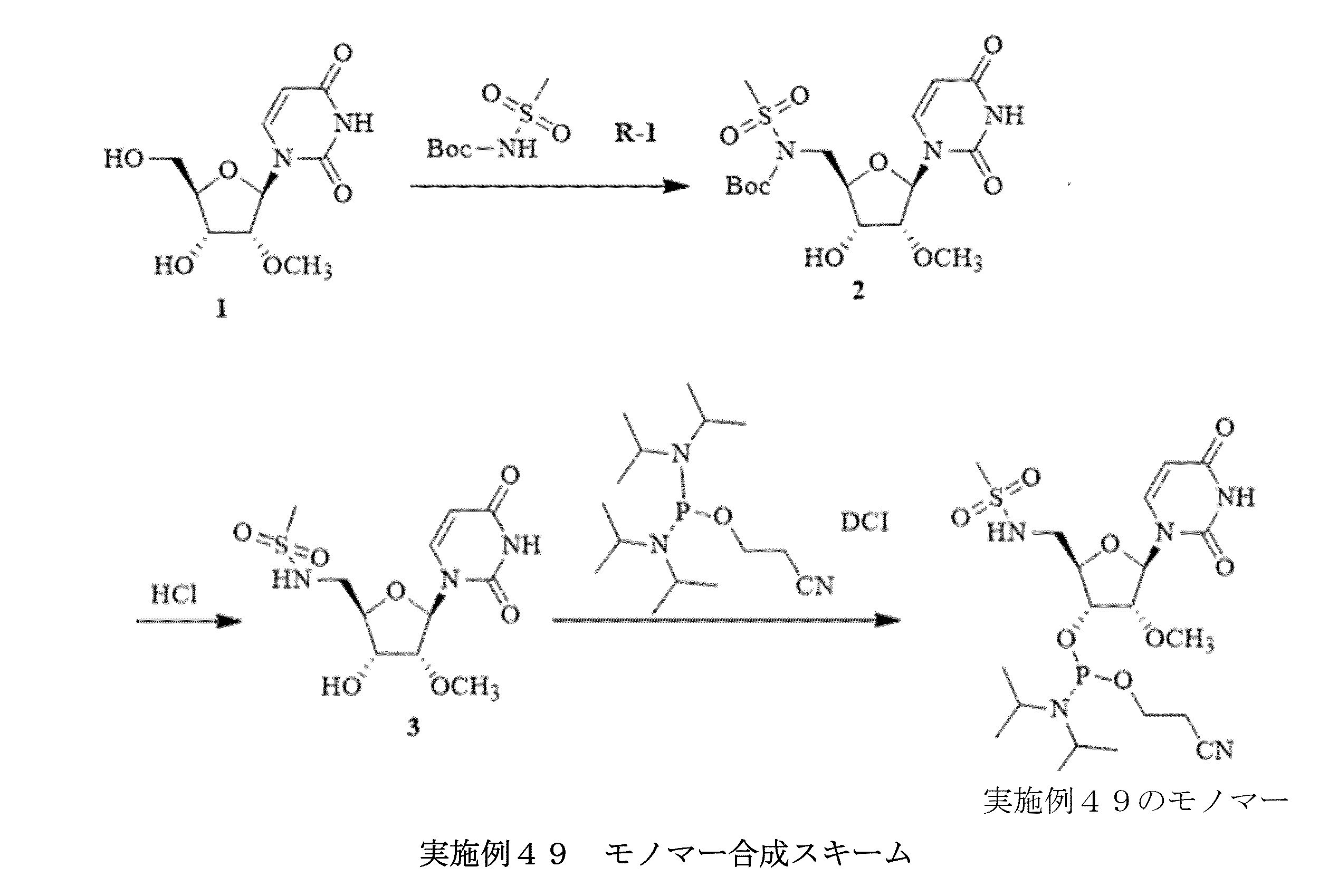
(2)の調製:1(15g、58.09mmol)およびtert-ブチル N-メチルスルホニルカルバメート(17.01g、87.13mmol)をTHF(250mL)に溶解し、PPh3(30.47g、116.18mmol)を添加し、続いてDIAD(23.49g、116.18mmol、22.59mL)を0℃で滴下した。反応混合物を15℃で12時間撹拌した。TLC(DCM/MeOH=10/1)によってモニタリングされる場合の完了時に、反応混合物を蒸発させて、残渣を得た。残渣をフラッシュシリカゲルクロマトグラフィー(ISCO(登録商標)、120g SepaFlash(登録商標)シリカフラッシュカラム、0~20%のMeOH/DCM勾配の溶離液、60mL/分)によって精製して、2(6.9g、収率24.28%)を白色固体として得た。ESI-LCMS:m/z 457.9[M+Na]+、1H NMR(400MHz,CDCl3)δ=8.64(br s,1H)、7.64(d,J=8.2Hz,1H)、5.88(d,J=1.9Hz,1H)、5.80(dd,J=2.2,8.2Hz,1H)、4.19-4.01(m,3H)、3.90(dt,J=5.5,8.2Hz,1H)、3.82-3.78(m,1H)、3.64(s,3H)、3.32(s,3H)、2.75(d,J=8.9Hz,1H)、1.56(s,9H)。 Preparation of (2): 1 (15 g, 58.09 mmol) and tert-butyl N-methylsulfonylcarbamate (17.01 g, 87.13 mmol) were dissolved in THF (250 mL) and treated with PPh 3 (30.47 g, 116. 18 mmol) was added followed by DIAD (23.49 g, 116.18 mmol, 22.59 mL) dropwise at 0°C. The reaction mixture was stirred at 15° C. for 12 hours. Upon completion as monitored by TLC (DCM/MeOH=10/1), the reaction mixture was evaporated to give a residue. The residue was purified by flash silica gel chromatography (ISCO®, 120 g SepaFlash® silica flash column, 0-20% MeOH/DCM gradient eluent, 60 mL/min) to give 2 (6.9 g , yield 24.28%) as a white solid. ESI-LCMS: m/z 457.9 [M+Na] + , 1 H NMR (400 MHz, CDCl 3 ) δ=8.64 (br s, 1H), 7.64 (d, J=8.2 Hz, 1H). , 5.88 (d, J=1.9 Hz, 1 H), 5.80 (dd, J=2.2, 8.2 Hz, 1 H), 4.19-4.01 (m, 3 H), 3. 90 (dt, J=5.5, 8.2 Hz, 1H), 3.82-3.78 (m, 1H), 3.64 (s, 3H), 3.32 (s, 3H), 2. 75 (d, J=8.9 Hz, 1 H), 1.56 (s, 9 H).
(3)の調製:2(6.9g、15.85mmol)をMeOH(40mL)に溶解し、HCl/MeOHの溶液(4M、7.92mL)を滴下した。反応混合物を15℃で12時間撹拌し、次いで、蒸発させて、残渣を得た。残渣をフラッシュシリカゲルクロマトグラフィー(ISCO(登録商標)、40g SepaFlash(登録商標)シリカフラッシュカラム、0~10%のMeOH/DCM勾配の溶離液、40mL/分)によって精製して、3(2.7g、収率50.30%)を白色固体として得た。ESI-LCMS:m/z 336.0[M+H]+、1H NMR(400MHz,CD3CN)δ=9.20(br s,1H)、7.52(d,J=8.1Hz,1H)、5.75(d,J=3.8Hz,1H)、5.64(dd,J=2.0,8.1Hz,1H)、5.60-5.52(m,1H)、4.15-3.99(m,1H)、3.96-3.81(m,2H)、3.46(s,3H)、3.44-3.35(m,1H)、3.34-3.26(m,1H)、2.92(s,3H)。 Preparation of (3): 2 (6.9 g, 15.85 mmol) was dissolved in MeOH (40 mL) and a solution of HCl/MeOH (4 M, 7.92 mL) was added dropwise. The reaction mixture was stirred at 15° C. for 12 hours and then evaporated to give a residue. The residue was purified by flash silica gel chromatography (ISCO®, 40 g SepaFlash® silica flash column, 0-10% MeOH/DCM gradient eluent, 40 mL/min) to give 3 (2.7 g , yield 50.30%) as a white solid. ESI-LCMS: m/z 336.0 [M+H] + , 1 H NMR (400 MHz, CD 3 CN) δ = 9.20 (br s, 1H), 7.52 (d, J = 8.1 Hz, 1H ), 5.75 (d, J = 3.8Hz, 1H), 5.64 (dd, J = 2.0, 8.1Hz, 1H), 5.60-5.52 (m, 1H), 4 .15-3.99 (m, 1H), 3.96-3.81 (m, 2H), 3.46 (s, 3H), 3.44-3.35 (m, 1H), 3.34 -3.26 (m, 1H), 2.92 (s, 3H).
(実施例49のモノマー)の調製:3(2.14g、6.38mmol)のDCM(20mL)溶液に、0℃で3-ビス(ジイソプロピルアミノ)ホスファニルオキシプロパンニトリル(2.50g、8.30mmol、2.63mL)、続いて1H-イミダゾール-4,5-ジカルボニトリル(829mg、7.02mmol)を滴下し、混合物をAr下で3回パージした。反応混合物を15℃で2時間撹拌した。完了時に、混合物を5%NaHCO3(20mL)でクエンチし、DCM(20mL×2)で抽出し、ブライン(15mL)で洗浄し、Na2SO4上で乾燥させ、濾過し、蒸発させて、残渣を得た。残渣をフラッシュシリカゲルクロマトグラフィー(ISCO(登録商標);40g SepaFlash(登録商標)シリカフラッシュカラム、0~10%(B相:i-PrOH/DCM=1/2)/A相:5%TEAを有するDCMの勾配、40mL/分)の溶離液によって精製し、実施例49のモノマー(1.73g、収率48.59%)を白色固体として得た。ESI-LCMS:m/z 536.3[M+H]+、1H NMR(400MHz,CD3CN)δ=7.58-7.48(m,1H)、5.83-5.78(m,1H)、5.71-5.64(m,1H)、4.40-4.29(m,1H)、4.19-4.07(m,1H)、3.98(td,J=5.3,13.3Hz,1H)、3.90-3.78(m,2H)、3.73-3.59(m,3H)、3.41(d,J=14.8Hz,4H)、2.92(br d,J=7.0Hz,3H)、2.73-2.63(m,2H)、1.23-1.11(m,12H)、31P NMR(162MHz,CD3CN)δ=149.81,150.37。 Preparation of (monomer of Example 49): To a solution of 3 (2.14 g, 6.38 mmol) in DCM (20 mL) at 0° C. was 3-bis(diisopropylamino)phosphanyloxypropanenitrile (2.50 g, 8. 30 mmol, 2.63 mL) followed by 1H-imidazole-4,5-dicarbonitrile (829 mg, 7.02 mmol) were added dropwise and the mixture was purged three times under Ar. The reaction mixture was stirred at 15° C. for 2 hours. Upon completion, the mixture was quenched with 5% NaHCO3 (20 mL), extracted with DCM (20 mL x 2 ), washed with brine (15 mL), dried over Na2SO4 , filtered, evaporated and A residue was obtained. The residue was subjected to flash silica gel chromatography (ISCO®; 40 g SepaFlash® silica flash column, 0-10% (Phase B: i-PrOH/DCM=1/2)/Phase A: with 5% TEA. Purification by DCM gradient, 40 mL/min) eluent gave Example 49 monomer (1.73 g, 48.59% yield) as a white solid. ESI-LCMS: m/z 536.3 [M+H] + , 1 H NMR (400 MHz, CD 3 CN) δ = 7.58-7.48 (m, 1H), 5.83-5.78 (m, 1H), 5.71-5.64 (m, 1H), 4.40-4.29 (m, 1H), 4.19-4.07 (m, 1H), 3.98 (td, J = 5.3, 13.3Hz, 1H), 3.90-3.78 (m, 2H), 3.73-3.59 (m, 3H), 3.41 (d, J = 14.8Hz, 4H ), 2.92 (br d, J=7.0 Hz, 3H), 2.73-2.63 (m, 2H), 1.23-1.11 (m, 12H), 31 P NMR (162 MHz, CD3CN ) ? = 149.81, 150.37.
[実施例50:5’エンドキャップモノマーの合成]

(2)の調製:1(10g、27.16mmol)のDMF(23mL)溶液に、イミダゾール(3.70g、54.33mmol)およびTBSCl(8.19g、54.33mmol)を25℃で添加した。混合物を、25℃で2時間撹拌した。完了時に、反応混合物をH2O(20mL)で希釈し、EA(30mL×2)で抽出した。合わせた有機層をブライン(20mL×2)で洗浄し、Na2SO4上で乾燥させ、濾過し、減圧下で濃縮して、2(13g、収率99.2%)を白色固体として得た。ESI-LCMS:m/z 482.9[M+H]+。 Preparation of (2): To a solution of 1 (10 g, 27.16 mmol) in DMF (23 mL) was added imidazole (3.70 g, 54.33 mmol) and TBSCl (8.19 g, 54.33 mmol) at 25°C. The mixture was stirred at 25° C. for 2 hours. Upon completion, the reaction mixture was diluted with H2O (20 mL) and extracted with EA (30 mL x 2). The combined organic layers were washed with brine (20 mL x 2), dried over Na2SO4 , filtered and concentrated under reduced pressure to afford 2 (13 g, 99.2% yield) as a white solid. rice field. ESI-LCMS: m/z 482.9 [M+H] + .
(3)の調製:2(35.00g、72.56mmol)のDMF(200mL)溶液に、NaN3(14.15g、217.67mmol)を添加した。混合物を60℃で17時間撹拌した。完了時に、反応混合物をH2O(200mL)で希釈し、EA(200mL×2)で抽出した。合わせた有機層を、ブライン(100mL×2)で洗浄し、Na2SO4上で乾燥させ、濾過し、減圧下で濃縮して、3(31.8g、粗物質)を黄色固体として得た。ESI-LCMS:m/z 398.1[M+H]+、1H NMR(400MHz,DMSO-d6)δ=11.21(d,J=1.3Hz,1H)、7.50(d,J=8.1Hz,1H)、5.57(d,J=4.5Hz,1H)、5.46(dd,J=2.1,8.0Hz,1H)、4.06(t,J=5.2Hz,1H)、3.81-3.64(m,2H)、3.44-3.30(m,2H)、2.31-2.25(m,3H)、0.65(s,9H)、-0.13(s,6H)。 Preparation of (3): To a solution of 2 (35.00 g, 72.56 mmol) in DMF (200 mL) was added NaN3 (14.15 g, 217.67 mmol). The mixture was stirred at 60° C. for 17 hours. Upon completion, the reaction mixture was diluted with H2O (200 mL) and extracted with EA (200 mL x 2). The combined organic layers were washed with brine (100 mL x 2), dried over Na2SO4 , filtered and concentrated under reduced pressure to give 3 (31.8 g, crude) as a yellow solid . . ESI-LCMS: m/z 398.1 [M+H] + , 1 H NMR (400 MHz, DMSO-d6) δ=11.21 (d, J=1.3 Hz, 1 H), 7.50 (d, J= 8.1 Hz, 1 H), 5.57 (d, J = 4.5 Hz, 1 H), 5.46 (dd, J = 2.1, 8.0 Hz, 1 H), 4.06 (t, J = 5 .2Hz, 1H), 3.81-3.64 (m, 2H), 3.44-3.30 (m, 2H), 2.31-2.25 (m, 3H), 0.65 (s , 9H), −0.13 (s, 6H).
(4)の調製:3(7g、17.61mmol)のTHF(60mL)溶液に、Pd/C(2g)を25℃で添加した。反応混合物を、H2雰囲気(15PSI)下、25℃で3時間撹拌した。反応混合物を濾過し、濾液を濃縮して、4(5.4g、収率75.11%)を灰色固体として得た。ESI-LCMS:m/z 372.1[M+H]+ 、 1H NMR(400MHz,DMSO-d6)δ=7.93(d,J=8.0Hz,1H)、5.81(d,J=5.5Hz,1H)、5.65(d,J=8.3Hz,1H)、4.28(t,J=4.6Hz,1H)、3.88(t,J=5.3Hz,1H)、3.74(q,J=4.6Hz,1H)、3.31(s,3H)、2.83-2.66(m,2H)、0.88(s,9H)、0.09(s,6H)。 Preparation of (4): To a solution of 3 (7 g, 17.61 mmol) in THF (60 mL) was added Pd/C (2 g) at 25°C. The reaction mixture was stirred at 25° C. under H 2 atmosphere (15 PSI) for 3 hours. The reaction mixture was filtered and the filtrate was concentrated to give 4 (5.4 g, 75.11% yield) as a gray solid. ESI-LCMS: m/z 372.1 [M+H] + , 1 H NMR (400 MHz, DMSO-d6) δ = 7.93 (d, J = 8.0 Hz, 1H), 5.81 (d, J = 5.5Hz, 1H), 5.65 (d, J = 8.3Hz, 1H), 4.28 (t, J = 4.6Hz, 1H), 3.88 (t, J = 5.3Hz, 1H) ), 3.74 (q, J = 4.6 Hz, 1H), 3.31 (s, 3H), 2.83-2.66 (m, 2H), 0.88 (s, 9H), 0. 09 (s, 6H).
(5)の調製:4(3g、8.08mmol)のDCM(30mL)溶液に、TEA(2.45g、24.23mmol、3.37mL)を添加し、続いて25℃で3-クロロプロパン-1-スルホニルクロリド(1.50g、8.48mmol、1.03mL)を滴下した。反応混合物を、N2雰囲気下、25℃で18時間撹拌した。完了時に、反応混合物をH2O(50mL)で希釈し、DCM(50mL×2)で抽出した。合わせた有機層をブライン(50mL×2)で洗浄し、Na2SO4上で乾燥させ、濾過し、減圧下で濃縮した。残渣をフラッシュシリカゲルクロマトグラフィー(ISCO(登録商標)、24g SepaFlash(登録商標)シリカフラッシュカラム、0~30%のMeOH/DCMの溶離液、50mL/分)によって精製して、5(3.6g、収率84.44%)を白色固体として得た。ESI-LCMS:m/z 512.1[M+H]+ 、 1H NMR(400MHz,DMSO-d6)δ=11.42(s,1H)、7.75(d,J=8.1Hz,1H)、7.49(t,J=6.2Hz,1H)、5.83(d,J=5.8Hz,1H)、5.70-5.61(m,1H)、4.33-4.23(m,1H)、3.95(t,J=5.5Hz,1H)、3.90-3.78(m,1H)、3.73(t,J=6.5Hz,2H)、3.30(s,3H)、3.26-3.12(m,4H)、2.14-2.02(m,2H)、0.88(s,9H)、0.11(d,J=3.3Hz,6H)。 Preparation of (5): To a solution of 4 (3 g, 8.08 mmol) in DCM (30 mL) was added TEA (2.45 g, 24.23 mmol, 3.37 mL) followed by 3-chloropropane-1 at 25 °C. -Sulfonyl chloride (1.50 g, 8.48 mmol, 1.03 mL) was added dropwise. The reaction mixture was stirred at 25° C. for 18 hours under N 2 atmosphere. Upon completion, the reaction mixture was diluted with H2O (50 mL) and extracted with DCM (50 mL x 2). The combined organic layers were washed with brine (50 mL x 2), dried over Na2SO4 , filtered and concentrated under reduced pressure. The residue was purified by flash silica gel chromatography (ISCO®, 24 g SepaFlash® silica flash column, eluent 0-30% MeOH/DCM, 50 mL/min) to give 5 (3.6 g, Yield 84.44%) was obtained as a white solid. ESI-LCMS: m/z 512.1 [M+H] + , 1 H NMR (400 MHz, DMSO-d6) δ=11.42 (s, 1H), 7.75 (d, J=8.1 Hz, 1H) , 7.49 (t, J=6.2 Hz, 1H), 5.83 (d, J=5.8 Hz, 1H), 5.70-5.61 (m, 1H), 4.33-4. 23 (m, 1H), 3.95 (t, J = 5.5Hz, 1H), 3.90-3.78 (m, 1H), 3.73 (t, J = 6.5Hz, 2H), 3.30 (s, 3H), 3.26-3.12 (m, 4H), 2.14-2.02 (m, 2H), 0.88 (s, 9H), 0.11 (d, J=3.3Hz, 6H).
(6)の調製:5(5g、9.76mmol)のDMF(45mL)溶液に、DBU(7.43g、48.82mmol、7.36mL)を添加した。混合物を25℃で16時間撹拌した。反応混合物を濃縮して残渣を得て、H2O(50mL)で希釈し、EA(50mL×2)で抽出した。合わせた有機層をブライン(50mL×2)で洗浄し、Na2SO4上で乾燥させ、濾過し、減圧下で濃縮した。残渣をフラッシュシリカゲルクロマトグラフィー(ISCO(登録商標)、24g SepaFlash(登録商標)シリカフラッシュカラム、0~80%のEA/PEの溶離液、40mL/分)によって精製して、6(4.4g、収率89.06%)を白色固体として得た。ESI-LCMS:m/z 476.1[M+H]+ 、 1H NMR(400MHz,DMSO-d6)δ=11.43(d,J=1.7Hz,1H)、7.72(d,J=8.1Hz,1H)、5.82(d,J=4.8Hz,1H)、5.67(dd,J=2.1,8.1Hz,1H)、4.22(t,J=5.1Hz,1H)、3.99-3.87(m,2H)、3.33-3.27(m,6H)、3.09(dd,J=6.6,14.7Hz,1H)、2.26-2.16(m,2H)、0.88(s,9H)、0.10(d,J=3.8Hz,6H)。 Preparation of (6): To a solution of 5 (5 g, 9.76 mmol) in DMF (45 mL) was added DBU (7.43 g, 48.82 mmol, 7.36 mL). The mixture was stirred at 25° C. for 16 hours. The reaction mixture was concentrated to give a residue, diluted with H2O (50 mL) and extracted with EA (50 mL x 2). The combined organic layers were washed with brine (50 mL x 2), dried over Na2SO4 , filtered and concentrated under reduced pressure. The residue was purified by flash silica gel chromatography (ISCO®, 24 g SepaFlash® silica flash column, 0-80% EA/PE eluent, 40 mL/min) to give 6 (4.4 g, Yield 89.06%) was obtained as a white solid. ESI-LCMS: m/z 476.1 [M+H] + , 1 H NMR (400 MHz, DMSO-d6) δ=11.43 (d, J=1.7 Hz, 1 H), 7.72 (d, J= 8.1 Hz, 1 H), 5.82 (d, J = 4.8 Hz, 1 H), 5.67 (dd, J = 2.1, 8.1 Hz, 1 H), 4.22 (t, J = 5 .1Hz, 1H), 3.99-3.87 (m, 2H), 3.33-3.27 (m, 6H), 3.09 (dd, J = 6.6, 14.7Hz, 1H) , 2.26-2.16 (m, 2H), 0.88 (s, 9H), 0.10 (d, J=3.8Hz, 6H).
(7)の調製:6(200mg、420.49umol)のMeOH(2mL)溶液にNH4F(311.48mg、8.41mmol、20当量)を添加し、混合物を80℃で2時間撹拌した。混合物を濾過し、濃縮して残渣を得て、フラッシュシリカゲルクロマトグラフィー(ISCO(登録商標)、4g SepaFlash(登録商標)シリカフラッシュカラム、0~50%のMeOH/DCMの溶離液、20mL/分)によって精製して、7(120mg、収率76.60%)を白色固体として得た。ESI-LCMS:m/z 362.1[M+H]+ 、 1H NMR(400MHz,DMSO-d6)δ=11.37(br s,1H)、7.68(d,J=8.1Hz,1H)、5.81(d,J=4.6Hz,1H)、5.65(d,J=8.0Hz,1H)、4.02(q,J=5.6Hz,1H)、3.95-3.83(m,2H)、3.34(s,9H)、3.09(dd,J=6.9,14.6Hz,1H)、2.26-2.14(m,2H)。 Preparation of (7): To a solution of 6 (200 mg, 420.49 umol) in MeOH (2 mL) was added NH4F (311.48 mg, 8.41 mmol, 20 eq) and the mixture was stirred at 80°C for 2 hours. The mixture was filtered and concentrated to give a residue which was purified by flash silica gel chromatography (ISCO®, 4 g SepaFlash® silica flash column, eluent 0-50% MeOH/DCM, 20 mL/min). to give 7 (120 mg, 76.60% yield) as a white solid. ESI-LCMS: m/z 362.1 [M+H] + , 1 H NMR (400 MHz, DMSO-d6) δ = 11.37 (br s, 1H), 7.68 (d, J = 8.1 Hz, 1H ), 5.81 (d, J = 4.6 Hz, 1 H), 5.65 (d, J = 8.0 Hz, 1 H), 4.02 (q, J = 5.6 Hz, 1 H), 3.95 -3.83 (m, 2H), 3.34 (s, 9H), 3.09 (dd, J = 6.9, 14.6Hz, 1H), 2.26-2.14 (m, 2H) .
(実施例50のモノマー)の調製:7(1.5g、4.15mmol)のCH3CN(12mL)溶液に、3-ビス(ジイソプロピルアミノ)ホスファニルオキシプロパンニトリル(1.63g、5.40mmol、1.71mL)および1H-イミダゾール-4,5-ジカルボニトリル(539.22mg、4.57mmol)を0℃で一度に添加した。反応混合物を徐々に25℃まで加温した。反応混合物を、N2雰囲気下、25℃で2時間撹拌した。完了時に、反応混合物をNaHCO3(20mL)で希釈し、DCM(20mL×2)で抽出した。合わせた有機層をブライン(20mL×2)で洗浄し、Na2SO4上で乾燥させ、濾過し、減圧下で濃縮して、残渣を得て、フラッシュシリカゲルクロマトグラフィ(ISCO(登録商標)、12g SepaFlash(登録商標)シリカフラッシュカラム、0.5%TEAを有する0~85%のEA/PE勾配の溶離液、30mL/分)によって精製して、実施例50のモノマー(800mg、収率33.6%)を白色固体として得た。ESI-LCMS:m/z 562.3[M+H]+ 、 1H NMR(400MHz,CD3CN)δ=9.28(br s,1H)、7.55(br dd,J=8.3,12.8Hz,1H)、5.86(br d,J=3.9Hz,1H)、5.65(br d,J=8.0Hz,1H)、4.33-4.06(m,2H)、4.00-3.89(m,1H)、4.08-3.86(m,1H)、3.89-3.72(m,4H)、3.43(br d,J=15.1Hz,6H)、3.23-3.05(m,3H)、2.69(br s,2H)、2.36-2.24(m,2H)、1.26-1.10(m,12H)、 31P NMR(162MHz,CD3CN)δ=149.94,149.88。 Preparation of (monomer of Example 50): To a solution of 7 (1.5 g, 4.15 mmol) in CH 3 CN (12 mL) was added 3-bis(diisopropylamino)phosphanyloxypropanenitrile (1.63 g, 5.40 mmol). , 1.71 mL) and 1H-imidazole-4,5-dicarbonitrile (539.22 mg, 4.57 mmol) were added at 0° C. in one portion. The reaction mixture was gradually warmed to 25°C. The reaction mixture was stirred at 25° C. for 2 hours under N 2 atmosphere. Upon completion, the reaction mixture was diluted with NaHCO 3 (20 mL) and extracted with DCM (20 mL×2). The combined organic layers were washed with brine (20 mL×2), dried over Na 2 SO 4 , filtered and concentrated under reduced pressure to give a residue which was subjected to flash silica gel chromatography (ISCO®, 12 g). Purification by SepaFlash® silica flash column, eluent of 0-85% EA/PE gradient with 0.5% TEA, 30 mL/min) gave the monomer of Example 50 (800 mg, yield 33.0 mg). 6%) as a white solid. ESI-LCMS: m/z 562.3 [M+H] + , 1 H NMR (400 MHz, CD 3 CN) δ=9.28 (br s, 1H), 7.55 (br dd, J=8.3, 12.8Hz, 1H), 5.86 (br d, J = 3.9Hz, 1H), 5.65 (br d, J = 8.0Hz, 1H), 4.33-4.06 (m, 2H ), 4.00-3.89 (m, 1H), 4.08-3.86 (m, 1H), 3.89-3.72 (m, 4H), 3.43 (br d, J = 15.1 Hz, 6H), 3.23-3.05 (m, 3H), 2.69 (br s, 2H), 2.36-2.24 (m, 2H), 1.26-1.10 (m, 12H) 31 P NMR (162 MHz, CD 3 CN) δ = 149.94 , 149.88.
[実施例51:5’エンドキャップモノマーの合成]

(2)の調製:CH3CN(1.2L)およびPy(60mL)中の1(30g、101.07mmol、純度87%)の溶液に、I2(33.35g、131.40mmol、26.47mL)およびPPh3(37.11g、141.50mmol)を10℃で一度に添加した。反応物を25℃でさらに48時間撹拌した。完了時に、混合物を飽和Na2S2O3水溶液(300mL)および飽和NaHCO3水溶液(300mL)で希釈し、濃縮してCH3CNを除去し、次いで、EtOAc(300mL×3)で抽出した。合わせた有機層をブライン(300mL)で洗浄し、Na2SO4上で乾燥させ、濾過し、減圧下で濃縮して、残渣を得た。残渣をフラッシュシリカゲルクロマトグラフィー(ISCO(登録商標)、330g SepaFlash(登録商標)シリカフラッシュカラム、0~60%のメタノール/ジクロロメタン勾配の溶離液、100mL/分)によって精製して、2(28.2g、収率72.00%、純度95%)を褐色固体として得た。ESI-LCMS:m/z 369.1[M+H]+、1H NMR(400MHz,DMSO-d6)δ=11.43(s,1H)、7.68(d,J=8.1Hz,1H)、5.86(d,J=5.5Hz,1H)、5.69(d,J=8.1Hz,1H)、5.46(d,J=6.0Hz,1H)、4.08-3.96(m,2H)、3.90-3.81(m,1H)、3.60-3.51(m,1H)、3.40(dd,J=6.9,10.6Hz,1H)、3.34(s,3H)。 Preparation of (2): To a solution of 1 (30 g, 101.07 mmol, 87% purity) in CH 3 CN (1.2 L) and Py (60 mL) was added I 2 (33.35 g, 131.40 mmol, 26.35 g, 131.40 mmol). 47 mL) and PPh 3 (37.11 g, 141.50 mmol) were added at 10° C. in one portion. The reaction was stirred at 25° C. for an additional 48 hours. Upon completion, the mixture was diluted with saturated aqueous Na 2 S 2 O 3 (300 mL) and saturated aqueous NaHCO 3 (300 mL), concentrated to remove CH 3 CN, then extracted with EtOAc (300 mL×3). The combined organic layers were washed with brine (300 mL) , dried over Na2SO4 , filtered and concentrated under reduced pressure to give a residue. The residue was purified by flash silica gel chromatography (ISCO®, 330 g SepaFlash® silica flash column, 0-60 % methanol/dichloromethane gradient eluent, 100 mL/min) to give 2 (28.2 g , 72.00% yield, 95% purity) as a brown solid. ESI-LCMS: m/z 369.1 [M+H] +, 1 H NMR (400 MHz, DMSO-d 6 ) δ = 11.43 (s, 1H), 7.68 (d, J = 8.1 Hz, 1H ), 5.86 (d, J = 5.5 Hz, 1 H), 5.69 (d, J = 8.1 Hz, 1 H), 5.46 (d, J = 6.0 Hz, 1 H), 4.08 −3.96 (m, 2H), 3.90-3.81 (m, 1H), 3.60-3.51 (m, 1H), 3.40 (dd, J=6.9, 10. 6 Hz, 1 H), 3.34 (s, 3 H).
(3)の調製:2のDMF(90mL)溶液に、イミダゾール(4.25g、62.48mmol)およびTBSCl(6.96g、46.18mmol)を15℃で一度に添加した。混合物を15℃で6時間撹拌した。反応混合物を、H2O(300mL)を添加することによってクエンチし、EtOAc(300mL×2)で抽出した。合わせた有機層を、ブライン(300mL)で洗浄し、Na2SO4上で乾燥させ、濾過し、減圧下で濃縮して、3(13.10g、粗物質)を白色固体として得た。ESI-LCMS:m/z 483.0[M+H]+。 Preparation of (3): To a solution of 2 in DMF (90 mL) was added imidazole (4.25 g, 62.48 mmol) and TBSCl (6.96 g, 46.18 mmol) in one portion at 15°C. The mixture was stirred at 15° C. for 6 hours. The reaction mixture was quenched by adding H 2 O (300 mL) and extracted with EtOAc (300 mL×2). The combined organic layers were washed with brine (300 mL), dried over Na2SO4 , filtered and concentrated under reduced pressure to give 3 (13.10 g, crude) as a white solid. ESI-LCMS: m/z 483.0 [M+H] + .
(4)の調製:MeOH(20mL)、H2O(80mL)、およびジオキサン(20mL)中の3(10g、20.73mmol)の溶液に、Na2SO3(15.68g、124.38mmol)を添加し、混合物を80℃で24時間撹拌した。反応混合物を減圧下で濃縮して、MeOHを除去した。水層をEtOAc(80mL×2)で抽出し、減圧下で濃縮して、残渣を得た。残渣をMeOH(100×3mL)で粉砕して、4(9.5g、収率94.48%、純度90%)を白色固体として得た。ESI-LCMS:m/z 437.0[M+H]+。 Preparation of (4): Na2SO3 (15.68 g, 124.38 mmol) to a solution of 3 (10 g, 20.73 mmol) in MeOH (20 mL), H2O (80 mL), and dioxane (20 mL). was added and the mixture was stirred at 80° C. for 24 hours. The reaction mixture was concentrated under reduced pressure to remove MeOH. The aqueous layer was extracted with EtOAc (80 mL x 2) and concentrated under reduced pressure to give a residue. The residue was triturated with MeOH (100 x 3 mL) to give 4 (9.5 g, 94.48% yield, 90% purity) as a white solid. ESI-LCMS: m/z 437.0 [M+H] + .
(5)の調製:4(11g、21.42mmol、純度85%)のDCM(120mL)溶液に、DMF(469.65mg、6.43mmol、494.37uL)を0℃で添加し、続いて二塩化オキサリル(13.59g、107.10mmol、9.37mL)を滴下した。混合物を20℃で2時間撹拌した。反応混合物を、水(60mL)の添加によってクエンチし、有機層5(0.1125M、240mL DCM)を次のステップに直接的に使用した。(この反応を2つのバッチについてセットアップし、合わせた)ESI-LCMS:m/z455.0[M+H]+。 Preparation of (5): To a solution of 4 (11 g, 21.42 mmol, 85% purity) in DCM (120 mL) was added DMF (469.65 mg, 6.43 mmol, 494.37 uL) at 0° C. followed by two Oxalyl chloride (13.59 g, 107.10 mmol, 9.37 mL) was added dropwise. The mixture was stirred at 20° C. for 2 hours. The reaction mixture was quenched by the addition of water (60 mL) and organic layer 5 (0.1125 M, 240 mL DCM) was used directly in the next step. (This reaction was set up for two batches and combined) ESI-LCMS: m/z 455.0 [M+H] + .
(6)の調製:5(186.4mL、DCM中0.1125M)をDCM(60mL)で希釈し、メチルアミン(3.26g、41.93mmol、純度40%)で処理した。混合物を20℃で2時間撹拌した。反応混合物を減圧下で濃縮して、残渣を得た。残渣をフラッシュシリカゲルクロマトグラフィー(ISCO(登録商標)、40g SepaFlash(登録商標)シリカフラッシュカラム、0~10%のMeOH/DCM勾配の溶離液、40mL/分)によって精製して、AGS-9-3-008(1.82g、収率18.53%、純度96%)を黄色固体として得た。ESI-LCMS:m/z 472.0[M+Na]+ 、 1H NMR(400MHz,CDCl3)δ=9.08(s,1H)、7.31(d,J=8.1Hz,1H)、5.78(d,J=8.1Hz,1H)、5.57(d,J=3.8Hz,1H)、4.61-4.48(m,1H)、4.41-4.27(m,2H)、4.13-4.03(m,1H)、3.46(s,3H)、3.43-3.33(m,2H)、2.78(d,J=5.2Hz,3H)、0.92(s,9H)、0.13(s,6H)。 Preparation of (6): 5 (186.4 mL, 0.1125 M in DCM) was diluted with DCM (60 mL) and treated with methylamine (3.26 g, 41.93 mmol, 40% purity). The mixture was stirred at 20° C. for 2 hours. The reaction mixture was concentrated under reduced pressure to give a residue. The residue was purified by flash silica gel chromatography (ISCO®, 40 g SepaFlash® silica flash column, 0-10% MeOH/DCM gradient eluent, 40 mL/min) to give AGS-9-3 -008 (1.82 g, 18.53% yield, 96% purity) was obtained as a yellow solid. ESI-LCMS: m/z 472.0 [M+Na] + , 1 H NMR (400 MHz, CDCl 3 ) δ=9.08 (s, 1H), 7.31 (d, J=8.1 Hz, 1H), 5.78 (d, J = 8.1Hz, 1H), 5.57 (d, J = 3.8Hz, 1H), 4.61-4.48 (m, 1H), 4.41-4.27 (m, 2H), 4.13-4.03 (m, 1H), 3.46 (s, 3H), 3.43-3.33 (m, 2H), 2.78 (d, J = 5 .2Hz, 3H), 0.92 (s, 9H), 0.13 (s, 6H).
(7)の調製:6(2.3g、5.12mmol)のMeOH(12mL)溶液に、HCl/MeOH(4M、6.39mL)を添加した。混合物を20℃で2時間撹拌した。反応混合物を減圧下で濃縮して、残渣を得た。残渣をフラッシュシリカゲルクロマトグラフィー(ISCO(登録商標)、24g SepaFlash(登録商標)シリカフラッシュカラム、0~15%のMeOH/DCM勾配の溶離液、30mL/分)によって精製して、7(1.4g、収率79.98%)を桃色固体として得た。ESI-LCMS:m/z 336.1[M+H]+、1H NMR(400MHz,CDCl3)δ=9.12(s,1H)、7.39(d,J=8.0Hz,1H)、5.79(d,J=3.3Hz,1H)、5.66(dd,J=2.1,8.2Hz,1H)、5.13(s,1H)、4.13(t,J=4.0,7.4Hz,1H)、4.07-4.02(m,1H)、3.87(dd,J=3.3,5.5Hz,1H)、3.47(s,3H)、3.43-3.37(m,2H)、2.65(d,J=4.5Hz,3H)。 Preparation of (7): To a solution of 6 (2.3 g, 5.12 mmol) in MeOH (12 mL) was added HCl/MeOH (4 M, 6.39 mL). The mixture was stirred at 20° C. for 2 hours. The reaction mixture was concentrated under reduced pressure to give a residue. The residue was purified by flash silica gel chromatography (ISCO®, 24 g SepaFlash® silica flash column, 0-15% MeOH/DCM gradient eluent, 30 mL/min) to give 7 (1.4 g , yield 79.98%) as a pink solid. ESI-LCMS: m/z 336.1 [M+H] + , 1 H NMR (400 MHz, CDCl 3 ) δ=9.12 (s, 1H), 7.39 (d, J=8.0 Hz, 1H), 5.79 (d, J = 3.3Hz, 1H), 5.66 (dd, J = 2.1, 8.2Hz, 1H), 5.13 (s, 1H), 4.13 (t, J = 4.0, 7.4Hz, 1H), 4.07-4.02 (m, 1H), 3.87 (dd, J = 3.3, 5.5Hz, 1H), 3.47 (s, 3H), 3.43-3.37 (m, 2H), 2.65 (d, J=4.5Hz, 3H).
(実施例51のモノマー)の調製:MeCN(18mL)中の7(1.7g、5.07mmol)および4A MS(1.4g)の混合物に、3-ビス(ジイソプロピルアミノ)ホスファニルオキシプロパンニトリル(1.99g、6.59mmol、2.09mL)を0℃で添加し、続いて1H-イミダゾール-4,5-ジカルボニトリル(658.57mg、5.58mmol)を0℃で一度に添加した。混合物を20℃で2時間撹拌した。完了時に、反応混合物を飽和NaHCO3水溶液(20mL)を添加することによってクエンチし、DCM(40mL)で希釈した。有機層を、飽和NaHCO3水溶液(20mL×2)で洗浄し、Na2SO4上で乾燥させ、濾過し、減圧下で濃縮して、残渣を得た。残渣を、フラッシュシリカゲルカラム(5%TEAを含むDCM中の0%~5%i-PrOH)によって精製して、実施例51のモノマー(1.30g、収率46.68%)を白色固体として得た。ESI-LCMS:m/z 536.2[M+H]+、1H NMR(400MHz,CD3CN)δ=9.00(s,1H)、7.40(d,J=8.0Hz,1H)、5.85-5.76(m,1H)、5.64(d,J=8.0Hz,1H)、5.08(d,J=5.0Hz,1H)、4.42-4.21(m,2H)、4.00(td,J=4.6,9.3Hz,1H)、3.89-3.61(m,4H)、3.47-3.40(m,4H)、3.37-3.22(m,1H)、2.71-2.60(m,5H)、1.21-1.16(m,11H)、1.21-1.16(m,1H)、31P NMR(162MHz,CD3CN)δ=150.07,149.97 Preparation of (monomer of Example 51): To a mixture of 7 (1.7 g, 5.07 mmol) and 4A MS (1.4 g) in MeCN (18 mL) was added 3-bis(diisopropylamino)phosphanyloxypropanenitrile. (1.99 g, 6.59 mmol, 2.09 mL) was added at 0° C. followed by 1H-imidazole-4,5-dicarbonitrile (658.57 mg, 5.58 mmol) at 0° C. in one portion. . The mixture was stirred at 20° C. for 2 hours. Upon completion, the reaction mixture was quenched by adding saturated aqueous NaHCO 3 (20 mL) and diluted with DCM (40 mL). The organic layer was washed with saturated aqueous NaHCO 3 (20 mL×2), dried over Na 2 SO 4 , filtered and concentrated under reduced pressure to give a residue. The residue was purified by flash silica gel column (0% to 5% i-PrOH in DCM with 5% TEA) to give Example 51 monomer (1.30 g, 46.68% yield) as a white solid. Obtained. ESI-LCMS: m/z 536.2 [M+H] + , 1 H NMR (400 MHz, CD 3 CN) δ = 9.00 (s, 1 H), 7.40 (d, J = 8.0 Hz, 1 H) , 5.85-5.76 (m, 1H), 5.64 (d, J=8.0Hz, 1H), 5.08 (d, J=5.0Hz, 1H), 4.42-4. 21 (m, 2H), 4.00 (td, J = 4.6, 9.3Hz, 1H), 3.89-3.61 (m, 4H), 3.47-3.40 (m, 4H) ), 3.37-3.22 (m, 1H), 2.71-2.60 (m, 5H), 1.21-1.16 (m, 11H), 1.21-1.16 (m , 1H), 31 P NMR (162 MHz, CD 3 CN) δ=150.07, 149.97
[実施例52:5’エンドキャップモノマーの合成]

(2)の調製:1(13.10g、27.16mmol)のTHF(100mL)溶液に、DBU(20.67g、135.78mmol、20.47mL)を添加した。混合物を60℃で6時間撹拌した。完了時に、反応混合物を、飽和NH4Cl溶液(600mL)を添加することによってクエンチし、EA(600mL×2)で抽出した。合わせた有機層をブライン(100mL)で洗浄し、Na2SO4上で乾燥させ、濾過し、減圧下で濃縮して、残渣を得た。残渣をフラッシュシリカゲルクロマトグラフィー(ISCO(登録商標)、120g SepaFlash(登録商標)シリカフラッシュカラム、0~50%(B相:酢酸エチル:ジクロロメタン=1:1)/A相:石油エーテル勾配の溶離液、45mL/分)によって精製して、2(5.9g、収率60.1%)を白色固体として得た。ESI-LCMS:m/z 355.1[M+H]+、1H NMR(400MHz,DMSO-d6)δ=11.61-11.30(m,1H)、7.76-7.51(m,1H)、6.04(d,J=5.4Hz,1H)、5.75(s,1H)、5.73-5.67(m,1H)、4.78(d,J=4.9Hz,1H)、4.41(d,J=1.1Hz,1H)、4.30(t,J=4.8Hz,1H)、4.22(d,J=1.4Hz,1H)、4.13(t,J=5.1Hz,1H)、4.06-3.97(m,1H)、3.94-3.89(m,1H)、3.82-3.75(m,1H)、3.33(s,3H)、3.30(s,2H)、1.17(t,J=7.2Hz,1H)、0.89(s,9H)、0.16-0.09(m,6H)。 Preparation of (2): To a solution of 1 (13.10 g, 27.16 mmol) in THF (100 mL) was added DBU (20.67 g, 135.78 mmol, 20.47 mL). The mixture was stirred at 60° C. for 6 hours. Upon completion, the reaction mixture was quenched by adding saturated NH 4 Cl solution (600 mL) and extracted with EA (600 mL×2). The combined organic layers were washed with brine (100 mL) , dried over Na2SO4 , filtered and concentrated under reduced pressure to give a residue. The residue was subjected to flash silica gel chromatography (ISCO®, 120 g SepaFlash® silica flash column, 0-50% (phase B: ethyl acetate:dichloromethane=1:1)/phase A: petroleum ether gradient eluent. , 45 mL/min) to afford 2 (5.9 g, 60.1% yield) as a white solid. ESI-LCMS: m/z 355.1 [M+H] + , 1 H NMR (400 MHz, DMSO-d 6 ) δ=11.61-11.30 (m, 1H), 7.76-7.51 (m , 1H), 6.04 (d, J = 5.4 Hz, 1H), 5.75 (s, 1H), 5.73-5.67 (m, 1H), 4.78 (d, J = 4 .9 Hz, 1 H), 4.41 (d, J = 1.1 Hz, 1 H), 4.30 (t, J = 4.8 Hz, 1 H), 4.22 (d, J = 1.4 Hz, 1 H) , 4.13 (t, J = 5.1 Hz, 1H), 4.06-3.97 (m, 1H), 3.94-3.89 (m, 1H), 3.82-3.75 ( m, 1H), 3.33 (s, 3H), 3.30 (s, 2H), 1.17 (t, J=7.2Hz, 1H), 0.89 (s, 9H), 0.16 -0.09 (m, 6H).
(3)の調製:2(4g、11.28mmol)のDCM(40mL)溶液に、Ru(II)-Pheox(214.12mg、338.53umol)を一度に添加し、続いてN2下、0℃でジアゾ(ジメトキシホスホリル)メタン(2.54g、16.93mmol)を滴下した。反応物を20℃で16時間撹拌した。完了時に、反応混合物を濾過し、減圧下で濃縮して残渣を得た。残渣をフラッシュシリカゲルクロマトグラフィー(ISCO(登録商標)、80g SepaFlash(登録商標)シリカフラッシュカラム、0~4%のMeOH/DCMの溶離液、60mL/分)によって精製して、3(5g、収率86.47%)を赤色液体として得た。ESI-LCMS:m/z 477.1[M+H]+、1H NMR(400MHz,DMSO-d6)δ=11.46(s,1H)、7.49(d,J=8.0Hz,1H)、6.01-5.87(m,1H)、5.75(dd,J=2.0,8.0Hz,1H)、4.58(d,J=3.8Hz,1H)、4.23(dd,J=3.8,7.8Hz,1H)、3.80-3.68(m,6H)、3.30(s,3H)、1.65-1.46(m,2H)、1.28-1.16(m,1H)、0.91(s,9H)、0.10(d,J=4.3Hz,6H)、31P NMR(162MHz,DMSO-d6)δ=27.5 Preparation of (3): To a solution of 2 (4 g, 11.28 mmol) in DCM (40 mL) was added Ru(II)-Pheox (214.12 mg, 338.53 umol) in one portion followed by 0 Diazo(dimethoxyphosphoryl)methane (2.54 g, 16.93 mmol) was added dropwise at °C. The reaction was stirred at 20° C. for 16 hours. Upon completion, the reaction mixture was filtered and concentrated under reduced pressure to give a residue. The residue was purified by flash silica gel chromatography (ISCO®, 80 g SepaFlash® silica flash column, eluent 0-4% MeOH/DCM, 60 mL/min) to give 3 (5 g, yield 86.47%) was obtained as a red liquid. ESI-LCMS: m/z 477.1 [M+H] + , 1 H NMR (400 MHz, DMSO-d 6 ) δ = 11.46 (s, 1H), 7.49 (d, J = 8.0 Hz, 1H ), 6.01-5.87 (m, 1H), 5.75 (dd, J = 2.0, 8.0Hz, 1H), 4.58 (d, J = 3.8Hz, 1H), 4 .23 (dd, J = 3.8, 7.8Hz, 1H), 3.80-3.68 (m, 6H), 3.30 (s, 3H), 1.65-1.46 (m, 2H), 1.28-1.16 (m, 1H), 0.91 (s, 9H), 0.10 (d, J=4.3Hz, 6H), 31 P NMR (162MHz, DMSO- d6 ) δ = 27.5
(4)の調製:CH3CN(30mL)中の3(2.8g、5.88mmol)およびNaI(1.76g、11.75mmol)の混合物に、クロロメチル 2,2-ジメチルプロパノエート(2.21g、14.69mmol、2.13mL)を25℃で添加した。混合物を、Ar下、80℃で40時間撹拌した。反応混合物を濾過し、減圧下で濃縮して、残渣を得た。残渣をフラッシュシリカゲルクロマトグラフィー(ISCO(登録商標)、40g SepaFlash(登録商標)シリカフラッシュカラム、0~50%の酢酸エチル/石油エーテル勾配の溶離液、40mL/分)によって精製して、4(2.1g、収率51.23%、純度97%)を黄色固体として得た。ESI-LCMS:677.3[M+H]+。
Preparation of (4): To a mixture of 3 (2.8 g, 5.88 mmol) and NaI (1.76 g, 11.75 mmol) in CH 3 CN (30 mL) was added
(5)の調製:H2O(1.5mL)およびHCOOH(741.81mg、15.44mmol、6mL)中の4(2.09g、3.09mmol)の混合物を15℃で40時間撹拌した。完了時に、反応混合物を飽和NaHCO3水溶液(300mL)によってクエンチし、EA(300mL×2)で抽出した。合わせた有機層をブライン(300mL)で洗浄し、Na2SO4上で乾燥させ、濾過し、減圧下で濃縮して、残渣を得た。残渣をフラッシュシリカゲルクロマトグラフィー(ISCO(登録商標)、20g SepaFlash(登録商標)シリカフラッシュカラム、0~5%のメタノール/ジクロロメタンの溶離液、45mL/分)によって精製して、5(1.51g、収率85.19%)を黄色固体として得た。ESI-LCMS:585.1[M+Na]+、1H NMR(400MHz,DMSO-d6)δ=11.45(d,J=1.8Hz,1H)、7.44(d,J=8.2Hz,1H)、6.04(d,J=7.5Hz,1H)、5.78-5.51(m,6H)、4.39(t,J=4.4Hz,1H)、4.15(dd,J=4.3,7.4Hz,1H)、4.03(q,J=7.1Hz,1H)、1.99(s,1H)、1.66(dd,J=8.6,10.8Hz,1H)、1.55-1.29(m,2H)、1.18(d,J=2.0Hz,18H)。 Preparation of (5): A mixture of 4 (2.09 g, 3.09 mmol) in H2O (1.5 mL) and HCOOH (741.81 mg, 15.44 mmol, 6 mL) was stirred at 15°C for 40 hours. Upon completion, the reaction mixture was quenched by saturated aqueous NaHCO 3 (300 mL) and extracted with EA (300 mL×2). The combined organic layers were washed with brine (300 mL) , dried over Na2SO4 , filtered and concentrated under reduced pressure to give a residue. The residue was purified by flash silica gel chromatography (ISCO®, 20 g SepaFlash® silica flash column, 0-5% methanol/dichloromethane eluent, 45 mL/min) to give 5 (1.51 g, Yield 85.19%) as a yellow solid. ESI-LCMS: 585.1 [M+Na] + , 1 H NMR (400 MHz, DMSO-d6) δ=11.45 (d, J=1.8 Hz, 1 H), 7.44 (d, J=8.2 Hz , 1H), 6.04 (d, J = 7.5Hz, 1H), 5.78-5.51 (m, 6H), 4.39 (t, J = 4.4Hz, 1H), 4.15 (dd, J=4.3, 7.4 Hz, 1H), 4.03 (q, J=7.1 Hz, 1H), 1.99 (s, 1H), 1.66 (dd, J=8. 6, 10.8 Hz, 1 H), 1.55-1.29 (m, 2 H), 1.18 (d, J=2.0 Hz, 18 H).
(実施例52のモノマー)の調製:5(2.5g、4.44mmol)のMeCN(30mL)溶液に、3-ビス(ジイソプロピルアミノ)ホスファニルオキシプロパンニトリル(1.74g、5.78mmol、1.84mL)を0℃で添加し、続いて1H-イミダゾール-4,5-ジカルボニトリル(577.36mg、4.89mmol)をAr下、一度に添加した。混合物を徐々に20℃まで加温し、20℃で1時間撹拌した。反応混合物を、飽和NaHCO3溶液(50mL)を添加することによってクエンチし、DCM(250mL)で希釈した。有機層を、飽和NaHCO3溶液(50mL×2)で洗浄し、Na2SO4上で乾燥させ、濾過し、減圧下で濃縮して、残渣を得た。残渣をフラッシュシリカゲルカラム(0.5%TEAを有する0%~50%EA/PE)によって精製して、実施例52のモノマー(1.85g、収率54.1%)を白色固体として得た。ESI-LCMS:785.2[M+Na]+、1H NMR(400MHz,CD3CN)δ=9.18(s,1H)、7.31(d,J=8.3Hz,1H)、6.06(d,J=7.8Hz,1H)、5.72-5.60(m,5H)、4.85-4.76(m,1H)、4.27(m,1H)、3.93-3.64(m,4H)、3.41(d,J=16.6Hz,3H)、2.80-2.62(m,2H)、1.76-1.49(m,3H)、1.23-1.19(m,30H)、31P NMR(162MHz,CD3CN)δ=150.66(s)、150.30,24.77,24.66。 Preparation of (monomer of Example 52): To a solution of 5 (2.5 g, 4.44 mmol) in MeCN (30 mL) was added 3-bis(diisopropylamino)phosphanyloxypropanenitrile (1.74 g, 5.78 mmol, 1 .84 mL) was added at 0° C. followed by 1H-imidazole-4,5-dicarbonitrile (577.36 mg, 4.89 mmol) under Ar in one portion. The mixture was gradually warmed to 20°C and stirred at 20°C for 1 hour. The reaction mixture was quenched by adding saturated NaHCO 3 solution (50 mL) and diluted with DCM (250 mL). The organic layer was washed with saturated NaHCO3 solution (50 mL x 2), dried over Na2SO4 , filtered and concentrated under reduced pressure to give a residue. The residue was purified by flash silica gel column (0%-50% EA/PE with 0.5% TEA) to give Example 52 monomer (1.85 g, 54.1% yield) as a white solid. . ESI-LCMS: 785.2 [M+Na] +, 1 H NMR (400 MHz, CD 3 CN) δ = 9.18 (s, 1 H), 7.31 (d, J = 8.3 Hz, 1 H),6. 06 (d, J = 7.8Hz, 1H), 5.72-5.60 (m, 5H), 4.85-4.76 (m, 1H), 4.27 (m, 1H), 3. 93-3.64 (m, 4H), 3.41 (d, J=16.6Hz, 3H), 2.80-2.62 (m, 2H), 1.76-1.49 (m, 3H) ), 1.23-1.19 (m, 30 H), 31 P NMR (162 MHz, CD 3 CN) δ=150.66 (s), 150.30, 24.77, 24.66.
[実施例53:5’エンドキャップモノマーの合成]

(2)の調製:1(15g、137.43mmol)のDCM(75mL)溶液に、Boc2O(31.49g、144.30mmol、33.15mL)およびDMAP(839.47mg、6.87mmol、0.05当量)を0℃で添加した。混合物を20℃で16時間撹拌し、減圧下で濃縮して、2(29.9g、粗物質)を黄色油状物として得た。1H NMR(400MHz,CDCl3)δ=3.23(s,3H)、3.16(s,3H)、1.51(s,9H)。 Preparation of (2): To a solution of 1 (15 g, 137.43 mmol) in DCM (75 mL) was added Boc2O (31.49 g, 144.30 mmol, 33.15 mL) and DMAP (839.47 mg, 6.87 mmol, 0 .05 eq.) was added at 0°C. The mixture was stirred at 20° C. for 16 hours and concentrated under reduced pressure to give 2 (29.9 g, crude) as a yellow oil. <1> H NMR (400 MHz, CDCl3 ) [delta] = 3.23 (s, 3H), 3.16 (s, 3H), 1.51 (s, 9H).
(3)の調製:2(24.9g、118.99mmol)のTHF(250mL)溶液に、n-BuLi(2.5M、47.60mL)をAr下、-78℃で滴下し、-78℃で1時間撹拌した。P-3(17.19g、118.99mmol、12.83mL)を0℃で添加し、1時間撹拌した。反応混合物を、飽和NH4Cl(100mL)水溶液によりクエンチし、次いで、EA(100mL×2)で抽出した。合わせた有機層をブライン(100mL×2)で洗浄し、Na2SO4上で乾燥させ、濾過し、減圧下で濃縮して、残渣を得た。残渣をフラッシュシリカゲルクロマトグラフィー(ISCO(登録商標)、80g SepaFlash(登録商標)シリカフラッシュカラム、0~50%の酢酸エチル/石油エーテル勾配の溶離液、65mL/分)によって精製して、3(7.1g、収率18.62%)を黄色油状物として得た。ESI-LCMS:339.9[M+Na]+ 、 1H NMR(400MHz,CDCl3)δ=4.12(s,1H)、4.08(s,1H)、3.83(s,3H)、3.81(s,3H)、3.22(s,3H)、1.51(s,9H)。 Preparation of (3): To a solution of 2 (24.9 g, 118.99 mmol) in THF (250 mL) was added dropwise n-BuLi (2.5 M, 47.60 mL) at -78°C under Ar. and stirred for 1 hour. P-3 (17.19 g, 118.99 mmol, 12.83 mL) was added at 0° C. and stirred for 1 hour. The reaction mixture was quenched by saturated aqueous NH 4 Cl (100 mL), then extracted with EA (100 mL×2). The combined organic layers were washed with brine (100 mL x 2), dried over Na2SO4 , filtered and concentrated under reduced pressure to give a residue. The residue was purified by flash silica gel chromatography (ISCO®, 80 g SepaFlash® silica flash column, 0-50% ethyl acetate/petroleum ether gradient eluent, 65 mL/min) to give 3 (7 .1 g, 18.62% yield) as a yellow oil. ESI-LCMS: 339.9 [M+Na] + , 1 H NMR (400 MHz, CDCl 3 ) δ = 4.12 (s, 1H), 4.08 (s, 1H), 3.83 (s, 3H), 3.81 (s, 3H), 3.22 (s, 3H), 1.51 (s, 9H).
(5)の調製:DMSO(75mL)中の4(15g、40.27mmol)およびPPTS(10.12g、40.27mmol)の混合物に、EDCI(23.16g、120.81mmol)を20℃で添加した。混合物を、20℃で4時間撹拌した。反応混合物を水(150mL)で希釈し、EA(150mL×2)で抽出した。合わせた有機層を、ブライン(150mL×2)で洗浄し、Na2SO4上で乾燥させ、濾過し、減圧下で濃縮して、5(12g、粗物質)を白色固体として得た。ESI-LCMS:371.2[M+H]+、1H NMR(400MHz,CDCl3)δ=9.77(s,1H)、7.62(d,J=8.1Hz,1H)、5.83-5.76(m,2H)、4.53(d,J=4.3Hz,1H)、4.43(br t,J=4.4Hz,1H)、3.95(br t,J=4.7Hz,1H)、3.47-3.35(m,5H)、0.92(s,9H)、0.13(d,J=5.8Hz,6H)。 Preparation of (5): To a mixture of 4 (15 g, 40.27 mmol) and PPTS (10.12 g, 40.27 mmol) in DMSO (75 mL) was added EDCI (23.16 g, 120.81 mmol) at 20°C. bottom. The mixture was stirred at 20° C. for 4 hours. The reaction mixture was diluted with water (150 mL) and extracted with EA (150 mL x 2). The combined organic layers were washed with brine (150 mL x 2), dried over Na2SO4 , filtered and concentrated under reduced pressure to give 5 (12 g, crude) as a white solid. ESI-LCMS: 371.2 [M+H] + , 1 H NMR (400 MHz, CDCl 3 ) δ=9.77 (s, 1H), 7.62 (d, J=8.1 Hz, 1H), 5.83 -5.76 (m, 2H), 4.53 (d, J = 4.3Hz, 1H), 4.43 (br t, J = 4.4Hz, 1H), 3.95 (br t, J = 4.7 Hz, 1 H), 3.47-3.35 (m, 5 H), 0.92 (s, 9 H), 0.13 (d, J = 5.8 Hz, 6 H).
(6)の調製:P4(8.02g、25.27mmol)のTHF(40mL)溶液に、Ar下、-78℃でn-BuLi(2.5M、8.42mL)を滴下し、混合物を-78℃で0.5時間撹拌した。4(7.8g、21.05mmol)のTHF(40mL)溶液を滴下した。混合物を0℃まで加温し、さらに2時間撹拌した。反応混合物を、飽和NH4Cl水溶液(80mL)によりクエンチし、EA(80mL)で抽出した。合わせた有機層をブライン(80mL×2)で洗浄し、Na2SO4上で乾燥させ、濾過し、減圧下で濃縮して、残渣を得た。残渣をフラッシュシリカゲルクロマトグラフィー(ISCO(登録商標)、80g SepaFlash(登録商標)シリカフラッシュカラム、0~38%の酢酸エチル/石油エーテル勾配の溶離液、60mL/分)によって精製して、7(7.7g、13.43mmol、収率63.8%)を白色固体として得た。ESI-LCMS:506.2[M-tBu]+、1H NMR(400MHz,CDCl3)δ=8.97(s,1H)、7.25(d,J=8.3Hz,1H)、6.95-6.88(m,1H)、6.87-6.81(m,1H)、5.83-5.77(m,2H)、4.58(dd,J=4.4,6.7Hz,1H)、4.05(dd,J=5.0,7.5Hz,1H)、3.82-3.77(m,1H)、3.53(s,3H)、3.20(s,3H)、1.50(s,9H)、0.91(s,9H)、0.11(d,J=2.5Hz,6H)。 Preparation of (6): To a solution of P4 (8.02 g, 25.27 mmol) in THF (40 mL) under Ar at −78° C. was added n-BuLi (2.5 M, 8.42 mL) dropwise, and the mixture was reduced to − Stir at 78° C. for 0.5 hours. A solution of 4 (7.8 g, 21.05 mmol) in THF (40 mL) was added dropwise. The mixture was warmed to 0° C. and stirred for an additional 2 hours. The reaction mixture was quenched with saturated aqueous NH 4 Cl (80 mL) and extracted with EA (80 mL). The combined organic layers were washed with brine (80 mL x 2), dried over Na2SO4 , filtered and concentrated under reduced pressure to give a residue . The residue was purified by flash silica gel chromatography (ISCO®, 80 g SepaFlash® silica flash column, 0-38% ethyl acetate/petroleum ether gradient eluent, 60 mL/min) to give 7 (7 .7 g, 13.43 mmol, 63.8% yield) as a white solid. ESI-LCMS: 506.2 [M-tBu] + , 1 H NMR (400 MHz, CDCl 3 ) δ=8.97 (s, 1H), 7.25 (d, J=8.3 Hz, 1H), 6 .95-6.88 (m, 1H), 6.87-6.81 (m, 1H), 5.83-5.77 (m, 2H), 4.58 (dd, J = 4.4, 6.7 Hz, 1 H), 4.05 (dd, J=5.0, 7.5 Hz, 1 H), 3.82-3.77 (m, 1 H), 3.53 (s, 3 H), 3. 20 (s, 3H), 1.50 (s, 9H), 0.91 (s, 9H), 0.11 (d, J = 2.5Hz, 6H).
(7)の調製:6(7.7g、13.71mmol)のMeOH(10mL)溶液に、20℃でHCl/MeOH(4M、51.40mL)を添加した。混合物を、20℃で16時間撹拌した。完了時に、反応混合物を減圧下で濃縮して、MeOHを除去した。残渣をフラッシュシリカゲルクロマトグラフィー(ISCO(登録商標)、80g SepaFlash(登録商標)シリカフラッシュカラム、0~4%のMeOH/DCMの溶離液、60mL/分)によって精製して、7(4.1g、収率86.11%)を白色固体として得た。ESI-LCMS:369.9[M+Na]+、1H NMR(400MHz,DMSO-d6)δ=11.44(s,1H)、7.66(d,J=8.3Hz,1H)、7.11(q,J=4.9Hz,1H)、6.69(dd,J=6.0,15.1Hz,1H)、6.56-6.47(m,1H)、5.82(d,J=4.0Hz,1H)、5.67(dd,J=2.0,8.0Hz,1H)、5.56(br s,1H)、4.42(t,J=6.1Hz,1H)、4.13(t,J=5.8Hz,1H)、3.97(t,J=4.8Hz,1H)、3.39(s,3H)、2.48(d,J=5.3Hz,3H) Preparation of (7): To a solution of 6 (7.7 g, 13.71 mmol) in MeOH (10 mL) at 20°C was added HCl/MeOH (4 M, 51.40 mL). The mixture was stirred at 20° C. for 16 hours. Upon completion, the reaction mixture was concentrated under reduced pressure to remove MeOH. The residue was purified by flash silica gel chromatography (ISCO®, 80 g SepaFlash® silica flash column, eluent 0-4% MeOH/DCM, 60 mL/min) to give 7 (4.1 g, Yield 86.11%) was obtained as a white solid. ESI-LCMS: 369.9 [M+Na] + , 1 H NMR (400 MHz, DMSO-d 6 ) δ = 11.44 (s, 1H), 7.66 (d, J = 8.3 Hz, 1H), 7 .11 (q, J = 4.9 Hz, 1 H), 6.69 (dd, J = 6.0, 15.1 Hz, 1 H), 6.56-6.47 (m, 1 H), 5.82 ( d, J=4.0 Hz, 1 H), 5.67 (dd, J=2.0, 8.0 Hz, 1 H), 5.56 (br s, 1 H), 4.42 (t, J=6. 1Hz, 1H), 4.13 (t, J = 5.8Hz, 1H), 3.97 (t, J = 4.8Hz, 1H), 3.39 (s, 3H), 2.48 (d, J=5.3Hz, 3H)
(8)の調製:7(2.5g、7.20mmol)のTHF(25mL)溶液に、Pd/C(2.5g、純度10%)をH2雰囲気下で添加し、懸濁液を脱気し、H2で3回パージした。混合物を、H2(15Psi)下、20℃で1時間撹拌した。完了時に、反応混合物を濾過し、減圧下で濃縮して残渣を得た。残渣をフラッシュシリカゲルクロマトグラフィー(ISCO(登録商標)、25g SepaFlash(登録商標)シリカフラッシュカラム、0~5%の酢酸エチル/石油エーテル勾配の溶離液、50mL/分)によって精製して、8(2.2g、収率87.49%)を白色固体として得た。ESI-LCMS:372.1[M+Na]+、1H NMR(400MHz,DMSO-d6)δ=11.40(s,1H)、7.62(d,J=8.0Hz,1H)、6.93(q,J=4.9Hz,1H)、5.76(d,J=4.5Hz,1H)、5.66(d,J=8.0Hz,1H)、5.26(d,J=6.3Hz,1H)、3.97(q,J=5.9Hz,1H)、3.91-3.79(m,2H)、3.36(s,3H)、3.14-3.00(m,2H)、2.56(d,J=5.0Hz,3H)、2.07-1.87(m,2H)。 Preparation of (8): To a solution of 7 (2.5 g, 7.20 mmol) in THF (25 mL) was added Pd/C (2.5 g, 10% pure) under H2 atmosphere and the suspension was degassed. Drained and purged with H2 three times. The mixture was stirred under H 2 (15 Psi) at 20° C. for 1 hour. Upon completion, the reaction mixture was filtered and concentrated under reduced pressure to give a residue. The residue was purified by flash silica gel chromatography (ISCO®, 25 g SepaFlash® silica flash column, 0-5% ethyl acetate/petroleum ether gradient eluent, 50 mL/min) to give 8(2 .2 g, 87.49% yield) as a white solid. ESI-LCMS: 372.1 [M+Na] + , 1 H NMR (400 MHz, DMSO-d6) δ=11.40 (s, 1 H), 7.62 (d, J=8.0 Hz, 1 H),6. 93 (q, J = 4.9 Hz, 1 H), 5.76 (d, J = 4.5 Hz, 1 H), 5.66 (d, J = 8.0 Hz, 1 H), 5.26 (d, J = 6.3Hz, 1H), 3.97 (q, J = 5.9Hz, 1H), 3.91-3.79 (m, 2H), 3.36 (s, 3H), 3.14-3 .00 (m, 2H), 2.56 (d, J=5.0 Hz, 3H), 2.07-1.87 (m, 2H).
(実施例53のモノマー)の調製:8(2.2g、6.30mmol、1当量)のCH3CN(25mL)溶液に、P-1(2.47g、8.19mmol、2.60mL、1.3当量)を0℃で添加し、次いで、1H-イミダゾール-4,5-ジカルボニトリル(818.07mg、6.93mmol、1.1当量)をAr下、0℃で一度に添加した。混合物を、20℃で2時間撹拌した。完了時に、反応混合物を、飽和NaHCO3水溶液(25mL)によってクエンチし、DCM(25mL×2)で抽出した。合わせた有機層をブライン(25mL×2)で洗浄し、Na2SO4上で乾燥させ、濾過し、減圧下で濃縮して、残渣を得た。残渣をフラッシュシリカゲルクロマトグラフィー(ISCO(登録商標)、40g SepaFlash(登録商標)シリカフラッシュカラム、40~85%の酢酸エチル/石油エーテル勾配の溶離液、40mL/分)によって精製して、実施例53のモノマー(2.15g、収率61.32%)を白色固体として得た。ESI-LCMS:572.2[M+Na]+、1H NMR(400MHz,CD3CN)δ=9.32(br s,1H)、7.39(d,J=8.1Hz,1H)、5.82-5.75(m,1H)、5.66(dd,J=0.7,8.1Hz,1H)、5.14(qd,J=4.9,9.4Hz,1H)、4.24-4.02(m,2H)、3.99-3.93(m,1H)、3.90-3.60(m,4H)、3.43(d,J=17.5Hz,3H)、3.18-3.08(m,2H)、2.74-2.61(m,5H)、2.19-2.11(m,1H)、2.09-1.98(m,1H)、1.19(ddd,J=2.4,4.0,6.6Hz,12H).31P NMR(162MHz,CD3CN)δ=149.77(s)、149.63(br s)。 Preparation of (monomer of Example 53): P-1 ( 2.47 g, 8.19 mmol, 2.60 mL, 1 .3 eq.) was added at 0° C., followed by 1H-imidazole-4,5-dicarbonitrile (818.07 mg, 6.93 mmol, 1.1 eq.) under Ar at 0° C. in one portion. The mixture was stirred at 20° C. for 2 hours. Upon completion, the reaction mixture was quenched by saturated aqueous NaHCO 3 (25 mL) and extracted with DCM (25 mL×2). The combined organic layers were washed with brine (25 mL x 2), dried over Na2SO4 , filtered and concentrated under reduced pressure to give a residue. The residue was purified by flash silica gel chromatography (ISCO®, 40 g SepaFlash® silica flash column, 40-85% ethyl acetate/petroleum ether gradient eluent, 40 mL/min) to give Example 53 (2.15 g, 61.32% yield) was obtained as a white solid. ESI-LCMS: 572.2 [M+Na] + , 1 H NMR (400 MHz, CD 3 CN) δ = 9.32 (br s, 1 H), 7.39 (d, J = 8.1 Hz, 1 H), 5 .82-5.75 (m, 1H), 5.66 (dd, J = 0.7, 8.1Hz, 1H), 5.14 (qd, J = 4.9, 9.4Hz, 1H), 4.24-4.02 (m, 2H), 3.99-3.93 (m, 1H), 3.90-3.60 (m, 4H), 3.43 (d, J=17.5Hz , 3H), 3.18-3.08 (m, 2H), 2.74-2.61 (m, 5H), 2.19-2.11 (m, 1H), 2.09-1.98 (m, 1H), 1.19 (ddd, J = 2.4, 4.0, 6.6Hz, 12H). 31 P NMR (162 MHz, CD 3 CN) δ = 149.77 (s), 149.63 (br s).
[実施例54:AAV-HBVマウスモデルにおけるsiNAの長期間の有効性]
AAV/HBVは、複製可能なHBVゲノムを保有する組換えAAVである。遺伝子型8AAVの高度な肝臓向性特徴を利用して、HBVゲノムをマウス肝臓細胞に効率的に送達することができる。免疫能のあるマウスにAAV/HBVを感染させると、患者の慢性HBV感染を模倣する長期HBVウイルス血症をもたらす可能性がある。AAV/HBVモデルを使用して、様々なタイプの抗HBV剤のインビボ活性を評価することができる。マウスを、試験の28日目にAAV-HBVに感染させた。AAV-HBVマウスに、5mL/kgのビヒクルまたは5mg/kgのds-siNA-0147の単回用量を0日目に皮下注射した。連続採血は、通常、試験終了まで、0、5、10、および15日目などに5日ごとに行われた。血清HBV S抗原(HBsAg)をELISAによってアッセイした。図13は、ビヒクル(G15)またはds-siNA-0147(G19)で治療されたAAV-HBVマウス由来の血清HBsAgの変化のグラフを示す。図13に示されるように、ds-siNA-0147は、血清HBsAgレベルを低減するのに有効であり、血清HBsAgレベルの低減は、この試験の持続時間(すなわち、100日間)にわたって観察された。したがって、図13は、ds-siNA-0147が、5mg/kgの単回用量後に有効かつ耐久性があることを実証する。
[Example 54: Long-term efficacy of siNA in AAV-HBV mouse model]
AAV/HBV is a recombinant AAV carrying a replication-competent HBV genome. The highly hepatotropic characteristics of

[実施例55:重水素化ビニルホスホネートは、siNAの効力を改善する]
この実施例は、重水素化ビニルホスホネートが、AAV-HBVマウスにおいてsiNAの効力を改善するかどうかを調査する。AAV-HBVマウスに、ビヒクル、ds-siNA-0109(例えば、重水素化ビニルホスホネートを有しないsiNA)、またはds-siNA-0172(例えば、重水素化ビニルホスホネートを有するsiNA)を皮下注射した。AAV-HBVマウスに、5mL/kgのビヒクルまたは5mg/kgのds-siNA-0149またはds-siNA-0172の単回用量を0日目に皮下注射した。連続採血は、通常、試験終了まで、0、5、10、および15日目などに5日ごとに行われた。血清HBV S抗原(HBsAg)をELISAによってアッセイした。
Example 55: Deuterated Vinyl Phosphonate Improves Efficacy of siNA
This example investigates whether deuterated vinyl phosphonates improve siNA efficacy in AAV-HBV mice. AAV-HBV mice were injected subcutaneously with vehicle, ds-siNA-0109 (eg, siNA without deuterated vinyl phosphonate), or ds-siNA-0172 (eg, siNA with deuterated vinyl phosphonate). AAV-HBV mice were injected subcutaneously on
図14に示されるように、センス鎖の5’末端から5および7~9位置に2’-フルオロヌクレオチドを有し、かつアンチセンス鎖の5’末端から2、5、8、14、および17位置に2’-フルオロヌクレオチドを有するsiNA分子は、HBsAgの0.5logより大きな低減をもたらし、HBsAgの最大の低減は、重水素化ビニルホスホネートsiNA(ds-siNA-0172)で治療したマウスにおいて見出された。加えて、血清HBsAgレベルの低減の持続時間は、重水素化ビニルホスホネートsiNA(ds-siNA-0172)について有意に長かった。したがって、図14は、重水素化ビニルホスホネートの存在が、siNAの効力および耐久性を改善することを実証する。
As shown in Figure 14, with 2'-fluoro nucleotides at

[実施例56:siNAの比較]
AAV/HBVは、複製可能なHBVゲノムを保有する組換えAAVである。遺伝子型8AAVの高度な肝臓向性特徴を利用して、HBVゲノムをマウス肝臓細胞に効率的に送達することができる。免疫能のあるマウスにAAV/HBVを感染させると、患者の慢性HBV感染を模倣する長期HBVウイルス血症をもたらす可能性がある。AAV/HBVモデルを使用して、様々なタイプの抗HBV剤のインビボ活性を評価することができる。マウスを、試験の28日目にAAV-HBVに感染させた。AAV-HBVマウスに、5mL/kgのビヒクルまたは5mg/kgのds-siNA-0109、ds-siNA-0119、またはds-siNA-0153の単回用量を0日目に皮下注射した。連続採血は、通常、試験終了まで、0、5、10、および15日目などに5日ごとに行われた。血清HBV S抗原(HBsAg)をELISAによってアッセイした。図15は、ビヒクル(G01、円形)、ds-siNA-0109(G07、四角形)、ds-siNA-0119(G11、三角形)、またはds-siNA-0153(G13、ひし形)で治療されたAAV-HBVマウス由来の血清HBsAgの変化のグラフを示す。図14に示されるように、3種類すべてのds-siNAが、血清HBsAgレベルを低減するのに有効であり、血清HBsAgレベルの低減は、この試験の持続時間(すなわち、100日間)にわたって観察され、最良の効力および耐久性は、ds-siNA-0153について観察された。したがって、図15は、ds-siNA-0109、ds-siNA-0119、およびds-siNA-0153が、5mg/kgの単回用量後に有効かつ持続的であったことを実証する。
[Example 56: Comparison of siNA]
AAV/HBV is a recombinant AAV carrying a replication-competent HBV genome. The highly hepatotropic characteristics of

[実施例57:AAV-HBVマウスモデルにおける併用療法の有効性]
この実施例は、AAV-HBVマウスモデルにおいてHBVを治療するために、アンチセンスオリゴヌクレオチド(ASO1、5’GalNAc4-ps-GalNAc4-ps-GalNAc4-po-mA-po-lnGpslnApslnTpslnApslnApsApsAps(5OH)CpsGps(5m)Cps(5m)CpsGps(5m)CpslnApslnGpslnApscp(5m)C-3’(配列番号534))およびds-siNA-0147を含む併用療法の有効性を調査する。
[Example 57: Efficacy of combination therapy in AAV-HBV mouse model]
This example demonstrates the use of antisense oligonucleotides (ASO1, 5′GalNAc4-ps-GalNAc4-ps-GalNAc4-po-mA-po-lnGpslnApslnTpslnApslnApsApsAps(5OH)CpsGps(5m) to treat HBV in an AAV-HBV mouse model. )Cps(5m)CpsGps(5m)CpslnApslnGpslnApscp(5m)C-3' (SEQ ID NO: 534)) and ds-siNA-0147 to investigate the efficacy of combination therapy.
AAV-HBVマウスに、(a)5mL/kgのビヒクルを0、7、および14日目に週3回(G01)、(b)週に1回、0、7、および14日目に5mg/kgのASO1(G20)、(c)0日目に5mg/kgのds-siNA-0147の単回用量(G24)、または(d)ASO1とds-siNA-0147との組み合わせ(ASO1は、週に1回、0、7、および14日目に5mg/kgの用量で投与され、ds-siNA-0160は、0日目に5mg/kgの単回用量として投与された)(G25)を皮下注射した。連続採血は、通常、試験終了まで、0、5、10、および15日目などに5日ごとに行われた。血清HBV S抗原(HBsAg)をELISAによってアッセイした。図16は、ビヒクル(G01、円形)、ASO1(G20、四角形)、ds-siNA-0147(G24、ひし形)、またはds-siNA-0147とASO1との組み合わせ(G25、三角形)で治療されたAAV-HBVマウス由来の血清HBsAgの変化のグラフを示す。図16に示されるように、ASO1、ds-siNA-0147、またはASO1とds-siNA-0147との組み合わせによる治療は、血清の低減をもたらし、ASO1とds-siNA-0147との組み合わせにより治療されたマウスにおいて、最大の低減が観察された。
AAV-HBV mice were injected with (a) 5 mL/kg vehicle three times per week on

[実施例58:AAV-HBVマウスモデルにおける併用療法の有効性]
この実施例は、AAV-HBVマウスモデルにおいてHBVを治療するために、アンチセンスオリゴヌクレオチド(ASO1、5’GalNAc4-ps-GalNAc4-ps-GalNAc4-po-mA-po-lnGpslnApslnTpslnApslnApsApsAps(5OH)CpsGps(5m)Cps(5m)CpsGps(5m)CpslnApslnGpslnApscp(5m)C-3’(配列番号534))およびds-siNA-0109を含む併用療法の有効性を調査する。
[Example 58: Efficacy of combination therapy in AAV-HBV mouse model]
This example demonstrates the use of antisense oligonucleotides (ASO1, 5′GalNAc4-ps-GalNAc4-ps-GalNAc4-po-mA-po-lnGpslnApslnTpslnApslnApsApsAps(5OH)CpsGps(5m) to treat HBV in an AAV-HBV mouse model. )Cps(5m)CpsGps(5m)CpslnApslnGpslnApscp(5m)C-3' (SEQ ID NO: 534)) and ds-siNA-0109 to investigate the efficacy of combination therapy.
AAV-HBVマウスに、(a)5mL/kgのビヒクルを0、7、および14日目に週3回(G01)、(b)週に1回、0、7、および14日目に5mg/kgのASO1(G20)、(c)0日目に5mg/kgのds-siNA-0109の単回用量(G26)、または(d)ASO1とds-siNA-0109との組み合わせ(ASO1は、週に1回、0、7、および14日目に5mg/kgの用量で投与され、ds-siNA-0160は、0日目に5mg/kgの単回用量として投与された)(G27)を皮下注射した。連続採血は、通常、試験終了まで、0、5、10、および15日目などに5日ごとに行われた。血清HBV S抗原(HBsAg)をELISAによってアッセイした。図17は、ビヒクル(G01、円形)、ASO1(G20、四角形)、ds-siNA-0109(G26、ひし形)、またはds-siNA-0109とASO1との組み合わせ(G27、三角形)で治療されたAAV-HBVマウス由来の血清HBsAgの変化のグラフを示す。図17に示されるように、ASO1、ds-siNA-0109、またはASO1とds-siNA-0109との組み合わせによる治療は、血清の低減をもたらし、ASO1とds-siNA-0109との組み合わせにより治療されたマウスにおいて、最大の低減が観察された。
AAV-HBV mice were injected with (a) 5 mL/kg vehicle three times per week on

[実施例59:siNA活性に対する2’-フルオロ模倣物の役割]
この実施例は、siNA活性に対する2’-フルオロ模倣物であるf4Pおよびf2Pモノマーの役割を調査する。f4Pモノマーを、実施例42に記載されるように生成した。f2Pモノマーを、実施例45に記載されるように生成した。
Example 59: Role of 2'-fluoro mimetics on siNA activity.
This example investigates the role of 2'-fluoro mimetics f4P and f2P monomers on siNA activity. The f4P monomer was produced as described in Example 42. The f2P monomer was produced as described in Example 45.
HepG2.2.15細胞を用いたインビトロHBsAg分泌アッセイを使用して、ds-siNA-0173、ds-siNA-0174、およびds-siNA-0175の活性をアッセイした。一般的に、HepG2.2.15細胞を、10%ウシ胎仔血清(FBS)および1%ペニシリン/ストレプトマイシン、1%グルタミン、1%非必須アミノ酸、1%ピルビン酸ナトリウムおよび250ug/ml G418を含むDMEM培地中で維持した。細胞を、5%CO2雰囲気中で37℃で維持した。HBsAg放出アッセイの場合、5%FBS、1%ペニシリン/ストレプトマイシン、1%グルタミンおよび1%DMSOを含むDMEMを含むアッセイ培地を作製した。アッセイの前日に、HepG2.2.15細胞をトリプシン化し、アッセイ培地で1回洗浄し、次いで250g×5分間回転させ、アッセイ培地で再懸濁した。再懸濁した細胞を、コラーゲンコーティングされた96ウェルプレート中のアッセイ培地中に50,000/ウェルで播種した。翌日、siRNAを、Opti-MEM、9-pt、3倍希釈、製造業者のマニュアルに従って希釈したLipofectamine RNAiMAX(Invitrogen)を用いて希釈した。siRNA希釈物およびRNAiMAX希釈物を混合し、室温で5分間インキュベートした。15μlのsiRNA/RNAiMax混合物を、コラーゲンでコーティングされた96ウェルプレートの各ウェルに添加した。プレートを、37℃、5%CO2インキュベーター中に4日間置いた。インキュベーション後、上清を回収し、ELISAキット(Diasino)でHBsAgについて測定した。細胞生存率を、CellTiter-Glo(Promega)で測定した。未処理の細胞対照に関連してHBsAg分泌を50%低減するために必要な薬物の濃度であるEC50を、Prism Graphpadを使用して計算した。未処理の細胞対照に関連して細胞生存率を50%低下させるために必要な薬物の濃度であるCC50を、同じソフトウェアで計算した。EC50値およびCC50値を表11に示す。
An in vitro HBsAg secretion assay using HepG2.2.15 cells was used to assay the activity of ds-siNA-0173, ds-siNA-0174, and ds-siNA-0175. Generally, HepG2.2.15 cells were grown in DMEM containing 10% fetal bovine serum (FBS) and 1% penicillin/streptomycin, 1% glutamine, 1% non-essential amino acids, 1% sodium pyruvate and 250 ug/ml G418. maintained in culture medium. Cells were maintained at 37°C in a 5% CO2 atmosphere. For the HBsAg release assay, assay medium was made up with DMEM containing 5% FBS, 1% penicillin/streptomycin, 1% glutamine and 1% DMSO. The day before the assay, HepG2.2.15 cells were trypsinized, washed once with assay medium, then spun at 250
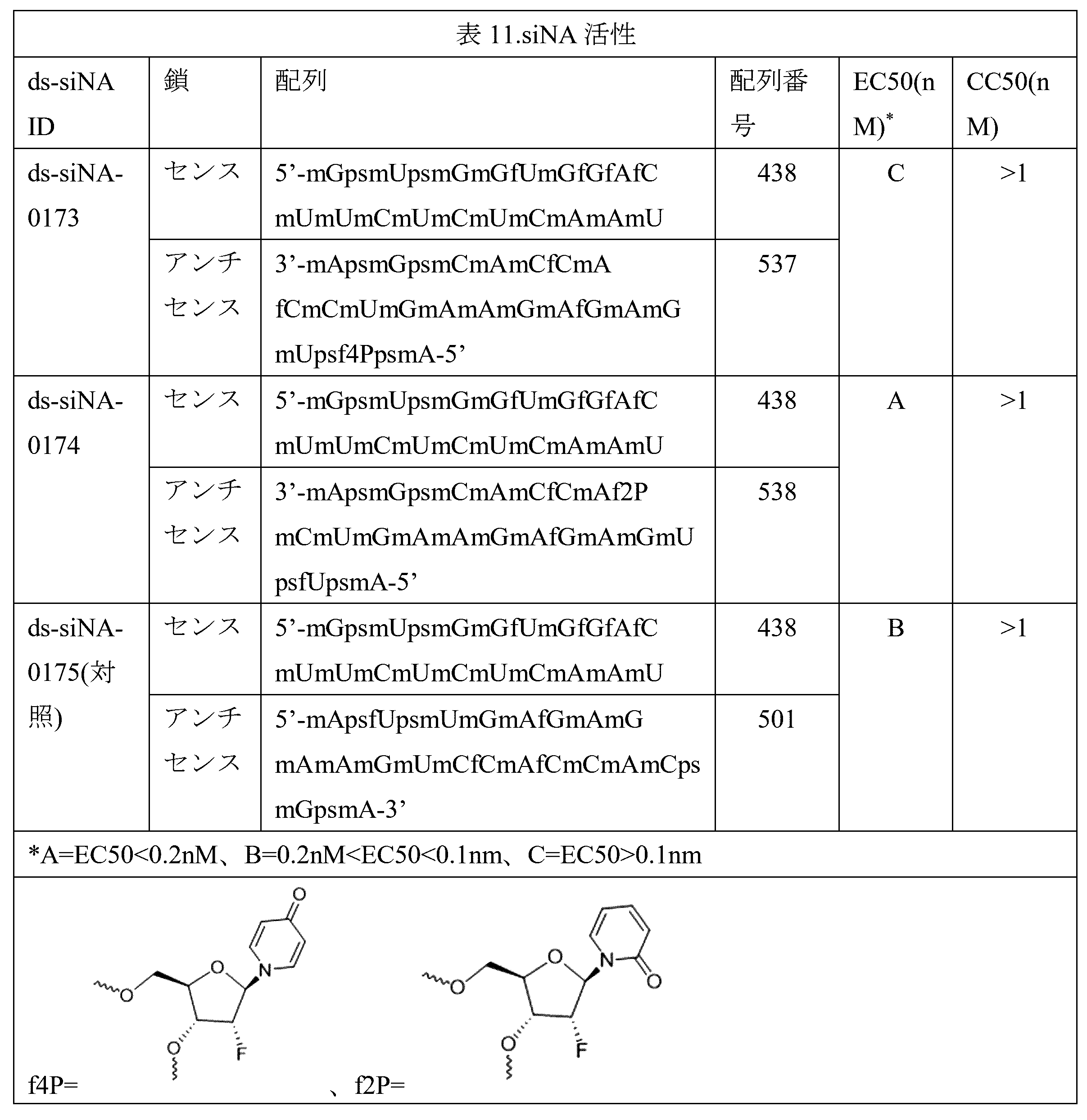
[実施例60:siNA活性に対する2’-フルオロ模倣物の役割]
この実施例は、GalNAc4コンジュゲート化siNAのsiNA活性に対する2’-フルオロ模倣物であるf4P、f2P、およびfxモノマーの役割を調査する。f4Pモノマーを、実施例42に記載されるように生成した。f2Pモノマーを、実施例45に記載されるように生成した。fxモノマーを、実施例41に記載されるように生成した。
Example 60: Role of 2'-fluoromimetics on siNA activity.
This example investigates the role of the 2'-fluoro mimetics f4P, f2P, and fx monomers on the siNA activity of GalNAc4-conjugated siNAs. The f4P monomer was produced as described in Example 42. The f2P monomer was produced as described in Example 45. The fx monomer was produced as described in Example 41.

ds-siNA-017、ds-siNA-017、ds-siNA-017、およびds-siNA-0147の活性は、インビトロ法またはインビボ法を用いてアッセイすることができる。例示的なインビトロアッセイは、以下のように実施することができる。 The activity of ds-siNA-017, ds-siNA-017, ds-siNA-017, and ds-siNA-0147 can be assayed using in vitro or in vivo methods. An exemplary in vitro assay can be performed as follows.
Homo sapiens HepG2.2.15細胞を、10%胎児仔牛血清(FCS)も含有するように補充したダルベッコ改変イーグル培地(DMEM)(ATCC 30-2002)中で培養する。細胞を、加湿したインキュベーター中、5%CO2を含む雰囲気において、37℃でインキュベートした。siRNAを標的とするHBVによるHepG2.2.15細胞のトランスフェクションのために、細胞を、15000細胞/ウェルの密度で、96ウェルの通常の組織培養プレートに播種する。製造業者の指示に従って、RNAiMAX(Invitrogen/Life Technologies)を使用して細胞のトランスフェクションを行う。用量応答実験を、40、20、10、5、2.5、1.25、0.625、0.3125、0.15625、および0.07813nMのオリゴ濃度で行う。siRNA(例えば、ds-siNA-0176、ds-siNA-0177、ds-siNA-0178、またはds-siNA-0147)処理を標的とする各HBVについて、4つのウェルを並行してトランスフェクトし、個々のデータポイントを各ウェルから収集した。siRNAで24時間インキュベーションした後、培地を除去し、細胞を、細胞株HepG2.2.15中に存在するHBV遺伝子型D(B型肝炎ウイルスサブタイプaywとも呼ばれる、3182塩基対の完全ゲノム)に特異的なQuantiGene2.0分岐DNA(bDNA)プローブセットで溶解し、分析する。 Homo sapiens HepG2.2.15 cells are cultured in Dulbecco's Modified Eagle Medium (DMEM) (ATCC 30-2002) supplemented to also contain 10% fetal calf serum (FCS). Cells were incubated at 37° C. in a humidified incubator in an atmosphere containing 5% CO2. For transfection of HepG2.2.15 cells with HBV targeting siRNA, cells are seeded in 96-well regular tissue culture plates at a density of 15000 cells/well. Cells are transfected using RNAiMAX (Invitrogen/Life Technologies) according to the manufacturer's instructions. Dose-response experiments are performed at oligo concentrations of 40, 20, 10, 5, 2.5, 1.25, 0.625, 0.3125, 0.15625, and 0.07813 nM. For each HBV targeting siRNA (eg, ds-siNA-0176, ds-siNA-0177, ds-siNA-0178, or ds-siNA-0147) treatment, four wells were transfected in parallel and individual data points were collected from each well. After 24 hours of incubation with siRNA, the medium was removed and cells were transferred to HBV genotype D (complete genome of 3182 base pairs, also called hepatitis B virus subtype ayw) present in cell line HepG2.2.15. Lyse and analyze with specific QuantiGene 2.0 branched DNA (bDNA) probe sets.
各ウェルについて、HBVオンターゲットmRNAレベルを、GAPDH mRNAレベルに対して正規化する。ds-siNAを標的とするHBVの活性は、EC50(薬物なしの対照からの正規化されたHBV RNAレベルの50%低減)として表すことができる。ds-siRNAを標的とするHBVの細胞毒性は、薬物なしの対照からのGAPDH mRNAの50%低減のCC50によって表すことができる。 HBV on-target mRNA levels are normalized to GAPDH mRNA levels for each well. The activity of HBV targeting ds-siNA can be expressed as EC50 (50% reduction in normalized HBV RNA levels from no drug control). Cytotoxicity of HBV targeting ds-siRNA can be represented by a CC50 of 50% reduction in GAPDH mRNA from drug-free controls.
AAV/HBVモデルを使用して、siRNA治療(例えば、ds-siNA-0173、ds-siNA-0174、ds-siNA-0175、およびds-siNA-0147)のインビボ活性を評価することができる。マウスを、試験の28日目にAAV-HBVに感染させる。AAV-HBVマウスに、5mL/kgのビヒクルまたは5mg/kgのds-siNA-0173、ds-siNA-0174、ds-siNA-0175、またはds-siNA-0147の単回用量を0日目に皮下注射した。連続採血は、通常、試験終了まで、0、5、10、および15日目などに5日ごとに行うことができる。血清HBV S抗原(HBsAg)をELISAによってアッセイすることができる。
AAV/HBV models can be used to assess the in vivo activity of siRNA therapeutics (eg, ds-siNA-0173, ds-siNA-0174, ds-siNA-0175, and ds-siNA-0147). Mice are infected with AAV-HBV on
例示的な実施形態
例示的な実施形態は、以下に提供される。
1.短い干渉核酸(siNA)分子であって、
(a)標的遺伝子に対応するRNAに対して少なくとも約60%、65%、70%、75%、80%、85%、90%、95%、または100%同一である第1のヌクレオチド配列を含むセンス鎖であって、第1のヌクレオチド配列が、
(i)15~30ヌクレオチド長であり、
(ii)2’-O-メチルヌクレオチドおよび2’-フルオロヌクレオチドから独立して選択される15個以上の修飾ヌクレオチドを含み、少なくとも1つの修飾ヌクレオチドが、2’-O-メチルヌクレオチドであり、第1のヌクレオチド配列の5’末端から3、5、7、8、9、10、11、12、14、17、および/または19位置のヌクレオチドが、2’-フルオロヌクレオチドである、センス鎖と、
(b)標的遺伝子に対応するRNAに対して少なくとも約60%、65%、70%、75%、80%、85%、90%、95%、または100%相補的である第2のヌクレオチド配列を含むアンチセンス鎖であって、第2のヌクレオチド配列が、
(i)15~30ヌクレオチド長であり、
(ii)2’-O-メチルヌクレオチドおよび2’-フルオロヌクレオチドから独立して選択される15個以上の修飾ヌクレオチドを含み、少なくとも1つの修飾ヌクレオチドが、2’-O-メチルヌクレオチドであり、少なくとも1つの修飾ヌクレオチドが、2’-フルオロヌクレオチドである、アンチセンス鎖と、を含む、短い干渉核酸(siNA)分子。
2.短い干渉核酸(siNA)分子であって、
(a)標的遺伝子に対応するRNAに対して少なくとも約60%、65%、70%、75%、80%、85%、90%、95%、または100%同一である第1のヌクレオチド配列を含むセンス鎖であって、第1のヌクレオチド配列が、
(i)15~30ヌクレオチド長であり、
(ii)2’-O-メチルヌクレオチドおよび2’-フルオロヌクレオチドから独立して選択される15個以上の修飾ヌクレオチドを含み、少なくとも1つの修飾ヌクレオチドが、2’-O-メチルヌクレオチドであり、少なくとも1つの修飾ヌクレオチドが、2’-フルオロヌクレオチドである、センス鎖と、
(b)標的遺伝子に対応するRNAに対して少なくとも約60%、65%、70%、75%、80%、85%、90%、95%、または100%相補的である第2のヌクレオチド配列を含むアンチセンス鎖であって、第2のヌクレオチド配列が、
(i)15~30ヌクレオチド長であり、
(ii)2’-O-メチルヌクレオチドおよび2’-フルオロヌクレオチドから独立して選択される15個以上の修飾ヌクレオチドを含み、少なくとも1つの修飾ヌクレオチドが、2’-O-メチルヌクレオチドであり、第2のヌクレオチド配列の5’末端から2、5、6、8、10、14、16、17、および/または18位置のヌクレオチドが、2’-フルオロヌクレオチドである、アンチセンス鎖と、を含む、短い干渉核酸(siNA)分子。
3.第1のヌクレオチド配列が、2’-O-メチルヌクレオチドおよび2’-フルオロヌクレオチドから独立して選択される16、17、18、19、20、21、22、23個、またはそれより多い修飾ヌクレオチドを含む、実施形態1または2のsiNA。
4.第1のヌクレオチド配列中のヌクレオチドの70%、75%、80%、85%、90%、95%、または100%が、2’-O-メチルヌクレオチドおよび2’-フルオロヌクレオチドから独立して選択される修飾ヌクレオチドである、実施形態1または2のsiNA。
5.第1のヌクレオチド配列の少なくとも2、3、4、5、または6個の修飾ヌクレオチドが、2’-フルオロヌクレオチドである、実施形態1~4のうちのいずれか1つのsiNA。
6.第1のヌクレオチド配列の10、9、8、7、6、5、4、3、または2個以下の修飾ヌクレオチドが、2’-フルオロヌクレオチドである、実施形態1~5のうちのいずれか1つのsiNA。
7.第1のヌクレオチド配列の少なくとも10、11、12、13、14、15、16、17、18、19、20、21、または22個の修飾ヌクレオチドが、2’-O-メチルヌクレオチドである、実施形態1~6のうちのいずれか1つのsiNA。
8.第1のヌクレオチド配列の25、24、23、22、21、20、19、18、17、16、15、14、13、12、11、10、9、8、7、6、5、4、3、または2個以下の修飾ヌクレオチドが、2’-O-メチルヌクレオチドである、実施形態1~7のうちのいずれか1つのsiNA。
9.第2のヌクレオチド配列が、2’-O-メチルヌクレオチドおよび2’-フルオロヌクレオチドから独立して選択される16、17、18、19、20、21、22、23個、またはそれより多い修飾ヌクレオチドを含む、実施形態1~8のうちのいずれか1つのsiRNA。
10.第2のヌクレオチド配列中のヌクレオチドの70%、75%、80%、85%、90%、95%、または100%が、2’-O-メチルヌクレオチドおよび2’-フルオロヌクレオチドから独立して選択される修飾ヌクレオチドである、実施形態1~9のうちのいずれか1つのsiNA。
11.第2のヌクレオチド配列の少なくとも2、3、4、5、または6個の修飾ヌクレオチドが、2’-フルオロヌクレオチドである、実施形態1~10のうちのいずれか1つのsiNA。
12.第2のヌクレオチド配列の10、9、8、7、6、5、4、3、または2個以下の修飾ヌクレオチドが、2’-フルオロヌクレオチドである、実施形態1~11のうちのいずれか1つのsiNA。
13.第2のヌクレオチド配列の少なくとも10、11、12、13、14、15、16、17、18、19、20、21、または22個の修飾ヌクレオチドが、2’-O-メチルヌクレオチドである、実施形態1~12のうちのいずれか1つのsiNA。
14.第2のヌクレオチド配列の25、24、23、22、21、20、19、18、17、16、15、14、13、12、11、10、9、8、7、6、5、4、3、または2個以下の修飾ヌクレオチドが、2’-O-メチルヌクレオチドである、実施形態1~12のうちのいずれか1つのsiNA。
15.短い干渉核酸(siNA)分子であって、
(a)標的遺伝子に対応するRNAに対して少なくとも約60%、65%、70%、75%、80%、85%、90%、95%、または100%同一である第1のヌクレオチド配列を含むセンス鎖であって、第1のヌクレオチド配列が、
(i)15~30ヌクレオチド長であり、
(ii)2’-O-メチルヌクレオチドおよび2’-フルオロヌクレオチドから独立して選択される15個以上の修飾ヌクレオチドを含み、少なくとも1つの修飾ヌクレオチドが、2’-O-メチルヌクレオチドであり、少なくとも1つの修飾ヌクレオチドが、2’-フルオロヌクレオチドであり、
(iii)1個以上のホスホロチオエートヌクレオシド間連結を含む、センス鎖と、
(b)標的遺伝子に対応するRNAに対して少なくとも約60%、65%、70%、75%、80%、85%、90%、95%、または100%相補的である第2のヌクレオチド配列を含むアンチセンス鎖であって、第2のヌクレオチド配列が、
(i)15~30ヌクレオチド長であり、
(ii)2’-O-メチルヌクレオチドおよび2’-フルオロヌクレオチドから独立して選択される15個以上の修飾ヌクレオチドを含み、少なくとも1つの修飾ヌクレオチドが、2’-O-メチルヌクレオチドであり、少なくとも1つの修飾ヌクレオチドが、2’-フルオロヌクレオチドであり、
(iii)1個以上のホスホロチオエートヌクレオシド間連結を含む、アンチセンス鎖と、を含む、短い干渉核酸(siNA)分子。
16.短い干渉核酸(siNA)分子であって、
(a)標的遺伝子に対応するRNAに対して少なくとも約60%、65%、70%、75%、80%、85%、90%、95%、または100%同一である第1のヌクレオチド配列を含むセンス鎖であって、第1のヌクレオチド配列が、
(i)15~30ヌクレオチド長であり、
(ii)2’-O-メチルヌクレオチドおよび2’-フルオロヌクレオチドから独立して選択される15個以上の修飾ヌクレオチドを含み、少なくとも1つの修飾ヌクレオチドが、2’-O-メチルヌクレオチドであり、少なくとも1つの修飾ヌクレオチドが、2’-フルオロヌクレオチドである、センス鎖と、
(b)標的遺伝子に対応するRNAに対して少なくとも約60%、65%、70%、75%、80%、85%、90%、95%、または100%相補的である第2のヌクレオチド配列を含むアンチセンス鎖であって、第2のヌクレオチド配列が、
(i)15~30ヌクレオチド長であり、
(ii)2’-O-メチルヌクレオチドおよび2’-フルオロヌクレオチドから独立して選択される15個以上の修飾ヌクレオチドを含み、少なくとも1つの修飾ヌクレオチドが、2’-O-メチルヌクレオチドであり、少なくとも1つの修飾ヌクレオチドが、2’-フルオロヌクレオチドである、アンチセンス鎖と、を含み、
siNAが、リン酸化ブロッカー、ガラクトサミン、または5’安定化エンドキャップをさらに含む、短い干渉核酸(siNA)分子。
17.第1のヌクレオチド配列の5’末端から3、5、7、8、9、10、11、12、および/または17位置の少なくとも1、2、3、4、5、6、または7個のヌクレオチドが、2’-フルオロヌクレオチドである、いずれかの先行実施形態に記載のsiNA。
18.第1のヌクレオチド配列の5’末端から3位置のヌクレオチドが、2’-フルオロヌクレオチドである、いずれかの先行実施形態に記載のsiNA。
19.第1のヌクレオチド配列の5’末端から5位置のヌクレオチドが、2’-フルオロヌクレオチドである、いずれかの先行実施形態に記載のsiNA。
20.第1のヌクレオチド配列の5’末端から7位置のヌクレオチドが、2’-フルオロヌクレオチドである、いずれかの先行実施形態に記載のsiNA。
21.第1のヌクレオチド配列の5’末端から8位置のヌクレオチドが、2’-フルオロヌクレオチドである、いずれかの先行実施形態に記載のsiNA。
22.第1のヌクレオチド配列の5’末端から9位置のヌクレオチドが、2’-フルオロヌクレオチドである、いずれかの先行実施形態に記載のsiNA。
23.第1のヌクレオチド配列の5’末端から12位置のヌクレオチドが、2’-フルオロヌクレオチドである、いずれかの先行実施形態に記載のsiNA。
24.第1のヌクレオチド配列の5’末端から17位置のヌクレオチドが、2’-フルオロヌクレオチドである、いずれかの先行実施形態に記載のsiNA。
25.第1のヌクレオチド配列の5’末端から10位置のヌクレオチドが、2’-フルオロヌクレオチドである、いずれかの先行実施形態に記載のsiNA。
26.第1のヌクレオチド配列の5’末端から11位置のヌクレオチドが、2’-フルオロヌクレオチドである、いずれかの先行実施形態に記載のsiNA。
27.第2のヌクレオチド配列の5’末端から2、5、6、8、10、14、16、17、および/または18位置の少なくとも1、2、3、4、5、6、7、8、または9個のヌクレオチドが、2’-フルオロヌクレオチドである、いずれかの先行実施形態に記載のsiNA。
28.第2のヌクレオチド配列の5’末端から2位置のヌクレオチドが、2’-フルオロヌクレオチドである、いずれかの先行実施形態に記載のsiNA。
29.第2のヌクレオチド配列の5’末端から5位置のヌクレオチドが、2’-フルオロヌクレオチドである、いずれかの先行実施形態に記載のsiNA。
30.第2のヌクレオチド配列の5’末端から6位置のヌクレオチドが、2’-フルオロヌクレオチドである、いずれかの先行実施形態に記載のsiNA。
31.第2のヌクレオチド配列の5’末端から8位置のヌクレオチドが、2’-フルオロヌクレオチドである、いずれかの先行実施形態に記載のsiNA。
32.第2のヌクレオチド配列の5’末端から10位置のヌクレオチドが、2’-フルオロヌクレオチドである、いずれかの先行実施形態に記載のsiNA。
33.第2のヌクレオチド配列の5’末端から14位置のヌクレオチドが、2’-フルオロヌクレオチドである、いずれかの先行実施形態に記載のsiNA。
34.第2のヌクレオチド配列の5’末端から16位置のヌクレオチドが、2’-フルオロヌクレオチドである、いずれかの先行実施形態に記載のsiNA。
35.第2のヌクレオチド配列の5’末端から17位置のヌクレオチドが、2’-フルオロヌクレオチドである、いずれかの先行実施形態に記載のsiNA。
36.第2のヌクレオチド配列の5’末端から18位置のヌクレオチドが、2’-フルオロヌクレオチドである、いずれかの先行実施形態に記載のsiNA。
37.第2のヌクレオチド配列中のヌクレオチドが、交互1:3修飾パターンで整列し、1個のヌクレオチドが、2’-フルオロヌクレオチドであり、3個のヌクレオチドが、2’-O-メチルヌクレオチドである、いずれかの先行実施形態に記載のsiNA。
38.交互1:3修飾パターンが、2~5回生じる、実施形態37のsiNA。
39.交互1:3修飾パターンのうちの少なくとも2つが、連続して生じる、実施形態37または38に記載のsiNA。
40.交互1:3修飾パターンのうちの少なくとも2つが、非連続的に生じる、実施形態37~39のいずれかに記載のsiNA。
41.少なくとも1、2、3、4、または5個の交互1:3修飾パターンが、アンチセンス鎖の5’末端から2、6、10、14、および/または18のヌクレオチド位置で始まる、二枚貝(clams)37~40のいずれかに記載のsiNA。
42.少なくとも1個の交互1:3修飾パターンが、アンチセンス鎖の5’末端から2のヌクレオチド位置で始まる、二枚貝37~41のいずれかに記載のsiNA。
43.少なくとも1個の交互1:3修飾パターンが、アンチセンス鎖の5’末端から6のヌクレオチド位置で始まる、二枚貝37~42のいずれかに記載のsiNA。
44.少なくとも1個の交互1:3修飾パターンが、アンチセンス鎖の5’末端から10のヌクレオチド位置で始まる、二枚貝37~43のいずれかに記載のsiNA。
45.少なくとも1個の交互1:3修飾パターンが、アンチセンス鎖の5’末端から14のヌクレオチド位置で始まる、二枚貝37~44のいずれかに記載のsiNA。
46.少なくとも1個の交互1:3修飾パターンが、アンチセンス鎖の5’末端から18のヌクレオチド位置で始まる、二枚貝37~45のいずれかに記載のsiNA。
47.第2のヌクレオチド配列中のヌクレオチドが、交互1:2修飾パターンで整列し、1個のヌクレオチドが、2’-フルオロヌクレオチドであり、2個のヌクレオチドが、2’-O-メチルヌクレオチドである、実施形態1~37のうちのいずれか1つに記載のsiNA。
48.交互1:2修飾パターンが、2~5回生じる、実施形態47のsiNA。
49.交互1:2修飾パターンのうちの少なくとも2つが、連続して生じる、実施形態47または48に記載のsiNA。
50.交互1:2修飾パターンのうちの少なくとも2つが、非連続的に生じる、実施形態47~49のいずれかに記載のsiNA。
51.少なくとも1、2、3、4、または5個の交互1:2修飾パターンが、アンチセンス鎖の5’末端から2、5、8、14、および/または17のヌクレオチド位置で始まる、二枚貝47~50のいずれかに記載のsiNA。
52.少なくとも1個の交互1:2修飾パターンが、アンチセンス鎖の5’末端から2のヌクレオチド位置で始まる、二枚貝47~51のいずれかに記載のsiNA。
53.少なくとも1個の交互1:2修飾パターンが、アンチセンス鎖の5’末端から5のヌクレオチド位置で始まる、二枚貝47~52のいずれかに記載のsiNA。
54.少なくとも1個の交互1:2修飾パターンが、アンチセンス鎖の5’末端から8のヌクレオチド位置で始まる、二枚貝47~53のいずれかに記載のsiNA。
55.少なくとも1個の交互1:2修飾パターンが、アンチセンス鎖の5’末端から14のヌクレオチド位置で始まる、二枚貝47~54のいずれかに記載のsiNA。
56.少なくとも1個の交互1:2修飾パターンが、アンチセンス鎖の5’末端から17のヌクレオチド位置で始まる、二枚貝47~55のいずれかに記載のsiNA。
57.式(VIII)によって表される短い干渉核酸(siNA)分子であって、
5’-An
1Bn
2An
3Bn
4An
5Bn
6An
7Bn
8An
9-3’
3’-Cq
1Aq
2Bq
3Aq
4Bq
5Aq
6Bq
7Aq
8Bq
9Aq
10Bq
11Aq
12-5’
式中、
上鎖が、標的遺伝子に対応するRNAに対して少なくとも約60%、65%、70%、75%、80%、85%、90%、95%、または100%同一である第1のヌクレオチド配列を含むセンス鎖であり、第1のヌクレオチド配列が、15~30個のヌクレオチドを含み、
下鎖が、標的遺伝子に対応するRNAに対して少なくとも約60%、65%、70%、75%、80%、85%、90%、95%、または100%相補的である第2のヌクレオチド配列を含むアンチセンス鎖であり、第2のヌクレオチド配列が、15~30個のヌクレオチドを含み、
各Aが、独立して、2’-O-メチルヌクレオチド、または5’安定化エンドキャップもしくはリン酸化ブロッカーを含むヌクレオチドであり、
Bが、2’-フルオロヌクレオチドであり、
Cが、オーバーハンギングヌクレオチドを表し、2’-O-メチルヌクレオチドであり、
n1=1~4ヌクレオチド長であり、
各n2、n6、n8、q3、q5、q7、q9、q11、およびq12が、独立して、0~1ヌクレオチド長であり、
各n3およびn4が、独立して、1~3ヌクレオチド長であり、
n5が、1~10ヌクレオチド長であり、
n7が、0~4ヌクレオチド長であり、
各n9、q1、およびq2が、独立して、0~2ヌクレオチド長であり、
q4が、0~3ヌクレオチド長であり、
q6が、0~5ヌクレオチド長であり、
q8が、2~7ヌクレオチド長であり、
q10が、2~11ヌクレオチド長である、短い干渉核酸(siNA)分子。
58.式(IX)によって表される短い干渉核酸(siNA)分子であって、
5’-A2~4B1A1~3B2~3A2~10B0~1A0~4B0~1A0~2-3’
3’-C2A0~2B0~1A0~3B0~1A0~5B0~1A2~7B1A2~11B1A1-5’
式中、
上鎖が、標的遺伝子に対応するRNAに対して少なくとも約60%、65%、70%、75%、80%、85%、90%、95%、または100%同一である第1のヌクレオチド配列を含むセンス鎖であり、第1のヌクレオチド配列が、15~30個のヌクレオチドを含み、
下鎖が、標的遺伝子に対応するRNAに対して少なくとも約60%、65%、70%、75%、80%、85%、90%、95%、または100%相補的である第2のヌクレオチド配列を含むアンチセンス鎖であり、第2のヌクレオチド配列が、15~30個のヌクレオチドを含み、
各Aが、独立して、2’-O-メチルヌクレオチド、または5’安定化エンドキャップもしくはリン酸化ブロッカーを含むヌクレオチドであり、
Bが、2’-フルオロヌクレオチドであり、
Cが、オーバーハンギングヌクレオチドを表し、2’-O-メチルヌクレオチドである、短い干渉核酸(siNA)分子。
59.短い干渉核酸(siNA)分子であって、
(a)17~23個のヌクレオチドからなる第1のヌクレオチド配列を含むセンス鎖であって、2’-フルオロヌクレオチドが、第1のヌクレオチド配列の5’末端から3、7~9、12、および17位置にあり、2’-O-メチルヌクレオチドが、第1のヌクレオチド配列の5’末端から1、2、4~6、10、11、および13~16位置にある、センス鎖と、
(b)17~23個のヌクレオチドからなる第2のヌクレオチド配列を含むアンチセンス鎖であって、2’-フルオロヌクレオチドが、第2のヌクレオチド配列の5’末端から2および14位置にあり、2’-O-メチルヌクレオチドが、第2のヌクレオチド配列の5’末端から1、3~13、および15~17位置にある、アンチセンス鎖と、を含む、短い干渉核酸(siNA)分子。
60.第1のヌクレオチド配列が、19個のヌクレオチドからなる、実施形態59のsiNA分子。
61.2’-O-メチルヌクレオチドが、第1のヌクレオチド配列の5’末端から18および19位置にある、実施形態60のsiNA分子。
62.第2のヌクレオチド配列が、21個のヌクレオチドからなる、実施形態59~61のうちのいずれか1つに記載のsiNA分子。
63.2’-O-メチルヌクレオチドが、第2のヌクレオチド配列の5’末端から18~21位置にある、実施形態62のsiNA分子。
64.短い干渉核酸(siNA)分子であって、
(a)17~23個のヌクレオチドからなる第1のヌクレオチド配列を含むセンス鎖であって、2’-フルオロヌクレオチドが、第1のヌクレオチド配列の5’末端から3、7、8、および17位置にあり、2’-O-メチルヌクレオチドが、第1のヌクレオチド配列の5’末端から1、2、4~6、および9~16位置にある、センス鎖と、
(b)17~23個のヌクレオチドからなる第2のヌクレオチド配列を含むアンチセンス鎖であって、2’-フルオロヌクレオチドが、第1のヌクレオチド配列の5’末端から2および14位置にあり、2’-O-メチルヌクレオチドが、第1のヌクレオチド配列の5’末端から1、3~13、および15~17位置にある、アンチセンス鎖と、を含む、短い干渉核酸(siNA)分子。
65.第1のヌクレオチド配列が、19個のヌクレオチドからなる、実施形態64のsiNA分子。
66.2’-O-メチルヌクレオチドが、第1のヌクレオチド配列の5’末端から18および19位置にある、実施形態65のsiNA分子。
67.第2のヌクレオチド配列が、21個のヌクレオチドからなる、実施形態64~66のうちのいずれか1つに記載のsiNA分子。
68.2’-O-メチルヌクレオチドが、第2のヌクレオチド配列の5’末端から18~21位置にある、実施形態67のsiNA分子。
69.短い干渉核酸(siNA)分子であって、
(a)17~23個のヌクレオチドからなる第1のヌクレオチド配列を含むセンス鎖であって、2’-フルオロヌクレオチドが、第1のヌクレオチド配列の5’末端から3、7~9、12、および17位置にあり、2’-O-メチルヌクレオチドが、第1のヌクレオチド配列の5’末端から1、2、4~6、10、11、および13~16位置にある、センス鎖と、
(b)17~23個のヌクレオチドからなる第2のヌクレオチド配列を含むアンチセンス鎖であって、第2のヌクレオチド配列中のヌクレオチドが、交互1:3修飾パターンで整列し、1個のヌクレオチドが、2’-フルオロヌクレオチドであり、3個のヌクレオチドが、2’-O-メチルヌクレオチドである、アンチセンス鎖と、を含む、短い干渉核酸(siNA)分子。
70.第1のヌクレオチド配列が、19個のヌクレオチドからなる、実施形態69のsiNA分子。
71.2’-O-メチルヌクレオチドが、第1のヌクレオチド配列の5’末端から18および19位置にある、実施形態70のsiNA分子。
72.第2のヌクレオチド配列が、21個のヌクレオチドからなる、実施形態69~71のうちのいずれか1つに記載のsiNA分子。
73.2’-O-メチルヌクレオチドが、第2のヌクレオチド配列の5’末端から19~21位置にある、実施形態72のsiNA分子。
74.交互1:3修飾パターンが、2~5回生じる、実施形態69~73のうちのいずれか1つに記載のsiRNA分子。
75.交互1:3修飾パターンのうちの少なくとも2つが、連続して生じる、実施形態69~74のうちのいずれか1つに記載のsiRNA分子。
76.交互1:3修飾パターンのうちの少なくとも2つが、非連続的に生じる、実施形態69~75のうちのいずれか1つに記載のsiRNA分子。
77.少なくとも1、2、3、4、または5個の交互1:3修飾パターンが、アンチセンス鎖の5’末端から2、6、10、14、および/または18のヌクレオチド位置で始まる、実施形態69~76のうちのいずれか1つに記載のsiNA分子。
78.少なくとも1個の交互1:3修飾パターンが、アンチセンス鎖の5’末端から2のヌクレオチド位置で始まる、実施形態69~77のうちのいずれか1つに記載のsiNA分子。
79.少なくとも1個の交互1:3修飾パターンが、アンチセンス鎖の5’末端から6のヌクレオチド位置で始まる、実施形態69~78のうちのいずれか1つに記載のsiNA分子。
80.少なくとも1個の交互1:3修飾パターンが、アンチセンス鎖の5’末端から10のヌクレオチド位置で始まる、実施形態69~79のうちのいずれか1つに記載のsiNA分子。
81.少なくとも1個の交互1:3修飾パターンが、アンチセンス鎖の5’末端から14のヌクレオチド位置で始まる、実施形態69~80のうちのいずれか1つに記載のsiNA分子。
82.少なくとも1個の交互1:3修飾パターンが、アンチセンス鎖の5’末端から18のヌクレオチド位置で始まる、実施形態69~81のうちのいずれか1つに記載のsiNA分子。
83.短い干渉核酸(siNA)分子であって、
(a)17~23個のヌクレオチドからなる第1のヌクレオチド配列を含むセンス鎖であって、2’-フルオロヌクレオチドが、第1のヌクレオチド配列の5’末端から5および7~9位置にあり、2’-O-メチルヌクレオチドが、第1のヌクレオチド配列の5’末端から1~4、6、および10~17位置にある、センス鎖と、
(b)17~23個のヌクレオチドからなる第2のヌクレオチド配列を含むアンチセンス鎖であって、第2のヌクレオチド配列中のヌクレオチドが、交互1:3修飾パターンで整列し、1個のヌクレオチドが、2’-フルオロヌクレオチドであり、3個のヌクレオチドが、2’-O-メチルヌクレオチドである、アンチセンス鎖と、を含む、短い干渉核酸(siNA)分子。
84.第1のヌクレオチド配列が、19個のヌクレオチドからなる、実施形態83のsiNA分子。
85.2’-O-メチルヌクレオチドが、第1のヌクレオチド配列の5’末端から18および19位置にある、実施形態84のsiNA分子。
86.第2のヌクレオチド配列が、21個のヌクレオチドからなる、実施形態83~85のうちのいずれか1つに記載のsiNA分子。
87.2’-O-メチルヌクレオチドが、第2のヌクレオチド配列の5’末端から19~21位置にある、実施形態86のsiNA分子。
88.交互1:3修飾パターンが、2~5回生じる、実施形態83~87のうちのいずれか1つに記載のsiRNA分子。
89.交互1:3修飾パターンのうちの少なくとも2つが、連続して生じる、実施形態83~88のうちのいずれか1つに記載のsiRNA分子。
90.交互1:3修飾パターンのうちの少なくとも2つが、非連続的に生じる、実施形態83~89のうちのいずれか1つに記載のsiRNA分子。
91.少なくとも1、2、3、4、または5個の交互1:3修飾パターンが、アンチセンス鎖の5’末端から2、6、10、14、および/または18のヌクレオチド位置で始まる、実施形態83~90のうちのいずれか1つに記載のsiNA分子。
92.少なくとも1個の交互1:3修飾パターンが、アンチセンス鎖の5’末端から2のヌクレオチド位置で始まる、実施形態83~91のうちのいずれか1つに記載のsiNA分子。
93.少なくとも1個の交互1:3修飾パターンが、アンチセンス鎖の5’末端から6のヌクレオチド位置で始まる、実施形態83~92のうちのいずれか1つに記載のsiNA分子。
94.少なくとも1個の交互1:3修飾パターンが、アンチセンス鎖の5’末端から10のヌクレオチド位置で始まる、実施形態83~93のうちのいずれか1つに記載のsiNA分子。
95.少なくとも1個の交互1:3修飾パターンが、アンチセンス鎖の5’末端から14のヌクレオチド位置で始まる、実施形態83~94のうちのいずれか1つに記載のsiNA分子。
96.少なくとも1個の交互1:3修飾パターンが、アンチセンス鎖の5’末端から18のヌクレオチド位置で始まる、実施形態83~95のうちのいずれか1つに記載のsiNA分子。
97.短い干渉核酸(siNA)分子であって、
(a)17~23個のヌクレオチドからなる第1のヌクレオチド配列を含むセンス鎖であって、2’-フルオロヌクレオチドが、第1のヌクレオチド配列の5’末端から5および7~9位置にあり、2’-O-メチルヌクレオチドが、第1のヌクレオチド配列の5’末端から1~4、6、および10~17位置にある、センス鎖と、
(b)17~23個のヌクレオチドからなる第2のヌクレオチド配列を含むアンチセンス鎖であって、第2のヌクレオチド配列中のヌクレオチドが、交互1:2修飾パターンで整列し、1個のヌクレオチドが、2’-フルオロヌクレオチドであり、2個のヌクレオチドが、2’-O-メチルヌクレオチドである、アンチセンス鎖と、を含む、短い干渉核酸(siNA)分子。
98.第1のヌクレオチド配列が、19個のヌクレオチドからなる、実施形態97のsiNA分子。
99.2’-O-メチルヌクレオチドが、第1のヌクレオチド配列の5’末端から18および19位置にある、実施形態98のsiNA分子。
100.第2のヌクレオチド配列が、21個のヌクレオチドからなる、実施形態97~99のうちのいずれか1つに記載のsiNA分子。
101.2’-O-メチルヌクレオチドが、第2のヌクレオチド配列の5’末端から18~21位置にある、実施形態100のsiNA分子。
102.交互1:2修飾パターンが、2~5回生じる、実施形態97~101のうちのいずれか1つに記載のsiRNA分子。
103.交互1:2修飾パターンのうちの少なくとも2つが、連続して生じる、実施形態97~102のうちのいずれか1つに記載のsiRNA分子。
104.交互1:2修飾パターンのうちの少なくとも2つが、非連続的に生じる、実施形態97~103のうちのいずれか1つに記載のsiRNA分子。
105.少なくとも1、2、3、4、または5個の交互1:2修飾パターンが、アンチセンス鎖の5’末端から2、5、8、14、および/または17のヌクレオチド位置で始まる、実施形態97~104のうちのいずれか1つに記載のsiNA分子。
106.少なくとも1個の交互1:2修飾パターンが、アンチセンス鎖の5’末端から2のヌクレオチド位置で始まる、実施形態97~105のうちのいずれか1つに記載のsiNA分子。
107.少なくとも1個の交互1:2修飾パターンが、アンチセンス鎖の5’末端から5のヌクレオチド位置で始まる、実施形態97~106のうちのいずれか1つに記載のsiNA分子。
108.少なくとも1個の交互1:2修飾パターンが、アンチセンス鎖の5’末端から8のヌクレオチド位置で始まる、実施形態97~107のうちのいずれか1つに記載のsiNA分子。
109.少なくとも1個の交互1:2修飾パターンが、アンチセンス鎖の5’末端から14のヌクレオチド位置で始まる、実施形態74~85のうちのいずれか1つに記載のsiNA分子。
110.少なくとも1個の交互1:2修飾パターンが、アンチセンス鎖の5’末端から17のヌクレオチド位置で始まる、実施形態97~109のうちのいずれか1つに記載のsiNA分子。
111.短い干渉核酸(siNA)分子であって、
(a)17~23個のヌクレオチドからなる第1のヌクレオチド配列を含むセンス鎖であって、2’-フルオロヌクレオチドが、第1のヌクレオチド配列の5’末端から5および7~9位置にあり、2’-O-メチルヌクレオチドが、第1のヌクレオチド配列の5’末端から1~4、6、および10~17位置にある、センス鎖と、
(b)17~23個のヌクレオチドからなる第2のヌクレオチド配列を含むアンチセンス鎖であって、2’-フルオロヌクレオチドが、第2のヌクレオチド配列の5’末端から2、6、14、および16位置にあり、2’-O-メチルヌクレオチドが、第2のヌクレオチド配列の5’末端から1、3~5、7~13、15、および17位置にある、アンチセンス鎖と、を含む、短い干渉核酸(siNA)分子。
112.第1のヌクレオチド配列が、19個のヌクレオチドからなる、実施形態111のsiNA分子。
113.2’-O-メチルヌクレオチドが、第1のヌクレオチド配列の5’末端から18および19位置にある、実施形態112のsiNA分子。
114.第2のヌクレオチド配列が、21個のヌクレオチドからなる、実施形態111~113のうちのいずれか1つに記載のsiNA分子。
115.2’-O-メチルヌクレオチドが、第2のヌクレオチド配列の5’末端から18~21位置にある、実施形態114のsiNA分子。
116.短い干渉核酸(siNA)分子であって、
(a)17~23個のヌクレオチドからなる第1のヌクレオチド配列を含むセンス鎖であって、2’-フルオロヌクレオチドが、第1のヌクレオチド配列の5’末端から5、9~11、および14位置にあり、2’-O-メチルヌクレオチドが、第1のヌクレオチド配列の5’末端から1~4、6~8、および12~17位置にある、センス鎖と、
(b)17~23個のヌクレオチドからなる第2のヌクレオチド配列を含むアンチセンス鎖であって、2’-フルオロヌクレオチドが、第2のヌクレオチド配列の5’末端から2および14位置にあり、2’-O-メチルヌクレオチドが、第2のヌクレオチド配列の5’末端から1、3~13、および15~17位置にある、アンチセンス鎖と、を含む、短い干渉核酸(siNA)分子。
117.第1のヌクレオチド配列が、21個のヌクレオチドからなる、実施形態116のsiNA分子。
118.2’-O-メチルヌクレオチドが、第1のヌクレオチド配列の5’末端から18~21位置にある、実施形態117のsiNA分子。
119.第2のヌクレオチド配列が、23個のヌクレオチドからなる、実施形態116~118のうちのいずれか1つに記載のsiNA分子。
120.2’-O-メチルヌクレオチドが、第2のヌクレオチド配列の5’末端から18~23位置にある、実施形態119のsiNA分子。
121.センス鎖が、第1のヌクレオチド配列に隣接するTT配列をさらに含む、いずれかの先行実施形態に記載のsiNA。
122.センス鎖が、少なくとも1、2、3、4、5、6、7、8、9、10、11、12、13、14、15個、またはそれより多くのホスホロチオエートヌクレオシド間連結をさらに含む、いずれかの先行実施形態に記載のsiNA。
123.少なくとも1個のホスホロチオエートヌクレオシド間連結が、第1のヌクレオチド配列の5’末端から1および2位置のヌクレオチド間にある、実施形態122のsiNA。
124.少なくとも1個のホスホロチオエートヌクレオシド間連結が、第1のヌクレオチド配列の5’末端から2および3位置のヌクレオチド間にある、実施形態122または123のsiNA。
125.アンチセンス鎖が、第2のヌクレオチド配列に隣接するTT配列をさらに含む、いずれかの先行実施形態に記載のsiNA。
126.アンチセンス鎖が、少なくとも1、2、3、4、5、6、7、8、9、10、11、12、13、14、15個、またはそれより多くのホスホロチオエートヌクレオシド間連結をさらに含む、いずれかの先行実施形態に記載のsiNA。
127.少なくとも1個のホスホロチオエートヌクレオシド間連結が、第2のヌクレオチド配列の5’末端から1および2位置のヌクレオチド間にある、実施形態126のsiNA。
128.少なくとも1個のホスホロチオエートヌクレオシド間連結が、第2のヌクレオチド配列の5’末端から2および3位置のヌクレオチド間にある、実施形態126または127のsiNA。
129.少なくとも1個のホスホロチオエートヌクレオシド間連結が、第2のヌクレオチド配列の3’末端から1および2位置のヌクレオチド間にある、実施形態126~128のうちのいずれか1つのsiNA。
130.少なくとも1個のホスホロチオエートヌクレオシド間連結が、第2のヌクレオチド配列の3’末端から2および3位置のヌクレオチド間にある、実施形態126~129のうちのいずれか1つのsiNA。
131.第1のヌクレオチド配列の5’末端からの第1のヌクレオチドが、5’安定化エンドキャップを含む、いずれかの先行実施形態に記載のsiNA。
132.第2のヌクレオチド配列の5’末端からの第1のヌクレオチドが、5’安定化エンドキャップを含む、いずれかの先行実施形態に記載のsiNA。
133.第1のヌクレオチド配列の5’末端からの第1のヌクレオチドが、リン酸化ブロッカーを含む、いずれかの先行実施形態に記載のsiNA。
134.第2のヌクレオチド配列の5’末端からの第1のヌクレオチドが、リン酸化ブロッカーを含む、いずれかの先行実施形態に記載のsiNA。
135.第1のヌクレオチド配列または第2のヌクレオチド配列が、


136.短い干渉核酸(siNA)分子であって、
(a)式(IV)のリン酸化ブロッカー:

R1が、核酸塩基であり、
R4が、-O-R30または-NR31R32であり、
R30が、C1~C8置換または非置換アルキルであり、
R31およびR32が、それらが接続する窒素と一緒になって、置換または非置換複素環式環を形成する)と、
(b)短い干渉核酸(siNA)と、を含む、短い干渉核酸(siNA)分子。
137.短い干渉核酸(siNA)分子であって、
(a)式(Ia)の5’安定化エンドキャップ:

R1が、核酸塩基、アリール、ヘテロアリール、またはHであり、
R2が、
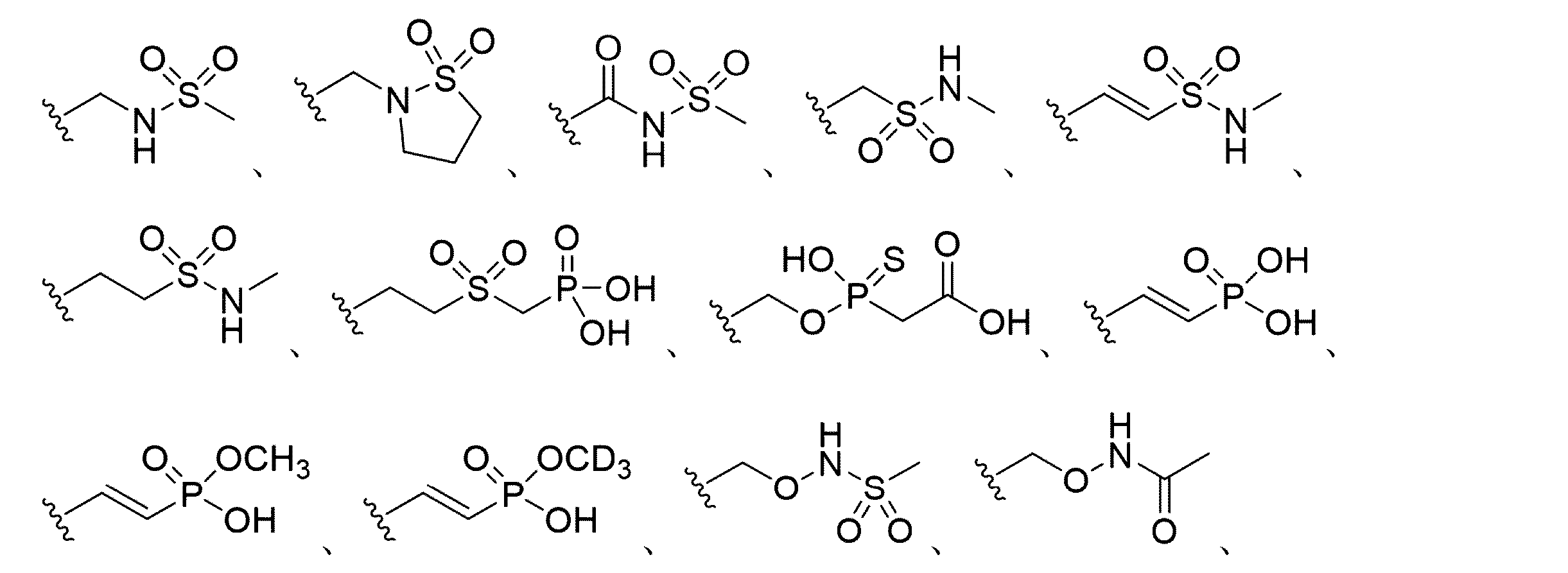
R2およびR20が、一緒になって、-(CR21R22)n-Zもしくは-(C2-C6アルケニレン)-Zで置換された3~7員の炭素環式環を形成し、
nが、1、2、3、または4であり、
Zが、-ONR23R24、-OP(O)OH(CH2)mCO2R23、-OP(S)OH(CH2)mCO2R23、-P(O)(OH)2、-P(O)(OH)(OCH3)、-P(O)(OH)(OCD3)、-SO2(CH2)mP(O)(OH)2、-SO2NR23R25、-NR23R24であり、
R21およびR22が、独立して、水素またはC1~C6アルキルであり、R21およびR22が、一緒になってオキソ基を形成し、
R23が、水素、もしくはC1~C6アルキルであり、
R24が、-SO2R25もしくは-C(O)R25であるか、または
R23およびR24が、それらが接続する窒素と一緒になって、置換もしくは非置換複素環式環を形成し、
R25が、C1~C6アルキルであり、
mが、1、2、3、または4である)と、
(b)短い干渉核酸(siNA)と、を含む、短い干渉核酸(siNA)分子。
138.短い干渉核酸(siNA)分子であって、
(a)式(Ib)の5’安定化エンドキャップ:

R1が、核酸塩基、アリール、ヘテロアリール、またはHであり、
R2が、

R2およびR20が、一緒になって、-(CR21R22)n-Zもしくは-(C2-C6アルケニレン)-Zで置換された3~7員の炭素環式環を形成し、
nが、1、2、3、または4であり、
Zが、-ONR23R24、-OP(O)OH(CH2)mCO2R23、-OP(S)OH(CH2)mCO2R23、-P(O)(OH)2、-P(O)(OH)(OCH3)、-P(O)(OH)(OCD3)、-SO2(CH2)mP(O)(OH)2、-SO2NR23R25、-NR23R24であり、
R21およびR22が、独立して、水素またはC1~C6アルキルであり、R21およびR22が、一緒になってオキソ基を形成し、
R23が、水素、もしくはC1~C6アルキルであり、
R24が、-SO2R25もしくは-C(O)R25であるか、または
R23およびR24が、それらが接続する窒素と一緒になって、置換もしくは非置換複素環式環を形成し、
R25が、C1~C6アルキルであり、
mが、1、2、3、または4である)と、
(b)短い干渉核酸(siNA)と、を含む、短い干渉核酸(siNA)分子。
139.短い干渉核酸(siNA)分子であって、
(a)式(1)~式(15)、式(9X)~式(12X)、および式(9Y)~式(12Y)からなる群から選択される5’安定化エンドキャップ:


(b)短い干渉核酸(siNA)と、を含む、短い干渉核酸(siNA)分子。
140.短い干渉核酸(siNA)分子であって、
(a)式(1A)~(15A)、式(9B)~(12B)、式(9AX)~(12AX)、式(9AY)~(12AY)、式(9BX)~(12BX)、および式(9BY)~(12BY)からなる群から選択される5’安定化エンドキャップ:

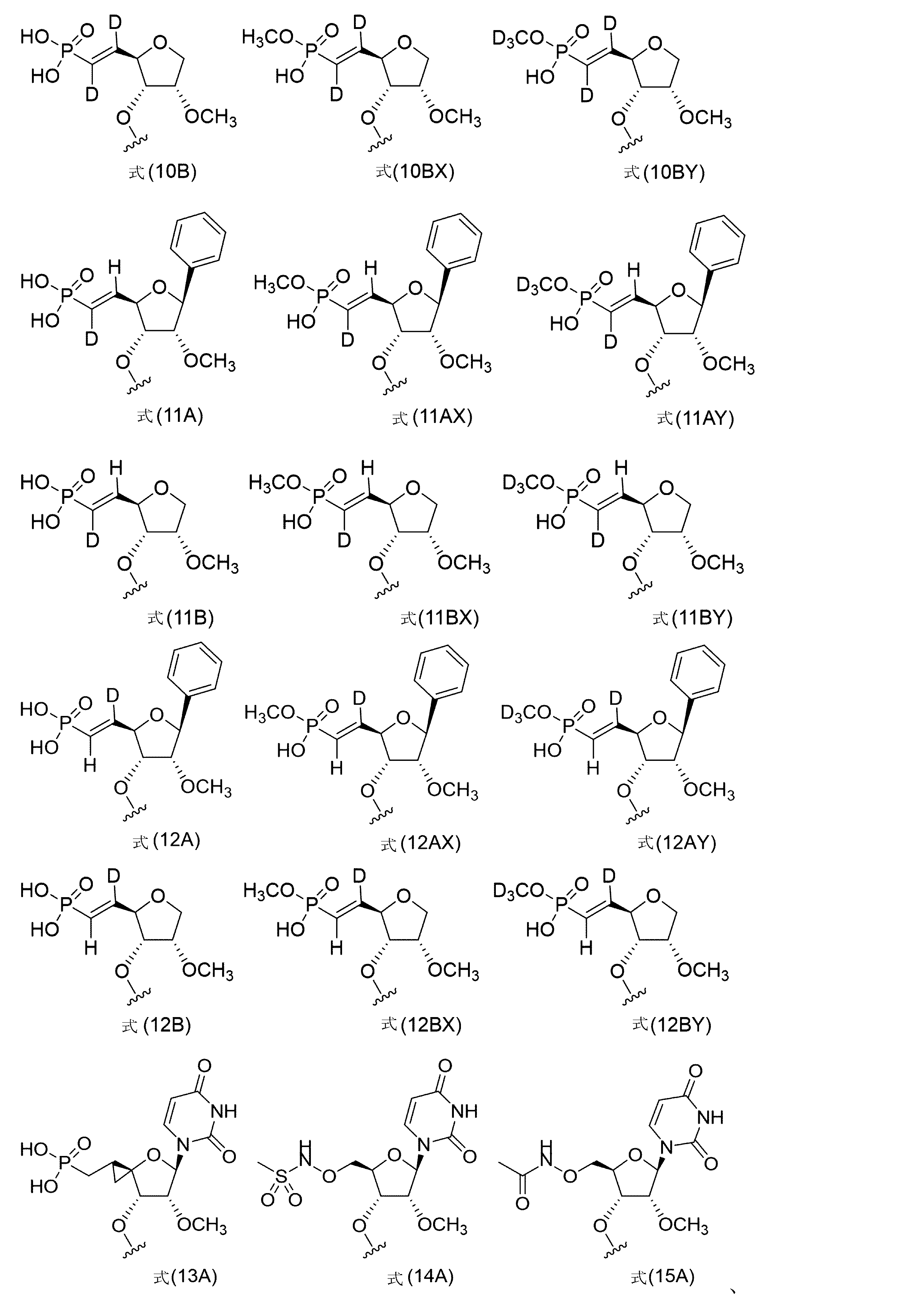
(b)短い干渉核酸(siNA)、を含む、短い干渉核酸(siNA)分子。
141.siNAが、実施形態1~135のうちのいずれか1つに記載のセンス鎖を含む、実施形態136~140のうちのいずれか1つに記載のsiNA分子。
142.siNAが、実施形態1~135のうちのいずれか1つに記載のアンチセンス鎖を含む、実施形態136~141のうちのいずれか1つに記載のsiNA分子。
143.短い干渉核酸(siNA)分子であって、
(a)標的遺伝子に対応するRNAに対して少なくとも約60%、65%、70%、75%、80%、85%、90%、95%、または100%同一である第1のヌクレオチド配列を含むセンス鎖であって、第1のヌクレオチド配列が、いずれか1つの配列番号1~56、103~158、および205~260のヌクレオチド配列を含む、センス鎖と、
(b)標的遺伝子に対応するRNAに対して少なくとも約60%、65%、70%、75%、80%、85%、90%、95%、または100%相補的である第2のヌクレオチド配列を含むアンチセンス鎖であって、第2のヌクレオチド配列が、配列番号57~102、159~204、および261~306のうちのいずれか1つのヌクレオチド配列を含む、アンチセンス鎖と、を含む、短い干渉核酸(siNA)分子。
144.干渉核酸(siNA)分子であって、
(a)配列番号307~362および415~444のうちのいずれか1つのヌクレオチド配列を含むセンス鎖と、
(b)配列番号363~409、445~533および536~539のうちのいずれか1つのヌクレオチド配列を含むアンチセンス鎖と、を含む、干渉核酸(siNA)分子。
145.siNAが、リン酸化ブロッカーをさらに含む、実施形態1~132、135および137~144のうちのいずれか1つに記載のsiNA。
146.リン酸化ブロッカーが、式(IV)の構造:

R1が、核酸塩基であり、
R4が、-O-R30または-NR31R32であり、R30が、C1~C8置換または非置換アルキルであり、
R31およびR32が、それらが接続する窒素と一緒になって、置換または非置換複素環式環を形成する、実施形態16、133、134、および145のうちのいずれか1つに記載のsiNA。
147.R4が、-OCH3または-N(CH2CH2)2Oである、実施形態136または146のsiNA。
148.リン酸化ブロッカーが、センス鎖の5’末端に接続する、実施形態16、133、134、136、および145~147のうちのいずれか1つに記載のsiNA。
149.リン酸化ブロッカーが、ホスホジエステルリンカー、ホスホロチオエートリンカー、およびホスホロジチオエートリンカーから独立して選択される1つ以上のリンカーを介して、センス鎖の5’末端に接続する、実施形態148のsiNA。
150.リン酸化ブロッカーが、センス鎖の3’末端に接続する、実施形態16、133、134、136、および145~147のうちのいずれか1つに記載のsiNA。
151.リン酸化ブロッカーが、ホスホジエステルリンカー、ホスホロチオエートリンカー、およびホスホロジチオエートリンカーから独立して選択される1つ以上のリンカーを介して、センス鎖の3’末端に接続する、実施形態150のsiNA。
152.リン酸化ブロッカーが、アンチセンス鎖の5’末端に接続する、実施形態16、133、134、136、および145~147のうちのいずれか1つに記載のsiNA。
153.リン酸化ブロッカーが、ホスホジエステルリンカー、ホスホロチオエートリンカー、およびホスホロジチオエートリンカーから独立して選択される1つ以上のリンカーを介して、アンチセンス鎖の5’末端に接続する、実施形態152のsiNA。
154.リン酸化ブロッカーが、アンチセンス鎖の3’末端に接続する、実施形態16、133、134、136、および144~147のうちのいずれか1つに記載のsiNA。
155.リン酸化ブロッカーが、ホスホジエステルリンカー、ホスホロチオエートリンカー、およびホスホロジチオエートリンカーから独立して選択される1つ以上のリンカーを介して、アンチセンス鎖の3’末端に接続する、実施形態154のsiNA。
156.siNAが、ガラクトサミンをさらに含む、いずれかの先行実施形態に記載のsiNA。
157.ガラクトサミンが、式(VII)のN-アセチルガラクトサミン(GalNAc):

158.ガラクトサミンが、式(VI)のN-アセチルガラクトサミン(GalNAc):

mが、1、2、3、4、または5であり、
各nが、独立して、1または2であり、
pが、0または1であり、
各Rが、独立して、Hであり、
各Yが、独立して、-O-P(=O)(SH)-、-O-P(=O)(O)-、-O-P(=O)(OH)-、および-O-P(S)S-から選択され、
Zが、H、または第2の保護基であり、
いずれかのLがリンカーであるか、またはLおよびYが、組み合わせてリンカーであり、
Aが、H、OH、第3の保護基、活性化基、またはオリゴヌクレオチドである、実施形態16または156のsiNA。
159.Aが、オリゴヌクレオチドである、実施形態158のsiNA。
160.Aが、1~2個のオリゴヌクレオチドである、実施形態158のsiNA。
161.オリゴヌクレオチドが、dTdTである、実施形態158~160のうちのいずれか1つのsiNA。
162.ガラクトサミンが、センス鎖の3’末端に接続する、実施形態16および156~161のうちのいずれか1つに記載のsiNA。
163.ガラクトサミンが、ホスホジエステルリンカー、ホスホロチオエートリンカー、またはホスホロジチオエートリンカーから独立して選択される1つ以上のリンカーを介して、センス鎖の3’末端に接続する、実施形態162のsiNA。
164.ガラクトサミンが、センス鎖の5’末端に接続する、実施形態16および156~161のうちのいずれか1つに記載のsiNA。
165.ガラクトサミンが、ホスホジエステルリンカー、ホスホロチオエートリンカー、またはホスホロジチオエートリンカーから独立して選択される1つ以上のリンカーを介して、センス鎖の5’末端に接続する、実施形態164のsiNA。
166.ガラクトサミンが、アンチセンス鎖の3’末端に接続する、実施形態16および156~161のうちのいずれか1つに記載のsiNA。
167.ガラクトサミンが、ホスホジエステルリンカー、ホスホロチオエートリンカー、またはホスホロジチオエートリンカーから独立して選択される1つ以上のリンカーを介して、アトニセンス鎖の3’末端に接続する、実施形態166のsiNA。
168.ガラクトサミンが、アンチセンス鎖の5’末端に接続する、実施形態16および156~161のうちのいずれか1つに記載のsiNA。
169.ガラクトサミンが、ホスホジエステルリンカー、ホスホロチオエートリンカー、またはホスホロジチオエートリンカーから独立して選択される1つ以上のリンカーを介して、アトニセンス鎖の5’末端に接続する、実施形態168のsiNA。
170.siNAが、5’安定化エンドキャップをさらに含む、実施形態1~130、133~136、および139~169のうちのいずれか1つに記載のsiNA。
171.5’安定化エンドキャップが、5’ビニルホスホネートまたは重水素化5’ビニルホスホネートである、実施形態16、131、132および170のうちのいずれか1つに記載のsiNA。
172.5’安定化エンドキャップが、式(Ia)の構造:

R1が、核酸塩基、アリール、ヘテロアリール、またはHであり、
R2が、
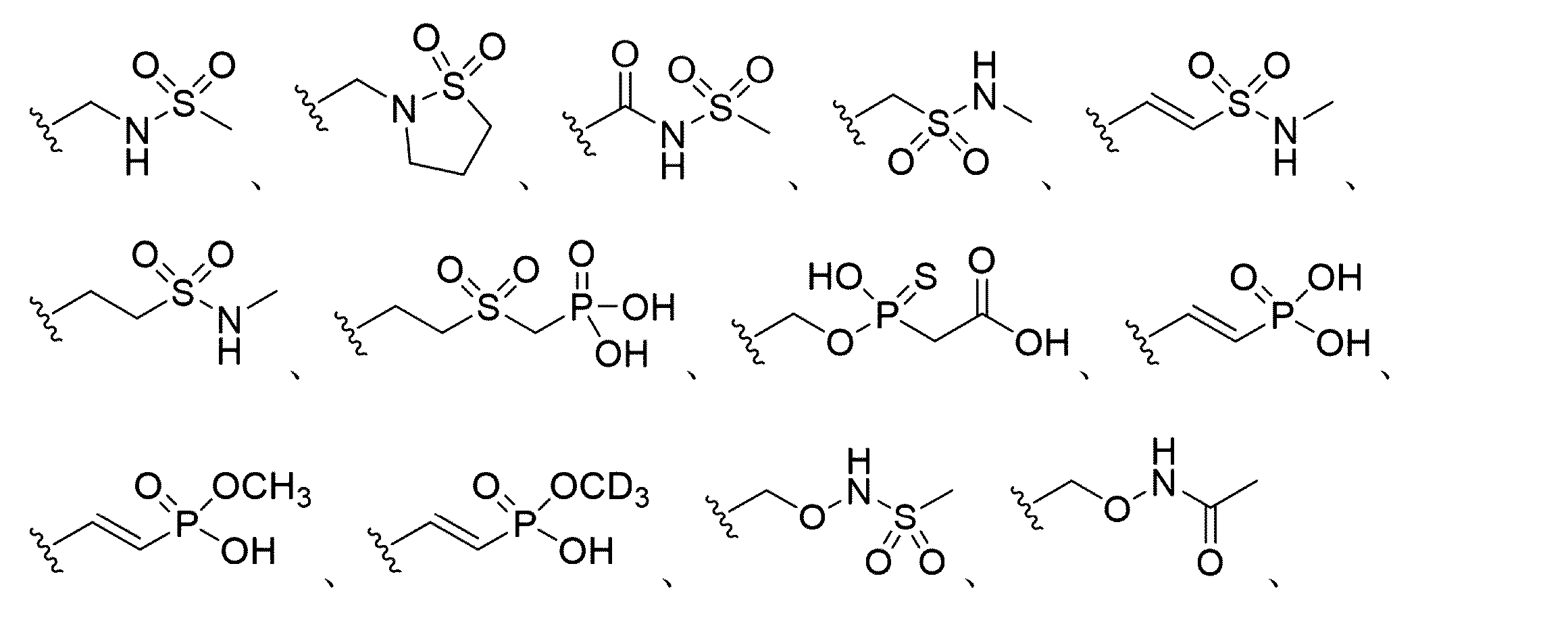
R2およびR20が、一緒になって、-(CR21R22)n-Zもしくは-(C2-C6アルケニレン)-Zで置換された3~7員の炭素環式環を形成し、
nが、1、2、3、または4であり、
Zが、-ONR23R24、-OP(O)OH(CH2)mCO2R23、-OP(S)OH(CH2)mCO2R23、-P(O)(OH)2、-P(O)(OH)(OCH3)、-P(O)(OH)(OCD3)、-SO2(CH2)mP(O)(OH)2、-SO2NR23R25、-NR23R24、または-NR23SO2R24であり、
R21およびR22のいずれかが、独立して、水素もしくはC1~C6アルキルであるか、またはR21およびR22が、一緒になってオキソ基を形成し、
R23が、水素、もしくはC1~C6アルキルであり、
R24が、-SO2R25もしくは-C(O)R25であるか、または
R23およびR24が、それらが接続する窒素と一緒になって、置換もしくは非置換複素環式環を形成し、
R25が、C1~C6アルキルであり、
mが、1、2、3、または4である、実施形態16、131、132および170のうちのいずれか1つに記載のsiNA。
173.5’安定化エンドキャップが、式(Ib)の構造:

R1が、核酸塩基、アリール、ヘテロアリール、またはHであり、
R2が、

R2およびR20が、一緒になって、-(CR21R22)n-Zもしくは-(C2-C6アルケニレン)-Zで置換された3~7員の炭素環式環を形成し、
nが、1、2、3、または4であり、
Zが、-ONR23R24、-OP(O)OH(CH2)mCO2R23、-OP(S)OH(CH2)mCO2R23、-P(O)(OH)2、-P(O)(OH)(OCH3)、-P(O)(OH)(OCD3)、-SO2(CH2)mP(O)(OH)2、-SO2NR23R25、-NR23R24、または-NR23SO2R24であり、
R21およびR22のいずれかが、独立して、水素もしくはC1~C6アルキルであるか、またはR21およびR22が、一緒になってオキソ基を形成し、
R23が、水素、もしくはC1~C6アルキルであり、
R24が、-SO2R25もしくは-C(O)R25であるか、または
R23およびR24が、それらが接続する窒素と一緒になって、置換もしくは非置換複素環式環を形成し、
R25が、C1~C6アルキルであり、
mが、1、2、3、または4である、実施形態131、132および170のうちのいずれか1つに記載のsiNA。
174.R1が、アリールである、実施形態172または173のsiNA。
175.アリールが、フェニルである、実施形態174のsiNA。
176.5’安定化エンドキャップが、式(1)~式(15)、式(9X)~式(12X)、および式(9Y)~式(12Y)からなる群から選択される、実施形態16、131、132、および170のうちのいずれか1つに記載のsiNA。


177.5’安定化エンドキャップが、式(1A)~(15A)、式(9B)~(12B)、式(9AX)~(12AX)、式(9AY)~(12AY)、式(9BX)~(12BX)、および式(9BY)~(12BY)からなる群から選択される、実施形態16、131、132、および170のうちのいずれか1つに記載のsiNA。


R1が、核酸塩基、アリール、ヘテロアリール、またはHであり、
R2が、
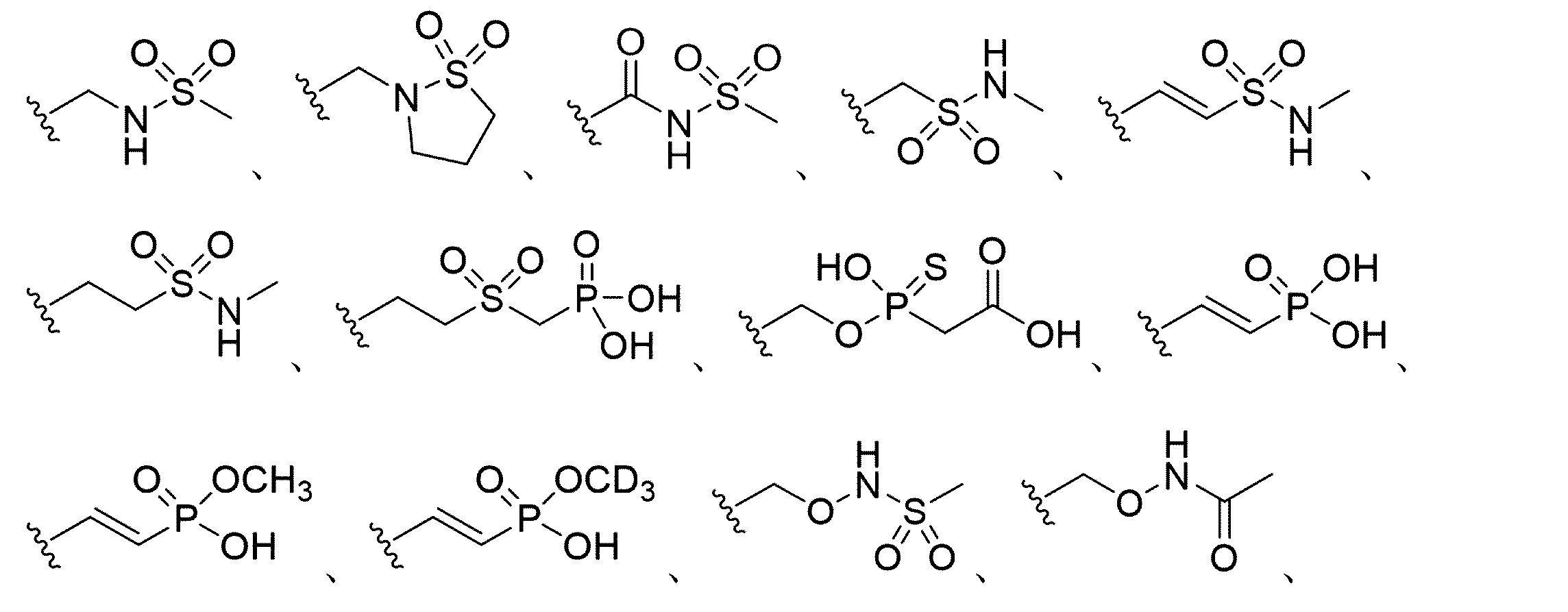
R2およびR20が、一緒になって、-(CR21R22)n-Zもしくは-(C2-C6アルケニレン)-Zで置換された3~7員の炭素環式環を形成し、
nが、1、2、3、または4であり、
Zが、-ONR23R24、-OP(O)OH(CH2)mCO2R23、-OP(S)OH(CH2)mCO2R23、-P(O)(OH)2、-P(O)(OH)(OCH3)、-P(O)(OH)(OCD3)、-SO2(CH2)mP(O)(OH)2、-SO2NR23R25、-NR23R24、または-NR23SO2R24であり、
R21およびR22のいずれかが、独立して、水素もしくはC1~C6アルキルであるか、またはR21およびR22が、一緒になってオキソ基を形成し、
R23が、水素、もしくはC1~C6アルキルであり、
R24が、-SO2R25もしくは-C(O)R25であるか、または
R23およびR24が、それらが接続する窒素と一緒になって、置換もしくは非置換複素環式環を形成し、
R25が、C1~C6アルキルであり、
mが、1、2、3、または4である、実施形態131、132および170のうちのいずれか1つに記載のsiNA。
179.R1が、アリールである、実施形態178のsiNA。
180.アリールが、フェニルである、実施形態179のsiNA。
181.5’安定化エンドキャップが、式(21)~式(35)からなる群から選択される、実施形態16、131、132および170のうちのいずれか1つに記載のsiNA。

182.5’安定化エンドキャップが、式(21A)~(35A)、式(29B)~(32B)、式(29AX)~(32AX)、式(29AY)~(32AY)、式(29BX)~(32BX)、および式(29BY)~(32BY)からなる群から選択される、実施形態16、131、132、および170のうちのいずれか1つに記載のsiNA。


184.センス鎖が、

185.第1のヌクレオチド配列が、

186.第2のヌクレオチド配列が、

187.5’安定化エンドキャップが、アンチセンス鎖の5’末端に接続する、実施形態16、131、132、および170~186のうちのいずれか1つに記載のsiNA。
188.5’安定化エンドキャップが、ホスホジエステルリンカー、ホスホロチオエートリンカー、またはホスホロジチオエートリンカーから独立して選択される1つ以上のリンカーを介して、アンチセンス鎖の5’末端に接続する、実施形態187のsiNA。
189.5’安定化エンドキャップが、センス鎖の5’末端に接続する、実施形態16、131、132、および170~186のうちのいずれか1つに記載のsiNA。
190.5’安定化エンドキャップが、ホスホジエステルリンカー、ホスホロチオエートリンカー、またはホスホロジチオエートリンカーから独立して選択される1つ以上のリンカーを介して、センス鎖の5’末端に接続する、実施形態189のsiNA。
191.標的遺伝子が、ウイルス遺伝子である、いずれかの先行実施形態に記載のsiNA。
192.ウイルス遺伝子が、DNAウイルス由来である、実施形態191のsiNA。
193.DNAウイルスが、二本鎖DNA(dsDNA)ウイルスである、実施形態192のsiNA。
194.dsDNAウイルスが、ヘパドナウイルスである、実施形態193のsiNA。
195.ヘパドナウイルスが、B型肝炎ウイルス(HBV)である、実施形態194のsiNA。
196.HBVが、HBV遺伝子型A~Jから選択される、実施形態195のsiNA。
197.標的遺伝子が、HBVのS遺伝子またはX遺伝子から選択される、実施形態195または196のsiNA。
198.第2のヌクレオチド配列が、配列番号410の200~720または1100~1700位置内の15~30個のヌクレオチドに対して少なくとも約60%、65%、70%、75%、80%、85%、90%、95%、または100%相補的である、実施形態1~197のうちのいずれか1つに記載のsiNA。
199.第2のヌクレオチド配列が、配列番号410の200~280、300~445、460~510、650~720、1170~1220、1250~1300、または1550~1630位置内の15~30個のヌクレオチドに対して少なくとも約60%、65%、70%、75%、80%、85%、90%、95%、または100%相補的である、実施形態1~197のうちのいずれか1つに記載のsiNA。
200.第2のヌクレオチド配列が、配列番号410の200~230、250~280、300~330、370~400、405~445、460~500、670~700、1180~1210、1260~1295、1520~1550、または1570~1610位置内の15~30個のヌクレオチドに対して少なくとも約60%、65%、70%、75%、80%、85%、90%、95%、または100%相補的である、実施形態1~197のうちのいずれか1つに記載のsiNA。
201.第2のヌクレオチド配列が、配列番号410の203、206、254、305、375、409、412、415、416、419、462、466、467、674、676、1182、1262、1263、1268、1526、1577、1578、1580、1581、1583、または1584位置で開始する15~30個のヌクレオチドに対して少なくとも約60%、65%、70%、75%、80%、85%、90%、95%、または100%相補的である、実施形態1~197のうちのいずれか1つに記載のsiNA。
202.第1のヌクレオチド配列が、配列番号410の200~720または1100~1700位置内の15~30個のヌクレオチドに対して少なくとも約60%、65%、70%、75%、80%、85%、90%、95%、または100%同一である、実施形態1~201のうちのいずれか1つに記載のsiNA。
203.第1のヌクレオチド配列が、配列番号410の200~280、300~445、460~510、650~720、1170~1220、1250~1300、または1550~1630位置内の15~30個のヌクレオチドに対して少なくとも約60%、65%、70%、75%、80%、85%、90%、95%、または100%同一である、実施形態1~201のうちのいずれか1つに記載のsiNA。
204.第1のヌクレオチド配列が、配列番号410の200~230、250~280、300~330、370~400、405~445、460~500、670~700、1180~1210、1260~1295、1520~1550、または1570~1610位置内の15~30個のヌクレオチドに対して少なくとも約60%、65%、70%、75%、80%、85%、90%、95%、または100%同一である、実施形態1~201のうちのいずれか1つに記載のsiNA。
205.第1のヌクレオチド配列が、配列番号410の203、206、254、305、375、409、412、415、416、419、462、466、467、674、676、1182、1262、1263、1268、1526、1577、1578、1580、1581、1583、または1584位置で開始する15~30個のヌクレオチドに対して少なくとも約60%、65%、70%、75%、80%、85%、90%、95%、または100%同一である、実施形態1~201のうちのいずれか1つに記載のsiNA。
206.第1のヌクレオチド配列が、いずれか1つの配列番号1~56、103~158および205~260のヌクレオチド配列を含む、いずれかの先行実施形態に記載のsiNA。
207.第2のヌクレオチド配列が、配列番号57~102、159~204、および261~306のうちのいずれか1つのヌクレオチド配列を含む、いずれかの先行実施形態に記載のsiNA。
208.センス鎖が、配列番号307~362および415~444のうちのいずれか1つのヌクレオチド配列を含む、いずれかの先行実施形態に記載のsiNA。
209.アンチセンス鎖が、配列番号363~409、445~533および536~539のうちのいずれか1つのヌクレオチド配列を含む、いずれかの先行実施形態に記載のsiNA。
210.siNAの少なくとも1つの末端が、平滑末端である、いずれかの先行実施形態に記載のsiNA。
211.siNAの少なくとも1つの末端が、オーバーハングを含み、オーバーハングが、少なくとも1つのヌクレオチドを含む、いずれかの先行実施形態に記載のsiNA。
212.siNAの両方の末端が、オーバーハングを含み、オーバーハングが、少なくとも1つのヌクレオチドを含む、実施形態1~209のうちのいずれか1つに記載のsiNA。
213.siNAが、ds-siNA-001~ds-siNA-0178から選択される、いずれかの先行実施形態に記載のsiNA。
214.少なくとも1つの2’-フルオロヌクレオチドまたは2’-O-メチルヌクレオチドが、式(V)の2’-フルオロまたは2-O-メチルヌクレオチド模倣物

R1が、独立して、核酸塩基、アリール、ヘテロアリール、またはHであり、Q1およびQ2が、独立して、SまたはOであり、
R5が、独立して、-OCD3、-F、または-OCH3であり、
R6およびR7が、独立して、H、D、またはCD3である、いずれかの先行実施形態に記載のsiNA。
215.2’-フルオロまたは2’-O-メチルヌクレオチド模倣物が、式(16)~式(20)のヌクレオチド模倣物であり、

216.少なくとも1つの2’-フルオロヌクレオチドが、2’-フルオロヌクレオチド模倣物である、いずれかの先行実施形態に記載のsiNA。
217.アンチセンス鎖または第2のヌクレオチド配列上の少なくとも1つの2’-フルオロヌクレオチドが、2’-フルオロヌクレオチド模倣物である、実施形態216に記載のsiNA。
218.アンチセンス鎖または第2のヌクレオチド配列の5’末端から2位置のヌクレオチドが、2’-フルオロヌクレオチド模倣物である、実施形態216または217に記載のsiNA。
219.アンチセンス鎖または第2のヌクレオチド配列の5’末端から5位置のヌクレオチドが、2’-フルオロヌクレオチド模倣物である、実施形態216~218のうちのいずれか1つに記載のsiNA。
220.アンチセンス鎖または第2のヌクレオチド配列の5’末端から6位置のヌクレオチドが、2’-フルオロヌクレオチド模倣物である、実施形態216~219のうちのいずれか1つに記載のsiNA。
221.アンチセンス鎖または第2のヌクレオチド配列の5’末端から8位置のヌクレオチドが、2’-フルオロヌクレオチド模倣物である、実施形態216~220のうちのいずれか1つに記載のsiNA。
222.アンチセンス鎖または第2のヌクレオチド配列の5’末端から10位置のヌクレオチドが、2’-フルオロヌクレオチド模倣物である、実施形態216~221のうちのいずれか1つに記載のsiNA。
223.アンチセンス鎖または第2のヌクレオチド配列の5’末端から14位置のヌクレオチドが、2’-フルオロヌクレオチド模倣物である、実施形態216~222のうちのいずれか1つに記載のsiNA。
224.アンチセンス鎖または第2のヌクレオチド配列の5’末端から16位置のヌクレオチドが、2’-フルオロヌクレオチド模倣物である、実施形態216~223のうちのいずれか1つに記載のsiNA。
225.アンチセンス鎖または第2のヌクレオチド配列の5’末端から17位置のヌクレオチドが、2’-フルオロヌクレオチド模倣物である、実施形態216~224のうちのいずれか1つに記載のsiNA。
226.センス鎖または第1のヌクレオチド配列上の少なくとも1つの2’-フルオロヌクレオチドが、2’-フルオロヌクレオチド模倣物である、実施形態216~225のうちのいずれか1つに記載のsiNA。
227.センス鎖または第1のヌクレオチド配列の5’末端から3位置のヌクレオチドが、2’-フルオロヌクレオチド模倣物である、実施形態216~226のうちのいずれか1つに記載のsiNA。
228.センス鎖または第1のヌクレオチド配列の5’末端から5位置のヌクレオチドが、2’-フルオロヌクレオチド模倣物である、実施形態216~227のうちのいずれか1つに記載のsiNA。
229.センス鎖または第1のヌクレオチド配列の5’末端から7位置のヌクレオチドが、2’-フルオロヌクレオチド模倣物である、実施形態216~228のうちのいずれか1つに記載のsiNA。
230.センス鎖または第1のヌクレオチド配列の5’末端から8位置のヌクレオチドが、2’-フルオロヌクレオチド模倣物である、実施形態216~229のうちのいずれか1つに記載のsiNA。
231.センス鎖または第1のヌクレオチド配列の5’末端から9位置のヌクレオチドが、2’-フルオロヌクレオチド模倣物である、実施形態216~230のうちのいずれか1つに記載のsiNA。
232.センス鎖または第1のヌクレオチド配列の5’末端から10位置のヌクレオチドが、2’-フルオロヌクレオチド模倣物である、実施形態216~231のうちのいずれか1つに記載のsiNA。
233.センス鎖または第1のヌクレオチド配列の5’末端から11位置のヌクレオチドが、2’-フルオロヌクレオチド模倣物である、実施形態216~232のうちのいずれか1つに記載のsiNA。
234.センス鎖または第1のヌクレオチド配列の5’末端から12位置のヌクレオチドが、2’-フルオロヌクレオチド模倣物である、実施形態216~233のうちのいずれか1つに記載のsiNA。
235.センス鎖または第1のヌクレオチド配列の5’末端から14位置のヌクレオチドが、2’-フルオロヌクレオチド模倣物である、実施形態216~234のうちのいずれか1つに記載のsiNA。
236.センス鎖または第1のヌクレオチド配列の5’末端から17位置のヌクレオチドが、2’-フルオロヌクレオチド模倣物である、実施形態216~235のうちのいずれか1つに記載のsiNA。
237.少なくとも1、2、3、4、5、6個、またはそれより多くの2’-フルオロヌクレオチド模倣物が、f4Pヌクレオチド

238.10、9、8、7、6、5、4、3、または2個以下の2’-フルオロヌクレオチド模倣物が、f4Pヌクレオチド

239.1、2、3、4、5、6個、またはそれより多くの2’-フルオロヌクレオチド模倣物が、f2Pヌクレオチド
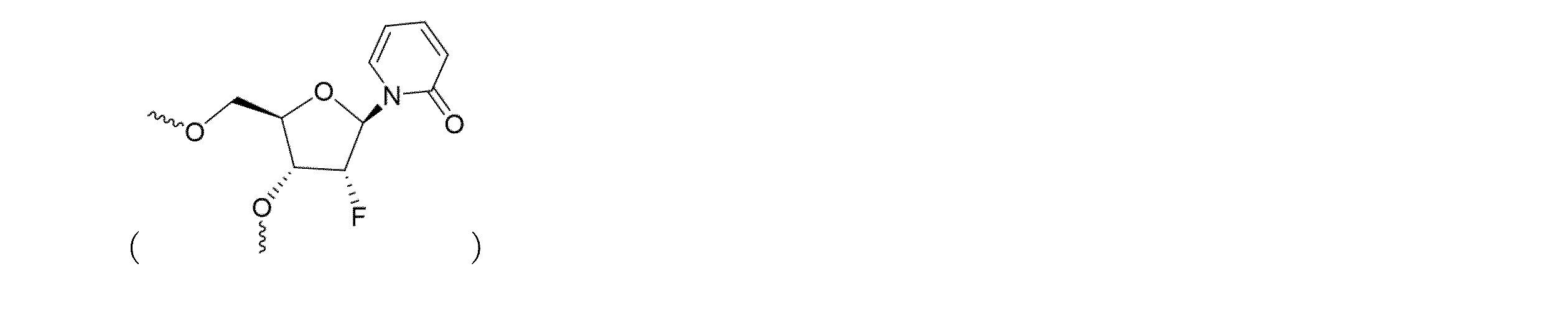
240.10、9、8、7、6、5、4、3、または2個以下の2’-フルオロヌクレオチド模倣物が、f2Pヌクレオチド

241.1、2、3、4、5、6個、またはそれより多くの2’-フルオロヌクレオチド模倣物が、fXヌクレオチド

242.10、9、8、7、6、5、4、3、または2個以下の2’-フルオロヌクレオチド模倣物が、fXヌクレオチド

243.センス鎖または第1のヌクレオチド配列の5’末端からの第1のヌクレオチドが、d2vd3ヌクレオチド

244.センス鎖または第1のヌクレオチド配列の3’末端からの第1のヌクレオチドが、d2vd3ヌクレオチド

245.アンチセンス鎖または第2のヌクレオチド配列の5’末端からの第1のヌクレオチドが、d2vd3ヌクレオチド

246.アンチセンス鎖または第2のヌクレオチド配列の3’末端からの第1のヌクレオチドが、d2vd3ヌクレオチド

247.実施形態1~246のうちのいずれか1つに記載のsiNAを含む組成物。
248.実施形態1~246のうちのいずれか1つに記載の2、3、4、5、6、7、8、9、10個、またはそれより多くのsiNAを含む組成物。
249.少なくとも1、2、3、4、5個、またはそれより多くのsiNAが、HBVのS遺伝子を標的とする、実施形態248の組成物。
250.少なくとも1、2、3、4、5個、またはそれより多くのsiNAが、HBVのX遺伝子を標的とする、実施形態248または249の組成物。
251.追加のHBV治療薬剤をさらに含む、実施形態247~250のうちのいずれか1つに記載の組成物。
252.追加のHBV治療薬剤が、ヌクレオチド類似体、ヌクレオシド類似体、カプシドアセンブリモジュレーター(CAM)、組換えインターフェロン、侵入阻害剤、小分子免疫モジュレーター、およびオリゴヌクレオチド療法から選択される、実施形態251の組成物。
253.オリゴヌクレオチ療法が、追加のsiNAである、実施形態252の組成物。
254.追加のsiNAが、ds-siNA-001~ds-siNA-0178のうちのいずれかから選択される、実施形態253の組成物。
255.オリゴヌクレオチド療法が、アンチセンスオリゴヌクレオチド(ASO)、NAP、またはSTOPS(商標)である、実施形態252の組成物。
256.ASOが、ASO1またはASO2である、実施形態255の組成物。
257.追加のHBV治療薬剤が、HBV STOPS(商標)ALG-010133、HBV CAM ALG-000184、ASO1、組換えインターフェロンアルファ2b、IFN-a、PEG-IFN-a-2a、ラミブジン、テルビブジン、アデホビルジピボキシル、クレブジン、エンテカビル、テノホビルアラフェナミド、テノホビルジソプロキシル、NVR3-778、BAY41-4109、JNJ-632、JNJ-3989(ARO-HBV)、RG6004、GSK3228836、REP-2139、REP-2165、AB-729、VIR-2218、RG6346(DCR-HBVS)、JNJ-6379、GLS4、ABI-HO731、JNJ-440、NZ-4、RG7907、EDP-514、AB-423、AB-506、ABI-H03733、およびABI-H2158から選択される、実施形態251または252の組成物。
258.疾患の治療を必要とする対象においてそれを行う方法であって、実施形態1~246のうちのいずれか1つに記載のsiNAを対象に投与することを含む、方法。
259.疾患の治療を必要とする対象においてそれを行う方法であって、実施形態247~257のうちのいずれか1つに記載の組成物を対象に投与することを含む、方法。
260.疾患が、ウイルス性疾患である、実施形態258または259の方法。
261.ウイルス性疾患が、DNAウイルスによって引き起こされる、実施形態260の方法。
262.DNAウイルスが、二本鎖DNA(dsDNA)ウイルスである、実施形態261の方法。
263.dsDNAウイルスが、ヘパドナウイルスである、実施形態262の方法。
264.ヘパドナウイルスが、B型肝炎ウイルス(HBV)である、実施形態263の方法。
265.HBVが、HBV遺伝子型A~Jから選択される、実施形態264の方法。
266.追加のHBV治療薬剤を投与することをさらに含む、実施形態258~265のいずれかの方法。
267.siNAまたは組成物および追加のHBV治療薬剤が、同時に投与される、実施形態266の方法。
268.siNAまたは組成物および追加のHBV治療薬剤が、順次投与される、実施形態266の方法。
269.siNAまたは組成物が、追加のHBV治療薬剤を投与する前に投与される、実施形態266の方法。
270.siNAまたは組成物が、追加のHBV治療薬剤を投与した後に投与される、実施形態266の方法。
271.追加のHBV治療薬剤が、ヌクレオチド類似体、ヌクレオシド類似体、カプシドアセンブリモジュレーター(CAM)、組換えインターフェロン、侵入阻害剤、小分子免疫モジュレーター、およびオリゴヌクレオチド療法から選択される、実施形態266~270のうちのいずれか1つの方法。
272.オリゴヌクレオチ療法が、追加のsiNAである、実施形態271の方法。
273.追加のsiNAが、ds-siNA-001~ds-siNA-0178のうちのいずれかから選択される、実施形態272の方法。
274.オリゴヌクレオチド療法が、アンチセンスオリゴヌクレオチド(ASO)、NAP、またはSTOPである、実施形態271の方法。
275.ASOが、ASO1またはASO2である、実施形態274の方法。
276.追加のHBV治療薬剤が、HBV STOPS(商標)ALG-010133、HBV CAM ALG-000184、ASO1、組換えインターフェロンアルファ2b、IFN-a、PEG-IFN-a-2a、ラミブジン、テルビブジン、アデホビルジピボキシル、クレブジン、エンテカビル、テノホビルアラフェナミド、テノホビルジソプロキシル、NVR3-778、BAY41-4109、JNJ-632、JNJ-3989(ARO-HBV)、RG6004、GSK3228836、REP-2139、REP-2165、AB-729、VIR-2218、RG6346(DCR-HBVS)、JNJ-6379、GLS4、ABI-HO731、JNJ-440、NZ-4、RG7907、EDP-514、AB-423、AB-506、ABI-H03733、およびABI-H2158から選択される、実施形態270または271の方法。
277.疾患が、肝臓疾患である、実施形態258または259の方法。
278.肝臓疾患が、非アルコール性脂肪肝疾患(NAFLD)または肝細胞がん腫(HCC)である、実施形態277の方法。
279.NAFLDが、非アルコール性脂肪性肝炎(NASH)である、実施形態278の方法。
280.肝臓疾患治療薬剤を対象に投与することをさらに含む、実施形態277~279のいずれかの方法。
281.肝臓疾患治療薬剤が、ペルオキシソーム増殖剤活性化受容体(PPAR)アゴニスト、ファルネソイドX受容体(FXR)アゴニスト、脂質改変剤、およびインクレチン系療法から選択される、実施形態280の方法。
282.PPARアゴニストが、PPARαアゴニスト、デュアルPPARα/δアゴニスト、PPARγアゴニスト、およびデュアルPPARα/γアゴニストから選択される、実施形態281の方法。
283.デュアルPPARαアゴニストが、フィブラートである、実施形態282の方法。
284.PPARα/δアゴニストが、エラフィブラノールである、実施形態282の方法。
285.PPARγアゴニストが、チアゾリジンジオン(TZD)である、実施形態282の方法。
286.TZDが、ピオグリタゾンである、実施形態282の方法。
287.デュアルPPARα/γアゴニストが、サログリタザールである、実施形態282の方法。
288.FXRアゴニストが、オベチコールアシス(OCA)である、実施形態281の方法。
289.脂質改変剤が、アラムコールである、実施形態281の方法。
290.インクレチン系療法が、グルカゴン様ペプチド1(GLP-1)受容体アゴニストまたはジペプチジルペプチダーゼ4(DPP-4)阻害剤である、実施形態281の方法。
291.GLP-1受容体アゴニストが、エキセナチドまたはリラグルチドである、実施形態290の方法。
292.DPP-4阻害剤が、シタグリプチンまたはビルダプリプチンである、実施形態290の方法。
293.siNAまたは組成物および肝臓疾患治療薬剤が、同時に投与される、実施形態280~292のうちのいずれか1つの方法。
294.siNAまたは組成物および肝臓疾患治療薬剤が、順次投与される、実施形態280~292のうちのいずれか1つの方法。
295.siNAまたは組成物が、肝臓疾患治療薬剤を投与する前に投与される、実施形態280~292のうちのいずれか1つの方法。
296.siNAまたは組成物が、肝臓疾患治療薬剤を投与した後に投与される、実施形態280~292のうちのいずれか1つの方法。
297.siNAまたは組成物が、少なくとも1mg/kg、2mg/kg、3mg/kg、4mg/kg、5mg/kg、6mg/kg、7mg/kg、8mg/kg、9mg/kg、10mg/kg、11mg/kg、12mg/kg、13mg/kg、14mg/kg、または15mg/kgの用量で投与される、1つの実施形態258~296のいずれかの方法。
298.siNAまたは組成物が、0.5mg/kg~50mg/kg、0.5mg/kg~40mg/kg、0.5mg/kg~30mg/kg、1mg/kg~50mg/kg、1mg/kg~40mg/kg、1mg/kg~30mg/kg、1mg/kg~20mg/kg、3mg/kg~50mg/kg、3mg/kg~40mg/kg、3mg/kg~30mg/kg、3mg/kg~20mg/kg、3mg/kg~15mg/kg、3mg/kg~10mg/kg、4mg/kg~50mg/kg、4mg/kg~40mg/kg、4mg/kg~30mg/kg、4mg/kg~20mg/kg、4mg/kg~15mg/kg、4mg/kg~10mg/kg、5mg/kg~50mg/kg、5mg/kg~40mg/kg、5mg/kg~30mg/kg、5mg/kg~20mg/kg、5mg/kg~15mg/kg、または5mg/kg~10mg/kgの用量で投与される、1つの実施形態258~296のいずれかの方法。
299.siNAまたは組成物が、少なくとも1、2、3、4、5、6、7、8、9、または10回投与される、1つの実施形態258~298のいずれかの方法。
300.siNAまたは組成物が、1日に少なくとも1、2、3、4、5、6、7、8、9、または10回、1週間に少なくとも1、2、3、4、5、6、7、8、9、または10回、または1ヶ月に少なくとも1、2、3、4、5、6、7、8、9、または10回投与される、1つの実施形態258~298のいずれかの方法。
301.siNAまたは組成物が、1、2、3、4、5、6、7、8、9、10、11、12、13、14、15、16、17、18、19、20、または21日ごとに少なくとも1回投与される、1つの実施形態258~300のいずれかの方法。
302.siNAまたは組成物が、少なくとも1、2、3、4、5、6、7、8、9、10、11、12、13、14、15、16、17、18、19、20、または21日間、または少なくとも1、2、3、4、5、6、7、8、9、10、11、12、13、14、15、16、17、18、19、20、21、22、23、24、25、26、27、28、29、30、35、40、45、50、51、52、53、54、または55週間の期間にわたって投与される、1つの実施形態258~301のいずれかの方法。
303.siNAまたは組成物が、5mg/kgの単回用量で投与される、1つの実施形態258~302のいずれかの方法。
304.siNAまたは組成物が、10mg/kgの単回用量で投与される、1つの実施形態258~302のいずれかの方法。
305.siNAまたは組成物が、10mg/kgの3回用量で、1週間に1回投与される、1つの実施形態258~302のいずれかの方法。
306.siNAまたは組成物が、10mg/kgの3回用量で、3日に1回投与される、1つの実施形態258~302のいずれかの方法。
307.siNAまたは組成物が、10mg/kgの5回用量で、3日に1回投与される、1つの実施形態258~302のいずれかの方法。
308.siNAまたは組成物が、1mg/kg~15mg/kg、1mg/kg~10mg/kg、2mg/kg~15mg/kg、2mg/kg~10mg/kg、3mg/kg~15mg/kg、または3mg/kg~10mg/kgの範囲の6回用量で投与される、1つの実施形態258~302のいずれかの方法。
309.第1の用量および第2の用量が、少なくとも3日間離れて投与される、実施形態308の方法。
310.第2の用量および第3の用量が、少なくとも4日間離れて投与される、実施形態308または309の方法。
311.第3の用量および第4の用量、第4の用量および第5の用量、または第5の用量および第6の用量が、少なくとも7日間離れて投与される、実施形態308~310のうちのいずれか1つの方法。
312.siNAまたは組成物が、粒子またはウイルスベクターで投与される、実施形態258~311のうちのいずれか1つの方法。
313.ウイルスベクターが、アデノウイルス、アデノ随伴ウイルス(AAV)、アルファウイルス、フラビウイルス、単純ヘルペスウイルス、レンチウイルス、麻疹ウイルス、ピコルナウイルス、ポックスウイルス、レトロウイルス、またはラブドウイルスのベクターである、実施形態312の方法。
314.ウイルスベクターが、組換えウイルスベクターである、実施形態312の方法。
315.ウイルスベクターが、AAVrh.74、AAVrh.10、AAVrh.20、AAV-1、AAV-2、AAV-3、AAV-4、AAV-5、AAV-6、AAV-7、AAV-8、AAV-9、AAV-10、AAV-11、AAV-12、およびAAV-13から選択される、実施形態312~314のうちのいずれか1つに記載の方法。
316.siNAまたは組成物が、全身的に投与される、実施形態258~315のうちのいずれか1つに記載の方法。
317.siNAまたは組成物が、局所的に投与される、実施形態258~315のうちのいずれか1つに記載の方法。
318.siNAまたは組成物が、静脈内、皮下、または筋肉内に投与される、実施形態258~317のうちのいずれか1つに記載の方法。
319.疾患を治療するための医薬の製造における、実施形態1~246のうちのいずれか1つに記載のsiNA、または実施形態247~257のうちのいずれか1つに記載の組成物の、使用。
320.疾患が、ウイルス性疾患である、実施形態319の使用。
321.ウイルス性疾患が、DNAウイルスによって引き起こされる、実施形態320の使用。
322.DNAウイルスが、二本鎖DNA(dsDNA)ウイルスである、実施形態321の使用。
323.dsDNAウイルスが、ヘパドナウイルスである、実施形態321の使用。
324.ヘパドナウイルスが、B型肝炎ウイルス(HBV)である、実施形態323の使用。
325.HBVが、HBV遺伝子型A~Jから選択される、実施形態324の使用。
326.医薬の製造における追加のHBV治療薬剤をさらに含む、実施形態319~325のうちの1つのいずれかの使用。
327.追加のHBV治療薬剤が、ヌクレオチド類似体、ヌクレオシド類似体、カプシドアセンブリモジュレーター(CAM)、組換えインターフェロン、侵入阻害剤、小分子免疫モジュレーター、およびオリゴヌクレオチド療法から選択される、実施形態326の使用。
328.オリゴヌクレオチ療法が、追加のsiNAである、実施形態327の使用。
329.追加のsiNAが、ds-siNA-001~ds-siNA-0178のうちのいずれかから選択される、実施形態328の使用。
330.オリゴヌクレオチド療法が、アンチセンスオリゴヌクレオチド(ASO)、NAP、またはSTOPである、実施形態327の使用。
331.ASOが、ASO1またはASO2である、実施形態330の方法。
332.追加のHBV治療薬剤が、HBV STOPS(商標)ALG-010133、HBV CAM ALG-000184、ASO1、組換えインターフェロンアルファ2b、IFN-a、PEG-IFN-a-2a、ラミブジン、テルビブジン、アデホビルジピボキシル、クレブジン、エンテカビル、テノホビルアラフェナミド、テノホビルジソプロキシル、NVR3-778、BAY41-4109、JNJ-632、JNJ-3989(ARO-HBV)、RG6004、GSK3228836、REP-2139、REP-2165、AB-729、VIR-2218、RG6346(DCR-HBVS)、JNJ-6379、GLS4、ABI-HO731、JNJ-440、NZ-4、RG7907、EDP-514、AB-423、AB-506、ABI-H03733、およびABI-H2158から選択される、実施形態326または327の使用。
333.疾患が、肝臓疾患である、実施形態319の使用。
334.肝臓疾患が、非アルコール性脂肪肝疾患(NAFLD)または肝細胞がん腫(HCC)である、実施形態333の使用。
335.NAFLDが、非アルコール性脂肪性肝炎(NASH)である、実施形態334の使用。
336.医薬の製造における肝臓疾患治療薬剤をさらに含む、実施形態333~335のいずれかの使用。
337.肝臓疾患治療薬剤が、ペルオキシソーム増殖剤活性化受容体(PPAR)アゴニスト、ファルネソイドX受容体(FXR)アゴニスト、脂質改変剤、およびインクレチン系療法から選択される、実施形態336の使用。
338.PPARアゴニストが、PPARαアゴニスト、デュアルPPARα/δアゴニスト、PPARγアゴニスト、およびデュアルPPARα/γアゴニストから選択される、実施形態337の使用。
339.デュアルPPARαアゴニストが、フィブラートである、実施形態338の使用。
340.PPARα/δアゴニストが、エラフィブラノールである、実施形態338の使用。
341.PPARγアゴニストが、チアゾリジンジオン(TZD)である、実施形態338の使用。
342.TZDが、ピオグリタゾンである、実施形態341の使用。
343.デュアルPPARα/γアゴニストが、サログリタザールである、実施形態338の使用。
344.FXRアゴニストが、オベチコールアシス(OCA)である、実施形態337の使用。
345.脂質改変剤が、アラムコールである、実施形態337の使用。
346.インクレチン系療法が、グルカゴン様ペプチド1(GLP-1)受容体アゴニストまたはジペプチジルペプチダーゼ4(DPP-4)阻害剤である、実施形態337の使用。
347.GLP-1受容体アゴニストが、エキセナチドまたはリラグルチドである、実施形態346の使用。
348.DPP-4阻害剤が、シタグリプチンまたはビルダプリプチンである、実施形態346の使用。
349.医薬として使用するための、実施形態1~246のうちのいずれか1つに記載のsiNA。
350.医薬として使用するための、実施形態247~257のうちのいずれか1つに記載の組成物。
351.疾患の治療に使用するための、実施形態1~246のうちのいずれか1つに記載のsiNA。
352.疾患が、ウイルス性疾患である、実施形態351のsiNA。
353.ウイルス性疾患が、DNAウイルスによって引き起こされる、実施形態352のsiNA。
354.DNAウイルスが、二本鎖DNA(dsDNAウイルス)である、実施形態353のsiNA。
355.dsDNAウイルスが、ヘパドナウイルスである、実施形態354のsiNA。
356.ヘパドナウイルスが、B型肝炎ウイルス(HBV)である、実施形態355のsiNA。
357.HBVが、HBV遺伝子型A~Jから選択される、実施形態356のsiNA。
358.疾患が、肝臓疾患である、実施形態351のsiNA。
359.肝臓疾患が、非アルコール性脂肪肝疾患(NAFLD)または肝細胞がん腫(HCC)である、実施形態358のsiNA。
360.NAFLDが、非アルコール性脂肪性肝炎(NASH)である、実施形態359のsiNA。
361.疾患の治療における使用のための、実施形態247~257のうちのいずれか1つに記載の組成物。
362.疾患が、ウイルス性疾患である、実施形態361の組成物。
363.ウイルス性疾患が、DNAウイルスによって引き起こされる、実施形態362の組成物。
364.DNAウイルスが、二本鎖DNA(dsDNAウイルス)である、実施形態363の組成物。
365.dsDNAウイルスが、ヘパドナウイルスである、実施形態364の組成物。
366.ヘパドナウイルスが、B型肝炎ウイルス(HBV)である、実施形態365の組成物。
367.疾患が、肝臓疾患である、実施形態366の組成物。
368.肝臓疾患が、非アルコール性脂肪肝疾患(NAFLD)または肝細胞がん腫(HCC)である、実施形態367の組成物。
369.NAFLDが、非アルコール性脂肪性肝炎(NASH)である、実施形態368の組成物。
exemplary embodiment
Exemplary embodiments are provided below.
1. A short interfering nucleic acid (siNA) molecule comprising
(a) a first nucleotide sequence that is at least about 60%, 65%, 70%, 75%, 80%, 85%, 90%, 95%, or 100% identical to the RNA corresponding to the target gene; a sense strand comprising, the first nucleotide sequence is
(i) is 15-30 nucleotides in length;
(ii) 15 or more modified nucleotides independently selected from 2'-O-methyl nucleotides and 2'-fluoro nucleotides, wherein at least one modified nucleotide is a 2'-O-methyl nucleotide; a sense strand, wherein the nucleotides at
(b) a second nucleotide sequence that is at least about 60%, 65%, 70%, 75%, 80%, 85%, 90%, 95%, or 100% complementary to the RNA corresponding to the target gene; wherein the second nucleotide sequence comprises
(i) is 15-30 nucleotides in length;
(ii) 15 or more modified nucleotides independently selected from 2'-O-methyl nucleotides and 2'-fluoro nucleotides, wherein at least one modified nucleotide is a 2'-O-methyl nucleotide; A short interfering nucleic acid (siNA) molecule comprising an antisense strand in which one modified nucleotide is a 2'-fluoronucleotide.
2. A short interfering nucleic acid (siNA) molecule comprising
(a) a first nucleotide sequence that is at least about 60%, 65%, 70%, 75%, 80%, 85%, 90%, 95%, or 100% identical to the RNA corresponding to the target gene; a sense strand comprising, the first nucleotide sequence is
(i) is 15-30 nucleotides in length;
(ii) 15 or more modified nucleotides independently selected from 2'-O-methyl nucleotides and 2'-fluoro nucleotides, wherein at least one modified nucleotide is a 2'-O-methyl nucleotide; a sense strand, wherein one modified nucleotide is a 2'-fluoro nucleotide;
(b) a second nucleotide sequence that is at least about 60%, 65%, 70%, 75%, 80%, 85%, 90%, 95%, or 100% complementary to the RNA corresponding to the target gene; wherein the second nucleotide sequence comprises
(i) is 15-30 nucleotides in length;
(ii) 15 or more modified nucleotides independently selected from 2'-O-methyl nucleotides and 2'-fluoro nucleotides, wherein at least one modified nucleotide is a 2'-O-methyl nucleotide; and an antisense strand in which the nucleotides at
3. 16, 17, 18, 19, 20, 21, 22, 23 or more modified nucleotides in which the first nucleotide sequence is independently selected from 2'-O-methyl nucleotides and 2'-fluoro nucleotides The siNA of
4. 70%, 75%, 80%, 85%, 90%, 95%, or 100% of the nucleotides in the first nucleotide sequence are independently selected from 2'-O-methyl nucleotides and 2'-fluoro nucleotides The siNA of
5. The siNA of any one of embodiments 1-4, wherein at least 2, 3, 4, 5, or 6 modified nucleotides of the first nucleotide sequence are 2'-fluoronucleotides.
6. Any one of embodiments 1-5, wherein no more than 10, 9, 8, 7, 6, 5, 4, 3, or 2 modified nucleotides of the first nucleotide sequence are 2'-fluoronucleotides. two siNAs.
7. Practice wherein at least 10, 11, 12, 13, 14, 15, 16, 17, 18, 19, 20, 21, or 22 modified nucleotides of the first nucleotide sequence are 2'-O-methyl nucleotides. siNA of any one of Forms 1-6.
8. 25, 24, 23, 22, 21, 20, 19, 18, 17, 16, 15, 14, 13, 12, 11, 10, 9, 8, 7, 6, 5, 4 of the first nucleotide sequence, The siNA of any one of embodiments 1-7, wherein the 3, or no more than 2 modified nucleotides are 2'-O-methyl nucleotides.
9. 16, 17, 18, 19, 20, 21, 22, 23 or more modified nucleotides in which the second nucleotide sequence is independently selected from 2'-O-methyl nucleotides and 2'-fluoro nucleotides The siRNA of any one of embodiments 1-8, comprising:
10. 70%, 75%, 80%, 85%, 90%, 95%, or 100% of the nucleotides in the second nucleotide sequence are independently selected from 2'-O-methyl nucleotides and 2'-fluoro nucleotides The siNA of any one of embodiments 1-9, wherein the modified nucleotide is a modified nucleotide.
11. The siNA of any one of embodiments 1-10, wherein at least 2, 3, 4, 5, or 6 modified nucleotides of the second nucleotide sequence are 2'-fluoronucleotides.
12. Any one of embodiments 1-11, wherein no more than 10, 9, 8, 7, 6, 5, 4, 3, or 2 modified nucleotides of the second nucleotide sequence are 2'-fluoronucleotides. two siNAs.
13. Practice wherein at least 10, 11, 12, 13, 14, 15, 16, 17, 18, 19, 20, 21, or 22 modified nucleotides of the second nucleotide sequence are 2'-O-methyl nucleotides. siNA of any one of Forms 1-12.
14. 25, 24, 23, 22, 21, 20, 19, 18, 17, 16, 15, 14, 13, 12, 11, 10, 9, 8, 7, 6, 5, 4 of the second nucleotide sequence, The siNA of any one of embodiments 1-12, wherein the 3, or no more than 2 modified nucleotides are 2'-O-methyl nucleotides.
15. A short interfering nucleic acid (siNA) molecule comprising
(a) a first nucleotide sequence that is at least about 60%, 65%, 70%, 75%, 80%, 85%, 90%, 95%, or 100% identical to the RNA corresponding to the target gene; a sense strand comprising, the first nucleotide sequence is
(i) is 15-30 nucleotides in length;
(ii) 15 or more modified nucleotides independently selected from 2'-O-methyl nucleotides and 2'-fluoro nucleotides, wherein at least one modified nucleotide is a 2'-O-methyl nucleotide; one modified nucleotide is a 2'-fluoro nucleotide;
(iii) a sense strand comprising one or more phosphorothioate internucleoside linkages;
(b) a second nucleotide sequence that is at least about 60%, 65%, 70%, 75%, 80%, 85%, 90%, 95%, or 100% complementary to the RNA corresponding to the target gene; wherein the second nucleotide sequence comprises
(i) is 15-30 nucleotides in length;
(ii) 15 or more modified nucleotides independently selected from 2'-O-methyl nucleotides and 2'-fluoro nucleotides, wherein at least one modified nucleotide is a 2'-O-methyl nucleotide; one modified nucleotide is a 2'-fluoro nucleotide;
(iii) an antisense strand comprising one or more phosphorothioate internucleoside linkages; and a short interfering nucleic acid (siNA) molecule.
16. A short interfering nucleic acid (siNA) molecule comprising
(a) a first nucleotide sequence that is at least about 60%, 65%, 70%, 75%, 80%, 85%, 90%, 95%, or 100% identical to the RNA corresponding to the target gene; a sense strand comprising, the first nucleotide sequence is
(i) is 15-30 nucleotides in length;
(ii) 15 or more modified nucleotides independently selected from 2'-O-methyl nucleotides and 2'-fluoro nucleotides, wherein at least one modified nucleotide is a 2'-O-methyl nucleotide; a sense strand, wherein one modified nucleotide is a 2'-fluoro nucleotide;
(b) a second nucleotide sequence that is at least about 60%, 65%, 70%, 75%, 80%, 85%, 90%, 95%, or 100% complementary to the RNA corresponding to the target gene; wherein the second nucleotide sequence comprises
(i) is 15-30 nucleotides in length;
(ii) 15 or more modified nucleotides independently selected from 2'-O-methyl nucleotides and 2'-fluoro nucleotides, wherein at least one modified nucleotide is a 2'-O-methyl nucleotide; an antisense strand, wherein one modified nucleotide is a 2'-fluoronucleotide;
A short interfering nucleic acid (siNA) molecule, wherein the siNA further comprises a phosphorylation blocker, galactosamine, or a 5' stabilizing endcap.
17. at least 1, 2, 3, 4, 5, 6, or 7 nucleotides at
18. The siNA of any preceding embodiment, wherein the nucleotide at
19. The siNA of any preceding embodiment, wherein the nucleotide at
20. The siNA of any preceding embodiment, wherein the nucleotide at
21. The siNA of any preceding embodiment, wherein the nucleotide at
22. The siNA of any preceding embodiment, wherein the nucleotide at
23. The siNA of any preceding embodiment, wherein the 12 nucleotides from the 5' end of the first nucleotide sequence are 2'-fluoro nucleotides.
24. The siNA of any preceding embodiment, wherein the nucleotide at
25. The siNA of any preceding embodiment, wherein the
26. The siNA of any preceding embodiment, wherein the nucleotide at
27. at least 1, 2, 3, 4, 5, 6, 7, 8, or at
28. The siNA of any preceding embodiment, wherein the nucleotide two positions from the 5' end of the second nucleotide sequence is a 2'-fluoro nucleotide.
29. The siNA of any preceding embodiment, wherein the nucleotide at
30. The siNA of any preceding embodiment, wherein the 6 nucleotides from the 5' end of the second nucleotide sequence are 2'-fluoro nucleotides.
31. The siNA of any preceding embodiment, wherein the nucleotide at
32. The siNA of any preceding embodiment, wherein the
33. The siNA of any preceding embodiment, wherein the 14 nucleotides from the 5' end of the second nucleotide sequence are 2'-fluoro nucleotides.
34. The siNA of any preceding embodiment, wherein the 16 nucleotides from the 5' end of the second nucleotide sequence are 2'-fluoro nucleotides.
35. The siNA of any preceding embodiment, wherein the nucleotide at
36. The siNA of any preceding embodiment, wherein the 18 nucleotides from the 5' end of the second nucleotide sequence are 2'-fluoro nucleotides.
37. the nucleotides in the second nucleotide sequence are aligned in an alternating 1:3 modification pattern, one nucleotide being a 2'-fluoro nucleotide and three nucleotides being 2'-O-methyl nucleotides; siNA as described in any preceding embodiment.
38. The siNA of embodiment 37, wherein the alternating 1:3 modification pattern occurs 2-5 times.
39. The siNA of embodiment 37 or 38, wherein at least two of the alternating 1:3 modification patterns occur consecutively.
40. The siNA of any of embodiments 37-39, wherein at least two of the alternating 1:3 modification patterns occur non-contiguously.
41. clams, wherein at least 1, 2, 3, 4, or 5 alternating 1:3 modification patterns begin at
42. The siNA of any of Bivalves 37-41, wherein at least one alternating 1:3 modification pattern begins 2 nucleotide positions from the 5' end of the antisense strand.
43. 42. The siNA of any of Bivalves 37-42, wherein at least one alternating 1:3 modification pattern begins 6 nucleotide positions from the 5' end of the antisense strand.
44. The siNA of any of Bivalves 37-43, wherein at least one alternating 1:3 modification pattern begins 10 nucleotide positions from the 5' end of the antisense strand.
45. The siNA of any of Bivalves 37-44, wherein at least one alternating 1:3 modification pattern begins 14 nucleotide positions from the 5' end of the antisense strand.
46. The siNA of any of Bivalves 37-45, wherein at least one alternating 1:3 modification pattern begins 18 nucleotide positions from the 5' end of the antisense strand.
47. the nucleotides in the second nucleotide sequence are aligned in an alternating 1:2 modification pattern, one nucleotide being a 2'-fluoro nucleotide and two nucleotides being 2'-O-methyl nucleotides; The siNA of any one of embodiments 1-37.
48. The siNA of embodiment 47, wherein the alternating 1:2 modification pattern occurs 2-5 times.
49. 49. The siNA of embodiment 47 or 48, wherein at least two of the alternating 1:2 modification patterns occur consecutively.
50. The siNA of any of embodiments 47-49, wherein at least two of the alternating 1:2 modification patterns occur non-contiguously.
51. Bivalve 47-, wherein at least 1, 2, 3, 4, or 5 alternating 1:2 modification patterns begin at
52. The siNA of any of Bivalves 47-51, wherein at least one alternating 1:2 modification pattern begins 2 nucleotide positions from the 5' end of the antisense strand.
53. The siNA of any of Bivalves 47-52, wherein at least one alternating 1:2 modification pattern begins 5 nucleotide positions from the 5' end of the antisense strand.
54. The siNA of any of Bivalves 47-53, wherein at least one alternating 1:2 modification pattern begins 8 nucleotide positions from the 5' end of the antisense strand.
55. The siNA of any of Bivalves 47-54, wherein at least one alternating 1:2 modification pattern begins 14 nucleotide positions from the 5' end of the antisense strand.
56. The siNA of any of Bivalves 47-55, wherein at least one alternating 1:2 modification pattern begins 17 nucleotide positions from the 5' end of the antisense strand.
57. A short interfering nucleic acid (siNA) molecule represented by formula (VIII),
5'-An
1B.n
2A.n
3B.n
4A.n
5B.n
6A.n
7B.n
8A.n
9-3'
3'-Cq
1A.q
2B.q
3A.q
4B.q
5A.q
6B.q
7A.q
8B.q
9A.q
10B.q
11A.q
12-5'
During the ceremony,
a first nucleotide sequence whose top strand is at least about 60%, 65%, 70%, 75%, 80%, 85%, 90%, 95%, or 100% identical to an RNA corresponding to a target gene wherein the first nucleotide sequence comprises 15-30 nucleotides;
a second nucleotide whose bottom strand is at least about 60%, 65%, 70%, 75%, 80%, 85%, 90%, 95%, or 100% complementary to the RNA corresponding to the target gene an antisense strand comprising a sequence, the second nucleotide sequence comprising 15-30 nucleotides,
each A is independently a 2'-O-methyl nucleotide or a nucleotide containing a 5' stabilizing endcap or phosphorylation blocker;
B is a 2'-fluoronucleotide,
C represents an overhanging nucleotide and is a 2'-O-methyl nucleotide;
n1= 1-4 nucleotides long,
each n2, n6, n8, q3, q5, q7, q9, q11, and q12is independently 0-1 nucleotides in length,
each n3and n4is independently 1-3 nucleotides in length,
n5is 1 to 10 nucleotides long,
n7is 0-4 nucleotides long,
each n9, q1, and q2is independently 0-2 nucleotides in length,
q4is 0-3 nucleotides long,
q6is 0-5 nucleotides long,
q8is 2-7 nucleotides long,
q10is a short interfering nucleic acid (siNA) molecule that is 2-11 nucleotides in length.
58. A short interfering nucleic acid (siNA) molecule represented by formula (IX),
5'-A2-4B.1A.1 to 3B.2-3A.2 to 10B.0 to 1A.0-4B.0 to 1A.0-2-3'
3'-C2A.0-2B.0 to 1A.0-3B.0 to 1A.0-5B.0 to 1A.2 to 7B.1A.2 to 11B.1A.1-5'
During the ceremony,
a first nucleotide sequence whose top strand is at least about 60%, 65%, 70%, 75%, 80%, 85%, 90%, 95%, or 100% identical to an RNA corresponding to a target gene wherein the first nucleotide sequence comprises 15-30 nucleotides;
a second nucleotide whose bottom strand is at least about 60%, 65%, 70%, 75%, 80%, 85%, 90%, 95%, or 100% complementary to the RNA corresponding to the target gene an antisense strand comprising a sequence, the second nucleotide sequence comprising 15-30 nucleotides,
each A is independently a 2'-O-methyl nucleotide or a nucleotide containing a 5' stabilizing endcap or phosphorylation blocker;
B is a 2'-fluoronucleotide,
A short interfering nucleic acid (siNA) molecule in which C represents an overhanging nucleotide and is a 2'-O-methyl nucleotide.
59. A short interfering nucleic acid (siNA) molecule comprising
(a) a sense strand comprising a first nucleotide sequence consisting of 17-23 nucleotides, wherein the 2'-fluoro nucleotides are 3, 7-9, 12, and 12 from the 5' end of the first nucleotide sequence; a sense strand at
(b) an antisense strand comprising a second nucleotide sequence consisting of 17-23 nucleotides, wherein the 2'-fluoro nucleotides are at
60. 60. The siNA molecule of embodiment 59, wherein the first nucleotide sequence consists of 19 nucleotides.
61. The siNA molecule of
62. The siNA molecule according to any one of embodiments 59-61, wherein the second nucleotide sequence consists of 21 nucleotides.
63. The siNA molecule of embodiment 62, wherein the 2'-O-methyl nucleotides are at positions 18-21 from the 5' end of the second nucleotide sequence.
64. A short interfering nucleic acid (siNA) molecule comprising
(a) a sense strand comprising a first nucleotide sequence consisting of 17-23 nucleotides, wherein the 2'-fluoro nucleotides are at
(b) an antisense strand comprising a second nucleotide sequence consisting of 17-23 nucleotides, wherein the 2'-fluoro nucleotides are at
65. The siNA molecule of embodiment 64, wherein the first nucleotide sequence consists of 19 nucleotides.
66. The siNA molecule of embodiment 65, wherein the 2'-O-methyl nucleotides are at
67. The siNA molecule according to any one of embodiments 64-66, wherein the second nucleotide sequence consists of 21 nucleotides.
68. The siNA molecule of embodiment 67, wherein the 2'-O-methyl nucleotides are at positions 18-21 from the 5' end of the second nucleotide sequence.
69. A short interfering nucleic acid (siNA) molecule comprising
(a) a sense strand comprising a first nucleotide sequence consisting of 17-23 nucleotides, wherein the 2'-fluoro nucleotides are 3, 7-9, 12, and 12 from the 5' end of the first nucleotide sequence; a sense strand at
(b) an antisense strand comprising a second nucleotide sequence consisting of 17-23 nucleotides, wherein the nucleotides in the second nucleotide sequence are aligned in an alternating 1:3 modification pattern, one nucleotide , 2′-fluoronucleotides, and an antisense strand in which 3 nucleotides are 2′-O-methyl nucleotides.
70. The siNA molecule of embodiment 69, wherein the first nucleotide sequence consists of 19 nucleotides.
71. The siNA molecule of
72. The siNA molecule according to any one of embodiments 69-71, wherein the second nucleotide sequence consists of 21 nucleotides.
73. The siNA molecule of embodiment 72, wherein the 2'-O-methyl nucleotides are at positions 19-21 from the 5' end of the second nucleotide sequence.
74. 74. The siRNA molecule of any one of embodiments 69-73, wherein the alternating 1:3 modification pattern occurs 2-5 times.
75. 75. The siRNA molecule of any one of embodiments 69-74, wherein at least two of the alternating 1:3 modification patterns occur consecutively.
76. 76. The siRNA molecule of any one of embodiments 69-75, wherein at least two of the alternating 1:3 modification patterns occur non-contiguously.
77. Embodiment 69, wherein at least 1, 2, 3, 4, or 5 alternating 1:3 modification patterns begin at
78. 78. The siNA molecule of any one of embodiments 69-77, wherein at least one alternating 1:3 modification pattern begins 2 nucleotide positions from the 5' end of the antisense strand.
79. The siNA molecule of any one of embodiments 69-78, wherein at least one alternating 1:3 modification pattern begins 6 nucleotide positions from the 5' end of the antisense strand.
80. The siNA molecule of any one of embodiments 69-79, wherein at least one alternating 1:3 modification pattern begins 10 nucleotide positions from the 5' end of the antisense strand.
81. 81. The siNA molecule of any one of embodiments 69-80, wherein at least one alternating 1:3 modification pattern begins 14 nucleotide positions from the 5' end of the antisense strand.
82. 82. The siNA molecule of any one of embodiments 69-81, wherein at least one alternating 1:3 modification pattern begins 18 nucleotide positions from the 5' end of the antisense strand.
83. A short interfering nucleic acid (siNA) molecule comprising
(a) a sense strand comprising a first nucleotide sequence consisting of 17-23 nucleotides, wherein the 2'-fluoro nucleotides are at
(b) an antisense strand comprising a second nucleotide sequence consisting of 17-23 nucleotides, wherein the nucleotides in the second nucleotide sequence are aligned in an alternating 1:3 modification pattern, one nucleotide , 2′-fluoronucleotides, and an antisense strand in which 3 nucleotides are 2′-O-methyl nucleotides.
84. 84. The siNA molecule of embodiment 83, wherein the first nucleotide sequence consists of 19 nucleotides.
85. The siNA molecule of embodiment 84, wherein the 2'-O-methyl nucleotides are at
86. The siNA molecule according to any one of embodiments 83-85, wherein the second nucleotide sequence consists of 21 nucleotides.
87. The siNA molecule of embodiment 86, wherein the 2'-O-methyl nucleotides are at positions 19-21 from the 5' end of the second nucleotide sequence.
88. 88. The siRNA molecule of any one of embodiments 83-87, wherein the alternating 1:3 modification pattern occurs 2-5 times.
89. 89. The siRNA molecule of any one of embodiments 83-88, wherein at least two of the alternating 1:3 modification patterns occur consecutively.
90. 90. The siRNA molecule of any one of embodiments 83-89, wherein at least two of the alternating 1:3 modification patterns occur non-contiguously.
91. Embodiment 83, wherein at least 1, 2, 3, 4, or 5 alternating 1:3 modification patterns begin at
92. The siNA molecule of any one of embodiments 83-91, wherein at least one alternating 1:3 modification pattern begins 2 nucleotide positions from the 5' end of the antisense strand.
93. The siNA molecule of any one of embodiments 83-92, wherein at least one alternating 1:3 modification pattern begins 6 nucleotide positions from the 5' end of the antisense strand.
94. The siNA molecule of any one of embodiments 83-93, wherein at least one alternating 1:3 modification pattern begins 10 nucleotide positions from the 5' end of the antisense strand.
95. The siNA molecule of any one of embodiments 83-94, wherein at least one alternating 1:3 modification pattern begins 14 nucleotide positions from the 5' end of the antisense strand.
96. The siNA molecule of any one of embodiments 83-95, wherein at least one alternating 1:3 modification pattern begins 18 nucleotide positions from the 5' end of the antisense strand.
97. A short interfering nucleic acid (siNA) molecule comprising
(a) a sense strand comprising a first nucleotide sequence consisting of 17-23 nucleotides, wherein the 2'-fluoro nucleotides are at
(b) an antisense strand comprising a second nucleotide sequence consisting of 17-23 nucleotides, wherein the nucleotides in the second nucleotide sequence are aligned in an alternating 1:2 modification pattern, one nucleotide , 2′-fluoronucleotides, and an antisense strand in which two nucleotides are 2′-O-methyl nucleotides.
98. 98. The siNA molecule of embodiment 97, wherein the first nucleotide sequence consists of 19 nucleotides.
99. The siNA molecule of embodiment 98, wherein the 2'-O-methyl nucleotides are at
100. The siNA molecule according to any one of embodiments 97-99, wherein the second nucleotide sequence consists of 21 nucleotides.
101. The siNA molecule of
102. 102. The siRNA molecule of any one of embodiments 97-101, wherein the alternating 1:2 modification pattern occurs 2-5 times.
103. 103. The siRNA molecule of any one of embodiments 97-102, wherein at least two of the alternating 1:2 modification patterns occur sequentially.
104. 104. The siRNA molecule of any one of embodiments 97-103, wherein at least two of the alternating 1:2 modification patterns occur non-contiguously.
105. Embodiment 97, wherein at least 1, 2, 3, 4, or 5 alternating 1:2 modification patterns begin at
106. 106. The siNA molecule of any one of embodiments 97-105, wherein at least one alternating 1:2 modification pattern begins 2 nucleotide positions from the 5' end of the antisense strand.
107. 107. The siNA molecule of any one of embodiments 97-106, wherein at least one alternating 1:2 modification pattern begins 5 nucleotide positions from the 5' end of the antisense strand.
108. 108. The siNA molecule of any one of embodiments 97-107, wherein at least one alternating 1:2 modification pattern begins 8 nucleotide positions from the 5' end of the antisense strand.
109. 86. The siNA molecule of any one of embodiments 74-85, wherein at least one alternating 1:2 modification pattern begins 14 nucleotide positions from the 5' end of the antisense strand.
110. 109. The siNA molecule of any one of embodiments 97-109, wherein at least one alternating 1:2 modification pattern begins 17 nucleotide positions from the 5' end of the antisense strand.
111. A short interfering nucleic acid (siNA) molecule comprising
(a) a sense strand comprising a first nucleotide sequence consisting of 17-23 nucleotides, wherein the 2'-fluoro nucleotides are at
(b) an antisense strand comprising a second nucleotide sequence consisting of 17-23 nucleotides, wherein the 2'-fluoro nucleotides are 2, 6, 14, and 16 from the 5' end of the second nucleotide sequence; and the 2'-O-methyl nucleotides are at
112. The siNA molecule of
113. The siNA molecule of embodiment 112, wherein the 2'-O-methyl nucleotides are at
114. The siNA molecule according to any one of embodiments 111-113, wherein the second nucleotide sequence consists of 21 nucleotides.
115. The siNA molecule of embodiment 114, wherein the 2'-O-methyl nucleotides are at positions 18-21 from the 5' end of the second nucleotide sequence.
116. A short interfering nucleic acid (siNA) molecule comprising
(a) a sense strand comprising a first nucleotide sequence consisting of 17-23 nucleotides, wherein the 2'-fluoro nucleotides are at
(b) an antisense strand comprising a second nucleotide sequence consisting of 17-23 nucleotides, wherein the 2'-fluoro nucleotides are at
117. The siNA molecule of embodiment 116, wherein the first nucleotide sequence consists of 21 nucleotides.
118. The siNA molecule of embodiment 117, wherein the 2'-O-methyl nucleotides are at positions 18-21 from the 5' end of the first nucleotide sequence.
119. The siNA molecule according to any one of embodiments 116-118, wherein the second nucleotide sequence consists of 23 nucleotides.
120. The siNA molecule of embodiment 119, wherein the 2'-O-methyl nucleotides are at positions 18-23 from the 5' end of the second nucleotide sequence.
121. The siNA of any preceding embodiment, wherein the sense strand further comprises TT sequences flanking the first nucleotide sequence.
122. the sense strand further comprises at least 1, 2, 3, 4, 5, 6, 7, 8, 9, 10, 11, 12, 13, 14, 15, or more phosphorothioate internucleoside linkages, any A siNA as described in any preceding embodiment.
123. 123. The siNA of embodiment 122, wherein the at least one phosphorothioate internucleoside linkage is between
124. The siNA of embodiment 122 or 123, wherein at least one phosphorothioate internucleoside linkage is between nucleotides at
125. The siNA of any preceding embodiment, wherein the antisense strand further comprises a TT sequence flanking the second nucleotide sequence.
126. the antisense strand further comprises at least 1, 2, 3, 4, 5, 6, 7, 8, 9, 10, 11, 12, 13, 14, 15, or more phosphorothioate internucleoside linkages; siNA as described in any preceding embodiment.
127. 127. The siNA of embodiment 126, wherein the at least one phosphorothioate internucleoside linkage is between
128. The siNA of embodiment 126 or 127, wherein at least one phosphorothioate internucleoside linkage is between
129. The siNA of any one of embodiments 126-128, wherein at least one phosphorothioate internucleoside linkage is between
130. The siNA of any one of embodiments 126-129, wherein at least one phosphorothioate internucleoside linkage is between nucleotides at
131. The siNA of any preceding embodiment, wherein the first nucleotide from the 5' end of the first nucleotide sequence comprises a 5' stabilizing endcap.
132. The siNA of any preceding embodiment, wherein the first nucleotide from the 5' end of the second nucleotide sequence comprises a 5' stabilizing endcap.
133. The siNA of any preceding embodiment, wherein the first nucleotide from the 5' end of the first nucleotide sequence comprises a phosphorylation blocker.
134. The siNA of any preceding embodiment, wherein the first nucleotide from the 5' end of the second nucleotide sequence comprises a phosphorylation blocker.
135. wherein the first nucleotide sequence or the second nucleotide sequence is
136. A short interfering nucleic acid (siNA) molecule comprising
(a) a phosphorylation blocker of formula (IV):
R.1is a nucleobase,
R.4but -O-R30or -NR31R.32and
R.30but C1~C8substituted or unsubstituted alkyl,
R.31and R32together with the nitrogen to which they are attached form a substituted or unsubstituted heterocyclic ring),
(b) a short interfering nucleic acid (siNA) molecule, comprising:
137. A short interfering nucleic acid (siNA) molecule comprising
(a) a 5' stabilized endcap of formula (Ia):
R.1is a nucleobase, aryl, heteroaryl, or H;
R.2but,
R.2and R20but together, -(CR21R.22)n-Z or -(C2-C6alkenylene)-Z to form a 3- to 7-membered carbocyclic ring substituted with
n is 1, 2, 3, or 4;
Z is -ONR23R.24, —OP(O)OH(CH2)mCO2R.23, —OP(S)OH(CH2)mCO2R.23, -P(O)(OH)2, -P(O)(OH)(OCH3), -P(O)(OH)(OCD3), -SO2(CH2)mP(O)(OH)2, -SO2NR23R.25, -NR23R.24and
R.21and R22is independently hydrogen or C1~C6is alkyl and R21and R22together form an oxo group,
R.23is hydrogen or C1~C6is an alkyl,
R.24is -SO2R.25or -C(O)R25or
R.23and R24together with the nitrogen to which they are attached form a substituted or unsubstituted heterocyclic ring,
R.25but C1~C6is an alkyl,
m is 1, 2, 3, or 4);
(b) a short interfering nucleic acid (siNA) molecule, comprising:
138. A short interfering nucleic acid (siNA) molecule comprising
(a) a 5' stabilized endcap of formula (Ib):
R.1is a nucleobase, aryl, heteroaryl, or H;
R.2but,
R.2and R20but together, -(CR21R.22)n-Z or -(C2-C6alkenylene)-Z to form a 3- to 7-membered carbocyclic ring substituted with
n is 1, 2, 3, or 4;
Z is -ONR23R.24, —OP(O)OH(CH2)mCO2R.23, —OP(S)OH(CH2)mCO2R.23, -P(O)(OH)2, -P(O)(OH)(OCH3), -P(O)(OH)(OCD3), -SO2(CH2)mP(O)(OH)2, -SO2NR23R.25, -NR23R.24and
R.21and R22is independently hydrogen or C1~C6is alkyl and R21and R22together form an oxo group,
R.23is hydrogen or C1~C6is an alkyl,
R.24is -SO2R.25or -C(O)R25or
R.23and R24together with the nitrogen to which they are attached form a substituted or unsubstituted heterocyclic ring,
R.25but C1~C6is an alkyl,
m is 1, 2, 3, or 4);
(b) a short interfering nucleic acid (siNA) molecule, comprising:
139. A short interfering nucleic acid (siNA) molecule comprising
(a) a 5' stabilized endcap selected from the group consisting of formulas (1)-(15), (9X)-(12X), and (9Y)-(12Y):
(b) a short interfering nucleic acid (siNA) molecule, comprising:
140. A short interfering nucleic acid (siNA) molecule comprising
(a) Formulas (1A)-(15A), Formulas (9B)-(12B), Formulas (9AX)-(12AX), Formulas (9AY)-(12AY), Formulas (9BX)-(12BX), and Formulas A 5′ stabilized endcap selected from the group consisting of (9BY) to (12BY):
(b) a short interfering nucleic acid (siNA), comprising: a short interfering nucleic acid (siNA) molecule;
141. The siNA molecule according to any one of embodiments 136-140, wherein the siNA comprises the sense strand according to any one of embodiments 1-135.
142. A siNA molecule according to any one of embodiments 136-141, wherein the siNA comprises an antisense strand according to any one of embodiments 1-135.
143. A short interfering nucleic acid (siNA) molecule comprising
(a) a first nucleotide sequence that is at least about 60%, 65%, 70%, 75%, 80%, 85%, 90%, 95%, or 100% identical to the RNA corresponding to the target gene; a sense strand, wherein the first nucleotide sequence comprises the nucleotide sequence of any one of SEQ ID NOS: 1-56, 103-158, and 205-260;
(b) a second nucleotide sequence that is at least about 60%, 65%, 70%, 75%, 80%, 85%, 90%, 95%, or 100% complementary to the RNA corresponding to the target gene; wherein the second nucleotide sequence comprises the nucleotide sequence of any one of SEQ ID NOs: 57-102, 159-204, and 261-306; Short interfering nucleic acid (siNA) molecules.
144. an interfering nucleic acid (siNA) molecule comprising
(a) a sense strand comprising the nucleotide sequence of any one of SEQ ID NOS: 307-362 and 415-444;
(b) an antisense strand comprising the nucleotide sequence of any one of SEQ ID NOS:363-409, 445-533 and 536-539; and an interfering nucleic acid (siNA) molecule.
145. The siNA of any one of embodiments 1-132, 135 and 137-144, wherein the siNA further comprises a phosphorylation blocker.
146. The phosphorylation blocker has the structure of formula (IV):
R.1is a nucleobase,
R.4but -O-R30or -NR31R.32and R30but C1~C8substituted or unsubstituted alkyl,
R.31and R32are taken together with the nitrogen to which they are attached to form a substituted or unsubstituted heterocyclic ring.
147. R.4is -OCH3or -N(CH2CH2)2The siNA of embodiment 136 or 146, which is O.
148. The siNA of any one of
149. The siNA of embodiment 148, wherein the phosphorylation blocker is attached to the 5' end of the sense strand via one or more linkers independently selected from phosphodiester, phosphorothioate, and phosphorodithioate linkers.
150. The siNA of any one of
151. 151. The siNA of embodiment 150, wherein the phosphorylation blocker is attached to the 3' end of the sense strand via one or more linkers independently selected from phosphodiester, phosphorothioate, and phosphorodithioate linkers.
152. The siNA of any one of
153. 153. The siNA of embodiment 152, wherein the phosphorylation blocker is attached to the 5' end of the antisense strand via one or more linkers independently selected from phosphodiester, phosphorothioate, and phosphorodithioate linkers. .
154. The siNA of any one of
155. The siNA of embodiment 154, wherein the phosphorylation blocker is attached to the 3' end of the antisense strand via one or more linkers independently selected from phosphodiester, phosphorothioate, and phosphorodithioate linkers. .
156. The siNA of any preceding embodiment, wherein the siNA further comprises galactosamine.
157. Galactosamine is N-acetylgalactosamine (GalNAc) of formula (VII):
158. Galactosamine is N-acetylgalactosamine (GalNAc) of formula (VI):
m is 1, 2, 3, 4, or 5;
each n is independently 1 or 2;
p is 0 or 1,
each R is independently H;
Each Y is independently -O-P(=O)(SH)-, -O-P(=O)(O)-, -O-P(=O)(OH)-, and -O -P(S)S-,
Z is H or a second protecting group;
either L is a linker or L and Y in combination are a linker;
The siNA of
159. 159. The siNA of embodiment 158, wherein A is an oligonucleotide.
160. The siNA of embodiment 158, wherein A is 1-2 oligonucleotides.
161. The siNA of any one of embodiments 158-160, wherein the oligonucleotide is dTdT.
162. The siNA of any one of
163. 163. The siNA of embodiment 162, wherein the galactosamine is attached to the 3' end of the sense strand via one or more linkers independently selected from phosphodiester, phosphorothioate, or phosphorodithioate linkers.
164. The siNA of any one of
165. 165. The siNA of embodiment 164, wherein the galactosamine is attached to the 5' end of the sense strand via one or more linkers independently selected from phosphodiester, phosphorothioate, or phosphorodithioate linkers.
166. The siNA of any one of
167. 167. The siNA of embodiment 166, wherein the galactosamine is attached to the 3' end of the atonisense strand via one or more linkers independently selected from phosphodiester, phosphorothioate, or phosphorodithioate linkers.
168. The siNA of any one of
169. 169. The siNA of embodiment 168, wherein the galactosamine is attached to the 5' end of the atonisense strand via one or more linkers independently selected from phosphodiester, phosphorothioate, or phosphorodithioate linkers.
170. The siNA of any one of embodiments 1-130, 133-136, and 139-169, wherein the siNA further comprises a 5' stabilizing endcap.
171. The siNA of any one of
The 172.5' stabilizing endcap has the structure of Formula (Ia):
R.1is a nucleobase, aryl, heteroaryl, or H;
R.2but,
R.2and R20but together, -(CR21R.22)n-Z or -(C2-C6alkenylene)-Z to form a 3- to 7-membered carbocyclic ring substituted with
n is 1, 2, 3, or 4;
Z is -ONR23R.24, —OP(O)OH(CH2)mCO2R.23, —OP(S)OH(CH2)mCO2R.23, -P(O)(OH)2, -P(O)(OH)(OCH3), -P(O)(OH)(OCD3), -SO2(CH2)mP(O)(OH)2, -SO2NR23R.25, -NR23R.24, or -NR23SO2R.24and
R.21and R22is independently hydrogen or C1~C6is alkyl, or R21and R22together form an oxo group,
R.23is hydrogen or C1~C6is an alkyl,
R.24is -SO2R.25or -C(O)R25or
R.23and R24together with the nitrogen to which they are attached form a substituted or unsubstituted heterocyclic ring,
R.25but C1~C6is an alkyl,
The siNA of any one of
The 173.5' stabilizing endcap has the structure of formula (Ib):
R.1is a nucleobase, aryl, heteroaryl, or H;
R.2but,
R.2and R20but together, -(CR21R.22)n-Z or -(C2-C6alkenylene)-Z to form a 3- to 7-membered carbocyclic ring substituted with
n is 1, 2, 3, or 4;
Z is -ONR23R.24, —OP(O)OH(CH2)mCO2R.23, —OP(S)OH(CH2)mCO2R.23, -P(O)(OH)2, -P(O)(OH)(OCH3), -P(O)(OH)(OCD3), -SO2(CH2)mP(O)(OH)2, -SO2NR23R.25, -NR23R.24, or -NR23SO2R.24and
R.21and R22is independently hydrogen or C1~C6is alkyl, or R21and R22together form an oxo group,
R.23is hydrogen or C1~C6is an alkyl,
R.24is -SO2R.25or -C(O)R25or
R.23and R24together with the nitrogen to which they are attached form a substituted or unsubstituted heterocyclic ring,
R.25but C1~C6is an alkyl,
The siNA of any one of embodiments 131, 132 and 170, wherein m is 1, 2, 3, or 4.
174. R.1The siNA of embodiment 172 or 173, wherein is aryl.
175. The siNA of embodiment 174, wherein said aryl is phenyl.
Embodiments wherein the 176.5' stabilizing endcap is selected from the group consisting of Formulas (1)-(15), Formulas (9X)-(12X), and Formulas (9Y)-(12Y) 16, 131, 132, and 170. The siNA of any one of.
177.5′ stabilizing endcaps are represented by formulas (1A)-(15A), formulas (9B)-(12B), formulas (9AX)-(12AX), formulas (9AY)-(12AY), formulas (9BX) The siNA according to any one of
R.1is a nucleobase, aryl, heteroaryl, or H;
R.2but,
R.2and R20but together, -(CR21R.22)n-Z or -(C2-C6alkenylene)-Z to form a 3- to 7-membered carbocyclic ring substituted with
n is 1, 2, 3, or 4;
Z is -ONR23R.24, —OP(O)OH(CH2)mCO2R.23, —OP(S)OH(CH2)mCO2R.23, -P(O)(OH)2, -P(O)(OH)(OCH3), -P(O)(OH)(OCD3), -SO2(CH2)mP(O)(OH)2, -SO2NR23R.25, -NR23R.24, or -NR23SO2R.24and
R.21and R22is independently hydrogen or C1~C6is alkyl or R21and R22together form an oxo group,
R.23is hydrogen or C1~C6is an alkyl,
R.24is -SO2R.25or -C(O)R25or
R.23and R24together with the nitrogen to which they are attached form a substituted or unsubstituted heterocyclic ring,
R.25but C1~C6is an alkyl,
The siNA according to any one of embodiments 131, 132 and 170, wherein m is 1, 2, 3, or 4.
179. R.1178. The siNA of embodiment 178, wherein is aryl.
180. The siNA of embodiment 179, wherein said aryl is phenyl.
The siNA of any one of
182.5′ stabilizing endcaps are represented by formulas (21A)-(35A), formulas (29B)-(32B), formulas (29AX)-(32AX), formulas (29AY)-(32AY), formulas (29BX) The siNA according to any one of
184. the sense strand
185. The first nucleotide sequence is
186. the second nucleotide sequence is
The siNA of any one of
188. the 5' stabilizing endcap is connected to the 5' end of the antisense strand via one or more linkers independently selected from a phosphodiester, phosphorothioate, or phosphorodithioate linker; siNA of embodiment 187.
189. The siNA of any one of
190. The 5' stabilized endcap is connected to the 5' end of the sense strand via one or more linkers independently selected from phosphodiester, phosphorothioate, or phosphorodithioate linkers. Form 189 siNA.
191. The siNA of any preceding embodiment, wherein the target gene is a viral gene.
192. 192. The siNA of embodiment 191, wherein the viral gene is from a DNA virus.
193. 193. The siNA of embodiment 192, wherein the DNA virus is a double-stranded DNA (dsDNA) virus.
194. 194. The siNA of embodiment 193, wherein the dsDNA virus is a hepadnavirus.
195. 195. The siNA of embodiment 194, wherein the hepadnavirus is hepatitis B virus (HBV).
196. 196. The siNA of embodiment 195, wherein the HBV is selected from HBV genotypes A-J.
197. The siNA of embodiment 195 or 196, wherein the target gene is selected from the HBV S or X gene.
198. the second nucleotide sequence is at least about 60%, 65%, 70%, 75%, 80%, 85% for 15-30 nucleotides within positions 200-720 or 1100-1700 of SEQ ID NO:410; The siNA of any one of embodiments 1-197, which is 90%, 95%, or 100% complementary.
199. the second nucleotide sequence is for 15-30 nucleotides within positions 200-280, 300-445, 460-510, 650-720, 1170-1220, 1250-1300, or 1550-1630 of SEQ ID NO:410; 197, wherein at least about 60%, 65%, 70%, 75%, 80%, 85%, 90%, 95%, or 100% complementary at siNA.
200. the second nucleotide sequence is 200-230, 250-280, 300-330, 370-400, 405-445, 460-500, 670-700, 1180-1210, 1260-1295, 1520-1550 of SEQ ID NO:410 , or at least about 60%, 65%, 70%, 75%, 80%, 85%, 90%, 95%, or 100% complementary to 15-30 nucleotides within positions 1570-1610 , the siNA of any one of embodiments 1-197.
201. the second nucleotide sequence is , 1577, 1578, 1580, 1581, 1583, or at least about 60%, 65%, 70%, 75%, 80%, 85%, 90%, 95 for 15-30 nucleotides starting at position 1581, 1583, or 1584 197. The siNA of any one of embodiments 1-197, which is 100% complementary.
202. the first nucleotide sequence is at least about 60%, 65%, 70%, 75%, 80%, 85% for 15-30 nucleotides within positions 200-720 or 1100-1700 of SEQ ID NO:410; The siNA of any one of embodiments 1-201, which is 90%, 95%, or 100% identical.
203. for 15-30 nucleotides within positions 200-280, 300-445, 460-510, 650-720, 1170-1220, 1250-1300, or 1550-1630 of SEQ ID NO:410, wherein the first nucleotide sequence is siNA of any one of embodiments 1-201, which is at least about 60%, 65%, 70%, 75%, 80%, 85%, 90%, 95%, or 100% identical to .
204. the first nucleotide sequence is 200-230, 250-280, 300-330, 370-400, 405-445, 460-500, 670-700, 1180-1210, 1260-1295, 1520-1550 of SEQ ID NO:410 or at least about 60%, 65%, 70%, 75%, 80%, 85%, 90%, 95%, or 100% identical to 15-30 nucleotides within positions 1570-1610, The siNA of any one of embodiments 1-201.
205. the first nucleotide sequence is , 1577, 1578, 1580, 1581, 1583, or at least about 60%, 65%, 70%, 75%, 80%, 85%, 90%, 95 for 15-30 nucleotides starting at position 1581, 1583, or 1584 siNA according to any one of embodiments 1-201 that are 100% identical.
206. The siNA of any preceding embodiment, wherein the first nucleotide sequence comprises the nucleotide sequences of any one of SEQ ID NOs: 1-56, 103-158 and 205-260.
207. The siNA of any preceding embodiment, wherein the second nucleotide sequence comprises the nucleotide sequence of any one of SEQ ID NOS:57-102, 159-204, and 261-306.
208. The siNA of any preceding embodiment, wherein the sense strand comprises the nucleotide sequence of any one of SEQ ID NOs:307-362 and 415-444.
209. The siNA of any preceding embodiment, wherein the antisense strand comprises the nucleotide sequence of any one of SEQ ID NOS:363-409, 445-533 and 536-539.
210. A siNA according to any preceding embodiment, wherein at least one end of the siNA is blunt ended.
211. The siNA of any preceding embodiment, wherein at least one end of the siNA comprises an overhang, the overhang comprising at least one nucleotide.
212. The siNA of any one of embodiments 1-209, wherein both ends of the siNA comprise overhangs, the overhangs comprising at least one nucleotide.
213. The siNA of any preceding embodiment, wherein the siNA is selected from ds-siNA-001 through ds-siNA-0178.
214. at least one 2'-fluoronucleotide or 2'-O-methyl nucleotide is a 2'-fluoro or 2-O-methyl nucleotide mimetic of formula (V)
R.1is independently a nucleobase, aryl, heteroaryl, or H;1and Q2is independently S or O;
R.5is independently -OCD3, -F, or -OCH3and
R.6and R7is independently H, D, or CD3.
215. The 2'-fluoro or 2'-O-methyl nucleotide mimetic is a nucleotide mimetic of Formulas (16)-(20);
216. The siNA of any preceding embodiment, wherein at least one 2'-fluoronucleotide is a 2'-fluoronucleotide mimetic.
217. 217. The siNA of embodiment 216, wherein at least one 2'-fluoronucleotide on the antisense strand or second nucleotide sequence is a 2'-fluoronucleotide mimetic.
218. The siNA of embodiment 216 or 217, wherein the nucleotide two positions from the 5' end of the antisense strand or second nucleotide sequence is a 2'-fluoronucleotide mimetic.
219. The siNA of any one of embodiments 216-218, wherein the nucleotide 5' from the 5' end of the antisense strand or second nucleotide sequence is a 2'-fluoronucleotide mimetic.
220. The siNA of any one of embodiments 216-219, wherein the
221. The siNA of any one of embodiments 216-220, wherein the
222. The siNA of any one of embodiments 216-221, wherein the
223. The siNA of any one of embodiments 216-222, wherein the 14 nucleotides from the 5' end of the antisense strand or second nucleotide sequence is a 2'-fluoronucleotide mimetic.
224. The siNA of any one of embodiments 216-223, wherein the
225. The siNA of any one of embodiments 216-224, wherein the
226. The siNA of any one of embodiments 216-225, wherein at least one 2'-fluoronucleotide on the sense strand or first nucleotide sequence is a 2'-fluoronucleotide mimetic.
227. The siNA of any one of embodiments 216-226, wherein the nucleotide 3' from the 5' end of the sense strand or first nucleotide sequence is a 2'-fluoronucleotide mimetic.
228. The siNA of any one of embodiments 216-227, wherein the nucleotide at
229. The siNA of any one of embodiments 216-228, wherein the nucleotide at
230. The siNA of any one of embodiments 216-229, wherein the
231. The siNA of any one of embodiments 216-230, wherein the nucleotide at
232. The siNA of any one of embodiments 216-231, wherein the
233. The siNA of any one of embodiments 216-232, wherein the nucleotide at
234. The siNA of any one of embodiments 216-233, wherein the
235. The siNA of any one of embodiments 216-234, wherein the 14 nucleotides from the 5' end of the sense strand or first nucleotide sequence is a 2'-fluoronucleotide mimetic.
236. The siNA of any one of embodiments 216-235, wherein the nucleotide at
237. at least 1, 2, 3, 4, 5, 6, or more 2'-fluoronucleotide mimetics are f4P nucleotides
238. 10, 9, 8, 7, 6, 5, 4, 3, or no more than 2 2'-fluoronucleotide mimetics are f4P nucleotides
239. 1, 2, 3, 4, 5, 6, or more 2'-fluoronucleotide mimetics are f2P nucleotides
240.10, 9, 8, 7, 6, 5, 4, 3, or no more than 2 2'-fluoronucleotide mimetics are f2P nucleotides
241. 1, 2, 3, 4, 5, 6, or more 2'-fluoronucleotide mimetics are fX nucleotides
242.10, 9, 8, 7, 6, 5, 4, 3, or no more than 2 2'-fluoronucleotide mimetics are fX nucleotides
243. the first nucleotide from the 5' end of the sense strand or first nucleotide sequence is a d2vd3 nucleotide
244. the first nucleotide from the 3' end of the sense strand or first nucleotide sequence is a d2vd3 nucleotide
245. the first nucleotide from the 5' end of the antisense strand or second nucleotide sequence is a d2vd3 nucleotide
246. the first nucleotide from the 3' end of the antisense strand or second nucleotide sequence is a d2vd3 nucleotide
247. A composition comprising the siNA of any one of embodiments 1-246.
248. A composition comprising 2, 3, 4, 5, 6, 7, 8, 9, 10, or more siNAs of any one of embodiments 1-246.
249. 249. The composition of embodiment 248, wherein at least 1, 2, 3, 4, 5, or more siNAs target the S gene of HBV.
250. The composition of embodiment 248 or 249, wherein at least 1, 2, 3, 4, 5, or more siNAs target the X gene of HBV.
251. The composition according to any one of embodiments 247-250, further comprising an additional HBV therapeutic agent.
252. 252. The composition of embodiment 251, wherein the additional HBV therapeutic agent is selected from nucleotide analogs, nucleoside analogs, capsid assembly modulators (CAMs), recombinant interferons, entry inhibitors, small molecule immune modulators, and oligonucleotide therapy .
253. The composition of embodiment 252, wherein the oligonucleotide therapy is additional siNA.
254. 254. The composition of embodiment 253, wherein the additional siNA is selected from any of ds-siNA-001 through ds-siNA-0178.
255. 253. The composition of embodiment 252, wherein the oligonucleotide therapy is antisense oligonucleotides (ASO), NAP, or STOPS™.
256. 256. The composition of embodiment 255, wherein ASO is ASO1 or ASO2.
257. Additional HBV therapeutic agents are HBV STOPS™ ALG-010133, HBV CAM ALG-000184, ASO1, recombinant interferon alpha 2b, IFN-a, PEG-IFN-a-2a, lamivudine, telbivudine, adefovir dipivoxil, Clevudine, Entecavir, Tenofovir Alafenamide, Tenofovir Disoproxil, NVR3-778, BAY41-4109, JNJ-632, JNJ-3989 (ARO-HBV), RG6004, GSK3228836, REP-2139, REP-2165, AB-729 , VIR-2218, RG6346 (DCR-HBVS), JNJ-6379, GLS4, ABI-HO731, JNJ-440, NZ-4, RG7907, EDP-514, AB-423, AB-506, ABI-H03733, and ABI - The composition of embodiment 251 or 252, which is selected from H2158.
258. A method for treating a disease in a subject in need thereof, comprising administering to the subject a siNA of any one of embodiments 1-246.
259. A method for treating a disease in a subject in need thereof, comprising administering to the subject a composition according to any one of embodiments 247-257.
260. The method of embodiment 258 or 259, wherein the disease is a viral disease.
261. 261. The method of embodiment 260, wherein the viral disease is caused by a DNA virus.
262. 262. The method of embodiment 261, wherein the DNA virus is a double-stranded DNA (dsDNA) virus.
263. 263. The method of embodiment 262, wherein the dsDNA virus is a hepadnavirus.
264. 264. The method of embodiment 263, wherein the hepadnavirus is hepatitis B virus (HBV).
265. 265. The method of embodiment 264, wherein the HBV is selected from HBV genotypes AJ.
266. The method of any of embodiments 258-265, further comprising administering an additional HBV therapeutic agent.
267. 267. The method of embodiment 266, wherein the siNA or composition and the additional HBV therapeutic agent are administered simultaneously.
268. 267. The method of embodiment 266, wherein the siNA or composition and the additional HBV therapeutic agent are administered sequentially.
269. 267. The method of embodiment 266, wherein the siNA or composition is administered prior to administering the additional HBV therapeutic agent.
270. 267. The method of embodiment 266, wherein the siNA or composition is administered after administering an additional HBV therapeutic agent.
271. of embodiments 266-270, wherein the additional HBV therapeutic agent is selected from nucleotide analogs, nucleoside analogs, capsid assembly modulators (CAMs), recombinant interferons, entry inhibitors, small molecule immune modulators, and oligonucleotide therapies one of our methods.
272. The method of embodiment 271, wherein the oligonucleotide therapy is additional siNA.
273. 273. The method of embodiment 272, wherein the additional siNA is selected from any of ds-siNA-001 through ds-siNA-0178.
274. 272. The method of embodiment 271, wherein the oligonucleotide therapy is antisense oligonucleotide (ASO), NAP, or STOP.
275. 275. The method of embodiment 274, wherein ASO is ASO1 or ASO2.
276. Additional HBV therapeutic agents are HBV STOPS™ ALG-010133, HBV CAM ALG-000184, ASO1, recombinant interferon alpha 2b, IFN-a, PEG-IFN-a-2a, lamivudine, telbivudine, adefovir dipivoxil, Clevudine, Entecavir, Tenofovir Alafenamide, Tenofovir Disoproxil, NVR3-778, BAY41-4109, JNJ-632, JNJ-3989 (ARO-HBV), RG6004, GSK3228836, REP-2139, REP-2165, AB-729 , VIR-2218, RG6346 (DCR-HBVS), JNJ-6379, GLS4, ABI-HO731, JNJ-440, NZ-4, RG7907, EDP-514, AB-423, AB-506, ABI-H03733, and ABI - The method of embodiment 270 or 271, which is selected from H2158.
277. The method of embodiment 258 or 259, wherein the disease is liver disease.
278. 278. The method of embodiment 277, wherein the liver disease is nonalcoholic fatty liver disease (NAFLD) or hepatocellular carcinoma (HCC).
279. 279. The method of embodiment 278, wherein NAFLD is nonalcoholic steatohepatitis (NASH).
280. The method of any of embodiments 277-279, further comprising administering to the subject a liver disease treating agent.
281. 281. The method of embodiment 280, wherein the liver disease therapeutic agent is selected from peroxisome proliferator-activated receptor (PPAR) agonists, farnesoid X receptor (FXR) agonists, lipid modifying agents, and incretin-based therapies.
282. 282. The method of embodiment 281, wherein the PPAR agonist is selected from a PPARα agonist, a dual PPARα/δ agonist, a PPARγ agonist, and a dual PPARα/γ agonist.
283. 283. The method of embodiment 282, wherein the dual PPARα agonist is a fibrate.
284. 283. The method of embodiment 282, wherein the PPAR alpha/delta agonist is elafibranol.
285. 283. The method of embodiment 282, wherein the PPARγ agonist is a thiazolidinedione (TZD).
286. 283. The method of embodiment 282, wherein the TZD is pioglitazone.
287. 283. The method of embodiment 282, wherein the dual PPARα/γ agonist is saloglitazar.
288. 282. The method of embodiment 281, wherein the FXR agonist is obeticholasis (OCA).
289. 282. The method of embodiment 281, wherein the lipid modifying agent is Aramchol.
290. 282. The method of embodiment 281, wherein the incretin-based therapy is a glucagon-like peptide 1 (GLP-1) receptor agonist or dipeptidyl peptidase 4 (DPP-4) inhibitor.
291. 291. The method of embodiment 290, wherein the GLP-1 receptor agonist is exenatide or liraglutide.
292. 291. The method of embodiment 290, wherein the DPP-4 inhibitor is sitagliptin or vildapliptin.
293. 293. The method of any one of embodiments 280-292, wherein the siNA or composition and the agent treating liver disease are administered simultaneously.
294. The method of any one of embodiments 280-292, wherein the siNA or composition and the liver disease treating agent are administered sequentially.
295. 293. The method of any one of embodiments 280-292, wherein the siNA or composition is administered prior to administering the agent treating the liver disease.
296. 293. The method of any one of embodiments 280-292, wherein the siNA or composition is administered after administration of the liver disease treating agent.
297. siNA or composition is at least 1 mg/kg, 2 mg/kg, 3 mg/kg, 4 mg/kg, 5 mg/kg, 6 mg/kg, 7 mg/kg, 8 mg/kg, 9 mg/kg, 10 mg/kg, 11 mg/kg , 12 mg/kg, 13 mg/kg, 14 mg/kg, or 15 mg/kg.
298. siNA or composition at 0.5 mg/kg to 50 mg/kg, 0.5 mg/kg to 40 mg/kg, 0.5 mg/kg to 30 mg/kg, 1 mg/kg to 50 mg/kg, 1 mg/kg to 40 mg/kg; kg, 1 mg/kg to 30 mg/kg, 1 mg/kg to 20 mg/kg, 3 mg/kg to 50 mg/kg, 3 mg/kg to 40 mg/kg, 3 mg/kg to 30 mg/kg, 3 mg/kg to 20 mg/kg, 3 mg/kg to 15 mg/kg, 3 mg/kg to 10 mg/kg, 4 mg/kg to 50 mg/kg, 4 mg/kg to 40 mg/kg, 4 mg/kg to 30 mg/kg, 4 mg/kg to 20 mg/kg, 4 mg/kg kg to 15 mg/kg, 4 mg/kg to 10 mg/kg, 5 mg/kg to 50 mg/kg, 5 mg/kg to 40 mg/kg, 5 mg/kg to 30 mg/kg, 5 mg/kg to 20 mg/kg, 5 mg/kg to 297. The method of any of embodiments 258-296, administered at a dose of 15 mg/kg, or 5 mg/kg to 10 mg/kg.
299. 299. The method of any one embodiment 258-298, wherein the siNA or composition is administered at least 1, 2, 3, 4, 5, 6, 7, 8, 9, or 10 times.
300. siNA or composition at least 1, 2, 3, 4, 5, 6, 7, 8, 9, or 10 times per day, at least 1, 2, 3, 4, 5, 6, 7, per week, 298. The method of any one of embodiments 258-298, administered 8, 9, or 10 times, or at least 1, 2, 3, 4, 5, 6, 7, 8, 9, or 10 times per month. .
301. siNA or composition every 1, 2, 3, 4, 5, 6, 7, 8, 9, 10, 11, 12, 13, 14, 15, 16, 17, 18, 19, 20, or 21 days 301. The method of any of embodiments 258-300, wherein the method is administered at least once to
302. siNA or composition for at least 1, 2, 3, 4, 5, 6, 7, 8, 9, 10, 11, 12, 13, 14, 15, 16, 17, 18, 19, 20, or 21 days , or at least 1, 2, 3, 4, 5, 6, 7, 8, 9, 10, 11, 12, 13, 14, 15, 16, 17, 18, 19, 20, 21, 22, 23, 24 , 25, 26, 27, 28, 29, 30, 35, 40, 45, 50, 51, 52, 53, 54, or 55 weeks. Method.
303. In one embodiment, the method of any of embodiments 258-302, wherein the siNA or composition is administered at a single dose of 5 mg/kg.
304. In one embodiment, the method of any of embodiments 258-302, wherein the siNA or composition is administered at a single dose of 10 mg/kg.
305. 303. The method of any of embodiments 258-302, wherein the siNA or composition is administered once weekly in three doses of 10 mg/kg.
306. 303. The method of any of embodiments 258-302, wherein the siNA or composition is administered once every three days at three doses of 10 mg/kg.
307. 303. The method of any of embodiments 258-302, wherein the siNA or composition is administered once every three days at 5 doses of 10 mg/kg.
308. siNA or composition is 1 mg/kg to 15 mg/kg, 1 mg/kg to 10 mg/kg, 2 mg/kg to 15 mg/kg, 2 mg/kg to 10 mg/kg, 3 mg/kg to 15 mg/kg, or 3 mg/kg 303. The method of any of embodiments 258-302, administered in 6 doses ranging from -10 mg/kg.
309. 309. The method of embodiment 308, wherein the first dose and the second dose are administered at least three days apart.
310. The method of embodiment 308 or 309, wherein the second and third doses are administered at least four days apart.
311. Any of embodiments 308-310, wherein the third and fourth doses, fourth and fifth doses, or fifth and sixth doses are administered at least seven days apart Or one way.
312. The method of any one of embodiments 258-311, wherein the siNA or composition is administered in a particle or viral vector.
313. Embodiments wherein the viral vector is an adenovirus, adeno-associated virus (AAV), alphavirus, flavivirus, herpes simplex virus, lentivirus, measles virus, picornavirus, poxvirus, retrovirus, or rhabdovirus vector. 312 method.
314. 313. The method of embodiment 312, wherein the viral vector is a recombinant viral vector.
315. The viral vector is AAVrh. 74, AAVrh. 10, AAVrh. 20, AAV-1, AAV-2, AAV-3, AAV-4, AAV-5, AAV-6, AAV-7, AAV-8, AAV-9, AAV-10, AAV-11, AAV-12, and AAV-13.
316. The method of any one of embodiments 258-315, wherein the siNA or composition is administered systemically.
317. The method of any one of embodiments 258-315, wherein the siNA or composition is administered locally.
318. The method of any one of embodiments 258-317, wherein the siNA or composition is administered intravenously, subcutaneously, or intramuscularly.
319. Use of a siNA according to any one of embodiments 1-246, or a composition according to any one of embodiments 247-257, in the manufacture of a medicament for treating a disease.
320. 320. Use of embodiment 319, wherein the disease is a viral disease.
321. 321. Use of embodiment 320, wherein the viral disease is caused by a DNA virus.
322. 322. The use of embodiment 321, wherein the DNA virus is a double-stranded DNA (dsDNA) virus.
323. 322. Use of embodiment 321, wherein the dsDNA virus is a hepadnavirus.
324. 324. The use of embodiment 323, wherein the hepadnavirus is hepatitis B virus (HBV).
325. 325. Use of embodiment 324, wherein the HBV is selected from HBV genotypes AJ.
326. Use of any one of embodiments 319-325 further comprising an additional HBV therapeutic agent in the manufacture of a medicament.
327. 327. The use of embodiment 326, wherein the additional HBV therapeutic agent is selected from nucleotide analogues, nucleoside analogues, capsid assembly modulators (CAMs), recombinant interferons, entry inhibitors, small molecule immune modulators, and oligonucleotide therapy.
328. 328. The use of embodiment 327, wherein the oligonucleotide therapy is additional siNA.
329. The use of embodiment 328, wherein the additional siNA is selected from any of ds-siNA-001 through ds-siNA-0178.
330. 328. The use of embodiment 327, wherein the oligonucleotide therapy is antisense oligonucleotide (ASO), NAP, or STOP.
331. 331. The method of embodiment 330, wherein ASO is ASO1 or ASO2.
332. Additional HBV therapeutic agents are HBV STOPS™ ALG-010133, HBV CAM ALG-000184, ASO1, recombinant interferon alpha 2b, IFN-a, PEG-IFN-a-2a, lamivudine, telbivudine, adefovir dipivoxil, Clevudine, Entecavir, Tenofovir Alafenamide, Tenofovir Disoproxil, NVR3-778, BAY41-4109, JNJ-632, JNJ-3989 (ARO-HBV), RG6004, GSK3228836, REP-2139, REP-2165, AB-729 , VIR-2218, RG6346 (DCR-HBVS), JNJ-6379, GLS4, ABI-HO731, JNJ-440, NZ-4, RG7907, EDP-514, AB-423, AB-506, ABI-H03733, and ABI - Use of embodiment 326 or 327, selected from H2158.
333. 320. The use of embodiment 319, wherein the disease is liver disease.
334. 334. The use of embodiment 333, wherein the liver disease is non-alcoholic fatty liver disease (NAFLD) or hepatocellular carcinoma (HCC).
335. 335. The use of embodiment 334, wherein the NAFLD is non-alcoholic steatohepatitis (NASH).
336. Use of any of embodiments 333-335, further comprising a liver disease treating agent in the manufacture of a medicament.
337. 337. Use of embodiment 336, wherein the liver disease treating agent is selected from peroxisome proliferator-activated receptor (PPAR) agonists, farnesoid X receptor (FXR) agonists, lipid modifying agents, and incretin-based therapies.
338. 338. Use of embodiment 337, wherein the PPAR agonist is selected from a PPARα agonist, a dual PPARα/δ agonist, a PPARγ agonist, and a dual PPARα/γ agonist.
339. The use of embodiment 338, wherein the dual PPARα agonist is a fibrate.
340. 338. Use of embodiment 338, wherein the PPAR alpha/delta agonist is elafibranol.
341. Use of embodiment 338, wherein the PPARγ agonist is a thiazolidinedione (TZD).
342. 341. Use of embodiment 341, wherein the TZD is pioglitazone.
343. The use of embodiment 338, wherein the dual PPARα/γ agonist is saloglitazar.
344. The use of embodiment 337, wherein the FXR agonist is obeticholasis (OCA).
345. 338. The use of embodiment 337, wherein the lipid modifying agent is Aramchol.
346. 338. Use of embodiment 337, wherein the incretin-based therapy is a glucagon-like peptide 1 (GLP-1) receptor agonist or a dipeptidyl peptidase 4 (DPP-4) inhibitor.
347. 346. Use of embodiment 346, wherein the GLP-1 receptor agonist is exenatide or liraglutide.
348. 346. Use of embodiment 346, wherein the DPP-4 inhibitor is sitagliptin or vildapliptin.
349. siNA according to any one of embodiments 1-246, for use as a medicament.
350. A composition according to any one of embodiments 247-257 for use as a medicament.
351. siNA of any one of embodiments 1-246 for use in treating disease.
352. 352. The siNA of embodiment 351, wherein the disease is a viral disease.
353. 353. The siNA of embodiment 352, wherein the viral disease is caused by a DNA virus.
354. 354. The siNA of embodiment 353, wherein the DNA virus is double-stranded DNA (dsDNA virus).
355. 355. The siNA of embodiment 354, wherein the dsDNA virus is a hepadnavirus.
356. 356. The siNA of embodiment 355, wherein the hepadnavirus is hepatitis B virus (HBV).
357. 357. The siNA of embodiment 356, wherein the HBV is selected from HBV genotypes A-J.
358. 352. The siNA of embodiment 351, wherein the disease is liver disease.
359. 359. The siNA of embodiment 358, wherein the liver disease is non-alcoholic fatty liver disease (NAFLD) or hepatocellular carcinoma (HCC).
360. The siNA of embodiment 359, wherein the NAFLD is non-alcoholic steatohepatitis (NASH).
361. A composition according to any one of embodiments 247-257 for use in treating disease.
362. 362. The composition of embodiment 361, wherein the disease is a viral disease.
363. 363. The composition of embodiment 362, wherein the viral disease is caused by a DNA virus.
364. 364. The composition of embodiment 363, wherein the DNA virus is a double-stranded DNA (dsDNA virus).
365. 365. The composition of embodiment 364, wherein the dsDNA virus is a hepadnavirus.
366. 366. The composition of embodiment 365, wherein the hepadnavirus is hepatitis B virus (HBV).
367. 367. The composition of embodiment 366, wherein the disease is liver disease.
368. 368. The composition of embodiment 367, wherein the liver disease is nonalcoholic fatty liver disease (NAFLD) or hepatocellular carcinoma (HCC).
369. 369. The composition of embodiment 368, wherein the NAFLD is nonalcoholic steatohepatitis (NASH).


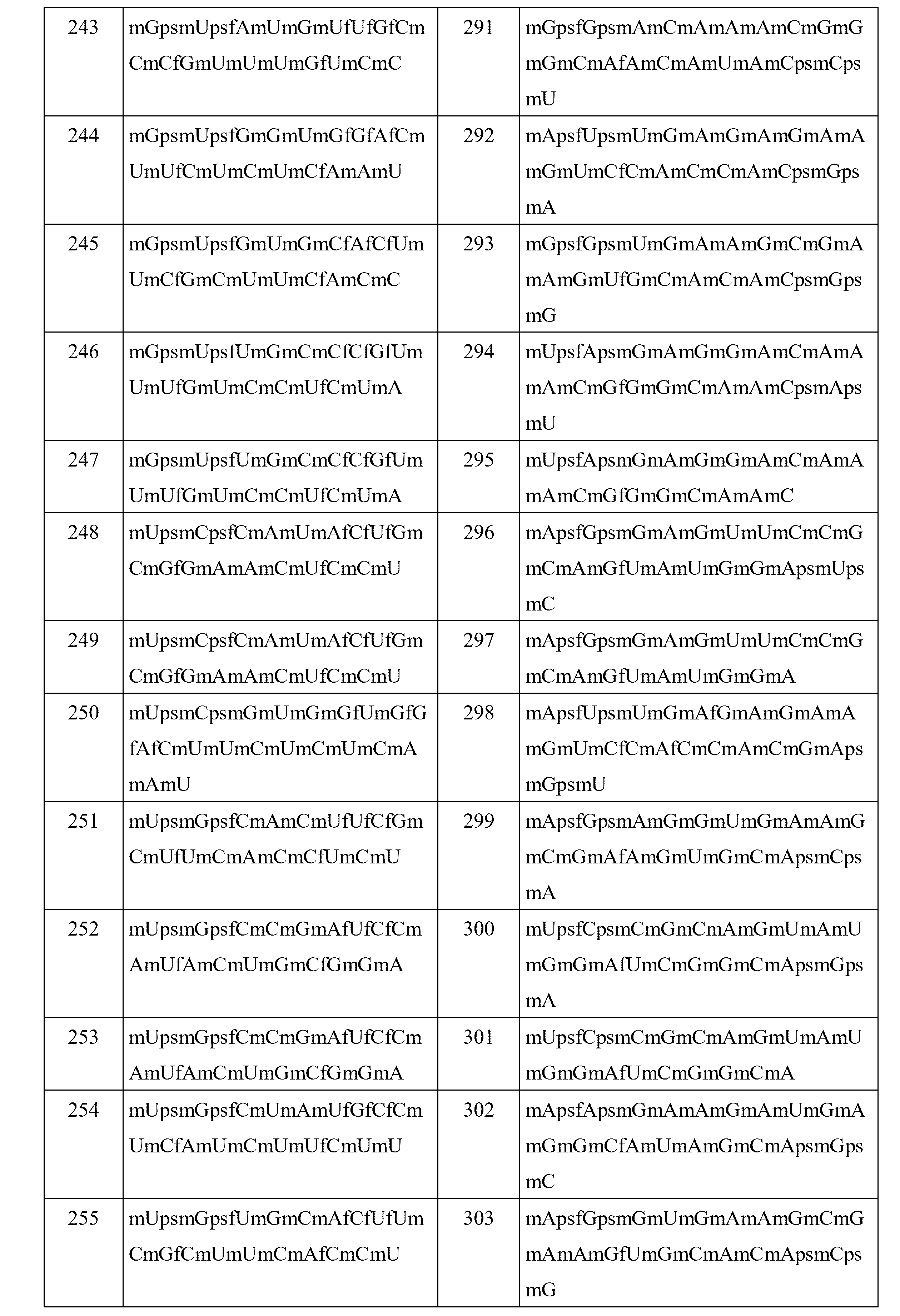
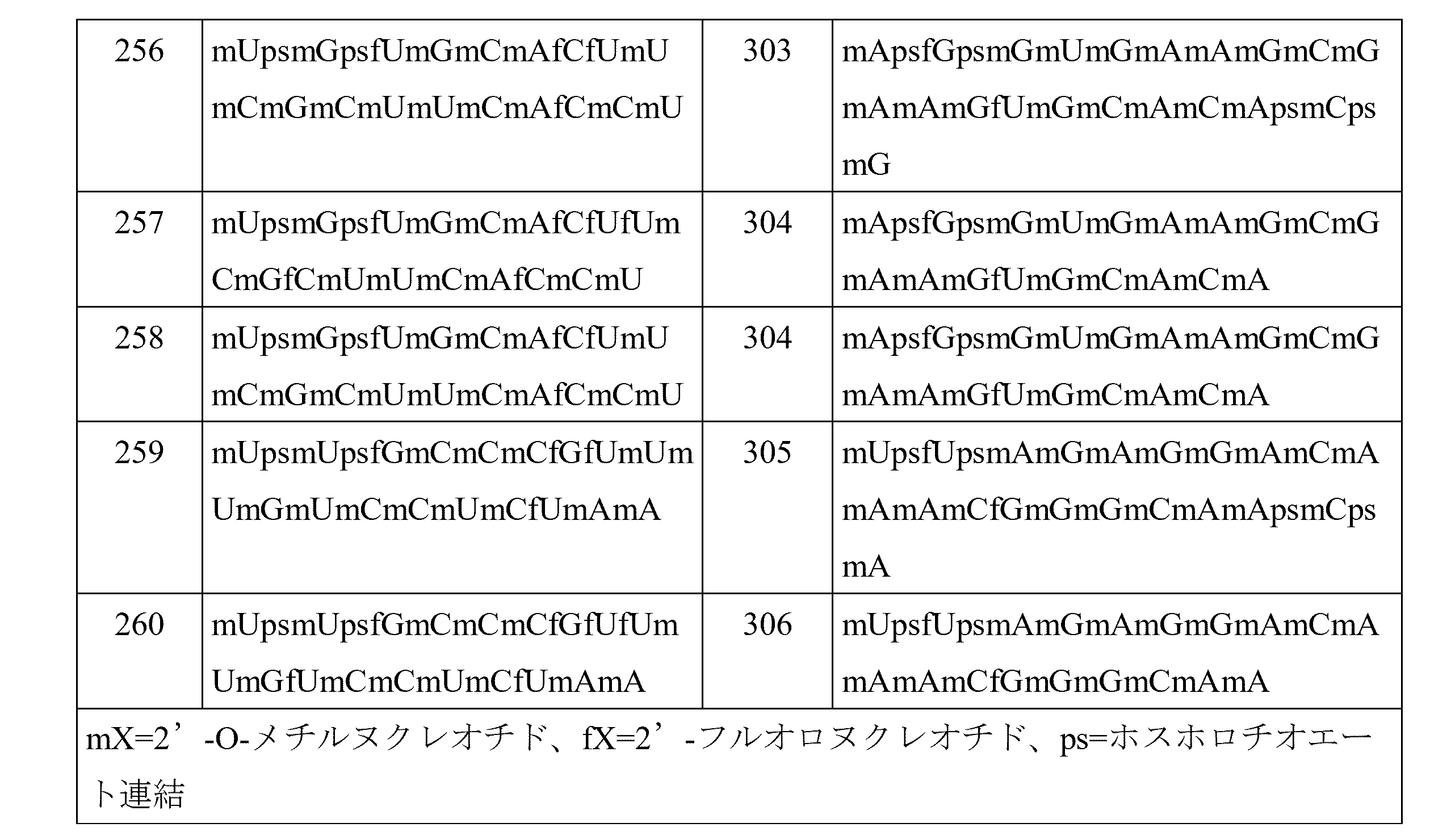


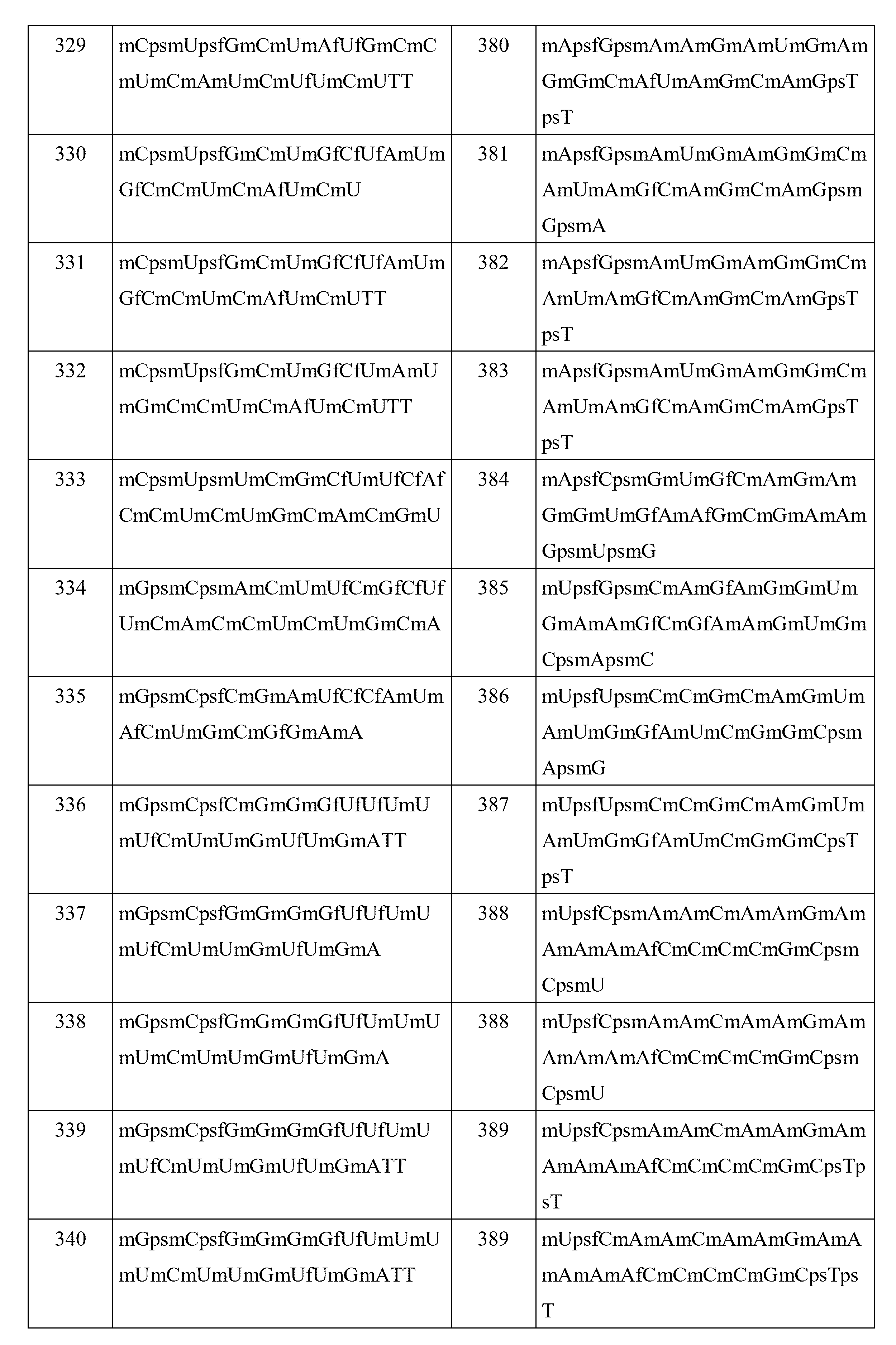
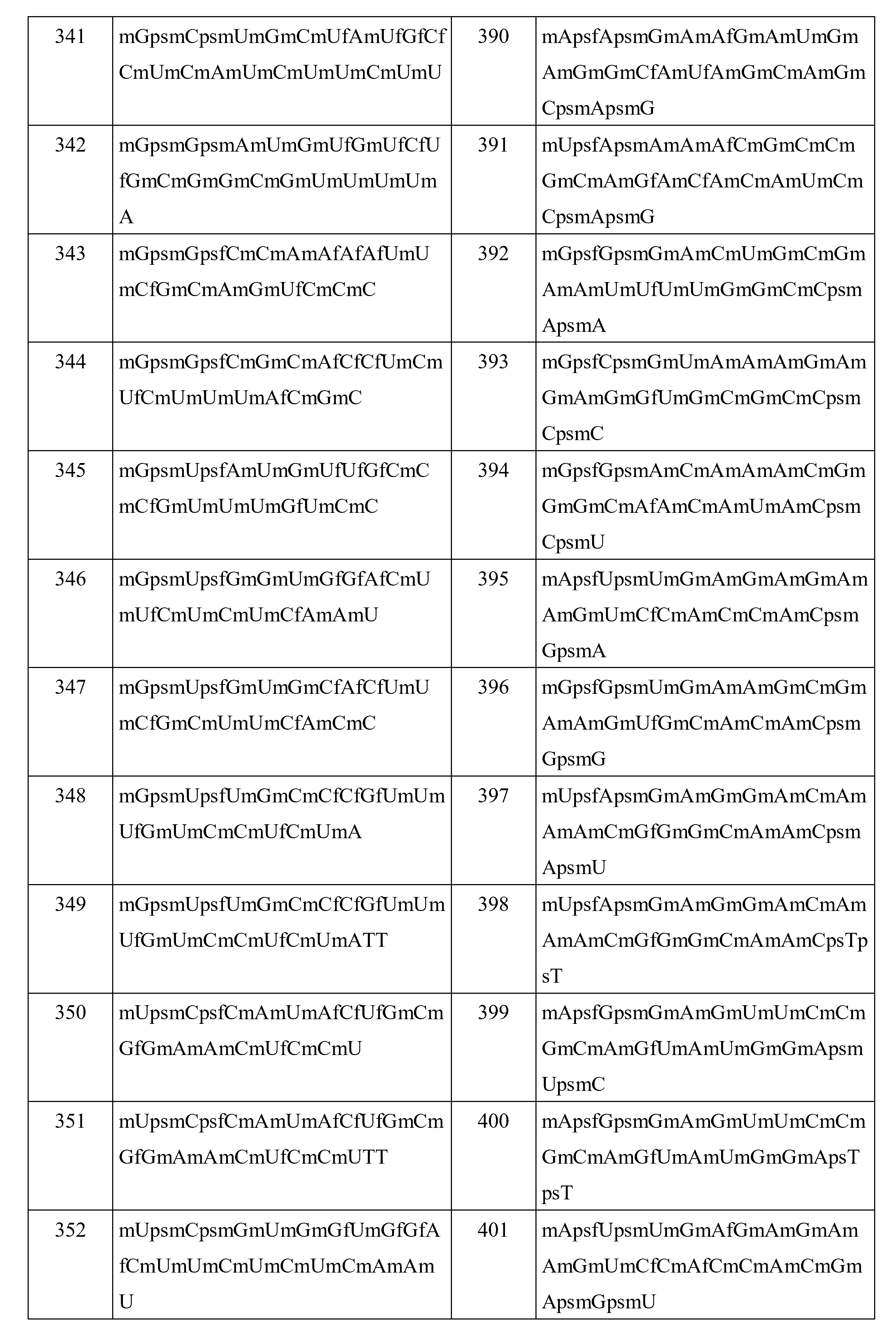
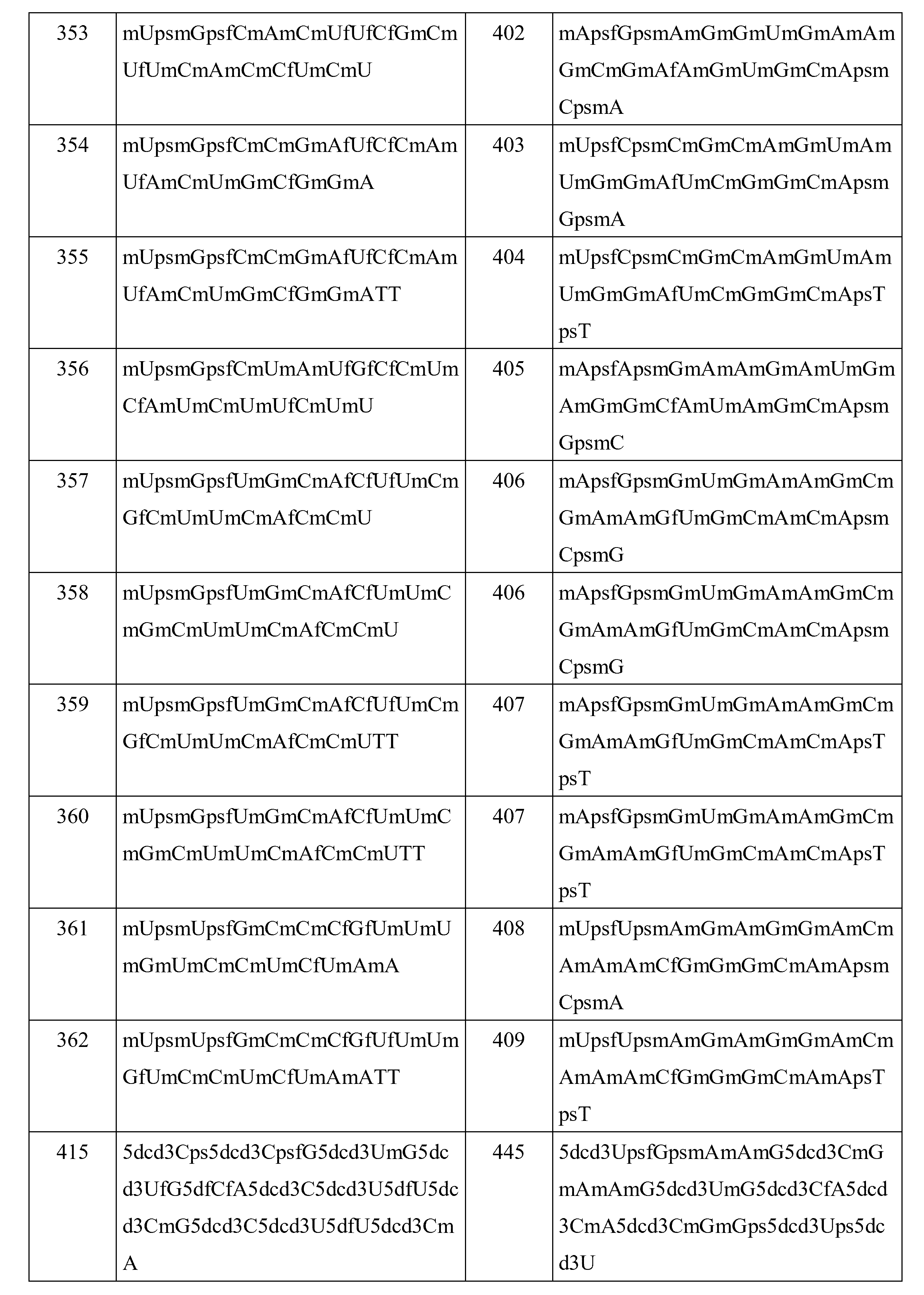


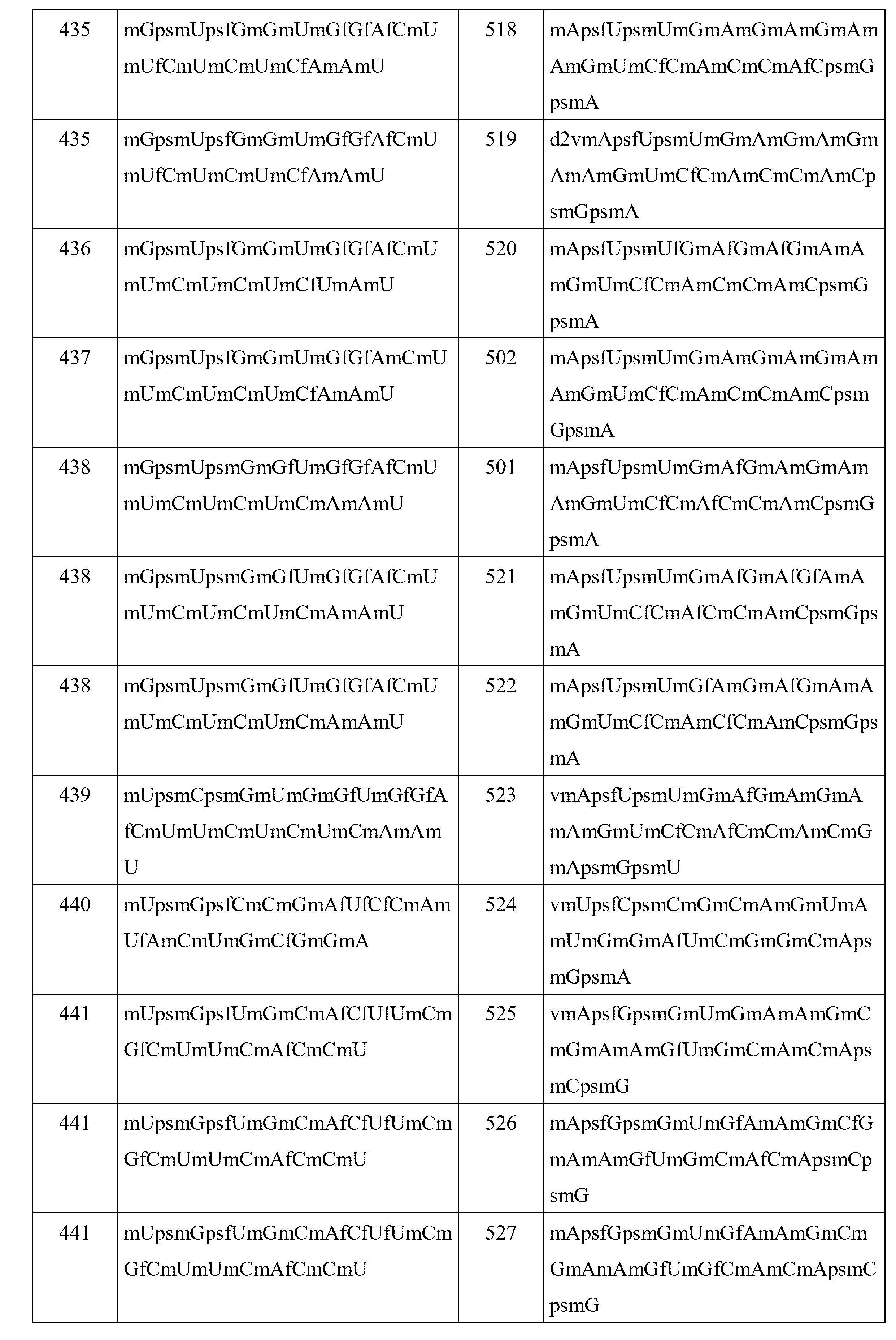

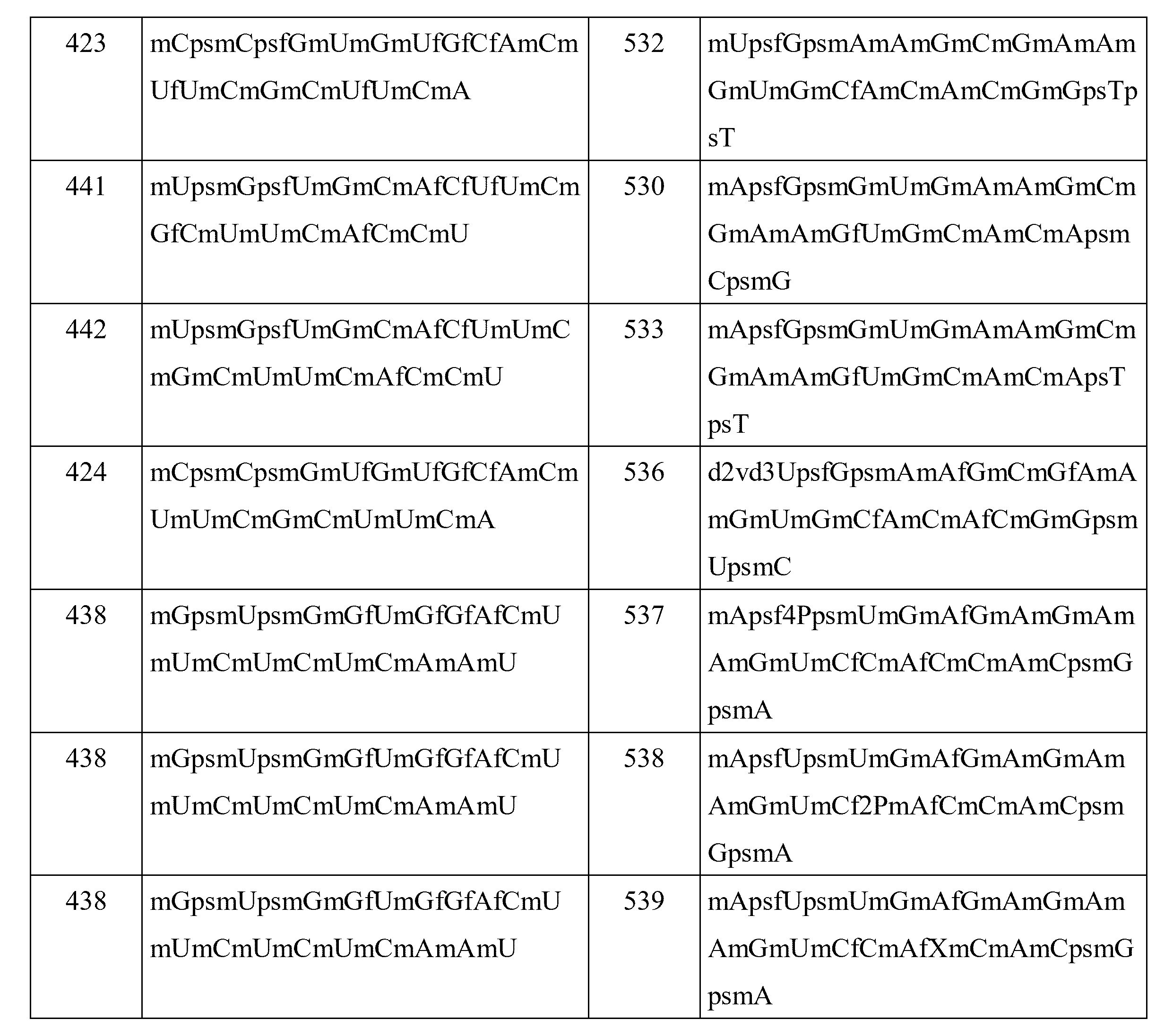

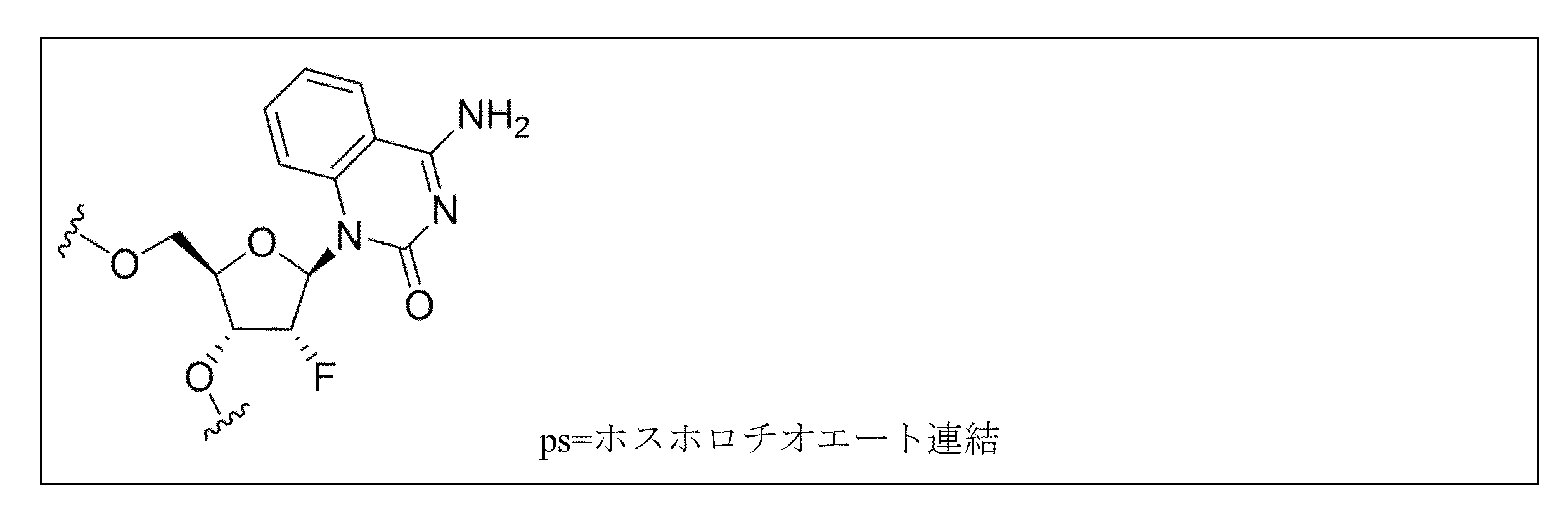


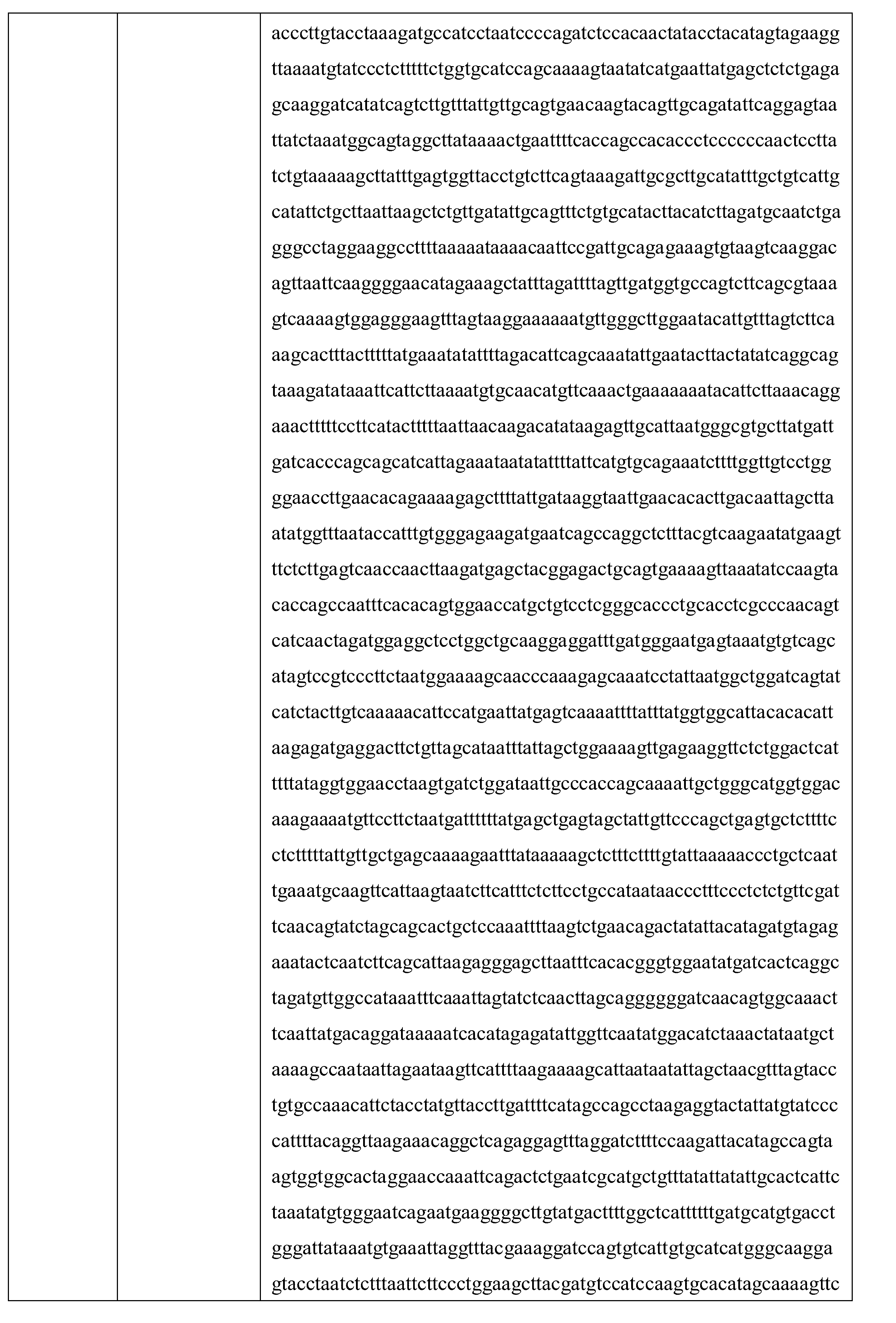


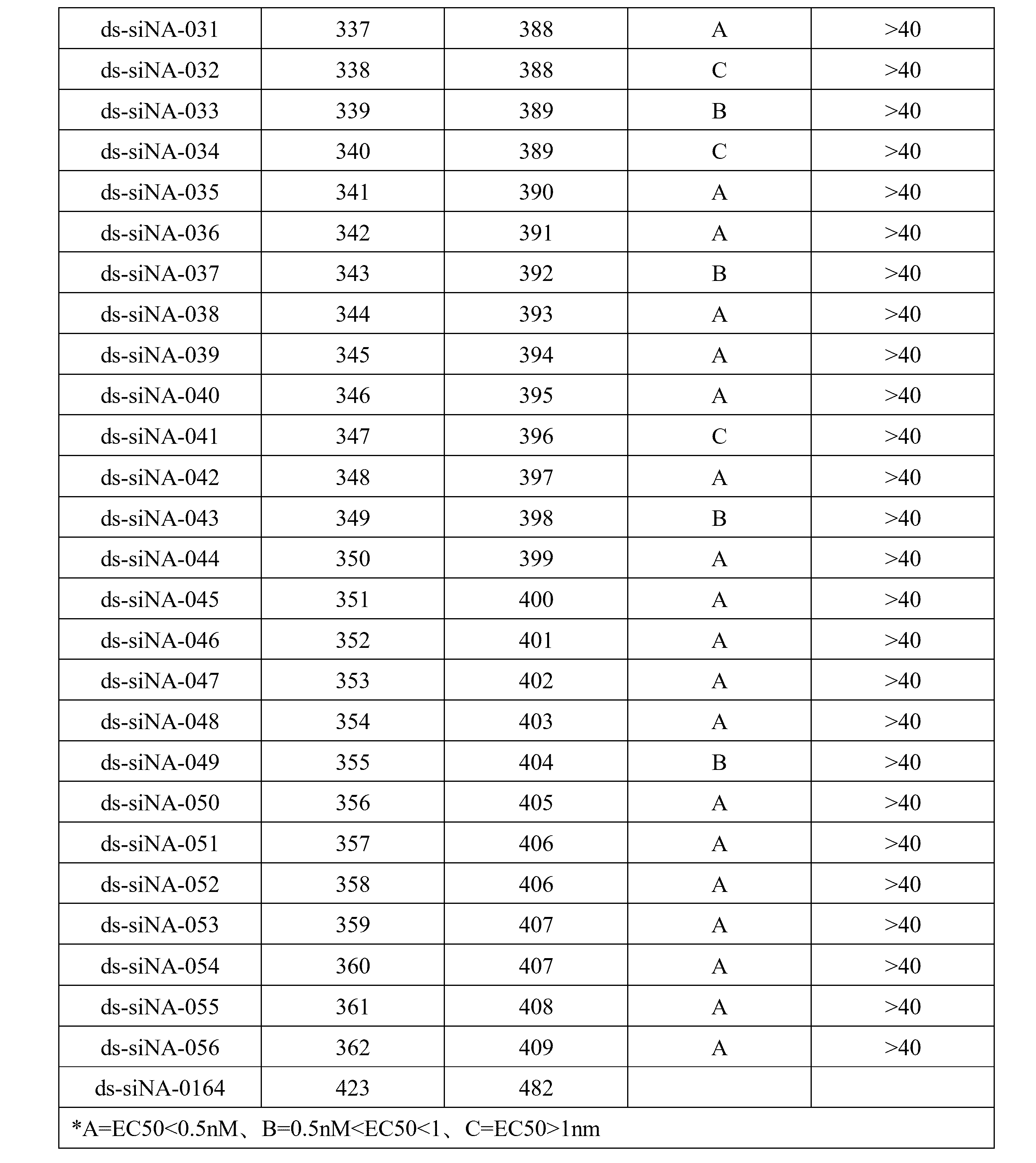


Claims (129)
(a)標的遺伝子に対応するRNAに対して少なくとも約60%、65%、70%、75%、80%、85%、90%、95%、または100%同一である第1のヌクレオチド配列を含むセンス鎖であって、前記第1のヌクレオチド配列が、
(i)15~30ヌクレオチド長であり、
(ii)2’-O-メチルヌクレオチドおよび2’-フルオロヌクレオチドから独立して選択される15個以上の修飾ヌクレオチドを含み、少なくとも1つの修飾ヌクレオチドが、2’-O-メチルヌクレオチドであり、前記第1のヌクレオチド配列の5’末端から3、5、7、8、9、10、11、12、14、17、および/または19位置の前記ヌクレオチドが、2’-フルオロヌクレオチドである、センス鎖と、
(b)前記標的遺伝子に対応する前記RNAに対して少なくとも約60%、65%、70%、75%、80%、85%、90%、95%、または100%相補的である第2のヌクレオチド配列を含むアンチセンス鎖であって、前記第2のヌクレオチド配列が、
(i)15~30ヌクレオチド長であり、
(ii)2’-O-メチルヌクレオチドおよび2’-フルオロヌクレオチドから独立して選択される15個以上の修飾ヌクレオチドを含み、少なくとも1つの修飾ヌクレオチドが、2’-O-メチルヌクレオチドであり、少なくとも1つの修飾ヌクレオチドが、2’-フルオロヌクレオチドである、アンチセンス鎖と、を含む、短い干渉核酸(siNA)分子。 A short interfering nucleic acid (siNA) molecule comprising
(a) a first nucleotide sequence that is at least about 60%, 65%, 70%, 75%, 80%, 85%, 90%, 95%, or 100% identical to the RNA corresponding to the target gene; a sense strand comprising:
(i) is 15-30 nucleotides in length;
(ii) 15 or more modified nucleotides independently selected from 2'-O-methyl nucleotides and 2'-fluoro nucleotides, wherein at least one modified nucleotide is a 2'-O-methyl nucleotide; the sense strand, wherein said nucleotide at positions 3, 5, 7, 8, 9, 10, 11, 12, 14, 17, and/or 19 from the 5' end of the first nucleotide sequence is a 2'-fluoro nucleotide and,
(b) a second that is at least about 60%, 65%, 70%, 75%, 80%, 85%, 90%, 95%, or 100% complementary to said RNA corresponding to said target gene; An antisense strand comprising a nucleotide sequence, wherein the second nucleotide sequence comprises
(i) is 15-30 nucleotides in length;
(ii) 15 or more modified nucleotides independently selected from 2'-O-methyl nucleotides and 2'-fluoro nucleotides, wherein at least one modified nucleotide is a 2'-O-methyl nucleotide; A short interfering nucleic acid (siNA) molecule comprising an antisense strand in which one modified nucleotide is a 2'-fluoronucleotide.
(a)標的遺伝子に対応するRNAに対して少なくとも約60%、65%、70%、75%、80%、85%、90%、95%、または100%同一である第1のヌクレオチド配列を含むセンス鎖であって、前記第1のヌクレオチド配列が、
(i)15~30ヌクレオチド長であり、
(ii)2’-O-メチルヌクレオチドおよび2’-フルオロヌクレオチドから独立して選択される15個以上の修飾ヌクレオチドを含み、少なくとも1つの修飾ヌクレオチドが、2’-O-メチルヌクレオチドであり、少なくとも1つの修飾ヌクレオチドが、2’-フルオロヌクレオチドである、センス鎖と、
(b)前記標的遺伝子に対応する前記RNAに対して少なくとも約60%、65%、70%、75%、80%、85%、90%、95%、または100%相補的である第2のヌクレオチド配列を含むアンチセンス鎖であって、前記第2のヌクレオチド配列が、
(i)15~30ヌクレオチド長であり、
(ii)2’-O-メチルヌクレオチドおよび2’-フルオロヌクレオチドから独立して選択される15個以上の修飾ヌクレオチドを含み、少なくとも1つの修飾ヌクレオチドが、2’-O-メチルヌクレオチドであり、前記第2のヌクレオチド配列の5’末端から2、5、6、8、10、14、16、17、および/または18位置の前記ヌクレオチドが、2’-フルオロヌクレオチドである、アンチセンス鎖と、を含む、短い干渉核酸(siNA)分子。 A short interfering nucleic acid (siNA) molecule comprising
(a) a first nucleotide sequence that is at least about 60%, 65%, 70%, 75%, 80%, 85%, 90%, 95%, or 100% identical to the RNA corresponding to the target gene; a sense strand comprising:
(i) is 15-30 nucleotides in length;
(ii) 15 or more modified nucleotides independently selected from 2'-O-methyl nucleotides and 2'-fluoro nucleotides, wherein at least one modified nucleotide is a 2'-O-methyl nucleotide; a sense strand, wherein one modified nucleotide is a 2'-fluoro nucleotide;
(b) a second that is at least about 60%, 65%, 70%, 75%, 80%, 85%, 90%, 95%, or 100% complementary to said RNA corresponding to said target gene; An antisense strand comprising a nucleotide sequence, wherein the second nucleotide sequence comprises
(i) is 15-30 nucleotides in length;
(ii) 15 or more modified nucleotides independently selected from 2'-O-methyl nucleotides and 2'-fluoro nucleotides, wherein at least one modified nucleotide is a 2'-O-methyl nucleotide; an antisense strand, wherein the nucleotides at positions 2, 5, 6, 8, 10, 14, 16, 17, and/or 18 from the 5' end of the second nucleotide sequence are 2'-fluoro nucleotides; A short interfering nucleic acid (siNA) molecule, comprising:
(ii)前記第1のヌクレオチド配列の10、9、8、7、6、5、4、3、もしくは2個以下の修飾ヌクレオチドが、2’-フルオロヌクレオチドであり、
(iii)前記第1のヌクレオチド配列の少なくとも10、11、12、13、14、15、16、17、18、19、20、21、もしくは22個の修飾ヌクレオチドが、2’-O-メチルヌクレオチドであり、かつ/または
(iv)前記第1のヌクレオチド配列の25、24、23、22、21、20、19、18、17、16、15、14、13、12、11、10、9、8、7、6、5、4、3、もしくは2個以下の修飾ヌクレオチドが、2’-O-メチルヌクレオチドである、請求項1~4のいずれか一項に記載のsiNA。 (i) at least 2, 3, 4, 5, or 6 modified nucleotides of said first nucleotide sequence are 2'-fluoro nucleotides;
(ii) no more than 10, 9, 8, 7, 6, 5, 4, 3, or 2 modified nucleotides of said first nucleotide sequence are 2'-fluoro nucleotides;
(iii) at least 10, 11, 12, 13, 14, 15, 16, 17, 18, 19, 20, 21, or 22 modified nucleotides of said first nucleotide sequence are 2'-O-methyl nucleotides and/or (iv) 25, 24, 23, 22, 21, 20, 19, 18, 17, 16, 15, 14, 13, 12, 11, 10, 9 of said first nucleotide sequence, 5. The siNA of any one of claims 1-4, wherein no more than 8, 7, 6, 5, 4, 3, or 2 modified nucleotides are 2'-O-methyl nucleotides.
(ii)前記第2のヌクレオチド配列の10、9、8、7、6、5、4、3、もしくは2個以下の修飾ヌクレオチドが、2’-フルオロヌクレオチドであり、
(iii)前記第2のヌクレオチド配列の少なくとも10、11、12、13、14、15、16、17、18、19、20、21、もしくは22個の修飾ヌクレオチドが、2’-O-メチルヌクレオチドであり、かつ/または
(iv)前記第2のヌクレオチド配列の25、24、23、22、21、20、19、18、17、16、15、14、13、12、11、10、9、8、7、6、5、4、3、または2個以下の修飾ヌクレオチドが、2’-O-メチルヌクレオチドである、請求項1~7のいずれか一項に記載のsiNA。 (i) at least 2, 3, 4, 5, or 6 modified nucleotides of said second nucleotide sequence are 2'-fluoro nucleotides;
(ii) no more than 10, 9, 8, 7, 6, 5, 4, 3, or 2 modified nucleotides of said second nucleotide sequence are 2'-fluoro nucleotides;
(iii) at least 10, 11, 12, 13, 14, 15, 16, 17, 18, 19, 20, 21, or 22 modified nucleotides of said second nucleotide sequence are 2'-O-methyl nucleotides and/or (iv) 25, 24, 23, 22, 21, 20, 19, 18, 17, 16, 15, 14, 13, 12, 11, 10, 9 of said second nucleotide sequence, 8. The siNA of any one of claims 1-7, wherein no more than 8, 7, 6, 5, 4, 3, or 2 modified nucleotides are 2'-O-methyl nucleotides.
(a)標的遺伝子に対応するRNAに対して少なくとも約60%、65%、70%、75%、80%、85%、90%、95%、または100%同一である第1のヌクレオチド配列を含むセンス鎖であって、前記第1のヌクレオチド配列が、
(i)15~30ヌクレオチド長であり、
(ii)2’-O-メチルヌクレオチドおよび2’-フルオロヌクレオチドから独立して選択される15個以上の修飾ヌクレオチドを含み、少なくとも1つの修飾ヌクレオチドが、2’-O-メチルヌクレオチドであり、少なくとも1つの修飾ヌクレオチドが、2’-フルオロヌクレオチドであり、
(iii)1個以上のホスホロチオエートヌクレオシド間連結を含む、センス鎖と、
(b)前記標的遺伝子に対応する前記RNAに対して少なくとも約60%、65%、70%、75%、80%、85%、90%、95%、または100%相補的である第2のヌクレオチド配列を含むアンチセンス鎖であって、前記第2のヌクレオチド配列が、
(i)15~30ヌクレオチド長であり、
(ii)2’-O-メチルヌクレオチドおよび2’-フルオロヌクレオチドから独立して選択される15個以上の修飾ヌクレオチドを含み、少なくとも1つの修飾ヌクレオチドが、2’-O-メチルヌクレオチドであり、少なくとも1つの修飾ヌクレオチドが、2’-フルオロヌクレオチドであり、
(iii)1個以上のホスホロチオエートヌクレオシド間連結を含む、アンチセンス鎖と、を含む、短い干渉核酸(siNA)分子。 A short interfering nucleic acid (siNA) molecule comprising
(a) a first nucleotide sequence that is at least about 60%, 65%, 70%, 75%, 80%, 85%, 90%, 95%, or 100% identical to the RNA corresponding to the target gene; a sense strand comprising:
(i) is 15-30 nucleotides in length;
(ii) 15 or more modified nucleotides independently selected from 2'-O-methyl nucleotides and 2'-fluoro nucleotides, wherein at least one modified nucleotide is a 2'-O-methyl nucleotide; one modified nucleotide is a 2'-fluoro nucleotide;
(iii) a sense strand comprising one or more phosphorothioate internucleoside linkages;
(b) a second that is at least about 60%, 65%, 70%, 75%, 80%, 85%, 90%, 95%, or 100% complementary to said RNA corresponding to said target gene; An antisense strand comprising a nucleotide sequence, wherein the second nucleotide sequence comprises
(i) is 15-30 nucleotides in length;
(ii) 15 or more modified nucleotides independently selected from 2'-O-methyl nucleotides and 2'-fluoro nucleotides, wherein at least one modified nucleotide is a 2'-O-methyl nucleotide; one modified nucleotide is a 2'-fluoro nucleotide;
(iii) an antisense strand comprising one or more phosphorothioate internucleoside linkages; and a short interfering nucleic acid (siNA) molecule.
(a)標的遺伝子に対応するRNAに対して少なくとも約60%、65%、70%、75%、80%、85%、90%、95%、または100%同一である第1のヌクレオチド配列を含むセンス鎖であって、前記第1のヌクレオチド配列が、
(i)15~30ヌクレオチド長であり、
(ii)2’-O-メチルヌクレオチドおよび2’-フルオロヌクレオチドから独立して選択される15個以上の修飾ヌクレオチドを含み、少なくとも1つの修飾ヌクレオチドが、2’-O-メチルヌクレオチドであり、少なくとも1つの修飾ヌクレオチドが、2’-フルオロヌクレオチドである、センス鎖と、
(b)前記標的遺伝子に対応する前記RNAに対して少なくとも約60%、65%、70%、75%、80%、85%、90%、95%、または100%相補的である第2のヌクレオチド配列を含むアンチセンス鎖であって、前記第2のヌクレオチド配列が、
(i)15~30ヌクレオチド長であり、
(ii)2’-O-メチルヌクレオチドおよび2’-フルオロヌクレオチドから独立して選択される15個以上の修飾ヌクレオチドを含み、少なくとも1つの修飾ヌクレオチドが、2’-O-メチルヌクレオチドであり、少なくとも1つの修飾ヌクレオチドが、2’-フルオロヌクレオチドである、アンチセンス鎖と、を含み、
siNAが、リン酸化ブロッカー、ガラクトサミン、または5’安定化エンドキャップをさらに含む、短い干渉核酸(siNA)分子。 A short interfering nucleic acid (siNA) molecule comprising
(a) a first nucleotide sequence that is at least about 60%, 65%, 70%, 75%, 80%, 85%, 90%, 95%, or 100% identical to the RNA corresponding to the target gene; a sense strand comprising:
(i) is 15-30 nucleotides in length;
(ii) 15 or more modified nucleotides independently selected from 2'-O-methyl nucleotides and 2'-fluoro nucleotides, wherein at least one modified nucleotide is a 2'-O-methyl nucleotide; a sense strand, wherein one modified nucleotide is a 2'-fluoro nucleotide;
(b) a second that is at least about 60%, 65%, 70%, 75%, 80%, 85%, 90%, 95%, or 100% complementary to said RNA corresponding to said target gene; An antisense strand comprising a nucleotide sequence, wherein the second nucleotide sequence comprises
(i) is 15-30 nucleotides in length;
(ii) 15 or more modified nucleotides independently selected from 2'-O-methyl nucleotides and 2'-fluoro nucleotides, wherein at least one modified nucleotide is a 2'-O-methyl nucleotide; an antisense strand, wherein one modified nucleotide is a 2'-fluoronucleotide;
A short interfering nucleic acid (siNA) molecule, wherein the siNA further comprises a phosphorylation blocker, galactosamine, or a 5' stabilizing endcap.
(ii)前記交互1:3修飾パターンのうちの少なくとも2つが、非連続的に生じ、かつ/または
(iii)少なくとも1、2、3、4、または5個の交互1:3修飾パターンが、前記アンチセンス鎖の5’末端から2、6、10、14、および/もしくは18のヌクレオチド位置で始まる、請求項13または14に記載のsiNA。 (i) at least two of said alternating 1:3 modification patterns occur in succession;
(ii) at least two of said alternating 1:3 modification patterns occur non-consecutively, and/or (iii) at least 1, 2, 3, 4, or 5 alternating 1:3 modification patterns are 15. The siNA of claim 13 or 14, which begins at nucleotide positions 2, 6, 10, 14, and/or 18 from the 5' end of said antisense strand.
(ii)1個のヌクレオチドが、2’-フルオロヌクレオチドであり、2個のヌクレオチドが、2’-O-メチルヌクレオチドである、請求項1~12のいずれか一項に記載のsiNA。 (i) the nucleotides in the second nucleotide sequence are aligned in an alternating 1:2 modification pattern;
(ii) the siNA of any one of claims 1-12, wherein one nucleotide is a 2'-fluoronucleotide and two nucleotides are 2'-O-methyl nucleotides.
(ii)前記交互1:2修飾パターンのうちの少なくとも2つが、非連続的に生じ、かつ/または
(iii)少なくとも1、2、3、4、または5個の交互1:2修飾パターンが、前記アンチセンス鎖の5’末端から2、5、8、14、および/もしくは17のヌクレオチド位置で始まる、請求項16または17に記載のsiNA。 (i) at least two of said alternating 1:2 modification patterns occur consecutively;
(ii) at least two of said alternating 1:2 modification patterns occur non-consecutively, and/or (iii) at least 1, 2, 3, 4, or 5 alternating 1:2 modification patterns are 18. The siNA of claim 16 or 17, which begins at nucleotide positions 2, 5, 8, 14, and/or 17 from the 5' end of said antisense strand.
5’-An 1Bn 2An 3Bn 4An 5Bn 6An 7Bn 8An 9-3’
3’-Cq 1Aq 2Bq 3Aq 4Bq 5Aq 6Bq 7Aq 8Bq 9Aq 10Bq 11Aq 12-5’
上鎖が、標的遺伝子に対応するRNAに対して少なくとも約60%、65%、70%、75%、80%、85%、90%、95%、または100%同一である第1のヌクレオチド配列を含むセンス鎖であり、前記第1のヌクレオチド配列が、15~30個のヌクレオチドを含み、
下鎖が、前記標的遺伝子に対応する前記RNAに対して少なくとも約60%、65%、70%、75%、80%、85%、90%、95%、または100%相補的である第2のヌクレオチド配列を含むアンチセンス鎖であり、前記第2のヌクレオチド配列が、15~30個のヌクレオチドを含み、
各Aが、独立して、2’-O-メチルヌクレオチド、または5’安定化エンドキャップもしくはリン酸化ブロッカーを含むヌクレオチドであり、
Bが、2’-フルオロヌクレオチドであり、
Cが、オーバーハンギングヌクレオチドを表し、2’-O-メチルヌクレオチドであり、
n1=1~4ヌクレオチド長であり、
各n2、n6、n8、q3、q5、q7、q9、q11、およびq12が、独立して、0~1ヌクレオチド長であり、
各n3およびn4が、独立して、1~3ヌクレオチド長であり、
n5が、1~10ヌクレオチド長であり、
n7が、0~4ヌクレオチド長であり、
各n9、q1、およびq2が、独立して、0~2ヌクレオチド長であり、
q4が、0~3ヌクレオチド長であり、
q6が、0~5ヌクレオチド長であり、
q8が、2~7ヌクレオチド長であり、
q10が、2~11ヌクレオチド長である、短い干渉核酸(siNA)分子。 A short interfering nucleic acid (siNA) molecule represented by formula (VIII),
5′-A n 1 B n 2 A n 3 B n 4 A n 5 B n 6 A n 7 B n 8 A n 9 -3′
3′-C q 1 A q 2 B q 3 A q 4 B q 5 A q 6 B q 7 A q 8 B q 9 A q 10 B q 11 A q 12 -5′
a first nucleotide sequence whose top strand is at least about 60%, 65%, 70%, 75%, 80%, 85%, 90%, 95%, or 100% identical to an RNA corresponding to a target gene wherein the first nucleotide sequence comprises 15-30 nucleotides;
the lower strand is at least about 60%, 65%, 70%, 75%, 80%, 85%, 90%, 95%, or 100% complementary to said RNA corresponding to said target gene; wherein the second nucleotide sequence comprises 15-30 nucleotides;
each A is independently a 2′-O-methyl nucleotide or a nucleotide containing a 5′ stabilizing endcap or phosphorylation blocker;
B is a 2'-fluoronucleotide,
C represents an overhanging nucleotide and is a 2'-O-methyl nucleotide;
n 1 = 1-4 nucleotides long,
each n 2 , n 6 , n 8 , q 3 , q 5 , q 7 , q 9 , q 11 , and q 12 is independently 0-1 nucleotides in length;
each n3 and n4 is independently 1-3 nucleotides in length;
n5 is 1-10 nucleotides long,
n7 is 0-4 nucleotides in length,
each n 9 , q 1 , and q 2 is independently 0-2 nucleotides in length;
q4 is 0-3 nucleotides long,
q 6 is 0-5 nucleotides long,
q 8 is 2-7 nucleotides long,
A short interfering nucleic acid (siNA) molecule wherein q10 is 2-11 nucleotides long.
5’-A2~4B1A1~3B2~3A2~10B0~1A0~4B0~1A0~2-3’
3’-C2A0~2B0~1A0~3B0~1A0~5B0~1A2~7B1A2~11B1A1-5’
上鎖が、標的遺伝子に対応するRNAに対して少なくとも約60%、65%、70%、75%、80%、85%、90%、95%、または100%同一である第1のヌクレオチド配列を含むセンス鎖であり、前記第1のヌクレオチド配列が、15~30個のヌクレオチドを含み、
下鎖が、前記標的遺伝子に対応する前記RNAに対して少なくとも約60%、65%、70%、75%、80%、85%、90%、95%、または100%相補的である第2のヌクレオチド配列を含むアンチセンス鎖であり、前記第2のヌクレオチド配列が、15~30個のヌクレオチドを含み、
各Aが、独立して、2’-O-メチルヌクレオチド、または5’安定化エンドキャップもしくはリン酸化ブロッカーを含むヌクレオチドであり、
Bが、2’-フルオロヌクレオチドであり、
Cが、オーバーハンギングヌクレオチドを表し、2’-O-メチルヌクレオチドである、短い干渉核酸(siNA)分子。 A short interfering nucleic acid (siNA) molecule represented by formula (IX),
5'-A 2-4 B 1 A 1-3 B 2-3 A 2-10 B 0-1 A 0-4 B 0-1 A 0-2 -3'
3′-C 2 A 0-2 B 0-1 A 0-3 B 0-1 A 0-5 B 0-1 A 2-7 B 1 A 2-11 B 1 A 1 -5′
a first nucleotide sequence whose top strand is at least about 60%, 65%, 70%, 75%, 80%, 85%, 90%, 95%, or 100% identical to an RNA corresponding to a target gene wherein the first nucleotide sequence comprises 15-30 nucleotides;
the lower strand is at least about 60%, 65%, 70%, 75%, 80%, 85%, 90%, 95%, or 100% complementary to said RNA corresponding to said target gene; wherein the second nucleotide sequence comprises 15-30 nucleotides;
each A is independently a 2′-O-methyl nucleotide or a nucleotide containing a 5′ stabilizing endcap or phosphorylation blocker;
B is a 2'-fluoronucleotide,
A short interfering nucleic acid (siNA) molecule in which C represents the overhanging nucleotide and is a 2'-O-methyl nucleotide.
(a)17~23個のヌクレオチドからなる第1のヌクレオチド配列を含むセンス鎖であって、2’-フルオロヌクレオチドが、前記第1のヌクレオチド配列の5’末端から3、7~9、12、および17位置にあり、2’-O-メチルヌクレオチドが、前記第1のヌクレオチド配列の5’末端から1、2、4~6、10、11、および13~16位置にある、センス鎖と、
(b)17~23個のヌクレオチドからなる第2のヌクレオチド配列を含むアンチセンス鎖であって、2’-フルオロヌクレオチドが、前記第2のヌクレオチド配列の5’末端から2および14位置にあり、2’-O-メチルヌクレオチドが、前記第2のヌクレオチド配列の5’末端から1、3~13、および15~17位置にある、アンチセンス鎖と、を含む、短い干渉核酸(siNA)分子。 A short interfering nucleic acid (siNA) molecule comprising
(a) a sense strand comprising a first nucleotide sequence consisting of 17-23 nucleotides, wherein the 2'-fluoro nucleotides are 3,7-9,12 from the 5' end of said first nucleotide sequence; and 17, and the 2'-O-methyl nucleotides are at positions 1, 2, 4-6, 10, 11, and 13-16 from the 5' end of said first nucleotide sequence;
(b) an antisense strand comprising a second nucleotide sequence consisting of 17-23 nucleotides, wherein the 2'-fluoro nucleotides are at positions 2 and 14 from the 5' end of said second nucleotide sequence; 2'-O-methyl nucleotides at positions 1, 3-13, and 15-17 from the 5' end of said second nucleotide sequence, and an antisense strand.
(a)17~23個のヌクレオチドからなる第1のヌクレオチド配列を含むセンス鎖であって、2’-フルオロヌクレオチドが、前記第1のヌクレオチド配列の5’末端から3、7、8、および17位置にあり、2’-O-メチルヌクレオチドが、前記第1のヌクレオチド配列の5’末端から1、2、4~6、および9~16位置にある、センス鎖と、
(b)17~23個のヌクレオチドからなる第2のヌクレオチド配列を含むアンチセンス鎖であって、2’-フルオロヌクレオチドが、前記第1のヌクレオチド配列の5’末端から2および14位置にあり、2’-O-メチルヌクレオチドが、前記第1のヌクレオチド配列の5’末端から1、3~13、および15~17位置にある、アンチセンス鎖と、を含む、短い干渉核酸(siNA)分子。 A short interfering nucleic acid (siNA) molecule comprising
(a) a sense strand comprising a first nucleotide sequence consisting of 17-23 nucleotides, wherein the 2'-fluoro nucleotides are 3, 7, 8, and 17 from the 5' end of said first nucleotide sequence; 2'-O-methyl nucleotides at positions 1, 2, 4-6, and 9-16 from the 5' end of said first nucleotide sequence;
(b) an antisense strand comprising a second nucleotide sequence consisting of 17-23 nucleotides, wherein the 2'-fluoro nucleotides are at positions 2 and 14 from the 5' end of said first nucleotide sequence; 2'-O-methyl nucleotides at positions 1, 3-13, and 15-17 from the 5' end of said first nucleotide sequence, and an antisense strand.
(a)17~23個のヌクレオチドからなる第1のヌクレオチド配列を含むセンス鎖であって、2’-フルオロヌクレオチドが、前記第1のヌクレオチド配列の5’末端から3、7~9、12、および17位置にあり、2’-O-メチルヌクレオチドが、前記第1のヌクレオチド配列の5’末端から1、2、4~6、10、11、および13~16位置にある、センス鎖と、
(b)17~23個のヌクレオチドからなる第2のヌクレオチド配列を含むアンチセンス鎖であって、前記第2のヌクレオチド配列中の前記ヌクレオチドが、交互1:3修飾パターンで整列し、1個のヌクレオチドが、2’-フルオロヌクレオチドであり、3個のヌクレオチドが、2’-O-メチルヌクレオチドである、アンチセンス鎖と、を含む、短い干渉核酸(siNA)分子。 A short interfering nucleic acid (siNA) molecule comprising
(a) a sense strand comprising a first nucleotide sequence consisting of 17-23 nucleotides, wherein the 2'-fluoro nucleotides are 3,7-9,12 from the 5' end of said first nucleotide sequence; and 17, and the 2'-O-methyl nucleotides are at positions 1, 2, 4-6, 10, 11, and 13-16 from the 5' end of said first nucleotide sequence;
(b) an antisense strand comprising a second nucleotide sequence consisting of 17-23 nucleotides, wherein said nucleotides in said second nucleotide sequence are aligned in an alternating 1:3 modification pattern, and one an antisense strand, wherein the nucleotides are 2'-fluoronucleotides and three nucleotides are 2'-O-methyl nucleotides; and a short interfering nucleic acid (siNA) molecule.
(ii)前記交互1:3修飾パターンのうちの少なくとも2つが、連続して生じ、
(iii)前記交互1:3修飾パターンのうちの少なくとも2つが、非連続的に生じ、かつ/または
(iv)少なくとも1、2、3、4、または5個の交互1:3修飾パターンが、前記アンチセンス鎖の5’末端から2、6、10、14、および/もしくは18のヌクレオチド位置で始まる、請求項31~35のいずれか一項に記載のsiRNA分子。 (i) said alternating 1:3 modification pattern occurs 2-5 times;
(ii) at least two of said alternating 1:3 modification patterns occur in succession;
(iii) at least two of said alternating 1:3 modification patterns occur non-contiguously, and/or (iv) at least 1, 2, 3, 4, or 5 alternating 1:3 modification patterns are 36. The siRNA molecule of any one of claims 31-35, which begins at nucleotide positions 2, 6, 10, 14 and/or 18 from the 5' end of said antisense strand.
(a)17~23個のヌクレオチドからなる第1のヌクレオチド配列を含むセンス鎖であって、2’-フルオロヌクレオチドが、前記第1のヌクレオチド配列の5’末端から5および7~9位置にあり、2’-O-メチルヌクレオチドが、前記第1のヌクレオチド配列の5’末端から1~4、6、および10~17位置にある、センス鎖と、
(b)17~23個のヌクレオチドからなる第2のヌクレオチド配列を含むアンチセンス鎖であって、前記第2のヌクレオチド配列中の前記ヌクレオチドが、交互1:3修飾パターンで整列し、1個のヌクレオチドが、2’-フルオロヌクレオチドであり、3個のヌクレオチドが、2’-O-メチルヌクレオチドである、アンチセンス鎖と、を含む、短い干渉核酸(siNA)分子。 A short interfering nucleic acid (siNA) molecule comprising
(a) a sense strand comprising a first nucleotide sequence consisting of 17-23 nucleotides, wherein the 2'-fluoro nucleotides are at positions 5 and 7-9 from the 5' end of said first nucleotide sequence; , the 2′-O-methyl nucleotides are at positions 1-4, 6, and 10-17 from the 5′ end of said first nucleotide sequence; and
(b) an antisense strand comprising a second nucleotide sequence consisting of 17-23 nucleotides, wherein said nucleotides in said second nucleotide sequence are aligned in an alternating 1:3 modification pattern, and one an antisense strand, wherein the nucleotides are 2'-fluoronucleotides and three of the nucleotides are 2'-O-methyl nucleotides.
(ii)前記交互1:3修飾パターンのうちの少なくとも2つが、連続して生じ、
(iii)前記交互1:3修飾パターンのうちの少なくとも2つが、非連続的に生じ、かつ/または
(iv)少なくとも1、2、3、4、または5個の交互1:3修飾パターンが、前記アンチセンス鎖の5’末端から2、6、10、14、および/もしくは18のヌクレオチド位置で始まる、請求項37~41のいずれか一項に記載のsiRNA分子。 (i) said alternating 1:3 modification pattern occurs 2-5 times;
(ii) at least two of said alternating 1:3 modification patterns occur consecutively;
(iii) at least two of said alternating 1:3 modification patterns occur non-contiguously, and/or (iv) at least 1, 2, 3, 4, or 5 alternating 1:3 modification patterns are 42. The siRNA molecule of any one of claims 37-41, which begins at nucleotide positions 2, 6, 10, 14 and/or 18 from the 5' end of said antisense strand.
(a)17~23個のヌクレオチドからなる第1のヌクレオチド配列を含むセンス鎖であって、2’-フルオロヌクレオチドが、前記第1のヌクレオチド配列の5’末端から5および7~9位置にあり、2’-O-メチルヌクレオチドが、前記第1のヌクレオチド配列の5’末端から1~4、6、および10~17位置にある、センス鎖と、
(b)17~23個のヌクレオチドからなる第2のヌクレオチド配列を含むアンチセンス鎖であって、前記第2のヌクレオチド配列中の前記ヌクレオチドが、交互1:2修飾パターンで整列し、1個のヌクレオチドが、2’-フルオロヌクレオチドであり、2個のヌクレオチドが、2’-O-メチルヌクレオチドである、アンチセンス鎖と、を含む、短い干渉核酸(siNA)分子。 A short interfering nucleic acid (siNA) molecule comprising
(a) a sense strand comprising a first nucleotide sequence consisting of 17-23 nucleotides, wherein the 2'-fluoro nucleotides are at positions 5 and 7-9 from the 5' end of said first nucleotide sequence; , the 2′-O-methyl nucleotides are at positions 1-4, 6, and 10-17 from the 5′ end of said first nucleotide sequence; and
(b) an antisense strand comprising a second nucleotide sequence consisting of 17-23 nucleotides, wherein said nucleotides in said second nucleotide sequence are aligned in an alternating 1:2 modification pattern, and one a short interfering nucleic acid (siNA) molecule comprising an antisense strand in which the nucleotides are 2'-fluoronucleotides and two of the nucleotides are 2'-O-methyl nucleotides.
(ii)前記交互1:2修飾パターンのうちの少なくとも2つが、連続して生じ、
(iii)前記交互1:2修飾パターンのうちの少なくとも2つが、非連続的に生じ、かつ/または
(iv)少なくとも1、2、3、4、または5個の交互1:2修飾パターンが、前記アンチセンス鎖の5’末端から2、5、8、14、および/もしくは17のヌクレオチド位置で始まる、請求項43~47のいずれか一項に記載のsiRNA分子。 (i) said alternating 1:2 modification pattern occurs 2-5 times;
(ii) at least two of said alternating 1:2 modification patterns occur consecutively;
(iii) at least two of said alternating 1:2 modification patterns occur non-contiguously, and/or (iv) at least 1, 2, 3, 4, or 5 alternating 1:2 modification patterns are 48. The siRNA molecule of any one of claims 43-47, which begins at nucleotide positions 2, 5, 8, 14 and/or 17 from the 5' end of said antisense strand.
(a)17~23個のヌクレオチドからなる第1のヌクレオチド配列を含むセンス鎖であって、2’-フルオロヌクレオチドが、前記第1のヌクレオチド配列の5’末端から5および7~9位置にあり、2’-O-メチルヌクレオチドが、前記第1のヌクレオチド配列の5’末端から1~4、6、および10~17位置にある、センス鎖と、
(b)17~23個のヌクレオチドからなる第2のヌクレオチド配列を含むアンチセンス鎖であって、2’-フルオロヌクレオチドが、前記第2のヌクレオチド配列の5’末端から2、6、14、および16位置にあり、2’-O-メチルヌクレオチドが、前記第2のヌクレオチド配列の5’末端から1、3~5、7~13、15、および17位置にある、アンチセンス鎖と、を含む、短い干渉核酸(siNA)分子。 A short interfering nucleic acid (siNA) molecule comprising
(a) a sense strand comprising a first nucleotide sequence consisting of 17-23 nucleotides, wherein the 2'-fluoro nucleotides are at positions 5 and 7-9 from the 5' end of said first nucleotide sequence; , the 2′-O-methyl nucleotides are at positions 1-4, 6, and 10-17 from the 5′ end of said first nucleotide sequence; and
(b) an antisense strand comprising a second nucleotide sequence consisting of 17-23 nucleotides, wherein the 2'-fluoro nucleotides are 2, 6, 14, and 2 from the 5' end of said second nucleotide sequence; an antisense strand at position 16, with 2'-O-methyl nucleotides at positions 1, 3-5, 7-13, 15, and 17 from the 5' end of said second nucleotide sequence. , short interfering nucleic acid (siNA) molecules.
(a)17~23個のヌクレオチドからなる第1のヌクレオチド配列を含むセンス鎖であって、2’-フルオロヌクレオチドが、前記第1のヌクレオチド配列の5’末端から5、9~11、および14位置にあり、2’-O-メチルヌクレオチドが、前記第1のヌクレオチド配列の5’末端から1~4、6~8、および12~17位置にある、センス鎖と、
(b)17~23個のヌクレオチドからなる第2のヌクレオチド配列を含むアンチセンス鎖であって、2’-フルオロヌクレオチドが、前記第2のヌクレオチド配列の5’末端から2および14位置にあり、2’-O-メチルヌクレオチドが、前記第2のヌクレオチド配列の5’末端から1、3~13、および15~17位置にある、アンチセンス鎖と、を含む、短い干渉核酸(siNA)分子。 A short interfering nucleic acid (siNA) molecule comprising
(a) a sense strand comprising a first nucleotide sequence consisting of 17-23 nucleotides, wherein the 2'-fluoro nucleotides are 5, 9-11, and 14 from the 5' end of said first nucleotide sequence; 2'-O-methyl nucleotides at positions 1-4, 6-8, and 12-17 from the 5' end of said first nucleotide sequence;
(b) an antisense strand comprising a second nucleotide sequence consisting of 17-23 nucleotides, wherein the 2'-fluoro nucleotides are at positions 2 and 14 from the 5' end of said second nucleotide sequence; 2'-O-methyl nucleotides at positions 1, 3-13, and 15-17 from the 5' end of said second nucleotide sequence, and an antisense strand.
(ii)少なくとも1個のホスホロチオエートヌクレオシド間連結が、前記第1のヌクレオチド配列の前記5’末端から2および3位置のヌクレオチド間にある、請求項60に記載のsiNA。 (i) at least one phosphorothioate internucleoside linkage is between nucleotides 1 and 2 positions from said 5′ end of said first nucleotide sequence;
61. The siNA of claim 60, wherein (ii) at least one phosphorothioate internucleoside linkage is between nucleotides 2 and 3 positions from said 5' end of said first nucleotide sequence.
(ii)少なくとも1個のホスホロチオエートヌクレオシド間連結が、前記第2のヌクレオチド配列の前記5’末端から2および3位置のヌクレオチド間にあり、
(iii)少なくとも1個のホスホロチオエートヌクレオシド間連結が、前記第2のヌクレオチド配列の3’末端から1および2位置のヌクレオチド間にあり、かつ/または
(iv)少なくとも1個のホスホロチオエートヌクレオシド間連結が、前記第2のヌクレオチド配列の3’末端から2および3位置のヌクレオチド間にある、請求項63に記載のsiNA。 (i) at least one phosphorothioate internucleoside linkage is between nucleotides 1 and 2 positions from said 5′ end of said second nucleotide sequence;
(ii) at least one phosphorothioate internucleoside linkage is between nucleotides 2 and 3 positions from said 5′ end of said second nucleotide sequence;
(iii) at least one phosphorothioate internucleoside linkage is between nucleotides at positions 1 and 2 from the 3' end of said second nucleotide sequence, and/or (iv) at least one phosphorothioate internucleoside linkage is 64. The siNA of claim 63, which is between nucleotide positions 2 and 3 from the 3' end of said second nucleotide sequence.
(ii)前記第2のヌクレオチド配列の前記5’末端からの前記第1のヌクレオチドが、5’安定化エンドキャップを含み、
(iii)前記第1のヌクレオチド配列の前記5’末端からの前記第1のヌクレオチドが、リン酸化ブロッカーを含み、かつ/または
(iv)前記第2のヌクレオチド配列の前記5’末端からの前記第1のヌクレオチドが、リン酸化ブロッカーを含む、先行請求項のいずれか一項に記載のsiNA。 (i) the first nucleotide from the 5' end of the first nucleotide sequence comprises a 5' stabilizing endcap;
(ii) said first nucleotide from said 5' end of said second nucleotide sequence comprises a 5' stabilizing end cap;
(iii) said first nucleotide from said 5' end of said first nucleotide sequence comprises a phosphorylation blocker; and/or (iv) said first nucleotide from said 5' end of said second nucleotide sequence. 4. The siNA of any one of the preceding claims, wherein one nucleotide comprises a phosphorylation blocker.


(a)式(IV)のリン酸化ブロッカー:

R1が、核酸塩基であり、
R4が、-O-R30または-NR31R32であり、
R30が、C1~C8置換または非置換アルキルであり、
R31およびR32が、それらが接続する窒素と一緒になって、置換または非置換複素環式環を形成する)と、
(b)短い干渉核酸(siNA)と、を含む、短い干渉核酸(siNA)分子。 A short interfering nucleic acid (siNA) molecule comprising
(a) a phosphorylation blocker of formula (IV):
R 1 is a nucleobase;
R 4 is —OR 30 or —NR 31 R 32 ;
R 30 is C 1 -C 8 substituted or unsubstituted alkyl;
R 31 and R 32 together with the nitrogen to which they are attached form a substituted or unsubstituted heterocyclic ring;
(b) a short interfering nucleic acid (siNA) molecule, comprising:
(a)式(Ia)の5’安定化エンドキャップ:

R1が、核酸塩基、アリール、ヘテロアリール、またはHであり、
R2が、

R2およびR20が、一緒になって、-(CR21R22)n-Zもしくは-(C2-C6アルケニレン)-Zで置換された3~7員の炭素環式環を形成し、
nが、1、2、3、または4であり、
Zが、-ONR23R24、-OP(O)OH(CH2)mCO2R23、-OP(S)OH(CH2)mCO2R23、-P(O)(OH)2、-P(O)(OH)(OCH3)、-P(O)(OH)(OCD3)、-SO2(CH2)mP(O)(OH)2、-SO2NR23R25、-NR23R24であり、
R21およびR22が、独立して、水素またはC1~C6アルキルであり、R21およびR22が、一緒になってオキソ基を形成し、
R23が、水素、もしくはC1~C6アルキルであり、
R24が、-SO2R25もしくは-C(O)R25であるか、または
R23およびR24が、それらが接続する窒素と一緒になって、置換もしくは非置換複素環式環を形成し、
R25が、C1~C6アルキルであり、
mが、1、2、3、または4である)と、
(b)短い干渉核酸(siNA)と、を含む、短い干渉核酸(siNA)分子。 A short interfering nucleic acid (siNA) molecule comprising
(a) a 5′ stabilized endcap of formula (Ia):
R 1 is nucleobase, aryl, heteroaryl, or H;
R2 is
n is 1, 2, 3, or 4;
Z is —ONR 23 R 24 , —OP(O)OH(CH 2 ) m CO 2 R 23 , —OP(S)OH(CH 2 ) m CO 2 R 23 , —P(O)(OH) 2 , —P(O)(OH)(OCH 3 ), —P(O)(OH)(OCD 3 ), —SO 2 (CH 2 ) m P(O)(OH) 2 , —SO 2 NR 23 R 25 , —NR 23 R 24 ,
R 21 and R 22 are independently hydrogen or C 1 -C 6 alkyl, and R 21 and R 22 together form an oxo group;
R 23 is hydrogen or C 1 -C 6 alkyl,
R 24 is —SO 2 R 25 or —C(O)R 25 , or R 23 and R 24 together with the nitrogen to which they are attached form a substituted or unsubstituted heterocyclic ring death,
R 25 is C 1 -C 6 alkyl;
m is 1, 2, 3, or 4);
(b) a short interfering nucleic acid (siNA) molecule, comprising:
(a)式(Ib)の5’安定化エンドキャップ:

R1が、核酸塩基、アリール、ヘテロアリール、またはHであり、
R2が、

R2およびR20が、一緒になって、-(CR21R22)n-Zもしくは-(C2-C6アルケニレン)-Zで置換された3~7員の炭素環式環を形成し、
nが、1、2、3、または4であり、
Zが、-ONR23R24、-OP(O)OH(CH2)mCO2R23、-OP(S)OH(CH2)mCO2R23、-P(O)(OH)2、-P(O)(OH)(OCH3)、-P(O)(OH)(OCD3)、-SO2(CH2)mP(O)(OH)2、-SO2NR23R25、-NR23R24であり、
R21およびR22が、独立して、水素またはC1~C6アルキルであり、R21およびR22が、一緒になってオキソ基を形成し、
R23が、水素、もしくはC1~C6アルキルであり、
R24が、-SO2R25もしくは-C(O)R25であるか、または
R23およびR24が、それらが接続する窒素と一緒になって、置換もしくは非置換複素環式環を形成し、
R25が、C1~C6アルキルであり、
mが、1、2、3、または4である)と、
(b)短い干渉核酸(siNA)と、を含む、短い干渉核酸(siNA)分子。 A short interfering nucleic acid (siNA) molecule comprising
(a) a 5′ stabilized endcap of formula (Ib):
R 1 is nucleobase, aryl, heteroaryl, or H;
R2 is
n is 1, 2, 3, or 4;
Z is —ONR 23 R 24 , —OP(O)OH(CH 2 ) m CO 2 R 23 , —OP(S)OH(CH 2 ) m CO 2 R 23 , —P(O)(OH) 2 , —P(O)(OH)(OCH 3 ), —P(O)(OH)(OCD 3 ), —SO 2 (CH 2 ) m P(O)(OH) 2 , —SO 2 NR 23 R 25 , —NR 23 R 24 ,
R 21 and R 22 are independently hydrogen or C 1 -C 6 alkyl, and R 21 and R 22 together form an oxo group;
R 23 is hydrogen or C 1 -C 6 alkyl,
R 24 is —SO 2 R 25 or —C(O)R 25 , or R 23 and R 24 together with the nitrogen to which they are attached form a substituted or unsubstituted heterocyclic ring death,
R 25 is C 1 -C 6 alkyl;
m is 1, 2, 3, or 4);
(b) a short interfering nucleic acid (siNA) molecule, comprising:
(a)式(1)~式(15)、式(9X)~式(12X)、および式(9Y)~式(12Y)からなる群から選択される5’安定化エンドキャップ:


(b)短い干渉核酸(siNA)と、を含む、短い干渉核酸(siNA)分子。 A short interfering nucleic acid (siNA) molecule comprising
(a) a 5′ stabilized endcap selected from the group consisting of formulas (1)-(15), (9X)-(12X), and (9Y)-(12Y):
(b) a short interfering nucleic acid (siNA) molecule, comprising:
式(1A)~(15A)、式(9B)~(12B)、式(9AX)~(12AX)、式(9AY)~(12AY)、式(9BX)~(12BX)、および式(9BY)~(12BY)からなる群から選択される5’安定化エンドキャップ:


(b)短い干渉核酸(siNA)、を含む、短い干渉核酸(siNA)分子。 A short interfering nucleic acid (siNA) molecule comprising
Formulas (1A)-(15A), Formulas (9B)-(12B), Formulas (9AX)-(12AX), Formulas (9AY)-(12AY), Formulas (9BX)-(12BX), and Formulas (9BY) a 5' stabilized endcap selected from the group consisting of (12BY):
(a)標的遺伝子に対応するRNAに対して少なくとも約60%、65%、70%、75%、80%、85%、90%、95%、または100%同一である第1のヌクレオチド配列を含むセンス鎖であって、前記第1のヌクレオチド配列が、いずれか1つの配列番号1~56、103~158、および205~260のヌクレオチド配列を含む、センス鎖と、
(b)前記標的遺伝子に対応する前記RNAに対して少なくとも約60%、65%、70%、75%、80%、85%、90%、95%、または100%相補的である第2のヌクレオチド配列を含むアンチセンス鎖であって、前記第2のヌクレオチド配列が、配列番号57~102、159~204、および261~306のうちのいずれか1つのヌクレオチド配列を含む、アンチセンス鎖と、を含む、短い干渉核酸(siNA)分子。 A short interfering nucleic acid (siNA) molecule comprising
(a) a first nucleotide sequence that is at least about 60%, 65%, 70%, 75%, 80%, 85%, 90%, 95%, or 100% identical to the RNA corresponding to the target gene; a sense strand, wherein said first nucleotide sequence comprises the nucleotide sequences of any one of SEQ ID NOs: 1-56, 103-158, and 205-260;
(b) a second that is at least about 60%, 65%, 70%, 75%, 80%, 85%, 90%, 95%, or 100% complementary to said RNA corresponding to said target gene; an antisense strand comprising a nucleotide sequence, wherein said second nucleotide sequence comprises the nucleotide sequence of any one of SEQ ID NOs: 57-102, 159-204, and 261-306; A short interfering nucleic acid (siNA) molecule comprising:
(a)配列番号307~362および415~444のうちのいずれか1つのヌクレオチド配列を含むセンス鎖と、
(b)配列番号363~409、445~533および536~539のうちのいずれか1つのヌクレオチド配列を含むアンチセンス鎖と、を含む、短い干渉核酸(siNA)分子。 an interfering nucleic acid (siNA) molecule comprising
(a) a sense strand comprising the nucleotide sequence of any one of SEQ ID NOS: 307-362 and 415-444;
(b) an antisense strand comprising the nucleotide sequence of any one of SEQ ID NOs:363-409, 445-533 and 536-539.

R1が、核酸塩基であり、
R4が、-O-R30または-NR31R32であり、R30が、C1~C8置換または非置換アルキルであり、
R31およびR32が、それらが接続する窒素と一緒になって、置換または非置換複素環式環を形成する、請求項10、65、および76のいずれか一項に記載のsiNA。 The phosphorylation blocker has the structure of Formula (IV):
R 1 is a nucleobase;
R 4 is —OR 30 or —NR 31 R 32 and R 30 is C 1 -C 8 substituted or unsubstituted alkyl;
77. The siNA of any one of claims 10, 65, and 76, wherein R31 and R32 together with the nitrogen to which they are attached form a substituted or unsubstituted heterocyclic ring.
(ii)前記リン酸化ブロッカーが、ホスホジエステルリンカー、ホスホロチオエートリンカー、およびホスホロジチオエートリンカーから独立して選択される1つ以上のリンカーを介して、前記センス鎖の3’末端に接続し、
(iii)前記リン酸化ブロッカーが、ホスホジエステルリンカー、ホスホロチオエートリンカー、およびホスホロジチオエートリンカーから独立して選択される1つ以上のリンカーを介して、前記アンチセンス鎖の5’末端に接続するか、または
(iv)前記リン酸化ブロッカーが、ホスホジエステルリンカー、ホスホロチオエートリンカー、およびホスホロジチオエートリンカーから独立して選択される1つ以上のリンカーを介して、前記アンチセンス鎖の3’末端に接続する、請求項78に記載のsiNA。 (i) said phosphorylation blocker is connected to the 5' end of said sense strand via one or more linkers independently selected from phosphodiester linkers, phosphorothioate linkers, and phosphorodithioate linkers;
(ii) said phosphorylation blocker is connected to the 3' end of said sense strand via one or more linkers independently selected from phosphodiester linkers, phosphorothioate linkers, and phosphorodithioate linkers;
(iii) said phosphorylation blocker is connected to the 5′ end of said antisense strand via one or more linkers independently selected from phosphodiester linkers, phosphorothioate linkers, and phosphorodithioate linkers; or (iv) said phosphorylation blocker is connected to the 3′ end of said antisense strand via one or more linkers independently selected from phosphodiester, phosphorothioate, and phosphorodithioate linkers. 79. The siNA of claim 78, wherein the siNA.


mが、1、2、3、4、または5であり、
各nが、独立して、1または2であり、
pが、0または1であり、
各Rが、独立して、Hであり、
各Yが、独立して、-O-P(=O)(SH)-、-O-P(=O)(O)-、-O-P(=O)(OH)-、および-O-P(S)S-から選択され、
Zが、H、または第2の保護基であり、
いずれかのLがリンカーであるか、またはLおよびYが、組み合わせてリンカーであり、
Aが、H、OH、第3の保護基、活性化基、またはオリゴヌクレオチドである、請求項10または81に記載のsiNA。 The galactosamine is N-acetylgalactosamine (GalNAc) of formula (VI):
m is 1, 2, 3, 4, or 5;
each n is independently 1 or 2;
p is 0 or 1,
each R is independently H;
Each Y is independently -O-P(=O)(SH)-, -O-P(=O)(O)-, -O-P(=O)(OH)-, and -O -P(S)S-,
Z is H or a second protecting group;
either L is a linker or L and Y in combination are a linker;
82. The siNA of claim 10 or 81, wherein A is H, OH, a tertiary protecting group, an activating group, or an oligonucleotide.
または(ii)Aが、1~2個のオリゴヌクレオチドである、請求項83に記載のsiNA。 (i) A is an oligonucleotide;
or (ii) the siNA of claim 83, wherein A is 1-2 oligonucleotides.
(i)ホスホジエステルリンカー、ホスホロチオエートリンカー、もしくはホスホロジチオエートリンカーから独立して選択される1つ以上のリンカーを介して、前記センス鎖の前記3’末端、
(ii)ホスホジエステルリンカー、ホスホロチオエートリンカー、もしくはホスホロジチオエートリンカーから独立して選択される1つ以上のリンカーを介して、前記センス鎖の前記5’末端、
(iii)ホスホジエステルリンカー、ホスホロチオエートリンカー、もしくはホスホロジチオエートリンカーから独立して選択される1つ以上のリンカーを介して、アトニセンス鎖(atnisense strand)の3’末端、または
(iv)ホスホジエステルリンカー、ホスホロチオエートリンカー、もしくはホスホロジチオエートリンカーから独立して選択される1つ以上のリンカーを介して、前記アトニセンス鎖の5’末端に接続する、請求項86に記載のsiNA。 The galactosamine is
(i) the 3' end of the sense strand via one or more linkers independently selected from a phosphodiester linker, a phosphorothioate linker, or a phosphorodithioate linker;
(ii) the 5' end of the sense strand via one or more linkers independently selected from a phosphodiester linker, a phosphorothioate linker, or a phosphorodithioate linker;
(iii) the 3' end of the atnisense strand via one or more linkers independently selected from a phosphodiester linker, a phosphorothioate linker, or a phosphorodithioate linker, or (iv) a phosphodiester linker 87. The siNA of claim 86, which is connected to the 5' end of said atonisense strand via one or more linkers independently selected from , a phosphorothioate linker, or a phosphorodithioate linker.

R1が、核酸塩基、アリール、ヘテロアリール、またはHであり、
R2が、

R2およびR20が、一緒になって、-(CR21R22)n-Zもしくは-(C2-C6アルケニレン)-Zで置換された3~7員の炭素環式環を形成し、
nが、1、2、3、または4であり、
Zが、-ONR23R24、-OP(O)OH(CH2)mCO2R23、-OP(S)OH(CH2)mCO2R23、-P(O)(OH)2、-P(O)(OH)(OCH3)、-P(O)(OH)(OCD3)、-SO2(CH2)mP(O)(OH)2、-SO2NR23R25、-NR23R24、または-NR23SO2R24であり、
R21およびR22のいずれかが、独立して、水素もしくはC1~C6アルキルであるか、またはR21およびR22が、一緒になってオキソ基を形成し、
R23が、水素、もしくはC1~C6アルキルであり、
R24が、-SO2R25もしくは-C(O)R25であるか、または
R23およびR24が、それらが接続する窒素と一緒になって、置換もしくは非置換複素環式環を形成し、
R25が、C1~C6アルキルであり、
mが、1、2、3、または4である、請求項10、65、および88のいずれか一項に記載のsiNA。 The 5' stabilizing endcap has the structure of Formula (Ia):
R 1 is nucleobase, aryl, heteroaryl, or H;
R2 is
n is 1, 2, 3, or 4;
Z is —ONR 23 R 24 , —OP(O)OH(CH 2 ) m CO 2 R 23 , —OP(S)OH(CH 2 ) m CO 2 R 23 , —P(O)(OH) 2 , —P(O)(OH)(OCH 3 ), —P(O)(OH)(OCD 3 ), —SO 2 (CH 2 ) m P(O)(OH) 2 , —SO 2 NR 23 R 25 , —NR 23 R 24 , or —NR 23 SO 2 R 24 ;
either R 21 and R 22 are independently hydrogen or C 1 -C 6 alkyl, or R 21 and R 22 together form an oxo group;
R 23 is hydrogen or C 1 -C 6 alkyl,
R 24 is —SO 2 R 25 or —C(O)R 25 , or R 23 and R 24 together with the nitrogen to which they are attached form a substituted or unsubstituted heterocyclic ring death,
R 25 is C 1 -C 6 alkyl;
89. The siNA of any one of claims 10,65, and 88, wherein m is 1, 2, 3, or 4.

R1が、核酸塩基、アリール、ヘテロアリール、またはHであり、
R2が、

R2およびR20が、一緒になって、-(CR21R22)n-Zもしくは-(C2-C6アルケニレン)-Zで置換された3~7員の炭素環式環を形成し、
nが、1、2、3、または4であり、
Zが、-ONR23R24、-OP(O)OH(CH2)mCO2R23、-OP(S)OH(CH2)mCO2R23、-P(O)(OH)2、-P(O)(OH)(OCH3)、-P(O)(OH)(OCD3)、-SO2(CH2)mP(O)(OH)2、-SO2NR23R25、-NR23R24、または-NR23SO2R24であり、
R21およびR22のいずれかが、独立して、水素もしくはC1~C6アルキルであるか、またはR21およびR22が、一緒になってオキソ基を形成し、
R23が、水素、もしくはC1~C6アルキルであり、
R24が、-SO2R25もしくは-C(O)R25であるか、または
R23およびR24が、それらが接続する窒素と一緒になって、置換もしくは非置換複素環式環を形成し、
R25が、C1~C6アルキルであり、
mが、1、2、3、または4である、請求項65または88に記載のsiNA。 The 5' stabilizing endcap has the structure of Formula (Ib):
R 1 is nucleobase, aryl, heteroaryl, or H;
R2 is
n is 1, 2, 3, or 4;
Z is —ONR 23 R 24 , —OP(O)OH(CH 2 ) m CO 2 R 23 , —OP(S)OH(CH 2 ) m CO 2 R 23 , —P(O)(OH) 2 , —P(O)(OH)(OCH 3 ), —P(O)(OH)(OCD 3 ), —SO 2 (CH 2 ) m P(O)(OH) 2 , —SO 2 NR 23 R 25 , —NR 23 R 24 , or —NR 23 SO 2 R 24 ;
either R 21 and R 22 are independently hydrogen or C 1 -C 6 alkyl, or R 21 and R 22 together form an oxo group;
R 23 is hydrogen or C 1 -C 6 alkyl,
R 24 is —SO 2 R 25 or —C(O)R 25 , or R 23 and R 24 together with the nitrogen to which they are attached form a substituted or unsubstituted heterocyclic ring death,
R 25 is C 1 -C 6 alkyl;
89. The siNA of claim 65 or 88, wherein m is 1, 2, 3, or 4.
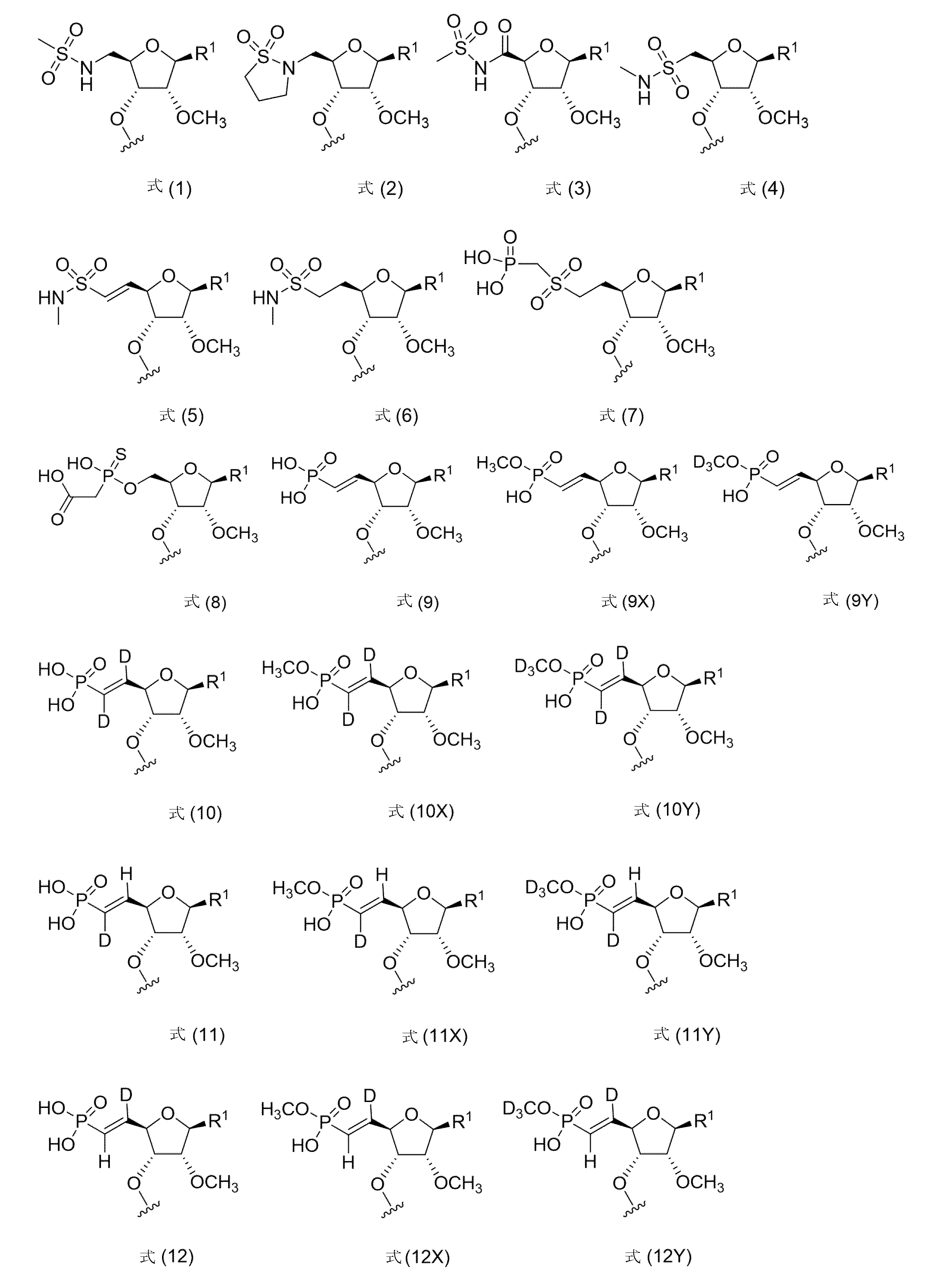


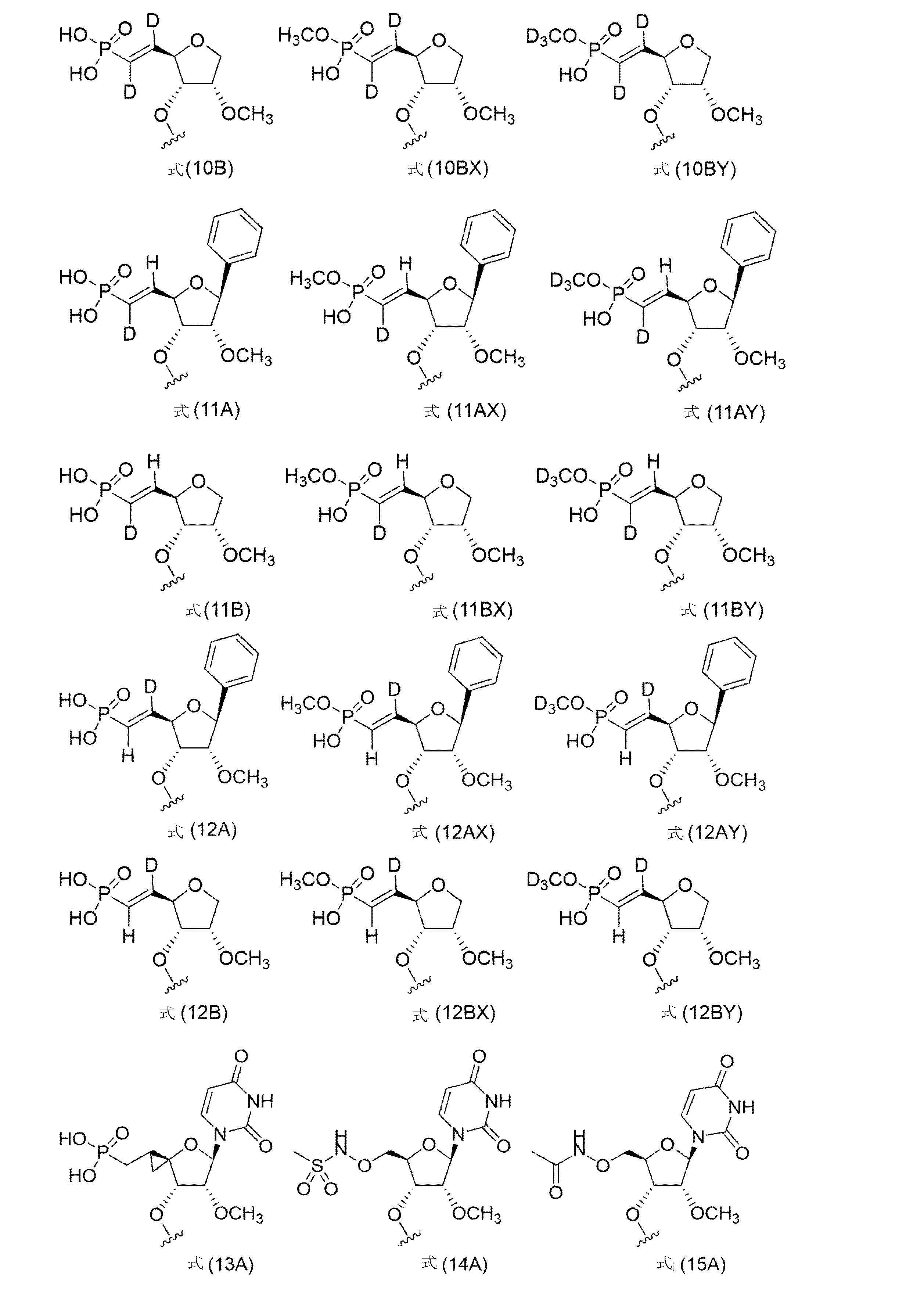

R1が、核酸塩基、アリール、ヘテロアリール、またはHであり、
R2が、

R2およびR20が、一緒になって、-(CR21R22)n-Zもしくは-(C2-C6アルケニレン)-Zで置換された3~7員の炭素環式環を形成し、
nが、1、2、3、または4であり、
Zが、-ONR23R24、-OP(O)OH(CH2)mCO2R23、-OP(S)OH(CH2)mCO2R23、-P(O)(OH)2、-P(O)(OH)(OCH3)、-P(O)(OH)(OCD3)、-SO2(CH2)mP(O)(OH)2、-SO2NR23R25、-NR23R24、または-NR23SO2R24であり、
R21およびR22のいずれかが、独立して、水素もしくはC1~C6アルキルであるか、またはR21およびR22が、一緒になってオキソ基を形成し、
R23が、水素、もしくはC1~C6アルキルであり、
R24が、-SO2R25もしくは-C(O)R25であるか、または
R23およびR24が、それらが接続する窒素と一緒になって、置換もしくは非置換複素環式環を形成し、
R25が、C1~C6アルキルであり、
mが、1、2、3、または4である、請求項65または88に記載のsiNA。 The 5' stabilizing endcap has the structure of Formula (Ic):
R 1 is nucleobase, aryl, heteroaryl, or H;
R2 is
n is 1, 2, 3, or 4;
Z is —ONR 23 R 24 , —OP(O)OH(CH 2 ) m CO 2 R 23 , —OP(S)OH(CH 2 ) m CO 2 R 23 , —P(O)(OH) 2 , —P(O)(OH)(OCH 3 ), —P(O)(OH)(OCD 3 ), —SO 2 (CH 2 ) m P(O)(OH) 2 , —SO 2 NR 23 R 25 , —NR 23 R 24 , or —NR 23 SO 2 R 24 ;
either R 21 and R 22 are independently hydrogen or C 1 -C 6 alkyl, or R 21 and R 22 together form an oxo group;
R 23 is hydrogen or C 1 -C 6 alkyl,
R 24 is —SO 2 R 25 or —C(O)R 25 , or R 23 and R 24 together with the nitrogen to which they are attached form a substituted or unsubstituted heterocyclic ring death,
R 25 is C 1 -C 6 alkyl;
89. The siNA of claim 65 or 88, wherein m is 1, 2, 3, or 4.


(i)ホスホジエステルリンカー、ホスホロチオエートリンカー、もしくはホスホロジチオエートリンカーから独立して選択される1つ以上のリンカーを介して、前記アンチセンス鎖の前記5’末端、または
(ii)ホスホジエステルリンカー、ホスホロチオエートリンカー、もしくはホスホロジチオエートリンカーから独立して選択される1つ以上のリンカーを介して、前記センス鎖の前記5’末端に接続する、請求項102に記載のsiNA。 The 5′ stabilized end cap is
(i) the 5′ end of the antisense strand via one or more linkers independently selected from a phosphodiester linker, a phosphorothioate linker, or a phosphorodithioate linker; or (ii) a phosphodiester linker, 103. The siNA of claim 102, which is connected to said 5' end of said sense strand via one or more linkers independently selected from phosphorothioate or phosphorodithioate linkers.
(ii)前記標的遺伝子が、遺伝子であり、DNAウイルス由来であるか、
(iii)前記標的遺伝子が、二本鎖DNA(dsDNA)ウイルス由来の遺伝子であるか、
(iv)前記標的遺伝子が、ヘパドナウイルス由来の遺伝子であるか、
(v)前記標的遺伝子が、B型肝炎ウイルス(HBV)由来の遺伝子であるか、
(vi)前記標的遺伝子が、遺伝子型A~Jのうちのいずれか1つのHBV由来の遺伝子であるか、または
(vii)前記標的遺伝子が、HBVのS遺伝子もしくはX遺伝子から選択される、先行請求項のいずれか一項に記載のsiNA。 (i) said target gene is a viral gene;
(ii) said target gene is a gene and is derived from a DNA virus;
(iii) the target gene is a gene from a double-stranded DNA (dsDNA) virus;
(iv) the target gene is a hepadnavirus-derived gene;
(v) the target gene is a gene from hepatitis B virus (HBV);
(vi) said target gene is a gene from HBV of any one of genotypes A through J; or (vii) said target gene is selected from the S gene or the X gene of HBV. siNA according to any one of the claims.
(ii)前記第2のヌクレオチド配列が、配列番号410の200~280、300~445、460~510、650~720、1170~1220、1250~1300、もしくは1550~1630位置内の15~30個のヌクレオチドに対して少なくとも約60%、65%、70%、75%、80%、85%、90%、95%、もしくは100%相補的であり、
(iii)前記第2のヌクレオチド配列が、配列番号410の200~230、250~280、300~330、370~400、405~445、460~500、670~700、1180~1210、1260~1295、1520~1550、もしくは1570~1610位置内の15~30個のヌクレオチドに対して少なくとも約60%、65%、70%、75%、80%、85%、90%、95%、もしくは100%相補的であり、
(iv)前記第2のヌクレオチド配列が、配列番号410の203、206、254、305、375、409、412、415、416、419、462、466、467、674、676、1182、1262、1263、1268、1526、1577、1578、1580、1581、1583、もしくは1584位置で開始する15~30個のヌクレオチドに対して少なくとも約60%、65%、70%、75%、80%、85%、90%、95%、もしくは100%相補的であり、
(v)前記第1のヌクレオチド配列が、配列番号410の200~720もしくは1100~1700位置内の15~30個のヌクレオチドに対して少なくとも約60%、65%、70%、75%、80%、85%、90%、95%、もしくは100%同一であり、
(vi)前記第1のヌクレオチド配列が、配列番号410の200~280、300~445、460~510、650~720、1170~1220、1250~1300、もしくは1550~1630位置内の15~30個のヌクレオチドに対して少なくとも約60%、65%、70%、75%、80%、85%、90%、95%、もしくは100%同一であり、
(vii)前記第1のヌクレオチド配列が、配列番号410の200~230、250~280、300~330、370~400、405~445、460~500、670~700、1180~1210、1260~1295、1520~1550、もしくは1570~1610位置内の15~30個のヌクレオチドに対して少なくとも約60%、65%、70%、75%、80%、85%、90%、95%、もしくは100%同一であり、かつ/または
(viii)前記第1のヌクレオチド配列が、配列番号410の203、206、254、305、375、409、412、415、416、419、462、466、467、674、676、1182、1262、1263、1268、1526、1577、1578、1580、1581、1583、もしくは1584位置で開始する15~30個のヌクレオチドに対して少なくとも約60%、65%、70%、75%、80%、85%、90%、95%、もしくは100%同一である、請求項1~104のいずれか一項に記載のsiNA。 (i) the second nucleotide sequence is at least about 60%, 65%, 70%, 75%, 80% of 15-30 nucleotides within positions 200-720 or 1100-1700 of SEQ ID NO:410; , 85%, 90%, 95% or 100% complementary,
(ii) the second nucleotide sequence is 15-30 within positions 200-280, 300-445, 460-510, 650-720, 1170-1220, 1250-1300, or 1550-1630 of SEQ ID NO:410; is at least about 60%, 65%, 70%, 75%, 80%, 85%, 90%, 95%, or 100% complementary to the nucleotides of
(iii) the second nucleotide sequence is 200-230, 250-280, 300-330, 370-400, 405-445, 460-500, 670-700, 1180-1210, 1260-1295 of SEQ ID NO:410 at least about 60%, 65%, 70%, 75%, 80%, 85%, 90%, 95%, or 100% for 15-30 nucleotides within positions 1520-1550, or 1570-1610 Complementary
(iv) the second nucleotide sequence is 203, 206, 254, 305, 375, 409, 412, 415, 416, 419, 462, 466, 467, 674, 676, 1182, 1262, 1263 of SEQ ID NO: 410 , 1268, 1526, 1577, 1578, 1580, 1581, 1583, or at least about 60%, 65%, 70%, 75%, 80%, 85% for the 15-30 nucleotides starting at position 1580, 1581, 1583, or 1584; 90%, 95% or 100% complementary,
(v) said first nucleotide sequence is at least about 60%, 65%, 70%, 75%, 80% of 15-30 nucleotides within positions 200-720 or 1100-1700 of SEQ ID NO:410; , 85%, 90%, 95% or 100% identical,
(vi) the first nucleotide sequence is 15-30 within positions 200-280, 300-445, 460-510, 650-720, 1170-1220, 1250-1300, or 1550-1630 of SEQ ID NO:410; is at least about 60%, 65%, 70%, 75%, 80%, 85%, 90%, 95%, or 100% identical to the nucleotides of
(vii) the first nucleotide sequence is 200-230, 250-280, 300-330, 370-400, 405-445, 460-500, 670-700, 1180-1210, 1260-1295 of SEQ ID NO:410 at least about 60%, 65%, 70%, 75%, 80%, 85%, 90%, 95%, or 100% for 15-30 nucleotides within positions 1520-1550, or 1570-1610 and/or (viii) the first nucleotide sequence is 203, 206, 254, 305, 375, 409, 412, 415, 416, 419, 462, 466, 467, 674 of SEQ ID NO: 410, at least about 60%, 65%, 70%, 75% for the 15-30 nucleotides starting at position 676, 1182, 1262, 1263, 1268, 1526, 1577, 1578, 1580, 1581, 1583, or 1584 , 80%, 85%, 90%, 95%, or 100% identical.
(ii)前記第2のヌクレオチド配列が、配列番号57~102、159~204、および261~306のうちのいずれか1つのヌクレオチド配列を含み、(iii)前記センス鎖が、配列番号307~362および415~444のうちのいずれか1つのヌクレオチド配列を含み、かつ/または
(iv)前記アンチセンス鎖が、配列番号363~409、445~533および536~539のうちのいずれか1つのヌクレオチド配列を含む、先行請求項のいずれか一項に記載のsiNA。 (i) said first nucleotide sequence comprises any one of the nucleotide sequences of SEQ ID NOs: 1-56, 103-158 and 205-260;
(ii) said second nucleotide sequence comprises the nucleotide sequence of any one of SEQ ID NOs: 57-102, 159-204, and 261-306; and (iii) said sense strand comprises SEQ ID NOs: 307-362 and/or (iv) the antisense strand comprises the nucleotide sequence of any one of SEQ ID NOS: 363-409, 445-533 and 536-539 siNA according to any one of the preceding claims, comprising
(ii)前記siNAの少なくとも1つの末端が、オーバーハングを含み、前記オーバーハングが、少なくとも1つのヌクレオチドを含むか、または
(iii)前記siNAの両方の末端が、オーバーハングを含み、前記オーバーハングが、少なくとも1つのヌクレオチドを含む、先行請求項のいずれか一項に記載のsiNA。 (i) at least one end of the siNA is blunt;
(ii) at least one end of said siNA comprises an overhang, said overhang comprising at least one nucleotide, or (iii) both ends of said siNA comprise an overhang, said overhang The siNA of any one of the preceding claims, wherein comprises at least one nucleotide.

R1が、独立して、核酸塩基、アリール、ヘテロアリール、またはHであり、Q1およびQ2が、独立して、SまたはOであり、
R5が、独立して、-OCD3、-F、または-OCH3であり、
R6およびR7が、独立して、H、D、またはCD3である、先行請求項のいずれか一項に記載のsiNA。 at least one 2'-fluoronucleotide or 2'-O-methyl nucleotide is a 2'-fluoro or 2-O-methyl nucleotide mimetic of formula (V)
R 1 is independently nucleobase, aryl, heteroaryl, or H; Q 1 and Q 2 are independently S or O;
R 5 is independently —OCD 3 , —F, or —OCH 3 ;
4. The siNA of any one of the preceding claims, wherein R6 and R7 are independently H, D, or CD3.

(ii)前記アンチセンス鎖もしくは前記第2のヌクレオチド配列の前記5’末端から2、5、6、8、10、14、16、および/もしくは17位置の前記ヌクレオチドが、2’-フルオロヌクレオチド模倣物であり、
(iii)前記センス鎖もしくは前記第1のヌクレオチド配列上の少なくとも1、2、3、4、5個、もしくはそれより多くの2’-フルオロヌクレオチドが、2’-フルオロヌクレオチド模倣物であり、かつ/または
(iv)前記センス鎖もしくは前記第1のヌクレオチド配列の5’末端から3、5、7、8、9、10、11,12、14、および/もしくは17位置の前記ヌクレオチドが、2’-フルオロヌクレオチド模倣物である、請求項111に記載のsiNA。 (i) at least 1, 2, 3, 4, 5, or more 2'-fluoronucleotides on said antisense strand or said second nucleotide sequence are 2'-fluoronucleotide mimetics;
(ii) said nucleotide at positions 2, 5, 6, 8, 10, 14, 16, and/or 17 from said 5' end of said antisense strand or said second nucleotide sequence is a 2'-fluoronucleotide mimic is a thing,
(iii) at least 1, 2, 3, 4, 5, or more 2'-fluoronucleotides on said sense strand or said first nucleotide sequence are 2'-fluoronucleotide mimetics; and or (iv) the nucleotide at positions 3, 5, 7, 8, 9, 10, 11, 12, 14, and/or 17 from the 5' end of the sense strand or the first nucleotide sequence is 2' - a siNA of claim 111, which is a fluoronucleotide mimetic.

(ii)10、9、8、7、6、5、4、3、もしくは2個以下の2’-フルオロヌクレオチド模倣物が、f4Pヌクレオチド
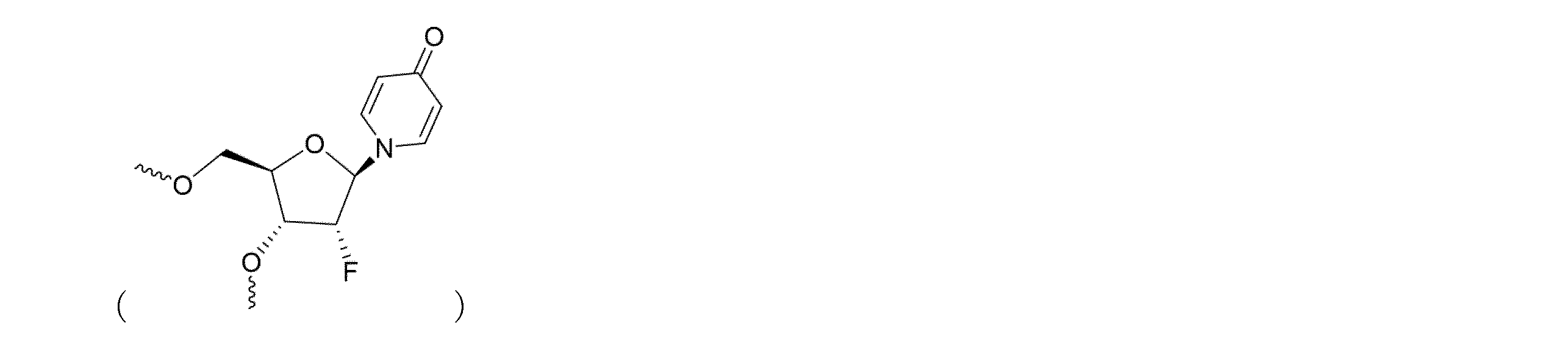
(iii)1、2、3、4、5、6個、もしくはそれより多くの2’-フルオロヌクレオチド模倣物が、f2Pヌクレオチド

(iv)10、9、8、7、6、5、4、3、もしくは2個以下の2’-フルオロヌクレオチド模倣物が、f2Pヌクレオチド

(v)1、2、3、4、5、6個、もしくはそれより多くの2’-フルオロヌクレオチド模倣物が、fXヌクレオチド

(vi)10、9、8、7、6、5、4、3、もしくは2個以下の2’-フルオロヌクレオチド模倣物が、fXヌクレオチド

(ii) no more than 10, 9, 8, 7, 6, 5, 4, 3, or 2 2'-fluoronucleotide mimetics are f4P nucleotides
(iii) 1, 2, 3, 4, 5, 6, or more 2'-fluoronucleotide mimetics are f2P nucleotides
(iv) no more than 10, 9, 8, 7, 6, 5, 4, 3, or 2 2'-fluoronucleotide mimetics are f2P nucleotides
(v) 1, 2, 3, 4, 5, 6, or more 2'-fluoronucleotide mimetics are fX nucleotides

(ii)前記アンチセンス鎖もしくは第2のヌクレオチド配列の3’末端からの前記第1のヌクレオチドが、d2vd3ヌクレオチド

(I)(a)請求項1~114のいずれか一項に記載のsiNA、および(b)薬学的に許容される賦形剤、
(II)請求項1~114のいずれか一項に記載の2、3、4、5、6、7、8、9、10個、もしくはそれより多くのsiNA、または
(III)(a)請求項1~114のいずれか一項に記載の2、3、4、5、6、7、8、9、10個、もしくはそれより多くのsiNA、および(b)薬学的に許容される賦形剤、を含む、組成物。 A composition comprising:
(I) (a) the siNA of any one of claims 1-114, and (b) a pharmaceutically acceptable excipient;
(II) 2, 3, 4, 5, 6, 7, 8, 9, 10 or more siNAs according to any one of claims 1-114, or (III) (a) a claim 2, 3, 4, 5, 6, 7, 8, 9, 10 or more siNAs of any one of paragraphs 1-114 and (b) a pharmaceutically acceptable excipient A composition comprising an agent.
(ii)少なくとも1、2、3、4、5個、もしくはそれより多くのsiNAが、HBVのX遺伝子を標的とする、請求項115に記載の組成物。 (i) at least 1, 2, 3, 4, 5, or more siNAs target the S gene of HBV, and/or (ii) at least 1, 2, 3, 4, 5, or 116. The composition of claim 115, wherein more of the siNA targets the X gene of HBV.
(ii)ヌクレオチド類似体、ヌクレオシド類似体、カプシドアセンブリモジュレーター(CAM)、組換えインターフェロン、侵入阻害剤、小分子免疫モジュレーター、およびオリゴヌクレオチド療法から選択される追加のHBV治療薬剤、
(iii)追加のsiNA、
(iv)ds-siNA-001~ds-siNA-0178のうちのいずれかから選択される追加のsiNA、
(v)アンチセンスオリゴヌクレオチド(ASO)、NAP、もしくはSTOPから選択されるオリゴヌクレオチド療法、
(vi)ASO1もしくはASO2から選択されるASO、ならびに/または
(vii)HBV STOPS(商標)ALG-010133、HBV CAM ALG-000184、ASO1、組換えインターフェロンアルファ2b、IFN-a、PEG-IFN-a-2a、ラミブジン、テルビブジン、アデホビルジピボキシル、クレブジン、エンテカビル、テノホビルアラフェナミド、テノホビルジソプロキシル、NVR3-778、BAY41-4109、JNJ-632、JNJ-3989(ARO-HBV)、RG6004、GSK3228836、REP-2139、REP-2165、AB-729、VIR-2218、RG6346(DCR-HBVS)、JNJ-6379、GLS4、ABI-HO731、JNJ-440、NZ-4、RG7907、EDP-514、AB-423、AB-506、ABI-H03733、およびABI-H2158から選択される、追加のHBV治療薬剤をさらに含む、請求項115または116に記載の組成物。 (i) an additional HBV therapeutic agent;
(ii) additional HBV therapeutic agents selected from nucleotide analogues, nucleoside analogues, capsid assembly modulators (CAMs), recombinant interferons, entry inhibitors, small molecule immune modulators, and oligonucleotide therapy;
(iii) additional siNAs;
(iv) an additional siNA selected from any of ds-siNA-001 through ds-siNA-0178;
(v) an oligonucleotide therapy selected from antisense oligonucleotides (ASO), NAP, or STOP;
(vi) an ASO selected from ASO1 or ASO2, and/or (vii) HBV STOPS™ ALG-010133, HBV CAM ALG-000184, ASO1, recombinant interferon alpha 2b, IFN-a, PEG-IFN-a -2a, lamivudine, telbivudine, adefovir dipivoxil, clevudine, entecavir, tenofovir alafenamide, tenofovir disoproxil, NVR3-778, BAY41-4109, JNJ-632, JNJ-3989 (ARO-HBV), RG6004, GSK3228836, REP-2139, REP-2165, AB-729, VIR-2218, RG6346 (DCR-HBVS), JNJ-6379, GLS4, ABI-HO731, JNJ-440, NZ-4, RG7907, EDP-514, AB-423 , AB-506, ABI-H03733, and ABI-H2158, further comprising an additional HBV therapeutic agent.
(ii)前記疾患が、DNAウイルスによって引き起こされるか、
(iii)前記疾患が、二本鎖DNA(dsDNAウイルス)によって引き起こされるか、
(iv)前記疾患が、ヘパドナウイルスによって引き起こされるか、
(v)前記疾患が、B型肝炎ウイルス(HBV)によって引き起こされるか、または
(vi)前記疾患が、HBV遺伝子型A~Jのうちのいずれか1つのHBVによって引き起こされる、請求項118に記載の使用。 (i) the disease is a viral disease;
(ii) said disease is caused by a DNA virus;
(iii) the disease is caused by double-stranded DNA (dsDNA viruses);
(iv) the disease is caused by a hepadnavirus;
(v) said disease is caused by hepatitis B virus (HBV); or (vi) said disease is caused by HBV of any one of HBV genotypes A-J. Use of.
(ii)ヌクレオチド類似体、ヌクレオシド類似体、カプシドアセンブリモジュレーター(CAM)、組換えインターフェロン、侵入阻害剤、小分子免疫モジュレーター、およびオリゴヌクレオチド療法から選択される追加のHBV治療薬剤、
(iii)追加のsiNA、
(iv)ds-siNA-001~ds-siNA-0178のうちのいずれかから選択される追加のsiNA、
(v)アンチセンスオリゴヌクレオチド(ASO)、NAP、もしくはSTOPから選択されるオリゴヌクレオチド療法、(vi)ASO1もしくはASO2から選択されるASO、ならびに/または
(vii)HBV STOPS(商標)ALG-010133、HBV CAM ALG-000184、ASO1、組換えインターフェロンアルファ2b、IFN-a、PEG-IFN-a-2a、ラミブジン、テルビブジン、アデホビルジピボキシル、クレブジン、エンテカビル、テノホビルアラフェナミド、テノホビルジソプロキシル、NVR3-778、BAY41-4109、JNJ-632、JNJ-3989(ARO-HBV)、RG6004、GSK3228836、REP-2139、REP-2165、AB-729、VIR-2218、RG6346(DCR-HBVS)、JNJ-6379、GLS4、ABI-HO731、JNJ-440、NZ-4、RG7907、EDP-514、AB-423、AB-506、ABI-H03733、およびABI-H2158から選択される、追加のHBV治療薬剤をさらに含む、請求項118または119に記載の使用。 (i) an additional HBV therapeutic agent in the manufacture of said medicament;
(ii) additional HBV therapeutic agents selected from nucleotide analogues, nucleoside analogues, capsid assembly modulators (CAMs), recombinant interferons, entry inhibitors, small molecule immune modulators, and oligonucleotide therapy;
(iii) additional siNAs;
(iv) an additional siNA selected from any of ds-siNA-001 through ds-siNA-0178;
(v) an oligonucleotide therapy selected from antisense oligonucleotides (ASO), NAP, or STOP, (vi) an ASO selected from ASO1 or ASO2, and/or (vii) HBV STOPS™ ALG-010133, HBV CAM ALG-000184, ASO1, recombinant interferon alpha 2b, IFN-a, PEG-IFN-a-2a, lamivudine, telbivudine, adefovir dipivoxil, clevudine, entecavir, tenofovir alafenamide, tenofovir disoproxil, NVR3- 778, BAY41-4109, JNJ-632, JNJ-3989 (ARO-HBV), RG6004, GSK3228836, REP-2139, REP-2165, AB-729, VIR-2218, RG6346 (DCR-HBVS), JNJ-6379, further comprising an additional HBV therapeutic agent selected from GLS4, ABI-HO731, JNJ-440, NZ-4, RG7907, EDP-514, AB-423, AB-506, ABI-H03733, and ABI-H2158; Use according to claim 118 or 119.
(ii)前記疾患が、非アルコール性脂肪肝疾患(NAFLD)もしくは肝細胞がん腫(HCC)であるか、または
(iii)前記疾患が、非アルコール性脂肪性肝炎(NASH)である、請求項118に記載の使用。 (i) the disease is liver disease;
(ii) said disease is non-alcoholic fatty liver disease (NAFLD) or hepatocellular carcinoma (HCC); or (iii) said disease is non-alcoholic steatohepatitis (NASH). 119. Use according to paragraph 118.
(ii)前記肝臓疾患治療薬剤が、PPARアゴニストであり、PPARαアゴニスト、デュアルPPARα/δアゴニスト、PPARγアゴニスト、およびデュアルPPARα/γアゴニストから選択されるか、または
(iii)前記肝臓疾患治療薬剤が、フィブラート、エラフィブラノール、チアゾリジンジオン(TZD)、ピオグリタゾン、サログリタザール、オベチコールアシス(obeticholic acis)(OCA)、アラムコール、グルカゴン様ペプチド1(GLP-1)受容体アゴニスト、ジペプチジルペプチダーゼ4(DPP-4)阻害剤、エキセナチド、リラグルチド シタグリプチン、およびビルダグリプチンから選択される、請求項122に記載の使用。 (i) the liver disease therapeutic agent is selected from peroxisome proliferator-activated receptor (PPAR) agonists, farnesoid X receptor (FXR) agonists, lipid modifying agents, and incretin-based therapies;
(ii) the drug for treating liver disease is a PPAR agonist and is selected from a PPARα agonist, a dual PPARα/δ agonist, a PPARγ agonist, and a dual PPARα/γ agonist; or (iii) the drug for treating liver disease is fibrates, elafibranol, thiazolidinedione (TZD), pioglitazone, saloglitazar, obeticholic acis (OCA), aramchol, glucagon-like peptide 1 (GLP-1) receptor agonists, dipeptidyl peptidase 4 (DPP) -4) the inhibitor selected from exenatide, liraglutide sitagliptin, and vildagliptin.
(ii)前記疾患が、DNAウイルスによって引き起こされるか、
(iii)前記疾患が、二本鎖DNA(dsDNAウイルス)によって引き起こされるか、
(iv)前記疾患が、ヘパドナウイルスによって引き起こされるか、
(v)前記疾患が、B型肝炎ウイルス(HBV)によって引き起こされるか、
(vi)前記疾患が、HBV遺伝子型A~Jのうちのいずれか1つのHBVによって引き起こされるか、
(vii)前記疾患が、肝臓疾患であるか、
(viii)前記疾患が、非アルコール性脂肪肝疾患(NAFLD)もしくは肝細胞がん腫(HCC)であるか、または
(ix)前記疾患が、非アルコール性脂肪性肝炎(NASH)である、請求項126に記載のsiNA。 (i) the disease is a viral disease;
(ii) said disease is caused by a DNA virus;
(iii) the disease is caused by double-stranded DNA (dsDNA viruses);
(iv) the disease is caused by a hepadnavirus;
(v) the disease is caused by hepatitis B virus (HBV);
(vi) the disease is caused by HBV of any one of HBV genotypes A through J;
(vii) the disease is liver disease;
(viii) said disease is non-alcoholic fatty liver disease (NAFLD) or hepatocellular carcinoma (HCC); or (ix) said disease is non-alcoholic steatohepatitis (NASH). 127. The siNA of Paragraph 126.
(ii)前記疾患が、DNAウイルスによって引き起こされるか、
(iii)前記疾患が、二本鎖DNA(dsDNAウイルス)によって引き起こされるか、
(iv)前記疾患が、ヘパドナウイルスによって引き起こされるか、
(v)前記疾患が、B型肝炎ウイルス(HBV)によって引き起こされるか、
(vi)前記疾患が、HBV遺伝子型A~Jのうちのいずれか1つのHBVによって引き起こされるか、
(vii)前記疾患が、肝臓疾患であるか、
(viii)前記疾患が、非アルコール性脂肪肝疾患(NAFLD)もしくは肝細胞がん腫(HCC)であるか、または
(ix)前記疾患が、非アルコール性脂肪性肝炎(NASH)である、請求項128に記載の組成物。 (i) the disease is a viral disease;
(ii) said disease is caused by a DNA virus;
(iii) the disease is caused by double-stranded DNA (dsDNA viruses);
(iv) the disease is caused by a hepadnavirus;
(v) the disease is caused by hepatitis B virus (HBV);
(vi) the disease is caused by HBV of any one of HBV genotypes A through J;
(vii) the disease is liver disease;
(viii) said disease is non-alcoholic fatty liver disease (NAFLD) or hepatocellular carcinoma (HCC); or (ix) said disease is non-alcoholic steatohepatitis (NASH). 129. The composition of paragraph 128.
Applications Claiming Priority (5)
| Application Number | Priority Date | Filing Date | Title |
|---|---|---|---|
| US202062986150P | 2020-03-06 | 2020-03-06 | |
| US62/986,150 | 2020-03-06 | ||
| US202063109196P | 2020-11-03 | 2020-11-03 | |
| US63/109,196 | 2020-11-03 | ||
| PCT/US2021/021199 WO2021178885A1 (en) | 2020-03-06 | 2021-03-05 | Modified short interfering nucleic acid (sina) molecules and uses thereof |
Publications (2)
| Publication Number | Publication Date |
|---|---|
| JP2023515664A true JP2023515664A (en) | 2023-04-13 |
| JPWO2021178885A5 JPWO2021178885A5 (en) | 2024-03-14 |
Family
ID=75278356
Family Applications (1)
| Application Number | Title | Priority Date | Filing Date |
|---|---|---|---|
| JP2022552538A Pending JP2023515664A (en) | 2020-03-06 | 2021-03-05 | Modified short interfering nucleic acid (siNA) molecules and their uses |
Country Status (17)
| Country | Link |
|---|---|
| US (4) | US20220364096A1 (en) |
| EP (1) | EP4121533A1 (en) |
| JP (1) | JP2023515664A (en) |
| KR (1) | KR20220163960A (en) |
| CN (1) | CN115485384A (en) |
| AU (1) | AU2021230601A1 (en) |
| BR (1) | BR112022017287A2 (en) |
| CA (1) | CA3170466A1 (en) |
| CL (1) | CL2022002379A1 (en) |
| CO (1) | CO2022014258A2 (en) |
| GE (2) | GEP20257742B (en) |
| IL (1) | IL296045A (en) |
| MX (1) | MX2022011012A (en) |
| PE (1) | PE20221578A1 (en) |
| PH (1) | PH12022552163A1 (en) |
| TW (1) | TW202208625A (en) |
| WO (1) | WO2021178885A1 (en) |
Families Citing this family (27)
| Publication number | Priority date | Publication date | Assignee | Title |
|---|---|---|---|---|
| WO2019053661A2 (en) * | 2017-09-14 | 2019-03-21 | Alios Biopharma, Inc. | Galnac derivatives |
| BR112022017287A2 (en) * | 2020-03-06 | 2022-11-16 | Aligos Therapeutics Inc | MODIFIED SHORT INTERFERING NUCLEIC ACID MOLECULES (SINA) AND THEIR USES |
| EP4232450A4 (en) | 2020-10-21 | 2024-09-04 | Aligos Therapeutics, Inc. | BICYCLIC COMPOUNDS |
| WO2022184852A1 (en) * | 2021-03-03 | 2022-09-09 | Silence Therapeutics Gmbh | Conjugated nucleic acids comprising a phosphorodithioate for inhibiting gene expression in a cell |
| WO2022266193A1 (en) | 2021-06-18 | 2022-12-22 | Aligos Therapeutics, Inc. | Bicyclic compounds |
| IL312811A (en) | 2021-11-16 | 2024-07-01 | Shanghai Argo Biopharmaceutical Co Ltd | COMPOSITION AND METHOD FOR INHIBITING ANGIOTENSINOGEN (AGT) PROTEIN EXPRESSION |
| WO2023122317A2 (en) * | 2021-12-23 | 2023-06-29 | Aligos Therapeutics, Inc. | SHORT INTERFERING NUCLEIC ACID (SINA) MOLECULES FOR TARGETING β-CATENIN AND USES THEREOF |
| WO2023224979A1 (en) * | 2022-05-16 | 2023-11-23 | University Of Massachusetts | Optimized sirna scaffolds |
| WO2024033374A1 (en) | 2022-08-11 | 2024-02-15 | Syngenta Crop Protection Ag | Novel arylcarboxamide or arylthioamide compounds |
| WO2024089216A1 (en) | 2022-10-27 | 2024-05-02 | Syngenta Crop Protection Ag | Novel sulfur-containing heteroaryl carboxamide compounds |
| EP4634152A1 (en) | 2022-12-15 | 2025-10-22 | Syngenta Crop Protection AG | Novel bicyclic-carboxamide compounds useful as pesticides |
| AR131541A1 (en) | 2023-01-07 | 2025-04-09 | Syngenta Crop Protection Ag | NOVEL CARBOXAMIDE COMPOUNDS |
| CN120529909A (en) * | 2023-01-26 | 2025-08-22 | 安力高医药股份有限公司 | Hepatitis B combination therapy |
| WO2024173593A1 (en) * | 2023-02-14 | 2024-08-22 | Basecure Therapeutics | Modified double stranded rna agents |
| WO2024254091A1 (en) * | 2023-06-05 | 2024-12-12 | Empirico Inc. | Treatment of fgg related diseases and disorders |
| WO2025032129A1 (en) | 2023-08-08 | 2025-02-13 | Syngenta Crop Protection Ag | Novel aminoindane and aminotetraline compounds |
| WO2025096970A2 (en) * | 2023-11-03 | 2025-05-08 | Basecure Therapeutics Llc | Modified oligonucleotides and methods of use thereof |
| WO2025104032A1 (en) | 2023-11-14 | 2025-05-22 | Syngenta Crop Protection Ag | Novel carboxamide compounds |
| WO2025109114A1 (en) | 2023-11-24 | 2025-05-30 | Syngenta Crop Protection Ag | Novel carboxamide compounds |
| CN117534717A (en) * | 2024-01-09 | 2024-02-09 | 凯莱英生命科学技术(天津)有限公司 | Synthesis method of 5′-(E)-vinyl phosphate |
| WO2025149629A1 (en) | 2024-01-12 | 2025-07-17 | Syngenta Crop Protection Ag | Novel carboxamide compounds |
| WO2025149637A1 (en) | 2024-01-12 | 2025-07-17 | Syngenta Crop Protection Ag | Novel carboxamide compounds |
| WO2025201529A1 (en) * | 2024-03-29 | 2025-10-02 | Ractigen Therapeutics | Compounds for synthesizing modified small activating rna molecules, modified small activating rna molecules and uses thereof |
| US20250368996A1 (en) | 2024-05-14 | 2025-12-04 | Aligos Therapeutics, Inc. | Modified antisense oligonucleotides for treating hepatitis b virus |
| WO2025242321A1 (en) | 2024-05-24 | 2025-11-27 | Glaxosmithkline Intellectual Property (No.3) Limited | Novel use |
| WO2026008750A1 (en) | 2024-07-05 | 2026-01-08 | Syngenta Crop Protection Ag | Novel carboxamide compounds |
| WO2026012326A1 (en) * | 2024-07-08 | 2026-01-15 | 北京悦康科创医药科技股份有限公司 | Antisense oligonucleotide for reducing hbv gene expression and use thereof |
Citations (7)
| Publication number | Priority date | Publication date | Assignee | Title |
|---|---|---|---|---|
| JP2014527401A (en) * | 2011-06-30 | 2014-10-16 | アローヘッド リサーチ コーポレイション | Compositions and methods for inhibiting gene expression of hepatitis B virus |
| JP2015502931A (en) * | 2011-11-18 | 2015-01-29 | アルナイラム ファーマシューティカルズ, インコーポレイテッドAlnylam Pharmaceuticals, Inc. | Modified RNAi agent |
| WO2018185241A1 (en) * | 2017-04-05 | 2018-10-11 | Silence Therapeutics Gmbh | Products and compositions |
| JP2018536689A (en) * | 2015-12-10 | 2018-12-13 | アルナイラム ファーマシューティカルズ, インコーポレイテッドAlnylam Pharmaceuticals, Inc. | Sterol regulatory element binding protein (SREBP) chaperone (SCAP) iRNA compositions and methods of use thereof |
| JP2019504112A (en) * | 2015-12-07 | 2019-02-14 | ジェンザイム・コーポレーション | Methods and compositions for treating SERPINC1-related disorders |
| WO2019113393A1 (en) * | 2017-12-06 | 2019-06-13 | Avidity Biosciences Llc | Compositions and methods of treating muscle atrophy and myotonic dystrophy |
| WO2019217459A1 (en) * | 2018-05-07 | 2019-11-14 | Alnylam Pharmaceuticals, Inc. | Extrahepatic delivery |
Family Cites Families (11)
| Publication number | Priority date | Publication date | Assignee | Title |
|---|---|---|---|---|
| US20110046206A1 (en) * | 2007-06-22 | 2011-02-24 | Isis Pharmaceuticals, Inc. | Double strand compositions comprising differentially modified strands for use in gene modulation |
| JP2012528596A (en) * | 2009-06-03 | 2012-11-15 | ダイセルナ ファーマシューティカルズ, インコーポレイテッド | Peptide dicer substrate agent and method for its specific gene expression inhibition |
| EP2601204B1 (en) | 2010-04-28 | 2016-09-07 | Ionis Pharmaceuticals, Inc. | Modified nucleosides and oligomeric compounds prepared therefrom |
| CN106103463B (en) * | 2014-02-18 | 2018-11-30 | 国立大学法人大阪大学 | Bridging type nucleosides and nucleotide |
| AU2016306275A1 (en) * | 2015-08-07 | 2018-02-08 | Arrowhead Pharmaceuticals, Inc. | RNAi therapy for Hepatitis B virus infection |
| AU2017321892A1 (en) | 2016-09-02 | 2019-02-28 | Dicerna Pharmaceuticals, Inc. | 4'-phosphate analogs and oligonucleotides comprising the same |
| KR102403408B1 (en) | 2016-09-02 | 2022-05-30 | 애로우헤드 파마슈티컬스 인코포레이티드 | targeting ligand |
| CA3083968C (en) * | 2017-12-01 | 2024-04-23 | Suzhou Ribo Life Science Co., Ltd. | Double-stranded oligonucleotide, composition and conjugate comprising double-stranded oligonucleotide, preparation method thereof and use thereof |
| WO2019217397A2 (en) * | 2018-05-07 | 2019-11-14 | Alnylam Pharmaceuticals, Inc. | Compositions and methods for improving strand biased |
| AU2019376079A1 (en) | 2018-11-08 | 2021-05-27 | Aligos Therapeutics, Inc. | S-antigen transport inhibiting oligonucleotide polymers and methods |
| BR112022017287A2 (en) * | 2020-03-06 | 2022-11-16 | Aligos Therapeutics Inc | MODIFIED SHORT INTERFERING NUCLEIC ACID MOLECULES (SINA) AND THEIR USES |
-
2021
- 2021-03-05 BR BR112022017287A patent/BR112022017287A2/en unknown
- 2021-03-05 EP EP21715377.4A patent/EP4121533A1/en active Pending
- 2021-03-05 CA CA3170466A patent/CA3170466A1/en active Pending
- 2021-03-05 US US17/194,079 patent/US20220364096A1/en active Pending
- 2021-03-05 TW TW110108015A patent/TW202208625A/en unknown
- 2021-03-05 MX MX2022011012A patent/MX2022011012A/en unknown
- 2021-03-05 JP JP2022552538A patent/JP2023515664A/en active Pending
- 2021-03-05 PH PH1/2022/552163A patent/PH12022552163A1/en unknown
- 2021-03-05 WO PCT/US2021/021199 patent/WO2021178885A1/en not_active Ceased
- 2021-03-05 IL IL296045A patent/IL296045A/en unknown
- 2021-03-05 CN CN202180032666.3A patent/CN115485384A/en active Pending
- 2021-03-05 AU AU2021230601A patent/AU2021230601A1/en active Pending
- 2021-03-05 GE GEAP202116053A patent/GEP20257742B/en unknown
- 2021-03-05 GE GEAP202416053A patent/GEAP202416053A/en unknown
- 2021-03-05 KR KR1020227034100A patent/KR20220163960A/en active Pending
- 2021-03-05 PE PE2022001900A patent/PE20221578A1/en unknown
-
2022
- 2022-02-15 US US17/672,268 patent/US11549110B2/en active Active
- 2022-09-01 CL CL2022002379A patent/CL2022002379A1/en unknown
- 2022-10-05 CO CONC2022/0014258A patent/CO2022014258A2/en unknown
- 2022-11-29 US US18/059,561 patent/US20230332153A1/en active Pending
-
2023
- 2023-07-28 US US18/361,363 patent/US12129469B2/en active Active
Patent Citations (7)
| Publication number | Priority date | Publication date | Assignee | Title |
|---|---|---|---|---|
| JP2014527401A (en) * | 2011-06-30 | 2014-10-16 | アローヘッド リサーチ コーポレイション | Compositions and methods for inhibiting gene expression of hepatitis B virus |
| JP2015502931A (en) * | 2011-11-18 | 2015-01-29 | アルナイラム ファーマシューティカルズ, インコーポレイテッドAlnylam Pharmaceuticals, Inc. | Modified RNAi agent |
| JP2019504112A (en) * | 2015-12-07 | 2019-02-14 | ジェンザイム・コーポレーション | Methods and compositions for treating SERPINC1-related disorders |
| JP2018536689A (en) * | 2015-12-10 | 2018-12-13 | アルナイラム ファーマシューティカルズ, インコーポレイテッドAlnylam Pharmaceuticals, Inc. | Sterol regulatory element binding protein (SREBP) chaperone (SCAP) iRNA compositions and methods of use thereof |
| WO2018185241A1 (en) * | 2017-04-05 | 2018-10-11 | Silence Therapeutics Gmbh | Products and compositions |
| WO2019113393A1 (en) * | 2017-12-06 | 2019-06-13 | Avidity Biosciences Llc | Compositions and methods of treating muscle atrophy and myotonic dystrophy |
| WO2019217459A1 (en) * | 2018-05-07 | 2019-11-14 | Alnylam Pharmaceuticals, Inc. | Extrahepatic delivery |
Non-Patent Citations (1)
| Title |
|---|
| NUCLEIC ACIDS RESEARCH, vol. 45, no. 6, JPN6025013423, 2017, pages 3528 - 3536, ISSN: 0005717369 * |
Also Published As
| Publication number | Publication date |
|---|---|
| MX2022011012A (en) | 2022-10-07 |
| EP4121533A1 (en) | 2023-01-25 |
| US20220177888A1 (en) | 2022-06-09 |
| AU2021230601A2 (en) | 2022-10-20 |
| KR20220163960A (en) | 2022-12-12 |
| CO2022014258A2 (en) | 2022-12-30 |
| IL296045A (en) | 2022-10-01 |
| GEAP202416053A (en) | 2024-10-10 |
| CA3170466A1 (en) | 2021-09-10 |
| US20230365970A1 (en) | 2023-11-16 |
| PH12022552163A1 (en) | 2024-01-29 |
| PE20221578A1 (en) | 2022-10-06 |
| GEP20257742B (en) | 2025-03-10 |
| US11549110B2 (en) | 2023-01-10 |
| AU2021230601A1 (en) | 2022-10-06 |
| US12129469B2 (en) | 2024-10-29 |
| TW202208625A (en) | 2022-03-01 |
| BR112022017287A2 (en) | 2022-11-16 |
| US20220364096A1 (en) | 2022-11-17 |
| CN115485384A (en) | 2022-12-16 |
| CL2022002379A1 (en) | 2023-07-28 |
| WO2021178885A1 (en) | 2021-09-10 |
| US20230332153A1 (en) | 2023-10-19 |
Similar Documents
| Publication | Publication Date | Title |
|---|---|---|
| JP2023515664A (en) | Modified short interfering nucleic acid (siNA) molecules and their uses | |
| US20210189392A1 (en) | S-antigen transport inhibiting oligonucleotide polymers and methods | |
| US20250011789A1 (en) | Modified Short Interfering Nucleic Acid (siNA) Molecules and Uses Thereof | |
| US12454691B2 (en) | Modified short interfering nucleic acid (siNA) molecules and uses thereof | |
| JP2025535539A (en) | Modified short interfering nucleic acid (siNA) molecules and uses thereof | |
| US20250243491A1 (en) | Pnpla3-targeting short interfering rna (sirna) molecules and uses thereof | |
| AU2023236560A1 (en) | Modified gapmer oligomers and methods of use thereof | |
| EA050671B1 (en) | MOLECULES OF MODIFIED SMALL INTERFERING NUCLEIC ACIDS (mINA) AND THEIR APPLICATIONS | |
| OA21336A (en) | Modified short interfering nucleic acid (siNA) molecules and uses thereof. | |
| WO2024182446A2 (en) | Pnpla3-targeting short interfering rna (sirna) molecules and uses thereof |
Legal Events
| Date | Code | Title | Description |
|---|---|---|---|
| A521 | Request for written amendment filed |
Free format text: JAPANESE INTERMEDIATE CODE: A523 Effective date: 20240305 |
|
| A621 | Written request for application examination |
Free format text: JAPANESE INTERMEDIATE CODE: A621 Effective date: 20240305 |
|
| A131 | Notification of reasons for refusal |
Free format text: JAPANESE INTERMEDIATE CODE: A131 Effective date: 20250401 |
|
| A521 | Request for written amendment filed |
Free format text: JAPANESE INTERMEDIATE CODE: A523 Effective date: 20250701 |
|
| A02 | Decision of refusal |
Free format text: JAPANESE INTERMEDIATE CODE: A02 Effective date: 20251028 |