JP2023511788A - Method and apparatus for signaling syntax elements in video coding - Google Patents
Method and apparatus for signaling syntax elements in video coding Download PDFInfo
- Publication number
- JP2023511788A JP2023511788A JP2022559754A JP2022559754A JP2023511788A JP 2023511788 A JP2023511788 A JP 2023511788A JP 2022559754 A JP2022559754 A JP 2022559754A JP 2022559754 A JP2022559754 A JP 2022559754A JP 2023511788 A JP2023511788 A JP 2023511788A
- Authority
- JP
- Japan
- Prior art keywords
- flag
- picture
- prediction
- slices
- determining
- Prior art date
- Legal status (The legal status is an assumption and is not a legal conclusion. Google has not performed a legal analysis and makes no representation as to the accuracy of the status listed.)
- Granted
Links
Images


Classifications
-
- H—ELECTRICITY
- H04—ELECTRIC COMMUNICATION TECHNIQUE
- H04N—PICTORIAL COMMUNICATION, e.g. TELEVISION
- H04N19/00—Methods or arrangements for coding, decoding, compressing or decompressing digital video signals
- H04N19/70—Methods or arrangements for coding, decoding, compressing or decompressing digital video signals characterised by syntax aspects related to video coding, e.g. related to compression standards
-
- H—ELECTRICITY
- H04—ELECTRIC COMMUNICATION TECHNIQUE
- H04N—PICTORIAL COMMUNICATION, e.g. TELEVISION
- H04N19/00—Methods or arrangements for coding, decoding, compressing or decompressing digital video signals
- H04N19/50—Methods or arrangements for coding, decoding, compressing or decompressing digital video signals using predictive coding
- H04N19/503—Methods or arrangements for coding, decoding, compressing or decompressing digital video signals using predictive coding involving temporal prediction
- H04N19/51—Motion estimation or motion compensation
- H04N19/513—Processing of motion vectors
- H04N19/521—Processing of motion vectors for estimating the reliability of the determined motion vectors or motion vector field, e.g. for smoothing the motion vector field or for correcting motion vectors
-
- H—ELECTRICITY
- H04—ELECTRIC COMMUNICATION TECHNIQUE
- H04N—PICTORIAL COMMUNICATION, e.g. TELEVISION
- H04N19/00—Methods or arrangements for coding, decoding, compressing or decompressing digital video signals
- H04N19/10—Methods or arrangements for coding, decoding, compressing or decompressing digital video signals using adaptive coding
- H04N19/102—Methods or arrangements for coding, decoding, compressing or decompressing digital video signals using adaptive coding characterised by the element, parameter or selection affected or controlled by the adaptive coding
- H04N19/103—Selection of coding mode or of prediction mode
- H04N19/105—Selection of the reference unit for prediction within a chosen coding or prediction mode, e.g. adaptive choice of position and number of pixels used for prediction
-
- H—ELECTRICITY
- H04—ELECTRIC COMMUNICATION TECHNIQUE
- H04N—PICTORIAL COMMUNICATION, e.g. TELEVISION
- H04N19/00—Methods or arrangements for coding, decoding, compressing or decompressing digital video signals
- H04N19/10—Methods or arrangements for coding, decoding, compressing or decompressing digital video signals using adaptive coding
- H04N19/102—Methods or arrangements for coding, decoding, compressing or decompressing digital video signals using adaptive coding characterised by the element, parameter or selection affected or controlled by the adaptive coding
- H04N19/117—Filters, e.g. for pre-processing or post-processing
-
- H—ELECTRICITY
- H04—ELECTRIC COMMUNICATION TECHNIQUE
- H04N—PICTORIAL COMMUNICATION, e.g. TELEVISION
- H04N19/00—Methods or arrangements for coding, decoding, compressing or decompressing digital video signals
- H04N19/10—Methods or arrangements for coding, decoding, compressing or decompressing digital video signals using adaptive coding
- H04N19/134—Methods or arrangements for coding, decoding, compressing or decompressing digital video signals using adaptive coding characterised by the element, parameter or criterion affecting or controlling the adaptive coding
- H04N19/136—Incoming video signal characteristics or properties
- H04N19/137—Motion inside a coding unit, e.g. average field, frame or block difference
- H04N19/139—Analysis of motion vectors, e.g. their magnitude, direction, variance or reliability
-
- H—ELECTRICITY
- H04—ELECTRIC COMMUNICATION TECHNIQUE
- H04N—PICTORIAL COMMUNICATION, e.g. TELEVISION
- H04N19/00—Methods or arrangements for coding, decoding, compressing or decompressing digital video signals
- H04N19/10—Methods or arrangements for coding, decoding, compressing or decompressing digital video signals using adaptive coding
- H04N19/134—Methods or arrangements for coding, decoding, compressing or decompressing digital video signals using adaptive coding characterised by the element, parameter or criterion affecting or controlling the adaptive coding
- H04N19/157—Assigned coding mode, i.e. the coding mode being predefined or preselected to be further used for selection of another element or parameter
- H04N19/159—Prediction type, e.g. intra-frame, inter-frame or bidirectional frame prediction
-
- H—ELECTRICITY
- H04—ELECTRIC COMMUNICATION TECHNIQUE
- H04N—PICTORIAL COMMUNICATION, e.g. TELEVISION
- H04N19/00—Methods or arrangements for coding, decoding, compressing or decompressing digital video signals
- H04N19/10—Methods or arrangements for coding, decoding, compressing or decompressing digital video signals using adaptive coding
- H04N19/169—Methods or arrangements for coding, decoding, compressing or decompressing digital video signals using adaptive coding characterised by the coding unit, i.e. the structural portion or semantic portion of the video signal being the object or the subject of the adaptive coding
- H04N19/17—Methods or arrangements for coding, decoding, compressing or decompressing digital video signals using adaptive coding characterised by the coding unit, i.e. the structural portion or semantic portion of the video signal being the object or the subject of the adaptive coding the unit being an image region, e.g. an object
- H04N19/172—Methods or arrangements for coding, decoding, compressing or decompressing digital video signals using adaptive coding characterised by the coding unit, i.e. the structural portion or semantic portion of the video signal being the object or the subject of the adaptive coding the unit being an image region, e.g. an object the region being a picture, frame or field
-
- H—ELECTRICITY
- H04—ELECTRIC COMMUNICATION TECHNIQUE
- H04N—PICTORIAL COMMUNICATION, e.g. TELEVISION
- H04N19/00—Methods or arrangements for coding, decoding, compressing or decompressing digital video signals
- H04N19/10—Methods or arrangements for coding, decoding, compressing or decompressing digital video signals using adaptive coding
- H04N19/169—Methods or arrangements for coding, decoding, compressing or decompressing digital video signals using adaptive coding characterised by the coding unit, i.e. the structural portion or semantic portion of the video signal being the object or the subject of the adaptive coding
- H04N19/17—Methods or arrangements for coding, decoding, compressing or decompressing digital video signals using adaptive coding characterised by the coding unit, i.e. the structural portion or semantic portion of the video signal being the object or the subject of the adaptive coding the unit being an image region, e.g. an object
- H04N19/174—Methods or arrangements for coding, decoding, compressing or decompressing digital video signals using adaptive coding characterised by the coding unit, i.e. the structural portion or semantic portion of the video signal being the object or the subject of the adaptive coding the unit being an image region, e.g. an object the region being a slice, e.g. a line of blocks or a group of blocks
-
- H—ELECTRICITY
- H04—ELECTRIC COMMUNICATION TECHNIQUE
- H04N—PICTORIAL COMMUNICATION, e.g. TELEVISION
- H04N19/00—Methods or arrangements for coding, decoding, compressing or decompressing digital video signals
- H04N19/10—Methods or arrangements for coding, decoding, compressing or decompressing digital video signals using adaptive coding
- H04N19/169—Methods or arrangements for coding, decoding, compressing or decompressing digital video signals using adaptive coding characterised by the coding unit, i.e. the structural portion or semantic portion of the video signal being the object or the subject of the adaptive coding
- H04N19/186—Methods or arrangements for coding, decoding, compressing or decompressing digital video signals using adaptive coding characterised by the coding unit, i.e. the structural portion or semantic portion of the video signal being the object or the subject of the adaptive coding the unit being a colour or a chrominance component
-
- H—ELECTRICITY
- H04—ELECTRIC COMMUNICATION TECHNIQUE
- H04N—PICTORIAL COMMUNICATION, e.g. TELEVISION
- H04N19/00—Methods or arrangements for coding, decoding, compressing or decompressing digital video signals
- H04N19/42—Methods or arrangements for coding, decoding, compressing or decompressing digital video signals characterised by implementation details or hardware specially adapted for video compression or decompression, e.g. dedicated software implementation
- H04N19/423—Methods or arrangements for coding, decoding, compressing or decompressing digital video signals characterised by implementation details or hardware specially adapted for video compression or decompression, e.g. dedicated software implementation characterised by memory arrangements
-
- H—ELECTRICITY
- H04—ELECTRIC COMMUNICATION TECHNIQUE
- H04N—PICTORIAL COMMUNICATION, e.g. TELEVISION
- H04N19/00—Methods or arrangements for coding, decoding, compressing or decompressing digital video signals
- H04N19/50—Methods or arrangements for coding, decoding, compressing or decompressing digital video signals using predictive coding
- H04N19/503—Methods or arrangements for coding, decoding, compressing or decompressing digital video signals using predictive coding involving temporal prediction
- H04N19/51—Motion estimation or motion compensation
- H04N19/573—Motion compensation with multiple frame prediction using two or more reference frames in a given prediction direction
-
- H—ELECTRICITY
- H04—ELECTRIC COMMUNICATION TECHNIQUE
- H04N—PICTORIAL COMMUNICATION, e.g. TELEVISION
- H04N19/00—Methods or arrangements for coding, decoding, compressing or decompressing digital video signals
- H04N19/50—Methods or arrangements for coding, decoding, compressing or decompressing digital video signals using predictive coding
- H04N19/503—Methods or arrangements for coding, decoding, compressing or decompressing digital video signals using predictive coding involving temporal prediction
- H04N19/51—Motion estimation or motion compensation
- H04N19/577—Motion compensation with bidirectional frame interpolation, i.e. using B-pictures
-
- H—ELECTRICITY
- H04—ELECTRIC COMMUNICATION TECHNIQUE
- H04N—PICTORIAL COMMUNICATION, e.g. TELEVISION
- H04N19/00—Methods or arrangements for coding, decoding, compressing or decompressing digital video signals
- H04N19/80—Details of filtering operations specially adapted for video compression, e.g. for pixel interpolation
- H04N19/82—Details of filtering operations specially adapted for video compression, e.g. for pixel interpolation involving filtering within a prediction loop
-
- H—ELECTRICITY
- H04—ELECTRIC COMMUNICATION TECHNIQUE
- H04N—PICTORIAL COMMUNICATION, e.g. TELEVISION
- H04N19/00—Methods or arrangements for coding, decoding, compressing or decompressing digital video signals
- H04N19/90—Methods or arrangements for coding, decoding, compressing or decompressing digital video signals using coding techniques not provided for in groups H04N19/10-H04N19/85, e.g. fractals
- H04N19/96—Tree coding, e.g. quad-tree coding
Landscapes
- Engineering & Computer Science (AREA)
- Multimedia (AREA)
- Signal Processing (AREA)
- Compression Or Coding Systems Of Tv Signals (AREA)
Abstract
ビデオ符号化のための方法および装置が提供される。この方法は、1つまたは複数の参照ピクチャリストがピクチャに関連付けられたピクチャヘッダ(PH)でシグナリングされるか否か、およびピクチャに関連付けられた1つまたは複数のスライスが双予測であることを1つまたは複数の参照ピクチャリストが示すか否かをデコーダが決定することを含む。この方法は、1つまたは複数の参照ピクチャリストがPHでシグナリングされ、1つまたは複数のスライスが双予測でないことを1つまたは複数の参照ピクチャリストが示すと決定したことに応答して、デコーダが1つまたは複数の制約をPHの1つまたは複数の構文要素に追加することをさらに含む。A method and apparatus for video encoding are provided. The method determines whether one or more reference picture lists are signaled in a picture header (PH) associated with the picture and that one or more slices associated with the picture are bi-predictive. Determining by the decoder whether one or more reference picture lists indicate. The method includes, in response to one or more reference picture lists being signaled in PH and determining that one or more reference picture lists indicate that one or more slices are not bi-predictive, the decoder: adds one or more constraints to one or more syntax elements of PH.
Description
関連出願の相互参照
本出願は2020年3月31日に出願された「Signaling of Syntax Elements in Video Coding」と題された米国仮出願第63/003,226号に対する優先権を主張し、その全体が全ての目的で引用により組み込まれている。
CROSS-REFERENCE TO RELATED APPLICATIONS This application claims priority to U.S. Provisional Application Serial No. 63/003,226, entitled "Signaling of Syntax Elements in Video Coding," filed March 31, 2020, the entirety of which is incorporated herein by reference. is incorporated by reference for all purposes.
本開示はビデオ符号化および圧縮に関し、より詳細には、ビデオ符号化における構文要素のシグナリングのための方法および装置に関するが、これらに限定されない。 TECHNICAL FIELD This disclosure relates to video encoding and compression, and more particularly, but not exclusively, to methods and apparatus for syntax element signaling in video encoding.
ビデオデータを圧縮するために様々なビデオ符号化技術が使用され得る。ビデオ符号化は1つまたは複数のビデオ符号化規格に従って実行される。例えば現在、いくつかのよく知られているビデオ符号化規格は、バーサタイルビデオコーディング(VVC:Versatile Video Coding)、高効率ビデオ符号化(HEVC:High Efficiency Video Coding、別名H.265またはMPEG-Hパート2)、高度ビデオ符号化(AVC:Advanced Video Coding、別名H.264またはMPEG-4パート10)を含み、これらはISO/IEC MPEGおよびITU-T VECGによって共同で開発されている。AOMedia Video 1(AV1)は、アライアンス・フォー・オープン・メディア(AOM:Alliance for Open Media)によって、その先行規格VP9の後継として開発された。デジタルオーディオおよびデジタルビデオ圧縮規格を指すオーディオビデオコーディング(AVS)は、中国のオーディオおよびビデオ符号化規格ワークグループによって開発された他のビデオ圧縮規格シリーズである。既存のビデオ符号化規格のほとんどは、有名なハイブリッドビデオ符号化フレームワークに基づいて、すなわち、ブロックベースの予測方法(例えば、インター予測、イントラ予測)を使用してビデオ画像またはシーケンスに存在する冗長性を削減し、変換符号化を使用して予測誤差のエネルギーをコンパクト化することによって構築されている。ビデオ符号化技術の重要な目標は、ビデオ品質の低下を回避または最小化しながら、より低いビットレートを使用する形式にビデオデータを圧縮することである。 Various video coding techniques may be used to compress video data. Video encoding is performed according to one or more video encoding standards. For example, currently some well-known video coding standards are Versatile Video Coding (VVC), High Efficiency Video Coding (HEVC), also known as H.265 or MPEG-H part 2), including Advanced Video Coding (AVC, also known as H.264 or MPEG-4 Part 10), which are jointly developed by ISO/IEC MPEG and ITU-T VECG. AOMedia Video 1 (AV1) was developed by the Alliance for Open Media (AOM) as a successor to its predecessor standard VP9. Audio Video Coding (AVS), which refers to digital audio and digital video compression standards, is another series of video compression standards developed by the Chinese Audio and Video Coding Standards Working Group. Most of the existing video coding standards are based on the well-known hybrid video coding framework, i.e., using block-based prediction methods (e.g., inter-prediction, intra-prediction) to reduce the redundancy present in video images or sequences. It is constructed by reducing the volatility and compacting the energy of the prediction error using transform coding. An important goal of video coding techniques is to compress video data into formats that use lower bit rates while avoiding or minimizing degradation of video quality.
本開示はビデオ符号化における構文要素のシグナリングに関する技術の例を提供する。 This disclosure provides example techniques for signaling syntax elements in video encoding.
本開示の第1の態様によれば、ビデオ符号化のための方法が提供される。この方法は、1つまたは複数の参照ピクチャリストがピクチャに関連付けられたピクチャヘッダ(PH)でシグナリングされるか否か、およびピクチャに関連付けられた1つまたは複数のスライスが双予測(bi-predictive)であることを1つまたは複数の参照ピクチャリストが示すか否かをデコーダが決定することを含む。さらに、この方法は、1つまたは複数の参照ピクチャリストがPHでシグナリングされ、1つまたは複数のスライスが双予測でないことを1つまたは複数の参照ピクチャリストが示すと決定したことに応答して、デコーダが1つまたは複数の制約をPHの1つまたは複数の構文要素に追加することを含む。 According to a first aspect of the present disclosure, a method is provided for video encoding. The method determines whether one or more reference picture lists are signaled in a picture header (PH) associated with the picture and whether one or more slices associated with the picture are bi-predictive. ). Further, the method is responsive to one or more reference picture lists being signaled in PH and determining that one or more reference picture lists indicate that one or more slices are not bi-predictive. , the decoder adding one or more constraints to one or more syntax elements of the PH.
本開示の第2の態様によれば、ビデオ符号化のための方法が提供される。この方法は、デコーダが、ピクチャのPHに関連付けられた1つまたは複数のスライスのインター予測に1つまたは複数の時間動きベクトル予測子(predictor)が使用されるか否かを特定するために、有効化フラグを使用することを含む。この方法は、デコーダが、スケーリング比計算のためにピクチャのサイズに適用される複数のオフセットに応じて有効化フラグの値を制約することをさらに含む。 According to a second aspect of the disclosure, a method is provided for video encoding. The method comprises: for a decoder to identify whether one or more temporal motion vector predictors are used for inter prediction of one or more slices associated with a PH of a picture; Including using the enable flag. The method further includes the decoder constraining the value of the enable flag according to multiple offsets applied to the size of the picture for scaling ratio calculation.
本開示の第3の態様によれば、ビデオ符号化のための装置が提供される。この装置は、1つまたは複数のプロセッサと、1つまたは複数のプロセッサによって実行可能な命令を記憶するように構成されるメモリと、を含む。1つまたは複数のプロセッサは、命令の実行時に、1つまたは複数の参照ピクチャリストがピクチャに関連付けられたPHでシグナリングされるか否か、およびピクチャに関連付けられた1つまたは複数のスライスが双予測であることを1つまたは複数の参照ピクチャリストが示すか否かを決定することを実行するように構成される。さらに、1つまたは複数のプロセッサは、1つまたは複数の参照ピクチャリストがPHでシグナリングされ、1つまたは複数のスライスが双予測でないことを1つまたは複数の参照ピクチャリストが示すと決定したことに応答して、1つまたは複数の制約をPHの1つまたは複数の構文要素に追加することを実行するように構成される。 According to a third aspect of the disclosure, an apparatus is provided for video encoding. The apparatus includes one or more processors and a memory configured to store instructions executable by the one or more processors. The one or more processors, upon execution of the instructions, determine whether one or more reference picture lists are signaled in a PH associated with the picture and whether one or more slices associated with the picture are bidirectional. It is configured to perform determining whether one or more reference picture lists indicate prediction. Further, the one or more processors determined that the one or more reference picture lists are signaled in PH and that the one or more reference picture lists indicate that the one or more slices are not bi-predictive. adding one or more constraints to one or more syntax elements of the PH in response to the .
本開示の第4の態様によれば、ビデオ符号化のための装置が提供される。この装置は、1つまたは複数のプロセッサと、1つまたは複数のプロセッサによって実行可能な命令を記憶するように構成されるメモリと、を含む。1つまたは複数のプロセッサは、命令の実行時に、ピクチャのPHに関連付けられた1つまたは複数のスライスのインター予測に1つまたは複数の時間動きベクトル予測子が使用されるか否かを特定するために、有効化フラグを使用することを実行するように構成される。1つまたは複数のプロセッサは、スケーリング比計算のためにピクチャのサイズに適用される複数のオフセットに応じて有効化フラグの値を制約することを実行するようにさらに構成される。 According to a fourth aspect of the present disclosure, an apparatus is provided for video encoding. The apparatus includes one or more processors and a memory configured to store instructions executable by the one or more processors. The one or more processors, upon execution of the instructions, identify whether one or more temporal motion vector predictors are to be used for inter prediction of one or more slices associated with the PH of the picture. For this reason, it is configured to perform using the enable flag. The one or more processors are further configured to perform constraining the value of the enablement flag as a function of multiple offsets applied to the size of the picture for scaling ratio calculation.
本開示の第5の態様によれば、コンピュータ実行可能命令を記憶する、ビデオ符号化のための非一時的コンピュータ可読記憶媒体が提供される。命令は、1つまたは複数のコンピュータプロセッサによって実行された場合に、1つまたは複数のコンピュータプロセッサに本開示の第1の態様によるビデオ符号化のための方法を実行させる。 According to a fifth aspect of the present disclosure, there is provided a non-transitory computer-readable storage medium for video encoding, storing computer-executable instructions. The instructions, when executed by one or more computer processors, cause the one or more computer processors to perform the method for video encoding according to the first aspect of the present disclosure.
本開示の第6の態様によれば、コンピュータ実行可能命令を記憶する、ビデオ符号化のための非一時的コンピュータ可読記憶媒体が提供される。命令は、1つまたは複数のコンピュータプロセッサによって実行された場合に、1つまたは複数のコンピュータプロセッサに本開示の第2の態様によるビデオ符号化のための方法を実行させる。 According to a sixth aspect of the present disclosure, there is provided a non-transitory computer-readable storage medium for video encoding, storing computer-executable instructions. The instructions, when executed by one or more computer processors, cause the one or more computer processors to perform the method for video encoding according to the second aspect of the disclosure.
添付の図面に示された特定の例を参照して、本開示の例のより具体的な説明が行われる。これらの図面が一部の例のみを示しており、したがって範囲を限定するものとは見なされないことを考慮して、添付の図面を使用してさらに具体的かつ詳細に例が記載および説明される。 A more specific description of examples of the present disclosure will now be made with reference to specific examples illustrated in the accompanying drawings. Examples will be described and explained with additional specificity and detail through the use of the accompanying drawings in view that these drawings show only some examples and are therefore not to be considered limiting in scope. be.
特定の実装への参照がここで詳細に行われ、その例が添付の図面に示されている。以下の詳細な説明では、本明細書に提示される主題の理解を助けるために、多数の非限定的な特定の詳細が示されている。しかしながら、様々な代替例が使用され得ることは当業者には明らかであろう。例えば、本明細書で提示される主題が、デジタルビデオ機能を有する多くのタイプの電子デバイスで実施されることが可能であるということは当業者には明らかであろう。 Reference will now be made in detail to specific implementations, examples of which are illustrated in the accompanying drawings. In the following detailed description, numerous non-limiting specific details are set forth to aid in understanding the subject matter presented herein. However, it will be apparent to those skilled in the art that various alternatives may be used. For example, it will be apparent to those skilled in the art that the subject matter presented herein can be implemented in many types of electronic devices with digital video capabilities.
「一実施形態(one embodiment)」、「実施形態(an embodiment)」、「一例(an example)」、「いくつかの実施形態(some embodiments)」、「いくつかの例(some examples)」、または同様の文言への本明細書全体での言及は、記載された特定の特徴、構造、または特性が少なくとも1つ実施形態または例に含まれることを意味する。1つまたはいくつかの実施形態に関連して説明される特徴、構造、要素、または特性は、特に明記されない限り、他の実施形態にも適用可能である。 "one embodiment", "an embodiment", "an example", "some embodiments", "some examples", References to or similar language throughout this specification mean that at least one embodiment or example includes the particular feature, structure, or characteristic described. Features, structures, elements, or characteristics described in connection with one or more embodiments are applicable to other embodiments, unless stated otherwise.
本開示全体を通じて、「第1」、「第2」、「第3」などの用語は全て、特に明記されない限り、空間的または時系列順序を暗示することなく、例えば、デバイス、コンポーネント、組成物、ステップなどの関連する要素を参照するためだけの命名法として使用されている。例えば、「第1のデバイス」および「第2のデバイス」は、別々に形成された2つのデバイス、または同一のデバイスの2つの部分、コンポーネントもしくは動作状態を指し得、任意に命名され得る。 Throughout this disclosure, all references to "first," "second," "third," etc. are used without implying a spatial or chronological order, e.g., devices, components, compositions, unless otherwise specified. , steps, etc. are used as a nomenclature only to refer to related elements. For example, "first device" and "second device" may refer to two separately formed devices, or two portions, components or operating states of the same device, and may be named arbitrarily.
「モジュール」、「サブモジュール」、「回路(circuit)」、「サブ回路(sub-circuit)」、「回路(circuitry)」、「サブ回路(sub-circuitry)」、「ユニット」、または「サブユニット」という用語は、1つまたは複数のプロセッサで実行されることが可能なコードまたは命令を記憶するメモリ(共有、専用、またはグループ)を含み得る。モジュールは、記憶されたコードまたは命令を含むまたは含まない1つまたは複数の回路を含み得る。モジュールまたは回路は、直接または間接的に接続された1つまたは複数のコンポーネントを含み得る。これらのコンポーネントは、互いに物理的に取り付けられているか、または隣接して配置されていてもよく、そうでなくてもよい。 “module”, “sub-module”, “circuit”, “sub-circuit”, “circuit”, “sub-circuit”, “unit” or “sub-circuit” The term "unit" may include memory (shared, dedicated, or group) that stores code or instructions that can be executed by one or more processors. A module may include one or more circuits with or without stored code or instructions. A module or circuit may include one or more components directly or indirectly connected. These components may or may not be physically attached or located adjacent to each other.
本明細書で使用する場合、「~場合(if)」または「~とき(when)」という用語は、文脈に応じて「~すると(upon)」または「~に応答して(in response to)」を意味すると理解され得る。これらの用語は、請求項に登場する場合、関連する制限または特徴が条件付きまたは任意選択であることを示さない場合がある。例えば、方法は、i)条件Xが存在するときまたは場合に、機能またはアクションX’が実行されるステップと、ii)条件Yが存在するときまたは場合に、機能またはアクションY’が実行されるステップと、を含み得る。この方法は、機能またはアクションX’を実行する能力と、機能またはアクションY’を実行する能力との両方を有して実施され得る。したがって、機能X’およびY’は、この方法の複数回の実行時に、その時々において、両方とも実行され得る。 As used herein, the terms "if" or "when" are used interchangeably with "upon" or "in response to" depending on the context. can be understood to mean ". These terms may not indicate that the associated limitation or feature is conditional or optional when appearing in a claim. For example, the method includes the steps of: i) when or if condition X exists, function or action X′ is performed; and ii) when or when condition Y exists, then function or action Y′ is performed. and a step. The method may be implemented with both the ability to perform function or action X' and the ability to perform function or action Y'. Accordingly, functions X' and Y' can both be performed from time to time during multiple executions of the method.
ユニットまたはモジュールは、純粋にソフトウェアによって、純粋にハードウェアによって、またはハードウェアとソフトウェアとの組み合わせによって実装され得る。純粋なソフトウェア実装では、例えば、ユニットまたはモジュールは、特定の機能を実行するために直接的または間接的に相互にリンクされた機能的に関連するコード・ブロックまたはソフトウェア・コンポーネントを含み得る。 A unit or module may be implemented purely by software, purely by hardware, or by a combination of hardware and software. In a pure software implementation, for example, a unit or module may include functionally related code blocks or software components that are directly or indirectly linked together to perform a particular function.
図1は、ブロックベースの処理を使用する多くのビデオ符号化規格と併せて使用され得る例示的なブロックベースのハイブリッドビデオエンコーダ100を示すブロック図を示している。エンコーダ100において、ビデオフレームは処理のために複数のビデオブロックに区分される。所与のビデオブロックごとに、インター予測アプローチまたはイントラ予測アプローチのいずれかに基づいて予測が形成される。インター予測では、動き推定および動き補償によって、以前に再構築されたフレームのピクセルに基づいて1つまたは複数の予測子が形成される。イントラ予測では、現在のフレーム内の再構築されたピクセルに基づいて予測子が形成される。モード決定により、現在のブロックを予測するために最良の予測子が選択され得る。
FIG. 1 shows a block diagram illustrating an exemplary block-based
現在のビデオブロックとその予測子との間の差を表す予測残差は変換回路102に送られる。次いで、変換係数は、エントロピー低減のために変換回路102から量子化回路104に送られる。次いで、量子化された係数はエントロピー符号化回路106に供給されて、圧縮されたビデオビットストリームを生成する。図1に示されるように、インター予測回路および/またはイントラ予測回路112からの予測関連情報110、例えば、ビデオブロック区分情報、動きベクトル、参照ピクチャインデックス、およびイントラ予測モードなども、エントロピー符号化回路106を介して供給され、圧縮されたビデオビットストリーム114に保存される。
A prediction residual, which represents the difference between the current video block and its predictors, is sent to transform
エンコーダ100では、予測の目的でピクセルを再構築するために、デコーダ関連の回路も必要とされる。最初に、逆量子化116および逆変換回路118を介して予測残差が再構築される。この再構築された予測残差はブロック予測子120と組み合わせられて、現在のビデオブロックのフィルタリングされていない再構築されたピクセルを生成する。
イントラ予測(「空間予測」とも呼ばれる)は、同じビデオピクチャおよび/またはスライス内の符号化済みの近傍ブロック(これらは参照サンプルと呼ばれる)のサンプルからのピクセルを使用して現在のビデオブロックを予測する。空間予測はビデオ信号に内在する空間的冗長性を低減する。 Intra prediction (also called "spatial prediction") predicts the current video block using pixels from samples of coded neighboring blocks (these are called reference samples) within the same video picture and/or slice. do. Spatial prediction reduces spatial redundancy inherent in a video signal.
インター予測(「時間予測」とも呼ばれる)は、符号化済みのビデオピクチャからの再構築されたピクセルを使用して現在のビデオブロックを予測する。時間予測はビデオ信号に内在する時間的冗長性を低減する。所与の符号化ユニット(CU:coding unit)または符号化ブロックの時間予測信号は通常、現在のCUとその時間参照との間の動きの量および方向を示す1つまたは複数の動きベクトル(MV:motion vector)によってシグナリングされる。さらに、複数の参照ピクチャがサポートされている場合、1つの参照ピクチャインデックスが追加で送られ、これは時間予測信号が参照ピクチャストア内のどの参照ピクチャのものであるかを識別するために使用される。 Inter prediction (also called “temporal prediction”) uses reconstructed pixels from encoded video pictures to predict the current video block. Temporal prediction reduces the temporal redundancy inherent in video signals. A temporal prediction signal for a given coding unit (CU) or coded block typically consists of one or more motion vectors (MV : motion vector). Additionally, if multiple reference pictures are supported, an additional reference picture index is sent, which is used to identify which reference picture in the reference picture store the temporal prediction signal is for. be.
空間予測および/または時間予測が実行された後、エンコーダ100内のイントラ/インター・モード決定回路121は、例えばレート歪み最適化方法に基づいて、最良の予測モードを選択する。次いで、ブロック予測子120が現在のビデオブロックから減算され、その結果得られた予測残差は変換回路102および量子化回路104を使用して無相関化される。その結果得られた量子化された残差係数は、逆量子化回路116によって逆量子化され、逆変換回路118によって逆変換されて、再構築された残差を形成し、これは次いで予測ブロックに再び加算されて、CUの再構築された信号を形成する。さらに、デブロッキングフィルタ、サンプル適応オフセット(SAO:sample adaptive offset)、および/または適応ループ内フィルタ(ALF:adaptive in-loop filter)などのループ内フィルタリング115が、再構築されたCUに適用され得、その後ピクチャバッファ117の参照ピクチャストアに入れられ、将来のビデオブロックを符号化するために使用される。出力ビデオビットストリーム114を形成するために、符号化モード(インターまたはイントラ)、予測モード情報、動き情報、および量子化された残差係数は全てエントロピー符号化ユニット106に送られてさらに圧縮され、パックされてビットストリームを形成する。
After spatial and/or temporal prediction is performed, intra/inter mode decision circuit 121 within
例えば、AVC、HEVC、ならびにVVCの最新バージョンではデブロッキングフィルタが利用可能である。HEVCでは、符号化効率をさらに向上させるために、SAO(サンプル適応オフセット)と呼ばれる追加のループ内フィルタが定義されている。VVC規格の最新バージョンでは、ALF(適応ループフィルタ:adaptive loop filter)と呼ばれるさらに他のループ内フィルタが積極的に研究されており、最終的な規格に含まれる十分な可能性を有している。 For example, deblocking filters are available in recent versions of AVC, HEVC, and VVC. In HEVC, an additional in-loop filter called SAO (Sample Adaptive Offset) is defined to further improve the coding efficiency. In the latest version of the VVC standard, yet another in-loop filter called ALF (adaptive loop filter) is under active research and has good potential for inclusion in the final standard. .
これらのループ内フィルタ操作は任意選択である。これらの操作を実行することは、符号化効率および視覚品質を向上させるのに役立つ。それらはまた、計算の複雑さを省くためにエンコーダ100によって行われる決定としてオフにされ得る。
These in-loop filtering operations are optional. Performing these operations helps improve coding efficiency and visual quality. They can also be turned off as a decision made by the
イントラ予測は通常、フィルタリングされていない再構築されたピクセルに基づき、インター予測は、これらのフィルタオプションがエンコーダ100によってオンにされている場合、フィルタリングされた再構築されたピクセルに基づくことに留意されたい。
Note that intra-prediction is typically based on unfiltered reconstructed pixels, and inter-prediction is based on filtered reconstructed pixels if these filter options are turned on by
図2は、多くのビデオ符号化規格と併せて使用され得る例示的なブロックベースのビデオデコーダ200を示すブロック図である。このデコーダ200は、図1のエンコーダ100に存在する再構築関連部分と同様である。デコーダ200では、入ってきたビデオビットストリーム201は最初にエントロピー復号202によって復号されて、量子化された係数レベルおよび予測関連情報を導出する。次いで、量子化された係数レベルは逆量子化204および逆変換206によって処理されて、再構築された予測残差を得る。イントラ/インター・モード・セレクタ212に実装されたブロック予測メカニズムは、復号された予測情報に基づいてイントラ予測208または動き補償210のいずれかを実行するように構成される。総和器(summer)214を使用して逆変換206からの再構築された予測残差と、ブロック予測メカニズムによって生成された予測出力との総和をとることによって、フィルタリングされていない再構築されたピクセルのセットが得られる。
FIG. 2 is a block diagram illustrating an exemplary block-based
再構築されたブロックはさらにループ内フィルタ209を経由し得、その後、参照ピクチャストアとして機能するピクチャバッファ213に記憶される。ピクチャバッファ213内の再構築されたビデオは、ディスプレイデバイスを駆動するために送出される共に、将来のビデオブロックを予測するために使用され得る。ループ内フィルタ209がオンにされている状況では、これらの再構築されたピクセルにフィルタリング操作が実行されて、最終的な再構築されたビデオ出力222を導出する。
The reconstructed blocks may be further passed through in-
前述のビデオ符号化/復号規格、例えば、VVC、JEM、HEVC、MPEG-4、パート10は、概念的に類似している。例えば、それらは全てブロックベースの処理を使用する。一部の規格におけるブロック区分方式について、以下で詳しく説明される。 The aforementioned video encoding/decoding standards such as VVC, JEM, HEVC, MPEG-4, Part 10 are conceptually similar. For example, they all use block-based processing. Block partitioning schemes in some standards are described in detail below.
高効率ビデオ符号化(HEVC)
HEVCは、ハイブリッドブロックベース動き補償変換符号化アーキテクチャに基づいている。圧縮の基本単位はCTUと称される。最大CTUサイズは、4:2:0クロマ・フォーマットの場合、最大で64×64のルマ・ピクセルおよび32×32のクロマ・ピクセルの2つのブロックと定義されている。各CTUは1つのCUを含むか、または事前定義された最小CUサイズに達するまで4つのより小さいCUに再帰的に分割され得る。各CU(リーフCUとも命名されている)は、1つまたは複数の予測ユニット(PU:prediction unit)および変換ユニット(TU:transform unit)のツリーを含む。
High Efficiency Video Coding (HEVC)
HEVC is based on a hybrid block-based motion compensated transform coding architecture. The basic unit of compression is called a CTU. The maximum CTU size is defined as a maximum of two blocks of 64x64 luma pixels and 32x32 chroma pixels for the 4:2:0 chroma format. Each CTU contains one CU or may be recursively split into four smaller CUs until a predefined minimum CU size is reached. Each CU (also named leaf-CU) contains a tree of one or more prediction units (PUs) and transform units (TUs).
一般に、モノクロコンテンツを除いて、CTUは1つのルマ符号化ツリーブロック(CTB:coding tree block)および2つの対応するクロマCTBを含み得、CUは1つのルマ符号化ブロック(CB:coding block)および2つの対応するクロマCBを含み得、PUは1つのルマ予測ブロック(PB:prediction block)および2つの対応するクロマPBを含み得、TUは1つのルマ変換ブロック(TB:transform block)および2つの対応するクロマTBを含み得る。しかしながら、例外が発生し得、その理由は、最小TBサイズがルマおよびクロマの両方で4×4であり(すなわち、4:2:0カラーフォーマット用に2×2クロマTBがサポートされていない)、各イントラクロマCBは、対応するイントラルマCB内のイントラルマPBの数によらず、常にただ1つイントラクロマPBを有するためである。 In general, except for monochrome content, a CTU may contain one luma coding tree block (CTB) and two corresponding chroma CTBs, and a CU may contain one luma coding block (CB) and A PU may contain one luma prediction block (PB) and two corresponding chroma PBs, and a TU may contain one luma transform block (TB) and two corresponding chroma CBs. A corresponding chroma TB may be included. However, an exception can occur, because the minimum TB size is 4x4 for both luma and chroma (i.e. 2x2 chroma TB is not supported for 4:2:0 color format). , each intrachroma CB always has only one intrachroma PB regardless of the number of intrachroma PBs in the corresponding intrachroma CB.
イントラCUの場合、ルマCBは1つまたは4つのルマPBによって予測され得、2つのクロマCBのそれぞれは常に1つのクロマPBによって予測され、ここで、各ルマPBは1つのイントラルマ予測モードを有し、2つのクロマPBは1つのイントラクロマ予測モードを共有する。さらに、イントラCUの場合、TBサイズはPBサイズより大きくすることができない。各PBでは、イントラ予測が適用されて、PB内の各TBのサンプルをそのTBの近傍の再構築されたサンプルから予測する。各PBでは、33個の有向のイントラ予測モードに加えて、DCモードおよび平面モードもサポートされており、それぞれ平坦な領域および徐々に変化する領域を予測する。 For intra CUs, a luma CB can be predicted by one or four luma PBs, and each of two chroma CBs is always predicted by one chroma PB, where each luma PB has one intra luma prediction mode. and two chroma PBs share one intra-chroma prediction mode. Furthermore, for intra CUs, the TB size cannot be larger than the PB size. In each PB, intra-prediction is applied to predict each TB's samples in the PB from the reconstructed samples in that TB's neighborhood. In each PB, in addition to 33 directed intra-prediction modes, DC and planar modes are also supported to predict flat and gradual regions, respectively.
各インターPUについて、インター、スキップ、およびマージを含む3つの予測モードのうちの1つが選択され得る。一般的に言えば、動きベクトル競合(MVC:motion vector competition)方式が導入されて、空間的および時間的動き候補を含む所与の候補セットから動き候補を選択する。動き推定への複数の参照は、2つの可能性のある再構築された参照ピクチャリスト(すなわち、リスト0およびリスト1)において最良の参照を見つけることを可能にする。インター・モード(AMVPモードと称され、AMVPは高度動きベクトル予測(advanced motion vector prediction)を表す)では、インター予測インジケータ(リスト0、リスト1、または双方向予測)、参照インデックス、動き候補インデックス、動きベクトル差分(MVD:motion vector difference)、および予測残差が送信される。スキップモードおよびマージモードに関しては、マージインデックスのみが送信され、現在のPUは、符号化されたマージインデックスによって参照される近傍のPUからインター予測インジケータ、参照インデックス、および動きベクトルを継承する。スキップ符号化されたCUの場合、残差信号も省略される。 For each inter PU, one of three prediction modes may be selected including inter, skip, and merge. Generally speaking, a motion vector competition (MVC) scheme is introduced to select motion candidates from a given candidate set containing spatial and temporal motion candidates. Multiple references to motion estimation allow finding the best reference in two possible reconstructed reference picture lists (ie list 0 and list 1). In inter mode (referred to as AMVP mode, where AMVP stands for advanced motion vector prediction), inter prediction indicator (list 0, list 1, or bi-prediction), reference index, motion candidate index, A motion vector difference (MVD) and a prediction residual are transmitted. For skip and merge modes, only the merge index is sent and the current PU inherits the inter-prediction indicator, reference index, and motion vector from the neighboring PU referenced by the encoded merge index. For skip-coded CUs, the residual signal is also omitted.
バーサタイルビデオコーディング(VVC)
2018年4月10~20日に米国サンディエゴで開催された第10回JVET会議において、JVETはバーサタイルビデオコーディング(VVC)の最初のドラフトおよびその参照ソフトウェア実装としてのVVCテストモデル1(VTM1)を定義した。VVCの最初の新しい符号化機能として、ネストされたマルチタイプツリーを有するクワッドツリーを含めることが決められた。マルチタイプツリーは、二分割および三分割の両方を含む符号化ブロック区分構造である。それ以来、符号化および復号両方の処理が実装された参照ソフトウェアVTMが開発され、以降のJVET会議を通じて更新されている。
Versatile Video Coding (VVC)
At the 10th JVET Conference held in San Diego, USA on April 10-20, 2018, JVET defined the first draft of Versatile Video Coding (VVC) and its VVC Test Model 1 (VTM1) as its reference software implementation. bottom. As the first new coding feature for VVC, it was decided to include quadtrees with nested multitype trees. A multi-type tree is a coding block partitioning structure that includes both bipartition and tripartition. Since then, a reference software VTM in which both encoding and decoding processes have been implemented has been developed and updated through subsequent JVET conferences.
VVCでは、入力ビデオのピクチャはCTUと呼ばれるブロックに区分される。CTUは、ネストされたマルチタイプツリー構造を有するクワッドツリーを使用してCUに分割され、CUは同じ予測モード(例えば、イントラまたはインター)を共有するピクセルの領域を定義する。「ユニット」という用語は、ルマおよびクロマなどの全てのコンポーネントをカバーする画像の領域を定義し得る。「ブロック」という用語は、特定のコンポーネント(例えば、ルマ)をカバーする領域を定義するために使用され得、4:2:0などのクロマ・サンプリング・フォーマットを考えた場合、異なるコンポーネント(例えば、ルマ対クロマ)のブロックは空間位置が異なり得る。 In VVC, the pictures of the input video are partitioned into blocks called CTUs. A CTU is partitioned into CUs using a quadtree with a nested multi-type tree structure, and the CUs define regions of pixels that share the same prediction mode (eg, intra or inter). The term "unit" may define an area of an image that covers all components such as luma and chroma. The term "block" may be used to define an area covering a particular component (e.g., luma), and given a chroma sampling format such as 4:2:0, different components (e.g., (Luma vs. Chroma) blocks may differ in spatial position.
ピクチャのCTUへの区分
図3は、本開示のいくつかの実装による、複数のCTU302に分割されたピクチャ300の一例を示している。
Partitioning a Picture into CTUs FIG. 3 shows an example of a
VCCでは、ピクチャはCTUのシーケンスに分割される。CTUの概念はHEVCと同じである。3つのサンプル配列を有するピクチャの場合、CTUはN×Nのルマサンプルのブロックと、対応する2つのクロマサンプルのブロックとで構成される。 In VCC, pictures are divided into a sequence of CTUs. The concept of CTU is the same as HEVC. For a picture with a three sample array, the CTU consists of a block of N×N luma samples and two corresponding blocks of chroma samples.
CTU内のルマブロックの最大許容サイズは128×128に特定されている(ただし、ルマ変換ブロックの最大サイズは64×64である)。 The maximum allowed size of a luma block in a CTU is specified as 128x128 (although the maximum size of a luma transform block is 64x64).
ツリー構造を使用したCTUの区分
HEVCでは、様々な局所特性に適応するために、符号化ツリーと称される四分木(quaternary-tree)構造を使用してCTUがCUに分割される。ピクチャ間(時間)またはピクチャ内(空間)予測のいずれを使用してピクチャエリアを符号化するかの決定は、リーフCUレベルで行われる。各リーフCUは、PU分割タイプに応じて、1つ、2つ、または4つのPUにさらに分割されることが可能である。1つのPU内では、同じ予測処理が適用され、PUごとに関連情報がデコーダに送信される。PU分割タイプに基づいて予測処理を適用することによって残差ブロックを取得した後、リーフCUは、そのCUの符号化ツリーと同様の他の四分木構造に従って、変換ユニット(TU)に区分されることが可能である。HEVC構造の重要な特徴の1つは、CU、PU、およびTUを含む複数の区分の概念を有することである。
CTU Partitioning Using a Tree Structure In HEVC, a CTU is partitioned into CUs using a quaternary-tree structure called a coding tree to accommodate different local characteristics. The decision whether to code a picture area using inter-picture (temporal) or intra-picture (spatial) prediction is made at the leaf-CU level. Each leaf-CU can be further split into 1, 2, or 4 PUs depending on the PU split type. Within one PU, the same prediction process is applied and relevant information is sent to the decoder for each PU. After obtaining the residual block by applying the prediction process based on the PU partition type, the leaf-CU is partitioned into transform units (TUs) according to another quadtree structure similar to the coding tree of the CU. It is possible to One of the key features of the HEVC structure is to have the concept of multiple partitions including CU, PU and TU.
VVCでは、二分割および三分割セグメンテーション構造を使用したネストされたマルチタイプツリーを有するクワッドツリーが複数の区分単位タイプの概念に置き換わり、すなわち、最大変換長には大きすぎるサイズを有するCUを適宜除いて、CU、PU、およびTUの概念の区別を取り除き、CU区分形状のより高い柔軟性をサポートする。符号化ツリー構造では、CUは正方形または長方形のいずれかの形状を有することができる。CTUはまず、四分木(別名、クワッドツリー)構造によって区分される。次いで、四分木のリーフノードは、マルチタイプツリー構造によってさらに区分されることが可能である。 In VVC, quadtrees with nested multi-type trees using bipartite and tripartite segmentation structures replace the concept of multiple segmentation unit types, i.e. excluding CUs with sizes too large for the maximum transform length as appropriate. , removes the distinction between the concepts of CU, PU, and TU, and supports greater flexibility in CU partition shape. In the coding tree structure, a CU can have either square or rectangular shape. The CTU is first partitioned by a quadtree (aka quadtree) structure. The leaf nodes of the quadtree can then be further partitioned by a multi-type tree structure.
図4A~図4Dは、本開示のいくつかの実装によるマルチタイプツリー分割モードを示す概略図である。図4A~図4Dに示されるように、マルチタイプツリー構造には4つの分割タイプ、すなわち、垂直二分割402(SPLIT_BT_VER)、水平二分割404(SPLIT_BT_HOR)、垂直三分割406(SPLIT_TT_VER)、および水平三分割408(SPLIT_TT_HOR)がある。マルチタイプツリーのリーフノードはCUと呼ばれ、CUが最大変換長に対して大きすぎる場合を除き、このセグメンテーションはさらなる区分なしに予測および変換処理に使用される。これは、ほとんどの場合において、CU、PU、およびTUが、ネストされたマルチタイプツリー符号化ブロック構造を有するクワッドツリーで同じブロックサイズを有することを意味する。サポートされている最大変換長がCUのカラーコンポーネントの幅または高さよりも小さい場合に、例外が発生する。 4A-4D are schematic diagrams illustrating multi-type tree splitting modes according to some implementations of this disclosure. As shown in FIGS. 4A-4D, the multi-type tree structure has four split types: vertical split 402 (SPLIT_BT_VER), horizontal split 404 (SPLIT_BT_HOR), vertical split 406 (SPLIT_TT_VER), and horizontal split 406 (SPLIT_TT_VER). There is a third division 408 (SPLIT_TT_HOR). The leaf nodes of the multitype tree are called CUs, and this segmentation is used for prediction and transform processing without further partitioning, unless the CU is too large for the maximum transform length. This means that in most cases CU, PU and TU have the same block size in quadtree with nested multi-type tree coding block structure. An exception is raised if the maximum transform length supported is less than the width or height of the CU's color components.
VVCの構文
VVCでは、構文・シグナリングのビットストリームの最初のレイヤはネットワーク抽象化レイヤ(NAL:Network Abstraction Layer)であり、ここでビットストリームがNALユニットのセットに分割される。一部のNALユニットは、シーケンスパラメータセット(SPS)およびピクチャパラメータセット(PPS)などの共通の制御パラメータをデコーダにシグナリングする。その他はビデオデータを含む。ビデオ符号化レイヤ(VCL:Video Coding Layer)NALユニットは、符号化されたビデオのスライスを含む。符号化されたピクチャはアクセスユニットと呼ばれ、1つまたは複数のスライスとして符号化されることが可能である。
VVC Syntax In VVC, the first layer of the syntax and signaling bitstream is the Network Abstraction Layer (NAL), where the bitstream is divided into a set of NAL units. Some NAL units signal common control parameters to the decoder, such as sequence parameter sets (SPS) and picture parameter sets (PPS). Others contain video data. A Video Coding Layer (VCL) NAL unit contains a slice of encoded video. A coded picture is called an access unit and can be coded as one or more slices.
符号化されたビデオシーケンスは、即時デコーダリフレッシュ(IDR:Instantaneous Decoder Refresh)ピクチャから始まる。以下の全てのビデオピクチャは、スライスとして符号化される。新しいIDRピクチャは、前のビデオセグメントが終了し、新しいものが始まることをシグナリングする。各NALユニットは1バイトのヘッダで始まり、その後に未加工バイトシーケンスペイロード(RBSP:Raw Byte Sequence Payload)が続く。RBSPは符号化されたスライスを含む。スライスは2進化されているので、長さが整数のバイト数になるようにゼロ・ビットでパディングされ得る。スライスはスライスヘッダおよびスライスデータで構成される。スライスデータは一連のCUとして規定される。 A coded video sequence begins with an Instantaneous Decoder Refresh (IDR) picture. All following video pictures are encoded as slices. A new IDR picture signals that the previous video segment ends and a new one begins. Each NAL unit begins with a 1-byte header followed by a Raw Byte Sequence Payload (RBSP). RBSP contains coded slices. Since the slice is binarized, it can be padded with zero bits to be an integer number of bytes in length. A slice consists of a slice header and slice data. Slice data is defined as a series of CUs.
ピクチャの最初のVCL NALユニットとしてピクチャごとに1回送信されるピクチャヘッダの概念が第16回JVET会議で採用された。以前はスライスヘッダにあったいくつかの構文要素をこのピクチャヘッダにグループ化することも提案された。機能的にピクチャごとに1回だけ送信されればよい構文要素は、所与のピクチャのスライスで複数回送信される代わりに、ピクチャヘッダに移動されることが可能である。 The concept of a picture header, which is sent once per picture as the first VCL NAL unit of the picture, was adopted at the 16th JVET conference. It has also been proposed to group some syntax elements that were previously in the slice header into this picture header. Syntax elements that functionally only need to be sent once per picture can be moved to the picture header instead of being sent multiple times in a given picture slice.
VVC仕様では、構文テーブルは、許容される全てのビットストリームの構文のスーパーセットを特定する。構文に対する追加の制約は、他の条項(clause)で直接的または間接的に特定され得る。以下の表1は、VVCにおけるスライスヘッダおよびピクチャヘッダの構文テーブルである。一部の構文のセマンティクスも、構文テーブルの後に示されている。

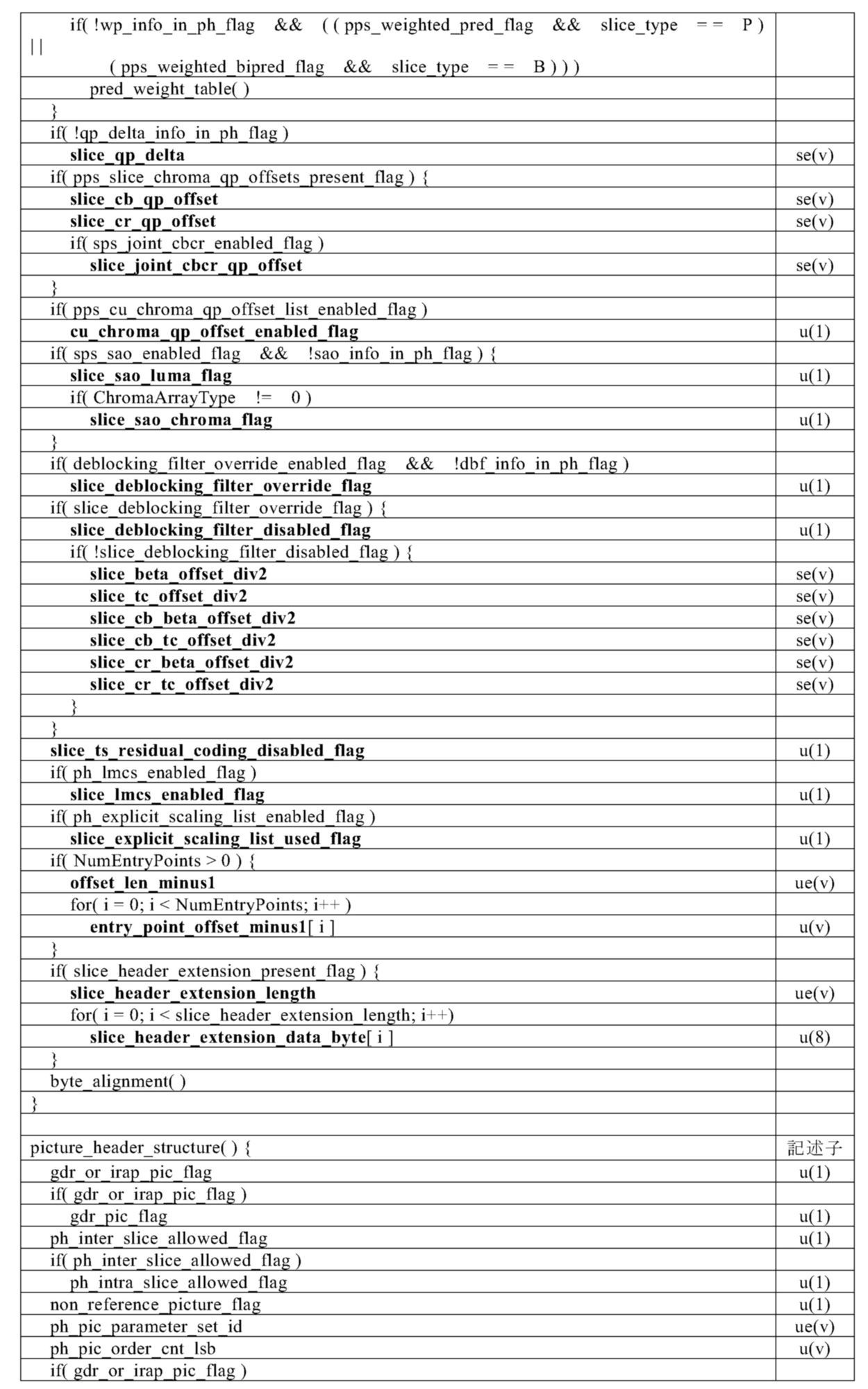


選択された構文要素のセマンティック
ph_temporal_mvp_enabled_flagは、PHに関連付けられたスライスのインター予測に時間動きベクトル予測子が使用されることが可能か否かを特定する。ph_temporal_mvp_enabled_flagが0に等しい場合、PHに関連付けられたスライスの構文要素は、スライスの復号時に時間動きベクトル予測子が使用されないように制約されるものとする。そうでない場合(ph_temporal_mvp_enabled_flagが1に等しい場合)、PHに関連付けられたスライスの復号時に時間動きベクトル予測子が使用され得る。ph_temporal_mvp_enabled_flagの値は、存在しない場合には、0に等しいと推測される。現在のピクチャと同じ空間解像度を有する参照ピクチャが復号ピクチャバッファ(DPB:Decoded Picture Buffer)にない場合、ph_temporal_mvp_enabled_flagの値は0に等しいものとする。
The semantic ph_temporal_mvp_enabled_flag of the selected syntax element specifies whether the temporal motion vector predictor can be used for inter-prediction of the slice associated with PH. If ph_temporal_mvp_enabled_flag is equal to 0, the slice syntax elements associated with PH shall be constrained such that the temporal motion vector predictor is not used when decoding the slice. Otherwise (ph_temporal_mvp_enabled_flag equal to 1), the temporal motion vector predictor may be used when decoding the slice associated with PH. The value of ph_temporal_mvp_enabled_flag is assumed to be equal to 0 if absent. The value of ph_temporal_mvp_enabled_flag shall be equal to 0 if there is no reference picture with the same spatial resolution as the current picture in the Decoded Picture Buffer (DPB).
サブブロックベースのマージMVP候補の最大数MaxNumSubblockMergeCandは、次のように導出される。
if(sps_affine_enabled_flag)
MaxNumSubblockMergeCand=5-five_minus_max_num_subblock_merge_cand
else
MaxNumSubblockMergeCand=sps_sbtmvp_enabled_flag&&ph_temporal_mvp_enabled_flag;
ここで、MaxNumSubblockMergeCandの値は0から5までの範囲内(両端含む)であるものとする。
The maximum number of subblock-based merge MVP candidates MaxNumSubblockMergeCand is derived as follows.
if (sps_affine_enabled_flag)
MaxNumSubblockMergeCand=5-five_minus_max_num_subblock_merge_cand
else
MaxNumSubblockMergeCand=sps_sbtmvp_enabled_flag &&ph_temporal_mvp_enabled_flag;
Here, it is assumed that the value of MaxNumSubblockMergeCand is within the range of 0 to 5 (both ends included).
1に等しいslice_collocated_from_l0_flagは、時間動きベクトル予測に使用される並置されたピクチャ(collocated picture)が参照ピクチャリスト0から導出されることを特定する。 0に等しいslice_collocated_from_l0_flagは、時間動きベクトル予測に使用される並置されたピクチャが参照ピクチャリスト1から導出されることを特定する。 slice_collocated_from_l0_flag equal to 1 specifies that the collocated pictures used for temporal motion vector prediction are derived from reference picture list 0. slice_collocated_from_l0_flag equal to 0 specifies that collocated pictures used for temporal motion vector prediction are derived from reference picture list 1;
slice_typeがBまたはPに等しく、ph_temporal_mvp_enabled_flagが1に等しく、slice_collocated_from_l0_flagが存在しない場合、以下が適用される。
- rpl_info_in_ph_flagが1に等しい場合、slice_collocated_from_l0_flagはph_collocated_from_l0_flagに等しいと推測される。
- そうでない場合(rpl_info_in_ph_flagが0に等しく、slice_typeがPに等しい場合)、slice_collocated_from_l0_flagの値は1に等しいと推測される。
If slice_type equals B or P, ph_temporal_mvp_enabled_flag equals 1, and slice_collocated_from_l0_flag is not present, the following applies.
- If rpl_info_in_ph_flag is equal to 1, slice_collocated_from_l0_flag is inferred to be equal to ph_collocated_from_l0_flag.
- otherwise (rpl_info_in_ph_flag equals 0 and slice_type equals P), the value of slice_collocated_from_l0_flag is assumed to be equal to 1;
slice_collocated_ref_idxは、時間動きベクトル予測に使用される並置されたピクチャの参照インデックスを特定する。 slice_collocated_ref_idx identifies the reference indices of collocated pictures used for temporal motion vector prediction.
slice_typeがPに等しい場合、またはslice_typeがBに等しく、slice_collocated_from_l0_flagが1に等しい場合、slice_collocated_ref_idxは参照ピクチャリスト0のエントリを参照し、slice_collocated_ref_idxの値は0からNumRefIdxActive[0]-1までの範囲内(両端含む)であるものとする。 If slice_type equals P, or if slice_type equals B and slice_collocated_from_l0_flag equals 1, then slice_collocated_ref_idx refers to an entry in reference picture list 0, and the value of slice_collocated_ref_idx is from 0 to NumRefIdxActive[range 0]-1 including both ends).
slice_typeがBに等しく、slice_collocated_from_l0_flagが0に等しい場合、slice_collocated_ref_idxは参照ピクチャリスト1のエントリを参照し、slice_collocated_ref_idxの値は0からNumRefIdxActive[1]-1までの範囲内(両端含む)であるものとする。 If slice_type equals B and slice_collocated_from_l0_flag equals 0, slice_collocated_ref_idx shall refer to an entry in Reference Picture List 1, and the value of slice_collocated_ref_idx shall be in the range 0 to NumRefIdxActive[1]-1, inclusive. .
slice_collocated_ref_idxが存在しない場合、以下が適用される。
- rpl_info_in_ph_flagが1に等しい場合、slice_collocated_ref_idxの値はph_collocated_ref_idxに等しいと推測される。
- そうでない場合(rpl_info_in_ph_flagが0に等しい場合)、slice_collocated_ref_idxの値は0に等しいと推測される。
If slice_collocated_ref_idx does not exist, the following applies.
- If rpl_info_in_ph_flag is equal to 1, the value of slice_collocated_ref_idx is inferred to be equal to ph_collocated_ref_idx.
- Otherwise (rpl_info_in_ph_flag is equal to 0), the value of slice_collocated_ref_idx is assumed to be equal to 0.
slice_collocated_ref_idxによって参照されるピクチャが、符号化されたピクチャの全てのスライスで同じでなければならないことは、ビットストリーム準拠の要件である。 It is a bitstream compliant requirement that the picture referenced by slice_collocated_ref_idx must be the same for all slices of a coded picture.
slice_collocated_ref_idxによって参照される参照ピクチャのpic_width_in_luma_samplesおよびpic_height_in_luma_samplesの値が現在のピクチャのpic_width_in_luma_samplesおよびpic_height_in_luma_samplesの値にそれぞれ等しくなければならないこと、およびRprConstraintsActive[slice_collocated_from_l0_flag?0:1][slice_collocated_ref_idx]が0に等しくなければならないことは、ビットストリーム準拠の要件である。 slice_collocated_ref_idxによって参照される参照ピクチャのpic_width_in_luma_samplesおよびpic_height_in_luma_samplesの値が現在のピクチャのpic_width_in_luma_samplesおよびpic_height_in_luma_samplesの値にそれぞれ等しくなければならないこと、およびRprConstraintsActive[slice_collocated_from_l0_flag? 0:1][slice_collocated_ref_idx] must equal 0 is a bitstream-compliant requirement.
RprConstraintsActive[i][j]の値は、VVC仕様のセクション8.3.2で導出される。RprConstraintsActive[i][j]の値の導出については、以下で説明される。 The values for RprConstraintsActive[i][j] are derived in section 8.3.2 of the VVC specification. Derivation of the value of RprConstraintsActive[i][j] is described below.
参照ピクチャリスト構築のための復号処理
参照ピクチャリスト構築のための復号処理は、非IDRピクチャの各スライスの復号処理の開始時に呼び出される。
Decode Process for Reference Picture List Construction The Decode Process for Reference Picture List Construction is invoked at the start of the decoding process for each slice of a non-IDR picture.
参照ピクチャは、参照インデックスによってアドレス特定される。参照インデックスは、参照ピクチャリストへのインデックスである。Iスライスを復号する場合、参照ピクチャリストはスライスデータの復号時に使用されない。Pスライスを復号する場合、参照ピクチャリスト0(すなわち、RefPicList[0])のみがスライスデータの復号時に使用される。Bスライスを復号する場合、参照ピクチャリスト0および参照ピクチャリスト1(すなわち、RefPicList[1])の両方がスライスデータの復号時に使用される。 A reference picture is addressed by a reference index. A reference index is an index into a reference picture list. When decoding I slices, the reference picture list is not used when decoding slice data. When decoding P slices, only reference picture list 0 (ie, RefPicList[0]) is used when decoding slice data. When decoding a B slice, both Reference Picture List 0 and Reference Picture List 1 (ie, RefPicList[1]) are used when decoding slice data.
非IDRピクチャの各スライスの復号処理の開始時に、参照ピクチャリストRefPicList[0]およびRefPicList[1]が導出される。参照ピクチャリストは、ビデオ符号化規格で特定されたように参照ピクチャにマークする際に、またはスライスデータを復号する際に使用される。 At the start of the decoding process for each slice of a non-IDR picture, reference picture lists RefPicList[0] and RefPicList[1] are derived. The reference picture list is used in marking reference pictures as specified in video coding standards or in decoding slice data.
ピクチャの最初のスライスではない非IDRピクチャのIスライスの場合、RefPicList[0]およびRefPicList[1]がビットストリーム準拠チェックの目的で導出され得るが、それらの導出は現在のピクチャまたは復号順で現在のピクチャより後のピクチャの復号には必要ない。ピクチャの最初のスライスではないPスライスの場合、RefPicList[1]がビットストリーム準拠チェックの目的で導出され得るが、その導出は現在のピクチャまたは復号順で現在のピクチャより後のピクチャの復号には必要ない。 For I-slices of non-IDR pictures that are not the first slice of the picture, RefPicList[0] and RefPicList[1] may be derived for the purpose of bitstream conformance checking, but their derivation is current in the current picture or decoding order. It is not required to decode pictures after the picture of . For P slices that are not the first slice of a picture, RefPicList[1] may be derived for the purpose of bitstream conformance checking, but the derivation is not for decoding the current picture or pictures later than the current picture in decoding order. unnecessary.
参照ピクチャリストRefPicList[0]およびRefPicList[1]、参照ピクチャ・スケーリング比RefPicScale[i][j][0]およびRefPicScale[i][j][1]、ならびに参照ピクチャスケーリングフラグRprConstraintsActive[0][j]およびRprConstraintsActive[1][j]は次のように導出される。

scaling_win_left_offset、scaling_win_right_offset、scaling_win_top_offset、およびscaling_win_bottom_offsetは、スケーリング比計算のためにピクチャサイズに適用されるオフセットを特定する。scaling_win_left_offset、scaling_win_right_offset、scaling_win_top_offset、およびscaling_win_bottom_offsetの値は、存在しない場合には、それぞれpps_conf_win_left_offset、pps_conf_win_right_offset、pps_conf_win_top_offset、およびpps_conf_win_bottom_offsetに等しいと推測される。 scaling_win_left_offset, scaling_win_right_offset, scaling_win_top_offset, and scaling_win_bottom_offset specify the offsets applied to the picture size for scaling ratio calculation. scaling_win_left_offset、scaling_win_right_offset、scaling_win_top_offset、およびscaling_win_bottom_offsetの値は、存在しない場合には、それぞれpps_conf_win_left_offset、pps_conf_win_right_offset、pps_conf_win_top_offset、およびpps_conf_win_bottom_offsetに等しいと推測される。
SubWidthC*(scaling_win_left_offset+scaling_win_right_offset)の値はpic_width_in_luma_samples未満であるものとし、SubHeightC*(scaling_win_top_offset+scaling_win_bottom_offset)の値はpic_height_in_luma_samples未満であるものとする。 SubWidthC*(scaling_win_left_offset+scaling_win_right_offset)の値はpic_width_in_luma_samples未満であるものとし、SubHeightC*(scaling_win_top_offset+scaling_win_bottom_offset)の値はpic_height_in_luma_samples未満であるものとする。
変数PicOutputWidthLおよびPicOutputHeightLは次のように導出される。
PicOutputWidthL=pic_width_in_luma_samples-SubWidthC*(scaling_win_right_offset+scaling_win_left_offset)
PicOutputHeightL=pic_height_in_luma_samples-SubWidthC*(scaling_win_bottom_offset+scaling_win_top_offset)
The variables PicOutputWidthL and PicOutputHeightL are derived as follows.
PicOutputWidthL = pic_width_in_luma_samples - SubWidthC * (scaling_win_right_offset + scaling_win_left_offset)
PicOutputHeightL = pic_height_in_luma_samples - SubWidthC * (scaling_win_bottom_offset + scaling_win_top_offset)
refPicOutputWidthLおよびrefPicOutputHeightLを、それぞれ、このPPSを参照する現在のピクチャの参照ピクチャのPicOutputWidthLおよびPicOutputHeightLとする。以下の全ての条件が満たされることは、ビットストリーム準拠の要件である。
- PicOutputWidthL*2は、refPicWidthInLumaSamples以上であるものとする。
- PicOutputHeightL*2は、refPicHeightInLumaSamples以上であるものとする。
- PicOutputWidthLは、refPicWidthInLumaSamples*8以下であるものとする。
- PicOutputHeightLは、refPicHeightInLumaSamples*8以下であるものとする。
- PicOutputWidthL*pic_width_max_in_luma_samplesは、refPicOutputWidthL*(pic_width_in_luma_samples-Max(8,MinCbSizeY))以上であるものとする。
- PicOutputHeightL*pic_height_max_in_luma_samplesは、refPicOutputHeightL*(pic_height_in_luma_samples-Max(8,MinCbSizeY))以上であるものとする。
Let refPicOutputWidthL and refPicOutputHeightL be the reference picture PicOutputWidthL and PicOutputHeightL, respectively, of the current picture that references this PPS. It is a bitstream compliant requirement that all of the following conditions are met.
- PicOutputWidthL*2 shall be greater than or equal to refPicWidthInLumaSamples.
- PicOutputHeightL*2 shall be greater than or equal to refPicHeightInLumaSamples.
- PicOutputWidthL shall be less than or equal to refPicWidthInLumaSamples*8.
- PicOutputHeightL shall be less than or equal to refPicHeightInLumaSamples*8.
- PicOutputWidthL*pic_width_max_in_luma_samples shall be greater than or equal to refPicOutputWidthL*(pic_width_in_luma_samples-Max(8, MinCbSizeY)).
- PicOutputHeightL*pic_height_max_in_luma_samples shall be greater than or equal to refPicOutputHeightL*(pic_height_in_luma_samples-Max(8, MinCbSizeY)).
現在のVVCでは、mvd_l1_zero_flagは条件付き制約なしにPHでシグナリングされる。しかしながら、フラグmvd_l1_zero_flagによって制御される機能は、スライスが双予測スライス(Bスライス:bi-predictive slice)の場合にのみ適用可能である。したがって、ピクチャヘッダに関連付けられたスライスがBスライスでない場合、フラグのシグナリングは冗長である。 In current VVC, mvd_l1_zero_flag is signaled in PH without conditional constraints. However, the functionality controlled by the flag mvd_l1_zero_flag is only applicable if the slice is a bi-predictive slice (B slice). Therefore, if the slice associated with the picture header is not a B slice, the signaling of the flag is redundant.
他の例では、ph_disable_bdof_flagおよびph_disable_dmvr_flagは、それぞれ、シーケンスパラメータセット(SPS)でシグナリングされる対応する有効化フラグ(sps_bdof_pic_present_flag、sps_dmvr_pic_present_flag)が真の場合にのみ、PHでシグナリングされる。しかしながら、以下の表2に示されるように、フラグph_disable_bdof_flagおよびph_disable_dmvr_flagによって制御される機能は、スライスが双予測スライス(Bスライス)である場合にのみ適用可能である。したがって、ピクチャヘッダに関連付けられたスライスがBスライスでない場合、これら2つのフラグのシグナリングは冗長または無用である。

第3の課題は、構文ph_temporal_mvp_enabled_flagに関連している。現在のVVCでは、時間動きベクトル予測(TMVP:temporal motion vector prediction)導出のために選択された並置されたピクチャの解像度は現在のピクチャの解像度と同じでなければならないので、以下に説明されるように、ph_temporal_mvp_enabled_flagの値をチェックするビットストリーム準拠制約が存在する。現在のピクチャと同じ空間解像度を有する参照ピクチャがDPB内にない場合、ph_temporal_mvp_enabled_flagの値は0に等しいものとする。 A third issue is related to the syntax ph_temporal_mvp_enabled_flag. In current VVC, the resolution of the co-located pictures selected for temporal motion vector prediction (TMVP) derivation must be the same as the resolution of the current picture, so as explained below: , there is a bitstream conformance constraint that checks the value of ph_temporal_mvp_enabled_flag. The value of ph_temporal_mvp_enabled_flag shall be equal to 0 if there is no reference picture in the DPB with the same spatial resolution as the current picture.
しかしながら、現在のVVCでは、並置されたピクチャの解像度がTMVPの有効化に影響するだけでなく、スケーリング比計算のためにピクチャサイズに適用されるオフセットもTMVPの有効化に影響する。しかしながら、現在のVVCでは、オフセットはph_temporal_mvp_enabled_flagのビットストリーム準拠において考慮されていない。 However, in current VVC, not only the resolution of the co-located pictures affects TMVP activation, but also the offset applied to the picture size for scaling ratio calculation affects TMVP activation. However, in current VVC, offset is not considered in bitstream compliance of ph_temporal_mvp_enabled_flag.
さらに、slice_collocated_ref_idxによって参照されるピクチャが、符号化されたピクチャの全てのスライスで同じでなければならないというビットストリーム準拠の要件が存在する。しかしながら、符号化されたピクチャが複数のスライスを有し、これら全てのスライスに共通の参照ピクチャが存在しない場合、このビットストリーム準拠は満たされる機会を有さない。また、そのような場合、ph_temporal_mvp_enabled_flagは0に制約される必要がある。 Additionally, there is a bitstream-compliant requirement that the picture referenced by slice_collocated_ref_idx must be the same for all slices of a coded picture. However, if the coded picture has multiple slices and there is no common reference picture for all these slices, this bitstream compliance has no chance of being met. Also, in such cases, the ph_temporal_mvp_enabled_flag should be constrained to 0.
上記の課題に対処するために、いくつかの方法が提案される。提案された方法は、独立してまたは組み合わせて適用されることが可能であるということに留意されたい。 Several methods are proposed to address the above issues. Note that the proposed methods can be applied independently or in combination.
フラグmvd_l1_zero_flag、ph_disable_bdof_flagおよびph_disable_dmvr_flagによって制御される機能は、スライスが双予測スライス(Bスライス)である場合にのみ適用可能であるので、本開示の方法によれば、関連付けられたスライスがBスライスである場合にのみこれらのフラグをシグナリングすることが提案される。参照ピクチャリストがPHでシグナリングされる場合(例えば、rpl_info_in_ph_flag=1)、これは符号化されたピクチャの全てのスライスがPHでシグナリングされる同じ参照ピクチャを使用することを意味するということに留意されたい。したがって、参照ピクチャリストがPHでシグナリングされ、現在のピクチャが双予測でないことをシグナリングされた参照ピクチャリストが示す場合、フラグmvd_l1_zero_flag、ph_disable_bdof_flag、およびph_disable_dmvr_flagはシグナリングされる必要はない。 The functions controlled by the flags mvd_l1_zero_flag, ph_disable_bdof_flag and ph_disable_dmvr_flag are applicable only if the slice is a bi-predictive slice (B slice), so according to the method of the present disclosure the associated slice is a B slice. It is proposed to signal these flags only if Note that if the reference picture list is signaled in PH (eg, rpl_info_in_ph_flag=1), this means that all slices of a coded picture use the same reference picture signaled in PH. sea bream. Therefore, the flags mvd_l1_zero_flag, ph_disable_bdof_flag, and ph_disable_dmvr_flag need not be signaled if the reference picture list is signaled in PH and the signaled reference picture list indicates that the current picture is not bi-predictive.
いくつかの例では、ピクチャヘッダ内の構文の一部について送られた不適切な値による冗長なシグナリングまたは未定義の復号動作を防止するために、PHで設定される構文にいくつかの条件が追加される。いくつかの例が以下に示されており、ここで、変数num_ref_entries[i][RplsIdx[i]]はリストi内の参照ピクチャの数を表す。
If(rpl_info_in_ph_flag&&num_ref_entries[0][RplsIdx[0]]>1&&num_ref_entries[1][RplsIdx[1]]>1)
mvd_l1_zero_flag;
If(sps_bdof_pic_present_flag&&rpl_info_in_ph_flag&&num_ref_entries[0][RplsIdx[0]]>1&&num_ref_entries[1][RplsIdx[1]]>1)
ph_disable_bdof_flag
In some examples, there are some conditions on the syntax set in the PH to prevent redundant signaling or undefined decoding behavior due to inappropriate values sent for parts of the syntax in the picture header. Added. Some examples are given below, where the variable num_ref_entries[i][RplsIdx[i]] represents the number of reference pictures in list i.
If (rpl_info_in_ph_flag && num_ref_entries[0] [RplsIdx[0]]>1 && num_ref_entries[1] [RplsIdx[1]]>1)
mvd_l1_zero_flag;
If (sps_bdof_pic_present_flag && rpl_info_in_ph_flag && num_ref_entries[0] [RplsIdx[0]]>1 && num_ref_entries[1] [RplsIdx[1]]>1)
ph_disable_bdof_flag
現在のVVCでは、並置されたピクチャの解像度がTMVPの有効化に影響を与え得るだけでなく、スケーリング比計算のためにピクチャサイズに適用されるオフセットもTMVPの有効化に影響を与え得る。しかしながら、現在のVVCでは、オフセットはph_temporal_mvp_enabled_flagのビットストリーム準拠において考慮されていない。いくつかの例では、以下に説明されるように、ph_temporal_mvp_enabled_flagの値がスケーリング比計算のためにピクチャサイズに適用されるオフセットに依存しなければならないことを要求するビットストリーム準拠制約を現在のVVCに追加することが提案される。空間解像度と、スケーリング比計算のためにピクチャサイズに適用されるオフセットとが現在のピクチャと同じである参照ピクチャがDPB内にない場合、ph_temporal_mvp_enabled_flagの値は0に等しいものとする。 In current VVC, not only the resolution of the juxtaposed pictures can affect the activation of TMVP, but also the offset applied to the picture size for scaling ratio calculation can affect the activation of TMVP. However, in current VVC, offset is not considered in bitstream compliance of ph_temporal_mvp_enabled_flag. In some examples, current VVCs have a bitstream compliance constraint that requires that the value of ph_temporal_mvp_enabled_flag must depend on the offset applied to the picture size for scaling ratio calculations, as described below. Suggested to add. The value of ph_temporal_mvp_enabled_flag shall be equal to 0 if there is no reference picture in the DPB with the same spatial resolution and offset applied to the picture size for scaling ratio calculation as the current picture.
上記のビットストリーム準拠制約は、次のように他の方法で記述されることも可能である。関連付けられた変数値RprConstraintsActive[i][j]が0に等しい参照ピクチャがDPB内にない場合、ph_temporal_mvp_enabled_flagの値は0に等しいものとする。 The above bitstream conformance constraints can also be written in other ways as follows. The value of ph_temporal_mvp_enabled_flag shall be equal to 0 if there is no reference picture in the DPB with the associated variable value RprConstraintsActive[i][j] equal to 0.
現在のVVCでは、slice_collocated_ref_idxによって参照されるピクチャが、符号化されたピクチャの全てのスライスで同じでなければならないというビットストリーム準拠の要件が存在する。しかしながら、符号化されたピクチャが複数のスライスを有し、これら全てのスライスに共通の参照ピクチャが存在しない場合、このビットストリーム準拠は満たされる機会を有さない。 In current VVC, there is a bitstream-compliant requirement that the picture referenced by slice_collocated_ref_idx must be the same for all slices of a coded picture. However, if the coded picture has multiple slices and there is no common reference picture for all these slices, this bitstream compliance has no chance of being met.
いくつかの例では、ph_temporal_mvp_enabled_flagに関するビットストリーム準拠の要件は、現在のピクチャの全てのスライスに共通の参照ピクチャが存在するか否かを考慮するように変更される。 In some examples, the bitstream compliance requirement for ph_temporal_mvp_enabled_flag is modified to consider whether there is a common reference picture for all slices of the current picture.
ph_temporal_mvp_enabled_flagは、PHに関連付けられたスライスのインター予測に時間動きベクトル予測子が使用されることが可能か否かを特定する。ph_temporal_mvp_enabled_flagが0に等しい場合、PHに関連付けられたスライスの構文要素は、スライスの復号時に時間動きベクトル予測子が使用されないように制約されるものとする。そうでない場合(ph_temporal_mvp_enabled_flagが1に等しい場合)、PHに関連付けられたスライスの復号時に時間動きベクトル予測子が使用され得る。ph_temporal_mvp_enabled_flagの値は、存在しない場合には、0に等しいと推測される。現在のピクチャと同じ空間解像度を有する参照ピクチャがDPB内にない場合、ph_temporal_mvp_enabled_flagの値は0に等しいものとする。PHに関連付けられた全てのスライスに共通の参照ピクチャが存在しない場合、ph_temporal_mvp_enabled_flagの値は0に等しいものとする。 ph_temporal_mvp_enabled_flag specifies whether the temporal motion vector predictor can be used for inter-prediction of slices associated with the PH. If ph_temporal_mvp_enabled_flag is equal to 0, the slice syntax elements associated with PH shall be constrained such that the temporal motion vector predictor is not used when decoding the slice. Otherwise (ph_temporal_mvp_enabled_flag equal to 1), the temporal motion vector predictor may be used when decoding the slice associated with PH. The value of ph_temporal_mvp_enabled_flag is assumed to be equal to 0 if absent. The value of ph_temporal_mvp_enabled_flag shall be equal to 0 if there is no reference picture in the DPB with the same spatial resolution as the current picture. The value of ph_temporal_mvp_enabled_flag shall be equal to 0 if there is no common reference picture for all slices associated with the PH.
いくつかの例では、slice_collocated_ref_idxに関するビットストリーム準拠は、RprConstraintsActive[slice_collocated_from_l0_flag?0:1][slice_collocated_ref_idx]が0に等しくなければならないことがビットストリーム準拠の要件であるように簡略化される。 In some examples, the bitstream compliance for slice_collocated_ref_idx is RprConstraintsActive[slice_collocated_from_l0_flag? 0:1][slice_collocated_ref_idx] must equal 0 is simplified to be a bitstream-compliant requirement.
図5は、本開示のいくつかの実装によるビデオ符号化のための例示的な装置を示すブロック図である。装置500は、例えば、携帯電話、タブレットコンピュータ、デジタル放送端末、タブレットデバイス、またはパーソナルデジタルアシスタントなどの端末であり得る。
FIG. 5 is a block diagram illustrating an exemplary apparatus for video encoding according to some implementations of this disclosure. The
図5に示されるように、装置500は以下のコンポーネント、すなわち、処理コンポーネント502、メモリ504、電源コンポーネント506、マルチメディアコンポーネント508、オーディオコンポーネント510、入力/出力(I/O)インターフェース512、センサコンポーネント514、および通信コンポーネント516のうちの1つまたは複数を含み得る。
As shown in FIG. 5,
処理コンポーネント502は通常、例えば、表示、電話、データ通信、カメラ動作、および記録動作に関連する動作など、装置500の全体的な動作を制御する。処理コンポーネント502は、上記の方法のステップの全てまたは一部を完了する命令を実行するための1つまたは複数のプロセッサ520を含み得る。さらに、処理コンポーネント502は、処理コンポーネント502および他のコンポーネントの間のやりとりを容易にするための1つまたは複数のモジュールを含み得る。例えば、処理コンポーネント502は、マルチメディアコンポーネント508および処理コンポーネント502の間のやりとりを容易にするためのマルチメディアモジュールを含み得る。
メモリ504は、装置500の動作をサポートするために様々なタイプのデータを記憶するように構成される。そのようなデータの例は、装置500上で動作する任意のアプリケーションまたは方法のための命令、連絡先データ、電話帳データ、メッセージ、写真、ビデオなどを含む。メモリ504は、任意のタイプの揮発性もしくは不揮発性記憶デバイスまたはそれらの組み合わせによって実装され得、メモリ504は、スタティック・ランダム・アクセス・メモリ(SRAM)、電気的消去可能プログラム可能読み取り専用メモリ(EEPROM)、消去可能プログラム可能読み取り専用メモリ(EPROM)、プログラム可能読み取り専用メモリ(PROM)、読み取り専用メモリ(ROM)、磁気メモリ、フラッシュメモリ、磁気ディスクまたはコンパクトディスクであり得る。
電源コンポーネント506は、装置500の様々なコンポーネントに電力を供給する。電源コンポーネント506は、電源管理システムと、1つまたは複数の電源と、装置500のための電力の生成、管理、および配電に関連する他のコンポーネントとを含み得る。
マルチメディアコンポーネント508は、装置500とユーザとの間に出力インターフェースを提供する画面を含む。いくつかの例では、画面は、液晶ディスプレイ(LCD)およびタッチパネル(TP)を含み得る。画面がタッチパネルを含む場合、画面は、ユーザからの入力信号を受け取るタッチスクリーンとして実装され得る。タッチパネルは、タッチパネル上のタッチ、スライド、およびジェスチャを感知するための1つまたは複数のタッチセンサを含み得る。タッチセンサは、タッチまたはスライド操作の境界を感知するだけでなく、タッチまたはスライド操作に関連する持続時間および圧力も検出し得る。いくつかの例では、マルチメディアコンポーネント508は、フロントカメラおよび/またはリアカメラを含み得る。装置500が撮影モードまたはビデオモードなどの動作モードにある場合、フロントカメラおよび/またはリアカメラは、外部マルチメディアデータを受け取り得る。
オーディオコンポーネント510は、オーディオ信号を出力および/または入力するように構成される。例えば、オーディオコンポーネント510は、マイクロフォン(MIC)を含む。装置500が通話モード、録音モード、および音声認識モードなどの動作モードにある場合、マイクロフォンは外部オーディオ信号を受け取るように構成される。受け取られた音声信号は、さらにメモリ504に記憶されるか、または通信コンポーネント516を介して送信され得る。いくつかの例では、オーディオコンポーネント510は、オーディオ信号を出力するためのスピーカーをさらに含む。
I/Oインターフェース512は、処理コンポーネント502と周辺インターフェースモジュールとの間のインターフェースを提供する。上記の周辺インターフェースモジュールは、キーボード、クリック・ホイール、ボタンなどであり得る。これらのボタンは、ホームボタン、音量ボタン、スタートボタン、およびロックボタンを含み得るが、これらに限定されない。
I/
センサコンポーネント514は、装置500の異なる態様での状態評価を提供するための1つまたは複数のセンサを含む。例えば、センサコンポーネント514は、装置500のオン/オフ状態およびコンポーネントの相対的な位置を検出し得る。例えば、コンポーネントは、装置500のディスプレイおよびキーパッドである。センサコンポーネント514は、装置500または装置500のコンポーネントの位置変化、装置500へのユーザの接触の有無、装置500の向きまたは加速/減速、および装置500の温度変化も検出し得る。センサコンポーネント514は、物理的な接触なしに近くの物体の存在を検出するように構成される近接センサを含み得る。センサコンポーネント514は、撮像用途で使用されるCMOSまたはCCDイメージ・センサなどの光学センサをさらに含み得る。いくつかの例では、センサコンポーネント514は、加速度センサ、ジャイロスコープセンサ、磁気センサ、圧力センサ、または温度センサをさらに含み得る。
通信コンポーネント516は、装置500と他のデバイスとの間の有線または無線通信を容易にするように構成される。装置500は、例えば、WiFi、4G、またはそれらの組み合わせなどの通信規格に基づいて無線ネットワークにアクセスし得る。一例では、通信コンポーネント516は、ブロードキャスト・チャネルを介して外部ブロードキャスト管理システムからブロードキャスト信号またはブロードキャスト関連情報を受信する。一例では、通信コンポーネント516は、短距離通信を促進するための近距離無線通信(NFC:Near Field Communication)モジュールをさらに含み得る。例えば、NFCモジュールは、無線周波数識別(RFID:Radio Frequency Identification)技術、赤外線データ協会(IrDA:infrared data association)技術、ウルトラ・ワイド・バンド(UWB)技術、Bluetooth(BT)技術、および他の技術に基づいて実装され得る。
一例では、装置500は、特定用途向け集積回路(ASIC)、デジタル・シグナル・プロセッサ(DSP)、デジタル信号処理デバイス(DSPD:Digital Signal Processing Device)、プログラマブル・ロジック・デバイス(PLD)、フィールド・プログラマブル・ゲート・アレイ(FPGA)、コントローラ、マイクロコントローラ、マイクロプロセッサ、または上記の方法を実行するための他の電子素子のうちの1つまたは複数によって実装され得る。
In one example,
非一時的コンピュータ可読記憶媒体は、例えば、ハード・ディスク・ドライブ(HDD)、ソリッド・ステート・ドライブ(SSD)、フラッシュメモリ、ハイブリッド・ドライブまたはソリッド・ステート・ハイブリッド・ドライブ(SSHD)、読み取り専用メモリ(ROM)、コンパクトディスク読み取り専用メモリ(CD-ROM)、磁気テープ、フロッピー・ディスクなどであり得る。 Non-transitory computer readable storage media are, for example, hard disk drives (HDD), solid state drives (SSD), flash memory, hybrid drives or solid state hybrid drives (SSHD), read-only memory (ROM), compact disk read only memory (CD-ROM), magnetic tape, floppy disk, and the like.
図6は、本開示のいくつかの実装によるビデオ符号化の例示的な処理を示すフローチャートである。 FIG. 6 is a flowchart illustrating an exemplary process of video encoding according to some implementations of this disclosure.
ステップ602において、プロセッサ520は、1つまたは複数の参照ピクチャリストがピクチャに関連付けられたPHでシグナリングされるか否か、およびピクチャに関連付けられた1つまたは複数のスライスが双予測であることを1つまたは複数の参照ピクチャリストが示すか否かを決定する。
At
ステップ604において、プロセッサ620は、1つまたは複数の参照ピクチャリストがPHでシグナリングされ、1つまたは複数のスライスが双予測でないことを1つまたは複数の参照ピクチャリストが示すと決定したことに応答して、1つまたは複数の制約をPHの1つまたは複数の構文要素に追加する。
At
いくつかの例では、1つまたは複数の制約は、1つまたは複数の構文要素の解析をスキップすることを含む。 In some examples, the one or more constraints include skipping parsing of one or more syntactic elements.
いくつかの例では、1つまたは複数の構文要素は、1つまたは複数のスライスに適用可能な1つまたは複数のフラグを含む。 In some examples, one or more syntax elements include one or more flags applicable to one or more slices.
プロセッサ520はさらに、対応する動きベクトル差分(MVD)符号化構文構造が解析されないか否か、およびPHに関連付けられた1つまたは複数のスライスについて2つの変数がゼロに設定されるか否かを特定するために、上述のmvd_l1_zero_flagなどの有効化フラグを使用し得、ここで、2つの変数はそれぞれ、リストベクトル成分と、リストベクトル成分に対応する予測との差を特定する。
いくつかの例では、mvd_l1_zero_flagが1に等しいことは、mvd_coding(x0,y0,1)構文構造が解析されず、compIdx=0または1、およびcpIdx=0、1、または2について、MvdL1[x0][y0][compIdx]およびMvdCpL1[x0][y0][cpIdx][compIdx]が0に等しく設定されることを示す。さらに、mvd_l1_zero_flagが0に等しいことは、mvd_coding(x0,y0,1)構文構造が解析されることを示す。mvd_coding(x0,y0,1)構文構造は、対応するMVD符号化構文構造である。配列インデックスx0、y0は、ピクチャの左上のルマサンプルに対する検討中の符号化ブロックの左上のルマサンプルの位置(x0,y0)を特定する。 In some examples, mvd_l1_zero_flag equal to 1 means that the mvd_coding(x0,y0,1) syntactic structure is not parsed and MvdL1[x0] for compIdx=0 or 1 and cpIdx=0, 1, or 2. Indicates that [y0][compIdx] and MvdCpL1[x0][y0][cpIdx][compIdx] are set equal to zero. Additionally, mvd_l1_zero_flag equal to 0 indicates that the mvd_coding (x0, y0, 1) syntactic structure is parsed. The mvd_coding(x0,y0,1) syntax structure is the corresponding MVD encoding syntax structure. The array index x0,y0 specifies the position (x0,y0) of the upper left luma sample of the coded block under consideration relative to the upper left luma sample of the picture.
さらに、Xが0または1である変数MvdLX[x0][y0][compIdx]は、使用されるリストXベクトル成分と、その予測との差を特定する。配列インデックスx0、y0は、ピクチャの左上のルマサンプルに対する検討中の符号化ブロックの左上のルマサンプルの位置(x0,y0)を特定する。水平方向の動きベクトル成分差分にはcompIdx=0が割り当てられ、垂直方向の動きベクトル成分にはcompIdx=1が割り当てられる。 In addition, the variable MvdLX[x0][y0][compIdx], where X is 0 or 1, specifies the difference between the list X vector component used and its prediction. The array index x0,y0 specifies the position (x0,y0) of the upper left luma sample of the coded block under consideration relative to the upper left luma sample of the picture. A horizontal motion vector component difference is assigned compIdx=0, and a vertical motion vector component is assigned compIdx=1.
さらに、Xが0または1である変数MvdCpLX[x0][y0][cpIdx][compIdx]は、使用されるリストXベクトル成分と、その予測との差を特定する。配列インデックスx0、y0は、ピクチャの左上のルマサンプルに対する検討中の符号化ブロックの左上のルマサンプルの位置(x0,y0)を特定する。配列インデックスcpIdxは、コントロール・ポイントのインデックスを特定する。水平方向の動きベクトル成分差分にはcompIdx=0が割り当てられ、垂直方向の動きベクトル成分にはcompIdx=1が割り当てられる。 In addition, the variable MvdCpLX[x0][y0][cpIdx][compIdx], where X is 0 or 1, specifies the difference between the list X vector component used and its prediction. The array index x0,y0 specifies the position (x0,y0) of the upper left luma sample of the coded block under consideration relative to the upper left luma sample of the picture. The array index cpIdx identifies the index of the control point. A horizontal motion vector component difference is assigned compIdx=0, and a vertical motion vector component is assigned compIdx=1.
プロセッサ520はさらに、有効化フラグが0に等しいと決定したことに応答して、1つまたは複数のスライスについてMVD符号化構文構造が解析されるように1つまたは複数の構文要素を制約し得る。
プロセッサ520はさらに、有効化フラグが1に等しいと決定したことに応答して、1つまたは複数のスライスを復号する際にMVD構文構造の解析をスキップすることを決定し得る。
プロセッサ520はさらに、PHに関連付けられた1つまたは複数のスライスについて双方向オプティカルフロー(BDOF:bi-directional optical flow)インター予測ベースのインター双予測が無効化されるか否かを特定するために、上述のph_disable_bdof_flagなどの無効化フラグを使用し、無効化フラグが0に等しいと決定したことに応答して、1つまたは複数のスライスを復号する際にBDOFインター予測ベースのインター双予測が有効化されるように1つまたは複数の構文要素を制約し、無効化フラグが1に等しいと決定したことに応答して、1つまたは複数のスライスを復号する際にBDOFインター予測ベースのインター双予測を無効化し得る。
プロセッサ520はさらに、PHに関連付けられた1つまたは複数のスライスについてデコーダ動きベクトル微調整(DMVR:decoder motion vector refinement)ベースのインター双予測が無効化されるか否かを特定するために、上述のph_disable_dmvr_flagなどの無効化フラグを使用し、無効化フラグが0に等しいと決定したことに応答して、1つまたは複数のスライスを復号する際にDMVRベースのインター双予測が有効化されるように1つまたは複数の構文要素を制約し、無効化フラグが1に等しいと決定したことに応答して、1つまたは複数のスライスを復号する際にDMVRベースのインター双予測を無効化し得る。
図7は、本開示のいくつかの実装によるビデオ符号化の例示的な処理を示すフローチャートである。 FIG. 7 is a flowchart illustrating an exemplary process of video encoding according to some implementations of this disclosure.
ステップ702において、プロセッサ520は、ピクチャのPHに関連付けられた1つまたは複数のスライスのインター予測に1つまたは複数の時間動きベクトル予測子が使用されるか否かを特定するために、有効化フラグを使用する。
At
ステップ704において、プロセッサ520は、スケーリング比計算のためにピクチャのサイズに適用される複数のオフセットに応じて有効化フラグの値を制約する。
At
プロセッサ520は、ピクチャと同じ空間解像度および同じオフセットを有する参照ピクチャがDPB内にないと決定したことに応答して、有効化フラグを0に設定し得る。さらに、オフセットは、スケーリング比計算のためにピクチャのサイズに適用され得る。
プロセッサ520は、1つまたは複数のスライスに共通の参照ピクチャがないと決定したことに応答して、有効化フラグを0に設定し得る。
プロセッサ520は、参照ピクチャスケーリングフラグが0に等しい参照ピクチャがDPB内にないと決定したことに応答して、有効化フラグを0に設定し得る。
プロセッサ520は、スケーリング比計算のためにピクチャのサイズに適用される複数のオフセットに基づいて参照ピクチャスケーリングフラグを導出し得る。
いくつかの例では、ビデオ符号化のための装置が提供される。この装置は、1つまたは複数のプロセッサ520と、1つまたは複数のプロセッサによって実行可能な命令を記憶するように構成されるメモリ504と、を含み、プロセッサは、命令の実行時に、図6に示される方法を実行するように構成される。
In some examples, an apparatus is provided for video encoding. The apparatus includes one or
いくつかの例では、ビデオ符号化のための装置が提供される。この装置は、1つまたは複数のプロセッサ520と、1つまたは複数のプロセッサによって実行可能な命令を記憶するように構成されるメモリ504と、を含み、プロセッサは、命令の実行時に、図7に示される方法を実行するように構成される。
In some examples, an apparatus is provided for video encoding. The apparatus includes one or
いくつかの他の例では、命令が記憶された非一時的コンピュータ可読記憶媒体504が提供される。命令が1つまたは複数のプロセッサ520によって実行された場合、命令はプロセッサに図6に示される方法を実行させる。
In some other examples, a non-transitory computer-
いくつかの他の例では、命令が記憶された非一時的コンピュータ可読記憶媒体504が提供される。命令が1つまたは複数のプロセッサ520によって実行された場合、命令はプロセッサに図7に示される方法を実行させる。
In some other examples, a non-transitory computer-
本開示の説明は例示の目的で提示されており、網羅的であることも、本開示に限定されることも意図されていない。前述の説明および関連する図面に提示された教示の利益を得る当業者には、多くの修正、変形、および代替の実装が明らかであろう。 The description of this disclosure has been presented for purposes of illustration, and is not intended to be exhaustive or limited to the disclosure. Many modifications, variations and alternative implementations will be apparent to one skilled in the art having the benefit of the teachings presented in the foregoing descriptions and the associated drawings.
本開示の原理を説明するために、また、他の当業者が様々な実装について本開示を理解し、基礎となる原理と、企図された特定の用途に適した様々な修正を加えた様々な実装とを最もよく利用できるようにするために、例が選択され、説明されている。したがって、本開示の範囲が開示された実装の特定の例に限定されるべきではなく、修正および他の実装が本開示の範囲内に含まれることが意図されているということを理解されたい。 To illustrate the principles of the present disclosure, and to enable others skilled in the art to understand the present disclosure in its various implementations, and to understand the underlying principles and various modifications suitable for the particular applications contemplated. Examples have been selected and described to allow the best use of the implementation. Therefore, it should be understood that the scope of the present disclosure should not be limited to the particular examples of implementations disclosed, and modifications and other implementations are intended to be included within the scope of the present disclosure.
Claims (24)
デコーダによって、1つまたは複数の参照ピクチャリストがピクチャに関連付けられたピクチャヘッダ(PH)でシグナリングされるか否か、および前記ピクチャに関連付けられた1つまたは複数のスライスが双予測であることを前記1つまたは複数の参照ピクチャリストが示すか否かを決定することと、
前記1つまたは複数の参照ピクチャリストが前記PHでシグナリングされ、前記1つまたは複数のスライスが双予測でないことを前記1つまたは複数の参照ピクチャリストが示すと決定したことに応答して、前記デコーダによって、1つまたは複数の制約を前記PHの1つまたは複数の構文要素に追加することと、
を含む、方法。 A method for video encoding, comprising:
A decoder indicates whether one or more reference picture lists are signaled in a picture header (PH) associated with a picture and that one or more slices associated with said picture are bi-predictive. determining whether the one or more reference picture lists indicate;
in response to determining that the one or more reference picture lists are signaled on the PH and that the one or more reference picture lists indicate that the one or more slices are not bi-predictive; adding, by a decoder, one or more constraints to one or more syntax elements of the PH;
A method, including
前記有効化フラグが0に等しいと決定したことに応答して、前記1つまたは複数のスライスについて前記MVD符号化構文構造が解析されるように前記1つまたは複数の構文要素を制約することと、
前記有効化フラグが1に等しいと決定したことに応答して、前記1つまたは複数のスライスを復号する際に前記MVD符号化構文構造の解析をスキップすることと、
をさらに含む、請求項1に記載の方法。 to determine whether a corresponding motion vector difference (MVD) encoding syntax structure is not parsed and whether two variables are set to zero for said one or more slices associated with said PH. using a validation flag, wherein the two variables each identify a difference between a list vector component and a prediction corresponding to the list vector component;
constraining the one or more syntax elements such that the MVD-encoded syntax structure is parsed for the one or more slices in response to determining that the enable flag is equal to 0; ,
Skipping parsing the MVD encoding syntax structure when decoding the one or more slices in response to determining that the enable flag is equal to one;
2. The method of claim 1, further comprising:
前記無効化フラグが0に等しいと決定したことに応答して、前記1つまたは複数のスライスを復号する際に前記BDOFインター予測ベースのインター双予測が有効化されるように前記1つまたは複数の構文要素を制約することと、
前記無効化フラグが1に等しいと決定したことに応答して、前記1つまたは複数のスライスを復号する際に前記BDOFインター予測ベースのインター双予測を無効化することと、
をさらに含む、請求項1に記載の方法。 using a disable flag to identify whether bi-directional optical flow (BDOF) inter-prediction-based inter-bi-prediction is disabled for the one or more slices associated with the PH; ,
the one or more such that the BDOF inter prediction based inter bi-prediction is enabled when decoding the one or more slices in response to determining that the disable flag is equal to 0; constraining the syntactic elements of
disabling the BDOF inter-prediction-based inter-bi-prediction in decoding the one or more slices in response to determining that the disable flag is equal to one;
2. The method of claim 1, further comprising:
前記無効化フラグが0に等しいと決定したことに応答して、前記1つまたは複数のスライスを復号する際に前記DMVRベースのインター双予測が有効化されるように前記1つまたは複数の構文要素を制約することと、
前記無効化フラグが1に等しいと決定したことに応答して、前記1つまたは複数のスライスを復号する際に前記DMVRベースのインター双予測を無効化することと、
をさらに含む、請求項1に記載の方法。 using a disable flag to identify whether decoder motion vector refinement (DMVR)-based inter-bi-prediction is disabled for the one or more slices associated with the PH;
the one or more syntaxes such that the DMVR-based inter bi-prediction is enabled in decoding the one or more slices in response to determining that the disable flag is equal to 0 constraining the elements;
Disabling the DMVR-based inter bi-prediction in decoding the one or more slices in response to determining that the disable flag is equal to one;
2. The method of claim 1, further comprising:
デコーダによって、ピクチャのピクチャヘッダ(PH)に関連付けられた1つまたは複数のスライスのインター予測に1つまたは複数の時間動きベクトル予測子が使用されるか否かを特定するために、有効化フラグを使用することと、
前記デコーダによって、スケーリング比計算のために前記ピクチャのサイズに適用される複数のオフセットに応じて前記有効化フラグの値を制約することと、
を含む、方法。 A method for video encoding, comprising:
An enable flag to specify whether one or more temporal motion vector predictors are used by the decoder for inter prediction of one or more slices associated with the picture header (PH) of the picture. using
constraining, by the decoder, the value of the activation flag according to a plurality of offsets applied to the size of the picture for scaling ratio calculation;
A method, including
1つまたは複数のプロセッサと、
前記1つまたは複数のプロセッサによって実行可能な命令を記憶するように構成されるメモリと、を備え、
前記1つまたは複数のプロセッサは、前記命令の実行時に、
1つまたは複数の参照ピクチャリストがピクチャに関連付けられたピクチャヘッダ(PH)でシグナリングされるか否か、および前記ピクチャに関連付けられた1つまたは複数のスライスが双予測であることを前記1つまたは複数の参照ピクチャリストが示すか否かを決定することと、
前記1つまたは複数の参照ピクチャリストが前記PHでシグナリングされ、前記1つまたは複数のスライスが双予測でないことを前記1つまたは複数の参照ピクチャリストが示すと決定したことに応答して、1つまたは複数の制約を前記PHの1つまたは複数の構文要素に追加することと、
を実行するように構成される、装置。 An apparatus for video encoding, comprising:
one or more processors;
a memory configured to store instructions executable by the one or more processors;
The one or more processors, when executing the instructions,
said one whether one or more reference picture lists are signaled in a picture header (PH) associated with a picture and that one or more slices associated with said picture are bi-predictive; or determining whether multiple reference picture lists indicate;
1, in response to determining that the one or more reference picture lists are signaled on the PH and that the one or more reference picture lists indicate that the one or more slices are not bi-predictive; adding one or more constraints to one or more syntax elements of the PH;
A device configured to perform
対応する動きベクトル差分(MVD)符号化構文構造が解析されないか否か、および前記PHに関連付けられた前記1つまたは複数のスライスについて2つの変数がゼロに設定されるか否かを特定するために、有効化フラグを使用することであって、前記2つの変数はそれぞれ、リストベクトル成分と、前記リストベクトル成分に対応する予測との差を特定することと、
前記有効化フラグが0に等しいと決定したことに応答して、前記1つまたは複数のスライスについて前記MVD符号化構文構造が解析されるように前記1つまたは複数の構文要素を制約することと、
前記有効化フラグが1に等しいと決定したことに応答して、前記1つまたは複数のスライスを復号する際に前記MVD符号化構文構造の解析をスキップすることと、
を実行するようにさらに構成される、請求項12に記載の装置。 The one or more processors are
to determine whether a corresponding motion vector difference (MVD) encoding syntax structure is not parsed and whether two variables are set to zero for said one or more slices associated with said PH. using a validation flag, wherein the two variables each identify a difference between a list vector component and a prediction corresponding to the list vector component;
constraining the one or more syntax elements such that the MVD-encoded syntax structure is parsed for the one or more slices in response to determining that the enable flag is equal to 0; ,
Skipping parsing the MVD encoding syntax structure when decoding the one or more slices in response to determining that the enable flag is equal to one;
13. The apparatus of claim 12, further configured to perform:
前記PHに関連付けられた前記1つまたは複数のスライスについて双方向オプティカルフロー(BDOF)インター予測ベースのインター双予測が無効化されるか否かを特定するために、無効化フラグを使用することと、
前記無効化フラグが0に等しいと決定したことに応答して、前記1つまたは複数のスライスを復号する際に前記BDOFインター予測ベースのインター双予測が有効化されるように前記1つまたは複数の構文要素を制約することと、
前記無効化フラグが1に等しいと決定したことに応答して、前記1つまたは複数のスライスを復号する際に前記BDOFインター予測ベースのインター双予測を無効化することと、
を実行するようにさらに構成される、請求項12に記載の装置。 The one or more processors are
using a disable flag to identify whether bi-directional optical flow (BDOF) inter-prediction-based inter-bi-prediction is disabled for the one or more slices associated with the PH; ,
the one or more such that the BDOF inter prediction based inter bi-prediction is enabled when decoding the one or more slices in response to determining that the disable flag is equal to 0; constraining the syntactic elements of
disabling the BDOF inter-prediction-based inter-bi-prediction in decoding the one or more slices in response to determining that the disable flag is equal to one;
13. The apparatus of claim 12, further configured to perform:
前記PHに関連付けられた前記1つまたは複数のスライスについてデコーダ動きベクトル微調整(DMVR)ベースのインター双予測が無効化されるか否かを特定するために、無効化フラグを使用することと、
前記無効化フラグが0に等しいと決定したことに応答して、前記1つまたは複数のスライスを復号する際に前記DMVRベースのインター双予測が有効化されるように前記1つまたは複数の構文要素を制約することと、
前記無効化フラグが1に等しいと決定したことに応答して、前記1つまたは複数のスライスを復号する際に前記DMVRベースのインター双予測を無効化することと、
を実行するようにさらに構成される、請求項12に記載の装置。 The one or more processors are
using a disable flag to identify whether decoder motion vector refinement (DMVR)-based inter-bi-prediction is disabled for the one or more slices associated with the PH;
the one or more syntaxes such that the DMVR-based inter bi-prediction is enabled in decoding the one or more slices in response to determining that the disable flag is equal to 0 constraining the elements;
Disabling the DMVR-based inter bi-prediction in decoding the one or more slices in response to determining that the disable flag is equal to one;
13. The apparatus of claim 12, further configured to perform:
1つまたは複数のプロセッサと、
前記1つまたは複数のプロセッサによって実行可能な命令を記憶するように構成されるメモリと、を備え、
前記1つまたは複数のプロセッサは、前記命令の実行時に、
ピクチャのピクチャヘッダ(PH)に関連付けられた1つまたは複数のスライスのインター予測に1つまたは複数の時間動きベクトル予測子が使用されることが可能か否かを特定するために、有効化フラグを使用することと、
スケーリング比計算のために前記ピクチャのサイズに適用される複数のオフセットに応じて前記有効化フラグの値を制約することと、
を実行するように構成される、装置。 An apparatus for video encoding, comprising:
one or more processors;
a memory configured to store instructions executable by the one or more processors;
The one or more processors, when executing the instructions,
An enable flag to specify whether one or more temporal motion vector predictors can be used for inter prediction of one or more slices associated with the picture header (PH) of the picture. and
constraining the value of the activation flag according to a plurality of offsets applied to the size of the picture for scaling ratio calculation;
A device configured to perform
前記ピクチャと同じ空間解像度および同じオフセットを有する参照ピクチャが復号ピクチャバッファ(DPB)内にないと決定したことに応答して、前記有効化フラグを0に設定することであって、前記オフセットはスケーリング比計算のために前記ピクチャの前記サイズに適用される、設定すること、を実行するようにさらに構成される、請求項18に記載の装置。 The one or more processors are
setting the enable flag to 0 in response to determining that there is no reference picture in a decoded picture buffer (DPB) having the same spatial resolution and the same offset as the picture, wherein the offset is scaled; 19. The apparatus of claim 18, further configured to perform setting applied to the size of the picture for ratio calculation.
前記1つまたは複数のスライスに共通の参照ピクチャがないと決定したことに応答して、前記有効化フラグを0に設定すること、を実行するようにさらに構成される、請求項18に記載の装置。 The one or more processors are
19. The method of claim 18, further configured to: set the enablement flag to 0 in response to determining that the one or more slices have no common reference pictures. Device.
参照ピクチャスケーリングフラグが0に等しい参照ピクチャが復号ピクチャバッファ(DPB)内にないと決定したことに応答して、前記有効化フラグを0に設定すること、を実行するようにさらに構成される、請求項18に記載の装置。 The one or more processors are
setting the enable flag to 0 in response to determining that there are no reference pictures in a decoded picture buffer (DPB) with a reference picture scaling flag equal to 0; 19. Apparatus according to claim 18.
スケーリング比計算のために前記ピクチャの前記サイズに適用される前記複数のオフセットに基づいて前記参照ピクチャスケーリングフラグを導出すること、を実行するようにさらに構成される、請求項21に記載の装置。 The one or more processors are
22. The apparatus of claim 21, further configured to: derive the reference picture scaling flag based on the plurality of offsets applied to the size of the picture for scaling ratio calculation.
Priority Applications (4)
| Application Number | Priority Date | Filing Date | Title |
|---|---|---|---|
| JP2024076124A JP7709570B2 (en) | 2020-03-31 | 2024-05-08 | Method and apparatus for signaling syntax elements in video coding |
| JP2024076134A JP7788492B2 (en) | 2020-03-31 | 2024-05-08 | Method and apparatus for signaling syntax elements in video coding |
| JP2024076139A JP7717222B2 (en) | 2020-03-31 | 2024-05-08 | Method and apparatus for signaling syntax elements in video coding |
| JP2024076128A JP7717221B2 (en) | 2020-03-31 | 2024-05-08 | Method and apparatus for signaling syntax elements in video coding |
Applications Claiming Priority (3)
| Application Number | Priority Date | Filing Date | Title |
|---|---|---|---|
| US202063003226P | 2020-03-31 | 2020-03-31 | |
| US63/003,226 | 2020-03-31 | ||
| PCT/US2021/023727 WO2021202174A1 (en) | 2020-03-31 | 2021-03-23 | Methods and apparatuses for signaling of syntax elements in video coding |
Related Child Applications (4)
| Application Number | Title | Priority Date | Filing Date |
|---|---|---|---|
| JP2024076128A Division JP7717221B2 (en) | 2020-03-31 | 2024-05-08 | Method and apparatus for signaling syntax elements in video coding |
| JP2024076139A Division JP7717222B2 (en) | 2020-03-31 | 2024-05-08 | Method and apparatus for signaling syntax elements in video coding |
| JP2024076124A Division JP7709570B2 (en) | 2020-03-31 | 2024-05-08 | Method and apparatus for signaling syntax elements in video coding |
| JP2024076134A Division JP7788492B2 (en) | 2020-03-31 | 2024-05-08 | Method and apparatus for signaling syntax elements in video coding |
Publications (2)
| Publication Number | Publication Date |
|---|---|
| JP2023511788A true JP2023511788A (en) | 2023-03-22 |
| JP7488358B2 JP7488358B2 (en) | 2024-05-21 |
Family
ID=77929130
Family Applications (5)
| Application Number | Title | Priority Date | Filing Date |
|---|---|---|---|
| JP2022559754A Active JP7488358B2 (en) | 2020-03-31 | 2021-03-23 | Method and apparatus for signaling syntax elements in video coding |
| JP2024076134A Active JP7788492B2 (en) | 2020-03-31 | 2024-05-08 | Method and apparatus for signaling syntax elements in video coding |
| JP2024076128A Active JP7717221B2 (en) | 2020-03-31 | 2024-05-08 | Method and apparatus for signaling syntax elements in video coding |
| JP2024076124A Active JP7709570B2 (en) | 2020-03-31 | 2024-05-08 | Method and apparatus for signaling syntax elements in video coding |
| JP2024076139A Active JP7717222B2 (en) | 2020-03-31 | 2024-05-08 | Method and apparatus for signaling syntax elements in video coding |
Family Applications After (4)
| Application Number | Title | Priority Date | Filing Date |
|---|---|---|---|
| JP2024076134A Active JP7788492B2 (en) | 2020-03-31 | 2024-05-08 | Method and apparatus for signaling syntax elements in video coding |
| JP2024076128A Active JP7717221B2 (en) | 2020-03-31 | 2024-05-08 | Method and apparatus for signaling syntax elements in video coding |
| JP2024076124A Active JP7709570B2 (en) | 2020-03-31 | 2024-05-08 | Method and apparatus for signaling syntax elements in video coding |
| JP2024076139A Active JP7717222B2 (en) | 2020-03-31 | 2024-05-08 | Method and apparatus for signaling syntax elements in video coding |
Country Status (7)
| Country | Link |
|---|---|
| US (2) | US12192511B2 (en) |
| EP (1) | EP4111692A4 (en) |
| JP (5) | JP7488358B2 (en) |
| KR (5) | KR20240074009A (en) |
| CN (2) | CN115552907A (en) |
| MX (1) | MX2022012250A (en) |
| WO (1) | WO2021202174A1 (en) |
Cited By (6)
| Publication number | Priority date | Publication date | Assignee | Title |
|---|---|---|---|---|
| JP2023519612A (en) * | 2020-04-07 | 2023-05-11 | 北京字節跳動網絡技術有限公司 | Signaling for inter-prediction in high-level syntax |
| US11924474B2 (en) | 2020-04-26 | 2024-03-05 | Bytedance Inc. | Conditional signaling of video coding Syntax Elements |
| US12256107B2 (en) | 2020-04-10 | 2025-03-18 | Beijing Bytedance Network Technology Co., Ltd. | Use of header syntax elements and adaptation parameter set |
| US12273515B2 (en) | 2020-04-01 | 2025-04-08 | Beijing Bytedance Network Technology Co., Ltd. | Constraints on adaptation parameter set syntax elements |
| US12356017B2 (en) | 2020-04-17 | 2025-07-08 | Beijing Bytednce Network Technology Co., Ltd. | Presence of adaptation parameter set units |
| US12413784B2 (en) | 2020-04-09 | 2025-09-09 | Beijing Bytedance Network Technology Co., Ltd. | Deblocking signaling in video coding |
Families Citing this family (1)
| Publication number | Priority date | Publication date | Assignee | Title |
|---|---|---|---|---|
| KR20240074009A (en) * | 2020-03-31 | 2024-05-27 | 베이징 다지아 인터넷 인포메이션 테크놀로지 컴퍼니 리미티드 | Methods and apparatuses for signaling of syntax elements in video coding |
Citations (1)
| Publication number | Priority date | Publication date | Assignee | Title |
|---|---|---|---|---|
| WO2021201759A1 (en) * | 2020-04-02 | 2021-10-07 | Telefonaktiebolaget Lm Ericsson (Publ) | Decoding based on bi-directional picture condition |
Family Cites Families (32)
| Publication number | Priority date | Publication date | Assignee | Title |
|---|---|---|---|---|
| US8254455B2 (en) * | 2007-06-30 | 2012-08-28 | Microsoft Corporation | Computing collocated macroblock information for direct mode macroblocks |
| US20130268621A1 (en) * | 2012-04-08 | 2013-10-10 | Broadcom Corporation | Transmission of video utilizing static content information from video source |
| WO2013154674A1 (en) * | 2012-04-11 | 2013-10-17 | Motorola Mobility Llc | Evaluation of signaling of collocated reference picture for temporal prediction |
| US9420286B2 (en) * | 2012-06-15 | 2016-08-16 | Qualcomm Incorporated | Temporal motion vector prediction in HEVC and its extensions |
| US9584825B2 (en) * | 2012-09-27 | 2017-02-28 | Qualcomm Incorporated | Long-term reference picture signaling in video coding |
| JPWO2014104242A1 (en) * | 2012-12-28 | 2017-01-19 | シャープ株式会社 | Image decoding apparatus and image encoding apparatus |
| GB2509901A (en) * | 2013-01-04 | 2014-07-23 | Canon Kk | Image coding methods based on suitability of base layer (BL) prediction data, and most probable prediction modes (MPMs) |
| CN105900401B (en) * | 2014-01-07 | 2020-03-06 | 佳能株式会社 | Method, apparatus and computer program for encoding inter-layer dependencies |
| US10834419B2 (en) * | 2016-04-13 | 2020-11-10 | Qualcomm Incorporated | Conformance constraint for collocated reference index in video coding |
| CN118741140A (en) * | 2018-01-24 | 2024-10-01 | 交互数字Vc控股公司 | Generalized bi-prediction for video coding with reduced coding complexity |
| CN118200543A (en) * | 2018-04-01 | 2024-06-14 | Lg电子株式会社 | Image encoding/decoding device, data transmission device and storage medium |
| WO2019192301A1 (en) * | 2018-04-02 | 2019-10-10 | 深圳市大疆创新科技有限公司 | Method and apparatus for processing video image |
| WO2019194435A1 (en) * | 2018-04-02 | 2019-10-10 | 엘지전자 주식회사 | Method for coding image on basis of tmvp and apparatus therefor |
| CA3106440A1 (en) * | 2018-07-16 | 2020-01-23 | Electronics And Telecommunications Research Institute | Image encoding/decoding method and apparatus, and recording medium in which bitstream is stored |
| CN110868613B (en) | 2018-08-28 | 2021-10-01 | 华为技术有限公司 | Image encoding method, image decoding method and device based on historical candidate list |
| KR20210058947A (en) * | 2018-09-20 | 2021-05-24 | 샤프 가부시키가이샤 | Systems and methods for signaling parameters in video coding |
| WO2020056798A1 (en) | 2018-09-21 | 2020-03-26 | 华为技术有限公司 | Method and device for video encoding and decoding |
| US12155819B2 (en) * | 2019-06-19 | 2024-11-26 | Electronics And Telecommunications Research Institute | Method, device, and recording medium for encoding/decoding image using reference picture |
| US12225235B2 (en) * | 2019-11-21 | 2025-02-11 | Sharp Kabushiki Kaisha | Systems and methods for signaling reference picture lists in video coding |
| US20230353749A1 (en) * | 2019-12-06 | 2023-11-02 | Lg Electronics Inc. | Method and apparatus for encoding/decoding image on basis of picture header including information relating to co-located picture, and method for transmitting bitstream |
| JP7448349B2 (en) * | 2019-12-17 | 2024-03-12 | シャープ株式会社 | Video decoding device |
| MX2022007544A (en) * | 2019-12-20 | 2022-09-19 | Lg Electronics Inc | METHOD AND DEVICE FOR IMAGE/VIDEO CODING BASED ON WEIGHTED PREDICTION TABLE. |
| US20210195179A1 (en) * | 2019-12-23 | 2021-06-24 | Qualcomm Incorporated | Picture header signaling for video coding |
| CA3167876C (en) * | 2020-01-13 | 2025-07-15 | Lg Electronics Inc. | Method and device for weighted prediction for image/video coding |
| US11496771B2 (en) * | 2020-02-24 | 2022-11-08 | Qualcomm Incorporated | Reference picture list and collocated picture signaling in video coding |
| GB2593222B (en) * | 2020-03-20 | 2024-07-17 | Canon Kk | High level syntax for video coding and decoding |
| KR20240074009A (en) * | 2020-03-31 | 2024-05-27 | 베이징 다지아 인터넷 인포메이션 테크놀로지 컴퍼니 리미티드 | Methods and apparatuses for signaling of syntax elements in video coding |
| US20210314624A1 (en) * | 2020-04-02 | 2021-10-07 | Qualcomm Incorporated | Signaling of syntax elements for video data |
| MX2022012669A (en) * | 2020-04-08 | 2022-11-07 | Beijing Dajia Internet Information Tech Co Ltd | Methods and apparatuses for signaling of syntax elements in video coding. |
| US11611778B2 (en) * | 2020-05-20 | 2023-03-21 | Sharp Kabushiki Kaisha | Systems and methods for signaling general constraint information in video coding |
| WO2021237165A1 (en) * | 2020-05-21 | 2021-11-25 | Alibaba Group Holding Limited | Method for reference picture processing in video coding |
| JP7728887B2 (en) * | 2021-05-26 | 2025-08-25 | ベイジン、ターチア、インターネット、インフォメーション、テクノロジー、カンパニー、リミテッド | Enhanced coding in inter-component sample adaptive offsets. |
-
2021
- 2021-03-23 KR KR1020247016040A patent/KR20240074009A/en active Pending
- 2021-03-23 KR KR1020227034199A patent/KR102667418B1/en active Active
- 2021-03-23 MX MX2022012250A patent/MX2022012250A/en unknown
- 2021-03-23 EP EP21779934.5A patent/EP4111692A4/en active Pending
- 2021-03-23 CN CN202180024919.2A patent/CN115552907A/en active Pending
- 2021-03-23 KR KR1020247016039A patent/KR20240074008A/en active Pending
- 2021-03-23 KR KR1020247016095A patent/KR20240074907A/en active Pending
- 2021-03-23 CN CN202310572806.7A patent/CN116405699B/en active Active
- 2021-03-23 KR KR1020247016096A patent/KR20240074908A/en active Pending
- 2021-03-23 JP JP2022559754A patent/JP7488358B2/en active Active
- 2021-03-23 WO PCT/US2021/023727 patent/WO2021202174A1/en not_active Ceased
-
2022
- 2022-09-29 US US17/956,711 patent/US12192511B2/en active Active
-
2024
- 2024-05-08 JP JP2024076134A patent/JP7788492B2/en active Active
- 2024-05-08 JP JP2024076128A patent/JP7717221B2/en active Active
- 2024-05-08 JP JP2024076124A patent/JP7709570B2/en active Active
- 2024-05-08 JP JP2024076139A patent/JP7717222B2/en active Active
- 2024-11-25 US US18/959,501 patent/US20250088658A1/en active Pending
Patent Citations (1)
| Publication number | Priority date | Publication date | Assignee | Title |
|---|---|---|---|---|
| WO2021201759A1 (en) * | 2020-04-02 | 2021-10-07 | Telefonaktiebolaget Lm Ericsson (Publ) | Decoding based on bi-directional picture condition |
Non-Patent Citations (6)
| Title |
|---|
| BROSS, BENJAMIN ET AL.: "Versatile Video Coding (Draft 8)", JOINT VIDEO EXPERTS TEAM (JVET) OF ITU-T SG 16 WP 3 AND ISO/IEC JTC 1/SC 29/WG 11 17TH MEETING: BRUS, vol. JVET-Q2001 (version 15), JPN6023016484, 12 March 2020 (2020-03-12), ISSN: 0005046154 * |
| CHEN, YI-WEN ET AL.: "AHG9: On syntax signaling conditions in picture header", JOINT VIDEO EXPERTS TEAM (JVET) OF ITU-T SG 16 WP 3 AND ISO/IEC JTC 1/SC 29/WG 11 18TH MEETING: BY T, vol. JVET-R0324 (version 5), JPN6023016479, 16 April 2020 (2020-04-16), ISSN: 0005046149 * |
| CHUJOH, TAKESHI AND IKAI, TOMOHIRO: "On mvd_l1_zero_flag and NoBackwadPredFlag", JOINT VIDEO EXPERTS TEAM (JVET) OF ITU-T SG 16 WP 3 AND ISO/IEC JTC 1/SC 29/WG 11 18TH MEETING: BY T, vol. JVET-R0137 (version 4), JPN6023016481, 20 April 2020 (2020-04-20), ISSN: 0005046151 * |
| HSIANG, SHIH-TA ET AL.: "AHG9: Overhead reduction for picture header and slice header", JOINT VIDEO EXPERTS TEAM (JVET) OF ITU-T SG 16 WP 3 AND ISO/IEC JTC 1/SC 29/WG 11 18TH MEETING: BY T, vol. JVET-R0052 (version 1), JPN6023016485, 3 April 2020 (2020-04-03), ISSN: 0005046150 * |
| PETTERSSON, MARTIN ET AL.: "AHG9: On B-slice signaling in the PH and derivation of slice_type", JOINT VIDEO EXPERTS TEAM (JVET) OF ITU-T SG 16 WP 3 AND ISO/IEC JTC 1/SC 29/WG 11 18TH MEETING: BY T, vol. JVET-R0250 (version 1), JPN6023016482, 3 April 2020 (2020-04-03), ISSN: 0005046152 * |
| ZHANG, LI ET AL.: "AHG9: On allowed slice types in a picture", JOINT VIDEO EXPERTS TEAM (JVET) OF ITU-T SG 16 WP 3 AND ISO/IEC JTC 1/SC 29/WG 11 18TH MEETING: BY T, vol. JVET-R0061 (version 1), JPN6023016483, 2 April 2020 (2020-04-02), ISSN: 0005046153 * |
Cited By (10)
| Publication number | Priority date | Publication date | Assignee | Title |
|---|---|---|---|---|
| US12273515B2 (en) | 2020-04-01 | 2025-04-08 | Beijing Bytedance Network Technology Co., Ltd. | Constraints on adaptation parameter set syntax elements |
| JP2023519612A (en) * | 2020-04-07 | 2023-05-11 | 北京字節跳動網絡技術有限公司 | Signaling for inter-prediction in high-level syntax |
| US11792435B2 (en) | 2020-04-07 | 2023-10-17 | Beijing Byedance Network Technology Co., Ltd. | Signaling for inter prediction in high level syntax |
| JP7425224B2 (en) | 2020-04-07 | 2024-01-30 | 北京字節跳動網絡技術有限公司 | Signaling for inter prediction in high-level syntax |
| US12137252B2 (en) | 2020-04-07 | 2024-11-05 | Beijing Bytedance Network Technology Co., Ltd. | Signaling for inter prediction in high level syntax |
| US12413784B2 (en) | 2020-04-09 | 2025-09-09 | Beijing Bytedance Network Technology Co., Ltd. | Deblocking signaling in video coding |
| US12256107B2 (en) | 2020-04-10 | 2025-03-18 | Beijing Bytedance Network Technology Co., Ltd. | Use of header syntax elements and adaptation parameter set |
| US12356017B2 (en) | 2020-04-17 | 2025-07-08 | Beijing Bytednce Network Technology Co., Ltd. | Presence of adaptation parameter set units |
| US11924474B2 (en) | 2020-04-26 | 2024-03-05 | Bytedance Inc. | Conditional signaling of video coding Syntax Elements |
| US12382103B2 (en) | 2020-04-26 | 2025-08-05 | Bytedance Inc. | Conditional signaling of video coding syntax elements |
Also Published As
| Publication number | Publication date |
|---|---|
| KR20240074908A (en) | 2024-05-28 |
| JP2024102261A (en) | 2024-07-30 |
| MX2022012250A (en) | 2022-10-27 |
| KR102667418B1 (en) | 2024-05-20 |
| KR20220140642A (en) | 2022-10-18 |
| CN116405699A (en) | 2023-07-07 |
| EP4111692A1 (en) | 2023-01-04 |
| JP7709570B2 (en) | 2025-07-16 |
| JP7488358B2 (en) | 2024-05-21 |
| US20250088658A1 (en) | 2025-03-13 |
| JP7717221B2 (en) | 2025-08-01 |
| US20230031699A1 (en) | 2023-02-02 |
| JP7717222B2 (en) | 2025-08-01 |
| KR20240074907A (en) | 2024-05-28 |
| CN115552907A (en) | 2022-12-30 |
| WO2021202174A1 (en) | 2021-10-07 |
| KR20240074009A (en) | 2024-05-27 |
| JP2024099843A (en) | 2024-07-25 |
| JP2024102262A (en) | 2024-07-30 |
| CN116405699B (en) | 2024-07-05 |
| US12192511B2 (en) | 2025-01-07 |
| EP4111692A4 (en) | 2023-08-02 |
| JP7788492B2 (en) | 2025-12-18 |
| KR20240074008A (en) | 2024-05-27 |
| JP2024099842A (en) | 2024-07-25 |
Similar Documents
| Publication | Publication Date | Title |
|---|---|---|
| JP7788492B2 (en) | Method and apparatus for signaling syntax elements in video coding | |
| US12250411B2 (en) | Methods and apparatuses for signaling of syntax elements in video coding | |
| WO2021236988A1 (en) | Methods and apparatuses for signaling of syntax elements in video coding |
Legal Events
| Date | Code | Title | Description |
|---|---|---|---|
| A521 | Request for written amendment filed |
Free format text: JAPANESE INTERMEDIATE CODE: A523 Effective date: 20220929 |
|
| A621 | Written request for application examination |
Free format text: JAPANESE INTERMEDIATE CODE: A621 Effective date: 20220929 |
|
| A871 | Explanation of circumstances concerning accelerated examination |
Free format text: JAPANESE INTERMEDIATE CODE: A871 Effective date: 20221121 |
|
| A131 | Notification of reasons for refusal |
Free format text: JAPANESE INTERMEDIATE CODE: A131 Effective date: 20230425 |
|
| A521 | Request for written amendment filed |
Free format text: JAPANESE INTERMEDIATE CODE: A523 Effective date: 20230725 |
|
| A131 | Notification of reasons for refusal |
Free format text: JAPANESE INTERMEDIATE CODE: A131 Effective date: 20231020 |
|
| A521 | Request for written amendment filed |
Free format text: JAPANESE INTERMEDIATE CODE: A523 Effective date: 20240111 |
|
| TRDD | Decision of grant or rejection written | ||
| A01 | Written decision to grant a patent or to grant a registration (utility model) |
Free format text: JAPANESE INTERMEDIATE CODE: A01 Effective date: 20240409 |
|
| A61 | First payment of annual fees (during grant procedure) |
Free format text: JAPANESE INTERMEDIATE CODE: A61 Effective date: 20240509 |
|
| R150 | Certificate of patent or registration of utility model |
Ref document number: 7488358 Country of ref document: JP Free format text: JAPANESE INTERMEDIATE CODE: R150 |