JP2023501288A - Bridged ring-condensed formylpyridine derivative and its application - Google Patents
Bridged ring-condensed formylpyridine derivative and its application Download PDFInfo
- Publication number
- JP2023501288A JP2023501288A JP2022525663A JP2022525663A JP2023501288A JP 2023501288 A JP2023501288 A JP 2023501288A JP 2022525663 A JP2022525663 A JP 2022525663A JP 2022525663 A JP2022525663 A JP 2022525663A JP 2023501288 A JP2023501288 A JP 2023501288A
- Authority
- JP
- Japan
- Prior art keywords
- group
- groups
- unsubstituted
- optionally substituted
- alkoxy
- Prior art date
- Legal status (The legal status is an assumption and is not a legal conclusion. Google has not performed a legal analysis and makes no representation as to the accuracy of the status listed.)
- Granted
Links
Images


Classifications
-
- C—CHEMISTRY; METALLURGY
- C07—ORGANIC CHEMISTRY
- C07D—HETEROCYCLIC COMPOUNDS
- C07D471/00—Heterocyclic compounds containing nitrogen atoms as the only ring hetero atoms in the condensed system, at least one ring being a six-membered ring with one nitrogen atom, not provided for by groups C07D451/00 - C07D463/00
- C07D471/02—Heterocyclic compounds containing nitrogen atoms as the only ring hetero atoms in the condensed system, at least one ring being a six-membered ring with one nitrogen atom, not provided for by groups C07D451/00 - C07D463/00 in which the condensed system contains two hetero rings
- C07D471/04—Ortho-condensed systems
-
- A—HUMAN NECESSITIES
- A61—MEDICAL OR VETERINARY SCIENCE; HYGIENE
- A61P—SPECIFIC THERAPEUTIC ACTIVITY OF CHEMICAL COMPOUNDS OR MEDICINAL PREPARATIONS
- A61P3/00—Drugs for disorders of the metabolism
- A61P3/04—Anorexiants; Antiobesity agents
-
- C—CHEMISTRY; METALLURGY
- C07—ORGANIC CHEMISTRY
- C07D—HETEROCYCLIC COMPOUNDS
- C07D471/00—Heterocyclic compounds containing nitrogen atoms as the only ring hetero atoms in the condensed system, at least one ring being a six-membered ring with one nitrogen atom, not provided for by groups C07D451/00 - C07D463/00
- C07D471/02—Heterocyclic compounds containing nitrogen atoms as the only ring hetero atoms in the condensed system, at least one ring being a six-membered ring with one nitrogen atom, not provided for by groups C07D451/00 - C07D463/00 in which the condensed system contains two hetero rings
- C07D471/08—Bridged systems
-
- C—CHEMISTRY; METALLURGY
- C07—ORGANIC CHEMISTRY
- C07D—HETEROCYCLIC COMPOUNDS
- C07D471/00—Heterocyclic compounds containing nitrogen atoms as the only ring hetero atoms in the condensed system, at least one ring being a six-membered ring with one nitrogen atom, not provided for by groups C07D451/00 - C07D463/00
- C07D471/12—Heterocyclic compounds containing nitrogen atoms as the only ring hetero atoms in the condensed system, at least one ring being a six-membered ring with one nitrogen atom, not provided for by groups C07D451/00 - C07D463/00 in which the condensed system contains three hetero rings
- C07D471/18—Bridged systems
-
- A—HUMAN NECESSITIES
- A61—MEDICAL OR VETERINARY SCIENCE; HYGIENE
- A61K—PREPARATIONS FOR MEDICAL, DENTAL OR TOILETRY PURPOSES
- A61K31/00—Medicinal preparations containing organic active ingredients
- A61K31/33—Heterocyclic compounds
- A61K31/395—Heterocyclic compounds having nitrogen as a ring hetero atom, e.g. guanethidine or rifamycins
- A61K31/435—Heterocyclic compounds having nitrogen as a ring hetero atom, e.g. guanethidine or rifamycins having six-membered rings with one nitrogen as the only ring hetero atom
- A61K31/44—Non condensed pyridines; Hydrogenated derivatives thereof
- A61K31/4427—Non condensed pyridines; Hydrogenated derivatives thereof containing further heterocyclic ring systems
- A61K31/444—Non condensed pyridines; Hydrogenated derivatives thereof containing further heterocyclic ring systems containing a six-membered ring with nitrogen as a ring heteroatom, e.g. amrinone
-
- A—HUMAN NECESSITIES
- A61—MEDICAL OR VETERINARY SCIENCE; HYGIENE
- A61K—PREPARATIONS FOR MEDICAL, DENTAL OR TOILETRY PURPOSES
- A61K31/00—Medicinal preparations containing organic active ingredients
- A61K31/33—Heterocyclic compounds
- A61K31/395—Heterocyclic compounds having nitrogen as a ring hetero atom, e.g. guanethidine or rifamycins
- A61K31/495—Heterocyclic compounds having nitrogen as a ring hetero atom, e.g. guanethidine or rifamycins having six-membered rings with two or more nitrogen atoms as the only ring heteroatoms, e.g. piperazine or tetrazines
- A61K31/496—Non-condensed piperazines containing further heterocyclic rings, e.g. rifampin, thiothixene or sparfloxacin
-
- A—HUMAN NECESSITIES
- A61—MEDICAL OR VETERINARY SCIENCE; HYGIENE
- A61K—PREPARATIONS FOR MEDICAL, DENTAL OR TOILETRY PURPOSES
- A61K31/00—Medicinal preparations containing organic active ingredients
- A61K31/33—Heterocyclic compounds
- A61K31/395—Heterocyclic compounds having nitrogen as a ring hetero atom, e.g. guanethidine or rifamycins
- A61K31/535—Heterocyclic compounds having nitrogen as a ring hetero atom, e.g. guanethidine or rifamycins having six-membered rings with at least one nitrogen and one oxygen as the ring hetero atoms, e.g. 1,2-oxazines
- A61K31/5375—1,4-Oxazines, e.g. morpholine
- A61K31/5377—1,4-Oxazines, e.g. morpholine not condensed and containing further heterocyclic rings, e.g. timolol
-
- A—HUMAN NECESSITIES
- A61—MEDICAL OR VETERINARY SCIENCE; HYGIENE
- A61K—PREPARATIONS FOR MEDICAL, DENTAL OR TOILETRY PURPOSES
- A61K31/00—Medicinal preparations containing organic active ingredients
- A61K31/33—Heterocyclic compounds
- A61K31/395—Heterocyclic compounds having nitrogen as a ring hetero atom, e.g. guanethidine or rifamycins
- A61K31/55—Heterocyclic compounds having nitrogen as a ring hetero atom, e.g. guanethidine or rifamycins having seven-membered rings, e.g. azelastine, pentylenetetrazole
- A61K31/553—Heterocyclic compounds having nitrogen as a ring hetero atom, e.g. guanethidine or rifamycins having seven-membered rings, e.g. azelastine, pentylenetetrazole having at least one nitrogen and one oxygen as ring hetero atoms, e.g. loxapine, staurosporine
-
- A—HUMAN NECESSITIES
- A61—MEDICAL OR VETERINARY SCIENCE; HYGIENE
- A61P—SPECIFIC THERAPEUTIC ACTIVITY OF CHEMICAL COMPOUNDS OR MEDICINAL PREPARATIONS
- A61P35/00—Antineoplastic agents
Landscapes
- Health & Medical Sciences (AREA)
- Chemical & Material Sciences (AREA)
- Organic Chemistry (AREA)
- General Health & Medical Sciences (AREA)
- Veterinary Medicine (AREA)
- Medicinal Chemistry (AREA)
- Public Health (AREA)
- Pharmacology & Pharmacy (AREA)
- Life Sciences & Earth Sciences (AREA)
- Animal Behavior & Ethology (AREA)
- Chemical Kinetics & Catalysis (AREA)
- Nuclear Medicine, Radiotherapy & Molecular Imaging (AREA)
- General Chemical & Material Sciences (AREA)
- Epidemiology (AREA)
- Child & Adolescent Psychology (AREA)
- Engineering & Computer Science (AREA)
- Bioinformatics & Cheminformatics (AREA)
- Diabetes (AREA)
- Hematology (AREA)
- Obesity (AREA)
- Pharmaceuticals Containing Other Organic And Inorganic Compounds (AREA)
- Nitrogen Condensed Heterocyclic Rings (AREA)
Abstract
本発明は、式(I)の化合物、又はその薬学的に許容される塩、溶媒和物、活性代謝物、結晶多形、同位体標識物質、異性体又はプロドラッグ、及びその応用を提供する。上記の化合物は、FGFR4キナーゼの活性、及びFGFR4が高発現するHep3B細胞の増殖活性に対し、いずれも強い阻害作用を有する。【化1】TIFF2023501288000238.tif42169The present invention provides compounds of formula (I), or pharmaceutically acceptable salts, solvates, active metabolites, crystal polymorphs, isotopically labeled substances, isomers or prodrugs thereof, and applications thereof . The above compound has a strong inhibitory effect on both the activity of FGFR4 kinase and the proliferative activity of Hep3B cells in which FGFR4 is highly expressed. [Formula 1] TIFF2023501288000238.tif42169
Description
〔技術分野〕
本発明は、ホルミルピリジン誘導体に関し、特に、FGFR4阻害活性を有する架橋環縮合ホルミルピリジン誘導体(Bridged cycloformylpyridine derivative)に関する。
〔Technical field〕
TECHNICAL FIELD The present invention relates to formylpyridine derivatives, and particularly to bridged cycloformylpyridine derivatives having FGFR4 inhibitory activity.
〔背景技術〕
線維芽細胞成長因子(Fibroblast growth factor、FGF)は、構造が類似するが異なる生物学的活性を持つ20種類余りのポリペプチドからなるファミリーである。それは、細胞の増殖、移動、分化を刺激すること、及び、骨格と肢体の発育、組織の修復、血管の生成、腫瘍の形成過程において重要な役割を果たしている。
[Background technology]
Fibroblast growth factors (FGFs) are a family of over 20 polypeptides with similar structures but different biological activities. It stimulates cell proliferation, migration and differentiation and plays an important role in the processes of skeletal and limb development, tissue repair, blood vessel generation and tumorigenesis.
線維芽細胞成長因子受容体(fibroblast growth factor receptor、FGFR)は、受容体チロシンキナーゼファミリーに属し、FGFR1、FGFR2、FGFR3及びFGFR4(Turner,N.,Grose,R.,Nat.Rev.Cancer,2010,10:116-129)を含む。FGFR4は、リガンドと結合した細胞外領域と、膜貫通領域と、受容体がリン酸化された細胞内領域とから構成される。リガンドが受容体と特異的に結合した後、FGFR4の自己リン酸化が誘発され、さらに二量化されることにより、その構造ドメインは、不活性状態から活性状態になる。また、活性化されたFGFR4は細胞内のキナーゼと相互にリン酸化することにより、一連の下流の関連するシグナル経路、例えばマイトジェン活性化プロテインキナーゼ(MAPK)、ホスファチジルイノシトール3-キナーゼ/プロテインキナーゼB(PI3K/Akt)などを活性化し、最後に細胞の増殖、分化を刺激し、細胞のアポトーシスを阻害し、細胞の増殖、分化及び転移を調節する(Haugsten,E.M.など,Mol.Cancer Res.,2010,8:1439-1452;Carter,E.P.など,Trends Cell Biol.,2015,25:221-233)。 Fibroblast growth factor receptor (FGFR) belongs to the receptor tyrosine kinase family and includes FGFR1, FGFR2, FGFR3 and FGFR4 (Turner, N., Grose, R., Nat. Rev. Cancer, 2010 , 10:116-129). FGFR4 is composed of a ligand-bound extracellular domain, a transmembrane domain, and an intracellular domain in which the receptor is phosphorylated. After specific binding of the ligand to the receptor, autophosphorylation of FGFR4 is induced and further dimerization converts its structural domain from an inactive state to an active state. Activated FGFR4 also reciprocally phosphorylates intracellular kinases, leading to a series of associated downstream signaling pathways, such as mitogen-activated protein kinase (MAPK), phosphatidylinositol 3-kinase/protein kinase B ( PI3K/Akt), etc., ultimately stimulating cell proliferation and differentiation, inhibiting cell apoptosis, and regulating cell proliferation, differentiation and metastasis (Haugsten, EM et al., Mol. Cancer Res. Carter, EP et al., Trends Cell Biol., 2015, 25:221-233).
FGFR4遺伝子の過発現、変異又はそのリガンドであるFGF19の過発現などのシグナル伝達の異常は、一部の腫瘍の発生及び発展において重要な役割を果たしている。FGF19は、FGFR4と高度に特異的に結合してFGFR4を活性化し(Harmer,N.J.など,Biochemistry,2004,43:629-640.)、このシグナル経路は、肝癌において非常に重要な役割を果たしており、約50%の肝細胞癌患者において、FGFR4が異常に高発現し且つ予後が悪い場合がある(French,D.M.など,PLoS One,2012,7:e36713)。また、FGFR4/FGF19の過発現は、例えば乳癌(Jaakko,S.など,Int.J.Cancer,1993,54:378-382)、膠芽腫(Masica,D.L.など,Cancer Res.,2011,71:4550-4561)、前立腺癌(Wang,J.など,Clin.Cancer Res.,2004,10:6169-6178)、横紋筋肉腫(Crose,L.E.S.など,Clin.Cancer Res.,2012,18:3780-3790)、胃癌(Ye,Y.など,Ann.Surg.Oncol.,2010,17:3354-3361)、卵巣癌(Zaid,T.M.など,Clin.Cancer Res.,2013,19:809-820)、肺癌(Fawdara,S.など,PNAS,2013,110:12426-12431)、結腸直腸癌(Desnoyers,L.R.など,Oncogene,2008,27:85-97)、皮膚癌などの他のタイプの癌の転移や侵襲性に関連すると考えられる。 Aberrant signaling, such as overexpression or mutation of the FGFR4 gene or overexpression of its ligand FGF19, plays an important role in the development and development of some tumors. FGF19 binds and activates FGFR4 with high specificity (Harmer, NJ et al., Biochemistry, 2004, 43:629-640.), and this signaling pathway plays a very important role in liver cancer. Approximately 50% of hepatocellular carcinoma patients may have abnormally high expression of FGFR4 and poor prognosis (French, DM et al., PLoS One, 2012, 7:e36713). Also, overexpression of FGFR4/FGF19 is associated with, for example, breast cancer (Jaakko, S. et al., Int. J. Cancer, 1993, 54:378-382), glioblastoma (Masica, DL et al., Cancer Res., 2011, 71:4550-4561), prostate cancer (Wang, J. et al., Clin. Cancer Res., 2004, 10:6169-6178), rhabdomyosarcoma (Crose, L.E.S. et al., Clin. Cancer Res., 2012, 18:3780-3790), gastric cancer (Ye, Y. et al., Ann. Surg. Oncol., 2010, 17:3354-3361), ovarian cancer (Zaid, T. M. et al., Clin. Cancer Res., 2013, 19:809-820), lung cancer (Fawdara, S. et al., PNAS, 2013, 110:12426-12431), colorectal cancer (Desnoyers, LR et al., Oncogene, 2008, 27: 85-97), and is thought to be involved in the metastasis and invasiveness of other types of cancer, such as skin cancer.
また、FGFR4のキナーゼ領域の変異は、横紋筋肉腫、非小細胞肺がん、悪性神経膠腫などの腫瘍に見られる。7%~8%の横紋筋肉腫患者には、FGFR4キナーゼの活性が持続的に活性化される変異が存在し、その変異部位は、主にK535及びE550で発生し、FGFR4キナーゼの活性を増加させ、末期腫瘍の転移に関連する(Taylor VI,J.G.など,J.Clin.Invest.,2009,119:3395-3407)。乳癌細胞MDA-MB453のFGFR4 Y367C変異によって、FGFR4が自発的に二量体を形成することにより、ERKの活性化を引き起こして、MAPKシグナル経路を増強し、細胞の増殖を促進し、腫瘍の形成を誘発する(Roidl,A.など,Oncogene,2010,29:1543-1552)。 In addition, mutations in the kinase domain of FGFR4 are found in tumors such as rhabdomyosarcoma, non-small cell lung cancer, and malignant glioma. 7% to 8% of rhabdomyosarcoma patients have mutations that persistently activate the activity of FGFR4 kinase, and the mutation sites mainly occur at K535 and E550, inhibiting the activity of FGFR4 kinase. increases and is associated with late-stage tumor metastasis (Taylor VI, JG et al., J. Clin. Invest., 2009, 119:3395-3407). FGFR4 Y367C mutation in breast cancer cell MDA-MB453 causes spontaneous dimerization of FGFR4, which causes activation of ERK, enhances MAPK signaling pathway, promotes cell proliferation and tumor formation. (Roidl, A. et al., Oncogene, 2010, 29:1543-1552).
現在、WO2014011900、WO2015061572、WO2016064960、WO2016134294、WO2016134314などを含む一連のFGFR4阻害剤の特許出願が公開されているが、従来の特許になった化合物のFGFR4阻害活性には依然として大きな向上の余地があるので、活性がより高く且つより優れる薬効を有する新たな化合物の開発が求められている。 Currently, a series of patent applications for FGFR4 inhibitors have been published, including WO2014011900, WO2015061572, WO2016064960, WO2016134294, WO2016134314, etc., but the FGFR4 inhibitory activity of the previously patented compounds still has significant room for improvement. Therefore, there is a need to develop new compounds with higher activity and better efficacy.
〔発明の概要〕
本発明は、式(I)の化合物、又はその薬学的に許容される塩、溶媒和物、活性代謝物、結晶多形、同位体標識物質、異性体又はプロドラッグを提供することを主目的とし、
[Outline of the Invention]
The main object of the present invention is to provide compounds of formula (I), or pharmaceutically acceptable salts, solvates, active metabolites, crystal polymorphs, isotopically labeled substances, isomers or prodrugs thereof. year,

ここで、V、Wは、それぞれ独立に、C1~C4のアルキレン基、シクロプロピリデン基から選ばれ、且つ、V、Wは、R8基に結合する炭素原子及びR1基に結合する炭素原子と共に4~6員の炭素環基を形成し、
Xは、C(RX)又はNから選ばれ、Yは、C(RY)又はNから選ばれ、Zは、CH又はNから選ばれ、且つ、X、Y、Zのうち多くとも1つは、Nであり、
RXは、以下の基から選ばれ、
1)水素、ハロゲン原子、シアノ基、C3~C6シクロアルキル基、エチニル基;又は
2)無置換又はハロゲン原子、ヒドロキシ基から選ばれる1つ又は複数の基で置換されていてもよいC1~C6アルキル基;
RYは、以下の基から選ばれ、
1)水素、ハロゲン原子、シアノ基、C1~C3アルキルチオ基;
2)無置換又は1つ若しくは複数のヒドロキシ基で置換されていてもよいC1~C6アルキル基;
3)無置換又は1つ若しくは複数のヒドロキシ基で置換されていてもよいC3~C6シクロアルキル基;
4)無置換又はヒドロキシ基、C1~C3アルコキシ基、CH3OCH2-から選ばれる1つ又は複数の基で置換されていてもよいC3~C6シクロアルコキシ基;
5)無置換又はヒドロキシ基、ハロゲン原子、C1~C3アルコキシ基、1つ又は複数のC1~C3アルコキシ基で置換されていてもよいC1~C3アルコキシ基、C3~C6シクロアルコキシ基、-NRY1RY2から選ばれる1つ又は複数の基で置換されていてもよいC1~C6アルコキシ基;又は
6)-NRY1RY3、-O-(CH2)0-1-RY7又は-CHRY8RY9;
RY1は、水素又はC1~C6アルキル基から選ばれ、
RY2は、水素、無置換又はヒドロキシ基で置換されているC1~C3アルキル基から選ばれ、
RY3は、以下の基から選ばれ、
1)無置換又はヒドロキシ基、ハロゲン原子、C1~C3アルコキシ基、1つ又は複数のC1~C3アルコキシ基で置換されていてもよいC1~C3アルコキシ基、C1~C3ハロゲン化アルコキシ基、-S(=O)2RY5、1つ又は複数のC1~C3アルコキシ基で置換されていてもよいシクロプロピル基、-NRY1RY2から選ばれる1つ又は複数の基で置換されていてもよいC1~C6アルキル基;
2)無置換又はヒドロキシ基、ハロゲン原子、C1~C3アルコキシ基、C1~C3ハロゲン化アルコキシ基、-NHS(=O)2CH3、-NRY1RY2から選ばれる1つ又は複数の基で置換されていてもよいC3~C6シクロアルキル基;
3)無置換又はヒドロキシ基、ヒドロキシメチル基、C1~C3アルキル基から選ばれる1つ又は複数の基で置換されていてもよいC5~C8ジシクロアルキル基;又は
4)-(CH2)0-1-RY4、-C(=O)RY5、-S(=O)2RY5;
又は、
RY1、RY3は、それらに結合するN原子と共に無置換又は1つ若しくは複数のRY6で置換されていてもよい4~6員の脂肪族複素環基を形成する;
RY4は、以下の基から選ばれ、
1)無置換又はC1~C3アルキル基、-S(=O)2RY5、オキソから選ばれる1つ又は複数の基で置換されていてもよい4~6員の飽和複素環基;
2)無置換又は1つ若しくは複数の-S(=O)2RY5で置換されていてもよいフェニル基;
RY5は、C1~C3アルキル基から選ばれ、
RY6は、以下の基から選ばれ、
1)ヒドロキシ基、C1~C3アルコキシ基;
2)無置換又は1つ若しくは複数の-NRY1RY2で置換されていてもよいC1~C3アルキル基;又は
3)同じ炭素原子に結合する2つのRY6は、それらに結合する炭素原子と共に無置換又は1つ若しくは複数のC1~C3アルキル基で置換されていてもよい5員の飽和複素環基を形成する;
RY7は、以下の基から選ばれ、
1)キヌクリジニル基;又は
2)無置換又はC1~C3アルキル基、オキソから選ばれる1つ又は複数の基で置換されていてもよい4~6員の飽和複素環基;
RY8、RY9は、それらに結合する炭素原子と共に6員の飽和脂肪族複素環基を形成する;
又は
RX、RYは、それらに結合する炭素原子と共に無置換又は1つ若しくは複数のC1~C3アルキル基で置換されていてもよい縮合複素環基を形成し、前記縮合複素環基は、互いに縮合している2個の環状基を含み、前記縮合複素環基の環構成原子の数は、9~10であり、
R1は、以下の基から選ばれ、
1)水素、ハロゲン原子、シアノ基、-N3、カルボキシル基、エチニル基;又は
2)無置換又はヒドロキシ基、ハロゲン原子から選ばれる1つ又は複数の基で置換されていてもよいC1~C3アルキル基、
3)-OR2、-(CH2)0-1NR2R3又は-C(=O)-NR2R3;
R2は、以下の基から選ばれ、
1)水素;又は
2)無置換又はヒドロキシ基、ハロゲン原子、C1~C3アルコキシ基、-NRY1RY2から選ばれる1つ又は複数の基で置換されていてもよいC3~C6シクロアルキル基、
3)無置換又はヒドロキシ基、ハロゲン原子、C1~C3アルコキシ基、1つ又は複数のC1~C3アルコキシ基で置換されていてもよいC1~C3アルコキシ基、C1~C3ハロゲン化アルコキシ基、-NRY1RY3又は-C(=O)-NRY1RY3から選ばれる1つ又は複数の基で置換されていてもよいC1~C3アルキル基;又は
4)-(CH2)0-1-RY4;
R3は、以下の基から選ばれ、
1)水素、C1~C3アルキル基;又は
2)無置換又はヒドロキシ基、C3~C6シクロアルキル基、C1~C3アルコキシ基、-NRY1RY3、RY4から選ばれる1つ又は複数の基で置換されていてもよいC1~C4アシル基;
3)-C(=O)-R9、-S(=O)2RY5;
又は
R2、R3は、それらに結合するN原子と共に無置換又は1つ若しくは複数のR7で置換されていてもよい4~6員の飽和複素環基を形成する;
R4は、以下の基から選ばれ、
1)水素、ハロゲン原子、-CH2CO2H、-C(=O)H;
2)無置換又はヒドロキシ基、ハロゲン原子、C1~C3アルコキシ基、C1~C3ハロゲン化アルコキシ基から選ばれる1つ又は複数の基で置換されていてもよいC1~C3アルキル基;
3)無置換又はヒドロキシ基、ハロゲン原子、C1~C3アルコキシ基、C1~C3ハロゲン化アルコキシ基から選ばれる1つ又は複数の基で置換されていてもよいC3~C6シクロアルキル基;
4)無置換又はC1~C3アルキル基、C1~C3ハロゲン化アルキル基、オキセタニル基又はオキソから選ばれる1つ又は複数の基で置換されていてもよい5員又は6員の複素環基;又は
5)-CH2NR5R6、-CH(CH3)NR5R6、-C(CH3)2NR5R6;
R5は、C3~C6シクロアルキル基、無置換又は1つ若しくは複数の-NRY1RY2で置換されていてもよいC1~C3アルキル基から選ばれ、
R6は、以下の基から選ばれ、
1)C1~C3アルキル基、C4~C7シクロアルキルホルミル基、-S(=O)2RY5;又は
2)無置換又はヒドロキシ基、C1~C3アルコキシ基、-NRY1RY2から選ばれる1つ又は複数の基で置換されていてもよいC1~C4アシル基;
又は
R5、R6は、それらに結合するN原子と共に無置換又は1つ若しくは複数のR7で置換されていてもよい4~7員の飽和複素環基を形成する;
R7は、以下の基から選ばれ、
1)C1~C4アシル基、ヒドロキシ基、オキソ、-NRY1RY2;又は
2)無置換又は1つ若しくは複数のヒドロキシ基で置換されていてもよいC1~C3アルキル基;
又は
同じ炭素原子に結合する2つのR7は、それらに結合する炭素原子と共に4~6員の飽和複素環基を形成する;
R8は、水素又はC1~C3アルキル基から選ばれ、
R9は、無置換又はC1~C3アルキル基、オキソから選ばれる1つ又は複数の基で置換されていてもよい4~6員の飽和複素環基又は芳香族複素環基から選ばれる。
Here, V and W are each independently selected from a C 1 to C 4 alkylene group and a cyclopropylidene group, and V and W are the carbon atom bonded to the R 8 group and the R 1 group. forming a 4- to 6-membered carbocyclic group together with the carbon atoms
X is selected from C(R X ) or N, Y is selected from C(R Y ) or N, Z is selected from CH or N, and at most one of X, Y, Z is N,
R X is selected from the following groups,
1) hydrogen, halogen atom, cyano group, C3 - C6 cycloalkyl group, ethynyl group; or 2 ) unsubstituted or optionally substituted with one or more groups selected from halogen atom and hydroxy group 1 to C6 alkyl group;
RY is selected from the following groups,
1) hydrogen, halogen atom, cyano group, C 1 -C 3 alkylthio group;
2) a C 1 -C 6 alkyl group which is unsubstituted or optionally substituted with one or more hydroxy groups;
3 ) a C3 - C6 cycloalkyl group, unsubstituted or optionally substituted with one or more hydroxy groups;
4 ) unsubstituted or C3 - C6 cycloalkoxy group optionally substituted with one or more groups selected from hydroxy group, C1 - C3 alkoxy group , and CH3OCH2- ;
5) unsubstituted or C 1 -C 3 alkoxy group optionally substituted with hydroxy group, halogen atom, C 1 -C 3 alkoxy group, one or more C 1 -C 3 alkoxy group, C 3 -C 6 cycloalkoxy group, a C 1 to C 6 alkoxy group optionally substituted with one or more groups selected from —NR Y1 R Y2 ; or 6) —NR Y1 R Y3 , —O—(CH 2 ) 0-1 -R Y7 or -CHR Y8 R Y9 ;
R Y1 is selected from hydrogen or C 1 -C 6 alkyl groups,
R Y2 is selected from hydrogen, unsubstituted or C 1 -C 3 alkyl groups substituted with hydroxy groups,
R Y3 is selected from the following groups,
1) unsubstituted or C 1 -C 3 alkoxy group optionally substituted with hydroxy group, halogen atom, C 1 -C 3 alkoxy group, one or more C 1 -C 3 alkoxy groups, C 1 -C one selected from a trihalogenated alkoxy group, —S(=O) 2 R Y5 , a cyclopropyl group optionally substituted with one or more C 1 to C 3 alkoxy groups , —NR Y1 R Y2 , or a C 1 to C 6 alkyl group optionally substituted with multiple groups;
2) unsubstituted or one selected from a hydroxy group, a halogen atom, a C 1 to C 3 alkoxy group, a C 1 to C 3 halogenated alkoxy group, —NHS(=O) 2 CH 3 , —NR Y1 R Y2 , or a C 3 -C 6 cycloalkyl group optionally substituted with multiple groups;
3) C 5 -C 8 dicycloalkyl group which is unsubstituted or optionally substituted with one or more groups selected from a hydroxy group, a hydroxymethyl group and a C 1 -C 3 alkyl group; or 4) -( CH 2 ) 0-1 -R Y4 , -C(=O)R Y5 , -S(=O) 2 R Y5 ;
or
R Y1 , R Y3 together with the N atom attached to them form a 4- to 6-membered aliphatic heterocyclic group which may be unsubstituted or substituted with one or more R Y6 ;
R Y4 is selected from the following groups,
1) 4- to 6-membered saturated heterocyclic group optionally substituted with one or more groups selected from unsubstituted or C 1 -C 3 alkyl group, —S(=O) 2 R Y5 and oxo;
2) a phenyl group that is unsubstituted or optionally substituted with one or more -S(=O) 2 R Y5 ;
R Y5 is selected from C 1 -C 3 alkyl groups,
R Y6 is selected from the following groups,
1) hydroxy groups, C 1 -C 3 alkoxy groups;
2) a C 1 -C 3 alkyl group that is unsubstituted or optionally substituted with one or more —NR Y1 R Y2 ; or 3) two R Y6 attached to the same carbon atom are the carbon together with the atoms form a 5-membered saturated heterocyclic group which may be unsubstituted or substituted with one or more C 1 -C 3 alkyl groups;
R Y7 is selected from the following groups,
1) a quinuclidinyl group; or 2) a 4- to 6-membered saturated heterocyclic group which is unsubstituted or optionally substituted with one or more groups selected from C 1 to C 3 alkyl groups and oxo;
R Y8 , R Y9 together with the carbon atoms attached to them form a 6-membered saturated aliphatic heterocyclic group;
or R X and R Y form a condensed heterocyclic group which may be unsubstituted or substituted with one or more C 1 to C 3 alkyl groups together with the carbon atoms bonded thereto, and the condensed heterocyclic group contains two cyclic groups condensed with each other, the number of ring-constituting atoms of the condensed heterocyclic group is 9 to 10,
R 1 is selected from the following groups,
1) hydrogen, halogen atom, cyano group, —N 3 , carboxyl group, ethynyl group; or 2) unsubstituted or optionally substituted with one or more groups selected from hydroxy group and halogen atom C 1 to a C3 alkyl group ,
3) —OR 2 , —(CH 2 ) 0-1 NR 2 R 3 or —C(=O)—NR 2 R 3 ;
R 2 is selected from the following groups,
1) hydrogen; or 2) unsubstituted or C 3 to C 6 optionally substituted with one or more groups selected from a hydroxy group, a halogen atom, a C 1 to C 3 alkoxy group, and —NR Y1 R Y2 a cycloalkyl group,
3) unsubstituted or C 1 -C 3 alkoxy groups optionally substituted by hydroxy groups, halogen atoms, C 1 -C 3 alkoxy groups, one or more C 1 -C 3 alkoxy groups, C 1 -C a C 1 -C 3 alkyl group optionally substituted with one or more groups selected from a trihalogenated alkoxy group, -NR Y1 R Y3 or -C(=O)-NR Y1 R Y3 ; or 4 ) —(CH 2 ) 0-1 —R Y4 ;
R 3 is selected from the following groups,
1) hydrogen, C 1 to C 3 alkyl group; or 2) 1 selected from unsubstituted or hydroxy group, C 3 to C 6 cycloalkyl group, C 1 to C 3 alkoxy group, —NR Y1 R Y3 and R Y4 a C 1 -C 4 acyl group optionally substituted with one or more groups;
3) -C(=O)-R 9 , -S(=O) 2 R Y5 ;
or R 2 , R 3 together with the N atom attached to them form a 4- to 6-membered saturated heterocyclic group which may be unsubstituted or substituted with one or more R 7 ;
R4 is selected from the following groups,
1) hydrogen, halogen atom, —CH 2 CO 2 H, —C(=O)H;
2) C 1 -C 3 alkyl which is unsubstituted or optionally substituted with one or more groups selected from a hydroxy group, a halogen atom, a C 1 -C 3 alkoxy group and a C 1 -C 3 halogenated alkoxy group; group;
3) C 3 -C 6 cyclo which is unsubstituted or optionally substituted with one or more groups selected from a hydroxy group, a halogen atom, a C 1 -C 3 alkoxy group and a C 1 -C 3 halogenated alkoxy group; alkyl group;
4) unsubstituted or 5- or 6-membered heterocyclic group optionally substituted with one or more groups selected from C 1 -C 3 alkyl group, C 1 -C 3 halogenated alkyl group, oxetanyl group or oxo or 5) —CH 2 NR 5 R 6 , —CH(CH 3 )NR 5 R 6 , —C(CH 3 ) 2 NR 5 R 6 ;
R 5 is selected from a C 3 -C 6 cycloalkyl group, a C 1 -C 3 alkyl group which is unsubstituted or optionally substituted with one or more -NR Y1 R Y2 ,
R 6 is selected from the following groups,
1) C 1 -C 3 alkyl group, C 4 -C 7 cycloalkylformyl group, -S(=O) 2 R Y5 ; or 2) unsubstituted or hydroxy group, C 1 -C 3 alkoxy group, -NR Y1 a C 1 to C 4 acyl group optionally substituted with one or more groups selected from R Y2 ;
or R 5 and R 6 together with the N atom attached to them form a 4- to 7-membered saturated heterocyclic group which may be unsubstituted or substituted with one or more R 7 ;
R 7 is selected from the following groups,
1) C 1 -C 4 acyl group, hydroxy group, oxo, —NR Y1 R Y2 ; or 2) C 1 -C 3 alkyl group which is unsubstituted or optionally substituted with one or more hydroxy groups;
or two R 7s attached to the same carbon atom form a 4- to 6-membered saturated heterocyclic group with the carbon atoms attached to them;
R 8 is selected from hydrogen or C 1 -C 3 alkyl groups,
R 9 is selected from a 4- to 6-membered saturated heterocyclic group or aromatic heterocyclic group optionally substituted with one or more groups selected from unsubstituted or C 1 to C 3 alkyl groups and oxo; .
本発明の一実施形態は、上記の式(I)の化合物又はその薬学的に許容される塩、溶媒和物、活性代謝物、結晶多形、同位体標識物質、異性体又はプロドラッグ及び薬学的に許容される担体を含む医薬組成物を提供する。 One embodiment of the present invention relates to compounds of formula (I) above, or pharmaceutically acceptable salts, solvates, active metabolites, polymorphs, isotopically labeled substances, isomers or prodrugs thereof and pharmaceutical compounds thereof. A pharmaceutical composition is provided comprising a pharmaceutically acceptable carrier.
本発明の一実施形態は、上記の式(I)の化合物又はその薬学的に許容される塩、溶媒和物、活性代謝物、結晶多形、同位体標識物質、異性体又はプロドラッグ、或いは上記の医薬組成物の、FGFR4、FGF19又はKLB(β-Klotho)介在性疾患の予防又は治療における使用を提供する。 An embodiment of the present invention is a compound of formula (I) above or a pharmaceutically acceptable salt, solvate, active metabolite, crystal polymorph, isotopically labeled substance, isomer or prodrug thereof, or Use of the above pharmaceutical composition in the prevention or treatment of FGFR4, FGF19 or KLB (β-Klotho) mediated diseases is provided.
本発明の一実施形態は、上記の式(I)の化合物又はその薬学的に許容される塩、溶媒和物、活性代謝物、結晶多形、同位体標識物質、異性体又はプロドラッグ、或いは上記の医薬組成物の、FGFR4、FGF19又はKLB(β-Klotho)介在性疾患を予防又は治療するための医薬品の調製における使用を提供する。 An embodiment of the present invention is a compound of formula (I) above or a pharmaceutically acceptable salt, solvate, active metabolite, crystal polymorph, isotopically labeled substance, isomer or prodrug thereof, or Use of the above pharmaceutical composition in the preparation of a medicament for preventing or treating FGFR4, FGF19 or KLB (β-Klotho) mediated diseases is provided.
本発明の一実施形態は、良性や悪性腫瘍又は肥満症の治療における、上記の式(I)の化合物又はその薬学的に許容される塩、溶媒和物、活性代謝物、結晶多形、同位体標識物質、異性体又はプロドラッグ、或いは上記の医薬組成物の使用を提供する。 One embodiment of the present invention relates to compounds of formula (I) above or pharmaceutically acceptable salts, solvates, active metabolites, polymorphs, isotopes thereof, in the treatment of benign or malignant tumors or obesity. Use of the biomarkers, isomers or prodrugs, or pharmaceutical compositions described above is provided.
本発明の一実施形態は、良性や悪性腫瘍又は肥満症を治療するための医薬品の調製における、上記の式(I)の化合物又はその薬学的に許容される塩、溶媒和物、活性代謝物、結晶多形、同位体標識物質、異性体又はプロドラッグ、或いは上記の医薬組成物の使用を提供する。 One embodiment of the present invention is a compound of formula (I) above or a pharmaceutically acceptable salt, solvate, active metabolite thereof in the preparation of a medicament for the treatment of benign or malignant tumors or obesity , polymorphs, isotopically labeled substances, isomers or prodrugs, or uses of the above pharmaceutical compositions.
本発明の一実施形態によれば、前記悪性腫瘍は、肝細胞癌、胆管癌、乳癌、膠芽腫、前立腺癌、横紋筋肉腫、食道扁平上皮癌、悪性末梢神経鞘腫瘍、胃癌、卵巣癌、肺癌、結腸直腸癌、皮膚癌のうちの1種又は複数種を含む。 According to one embodiment of the present invention, said malignant tumor is hepatocellular carcinoma, cholangiocarcinoma, breast cancer, glioblastoma, prostate cancer, rhabdomyosarcoma, esophageal squamous cell carcinoma, malignant peripheral nerve sheath tumor, gastric cancer, ovary Including one or more of cancer, lung cancer, colorectal cancer, skin cancer.
本発明の一実施形態は、FGFR4、FGF19又はKLB(β-Klotho)介在性疾患に罹患する患者に治療有効量の式(I)の化合物を投与することを含む、FGFR4、FGF19又はKLB(β-Klotho)介在性疾患を予防又は治療する方法を提供する。 One embodiment of the present invention comprises administering a therapeutically effective amount of a compound of formula (I) to a patient suffering from a FGFR4, FGF19 or KLB (β-Klotho) mediated disease. - Klotho) provides a method of preventing or treating a mediated disease.
本発明の一実施形態に係る化合物は、FGFR4キナーゼの活性、及びFGFR4が高発現するHep3B細胞とHuU-7細胞の増殖活性に対していずれも強い阻害作用を有する。 The compound according to one embodiment of the present invention has a strong inhibitory effect on both the activity of FGFR4 kinase and the proliferation activity of Hep3B cells and HuU-7 cells in which FGFR4 is highly expressed.
〔図面の簡単な説明〕
図1、2は、本発明に係る化合物4のインビボ薬効実験のテストデータ図である。
[Brief description of the drawing]
1 and 2 are test data diagrams of an in vivo efficacy study of compound 4 according to the present invention.
〔発明を実施するための形態〕
以下の説明においては、本発明の特徴及び利点を具現化する典型的な実施形態を詳述する。なお、本発明は、異なる実施形態において、いずれも本発明の範囲を逸脱しない範囲において種々の変更を有することができ、その説明は、本発明を限定するものではなく、本質的に説明するためのものである。
[Mode for carrying out the invention]
The following description details exemplary embodiments that embody the features and advantages of the present invention. It should be noted that the present invention can have various modifications in different embodiments, all of which are within the scope of the present invention, and the description is not intended to limit the present invention, but is intended to be illustrative in nature. belongs to.
本発明の一実施形態は、FGFR4阻害活性を有し、FGFR4阻害剤として使用可能な式(I)で示される架橋環縮合ホルミルピリジン誘導体を提供する。 One embodiment of the present invention provides bridged ring-fused formylpyridine derivatives of formula (I) that have FGFR4 inhibitory activity and can be used as FGFR4 inhibitors.

ここで、V、W、X、Y、Z、R1、R4、R8などは、上記の説明に適している。 where V, W, X, Y, Z, R 1 , R 4 , R 8 etc. are suitable for the above description.
一実施形態において、V、Wは、R8基に結合する炭素原子、R1基に結合する炭素原子と共に4員の炭素環基、5員の炭素環基又は6員の炭素環基を形成する。 In one embodiment, V, W form a 4-membered carbocyclic group, a 5-membered carbocyclic group or a 6 -membered carbocyclic group with the carbon atom attached to the R8 group, the carbon atom attached to the R1 group do.
一実施形態において、V、Wは、それぞれ、1~4個の炭素原子を含有する直鎖又は分岐鎖のアルキレン基、シクロアルキレン基であってもよく、例えば、V、Wにおける炭素原子の数は、2個、3個であってもよい。 In one embodiment, V and W may each be a linear or branched alkylene group, a cycloalkylene group containing 1 to 4 carbon atoms, for example, the number of carbon atoms in V and W may be two or three.
一実施形態において、V、Wは、それぞれ直鎖アルキレン基-(CH2)n-であってもよく、nの値は、1~2であってもよい。 In one embodiment, V and W may each be a linear alkylene group —(CH 2 ) n —, and the value of n may be 1-2.
一実施形態において、V、Wは、それぞれ分岐鎖アルキレン基、例えば-HC(CH3)-、 In one embodiment, V, W are each a branched alkylene group, such as -HC(CH 3 )-,

-CH2(CH3)CH-、-CH2(CH3)2C-であってもよい。 -CH 2 (CH 3 )CH-, -CH 2 (CH 3 ) 2 C- may be used.
一実施形態において、V、Wは、それぞれシクロプロピリデン基(C(CH2)2)であってもよい。 In one embodiment, V and W may each be a cyclopropylidene group (C(CH 2 ) 2 ).
一実施形態において、X、Y、Zのうち一つのみは、Nであり、例えば、Xは、Nであり、Yは、C(RY)であり、Zは、CHであり、また例えば、Xは、C(RX)であり、Yは、Nであり、Zは、CHであり、さらに例えば、Xは、C(RX)であり、Yは、C(RY)であり、Zは、Nである。 In one embodiment, only one of X, Y, Z is N, for example, X is N, Y is C(R Y ), Z is CH, or for example , X is C(R X ), Y is N, Z is CH, further for example X is C(R X ) and Y is C(R Y ) , Z is N;
他の実施形態において、Xは、C(RX)であり、Yは、C(RY)であり、Zは、CHである。 In other embodiments, X is C(R X ), Y is C(R Y ), and Z is CH.
一実施形態において、RXに含まれる炭素原子の数は、1~6個、例えば2、3、4、5個であってもよい。 In one embodiment, the number of carbon atoms included in R 1 X may be 1-6, eg 2, 3, 4, 5.
一実施形態において、RXの置換のC1~C6アルキル基は、C1~C3ハロゲン化アルキル基であってもよく、ヒドロキシ基で置換されているC1~C6アルキル基であってもよい。 In one embodiment, the substituted C 1 -C 6 alkyl group of R X may be a C 1 -C 3 halogenated alkyl group and is a C 1 -C 6 alkyl group substituted with a hydroxy group. may
一実施形態において、RXにおける置換基の数は、1個、2個、3個、4個、5個又は6個であってもよい。 In one embodiment, the number of substituents on R X may be 1, 2, 3, 4, 5, or 6.
一実施形態において、RYに含まれる炭素原子の数は、1~20個、例えば2個、3個、4個、5個、6個、7個、8個、9個、10個、12個、14個、15個、16個、18個であってもよい。 In one embodiment, the number of carbon atoms included in R Y is 1 to 20, such as 2, 3, 4, 5, 6, 7, 8, 9, 10, 12 14, 15, 16, 18 may be used.
一実施形態において、RYにおける置換基の数は、1個、2個、3個、4個、5個又は6個であってもよい。 In one embodiment, the number of substituents on RY may be 1, 2, 3, 4, 5, or 6.
一実施形態において、RYは、C1~C3アルキル基、ヒドロキシ基で置換されているC1~C3アルコキシ基、C1~C3アルコキシ基で置換されているC1~C3アルコキシ基、C3~C6シクロアルコキシ基で置換されているC1~C3アルコキシ基、C1~C3アルコキシ基で置換されているC3~C6シクロアルコキシ基、同時にC1~C3アルコキシ基及びハロゲン原子で置換されているC1~C3アルコキシ基、同時にヒドロキシ基及びハロゲン原子で置換されているC1~C6アルコキシ基であってもよい。 In one embodiment, R Y is a C 1 -C 3 alkyl group, a C 1 -C 3 alkoxy group substituted with a hydroxy group, a C 1 -C 3 alkoxy group substituted with a C 1 -C 3 alkoxy group C 1 -C 3 alkoxy group substituted with C 3 -C 6 cycloalkoxy group, C 3 -C 6 cycloalkoxy group substituted with C 1 -C 3 alkoxy group, simultaneously C 1 -C 3 It may be a C 1 -C 3 alkoxy group substituted with an alkoxy group and a halogen atom, and a C 1 -C 6 alkoxy group substituted with a hydroxy group and a halogen atom at the same time.
一実施形態において、RY3に含まれる炭素原子の数は、1~20個、例えば2個、3個、4個、5個、6個、7個、8個、9個、10個、12個、14個、15個、16個、18個であってもよい。 In one embodiment, the number of carbon atoms included in R Y3 is 1-20, such as 2, 3, 4, 5, 6, 7, 8, 9, 10, 12 14, 15, 16, 18 may be used.
一実施形態において、RY3、RY4、RY6における置換基の数は、1個、2個、3個、4個、5個又は6個であってもよい。 In one embodiment, the number of substituents in R Y3 , R Y4 , R Y6 may be 1, 2, 3, 4, 5, or 6.
一実施形態において、RY3は、ヒドロキシ基で置換されているC1~C6ハロゲン化アルキル基、ヒドロキシメチル基で置換されているC5~C8ジシクロアルキル基であってもよい。 In one embodiment, R Y3 may be a C 1 -C 6 halogenated alkyl group substituted with a hydroxy group, a C 5 -C 8 dicycloalkyl group substituted with a hydroxymethyl group.
一実施形態において、RY1、RY3は、それらに結合するN原子と共に無置換又は1個若しくは2個のRY6で置換されていてもよい5員又は6員の脂肪族複素環基を形成する。 In one embodiment, R Y1 and R Y3 form a 5- or 6-membered aliphatic heterocyclic group that is unsubstituted or optionally substituted with 1 or 2 R Y6 together with the N atom attached to them do.
一実施形態において、各RY6基は、同じであっても異なっていてもよい。 In one embodiment, each R Y6 group can be the same or different.
一実施形態において、RY1、RY3及びN原子により形成される無置換若しくは置換の5員又は6員の脂肪族複素環基は、1個のO原子を含んでもよい。 In one embodiment, the unsubstituted or substituted 5- or 6-membered aliphatic heterocyclic group formed by R Y1 , R Y3 and the N atom may contain one O atom.
一実施形態において、RY1、RY3及びN原子により形成される5員又は6員の脂肪族複素環基は、5員又は6員の飽和脂肪族複素環基であってもよく、5員又は6員の不飽和脂肪族複素環基であってもよい。 In one embodiment, the 5- or 6-membered aliphatic heterocyclic group formed by R Y1 , R Y3 and the N atom may be a 5- or 6-membered saturated aliphatic heterocyclic group, Alternatively, it may be a 6-membered unsaturated aliphatic heterocyclic group.
一実施形態において、RY1、RY3及びN原子により形成される5員又は6員の不飽和脂肪族複素環基は、テトラヒドロピリジル基、ジヒドロピラニル基、ジヒドロチオピラニル基であってもよい。 In one embodiment, the 5- or 6-membered unsaturated aliphatic heterocyclic group formed by R Y1 , R Y3 and the N atom may be a tetrahydropyridyl group, a dihydropyranyl group, a dihydrothiopyranyl group. good.
一実施形態において、同じ炭素原子に結合する2つのRY6は、それらに結合する炭素原子と共に無置換又は1個若しくは2個のC1~C3アルキル基で置換されていてもよい5員の飽和複素環基を形成する。 In one embodiment, two R Y6 attached to the same carbon atom are 5-membered R Y6 that are optionally substituted with one or two C 1 -C 3 alkyl groups together with the carbon atom attached to them. Forms a saturated heterocyclic group.
一実施形態において、RX、RYは、それらに結合する炭素原子と共に無置換若しくは置換の縮合複素環基を形成し、前記縮合複素環基は、互いに縮合している2個の環状基を含み、2個の複素環基であってもよく、1個の炭素環基と1個の複素環基であってもよく、複素環基は、芳香族複素環基であってもよい。 In one embodiment, R X and R Y form an unsubstituted or substituted condensed heterocyclic group together with the carbon atoms attached to them, and the condensed heterocyclic group comprises two cyclic groups that are condensed together. There may be two heterocyclic groups, one carbocyclic group and one heterocyclic group, and the heterocyclic groups may be aromatic heterocyclic groups.
一実施形態において、RX、RYがそれらに結合する炭素原子と共に形成した縮合複素環基は、イミダゾピリジン、イソチアゾロピリジンであってもよい。 In one embodiment, the fused heterocyclic group formed by R X , R Y with the carbon atoms attached to them may be imidazopyridine, isothiazolopyridine.
一実施形態において、RX、RYにより形成される縮合複素環基は、N、O又はSから選ばれる1個又は2個のヘテロ原子を含む。 In one embodiment, the fused heterocyclic group formed by R X , R Y contains 1 or 2 heteroatoms selected from N, O or S.
一実施形態において、R2、R3がそれらに結合するN原子と共に形成した無置換若しくは置換の5員又は6員の飽和複素環基の環上において、1個又は2個のヘテロ原子を含んでもよく、2個のヘテロ原子は、第1ヘテロ原子及び第2ヘテロ原子を含み、第1ヘテロ原子は、R2、R3に結合するN原子であり、第2ヘテロ原子は、N、O又はSから選ばれる。 In one embodiment, R 2 , R 3 contain 1 or 2 heteroatoms on the ring of the unsubstituted or substituted 5- or 6-membered saturated heterocyclic group formed with the N atom attached to them. Alternatively, the two heteroatoms comprise a first heteroatom and a second heteroatom, the first heteroatom being the N atom bonded to R 2 , R 3 and the second heteroatom being N, O or S.
一実施形態において、R2、R3がそれらに結合するN原子と共に形成した無置換若しくは置換の5員又は6員の飽和複素環基は、ピロリジニル基、オキサゾリジニル基、ピペラジニル基、モルホリニル基又はチオモルホリニル基であってもよい。 In one embodiment, the unsubstituted or substituted 5- or 6-membered saturated heterocyclic group formed by R 2 , R 3 together with the N atom to which they are attached is pyrrolidinyl, oxazolidinyl, piperazinyl, morpholinyl or thiomorpholinyl may be a base.
一実施形態において、R2、R3がそれらに結合するN原子と共に形成した置換の5員又は6員の飽和複素環基における置換基R7の数は、1個、2個、3個又は4個であってもよい。 In one embodiment, the number of substituents R 7 in the substituted 5- or 6-membered saturated heterocyclic group formed by R 2 , R 3 together with the N atoms attached to them is 1, 2, 3 or It may be four.
一実施形態において、R2は、以下の基から選ばれ、
1)水素;又は
2)無置換又はヒドロキシ基、ハロゲン原子、C1~C3アルコキシ基、-NRY1RY2から選ばれる1つ又は複数の基で置換されていてもよいC3~C6シクロアルキル基;
3)無置換又はヒドロキシ基、ハロゲン原子、C1~C3アルコキシ基、1つ又は複数のC1~C3アルコキシ基で置換されていてもよいC1~C3アルコキシ基、C1~C3ハロゲン化アルコキシ基、-NRY1RY2又は-C(=O)-NRY1RY2から選ばれる1つ又は複数の基で置換されていてもよいC1~C3アルキル基;又は
4)-(CH2)0-1-RY4;
R3は、以下の基から選ばれ、
1)水素、C1~C3アルキル基;又は
2)無置換又はヒドロキシ基、C3~C6シクロアルキル基、C1~C3アルコキシ基、-NRY1RY2、RY4から選ばれる1つ又は複数の基で置換されていてもよいC1~C4アシル基;
3)-C(=O)-R9、-S(=O)2RY5;
又は
R2、R3は、それらに結合するN原子と共に無置換又は1つ若しくは複数のR7で置換されていてもよい4~6員の飽和複素環基を形成する。
In one embodiment, R 2 is selected from the groups
1) hydrogen; or 2) unsubstituted or C 3 to C 6 optionally substituted with one or more groups selected from a hydroxy group, a halogen atom, a C 1 to C 3 alkoxy group, and —NR Y1 R Y2 cycloalkyl group;
3) unsubstituted or C 1 -C 3 alkoxy groups optionally substituted by hydroxy groups, halogen atoms, C 1 -C 3 alkoxy groups, one or more C 1 -C 3 alkoxy groups, C 1 -C a C 1 -C 3 alkyl group optionally substituted with one or more groups selected from a trihalogenated alkoxy group, -NR Y1 R Y2 or -C(=O)-NR Y1 R Y2 ; or 4 ) —(CH 2 ) 0-1 —R Y4 ;
R 3 is selected from the following groups,
1) hydrogen, C 1 to C 3 alkyl group; or 2) 1 selected from unsubstituted or hydroxy group, C 3 to C 6 cycloalkyl group, C 1 to C 3 alkoxy group, —NR Y1 R Y2 and R Y4 a C 1 -C 4 acyl group optionally substituted with one or more groups;
3) -C(=O)-R 9 , -S(=O) 2 R Y5 ;
Or R 2 , R 3 together with the N atom attached to them form a 4- to 6-membered saturated heterocyclic group which may be unsubstituted or substituted with one or more R 7 .
一実施形態において、各R7は、同じであっても異なっていてもよい。 In one embodiment, each R7 may be the same or different.
一実施形態において、R7は、環上の炭素原子に結合してもよく、環上のヘテロ原子に結合してもよい。 In one embodiment, R7 may be attached to a carbon atom on the ring or may be attached to a heteroatom on the ring.
一実施形態において、R4は、無置換若しくは置換の5員又は6員の複素環基であってもよく、前記5員又は6員の複素環基は、飽和複素環基であってもよく、芳香族複素環基であってもよく、そのヘテロ原子は、N、O又はSのうちの1つ又は複数を含む。例えば、R4は、ピロリジニル基、オキサゾリジニル基、ピペラジニル基、モルホリニル基又はチオモルホリニル基であってもよい。 In one embodiment, R4 may be an unsubstituted or substituted 5- or 6-membered heterocyclic group, and said 5- or 6-membered heterocyclic group may be a saturated heterocyclic group , an aromatic heterocyclic group, the heteroatoms of which include one or more of N, O or S. For example, R4 can be a pyrrolidinyl group, an oxazolidinyl group, a piperazinyl group, a morpholinyl group or a thiomorpholinyl group.
一実施形態において、R5、R6がそれらに結合するN原子と共に形成した無置換若しくは置換の5員又は6員の飽和複素環基の環上において、第1ヘテロ原子及び第2ヘテロ原子2個のヘテロ原子を含み、第1ヘテロ原子は、R5、R6に結合するN原子であり、第2ヘテロ原子は、N、O又はSから選ばれる。 In one embodiment, on the ring of the unsubstituted or substituted 5- or 6-membered saturated heterocyclic group formed by R 5 , R 6 together with the N atoms attached to them, the first heteroatom and the second heteroatom 2 heteroatoms, the first heteroatom is the N atom attached to R 5 , R 6 and the second heteroatom is selected from N, O or S.
一実施形態において、R5、R6がそれらに結合するN原子と共に形成した無置換若しくは置換の4員、5員、6員又は7員の飽和複素環基は、アゼチジニル基、ピロリジニル基、オキサゾリジニル基、ピペラジニル基、モルホリニル基又はチオモルホリニル基であってもよい。 In one embodiment, the unsubstituted or substituted 4-, 5-, 6- or 7-membered saturated heterocyclic group formed by R 5 , R 6 together with the N atom to which they are attached is azetidinyl, pyrrolidinyl, oxazolidinyl group, piperazinyl group, morpholinyl group or thiomorpholinyl group.
一実施形態において、R5、R6がそれらに結合するN原子と共に形成した置換の4~7員の飽和複素環基における置換基R7の数は、1個、2個、3個又は4個であってもよい。 In one embodiment, the number of substituents R 7 in the substituted 4- to 7-membered saturated heterocyclic group formed by R 5 and R 6 together with the N atoms attached to them is 1, 2, 3 or 4 may be one.
一実施形態において、置換のC1~C6アルキル基において、置換基の数は、1個又は複数個、例えば2個、3個などであってもよい。 In one embodiment, in substituted C 1 -C 6 alkyl groups, the number of substituents may be one or more, such as two, three, and the like.
一実施形態において、置換のC1~C6アルキル基は、C1~C6ハロゲン化アルキル基、ヒドロキシ基で置換されているC1~C6アルキル基、ヒドロキシ基で置換されているC1~C6ハロゲン化アルキル基、C1~C3アルコキシ基で置換されているC1~C6アルキル基、C1~C3ハロゲン化アルコキシ基で置換されているC1~C6アルキル基であってもよい。 In one embodiment, the substituted C 1 -C 6 alkyl group is a C 1 -C 6 halogenated alkyl group, a C 1 -C 6 alkyl group substituted with a hydroxy group, a C 1 -C 6 alkyl group substituted with a hydroxy group -C 6 halogenated alkyl group, C 1 -C 6 alkyl group substituted with C 1 -C 3 alkoxy group, C 1 -C 6 alkyl group substituted with C 1 -C 3 halogenated alkoxy group There may be.
一実施形態において、C1~C3ハロゲン化アルキル基、C1~C6ハロゲン化アルキル基は、いずれも、例えばトリフルオロメチル基、ジフルオロメチル基、フルオロメチル基、トリクロロメチル基、2,2,2-トリフルオロエチル基、1-フルオロメチル-2-フルオロエチル基、3-ブロモ-2-フルオロプロピル基(-CH2-CHF-CH2Br)及1-ブロモメチル-2-ブロモエチル基であってもよい。 In one embodiment, both C 1 -C 3 halogenated alkyl groups, C 1 -C 6 halogenated alkyl groups are, for example, trifluoromethyl group, difluoromethyl group, fluoromethyl group, trichloromethyl group, 2,2 , 2-trifluoroethyl group, 1-fluoromethyl-2-fluoroethyl group, 3-bromo-2-fluoropropyl group (—CH 2 —CHF—CH 2 Br) and 1-bromomethyl-2-bromoethyl group. may
一実施形態において、ヒドロキシ基で置換されているC1~C6アルキル基は、例えばヒドロキシメチル基(-CH2OH)、2-ヒドロキシエチル基(-CH2CH2OH)、2-ヒドロキシプロピル基(-CH2(OH)CHCH3)、3-ヒドロキシプロピル基(-CH2CH2CH2OH)及5-ヒドロキシペンチル基(-CH2CH2CH2CH2CH2OH)であってもよい。 In one embodiment, a C 1 -C 6 alkyl group substituted with a hydroxy group is, for example, a hydroxymethyl group (--CH 2 OH), a 2-hydroxyethyl group (--CH 2 CH 2 OH), 2-hydroxypropyl a group (--CH 2 (OH)CHCH 3 ), a 3-hydroxypropyl group (--CH 2 CH 2 CH 2 OH) and a 5-hydroxypentyl group (--CH 2 CH 2 CH 2 CH 2 CH 2 OH), good too.
一実施形態において、ヒドロキシ基で置換されているC1~C6ハロゲン化アルキル基は、例えば-CHClCH2OH、-CH2(OH)CH2CH2Clであってもよい。
一実施形態において、ヒドロキシ基で置換されている-NRY1RY2で置換されているC1~C6アルキル基は、-OCH3N(CH2OH)2、-OCH3N(CH3)(CH2OH)であってもよい。
In one embodiment, a C 1 -C 6 halogenated alkyl group substituted with a hydroxy group can be, for example, —CHClCH 2 OH, —CH 2 (OH)CH 2 CH 2 Cl.
In one embodiment, the C 1 -C 6 alkyl group substituted with —NR Y1 R Y2 substituted with a hydroxy group is —OCH 3 N(CH 2 OH) 2 , —OCH 3 N(CH 3 ) (CH 2 OH).
一実施形態において、C1~C3アルコキシ基で置換されているC1~C6アルキル基は、メトキシメチル基、メトキシエチル基、エトキシエチル基、1-メトキシプロピル基、2-メトキシプロピル基であってもよい。 In one embodiment, the C 1 -C 6 alkyl group substituted with a C 1 -C 3 alkoxy group is a methoxymethyl group, a methoxyethyl group, an ethoxyethyl group, a 1-methoxypropyl group, a 2-methoxypropyl group. There may be.
一実施形態において、C1~C3ハロゲン化アルコキシ基で置換されているC1~C6アルキル基は、-CH2OCF3、-CH2OCHF2、-CH2CH2OCF3であってもよい。 In one embodiment, the C 1 -C 6 alkyl group substituted with a C 1 -C 3 halogenated alkoxy group is -CH 2 OCF 3 , -CH 2 OCHF 2 , -CH 2 CH 2 OCF 3 good too.
一実施形態において、置換のC1~C6アルコキシ基は、ヒドロキシ基で置換されているC1~C3アルコキシ基、例えばヒドロキシメトキシ基(-OCH2OH)、ヒドロキシエトキシ基(-OCH2CH2OH)であってもよく、C1~C3アルコキシ基で置換されているC1~C3アルコキシ基、例えば-OCH2OCH3、-OCH2CH2OCH3であってもよく、C3~C6シクロアルコキシ基で置換されているC1~C3アルコキシ基、例えばシクロプロポキシメトキシ基(-OCH2OC3H5)であってもよく、同時にC1~C3アルコキシ基及びハロゲン原子で置換されているC1~C3アルコキシ基、例えばメトキシトリフルオロプロポキシ基であってもよく、-NRY1RY2で置換されているC1~C6アルコキシ基、例えば、-OCH2N(CH3)2、-OCH2CH2N(CH3)2、-OCH2N(CH2CH3)2などであってもよく、さらに、同時にヒドロキシ基及びハロゲン原子で置換されているC1~C6アルコキシ基、例えば-OCH2CHClCH2OHであってもよい。 In one embodiment, a substituted C 1 -C 6 alkoxy group is a C 1 -C 3 alkoxy group substituted with a hydroxy group, such as a hydroxymethoxy group (--OCH 2 OH), a hydroxyethoxy group (--OCH 2 CH 2 OH), or a C 1 -C 3 alkoxy group substituted with a C 1 -C 3 alkoxy group, such as —OCH 2 OCH 3 , —OCH 2 CH 2 OCH 3 , C It may also be a C 1 -C 3 alkoxy group substituted with a 3 -C 6 cycloalkoxy group, such as a cyclopropoxymethoxy group (--OCH 2 OC 3 H 5 ), at the same time a C 1 -C 3 alkoxy group and a halogen may be a C 1 -C 3 alkoxy group substituted with atoms, such as a methoxytrifluoropropoxy group, and a C 1 -C 6 alkoxy group substituted with -NR Y1 R Y2 , such as -OCH 2 N (CH 3 ) 2 , —OCH 2 CH 2 N(CH 3 ) 2 , —OCH 2 N(CH 2 CH 3 ) 2 and the like, and C It may also be a 1 - C6 alkoxy group, eg -OCH 2 CHClCH 2 OH.
一実施形態において、ヒドロキシ基で置換されているC3~C6シクロアルキル基は、3-ヒドロキシシクロブチル基、3-ヒドロキシシクロペンチル基、4-ヒドロキシシクロヘキシル基であってもよい。 In one embodiment, a C 3 -C 6 cycloalkyl group substituted with a hydroxy group may be a 3-hydroxycyclobutyl group, a 3-hydroxycyclopentyl group, a 4-hydroxycyclohexyl group.
一実施形態において、ハロゲン原子で置換されているC3~C6シクロアルキル基は、モノクロロシクロプロピル基(-C3H4-Cl)、モノフルオロシクロブチル基(-C4H6-F)であってもよい。 In one embodiment, the C 3 -C 6 cycloalkyl group substituted with a halogen atom is a monochlorocyclopropyl group (--C 3 H 4 --Cl), a monofluorocyclobutyl group (--C 4 H 6 --F) may be
一実施形態において、C1~C3アルコキシ基で置換されているC3~C6シクロアルキル基の置換基は、メトキシ基、エトキシ基、n-プロポキシ基、イソプロポキシ基であってもよく、例えばC1~C3アルコキシ基で置換されているC3~C6シクロアルキル基は、メトキシシクロプロピル基(-C3H4-OCH3)、メトキシシクロブチル基(-C4H6-OCH3)、メトキシシクロペンチル基(-C5H8-OCH3)、メトキシシクロヘキシル基(-C6H10-OCH3)、エトキシシクロヘキシル基(-C6H10-OC2H5)であってもよい。 In one embodiment, the substituents of a C3 - C6 cycloalkyl group substituted with a C1 - C3 alkoxy group may be methoxy, ethoxy, n - propoxy, isopropoxy, For example, a C 3 -C 6 cycloalkyl group substituted with a C 1 -C 3 alkoxy group is a methoxycyclopropyl group (-C 3 H 4 -OCH 3 ), a methoxycyclobutyl group (-C 4 H 6 -OCH 3 ), methoxycyclopentyl group (--C 5 H 8 --OCH 3 ), methoxycyclohexyl group (--C 6 H 10 --OCH 3 ), ethoxycyclohexyl group (--C 6 H 10 --OCH 5 ). good.
一実施形態において、C1~C3ハロゲン化アルコキシ基で置換されているC3~C6シクロアルキル基は、トリフルオロメトキシシクロプロピル基(-C3H4-OCF3)、トリフルオロメトキシシクロペンチル基(-C5H8-OCF3)、トリフルオロメトキシシクロヘキシル基(-C6H10-OCF3)、ジフルオロメトキシシクロプロピル基(-C3H4-OCHF2)、ジフルオロメトキシシクロヘキシル基(-C6H10-OCHF2)であってもよい。 In one embodiment, the C 3 -C 6 cycloalkyl group substituted with a C 1 -C 3 halogenated alkoxy group is a trifluoromethoxycyclopropyl group (—C 3 H 4 -OCF 3 ), trifluoromethoxycyclopentyl group (-C 5 H 8 -OCF 3 ), trifluoromethoxycyclohexyl group (-C 6 H 10 -OCF 3 ), difluoromethoxycyclopropyl group (-C 3 H 4 -OCHF 2 ), difluoromethoxycyclohexyl group (- C 6 H 10 -OCHF 2 ).
一実施形態において、C1~C3アルコキシ基で置換されているC3~C6シクロアルコキシ基において、置換基であるC1~C3アルコキシ基は、メトキシ基、エトキシ基、n-プロポキシ基、イソプロポキシ基であってもよく、例えばC1~C3アルコキシ基で置換されているC3~C6シクロアルコキシ基は、メトキシシクロプロポキシ基(-OC3H4-OCH3)、メトキシシクロブトキシ基(-OC4H6-OCH3)、メトキシシクロペンチルオキシ基(-OC5H8-OCH3)、メトキシシクロヘキシルオキシ基(-OC6H10-OCH3)、エトキシシクロヘキシルオキシ基(-OC6H10-OC2H5)であってもよい。 In one embodiment, in a C 3 -C 6 cycloalkoxy group substituted with a C 1 -C 3 alkoxy group, the substituent C 1 -C 3 alkoxy group is a methoxy group, an ethoxy group, an n-propoxy group , an isopropoxy group, for example a C 3 -C 6 cycloalkoxy group substituted with a C 1 -C 3 alkoxy group is a methoxycyclopropoxy group (—OC 3 H 4 —OCH 3 ), methoxycyclopropoxy group (—OC 3 H 4 —OCH 3 ), methoxycyclo butoxy group (--OC 4 H 6 --OCH 3 ), methoxycyclopentyloxy group (--OC 5 H 8 --OCH 3 ), methoxycyclohexyloxy group (--OC 6 H 10 --OCH 3 ), ethoxycyclohexyloxy group (--OC 6 H 10 -OC 2 H 5 ).
一実施形態において、飽和複素環基におけるヘテロ原子は、N、O又はSから選ばれる1個又は複数個、例えば2個、3個、4個、5個、6個などであってもよい。 In one embodiment, the heteroatoms in the saturated heterocyclic group may be one or more selected from N, O or S, such as 2, 3, 4, 5, 6, etc.
一実施形態において、4~6員の飽和複素環基は、環上において4~6個の原子を含有する飽和複素環基を表す。4~6員の飽和複素環基は、4員の飽和複素環基、5員の飽和複素環基、6員の飽和複素環基であってもよい。 In one embodiment, a 4-6 membered saturated heterocyclic group represents a saturated heterocyclic group containing 4-6 atoms in the ring. The 4- to 6-membered saturated heterocyclic group may be a 4-membered saturated heterocyclic group, a 5-membered saturated heterocyclic group, or a 6-membered saturated heterocyclic group.
一実施形態において、4~6員の飽和複素環基は、アゼチジニル基、オキセタニル基、ピロリジニル基、テトラヒドロフラニル基、テトラヒドロチエニル基、ピペリジル、ピペラジニル基、テトラヒドロピラニル基、モルホリニル基であってもよい。 In one embodiment, the 4-6 membered saturated heterocyclic group can be azetidinyl, oxetanyl, pyrrolidinyl, tetrahydrofuranyl, tetrahydrothienyl, piperidyl, piperazinyl, tetrahydropyranyl, morpholinyl. .
一実施形態において、5員又は6員の飽和複素環基は、ピロリジニル基、オキサゾリジニル基、ピペラジニル基、モルホリニル基、チオモルホリニル基であってもよい。 In one embodiment, the 5- or 6-membered saturated heterocyclic group can be a pyrrolidinyl group, an oxazolidinyl group, a piperazinyl group, a morpholinyl group, a thiomorpholinyl group.
一実施形態において、6員の不飽和脂肪族複素環基は、テトラヒドロピリジル基、ジヒドロピラニル基、ジヒドロチオピラニル基であってもよい。 In one embodiment, the 6-membered unsaturated aliphatic heterocyclic group can be a tetrahydropyridyl group, a dihydropyranyl group, a dihydrothiopyranyl group.
一実施形態において、置換の4~6員の飽和複素環基の置換基は、C1~C3アルキル基、例えばメチル基、エチル基、n-プロピル基、イソプロピル基であってもよく、オキソ(=O)であってもよい。 In one embodiment, the substituents of the substituted 4-6 membered saturated heterocyclic group may be C 1 -C 3 alkyl groups such as methyl groups, ethyl groups, n-propyl groups, isopropyl groups, oxo (=O) may be used.
一実施形態において、縮合複素環基は、例えば、1個のベンゼン環と1個の複素環とが縮合しているか、又は2個の複素環が縮合している二環含有基であってもよい。 In one embodiment, a fused heterocyclic group may be a bicyclic-containing group, e.g., one benzene ring and one heterocyclic ring are fused, or two heterocyclic rings are fused. good.
一実施形態において、C1~C4アシル基に含まれる炭素原子の数は、1~4個であり、C1~C4アシル基は、さらにC2~C3アシル基又はC2~C4アシル基であってもよく、例えばC1~C4アシル基は、アセチル基(-C(=O)CH3)、プロピオニル基(-C(=O)CH2CH3)、ブチリル基(-C(=O)CH2CH2CH3)、2-メチルプロピオニル基(-C(=O)CH(CH3)2)などであってもよい。 In one embodiment, the number of carbon atoms in the C 1 -C 4 acyl group is from 1 to 4, and the C 1 -C 4 acyl group can further be a C 2 -C 3 acyl group or a C 2 -C 4 acyl group. It may be a 4 -acyl group, for example a C 1 -C 4 acyl group is an acetyl group (--C(=O)CH 3 ), a propionyl group (--C(=O)CH 2 CH 3 ), a butyryl group ( —C(=O)CH 2 CH 2 CH 3 ), 2-methylpropionyl group (—C(=O)CH(CH 3 ) 2 ), and the like.
一実施形態において、C4~C7シクロアルキルホルミル基に含まれる炭素原子の数は、4~7個であり、その中のシクロアルキル基は、C3~C6シクロアルキル基であり、例えば、C4~C7シクロアルキルホルミル基は、シクロプロピルホルミル基、シクロブチルホルミル基、シクロペンチルホルミル基、シクロヘキシルホルミル基であってもよい。 In one embodiment, the number of carbon atoms in the C 4 -C 7 cycloalkylformyl group is from 4 to 7, wherein the cycloalkyl group is a C 3 -C 6 cycloalkyl group, such as , the C 4 -C 7 cycloalkylformyl group may be a cyclopropylformyl group, a cyclobutylformyl group, a cyclopentylformyl group, a cyclohexylformyl group.
一実施形態において、RXは、ハロゲン原子、シアノ基(-CN)、エチニル基(-C≡CH)又はC1~C3ハロゲン化アルキル基から選ばれ、例えば-CN、-Cl、-CF3などである。 In one embodiment, R X is selected from a halogen atom, a cyano group (-CN), an ethynyl group (-C≡CH) or a C1 - C3 halogenated alkyl group , such as -CN, -Cl, -CF 3 and so on.
一実施形態において、RYは、シクロプロポキシ基(-OC3H5)、イソプロピルチオ基(-SCH(CH3)2)であってもよい。 In one embodiment, R Y may be a cyclopropoxy group (--OC 3 H 5 ), an isopropylthio group (--SCH(CH 3 ) 2 ).
一実施形態において、RYは、C1~C3アルコキシ基で置換されているC1~C3アルキル基、例えば-CH2CH2OCH3、-CH(CH3)CH2OCH3であってもよい。 In one embodiment, R Y is a C1 - C3 alkyl group substituted with a C1 - C3 alkoxy group , such as -CH2CH2OCH3 , -CH ( CH3 ) CH2OCH3 . may
一実施形態において、RYは、C1~C3アルコキシ基、例えばメトキシ基(CH3O-)、エトキシ基(CH3CH2O-)、イソプロポキシ基((CH3)2CHO-)であってもよい。 In one embodiment, R Y is a C 1 -C 3 alkoxy group such as a methoxy group (CH 3 O—), an ethoxy group (CH 3 CH 2 O—), an isopropoxy group ((CH 3 ) 2 CHO—). may be
一実施形態において、RYは、C1~C3アルコキシ基で置換されているC1~C3アルコキシ基、例えば-OCH2CH2OCH3、-OCH(CH3)CH2OCH3であってもよい。 In one embodiment, R Y is a C1 - C3 alkoxy group substituted with a C1 - C3 alkoxy group , for example -OCH2CH2OCH3 , -OCH ( CH3 ) CH2OCH3 . may
一実施形態において、RYは、置換のC1~C6アルコキシ基であってもよく、その置換基は、C1~C3アルコキシ基で置換されているC1~C3アルコキシ基であってもよく、例えばRYは、-OCH2CH2OCH2CH2OCH3であってもよい。 In one embodiment, R Y may be a substituted C 1 -C 6 alkoxy group, wherein the substituent is a C 1 -C 3 alkoxy group substituted with a C 1 -C 3 alkoxy group. for example, R Y may be -OCH 2 CH 2 OCH 2 CH 2 OCH 3 .
一実施形態において、RYは、-O-(CH2)0-1-RY7であってもよく、RY7は、無置換の4員、5員又は6員の飽和複素環であり、複素環上のヘテロ原子は、酸素原子である。 In one embodiment, R Y may be —O—(CH 2 ) 0-1 —R Y7 , wherein R Y7 is an unsubstituted 4-, 5-, or 6-membered saturated heterocyclic ring; A heteroatom on a heterocycle is an oxygen atom.
一実施形態において、RY7は、置換又は無置換の4員、5員又は6員の飽和複素環基であってもよく、1個のヘテロ原子、例えば酸素原子又は窒素原子を含んでもよい。 In one embodiment, R Y7 may be a substituted or unsubstituted 4-, 5-, or 6-membered saturated heterocyclic group, which may contain one heteroatom, such as an oxygen or nitrogen atom.
一実施形態において、RY1は、水素又はC1~C3アルキル基であってもよい。 In one embodiment, R Y1 may be hydrogen or a C 1 -C 3 alkyl group.
一実施形態において、RY3は、C1~C3アルキル基、例えば-CH(CH3)2であってもよい。 In one embodiment, R Y3 may be a C 1 -C 3 alkyl group, such as —CH(CH 3 ) 2 .
一実施形態において、RY3は、ハロゲン原子で置換されているC1~C3アルキル基、例えば-CH2CH2Fであってもよい。 In one embodiment, R Y3 may be a C 1 -C 3 alkyl group substituted with a halogen atom, such as —CH 2 CH 2 F.
一実施形態において、RY3は、C1~C3ハロゲン化アルコキシ基で置換されているC1~C3アルキル基、例えば-CH2CH2OCF3であってもよい。 In one embodiment, R Y3 may be a C 1 -C 3 alkyl group substituted with a C 1 -C 3 halogenated alkoxy group, eg —CH 2 CH 2 OCF 3 .
一実施形態において、RY3は、-S(=O)2RY5で置換されているC1~C3アルキル基、例えば-CH2CH2S(=O)2CH3であってもよい。 In one embodiment, R Y3 may be a C 1 -C 3 alkyl group substituted with -S(=O) 2 R Y5 , such as -CH 2 CH 2 S(=O) 2 CH 3 .
一実施形態において、RY3は、-NRY1RY2で置換されているC1~C3アルキル基であってもよく、RY1は、水素、C1~C3アルキル基から選ぶことができ、RY2は、C1~C3アルキル基であってもよく、例えば、RY3は、-CH2CH2N(CH3)2、-CH2CH2NHCH3であってもよい。 In one embodiment, R Y3 can be a C 1 -C 3 alkyl group substituted with —NR Y1 R Y2 , and R Y1 can be selected from hydrogen, C 1 -C 3 alkyl groups. , R Y2 may be a C 1 -C 3 alkyl group, for example, R Y3 may be —CH 2 CH 2 N(CH 3 ) 2 , —CH 2 CH 2 NHCH 3 .
一実施形態において、RY3は、置換のC1~C3アルキル基であってもよく、置換基は、メトキシ基で置換されているシクロプロピル基であってもよく、例えば、RY3は、-CH2C3H4OCH3であってもよい。 In one embodiment, R Y3 can be a substituted C 1 -C 3 alkyl group, and the substituent can be a cyclopropyl group substituted with a methoxy group, for example, R Y3 is -CH 2 C 3 H 4 OCH 3 .
一実施形態において、RY3は、置換のC1~C6アルキル基であってもよく、その置換基は、C1~C3アルコキシ基で置換されているC1~C3アルコキシ基であってもよく、例えば、RY3は、-CH2CH2OCH2CH2OCH3であってもよい。 In one embodiment, R Y3 may be a substituted C 1 -C 6 alkyl group, wherein the substituent is a C 1 -C 3 alkoxy group substituted with a C 1 -C 3 alkoxy group. For example, R Y3 may be -CH 2 CH 2 OCH 2 CH 2 OCH 3 .
一実施形態において、RY3は、置換又は無置換のC3~C6シクロアルキル基、例えばシクロプロピル基、シクロブチル基、シクロペンチル基、シクロヘキシル基であってもよく、置換基は、C1~C3アルコキシ基(例えばメトキシ基)、ヒドロキシ基、-NHS(=O)2CH3、-NRY1RY2であってもよい。 In one embodiment, R Y3 may be a substituted or unsubstituted C 3 -C 6 cycloalkyl group, such as a cyclopropyl group, a cyclobutyl group, a cyclopentyl group, a cyclohexyl group, wherein the substituents are C 1 -C 3 alkoxy group (eg, methoxy group), hydroxy group, -NHS(=O) 2 CH 3 , -NR Y1 R Y2 .
一実施形態において、-NRY1RY2は、-N(CH3)2であってもよい。 In one embodiment, -NR Y1 R Y2 can be -N(CH 3 ) 2 .
一実施形態において、RY3は、-NHS(=O)2CH3で置換されているシクロブチル基、ヒドロキシ基で置換されているシクロブチル基、-N(CH3)2で置換されているシクロブチル基、メトキシ基で置換されているシクロブチル基、メトキシ基で置換されているシクロペンチル基、ヒドロキシ基で置換されているシクロペンチル基であってもよい。 In one embodiment, R Y3 is a cyclobutyl group substituted with -NHS(=O) 2 CH 3 , a cyclobutyl group substituted with a hydroxy group, a cyclobutyl group substituted with -N(CH 3 ) 2 , a cyclobutyl group substituted with a methoxy group, a cyclopentyl group substituted with a methoxy group, and a cyclopentyl group substituted with a hydroxy group.
一実施形態において、RYは、-NRY1RY3であり、RY1は、水素であり、RY3は、置換のシクロペンチル基であり、シクロペンチル基におけるNに結合する環形成炭素原子(キラル炭素原子)及びシクロペンチル基における置換基に結合する環形成炭素原子(キラル炭素原子)は、それぞれ独立に、R型又はS型であってもよく、ここで、シクロペンチル基における置換基は、例えば1個のメトキシ基又はヒドロキシ基であってもよく、置換基に結合する環形成炭素原子は、Nに結合する環形成炭素原子のオルト位に位置してもよい。 In one embodiment, R Y is -NR Y1 R Y3 , R Y1 is hydrogen, R Y3 is a substituted cyclopentyl group, and the ring-forming carbon atom (chiral carbon atoms) and ring-forming carbon atoms (chiral carbon atoms) bonded to substituents on the cyclopentyl group may each independently be of R- or S-configuration, wherein the substituents on the cyclopentyl group are, for example, one may be a methoxy group or a hydroxy group, and the ring-forming carbon atom bonded to the substituent may be located at the ortho position of the ring-forming carbon atom bonded to N.
一実施形態において、RY3は、置換又は無置換のC5~C8ジシクロアルキル基であってもよく、置換基は、ヒドロキシ基で置換されているC1~C3アルキル基、例えば-CH2OHであってもよい。 In one embodiment, R Y3 may be a substituted or unsubstituted C 5 -C 8 dicycloalkyl group, wherein the substituent is a C 1 -C 3 alkyl group substituted with a hydroxy group, such as − It may be CH 2 OH.
一実施形態において、RY3は、-(CH2)0-1-RY4であってもよい。 In one embodiment, R Y3 can be -(CH 2 ) 0-1 -R Y4 .
一実施形態において、RY4は、無置換若しくは置換の4員、5員又は6員の飽和複素環基であってもよく、1個のヘテロ原子、例えば酸素原子又は窒素原子を含んでもよい。 In one embodiment, R Y4 may be an unsubstituted or substituted 4-, 5-, or 6-membered saturated heterocyclic group and may contain one heteroatom, such as an oxygen or nitrogen atom.
一実施形態において、RY4の飽和複素環基における置換基は、オキソ、メチル基、-S(=O)2RY5(例えば-S(=O)2CH3)であってもよく、置換基は、環構成へテロ原子のオルト位の炭素に位置してもよく、環構成へテロ原子に結合してもよい。 In one embodiment, the substituents on the saturated heterocyclic group of R Y4 may be oxo, a methyl group, —S(=O) 2 R Y5 (eg —S(=O) 2 CH 3 ), substituted The group may be located at the carbon ortho to the ring heteroatom or attached to the ring heteroatom.
一実施形態において、RY4は、置換又は無置換の4員、5員又は6員の飽和複素環基であってもよく、前記飽和複素環基は、1個の環構成へテロ原子、例えばN、O又はSを含んでもよく、飽和複素環基は、C1~C3アルキル基(例えばメチル基)、オキソ基で置換されていてもよく、置換基は、環上の炭素原子に結合してもよく、環上のヘテロ原子に結合してもよく、ここで、ヘテロ原子がSである場合、2個のオキソ基で置換されて、環においてスルフリル基-S(=O)2-を形成することができる。 In one embodiment, R Y4 may be a substituted or unsubstituted 4-, 5-, or 6-membered saturated heterocyclic group, wherein said saturated heterocyclic group comprises one ring-constituting heteroatom, such as may contain N, O or S, saturated heterocyclic groups may be substituted with C 1 -C 3 alkyl groups (e.g. methyl groups), oxo groups, substituents attached to carbon atoms on the ring may be attached to a heteroatom on the ring, wherein when the heteroatom is S, it is substituted with two oxo groups to form a sulfuryl group —S(=O) 2 — on the ring. can be formed.
一実施形態において、RY4は、置換のフェニル基であってもよく、置換基は、-S(=O)2RY5、例えば-S(=O)2CH3、-S(=O)2CH(CH3)2であってもよい。 In one embodiment, R Y4 can be a substituted phenyl group, wherein the substituents are -S(=O) 2 R Y5 , such as -S(=O) 2 CH 3 , -S(=O) 2 CH(CH 3 ) 2 may be used.
一実施形態において、RY1、RY3は、それらに結合するN原子と共に無置換又は1個若しくは2個のRY6で置換されている4員、5員又は6員の飽和脂肪族複素環基を形成し、1個のヘテロ原子(N)を含んでもよい。 In one embodiment, R Y1 , R Y3 are 4-, 5- or 6-membered saturated aliphatic heterocyclic groups that are unsubstituted or substituted with 1 or 2 R Y6 together with the N atoms attached to them. and may contain one heteroatom (N).
一実施形態において、RY1、RY3がそれらに結合するN原子と共に形成した脂肪族複素環基における置換基RY6は、メチル基、ヒドロキシ基、メトキシ基のうちの1種又は2種であってもよい。 In one embodiment, the substituents R Y6 in the aliphatic heterocyclic group formed by R Y1 and R Y3 together with the N atoms attached to them are one or two of methyl, hydroxy, and methoxy groups. may
一実施形態において、同じ炭素原子に結合する2つのRY6は、それらに結合する炭素原子と共に1個のC1~C3アルキル基(例えばメチル基)で置換されている5員の飽和複素環基を形成し、前記5員の飽和複素環基は、1個の環構成へテロ原子、例えばNを含んでもよく、置換基であるC1~C3アルキル基は、Nに結合してもよい。 In one embodiment, two R Y6 attached to the same carbon atom are 5-membered saturated heterocyclic rings substituted with one C 1 -C 3 alkyl group (eg, methyl group) along with the carbon atom attached to them. group, the 5-membered saturated heterocyclic group may contain one ring-constituting heteroatom, such as N, and the substituent C 1 -C 3 alkyl group may be attached to N or good.
一実施形態において、R1は、水素原子、フッ素原子、ヒドロキシ基、-N3、エチニル基、シアノ基、アミノ基であってもよい。 In one embodiment, R 1 can be a hydrogen atom, a fluorine atom, a hydroxy group, —N 3 , an ethynyl group, a cyano group, an amino group.
一実施形態において、R1は、-OR2であってもよく、R2は、C1~C3アルキル基、C1~C3アルコキシ基、-NRY1RY2で置換されているC1~C3アルキル基であってもよく、RY1、RY2は、それぞれC1~C3アルキル基、例えば-OCH3、-OCH2CH2OCH3、-OCH2CH2N(CH3)2であってもよい。 In one embodiment, R 1 can be —OR 2 , where R 2 is C 1 substituted with a C 1 -C 3 alkyl group, a C 1 -C 3 alkoxy group, —NR Y1 R Y2 -C3 alkyl group, and R Y1 and R Y2 are respectively C1 - C3 alkyl groups, such as —OCH 3 , —OCH 2 CH 2 OCH 3 , —OCH 2 CH 2 N (CH 3 ) . 2 may be used.
一実施形態において、R1は、ヒドロキシ基で置換されているC1~C3アルキル基、例えば-CH2OHであってもよい。 In one embodiment, R 1 may be a C 1 -C 3 alkyl group substituted with a hydroxy group, eg —CH 2 OH.
一実施形態において、R1は、-(CH2)0-1NR2R3又は-C(=O)-NR2R3であってもよい。 In one embodiment, R 1 can be -(CH 2 ) 0-1 NR 2 R 3 or -C(=O)-NR 2 R 3 .
一実施形態において、R2は、水素、C1~C3アルキル基(例えばメチル基)、C3~C6シクロアルキル基(例えばシクロプロピル基、シクロブチル基、シクロペンチル基、シクロヘキシル基)、C1~C3アルコキシ基で置換されているC1~C3アルキル基(例えば-CH2CH2OCH3)、-NRY1RY2で置換されているC1~C3アルキル基(例えば-CH2CH2N(CH3)2)であってもよい。 In one embodiment, R 2 is hydrogen, C 1 -C 3 alkyl (eg methyl), C 3 -C 6 cycloalkyl (eg cyclopropyl, cyclobutyl, cyclopentyl, cyclohexyl), C 1 C 1 -C 3 alkyl group substituted with -C 3 alkoxy group (eg -CH 2 CH 2 OCH 3 ), C 1 -C 3 alkyl group substituted with -NR Y1 R Y2 (eg -CH 2 CH 2 N(CH 3 ) 2 ).
一実施形態において、R2は、置換のC1~C3アルキル基であってもよく、その置換基は、C1~C3アルコキシ基で置換されているC1~C3アルコキシ基であってもよく、例えば、R2は、-CH2CH2OCH2CH2OCH3であってもよい。 In one embodiment, R 2 can be a substituted C 1 -C 3 alkyl group, wherein the substituent is a C 1 -C 3 alkoxy group substituted with a C 1 -C 3 alkoxy group. For example, R 2 can be -CH 2 CH 2 OCH 2 CH 2 OCH 3 .
一実施形態において、R2は、-NRY1RY2で置換されているC3~C6シクロアルキル基(例えばシクロブチル基、シクロペンチル基)であってもよく、-NRY1RY2は、-N(CH3)2であってもよい。 In one embodiment, R 2 can be a C 3 -C 6 cycloalkyl group (eg, cyclobutyl group, cyclopentyl group) substituted with —NR Y1 R Y2 , wherein —NR Y1 R Y2 is —N (CH 3 ) 2 may be used.
一実施形態において、R2は、-(CH2)0-1-RY4であってもよい。 In one embodiment, R 2 can be -(CH 2 ) 0-1 -R Y4 .
一実施形態において、R2は、-C(=O)NRY1RY2で置換されているC1~C3アルキル基であってもよく、-NRY1RY2は、-N(CH3)2であってもよく、例えば、R2は、-CH2C(=O)N(CH3)2であってもよい。 In one embodiment, R 2 can be a C 1 -C 3 alkyl group substituted with —C(=O)NR Y1 R Y2 , wherein —NR Y1 R Y2 is —N(CH 3 ) 2 , for example, R 2 can be -CH 2 C(=O)N(CH 3 ) 2 .
一実施形態において、R3は、水素であってもよい。 In one embodiment, R3 can be hydrogen.
一実施形態において、R3は、置換又は無置換のC1~C4アシル基であってもよく、さらに、置換又は無置換のC2~C4アシル基であってもよく、置換基は、-NRY1RY2であってもよく、例えば、R3は、-C(=O)CH2N(CH3)2であってもよい。 In one embodiment, R 3 may be a substituted or unsubstituted C 1 -C 4 acyl group, further a substituted or unsubstituted C 2 -C 4 acyl group, wherein the substituents are , —NR Y1 R Y2 , for example, R 3 can be —C(=O)CH 2 N(CH 3 ) 2 .
一実施形態において、R2、R3は、それらに結合するN原子と共に無置換又は1つ若しくは複数のR7で置換されていてもよい4員、5員又は6員の飽和複素環基を形成し、前記飽和複素環基は、1個又は2個の環構成へテロ原子、例えば2個の窒素原子、1個の窒素原子及び1個の酸素原子を含んでもよい。 In one embodiment, R 2 , R 3 together with the N atom attached to them represent a 4-, 5- or 6-membered saturated heterocyclic group that is unsubstituted or optionally substituted with one or more R 7 Formed, said saturated heterocyclic group may contain 1 or 2 ring-constituting heteroatoms, such as 2 nitrogen atoms, 1 nitrogen atom and 1 oxygen atom.
一実施形態において、R7は、ヒドロキシ基、メチル基、エチル基、オキソ、-N(CH3)2、-C(=O)CH2OH、C2~C4アシル基(例えば-C(=O)CH3)であってもよい。 In one embodiment, R 7 is a hydroxy group, a methyl group, an ethyl group, an oxo, -N(CH 3 ) 2 , -C(=O)CH 2 OH, a C 2 -C 4 acyl group (eg -C( =O) CH3 ).
一実施形態において、R7は、環構成へテロ原子のオルト位の炭素原子に結合してもよい。 In one embodiment, R 7 may be attached to the carbon atom ortho to the ring-constituting heteroatom.
一実施形態において、R9は、無置換若しくは置換の4員、5員又は6員の飽和複素環基又は芳香族複素環基であってもよく、環上のヘテロ原子の数は、1個又は2個、例えば1個の窒素原子又は2個の窒素原子であってもよく、置換基は、C1~C3アルキル基、例えばメチル基であってもよい。 In one embodiment, R 9 may be an unsubstituted or substituted 4-, 5-, or 6-membered saturated heterocyclic group or aromatic heterocyclic group, and the number of heteroatoms on the ring is 1 or two, such as one nitrogen atom or two nitrogen atoms, and the substituents may be C 1 -C 3 alkyl groups, such as methyl groups.
一実施形態において、R4は、無置換若しくは置換の5員又は6員の複素環基であってもよく、その環構成へテロ原子は、1個又は2個、例えば2個の窒素原子、1個の窒素原子及び1個の酸素原子、或いは1個の窒素原子及び1個の硫黄原子を含んでもよい。 In one embodiment, R 4 may be an unsubstituted or substituted 5- or 6-membered heterocyclic group, wherein the ring-constituting heteroatoms are 1 or 2, such as 2 nitrogen atoms, It may contain one nitrogen atom and one oxygen atom, or one nitrogen atom and one sulfur atom.
一実施形態において、R4の5員又は6員の複素環基の置換基は、オキソであってもよい。 In one embodiment, the substituent of the 5- or 6-membered heterocyclic group of R 4 can be oxo.
一実施形態において、R4は、水素又は-CH2NR5R6であってもよい。 In one embodiment, R 4 can be hydrogen or -CH 2 NR 5 R 6 .
一実施形態において、R6は、C2~C4アシル基、例えば-C(=O)CH3であってもよい。 In one embodiment, R 6 may be a C 2 -C 4 acyl group, eg -C(=O)CH 3 .
一実施形態において、R6は、-NRY1RY2で置換されているC2~C4アシル基であってもよく、RY1、RY2は、それぞれC1~C3アルキル基であってもよく、例えば、R6は、-C(=O)CH2N(CH3)2であってもよい。 In one embodiment, R 6 may be a C 2 -C 4 acyl group substituted with —NR Y1 R Y2 , and R Y1 , R Y2 are each a C 1 -C 3 alkyl group; may be, for example, R 6 may be -C(=O)CH 2 N(CH 3 ) 2 .
一実施形態において、R6は、ヒドロキシ基で置換されているC2~C4アシル基、例えば-C(=O)CH2OHであってもよい。 In one embodiment, R 6 may be a C 2 -C 4 acyl group substituted with a hydroxy group, eg -C(=O)CH 2 OH.
一実施形態において、R6は、C1~C3アルコキシ基で置換されているC2~C4アシル基、例えば-C(=O)CH2OCH3であってもよい。 In one embodiment, R 6 may be a C 2 -C 4 acyl group substituted with a C 1 -C 3 alkoxy group, eg —C(=O)CH 2 OCH 3 .
一実施形態において、R5は、C1~C3アルキル基、例えばメチル基、エチル基であってもよい。 In one embodiment, R 5 may be a C 1 -C 3 alkyl group, such as a methyl group, an ethyl group.
一実施形態において、R5、R6は、それらに結合するN原子と共に無置換又は1つ若しくは複数のR7で置換されていてもよい4員、5員、6員又は7員の飽和複素環基を形成する。 In one embodiment, R 5 , R 6 are 4-, 5-, 6- or 7-membered saturated heterocyclic groups that are optionally substituted with one or more R 7 together with the N atom attached to them. Form a cyclic group.
一実施形態において、R5、R6がそれらに結合するN原子と共に形成した複素環基における環構成へテロ原子は、1個又は2個、例えば2個の窒素原子、1個の窒素原子及び1個の酸素原子、或いは1個の窒素原子及び1個の硫黄原子を含んでもよい。 In one embodiment, the ring-constituting heteroatoms in the heterocyclic group formed by R 5 and R 6 together with the N atoms bonded to them are 1 or 2, for example 2 nitrogen atoms, 1 nitrogen atom and It may contain one oxygen atom, or one nitrogen atom and one sulfur atom.
一実施形態において、R5、R6により形成される飽和複素環基における置換基R7は、オキソ(=O)であってもよく、オキソ基は、炭素原子に結合してカルボニル基を形成し、カルボニル基は、環構成へテロ原子のオルト位に位置してもよく、オキソ基は、環構成へテロ原子に結合してもよく、例えば、2個のオキソ基は、同じ硫黄原子に結合してスルフリル基を形成する。 In one embodiment, the substituent R 7 in the saturated heterocyclic group formed by R 5 and R 6 may be oxo (=O), and the oxo group is attached to a carbon atom to form a carbonyl group. However, the carbonyl group may be positioned ortho to the ring-constituting heteroatom, and the oxo group may be attached to the ring-constituting heteroatom, for example, two oxo groups may be attached to the same sulfur atom. combine to form a sulfuryl group.
一実施形態において、R5、R6により形成される飽和複素環基における置換基R7は、C1~C3アルキル基(例えばメチル基、エチル基)、C2~C4アシル基(例えばアセチル基CH3(C=O)-)、ヒドロキシ基であってもよく、置換基は、環構成へテロ原子のオルト位に位置してもよく、又は、環構成へテロ原子に直接結合してもよく。 In one embodiment, the substituent R 7 in the saturated heterocyclic group formed by R 5 and R 6 is a C 1 -C 3 alkyl group (eg methyl group, ethyl group), a C 2 -C 4 acyl group (eg It may be an acetyl group (CH 3 (C═O)—), a hydroxy group, and the substituent may be positioned ortho to the ring heteroatom or directly attached to the ring heteroatom. It's okay.
一実施形態において、式(I)で示される化合物は、以下の構造を有することができる。 In one embodiment, compounds of Formula (I) can have the structure:

ここで、RXは、ハロゲン原子、シアノ基(-CN)、C1~C3ハロゲン化アルキル基から選ばれ、R1、R4、RYの構造は、上記の説明に適している。 Here, R X is selected from a halogen atom, a cyano group (--CN) and a C 1 -C 3 halogenated alkyl group, and the structures of R 1 , R 4 and R Y are suitable for the above description.
一実施形態において、式(I)で示される化合物は、以下の構造を有することができる。 In one embodiment, compounds of Formula (I) can have the structure:

ここで、R1、R4、RYの構造は、上記の説明に適している。 Here, the structures of R 1 , R 4 and R Y are suitable for the above description.
一実施形態において、式(I)で示される化合物は、以下の構造を有することができる。 In one embodiment, compounds of Formula (I) can have the structure:

RXは、水素、ハロゲン原子、シアノ基又はC1~C3ハロゲン化アルキル基から選ばれ、
RYは、水素、ハロゲン原子、シアノ基、C1~C3アルキル基、C3~C6シクロアルキル基、C1~C6アルコキシ基、1つ又は複数のヒドロキシ基で置換されていてもよいC1~C6アルキル基、1つ又は複数の-NRY1RY2で置換されていてもよいC1~C6アルコキシ基、1つ又は複数のヒドロキシ基で置換されていてもよいC1~C3アルコキシ基、1つ又は複数のC1~C3アルコキシ基で置換されていてもよいC1~C3アルコキシ基、1つ又は複数のC1~C3アルコキシ基で置換されていてもよいC1~C3ハロゲン化アルコキシ基、-NRY1RY2、-O-(CH2)0-1-RY3から選ばれ、
又は
RX、RYは、それらに結合する炭素原子と共に縮合複素環基を形成し、それは、置換されていないか、又は1つ若しくは複数のC1~C3アルキル基で置換されていてもよく、ここで、縮合複素環基は、N、O又はSから選ばれる1個又は2個のヘテロ原子を含む。
R X is selected from hydrogen, a halogen atom, a cyano group or a C 1 -C 3 halogenated alkyl group;
R Y may be substituted with hydrogen, a halogen atom, a cyano group, a C 1 -C 3 alkyl group, a C 3 -C 6 cycloalkyl group, a C 1 -C 6 alkoxy group, or one or more hydroxy groups. C 1 -C 6 alkyl group optionally substituted with one or more -NR Y1 R Y2 , C 1 -C 6 alkoxy group optionally substituted with one or more -NR Y1 R Y2, C 1 optionally substituted with one or more hydroxy group -C 3 alkoxy group, C 1 -C 3 alkoxy group optionally substituted with one or more C 1 -C 3 alkoxy groups , substituted with one or more C 1 -C 3 alkoxy groups a C 1 -C 3 halogenated alkoxy group, —NR Y1 R Y2 , —O—(CH 2 ) 0-1 —R Y3 ,
or R X , R Y together with the carbon atoms attached to them form a fused heterocyclic group, which may be unsubstituted or substituted with one or more C 1 -C 3 alkyl groups; Well, wherein the fused heterocyclic group contains 1 or 2 heteroatoms selected from N, O or S.
R1、RY1、RY2、RY3、R4の構造は、上記の説明に適している。 The structures of R 1 , R Y1 , R Y2 , R Y3 and R 4 are suitable for the above description.
一実施形態において、式(I)で示される化合物は、以下の構造を有することができる。 In one embodiment, compounds of Formula (I) can have the structure:

ここで、RXは、水素、ハロゲン原子、シアノ基、C1~C3ハロゲン化アルキル基から選ばれ、
R1、R4の構造は、上記の説明に適している。
wherein R X is selected from hydrogen, a halogen atom, a cyano group, and a C 1 -C 3 halogenated alkyl group;
The structures of R 1 and R 4 are suitable for the above description.
一実施形態において、式(I)で示される化合物は、以下の構造を有することができる。 In one embodiment, compounds of Formula (I) can have the structure:

ここで、RYは、水素、ハロゲン原子、シアノ基、C1~C3アルキル基、C3~C6シクロアルキル基、C1~C6アルコキシ基、1つ又は複数のヒドロキシ基で置換されていてもよいC1~C6アルキル基、1つ又は複数の-NRY1RY2で置換されていてもよいC1~C6アルコキシ基、1つ又は複数のヒドロキシ基で置換されていてもよいC1~C3アルコキシ基、1つ又は複数のC1~C3アルコキシ基で置換されていてもよいC1~C3アルコキシ基、1つ又は複数のC1~C3アルコキシ基で置換されていてもよいC1~C3ハロゲン化アルコキシ基、-NRY1RY2、-O-(CH2)0-1-RY3から選ばれ、
R1、RY1、RY2、RY3、R4の構造は、上記の説明に適している。
wherein R Y is substituted with hydrogen, a halogen atom, a cyano group, a C 1 -C 3 alkyl group, a C 3 -C 6 cycloalkyl group, a C 1 -C 6 alkoxy group, one or more hydroxy groups; a C 1 to C 6 alkyl group optionally substituted by one or more —NR Y1 R Y2 , a C 1 to C 6 alkoxy group optionally substituted by one or more —NR Y1 R Y2, optionally substituted by one or more hydroxy groups C 1 -C 3 alkoxy group optionally substituted with one or more C 1 -C 3 alkoxy groups , substituted with one or more C 1 -C 3 alkoxy groups selected from C 1 -C 3 halogenated alkoxy groups, —NR Y1 R Y2 , —O—(CH 2 ) 0-1 —R Y3 which may be optionally
The structures of R 1 , R Y1 , R Y2 , R Y3 and R 4 are suitable for the above description.
一実施形態において、Yは、C(RY)であり、RYは、-NHCH2CH2OCH3、-NHCH(CH3)CH2OCH3、-OCH2CH2OCH3、-OCH3、-OCH2CH3、-OCH(CH3)CH3、-NHCH2CH2F、-NHCH(CH3)CH3、-NHCH2CH2OCF3、-OCH(CH3)CH2OCH3、-SCH(CH3)CH3、-NHCH2CH2S(=O)2CH3、-NHCH2CH2N(CH3)2、-NHCH2CH2NHCH3、-NHCH2CH2OCH2CH2OCH3及び以下の構造から選ばれる1種であり、構造式における化学的結合の末端の「 In one embodiment, Y is C(R Y ), where R Y is -NHCH 2 CH 2 OCH 3 , -NHCH(CH 3 )CH 2 OCH 3 , -OCH 2 CH 2 OCH 3 , -OCH 3 , -OCH 2 CH 3 , -OCH(CH 3 )CH 3 , -NHCH 2 CH 2 F, -NHCH(CH 3 )CH 3 , -NHCH 2 CH 2 OCF 3 , -OCH(CH 3 )CH 2 OCH 3 , -SCH ( CH3 ) CH3 , -NHCH2CH2S ( = O) 2CH3 , -NHCH2CH2N ( CH3 ) 2 , -NHCH2CH2NHCH3 , -NHCH2CH2OCH 2 CH 2 OCH 3 and one selected from the following structures, and the end of the chemical bond in the structural formula "

」は、この化学的結合を介して式(I)の構造における他の原子に結合することを表す。 ' denotes attachment to another atom in the structure of formula (I) through this chemical bond.

R1は、-F、-OH、-OCH3、-CH2OH、-N3、-NH2、-CN、-H、-N(CH3)C(=O)CH2N(CH3)2、-NHC(=O)CH2N(CH3)2、-NHCH2CH2N(CH3)2、-C≡CH、-CH3、-COOH、-NHCH2CH2OCH3、-C(=O)N(CH3)CH2CH2N(CH3)2、-C(=O)NHCH2-C(=O)N(CH3)2、-C(=O)NHCH2CH2N(CH3)2、-CH2NHCH2CH2N(CH3)2、-CH2NHC(=O)CH2N(CH3)2、-N(CH3)CH2C(=O)N(CH3)2、-OCH2CH2N(CH3)2、-OCH2CH2OCH3、-NHCH2C(=O)N(CH3)2及び以下の構造から選ばれる1種であり、 R 1 is -F, -OH, -OCH 3 , -CH 2 OH, -N 3 , -NH 2 , -CN, -H, -N(CH 3 )C(=O)CH 2 N(CH 3 ) 2 , —NHC(=O)CH 2 N(CH 3 ) 2 , —NHCH 2 CH 2 N(CH 3 ) 2 , —C≡CH, —CH 3 , —COOH, —NHCH 2 CH 2 OCH 3 , -C(=O)N( CH3 ) CH2CH2N ( CH3 ) 2 , -C(=O)NHCH2 - C(=O)N( CH3 ) 2 , -C( = O)NHCH 2CH2N ( CH3 ) 2 , -CH2NHCH2CH2N ( CH3 ) 2 , -CH2NHC (=O) CH2N (CH3)2 , -N ( CH3 ) CH2C (=O)N(CH 3 ) 2 , -OCH 2 CH 2 N(CH 3 ) 2 , -OCH 2 CH 2 OCH 3 , -NHCH 2 C(=O)N(CH 3 ) 2 and from the structures below It is one of the selected

R4は、-H、-N(CH3)C(=O)CH2N(CH3)2、-CH2N(CH3)C(=O)CH3、-CH2N(CH3)C(=O)CH2OH、-CH2N(CH3)C(=O)CH2OCH3及び以下の構造から選ばれる1種であり、 R 4 is -H, -N(CH 3 )C(=O)CH 2 N(CH 3 ) 2 , -CH 2 N(CH 3 )C(=O)CH 3 , -CH 2 N(CH 3 ) C(=O)CH 2 OH, -CH 2 N(CH 3 )C(=O)CH 2 OCH 3 and one selected from the following structures,

一実施形態において、式(I)で示される化合物は、以下の化合物であってもよく、 In one embodiment, the compound of formula (I) may be
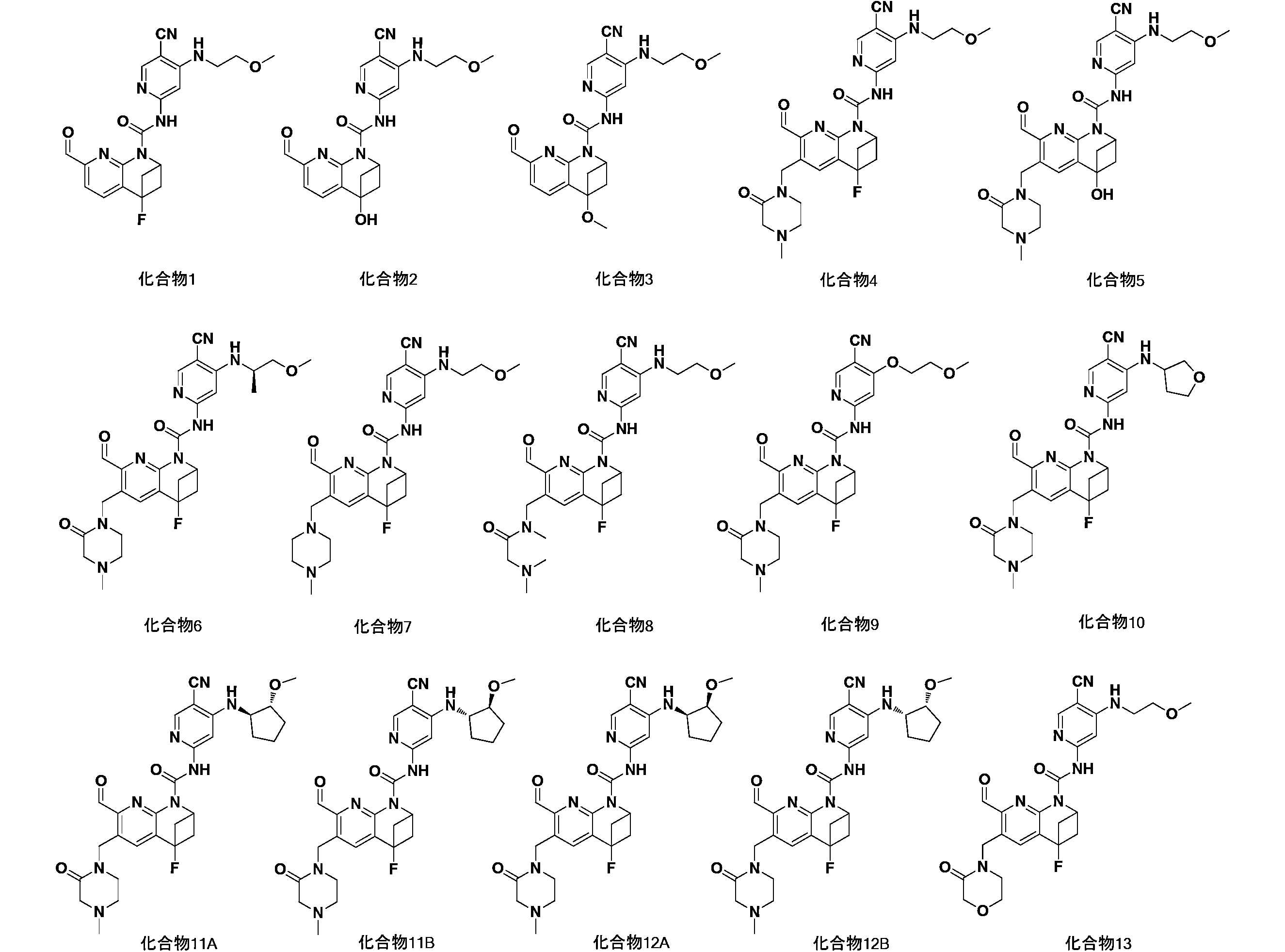



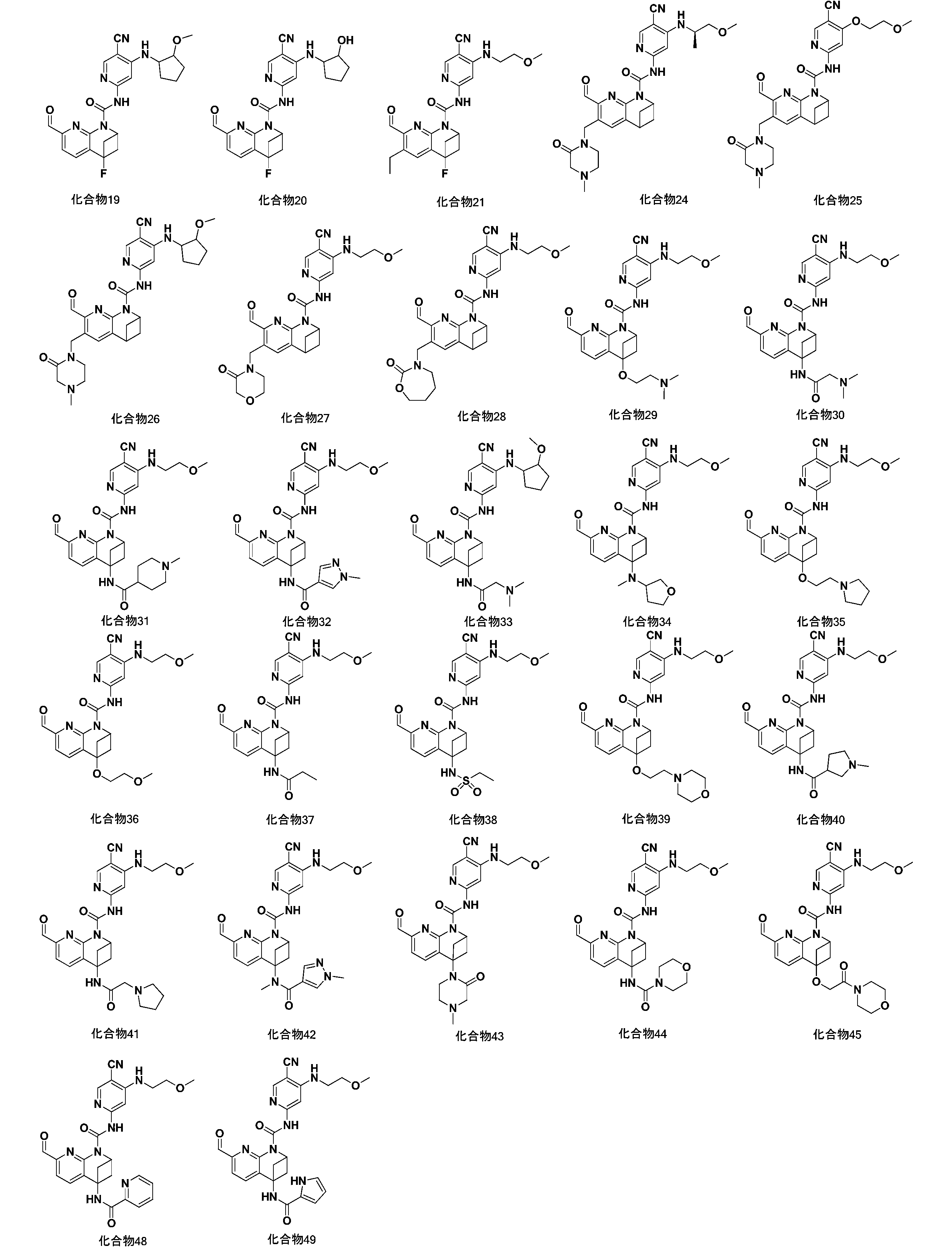
一実施形態において、式(I)で示される化合物は、以下の化合物から選ばれ、 In one embodiment, compounds of formula (I) are selected from the following compounds:


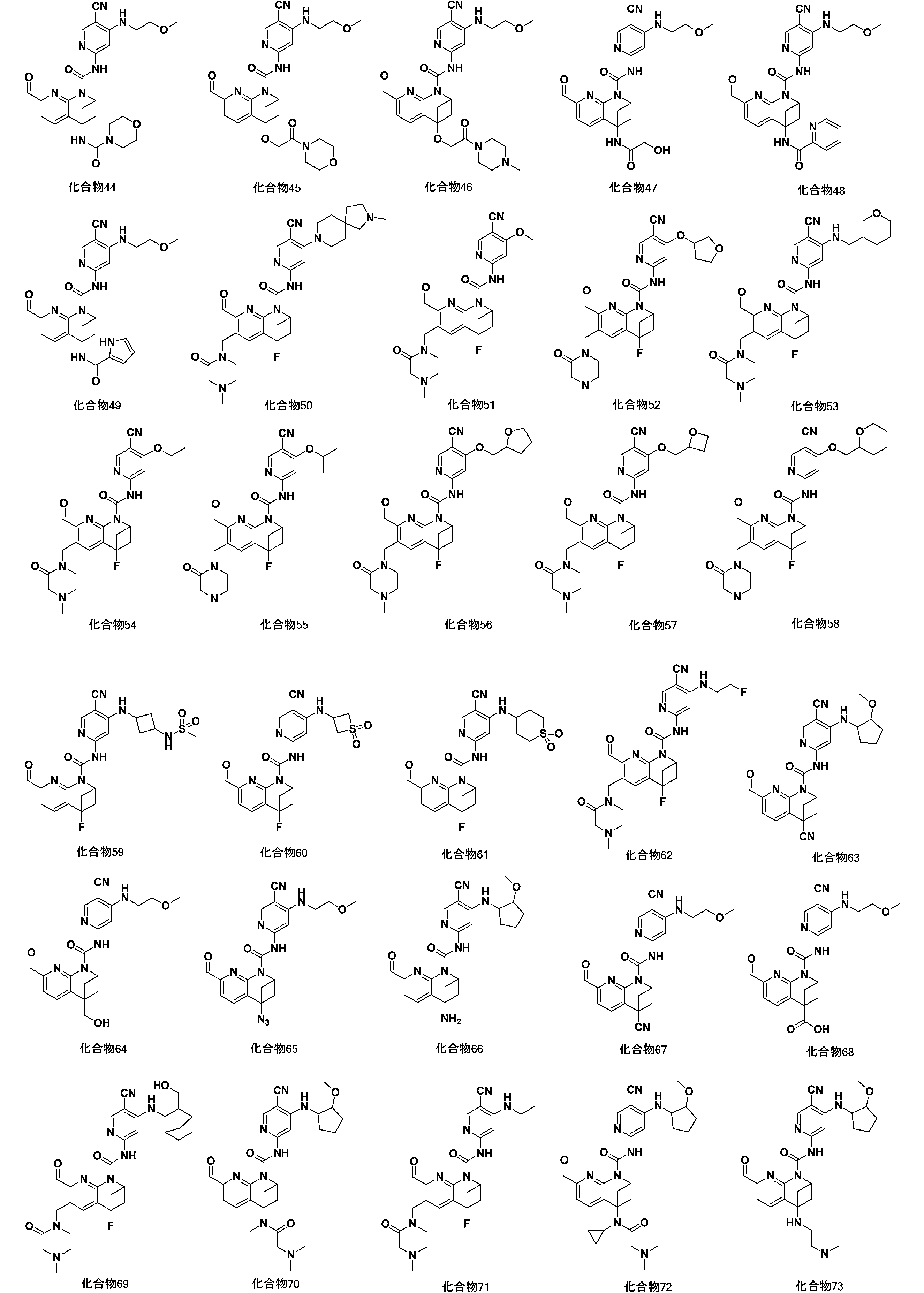
一実施形態において、式(I)で示される化合物は、以下の化合物から選ばれ、 In one embodiment, compounds of formula (I) are selected from the following compounds:


一実施形態において、式(I)で示される化合物は、以下の化合物から選ばれ、 In one embodiment, compounds of formula (I) are selected from the following compounds:
本発明の一実施形態は、式(I)で示される化合物の調製方法を提供し、その反応式は、以下の通りである。 One embodiment of the present invention provides a process for preparing compounds of formula (I), the scheme of which is as follows.

又は、 or

ここで、V、W、X、Y、Z、R8は、前述の式(I)の化合物に関する説明に適している。 where V, W, X, Y, Z, R 8 are suitable for the description relating to compounds of formula (I) above.
R11は、水素、ハロゲン原子、シアノ基、-N3、-OR2、-OPg1、-NHPg2、-NR2Pg2、-NR3Pg2又は-CO2Pg3から選ばれ、
R2は、以下の基から選ばれ、
1)C3~C6シクロアルキル基;又は
2)無置換又はハロゲン原子、C1~C3アルコキシ基、C1~C3ハロゲン化アルコキシ基、-NRY1RY2から選ばれる1つ又は複数の基で置換されていてもよいC1~C3アルキル基;
R3は、以下の基から選ばれ、
1)C1~C3アルキル基;又は
2)無置換又はC3~C6シクロアルキル基、C1~C3アルコキシ基、-NRY1RY2から選ばれる1つ又は複数の基で置換されていてもよいC1~C4アシル基;
3)-S(=O)2RY5;
Pg1は、ヒドロキシ基の保護基であり、トリメチルシリル基、t-ブチルジメチルシリル基、t-ブチルジフェニルシリル基、ベンジル基から選ぶことができる。
R 11 is selected from hydrogen, a halogen atom, a cyano group, —N 3 , —OR 2 , —OPg 1 , —NHPg 2 , —NR 2 Pg 2 , —NR 3 Pg 2 or —CO 2 Pg 3 ;
R 2 is selected from the following groups,
1) C 3 to C 6 cycloalkyl group; or 2) one or more selected from unsubstituted or halogen atom, C 1 to C 3 alkoxy group, C 1 to C 3 halogenated alkoxy group, —NR Y1 R Y2 a C 1 to C 3 alkyl group optionally substituted with a group of
R 3 is selected from the following groups,
1) C 1 -C 3 alkyl group; or 2) unsubstituted or substituted with one or more groups selected from C 3 -C 6 cycloalkyl group, C 1 -C 3 alkoxy group, —NR Y1 R Y2 a C 1 to C 4 acyl group that may be present;
3 ) -S(=O) 2R Y5 ;
Pg 1 is a hydroxy-protecting group and can be selected from a trimethylsilyl group, a t-butyldimethylsilyl group, a t-butyldiphenylsilyl group and a benzyl group.
Pg2は、アミノ基の保護基であり、ベンジルオキシカルボニル基、t-ブトキシカルボニル基、9-フルオレニルメチルオキシカルボニル基、フタロイル基、トリフルオロアセチル基、ベンジル基、p-メトキシベンジル基、2,4-ジメトキシベンジル基、3,4-ジメトキシベンジル基、p-ニトロベンジル基から選ぶことができる。 Pg 2 is a protecting group for amino group, benzyloxycarbonyl group, t-butoxycarbonyl group, 9-fluorenylmethyloxycarbonyl group, phthaloyl group, trifluoroacetyl group, benzyl group, p-methoxybenzyl group, It can be selected from 2,4-dimethoxybenzyl group, 3,4-dimethoxybenzyl group and p-nitrobenzyl group.
Pg3は、カルボキシル基の保護基であり、C1~C6アルキル基、アリル基、ベンジル基、フェニル基、p-ニトロベンジル基から選ぶことができる。 Pg 3 is a carboxyl-protecting group and can be selected from C 1 -C 6 alkyl groups, allyl groups, benzyl groups, phenyl groups and p-nitrobenzyl groups.
R41は、以下の基から選ばれ、
1)水素、ハロゲン原子;
2)無置換又は-OPg1、ハロゲン原子、C1~C3アルコキシ基、C1~C3ハロゲン化アルコキシ基から選ばれる1つ又は複数の基で置換されていてもよいC1~C3アルキル基;
3)無置換又は-OPg1、ハロゲン原子、C1~C3アルコキシ基、C1~C3ハロゲン化アルコキシ基から選ばれる1つ又は複数の基で置換されていてもよいC3~C6シクロアルキル基;
4)無置換又はC1~C3アルキル基、C1~C3ハロゲン化アルキル基、オキセタニル基又はオキソから選ばれる1つ又は複数の基で置換されていてもよい5員又は6員の複素環基;又は
5)-CH2NR5R6、-CH(CH3)NR5R6、-C(CH3)2NR5R6、
R5は、C3~C6シクロアルキル基、無置換又は1つ若しくは複数の-NRY1RY2で置換されていてもよいC1~C3アルキル基から選ばれ、
R6は、以下の基から選ばれ、
1)C1~C3アルキル基、C4~C7シクロアルキルホルミル基、-S(=O)2RY5、又は
2)無置換又は-OPg1、C1~C3アルコキシ基、-NRY1RY2から選ばれる1つ又は複数の基で置換されていてもよいC1~C4アシル基、
又は
R5、R6は、それらに結合するN原子と共に無置換又は1つ若しくは複数のR7で置換されていてもよい5員、6員又は7員の飽和複素環基を形成する。
R 41 is selected from the following groups,
1) hydrogen, halogen atom;
2) unsubstituted or C 1 -C 3 optionally substituted with one or more groups selected from -OPg 1 , a halogen atom, a C 1 -C 3 alkoxy group, and a C 1 -C 3 halogenated alkoxy group; alkyl group;
3) C 3 to C 6 optionally substituted with one or more groups selected from —OPg 1 , halogen atoms, C 1 to C 3 alkoxy groups, and C 1 to C 3 halogenated alkoxy groups; cycloalkyl group;
4) unsubstituted or 5- or 6-membered heterocyclic group optionally substituted with one or more groups selected from C 1 -C 3 alkyl group, C 1 -C 3 halogenated alkyl group, oxetanyl group or oxo or 5) —CH 2 NR 5 R 6 , —CH(CH 3 )NR 5 R 6 , —C(CH 3 ) 2 NR 5 R 6 ,
R 5 is selected from a C 3 -C 6 cycloalkyl group, a C 1 -C 3 alkyl group which is unsubstituted or optionally substituted with one or more -NR Y1 R Y2 ,
R 6 is selected from the following groups,
1) C 1 -C 3 alkyl group, C 4 -C 7 cycloalkylformyl group, -S(=O) 2 R Y5 , or 2) unsubstituted or -OPg 1 , C 1 -C 3 alkoxy group, -NR a C 1 -C 4 acyl group optionally substituted with one or more groups selected from Y1 R Y2 ,
or R 5 , R 6 together with the N atom attached to them form a 5-, 6- or 7-membered saturated heterocyclic group which is unsubstituted or optionally substituted with one or more R 7 .
R7は、C1~C3アルキル基、C1~C4アシル基、-OPg1、オキソから選ばれ、
又は
同じ炭素原子に結合する2つのR7は、それらに結合する炭素原子と共に4~6員の飽和複素環基を形成する。
R 7 is selected from C 1 -C 3 alkyl groups, C 1 -C 4 acyl groups, —OPg 1 , oxo;
OR Two R 7s attached to the same carbon atom form a 4- to 6-membered saturated heterocyclic group with the carbon atoms attached to them.
Pgは、ヒドロキシ基の保護基であり、C1~C6アルキル基、ベンジル基から選ばれるか、又は、2個のPgが、それに結合する-O-CH-O-基と、5~7員の1,3-ジオキサシクロアルキル基を形成する。 Pg is a hydroxy-protecting group and is selected from a C 1 to C 6 alkyl group and a benzyl group, or two Pg's are combined with a -O-CH-O- group and 5 to 7 forming a member 1,3-dioxacycloalkyl group.
<用語の定義及び説明>
本発明において、特に説明しない限り、ある基についての説明又は記述は、その基を含むすべての基に適している。例えば、アルキル基についての説明は、C1~C6アルキル基、C1~C3アルキル基などに適している。C1~C6アルキル基についての説明又は記述は、「C1~C6アルコキシ基」などに適しており、且つ、下記の定義は、特許請求の範囲及び明細書に適している。
<Definition and Explanation of Terms>
In the present invention, unless otherwise stated, a description or description of a group applies to all groups containing that group. For example, references to alkyl groups are appropriate for C 1 -C 6 alkyl groups, C 1 -C 3 alkyl groups, and the like. Descriptions or descriptions of C 1 -C 6 alkyl groups are suitable, such as “C 1 -C 6 alkoxy groups”, and the following definitions are suitable for the claims and the specification.
「ハロゲン原子」は、フッ素、塩素、臭素、ヨウ素を含む。 "Halogen atom" includes fluorine, chlorine, bromine and iodine.
Cm~Cn基は、対応する基にm~n個の炭素原子を含有することを表し、例えば、C1~C6アルキル基は、1~6個の炭素原子を含有するアルキル基を表す。 A C m -C n group denotes containing from m to n carbon atoms in the corresponding group, for example, a C 1 -C 6 alkyl group denotes an alkyl group containing from 1 to 6 carbon atoms. show.
「アルキル基」は、直鎖又は分岐鎖のアルキル基であってもよい。C1~C6直鎖アルキル基は、例えばメチル基、エチル基、n-プロピル基、n-ブチル基、n-ペンチル基、n-へキシル基であってもよい。分岐鎖のアルキル基において、置換基は、1個のメチル基であってもよく、例えばイソプロピル基が挙げられ、2個のメチル基であってもよく、例えばt-ブチルが挙げられ、1個のエチル基であってもよく、例えば1-エチルプロピル基が挙げられ、さらに、3個のメチル基であってもよく、よりさらに、1個のメチル基及び1個のエチル基であってもよい。分岐鎖の位置は、1位の炭素、2位の炭素、3位の炭素、4位の炭素、5位の炭素に位置してもよく、ここで、結合される炭素原子(C・)は、1位の炭素を表す。 An "alkyl group" may be a straight or branched chain alkyl group. A C 1 -C 6 straight chain alkyl group may be, for example, methyl, ethyl, n-propyl, n-butyl, n-pentyl, n-hexyl. In branched alkyl groups, the substituents may be one methyl group, such as isopropyl, or two methyl groups, such as t-butyl, one may be an ethyl group, such as a 1-ethylpropyl group, further may be 3 methyl groups, and furthermore may be 1 methyl group and 1 ethyl group good. The position of the branched chain may be at carbon 1, carbon 2, carbon 3, carbon 4, carbon 5, where the attached carbon atom (C) is , represents the carbon at the 1-position.
C1~C6アルキル基は、1~6個の炭素原子を含有する直鎖又は分岐鎖のアルキル基であってもよい。C1~C6アルキル基において、炭素原子の数は、1個、2個、3個、4個、5個又は6個であってもよい。 A C 1 -C 6 alkyl group may be a straight or branched chain alkyl group containing from 1 to 6 carbon atoms. In the C 1 -C 6 alkyl group, the number of carbon atoms may be 1, 2, 3, 4, 5 or 6.
C1~C6アルキル基は、さらに、C1~C3アルキル基であってもよく、C1~C3アルキル基は、メチル基、エチル基、n-プロピル基又はイソプロピル基であってもよい。
「アルキレン基」とは、アルカンの炭素原子から2個の水素原子を失って形成される2価の基を意味し、2つの原子価は、同じ原子に集中してもよく、2個の原子にそれぞれ結合してもよい。例えば、メチレン(-CH2-)、エチリデン(-CH2CH2-)が挙げられる。
The C 1 -C 6 alkyl group may further be a C 1 -C 3 alkyl group, and the C 1 -C 3 alkyl group may be a methyl group, an ethyl group, an n-propyl group or an isopropyl group. good.
"Alkylene group" means a divalent group formed by the loss of two hydrogen atoms from a carbon atom of an alkane, wherein the two valences may be centered on the same atom or two atoms may be combined with each other. Examples include methylene (--CH 2 --) and ethylidene (--CH 2 CH 2 --).
「アルコキシ基」は、-O-Raで示すことができ、ここで、Raは、アルキル基であり、Raの具体的な構造は、上記のアルキル基についての記述に適している。「C1~C6アルコキシ基」とは、1~6個の炭素原子を含有するアルコキシ基を意味する。C1~C6アルコキシ基における炭素原子の数は、1個、2個、3個、4個、5個又は6個であってもよい。例えば、C1~C6アルコキシ基は、メトキシ基、エトキシ基、n-プロポキシ基、イソプロポキシ基、n-ブトキシ基、イソブトキシ基、n-ペンチルオキシ基及びn-へキシルオキシ基などであってもよい。 An "alkoxy group" can be represented by -O-R a , where R a is an alkyl group, and specific structures for R a are suitable for describing alkyl groups above. A “C 1 -C 6 alkoxy group” means an alkoxy group containing from 1 to 6 carbon atoms. The number of carbon atoms in the C 1 -C 6 alkoxy group may be 1, 2, 3, 4, 5 or 6. For example, the C 1 -C 6 alkoxy group may be methoxy, ethoxy, n-propoxy, isopropoxy, n-butoxy, isobutoxy, n-pentyloxy, n-hexyloxy and the like. good.
C1~C3アルコキシ基は、メトキシ基、エトキシ基、n-プロポキシ基又はイソプロポキシ基であってもよい。 A C 1 -C 3 alkoxy group may be a methoxy, ethoxy, n-propoxy or isopropoxy group.
「アルキルチオ基」は、-S-Raで示すことができ、ここで、Raは、アルキル基であり、Raの具体的な構造は、上記のアルキル基についての記述に適している。C1~C3アルキルチオ基は、メチルチオ基(-SCH3)、エチルチオ基(-SCH2CH3)、n-プロピルチオ基(-SCH2CH2CH3)又はイソプロピルチオ基(-SCH(CH3)2)であってもよい。 An "alkylthio group" can be represented by -S-R a , where R a is an alkyl group, and specific structures for R a are suitable for describing alkyl groups above. A C 1 -C 3 alkylthio group is a methylthio group (--SCH 3 ), an ethylthio group (--SCH 2 CH 3 ), a n-propylthio group (--SCH 2 CH 2 CH 3 ) or an isopropylthio group (--SCH(CH 3 ) 2 ) may be.
「置換のアルキル基」は、アルキル基のうちの1つ又は複数の水素原子が置換基で置換されていることを示す。置換基の数は、1個又は複数個、例えば2個、3個、4個、5個、6個などであってもよい。置換基は、任意の炭素、例えば1位(結合される炭素原子(C・)は、1位の炭素を表す)、2位、3位、4位、5位、最終位の炭素に結合してもよい。複数個の置換基の種類は、同じでもよく、例えば1-フルオロメチル-2-フルオロエチル基が挙げられ、異なっていてもよく、例えば-CH2CHClCH2OHが挙げられる。 A "substituted alkyl group" indicates that one or more hydrogen atoms in an alkyl group have been replaced with a substituent. The number of substituents may be one or more, such as 2, 3, 4, 5, 6, and the like. Substituents may be attached to any carbon, such as the 1-position (the attached carbon atom (C) represents the 1-position carbon), the 2-position, the 3-position, the 4-position, the 5-position, the last carbon position, may The types of the plural substituents may be the same, for example, 1-fluoromethyl-2-fluoroethyl group, or may be different, for example, -CH 2 CHClCH 2 OH.
「置換のC1~C6アルキル基」におけるC1~C6アルキル基の構造は、上記のC1~C6アルキル基についての記述に適しており、置換基は、上記「置換のアルキル基」における置換基の記述に適している。置換のC1~C6アルキル基は、さらに置換のC1~C3アルキル基であってもよい。 The structure of the C 1 -C 6 alkyl group in the "substituted C 1 -C 6 alkyl group" is suitable for the description of the above C 1 -C 6 alkyl group, and the substituent is the same as the above "substituted alkyl group is suitable for describing substituents in A substituted C 1 -C 6 alkyl group may further be a substituted C 1 -C 3 alkyl group.
「ハロゲン化アルキル基」は、アルキル基のうちの1つ又は複数の水素原子がハロゲン原子で置換されていることを示し、即ち、置換基がハロゲン原子である「置換のアルキル基」を示す。 A “halogenated alkyl group” indicates that one or more hydrogen atoms in the alkyl group have been replaced with halogen atoms, ie, indicates a “substituted alkyl group” in which the substituents are halogen atoms.
「アルコキシ基で置換されているアルキル基」は、-Ra1O-Ra2で示すことができ、ここで、Ra1、Ra2は、いずれもアルキル基であり、Ra1、Ra2の具体的な構造は、上記のアルキル基についての説明に適している。「C1~C3アルコキシ基で置換されているC1~C6アルキル基」は、C1~C6アルキル基のうちの1つ又は複数の水素原子がC1~C3アルコキシ基で置換されていることを示す。 The “alkyl group substituted with an alkoxy group” can be represented by —R a1 OR —R a2 , where both R a1 and R a2 are alkyl groups, and specific examples of R a1 and R a2 are structures are suitable for describing the above alkyl groups. A “C 1 -C 6 alkyl group substituted with a C 1 -C 3 alkoxy group” means that one or more hydrogen atoms in the C 1 -C 6 alkyl group are substituted with a C 1 -C 3 alkoxy group Indicates that
「ヒドロキシ基で置換されている-NRY1RY2」は、RY1及び/又はRY2のアルキル基のうちの1つ又は複数の水素原子がヒドロキシ基で置換されていることを示し、ヒドロキシ基の数は、1個、2個、3個、4個、5個、6個などであってもよい。例えばヒドロキシ基で置換されている-NRY1RY2は、-N(CH2OH)2、-NCH3(CH2OH)、-N(CH2CH3)(CH2CH2OH)であってもよい。 “—NR Y1 R Y2 substituted with a hydroxy group” indicates that one or more hydrogen atoms in the alkyl groups of R Y1 and/or R Y2 are substituted with a hydroxy group, and the hydroxy group may be 1, 2, 3, 4, 5, 6, and the like. For example, —NR Y1 R Y2 substituted with a hydroxy group is —N(CH 2 OH) 2 , —NCH 3 (CH 2 OH), —N(CH 2 CH 3 )(CH 2 CH 2 OH). may
「置換のアルコキシ基」は、アルコキシ基のうちの1つ又は複数の水素原子が置換基で置換されていることを示し、ここで、アルコキシ基の構造は、上記のアルコキシ基についての記述に適している。置換基の数は、1個又は複数個、例えば2個、3個、4個、5個、6個などであってもよい。置換基は、任意の炭素、例えば1位(酸素原子に結合する炭素原子(C・)は、1位の炭素を表す)、2位、3位、4位、5位、最終位の炭素に結合してもよい。複数個の置換基の種類は、同じでもよく、例えばトリフルオロメトキシ基(-OCF3)が挙げられ、異なっていてもよく、例えばメトキシトリフルオロプロポキシ基が挙げられる。 A "substituted alkoxy group" indicates that one or more hydrogen atoms of the alkoxy group have been replaced with a substituent, wherein the structure of the alkoxy group is suitable for the description of the alkoxy group above. ing. The number of substituents may be one or more, such as 2, 3, 4, 5, 6, and the like. The substituent may be any carbon, such as 1-position (the carbon atom (C) attached to the oxygen atom represents the 1-position carbon), 2-position, 3-position, 4-position, 5-position, and the last carbon. may be combined. The types of the multiple substituents may be the same, for example, a trifluoromethoxy group (--OCF 3 ), or may be different, for example, a methoxytrifluoropropoxy group.
「置換のC1~C6アルコキシ基」は、C1~C6アルコキシ基のうちの1つ又は複数の水素原子が置換基で置換されていることを示し、ここで、C1~C6アルコキシ基の構造は、上記のC1~C6アルコキシ基についての記述に適している。 A “substituted C 1 -C 6 alkoxy group” indicates that one or more hydrogen atoms of a C 1 -C 6 alkoxy group have been replaced with a substituent, wherein C 1 -C 6 The structure of the alkoxy group is suitable for the description of C 1 -C 6 alkoxy groups above.
「ハロゲン化アルコキシ基」とは、含まれるアルキル基における水素原子が1つ又は複数のハロゲン原子で置換されていることを意味する。置換基の数は、1個又は複数個、例えば2個、3個、4個、5個、6個などであってもよい。置換基は、任意の炭素、例えば1位、2位、3位、4位、5位、最終位の炭素に結合してもよい。例えば、C1~C3ハロゲン化アルコキシ基は、トリフルオロメトキシ基(-OCF3)、ジフルオロメトキシ基(-OCHF2)、トリフルオロエトキシ基(例えば-OCH2CF3)であってもよい。 A "halogenated alkoxy group" means that a hydrogen atom in an included alkyl group has been replaced with one or more halogen atoms. The number of substituents may be one or more, such as 2, 3, 4, 5, 6, and the like. Substituents may be attached to any carbon, such as the 1-, 2-, 3-, 4-, 5- and last carbon positions. For example, the C 1 -C 3 halogenated alkoxy group can be a trifluoromethoxy group (--OCF 3 ), a difluoromethoxy group (--OCHF 2 ), a trifluoroethoxy group (eg --OCH 2 CF 3 ).
環状基とは、環状化合物の環上の炭素原子又はヘテロ原子が1つ又は複数の水素原子を失って形成される基を意味する。環上の原子の種類によっては、環状基は、炭素環基及び複素環基を含む。炭素環基とは、炭素環化合物の環上の炭素原子がそれに結合する1つ又は複数の水素原子を失って形成される基を意味する。環状基の環上にN個の原子(炭素原子及びヘテロ原子)を含有すると、この環を「N員環」と呼ぶ。例えば、シクロプロピル基は、炭素環基に属し、3員環基である。含まれる環の数に応じて、環状基は、単環基及び多環基を含み、多環基は、例えば、二環基、例えばジシクロアルキル基であってもよい。 A cyclic group means a group formed by the loss of one or more hydrogen atoms to a carbon or heteroatom on the ring of a cyclic compound. Depending on the type of atoms on the ring, cyclic groups include carbocyclic and heterocyclic groups. Carbocyclic group means a group formed when a carbon atom on the ring of a carbocyclic compound loses one or more hydrogen atoms to which it is attached. When a cyclic group contains N atoms (carbon atoms and heteroatoms) in the ring, the ring is referred to as an "N-membered ring." For example, the cyclopropyl group belongs to the carbocyclic group and is a 3-membered ring group. Depending on the number of rings involved, cyclic groups include monocyclic groups and polycyclic groups, and polycyclic groups may be, for example, bicyclic groups such as dicycloalkyl groups.
「シクロアルキル基」とは、シクロアルカンの環上の炭素原子が1つ又は複数の水素原子を失って形成される飽和単環基を意味する。「C3~C6シクロアルキル基」は、3~6個の炭素原子を含有するシクロアルキル基を表す。C3~C6シクロアルキル基における炭素原子の数は、3個、4個、5個、6個であってもよい。C3~C6シクロアルキル基は、3~6員環基、例えばシクロプロピル基、シクロブチル基、シクロペンチル基、シクロヘキシル基であってもよい。 "Cycloalkyl group" means a saturated monocyclic group formed by the loss of one or more hydrogen atoms from a carbon atom on the ring of a cycloalkane. A "C3-C6 cycloalkyl group" refers to a cycloalkyl group containing from 3 to 6 carbon atoms. The number of carbon atoms in the C 3 -C 6 cycloalkyl group may be 3, 4, 5 or 6. The C 3 -C 6 cycloalkyl group may be a 3-6 membered ring group such as cyclopropyl, cyclobutyl, cyclopentyl, cyclohexyl.
「シクロアルコキシ基」は、-O-Rbで示すことができ、Rbの具体的な構造は、上記のシクロアルキル基についての記述に適しており、ここで、酸素原子は、環上の炭素原子に結合する。C3~C6シクロアルコキシ基は、例えば、シクロプロポキシ基、シクロブトキシ基、シクロペンチルオキシ基、シクロヘキシルオキシ基であってもよい。 A "cycloalkoxy group" can be represented by -O-R b , where the specific structure of R b is suitable for the description of the cycloalkyl group above, wherein the oxygen atom on the ring is Binds to a carbon atom. A C 3 -C 6 cycloalkoxy group can be, for example, a cyclopropoxy group, a cyclobutoxy group, a cyclopentyloxy group, a cyclohexyloxy group.
「置換のシクロアルキル基」は、シクロアルキル基のうちの1つ又は複数の水素原子が置換基で置換されていることを意味する。「置換のC3~C6シクロアルキル基」は、C3~C6シクロアルキル基のうちの1つ又は複数の水素原子が置換基で置換されていることを意味する。 A "substituted cycloalkyl group" means that one or more hydrogen atoms in the cycloalkyl group have been replaced with a substituent. A “substituted C 3 -C 6 cycloalkyl group” means that one or more hydrogen atoms of a C 3 -C 6 cycloalkyl group have been replaced with a substituent.
「置換のシクロアルコキシ基」は、シクロアルコキシ基のうちの1つ又は複数の水素原子が置換基で置換されていることを意味する。「置換のC3~C6シクロアルコキシ基」は、C3~C6シクロアルコキシ基のうちの1つ又は複数の水素原子が置換基で置換されていることを意味する。 A "substituted cycloalkoxy group" means that one or more hydrogen atoms of a cycloalkoxy group have been replaced with a substituent. A “substituted C 3 -C 6 cycloalkoxy group” means that one or more hydrogen atoms of a C 3 -C 6 cycloalkoxy group have been replaced with a substituent.
「C3~C6シクロアルコキシ基」、「置換のC3~C6シクロアルキル基」、「置換のC3~C6シクロアルコキシ基」におけるC3~C6シクロアルキル基の構造は、上記のC3~C6シクロアルキル基についての記述に適している。 The structures of the C 3 -C 6 cycloalkyl groups in the "C 3 -C 6 cycloalkoxy group", "substituted C 3 -C 6 cycloalkyl group" and "substituted C 3 -C 6 cycloalkoxy group" are the same as those described above. are suitable for describing C 3 -C 6 cycloalkyl groups of .
「置換のC3~C6シクロアルキル基」、「置換のC3~C6シクロアルコキシ基」における置換基は、環上の炭素原子に結合してもよく、置換基の数は、1個又は複数個、例えば2個、3個、4個、5個、6個などであってもよい。置換基は、任意の炭素、例えば1位(結合される炭素原子(C・)は、1位の炭素を表す)、2位、3位、4位、5位、最終位の炭素に結合してもよく、複数個の置換基の種類は、同じであっても異なっていてもよい。 The substituents in the "substituted C 3 -C 6 cycloalkyl group" and "substituted C 3 -C 6 cycloalkoxy group" may be bonded to a carbon atom on the ring, and the number of substituents is 1 Alternatively, there may be more than one, such as 2, 3, 4, 5, 6, and the like. Substituents may be attached to any carbon, such as the 1-position (the attached carbon atom (C) represents the 1-position carbon), the 2-position, the 3-position, the 4-position, the 5-position, the last carbon position, and the types of the plural substituents may be the same or different.
「ジシクロアルキル基」は、ジシクロアルカンにおける環上の炭素原子が1個の水素原子を失って形成される1価の炭化水素基を示す。C5~C8ジシクロアルキル基は、5~8個の炭素原子を含有するジシクロアルキル基を示し、C5~C8ジシクロアルキル基は、5~8員のジシクロアルキル基であってもよく、即ち、含まれる炭素原子は、いずれも環上に位置する。C5~C8ジシクロアルキル基は、架橋環系であってもよく、例えば、ビシクロ[2.1.1]ヘキシル基、ビシクロ[1.1.1]ペンチル基、ビシクロ[2.2.1]ヘプチル基、ビシクロ[2.2.2]オクチル基であってもよい。 A “dicycloalkyl group” is a monovalent hydrocarbon group formed by losing one hydrogen atom from a carbon atom on the ring of a dicycloalkane. A C 5 -C 8 dicycloalkyl group denotes a dicycloalkyl group containing from 5 to 8 carbon atoms, and a C 5 -C 8 dicycloalkyl group is a 5- to 8-membered dicycloalkyl group. ie, the carbon atoms involved are both located on the ring. A C 5 -C 8 dicycloalkyl group may also be a bridged ring system, for example a bicyclo[2.1.1]hexyl group, a bicyclo[1.1.1]pentyl group, a bicyclo[2.2. 1]heptyl group or bicyclo[2.2.2]octyl group.
「置換のジシクロアルキル基」は、ジシクロアルキル基のうちの1つ又は複数の水素原子が置換基で置換されていることを示す。置換基は、環上の炭素原子に結合してもよく、置換基の数は、1個又は複数個、例えば2個、3個、4個、5個、6個などであってもよい。置換基は、任意の炭素、例えば1位、2位、3位、4位、5位、最終位の炭素に結合してもよく、複数個の置換基の種類は、同じであっても異なっていてもよい。「置換のC5~C8ジシクロアルキル基」におけるC5~C8ジシクロアルキル基は、上記の説明に適している。 A "substituted dicycloalkyl group" indicates that one or more hydrogen atoms in the dicycloalkyl group have been replaced with a substituent. The substituents may be attached to a carbon atom on the ring and the number of substituents may be one or more, such as 2, 3, 4, 5, 6, and the like. The substituent may be attached to any carbon, such as the 1-, 2-, 3-, 4-, 5-, and last-position carbons, and the types of the multiple substituents may be the same or different. may be The C 5 -C 8 dicycloalkyl group in the “substituted C 5 -C 8 dicycloalkyl group” is suitable for the above description.
「複素環基」とは、複素環化合物の環上の炭素原子又はヘテロ原子が1つ又は複数の水素原子を失って形成される基を意味する。芳香族の特徴によっては、複素環基は、脂肪族複素環基(芳香族の特徴を有しない)及び芳香族複素環基を含む。飽和の程度によっては、複素環基は、飽和複素環基及び不飽和複素環基を含み、芳香族複素環基は、不飽和複素環基に属し、脂肪族複素環基は、飽和複素環基だけでなく、不飽和複素環基も含む。複素環基に含まれるヘテロ原子は、1個又は複数個、例えば2個、3個、4個、5個などであってもよく、ヘテロ原子は、N、O、Sから選ぶことができる。 A "heterocyclic group" means a group formed by the loss of one or more hydrogen atoms from a carbon atom or heteroatom on the ring of a heterocyclic compound. Depending on their aromatic character, heterocyclic groups include aliphatic heterocyclic groups (having no aromatic character) and aromatic heterocyclic groups. Depending on the degree of saturation, heterocyclic groups include saturated heterocyclic groups and unsaturated heterocyclic groups, aromatic heterocyclic groups belong to unsaturated heterocyclic groups, and aliphatic heterocyclic groups belong to saturated heterocyclic groups. It also includes unsaturated heterocyclic groups. The heteroatoms contained in the heterocyclic group may be one or more, such as 2, 3, 4, 5, etc., and the heteroatoms may be selected from N, O, S.
「置換の複素環基」とは、複素環基のうちの1つ又は複数の水素原子が置換基で置換されていることを意味する。置換基は、環上の炭素原子又はヘテロ原子に結合してもよい。置換基の数は、1個又は複数個、例えば2個、3個、4個、5個、6個などであってもよい。置換基は、任意の原子、例えば1位、2位、3位、4位、5位、最終位の炭素に結合してもよく、複数個の置換基の種類は、同じであっても異なっていてもよい。置換の複素環基は、置換の飽和複素環基、置換の芳香族複素環基を含んでもよい。 A "substituted heterocyclic group" means that one or more hydrogen atoms in the heterocyclic group have been replaced with a substituent. Substituents may be attached to any carbon or heteroatom on the ring. The number of substituents may be one or more, such as 2, 3, 4, 5, 6, and the like. The substituent may be attached to any atom, for example, the 1-, 2-, 3-, 4-, 5-, and last-position carbons, and the types of the multiple substituents may be the same or different. may be The substituted heterocyclic group may include a substituted saturated heterocyclic group and a substituted aromatic heterocyclic group.
「芳香族複素環基」は、単環式複素環基及び縮合式複素環基を含み、縮合式複素環基は、ベンゼン環と単環式複素環とが縮合したものであってもよく、複素環と複素環とが縮合したものであってもよい。 "Aromatic heterocyclic group" includes a monocyclic heterocyclic group and a condensed heterocyclic group, and the condensed heterocyclic group may be a condensed benzene ring and a monocyclic heterocyclic ring, A heterocyclic ring and a heterocyclic ring may be condensed.
「アシル基」の構造式は、-C(=O)H又は-C(=O)Raであってもよく、ここで、Raは、アルキル基を表し、Raの具体的な構造は、上記のアルキル基についての記述に適している。 The structural formula of "acyl group" may be -C(=O)H or -C(=O)R a , where R a represents an alkyl group, and the specific structure of R a is suitable for describing alkyl groups above.
「シクロアルキルホルミル基」の構造式は、-C(=O)-Rbであり、ここで、Rbは、シクロアルキル基を表し、Rbの具体的な構造は、上記のアルキル基についての記述に適している。 The structural formula of a "cycloalkylformyl group" is -C(=O)-R b , where R b represents a cycloalkyl group, and the specific structure of R b is suitable for describing
「オキソ」とは、2価の酸素原子を意味し、炭素原子に結合してカルボニル基(>C=O)を形成することができ、硫黄原子に結合してスルフィニル基(>S=O)を形成することができ、2個のオキソ基は、1個の硫黄原子に結合してスルホニル基(-S(=O)2-)を形成することができる。 "Oxo" means a divalent oxygen atom, which can be attached to a carbon atom to form a carbonyl group (>C=O) and a sulfur atom to form a sulfinyl group (>S=O) and two oxo groups can be attached to one sulfur atom to form a sulfonyl group (-S(=O) 2 -).
本発明において、用語「薬学的に許容される」は、それらの化合物、材料、組成物及び/又は剤形について、信頼できる医学的判断の範囲内において、人や動物の組織と接触して使用するのに適しているが、過度の毒性、刺激性、過敏性反応又はその他の問題又は合併症がなく、合理的な利益/リスク比に見合ったものである。 In the present invention, the term "pharmaceutically acceptable" refers to those compounds, materials, compositions and/or dosage forms that are within the scope of sound medical judgment and used in contact with human or animal tissue. and is commensurate with a reasonable benefit/risk ratio without undue toxicity, irritation, hypersensitivity reactions or other problems or complications.
用語「医薬組成物」とは、薬学的に許容される化学成分又は試薬を少なくとも1つ混合した、任意の生物活性化合物を意味する。前記薬学的に許容される化学成分又は試薬は、「担体」であり、化合物を細胞又は組織に導入することに寄与し、安定化剤、希釈剤、懸濁剤、増粘剤及び/又は賦形剤を含むが、これらに限定されない。医薬組成物は、錠剤、丸剤、散剤、トローチ剤、小薬嚢、カシェ剤、エリキシル剤、懸濁剤、乳剤、溶液剤、シロップ、エアロゾル剤(固体又は液体溶媒に溶解する)、軟膏剤、ソフト及びハードゼラチンカプセル、坐剤、無菌注射溶液及び無菌包装粉剤などを含むが、これらに限定されない。 The term "pharmaceutical composition" means any biologically active compound in admixture with at least one pharmaceutically acceptable chemical ingredient or reagent. Said pharmaceutically acceptable chemical ingredient or agent is a "carrier", which contributes to the introduction of a compound into cells or tissues, and is a stabilizer, diluent, suspending agent, thickening agent and/or excipient. Including but not limited to forms. Pharmaceutical compositions include tablets, pills, powders, lozenges, sachets, cachets, elixirs, suspensions, emulsions, solutions, syrups, aerosols (dissolved in solid or liquid media), ointments. , soft and hard gelatin capsules, suppositories, sterile injectable solutions and sterile packaged powders, and the like.
用語「薬学的に許容される担体」は、当業者に知られているあらゆる溶媒、分散媒、コーティング、界面活性剤、酸化防止剤、防腐剤(例えば抗菌剤、抗カビ剤)、等張剤、吸収遅延剤、塩、防腐剤、薬物安定化剤、結合剤、賦形剤、崩壊剤、滑剤、甘味剤、調味剤、染料など及びそれらの組み合わせを含む。通常の担体が活性成分と相容性を有する限り、治療又は医薬組成物における使用を含む。 The term "pharmaceutically acceptable carrier" includes any solvents, dispersion media, coatings, surfactants, antioxidants, preservatives (e.g. antibacterial agents, antifungal agents), isotonic agents known to those skilled in the art. , absorption delaying agents, salts, preservatives, drug stabilizers, binders, excipients, disintegrants, lubricants, sweeteners, flavoring agents, dyes, etc. and combinations thereof. Use in therapeutic or pharmaceutical compositions is included so long as the usual carrier is compatible with the active ingredient.
「治療有効量」とは、個体の生物学又は医学的応答を誘発する本発明の化合物の量を意味する。前記応答は、例えば酵素やタンパク質の活性を低減又は阻害することや、症状を改善したり、病状を緩和したり、疾患の進行を遅延又は減速させたり、または疾患を予防したりすることなどが挙げられる。 By "therapeutically effective amount" is meant that amount of a compound of the invention that elicits a biological or medical response in an individual. Such responses include, for example, reducing or inhibiting enzyme or protein activity, ameliorating symptoms, alleviating pathology, slowing or slowing disease progression, or preventing disease. mentioned.
「患者」とは、疾患、病症又は病状などに罹患している個体を意味し、哺乳動物と非哺乳動物とを含む。哺乳動物の実施例として、哺乳動物綱に属するあらゆるメンバーを含むが、これらに限定されなく、ヒト、非ヒト霊長類動物(例えばチンパンジー、その他の猿類及びサル);ウシ、ウマ、ヒツジ、ヤギ、ブタなどの家畜;ウサギ、イヌ、ネコなどの家庭動物;げっ歯類の動物、例えばラット、マウス、モルモットなどを含む実験動物が挙げられる。非ヒト哺乳動物の実施例として、鳥類や魚類などを含むが、これらに限定されない。本明細書で提供される方法及び組成物に関する実施形態において、前記哺乳動物はヒトである。 "Patient" means an individual suffering from a disease, condition, condition, or the like, and includes mammals and non-mammals. Examples of mammals include, but are not limited to, any member of the class Mammalia, including humans, non-human primates (such as chimpanzees, other monkeys and monkeys); cows, horses, sheep, goats. domestic animals such as rabbits, dogs and cats; laboratory animals including rodents such as rats, mice, guinea pigs and the like. Examples of non-human mammals include, but are not limited to, birds, fish, and the like. In embodiments of the methods and compositions provided herein, the mammal is a human.
「薬学的に許容される塩」とは、本発明に係る化合物の生物学的効果及び特性を保持し、且つ、通常、生物学又は他の点で悪影響がない塩を意味する。多くの場合、本発明に係る化合物は、アミノ基及び/又はカルボキシル基又はそれに類似した基の存在によって酸付加塩及び/又は塩基付加塩を形成することができる。 "Pharmaceutically acceptable salt" means a salt that retains the biological effectiveness and properties of the compounds of this invention and generally does not adversely affect the biology or otherwise. In many cases, the compounds according to the invention are capable of forming acid and/or base addition salts due to the presence of amino and/or carboxyl groups or groups similar thereto.
無機酸及び有機酸により薬用の酸付加塩を形成することができる。無機酸は、例えば塩酸、臭化水素酸、硫酸、硝酸、リン酸などを含む。有機酸は、例えば酢酸、プロパン酸、グリコール酸、シュウ酸、マレイン酸、マロン酸、コハク酸、フマル酸、酒石酸、クエン酸、安息香酸、マンデル酸、メタンスルホン酸、エタンスルホン酸、トルエンスルホン酸、スルホサリチル酸などを含むが、これらに限定されない。 Medicinal acid addition salts can be formed with inorganic and organic acids. Inorganic acids include, for example, hydrochloric acid, hydrobromic acid, sulfuric acid, nitric acid, phosphoric acid, and the like. Organic acids are, for example, acetic acid, propanoic acid, glycolic acid, oxalic acid, maleic acid, malonic acid, succinic acid, fumaric acid, tartaric acid, citric acid, benzoic acid, mandelic acid, methanesulfonic acid, ethanesulfonic acid, toluenesulfonic acid. , sulfosalicylic acid, and the like.
薬用の塩基付加塩は、無機アルカリ及有機アルカリにより形成されてもよい。無機アルカリは、例えばナトリウム、カリウム、アンモニウム、カルシウム、マグネシウム、鉄、銀、亜鉛及銅の塩基性化合物を含むが、これらに限定されない。特に好ましい塩は、アンモニウム塩、カリウム塩、ナトリウム塩、カルシウム塩及びマグネシウム塩を含む。有機アルカリは、1級アミン、2級アミン及び3級アミンを含む。置換のアミンは、天然に存在する置換のアミン、環式アミン、アルカリイオン交換樹脂などを含む。有機アルカリは、例えばイソプロピルアミン、ベンジルアミン、コリン、ジエタノールアミン、ジエチルアミン、リジン、メグルミン、ピベラジン及びトロメタモールを含むが、これらに限定されない。 Medicinal base addition salts may be formed with inorganic and organic alkalis. Inorganic alkalis include, but are not limited to, basic compounds such as sodium, potassium, ammonium, calcium, magnesium, iron, silver, zinc and copper. Particularly preferred salts include ammonium, potassium, sodium, calcium and magnesium salts. Organic alkalis include primary amines, secondary amines and tertiary amines. Substituted amines include naturally occurring substituted amines, cyclic amines, alkaline ion exchange resins, and the like. Organic alkalis include, but are not limited to, for example, isopropylamine, benzylamine, choline, diethanolamine, diethylamine, lysine, meglumine, piperazine and trometamol.
「薬学的に許容されるプロドラッグ」とは、本発明に係る化合物の任意の薬学的に許容される塩、エステル、エステルの塩又は他の誘導体を意味し、受容体に投与された後、本発明に係る化合物又はその薬学的活性を有する代謝物又は残基を直接又は間接的に提供することができるものである。特に好ましい誘導体又はプロドラッグは、患者に投与する際に本願の化合物のバイオアベイラビリティを向上させることができる化合物(例えば、経口投与した化合物が血液中に吸収されることをより容易にすることができる)、又は親化合物の生体器官又は作用部位への送達を促進する化合物である。 "Pharmaceutically acceptable prodrug" means any pharmaceutically acceptable salt, ester, ester salt or other derivative of a compound of this invention which, after administration to a receptor, It may directly or indirectly provide a compound of the invention or a pharmacologically active metabolite or residue thereof. Particularly preferred derivatives or prodrugs are compounds that can improve the bioavailability of the compounds of the present application when administered to a patient (e.g. can make it easier for orally administered compounds to be absorbed into the blood). ), or a compound that enhances the delivery of the parent compound to a biological organ or site of action.
用語「溶媒和物」とは、本発明における1つの化合物と1つ又は複数の溶媒分子とから形成される物理的な集合体を意味する。この物理的な集合体は、様々な程度のイオン及び例えば水素結合などの共有結合を含む。この溶媒和物が分離可能であることが確認されており、例えば、結晶の格子に1つ又は複数の溶媒分子が混在している場合、「溶媒和物」は、溶媒相と分離可能な溶媒和物の2つの部分を含む。対応する溶媒和物には、エタノール溶媒和物、メタノール溶媒和物などを含む多くの例がある。「水和物」は、水(H2O)分子を溶媒とする溶媒和物を意味する。本発明における1つ又は複数の化合物は、いずれも任意に溶媒和物として調製することができる。 The term "solvate" means a physical aggregation formed from one compound and one or more solvent molecules in the present invention. This physical assembly involves varying degrees of ionic and covalent bonding, for example hydrogen bonding. If the solvate is found to be separable, e.g. if one or more solvent molecules are mixed in the lattice of the crystal, then the "solvate" refers to a solvent that is separable from the solvent phase. Contains two parts of Japanese food. Corresponding solvates have many examples, including ethanol solvates, methanol solvates, and the like. "Hydrate" means a solvate with water ( H2O ) molecules as the solvent. Any one or more compounds in the present invention can optionally be prepared as a solvate.
本発明において、R4がアルデヒド基やトリフルオロメチル基である式(I)の化合物(例えば化合物(I-4)及び(I-5)と、水とにより、溶媒和物(化合物(I-4a)及び(I-5a))が形成される実例は、以下の通りである。 In the present invention, a solvate ( compound (I- Examples of how 4a) and (I-5a)) are formed are as follows.
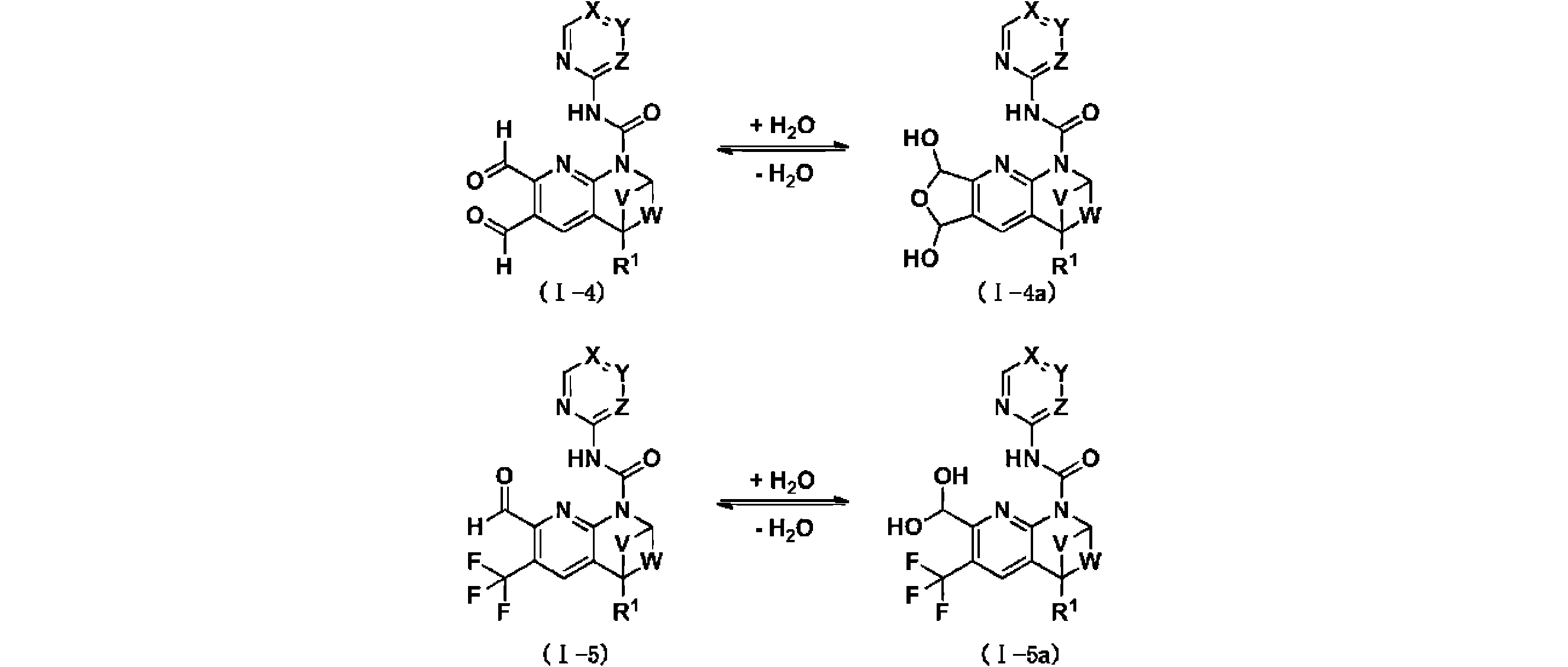
ここで、V、W、X、Y、Z及びR1は、式(I)の化合物で定義される通りである。このため、本発明は、化合物(I-4)、(I-5)及びその溶媒和物(I-4a)、(I-5a)を含む。当業者は、例えばNMRなどを用いて溶媒和物の存在を同定することができる。 wherein V, W, X, Y, Z and R1 are as defined for compounds of formula (I). Therefore, the present invention includes compounds (I-4), (I-5) and solvates thereof (I-4a), (I-5a). One skilled in the art can identify the presence of solvates using, for example, NMR.
本発明の薬学的に許容される溶媒和物は、結晶の溶媒が同位体で置換されていてもよい溶媒和物、例えばD2O、d6-アセトン、d6-DMSOを含む。 Pharmaceutically acceptable solvates of the present invention include solvates in which the solvent of crystals may be isotopically substituted, eg D 2 O, d 6 -acetone, d 6 -DMSO.
用語「活性代謝物」とは、化合物の代謝時に形成される当該化合物の活性誘導体を意味する。 The term "active metabolite" means an active derivative of a compound that is formed during metabolism of the compound.
用語「結晶多形」とは、異なる結晶格子の形態で存在する本発明の化合物を意味する。 The term "polymorph" means the compounds of the present invention existing in different crystal lattice forms.
用語「同位体標識物」とは、同位体標識を有する本発明に係る化合物を意味する。例えば本発明に係る化合物における同位体は、H、C、N、O、P、F、S、Cl及びIなどの元素の様々な同位体、例えば2H、3H、13C、14C、15N、18O、17O、31P、32P、35S、18F、36S、123I、124I及び125Iを含んでもよい。本発明は、定義される様々な同位体で標識された化合物を含み、例えば、放射性同位体(例えば3H及び14C)が存在する化合物又は非放射性同位体(例えば2H及び13C)が存在する化合物が挙げられる。このような同位体で標識された化合物は、代謝研究(14Cを使用する)、反応動力学的研究(例えば2H又は3Hを使用する)、検出又はイメージング技術、例えば陽電子放出断層撮影(PET)又は単一光子放射型コンピュータ断層撮影(SPECT)、薬物又は基質の組織分布の分析に適しており、又は患者の放射性治療に適している。 The term "isotopically labeled product" means a compound according to the present invention having an isotopically labeled product. For example, isotopes in the compounds according to the invention include various isotopes of elements such as H , C , N , O, P, F, S, Cl and I, e.g. 15N , 18O , 17O , 31P , 32P , 35S , 18F , 36S , 123I , 124I and 125I . The present invention includes various isotopically-labeled compounds as defined, e.g., compounds in which radioactive isotopes (e.g., 3 H and 14 C) are present or non-radioactive isotopes (e.g., 2 H and 13 C) are Existing compounds are mentioned. Such isotopically labeled compounds can be used in metabolic studies (using 14 C), reaction kinetic studies (e.g. using 2 H or 3 H), detection or imaging techniques such as positron emission tomography (e.g. positron emission tomography). PET) or Single Photon Emission Computed Tomography (SPECT), for analysis of tissue distribution of drugs or substrates, or for radiotherapy of patients.
具体的に、18F化合物は、特にPET又はSPECT研究の要求に合致する可能性がある。同位体で標識された式(I)の化合物は、一般的に、当業者に知られている通常の技術又は添付の実施例及び調製に記載の方法と類似した方法によって、従来の標識されていない試薬の代わりに適切な同位体で標識された試薬を使用して調製することができる。 Specifically, 18 F compounds may particularly meet the requirements of PET or SPECT studies. Isotopically labeled compounds of formula (I) may generally be conventionally labeled by conventional techniques known to those skilled in the art or by methods analogous to those described in the accompanying Examples and Preparations. It can be prepared using a suitable isotopically labeled reagent in place of the unlabeled reagent.
また、比較的重い同位体、特に二重水素(即ち、2H又はD)で置換される場合、例えば体内半減期の増加、所要の用量の低減、治療指数の改良などの高い代謝安定性による治療上の利点が得られる。この場合、二重水素を式(I)の化合物の置換基と見なし、本発明は、式(I)の化合物における任意の1つ又は複数の水素原子が二重水素で置換されている化合物を含むことを理解すべきである。 Also, when substituted with heavier isotopes, especially dihydrogen (i.e., 2 H or D), due to increased metabolic stability, e.g., increased half-life in vivo, reduced dose requirements, improved therapeutic index, etc. A therapeutic benefit is obtained. In this case, double hydrogen is considered a substituent of the compound of formula (I), and the present invention provides compounds wherein any one or more hydrogen atoms in the compound of formula (I) are replaced with a double hydrogen. should be understood to include
用語「異性体」とは、分子内の原子の異なる空間的な配列方式によって生成される異性体を意味する。本発明に係る化合物は、可能な光学活性異性体、幾何異性体、回転異性体、互変異性体、異性体の内部付加物又はそれらの混合物のいずれかの形態であってもよく、例えば実質的に純粋な幾何(シス型又はトランス型)異性体、ジアステレオマー、光学異性体(エナンチオマー)、ラセミ体(racemate)又はそれらの混合物の形態である。例えば、光学異性体については、キラル分離、キラル合成、キラル試薬又はその他の通常の技術により光学活性な(R)-及び(S)-異性体及びD及びL異性体を調製することができる。また例えば、適切な光学活性物質(例えばキラルアルコールやモッシャー(Mosher`s)の酸塩化物)と反応してジアステレオマーに変換し、これを分離して対応する単一異性体に変換する(例えば加水分解)ことができる。さらに例えば、カラムにより分離することもできる。 The term "isomer" means isomers produced by different spatial arrangements of atoms within a molecule. The compounds according to the present invention may be in the form of any of the possible optically active isomers, geometric isomers, rotational isomers, tautomers, isomeric internal adducts or mixtures thereof, e.g. They are in the form of pure geometric (cis or trans) isomers, diastereomers, optical isomers (enantiomers), racemates or mixtures thereof. For optical isomers, for example, optically active (R)- and (S)- and D and L isomers can be prepared by chiral separation, chiral synthesis, chiral reagents or other conventional techniques. Also for example, reaction with a suitable optically active substance (e.g. chiral alcohol or Mosher's acid chloride) to convert it to a diastereomer, which is separated and converted to the corresponding single isomer ( hydrolysis). Further, for example, separation can also be performed using a column.
本発明に係る化合物は、不斉又はキラル中心及び二重結合などの構造を含有することができる。化合物が二重結合を含有する場合、置換基は、シス型又はトランス型の立体配置であってもよい。化合物がジ置換のシクロアルキル基を含有する場合、置換基であるシクロアルキル基は、シス型又はトランス型の立体配置を有してもよい。化合物が阻害されて自由に回転できない単結合を含有する場合、容易に相互変換できない配座異性体が生じる可能性がある。 The compounds according to this invention may contain structures such as asymmetric or chiral centers and double bonds. If the compound contains a double bond, the substituent may be in cis or trans configuration. When a compound contains a disubstituted cycloalkyl group, the substituent cycloalkyl group may have a cis or trans configuration. If a compound contains a single bond that is hindered and cannot rotate freely, conformers that cannot be readily interconverted may result.
本発明において、式(I)の化合物は、以下に示す互変異性体及び異性体の内部付加物を容易に形成することができる。例えば、ここで、R4は、ヒドロキシメチル基、-CH2CO2H、(メチルアミノ)メチル基である式(I)の化合物(例えば化合物(I-1)、(I-2)及び(I-3))は、以下に示す形態(化合物(I-1a)、(I-2a)及び(I-3a))であってもよい。 In the present invention, the compounds of formula (I) can readily form internal adducts of the tautomers and isomers shown below. For example, where R 4 is a hydroxymethyl group, —CH 2 CO 2 H, a (methylamino)methyl group, compounds of formula (I) (such as compounds (I-1), (I-2) and ( I-3)) may be in the form shown below (compounds (I-1a), (I-2a) and (I-3a)).
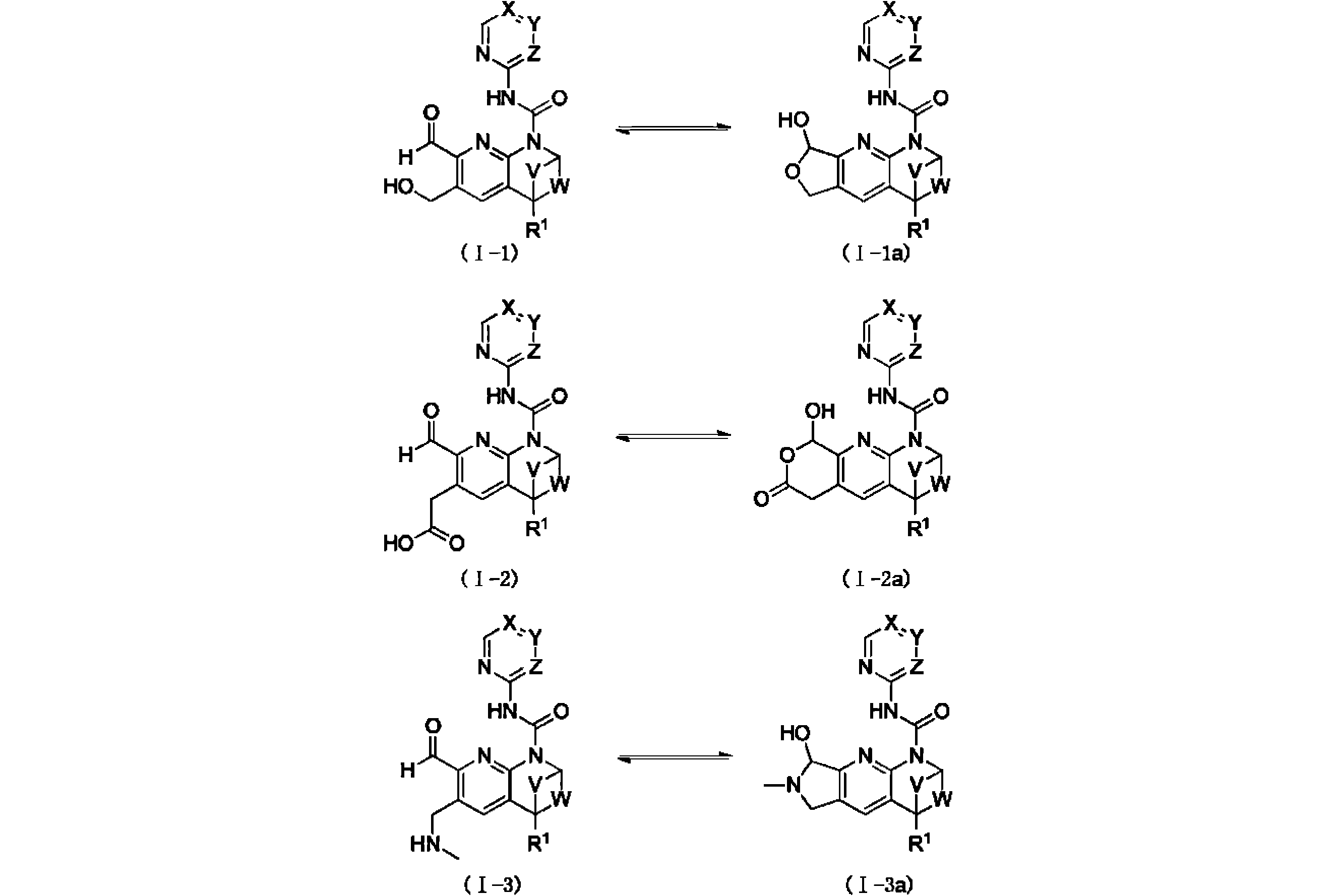
ここで、V、W、X、Y、Z及R1は、前述の式(I)の化合物で定義される通りである。このため、本発明に係る式(I)の化合物は、化合物(I-1)、(I-2)、(I-3)及びその異性体(I-1a)、(I-2a)、(I-3a)などのすべての互変異性体又は異性体の内部付加物を含む。当業者は、例えばNMRなどを用いて互変異性体又は異性体の内部付加物の存在を同定することができる。 wherein V, W, X, Y, Z and R1 are as defined for compounds of formula (I) above. Therefore, the compounds of formula (I) according to the present invention are compounds (I-1), (I-2), (I-3) and their isomers (I-1a), (I-2a), ( Including all tautomers or isomeric internal adducts such as I-3a). One skilled in the art can identify the presence of tautomers or isomeric internal adducts using, for example, NMR.
特別な説明がない限り、又は文脈と明らかに矛盾しない限り、本明細書に記載されたすべての方法は、適切な順序で行うことができる。本明細書で提供されるあらゆる例又は例示的な用語(例えば「例えば」)は、本発明をより良く説明するためのものに過ぎなく、且つ、他の主張される本発明の範囲を限定するものではない。 All methods described herein can be performed in any suitable order unless otherwise indicated herein or otherwise clearly contradicted by context. Any examples or exemplary terms (e.g., "for example") provided herein are merely to better describe the invention and limit the scope of other claimed inventions. not a thing
以下、具体的な実施例を併せて本発明の一実施形態に係る式(I)の化合物の調製及び性能をさらに説明する。ここで、使用される出発原料は、知られており且つ市販されているものであるか、又は当該技術分野における公知の方法により合成されたものであってもよい。実施例における「Pd2(dba)3」とは、トリス(ジベンジリデンアセトン)ジパラジウムを指す。「Pd(dppf)Cl2」とは、(1,1’-ビス(ジフェニルホスフィノ)フェロセン)ジクロロパラジウムを指す。「dppf」とは、1,1’-ビス(ジフェニルホスフィノ)フェロセンを指す。「NaHMDS」とは、ナトリウムビス(トリメチルシリル)アミドを指す。「LiHMDS」とは、リチウムビス(トリメチルシリル)アミドを指す。「HATU」とは、2-(7-アザベンゾトリアゾール)-N,N,N’,N’-テトラメチルウロニウムヘキサフルオロホスフェートを指す。 The preparation and performance of the compounds of formula (I) according to one embodiment of the present invention are further illustrated below in conjunction with specific examples. The starting materials used herein are either known and commercially available or may be synthesized by methods known in the art. “Pd 2 (dba) 3 ” in the examples refers to tris(dibenzylideneacetone) dipalladium. “Pd(dppf)Cl 2 ” refers to (1,1′-bis(diphenylphosphino)ferrocene)dichloropalladium. "dppf" refers to 1,1'-bis(diphenylphosphino)ferrocene. "NaHMDS" refers to sodium bis(trimethylsilyl)amide. "LiHMDS" refers to lithium bis(trimethylsilyl)amide. "HATU" refers to 2-(7-azabenzotriazole)-N,N,N',N'-tetramethyluronium hexafluorophosphate.
特に断りがない限り、実施例のすべての反応は、連続的な磁力攪拌下で、乾燥した窒素ガス又はアルゴンガス雰囲気下で行われ、溶媒は、乾燥溶媒であり、反応温度の単位は、摂氏温度である。 Unless otherwise noted, all reactions in the examples were performed under a dry nitrogen or argon gas atmosphere under continuous magnetic stirring, solvents were dry solvents, and reaction temperatures were in degrees Celsius. temperature.
本発明の実施例に係る化合物の構造は、核磁気共鳴分析(NMR)又は/及び液体クロマトグラフィー質量分析(LC-MS)により同定される。NMR化学シフト(δ)は、百万分の一(ppm)を単位とする。NMRは、Bruker AVANCE-400核磁気共鳴装置により測定され、測定用溶媒は、重水素化ジメチルスルホキシド(DMSO-d6)又は重水素化クロロホルム(CDCl3)であり、内部標準は、テトラメチルシラン(TMS)である。液体クロマトグラフィー質量分析LC-MSの測定は、Agilent 1100 Infinity Series質量分析計を使用する。 The structures of the compounds according to the examples of the invention are identified by nuclear magnetic resonance spectroscopy (NMR) or/and liquid chromatography-mass spectroscopy (LC-MS). NMR chemical shifts (δ) are in parts per million (ppm). NMR was measured with a Bruker AVANCE-400 nuclear magnetic resonance instrument, the solvent for measurement was deuterated dimethyl sulfoxide (DMSO-d 6 ) or deuterated chloroform (CDCl 3 ), and the internal standard was tetramethylsilane. (TMS). Liquid chromatography-mass spectrometry LC-MS measurements use an Agilent 1100 Infinity Series mass spectrometer.
薄層クロマトグラフィー(TLC)は、Merck社のSilica gel 60 F254シリカゲル板を使用した。薄層クロマトグラフィーによる分離精製(pre-TLC)製品は、安徽良臣珪源社の規格1.0mmのGF254シリカゲル板を使用する。カラムクロマトグラフィーは、一般的に青島海洋100~200メッシュのシリカゲルを担体として使用する。 Thin layer chromatography (TLC) used Merck Silica gel 60 F 254 silica gel plates. Separation and purification by thin layer chromatography (pre-TLC) products use standard 1.0 mm GF254 silica gel plates from Anhui Yoshiomi Keigen Co., Ltd. Column chromatography generally uses Qingdao Ocean 100-200 mesh silica gel as a carrier.
(実施例0-1)
(中間体1:6-アミノ-4-フルオロニコチノニトリルの調製)
(Example 0-1)
(Intermediate 1: Preparation of 6-amino-4-fluoronicotinonitrile)

(第1ステップ:2-アミノ-4-フルオロ-5-ヨードピリジンの調製) (First step: Preparation of 2-amino-4-fluoro-5-iodopyridine)

室温で、2-アミノ-4-フルオロピリジン(11.2g、100mmol)及びN-ヨードスクシンイミド(24.8g、110mmol)のアセトニトリル(400mL)溶液にトリフルオロ酢酸(3.0mL、40mmol)を加え、その後、室温で3時間攪拌した。 Trifluoroacetic acid (3.0 mL, 40 mmol) was added to a solution of 2-amino-4-fluoropyridine (11.2 g, 100 mmol) and N-iodosuccinimide (24.8 g, 110 mmol) in acetonitrile (400 mL) at room temperature, After that, the mixture was stirred at room temperature for 3 hours.
その後、得られた混合液に酢酸エチル(400mL)を加えて希釈し、飽和チオ硫酸ナトリウム溶液(500mL)及び飽和炭酸ナトリウム溶液(500mL)で順次洗浄し、分液して水相及び有機相を得た。得られた水相を合わせてから飽和炭酸ナトリウム溶液でpHを10に調整し、さらに酢酸エチル(500mL)で抽出し、分液して有機相を得た。すべての有機相を合わせ、飽和食塩水(500mL)で洗浄し、無水硫酸ナトリウムにより乾燥し、吸引濾過し、乾燥するまで蒸発させた。カラムクロマトグラフィーにより残留物を精製し、石油エーテル/酢酸エチル=4:1~2:1で勾配溶出し、生成物を含有する溶出画分を濃縮して、生成物である2-アミノ-4-フルオロ-5-ヨードピリジンを得た。関連するテストデータは以下の通りである。 After that, ethyl acetate (400 mL) was added to dilute the resulting mixture, and the mixture was washed successively with saturated sodium thiosulfate solution (500 mL) and saturated sodium carbonate solution (500 mL), and separated to separate the aqueous phase and the organic phase. Obtained. The resulting aqueous phases were combined, adjusted to pH 10 with a saturated sodium carbonate solution, extracted with ethyl acetate (500 mL), and separated to obtain an organic phase. All organic phases were combined, washed with saturated brine (500 mL), dried over anhydrous sodium sulfate, suction filtered and evaporated to dryness. The residue was purified by column chromatography, gradient eluted with petroleum ether/ethyl acetate=4:1 to 2:1, and the eluted fractions containing the product were concentrated to give the product, 2-amino-4 -fluoro-5-iodopyridine is obtained. The relevant test data are as follows.
1HNMR(CDCl3,400MHz),δ8.24(d,J=9.2Hz,1H),6.25(d,J=9.2Hz,1H),4.70(s,2H)。 < 1 >H NMR ( CDCl3 , 400 MHz), [delta] 8.24 (d, J = 9.2 Hz, 1 H), 6.25 (d, J = 9.2 Hz, 1 H), 4.70 (s, 2 H).
(第2ステップ:6-アミノ-4-フルオロニコチノニトリルの調製) (Second step: preparation of 6-amino-4-fluoronicotinonitrile)

窒素ガス保護雰囲気下で、2-アミノ-4-フルオロ-5-ヨードピリジン(15.6g、65.5mmol)、シアン化亜鉛(8.1g、69.0mmol)、Pd2(dba)3(1.5g、1.64mmol)、dppf(3.0g、5.4mmol)、亜鉛粉末(860mg、13.1mmol)及びN,N-ジメチルアセトアミド(100mL)の混合物を100℃で4時間攪拌した。 Under nitrogen gas protective atmosphere, 2-amino-4-fluoro-5-iodopyridine (15.6 g, 65.5 mmol), zinc cyanide (8.1 g, 69.0 mmol), Pd 2 (dba) 3 (1 A mixture of dppf (3.0 g, 5.4 mmol), zinc powder (860 mg, 13.1 mmol) and N,N-dimethylacetamide (100 mL) was stirred at 100° C. for 4 hours.
その後、室温まで降温し、得られた混合液に飽和炭酸水素ナトリウム溶液(500mL)を加えて希釈し、酢酸エチル(500mL)で抽出し、分液して有機相を得、この有機相を飽和食塩水(500mL)で洗浄し、無水硫酸ナトリウムにより乾燥し、吸引濾過し、乾燥するまで蒸発させた。カラムクロマトグラフィーにより残留物を精製し、石油エーテル/酢酸エチル=5:1~1:1で勾配溶出し、生成物を含有する溶出画分を濃縮して、中間体1を得た。関連するテストデータは以下の通りである。 After that, the temperature was lowered to room temperature, and the resulting mixture was diluted with a saturated sodium bicarbonate solution (500 mL), extracted with ethyl acetate (500 mL), separated to obtain an organic phase, and the organic phase was saturated. Washed with brine (500 mL), dried over anhydrous sodium sulfate, suction filtered and evaporated to dryness. The residue was purified by column chromatography, gradient eluted with petroleum ether/ethyl acetate=5:1 to 1:1, and the eluted fractions containing product were concentrated to give Intermediate 1. The relevant test data are as follows.
1HNMR(DMSO-d6,400MHz),δ8.12(d,J=10.0Hz,1H),6.45(s,2H),6.30(d,J=10.8Hz,1H)。 1 H NMR (DMSO-d6, 400 MHz), δ 8.12 (d, J=10.0 Hz, 1 H), 6.45 (s, 2 H), 6.30 (d, J=10.8 Hz, 1 H).
(実施例0-2)
(中間体2:6-アミノ-4-((2-メトキシエチル)アミノ)ニコチノニトリルの調製)
(Example 0-2)
(Intermediate 2: Preparation of 6-amino-4-((2-methoxyethyl)amino)nicotinonitrile)

窒素ガス保護雰囲気下で、6-アミノ-4-フルオロニコチノニトリル(中間体1、6.868g、50mmol)、2-メトキシエチルアミン(13.0mL、150mmol)、N,N-ジイソプロピルエチルアミン(25.0mL、152mmol)のN,N-ジメチルアセトアミド(120mL)溶液を50℃で16時間攪拌した。 Under nitrogen gas protective atmosphere, 6-amino-4-fluoronicotinonitrile (Intermediate 1, 6.868 g, 50 mmol), 2-methoxyethylamine (13.0 mL, 150 mmol), N,N-diisopropylethylamine (25. 0 mL, 152 mmol) in N,N-dimethylacetamide (120 mL) was stirred at 50° C. for 16 hours.
その後、室温まで降温し、カラムクロマトグラフィーにより得られた混合物を精製し、石油エーテル/酢酸エチル=1:1~酢酸エチルで勾配溶出し、生成物を含有する溶出画分を濃縮して、中間体2を得た。関連するテストデータは以下の通りである。 After that, the temperature was lowered to room temperature, the resulting mixture was purified by column chromatography, gradient elution was performed with petroleum ether/ethyl acetate=1:1 to ethyl acetate, and the eluted fractions containing the product were concentrated to give an intermediate Got body 2. The relevant test data are as follows.
1HNMR(CDCl3,400MHz),δ8.03(s,1H),5.59(s,1H),5.05(s,1H),4.79(s,2H),3.58(t,J=5.2Hz,2H),3.39(s,3H),3.30-3.34(m,2H)。 1 H NMR (CDCl 3 , 400 MHz), δ 8.03 (s, 1 H), 5.59 (s, 1 H), 5.05 (s, 1 H), 4.79 (s, 2 H), 3.58 (t , J=5.2 Hz, 2H), 3.39(s, 3H), 3.30-3.34(m, 2H).
(実施例0-3)
(中間体3:(R)-6-アミノ-4-((1-メトキシプロパン-2-イル)アミノ)ニコチノニトリルの調製)
(Example 0-3)
(Intermediate 3: Preparation of (R)-6-amino-4-((1-methoxypropan-2-yl)amino)nicotinonitrile)

中間体1及び(R)-1-メトキシ-2-プロピルアミンを出発原料とし、中間体2の調製と類似した方法により反応させ、中間体3を得た。関連するテストデータは以下の通りである。 Intermediate 1 and (R)-1-methoxy-2-propylamine were used as starting materials and reacted in a manner similar to the preparation of intermediate 2 to give intermediate 3. The relevant test data are as follows.
ESI-MS:207.1[M+H]+。 ESI-MS: 207.1 [M+H] + .
(実施例0-4)
(中間体4:6-アミノ-4-((テトラヒドロフラン-3-イル)アミノ)ニコチノニトリルの調製)
(Example 0-4)
(Intermediate 4: Preparation of 6-amino-4-((tetrahydrofuran-3-yl)amino)nicotinonitrile)

中間体1及び3-アミノテトラヒドロフランを出発原料とし、中間体2の調製と類似した方法により反応させ、中間体4を得た。関連するテストデータは以下の通りである。 Intermediate 1 and 3-aminotetrahydrofuran were used as starting materials and reacted in a manner similar to the preparation of Intermediate 2 to give Intermediate 4. The relevant test data are as follows.
ESI-MS:205.1[M+H]+。 ESI-MS: 205.1 [M+H] + .
(実施例0-5)
(中間体5:6-アミノ-4-(トランス-(2-メトキシシクロペンチル)アミノ)ニコチノニトリルの調製)
(Example 0-5)
(Intermediate 5: Preparation of 6-amino-4-(trans-(2-methoxycyclopentyl)amino)nicotinonitrile)

(第1ステップ:トランス-(2-ヒドロキシシクロペンチル)カルバミン酸ベンジルの調製) (First step: preparation of benzyl trans-(2-hydroxycyclopentyl)carbamate)

0℃で、トランス-2-アミノシクロペンタノール塩酸塩(1.37g、10mmol)及び炭酸ナトリウム(3.4g、32mmol)の水(20mL)溶液にクロロギ酸ベンジル(3.4g、20mmol)を滴下し、その後、室温で16時間撹拌した。 Benzyl chloroformate (3.4 g, 20 mmol) was added dropwise to a solution of trans-2-aminocyclopentanol hydrochloride (1.37 g, 10 mmol) and sodium carbonate (3.4 g, 32 mmol) in water (20 mL) at 0°C. and then stirred at room temperature for 16 hours.
その後、得られた混合物に水(40mL)を加えて希釈し、酢酸エチル(100mL)で抽出し、分液して有機相を得、この有機相を飽和食塩水(50mL)で洗浄し、無水硫酸ナトリウムにより乾燥し、吸引濾過し、乾燥するまで蒸発させた。カラムクロマトグラフィーにより残留物を精製し、石油エーテル/酢酸エチル=5:1~1:1で勾配溶出し、生成物を含有する溶出画分を濃縮して、トランス-(2-ヒドロキシシクロペンチル)カルバミン酸ベンジルを得た。関連するテストデータは以下の通りである。 The resulting mixture was then diluted with water (40 mL), extracted with ethyl acetate (100 mL), separated to obtain an organic phase, washed with saturated brine (50 mL), dried over anhydrous Dry over sodium sulphate, suction filter and evaporate to dryness. Purify the residue by column chromatography, gradient elution with petroleum ether/ethyl acetate=5:1 to 1:1, concentrate the eluted fractions containing the product, and give trans-(2-hydroxycyclopentyl)carbamine. Benzyl acid was obtained. The relevant test data are as follows.
ESI-MS:236.1[M+H]+。 ESI-MS: 236.1 [M+H] + .
(第2ステップ:トランス-(2-メトキシシクロペンチル)カルバミン酸ベンジルの調製) (Second step: preparation of benzyl trans-(2-methoxycyclopentyl)carbamate)

0℃で、トランス-(2-ヒドロキシシクロペンチル)カルバミン酸ベンジル(1.658g、7.055mmol)のテトラヒドロフラン(50mL)溶液に水素化ナトリウム(338mg、8.466mmol)を加え、窒素ガス保護雰囲気下で30分間撹拌した後、系中にヨウ化メチル(1g、7.055mmol)をゆっくりと滴下し、その後、4時間撹拌を続けた。 Sodium hydride (338 mg, 8.466 mmol) was added to a solution of benzyl trans-(2-hydroxycyclopentyl)carbamate (1.658 g, 7.055 mmol) in tetrahydrofuran (50 mL) at 0° C. under nitrogen gas protective atmosphere. After stirring for 30 minutes, methyl iodide (1 g, 7.055 mmol) was slowly added dropwise into the system, followed by continued stirring for 4 hours.
その後、反応液を飽和塩化アンモニウム溶液(120mL)に入れて反応をクエンチし、酢酸エチル(120mL)で抽出し、分液して有機相を得、この有機相を水(50mL)、飽和食塩水(50mL)で順次洗浄し、無水硫酸ナトリウムにより乾燥し、吸引濾過し、乾燥するまで蒸発させた。カラムクロマトグラフィーにより残留物を精製し、石油エーテル/酢酸エチル=10:1~1:1で勾配溶出し、生成物を含有する溶出画分を濃縮して、トランス-(2-メトキシシクロペンチル)カルバミン酸ベンジルを得た。関連するテストデータは以下の通りである。 The reaction was then poured into saturated ammonium chloride solution (120 mL) to quench the reaction, extracted with ethyl acetate (120 mL) and separated to obtain an organic phase, which was combined with water (50 mL) and saturated brine. (50 mL), dried over anhydrous sodium sulfate, suction filtered and evaporated to dryness. Purify the residue by column chromatography, gradient elution with petroleum ether/ethyl acetate=10:1 to 1:1, and concentrate the eluted fractions containing the product to yield trans-(2-methoxycyclopentyl)carbamine. Benzyl acid was obtained. The relevant test data are as follows.
ESI-MS:250.1[M+H]+。 ESI-MS: 250.1 [M+H] + .
(第3ステップ:トランス-2-メトキシシクロペンチルアミンの調製) (Third step: preparation of trans-2-methoxycyclopentylamine)

室温で、トランス-(2-メトキシシクロペンチル)カルバミン酸ベンジル(900mg、3.614mmol)の無水メタノール(30mL)溶液に10%パラジウム/炭素(195mg)を加え、水素ガス雰囲気下で2時間撹拌した。その後、吸引濾過し、乾燥するまで濾液を蒸発させ、トランス-2-メトキシシクロペンチルアミンを得た。関連するテストデータは以下の通りである。 At room temperature, 10% palladium/carbon (195 mg) was added to a solution of benzyl trans-(2-methoxycyclopentyl)carbamate (900 mg, 3.614 mmol) in anhydrous methanol (30 mL), and the mixture was stirred under a hydrogen gas atmosphere for 2 hours. Then suction filtration and evaporation of the filtrate to dryness yielded trans-2-methoxycyclopentylamine. The relevant test data are as follows.
ESI-MS:116.1[M+H]+。 ESI-MS: 116.1 [M+H] + .
(第4ステップ:6-アミノ-4-(トランス-(2-メトキシシクロペンチル)アミノ)ニコチノニトリルの調製) (Fourth step: Preparation of 6-amino-4-(trans-(2-methoxycyclopentyl)amino)nicotinonitrile)

中間体1及びトランス-2-メトキシシクロペンチルアミンを出発原料とし、中間体2の調製と類似した方法により反応させ、中間体5を得た。関連するテストデータは以下の通りである。 Intermediate 1 and trans-2-methoxycyclopentylamine were used as starting materials and reacted in a manner similar to the preparation of Intermediate 2 to give Intermediate 5. The relevant test data are as follows.
ESI-MS:233.1[M+H]+。 ESI-MS: 233.1 [M+H] + .
(実施例0-6)
(中間体6:6-アミノ-4-(2-メトキシエトキシ)ニコチノニトリルの調製)
(Example 0-6)
(Intermediate 6: Preparation of 6-amino-4-(2-methoxyethoxy)nicotinonitrile)

窒素ガス保護雰囲気下で、エチレングリコールメチルエーテル(152mg、2mmol)を、乾燥したテトラヒドロフラン(4mL)に溶解させ、0℃まで降温し、この温度でNaHMDS(2M、2.5mL、5mmol)のテトラヒドロフラン溶液を滴下し、その後、6-アミノ-4-フルオロニコチノニトリル(中間体2、127mg、1mmol)を加え、攪拌し続けて16時間反応させた。 Under a nitrogen gas protective atmosphere, ethylene glycol methyl ether (152 mg, 2 mmol) was dissolved in dry tetrahydrofuran (4 mL), cooled to 0° C. and NaHMDS (2 M, 2.5 mL, 5 mmol) in tetrahydrofuran at this temperature. was added dropwise, followed by 6-amino-4-fluoronicotinonitrile (Intermediate 2, 127 mg, 1 mmol) and allowed to react for 16 hours with continued stirring.
その後、飽和塩化アンモニウム水溶液(50mL)で反応をクエンチし、酢酸エチル(50mL)で抽出し、分液して有機相を得、この有機相を飽和食塩水(50mL)で洗浄し、無水硫酸ナトリウムにより乾燥し、吸引濾過し、乾燥するまで蒸発させた。カラムクロマトグラフィーにより残留物を精製し、石油エーテル/酢酸エチル=5:1~1:1で勾配溶出し、生成物を含有する溶出画分を濃縮して、中間体6を得た。関連するテストデータは以下の通りである。 The reaction was then quenched with saturated aqueous ammonium chloride solution (50 mL), extracted with ethyl acetate (50 mL), separated to obtain an organic phase, washed with saturated brine (50 mL), and dried over anhydrous sodium sulfate. dried over, suction filtered and evaporated to dryness. The residue was purified by column chromatography, gradient eluted with petroleum ether/ethyl acetate=5:1 to 1:1, and product-containing elution fractions were concentrated to give intermediate 6. The relevant test data are as follows.
ESI-MS:194.1[M+H]+。 ESI-MS: 194.1 [M+H] + .
(実施例0-7)
(中間体7:6-アミノ-4-((2-(2-メトキシエトキシ)エチル)アミノ)ニコチノニトリルの調製)
(Example 0-7)
(Intermediate 7: Preparation of 6-amino-4-((2-(2-methoxyethoxy)ethyl)amino)nicotinonitrile)

中間体1及び2-(2-メトキシエトキシ)エチルアミンを出発原料とし、中間体2の調製と類似した方法により反応させ、中間体7を得た。関連するテストデータは以下の通りである。
Intermediate 1 and 2-(2-methoxyethoxy)ethylamine were used as starting materials and reacted in a manner analogous to the preparation of Intermediate 2 to give
ESI-MS:236.9[M+H]+。 ESI-MS: 236.9 [M+H] + .
(実施例0-8)
(中間体8:3-((2-アミノ-5-シアノピリジン-4-イル)アミノ)アゼチジン-1-カルボン酸t-ブチルの調製)
(Example 0-8)
(Intermediate 8: Preparation of t-butyl 3-((2-amino-5-cyanopyridin-4-yl)amino)azetidine-1-carboxylate)

中間体1及び3-アミノアゼチジン-1-カルボン酸t-ブチルを出発原料とし、中間体2の調製と類似した方法により反応させ、中間体8を得た。関連するテストデータは以下の通りである。
Intermediate 1 and t-butyl 3-aminoazetidine-1-carboxylate were used as starting materials and reacted in a manner similar to the preparation of Intermediate 2 to give
ESI-MS:290.2[M+H]+。 ESI-MS: 290.2 [M+H] + .
(実施例0-9)
(中間体9:6-アミノ-4-(トランス-(2-((t-ブチルジメチルシリル)オキシ)シクロペンチル)アミノ)ニコチノニトリルの調製)
(Example 0-9)
(Intermediate 9: Preparation of 6-amino-4-(trans-(2-((t-butyldimethylsilyl)oxy)cyclopentyl)amino)nicotinonitrile)

(第1ステップ:6-アミノ-4-(トランス-(2-ヒドロキシシクロペンチル)アミノ)ニコチノニトリルの調製) (First step: Preparation of 6-amino-4-(trans-(2-hydroxycyclopentyl)amino)nicotinonitrile)

中間体1及びトランス-2-アミノシクロペンタノール塩酸塩を出発原料とし、中間体2の調製と類似した方法により反応させ、6-アミノ-4-(トランス-(2-ヒドロキシシクロペンチル)アミノ)ニコチノニトリルを得た。関連するテストデータは以下の通りである。 Intermediate 1 and trans-2-aminocyclopentanol hydrochloride as starting materials are reacted in a manner analogous to the preparation of intermediate 2 to give 6-amino-4-(trans-(2-hydroxycyclopentyl)amino)nicotine. I got nonitrile. The relevant test data are as follows.
ESI-MS:219.1[M+H]+。 ESI-MS: 219.1 [M+H] + .
(第2ステップ:6-アミノ-4-(トランス-(2-((t-ブチルジメチルシリル)オキシ)シクロペンチル)アミノ)ニコチノニトリルの調製) (Second Step: Preparation of 6-amino-4-(trans-(2-((t-butyldimethylsilyl)oxy)cyclopentyl)amino)nicotinonitrile)

6-アミノ-4-(トランス-(2-ヒドロキシシクロペンチル)アミノ)ニコチノニトリル(2.200g、10.09mmol)、イミダゾール(2.479g、36.45mmol)及びt-ブチルクロロジメチルシラン(2.197g、14.58mmol)をN,N-ジメチルホルムアミド(20mL)に溶解させ、室温で16時間撹拌した。 6-amino-4-(trans-(2-hydroxycyclopentyl)amino)nicotinonitrile (2.200 g, 10.09 mmol), imidazole (2.479 g, 36.45 mmol) and t-butylchlorodimethylsilane (2. 197 g, 14.58 mmol) was dissolved in N,N-dimethylformamide (20 mL) and stirred at room temperature for 16 hours.
その後、反応液を水(100mL)に入れて反応をクエンチし、酢酸エチル(30mL*3)で抽出し、有機相を水(100mL)、飽和食塩水(100mL)で順次洗浄し、無水硫酸ナトリウムにより乾燥し、吸引濾過し、乾燥するまで蒸発させた。残留物をカラムクロマトグラフィーにより精製し、石油エーテル/酢酸エチル=4:1で溶出し、中間体9を得た。関連するテストデータは以下の通りである。 After that, the reaction mixture was poured into water (100 mL) to quench the reaction, extracted with ethyl acetate (30 mL*3), the organic phase was washed successively with water (100 mL) and saturated brine (100 mL), and anhydrous sodium sulfate was added. dried over, suction filtered and evaporated to dryness. The residue was purified by column chromatography and eluted with petroleum ether/ethyl acetate=4:1 to give intermediate 9. The relevant test data are as follows.
ESI-MS:332.2[M+H]+。 ESI-MS: 332.2 [M+H] + .
(実施例0-10)
(中間体10:2-((2-アミノエチル)(メチル)アミノ)酢酸エチル二塩酸塩の調製)
(Examples 0-10)
(Intermediate 10: Preparation of 2-((2-aminoethyl)(methyl)amino)ethyl acetate dihydrochloride)

(第1ステップ:2-((2-((t-ブトキシカルボニル)アミノ)エチル)(メチル)アミノ)酢酸エチルの調製) (First step: Preparation of ethyl 2-((2-((t-butoxycarbonyl)amino)ethyl)(methyl)amino)acetate)

0℃で、(2-(メチルアミノ)エチル)カルバミン酸t-ブチル(5.0g、28.9mmol)、トリエチルアミン(12mL)のテトラヒドロフラン(58mL)溶液にブロモ酢酸エチル(3.2mL、28.9mmol)を加えた。室温で24h撹拌した。 To a solution of t-butyl (2-(methylamino)ethyl)carbamate (5.0 g, 28.9 mmol), triethylamine (12 mL) in tetrahydrofuran (58 mL) at 0° C. was added ethyl bromoacetate (3.2 mL, 28.9 mmol). ) was added. Stir at room temperature for 24 h.
その後、得られた混合物に飽和炭酸水素ナトリウム溶液(200mL)及びジクロロメタン溶液(200mL)を加えて抽出し、分液して有機相を得、有機相を飽和食塩水(200mL)で洗浄し、さらに無水硫酸ナトリウムにより乾燥し、吸引濾過し、乾燥するまで蒸発させ、2-((2-((t-ブトキシカルボニル)アミノ)エチル)(メチル)アミノ)酢酸エチルを得た。関連するテストデータは以下の通りである。 After that, the resulting mixture is extracted by adding saturated sodium bicarbonate solution (200 mL) and dichloromethane solution (200 mL), the liquids are separated to obtain an organic phase, the organic phase is washed with saturated brine (200 mL), and Dried over anhydrous sodium sulfate, suction filtered and evaporated to dryness to give ethyl 2-((2-((t-butoxycarbonyl)amino)ethyl)(methyl)amino)acetate. The relevant test data are as follows.
1HNMR(CDCl3,400MHz),δ5.16(brs,1H),4.16(q,J=7.2Hz,2H),3.25(s,2H),3.19(q,J=5.2Hz,2H),2.62(t,J=6.0Hz,2H),2.36(s,3H),1.43(s,9H),1.26(t,J=7.2Hz,3H)。 1 H NMR (CDCl 3 , 400 MHz), δ 5.16 (brs, 1 H), 4.16 (q, J = 7.2 Hz, 2 H), 3.25 (s, 2 H), 3.19 (q, J = 5.2 Hz, 2H), 2.62 (t, J=6.0 Hz, 2H), 2.36 (s, 3H), 1.43 (s, 9H), 1.26 (t, J=7. 2Hz, 3H).
ESI-MS:261.2[M+H]+。 ESI-MS: 261.2 [M+H] + .
(第2ステップ:2-((2-アミノエチル)(メチル)アミノ)酢酸エチル二塩酸塩の調製) (Second Step: Preparation of ethyl 2-((2-aminoethyl)(methyl)amino)acetate dihydrochloride)

室温で、2-((2-((t-ブトキシカルボニル)アミノ)エチル)(メチル)アミノ)酢酸エチル(10.3g、28.9mmol)のテトラヒドロフラン(48mL)及びエタノール(240mL)の混合溶液に濃塩酸(32mL)を加えた。室温で3時間撹拌した後、反応混合物を蒸発させ、エタノール(100mL)を加え、乾燥するまで蒸発させ、中間体10を得た。関連するテストデータは以下の通りである。 To a mixed solution of 2-((2-((t-butoxycarbonyl)amino)ethyl)(methyl)amino)ethyl acetate (10.3 g, 28.9 mmol) in tetrahydrofuran (48 mL) and ethanol (240 mL) at room temperature Concentrated hydrochloric acid (32 mL) was added. After stirring for 3 hours at room temperature, the reaction mixture was evaporated, ethanol (100 mL) was added and evaporated to dryness, yielding intermediate 10. The relevant test data are as follows.
1HNMR(CDCl3,400MHz),δ11.22-11.07(brs,1H),8.61(s,2H),4.31(s,2H),4.21(q,J=7.2Hz,2H),3.52-3.47(m,2H),3.30-3.23(m,2H),2.91(s,3H),1.24(t,J=7.2Hz,3H).。 1 H NMR (CDCl 3 , 400 MHz), δ 11.22-11.07 (brs, 1H), 8.61 (s, 2H), 4.31 (s, 2H), 4.21 (q, J=7. 2Hz, 2H), 3.52-3.47 (m, 2H), 3.30-3.23 (m, 2H), 2.91 (s, 3H), 1.24 (t, J=7. 2Hz, 3H). .
ESI-MS:161.2[M+H]+。 ESI-MS: 161.2 [M+H] + .
(実施例0-11)
(中間体11:2-(2-アミノエトキシ)酢酸エチル塩酸塩の調製)
(Example 0-11)
(Intermediate 11: Preparation of 2-(2-aminoethoxy)ethyl acetate hydrochloride)

(第1ステップ:2-((2-((t-ブトキシカルボニル)アミノ)エトキシ)酢酸エチルの調製) (First step: Preparation of ethyl 2-((2-((t-butoxycarbonyl)amino)ethoxy)acetate)

窒素ガス保護雰囲気下で、0℃で(2-ヒドロキシエチル)カルバミン酸t-ブチル(997mg、6.2mmol)のテトラヒドロフラン(5mL)溶液を水素化ナトリウム(520mg、13.02mmol)、ヨウ化ナトリウム(465mg、3.1mmol)及びテトラヒドロフラン(30mL)の混合物に加え、室温で1時間撹拌した。その後、0℃で、ブロモ酢酸エチル(2.028g、12.4mmol)のテトラヒドロフラン(10mL)溶液を上記の混合物にゆっくりと滴下し、その後、常温で16時間撹拌反応させた。 Under a nitrogen gas protective atmosphere, a solution of t-butyl (2-hydroxyethyl)carbamate (997 mg, 6.2 mmol) in tetrahydrofuran (5 mL) was added at 0° C. to sodium hydride (520 mg, 13.02 mmol), sodium iodide ( 465 mg, 3.1 mmol) and tetrahydrofuran (30 mL) and stirred at room temperature for 1 hour. Then, at 0° C., a solution of ethyl bromoacetate (2.028 g, 12.4 mmol) in tetrahydrofuran (10 mL) was slowly added dropwise to the above mixture, and then stirred and reacted at room temperature for 16 hours.
その後、反応混合物に飽和塩化アンモニウム溶液(80mL)を加えて反応をクエンチし、酢酸エチル(25mL×3)で3回抽出し、分液して3部の有機相を得、3部の有機相を合わせてから飽和食塩水(40mL×2)で2回洗浄し、その後、無水硫酸ナトリウムにより乾燥し、吸引濾過し、乾燥するまで蒸発させた。カラムクロマトグラフィーにより残留物を精製し、PE/EtOAc=5:1で溶出し、生成物を含有する溶出画分を濃縮して、2-((2-((t-ブトキシカルボニル)アミノ)エトキシ)酢酸エチルを得た。関連するテストデータは以下の通りである。 Then the reaction mixture was added with saturated ammonium chloride solution (80 mL) to quench the reaction, extracted with ethyl acetate (25 mL×3) three times, separated to obtain 3 organic phases, 3 organic phases The combined was washed twice with saturated brine (40 mL x 2), then dried over anhydrous sodium sulfate, suction filtered and evaporated to dryness. The residue was purified by column chromatography, eluting with PE/EtOAc=5:1, and the elution fractions containing product were concentrated to give 2-((2-((t-butoxycarbonyl)amino)ethoxy ) Ethyl acetate was obtained.The relevant test data are as follows.
ESI-MS:270.1[M+Na]+。 ESI-MS: 270.1 [M+Na] + .
(第2ステップ:2-(2-アミノエトキシ)酢酸エチル塩酸塩の調製) (Second step: preparation of ethyl 2-(2-aminoethoxy)acetate hydrochloride)

0℃で、2-((2-((t-ブトキシカルボニル)アミノ)エトキシ)酢酸エチル(323mg、1.3mmol)を塩化水素のジオキサン溶液(4M、2.5mL、10.0mmol)に溶解させ、室温で1.5時間撹拌した。乾燥するまで得られた溶液を蒸発させ、中間体11を得た。関連するテストデータは以下の通りである。 At 0° C., ethyl 2-((2-((t-butoxycarbonyl)amino)ethoxy)acetate (323 mg, 1.3 mmol) was dissolved in hydrogen chloride in dioxane (4 M, 2.5 mL, 10.0 mmol). was stirred at room temperature for 1.5 hours.The resulting solution was evaporated to dryness, yielding intermediate 11. The relevant test data are as follows.
ESI-MS:148.1[M+H]+。 ESI-MS: 148.1 [M+H] + .
(実施例0-12)
(中間体12:4-フルオロ-7-ブロモ-1,2,3,4-テトラヒドロ-2,4-メチレン-1,8-ナフチリジンの調製)
(Example 0-12)
(Intermediate 12: Preparation of 4-fluoro-7-bromo-1,2,3,4-tetrahydro-2,4-methylene-1,8-naphthyridine)

(第1ステップ:((1r,3s)-3-(6-ブロモ-2-フルオロピリジン-3-イル)-3-ヒドロキシシクロブチル)カルバミン酸t-ブチルの調製) (First step: preparation of ((1r,3s)-3-(6-bromo-2-fluoropyridin-3-yl)-3-hydroxycyclobutyl)carbamate t-butyl)

-65℃で、2-ブロモ-6-フルオロピリジン(185.3g、1.05mol)のテトラヒドロフラン(1L)溶液に、リチウムジイソプロピルアミドのテトラヒドロフラン溶液(2M、526mL、1.05mol)をゆっくりと滴下し、この温度で1時間攪拌を続けた。その後、-65℃で反応液に(3-オキソシクロブチル)カルバミン酸t-ブチル(65.0g、0.35mol)のテトラヒドロフラン(500mL)溶液を滴下し、この温度で攪拌し続けて2時間反応させた。 At −65° C., a solution of 2-bromo-6-fluoropyridine (185.3 g, 1.05 mol) in tetrahydrofuran (1 L) was slowly added dropwise with a solution of lithium diisopropylamide in tetrahydrofuran (2 M, 526 mL, 1.05 mol). , stirring was continued for 1 hour at this temperature. Then, a solution of t-butyl (3-oxocyclobutyl)carbamate (65.0 g, 0.35 mol) in tetrahydrofuran (500 mL) was added dropwise to the reaction solution at -65°C, and the reaction was continued for 2 hours at this temperature with stirring. let me
0℃で反応混合物に水(1L)を加えて反応をクエンチし、酢酸エチル(1L)で抽出し、分液して有機相を得、この有機相を飽和食塩水(1L)で洗浄し、無水硫酸ナトリウムにより乾燥し、吸引濾過し、乾燥するまで蒸発させた。カラムクロマトグラフィーにより残留物を精製し、石油エーテル/酢酸エチル=50:1~5:1で勾配溶出し、生成物を含有する溶出画分を濃縮して、((1r,3s)-3-(6-ブロモ-2-フルオロピリジン-3-イル)-3-ヒドロキシシクロブチル)カルバミン酸t-ブチルを得た。関連するテストデータは以下の通りである。 Add water (1 L) to the reaction mixture at 0° C. to quench the reaction, extract with ethyl acetate (1 L), separate the layers to obtain an organic phase, wash the organic phase with saturated brine (1 L), Dry over anhydrous sodium sulphate, suction filter and evaporate to dryness. The residue was purified by column chromatography, gradient eluted with petroleum ether/ethyl acetate=50:1 to 5:1, and the eluted fractions containing the product were concentrated to yield ((1r,3s)-3- t-Butyl (6-bromo-2-fluoropyridin-3-yl)-3-hydroxycyclobutyl)carbamate was obtained. The relevant test data are as follows.
1HNMR(CDCl3,400MHz),δ7.83(t,J=8.8Hz,1H),7.37(d,J=8.0Hz,1H),5.15(d,J=7.2Hz,1H),4.81(s,1H),3.78-3.84(m,1H),3.00-3.12(m,2H),2.57-2.60(m,2H),1.44(s,9H)。 1 H NMR (CDCl 3 , 400 MHz), δ 7.83 (t, J = 8.8 Hz, 1 H), 7.37 (d, J = 8.0 Hz, 1 H), 5.15 (d, J = 7.2 Hz , 1H), 4.81 (s, 1H), 3.78-3.84 (m, 1H), 3.00-3.12 (m, 2H), 2.57-2.60 (m, 2H) ), 1.44(s, 9H).
ESI-MS:361.1[M+H]+。 ESI-MS: 361.1 [M+H] + .
(第2ステップ:(3-(6-ブロモ-2-フルオロピリジン-3-イル)-3-フルオロシクロブチル)カルバミン酸t-ブチルの調製) (Second step: Preparation of t-butyl (3-(6-bromo-2-fluoropyridin-3-yl)-3-fluorocyclobutyl)carbamate)

-78℃で、((1r,3s)-3-(6-ブロモ-2-フルオロピリジン-3-イル)-3-ヒドロキシシクロブチル)カルバミン酸t-ブチル(15.3g、42.4mmol)のジクロロメタン(200mL)溶液に、三フッ化ジエチルアミノ硫黄(7.0mL、52.2mmol)をゆっくりと滴下し、滴下終了後、自然に室温まで昇温し、室温で攪拌し続けて16時間反応させた。 of t-butyl ((1r,3s)-3-(6-bromo-2-fluoropyridin-3-yl)-3-hydroxycyclobutyl)carbamate (15.3 g, 42.4 mmol) at −78° C. Diethylaminosulfur trifluoride (7.0 mL, 52.2 mmol) was slowly added dropwise to a solution of dichloromethane (200 mL), and after the dropwise addition was completed, the temperature was naturally raised to room temperature, and the reaction was continued for 16 hours while stirring at room temperature. .
反応混合物に飽和炭酸水素ナトリウム溶液(500mL)を加えて反応をクエンチし、ジクロロメタン(500mL)で抽出し、分液して有機相を得て、この有機相を飽和食塩水(500mL)で洗浄し、さらに無水硫酸ナトリウムにより乾燥し、吸引濾過し、乾燥するまで蒸発させた。カラムクロマトグラフィーにより残留物を精製し、石油エーテル/酢酸エチル=5:1で溶出し、生成物を含有する溶出画分を濃縮し、石油エーテル/メチルt-ブチルエーテルで再結晶化させてさらに精製して、(3-(6-ブロモ-2-フルオロピリジン-3-イル)-3-フルオロシクロブチル)カルバミン酸t-ブチルを得た。関連するテストデータは以下の通りである。 Saturated sodium bicarbonate solution (500 mL) was added to the reaction mixture to quench the reaction, extracted with dichloromethane (500 mL), the layers were separated to obtain an organic phase, and the organic phase was washed with saturated brine (500 mL). , further dried over anhydrous sodium sulphate, suction filtered and evaporated to dryness. The residue was purified by column chromatography, eluted with petroleum ether/ethyl acetate=5:1, the eluted fractions containing product were concentrated and recrystallized with petroleum ether/methyl t-butyl ether for further purification. to give t-butyl (3-(6-bromo-2-fluoropyridin-3-yl)-3-fluorocyclobutyl)carbamate. The relevant test data are as follows.
ESI-MS:385.0[M+Na]+。 ESI-MS: 385.0 [M+Na] + .
(第3ステップ:3-(6-ブロモ-2-フルオロピリジン-3-イル)-3-フルオロシクロブチルアミン・トリフルオロ酢酸塩の調製) (Third step: Preparation of 3-(6-bromo-2-fluoropyridin-3-yl)-3-fluorocyclobutylamine trifluoroacetate)

室温で、(3-(6-ブロモ-2-フルオロピリジン-3-イル)-3-フルオロシクロブチル)カルバミン酸t-ブチル(9.0g、24.8mmol)のジクロロメタン(50mL)溶液に、トリフルオロ酢酸(10mL)を加えた。室温でこの混合物を6時間撹拌し、その後、乾燥するまで蒸発させ、中間体15を得た。関連するテストデータは以下の通りである。 To a solution of t-butyl (3-(6-bromo-2-fluoropyridin-3-yl)-3-fluorocyclobutyl)carbamate (9.0 g, 24.8 mmol) in dichloromethane (50 mL) at room temperature, tri Fluoroacetic acid (10 mL) was added. The mixture was stirred at room temperature for 6 hours and then evaporated to dryness, yielding intermediate 15. The relevant test data are as follows.
ESI-MS:263.1[M+H]+。 ESI-MS: 263.1 [M+H] + .
(第4ステップ:4-フルオロ-7-ブロモ-1,2,3,4-テトラヒドロ-2,4-メチレン-1,8-ナフチリジンの調製) (Fourth step: Preparation of 4-fluoro-7-bromo-1,2,3,4-tetrahydro-2,4-methylene-1,8-naphthyridine)

140℃で、N,N-ジイソプロピルエチルアミン(25.0mL、151.2mmol)のN-メチルピロリドン(400mL)溶液に、3-(6-ブロモ-2-フルオロピリジン-3-イル)-3-フルオロシクロブチルアミン・トリフルオロ酢酸塩(6.0g、16.0mmol)のN-メチルピロリドン(100mL)溶液をゆっくりと滴下し、この温度で6時間攪拌を続けた。 At 140° C., 3-(6-bromo-2-fluoropyridin-3-yl)-3-fluoro was added to a solution of N,N-diisopropylethylamine (25.0 mL, 151.2 mmol) in N-methylpyrrolidone (400 mL). A solution of cyclobutylamine trifluoroacetate (6.0 g, 16.0 mmol) in N-methylpyrrolidone (100 mL) was slowly added dropwise and stirring was continued at this temperature for 6 hours.
その後、室温まで降温し、得られた混合物に酢酸エチル(2L)を加えて希釈し、水(1L×3)、飽和食塩水(1L)で順次洗浄し、無水硫酸ナトリウムにより乾燥し、吸引濾過し、乾燥するまで蒸発させた。カラムクロマトグラフィーにより残留物を精製し、石油エーテル/酢酸エチル=5:1~3:1で勾配溶出し、生成物を含有する溶出画分を濃縮して、中間体12を得た。関連するテストデータは以下の通りである。 After that, the temperature was lowered to room temperature, ethyl acetate (2 L) was added to dilute the obtained mixture, washed with water (1 L x 3) and saturated brine (1 L) successively, dried over anhydrous sodium sulfate, and suction filtered. and evaporated to dryness. The residue was purified by column chromatography, gradient eluted with petroleum ether/ethyl acetate=5:1 to 3:1, and product-containing elution fractions were concentrated to give intermediate 12. The relevant test data are as follows.
1HNMR(CDCl3,400MHz),δ7.27(d,J=8.0Hz,1H),6.80(d,J=7.6Hz,1H),6.03(s,1H),4.19-4.10(m,1H),2.51-2.46(m,2H),1.86-1.80(m,2H)。 1 H NMR (CDCl 3 , 400 MHz), δ 7.27 (d, J=8.0 Hz, 1 H), 6.80 (d, J=7.6 Hz, 1 H), 6.03 (s, 1 H), 4. 19-4.10 (m, 1H), 2.51-2.46 (m, 2H), 1.86-1.80 (m, 2H).
ESI-MS:243.0[M+H]+。 ESI-MS: 243.0 [M+H] + .
(実施例0-13)
(中間体13:4-((t-ブチルジフェニルシリル)オキシ)-7-ブロモ-1,2,3,4-テトラヒドロ-2,4-メチレン-1,8-ナフチリジンの調製)
(Example 0-13)
(Intermediate 13: Preparation of 4-((t-butyldiphenylsilyl)oxy)-7-bromo-1,2,3,4-tetrahydro-2,4-methylene-1,8-naphthyridine)

(第1ステップ:((1r,3r)-3-(6-ブロモ-2-フルオロピリジン-3-イル)-3-ヒドロキシシクロブチル)カルバミン酸t-ブチルの調製) (First step: Preparation of t-butyl ((1r,3r)-3-(6-bromo-2-fluoropyridin-3-yl)-3-hydroxycyclobutyl)carbamate)

-65℃で、2-ブロモ-6-フルオロピリジン(185.3g、1.05mol)のテトラヒドロフラン(1L)溶液に、リチウムジイソプロピルアミドのテトラヒドロフラン溶液(2M、526mL、1.05mol)をゆっくりと滴下し、この温度で1時間攪拌を続けた。その後、-65℃で反応液に(3-オキソシクロブチル)カルバミン酸t-ブチル(65.0g、0.35mol)のテトラヒドロフラン(500mL)
0℃で反応混合物に水(1L)を加えて反応をクエンチし、酢酸エチル(1L)で抽出し、分液して有機相を得、この有機相を飽和食塩水(1L)で洗浄し、無水硫酸ナトリウムにより乾燥し、吸引濾過し、乾燥するまで蒸発させた。カラムクロマトグラフィーにより残留物を精製し、石油エーテル/酢酸エチル=50:1~5:1で勾配溶出し、生成物を含有する溶出画分を濃縮して、((1r,3r)-3-(6-ブロモ-2-フルオロピリジン-3-イル)-3-ヒドロキシシクロブチル)カルバミン酸t-ブチルを得た。関連するテストデータは以下の通りである。
At −65° C., a solution of 2-bromo-6-fluoropyridine (185.3 g, 1.05 mol) in tetrahydrofuran (1 L) was slowly added dropwise with a solution of lithium diisopropylamide in tetrahydrofuran (2 M, 526 mL, 1.05 mol). , stirring was continued for 1 hour at this temperature. Then, t-butyl (3-oxocyclobutyl)carbamate (65.0 g, 0.35 mol) in tetrahydrofuran (500 mL) was added to the reaction solution at -65°C.
Add water (1 L) to the reaction mixture at 0° C. to quench the reaction, extract with ethyl acetate (1 L), separate the layers to obtain an organic phase, wash the organic phase with saturated brine (1 L), Dry over anhydrous sodium sulphate, suction filter and evaporate to dryness. The residue was purified by column chromatography, gradient eluted with petroleum ether/ethyl acetate=50:1 to 5:1, and the eluted fractions containing the product were concentrated to give ((1r,3r)-3- t-Butyl (6-bromo-2-fluoropyridin-3-yl)-3-hydroxycyclobutyl)carbamate was obtained. The relevant test data are as follows.
1HNMR(CDCl3,400MHz),δ7.68(t,J=8.6Hz,1H),7.38(d,J=7.6Hz,1H),4.83(s,1H),4.60(d,J=7.6Hz,1H),3.27(s,1H),2.75-2.80(m,2H),2.38-2.48(m,2H),1.42(s,9H)。 1 H NMR (CDCl 3 , 400 MHz), δ 7.68 (t, J=8.6 Hz, 1 H), 7.38 (d, J=7.6 Hz, 1 H), 4.83 (s, 1 H), 4. 60 (d, J=7.6Hz, 1H), 3.27 (s, 1H), 2.75-2.80 (m, 2H), 2.38-2.48 (m, 2H), 1. 42 (s, 9H).
(第2ステップ:(1r,3r)-3-(6-ブロモ-2-フルオロピリジン-3-イル)-3-ヒドロキシシクロブチルアミン・トリフルオロ酢酸塩の調製) (Second step: preparation of (1r,3r)-3-(6-bromo-2-fluoropyridin-3-yl)-3-hydroxycyclobutylamine trifluoroacetate)

室温で、((1r,3r)-3-(6-ブロモ-2-フルオロピリジン-3-イル)-3-ヒドロキシシクロブチル)カルバミン酸t-ブチル(40.0g、110.7mmol)のジクロロメタン(200mL)溶液にトリフルオロ酢酸(50mL)を加えた。室温でこの混合物を2時間撹拌し、その後、乾燥するまで蒸発させ、(1r,3r)-3-(6-ブロモ-2-フルオロピリジン-3-イル)-3-ヒドロキシシクロブチルアミン・トリフルオロ酢酸塩を得た。関連するテストデータは、以下の通りである。 Tert-butyl ((1r,3r)-3-(6-bromo-2-fluoropyridin-3-yl)-3-hydroxycyclobutyl)carbamate (40.0 g, 110.7 mmol) in dichloromethane ( 200 mL) solution was added with trifluoroacetic acid (50 mL). The mixture is stirred at room temperature for 2 hours, then evaporated to dryness and treated with (1r,3r)-3-(6-bromo-2-fluoropyridin-3-yl)-3-hydroxycyclobutylamine trifluoroacetic acid. got the salt The relevant test data are as follows.
ESI-MS:261.1[M+H]+。 ESI-MS: 261.1 [M+H] + .
(第3ステップ:4-ヒドロキシ-7-ブロモ-1,2,3,4-テトラヒドロ-2,4-メチレン-1,8-ナフチリジンの調製) (Third step: Preparation of 4-hydroxy-7-bromo-1,2,3,4-tetrahydro-2,4-methylene-1,8-naphthyridine)

140℃で、N,N-ジイソプロピルエチルアミン(232.2mL、1.33mol)のN-メチルピロリドン(1200mL)溶液に(1r,3r)-3-(6-ブロモ-2-フルオロピリジン-3-イル)-3-ヒドロキシシクロブチルアミン・トリフルオロ酢酸塩(50.0g、133.3mmol)のN-メチルピロリドン(500mL)溶液をゆっくりと滴下し、この温度で12時間攪拌を続けた。 To a solution of N,N-diisopropylethylamine (232.2 mL, 1.33 mol) in N-methylpyrrolidone (1200 mL) at 140° C. was added (1r,3r)-3-(6-bromo-2-fluoropyridin-3-yl )-3-hydroxycyclobutylamine trifluoroacetate (50.0 g, 133.3 mmol) in N-methylpyrrolidone (500 mL) was slowly added dropwise and stirring was continued at this temperature for 12 hours.
その後、120℃で、減圧下で濃縮し、残留物を室温まで降温させた後、水(500mL)を加えて希釈し、酢酸エチル(500mL×3)で抽出し、有機相を飽和食塩水(1L)で洗浄し、無水硫酸ナトリウムにより乾燥し、吸引濾過し、乾燥するまで蒸発させた。カラムクロマトグラフィーにより残留物を精製し、石油エーテル/酢酸エチル=20:1~2:1で勾配溶出し、生成物を含有する溶出画分を濃縮して、4-ヒドロキシ-7-ブロモ-1,2,3,4-テトラヒドロ-2,4-メチレン-1,8-ナフチリジンを得た。関連するテストデータは以下の通りである。 After that, it is concentrated under reduced pressure at 120° C., the residue is cooled to room temperature, diluted by adding water (500 mL), extracted with ethyl acetate (500 mL×3), and the organic phase is combined with saturated brine ( 1 L), dried over anhydrous sodium sulfate, suction filtered and evaporated to dryness. The residue was purified by column chromatography, gradient eluted with petroleum ether/ethyl acetate=20:1 to 2:1, and product-containing elution fractions were concentrated to yield 4-hydroxy-7-bromo-1. , 2,3,4-tetrahydro-2,4-methylene-1,8-naphthyridine was obtained. The relevant test data are as follows.
ESI-MS:241.3[M+H]+。 ESI-MS: 241.3 [M+H] + .
(第4ステップ:4-((t-ブチルジフェニルシリル)オキシ)-7-ブロモ-1,2,3,4-テトラヒドロ-2,4-メチレン-1,8-ナフチリジンの調製) (Fourth step: Preparation of 4-((t-butyldiphenylsilyl)oxy)-7-bromo-1,2,3,4-tetrahydro-2,4-methylene-1,8-naphthyridine)

室温で、4-ヒドロキシ-7-ブロモ-1,2,3,4-テトラヒドロ-2,4-メチレン-1,8-ナフチリジン(18.0g,74.7mmol)及びイミダゾール(15.3g,225.0mmol)のN,N-ジメチルホルムアミド(100mL)溶液にt-ブチルジフェニルクロロシラン(38.4mL、149.3mmol)を加え、室温で攪拌し続けて10時間反応させた。 4-Hydroxy-7-bromo-1,2,3,4-tetrahydro-2,4-methylene-1,8-naphthyridine (18.0 g, 74.7 mmol) and imidazole (15.3 g, 225.5 mmol) at room temperature. 0 mmol) in N,N-dimethylformamide (100 mL) was added with t-butyldiphenylchlorosilane (38.4 mL, 149.3 mmol), and the mixture was reacted for 10 hours with continuous stirring at room temperature.
その後、反応で得られた混合物に水(400mL)を加えて希釈し、酢酸エチル(300mL×3)で3回抽出し、分液して3部の有機相の混合物を得、3部の有機相の混合物を合わせてから飽和食塩水(500mL)で洗浄し、さらに無水硫酸ナトリウムにより乾燥し、吸引濾過し、乾燥するまで蒸発させた。残留物をメタノール(200mL)で洗浄し、吸引濾過し、さらにメタノール(100mL×2)で濾過ケーキを洗浄し、乾燥後、中間体13を得た。関連するテストデータは以下の通りである。 After that, the mixture obtained from the reaction was diluted by adding water (400 mL), extracted with ethyl acetate (300 mL x 3) three times, and separated to obtain a mixture of 3 parts of organic phase, and 3 parts of organic The phase mixture was combined then washed with saturated brine (500 mL), dried over anhydrous sodium sulfate, suction filtered and evaporated to dryness. The residue was washed with methanol (200 mL), suction filtered, and the filter cake was further washed with methanol (100 mL x 2) to give intermediate 13 after drying. The relevant test data are as follows.
1HNMR(CDCl3,400MHz),δ7.70-7.72(m,4H),7.54-7.57(m,1H),7.26-7.44(m,6H),6.80-6.82(m,1H),5.71(d,J=4.4Hz,1H),3.70(dd,J=10.8Hz,J=6.0Hz,1H),1.96-2.00(m,2H),1.45-1.47(m,1H),1.09(s,9H)。 1 H NMR (CDCl 3 , 400 MHz), δ 7.70-7.72 (m, 4H), 7.54-7.57 (m, 1H), 7.26-7.44 (m, 6H), 6. 80-6.82 (m, 1H), 5.71 (d, J = 4.4Hz, 1H), 3.70 (dd, J = 10.8Hz, J = 6.0Hz, 1H), 1.96 -2.00 (m, 2H), 1.45-1.47 (m, 1H), 1.09 (s, 9H).
ESI-MS:478.9[M+H]+。 ESI-MS: 478.9 [M+H] + .
(実施例0-14)
(中間体14:7-クロロ-1,2,3,4-テトラヒドロ-2,4-メチレン-1,8-ナフチリジンの調製)
(Example 0-14)
(Intermediate 14: Preparation of 7-chloro-1,2,3,4-tetrahydro-2,4-methylene-1,8-naphthyridine)

(第1ステップ:(メトキシメチル)(3-オキソシクロブチル)カルバミン酸t-ブチルの調製) (First step: Preparation of t-butyl (methoxymethyl)(3-oxocyclobutyl)carbamate)

0℃で、(3-オキソシクロブチル)カルバミン酸t-ブチル(50.0g、270mmol)のジクロロメタン(400mL)溶液にパラホルムアルデヒド(12.7g、423mmol)を加えた。その後、トリメチルクロロシラン(77mL、603mmol)をゆっくりと滴下し、0℃で2時間撹拌を続けた。その後、0℃で、この反応液をトリエチルアミン(95mL、687mmol)のメタノール(450mL)溶液に滴下し、室温で攪拌し続けて2時間反応させた。 To a solution of t-butyl (3-oxocyclobutyl)carbamate (50.0 g, 270 mmol) in dichloromethane (400 mL) at 0° C. was added paraformaldehyde (12.7 g, 423 mmol). After that, trimethylchlorosilane (77 mL, 603 mmol) was slowly added dropwise and stirring was continued at 0° C. for 2 hours. Then, this reaction solution was added dropwise to a solution of triethylamine (95 mL, 687 mmol) in methanol (450 mL) at 0° C., and the reaction was allowed to continue for 2 hours at room temperature while stirring.
反応液を飽和炭酸水素ナトリウム溶液(1L)に入れて反応をクエンチし、ジクロロメタン(1L)で抽出し、分液して有機相を得、この有機相を飽和食塩水(1L)で洗浄し、無水硫酸ナトリウムにより乾燥し、吸引濾過し、乾燥するまで蒸発させた。カラムクロマトグラフィーにより残留物を精製し、石油エーテル/酢酸エチル=5:1で溶出し、生成物を含有する溶出画分を濃縮して、(メトキシメチル)(3-オキソシクロブチル)カルバミン酸t-ブチルを得た。関連するテストデータは以下の通りである。 The reaction was quenched by adding saturated sodium bicarbonate solution (1 L), extracted with dichloromethane (1 L), separated to obtain an organic phase, which was washed with saturated brine (1 L), Dry over anhydrous sodium sulphate, suction filter and evaporate to dryness. The residue was purified by column chromatography, eluted with petroleum ether/ethyl acetate=5:1, and the eluted fractions containing the product were concentrated to give (methoxymethyl)(3-oxocyclobutyl)carbamate t - butyl was obtained. The relevant test data are as follows.
1HNMR(CDCl3,400MHz),δ4.78(s,2H),4.41-4.25(m,1H),3.45-3.35(m,2H),3.29(s,3H),3.28-3.21(m,2H),1.48(s,9H)。 1 H NMR (CDCl 3 , 400 MHz), δ 4.78 (s, 2H), 4.41-4.25 (m, 1H), 3.45-3.35 (m, 2H), 3.29 (s, 3H), 3.28-3.21 (m, 2H), 1.48 (s, 9H).
(第2ステップ:((1r,3r)-3-(6-クロロ-2-フルオロピリジン-3-イル)-3-ヒドロキシシクロブチル)(メトキシメチル)カルバミン酸t-ブチルの調製) (Second step: Preparation of t-butyl ((1r,3r)-3-(6-chloro-2-fluoropyridin-3-yl)-3-hydroxycyclobutyl)(methoxymethyl)carbamate)

-70℃で、2-クロロ-6-フルオロピリジン(9.0g、68.4mmol)のテトラヒドロフラン(120mL)溶液にリチウムジイソプロピルアミドのテトラヒドロフラン溶液(2M、54.7mL、109.4mol)をゆっくりと滴下し、この温度で1時間攪拌を続けた。その後、-70℃で、反応液に(メトキシメチル)(3-オキソシクロブチル)カルバミン酸t-ブチル(15.7g、68.6mmol)のテトラヒドロフラン(20mL)溶液を滴下し、この温度で攪拌し続けて2時間反応させた。 To a solution of 2-chloro-6-fluoropyridine (9.0 g, 68.4 mmol) in tetrahydrofuran (120 mL) at -70°C, a solution of lithium diisopropylamide in tetrahydrofuran (2M, 54.7 mL, 109.4 mol) was slowly added dropwise. and stirring was continued for 1 hour at this temperature. Then, a solution of t-butyl (methoxymethyl)(3-oxocyclobutyl)carbamate (15.7 g, 68.6 mmol) in tetrahydrofuran (20 mL) was added dropwise to the reaction solution at -70°C, and the mixture was stirred at this temperature. The reaction was continued for 2 hours.
反応混合物を水(500mL)に入れて反応をクエンチし、酢酸エチル(500mL)で抽出し、分液して有機相を得、この有機相を飽和食塩水(500mL)で洗浄し、無水硫酸ナトリウムにより乾燥し、吸引濾過し、乾燥するまで蒸発させた。カラムクロマトグラフィーにより残留物を精製し、石油エーテル/酢酸エチル=10:1で溶出し、生成物を含有する溶出画分を濃縮して、((1r,3r)-3-(6-クロロ-2-フルオロピリジン-3-イル)-3-ヒドロキシシクロブチル)(メトキシメチル)カルバミン酸t-ブチルを得た。関連するテストデータは以下の通りである。 The reaction mixture was poured into water (500 mL) to quench the reaction, extracted with ethyl acetate (500 mL), the layers were separated to obtain an organic phase, the organic phase was washed with saturated brine (500 mL), and anhydrous sodium sulfate was dried over, suction filtered and evaporated to dryness. The residue was purified by column chromatography, eluted with petroleum ether/ethyl acetate=10:1, and the eluted fractions containing the product were concentrated to yield ((1r,3r)-3-(6-chloro- tert-butyl 2-fluoropyridin-3-yl)-3-hydroxycyclobutyl)(methoxymethyl)carbamate was obtained. The relevant test data are as follows.
ESI-MS:383.1[M+Na]+。 ESI-MS: 383.1 [M+Na] + .
(第3ステップ:シュウ酸(1r,3r)-3-((t-ブトキシカルボニル)(メトキシメチル)アミノ)-1-(6-クロロ-2-フルオロピリジン-3-イル)シクロブチルエチルの調製) (Third step: Preparation of (1r,3r)-3-((t-butoxycarbonyl)(methoxymethyl)amino)-1-(6-chloro-2-fluoropyridin-3-yl)cyclobutylethyl oxalate) )

0℃で、((1r,3r)-3-(6-クロロ-2-フルオロピリジン-3-イル)-3-ヒドロキシシクロブチル)(メトキシメチル)カルバミン酸t-ブチル(19.431g、53.8mmol)及び4-ジメチルアミノピリジン(9.750g、79.9mmol)のジクロロメタン(450mL)溶液に、エチル塩化オキサリル(8.5mL、79.7mmol)のジクロロメタン(50mL)溶液を滴下し、滴下終了後、自然に室温まで昇温し、室温で攪拌し続けて1時間反応させた。 At 0° C., t-butyl ((1r,3r)-3-(6-chloro-2-fluoropyridin-3-yl)-3-hydroxycyclobutyl)(methoxymethyl)carbamate (19.431 g, 53. 8 mmol) and 4-dimethylaminopyridine (9.750 g, 79.9 mmol) in dichloromethane (450 mL) was added dropwise with ethyl oxalyl chloride (8.5 mL, 79.7 mmol) in dichloromethane (50 mL). , the temperature was raised to room temperature naturally, and the reaction was continued for 1 hour at room temperature with stirring.
反応液にジクロロメタン(500mL)を加えて希釈し、水(500mL)、0.5%クエン酸溶液(500mL)、飽和炭酸水素ナトリウム溶液(500mL)及び飽和食塩水(500mL)で順次洗浄し、さらに無水硫酸ナトリウムにより乾燥し、吸引濾過し、乾燥するまで蒸発させた。カラムクロマトグラフィーにより残留物を精製し、石油エーテル/酢酸エチル=2:1で溶出し、生成物を含有する溶出画分を濃縮して、シュウ酸(1r,3r)-3-((t-ブトキシカルボニル)(メトキシメチル)アミノ)-1-(6-クロロ-2-フルオロピリジン-3-イル)シクロブチルエチルを得た。関連するテストデータは以下の通りである。 The reaction mixture was diluted with dichloromethane (500 mL), washed with water (500 mL), 0.5% citric acid solution (500 mL), saturated sodium bicarbonate solution (500 mL) and saturated brine (500 mL), and Dry over anhydrous sodium sulphate, suction filter and evaporate to dryness. The residue was purified by column chromatography, eluted with petroleum ether/ethyl acetate=2:1, and the eluted fractions containing the product were concentrated to give oxalic acid (1r,3r)-3-((t- Butoxycarbonyl)(methoxymethyl)amino)-1-(6-chloro-2-fluoropyridin-3-yl)cyclobutylethyl was obtained. The relevant test data are as follows.
ESI-MS:460.9[M+H]+。 ESI-MS: 460.9 [M+H] + .
(第4ステップ:(3-(6-クロロ-2-フルオロピリジン-3-イル)シクロブチル)(メトキシメチル)カルバミン酸t-ブチルの調製) (Fourth step: Preparation of t-butyl (3-(6-chloro-2-fluoropyridin-3-yl)cyclobutyl)(methoxymethyl)carbamate)

リフロー温度で、シュウ酸(1r,3r)-3-((t-ブトキシカルボニル)(メトキシメチル)アミノ)-1-(6-クロロ-2-フルオロピリジン-3-イル)シクロブチルエチル(18.896g、41.0mmol)のトルエン(300mL)溶液に、水素化トリ-n-ブチルスズ(7.0mL、26.0mmol)及びアゾビスイソブチロニトリル(1.200g、7.3mmol)のトルエン(25mL)溶液をゆっくりと滴下した。この温度で、この混合物を30分間撹拌した後、さらに水素化トリ-n-ブチルスズ(7.0mL、26.0mmol)及びアゾビスイソブチロニトリル(1.200g、7.3mmol)のトルエン(25mL)溶液をゆっくりと滴下し、2時間撹拌を続けた。 (1r,3r)-3-((t-Butoxycarbonyl)(methoxymethyl)amino)-1-(6-chloro-2-fluoropyridin-3-yl)cyclobutylethyl oxalate (18. 896 g, 41.0 mmol) in toluene (300 mL), tri-n-butyltin hydride (7.0 mL, 26.0 mmol) and azobisisobutyronitrile (1.200 g, 7.3 mmol) in toluene (25 mL). ) solution was slowly added dropwise. After stirring the mixture at this temperature for 30 minutes, additional tri-n-butyltin hydride (7.0 mL, 26.0 mmol) and azobisisobutyronitrile (1.200 g, 7.3 mmol) in toluene (25 mL) were added. ) solution was slowly added dropwise and stirring continued for 2 hours.
反応液を室温まで降温した後、飽和亜硫酸ナトリウム溶液(500mL)を加え、酢酸エチル(500mL)で抽出し、分液して有機相を得、この有機相を5%水酸化ナトリウム溶液(500mL)及び飽和食塩水(500mL)で順次洗浄し、無水硫酸ナトリウムにより乾燥し、吸引濾過し、乾燥するまで蒸発させた。カラムクロマトグラフィーにより残留物を精製し、石油エーテル/酢酸エチル=8:1で溶出し、生成物を含有する溶出画分を濃縮して、(3-(6-クロロ-2-フルオロピリジン-3-イル)シクロブチル)(メトキシメチル)カルバミン酸t-ブチルを得た。関連するテストデータは以下の通りである。 After cooling the reaction mixture to room temperature, saturated sodium sulfite solution (500 mL) was added, extraction was performed with ethyl acetate (500 mL), the layers were separated to obtain an organic phase, and this organic phase was treated with 5% sodium hydroxide solution (500 mL). and saturated brine (500 mL), dried over anhydrous sodium sulfate, suction filtered and evaporated to dryness. The residue was purified by column chromatography, eluted with petroleum ether/ethyl acetate=8:1, and the eluted fractions containing the product were concentrated to give (3-(6-chloro-2-fluoropyridine-3 -yl)cyclobutyl)(methoxymethyl)carbamate was obtained. The relevant test data are as follows.
ESI-MS:213.0[M+H-Boc-MeOH]+。 ESI-MS: 213.0 [M+H-Boc-MeOH] + .
(第5ステップ:3-(6-クロロ-2-フルオロピリジン-3-イル)シクロブチルアミン塩酸塩の調製) (5th step: Preparation of 3-(6-chloro-2-fluoropyridin-3-yl)cyclobutylamine hydrochloride)

室温で、(3-(6-クロロ-2-フルオロピリジン-3-イル)シクロブチル)(メトキシメチル)カルバミン酸t-ブチル(6.2g、17.98mmol)の酢酸エチル(40mL)溶液に塩化水素・酢酸エチル溶液(3M、40mL)を加え、室温で6時間撹拌した。析出した白色の固体を吸引濾過し、酢酸エチルで濾過ケーキを洗浄し、3-(6-クロロ-2-フルオロピリジン-3-イル)シクロブチルアミン塩酸塩を得た。関連するテストデータは以下の通りである。 Hydrogen chloride was added to a solution of t-butyl (3-(6-chloro-2-fluoropyridin-3-yl)cyclobutyl)(methoxymethyl)carbamate (6.2 g, 17.98 mmol) in ethyl acetate (40 mL) at room temperature. - Ethyl acetate solution (3M, 40 mL) was added and stirred at room temperature for 6 hours. The precipitated white solid was filtered by suction, and the filter cake was washed with ethyl acetate to obtain 3-(6-chloro-2-fluoropyridin-3-yl)cyclobutylamine hydrochloride. The relevant test data are as follows.
ESI-MS:201.0[M+H]+。 ESI-MS: 201.0 [M+H] + .
(第6ステップ:7-クロロ-1,2,3,4-テトラヒドロ-2,4-メチレン-1,8-ナフチリジンの調製) (Sixth step: Preparation of 7-chloro-1,2,3,4-tetrahydro-2,4-methylene-1,8-naphthyridine)

140℃で、炭酸水素ナトリウム(2.820g、33.5mmol)のN-メチルピロリドン(200mL)溶液に、3-(6-クロロ-2-フルオロピリジン-3-イル)シクロブチルアミン塩酸塩(2.650g、11.2mmol)のN-メチルピロリドン(50mL)溶液をゆっくりと滴下し、この温度で6時間攪拌を続けた。 3-(6-Chloro-2-fluoropyridin-3-yl)cyclobutylamine hydrochloride (2. 650 g, 11.2 mmol) in N-methylpyrrolidone (50 mL) was slowly added dropwise and stirring was continued at this temperature for 6 hours.
その後、室温まで降温し、得られた混合物に酢酸エチル(500mL)を加えて希釈し、水(500mL×3)、飽和食塩水(500mL)で順次洗浄し、無水硫酸ナトリウムにより乾燥し、吸引濾過し、乾燥するまで蒸発させた。カラムクロマトグラフィーにより残留物を精製し、石油エーテル/酢酸エチル=10:1~3:1で勾配溶出し、生成物を含有する溶出画分を濃縮して、中間体14を得た。関連するテストデータは以下の通りである。 Then, the temperature was lowered to room temperature, ethyl acetate (500 mL) was added to dilute the resulting mixture, washed with water (500 mL x 3) and saturated brine (500 mL) in that order, dried over anhydrous sodium sulfate, and suction filtered. and evaporated to dryness. The residue was purified by column chromatography, gradient eluted with petroleum ether/ethyl acetate=10:1 to 3:1, and product-containing elution fractions were concentrated to give intermediate 14. The relevant test data are as follows.
ESI-MS:181.0[M+H]+。 ESI-MS: 181.0 [M+H] + .
(実施例0-15)
(中間体15:(7-ブロモ-1,2,3,4-テトラヒドロ-2,4-メチレン-1,8-ナフチリジン-4-イル)カルバミン酸t-ブチルの調製)
(Examples 0-15)
(Intermediate 15: Preparation of t-butyl (7-bromo-1,2,3,4-tetrahydro-2,4-methylene-1,8-naphthyridin-4-yl)carbamate)

(第1ステップ:((1r,3r)-3-(6-ブロモ-2-フルオロピリジン-3-イル)-3-アジドシクロブチル)カルバミン酸t-ブチルの調製) (First step: Preparation of ((1r,3r)-3-(6-bromo-2-fluoropyridin-3-yl)-3-azidocyclobutyl)carbamate t-butyl)

0℃で、((1r,3s)-3-(6-ブロモ-2-フルオロピリジン-3-イル)-3-ヒドロキシシクロブチル)カルバミン酸t-ブチル(12.6g、35.0mmol)のN,N-ジメチルホルムアミド(80mL)及びトルエン(40mL)の混合溶液にジフェニルリン酸アジド(14.5mL、67.3mmol)及び1,8-ジアザビシクロウンデカ-7-エン(10.2mL、68.3mmol)を順次に加え、その後、40℃まで昇温し、攪拌し続けて16時間反応させた。 At 0° C., t-butyl ((1r,3s)-3-(6-bromo-2-fluoropyridin-3-yl)-3-hydroxycyclobutyl)carbamate (12.6 g, 35.0 mmol) was dissolved in N , N-dimethylformamide (80 mL) and toluene (40 mL) were added with diphenyl phosphate azide (14.5 mL, 67.3 mmol) and 1,8-diazabicycloundec-7-ene (10.2 mL, 68 .3 mmol) were sequentially added, then the temperature was raised to 40° C. and the reaction was continued for 16 hours while stirring.
反応混合物に水(500mL)を加えて反応をクエンチし、酢酸エチル(500mL)で抽出し、分液して有機相を得、この有機相を飽和食塩水(500mL)で洗浄し、さらに無水硫酸ナトリウムにより乾燥し、吸引濾過し、乾燥するまで蒸発させた。カラムクロマトグラフィーにより残留物を精製し、石油エーテル/酢酸エチル=8:1で溶出し、生成物を含有する溶出画分を濃縮して、((1r,3r)-3-(6-ブロモ-2-フルオロピリジン-3-イル)-3-アジドシクロブチル)カルバミン酸t-ブチルを得た。関連するテストデータは以下の通りである。 Water (500 mL) was added to the reaction mixture to quench the reaction, followed by extraction with ethyl acetate (500 mL), liquid separation to obtain an organic phase, washing of this organic phase with saturated brine (500 mL), and addition of anhydrous sulfuric acid. Dry over sodium, filter with suction and evaporate to dryness. The residue was purified by column chromatography, eluted with petroleum ether/ethyl acetate=8:1, and the eluted fractions containing the product were concentrated to give ((1r,3r)-3-(6-bromo- tert-butyl 2-fluoropyridin-3-yl)-3-azidocyclobutyl)carbamate was obtained. The relevant test data are as follows.
ESI-MS:330.1[M+H]+。 ESI-MS: 330.1 [M+H] + .
(第2ステップ:(1r,3r)-1-(6-ブロモ-2-フルオロピリジン-3-イル)シクロブタン-1,3-ジアミン塩酸塩の調製) (Second step: Preparation of (1r,3r)-1-(6-bromo-2-fluoropyridin-3-yl)cyclobutane-1,3-diamine hydrochloride)

室温で、((1r,3r)-3-(6-ブロモ-2-フルオロピリジン-3-イル)-3-アジドシクロブチル)カルバミン酸t-ブチル(8.990g、23.3mmol)を塩化水素・ジオキサン溶液(4M、60mL)に溶解させ、室温でこの混合物を2時間撹拌した。その後、0℃で、この反応液にトリフェニルホスフィン(7.300g、27.9mmol)を加え、室温で5時間攪拌を続けた。析出した白色の固体を吸引濾過し、酢酸エチルで濾過ケーキを洗浄し、(1r,3r)-1-(6-ブロモ-2-フルオロピリジン-3-イル)シクロブタン-1,3-ジアミン塩酸塩を得た。関連するテストデータは以下の通りである。 At room temperature, t-butyl ((1r,3r)-3-(6-bromo-2-fluoropyridin-3-yl)-3-azidocyclobutyl)carbamate (8.990 g, 23.3 mmol) was treated with hydrogen chloride. - Dissolved in dioxane solution (4M, 60 mL) and stirred the mixture at room temperature for 2 hours. Triphenylphosphine (7.300 g, 27.9 mmol) was then added to the reaction at 0° C. and stirring was continued at room temperature for 5 hours. The precipitated white solid was filtered by suction, the filter cake was washed with ethyl acetate, and (1r,3r)-1-(6-bromo-2-fluoropyridin-3-yl)cyclobutane-1,3-diamine hydrochloride was got The relevant test data are as follows.
ESI-MS:260.0[M+H]+。 ESI-MS: 260.0 [M+H] + .
(第3ステップ:(7-ブロモ-1,2,3,4-テトラヒドロ-2,4-メチレン-1,8-ナフチリジン-4-イル)カルバミン酸t-ブチルの調製) (Third step: Preparation of t-butyl (7-bromo-1,2,3,4-tetrahydro-2,4-methylene-1,8-naphthyridin-4-yl)carbamate)

150℃で、N,N-ジイソプロピルエチルアミン(40.0mL、242.5mmol)のN-メチルピロリドン(300mL)溶液に、(1r,3r)-1-(6-ブロモ-2-フルオロピリジン-3-イル)シクロブタン-1,3-ジアミン塩酸塩(7.651g、25.8mmol)及びN,N-ジイソプロピルエチルアミン(5.0mL、30.3mmol)のN-メチルピロリドン(100mL)溶液をゆっくりと滴下し、この温度で4時間撹拌を続けた。その後、室温まで降温し、この反応液に炭酸ジ-t-ブチル(25.0mL、108.9mmol)を加え、16時間撹拌を続けた。 (1r,3r)-1-(6-bromo-2-fluoropyridine-3- A solution of yl)cyclobutane-1,3-diamine hydrochloride (7.651 g, 25.8 mmol) and N,N-diisopropylethylamine (5.0 mL, 30.3 mmol) in N-methylpyrrolidone (100 mL) was slowly added dropwise. , stirring was continued for 4 hours at this temperature. After that, the temperature was lowered to room temperature, di-t-butyl carbonate (25.0 mL, 108.9 mmol) was added to the reaction solution, and stirring was continued for 16 hours.
得られた混合物に酢酸エチル(2L)を加えて希釈し、水(1L×3)、飽和食塩水(1L)で順次洗浄し、無水硫酸ナトリウムにより乾燥し、吸引濾過し、乾燥するまで蒸発させた。カラムクロマトグラフィーにより残留物を精製し、石油エーテル/酢酸エチル=2:1で溶出し、生成物を含有する溶出画分を濃縮して、中間体15を得た。関連するテストデータは以下の通りである。 The resulting mixture was diluted with ethyl acetate (2 L), washed successively with water (1 L x 3), saturated brine (1 L), dried over anhydrous sodium sulfate, suction filtered and evaporated to dryness. rice field. The residue was purified by column chromatography, eluted with petroleum ether/ethyl acetate=2:1, and the eluted fractions containing product were concentrated to give intermediate 15. The relevant test data are as follows.
ESI-MS:340.0[M+H]+。 ESI-MS: 340.0 [M+H] + .
(実施例0-16)
(中間体16:7-(ジメトキシメチル)-4-フルオロ-1,2,3,4-テトラヒドロ-2,4-メチレン-1,8-ナフチリジンの調製)
(Examples 0-16)
(Intermediate 16: Preparation of 7-(dimethoxymethyl)-4-fluoro-1,2,3,4-tetrahydro-2,4-methylene-1,8-naphthyridine)

(第1ステップ:4-フルオロ-7-ビニル-1,2,3,4-テトラヒドロ-2,4-メチレン-1,8-ナフチリジンの調製) (First step: Preparation of 4-fluoro-7-vinyl-1,2,3,4-tetrahydro-2,4-methylene-1,8-naphthyridine)

窒素ガス保護雰囲気下で、4-フルオロ-7-ブロモ-1,2,3,4-テトラヒドロ-2,4-メチレン-1,8-ナフチリジン(中間体9、5.310g、21.9mmol)、ビニルボロン酸ピナコールエステル(4.5mL、26.6mmol)、Pd(dppf)Cl2(0.640g、0.87mmol)、リン酸カリウム(9.300g、43.9mmol)、1,4-ジオキサン(75mL)及び水(25mL)の混合物を100℃で14時間撹拌した。 Under nitrogen gas protective atmosphere, 4-fluoro-7-bromo-1,2,3,4-tetrahydro-2,4-methylene-1,8-naphthyridine (Intermediate 9, 5.310 g, 21.9 mmol), Vinyl boronic acid pinacol ester (4.5 mL, 26.6 mmol), Pd(dppf)Cl 2 (0.640 g, 0.87 mmol), potassium phosphate (9.300 g, 43.9 mmol), 1,4-dioxane (75 mL ) and water (25 mL) was stirred at 100° C. for 14 hours.
その後、室温まで降温し、得られた混合物に水(200mL)を加えて希釈し、酢酸エチル(200mL)で抽出し、分液して有機相を得、この有機相を飽和食塩水(200mL)で洗浄し、さらに無水硫酸ナトリウムにより乾燥し、吸引濾過し、乾燥するまで蒸発させた。カラムクロマトグラフィーにより残留物を精製し、石油エーテル/酢酸エチル=5:1~3:1で勾配溶出し、生成物を含有する溶出画分を濃縮して、4-フルオロ-7-ビニル-1,2,3,4-テトラヒドロ-2,4-メチレン-1,8-ナフチリジンを得たた。関連するテストデータは以下の通りである。 After that, the temperature was lowered to room temperature, water (200 mL) was added to dilute the resulting mixture, and the mixture was extracted with ethyl acetate (200 mL). then dried over anhydrous sodium sulphate, suction filtered and evaporated to dryness. The residue was purified by column chromatography, gradient eluted with petroleum ether/ethyl acetate=5:1 to 3:1, and product-containing elution fractions were concentrated to yield 4-fluoro-7-vinyl-1. , 2,3,4-tetrahydro-2,4-methylene-1,8-naphthyridine was obtained. The relevant test data are as follows.
1HNMR(CDCl3,400MHz),δ7.42(d,J=7.6Hz,1H),6.68-6.61(m,2H),6.13-6.09(m,1H),5.35-5.29(m,1H),4.10-4.03(m,1H),2.51-2.46(m,2H),1.87-1.85(m,2H)。 1 H NMR (CDCl 3 , 400 MHz), δ 7.42 (d, J=7.6 Hz, 1 H), 6.68-6.61 (m, 2 H), 6.13-6.09 (m, 1 H), 5.35-5.29 (m, 1H), 4.10-4.03 (m, 1H), 2.51-2.46 (m, 2H), 1.87-1.85 (m, 2H) ).
ESI-MS:191.1[M+H]+。 ESI-MS: 191.1 [M+H] + .
(第2ステップ:4-フルオロ-7-ビニル-3,4-ジヒドロ-2,4-メチレン-1,8-ナフチリジン-1(2H)-カルボン酸t-ブチルの調製) (2nd step: Preparation of t-butyl 4-fluoro-7-vinyl-3,4-dihydro-2,4-methylene-1,8-naphthyridine-1(2H)-carboxylate)

室温で、4-フルオロ-7-ビニル-1,2,3,4-テトラヒドロ-2,4-メチレン-1,8-ナフチリジン(3.117g、16.4mmol)、トリエチルアミン(20.0mL、144.6mmol)、4-ジメチルアミノピリジン(0.400g、3.3mmol)のテトラヒドロフラン(100mL)溶液に炭酸ジ-t-ブチル(12.0mL、52.3mmol)を加え、攪拌し続けて14時間反応させた。 At room temperature, 4-fluoro-7-vinyl-1,2,3,4-tetrahydro-2,4-methylene-1,8-naphthyridine (3.117 g, 16.4 mmol), triethylamine (20.0 mL, 144.4 mmol). 6 mmol), 4-dimethylaminopyridine (0.400 g, 3.3 mmol) in tetrahydrofuran (100 mL) was added with di-t-butyl carbonate (12.0 mL, 52.3 mmol) and reacted for 14 hours with continued stirring. rice field.
その後、乾燥するまで、反応で得られた溶液を蒸発させ、カラムクロマトグラフィーにより残留物を精製し、石油エーテル/酢酸エチル=20:1~10:1で勾配溶出し、生成物を含有する溶出画分を濃縮して、4-フルオロ-7-ビニル-3,4-ジヒドロ-2,4-メチレン-1,8-ナフチリジン-1(2H)-カルボン酸t-ブチルを得た。関連するテストデータは以下の通りである。 The solution obtained in the reaction is then evaporated to dryness, the residue is purified by column chromatography, gradient elution is carried out with petroleum ether/ethyl acetate=20:1 to 10:1, the elution containing the product is Concentration of the fractions gave t-butyl 4-fluoro-7-vinyl-3,4-dihydro-2,4-methylene-1,8-naphthyridine-1(2H)-carboxylate. The relevant test data are as follows.
1HNMR(CDCl3,400MHz),δ7.59(d,J=7.6Hz,1H),6.97(d,J=7.6Hz,1H),6.79-6.72(m,1H),6.34-6.29(m,1H),5.42(dd,J=1.6,10.4Hz,1H),5.33-5.25(m,1H),2.61-2.56(m,2H),1.96-1.91(m,2H),1.60(s,9H)。 1 H NMR (CDCl 3 , 400 MHz), δ 7.59 (d, J = 7.6 Hz, 1 H), 6.97 (d, J = 7.6 Hz, 1 H), 6.79-6.72 (m, 1 H ), 6.34-6.29 (m, 1H), 5.42 (dd, J = 1.6, 10.4Hz, 1H), 5.33-5.25 (m, 1H), 2.61 -2.56 (m, 2H), 1.96-1.91 (m, 2H), 1.60 (s, 9H).
ESI-MS:291.1[M+H]+。 ESI-MS: 291.1 [M+H] + .
(第3ステップ:4-フルオロ-7-ホルミル-3,4-ジヒドロ-2,4-メチレン-1,8-ナフチリジン-1(2H)-カルボン酸t-ブチルの調製) (Third step: Preparation of t-butyl 4-fluoro-7-formyl-3,4-dihydro-2,4-methylene-1,8-naphthyridine-1(2H)-carboxylate)

室温で、4-フルオロ-7-ビニル-3,4-ジヒドロ-2,4-メチレン-1,8-ナフチリジン-1(2H)-カルボン酸t-ブチル(4.430g、15.3mmol)、オスミウム酸カリウム(110mg、0.30mmol)、2,6-ジメチルピリジン(3.6mL、31.0mmol)の1,4-ジオキサン(120mL)及び水(40mL)の混合溶液に過ヨウ素酸ナトリウム(13.100g、61.2mmol)を加え、攪拌し続けて14時間反応させた。 At room temperature, t-butyl 4-fluoro-7-vinyl-3,4-dihydro-2,4-methylene-1,8-naphthyridine-1(2H)-carboxylate (4.430 g, 15.3 mmol), osmium To a mixed solution of potassium acid (110 mg, 0.30 mmol), 2,6-dimethylpyridine (3.6 mL, 31.0 mmol) in 1,4-dioxane (120 mL) and water (40 mL), sodium periodate (13. 100 g, 61.2 mmol) was added and allowed to react for 14 hours with continued stirring.
反応混合物に飽和チオ硫酸ナトリウム溶液(500mL)を加えて反応をクエンチし、酢酸エチル(500mL)で抽出し、分液して有機相を得、この有機相を飽和食塩水(500mL)で洗浄し、さらに無水硫酸ナトリウムにより乾燥し、吸引濾過し、乾燥するまで蒸発させた。カラムクロマトグラフィーにより残留物を精製し、石油エーテル/酢酸エチル=8:1で溶出し、生成物を含有する溶出画分を濃縮して、4-フルオロ-7-ホルミル-3,4-ジヒドロ-2,4-メチレン-1,8-ナフチリジン-1(2H)-カルボン酸t-ブチルを得た。関連するテストデータは以下の通りである。 Saturated sodium thiosulfate solution (500 mL) was added to the reaction mixture to quench the reaction, extracted with ethyl acetate (500 mL), the layers were separated to obtain an organic phase, and the organic phase was washed with saturated brine (500 mL). , further dried over anhydrous sodium sulphate, suction filtered and evaporated to dryness. The residue was purified by column chromatography, eluted with petroleum ether/ethyl acetate=8:1, and the eluted fractions containing the product were concentrated to yield 4-fluoro-7-formyl-3,4-dihydro- t-Butyl 2,4-methylene-1,8-naphthyridine-1(2H)-carboxylate was obtained. The relevant test data are as follows.
1HNMR(CDCl3,400MHz),δ10.01(s,1H),7.82(d,J=7.6Hz,1H),7.70(d,J=7.6Hz,1H),5.35-5.27(m,1H),2.68-2.63(m,2H),1.97-1.95(m,2H),1.61(s,9H)。 1 H NMR (CDCl 3 , 400 MHz), δ 10.01 (s, 1 H), 7.82 (d, J = 7.6 Hz, 1 H), 7.70 (d, J = 7.6 Hz, 1 H), 5. 35-5.27 (m, 1H), 2.68-2.63 (m, 2H), 1.97-1.95 (m, 2H), 1.61 (s, 9H).
ESI-MS:293.1[M+H]+。 ESI-MS: 293.1 [M+H] + .
(第4ステップ:7-(ジメトキシメチル)-4-フルオロ-1,2,3,4-テトラヒドロ-2,4-メチレン-1,8-ナフチリジンの調製) (Fourth step: Preparation of 7-(dimethoxymethyl)-4-fluoro-1,2,3,4-tetrahydro-2,4-methylene-1,8-naphthyridine)

4-フルオロ-7-ホルミル-3,4-ジヒドロ-2,4-メチレン-1,8-ナフチリジン-1(2H)-カルボン酸t-ブチル(3.226g、11.0mmol)、p-トルエンスルホン酸ピリジニウム(4.200g、16.7mmol)のメタノール(100mL)溶液を16時間加熱還流した。 t-Butyl 4-fluoro-7-formyl-3,4-dihydro-2,4-methylene-1,8-naphthyridine-1(2H)-carboxylate (3.226 g, 11.0 mmol), p-toluenesulfone A solution of pyridinium acid (4.200 g, 16.7 mmol) in methanol (100 mL) was heated to reflux for 16 hours.
その後、得られた溶液を濃縮して飽和炭酸ナトリウム溶液(200mL)に入れ、酢酸エチル(200mL×2)で抽出し、分液して有機相を得、この有機相を飽和食塩水(500mL)で洗浄し、さらに無水硫酸ナトリウムにより乾燥し、吸引濾過し、乾燥するまで蒸発させた。カラムクロマトグラフィーにより残留物を精製し、石油エーテル/酢酸エチル=1:1で溶出し、生成物を含有する溶出画分を濃縮して、中間体16を得た。関連するテストデータは以下の通りである。 After that, the resulting solution was concentrated into saturated sodium carbonate solution (200 mL), extracted with ethyl acetate (200 mL x 2), separated to obtain an organic phase, and the organic phase was washed with saturated brine (500 mL). then dried over anhydrous sodium sulphate, suction filtered and evaporated to dryness. The residue was purified by column chromatography, eluted with petroleum ether/ethyl acetate=1:1, and the eluted fractions containing product were concentrated to give intermediate 16. The relevant test data are as follows.
1HNMR(CDCl3,400MHz),δ7.47(d,J=7.6Hz,1H),6.89(d,J=7.6Hz,1H),5.34(s,1H),5.19(s,1H),4.12-4.06(m,1H),3.40(s,6H),2.49-2.45(m,2H),1.86-1.84(m,2H)。 1 H NMR (CDCl 3 , 400 MHz), δ 7.47 (d, J=7.6 Hz, 1 H), 6.89 (d, J=7.6 Hz, 1 H), 5.34 (s, 1 H), 5. 19 (s, 1H), 4.12-4.06 (m, 1H), 3.40 (s, 6H), 2.49-2.45 (m, 2H), 1.86-1.84 ( m, 2H).
ESI-MS:239.1[M+H]+。 ESI-MS: 239.1 [M+H] + .
(実施例0-17)
(中間体17:7-(ジメトキシメチル)-4-((t-ブチルジフェニルシリル)オキシ)-1,2,3,4-テトラヒドロ-2,4-メチレン-1,8-ナフチリジンの調製)
(Examples 0-17)
(Intermediate 17: Preparation of 7-(dimethoxymethyl)-4-((t-butyldiphenylsilyl)oxy)-1,2,3,4-tetrahydro-2,4-methylene-1,8-naphthyridine)

中間体13を出発原料とし、中間体16の調製と類似した方法により反応させて中間体17を製造し、関連するテストデータは以下の通りである。 Intermediate 13 was used as the starting material and reacted in a manner similar to the preparation of intermediate 16 to prepare intermediate 17, and the relevant test data are as follows.
ESI-MS:475.1[M+H]+。 ESI-MS: 475.1 [M+H] + .
(実施例0-18)
(中間体18:7-(ジメトキシメチル)-1,2,3,4-テトラヒドロ-2,4-メチレン-1,8-ナフチリジンの調製)
(Example 0-18)
(Intermediate 18: Preparation of 7-(dimethoxymethyl)-1,2,3,4-tetrahydro-2,4-methylene-1,8-naphthyridine)

中間体14を出発原料とし、中間体16の調製と類似した方法により反応させて中間体18を製造し、関連するテストデータは以下の通りである。
ESI-MS:221.0[M+H]+。 ESI-MS: 221.0 [M+H] + .
(実施例0-19)
(中間体19:((7-(ジメトキシメチル)-1,2,3,4-テトラヒドロ-2,4-メチレン-1,8-ナフチリジン-4-イル)アミノ)二ギ酸t-ブチルの調製)
(Example 0-19)
(Intermediate 19: Preparation of t-butyl ((7-(dimethoxymethyl)-1,2,3,4-tetrahydro-2,4-methylene-1,8-naphthyridin-4-yl)amino)diformate)

中間体15を出発原料とし、中間体16の調製と類似した方法により反応させて中間体19を製造し、関連するテストデータは以下の通りである。 Intermediate 15 was used as the starting material and reacted in a manner similar to the preparation of Intermediate 16 to produce Intermediate 19, and the relevant test data are as follows.
1HNMR(DMSO-d6,400MHz),δ7.19(d,J=4.4Hz,1H),6.94(d,J=7.2Hz,1H),6.66(d,J=7.2Hz,1H),5.06(s,1H),3.95(dd,J=10.2,5.0Hz,1H),3.26(s,6H),2.29(d,J=5.6Hz,1H),1.66(d,J=6.4Hz,1H),1.39(s,18H)。 1 H NMR (DMSO-d 6 , 400 MHz), δ 7.19 (d, J = 4.4 Hz, 1 H), 6.94 (d, J = 7.2 Hz, 1 H), 6.66 (d, J = 7 .2 Hz, 1 H), 5.06 (s, 1 H), 3.95 (dd, J = 10.2, 5.0 Hz, 1 H), 3.26 (s, 6 H), 2.29 (d, J = 5.6 Hz, 1 H), 1.66 (d, J = 6.4 Hz, 1 H), 1.39 (s, 18 H).
ESI-MS:436.2[M+H]+。 ESI-MS: 436.2 [M+H] + .
(実施例0-20)
(中間体20:7-(ジメトキシメチル)-4-アミノ-1,2,3,4-テトラヒドロ-2,4-メチレン-1,8-ナフチリジンの調製)
(Example 0-20)
(Intermediate 20: Preparation of 7-(dimethoxymethyl)-4-amino-1,2,3,4-tetrahydro-2,4-methylene-1,8-naphthyridine)

室温で、((7-(ジメトキシメチル)-1,2,3,4-テトラヒドロ-2,4-メチレン-1,8-ナフチリジン-4-イル)アミノ)二ギ酸t-ブチル(中間体19、7.128g、14.6mmol)を塩化水素・メタノール溶液(3M、20mL)に溶解させ、2時間撹拌した。 At room temperature, t-butyl ((7-(dimethoxymethyl)-1,2,3,4-tetrahydro-2,4-methylene-1,8-naphthyridin-4-yl)amino)diformate (intermediate 19, 7.128 g, 14.6 mmol) was dissolved in hydrogen chloride/methanol solution (3 M, 20 mL) and stirred for 2 hours.
その後、得られた溶液を飽和炭酸ナトリウム溶液(200mL)に入れ、ジクロロメタン/イソプロパノール混合溶媒(200mL×2)で抽出し、分液して有機相を得、この有機相を飽和食塩水(500mL)で洗浄し、さらに無水硫酸ナトリウムにより乾燥し、吸引濾過し、乾燥するまで蒸発させ、中間体20を得た。関連するテストデータは以下の通りである。 After that, the resulting solution was put into a saturated sodium carbonate solution (200 mL), extracted with a mixed solvent of dichloromethane/isopropanol (200 mL×2), and separated to obtain an organic phase. then dried over anhydrous sodium sulphate, suction filtered and evaporated to dryness to give intermediate 20. The relevant test data are as follows.
ESI-MS:236.1[M+H]+。 ESI-MS: 236.1 [M+H] + .
(実施例0-21)
(中間体21:7-(ジメトキシメチル)-4-メトキシ-1,2,3,4-テトラヒドロ-2,4-メチレン-1,8-ナフチリジンの調製)
(Example 0-21)
(Preparation of Intermediate 21: 7-(dimethoxymethyl)-4-methoxy-1,2,3,4-tetrahydro-2,4-methylene-1,8-naphthyridine)

(第1ステップ:4-((t-ブチルジフェニルシリル)オキシ)-7-(ジメトキシメチル)-3,4-ジヒドロ-2,4-メチレン-1,8-ナフチリジン-1(2H)-カルボン酸t-ブチルの調製) (First step: 4-((t-butyldiphenylsilyl)oxy)-7-(dimethoxymethyl)-3,4-dihydro-2,4-methylene-1,8-naphthyridine-1(2H)-carboxylic acid Preparation of t-butyl)

室温で、7-(ジメトキシメチル)-4-((t-ブチルジフェニルシリル)オキシ)-1,2,3,4-テトラヒドロ-2,4-メチレン-1,8-ナフチリジン(中間体17、1.0g、2.11mmol)、トリエチルアミン(1.07g、10.55mmol)、4-ジメチルアミノピリジン(39mg、0.32mmol)のテトラヒドロフラン(10mL)溶液に炭酸ジ-t-ブチル(1.84g、8.44mmol)を加え、攪拌し続けて3時間反応させた。 7-(Dimethoxymethyl)-4-((t-butyldiphenylsilyl)oxy)-1,2,3,4-tetrahydro-2,4-methylene-1,8-naphthyridine (Intermediate 17, 1 .0 g, 2.11 mmol), triethylamine (1.07 g, 10.55 mmol), 4-dimethylaminopyridine (39 mg, 0.32 mmol) in tetrahydrofuran (10 mL) was diluted with di-t-butyl carbonate (1.84 g, 8 .44 mmol) was added and allowed to react for 3 hours with continued stirring.
反応混合物に水(50mL)を加えて反応をクエンチし、酢酸エチル(50mL)で抽出し、分液して有機相を得、この有機相を飽和食塩水(50mL)で洗浄し、さらに無水硫酸ナトリウムにより乾燥し、吸引濾過し、乾燥するまで蒸発させた。カラムクロマトグラフィーにより残留物を精製し、石油エーテル/酢酸エチル=5:1で溶出し、生成物を含有する溶出画分を濃縮して、4-((t-ブチルジフェニルシリル)オキシ)-7-(ジメトキシメチル)-3,4-ジヒドロ-2,4-メチレン-1,8-ナフチリジン-1(2H)-カルボン酸t-ブチルを得た。関連するテストデータは以下の通りである。 Water (50 mL) was added to the reaction mixture to quench the reaction, followed by extraction with ethyl acetate (50 mL), liquid separation to obtain an organic phase, washing of this organic phase with saturated brine (50 mL), and addition of anhydrous sulfuric acid. Dry over sodium, filter with suction and evaporate to dryness. The residue was purified by column chromatography, eluted with petroleum ether/ethyl acetate=5:1, and the eluted fractions containing product were concentrated to yield 4-((t-butyldiphenylsilyl)oxy)-7. t-Butyl-(dimethoxymethyl)-3,4-dihydro-2,4-methylene-1,8-naphthyridine-1(2H)-carboxylate was obtained. The relevant test data are as follows.
ESI-MS:575.1[M+H]+。 ESI-MS: 575.1 [M+H] + .
(第2ステップ:7-(ジメトキシメチル)-4-ヒドロキシ-3,4-ジヒドロ-2,4-メチレン-1,8-ナフチリジン-1(2H)-カルボン酸t-ブチルの調製) (2nd step: Preparation of t-butyl 7-(dimethoxymethyl)-4-hydroxy-3,4-dihydro-2,4-methylene-1,8-naphthyridine-1(2H)-carboxylate)

0℃で、4-((t-ブチルジフェニルシリル)オキシ)-7-(ジメトキシメチル)-3,4-ジヒドロ-2,4-メチレン-1,8-ナフチリジン-1(2H)-カルボン酸t-ブチル(1.21g、2.11mmol)のテトラヒドロフラン(12mL)溶液にフッ化テトラブチルアンモニウムのテトラヒドロフラン溶液(1M、4.22mL、4.22mmol)を滴下し、室温で攪拌し続けて1時間反応させた。 4-((t-butyldiphenylsilyl)oxy)-7-(dimethoxymethyl)-3,4-dihydro-2,4-methylene-1,8-naphthyridine-1(2H)-carboxylic acid t at 0°C A solution of tetrabutylammonium fluoride in tetrahydrofuran (1M, 4.22 mL, 4.22 mmol) was added dropwise to a solution of butyl (1.21 g, 2.11 mmol) in tetrahydrofuran (12 mL), and the reaction was continued at room temperature for 1 hour with stirring. let me
反応混合物に水(50mL)を加えて反応をクエンチし、酢酸エチル(50mL)で抽出し、分液して有機相を得、この有機相を飽和食塩水(50mL)で洗浄し、さらに無水硫酸ナトリウムにより乾燥し、吸引濾過し、乾燥するまで蒸発させた。カラムクロマトグラフィーにより残留物を精製し、酢酸エチルで溶出し、生成物を含有する溶出画分を濃縮して、7-(ジメトキシメチル)-4-ヒドロキシ-3,4-ジヒドロ-2,4-メチレン-1,8-ナフチリジン-1(2H)-カルボン酸t-ブチルを得た。関連するテストデータは以下の通りである。 Water (50 mL) was added to the reaction mixture to quench the reaction, followed by extraction with ethyl acetate (50 mL), liquid separation to obtain an organic phase, washing of this organic phase with saturated brine (50 mL), and addition of anhydrous sulfuric acid. Dry over sodium, filter with suction and evaporate to dryness. Purify the residue by column chromatography, eluting with ethyl acetate and concentrating the eluted fractions containing the product to yield 7-(dimethoxymethyl)-4-hydroxy-3,4-dihydro-2,4- t-butyl methylene-1,8-naphthyridine-1(2H)-carboxylate was obtained. The relevant test data are as follows.
ESI-MS:337.2[M+H]+。 ESI-MS: 337.2 [M+H] + .
(第3ステップ:7-(ジメトキシメチル)-4-メトキシ-3,4-ジヒドロ-2,4-メチレン-1,8-ナフチリジン-1(2H)-カルボン酸t-ブチルの調製) (Third step: Preparation of t-butyl 7-(dimethoxymethyl)-4-methoxy-3,4-dihydro-2,4-methylene-1,8-naphthyridine-1(2H)-carboxylate)

0℃で、7-(ジメトキシメチル)-4-ヒドロキシ-3,4-ジヒドロ-2,4-メチレン-1,8-ナフチリジン-1(2H)-カルボン酸t-ブチル(653mg、1.94mmol)のN,N-ジメチルホルムアミド(1mL)溶液に水素化ナトリウム(194mg、4.96mmol)を加え、窒素ガス保護雰囲気下で30分間撹拌した後、系中にヨウ化メチル(745mg、5.25mmol)をゆっくりと滴下し、その後、攪拌し続けて4時間反応させた。 t-butyl 7-(dimethoxymethyl)-4-hydroxy-3,4-dihydro-2,4-methylene-1,8-naphthyridine-1(2H)-carboxylate (653 mg, 1.94 mmol) at 0°C Sodium hydride (194 mg, 4.96 mmol) was added to a solution of N,N-dimethylformamide (1 mL) and stirred for 30 minutes under a nitrogen gas protective atmosphere. was slowly added dropwise, and then the reaction was continued for 4 hours while stirring.
反応液を飽和塩化アンモニウム溶液(60mL)に入れて反応をクエンチし、酢酸エチル(60mL)で抽出し、分液して有機相を得、この有機相を水(50mL)、飽和食塩水(50mL)で順次洗浄し、さらに無水硫酸ナトリウムにより乾燥し、吸引濾過し、乾燥するまで蒸発させた。カラムクロマトグラフィーにより残留物を精製し、石油エーテル/酢酸エチル=5:1で溶出し、生成物を含有する溶出画分を濃縮して、7-(ジメトキシメチル)-4-メトキシ-3,4-ジヒドロ-2,4-メチレン-1,8-ナフチリジン-1(2H)-カルボン酸t-ブチルを得た。関連するテストデータは以下の通りである。 The reaction mixture was poured into saturated ammonium chloride solution (60 mL) to quench the reaction, extracted with ethyl acetate (60 mL) and separated to obtain an organic phase, which was combined with water (50 mL), saturated brine (50 mL) ), then dried over anhydrous sodium sulphate, suction filtered and evaporated to dryness. The residue was purified by column chromatography, eluted with petroleum ether/ethyl acetate=5:1, and the eluted fractions containing the product were concentrated to give 7-(dimethoxymethyl)-4-methoxy-3,4 t-butyl-dihydro-2,4-methylene-1,8-naphthyridine-1(2H)-carboxylate was obtained. The relevant test data are as follows.
ESI-MS:351.1[M+H]+。 ESI-MS: 351.1 [M+H] + .
(第4ステップ:7-(ジメトキシメチル)-4-メトキシ-1,2,3,4-テトラヒドロ-2,4-メチレン-1,8-ナフチリジンの調製) (Fourth step: Preparation of 7-(dimethoxymethyl)-4-methoxy-1,2,3,4-tetrahydro-2,4-methylene-1,8-naphthyridine)

7-(ジメトキシメチル)-4-メトキシ-3,4-ジヒドロ-2,4-メチレン-1,8-ナフチリジン-1(2H)-カルボン酸t-ブチル(415mg、1.18mmol)、p-トルエンスルホン酸ピリジニウム(447mg、1.78mmol)のメタノール(15mL)溶液を6時間加熱還流した。 7-(dimethoxymethyl)-4-methoxy-3,4-dihydro-2,4-methylene-1,8-naphthyridine-1(2H)-t-butyl carboxylate (415 mg, 1.18 mmol), p-toluene A solution of pyridinium sulfonate (447 mg, 1.78 mmol) in methanol (15 mL) was heated to reflux for 6 hours.
その後、得られた溶液を飽和炭酸ナトリウム溶液(200mL)に入れ、酢酸エチル(50mL×2)で抽出し、分液して有機相を得、有機相を飽和食塩水(80mL)で洗浄し、さらに無水硫酸ナトリウムにより乾燥し、吸引濾過し、乾燥するまで蒸発させた。カラムクロマトグラフィーにより残留物を精製し、石油エーテル/酢酸エチル=20:1~3:1で勾配溶出し、生成物を含有する溶出画分を濃縮して、中間体13を得た。関連するテストデータは以下の通りである。 After that, the resulting solution was put into saturated sodium carbonate solution (200 mL), extracted with ethyl acetate (50 mL×2), separated to obtain an organic phase, and the organic phase was washed with saturated brine (80 mL), Further dried over anhydrous sodium sulphate, suction filtered and evaporated to dryness. The residue was purified by column chromatography, gradient eluted with petroleum ether/ethyl acetate=20:1 to 3:1, and product-containing elution fractions were concentrated to give intermediate 13. The relevant test data are as follows.
ESI-MS:251.2[M+H]+。 ESI-MS: 251.2 [M+H] + .
(実施例0-22)
(中間体22:7-(ジメトキシメチル)-4-(2-メトキシエトキシ)-1,2,3,4-テトラヒドロ-2,4-メチレン-1,8-ナフチリジンの調製)
(Example 0-22)
(Intermediate 22: Preparation of 7-(dimethoxymethyl)-4-(2-methoxyethoxy)-1,2,3,4-tetrahydro-2,4-methylene-1,8-naphthyridine)

(第1ステップ:7-(ジメトキシメチル)-4-((t-ブチルジフェニルシリル)オキシ)-1-((2-(トリメチルシリル)エトキシ)メチル)-1,2,3,4-テトラヒドロ-2,4-メチレン-1,8-ナフチリジンの調製) (First step: 7-(dimethoxymethyl)-4-((t-butyldiphenylsilyl)oxy)-1-((2-(trimethylsilyl)ethoxy)methyl)-1,2,3,4-tetrahydro-2 , Preparation of 4-methylene-1,8-naphthyridine)

0℃で、7-(ジメトキシメチル)-4-((t-ブチルジフェニルシリル)オキシ)-1,2,3,4-テトラヒドロ-2,4-メチレン-1,8-ナフチリジン(中間体17、1.500g、3.16mmol)のN,N-ジメチルホルムアミド(15mL)溶液にナトリウムジ(トリメチルシリル)アミドのテトラヒドロフラン溶液(2M、3.0mL、6.00mmol)を加え、室温で、窒素ガス保護雰囲気下で1時間撹拌した。その後、ヨウ化ナトリウム(0.600g、4.00mmol)及び2-(トリメチルシリル)エトキシメチルクロリド(0.9mL、5.09mmol)を加え、40℃で3時間撹拌反応させた。 7-(dimethoxymethyl)-4-((t-butyldiphenylsilyl)oxy)-1,2,3,4-tetrahydro-2,4-methylene-1,8-naphthyridine (Intermediate 17, 1.500 g, 3.16 mmol) in N,N-dimethylformamide (15 mL) was added sodium di(trimethylsilyl)amide in tetrahydrofuran (2 M, 3.0 mL, 6.00 mmol) at room temperature under nitrogen gas protective atmosphere. Stirred for 1 hour under. After that, sodium iodide (0.600 g, 4.00 mmol) and 2-(trimethylsilyl)ethoxymethyl chloride (0.9 mL, 5.09 mmol) were added and reacted with stirring at 40° C. for 3 hours.
反応混合物に水(100mL)を加えて反応をクエンチし、酢酸エチル(100mL)で抽出し、分液して有機相を得、この有機相を飽和食塩水(100mL)で洗浄し、さらに無水硫酸ナトリウムにより乾燥し、吸引濾過し、乾燥するまで蒸発させ、粗生成物として7-(ジメトキシメチル)-4-((t-ブチルジフェニルシリル)オキシ)-1-((2-(トリメチルシリル)エトキシ)メチル)-1,2,3,4-テトラヒドロ-2,4-メチレン-1,8-ナフチリジンを得た。関連するテストデータは以下の通りである。 Water (100 mL) was added to the reaction mixture to quench the reaction, followed by extraction with ethyl acetate (100 mL), liquid separation to obtain an organic phase, washing of this organic phase with saturated brine (100 mL), and addition of anhydrous sulfuric acid. Dry over sodium, filter with suction, evaporate to dryness and give 7-(dimethoxymethyl)-4-((t-butyldiphenylsilyl)oxy)-1-((2-(trimethylsilyl)ethoxy) as crude product. methyl)-1,2,3,4-tetrahydro-2,4-methylene-1,8-naphthyridine was obtained. The relevant test data are as follows.
ESI-MS:605.2[M+H]+。 ESI-MS: 605.2 [M+H] + .
(第2ステップ:7-(ジメトキシメチル)-4-ヒドロキシ-1-((2-(トリメチルシリル)エトキシ)メチル)-1,2,3,4-テトラヒドロ-2,4-メチレン-1,8-ナフチリジンの調製) (Second step: 7-(dimethoxymethyl)-4-hydroxy-1-((2-(trimethylsilyl)ethoxy)methyl)-1,2,3,4-tetrahydro-2,4-methylene-1,8- preparation of naphthyridine)

0℃で、7-(ジメトキシメチル)-4-((t-ブチルジフェニルシリル)オキシ)-1-((2-(トリメチルシリル)エトキシ)メチル)-1,2,3,4-テトラヒドロ-2,4-メチレン-1,8-ナフチリジン(1.909g、3.16mmol)のテトラヒドロフラン(30mL)溶液にフッ化テトラブチルアンモニウムのテトラヒドロフラン溶液(1M、4.5mL、4.50mmol)を滴下し、室温で攪拌し続けて1時間反応させた。 7-(dimethoxymethyl)-4-((t-butyldiphenylsilyl)oxy)-1-((2-(trimethylsilyl)ethoxy)methyl)-1,2,3,4-tetrahydro-2, To a solution of 4-methylene-1,8-naphthyridine (1.909 g, 3.16 mmol) in tetrahydrofuran (30 mL) was added dropwise a solution of tetrabutylammonium fluoride in tetrahydrofuran (1 M, 4.5 mL, 4.50 mmol) at room temperature. The reaction was continued for 1 hour while stirring.
反応混合物に水(100mL)を加えて反応をクエンチし、酢酸エチル(100mL)で抽出し、分液して有機相を得、この有機相を飽和食塩水(100mL)で洗浄し、さらに無水硫酸ナトリウムにより乾燥し、吸引濾過し、乾燥するまで蒸発させ、粗生成物として7-(ジメトキシメチル)-4-ヒドロキシ-1-((2-(トリメチルシリル)エトキシ)メチル)-1,2,3,4-テトラヒドロ-2,4-メチレン-1,8-ナフチリジンを得た。関連するテストデータは以下の通りである。 Water (100 mL) was added to the reaction mixture to quench the reaction, followed by extraction with ethyl acetate (100 mL), liquid separation to obtain an organic phase, washing of this organic phase with saturated brine (100 mL), and addition of anhydrous sulfuric acid. Drying over sodium, filtering off with suction and evaporating to dryness yields 7-(dimethoxymethyl)-4-hydroxy-1-((2-(trimethylsilyl)ethoxy)methyl)-1,2,3, as crude product. 4-Tetrahydro-2,4-methylene-1,8-naphthyridine was obtained. The relevant test data are as follows.
ESI-MS:367.0[M+H]+。 ESI-MS: 367.0 [M+H] + .
(第3ステップ:7-(ジメトキシメチル)-4-(2-メトキシエトキシ)-1-((2-(トリメチルシリル)エトキシ)メチル)-1,2,3,4-テトラヒドロ-2,4-メチレン-1,8-ナフチリジンの調製) (Third step: 7-(dimethoxymethyl)-4-(2-methoxyethoxy)-1-((2-(trimethylsilyl)ethoxy)methyl)-1,2,3,4-tetrahydro-2,4-methylene -Preparation of 1,8-naphthyridine)

0℃で、7-(ジメトキシメチル)-4-ヒドロキシ-1-((2-(トリメチルシリル)エトキシ)メチル)-1,2,3,4-テトラヒドロ-2,4-メチレン-1,8-ナフチリジン(385mg、1.05mmol)のN,N-ジメチルホルムアミド(5mL)溶液に水素化ナトリウム(60mg、1.50mmol)を加え、窒素ガス保護雰囲気下で30分間撹拌した。その後、系中にヨウ化ナトリウム(240mg、1.60mmol)及び2-ブロモエチルメチルエーテル(0.2mL、2.13mmol)を加え、40℃で2時間撹拌反応させた。 7-(dimethoxymethyl)-4-hydroxy-1-((2-(trimethylsilyl)ethoxy)methyl)-1,2,3,4-tetrahydro-2,4-methylene-1,8-naphthyridine at 0°C Sodium hydride (60 mg, 1.50 mmol) was added to a solution of (385 mg, 1.05 mmol) in N,N-dimethylformamide (5 mL) and stirred for 30 minutes under nitrogen gas protective atmosphere. After that, sodium iodide (240 mg, 1.60 mmol) and 2-bromoethyl methyl ether (0.2 mL, 2.13 mmol) were added to the system, and the reaction was stirred at 40° C. for 2 hours.
反応液を飽和塩化アンモニウム溶液(50mL)に入れて反応をクエンチし、ジクロロメタン(50mL)で抽出し、分液して有機相を得、この有機相を飽和食塩水(50mL)で洗浄し、さらに無水硫酸ナトリウムにより乾燥し、吸引濾過し、乾燥するまで蒸発させ、粗生成物として7-(ジメトキシメチル)-4-(2-メトキシエトキシ)-1-((2-(トリメチルシリル)エトキシ)メチル)-1,2,3,4-テトラヒドロ-2,4-メチレン-1,8-ナフチリジンを得た。関連するテストデータは以下の通りである。 The reaction was quenched by pouring it into saturated ammonium chloride solution (50 mL), extracted with dichloromethane (50 mL), the layers were separated to obtain an organic phase, the organic phase was washed with saturated brine (50 mL), and Dry over anhydrous sodium sulfate, filter with suction, evaporate to dryness and give 7-(dimethoxymethyl)-4-(2-methoxyethoxy)-1-((2-(trimethylsilyl)ethoxy)methyl) as crude product. -1,2,3,4-tetrahydro-2,4-methylene-1,8-naphthyridine was obtained. The relevant test data are as follows.
ESI-MS:425.2[M+H]+。 ESI-MS: 425.2 [M+H] + .
(第4ステップ:7-(ジメトキシメチル)-4-(2-メトキシエトキシ)-1,2,3,4-テトラヒドロ-2,4-メチレン-1,8-ナフチリジンの調製) (Fourth step: Preparation of 7-(dimethoxymethyl)-4-(2-methoxyethoxy)-1,2,3,4-tetrahydro-2,4-methylene-1,8-naphthyridine)

室温で、7-(ジメトキシメチル)-4-(2-メトキシエトキシ)-1-((2-(トリメチルシリル)エトキシ)メチル)-1,2,3,4-テトラヒドロ-2,4-メチレン-1,8-ナフチリジン(445mg、1.05mmol)のジクロロメタン(20mL)溶液にトリフルオロ酢酸(0.5mL)を加え、1時間撹拌反応させた。 7-(dimethoxymethyl)-4-(2-methoxyethoxy)-1-((2-(trimethylsilyl)ethoxy)methyl)-1,2,3,4-tetrahydro-2,4-methylene-1 at room temperature ,8-naphthyridine (445 mg, 1.05 mmol) in dichloromethane (20 mL) was added with trifluoroacetic acid (0.5 mL) and reacted with stirring for 1 hour.
その後、得られた溶液を飽和炭酸ナトリウム溶液(100mL)に入れ、ジクロロメタン(100mL)で抽出し、分液して有機相を得、有機相を飽和食塩水(100mL)で洗浄し、さらに無水硫酸ナトリウムにより乾燥し、吸引濾過し、乾燥するまで蒸発させた。カラムクロマトグラフィーにより残留物を精製し、石油エーテル/酢酸エチル=1:1~純粋な酢酸エチルで勾配溶出し、生成物を含有する溶出画分を濃縮して、中間体22を得た。関連するテストデータは以下の通りである。 The resulting solution was then put into saturated sodium carbonate solution (100 mL), extracted with dichloromethane (100 mL), separated to obtain an organic phase, washed with saturated brine (100 mL), and then treated with anhydrous sulfuric acid. Dry over sodium, filter with suction and evaporate to dryness. The residue was purified by column chromatography, gradient eluted with petroleum ether/ethyl acetate=1:1 to pure ethyl acetate, and the eluted fractions containing product were concentrated to give intermediate 22. The relevant test data are as follows.
ESI-MS:295.1[M+H]+。 ESI-MS: 295.1 [M+H] + .
(実施例0-23)
(中間体23:7-(ジメトキシメチル)-4-(2-(N,N-ジメチルアミノ)エトキシ)-1,2,3,4-テトラヒドロ-2,4-メチレン-1,8-ナフチリジンの調製)
(Example 0-23)
(Intermediate 23: 7-(dimethoxymethyl)-4-(2-(N,N-dimethylamino)ethoxy)-1,2,3,4-tetrahydro-2,4-methylene-1,8-naphthyridine preparation)

中間体17を出発原料とし、中間体22の調製と類似した方法により反応させて中間体23を製造し、関連するテストデータは以下の通りである。 Intermediate 17 was used as the starting material and reacted in a manner similar to the preparation of intermediate 22 to prepare intermediate 23, and the relevant test data are as follows.
ESI-MS:307.9[M+H]+。 ESI-MS: 307.9 [M+H] + .
(実施例0-24)
(中間体24:N-(2-ヨードエチル)ピロリジンヨウ化水素酸塩の調製)
(Example 0-24)
(Intermediate 24: Preparation of N-(2-iodoethyl)pyrrolidine hydroiodide)

室温で、トリフェニルホスフィン(4.7g、17.9mmol)及びイミダゾール(1.2g、17.6mmol)のテトラヒドロフラン(90mL)溶液にヨウ素(4.5g、17.7mmol)を加え、30℃で10分間撹拌反応させた後、N-(2-ヒドロキシエチル)ピロリジン(2.0mL、17.1mmol)を加え、4時間撹拌を続けた。析出した白色の固体を吸引濾過し、酢酸エチルで濾過ケーキを洗浄し、中間体24を得た。関連するテストデータは以下の通りである。 To a solution of triphenylphosphine (4.7 g, 17.9 mmol) and imidazole (1.2 g, 17.6 mmol) in tetrahydrofuran (90 mL) at room temperature was added iodine (4.5 g, 17.7 mmol) and stirred at 30 °C for 10 minutes. After reacting with stirring for a minute, N-(2-hydroxyethyl)pyrrolidine (2.0 mL, 17.1 mmol) was added and stirring was continued for 4 hours. The precipitated white solid was filtered by suction, and the filter cake was washed with ethyl acetate to obtain Intermediate 24. The relevant test data are as follows.
ESI-MS:225.8[M+H]+。 ESI-MS: 225.8 [M+H] + .
(実施例0-25)
(中間体25:N-(2-ヨードエチル)モルホリンヨウ化水素酸塩の調製)
(Example 0-25)
(Intermediate 25: Preparation of N-(2-iodoethyl)morpholine hydroiodide)

2-モルホリノエタノールを出発原料とし、中間体24の調製と類似した方法により反応させて中間体25を製造し、関連するテストデータは以下の通りである。 Starting with 2-morpholinoethanol, intermediate 25 was prepared by reacting in a manner similar to the preparation of intermediate 24, and the relevant test data are as follows.
ESI-MS:242.0[M+H]+。 ESI-MS: 242.0 [M+H] + .
(実施例0-26)
(中間体26:7-(ジメトキシメチル)-4-(2-(ピロリジン-1-イル)エトキシ)-1,2,3,4-テトラヒドロ-2,4-メチレン-1,8-ナフチリジンの調製)
(Example 0-26)
Preparation of (Intermediate 26: 7-(dimethoxymethyl)-4-(2-(pyrrolidin-1-yl)ethoxy)-1,2,3,4-tetrahydro-2,4-methylene-1,8-naphthyridine )

中間体17及び中間体24を出発原料とし、中間体22の調製と類似した方法により反応させて中間体26を製造し、関連するテストデータは以下の通りである。 Intermediate 17 and Intermediate 24 were used as starting materials and reacted in a similar manner to the preparation of Intermediate 22 to produce Intermediate 26, and the relevant test data are as follows.
ESI-MS:333.9[M+H]+。 ESI-MS: 333.9 [M+H] + .
(実施例0-27)
(中間体27:7-(ジメトキシメチル)-4-(2-(モルホリン-4-イル)エトキシ)-1,2,3,4-テトラヒドロ-2,4-メチレン-1,8-ナフチリジンの調製)
(Example 0-27)
Preparation of (Intermediate 27: 7-(dimethoxymethyl)-4-(2-(morpholin-4-yl)ethoxy)-1,2,3,4-tetrahydro-2,4-methylene-1,8-naphthyridine )

中間体17及び中間体25を出発原料とし、中間体22の調製と類似した方法により反応させて中間体27を製造し、関連するテストデータは以下の通りである。 Intermediate 17 and Intermediate 25 were used as starting materials and reacted in a manner similar to the preparation of Intermediate 22 to prepare Intermediate 27, and the relevant test data are as follows.
ESI-MS:480.3[M+H]+。 ESI-MS: 480.3 [M+H] + .
(実施例0-28)
(中間体28:2-((7-(ジメトキシメチル)-1,2,3,4-テトラヒドロ-2,4-メチレン-1,8-ナフチリジン-4-イル)オキシ)酢酸メチルの調製)
(Example 0-28)
(Intermediate 28: Preparation of 2-((7-(dimethoxymethyl)-1,2,3,4-tetrahydro-2,4-methylene-1,8-naphthyridin-4-yl)oxy)methyl acetate)

中間体17を出発原料とし、中間体22の調製と類似した方法により反応させて中間体28を製造し、関連するテストデータは以下の通りである。 Intermediate 17 was used as the starting material and reacted in a manner similar to the preparation of intermediate 22 to prepare intermediate 28, and the relevant test data are as follows.
ESI-MS:309.1[M+H]+。 ESI-MS: 309.1 [M+H] + .
(実施例0-29)
(中間体29:7-(ジメトキシメチル)-4-(2-(モルホリン-4-イル)-2-オキソエトキシ)-1,2,3,4-テトラヒドロ-2,4-メチレン-1,8-ナフチリジンの調製)
(Example 0-29)
(Intermediate 29: 7-(dimethoxymethyl)-4-(2-(morpholin-4-yl)-2-oxoethoxy)-1,2,3,4-tetrahydro-2,4-methylene-1,8 - preparation of naphthyridine)

リフロー温度で、2-((7-(ジメトキシメチル)-1,2,3,4-テトラヒドロ-2,4-メチレン-1,8-ナフチリジン-4-イル)オキシ)酢酸メチル(中間体28、37mg、0.12mmol)及びモルホリン(0.5mL、5.75mmol)のメタノール(0.5mL)溶液を72時間撹拌した。その後、反応液を濃縮し、カラムクロマトグラフィーにより精製し、ジクロロメタン/メタノール=20:1~10:1で勾配溶出し、生成物を含有する溶出画分を濃縮して、中間体29を得た。関連するテストデータは以下の通りである。 methyl 2-((7-(dimethoxymethyl)-1,2,3,4-tetrahydro-2,4-methylene-1,8-naphthyridin-4-yl)oxy)acetate (intermediate 28, 37 mg, 0.12 mmol) and morpholine (0.5 mL, 5.75 mmol) in methanol (0.5 mL) was stirred for 72 hours. The reaction was then concentrated, purified by column chromatography, gradient eluted with dichloromethane/methanol = 20:1 to 10:1, and product-containing elution fractions were concentrated to give Intermediate 29. . The relevant test data are as follows.
ESI-MS:364.1[M+H]+。 ESI-MS: 364.1 [M+H] + .
(実施例0-30)
(中間体30:7-(ジメトキシメチル)-4-(2-(4-メチルピベラジン-1-イル)-2-オキソエトキシ)-1,2,3,4-テトラヒドロ-2,4-メチレン-1,8-ナフチリジンの調製)
(Example 0-30)
(Intermediate 30: 7-(dimethoxymethyl)-4-(2-(4-methylpiberazin-1-yl)-2-oxoethoxy)-1,2,3,4-tetrahydro-2,4-methylene-1 , preparation of 8-naphthyridine)

中間体28を出発原料とし、中間体29の調製と類似した方法により反応させて中間体30を製造し、関連するテストデータは以下の通りである。
ESI-MS:377.1[M+H]+。 ESI-MS: 377.1 [M+H] + .
(実施例0-31)
(中間体31:N-(7-(ジメトキシメチル)-1,2,3,4-テトラヒドロ-2,4-メチレン-1,8-ナフチリジン-4-イル)-2-(ジメチルアミノ)アセトアミドの調製)
(Example 0-31)
(Intermediate 31: N-(7-(dimethoxymethyl)-1,2,3,4-tetrahydro-2,4-methylene-1,8-naphthyridin-4-yl)-2-(dimethylamino)acetamide preparation)

0℃で、7-(ジメトキシメチル)-4-アミノ-1,2,3,4-テトラヒドロ-2,4-メチレン-1,8-ナフチリジン(中間体20、100mg、0.43mmol)、N,N-ジメチルグリシン(44mg、0.43mmol)及びHATU(194mg、0.51mmol)のN,N-ジメチルホルムアミド(2mL)溶液にN,N-ジイソプロピルエチルアミン(137mg、1.06mmol)を滴下し、その後、室温で2時間撹拌した。反応終了後、水(20mL)を加えて反応をクエンチし、ジクロロメタン(50mL)で抽出し、有機相を飽和食塩水(20mL)で洗浄し、無水硫酸ナトリウムにより乾燥し、吸引濾過し、乾燥するまで蒸発させた。残留物をカラムクロマトグラフィーにより精製し、ジクロロメタン/メタノール=10:1で溶出し、中間体31を得た。関連するテストデータは以下の通りである。 At 0° C., 7-(dimethoxymethyl)-4-amino-1,2,3,4-tetrahydro-2,4-methylene-1,8-naphthyridine (Intermediate 20, 100 mg, 0.43 mmol), N, To a solution of N-dimethylglycine (44 mg, 0.43 mmol) and HATU (194 mg, 0.51 mmol) in N,N-dimethylformamide (2 mL) was added dropwise N,N-diisopropylethylamine (137 mg, 1.06 mmol) followed by , and stirred at room temperature for 2 hours. After completion of the reaction, add water (20 mL) to quench the reaction, extract with dichloromethane (50 mL), wash the organic phase with saturated brine (20 mL), dry over anhydrous sodium sulfate, suction filter and dry. evaporated to The residue was purified by column chromatography eluting with dichloromethane/methanol=10:1 to give intermediate 31. The relevant test data are as follows.
ESI-MS:321.1[M+H]+。 ESI-MS: 321.1 [M+H] + .
(実施例0-32)
(中間体32:N-(7-(ジメトキシメチル)-1,2,3,4-テトラヒドロ-2,4-メチレン-1,8-ナフチリジン-4-イル)-1-メチルピペリジン-4-ホルムアミドの調製)
(Example 0-32)
(Intermediate 32: N-(7-(dimethoxymethyl)-1,2,3,4-tetrahydro-2,4-methylene-1,8-naphthyridin-4-yl)-1-methylpiperidine-4-formamide preparation)

中間体20を出発原料とし、中間体31の調製と類似した方法により反応させて中間体32を製造し、関連するテストデータは以下の通りである。 Intermediate 20 was used as a starting material and reacted in a manner similar to the preparation of intermediate 31 to prepare intermediate 32, and the relevant test data are as follows.
ESI-MS:361.1[M+H]+。 ESI-MS: 361.1 [M+H] + .
(実施例0-33)
(中間体33:N-(7-(ジメトキシメチル)-1,2,3,4-テトラヒドロ-2,4-メチレン-1,8-ナフチリジン-4-イル)-1-メチル-1H-ピラゾール-4-ホルムアミドの調製)
(Example 0-33)
(Intermediate 33: N-(7-(dimethoxymethyl)-1,2,3,4-tetrahydro-2,4-methylene-1,8-naphthyridin-4-yl)-1-methyl-1H-pyrazole- Preparation of 4-formamide)

中間体20を出発原料とし、中間体31の調製と類似した方法により反応させて中間体33を製造し、関連するテストデータは以下の通りである。 Intermediate 20 was used as the starting material and reacted in a manner similar to the preparation of intermediate 31 to produce intermediate 33, and the relevant test data are as follows.
ESI-MS:344.1[M+H]+。 ESI-MS: 344.1 [M+H] + .
(実施例0-34)
(中間体34:N-(7-(ジメトキシメチル)-1,2,3,4-テトラヒドロ-2,4-メチレン-1,8-ナフチリジン-4-イル)プロピオンアミドの調製)
(Example 0-34)
(Intermediate 34: Preparation of N-(7-(dimethoxymethyl)-1,2,3,4-tetrahydro-2,4-methylene-1,8-naphthyridin-4-yl)propionamide)

中間体20を出発原料とし、中間体31の調製と類似した方法により反応させて中間体34を製造し、関連するテストデータは以下の通りである。 Intermediate 20 was used as the starting material and reacted in a manner similar to the preparation of intermediate 31 to produce intermediate 34, and the relevant test data are as follows.
ESI-MS:292.2[M+H]+。 ESI-MS: 292.2 [M+H] + .
(実施例0-35)
(中間体35:N-(7-(ジメトキシメチル)-1,2,3,4-テトラヒドロ-2,4-メチレン-1,8-ナフチリジン-4-イル)-1-メチルピロリジン-3-ホルムアミドの調製)
(Example 0-35)
(Intermediate 35: N-(7-(dimethoxymethyl)-1,2,3,4-tetrahydro-2,4-methylene-1,8-naphthyridin-4-yl)-1-methylpyrrolidine-3-formamide preparation)

中間体20を出発原料とし、中間体31の調製と類似した方法により反応させて中間体35を製造し、関連するテストデータは以下の通りである。 Intermediate 20 was used as the starting material and reacted in a manner similar to the preparation of Intermediate 31 to produce Intermediate 35, and the relevant test data are as follows.
ESI-MS:347.1[M+H]+。 ESI-MS: 347.1 [M+H] + .
(実施例0-36)
(中間体36:N-(7-(ジメトキシメチル)-1,2,3,4-テトラヒドロ-2,4-メチレン-1,8-ナフチリジン-4-イル)-2-(ピロリジン-1-イル)アセトアミドの調製)
(Example 0-36)
(Intermediate 36: N-(7-(dimethoxymethyl)-1,2,3,4-tetrahydro-2,4-methylene-1,8-naphthyridin-4-yl)-2-(pyrrolidin-1-yl ) preparation of acetamide)

中間体20を出発原料とし、中間体31の調製と類似した方法により反応させて中間体36を製造し、関連するテストデータは以下の通りである。
ESI-MS:347.1[M+H]+。
Intermediate 20 was used as the starting material and reacted in a manner similar to the preparation of intermediate 31 to produce intermediate 36, and the relevant test data are as follows.
ESI-MS: 347.1 [M+H] + .
(実施例0-37)
(中間体37:N-(7-(ジメトキシメチル)-1,2,3,4-テトラヒドロ-2,4-メチレン-1,8-ナフチリジン-4-イル)-2-(t-ブチルジメチルシリルオキシ)アセトアミドの調製)
(Example 0-37)
(Intermediate 37: N-(7-(dimethoxymethyl)-1,2,3,4-tetrahydro-2,4-methylene-1,8-naphthyridin-4-yl)-2-(t-butyldimethylsilyl Preparation of oxy)acetamide)

中間体20を出発原料とし、中間体31の調製と類似した方法により反応させて中間体37を製造し、関連するテストデータは以下の通りである。 Intermediate 20 was used as the starting material and reacted in a manner similar to the preparation of intermediate 31 to produce intermediate 37, and the relevant test data are as follows.
ESI-MS:408.2[M+H]+。 ESI-MS: 408.2 [M+H] + .
(実施例0-38)
(中間体38:N-(7-(ジメトキシメチル)-1,2,3,4-テトラヒドロ-2,4-メチレン-1,8-ナフチリジン-4-イル)-ピリジン-2-ホルムアミドの調製)
(Example 0-38)
(Intermediate 38: Preparation of N-(7-(dimethoxymethyl)-1,2,3,4-tetrahydro-2,4-methylene-1,8-naphthyridin-4-yl)-pyridine-2-formamide)

中間体20を出発原料とし、中間体31の調製と類似した方法により反応させて中間体38を製造し、関連するテストデータは以下の通りである。 Intermediate 20 was used as the starting material and reacted in a manner similar to the preparation of intermediate 31 to produce intermediate 38, and the relevant test data are as follows.
ESI-MS:341.1[M+H]+。 ESI-MS: 341.1 [M+H] + .
(実施例0-39)
(中間体39:N-(7-(ジメトキシメチル)-1,2,3,4-テトラヒドロ-2,4-メチレン-1,8-ナフチリジン-4-イル)-1H-ピラゾール-2-ホルムアミドの調製)
(Example 0-39)
of (Intermediate 39: N-(7-(dimethoxymethyl)-1,2,3,4-tetrahydro-2,4-methylene-1,8-naphthyridin-4-yl)-1H-pyrazole-2-formamide preparation)

中間体20を出発原料とし、中間体31の調製と類似した方法により反応させて中間体39を製造し、関連するテストデータは以下の通りである。 Intermediate 20 was used as the starting material and reacted in a manner similar to the preparation of intermediate 31 to produce intermediate 39, and the relevant test data are as follows.
ESI-MS:329.1[M+H]+。 ESI-MS: 329.1 [M+H] + .
(実施例0-40)
(中間体40:N-(7-(ジメトキシメチル)-1,2,3,4-テトラヒドロ-2,4-メチレン-1,8-ナフチリジン-4-イル)エタンスルホンアミドの調製)
(Example 0-40)
(Intermediate 40: Preparation of N-(7-(dimethoxymethyl)-1,2,3,4-tetrahydro-2,4-methylene-1,8-naphthyridin-4-yl)ethanesulfonamide)

0℃で、7-(ジメトキシメチル)-4-アミノ-1,2,3,4-テトラヒドロ-2,4-メチレン-1,8-ナフチリジン(中間体20、50mg、0.21mmol)及びトリエチルアミン(70μL、0.50mmol)のジクロロメタン(2mL)溶液に、エタンスルホニルクロリド(27mg、0.21mmol)のジクロロメタン(0.5mL)溶液を滴下し、その後、室温で3時間攪拌した。 At 0° C., 7-(dimethoxymethyl)-4-amino-1,2,3,4-tetrahydro-2,4-methylene-1,8-naphthyridine (Intermediate 20, 50 mg, 0.21 mmol) and triethylamine ( A solution of ethanesulfonyl chloride (27 mg, 0.21 mmol) in dichloromethane (0.5 mL) was added dropwise to a solution of ethanesulfonyl chloride (27 mg, 0.21 mmol) in dichloromethane (2 mL), followed by stirring at room temperature for 3 hours.
反応終了後、水(20mL)を加えて反応をクエンチし、ジクロロメタン(30mL)で抽出し、有機相を飽和炭酸水素ナトリウム溶液(30mL)及び飽和食塩水(30mL)で順次洗浄し、無水硫酸ナトリウムにより乾燥し、吸引濾過し、乾燥するまで蒸発させた。残留物をカラムクロマトグラフィーにより精製し、ジクロロメタン/メタノール=20:1で溶出し、中間体40を得た。関連するテストデータは以下の通りである。 After completion of the reaction, water (20 mL) is added to quench the reaction, extracted with dichloromethane (30 mL), the organic phase is washed successively with saturated sodium bicarbonate solution (30 mL) and saturated brine (30 mL), and anhydrous sodium sulfate dried over, suction filtered and evaporated to dryness. The residue was purified by column chromatography eluting with dichloromethane/methanol=20:1 to give Intermediate 40. The relevant test data are as follows.
ESI-MS:328.1[M+H]+。 ESI-MS: 328.1 [M+H] + .
(実施例0-41)
(中間体41:7-(ジメトキシメチル)-4-(N-メチル-N-(テトラヒドロフラン-3-イル)アミノ)-1,2,3,4-テトラヒドロ-2,4-メチレン-1,8-ナフチリジンの調製)
(Example 0-41)
(Intermediate 41: 7-(dimethoxymethyl)-4-(N-methyl-N-(tetrahydrofuran-3-yl)amino)-1,2,3,4-tetrahydro-2,4-methylene-1,8 - preparation of naphthyridine)

(第1ステップ:7-(ジメトキシメチル)-4-((テトラヒドロフラン-3-イル)アミノ)-1,2,3,4-テトラヒドロ-2,4-メチレン-1,8-ナフチリジンの調製) (First step: Preparation of 7-(dimethoxymethyl)-4-((tetrahydrofuran-3-yl)amino)-1,2,3,4-tetrahydro-2,4-methylene-1,8-naphthyridine)

室温で、7-(ジメトキシメチル)-4-アミノ-1,2,3,4-テトラヒドロ-2,4-メチレン-1,8-ナフチリジン(中間体20、300mg、1.275mmol)及びジヒドロ-3(2H)-フラノン(220mg、2.550mmol)のジクロロメタン(15mL)溶液にトリアセトキシ水素化ホウ素ナトリウム(568mg、2.678mmol)を加え、室温で3時間攪拌を続けた。 7-(dimethoxymethyl)-4-amino-1,2,3,4-tetrahydro-2,4-methylene-1,8-naphthyridine (intermediate 20, 300 mg, 1.275 mmol) and dihydro-3 at room temperature Sodium triacetoxyborohydride (568 mg, 2.678 mmol) was added to a solution of (2H)-furanone (220 mg, 2.550 mmol) in dichloromethane (15 mL) and stirring was continued at room temperature for 3 hours.
反応終了後、反応液を飽和炭酸ナトリウム溶液(50mL)に入れて反応をクエンチし、ジクロロメタン(15mL*3)で抽出し、有機相を飽和食塩水(50mL)で洗浄し、無水硫酸ナトリウムにより乾燥し、吸引濾過し、乾燥するまで蒸発させた。残留物をカラムクロマトグラフィーにより精製し、ジクロロメタン及びジクロロメタン/メタノール=80:1で勾配溶出し、7-(ジメトキシメチル)-4-(N-(テトラヒドロフラン-3-イル)アミノ)-1,2,3,4-テトラヒドロ-2,4-メチレン-1,8-ナフチリジンを得た。関連するテストデータは以下の通りである。 After completion of the reaction, the reaction solution was put into saturated sodium carbonate solution (50 mL) to quench the reaction, extracted with dichloromethane (15 mL*3), the organic phase was washed with saturated brine (50 mL) and dried over anhydrous sodium sulfate. was filtered with suction and evaporated to dryness. The residue was purified by column chromatography, gradient elution with dichloromethane and dichloromethane/methanol=80:1, yielding 7-(dimethoxymethyl)-4-(N-(tetrahydrofuran-3-yl)amino)-1,2, 3,4-Tetrahydro-2,4-methylene-1,8-naphthyridine was obtained. The relevant test data are as follows.
ESI-MS:306.1[M+H]+
(第2ステップ:7-(ジメトキシメチル)-4-((テトラヒドロフラン-3-イル)アミノ)-3,4-ジヒドロ-2,4-メチレン-1,8-ナフチリジン-1(2H)-カルボン酸t-ブチルの調製)
ESI-MS: 306.1 [M+H] +
(Second step: 7-(dimethoxymethyl)-4-((tetrahydrofuran-3-yl)amino)-3,4-dihydro-2,4-methylene-1,8-naphthyridine-1(2H)-carboxylic acid Preparation of t-butyl)

室温で、7-(ジメトキシメチル)-4-(N-(テトラヒドロフラン-3-イル)アミノ)-1,2,3,4-テトラヒドロ-2,4-メチレン-1,8-ナフチリジン(280mg、0.917mmol)、4-ジメチルアミノピリジン(45mg、0.367mmol)及びトリエチルアミン(557mg、5.500mmol)のテトラヒドロフラン(10mL)溶液に二炭酸ジ-t-ブチル(600mg、2.750mmol)を加え、30℃で16時間撹拌した。 At room temperature, 7-(dimethoxymethyl)-4-(N-(tetrahydrofuran-3-yl)amino)-1,2,3,4-tetrahydro-2,4-methylene-1,8-naphthyridine (280 mg, 0 .917 mmol), 4-dimethylaminopyridine (45 mg, 0.367 mmol) and triethylamine (557 mg, 5.500 mmol) in tetrahydrofuran (10 mL) was added with di-t-butyl dicarbonate (600 mg, 2.750 mmol). C. for 16 hours.
反応終了後、反応液を水(50mL)に入れて反応をクエンチし、酢酸エチル(15mL*3)で抽出し、有機相を飽和食塩水(50mL*2)で洗浄し、無水硫酸ナトリウムにより乾燥し、吸引濾過し、乾燥するまで蒸発させた。残留物をカラムクロマトグラフィーにより精製し、石油エーテル/酢酸エチル=50:1~1:1で勾配溶出し、7-(ジメトキシメチル)-4-((テトラヒドロフラン-3-イル)アミノ)-3,4-ジヒドロ-2,4-メチレン-1,8-ナフチリジン-1(2H)-カルボン酸t-ブチルを得た。関連するテストデータは以下の通りである。 After completion of the reaction, the reaction mixture was added to water (50 mL) to quench the reaction, extracted with ethyl acetate (15 mL*3), the organic phase was washed with saturated brine (50 mL*2) and dried over anhydrous sodium sulfate. was filtered with suction and evaporated to dryness. The residue was purified by column chromatography and gradient eluted with petroleum ether/ethyl acetate=50:1 to 1:1 to give 7-(dimethoxymethyl)-4-((tetrahydrofuran-3-yl)amino)-3, t-butyl 4-dihydro-2,4-methylene-1,8-naphthyridine-1(2H)-carboxylate was obtained. The relevant test data are as follows.
ESI-MS:406.4[M+H]+
(第3ステップ:7-(ジメトキシメチル)-4-(N-メチル-N-(テトラヒドロフラン-3-イル)アミノ)-3,4-ジヒドロ-2,4-メチレン-1,8-ナフチリジン-1(2H)-カルボン酸t-ブチルの調製)
ESI-MS: 406.4 [M+H] +
(Third step: 7-(dimethoxymethyl)-4-(N-methyl-N-(tetrahydrofuran-3-yl)amino)-3,4-dihydro-2,4-methylene-1,8-naphthyridine-1 (2H)-Preparation of t-butyl carboxylate)

室温で、7-(ジメトキシメチル)-4-((テトラヒドロフラン-3-イル)アミノ)-3,4-ジヒドロ-2,4-メチレン-1,8-ナフチリジン-1(2H)-カルボン酸t-ブチル(350mg、0.863mmol)及びパラホルムアルデヒド(700mg)のジクロロメタン(12mL)溶液にトリアセトキシ水素化ホウ素ナトリウム(700mg、3.302mmol)を加え、35℃で16時間撹拌した。 7-(dimethoxymethyl)-4-((tetrahydrofuran-3-yl)amino)-3,4-dihydro-2,4-methylene-1,8-naphthyridine-1(2H)-carboxylic acid t- Sodium triacetoxyborohydride (700 mg, 3.302 mmol) was added to a solution of butyl (350 mg, 0.863 mmol) and paraformaldehyde (700 mg) in dichloromethane (12 mL) and stirred at 35° C. for 16 hours.
反応終了後、反応液を飽和炭酸水素ナトリウム溶液(50mL)に入れて反応をクエンチし、酢酸エチル(15mL*3)で抽出す、有機相を飽和食塩水(50mL*2)で洗浄し、無水硫酸ナトリウムにより乾燥し、吸引濾過し、乾燥するまで蒸発させた。残留物をカラムクロマトグラフィーにより精製し、石油エーテル/酢酸エチル=40:1~3:1で勾配溶出し、7-(ジメトキシメチル)-4-(N-メチル-N-(テトラヒドロフラン-3-イル)アミノ)-3,4-ジヒドロ-2,4-メチレン-1,8-ナフチリジン-1(2H)-カルボン酸t-ブチルを得た。関連するテストデータは以下の通りである。 After the reaction is completed, the reaction solution is put into saturated sodium bicarbonate solution (50 mL) to quench the reaction, extracted with ethyl acetate (15 mL*3), the organic phase is washed with saturated brine (50 mL*2), dried Dry over sodium sulphate, suction filter and evaporate to dryness. The residue was purified by column chromatography, gradient elution with petroleum ether/ethyl acetate=40:1 to 3:1, eluting with 7-(dimethoxymethyl)-4-(N-methyl-N-(tetrahydrofuran-3-yl). ) tert-butyl amino)-3,4-dihydro-2,4-methylene-1,8-naphthyridine-1(2H)-carboxylate. The relevant test data are as follows.
ESI-MS:420.2[M+H]+
(第4ステップ:7-(ジメトキシメチル)-4-(N-メチル-N-(テトラヒドロフラン-3-イル)アミノ)-1,2,3,4-テトラヒドロ-2,4-メチレン-1,8-ナフチリジンの調製)
ESI-MS: 420.2 [M+H] +
(Fourth step: 7-(dimethoxymethyl)-4-(N-methyl-N-(tetrahydrofuran-3-yl)amino)-1,2,3,4-tetrahydro-2,4-methylene-1,8 - preparation of naphthyridine)

リフロー温度で、7-(ジメトキシメチル)-4-(N-メチル-N-(テトラヒドロフラン-3-イル)アミノ)-3,4-ジヒドロ-2,4-メチレン-1,8-ナフチリジン-1(2H)-カルボン酸t-ブチル(280mg、0.667mmol)及びp-トルエンスルホン酸ピリジニウム(335mg、1.335mmol)のメタノール(5mL)溶液を2時間撹拌反応させた。 7-(dimethoxymethyl)-4-(N-methyl-N-(tetrahydrofuran-3-yl)amino)-3,4-dihydro-2,4-methylene-1,8-naphthyridine-1 ( A solution of t-butyl 2H)-carboxylate (280 mg, 0.667 mmol) and pyridinium p-toluenesulfonate (335 mg, 1.335 mmol) in methanol (5 mL) was reacted with stirring for 2 hours.
反応終了後、反応液を飽和炭酸水素ナトリウム溶液(50mL)に入れて反応をクエンチし、酢酸エチル(15mL*3)で抽出、有機相を飽和食塩水(50mL*2)で洗浄し、無水硫酸ナトリウムにより乾燥し、吸引濾過し、乾燥するまで蒸発させ、中間体41を得た。関連するテストデータは以下の通りである。
ESI-MS:319.4[M+H]+
(実施例0-42)
(中間体42:N-(7-(ジメトキシメチル)-1,2,3,4-テトラヒドロ-2,4-メチレン-1,8-ナフチリジン-4-イル)-N,1-ジメチル-1H-ピラゾール-4-ホルムアミドの調製)
After completion of the reaction, the reaction mixture was added to saturated sodium bicarbonate solution (50 mL) to quench the reaction, extracted with ethyl acetate (15 mL*3), the organic phase was washed with saturated brine (50 mL*2), and anhydrous sulfuric acid was added. Drying over sodium, suction filtering and evaporating to dryness gave intermediate 41. The relevant test data are as follows.
ESI-MS: 319.4 [M+H] +
(Example 0-42)
(Intermediate 42: N-(7-(dimethoxymethyl)-1,2,3,4-tetrahydro-2,4-methylene-1,8-naphthyridin-4-yl)-N,1-dimethyl-1H- Preparation of pyrazole-4-formamide)

(第1ステップ:7-(ジメトキシメチル)-4-(1-メチル-1H-ピラゾール-4-ホルムアミド)-3,4-ジヒドロ-2,4-メチレン-1,8-ナフチリジン-1(2H)-カルボン酸ベンジルの調製) (First step: 7-(dimethoxymethyl)-4-(1-methyl-1H-pyrazole-4-formamide)-3,4-dihydro-2,4-methylene-1,8-naphthyridine-1(2H) - preparation of benzyl carboxylate)

室温で、N-(7-(ジメトキシメチル)-1,2,3,4-テトラヒドロ-2,4-メチレン-1,8-ナフチリジン-4-イル)-1-メチル-1H-ピラゾール-4-ホルムアミド(中間体33、68mg、0.198mmol)及びN,N-ジイソプロピルエチルアミン(50mg、0.388mmol)のジクロロメタン(5mL)溶液にクロロギ酸ベンジル(35mg、0.205mmol)を加え、室温で1時間撹拌を続けた。 At room temperature, N-(7-(dimethoxymethyl)-1,2,3,4-tetrahydro-2,4-methylene-1,8-naphthyridin-4-yl)-1-methyl-1H-pyrazole-4- Benzyl chloroformate (35 mg, 0.205 mmol) was added to a solution of formamide (Intermediate 33, 68 mg, 0.198 mmol) and N,N-diisopropylethylamine (50 mg, 0.388 mmol) in dichloromethane (5 mL) and stirred at room temperature for 1 hour. Stirring was continued.
反応終了後、反応液に飽和炭酸水素ナトリウム溶液(50mL)を加えて反応をクエンチし、ジクロロメタン(50mL)で抽出し、有機相を飽和食塩水(50mL)で洗浄し、無水硫酸ナトリウムにより乾燥し、吸引濾過し、乾燥するまで蒸発させた。残留物をカラムクロマトグラフィーにより精製し、ジクロロメタン/メタノール=20:1で溶出し、7-(ジメトキシメチル)-4-(1-メチル-1H-ピラゾール-4-ホルムアミド)-3,4-ジヒドロ-2,4-メチレン-1,8-ナフチリジン-1(2H)-カルボン酸ベンジルを得た。関連するテストデータは以下の通りである。 After completion of the reaction, saturated sodium bicarbonate solution (50 mL) was added to the reaction solution to quench the reaction, extracted with dichloromethane (50 mL), the organic phase was washed with saturated brine (50 mL) and dried over anhydrous sodium sulfate. , suction filtered and evaporated to dryness. The residue was purified by column chromatography, eluted with dichloromethane/methanol=20:1, giving 7-(dimethoxymethyl)-4-(1-methyl-1H-pyrazole-4-formamido)-3,4-dihydro- Benzyl 2,4-methylene-1,8-naphthyridine-1(2H)-carboxylate was obtained. The relevant test data are as follows.
ESI-MS:478.2[M+H]+
(第2ステップ:7-(ジメトキシメチル)-4-(N,1-ジメチル-1H-ピラゾール-4-ホルムアミド)-3,4-ジヒドロ-2,4-メチレン-1,8-ナフチリジン-1(2H)-カルボン酸ベンジルの調製)
ESI-MS: 478.2 [M+H] +
(Second step: 7-(dimethoxymethyl)-4-(N,1-dimethyl-1H-pyrazole-4-formamide)-3,4-dihydro-2,4-methylene-1,8-naphthyridine-1 ( 2H)-Preparation of benzyl carboxylate)

0℃で、7-(ジメトキシメチル)-4-(1-メチル-1H-ピラゾール-4-ホルムアミド)-3,4-ジヒドロ-2,4-メチレン-1,8-ナフチリジン-1(2H)-カルボン酸ベンジル(46mg、0.10mmol)のN,N-ジメチルホルムアミド(1mL)溶液に水素化ナトリウム(8mg、0.18mmol)を加え、窒素ガス保護雰囲気下で30分間撹拌した後、系中にヨウ化メチル(28mg、0.20mmol)をゆっくりと滴下し、その後、2時間撹拌を続けた。 7-(dimethoxymethyl)-4-(1-methyl-1H-pyrazole-4-formamido)-3,4-dihydro-2,4-methylene-1,8-naphthyridine-1(2H)- at 0°C Sodium hydride (8 mg, 0.18 mmol) was added to a solution of benzyl carboxylate (46 mg, 0.10 mmol) in N,N-dimethylformamide (1 mL) and stirred for 30 minutes under nitrogen gas protective atmosphere. Methyl iodide (28 mg, 0.20 mmol) was slowly added dropwise followed by continued stirring for 2 hours.
反応終了後、反応液を飽和塩化アンモニウム溶液(60mL)に入れて反応をクエンチし、酢酸エチル(30mL)で抽出し、有機相を水(30mL)、飽和食塩水(30mL)で順次洗浄し、無水硫酸ナトリウムにより乾燥し、吸引濾過し、乾燥するまで蒸発させた。残留物をカラムクロマトグラフィーにより精製し、ジクロロメタン/メタノール=20:1で溶出し、7-(ジメトキシメチル)-4-(N,1-ジメチル-1H-ピラゾール-4-ホルムアミド)-3,4-ジヒドロ-2,4-メチレン-1,8-ナフチリジン-1(2H)-カルボン酸ベンジルを得た。関連するテストデータは以下の通りである。 After completion of the reaction, the reaction solution was put into saturated ammonium chloride solution (60 mL) to quench the reaction, extracted with ethyl acetate (30 mL), and the organic phase was washed with water (30 mL) and saturated brine (30 mL) successively, Dry over anhydrous sodium sulphate, suction filter and evaporate to dryness. The residue was purified by column chromatography, eluted with dichloromethane/methanol=20:1, giving 7-(dimethoxymethyl)-4-(N,1-dimethyl-1H-pyrazole-4-formamide)-3,4- Benzyl dihydro-2,4-methylene-1,8-naphthyridine-1(2H)-carboxylate was obtained. The relevant test data are as follows.
ESI-MS:492.1[M+H]+
(第3ステップ:N-(7-(ジメトキシメチル)-1,2,3,4-テトラヒドロ-2,4-メチレン-1,8-ナフチリジン-4-イル)-N,1-ジメチル-1H-ピラゾール-4-ホルムアミドの調製)
ESI-MS: 492.1 [M+H] +
(Third step: N-(7-(dimethoxymethyl)-1,2,3,4-tetrahydro-2,4-methylene-1,8-naphthyridin-4-yl)-N,1-dimethyl-1H- Preparation of pyrazole-4-formamide)

室温で、7-(ジメトキシメチル)-4-(N,1-ジメチル-1H-ピラゾール-4-ホルムアミド)-3,4-ジヒドロ-2,4-メチレン-1,8-ナフチリジン-1(2H)-カルボン酸ベンジル(38mg、0.08mmol)のメタノール(3mL)溶液に10%パラジウム/炭素(5mg)を加え、1atmの水素ガス雰囲気下で14時間撹拌した。反応終了後、珪藻土で吸引濾過により不溶物を除去し、濾液を乾燥まで蒸発させ、中間体42を得た。関連するテストデータは以下の通りである。 7-(dimethoxymethyl)-4-(N,1-dimethyl-1H-pyrazole-4-formamido)-3,4-dihydro-2,4-methylene-1,8-naphthyridine-1(2H) at room temperature - 10% palladium/carbon (5 mg) was added to a solution of benzyl carboxylate (38 mg, 0.08 mmol) in methanol (3 mL), and the mixture was stirred under a hydrogen gas atmosphere of 1 atm for 14 hours. After completion of the reaction, insoluble matter was removed by suction filtration through diatomaceous earth, and the filtrate was evaporated to dryness to obtain intermediate 42. The relevant test data are as follows.
ESI-MS:358.1[M+H]+
(実施例0-43)
(中間体43:N-(7-(ジメトキシメチル)-1,2,3,4-テトラヒドロ-2,4-メチレン-1,8-ナフチリジン-4-イル)モルホリン-4-カルボキサミドの調製)
ESI-MS: 358.1 [M+H] +
(Example 0-43)
(Intermediate 43: Preparation of N-(7-(dimethoxymethyl)-1,2,3,4-tetrahydro-2,4-methylene-1,8-naphthyridin-4-yl)morpholine-4-carboxamide)

窒素ガス保護雰囲気下、0℃で、ビス(トリクロロメチル)カーボネート(214mg、0.72mmol)のテトラヒドロフラン(5mL)溶液にトリエチルアミン(0.89mL、6.40mmol)及びモルホリン(174mg、2.00mmol)を順次滴下し、室温で1時間撹拌した。その後、反応系に7-(ジメトキシメチル)-4-アミノ-1,2,3,4-テトラヒドロ-2,4-メチレン-1,8-ナフチリジン(中間体20、50mg、0.21mmol)を加え、室温で14時間攪拌を続けた。 To a solution of bis(trichloromethyl)carbonate (214 mg, 0.72 mmol) in tetrahydrofuran (5 mL) was added triethylamine (0.89 mL, 6.40 mmol) and morpholine (174 mg, 2.00 mmol) at 0° C. under a nitrogen gas protective atmosphere. The mixture was added dropwise and stirred at room temperature for 1 hour. After that, 7-(dimethoxymethyl)-4-amino-1,2,3,4-tetrahydro-2,4-methylene-1,8-naphthyridine (Intermediate 20, 50 mg, 0.21 mmol) was added to the reaction system. , stirring was continued for 14 hours at room temperature.
反応終了後、反応液に飽和炭酸水素ナトリウム溶液(30mL)を加えて反応をクエンチし、ジクロロメタン(50mL)で抽出し、有機相を飽和食塩水(30mL)で洗浄し、無水硫酸ナトリウムにより乾燥し、吸引濾過し、乾燥するまで蒸発させた。残留物をカラムクロマトグラフィーにより精製し、ジクロロメタン/メタノール=20:1で溶出し、中間体43を得た。関連するテストデータは以下の通りである。
ESI-MS:349.2[M+H]+
(実施例0-44)
(中間体44:1-(7-(ジメトキシメチル)-1,2,3,4-テトラヒドロ-2,4-メチレン-1,8-ナフチリジン-4-イル)-4-メチルピベラジン-2-オンの調製)
After completion of the reaction, saturated sodium bicarbonate solution (30 mL) was added to the reaction solution to quench the reaction, extracted with dichloromethane (50 mL), the organic phase was washed with saturated brine (30 mL) and dried over anhydrous sodium sulfate. , suction filtered and evaporated to dryness. The residue was purified by column chromatography eluting with dichloromethane/methanol=20:1 to give Intermediate 43. The relevant test data are as follows.
ESI-MS: 349.2 [M+H] +
(Example 0-44)
(Intermediate 44: 1-(7-(dimethoxymethyl)-1,2,3,4-tetrahydro-2,4-methylene-1,8-naphthyridin-4-yl)-4-methylpiberazin-2-one preparation)

(第1ステップ:N-(2-((7-(ジメトキシメチル)-1,2,3,4-テトラヒドロ-2,4-メチレン-1,8-ナフチリジン-4-イル)アミノ)エチル)-N-メチルカルバミン酸t-ブチルの調製) (First step: N-(2-((7-(dimethoxymethyl)-1,2,3,4-tetrahydro-2,4-methylene-1,8-naphthyridin-4-yl)amino)ethyl)- Preparation of t-butyl N-methylcarbamate)

室温で、7-(ジメトキシメチル)-4-アミノ-1,2,3,4-テトラヒドロ-2,4-メチレン-1,8-ナフチリジン(中間体20、200mg、0.85mmol)及びメチル(2-オキソエチル)カルバミン酸t-ブチル(147mg、0.85mmol)のジクロロメタン(5mL)溶液に氷酢酸を1滴加えて1時間撹拌した。その後、この溶液にトリアセトキシ水素化ホウ素ナトリウム(541mg、2.55mmol)を加え、室温で2時間撹拌を続けた。 7-(Dimethoxymethyl)-4-amino-1,2,3,4-tetrahydro-2,4-methylene-1,8-naphthyridine (Intermediate 20, 200 mg, 0.85 mmol) and methyl (2 A drop of glacial acetic acid was added to a solution of t-butyl-oxoethyl)carbamate (147 mg, 0.85 mmol) in dichloromethane (5 mL) and stirred for 1 hour. Sodium triacetoxyborohydride (541 mg, 2.55 mmol) was then added to the solution and stirring was continued at room temperature for 2 hours.
反応終了後、反応液に飽和炭酸水素ナトリウム溶液(30mL)を加えて反応をクエンチし、ジクロロメタン(30mL)で抽出し、有機相を飽和食塩水(30mL)で洗浄し、無水硫酸ナトリウムにより乾燥し、吸引濾過し、乾燥するまで蒸発させた。残留物をカラムクロマトグラフィーにより精製し、ジクロロメタン/メタノール=20:1で溶出し、N-(2-((7-(ジメトキシメチル)-1,2,3,4-テトラヒドロ-2,4-メチレン-1,8-ナフチリジン-4-イル)アミノ)エチル)-N-メチルカルバミン酸t-ブチルを得た。関連するテストデータは以下の通りである。 After completion of the reaction, saturated sodium bicarbonate solution (30 mL) was added to the reaction solution to quench the reaction, extracted with dichloromethane (30 mL), the organic phase was washed with saturated brine (30 mL) and dried over anhydrous sodium sulfate. , suction filtered and evaporated to dryness. The residue was purified by column chromatography, eluting with dichloromethane/methanol=20:1, giving N-(2-((7-(dimethoxymethyl)-1,2,3,4-tetrahydro-2,4-methylene tert-butyl-1,8-naphthyridin-4-yl)amino)ethyl)-N-methylcarbamate was obtained. The relevant test data are as follows.
ESI-MS:393.2[M+H]+
(第2ステップ:N-(2-(2-クロロ-N-(7-(ジメトキシメチル)-1,2,3,4-テトラヒドロ-2,4-メチレン-1,8-ナフチリジン-4-イル)アセトアミド)エチル)-N-メチルカルバミン酸t-ブチルの調製)
ESI-MS: 393.2 [M+H] +
(Second step: N-(2-(2-chloro-N-(7-(dimethoxymethyl)-1,2,3,4-tetrahydro-2,4-methylene-1,8-naphthyridin-4-yl ) Preparation of t-butyl acetamido)ethyl)-N-methylcarbamate)

窒素ガス保護雰囲気下、0℃で、N-(2-((7-(ジメトキシメチル)-1,2,3,4-テトラヒドロ-2,4-メチレン-1,8-ナフチリジン-4-イル)アミノ)エチル)-N-メチルカルバミン酸t-ブチル(180mg、0.46mmol)のジクロロメタン(5mL)溶液にクロロ酢酸無水物(102mg、0.60mmol)及びトリエチルアミン(0.19mL、1.38mmol)を加え、その後、氷水浴で1時間撹拌を続けた。 N-(2-((7-(dimethoxymethyl)-1,2,3,4-tetrahydro-2,4-methylene-1,8-naphthyridin-4-yl) at 0° C. under nitrogen gas protective atmosphere To a solution of t-butyl amino)ethyl)-N-methylcarbamate (180 mg, 0.46 mmol) in dichloromethane (5 mL) was added chloroacetic anhydride (102 mg, 0.60 mmol) and triethylamine (0.19 mL, 1.38 mmol). , followed by stirring in an ice-water bath for 1 hour.
反応終了後、反応液に水(30mL)を加えて反応をクエンチし、ジクロロメタン(30mL×2)で抽出し、有機相を飽和食塩水(30mL)で洗浄し、無水硫酸ナトリウムにより乾燥し、吸引濾過し、乾燥するまで蒸発させた。残留物をカラムクロマトグラフィーにより精製し、石油エーテル/酢酸エチル=2:1~酢酸エチルで勾配溶出し、N-(2-(2-クロロ-N-(7-(ジメトキシメチル)-1,2,3,4-テトラヒドロ-2,4-メチレン-1,8-ナフチリジン-4-イル)アセトアミド)エチル)-N-メチルカルバミン酸t-ブチルを得た。関連するテストデータは以下の通りである。 After completion of the reaction, water (30 mL) was added to the reaction mixture to quench the reaction, extracted with dichloromethane (30 mL×2), the organic phase was washed with saturated brine (30 mL), dried over anhydrous sodium sulfate, and sucked. Filtered and evaporated to dryness. The residue was purified by column chromatography, gradient elution with petroleum ether/ethyl acetate=2:1 to ethyl acetate, N-(2-(2-chloro-N-(7-(dimethoxymethyl)-1,2 , 3,4-tetrahydro-2,4-methylene-1,8-naphthyridin-4-yl)acetamido)ethyl)-N-methylcarbamate tert-butyl. The relevant test data are as follows.
ESI-MS:469.2[M+H]+
(第3ステップ:1-(7-(ジメトキシメチル)-1,2,3,4-テトラヒドロ-2,4-メチレン-1,8-ナフチリジン-4-イル)-4-メチルピベラジン-2-オンの調製)
ESI-MS: 469.2 [M+H] +
(Third step: 1-(7-(dimethoxymethyl)-1,2,3,4-tetrahydro-2,4-methylene-1,8-naphthyridin-4-yl)-4-methylpiberazin-2-one preparation)

室温で、N-(2-(2-クロロ-N-(7-(ジメトキシメチル)-1,2,3,4-テトラヒドロ-2,4-メチレン-1,8-ナフチリジン-4-イル)アセトアミド)エチル)-N-メチルカルバミン酸t-ブチル(100mg、0.21mmol)のジクロロメタン(4mL)溶液にトリフルオロ酢酸(0.8mL)を加え、2時間撹拌した。
反応終了後、反応液を飽和炭酸ナトリウム溶液(15mL)に入れて5時間攪拌を続けた。その後、水(20mL)を加えて希釈し、ジクロロメタン(50mL)で抽出し、有機相を水(30mL)及び飽和食塩水(30mL)でそれぞれ1回洗浄し、無水硫酸ナトリウムにより乾燥し、吸引濾過し、乾燥するまで蒸発させ、中間体44を得た。関連するテストデータは以下の通りである。
N-(2-(2-chloro-N-(7-(dimethoxymethyl)-1,2,3,4-tetrahydro-2,4-methylene-1,8-naphthyridin-4-yl)acetamide at room temperature ) To a solution of t-butyl ethyl)-N-methylcarbamate (100 mg, 0.21 mmol) in dichloromethane (4 mL) was added trifluoroacetic acid (0.8 mL) and stirred for 2 hours.
After completion of the reaction, the reaction solution was added to a saturated sodium carbonate solution (15 mL) and stirred for 5 hours. Water (20 mL) was then added for dilution, extraction was performed with dichloromethane (50 mL), and the organic phase was washed once each with water (30 mL) and saturated brine (30 mL), dried over anhydrous sodium sulfate, and suction filtered. and evaporated to dryness to give intermediate 44. The relevant test data are as follows.
ESI-MS:333.1[M+H]+
(実施例0-45)
(中間体45:7-(ジメトキシメチル)-4-フルオロ-6-ホルミル-3,4-ジヒドロ-2,4-メチレン-1,8-ナフチリジン-1(2H)-カルボン酸t-ブチルの調製)
ESI-MS: 333.1 [M+H] +
(Example 0-45)
(Intermediate 45: Preparation of t-butyl 7-(dimethoxymethyl)-4-fluoro-6-formyl-3,4-dihydro-2,4-methylene-1,8-naphthyridine-1(2H)-carboxylate )

(第1ステップ:7-(ジメトキシメチル)-4-フルオロ-6-ブロモ-1,2,3,4-テトラヒドロ-2,4-メチレン-1,8-ナフチリジンの調製) (First step: Preparation of 7-(dimethoxymethyl)-4-fluoro-6-bromo-1,2,3,4-tetrahydro-2,4-methylene-1,8-naphthyridine)

室温で、7-(ジメトキシメチル)-4-フルオロ-1,2,3,4-テトラヒドロ-2,4-メチレン-1,8-ナフチリジン(中間体16、2.395g、10.1mmol)のアセトニトリル(40mL)溶液にN-ブロモスクシンイミド(1.900g、10.7mmol)を加え、攪拌し続けて1時間反応させた。 7-(dimethoxymethyl)-4-fluoro-1,2,3,4-tetrahydro-2,4-methylene-1,8-naphthyridine (intermediate 16, 2.395 g, 10.1 mmol) in acetonitrile at room temperature To the (40 mL) solution was added N-bromosuccinimide (1.900 g, 10.7 mmol) and allowed to react for 1 hour with continued stirring.
反応混合物に水(200mL)を加えて反応をクエンチし、酢酸エチル(200mL)で抽出し、分液して有機相を得、この有機相を飽和食塩水(200mL)で洗浄し、さらに無水硫酸ナトリウムにより乾燥し、吸引濾過し、乾燥するまで蒸発させた。カラムクロマトグラフィーにより残留物を精製し、石油エーテル/酢酸エチル=2:1及び酢酸エチル/ジクロロメタン=5:1で勾配溶出し、生成物を含有する溶出画分を濃縮して、7-(ジメトキシメチル)-4-フルオロ-6-ブロモ-1,2,3,4-テトラヒドロ-2,4-メチレン-1,8-ナフチリジンを得た。関連するテストデータは以下の通りである。 Water (200 mL) was added to the reaction mixture to quench the reaction, and the mixture was extracted with ethyl acetate (200 mL) and separated to obtain an organic phase. Dry over sodium, filter with suction and evaporate to dryness. The residue was purified by column chromatography, gradient elution with petroleum ether/ethyl acetate=2:1 and ethyl acetate/dichloromethane=5:1, and the elution fractions containing the product were concentrated to give 7-(dimethoxy Methyl)-4-fluoro-6-bromo-1,2,3,4-tetrahydro-2,4-methylene-1,8-naphthyridine was obtained. The relevant test data are as follows.
ESI-MS:317.1[M+H]+。 ESI-MS: 317.1 [M+H] + .
(第2ステップ:7-(ジメトキシメチル)-4-フルオロ-6-ビニル-1,2,3,4-テトラヒドロ-2,4-メチレン-1,8-ナフチリジンの調製) (Second step: Preparation of 7-(dimethoxymethyl)-4-fluoro-6-vinyl-1,2,3,4-tetrahydro-2,4-methylene-1,8-naphthyridine)

窒素ガス保護雰囲気下で、100℃で7-(ジメトキシメチル)-4-フルオロ-6-ブロモ-1,2,3,4-テトラヒドロ-2,4-メチレン-1,8-ナフチリジン(3.017g、9.5mmol)、ビニルボロン酸ピナコールエステル(2.0mL、11.8mmol)、Pd(dppf)Cl2(0.280g、0.38mmol)、リン酸カリウム(4.028g、19.0mmol)、1,4-ジオキサン(36mL)及び水(12mL)の混合物を14時間撹拌した。 Under nitrogen gas protective atmosphere, 7-(dimethoxymethyl)-4-fluoro-6-bromo-1,2,3,4-tetrahydro-2,4-methylene-1,8-naphthyridine (3.017 g , 9.5 mmol), vinyl boronic acid pinacol ester (2.0 mL, 11.8 mmol), Pd(dppf) Cl2 (0.280 g, 0.38 mmol), potassium phosphate (4.028 g, 19.0 mmol), 1 , 4-dioxane (36 mL) and water (12 mL) was stirred for 14 hours.
その後、室温まで降温し、得られた混合物に水(200mL)を加えて希釈し、酢酸エチル(200mL)で抽出し、分液して有機相を得、この有機相を飽和食塩水(200mL)で洗浄し、さらに無水硫酸ナトリウムにより乾燥し、吸引濾過し、乾燥するまで蒸発させた。カラムクロマトグラフィーにより残留物を精製し、石油エーテル/酢酸エチル=2:1及び酢酸エチルで勾配溶出し、生成物を含有する溶出画分を濃縮して、7-(ジメトキシメチル)-4-フルオロ-6-ビニル-1,2,3,4-テトラヒドロ-2,4-メチレン-1,8-ナフチリジンを得た。関連するテストデータは以下の通りである。 After that, the temperature was lowered to room temperature, water (200 mL) was added to dilute the resulting mixture, and the mixture was extracted with ethyl acetate (200 mL). then dried over anhydrous sodium sulphate, suction filtered and evaporated to dryness. The residue was purified by column chromatography, gradient eluted with petroleum ether/ethyl acetate=2:1 and ethyl acetate, and the eluted fractions containing product were concentrated to yield 7-(dimethoxymethyl)-4-fluoro. -6-vinyl-1,2,3,4-tetrahydro-2,4-methylene-1,8-naphthyridine was obtained. The relevant test data are as follows.
ESI-MS:265.1[M+H]+。 ESI-MS: 265.1 [M+H] + .
(第3ステップ:7-(ジメトキシメチル)-4-フルオロ-6-ビニル-3,4-ジヒドロ-2,4-メチレン-1,8-ナフチリジン-1(2H)-カルボン酸t-ブチルの調製) (Third step: Preparation of t-butyl 7-(dimethoxymethyl)-4-fluoro-6-vinyl-3,4-dihydro-2,4-methylene-1,8-naphthyridine-1(2H)-carboxylate )

室温で、7-(ジメトキシメチル)-4-フルオロ-6-ビニル-1,2,3,4-テトラヒドロ-2,4-メチレン-1,8-ナフチリジン(2.245g、8.5mmol)、トリエチルアミン(7.0mL、50.6mmol)、4-ジメチルアミノピリジン(0.250g、2.0mmol)のテトラヒドロフラン(40mL)溶液に炭酸ジ-t-ブチル(6.0mL、26.1mmol)を加え、3時間攪拌を続けた。 7-(dimethoxymethyl)-4-fluoro-6-vinyl-1,2,3,4-tetrahydro-2,4-methylene-1,8-naphthyridine (2.245 g, 8.5 mmol), triethylamine at room temperature (7.0 mL, 50.6 mmol), di-t-butyl carbonate (6.0 mL, 26.1 mmol) was added to a solution of 4-dimethylaminopyridine (0.250 g, 2.0 mmol) in tetrahydrofuran (40 mL), and 3 Stirring was continued for hours.
その後、得られた溶液を、乾燥するまで蒸発させ、残留物をカラムクロマトグラフィーにより精製し、石油エーテル/酢酸エチル=10:1で溶出し、生成物を含有する溶出画分を濃縮して、7-(ジメトキシメチル)-4-フルオロ-6-ビニル-3,4-ジヒドロ-2,4-メチレン-1,8-ナフチリジン-1(2H)-カルボン酸t-ブチルを得た。関連するテストデータは以下の通りである。 The resulting solution is then evaporated to dryness, the residue is purified by column chromatography, eluting with petroleum ether/ethyl acetate=10:1, the eluted fractions containing the product are concentrated, t-butyl 7-(dimethoxymethyl)-4-fluoro-6-vinyl-3,4-dihydro-2,4-methylene-1,8-naphthyridine-1(2H)-carboxylate was obtained. The relevant test data are as follows.
ESI-MS:365.1[M+H]+。 ESI-MS: 365.1 [M+H] + .
(第4ステップ:7-(ジメトキシメチル)-4-フルオロ-6-ホルミル-3,4-ジヒドロ-2,4-メチレン-1,8-ナフチリジン-1(2H)-カルボン酸t-ブチルの調製) (Fourth step: Preparation of t-butyl 7-(dimethoxymethyl)-4-fluoro-6-formyl-3,4-dihydro-2,4-methylene-1,8-naphthyridine-1(2H)-carboxylate )

室温で、7-(ジメトキシメチル)-4-フルオロ-6-ビニル-3,4-ジヒドロ-2,4-メチレン-1,8-ナフチリジン-1(2H)-カルボン酸t-ブチル(2.905g、8.0mmol)、オスミウム酸カリウム(60mg、0.16mmol)、2,6-ジメチルピリジン(2.0mL、17.2mmol)の1,4-ジオキサン(60mL)及び水(20mL)の混合溶液に過ヨウ素酸ナトリウム(6.850g、32.0mmol)を加え、攪拌し続けて14時間反応させた。 At room temperature, t-butyl 7-(dimethoxymethyl)-4-fluoro-6-vinyl-3,4-dihydro-2,4-methylene-1,8-naphthyridine-1(2H)-carboxylate (2.905 g , 8.0 mmol), potassium osmate (60 mg, 0.16 mmol), 2,6-dimethylpyridine (2.0 mL, 17.2 mmol) in 1,4-dioxane (60 mL) and water (20 mL). Sodium periodate (6.850 g, 32.0 mmol) was added and allowed to react for 14 hours with continued stirring.
反応混合物に飽和チオ硫酸ナトリウム溶液(200mL)を加えて反応をクエンチし、酢酸エチル(200mL)で抽出し、分液して有機相を得、この有機相を1Mクエン酸溶液(200mL)、飽和炭酸水素ナトリウム溶液(200mL)及び飽和食塩水(200mL)で順次洗浄し、さらに無水硫酸ナトリウムにより乾燥し、吸引濾過し、乾燥するまで蒸発させた。カラムクロマトグラフィーにより残留物を精製し、石油エーテル/酢酸エチル=2:1で溶出し、生成物を含有する溶出画分を濃縮して、中間体45を得た。関連するテストデータは以下の通りである。 Saturated sodium thiosulfate solution (200 mL) was added to the reaction mixture to quench the reaction, extracted with ethyl acetate (200 mL), the layers were separated to obtain an organic phase, which was combined with 1 M citric acid solution (200 mL), saturated It was washed successively with sodium bicarbonate solution (200 mL) and saturated brine (200 mL), then dried over anhydrous sodium sulphate, suction filtered and evaporated to dryness. The residue was purified by column chromatography, eluted with petroleum ether/ethyl acetate=2:1, and the eluted fractions containing product were concentrated to give intermediate 45. The relevant test data are as follows.
ESI-MS:367.1[M+H]+。 ESI-MS: 367.1 [M+H] + .
(実施例0-46)
(中間体46:7-(ジメトキシメチル)-4-((t-ブチルジフェニルシリル)オキシ)-6-ホルミル-3,4-ジヒドロ-2,4-メチレン-1,8-ナフチリジン-1(2H)-カルボン酸t-ブチルの調製)
(Example 0-46)
(Intermediate 46: 7-(dimethoxymethyl)-4-((t-butyldiphenylsilyl)oxy)-6-formyl-3,4-dihydro-2,4-methylene-1,8-naphthyridine-1(2H )-Preparation of t-butyl carboxylate)

中間体17を出発原料とし、中間体45の調製と類似した方法により反応させて中間体46を製造し、関連するテストデータは、以下の通りである。 Intermediate 17 was used as the starting material and reacted in a manner similar to the preparation of intermediate 45 to produce intermediate 46, and the relevant test data are as follows.
ESI-MS:603.1[M+H]+。 ESI-MS: 603.1 [M+H] + .
(実施例0-47)
(中間体47:7-(ジメトキシメチル)-6-ホルミル-3,4-ジヒドロ-2,4-メチレン-1,8-ナフチリジン-1(2H)-カルボン酸t-ブチルの調製)
(Example 0-47)
(Intermediate 47: Preparation of t-butyl 7-(dimethoxymethyl)-6-formyl-3,4-dihydro-2,4-methylene-1,8-naphthyridine-1(2H)-carboxylate)

中間体18を出発原料とし、中間体45の調製と類似した方法により反応させて中間体47を製造し、関連するテストデータは以下の通りである。 Intermediate 47 was prepared by reacting intermediate 18 as a starting material in a manner similar to the preparation of intermediate 45, and the relevant test data are as follows.
ESI-MS:349.1[M+H]+。 ESI-MS: 349.1 [M+H] + .
(実施例0-48)
(中間体48:7-(ジメトキシメチル)-4-フルオロ-6-エチル-1,2,3,4-テトラヒドロ-2,4-メチレン-1,8-ナフチリジンの調製)
(Example 0-48)
(Preparation of Intermediate 48: 7-(dimethoxymethyl)-4-fluoro-6-ethyl-1,2,3,4-tetrahydro-2,4-methylene-1,8-naphthyridine)

(第1ステップ:7-(ジメトキシメチル)-4-フルオロ-6-ビニル-1,2,3,4-テトラヒドロ-2,4-メチレン-1,8-ナフチリジンの調製) (First step: Preparation of 7-(dimethoxymethyl)-4-fluoro-6-vinyl-1,2,3,4-tetrahydro-2,4-methylene-1,8-naphthyridine)

中間体16を出発原料とし、中間体45の調製と同じ方法により反応させて7-(ジメトキシメチル)-4-フルオロ-6-ビニル-1,2,3,4-テトラヒドロ-2,4-メチレン-1,8-ナフチリジンを製造した。 Intermediate 16 is used as a starting material and reacted in the same manner as in the preparation of intermediate 45 to give 7-(dimethoxymethyl)-4-fluoro-6-vinyl-1,2,3,4-tetrahydro-2,4-methylene. -1,8-naphthyridine was prepared.
(第2ステップ:7-(ジメトキシメチル)-4-フルオロ-6-エチル-1,2,3,4-テトラヒドロ-2,4-メチレン-1,8-ナフチリジンの調製) (2nd step: Preparation of 7-(dimethoxymethyl)-4-fluoro-6-ethyl-1,2,3,4-tetrahydro-2,4-methylene-1,8-naphthyridine)

室温で、7-(ジメトキシメチル)-4-フルオロ-6-ビニル-1,2,3,4-テトラヒドロ-2,4-メチレン-1,8-ナフチリジン(112mg、0.42mmol)のメタノール(5mL)溶液に10%パラジウム/炭素(15mg)を加え、1atmの水素ガス雰囲気下で2時間撹拌反応させた。反応終了後、珪藻土で吸引濾過により不溶物を除去し、濾液を乾燥まで蒸発させ、中間体48を得た。関連するテストデータは以下の通りである。 7-(Dimethoxymethyl)-4-fluoro-6-vinyl-1,2,3,4-tetrahydro-2,4-methylene-1,8-naphthyridine (112 mg, 0.42 mmol) in methanol (5 mL) at room temperature ) solution was added with 10% palladium/carbon (15 mg), and the reaction was stirred for 2 hours under a hydrogen gas atmosphere of 1 atm. After completion of the reaction, insoluble matter was removed by suction filtration through diatomaceous earth, and the filtrate was evaporated to dryness to obtain intermediate 48. The relevant test data are as follows.
ESI-MS:267.1[M+H]+
(実施例0-49)
(中間体49:1-((7-(ジメトキシメチル)-4-フルオロ-1,2,3,4-テトラヒドロ-2,4-メチレン-1,8-ナフチリジン-6-イル)メチル)-4-メチルピベラジン-2-オンの調製)
ESI-MS: 267.1 [M+H] +
(Example 0-49)
(Intermediate 49: 1-((7-(dimethoxymethyl)-4-fluoro-1,2,3,4-tetrahydro-2,4-methylene-1,8-naphthyridin-6-yl)methyl)-4 - preparation of methylpiberazin-2-one)

(第1ステップ:7-(ジメトキシメチル)-4-フルオロ-6-((4-メチル-2-オキソピベラジン-1-イル)メチル)-3,4-ジヒドロ-2,4-メチレン-1,8-ナフチリジン-1(2H)-カルボン酸t-ブチルの調製) (First step: 7-(dimethoxymethyl)-4-fluoro-6-((4-methyl-2-oxopiverazin-1-yl)methyl)-3,4-dihydro-2,4-methylene-1,8 - preparation of t-butyl naphthyridine-1(2H)-carboxylate)

室温で、7-(ジメトキシメチル)-4-フルオロ-6-ホルミル-3,4-ジヒドロ-2,4-メチレン-1,8-ナフチリジン-1(2H)-カルボン酸t-ブチル(中間体45、1.500g、4.1mmol)、2-((2-アミノエチル)(メチル)アミノ)酢酸エチル二塩酸塩(中間体10、2.500g、10.8mmol)及びトリエチルアミン(7.0mL、50.6mmol)の1,2-ジクロロエタン(10mL)溶液を1時間撹拌した。その後、この溶液にトリアセトキシ水素化ホウ素ナトリウム(2.600g、12.3mmol)を加え、室温で攪拌し続けて16時間反応させた。 At room temperature, t-butyl 7-(dimethoxymethyl)-4-fluoro-6-formyl-3,4-dihydro-2,4-methylene-1,8-naphthyridine-1(2H)-carboxylate (intermediate 45 , 1.500 g, 4.1 mmol), 2-((2-aminoethyl)(methyl)amino)ethyl acetate dihydrochloride (Intermediate 10, 2.500 g, 10.8 mmol) and triethylamine (7.0 mL, 50 .6 mmol) in 1,2-dichloroethane (10 mL) was stirred for 1 hour. To this solution was then added sodium triacetoxyborohydride (2.600 g, 12.3 mmol) and allowed to react for 16 hours with continued stirring at room temperature.
反応混合物に炭酸水素ナトリウム溶液(200mL)を加えて反応をクエンチし、ジクロロメタン(200mL)で抽出し、分液して有機相を得、この有機相を飽和食塩水(200mL)で洗浄し、さらに無水硫酸ナトリウムにより乾燥し、吸引濾過し、乾燥するまで蒸発させた。カラムクロマトグラフィーにより残留物を精製し、酢酸エチル及び酢酸エチル/メタノール=50:1で勾配溶出し、生成物を含有する溶出画分を濃縮して、7-(ジメトキシメチル)-4-フルオロ-6-((4-メチル-2-オキソピベラジン-1-イル)メチル)-3,4-ジヒドロ-2,4-メチレン-1,8-ナフチリジン-1(2H)-カルボン酸t-ブチルを得た。関連するテストデータは以下の通りである。 Sodium bicarbonate solution (200 mL) was added to the reaction mixture to quench the reaction, extracted with dichloromethane (200 mL), the layers were separated to obtain an organic phase, the organic phase was washed with saturated brine (200 mL), and Dry over anhydrous sodium sulphate, suction filter and evaporate to dryness. The residue was purified by column chromatography, gradient eluted with ethyl acetate and ethyl acetate/methanol=50:1, and the eluted fractions containing the product were concentrated to yield 7-(dimethoxymethyl)-4-fluoro- t-Butyl 6-((4-methyl-2-oxopiverazin-1-yl)methyl)-3,4-dihydro-2,4-methylene-1,8-naphthyridine-1(2H)-carboxylate was obtained . The relevant test data are as follows.
ESI-MS:464.8[M+H]+。 ESI-MS: 464.8 [M+H] + .
(第2ステップ:1-((7-(ジメトキシメチル)-4-フルオロ-1,2,3,4-テトラヒドロ-2,4-メチレン-1,8-ナフチリジン-6-イル)メチル)-4-メチルピベラジン-2-オンの調製) (Second step: 1-((7-(dimethoxymethyl)-4-fluoro-1,2,3,4-tetrahydro-2,4-methylene-1,8-naphthyridin-6-yl)methyl)-4 - preparation of methylpiberazin-2-one)

7-(ジメトキシメチル)-4-フルオロ-6-((4-メチル-2-オキソピベラジン-1-イル)メチル)-3,4-ジヒドロ-2,4-メチレン-1,8-ナフチリジン-1(2H)-カルボン酸t-ブチル(1.232g、2.7mmol)、p-トルエンスルホン酸ピリジニウム(1.000g、4.0mmol)のメタノール(15mL)溶液を16時間加熱還流した。 7-(dimethoxymethyl)-4-fluoro-6-((4-methyl-2-oxopiverazin-1-yl)methyl)-3,4-dihydro-2,4-methylene-1,8-naphthyridine-1 ( A solution of t-butyl 2H)-carboxylate (1.232 g, 2.7 mmol) and pyridinium p-toluenesulfonate (1.000 g, 4.0 mmol) in methanol (15 mL) was heated under reflux for 16 hours.
得られた溶液を飽和炭酸ナトリウム溶液(200mL)に入れ、ジクロロメタン(200mL×2)で抽出し、分液して有機相を得、この有機相を飽和食塩水(500mL)で洗浄し、さらに無水硫酸ナトリウムにより乾燥し、吸引濾過し、乾燥するまで蒸発させた。カラムクロマトグラフィーにより残留物を精製し、ジクロロメタン/メタノール=20:1~10:1で勾配溶出し、生成物を含有する溶出画分を濃縮して、中間体49を得た。関連するテストデータは以下の通りである。 The resulting solution was put into saturated sodium carbonate solution (200 mL), extracted with dichloromethane (200 mL x 2), separated to obtain an organic phase, washed with saturated brine (500 mL), and dried over anhydrous Dry over sodium sulphate, suction filter and evaporate to dryness. The residue was purified by column chromatography, gradient eluted with dichloromethane/methanol=20:1 to 10:1, and product-containing elution fractions were concentrated to give Intermediate 49. The relevant test data are as follows.
ESI-MS:333.2[M+H-MeOH]+。 ESI-MS: 333.2 [M+H-MeOH] + .
(実施例0-50)
(中間体50:1-((7-(ジメトキシメチル)-4-((t-ブチルジフェニルシリル)オキシ)-1,2,3,4-テトラヒドロ-2,4-メチレン-1,8-ナフチリジン-6-イル)メチル)-4-メチルピベラジン-2-オンの調製)
(Example 0-50)
(Intermediate 50: 1-((7-(dimethoxymethyl)-4-((t-butyldiphenylsilyl)oxy)-1,2,3,4-tetrahydro-2,4-methylene-1,8-naphthyridine -6-yl)methyl)-4-methylpiberazin-2-one)

中間体46及び中間体10を出発原料とし、中間49の調製と類似した方法により反応させて中間体50を製造し、関連するテストデータは以下の通りである。 Intermediate 46 and Intermediate 10 were used as starting materials and reacted in a manner similar to the preparation of Intermediate 49 to produce Intermediate 50, and the relevant test data are as follows.
ESI-MS:601.2[M+H]+。 ESI-MS: 601.2 [M+H] + .
(実施例0-51)
(中間体51:1-((7-(ジメトキシメチル)-1,2,3,4-テトラヒドロ-2,4-メチレン-1,8-ナフチリジン-6-イル)メチル)-4-メチルピベラジン-2-オンの調製)
(Example 0-51)
(Intermediate 51: 1-((7-(dimethoxymethyl)-1,2,3,4-tetrahydro-2,4-methylene-1,8-naphthyridin-6-yl)methyl)-4-methylpiverazine-2 - preparation of on)

中間体47及び中間体10を出発原料とし、中間体49の調製と類似した方法により反応させて中間体51を製造した。関連するテストデータは以下の通りである。 Intermediate 51 was prepared by reacting Intermediate 47 and Intermediate 10 as starting materials in a manner similar to the preparation of Intermediate 49. The relevant test data are as follows.
ESI-MS:347.1[M+H]+。 ESI-MS: 347.1 [M+H] + .
(実施例0-52)
(中間体52:1-((7-(ジメトキシメチル)-4-フルオロ-1,2,3,4-テトラヒドロ-2,4-メチレン-1,8-ナフチリジン-6-イル)メチル)モルホリン-3-オンの調製)
(Example 0-52)
(Intermediate 52: 1-((7-(dimethoxymethyl)-4-fluoro-1,2,3,4-tetrahydro-2,4-methylene-1,8-naphthyridin-6-yl)methyl)morpholine- 3-one preparation)

中間体45及び中間体11を出発原料とし、中間体49の調製と類似した方法により反応させて中間体52を製造した。関連するテストデータは以下の通りである。 Intermediate 52 was prepared by reacting Intermediate 45 and Intermediate 11 as starting materials in a manner similar to the preparation of Intermediate 49. The relevant test data are as follows.
ESI-MS:352.4[M+H]+。 ESI-MS: 352.4 [M+H] + .
(実施例0-53)
(中間体53:1-((7-(ジメトキシメチル)-1,2,3,4-テトラヒドロ-2,4-メチレン-1,8-ナフチリジン-6-イル)メチル)モルホリン-3-オンの調製)
(Example 0-53)
(Intermediate 53: 1-((7-(dimethoxymethyl)-1,2,3,4-tetrahydro-2,4-methylene-1,8-naphthyridin-6-yl)methyl)morpholin-3-one preparation)

中間体47及び中間体11を出発原料とし、中間体49の調製と類似した方法により反応させて中間体53を製造した。関連するテストデータは以下の通りである。 Intermediate 53 was prepared by reacting Intermediate 47 and Intermediate 11 as starting materials in a manner similar to the preparation of Intermediate 49. The relevant test data are as follows.
ESI-MS:334.1[M+H]+。 ESI-MS: 334.1 [M+H] + .
(実施例0-54)
(中間体54:7-(ジメトキシメチル)-4-フルオロ-6-((4-メチルピベラジン-1-イル)メチル)-1,2,3,4-テトラヒドロ-2,4-メチレン-1,8-ナフチリジンの調製)
(Example 0-54)
(Intermediate 54: 7-(dimethoxymethyl)-4-fluoro-6-((4-methylpiberazin-1-yl)methyl)-1,2,3,4-tetrahydro-2,4-methylene-1,8 - preparation of naphthyridine)

(第1ステップ:7-(ジメトキシメチル)-4-フルオロ-6-((4-メチルピベラジン-1-イル)メチル)-3,4-ジヒドロ-2,4-メチレン-1,8-ナフチリジン-1(2H)-カルボン酸t-ブチルの調製) (First step: 7-(dimethoxymethyl)-4-fluoro-6-((4-methylpiberazin-1-yl)methyl)-3,4-dihydro-2,4-methylene-1,8-naphthyridine-1 (2H)-Preparation of t-butyl carboxylate)

室温で7-(ジメトキシメチル)-4-フルオロ-6-ホルミル-3,4-ジヒドロ-2,4-メチレン-1,8-ナフチリジン-1(2H)-カルボン酸t-ブチル(中間体45、100mg、0.27mmol)、4-メチルピベラジン(40mg、0.40mmol)の1,2-ジクロロエタン(1mL)溶液を1時間撹拌した。その後、この溶液にトリアセトキシ水素化ホウ素ナトリウム(90mg、0.42mmol)を加え、室温で攪拌し続けて16時間反応させた。 t-butyl 7-(dimethoxymethyl)-4-fluoro-6-formyl-3,4-dihydro-2,4-methylene-1,8-naphthyridine-1(2H)-carboxylate (intermediate 45, 100 mg, 0.27 mmol) and 4-methylpiberazine (40 mg, 0.40 mmol) in 1,2-dichloroethane (1 mL) was stirred for 1 hour. After that, sodium triacetoxyborohydride (90 mg, 0.42 mmol) was added to the solution and allowed to react for 16 hours with continued stirring at room temperature.
反応混合物に炭酸水素ナトリウム溶液(200mL)を加えて反応をクエンチし、ジクロロメタン(200mL)で抽出し、分液して有機相を得、この有機相を飽和食塩水(200mL)で洗浄し、さらに無水硫酸ナトリウムにより乾燥し、吸引濾過し、乾燥するまで蒸発させた。カラムクロマトグラフィーにより残留物を精製し、酢酸エチル及び酢酸エチル/メタノール=50:1で勾配溶出し、生成物を含有する溶出画分を濃縮して、7-(ジメトキシメチル)-4-フルオロ-6-((4-メチルピベラジン-1-イル)メチル)-3,4-ジヒドロ-2,4-メチレン-1,8-ナフチリジン-1(2H)-カルボン酸t-ブチルを得た。関連するテストデータは以下の通りである。 Sodium bicarbonate solution (200 mL) was added to the reaction mixture to quench the reaction, extracted with dichloromethane (200 mL), the layers were separated to obtain an organic phase, the organic phase was washed with saturated brine (200 mL), and Dry over anhydrous sodium sulphate, suction filter and evaporate to dryness. The residue was purified by column chromatography, gradient eluted with ethyl acetate and ethyl acetate/methanol=50:1, and the eluted fractions containing the product were concentrated to yield 7-(dimethoxymethyl)-4-fluoro- t-Butyl 6-((4-methylpiberazin-1-yl)methyl)-3,4-dihydro-2,4-methylene-1,8-naphthyridine-1(2H)-carboxylate was obtained. The relevant test data are as follows.
ESI-MS:451.2[M+H]+。 ESI-MS: 451.2 [M+H] + .
(第2ステップ:7-(ジメトキシメチル)-4-フルオロ-6-((4-メチルピベラジン-1-イル)メチル)-1,2,3,4-テトラヒドロ-2,4-メチレン-1,8-ナフチリジンの調製) (Second step: 7-(dimethoxymethyl)-4-fluoro-6-((4-methylpiberazin-1-yl)methyl)-1,2,3,4-tetrahydro-2,4-methylene-1,8 - preparation of naphthyridine)

7-(ジメトキシメチル)-4-フルオロ-6-((4-メチルピベラジン-1-イル)メチル)-3,4-ジヒドロ-2,4-メチレン-1,8-ナフチリジン-1(2H)-カルボン酸t-ブチル(112mg、0.25mmol)、p-トルエンスルホン酸ピリジニウム(100mg、0.40mmol)のメタノール(5mL)溶液を3時間加熱還流した。 7-(dimethoxymethyl)-4-fluoro-6-((4-methylpiberazin-1-yl)methyl)-3,4-dihydro-2,4-methylene-1,8-naphthyridine-1(2H)-carvone A solution of t-butyl acid (112 mg, 0.25 mmol) and pyridinium p-toluenesulfonate (100 mg, 0.40 mmol) in methanol (5 mL) was heated under reflux for 3 hours.
得られた溶液を飽和炭酸ナトリウム溶液(200mL)に入れ、ジクロロメタン(200mL×2)で抽出し、分液して有機相を得、この有機相を飽和食塩水(500mL)で洗浄し、さらに無水硫酸ナトリウムにより乾燥し、吸引濾過し、乾燥するまで蒸発させた。カラムクロマトグラフィーにより残留物を精製し、ジクロロメタン/メタノール=20:1~10:1で勾配溶出し、生成物を含有する溶出画分を濃縮して、中間体54を得た。関連するテストデータは以下の通りである。 The resulting solution was put into saturated sodium carbonate solution (200 mL), extracted with dichloromethane (200 mL x 2), separated to obtain an organic phase, washed with saturated brine (500 mL), and dried over anhydrous Dry over sodium sulphate, suction filter and evaporate to dryness. The residue was purified by column chromatography, gradient eluted with dichloromethane/methanol=20:1 to 10:1, and product-containing elution fractions were concentrated to give intermediate 54. The relevant test data are as follows.
ESI-MS:351.2[M+H]+。 ESI-MS: 351.2 [M+H] + .
(実施例0-55)
(中間体55:3-((7-(ジメトキシメチル)-4-フルオロ-1,2,3,4-テトラヒドロ-2,4-メチレン-1,8-ナフチリジン-6-イル)メチル)-1,3-オキサゼパン-2-オンの調製)
(Example 0-55)
(Intermediate 55: 3-((7-(dimethoxymethyl)-4-fluoro-1,2,3,4-tetrahydro-2,4-methylene-1,8-naphthyridin-6-yl)methyl)-1 , Preparation of 3-oxazepan-2-one)

(第1ステップ:7-(ジメトキシメチル)-4-フルオロ-6-(((4-ヒドロキシブチル)アミノ)メチル)-3,4-ジヒドロ-2,4-メチレン-1,8-ナフチリジン-1(2H)-カルボン酸t-ブチルの調製) (First step: 7-(dimethoxymethyl)-4-fluoro-6-(((4-hydroxybutyl)amino)methyl)-3,4-dihydro-2,4-methylene-1,8-naphthyridine-1 (2H)-Preparation of t-butyl carboxylate)

室温で7-(ジメトキシメチル)-4-フルオロ-6-ホルミル-3,4-ジヒドロ-2,4-メチレン-1,8-ナフチリジン-1(2H)-カルボン酸t-ブチル(中間体45、150mg、0.41mmol)、4-アミノ-1-ブタノール(65mg、0.73mmol)の1,2-ジクロロエタン(3mL)溶液を1時間撹拌した。その後、この溶液にトリアセトキシ水素化ホウ素ナトリウム(215mg、1.01mmol)を加え、室温で攪拌し続けて16時間反応させた。 t-butyl 7-(dimethoxymethyl)-4-fluoro-6-formyl-3,4-dihydro-2,4-methylene-1,8-naphthyridine-1(2H)-carboxylate (intermediate 45, 150 mg, 0.41 mmol) and 4-amino-1-butanol (65 mg, 0.73 mmol) in 1,2-dichloroethane (3 mL) was stirred for 1 hour. After that, sodium triacetoxyborohydride (215 mg, 1.01 mmol) was added to the solution and allowed to react for 16 hours with continued stirring at room temperature.
反応混合物に炭酸水素ナトリウム溶液(200mL)を加えて反応をクエンチし、ジクロロメタン(200mL)で抽出し、分液して有機相を得、この有機相を飽和食塩水(200mL)で洗浄し、さらに無水硫酸ナトリウムにより乾燥し、吸引濾過し、乾燥するまで蒸発させた。カラムクロマトグラフィーにより残留物を精製し、ジクロロメタン及びジクロロメタン/メタノール=10:1で勾配溶出し、生成物を含有する溶出画分を濃縮して、7-(ジメトキシメチル)-4-フルオロ-6-(((4-ヒドロキシブチル)アミノ)メチル)-3,4-ジヒドロ-2,4-メチレン-1,8-ナフチリジン-1(2H)-カルボン酸t-ブチルを得た。関連するテストデータは以下の通りである。 Sodium bicarbonate solution (200 mL) was added to the reaction mixture to quench the reaction, extracted with dichloromethane (200 mL), the layers were separated to obtain an organic phase, the organic phase was washed with saturated brine (200 mL), and Dry over anhydrous sodium sulphate, suction filter and evaporate to dryness. The residue was purified by column chromatography, gradient eluted with dichloromethane and dichloromethane/methanol=10:1, and the eluted fractions containing the product were concentrated to yield 7-(dimethoxymethyl)-4-fluoro-6- t-Butyl (((4-hydroxybutyl)amino)methyl)-3,4-dihydro-2,4-methylene-1,8-naphthyridine-1(2H)-carboxylate was obtained. The relevant test data are as follows.
ESI-MS:440.2[M+H]+。 ESI-MS: 440.2 [M+H] + .
(第2ステップ:7-(ジメトキシメチル)-4-フルオロ-6-((2-オキソ-1,3-オキサゼパン-3-イル)メチル)-3,4-ジヒドロ-2,4-メチレン-1,8-ナフチリジン-1(2H)-カルボン酸t-ブチルの調製) (Second step: 7-(dimethoxymethyl)-4-fluoro-6-((2-oxo-1,3-oxazepan-3-yl)methyl)-3,4-dihydro-2,4-methylene-1 , Preparation of t-butyl 8-naphthyridine-1(2H)-carboxylate)

7-(ジメトキシメチル)-4-フルオロ-6-(((4-ヒドロキシブチル)アミノ)メチル)-3,4-ジヒドロ-2,4-メチレン-1,8-ナフチリジン-1(2H)-カルボン酸t-ブチル(147mg、0.33mmol)及びビス(トリクロロメチル)カーボネート(40mg、0.13mmol)の1,2-ジクロロエタン(5mL)溶液にトリエチルアミン(0.2mL、1.45mmol)を滴下し、室温で1時間撹拌した。その後、この混合物を80℃まで加熱して5時間反応を続けた。 7-(dimethoxymethyl)-4-fluoro-6-(((4-hydroxybutyl)amino)methyl)-3,4-dihydro-2,4-methylene-1,8-naphthyridine-1(2H)-carvone Triethylamine (0.2 mL, 1.45 mmol) was added dropwise to a solution of t-butyl acid (147 mg, 0.33 mmol) and bis(trichloromethyl)carbonate (40 mg, 0.13 mmol) in 1,2-dichloroethane (5 mL), Stir at room temperature for 1 hour. The mixture was then heated to 80° C. and the reaction continued for 5 hours.
反応混合物に飽和炭酸水素ナトリウム溶液(50mL)を加えて反応をクエンチし、ジクロロメタン(50mL)で抽出し、分液して有機相を得、この有機相を飽和食塩水(50mL)で洗浄し、さらに無水硫酸ナトリウムにより乾燥し、吸引濾過し、乾燥するまで蒸発させた。カラムクロマトグラフィーにより残留物を精製し、石油エーテル/酢酸エチル=1:1で溶出し、生成物を含有する溶出画分を濃縮して、7-(ジメトキシメチル)-4-フルオロ-6-((2-オキソ-1,3-オキサゼパン-3-イル)メチル)-3,4-ジヒドロ-2,4-メチレン-1,8-ナフチリジン-1(2H)-カルボン酸t-ブチルを得た。関連するテストデータは以下の通りである。 Saturated sodium bicarbonate solution (50 mL) was added to the reaction mixture to quench the reaction, extracted with dichloromethane (50 mL), the layers were separated to obtain an organic phase, the organic phase was washed with saturated brine (50 mL), Further dried over anhydrous sodium sulphate, suction filtered and evaporated to dryness. The residue was purified by column chromatography, eluted with petroleum ether/ethyl acetate=1:1, and the eluted fractions containing the product were concentrated to give 7-(dimethoxymethyl)-4-fluoro-6-( t-Butyl (2-oxo-1,3-oxazepan-3-yl)methyl)-3,4-dihydro-2,4-methylene-1,8-naphthyridine-1(2H)-carboxylate was obtained. The relevant test data are as follows.
ESI-MS:466.2[M+H]+。 ESI-MS: 466.2 [M+H] + .
(第3ステップ:3-((7-(ジメトキシメチル)-4-フルオロ-1,2,3,4-テトラヒドロ-2,4-メチレン-1,8-ナフチリジン-6-イル)メチル)-1,3-オキサゼパン-2-オンの調製) (Third step: 3-((7-(dimethoxymethyl)-4-fluoro-1,2,3,4-tetrahydro-2,4-methylene-1,8-naphthyridin-6-yl)methyl)-1 , Preparation of 3-oxazepan-2-one)

7-(ジメトキシメチル)-4-フルオロ-6-((2-オキソ-1,3-オキサゼパン-3-イル)メチル)-3,4-ジヒドロ-2,4-メチレン-1,8-ナフチリジン-1(2H)-カルボン酸t-ブチル(59mg、0.13mmol)、p-トルエンスルホン酸ピリジニウム(50mg、0.20mmol)のメタノール(5mL)溶液を3時間加熱還流した。 7-(dimethoxymethyl)-4-fluoro-6-((2-oxo-1,3-oxazepan-3-yl)methyl)-3,4-dihydro-2,4-methylene-1,8-naphthyridine- A solution of t-butyl 1(2H)-carboxylate (59 mg, 0.13 mmol) and pyridinium p-toluenesulfonate (50 mg, 0.20 mmol) in methanol (5 mL) was heated under reflux for 3 hours.
得られた溶液を飽和炭酸ナトリウム溶液(100mL)に入れ、ジクロロメタン(100mL)で抽出し、分液して有機相を得、この有機相を飽和食塩水(100mL)で洗浄し、さらに無水硫酸ナトリウムにより乾燥し、吸引濾過し、乾燥するまで蒸発させた。カラムクロマトグラフィーにより残留物を精製し、石油エーテル/酢酸エチル=1:1~酢酸エチルで勾配溶出し、生成物を含有する溶出画分を濃縮して、中間体55を得た。関連するテストデータは以下の通りである。 The resulting solution was taken into saturated sodium carbonate solution (100 mL), extracted with dichloromethane (100 mL), separated to obtain an organic phase, which was washed with saturated brine (100 mL) and anhydrous sodium sulfate. dried over, suction filtered and evaporated to dryness. The residue was purified by column chromatography, gradient eluted with petroleum ether/ethyl acetate=1:1 to ethyl acetate, and the elution fractions containing product were concentrated to give intermediate 55. The relevant test data are as follows.
ESI-MS:334.2[M+H-MeOH]+。 ESI-MS: 334.2 [M+H-MeOH] + .
(実施例0-56)
(中間体56:3-((7-(ジメトキシメチル)-1,2,3,4-テトラヒドロ-2,4-メチレン-1,8-ナフチリジン-6-イル)メチル)-1,3-オキサゼパン-2-オンの調製)
(Example 0-56)
(Intermediate 56: 3-((7-(dimethoxymethyl)-1,2,3,4-tetrahydro-2,4-methylene-1,8-naphthyridin-6-yl)methyl)-1,3-oxazepane -2-one preparation)

中間体47を出発原料とし、中間体55の調製と類似した方法により反応させて中間体56を製造した。関連するテストデータは以下の通りである。 Intermediate 56 was prepared by reacting intermediate 47 as a starting material in a manner similar to the preparation of intermediate 55. The relevant test data are as follows.
ESI-MS:348.1[M+H]+。 ESI-MS: 348.1 [M+H] + .
(実施例0-57)
(中間体57:N-((7-(ジメトキシメチル)-4-フルオロ-1,2,3,4-テトラヒドロ-2,4-メチレン-1,8-ナフチリジン-6-イル)メチル)-2-(ジメチルアミノ)-N-メチルアセトアミドの調製)
(Example 0-57)
(Intermediate 57: N-((7-(dimethoxymethyl)-4-fluoro-1,2,3,4-tetrahydro-2,4-methylene-1,8-naphthyridin-6-yl)methyl)-2 Preparation of -(dimethylamino)-N-methylacetamide)

(第1ステップ:7-(ジメトキシメチル)-4-フルオロ-6-((メチルアミノ)メチル)-3,4-ジヒドロ-2,4-メチレン-1,8-ナフチリジン-1(2H)-カルボン酸t-ブチルの調製) (First step: 7-(dimethoxymethyl)-4-fluoro-6-((methylamino)methyl)-3,4-dihydro-2,4-methylene-1,8-naphthyridine-1(2H)-carvone Preparation of t-butyl acid)

室温で7-(ジメトキシメチル)-4-フルオロ-6-ホルミル-3,4-ジヒドロ-2,4-メチレン-1,8-ナフチリジン-1(2H)-カルボン酸t-ブチル(中間体45、150mg、0.41mmol)、メチルアミン(32%エタノール溶液、90mg、0.93mmol)及びメチルアミン塩酸塩(60mg、0.89mmol)のメタノール(3mL)溶液を2時間撹拌した。その後、この溶液にシアノ水素化ホウ素ナトリウム(105mg、1.66mmol)を加え、70℃まで加熱し、攪拌し続けて2時間反応させた。 t-butyl 7-(dimethoxymethyl)-4-fluoro-6-formyl-3,4-dihydro-2,4-methylene-1,8-naphthyridine-1(2H)-carboxylate (intermediate 45, 150 mg, 0.41 mmol), methylamine (32% ethanol solution, 90 mg, 0.93 mmol) and methylamine hydrochloride (60 mg, 0.89 mmol) in methanol (3 mL) was stirred for 2 hours. Sodium cyanoborohydride (105 mg, 1.66 mmol) was then added to the solution, heated to 70° C. and allowed to react for 2 hours with continued stirring.
室温まで冷却した後、反応混合物に飽和炭酸水素ナトリウム溶液(50mL)を加えて反応をクエンチし、ジクロロメタン(50mL)で抽出し、分液して有機相を得、この有機相を飽和食塩水(50mL)で洗浄し、さらに無水硫酸ナトリウムにより乾燥し、吸引濾過し、乾燥するまで蒸発させた。カラムクロマトグラフィーにより残留物を精製し、ジクロロメタン及びジクロロメタン/メタノール=10:1で勾配溶出し、生成物を含有する溶出画分を濃縮して、7-(ジメトキシメチル)-4-フルオロ-6-((メチルアミノ)メチル)-3,4-ジヒドロ-2,4-メチレン-1,8-ナフチリジン-1(2H)-カルボン酸t-ブチルを得た。関連するテストデータは以下の通りである。 After cooling to room temperature, saturated sodium bicarbonate solution (50 mL) was added to the reaction mixture to quench the reaction, extracted with dichloromethane (50 mL), the layers were separated to obtain an organic phase, and the organic phase was washed with saturated brine ( 50 mL), then dried over anhydrous sodium sulfate, suction filtered and evaporated to dryness. The residue was purified by column chromatography, gradient eluted with dichloromethane and dichloromethane/methanol=10:1, and the eluted fractions containing the product were concentrated to yield 7-(dimethoxymethyl)-4-fluoro-6- t-Butyl ((methylamino)methyl)-3,4-dihydro-2,4-methylene-1,8-naphthyridine-1(2H)-carboxylate was obtained. The relevant test data are as follows.
ESI-MS:382.1[M+H]+。 ESI-MS: 382.1 [M+H] + .
(第2ステップ:7-(ジメトキシメチル)-4-フルオロ-6-((2-(ジメチルアミノ)-N-メチルアセトアミド)メチル)-3,4-ジヒドロ-2,4-メチレン-1,8-ナフチリジン-1(2H)-カルボン酸t-ブチルの調製) (Second step: 7-(dimethoxymethyl)-4-fluoro-6-((2-(dimethylamino)-N-methylacetamido)methyl)-3,4-dihydro-2,4-methylene-1,8 - preparation of t-butyl naphthyridine-1(2H)-carboxylate)

0℃で、7-(ジメトキシメチル)-4-フルオロ-6-((メチルアミノ)メチル)-3,4-ジヒドロ-2,4-メチレン-1,8-ナフチリジン-1(2H)-カルボン酸t-ブチル(100mg、0.26mmol)及びトリエチルアミン(0.2mL、1.45mmol)のジクロロメタン(2mL)溶液に、2-(ジメチルアミノ)アセチルクロリド(83mg、0.68mmol)のジクロロメタン(1mL)溶液を加え、室温で2時間撹拌した。 7-(dimethoxymethyl)-4-fluoro-6-((methylamino)methyl)-3,4-dihydro-2,4-methylene-1,8-naphthyridine-1(2H)-carboxylic acid at 0°C t-Butyl (100 mg, 0.26 mmol) and triethylamine (0.2 mL, 1.45 mmol) in dichloromethane (2 mL), 2-(dimethylamino)acetyl chloride (83 mg, 0.68 mmol) in dichloromethane (1 mL) was added and stirred at room temperature for 2 hours.
反応混合物に飽和炭酸水素ナトリウム溶液(50mL)を加えて反応をクエンチし、ジクロロメタン(50mL)で抽出し、分液して有機相を得、この有機相を飽和食塩水(50mL)で洗浄し、さらに無水硫酸ナトリウムにより乾燥し、吸引濾過し、乾燥するまで蒸発させた。カラムクロマトグラフィーにより残留物を精製し、ジクロロメタン/メタノール=10:1で溶出し、生成物を含有する溶出画分を濃縮して、7-(ジメトキシメチル)-4-フルオロ-6-((2-(ジメチルアミノ)-N-メチルアセトアミド)メチル)-3,4-ジヒドロ-2,4-メチレン-1,8-ナフチリジン-1(2H)-カルボン酸t-ブチルを得た。関連するテストデータは以下の通りである。 Saturated sodium bicarbonate solution (50 mL) was added to the reaction mixture to quench the reaction, extracted with dichloromethane (50 mL), the layers were separated to obtain an organic phase, the organic phase was washed with saturated brine (50 mL), Further dried over anhydrous sodium sulphate, suction filtered and evaporated to dryness. Purify the residue by column chromatography, eluting with dichloromethane/methanol=10:1 and concentrating the eluted fractions containing the product to give 7-(dimethoxymethyl)-4-fluoro-6-((2 t-Butyl-(dimethylamino)-N-methylacetamido)methyl)-3,4-dihydro-2,4-methylene-1,8-naphthyridine-1(2H)-carboxylate was obtained. The relevant test data are as follows.
ESI-MS:467.2[M+H]+。 ESI-MS: 467.2 [M+H] + .
(第3ステップ:N-((7-(ジメトキシメチル)-4-フルオロ-1,2,3,4-テトラヒドロ-2,4-メチレン-1,8-ジアザナフタレン-6-イル)メチル)-2-(ジメチルアミノ)-N-メチルアセトアミドの調製) (Third step: N-((7-(dimethoxymethyl)-4-fluoro-1,2,3,4-tetrahydro-2,4-methylene-1,8-diazanaphthalen-6-yl)methyl) -2-(dimethylamino)-N-methylacetamide preparation)

7-(ジメトキシメチル)-4-フルオロ-6-((2-(ジメチルアミノ)-N-メチルアセトアミド)メチル)-3,4-ジヒドロ-2,4-メチレン-1,8-ナフチリジン-1(2H)-カルボン酸t-ブチル(113mg、0.24mmol)、p-トルエンスルホン酸ピリジニウム(90mg、0.36mmol)のメタノール(5mL)溶液を3時間加熱還流した。 7-(dimethoxymethyl)-4-fluoro-6-((2-(dimethylamino)-N-methylacetamido)methyl)-3,4-dihydro-2,4-methylene-1,8-naphthyridine-1 ( A solution of t-butyl 2H)-carboxylate (113 mg, 0.24 mmol) and pyridinium p-toluenesulfonate (90 mg, 0.36 mmol) in methanol (5 mL) was heated under reflux for 3 hours.
得られた溶液を飽和炭酸ナトリウム溶液(100mL)に入れ、ジクロロメタン(100mL)で抽出し、分液して有機相を得、この有機相を飽和食塩水(100mL)で洗浄し、さらに無水硫酸ナトリウムにより乾燥し、吸引濾過し、乾燥するまで蒸発させた。カラムクロマトグラフィーにより残留物を精製し、ジクロロメタン/メタノール=10:1で溶出し、生成物を含有する溶出画分を濃縮して、中間体57を得た。関連するテストデータは以下の通りである。 The resulting solution was taken into saturated sodium carbonate solution (100 mL), extracted with dichloromethane (100 mL), separated to obtain an organic phase, which was washed with saturated brine (100 mL) and anhydrous sodium sulfate. dried over, suction filtered and evaporated to dryness. The residue was purified by column chromatography, eluting with dichloromethane/methanol=10:1, and the elution fractions containing product were concentrated to give intermediate 57. The relevant test data are as follows.
ESI-MS:335.2[M+H-MeOH]+。 ESI-MS: 335.2 [M+H-MeOH] + .
(実施例0-58)
(中間体58:N-((7-(ジメトキシメチル)-4-フルオロ-1,2,3,4-テトラヒドロ-2,4-メチレン-1,8-ジアザナフタレン-6-イル)メチル)-N-メチルアセトアミドの調製)
(Example 0-58)
(Intermediate 58: N-((7-(dimethoxymethyl)-4-fluoro-1,2,3,4-tetrahydro-2,4-methylene-1,8-diazanaphthalen-6-yl)methyl) - Preparation of N-methylacetamide)

中間体45を出発原料とし、中間体57の調製と類似した方法により反応させて中間体58を製造した。関連するテストデータは以下の通りである。 Intermediate 58 was prepared by reacting intermediate 45 as a starting material in a manner similar to the preparation of intermediate 57. The relevant test data are as follows.
ESI-MS:292.1[M+H-MeOH]+。 ESI-MS: 292.1 [M+H-MeOH] + .
(実施例0-59)
(中間体59:6-アミノ-4-(シス-(2-メトキシシクロペンチル)アミノ)ニコチノニトリルの調製)
(Example 0-59)
(Intermediate 59: Preparation of 6-amino-4-(cis-(2-methoxycyclopentyl)amino)nicotinonitrile)

シス-2-アミノシクロペンタノール塩酸塩を出発原料とし、中間体5の調製と類似した方法により反応させて中間体59を製造した。関連するテストデータは以下の通りである。 Intermediate 59 was prepared by starting with cis-2-aminocyclopentanol hydrochloride and reacting in a manner similar to the preparation of Intermediate 5. The relevant test data are as follows.
ESI-MS:233.1[M+H]+。 ESI-MS: 233.1 [M+H] + .
(実施例1)
(化合物1:N-(5-シアノ-4-((2-メトキシエチル)アミノ)ピリジン-2-イル)-4-フルオロ-7-ホルミル-3,4-ジヒドロ-2,4-メチレン-1,8-ナフチリジン-1(2H)-ホルムアミドの調製)
(Example 1)
(Compound 1: N-(5-cyano-4-((2-methoxyethyl)amino)pyridin-2-yl)-4-fluoro-7-formyl-3,4-dihydro-2,4-methylene-1 , 8-naphthyridine-1(2H)-formamide)

(第1ステップ:N-(5-シアノ-4-((2-メトキシエチル)アミノ)ピリジン-2-イル)-7-(ジメトキシメチル)-4-フルオロ-3,4-ジヒドロ-2,4-メチレン-1,8-ナフチリジン-1(2H)-ホルムアミドの調製) (First step: N-(5-cyano-4-((2-methoxyethyl)amino)pyridin-2-yl)-7-(dimethoxymethyl)-4-fluoro-3,4-dihydro-2,4 -methylene-1,8-naphthyridine-1(2H)-formamide)
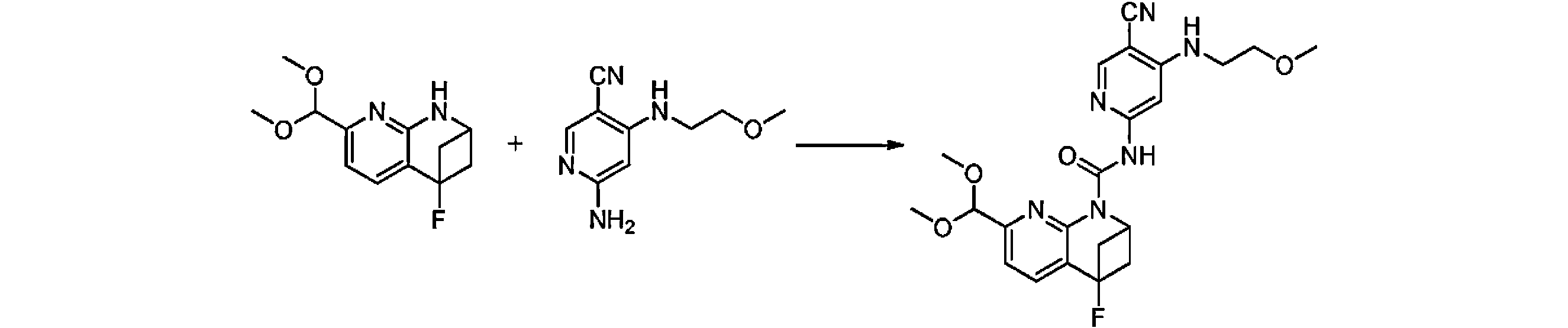
0℃で、ジ(1H-1,2,4-トリアゾール-1-イル)メタノン(340mg、2.07mmol)のN,N-ジメチルホルムアミド(3.0mL)溶液に6-アミノ-4-((2-メトキシエチル)アミノ)ニコチノニトリル(中間体2、400mg、2.07mmol)を加え、室温で2時間撹拌した。その後、この溶液に7-(ジメトキシメチル)-4-フルオロ-1,2,3,4-テトラヒドロ-2,4-メチレン-1,8-ナフチリジン(中間体16、200mg、0.84mmol)のN,N-ジメチルホルムアミド(2mL)溶液及びトリエチルアミン(0.5mL、3.61mmol)を加え、攪拌し続けて16時間反応させた。 6-amino-4-(( 2-Methoxyethyl)amino)nicotinonitrile (Intermediate 2, 400mg, 2.07mmol) was added and stirred at room temperature for 2 hours. To this solution was then added 7-(dimethoxymethyl)-4-fluoro-1,2,3,4-tetrahydro-2,4-methylene-1,8-naphthyridine (Intermediate 16, 200 mg, 0.84 mmol) in N , N-dimethylformamide (2 mL) solution and triethylamine (0.5 mL, 3.61 mmol) were added and reacted for 16 hours with continued stirring.
反応混合物に水(50mL)を加えて反応をクエンチし、ジクロロメタン(50mL)で抽出し、分液して有機相を得、この有機相を飽和食塩水(50mL)で洗浄し、さらに無水硫酸ナトリウムにより乾燥し、吸引濾過し、乾燥するまで蒸発させた。カラムクロマトグラフィーにより残留物を精製し、石油エーテル/酢酸エチル=1:1で溶出し、生成物を含有する溶出画分を濃縮して、N-(5-シアノ-4-((2-メトキシエチル)アミノ)ピリジン-2-イル)-7-(ジメトキシメチル)-4-フルオロ-3,4-ジヒドロ-2,4-メチレン-1,8-ナフチリジン-1(2H)-ホルムアミドを得た。関連するテストデータは以下の通りである。 Water (50 mL) was added to the reaction mixture to quench the reaction, extracted with dichloromethane (50 mL), the phases were separated to obtain an organic phase, the organic phase was washed with saturated brine (50 mL), and anhydrous sodium sulfate was added. dried over, suction filtered and evaporated to dryness. Purify the residue by column chromatography, eluting with petroleum ether/ethyl acetate=1:1, concentrating the eluted fractions containing the product and giving N-(5-cyano-4-((2-methoxy Ethyl)amino)pyridin-2-yl)-7-(dimethoxymethyl)-4-fluoro-3,4-dihydro-2,4-methylene-1,8-naphthyridine-1(2H)-formamide was obtained. The relevant test data are as follows.
ESI-MS:457.2[M+H]+。 ESI-MS: 457.2 [M+H] + .
(第2ステップ:N-(5-シアノ-4-((2-メトキシエチル)アミノ)ピリジン-2-イル)-4-フルオロ-7-ホルミル-3,4-ジヒドロ-2,4-メチレン-1,8-ナフチリジン-1(2H)-ホルムアミドの調製) (Second step: N-(5-cyano-4-((2-methoxyethyl)amino)pyridin-2-yl)-4-fluoro-7-formyl-3,4-dihydro-2,4-methylene- Preparation of 1,8-naphthyridine-1(2H)-formamide)

室温で、N-(5-シアノ-4-((2-メトキシエチル)アミノ)ピリジン-2-イル)-7-(ジメトキシメチル)-4-フルオロ-3,4-ジヒドロ-2,4-メチレン-1,8-ナフチリジン-1(2H)-ホルムアミド(106mg、0.232mmol)のテトラヒドロフラン(4mL)溶液に塩酸(3M、4mL)を加え、攪拌し続けて2時間反応させた。 N-(5-cyano-4-((2-methoxyethyl)amino)pyridin-2-yl)-7-(dimethoxymethyl)-4-fluoro-3,4-dihydro-2,4-methylene at room temperature Hydrochloric acid (3M, 4 mL) was added to a solution of -1,8-naphthyridine-1(2H)-formamide (106 mg, 0.232 mmol) in tetrahydrofuran (4 mL), and the reaction was continued for 2 hours while stirring.
反応混合物に飽和炭酸水素ナトリウム溶液(50mL)を加えて反応をクエンチし、酢酸エチル(50mL)で抽出し、分液して有機相を得、この有機相を飽和食塩水(50mL)で洗浄し、さらに無水硫酸ナトリウムにより乾燥し、吸引濾過し、乾燥するまで蒸発させた。カラムクロマトグラフィーにより残留物を精製し、石油エーテル/酢酸エチル=1:1で溶出し、生成物を含有する溶出画分を濃縮して、化合物1を得た。関連するテストデータは以下の通りである。 Saturated sodium bicarbonate solution (50 mL) was added to the reaction mixture to quench the reaction, extracted with ethyl acetate (50 mL), the layers were separated to obtain an organic phase, and the organic phase was washed with saturated brine (50 mL). , further dried over anhydrous sodium sulphate, suction filtered and evaporated to dryness. The residue was purified by column chromatography, eluted with petroleum ether/ethyl acetate=1:1, and the eluted fractions containing product were concentrated to give compound 1. The relevant test data are as follows.
1HNMR(DMSO-d6,400MHz),δ12.91(s,1H),9.95(s,1H),8.30(s,1H),8.02(d,J=7.6Hz,1H),7.78(d,J=7.6Hz,1H),7.52(s,1H),7.03(t,J=5.6Hz,1H),5.60(dt,J=20.4Hz,J=6.8Hz,1H),3.53(t,J=5.8Hz,2H),3.39(dd,J=11.4Hz,5.8Hz,2H),3.29(s,3H),2.81-2.86(m,2H),2.00-2.02(m,2H)。 1 H NMR (DMSO-d 6 , 400 MHz), δ 12.91 (s, 1H), 9.95 (s, 1H), 8.30 (s, 1H), 8.02 (d, J = 7.6 Hz, 1H), 7.78 (d, J = 7.6Hz, 1H), 7.52 (s, 1H), 7.03 (t, J = 5.6Hz, 1H), 5.60 (dt, J = 20.4Hz, J = 6.8Hz, 1H), 3.53 (t, J = 5.8Hz, 2H), 3.39 (dd, J = 11.4Hz, 5.8Hz, 2H), 3.29 (s, 3H), 2.81-2.86 (m, 2H), 2.00-2.02 (m, 2H).
ESI-MS:411.2[M+H]+。 ESI-MS: 411.2 [M+H] + .
(実施例2)
(化合物2:N-(5-シアノ-4-((2-メトキシエチル)アミノ)ピリジン-2-イル)-7-ホルミル-4-ヒドロキシ-3,4-ジヒドロ-2,4-メチレン-1,8-ナフチリジン-1(2H)-ホルムアミドの調製)
(Example 2)
(Compound 2: N-(5-cyano-4-((2-methoxyethyl)amino)pyridin-2-yl)-7-formyl-4-hydroxy-3,4-dihydro-2,4-methylene-1 , 8-naphthyridine-1(2H)-formamide)

(第1ステップ:N-(5-シアノ-4-((2-メトキシエチル)アミノ)ピリジン-2-イル)-7-(ジメトキシメチル)-4-((t-ブチルジフェニルシリル)オキシ)-3,4-ジヒドロ-2,4-メチレン-1,8-ナフチリジン-1(2H)-ホルムアミドの調製) (First step: N-(5-cyano-4-((2-methoxyethyl)amino)pyridin-2-yl)-7-(dimethoxymethyl)-4-((t-butyldiphenylsilyl)oxy)- Preparation of 3,4-dihydro-2,4-methylene-1,8-naphthyridine-1(2H)-formamide)
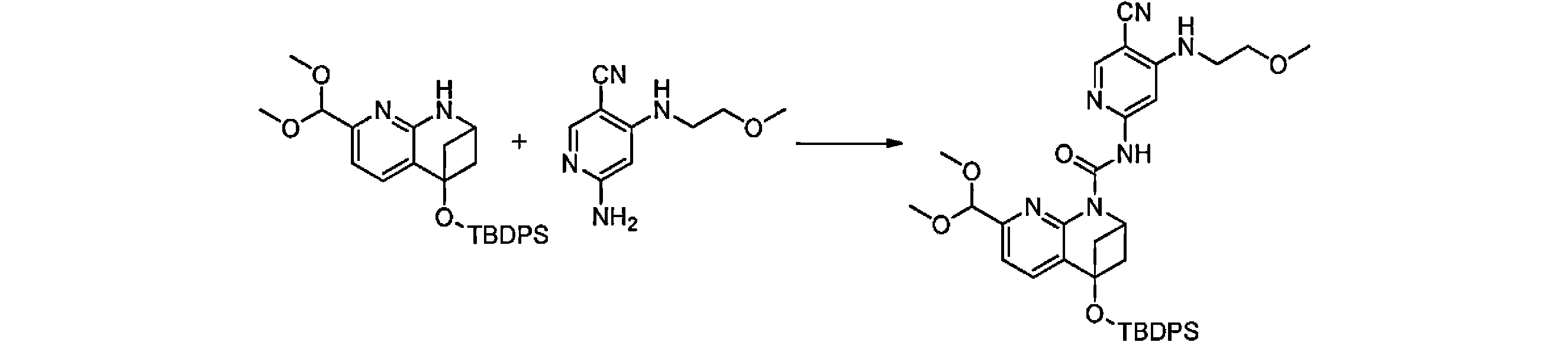
0℃で、ジ(1H-1,2,4-トリアゾール-1-イル)メタノン(170mg、1.04mmol)のN,N-ジメチルホルムアミド(3mL)溶液に6-アミノ-4-((2-メトキシエチル)アミノ)ニコチノニトリル(中間体2、200mg、1.04mmol)を加え、室温で2時間撹拌した。その後、この溶液に7-(ジメトキシメチル)-4-((t-ブチルジフェニルシリル)オキシ)-1,2,3,4-テトラヒドロ-2,4-メチレン-1,8-ナフチリジン(中間体17、200mg、0.42mmol)のN,N-ジメチルホルムアミド(2mL)溶液及びトリエチルアミン(0.5mL、3.61mmol)を加え、攪拌し続けて16時間反応させた。 6-amino-4-((2- Methoxyethyl)amino)nicotinonitrile (Intermediate 2, 200mg, 1.04mmol) was added and stirred at room temperature for 2 hours. This solution was then added to 7-(dimethoxymethyl)-4-((t-butyldiphenylsilyl)oxy)-1,2,3,4-tetrahydro-2,4-methylene-1,8-naphthyridine (intermediate 17 , 200 mg, 0.42 mmol) in N,N-dimethylformamide (2 mL) and triethylamine (0.5 mL, 3.61 mmol) were added and reacted for 16 hours with continued stirring.
反応混合物に水(50mL)を加えて反応をクエンチし、ジクロロメタン(50mL)で抽出し、分液して有機相を得、この有機相を飽和食塩水(50mL)で洗浄し、さらに無水硫酸ナトリウムにより乾燥し、吸引濾過し、乾燥するまで蒸発させた。カラムクロマトグラフィーにより残留物を精製し、石油エーテル/酢酸エチル=2:1で溶出し、生成物を含有する溶出画分を濃縮して、N-(5-シアノ-4-((2-メトキシエチル)アミノ)ピリジン-2-イル)-7-(ジメトキシメチル)-4-((t-ブチルジフェニルシリル)オキシ)-3,4-ジヒドロ-2,4-メチレン-1,8-ナフチリジン-1(2H)-ホルムアミドを得た。関連するテストデータは以下の通りである。 Water (50 mL) was added to the reaction mixture to quench the reaction, extracted with dichloromethane (50 mL), the phases were separated to obtain an organic phase, the organic phase was washed with saturated brine (50 mL), and anhydrous sodium sulfate was added. dried over, suction filtered and evaporated to dryness. The residue was purified by column chromatography, eluted with petroleum ether/ethyl acetate=2:1, and the eluted fractions containing the product were concentrated to yield N-(5-cyano-4-((2-methoxy Ethyl)amino)pyridin-2-yl)-7-(dimethoxymethyl)-4-((t-butyldiphenylsilyl)oxy)-3,4-dihydro-2,4-methylene-1,8-naphthyridine-1 (2H)-formamide was obtained. The relevant test data are as follows.
ESI-MS:693.3[M+H]+。 ESI-MS: 693.3 [M+H] + .
(第2ステップ:N-(5-シアノ-4-((2-メトキシエチル)アミノ)ピリジン-2-イル)-7-(ジメトキシメチル)-4-ヒドロキシ-3,4-ジヒドロ-2,4-メチレン-1,8-ナフチリジン-1(2H)-ホルムアミドの調製) (Second step: N-(5-cyano-4-((2-methoxyethyl)amino)pyridin-2-yl)-7-(dimethoxymethyl)-4-hydroxy-3,4-dihydro-2,4 -methylene-1,8-naphthyridine-1(2H)-formamide)

0℃で、N-(5-シアノ-4-((2-メトキシエチル)アミノ)ピリジン-2-イル)-7-(ジメトキシメチル)-4-((t-ブチルジフェニルシリル)オキシ)-3,4-ジヒドロ-2,4-メチレン-1,8-ナフチリジン-1(2H)-ホルムアミド(60mg、0.09mmol)のテトラヒドロフラン(4mL)溶液にフッ化テトラブチルアンモニウムのテトラヒドロフラン溶液(1M、0.18mL、0.18mmol)を滴下し、室温で攪拌し続けて1時間反応させた。 N-(5-cyano-4-((2-methoxyethyl)amino)pyridin-2-yl)-7-(dimethoxymethyl)-4-((t-butyldiphenylsilyl)oxy)-3 at 0°C ,4-dihydro-2,4-methylene-1,8-naphthyridine-1(2H)-formamide (60 mg, 0.09 mmol) in tetrahydrofuran (4 mL) was added with tetrabutylammonium fluoride in tetrahydrofuran solution (1 M, 0.09 mmol). 18 mL, 0.18 mmol) was added dropwise, and the reaction was continued for 1 hour at room temperature with stirring.
反応混合物に水(50mL)を加えて反応をクエンチし、酢酸エチル(50mL)で抽出し、分液して有機相を得、この有機相を飽和食塩水(50mL)で洗浄し、さらに無水硫酸ナトリウムにより乾燥し、吸引濾過し、乾燥するまで蒸発させた。カラムクロマトグラフィーにより残留物を精製し、ジクロロメタン/メタノール=10:1で溶出し、生成物を含有する溶出画分を濃縮して、N-(5-シアノ-4-((2-メトキシエチル)アミノ)ピリジン-2-イル)-7-(ジメトキシメチル)-4-ヒドロキシ-3,4-ジヒドロ-2,4-メチレン-1,8-ナフチリジン-1(2H)-ホルムアミドを得た。関連するテストデータは以下の通りである。 Water (50 mL) was added to the reaction mixture to quench the reaction, followed by extraction with ethyl acetate (50 mL), liquid separation to obtain an organic phase, washing of this organic phase with saturated brine (50 mL), and addition of anhydrous sulfuric acid. Dry over sodium, filter with suction and evaporate to dryness. Purify the residue by column chromatography, eluting with dichloromethane/methanol=10:1, and concentrating the eluted fractions containing the product to give N-(5-cyano-4-((2-methoxyethyl) Amino)pyridin-2-yl)-7-(dimethoxymethyl)-4-hydroxy-3,4-dihydro-2,4-methylene-1,8-naphthyridine-1(2H)-formamide was obtained. The relevant test data are as follows.
ESI-MS:455.2[M+H]+。 ESI-MS: 455.2 [M+H] + .
(第3ステップ:N-(5-シアノ-4-((2-メトキシエチル)アミノ)ピリジン-2-イル)-7-ホルミル-4-ヒドロキシ-3,4-ジヒドロ-2,4-メチレン-1,8-ナフチリジン-1(2H)-ホルムアミドの調製) (Third step: N-(5-cyano-4-((2-methoxyethyl)amino)pyridin-2-yl)-7-formyl-4-hydroxy-3,4-dihydro-2,4-methylene- Preparation of 1,8-naphthyridine-1(2H)-formamide)

室温で、N-(5-シアノ-4-((2-メトキシエチル)アミノ)ピリジン-2-イル)-7-(ジメトキシメチル)-4-ヒドロキシ-3,4-ジヒドロ-2,4-メチレン-1,8-ナフチリジン-1(2H)-ホルムアミド(32mg、0.07mmol)のテトラヒドロフラン(2mL)溶液に塩酸(3M、2mL)を加え、攪拌し続けて2時間反応させた。 N-(5-cyano-4-((2-methoxyethyl)amino)pyridin-2-yl)-7-(dimethoxymethyl)-4-hydroxy-3,4-dihydro-2,4-methylene at room temperature Hydrochloric acid (3M, 2 mL) was added to a solution of -1,8-naphthyridine-1(2H)-formamide (32 mg, 0.07 mmol) in tetrahydrofuran (2 mL), and the reaction was continued for 2 hours while stirring.
反応混合物に飽和炭酸水素ナトリウム溶液(50mL)を加えて反応をクエンチし、酢酸エチル(50mL)で抽出し、分液して有機相を得、この有機相を飽和食塩水(50mL)で洗浄し、さらに無水硫酸ナトリウムにより乾燥し、吸引濾過し、乾燥するまで蒸発させた。カラムクロマトグラフィーにより残留物を精製し、ジクロロメタン/メタノール=10:1で溶出し、生成物を含有する溶出画分を濃縮して、化合物2を得た。関連するテストデータは以下の通りである。 Saturated sodium bicarbonate solution (50 mL) was added to the reaction mixture to quench the reaction, extracted with ethyl acetate (50 mL), the layers were separated to obtain an organic phase, and the organic phase was washed with saturated brine (50 mL). , further dried over anhydrous sodium sulphate, suction filtered and evaporated to dryness. The residue was purified by column chromatography, eluted with dichloromethane/methanol=10:1, and the eluted fractions containing product were concentrated to give compound 2. The relevant test data are as follows.
1HNMR(DMSO-d6,400MHz),δ13.12(s,1H),9.94(s,1H),8.29(s,1H),8.01(d,J=7.2Hz,1H),7.75(d,J=7.6Hz,1H),7.54(s,1H),7.00(t,J=5.6Hz,1H),6.88(s,1H),5.49(t,J=6.0Hz,1H),3.53(t,J=5.8Hz,2H),3.39(dd,J=11.4Hz,5.8Hz,2H),3.29(s,3H),2.45-2.47(m,2H),1.72-1.74(m,2H)。 1 H NMR (DMSO-d 6 , 400 MHz), δ 13.12 (s, 1H), 9.94 (s, 1H), 8.29 (s, 1H), 8.01 (d, J = 7.2 Hz, 1H), 7.75 (d, J = 7.6Hz, 1H), 7.54 (s, 1H), 7.00 (t, J = 5.6Hz, 1H), 6.88 (s, 1H) , 5.49 (t, J=6.0 Hz, 1 H), 3.53 (t, J=5.8 Hz, 2 H), 3.39 (dd, J=11.4 Hz, 5.8 Hz, 2 H), 3.29 (s, 3H), 2.45-2.47 (m, 2H), 1.72-1.74 (m, 2H).
ESI-MS:409.2[M+H]+。 ESI-MS: 409.2 [M+H] + .
(実施例3)
(化合物3:N-(5-シアノ-4-((2-メトキシエチル)アミノ)ピリジン-2-イル)-7-ホルミル-4-メトキシ-3,4-ジヒドロ-2,4-メチレン-1,8-ナフチリジン-1(2H)-ホルムアミドの調製)
(Example 3)
(Compound 3: N-(5-cyano-4-((2-methoxyethyl)amino)pyridin-2-yl)-7-formyl-4-methoxy-3,4-dihydro-2,4-methylene-1 , 8-naphthyridine-1(2H)-formamide)

実施例1における化合物1の調製と類似じた方法に従って、中間体21及び中間体2を出発原料として反応させて化合物3を製造した。関連するテストデータは以下の通りである。 Following a method similar to the preparation of compound 1 in Example 1, intermediate 21 and intermediate 2 were reacted as starting materials to prepare compound 3. The relevant test data are as follows.
1HNMR(DMSO-d6,400MHz),δ13.06(s,1H),9.95(s,1H),8.29(s,1H),7.98(d,J=7.2Hz,1H),7.75(d,J=7.6Hz,1H),7.54(s,1H),7.00(t,J=5.8Hz,1H),5.50(t,J=6.4Hz,1H),3.53(t,J=5.8Hz,2H),3.47(s,3H),3.40(dd,J=11.6Hz,5.6Hz,2H),3.29(s,3H),2.79-2.83(m,2H),1.60-1.63(m,2H)。 1 H NMR (DMSO-d 6 , 400 MHz), δ 13.06 (s, 1H), 9.95 (s, 1H), 8.29 (s, 1H), 7.98 (d, J = 7.2 Hz, 1H), 7.75 (d, J = 7.6Hz, 1H), 7.54 (s, 1H), 7.00 (t, J = 5.8Hz, 1H), 5.50 (t, J = 6.4Hz, 1H), 3.53 (t, J = 5.8Hz, 2H), 3.47 (s, 3H), 3.40 (dd, J = 11.6Hz, 5.6Hz, 2H), 3.29 (s, 3H), 2.79-2.83 (m, 2H), 1.60-1.63 (m, 2H).
ESI-MS:423.2[M+H]+。 ESI-MS: 423.2 [M+H] + .
(実施例4)
(化合物4:N-(5-シアノ-4-((2-メトキシエチル)アミノ)ピリジン-2-イル)-4-フルオロ-7-ホルミル-6-((4-メチル-2-オキソピベラジン-1-イル)メチル)-3,4-ジヒドロ-2,4-メチレン-1,8-ナフチリジン-1(2H)-ホルムアミドの調製)
(Example 4)
(Compound 4: N-(5-cyano-4-((2-methoxyethyl)amino)pyridin-2-yl)-4-fluoro-7-formyl-6-((4-methyl-2-oxopiverazine-1 -yl)methyl)-3,4-dihydro-2,4-methylene-1,8-naphthyridine-1(2H)-formamide)

(第1ステップ:N-(5-シアノ-4-((2-メトキシエチル)アミノ)ピリジン-2-イル)-7-(ジメトキシメチル)-4-フルオロ-6-((4-メチル-2-オキソピベラジン-1-イル)メチル)-3,4-ジヒドロ-2,4-メチレン-1,8-ナフチリジン-1(2H)-ホルムアミドの調製) (First step: N-(5-cyano-4-((2-methoxyethyl)amino)pyridin-2-yl)-7-(dimethoxymethyl)-4-fluoro-6-((4-methyl-2 -oxopiverazin-1-yl)methyl)-3,4-dihydro-2,4-methylene-1,8-naphthyridine-1(2H)-formamide)
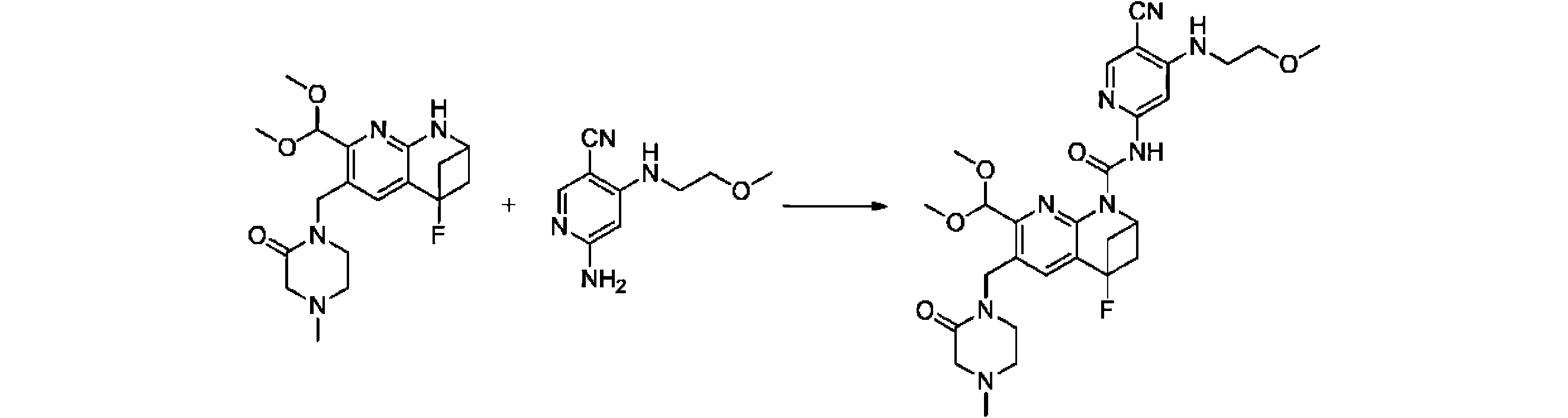
0℃で、ジ(1H-1,2,4-トリアゾール-1-イル)メタノン(168mg、1.02mmol)のN,N-ジメチルホルムアミド(1mL)溶液に6-アミノ-4-((2-メトキシエチル)アミノ)ニコチノニトリル(中間体2、197mg、1.03mmol)を加え、室温で1時間撹拌した。その後、この溶液に1-((7-(ジメトキシメチル)-4-フルオロ-1,2,3,4-テトラヒドロ-2,4-メチレン-1,8-ナフチリジン-6-イル)メチル)-4-メチルピベラジン-2-オン(中間体49、149mg、0.41mmol)のN,N-ジメチルホルムアミド(1mL)溶液を加え、攪拌し続けて16時間反応させた。 6-amino-4-((2- Methoxyethyl)amino)nicotinonitrile (Intermediate 2, 197mg, 1.03mmol) was added and stirred at room temperature for 1 hour. 1-((7-(dimethoxymethyl)-4-fluoro-1,2,3,4-tetrahydro-2,4-methylene-1,8-naphthyridin-6-yl)methyl)-4 was then added to this solution. -Methylpiberazin-2-one (Intermediate 49, 149 mg, 0.41 mmol) in N,N-dimethylformamide (1 mL) was added and allowed to react for 16 hours with continued stirring.
反応混合物に水(50mL)を加えて反応をクエンチし、ジクロロメタン(50mL)で抽出し、分液して有機相を得、この有機相を飽和食塩水(50mL)で洗浄し、さらに無水硫酸ナトリウムにより乾燥し、吸引濾過し、乾燥するまで蒸発させた。カラムクロマトグラフィーにより残留物を精製し、酢酸エチル及びジクロロメタン/メタノール=10:1で勾配溶出し、生成物を含有する溶出画分を濃縮して、N-(5-シアノ-4-((2-メトキシエチル)アミノ)ピリジン-2-イル)-7-(ジメトキシメチル)-4-フルオロ-6-((4-メチル-2-オキソピベラジン-1-イル)メチル)-3,4-ジヒドロ-2,4-メチレン-1,8-ナフチリジン-1(2H)-ホルムアミドを得た。関連するテストデータは以下の通りである。 Water (50 mL) was added to the reaction mixture to quench the reaction, extracted with dichloromethane (50 mL), the phases were separated to obtain an organic phase, the organic phase was washed with saturated brine (50 mL), and anhydrous sodium sulfate was added. dried over, suction filtered and evaporated to dryness. The residue was purified by column chromatography, gradient eluted with ethyl acetate and dichloromethane/methanol=10:1, and the eluted fractions containing the product were concentrated to give N-(5-cyano-4-((2 -methoxyethyl)amino)pyridin-2-yl)-7-(dimethoxymethyl)-4-fluoro-6-((4-methyl-2-oxopiverazin-1-yl)methyl)-3,4-dihydro-2 ,4-methylene-1,8-naphthyridine-1(2H)-formamide was obtained. The relevant test data are as follows.
ESI-MS:583.3[M+H]+。 ESI-MS: 583.3 [M+H] + .
(第2ステップ:N-(5-シアノ-4-((2-メトキシエチル)アミノ)ピリジン-2-イル)-4-フルオロ-7-ホルミル-6-((4-メチル-2-オキソピベラジン-1-イル)メチル)-3,4-ジヒドロ-2,4-メチレン-1,8-ナフチリジン-1(2H)-ホルムアミドの調製) (Second step: N-(5-cyano-4-((2-methoxyethyl)amino)pyridin-2-yl)-4-fluoro-7-formyl-6-((4-methyl-2-oxopiverazine- Preparation of 1-yl)methyl)-3,4-dihydro-2,4-methylene-1,8-naphthyridine-1(2H)-formamide)

室温で、N-(5-シアノ-4-((2-メトキシエチル)アミノ)ピリジン-2-イル)-7-(ジメトキシメチル)-4-フルオロ-6-((4-メチル-2-オキソピベラジン-1-イル)メチル)-3,4-ジヒドロ-2,4-メチレン-1,8-ナフチリジン-1(2H)-ホルムアミド(107mg、0.18mmol)のテトラヒドロフラン(4mL)溶液に塩酸(3M、4mL)を加え、攪拌し続けて30分間時間反応させた。 At room temperature, N-(5-cyano-4-((2-methoxyethyl)amino)pyridin-2-yl)-7-(dimethoxymethyl)-4-fluoro-6-((4-methyl-2-oxopiverazine -1-yl)methyl)-3,4-dihydro-2,4-methylene-1,8-naphthyridin-1(2H)-formamide (107 mg, 0.18 mmol) in tetrahydrofuran (4 mL) was dissolved in hydrochloric acid (3 M, 4 mL) was added and allowed to react for 30 minutes with continued stirring.
反応混合物に飽和炭酸水素ナトリウム溶液(50mL)を加えて反応をクエンチし、酢酸エチル(50mL)で抽出し、分液して有機相を得、この有機相を飽和食塩水(50mL)で洗浄し、さらに無水硫酸ナトリウムにより乾燥し、吸引濾過し、乾燥するまで蒸発させた。カラムクロマトグラフィーにより残留物を精製し、ジクロロメタン/メタノール=10:1で溶出し、生成物を含有する溶出画分を濃縮して、化合物4を得た。関連するテストデータは以下の通りである。 Saturated sodium bicarbonate solution (50 mL) was added to the reaction mixture to quench the reaction, extracted with ethyl acetate (50 mL), the layers were separated to obtain an organic phase, and the organic phase was washed with saturated brine (50 mL). , further dried over anhydrous sodium sulphate, suction filtered and evaporated to dryness. The residue was purified by column chromatography, eluted with dichloromethane/methanol=10:1, and the eluted fractions containing product were concentrated to give compound 4. The relevant test data are as follows.
1HNMR(DMSO-d6,400MHz),δ12.90(s,1H),10.13(s,1H),8.31(s,1H),7.64(s,1H),7.53(s,1H),7.03(t,J=5.2Hz,1H),5.55-5.65(m,1H),4.98(s,2H),3.54(t,J=5.8Hz,2H),3.41(m,2H),3.30(s,3H),3.29(m,2H),3.07(s,2H),2.86(qd,J=6.8Hz,2.0Hz,2H),2.62(t,J=5.4Hz,2H),2.25(s,3H),2.45(qd,J=6.8Hz,2.0Hz,2H)。 1 H NMR (DMSO-d 6 , 400 MHz), δ 12.90 (s, 1H), 10.13 (s, 1H), 8.31 (s, 1H), 7.64 (s, 1H), 7.53 (s, 1H), 7.03 (t, J = 5.2Hz, 1H), 5.55-5.65 (m, 1H), 4.98 (s, 2H), 3.54 (t, J = 5.8 Hz, 2H), 3.41 (m, 2H), 3.30 (s, 3H), 3.29 (m, 2H), 3.07 (s, 2H), 2.86 (qd, J = 6.8Hz, 2.0Hz, 2H), 2.62 (t, J = 5.4Hz, 2H), 2.25 (s, 3H), 2.45 (qd, J = 6.8Hz, 2 .0Hz, 2H).
ESI-MS:537.3[M+H]+。 ESI-MS: 537.3 [M+H] + .
(実施例5)
(化合物5:N-(5-シアノ-4-((2-メトキシエチル)アミノ)ピリジン-2-イル)-7-ホルミル-4-ヒドロキシ-6-((4-メチル-2-オキソピベラジン-1-イル)メチル)-3,4-ジヒドロ-2,4-メチレン-1,8-ナフチリジン-1(2H)-ホルムアミドの調製)
(Example 5)
(Compound 5: N-(5-cyano-4-((2-methoxyethyl)amino)pyridin-2-yl)-7-formyl-4-hydroxy-6-((4-methyl-2-oxopiverazine-1 -yl)methyl)-3,4-dihydro-2,4-methylene-1,8-naphthyridine-1(2H)-formamide)

(第1ステップ:N-(5-シアノ-4-((2-メトキシエチル)アミノ)ピリジン-2-イル)-7-(ジメトキシメチル)-4-((t-ブチルジフェニルシリル)オキシ)-6-((4-メチル-2-オキソピベラジン-1-イル)メチル)-3,4-ジヒドロ-2,4-メチレン-1,8-ナフチリジン-1(2H)-ホルムアミドの調製) (First step: N-(5-cyano-4-((2-methoxyethyl)amino)pyridin-2-yl)-7-(dimethoxymethyl)-4-((t-butyldiphenylsilyl)oxy)- Preparation of 6-((4-methyl-2-oxopiverazin-1-yl)methyl)-3,4-dihydro-2,4-methylene-1,8-naphthyridine-1(2H)-formamide)
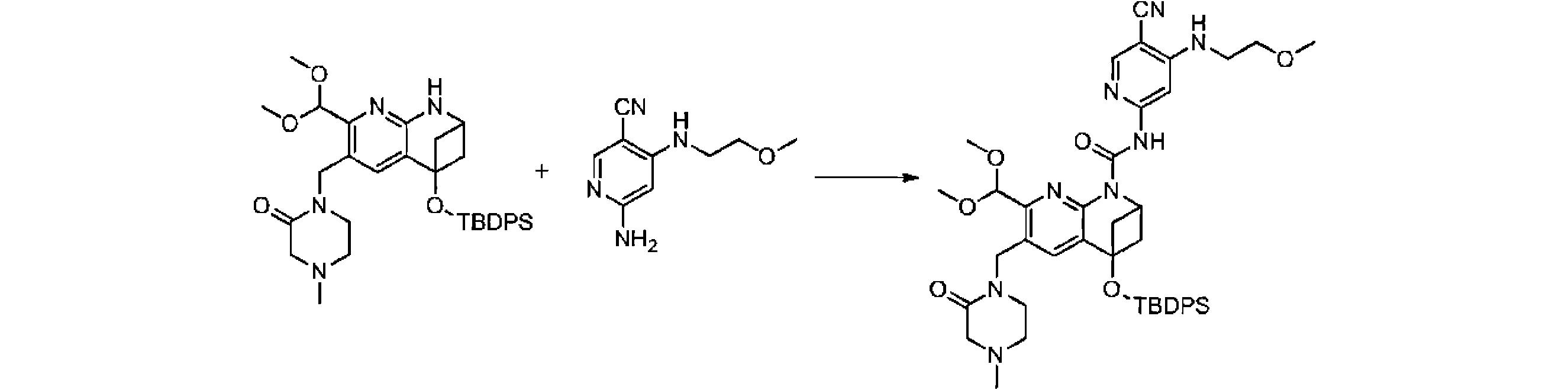
0℃で、ジ(1H-1,2,4-トリアゾール-1-イル)メタノン(317mg、1.94mmol)のN,N-ジメチルホルムアミド(1mL)溶液に6-アミノ-4-((2-メトキシエチル)アミノ)ニコチノニトリル(中間体2、372mg、1.94mmol)を加え、室温で1時間撹拌した。その後、この溶液に1-((7-(ジメトキシメチル)-4-((t-ブチルジフェニルシリル)オキシ)-1,2,3,4-テトラヒドロ-2,4-メチレン-1,8-ナフチリジン-6-イル)メチル)-4-メチルピベラジン-2-オン(中間体50、465mg、0.77mmol)のN,N-ジメチルホルムアミド(1mL)溶液を加え、攪拌し続けて16時間反応させた。 6-amino-4-((2- Methoxyethyl)amino)nicotinonitrile (Intermediate 2, 372mg, 1.94mmol) was added and stirred at room temperature for 1 hour. 1-((7-(dimethoxymethyl)-4-((t-butyldiphenylsilyl)oxy)-1,2,3,4-tetrahydro-2,4-methylene-1,8-naphthyridine) was then added to this solution. -6-yl)methyl)-4-methylpiberazin-2-one (Intermediate 50, 465mg, 0.77mmol) in N,N-dimethylformamide (1 mL) was added and allowed to react for 16 hours with continued stirring.
反応混合物に水(50mL)を加えて反応をクエンチし、ジクロロメタン(50mL)で抽出し、分液して有機相を得、この有機相を飽和食塩水(50mL)で洗浄し、さらに無水硫酸ナトリウムにより乾燥し、吸引濾過し、乾燥するまで蒸発させた。カラムクロマトグラフィーにより残留物を精製し、酢酸エチル及びジクロロメタン/メタノール=10:1で勾配溶出し、生成物を含有する溶出画分を濃縮して、N-(5-シアノ-4-((2-メトキシエチル)アミノ)ピリジン-2-イル)-7-(ジメトキシメチル)-4-((t-ブチルジフェニルシリル)オキシ)-6-((4-メチル-2-オキソピベラジン-1-イル)メチル)-3,4-ジヒドロ-2,4-メチレン-1,8-ナフチリジン-1(2H)-ホルムアミドを得た。関連するテストデータは以下の通りである。 Water (50 mL) was added to the reaction mixture to quench the reaction, extracted with dichloromethane (50 mL), the phases were separated to obtain an organic phase, the organic phase was washed with saturated brine (50 mL), and anhydrous sodium sulfate was added. dried over, suction filtered and evaporated to dryness. The residue was purified by column chromatography, gradient eluted with ethyl acetate and dichloromethane/methanol=10:1, and the eluted fractions containing the product were concentrated to give N-(5-cyano-4-((2 -methoxyethyl)amino)pyridin-2-yl)-7-(dimethoxymethyl)-4-((t-butyldiphenylsilyl)oxy)-6-((4-methyl-2-oxopiverazin-1-yl)methyl )-3,4-dihydro-2,4-methylene-1,8-naphthyridine-1(2H)-formamide. The relevant test data are as follows.
ESI-MS:820.2[M+H]+。 ESI-MS: 820.2 [M+H] + .
(第2ステップ:N-(5-シアノ-4-((2-メトキシエチル)アミノ)ピリジン-2-イル)-7-(ジメトキシメチル)-4-ヒドロキシ-6-((4-メチル-2-オキソピベラジン-1-イル)メチル)-3,4-ジヒドロ-2,4-メチレン-1,8-ナフチリジン-1(2H)-ホルムアミドの調製) (Second step: N-(5-cyano-4-((2-methoxyethyl)amino)pyridin-2-yl)-7-(dimethoxymethyl)-4-hydroxy-6-((4-methyl-2 -oxopiverazin-1-yl)methyl)-3,4-dihydro-2,4-methylene-1,8-naphthyridine-1(2H)-formamide)
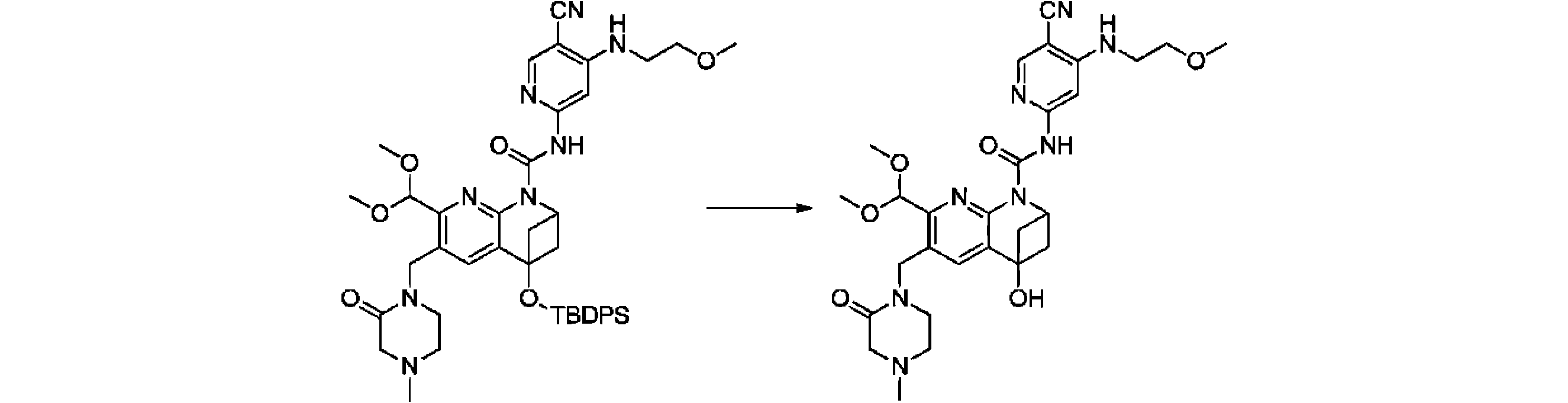
0℃で、N-(5-シアノ-4-((2-メトキシエチル)アミノ)ピリジン-2-イル)-7-(ジメトキシメチル)-4-((t-ブチルジフェニルシリル)オキシ)-6-((4-メチル-2-オキソピベラジン-1-イル)メチル)-3,4-ジヒドロ-2,4-メチレン-1,8-ナフチリジン-1(2H)-ホルムアミド(250mg、0.31mmol)のテトラヒドロフラン(5mL)溶液にフッ化テトラブチルアンモニウムのテトラヒドロフラン溶液(1M、0.6mL、0.60mmol)を滴下し、室温で攪拌し続けて1時間反応させた。 N-(5-cyano-4-((2-methoxyethyl)amino)pyridin-2-yl)-7-(dimethoxymethyl)-4-((t-butyldiphenylsilyl)oxy)-6 at 0°C of -((4-methyl-2-oxopiverazin-1-yl)methyl)-3,4-dihydro-2,4-methylene-1,8-naphthyridine-1(2H)-formamide (250 mg, 0.31 mmol) A solution of tetrabutylammonium fluoride in tetrahydrofuran (1 M, 0.6 mL, 0.60 mmol) was added dropwise to a tetrahydrofuran (5 mL) solution, and the mixture was allowed to react at room temperature for 1 hour while stirring.
反応混合物に水(50mL)を加えて反応をクエンチし、酢酸エチル(50mL)で抽出し、分液して有機相を得、この有機相を飽和食塩水(50mL)で洗浄し、さらに無水硫酸ナトリウムにより乾燥し、吸引濾過し、乾燥するまで蒸発させた。カラムクロマトグラフィーにより残留物を精製し、ジクロロメタン/メタノール=10:1で溶出し、生成物を含有する溶出画分を濃縮して、N-(5-シアノ-4-((2-メトキシエチル)アミノ)ピリジン-2-イル)-7-(ジメトキシメチル)-4-ヒドロキシ-6-((4-メチル-2-オキソピベラジン-1-イル)メチル)-3,4-ジヒドロ-2,4-メチレン-1,8-ナフチリジン-1(2H)-ホルムアミドを得た。関連するテストデータは以下の通りである。 Water (50 mL) was added to the reaction mixture to quench the reaction, followed by extraction with ethyl acetate (50 mL), liquid separation to obtain an organic phase, washing of this organic phase with saturated brine (50 mL), and addition of anhydrous sulfuric acid. Dry over sodium, filter with suction and evaporate to dryness. Purify the residue by column chromatography, eluting with dichloromethane/methanol=10:1, and concentrating the eluted fractions containing the product to give N-(5-cyano-4-((2-methoxyethyl) Amino)pyridin-2-yl)-7-(dimethoxymethyl)-4-hydroxy-6-((4-methyl-2-oxopiverazin-1-yl)methyl)-3,4-dihydro-2,4-methylene -1,8-naphthyridine-1(2H)-formamide was obtained. The relevant test data are as follows.
ESI-MS:581.2[M+H]+。 ESI-MS: 581.2 [M+H] + .
(第3ステップ:N-(5-シアノ-4-((2-メトキシエチル)アミノ)ピリジン-2-イル)-7-ホルミル-4-ヒドロキシ-6-((4-メチル-2-オキソピベラジン-1-イル)メチル)-3,4-ジヒドロ-2,4-メチレン-1,8-ナフチリジン-1(2H)-ホルムアミドの調製) (Third step: N-(5-cyano-4-((2-methoxyethyl)amino)pyridin-2-yl)-7-formyl-4-hydroxy-6-((4-methyl-2-oxopiverazine- Preparation of 1-yl)methyl)-3,4-dihydro-2,4-methylene-1,8-naphthyridine-1(2H)-formamide)

室温で、N-(5-シアノ-4-((2-メトキシエチル)アミノ)ピリジン-2-イル)-7-(ジメトキシメチル)-4-ヒドロキシ-6-((4-メチル-2-オキソピベラジン-1-イル)メチル)-3,4-ジヒドロ-2,4-メチレン-1,8-ナフチリジン-1(2H)-ホルムアミド(55mg、0.095mmol)のテトラヒドロフラン(4mL)溶液に塩酸(3M、4mL)を加え、攪拌し続けて30分間時間反応させた。 At room temperature, N-(5-cyano-4-((2-methoxyethyl)amino)pyridin-2-yl)-7-(dimethoxymethyl)-4-hydroxy-6-((4-methyl-2-oxopiverazine -1-yl)methyl)-3,4-dihydro-2,4-methylene-1,8-naphthyridin-1(2H)-formamide (55 mg, 0.095 mmol) in tetrahydrofuran (4 mL) was dissolved in hydrochloric acid (3 M, 4 mL) was added and allowed to react for 30 minutes with continued stirring.
反応混合物に飽和炭酸水素ナトリウム溶液(50mL)を加えて反応をクエンチし、酢酸エチル(50mL)で抽出し、分液して有機相を得、この有機相を飽和食塩水(50mL)で洗浄し、さらに無水硫酸ナトリウムにより乾燥し、吸引濾過し、乾燥するまで蒸発させた。カラムクロマトグラフィーにより残留物を精製し、ジクロロメタン/メタノール=10:1で溶出し、生成物を含有する溶出画分を濃縮して、化合物5を得た。関連するテストデータは以下の通りである。 Saturated sodium bicarbonate solution (50 mL) was added to the reaction mixture to quench the reaction, extracted with ethyl acetate (50 mL), the layers were separated to obtain an organic phase, and the organic phase was washed with saturated brine (50 mL). , further dried over anhydrous sodium sulphate, suction filtered and evaporated to dryness. The residue was purified by column chromatography, eluted with dichloromethane/methanol=10:1, and the eluted fractions containing product were concentrated to give compound 5. The relevant test data are as follows.
1HNMR(DMSO-d6,400MHz),δ13.10(s,1H),10.11(s,1H),8.29(s,1H),7.72(s,1H),7.53(s,1H),6.99(t,J=5.4Hz,1H),6.89(s,1H),5.46(t,J=6.2Hz,1H),4.96(s,2H),3.53(t,J=5.8Hz,2H),3.39(dd,J=11.0Hz,5.8Hz,2H),3.29(s,3H),3.27(m,2H),3.05(s,2H),2.61(t,J=5.2Hz,2H),2.48(m,2H),2.24(s,3H),1.72-1.74(m,2H)。 1 H NMR (DMSO-d 6 , 400 MHz), δ 13.10 (s, 1H), 10.11 (s, 1H), 8.29 (s, 1H), 7.72 (s, 1H), 7.53 (s, 1H), 6.99 (t, J = 5.4Hz, 1H), 6.89 (s, 1H), 5.46 (t, J = 6.2Hz, 1H), 4.96 (s , 2H), 3.53 (t, J = 5.8 Hz, 2H), 3.39 (dd, J = 11.0 Hz, 5.8 Hz, 2H), 3.29 (s, 3H), 3.27 (m, 2H), 3.05 (s, 2H), 2.61 (t, J=5.2 Hz, 2H), 2.48 (m, 2H), 2.24 (s, 3H), 1. 72-1.74 (m, 2H).
ESI-MS:535.3[M+H]+。 ESI-MS: 535.3 [M+H] + .
(実施例6)
(化合物6:(R)-N-(5-シアノ-4-((1-メトキシプロパン-2-イル)アミノ)ピリジン-2-イル)-4-フルオロ-7-ホルミル-6-((4-メチル-2-オキソピベラジン-1-イル)メチル)-3,4-ジヒドロ-2,4-メチレン-1,8-ナフチリジン-1(2H)-ホルムアミドの調製)
(Example 6)
(Compound 6: (R) —N-(5-cyano-4-((1-methoxypropan-2-yl)amino)pyridin-2-yl)-4-fluoro-7-formyl-6-((4 -methyl-2-oxopiverazin-1-yl)methyl)-3,4-dihydro-2,4-methylene-1,8-naphthyridine-1(2H)-formamide)

実施例4における化合物4の調製と類似した方法に従って、中間体49及び中間体3を出発原料として反応させて化合物6を製造した。関連するテストデータは以下の通りである。 Following a method analogous to the preparation of compound 4 in Example 4, intermediate 49 and intermediate 3 were reacted as starting materials to prepare compound 6. The relevant test data are as follows.
1HNMR(DMSO-d6,400MHz),δ12.90(s,1H),10.13(s,1H),8.31(s,1H),7.64(s,1H),7.56(s,1H),6.69(d,J=7.6Hz,1H),5.59(dt,J=20.4Hz,6.4Hz,1H),4.98(s,2H),3.95-4.02(m,1H),3.83-4.90(m,1H),3.50(dd,J=9.6Hz,6.4Hz,1H),3.39(dd,J=9.6Hz,5.6Hz,1H),3.31(s,2H),3.30(s,3H),3.06(s,2H),2.85(m,2H),2.62(t,J=5.6Hz,2H),2.25(s,3H),2.01-2-03(m,2H),1.20(d,J=7.6Hz,3H)。ESI-MS:551.2[M+H]+。 1 H NMR (DMSO-d 6 , 400 MHz), δ 12.90 (s, 1H), 10.13 (s, 1H), 8.31 (s, 1H), 7.64 (s, 1H), 7.56 (s, 1H), 6.69 (d, J = 7.6Hz, 1H), 5.59 (dt, J = 20.4Hz, 6.4Hz, 1H), 4.98 (s, 2H), 3 .95-4.02 (m, 1H), 3.83-4.90 (m, 1H), 3.50 (dd, J = 9.6Hz, 6.4Hz, 1H), 3.39 (dd, J=9.6Hz, 5.6Hz, 1H), 3.31(s, 2H), 3.30(s, 3H), 3.06(s, 2H), 2.85(m, 2H), 2 .62 (t, J = 5.6Hz, 2H), 2.25 (s, 3H), 2.01-2-03 (m, 2H), 1.20 (d, J = 7.6Hz, 3H) . ESI-MS: 551.2 [M+H] + .
(実施例7)
(化合物7:N-(5-シアノ-4-((2-メトキシエチル)アミノ)ピリジン-2-イル)-4-フルオロ-7-ホルミル-6-((4-メチルピベラジン-1-イル)メチル)-3,4-ジヒドロ-2,4-メチレン-1,8-ナフチリジン-1(2H)-ホルムアミドの調製)
(Example 7)
(Compound 7: N-(5-cyano-4-((2-methoxyethyl)amino)pyridin-2-yl)-4-fluoro-7-formyl-6-((4-methylpiverazin-1-yl)methyl )-3,4-dihydro-2,4-methylene-1,8-naphthyridine-1(2H)-formamide)

実施例4における化合物4の調製と類似した方法に従って、中間体54及び中間体2を出発原料として反応させて化合物7を製造した。関連するテストデータは以下の通りである。
Following a method analogous to the preparation of compound 4 in Example 4, intermediate 54 and intermediate 2 were reacted as starting materials to prepare
1HNMR(DMSO-d6,400MHz),δ12.90(s,1H),10.20(s,1H),8.30(s,1H),7.96(s,1H),7.53(s,1H),7.02(t,J=5.8Hz,1H),5.59(dt,J=20.4Hz,6.6Hz,1H),3.90(s,2H),3.54(t,J=5.8Hz,2H),3.40(dd,J=11.0Hz,5.4Hz,2H),3.30(s,3H),2.81-2.87(m,2H),2.47-2.48(m,4H),2.33-2.34(m,4H),2.18(s,3H),2.02-2.04(m,2H)。 1 H NMR (DMSO-d 6 , 400 MHz), δ 12.90 (s, 1H), 10.20 (s, 1H), 8.30 (s, 1H), 7.96 (s, 1H), 7.53 (s, 1H), 7.02 (t, J = 5.8Hz, 1H), 5.59 (dt, J = 20.4Hz, 6.6Hz, 1H), 3.90 (s, 2H), 3 .54 (t, J = 5.8 Hz, 2H), 3.40 (dd, J = 11.0 Hz, 5.4 Hz, 2H), 3.30 (s, 3H), 2.81-2.87 ( m, 2H), 2.47-2.48 (m, 4H), 2.33-2.34 (m, 4H), 2.18 (s, 3H), 2.02-2.04 (m, 2H).
ESI-MS:523.3[M+H]+。 ESI-MS: 523.3 [M+H] + .
(実施例8)
(化合物8:N-(5-シアノ-4-((2-メトキシエチル)アミノ)ピリジン-2-イル)-4-フルオロ-7-ホルミル-6-((2-(ジメチルアミノ)-N-メチルアセトアミド)メチル)-3,4-ジヒドロ-2,4-メチレン-1,8-ナフチリジン-1(2H)-ホルムアミドの調製)
(Example 8)
(Compound 8: N-(5-cyano-4-((2-methoxyethyl)amino)pyridin-2-yl)-4-fluoro-7-formyl-6-((2-(dimethylamino)-N- Preparation of methylacetamido)methyl)-3,4-dihydro-2,4-methylene-1,8-naphthyridine-1(2H)-formamide)

実施例4における化合物4の調製と類似した方法に従って、中間体57及び中間体2を出発原料として反応させて化合物8を製造し、関連するテストデータは以下の通りである。
According to a method similar to the preparation of compound 4 in Example 4, intermediate 57 and intermediate 2 were reacted as starting materials to prepare
1HNMR(DMSO-d6,400MHz),δ12.91(s,1H),10.11(s,1H),8.30(s,1H),7.61(s,1H),7.52(s,1H),7.05(t,J=5.4Hz,1H),5.54-5.63(m,1H),4.94(s,2H),3.53(t,J=5.8Hz,2H),3.40(dd,J=11.2Hz,J=5.6Hz,2H),3.29(s,3H),3.06(s,2H),2.85-2.87(m,2H),2.31(s,6H),2.00-2.02(m,2H)。 1 H NMR (DMSO-d 6 , 400 MHz), δ 12.91 (s, 1H), 10.11 (s, 1H), 8.30 (s, 1H), 7.61 (s, 1H), 7.52 (s, 1H), 7.05 (t, J = 5.4Hz, 1H), 5.54-5.63 (m, 1H), 4.94 (s, 2H), 3.53 (t, J = 5.8 Hz, 2H), 3.40 (dd, J = 11.2 Hz, J = 5.6 Hz, 2H), 3.29 (s, 3H), 3.06 (s, 2H), 2.85 −2.87 (m, 2H), 2.31 (s, 6H), 2.00-2.02 (m, 2H).
ESI-MS:539.3[M+H]+。 ESI-MS: 539.3 [M+H] + .
(実施例9)
(化合物9:N-(5-シアノ-4-(2-メトキシエトキシ)ピリジン-2-イル)-4-フルオロ-7-ホルミル-6-((4-メチル-2-オキソピベラジン-1-イル)メチル)-3,4-ジヒドロ-2,4-メチレン-1,8-ナフチリジン-1(2H)-ホルムアミドの調製)
(Example 9)
(Compound 9: N-(5-cyano-4-(2-methoxyethoxy)pyridin-2-yl)-4-fluoro-7-formyl-6-((4-methyl-2-oxopiverazin-1-yl) Preparation of methyl)-3,4-dihydro-2,4-methylene-1,8-naphthyridine-1(2H)-formamide)

(第1ステップ:N-(5-シアノ-4-(2-メトキシエトキシ)ピリジン-2-イル)-7-(ジメトキシメチル)-4-フルオロ-6-((4-メチル-2-オキソピベラジン-1-イル)メチル)-3,4-ジヒドロ-2,4-メチレン-1,8-ナフチリジン-1(2H)-ホルムアミドの調製) (First step: N-(5-cyano-4-(2-methoxyethoxy)pyridin-2-yl)-7-(dimethoxymethyl)-4-fluoro-6-((4-methyl-2-oxopiverazine- Preparation of 1-yl)methyl)-3,4-dihydro-2,4-methylene-1,8-naphthyridine-1(2H)-formamide)

室温で、ジ(トリクロロメチル)カーボネート(33mg、0.110mmol)のテトラヒドロフラン(2.5mL)溶液にトリエチルアミン(89mg、0.879mmol)及び1-((7-(ジメトキシメチル)-4-フルオロ-1,2,3,4-テトラヒドロ-2,4-メチレン-1,8-ナフチリジン-6-イル)メチル)-4-メチルピベラジン-2-オン(中間体49、100mg、0.275mmol)を加え、その後、窒素ガス保護雰囲気下で1時間撹拌して中間体4を得た。その後、この系に6-アミノ-4-(2-メトキシエトキシ)ニコチノニトリル(中間体6、64mg、0.330mmol)を加え、攪拌し続けて2時間反応させた。 To a solution of di(trichloromethyl)carbonate (33 mg, 0.110 mmol) in tetrahydrofuran (2.5 mL) at room temperature was added triethylamine (89 mg, 0.879 mmol) and 1-((7-(dimethoxymethyl)-4-fluoro-1 , 2,3,4-tetrahydro-2,4-methylene-1,8-naphthyridin-6-yl)methyl)-4-methylpiberazin-2-one (Intermediate 49, 100 mg, 0.275 mmol) is added followed by , under nitrogen gas protective atmosphere for 1 hour to give intermediate 4. After that, 6-amino-4-(2-methoxyethoxy)nicotinonitrile (Intermediate 6, 64 mg, 0.330 mmol) was added to the system and allowed to react for 2 hours with continued stirring.
反応混合物に飽和炭酸水素ナトリウム水溶液(50mL)を加えて反応をクエンチし、酢酸エチル(50mL)で抽出し、分液して有機相を得、この有機相を飽和食塩水(50mL)で洗浄し、さらに無水硫酸ナトリウムにより乾燥し、吸引濾過し、乾燥するまで蒸発させた。カラムクロマトグラフィーにより残留物を精製し、石油エーテル/酢酸エチル=1:1及び酢酸エチル/メタノール=10:1で勾配溶出し、生成物を含有する溶出画分を濃縮して、N-(5-シアノ-4-(2-メトキシエトキシ)ピリジン-2-イル)-7-(ジメトキシメチル)-4-フルオロ-6-((4-メチル-2-オキソピベラジン-1-イル)メチル)-3,4-ジヒドロ-2,4-メチレン-1,8-ナフチリジン-1(2H)-ホルムアミドを得た。関連するテストデータは以下の通りである。 Saturated aqueous sodium bicarbonate solution (50 mL) was added to the reaction mixture to quench the reaction, extracted with ethyl acetate (50 mL), the layers were separated to obtain an organic phase, and the organic phase was washed with saturated brine (50 mL). , further dried over anhydrous sodium sulphate, suction filtered and evaporated to dryness. The residue was purified by column chromatography, gradient eluted with petroleum ether/ethyl acetate=1:1 and ethyl acetate/methanol=10:1, and the eluted fractions containing the product were concentrated to yield N-(5 -cyano-4-(2-methoxyethoxy)pyridin-2-yl)-7-(dimethoxymethyl)-4-fluoro-6-((4-methyl-2-oxopiverazin-1-yl)methyl)-3, 4-dihydro-2,4-methylene-1,8-naphthyridine-1(2H)-formamide was obtained. The relevant test data are as follows.
ESI-MS:584.3[M+H]+。 ESI-MS: 584.3 [M+H] + .
(第2ステップ:N-(5-シアノ-4-(2-メトキシエトキシ)ピリジン-2-イル)-4-フルオロ-7-ホルミル-6-((4-メチル-2-オキソピベラジン-1-イル)メチル)-3,4-ジヒドロ-2,4-メチレン-1,8-ナフチリジン-1(2H)-ホルムアミドの調製) (Second step: N-(5-cyano-4-(2-methoxyethoxy)pyridin-2-yl)-4-fluoro-7-formyl-6-((4-methyl-2-oxopiverazin-1-yl ) Preparation of methyl)-3,4-dihydro-2,4-methylene-1,8-naphthyridine-1(2H)-formamide)

室温で、N-(5-シアノ-4-(2-メトキシエトキシ)ピリジン-2-イル)-7-(ジメトキシメチル)-4-フルオロ-6-((4-メチル-2-オキソピベラジン-1-イル)メチル)-3,4-ジヒドロ-2,4-メチレン-1,8-ナフチリジン-1(2H)-ホルムアミド(20mg、0.034mmol)のテトラヒドロフラン(3mL)溶液に塩酸(3M、3mL)を加え、攪拌し続けて30分間反応させた。 N-(5-cyano-4-(2-methoxyethoxy)pyridin-2-yl)-7-(dimethoxymethyl)-4-fluoro-6-((4-methyl-2-oxopiverazine-1- To a solution of yl)methyl)-3,4-dihydro-2,4-methylene-1,8-naphthyridine-1(2H)-formamide (20 mg, 0.034 mmol) in tetrahydrofuran (3 mL) was added hydrochloric acid (3 M, 3 mL). was added and allowed to react for 30 minutes with continued stirring.
反応混合物に飽和炭酸水素ナトリウム溶液(50mL)を加えて反応をクエンチし、酢酸エチル(50mL)で抽出し、分液して有機相を得、この有機相を飽和食塩水(50mL)で洗浄し、さらに無水硫酸ナトリウムにより乾燥し、吸引濾過し、乾燥するまで蒸発させた。カラムクロマトグラフィーにより残留物を精製し、ジクロロメタン/メタノール=10:1で溶出し、生成物を含有する溶出画分を濃縮して、化合物9を得た。関連するテストデータは以下の通りである。 Saturated sodium bicarbonate solution (50 mL) was added to the reaction mixture to quench the reaction, extracted with ethyl acetate (50 mL), the layers were separated to obtain an organic phase, and the organic phase was washed with saturated brine (50 mL). , further dried over anhydrous sodium sulphate, suction filtered and evaporated to dryness. The residue was purified by column chromatography, eluted with dichloromethane/methanol=10:1, and the eluted fractions containing product were concentrated to give compound 9. The relevant test data are as follows.
1HNMR(DMSO-d6,400MHz),δ13.25(s,1H),10.16(s,1H),8.64(s,1H),7.94(s,1H),7.66(s,1H),5.58(dt,J=20.4Hz,6Hz,1H),4.98(s,2H),4.36(t,J=4Hz,2H),3.75(t,J=4Hz,2H),3.35(s,3H),3.29-3.31(m,2H),3.05(s,2H),2.84-2.89(m,2H),2.61(t,J=5.2Hz,2.0Hz,2H),2.24(s,3H),2.01-2.06(m,2H)。 1 H NMR (DMSO-d 6 , 400 MHz), δ 13.25 (s, 1H), 10.16 (s, 1H), 8.64 (s, 1H), 7.94 (s, 1H), 7.66 (s, 1H), 5.58 (dt, J = 20.4Hz, 6Hz, 1H), 4.98 (s, 2H), 4.36 (t, J = 4Hz, 2H), 3.75 (t , J = 4 Hz, 2H), 3.35 (s, 3H), 3.29-3.31 (m, 2H), 3.05 (s, 2H), 2.84-2.89 (m, 2H ), 2.61 (t, J=5.2 Hz, 2.0 Hz, 2H), 2.24 (s, 3H), 2.01-2.06 (m, 2H).
ESI-MS:538.2[M+H]+。 ESI-MS: 538.2 [M+H] + .
(実施例10)
(化合物10:N-(5-シアノ-4-((テトラヒドロフラン-3-イル)アミノ)ピリジン-2-イル)-4-フルオロ-7-ホルミル-6-((4-メチル-2-オキソピベラジン-1-イル)メチル)-3,4-ジヒドロ-2,4-メチレン-1,8-ナフチリジン-1(2H)-ホルムアミドの調製)
(Example 10)
(Compound 10: N-(5-cyano-4-((tetrahydrofuran-3-yl)amino)pyridin-2-yl)-4-fluoro-7-formyl-6-((4-methyl-2-oxopiverazine- Preparation of 1-yl)methyl)-3,4-dihydro-2,4-methylene-1,8-naphthyridine-1(2H)-formamide)

実施例9における化合物9の調製と類似した方法に従って、中間体49及び中間体4を出発原料として反応させて化合物10を製造した。関連するテストデータは以下の通りである。 Following a method analogous to the preparation of compound 9 in Example 9, intermediate 49 and intermediate 4 were reacted as starting materials to prepare compound 10. The relevant test data are as follows.
1HNMR(DMSO-d6,400MHz),δ12.93(s,1H),10.13(s,1H),8.34(s,1H),7.64(s,1H),7.53(s,1H),7.18(d,J=5.2Hz,1H),5.59(dt,J=20Hz,6.8Hz,1H),4.98(s,2H),3.85-3.93(m,2H),3.71-3.79(m,2H),3.31(s,3H),3.06(s,2H),2.83-2.88(m,2H),2.62(t,J=5.6Hz,2H),2.25(s,3H),2.02(m,2H)。 1 H NMR (DMSO-d 6 , 400 MHz), δ 12.93 (s, 1H), 10.13 (s, 1H), 8.34 (s, 1H), 7.64 (s, 1H), 7.53 (s, 1H), 7.18 (d, J = 5.2Hz, 1H), 5.59 (dt, J = 20Hz, 6.8Hz, 1H), 4.98 (s, 2H), 3.85 -3.93 (m, 2H), 3.71-3.79 (m, 2H), 3.31 (s, 3H), 3.06 (s, 2H), 2.83-2.88 (m , 2H), 2.62 (t, J=5.6 Hz, 2H), 2.25 (s, 3H), 2.02 (m, 2H).
ESI-MS:549.2[M+H]+。 ESI-MS: 549.2 [M+H] + .
(実施例11)
(化合物11:N-(5-シアノ-4-(((トランス)-2-メトキシシクロペンチル)アミノ)ピリジン-2-イル)-4-フルオロ-7-ホルミル-6-((4-メチル-2-オキソピベラジン-1-イル)メチル)-3,4-ジヒドロ-2,4-メチレン-1,8-ナフチリジン-1(2H)-ホルムアミドの調製)
(Example 11)
(Compound 11: N-(5-cyano-4-(((trans)-2-methoxycyclopentyl)amino)pyridin-2-yl)-4-fluoro-7-formyl-6-((4-methyl-2 -oxopiverazin-1-yl)methyl)-3,4-dihydro-2,4-methylene-1,8-naphthyridine-1(2H)-formamide)
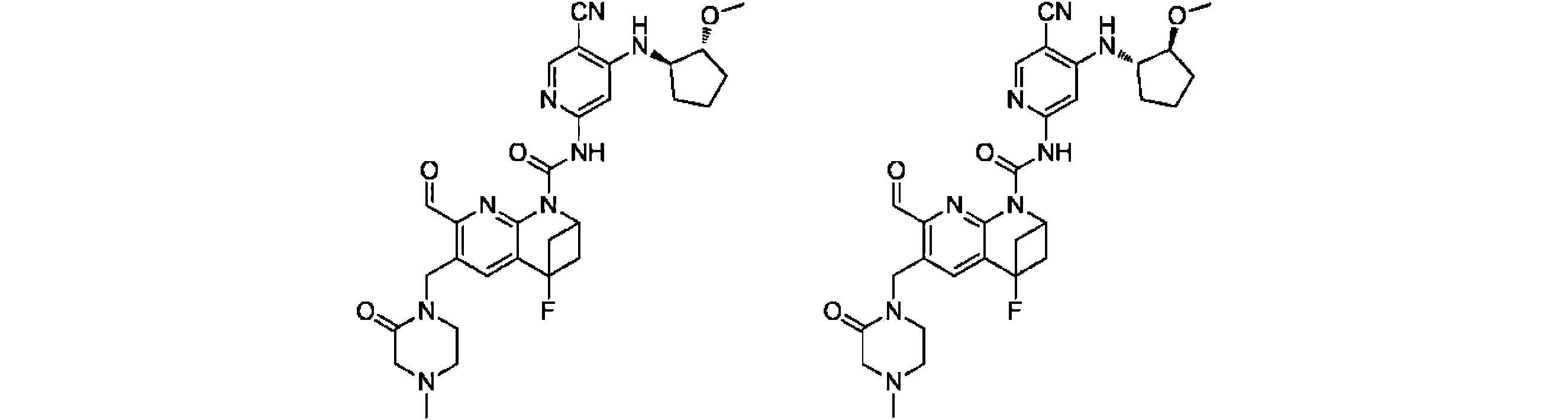
実施例9における化合物9の調製と類似した方法に従って、中間体49及び中間体5を出発原料として反応させて化合物11を製造した。関連するテストデータは以下の通りである。 Following a method analogous to the preparation of compound 9 in Example 9, intermediate 49 and intermediate 5 were reacted as starting materials to prepare compound 11. The relevant test data are as follows.
1HNMR(DMSO-d6,400MHz)、δ12.89(s,1H),10.12(s,1H),8.30(s,1H),7.63(s,1H),7.60(s,1H),6.96(d,J=7.2Hz,1H),5.58(dt,J=20.4Hz,6.6Hz,1H),4.97(s,2H),3.75-3.82(m,2H),3.30(m,2H),3.27(s,3H),3.05(s,2H),2.82-2.87(m,2H),2.61(t,J=5.4Hz,2H),2.24(s,3H),2.00-2.02(m,2H),1.86-1.95(m,2H),1.58-1.73(m,4H)。
ESI-MS:577.2[M+H]+。
1 H NMR (DMSO-d 6 , 400 MHz), δ 12.89 (s, 1H), 10.12 (s, 1H), 8.30 (s, 1H), 7.63 (s, 1H), 7.60 (s, 1H), 6.96 (d, J = 7.2Hz, 1H), 5.58 (dt, J = 20.4Hz, 6.6Hz, 1H), 4.97 (s, 2H), 3 .75-3.82 (m, 2H), 3.30 (m, 2H), 3.27 (s, 3H), 3.05 (s, 2H), 2.82-2.87 (m, 2H) ), 2.61 (t, J = 5.4 Hz, 2H), 2.24 (s, 3H), 2.00-2.02 (m, 2H), 1.86-1.95 (m, 2H ), 1.58-1.73 (m, 4H).
ESI-MS: 577.2 [M+H] + .
キラル分離条件:装置SFC、カラム:chiralpak-AS、移動相:CO2-EtOH。SFC機器において保持時間が短いものをP1と命名し、保持時間が長いものをP2と命名した。P1及びP2の一方は、化合物11Aであり、他方は、化合物11Bである。 Chiral separation conditions: apparatus SFC, column: chiralpak-AS, mobile phase: CO 2 -EtOH. The one with the short retention time on the SFC instrument was named P1 and the one with the long retention time was named P2. One of P1 and P2 is compound 11A and the other is compound 11B.
(実施例12)
(化合物12:N-(5-シアノ-4-(((シス)-2-メトキシシクロペンチル)アミノ)ピリジン-2-イル)-4-フルオロ-7-ホルミル-6-((4-メチル-2-オキソピベラジン-1-イル)メチル)-3,4-ジヒドロ-2,4-メチレン-1,8-ナフチリジン-1(2H)-ホルムアミドの調製)
(Example 12)
(Compound 12: N-(5-cyano-4-(((cis)-2-methoxycyclopentyl)amino)pyridin-2-yl)-4-fluoro-7-formyl-6-((4-methyl-2 -oxopiverazin-1-yl)methyl)-3,4-dihydro-2,4-methylene-1,8-naphthyridine-1(2H)-formamide)

実施例9における化合物9の調製と類似した方法に従って、中間体49及び中間体59を出発原料として反応させて化合物12を製造した。関連するテストデータは以下の通りである。 Following a method analogous to the preparation of compound 9 in Example 9, intermediate 49 and intermediate 59 were reacted as starting materials to prepare compound 12. The relevant test data are as follows.
ESI-MS:577.2[M+H]+。 ESI-MS: 577.2 [M+H] + .
キラル分離条件:装置SFC、カラム:chiralpak-AS、移動相:CO2-EtOH。SFC機器において保持時間が短いものをP1と命名し、保持時間が長いものをP2と命名した。P1及びP2の一方は、化合物12Aであり、他方は、化合物12Bである。 Chiral separation conditions: apparatus SFC, column: chiralpak-AS, mobile phase: CO 2 -EtOH. The one with the short retention time on the SFC instrument was named P1 and the one with the long retention time was named P2. One of P1 and P2 is compound 12A and the other is compound 12B.
(実施例13)
(化合物13:N-(5-シアノ-4-((2-メトキシエチル)アミノ)ピリジン-2-イル)-4-フルオロ-7-ホルミル-6-((3-オキソモルホリニル)メチル)-3,4-ジヒドロ-2,4-メチレン-1,8-ナフチリジン-1(2H)-ホルムアミドの調製)
(Example 13)
(Compound 13: N-(5-cyano-4-((2-methoxyethyl)amino)pyridin-2-yl)-4-fluoro-7-formyl-6-((3-oxomorpholinyl)methyl) -3,4-dihydro-2,4-methylene-1,8-naphthyridine-1(2H)-formamide)

実施例9における化合物9の調製と類似した方法に従って、中間体52及び中間体2を出発原料として反応させて化合物13を製造した。関連するテストデータは以下の通りである。 Following a method analogous to the preparation of compound 9 in Example 9, intermediate 52 and intermediate 2 were reacted as starting materials to prepare compound 13. The relevant test data are as follows.
ESI-MS:524.5[M+H]+。 ESI-MS: 524.5 [M+H] + .
(実施例14)
(化合物14:N-(5-シアノ-4-((2-メトキシエチル)アミノ)ピリジン-2-イル)-4-フルオロ-7-ホルミル-6-((2-オキソ-1,3-オキサゼパン-3-イル)メチル)-3,4-ジヒドロ-2,4-メチレン-1,8-ナフチリジン-1(2H)-ホルムアミドの調製)
(Example 14)
(Compound 14: N-(5-cyano-4-((2-methoxyethyl)amino)pyridin-2-yl)-4-fluoro-7-formyl-6-((2-oxo-1,3-oxazepane -3-yl)methyl)-3,4-dihydro-2,4-methylene-1,8-naphthyridine-1(2H)-formamide)

実施例9における化合物9の調製と類似した方法に従って、中間体55及び中間体2を出発原料として反応させて化合物14を製造した。関連するテストデータは以下の通りである。
Following a method analogous to the preparation of compound 9 in Example 9, intermediate 55 and intermediate 2 were reacted as starting materials to prepare
1HNMR(DMSO-d6,400MHz),δ12.91(s,1H),10.10(s,1H),8.30(s,1H),7.75(s,1H),7.52(s,1H),7.05(t,J=5.8Hz,1H),5.60(m,1H),4.85(s,2H),4.07(s,2H),3.53(t,J=5.8Hz,2H),3.39(m,4H),3.29(s,3H),2.86(m,2H),2.02-2.03(m,2H),1.78-1.79(m,2H),1.62(m,2H)。 1 H NMR (DMSO-d 6 , 400 MHz), δ 12.91 (s, 1H), 10.10 (s, 1H), 8.30 (s, 1H), 7.75 (s, 1H), 7.52 (s, 1H), 7.05 (t, J=5.8Hz, 1H), 5.60 (m, 1H), 4.85 (s, 2H), 4.07 (s, 2H), 3. 53 (t, J = 5.8Hz, 2H), 3.39 (m, 4H), 3.29 (s, 3H), 2.86 (m, 2H), 2.02-2.03 (m, 2H), 1.78-1.79 (m, 2H), 1.62 (m, 2H).
ESI-MS:538.3[M+H]+。 ESI-MS: 538.3 [M+H] + .
(実施例15)
(化合物15:N-(5-シアノ-4-((2-メトキシエチル)アミノ)ピリジン-2-イル)-4-フルオロ-7-ホルミル-6-((N-メチルアセトアミド)メチル)-3,4-ジヒドロ-2,4-メチレン-1,8-ナフチリジン-1(2H)-ホルムアミドの調製)
(Example 15)
(Compound 15: N-(5-cyano-4-((2-methoxyethyl)amino)pyridin-2-yl)-4-fluoro-7-formyl-6-((N-methylacetamido)methyl)-3 ,4-dihydro-2,4-methylene-1,8-naphthyridine-1(2H)-formamide)

実施例9における化合物9の調製と類似した方法に従って、中間体58及び中間体2を出発原料として反応させて化合物15を製造した。関連するテストデータは以下の通りである。 Following a method analogous to the preparation of compound 9 in Example 9, intermediate 58 and intermediate 2 were reacted as starting materials to prepare compound 15. The relevant test data are as follows.
ESI-MS:495.2[M+H]+。 ESI-MS: 495.2 [M+H] + .
(実施例16)
(化合物16:N-(5-(トリフルオロメチル)ピリジン-2-イル)-4-フルオロ-7-ホルミル-6-((4-メチル-2-オキソピベラジン-1-イル)メチル)-3,4-ジヒドロ-2,4-メチレン-1,8-ナフチリジン-1(2H)-ホルムアミドの調製)
(Example 16)
(Compound 16: N-(5-(trifluoromethyl)pyridin-2-yl)-4-fluoro-7-formyl-6-((4-methyl-2-oxopiverazin-1-yl)methyl)-3, Preparation of 4-dihydro-2,4-methylene-1,8-naphthyridine-1(2H)-formamide)

実施例9における化合物9の調製と類似した方法に従って、中間体49及び2-アミノ-5-(トリフルオロメチル)ピリジンを出発原料として反応させて化合物16を製造した。関連するテストデータは以下の通りである。 Following a method analogous to the preparation of compound 9 in Example 9, compound 16 was prepared by reacting intermediate 49 and 2-amino-5-(trifluoromethyl)pyridine as starting materials. The relevant test data are as follows.
1HNMR(DMSO-d6,400MHz),δ13.25(s,1H),10.19(s,1H),8.79(s,1H),8.29(d,J=8.8Hz,1H),8.24(dd,J=8.8Hz,2.0Hz,1H),7.67(s,1H),5.51(dt,J=20.4Hz,6.4Hz,1H),4.99(s,2H),3.31(s,2H),3.07(s,2H),2.85-2.90(m,2H),2.62(t,J=5.6Hz,2H),2.25(s,3H),2.02-2.08(m,2H)。 1 H NMR (DMSO-d 6 , 400 MHz), δ 13.25 (s, 1H), 10.19 (s, 1H), 8.79 (s, 1H), 8.29 (d, J = 8.8 Hz, 1H), 8.24 (dd, J = 8.8Hz, 2.0Hz, 1H), 7.67 (s, 1H), 5.51 (dt, J = 20.4Hz, 6.4Hz, 1H), 4.99 (s, 2H), 3.31 (s, 2H), 3.07 (s, 2H), 2.85-2.90 (m, 2H), 2.62 (t, J=5. 6Hz, 2H), 2.25 (s, 3H), 2.02-2.08 (m, 2H).
ESI-MS:507.2[M+H]+。 ESI-MS: 507.2 [M+H] + .
(実施例17)
(化合物17:N-(5-シアノ-4-(((トランス)-2-ヒドロキシシクロペンチル)アミノ)ピリジン-2-イル)-4-フルオロ-7-ホルミル-6-((4-メチル-2-オキソピベラジン-1-イル)メチル)-3,4-ジヒドロ-2,4-メチレン-1,8-ナフチリジン-1(2H)-ホルムアミドの調製)
(Example 17)
(Compound 17: N-(5-cyano-4-(((trans)-2-hydroxycyclopentyl)amino)pyridin-2-yl)-4-fluoro-7-formyl-6-((4-methyl-2 -oxopiverazin-1-yl)methyl)-3,4-dihydro-2,4-methylene-1,8-naphthyridine-1(2H)-formamide)

実施例5における化合物5の調製と類似した方法に従って、中間体49及び中間体9を出発原料として反応させて化合物16を製造した。関連するテストデータは以下の通りである。 Following a method analogous to the preparation of compound 5 in Example 5, intermediate 49 and intermediate 9 were reacted as starting materials to prepare compound 16. The relevant test data are as follows.
1HNMR(DMSO-d6,400MHz),δ12.87(s,1H),10.12(s,1H),8.29(s,1H),7.63(s,1H),7.57(s,1H),6.84(d,J=6.8Hz,1H),5.83-5.54(m,1H),4.97(s,2H),4.93(d,J=4.8Hz,1H),4.11-4.04(m,1H),3.64-3.55(m,1H),3.30(t,J=4.0Hz,2H),3.05(s,2H),2.87-2.82(dd,J=13.8Hz,7.0Hz,2H),2.6(t,J=5.2Hz,2H),3.17(s,3H),2.15-2.06(m,1H),2.04-1.99(dd,J=14.8Hz,7.2Hz,2H),1.92-1.84(m,1H),1.75-1.60(m,2H),1.55-1.45(m,2H)。 1 H NMR (DMSO-d 6 , 400 MHz), δ 12.87 (s, 1H), 10.12 (s, 1H), 8.29 (s, 1H), 7.63 (s, 1H), 7.57 (s, 1H), 6.84 (d, J = 6.8Hz, 1H), 5.83-5.54 (m, 1H), 4.97 (s, 2H), 4.93 (d, J = 4.8Hz, 1H), 4.11-4.04 (m, 1H), 3.64-3.55 (m, 1H), 3.30 (t, J = 4.0Hz, 2H), 3 .05 (s, 2H), 2.87-2.82 (dd, J = 13.8Hz, 7.0Hz, 2H), 2.6 (t, J = 5.2Hz, 2H), 3.17 ( s, 3H), 2.15-2.06 (m, 1H), 2.04-1.99 (dd, J = 14.8Hz, 7.2Hz, 2H), 1.92-1.84 (m , 1H), 1.75-1.60 (m, 2H), 1.55-1.45 (m, 2H).
ESI-MS:563.3[M+H]+。 ESI-MS: 563.3 [M+H] + .
(実施例18)
(化合物18:N-(5-シアノ-4-((2-メトキシエチル)アミノ)ピリジン-2-イル)-7-ホルミル-6-((4-メチル-2-オキソピベラジン-1-イル)メチル)-3,4-ジヒドロ-2,4-メチレン-1,8-ナフチリジン-1(2H)-ホルムアミドの調製)
(Example 18)
(Compound 18: N-(5-cyano-4-((2-methoxyethyl)amino)pyridin-2-yl)-7-formyl-6-((4-methyl-2-oxopiverazin-1-yl)methyl )-3,4-dihydro-2,4-methylene-1,8-naphthyridine-1(2H)-formamide)

実施例4における化合物4の調製と類似した方法に従って、中間体51及び中間体2を出発原料として反応させて化合物18を製造した。関連するテストデータは以下の通りである。 Following a method analogous to the preparation of compound 4 in Example 4, intermediate 51 and intermediate 2 were reacted as starting materials to prepare compound 18. The relevant test data are as follows.
1HNMR(DMSO-d6,400MHz),δ13.23(s,1H),10.09(s,1H),8.29(s,1H),7.55(s,1H),7.53(s,1H),7.00(t,J=5.4Hz,1H),5.51-5.55(dd,J=11.2Hz,5.2Hz,1H),4.91(s,2H),3.63(dd,J=11.2Hz,5.2Hz,1H),3.53(t,J=5.6Hz,2H),3.39(dt,J=5.6Hz,5.6Hz,2H),3.29(s,3H),3.27-3.30(m,2H),3.06(s,2H),2.61-2.65(m,4H),2.24(s,3H),1.45(dd,J=7.0Hz,2.6Hz,2H)。 1 H NMR (DMSO-d 6 , 400 MHz), δ 13.23 (s, 1H), 10.09 (s, 1H), 8.29 (s, 1H), 7.55 (s, 1H), 7.53 (s, 1H), 7.00 (t, J = 5.4Hz, 1H), 5.51-5.55 (dd, J = 11.2Hz, 5.2Hz, 1H), 4.91 (s, 2H), 3.63 (dd, J = 11.2Hz, 5.2Hz, 1H), 3.53 (t, J = 5.6Hz, 2H), 3.39 (dt, J = 5.6Hz, 5 .6Hz, 2H), 3.29 (s, 3H), 3.27-3.30 (m, 2H), 3.06 (s, 2H), 2.61-2.65 (m, 4H), 2.24 (s, 3H), 1.45 (dd, J=7.0Hz, 2.6Hz, 2H).
ESI-MS:519.1[M+H]+。 ESI-MS: 519.1 [M+H] + .
(実施例19)
(化合物19:N-(5-シアノ-4-(((トランス)-2-メトキシシクロペンチル)アミノ)ピリジン-2-イル)-4-フルオロ-7-ホルミル-3,4-ジヒドロ-2,4-メチレン-1,8-ナフチリジン-1(2H)-ホルムアミドの調製)
(Example 19)
(Compound 19: N-(5-cyano-4-(((trans)-2-methoxycyclopentyl)amino)pyridin-2-yl)-4-fluoro-7-formyl-3,4-dihydro-2,4 -methylene-1,8-naphthyridine-1(2H)-formamide)

(第1ステップ:7-(ジメトキシメチル)-4-フルオロ-3,4-ジヒドロ-2,4-メチレン-1,8-ナフチリジン-1(2H)-ギ酸フェニルの調製) (First step: Preparation of 7-(dimethoxymethyl)-4-fluoro-3,4-dihydro-2,4-methylene-1,8-naphthyridine-1(2H)-phenyl formate)

-15℃で、7-(ジメトキシメチル)-4-フルオロ-1,2,3,4-テトラヒドロ-2,4-メチレン-1,8-ナフチリジン(中間体16、100mg、0.42mmol)のテトラヒドロフラン(5mL)溶液にLiHMDS(1M、0.6mL、0.60mmol)を加え、0℃で1時間撹拌した。 7-(Dimethoxymethyl)-4-fluoro-1,2,3,4-tetrahydro-2,4-methylene-1,8-naphthyridine (Intermediate 16, 100 mg, 0.42 mmol) in tetrahydrofuran at −15° C. LiHMDS (1 M, 0.6 mL, 0.60 mmol) was added to the (5 mL) solution and stirred at 0° C. for 1 h.
反応終了後、反応液に飽和塩化アンモニウム溶液(50mL)を加えて反応をクエンチし、酢酸エチル(50mL)で抽出し、分液して有機相を得、この有機相を飽和食塩水(50mL)で洗浄し、さらに無水硫酸ナトリウムにより乾燥し、吸引濾過し、乾燥するまで蒸発させた。カラムクロマトグラフィーにより残留物を精製し、石油エーテル/酢酸エチル=5:1で溶出し、生成物を含有する溶出画分を濃縮して、7-(ジメトキシメチル)-4-フルオロ-3,4-ジヒドロ-2,4-メチレン-1,8-ナフチリジン-1(2H)-ギ酸フェニルを得た。関連するテストデータは以下の通りである。 After completion of the reaction, a saturated ammonium chloride solution (50 mL) was added to the reaction mixture to quench the reaction, extracted with ethyl acetate (50 mL), and the phases were separated to obtain an organic phase. then dried over anhydrous sodium sulphate, suction filtered and evaporated to dryness. The residue was purified by column chromatography, eluted with petroleum ether/ethyl acetate=5:1, and the eluted fractions containing the product were concentrated to give 7-(dimethoxymethyl)-4-fluoro-3,4 -dihydro-2,4-methylene-1,8-naphthyridine-1(2H)-phenyl formate. The relevant test data are as follows.
ESI-MS:359.3[M+H]+。 ESI-MS: 359.3 [M+H] + .
(第2ステップ:N-(5-シアノ-4-(((トランス)-2-メトキシシクロペンチル)アミノ)ピリジン-2-イル)-4-フルオロ-7-(ジメトキシメチル)-3,4-ジヒドロ-2,4-メチレン-1,8-ナフチリジン-1(2H)-ホルムアミドの調製) (Second step: N-(5-cyano-4-(((trans)-2-methoxycyclopentyl)amino)pyridin-2-yl)-4-fluoro-7-(dimethoxymethyl)-3,4-dihydro -Preparation of 2,4-methylene-1,8-naphthyridine-1(2H)-formamide)

-15℃で、7-(ジメトキシメチル)-4-フルオロ-3,4-ジヒドロ-2,4-メチレン-1,8-ナフチリジン-1(2H)-ギ酸フェニル(45mg、0.13mmol)及び6-アミノ-4-(トランス-(2-メトキシシクロペンチル)アミノ)ニコチノニトリル(中間体5、44mg、0.19mmol)のテトラヒドロフラン(1mL)溶液にLiHMDS(1M、0.6mL、0.60mmol)を加え、室温で1時間撹拌した。 7-(Dimethoxymethyl)-4-fluoro-3,4-dihydro-2,4-methylene-1,8-naphthyridine-1(2H)-phenyl formate (45 mg, 0.13 mmol) and 6 at −15° C. -Amino-4-(trans-(2-methoxycyclopentyl)amino)nicotinonitrile (Intermediate 5, 44 mg, 0.19 mmol) in tetrahydrofuran (1 mL) with LiHMDS (1 M, 0.6 mL, 0.60 mmol). and stirred at room temperature for 1 hour.
反応終了後、反応液に飽和塩化アンモニウム溶液(50mL)を加えて反応をクエンチし、酢酸エチル(50mL)で抽出し、分液して有機相を得、この有機相を飽和食塩水(50mL)で洗浄し、さらに無水硫酸ナトリウムにより乾燥し、吸引濾過し、乾燥するまで蒸発させた。カラムクロマトグラフィーにより残留物を精製し、石油エーテル/酢酸エチル=4:1で溶出し、生成物を含有する溶出画分を濃縮して、N-(5-シアノ-4-(((トランス)-2-メトキシシクロペンチル)アミノ)ピリジン-2-イル)-4-フルオロ-7-(ジメトキシメチル)-3,4-ジヒドロ-2,4-メチレン-1,8-ナフチリジン-1(2H)-ホルムアミドを得た。関連するテストデータは以下の通りである。 After completion of the reaction, a saturated ammonium chloride solution (50 mL) was added to the reaction mixture to quench the reaction, extracted with ethyl acetate (50 mL), and the phases were separated to obtain an organic phase. then dried over anhydrous sodium sulphate, suction filtered and evaporated to dryness. The residue was purified by column chromatography, eluted with petroleum ether/ethyl acetate=4:1, and the eluted fractions containing the product were concentrated to yield N-(5-cyano-4-(((trans) -2-methoxycyclopentyl)amino)pyridin-2-yl)-4-fluoro-7-(dimethoxymethyl)-3,4-dihydro-2,4-methylene-1,8-naphthyridine-1(2H)-formamide got The relevant test data are as follows.
ESI-MS:497.5[M+H]+。 ESI-MS: 497.5 [M+H] + .
(第3ステップ:N-(5-シアノ-4-(((トランス)-2-メトキシシクロペンチル)アミノ)ピリジン-2-イル)-4-フルオロ-7-ホルミル-3,4-ジヒドロ-2,4-メチレン-1,8-ナフチリジン-1(2H)-ホルムアミドの調製) (Third step: N-(5-cyano-4-(((trans)-2-methoxycyclopentyl)amino)pyridin-2-yl)-4-fluoro-7-formyl-3,4-dihydro-2, Preparation of 4-methylene-1,8-naphthyridine-1(2H)-formamide)

室温で、N-(5-シアノ-4-(((トランス)-2-メトキシシクロペンチル)アミノ)ピリジン-2-イル)-4-フルオロ-7-(ジメトキシメチル)-3,4-ジヒドロ-2,4-メチレン-1,8-ナフチリジン-1(2H)-ホルムアミド(79mg、0.16mmol)のテトラヒドロフラン(2mL)溶液に塩酸(3M、2mL)を加え、攪拌し続けて1時間反応させた。 N-(5-cyano-4-(((trans)-2-methoxycyclopentyl)amino)pyridin-2-yl)-4-fluoro-7-(dimethoxymethyl)-3,4-dihydro-2 at room temperature ,4-methylene-1,8-naphthyridine-1(2H)-formamide (79 mg, 0.16 mmol) in tetrahydrofuran (2 mL) was added with hydrochloric acid (3 M, 2 mL) and reacted for 1 hour while stirring.
反応混合物に飽和炭酸水素ナトリウム溶液(50mL)を加えて反応をクエンチし、酢酸エチル(50mL)で抽出し、分液して有機相を得、この有機相を飽和食塩水(50mL)で洗浄し、さらに無水硫酸ナトリウムにより乾燥し、吸引濾過し、乾燥するまで蒸発させた。カラムクロマトグラフィーにより残留物を精製し、石油エーテル/酢酸エチル=3:1で溶出し、生成物を含有する溶出画分を濃縮して、化合物19を得た。関連するテストデータは以下の通りである。 Saturated sodium bicarbonate solution (50 mL) was added to the reaction mixture to quench the reaction, extracted with ethyl acetate (50 mL), the layers were separated to obtain an organic phase, and the organic phase was washed with saturated brine (50 mL). , further dried over anhydrous sodium sulphate, suction filtered and evaporated to dryness. The residue was purified by column chromatography, eluted with petroleum ether/ethyl acetate=3:1, and the eluted fractions containing product were concentrated to give compound 19. The relevant test data are as follows.
1HNMR(DMSO-d6,400MHz),δ12.91(s,1H),9.96(s,1H),8.30(s,1H),8.02(d,J=7.6Hz,1H),7.78(d,J=7.6Hz,1H),7.61(s,1H),6.97(d,J=6.8Hz,1H),5.60(dt,J=20.4Hz,6.6Hz,1H),3.82-3.79(m,1H),3.78-3.73(m,1H),3.27(s,3H),2.86-2.81(m,2H),2.10-2.05(m,1H),2.03-1.98(m,2H),1.93-1.86(m,1H),1.73-1.56(m,4H)。 1 H NMR (DMSO-d 6 , 400 MHz), δ 12.91 (s, 1H), 9.96 (s, 1H), 8.30 (s, 1H), 8.02 (d, J = 7.6 Hz, 1H), 7.78 (d, J = 7.6Hz, 1H), 7.61 (s, 1H), 6.97 (d, J = 6.8Hz, 1H), 5.60 (dt, J = 20.4Hz, 6.6Hz, 1H), 3.82-3.79(m, 1H), 3.78-3.73(m, 1H), 3.27(s, 3H), 2.86- 2.81 (m, 2H), 2.10-2.05 (m, 1H), 2.03-1.98 (m, 2H), 1.93-1.86 (m, 1H), 1. 73-1.56 (m, 4H).
ESI-MS:451.4[M+H]+。 ESI-MS: 451.4 [M+H] + .
(実施例20)
(化合物20:N-(5-シアノ-4-(((トランス)-2-ヒドロキシシクロペンチル)アミノ)ピリジン-2-イル)-4-フルオロ-7-ホルミル-3,4-ジヒドロ-2,4-メチレン-1,8-ナフチリジン-1(2H)-ホルムアミドの調製)
(Example 20)
(Compound 20: N-(5-cyano-4-(((trans)-2-hydroxycyclopentyl)amino)pyridin-2-yl)-4-fluoro-7-formyl-3,4-dihydro-2,4 -methylene-1,8-naphthyridine-1(2H)-formamide)

実施例9における化合物9の調製と類似した方法に従って、中間体16及び中間体9を出発原料として反応させて化合物20を製造した。関連するテストデータは以下の通りである。 Following a method analogous to the preparation of compound 9 in Example 9, intermediate 16 and intermediate 9 were reacted as starting materials to prepare compound 20. The relevant test data are as follows.
1HNMR(DMSO-d6,400MHz),δ12.88(s,1H),9.96(s,1H),8.29(s,1H),8.02(d,J=7.6Hz,1H),7.78(d,J=7.6Hz,1H),7.58(s,1H),6.83(d,J=6.8Hz,1H),5.65-5.57(m,1H),4.93(d,J=4.8Hz,1H),4.11-4.05(m,1H),3.64-3.58(m,1H),2.86-2.80(m,2H),2.15-2.07(m,1H),2.04-1.98(m,2H),1.92-1.84(m,1H),1.72-1.63(m,2H),1.55-1.46(m,2H)。 1 H NMR (DMSO-d 6 , 400 MHz), δ 12.88 (s, 1H), 9.96 (s, 1H), 8.29 (s, 1H), 8.02 (d, J = 7.6 Hz, 1H), 7.78 (d, J = 7.6Hz, 1H), 7.58 (s, 1H), 6.83 (d, J = 6.8Hz, 1H), 5.65-5.57 ( m, 1H), 4.93 (d, J = 4.8Hz, 1H), 4.11-4.05 (m, 1H), 3.64-3.58 (m, 1H), 2.86- 2.80 (m, 2H), 2.15-2.07 (m, 1H), 2.04-1.98 (m, 2H), 1.92-1.84 (m, 1H), 1. 72-1.63 (m, 2H), 1.55-1.46 (m, 2H).
ESI-MS:437.2[M+H]+。 ESI-MS: 437.2 [M+H] + .
(実施例21)
(化合物21:N-(5-シアノ-4-((2-メトキシエチル)アミノ)ピリジン-2-イル)-4-フルオロ-7-ホルミル-6-エチル-3,4-ジヒドロ-2,4-メチレン-1,8-ナフチリジン-1(2H)-ホルムアミドの調製)
(Example 21)
(Compound 21: N-(5-cyano-4-((2-methoxyethyl)amino)pyridin-2-yl)-4-fluoro-7-formyl-6-ethyl-3,4-dihydro-2,4 -methylene-1,8-naphthyridine-1(2H)-formamide)

実施例1における化合物1の調製と類似じた方法に従って、中間体48及び中間体2を出発原料として反応させて化合物21を製造した。関連するテストデータは以下の通りである。 Following a method similar to the preparation of compound 1 in Example 1, intermediate 48 and intermediate 2 were reacted as starting materials to prepare compound 21. The relevant test data are as follows.
1HNMR(DMSO-d6,400MHz),δ12.97(s,1H),10.09(s,1H),8.28(s,1H),7.85(s,1H),7.51(s,1H),7.01(t,J=5.6Hz,1H),5.57(dt,J=20.4Hz,6.4Hz,1H),3.53(t,J=6Hz,2H),3.39(dt,J=5.6Hz,5.6Hz,2H),3.29(s,3H),3.06(q,J=7.6Hz,2H),2.84(dd,J=6.8Hz,2.0Hz,2H),2.01(dd,J=6.8Hz,2.0Hz,2H),1.2(t,J=7.6Hz,3H)。 1 H NMR (DMSO-d 6 , 400 MHz), δ 12.97 (s, 1H), 10.09 (s, 1H), 8.28 (s, 1H), 7.85 (s, 1H), 7.51 (s, 1H), 7.01 (t, J = 5.6Hz, 1H), 5.57 (dt, J = 20.4Hz, 6.4Hz, 1H), 3.53 (t, J = 6Hz, 2H), 3.39 (dt, J = 5.6Hz, 5.6Hz, 2H), 3.29 (s, 3H), 3.06 (q, J = 7.6Hz, 2H), 2.84 ( dd, J = 6.8 Hz, 2.0 Hz, 2H), 2.01 (dd, J = 6.8 Hz, 2.0 Hz, 2H), 1.2 (t, J = 7.6 Hz, 3H).
ESI-MS:439.2[M+H]+。 ESI-MS: 439.2 [M+H] + .
(実施例22)
(化合物22:N-(5-シアノ-4-((2-(2-メトキシエトキシ)エチル)アミノ)ピリジン-2-イル)-7-ホルミル-4-メトキシ-3,4-ジヒドロ-2,4-メチレン-1,8-ナフチリジン-1(2H)-ホルムアミドの調製)
(Example 22)
(Compound 22: N-(5-cyano-4-((2-(2-methoxyethoxy)ethyl)amino)pyridin-2-yl)-7-formyl-4-methoxy-3,4-dihydro-2, Preparation of 4-methylene-1,8-naphthyridine-1(2H)-formamide)

実施例1における化合物1の調製と類似じた方法に従って、中間体21及び中間体7を出発原料として反応させて化合物22を製造した。関連するテストデータは以下の通りである。 Following a method similar to the preparation of compound 1 in Example 1, intermediate 21 and intermediate 7 were reacted as starting materials to prepare compound 22. The relevant test data are as follows.
1HNMR(DMSO-d6,400MHz),δ13.06(s,1H),9.95(s,1H),8.30(s,1H),7.98(d,J=7.6Hz,1H),7.74(s,J=7.6Hz,1H),7.54(s,J、1H),6.98(t,J=5.6Hz,1H),5.50(t,J=6.4Hz,1H),3.61(t,J=5.6Hz,2H),3.55-3.58(m,2H),3.47(s,3H),3.44-3.46(m,2H),3.39(q,J=5.6Hz,2H),3.24(s,3H),2.82(m,2H),1.61(dd,J=6.8Hz,2.4Hz,2H)。 1 H NMR (DMSO-d 6 , 400 MHz), δ 13.06 (s, 1H), 9.95 (s, 1H), 8.30 (s, 1H), 7.98 (d, J = 7.6 Hz, 1H), 7.74 (s, J = 7.6Hz, 1H), 7.54 (s, J, 1H), 6.98 (t, J = 5.6Hz, 1H), 5.50 (t, J = 6.4Hz, 1H), 3.61 (t, J = 5.6Hz, 2H), 3.55-3.58 (m, 2H), 3.47 (s, 3H), 3.44- 3.46 (m, 2H), 3.39 (q, J=5.6Hz, 2H), 3.24 (s, 3H), 2.82 (m, 2H), 1.61 (dd, J= 6.8Hz, 2.4Hz, 2H).
ESI-MS:467.0[M+H]+。 ESI-MS: 467.0 [M+H] + .
(実施例23)
(化合物23:N-(5-シアノ-4-(アゼチジン-3-イルアミノ)ピリジン-2-イル)-7-ホルミル-4-フルオロ-3,4-ジヒドロ-2,4-メチレン-1,8-ナフチリジン-1(2H)-ホルムアミドの調製)
(Example 23)
(Compound 23: N-(5-cyano-4-(azetidin-3-ylamino)pyridin-2-yl)-7-formyl-4-fluoro-3,4-dihydro-2,4-methylene-1,8 - preparation of naphthyridine-1(2H)-formamide)

実施例1における化合物1の調製と類似じた方法に従って、中間体16及び中間体8を出発原料として反応させて化合物23を製造した。関連するテストデータは以下の通りである。 Following a method similar to the preparation of compound 1 in Example 1, intermediate 16 and intermediate 8 were reacted as starting materials to prepare compound 23. The relevant test data are as follows.
ESI-MS:408.0[M+H]+。 ESI-MS: 408.0 [M+H] + .
(実施例24)
(化合物24:(R)-N-(5-シアノ-4-((1-メトキシプロパン-2-イル)アミノ)ピリジン-2-イル)-7-ホルミル-6-((4-メチル-2-オキソピベラジン-1-イル)メチル)-3,4-ジヒドロ-2,4-メチレン-1,8-ナフチリジン-1(2H)-ホルムアミドの調製)
(Example 24)
(Compound 24: (R) —N-(5-cyano-4-((1-methoxypropan-2-yl)amino)pyridin-2-yl)-7-formyl-6-((4-methyl-2 -oxopiverazin-1-yl)methyl)-3,4-dihydro-2,4-methylene-1,8-naphthyridine-1(2H)-formamide)

実施例4における化合物4の調製と類似した方法に従って、中間体51及び中間体3を出発原料として反応させて化合物24を製造した。関連するテストデータは以下の通りである。 Following a method analogous to the preparation of compound 4 in Example 4, intermediate 51 and intermediate 3 were reacted as starting materials to prepare compound 24. The relevant test data are as follows.
1HNMR(DMSO-d6,400MHz),δ13.22(s,1H),10.09(s,1H),8.29(s,1H),7.57(s,1H),7.56(s,1H),6.61(d,J=8.4Hz,1H),5.53(dd,J=11.2Hz,5.2Hz,1H),4.91(s,2H),3.85(dt,J=13.6Hz,6.4Hz,1H),3.62(dt,J=6.0Hz,5.2Hz,1H),3.49(dd,J=9.6Hz,6.4Hz,1H),3.39(dd,J=9.8Hz,5.8Hz,1H),3.29(s,3H),3.29-3.28(m,2H),3.08(s,2H),2.66-2.59(m,4H),2.25(s,3H),1.46(dd,J=7.2Hz,2.4Hz,2H),1.19(d,J=6.8Hz,3H)。 1 H NMR (DMSO-d 6 , 400 MHz), δ 13.22 (s, 1H), 10.09 (s, 1H), 8.29 (s, 1H), 7.57 (s, 1H), 7.56 (s, 1H), 6.61 (d, J = 8.4Hz, 1H), 5.53 (dd, J = 11.2Hz, 5.2Hz, 1H), 4.91 (s, 2H), 3 .85 (dt, J=13.6 Hz, 6.4 Hz, 1 H), 3.62 (dt, J=6.0 Hz, 5.2 Hz, 1 H), 3.49 (dd, J=9.6 Hz, 6 .4Hz, 1H), 3.39 (dd, J = 9.8Hz, 5.8Hz, 1H), 3.29 (s, 3H), 3.29-3.28 (m, 2H), 3.08 (s, 2H), 2.66-2.59 (m, 4H), 2.25 (s, 3H), 1.46 (dd, J = 7.2Hz, 2.4Hz, 2H), 1.19 (d, J=6.8 Hz, 3H).
ESI-MS:533.2[M+H]+。 ESI-MS: 533.2 [M+H] + .
(実施例25)
(化合物25:N-(5-シアノ-4-(メトキシエトキシ)ピリジン-2-イル)-7-ホルミル-6-((4-メチル-2-オキソピベラジン-1-イル)メチル)-3,4-ジヒドロ-2,4-メチレン-1,8-ナフチリジン-1(2H)-ホルムアミドの調製)
(Example 25)
(Compound 25: N-(5-cyano-4-(methoxyethoxy)pyridin-2-yl)-7-formyl-6-((4-methyl-2-oxopiverazin-1-yl)methyl)-3,4 - preparation of dihydro-2,4-methylene-1,8-naphthyridine-1(2H)-formamide)

実施例4における化合物4の調製と類似した方法に従って、中間体51及び中間体6を出発原料として反応させて化合物25を製造した。関連するテストデータは以下の通りである。 Following a method analogous to the preparation of compound 4 in Example 4, intermediate 51 and intermediate 6 were reacted as starting materials to prepare compound 25. The relevant test data are as follows.
1HNMR(DMSO-d6,400MHz),δ13.58(s,1H),10.13(s,1H),8.62(s,1H),7.95(s,1H),7.58(s,1H),5.54(dd,J=11.2Hz,5.2Hz,1H),4.92(s,2H),4.35(t,J=4.4Hz,2H),3.75(t,J=4.4Hz,2H),3.64(dt,J=6.0Hz,5.2Hz,1H),3.35(s,3H),3.31-3.29(m,2H),3.08(s,2H),2.65-2.61(m,4H),2.25(s,3H),1.48(dd,J=7.2Hz,2.4Hz,2H)。 1 H NMR (DMSO-d 6 , 400 MHz), δ 13.58 (s, 1H), 10.13 (s, 1H), 8.62 (s, 1H), 7.95 (s, 1H), 7.58 (s, 1H), 5.54 (dd, J = 11.2Hz, 5.2Hz, 1H), 4.92 (s, 2H), 4.35 (t, J = 4.4Hz, 2H), 3 .75 (t, J = 4.4Hz, 2H), 3.64 (dt, J = 6.0Hz, 5.2Hz, 1H), 3.35 (s, 3H), 3.31-3.29 ( m, 2H), 3.08 (s, 2H), 2.65-2.61 (m, 4H), 2.25 (s, 3H), 1.48 (dd, J = 7.2Hz, 2.61). 4Hz, 2H).
ESI-MS:520.2[M+H]+。 ESI-MS: 520.2 [M+H] + .
(実施例26)
(化合物26:N-(5-シアノ-4-(((トランス)-2-メトキシシクロペンチル)アミノ)ピリジン-2-イル)-7-ホルミル-6-((4-メチル-2-オキソピベラジン-1-イル)メチル)-3,4-ジヒドロ-2,4-メチレン-1,8-ナフチリジン-1(2H)-ホルムアミドの調製)
(Example 26)
(Compound 26: N-(5-cyano-4-(((trans)-2-methoxycyclopentyl)amino)pyridin-2-yl)-7-formyl-6-((4-methyl-2-oxopiverazine-1 -yl)methyl)-3,4-dihydro-2,4-methylene-1,8-naphthyridine-1(2H)-formamide)

実施例4における化合物4の調製と類似した方法に従って、中間体51及び中間体5を出発原料として反応させて化合物26を製造した。関連するテストデータは以下の通りである。 Following a method analogous to the preparation of compound 4 in Example 4, intermediate 51 and intermediate 5 were reacted as starting materials to prepare compound 26. The relevant test data are as follows.
1HNMR(DMSO-d6,400MHz),δ13.22(s,1H),10.09(s,1H),8.29(s,1H),7.61(s,1H),7.55(s,1H),6.92(d,J=7.2Hz,1H),5.53(dd,J=11.2Hz,5.2Hz,1H),4.91(s,2H),3.83-3.80(m,1H),3.78-3.73(m,1H),3.63(dt,J=6.4Hz,5.2Hz,1H),3.30-3.28(m,2H),3.27(s,3H),3.07(s,2H),2.66-2.59(m,4H),2.25(s,3H),2.09-2.03(m,1H),1.93-1.86(m,1H),1.74-1.55(m,4H),1.45(dd,J=7.0Hz,2.6Hz,2H)。 1 H NMR (DMSO-d 6 , 400 MHz), δ 13.22 (s, 1H), 10.09 (s, 1H), 8.29 (s, 1H), 7.61 (s, 1H), 7.55 (s, 1H), 6.92 (d, J = 7.2Hz, 1H), 5.53 (dd, J = 11.2Hz, 5.2Hz, 1H), 4.91 (s, 2H), 3 .83-3.80 (m, 1H), 3.78-3.73 (m, 1H), 3.63 (dt, J=6.4Hz, 5.2Hz, 1H), 3.30-3. 28 (m, 2H), 3.27 (s, 3H), 3.07 (s, 2H), 2.66-2.59 (m, 4H), 2.25 (s, 3H), 2.09 −2.03 (m, 1H), 1.93-1.86 (m, 1H), 1.74-1.55 (m, 4H), 1.45 (dd, J=7.0Hz, 2. 6Hz, 2H).
ESI-MS:559.2[M+H]+。 ESI-MS: 559.2 [M+H] + .
(実施例27)
(化合物27:N-(5-シアノ-4-((2-メトキシエチル)アミノ)ピリジン-2-イル)-7-ホルミル-6-((3-オキソモルホリニル)メチル)-3,4-ジヒドロ-2,4-メチレン-1,8-ナフチリジン-1(2H)-ホルムアミドの調製)
(Example 27)
(Compound 27: N-(5-cyano-4-((2-methoxyethyl)amino)pyridin-2-yl)-7-formyl-6-((3-oxomorpholinyl)methyl)-3,4 - preparation of dihydro-2,4-methylene-1,8-naphthyridine-1(2H)-formamide)

実施例1における化合物1の調製と類似じた方法に従って、中間体53及び中間体2を出発原料として反応させて化合物27を製造した。関連するテストデータは以下の通りである。 Following a method similar to the preparation of compound 1 in Example 1, intermediate 53 and intermediate 2 were reacted as starting materials to prepare compound 27. The relevant test data are as follows.
1HNMR(DMSO-d6,400MHz),δ13.22(s,1H),10.09(s,1H),8.29(s,1H),7.65(s,1H),7.54(s,1H),6.98(t,J=5.8Hz,1H),5.54(dd,J=11.2Hz,5.2Hz,1H),4.95(s,2H),4.16(s,2H),3.89(t,J=5.0Hz,2H),3.65(dt,J=6.0Hz,5.2Hz,1H),3.53(t,J=5.8Hz,2H),3.40-3.39(m,2H),3.36(t,J=5.0Hz,2H),3.29(s,3H),3.29-3.28(m,2H),2.65-2.60(m,2H),1.46(dd,J=7.0Hz,2.6Hz,2H)。 1 H NMR (DMSO-d 6 , 400 MHz), δ 13.22 (s, 1H), 10.09 (s, 1H), 8.29 (s, 1H), 7.65 (s, 1H), 7.54 (s, 1H), 6.98 (t, J = 5.8Hz, 1H), 5.54 (dd, J = 11.2Hz, 5.2Hz, 1H), 4.95 (s, 2H), 4 .16 (s, 2H), 3.89 (t, J=5.0Hz, 2H), 3.65 (dt, J=6.0Hz, 5.2Hz, 1H), 3.53 (t, J= 5.8 Hz, 2H), 3.40-3.39 (m, 2H), 3.36 (t, J = 5.0 Hz, 2H), 3.29 (s, 3H), 3.29-3. 28 (m, 2H), 2.65-2.60 (m, 2H), 1.46 (dd, J = 7.0Hz, 2.6Hz, 2H).
ESI-MS:506.2[M+H]+。 ESI-MS: 506.2 [M+H] + .
(実施例28)
(化合物28:N-(5-シアノ-4-((2-メトキシエチル)アミノ)ピリジン-2-イル)-7-ホルミル-6-((2-オキソ-1,3-オキサゼパン-3-イル)メチル)-3,4-ジヒドロ-2,4-メチレン-1,8-ナフチリジン-1(2H)-ホルムアミドの調製)
(Example 28)
(Compound 28: N-(5-cyano-4-((2-methoxyethyl)amino)pyridin-2-yl)-7-formyl-6-((2-oxo-1,3-oxazepan-3-yl ) Preparation of methyl)-3,4-dihydro-2,4-methylene-1,8-naphthyridine-1(2H)-formamide)

実施例1における化合物1の調製と類似じた方法に従って、中間体56及び中間体2を出発原料として反応させて化合物28を製造した。関連するテストデータは以下の通りである。 Following a method similar to the preparation of compound 1 in Example 1, intermediate 56 and intermediate 2 were reacted as starting materials to prepare compound 28. The relevant test data are as follows.
1HNMR(DMSO-d6,400MHz),δ13.23(s,1H),10.07(s,1H),8.29(s,1H),7.73(s,1H),7.53(s,1H),6.98(t,J=5.6Hz,1H),5.54(dd,J=11.6Hz,5.2Hz,1H),4.81(s,2H),4.09(t,J=5.2Hz,2H),3.68(dt,J=6.0Hz,5.2Hz,1H),3.53(t,J=5.8Hz,2H),3.42-3.37(m,2H),3.29(s,3H),3.29-3.28(m,2H),2.65-2.60(m,2H),1.79-1.75(m,2H),1.64-1.60(m,2H),1.46(dd,J=7.0Hz,2.6Hz,2H)。 1 H NMR (DMSO-d 6 , 400 MHz), δ 13.23 (s, 1H), 10.07 (s, 1H), 8.29 (s, 1H), 7.73 (s, 1H), 7.53 (s, 1H), 6.98 (t, J = 5.6Hz, 1H), 5.54 (dd, J = 11.6Hz, 5.2Hz, 1H), 4.81 (s, 2H), 4 .09 (t, J=5.2 Hz, 2H), 3.68 (dt, J=6.0 Hz, 5.2 Hz, 1 H), 3.53 (t, J=5.8 Hz, 2 H), 3. 42-3.37 (m, 2H), 3.29 (s, 3H), 3.29-3.28 (m, 2H), 2.65-2.60 (m, 2H), 1.79- 1.75 (m, 2H), 1.64-1.60 (m, 2H), 1.46 (dd, J = 7.0Hz, 2.6Hz, 2H).
ESI-MS:520.3[M+H]+。 ESI-MS: 520.3 [M+H] + .
(実施例29)
(化合物29:N-(5-シアノ-4-((2-メトキシエチル)アミノ)ピリジン-2-イル)-4-(2-(ジメチルアミノ)エトキシ)-7-ホルミル-3,4-ジヒドロ-2,4-メチレン-1,8-ナフチリジン-1(2H)-ホルムアミドの調製)
(Example 29)
(Compound 29: N-(5-cyano-4-((2-methoxyethyl)amino)pyridin-2-yl)-4-(2-(dimethylamino)ethoxy)-7-formyl-3,4-dihydro -Preparation of 2,4-methylene-1,8-naphthyridine-1(2H)-formamide)

実施例4における化合物4の調製と類似した方法に従って、中間体23及び中間体2を出発原料として反応させて化合物29を製造した。関連するテストデータは以下の通りである。 Following a method analogous to the preparation of compound 4 in Example 4, intermediate 23 and intermediate 2 were reacted as starting materials to prepare compound 29. The relevant test data are as follows.
1HNMR(DMSO-d6,400MHz),δ13.07(s,1H),9.95(s,1H),8.30(s,1H),8.05(d,J=7.6Hz,1H),7.77(d,J=7.6Hz,1H),7.54(s,1H),7.02(t,J=4.8Hz,1H),5.50(t,J=6.2Hz,1H),3.75(t,J=5.4Hz,2H),3.53(t,J=5.8Hz,2H),3.40(dt,J=5.6Hz,5.8Hz,2H),3.29(s,3H),2.84-2.80(m,2H),2.72-2.65(m,2H),2.32(s,6H),1.66(dd,J=6.8Hz,2.0Hz,2H)。 1 H NMR (DMSO-d 6 , 400 MHz), δ 13.07 (s, 1H), 9.95 (s, 1H), 8.30 (s, 1H), 8.05 (d, J = 7.6 Hz, 1H), 7.77 (d, J = 7.6Hz, 1H), 7.54 (s, 1H), 7.02 (t, J = 4.8Hz, 1H), 5.50 (t, J = 6.2 Hz, 1 H), 3.75 (t, J = 5.4 Hz, 2 H), 3.53 (t, J = 5.8 Hz, 2 H), 3.40 (dt, J = 5.6 Hz, 5 .8Hz, 2H), 3.29 (s, 3H), 2.84-2.80 (m, 2H), 2.72-2.65 (m, 2H), 2.32 (s, 6H), 1.66 (dd, J=6.8Hz, 2.0Hz, 2H).
ESI-MS:408.1[M+H]+。 ESI-MS: 408.1 [M+H] + .
(実施例30)
(化合物30:N-(5-シアノ-4-((2-メトキシエチル)アミノ)ピリジン-2-イル)-4-(2-(ジメチルアミノ)アセトアミド)-7-ホルミル-3,4-ジヒドロ-2,4-メチレン-1,8-ナフチリジン-1(2H)-ホルムアミドの調製)
(Example 30)
(Compound 30: N-(5-cyano-4-((2-methoxyethyl)amino)pyridin-2-yl)-4-(2-(dimethylamino)acetamido)-7-formyl-3,4-dihydro -Preparation of 2,4-methylene-1,8-naphthyridine-1(2H)-formamide)

実施例4における化合物4の調製と類似した方法に従って、中間体31及び中間体2を出発原料として反応させて化合物30を製造した。関連するテストデータは以下の通りである。
Following a method similar to the preparation of compound 4 in Example 4, intermediate 31 and intermediate 2 were reacted as starting materials to prepare
1HNMR(DMSO-d6,400MHz),δ13.16(s,1H),9.94(s,1H),8.76(s,1H),8.29(s,1H),7.70(d,J=7.6Hz,1H),7.64(d,J=7.6Hz,1H),7.54(s,1H),7.00(t,J=5.6Hz,1H),5.61(t,J=5.6Hz,1H),3.52(t,J=5.6Hz,2H),3.40(dt,J=5.6Hz,5.6Hz,2H),3.29(s,3H),3.03(s,2H),2.52(m,2H),2.30(s,6H),1.92(dd,J=7.2Hz,2.4Hz,2H)。 1 H NMR (DMSO-d 6 , 400 MHz), δ 13.16 (s, 1H), 9.94 (s, 1H), 8.76 (s, 1H), 8.29 (s, 1H), 7.70 (d, J = 7.6Hz, 1H), 7.64 (d, J = 7.6Hz, 1H), 7.54 (s, 1H), 7.00 (t, J = 5.6Hz, 1H) , 5.61 (t, J=5.6 Hz, 1 H), 3.52 (t, J=5.6 Hz, 2 H), 3.40 (dt, J=5.6 Hz, 5.6 Hz, 2 H), 3.29 (s, 3H), 3.03 (s, 2H), 2.52 (m, 2H), 2.30 (s, 6H), 1.92 (dd, J = 7.2 Hz, 2. 4Hz, 2H).
ESI-MS:493.1[M+H]+。 ESI-MS: 493.1 [M+H] + .
(実施例31)
(化合物31:N-(5-シアノ-4-((2-メトキシエチル)アミノ)ピリジン-2-イル)-4-(1-メチルピペリジン-4-ホルムアミド)-7-ホルミル-3,4-ジヒドロ-2,4-メチレン-1,8-ナフチリジン-1(2H)-ホルムアミドの調製)
(Example 31)
(Compound 31: N-(5-cyano-4-((2-methoxyethyl)amino)pyridin-2-yl)-4-(1-methylpiperidine-4-formamide)-7-formyl-3,4- Preparation of dihydro-2,4-methylene-1,8-naphthyridine-1(2H)-formamide)

実施例4における化合物4の調製と類似した方法に従って、中間体32及び中間体2を出発原料として反応させて化合物31を製造した。関連するテストデータは以下の通りである。 Following a method analogous to the preparation of compound 4 in Example 4, intermediate 32 and intermediate 2 were reacted as starting materials to prepare compound 31. The relevant test data are as follows.
ESI-MS:533.2[M+H]+。 ESI-MS: 533.2 [M+H] + .
(実施例32)
(化合物32:N-(5-シアノ-4-((2-メトキシエチル)アミノ)ピリジン-2-イル)-4-(1-メチル-1H-ピラゾール-4-ホルムアミド)-7-ホルミル-3,4-ジヒドロ-2,4-メチレン-1,8-ナフチリジン-1(2H)-ホルムアミドの調製)
(Example 32)
(Compound 32: N-(5-cyano-4-((2-methoxyethyl)amino)pyridin-2-yl)-4-(1-methyl-1H-pyrazole-4-formamide)-7-formyl-3 ,4-dihydro-2,4-methylene-1,8-naphthyridine-1(2H)-formamide)

実施例1における化合物1の調製と類似じた方法に従って、中間体33及び中間体2を出発原料として反応させて化合物32を製造した。関連するテストデータは以下の通りである。 Following a method similar to the preparation of compound 1 in Example 1, intermediate 33 and intermediate 2 were reacted as starting materials to prepare compound 32. The relevant test data are as follows.
1HNMR(DMSO-d6,400MHz),δ13.18(s,1H),9.95(s,1H),8.98(s,1H),8.30(s,1H),8.21(s,1H),7.94(s,1H),7.70(d,J=7.6Hz,1H),7.61(d,J=7.6Hz,1H),7.56(s,1H),7.02(t,J=5.6Hz,1H),5.65(t,J=5.6Hz,1H),3.89(s,3H),3.54(t,J=5.6Hz,2H),3.40(dt,J=5.6Hz,5.6Hz,2H),3.30(s,3H),2.60(m,2H),1.99(dd,J=7.2Hz,2.4Hz,2H)。 1 H NMR (DMSO-d 6 , 400 MHz), δ 13.18 (s, 1H), 9.95 (s, 1H), 8.98 (s, 1H), 8.30 (s, 1H), 8.21 (s, 1H), 7.94 (s, 1H), 7.70 (d, J = 7.6Hz, 1H), 7.61 (d, J = 7.6Hz, 1H), 7.56 (s , 1H), 7.02 (t, J = 5.6Hz, 1H), 5.65 (t, J = 5.6Hz, 1H), 3.89 (s, 3H), 3.54 (t, J = 5.6Hz, 2H), 3.40 (dt, J = 5.6Hz, 5.6Hz, 2H), 3.30 (s, 3H), 2.60 (m, 2H), 1.99 (dd , J=7.2 Hz, 2.4 Hz, 2H).
ESI-MS:516.1[M+H]+。 ESI-MS: 516.1 [M+H] + .
(実施例33)
(化合物33:N-(5-シアノ-4-(((トランス)-2-メトキシシクロペンチル)アミノ)ピリジン-2-イル)-4-(2-(ジメチルアミノ)アセトアミド)-7-ホルミル-3,4-ジヒドロ-2,4-メチレン-1,8-ナフチリジン-1(2H)-ホルムアミドの調製)
(Example 33)
(Compound 33: N-(5-cyano-4-(((trans)-2-methoxycyclopentyl)amino)pyridin-2-yl)-4-(2-(dimethylamino)acetamido)-7-formyl-3 ,4-dihydro-2,4-methylene-1,8-naphthyridine-1(2H)-formamide)

実施例4における化合物4の調製と類似した方法に従って、中間体31及び中間体5を出発原料として反応させて化合物33を製造した。関連するテストデータは以下の通りである。 Following a method analogous to the preparation of compound 4 in Example 4, intermediate 31 and intermediate 5 were reacted as starting materials to prepare compound 33. The relevant test data are as follows.
ESI-MS:533.1[M+H]+。 ESI-MS: 533.1 [M+H] + .
(実施例34)
(化合物34:N-(5-シアノ-4-((2-メトキシエチル)アミノ)ピリジン-2-イル)-4-(メチル(テトラヒドロフラン-3-イル)アミノ)-7-ホルミル-3,4-ジヒドロ-2,4-メチレン-1,8-ナフチリジン-1(2H)-ホルムアミドの調製)
(Example 34)
(Compound 34: N-(5-cyano-4-((2-methoxyethyl)amino)pyridin-2-yl)-4-(methyl(tetrahydrofuran-3-yl)amino)-7-formyl-3,4 - preparation of dihydro-2,4-methylene-1,8-naphthyridine-1(2H)-formamide)

実施例4における化合物4の調製と類似した方法に従って、中間体41及び中間体2を出発原料として反応させて化合物34を製造した。関連するテストデータは以下の通りである。 Following a method analogous to the preparation of compound 4 in Example 4, intermediate 41 and intermediate 2 were reacted as starting materials to prepare compound 34. The relevant test data are as follows.
1HNMR(DMSO-d6,400MHz),δ13.17(s,1H),9.95(s,1H),8.29(s,1H),7.97(d,J=7.2Hz,1H),7.75(d,J=7.6Hz,1H),7.54(s,1H),6.99(t,J=5.4Hz,1H),5.49(t,J=6.0Hz,1H),3.83-3.77(m,2H),3.62-3.50(m,4H),3.42-3.37(m,2H),3.29(s,3H),2.63(dd,J=9.0Hz,5.8Hz,2H),2.27(s,3H),2.26(m,1H),1.56-1.54(m,2H),1.27-1.25(m,2H)。 1 H NMR (DMSO-d 6 , 400 MHz), δ 13.17 (s, 1H), 9.95 (s, 1H), 8.29 (s, 1H), 7.97 (d, J = 7.2 Hz, 1H), 7.75 (d, J = 7.6Hz, 1H), 7.54 (s, 1H), 6.99 (t, J = 5.4Hz, 1H), 5.49 (t, J = 6.0 Hz, 1H), 3.83-3.77 (m, 2H), 3.62-3.50 (m, 4H), 3.42-3.37 (m, 2H), 3.29 ( s, 3H), 2.63 (dd, J=9.0Hz, 5.8Hz, 2H), 2.27 (s, 3H), 2.26 (m, 1H), 1.56-1.54 ( m, 2H), 1.27-1.25 (m, 2H).
ESI-MS:492.2[M+H]+。 ESI-MS: 492.2 [M+H] + .
(実施例35)
(化合物35:N-(5-シアノ-4-((2-メトキシエチル)アミノ)ピリジン-2-イル)-4-(2-(ピロリジン-1-イル)エトキシ)-7-ホルミル-3,4-ジヒドロ-2,4-メチレン-1,8-ナフチリジン-1(2H)-ホルムアミドの調製)
(Example 35)
(Compound 35: N-(5-cyano-4-((2-methoxyethyl)amino)pyridin-2-yl)-4-(2-(pyrrolidin-1-yl)ethoxy)-7-formyl-3, Preparation of 4-dihydro-2,4-methylene-1,8-naphthyridine-1(2H)-formamide)

実施例4における化合物4の調製と類似した方法に従って、中間体26及び中間体2を出発原料として反応させて化合物35を製造した。関連するテストデータは以下の通りである。 Following a method analogous to the preparation of compound 4 in Example 4, intermediate 26 and intermediate 2 were reacted as starting materials to prepare compound 35. The relevant test data are as follows.
1HNMR(DMSO-d6,400MHz),δ13.06(s,1H),9.96(s,1H),8.30(s,1H),8.16(d,J=7.6Hz,1H),7.76(d,J=7.6Hz,1H),7.54(s,1H),7.02(t,J=5.4Hz,1H),5.52(t,J=6.2Hz,1H),3.94(m,2H),3.53(t,J=5.8Hz,2H),3.40(dt,J=5.6Hz,5.4Hz,2H),3.29(s,3H),3.29-3.28(m,2H),2.89-2.85(m,2H),2.51-2.50(m,4H),1.92-1.91(m,4H),1.68(dd,J=6.8Hz,2.0Hz,2H)。 1 H NMR (DMSO-d 6 , 400 MHz), δ 13.06 (s, 1H), 9.96 (s, 1H), 8.30 (s, 1H), 8.16 (d, J = 7.6 Hz, 1H), 7.76 (d, J = 7.6Hz, 1H), 7.54 (s, 1H), 7.02 (t, J = 5.4Hz, 1H), 5.52 (t, J = 6.2Hz, 1H), 3.94 (m, 2H), 3.53 (t, J = 5.8Hz, 2H), 3.40 (dt, J = 5.6Hz, 5.4Hz, 2H), 3.29 (s, 3H), 3.29-3.28 (m, 2H), 2.89-2.85 (m, 2H), 2.51-2.50 (m, 4H), 1. 92-1.91 (m, 4H), 1.68 (dd, J = 6.8Hz, 2.0Hz, 2H).
ESI-MS:505.8[M+H]+。 ESI-MS: 505.8 [M+H] + .
(実施例36)
(化合物36:N-(5-シアノ-4-((2-メトキシエチル)アミノ)ピリジン-2-イル)-4-(2-メトキシエトキシ)-7-ホルミル-3,4-ジヒドロ-2,4-メチレン-1,8-ナフチリジン-1(2H)-ホルムアミドの調製)
(Example 36)
(Compound 36: N-(5-cyano-4-((2-methoxyethyl)amino)pyridin-2-yl)-4-(2-methoxyethoxy)-7-formyl-3,4-dihydro-2, Preparation of 4-methylene-1,8-naphthyridine-1(2H)-formamide)

実施例1における化合物1の調製と類似じた方法に従って、中間体22及び中間体2を出発原料として反応させて化合物36を製造した。関連するテストデータは以下の通りである。 Following a method similar to the preparation of compound 1 in Example 1, intermediate 22 and intermediate 2 were reacted as starting materials to prepare compound 36. The relevant test data are as follows.
1HNMR(DMSO-d6,400MHz),δ13.06(s,1H),9.95(s,1H),8.29(s,1H),8.02(d,J=7.6Hz,1H),7.76(d,J=7.6Hz,1H),7.53(s,1H),7.00(t,J=5.6Hz,1H),5.50(t,J=6.4Hz,1H),3.78-3.75(m,2H),3.61-3.59(m,2H),3.53(t,J=5.8Hz,2H),3.40(dt,J=5.6Hz,5.6Hz,2H),3.33(s,3H),3.29(s,3H),2.77(dt,J=6.8Hz,2.0Hz,2H),1.67(dd,J=6.8Hz,2.0Hz,2H)。 1 H NMR (DMSO-d 6 , 400 MHz), δ 13.06 (s, 1H), 9.95 (s, 1H), 8.29 (s, 1H), 8.02 (d, J = 7.6 Hz, 1H), 7.76 (d, J = 7.6Hz, 1H), 7.53 (s, 1H), 7.00 (t, J = 5.6Hz, 1H), 5.50 (t, J = 6.4 Hz, 1 H), 3.78-3.75 (m, 2 H), 3.61-3.59 (m, 2 H), 3.53 (t, J = 5.8 Hz, 2 H), 3. 40 (dt, J = 5.6Hz, 5.6Hz, 2H), 3.33 (s, 3H), 3.29 (s, 3H), 2.77 (dt, J = 6.8Hz, 2.0Hz , 2H), 1.67 (dd, J = 6.8 Hz, 2.0 Hz, 2H).
ESI-MS:467.2[M+H]+。 ESI-MS: 467.2 [M+H] + .
(実施例37)
(化合物37:N-(5-シアノ-4-((2-メトキシエチル)アミノ)ピリジン-2-イル)-4-プロピオンアミド-7-ホルミル-3,4-ジヒドロ-2,4-メチレン-1,8-ナフチリジン-1(2H)-ホルムアミドの調製)
(Example 37)
(Compound 37: N-(5-cyano-4-((2-methoxyethyl)amino)pyridin-2-yl)-4-propionamido-7-formyl-3,4-dihydro-2,4-methylene- Preparation of 1,8-naphthyridine-1(2H)-formamide)

実施例1における化合物1の調製と類似じた方法に従って、中間体34及び中間体2を出発原料として反応させて化合物37を製造した。関連するテストデータは以下の通りである。 Following a method similar to the preparation of compound 1 in Example 1, intermediate 34 and intermediate 2 were reacted as starting materials to prepare compound 37. The relevant test data are as follows.
1HNMR(DMSO-d6,400MHz),δ13.16(s,1H),9.94(s,1H),8.75(s,1H),8.30(s,1H),7.70(d,J=7.6Hz,1H),7.62(d,J=7.6Hz,1H),7.54(s,1H),7.00(t,J=5.6Hz,1H),5.61(t,J=5.8Hz,1H),3.53(t,J=5.8Hz,2H),3.40(dt,J=6.0Hz,5.2Hz,2H),3.29(s,3H),2.48-2.46(m,2H),2.27(q,J=7.6Hz,2H),1.90(dd,J=7.2Hz,2.4Hz,2H),1.08(t,J=7.6Hz,3H)。 1 H NMR (DMSO-d 6 , 400 MHz), δ 13.16 (s, 1H), 9.94 (s, 1H), 8.75 (s, 1H), 8.30 (s, 1H), 7.70 (d, J = 7.6Hz, 1H), 7.62 (d, J = 7.6Hz, 1H), 7.54 (s, 1H), 7.00 (t, J = 5.6Hz, 1H) , 5.61 (t, J=5.8 Hz, 1 H), 3.53 (t, J=5.8 Hz, 2 H), 3.40 (dt, J=6.0 Hz, 5.2 Hz, 2 H), 3.29 (s, 3H), 2.48-2.46 (m, 2H), 2.27 (q, J=7.6Hz, 2H), 1.90 (dd, J=7.2Hz, 2 .4 Hz, 2 H), 1.08 (t, J=7.6 Hz, 3 H).
ESI-MS:464.2[M+H]+。 ESI-MS: 464.2 [M+H] + .
(実施例38)
(化合物38:N-(5-シアノ-4-((2-メトキシエチル)アミノ)ピリジン-2-イル)-4-エタンスルホンアミド-7-ホルミル-3,4-ジヒドロ-2,4-メチレン-1,8-ナフチリジン-1(2H)-ホルムアミドの調製)
(Example 38)
(Compound 38: N-(5-cyano-4-((2-methoxyethyl)amino)pyridin-2-yl)-4-ethanesulfonamide-7-formyl-3,4-dihydro-2,4-methylene -Preparation of 1,8-naphthyridine-1(2H)-formamide)

実施例1における化合物1の調製と類似じた方法に従って、中間体40及び中間体2を出発原料として反応させて化合物38を製造した。関連するテストデータは以下の通りである。 Following a method similar to the preparation of compound 1 in Example 1, intermediate 40 and intermediate 2 were reacted as starting materials to prepare compound 38. The relevant test data are as follows.
1HNMR(DMSO-d6,400MHz),δ13.14(s,1H),9.95(s,1H),8.34(s,1H),8.30(s,1H),8.09(d,J=7.6Hz,1H),7.81(d,J=7.6Hz,1H),7.53(s,1H),7.02(t,J=5.6Hz,1H),5.60(t,J=6.0Hz,1H),3.53(t,J=6.0Hz,2H),3.40(dt,J=5.6Hz,5.6Hz,2H),3.29(s,3H),3.18(q,J=7.2Hz,2H),2.74(dt,J=6.8Hz,2.4Hz,2H),1.80(dt,J=6.8Hz,2.4Hz,2H),1.31(t,J=7.2Hz,3H)。 1 H NMR (DMSO-d 6 , 400 MHz), δ 13.14 (s, 1H), 9.95 (s, 1H), 8.34 (s, 1H), 8.30 (s, 1H), 8.09 (d, J = 7.6 Hz, 1 H), 7.81 (d, J = 7.6 Hz, 1 H), 7.53 (s, 1 H), 7.02 (t, J = 5.6 Hz, 1 H) , 5.60 (t, J=6.0 Hz, 1 H), 3.53 (t, J=6.0 Hz, 2 H), 3.40 (dt, J=5.6 Hz, 5.6 Hz, 2 H), 3.29 (s, 3H), 3.18 (q, J = 7.2Hz, 2H), 2.74 (dt, J = 6.8Hz, 2.4Hz, 2H), 1.80 (dt, J = 6.8Hz, 2.4Hz, 2H), 1.31 (t, J = 7.2Hz, 3H).
ESI-MS:500.1[M+H]+。 ESI-MS: 500.1 [M+H] + .
(実施例39)
(化合物39:N-(5-シアノ-4-((2-メトキシエチル)アミノ)ピリジン-2-イル)-4-(2-(モルホリン-4-イル)エトキシ)-7-ホルミル-3,4-ジヒドロ-2,4-メチレン-1,8-ナフチリジン-1(2H)-ホルムアミドの調製)
(Example 39)
(Compound 39: N-(5-cyano-4-((2-methoxyethyl)amino)pyridin-2-yl)-4-(2-(morpholin-4-yl)ethoxy)-7-formyl-3, Preparation of 4-dihydro-2,4-methylene-1,8-naphthyridine-1(2H)-formamide)

実施例4における化合物4の調製と類似した方法に従って、中間体27及び中間体2を出発原料として反応させて化合物39を製造した。関連するテストデータは以下の通りである。 Following a method analogous to the preparation of compound 4 in Example 4, intermediate 27 and intermediate 2 were reacted as starting materials to prepare compound 39. The relevant test data are as follows.
1HNMR(DMSO-d6,400MHz),δ13.06(s,1H),9.95(s,1H),8.29(s,1H),8.08(d,J=7.2Hz,1H),7.76(d,J=7.6Hz,1H),7.53(s,1H),7.01(t,J=5.6Hz,1H),5.50(t,J=6.2Hz,1H),3.74(t,J=5.6Hz,2H),3.60(t,J=4.6Hz,4H),3.53(t,J=5.6Hz,2H),3.39(dt,J=5.6Hz,5.6Hz,2H),3.29(s,3H),2.78(dt,J=6.6Hz,2.0Hz,2H),2.62(t,J=5.8Hz,2H),2.50-2.46(m,4H),1.67(dd,J=6.8Hz,2.0Hz,2H)。 1 H NMR (DMSO-d 6 , 400 MHz), δ 13.06 (s, 1H), 9.95 (s, 1H), 8.29 (s, 1H), 8.08 (d, J = 7.2 Hz, 1H), 7.76 (d, J = 7.6Hz, 1H), 7.53 (s, 1H), 7.01 (t, J = 5.6Hz, 1H), 5.50 (t, J = 6.2Hz, 1H), 3.74 (t, J = 5.6Hz, 2H), 3.60 (t, J = 4.6Hz, 4H), 3.53 (t, J = 5.6Hz, 2H) ), 3.39 (dt, J = 5.6 Hz, 5.6 Hz, 2H), 3.29 (s, 3H), 2.78 (dt, J = 6.6 Hz, 2.0 Hz, 2H), 2 .62 (t, J=5.8 Hz, 2H), 2.50-2.46 (m, 4H), 1.67 (dd, J=6.8 Hz, 2.0 Hz, 2H).
ESI-MS:522.3[M+H]+。 ESI-MS: 522.3 [M+H] + .
(実施例40)
(化合物40:N-(5-シアノ-4-((2-メトキシエチル)アミノ)ピリジン-2-イル)-4-(1-メチルピロリジン-3-ホルムアミド)-7-ホルミル-3,4-ジヒドロ-2,4-メチレン-1,8-ナフチリジン-1(2H)-ホルムアミドの調製)
(Example 40)
(Compound 40: N-(5-cyano-4-((2-methoxyethyl)amino)pyridin-2-yl)-4-(1-methylpyrrolidine-3-formamide)-7-formyl-3,4- Preparation of dihydro-2,4-methylene-1,8-naphthyridine-1(2H)-formamide)

実施例4における化合物4の調製と類似した方法に従って、中間体35及び中間体2を出発原料として反応させて化合物40を製造した。関連するテストデータは以下の通りである。 Following a method analogous to the preparation of compound 4 in Example 4, intermediate 35 and intermediate 2 were reacted as starting materials to prepare compound 40. The relevant test data are as follows.
1HNMR(DMSO-d6,400MHz),δ13.15(s,1H),9.95(s,1H),9.04(s,1H),8.30(s,1H),7.70(d,J=7.6Hz,1H),7.64(d,J=7.6Hz,1H),7.54(s,1H),7.02(t,J=5.6Hz,1H),5.62(t,J=5.8Hz,1H),3.53(t,J=5.8Hz,2H),3.42-3.39(m,3H),3.29(s,3H),2.63(s,3H),2.52(m,4H),2.22-2.12(m,4H),1.93-1.91(m,2H),1.23(t,J=7.2Hz,2H)。 1 H NMR (DMSO-d 6 , 400 MHz), δ 13.15 (s, 1H), 9.95 (s, 1H), 9.04 (s, 1H), 8.30 (s, 1H), 7.70 (d, J = 7.6Hz, 1H), 7.64 (d, J = 7.6Hz, 1H), 7.54 (s, 1H), 7.02 (t, J = 5.6Hz, 1H) , 5.62 (t, J = 5.8 Hz, 1H), 3.53 (t, J = 5.8 Hz, 2H), 3.42-3.39 (m, 3H), 3.29 (s, 3H), 2.63 (s, 3H), 2.52 (m, 4H), 2.22-2.12 (m, 4H), 1.93-1.91 (m, 2H), 1.23 (t, J=7.2 Hz, 2H).
ESI-MS:519.2[M+H]+。 ESI-MS: 519.2 [M+H] + .
(実施例41)
(化合物41:N-(5-シアノ-4-((2-メトキシエチル)アミノ)ピリジン-2-イル)-4-(2(ピロリジン-1-イル)アセトアミド)-7-ホルミル-3,4-ジヒドロ-2,4-メチレン-1,8-ナフチリジン-1(2H)-ホルムアミドの調製)
(Example 41)
(Compound 41: N-(5-cyano-4-((2-methoxyethyl)amino)pyridin-2-yl)-4-(2(pyrrolidin-1-yl)acetamide)-7-formyl-3,4 - preparation of dihydro-2,4-methylene-1,8-naphthyridine-1(2H)-formamide)

実施例4における化合物4の調製と類似した方法に従って、中間体36及び中間体2を出発原料として反応させて化合物41を製造した。関連するテストデータは以下の通りである。 Following a method analogous to the preparation of compound 4 in Example 4, intermediate 36 and intermediate 2 were reacted as starting materials to prepare compound 41. The relevant test data are as follows.
1HNMR(DMSO-d6,400MHz),δ13.16(s,1H),9.95(s,1H),8.80(s,1H),8.30(s,1H),7.71(d,J=7.6Hz,1H),7.65(d,J=7.6Hz,1H),7.55(s,1H),7.01(t,J=5.4Hz,1H),5.61(t,J=5.8Hz,1H),3.53(t,J=5.8Hz,2H),3.40(dt,J=5.6Hz,5.6Hz,2H),3.29(s,3H),3.29(s,2H),2.72(m,2H),2.55(m,4H),1.92(dd,J=7.4Hz,2.2Hz,2H),1.79(m,4H)。 1 H NMR (DMSO-d 6 , 400 MHz), δ 13.16 (s, 1H), 9.95 (s, 1H), 8.80 (s, 1H), 8.30 (s, 1H), 7.71 (d, J = 7.6Hz, 1H), 7.65 (d, J = 7.6Hz, 1H), 7.55 (s, 1H), 7.01 (t, J = 5.4Hz, 1H) , 5.61 (t, J=5.8 Hz, 1 H), 3.53 (t, J=5.8 Hz, 2 H), 3.40 (dt, J=5.6 Hz, 5.6 Hz, 2 H), 3.29 (s, 3H), 3.29 (s, 2H), 2.72 (m, 2H), 2.55 (m, 4H), 1.92 (dd, J = 7.4 Hz, 2. 2Hz, 2H), 1.79(m, 4H).
ESI-MS:519.2[M+H]+。 ESI-MS: 519.2 [M+H] + .
(実施例42)
(化合物42:N-(5-シアノ-4-((2-メトキシエチル)アミノ)ピリジン-2-イル)-4-(N,1-ジメチル-1H-ピラゾール-4-ホルムアミド)-7-ホルミル-3,4-ジヒドロ-2,4-メチレン-1,8-ナフチリジン-1(2H)-ホルムアミドの調製)
(Example 42)
(Compound 42: N-(5-cyano-4-((2-methoxyethyl)amino)pyridin-2-yl)-4-(N,1-dimethyl-1H-pyrazole-4-formamide)-7-formyl -3,4-dihydro-2,4-methylene-1,8-naphthyridine-1(2H)-formamide)

実施例1における化合物1の調製と類似じた方法に従って、中間体42及び中間体2を出発原料として反応させて化合物42を製造した。関連するテストデータは以下の通りである。 Compound 42 was prepared by reacting intermediate 42 and intermediate 2 as starting materials according to a method similar to the preparation of compound 1 in Example 1. The relevant test data are as follows.
ESI-MS:530.1[M+H]+。 ESI-MS: 530.1 [M+H] + .
(実施例43)
(化合物43:N-(5-シアノ-4-((2-メトキシエチル)アミノ)ピリジン-2-イル)-7-ホルミル-4-(4-メチル-2-オキソピベラジン-1-イル)-3,4-ジヒドロ-2,4-メチレン-1,8-ナフチリジン-1(2H)-ホルムアミドの調製)
(Example 43)
(Compound 43: N-(5-cyano-4-((2-methoxyethyl)amino)pyridin-2-yl)-7-formyl-4-(4-methyl-2-oxopiverazin-1-yl)-3 ,4-dihydro-2,4-methylene-1,8-naphthyridine-1(2H)-formamide)

実施例4における化合物4の調製と類似した方法に従って、中間体44及び中間体2を出発原料として反応させて化合物43を製造した。関連するテストデータは以下の通りである。 Following a method analogous to the preparation of compound 4 in Example 4, intermediate 44 and intermediate 2 were reacted as starting materials to prepare compound 43. The relevant test data are as follows.
1HNMR(DMSO-d6,400MHz),δ13.12(s,1H),9.95(s,1H),8.34(s,1H),8.30(s,1H),7.71(d,J=7.6Hz,1H),7.56-7.55(m,2H),7.01(t,J=5.6Hz,1H),5.58(t,J=5.8Hz,1H),3.53(t,J=5.8Hz,2H),3.40(dt,J=5.6Hz,5.6Hz,2H),3.29(s,3H),3.20-3.00(m,4H),2.83-2.71(m,3H),2.73(dd,J=10.4Hz,6.0Hz,1H),2.31(s,3H),2.14(t,J=5.2Hz,1H),1.81(t,J=5.2Hz,1H)。 1 H NMR (DMSO-d 6 , 400 MHz), δ 13.12 (s, 1H), 9.95 (s, 1H), 8.34 (s, 1H), 8.30 (s, 1H), 7.71 (d, J=7.6 Hz, 1 H), 7.56-7.55 (m, 2 H), 7.01 (t, J=5.6 Hz, 1 H), 5.58 (t, J=5. 8 Hz, 1 H), 3.53 (t, J = 5.8 Hz, 2 H), 3.40 (dt, J = 5.6 Hz, 5.6 Hz, 2 H), 3.29 (s, 3 H), 3. 20-3.00 (m, 4H), 2.83-2.71 (m, 3H), 2.73 (dd, J = 10.4Hz, 6.0Hz, 1H), 2.31 (s, 3H) ), 2.14 (t, J=5.2 Hz, 1 H), 1.81 (t, J=5.2 Hz, 1 H).
ESI-MS:505.2[M+H]+。 ESI-MS: 505.2 [M+H] + .
(実施例44)
(化合物44:N-(5-シアノ-4-((2-メトキシエチル)アミノ)ピリジン-2-イル)-7-ホルミル-4-(モルホリン-4-ホルムアミド)-3,4-ジヒドロ-2,4-メチレン-1,8-ナフチリジン-1(2H)-ホルムアミドの調製)
(Example 44)
(Compound 44: N-(5-cyano-4-((2-methoxyethyl)amino)pyridin-2-yl)-7-formyl-4-(morpholine-4-formamide)-3,4-dihydro-2 ,4-methylene-1,8-naphthyridine-1(2H)-formamide)

実施例1における化合物1の調製と類似じた方法に従って、中間体43及び中間体2を出発原料として反応させて化合物44を製造した。関連するテストデータは以下の通りである。 Following a method similar to the preparation of compound 1 in Example 1, intermediate 43 and intermediate 2 were reacted as starting materials to prepare compound 44. The relevant test data are as follows.
1HNMR(DMSO-d6,400MHz),δ13.18(s,1H),9.95(s,1H),8.30(s,1H),7.72(d,J=7.6Hz,1H),7.64(d,J=7.6Hz,1H),7.55(s,1H),7.48(s,1H),7.00(t,J=5.6Hz,1H),5.60(t,J=5.6Hz,1H),3.61(t,J=3.6Hz,4H),3.53(t,J=6.0Hz,2H),3.40(dt,J=5.6Hz,5.6Hz,2H),3.36(t,J=4.8Hz,4H),3.29(s,3H),2.50(m,2H),1.88(dd,J=7.2Hz,2.4Hz,2H)。 1 H NMR (DMSO-d 6 , 400 MHz), δ 13.18 (s, 1H), 9.95 (s, 1H), 8.30 (s, 1H), 7.72 (d, J = 7.6 Hz, 1H), 7.64 (d, J = 7.6Hz, 1H), 7.55 (s, 1H), 7.48 (s, 1H), 7.00 (t, J = 5.6Hz, 1H) , 5.60 (t, J = 5.6 Hz, 1 H), 3.61 (t, J = 3.6 Hz, 4 H), 3.53 (t, J = 6.0 Hz, 2 H), 3.40 ( dt, J = 5.6 Hz, 5.6 Hz, 2H), 3.36 (t, J = 4.8 Hz, 4H), 3.29 (s, 3H), 2.50 (m, 2H), 1. 88 (dd, J=7.2Hz, 2.4Hz, 2H).
ESI-MS:521.2[M+H]+。 ESI-MS: 521.2 [M+H] + .
(実施例45)
(化合物45:N-(5-シアノ-4-((2-メトキシエチル)アミノ)ピリジン-2-イル)-4-(2-(モルホリン-4-イル)-2-オキソエトキシ)-7-ホルミル-3,4-ジヒドロ-2,4-メチレン-1,8-ナフチリジン-1(2H)-ホルムアミドの調製)
(Example 45)
(Compound 45: N-(5-cyano-4-((2-methoxyethyl)amino)pyridin-2-yl)-4-(2-(morpholin-4-yl)-2-oxoethoxy)-7- Preparation of formyl-3,4-dihydro-2,4-methylene-1,8-naphthyridine-1(2H)-formamide)

実施例4における化合物4の調製と類似した方法に従って、中間体29及び中間体2を出発原料として反応させて化合物45を製造した。関連するテストデータは以下の通りである。 Following a method analogous to the preparation of compound 4 in Example 4, intermediate 29 and intermediate 2 were reacted as starting materials to prepare compound 45. The relevant test data are as follows.
1HNMR(DMSO-d6,400MHz),δ13.07(s,1H),9.96(s,1H),8.30(s,1H),8.07(d,J=7.2Hz,1H),7.78(d,J=7.6Hz,1H),7.54(s,1H),7.01(t,J=5.6Hz,1H),5.49(t,J=6.4Hz,1H),4.49(s,2H),3.58(m,4H),3.53(t,J=5.6Hz,2H),3.46(t,J=4.8Hz,4H),3.40(dt,J=5.6Hz,5.2Hz,2H),3.29(s,3H),2.83(dt,J=6.8Hz,2.4Hz,2H),1.64(dd,J=7.2Hz,2.4Hz,2H)。 1 H NMR (DMSO-d 6 , 400 MHz), δ 13.07 (s, 1H), 9.96 (s, 1H), 8.30 (s, 1H), 8.07 (d, J = 7.2 Hz, 1H), 7.78 (d, J = 7.6Hz, 1H), 7.54 (s, 1H), 7.01 (t, J = 5.6Hz, 1H), 5.49 (t, J = 6.4 Hz, 1 H), 4.49 (s, 2 H), 3.58 (m, 4 H), 3.53 (t, J=5.6 Hz, 2 H), 3.46 (t, J=4. 8Hz, 4H), 3.40 (dt, J = 5.6Hz, 5.2Hz, 2H), 3.29 (s, 3H), 2.83 (dt, J = 6.8Hz, 2.4Hz, 2H ), 1.64 (dd, J=7.2 Hz, 2.4 Hz, 2H).
ESI-MS:536.3[M+H]+。
実施例46
化合物46:N-(5-シアノ-4-((2-メトキシエチル)アミノ)ピリジン-2-イル)-4-(2-(4-メチルピベラジン-1-イル)-2-オキソエトキシ)-7-ホルミル-3,4-ジヒドロ-2,4-メチレン-1,8-ナフチリジン-1(2H)-ホルムアミドの調製
ESI-MS: 536.3 [M+H] + .
Example 46
Compound 46: N-(5-cyano-4-((2-methoxyethyl)amino)pyridin-2-yl)-4-(2-(4-methylpiberazin-1-yl)-2-oxoethoxy)-7 - preparation of formyl-3,4-dihydro-2,4-methylene-1,8-naphthyridine-1(2H)-formamide

実施例4における化合物4の調製と類似した方法に従って、中間体30及び中間体2を出発原料として反応させて化合物46を製造した。関連するテストデータは以下の通りである。 Following a method analogous to the preparation of compound 4 in Example 4, intermediate 30 and intermediate 2 were reacted as starting materials to prepare compound 46. The relevant test data are as follows.
ESI-MS:549.3[M+H]+。 ESI-MS: 549.3 [M+H] + .
(実施例47)
(化合物47:N-(5-シアノ-4-((2-メトキシエチル)アミノ)ピリジン-2-イル)-4-(2-ヒドロキシアセトアミド)-7-ホルミル-3,4-ジヒドロ-2,4-メチレン-1,8-ナフチリジン-1(2H)-ホルムアミドの調製)
(Example 47)
(Compound 47: N-(5-cyano-4-((2-methoxyethyl)amino)pyridin-2-yl)-4-(2-hydroxyacetamido)-7-formyl-3,4-dihydro-2, Preparation of 4-methylene-1,8-naphthyridine-1(2H)-formamide)

実施例2における化合物2の調製と類似した方法に従って、中間体37及び中間体2を出発原料として反応させて化合物47を製造した。関連するテストデータは以下の通りである。 Following a method analogous to the preparation of compound 2 in Example 2, intermediate 37 and intermediate 2 were reacted as starting materials to prepare compound 47. The relevant test data are as follows.
1HNMR(DMSO-d6,400MHz),δ13.17(s,1H),9.95(s,1H),8.78(s,1H),8.30(s,1H),7.71(d,J=7.6Hz,1H),7.66(d,J=7.6Hz,1H),7.54(s,1H),7.02(t,J=5.2Hz,1H),5.61(t,J=6Hz,1H),3.96(s,2H),3.53(t,J=6.0Hz,2H),3.40(dt,J=5.2Hz,5.2Hz,2H),3.29(s,3H),2.56(m,2H),1.92(m,2H)。 1 H NMR (DMSO-d 6 , 400 MHz), δ 13.17 (s, 1H), 9.95 (s, 1H), 8.78 (s, 1H), 8.30 (s, 1H), 7.71 (d, J = 7.6Hz, 1H), 7.66 (d, J = 7.6Hz, 1H), 7.54 (s, 1H), 7.02 (t, J = 5.2Hz, 1H) , 5.61 (t, J=6 Hz, 1 H), 3.96 (s, 2 H), 3.53 (t, J=6.0 Hz, 2 H), 3.40 (dt, J=5.2 Hz, 5.2 Hz, 2H), 3.29 (s, 3H), 2.56 (m, 2H), 1.92 (m, 2H).
ESI-MS:466.1[M+H]+。 ESI-MS: 466.1 [M+H] + .
(実施例48)
(化合物48:N-(5-シアノ-4-((2-メトキシエチル)アミノ)ピリジン-2-イル)-4-(ピリジン-2-ホルムアミド)-7-ホルミル-3,4-ジヒドロ-2,4-メチレン-1,8-ナフチリジン-1(2H)-ホルムアミドの調製)
(Example 48)
(Compound 48: N-(5-cyano-4-((2-methoxyethyl)amino)pyridin-2-yl)-4-(pyridine-2-formamido)-7-formyl-3,4-dihydro-2 ,4-methylene-1,8-naphthyridine-1(2H)-formamide)

実施例1における化合物1の調製と類似じた方法に従って、中間体38及び中間体2を出発原料として反応させて化合物48を製造した。関連するテストデータは以下の通りである。 Following a method similar to the preparation of compound 1 in Example 1, intermediate 38 and intermediate 2 were reacted as starting materials to prepare compound 48. The relevant test data are as follows.
1HNMR(DMSO-d6,400MHz),δ13.18(s,1H),9.95(s,1H),9.79(s,1H),8.73(dt,J=4.8Hz,1.2Hz,1H),8.31(s,1H),8.04-8.07(m,2H),7.69(d,J=7.6Hz,1H),7.67(dd,J=8.8Hz,2.4Hz,1H),7.64(d,J=7.6Hz,1H),7.56(s,1H),7.01(t,J=5.6Hz,1H),5.65(t,J=5.6Hz,1H),3.54(t,J=6.0Hz,2H),3.41(dt,J=5.6Hz,5.6Hz,2H),3.30(s,3H),2.66-2.70(m,2H),2.03(dd,J=7.6Hz,2.4Hz,2H)。 1 H NMR (DMSO-d 6 , 400 MHz), δ 13.18 (s, 1H), 9.95 (s, 1H), 9.79 (s, 1H), 8.73 (dt, J=4.8Hz, 1.2Hz, 1H), 8.31 (s, 1H), 8.04-8.07 (m, 2H), 7.69 (d, J = 7.6Hz, 1H), 7.67 (dd, J = 8.8Hz, 2.4Hz, 1H), 7.64 (d, J = 7.6Hz, 1H), 7.56 (s, 1H), 7.01 (t, J = 5.6Hz, 1H) ), 5.65 (t, J = 5.6 Hz, 1 H), 3.54 (t, J = 6.0 Hz, 2 H), 3.41 (dt, J = 5.6 Hz, 5.6 Hz, 2 H) , 3.30(s, 3H), 2.66-2.70(m, 2H), 2.03(dd, J=7.6Hz, 2.4Hz, 2H).
ESI-MS:513.2[M+H]+。 ESI-MS: 513.2 [M+H] + .
(実施例49)
(化合物49:N-(5-シアノ-4-((2-メトキシエチル)アミノ)ピリジン-2-イル)-4-(1H-ピラゾール-2-ホルムアミド)-7-ホルミル-3,4-ジヒドロ-2,4-メチレン-1,8-ナフチリジン-1(2H)-ホルムアミドの調製)
(Example 49)
(Compound 49: N-(5-cyano-4-((2-methoxyethyl)amino)pyridin-2-yl)-4-(1H-pyrazole-2-formamido)-7-formyl-3,4-dihydro -Preparation of 2,4-methylene-1,8-naphthyridine-1(2H)-formamide)

実施例1における化合物1の調製と類似じた方法に従って、中間体39及び中間体2を出発原料として反応させて化合物49を製造した。関連するテストデータは以下の通りである。 Following a method similar to the preparation of compound 1 in Example 1, intermediate 39 and intermediate 2 were reacted as starting materials to prepare compound 49. The relevant test data are as follows.
1HNMR(DMSO-d6,400MHz),δ13.18(s,1H),11.51(s,1H),9.95(s,1H),8.91(s,1H),8.31(s,1H),7.71(d,J=7.6Hz,1H),7.65(d,J=7.6Hz,1H),7.56(s,1H),7.01(t,J=5.6Hz,1H),6.95(s,1H),6.93(s,1H),6.15(s,1H),5.66(t,J=5.6Hz,1H),3.54(t,J=6.0Hz,2H),3.41(dt,J=5.6Hz,5.6Hz,2H),3.30(s,3H),2.63-2.60(m,2H),2.00(dd,J=7.6Hz,2.4Hz,2H)。 1 H NMR (DMSO-d 6 , 400 MHz), δ 13.18 (s, 1H), 11.51 (s, 1H), 9.95 (s, 1H), 8.91 (s, 1H), 8.31 (s, 1H), 7.71 (d, J = 7.6Hz, 1H), 7.65 (d, J = 7.6Hz, 1H), 7.56 (s, 1H), 7.01 (t , J = 5.6 Hz, 1H), 6.95 (s, 1H), 6.93 (s, 1H), 6.15 (s, 1H), 5.66 (t, J = 5.6Hz, 1H ), 3.54 (t, J = 6.0 Hz, 2H), 3.41 (dt, J = 5.6 Hz, 5.6 Hz, 2H), 3.30 (s, 3H), 2.63-2 .60 (m, 2H), 2.00 (dd, J = 7.6Hz, 2.4Hz, 2H).
ESI-MS:501.2[M+H]+。 ESI-MS: 501.2 [M+H] + .
(比較例)
(陽性化合物:N-(5-シアノ-4-((2-メトキシエチル)アミノ)ピリジン-2-イル)-7-ホルミル-6-((4-メチル-2-オキソピベラジン-1-イル)メチル)-3,4-ジヒドロ-1,8-ナフチリジン-1(2H)-ホルムアミド)
(Comparative example)
(Positive compound: N-(5-cyano-4-((2-methoxyethyl)amino)pyridin-2-yl)-7-formyl-6-((4-methyl-2-oxopiverazin-1-yl)methyl )-3,4-dihydro-1,8-naphthyridine-1(2H)-formamide)

WO2016151500A1を参照して陽性化合物を合成した。関連するテストデータは以下の通りである。 Positive compounds were synthesized with reference to WO2016151500A1. The relevant test data are as follows.
1HNMR(DMSO-d6,400MHz),δ13.46(s,1H),10.07(s,1H),8.26(s,1H),7.52(s,1H),7.51(s,1H),6.95(t,J=5.6Hz,1H),4.89(s,2H),3.96(t,J=5.8Hz,2H),3.53(t,J=5.8Hz,2H),3.39(dt,J=5.8Hz,5.6Hz,2H),3.29(s,3H),3.27(t,J=6.0Hz,2H),3.05(s,2H),2.93(t,J=6.0Hz,2H),2.62(t,J=5.6Hz,2H),2.24(s,3H),1.96-1.90(m,2H)。 1 H NMR (DMSO-d 6 , 400 MHz), δ 13.46 (s, 1H), 10.07 (s, 1H), 8.26 (s, 1H), 7.52 (s, 1H), 7.51 (s, 1H), 6.95 (t, J = 5.6Hz, 1H), 4.89 (s, 2H), 3.96 (t, J = 5.8Hz, 2H), 3.53 (t , J=5.8Hz, 2H), 3.39(dt, J=5.8Hz, 5.6Hz, 2H), 3.29(s, 3H), 3.27(t, J=6.0Hz, 2H), 3.05 (s, 2H), 2.93 (t, J = 6.0 Hz, 2H), 2.62 (t, J = 5.6 Hz, 2H), 2.24 (s, 3H) , 1.96-1.90 (m, 2H).
ESI-MS:507.3[M+H]+。 ESI-MS: 507.3 [M+H] + .
<生物学的テスト評価>
FGFR4のインビトロの生化学的なキナーゼ阻害アッセイ
FGFR4プロテインキナーゼ検出キットは、Cisbio(HTRF KinEASE-TK kit)から購入される。まず、1xキナーゼ反応バッファを調製し、Echo550で反応プレート(784075、Greiner)の各ウェルに10nL希釈済みの化合物を加え、プレートシーラーで反応プレートをカバーし、1000gで1分間遠心した。1X酵素反応バッファで2XFGFR4を調製し、反応プレートの各ウェルに5μLのキナーゼを加え、プレートシーラーで反応プレートをカバーし、1000gで30秒間遠心し、室温で10分間インキュベートした。1X酵素反応バッファで2x TK-substrate-biotin及びATPの混合液を調製し、反応プレートに5μLのTK-substrate-biotin/ATP混合液を加え、プレートシーラーで反応プレートをカバーし、1000gで30秒間遠心し、室温で40分間反応させた。HTRF検出バッファで2X Sa-XL665及びTK-antibody-Cryptateの混合液を調製し、各ウェルに10μLのSa-XL665及びTK-antibody-Cryptateの混合液を加え、1000gで30秒間遠心し、室温で1時間反応させた。Envision 2104で615nm(Cryptate)及び665nm(XL665)での蛍光信号を読み出した。GraphPad非線形フィッティング式により化合物IC50を計算した。
<Biological test evaluation>
FGFR4 In Vitro Biochemical Kinase Inhibition Assay The FGFR4 protein kinase detection kit is purchased from Cisbio (HTRF KinEASE-TK kit). First, 1× kinase reaction buffer was prepared, 10 nL of diluted compound was added to each well of reaction plate (784075, Greiner) with Echo 550, reaction plate was covered with plate sealer and centrifuged at 1000 g for 1 minute. 2XFGFR4 was prepared in 1X enzyme reaction buffer, 5 μL of kinase was added to each well of the reaction plate, the reaction plate was covered with a plate sealer, centrifuged at 1000 g for 30 seconds, and incubated at room temperature for 10 minutes. Prepare a mixture of 2x TK-substrate-biotin and ATP with 1X enzyme reaction buffer, add 5 μL of TK-substrate-biotin/ATP mixture to the reaction plate, cover the reaction plate with a plate sealer, and heat at 1000 g for 30 seconds. It was centrifuged and reacted at room temperature for 40 minutes. Prepare a mixture of 2X Sa-XL665 and TK-antibody-Cryptate with HTRF detection buffer, add 10 μL of the mixture of Sa-XL665 and TK-antibody-Cryptate to each well, centrifuge at 1000 g for 30 seconds, and cool at room temperature. React for 1 hour. Fluorescence signals were read out on an Envision 2104 at 615 nm (Cryptate) and 665 nm (XL665). Compound IC50s were calculated by GraphPad non-linear fitting equations.
FGFR4のインビトロ細胞増殖実験(CellTiter-Glo Luminescent Cell Viability Assay、CTG法)
Hep3B肝癌細胞は、北京協和細胞資源センターから購入され、HuH-7肝癌細胞は、上海酵素研究バイオテクノロジー社(EK-Bioscience社)から購入された。細胞濃度を3×10⁴/mLに調整し、96ウェルの透明平底黒色壁のプレートの各ウェルに100μLを加えて、各ウェルに含まれる細胞の数を3000個にした。37℃、5%CO2のインキュベーターで終夜培養した。化合物を希釈した後、細胞入りウェルに加え、さらに細胞培養液を1ウェルあたり200μLになるように加えた。CO2のインキュベーターに入れて培養を続けた。96h後、それぞれの細胞入りウェルから100μLの培養液を取り出し、さらに100μLのCTGを加え、96ウェルプレートをシェーカーに放置して10min振とうし、室温で遮光して45min放置した。MD社のSoftMax Pro i3Xマイクロプレート検出器によりデータを読み出し、さらにソフトウェアGraphPad Prism 5.0によりデータを分析し、S字状の用量-反応(効果)曲線をプロットし、これにより、EC50を計算した。
In vitro cell proliferation experiment of FGFR4 (CellTiter-Glo Luminescent Cell Viability Assay, CTG method)
Hep3B hepatoma cells were purchased from Beijing Kyowa Cell Resource Center, and HuH-7 hepatoma cells were purchased from Shanghai Enzyme Research Biotechnology Co., Ltd. (EK-Bioscience). The cell concentration was adjusted to 3×10 4 /mL and 100 μL was added to each well of a 96-well clear flat-bottom black-walled plate so that each well contained 3000 cells. Cultured overnight in a 37° C., 5% CO 2 incubator. After diluting the compounds, they were added to the cell-containing wells, and then 200 μL of cell culture medium was added per well. The culture was continued in a CO2 incubator. After 96 h, 100 μL of the culture medium was removed from each cell-filled well, 100 μL of CTG was added, the 96-well plate was shaken for 10 minutes on a shaker, and then left for 45 minutes at room temperature in the dark. Data were read out on a SoftMax Pro i3X microplate detector from MD and analyzed with the software GraphPad Prism 5.0 to plot sigmoidal dose-response (effect) curves from which EC50s were calculated. bottom.
上記の方法に従って実施例1~49で調製された化合物1~49をテストしたところ、関連する結果を表1に示す。 Compounds 1-49 prepared in Examples 1-49 were tested according to the methods described above and the relevant results are shown in Table 1.

表1に示す実施例の化合物の酵素活性データ、細胞活性データから分かるように、本発明の実施例に係る化合物は、FGFR4キナーゼ活性、及びFGFR4が高発現するHep3B細胞及びHuH-7細胞の増殖活性に対し、いずれも強い阻害作用を有する。 As can be seen from the enzyme activity data and cell activity data of the compounds of Examples shown in Table 1, the compounds according to the Examples of the present invention have FGFR4 kinase activity and proliferation of Hep3B cells and HuH-7 cells in which FGFR4 is highly expressed. All of them have a strong inhibitory effect on activity.
<インビボ薬効評価実験>
試薬及び材料
ヒト肝癌Hep3B細胞及び細胞培地(EMEM)は、ATCCから購入され、二重抗体(ペニシリン、ストレプトマイシン)及びTryspin-EDTAは、Gibcoから購入され、リン酸塩バッファ(PBS)及びウシ胎児血清(FBS)は、Hycloneから購入され、マトリゲル(Matrigel)は、Corningから購入された。6~8週、雌性のNu/Nuヌードマウスは、Vital River Laboratory Animal Technology Co.,Ltd.から購入された。
<In vivo efficacy evaluation experiment>
Reagents and Materials Human hepatoma Hep3B cells and cell culture medium (EMEM) were purchased from ATCC, double antibodies (penicillin, streptomycin) and Tryspin-EDTA were purchased from Gibco, phosphate buffer (PBS) and fetal bovine serum. (FBS) was purchased from Hyclone and Matrigel was purchased from Corning. At 6-8 weeks, female Nu/Nu nude mice were purchased from the Vital River Laboratory Animal Technology Co. , Ltd. was purchased from
実験方法
ヒト肝癌Hep3B細胞をインビトロで単層培養を行った。培養条件は、EMEMに10%ウシ胎児血清、100U/mLのペニシリン及び100μg/mLのストレプトマイシンを加え、37℃、5%CO2で培養した。パンクレアチン-EDTAで通常の消化処理を1週2回行って継代した。細胞飽和度が80%~90%となった場合、細胞を収集し、カウントし、接種した。0.2mL 10x106個のHep3B細胞を各ヌードマウスの右背(PBS:Matrigel=1:1)に皮下接種した。腫瘍の平均体積が128mm3となると、群分けて投与した。
Experimental method Human liver cancer Hep3B cells were cultured in vitro in monolayer. The culture conditions were EMEM with 10% fetal bovine serum, 100 U/mL penicillin and 100 μg/mL streptomycin, and cultured at 37° C. and 5% CO 2 . The cells were passaged twice a week with normal digestion with pancreatin-EDTA. Cells were harvested, counted and seeded when cell saturation was 80%-90%. 0.2 mL 10×10 6 Hep3B cells were inoculated subcutaneously into the right dorsum of each nude mouse (PBS:Matrigel=1:1). When the average tumor volume was 128 mm 3 , the groups were dosed.
投与方法は、1日2回、胃内投与し、対照群は、純水を投与し、3つの投与群は、それぞれ10mg/kg、30mg/kg、60mg/kgの投与量で化合物4を投与し、投与開始後、腫瘍を毎週2回測量し、2回秤量した。16日になると、対照群の平均腫瘍体積は既にエンドポイント(2000mm3)に達し、実験を終了した。 The administration method was intragastric administration twice a day, pure water was administered to the control group, and compound 4 was administered to the three administration groups at doses of 10 mg/kg, 30 mg/kg, and 60 mg/kg, respectively. and tumors were measured and weighed twice weekly after the start of dosing. By day 16, the mean tumor volume of the control group had already reached the endpoint (2000 mm 3 ) and the experiment was terminated.
Excelなどのソフトウェアによりデータを処理したところ、実験結果を図1及び図2に示した。化合物4は、投与量が30mg/kg及び60mg/kgである場合、腫瘍抑制率が、それぞれ78%及び97%となり、Hep3B腫瘍モデルにおいて腫瘍抑制効果が著しく優れた。 The data were processed by software such as Excel, and the experimental results are shown in FIGS. 1 and 2. FIG. Compound 4 had a tumor inhibitory rate of 78% and 97% at doses of 30 mg/kg and 60 mg/kg, respectively, showing a significantly superior tumor inhibitory effect in the Hep3B tumor model.
また、FGFR4は、肝臓で高度に発現しており、脂肪の貯蔵、エネルギー消費及び体重の調節に関与し、特に脂質代謝において重要な役割を果たすことが確認された(Huang,X.など,Diabetes,2007,56:2501-2510)。実験から、肥満マウスの肝臓でのFGFR4発現が阻害された後、明らかな体重減少、グルコース代謝及び脂質レベルの改善が現れることが確認された(WO2009046141)。このことから、FGFR4の生理活性を阻害することにより脂質代謝も促進されるので、肥満症の潜在的治療薬となるべきであると合理的に推測することできる。 FGFR4 is also highly expressed in the liver, is involved in the regulation of fat storage, energy expenditure and body weight, and has been identified as playing a particularly important role in lipid metabolism (Huang, X. et al., Diabetes , 2007, 56:2501-2510). Experiments confirmed that significant weight loss, improvement in glucose metabolism and lipid levels appeared after inhibition of FGFR4 expression in the liver of obese mice (WO2009046141). From this, it can be reasonably assumed that inhibition of the physiological activity of FGFR4 promotes lipid metabolism, and thus should be a potential therapeutic agent for obesity.
特に限定しない限り、本発明で使用される用語は、いずれも当業者に一般的に理解されるものである。 All terms used in the present invention are commonly understood by those of ordinary skill in the art, unless otherwise specified.
本発明に記載される実施形態は、例示的なものに過ぎず、本発明の保護範囲を限定するものではなく、当業者は、本発明の範囲内で他の様々な置換、変更、及び改良を行うことができるので、本発明は、上記の実施形態に限定されないが、特許請求の範囲によってのみ限定される。 The embodiments described in the present invention are merely exemplary, and are not intended to limit the protection scope of the present invention, and those skilled in the art can make various other replacements, modifications and improvements within the scope of the present invention. The invention is not limited to the above-described embodiments, as it can be done, but only by the claims.
Claims (10)

(ここで、V、Wは、それぞれ独立に、C1~C4のアルキレン基、シクロプロピリデン基から選ばれ、且つ、V、Wは、R8基に結合する炭素原子及びR1基に結合する炭素原子と共に4~6員の炭素環基を形成し、
Xは、C(RX)又はNから選ばれ、Yは、C(RY)又はNから選ばれ、Zは、CH又はNから選ばれ、且つ、X、Y、Zのうち多くとも1つはNであり、
RXは、以下の基から選ばれ、
1)水素、ハロゲン原子、シアノ基、C3~C6シクロアルキル基、エチニル基;又は
2)無置換又はハロゲン原子、ヒドロキシ基から選ばれる1つ又は複数の基で置換されていてもよい、C1~C6アルキル基;
RYは、以下の基から選ばれ、
1)水素、ハロゲン原子、シアノ基、C1~C3アルキルチオ基;
2)無置換又は1つ若しくは複数のヒドロキシ基で置換されていてもよい、C1~C6アルキル基;
3)無置換又は1つ若しくは複数のヒドロキシ基で置換されていてもよい、C3~C6シクロアルキル基;
4)無置換又はヒドロキシ基、C1~C3アルコキシ基、-CH2OCH3から選ばれる1つ又は複数の基で置換されていてもよい、C3~C6シクロアルコキシ基;
5)無置換又はヒドロキシ基、ハロゲン原子、C1~C3アルコキシ基、1つ又は複数のC1~C3アルコキシ基で置換されていてもよいC1~C3アルコキシ基、C3~C6シクロアルコキシ基、-NRY1RY2から選ばれる1つ又は複数の基で置換されていてもよい、C1~C6アルコキシ基;又は
6)-NRY1RY3、-O-(CH2)0-1-RY7又は-CHRY8RY9;
RY1は、水素又はC1~C6アルキル基から選ばれ、
RY2は、水素、無置換又はヒドロキシ基で置換されているC1~C3アルキル基から選ばれ、
RY3は、以下の基から選ばれ、
1)無置換又はヒドロキシ基、ハロゲン原子、C1~C3アルコキシ基、1つ又は複数のC1~C3アルコキシ基で置換されていてもよいC1~C3アルコキシ基、C1~C3ハロゲン化アルコキシ基、-S(=O)2RY5、1つ又は複数のC1~C3アルコキシ基で置換されていてもよいシクロプロピル基、-NRY1RY2から選ばれる1つ又は複数の基で置換されていてもよい、C1~C6アルキル基;
2)無置換又はヒドロキシ基、ハロゲン原子、C1~C3アルコキシ基、C1~C3ハロゲン化アルコキシ基、-NHS(=O)2CH3、-NRY1RY2から選ばれる1つ又は複数の基で置換されていてもよい、C3~C6シクロアルキル基;
3)無置換又はヒドロキシ基、ヒドロキシメチル基、C1~C3アルキル基から選ばれる1つ又は複数の基で置換されていてもよい、C5~C8ジシクロアルキル基;又は
4)-(CH2)0-1-RY4、-C(=O)RY5、-S(=O)2RY5;
又は、
RY1、RY3は、それらに結合するN原子と共に無置換又は1つ若しくは複数のRY6で置換されていてもよい4~6員の脂肪族複素環基を形成し、
RY4は、以下の基から選ばれ、
1)無置換又はC1~C3アルキル基、-S(=O)2RY5、オキソから選ばれる1つ又は複数の基で置換されていてもよい、4~6員の飽和複素環基;
2)無置換又は1つ若しくは複数の-S(=O)2RY5で置換されていてもよい、フェニル基;
RY5は、C1~C3アルキル基から選ばれ、
RY6は、以下の基から選ばれ、
1)ヒドロキシ基、C1~C3アルコキシ基;
2)無置換又は1つ若しくは複数の-NRY1RY2で置換されていてもよい、C1~C3アルキル基;又は
3)同じ炭素原子に結合する2つのRY6は、それらに結合する炭素原子と共に無置換又は1つ若しくは複数のC1~C3アルキル基で置換されていてもよい5員の飽和複素環基を形成し、
RY7は、以下の基から選ばれ、
1)キヌクリジニル基;又は
2)無置換又はC1~C3アルキル基、オキソから選ばれる1つ又は複数の基で置換されていてもよい、4~6員の飽和複素環基;
RY8、RY9は、それらに結合する炭素原子と共に6員の飽和脂肪族複素環基を形成し、
又は
RX、RYは、それらに結合する炭素原子と共に無置換又は1つ若しくは複数のC1~C3アルキル基で置換されていてもよい縮合複素環基を形成し、前記縮合複素環基は、互いに縮合している2個の環状基を含み、前記縮合複素環基の環構成原子の数は、9~10であり、
R1は、以下の基から選ばれ、
1)水素、ハロゲン原子、シアノ基、-N3、カルボキシル基、エチニル基;又は
2)無置換又はヒドロキシ基、ハロゲン原子から選ばれる1つ又は複数の基で置換されていてもよい、C1~C3アルキル基;
3)-OR2、-(CH2)0-1NR2R3又は-C(=O)-NR2R3;
R2は、以下の基から選ばれ、
1)水素;又は
2)無置換又はヒドロキシ基、ハロゲン原子、C1~C3アルコキシ基、-NRY1RY2から選ばれる1つ又は複数の基で置換されていてもよい、C3~C6シクロアルキル基;
3)無置換又はヒドロキシ基、ハロゲン原子、C1~C3アルコキシ基、1つ又は複数のC1~C3アルコキシ基で置換されていてもよいC1~C3アルコキシ基、C1~C3ハロゲン化アルコキシ基、-NRY1RY3又は-C(=O)-NRY1RY3から選ばれる1つ又は複数の基で置換されていてもよい、C1~C3アルキル基;又は
4)-(CH2)0-1-RY4;
R3は、以下の基から選ばれ、
1)水素、C1~C3アルキル基;又は
2)無置換又はヒドロキシ基、C3~C6シクロアルキル基、C1~C3アルコキシ基、-NRY1RY3、RY4から選ばれる1つ又は複数の基で置換されていてもよい、C1~C4アシル基;
3)-C(=O)-R9、-S(=O)2RY5;
又は
R2、R3は、それらに結合するN原子と共に無置換又は1つ若しくは複数のR7で置換されていてもよい4~6員の飽和複素環基を形成し、
R4は、以下の基から選ばれ、
1)水素、ハロゲン原子、-CH2CO2H、-C(=O)H;
2)無置換又はヒドロキシ基、ハロゲン原子、C1~C3アルコキシ基、C1~C3ハロゲン化アルコキシ基から選ばれる1つ又は複数の基で置換されていてもよい、C1~C3アルキル基;
3)無置換又はヒドロキシ基、ハロゲン原子、C1~C3アルコキシ基、C1~C3ハロゲン化アルコキシ基から選ばれる1つ又は複数の基で置換されていてもよい、C3~C6シクロアルキル基;
4)無置換又はC1~C3アルキル基、C1~C3ハロゲン化アルキル基、オキセタニル基又はオキソから選ばれる1つ又は複数の基で置換されていてもよい、5員又は6員の複素環基;又は
5)-CH2NR5R6、-CH(CH3)NR5R6、-C(CH3)2NR5R6;
R5は、C3~C6シクロアルキル基、無置換又は1つ若しくは複数の-NRY1RY2で置換されていてもよいC1~C3アルキル基から選ばれ、
R6は、以下の基から選ばれ、
1)C1~C3アルキル基、C4~C7シクロアルキルホルミル基、-S(=O)2RY5;又は
2)無置換又はヒドロキシ基、C1~C3アルコキシ基、-NRY1RY2から選ばれる1つ又は複数の基で置換されていてもよい、C1~C4アシル基;
又は
R5、R6は、それらに結合するN原子と共に無置換又は1つ若しくは複数のR7で置換されていてもよい4~7員の飽和複素環基を形成し、
R7は、以下の基から選ばれ、
1)C1~C4アシル基、ヒドロキシ基、オキソ、-NRY1RY2;又は
2)無置換又は1つ若しくは複数のヒドロキシ基で置換されていてもよい、C1~C3アルキル基;
又は
同じ炭素原子に結合する2つのR7は、それらに結合する炭素原子と共に4~6員の飽和複素環基を形成し、
R8は、水素又はC1~C3アルキル基から選ばれ、
R9は、無置換又はC1~C3アルキル基、オキソから選ばれる1つ又は複数の基で置換されていてもよい、4~6員の飽和複素環基又は芳香族複素環基から選ばれる。) A compound of formula (I) or a pharmaceutically acceptable salt, solvate, active metabolite, crystal polymorph, isotopically labeled substance, isomer or prodrug thereof.
(Here, V and W are each independently selected from a C 1 to C 4 alkylene group and a cyclopropylidene group, and V and W are the carbon atoms bonded to the R 8 group and to the R 1 group. forming a 4- to 6-membered carbocyclic group together with the bonding carbon atoms,
X is selected from C(R X ) or N, Y is selected from C(R Y ) or N, Z is selected from CH or N, and at most one of X, Y, Z is N,
R X is selected from the following groups,
1) hydrogen, a halogen atom, a cyano group, a C3 - C6 cycloalkyl group, an ethynyl group; or 2 ) unsubstituted or optionally substituted with one or more groups selected from a halogen atom and a hydroxy group, C 1 to C 6 alkyl group;
RY is selected from the following groups,
1) hydrogen, halogen atom, cyano group, C 1 -C 3 alkylthio group;
2) C 1 -C 6 alkyl groups, which are unsubstituted or optionally substituted with one or more hydroxy groups;
3 ) C3 - C6 cycloalkyl groups, which are unsubstituted or optionally substituted with one or more hydroxy groups;
4 ) a C3 - C6 cycloalkoxy group which is unsubstituted or optionally substituted with one or more groups selected from a hydroxy group, a C1 - C3 alkoxy group , and -CH2OCH3 ;
5) unsubstituted or C 1 -C 3 alkoxy group optionally substituted with hydroxy group, halogen atom, C 1 -C 3 alkoxy group, one or more C 1 -C 3 alkoxy group, C 3 -C 6 cycloalkoxy group, a C 1 to C 6 alkoxy group optionally substituted with one or more groups selected from —NR Y1 R Y2 ; or 6) —NR Y1 R Y3 , —O—(CH 2 ) 0-1 -R Y7 or -CHR Y8 R Y9 ;
R Y1 is selected from hydrogen or C 1 -C 6 alkyl groups,
R Y2 is selected from hydrogen, unsubstituted or C 1 -C 3 alkyl groups substituted with hydroxy groups,
R Y3 is selected from the following groups,
1) unsubstituted or C 1 -C 3 alkoxy group optionally substituted with hydroxy group, halogen atom, C 1 -C 3 alkoxy group, one or more C 1 -C 3 alkoxy groups, C 1 -C one selected from a trihalogenated alkoxy group, —S(=O) 2 R Y5 , a cyclopropyl group optionally substituted with one or more C 1 to C 3 alkoxy groups , —NR Y1 R Y2 , or a C 1 to C 6 alkyl group optionally substituted with multiple groups;
2) unsubstituted or one selected from a hydroxy group, a halogen atom, a C 1 to C 3 alkoxy group, a C 1 to C 3 halogenated alkoxy group, —NHS(=O) 2 CH 3 , —NR Y1 R Y2 , or a C 3 -C 6 cycloalkyl group optionally substituted with multiple groups;
3) a C 5 -C 8 dicycloalkyl group which is unsubstituted or optionally substituted with one or more groups selected from a hydroxy group, a hydroxymethyl group and a C 1 -C 3 alkyl group; or 4)- (CH 2 ) 0-1 -R Y4 , -C(=O)R Y5 , -S(=O) 2 R Y5 ;
or
R Y1 and R Y3 together with the N atom bonded thereto form a 4- to 6-membered aliphatic heterocyclic group which may be unsubstituted or substituted with one or more R Y6 ,
R Y4 is selected from the following groups,
1) 4- to 6-membered saturated heterocyclic group optionally substituted with one or more groups selected from C 1 to C 3 alkyl group, —S(=O) 2 R Y5 and oxo; ;
2) a phenyl group, optionally unsubstituted or substituted with one or more -S(=O) 2 R Y5 ;
R Y5 is selected from C 1 -C 3 alkyl groups,
R Y6 is selected from the following groups,
1) hydroxy groups, C 1 -C 3 alkoxy groups;
2) a C 1 -C 3 alkyl group, optionally unsubstituted or substituted with one or more —NR Y1 R Y2 ; or 3) two R Y6 attached to the same carbon atom are attached to them together with the carbon atom forms a 5-membered saturated heterocyclic group which may be unsubstituted or substituted with one or more C 1 -C 3 alkyl groups,
R Y7 is selected from the following groups,
1) a quinuclidinyl group; or 2) a 4- to 6-membered saturated heterocyclic group which is unsubstituted or optionally substituted with one or more groups selected from C 1 to C 3 alkyl groups and oxo;
R Y8 and R Y9 form a 6-membered saturated aliphatic heterocyclic group together with the carbon atoms attached to them,
or R X and R Y form a condensed heterocyclic group which may be unsubstituted or substituted with one or more C 1 to C 3 alkyl groups together with the carbon atoms bonded thereto, and the condensed heterocyclic group contains two cyclic groups condensed with each other, the number of ring-constituting atoms of the condensed heterocyclic group is 9 to 10,
R 1 is selected from the following groups,
1) hydrogen, a halogen atom, a cyano group, —N 3 , a carboxyl group, an ethynyl group; or 2) unsubstituted or optionally substituted with one or more groups selected from a hydroxy group and a halogen atom, C 1 ~ C3 alkyl group;
3) —OR 2 , —(CH 2 ) 0-1 NR 2 R 3 or —C(=O)—NR 2 R 3 ;
R 2 is selected from the following groups,
1) hydrogen; or 2) unsubstituted or optionally substituted with one or more groups selected from hydroxy group, halogen atom, C 1 -C 3 alkoxy group, -NR Y1 R Y2 , C 3 -C 6 cycloalkyl group;
3) unsubstituted or C 1 -C 3 alkoxy groups optionally substituted by hydroxy groups, halogen atoms, C 1 -C 3 alkoxy groups, one or more C 1 -C 3 alkoxy groups, C 1 -C a C 1 to C 3 alkyl group optionally substituted with one or more groups selected from a trihalogenated alkoxy group, —NR Y1 R Y3 or —C(=O)—NR Y1 R Y3 ; or 4 )—(CH 2 ) 0-1 —R Y4 ;
R 3 is selected from the following groups,
1) hydrogen, C 1 to C 3 alkyl group; or 2) 1 selected from unsubstituted or hydroxy group, C 3 to C 6 cycloalkyl group, C 1 to C 3 alkoxy group, —NR Y1 R Y3 and R Y4 a C 1 -C 4 acyl group optionally substituted with one or more groups;
3) -C(=O)-R 9 , -S(=O) 2 R Y5 ;
or R 2 and R 3 together with the N atom bonded to them form a 4- to 6-membered saturated heterocyclic group which may be unsubstituted or substituted with one or more R 7 ,
R4 is selected from the following groups,
1) hydrogen, halogen atom, —CH 2 CO 2 H, —C(=O)H;
2) C 1 -C 3 unsubstituted or optionally substituted with one or more groups selected from a hydroxy group, a halogen atom, a C 1 -C 3 alkoxy group, and a C 1 -C 3 halogenated alkoxy group; alkyl group;
3) C 3 -C 6 unsubstituted or optionally substituted with one or more groups selected from hydroxy group, halogen atom, C 1 -C 3 alkoxy group, C 1 -C 3 halogenated alkoxy group cycloalkyl group;
4) unsubstituted or substituted with one or more groups selected from C 1 -C 3 alkyl groups, C 1 -C 3 halogenated alkyl groups, oxetanyl groups or oxo, 5- or 6-membered or 5) —CH 2 NR 5 R 6 , —CH(CH 3 )NR 5 R 6 , —C(CH 3 ) 2 NR 5 R 6 ;
R 5 is selected from a C 3 -C 6 cycloalkyl group, a C 1 -C 3 alkyl group which is unsubstituted or optionally substituted with one or more -NR Y1 R Y2 ,
R 6 is selected from the following groups,
1) C 1 -C 3 alkyl group, C 4 -C 7 cycloalkylformyl group, -S(=O) 2 R Y5 ; or 2) unsubstituted or hydroxy group, C 1 -C 3 alkoxy group, -NR Y1 a C 1 to C 4 acyl group optionally substituted with one or more groups selected from R Y2 ;
or R 5 and R 6 together with the N atom bonded to them form a 4- to 7-membered saturated heterocyclic group which may be unsubstituted or substituted with one or more R 7 ,
R 7 is selected from the following groups,
1) C 1 -C 4 acyl group, hydroxy group, oxo, —NR Y1 R Y2 ; or 2) C 1 -C 3 alkyl group, unsubstituted or optionally substituted with one or more hydroxy groups;
or two R 7s attached to the same carbon atom form a 4- to 6-membered saturated heterocyclic group with the carbon atoms attached to them,
R 8 is selected from hydrogen or C 1 -C 3 alkyl groups,
R 9 is selected from a 4- to 6-membered saturated heterocyclic group or aromatic heterocyclic group optionally substituted with one or more groups selected from unsubstituted or C 1 to C 3 alkyl groups and oxo; be )

RXは、ハロゲン原子、シアノ基、C1~C3ハロゲン化アルキル基から選ばれ、
RYは、以下の基から選ばれ、
1)水素、ハロゲン原子、C1~C3アルキル基、C3~C6シクロアルキル基;
2)無置換又はヒドロキシ基、C1~C3アルコキシ基から選ばれる1つ又は複数の基で置換されていてもよい、C3~C6シクロアルコキシ基;
3)無置換又はヒドロキシ基、ハロゲン原子、C1~C3アルコキシ基、1つ又は複数のC1~C3アルコキシ基で置換されていてもよいC1~C3アルコキシ基、C3~C6シクロアルコキシ基、-NRY1RY2から選ばれる1つ又は複数の基で置換されていてもよい、C1~C6アルコキシ基;又は
4)-NRY1RY3又は-O-(CH2)0-1-RY7;
RY2は、C1~C3アルキル基から選ばれ、
RY3は、以下の基から選ばれ、
1)無置換又はヒドロキシ基、ハロゲン原子、C1~C3アルコキシ基、1つ又は複数のC1~C3アルコキシ基で置換されていてもよいC1~C3アルコキシ基、C1~C3ハロゲン化アルコキシ基、-NRY1RY2から選ばれる1つ又は複数の基で置換されていてもよい、C1~C3アルキル基;
2)無置換又はヒドロキシ基、C1~C3アルコキシ基、C1~C3ハロゲン化アルコキシ基から選ばれる1つ又は複数の基で置換されていてもよい、C3~C6シクロアルキル基;
3)-(CH2)0-1-RY4、-C(=O)RY5、-S(=O)2RY5;
又は、
RY1、RY3は、それらに結合するN原子と共に無置換又は1つ若しくは複数のRY6で置換されていてもよい4~6員の脂肪族複素環基を形成し、
RY6は、以下の基から選ばれ、
1)ヒドロキシ基、C1~C3アルキル基;又は
2)同じ炭素原子に結合する2つのRY6は、それらに結合する炭素原子と共に無置換又は1つ若しくは複数のC1~C3アルキル基で置換されていてもよい5員の飽和複素環基を形成し、
R1は、以下の基から選ばれ、
1)水素、ハロゲン原子、シアノ基;又は
2)-OR2、-(CH2)0-1NR2R3又は-C(=O)-NR2R3;
R2は、以下の基から選ばれ、
1)水素;又は
2)無置換又はヒドロキシ基、ハロゲン原子、C1~C3アルコキシ基、-NRY1RY2から選ばれる1つ又は複数の基で置換されていてもよい、C3~C6シクロアルキル基;
3)無置換又はヒドロキシ基、ハロゲン原子、C1~C3アルコキシ基、1つ又は複数のC1~C3アルコキシ基で置換されていてもよいC1~C3アルコキシ基、C1~C3ハロゲン化アルコキシ基、-NRY1RY3又は-C(=O)-NRY1RY3から選ばれる1つ又は複数の基で置換されていてもよい、C1~C3アルキル基;又は
4)-(CH2)0-1-RY4;
R3は、以下の基から選ばれ、
1)水素、C1~C3アルキル基;又は
2)無置換又はヒドロキシ基、C3~C6シクロアルキル基、C1~C3アルコキシ基、-NRY1RY3、RY4から選ばれる1つ又は複数の基で置換されていてもよい、C1~C4アシル基;
3)-C(=O)-R9、-S(=O)2RY5;
又は
R2、R3は、それらに結合するN原子と共に無置換又は1つ若しくは複数のR7で置換されていてもよい4~6員の飽和複素環基を形成し、
R4は、以下の基から選ばれ、
1)水素、ハロゲン原子、C3~C6シクロアルキル基;
2)無置換又はヒドロキシ基、ハロゲン原子、C1~C3アルコキシ基から選ばれる1つ又は複数の基で置換されていてもよい、C1~C3アルキル基;
3)-CH2NR5R6;
R6は、以下の基から選ばれ、
1)C1~C3アルキル基;
2)無置換又はヒドロキシ基、C1~C3アルコキシ基、-NRY1RY2から選ばれる1つ又は複数の基で置換されていてもよい、C1~C4アシル基;
又は
R5、R6は、それらに結合するN原子と共に無置換又は1つ若しくは複数のR7で置換されていてもよい5~7員の飽和複素環基を形成する、
請求項1に記載の式(I)の化合物、又はその薬学的に許容される塩、溶媒和物、活性代謝物、結晶多形、同位体標識物質、異性体又はプロドラッグ。 The compound of formula (I) has the following structure:
R X is selected from a halogen atom, a cyano group, a C 1 -C 3 halogenated alkyl group,
RY is selected from the following groups,
1) hydrogen, halogen atoms, C 1 -C 3 alkyl groups, C 3 -C 6 cycloalkyl groups;
2 ) a C3 - C6 cycloalkoxy group which is unsubstituted or optionally substituted with one or more groups selected from a hydroxy group and a C1 - C3 alkoxy group;
3) unsubstituted or C 1 -C 3 alkoxy groups optionally substituted with hydroxy groups, halogen atoms, C 1 -C 3 alkoxy groups, one or more C 1 -C 3 alkoxy groups, C 3 -C 6 cycloalkoxy group, a C 1 to C 6 alkoxy group optionally substituted with one or more groups selected from —NR Y1 R Y2 ; or 4) —NR Y1 R Y3 or —O—(CH 2 ) 0-1 -R Y7 ;
R Y2 is selected from C 1 -C 3 alkyl groups,
R Y3 is selected from the following groups,
1) unsubstituted or C 1 -C 3 alkoxy group optionally substituted with hydroxy group, halogen atom, C 1 -C 3 alkoxy group, one or more C 1 -C 3 alkoxy groups, C 1 -C a C 1 to C 3 alkyl group optionally substituted with one or more groups selected from a trihalogenated alkoxy group and —NR Y1 R Y2 ;
2 ) A C3 - C6 cycloalkyl group which is unsubstituted or optionally substituted with one or more groups selected from a hydroxy group, a C1 - C3 alkoxy group , and a C1 - C3 halogenated alkoxy group; ;
3) -(CH 2 ) 0-1 -R Y4 , -C(=O)R Y5 , -S(=O) 2 R Y5 ;
or
R Y1 and R Y3 together with the N atom bonded thereto form a 4- to 6-membered aliphatic heterocyclic group which may be unsubstituted or substituted with one or more R Y6 ,
R Y6 is selected from the following groups,
1) a hydroxy group, a C 1 -C 3 alkyl group; or 2) two R Y6 attached to the same carbon atom are unsubstituted or one or more C 1 -C 3 alkyl groups along with the carbon atoms attached to them forming a 5-membered saturated heterocyclic group optionally substituted with
R 1 is selected from the following groups,
1) hydrogen, halogen atom, cyano group; or 2) —OR 2 , —(CH 2 ) 0-1 NR 2 R 3 or —C(=O)—NR 2 R 3 ;
R 2 is selected from the following groups,
1) hydrogen; or 2) unsubstituted or optionally substituted with one or more groups selected from hydroxy group, halogen atom, C 1 -C 3 alkoxy group, -NR Y1 R Y2 , C 3 -C 6 cycloalkyl group;
3) unsubstituted or C 1 -C 3 alkoxy groups optionally substituted by hydroxy groups, halogen atoms, C 1 -C 3 alkoxy groups, one or more C 1 -C 3 alkoxy groups, C 1 -C a C 1 to C 3 alkyl group optionally substituted with one or more groups selected from a trihalogenated alkoxy group, —NR Y1 R Y3 or —C(=O)—NR Y1 R Y3 ; or 4 )—(CH 2 ) 0-1 —R Y4 ;
R 3 is selected from the following groups,
1) hydrogen, C 1 to C 3 alkyl group; or 2) 1 selected from unsubstituted or hydroxy group, C 3 to C 6 cycloalkyl group, C 1 to C 3 alkoxy group, —NR Y1 R Y3 and R Y4 a C 1 -C 4 acyl group optionally substituted with one or more groups;
3) -C(=O)-R 9 , -S(=O) 2 R Y5 ;
or R 2 and R 3 together with the N atom bonded to them form a 4- to 6-membered saturated heterocyclic group which may be unsubstituted or substituted with one or more R 7 ,
R4 is selected from the following groups,
1) hydrogen, halogen atoms , C3 - C6 cycloalkyl groups;
2) a C 1 -C 3 alkyl group which is unsubstituted or optionally substituted with one or more groups selected from a hydroxy group, a halogen atom and a C 1 -C 3 alkoxy group;
3) —CH 2 NR 5 R 6 ;
R 6 is selected from the following groups,
1) C 1 -C 3 alkyl group;
2) a C 1 to C 4 acyl group which is unsubstituted or optionally substituted with one or more groups selected from a hydroxy group, a C 1 to C 3 alkoxy group, and —NR Y1 R Y2 ;
or R 5 and R 6 together with the N atom attached to them form a 5- to 7-membered saturated heterocyclic group which may be unsubstituted or substituted with one or more R 7 ,
2. A compound of formula (I) according to claim 1, or a pharmaceutically acceptable salt, solvate, active metabolite, crystal polymorph, isotopically labeled substance, isomer or prodrug thereof.
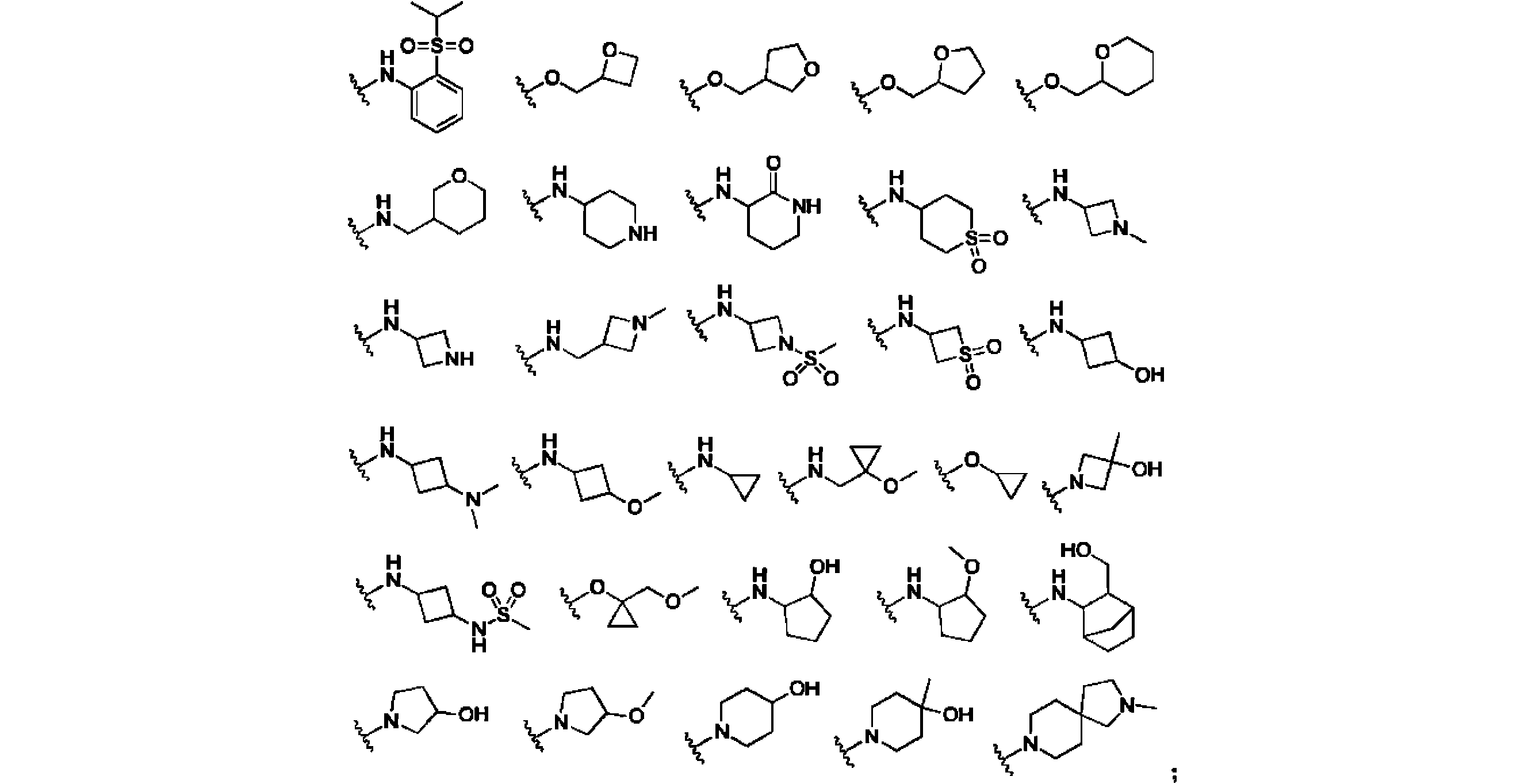
R1は、-F、-OH、-OCH3、-CH2OH、-N3、-NH2、-CN、-H、-N(CH3)C(=O)CH2N(CH3)2、-NHC(=O)CH2N(CH3)2、-NHCH2CH2N(CH3)2、-C≡CH、-CH3、-COOH、-NHCH2CH2OCH3、-C(=O)N(CH3)CH2CH2N(CH3)2、-C(=O)NHCH2-C(=O)N(CH3)2、-C(=O)NHCH2CH2N(CH3)2、-CH2NHCH2CH2N(CH3)2、-CH2NHC(=O)CH2N(CH3)2、-N(CH3)CH2C(=O)N(CH3)2、-OCH2CH2N(CH3)2、-OCH2CH2OCH3、-NHCH2C(=O)N(CH3)2及び以下の構造から選ばれる1種であり、

R4は、-H、-N(CH3)C(=O)CH2N(CH3)2、-CH2N(CH3)C(=O)CH3、-CH2N(CH3)C(=O)CH2OH、-CH2N(CH3)C(=O)CH2OCH3及び以下の構造から選ばれる1種である、

請求項1に記載の式(1)の化合物又はその薬学的に許容される塩、溶媒和物、活性代謝物、多形体、同位体標識物、異性体又はプロドラッグ。 Y is C(R Y ), and R Y is —NHCH 2 CH 2 OCH 3 , —NHCH(CH 3 )CH 2 OCH 3 , —OCH 2 CH 2 OCH 3 , —OCH 3 , —OCH 2 CH 3 , -OCH ( CH3 ) CH3 , -NHCH2CH2F , -NHCH ( CH3 ) CH3 , -NHCH2CH2OCF3 , -OCH ( CH3 ) CH2OCH3 , -SCH(CH 3 ) CH3 , -NHCH2CH2S ( = O ) 2CH3 , -NHCH2CH2N ( CH3 ) 2 , -NHCH2CH2NHCH3 , -NHCH2CH2OCH2CH2OCH3 and one selected from the following structures,
R 1 is -F, -OH, -OCH 3 , -CH 2 OH, -N 3 , -NH 2 , -CN, -H, -N(CH 3 )C(=O)CH 2 N(CH 3 ) 2 , —NHC(=O)CH 2 N(CH 3 ) 2 , —NHCH 2 CH 2 N(CH 3 ) 2 , —C≡CH, —CH 3 , —COOH, —NHCH 2 CH 2 OCH 3 , -C(=O)N( CH3 ) CH2CH2N ( CH3 ) 2 , -C(=O)NHCH2 - C(=O)N( CH3 ) 2 , -C( = O)NHCH 2CH2N ( CH3 ) 2 , -CH2NHCH2CH2N ( CH3 ) 2 , -CH2NHC (=O) CH2N (CH3)2 , -N ( CH3 ) CH2C (=O)N(CH 3 ) 2 , -OCH 2 CH 2 N(CH 3 ) 2 , -OCH 2 CH 2 OCH 3 , -NHCH 2 C(=O)N(CH 3 ) 2 and from the structures below It is one of the selected
R 4 is -H, -N(CH 3 )C(=O)CH 2 N(CH 3 ) 2 , -CH 2 N(CH 3 )C(=O)CH 3 , -CH 2 N(CH 3 ) C(=O)CH 2 OH, -CH 2 N(CH 3 )C(=O)CH 2 OCH 3 and one selected from the following structures,
2. A compound of formula (1) according to claim 1 or a pharmaceutically acceptable salt, solvate, active metabolite, polymorph, isotopically labeled product, isomer or prodrug thereof.

RYは、以下の基から選ばれ、
1)水素、C1~C3アルキルチオ基;
2)無置換又はC1~C3アルコキシ基から選ばれる1つ又は複数の基で置換されていてもよい、C3~C6シクロアルコキシ基;
3)-NRY1RY3;
4)無置換又はヒドロキシ基、C1~C3アルコキシ基から選ばれる1つ又は複数の基で置換されていてもよい、C3~C6シクロアルコキシ基;
RY1は、水素であり、
RY3は、以下の基から選ばれ、
1)無置換又はハロゲン原子、C1~C3アルコキシ基、1つ又は複数のC1~C3アルコキシ基で置換されていてもよいC1~C3アルコキシ基、C1~C3ハロゲン化アルコキシ基、-N(RY2)2から選ばれる1つ又は複数の基で置換されていてもよい、C1~C3アルキル基;
2)-(CH2)0-1-RY4、-S(=O)2RY5;
3)無置換又はヒドロキシ基、C1~C3アルコキシ基から選ばれる1つ又は複数の基で置換されていてもよい、C3~C6シクロアルキル基;
又は、
RY1、RY3は、それらに結合するN原子と共に無置換又は1つ若しくは複数のRY6で置換されていてもよい4~6員の脂肪族複素環基を形成し、
RY2は、C1~C3アルキル基から選ばれ、
RY4は、無置換又はオキソ、C1~C3アルキル基から選ばれる1つ又は複数の基で置換されていてもよい、4~6員の飽和複素環基;
RY5は、C1~C3アルキル基から選ばれ、
RY6は、ヒドロキシ基又はC1~C3アルキル基であり、
R1は、以下の基から選ばれ、
1)水素、ハロゲン原子、シアノ基;又は
2)-OR2、-NR2R3;
R4は、水素、ハロゲン原子、C1~C3アルキル基、-CH2NR5R6から選ばれ、
R5は、C1~C3アルキル基から選ばれ、
R6は、無置換又はヒドロキシ基、C1~C3アルコキシ基、-N(RY2)2から選ばれる1つ又は複数の基で置換されていてもよい、C1~C4アシル基から選ばれ、
又は
R5、R6は、それらに結合するN原子と共に無置換又は1つ若しくは複数のR7で置換されていてもよい6~7員の飽和複素環基を形成し、
R7は、オキソ、C1~C3アルキル基から選ばれる、
請求項1に記載の式(I)の化合物、又はその薬学的に許容される塩、溶媒和物、活性代謝物、結晶多形、同位体標識物質、異性体又はプロドラッグ。 The compound of formula (I) has the following structure:
RY is selected from the following groups,
1) hydrogen, C 1 -C 3 alkylthio group;
2) C 3 -C 6 cycloalkoxy groups which are unsubstituted or optionally substituted with one or more groups selected from C 1 -C 3 alkoxy groups;
3) —NR Y1 R Y3 ;
4 ) a C3 - C6 cycloalkoxy group which is unsubstituted or optionally substituted with one or more groups selected from a hydroxy group and a C1 - C3 alkoxy group;
R Y1 is hydrogen;
R Y3 is selected from the following groups,
1) Unsubstituted or halogen atoms, C 1 -C 3 alkoxy groups, C 1 -C 3 alkoxy groups optionally substituted by one or more C 1 -C 3 alkoxy groups, C 1 -C 3 halogenated an alkoxy group, a C 1 to C 3 alkyl group optionally substituted with one or more groups selected from —N(R Y2 ) 2 ;
2) —(CH 2 ) 0-1 —R Y4 , —S(=O) 2 R Y5 ;
3 ) a C3 - C6 cycloalkyl group which is unsubstituted or optionally substituted with one or more groups selected from a hydroxy group and a C1 - C3 alkoxy group;
or
R Y1 and R Y3 together with the N atom bonded thereto form a 4- to 6-membered aliphatic heterocyclic group which may be unsubstituted or substituted with one or more R Y6 ,
R Y2 is selected from C 1 -C 3 alkyl groups,
R Y4 is a 4- to 6-membered saturated heterocyclic group optionally substituted with one or more groups selected from unsubstituted or oxo, C 1 to C 3 alkyl groups;
R Y5 is selected from C 1 -C 3 alkyl groups,
R Y6 is a hydroxy group or a C 1 -C 3 alkyl group,
R 1 is selected from the following groups,
1) hydrogen, halogen atom, cyano group; or 2) —OR 2 , —NR 2 R 3 ;
R 4 is selected from hydrogen, halogen atoms, C 1 -C 3 alkyl groups, —CH 2 NR 5 R 6 ,
R 5 is selected from C 1 -C 3 alkyl groups,
R 6 is from a C 1 -C 4 acyl group which is unsubstituted or optionally substituted with one or more groups selected from a hydroxy group, a C 1 -C 3 alkoxy group, and —N(R Y2 ) 2 chosen,
or R 5 and R 6 together with the N atom bonded to them form a 6- to 7-membered saturated heterocyclic group which may be unsubstituted or substituted with one or more R 7 ,
R 7 is selected from oxo, C 1 -C 3 alkyl groups,
2. A compound of formula (I) according to claim 1, or a pharmaceutically acceptable salt, solvate, active metabolite, crystal polymorph, isotopically labeled substance, isomer or prodrug thereof.
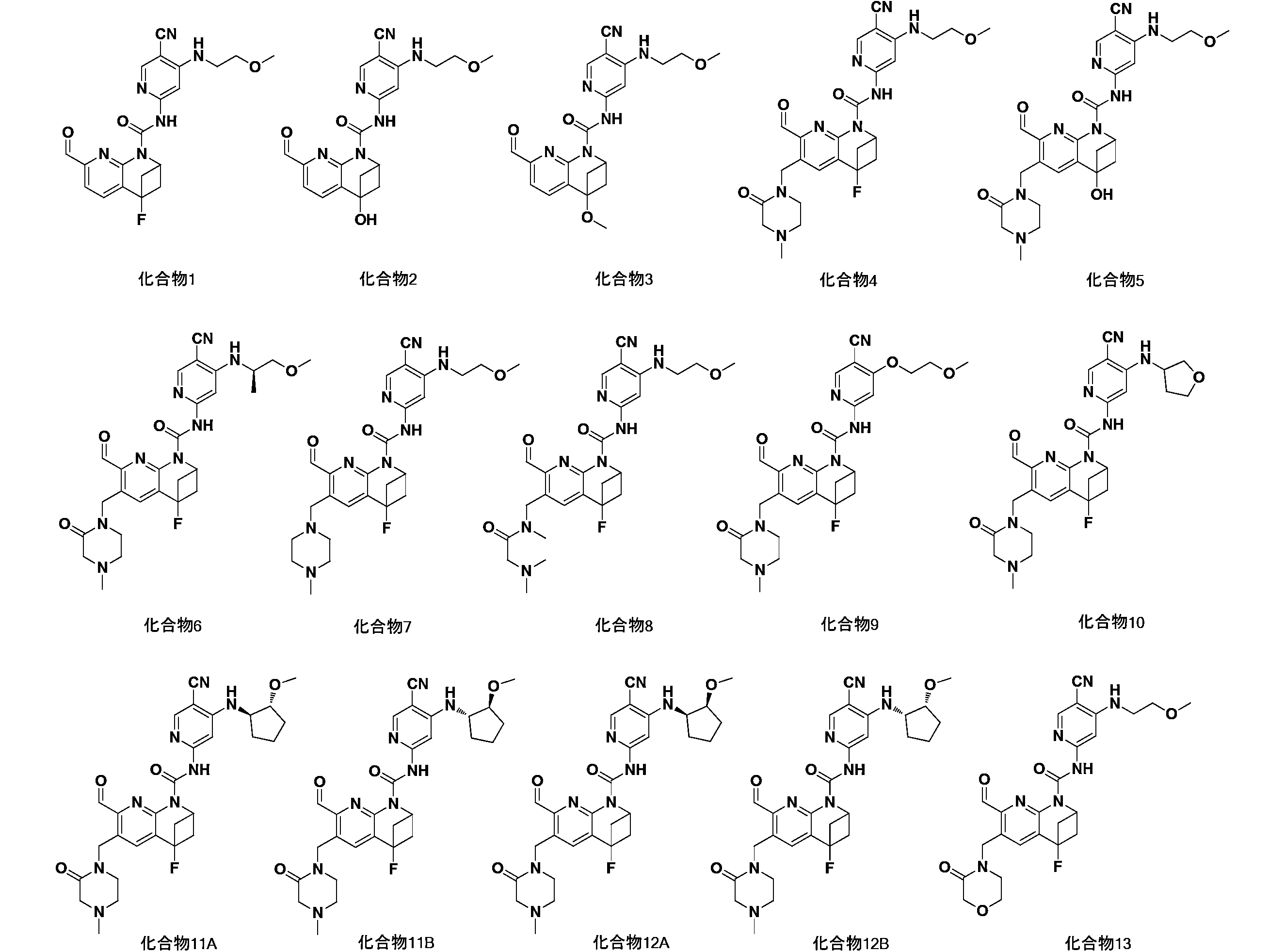
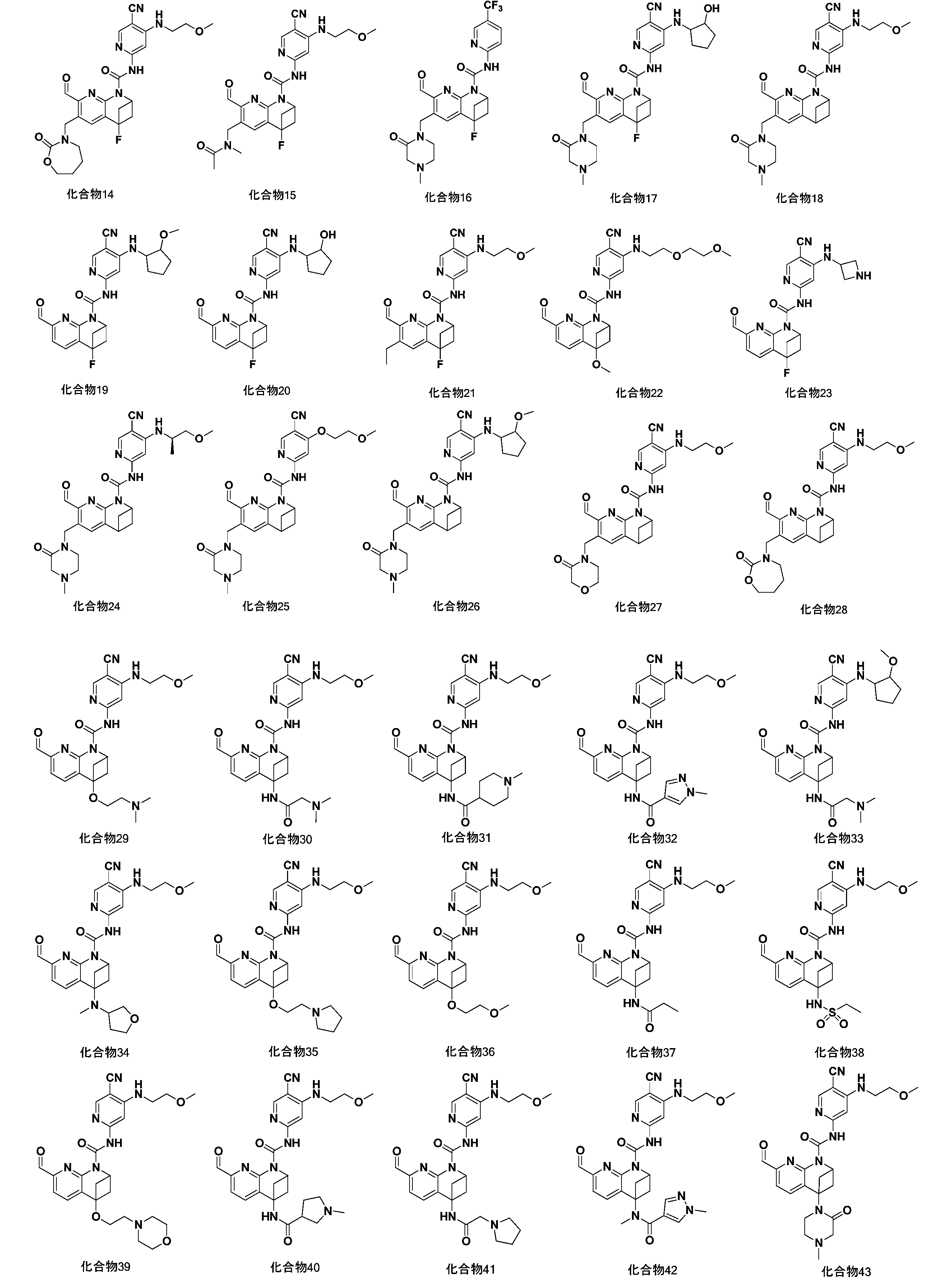


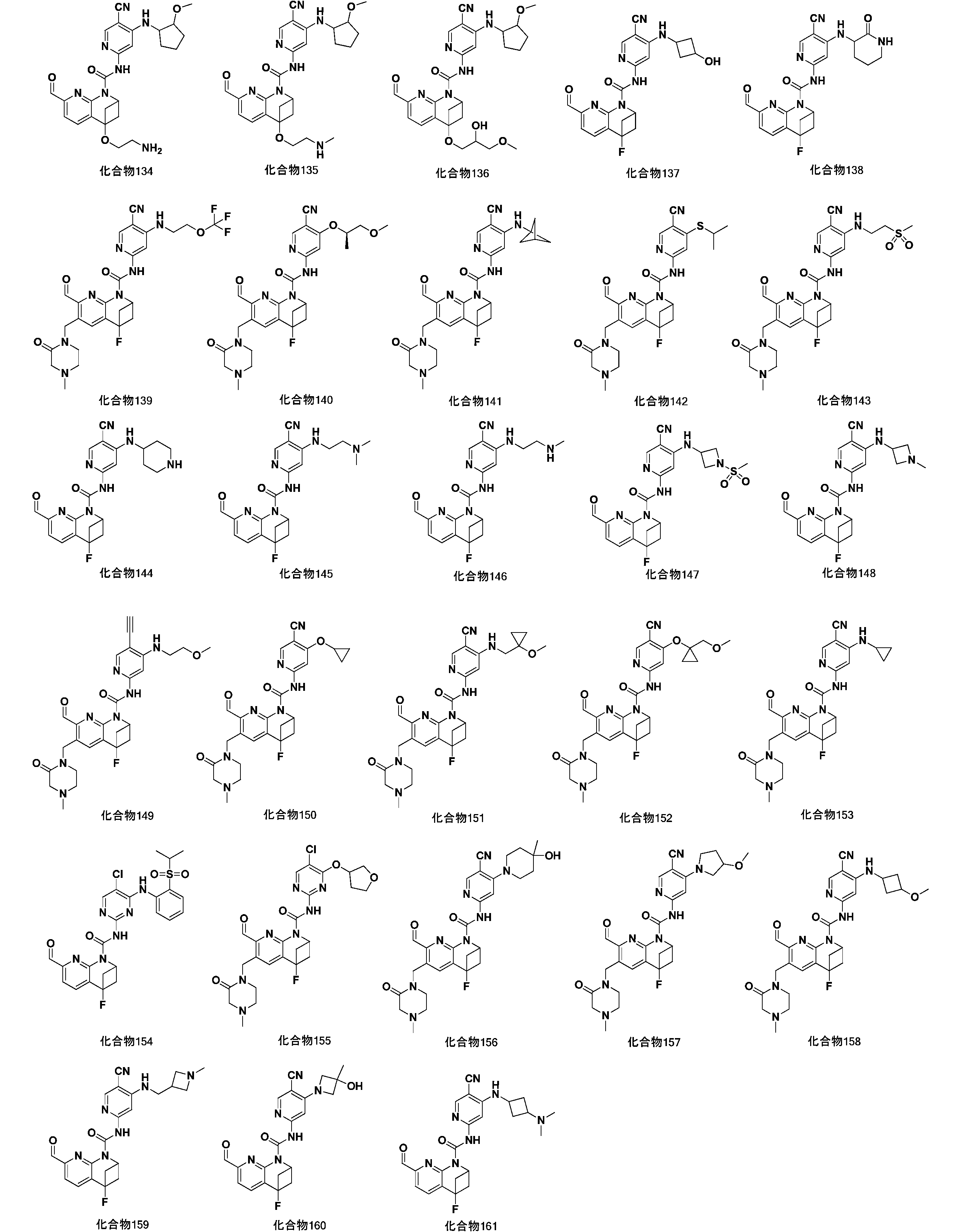

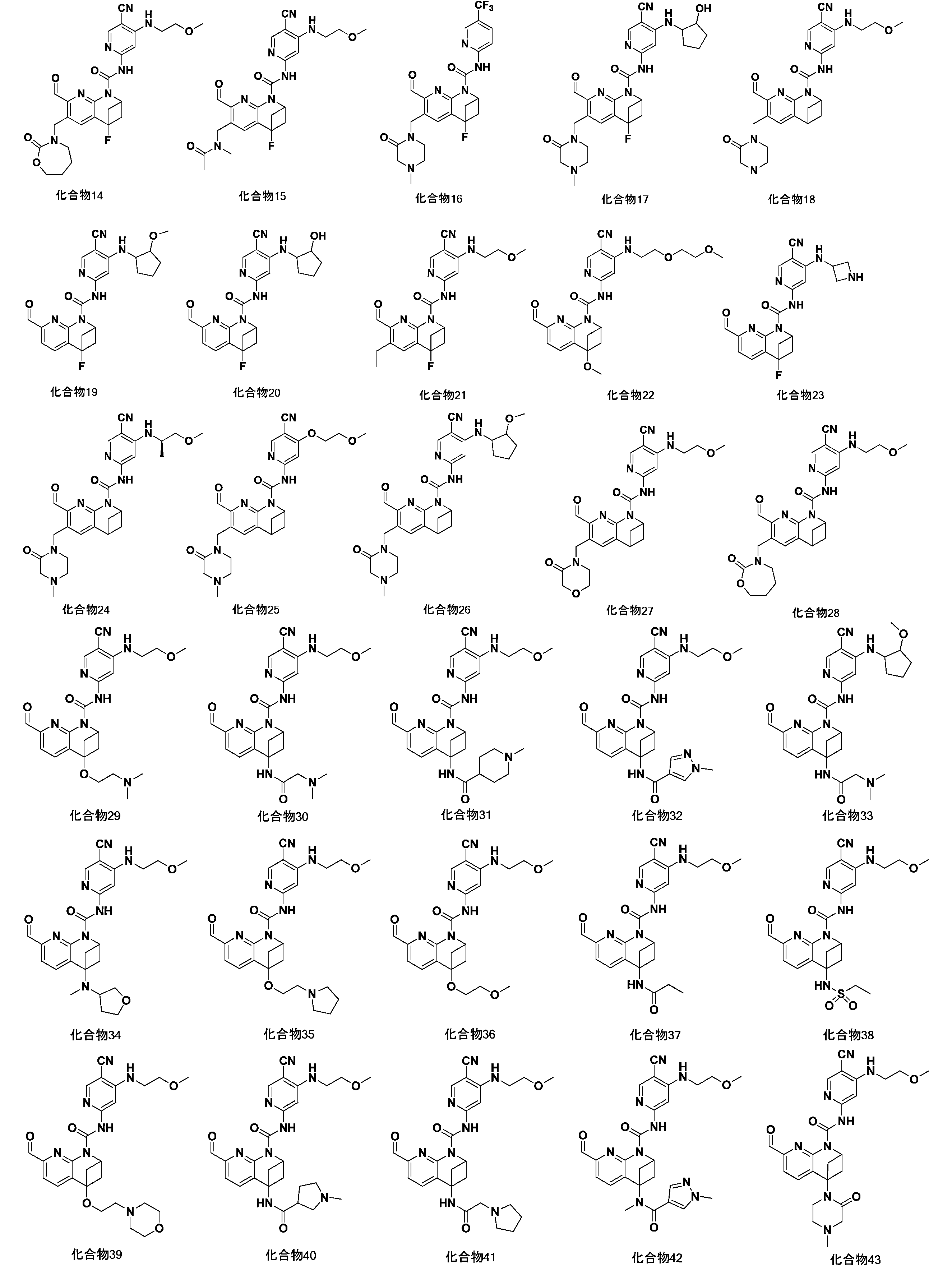
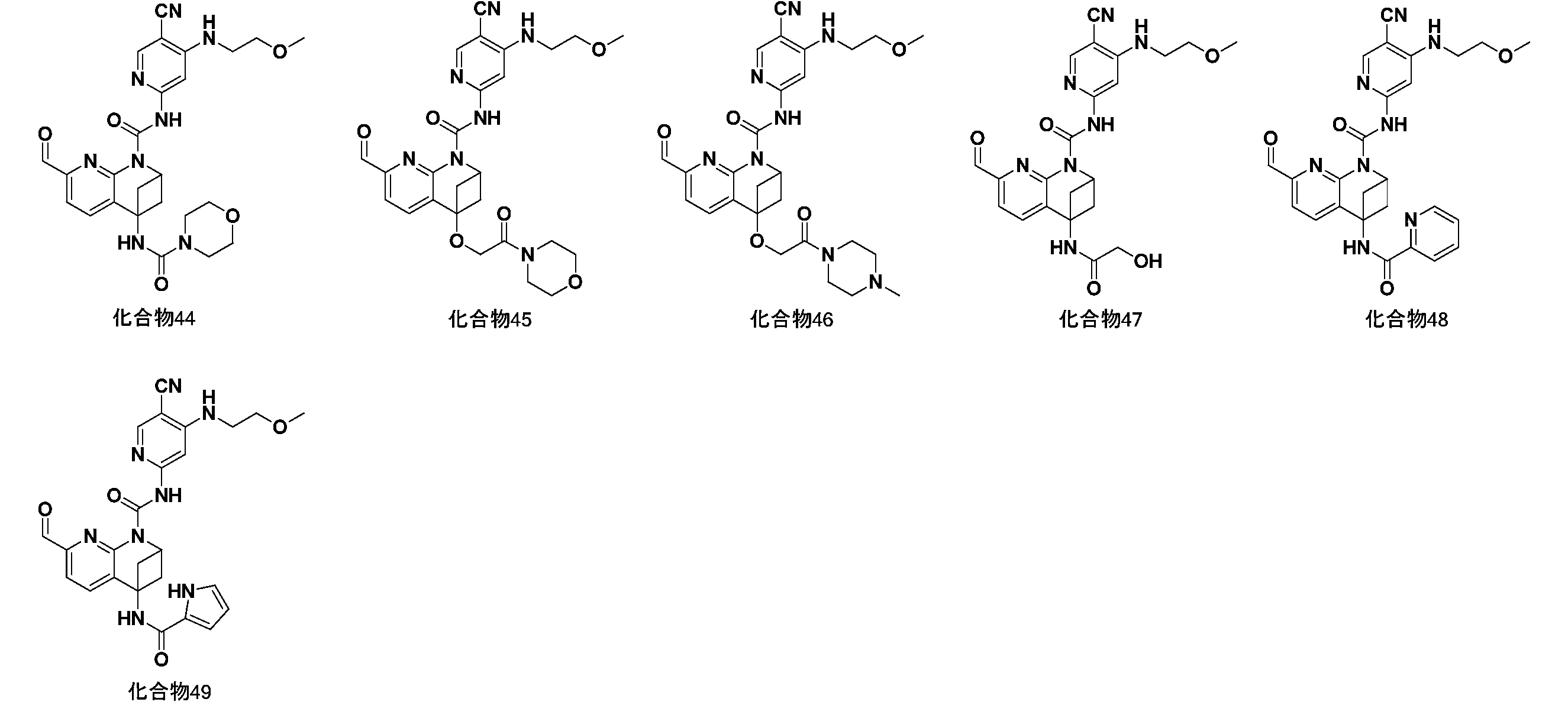
Applications Claiming Priority (3)
| Application Number | Priority Date | Filing Date | Title |
|---|---|---|---|
| CN201911061801.8A CN112759593A (en) | 2019-11-01 | 2019-11-01 | Bridged ring-fused aldehyde pyridine derivative and application thereof |
| CN201911061801.8 | 2019-11-01 | ||
| PCT/CN2020/122569 WO2021083011A1 (en) | 2019-11-01 | 2020-10-21 | Bridged cycloformylpyridine derivative and use thereof |
Publications (2)
| Publication Number | Publication Date |
|---|---|
| JP2023501288A true JP2023501288A (en) | 2023-01-18 |
| JP7349572B2 JP7349572B2 (en) | 2023-09-22 |
Family
ID=75692356
Family Applications (1)
| Application Number | Title | Priority Date | Filing Date |
|---|---|---|---|
| JP2022525663A Active JP7349572B2 (en) | 2019-11-01 | 2020-10-21 | Crosslinked ring-fused formylpyridine derivatives and their applications |
Country Status (7)
| Country | Link |
|---|---|
| US (1) | US12344611B2 (en) |
| EP (1) | EP4053126B1 (en) |
| JP (1) | JP7349572B2 (en) |
| KR (1) | KR102779260B1 (en) |
| CN (2) | CN112759593A (en) |
| AU (1) | AU2020375960B2 (en) |
| WO (1) | WO2021083011A1 (en) |
Citations (2)
| Publication number | Priority date | Publication date | Assignee | Title |
|---|---|---|---|---|
| WO2018083603A1 (en) * | 2016-11-02 | 2018-05-11 | Novartis Ag | Combinations of fgfr4 inhibitors and bile acid sequestrants |
| CN109745321A (en) * | 2017-11-08 | 2019-05-14 | 上海翰森生物医药科技有限公司 | Pharmaceutical compositions comprising FGFR4 inhibitors |
Family Cites Families (8)
| Publication number | Priority date | Publication date | Assignee | Title |
|---|---|---|---|---|
| WO2009046141A2 (en) | 2007-10-01 | 2009-04-09 | Isis Pharmaceuticals, Inc. | Antisense modulation of fibroblast growth factor receptor 4 expression |
| HUE055502T2 (en) | 2012-07-11 | 2021-11-29 | Blueprint Medicines Corp | Fibroblast growth factor receptor inhibitors |
| ES2718550T3 (en) | 2013-05-13 | 2019-07-02 | Glaxosmithkline Llc | Bridge urea analogs substituted as sirtuin modulators |
| CA2928042C (en) | 2013-10-25 | 2022-05-10 | Blueprint Medicines Corporation | Inhibitors of the fibroblast growth factor receptor |
| WO2016064960A1 (en) | 2014-10-22 | 2016-04-28 | Incyte Corporation | Bicyclic heterocycles as fgfr4 inhibitors |
| WO2016134294A1 (en) | 2015-02-20 | 2016-08-25 | Incyte Corporation | Bicyclic heterocycles as fgfr4 inhibitors |
| MA41551A (en) | 2015-02-20 | 2017-12-26 | Incyte Corp | BICYCLIC HETEROCYCLES USED AS FGFR4 INHIBITORS |
| CN107304210A (en) * | 2016-04-25 | 2017-10-31 | 成都融科博海科技有限公司 | A kind of selective FGFR4 kinase inhibitors |
-
2019
- 2019-11-01 CN CN201911061801.8A patent/CN112759593A/en active Pending
-
2020
- 2020-10-21 CN CN202080075456.8A patent/CN114650991B/en active Active
- 2020-10-21 US US17/755,337 patent/US12344611B2/en active Active
- 2020-10-21 AU AU2020375960A patent/AU2020375960B2/en active Active
- 2020-10-21 KR KR1020227017542A patent/KR102779260B1/en active Active
- 2020-10-21 JP JP2022525663A patent/JP7349572B2/en active Active
- 2020-10-21 EP EP20881576.1A patent/EP4053126B1/en active Active
- 2020-10-21 WO PCT/CN2020/122569 patent/WO2021083011A1/en not_active Ceased
Patent Citations (2)
| Publication number | Priority date | Publication date | Assignee | Title |
|---|---|---|---|---|
| WO2018083603A1 (en) * | 2016-11-02 | 2018-05-11 | Novartis Ag | Combinations of fgfr4 inhibitors and bile acid sequestrants |
| CN109745321A (en) * | 2017-11-08 | 2019-05-14 | 上海翰森生物医药科技有限公司 | Pharmaceutical compositions comprising FGFR4 inhibitors |
Also Published As
| Publication number | Publication date |
|---|---|
| CN114650991B (en) | 2024-10-18 |
| JP7349572B2 (en) | 2023-09-22 |
| EP4053126A4 (en) | 2022-12-14 |
| CA3156615A1 (en) | 2021-05-06 |
| WO2021083011A1 (en) | 2021-05-06 |
| CN114650991A (en) | 2022-06-21 |
| KR20220088909A (en) | 2022-06-28 |
| EP4053126A1 (en) | 2022-09-07 |
| AU2020375960B2 (en) | 2023-07-20 |
| EP4053126B1 (en) | 2025-11-19 |
| US12344611B2 (en) | 2025-07-01 |
| AU2020375960A1 (en) | 2022-06-09 |
| KR102779260B1 (en) | 2025-03-11 |
| EP4053126C0 (en) | 2025-11-19 |
| CN112759593A (en) | 2021-05-07 |
| US20230012600A1 (en) | 2023-01-19 |
Similar Documents
| Publication | Publication Date | Title |
|---|---|---|
| TWI871397B (en) | Kras mutein inhibitors | |
| CN107735399B (en) | Chiral diaryl macrocycles as modulators of protein kinases | |
| TWI751163B (en) | Fgfr4 inhibitor, its preparation method and use thereof | |
| CN107922417B (en) | Use of pteridinone derivatives as EGFR inhibitors | |
| JP7128345B2 (en) | Diaryl macrocyclic compound, pharmaceutical composition and use thereof | |
| JP6522646B2 (en) | Substituted 4,5,6,7-tetrahydro-pyrazolo [1,5-α] pyrazine derivatives as ROS1 inhibitors and 5,6,7,8-tetrahydro-4H-pyrazolo [1,5-α] [1,1 4] Diazepine derivatives | |
| JP7088906B2 (en) | FGFR4 inhibitor and its production method and use | |
| JP6966425B2 (en) | Heterocyclic limited tricyclic sulfonamides as anti-cancer agents | |
| TW201538494A (en) | 2,4-disubstituted phenylene-1,5-diamine derivatives and applications thereof, and pharmaceutical compositions and pharmaceutically acceptable compositions prepared therefrom | |
| WO2019134539A1 (en) | Dihydropyrazolone and pyrimidine compound, preparation method and use therefor | |
| JP2024505732A (en) | Pyridopyrimidinone derivatives and their production methods and uses | |
| JP2017508779A5 (en) | ||
| JP2023533349A (en) | Compounds as BTK inhibitors, and methods for producing and applying the same | |
| TW202214626A (en) | Estrogen receptor modulator compounds and use thereof | |
| TWI732344B (en) | Aromatic ring-linked dioxanoquinazoline or quinoline compound, composition and application thereof | |
| CN113248497B (en) | Fused ring derivatives useful as FGFR4 inhibitors | |
| TW202110848A (en) | A substituted fused bicyclic derivative, a preparation method thereof, and medical applications thereof | |
| CN115838373A (en) | Azaindazole macrocycles and uses thereof | |
| JP7349572B2 (en) | Crosslinked ring-fused formylpyridine derivatives and their applications | |
| CA3156615C (en) | Bridged cycloformylpyridine derivative and uses thereof | |
| HK40067362B (en) | Bridged cycloformylpyridine derivative and use thereof | |
| CN120271607A (en) | RAS inhibitors | |
| HK40105946A (en) | Azaindazole macrocyclic compound and use thereof | |
| WO2025092739A1 (en) | Dihydrobenzofuran derivative, and preparation method therefor and use thereof | |
| HK40105946B (en) | Azaindazole macrocyclic compound and use thereof |
Legal Events
| Date | Code | Title | Description |
|---|---|---|---|
| A621 | Written request for application examination |
Free format text: JAPANESE INTERMEDIATE CODE: A621 Effective date: 20220428 |
|
| A131 | Notification of reasons for refusal |
Free format text: JAPANESE INTERMEDIATE CODE: A131 Effective date: 20230418 |
|
| A977 | Report on retrieval |
Free format text: JAPANESE INTERMEDIATE CODE: A971007 Effective date: 20230413 |
|
| A521 | Request for written amendment filed |
Free format text: JAPANESE INTERMEDIATE CODE: A523 Effective date: 20230718 |
|
| TRDD | Decision of grant or rejection written | ||
| A01 | Written decision to grant a patent or to grant a registration (utility model) |
Free format text: JAPANESE INTERMEDIATE CODE: A01 Effective date: 20230822 |
|
| A61 | First payment of annual fees (during grant procedure) |
Free format text: JAPANESE INTERMEDIATE CODE: A61 Effective date: 20230911 |
|
| R150 | Certificate of patent or registration of utility model |
Ref document number: 7349572 Country of ref document: JP Free format text: JAPANESE INTERMEDIATE CODE: R150 |