JP2023501276A - Treatment of cancer using HLA-A2/WT1×CD3 bispecific antibody and lenalidomide - Google Patents
Treatment of cancer using HLA-A2/WT1×CD3 bispecific antibody and lenalidomide Download PDFInfo
- Publication number
- JP2023501276A JP2023501276A JP2022525603A JP2022525603A JP2023501276A JP 2023501276 A JP2023501276 A JP 2023501276A JP 2022525603 A JP2022525603 A JP 2022525603A JP 2022525603 A JP2022525603 A JP 2022525603A JP 2023501276 A JP2023501276 A JP 2023501276A
- Authority
- JP
- Japan
- Prior art keywords
- hla
- seq
- bispecific antibody
- antigen
- domain
- Prior art date
- Legal status (The legal status is an assumption and is not a legal conclusion. Google has not performed a legal analysis and makes no representation as to the accuracy of the status listed.)
- Pending
Links
Images


Classifications
-
- A—HUMAN NECESSITIES
- A61—MEDICAL OR VETERINARY SCIENCE; HYGIENE
- A61P—SPECIFIC THERAPEUTIC ACTIVITY OF CHEMICAL COMPOUNDS OR MEDICINAL PREPARATIONS
- A61P35/00—Antineoplastic agents
-
- A—HUMAN NECESSITIES
- A61—MEDICAL OR VETERINARY SCIENCE; HYGIENE
- A61K—PREPARATIONS FOR MEDICAL, DENTAL OR TOILETRY PURPOSES
- A61K31/00—Medicinal preparations containing organic active ingredients
- A61K31/33—Heterocyclic compounds
- A61K31/395—Heterocyclic compounds having nitrogen as a ring hetero atom, e.g. guanethidine or rifamycins
- A61K31/435—Heterocyclic compounds having nitrogen as a ring hetero atom, e.g. guanethidine or rifamycins having six-membered rings with one nitrogen as the only ring hetero atom
- A61K31/44—Non condensed pyridines; Hydrogenated derivatives thereof
- A61K31/445—Non condensed piperidines, e.g. piperocaine
-
- A—HUMAN NECESSITIES
- A61—MEDICAL OR VETERINARY SCIENCE; HYGIENE
- A61K—PREPARATIONS FOR MEDICAL, DENTAL OR TOILETRY PURPOSES
- A61K31/00—Medicinal preparations containing organic active ingredients
- A61K31/33—Heterocyclic compounds
- A61K31/395—Heterocyclic compounds having nitrogen as a ring hetero atom, e.g. guanethidine or rifamycins
- A61K31/435—Heterocyclic compounds having nitrogen as a ring hetero atom, e.g. guanethidine or rifamycins having six-membered rings with one nitrogen as the only ring hetero atom
- A61K31/44—Non condensed pyridines; Hydrogenated derivatives thereof
- A61K31/445—Non condensed piperidines, e.g. piperocaine
- A61K31/4523—Non condensed piperidines, e.g. piperocaine containing further heterocyclic ring systems
- A61K31/454—Non condensed piperidines, e.g. piperocaine containing further heterocyclic ring systems containing a five-membered ring with nitrogen as a ring hetero atom, e.g. pimozide, domperidone
-
- A—HUMAN NECESSITIES
- A61—MEDICAL OR VETERINARY SCIENCE; HYGIENE
- A61K—PREPARATIONS FOR MEDICAL, DENTAL OR TOILETRY PURPOSES
- A61K39/00—Medicinal preparations containing antigens or antibodies
- A61K39/395—Antibodies; Immunoglobulins; Immune serum, e.g. antilymphocytic serum
-
- A—HUMAN NECESSITIES
- A61—MEDICAL OR VETERINARY SCIENCE; HYGIENE
- A61P—SPECIFIC THERAPEUTIC ACTIVITY OF CHEMICAL COMPOUNDS OR MEDICINAL PREPARATIONS
- A61P35/00—Antineoplastic agents
- A61P35/02—Antineoplastic agents specific for leukemia
-
- C—CHEMISTRY; METALLURGY
- C07—ORGANIC CHEMISTRY
- C07K—PEPTIDES
- C07K16/00—Immunoglobulins [IGs], e.g. monoclonal or polyclonal antibodies
- C07K16/18—Immunoglobulins [IGs], e.g. monoclonal or polyclonal antibodies against material from animals or humans
- C07K16/28—Immunoglobulins [IGs], e.g. monoclonal or polyclonal antibodies against material from animals or humans against receptors, cell surface antigens or cell surface determinants
- C07K16/2803—Immunoglobulins [IGs], e.g. monoclonal or polyclonal antibodies against material from animals or humans against receptors, cell surface antigens or cell surface determinants against the immunoglobulin superfamily
- C07K16/2809—Immunoglobulins [IGs], e.g. monoclonal or polyclonal antibodies against material from animals or humans against receptors, cell surface antigens or cell surface determinants against the immunoglobulin superfamily against the T-cell receptor (TcR)-CD3 complex
-
- C—CHEMISTRY; METALLURGY
- C07—ORGANIC CHEMISTRY
- C07K—PEPTIDES
- C07K16/00—Immunoglobulins [IGs], e.g. monoclonal or polyclonal antibodies
- C07K16/18—Immunoglobulins [IGs], e.g. monoclonal or polyclonal antibodies against material from animals or humans
- C07K16/28—Immunoglobulins [IGs], e.g. monoclonal or polyclonal antibodies against material from animals or humans against receptors, cell surface antigens or cell surface determinants
- C07K16/2803—Immunoglobulins [IGs], e.g. monoclonal or polyclonal antibodies against material from animals or humans against receptors, cell surface antigens or cell surface determinants against the immunoglobulin superfamily
- C07K16/2833—Immunoglobulins [IGs], e.g. monoclonal or polyclonal antibodies against material from animals or humans against receptors, cell surface antigens or cell surface determinants against the immunoglobulin superfamily against MHC-molecules, e.g. HLA-molecules
-
- C—CHEMISTRY; METALLURGY
- C07—ORGANIC CHEMISTRY
- C07K—PEPTIDES
- C07K16/00—Immunoglobulins [IGs], e.g. monoclonal or polyclonal antibodies
- C07K16/18—Immunoglobulins [IGs], e.g. monoclonal or polyclonal antibodies against material from animals or humans
- C07K16/32—Immunoglobulins [IGs], e.g. monoclonal or polyclonal antibodies against material from animals or humans against translation products of oncogenes
-
- C—CHEMISTRY; METALLURGY
- C07—ORGANIC CHEMISTRY
- C07K—PEPTIDES
- C07K16/00—Immunoglobulins [IGs], e.g. monoclonal or polyclonal antibodies
- C07K16/46—Hybrid immunoglobulins
- C07K16/468—Immunoglobulins having two or more different antigen binding sites, e.g. multifunctional antibodies
-
- A—HUMAN NECESSITIES
- A61—MEDICAL OR VETERINARY SCIENCE; HYGIENE
- A61K—PREPARATIONS FOR MEDICAL, DENTAL OR TOILETRY PURPOSES
- A61K39/00—Medicinal preparations containing antigens or antibodies
- A61K2039/505—Medicinal preparations containing antigens or antibodies comprising antibodies
-
- A—HUMAN NECESSITIES
- A61—MEDICAL OR VETERINARY SCIENCE; HYGIENE
- A61K—PREPARATIONS FOR MEDICAL, DENTAL OR TOILETRY PURPOSES
- A61K2300/00—Mixtures or combinations of active ingredients, wherein at least one active ingredient is fully defined in groups A61K31/00 - A61K41/00
-
- C—CHEMISTRY; METALLURGY
- C07—ORGANIC CHEMISTRY
- C07K—PEPTIDES
- C07K2317/00—Immunoglobulins specific features
- C07K2317/30—Immunoglobulins specific features characterized by aspects of specificity or valency
- C07K2317/31—Immunoglobulins specific features characterized by aspects of specificity or valency multispecific
-
- C—CHEMISTRY; METALLURGY
- C07—ORGANIC CHEMISTRY
- C07K—PEPTIDES
- C07K2317/00—Immunoglobulins specific features
- C07K2317/30—Immunoglobulins specific features characterized by aspects of specificity or valency
- C07K2317/33—Crossreactivity, e.g. for species or epitope, or lack of said crossreactivity
-
- C—CHEMISTRY; METALLURGY
- C07—ORGANIC CHEMISTRY
- C07K—PEPTIDES
- C07K2317/00—Immunoglobulins specific features
- C07K2317/60—Immunoglobulins specific features characterized by non-natural combinations of immunoglobulin fragments
- C07K2317/64—Immunoglobulins specific features characterized by non-natural combinations of immunoglobulin fragments comprising a combination of variable region and constant region components
-
- C—CHEMISTRY; METALLURGY
- C07—ORGANIC CHEMISTRY
- C07K—PEPTIDES
- C07K2317/00—Immunoglobulins specific features
- C07K2317/70—Immunoglobulins specific features characterized by effect upon binding to a cell or to an antigen
- C07K2317/73—Inducing cell death, e.g. apoptosis, necrosis or inhibition of cell proliferation
Landscapes
- Health & Medical Sciences (AREA)
- Chemical & Material Sciences (AREA)
- Immunology (AREA)
- Organic Chemistry (AREA)
- Medicinal Chemistry (AREA)
- Life Sciences & Earth Sciences (AREA)
- General Health & Medical Sciences (AREA)
- Biochemistry (AREA)
- Genetics & Genomics (AREA)
- Molecular Biology (AREA)
- Proteomics, Peptides & Aminoacids (AREA)
- Biophysics (AREA)
- Veterinary Medicine (AREA)
- Public Health (AREA)
- Pharmacology & Pharmacy (AREA)
- Animal Behavior & Ethology (AREA)
- Chemical Kinetics & Catalysis (AREA)
- Nuclear Medicine, Radiotherapy & Molecular Imaging (AREA)
- General Chemical & Material Sciences (AREA)
- Oncology (AREA)
- Epidemiology (AREA)
- Hematology (AREA)
- Engineering & Computer Science (AREA)
- Bioinformatics & Cheminformatics (AREA)
- Microbiology (AREA)
- Mycology (AREA)
- Peptides Or Proteins (AREA)
- Medicines Containing Antibodies Or Antigens For Use As Internal Diagnostic Agents (AREA)
- Pharmaceuticals Containing Other Organic And Inorganic Compounds (AREA)
Abstract
本発明は、がんの治療、特にHLA-A2/WT1×CD3二重特異性抗体及びレナリドマイドを使用するがんの治療に関する。
【選択図】なし
The present invention relates to cancer treatment, in particular cancer treatment using HLA-A2/WT1×CD3 bispecific antibody and lenalidomide.
[Selection figure] None
Description
本発明は、がんの治療、特にHLA-A2/WT1×CD3二重特異性抗体及びレナリドマイドを使用するがんの治療に関する。 The present invention relates to cancer treatment, in particular cancer treatment using HLA-A2/WT1×CD3 bispecific antibody and lenalidomide.
T細胞活性化二重特異性抗体は、腫瘍細胞に対して細胞傷害性T細胞を関与させるように設計された新しいクラスのがん治療薬である。このような抗体が、T細胞上のCD3と腫瘍細胞に発現する抗原に同時に結合すると、腫瘍細胞とT細胞との間に一時的な相互作用が生じ、T細胞の活性化とそれに続く腫瘍細胞の溶解が引き起こされる。 T cell activating bispecific antibodies are a new class of cancer therapeutics designed to engage cytotoxic T cells against tumor cells. Simultaneous binding of such antibodies to CD3 on T cells and to antigens expressed on tumor cells results in a transient interaction between tumor cells and T cells, leading to T cell activation and subsequent tumor cell activation. is caused to dissolve.
WT1(ウィルムス腫瘍1、ウィルムス腫瘍タンパク質)は、細胞増殖、分化、アポトーシス、臓器発達に関与する発がん性転写因子であり、正常な成人組織での発現はまれである(Hinrichs and Restifo、Nat Biotechnol(2013)31(Hinrichs and Restifo,Nat Biotechnol(2013)31,999-1008)。しかし、WT1は、いくつかのタイプの血液学的悪性腫瘍及び広範囲の固形腫瘍で過剰発現していると報告されている(Van Driessche et al.,Oncologist(2012)17,250-259)。WT1は核タンパク質であり、細胞内に局在している。細胞内タンパク質は、プロテアソーム内で分解され、処理され、T細胞エピトープとしての主要組織適合複合体(MHC)Iにより細胞表面に提示され、T細胞受容体(TCR)により認識され得る。したがって、WT1誘導ペプチドは、HLA-A2の関連で細胞表面に提示され、T細胞認識をトリガーすることができる。
WT1 (
HLA-A2/WT1を標的とするT細胞活性化二重特異性抗体は、国際公開第2019/122052号に記載されている。そのようなT細胞活性化二重特異性抗体は、例えば、急性骨髄性白血病(AML)の治療において、有用であり得る。 A T-cell activating bispecific antibody targeting HLA-A2/WT1 is described in WO2019/122052. Such T-cell activating bispecific antibodies may be useful, for example, in the treatment of acute myeloid leukemia (AML).
例えばAMLにおいて、HLA-A2/WT1を標的とするT細胞活性化抗体の治療上の利点を最大化するために、そのようなT細胞活性化抗体及び他の治療剤を含む併用治療を特定することが望ましいであろう。 To maximize the therapeutic benefit of T cell activating antibodies targeting HLA-A2/WT1, e.g., in AML, identify combination treatments comprising such T cell activating antibodies and other therapeutic agents. would be desirable.
本発明の発明者は、HLA-A2/WT1標的T細胞活性化二重特異性抗体とレナリドマイドの組み合わせが、HLA-A2/WT1標的T細胞活性化二重特異性抗体単独と比較して、AMLにおける活性を高めることを発見した。 The inventors of the present invention have found that the combination of an HLA-A2/WT1-targeting T-cell activating bispecific antibody and lenalidomide reduces the risk of AML as compared to the HLA-A2/WT1-targeting T-cell activating bispecific antibody alone. was found to enhance the activity in
初代AML細胞を使用することにより、発明者は、驚くべきことに、HLA-A2/WT1×CD3二重特異性抗体によって誘発された腫瘍細胞溶解は、レナリドマイドの添加によって高められたことを発見した。 Using primary AML cells, the inventors surprisingly discovered that tumor cell lysis induced by HLA-A2/WT1xCD3 bispecific antibody was enhanced by the addition of lenalidomide. .
したがって、第1の態様では、本発明は、個体におけるがんの治療における使用のためのHLA-A2/WT1×CD3二重特異性抗体であって、治療がレナリドマイドと組み合わせたHLA-A2/WT1×CD3二重特異性抗体の投与を含む、HLA-A2/WT1×CD3二重特異性抗体を提供する。 Accordingly, in a first aspect, the invention provides an HLA-A2/WT1×CD3 bispecific antibody for use in treating cancer in an individual, wherein the treatment is HLA-A2/WT1 in combination with lenalidomide HLA-A2/WT1 x CD3 bispecific antibodies are provided, including administration of xCD3 bispecific antibodies.
さらなる態様では、本発明は、個体におけるがんの治療のための医薬の製造におけるHLA-A2/WT1×CD3二重特異性抗体の使用であって、治療がレナリドマイドと組み合わせたHLA-A2/WT1×CD3二重特異性抗体の投与を含む、使用を提供する。 In a further aspect the invention provides the use of an HLA-A2/WT1×CD3 bispecific antibody in the manufacture of a medicament for the treatment of cancer in an individual, wherein the treatment is HLA-A2/WT1 in combination with lenalidomide Uses are provided that include administration of the xCD3 bispecific antibody.
またさらなる態様では、本発明は、個体にHLA-A2/WT1×CD3二重特異性抗体及びレナリドマイドを投与することを含む、個体におけるがんを治療するための方法を提供する。 In a still further aspect, the invention provides a method for treating cancer in an individual comprising administering to the individual an HLA-A2/WT1×CD3 bispecific antibody and lenalidomide.
一態様では、本発明は、HLA-A2/WT1×CD3二重特異性抗体を含む第1の医薬と、レナリドマイドを含む第2の医薬とを含み、場合によっては、個体におけるがんを治療するための第1の医薬と第2の医薬を組み合わせた投与のための指示書を含む添付文書をさらに含む、キットも提供する。 In one aspect, the invention comprises a first medicament comprising an HLA-A2/WT1xCD3 bispecific antibody and a second medicament comprising lenalidomide, optionally treating cancer in an individual Kits are also provided, further comprising a package insert containing instructions for the combined administration of the first and second medicaments for.
上記又は本明細書に記載のHLA-A2/WT1×CD3二重特異性抗体、方法、使用、又はキットは、以下に記載する特徴のいずれかを、単独で又は組み合わせて組み込むことができる(文脈で別段の指示がない限り)。 The HLA-A2/WT1xCD3 bispecific antibody, method, use or kit described above or herein may incorporate any of the features described below, singly or in combination (in context , unless otherwise indicated).
本明細書に記載のHLA-A2/WT1×CD3二重特異性抗体は、CD3と、HLA-A2/WT1、特にHLA-A2/WT1RMFとに特異的に結合する二重特異性抗体である。特に有用なHLA-A2/WT1×CD3二重特異性抗体は、PCT出願国際公開第2019/122052号に記載されている(参照によりその全文が本明細書に援用される)。 The HLA-A2/WT1×CD3 bispecific antibodies described herein are bispecific antibodies that specifically bind CD3 and HLA-A2/WT1, particularly HLA-A2/WT1 RMF . . A particularly useful HLA-A2/WT1×CD3 bispecific antibody is described in PCT Application WO2019/122052, which is hereby incorporated by reference in its entirety.
「二重特異性」との用語は、抗体が、少なくとも2つの別個の抗原決定基に特異的に結合することができることを意味する。典型的には、二重特異性抗体は、2つの抗原結合部位を含み、それぞれが異なる抗原決定基に対して特異的である。特定の実施態様では、二重特異性抗体は、2つの抗原決定基、特に、2つの別個の細胞で発現した2つの抗原決定基に同時に結合することができる。 The term "bispecific" means that the antibody is capable of specifically binding at least two distinct antigenic determinants. Typically, a bispecific antibody contains two antigen-binding sites, each specific for a different antigenic determinant. In certain embodiments, bispecific antibodies are capable of simultaneously binding two antigenic determinants, particularly two antigenic determinants expressed on two separate cells.
本明細書で使用される場合、「抗原決定基」という用語は、「抗原」及び「エピトープ」と同義であり、抗原結合部分-抗原複合体を形成する、抗原結合部分が結合するポリペプチド高分子上の部位(例えば、アミノ酸の連続伸長部又は異なる領域の非連続アミノ酸から構成される配座構成)を指す。有用な抗原決定基は、例えば、腫瘍細胞の表面上に、ウイルス感染した細胞の表面上に、他の疾患細胞の表面上に、免疫細胞の表面上に、血清中で遊離して、及び/又は細胞外マトリックス(ECM)中に認めることができる。 As used herein, the term "antigenic determinant" is synonymous with "antigen" and "epitope" and refers to the polypeptide region bound by an antigen-binding moiety that forms an antigen-binding moiety-antigen complex. Refers to a site on a molecule (eg, a continuous stretch of amino acids or a conformational configuration composed of non-contiguous amino acids in different regions). Useful antigenic determinants are, for example, on the surface of tumor cells, on the surface of virus-infected cells, on the surface of other diseased cells, on the surface of immune cells, free in serum, and/or or can be found in the extracellular matrix (ECM).
本明細書で使用される場合、「抗原結合部分」という用語は、抗原決定基に特異的に結合するポリペプチド分子を指す。一態様では、抗原結合部分は、標的部位に、例えば、抗原決定基を有する特定の種類の腫瘍細胞に結合する部分(例えば、第2の抗原結合部分)に指向することができる。別の態様では、抗原結合部分は、その標的抗原、例えばT細胞受容体複合抗原を通してシグナル伝達を活性化することができる。抗原結合部分は、本明細書にさらに定義される抗体及びその断片を含む。特定の抗原結合部分は、抗体重鎖可変領域と抗体軽鎖可変領域とを含む、抗体の抗原結合ドメインを含む。特定の実施態様では、抗原結合部分は、本明細書でさらに定義され、当該技術分野で知られているような抗体定常領域を含んでいてもよい。有用な重鎖定常領域は、α、δ、ε、γ又はμの5つのアイソタイプのいずれかを含む。有用な軽鎖定常領域は、κ及びλの2つのアイソタイプのいずれかを含む。 As used herein, the term "antigen-binding portion" refers to a polypeptide molecule that specifically binds to an antigenic determinant. In one aspect, the antigen-binding portion can be directed to a target site, eg, a portion (eg, a second antigen-binding portion) that binds to a particular type of tumor cell bearing an antigenic determinant. In another aspect, the antigen-binding portion can activate signaling through its target antigen, eg, a T-cell receptor complex antigen. Antigen-binding portions include antibodies and fragments thereof as further defined herein. Particular antigen-binding portions include antigen-binding domains of antibodies, including antibody heavy chain variable regions and antibody light chain variable regions. In certain embodiments, the antigen binding portion may comprise an antibody constant region as further defined herein and known in the art. Useful heavy chain constant regions comprise any of the five isotypes α, δ, ε, γ or μ. Useful light chain constant regions include either of the two isotypes, kappa and lambda.
「特異的に結合する」とは、その結合が抗原選択性であり、望ましくない相互作用又は非特異的な相互作用とは判別することができることを意味する。抗原結合部分が特定の抗原決定基に結合する能力は、酵素結合免疫吸着検定法(ELISA)又は当業者には知られている他の技術、例えば、表面プラズモン共鳴(SPR)技術(例えば、BIAcore機器で分析される)(Liljeblad et al.,Glyco J 17,323-329(2000))、及び従来の結合アッセイ(Heeley,Endocr Res 28,217-229(2002))のいずれかによって測定することができる。一実施態様では、無関係なタンパク質に対する抗原結合部分の結合度は、例えばSPRによって測定される抗原に対する抗原結合部分の結合の約10%未満である。特定の実施態様では、抗原に結合する抗原結合部分、又はこの抗原結合部分を含む抗体は、≦1μM、≦100nM、≦10nM、≦1nM、≦0.1nM、≦0.01nM、又は≦0.001nM(例えば、10-8M以下、例えば、10-8M~10-13M、例えば、10-9M~10-13M)の解離定数(KD)を有する。 By "specifically binds" is meant that the binding is antigen-selective and can be distinguished from unwanted or non-specific interactions. The ability of the antigen-binding portion to bind to a particular antigenic determinant can be determined by enzyme-linked immunosorbent assay (ELISA) or other techniques known to those skilled in the art, such as surface plasmon resonance (SPR) techniques (e.g., BIAcore). instrumental) (Liljeblad et al., Glyco J 17, 323-329 (2000)) and by conventional binding assays (Heeley, Endocr Res 28, 217-229 (2002)). can be done. In one embodiment, the degree of binding of the antigen-binding portion to an irrelevant protein is less than about 10% of the binding of the antigen-binding portion to the antigen as measured, eg, by SPR. In certain embodiments, the antigen-binding portion, or antibody comprising the antigen-binding portion, that binds the antigen is <1 μM, <100 nM, <10 nM, <1 nM, <0.1 nM, <0.01 nM, or <0.01 nM. 001 nM (eg, 10 −8 M or less, such as 10 −8 M to 10 −13 M, such as 10 −9 M to 10 −13 M ).
「親和性」は、分子の単一の結合部位(例えば、受容体)と、その結合パートナー(例えば、リガンド)との間の非共有結合性相互作用の合計強度を指す。特に示されない限り、本明細書で使用される場合、「結合親和性」は、結合対(例えば、抗原結合部分と抗原、又は受容体とそのリガンド)のメンバー間の1:1相互作用を反映する固有の結合親和性を指す。分子Xの、そのパートナーYに対する親和性は、通常、解離定数(Kd)によって表され、この解離定数(KD)は、解離速度定数と会合速度定数(それぞれ、koff及びkon)の比である。したがって、速度定数の比が同じである限り、同等の親和性が異なる速度定数を含むことがある。親和性は、ここに記載のものを含む当技術分野で既知の確立された方法により測定することができる。親和性を測定するための特定の方法は、表面プラズモン共鳴(SPR)である。 "Affinity" refers to the total strength of non-covalent interactions between a single binding site on a molecule (eg receptor) and its binding partner (eg ligand). Unless otherwise indicated, "binding affinity" as used herein reflects a 1:1 interaction between members of a binding pair (e.g., antigen-binding moiety and antigen, or receptor and its ligand). It refers to the intrinsic binding affinity for The affinity of molecule X for its partner Y is usually expressed by the dissociation constant ( Kd ), which is the ratio of the dissociation rate constant to the association rate constant (k off and k on , respectively). is. Thus, equivalent affinities may contain different rate constants, as long as the ratio of rate constants is the same. Affinity can be measured by established methods known in the art, including those described herein. A particular method for measuring affinity is surface plasmon resonance (SPR).
「CD3」は、別途明記しない限り、霊長類(例えばヒト)、非ヒト霊長類(例えばカニクイザル)及び齧歯類(例えば、マウス及びラット)等の哺乳動物を含む任意の脊椎動物源由来の任意のネイティブCD3を指す。用語は、「完全長」の、未処理のCD3と、細胞内でのプロセシングから生じた任意の形態のCD3とを包含する。この用語は、CD3の天然に存在する変異体、例えば、スプライス変異体又は対立遺伝子変異体も包含する。一態様では、CD3は、ヒトCD3、特にヒトCD3のイプシロンサブユニット(CD3ε)である。ヒトCD3εのアミノ酸配列は、UniProt(www.uniprot.org)の登録番号P07766(バージョン144)、又はNCBI(www.ncbi.nlm.nih.gov/)RefSeq NP_000724に示されている。配列番号27も参照されたい。カニクイザル[Macaca fascicularis]CD3εのアミノ酸配列は、NCBI GenBank番号BAB71849.1に示されている。配列番号28も参照されたい。 "CD3" is any CD3 from any vertebrate source, including mammals such as primates (e.g. humans), non-human primates (e.g. cynomolgus monkeys) and rodents (e.g. mice and rats), unless otherwise specified. refers to the native CD3 of The term encompasses "full-length", unprocessed CD3 and any form of CD3 resulting from processing within the cell. The term also includes naturally occurring variants of CD3, such as splice or allelic variants. In one aspect, the CD3 is human CD3, particularly the epsilon subunit of human CD3 (CD3ε). The amino acid sequence of human CD3ε is shown in UniProt (www.uniprot.org) accession number P07766 (version 144) or NCBI (www.ncbi.nlm.nih.gov/) RefSeq NP_000724. See also SEQ ID NO:27. The amino acid sequence of cynomolgus monkey [Macaca fascicularis] CD3ε is shown in NCBI GenBank No. BAB71849.1. See also SEQ ID NO:28.
「ウィルムス腫瘍1」又は「ウィルムス腫瘍タンパク質」としても知られる「WT1」は、別途明記しない限り、霊長類(例えばヒト)、非ヒト霊長類(例えばカニクイザル)及び齧歯類(例えば、マウス及びラット)等の哺乳動物を含む任意の脊椎動物源由来の任意のネイティブWT1を指す。この用語は、「完全長」の、未処理WT1、及び、細胞内での処理によりもたらされる任意の形態のWT1を包含する。この用語は、天然に存在するWT1のバリアント、例えば、スプライスバリアント又は対立遺伝子バリアントも包含する。一態様において、WT1は、ヒトWT1、特に配列番号23のタンパク質である。ヒトWT1は、UniProt(www.uniprot.org)寄託番号P19544(入力バージョン215)に記載されており、ヒトWT1のアミノ酸配列は配列番号23にも示されている。
"WT1", also known as "Wilm's
「VLD」、「VLDペプチド」、又は「WT1VLD」が意味するのは、アミノ酸配列VLDFAPPGA(配列番号24;配列番号23のWT1タンパク質の位置37-45)を有するWT1由来のペプチドである。 By "VLD", "VLD peptide", or "WT1 VLD " is meant a WT1-derived peptide having the amino acid sequence VLDFAPPGA (SEQ ID NO:24; positions 37-45 of the WT1 protein of SEQ ID NO:23).
「RMF」、「RMFペプチド」、又は「WT1RMF」が意味するのは、アミノ酸配列RMFRNAPYL(配列番号25;配列番号23のWT1タンパク質の位置126-134)を有するWT1由来のペプチドである。 By "RMF,""RMFpeptide," or "WT1 RMF " is meant a WT1-derived peptide having the amino acid sequence RMFRNAPYL (SEQ ID NO:25; positions 126-134 of the WT1 protein of SEQ ID NO:23).
「HLA-A2」、「HLA-A*02」、「HLA-A02」、又は「HLA-A*2」(互換可能に使用される)は、HLA-Aセロタイプ群のヒト白血球抗原セロタイプを指す。HLA-A2タンパク質(それぞれのHLA遺伝子によりコードされた)は、それぞれのクラスI MHC(主要組織適合複合体)タンパク質のα鎖を構成し、これはβ2ミクログロブリンサブユニットをさらに含む。特異的なHLA-A2タンパク質は、HLA-A201(HLA-A0201、HLA-A02.01、又はHLA-A*02:01とも呼ばれる)である。特定の態様では、本明細書に記載のHLA-A2タンパク質はHLA-A201である。ヒトHLA-A2の例示的な配列は、配列番号26において与えられる。
"HLA-A2", "HLA-A * 02", "HLA-A02", or "HLA-
「HLA-A2/WT1」は、HLA-A2分子と、WT1由来のペプチド(本明細書では「WT1ペプチド」とも呼ぶ)、具体的には、RMF又はVLDペプチド(それぞれ「HLA-A2/WT1RMF」及び「HLA-A2/WT1VLD」)の複合体を指す。本発明で使用される二重特異性抗体は、HLA-A2/WT1RMF複合体又はHLA-A2/WT1VLD複合体のいずれかに特異的に結合し得る。 "HLA-A2/WT1" refers to an HLA-A2 molecule and a WT1-derived peptide (also referred to herein as a "WT1 peptide"), specifically an RMF or VLD peptide ("HLA-A2/WT1 RMF ” and “HLA-A2/WT1 VLD ”). Bispecific antibodies for use in the invention may specifically bind to either the HLA-A2/WT1 RMF complex or the HLA-A2/WT1 VLD complex.
本明細書で使用される場合、Fab分子などに関する「第1の」、「第2の」、又は「第3の」という用語は、各タイプの部分が複数存在する場合を区別するために便宜的に使用される。これらの用語の使用は、明示的に示されていない限り、二重特異性抗体の特定の順序又は配向を与えることを意図していない。 As used herein, the terms “first,” “second,” or “tertiary,” with respect to Fab molecules, etc., are used conveniently to distinguish when there is more than one of each type of moiety. used for purposes. The use of these terms is not intended to imply any particular order or orientation of the bispecific antibody unless explicitly indicated.
本明細書で使用される「価数」という用語は、抗体内の特定数の抗原結合部位の存在を示す。したがって、「抗原に対する一価の結合」という用語は、抗体内の抗原に特異的な1つの(及び1つを超えない)抗原結合部位の存在を示す。 As used herein, the term "valency" refers to the presence of a specified number of antigen binding sites within an antibody. Thus, the term "monovalent binding to an antigen" indicates the presence of one (and no more than one) antigen-binding site specific for the antigen within the antibody.
「抗体」という用語は、本明細書では最も広い意味で使用され、限定されるものではないが、それらが所望の抗原結合活性を示す限り、モノクローナル抗体、ポリクローナル抗体、多重特異性抗体(例えば、二重特異性抗体)、及び抗体断片を含めた、さまざまな抗体構造を包含する。 The term "antibody" is used herein in its broadest sense and includes, but is not limited to, monoclonal antibodies, polyclonal antibodies, multispecific antibodies (e.g., It encompasses various antibody structures, including bispecific antibodies), and antibody fragments.
「完全長抗体」、「インタクト抗体」、及び「全抗体」という用語は、天然の抗体構造に実質的に類似した構造を有する抗体を指すために、本明細書で互換的に使用される。 The terms "full-length antibody," "intact antibody," and "whole antibody" are used interchangeably herein to refer to an antibody that has a structure substantially similar to that of a naturally occurring antibody.
「抗体断片」とは、インタクトな抗体が結合する抗原に結合するインタクトな抗体の一部を含む、インタクトな抗体以外の分子を指す。抗体フラグメントの例には、限定されないが、Fv、Fab、Fab’、Fab’-SH、F(ab’)2、ダイアボディ、直鎖抗体、一本鎖抗体分子(例えば、scFv)、及び単一ドメイン抗体が含まれる。特定の抗体断片の総説については、Hudson et al. Nat. Med. 9:129-134(2003)を参照されたい。scFv断片の総説については、例えば、Pluckthun, The Pharmacology of Monoclonal Antibodies, 113巻, Rosenburg and Moore eds.,(Springer-Verlag, New York), p.269-315(1994)を参照;また、国際公開第93/16185号; 並びに米国特許第5571894号及び同第5587458号も参照。サルベージ受容体結合エピトープ残基を含み、in vivoでの半減期が長くなったFab及びF(ab’)2断片の説明については、米国特許第5,869,046号を参照されたい。ダイアボディは、二価又は二重特異性であり得る2つの抗原結合部位を有する抗体断片である。例えば、EP404097;国際公開第1993/01161号;Hudson et al., Nat Med 9, 129-134(2003);及びHollinger et al., Proc Natl Acad Sci USA 90, 6444-6448(1993)を参照のこと。トリアボディ及びテトラボディもHudson et al., Nat Med 9, 129-134(2003)に記載されている。「単一ドメイン抗体」とは、抗体の重鎖可変ドメインの全部若しくは一部、又は軽鎖可変ドメインの全部若しくは一部を含む抗体断片である。特定の態様では、単一ドメイン抗体は、ヒト単一ドメイン抗体である(Domantis,Inc.,Waltham,MA;例えば、米国特許第6,248,516B1号を参照のこと)。抗体断片は、本明細書に記載されているように、インタクトな抗体のタンパク質分解消化、及び組換え宿主細胞(例えば、大腸菌(E.coli)又はファージ)による生産を含むがこれらに限定されない様々な技術によって作製することができる。 "Antibody fragment" refers to a molecule other than an intact antibody that contains a portion of the intact antibody that binds to the antigen to which the intact antibody binds. Examples of antibody fragments include, but are not limited to, Fv, Fab, Fab′, Fab′-SH, F(ab′) 2 , diabodies, linear antibodies, single chain antibody molecules (eg, scFv), and single Single domain antibodies are included. For a review of particular antibody fragments, see Hudson et al. Nat. Med. 9:129-134 (2003). For a review of scFv fragments, see, eg, Pluckthun, The Pharmacology of Monoclonal Antibodies, Vol. 113, Rosenburg and Moore eds. , (Springer-Verlag, New York), p. 269-315 (1994); see also WO 93/16185; and US Pat. Nos. 5,571,894 and 5,587,458. See US Pat. No. 5,869,046 for a description of Fab and F(ab′) 2 fragments containing salvage receptor binding epitope residues and having increased in vivo half-lives. Diabodies are antibody fragments with two antigen-binding sites that can be bivalent or bispecific. See, eg, EP 404097; WO 1993/01161; Hudson et al. , Nat Med 9, 129-134 (2003); and Hollinger et al. , Proc Natl Acad Sci USA 90, 6444-6448 (1993). Triabodies and tetrabodies are also described in Hudson et al. , Nat Med 9, 129-134 (2003). A "single domain antibody" is an antibody fragment that contains all or part of the heavy chain variable domain or all or part of the light chain variable domain of an antibody. In certain aspects, the single domain antibody is a human single domain antibody (Domantis, Inc., Waltham, Mass.; see, eg, US Pat. No. 6,248,516 B1). Antibody fragments, as described herein, include, but are not limited to, proteolytic digestion of intact antibodies and production by recombinant host cells (e.g., E. coli or phage). It can be manufactured by various techniques.
「可変領域」又は「可変ドメイン」という用語は、抗体と抗原との結合に関与する、抗体の重鎖又は軽鎖のドメインを指す。天然の抗体の重鎖及び軽鎖の可変ドメイン(それぞれVH及びVL)は、概して、類似の構造を有しており、各ドメインは、4つの保存されたフレームワーク領域(FR)と、3つの超可変領域(HVR)とを含む。例えば、Kindt et al., Kuby Immunology, 6th ed., W.H. Freeman and Co., 第91頁(2007)を参照のこと。抗原結合特異性を付与するには、単一のVH又はVLドメインで十分であり得る。可変領域配列に関連して本明細書で使用される場合、「Kabat番号付け」は、Kabat et al.,Sequences of Proteins of Immunological Interest,5th Ed.Public Health Service,National Institutes of Health,Bethesda,MD(1991)によって記載される番号付けシステムを指す。 The terms "variable region" or "variable domain" refer to the domains of the heavy or light chains of an antibody that are involved in binding the antibody to antigen. The heavy and light chain variable domains (VH and VL, respectively) of naturally-occurring antibodies have a generally similar structure, with each domain consisting of four conserved framework regions (FR) and three and hypervariable regions (HVR). For example, Kindt et al. , Kuby Immunology, 6th ed. , W. H. Freeman and Co. , page 91 (2007). A single VH or VL domain may be sufficient to confer antigen-binding specificity. As used herein in reference to variable region sequences, "Kabat numbering" refers to Kabat et al. , Sequences of Proteins of Immunological Interest, 5th Ed. Refers to the numbering system described by Public Health Service, National Institutes of Health, Bethesda, Md. (1991).
本明細書で使用される場合、重鎖及び軽鎖のすべての定常領域及びドメインのアミノ酸位置は、Kabat,et al.,Sequences of Proteins of Immunological Interest,5th ed.,Public Health Service,National Institutes of Health,Bethesda,MD(1991)に記載されるKabat番号付けシステムに従って番号付けされ、本明細書では「Kabatによる番号付け」又は「Kabat番号付け」と呼ばれる。具体的には、Kabat番号付けシステム(Kabat、et al.、Sequences of Proteins of Immunological Interest、5th ed.、Public Health Service、National Institutes of Health、Bethesda、MD(1991)の647-660ページを参照)を、κ及びλアイソタイプの軽鎖定常ドメインCLに使用し、Kabat EUインデックス番号付けシステム(661-723ページを参照)を、重鎖定常ドメイン(CH1、ヒンジ、CH2及びCH3)に使用し、この場合には、「Kabat EUインデックスによる番号付け」と言及することによってさらに明確にしている。 As used herein, the amino acid positions of all heavy and light chain constant regions and domains are according to Kabat, et al. , Sequences of Proteins of Immunological Interest, 5th ed. , Public Health Service, National Institutes of Health, Bethesda, Md. (1991), and is referred to herein as "Kabat numbering" or "Kabat numbering." Specifically, the Kabat numbering system (see Kabat, et al., Sequences of Proteins of Immunological Interest, 5th ed., Public Health Service, National Institutes of Health, Bethesda, Md. (1991), pp. 647-660). is used for the light chain constant domain CL of the kappa and lambda isotypes, the Kabat EU index numbering system (see pages 661-723) is used for the heavy chain constant domains (CH1, hinge, CH2 and CH3), and this In some cases, it is further clarified by mentioning "numbering according to the Kabat EU index".
本明細書で使用する場合、用語「超可変領域」又は「HVR」とは、配列内で超可変であり、抗原結合特異性を決定する、抗体可変ドメインの領域、例えば「相補性決定領域」(CDR)のそれぞれを意味する。一般的に、抗体は、6つのCDRを含み、VHに3つ(HCDR1、HCDR2、HCDR3)、VLに3つ(LCDR1、LCDR2、LCDR3)含む。本明細書における例示的なCDRとしては、以下が挙げられる:
(a)アミノ酸残基26-32(L1)、50-52(L2)、91-96(L3)、26-32(H1)、53-55(H2)及び96-101(H3)で生じる超可変ループ(Chothia and Lesk,J.Mol.Biol.196:901-917(1987));
(b)アミノ酸残基24-34(L1)、50-56(L2)、89-97(L3)、31-35b(H1)、50-65(H2)、及び95-102(H3)で生じるCDR(Kabat et al., Sequences of Proteins of Immunological Interest, 5th Ed. Public Health Service, National Institutes of Health, Bethesda, MD(1991));及び
(c)アミノ酸残基27c-36(L1)、46-55(L2)、89-96(L3)、30-35b(H1)、47-58(H2)、及び93-101(H3)で生じる抗原接触(MacCallum et al.J.Mol.Biol.262:732-745(1996))が挙げられる。
As used herein, the term "hypervariable region" or "HVR" refers to regions of antibody variable domains that are hypervariable in sequence and determine antigen-binding specificity, e.g., "complementarity determining regions" (CDR). Generally, an antibody contains 6 CDRs, 3 in VH (HCDR1, HCDR2, HCDR3) and 3 in VL (LCDR1, LCDR2, LCDR3). Exemplary CDRs herein include:
(a) excesses occurring at amino acid residues 26-32 (L1), 50-52 (L2), 91-96 (L3), 26-32 (H1), 53-55 (H2) and 96-101 (H3); variable loops (Chothia and Lesk, J. Mol. Biol. 196:901-917 (1987));
(b) occur at amino acid residues 24-34 (L1), 50-56 (L2), 89-97 (L3), 31-35b (H1), 50-65 (H2), and 95-102 (H3) CDR (Kabat et al., Sequences of Proteins of Immunological Interest, 5th Ed. Public Health Service, National Institutes of Health, Bethesda, Md. (1991)); Antigen contacts occurring at 55 (L2), 89-96 (L3), 30-35b (H1), 47-58 (H2), and 93-101 (H3) (MacCallum et al. J. Mol. Biol. 262: 732-745 (1996)).
特に指示がない限り、CDRは、上記Kabat et al.に従い決定される。当業者は、CDRの表記は、上記Chothia、上記McCallum、又は、任意の他の、科学的に認可された命名システムに従い決定することができることを理解するであろう。 Unless otherwise indicated, CDRs are according to Kabat et al. determined according to Those skilled in the art will appreciate that CDR designations may be determined according to Chothia, supra, McCallum, supra, or any other scientifically accepted nomenclature system.
「フレームワーク」又は「FR」は、超可変領域(HVR)残基以外の可変ドメイン残基を指す。可変ドメインのFRは、概して、以下の4つのFRドメイン:FR1、FR2、FR3及びFR4の4つのFRドメインからなる。したがって、HVR配列及びFR配列は、概して、VH(又はVL)中で以下の順序で現れる:FR1-H1(L1)-FR2-H2(L2)-FR3-H3(L3)-FR4。 "Framework" or "FR" refers to variable domain residues other than hypervariable region (HVR) residues. The FRs of a variable domain generally consist of four FR domains: FR1, FR2, FR3 and FR4. Thus, HVR and FR sequences generally appear in the VH (or VL) in the following order: FR1-H1 (L1)-FR2-H2 (L2)-FR3-H3 (L3)-FR4.
抗体又は免疫グロブリンの「クラス」は、抗体又は免疫グロブリンの重鎖が保有する定常ドメイン又は定常領域の種類を指す。抗体の五つの主要なクラス、即ちIgA、IgD、IgE、IgG、及びIgMがあり、これらのうちのいくつかは、サブクラス(アイソタイプ)、例えば、IgG1、IgG2、IgG3、IgG4、IgA1、及びIgA2にさらに分けることができる。免疫グロブリンの異なるクラスに対応する重鎖定常ドメインは、それぞれα、δ、ε、γ、及びμと呼ばれる。 A "class" of an antibody or immunoglobulin refers to the type of constant domain or constant region possessed by the heavy chain of the antibody or immunoglobulin. There are five major classes of antibodies, namely IgA, IgD, IgE, IgG and IgM, some of which have subclasses (isotypes) such as IgG 1 , IgG 2 , IgG 3 , IgG 4 , IgA 1 , and IgA2 . The heavy-chain constant domains that correspond to the different classes of immunoglobulins are called α, δ, ε, γ, and μ, respectively.
「Fab分子」とは、免疫グロブリンの重鎖(「Fab重鎖」)のVH及びCH1ドメインと、免疫グロブリンの軽鎖(「Fab軽鎖」)のVL及びCLドメインと、からなるタンパク質を指す。 A “Fab molecule” refers to a protein consisting of the VH and CH1 domains of an immunoglobulin heavy chain (“Fab heavy chain”) and the VL and CL domains of an immunoglobulin light chain (“Fab light chain”). .
「クロスオーバー」Fab分子(「Crossfab」とも称される)とは、Fab重鎖と軽鎖の可変ドメイン又は定常ドメインが交換されている(即ち互いによって置き替えられている)Fab分子を意味し、即ちクロスオーバーFab分子は、軽鎖可変ドメインVL及び重鎖定常ドメイン1 CH1(VL-CH1、N末端からC末端の方向に)から構成されるペプチド鎖と、重鎖可変ドメインVH及び軽鎖定常ドメインCL(VH-CL、N末端からC末端の方向に)から構成されるペプチド鎖とを含む。明確性のために、Fab軽鎖及びFab重鎖の可変ドメインが交換されているクロスオーバーFab分子において、重鎖定常ドメイン1 CH1を含むペプチド鎖は、本明細書では、(クロスオーバー)Fab分子の「重鎖」と呼ばれる。逆に、Fab軽鎖及びFab重鎖の定常ドメインが交換されているクロスオーバーFab分子において、重鎖可変ドメインVHを含むペプチド鎖は、本明細書では、(クロスオーバー)Fab分子の「重鎖」と呼ばれる。
A "crossover" Fab molecule (also referred to as "Crossfab") refers to a Fab molecule in which the variable or constant domains of the Fab heavy and light chains are exchanged (i.e. replaced by each other). That is, the crossover Fab molecule consists of a peptide chain composed of the light chain variable domain VL and the heavy chain
これに対して、「従来の」Fab分子とは、その天然フォーマットにおけるFab分子、即ち重鎖の可変ドメイン及び定常ドメイン(NからC末端の方向に、VH-CH1)で構成される重鎖と、軽鎖の可変ドメイン及び定常領域(NからC末端の方向に、VL-CL)で構成される軽鎖とを含むFab分子を意味する。 In contrast, a "conventional" Fab molecule is a Fab molecule in its native format, ie a heavy chain composed of the variable and constant domains of the heavy chain (VH-CH1 in the N to C-terminal direction). , a light chain composed of the variable domain and the constant region of the light chain (VL-CL in the N to C-terminal direction).
「免疫グロブリン分子」という用語は、天然に存在する抗体の構造を有するタンパク質を指す。例えば、IgGクラスの免疫グロブリンは、約150,000ダルトンのヘテロテトラマー糖タンパク質であり、ジスルフィド結合した2つの軽鎖と2つの重鎖から構成される。N末端からC末端に、各重鎖は可変重鎖ドメイン又は重鎖可変領域とも呼ばれる可変ドメイン(VH)を有し、それに、重鎖定常領域とも呼ばれる三つの定常ドメイン(CH1、CH2及びCH3)が続いている。同様に、N末端からC末端に、各軽鎖は可変軽鎖ドメイン又は軽鎖可変領域とも呼ばれる可変ドメイン(VL)を有し、それに、軽鎖定常領域とも呼ばれる定常軽鎖(CL)ドメインが続いている。免疫グロブリンの重鎖は、α(IgA)、δ(IgD)、ε(IgE)、γ(IgG)又はμ(IgM)と呼ばれる5種類の1つに割り当てられてもよく、このいくつかは、例えば、γ1(IgG1)、γ2(IgG2)、γ3(IgG3)、γ4(IgG4)、α1(IgA1)及びα2(IgA2)などのさらなるサブタイプに分けられてもよい。免疫グロブリンの軽鎖は、その定常ドメインのアミノ酸配列に基づき、カッパ(κ)及びラムダ(λ)と呼ばれる2種類のうちの1つに割り当てられてもよい。免疫グロブリンは、本質的に、免疫グロブリンのヒンジ領域を介して結合された二つのFab分子とFcドメインからなる。 The term "immunoglobulin molecule" refers to a protein having the structure of a naturally occurring antibody. For example, the IgG class of immunoglobulins is a heterotetrameric glycoprotein of approximately 150,000 daltons, composed of two disulfide-linked light and two heavy chains. From N-terminus to C-terminus, each heavy chain has a variable domain (VH), also called a variable heavy domain or heavy chain variable region, and three constant domains (CH1, CH2 and CH3), also called heavy chain constant regions. It is continuing. Similarly, from N-terminus to C-terminus, each light chain has a variable domain (VL), also called a variable light domain or light chain variable region, and a constant light (CL) domain, also called a light chain constant region. in the process of. The heavy chains of immunoglobulins may be assigned to one of five classes called α (IgA), δ (IgD), ε (IgE), γ (IgG) or μ (IgM), some of which are: For example, further subtypes such as γ 1 (IgG 1 ), γ 2 (IgG 2 ), γ 3 (IgG 3 ), γ 4 (IgG 4 ), α 1 (IgA 1 ) and α 2 (IgA 2 ). may be The light chains of immunoglobulins can be assigned to one of two types, called kappa (κ) and lambda (λ), based on the amino acid sequences of their constant domains. Immunoglobulins consist essentially of two Fab molecules and an Fc domain that are joined through the immunoglobulin hinge region.
本明細書における「Fcドメイン」又は「Fc領域」という用語は、定常領域の少なくとも一部を含有する免疫グロブリン重鎖のC末端領域を定義するために使用される。この用語は、天然配列Fc領域とバリアントFc領域とを含む。IgG重鎖のFc領域の境界は、わずかに変動してもよいが、ヒトIgG重鎖Fc領域は通常、Cys226から、又はPro230から、重鎖のカルボキシ末端まで伸長するよう定義されている。しかし、宿主細胞によって産生される抗体は、重鎖のC末端から1つ又は複数、特に1つ又は2つのアミノ酸の翻訳後開裂を受けてもよい。したがって、完全長重鎖をコードする特定の核酸分子の発現によって、宿主細胞によって産生する抗体は、完全長重鎖を含んでいてもよく、又は完全長重鎖の開裂した多様体を含んでいてもよい。これは、重鎖の最終的な2つのC末端アミノ酸がグリシン(G446)及びリシン(K447、Kabat EUインデックスによる番号付け)である場合であってもよい。したがって、Fc領域のC末端リシン(Lys447)、又はC末端グリシン(Gly446)及びリシン(Lys447)が存在しても、存在していなくてもよい。本明細書に別途指定のない限り、Fc領域又は定常領域内のアミノ酸残基の番号付けは、Kabat et al., Sequences of Proteins of Immunological Interest, 5th Ed. Public Health Service, National Institutes of Health, Bethesda, MD, 1991に記載されるように、EUインデックスとも呼ばれるEU番号付けシステムに従う。Public Health Service, National Institutes of Health, Bethesda, MD, 1991(上記も参照)。本明細書において使用されるFcドメインの「サブユニット」は、二量体Fcドメインを形成する二つのポリペプチドの一方、即ち、免疫グロブリン重鎖のC末端定常領域を含み、安定な自己会合能を有するポリペプチドを指す。例えば、IgG Fcドメインのサブユニットは、IgG CH2及びIgG CH3定常ドメインを含む。 The terms "Fc domain" or "Fc region" herein are used to define a C-terminal region of an immunoglobulin heavy chain that contains at least part of the constant region. The term includes native sequence Fc regions and variant Fc regions. Although the boundaries of the IgG heavy chain Fc region may vary slightly, the human IgG heavy chain Fc region is usually defined to extend from Cys226 or from Pro230 to the carboxy terminus of the heavy chain. Antibodies produced by host cells may, however, undergo post-translational cleavage of one or more, especially one or two amino acids from the C-terminus of the heavy chain. Thus, by expression of a particular nucleic acid molecule encoding a full-length heavy chain, the antibody produced by the host cell may contain the full-length heavy chain, or may contain cleaved variants of the full-length heavy chain. good too. This may be the case when the final two C-terminal amino acids of the heavy chain are glycine (G446) and lysine (K447, numbering according to the Kabat EU index). Thus, the C-terminal lysine (Lys447) or the C-terminal glycine (Gly446) and lysine (Lys447) of the Fc region may or may not be present. Unless otherwise specified herein, amino acid residue numbering within the Fc region or constant region is that of Kabat et al. , Sequences of Proteins of Immunological Interest, 5th Ed. It follows the EU numbering system, also called the EU index, as described in Public Health Service, National Institutes of Health, Bethesda, MD, 1991. Public Health Service, National Institutes of Health, Bethesda, MD, 1991 (see also above). As used herein, a "subunit" of an Fc domain comprises one of two polypeptides forming a dimeric Fc domain, namely the C-terminal constant region of an immunoglobulin heavy chain, and is capable of stable self-association. refers to a polypeptide having a For example, an IgG Fc domain subunit includes IgG CH2 and IgG CH3 constant domains.
「Fcドメインの第1のサブユニットと第2のサブユニットとの会合を促進する修飾」は、ホモ二量体を形成するためのFcドメインサブユニットを含むポリペプチドの同一のポリペプチドとの会合を減少又は防止する、ペプチド骨格の操作又はFcドメインサブユニットの翻訳後修飾である。会合を促進する修飾は、本明細書で使用される場合、特に、会合することが望ましい2つのFcドメインサブユニット(すなわち、Fcドメインの第1のサブユニット及び第2のサブユニット)のそれぞれに対し、別個の修飾を含み、修飾は、2つのFcドメインサブユニットの会合を促進するように、互いに相補的である。例えば、会合を促進する修飾は、それぞれ立体的又は静電的に望ましい会合を行うように、Fcドメインサブユニットの片方又は両方の構造又は電荷を変えてもよい。したがって、(ヘテロ)二量化は、第1のFcドメインサブユニットを含むポリペプチドと、第2のFcドメインサブユニットを含むポリペプチドとの間で起こり、それぞれのサブユニットに融合するさらなる構成要素(例えば、抗原結合部分)が同じではないという意味で、同一ではない場合がある。いくつかの態様では、会合を促進する修飾は、Fcドメイン内のアミノ酸変異、具体的には、アミノ酸置換を含む。特定の態様では、会合を促進する修飾は、Fcドメインの2つのサブユニットのそれぞれに、別個のアミノ酸変異、具体的にはアミノ酸置換を含む。 A "modification that promotes association of a first subunit of an Fc domain with a second subunit" refers to the association of a polypeptide comprising an Fc domain subunit with the same polypeptide to form a homodimer. manipulation of the peptide backbone or post-translational modifications of Fc domain subunits that reduce or prevent Modifications that promote association, as used herein, refer specifically to each of the two Fc domain subunits (i.e., the first subunit and the second subunit of the Fc domain) with which it is desired to associate. In contrast, it contains distinct modifications, the modifications being complementary to each other so as to promote association of the two Fc domain subunits. For example, association-promoting modifications may alter the structure or charge of one or both Fc domain subunits to effect the desired association, sterically or electrostatically, respectively. Thus, (hetero)dimerization occurs between a polypeptide comprising a first Fc domain subunit and a polypeptide comprising a second Fc domain subunit, with additional components fused to the respective subunits ( They may not be identical in the sense that the antigen binding portions) are not the same. In some aspects, modifications that promote association comprise amino acid mutations, particularly amino acid substitutions, within the Fc domain. In certain aspects, the modifications that promote association comprise separate amino acid mutations, particularly amino acid substitutions, in each of the two subunits of the Fc domain.
「エフェクター機能」という用語は、抗体のFc領域に帰属可能な生体活性を指し、抗体アイソタイプによって変わる。抗体エフェクター機能の例としては、以下のものが挙げられる:C1q結合及び補体依存性細胞障害(CDC)、Fc受容体結合、抗体依存性細胞媒介性細胞傷害(ADCC)、抗体依存性細胞食作用(ADCP)、サイトカイン分泌、抗原提示細胞による免疫複合体媒介性抗原取り込み、細胞表面受容体(例えば、B細胞受容体)のダウンレギュレーション、及びB細胞活性化。 The term "effector functions" refers to those biological activities attributable to the Fc region of an antibody and varies with antibody isotype. Examples of antibody effector functions include: C1q binding and complement dependent cytotoxicity (CDC), Fc receptor binding, antibody dependent cell-mediated cytotoxicity (ADCC), antibody dependent cell phagocytosis. action (ADCP), cytokine secretion, immune complex-mediated antigen uptake by antigen-presenting cells, downregulation of cell surface receptors (eg, B-cell receptors), and B-cell activation.
参照ポリペプチド配列に対する「パーセント(%)アミノ酸配列同一性」は、最大の配列同一性パーセントを得るように配列を整列させ、必要に応じてギャップを導入した後の、いかなる保存的置換も配列同一性の一部とみなさない、参照ポリペプチドのアミノ酸残基と同一である候補配列のアミノ酸残基のパーセンテージとして定義される。パーセントアミノ酸配列同一性を決定するためのアラインメントは、当分野の技術の範囲内にある種々の方法、例えばBLAST、BLAST-2、Clustal W, Megalign(DNASTAR)ソフトウェア又はFASTAプログラムパッケージのような公的に入手可能なコンピュータソフトウェアを使用して達成することができる。当業者であれば、比較される配列の全長にわたって最大のアラインメントを達成するために必要な任意のアルゴリズムを含む、配列のアラインメントのための適切なパラメータを決定することができる。しかしながら、ここでの目的のために、%アミノ酸 配列同一性の値は、FASTAパッケージバージョン36.3.8cのggsearchプログラムを用いて又はその後BLOSUM50比較行列を用いて生成される。FASTAプログラムパッケージは、W.R.Pearson及びD.J.Lipman(1988),「Improved Tools for Biological Sequence Analysis」,PNAS 85:2444-2448;W.R.Pearson(1996)「Effective protein sequence comparison」Meth.Enzymol. 266:227-258;及びPearson et. al.(1997)Genomics 46:24-36によって記載されており、http://fasta.bioch.virginia.edu/fasta_www2/fasta_down.shtml.から公的に入手可能である。又は、http://fasta.bioch.virginia.edu/fasta_www2/index.cgiでアクセス可能な公的なサーバーを使用し、ggsearch(global protein:protein)プログラム及びデフォルトオプション(BLOSUM50;オープン:-10;ext:-2;Ktup=2)を用い、ローカルではなくグローバルのアラインメントを確実に行い、配列を比較することができる。アミノ酸同一性率は、アウトプットアラインメントヘッダーで与えられる。 A "percent (%) amino acid sequence identity" to a reference polypeptide sequence is obtained by aligning the sequences to obtain the maximum percent sequence identity and introducing gaps as necessary, after which any conservative substitutions are considered to be sequence identical. It is defined as the percentage of amino acid residues in a candidate sequence that are identical to amino acid residues in a reference polypeptide that are not considered part of the identity. Alignments to determine percent amino acid sequence identity can be performed by a variety of methods within the skill in the art, such as BLAST, BLAST-2, Clustal W, Megalign (DNASTAR) software or public sector such as the FASTA program package. can be accomplished using computer software available in the United States. Those skilled in the art can determine appropriate parameters for alignment of sequences, including any algorithms needed to achieve maximal alignment over the entire length of the sequences being compared. For purposes herein, however, % amino acid sequence identity values are generated using the ggsearch program of the FASTA package version 36.3.8c or subsequently using the BLOSUM50 comparison matrix. The FASTA program package is available from W.W. R. Pearson and D. J. Lipman (1988), "Improved Tools for Biological Sequence Analysis," PNAS 85:2444-2448; R. Pearson (1996) "Effective protein sequence comparison" Meth. Enzymol. 266:227-258; and Pearson et. al. (1997) Genomics 46:24-36, see http://fasta. bioch. virginia. edu/fasta_www2/fasta_down. shtml. It is publicly available from Or http://fasta. bioch. virginia. edu/fasta_www2/index.edu/fasta_www2/index. Global rather than local alignment using a cgi-accessible public server, using the ggsearch (global protein:protein) program and default options (BLOSUM50; open: -10; ext: -2; Ktup=2) can be reliably performed and the sequences can be compared. Percent amino acid identities are given in the output alignment header.
「活性化Fc受容体」は、抗体のFcドメインによる係合の後に、エフェクター機能を発揮するために受容体を含む細胞を刺激するシグナル伝達事象を誘発するFc受容体である。ヒト活性化Fc受容体には、FcγRIIIa(CD16a)、FcγRI(CD64)、FcγRIIa(CD32)及びFcαRI(CD89)が含まれる。 An "activating Fc receptor" is an Fc receptor that, following engagement by the Fc domain of an antibody, triggers signaling events that stimulate cells containing the receptor to exert effector functions. Human activating Fc receptors include FcγRIIIa (CD16a), FcγRI (CD64), FcγRIIa (CD32) and FcαRI (CD89).
「結合の低減」、例えば、Fc受容体に対する結合の低減は、例えば、SPRによって測定される場合、それぞれの相互作用についての親和性の低下を指す。簡潔には、この用語は、親和性のゼロ(又は分析方法の検出限界未満)への低下、即ち相互作用の完全な廃止も含む。逆に、「結合の増加」は、個々の相互作用に対する結合親和性の増加を指す。 "Reduced binding", eg, reduced binding to Fc receptors, refers to decreased affinity for the respective interaction, eg, as measured by SPR. Briefly, the term also includes a reduction in affinity to zero (or below the detection limit of the analytical method), ie complete abolition of the interaction. Conversely, "increased binding" refers to increased binding affinity for individual interactions.
「融合した」が意味するのは、構成要素(例えば、Fab分子及びFcドメインサブユニット)が、ペプチド結合によって直接的に又は1つ又は複数のペプチドリンカーを介してのいずれかにより、結合されていることである。 By "fused" is meant that the components (e.g., Fab molecule and Fc domain subunit) are joined either directly by a peptide bond or via one or more peptide linkers. It is that you are.
HLA-A2/WT1×CD3二重特異性抗体は、CD3に特異的に結合する第1の抗原結合部分と、HLA-A2/WT1、特にHLA-A2/WT1RMFに特異的に結合する第2の抗原結合部分とを含む。 The HLA-A2/WT1×CD3 bispecific antibody comprises a first antigen-binding portion that specifically binds CD3 and a second antigen-binding portion that specifically binds HLA-A2/WT1, particularly HLA-A2/WT1 RMF . and the antigen-binding portion of
一態様では、第1の抗原結合部分は、配列番号1の重鎖CDR(HCDR)1、配列番号2のHCDR2、及び配列番号3のHCDR3を含む重鎖可変領域と、配列番号4の軽鎖CDR(LCDR)1、配列番号5のLCDR2、及び配列番号6のLCDR3を含む軽鎖可変領域と、を含む。 In one aspect, the first antigen-binding portion comprises a heavy chain variable region comprising heavy chain CDR (HCDR) 1 of SEQ ID NO: 1, HCDR2 of SEQ ID NO: 2, and HCDR3 of SEQ ID NO: 3, and a light chain of SEQ ID NO: 4 a light chain variable region comprising CDR (LCDR) 1, LCDR2 of SEQ ID NO:5, and LCDR3 of SEQ ID NO:6.
一態様では、第2の抗原結合部分は、配列番号9の重鎖CDR(HCDR)1、配列番号10のHCDR2、及び配列番号11のHCDR3を含む重鎖可変領域と、配列番号12の軽鎖CDR(LCDR)1、配列番号13のLCDR2、及び配列番号14のLCDR3を含む軽鎖可変領域と、を含む。 In one aspect, the second antigen-binding portion comprises a heavy chain variable region comprising heavy chain CDR (HCDR) 1 of SEQ ID NO: 9, HCDR2 of SEQ ID NO: 10, and HCDR3 of SEQ ID NO: 11, and a light chain of SEQ ID NO: 12 a light chain variable region comprising CDR (LCDR) 1, LCDR2 of SEQ ID NO:13, and LCDR3 of SEQ ID NO:14.
特定の態様では、HLA-A2/WT1×CD3二重特異性抗体は、
(i)CD3に特異的に結合し、配列番号1の重鎖CDR(HCDR)1、配列番号2のHCDR2、及び配列番号3のHCDR3を含む重鎖可変領域と、配列番号4の軽鎖CDR(LCDR)1、配列番号5のLCDR2、及び配列番号6のLCDR3を含む軽鎖可変領域とを含む、第1の抗原結合部分と、
(i)HLA-A2/WT1に特異的に結合し、配列番号9の重鎖CDR(HCDR)1、配列番号10のHCDR2、及び配列番号11のHCDR3を含む重鎖可変領域と、配列番号12の軽鎖CDR(LCDR)1、配列番号13のLCDR2、及び配列番号14のLCDR3を含む軽鎖可変領域とを含む、第2の抗原結合部分と
を含む。
In certain aspects, the HLA-A2/WT1×CD3 bispecific antibody comprises
(i) a heavy chain variable region that specifically binds CD3 and comprises heavy chain CDR (HCDR) 1 of SEQ ID NO: 1, HCDR2 of SEQ ID NO: 2, and HCDR3 of SEQ ID NO: 3; and a light chain CDR of SEQ ID NO: 4 a light chain variable region comprising (LCDR)1, LCDR2 of SEQ ID NO:5, and LCDR3 of SEQ ID NO:6;
(i) a heavy chain variable region that specifically binds to HLA-A2/WT1 and comprises heavy chain CDR (HCDR) 1 of SEQ ID NO: 9, HCDR2 of SEQ ID NO: 10, and HCDR3 of SEQ ID NO: 11; and a light chain variable region comprising the light chain CDR (LCDR) 1 of SEQ ID NO: 13, and LCDR 3 of SEQ ID NO: 14.
一態様では、第1の抗原結合部分は、配列番号7のアミノ酸配列と少なくとも約95%、96%、97%、98%、99%又は100%同一である重鎖可変領域配列と、配列番号8のアミノ酸配列と少なくとも約95%、96%、97%、98%、99%又は100%同一である軽鎖可変領域配列とを含む。 In one aspect, the first antigen-binding portion comprises a heavy chain variable region sequence that is at least about 95%, 96%, 97%, 98%, 99% or 100% identical to the amino acid sequence of SEQ ID NO:7; A light chain variable region sequence that is at least about 95%, 96%, 97%, 98%, 99% or 100% identical to the amino acid sequence of 8.
一態様では、第1の抗原結合部分は、配列番号7の重鎖可変領域配列と、配列番号8の軽鎖可変領域配列とを含む。 In one aspect, the first antigen-binding portion comprises the heavy chain variable region sequence of SEQ ID NO:7 and the light chain variable region sequence of SEQ ID NO:8.
一態様では、第2の抗原結合部分は、配列番号15のアミノ酸配列と少なくとも約95%、96%、97%、98%、99%又は100%同一である重鎖可変領域配列と、配列番号16のアミノ酸配列と少なくとも約95%、96%、97%、98%、99%又は100%同一である軽鎖可変領域配列とを含む。 In one aspect, the second antigen-binding portion comprises a heavy chain variable region sequence that is at least about 95%, 96%, 97%, 98%, 99% or 100% identical to the amino acid sequence of SEQ ID NO: 15; Light chain variable region sequences that are at least about 95%, 96%, 97%, 98%, 99% or 100% identical to the 16 amino acid sequences.
一態様では、第2の抗原結合部分は、配列番号15の重鎖可変領域配列と、配列番号16の軽鎖可変領域配列とを含む。 In one aspect, the second antigen-binding portion comprises the heavy chain variable region sequence of SEQ ID NO:15 and the light chain variable region sequence of SEQ ID NO:16.
いくつかの態様では、第1及び/又は第2の抗原結合部分は、Fab分子である。いくつかの態様では、第1の抗原結合部分は、Fab軽鎖及びFab重鎖の可変領域又は定常領域のいずれかが交換されているクロスオーバーFab分子である。そのような態様では、第2の抗原結合部分は、好ましくは、従来のFab分子である。 In some aspects, the first and/or second antigen binding portion is a Fab molecule. In some aspects, the first antigen-binding portion is a crossover Fab molecule in which either the variable or constant regions of the Fab light and Fab heavy chains are exchanged. In such aspects, the second antigen binding portion is preferably a conventional Fab molecule.
二重特異性抗体の第1及び第2の抗原結合部分が両方ともFab分子であり、抗原結合部分の1つ(特に、第1の抗原結合部分)において、Fab軽鎖及びFab重鎖の可変ドメインVL及びVHが互いに置き換わっているいくつかの態様では、
i)第1の抗原結合部分の定常ドメインCLにおいて、位置124のアミノ酸は、正に帯電したアミノ酸で置換されており(Kabatによる番号付け)、第1の抗原結合部分の定常ドメインCH1において、位置147のアミノ酸又は位置213のアミノ酸は、負に帯電したアミノ酸で置換されているか(Kabat EUインデックスによる番号付け)、又は
ii)第2の抗原結合部分の定常ドメインCLにおいて、位置124のアミノ酸は、正に帯電したアミノ酸で置換されており(Kabatによる番号付け)、第2の抗原結合部分の定常ドメインCH1において、位置147のアミノ酸又は位置213のアミノ酸は、負に帯電したアミノ酸で置換されている(Kabat EUインデックスによる番号付け)。
The first and second antigen binding portions of the bispecific antibody are both Fab molecules, and in one of the antigen binding portions (particularly the first antigen binding portion) a Fab light chain and a variable Fab heavy chain In some aspects in which domains VL and VH replace each other,
i) in the constant domain CL of the first antigen-binding portion the amino acid at position 124 is replaced with a positively charged amino acid (Kabat numbering) and in the constant domain CH1 of the first antigen-binding portion the position Amino acid 147 or amino acid at position 213 is replaced with a negatively charged amino acid (numbering according to the Kabat EU index), or ii) in the constant domain CL of the second antigen-binding portion, amino acid at position 124 is is substituted with a positively charged amino acid (Kabat numbering), and in the constant domain CH1 of the second antigen-binding portion, the amino acid at position 147 or the amino acid at position 213 is substituted with a negatively charged amino acid (Numbering according to the Kabat EU index).
二重特異性抗体は、i)及びii)に記述されている修飾を両方とも含むことはない。VH/VLが置き換わっている抗原結合部分の定常ドメインCL及びCH1は、互いに置き換わっていない(すなわち、交換されていないままである)。 A bispecific antibody will not contain both modifications described in i) and ii). The constant domains CL and CH1 of the antigen-binding portion that replace VH/VL are not replaced with each other (ie remain unswapped).
より具体的な態様では、
i)第1の抗原結合部分の定常ドメインCLにおいて、位置124のアミノ酸は、独立して、リシン(K)、アルギニン(R)又はヒスチジン(H)で置換されており(Kabatによる番号付け)、第1の抗原結合部分の定常ドメインCH1において、位置147のアミノ酸又は位置213のアミノ酸は、独立して、グルタミン酸(E)又はアスパラギン酸(D)で置換されているか(Kabat EUインデックスによる番号付け)、又は
ii)第2の抗原結合部分の定常ドメインCLにおいて、位置124のアミノ酸は、独立して、リシン(K)、アルギニン(R)又はヒスチジン(H)で置換されており(Kabatによる番号付け)、第2の抗原結合部分の定常ドメインCH1において、位置147のアミノ酸又は位置213のアミノ酸は、独立して、グルタミン酸(E)又はアスパラギン酸(D)で置換されている(Kabat EUインデックスによる番号付け)。
In a more specific aspect,
i) in the constant domain CL of the first antigen-binding portion, the amino acid at position 124 is independently replaced with lysine (K), arginine (R) or histidine (H) (numbering according to Kabat); In the constant domain CH1 of the first antigen-binding portion, the amino acid at position 147 or the amino acid at position 213 is independently replaced with glutamic acid (E) or aspartic acid (D) (numbering according to the Kabat EU index) or ii) in the constant domain CL of the second antigen-binding portion, the amino acid at position 124 is independently replaced with lysine (K), arginine (R) or histidine (H) (numbering according to Kabat ), in the constant domain CH1 of the second antigen-binding portion, the amino acid at position 147 or the amino acid at position 213 is independently substituted with glutamic acid (E) or aspartic acid (D) (numbering according to the Kabat EU index attached).
1つのこのような態様では、第2の抗原結合部分の定常ドメインCLにおいて、位置124のアミノ酸は、独立して、リシン(K)、アルギニン(R)又はヒスチジン(H)で置換されており(Kabatによる番号付け)、第2の抗原結合部分の定常ドメインCH1において、位置147のアミノ酸又は位置213のアミノ酸は、独立して、グルタミン酸(E)又はアスパラギン酸(D)で置換されている(Kabat EUインデックスによる番号付け)。 In one such aspect, in the constant domain CL of the second antigen-binding portion, the amino acid at position 124 is independently substituted with lysine (K), arginine (R) or histidine (H) ( Kabat numbering), in the constant domain CH1 of the second antigen-binding portion, the amino acid at position 147 or the amino acid at position 213 is independently replaced with glutamic acid (E) or aspartic acid (D) (Kabat numbering according to the EU index).
さらなる態様では、第2の抗原結合部分の定常ドメインCLにおいて、位置124のアミノ酸は、独立して、リシン(K)、アルギニン(R)又はヒスチジン(H)で置換されており(Kabatによる番号付け)、第2の抗原結合部分の定常ドメインCH1において、位置147のアミノ酸は、独立して、グルタミン酸(E)又はアスパラギン酸(D)で置換されている(Kabat EUインデックスによる番号付け)。 In a further aspect, in the constant domain CL of the second antigen-binding portion, the amino acid at position 124 is independently substituted with lysine (K), arginine (R) or histidine (H) (Kabat numbering). ), in the constant domain CH1 of the second antigen-binding portion, the amino acid at position 147 is independently replaced with glutamic acid (E) or aspartic acid (D) (numbering according to the Kabat EU index).
好ましい態様では、第2の抗原結合部分の定常ドメインCLにおいて、位置124のアミノ酸は、独立して、リシン(K)、アルギニン(R)又はヒスチジン(H)で置換されており(Kabatによる番号付け)、位置123のアミノ酸は、独立して、リシン(K)、アルギニン(R)又はヒスチジン(H)で置換されており(Kabatによる番号付け)、第2の抗原結合部分の定常ドメインCH1において、位置147のアミノ酸は、独立して、グルタミン酸(E)又はアスパラギン酸(D)で置換されており(Kabat EUインデックスによる番号付け)、位置213のアミノ酸は、独立して、グルタミン酸(E)又はアスパラギン酸(D)で置換されている(Kabat EUインデックスによる番号付け)。 In a preferred embodiment, in the constant domain CL of the second antigen-binding portion, the amino acid at position 124 is independently substituted with lysine (K), arginine (R) or histidine (H) (numbering according to Kabat). ), the amino acid at position 123 is independently substituted with lysine (K), arginine (R) or histidine (H) (numbering according to Kabat), in the constant domain CH1 of the second antigen-binding portion, The amino acid at position 147 is independently substituted with glutamic acid (E) or aspartic acid (D) (numbering according to the Kabat EU index), and the amino acid at position 213 is independently glutamic acid (E) or asparagine. substituted with an acid (D) (numbering according to the Kabat EU index).
一態様では、第2の抗原結合部分の定常ドメインCLにおいて、位置124のアミノ酸は、リシン(K)で置換されており(Kabatによる番号付け)、位置123のアミノ酸は、リシン(K)で置換されており(Kabatによる番号付け)、第2の抗原結合部分の定常ドメインCH1において、位置147のアミノ酸は、グルタミン酸(E)で置換されており(Kabat EUインデックスによる番号付け)、位置213のアミノ酸は、グルタミン酸(E)で置換されている(Kabat EUインデックスによる番号付け)。 In one aspect, in the constant domain CL of the second antigen-binding portion, the amino acid at position 124 is substituted with lysine (K) (Kabat numbering) and the amino acid at position 123 is substituted with lysine (K). (Kabat numbering), and in the constant domain CH1 of the second antigen-binding portion, the amino acid at position 147 is replaced with glutamic acid (E) (Kabat EU index numbering), and the amino acid at position 213 is replaced with glutamic acid (E) (numbering according to the Kabat EU index).
一態様では、第2の抗原結合部分の定常ドメインCLにおいて、位置124のアミノ酸は、リシン(K)で置換されており(Kabatによる番号付け)、位置123のアミノ酸は、アルギニン(R)で置換されており(Kabatによる番号付け)、第2の抗原結合部分の定常ドメインCH1において、位置147のアミノ酸は、グルタミン酸(E)で置換されており(Kabat EUインデックスによる番号付け)、位置213のアミノ酸は、グルタミン酸(E)で置換されている(Kabat EUインデックスによる番号付け)。 In one aspect, in the constant domain CL of the second antigen-binding portion, the amino acid at position 124 is substituted with lysine (K) (Kabat numbering) and the amino acid at position 123 is substituted with arginine (R). (Kabat numbering), and in the constant domain CH1 of the second antigen-binding portion, the amino acid at position 147 is replaced with glutamic acid (E) (Kabat EU index numbering), and the amino acid at position 213 is replaced with glutamic acid (E) (numbering according to the Kabat EU index).
特定の態様では、上の態様に係るアミノ酸置換が、第2の抗原結合部分の定常ドメインCL及び定常ドメインCH1でなされる場合、第2の抗原結合部分の定常ドメインCLは、カッパアイソタイプである。 In a particular aspect, the constant domain CL of the second antigen-binding portion is of the kappa isotype when the amino acid substitutions according to the above aspects are made in the constant domain CL and the constant domain CH1 of the second antigen-binding portion.
いくつかの態様では、第1及び第2の抗原結合部分は、場合によってはペプチドリンカーを介して、互いに融合されている。 In some aspects, the first and second antigen binding moieties are fused together, optionally via a peptide linker.
いくつかの態様では、第1及び第2の抗原結合部分は、それぞれFab分子であり、(i)第2の抗原結合部分が、Fab重鎖のC末端で、第1の抗原結合部分のFab重鎖のN末端に融合されているか、又は(ii)第1の抗原結合部分が、Fab重鎖のC末端で、第2の抗原結合ドメインのFab重鎖のN末端に融合されているか、のいずれかである。 In some aspects, the first and second antigen binding portions are each a Fab molecule, and (i) the second antigen binding portion is at the C-terminus of the Fab heavy chain and the Fab fused to the N-terminus of the heavy chain, or (ii) the first antigen binding portion is fused at the C-terminus of the Fab heavy chain to the N-terminus of the Fab heavy chain of the second antigen binding domain; is either
いくつかの態様では、HLA-A2/WT1×CD3二重特異性抗体は、CD3に対する一価の結合を提供する。 In some aspects, the HLA-A2/WT1×CD3 bispecific antibody provides monovalent binding to CD3.
特定の態様では、HLA-A2/WT1×CD3二重特異性抗体は、CD3に特異的に結合する単一の抗原結合部分と、HLA-A2/WT1に特異的に結合する2つの抗原結合部分とを含む。よって、いくつかの態様では、HLA-A2/WT1×CD3二重特異性抗体は、HLA-A2/WT1に特異的に結合する、第3の抗原結合部分、特にFab分子、より具体的には従来のFab分子を含む。第3の抗原結合分子は、第2の抗原結合部分に関して上に記載される特徴のすべて(例えば、CDR配列、及び/又は可変領域配列)を、単独で又は組み合わせて組み込むことができる。いくつかの態様では、第3の抗原結合部分は、第1の抗原結合部分と同一である(例えば、第3の抗原結合分子は、従来のFab分子でもあり、同じアミノ酸配列を含む)。 In certain aspects, the HLA-A2/WT1×CD3 bispecific antibody has a single antigen binding portion that specifically binds CD3 and two antigen binding portions that specifically bind HLA-A2/WT1 including. Thus, in some aspects, the HLA-A2/WT1×CD3 bispecific antibody is a third antigen binding moiety, particularly a Fab molecule, more particularly a Fab molecule, that specifically binds to HLA-A2/WT1 Including conventional Fab molecules. The third antigen-binding molecule can incorporate all of the features described above for the second antigen-binding portion (eg, CDR sequences and/or variable region sequences), singly or in combination. In some aspects, the third antigen binding portion is identical to the first antigen binding portion (eg, the third antigen binding molecule is also a conventional Fab molecule and contains the same amino acid sequence).
特定の態様では、HLA-A2/WT1×CD3二重特異性抗体は、第1のサブユニット及び第2のサブユニットから構成されるFcドメインをさらに含む。一態様では、Fcドメインは、IgG Fcドメインである。特定の態様では、FcドメインはIgG1 Fcドメインである。別の態様において、Fcドメインは、IgG4 Fcドメインである。より具体的な態様において、Fcドメインは、位置S228にアミノ酸置換、特にアミノ酸置換S228Pを含むIgG4 Fcドメインである(Kabat EUインデックス番号付け)。このアミノ酸置換は、in vivoでのIgG4抗体のFabアーム交換を低減する(Stubenrauch et al.,Drug Metabolism and Disposition 38,84-91(2010)を参照されたい)。さらに具体的な態様では、Fcドメインは、ヒトFcドメインである。特定の好ましい態様では、Fcドメインは、ヒトIgG1 Fcドメインである。ヒトIgG1 Fc領域の例示的配列は、配列番号29に提示されている。 In certain aspects, the HLA-A2/WT1×CD3 bispecific antibody further comprises an Fc domain composed of the first subunit and the second subunit. In one aspect, the Fc domain is an IgG Fc domain. In a particular aspect, the Fc domain is an IgG 1 Fc domain. In another aspect, the Fc domain is an IgG4 Fc domain. In a more specific embodiment, the Fc domain is an IgG4 Fc domain comprising an amino acid substitution at position S228, particularly the amino acid substitution S228P (Kabat EU index numbering). This amino acid substitution reduces Fab arm exchange of IgG4 antibodies in vivo (see Stubenrauch et al., Drug Metabolism and Disposition 38, 84-91 (2010)). In a more specific aspect, the Fc domain is a human Fc domain. In certain preferred aspects, the Fc domain is a human IgG 1 Fc domain. An exemplary sequence for a human IgG 1 Fc region is presented in SEQ ID NO:29.
第1の抗原結合部分、第2の抗原結合部分、及び、存在する場合、第3の抗原結合部分が、それぞれFab分子であるいくつかの態様では、(a)(i)第2の抗原結合部分が、Fab重鎖のC末端で、第1の抗原結合部分のFab重鎖のN末端に融合され、第1の抗原結合部分が、Fab重鎖のC末端で、Fcドメインの第1のサブユニットのN末端に融合されているか、又は(ii)第1の抗原結合部分が、Fab重鎖のC末端で、第2の抗原結合部分のFab重鎖のN末端に融合され、第2の抗原結合部分が、Fab重鎖のC末端で、Fcドメインの第1のサブユニットのN末端に融合されているかのいずれか一方であり、且つ、(b)存在する場合、第3の抗原結合部分が、Fab重鎖のC末端で、Fcドメインの第2のサブユニットのN末端に融合されている。 In some aspects, wherein the first antigen binding portion, the second antigen binding portion, and, if present, the third antigen binding portion are each a Fab molecule, (a)(i) the second antigen binding A portion is fused at the C-terminus of the Fab heavy chain to the N-terminus of the Fab heavy chain of the first antigen binding portion and the first antigen binding portion is fused at the C-terminus of the Fab heavy chain to the first end of the Fc domain. or (ii) the first antigen binding portion is fused at the C-terminus of the Fab heavy chain to the N-terminus of the Fab heavy chain of the second antigen binding portion and the second is either fused at the C-terminus of the Fab heavy chain to the N-terminus of the first subunit of the Fc domain, and (b) a third antigen, if present A binding moiety is fused at the C-terminus of the Fab heavy chain to the N-terminus of the second subunit of the Fc domain.
特定の態様では、Fcドメインは、Fcドメインの第1及び第2のサブユニットの会合を促進する修飾を含む。ヒトIgG Fcドメインの2つのサブユニット間の最も長いタンパク質-タンパク質相互作用の部位は、CH3ドメインの中にある。したがって、一態様では、前記修飾は、FcドメインのCH3ドメインの中にある。 In certain aspects, the Fc domain comprises modifications that promote association of the first and second subunits of the Fc domain. The site of the longest protein-protein interaction between the two subunits of the human IgG Fc domain is within the CH3 domain. Thus, in one aspect, said modification is in the CH3 domain of the Fc domain.
具体的な態様では、Fcドメインの第1及び第2のサブユニットの会合を促進する修飾は、いわゆる「ノブ・イントゥ・ホール(knob-into-hole)」修飾であり、Fcドメインの2つのサブユニットの一方に「ノブ(knob)」修飾及びFcドメインの2つのサブユニットの他方に「ホール(hole)」修飾を含む。ノブ・イントゥ・ホール技術は、例えば、米国特許第5,731,168号、米国特許第7,695,936号、Ridgway et al.,Prot Eng 9, 617-621(1996)及びCarter,J Immunol Meth 248,7-15(2001)に記載される。一般的に、この方法は、第1のポリペプチドの界面にある突起(「ノブ」)と、第2のポリペプチドの界面にある対応する空洞(「ホール」)とを導入することを含み、その結果、突起が、ヘテロ二量体形成を促進し、ホモ二量体形成を妨害するように空洞内に位置することができる。「突起」は、第一のポリペプチド界面の小さなアミノ酸側鎖をより大きな側鎖(例えば、チロシン又はトリプトファン)と置き換えることにより構築される。突起と同一又は同様の大きさの相補性空洞が、大きなアミノ酸側鎖を、より小さなアミノ酸側鎖(例えば、アラニン又はトレオニン)と置き換えることによって、第2のポリペプチドの界面に作られる。 In a specific aspect, modifications that promote the association of the first and second subunits of the Fc domain are so-called "knob-into-hole" modifications, in which the two subunits of the Fc domain It contains a "knob" modification on one of the units and a "hole" modification on the other of the two subunits of the Fc domain. Knob-into-hole technology is described, for example, in US Pat. No. 5,731,168, US Pat. No. 7,695,936, Ridgway et al. , Prot Eng 9, 617-621 (1996) and Carter, J Immunol Meth 248, 7-15 (2001). Generally, the method involves introducing protrusions (“knobs”) at the interface of the first polypeptide and corresponding cavities (“holes”) at the interface of the second polypeptide, As a result, protrusions can be positioned within the cavity to promote heterodimer formation and hinder homodimer formation. A "protrusion" is constructed by replacing small amino acid side chains of the first polypeptide interface with larger side chains (eg, tyrosine or tryptophan). Complementary cavities identical or similar in size to the protrusions are created at the interface of the second polypeptide by replacing large amino acid side chains with smaller amino acid side chains (eg, alanine or threonine).
したがって、いくつかの実施形態では、Fcドメインの第1のサブユニットのCH3ドメインにおけるアミノ酸残基を、より大きな側鎖体積を有するアミノ酸残基で置き換えることにより、第2のサブユニットのCH3ドメイン内の空洞に位置可能な第1のサブユニットのCH3ドメイン内に突起を生成し、Fcドメインの第2のサブユニットのCH3ドメインにおけるアミノ酸残基を、より小さな側鎖体積を有するアミノ酸残基で置き換えることにより、第1のサブユニットのCH3ドメイン内の突起が位置可能な第2のサブユニットのCH3ドメイン内に空洞を生成する。好ましくは、より大きな側鎖体積を有する当該アミノ酸残基は、アルギニン(R)、フェニルアラニン(F)、チロシン(Y)及びトリプトファン(W)からなる群から選択される。好ましくは、より小さな側鎖体積を有する当該アミノ酸残基は、アラニン(A)、セリン(S)、トレオニン(T)及びバリン(V)からなる群から選択される。突起及び空洞は、ポリペプチドをコードする核酸を変えることによって、例えば、部位特異的変異導入法によって、又はペプチド合成によって作り出すことができる。 Thus, in some embodiments, by replacing amino acid residues in the CH3 domain of the first subunit of the Fc domain with amino acid residues having a larger side chain volume, generating a protrusion in the CH3 domain of the first subunit that can be located in the cavity of the Fc domain and replacing amino acid residues in the CH3 domain of the second subunit of the Fc domain with amino acid residues with smaller side chain volumes This creates a cavity in the CH3 domain of the second subunit in which a protrusion in the CH3 domain of the first subunit can be positioned. Preferably, said amino acid residue with larger side chain volume is selected from the group consisting of arginine (R), phenylalanine (F), tyrosine (Y) and tryptophan (W). Preferably, said amino acid residue with smaller side chain volume is selected from the group consisting of alanine (A), serine (S), threonine (T) and valine (V). Protrusions and cavities can be created by altering the nucleic acid encoding the polypeptide, eg, by site-directed mutagenesis or by peptide synthesis.
具体的なこのような態様では、Fcドメインの第1のサブユニットにおいて、位置366のトレオニン残基がトリプトファン残基と置き換わっており(T366W)、Fcドメインの第2のサブユニットにおいて、位置407のチロシン残基がバリン残基と置き換わっており(Y407V)、場合によっては、位置366のトレオニン残基がセリン残基と置き換わっており(T366S)、位置368のロイシン残基がアラニン残基と置き換わっている(L368A)(Kabat EUインデックスによる番号付け)。さらなる態様では、Fcドメインの第1のサブユニットにおいて、追加的に位置354のセリン残基がシステイン残基と置き換わっており(S354C)又は位置356のグルタミン酸残基がシステイン残基と置き換わっており(E356C)(特に、位置354のセリン残基がシステイン残基と置き換わっており)、Fcドメインの第2のサブユニットにおいて、追加的に位置349のチロシン残基がシステイン残基と置き換わっている(Y349C)(Kabat EUインデックスによる番号付け)。好ましい態様において、Fcドメインの第1のサブユニットは、アミノ酸置換S354C及びT366Wを含み、Fcドメインの第2のサブユニットは、アミノ酸置換Y349C、T366S、L368A及びY407Vを含む(Kabat EUインデックスによる番号付け)。 In specific such embodiments, in the first subunit of the Fc domain the threonine residue at position 366 is replaced with a tryptophan residue (T366W) and in the second subunit of the Fc domain the A tyrosine residue replaces a valine residue (Y407V), optionally a threonine residue at position 366 replaces a serine residue (T366S), and a leucine residue at position 368 replaces an alanine residue. (L368A) (numbering according to the Kabat EU index). In a further aspect, the first subunit of the Fc domain additionally has a serine residue at position 354 replaced with a cysteine residue (S354C) or a glutamic acid residue at position 356 replaced with a cysteine residue ( E356C) (in particular, the serine residue at position 354 is replaced with a cysteine residue), and in the second subunit of the Fc domain, additionally the tyrosine residue at position 349 is replaced with a cysteine residue (Y349C ) (numbering according to the Kabat EU index). In a preferred embodiment, the first subunit of the Fc domain comprises the amino acid substitutions S354C and T366W and the second subunit of the Fc domain comprises the amino acid substitutions Y349C, T366S, L368A and Y407V (numbering according to the Kabat EU index). ).
いくつかの態様では、Fcドメインは、Fc受容体への結合を低下させる、且つ/又はエフェクター機能を低下させる1つ又は複数のアミノ酸置換を含む。 In some aspects, the Fc domain comprises one or more amino acid substitutions that reduce binding to Fc receptors and/or reduce effector function.
特定の態様では、Fc受容体は、Fcγ受容体である。一態様では、Fc受容体は、ヒトFc受容体である。一態様では、Fc受容体は、活性化Fc受容体である。具体的な態様では、Fc受容体は、活性化ヒトFcγ受容体であり、より具体的には、ヒトFcγRIIIa、FcγRI又はFcγRIIaであり、最も具体的には、ヒトFcγRIIIaである。一態様では、エフェクター機能は、補体依存性細胞傷害(CDC)、抗体依存性細胞媒介細胞障害(ADCC)、抗体依存性細胞食作用(ADCP)、及びサイトカイン分泌の群から選択される1つ又は複数である。特定の態様では、エフェクター機能は、ADCCである。 In a particular aspect, the Fc receptor is an Fcγ receptor. In one aspect, the Fc receptor is a human Fc receptor. In one aspect, the Fc receptor is an activated Fc receptor. In a specific aspect, the Fc receptor is an activating human Fcγ receptor, more specifically human FcγRIIIa, FcγRI or FcγRIIa, most specifically human FcγRIIIa. In one aspect, the effector function is one selected from the group of complement dependent cytotoxicity (CDC), antibody dependent cell mediated cytotoxicity (ADCC), antibody dependent cell phagocytosis (ADCP) and cytokine secretion or multiple. In certain aspects, the effector function is ADCC.
典型的には、同じ1つ又は複数のアミノ酸置換が、Fcドメインの2つのサブユニットのそれぞれに存在する。一態様において、1つ又は複数のアミノ酸置換は、Fc受容体へのFcドメインの結合親和性を低減する。一態様において、1つ又は複数のアミノ酸置換は、Fc受容体へのFcドメインの結合親和性を、少なくとも2分の1、少なくとも5分の1又は少なくとも10分の1に低減する。 Typically the same one or more amino acid substitutions are present in each of the two subunits of the Fc domain. In one aspect, the one or more amino acid substitutions reduce the binding affinity of the Fc domain to Fc receptors. In one aspect, the one or more amino acid substitutions reduce the binding affinity of the Fc domain to an Fc receptor by at least 2-fold, at least 5-fold, or at least 10-fold.
一態様において、Fcドメインは、E233、L234、L235、N297、P331及びP329の群から選択される位置にアミノ酸置換を含む(Kabat EUインデックスによる番号付け)。より具体的な態様において、Fcドメインは、L234、L235及びP329の群から選択される位置にアミノ酸置換を含む(Kabat EUインデックスによる番号付け)。一部の態様において、Fcドメインは、アミノ酸置換L234A及びL235Aを含む(Kabat EUインデックスによる番号付け)。1つのこのような態様において、Fcドメインは、IgG1 Fcドメイン、特にヒトIgG1 Fcドメインである。一態様では、Fcドメインは、P329位にアミノ酸置換を含む。より具体的な態様において、アミノ酸置換は、P329A又はP329G、特にP329Gである(Kabat EUインデックスによる番号付け)。一態様において、Fcドメインは、位置P329にアミノ酸置換を含み、E233、L234、L235、N297及びP331から選択される位置にさらなるアミノ酸置換を含む(Kabat EUインデックスによる番号付け)。より具体的な態様において、さらなるアミノ酸置換は、E233P、L234A、L235A、L235E、N297A、N297D又はP331Sである。特定の態様において、Fcドメインは、位置P329、L234及びL235にアミノ酸置換を含む(Kabat EUインデックスによる番号付け)。より具体的な態様において、Fcドメインは、アミノ酸変異L234A、L235A及びP329G(「P329G LALA」、「PGLALA」又は「LALAPG」)を含む。具体的には、好ましい態様において、Fcドメインのそれぞれのサブユニットは、アミノ酸置換L234A、L235A及びP329Gを含み(Kabat EUインデックス番号付け)、すなわち、Fcドメインの第1及び第2のサブユニットのそれぞれにおいて、位置234のロイシン残基はアラニン残基と置き換わっており(L234A)、位置235のロイシン残基はアラニン残基と置き換わっており(L235A)、位置329のプロリン残基はグリシン残基と置き換わっている(P329G)(Kabat EUインデックスによる番号付け)。1つのこのような態様において、Fcドメインは、IgG1 Fcドメイン、特にヒトIgG1 Fcドメインである。 In one aspect, the Fc domain comprises an amino acid substitution at a position selected from the group of E233, L234, L235, N297, P331 and P329 (numbering according to the Kabat EU index). In a more specific aspect, the Fc domain comprises an amino acid substitution at a position selected from the group of L234, L235 and P329 (numbering according to the Kabat EU index). In some aspects, the Fc domain comprises amino acid substitutions L234A and L235A (numbering according to the Kabat EU index). In one such embodiment, the Fc domain is an IgG 1 Fc domain, particularly a human IgG 1 Fc domain. In one aspect, the Fc domain comprises an amino acid substitution at position P329. In a more specific aspect, the amino acid substitution is P329A or P329G, especially P329G (numbering according to the Kabat EU index). In one aspect, the Fc domain comprises an amino acid substitution at position P329 and further amino acid substitutions at positions selected from E233, L234, L235, N297 and P331 (numbering according to the Kabat EU index). In a more specific aspect, the further amino acid substitution is E233P, L234A, L235A, L235E, N297A, N297D or P331S. In a particular aspect, the Fc domain comprises amino acid substitutions at positions P329, L234 and L235 (numbering according to the Kabat EU index). In a more specific aspect, the Fc domain comprises amino acid mutations L234A, L235A and P329G (“P329G LALA”, “PGLALA” or “LALAPG”). Specifically, in preferred embodiments, each subunit of the Fc domain comprises the amino acid substitutions L234A, L235A and P329G (Kabat EU index numbering), i.e. the first and second subunits of the Fc domain, respectively , the leucine residue at position 234 replaces an alanine residue (L234A), the leucine residue at position 235 replaces an alanine residue (L235A), and the proline residue at position 329 replaces a glycine residue. (P329G) (numbering according to the Kabat EU index). In one such embodiment, the Fc domain is an IgG 1 Fc domain, particularly a human IgG 1 Fc domain.
好ましい態様では、HLA-A2/WT1×CD3二重特異性抗体は、
(i)CD3に特異的に結合し、配列番号1の重鎖CDR(HCDR)1、配列番号2のHCDR2、及び配列番号3のHCDR3を含む重鎖可変領域と、配列番号4の軽鎖CDR(LCDR)1、配列番号5のLCDR2、及び配列番号6のLCDR3を含む軽鎖可変領域とを含む、第1の抗原結合部分であって、Fab軽鎖及びFab重鎖の可変領域又は定常領域のいずれか、特に可変領域が交換されているクロスオーバーFab分子である、第1の抗原結合部分と、
(ii)HLA-A2/WT1に特異的に結合し、配列番号9の重鎖CDR(HCDR)1、配列番号10のHCDR2、及び配列番号11のHCDR3を含む重鎖可変領域と、配列番号12の軽鎖CDR(LCDR)1、配列番号13のLCDR2、及び配列番号14のLCDR3を含む軽鎖可変領域とを含む、第2の抗原結合部分及び第3の抗原結合部分であって、第2の抗原結合部分及び第3の抗原結合部分の各々がFab分子、特に従来のFab分子である、第2の抗原結合部分及び第3の抗原結合部分と、
(iii)第1のサブユニット及び第2のサブユニットから構成されるFcドメイン
を含み、
第2の抗原結合部分は、Fab重鎖のC末端において第1の抗原結合部分のFab重鎖のN末端に融合しており、第1の抗原結合部分は、Fab重鎖のC末端においてFcドメインの第1のサブユニットのN末端に融合しており、第3の抗原結合部分は、Fab重鎖のC末端においてFcドメインの第2のサブユニットのN末端に融合している。
In a preferred aspect, the HLA-A2/WT1×CD3 bispecific antibody comprises
(i) a heavy chain variable region that specifically binds CD3 and comprises heavy chain CDR (HCDR) 1 of SEQ ID NO: 1, HCDR2 of SEQ ID NO: 2, and HCDR3 of SEQ ID NO: 3; and a light chain CDR of SEQ ID NO: 4 (LCDR) 1, LCDR2 of SEQ ID NO:5, and a light chain variable region comprising LCDR3 of SEQ ID NO:6, wherein the variable or constant region of a Fab light chain and a Fab heavy chain a first antigen-binding portion, particularly a crossover Fab molecule in which the variable regions have been exchanged;
(ii) a heavy chain variable region that specifically binds to HLA-A2/WT1 and comprises heavy chain CDR (HCDR) 1 of SEQ ID NO: 9, HCDR2 of SEQ ID NO: 10, and HCDR3 of SEQ ID NO: 11; a light chain variable region comprising the light chain CDR (LCDR) 1 of SEQ ID NO: 13, and LCDR 3 of SEQ ID NO: 14, wherein the second each of the antigen-binding portion and the third antigen-binding portion of is a Fab molecule, particularly a conventional Fab molecule;
(iii) comprising an Fc domain consisting of a first subunit and a second subunit;
The second antigen binding portion is fused at the C-terminus of the Fab heavy chain to the N-terminus of the Fab heavy chain of the first antigen binding portion and the first antigen binding portion is fused at the C-terminus of the Fab heavy chain to Fc Fused to the N-terminus of the first subunit of the domain, the third antigen-binding portion is fused to the N-terminus of the second subunit of the Fc domain at the C-terminus of the Fab heavy chain.
一態様では、第1の抗原結合部分は、配列番号7のアミノ酸配列と少なくとも約95%、96%、97%、98%、99%又は100%同一である重鎖可変領域配列と、配列番号8のアミノ酸配列と少なくとも約95%、96%、97%、98%、99%又は100%同一である軽鎖可変領域配列とを含む。 In one aspect, the first antigen-binding portion comprises a heavy chain variable region sequence that is at least about 95%, 96%, 97%, 98%, 99% or 100% identical to the amino acid sequence of SEQ ID NO:7; A light chain variable region sequence that is at least about 95%, 96%, 97%, 98%, 99% or 100% identical to the amino acid sequence of 8.
一態様では、第1の抗原結合部分は、配列番号7の重鎖可変領域配列と、配列番号8の軽鎖可変領域配列とを含む。 In one aspect, the first antigen-binding portion comprises the heavy chain variable region sequence of SEQ ID NO:7 and the light chain variable region sequence of SEQ ID NO:8.
一態様では、第2及び第3の抗原結合部分は、配列番号15のアミノ酸配列と少なくとも約95%、96%、97%、98%、99%又は100%同一である重鎖可変領域配列と、配列番号16のアミノ酸配列と少なくとも約95%、96%、97%、98%、99%又は100%同一である軽鎖可変領域配列とを含む。 In one aspect, the second and third antigen binding portions are heavy chain variable region sequences that are at least about 95%, 96%, 97%, 98%, 99% or 100% identical to the amino acid sequence of SEQ ID NO: 15. , a light chain variable region sequence that is at least about 95%, 96%, 97%, 98%, 99% or 100% identical to the amino acid sequence of SEQ ID NO:16.
一態様では、第2及び第3の抗原結合部分は、配列番号15の重鎖可変領域配列と、配列番号16の軽鎖可変領域配列とを含む。 In one aspect, the second and third antigen binding portions comprise the heavy chain variable region sequence of SEQ ID NO:15 and the light chain variable region sequence of SEQ ID NO:16.
上記の態様によるFcドメインは、Fcドメインに関して上に記載される特徴のすべてを単独で又は組み合わせて組み込んでもよい。 An Fc domain according to the above aspects may incorporate, singly or in combination, all of the features described above for Fc domains.
一態様では、抗原結合部分及びFc領域は、ペプチドリンカー、特に、配列番号18及び配列番号20にあるようなペプチドリンカーによって、互いに融合している。 In one aspect, the antigen-binding portion and the Fc region are fused together by a peptide linker, particularly a peptide linker as in SEQ ID NO:18 and SEQ ID NO:20.
一態様では、(ii)の第2及び第3のFab分子の定常ドメインCLにおいて、位置124のアミノ酸はリシン(K)で置換されており(Kabatによる番号付け)、位置123のアミノ酸はリシン(K)又はアルギニン(R)で、特にアルギニン(R)で置換されており(Kabatによる番号付け)、(ii)の第2及び第3のFab分子の定常ドメインCH1において、位置147のアミノ酸はグルタミン酸(E)で置換されており(Kabat EUインデックスによる番号付け)、位置213のアミノ酸はグルタミン酸(E)で置換されている(Kabat EUインデックスによる番号付け)。 In one aspect, in the constant domain CL of the second and third Fab molecules of (ii), the amino acid at position 124 is substituted with lysine (K) (Kabat numbering) and the amino acid at position 123 is lysine ( K) or arginine (R), in particular arginine (R) (numbering according to Kabat), (ii) in the constant domain CH1 of the second and third Fab molecules, the amino acid at position 147 is glutamic acid (E) (Kabat EU index numbering) and the amino acid at position 213 is replaced with glutamic acid (E) (Kabat EU index numbering).
一態様では、HLA-A2/WT1×CD3二重特異性抗体は、配列番17の配列と少なくとも80%、85%、90%、95%、96%、97%、98%、又は99%同一の配列を含むポリペプチド(特に2つのポリペプチド)と、配列番号18の配列と少なくとも80%、85%、90%、95%、96%、97%、98%、又は99%同一の配列を含むポリペプチドと、配列番号19の配列と少なくとも80%、85%、90%、95%、96%、97%、98%、又は99%同一の配列を含むポリペプチドと、配列番号20の配列と少なくとも80%、85%、90%、95%、96%、97%、98%、又は99%同一の配列を含むポリペプチドとを含む。 In one aspect, the HLA-A2/WT1×CD3 bispecific antibody is at least 80%, 85%, 90%, 95%, 96%, 97%, 98%, or 99% identical to the sequence of SEQ ID NO:17 and a sequence at least 80%, 85%, 90%, 95%, 96%, 97%, 98%, or 99% identical to the sequence of a polypeptide comprising a sequence at least 80%, 85%, 90%, 95%, 96%, 97%, 98%, or 99% identical to the sequence of SEQ ID NO: 19; and polypeptides comprising at least 80%, 85%, 90%, 95%, 96%, 97%, 98%, or 99% identical sequences.
一態様では、HLA-A2/WT1×CD3二重特異性抗体は、配列番号17の配列を含むポリペプチド(特に2つのポリペプチド)と、配列番号18の配列を含むポリペプチドと、配列番号19の配列を含むポリペプチドと、配列番号20の配列を含むポリペプチドとを含む。 In one aspect, the HLA-A2/WT1×CD3 bispecific antibody comprises a polypeptide (particularly two polypeptides) comprising the sequence of SEQ ID NO: 17, a polypeptide comprising the sequence of SEQ ID NO: 18, and a polypeptide comprising the sequence of SEQ ID NO: 19 and a polypeptide comprising the sequence of SEQ ID NO:20.
本明細書に記載のHLA-A2/WT1×CD3二重特異性抗体は、レナリドマイドと組み合わせて使用される。 The HLA-A2/WT1xCD3 bispecific antibodies described herein are used in combination with lenalidomide.
「レナリドマイド」という用語は、化学名(RS)-3-(4-アミノ-1-オキソ-1,3-ジヒドロ-2H-イソインドール-2-イル)ピペリジン-2,6-ジオンを有し、以下の化学構造:

を有する、化合物を指す。レナリドマイドの実験式はC13H13N3O3であり、グラム分子量は259.3である。レナリドマイドは、REVLIMID(登録商標)の商品名で販売されているサリドマイド類似体である。これは、抗血管新生特性を備えた免疫調節剤である。
The term "lenalidomide" has the chemical name (RS)-3-(4-amino-1-oxo-1,3-dihydro-2H-isoindol-2-yl)piperidine-2,6-dione, The following chemical structures:
refers to a compound having Lenalidomide has an empirical formula of C13H13N3O3 and a gram molecular weight of 259.3 . Lenalidomide is a thalidomide analog sold under the trade name REVLIMID®. It is an immunomodulatory agent with anti-angiogenic properties.
当業者に知られている他のサリドマイド類似体(例えば、ポマリドマイド(CAS登録番号19171-19-8)、アバドマイド(CC-122としても知られる;CAS登録番号1398053-45-6)、又はイベルドマイド(CC-220としても知られる;CAS登録番号1323403-33-3))も、本発明での使用が企図されている。 Other thalidomide analogues known to those skilled in the art such as pomalidomide (CAS registry number 19171-19-8), avadomide (also known as CC-122; CAS registry number 1398053-45-6), or iverdomide ( Also known as CC-220; CAS Registry Number 1323403-33-3)) is also contemplated for use in the present invention.
「がん」という用語は、制御されていない細胞増殖を典型的に特徴とする哺乳動物における生理学的状態を指す。がんの例には、癌腫、リンパ腫、芽細胞腫、肉腫、及び白血病が含まれるが、これらに限定されない。がんの非限定的な例には、白血病などの血液がん、膀胱がん、脳がん、頭頸部がん、膵臓がん、胆管がん、甲状腺がん、肺がん、乳がん、卵巣がん、子宮がん、子宮頸がん、子宮内膜がん、食道がん、結腸がん、結腸直腸がん、直腸がん、胃がん、前立腺がん、皮膚がん、扁平細胞癌腫、肉腫、骨がん、及び腎臓がんが含まれる。他の細胞増殖障害には、限定されないが、腹部、骨、乳房、消化系、肝臓、膵臓、腹膜、内分泌腺(副腎、副甲状腺、脳下垂体、睾丸、卵巣、胸腺、甲状腺)、眼、頭頸部、神経系(中枢及び末梢)、リンパ系、骨盤、皮膚、軟組織、脾臓、胸部領域、及び泌尿生殖器系に位置する新生物が含まれる。前がん状態又は病変及びがん転移も含まれる。 The term "cancer" refers to the physiological condition in mammals that is typically characterized by uncontrolled cell growth. Examples of cancer include, but are not limited to, carcinoma, lymphoma, blastoma, sarcoma, and leukemia. Non-limiting examples of cancer include blood cancers such as leukemia, bladder cancer, brain cancer, head and neck cancer, pancreatic cancer, bile duct cancer, thyroid cancer, lung cancer, breast cancer, ovarian cancer. , uterine cancer, cervical cancer, endometrial cancer, esophageal cancer, colon cancer, colorectal cancer, rectal cancer, gastric cancer, prostate cancer, skin cancer, squamous cell carcinoma, sarcoma, bone cancer, and renal cancer. Other cell proliferative disorders include, but are not limited to, abdomen, bone, breast, digestive system, liver, pancreas, peritoneum, endocrine glands (adrenal, parathyroid, pituitary, testicle, ovary, thymus, thyroid), eye, Included are neoplasms located in the head and neck, nervous system (central and peripheral), lymphatic system, pelvis, skin, soft tissue, spleen, thoracic region, and genitourinary system. Also included are precancerous conditions or lesions and cancer metastases.
本発明のHLA-A2/WT1×CD3二重特異性抗体、方法、使用、及びキットのいくつかの態様では、がんは、血液がんである。血液がんの非限定的な例には、白血病(例えば、急性リンパ性白血病(ALL)、急性骨髄性白血病(AML)、慢性リンパ性白血病(CLL)慢性骨髄性白血病(CML)、有毛細胞白血病(HCL))、リンパ腫(例えば、非ホジキンリンパ腫(NHL)、ホジキンリンパ腫)、骨髄腫(例えば、多発性骨髄腫(MM))、骨髄異形成症候群(MDS)、及び骨髄増殖性疾患が含まれる。 In some aspects of the HLA-A2/WT1×CD3 bispecific antibodies, methods, uses, and kits of the invention, the cancer is a blood cancer. Non-limiting examples of hematologic cancers include leukemia (e.g., acute lymphocytic leukemia (ALL), acute myeloid leukemia (AML), chronic lymphocytic leukemia (CLL), chronic myelogenous leukemia (CML), hair cell leukemia (HCL)), lymphomas (e.g., non-Hodgkin's lymphoma (NHL), Hodgkin's lymphoma), myeloma (e.g., multiple myeloma (MM)), myelodysplastic syndromes (MDS), and myeloproliferative disorders be
特定の態様では、がんは、血液がん(白血病など)、腎臓がん、膀胱がん、皮膚がん、肺がん、結腸直腸がん、乳がん、脳がん、頭頸部がん、及び前立腺がんからなる群より選択される。 In certain aspects, the cancer is blood cancer (such as leukemia), kidney cancer, bladder cancer, skin cancer, lung cancer, colorectal cancer, breast cancer, brain cancer, head and neck cancer, and prostate cancer. selected from the group consisting of
特定の態様では、がんは血液がん、特に白血病、最も具体的には急性リンパ性白血病(ALL)又は急性骨髄性白血病(AML)である。 In particular aspects, the cancer is a hematologic cancer, particularly leukemia, most particularly acute lymphoblastic leukemia (ALL) or acute myelogenous leukemia (AML).
好ましい態様では、がんは急性骨髄性白血病(AML)である。 In a preferred aspect, the cancer is acute myelogenous leukemia (AML).
さらなる特定の態様では、がんは骨髄異形成症候群(MDS)である。 In a further particular aspect, the cancer is myelodysplastic syndrome (MDS).
いくつかの態様では、がんはWT1陽性がんである。「WT1陽性がん」又は「WT1発現がん」とは、がん細胞でのWT1の発現又は過剰発現により特徴づけられるがんを意味する。WT1の発現は、例えば、定量的リアルタイムPCR(WT1 mRNAレベルを測定する)、免疫組織化学(IHC)、又はウエスタンブロットアッセイによって決定され得る。一態様では、がんはWT1を発現する。一態様では、がんは、WT1に特異的な抗体を使用する免疫組織化学(IHC)によって決定されるように、腫瘍細胞の少なくとも20%、好ましくは少なくとも50%、又は少なくとも80%でWT1を発現する。 In some aspects, the cancer is a WT1 positive cancer. A “WT1-positive cancer” or “WT1-expressing cancer” refers to a cancer characterized by the expression or overexpression of WT1 in cancer cells. WT1 expression can be determined by, for example, quantitative real-time PCR (which measures WT1 mRNA levels), immunohistochemistry (IHC), or Western blot assays. In one aspect, the cancer expresses WT1. In one aspect, the cancer contains WT1 in at least 20%, preferably at least 50%, or at least 80% of the tumor cells as determined by immunohistochemistry (IHC) using an antibody specific for WT1. Express.
本明細書中の「患者」、「対象」、又は「個体」は、がんの1つ又は複数の徴候、症状、又は他の指標を経験している、又は経験した、治療に適格な任意の単一のヒト対象である。いくつかの態様では、患者は、がんを有するか、又はがんを有すると診断されている。患者は、HLA-A2/WT1×CD3二重特異性抗体又は別の薬物で以前に治療されていても、治療されていなくてもよい。特定の態様では、患者は、HLA-A2/WT1×CD3二重特異性抗体で以前に治療されていない。患者は、HLA-A2/WT1×CD3二重特異性抗体療法が開始される前に、HLA-A2/WT1×CD3二重特異性抗体以外の1つ又は複数の薬物を含む療法で治療されていてもよい。 A "patient," "subject," or "individual" herein is any person eligible for treatment experiencing or having experienced one or more signs, symptoms, or other indications of cancer. is a single human subject. In some aspects, the patient has or has been diagnosed with cancer. The patient may or may not have been previously treated with the HLA-A2/WT1×CD3 bispecific antibody or another drug. In certain aspects, the patient has not been previously treated with an HLA-A2/WT1×CD3 bispecific antibody. Patient has been treated with therapy containing one or more drugs other than HLA-A2/WT1xCD3 bispecific antibody prior to initiation of HLA-A2/WT1xCD3 bispecific antibody therapy may
本明細書で使用される場合、「治療(treatment)」(及びその文法的な変化形、例えば、「治療(treat)する」又は「治療すること(treating)」)は、治療される個体において疾患の本来の経過を変える試行における臨床的介入を指し、予防のために、又は臨床病理の経過の間に行うことができる。治療の望ましい作用には、限定されないが、疾患の発生又は再発の防止、症候の緩和、疾患のいずれかの直接的又は間接的病理学的帰結の縮小、転移の防止、疾患進行速度の低下、病態の改善又は緩和、及び寛解又は予後の改善が含まれる。 As used herein, "treatment" (and grammatical variations thereof such as "treating" or "treating") refers to Refers to a clinical intervention in an attempt to alter the natural course of a disease and can be done for prophylaxis or during the course of clinicopathology. Desirable effects of treatment include, but are not limited to, preventing disease onset or recurrence, alleviating symptoms, reducing any direct or indirect pathological consequences of disease, preventing metastasis, slowing disease progression, It includes amelioration or alleviation of condition, and remission or improved prognosis.
HLA-A2/WT1×CD3二重特異性抗体及びレナリドマイドは、有効量で投与される。 The HLA-A2/WT1×CD3 bispecific antibody and lenalidomide are administered in effective amounts.
薬剤、例えば、薬学的組成物の「有効量」は、所望の治療結果又は予防結果を達成するために必要な投薬量及び所要期間で有効な量を指す。 An "effective amount" of an agent, eg, a pharmaceutical composition, refers to an amount effective, at dosages and for periods of time necessary, to achieve the desired therapeutic or prophylactic result.
一態様では、HLA-A2/WT1×CD3二重特異性抗体の投与は、特にがんの部位で、T細胞、特に細胞傷害性T細胞の活性化をもたらす。前記活性化は、T細胞の増殖、T細胞の分化、T細胞によるサイトカイン分泌、T細胞からの細胞傷害性エフェクター分子放出、T細胞の細胞傷害性活動、及びT細胞による活性化マーカーの発現を含み得る。一態様では、HLA-A2/WT1×CD3二重特異性抗体の投与は、がんの部位で、T細胞、特に細胞傷害性T細胞の数の増加をもたらす。 In one aspect, administration of the HLA-A2/WT1xCD3 bispecific antibody results in activation of T cells, particularly cytotoxic T cells, particularly at the site of cancer. Said activation leads to T cell proliferation, T cell differentiation, cytokine secretion by T cells, release of cytotoxic effector molecules from T cells, cytotoxic activity of T cells, and expression of activation markers by T cells. can contain. In one aspect, administration of the HLA-A2/WT1×CD3 bispecific antibody results in increased numbers of T cells, particularly cytotoxic T cells, at the site of cancer.
上述及び本明細書中のHLA-A2/WT1×CD3二重特異性抗体、方法、使用、又はキットのいくつかの態様では、HLA-A2/WT1×CD3二重特異性抗体及びレナリドマイドでの治療又はそれらの投与は、HLA-A2/WT1×CD3二重特異性抗体単独での治療又はその投与と比較して、特にがんの部位で、T細胞、特に細胞傷害性T細胞の活性化の増加をもたらす。特定の態様では、活性化は、T細胞の細胞傷害性活性(特に、がん細胞の溶解)、及び/又はT細胞によるサイトカイン(特に、IL-2、TNF-α、及び/又はインターフェロン-γ)分泌を含む。 In some aspects of the HLA-A2/WT1×CD3 bispecific antibodies, methods, uses, or kits described above and herein, treatment with HLA-A2/WT1×CD3 bispecific antibody and lenalidomide or their administration reduces activation of T cells, particularly cytotoxic T cells, particularly at the site of cancer, compared to treatment with or administration of the HLA-A2/WT1×CD3 bispecific antibody alone. bring about an increase. In particular aspects, the activation is the cytotoxic activity of T cells (particularly cancer cell lysis) and/or cytokines (particularly IL-2, TNF-α, and/or interferon-γ) by T cells. ) secretion.
上述及び本明細書中のHLA-A2/WT1×CD3二重特異性抗体、方法、使用、又はキットのいくつかの態様では、HLA-A2/WT1×CD3二重特異性抗体及びレナリドマイドでの治療又はそれらの投与は、HLA-A2/WT1×CD3二重特異性抗体単独での治療又はその投与と比較して、特にがんの部位で、メモリーT細胞へのナイーブT細胞の分化の増加をもたらす。一態様では、分化は、例えばフローサイトメトリーを使用して、CD45RA発現の測定によって検出される。 In some aspects of the HLA-A2/WT1×CD3 bispecific antibodies, methods, uses, or kits described above and herein, treatment with HLA-A2/WT1×CD3 bispecific antibody and lenalidomide or their administration increases the differentiation of naive T cells into memory T cells, particularly at the cancer site, compared to treatment with or administration of the HLA-A2/WT1×CD3 bispecific antibody alone. Bring. In one aspect, differentiation is detected by measuring CD45RA expression, eg, using flow cytometry.
上記又は本明細書中のHLA-A2/WT1×CD3二重特異性抗体、方法、使用、又はキットのいくつかの態様では、HLA-A2/WT1×CD3二重特異性抗体及びレナリドマイドは、個体において応答をもたらし得る。いくつかの態様では、応答は、完全奏功であり得る。いくつかの態様では、応答は、治療の中止後の持続的応答であり得る。いくつかの態様では、応答は、治療の中止後に持続される完全奏功であり得る。他の態様では、応答は、部分奏功であり得る。いくつかの態様では、応答は、治療の中止後に持続される部分奏功であり得る。いくつかの態様では、HLA-A2/WT1×CD3二重特異性抗体及びレナリドマイドでの治療又はそれらの投与は、HLA-A2/WT1×CD3二重特異性抗体単独(すなわち、レナリドマイド不使用)での治療又はそれらの投与と比較して、応答を改善し得る。 In some aspects of the HLA-A2/WT1xCD3 bispecific antibody, method, use, or kit above or herein, the HLA-A2/WT1xCD3 bispecific antibody and lenalidomide are administered to an individual can result in a response at In some aspects, the response can be a complete response. In some embodiments, the response can be a sustained response after cessation of treatment. In some embodiments, the response can be a complete response that persists after cessation of treatment. In other aspects, the response can be a partial response. In some embodiments, the response can be a partial response that persists after cessation of treatment. In some aspects, the treatment with or administration of the HLA-A2/WT1×CD3 bispecific antibody and lenalidomide is with the HLA-A2/WT1×CD3 bispecific antibody alone (i.e., without lenalidomide). or their administration may improve response.
いくつかの態様では、HLA-A2/WT1×CD3二重特異性抗体及びレナリドマイドの治療又は投与は、HLA-A2/WT1×CD3二重特異性抗体単独(すなわち、レナリドマイド不使用)で治療された対応する患者集団と比較して、患者集団の奏効率を増加させ得る。 In some aspects, the treatment or administration of HLA-A2/WT1×CD3 bispecific antibody and lenalidomide was treated with HLA-A2/WT1×CD3 bispecific antibody alone (i.e., no lenalidomide) It can increase the response rate of a patient population compared to a corresponding patient population.
本発明の併用療法は、HLA-A2/WT1×CD3二重特異性抗体及びレナリドマイドの投与を含む。 The combination therapy of the invention comprises administration of HLA-A2/WT1×CD3 bispecific antibody and lenalidomide.
本明細書で使用される場合、「組み合わせ(併用)」(及びその文法的変化形、例えば「組み合わせる」又は「組み合わせること」)は、本発明によるHLA-A2/WT1×CD3二重特異性抗体とレナリドマイドの組み合わせを包含し、ここで、HLA-A2/WT1×CD3二重特異性抗体及びレナリドマイドが同時に体内でその生物学的効果を発揮することができることを条件として、HLA-A2/WT1×CD3二重特異性抗体及びレナリドマイドは、同じ又は異なる容器に入っており、同じ又は異なる薬学的調合物に入っており、一緒に又は別々に投与され、同時に又は連続して、任意の順序で投与され、同じ又は異なる経路によって投与される。例えば、本発明によるHLA-A2/WT1×CD3二重特異性抗体とレナリドマイドを「組み合わせること」は、特定の薬学的調合物中のHLA-A2/WT1×CD3二重特異性抗体を初めに投与し、続いて、別の薬学的調合物中のレナリドマイドを投与すること、又はその逆を意味し得る。 As used herein, a "combination" (and grammatical variations thereof such as "combining" or "combining") refers to an HLA-A2/WT1×CD3 bispecific antibody according to the invention. and lenalidomide, wherein the HLA-A2/WT1×CD3 bispecific antibody and lenalidomide are capable of exerting their biological effects in the body at the same time, provided that the HLA-A2/WT1× CD3 bispecific antibody and lenalidomide are in the same or different containers, in the same or different pharmaceutical formulations, administered together or separately, administered simultaneously or sequentially, in any order and administered by the same or different routes. For example, "combining" an HLA-A2/WT1xCD3 bispecific antibody according to the present invention with lenalidomide involves first administering the HLA-A2/WT1xCD3 bispecific antibody in a particular pharmaceutical formulation. followed by administration of lenalidomide in another pharmaceutical formulation, or vice versa.
HLA-A2/WT1×CD3二重特異性抗体及びレナリドマイドは、当該技術分野で知られる任意の適切なやり方で投与され得る。一態様では、HLA-A2/WT1×CD3二重特異性抗体及びレナリドマイドは、逐次的に(異なる時点で)投与される。別の態様では、HLA-A2/WT1×CD3二重特異性抗体及びレナリドマイドは、同時に(同じ時点で)投与される。理論に縛られることを望むものではないが、レナリドマイドをHLA-A2/WT1×CD3二重特異性抗体より前に及び/又はそれと同時に投与することが有利であり得る。いくつかの態様では、HLA-A2/WT1×CD3二重特異性抗体は、レナリドマイドとは別個の組成物中にある。いくつかの態様では、HLA-A2/WT1×CD3二重特異性抗体は、レナリドマイドと同じ組成物中にある。 HLA-A2/WT1×CD3 bispecific antibody and lenalidomide can be administered in any suitable manner known in the art. In one aspect, the HLA-A2/WT1×CD3 bispecific antibody and lenalidomide are administered sequentially (at different times). In another aspect, the HLA-A2/WT1×CD3 bispecific antibody and lenalidomide are administered simultaneously (at the same time). Without wishing to be bound by theory, it may be advantageous to administer lenalidomide prior to and/or concurrently with the HLA-A2/WT1×CD3 bispecific antibody. In some aspects, the HLA-A2/WT1×CD3 bispecific antibody is in a separate composition from lenalidomide. In some aspects, the HLA-A2/WT1×CD3 bispecific antibody is in the same composition as the lenalidomide.
HLA-A2/WT1×CD3二重特異性抗体及びレナリドマイドとは、任意の適切な経路で投与されてよく、同じ投与経路によって又は異なる投与経路によって投与されてもよい。いくつかの態様では、HLA-A2/WT1×CD3二重特異性抗体は、静脈内、筋肉内、皮下、局所、経口、経皮、腹腔内、眼窩内、移植により、吸入により、髄腔内、脳室内、又は鼻腔内で投与される。特定の態様では、HLA-A2/WT1×CD3二重特異性抗体は静脈内投与される。いくつかの態様では、レナリドマイドは、静脈内、筋肉内、皮下、局所、経口、経皮、腹腔内、眼窩内、移植により、吸入により、髄腔内、脳室内、又は鼻腔内で投与される。特定の態様では、レナリドマイドは経口投与される。有効量の、HLA-A2/WT1×CD3二重特異性抗体及びレナリドマイドが、疾患の予防又は治療のために投与され得る。治療される疾患の種類、HLA-A2/WT1×CD3二重特異性抗体及び/又はレナリドマイドの種類、疾患の重症度及び経過、個体の臨床状態、個体の病歴及び治療への応答、並びに主治医の裁量に基づいて、HLA-A2/WT1×CD3二重特異性抗体及び/又はレナリドマイドの適切な投与経路及び投与量が決定され得る。投薬は、その投与が短期か又は長期かに部分的に依存して、任意の適切な経路、例えば、静脈内又は皮下注射などの注射により行うことができる。単回又は様々な時点にわたる複数回投与、ボーラス投与、及びパルス輸注を含むが、これらに限定されない様々な投薬スケジュールが、本明細書では企図される。HLA-A2/WT1×CD3二重特異性抗体及びレナリドマイドは、一度に又は一連の治療にわたって、患者に適切に投与される。 The HLA-A2/WT1×CD3 bispecific antibody and lenalidomide may be administered by any suitable route and may be administered by the same route of administration or by different routes of administration. In some aspects, the HLA-A2/WT1×CD3 bispecific antibody is administered intravenously, intramuscularly, subcutaneously, topically, orally, transdermally, intraperitoneally, intraorbitally, by implantation, by inhalation, intrathecally. , intracerebroventricularly, or intranasally. In certain aspects, the HLA-A2/WT1xCD3 bispecific antibody is administered intravenously. In some aspects, lenalidomide is administered intravenously, intramuscularly, subcutaneously, topically, orally, transdermally, intraperitoneally, intraorbitally, by implantation, by inhalation, intrathecally, intracerebroventricularly, or intranasally. . In certain aspects, lenalidomide is administered orally. An effective amount of HLA-A2/WT1×CD3 bispecific antibody and lenalidomide can be administered for prevention or treatment of disease. The type of disease to be treated, the type of HLA-A2/WT1×CD3 bispecific antibody and/or lenalidomide, the severity and course of the disease, the individual's clinical status, the individual's medical history and response to treatment, and the treatment of the attending physician. Appropriate routes of administration and dosages of HLA-A2/WT1×CD3 bispecific antibody and/or lenalidomide can be determined based on discretion. Dosing can be by any suitable route, eg, by injection, such as intravenous or subcutaneous injection, depending in part on whether the administration is short or long term. Various dosing schedules are contemplated herein, including, but not limited to, single or multiple doses over various time points, bolus doses, and pulse infusions. The HLA-A2/WT1×CD3 bispecific antibody and lenalidomide are suitably administered to the patient at one time or over a series of treatments.
本発明の組み合わせは、単独で、又は他の薬剤と組み合わせて治療に用いることができる。例えば、本発明の組み合わせは、少なくとも1つの追加の治療剤と共投与され得る。ある態様では、追加の治療剤は、抗がん剤、例えば、化学療法剤、腫瘍細胞増殖の阻害剤、又は腫瘍細胞アポトーシスのアクチベーターである。本発明の組み合わせは、放射線療法と組み合わせることもできる。 The combinations of the invention can be used therapeutically alone or in combination with other agents. For example, the combinations of the invention may be co-administered with at least one additional therapeutic agent. In some embodiments, the additional therapeutic agent is an anti-cancer agent, eg, a chemotherapeutic agent, an inhibitor of tumor cell proliferation, or an activator of tumor cell apoptosis. The combinations of the invention can also be combined with radiotherapy.
本明細書で提供されるキットは、典型的には、1つ又は複数の容器と、容器上若しくは容器に関連するラベル又は添付文書とを含む。適切な容器としては、例えば、瓶、バイアル、シリンジ、静注溶液袋などが挙げられる。容器は、ガラス又はプラスチックなどの種々の材料から作られてもよい。容器は、それ自体で、又は、状態を治療、予防、及び/又は診断するのに有効な別の組成物と組み合わせられる組成物を保持し、無菌アクセスポートを有していてもよい(例えば、容器は、静脈内溶液バッグ又は皮下注射針によって穿孔可能なストッパーを有するバイアルであってもよい)。組成物中の少なくとも一つの活性剤は、本発明の組み合わせに使用されるHLA-A2/WT1×CD3二重特異性抗体である。別の活性剤は、本発明の組み合わせに使用されるレナリドマイドであり、これは、二重特異性抗体のように同じ組成物及び容器に入っていてもよく、又は異なる組成物及び容器で提供されていてもよい。ラベル又は添付文書は、本組成物ががん等の選択された状態を治療するために使用されることを示す。 Kits provided herein typically include one or more containers and a label or package insert on or associated with the containers. Suitable containers include, for example, bottles, vials, syringes, intravenous solution bags, and the like. The container may be made from various materials such as glass or plastic. The container holds a composition by itself or in combination with another composition effective in treating, preventing, and/or diagnosing a condition, and may have a sterile access port (e.g., The container may be an intravenous solution bag or a vial having a stopper pierceable by a hypodermic injection needle). At least one active agent in the composition is the HLA-A2/WT1×CD3 bispecific antibody used in the combination of the invention. Another active agent is lenalidomide for use in the combinations of the invention, which may be in the same composition and container as the bispecific antibody or provided in a different composition and container. may be The label or package insert indicates that the composition is used for treating the condition of choice, such as cancer.
一態様では、本発明は、同じ又は別個の容器に(a)HLA-A2/WT1×CD3二重特異性抗体、及び(b)レナリドマイドを含み、場合によっては(c)がんを治療するための方法としての組み合わせ治療の使用を指示する印刷された指示書を含む添付文書をさらに含む、がんの治療を目的とするキットを提供する。さらに、キットは、(a)中に組成物が含まれている第1の容器であって、組成物がHLA-A2/WT1×CD3二重特異性抗体を含む、第1の容器と、(b)中に組成物が含まれている第2の容器であって、組成物がレナリドマイドを含む、第2の容器と、場合によっては、(c)中に組成物が含まれている第3の容器であって、組成物が細胞傷害性薬剤又は治療剤をさらに含む、第3の容器とを含み得る。本発明のこれらの態様におけるキットは、組成物ががんを治療するために使用することができることを示す添付文書をさらに含み得る。代替的又は追加的に、本キットは、注射用静菌水(BWFI)、リン酸緩衝食塩水、リンガー溶液、及びデキストロース溶液等の薬学的に許容される緩衝液を含む第3(又は第4)の容器をさらに含んでもよい。他の緩衝剤、希釈剤、フィルタ、針、注射器等、商業的及び使用者の観点から望ましい他の材料をさらに含んでいてもよい。 In one aspect, the invention comprises (a) an HLA-A2/WT1×CD3 bispecific antibody and (b) lenalidomide in the same or separate container, and optionally (c) for treating cancer. kits for the treatment of cancer, further comprising a package insert containing printed instructions directing the use of the combination therapy as a method of. Further, the kit comprises (a) a first container containing a composition therein, wherein the composition comprises an HLA-A2/WT1×CD3 bispecific antibody; b) a second container containing the composition in which the composition comprises lenalidomide; and optionally a third container containing the composition in (c). and a third container wherein the composition further comprises a cytotoxic or therapeutic agent. Kits in these aspects of the invention may further include a package insert indicating that the composition can be used to treat cancer. Alternatively or additionally, the kit may comprise a third (or fourth) pharmaceutically acceptable buffer such as bacteriostatic water for injection (BWFI), phosphate-buffered saline, Ringer's solution, and dextrose solution. ). It may further include other materials desirable from a commercial and user standpoint, such as other buffers, diluents, filters, needles, syringes, and the like.


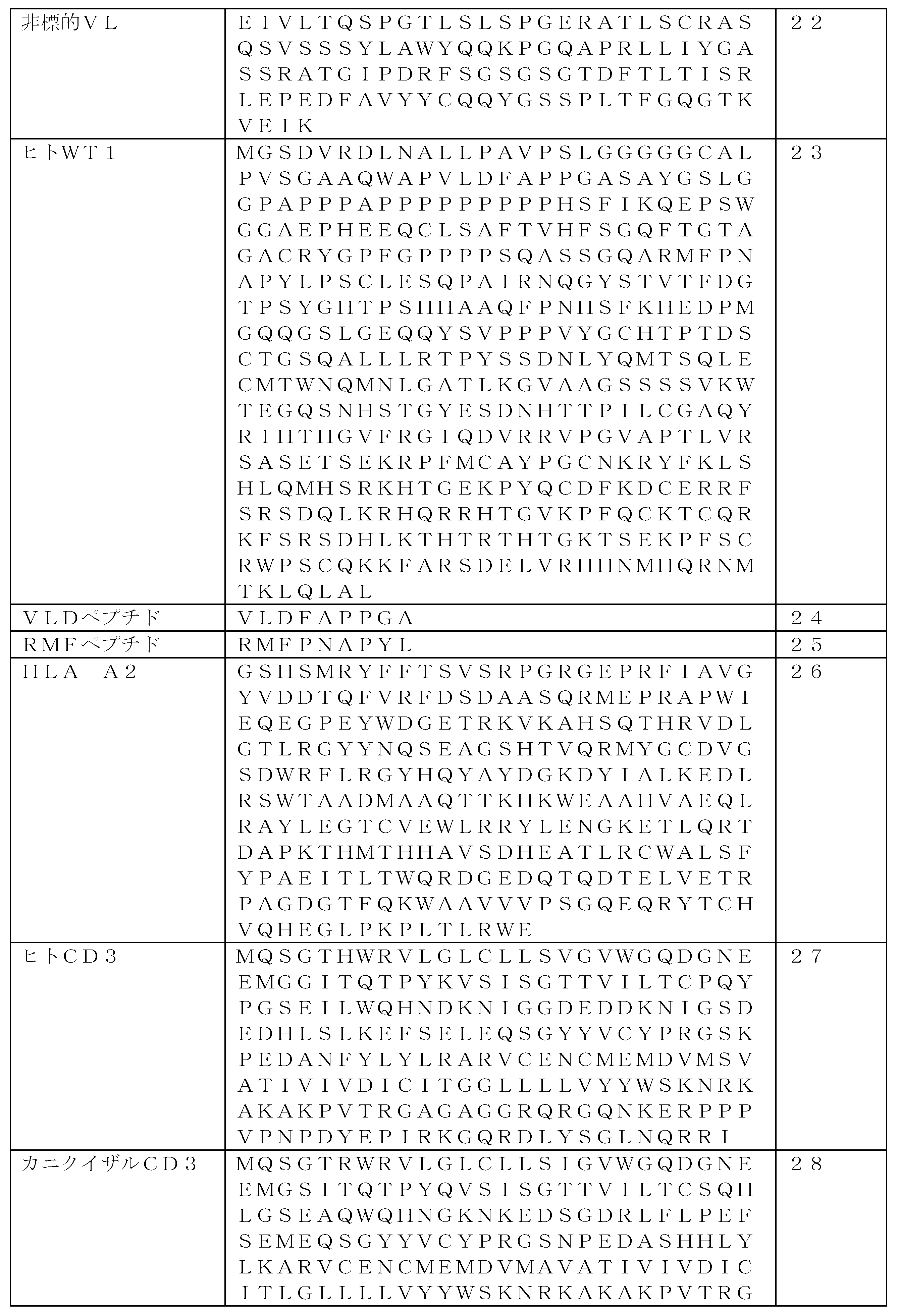

以下は、本発明の方法及び組成物の実施例である。上に提供された一般的な説明を考慮すると、種々の他の態様が実施されてもよいことが理解される。 The following are examples of the methods and compositions of the present invention. It is understood that various other aspects may be practiced, given the general description provided above.
実施例1.WT1 TCBとレナリドマイドの組み合わせ
材料及び方法
10%ウシ胎仔血清(FCS)、10%ウマ血清、及び1%ペニシリン/ストレプトマイシン/グルタミンw補充したα-MEM培地中で、初代AML細胞を使用するEx vivo細胞傷害性アッセイを実施した。組み換えヒト顆粒球コロニー刺激因子(rhG-CSF)、インターロイキン(IL)-3、及びトロンボポエチン(TPO)(Peprotech、ハンブルク、ドイツ)、及び57.4mMのβ-メルカプトエタノール(Sigma-Aldrich、ミュンヘン、ドイツ)を、培地に補充した。初代AML細胞を解凍し、6ウェルプレート中照射マウスMS5間質細胞のフィーダー層で前培養した。3-4日後、初代AML細胞を96ウェルプレート中の新鮮なフィーダー層上に移した。WT1 TCB(配列番号9-16(HLA-A2/WT1 CDR及びV領域)、1-8(CD3 CDR及びV領域)、及び17-20(完全重鎖及び軽鎖)、図1に示すような分子構造)を、10nMの濃度で添加した。レナリドマイドを10μMの濃度で添加した。健康なドナーからのT細胞を解凍し、初代AML細胞とE:T比1:2で4日間共培養した。同様の構造の非標的TCB(CD3のみに結合するが、腫瘍抗原には結合せず、非結合V領域として配列番号21~22を有する)をコントロールとして使用した。
Example 1. WT1 TCB and Lenalidomide Combination Materials and Methods Ex vivo cells using primary AML cells in α-MEM media supplemented with 10% fetal calf serum (FCS), 10% horse serum, and 1% penicillin/streptomycin/glutamine w. A toxicity assay was performed. recombinant human granulocyte colony-stimulating factor (rhG-CSF), interleukin (IL)-3, and thrombopoietin (TPO) (Peprotech, Hamburg, Germany), and 57.4 mM β-mercaptoethanol (Sigma-Aldrich, Munich, Germany). Germany) was supplemented to the medium. Primary AML cells were thawed and pre-cultured on a feeder layer of irradiated mouse MS5 stromal cells in 6-well plates. After 3-4 days, primary AML cells were transferred onto fresh feeder layers in 96-well plates. WT1 TCB (SEQ ID NOS:9-16 (HLA-A2/WT1 CDR and V regions), 1-8 (CD3 CDR and V regions), and 17-20 (complete heavy and light chains), as shown in FIG. molecular structure) was added at a concentration of 10 nM. Lenalidomide was added at a concentration of 10 μM. T cells from healthy donors were thawed and co-cultured with primary AML cells at an E:T ratio of 1:2 for 4 days. A non-targeting TCB of similar structure (which binds only CD3 but not tumor antigens and has SEQ ID NOs: 21-22 as the non-binding V region) was used as a control.
CD33(REA775)、CD2(REA972;どちらも、Miltenyi, Heidelberg、ドイツ)、CD69(FN50)、PD1(29F.1A12)、TIM3(F38-2E2)、CD45RA(HI100)、CCR7(G43H7;すべてBiolegend、サンディエゴ、米国から)の表面発現を、フローサイトメトリー(CytoFLEX S, Beckman Coulter Life Sciences, Krefeld、ドイツ)によって評価した。細胞培養物の上清中のサイトカイン濃度を、Human Th1/Th2 Cytokine Kit(BD Biosciences, Heidelberg, Germany)を使用して定量化した。 CD33 (REA775), CD2 (REA972; both, Miltenyi, Heidelberg, Germany), CD69 (FN50), PD1 (29F.1A12), TIM3 (F38-2E2), CD45RA (HI100), CCR7 (G43H7; all Biolegend, from San Diego, USA) was assessed by flow cytometry (CytoFLEX S, Beckman Coulter Life Sciences, Krefeld, Germany). Cytokine concentrations in cell culture supernatants were quantified using the Human Th1/Th2 Cytokine Kit (BD Biosciences, Heidelberg, Germany).
結果
WT1 TCBとレナリドマイドの組み合わせは、WT1 TCB媒介T細胞傷害性(第3-4日の平均特異的溶解:32±10%vs.59±9%;p=0.0017;±SEM;n=13)をさらに高めたのに対して、レナリドマイドと非標的コントロールTCBの組み合わせは、有意な増加をもたらさなかった。図2を参照。
Results The combination of WT1 TCB and lenalidomide reduced WT1 TCB-mediated T cytotoxicity (mean specific lysis on days 3-4: 32±10% vs. 59±9%; p=0.0017; ±SEM; 13), whereas the combination of lenalidomide and non-targeting control TCB did not result in a significant increase. See Figure 2.
WT1 TCBとレナリドマイドの組み合わせは、炎症促進性サイトカインの分泌と抗炎症性サイトカインIL-10の減少を誘発するのに対して、レナリドマイドと非標的コントロールTCBの組み合わせは、有意な変化をもたらさなかった。図3を参照。 The combination of WT1 TCB and lenalidomide induced a decrease in the secretion of pro-inflammatory cytokines and the anti-inflammatory cytokine IL-10, whereas the combination of lenalidomide and non-targeting control TCB produced no significant changes. See FIG.
WT1-TCBとレナリドマイドの組み合わせは、CD45RAのダウンレギュレーションを特徴とする、ナイーブT細胞の中央記憶(TCM)表現型への分化を促進するのに対して、レナリドマイドと非標的TCBの組み合わせは、分化に影響を及ぼさなかった。図4を参照。 The combination of WT1-TCB and lenalidomide promotes the differentiation of naive T cells to the central memory (T CM ) phenotype, characterized by downregulation of CD45RA, whereas the combination of lenalidomide and non-targeted TCB promotes differentiation of naive T cells into a central memory (T CM ) phenotype, did not affect differentiation. See FIG.
上述の発明は、理解を明確にする目的のために説明及び実施例によってある程度詳細に記載されているが、これらの記載及び実施例は、本発明の範囲を限定するものとして解釈されるべきではない。ここに引用したすべての特許文献及び科学文献の開示内容は、参照によりその全体が明示的に包含されている。 Although the foregoing invention has been described in some detail by way of illustration and example for purposes of clarity of understanding, these descriptions and examples should not be construed as limiting the scope of the invention. Absent. The disclosures of all patent and scientific literature cited herein are expressly incorporated by reference in their entirety.
Claims (13)
(i)CD3に特異的に結合し、配列番号1の重鎖CDR(HCDR)1、配列番号2のHCDR2、及び配列番号3のHCDR3を含む重鎖可変領域と、配列番号4の軽鎖CDR(LCDR)1、配列番号5のLCDR2、及び配列番号6のLCDR3を含む軽鎖可変領域とを含む、第1の抗原結合部分と、
(ii)HLA-A2/WT1に特異的に結合し、配列番号9の重鎖CDR(HCDR)1、配列番号10のHCDR2、及び配列番号11のHCDR3を含む重鎖可変領域と、配列番号12の軽鎖CDR(LCDR)1、配列番号13のLCDR2、及び配列番号14のLCDR3を含む軽鎖可変領域とを含む、第2の抗原結合部分と
を含む、請求項1から4のいずれか一項に記載の、使用のためのHLA-A2/WT1×CD3二重特異性抗体、使用、方法、又はキット。 HLA-A2/WT1×CD3 bispecific antibodies are:
(i) a heavy chain variable region that specifically binds CD3 and comprises heavy chain CDR (HCDR) 1 of SEQ ID NO: 1, HCDR2 of SEQ ID NO: 2, and HCDR3 of SEQ ID NO: 3; and a light chain CDR of SEQ ID NO: 4 a light chain variable region comprising (LCDR)1, LCDR2 of SEQ ID NO:5, and LCDR3 of SEQ ID NO:6;
(ii) a heavy chain variable region that specifically binds to HLA-A2/WT1 and comprises heavy chain CDR (HCDR) 1 of SEQ ID NO: 9, HCDR2 of SEQ ID NO: 10, and HCDR3 of SEQ ID NO: 11; and a light chain variable region comprising the light chain CDR (LCDR) 1 of SEQ ID NO: 13, and LCDR 3 of SEQ ID NO: 14. A HLA-A2/WT1×CD3 bispecific antibody, use, method or kit for use as described in Section 3.
(i)CD3に特異的に結合し、配列番号1の重鎖CDR(HCDR)1、配列番号2のHCDR2、及び配列番号3のHCDR3を含む重鎖可変領域と、配列番号4の軽鎖CDR(LCDR)1、配列番号5のLCDR2、及び配列番号6のLCDR3を含む軽鎖可変領域とを含む、第1の抗原結合部分であって、Fab軽鎖及びFab重鎖の可変領域又は定常領域のいずれかが交換されているクロスオーバーFab分子である、第1の抗原結合部分と、
(ii)HLA-A2/WT1に特異的に結合し、配列番号9の重鎖CDR(HCDR)1、配列番号10のHCDR2、及び配列番号11のHCDR3を含む重鎖可変領域と、配列番号12の軽鎖CDR(LCDR)1、配列番号13のLCDR2、及び配列番号14のLCDR3を含む軽鎖可変領域とを含む、第2の抗原結合部分及び第3の抗原結合部分であって、第2の抗原結合部分及び第3の抗原結合部分の各々がFab分子、特に従来のFab分子である、第2の抗原結合部分及び第3の抗原結合部分と、
(iii)第1のサブユニット及び第2のサブユニットから構成されるFcドメインと
を含み、
第2の抗原結合部分が、Fab重鎖のC末端において第1の抗原結合部分のFab重鎖のN末端に融合しており、第1の抗原結合部分が、Fab重鎖のC末端においてFcドメインの第1のサブユニットのN末端に融合しており、第3の抗原結合部分が、Fab重鎖のC末端においてFcドメインの第2のサブユニットのN末端に融合している、
請求項1から6のいずれか一項に記載の、使用のためのHLA-A2/WT1×CD3二重特異性抗体、使用、方法、又はキット。 HLA-A2/WT1×CD3 bispecific antibodies are:
(i) a heavy chain variable region that specifically binds CD3 and comprises heavy chain CDR (HCDR) 1 of SEQ ID NO: 1, HCDR2 of SEQ ID NO: 2, and HCDR3 of SEQ ID NO: 3; and a light chain CDR of SEQ ID NO: 4 (LCDR) 1, LCDR2 of SEQ ID NO:5, and a light chain variable region comprising LCDR3 of SEQ ID NO:6, wherein the variable or constant region of a Fab light chain and a Fab heavy chain a first antigen-binding portion, which is a crossover Fab molecule in which either the
(ii) a heavy chain variable region that specifically binds to HLA-A2/WT1 and comprises heavy chain CDR (HCDR) 1 of SEQ ID NO: 9, HCDR2 of SEQ ID NO: 10, and HCDR3 of SEQ ID NO: 11; a light chain variable region comprising the light chain CDR (LCDR) 1 of SEQ ID NO: 13, and LCDR 3 of SEQ ID NO: 14, wherein the second each of the antigen-binding portion and the third antigen-binding portion of is a Fab molecule, particularly a conventional Fab molecule;
(iii) an Fc domain composed of the first subunit and the second subunit;
A second antigen binding portion is fused at the C-terminus of the Fab heavy chain to the N-terminus of the Fab heavy chain of the first antigen binding portion and the first antigen binding portion is fused at the C-terminus of the Fab heavy chain to Fc fused to the N-terminus of the first subunit of the domain and a third antigen-binding portion fused to the N-terminus of the second subunit of the Fc domain at the C-terminus of the Fab heavy chain;
HLA-A2/WT1×CD3 bispecific antibody, use, method or kit for use according to any one of claims 1 to 6.
The aforementioned invention.
Applications Claiming Priority (3)
| Application Number | Priority Date | Filing Date | Title |
|---|---|---|---|
| EP19207090.2 | 2019-11-05 | ||
| EP19207090 | 2019-11-05 | ||
| PCT/EP2020/080763 WO2021089513A1 (en) | 2019-11-05 | 2020-11-03 | Treatment of cancer using a hla-a2/wt1 x cd3 bispecific antibody and lenalidomide |
Publications (2)
| Publication Number | Publication Date |
|---|---|
| JP2023501276A true JP2023501276A (en) | 2023-01-18 |
| JPWO2021089513A5 JPWO2021089513A5 (en) | 2023-11-13 |
Family
ID=68468600
Family Applications (1)
| Application Number | Title | Priority Date | Filing Date |
|---|---|---|---|
| JP2022525603A Pending JP2023501276A (en) | 2019-11-05 | 2020-11-03 | Treatment of cancer using HLA-A2/WT1×CD3 bispecific antibody and lenalidomide |
Country Status (12)
| Country | Link |
|---|---|
| US (1) | US20220275093A1 (en) |
| EP (1) | EP4054716A1 (en) |
| JP (1) | JP2023501276A (en) |
| KR (1) | KR20220093323A (en) |
| CN (1) | CN115003384A (en) |
| AU (1) | AU2020381349A1 (en) |
| BR (1) | BR112022008652A2 (en) |
| CA (1) | CA3155308A1 (en) |
| IL (1) | IL292103A (en) |
| MX (1) | MX2022005238A (en) |
| TW (1) | TW202132341A (en) |
| WO (1) | WO2021089513A1 (en) |
Families Citing this family (4)
| Publication number | Priority date | Publication date | Assignee | Title |
|---|---|---|---|---|
| JP2024540174A (en) * | 2021-11-01 | 2024-10-31 | エフ・ホフマン-ラ・ロシュ・アクチェンゲゼルシャフト | Treatment of cancer using HLA-A2/WT1×CD3 bispecific antibodies and 4-1BB (CD137) agonists |
| WO2024149821A1 (en) * | 2023-01-13 | 2024-07-18 | F. Hoffmann-La Roche Ag | Treatment of cancer using a hla-a2/wt1 x cd3 bispecific antibody and venetoclax/azacitidine |
| WO2025029050A1 (en) * | 2023-07-31 | 2025-02-06 | (주)메디톡스 | Antibody and pharmaceutical composition comprising same for treating immune diseases |
| WO2025103425A1 (en) * | 2023-11-15 | 2025-05-22 | Concept To Medicine Biotech Co., Ltd. | Multispecific antibodies and uses thereof |
Citations (2)
| Publication number | Priority date | Publication date | Assignee | Title |
|---|---|---|---|---|
| WO2018083204A1 (en) * | 2016-11-02 | 2018-05-11 | Engmab Sàrl | Bispecific antibody against bcma and cd3 and an immunological drug for combined use in treating multiple myeloma |
| WO2019122052A2 (en) * | 2017-12-21 | 2019-06-27 | F. Hoffmann-La Roche Ag | Antibodies binding to hla-a2/wt1 |
Family Cites Families (10)
| Publication number | Priority date | Publication date | Assignee | Title |
|---|---|---|---|---|
| WO1990005144A1 (en) | 1988-11-11 | 1990-05-17 | Medical Research Council | Single domain ligands, receptors comprising said ligands, methods for their production, and use of said ligands and receptors |
| DE3920358A1 (en) | 1989-06-22 | 1991-01-17 | Behringwerke Ag | BISPECIFIC AND OLIGO-SPECIFIC, MONO- AND OLIGOVALENT ANTI-BODY CONSTRUCTS, THEIR PRODUCTION AND USE |
| US5571894A (en) | 1991-02-05 | 1996-11-05 | Ciba-Geigy Corporation | Recombinant antibodies specific for a growth factor receptor |
| GB9114948D0 (en) | 1991-07-11 | 1991-08-28 | Pfizer Ltd | Process for preparing sertraline intermediates |
| FI941572L (en) | 1991-10-07 | 1994-05-27 | Oncologix Inc | Combination and method of use of anti-erbB-2 monoclonal antibodies |
| ATE503496T1 (en) | 1992-02-06 | 2011-04-15 | Novartis Vaccines & Diagnostic | BIOSYNTHETIC BINDING PROTEIN FOR TUMOR MARKERS |
| US5731168A (en) | 1995-03-01 | 1998-03-24 | Genentech, Inc. | Method for making heteromultimeric polypeptides |
| US5869046A (en) | 1995-04-14 | 1999-02-09 | Genentech, Inc. | Altered polypeptides with increased half-life |
| US8404716B2 (en) * | 2002-10-15 | 2013-03-26 | Celgene Corporation | Methods of treating myelodysplastic syndromes with a combination therapy using lenalidomide and azacitidine |
| WO2018081361A1 (en) * | 2016-10-28 | 2018-05-03 | Children's Hospital Medical Center | Methods and compositions for treatment of myelodyspastic syndromes and/or acute myleoid leukemias |
-
2020
- 2020-11-03 JP JP2022525603A patent/JP2023501276A/en active Pending
- 2020-11-03 CN CN202080076682.8A patent/CN115003384A/en active Pending
- 2020-11-03 AU AU2020381349A patent/AU2020381349A1/en not_active Abandoned
- 2020-11-03 MX MX2022005238A patent/MX2022005238A/en unknown
- 2020-11-03 KR KR1020227015509A patent/KR20220093323A/en not_active Withdrawn
- 2020-11-03 CA CA3155308A patent/CA3155308A1/en active Pending
- 2020-11-03 BR BR112022008652A patent/BR112022008652A2/en not_active Application Discontinuation
- 2020-11-03 WO PCT/EP2020/080763 patent/WO2021089513A1/en not_active Ceased
- 2020-11-03 EP EP20797512.9A patent/EP4054716A1/en active Pending
- 2020-11-04 TW TW109138371A patent/TW202132341A/en unknown
-
2022
- 2022-04-10 IL IL292103A patent/IL292103A/en unknown
- 2022-05-05 US US17/662,117 patent/US20220275093A1/en not_active Abandoned
Patent Citations (2)
| Publication number | Priority date | Publication date | Assignee | Title |
|---|---|---|---|---|
| WO2018083204A1 (en) * | 2016-11-02 | 2018-05-11 | Engmab Sàrl | Bispecific antibody against bcma and cd3 and an immunological drug for combined use in treating multiple myeloma |
| WO2019122052A2 (en) * | 2017-12-21 | 2019-06-27 | F. Hoffmann-La Roche Ag | Antibodies binding to hla-a2/wt1 |
Also Published As
| Publication number | Publication date |
|---|---|
| MX2022005238A (en) | 2022-06-08 |
| WO2021089513A1 (en) | 2021-05-14 |
| IL292103A (en) | 2022-06-01 |
| BR112022008652A2 (en) | 2022-07-19 |
| CA3155308A1 (en) | 2021-05-14 |
| US20220275093A1 (en) | 2022-09-01 |
| CN115003384A (en) | 2022-09-02 |
| AU2020381349A1 (en) | 2022-04-28 |
| TW202132341A (en) | 2021-09-01 |
| EP4054716A1 (en) | 2022-09-14 |
| KR20220093323A (en) | 2022-07-05 |
Similar Documents
| Publication | Publication Date | Title |
|---|---|---|
| US20220275093A1 (en) | Treatment of cancer using a hla-a2/wt1 x cd3 bispecific antibody and lenalidomide | |
| TW202221021A (en) | Improved antigen binding receptors | |
| US20220088195A1 (en) | Prevention or mitigation of T-cell bispecific antibody-related adverse effects | |
| KR20250021307A (en) | Prevention or alleviation of adverse effects associated with T cell-engaging agents | |
| KR20200099135A (en) | Use of CEA CD3 bispecific antibodies and PD-1 axis binding antagonists in dosing regimens for cancer treatment | |
| TWI892958B (en) | Treatment method | |
| US20240287193A1 (en) | Treatment of cancer using a hla-a2/wt1 x cd3 bispecific antibody and a 4-1bb (cd137) agonist | |
| JP2024546589A (en) | Treatment of cancer using HLA-A2/MAGE-A4 x CD3 bispecific antibodies and 4-1BB (CD137) agonists | |
| HK40071202A (en) | Treatment of cancer using a hla-a2/wt1 x cd3 bispecific antibody and lenalidomide | |
| HK40112386A (en) | Treatment of cancer using a hla-a2/wt1 x cd3 bispecific antibody and a 4-1bb (cd137) agonist | |
| WO2024149821A1 (en) | Treatment of cancer using a hla-a2/wt1 x cd3 bispecific antibody and venetoclax/azacitidine | |
| HK40020684A (en) | Treatment method | |
| HK40031518A (en) | Use of a cea cd3 bispecific antibody and a pd-1 axis binding antagonist in a dosage regime to treat cancer |
Legal Events
| Date | Code | Title | Description |
|---|---|---|---|
| A521 | Request for written amendment filed |
Free format text: JAPANESE INTERMEDIATE CODE: A523 Effective date: 20220510 |
|
| A521 | Request for written amendment filed |
Free format text: JAPANESE INTERMEDIATE CODE: A523 Effective date: 20231102 |
|
| A621 | Written request for application examination |
Free format text: JAPANESE INTERMEDIATE CODE: A621 Effective date: 20231102 |
|
| A131 | Notification of reasons for refusal |
Free format text: JAPANESE INTERMEDIATE CODE: A131 Effective date: 20241210 |
|
| A02 | Decision of refusal |
Free format text: JAPANESE INTERMEDIATE CODE: A02 Effective date: 20250603 |