JP2023107892A - Degradation of target proteins mediated by stabilizing peptides - Google Patents
Degradation of target proteins mediated by stabilizing peptides Download PDFInfo
- Publication number
- JP2023107892A JP2023107892A JP2023096835A JP2023096835A JP2023107892A JP 2023107892 A JP2023107892 A JP 2023107892A JP 2023096835 A JP2023096835 A JP 2023096835A JP 2023096835 A JP2023096835 A JP 2023096835A JP 2023107892 A JP2023107892 A JP 2023107892A
- Authority
- JP
- Japan
- Prior art keywords
- peptide
- protein
- degron
- seq
- staple
- Prior art date
- Legal status (The legal status is an assumption and is not a legal conclusion. Google has not performed a legal analysis and makes no representation as to the accuracy of the status listed.)
- Pending
Links
Images


Classifications
-
- C—CHEMISTRY; METALLURGY
- C07—ORGANIC CHEMISTRY
- C07K—PEPTIDES
- C07K7/00—Peptides having 5 to 20 amino acids in a fully defined sequence; Derivatives thereof
- C07K7/04—Linear peptides containing only normal peptide links
- C07K7/06—Linear peptides containing only normal peptide links having 5 to 11 amino acids
-
- A—HUMAN NECESSITIES
- A61—MEDICAL OR VETERINARY SCIENCE; HYGIENE
- A61K—PREPARATIONS FOR MEDICAL, DENTAL OR TOILETRY PURPOSES
- A61K38/00—Medicinal preparations containing peptides
- A61K38/04—Peptides having up to 20 amino acids in a fully defined sequence; Derivatives thereof
- A61K38/07—Tetrapeptides
-
- A—HUMAN NECESSITIES
- A61—MEDICAL OR VETERINARY SCIENCE; HYGIENE
- A61K—PREPARATIONS FOR MEDICAL, DENTAL OR TOILETRY PURPOSES
- A61K38/00—Medicinal preparations containing peptides
- A61K38/04—Peptides having up to 20 amino acids in a fully defined sequence; Derivatives thereof
- A61K38/08—Peptides having 5 to 11 amino acids
-
- A—HUMAN NECESSITIES
- A61—MEDICAL OR VETERINARY SCIENCE; HYGIENE
- A61K—PREPARATIONS FOR MEDICAL, DENTAL OR TOILETRY PURPOSES
- A61K38/00—Medicinal preparations containing peptides
- A61K38/16—Peptides having more than 20 amino acids; Gastrins; Somatostatins; Melanotropins; Derivatives thereof
- A61K38/17—Peptides having more than 20 amino acids; Gastrins; Somatostatins; Melanotropins; Derivatives thereof from animals; from humans
-
- A—HUMAN NECESSITIES
- A61—MEDICAL OR VETERINARY SCIENCE; HYGIENE
- A61K—PREPARATIONS FOR MEDICAL, DENTAL OR TOILETRY PURPOSES
- A61K47/00—Medicinal preparations characterised by the non-active ingredients used, e.g. carriers or inert additives; Targeting or modifying agents chemically bound to the active ingredient
- A61K47/50—Medicinal preparations characterised by the non-active ingredients used, e.g. carriers or inert additives; Targeting or modifying agents chemically bound to the active ingredient the non-active ingredient being chemically bound to the active ingredient, e.g. polymer-drug conjugates
- A61K47/51—Medicinal preparations characterised by the non-active ingredients used, e.g. carriers or inert additives; Targeting or modifying agents chemically bound to the active ingredient the non-active ingredient being chemically bound to the active ingredient, e.g. polymer-drug conjugates the non-active ingredient being a modifying agent
- A61K47/54—Medicinal preparations characterised by the non-active ingredients used, e.g. carriers or inert additives; Targeting or modifying agents chemically bound to the active ingredient the non-active ingredient being chemically bound to the active ingredient, e.g. polymer-drug conjugates the non-active ingredient being a modifying agent the modifying agent being an organic compound
- A61K47/545—Heterocyclic compounds
-
- A—HUMAN NECESSITIES
- A61—MEDICAL OR VETERINARY SCIENCE; HYGIENE
- A61K—PREPARATIONS FOR MEDICAL, DENTAL OR TOILETRY PURPOSES
- A61K47/00—Medicinal preparations characterised by the non-active ingredients used, e.g. carriers or inert additives; Targeting or modifying agents chemically bound to the active ingredient
- A61K47/50—Medicinal preparations characterised by the non-active ingredients used, e.g. carriers or inert additives; Targeting or modifying agents chemically bound to the active ingredient the non-active ingredient being chemically bound to the active ingredient, e.g. polymer-drug conjugates
- A61K47/51—Medicinal preparations characterised by the non-active ingredients used, e.g. carriers or inert additives; Targeting or modifying agents chemically bound to the active ingredient the non-active ingredient being chemically bound to the active ingredient, e.g. polymer-drug conjugates the non-active ingredient being a modifying agent
- A61K47/54—Medicinal preparations characterised by the non-active ingredients used, e.g. carriers or inert additives; Targeting or modifying agents chemically bound to the active ingredient the non-active ingredient being chemically bound to the active ingredient, e.g. polymer-drug conjugates the non-active ingredient being a modifying agent the modifying agent being an organic compound
- A61K47/55—Medicinal preparations characterised by the non-active ingredients used, e.g. carriers or inert additives; Targeting or modifying agents chemically bound to the active ingredient the non-active ingredient being chemically bound to the active ingredient, e.g. polymer-drug conjugates the non-active ingredient being a modifying agent the modifying agent being an organic compound the modifying agent being also a pharmacologically or therapeutically active agent, i.e. the entire conjugate being a codrug, i.e. a dimer, oligomer or polymer of pharmacologically or therapeutically active compounds
-
- A—HUMAN NECESSITIES
- A61—MEDICAL OR VETERINARY SCIENCE; HYGIENE
- A61K—PREPARATIONS FOR MEDICAL, DENTAL OR TOILETRY PURPOSES
- A61K47/00—Medicinal preparations characterised by the non-active ingredients used, e.g. carriers or inert additives; Targeting or modifying agents chemically bound to the active ingredient
- A61K47/50—Medicinal preparations characterised by the non-active ingredients used, e.g. carriers or inert additives; Targeting or modifying agents chemically bound to the active ingredient the non-active ingredient being chemically bound to the active ingredient, e.g. polymer-drug conjugates
- A61K47/51—Medicinal preparations characterised by the non-active ingredients used, e.g. carriers or inert additives; Targeting or modifying agents chemically bound to the active ingredient the non-active ingredient being chemically bound to the active ingredient, e.g. polymer-drug conjugates the non-active ingredient being a modifying agent
- A61K47/62—Medicinal preparations characterised by the non-active ingredients used, e.g. carriers or inert additives; Targeting or modifying agents chemically bound to the active ingredient the non-active ingredient being chemically bound to the active ingredient, e.g. polymer-drug conjugates the non-active ingredient being a modifying agent the modifying agent being a protein, peptide or polyamino acid
- A61K47/64—Drug-peptide, drug-protein or drug-polyamino acid conjugates, i.e. the modifying agent being a peptide, protein or polyamino acid which is covalently bonded or complexed to a therapeutically active agent
-
- A—HUMAN NECESSITIES
- A61—MEDICAL OR VETERINARY SCIENCE; HYGIENE
- A61P—SPECIFIC THERAPEUTIC ACTIVITY OF CHEMICAL COMPOUNDS OR MEDICINAL PREPARATIONS
- A61P35/00—Antineoplastic agents
-
- C—CHEMISTRY; METALLURGY
- C07—ORGANIC CHEMISTRY
- C07K—PEPTIDES
- C07K14/00—Peptides having more than 20 amino acids; Gastrins; Somatostatins; Melanotropins; Derivatives thereof
-
- C—CHEMISTRY; METALLURGY
- C07—ORGANIC CHEMISTRY
- C07K—PEPTIDES
- C07K14/00—Peptides having more than 20 amino acids; Gastrins; Somatostatins; Melanotropins; Derivatives thereof
- C07K14/435—Peptides having more than 20 amino acids; Gastrins; Somatostatins; Melanotropins; Derivatives thereof from animals; from humans
-
- C—CHEMISTRY; METALLURGY
- C07—ORGANIC CHEMISTRY
- C07K—PEPTIDES
- C07K2319/00—Fusion polypeptide
Landscapes
- Health & Medical Sciences (AREA)
- Chemical & Material Sciences (AREA)
- Life Sciences & Earth Sciences (AREA)
- Medicinal Chemistry (AREA)
- General Health & Medical Sciences (AREA)
- Organic Chemistry (AREA)
- Proteomics, Peptides & Aminoacids (AREA)
- Bioinformatics & Cheminformatics (AREA)
- Engineering & Computer Science (AREA)
- Pharmacology & Pharmacy (AREA)
- Animal Behavior & Ethology (AREA)
- Public Health (AREA)
- Veterinary Medicine (AREA)
- Gastroenterology & Hepatology (AREA)
- Epidemiology (AREA)
- Molecular Biology (AREA)
- Biophysics (AREA)
- Biochemistry (AREA)
- Genetics & Genomics (AREA)
- Zoology (AREA)
- Toxicology (AREA)
- Immunology (AREA)
- Chemical Kinetics & Catalysis (AREA)
- General Chemical & Material Sciences (AREA)
- Nuclear Medicine, Radiotherapy & Molecular Imaging (AREA)
- Peptides Or Proteins (AREA)
- Medicines That Contain Protein Lipid Enzymes And Other Medicines (AREA)
- Medicinal Preparation (AREA)
Abstract
Description
関連出願の相互参照
本出願は、2017年12月15日に出願された米国仮出願第62/599,608号に基づく優先権を主張し、この仮出願はその全体が参照により本明細書に組み込まれる。
CROSS-REFERENCE TO RELATED APPLICATIONS This application claims priority to U.S. Provisional Application No. 62/599,608, filed Dec. 15, 2017, which is incorporated herein by reference in its entirety. incorporated.
技術分野
本開示は、タンパク質を標的とする部分(ステープルペプチドまたは分子部分によって)およびタンパク質分解誘発部分(別のステープルペプチドまたは分子部分によって)の組合せとして働く、ステープルペプチドデグロンキメラと称される安定化ペプチドおよび小分子キメラ化合物に関する。キメラは、(i)小分子デグロン(例えば、デグロンとしての、セレブロンまたはVHL結合小分子)、(ii)ポリペプチド配列デグロン、(iii)デグロンとしてのステープルペプチド、または(iv)タンパク質を標的とする化合物としての小分子(デグロンとしての役割を果たすステープルペプチドを含む)のいずれかに融合したステープルペプチドを含み、本開示は、これらの使用方法に関する。
TECHNICAL FIELD The present disclosure describes stable peptides, termed staple peptide degron chimeras, that act as a combination of a protein-targeting moiety (via a staple peptide or molecular moiety) and a proteolysis-inducing moiety (via another staple peptide or molecular moiety). peptides and small molecule chimeric compounds. Chimeras target (i) small molecule degrons (e.g., cereblon or VHL-binding small molecules as degrons), (ii) polypeptide sequence degrons, (iii) staple peptides as degrons, or (iv) proteins Including staple peptides fused to any of the small molecules (including staple peptides that act as degrons) as compounds, the present disclosure relates to methods of their use.
背景
デグロンは、その分解において主要な役割を果たすタンパク質の一部である。デグロンは、タンパク質配列のどこにでも位置することができる、通常短いアミノ酸配列である(Cho et al., Genes & Development, 24 (5): 438-442 (2010);Fortmann et al., Journal of Molecular Biology, 427 (17): 2748-2756 (2015);Dohmen et al., Science, 263(5151):1273-1276 (1994);Varshavsky, Proceedings of the National Academy of Sciences, 93 (22):12142-12149 (1996))。実際、一部のタンパク質は、複数のデグロンを有する。デグロンは、原核細胞と真核細胞の両方で識別されている。いくつかのタイプのデグロンが存在するが、これらのグループ内での変異性が高いという事実にもかかわらず、デグロンは、タンパク質分解速度の調節においてこれらが関与することに関して全てが類似している。分解にはユビキチンが関与する場合があるか、または分解はユビキチン非依存性の場合がある。ユビキチン依存性であるデグロンは、同種のユビキチンE3リガーゼによって認識される特定の配列を含む。
Background Degron is a part of the protein that plays a major role in its degradation. Degrons are usually short amino acid sequences that can be located anywhere in the protein sequence (Cho et al., Genes & Development, 24 (5): 438-442 (2010); Fortmann et al., Journal of Molecular Biology, 427 (17): 2748-2756 (2015); Dohmen et al., Science, 263(5151):1273-1276 (1994); Varshavsky, Proceedings of the National Academy of Sciences, 93 (22):12142- 12149 (1996)). In fact, some proteins have multiple degrons. Degron has been identified in both prokaryotic and eukaryotic cells. Despite the fact that there are several types of degrons and high variability within these groups, the degrons are all similar with respect to their involvement in regulating the rate of protein degradation. Degradation may involve ubiquitin, or degradation may be ubiquitin-independent. Ubiquitin-dependent degrons contain specific sequences recognized by their cognate ubiquitin E3 ligases.
ユビキチンプロテアソーム経路(UPP)は、主要なレギュレータータンパク質を調節し、ミスフォールドまたは異常タンパク質を分解する主要な経路である。特定のタンパク質基質へのユビキチンの共有結合は、E3ユビキチンリガーゼの作用を介して達成される。例えば、セレブロン(CRBN)は、損傷を受けたDNA結合タンパク質1(DDB1)と相互作用し、Cullin4(CUL4A)とともにE3ユビキチンリガーゼ複合体を形成し、その後、基質受容体として機能し、CRBNによって認識されるタンパク質をユビキチン化し、プロテアソームによって分解することができるようにする。CRBNは、サリドマイドなどの免疫調節薬(IMiD)と結合することも識別されている。そのような結合は、多発性骨髄腫を処置するために使用するレナリドミドなどのIMiDの催奇形性機序と、また細胞毒性と関連している。 The ubiquitin proteasome pathway (UPP) is a major pathway that regulates key regulator proteins and degrades misfolded or abnormal proteins. Covalent attachment of ubiquitin to specific protein substrates is accomplished through the action of E3 ubiquitin ligases. For example, cereblon (CRBN) interacts with damaged DNA-binding protein 1 (DDB1) and forms an E3 ubiquitin ligase complex with Cullin4 (CUL4A), which subsequently functions as a substrate receptor and is recognized by CRBN. ubiquitinates the proteins that are processed, allowing them to be degraded by the proteasome. CRBN has also been identified to bind immunomodulatory drugs (IMiDs) such as thalidomide. Such binding is associated with the teratogenic mechanism of IMiDs such as lenalidomide, which are used to treat multiple myeloma, and also with cytotoxicity.
要旨
本開示は、目的の任意のタンパク質を標的とするために使用することができる二官能性安定化ペプチド-小分子(例えば、サリドマイドデグロン)コンジュゲート、安定化ペプチド-ペプチド(例えば、一次デグロン配列)コンジュゲート、安定化ペプチド-安定化ペプチド(例えば一次デグロン配列)コンジュゲート、および小分子-安定化ペプチド(例えば一次デグロン配列)コンジュゲート(これらのコンジュゲートは、「キメラ」とも称される)の合成および特性評価に関する。例えば、これらのコンジュゲートは、疾患に関与するまたはその原因となるタンパク質を標的とするため有用である。標的とするタンパク質は、ウイルス、細菌、動物、またはヒト起源であってもよい。ある特定の場合では、コンジュゲートは、疾患の原因となるか、または疾患に関連するタンパク質を標的とするために有用である。そのような安定化ペプチドコンジュゲートは、そのような病理学的タンパク質によって引き起こされる疾患を処置するために有用である。大きくかつ通常新薬の開発につなげることができないタンパク質相互作用表面を標的とするステープルペプチドの能力は、デグロンの機能性と連動して、小分子の範囲を超えてデグロン技術の有用性を拡大し、ステープルペプチドの生物活性を強化することができる。
SUMMARY The present disclosure provides bifunctional stabilized peptide-small molecule (e.g., thalidomide degron) conjugates, stabilized peptide-peptide (e.g., primary degron) conjugates that can be used to target any protein of interest. sequence) conjugates, stabilized peptide-stabilized peptide (e.g., primary degron sequence) conjugates, and small molecule-stabilized peptide (e.g., primary degron sequence) conjugates (these conjugates are also referred to as "chimeric" ) for the synthesis and characterization. For example, these conjugates are useful for targeting proteins involved in or causative of disease. The targeted protein may be of viral, bacterial, animal, or human origin. In certain cases, the conjugates are useful for targeting a disease-causing or disease-associated protein. Such stabilized peptide conjugates are useful for treating diseases caused by such pathological proteins. The ability of staple peptides to target protein-interacting surfaces that are large and not usually amenable to drug development, coupled with the functionality of degrons, expands the utility of degron technology beyond small molecules, The bioactivity of staple peptides can be enhanced.
第1の態様では、本開示は、タンパク質を標的とするステープルペプチドおよび小分子デグロン部分(例えば、サリドマイド部分またはフォンヒッペルリンダウ(VHL)部分)を含むペプチド-小分子融合物を特徴とする。 In a first aspect, the disclosure features peptide-small molecule fusions that include a protein-targeting staple peptide and a small molecule degron moiety (eg, a thalidomide moiety or a von Hippel-Lindau (VHL) moiety).
一部の実施形態では、小分子デグロン(例えば、サリドマイド部分またはVHL部分)は、タンパク質を標的とするステープルペプチドのN末端にコンジュゲートしている。一部の場合では、小分子デグロン(例えば、サリドマイド部分またはVHL部分)は、タンパク質を標的とするステープルペプチドのC末端にコンジュゲートしている。ある特定の場合では、小分子デグロン(例えば、サリドマイド部分またはVHL部分)は、タンパク質を標的とするステープルペプチドのN末端とC末端との間のペプチド配列中に挿入された非天然アミノ酸内に含まれる。一部の場合では、ステープルペプチドは、疾患の原因となるタンパク質に結合する。一部の場合では、ステープルペプチドは細胞内タンパク質に結合する。一部の場合では、ステープルペプチドは細胞外タンパク質に結合する。一部の場合では、ステープルペプチドは細胞表面タンパク質(例えば、受容体)に結合する。一部の場合では、ステープルペプチドは、キラータンパク質(例えば、BAX、BAK)または細胞に損傷を与えるかもしくは神経変性の原因となるタンパク質(例えば、IgG、ベータ-アミロイド、タウ、α-シヌクレイン、TDP-43、ヘモグロビン(鎌状細胞)、スーパーオキシドジスムターゼ、Notch3、FUS、GFAP)に結合する。一部の場合では、ステープルペプチドは、BCL2、BCLXL、MCL-1、BFL-1、BCL-w、BCL-B、EZH2、HDM2/HDMX、KRAS/NRAS/HRAS、MYC、b-カテニン、PI3K、PTEN、TSC、AKT、BRCA1/2、EWS-FLI、MLL融合物、受容体チロシンキナーゼ、HOXホモログ、JUN、サイクリンD、サイクリンE、BRAF、CRAF、CDK4、CDK2、HPV-E6/E7、オーロラキナーゼ、MITF、Wnt1、PD-1、BCR、およびCCR5からなる群から選択されるタンパク質に結合する。一部の場合では、ステープルペプチドは細菌性タンパク質に結合する。一部の場合では、ステープルペプチドはウイルス性タンパク質に結合する。ある特定の場合では、サリドマイド部分は、以下に示す構造を含む。
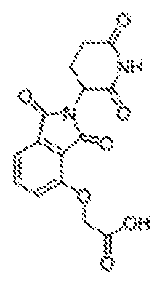


一部の場合では、VHL部分は以下の構造を含む。
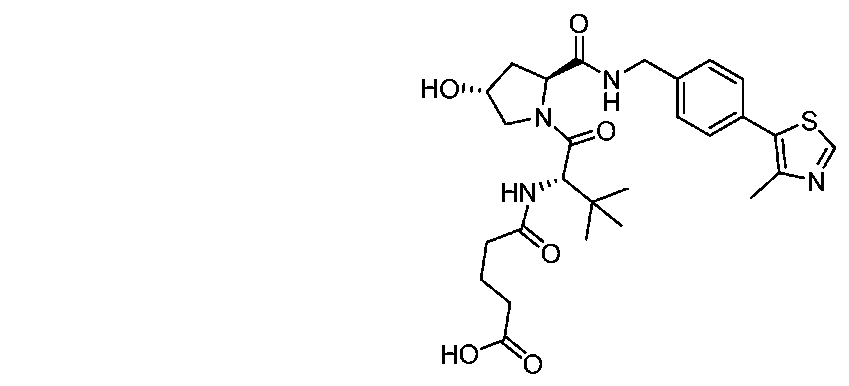
一部の場合では、VHL部分は以下の構造を含む。

第2の態様では、本開示は、病理学的ペプチドまたはタンパク質によって引き起こされる疾患または障害を、それを必要とするヒト対象において処置する方法を特徴とする。方法は、本明細書において記載する治療有効量のペプチド小分子融合物をヒト対象に投与することを含む。 In a second aspect, the disclosure features a method of treating a disease or disorder caused by a pathological peptide or protein in a human subject in need thereof. The method comprises administering to a human subject a therapeutically effective amount of a peptide small molecule fusion described herein.
第3の態様では、本開示は、WD40リピートタンパク質に結合するペプチドデグロンであって、WD40リピートタンパク質がE3ユビキチンリガーゼに対する基質アダプターであるペプチドデグロンを特徴とする。ペプチドは、WD40リピートタンパク質に結合するアミノ酸配列の天然結合配列または天然結合コンセンサス配列の改変型を含む。改変型は、WD40リピートタンパク質に結合するアミノ酸配列の天然結合コンセンサス配列内に少なくとも1個のアミノ酸置換、少なくとも1個のアミノ酸欠失、少なくとも1個のアミノ酸挿入、またはこれらの任意の組合せを含む。WD40リピートタンパク質に結合するアミノ酸配列の天然結合配列または天然結合コンセンサス配列の改変型を含む例示的なペプチドは、配列番号26~30および106~118として提供される。1つの例示の例では、本開示は、構成的光形態形成1(Cop1)タンパク質に結合するペプチドを提供する。ペプチドは、アミノ酸配列DQIVPEY(配列番号25)の改変型を含む。改変型は、配列番号25中に少なくとも1個のアミノ酸置換、少なくとも1個のアミノ酸欠失、少なくとも1個のアミノ酸挿入、またはこれらの任意の組合せを含む。改変型が単一のアミノ酸置換からなる場合、アミノ酸置換は、配列番号25の1から7位のうちのいずれか1つのAまたはRに対しても、配列番号25の4位のVに対しても行われていない。
In a third aspect, the disclosure features a peptide degron that binds to a WD40 repeat protein, wherein the WD40 repeat protein is a substrate adapter for an E3 ubiquitin ligase. Peptides include the natural binding sequence or modified version of the natural binding consensus sequence of amino acid sequences that bind to the WD40 repeat protein. The variant contains at least one amino acid substitution, at least one amino acid deletion, at least one amino acid insertion, or any combination thereof within the natural binding consensus sequence of the amino acid sequence that binds the WD40 repeat protein. Exemplary peptides comprising the natural binding sequences or variants of the natural binding consensus sequences of amino acid sequences that bind to WD40 repeat proteins are provided as SEQ ID NOS:26-30 and 106-118. In one illustrative example, the disclosure provides peptides that bind to constitutive photomorphogenesis 1 (Cop1) protein. The peptide contains a modified version of the amino acid sequence DQIVPEY (SEQ ID NO:25). Variants include at least one amino acid substitution, at least one amino acid deletion, at least one amino acid insertion, or any combination thereof in SEQ ID NO:25. If the variant consists of a single amino acid substitution, the amino acid substitution is to A or R at any one of
一部の実施形態では、ペプチドは、少なくとも1個のアミノ酸置換を有することを除いて、配列番号25に記載のアミノ酸配列を含む。一部の場合では、ペプチドは、少なくとも1個のアミノ酸欠失を有することを除いて、配列番号25に記載のアミノ酸配列を含む。一部の場合では、ペプチドは、少なくとも1個のアミノ酸置換および少なくとも1個のアミノ酸欠失を有することを除いて、配列番号25に記載のアミノ酸配列を含む。ある特定の場合では、ペプチドは、1から6個のアミノ酸置換を有することを除いて、配列番号25に記載のアミノ酸配列を含む。一部の場合では、配列番号25の4位(V)および/または5位(P)は置換されていない。一部の場合では、配列番号25の1位(D)、2位(Q)、3位(I)、および6位(E)の1個または複数は置換されている。一部の場合では、ペプチドは、1個のアミノ酸欠失を有することを除いて、配列番号25に記載のアミノ酸配列を含む。ある特定の場合では、配列番号25に記載のアミノ酸配列の7位(Y)は欠失している。一部の場合では、ペプチドは、1から6個のアミノ酸置換および少なくとも1個のアミノ酸欠失を有することを除いて、配列番号25に記載のアミノ酸配列を含む。一部の場合では、ペプチドは、配列番号26から30からなる群から選択されるアミノ酸配列を有する。一例では、ペプチドは、配列番号30に記載のアミノ酸配列を有する。 In some embodiments, the peptide comprises the amino acid sequence set forth in SEQ ID NO:25, except with at least one amino acid substitution. In some cases, the peptide comprises the amino acid sequence set forth in SEQ ID NO:25, except with at least one amino acid deletion. In some cases, the peptide comprises the amino acid sequence set forth in SEQ ID NO:25, except having at least one amino acid substitution and at least one amino acid deletion. In certain instances, the peptide comprises the amino acid sequence set forth in SEQ ID NO:25, except with 1 to 6 amino acid substitutions. In some cases, positions 4 (V) and/or 5 (P) of SEQ ID NO:25 are not substituted. In some cases, one or more of positions 1 (D), 2 (Q), 3 (I), and 6 (E) of SEQ ID NO:25 are substituted. In some cases, the peptide comprises the amino acid sequence set forth in SEQ ID NO:25, except with a single amino acid deletion. In one particular case, position 7 (Y) of the amino acid sequence set forth in SEQ ID NO:25 is deleted. In some cases, the peptide comprises the amino acid sequence set forth in SEQ ID NO:25, except with 1 to 6 amino acid substitutions and at least 1 amino acid deletion. In some cases, the peptide has an amino acid sequence selected from the group consisting of SEQ ID NOs:26-30. In one example, the peptide has the amino acid sequence set forth in SEQ ID NO:30.
ある特定の実施形態では、ペプチドは、4から10個のアミノ酸長である。 In certain embodiments, peptides are 4 to 10 amino acids long.
一部の場合では、ペプチドは、1nMから300nMの結合親和性でCop1に結合する。一部の場合では、ペプチドは、1nMから1000nMの結合親和性でCop1に結合する。一部の場合では、ペプチドは、10nMから300nMの結合親和性でCop1に結合する。一部の場合では、ペプチドは、100nMから300nMの結合親和性でCop1に結合する。一部の場合では、ペプチドは、200nMから300nMの結合親和性でCop1に結合する。一部の場合では、ペプチドは、200nMから1000nMの結合親和性でCop1に結合する。 In some cases, the peptide binds Cop1 with a binding affinity of 1 nM to 300 nM. In some cases, the peptide binds Cop1 with a binding affinity of 1 nM to 1000 nM. In some cases, the peptide binds Cop1 with a binding affinity of 10 nM to 300 nM. In some cases, the peptide binds Cop1 with a binding affinity of 100 nM to 300 nM. In some cases, the peptide binds Cop1 with a binding affinity of 200 nM to 300 nM. In some cases, the peptide binds Cop1 with a binding affinity of 200 nM to 1000 nM.
第4の態様では、本開示は、タンパク質を標的とするステープルペプチドおよびTrib1ペプチドデグロンまたはそのバリアントを含むキメラ融合ポリペプチドに関する。 In a fourth aspect, the present disclosure relates to a chimeric fusion polypeptide comprising a protein-targeting staple peptide and a Trib1 peptide degron or variant thereof.
一部の実施形態では、ステープルペプチドは細胞内タンパク質に結合する。一部の実施形態では、ステープルペプチドは細胞外タンパク質に結合する。一部の実施形態では、ステープルペプチドは細胞表面タンパク質(例えば、受容体)に結合する。一部の実施形態では、ステープルペプチドは、疾患の原因となるか、または疾患に関連するタンパク質に結合する。一部の実施形態では、ステープルペプチドは、キラータンパク質(例えば、BAX、BAK)または細胞に損傷を与えるかもしくは神経変性の原因となるタンパク質(例えば、IgG、ベータ-アミロイド、タウ、α-シヌクレイン、TDP-43、HbS、スーパーオキシドジスムターゼ、Notch3、FUS、GFAP)に結合する。一部の実施形態では、ステープルペプチドは、BCL2、BCLXL、MCL-1、BFL-1、BCL-w、BCL-B、EZH2、HDM2/HDMX、KRAS/NRAS/HRAS、MYC、β-カテニン、PI3K、PTEN、TSC、AKT、BRCA1/2、EWS-FLI融合物、MLL融合物、受容体チロシンキナーゼ、HOXホモログ、JUN、サイクリンD、サイクリンE、BRAF、CRAF、CDK4、CDK2、HPV-E6/E7、オーロラキナーゼ、MITF、Wnt1、PD-1、BCR、およびCCR5からなる群から選択されるタンパク質に結合する。一部の実施形態では、ステープルペプチドは細菌性タンパク質に結合する。一部の実施形態では、ステープルペプチドはウイルス性タンパク質に結合する。 In some embodiments, staple peptides bind to intracellular proteins. In some embodiments, staple peptides bind to extracellular proteins. In some embodiments, staple peptides bind to cell surface proteins (eg, receptors). In some embodiments, the staple peptide binds to a disease-causing or disease-associated protein. In some embodiments, the staple peptide is a killer protein (eg, BAX, BAK) or a cell-damaging or neurodegenerative protein (eg, IgG, beta-amyloid, tau, α-synuclein, TDP-43, HbS, superoxide dismutase, Notch3, FUS, GFAP). In some embodiments, the staple peptide is BCL2, BCLXL, MCL-1, BFL-1, BCL-w, BCL-B, EZH2, HDM2/HDMX, KRAS/NRAS/HRAS, MYC, beta-catenin, PI3K , PTEN, TSC, AKT, BRCA1/2, EWS-FLI fusion, MLL fusion, receptor tyrosine kinase, HOX homolog, JUN, cyclin D, cyclin E, BRAF, CRAF, CDK4, CDK2, HPV-E6/E7 , Aurora kinase, MITF, Wnt1, PD-1, BCR, and CCR5. In some embodiments, staple peptides bind to bacterial proteins. In some embodiments, staple peptides bind to viral proteins.
第5の態様では、本開示は、ステープルペプチドと、WD40リピートタンパク質に結合するペプチドとを含むキメラポリペプチドであって、WD40リピートタンパク質がE3ユビキチンリガーゼに対する基質アダプターである、キメラポリペプチドを特徴とする。ペプチドは、WD40リピートタンパク質に結合するアミノ酸配列の天然結合配列または天然結合コンセンサス配列の改変型を含む。改変型は、WD40リピートタンパク質に結合するアミノ酸配列の天然結合コンセンサス配列内に少なくとも1個のアミノ酸置換、少なくとも1個のアミノ酸欠失、少なくとも1個のアミノ酸挿入、またはこれらの任意の組合せを含む。 In a fifth aspect, the disclosure features a chimeric polypeptide comprising a staple peptide and a peptide that binds to a WD40 repeat protein, wherein the WD40 repeat protein is a substrate adapter for an E3 ubiquitin ligase. do. Peptides include the natural binding sequence or modified version of the natural binding consensus sequence of amino acid sequences that bind to the WD40 repeat protein. The variant contains at least one amino acid substitution, at least one amino acid deletion, at least one amino acid insertion, or any combination thereof within the natural binding consensus sequence of the amino acid sequence that binds the WD40 repeat protein.
一部の実施形態では、E3ユビキチンリガーゼに対する基質アダプターであるWD40リピートタンパク質は、MDM2、SKP2-CKS1、FBXW1、FBXW2、FBXW4、FBXW5、FBXW7、FBXW8、FBXW9、FBXW10、FBXW11、FBXW12、SPOP、VHL、ITCH、KEAP1、KLHL2、KLHL3、KLHL7、KLHL12、KLHL13、KLHL15、KLHL20、KLHL21、KLHL24、KLHL40、KLHL42、COP1、TRAF7、RFWD3、DCAF1、DCAF2、DCAF3、DCAF4、DCAF5、DCAF6、DCAF7、DCAF8、DCAF9、DCAF10、DCAF11、DCAF12、DCAF13、DCAF14、DCAF15、DCAF16、DCAF17、DCAF19、SIAH1、TRPC4AC、DET1、WSB1、WSB2、HERC1、DDB2、CSA、CBL、CDC20、およびFZR1からなる群から選択される。 In some embodiments, the substrate adapter for E3 ubiquitin ligase, WD40 repeat protein is MDM2, SKP2-CKS1, FBXW1, FBXW2, FBXW4, FBXW5, FBXW7, FBXW8, FBXW9, FBXW10, FBXW11, FBXW12, SPOP, VHL, ITCH, KEAP1, KLHL2, KLHL3, KLHL7, KLHL12, KLHL13, KLHL15, KLHL20, KLHL21, KLHL24, KLHL40, KLHL42, COP1, TRAF7, RFWD3, DCAF1, DCAF2, DCAF3, DCAF4, DCAF5, DCAF6, DCAF7, DCAF8, DCAF9, is selected from the group consisting of DCAF10, DCAF11, DCAF12, DCAF13, DCAF14, DCAF15, DCAF16, DCAF17, DCAF19, SIAH1, TRPC4AC, DET1, WSB1, WSB2, HERC1, DDB2, CSA, CBL, CDC20, and FZR1;
一部の実施形態では、天然結合配列または天然結合コンセンサス配列は、配列番号25、31~46、および65~105からなる群から選択される配列である。一部の場合では、天然結合コンセンサス配列は配列番号25である。他の場合では、天然結合コンセンサス配列は配列番号46である。 In some embodiments, the natural binding sequence or natural binding consensus sequence is a sequence selected from the group consisting of SEQ ID NOs:25, 31-46, and 65-105. In some cases, the natural binding consensus sequence is SEQ ID NO:25. In other cases, the natural binding consensus sequence is SEQ ID NO:46.
一部の実施形態では、ペプチドは、少なくとも1個のアミノ酸置換を有することを除いて、配列番号25に記載のアミノ酸配列を含む。一部の場合では、ペプチドは、少なくとも1個のアミノ酸欠失を有することを除いて、配列番号25に記載のアミノ酸配列を含む。一部の場合では、ペプチドは、少なくとも1個のアミノ酸置換および少なくとも1個のアミノ酸欠失を有することを除いて、配列番号25に記載のアミノ酸配列を含む。ある特定の場合では、ペプチドは、1から6個のアミノ酸置換を有することを除いて、配列番号25に記載のアミノ酸配列を含む。一部の場合では、配列番号25の4位(V)および/または5位(P)は置換されていない。一部の場合では、配列番号25の1位(D)、2位(Q)、3位(I)、および6位(E)のうちの1個または複数は置換されている。一部の場合では、ペプチドは、1個のアミノ酸欠失を有することを除いて、配列番号25に記載のアミノ酸配列を含む。ある特定の場合では、配列番号25に記載のアミノ酸配列の7位(Y)は欠失している。一部の場合では、ペプチドは、1から6個のアミノ酸置換および少なくとも1個のアミノ酸欠失を有することを除いて、配列番号25に記載のアミノ酸配列を含む。一部の場合では、ペプチドは、配列番号26から30からなる群から選択されるアミノ酸配列を有する。一例では、ペプチドは、配列番号30に記載のアミノ酸配列を有する。 In some embodiments, the peptide comprises the amino acid sequence set forth in SEQ ID NO:25, except with at least one amino acid substitution. In some cases, the peptide comprises the amino acid sequence set forth in SEQ ID NO:25, except with at least one amino acid deletion. In some cases, the peptide comprises the amino acid sequence set forth in SEQ ID NO:25, except having at least one amino acid substitution and at least one amino acid deletion. In certain instances, the peptide comprises the amino acid sequence set forth in SEQ ID NO:25, except with 1 to 6 amino acid substitutions. In some cases, positions 4 (V) and/or 5 (P) of SEQ ID NO:25 are not substituted. In some cases, one or more of positions 1 (D), 2 (Q), 3 (I), and 6 (E) of SEQ ID NO:25 are substituted. In some cases, the peptide comprises the amino acid sequence set forth in SEQ ID NO:25, except with a single amino acid deletion. In one particular case, position 7 (Y) of the amino acid sequence set forth in SEQ ID NO:25 is deleted. In some cases, the peptide comprises the amino acid sequence set forth in SEQ ID NO:25, except with 1 to 6 amino acid substitutions and at least 1 amino acid deletion. In some cases, the peptide has an amino acid sequence selected from the group consisting of SEQ ID NOs:26-30. In one example, the peptide has the amino acid sequence set forth in SEQ ID NO:30.
ある特定の実施形態では、ペプチドは4から30個のアミノ酸長である。ある特定の実施形態では、ペプチドは4から20個のアミノ酸長である。ある特定の実施形態では、ペプチドは4から15個のアミノ酸長である。ある特定の実施形態では、ペプチドは5から20個のアミノ酸長である。 In certain embodiments, peptides are 4 to 30 amino acids long. In certain embodiments, peptides are 4 to 20 amino acids long. In certain embodiments, peptides are 4 to 15 amino acids long. In certain embodiments, peptides are 5 to 20 amino acids long.
ある特定の実施形態では、ペプチドは、1nMから300nM;10nMから300nM;100nMから300nM;または200nMから300nMの結合親和性でCop1に結合する。ある特定の実施形態では、ペプチドは、1nMから1000nMの結合親和性でCop1に結合する。ある特定の実施形態では、ペプチドは、200nMから1000nMの結合親和性でCop1に結合する。 In certain embodiments, the peptide binds Cop1 with a binding affinity of 1 nM to 300 nM; 10 nM to 300 nM; 100 nM to 300 nM; or 200 nM to 300 nM. In certain embodiments, the peptide binds Cop1 with a binding affinity of 1 nM to 1000 nM. In certain embodiments, the peptide binds Cop1 with a binding affinity of 200 nM to 1000 nM.
一部の実施形態では、ステープルペプチドは細胞内タンパク質に結合する。一部の実施形態では、ステープルペプチドは細胞外タンパク質に結合する。一部の実施形態では、ステープルペプチドは細胞表面タンパク質(例えば、受容体)に結合する。一部の実施形態では、ステープルペプチドは、疾患の原因となるか、または疾患に関連するタンパク質に結合する。一部の実施形態では、ステープルペプチドは、キラータンパク質(例えば、BAX、BAK)または細胞に損傷を与えるかもしくは神経変性の原因となるタンパク質(例えば、IgG、ベータ-アミロイド、タウ、α-シヌクレイン、TDP-43、HbS(ヘモグロビン鎌状細胞)、スーパーオキシドジスムターゼ、Notch3、FUS、GFAP)に結合する。一部の実施形態では、ステープルペプチドは、BCL2、BCLXL、MCL-1、BFL-1、BCL-w、BCL-B、EZH2、HDM2/HDMX、KRAS/NRAS/HRAS、MYC、β-カテニン、PI3K、PTEN、TSC、AKT、BRCA1/2、EWS-FLI融合物、MLL融合物、受容体チロシンキナーゼ、HOXホモログ、JUN、サイクリンD、サイクリンE、BRAF、CRAF、CDK4、CDK2、HPV-E6/E7、オーロラキナーゼ、MITF、Wnt1、PD-1、BCR、およびCCR5からなる群から選択されるタンパク質に結合する。一部の実施形態では、ステープルペプチドは細菌性タンパク質に結合する。一部の実施形態では、ステープルペプチドはウイルス性タンパク質に結合する。ある特定の場合では、ステープルペプチドは、神経変性の原因となるタンパク質凝集体(例えば、ベータ-アミロイド)を標的とする。 In some embodiments, staple peptides bind to intracellular proteins. In some embodiments, staple peptides bind to extracellular proteins. In some embodiments, staple peptides bind to cell surface proteins (eg, receptors). In some embodiments, the staple peptide binds to a disease-causing or disease-associated protein. In some embodiments, the staple peptide is a killer protein (eg, BAX, BAK) or a protein that damages cells or causes neurodegeneration (eg, IgG, beta-amyloid, tau, α-synuclein, Binds TDP-43, HbS (hemoglobin sickle cell), superoxide dismutase, Notch3, FUS, GFAP). In some embodiments, the staple peptide is BCL2, BCLXL, MCL-1, BFL-1, BCL-w, BCL-B, EZH2, HDM2/HDMX, KRAS/NRAS/HRAS, MYC, beta-catenin, PI3K , PTEN, TSC, AKT, BRCA1/2, EWS-FLI fusion, MLL fusion, receptor tyrosine kinase, HOX homolog, JUN, cyclin D, cyclin E, BRAF, CRAF, CDK4, CDK2, HPV-E6/E7 , Aurora kinase, MITF, Wnt1, PD-1, BCR, and CCR5. In some embodiments, staple peptides bind to bacterial proteins. In some embodiments, staple peptides bind to viral proteins. In certain cases, staple peptides target protein aggregates (eg, beta-amyloid) that are responsible for neurodegeneration.
第6の態様では、本開示は、構造的に不規則な領域を含む第1のタンパク質の改変タンパク質を特徴とする。改変タンパク質は、構造的に不規則な領域が、E3ユビキチンリガーゼに対する基質アダプターであるWD40リピートタンパク質に結合するペプチドを含む点で第1のタンパク質と異なる。ペプチドは、天然結合コンセンサス配列の改変型を含み、改変型は、天然結合コンセンサス配列内に少なくとも1個のアミノ酸置換、少なくとも1個のアミノ酸欠失、少なくとも1個のアミノ酸挿入、またはこれらの任意の組合せを含む。 In a sixth aspect, the disclosure features a variant protein of the first protein that includes a structurally disordered region. The variant protein differs from the first protein in that the structurally irregular region contains peptides that bind to the WD40 repeat protein, which is a substrate adapter for the E3 ubiquitin ligase. Peptides include modifications of the natural binding consensus sequence, wherein the modification has at least one amino acid substitution, at least one amino acid deletion, at least one amino acid insertion, or any of these within the natural binding consensus sequence. Including combinations.
ある特定の実施形態では、E3ユビキチンリガーゼに対する基質アダプターであるWD40リピートタンパク質は、MDM2、SKP2-CKS1、FBXW1、FBXW2、FBXW4、FBXW5、FBXW7、FBXW8、FBXW9、FBXW10、FBXW11、FBXW12、SPOP、VHL、ITCH、KEAP1、KLHL2、KLHL3、KLHL7、KLHL12、KLHL13、KLHL15、KLHL20、KLHL21、KLHL24、KLHL40、KLHL42、COP1、TRAF7、RFWD3、DCAF1、DCAF2、DCAF3、DCAF4、DCAF5、DCAF6、DCAF7、DCAF8、DCAF9、DCAF10、DCAF11、DCAF12、DCAF13、DCAF14、DCAF15、DCAF16、DCAF17、DCAF19、SIAH1、TRPC4AC、DET1、WSB1、WSB2、HERC1、DDB2、CSA、CBL、CDC20、およびFZR1からなる群から選択される。一部の場合では、天然結合コンセンサス配列は、配列番号25、31~46、および65~105からなる群から選択される配列である。一部の場合では、天然結合コンセンサス配列は配列番号25である。一部の場合では、天然結合コンセンサス配列は配列番号46である。 In certain embodiments, the WD40 repeat proteins that are substrate adapters for E3 ubiquitin ligases are MDM2, SKP2-CKS1, FBXW1, FBXW2, FBXW4, FBXW5, FBXW7, FBXW8, FBXW9, FBXW10, FBXW11, FBXW12, SPOP, VHL, ITCH, KEAP1, KLHL2, KLHL3, KLHL7, KLHL12, KLHL13, KLHL15, KLHL20, KLHL21, KLHL24, KLHL40, KLHL42, COP1, TRAF7, RFWD3, DCAF1, DCAF2, DCAF3, DCAF4, DCAF5, DCAF6, DCAF7, DCAF8, DCAF9, is selected from the group consisting of DCAF10, DCAF11, DCAF12, DCAF13, DCAF14, DCAF15, DCAF16, DCAF17, DCAF19, SIAH1, TRPC4AC, DET1, WSB1, WSB2, HERC1, DDB2, CSA, CBL, CDC20, and FZR1; In some cases, the natural binding consensus sequence is a sequence selected from the group consisting of SEQ ID NOs:25, 31-46, and 65-105. In some cases, the natural binding consensus sequence is SEQ ID NO:25. In some cases, the natural binding consensus sequence is SEQ ID NO:46.
一部の実施形態では、ペプチドは、少なくとも1個のアミノ酸置換を有することを除いて、配列番号25に記載のアミノ酸配列を含む。一部の場合では、ペプチドは、少なくとも1個のアミノ酸欠失を有することを除いて、配列番号25に記載のアミノ酸配列を含む。一部の場合では、ペプチドは、少なくとも1個のアミノ酸置換および少なくとも1個のアミノ酸欠失を有することを除いて、配列番号25に記載のアミノ酸配列を含む。ある特定の場合では、ペプチドは、1から6個のアミノ酸置換を有することを除いて、配列番号25に記載のアミノ酸配列を含む。一部の場合では、配列番号25の4位(V)および/または5位(P)は置換されていない。一部の場合では、配列番号25の1位(D)、2位(Q)、3位(I)、および6位(E)のうちの1個または複数は置換されている。一部の場合では、ペプチドは、1個のアミノ酸欠失を有することを除いて、配列番号25に記載のアミノ酸配列を含む。ある特定の場合では、配列番号25に記載のアミノ酸配列の7位(Y)は欠失している。一部の場合では、ペプチドは、1から6個のアミノ酸置換および少なくとも1個のアミノ酸欠失を有することを除いて、配列番号25に記載のアミノ酸配列を含む。一部の場合では、ペプチドは、配列番号26から30からなる群から選択されるアミノ酸配列を有する。一例では、ペプチドは、配列番号30に記載のアミノ酸配列を有する。 In some embodiments, the peptide comprises the amino acid sequence set forth in SEQ ID NO:25, except with at least one amino acid substitution. In some cases, the peptide comprises the amino acid sequence set forth in SEQ ID NO:25, except with at least one amino acid deletion. In some cases, the peptide comprises the amino acid sequence set forth in SEQ ID NO:25, except having at least one amino acid substitution and at least one amino acid deletion. In certain instances, the peptide comprises the amino acid sequence set forth in SEQ ID NO:25, except with 1 to 6 amino acid substitutions. In some cases, positions 4 (V) and/or 5 (P) of SEQ ID NO:25 are not substituted. In some cases, one or more of positions 1 (D), 2 (Q), 3 (I), and 6 (E) of SEQ ID NO:25 are substituted. In some cases, the peptide comprises the amino acid sequence set forth in SEQ ID NO:25, except with a single amino acid deletion. In one particular case, position 7 (Y) of the amino acid sequence set forth in SEQ ID NO:25 is deleted. In some cases, the peptide comprises the amino acid sequence set forth in SEQ ID NO:25, except with 1 to 6 amino acid substitutions and at least 1 amino acid deletion. In some cases, the peptide has an amino acid sequence selected from the group consisting of SEQ ID NOs:26-30. In one example, the peptide has the amino acid sequence set forth in SEQ ID NO:30.
ある特定の実施形態では、ペプチドは4から10個のアミノ酸長である。 In certain embodiments, peptides are 4 to 10 amino acids long.
ある特定の実施形態では、ペプチドは、1nMから300nM;10nMから300nM;100nMから300nM;または200nMから300nMの結合親和性でCop1に結合する。ある特定の実施形態では、ペプチドは、1nMから1000nMの結合親和性でCop1に結合する。ある特定の実施形態では、ペプチドは、200nMから1000nMの結合親和性でCop1に結合する。 In certain embodiments, the peptide binds Cop1 with a binding affinity of 1 nM to 300 nM; 10 nM to 300 nM; 100 nM to 300 nM; or 200 nM to 300 nM. In certain embodiments, the peptide binds Cop1 with a binding affinity of 1 nM to 1000 nM. In certain embodiments, the peptide binds Cop1 with a binding affinity of 200 nM to 1000 nM.
第7の態様では、本開示は、病理学的ペプチドまたはタンパク質によって引き起こされる疾患または障害を、それを必要とするヒト対象において処置する方法を特徴とする。方法は、本明細書において記載する治療有効量のキメラ融合ポリペプチドをヒト対象に投与することを含む。 In a seventh aspect, the disclosure features a method of treating a disease or disorder caused by a pathological peptide or protein in a human subject in need thereof. The method comprises administering to a human subject a therapeutically effective amount of a chimeric fusion polypeptide described herein.
第8の態様では、本開示は、配列番号106から118からなる群から選択されるペプチドデグロンを特徴とする。 In an eighth aspect, the disclosure features a peptide degron selected from the group consisting of SEQ ID NOS: 106-118.
一部の実施形態では、これらのペプチドは安定化ペプチドに連結している。 In some embodiments, these peptides are linked to stabilizing peptides.
第9の態様では、本開示は、配列番号119から126からなる群から選択される安定化ペプチド-ペプチドデグロンキメラを提供する。 In a ninth aspect, the present disclosure provides stabilized peptide-peptide degron chimeras selected from the group consisting of SEQ ID NOS: 119-126.
上記全ての態様のある特定の実施形態では、安定化ペプチド-デグロンキメラは、BCL2、BCLXL、BCLW、MCL-1、BFL-1、BAX、MDM2、またはMDMXのうちのいずれか1個または複数の分解を標的とするために使用する。 In certain embodiments of all the above aspects, the stabilized peptide-degron chimera is any one or more of BCL2, BCLX L , BCL W , MCL-1, BFL-1, BAX, MDM2, or MDMX used to target the degradation of
第10の態様では、本開示は、第1の安定化ペプチドおよび第2の安定化ペプチドの2個の安定化ペプチドを含み、第1の安定化ペプチドが、分解されることになる標的タンパク質である第1のタンパク質に結合し、第2の安定化ペプチドが、分解誘導タンパク質(degrader protein)である第2のタンパク質に結合する、安定化ペプチド-安定化ペプチドデグロンキメラを提供する。ある特定の実施形態では、第1の安定化ペプチドは、分解の標的である疾患に関連するタンパク質に結合し、第2の安定化ペプチドは、分解誘導タンパク質、例えばE3リガーゼ(例えばMDM2)に結合する。 In a tenth aspect, the disclosure includes two stabilizing peptides, a first stabilizing peptide and a second stabilizing peptide, wherein the first stabilizing peptide is a target protein to be degraded. A stabilized peptide-stabilized peptide degron chimera is provided that binds to a first protein and the second stabilized peptide binds to a second protein that is a degrader protein. In certain embodiments, a first stabilizing peptide binds to a disease-associated protein targeted for degradation and a second stabilizing peptide binds to a degradation-inducing protein, such as an E3 ligase (e.g., MDM2). do.
一部の実施形態では、第1のタンパク質は細胞内タンパク質である。一部の実施形態では、第1のタンパク質は細胞外タンパク質である。一部の実施形態では、第1のタンパク質は細胞表面タンパク質(例えば、受容体)である。一部の実施形態では、第1のタンパク質は、疾患の原因となるか、または疾患に関連するタンパク質である。一部の実施形態では、第1のタンパク質は、キラータンパク質(例えば、BAX、BAK)または細胞に損傷を与えるかもしくは神経変性の原因となるタンパク質(例えば、IgG、ベータ-アミロイド、タウ、α-シヌクレイン、TDP-43、HbS(ヘモグロビン鎌状細胞)、スーパーオキシドジスムターゼ、Notch3、FUS、GFAP)である。一部の実施形態では、第1のタンパク質は、BCL2、BCLXL、MCL-1、BFL-1、BCL-w、BCL-B、EZH2、HDM2/HDMX、KRAS/NRAS/HRAS、MYC、β-カテニン、PI3K、PTEN、TSC、AKT、BRCA1/2、EWS-FLI融合物、MLL融合物、受容体チロシンキナーゼ、HOXホモログ、JUN、サイクリンD、サイクリンE、BRAF、CRAF、CDK4、CDK2、HPV-E6/E7、オーロラキナーゼ、MITF、Wnt1、PD-1、BCR、およびCCR5からなる群から選択されるタンパク質である。一部の実施形態では、第1のタンパク質は細菌性タンパク質である。一部の実施形態では、第1のタンパク質はウイルス性タンパク質である。ある特定の場合では、第1のタンパク質は、神経変性の原因となるタンパク質凝集体(例えば、ベータ-アミロイド)である。 In some embodiments, the first protein is an intracellular protein. In some embodiments the first protein is an extracellular protein. In some embodiments, the first protein is a cell surface protein (eg, receptor). In some embodiments, the first protein is a disease-causing or disease-associated protein. In some embodiments, the first protein is a killer protein (eg, BAX, BAK) or a cell-damaging or neurodegenerative protein (eg, IgG, beta-amyloid, tau, α- synuclein, TDP-43, HbS (hemoglobin sickle cell), superoxide dismutase, Notch3, FUS, GFAP). In some embodiments, the first protein is BCL2, BCLXL, MCL-1, BFL-1, BCL-w, BCL-B, EZH2, HDM2/HDMX, KRAS/NRAS/HRAS, MYC, beta-catenin , PI3K, PTEN, TSC, AKT, BRCA1/2, EWS-FLI fusion, MLL fusion, receptor tyrosine kinase, HOX homolog, JUN, cyclin D, cyclin E, BRAF, CRAF, CDK4, CDK2, HPV-E6 /E7, Aurora kinase, MITF, Wnt1, PD-1, BCR, and CCR5. In some embodiments the first protein is a bacterial protein. In some embodiments, the first protein is a viral protein. In certain cases, the first protein is a neurodegenerative protein aggregate (eg, beta-amyloid).
ある特定の実施形態では、第1の安定化ペプチドは、配列番号1~24、および134のうちのいずれか1つに記載のアミノ酸配列またはそのバリアントを有する。ある特定の実施形態では、第2の安定化ペプチドは、配列番号6に記載のアミノ酸配列またはそのバリアントを有する。ある特定の実施形態では、第2の安定化ペプチドは、配列番号18に記載のアミノ酸配列またはそのバリアントを有する。 In certain embodiments, the first stabilizing peptide has an amino acid sequence set forth in any one of SEQ ID NOs: 1-24, and 134, or a variant thereof. In certain embodiments, the second stabilizing peptide has the amino acid sequence set forth in SEQ ID NO:6 or a variant thereof. In certain embodiments, the second stabilizing peptide has the amino acid sequence set forth in SEQ ID NO: 18 or a variant thereof.
ある特定の実施形態では、第2のタンパク質は、分解誘導タンパク質、例えばE3ユビキチンリガーゼ、またはE3ユビキチンリガーゼに対する基質アダプターである。ある特定の実施形態では、第2のタンパク質は、E3ユビキチンリガーゼである。一部の実施形態では、第2のタンパク質は、E3リガーゼ(例えば、MDM2)またはE3リガーゼと複合体を形成するタンパク質、例えばMDM2に結合するMDMXに結合する。ある特定の実施形態では、E3ユビキチンリガーゼは、RING E3ユビキチンリガーゼ(例えば、Mdm2-MdmX、TRIM5α、c-CBL、cIAP、RNF4、BIRC7、IDOL、BRCA1-BARD1、RING1B-Bmi1、E4B、CHIP、Prp19)である。ある特定の実施形態では、E3ユビキチンリガーゼは、HECT E3ユビキチンリガーゼ(例えば、Smurf1、Smurf2、Itch、E6AP)である。ある特定の実施形態では、E3ユビキチンリガーゼは、RBR E3ユビキチンリガーゼ(例えば、Parkin、Parc、RNF144(A/B)、HOIP、HHARI)である。例えば、E3ユビキチンリガーゼの非限定的な例に関しては、Morreale and Walden, Cell 165, 2016 DOI http:/dx.doi.org/10.1016/j.cell.2016.03.003を参照されたい。 In certain embodiments, the second protein is a degradation-inducing protein, such as an E3 ubiquitin ligase, or a substrate adapter for an E3 ubiquitin ligase. In certain embodiments, the second protein is an E3 ubiquitin ligase. In some embodiments, the second protein binds an E3 ligase (eg, MDM2) or a protein that complexes with an E3 ligase, such as MDMX that binds MDM2. In certain embodiments, the E3 ubiquitin ligase is a RING E3 ubiquitin ligase (e.g., Mdm2-MdmX, TRIM5α, c-CBL, cIAP, RNF4, BIRC7, IDOL, BRCA1-BARD1, RING1B-Bmi1, E4B, CHIP, Prp19 ). In certain embodiments, the E3 ubiquitin ligase is a HECT E3 ubiquitin ligase (eg, Smurf1, Smurf2, Itch, E6AP). In certain embodiments, the E3 ubiquitin ligase is an RBR E3 ubiquitin ligase (eg, Parkin, Parc, RNF144(A/B), HOIP, HHARI). For example, see Morreale and Walden, Cell 165, 2016 DOI http:/dx.doi.org/10.1016/j.cell.2016.03.003 for non-limiting examples of E3 ubiquitin ligases.
ある特定の実施形態では、キメラの第2の安定化ペプチド部分は、配列番号134に記載のアミノ酸配列またはそのバリアントを有する。ある特定の実施形態では、第2の安定化ペプチドは、配列番号6に記載のアミノ酸配列またはそのバリアントを有する。ある特定の実施形態では、第2の安定化ペプチドは、配列番号18に記載のアミノ酸配列またはそのバリアントを有する。 In certain embodiments, the chimeric second stabilizing peptide portion has the amino acid sequence set forth in SEQ ID NO: 134 or a variant thereof. In certain embodiments, the second stabilizing peptide has the amino acid sequence set forth in SEQ ID NO:6 or a variant thereof. In certain embodiments, the second stabilizing peptide has the amino acid sequence set forth in SEQ ID NO: 18 or a variant thereof.
第11の態様では、本開示は、小分子および安定化ペプチドを含む小分子-安定化ペプチドデグロンキメラであって、小分子が、分解されることになる標的タンパク質である第1のタンパク質に結合し、安定化ペプチドが、第2のタンパク質である分解誘導タンパク質に結合する、小分子-安定化ペプチドデグロンキメラを提供する。ある特定の実施形態では、安定化ペプチドは、E3リガーゼ(例えばMDM2)のような分解誘導タンパク質、または分解誘導タンパク質複合体、例えばMDM2/MDMX複合体に結合し、動員する(recruit)。 In an eleventh aspect, the present disclosure provides a small molecule-stabilized peptide degron chimera comprising a small molecule and a stabilizing peptide, wherein the small molecule is directed to a first protein, a target protein to be degraded. A small molecule-stabilized peptide degron chimera is provided that binds and the stabilizing peptide binds to a second protein, a degradation-inducing protein. In certain embodiments, stabilizing peptides bind to and recruit degradation-inducing proteins, such as E3 ligases (eg, MDM2), or degradation-inducing protein complexes, eg, MDM2/MDMX complexes.
一部の実施形態では、第1のタンパク質は細胞内タンパク質である。一部の実施形態では、第1のタンパク質は細胞外タンパク質である。一部の実施形態では、第1のタンパク質は細胞表面タンパク質(例えば、受容体)である。一部の実施形態では、第1のタンパク質は、疾患の原因となるか、または疾患に関連するタンパク質である。一部の実施形態では、第1のタンパク質は、キラータンパク質(例えば、BAX、BAK)または細胞に損傷を与えるかもしくは神経変性の原因となるタンパク質(例えば、IgG、ベータ-アミロイド、タウ、α-シヌクレイン、TDP-43、HbS(ヘモグロビン鎌状細胞)、スーパーオキシドジスムターゼ、Notch3、FUS、GFAP)である。一部の実施形態では、第1のタンパク質は、BCL2、BCLXL、MCL-1、BFL-1、BCL-w、BCL-B、EZH2、HDM2/HDMX、KRAS/NRAS/HRAS、MYC、β-カテニン、PI3K、PTEN、TSC、AKT、BRCA1/2、EWS-FLI融合物、MLL融合物、受容体チロシンキナーゼ、HOXホモログ、JUN、サイクリンD、サイクリンE、BRAF、CRAF、CDK4、CDK2、HPV-E6/E7、オーロラキナーゼ、MITF、Wnt1、PD-1、BCR、およびCCR5からなる群から選択されるタンパク質である。一部の実施形態では、第1のタンパク質は細菌性タンパク質である。一部の実施形態では、第1のタンパク質はウイルス性タンパク質である。ある特定の場合では、第1のタンパク質は、タンパク質凝集体(例えば、ベータ-アミロイド)である。 In some embodiments, the first protein is an intracellular protein. In some embodiments the first protein is an extracellular protein. In some embodiments, the first protein is a cell surface protein (eg, receptor). In some embodiments, the first protein is a disease-causing or disease-associated protein. In some embodiments, the first protein is a killer protein (eg, BAX, BAK) or a cell-damaging or neurodegenerative protein (eg, IgG, beta-amyloid, tau, α- synuclein, TDP-43, HbS (hemoglobin sickle cell), superoxide dismutase, Notch3, FUS, GFAP). In some embodiments, the first protein is BCL2, BCLXL, MCL-1, BFL-1, BCL-w, BCL-B, EZH2, HDM2/HDMX, KRAS/NRAS/HRAS, MYC, beta-catenin , PI3K, PTEN, TSC, AKT, BRCA1/2, EWS-FLI fusion, MLL fusion, receptor tyrosine kinase, HOX homolog, JUN, cyclin D, cyclin E, BRAF, CRAF, CDK4, CDK2, HPV-E6 /E7, Aurora kinase, MITF, Wnt1, PD-1, BCR, and CCR5. In some embodiments the first protein is a bacterial protein. In some embodiments, the first protein is a viral protein. In certain cases, the first protein is a protein aggregate (eg, beta-amyloid).
ある特定の実施形態では、第2のタンパク質は、分解誘導タンパク質、例えばE3ユビキチンリガーゼ、またはE3ユビキチンリガーゼに対する基質アダプターである。ある特定の実施形態では、第2のタンパク質はE3ユビキチンリガーゼである。一部の実施形態では、第2のタンパク質は、E3リガーゼ(例えば、MDM2)またはE3リガーゼと複合体を形成するタンパク質、例えばMDM2に結合するMDMXに結合する。ある特定の実施形態では、E3ユビキチンリガーゼは、RING E3ユビキチンリガーゼ(例えば、Mdm2-MdmX、TRIM5α、c-CBL、cIAP、RNF4、BIRC7、IDOL、BRCA1-BARD1、RING1B-Bmi1、E4B、CHIP、Prp19)である。ある特定の実施形態では、E3ユビキチンリガーゼは、HECT E3ユビキチンリガーゼ(例えば、Smurf1、Smurf2、Itch、E6AP)である。ある特定の実施形態では、E3ユビキチンリガーゼは、RBR E3ユビキチンリガーゼ(例えば、Parkin、Parc、RNF144(A/B)、HOIP、HHARI)である。例えば、E3ユビキチンリガーゼの非限定的な例に関しては、Morreale and Walden, Cell 165, 2016 DOI http:/dx.doi.org/10.1016/j.cell.2016.03.003を参照されたい。 In certain embodiments, the second protein is a degradation-inducing protein, such as an E3 ubiquitin ligase, or a substrate adapter for an E3 ubiquitin ligase. In certain embodiments, the second protein is an E3 ubiquitin ligase. In some embodiments, the second protein binds an E3 ligase (eg, MDM2) or a protein that forms a complex with an E3 ligase, such as MDMX that binds MDM2. In certain embodiments, the E3 ubiquitin ligase is a RING E3 ubiquitin ligase (e.g., Mdm2-MdmX, TRIM5α, c-CBL, cIAP, RNF4, BIRC7, IDOL, BRCA1-BARD1, RING1B-Bmi1, E4B, CHIP, Prp19 ). In certain embodiments, the E3 ubiquitin ligase is a HECT E3 ubiquitin ligase (eg, Smurf1, Smurf2, Itch, E6AP). In certain embodiments, the E3 ubiquitin ligase is an RBR E3 ubiquitin ligase (eg, Parkin, Parc, RNF144(A/B), HOIP, HHARI). For example, see Morreale and Walden, Cell 165, 2016 DOI http:/dx.doi.org/10.1016/j.cell.2016.03.003 for non-limiting examples of E3 ubiquitin ligases.
第12の態様では、本開示は、第2の部分に結合している第1の部分を含むキメラであって、第1の部分が、分解の標的とされる第1のタンパク質に結合し、第2の部分が、第2のタンパク質に結合し、第2のタンパク質がタンパク質分解誘導薬である、キメラを提供する。 In a twelfth aspect, the disclosure provides a chimera comprising a first moiety bound to a second moiety, wherein the first moiety binds to a first protein targeted for degradation, A chimera is provided in which the second moiety binds to a second protein and the second protein is a proteolytic inducer.
ある特定の態様では、第1の部分および第2の部分は、互いに共有結合している。ある特定の態様では、第1の部分および第2の部分は、リンカーを介して互いに結合している。 In certain aspects, the first portion and the second portion are covalently bonded to each other. In certain aspects, the first portion and the second portion are attached to each other via a linker.
一部の実施形態では、第1のタンパク質は細胞内タンパク質である。一部の実施形態では、第1のタンパク質は細胞外タンパク質である。一部の実施形態では、第1のタンパク質は細胞表面タンパク質(例えば、受容体)である。一部の実施形態では、第1のタンパク質は、疾患の原因となるか、または疾患に関連するタンパク質である。一部の実施形態では、第1のタンパク質は、キラータンパク質(例えば、BAX、BAK)または細胞に損傷を与えるかもしくは神経変性の原因となるタンパク質(例えば、IgG、ベータ-アミロイド、タウ、α-シヌクレイン、TDP-43、HbS(ヘモグロビン鎌状細胞)、スーパーオキシドジスムターゼ、Notch3、FUS、GFAP)である。一部の実施形態では、第1のタンパク質は、BCL2、BCLXL、MCL-1、BFL-1、BCL-w、BCL-B、EZH2、HDM2/HDMX、KRAS/NRAS/HRAS、MYC、β-カテニン、PI3K、PTEN、TSC、AKT、BRCA1/2、EWS-FLI融合物、MLL融合物、受容体チロシンキナーゼ、HOXホモログ、JUN、サイクリンD、サイクリンE、BRAF、CRAF、CDK4、CDK2、HPV-E6/E7、オーロラキナーゼ、MITF、Wnt1、PD-1、BCR、およびCCR5からなる群から選択されるタンパク質である。一部の実施形態では、第1のタンパク質は細菌性タンパク質である。一部の実施形態では、第1のタンパク質はウイルス性タンパク質である。ある特定の場合では、第1のタンパク質は、タンパク質凝集体(例えば、ベータ-アミロイド)である。 In some embodiments, the first protein is an intracellular protein. In some embodiments the first protein is an extracellular protein. In some embodiments, the first protein is a cell surface protein (eg, receptor). In some embodiments, the first protein is a disease-causing or disease-associated protein. In some embodiments, the first protein is a killer protein (eg, BAX, BAK) or a cell-damaging or neurodegenerative protein (eg, IgG, beta-amyloid, tau, α- synuclein, TDP-43, HbS (hemoglobin sickle cell), superoxide dismutase, Notch3, FUS, GFAP). In some embodiments, the first protein is BCL2, BCLXL, MCL-1, BFL-1, BCL-w, BCL-B, EZH2, HDM2/HDMX, KRAS/NRAS/HRAS, MYC, beta-catenin , PI3K, PTEN, TSC, AKT, BRCA1/2, EWS-FLI fusion, MLL fusion, receptor tyrosine kinase, HOX homolog, JUN, cyclin D, cyclin E, BRAF, CRAF, CDK4, CDK2, HPV-E6 /E7, Aurora kinase, MITF, Wnt1, PD-1, BCR, and CCR5. In some embodiments the first protein is a bacterial protein. In some embodiments, the first protein is a viral protein. In certain cases, the first protein is a protein aggregate (eg, beta-amyloid).
ある特定の場合では、第1の部分は、分解の標的とされる第1のタンパク質に結合する第1のステープルペプチドを含む。ある特定の場合では、第1の部分は、分解の標的とされる第1のタンパク質に結合する小分子を含む。ある特定の場合では、第2の部分は、第2のタンパク質、例えばタンパク質分解誘導薬に結合する第2のステープルペプチドを含む。ある特定の場合では、第2の部分は、第2のタンパク質、例えばタンパク質分解誘導薬に結合する小分子を含む。ある特定の場合では、第2の部分は、タンパク質分解誘導薬に結合するペプチドデグロンを含む。ある特定の場合では、第1の部分は、第1のタンパク質に結合する第1のステープルペプチドを含み、第2の部分は、第2のタンパク質に結合する第2のステープルペプチドを含む。ある特定の場合では、第1の部分は、第1のタンパク質に結合する第1のステープルペプチドを含み、第2の部分は、第2のタンパク質に結合する小分子を含む。ある特定の場合では、第1の部分は、第1のタンパク質に結合する第1のステープルペプチドを含み、第2の部分は、タンパク質分解誘導薬に結合するペプチドデグロンを含む。ある特定の場合では、第1の部分は、第1のタンパク質に結合する小分子を含み、第2の部分は、第2のタンパク質に結合するステープルペプチドを含む。 In certain cases, the first portion comprises a first staple peptide that binds to the first protein targeted for degradation. In certain cases, the first portion comprises a small molecule that binds to the first protein targeted for degradation. In certain cases, the second portion comprises a second staple peptide that binds to a second protein, eg, a proteolytic inducer. In certain cases, the second portion comprises a small molecule that binds to a second protein, eg, a proteolytic inducer. In certain cases, the second portion comprises a peptide degron that binds to the proteolysis-inducing agent. In certain cases, the first portion comprises a first staple peptide that binds to the first protein and the second portion comprises a second staple peptide that binds to the second protein. In certain cases, the first portion comprises a first staple peptide that binds to a first protein and the second portion comprises a small molecule that binds to a second protein. In certain cases, the first portion comprises a first staple peptide that binds to the first protein and the second portion comprises a peptide degron that binds to the proteolysis-inducing drug. In certain cases, the first portion comprises a small molecule that binds to a first protein and the second portion comprises a staple peptide that binds to a second protein.
第1の部分がステープルペプチドである、ある特定の場合では、ステープルペプチドは、Bcl-2ホモロジー3(BH3)ドメインポリペプチドを含まない。第1の部分がステープルペプチドである、ある特定の場合では、ステープルペプチドは、(a)MCL-1由来のBcl-2ホモロジー3ドメイン、(b)BCL2ドメインのMCL-1安定化アルファヘリックス、または(c)MCL-1SAHBDも含まない。
In certain cases where the first portion is a staple peptide, the staple peptide does not include a Bcl-2 homology 3 (BH3) domain polypeptide. In certain cases, where the first portion is a staple peptide, the staple peptide is (a) the Bcl-2
第1の部分がステープルペプチドである、ある特定の場合では、第2の部分は、第1の部分のN末端に結合している。第1の部分がステープルペプチドである、ある特定の場合では、第2の部分は、第1の部分のC末端に結合している。第1の部分が第1のステープルペプチドである、ある特定の場合では、第2の部分は、第1の部分の内部アミノ酸位置に結合している。 In certain cases where the first portion is a staple peptide, the second portion is attached to the N-terminus of the first portion. In certain cases where the first portion is a staple peptide, the second portion is attached to the C-terminus of the first portion. In certain cases where the first portion is a first staple peptide, the second portion is attached to an internal amino acid position of the first portion.
第2の部分がステープルペプチドである、ある特定の場合では、第1の部分は、第2の部分のN末端に結合している。第2の部分がステープルペプチドである、ある特定の場合では、第1の部分は、第2の部分のC末端に結合している。第2の部分がステープルペプチドである、ある特定の場合では、第1の部分は、第2の部分の内部アミノ酸位置に結合している。 In certain cases where the second portion is a staple peptide, the first portion is attached to the N-terminus of the second portion. In certain cases where the second portion is a staple peptide, the first portion is attached to the C-terminus of the second portion. In certain cases where the second portion is a staple peptide, the first portion is attached to an internal amino acid position of the second portion.
一部の態様では、タンパク質分解誘導薬は、分解の標的とされる第1のタンパク質を分解する。 In some aspects, the proteolysis-inducing agent degrades the first protein targeted for degradation.
第13の態様では、本開示は、病理学的ペプチドまたはタンパク質によって引き起こされる疾患または障害を、それを必要とする対象において処置する方法であって、本明細書において記載する治療有効量のキメラを対象に投与することを含む方法を提供する。 In a thirteenth aspect, the present disclosure provides a method of treating a disease or disorder caused by a pathological peptide or protein in a subject in need thereof, comprising a therapeutically effective amount of a chimera described herein Methods are provided that include administering to a subject.
特に定義しない限り、本明細書において使用する全ての技術および科学用語は、本発明が属する当業者によって通常理解されるものと同じ意味を有する。本明細書において記載するものと同様のまたは同等の方法および材料を本発明の実施または試験において使用することができるが、例示的な方法および材料を以下に記載する。本明細書において記載する全ての出版物、特許出願、特許、および他の参考文献は、その全体が参照により組み込まれる。矛盾がある場合は、定義を含む本出願がコントロールすることになる。材料、方法、および例は、例示にすぎず、限定することを意図するものではない。 Unless defined otherwise, all technical and scientific terms used herein have the same meaning as commonly understood by one of ordinary skill in the art to which this invention belongs. Although methods and materials similar or equivalent to those described herein can be used in the practice or testing of the present invention, exemplary methods and materials are described below. All publications, patent applications, patents, and other references mentioned herein are incorporated by reference in their entirety. In case of conflict, the present application, including definitions, will control. The materials, methods, and examples are illustrative only and not intended to be limiting.
本発明の他の特徴および利点は、以下の詳細な説明および特許請求の範囲から明らかになるであろう。 Other features and advantages of the invention will become apparent from the following detailed description and the claims.
詳細な説明
本開示は、疾患に関連するタンパク質を標的とする安定化ペプチドを、例として「デグロン」としてもしくはより一般的には代替の小分子デグロンとして、セレブロン結合小分子サリドマイドと、または安定化ポリペプチド配列「デグロン」を含むポリペプチド配列「デグロン」と組み合わせることによって、タンパク質分解を誘発する部分として作用する安定化ペプチドデグロンキメラを特徴とする。安定化ペプチドデグロンキメラは、分解誘導タンパク質と結合し、それを動員する安定化ペプチドを、疾患に関連するタンパク質を標的とするために組み込まれる小分子またはペプチドと組み合わせることも含む。以前は小分子にアクセスできなかった、広範囲の細胞内タンパク質を効果的に標的とするための安定化ペプチドの能力を、結合タンパク質を分解する分解誘導薬タンパク質を動員できる小分子またはペプチドデグロン部分と組み合わせることによって、または分解誘導タンパク質と効果的に結合し、それを動員する安定化ペプチドを、疾患に関連するタンパク質を標的とする小分子またはペプチドと組み合わせることによって、この新規のクラスのステープルペプチドデグロンキメラは、ステープルペプチドの生物活性の潜在力および広がりが拡大する。本開示はまた、ステープルペプチドデグロンキメラを使用することによって内因性タンパク質の標的とされる分解を行うための方法であって、疾患に関連するタンパク質の存在によって引き起こされる障害(例えば、増殖性障害)の処置において利用することができる方法に関する。本出願はまた、本出願の化合物およびその中間体を作製するための方法を提供する。
DETAILED DESCRIPTION The present disclosure provides stabilizing peptides that target disease-associated proteins, e.g. A stabilized peptide degron chimera that acts as a proteolysis-inducing moiety in combination with the polypeptide sequence 'degron' comprising the polypeptide sequence 'degron' is characterized. Stabilized peptide degron chimeras also include combining a stabilizing peptide that binds and recruits a degradation-inducing protein with a small molecule or peptide that is incorporated to target a disease-associated protein. The ability of stabilized peptides to effectively target a wide range of intracellular proteins previously inaccessible to small molecules has been enhanced by small molecules or peptide degron moieties that can recruit degradation-inducing drug proteins that degrade bound proteins. or by combining stabilizing peptides that effectively bind and recruit degradation-inducing proteins with small molecules or peptides that target disease-associated proteins. Degron chimeras expand the potential and breadth of bioactivity of staple peptides. The present disclosure also provides methods for targeted degradation of endogenous proteins by using staple peptide degron chimeras in disorders caused by the presence of disease-associated proteins (e.g., proliferative disorders). ). The application also provides methods for making the compounds of the application and intermediates thereof.
安定化ペプチド
ペプチドヘリックスは、多くの重要な生物学的プロセス(例えば、アポトーシス)を調節する鍵となるタンパク質-タンパク質相互作用の重要なメディエーターであるが、そのようなヘリックスが、タンパク質の範囲内でその背景を無視して解釈され、単離して調製された場合、それは折りたたまれず、ランダムコイルコンフォメーションをとる場合があり、生物活性において劇的な減少につながり、したがって治療的潜在力が低下する。この問題を回避するために、構造的に安定化したペプチドを用いることができる。一部の場合では、構造的に安定化したペプチドは、内部(分子内)架橋(またはステープル)によって接合した少なくとも2個の改変アミノ酸を含む。本明細書において記載する安定化ペプチドは、ステープルペプチド、ステッチペプチド、複数のステッチを含むペプチド、複数のステープルを含むペプチド、またはステープルおよびステッチのミックスを含むペプチド、ならびに他の化学的戦略によって構造的に強化されたペプチドを含む(例えば、Balaram P. Cur. Opin. Struct. Biol. 1992;2:845;Kemp DS, et al., J. Am. Chem. Soc. 1996;118:4240;Orner BP, et al., J. Am. Chem. Soc. 2001;123:5382;Chin JW, et al., Int. Ed. 2001;40:3806;Chapman RN, et al., J. Am. Chem. Soc. 2004;126:12252;Horne WS, et al., Chem., Int. Ed. 2008;47:2853;Madden et al., Chem Commun (Camb). 2009 Oct 7; (37): 5588-5590;Lau et al., Chem. Soc. Rev., 2015,44:91-102;および Gunnoo et al., Org. Biomol. Chem., 2016,14:8002-8013を参照されたく、これら全ては、その全体が参照により本明細書に組み込まれる)。
Stabilized Peptides Peptide helices are key mediators of protein-protein interactions key to regulating many important biological processes (e.g., apoptosis), but are such helices within proteins. Interpreted against its background and prepared in isolation, it is unfolded and may adopt a random coil conformation, leading to a dramatic decrease in biological activity and thus reduced therapeutic potential. To circumvent this problem, structurally stabilized peptides can be used. In some cases, a structurally stabilized peptide comprises at least two modified amino acids joined by an internal (intramolecular) bridge (or staple). The stabilizing peptides described herein may be staple peptides, stitch peptides, peptides containing multiple stitches, peptides containing multiple staples, or peptides containing a mix of staples and stitches, as well as peptides that are structurally stabilized by other chemical strategies. (e.g., Balaram P. Cur. Opin. Struct. Biol. 1992;2:845; Kemp DS, et al., J. Am. Chem. Soc. 1996;118:4240; Orner BP Chin JW, et al., Int. Ed. 2001;40:3806; Chapman RN, et al., J. Am. Chem. Soc. 2004;126:12252; Horne WS, et al., Chem., Int. Ed. 2008;47:2853; Madden et al., Chem Commun (Camb). See Lau et al., Chem. Soc. Rev., 2015, 44:91-102; and Gunnoo et al., Org. Biomol. Chem., 2016, 14:8002-8013, all of which incorporated herein by reference in its entirety).
ある特定の実施形態では、ポリペプチドは、ペプチドをステープル化することによって安定化することができる(例えば、Walensky, J. Med. Chem., 57:6275-6288 (2014)を参照されたく、その内容は、その全体が参照により本明細書に組み込まれる)。ペプチドは、その天然二次構造を維持する点で「安定化」されている。例えば、ステープル化は、α-ヘリックス二次構造を有する傾向があるポリペプチドが、その天然α-ヘリックスコンフォメーションを維持することを可能にする。この二次構造は、タンパク質の分解的切断および熱に対するポリペプチドの抵抗性を増加させ、標的への結合親和性、疎水性、および細胞透過性も増加させる場合がある。したがって、本明細書において記載するステープル(架橋)ポリペプチドは、対応する非ステープル(非架橋)ポリペプチドと比較して改善された生物活性を有する。 In certain embodiments, polypeptides can be stabilized by stapling the peptide (see, e.g., Walensky, J. Med. Chem., 57:6275-6288 (2014), which the contents of which are hereby incorporated by reference in their entirety). A peptide is "stabilized" in that it maintains its native secondary structure. For example, stapling allows a polypeptide that tends to have α-helical secondary structure to maintain its native α-helical conformation. This secondary structure increases the polypeptide's resistance to proteolytic cleavage and heat, and may also increase binding affinity for targets, hydrophobicity, and cell permeability. Thus, the stapled (cross-linked) polypeptides described herein have improved biological activity compared to the corresponding non-stapled (non-cross-linked) polypeptides.
「ペプチドのステープル化」は、合成方法論から作り出された用語であり、ポリペプチド鎖に存在する2個のオレフィン含有側鎖(例えば、架橋可能な側鎖)が、閉環メタセシス(RCM)反応を使用して共有接合し(例えば、「一緒にステープル化され」)、架橋環を形成している(例えば、Blackwell et al., J. Org. Chem., 66: 5291-5302, 2001;Angew et al., Chem. Int. Ed. 37:3281, 1994を参照のこと)。「ペプチドのステープル化」という用語は、本明細書で使用される場合、そのような反応を促進し、単一の「ステープル」ポリペプチドを提供する任意の数の反応条件および/または触媒を使用した、ポリペプチド鎖に存在する場合がある2個の(例えば、少なくとも一対の)二重結合含有側鎖、三重結合含有側鎖、または二重結合含有および三重結合含有側鎖の接合を含む。「マルチプライ(multiply)ステープル」ポリペプチドという用語は、1個を超える個々のステープルを含み、2個、3個、またはそれを超えるさまざまな間隔の独立したステープルを含んでいてもよいポリペプチドを指す。さらに「ペプチドのステッチ化」という用語は、本明細書で使用される場合、2個のステープルが、例えば共通の残基に連結している「ステッチ」(例えば、直列のまたはマルチプライステープル)ポリペプチドを提供する、単一のポリペプチド鎖における複数のかつ直列の「ステープル化」事象を指す。ペプチドのステッチ化は、例えば、WO2008/121767およびWO2010/068684で開示されており、これら両方は、その全体が参照により本明細書に組み込まれる。一部の場合では、ステープルは、本明細書で使用される場合、不飽和結合を保持することができるかまたは減少させることができる。 "Peptide stapling" is a term coined from synthetic methodology in which two olefin-containing side chains (e.g., crosslinkable side chains) present in a polypeptide chain are combined using ring-closing metathesis (RCM) reactions. are covalently joined (e.g., "stapled together") to form a bridged ring (e.g., Blackwell et al., J. Org. Chem., 66: 5291-5302, 2001; Angew et al. , Chem. Int. Ed. 37:3281, 1994). The term "peptide stapling," as used herein, uses any number of reaction conditions and/or catalysts that facilitate such reaction and provide a single "staple" polypeptide. and the joining of two (eg, at least one pair) of double bond-containing side chains, triple bond-containing side chains, or double bond-containing and triple bond-containing side chains that may be present in a polypeptide chain. The term "multiply staple" polypeptide refers to a polypeptide that contains more than one individual staple and may contain 2, 3 or more independent staples at various intervals. Point. Additionally, the term "peptide stitching" as used herein refers to a "stitch" (e.g., tandem or multiplied staples) in which two staples are linked, e.g., to a common residue. Refers to multiple and tandem "stapling" events in a single polypeptide chain that provide a peptide. Peptide stitching is disclosed, for example, in WO2008/121767 and WO2010/068684, both of which are incorporated herein by reference in their entirety. In some cases, staples, as used herein, can retain or reduce unsaturated bonds.
ある特定の実施形態では、ポリペプチドは、例えば、炭化水素のステープル化によって安定化することができる。ある特定の場合では、ステープルペプチドは、少なくとも2個(例えば、2、3、4、5、6個)のアミノ酸置換を含み、置換されたアミノ酸は、2個、3個、または6個のアミノ酸で隔てられ、置換されたアミノ酸は、オレフィン側鎖を有する非天然アミノ酸である。多数の公知の非天然のまたは自然界には存在しないアミノ酸が存在し、これらのうちのいずれかは、ステープルペプチドに含まれる場合がある。自然界には存在しないアミノ酸の一部の例は、4-ヒドロキシプロリン、デスモシン、ガンマ-アミノ酪酸、ベータ-シアノアラニン、ノルバリン、4-(E)-ブテニル-4(R)-メチル-N-メチル-L-トレオニン、N-メチル-L-ロイシン、1-アミノ-シクロプロパンカルボン酸、1-アミノ-2-フェニル-シクロプロパンカルボン酸、1-アミノ-シクロブタンカルボン酸、4-アミノ-シクロペンタンカルボン酸、3-アミノ-シクロヘキサンカルボン酸、4-ピペリジル酢酸、4-アミノ-l-メチルピロール-2-カルボン酸、2,4-ジアミノ酪酸、2,3-ジアミノプロピオン酸、2,4-ジアミノ酪酸、2-アミノヘプタン二酸、4-(アミノメチル)安息香酸、4-アミノ安息香酸、オルト-、メタ-およびパラ-置換フェニルアラニン(例えば、-C(=O)C6H5;-CF3;-CN;-ハロ;-NO2;CH3で置換された)、二置換フェニルアラニン、置換チロシン(例えば、-C=O)C6H5;-CF3;-CN;-ハロ;-NO2;CH3でさらに置換された)、ならびにスタチンである。さらに、アミノ酸は、ヒドロキシル化、リン酸化、スルホン化、アシル化、またはグリコシル化されたアミノ酸残基を含むように誘導体化することができる。 In certain embodiments, polypeptides can be stabilized by, for example, carbohydrate stapling. In certain cases, the staple peptide comprises at least two (eg, 2, 3, 4, 5, 6) amino acid substitutions, wherein the substituted amino acids are 2, 3, or 6 amino acids. The substituted amino acid separated by is a non-natural amino acid having an olefinic side chain. There are a large number of known unnatural or non-naturally occurring amino acids, any of which may be included in staple peptides. Some examples of non-naturally occurring amino acids are 4-hydroxyproline, desmosine, gamma-aminobutyric acid, beta-cyanoalanine, norvaline, 4-(E)-butenyl-4(R)-methyl-N-methyl -L-threonine, N-methyl-L-leucine, 1-amino-cyclopropanecarboxylic acid, 1-amino-2-phenyl-cyclopropanecarboxylic acid, 1-amino-cyclobutanecarboxylic acid, 4-amino-cyclopentanecarboxylic acid acid, 3-amino-cyclohexanecarboxylic acid, 4-piperidylacetic acid, 4-amino-l-methylpyrrole-2-carboxylic acid, 2,4-diaminobutyric acid, 2,3-diaminopropionic acid, 2,4-diaminobutyric acid , 2-aminoheptanedioic acid, 4-(aminomethyl)benzoic acid, 4-aminobenzoic acid, ortho- , meta- and para-substituted phenylalanines (e.g. -C(=O) C6H5 ; -CF3 -CN; -halo; -NO 2 ; substituted with CH 3 ), disubstituted phenylalanine, substituted tyrosine (e.g. -C=O) C 6 H 5 ; -CF ; -CN ; -halo; -NO 2 ; further substituted with CH3 ), as well as statins. Additionally, amino acids can be derivatized to contain hydroxylated, phosphorylated, sulfonated, acylated, or glycosylated amino acid residues.
炭化水素ステープルポリペプチドは、2個の非天然アミノ酸間に1個または複数のテザー(連結)を含み、このテザーは、ポリペプチドのα-ヘリックス二次構造を顕著に強化する。一般的に、テザーは、1つまたは2つの螺旋ターン(すなわち、約3.4または約7個のアミノ酸)の長さにわたって伸長する。したがって、iおよびi+3個目;iおよびi+4個目;またはiおよびi+7個目に位置するアミノ酸は、化学的修飾および架橋に関して理想的な候補である。したがって、例えば、ペプチドが、配列...X1、X2、X3、X4、X5、X6、X7、X8、X9...を有する場合、X1とX4との間、またはX1とX5との間、またはX1とX8との間の架橋がそのペプチドの有用な炭化水素のステープル化形態であり、X2とX5との間、またはX2とX6との間、またはX2とX9との間などの架橋も同様である。複数の架橋(例えば、2、3、4個、またはそれを超える)の使用も検討される。複数の架橋の使用は、ペプチドの安定化および最適化において非常に効果的であり、特にペプチド長の増加を伴う。したがって、本開示は、配列をさらに安定化させるためか、またはより長いポリペプチド伸長の構造安定化、タンパク質分解抵抗性、酸安定性、熱安定性、細胞透過性、および/または生物活性の強化を促進するために、ポリペプチド配列内に1個を超える架橋の組込みを包含する。炭化水素ステープルポリペプチドの作製および使用に関する追加の説明は、例えば、米国特許出願公開第2012/0172285号、同第2010/0286057号、および同第2005/0250680号で見出すことができ、これら全ての内容は、その内容全体が参照により本明細書に組み込まれる。 Hydrocarbon staple polypeptides contain one or more tethers (linkages) between two unnatural amino acids, which significantly enhance the α-helical secondary structure of the polypeptide. Generally, the tether extends for a length of one or two helical turns (ie, about 3.4 or about 7 amino acids). Thus, amino acids located at i and i+3; i and i+4; or i and i+7 are ideal candidates for chemical modification and cross-linking. Thus, for example, a peptide may have the sequence . . . X1, X2, X3, X4, X5, X6, X7, X8, X9. . . is a useful hydrocarbon stapled form of the peptide, the bridge between X1 and X4, or between X1 and X5, or between X1 and X8, and between X2 and X5, Or a bridge between X2 and X6, or between X2 and X9, etc. The use of multiple crosslinks (eg, 2, 3, 4, or more) is also contemplated. The use of multiple crosslinks is very effective in stabilizing and optimizing peptides, especially with increasing peptide length. Accordingly, the present disclosure is directed to further stabilizing sequences or enhancing structural stabilization of longer polypeptide stretches, proteolytic resistance, acid stability, thermal stability, cell permeability, and/or biological activity. includes the incorporation of more than one cross-link within the polypeptide sequence to facilitate Additional description regarding making and using hydrocarbon staple polypeptides can be found, for example, in US Patent Application Publication Nos. 2012/0172285, 2010/0286057, and 2005/0250680, all of which are incorporated herein by reference. The content is incorporated herein by reference in its entirety.
ある特定の実施形態では、ステープルがiおよびi+3個目の残基にある場合、R-プロペニルアラニンおよびS-ペンテニルアラニン;またはR-ペンテニルアラニンおよびS-ペンテニルアラニンは、これらの位置においてアミノ酸で置換されている。ある特定の実施形態では、ステープルがiおよびi+4個目の残基にある場合、S-ペンテニルアラニンは、これらの位置においてアミノ酸で置換されている。ある特定の実施形態では、ステープルが、iおよびi+7個目の残基にある場合、S-ペンテニルアラニンおよびR-オクテニルアラニンは、これらの位置においてアミノ酸で置換されている。一部の場合では、ペプチドがステッチ化されている場合、「ステッチ」に関与するペプチドのアミノ酸は、ビス-ペンテニルグリシン、S-ペンテニルアラニン、およびR-オクテニルアラニン;またはビス-ペンテニルグリシン、S-オクテニルアラニン、およびR-オクテニルアラニンで置換されている。 In certain embodiments, when staples are at residues i and i+3, R-propenylalanine and S-pentenylalanine; or R-pentenylalanine and S-pentenylalanine are substituted with amino acids at these positions. It is In certain embodiments, when staples are at residues i and i+4, S-pentenylalanine is substituted with amino acids at these positions. In certain embodiments, when staples are at residues i and i+7, S-pentenylalanine and R-octenylalanine are substituted with amino acids at these positions. In some cases, when the peptide is stitched, the amino acids of the peptide participating in the "stitch" are bis-pentenylglycine, S-pentenylalanine, and R-octenylalanine; or bis-pentenylglycine, S -octenylalanine, and R-octenylalanine.
ステープルまたはステッチ位置は、ステープルウォークにおいてさまざまなステープル位置を試験することによって変更することができる。 Staple or stitch locations can be varied by testing different staple locations in a staple walk.
図26(上部)は、さまざまな架橋化合物を生成するために使用することができる非天然アミノ酸の例示的な化学構造を示す。図26(中央)は、i位残基とi+3位残基との間;i位残基とi+4位残基との間;およびi位残基とi+7位残基との間に炭化水素架橋を有するペプチドを示す。図26(下部)は、ペプチド配列に沿ったステープルウォークを示す。図27は、ダブルおよびトリプルステープル化戦略を含むさまざまなペプチド配列、ならびに例示的なステープルウォークを示す。図28は、さまざまな長さの分岐状ステッチ部分を使用した例示的なステープルウォークを示す。 FIG. 26 (top) shows exemplary chemical structures of unnatural amino acids that can be used to generate various cross-linking compounds. FIG. 26 (middle) shows hydrocarbon bridges between residues i and i+3; residues i and i+4; and residues i and i+7. shows peptides with Figure 26 (bottom) shows the staple walk along the peptide sequence. FIG. 27 shows various peptide sequences, including double and triple stapling strategies, and exemplary staple walks. FIG. 28 shows exemplary staple walks using diverging stitch portions of varying lengths.
一態様では、安定化ポリペプチドは式(I)
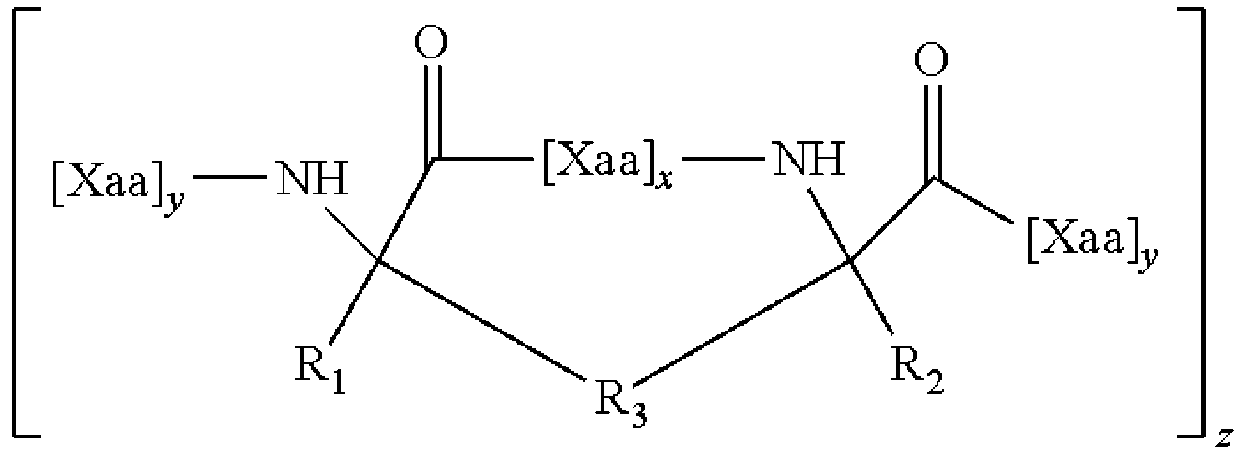
各R1およびR2は、独立して、HまたはC1~C10アルキル、アルケニル、アルキニル、アリールアルキル、シクロアルキルアルキル、ヘテロアリールアルキル、もしくはヘテロシクリルアルキルであり;
R3は、アルキル、アルケニル、アルキニル;[R4-K-R4]nであり;これらはそれぞれ0~6個のR5で置換されており;
R4は、アルキル、アルケニル、またはアルキニルであり;
R5は、ハロ、アルキル、OR6、N(R6)2、SR6、SOR6、SO2R6、CO2R6、R6、蛍光部分、または放射性同位体であり;
Kは、O、S、SO、SO2、CO、CO2、CONR6であるか、または

R6は、H、アルキル、または治療剤であり;
nは1~4の整数であり;
xは2~10の整数であり;
各yは、独立して、0~100の整数であり;
zは、1~10(例えば、1、2、3、4、5、6、7、8、9、10)の整数であり;各Xaaは、独立してアミノ酸である)を有する。
In one aspect, the stabilizing polypeptide is of formula (I)
each R 1 and R 2 is independently H or C 1 -C 10 alkyl, alkenyl, alkynyl, arylalkyl, cycloalkylalkyl, heteroarylalkyl, or heterocyclylalkyl;
R 3 is alkyl, alkenyl, alkynyl; [R 4 -KR 4 ] n ; each of which is substituted with 0-6 R 5 ;
R 4 is alkyl, alkenyl, or alkynyl;
R5 is halo, alkyl, OR6 , N( R6 ) 2 , SR6 , SOR6 , SO2R6 , CO2R6 , R6 , a fluorescent moiety, or a radioisotope;
K is O, S, SO, SO2 , CO, CO2 , CONR 6 , or
R 6 is H, alkyl, or therapeutic;
n is an integer from 1 to 4;
x is an integer from 2 to 10;
each y is independently an integer from 0 to 100;
z is an integer from 1 to 10 (eg, 1, 2, 3, 4, 5, 6, 7, 8, 9, 10); each Xaa is independently an amino acid.
テザーは、アルキル、アルケニル、またはアルキニル部分(例えば、C5、C8、もしくはC11アルキル、C5、C8、もしくはC11アルケニル、またはC5、C8、もしくはC11アルキニル)を含んでいてもよい。テザーされたアミノ酸は、アルファ二置換(例えば、C1~C3またはメチル)とすることができる。 The tether includes an alkyl, alkenyl, or alkynyl moiety (e.g., C5 , C8 , or C11 alkyl, C5 , C8 , or C11 alkenyl, or C5 , C8 , or C11 alkynyl). You can The tethered amino acids can be alpha disubstituted (eg, C 1 -C 3 or methyl).
一部の場合では、xは2、3、または6である。一部の場合では、各yは、独立して、1から15または3から15の整数である。一部の場合では、R1およびR2は、それぞれ独立して、HまたはC1~C6アルキルである。一部の場合では、R1およびR2は、それぞれ独立して、C1~C3アルキルである。一部の場合では、R1およびR2のうちの少なくとも1つはメチルである。例えば、R1およびR2は、両方ともメチルとすることができる。一部の場合では、R3はアルキル(例えば、C8アルキル)であり、xは3である。一部の場合では、R3はC11アルキルであり、xは6である。一部の場合では、R3はアルケニル(例えば、C8アルケニル)であり、xは3である。一部の場合では、xは6であり、R3はC11アルケニルである。一部の場合では、R3は、直鎖状アルキル、アルケニル、またはアルキニルである。一部の場合では、R3は-CH2-CH2-CH2-CH=CH-CH2-CH2-CH2-である。 In some cases, x is 2, 3, or 6. In some cases, each y is independently an integer from 1-15 or 3-15. In some cases, R 1 and R 2 are each independently H or C 1 -C 6 alkyl. In some cases, R 1 and R 2 are each independently C 1 -C 3 alkyl. In some cases, at least one of R 1 and R 2 is methyl. For example, R 1 and R 2 can both be methyl. In some cases, R3 is alkyl (eg, C8 alkyl) and x is 3. In some cases, R 3 is C 11 alkyl and x is 6. In some cases, R 3 is alkenyl (eg, C 8 alkenyl) and x is 3. In some cases, x is 6 and R 3 is C 11 alkenyl. In some cases, R 3 is linear alkyl, alkenyl, or alkynyl. In some cases, R 3 is -CH 2 -CH 2 -CH 2 -CH=CH-CH 2 -CH 2 -CH 2 -.
別の態様では、2個のアルファ、アルファ二置換立体中心は、両方ともR立体配置もしくはS立体配置(例えば、i、i+4個目の架橋)であるか、または一方の立体中心はRであり、もう一方はS(例えば、i、i+7個目の架橋)である。したがって、式I

一部の場合では、R3は、[R4-K-R4]nであり;R4は、直鎖状アルキル、アルケニル、またはアルキニルである。 In some cases, R 3 is [R 4 —K—R 4 ] n ; R 4 is linear alkyl, alkenyl, or alkynyl.
一部の実施形態では、本開示は、2個、3個、または6個のアミノ酸で隔てられた2個のアミノ酸の側鎖が内部ステープルで置き換えられた;3個のアミノ酸の側鎖が内部ステッチで置き換えられた;4個のアミノ酸の側鎖が2個の内部ステープルで置き換えられた、または5個のアミノ酸の側鎖が、内部ステープルおよび内部ステッチの組合せで置き換えられた、内部架橋された(「ステープル化された」または「ステッチ化された」)ペプチドを特徴とする。ステープル化された/ステッチ化されたペプチドは、5、6、7、8、9、10、11、12、13、14、15、16、17、18、19、20、21、22、23、24、25、26、27、28、29、30、31、32、33、34、35、36、37、38、39、40、41、42、43、44、45、46、47、48、49、または50個のアミノ酸長とすることができる。 In some embodiments, the present disclosure provides that the side chains of 2 amino acids separated by 2, 3, or 6 amino acids have been replaced with internal staples; stitches; 4 amino acid side chains replaced by 2 internal staples, or 5 amino acid side chains replaced by a combination of internal staples and internal stitches, internally crosslinked (“stapled” or “stitched”) peptides are characterized. The stapled/stitched peptides are 5, 6, 7, 8, 9, 10, 11, 12, 13, 14, 15, 16, 17, 18, 19, 20, 21, 22, 23, 24, 25, 26, 27, 28, 29, 30, 31, 32, 33, 34, 35, 36, 37, 38, 39, 40, 41, 42, 43, 44, 45, 46, 47, 48, It can be 49, or 50 amino acids long.
ある特定の場合では、安定化ペプチドは、細胞内タンパク質のペプチドである。ある特定の場合では、安定化ペプチドは、疾患の原因となるか、または疾患に関連するタンパク質のペプチドである。ある特定の場合では、安定化ペプチドは、細菌性タンパク質のペプチドである。ある特定の場合では、安定化ペプチドは、ヒトタンパク質のペプチドである。ある特定の場合では、安定化ペプチドは、発がんタンパク質のペプチドである。発がんタンパク質の非限定的な例としては、BCL2、BCLXL、MCL-1、BFL-1、BCL-w、BCL-B、EZH2、HDM2/HDMX、KRAS/NRAS/HRAS、MYC、β-カテニン、PI3K、PTEN、TSC、AKT、BRCA1/2、EWS-FLI融合物、MLL融合物、受容体チロシンキナーゼ、HOXホモログ、JUN、サイクリンD、サイクリンE、BRAF、CRAF、CDK4、CDK2、HPV-E6/E7、オーロラキナーゼ、MITF、Wnt1、PD-1、BCR、およびCCR5がある。 In certain cases, stabilizing peptides are peptides of intracellular proteins. In certain cases, the stabilizing peptide is a peptide of a disease-causing or disease-associated protein. In certain cases, stabilizing peptides are peptides of bacterial proteins. In certain cases, stabilizing peptides are peptides of human proteins. In certain cases, stabilizing peptides are peptides of oncogenic proteins. Non-limiting examples of oncoproteins include BCL2, BCLX L , MCL-1, BFL-1, BCL-w, BCL-B, EZH2, HDM2/HDMX, KRAS/NRAS/HRAS, MYC, β-catenin, PI3K, PTEN, TSC, AKT, BRCA1/2, EWS-FLI fusion, MLL fusion, receptor tyrosine kinase, HOX homolog, JUN, cyclin D, cyclin E, BRAF, CRAF, CDK4, CDK2, HPV-E6/ There are E7, Aurora kinase, MITF, Wnt1, PD-1, BCR, and CCR5.
ステープルペプチドの非限定的な例を以下に挙げる:
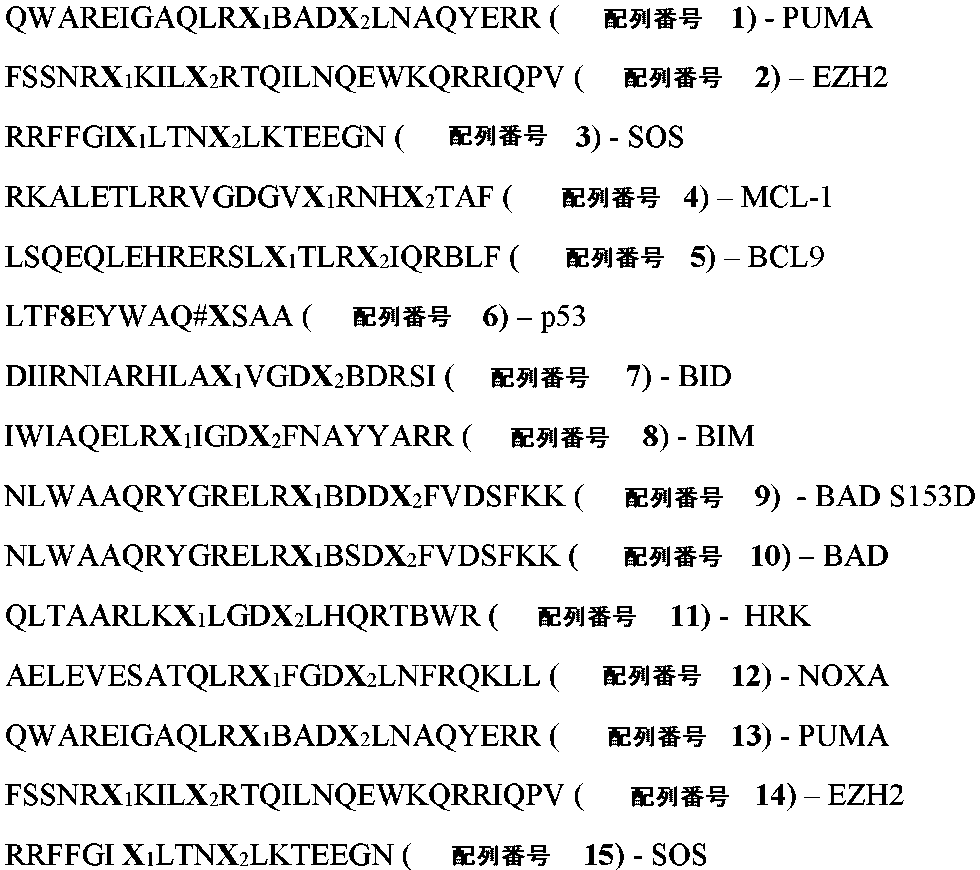

ある特定の実施形態では、ステープルポリペプチドは、配列番号1から24および134のうちのいずれか1つに記載のアミノ酸配列を含むかまたはこれらからなる。ある特定の実施形態では、本開示は、ステープル/ステッチの位置が異なる点で、上記で開示されるペプチドとは異なる安定化ペプチドを特徴とする。ある特定の実施形態では、本開示は、これらのペプチドのアルファ-ヘリックスの非相互作用面上に1から7(例えば、1、2、3、4、5、6、7)個のアミノ酸置換を有する上記で開示した配列とは異なる点で、上記で開示されるペプチドとは異なる安定化ペプチドを特徴とする。ある特定の場合では、置換は保守的である。他の場合では、置換は非保守的である。ある特定の実施形態では、本開示は、これらのペプチドのアルファ-ヘリックスの相互作用面上に1から5(例えば、1、2、3、4、5)個のアミノ酸置換を有する上記で開示した配列とは異なる点で、上記で開示されるペプチドとは異なる安定化ペプチドを特徴とする。ある特定の場合では、置換は保守的である。ステープルペプチドに対する例示的な変形/改変のタイプを図29に示す。 In certain embodiments, the staple polypeptide comprises or consists of the amino acid sequence set forth in any one of SEQ ID NOs: 1-24 and 134. In certain embodiments, the present disclosure features stabilizing peptides that differ from the peptides disclosed above in that the staple/stitch locations are different. In certain embodiments, the present disclosure makes 1 to 7 (eg, 1, 2, 3, 4, 5, 6, 7) amino acid substitutions on the non-interacting face of the alpha-helix of these peptides. Stabilizing peptides that differ from the above-disclosed peptides in that they differ from the above-disclosed sequences having In certain cases the replacement is conservative. In other cases the replacement is non-conservative. In certain embodiments, the present disclosure has 1 to 5 (eg, 1, 2, 3, 4, 5) amino acid substitutions on the interacting face of the alpha-helix of these peptides disclosed above. Stabilizing peptides are characterized that differ from the peptides disclosed above in that they differ in sequence. In certain cases the replacement is conservative. Exemplary variations/modification types for staple peptides are shown in FIG.
ある特定の実施形態では、ステープルペプチドは、Bcl-2ホモロジー3(BH3)ドメインポリペプチドではない(例えば、MCL-1由来のBH3ドメインでもなく、BCL2ドメインのMCL-1安定化アルファヘリックス(SAHB)でもなく、MCL-1SAHBDでもない)。 In certain embodiments, the staple peptide is not a Bcl-2 homology 3 (BH3) domain polypeptide (e.g., neither is the BH3 domain derived from MCL-1 nor is the MCL-1 stabilized alpha helix (SAHB) of the BCL2 domain neither MCL-1SAHB D ).
ある特定の実施形態では、安定化ペプチド(例えば、ステープルペプチド)は、分解誘導タンパク質、例えばユビキチンE3リガーゼMDM2に直接的に結合し、それを動員させる。例えば、E3リガーゼMDM2は、当技術分野において公知のステープルp53ペプチドによって強力に結合することができ、その内容全体は参照により本明細書に組み込まれる。ある特定の場合では、ペプチドデグロンは、分解誘導タンパク質、例えばMDMXとユビキチンE3リガーゼMDM2との間の複合体を含む複合体に直接的に結合し、それを動員させる安定化またはステープルペプチドである。本例では、ステープルp53ペプチドはMDMXに強力に結合し、MDMX/MDM2複合体を動員することができ、MDM2が分解誘導タンパク質を動員できるようになる。 In certain embodiments, stabilizing peptides (eg, staple peptides) directly bind to and recruit degradation-inducing proteins, such as the ubiquitin E3 ligase MDM2. For example, the E3 ligase MDM2 can be strongly bound by staple p53 peptides known in the art, the entire contents of which are incorporated herein by reference. In certain cases, peptide degrons are stabilizing or stapling peptides that directly bind to and recruit complexes, including those between degradation-inducing proteins such as MDMX and the ubiquitin E3 ligase MDM2. . In this example, the staple p53 peptide binds strongly to MDMX and is able to recruit the MDMX/MDM2 complex, allowing MDM2 to recruit degradation-inducing proteins.
ある特定の実施形態では、安定化ペプチドは、分解誘導タンパク質、例えば、E3ユビキチンリガーゼまたはE3ユビキチンリガーゼに対する基質アダプターに直接的にまたは間接的に結合する。ある特定の実施形態では、安定化ペプチドは、E3ユビキチンリガーゼに直接的にまたは間接的に結合する。一部の実施形態では、安定化ペプチドは、E3リガーゼ(例えば、MDM2)またはE3リガーゼと複合体を形成するタンパク質、例えばMDM2に結合するMDMXに、直接的にまたは間接的に結合する。ある特定の実施形態では、E3ユビキチンリガーゼは、RING E3ユビキチンリガーゼ(例えば、Mdm2-MdmX、TRIM5α、c-CBL、cIAP、RNF4、BIRC7、IDOL、BRCA1-BARD1、RING1B-Bmi1、E4B、CHIP、Prp19)である。ある特定の実施形態では、E3ユビキチンリガーゼは、HECT E3ユビキチンリガーゼ(例えば、Smurf1、Smurf2、Itch、E6AP)である。ある特定の実施形態では、E3ユビキチンリガーゼは、RBR E3ユビキチンリガーゼ(例えば、Parkin、Parc、RNF144(A/B)、HOIP、HHARI)である。例えば、E3ユビキチンリガーゼの非限定的な例に関しては、Morreale and Walden, Cell 165, 2016 DOI http:/dx.doi.org/10.1016/j.cell.2016.03.003を参照されたい。 In certain embodiments, stabilizing peptides bind directly or indirectly to degradation-inducing proteins, eg, E3 ubiquitin ligases or substrate adapters for E3 ubiquitin ligases. In certain embodiments, a stabilizing peptide directly or indirectly binds to an E3 ubiquitin ligase. In some embodiments, the stabilizing peptide binds directly or indirectly to an E3 ligase (eg, MDM2) or a protein that forms a complex with an E3 ligase, such as MDMX that binds MDM2. In certain embodiments, the E3 ubiquitin ligase is a RING E3 ubiquitin ligase (e.g., Mdm2-MdmX, TRIM5α, c-CBL, cIAP, RNF4, BIRC7, IDOL, BRCA1-BARD1, RING1B-Bmi1, E4B, CHIP, Prp19 ). In certain embodiments, the E3 ubiquitin ligase is a HECT E3 ubiquitin ligase (eg, Smurf1, Smurf2, Itch, E6AP). In certain embodiments, the E3 ubiquitin ligase is an RBR E3 ubiquitin ligase (eg, Parkin, Parc, RNF144(A/B), HOIP, HHARI). For example, see Morreale and Walden, Cell 165, 2016 DOI http:/dx.doi.org/10.1016/j.cell.2016.03.003 for non-limiting examples of E3 ubiquitin ligases.
本明細書において記載するキメラ融合物において用いることができる他の安定化ペプチドの非限定的な例は、米国特許第9,834,581号;同第9,822,165号;同第9,695,224号;同第9,617,309号;同第9,579,395号;同第9,556,229号;同第9,556,227号;同第9,527,896号;同第9,522,947号;同第9,517,252号;同第9,505,816号;同第9,505,804号;同第9,505,801号;同第9,493,510号;同第9,464,125号;同第9,485,202号;同第9,458,189号;同第9,416,162号;同第9,408,885号;同第9,346,868号;同第9,296,805号;同第9,227,995号;同第9,175,047号;同第9,175,045号;同第9,163,330号;同第9,096,684号;同第9,079,970号;同第8,957,026号;同第8,937,154号;同第8,933,109号;同第8,927,500号;同第8,889,632号;同第8,592,377号;同第8,586,707号;同第8,324,153号;および米国特許出願公開第20170247423号;同第20170240604号;同第20170212125号;同第20170165320号;同第20170066747号;同第20170015716号;同第20160376336号;および同第20160244494号において提供され、これら全ての内容はその全体が参照により本明細書(特に安定化(例えば、ステープルまたはステッチ)ペプチドの開示)に組み込まれる。 Non-limiting examples of other stabilizing peptides that can be used in the chimeric fusions described herein are US Pat. Nos. 9,834,581; 9,822,165; 695,224; 9,617,309; 9,579,395; 9,556,229; 9,556,227; 9,527,896; 9,522,947; 9,517,252; 9,505,816; 9,505,804; 9,505,801; 9,464,125; 9,485,202; 9,458,189; 9,416,162; 9,408,885; 9,346,868; 9,296,805; 9,227,995; 9,175,047; 9,175,045; 330; 9,096,684; 9,079,970; 8,957,026; 8,937,154; 8,933,109; 8,927,500; 8,889,632; 8,592,377; 8,586,707; 8,324,153; 20170240604; 20170212125; 20170165320; 20170066747; 20170015716; 20160376336; is incorporated herein (particularly the disclosure of stabilizing (eg, staple or stitch) peptides) by.
炭化水素テザーは一般的であるが、他のテザーも本明細書において記載する安定化ペプチドにおいて用いることができる。例えば、テザーは、1個または複数のエーテル、チオエーテル、エステル、アミン、またはアミド、またはトリアゾール部分を含んでいてもよい。一部の場合では、天然に存在するアミノ酸側鎖を、テザー中に組み込むことができる。例えば、テザーは、官能基、例えばセリン中のヒドロキシル、システイン中のチオール、リシン中の第1級アミン、アスパラギン酸もしくはグルタミン酸中の酸、またはアスパラギンもしくはグルタミン中のアミドとカップリングすることができる。したがって、2個の天然に存在しないアミノ酸をカップリングすることによって作製されるテザーを使用するのではなく、天然に存在するアミノ酸を使用してテザーを生成することが可能である。天然に存在するアミノ酸とともに単一の天然に存在しないアミノ酸を使用することも可能である。トリアゾール含有(例えば、1,4トリアゾールまたは1,5トリアゾール)架橋を使用することができる(例えば、Kawamoto et al. 2012 Journal of Medicinal Chemistry 55:1137;WO2010/060112を参照のこと)。更に、異なるタイプのステープル化を行う他の方法は当技術分野において周知であり、それを用いることができる(例えば、ラクタムステープル化:Shepherd et al., J. Am. Chem. Soc., 127:2974-2983 (2005);UV付加環化ステープル化:Madden et al., Bioorg. Med. Chem. Lett., 21:1472-1475 (2011);ジスルフィドステープル化:Jackson et al., Am. Chem. Soc.,113:9391-9392 (1991);オキシムステープル化:Haney et al., Chem. Commun., 47:10915-10917 (2011);チオエーテルステープル化:Brunel and Dawson, Chem. Commun., 552-2554 (2005);光スイッチ(Photoswitchable)ステープル化:J. R. Kumita et al., Proc. Natl. Acad. Sci. U. S. A., 97:3803-3808 (2000);ダブルクリックステープル化:Lau et al., Chem. Sci., 5:1804-1809 (2014);ビス-ラクタムステープル化:J. C. Phelan et al.,, J. Am. Chem. Soc., 119:455-460 (1997);およびビス-アリール化ステープル化:A. M. Spokoyny et al., J. Am. Chem. Soc., 135:5946-5949 (2013)を参照のこと)。 Hydrocarbon tethers are common, but other tethers can also be used in the stabilizing peptides described herein. For example, the tether may contain one or more ether, thioether, ester, amine, or amide, or triazole moieties. In some cases, naturally occurring amino acid side chains can be incorporated into the tether. For example, a tether can be coupled to a functional group such as hydroxyl in serine, thiol in cysteine, primary amine in lysine, acid in aspartic or glutamic acid, or amide in asparagine or glutamine. Thus, rather than using a tether made by coupling two non-naturally occurring amino acids, it is possible to create a tether using naturally occurring amino acids. It is also possible to use a single non-naturally occurring amino acid along with the naturally occurring amino acids. Triazole-containing (eg, 1,4-triazole or 1,5-triazole) bridges can be used (see, eg, Kawamoto et al. 2012 Journal of Medicinal Chemistry 55:1137; WO2010/060112). Furthermore, other methods of performing different types of stapling are well known in the art and can be used (e.g. lactam stapling: Shepherd et al., J. Am. Chem. Soc., 127: 2974-2983 (2005); UV cycloaddition stapling: Madden et al., Bioorg. Med. Chem. Lett., 21:1472-1475 (2011); disulfide stapling: Jackson et al., Am. Chem. Soc., 113:9391-9392 (1991); oxime stapling: Haney et al., Chem. Commun., 47:10915-10917 (2011); thioether stapling: Brunel and Dawson, Chem. Commun., 552- 2554 (2005); Photoswitchable stapling: J. R. Kumita et al., Proc. Natl. Acad. Sci. Sci., 5:1804-1809 (2014); bis-lactam stapling: J. C. Phelan et al., J. Am. Chem. Soc., 119:455-460 (1997); and bis-arylated stapling. : A. M. Spokoyny et al., J. Am. Chem. Soc., 135:5946-5949 (2013)).
テザーの長さが変わる場合がある点が更に想定される。例えば、二次性アルファ-ヘリックス構造に対して比較的高度の拘束を与えることが望ましい場合、長さが短いテザーを使用することができるが、一部の場合では、二次性アルファ-ヘリックス構造に対して拘束は低いことが望ましく、したがって長いテザーが望まれる場合がある。 It is further envisioned that the length of the tether may vary. For example, if it is desired to provide a relatively high degree of constraint on the secondary alpha-helical structure, a shorter length tether can be used, although in some cases the secondary alpha-helical structure A low constraint on the is desired, so a long tether may be desired.
さらに、主にアルファヘリックスの片面上にあるテザーを与えるために、アミノ酸iからi+3個目、iからi+4個目、およびiからi+7個目までのテザー全長は共通であるが、テザーは、アミノ酸の数の任意の組合せに及ぶように合成することができ、複数のテザーを導入するように組み合わせて使用することもできる。 Furthermore, while the tether lengths from amino acids i to i+3, i to i+4, and i to i+7 are common to give a tether that is predominantly on one side of the alpha helix, the tether is composed of amino acids can be synthesized to span any combination of numbers and can also be used in combination to introduce multiple tethers.
一部の場合では、本明細書において記載する炭化水素テザー(すなわち、架橋)は、更に操作することができる。一例では、(例えば、ルテニウム触媒による閉環メタセシス(RCM)を使用して合成されるような)炭化水素アルケニルテザーの二重結合を酸化し、(例えば、エポキシ化、アミノヒドロキシル化またはジヒドロキシル化を介して)、以下の化合物のうちの1つを提供することができる。
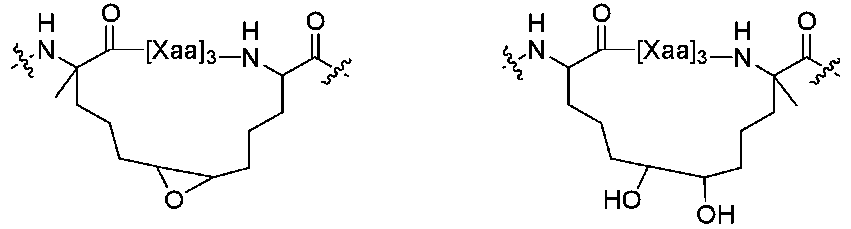
エポキシド部分か、または遊離ヒドロキシル部分のうちの1つのいずれかは、さらに官能基化することができる。例えば、エポキシドは、例えば、治療剤に結合するために使用することができる追加の官能性を与える求核試薬で処置することができる。あるいはそのような誘導体化は、ポリペプチドのアミノまたはカルボキシ末端の合成操作によってまたはアミノ酸側鎖を介して達成することができる。他の薬剤、例えばポリペプチドが細胞中に侵入するのを促進する薬剤を、官能基化テザーに結合させることができる。 Either the epoxide moiety or one of the free hydroxyl moieties can be further functionalized. For example, epoxides can be treated with nucleophiles that impart additional functionality that can be used, for example, to attach therapeutic agents. Alternatively, such derivatization can be accomplished by synthetic manipulation of the amino or carboxy terminus of the polypeptide or via amino acid side chains. Other agents can be attached to the functionalized tether, such as agents that facilitate entry of the polypeptide into cells.
一部の場合では、アルファ二置換アミノ酸は、アルファヘリックス二次構造の安定性を改善するためにポリペプチドにおいて使用する。しかし、アルファ二置換アミノ酸は必須ではなく、(例えば、テザーされたアミノ酸において)モノ-アルファ置換基を使用した場合も想定される。 In some cases, alpha-disubstituted amino acids are used in polypeptides to improve the stability of alpha-helical secondary structures. However, alpha disubstituted amino acids are not required, and the use of mono-alpha substituents (eg, in tethered amino acids) is also envisioned.
ステープルポリペプチドは、薬物、毒素、ポリエチレングリコール誘導体;第2のポリペプチド;炭水化物などを含んでいてもよい。ポリマーまたは他の薬剤がステープルポリペプチドに連結している場合、組成物は実質的に均質であることが望ましい場合がある。 Staple polypeptides may include drugs, toxins, polyethylene glycol derivatives; second polypeptides; carbohydrates, and the like. If a polymer or other agent is attached to the staple polypeptide, it may be desirable that the composition be substantially homogeneous.
ポリエチレングリコール(PEG)分子が付加すると、ポリペプチドの薬物動態および薬力学特性が改善される場合がある。例えば、PEG化を行うと、腎クリアランスを低下させることができ、より安定な血漿濃度をもたらす場合がある。PEGは水溶性ポリマーであり、
式:XO--(CH2CH2O)n--CH2CH2-Y
(式中、nは2から10,000であり、Xは、Hまたは末端改変、例えばC1~4アルキルであり;Yは、ポリペプチドのアミン基(これらに限定されないが、リシンのイプシロンアミン、またはN末端を含む)への、アミド、カルバメートまたは尿素連結である)としてポリペプチドへ連結しているとして表すことができる。Yはまた、チオール基(これらに限定されないがシステインのチオール基を含む)へのマレイミド連結であってもよい。PEGをポリペプチドに直接的にまたは間接的に連結するための他の方法は、当業者であれば公知である。PEGは、直鎖状または分岐状とすることができる。さまざまな官能基化誘導体を含むPEGのさまざまな形態が市販されている。
Addition of polyethylene glycol (PEG) molecules may improve the pharmacokinetic and pharmacodynamic properties of polypeptides. For example, PEGylation can reduce renal clearance and may result in more stable plasma concentrations. PEG is a water-soluble polymer,
Formula: XO-- ( CH2CH2O ) n -- CH2CH2 - Y
(wherein n is 2 to 10,000, X is H or a terminal modification such as C 1-4 alkyl; Y is an amine group of the polypeptide, including but not limited to the epsilon amine of lysine , or including the N-terminus), which is an amide, carbamate or urea linkage). Y may also be a maleimide linkage to a thiol group, including but not limited to the thiol group of cysteine. Other methods for directly or indirectly linking PEG to polypeptides are known to those of skill in the art. PEG can be linear or branched. Various forms of PEG are commercially available, including various functionalized derivatives.
分解可能な連結を骨格において有するPEGを使用することができる。例えば、PEGは、加水分解するための対象であるエステル連結を用いて調製することができる。分解可能なPEG連結を有するコンジュゲートは、WO99/34833、WO99/14259、およびU.S.6,348,558に記載されている。 PEG with degradable linkages in the backbone can be used. For example, PEG can be prepared with an ester linkage that is subject to hydrolysis. Conjugates with cleavable PEG linkages are described in WO99/34833, WO99/14259, and U.S. Pat. S. 6,348,558.
ある特定の実施形態では、高分子ポリマー(例えば、PEG)は、中間体リンカーを介して本明細書において記載する薬剤に結合している。ある特定の実施形態では、リンカーは、ペプチド結合によって連結された1から20個のアミノ酸で構成されており(made up of)、アミノ酸は、20種類の天然に存在するアミノ酸から選択される。これらのアミノ酸のうちの一部は、当業者であれば十分に理解しているようにグリコシル化されていてもよい。他の実施形態では、1から20個のアミノ酸は、グリシン、アラニン、プロリン、アスパラギン、グルタミン、およびリシンから選択される。他の実施形態では、リンカーは、グリシンおよびアラニンなどの立体障害のない大部分のアミノ酸で構成されている。非ペプチドリンカーも可能である。例えば、アルキルリンカー、例えば-NH(CH2)nC(O)-(式中、n=2~20)を使用することができる。これらのアルキルリンカーは、任意の立体障害のない基、例えば低級アルキル(例えば、C1~C6)低級アシル、ハロゲン(例えば、Cl、Br)、CN、NH2、フェニル等でさらに置換されていてもよい。米国特許第5,446,090号では、二官能性PEGリンカー、および各PEGリンカー末端でペプチドを有するコンジュゲートの形成におけるその使用が記載されている。 In certain embodiments, a macromolecular polymer (eg, PEG) is attached to an agent described herein via an intermediate linker. In certain embodiments, the linker is made up of 1 to 20 amino acids linked by peptide bonds, the amino acids being selected from the 20 naturally occurring amino acids. Some of these amino acids may be glycosylated as well understood by those of skill in the art. In other embodiments, the 1-20 amino acids are selected from glycine, alanine, proline, asparagine, glutamine, and lysine. In other embodiments, the linker is composed of mostly unhindered amino acids such as glycine and alanine. Non-peptide linkers are also possible. For example, an alkyl linker such as -NH(CH 2 ) n C(O)-, where n=2-20 can be used. These alkyl linkers are further substituted with any sterically unhindered group such as lower alkyl (eg C 1 -C 6 ) lower acyl, halogen (eg Cl, Br), CN, NH 2 , phenyl, etc. may US Pat. No. 5,446,090 describes bifunctional PEG linkers and their use in forming conjugates with peptides at each PEG linker terminus.
一部の実施形態では、安定化ペプチドも、例えば、細胞取込みをさらに促進するために、またはin vivo安定性を増加させるために改変してもよい。例えば、ペプチド模倣大員環をアシル化またはPEG化すると、細胞取込みが促進され、バイオアベイラビリティが増加し、血液循環が増加し、薬物動態が変化し、免疫原性が減少しおよび/または必要とされる投与頻度が減少する。 In some embodiments, stabilizing peptides may also be modified, for example, to further facilitate cellular uptake or to increase in vivo stability. For example, acylation or pegylation of peptidomimetic macrocycles facilitates cellular uptake, increases bioavailability, increases blood circulation, alters pharmacokinetics, reduces immunogenicity and/or reduces immunogenicity. less frequent dosing.
一部の実施形態では、本明細書において開示されるステープルペプチドは、(例えば、非ステープルペプチドと比較して)細胞膜を貫通するための強化された能力を有する。 In some embodiments, stapled peptides disclosed herein have an enhanced ability to penetrate cell membranes (eg, compared to non-stapled peptides).
本明細書において記載する安定化ペプチドを合成する方法は当技術分野において公知である。それにもかかわらず、以下の例示的な方法を使用する場合がある。さまざまなステップを、代替の配列または順序で行い、所望の化合物を得てもよいことは理解されるであろう。本明細書において記載する化合物の合成において有用である合成化学的変換および官能基を保護する方法論(保護および脱保護)は、当技術分野において公知であり、例えば、R. Larock, Comprehensive Organic Transformations, VCH Publishers (1989);T.W. Greene and P.G.M. Wuts, Protective Groups in Organic Synthesis, 3d. Ed., John Wiley and Sons (1999);L. Fieser and M. Fieser, Fieser and Fieser's Reagents for Organic Synthesis, John Wiley and Sons (1994);およびL. Paquette, ed., Encyclopedia of Reagents for Organic Synthesis, John Wiley and Sons (1995)、ならびにこれらのその後の版に記載されているものを含む。 Methods for synthesizing the stabilizing peptides described herein are known in the art. Nevertheless, the following exemplary method may be used. It will be appreciated that the various steps may be performed in an alternate sequence or order to give the desired compounds. Synthetic chemical transformations and methodologies for protecting functional groups (protection and deprotection) that are useful in the synthesis of the compounds described herein are known in the art, see, for example, R. Larock, Comprehensive Organic Transformations, VCH Publishers (1989); T.W. Greene and P.G.M. Wuts, Protective Groups in Organic Synthesis, 3d. Ed., John Wiley and Sons (1999); L. Fieser and M. Fieser, Fieser and Fieser's Reagents for Organic Synthesis, John Wiley and Sons (1994); and L. Paquette, ed., Encyclopedia of Reagents for Organic Synthesis, John Wiley and Sons (1995), and later editions thereof.
安定化ペプチドは、当業者であれば周知の化学的合成方法によって作製することができる。例えば、Fields et al., Chapter 3 in Synthetic Peptides: A User's Guide, ed. Grant, W. H. Freeman & Co., New York, N.Y., 1992, p. 77を参照されたい。したがって、ペプチドは、例えばApplied Biosystems Peptide Synthesizer Model 430Aまたは431において、側鎖が保護されたアミノ酸を使用してt-BocまたはFmoc化学作用で保護されたα-NH2を用いた固相合成の自動化Merrifield技術を使用して合成することができる。
Stabilizing peptides can be made by chemical synthesis methods well known to those skilled in the art. See, for example, Fields et al.,
本明細書において記載するペプチドを作製する一様式は、固相ペプチド合成(SPPS)を使用することである。C末端アミノ酸は、リンカー分子を用い、酸に不安定な結合を介して架橋ポリスチレン樹脂に結合させる。この樹脂は、合成のために使用する溶媒に不溶性であり、過剰な試薬および副生成物を洗い流すのを比較的単純にかつ迅速にする。N末端は、酸において安定なFmoc基で保護されるが、塩基によって取り外し可能である。任意の側鎖官能基は、塩基で安定であり、酸に不安定な基で保護される。 One mode of making the peptides described herein is to use solid phase peptide synthesis (SPPS). The C-terminal amino acid is attached to the crosslinked polystyrene resin via an acid labile bond using a linker molecule. This resin is insoluble in the solvents used for synthesis, making it relatively simple and rapid to wash away excess reagents and by-products. The N-terminus is protected with an acid-stable Fmoc group, but is base-removable. Any side-chain functional groups are protected with base-stable and acid-labile groups.
長いペプチドは、ネイティブケミカルライゲーションを使用して個々の合成ペプチドを連接させることによって作製してもよい。あるいは、長い合成ペプチドは、周知の組換えDNA技術によって合成することができる。そのような技術は、詳細なプロトコール含む周知の標準的なマニュアルとして提供される。本発明のペプチドをコードする遺伝子を構築するために、アミノ酸配列を逆翻訳し、好ましくは遺伝子が発現される生物に最適なコドンを有するアミノ酸配列をコードする核酸配列を得る。次に、合成遺伝子を、典型的には必要に応じてペプチドおよび任意の調節性エレメントをコードするオリゴヌクレオチドを合成することによって作製する。合成遺伝子を、好適なクローニングベクターに挿入し、宿主細胞中にトランスフェクトする。次いで、ペプチドを、選択された発現系および宿主に適切な好適な状態下で発現させる。ペプチドは精製し、標準的な方法によって特徴付ける。 Longer peptides may be made by joining individual synthetic peptides using native chemical ligation. Alternatively, long synthetic peptides can be synthesized by well-known recombinant DNA techniques. Such techniques are provided as well-known standard manuals containing detailed protocols. To construct a gene encoding a peptide of the invention, the amino acid sequence is back-translated to obtain a nucleic acid sequence that preferably encodes an amino acid sequence with codons that are optimal for the organism in which the gene is to be expressed. A synthetic gene is then made, typically by synthesizing oligonucleotides encoding the peptide and any regulatory elements as required. The synthetic gene is inserted into a suitable cloning vector and transfected into host cells. The peptide is then expressed under suitable conditions appropriate to the chosen expression system and host. Peptides are purified and characterized by standard methods.
ペプチドは、例えば、Advanced Chemtechから入手可能なハイスループットマルチチャンネルコンビナトリアルシンセサイザーを使用したハイスループット組合せ様式で作製することができる。ペプチド結合は、例えば、ペプチドの生理学的安定性を高めるために、レトロインベルソ結合(C(O)-NH);還元アミド結合(NH-CH2);チオメチレン結合(S-CH2またはCH2-S);オキソメチレン結合(O-CH2またはCH2-O);エチレン結合(CH2-CH2);チオアミド結合(C(S)-NH);トランス-オレフィン結合(CH=CH);フルオロ置換トランス-オレフィン結合(CF=CH);ケトメチレン結合(C(O)-CHR)またはCHR-C(O)(式中、RはHまたはCH3である);およびフルオロケトメチレン結合(C(O)-CFRまたはCFR-C(O)(式中、RはHまたはFまたはCH3である)で置き換えることができる。 Peptides can be produced in a high-throughput combinatorial fashion using, for example, a high-throughput multi-channel combinatorial synthesizer available from Advanced Chemtech. Peptide bonds include, for example, retro-inverso bonds (C(O)-NH); reduced amide bonds (NH-CH 2 ); thiomethylene bonds (S-CH 2 or CH 2 —S); oxomethylene bond (O—CH 2 or CH 2 —O); ethylene bond (CH 2 —CH 2 ); thioamide bond (C(S)—NH); trans-olefin bond (CH═CH); fluoro-substituted trans-olefin linkages (CF=CH); ketomethylene linkages (C(O)-CHR) or CHR-C(O), where R is H or CH ; and fluoroketomethylene linkages (C (O)-CFR or CFR-C(O), where R is H or F or CH3 .
ポリペプチドは、アセチル化、アミド化、ビオチン化、シンナモイル化、ファルネシル化、フルオレセイン化、ホルミル化、ミリストイル化、パルミトイル化、リン酸化(Ser、TyrまたはThr)、ステアロイル化、スクシニル化およびスルフリル化によってさらに改変することができる。上記で示すように、ペプチドは、例えば、ポリエチレングリコール(PEG);アルキル基(例えば、C1~C20直鎖状または分岐状アルキル基);脂肪酸ラジカル;およびこれらの組合せにコンジュゲートすることができる。さまざまな長さのオレフィン側鎖を含むα、α-二置換非天然アミノ酸は、公知の方法で合成することができる(Williams et al. J. Am. Chem. Soc., 113:9276, 1991;Schafmeister et al., J. Am. Chem Soc., 122:5891, 2000;およびBird et al., Methods Enzymol., 446:369, 2008;Bird et al, Current Protocols in Chemical Biology, 2011)。ペプチドに関しては、i+7個目のステープルに連結したi個目を使用する(ヘリックス2回転が安定化される)場合、a)1個のS5アミノ酸および1個のR8を使用するか、またはb)1個のS8アミノ酸および1個のR5アミノ酸を使用する。R8は、出発キラル助剤がR-アルキル-立体異性体をもたらすことを除いて、同様の経路を使用して合成する。また、8-ヨードオクテンを5-ヨードペンテンの代わりに使用する。阻害剤は、MBHA樹脂上での固相ペプチド合成(SPPS)を使用して固体支持体上で合成する(例えば、WO2010/148335を参照のこと)。 Polypeptides undergo acetylation, amidation, biotinylation, cinnamoylation, farnesylation, fluoresceination, formylation, myristoylation, palmitoylation, phosphorylation (Ser, Tyr or Thr), stearoylation, succinylation and sulfurylation. Further modifications can be made. As indicated above, peptides can be conjugated to, for example, polyethylene glycol (PEG); alkyl groups (eg, C1-C20 linear or branched alkyl groups); fatty acid radicals; and combinations thereof. α,α-disubstituted unnatural amino acids containing olefinic side chains of various lengths can be synthesized by known methods (Williams et al. J. Am. Chem. Soc., 113:9276, 1991; Schafmeister et al., J. Am. Chem Soc., 122:5891, 2000; and Bird et al., Methods Enzymol., 446:369, 2008; Bird et al., Current Protocols in Chemical Biology, 2011). For peptides, if the i-th linked to the i+7-th staple is used (helix 2 turns are stabilized), either a) one S5 amino acid and one R8 is used, or b) One S8 amino acid and one R5 amino acid are used. R8 is synthesized using a similar route, except that the starting chiral auxiliary leads to the R-alkyl-stereoisomer. Also, 8-iodooctene is used in place of 5-iodopentene. Inhibitors are synthesized on a solid support using solid-phase peptide synthesis (SPPS) on MBHA resin (see, eg, WO2010/148335).
Fmoc-保護されたα-アミノ酸(オレフィンアミノ酸Fmoc-S5-OH、Fmoc-R8-OH、Fmoc-R8-OH、Fmoc-S8-OHおよびFmoc-R5-OH以外)、2-(6-クロロ-1-H-ベンゾトリアゾール-1-イル)-1,1,3,3-テトラメチルアミニウムヘキサフルオロホスフェート(HCTU)、およびRink Amide MBHAは、例えば、Novabiochem(San Diego、CA)から市販されている。ジメチルホルムアミド(DMF)、N-メチル-2-ピロリジノン(NMP)、N,N-ジイソプロピルエチルアミン(DIEA)、トリフルオロ酢酸(TFA)、1,2-ジクロロエタン(DCE)、フルオロセインイソチオシアネート(FITC)、およびピペリジンは、例えば、Sigma-Aldrichから市販されている。オレフィンアミノ酸合成は、当技術分野において報告されている(Williams et al., Org. Synth., 80:31, 2003)。 Fmoc-protected α-amino acids (other than the olefinic amino acids Fmoc-S 5 -OH, Fmoc-R 8 -OH, Fmoc-R 8 -OH, Fmoc-S 8 -OH and Fmoc-R 5 -OH), 2- (6-Chloro-1-H-benzotriazol-1-yl)-1,1,3,3-tetramethylaminium hexafluorophosphate (HCTU), and Rink Amide MBHA are available, for example, from Novabiochem (San Diego, Calif.). ) are commercially available. Dimethylformamide (DMF), N-methyl-2-pyrrolidinone (NMP), N,N-diisopropylethylamine (DIEA), trifluoroacetic acid (TFA), 1,2-dichloroethane (DCE), fluorescein isothiocyanate (FITC) , and piperidine are commercially available, eg, from Sigma-Aldrich. Olefinic amino acid synthesis has been reported in the art (Williams et al., Org. Synth., 80:31, 2003).
本明細書において開示されるステープル化され、精製されたペプチドを得る(例えば、合成する)のに好適な方法もやはり、当技術分野において公知である(例えば、Bird et. al., Methods in Enzymol., 446:369-386 (2008);Bird et al, Current Protocols in Chemical Biology, 2011;Walensky et al., Science, 305:1466-1470 (2004);Schafmeister et al., J. Am. Chem. Soc., 122:5891-5892 (2000);2010年3月18日に出願された米国特許出願公開第12/525,123号;および2010年5月25日に登録された米国特許第7,723,468号を参照されたく、これらそれぞれは、その全体が参照により本明細書に組み込まれる)。 Suitable methods for obtaining (e.g., synthesizing) the stapled, purified peptides disclosed herein are also known in the art (e.g., Bird et. al., Methods in Enzymol ., 446:369-386 (2008); Bird et al, Current Protocols in Chemical Biology, 2011; Walensky et al., Science, 305:1466-1470 (2004); Schafmeister et al., J. Am. Chem. Soc., 122:5891-5892 (2000); U.S. Patent Application Publication No. 12/525,123, filed March 18, 2010; 723,468, each of which is incorporated herein by reference in its entirety).
一部の実施形態では、ペプチドは、非ステープルペプチド混入物質を実質的に含まないか、または単離されている。ペプチドを精製するための方法としては、例えば、固相支持体上でのペプチド合成がある。環化後、固相支持体は、単離し、溶媒溶液、例えばDMSO、DMSO/ジクロロメタン混合物、またはDMSO/NMP混合物中に懸濁してもよい。DMSO/ジクロロメタンまたはDMSO/NMP混合物は、約30%、40%、50%または60%のDMSOを含んでいてもよい。特定の実施形態では、50%/50%DMSO/NMP溶液を使用する。溶液は、1、6、12または24時間インキュベートしてもよく、その後、樹脂は、例えばジクロロメタンまたはNMPで洗浄してもよい。一実施形態では、樹脂はNMPで洗浄する。振盪および溶液中への不活性ガスのバブリングを行ってもよい。 In some embodiments, the peptide is substantially free of or isolated from non-stapled peptide contaminants. Methods for purifying peptides include, for example, peptide synthesis on solid supports. After cyclization, the solid support may be isolated and suspended in a solvent solution such as DMSO, DMSO/dichloromethane mixtures, or DMSO/NMP mixtures. DMSO/dichloromethane or DMSO/NMP mixtures may contain about 30%, 40%, 50% or 60% DMSO. In certain embodiments, a 50%/50% DMSO/NMP solution is used. The solution may be incubated for 1, 6, 12 or 24 hours, after which the resin may be washed with, for example, dichloromethane or NMP. In one embodiment, the resin is washed with NMP. Shaking and bubbling inert gas through the solution may be used.
本発明の安定化(例えば、ステープル)ポリペプチドの特性は、例えば、以下に記載する方法を使用してアッセイすることができる。 Properties of the stabilizing (eg, staple) polypeptides of the invention can be assayed using, for example, the methods described below.
α-らせん度を判定するためのアッセイ:化合物を、水溶液中に(例えばpH7の5mMリン酸カリウム溶液または蒸留H2O中で25~50μMの濃度に)溶解する。円偏光二色性(CD)スペクトルは、分光偏光計(例えば、Jasco J-710、Aviv)で標準的な測定パラメーター(例えば温度、20℃;波長、190~260nm;ステップ分解、0.5nm;速度、20nm/秒;アキュムレーション(accumulations)、10;応答、1秒;帯域幅、1nm;光路長、0.1cm)を使用して得る。各ペプチドのα-ヘリックス含有量は、残基平均楕円率を、モデルヘリックスのデカペプチドに関する報告値で除算することによって算出する(Yang et al., Methods Enzymol. 130:208 (1986))。
Assay to determine α-helicity: Compounds are dissolved in aqueous solution (eg, to a concentration of 25-50 μM in 5 mM potassium phosphate solution at
融解温度(Tm)を判定するためのアッセイ:架橋または非改変の鋳型ペプチドを、蒸留H2Oまたは他の緩衝液または溶媒中に(例えば、50μMの最終濃度で)溶解し、Tmを、温度範囲(例えば4から95℃)にわたる楕円率における変化を標準的なパラメーター(例えば波長222nm;ステップ分解、0.5nm;速度、20nm/秒;アキュムレーション、10;応答、1秒;帯域幅、1nm;温度上昇速度:1℃/分;光路長、0.1cm)を使用した分光偏光計(例えば、Jasco J-710、Aviv)で測定することによって判定する。 Assay to determine melting temperature (Tm): Cross-linked or unmodified template peptide is dissolved in distilled H 2 O or other buffer or solvent (eg, at a final concentration of 50 μM) and Tm is Change in ellipticity over a range (e.g. 4 to 95° C.) was measured using standard parameters (e.g. wavelength 222 nm; step resolution, 0.5 nm; speed, 20 nm/sec; accumulation, 10; response, 1 sec; bandwidth, 1 nm; Determined by measurement with a spectropolarimeter (eg, Jasco J-710, Aviv) using a temperature rise rate of 1° C./min; optical path length, 0.1 cm).
in vitroプロテアーゼ抵抗性アッセイ
ペプチド骨格のアミド結合は、プロテアーゼによる加水分解に対する影響を受けやすく、その結果、ペプチド化合物はin vivoでの急速な分解に対して脆弱になる。しかし、典型的には、ペプチドヘリックスが形成されると、アミド骨格が埋まり、および/またはねじれ、および/または遮蔽され、その結果、タンパク質の分解的切断が阻止されるかまたは実質的に遅れる。本発明のペプチド模倣大員環は、in vitro酵素タンパク質(例えばトリプシン、キモトリプシン、ペプシン)分解を行い、分解速度における任意の変化に関して匹敵する非架橋またはその代わりとなるステープルポリペプチドと比較して評価してもよい。例えば、ペプチド模倣大員環および匹敵する非架橋ポリペプチドは、トリプシンアガロースとインキュベートし、遠心分離によってさまざまな時点において反応をクエンチし、その後、HPLC注入し、280nmにおける紫外線吸収によって残留基質を定量化する。簡潔には、ペプチド模倣大員環およびペプチド模倣前駆体(5mcg)をトリプシンアガロース(Pierce)(S/E~125)と0、10、20、90、および180分間インキュベートする。反応を卓上遠心分離によって高速でクエンチし、単離された上澄み中の残りの基質を、HPLCをベースとした280nmにおけるピーク検出によって定量化する。タンパク質分解反応は一次反応を示し、速度定数kは時間に対するln[S]のプロットから判定される。
In Vitro Protease Resistance Assay The amide bonds of the peptide backbone are susceptible to hydrolysis by proteases, making the peptide compound vulnerable to rapid degradation in vivo. Typically, however, peptide helix formation buries and/or twists and/or shields the amide backbone, thereby preventing or substantially retarding proteolytic cleavage. Peptidomimetic macrocycles of the invention are subjected to in vitro enzymatic protein (e.g., trypsin, chymotrypsin, pepsin) degradation and evaluated relative to comparable uncrosslinked or alternatively stapled polypeptides for any changes in degradation rates. You may For example, peptidomimetic macrocycles and comparable uncrosslinked polypeptides are incubated with tryptic agarose, the reaction quenched at various time points by centrifugation, followed by HPLC injection and residual substrate quantified by UV absorbance at 280 nm. do. Briefly, peptidomimetic macrocycles and peptidomimetic precursors (5 mcg) are incubated with tryptic agarose (Pierce) (S/E-125) for 0, 10, 20, 90, and 180 minutes. Reactions are quenched by high-speed tabletop centrifugation and residual substrate in the isolated supernatant is quantified by HPLC-based peak detection at 280 nm. The proteolytic reaction exhibits a first order reaction and the rate constant k is determined from a plot of ln[S] against time.
ペプチド模倣大員環および/または匹敵する非架橋ポリペプチドは、新鮮なマウス、ラットおよび/またはヒト血清(例えば1~2mL)と、37℃で、例えば、0、1、2、4、8、および24時間それぞれインキュベートしてもよい。異なる濃度の大員環試料は、血清を用いた連続希釈によって調製してもよい。完全なままの化合物のレベルを判定するために、以下の手順を使用してもよい:例えば、2mlの遠心分離管に血清100μLを移すことによって試料を抽出し、続いて50%ギ酸10μLおよびアセトニトリル500μLを添加し、14,000RPM、4+/-2℃で10分間遠心分離する。次いで上澄みを新鮮な2mlの管に移し、N2下、10psi未満、37℃のTurbovapで蒸発させる。試料を、50:50アセトニトリル:水の100μL中で再構成し、LC-MS/MS分析を行う。ex vivo安定性を試験するための同様のまたは類似の手順は公知であり、血清中の大員環の安定性を判定するために使用してもよい。 Peptidomimetic macrocycles and/or comparable non-cross-linked polypeptides can be treated with fresh mouse, rat and/or human serum (eg 1-2 mL) at 37° C. for example 0, 1, 2, 4, 8, and 24 hours, respectively. Different concentrations of macrocycle samples may be prepared by serial dilution with serum. To determine the level of intact compound, the following procedure may be used: For example, extract a sample by transferring 100 μL of serum to a 2 ml centrifuge tube, followed by 10 μL of 50% formic acid and acetonitrile. Add 500 μL and centrifuge at 14,000 RPM, 4+/-2° C. for 10 minutes. The supernatant is then transferred to a fresh 2 ml tube and evaporated on a Turbovap at <10 psi at 37° C. under N2 . Samples are reconstituted in 100 μL of 50:50 acetonitrile:water and subjected to LC-MS/MS analysis. Similar or analogous procedures for testing ex vivo stability are known and may be used to determine stability of macrocycles in serum.
in vivoプロテアーゼ抵抗性アッセイ:鍵となるペプチドをステープル化する利点は、プロテアーゼのin vitroでの抵抗性が、in vivoで明らかに改善された薬物動態へ変換されることである。 In vivo protease resistance assay: The advantage of stapling key peptides is that in vitro resistance to proteases translates into clearly improved pharmacokinetics in vivo.
in vitro結合アッセイ:ペプチド模倣大員環およびペプチド模倣薬前駆体のアクセプタータンパク質に対する結合および親和性を評価するために、例えば、蛍光偏光アッセイ(FPA)を使用することができる。FPA技術によって、偏光および蛍光トレーサーを使用した分子配向および移動性が測定される。偏光で励起された場合、見かけの分子量が大きい分子(例えば、大きいタンパク質に結合するFITC標識ペプチド)に結合している蛍光トレーサー(例えば、FITC)は、小さい分子(例えば、溶液中で遊離しているFITC-標識ペプチド)結合している蛍光トレーサーと比較してその回転速度が低いために、高レベルの偏光蛍光を放出する。 In vitro binding assays: To assess the binding and affinity of peptidomimetic macrocycles and peptidomimetic precursors to acceptor proteins, for example, fluorescence polarization assays (FPA) can be used. FPA technology measures molecular orientation and mobility using polarized and fluorescent tracers. When excited with polarized light, a fluorescent tracer (e.g., FITC) bound to a molecule with a high apparent molecular weight (e.g., a FITC-labeled peptide that binds to a large protein) is released into a small molecule (e.g., free in solution). FITC-labeled peptides) emit high levels of polarized fluorescence due to their lower rotational velocity compared to the bound fluorescent tracer.
細胞分析
培養細胞(例えば、がん細胞)を、ステープルペプチド-デグロンキメラで処置し、標的とするタンパク質レベルをウエスタン分析によって経時的にモニターする。キメラペプチドの標的とならない陰性対照タンパク質を、標的とされる分解特異性の実証として同様にモニターする。特異的標的に応じて、アポトーシス誘導などの表現型の結果は、生存率、アネキシンV結合、カスパーゼ3/7活性化、およびミトコンドリアシトクロムc放出アッセイの組合せによって評価する。
Cellular Analysis Cultured cells (eg, cancer cells) are treated with staple peptide-degron chimeras and targeted protein levels are monitored over time by Western analysis. A negative control protein not targeted by the chimeric peptide is similarly monitored as a demonstration of targeted degradation specificity. Depending on the specific target, phenotypic outcomes such as apoptosis induction are assessed by a combination of viability, annexin V binding,
ペプチドデグロン
本開示は、ユビキチンE3リガーゼに対する基質アダプターであるタンパク質に結合するペプチドデグロンを特徴とする。一部の場合では、デグロンは、ユビキチンE3リガーゼに対する基質アダプターであるWD-40タンパク質に結合する。デグロンは、浅い溝にあるユビキチンE3リガーゼの基質認識ドメインに結合し、N-またはC末端のいずれかにおける同化(すなわち、ステープルペプチド配列のコンジュゲート)に対して耐性がある。ユビキチンE3リガーゼに対する例示的な基質アダプターとしては、MDM2、SKP2-CKS1、FBXW1、FBXW2、FBXW4、FBXW5、FBXW7、FBXW8、FBXW9、FBXW10、FBXW11、FBXW12、SPOP、VHL、ITCH、KEAP1、KLHL2、KLHL3、KLHL7、KLHL12、KLHL13、KLHL15、KLHL20、KLHL21、KLHL24、KLHL40、KLHL42、COP1、TRAF7、RFWD3、DCAF1、DCAF2、DCAF3、DCAF4、DCAF5、DCAF6、DCAF7、DCAF8、DCAF9、DCAF10、DCAF11、DCAF12、DCAF13、DCAF14、DCAF15、DCAF16、DCAF17、DCAF19、SIAH1、TRPC4AC、DET1、WSB1、WSB2、HERC1、DDB2、CSA、CBL、およびFZR1がある。E3リガーゼを含むWD40は、E3リガーゼの大半を含むが、そのようなE3リガーゼの基質アダプターであるタンパク質に結合する他のタイプのE3リガーゼおよびデグロンが存在し、これらも本開示に包含される。
Peptide degrons This disclosure features peptide degrons that bind to proteins that are substrate adapters for ubiquitin E3 ligases. In some cases, degrons bind to WD-40 proteins, which are substrate adapters for ubiquitin E3 ligases. Degron binds to the substrate recognition domain of the ubiquitin E3 ligase in a shallow groove and is resistant to assimilation (ie conjugation of staple peptide sequences) at either the N- or C-terminus. Ubiquitin E3 Ligase's exemplary substrate adapters include MDM2, SKP2 -CKS1, FBXW1, FBXW2, FBXW5, FBXW5, FBXW7, FBXW9, FBXW9, FBXW9, FBXW11, FBXW11, FBXW12, SPOP, SPOP. VHL, ITCH, KEAP1, KLHL2, KLHL3, KLHL7, KLHL12, KLHL13, KLHL15, KLHL20, KLHL21, KLHL24, KLHL40, KLHL42, COP1, TRAF7, RFWD3, DCAF1, DCAF2, DCAF3, DCAF4, DCAF5, DCAF6, DCAF7, DCAF8, DCAF9, DCAF10, DCAF11, DCAF12, DCAF13, There are DCAF14, DCAF15, DCAF16, DCAF17, DCAF19, SIAH1, TRPC4AC, DET1, WSB1, WSB2, HERC1, DDB2, CSA, CBL, and FZR1. WD40, which includes E3 ligases, contains the majority of E3 ligases, but other types of E3 ligases and degrons that bind proteins that are substrate adapters for such E3 ligases exist and are also encompassed by this disclosure.
ある特定の場合では、ペプチドデグロンは、Trib1タンパク質配列:DQIVPEY(配列番号25)またはそのバリアントに基づく。

本開示のデグロンとしては、配列番号25のバリアントがあり、バリアントは、1個または複数(例えば、1、2、3、4、5個)のアミノ酸置換;1個または複数の欠失(例えば、1、2、3個);1個または複数の挿入(例えば、1、2、3個);またはこれらの任意の2つまたはそれを超える組合せを含む。一部の場合では、配列番号25のバリアントは、1個または複数(例えば、1、2、3、4、5個)の置換を有する。ある特定の場合では、これらの置換のうちの1個または複数(例えば、1、2、3、4、5、6、7個)は、配列番号25の1から6位のうちのいずれにおいてもA、Rに対するものではない。ある特定の場合では、これらの置換は、Iに対する配列番号25における4位でのVの置換を含まない。一部の場合では、配列番号25のバリアントは、1個または複数(例えば、1、2、3個)の欠失を有する。一部の場合では、配列番号25のバリアントは、1個または複数(例えば、1、2、3個)の挿入を有する。一部の場合では、配列番号25のバリアントは、1個または複数(例えば、1、2、3、4、5個)の置換および1個または複数(例えば、1、2、3個)の欠失を有する。一部の場合では、配列番号25のバリアントは、1個または複数(例えば、1、2、3、4、5個)の置換および1個または複数の挿入(例えば、1、2、3個)を有する。一部の場合では、配列番号25のバリアントは、1個または複数(例えば、1、2、3個)の欠失および1個または複数(例えば、1、2、3個)の挿入を有する。一部の場合では、配列番号25のバリアントは、配列番号25内に1から6個、1から5個、1から4個、1から3個、2個、または1個のアミノ酸置換を有する。ある特定の場合では、配列番号25の4位(V)および/または5位(P)は置換されていない。一部の場合では、配列番号25の1位(D)、2位(Q)、3位(I)、および6位(E)のうちの1個または複数が置換されている。一部の実施形態では、ペプチドデグロンは、1から7位のうちのいずれか1つがアラニンで置換されていないことを除いて、配列番号25を含む。一部の実施形態では、ペプチドデグロンは、1から7位のうちのいずれか1つがアルギニンで置換されていないことを除いて、配列番号25を含むアミノ酸配列を含む。一部の実施形態では、ペプチドデグロンは、4位がイソロイシンで置換されていないことを除いて、配列番号25を含む。一部の場合では、配列番号25のバリアントは、1個の欠失を有する。欠失は、配列番号25のC末端またはN末端にあってもよい。
Degrons of the present disclosure include variants of SEQ ID NO: 25, wherein variants comprise one or more (e.g., 1, 2, 3, 4, 5) amino acid substitutions; one or more deletions (e.g., 1, 2, 3); one or more insertions (eg, 1, 2, 3); or combinations of any two or more of these. In some cases, variants of SEQ ID NO:25 have one or more (eg, 1, 2, 3, 4, 5) substitutions. In certain instances, one or more of these substitutions (e.g., 1, 2, 3, 4, 5, 6, 7) are at any of
一部の場合では、ペプチドデグロンは、F-ボックス/WDリピート含有タンパク質7(F-box/WD repeat-containing protein 7)(FBXW7)タンパク質に結合するペプチドである。一実施形態では、ペプチドデグロンは、アミノ酸配列ホスホ-Ser/ホスホ-ThrPXXE/ホスホ-Ser/ホスホ-Thr(pS/pT-P-Xa-Xb-E/pS/pT)(配列番号46)を含む(ここで、XaおよびXbは、独立して任意のアミノ酸である)。一部の場合ではXa=Pである。一部の場合では、Xb=V、L、またはQである。他の場合では、Xa=PおよびXb=V、L、またはQである。ある特定の実施形態では、ペプチドデグロンは配列番号46のバリアントである。そのようなバリアントは、1個または複数(例えば、1、2、3、4個)のアミノ酸置換;1個または複数の欠失(例えば、1、2、3個);1個または複数の挿入(例えば、1、2、3個);またはこれらの任意の2つまたはそれを超える組合せを有する点で、配列番号46とは異なるペプチドを含む。一部の場合では、配列番号46のバリアントは、1個または複数(例えば、1、2、3、4個)の置換を有する。一部の場合では、配列番号46のバリアントは、1個または複数(例えば、1、2、3個)の欠失を有する。一部の場合では、配列番号46のバリアントは、1個または複数(例えば、1、2、3個)の挿入を有する。一部の場合では、配列番号46のバリアントは、1個または複数(例えば、1、2、3、4個)の置換および1個または複数(例えば、1、2、3個)の欠失を有する。一部の場合では、配列番号46のバリアントは、1個または複数(例えば、1、2、3、4個)の置換および1個または複数の挿入(例えば、1、2、3個)を有する。一部の場合では、配列番号46のバリアントは、1個または複数(例えば、1、2、3個)の欠失および1個または複数(例えば、1、2、3個)の挿入を有する。一部の場合では、配列番号46のバリアントは、配列番号46内に1から5個、1から4個、1から3個、2個、または1個のアミノ酸置換を有する。ある特定の場合では、2位(P)は置換されていない。ある特定の場合では、1位はpSであり、2位はPである。ある特定の場合では、1位はpSであり、2位はPであり、5位はEである。ある特定の場合では、1位はpSであり、2位はPであり、5位はpSである。ある特定の場合では、1位はpSであり、2位はPであり、5位はpTである。ある特定の場合では、1位はpTであり、2位はPであり、5位はEである。ある特定の場合では、1位はpTであり、2位はPであり、5位はpSである。ある特定の場合では、1位はpTであり、2位はPであり、5位はpTである。
In some cases, the peptide degron is a peptide that binds to the F-box/WD repeat-containing protein 7 (FBXW7) protein. In one embodiment, the peptide degron has the amino acid sequence phospho-Ser/phospho-ThrPXXE/phospho-Ser/phospho-Thr (pS/pT-PX a -X b -E/pS/pT) (SEQ ID NO: 46) ), where X a and X b are independently any amino acid. In some cases X a =P. In some cases, X b =V, L, or Q. In other cases, X a =P and X b =V, L, or Q. In certain embodiments, the peptide degron is a variant of SEQ ID NO:46. Such variants include one or more (e.g. 1, 2, 3, 4) amino acid substitutions; one or more deletions (e.g. 1, 2, 3); one or more insertions (eg, 1, 2, 3); or combinations of any two or more of these. In some cases, variants of SEQ ID NO:46 have one or more (eg, 1, 2, 3, 4) substitutions. In some cases, variants of SEQ ID NO:46 have one or more (eg, 1, 2, 3) deletions. In some cases, variants of SEQ ID NO:46 have one or more (eg, 1, 2, 3) insertions. In some cases, a variant of SEQ ID NO:46 has one or more (e.g., 1, 2, 3, 4) substitutions and one or more (e.g., 1, 2, 3) deletions. have. In some cases, variants of SEQ ID NO:46 have one or more (e.g., 1, 2, 3, 4) substitutions and one or more insertions (e.g., 1, 2, 3) . In some cases, variants of SEQ ID NO:46 have one or more (eg, 1, 2, 3) deletions and one or more (eg, 1, 2, 3) insertions. In some cases, the variant of SEQ ID NO:46 has 1 to 5, 1 to 4, 1 to 3, 2, or 1 amino acid substitutions within SEQ ID NO:46. In certain cases, position 2 (P) is unsubstituted. In one particular case,
ある特定の場合では、ペプチドデグロンは、E3ユビキチンリガーゼに対する基質アダプターであるWD40リピートタンパク質に結合するペプチドの天然結合コンセンサス配列に基づいている。一部の場合ではペプチドデグロンは、E3ユビキチンリガーゼに対する基質アダプターであるWD40リピートタンパク質に結合するペプチドの天然結合コンセンサス配列のバリアント(例えば、置換、欠失、または挿入バリアント)である。E3ユビキチンリガーゼに対する基質アダプターであるWD40リピートタンパク質に結合するペプチドの天然結合コンセンサス配列の非限定的な例を以下に示す(配列には、上から下へ、配列番号65から92が割り当てられている)
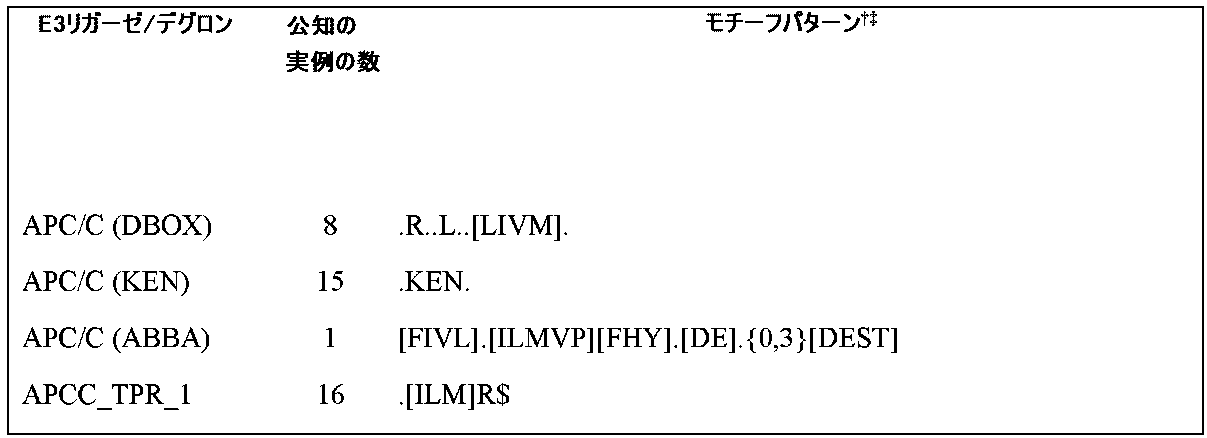

†モチーフパターンは以下の命名法を使用する:「.」は任意のアミノ酸タイプを指定し、「[X]」はその位置において許可されるアミノ酸タイプ(複数可)を指定し、パターンの最初における「^X」は、配列がアミノ酸タイプXで開始することを指定し、「[^X]」は、その位置がタイプX以外のアミノ酸を有することができることを示し、次のように指定される数「X{x,y}」のxおよびyは、その位置において必要な「X」アミノ酸タイプの最小および最大数を指定する。「$」記号は、タンパク質鎖のC末端を示す。翻訳後に改変(例えば、リン酸化およびプロリンヒドロキシル化)されることが公知である第1級デグロン内の保存残基の位置を太字で示す。 †Motif patterns use the following nomenclature: "." designates any amino acid type, "[X]" designates the amino acid type(s) allowed at that position, "^X" specifies that the sequence starts with amino acid type X, "[^X]" indicates that the position can have amino acids other than type X, and is specified as follows: The x and y in the numbers "X{x,y}" specify the minimum and maximum number of "X" amino acid types required at that position. The "$" symbol indicates the C-terminus of the protein chain. Conserved residue positions within primary degrons that are known to be post-translationally modified (eg, phosphorylation and proline hydroxylation) are shown in bold.
当技術分野において公知の任意の他のペプチドデグロンも本発明において用いることができる。例えば、Meszaros et al., Sci. Signal., 10(470):eaak9982 (2017);Guharoy et al., Nature Communications, 7:10239, doi:10.1038/ncomms10239 (2016);米国特許第9,783,575号;同第9,297,017号;および同第9,115,184号を参照されたく、これら全ては、その内容全体が参照により本明細書に組み込まれる。 Any other peptide degron known in the art can also be used in the present invention. Signal., 10(470):eaak9982 (2017); Guharoy et al., Nature Communications, 7:10239, doi:10.1038/ncomms10239 (2016); U.S. Patent No. 9,783, 575; 9,297,017; and 9,115,184, all of which are hereby incorporated by reference in their entireties.
ある特定の場合では、ペプチドデグロンは、以下に挙げられるペプチドまたはそのバリアントのアミノ酸配列を有する:
FSDLWKLL(配列番号31)-E3リガーゼ:MDM2;
SVEQTPKK(配列番号32)-E3リガーゼ:SKP2-CKS1;
DSGIHS(配列番号32)-E3リガーゼ:β-TrCP1;
LLPTPPLS(配列番号33)-E3リガーゼ:FBXW7;
ASSSS(配列番号34)-E3リガーゼ:SPOP;
LAPAAGDTIISLDF(配列番号35)-E3リガーゼ:VHL;
PFLTPSPE(配列番号36)-E3リガーゼ:FBXW7;
PPPY(配列番号37)-E3リガーゼ:ITCH;
DEETGE(配列番号38)-E3リガーゼ:KEAP1;
QDIDLGV(配列番号39)-E3リガーゼ:KEAP1;
LLQPNNYQFC(配列番号40)-E3リガーゼ:CBL;
DYR-E3リガーゼ:CBL;
RAVENQYSFY(配列番号41)-E3リガーゼ:CBL;
QKENS(配列番号42)-E3リガーゼ:CDH1;
FDIYMD(配列番号43)-E3リガーゼ:CDC20/CDH1;
PRTALGDIG(配列番号44)-E3リガーゼ:CDC20/CDH1;
DKENG(配列番号45)-E3リガーゼ:PTTG1;
HRKHLQEIP(配列番号93)-E3リガーゼ:APC/C;
SKENV(配列番号94)-E3リガーゼ:APC/C;
TRIR(配列番号95)-E3リガーゼ:APC/C;
DQIVPEY(配列番号96)-E3リガーゼ:COP1;
TSMTDFYHSKRRL(配列番号97)-E3リガーゼ:DCAF2;
SPETGE(配列番号98)-E3リガーゼ:KEAP1;
EPEEPEADQH(配列番号99)-E3リガーゼ:KLHL3;
LAPYIPMDDDFQL(配列番号100)-E3リガーゼ:VHL;
LTPPQS(配列番号101)-E3リガーゼ:FBXW7;
SVEQTPRK(配列番号102)-E3リガーゼ:SKP2/CKS1;
DSGNYS(配列番号103)-E3リガーゼ:ベータ-TrCP1;
KPAAVVAPI(配列番号104)-E3リガーゼ:Siah;または
ADSST(配列番号105)-E3リガーゼ:SPOP
In certain instances, a peptide degron has the amino acid sequence of a peptide or variant thereof listed below:
FSDLWKLL (SEQ ID NO: 31) - E3 ligase: MDM2;
SVEQTPKK (SEQ ID NO: 32) - E3 ligase: SKP2-CKS1;
DSGIHS (SEQ ID NO:32) - E3 ligase: β-TrCP1;
LLPTPPLS (SEQ ID NO: 33) - E3 ligase: FBXW7;
ASSSS (SEQ ID NO: 34) - E3 ligase: SPOP;
LAPAAGDTIISLDF (SEQ ID NO: 35) - E3 ligase: VHL;
PFLTPSPE (SEQ ID NO: 36) - E3 ligase: FBXW7;
PPPY (SEQ ID NO:37)-E3 ligase: ITCH;
DEETGE (SEQ ID NO:38)-E3 ligase: KEAP1;
QDIDLGV (SEQ ID NO: 39) - E3 ligase: KEAP1;
LLQPNNYQFC (SEQ ID NO: 40) - E3 ligase: CBL;
DYR-E3 ligase: CBL;
RAVENQYSFY (SEQ ID NO: 41) - E3 ligase: CBL;
QKENS (SEQ ID NO: 42) - E3 ligase: CDH1;
FDIYMD (SEQ ID NO: 43) - E3 ligase: CDC20/CDH1;
PRTALGDIG (SEQ ID NO: 44) - E3 ligase: CDC20/CDH1;
DKENG (SEQ ID NO: 45) - E3 ligase: PTTG1;
HRKHLQEIP (SEQ ID NO: 93) - E3 ligase: APC/C;
SKENV (SEQ ID NO: 94) - E3 ligase: APC/C;
TRIR (SEQ ID NO:95)-E3 ligase: APC/C;
DQIVPEY (SEQ ID NO: 96) - E3 ligase: COP1;
TSMTDFYHSKRRL (SEQ ID NO: 97) - E3 ligase: DCAF2;
SPETGE (SEQ ID NO: 98) - E3 ligase: KEAP1;
EPEEPEADQH (SEQ ID NO: 99) - E3 ligase: KLHL3;
LAPYIPMDDDFQL (SEQ ID NO: 100) - E3 ligase: VHL;
LTPPQS (SEQ ID NO: 101) - E3 ligase: FBXW7;
SVEQTPRK (SEQ ID NO: 102) - E3 ligase: SKP2/CKS1;
DSGNYS (SEQ ID NO: 103) - E3 ligase: Beta-TrCP1;
KPAAVVAPI (SEQ ID NO: 104) - E3 ligase: Siah; or ADSST (SEQ ID NO: 105) - E3 ligase: SPOP
上記ペプチド(すなわち、配列番号31~45および93~105)のバリアントは、1個または複数(例えば、1、2、3、4、5個)のアミノ酸置換;1個または複数の欠失(例えば、1、2、3);1個または複数の挿入(例えば、1、2、3個);またはこれらの任意の2つまたはそれを超える組合せを有するペプチドを含む。適切なE3リガーゼと相互作用するバリアントが選択される。一部の場合では、選択されるペプチドデグロンは、その適切なE3リガーゼと1nMから300nMの結合親和性で結合する。一部の場合では、選択されるペプチドデグロンは、適切なE3リガーゼと10nMから300nMの結合親和性で結合する。一部の場合では、選択されるペプチドデグロンは、適切なE3リガーゼと50nMから300nMの結合親和性で結合する。一部の場合では、選択されるペプチドデグロンは、適切なE3リガーゼと100nMから300nMの結合親和性で結合する。一部の場合では、選択されるペプチドデグロンは、適切なE3リガーゼと200nMから300nMの結合親和性で結合する。一部の場合では、選択されるペプチドデグロンは、200nMから250nMの結合親和性で適切なE3リガーゼと結合する。一部の場合では、選択されるペプチドデグロンは、適切なE3リガーゼと1nMから1000nMの結合親和性で結合する。一部の場合では、選択されるペプチドデグロンは、適切なE3リガーゼと200nMから1000nMの結合親和性で結合する。 Variants of the above peptides (i.e., SEQ ID NOs:31-45 and 93-105) have one or more (e.g., 1, 2, 3, 4, 5) amino acid substitutions; one or more deletions (e.g., , 1, 2, 3); one or more insertions (eg, 1, 2, 3); or combinations of any two or more of these. Variants are selected that interact with the appropriate E3 ligase. In some cases, the selected peptide degron binds the appropriate E3 ligase with a binding affinity of 1 nM to 300 nM. In some cases, the selected peptide degron binds the appropriate E3 ligase with a binding affinity of 10 nM to 300 nM. In some cases, the selected peptide degron binds the appropriate E3 ligase with a binding affinity of 50 nM to 300 nM. In some cases, the selected peptide degron binds the appropriate E3 ligase with a binding affinity of 100 nM to 300 nM. In some cases, the selected peptide degron binds the appropriate E3 ligase with a binding affinity of 200 nM to 300 nM. In some cases, the selected peptide degron binds the appropriate E3 ligase with a binding affinity of 200 nM to 250 nM. In some cases, the selected peptide degron binds the appropriate E3 ligase with a binding affinity of 1 nM to 1000 nM. In some cases, the selected peptide degron binds the appropriate E3 ligase with a binding affinity of 200 nM to 1000 nM.
非限定的な例示的バリアントを以下に示す:
FBXW7 E3リガーゼに関しては:LTPPAS(配列番号106)、LTPPSS(配列番号107)、LSPPPS(配列番号108)、LSPPAS(配列番号109)、LSPPLS(配列番号110);β-TrCP1 E3リガーゼに関しては:DSGIIS(配列番号111)、DSGNYT(配列番号112)、DSGIDT(配列番号113)、DSGIET(配列番号114)、DSGVDTS(配列番号115);およびDCAF2 E3リガーゼに関しては:TSMTDFYHSKRRI(配列番号116)、TSMTDFYHSKRKL(配列番号117)、TSMTDFYHSKRRS(配列番号118)
Non-limiting exemplary variants are shown below:
For FBXW7 E3 ligase: LTPPAS (SEQ ID NO: 106), LTPPSS (SEQ ID NO: 107), LSPPPS (SEQ ID NO: 108), LSPPAS (SEQ ID NO: 109), LSPPLS (SEQ ID NO: 110); for β-TrCP1 E3 ligase: DSGIIS (SEQ ID NO: 111), DSGNYT (SEQ ID NO: 112), DSGIDT (SEQ ID NO: 113), DSGIET (SEQ ID NO: 114), DSGVDTS (SEQ ID NO: 115); and for DCAF2 E3 ligase: TSMTDFYHSKRRI (SEQ ID NO: 116), TSMTDFYHSKRKL ( SEQ ID NO: 117), TSMTDFYHSKRRS (SEQ ID NO: 118)
ある特定の場合では、ペプチドデグロンは、4から20個のアミノ酸長(例えば、4、5、6、7、8、9、10、11、12、13、14、15、16、17、18、19、または20個)である。 In certain instances, peptide degrons are 4 to 20 amino acids long (e.g., 4, 5, 6, 7, 8, 9, 10, 11, 12, 13, 14, 15, 16, 17, 18 , 19, or 20).
ある特定の場合では、ペプチドデグロンは、配列番号26から30のうちのいずれか1つに記載のペプチドのアミノ酸配列を有する。一部の場合では、ペプチドデグロンは、配列番号26から30のうちのいずれか1つに記載のペプチドのバリアントであるアミノ酸配列を有する。ある特定の場合では、ペプチドデグロンは、配列番号31から45のうちのいずれか1つに記載のペプチドのアミノ酸配列を有する。一部の場合では、ペプチドデグロンは、配列番号31から45のうちのいずれか1つに記載のペプチドのバリアントであるアミノ酸配列を有する。ある特定の場合では、ペプチドデグロンは、配列番号65から118のうちのいずれか1つに記載のペプチドのアミノ酸配列を有する。一部の場合では、ペプチドデグロンは、配列番号65から118のうちのいずれか1つに記載のペプチドのバリアントであるアミノ酸配列を有する。バリアントは、1個または複数(例えば、1、2、3、4、5個)のアミノ酸置換;1個または複数の欠失(例えば、1、2、3);1個または複数の挿入(例えば、1、2、3個);またはこれらの任意の2つまたはそれを超える組合せを有するペプチドデグロンを含む。 In certain instances, the peptide degron has the amino acid sequence of a peptide set forth in any one of SEQ ID NOs:26-30. In some cases, the peptide degron has an amino acid sequence that is a variant of the peptide set forth in any one of SEQ ID NOs:26-30. In certain instances, the peptide degron has the amino acid sequence of a peptide set forth in any one of SEQ ID NOs:31-45. In some cases, the peptide degron has an amino acid sequence that is a variant of the peptide set forth in any one of SEQ ID NOS:31-45. In certain instances, the peptide degron has the amino acid sequence of a peptide set forth in any one of SEQ ID NOs:65-118. In some cases, the peptide degron has an amino acid sequence that is a variant of the peptide set forth in any one of SEQ ID NOs:65-118. Variants include one or more (e.g. 1, 2, 3, 4, 5) amino acid substitutions; one or more deletions (e.g. 1, 2, 3); one or more insertions (e.g. , 1, 2, 3); or a combination of any two or more of these.
上述のペプチドデグロンは、ユビキチンE3リガーゼ(例えば、Cop1、FBXW7、FBXW8)に対するその適切な基質アダプターに結合する。一部の場合では、ペプチドデグロンは、ユビキチンE3リガーゼ(例えば、Cop1、FBXW7、FBXW8)に対する基質アダプターに、1nMから300nMの結合親和性で結合する。一部の場合では、ペプチドデグロンは、ユビキチンE3リガーゼ(例えば、Cop1、FBXW7、FBXW8)に対する基質アダプターに、10nMから300nMの結合親和性で結合する。一部の場合では、ペプチドデグロンは、ユビキチンE3リガーゼ(例えば、Cop1、FBXW7、FBXW8)に対する基質アダプターに、50nMから300nMの結合親和性で結合する。一部の場合では、ペプチドデグロンは、ユビキチンE3リガーゼ(例えば、Cop1、FBXW7、FBXW8)に対する基質アダプターに、100nMから300nMの結合親和性で結合する。一部の場合では、ペプチドデグロンは、ユビキチンE3リガーゼ(例えば、Cop1、FBXW7、FBXW8)に対する基質アダプターに、200nMから300nMの結合親和性で結合する。一部の場合では、ペプチドデグロンは、ユビキチンE3リガーゼ(例えば、Cop1、FBXW7、FBXW8)に対する基質アダプターに、200nMから250nMの結合親和性で結合する。一部の場合では、ペプチドデグロンは、ユビキチンE3リガーゼ(例えば、Cop1、FBXW7、FBXW8)に対する基質アダプターに、1nMから1000nMの結合親和性で結合する。一部の場合では、ペプチドデグロンは、ユビキチンE3リガーゼ(例えば、Cop1、FBXW7、FBXW8)に対する基質アダプターに、200nMから1000nMの結合親和性で結合する。 The peptide degrons described above bind to their appropriate substrate adapters for ubiquitin E3 ligases (eg Cop1, FBXW7, FBXW8). In some cases, peptide degrons bind substrate adapters for ubiquitin E3 ligases (eg, Cop1, FBXW7, FBXW8) with binding affinities of 1 nM to 300 nM. In some cases, peptide degrons bind substrate adapters for ubiquitin E3 ligases (eg, Cop1, FBXW7, FBXW8) with binding affinities of 10 nM to 300 nM. In some cases, peptide degrons bind substrate adapters for ubiquitin E3 ligases (eg, Cop1, FBXW7, FBXW8) with binding affinities of 50 nM to 300 nM. In some cases, peptide degrons bind substrate adapters for ubiquitin E3 ligases (eg, Cop1, FBXW7, FBXW8) with binding affinities of 100 nM to 300 nM. In some cases, peptide degrons bind substrate adapters for ubiquitin E3 ligases (eg, Cop1, FBXW7, FBXW8) with binding affinities of 200 nM to 300 nM. In some cases, peptide degrons bind substrate adapters for ubiquitin E3 ligases (eg, Cop1, FBXW7, FBXW8) with binding affinities of 200 nM to 250 nM. In some cases, peptide degrons bind substrate adapters for ubiquitin E3 ligases (eg, Cop1, FBXW7, FBXW8) with binding affinities of 1 nM to 1000 nM. In some cases, peptide degrons bind substrate adapters for ubiquitin E3 ligases (eg, Cop1, FBXW7, FBXW8) with binding affinities of 200 nM to 1000 nM.
本開示は、タンパク質デグロンを選択する方法も特徴とする。そのような選択されたタンパク質デグロンを、本開示のキメラ構築物において用いることができる。方法は、ユビキチンE3リガーゼに対する基質アダプターを、天然に存在するペプチドデグロンのバリアントと接触させ、所望の親和性を有する基質アダプターに結合するデグロンを選択することを伴う。例えば、方法は、E3ユビキチンリガーゼに対する基質アダプターであるWD40リピートタンパク質を、WD40リピートタンパク質(例えば、Cop1、FBXW7、FBXW8)に結合する天然結合コンセンサス配列のアミノ酸配列のバリアントと接触させ、WD40リピートタンパク質に結合するペプチドを選択することを含む。一部の場合では、選択されるペプチドデグロンは、1nMから1000nMの結合親和性でWD40リピートタンパク質に結合する。一部の場合では、選択されるペプチドデグロンは、10nMから300nMの結合親和性でWD40リピートタンパク質に結合する。一部の場合では、選択されるペプチドデグロンは、50nMから300nMの結合親和性でWD40リピートタンパク質に結合する。一部の場合では、選択されるペプチドデグロンは、100nMから300nMの結合親和性でWD40リピートタンパク質に結合する。一部の場合では、選択されるペプチドデグロンは、200nMから300nMの結合親和性でWD40リピートタンパク質に結合する。一部の場合では、選択されるペプチドデグロンは、200nMから250nMの結合親和性でWD40リピートタンパク質に結合する。一部の場合では、選択されるペプチドデグロンは、1nMから1000nMの結合親和性でWD40リピートタンパク質に結合する。一部の場合では、選択されるペプチドデグロンは、200nMから1000nMの結合親和性でWD40リピートタンパク質に結合する。一部の場合では、選択されるペプチドデグロンは、1nM未満(例えば、約0.01nM、約0.05nM、約0.1nM、約0.5nM)の結合親和性でWD40リピートタンパク質に結合する。一部の場合では、選択されるペプチドデグロンは、300nMを超える(例えば、約350nM、約400nM、約500nM、約1000nMの)結合親和性でWD40リピートタンパク質に結合する。 The disclosure also features a method of selecting protein degrons. Such selected protein degrons can be used in the chimeric constructs of the present disclosure. The method involves contacting a substrate adapter for the ubiquitin E3 ligase with variants of the naturally occurring peptide degrons and selecting degrons that bind to the substrate adapter with the desired affinity. For example, a method includes contacting a WD40 repeat protein that is a substrate adapter for an E3 ubiquitin ligase with an amino acid sequence variant of a natural binding consensus sequence that binds to a WD40 repeat protein (e.g., Cop1, FBXW7, FBXW8), and binding to the WD40 repeat protein. Including selecting peptides that bind. In some cases, the selected peptide degron binds to the WD40 repeat protein with a binding affinity of 1 nM to 1000 nM. In some cases, the selected peptide degron binds to the WD40 repeat protein with a binding affinity of 10 nM to 300 nM. In some cases, the selected peptide degron binds to the WD40 repeat protein with a binding affinity of 50 nM to 300 nM. In some cases, the selected peptide degron binds to the WD40 repeat protein with a binding affinity of 100 nM to 300 nM. In some cases, the selected peptide degron binds to the WD40 repeat protein with a binding affinity of 200nM to 300nM. In some cases, the selected peptide degron binds to the WD40 repeat protein with a binding affinity of 200nM to 250nM. In some cases, the selected peptide degron binds to the WD40 repeat protein with a binding affinity of 1 nM to 1000 nM. In some cases, the selected peptide degron binds to the WD40 repeat protein with a binding affinity of 200 nM to 1000 nM. In some cases, the selected peptide degron binds to the WD40 repeat protein with a binding affinity of less than 1 nM (e.g., about 0.01 nM, about 0.05 nM, about 0.1 nM, about 0.5 nM) . In some cases, the selected peptide degron binds to the WD40 repeat protein with a binding affinity greater than 300 nM (eg, about 350 nM, about 400 nM, about 500 nM, about 1000 nM).
ある特定の場合では、分解の標的となることが望まれるタンパク質は、直接的に改変される。タンパク質は、構造的に不規則な領域を含む領域に関して検討される。構造的に不規則な領域は、IUPred:iupred.enzim.huによって算出され、0.4未満またはそれに等しい障害スコアを有するものである。タンパク質は、上述のペプチドデグロン配列またはそのバリアントを含むように、構造的に不規則な領域において改変される。一部の場合では、構造的に不規則な領域は、タンパク質のNまたはC末端にある。一部の場合では構造的に不規則な領域は、タンパク質のN末端とC末端との間である。ペプチドデグロン配列は、構造的に不規則な領域へ挿入することができる。他のケースでは、ペプチドデグロン配列は、タンパク質の構造的に不規則な領域においてアミノ酸配列を置き換えるように置換する。そのような置換は、例えばCRISPR/Cas9改変によって作製することができる。 In certain cases, the protein desired to be targeted for degradation is directly modified. Proteins are discussed in terms of regions that contain structurally irregular regions. Structurally irregular regions are identified by IUPred: iupred. enzim. Those with a disability score less than or equal to 0.4, as calculated by hu. The protein is modified at the structurally irregular region to contain the peptide degron sequence described above or a variant thereof. In some cases, the structurally irregular region is at the N- or C-terminus of the protein. In some cases, the structurally irregular region is between the N-terminus and C-terminus of the protein. Peptide degron sequences can be inserted into structurally irregular regions. In other cases, peptide degron sequences replace amino acid sequences in structurally irregular regions of proteins. Such substitutions can be made, for example, by CRISPR/Cas9 modification.
小分子デグロン
本開示は、本明細書において記載するキメラにおいて利用することができる小分子デグロンを特徴とする。一実施形態では、デグロンは、以下に示す構造を有するサリドマイドに基づいている。

ある特定の場合では、小分子デグロンが安定化ペプチドのN末端においてコンジュゲートしている場合、以下に示す構造を有する。
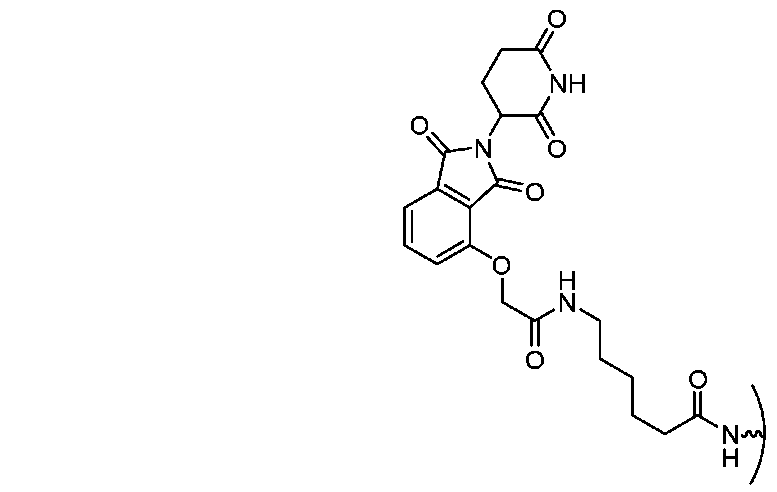
ある特定の場合では、小分子デグロンが安定化ペプチドのC末端においてコンジュゲートしている場合、以下に示す構造を有する。
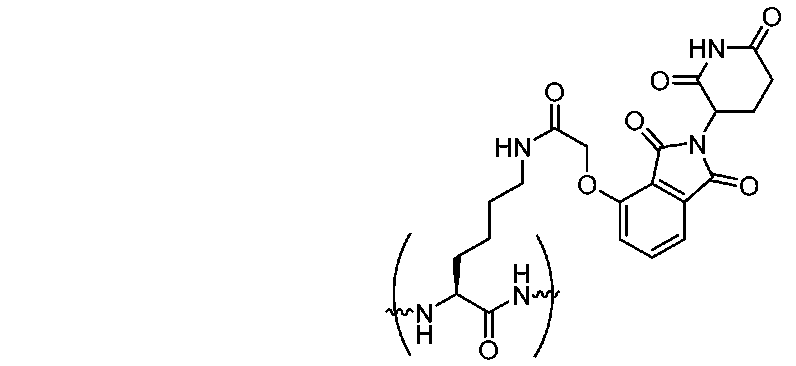
ある特定の場合では、本明細書において用いる小分子デグロンは、フォンヒッペルリンダウ(「VHL」)タンパク質に結合し、以下に示す(酸残基へのカップリングに適合する)構造を有するリガンドに基づいている。

ある特定の場合では、小分子VHLデグロンがアミンにコンジュゲートする場合、以下に示すカルボキシレートアナログを用いる。
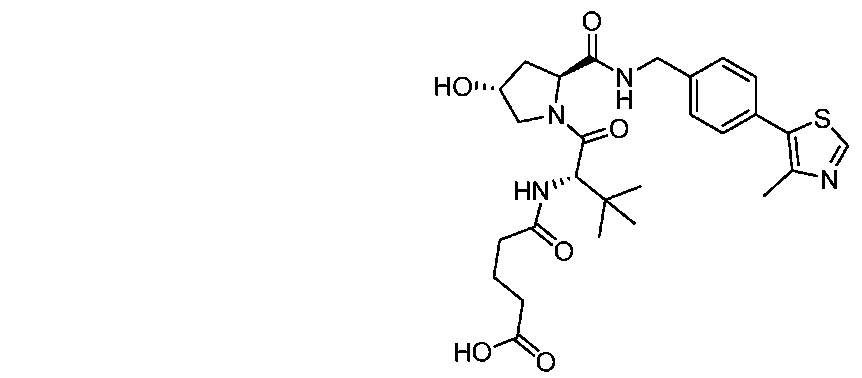
当技術分野において公知の任意の小分子デグロンは、本明細書において記載するキメラにおいて用いることができる。ある特定の場合では、本明細書において用いる小分子デグロンは、米国特許第9,694,084号;同第9,750,816号;同第9,770,512号;同第9,821,068号;同第9,783,575号;同第9,765,019号;同第9,632,089号;および同第9,500,653号に記載の任意のデグロンであり、これら全ての内容は、その全体が参照により本明細書に組み込まれる。 Any small molecule degron known in the art can be used in the chimeras described herein. In certain instances, small molecule degrons used herein are described in U.S. Patent Nos. 9,694,084; 9,750,816; 9,770,512; 068; 9,783,575; 9,765,019; 9,632,089; and 9,500,653; is incorporated herein by reference in its entirety.
安定化ペプチドおよびデグロンのキメラ
本開示は、デグロン(例えば、小分子デグロン、一次配列デグロン、および安定化(例えば、ステープル)ペプチドデグロン)を含む安定化ペプチドの(例えば、ステープル、ステッチ)キメラを提供する。以前は小分子にアクセスできなかったそのようなキメラは、小分子(例えば、セレブロン結合分子)、または結合タンパク質の標的とされる分解が可能な他の小分子またはペプチドデグロン部分とともに、広範囲のタンパク質を効果的に標的とすることができる。同様に、分解誘導タンパク質に結合し、動員することができる安定化ペプチドデグロンは、広範囲のタンパク質に結合し、疾患に関連するタンパク質を分解する小分子と組み合わせることができる。ステープルペプチドデグロンキメラのこれらの新規のクラスは、ステープルペプチドの生物活性の潜在力および広がりを拡大する。1個を超える(例えば、2、3、4個、またはそれを超える)安定化ペプチドおよび1個のデグロン(例えば、1個の小分子デグロン、1個の一次配列デグロン、または1個の安定化(例えば、ステープル)ペプチドデグロン)を含むキメラも本明細書において包含する。1個を超える(例えば、2、3、4個、またはそれを超える)デグロン(例えば、1個を超える小分子デグロン、1個を超える一次配列デグロン、または1個を超える安定化(例えば、ステープル)ペプチドデグロン)および1個の安定化ペプチドを含むキメラも本明細書において包含する。1個を超える(例えば、2、3、4個、またはそれを超える)安定化ペプチドおよび1個を超える(例えば、2、3、4個、またはそれを超える)デグロン(例えば、1個を超える小分子デグロン、1個を超える一次配列デグロン、または1個を超える安定化(例えば、ステープル)ペプチドデグロン)を含むキメラも本明細書において包含する。
Chimeras of stabilizing peptides and degrons The present disclosure provides (e.g., staple, stitch) chimeras of stabilizing peptides, including degrons (e.g., small molecule degrons, primary sequence degrons, and stabilizing (e.g., staple) peptide degrons). offer. Such chimeras, previously inaccessible to small molecules, can be used in conjunction with small molecules (e.g., cereblon-binding molecules), or other small molecules or peptide degron moieties capable of targeted degradation of binding proteins, in a wide range of applications. Proteins can be effectively targeted. Similarly, stabilized peptide degrons that can bind and recruit degradation-inducing proteins can be combined with small molecules that bind to a wide range of proteins and degrade disease-associated proteins. These novel classes of staple peptide degron chimeras expand the potential and breadth of bioactivity of staple peptides. More than 1 (e.g., 2, 3, 4, or more) stabilizing peptides and 1 degron (e.g., 1 small molecule degron, 1 primary sequence degron, or 1 stabilizing peptide) Chimeras containing (eg, staple) peptide degrons are also included herein. More than 1 (e.g., 2, 3, 4, or more) degrons (e.g., more than 1 small molecule degrons, more than 1 primary sequence degrons, or more than 1 stabilizing (e.g., staples) degrons ) peptide degron) and one stabilizing peptide are also included herein. More than 1 (e.g., 2, 3, 4, or more) stabilizing peptides and more than 1 (e.g., 2, 3, 4, or more) degrons (e.g., more than 1 Chimeras comprising small molecule degrons, more than one primary sequence degron, or more than one stabilizing (eg, staple) peptide degrons are also encompassed herein.
ある特定の実施形態では、キメラのステープルペプチドは、Bcl-2ホモロジー3(BH3)ドメインポリペプチドではない(例えば、MCL-1由来のBH3ドメインでもなく、BCL2ドメインのMCL-1安定化アルファヘリックス(SAHB)でもなく、MCL-1SAHBDでもない)。 In certain embodiments, the chimeric staple peptide is not a Bcl-2 homology 3 (BH3) domain polypeptide (e.g., neither is the BH3 domain derived from MCL-1, nor is the MCL-1-stabilized alpha helix of the BCL2 domain ( SAHB) and not MCL-1SAHB D ).
安定化ペプチド-ペプチドデグロンキメラ
安定化ペプチド-ペプチドデグロンキメラを本明細書において提供する。これらのキメラは、安定化ペプチドおよびペプチドデグロンから構成され、安定化ペプチドは、分解の標的とされるタンパク質である第1のタンパク質に結合し、ペプチドデグロンは、ユビキチンE3リガーゼに対する基質アダプターである第2のタンパク質に直接的にまたは間接的に結合する。したがって、ある特定の実施形態では、上述の安定化(例えば、ステープル、ステッチ)ペプチドは、上述のペプチドデグロンに連結している。例示的なキメラを、図7、15、17、および18に示す。
Stabilized peptide-peptide degron chimeras Provided herein are stabilized peptide-peptide degron chimeras. These chimeras are composed of a stabilizing peptide and a peptide degron, where the stabilizing peptide binds to the first protein, the protein targeted for degradation, and the peptide degron is a substrate adapter for the ubiquitin E3 ligase. Binds directly or indirectly to some second protein. Thus, in certain embodiments, said stabilizing (eg, staple, stitch) peptide is linked to said peptide degron. Exemplary chimeras are shown in FIGS.
安定化ペプチドは、目的の任意のリンカー(例えば、ペプチドリンカー、合成化合物リンカー)によってデグロンに連結していてもよい。ペプチドデグロンを安定化ペプチドに連結し、本明細書において記載するキメラを形成するために使用することができるリンカーの非限定的な例を以下に記載し、サブセットを図6で図示する。 The stabilizing peptide may be linked to the degron by any linker of interest (eg, peptide linker, synthetic compound linker). Non-limiting examples of linkers that can be used to link peptide degrons to stabilizing peptides to form the chimeras described herein are described below and a subset is illustrated in FIG.
ある特定の実施形態では、安定化ペプチドは、配列番号1~24および134のうちのいずれか1つに記載のアミノ酸配列またはそのバリアントを有する。一部の実施形態では、ペプチドデグロンは、配列番号25~46、65~118のうちのいずれか1つに記載のアミノ酸配列またはそのバリアントを有する。ある特定の場合では、ペプチドデグロンは安定化ペプチドのN末端に結合している。他の場合では、ペプチドデグロンは安定化ペプチドのC末端に結合している。一部の場合では、1個または複数のデグロンは、安定化ペプチドのN末端とC末端の両方に結合している。一部の場合では、デグロンは、安定化ペプチドの内部アミノ酸位置(すなわち、安定化ペプチドにおける、NまたはC末端を除く任意のアミノ酸位置、例えば、2、3、4、5、6、7、8、9位など)に結合している。一部の場合では、1個を超える(例えば、2または3個の)デグロンは、安定化ペプチドに結合している。1個を超える(例えば、2または3個の)デグロンが安定化ペプチドに結合している一部の場合では、1個のデグロンは、安定化ペプチドの末端に結合していてもよく、1個のデグロンは、安定化ペプチドの内部位置に結合していてもよい。1個を超える(例えば、2または3個の)デグロンが安定化ペプチドに結合している一部の場合では、1個のデグロンは、安定化ペプチドの各末端に結合していてもよい。1個を超える(例えば、2または3個の)デグロンが安定化ペプチドに結合している一部の場合では、1個を超える各デグロンが安定化ペプチドの内部位置に結合している。図7は、デグロンが内部アミノ酸位置において安定化ペプチドに結合している例示的なキメラを示す。 In certain embodiments, the stabilizing peptide has an amino acid sequence set forth in any one of SEQ ID NOS: 1-24 and 134, or a variant thereof. In some embodiments, the peptide degron has an amino acid sequence set forth in any one of SEQ ID NOS:25-46, 65-118, or a variant thereof. In certain cases, the peptide degron is attached to the N-terminus of the stabilizing peptide. In other cases, the peptide degron is attached to the C-terminus of the stabilizing peptide. In some cases, one or more degrons are attached to both the N-terminus and the C-terminus of the stabilizing peptide. In some cases, the degron is an internal amino acid position of the stabilizing peptide (i.e., any amino acid position in the stabilizing peptide except the N- or C-terminus, e.g., 2, 3, 4, 5, 6, 7, 8). , 9th, etc.). In some cases, more than one (eg, 2 or 3) degrons are attached to the stabilizing peptide. In some cases where more than one (e.g., two or three) degrons are attached to the stabilizing peptide, one degron may be attached to the end of the stabilizing peptide and one The degron may be attached to an internal position of the stabilizing peptide. In some cases where more than one (eg, two or three) degrons are attached to the stabilizing peptide, one degron may be attached to each terminus of the stabilizing peptide. In some cases where more than one (eg, two or three) degrons are attached to the stabilizing peptide, each more than one degron is attached to an internal position of the stabilizing peptide. FIG. 7 shows exemplary chimeras in which degrons are attached to stabilizing peptides at internal amino acid positions.
ある特定の場合では、安定化ペプチド-ペプチドデグロンキメラは、配列番号119~126のうちの1つのアミノ酸配列を有する。 In certain instances, the stabilized peptide-peptide degron chimera has an amino acid sequence of one of SEQ ID NOS:119-126.
ある特定の実施形態では、安定化ペプチド-ペプチドデグロンキメラは、1個または複数の(例えば、2、3、4個の、またはそれを超える)安定化ペプチドおよび1個のペプチドデグロンを含む。ある特定の実施形態では、安定化ペプチド-ペプチドデグロンキメラは、1個または複数の(例えば、2、3、4個の、またはそれを超える)ペプチドデグロンおよび1個の安定化ペプチドを含む。ある特定の実施形態では、安定化ペプチド-ペプチドデグロンキメラは、1個または複数の(例えば、2、3、4個の、またはそれを超える)安定化ペプチドおよび1個または複数の(例えば、2、3、4個の、またはそれを超える)ペプチドデグロンを含む。 In certain embodiments, a stabilized peptide-peptide degron chimera comprises one or more (eg, 2, 3, 4, or more) stabilized peptides and one peptide degron . In certain embodiments, a stabilized peptide-peptide degron chimera comprises one or more (eg, 2, 3, 4, or more) peptide degrons and one stabilized peptide . In certain embodiments, a stabilized peptide-peptide degron chimera comprises one or more (eg, 2, 3, 4, or more) stabilized peptides and one or more (eg, 2, 3, 4 or more) peptide degrons.
図7、15、17、および18で挙げる各キメラ構築物は本開示に包含される。図7、15、17、および18で挙げる各キメラ構築物のバリアントは本開示に包含される。 Each chimeric construct listed in Figures 7, 15, 17, and 18 is included in this disclosure. Variants of each chimeric construct listed in Figures 7, 15, 17, and 18 are encompassed by the present disclosure.
ある特定の実施形態では、キメラは、以下の実施例の項に記載のキメラである。例えば、安定化ペプチド-ペプチドデグロンキメラの非限定的な例に関しては、以下の実施例6を参照されたい。 In certain embodiments, the chimera is a chimera described in the Examples section below. See, eg, Example 6 below for a non-limiting example of a stabilized peptide-peptide degron chimera.
安定化ペプチド-小分子デグロンキメラ
安定化ペプチド-小分子デグロンキメラを本明細書において提供する。これらのキメラは、安定化ペプチドおよび小分子デグロンから構成され、安定化ペプチドは、分解の標的である第1のタンパク質に結合し、小分子デグロンは、分解誘導タンパク質である第2のタンパク質に結合する。したがって、ある特定の実施形態では、上述の安定化(例えば、ステープル、ステッチ)ペプチドは、上述の小分子デグロンに連結している。安定化ペプチドは、目的の任意のリンカー(例えば、合成化合物リンカー)によってデグロンに連結していてもよい。例示的なキメラを、図1、7、8、9、11、12、19、および20に示す。
Stabilized peptide-small molecule degron chimeras Provided herein are stabilized peptide-small molecule degron chimeras. These chimeras are composed of a stabilizing peptide and a small degron, where the stabilizing peptide binds to a first protein that is targeted for degradation and the small degron binds to a second protein that is a degradation-inducing protein. do. Thus, in certain embodiments, the stabilizing (eg, staple, stitch) peptides described above are linked to the small molecule degrons described above. The stabilizing peptide may be linked to the degron by any linker of interest (eg, a synthetic compound linker). Exemplary chimeras are shown in FIGS.
ある特定の実施形態では、第1のタンパク質は、第2のタンパク質またはリガンドまたは第2のタンパク質の受容体による分解の標的である。一部の実施形態では、第1のタンパク質は細胞内タンパク質である。一部の実施形態では、第1のタンパク質は細胞外タンパク質である。一部の実施形態では、第1のタンパク質は細胞表面タンパク質(例えば、受容体)である。一部の実施形態では、第1のタンパク質は、疾患の原因となるか、または疾患に関連するタンパク質である。一部の実施形態では、第1のタンパク質は、キラータンパク質(例えば、BAX、BAK)または細胞に損傷を与えるかもしくは神経変性の原因となるタンパク質(例えば、IgG、ベータ-アミロイド、タウ、α-シヌクレイン、TDP-43、HbS(ヘモグロビン鎌状細胞)、スーパーオキシドジスムターゼ、Notch3、FUS、GFAP)である。一部の実施形態では、第1のタンパク質は、BCL2、BCLXL、MCL-1、BFL-1、BCL-w、BCL-B、EZH2、HDM2/HDMX、KRAS/NRAS/HRAS、MYC、β-カテニン、PI3K、PTEN、TSC、AKT、BRCA1/2、EWS-FLI融合物、MLL融合物、受容体チロシンキナーゼ、HOXホモログ、JUN、サイクリンD、サイクリンE、BRAF、CRAF、CDK4、CDK2、HPV-E6/E7、オーロラキナーゼ、MITF、Wnt1、PD-1、BCR、およびCCR5からなる群から選択されるタンパク質である。一部の実施形態では、第1のタンパク質は細菌性タンパク質である。一部の実施形態では、第1のタンパク質はウイルス性タンパク質である。ある特定の場合では、第1のタンパク質は、神経変性の原因となるタンパク質凝集体(例えば、ベータ-アミロイド)である。 In certain embodiments, a first protein is a target for degradation by a second protein or ligand or receptor for the second protein. In some embodiments, the first protein is an intracellular protein. In some embodiments the first protein is an extracellular protein. In some embodiments, the first protein is a cell surface protein (eg, receptor). In some embodiments, the first protein is a disease-causing or disease-associated protein. In some embodiments, the first protein is a killer protein (eg, BAX, BAK) or a cell-damaging or neurodegenerative protein (eg, IgG, beta-amyloid, tau, α- synuclein, TDP-43, HbS (hemoglobin sickle cell), superoxide dismutase, Notch3, FUS, GFAP). In some embodiments, the first protein is BCL2, BCLXL, MCL-1, BFL-1, BCL-w, BCL-B, EZH2, HDM2/HDMX, KRAS/NRAS/HRAS, MYC, beta-catenin , PI3K, PTEN, TSC, AKT, BRCA1/2, EWS-FLI fusion, MLL fusion, receptor tyrosine kinase, HOX homolog, JUN, cyclin D, cyclin E, BRAF, CRAF, CDK4, CDK2, HPV-E6 /E7, Aurora kinase, MITF, Wnt1, PD-1, BCR, and CCR5. In some embodiments the first protein is a bacterial protein. In some embodiments, the first protein is a viral protein. In certain cases, the first protein is a neurodegenerative protein aggregate (eg, beta-amyloid).
ある特定の実施形態では、安定化ペプチドは、配列番号1~24、および134のうちのいずれか1つに記載のアミノ酸配列またはそのバリアントを有する。 In certain embodiments, the stabilizing peptide has an amino acid sequence set forth in any one of SEQ ID NOs: 1-24, and 134, or a variant thereof.
ある特定の実施形態では、安定化ペプチドは、リンカーを介して小分子デグロンに結合している。安定化ペプチドおよび小分子が互いに結合し、本明細書において記載するキメラを形成するために使用することができるリンカーの非限定的な例を以下に記載し、サブセットを図6に図示する。 In certain embodiments, the stabilizing peptide is attached to the small molecule degron via a linker. Non-limiting examples of linkers that can be used to join stabilizing peptides and small molecules to each other to form the chimeras described herein are described below and a subset is illustrated in FIG.
ある特定の実施形態では、安定化ペプチドは、小分子ペプチドに間接的に結合している。 In certain embodiments, stabilizing peptides are indirectly attached to small peptides.
ある特定の場合では、小分子デグロンは安定化ペプチドのN末端に結合している。他の場合では、小分子デグロンは安定化ペプチドのC末端に結合している。一部の場合では、1個または複数のデグロンは安定化ペプチドのN末端とC末端の両方に結合している。一部の場合では、デグロンは安定化ペプチドの内部アミノ酸位置(すなわち、安定化ペプチドにおける、NまたはC末端を除く任意のアミノ酸位置、例えば、2、3、4、5、6、7、8、9位など)に結合している。一部の場合では、1個を超える(例えば、2または3個の)デグロンは安定化ペプチドに結合している。1個を超える(例えば、2または3個の)デグロンが安定化ペプチドに結合している一部の場合では、1個のデグロンは、安定化ペプチドの末端に結合していてもよく、1個のデグロンは、安定化ペプチドの内部位置に結合していてもよい。1個を超える(例えば、2または3個の)デグロンが安定化ペプチドに結合している一部の場合では、1個のデグロンは、安定化ペプチドの各末端に結合していてもよい。1個を超える(例えば、2または3個の)デグロンが安定化ペプチドに結合している一部の場合では、1個を超える各デグロンは、安定化ペプチドの内部位置に結合している。 In certain cases, the small molecule degron is attached to the N-terminus of the stabilizing peptide. In other cases, the small molecule degron is attached to the C-terminus of the stabilizing peptide. In some cases, one or more degrons are attached to both the N-terminus and the C-terminus of the stabilizing peptide. In some cases, the degron is an internal amino acid position of the stabilizing peptide (i.e., any amino acid position in the stabilizing peptide except the N- or C-terminus, e.g., 2, 3, 4, 5, 6, 7, 8, 9th, etc.). In some cases, more than one (eg, 2 or 3) degrons are attached to the stabilizing peptide. In some cases where more than one (e.g., two or three) degrons are attached to the stabilizing peptide, one degron may be attached to the end of the stabilizing peptide and one The degron may be attached to an internal position of the stabilizing peptide. In some cases where more than one (eg, two or three) degrons are attached to the stabilizing peptide, one degron may be attached to each terminus of the stabilizing peptide. In some cases where more than one (eg, two or three) degrons are attached to the stabilizing peptide, each more than one degron is attached to an internal position of the stabilizing peptide.
ある特定の実施形態では、第2のタンパク質は、分解誘導タンパク質、例えば、E3ユビキチンリガーゼまたはE3ユビキチンリガーゼに対する基質アダプターである。ある特定の実施形態では、第2のタンパク質はE3ユビキチンリガーゼである。E3ユビキチンリガーゼの非限定的な例としては、VHL、COP1、およびMDM2がある。ある特定の実施形態では、第2のタンパク質は、MDM2、SKP2-CKS1、FBXW1、FBXW2、FBXW4、FBXW5、FBXW7、FBXW8、FBXW9、FBXW10、FBXW11、FBXW12、SPOP、VHL、ITCH、KEAP1、KLHL2、KLHL3、KLHL7、KLHL12、KLHL13、KLHL15、KLHL20、KLHL21、KLHL24、KLHL40、KLHL42、COP1、TRAF7、RFWD3、DCAF1、DCAF2、DCAF3、DCAF4、DCAF5、DCAF6、DCAF7、DCAF8、DCAF9、DCAF10、DCAF11、DCAF12、DCAF13、DCAF14、DCAF15、DCAF16、DCAF17、DCAF19、SIAH1、TRPC4AC、DET1、WSB1、WSB2、HERC1、DDB2、CSA、CBL、CDC20、およびFZR1からなる群から選択される。ある特定の実施形態では、第2のタンパク質は、MDM2、SKP2-CKS1、FBXW1、FBXW2、FBXW4、FBXW5、FBXW7、FBXW8、FBXW9、FBXW10、FBXW11、FBXW12、SPOP、VHL、ITCH、KEAP1、KLHL2、KLHL3、KLHL7、KLHL12、KLHL13、KLHL15、KLHL20、KLHL21、KLHL24、KLHL40、KLHL42、COP1、TRAF7、RFWD3、DCAF1、DCAF2、DCAF3、DCAF4、DCAF5、DCAF6、DCAF7、DCAF8、DCAF9、DCAF10、DCAF11、DCAF12、DCAF13、DCAF14、DCAF15、DCAF16、DCAF17、DCAF19、SIAH1、TRPC4AC、DET1、WSB1、WSB2、HERC1、DDB2、CSA、CBL、CDC20、およびFZR1からなる群から選択されるタンパク質に結合するタンパク質である。一部の実施形態では、第2のタンパク質は、MDM2またはMDM2と複合体を形成するタンパク質、例えばMDMXに結合する。 In certain embodiments, the second protein is a degradation-inducing protein, eg, an E3 ubiquitin ligase or a substrate adapter for an E3 ubiquitin ligase. In certain embodiments, the second protein is an E3 ubiquitin ligase. Non-limiting examples of E3 ubiquitin ligases include VHL, COP1, and MDM2. In certain embodiments, the second protein is MDM2, SKP2-CKS1, FBXW1, FBXW2, FBXW4, FBXW5, FBXW7, FBXW8, FBXW9, FBXW10, FBXW11, FBXW12, SPOP, VHL, ITCH, KEAP1, KLHL2, KLHL3 , KLHL7, KLHL12, KLHL13, KLHL15, KLHL20, KLHL21, KLHL24, KLHL40, KLHL42, COP1, TRAF7, RFWD3, DCAF1, DCAF2, DCAF3, DCAF4, DCAF5, DCAF6, DCAF7, DCAF8, DCAF9 , DCAF10, DCAF11, DCAF12, DCAF13 , DCAF14, DCAF15, DCAF16, DCAF17, DCAF19, SIAH1, TRPC4AC, DET1, WSB1, WSB2, HERC1, DDB2, CSA, CBL, CDC20, and FZR1. In certain embodiments, the second protein is MDM2, SKP2-CKS1, FBXW1, FBXW2, FBXW4, FBXW5, FBXW7, FBXW8, FBXW9, FBXW10, FBXW11, FBXW12, SPOP, VHL, ITCH, KEAP1, KLHL2, KLHL3 , KLHL7, KLHL12, KLHL13, KLHL15, KLHL20, KLHL21, KLHL24, KLHL40, KLHL42, COP1, TRAF7, RFWD3, DCAF1, DCAF2, DCAF3, DCAF4, DCAF5, DCAF6, DCAF7, DCAF8, DCAF9 , DCAF10, DCAF11, DCAF12, DCAF13 , DCAF14, DCAF15, DCAF16, DCAF17, DCAF19, SIAH1, TRPC4AC, DET1, WSB1, WSB2, HERC1, DDB2, CSA, CBL, CDC20, and FZR1. In some embodiments, the second protein binds MDM2 or a protein that forms a complex with MDM2, such as MDMX.
ある特定の実施形態では、第2のタンパク質は、分解誘導タンパク質、例えばE3ユビキチンリガーゼ、またはE3ユビキチンリガーゼに対する基質アダプターである。ある特定の実施形態では、第2のタンパク質はE3ユビキチンリガーゼである。一部の実施形態では、第2のタンパク質は、E3リガーゼ(例えば、MDM2)またはE3リガーゼと複合体を形成するタンパク質、例えばMDM2に結合するMDMXに結合する。ある特定の実施形態では、E3ユビキチンリガーゼは、RING E3ユビキチンリガーゼ(例えば、Mdm2-MdmX、TRIM5α、c-CBL、cIAP、RNF4、BIRC7、IDOL、BRCA1-BARD1、RING1B-Bmi1、E4B、CHIP、Prp19)である。ある特定の実施形態では、E3ユビキチンリガーゼは、HECT E3ユビキチンリガーゼ(例えば、Smurf1、Smurf2、Itch、E6AP)である。ある特定の実施形態では、E3ユビキチンリガーゼは、RBR E3ユビキチンリガーゼ(例えば、Parkin、Parc、RNF144(A/B)、HOIP、HHARI)である。例えば、E3ユビキチンリガーゼの非限定的な例に関しては、Morreale and Walden, Cell 165, 2016 DOI http:/dx.doi.org/10.1016/j.cell.2016.03.003を参照されたい。 In certain embodiments, the second protein is a degradation-inducing protein, such as an E3 ubiquitin ligase, or a substrate adapter for an E3 ubiquitin ligase. In certain embodiments, the second protein is an E3 ubiquitin ligase. In some embodiments, the second protein binds an E3 ligase (eg, MDM2) or a protein that complexes with an E3 ligase, such as MDMX that binds MDM2. In certain embodiments, the E3 ubiquitin ligase is a RING E3 ubiquitin ligase (e.g., Mdm2-MdmX, TRIM5α, c-CBL, cIAP, RNF4, BIRC7, IDOL, BRCA1-BARD1, RING1B-Bmi1, E4B, CHIP, Prp19 ). In certain embodiments, the E3 ubiquitin ligase is a HECT E3 ubiquitin ligase (eg, Smurf1, Smurf2, Itch, E6AP). In certain embodiments, the E3 ubiquitin ligase is an RBR E3 ubiquitin ligase (eg, Parkin, Parc, RNF144(A/B), HOIP, HHARI). For example, see Morreale and Walden, Cell 165, 2016 DOI http:/dx.doi.org/10.1016/j.cell.2016.03.003 for non-limiting examples of E3 ubiquitin ligases.
ある特定の実施形態では、小分子デグロンは、サリドマイドに基づいている(例えば、上記構造を参照のこと)。ある特定の実施形態では、小分子デグロンは、フォンヒッペルリンダウタンパク質に結合するリガンドに基づいている(例えば、上記構造を参照のこと)。ある特定の実施形態では、小分子デグロンは、当技術分野において公知の任意のデグロンである。ある特定の実施形態では、本明細書において用いる小分子デグロンは、米国特許第9,694,084号;同第9,750,816号;同第9,770,512号;同第9,821,068号;同第9,783,575号;同第9,765,019号;同第9,632,089号;および同第9,500,653号に記載の任意のデグロンであり、これら全ての内容は、その全体が参照により本明細書に組み込まれるものとする。 In certain embodiments, the small molecule degron is based on thalidomide (see, eg, structure above). In certain embodiments, small molecule degrons are based on ligands that bind to the von Hippel-Lindau protein (see, eg, structure above). In certain embodiments, the small molecule degron is any degron known in the art. In certain embodiments, the small molecule degrons used herein are described in U.S. Pat. Nos. 9,694,084; 9,750,816; 9,783,575; 9,765,019; 9,632,089; and 9,500,653; All content is incorporated herein by reference in its entirety.
ステープルペプチド-小分子デグロンキメラの非限定的な例を以下に示す:
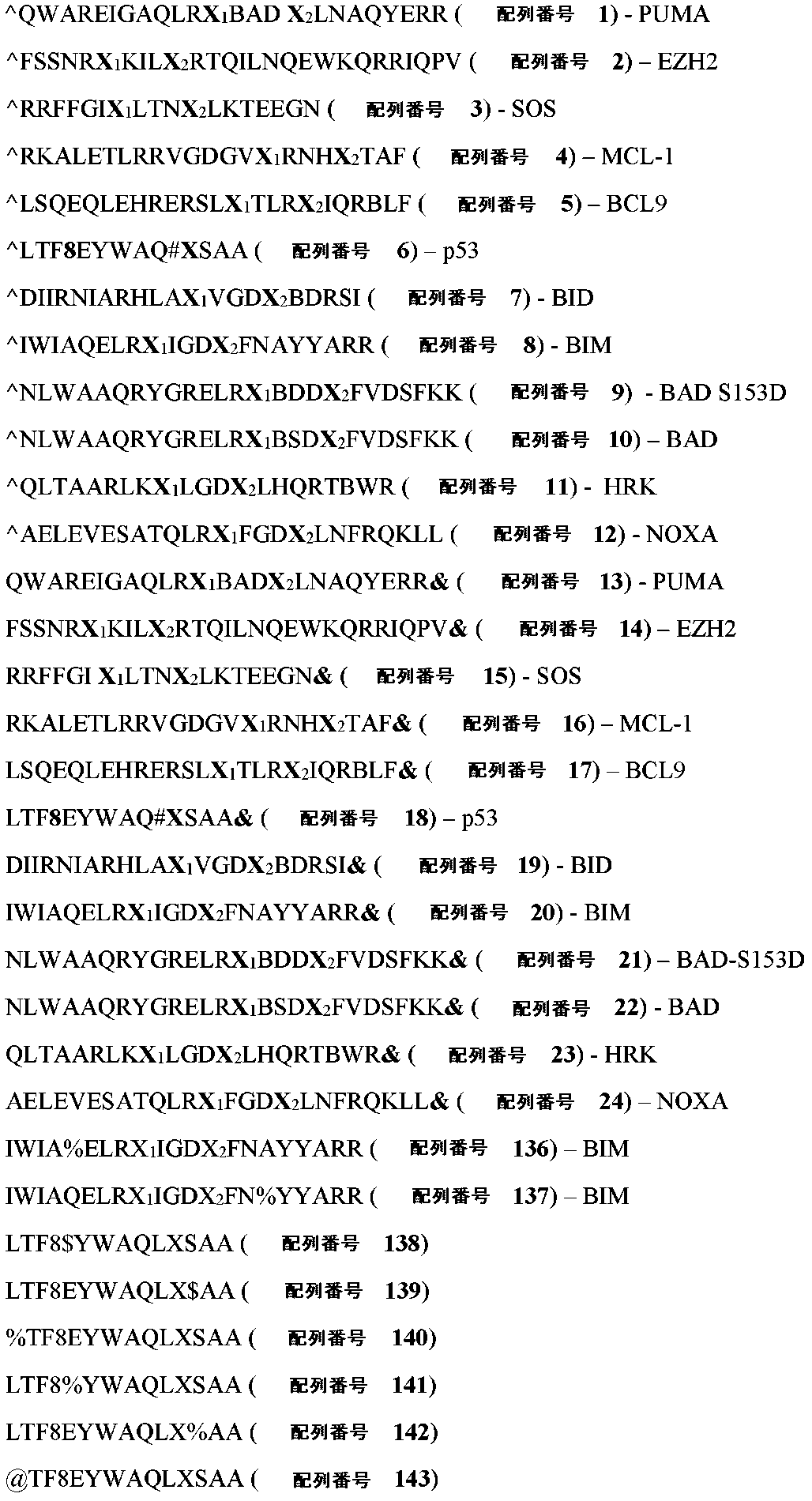
ある特定の実施形態では、安定化ペプチド-小分子デグロンキメラは、1個または複数の(例えば、2、3、4個の、またはそれを超える)安定化ペプチドおよび1個の小分子デグロンを含む。ある特定の実施形態では、安定化ペプチド-小分子デグロンキメラは、1個または複数の(例えば、2、3、4個の、またはそれを超える)小分子デグロンおよび1個の安定化ペプチドを含む。ある特定の実施形態では、安定化ペプチド-小分子デグロンキメラは、1個または複数の(例えば、2、3、4個の、またはそれを超える)安定化ペプチドおよび1個または複数の(例えば、2、3、4個の、またはそれを超える)小分子デグロンを含む。 In certain embodiments, a stabilized peptide-small molecule degron chimera comprises one or more (eg, 2, 3, 4, or more) stabilized peptides and one small molecule degron. In certain embodiments, a stabilizing peptide-small degron chimera comprises one or more (eg, 2, 3, 4, or more) small degrons and a stabilizing peptide. In certain embodiments, a stabilizing peptide-small molecule degron chimera comprises one or more (eg, 2, 3, 4, or more) stabilizing peptides and one or more (eg, 2 , 3, 4, or more) small molecule degrons.
上記で挙げたキメラ構築物およびこれらのバリアントはそれぞれ、本開示に包含される。図1、7、8、9、11、12、19、および20で挙げるキメラ構築物はそれぞれ、本開示に包含される。図1、7、8、9、11、12、19、および20で挙げるキメラ構築物のバリアントはそれぞれ、本開示に包含される。 Each of the chimeric constructs listed above and variants thereof are encompassed by the present disclosure. Each of the chimeric constructs listed in Figures 1, 7, 8, 9, 11, 12, 19, and 20 are included in the present disclosure. Each of the chimeric construct variants listed in Figures 1, 7, 8, 9, 11, 12, 19, and 20 are encompassed by the present disclosure.
ある特定の実施形態では、キメラは、以下の実施例の項に記載のキメラである。例えば、安定化ペプチド-小分子デグロンキメラの非限定的な例に関する以下の実施例2、3、4、および7を参照されたい。 In certain embodiments, the chimera is a chimera described in the Examples section below. See, eg, Examples 2, 3, 4, and 7 below for non-limiting examples of stabilized peptide-small molecule degron chimeras.
安定化ペプチド-安定化ペプチドデグロンキメラ
安定化ペプチド-安定化ペプチドデグロンキメラを、本明細書において提供する。これらのキメラは、第1の安定化ペプチドおよび第2の安定化ペプチドの2個の安定化ペプチドから構成され、第1の安定化ペプチドが、分解されることになる標的タンパク質である第1のタンパク質に結合し、第2の安定化ペプチドが、分解誘導タンパク質である第2のタンパク質に結合する。したがって、ある特定の実施形態では、上述の第1の安定化(例えば、ステープル、ステッチ)ペプチドは、上述の第2の安定化(例えば、ステープル、ステッチ)ペプチドに連結している。第1および第2の安定化ペプチドは、直接的にまたは間接的に連結していてもよい。
Stabilized Peptide-Stabilized Peptide Degron Chimera A stabilized peptide-stabilized peptide degron chimera is provided herein. These chimeras are composed of two stabilizing peptides, a first stabilizing peptide and a second stabilizing peptide, wherein the first stabilizing peptide is the target protein to be degraded. Binding to a protein, a second stabilizing peptide binds to a second protein that is a degradation-induced protein. Thus, in certain embodiments, said first stabilizing (eg, staple, stitch) peptide is linked to said second stabilizing (eg, staple, stitch) peptide. The first and second stabilizing peptides may be directly or indirectly linked.
ある特定の実施形態では、第1のタンパク質は、第2のタンパク質または第2のタンパク質のリガンドもしくは受容体によって分解されることになる標的タンパク質である。一部の実施形態では、第1のタンパク質は細胞内タンパク質である。一部の実施形態では、第1のタンパク質は細胞外タンパク質である。一部の実施形態では、第1のタンパク質は細胞表面タンパク質(例えば、受容体)である。一部の実施形態では、第1のタンパク質は、疾患の原因となるか、または疾患に関連するタンパク質である。一部の実施形態では、第1のタンパク質は、キラータンパク質(例えば、BAX、BAK)または細胞に損傷を与えるかもしくは神経変性の原因となるタンパク質(例えば、IgG、ベータ-アミロイド、タウ、α-シヌクレイン、TDP-43、HbS(ヘモグロビン鎌状細胞)、スーパーオキシドジスムターゼ、Notch3、FUS、GFAP)である。一部の実施形態では、第1のタンパク質は、BCL2、BCLXL、MCL-1、BFL-1、BCL-w、BCL-B、EZH2、HDM2/HDMX、KRAS/NRAS/HRAS、MYC、β-カテニン、PI3K、PTEN、TSC、AKT、BRCA1/2、EWS-FLI融合物、MLL融合物、受容体チロシンキナーゼ、HOXホモログ、JUN、サイクリンD、サイクリンE、BRAF、CRAF、CDK4、CDK2、HPV-E6/E7、オーロラキナーゼ、MITF、Wnt1、PD-1、BCR、およびCCR5からなる群から選択されるタンパク質である。一部の実施形態では、第1のタンパク質は細菌性タンパク質である。一部の実施形態では、第1のタンパク質はウイルス性タンパク質である。ある特定の場合では、第1のタンパク質は、神経変性の原因となるタンパク質凝集体(例えば、ベータ-アミロイド)である。 In certain embodiments, the first protein is the target protein to be degraded by the second protein or a ligand or receptor for the second protein. In some embodiments, the first protein is an intracellular protein. In some embodiments the first protein is an extracellular protein. In some embodiments, the first protein is a cell surface protein (eg, receptor). In some embodiments, the first protein is a disease-causing or disease-associated protein. In some embodiments, the first protein is a killer protein (eg, BAX, BAK) or a cell-damaging or neurodegenerative protein (eg, IgG, beta-amyloid, tau, α- synuclein, TDP-43, HbS (hemoglobin sickle cell), superoxide dismutase, Notch3, FUS, GFAP). In some embodiments, the first protein is BCL2, BCLXL, MCL-1, BFL-1, BCL-w, BCL-B, EZH2, HDM2/HDMX, KRAS/NRAS/HRAS, MYC, beta-catenin , PI3K, PTEN, TSC, AKT, BRCA1/2, EWS-FLI fusion, MLL fusion, receptor tyrosine kinase, HOX homolog, JUN, cyclin D, cyclin E, BRAF, CRAF, CDK4, CDK2, HPV-E6 /E7, Aurora kinase, MITF, Wnt1, PD-1, BCR, and CCR5. In some embodiments the first protein is a bacterial protein. In some embodiments, the first protein is a viral protein. In certain cases, the first protein is a neurodegenerative protein aggregate (eg, beta-amyloid).
ある特定の実施形態では、第1の安定化ペプチドは、配列番号1~24、および134のうちのいずれか1つに記載のアミノ酸配列またはそのバリアントを有する。 In certain embodiments, the first stabilizing peptide has an amino acid sequence set forth in any one of SEQ ID NOs: 1-24, and 134, or a variant thereof.
ある特定の実施形態では、第1の安定化ペプチドは、リンカーを介して第2の安定化ペプチドに結合している。第1のおよび第2の安定化ペプチドが互いに結合し、本明細書において記載するキメラを形成するために使用することができるリンカーの非限定的な例を以下に記載し、サブセットを図6で図示する。 In certain embodiments, the first stabilizing peptide is attached to the second stabilizing peptide via a linker. Non-limiting examples of linkers that can be used to join the first and second stabilizing peptides together to form the chimeras described herein are described below, a subset of which are shown in FIG. Illustrate.
ある特定の実施形態では、第1の安定化ペプチドは、第2の安定化ペプチドに間接的に結合している。 In certain embodiments, the first stabilizing peptide is indirectly linked to the second stabilizing peptide.
ある特定の実施形態では、第2のタンパク質は分解誘導タンパク質、例えば、E3ユビキチンリガーゼまたはE3ユビキチンリガーゼに対する基質アダプターである。ある特定の実施形態では、第2のタンパク質はE3ユビキチンリガーゼである。E3ユビキチンリガーゼの非限定的な例としては、VHL、COP1、およびMDM2がある。ある特定の実施形態では、第2のタンパク質は、MDM2、MDMX、SKP2-CKS1、FBXW1、FBXW2、FBXW4、FBXW5、FBXW7、FBXW8、FBXW9、FBXW10、FBXW11、FBXW12、SPOP、VHL、ITCH、KEAP1、KLHL2、KLHL3、KLHL7、KLHL12、KLHL13、KLHL15、KLHL20、KLHL21、KLHL24、KLHL40、KLHL42、COP1、TRAF7、RFWD3、DCAF1、DCAF2、DCAF3、DCAF4、DCAF5、DCAF6、DCAF7、DCAF8、DCAF9、DCAF10、DCAF11、DCAF12、DCAF13、DCAF14、DCAF15、DCAF16、DCAF17、DCAF19、SIAH1、TRPC4AC、DET1、WSB1、WSB2、HERC1、DDB2、CSA、CBL、CDC20、およびFZR1からなる群から選択される。ある特定の実施形態では、第2のタンパク質は、MDM2、SKP2-CKS1、FBXW1、FBXW2、FBXW4、FBXW5、FBXW7、FBXW8、FBXW9、FBXW10、FBXW11、FBXW12、SPOP、VHL、ITCH、KEAP1、KLHL2、KLHL3、KLHL7、KLHL12、KLHL13、KLHL15、KLHL20、KLHL21、KLHL24、KLHL40、KLHL42、COP1、TRAF7、RFWD3、DCAF1、DCAF2、DCAF3、DCAF4、DCAF5、DCAF6、DCAF7、DCAF8、DCAF9、DCAF10、DCAF11、DCAF12、DCAF13、DCAF14、DCAF15、DCAF16、DCAF17、DCAF19、SIAH1、TRPC4AC、DET1、WSB1、WSB2、HERC1、DDB2、CSA、CBL、CDC20、およびFZR1からなる群から選択されるタンパク質に結合するタンパク質である。一部の実施形態では、第2のタンパク質は、MDM2またはMDM2と複合体を形成するタンパク質、例えばMDMXに結合する。 In certain embodiments, the second protein is a degradation-inducing protein, eg, an E3 ubiquitin ligase or a substrate adapter for an E3 ubiquitin ligase. In certain embodiments, the second protein is an E3 ubiquitin ligase. Non-limiting examples of E3 ubiquitin ligases include VHL, COP1, and MDM2. In certain embodiments, the second protein is MDM2, MDMX, SKP2-CKS1, FBXW1, FBXW2, FBXW4, FBXW5, FBXW7, FBXW8, FBXW9, FBXW10, FBXW11, FBXW12, SPOP, VHL, ITCH, KEAP1, KLHL2 , KLHL3, KLHL7, KLHL12, KLHL13, KLHL15, KLHL20, KLHL21, KLHL24, KLHL40, KLHL42, COP1, TRAF7, RFWD3, DCAF1, DCAF2, DCAF3, DCAF4, DCAF5, DCAF6, DCAF7, DCAF 8, DCAF9, DCAF10, DCAF11, DCAF12 , DCAF13, DCAF14, DCAF15, DCAF16, DCAF17, DCAF19, SIAH1, TRPC4AC, DET1, WSB1, WSB2, HERC1, DDB2, CSA, CBL, CDC20, and FZR1. In certain embodiments, the second protein is MDM2, SKP2-CKS1, FBXW1, FBXW2, FBXW4, FBXW5, FBXW7, FBXW8, FBXW9, FBXW10, FBXW11, FBXW12, SPOP, VHL, ITCH, KEAP1, KLHL2, KLHL3 , KLHL7, KLHL12, KLHL13, KLHL15, KLHL20, KLHL21, KLHL24, KLHL40, KLHL42, COP1, TRAF7, RFWD3, DCAF1, DCAF2, DCAF3, DCAF4, DCAF5, DCAF6, DCAF7, DCAF8, DCAF9 , DCAF10, DCAF11, DCAF12, DCAF13 , DCAF14, DCAF15, DCAF16, DCAF17, DCAF19, SIAH1, TRPC4AC, DET1, WSB1, WSB2, HERC1, DDB2, CSA, CBL, CDC20, and FZR1. In some embodiments, the second protein binds MDM2 or a protein that forms a complex with MDM2, such as MDMX.
ある特定の実施形態では、第2のタンパク質は、分解誘導タンパク質、例えばE3ユビキチンリガーゼ、またはE3ユビキチンリガーゼに対する基質アダプターである。ある特定の実施形態では、第2のタンパク質はE3ユビキチンリガーゼである。一部の実施形態では、第2のタンパク質は、E3リガーゼ(例えば、MDM2)またはE3リガーゼと複合体を形成するタンパク質、例えばMDM2に結合するMDMXに結合する。ある特定の実施形態では、E3ユビキチンリガーゼは、RING E3ユビキチンリガーゼ(例えば、Mdm2-MdmX、TRIM5α、c-CBL、cIAP、RNF4、BIRC7、IDOL、BRCA1-BARD1、RING1B-Bmi1、E4B、CHIP、Prp19)である。ある特定の実施形態では、E3ユビキチンリガーゼは、HECT E3ユビキチンリガーゼ(例えば、Smurf1、Smurf2、Itch、E6AP)である。ある特定の実施形態では、E3ユビキチンリガーゼは、RBR E3ユビキチンリガーゼ(例えば、Parkin、Parc、RNF144(A/B)、HOIP、HHARI)である。例えば、E3ユビキチンリガーゼの非限定的な例に関しては、Morreale and Walden, Cell 165, 2016 DOI http:/dx.doi.org/10.1016/j.cell.2016.03.003を参照されたい。 In certain embodiments, the second protein is a degradation-inducing protein, such as an E3 ubiquitin ligase, or a substrate adapter for an E3 ubiquitin ligase. In certain embodiments, the second protein is an E3 ubiquitin ligase. In some embodiments, the second protein binds an E3 ligase (eg, MDM2) or a protein that complexes with an E3 ligase, such as MDMX that binds MDM2. In certain embodiments, the E3 ubiquitin ligase is a RING E3 ubiquitin ligase (e.g., Mdm2-MdmX, TRIM5α, c-CBL, cIAP, RNF4, BIRC7, IDOL, BRCA1-BARD1, RING1B-Bmi1, E4B, CHIP, Prp19 ). In certain embodiments, the E3 ubiquitin ligase is a HECT E3 ubiquitin ligase (eg, Smurf1, Smurf2, Itch, E6AP). In certain embodiments, the E3 ubiquitin ligase is an RBR E3 ubiquitin ligase (eg, Parkin, Parc, RNF144(A/B), HOIP, HHARI). For example, see Morreale and Walden, Cell 165, 2016 DOI http:/dx.doi.org/10.1016/j.cell.2016.03.003 for non-limiting examples of E3 ubiquitin ligases.
ある特定の実施形態では、第2の安定化ペプチドは、配列番号134に記載のアミノ酸配列またはそのバリアントを有する。ある特定の実施形態では、第2の安定化ペプチドは、配列番号6に記載のアミノ酸配列またはそのバリアントを有する。ある特定の実施形態では、第2の安定化ペプチドは、配列番号18に記載のアミノ酸配列またはそのバリアントを有する。 In certain embodiments, the second stabilizing peptide has the amino acid sequence set forth in SEQ ID NO: 134 or a variant thereof. In certain embodiments, the second stabilizing peptide has the amino acid sequence set forth in SEQ ID NO:6 or a variant thereof. In certain embodiments, the second stabilizing peptide has the amino acid sequence set forth in SEQ ID NO: 18 or a variant thereof.
ある特定の実施形態では、第2の安定化ペプチドは、米国特許第8,889,632号、同第9,458,202号、同第9,505,804号、同第9,527,896号、同第9,957,299号、同第10,030,049号、および同第10,059,741号、WO1998/001467およびWO2017/165617、および米国特許出願公開第2014/0018302A1号に記載の安定化ペプチドであり、これらの出願はそれぞれ、その全体が参照により本明細書に組み込まれるものとする。 In certain embodiments, the second stabilizing peptide is U.S. Pat. Nos. 8,889,632; 9,458,202; 9,505,804; Nos. 9,957,299, 10,030,049, and 10,059,741, WO1998/001467 and WO2017/165617, and U.S. Patent Application Publication No. 2014/0018302A1. and each of these applications is incorporated herein by reference in its entirety.
ある特定の場合では、第1の安定化ペプチドは、第2の安定化ペプチドのN末端に結合している。他の場合では、第1の安定化ペプチドは、第2の安定化ペプチドのC末端に結合している。一部の場合では、第1の安定化ペプチドは、第2の安定化ペプチドの内部アミノ酸位置(すなわち、安定化ペプチドにおける、NまたはC末端を除く任意のアミノ酸位置、例えば、2、3、4、5、6、7、8、9位など)に結合している。ある特定の場合では、第2の安定化ペプチドは、第1の安定化ペプチドのN末端に結合している。他の場合では、第2の安定化ペプチドは、第1の安定化ペプチドのC末端に結合している。一部の場合では、第2の安定化ペプチドは、第1の安定化ペプチドの内部アミノ酸位置(すなわち、安定化ペプチドにおける、NまたはC末端を除く任意のアミノ酸位置、例えば、2、3、4、5、6、7、8、9位など)に結合している。 In certain cases, the first stabilizing peptide is attached to the N-terminus of the second stabilizing peptide. In other cases, the first stabilizing peptide is attached to the C-terminus of the second stabilizing peptide. In some cases, the first stabilizing peptide is at an internal amino acid position of the second stabilizing peptide (i.e., at any amino acid position in the stabilizing peptide except the N- or C-terminus, e.g., 2, 3, 4). , 5, 6, 7, 8, 9, etc.). In certain cases, the second stabilizing peptide is attached to the N-terminus of the first stabilizing peptide. In other cases, the second stabilizing peptide is attached to the C-terminus of the first stabilizing peptide. In some cases, the second stabilizing peptide is at an internal amino acid position of the first stabilizing peptide (i.e., any amino acid position in the stabilizing peptide except the N- or C-terminus, e.g., 2, 3, 4). , 5, 6, 7, 8, 9, etc.).
ある特定の実施形態では、安定化ペプチド-安定化ペプチドデグロンキメラは、分解されることになる1個または複数のタンパク質に結合する1個または複数の(例えば、2、3、4個の、またはそれを超える)安定化ペプチドおよび分解誘導タンパク質に結合する1個の安定化ペプチドデグロンを含む。ある特定の実施形態では、安定化ペプチド-安定化ペプチドデグロンキメラは、1個または複数の分解誘導タンパク質に結合する1個または複数の(例えば、2、3、4個の、またはそれを超える)安定化ペプチドデグロンおよび分解されることになるタンパク質に結合する1個の安定化ペプチドを含む。ある特定の実施形態では、安定化ペプチド-安定化ペプチドデグロンキメラは、分解されることになる1個または複数のタンパク質に結合する1個または複数の(例えば、2、3、4個の、またはそれを超える)安定化ペプチドおよび1個または複数の分解誘導タンパク質に結合する1個または複数の(例えば、2、3、4個の、またはそれを超える)安定化ペプチドデグロンを含む。 In certain embodiments, a stabilized peptide-stabilized peptide degron chimera comprises one or more (eg, 2, 3, 4, or more) and one stabilizing peptide degron that binds to the stabilizing peptide and the degradation-inducing protein. In certain embodiments, a stabilized peptide-stabilized peptide degron chimera comprises one or more (eg, 2, 3, 4, or more) binding to one or more degradation-inducing proteins. ) containing a stabilizing peptide degron and one stabilizing peptide that binds to the protein to be degraded. In certain embodiments, a stabilized peptide-stabilized peptide degron chimera comprises one or more (eg, 2, 3, 4, or more) stabilizing peptides and one or more (eg, 2, 3, 4, or more) stabilizing peptide degrons that bind to one or more degradation-inducing proteins.
図21で挙げる各キメラ構築物は本開示に包含される。図21で挙げる各キメラ構築物のバリアントは本開示に包含される。 Each chimeric construct listed in Figure 21 is encompassed by the present disclosure. Variants of each chimeric construct listed in Figure 21 are encompassed by the present disclosure.
ある特定の実施形態では、キメラは、以下の実施例の項に記載のキメラである。例えば、安定化ペプチド-安定化ペプチドデグロンキメラの非限定的な例に関する以下の実施例8を参照されたい。 In certain embodiments, the chimera is a chimera described in the Examples section below. See, eg, Example 8 below for a non-limiting example of a stabilized peptide-stabilized peptide degron chimera.
小分子-安定化ペプチドデグロンキメラ
小分子-安定化ペプチドデグロンキメラを本明細書において提供する。これらのキメラは、小分子および安定化ペプチドから構成され、小分子が、分解されることになる標的タンパク質である第1のタンパク質に結合し、安定化ペプチドが、分解誘導タンパク質である第2のタンパク質に結合する。したがって、ある特定の実施形態では、小分子は、上述の安定化(例えば、ステープル、ステッチ)ペプチドに連結している。小分子および安定化ペプチドは、直接的にまたは間接的に連結していてもよい。
Small Molecule-Stabilized Peptide Degron Chimeras United States Patent Application 20070020000 Kind Code: A1 Provided herein are small molecule-stabilized peptide degron chimeras. These chimeras are composed of a small molecule and a stabilizing peptide, the small molecule binding to a first protein, the target protein to be degraded, and the stabilizing peptide to a second protein, the degradation-inducing protein. Binds to proteins. Thus, in certain embodiments, small molecules are linked to stabilizing (eg, staple, stitch) peptides described above. Small molecules and stabilizing peptides may be directly or indirectly linked.
ある特定の実施形態では、第1のタンパク質は、第2のタンパク質または第2のタンパク質のリガンドもしくは受容体によって分解されることになる標的タンパク質である。一部の実施形態では、第1のタンパク質は細胞内タンパク質である。一部の実施形態では、第1のタンパク質は細胞外タンパク質である。一部の実施形態では、第1のタンパク質は細胞表面タンパク質(例えば、受容体)である。一部の実施形態では、第1のタンパク質は、疾患の原因となるか、または疾患に関連するタンパク質である。一部の実施形態では、第1のタンパク質は、キラータンパク質(例えば、BAX、BAK)または細胞に損傷を与えるかもしくは神経変性の原因となるタンパク質(例えば、IgG、ベータ-アミロイド、タウ、α-シヌクレイン、TDP-43、HbS(ヘモグロビン鎌状細胞)、スーパーオキシドジスムターゼ、Notch3、FUS、GFAP)である。一部の実施形態では、第1のタンパク質は、BCL2、BCLXL、MCL-1、BFL-1、BCL-w、BCL-B、EZH2、HDM2/HDMX、KRAS/NRAS/HRAS、MYC、β-カテニン、PI3K、PTEN、TSC、AKT、BRCA1/2、EWS-FLI融合物、MLL融合物、受容体チロシンキナーゼ、HOXホモログ、JUN、サイクリンD、サイクリンE、BRAF、CRAF、CDK4、CDK2、HPV-E6/E7、オーロラキナーゼ、MITF、Wnt1、PD-1、BCR、およびCCR5からなる群から選択されるタンパク質である。一部の実施形態では、第1のタンパク質は細菌性タンパク質である。一部の実施形態では、第1のタンパク質はウイルス性タンパク質である。ある特定の場合では、第1のタンパク質は、神経変性の原因となるタンパク質凝集体(例えば、ベータ-アミロイド)である。 In certain embodiments, the first protein is the target protein to be degraded by the second protein or a ligand or receptor for the second protein. In some embodiments, the first protein is an intracellular protein. In some embodiments the first protein is an extracellular protein. In some embodiments, the first protein is a cell surface protein (eg, receptor). In some embodiments, the first protein is a disease-causing or disease-associated protein. In some embodiments, the first protein is a killer protein (eg, BAX, BAK) or a cell-damaging or neurodegenerative protein (eg, IgG, beta-amyloid, tau, α- synuclein, TDP-43, HbS (hemoglobin sickle cell), superoxide dismutase, Notch3, FUS, GFAP). In some embodiments, the first protein is BCL2, BCLXL, MCL-1, BFL-1, BCL-w, BCL-B, EZH2, HDM2/HDMX, KRAS/NRAS/HRAS, MYC, beta-catenin , PI3K, PTEN, TSC, AKT, BRCA1/2, EWS-FLI fusion, MLL fusion, receptor tyrosine kinase, HOX homolog, JUN, cyclin D, cyclin E, BRAF, CRAF, CDK4, CDK2, HPV-E6 /E7, Aurora kinase, MITF, Wnt1, PD-1, BCR, and CCR5. In some embodiments the first protein is a bacterial protein. In some embodiments, the first protein is a viral protein. In certain cases, the first protein is a neurodegenerative protein aggregate (eg, beta-amyloid).
ある特定の実施形態では、小分子は、キメラの一部を形成する場合、その標的と相互作用するためのキメラのステープルペプチドの能力に干渉することなく、タンパク質に結合することができる任意の薬物または化学的化合物である。(キメラのその背景において)その標的と相互作用するための(キメラの)ステープルペプチドの能力に対する薬物のまたは化学的化合物の干渉を評価するためのアッセイおよび方法、例えば免疫蛍光法および共免疫沈降法は、当技術分野において公知である。ある特定の実施形態では、小分子は図23で図示する化合物である。ある特定の実施形態では、小分子はキナーゼ阻害剤である。ある特定の実施形態では、小分子はヒストン脱アセチル化酵素阻害剤である。 In certain embodiments, the small molecule is any drug that can bind to a protein when forming part of a chimera without interfering with the ability of the chimera's staple peptide to interact with its target. or a chemical compound. Assays and methods for evaluating interference of drugs or chemical compounds on the ability of a (chimeric) staple peptide (in its chimeric context) to interact with its target, such as immunofluorescence and co-immunoprecipitation. are known in the art. In certain embodiments, small molecules are compounds illustrated in FIG. In certain embodiments, small molecules are kinase inhibitors. In certain embodiments, the small molecule is a histone deacetylase inhibitor.
ある特定の実施形態では、小分子は、リンカーを介して安定化ペプチドに結合している。小分子および安定化ペプチドが互いに結合し、本明細書において記載するキメラを形成するために使用することができるリンカーの非限定的な例を以下に記載し、サブセットを図6で図示する。 In certain embodiments, the small molecule is attached to the stabilizing peptide via a linker. Non-limiting examples of linkers that can be used to attach small molecules and stabilizing peptides to each other to form the chimeras described herein are described below and a subset is illustrated in FIG.
ある特定の実施形態では、小分子は、安定化ペプチドに間接的に結合している。 In certain embodiments, small molecules are indirectly conjugated to stabilizing peptides.
ある特定の場合では、小分子は安定化ペプチドのN末端に結合している。他の場合では、小分子は安定化ペプチドのC末端に結合している。一部の場合では、小分子は安定化ペプチドの内部アミノ酸位置(すなわち、安定化ペプチドにおける、NまたはC末端を除く任意のアミノ酸位置、例えば、2、3、4、5、6、7、8、9位など)に結合している。 In certain cases, the small molecule is attached to the N-terminus of the stabilizing peptide. In other cases, small molecules are attached to the C-terminus of stabilizing peptides. In some cases, the small molecule is at an internal amino acid position of the stabilizing peptide (i.e., any amino acid position in the stabilizing peptide except the N- or C-terminus, e.g., 2, 3, 4, 5, 6, 7, 8). , 9th, etc.).
ある特定の実施形態では、第2のタンパク質は、分解誘導タンパク質、例えば、E3ユビキチンリガーゼまたはE3ユビキチンリガーゼに対する基質アダプターである。ある特定の実施形態では、第2のタンパク質はE3ユビキチンリガーゼである。E3ユビキチンリガーゼの非限定的な例としては、VHL、COP1、およびMDM2がある。ある特定の実施形態では、第2のタンパク質は、MDM2、MDMX、SKP2-CKS1、FBXW1、FBXW2、FBXW4、FBXW5、FBXW7、FBXW8、FBXW9、FBXW10、FBXW11、FBXW12、SPOP、VHL、ITCH、KEAP1、KLHL2、KLHL3、KLHL7、KLHL12、KLHL13、KLHL15、KLHL20、KLHL21、KLHL24、KLHL40、KLHL42、COP1、TRAF7、RFWD3、DCAF1、DCAF2、DCAF3、DCAF4、DCAF5、DCAF6、DCAF7、DCAF8、DCAF9、DCAF10、DCAF11、DCAF12、DCAF13、DCAF14、DCAF15、DCAF16、DCAF17、DCAF19、SIAH1、TRPC4AC、DET1、WSB1、WSB2、HERC1、DDB2、CSA、CBL、CDC20、およびFZR1からなる群から選択される。ある特定の実施形態では、第2のタンパク質は、MDM2、SKP2-CKS1、FBXW1、FBXW2、FBXW4、FBXW5、FBXW7、FBXW8、FBXW9、FBXW10、FBXW11、FBXW12、SPOP、VHL、ITCH、KEAP1、KLHL2、KLHL3、KLHL7、KLHL12、KLHL13、KLHL15、KLHL20、KLHL21、KLHL24、KLHL40、KLHL42、COP1、TRAF7、RFWD3、DCAF1、DCAF2、DCAF3、DCAF4、DCAF5、DCAF6、DCAF7、DCAF8、DCAF9、DCAF10、DCAF11、DCAF12、DCAF13、DCAF14、DCAF15、DCAF16、DCAF17、DCAF19、SIAH1、TRPC4AC、DET1、WSB1、WSB2、HERC1、DDB2、CSA、CBL、CDC20、およびFZR1からなる群から選択されるタンパク質に結合するタンパク質である。一部の実施形態では、第2のタンパク質は、MDM2またはMDM2と複合体を形成するタンパク質、例えばMDMXに結合する。 In certain embodiments, the second protein is a degradation-inducing protein, eg, an E3 ubiquitin ligase or a substrate adapter for an E3 ubiquitin ligase. In certain embodiments, the second protein is an E3 ubiquitin ligase. Non-limiting examples of E3 ubiquitin ligases include VHL, COP1, and MDM2. In certain embodiments, the second protein is MDM2, MDMX, SKP2-CKS1, FBXW1, FBXW2, FBXW4, FBXW5, FBXW7, FBXW8, FBXW9, FBXW10, FBXW11, FBXW12, SPOP, VHL, ITCH, KEAP1, KLHL2 , KLHL3, KLHL7, KLHL12, KLHL13, KLHL15, KLHL20, KLHL21, KLHL24, KLHL40, KLHL42, COP1, TRAF7, RFWD3, DCAF1, DCAF2, DCAF3, DCAF4, DCAF5, DCAF6, DCAF7, DCAF 8, DCAF9, DCAF10, DCAF11, DCAF12 , DCAF13, DCAF14, DCAF15, DCAF16, DCAF17, DCAF19, SIAH1, TRPC4AC, DET1, WSB1, WSB2, HERC1, DDB2, CSA, CBL, CDC20, and FZR1. In certain embodiments, the second protein is MDM2, SKP2-CKS1, FBXW1, FBXW2, FBXW4, FBXW5, FBXW7, FBXW8, FBXW9, FBXW10, FBXW11, FBXW12, SPOP, VHL, ITCH, KEAP1, KLHL2, KLHL3 , KLHL7, KLHL12, KLHL13, KLHL15, KLHL20, KLHL21, KLHL24, KLHL40, KLHL42, COP1, TRAF7, RFWD3, DCAF1, DCAF2, DCAF3, DCAF4, DCAF5, DCAF6, DCAF7, DCAF8, DCAF9 , DCAF10, DCAF11, DCAF12, DCAF13 , DCAF14, DCAF15, DCAF16, DCAF17, DCAF19, SIAH1, TRPC4AC, DET1, WSB1, WSB2, HERC1, DDB2, CSA, CBL, CDC20, and FZR1. In some embodiments, the second protein binds MDM2 or a protein that forms a complex with MDM2, such as MDMX.
ある特定の実施形態では、第2のタンパク質は、分解誘導タンパク質、例えばE3ユビキチンリガーゼ、またはE3ユビキチンリガーゼに対する基質アダプターである。ある特定の実施形態では、第2のタンパク質はE3ユビキチンリガーゼである。一部の実施形態では、第2のタンパク質は、E3リガーゼ(例えば、MDM2)またはE3リガーゼと複合体を形成するタンパク質、例えばMDM2に結合するMDMXに結合する。ある特定の実施形態では、E3ユビキチンリガーゼは、RING E3ユビキチンリガーゼ(例えば、Mdm2-MdmX、TRIM5α、c-CBL、cIAP、RNF4、BIRC7、IDOL、BRCA1-BARD1、RING1B-Bmi1、E4B、CHIP、Prp19)である。ある特定の実施形態では、E3ユビキチンリガーゼは、HECT E3ユビキチンリガーゼ(例えば、Smurf1、Smurf2、Itch、E6AP)である。ある特定の実施形態では、E3ユビキチンリガーゼは、RBR E3ユビキチンリガーゼ(例えば、Parkin、Parc、RNF144(A/B)、HOIP、HHARI)である。例えば、E3ユビキチンリガーゼの非限定的な例に関しては、Morreale and Walden, Cell 165, 2016 DOI http:/dx.doi.org/10.1016/j.cell.2016.03.003を参照されたい。 In certain embodiments, the second protein is a degradation-inducing protein, such as an E3 ubiquitin ligase, or a substrate adapter for an E3 ubiquitin ligase. In certain embodiments, the second protein is an E3 ubiquitin ligase. In some embodiments, the second protein binds an E3 ligase (eg, MDM2) or a protein that complexes with an E3 ligase, such as MDMX that binds MDM2. In certain embodiments, the E3 ubiquitin ligase is a RING E3 ubiquitin ligase (e.g., Mdm2-MdmX, TRIM5α, c-CBL, cIAP, RNF4, BIRC7, IDOL, BRCA1-BARD1, RING1B-Bmi1, E4B, CHIP, Prp19 ). In certain embodiments, the E3 ubiquitin ligase is a HECT E3 ubiquitin ligase (eg, Smurf1, Smurf2, Itch, E6AP). In certain embodiments, the E3 ubiquitin ligase is an RBR E3 ubiquitin ligase (eg, Parkin, Parc, RNF144(A/B), HOIP, HHARI). For example, see Morreale and Walden, Cell 165, 2016 DOI http:/dx.doi.org/10.1016/j.cell.2016.03.003 for non-limiting examples of E3 ubiquitin ligases.
ある特定の実施形態では、安定化ペプチドは、配列番号134に記載のアミノ酸配列またはそのバリアントを有する。ある特定の実施形態では、第2の安定化ペプチドは、配列番号6に記載のアミノ酸配列またはそのバリアントを有する。ある特定の実施形態では、第2の安定化ペプチドは、配列番号18に記載のアミノ酸配列またはそのバリアントを有する。 In certain embodiments, the stabilizing peptide has the amino acid sequence set forth in SEQ ID NO: 134 or a variant thereof. In certain embodiments, the second stabilizing peptide has the amino acid sequence set forth in SEQ ID NO:6 or a variant thereof. In certain embodiments, the second stabilizing peptide has the amino acid sequence set forth in SEQ ID NO: 18 or a variant thereof.
ある特定の実施形態では、小分子-安定化ペプチドデグロンキメラは、1個または複数の(例えば、2、3、4個の、またはそれを超える)安定化ペプチドデグロンおよび1個の小分子を含む。ある特定の実施形態では、小分子-安定化ペプチドデグロンキメラは、1個または複数の(例えば、2、3、4個の、またはそれを超える)小分子および1個の安定化ペプチドデグロンを含む。ある特定の実施形態では、小分子-安定化ペプチドデグロンキメラは、1個または複数の(例えば、2、3、4個の、またはそれを超える)安定化ペプチドデグロンおよび1個または複数の(例えば、2、3、4個の、またはそれを超える)小分子を含む。 In certain embodiments, a small molecule-stabilized peptide degron chimera comprises one or more (eg, 2, 3, 4, or more) stabilized peptide degrons and a small molecule including. In certain embodiments, a small molecule-stabilized peptide degron chimera comprises one or more (eg, 2, 3, 4, or more) small molecules and one stabilized peptide degron including. In certain embodiments, the small molecule-stabilized peptide degron chimera comprises one or more (eg, 2, 3, 4, or more) stabilized peptide degrons and one or more Including small molecules (eg, 2, 3, 4, or more).
図23で図示するキメラ構築物は、本開示に包含される。図23で図示するキメラ構築物のバリアントは、本開示に包含される。 Chimeric constructs illustrated in FIG. 23 are included in the present disclosure. Variants of the chimeric constructs illustrated in Figure 23 are encompassed by the present disclosure.
ある特定の実施形態では、キメラは、以下の実施例の項に記載のキメラである。例えば、小分子-安定化ペプチドデグロンキメラの非限定的な例に関しては以下の実施例9を参照されたい。 In certain embodiments, the chimera is a chimera described in the Examples section below. See, eg, Example 9 below for a non-limiting example of a small molecule-stabilized peptide degron chimera.
リンカー
上述の構築物において使用することができるリンカーに関しては、特に制限はない。一部の実施形態では、リンカーは、アミノ酸、例えばアミノプロピオン酸、アミノブタン酸、アミノペンタン酸、またはアミノヘキサン酸である。一部の実施形態では、リンカーは、オリゴエチレングリコール、すなわち、NH2-(CH2-CH2-O)x-CH2-CH2-COOHである。一部の実施形態では、リンカーはペプチドリンカーである。一部の実施形態では、約1から30個の残基(例えば、2、3、4、5、6、7、8、9、10、11、12、13、14、15、16、17、18、19、20、21、22、23、24、25、26、27、28、29、または30個のアミノ酸)を含む任意の(any arbitrary)単一鎖ペプチドをリンカーとして使用することができる。他の実施形態では、リンカーは、10から20、10から30、10から40、10から50、10から60、10から70、10から80、10から90、10から100、10から144、または10から150個のアミノ酸長である。ある特定の場合では、リンカーは、グリシンおよび/またはセリン残基のみを含む。そのようなペプチドリンカーの例としては、Gly、Ser;GlySer;GlyGlySer;SerGlyGly;GlyGlyGlySer(配列番号47);SerGlyGlyGly(配列番号48);GlyGlyGlyGlySer(配列番号49);SerGlyGlyGlyGly(配列番号50);GlyGlyGlyGlyGlySer(配列番号51);SerGlyGlyGlyGlyGly(配列番号52);GlyGlyGlyGlyGlyGlySer(配列番号53);SerGlyGlyGlyGlyGlyGly(配列番号54);(GlyGlyGlyGlySer)n(配列番号49)n(ここで、nは1またはそれよりも多い整数である);および(SerGlyGlyGlyGly)n(配列番号50)n(ここで、nは1またはそれよりも多い整数である)がある。一部の場合では、リンカーは、セリン残基が別のアミノ酸で置き換えられていることを除いて、配列番号4のアミノ酸配列を有する。一部の場合では、リンカーは、リンカーの各コピーにおけるセリン残基が別のアミノ酸で置き換えられていることを除いて、配列番号4のアミノ酸配列の複数のコピー(例えば、1、2、3、4、5、6、7、8、9、10コピー)を有する。
Linkers There are no particular restrictions on the linkers that can be used in the constructs described above. In some embodiments, the linker is an amino acid, such as aminopropionic acid, aminobutanoic acid, aminopentanoic acid, or aminohexanoic acid. In some embodiments, the linker is an oligoethylene glycol, ie, NH 2 —(CH 2 —CH 2 —O) x —CH 2 —CH 2 —COOH. In some embodiments the linker is a peptide linker. In some embodiments, about 1 to 30 residues (e.g., 2, 3, 4, 5, 6, 7, 8, 9, 10, 11, 12, 13, 14, 15, 16, 17, Any arbitrary single-chain peptide containing 18, 19, 20, 21, 22, 23, 24, 25, 26, 27, 28, 29, or 30 amino acids can be used as a linker. . In other embodiments, the linker is 10 to 20, 10 to 30, 10 to 40, 10 to 50, 10 to 60, 10 to 70, 10 to 80, 10 to 90, 10 to 100, 10 to 144, or It is 10 to 150 amino acids long. In certain cases, the linker contains only glycine and/or serine residues. GlyGlyGlySer (SEQ ID NO:47); SerGlyGlyGly (SEQ ID NO:48); GlyGlyGlyGlySer (SEQ ID NO:49); SerGlyGlyGlyGly (SEQ ID NO:50); lyGlyGlyGlySer( SerGlyGlyGlyGlyGly (SEQ ID NO: 52 ); GlyGlyGlyGlyGlyGlyGlySer (SEQ ID NO:53); SerGlyGlyGlyGlyGlyGlyGly (SEQ ID NO:54); as an integer and (SerGlyGlyGlyGly) n (SEQ ID NO:50)n, where n is an integer of 1 or greater. In some cases, the linker has the amino acid sequence of SEQ ID NO:4, except that the serine residue is replaced with another amino acid. In some cases, the linker has multiple copies of the amino acid sequence of SEQ ID NO:4 (e.g., 1, 2, 3, 4, 5, 6, 7, 8, 9, 10 copies).
他の実施形態では、リンカーペプチドは、(従来のGly/Serリンカーペプチドリピートのジャンクションにおいて生じる)アミノ酸配列GSGが存在しないように改変される。例えば、ペプチドリンカーは、(GGGXX)nGGGGS(配列番号55)およびGGGGS(XGGGS)n(配列番号56)(ここで、Xは、配列へ挿入することができ、配列GSGを含むポリペプチドはもたらさない任意のアミノ酸であり、nは0から4である)からなる群から選択されるアミノ酸配列を含む。一実施形態では、リンカーペプチドの配列は、(GGGX1X2)nGGGGS(ここで、X1はPであり、X2はSであり、nは0から4である)(配列番号57)である。別の実施形態では、リンカーペプチドの配列は、(GGGX1X2)nGGGGS(ここで、X1はGであり、X2はQであり、nは0から4である)(配列番号58)である。別の実施形態では、リンカーペプチドの配列は、(GGGX1X2)nGGGGS(ここで、X1はGであり、X2はAであり、nは0から4である)(配列番号59)である。更に別の実施形態では、リンカーペプチドの配列は、GGGGS(XGGGS)n(ここで、XはPであり、nは0から4である)(配列番号60)である。一実施形態では、本発明のリンカーペプチドは、アミノ酸配列(GGGGA)2GGGGS(配列番号61)を含むか、またはそれからなる。別の実施形態では、リンカーペプチドは、アミノ酸配列(GGGGQ)2GGGGS(配列番号62)を含むかまたはそれからなる。更に別の実施形態では、リンカーペプチドは、アミノ酸配列(GGGPS)2GGGGS(配列番号63)を含むかまたはそれからなる。さらなる実施形態では、リンカーペプチドは、アミノ酸配列GGGGS(PGGGS)2(配列番号64)を含むかまたはそれからなる。 In other embodiments, the linker peptide is modified such that the amino acid sequence GSG (occurring at the junction of conventional Gly/Ser linker peptide repeats) is absent. For example, peptide linkers can be (GGGXX) n GGGGS (SEQ ID NO: 55) and GGGGS(XGGGS) n (SEQ ID NO: 56), where X can be inserted into the sequence, resulting in a polypeptide comprising the sequence GSG. n is any amino acid without n is from 0 to 4). In one embodiment, the sequence of the linker peptide is (GGGX 1 X 2 ) n GGGGS (where X 1 is P, X 2 is S, and n is 0 to 4) (SEQ ID NO: 57) is. In another embodiment, the sequence of the linker peptide is (GGGX 1 X 2 ) n GGGGS (where X 1 is G, X 2 is Q and n is 0 to 4) (SEQ ID NO: 58 ). In another embodiment, the sequence of the linker peptide is (GGGX 1 X 2 ) n GGGGS (where X 1 is G, X 2 is A and n is 0 to 4) (SEQ ID NO: 59 ). In yet another embodiment, the sequence of the linker peptide is GGGGS(XGGGS) n , where X is P and n is 0 to 4 (SEQ ID NO:60). In one embodiment, a linker peptide of the invention comprises or consists of the amino acid sequence (GGGGA) 2 GGGGS (SEQ ID NO: 61). In another embodiment, the linker peptide comprises or consists of the amino acid sequence (GGGGQ) 2 GGGGS (SEQ ID NO: 62). In yet another embodiment, the linker peptide comprises or consists of the amino acid sequence (GGGPS) 2 GGGGS (SEQ ID NO: 63). In a further embodiment, the linker peptide comprises or consists of the amino acid sequence GGGGS(PGGGS) 2 (SEQ ID NO:64).
ある特定の実施形態では、リンカーは、合成化合物リンカー(化学的架橋剤)である。市場で入手可能な架橋剤の例としては、N-ヒドロキシスクシンイミド(NHS)、ジスクシンイミジルスベレート(DSS)、ビス(スルホスクシンイミジル)スベレート(BS3)、ジチオビス(スクシンイミジルプロピオネート)(DSP)、ジチオビス(スルホスクシンイミジルプロピオネート)(DTSSP)、エチレングリコールビス(スクシンイミジルスクシネート)(EGS)、エチレングリコールビス(スルホスクシンイミジルスクシネート)(スルホ-EGS)、酒石酸ジスクシンイミジル(DST)、酒石酸ジスルホスクシンイミジル(スルホ-DST)、ビス[2-(スクシンイミドオキシカルボニルオキシ)エチル]スルホン(BSOCOES)、およびビス[2-(スルホスクシンイミドオキシカルボニルオキシ)エチル]スルホン(スルホ-BSOCOES)がある。 In certain embodiments, the linker is a synthetic compound linker (chemical cross-linker). Examples of commercially available crosslinkers include N-hydroxysuccinimide (NHS), disuccinimidyl suberate (DSS), bis(sulfosuccinimidyl) suberate (BS3), dithiobis(succinimidyl pro pionate) (DSP), dithiobis(sulfosuccinimidyl propionate) (DTSSP), ethylene glycol bis(succinimidyl succinate) (EGS), ethylene glycol bis(sulfosuccinimidyl succinate) ( sulfo-EGS), disuccinimidyl tartrate (DST), disulfosuccinimidyl tartrate (sulfo-DST), bis[2-(succinimidoxycarbonyloxy)ethyl]sulfone (BSOCOES), and bis[2-( sulfosuccinimidoxycarbonyloxy)ethyl]sulfone (sulfo-BSOCOES).
ある特定の実施形態では、リンカーは、図6で図示するリンカーである。 In certain embodiments, the linker is the linker illustrated in FIG.
安定化ペプチドデグロンキメラを合成する方法
ステープルペプチド-小分子デグロンキメラの合成
炭化水素-ステープルペプチドは、以前に報告された方法(Bird et al., Methods Enzymol., 446:369-86 (2008); Bird et al., Curr. Protoc. Chem. Biol., 3(3):99-117 (2011))を、以下の変更および追加の詳細とともに使用して合成し、精製し、定量化することができる。ペプチドは、所望の配列が完了するまで、確立された方法(すなわち、Fmoc保護アミノ酸、HATUカップリング試薬)を使用して合成する。次いでペプチドを、Grubbs触媒(第一世代)を使用してステープル化し、ピペリジンを使用してN末端を脱保護する。多原子リンカー、例えばベータアラニンまたはアミノヘキサン酸を組み込む。次いでサリドマイド-COOHを、HCTUを使用してカップリングする。イミド結合は求核試薬に対して特に感受性があるため、ピペリジンまたはヒドラジンは組込み後に使用しない。次いでペプチドを、TFAを用いて1時間切断し、LCMSで精製する。
Methods for synthesizing stabilized peptide degron chimeras Synthesis of stapled peptide-small molecule degron chimeras Hydrocarbon-stapled peptides were synthesized using previously reported methods (Bird et al., Methods Enzymol., 446:369-86 (2008); Bird et al., Curr. Protoc. Chem. Biol., 3(3):99-117 (2011)) with the following modifications and additional details. can. Peptides are synthesized using established methods (ie, Fmoc-protected amino acids, HATU coupling reagents) until the desired sequence is completed. The peptide is then stapled using Grubbs catalyst (first generation) and N-terminally deprotected using piperidine. Incorporate polyatomic linkers such as beta-alanine or aminohexanoic acid. Thalidomide-COOH is then coupled using HCTU. Piperidine or hydrazine are not used after incorporation because the imide bond is particularly sensitive to nucleophiles. Peptides are then cleaved with TFA for 1 hour and purified by LCMS.
ステープルペプチド-ペプチドデグロンキメラの合成
キメラのステープルペプチド部分は、上記のとおりに合成し、続いて完全に保護されたペプチドデグロンをカップリングしてもよい。完全に保護されたデグロンペプチドは、グリコール酸無水物のペプチドN末端との反応である最終合成ステップと同時に、弱酸開裂性樹脂、例えばSieberアミド樹脂上で合成することができる。1%TFAで切断後、保護されたペプチドをエーテル中で沈殿させ、酢酸/水中に溶解し、凍結乾燥する。次いで、完全に保護されたデグロンペプチドをカップリング試薬および塩基と混合し、樹脂結合ステープルペプチドN末端と2時間反応させ、続いてTFAで切断し、精製し、ステープルペプチド-ペプチドデグロンを得る。
Synthesis of staple peptide-peptide degron chimeras The staple peptide portion of the chimera may be synthesized as described above, followed by coupling of the fully protected peptide degrons. Fully protected degron peptides can be synthesized on a weak acid-cleavable resin, such as a Sieber amide resin, with the final synthetic step being the reaction of glycolic anhydride with the peptide N-terminus. After cleavage with 1% TFA, the protected peptide is precipitated in ether, dissolved in acetic acid/water and lyophilized. The fully protected degron peptide is then mixed with the coupling reagent and base and allowed to react with the resin-bound staple peptide N-terminus for 2 hours, followed by TFA cleavage and purification to yield the staple peptide-peptide degron. .
ステープルペプチド-ステープルペプチドデグロンキメラの合成
第1のステープルペプチド部分を、上述の確立された方法を使用して合成し、続いてリンカー部分、例えばベータアラニンまたはアミノヘキサン酸を組み込んでもよい。次いで第2のステープルペプチドキメラの半分を、第1のステープルペプチド部分に関する同じプロトコールを使用して合成し、次いでキメラ全体を、Grubbs触媒(第一世代)を使用してステープル化し、続いてN末端をアセチル化してもよい。次いでキメラを、TFAを用いて1時間切断し、LCMSで精製する。
Synthesis of Staple Peptide-Staple Peptide Degron Chimeras The first staple peptide portion may be synthesized using established methods described above, followed by incorporation of a linker portion such as beta-alanine or aminohexanoic acid. Half of the second staple peptide chimera was then synthesized using the same protocol as for the first staple peptide portion, and the entire chimera was then stapled using Grubbs catalyst (first generation) followed by N-terminal may be acetylated. The chimeras are then cleaved with TFA for 1 hour and purified by LCMS.
小分子-ステープルペプチドデグロンキメラの合成
キメラのステープルペプチド部分は、上述の確立された方法を使用して合成してもよく、続いてペプチドを、Grubbs触媒(第一世代)を使用してステープル化し、ピペリジンを用いてN末端を脱保護し、多原子リンカー、例えばベータアラニンまたはアミノヘキサン酸を組み込む。小分子のステープルペプチドへのカップリングは上述のように行うことができる。
Synthesis of small molecule-stapled peptide degron chimeras The stapled peptide portion of the chimera may be synthesized using established methods described above, followed by peptide stapling using Grubbs catalysis (first generation). deprotect the N-terminus using piperidine and incorporate a polyatomic linker such as beta-alanine or aminohexanoic acid. Coupling of small molecules to staple peptides can be performed as described above.
本発明の安定化(例えば、ステープル)ペプチドデグロンキメラの特性および機能的活性は、例えば、以下に記載する方法を使用してアッセイすることができる。 The properties and functional activity of the stabilized (eg, stapled) peptide degron chimeras of the invention can be assayed using, for example, the methods described below.
ステープルペプチドデグロンキメラのタンパク質標的への結合
競合的蛍光偏光アッセイを行い、(1)キメラのステープルペプチド(または分子)部分の、そのタンパク質標的に対する結合親和性を保持するための能力および(2)デグロン構成成分(分子またはペプチドでも)の、そのタンパク質標的に対する結合親和性を保持するための能力をモニターする。ステープルペプチドおよび分子デグロンに関する例示的な蛍光偏光法としては、Pitter et al Methods Enzymol 446: 387-408 (2008)およびNowak et al. Nat Chem Biol 14:706-714 (2018)がある。GFP-標識された標的タンパク質基質(例えばGFP-BRD4)を使用したin celluloでの分解アッセイを同様に使用し、完全なままの細胞を貫通するステープルペプチドデグロンキメラの能力を確認し、陽性対照分子デグロンキメラ(例えばdBET6)と競合させ、誘発される分解を阻害させる。そのような競合的細胞分解アッセイのための例示的な方法は、Nowak et al. Nat Chem Biol 14:706-714 (2018)で見出すことができる。
Binding of Staple Peptide Degron Chimeras to Protein Targets Competitive fluorescence polarization assays were performed to determine (1) the ability of the staple peptide (or molecule) portion of the chimera to retain its binding affinity to its protein target and (2) The ability of a degron component (whether a molecule or peptide) to retain binding affinity for its protein target is monitored. Exemplary fluorescence polarization methods for staple peptides and molecular degrons include Pitter et al Methods Enzymol 446: 387-408 (2008) and Nowak et al. Nat Chem Biol 14:706-714 (2018). An in cellulo degradation assay using a GFP-labeled target protein substrate (eg, GFP-BRD4) was similarly used to confirm the ability of the stapled peptide degron chimera to penetrate intact cells and a positive control. Compete with a molecular degron chimera (eg dBET6) to inhibit induced degradation. Exemplary methods for such competitive cytolysis assays can be found in Nowak et al. Nat Chem Biol 14:706-714 (2018).
ステープルペプチドデグロンキメラによって誘発される、組換えタンパク質標的のユビキチン化のモニタリング
タンパク質標的のin vitroでのユビキチン化をモニターするために、市販のMdm2/HDM2ユビキチンリガーゼキット(K-200B)を用いてもよい。簡潔には、キメラ(10μM)、組換え完全長MDM2(GST標識、1μM)、E1酵素(UBE1、50nM)、E2酵素(UBE2D3、1μM)、ユビキチン(100μM)、ATP(1mM)および組換え標的タンパク質(100nM)を、反応緩衝液中で1.5mLのマイクロチューブにおいて組み合わせる。混合物を37℃で6時間インキュベートする。その後、標準的なウエスタンブロット技術を使用して、反応混合物20μLをアッセイし、それによって標的タンパク質に対して生成された抗体を使用し、ユビキチン化によって上昇したバンドシフトを可視化する。
Monitoring ubiquitination of recombinant protein targets induced by staple peptide degron chimeras To monitor ubiquitination of protein targets in vitro, a commercially available Mdm2/HDM2 ubiquitin ligase kit (K-200B) was used. good too. Briefly, chimera (10 μM), recombinant full-length MDM2 (GST-tagged, 1 μM), E1 enzyme (UBE1, 50 nM), E2 enzyme (UBE2D3, 1 μM), ubiquitin (100 μM), ATP (1 mM) and recombinant target. Proteins (100 nM) are combined in 1.5 mL microfuge tubes in reaction buffer. The mixture is incubated at 37°C for 6 hours. 20 μL of the reaction mixture is then assayed using standard Western blot techniques whereby antibodies generated against the target protein are used to visualize the increased band shift due to ubiquitination.
ステープルペプチドデグロンキメラによって誘発される、in celluloでの天然タンパク質分解のモニタリング
細胞内タンパク質分解に関してアッセイするために、がん細胞(例えば、SJSA-1、SJSA-X、U2OS)を、10%ウシ胎仔血清(FBS)および1%ペニシリン/ストレプトマイシン(Pen Strep)を含むDMEM(Life Technologies、Grand Island、NY)培養培地(CM)中で、37℃で湿度制御されたCO2平衡化インキュベーターにおいて継代する。処置の前日に、細胞を継代し、100,000細胞/mLの密度で6ウェルプレート中に播種する。24時間後、細胞を、ステープルペプチドデグロンキメラ(例えば、10μM)で0、2、4および6時間処置し、その後、これらを採取し、溶解する。次いで細胞溶解物を、標的タンパク質に対して生成された抗体を使用し、標準的なウエスタンブロット技術を使用してアッセイし、タンパク質レベルおよび負荷対照に対するアクチン抗体を評価する。
Monitoring native protein degradation in cellulo induced by staple peptide degron chimeras To assay for intracellular protein degradation, cancer cells (eg, SJSA-1, SJSA-X, U2OS) were treated with 10% bovine Passaging in DMEM (Life Technologies, Grand Island, NY) culture medium (CM) with fetal serum (FBS) and 1% penicillin/streptomycin (Pen Strep) at 37 °C in a humidity-controlled CO2 equilibrated incubator do. The day before treatment, cells are passaged and seeded in 6-well plates at a density of 100,000 cells/mL. After 24 hours, cells are treated with staple peptide degron chimera (eg, 10 μM) for 0, 2, 4 and 6 hours, after which they are harvested and lysed. Cell lysates are then assayed using standard Western blot techniques using antibodies raised against the target protein to assess protein levels and actin antibody to loading controls.
ステープルペプチドデグロンキメラによって誘発される標的タンパク質分解のがん細胞生存率に対する影響のモニタリング
両方のタンパク質標的への結合を保持し、細胞取込みを達成し、それらのin celluloでの二重標的にアクセスし、標的タンパク質の分解を誘発することができるステープルペプチドデグロンキメラを、確立された細胞生存率ならびにCell Titer Gloおよびカスパーゼ3/7活性化アッセイを含むアポトーシスアッセイを使用して報告とおりに行い(例えば、Labelle et al, J Clin Invest 122:2018-31 (2012);Wachter et al, Oncogene, 36:2184-2190 (2017);Guerra et al, Cell Reports 24:3393-3403 (2018))、がん細胞に対するそれらの細胞毒性効果に関して評価する。例えば、それらのタンパク質標的、および/または標的タンパク質を発現しない細胞系、および/または目的の分解誘導タンパク質に結合する(engages)ことができない点突然変異体ペプチドを使用して、作用特異性の対照研究(specificity of action controls studies)を行った。
Monitoring the Effects of Staple Peptide Degron Chimera-Induced Targeted Proteolysis on Cancer Cell Viability Retaining Binding to Both Protein Targets, Achieving Cellular Uptake and Accessing Their Dual Targets in Cellulo and stapled peptide degron chimeras capable of inducing degradation of target proteins were reported using established cell viability and apoptosis assays, including Cell Titer Glo and
処置方法
本明細書において開示されるキメラは、安定化ペプチドまたは小分子が結合する疾患に関連するタンパク質の分解を促進することができる。ある特定の場合では、分解されるタンパク質は、BAXまたはBAKのようなキラータンパク質である(これは、例えば、脳卒中、神経変性疾患、および心臓発作における低酸素症などのストレス中の細胞保護剤として有用である)。ある特定の場合では、分解されるタンパク質は、骨髄腫におけるIg、アルツハイマー疾患におけるアミロイド、疾患をもたらす他のタンパク質沈着物のような細胞に損傷を与えるタンパク質である。ある特定の場合では、分解されるタンパク質は、BCL2、/BCLXL、MCL-1、BFL-1、BCL-w、BCL-B、EZH2、HDM2/HDMX、PUMA、SOSKRAS/NRAS/HRAS、MYC、b-カテニン、PI3K、PTEN、TSC、AKT、BRCA1/2、EWS-FLI、MLL融合物、受容体チロシンキナーゼ、HOXホモログ、JUN、サイクリンD、サイクリンE、BRAF、CRAF、CDK4、CDK2、HPV-E6/E7、オーロラキナーゼ、MITF、Wnt1、PD-1、BCR、およびCCR5からなる群から選択されるタンパク質である。ある特定の場合では、分解されるタンパク質はアミロイドベータ(アルツハイマー疾患)、タウタンパク質(アルツハイマー疾患)、アルファ-シヌクレイン(アルツハイマー疾患)、TDP-43(前頭側頭葉変性症)、スーパーオキシドジスムターゼ(ALS)、Notch3(CADASIL)、FUS(肉腫、ALS)、アミロイドA、Ig重鎖および軽鎖、ならびにGFAP(アレキサンダー疾患)からなる群から選択されるタンパク質である。
Methods of Treatment The chimeras disclosed herein can enhance the degradation of disease-associated proteins to which the stabilizing peptide or small molecule is attached. In certain cases, the protein that is degraded is a killer protein such as BAX or BAK, which is used as a cytoprotective agent during stress such as hypoxia in, for example, stroke, neurodegenerative disease, and heart attack. useful). In certain cases, proteins that are degraded are proteins that damage cells, such as Ig in myeloma, amyloid in Alzheimer's disease, and other protein deposits that lead to disease. In certain cases, the protein degraded is BCL2, /BCLX L , MCL-1, BFL-1, BCL-w, BCL-B, EZH2, HDM2/HDMX, PUMA, SOSKRAS/NRAS/HRAS, MYC, b-catenin, PI3K, PTEN, TSC, AKT, BRCA1/2, EWS-FLI, MLL fusion, receptor tyrosine kinase, HOX homolog, JUN, cyclin D, cyclin E, BRAF, CRAF, CDK4, CDK2, HPV- A protein selected from the group consisting of E6/E7, Aurora kinase, MITF, Wnt1, PD-1, BCR, and CCR5. In certain cases, the proteins degraded are amyloid beta (Alzheimer's disease), tau protein (Alzheimer's disease), alpha-synuclein (Alzheimer's disease), TDP-43 (frontotemporal lobar degeneration), superoxide dismutase (ALS ), Notch3 (CADASIL), FUS (sarcoma, ALS), amyloid A, Ig heavy and light chains, and GFAP (Alexander's disease).
本開示は、がん、自己免疫疾患、または炎症性疾患を予防および/または処置するための、本明細書において記載する安定化ペプチドまたはキメラのうちのいずれかを使用する方法を特徴とする。「処置する」または「処置すること」という用語は、本明細書で使用される場合、そのために対象が患う疾患または状態を軽減、阻害、または回復することを指す。 The disclosure features methods of using any of the stabilizing peptides or chimeras described herein to prevent and/or treat cancer, autoimmune disease, or inflammatory disease. The terms "treat" or "treating," as used herein, refer to alleviating, inhibiting, or ameliorating a disease or condition for which a subject is afflicted.
本明細書において記載するペプチドまたはキメラは、がんを呈するヒト対象の処置に有用であり得る。本明細書において記載するペプチドまたはキメラは、黒色腫、白血病、リンパ腫、または他の血液悪性腫瘍または固形腫瘍を呈するヒト対象の処置にも有用であり得る。ある特定の場合では、固形腫瘍は、黒色腫、乳がんまたは肺がんである。一部の実施形態では、本明細書において記載するペプチドまたはキメラは、自己免疫疾患または細胞過剰疾患の特徴を示す他の炎症性状態を呈するヒト対象の処置に有用であり得る。ある特定の場合では、自己免疫疾患は、自己免疫結腸炎、甲状腺炎、関節炎、腎炎、皮膚炎、血管炎、全身性エリテマトーデス、糖尿病、またはシェーグレン疾患である。一部の場合では、炎症性疾患、喘息、乾癬、炎症性結腸炎、甲状腺炎、関節炎、腎炎、皮膚炎、または血管炎である。 The peptides or chimeras described herein may be useful in treating human subjects who present with cancer. The peptides or chimeras described herein may also be useful in treating human subjects who present with melanoma, leukemia, lymphoma, or other hematologic malignancies or solid tumors. In certain cases, the solid tumor is melanoma, breast cancer or lung cancer. In some embodiments, the peptides or chimeras described herein may be useful in treating human subjects exhibiting autoimmune diseases or other inflammatory conditions characteristic of hypercellular diseases. In certain cases, the autoimmune disease is autoimmune colitis, thyroiditis, arthritis, nephritis, dermatitis, vasculitis, systemic lupus erythematosus, diabetes, or Sjögren's disease. In some cases, inflammatory disease, asthma, psoriasis, inflammatory colitis, thyroiditis, arthritis, nephritis, dermatitis, or vasculitis.
内因性タンパク質(例えば、MDM2のような発がんタンパク質)がデグロンを含むように改変する場合、任意の遺伝子編集技術を使用することができる(例えば、米国特許第9,840,713号;同第9,840,702号;同第9,840,699号;同第9,834,791号;同第9,822,372号;同第9,816,080号;同第9,790,490号;同第9,783,490号;同第9,771,601号;同第9,758,775号;同第9,738,908号;同第9,616,090号;同第9,574,211号を参照されたく、これら全ては、その全体が参照により本明細書に組み込まれるものとする)。新たに導入されたデグロンの存在は、タンパク質の分解につながるはずである。 Any gene editing technique can be used when modifying an endogenous protein (e.g., an oncoprotein such as MDM2) to contain a degron (e.g., U.S. Pat. Nos. 9,840,713; 9,840,699; 9,834,791; 9,822,372; 9,816,080; 9,790,490 9,783,490; 9,771,601; 9,758,775; 9,738,908; 9,616,090; 574,211, all of which are hereby incorporated by reference in their entireties). The presence of newly introduced degrons should lead to protein degradation.
一般的に、方法は、対象を選択し、有効量の1個または複数の本明細書におけるペプチドを、例えば、医薬組成物でまたはそれとして対象に投与し、必要に応じて反復投与して、がん、例えば、黒色腫またはリンパ腫を予防するかまたは処置することを含み、経口で、静脈内でまたは局所的に投与してもよい。対象は、例えば対象が、ステープルペプチドが標的とするタンパク質(例えば、MCL-1、BFL-1)を発現するがんを有することの判定に基づいて処置するために選択してもよい。 Generally, the method comprises selecting a subject, administering to the subject an effective amount of one or more peptides herein, e.g., in or as a pharmaceutical composition, with repeated administrations as necessary, It may be administered orally, intravenously or topically, including to prevent or treat cancer, eg melanoma or lymphoma. A subject may be selected for treatment, eg, based on a determination that the subject has a cancer that expresses a protein targeted by the staple peptide (eg, MCL-1, BFL-1).
任意の特定の患者に関する特異的投薬量および処置レジメンは、さまざまな因子に左右されることになり、その因子としては、用いられる特定の化合物の活性、年齢、体重、一般的な健康状態、性別、食事、投与時間、排泄速度、薬物の組合せ、疾患、状態または症状の重症度および経過、疾患に対する患者の傾向、状態または症状、ならびに処置する医師の判断がある。 Specific dosages and treatment regimens for any particular patient will depend on a variety of factors, including the activity of the particular compound employed, age, weight, general health, sex, and age. , diet, time of administration, rate of excretion, combination of drugs, severity and course of disease, condition or symptom, patient disposition to disease, condition or symptom, and judgment of the treating physician.
有効量は、1回または複数回の投与、適用または投薬として投与してもよい。治療有効量の治療化合物(すなわち、有効投薬量)は、選択される治療化合物に依存する。組成物は、1日当たり1回または複数回から1週当たり1回または複数回、投与することができ、隔日で1回を含む。当業者であれば、これらに限定されないが、疾患または障害の重症度、治療歴、対象の全身的な健康および/または年齢、ならびに存在する他の疾患を含むある特定の因子が、対象を効果的に処置するために必須の投薬量およびタイミングに影響を与える場合があることは理解するであろう。更に、本明細書において記載する治療有効量の治療化合物を用いた対象の処置は、単回の処置または一連の処置を含んでいてもよい。例えば、有効量を、少なくとも一回投与してもよい。 An effective amount may be administered in one or more administrations, applications or dosages. A therapeutically effective amount of a therapeutic compound (ie, an effective dosage) will depend on the therapeutic compound selected. The compositions can be administered from one or more times per day to one or more times per week, including once every other day. One of ordinary skill in the art will recognize that certain factors, including, but not limited to, the severity of the disease or disorder, prior treatment, general health and/or age of the subject, and other diseases present, may affect the subject. It will be understood that this may affect the dosage and timing required for effective treatment. Further, treatment of a subject with a therapeutically effective amount of a therapeutic compound described herein may comprise a single treatment or a series of treatments. For example, an effective amount may be administered at least once.
医薬組成物
本明細書において記載する1個または複数の安定化ペプチドまたはキメラのうちのいずれかは、医薬組成物としてまたはそれにおいて使用するために製剤化することができる。そのような組成物は、任意の経路、例えば食品医薬品局(FDA)によって承認された任意の経路を介した対象への投与のために、製剤化するかまたは適応させることができる。例示的な方法は、FDAのCDER Data Standards Manual第004版(fda.give/cder/dsm/DRG/drg00301.htmにおいて利用可能である)に記載されている。例えば、組成物は、吸入(例えば、経口および/または経鼻吸入(例えば、ネブライザーまたは噴霧剤を介した))、注射(例えば、静脈内、動脈内、サブダーマル(subdermally)、腹腔内、筋肉内、および/または皮下(subcutaneously))による投与用に;および/または経口投与、経粘膜投与、および/または局所投与(局所(例えば、経鼻)用スプレー剤および/または液剤を含む)用に製剤化または適応させることができる。
Pharmaceutical Compositions Any one or more of the stabilizing peptides or chimeras described herein can be formulated as or for use in pharmaceutical compositions. Such compositions can be formulated or adapted for administration to a subject via any route, including any route approved by the Food and Drug Administration (FDA). An exemplary method is described in the FDA's CDER Data Standards Manual, Edition 004 (available at fda.give/cder/dsm/DRG/drg00301.htm). For example, the compositions may be administered by inhalation (e.g., oral and/or nasal inhalation (e.g., via a nebulizer or aerosol)), injection (e.g., intravenous, intraarterial, subdermally, intraperitoneal, intramuscular). and/or subcutaneously); and/or formulated for oral, transmucosal, and/or topical administration, including topical (e.g., nasal) sprays and/or solutions. can be modified or adapted.
一部の場合では、医薬組成物は、有効量の1個または複数の安定化ペプチドを含んでいてもよい。「有効量」および「処置に有効な」という用語は、本明細書で使用される場合、意図する効果または生理学的アウトカムをもたらすためのその投与(例えば、感染症の処置)の背景内で有効な期間(急性または慢性投与および周期的または連続的投与を含む)で利用される、本明細書において記載する1個または複数の化合物または医薬組成物の量または濃度を指す。 In some cases, a pharmaceutical composition may include an effective amount of one or more stabilizing peptides. The terms "effective amount" and "therapeutically effective," as used herein, are effective within the context of their administration (e.g., treatment of infections) to produce the intended effect or physiological outcome. Refers to the amount or concentration of one or more compounds or pharmaceutical compositions described herein utilized for a period of time (including acute or chronic administration and periodic or continuous administration).
本発明の医薬組成物は、1個または複数のペプチド、ならびに任意の薬学的に許容される担体および/またはビヒクルを含んでいてもよい。一部の場合では、医薬品は、疾患または疾患の症状のモジュレートを達成するために有効な量で1個または複数の追加の治療剤を更に含んでいてもよい。 Pharmaceutical compositions of the invention may comprise one or more peptides and any pharmaceutically acceptable carriers and/or vehicles. In some cases, the medicament may further comprise one or more additional therapeutic agents in amounts effective to achieve modulation of the disease or symptoms of the disease.
「薬学的に許容される担体またはアジュバント」という用語は、本発明の化合物とともに患者に投与してもよく、その薬理学的活性を破壊せず、治療量の化合物を送達するのに十分な用量で投与した場合に非毒性である担体またはアジュバントを指す。 The term "pharmaceutically acceptable carrier or adjuvant" means that a compound of the invention may be administered to a patient in a dose sufficient to deliver a therapeutic amount of the compound without destroying its pharmacological activity. Refers to a carrier or adjuvant that is non-toxic when administered at .
本発明の医薬組成物において使用してもよい薬学的に許容される担体、アジュバントおよびビヒクルとしては、これらに限定されるものではないが、イオン交換剤、アルミナ、ステアリン酸アルミニウム、レシチン、自己乳化薬物送達系(SEDDS)、例えばd-α-トコフェロールポリエチレングリコール1000スクシネート、医薬品投薬形態において使用する界面活性剤、例えばTween(登録商標)または他の同様の高分子送達マトリックス、血清タンパク質、例えばヒト血清アルブミン、緩衝物質、例えばホスフェート、グリシン、ソルビン酸、ソルビン酸カリウム、飽和植物脂肪酸の部分的グリセリド混合物、水、塩または電解質、例えば硫酸プロタミン、リン酸水素二ナトリウム、リン酸水素カリウム、塩化ナトリウム、亜鉛塩、コロイドシリカ、三ケイ酸マグネシウム、ポリビニルピロリドン、セルロース系物質、ポリエチレングリコール、カルボキシメチルセルロースナトリウム、ポリアクリレート、ワックス、ポリエチレン-ポリオキシプロピレン-ブロックポリマー、ポリエチレングリコール、および羊毛脂がある。シクロデキストリン、例えばα-、β-、およびγ-シクロデキストリンも、本明細書において記載する製剤の化合物の送達を強化するために有利に使用してもよい。 Pharmaceutically acceptable carriers, adjuvants and vehicles that may be used in the pharmaceutical compositions of this invention include, but are not limited to, ion exchangers, alumina, aluminum stearate, lecithin, self-emulsifying Drug delivery systems (SEDDS) such as d-α-tocopherol polyethylene glycol 1000 succinate, surfactants used in pharmaceutical dosage forms such as Tween® or other similar polymeric delivery matrices, serum proteins such as human serum albumin, buffer substances such as phosphates, glycine, sorbic acid, potassium sorbate, partial glyceride mixtures of saturated vegetable fatty acids, water, salts or electrolytes such as protamine sulfate, disodium hydrogen phosphate, potassium hydrogen phosphate, sodium chloride, Zinc salts, colloidal silica, magnesium trisilicate, polyvinylpyrrolidone, cellulosics, polyethylene glycol, sodium carboxymethylcellulose, polyacrylates, waxes, polyethylene-polyoxypropylene-block polymers, polyethylene glycol, and wool fat. Cyclodextrins, such as α-, β-, and γ-cyclodextrins, may also be used to advantage to enhance delivery of the compounds of the formulations described herein.
本発明の医薬組成物は、任意の従来の非毒性の薬学的に許容される担体、アジュバントまたはビヒクルを含んでいてもよい。一部の場合では、製剤のpHは、製剤化化合物またはその送達形態の安定性を強化するための薬学的に許容される酸、塩基または緩衝剤を用いて調整してもよい。非経口という用語は、本明細書で使用される場合、皮下、皮内、静脈内、筋肉内、関節内、動脈内、滑膜内、胸骨内、髄腔内、病変部内および頭蓋内注射または注入技術を含む。 The pharmaceutical compositions of this invention may contain any conventional non-toxic pharmaceutically acceptable carriers, adjuvants or vehicles. In some cases, the pH of the formulation may be adjusted with pharmaceutically acceptable acids, bases or buffers to enhance the stability of the formulated compound or its delivery form. The term parenteral, as used herein, includes subcutaneous, intradermal, intravenous, intramuscular, intraarticular, intraarterial, intrasynovial, intrasternal, intrathecal, intralesional and intracranial injection or Including injection techniques.
医薬組成物は、吸入および/または経鼻投与のための液剤または散剤の形態であってもよい。そのような組成物は、好適な分散剤または湿潤剤(例えば、Tween(登録商標)80)および懸濁化剤を使用して、当技術分野において公知の技術に従って製剤化してもよい。注射可能な滅菌調製物はまた、非毒性非経口で許容される希釈剤または溶媒中の、例えば1,3-ブタンジオール中の溶液として注射用滅菌液剤または懸濁剤としてもよい。用いてもよい許容されるビヒクルおよび溶媒のうちの1つは、マンニトール、水、リンゲル溶液および等張塩化ナトリウム溶液である。更に、滅菌、固定油を、溶媒または懸濁媒体として慣例的に用いる。この目的のために、合成モノまたはジグリセリドを含む任意の無菌固定油を用いてもよい。脂肪酸、例えばオレイン酸およびそのグリセリド誘導体は、注射可能な調製物において有用であり、天然の薬学的に許容される油、例えば特にそのポリオキシエチル化型のオリーブ油またはヒマシ油も同様である。これらの油性液剤または懸濁剤には、長鎖アルコール希釈剤もしくは分散剤、またはカルボキシメチルセルロース、または薬学的に許容される投薬形態の製剤、例えばエマルションおよび/もしくは懸濁剤において通常使用する同様の分散剤も含まれる場合がある。他の通常使用する界面活性剤、例えばTween(登録商標)またはSpanおよび/または薬学的に許容される固形剤、液剤、もしくは他の投薬形態の製造において通常使用する他の同様の乳化剤もしくはバイオアベイラビリティ促進剤も、製剤の目的で使用してもよい。 Pharmaceutical compositions may be in the form of liquids or powders for inhalation and/or nasal administration. Such compositions may be formulated according to techniques known in the art using suitable dispersing or wetting agents (eg Tween® 80) and suspending agents. The sterile injectable preparation may also be a sterile injectable solution or suspension as a solution in a non-toxic parenterally-acceptable diluent or solvent, for example, in 1,3-butanediol. Among the acceptable vehicles and solvents that may be employed are mannitol, water, Ringer's solution and isotonic sodium chloride solution. In addition, sterile, fixed oils are routinely employed as a solvent or suspending medium. For this purpose any bland fixed oil may be employed including synthetic mono- or diglycerides. Fatty acids such as oleic acid and its glyceride derivatives are useful in the preparation of injectables, as are natural pharmaceutically acceptable oils such as olive oil or castor oil, particularly in their polyoxyethylated forms. These oily solutions or suspensions may contain a long-chain alcohol diluent or dispersant, or carboxymethyl cellulose, or similar agents commonly used in the formulation of pharmaceutically acceptable dosage forms, such as emulsions and/or suspensions. Dispersants may also be included. Other commonly used surfactants such as Tween® or Span and/or other similar emulsifiers or bioavailability commonly used in the manufacture of pharmaceutically acceptable solids, liquids, or other dosage forms Accelerators may also be used for formulation purposes.
医薬組成物は、任意の経口で許容される投薬形態で、経口で投与することができ、その投薬形態としては、これらに限定されないが、カプセル剤、錠剤、エマルション剤および水性懸濁剤、分散剤および液剤がある。経口使用のための錠剤の場合、通常使用される担体としては、ラクトースおよびコーンスターチがある。滑沢剤、例えばステアリン酸マグネシウムも通常添加される。カプセル剤形態での経口投与に関しては、有用な希釈剤としては、ラクトースおよび乾燥コーンスターチがある。水性懸濁剤および/またはエマルション剤が経口で投与される場合、活性成分は、乳化剤および/または懸濁化剤と組み合わせて油性相中に懸濁するかまたは溶解してもよい。必要に応じて、ある特定の甘味料および/または香味料および/または着色剤を添加してもよい。 Pharmaceutical compositions can be administered orally in any orally acceptable dosage form, including but not limited to capsules, tablets, emulsions and aqueous suspensions, dispersions. There are formulations and liquid formulations. In the case of tablets for oral use, carriers that are commonly used include lactose and corn starch. Lubricating agents such as magnesium stearate are also commonly added. For oral administration in a capsule form, useful diluents include lactose and dried corn starch. When aqueous suspensions and/or emulsions are administered orally, the active ingredient may be suspended or dissolved in an oily phase in combination with emulsifying and/or suspending agents. If desired, certain sweetening and/or flavoring and/or coloring agents may be added.
あるいはまたは更に、医薬組成物は、経鼻エアロゾルまたは吸入によって投与してもよい。そのような組成物は、医薬品製剤の技術分野において周知の技術に従って調製され、ベンジルアルコールもしくは他の好適な防腐剤、バイオアベイラビリティを強化するための吸収促進剤、フルオロカーボン、および/または当技術分野において公知の他の可溶化または分散剤を用いて、生理食塩水中の液剤として調製してもよい。 Alternatively or additionally, pharmaceutical compositions may be administered by nasal aerosol or inhalation. Such compositions are prepared according to techniques well known in the art of pharmaceutical formulation and include benzyl alcohol or other suitable preservatives, absorption enhancers to enhance bioavailability, fluorocarbons, and/or additives known in the art. It may also be prepared as a solution in saline using other known solubilizing or dispersing agents.
一部の場合では、本明細書において開示される1個または複数のペプチドは、例えば、担体タンパク質にコンジュゲートすることができる。そのようなコンジュゲート組成物は、一価または多価であってもよい。例えば、コンジュゲート組成物は、担体タンパク質にコンジュゲートしている本明細書において開示される1個のペプチドを含んでいてもよい。あるいは、コンジュゲート組成物は、担体にコンジュゲートしている2個またはそれを超える本明細書において開示されるペプチドを含んでいてもよい。 In some cases, one or more peptides disclosed herein can be conjugated, for example, to a carrier protein. Such conjugate compositions may be monovalent or multivalent. For example, a conjugate composition may comprise one peptide disclosed herein conjugated to a carrier protein. Alternatively, a conjugate composition may comprise two or more peptides disclosed herein conjugated to a carrier.
本明細書で使用される場合、2個の実体が互いに「コンジュゲート」している場合、これらは直接的または間接的な共有または非共有相互作用によって連結している。ある特定の実施形態では、会合は共有性である。他の実施形態では、会合は非共有性である。非共有相互作用としては、水素結合、ファンデルワールス相互作用、疎水性相互作用、磁性相互作用、静電的相互作用などがある。間接的共有相互作用は、2個の実体が共有的に連結されている場合、必要に応じてリンカー基を介する。 As used herein, when two entities are "conjugated" to each other, they are linked by direct or indirect covalent or non-covalent interactions. In certain embodiments, the association is covalent. In other embodiments, the association is non-covalent. Non-covalent interactions include hydrogen bonding, van der Waals interactions, hydrophobic interactions, magnetic interactions, electrostatic interactions, and the like. Indirect covalent interactions are optionally through linker groups when two entities are covalently linked.
担体タンパク質は、対象における免疫原性を増加させるかまたは強化する任意のタンパク質を含んでいてもよい。例示的な担体タンパク質は、当技術分野において記載されている(例えば、Fattom et al., Infect. Immun., 58:2309-2312, 1990;Devi et al., Proc. Natl. Acad. Sci. USA 88:7175-7179, 1991;Li et al., Infect. Immun. 57:3823-3827, 1989;Szu et al., Infect. Immun. 59:4555-4561,1991;Szu et al., J. Exp. Med. 166:1510-1524, 1987;およびSzu et al., Infect. Immun. 62:4440-4444, 1994を参照のこと)。高分子担体は、1個または複数の第1級および/または第2級アミノ基、アジド基、またはカルボキシル基を含む天然または合成材料であってもよい。担体は、水溶性であってもよい。 Carrier proteins may include any protein that increases or enhances immunogenicity in a subject. Exemplary carrier proteins are described in the art (eg, Fattom et al., Infect. Immun., 58:2309-2312, 1990; Devi et al., Proc. Natl. Acad. Sci. USA 88:7175-7179, 1991; Li et al., Infect. Immun. 57:3823-3827, 1989; Szu et al., Infect. Med. 166:1510-1524, 1987; and Szu et al., Infect. Immun. 62:4440-4444, 1994). A polymeric carrier can be a natural or synthetic material containing one or more primary and/or secondary amino, azide, or carboxyl groups. The carrier may be water soluble.
以下の例は、特許請求する発明を更に例示するために提供され、発明の範囲を限定するものとして判断されるべきではない。特定の材料が言及されている範囲で、それは例示を目的とするにすぎず、本発明を限定することを意図しない。当業者であれば、発明の能力を行使することなくかつ発明の範囲から逸脱することなく、同等の手段または反応物を発展させることができる。 The following examples are provided to further illustrate the claimed invention and should not be construed as limiting the scope of the invention. To the extent a particular material is mentioned, it is for illustrative purposes only and is not intended to limit the invention. Those skilled in the art may develop equivalent means or reactants without exercising the inventive capacity and departing from the scope of the invention.
(実施例1)
ステープルペプチドデグロンキメラの合成。
本発明者らは、(i)ステープルペプチド-小分子デグロンキメラ、(ii)ステープルペプチド-ペプチドデグロンキメラ、(iii)ステープルペプチド-ステープルペプチドデグロンキメラ、および(iv)小分子-ステープルペプチドデグロンキメラを含む一連のクラスのステープルペプチドデグロンキメラを生成した。これらのクラスのステープルペプチドデグロンキメラをそれぞれ製造するための方法を、以下に記載する。図26~29によって、これらのキメラのステープルペプチド部分をデザインする際のアプローチの多様性が実証される。キメラの例示的な構成成分を、図1~7、15~16、21、23で図示する。
(Example 1)
Synthesis of staple peptide degron chimeras.
We have found (i) staple peptide-small molecule degron chimeras, (ii) staple peptide-peptide degron chimeras, (iii) staple peptide-staple peptide degron chimeras, and (iv) small molecule-staple peptide degron chimeras. A series of chimera-containing classes of staple peptide degron chimeras were generated. Methods for producing each of these classes of staple peptide degron chimeras are described below. Figures 26-29 demonstrate the diversity of approaches in designing the staple peptide portion of these chimeras. Exemplary components of chimeras are illustrated in FIGS. 1-7, 15-16, 21, 23.
ステープルペプチド-小分子デグロンキメラの合成
炭化水素-ステープルペプチドは、以前に報告された方法(Bird et al., Methods Enzymol., 446:369-86 (2008);Bird et al., Curr. Protoc. Chem. Biol., 3(3):99-117 (2011))を、以下の変更および追加の詳細とともに使用して合成し、精製し、定量化した。ペプチドは、所望の配列が完了するまで、確立された方法(すなわち、Fmoc保護アミノ酸、HATUカップリング試薬)を使用して合成した。次いでペプチドを、Grubbs触媒(第一世代)を使用してステープル化し、ピペリジンを使用してN末端を脱保護した。多原子リンカー、例えばベータアラニンまたはアミノヘキサン酸を組み込んだ(図6のリンカーも参照のこと)。次いでサリドマイド-COOHを、HCTUを使用してカップリングした。イミド結合は求核試薬に対して特に感受性があり、したがって、ピペリジンまたはヒドラジンは組込み後に使用しなかった。次いでペプチドを、TFAを用いて1時間切断し、LCMSで精製した。
Synthesis of Staple Peptide-Small Molecule Degron Chimeras Hydrocarbon-staple peptides were synthesized using previously reported methods (Bird et al., Methods Enzymol., 446:369-86 (2008); Bird et al., Curr. Protoc. Chem. Biol., 3(3):99-117 (2011)) were synthesized, purified and quantified using the following modifications and additional details. Peptides were synthesized using established methods (ie, Fmoc-protected amino acids, HATU coupling reagents) until the desired sequence was completed. Peptides were then stapled using Grubbs catalyst (first generation) and N-terminally deprotected using piperidine. Polyatomic linkers such as beta-alanine or aminohexanoic acid were incorporated (see also linkers in Figure 6). Thalidomide-COOH was then coupled using HCTU. The imide bond is particularly sensitive to nucleophiles, therefore piperidine or hydrazine were not used after incorporation. Peptides were then cleaved with TFA for 1 hour and purified by LCMS.
ステープルペプチド-ペプチドデグロンキメラの合成
ステープルペプチド-ペプチドデグロンキメラのステープルペプチド部分を上記のとおりに(すなわち、ステープルペプチド-小分子デグロンの合成に関するとおりに)合成した。次いでステープルペプチドを、完全に保護されたペプチドデグロンにカップリングした。完全に保護されたデグロンペプチドを、グリコール酸無水物のデグロンペプチドN末端との反応である最終合成ステップと同時に、弱酸開裂性樹脂、特に、Sieberアミド樹脂上で合成した。1%TFAで切断後、保護されたデグロンペプチドをエーテル中で沈殿させ、酢酸/水中に溶解し、凍結乾燥した。次いで、完全に保護されたデグロンペプチドをカップリング試薬および塩基と混合し、樹脂結合ステープルペプチドN末端と2時間反応させ、続いてTFAで切断し、精製し、ステープルペプチド-ペプチドデグロンを得た。
Synthesis of Staple Peptide-Peptide Degron Chimera The staple peptide portion of the staple peptide-peptide degron chimera was synthesized as described above (ie, as for the synthesis of staple peptide-small molecule degron). The staple peptide was then coupled to the fully protected peptide degron. The fully protected degron peptide was synthesized on a weak acid-cleavable resin, specifically a Sieber amide resin, with the final synthetic step being the reaction of glycolic anhydride with the degron peptide N-terminus. After cleavage with 1% TFA, the protected degron peptide was precipitated in ether, dissolved in acetic acid/water and lyophilized. The fully protected degron peptide was then mixed with the coupling reagent and base and allowed to react with the resin-bound staple peptide N-terminus for 2 hours, followed by TFA cleavage and purification to yield staple peptide-peptide degrons. rice field.
ステープルペプチド-ステープルペプチドデグロンキメラの合成
ステープルペプチド-ステープルペプチドデグロンキメラの第1のステープルペプチドを、上述の確立された方法を使用して(すなわち、ステープルペプチド-小分子デグロンの合成に関するとおりに)合成した。次いでリンカー部分、例えばベータアラニンまたはアミノヘキサン酸を第1のステープルペプチド中に組み込んだ。第2のキメラのステープルペプチドを、第1のキメラのステープルペプチドと同じプロトコールを使用して合成した。次に、キメラ全体(すなわち、両方のステープルペプチド)を、Grubbs触媒(第一世代)を使用してステープル化し、続いてN末端をアセチル化した。次いでキメラを、TFAを用いて1時間切断し、LCMSで精製した。
Synthesis of staple peptide-staple peptide degron chimeras The first staple peptide of the staple peptide-staple peptide degron chimera was synthesized using established methods described above (i.e., as for the synthesis of staple peptide-small molecule degrons). ) synthesized. A linker moiety such as beta-alanine or aminohexanoic acid was then incorporated into the first staple peptide. A second chimeric staple peptide was synthesized using the same protocol as the first chimeric staple peptide. The entire chimera (ie, both stapled peptides) was then stapled using Grubbs' catalyst (first generation) followed by N-terminal acetylation. The chimera was then cleaved with TFA for 1 hour and purified by LCMS.
小分子-ステープルペプチドデグロンキメラの合成
小分子-ステープルペプチドデグロンキメラのステープルペプチド部分を、上述の確立された方法を使用して(すなわち、ステープルペプチド-小分子デグロンの合成に関するとおりに)合成し、続いてペプチドを、Grubbs触媒(第一世代)を使用してステープル化し、ピペリジンを用いてN末端を脱保護し、多原子リンカー、例えばベータアラニンまたはアミノヘキサン酸を組み込んだ。
Synthesis of small molecule-staple peptide degron chimeras The staple peptide portion of the small molecule-staple peptide degron chimera is synthesized using established methods described above (ie, as for the synthesis of staple peptide-small molecule degrons). The peptides were then stapled using Grubbs catalyst (first generation), N-terminally deprotected using piperidine, and polyatomic linkers such as beta-alanine or aminohexanoic acid incorporated.
小分子としてJQ1を含む小分子-ステープルペプチドデグロンキメラを生成した。JQ1のカルボキシル基(L. Anders et al., Nat. Biotechnol. 32, 92-96 (2014))は、化学的置換を許容することができるため、樹脂を、JQ1-酸(11.3mg、0.0281mmol、1eq)およびDMF(0.28ml、0.1M)中に溶解したN-(4-アミノブチル)-2-((2-(2,6-ジオキソピペリジン-3-イル)-1,3-ジオキソイソインドリン-4-イル)オキシ)アセトアミドトリフルオロアセテート(14.5mg、0.0281mmol、1eq)と室温でインキュベートした。DIPEA(14.7マイクロリットル、0.0843mmol、3eq)およびHATU(10.7mg、0.0281mmol、1eq)を添加し、続いて窒素下で20時間反応を行った。次いで小分子-ステープルペプチドデグロンキメラを、TFAを用いて1時間切断し、LCMSで精製した。 A small molecule-staple peptide degron chimera was generated containing JQ1 as the small molecule. Since the carboxyl group of JQ1 (L. Anders et al., Nat. Biotechnol. 32, 92-96 (2014)) can tolerate chemical substitution, the resin can be treated with JQ1-acid (11.3 mg, 0 .0281 mmol, 1 eq) and N-(4-aminobutyl)-2-((2-(2,6-dioxopiperidin-3-yl)-1 dissolved in DMF (0.28 ml, 0.1 M) ,3-dioxoisoindolin-4-yl)oxy)acetamide trifluoroacetate (14.5 mg, 0.0281 mmol, 1 eq) at room temperature. DIPEA (14.7 microliters, 0.0843 mmol, 3 eq) and HATU (10.7 mg, 0.0281 mmol, 1 eq) were added, followed by reaction under nitrogen for 20 hours. The small molecule-staple peptide degron chimera was then cleaved with TFA for 1 hour and purified by LCMS.
(実施例2)
ステープルペプチドデグロンキメラは、標的タンパク質結合親和性を保持し、細胞取込みを達成し、その天然標的にin celluloでアクセスすることができる。
例示的な蛍光偏光(FP)結合アッセイ(Nat Chem Biol. 2018 Jul; 14(7): 706-714を参照のこと)を行い、ステープルペプチド、リンカー、およびサリドマイド部分を組み込む一連のステープルペプチドデグロンキメラが、競合的FPによってモニターしたとおりにセレブロンへの結合を可変的に保持することができることを実証した(図8)。GFP-BRD4(例示的な標的タンパク質)の発現、ならびにセレブロンおよびBRD4を結合させ、BRD4分解を誘導する小分子タンパク質分解標的化キメラ(「PROTAC」)であるdBET6の投与を伴う細胞アッセイを使用することによって、ステープルペプチド-サリドマイドキメラが細胞に侵入し、セレブロン結合に対してdBET6と競合し、その結果GFP-BRD4を回復させることができる点を更に実証した(図9)。これらのデータによって、ステープルペプチドデグロンキメラは、標的タンパク質相互作用をin vitroで保持することができ、細胞にアクセスし、in celluloでの天然タンパク質分解誘導薬に結合することが実証された。
(Example 2)
Staple peptide degron chimeras retain target protein binding affinity, achieve cellular uptake, and are able to access their natural targets in cellulo.
An exemplary fluorescence polarization (FP) binding assay (see Nat Chem Biol. 2018 Jul; 14(7): 706-714) was performed to generate a series of staple peptide degrons incorporating staple peptides, linkers, and thalidomide moieties. We demonstrated that the chimeras were able to variably retain binding to cereblon as monitored by competitive FP (Figure 8). Using a cellular assay involving expression of GFP-BRD4 (an exemplary target protein) and administration of dBET6, a small molecule proteolytic targeting chimera (“PROTAC”) that binds cereblon and BRD4 and induces BRD4 degradation further demonstrated that the staple peptide-thalidomide chimera was able to enter cells and compete with dBET6 for cereblon binding, thereby restoring GFP-BRD4 (Fig. 9). These data demonstrate that staple peptide degron chimeras are able to retain target protein interactions in vitro, access cells, and bind natural proteolytic inducers in cellulo.
(実施例3)
ステープルBIM BH3ペプチドヘリックス-サリドマイドデグロンキメラによって標的とされる抗アポトーシスBCL-2ファミリータンパク質の分解。
プロアポトーシスBIM BH3ドメインをモデルにし、デグロン(例えば、Lys-デグロン、図2~4)が組み込まれたステープルペプチドヘリックス-デグロンキメラペプチド(図1)を、がん細胞の生存率および化学療法抵抗性を促進するMCL-1などの抗アポトーシスBCL-2ファミリータンパク質を発現するA375P黒色腫細胞に適用した。化合物を10μMで処置し、続いて細胞MCL-1レベルを、溶解物のウエスタンブロットによってモニタリングすると、MCL-1タンパク質において時間依存性の減少が、早くても2時間の時点で示された(図10)。重要なことには、アクチンタンパク質レベルに対するウエスタンブロット対照は減少を示さなかった。これらのデータによって、デグロン部分が誘導体化されたBIM BH3ヘリックスによってMCL-1を標的とすると、処置時間内にがん細胞におけるMCL-1タンパク質のレベルを減少させることができたことが実証される。
(Example 3)
Degradation of anti-apoptotic BCL-2 family proteins targeted by staple BIM BH3 peptide helix-thalidomide degron chimera.
A staple peptide helix-degron chimeric peptide (Fig. 1) modeled on the pro-apoptotic BIM BH3 domain and incorporating a degron (e.g., Lys-degron, Figs. 2-4) was used to improve cancer cell viability and chemoresistance. It was applied to A375P melanoma cells expressing anti-apoptotic BCL-2 family proteins such as MCL-1, which promotes sex. Compound treatment at 10 μM and subsequent monitoring of cellular MCL-1 levels by Western blot of lysates showed a time-dependent decrease in MCL-1 protein as early as 2 hours (Fig. 10). Importantly, Western blot controls for actin protein levels showed no reduction. These data demonstrate that targeting MCL-1 by a BIM BH3 helix derivatized with a degron moiety was able to reduce levels of MCL-1 protein in cancer cells within the treatment time. .
(実施例4)
ステープルp53ペプチドヘリックス-サリドマイドデグロンキメラによって標的とされるMDM2がんタンパク質(Oncoprotein)の分解。
p53のトランス活性化ドメインヘリックス(ATSP-7041)をモデルにし、サリドマイドデグロンにカップリングされたステープルペプチドデグロンキメラを、培養がん細胞(SJSA-1、SJSA-X)に適用し、MDM2タンパク質レベルをウエスタンブロットでモニターし、ATSP-7041単独で処置された細胞中のものと比較した。実験を繰り返し、細胞生存率をCell Titer Gloアッセイによって測定した。データによって、MDM2レベルが、ATSP-7041単独で処置された細胞と比較して、ATSP-7041にカップリングされたサリドマイドデグロンで処置された細胞において低下したことが実証される(図11)。更に、各ステープルペプチドデグロンキメラは、がん細胞生存率を用量応答様式で低下させた(図12)。リンカーの組成物は、生物活性の有(図12、左)無(図12、右)に影響を与えた。
(Example 4)
Degradation of MDM2 Oncoprotein Targeted by Stapled p53 Peptide Helix-Thalidomide Degron Chimera.
Staple peptide degron chimeras modeled on the transactivation domain helix of p53 (ATSP-7041) and coupled to thalidomide degrons were applied to cultured cancer cells (SJSA-1, SJSA-X) to generate MDM2 protein. Levels were monitored by Western blot and compared to those in cells treated with ATSP-7041 alone. Experiments were repeated and cell viability was measured by Cell Titer Glo assay. The data demonstrate that MDM2 levels were reduced in cells treated with thalidomide degron coupled to ATSP-7041 compared to cells treated with ATSP-7041 alone (FIG. 11). Furthermore, each staple peptide degron chimera reduced cancer cell viability in a dose-response manner (FIG. 12). The composition of the linker affected the presence (FIG. 12, left) or absence (FIG. 12, right) of biological activity.
(実施例5)
Cop1介在性タンパク質分解
一次デグロンは、同種のユビキチンE3リガーゼによって認識可能な特定の配列パターンを含むペプチドモチーフとして定義される。一次デグロンは、構造的に不規則なタンパク質領域内の通常短い直鎖状モチーフである(Guharoy, M. et al., Nat Commun., 7:10239, doi:10.1038/ncomms10239 (2016))。E3リガーゼCop1によって認識されるタンパク質Trib1からの一次デグロン配列は、アミノ酸配列DQIVPEY(配列番号25)である。タンパク質Trib1の背景において、配列DQIVPEY(配列番号25)は、Cop1にTrib1を結合させ、Trib1が基質アダプターとして機能し、Trib1に結合したタンパク質が分解の標的となるようにする(Uljon, S. et al., Structure, doi:10.1016/j.str.2016.03.002 (2016))。配列DQIVPEY(配列番号25)のCop1に対する報告された結合親和性は250±40nMである。
(Example 5)
Cop1-Mediated Proteolysis Primary degrons are defined as peptide motifs containing specific sequence patterns that are recognizable by cognate ubiquitin E3 ligases. Primary degrons are usually short linear motifs within structurally irregular protein regions (Guharoy, M. et al., Nat Commun., 7:10239, doi:10.1038/ncomms10239 (2016)). The primary degron sequence from protein Trib1 recognized by the E3 ligase Cop1 is the amino acid sequence DQIVPEY (SEQ ID NO:25). In the context of the protein Trib1, the sequence DQIVPEY (SEQ ID NO: 25) binds Trib1 to Cop1, allowing Trib1 to act as a substrate adapter and target Trib1-bound proteins for degradation (Uljon, S. et al. al., Structure, doi:10.1016/j.str.2016.03.002 (2016)). The reported binding affinity of sequence DQIVPEY (SEQ ID NO:25) for Cop1 is 250±40 nM.
本発明者らは、Cop1に対する結合親和性を保持する配列DQIVPEY(配列番号25)、およびその誘導体は、細胞タンパク質のCop1介在性分解をもたらすポータブルデグロン配列として使用されて、以下に記載するような治療利益をもたらすことができることを見出した。
(1)直接的な遺伝子改変:構造的に不規則な領域における天然タンパク質残基を、配列DQIVPEY(配列番号25)の誘導体で置き換えると、キメラタンパク質がCop1によって分解される場合がある。例えば、Cop1発現ヒト胚腎臓293T細胞において外因的に発現される場合、タンパク質HDM2のp60アイソフォームのC末端配列GFDVPD(配列番号26)をTrib1由来配列DQIVPD(配列番号30)で置き換えると、突然変異体タンパク質のCop1介在性分解が生じる(図13)。293T細胞における共免疫沈降研究によって、特定のデグロン配列組込み時の分解(図13)と、Cop1と対応するMyc標識MDM2 p60突然変異体構築物(例えば、DQIVPD(配列番号30))との間の直接的な結合との間の相関が実証される(図14)。
(2)ペプチドリガンド標的化:配列DQIVPEY(配列番号25)の誘導体の、タンパク質を標的とするステープルペプチドへのコンジュゲートは、Cop1介在性分解のためのステープルペプチドの結合パートナーを標的とすることができる。これらのコンジュゲートの設計は、小分子サリドマイドがペプチド配列DQIVPEY(配列番号25)の誘導体で置き換えられており、コンジュゲートがペプチドリンカーを介して達成されることを除いて、図1で概要が示されるものと同じである(図15)。
We have found that the sequence DQIVPEY (SEQ ID NO: 25), which retains binding affinity for Cop1, and derivatives thereof, can be used as a portable degron sequence to effect Cop1-mediated degradation of cellular proteins, as described below. found to be able to provide significant therapeutic benefit.
(1) Direct genetic modification: Replacing native protein residues in structurally irregular regions with derivatives of the sequence DQIVPEY (SEQ ID NO:25) may result in degradation of the chimeric protein by Cop1. For example, replacing the C-terminal sequence GFDVPD (SEQ ID NO:26) of the p60 isoform of protein HDM2 with the Trib1-derived sequence DQIVPD (SEQ ID NO:30) when exogenously expressed in Cop1-expressing human embryonic kidney 293T cells results in mutation Cop1-mediated degradation of somatic proteins occurs (FIG. 13). Co-immunoprecipitation studies in 293T cells demonstrated degradation upon integration of specific degron sequences (FIG. 13) and direct interaction between Cop1 and the corresponding Myc-tagged MDM2 p60 mutant constructs (e.g., DQIVPD (SEQ ID NO:30)). A correlation between the binding and binding is demonstrated (Fig. 14).
(2) Peptide ligand targeting: Conjugation of a derivative of the sequence DQIVPEY (SEQ ID NO:25) to a protein-targeted staple peptide can target the binding partner of the staple peptide for Cop1-mediated degradation. can. The design of these conjugates is outlined in Figure 1, except that the small molecule thalidomide is replaced with a derivative of the peptide sequence DQIVPEY (SEQ ID NO:25) and the conjugation is accomplished via a peptide linker. (Fig. 15).
(実施例6)
ステープルp53ペプチドヘリックス-Tribデグロンキメラによって標的とされるMDM2がんタンパク質の分解。
Cop1に結合するTribからの配列をモデルにしたペプチドデグロンにカップリングされたp53のトランス活性化ドメインヘリックス(ATSP-7041)をモデルにしたステープルペプチドデグロンキメラを、培養がん細胞(SJSA-1、SJSA-X)に適用し、MDM2タンパク質レベルを、ウエスタンブロットでモニターし、ATSP-7041単独で処置された細胞中のものと比較した。実験を繰り返し、細胞生存率をCell Titer Gloアッセイによって測定した。データによって、ATSP-7041単独で処置された細胞と比較して、ATSP-7041にカップリングされたTribデグロンで処置された細胞においてMDM2レベルが低下したことが実証される(図17)。更に、各ステープルペプチドデグロンキメラは、がん細胞生存率を用量応答様式で低下させた(図18)。
(Example 6)
Degradation of MDM2 oncoprotein targeted by staple p53 peptide helix-Trib degron chimera.
A staple peptide degron chimera modeled on the transactivation domain helix of p53 (ATSP-7041) coupled to a peptide degron modeled on a sequence from Trib that binds to Cop1 was grown in cultured cancer cells (SJSA- 1, SJSA-X), MDM2 protein levels were monitored by Western blot and compared to those in cells treated with ATSP-7041 alone. Experiments were repeated and cell viability was measured by Cell Titer Glo assay. The data demonstrate that MDM2 levels were reduced in cells treated with Trib degron coupled to ATSP-7041 compared to cells treated with ATSP-7041 alone (FIG. 17). Furthermore, each staple peptide degron chimera reduced cancer cell viability in a dose-response manner (Figure 18).
(実施例7)
ステープルp53ペプチドヘリックス-VHLデグロンキメラによって標的とされるMDM2がんタンパク質の分解。
VHLに結合する小分子デグロンにカップリングされたp53のトランス活性化ドメインヘリックス(ATSP-7041)をモデルにしたステープルペプチドデグロンキメラを、培養がん細胞(SJSA-1、SJSA-X)に適用し、MDM2タンパク質レベルを、ウエスタンブロットでモニターし、ATSP-7041単独で処置された細胞中のものと比較した。実験を繰り返し、細胞生存率をCell Titer Gloアッセイによって測定した。データによって、MDM2レベルが、ATSP-7041単独で処置された細胞中のものと比較して、ATSP-7041にカップリングされたVHLデグロンで処置された細胞において低下したことが実証される(図19)。更に、各ステープルペプチドデグロンキメラは、がん細胞生存率を用量応答様式で低下させた(図20)。
(Example 7)
Degradation of MDM2 oncoprotein targeted by staple p53 peptide helix-VHL degron chimera.
A staple peptide degron chimera modeled on the transactivating domain helix of p53 (ATSP-7041) coupled to a small molecule degron that binds VHL was applied to cultured cancer cells (SJSA-1, SJSA-X). and MDM2 protein levels were monitored by Western blot and compared to those in cells treated with ATSP-7041 alone. Experiments were repeated and cell viability was measured by Cell Titer Glo assay. Data demonstrate that MDM2 levels were reduced in cells treated with VHL degron coupled to ATSP-7041 compared to those in cells treated with ATSP-7041 alone (FIG. 19). ). Furthermore, each staple peptide degron chimera reduced cancer cell viability in a dose-response manner (Figure 20).
(実施例8)
選択的ステープルBH3ペプチドヘリックス-ステープルp53ペプチドデグロンキメラによって標的とされるMCL-1がんタンパク質の分解。
MCL-1を選択的に標的とするMCL-1BH3ヘリックスをモデルにしたステープルペプチドデグロンキメラ(図21)、p53のトランス活性化ドメインヘリックスをモデルにしたステープルペプチドデグロンにカップリングし、MDM2をMCL-1に動員し、非標準的なMDM2介在性ユビキチン化を誘発し、MCL-1を分解することを目的とした。(以下に記載する)in vitroでのユビキチン化アッセイを使用して、ステープルペプチドデグロンキメラを、組換えMCL-1、組換えMDM2、E1酵素、E2酵素(UBE2D3)およびATPに添加すると、MCL-1のユビキチン化が誘発されることを観察した(図22)。これらの結果によって、MDM2を、ステープルペプチドデグロンキメラの存在下のみでMCL-1に完全に動員することに成功し、ユビキチン化マシナリーによってユビキチンがMCL-1に移動したことが示される。
(Example 8)
Degradation of MCL-1 oncoprotein targeted by selective stapled BH3 peptide helix-stapled p53 peptide degron chimeras.
A staple peptide degron chimera modeled on the MCL-1 BH3 helix that selectively targets MCL-1 (FIG. 21), coupled to the staple peptide degron modeled on the transactivation domain helix of p53, and MDM2. We aimed to recruit to MCL-1, induce non-canonical MDM2-mediated ubiquitination, and degrade MCL-1. Using an in vitro ubiquitination assay (described below), addition of staple peptide degron chimeras to recombinant MCL-1, recombinant MDM2, E1 enzyme, E2 enzyme (UBE2D3) and ATP resulted in MCL We observed that ubiquitination of -1 was induced (Fig. 22). These results demonstrate that MDM2 was successfully recruited completely to MCL-1 only in the presence of the staple peptide degron chimera, and that ubiquitin was transferred to MCL-1 by the ubiquitination machinery.
(実施例9)
選択的小分子BRD4阻害剤-ステープルp53ペプチドデグロンキメラによって標的とされるBRD4がんタンパク質の分解。
BRD4を強力に標的とする小分子を、p53のトランス活性化ドメインヘリックスをモデルにしたステープルペプチドデグロンにカップリングし(図23)、MDM2をBRD4に動員し、非標準的なMDM2介在性ユビキチン化を誘発し、BRD4を分解することを目的とした。上述と同様の様式で(実施例8を参照のこと)、誘発した組換えMCL-1タンパク質のユビキチン化を評価するために、in vitroアッセイを利用し、本発明者らのステープルペプチドデグロンキメラが、MDM2をユビキチン化組換えBRD4タンパク質に動員することができるかどうか試験を行った(例えば、一部:アミノ酸342~460またはアミノ酸49~170)。ステープルペプチドデグロンキメラを添加すると、各組換えBRD4タンパク質の上方シフトを誘発し、MDM2によるユビキチンの標的BRD4タンパク質への移動を示した(図24)。がん細胞における天然BRD4レベルへの効果を評価するために、U2OSがん細胞系を、10μM投薬量の本発明者らのステープルペプチドデグロンキメラで処置すると、経時的な(例えば、0から6時間)のBRD4タンパク質レベルにおける漸減によって反映されるように天然BRD4の時間応答性分解が観察された(図25)。これらのデータによって、本発明者らのステープルペプチドデグロンキメラは、MDM2を効果的に転用して、in vitroでのBRD4のユビキチン化を行い、天然BRD4の分解をin celluloで誘発できることが示される。
(Example 9)
Degradation of the BRD4 oncoprotein targeted by a selective small molecule BRD4 inhibitor-stapled p53 peptide degron chimera.
A small molecule that potently targets BRD4 was coupled to the staple peptide degron, modeled after the transactivation domain helix of p53 (Fig. 23), recruiting MDM2 to BRD4 and generating non-canonical MDM2-mediated ubiquitin. The aim was to induce transformation and degrade BRD4. In a manner similar to that described above (see Example 8), an in vitro assay was utilized to assess the induced ubiquitination of the recombinant MCL-1 protein, using our staple peptide degron chimera. tested whether MDM2 could be recruited to ubiquitinated recombinant BRD4 proteins (eg, in part: amino acids 342-460 or amino acids 49-170). Addition of the staple peptide degron chimera induced an upward shift of each recombinant BRD4 protein, indicating the transfer of ubiquitin to the target BRD4 protein by MDM2 (Fig. 24). To assess the effect on native BRD4 levels in cancer cells, treatment of the U2OS cancer cell line with a 10 μM dosage of our staple peptide degron chimera resulted in a decrease over time (e.g., 0 to 6 A time-responsive degradation of native BRD4 was observed as reflected by a gradual decrease in BRD4 protein levels over time (Fig. 25). These data demonstrate that our staple peptide degron chimera can effectively divert MDM2 to ubiquitinate BRD4 in vitro and induce degradation of native BRD4 in cellulo. .
材料および方法
ステープルペプチドデグロンキメラによって誘発される、組換えタンパク質標的のユビキチン化のモニタリング
タンパク質標的のin vitroでのユビキチン化をモニターするために、市販のMdm2/HDM2ユビキチンリガーゼキット(K-200B)を用いた。簡潔には、キメラ(10μM)、組換え完全長MDM2(GST標識、1μM)、E1酵素(UBE1、50nM)、E2酵素(UBE2D3、1μM)、ユビキチン(100μM)、ATP(1mM)および組換え標的タンパク質(100nM)を、反応緩衝液中で1.5mLのマイクロチューブにおいて合わせた。混合物を37℃で6時間インキュベートした。その後、標準的なウエスタンブロット技術を使用して、反応混合物20μLをアッセイし、それによって標的タンパク質に対して生成された抗体を使用し、ユビキチン化によって上昇したバンドシフトを可視化した。
Materials and Methods Monitoring of Recombinant Protein Target Ubiquitination Induced by Staple Peptide Degron Chimera Commercially available Mdm2/HDM2 Ubiquitin Ligase Kit (K-200B) to monitor in vitro ubiquitination of protein targets was used. Briefly, chimera (10 μM), recombinant full-length MDM2 (GST-tagged, 1 μM), E1 enzyme (UBE1, 50 nM), E2 enzyme (UBE2D3, 1 μM), ubiquitin (100 μM), ATP (1 mM) and recombinant target. Proteins (100 nM) were combined in 1.5 mL microfuge tubes in reaction buffer. The mixture was incubated at 37°C for 6 hours. 20 μL of the reaction mixture was then assayed using standard Western blot techniques, whereby antibodies generated against the target protein were used to visualize the increased band shift due to ubiquitination.
ステープルペプチドデグロンキメラによって誘発されるin celluloでの天然タンパク質分解のモニタリング。
細胞内タンパク質分解に関してアッセイするために、がん細胞(例えばSJSA-1、SJSA-X、U2OS)を、10%ウシ胎仔血清(FBS)および1%ペニシリン/ストレプトマイシン(Pen Strep)を含むDMEM(Life Technologies、Grand Island、NY)培養培地(CM)中で、37℃で湿度制御されたCO2平衡化インキュベーターにおいて継代した。処置の前日に、細胞を継代し、6ウェルプレート中に100,000細胞/mLの密度で播種した。24時間後、細胞を、ステープルペプチドデグロンキメラ(例えば、10μM)で0、2、4および6時間処置し、その後、これらを採取し、溶解した。次いで細胞溶解物を、標的タンパク質に対して生成された抗体を使用し、標準的なウエスタンブロット技術を使用してアッセイし、タンパク質レベルおよび負荷対照に関するアクチン抗体を評価した。
Monitoring native proteolysis in cellulo induced by staple peptide degron chimeras.
To assay for intracellular proteolysis, cancer cells (eg SJSA-1, SJSA-X, U2OS) were cultured in DMEM containing 10% fetal bovine serum (FBS) and 1% penicillin/streptomycin (Pen Strep) (Life Technologies, Grand Island, NY) in culture medium (CM) at 37° C. in a humidity-controlled CO 2 equilibrated incubator. The day before treatment, cells were passaged and seeded in 6-well plates at a density of 100,000 cells/mL. After 24 hours, cells were treated with staple peptide degron chimera (eg, 10 μM) for 0, 2, 4 and 6 hours after which they were harvested and lysed. Cell lysates were then assayed using standard Western blot techniques using antibodies raised against the target protein to assess actin antibody for protein levels and loading controls.
他の実施形態
本発明をその詳細な説明とともに併記してきたが、前述の説明は例示することを意図し、添付の特許請求の範囲の範囲によって定義される本発明の範囲を限定するものではない。他の態様、利点、および改良は、以下の特許請求の範囲の範囲内である。
特定の実施形態では、例えば以下の項目が提供される。
(項目1)
第2の部分に結合している第1の部分を含むキメラであって、
前記第1の部分が、分解の標的とされる第1のタンパク質に結合し;
前記第2の部分が、第2のタンパク質に結合し、前記第2のタンパク質がタンパク質分解誘導薬である、キメラ。
(項目2)
前記第1の部分および第2の部分が、互いに共有結合している、項目1に記載のキメラ。
(項目3)
前記第1の部分および前記第2の部分が、リンカーを介して互いに結合している、項目1に記載のキメラ。
(項目4)
前記第1のタンパク質が、疾患の原因となるか、または疾患に関連するタンパク質である、項目1から3のいずれか一項に記載のキメラ。
(項目5)
前記分解の標的とされる第1のタンパク質が、キラータンパク質、細胞に損傷を与えるタンパク質、神経変性の原因となるタンパク質、BCL2、BCLXL、MCL-1、BFL-1、BCL-w、BCL-B、EZH2、HDM2/HDMX、KRAS/NRAS/HRAS、MYC、β-カテニン、PI3K、PTEN、TSC、AKT、BRCA1/2、EWS-FLI融合物、MLL融合物、受容体チロシンキナーゼ、HOXホモログ、JUN、サイクリンD、サイクリンE、BRAF、CRAF、CDK4、CDK2、HPV-E6/E7、オーロラキナーゼ、MITF、Wnt1、PD-1、BCR、CCR5、細菌性タンパク質、またはウイルス性タンパク質である、項目1から4のいずれか一項に記載のキメラ。
(項目6)
前記第1の部分が、前記分解の標的とされる第1のタンパク質に結合する第1のステープルペプチドを含む、項目1から5のいずれか一項に記載のキメラ。
(項目7)
前記第1のステープルペプチドが、Bcl-2ホモロジー3(BH3)ドメインポリペプチドを含まない、項目6に記載のキメラ。
(項目8)
前記第1のステープルペプチドが、(a)MCL-1由来のBcl-2ホモロジー3ドメイン、(b)BCL2ドメインのMCL-1安定化アルファヘリックス、または(c)MCL-1SAHBDを含まない、項目6に記載のキメラ。
(項目9)
前記第2の部分が、前記第1の部分のN末端に結合している、項目6から8のいずれか一項に記載のキメラ。
(項目10)
前記第2の部分が、前記第1の部分のC末端に結合している、項目6から8のいずれか一項に記載のキメラ。
(項目11)
前記第2の部分が、前記第1の部分の内部アミノ酸位置に結合している、項目6から8のいずれか一項に記載のキメラ。
(項目12)
前記第1の部分が、分解の標的とされる前記第1のタンパク質に結合する小分子を含む、項目1から11のいずれか一項に記載のキメラ。
(項目13)
前記第2の部分が、前記タンパク質分解誘導薬に結合するペプチドデグロンを含む、項目1から11のいずれか一項に記載のキメラ。
(項目14)
前記第2の部分が、前記タンパク質分解誘導薬に結合する第2のステープルペプチドを含む、項目1から12のいずれか一項に記載のキメラ。
(項目15)
前記第2の部分が、前記タンパク質分解誘導薬に結合する小分子を含む、項目1から11のいずれか一項に記載のキメラ。
(項目16)
前記第2の部分が、前記タンパク質分解誘導薬に結合する第2のステープルペプチドを含み、前記第1の部分が、前記第2の部分のN末端に結合している、項目1から8のいずれか一項に記載のキメラ。
(項目17)
前記第2の部分が、前記タンパク質分解誘導薬に結合する第2のステープルペプチドを含み、前記第1の部分が前記第2の部分のC末端に結合している、項目1から8のいずれか一項に記載のキメラ。
(項目18)
前記第2の部分が、前記タンパク質分解誘導薬に結合する第2のステープルペプチドを含み、前記第1の部分が、前記第2の部分の内部アミノ酸位置に結合している、項目1から8のいずれか一項に記載のキメラ。
(項目19)
前記タンパク質分解誘導薬が、分解の標的とされる前記第1のタンパク質を分解する、項目1から18のいずれか一項に記載のキメラ。
(項目20)
病理学的ペプチドまたはタンパク質によって引き起こされる疾患または障害を、それを必要とする対象において処置する方法であって、治療有効量の項目1から19のいずれか一項に記載のキメラを前記対象に投与することを含む方法。
(項目21)
ステープルペプチドと、E3ユビキチンリガーゼに対する基質アダプターであるWD40リピートタンパク質に結合するペプチドとを含むキメラポリペプチドであって、前記WD40リピートタンパク質に結合するアミノ酸配列の天然結合配列または天然結合コンセンサス配列の改変型を含み、前記改変型が、前記天然結合コンセンサス配列内に少なくとも1個のアミノ酸置換、少なくとも1個のアミノ酸欠失、少なくとも1個のアミノ酸挿入、またはこれらの任意の組合せを含む、キメラポリペプチド。
(項目22)
E3ユビキチンリガーゼに対する基質アダプターである前記WD40リピートタンパク質が、MDM2、SKP2-CKS1、FBXW1、FBXW2、FBXW4、FBXW5、FBXW7、FBXW8、FBXW9、FBXW10、FBXW11、FBXW12、SPOP、VHL、ITCH、KEAP1、KLHL2、KLHL3、KLHL7、KLHL12、KLHL13、KLHL15、KLHL20、KLHL21、KLHL24、KLHL40、KLHL42、COP1、TRAF7、RFWD3、DCAF1、DCAF2、DCAF3、DCAF4、DCAF5、DCAF6、DCAF7、DCAF8、DCAF9、DCAF10、DCAF11、DCAF12、DCAF13、DCAF14、DCAF15、DCAF16、DCAF17、DCAF19、SIAH1、TRPC4AC、DET1、WSB1、WSB2、HERC1、DDB2、CSA、CBL、CDC20、およびFZR1からなる群から選択される、項目21に記載のキメラポリペプチド。
(項目23)
前記天然結合コンセンサス配列が、配列番号25、31~46、および65~105からなる群から選択される配列である、項目21に記載のキメラポリペプチド。
(項目24)
前記天然結合配列が配列番号25である、項目21に記載のキメラポリペプチド。
(項目25)
前記天然結合コンセンサス配列が配列番号46である、項目21に記載のキメラポリペプチド。
(項目26)
前記ペプチドが、少なくとも1個のアミノ酸置換を有することを除いて、配列番号25に記載のアミノ酸配列を含む、項目24に記載のキメラポリペプチド。
(項目27)
前記ペプチドが、少なくとも1個のアミノ酸欠失を有することを除いて、配列番号25に記載のアミノ酸配列を含む、項目24に記載のキメラポリペプチド。
(項目28)
前記ペプチドが、少なくとも1個のアミノ酸置換および少なくとも1個のアミノ酸欠失を有することを除いて、配列番号25に記載のアミノ酸配列を含む、項目24に記載のキメラポリペプチド。
(項目29)
前記ペプチドが、1から6個のアミノ酸置換を有することを除いて、配列番号25に記載のアミノ酸配列を含む、項目24に記載のキメラポリペプチド。
(項目30)
配列番号25の4位(V)および5位(P)が置換されていない、項目24に記載のキメラポリペプチド。
(項目31)
配列番号25の1位(D)、2位(Q)、3位(I)、および6位(E)のうちの1個または複数が置換されている、項目24に記載のキメラポリペプチド。
(項目32)
前記ペプチドが、1個のアミノ酸欠失を有することを除いて、配列番号25に記載のアミノ酸配列を含む、項目24に記載のキメラポリペプチド。
(項目33)
配列番号25に記載のアミノ酸配列の7位(Y)が欠失している、項目24に記載のキメラポリペプチド。
(項目34)
前記ペプチドが、1から6個のアミノ酸置換および少なくとも1個のアミノ酸欠失を有することを除いて、配列番号25に記載のアミノ酸配列を含む、項目24に記載のキメラポリペプチド。
(項目35)
前記ペプチドが、配列番号26から30からなる群から選択されるアミノ酸配列を有する、項目24に記載のキメラポリペプチド。
(項目36)
前記ペプチドが、配列番号30に記載のアミノ酸配列を有する、項目24に記載のキメラポリペプチド。
(項目37)
前記ペプチドが、4から30個のアミノ酸長である、項目24から36のいずれか一項に記載のキメラポリペプチド。
(項目38)
前記ペプチドが、
1nMから300nM;
10nMから300nM;
100nMから300nM;または
200nMから300nM
の結合親和性でCop1に結合する、項目24および25から37のいずれか一項に記載のキメラポリペプチド。
(項目39)
前記ステープルペプチドが、細胞内タンパク質、細胞外タンパク質、または細胞表面タンパク質を標的とする、項目24から38のいずれか一項に記載のキメラポリペプチド。
(項目40)
前記ステープルペプチドが、疾患の原因となるか、または疾患に関連するタンパク質を標的とする、項目24から38のいずれか一項に記載のキメラポリペプチド。
(項目41)
前記ステープルペプチドが、キラータンパク質(例えば、BAX、BAK)または神経変性の原因となる細胞に損傷を与えるタンパク質(例えば、IgG、ベータ-アミロイド、タウ、α-シヌクレイン、TDP-43、HbS、スーパーオキシドジスムターゼ、Notch3、FUS、GFAP)を標的とする、項目24から38のいずれか一項に記載のキメラポリペプチド。
(項目42)
前記ステープルペプチドが、BCL2、BCLXL、MCL-1、BFL-1、BCL-w、BCL-B、EZH2、HDM2/HDMX、KRAS/NRAS/HRAS、MYC、β-カテニン、PI3K、PTEN、TSC、AKT、BRCA1/2、EWS-FLI融合物、MLL融合物、受容体チロシンキナーゼ、HOXホモログ、JUN、サイクリンD、サイクリンE、BRAF、CRAF、CDK4、CDK2、HPV-E6/E7、オーロラキナーゼ、MITF、Wnt1、PD-1、BCR、およびCCR5からなる群から選択されるタンパク質を標的とする、項目24から28のいずれか一項に記載のキメラポリペプチド。
(項目43)
前記ステープルペプチドが細菌性タンパク質を標的とする、項目24から28のいずれか一項に記載のキメラポリペプチド。
(項目44)
前記ステープルペプチドがウイルス性タンパク質を標的とする、項目24から38のいずれか一項に記載のキメラポリペプチド。
(項目45)
構造的に不規則な領域を含む第1のタンパク質の改変タンパク質であって、構造的に不規則な領域が、E3ユビキチンリガーゼに対する基質アダプターであるWD40リピートタンパク質に結合するペプチドを含む点で前記第1のタンパク質と異なり、前記ペプチドが、天然結合配列または天然結合コンセンサス配列の改変型を含み、前記改変型が、前記天然結合コンセンサス配列内に少なくとも1個のアミノ酸置換、少なくとも1個のアミノ酸欠失、少なくとも1個のアミノ酸挿入、またはこれらの任意の組合せを含む、改変タンパク質。
(項目46)
E3ユビキチンリガーゼに対する基質アダプターである前記WD40リピートタンパク質が、MDM2、SKP2-CKS1、FBXW1、FBXW2、FBXW4、FBXW5、FBXW7、FBXW8、FBXW9、FBXW10、FBXW11、FBXW12、SPOP、VHL、ITCH、KEAP1、KLHL2、KLHL3、KLHL7、KLHL12、KLHL13、KLHL15、KLHL20、KLHL21、KLHL24、KLHL40、KLHL42、COP1、TRAF7、RFWD3、DCAF1、DCAF2、DCAF3、DCAF4、DCAF5、DCAF6、DCAF7、DCAF8、DCAF9、DCAF10、DCAF11、DCAF12、DCAF13、DCAF14、DCAF15、DCAF16、DCAF17、DCAF19、SIAH1、TRPC4AC、DET1、WSB1、WSB2、HERC1、DDB2、CSA、CBL、CDC20、およびFZR1からなる群から選択される、項目45に記載の改変タンパク質。
(項目47)
前記天然結合配列または前記天然結合コンセンサス配列が、配列番号25、31~46、および65~105からなる群から選択される配列である、項目45に記載の改変タンパク質。
(項目48)
前記天然結合配列が配列番号25である、項目45に記載の改変タンパク質。
(項目49)
前記天然結合コンセンサス配列が配列番号46である、項目45に記載の改変タンパク質。
(項目50)
前記ペプチドが、少なくとも1個のアミノ酸置換を有することを除いて、配列番号25に記載のアミノ酸配列を含む、項目48に記載の改変タンパク質。
(項目51)
前記ペプチドが、少なくとも1個のアミノ酸欠失を有することを除いて、配列番号25に記載のアミノ酸配列を含む、項目48に記載の改変タンパク質。
(項目52)
前記ペプチドが、少なくとも1個のアミノ酸置換および少なくとも1個のアミノ酸欠失を有することを除いて、配列番号25に記載のアミノ酸配列を含む、項目48に記載の改変タンパク質。
(項目53)
前記ペプチドが、1から6個のアミノ酸置換を有することを除いて、配列番号25に記載のアミノ酸配列を含む、項目48に記載の改変タンパク質。
(項目54)
配列番号25の4位(V)および5位(P)が置換されていない、項目48に記載の改変タンパク質。
(項目55)
配列番号25の1位(D)、2位(Q)、3位(I)、および6位(E)のうちの1個または複数が置換されている、項目48に記載の改変タンパク質。
(項目56)
前記ペプチドが、1個のアミノ酸欠失を有することを除いて、配列番号25に記載のアミノ酸配列を含む、項目48に記載の改変タンパク質。
(項目57)
配列番号25に記載のアミノ酸配列の7位(Y)が欠失している、項目48に記載の改変タンパク質。
(項目58)
1から6個のアミノ酸置換および少なくとも1個のアミノ酸欠失を有することを除いて、配列番号25に記載のアミノ酸配列を含む、項目48に記載のペプチド。
(項目59)
配列番号26から30からなる群から選択されるアミノ酸配列を有する、項目48に記載のペプチド。
(項目60)
配列番号30に記載のアミノ酸配列を有する、項目48に記載のペプチド。
(項目61)
4から10個のアミノ酸長である、項目45から60のいずれか一項に記載のペプチド。
(項目62)
1nMから300nM;
10nMから300nM;
100nMから300nM;または
200nMから300nM
の結合親和性でCop1に結合する、項目48、または50から61のいずれか一項に記載のペプチド。
(項目63)
病理学的ペプチドまたはタンパク質によって引き起こされる疾患または障害を、それを必要とする対象において処置する方法であって、治療有効量の項目21から44のいずれか一項に記載のキメラ融合ポリペプチドを前記対象に投与することを含む方法。
(項目64)
タンパク質を標的とするステープルペプチドおよびサリドマイドデグロン部分を含む、ペプチド小分子融合物。
(項目65)
前記サリドマイド部分が、前記タンパク質を標的とするステープルペプチドのN末端にコンジュゲートしている、項目64に記載のペプチド小分子融合物。
(項目66)
前記サリドマイド部分が、前記タンパク質を標的とするステープルペプチドのC末端にコンジュゲートしている、項目64に記載のペプチド小分子融合物。
(項目67)
前記サリドマイド部分が、前記タンパク質を標的とするステープルペプチドのN末端とC末端との間のペプチド配列に挿入された非天然アミノ酸内に含まれる、項目64に記載のペプチド小分子融合物。
(項目68)
前記ステープルペプチドが、疾患の原因となるタンパク質を標的とする、項目64から67のいずれか一項に記載のペプチド小分子融合物。
(項目69)
前記ステープルペプチドが、細胞内タンパク質、受容体タンパク質、または細胞外タンパク質を標的とする、項目64から67のいずれか一項に記載のペプチド小分子融合物。
(項目70)
前記ステープルペプチドが、キラータンパク質(例えば、BAX、BAK)または神経変性(例えば、IgG、ベータ-アミロイド、タウ、α-シヌクレイン、TDP-43、HbS、スーパーオキシドジスムターゼ、Notch3、FUS、GFAP)の原因となる細胞に損傷を与えるタンパク質を標的とする、項目64から67のいずれか一項に記載のペプチド小分子融合物。
(項目71)
前記細胞内タンパク質、受容体タンパク質、または細胞外タンパク質が、BCL2、BCLXL、MCL-1、BFL-1、BCL-w、BCL-B、EZH2、HDM2/HDMX、KRAS/NRAS/HRAS、MYC、b-カテニン、PI3K、PTEN、TSC、AKT、BRCA1/2、EWS-FLI、MLL融合物、受容体チロシンキナーゼ、HOXホモログ、JUN、サイクリンD、サイクリンE、BRAF、CRAF、CDK4、CDK2、HPV-E6/E7、オーロラキナーゼ、MITF、Wnt1、PD-1、BCR、およびCCR5からなる群から選択される、項目69に記載のペプチド小分子融合物。
(項目72)
前記ステープルペプチドが細菌性タンパク質を標的とする、項目64から67のいずれか一項に記載のペプチド小分子融合物。
(項目73)
前記ステープルペプチドがウイルス性タンパク質を標的とする、項目64から67のいずれか一項に記載のペプチド小分子融合物。
(項目74)
前記サリドマイド部分が、以下に示す構造を含む、項目64から73のいずれか一項に記載のペプチド小分子融合物。
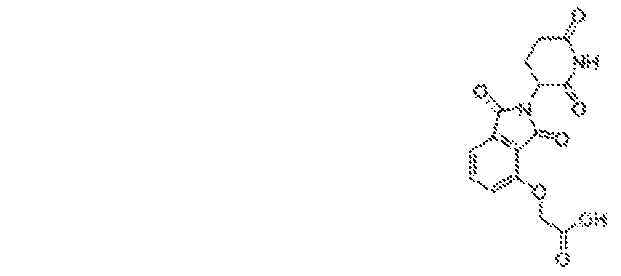
前記サリドマイド部分が、以下に示す構造を含む、項目64および67から73のいずれか一項に記載のペプチド小分子融合物。
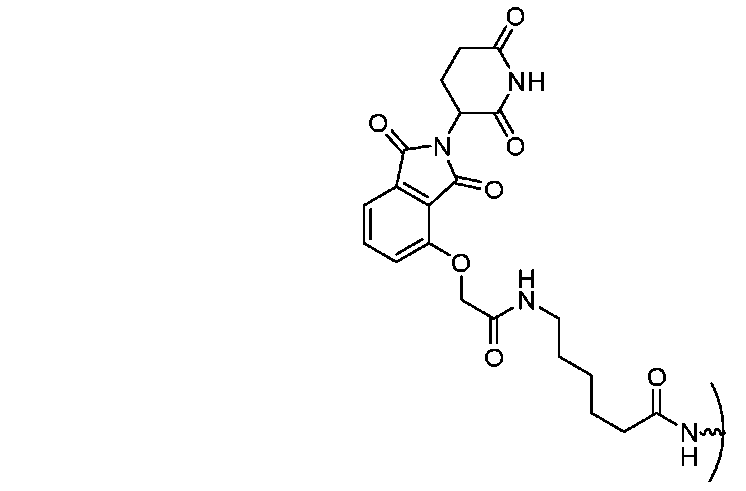
前記サリドマイド部分が、以下に示す構造を含む、項目68から73のいずれか一項に記載のペプチド小分子融合物。
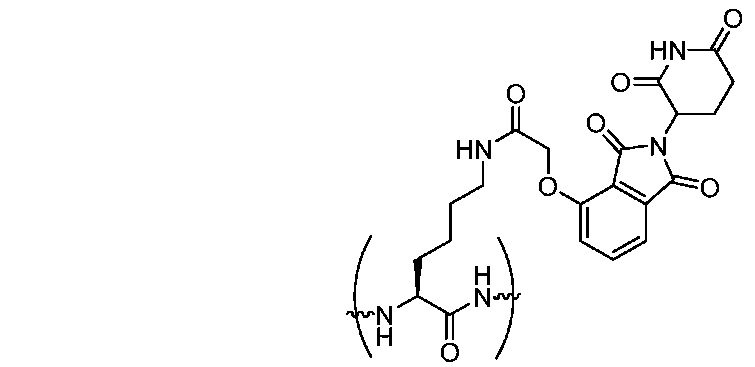
病理学的ペプチドまたはタンパク質によって引き起こされる疾患または障害を、それを必要とする対象において処置する方法であって、治療有効量の項目64から76のいずれか一項に記載のペプチド小分子融合物を前記対象に投与することを含む方法。
(項目78)
タンパク質を標的とするステープルペプチドおよびフォンヒッペルリンダウ(VHL)デグロン部分を含む、ペプチド小分子融合物。
(項目79)
前記VHLデグロン部分が、前記タンパク質を標的とするステープルペプチドのN末端にコンジュゲートしている、項目78に記載のペプチド小分子融合物。
(項目80)
前記VHLデグロン部分が以下の構造を含む、項目79に記載のペプチド小分子融合物。
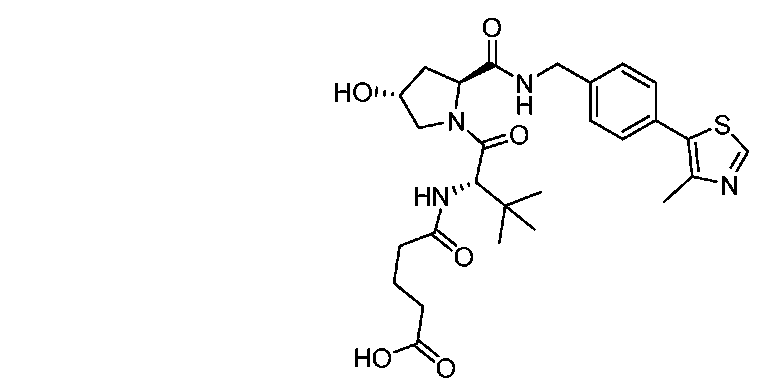
前記VHLデグロン部分が、前記タンパク質を標的とするステープルペプチドのC末端にコンジュゲートしている、項目78に記載のペプチド小分子融合物。
(項目82)
前記VHLデグロン部分が以下の構造を含む、項目81に記載のペプチド小分子。
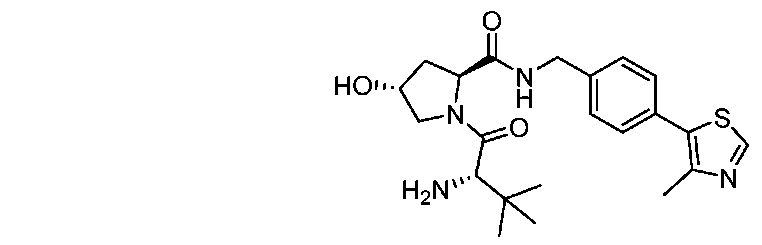
前記サリドマイド部分が、前記タンパク質を標的とするステープルペプチドのN末端とC末端との間のペプチド配列に挿入された非天然アミノ酸内に含まれる、項目78に記載のペプチド小分子融合物。
(項目84)
前記ステープルペプチドが、疾患の原因となるタンパク質を標的とする、項目78から83のいずれか一項に記載のペプチド小分子融合物。
(項目85)
前記ステープルペプチドが、細胞内タンパク質、受容体タンパク質、または細胞外タンパク質を標的とする、項目78から83のいずれか一項に記載のペプチド小分子融合物。
(項目86)
前記ステープルペプチドが、キラータンパク質(例えば、BAX、BAK)、または神経変性(例えば、IgG、ベータ-アミロイド、タウ、α-シヌクレイン、TDP-43、HbS、スーパーオキシドジスムターゼ、Notch3、FUS、GFAP)の原因となる細胞に損傷を与えるタンパク質を標的とする、項目78から84のいずれか一項に記載のペプチド小分子融合物。
(項目87)
前記細胞内タンパク質、受容体タンパク質、または細胞外タンパク質が、BCL2、BCLXL、MCL-1、BFL-1、BCL-w、BCL-B、EZH2、HDM2/HDMX、KRAS/NRAS/HRAS、MYC、b-カテニン、PI3K、PTEN、TSC、AKT、BRCA1/2、EWS-FLI、MLL融合物、受容体チロシンキナーゼ、HOXホモログ、JUN、サイクリンD、サイクリンE、BRAF、CRAF、CDK4、CDK2、HPV-E6/E7、オーロラキナーゼ、MITF、Wnt1、PD-1、BCR、およびCCR5からなる群から選択される、項目85に記載のペプチド小分子融合物。
(項目88)
前記ステープルペプチドが細菌性タンパク質を標的とする、項目78から83のいずれか一項に記載のペプチド小分子融合物。
(項目89)
前記ステープルペプチドがウイルス性タンパク質を標的とする、項目78から83のいずれか一項に記載のペプチド小分子融合物。
(項目90)
病理学的ペプチドまたはタンパク質によって引き起こされる疾患または障害を、それを必要とする対象において処置する方法であって、治療有効量の項目78から89のいずれか一項に記載のペプチド小分子融合物を前記対象に投与することを含む方法。
(項目91)
構成的光形態形成1(Cop1)タンパク質に結合するペプチドであって、アミノ酸配列DQIVPEY(配列番号25)の改変型を含み、前記改変型が、配列番号25中に少なくとも1個のアミノ酸置換、少なくとも1個のアミノ酸欠失、少なくとも1個のアミノ酸挿入、またはこれらの任意の組合せを含むが、前記改変型が単一のアミノ酸置換からなる場合、前記アミノ酸置換は、配列番号25の1から7位のうちのいずれか1つのAまたはRに対しても、配列番号25の4位のVに対しても行われていない、ペプチド。
(項目92)
少なくとも1個のアミノ酸置換を有することを除いて、配列番号25に記載のアミノ酸配列を含む、項目91に記載のペプチド。
(項目93)
少なくとも1個のアミノ酸欠失を有することを除いて、配列番号25に記載のアミノ酸配列を含む、項目91に記載のペプチド。
(項目94)
少なくとも1個のアミノ酸置換および少なくとも1個のアミノ酸欠失を有することを除いて、配列番号25に記載のアミノ酸配列を含む、項目91に記載のペプチド。
(項目95)
1から6個のアミノ酸置換を有することを除いて、配列番号25に記載のアミノ酸配列を含む、項目91に記載のペプチド。
(項目96)
配列番号25の4位(V)および/または5位(P)が置換されていない、項目91に記載のペプチド。
(項目97)
配列番号25の1位(D)、2位(Q)、3位(I)、および6位(E)のうちの1個または複数が置換されている、項目91に記載のペプチド。
(項目98)
1個のアミノ酸欠失を有することを除いて、配列番号25に記載のアミノ酸配列を含む、項目91に記載のペプチド。
(項目99)
配列番号25に記載のアミノ酸配列の7位(Y)が欠失している、項目91に記載のペプチド。
(項目100)
1から6個のアミノ酸置換および少なくとも1個のアミノ酸欠失を有することを除いて、配列番号25に記載のアミノ酸配列を含む、項目91に記載のペプチド。
(項目101)
配列番号26から30からなる群から選択されるアミノ酸配列を有する、項目91に記載のペプチド。
(項目102)
配列番号30に記載のアミノ酸配列を有する、項目91に記載のペプチド。
(項目103)
4から10個のアミノ酸長である、項目91から102のいずれか一項に記載のペプチド。
(項目104)
1nMから300nMの結合親和性でCop1に結合する、項目91から102のいずれか一項に記載のペプチド。
(項目105)
10nMから300nMの結合親和性でCop1に結合する、項目91から102のいずれか一項に記載のペプチド。
(項目106)
100nMから300nMの結合親和性でCop1に結合する、項目91から102のいずれか一項に記載のペプチド。
(項目107)
200nMから300nMの結合親和性でCop1に結合する、項目91から102のいずれか一項に記載のペプチド。
(項目108)
タンパク質を標的とするステープルペプチドおよび項目91から107のいずれか一項に記載のペプチドを含む、キメラ融合ポリペプチド。
(項目109)
前記ステープルペプチドが、細胞内タンパク質または細胞表面受容体を標的とする、項目108に記載のキメラ融合ポリペプチド。
(項目110)
前記ステープルペプチドが、疾患の原因となるか、または疾患に関連するタンパク質を標的とする、項目108に記載のキメラ融合ポリペプチド。
(項目111)
前記ステープルペプチドが、キラータンパク質(例えば、BAX、BAK)または神経変性の原因となる細胞に損傷を与えるタンパク質(例えば、IgG、ベータ-アミロイド、タウ、α-シヌクレイン、TDP-43、HbS、スーパーオキシドジスムターゼ、Notch3、FUS、GFAP)を標的とする、項目108に記載のキメラ融合ポリペプチド。
(項目112)
前記細胞内タンパク質または細胞表面受容体が、BCL2、BCLXL、MCL-1、BFL-1、BCL-w、BCL-B、EZH2、HDM2/HDMX、KRAS/NRAS/HRAS、MYC、β-カテニン、PI3K、PTEN、TSC、AKT、BRCA1/2、EWS-FLI融合物、MLL融合物、受容体チロシンキナーゼ、HOXホモログ、JUN、サイクリンD、サイクリンE、BRAF、CRAF、CDK4、CDK2、HPV-E6/E7、オーロラキナーゼ、MITF、Wnt1、PD-1、BCR、およびCCR5からなる群から選択される、項目109に記載のキメラ融合ポリペプチド。
(項目113)
前記ステープルペプチドが細菌性タンパク質を標的とする、項目108に記載のキメラ融合ポリペプチド。
(項目114)
前記ステープルペプチドがウイルス性タンパク質を標的とする、項目108に記載のキメラ融合ポリペプチド。
(項目115)
病理学的ペプチドまたはタンパク質によって引き起こされる疾患または障害を、それを必要とする対象において処置する方法であって、項目108から114のいずれか一項に記載の治療有効量の前記キメラ融合ポリペプチドを前記対象に投与することを含む方法。
OTHER EMBODIMENTS While the invention has been set forth in conjunction with the detailed description thereof, the foregoing description is intended to be illustrative and not limiting of the scope of the invention, which is defined by the scope of the appended claims. . Other aspects, advantages, and improvements are within the scope of the following claims.
In certain embodiments, for example, the following items are provided.
(Item 1)
A chimera comprising a first moiety linked to a second moiety,
said first portion binds to a first protein targeted for degradation;
The chimera, wherein said second moiety binds to a second protein, said second protein being a proteolytic inducer.
(Item 2)
The chimera of
(Item 3)
The chimera of
(Item 4)
4. Chimera according to any one of
(Item 5)
The first protein targeted for degradation is a killer protein, a protein that damages cells, a protein that causes neurodegeneration, BCL2, BCLXL, MCL-1, BFL-1, BCL-w, BCL-B , EZH2, HDM2/HDMX, KRAS/NRAS/HRAS, MYC, β-catenin, PI3K, PTEN, TSC, AKT, BRCA1/2, EWS-FLI fusion, MLL fusion, receptor tyrosine kinase, HOX homolog, JUN , cyclin D, cyclin E, BRAF, CRAF, CDK4, CDK2, HPV-E6/E7, Aurora kinase, MITF, Wnt1, PD-1, BCR, CCR5, bacterial protein, or viral protein from
(Item 6)
6. Chimera according to any one of
(Item 7)
7. The chimera of item 6, wherein said first staple peptide does not comprise a Bcl-2 homology 3 (BH3) domain polypeptide.
(Item 8)
Item 6, wherein said first staple peptide does not comprise (a) the Bcl-2
(Item 9)
9. Chimera according to any one of items 6 to 8, wherein said second portion is attached to the N-terminus of said first portion.
(Item 10)
9. Chimera according to any one of items 6 to 8, wherein said second portion is attached to the C-terminus of said first portion.
(Item 11)
9. Chimera according to any one of items 6 to 8, wherein said second portion is bound to an internal amino acid position of said first portion.
(Item 12)
12. Chimera according to any one of
(Item 13)
12. The chimera of any one of items 1-11, wherein said second portion comprises a peptide degron bound to said proteolysis-inducing agent.
(Item 14)
13. The chimera of any one of items 1-12, wherein said second portion comprises a second staple peptide that binds to said proteolysis-inducing agent.
(Item 15)
12. The chimera of any one of items 1-11, wherein said second portion comprises a small molecule that binds said protein degradation inducer.
(Item 16)
9. Any of items 1-8, wherein the second portion comprises a second staple peptide that binds to the proteolysis-inducing agent, and wherein the first portion is bound to the N-terminus of the second portion. or the chimera according to
(Item 17)
9. Any of items 1-8, wherein the second portion comprises a second staple peptide that binds to the proteolysis-inducing agent, and wherein the first portion is bound to the C-terminus of the second portion. A chimera according to
(Item 18)
9. The method of items 1-8, wherein said second portion comprises a second staple peptide that binds to said proteolysis-inducing agent, and wherein said first portion is bound to an internal amino acid position of said second portion. A chimera according to any one of paragraphs.
(Item 19)
19. Chimera according to any one of
(Item 20)
20. A method of treating a disease or disorder caused by a pathological peptide or protein in a subject in need thereof, comprising administering a therapeutically effective amount of a chimera according to any one of
(Item 21)
A chimeric polypeptide comprising a staple peptide and a peptide that binds to a WD40 repeat protein that is a substrate adapter for an E3 ubiquitin ligase, wherein the natural binding sequence or modified form of the natural binding consensus sequence of the amino acid sequence that binds to said WD40 repeat protein wherein said variant comprises at least one amino acid substitution, at least one amino acid deletion, at least one amino acid insertion, or any combination thereof within said naturally binding consensus sequence.
(Item 22)
The wd40 repeat protein, which is a substrate adapter for E3 Ubetsu Kitin Ligase, is MDM2, SKP2 -CKS1, FBXW1, FBXW2, FBXW4, FBXW5, FBXW7, FBXW7, FBXW9, FBXW10, FBXW11, FBXW11, FBXW11, FBXW11, FBXW11, FBXW11 W12, SPOP, VHL, ITCH, KEAP1, KLHL2, KLHL3, KLHL7, KLHL12, KLHL13, KLHL15, KLHL20, KLHL21, KLHL24, KLHL40, KLHL42, COP1, TRAF7, RFWD3, DCAF1, DCAF2, DCAF3, DCAF4, DCAF5, DCAF6, DCAF7, DCAF8 , DCAF9, DCAF10, DCAF11, DCAF12, 22. The chimeric polypeptide of item 21, selected from the group consisting of DCAF13, DCAF14, DCAF15, DCAF16, DCAF17, DCAF19, SIAH1, TRPC4AC, DET1, WSB1, WSB2, HERC1, DDB2, CSA, CBL, CDC20, and FZR1 .
(Item 23)
22. The chimeric polypeptide of item 21, wherein said natural binding consensus sequence is a sequence selected from the group consisting of SEQ ID NOs:25, 31-46, and 65-105.
(Item 24)
22. The chimeric polypeptide of item 21, wherein said natural binding sequence is SEQ ID NO:25.
(Item 25)
22. The chimeric polypeptide of item 21, wherein said natural binding consensus sequence is SEQ ID NO:46.
(Item 26)
25. The chimeric polypeptide of item 24, wherein said peptide comprises the amino acid sequence set forth in SEQ ID NO: 25, except that said peptide has at least one amino acid substitution.
(Item 27)
25. The chimeric polypeptide of item 24, wherein said peptide comprises the amino acid sequence set forth in SEQ ID NO: 25, except that said peptide has at least one amino acid deletion.
(Item 28)
25. The chimeric polypeptide of item 24, comprising the amino acid sequence set forth in SEQ ID NO: 25, except that said peptide has at least one amino acid substitution and at least one amino acid deletion.
(Item 29)
25. The chimeric polypeptide of item 24, wherein said peptide comprises the amino acid sequence set forth in SEQ ID NO: 25, except that said peptide has 1 to 6 amino acid substitutions.
(Item 30)
25. The chimeric polypeptide of item 24, wherein positions 4 (V) and 5 (P) of SEQ ID NO: 25 are unsubstituted.
(Item 31)
25. The chimeric polypeptide of item 24, wherein one or more of positions 1 (D), 2 (Q), 3 (I) and 6 (E) of SEQ ID NO:25 are substituted.
(Item 32)
25. The chimeric polypeptide of item 24, wherein said peptide comprises the amino acid sequence set forth in SEQ ID NO: 25, except that said peptide has a single amino acid deletion.
(Item 33)
25. The chimeric polypeptide of item 24, wherein position 7 (Y) of the amino acid sequence set forth in SEQ ID NO: 25 is deleted.
(Item 34)
25. The chimeric polypeptide of item 24, comprising the amino acid sequence set forth in SEQ ID NO: 25, except that said peptide has 1 to 6 amino acid substitutions and at least 1 amino acid deletion.
(Item 35)
25. The chimeric polypeptide of item 24, wherein said peptide has an amino acid sequence selected from the group consisting of SEQ ID NOs:26-30.
(Item 36)
25. The chimeric polypeptide of item 24, wherein said peptide has the amino acid sequence set forth in SEQ ID NO:30.
(Item 37)
37. The chimeric polypeptide of any one of items 24-36, wherein said peptide is 4 to 30 amino acids long.
(Item 38)
the peptide is
1 nM to 300 nM;
10 nM to 300 nM;
100 nM to 300 nM; or 200 nM to 300 nM
38. The chimeric polypeptide of any one of items 24 and 25-37, which binds to Cop1 with a binding affinity of .
(Item 39)
39. The chimeric polypeptide of any one of items 24-38, wherein said staple peptide targets an intracellular, extracellular or cell surface protein.
(Item 40)
39. The chimeric polypeptide of any one of items 24-38, wherein said staple peptide targets a disease-causing or disease-associated protein.
(Item 41)
The staple peptide is a killer protein (e.g., BAX, BAK) or a protein that damages cells that cause neurodegeneration (e.g., IgG, beta-amyloid, tau, α-synuclein, TDP-43, HbS, superoxide 39. The chimeric polypeptide of any one of items 24-38, which targets a dismutase, Notch3, FUS, GFAP).
(Item 42)
The staple peptide is BCL2, BCLXL, MCL-1, BFL-1, BCL-w, BCL-B, EZH2, HDM2/HDMX, KRAS/NRAS/HRAS, MYC, β-catenin, PI3K, PTEN, TSC, AKT , BRCA1/2, EWS-FLI fusion, MLL fusion, receptor tyrosine kinase, HOX homolog, JUN, cyclin D, cyclin E, BRAF, CRAF, CDK4, CDK2, HPV-E6/E7, Aurora kinase, MITF, 29. The chimeric polypeptide of any one of items 24-28, which targets a protein selected from the group consisting of Wnt1, PD-1, BCR and CCR5.
(Item 43)
29. The chimeric polypeptide of any one of items 24-28, wherein said staple peptide targets a bacterial protein.
(Item 44)
39. The chimeric polypeptide of any one of items 24-38, wherein said staple peptide targets a viral protein.
(Item 45)
A modified protein of the first protein comprising a structurally irregular region, wherein the structurally irregular region comprises a peptide that binds to a WD40 repeat protein that is a substrate adapter for an E3 ubiquitin ligase. 1, wherein said peptide comprises a native binding sequence or a variant of a native binding consensus sequence, said variant comprising at least one amino acid substitution, at least one amino acid deletion within said native binding consensus sequence; , at least one amino acid insertion, or any combination thereof.
(Item 46)
The wd40 repeat protein, which is a substrate adapter for E3 Ubetsu Kitin Ligase, is MDM2, SKP2 -CKS1, FBXW1, FBXW2, FBXW4, FBXW5, FBXW7, FBXW7, FBXW9, FBXW10, FBXW11, FBXW11, FBXW11, FBXW11, FBXW11, FBXW11 W12, SPOP, VHL, ITCH, KEAP1, KLHL2, KLHL3, KLHL7, KLHL12, KLHL13, KLHL15, KLHL20, KLHL21, KLHL24, KLHL40, KLHL42, COP1, TRAF7, RFWD3, DCAF1, DCAF2, DCAF3, DCAF4, DCAF5, DCAF6, DCAF7, DCAF8 , DCAF9, DCAF10, DCAF11, DCAF12, 46. The engineered protein of item 45, selected from the group consisting of DCAF13, DCAF14, DCAF15, DCAF16, DCAF17, DCAF19, SIAH1, TRPC4AC, DET1, WSB1, WSB2, HERC1, DDB2, CSA, CBL, CDC20, and FZR1.
(Item 47)
46. The variant protein of item 45, wherein said natural binding sequence or said natural binding consensus sequence is a sequence selected from the group consisting of SEQ ID NOS:25, 31-46, and 65-105.
(Item 48)
46. The engineered protein of item 45, wherein said native binding sequence is SEQ ID NO:25.
(Item 49)
46. The engineered protein of item 45, wherein said natural binding consensus sequence is SEQ ID NO:46.
(Item 50)
49. The variant protein of item 48, wherein said peptide comprises the amino acid sequence set forth in SEQ ID NO:25, except that said peptide has at least one amino acid substitution.
(Item 51)
49. The variant protein of item 48, wherein said peptide comprises the amino acid sequence set forth in SEQ ID NO:25, except that said peptide has at least one amino acid deletion.
(Item 52)
49. The variant protein of item 48, wherein said peptide comprises the amino acid sequence set forth in SEQ ID NO:25, except that said peptide has at least one amino acid substitution and at least one amino acid deletion.
(Item 53)
49. The variant protein of item 48, wherein said peptide comprises the amino acid sequence set forth in SEQ ID NO:25, except that said peptide has 1 to 6 amino acid substitutions.
(Item 54)
49. The variant protein of item 48, wherein positions 4 (V) and 5 (P) of SEQ ID NO: 25 are not substituted.
(Item 55)
49. The variant protein of item 48, wherein one or more of positions 1 (D), 2 (Q), 3 (I), and 6 (E) of SEQ ID NO:25 are substituted.
(Item 56)
49. The variant protein of item 48, wherein said peptide comprises the amino acid sequence set forth in SEQ ID NO:25, except that said peptide has a single amino acid deletion.
(Item 57)
49. The variant protein of item 48, wherein position 7 (Y) of the amino acid sequence set forth in SEQ ID NO: 25 is deleted.
(Item 58)
49. The peptide of item 48, comprising the amino acid sequence set forth in SEQ ID NO:25, except having 1 to 6 amino acid substitutions and at least 1 amino acid deletion.
(Item 59)
49. The peptide of item 48, having an amino acid sequence selected from the group consisting of SEQ ID NOS:26-30.
(Item 60)
49. The peptide of item 48, having the amino acid sequence set forth in SEQ ID NO:30.
(Item 61)
61. A peptide according to any one of items 45 to 60, which is 4 to 10 amino acids long.
(Item 62)
1 nM to 300 nM;
10 nM to 300 nM;
100 nM to 300 nM; or 200 nM to 300 nM
62. The peptide of any one of items 48, or 50-61, which binds to Cop1 with a binding affinity of .
(Item 63)
A method of treating a disease or disorder caused by a pathological peptide or protein in a subject in need thereof, comprising administering a therapeutically effective amount of the chimeric fusion polypeptide of any one of items 21-44. A method comprising administering to a subject.
(Item 64)
A peptide small molecule fusion comprising a protein-targeting staple peptide and a thalidomide degron moiety.
(Item 65)
65. The peptide small molecule fusion of item 64, wherein said thalidomide moiety is conjugated to the N-terminus of a staple peptide targeting said protein.
(Item 66)
65. The peptide small molecule fusion of item 64, wherein said thalidomide moiety is conjugated to the C-terminus of said protein-targeting staple peptide.
(Item 67)
65. The peptide small molecule fusion of item 64, wherein said thalidomide moiety is contained within a non-natural amino acid inserted into the peptide sequence between the N-terminus and C-terminus of said protein-targeting staple peptide.
(Item 68)
68. The peptide small molecule fusion of any one of items 64-67, wherein said staple peptide targets a disease-causing protein.
(Item 69)
68. The peptide small molecule fusion of any one of items 64-67, wherein said staple peptide targets an intracellular, receptor or extracellular protein.
(Item 70)
The staple peptide is responsible for killer proteins (e.g. BAX, BAK) or neurodegeneration (e.g. IgG, beta-amyloid, tau, α-synuclein, TDP-43, HbS, superoxide dismutase, Notch3, FUS, GFAP) 68. A peptide small molecule fusion according to any one of items 64 to 67, which targets a protein that damages the cells that cause it.
(Item 71)
said intracellular protein, receptor protein, or extracellular protein is BCL2, BCLXL, MCL-1, BFL-1, BCL-w, BCL-B, EZH2, HDM2/HDMX, KRAS/NRAS/HRAS, MYC, b -catenin, PI3K, PTEN, TSC, AKT, BRCA1/2, EWS-FLI, MLL fusion, receptor tyrosine kinase, HOX homolog, JUN, cyclin D, cyclin E, BRAF, CRAF, CDK4, CDK2, HPV-E6 /E7, Aurora kinase, MITF, Wnt1, PD-1, BCR, and CCR5.
(Item 72)
68. The peptide small molecule fusion of any one of items 64-67, wherein said staple peptide targets a bacterial protein.
(Item 73)
68. The peptide small molecule fusion of any one of items 64-67, wherein said staple peptide targets a viral protein.
(Item 74)
74. The peptide small molecule fusion of any one of items 64-73, wherein said thalidomide moiety comprises the structure shown below.
74. The peptide small molecule fusion of any one of items 64 and 67-73, wherein said thalidomide moiety comprises the structure shown below.
74. The peptide small molecule fusion of any one of items 68-73, wherein said thalidomide moiety comprises the structure shown below.
A method of treating a disease or disorder caused by a pathological peptide or protein in a subject in need thereof, comprising a therapeutically effective amount of the peptide small molecule fusion of any one of items 64 to 76. A method comprising administering to said subject.
(Item 78)
A peptide small molecule fusion comprising a protein-targeting staple peptide and a von Hippel-Lindau (VHL) degron moiety.
(Item 79)
79. The peptide small molecule fusion of item 78, wherein said VHL degron moiety is conjugated to the N-terminus of a staple peptide targeting said protein.
(Item 80)
80. The peptide small molecule fusion of item 79, wherein said VHL degron portion comprises the structure:
79. The peptide small molecule fusion of item 78, wherein said VHL degron moiety is conjugated to the C-terminus of said protein-targeting staple peptide.
(Item 82)
82. The small peptide molecule of item 81, wherein said VHL degron portion comprises the structure:
79. The peptide small molecule fusion of item 78, wherein said thalidomide moiety is contained within a non-natural amino acid inserted into the peptide sequence between the N-terminus and C-terminus of said protein-targeting staple peptide.
(Item 84)
84. The peptide small molecule fusion of any one of items 78-83, wherein said staple peptide targets a disease-causing protein.
(Item 85)
84. The peptide small molecule fusion of any one of items 78-83, wherein said staple peptide targets an intracellular, receptor or extracellular protein.
(Item 86)
The staple peptide is a killer protein (e.g., BAX, BAK) or neurodegenerative (e.g., IgG, beta-amyloid, tau, α-synuclein, TDP-43, HbS, superoxide dismutase, Notch3, FUS, GFAP) 85. A peptide small molecule fusion according to any one of items 78 to 84, which is targeted to a protein that causes cellular damage.
(Item 87)
said intracellular protein, receptor protein, or extracellular protein is BCL2, BCLXL, MCL-1, BFL-1, BCL-w, BCL-B, EZH2, HDM2/HDMX, KRAS/NRAS/HRAS, MYC, b -catenin, PI3K, PTEN, TSC, AKT, BRCA1/2, EWS-FLI, MLL fusion, receptor tyrosine kinase, HOX homolog, JUN, cyclin D, cyclin E, BRAF, CRAF, CDK4, CDK2, HPV-E6 /E7, Aurora kinase, MITF, Wnt1, PD-1, BCR, and CCR5.
(Item 88)
84. The peptide small molecule fusion of any one of items 78-83, wherein said staple peptide targets a bacterial protein.
(Item 89)
84. The peptide small molecule fusion of any one of items 78-83, wherein said staple peptide targets a viral protein.
(Item 90)
A method of treating a disease or disorder caused by a pathological peptide or protein in a subject in need thereof, comprising a therapeutically effective amount of the peptide small molecule fusion of any one of items 78-89. A method comprising administering to said subject.
(Item 91)
A peptide that binds to the constitutive photomorphogenesis 1 (Cop1) protein, comprising a variant of the amino acid sequence DQIVPEY (SEQ ID NO:25), said variant comprising at least one amino acid substitution in SEQ ID NO:25, at least containing one amino acid deletion, at least one amino acid insertion, or any combination thereof, but when said variant consists of a single amino acid substitution, said amino acid substitution is at
(Item 92)
92. The peptide of item 91, comprising the amino acid sequence set forth in SEQ ID NO: 25, except having at least one amino acid substitution.
(Item 93)
92. The peptide of item 91, comprising the amino acid sequence set forth in SEQ ID NO: 25, except having at least one amino acid deletion.
(Item 94)
92. The peptide of item 91, comprising the amino acid sequence set forth in SEQ ID NO:25, except having at least one amino acid substitution and at least one amino acid deletion.
(Item 95)
92. The peptide of item 91, comprising the amino acid sequence set forth in SEQ ID NO: 25, except having 1 to 6 amino acid substitutions.
(Item 96)
92. The peptide of item 91, wherein positions 4 (V) and/or 5 (P) of SEQ ID NO:25 are unsubstituted.
(Item 97)
92. The peptide of item 91, wherein one or more of positions 1 (D), 2 (Q), 3 (I) and 6 (E) of SEQ ID NO:25 are substituted.
(Item 98)
92. The peptide of item 91, comprising the amino acid sequence set forth in SEQ ID NO:25, except with a single amino acid deletion.
(Item 99)
92. The peptide of item 91, wherein position 7 (Y) of the amino acid sequence set forth in SEQ ID NO: 25 is deleted.
(Item 100)
92. The peptide of item 91, comprising the amino acid sequence set forth in SEQ ID NO:25, except having 1 to 6 amino acid substitutions and at least 1 amino acid deletion.
(Item 101)
92. The peptide of item 91, having an amino acid sequence selected from the group consisting of SEQ ID NOs:26-30.
(Item 102)
92. The peptide of item 91, having the amino acid sequence set forth in SEQ ID NO:30.
(Item 103)
103. The peptide of any one of items 91-102, which is 4 to 10 amino acids long.
(Item 104)
103. The peptide of any one of items 91-102, which binds to Cop1 with a binding affinity of 1 nM to 300 nM.
(Item 105)
103. The peptide of any one of items 91-102, which binds Cop1 with a binding affinity of 10 nM to 300 nM.
(Item 106)
103. The peptide of any one of items 91-102, which binds Cop1 with a binding affinity of 100 nM to 300 nM.
(Item 107)
103. The peptide of any one of items 91-102, which binds Cop1 with a binding affinity of 200 nM to 300 nM.
(Item 108)
A chimeric fusion polypeptide comprising a protein-targeting staple peptide and a peptide according to any one of items 91-107.
(Item 109)
109. The chimeric fusion polypeptide of item 108, wherein said staple peptide targets an intracellular protein or cell surface receptor.
(Item 110)
109. The chimeric fusion polypeptide of item 108, wherein said staple peptide targets a disease-causing or disease-associated protein.
(Item 111)
The staple peptide is a killer protein (e.g., BAX, BAK) or a protein that damages cells that cause neurodegeneration (e.g., IgG, beta-amyloid, tau, α-synuclein, TDP-43, HbS, superoxide 109. The chimeric fusion polypeptide of item 108, which targets dismutase, Notch3, FUS, GFAP).
(Item 112)
said intracellular protein or cell surface receptor is BCL2, BCLXL, MCL-1, BFL-1, BCL-w, BCL-B, EZH2, HDM2/HDMX, KRAS/NRAS/HRAS, MYC, β-catenin, PI3K , PTEN, TSC, AKT, BRCA1/2, EWS-FLI fusion, MLL fusion, receptor tyrosine kinase, HOX homolog, JUN, cyclin D, cyclin E, BRAF, CRAF, CDK4, CDK2, HPV-E6/E7 , Aurora kinase, MITF, Wnt1, PD-1, BCR, and CCR5.
(Item 113)
109. The chimeric fusion polypeptide of item 108, wherein said staple peptide targets a bacterial protein.
(Item 114)
109. The chimeric fusion polypeptide of item 108, wherein said staple peptide targets a viral protein.
(Item 115)
A method of treating a disease or disorder caused by a pathological peptide or protein in a subject in need thereof, comprising a therapeutically effective amount of said chimeric fusion polypeptide according to any one of items 108-114. A method comprising administering to said subject.
Claims (1)
Priority Applications (1)
| Application Number | Priority Date | Filing Date | Title |
|---|---|---|---|
| JP2025117357A JP2025137626A (en) | 2017-12-15 | 2025-07-11 | Degradation of target proteins mediated by stabilizing peptides |
Applications Claiming Priority (3)
| Application Number | Priority Date | Filing Date | Title |
|---|---|---|---|
| US201762599608P | 2017-12-15 | 2017-12-15 | |
| US62/599,608 | 2017-12-15 | ||
| JP2020532803A JP2021506814A (en) | 2017-12-15 | 2018-12-14 | Degradation of target proteins mediated by stabilizing peptides |
Related Parent Applications (1)
| Application Number | Title | Priority Date | Filing Date |
|---|---|---|---|
| JP2020532803A Division JP2021506814A (en) | 2017-12-15 | 2018-12-14 | Degradation of target proteins mediated by stabilizing peptides |
Related Child Applications (1)
| Application Number | Title | Priority Date | Filing Date |
|---|---|---|---|
| JP2025117357A Division JP2025137626A (en) | 2017-12-15 | 2025-07-11 | Degradation of target proteins mediated by stabilizing peptides |
Publications (1)
| Publication Number | Publication Date |
|---|---|
| JP2023107892A true JP2023107892A (en) | 2023-08-03 |
Family
ID=65201672
Family Applications (3)
| Application Number | Title | Priority Date | Filing Date |
|---|---|---|---|
| JP2020532803A Pending JP2021506814A (en) | 2017-12-15 | 2018-12-14 | Degradation of target proteins mediated by stabilizing peptides |
| JP2023096835A Pending JP2023107892A (en) | 2017-12-15 | 2023-06-13 | Degradation of target proteins mediated by stabilizing peptides |
| JP2025117357A Pending JP2025137626A (en) | 2017-12-15 | 2025-07-11 | Degradation of target proteins mediated by stabilizing peptides |
Family Applications Before (1)
| Application Number | Title | Priority Date | Filing Date |
|---|---|---|---|
| JP2020532803A Pending JP2021506814A (en) | 2017-12-15 | 2018-12-14 | Degradation of target proteins mediated by stabilizing peptides |
Family Applications After (1)
| Application Number | Title | Priority Date | Filing Date |
|---|---|---|---|
| JP2025117357A Pending JP2025137626A (en) | 2017-12-15 | 2025-07-11 | Degradation of target proteins mediated by stabilizing peptides |
Country Status (7)
| Country | Link |
|---|---|
| US (2) | US20200354413A1 (en) |
| EP (1) | EP3724216A1 (en) |
| JP (3) | JP2021506814A (en) |
| CN (2) | CN112119085B (en) |
| AU (2) | AU2018385697B2 (en) |
| CA (1) | CA3078682A1 (en) |
| WO (1) | WO2019118893A1 (en) |
Families Citing this family (17)
| Publication number | Priority date | Publication date | Assignee | Title |
|---|---|---|---|---|
| JP7515175B2 (en) | 2018-07-31 | 2024-07-12 | ファイメクス株式会社 | Heterocyclic compounds |
| CN113677664B (en) | 2019-04-12 | 2025-04-04 | C4医药公司 | Tricyclic degradants of IKAROS and AIOLOS |
| CN111393519B (en) * | 2019-11-21 | 2022-11-08 | 中国药科大学 | Novel stapled peptides as KRASG12C/SOS1 inhibitors and their uses |
| US12042513B2 (en) * | 2020-01-10 | 2024-07-23 | Massachusetts Institute Of Technology | Proteolysis targeting chimeric molecules (PROTACs) with functional handles and uses thereof |
| US20220025341A1 (en) * | 2020-05-29 | 2022-01-27 | Massachusetts Institute Of Technology | Minimal peptide fusions for targeted intracellular protein degradation |
| US12187816B2 (en) * | 2020-06-23 | 2025-01-07 | Genentech, Inc. | Macrocyclic compounds and methods of use thereof |
| WO2022047734A1 (en) * | 2020-09-04 | 2022-03-10 | 孔二艳 | Use of gfap amino acid site as target for treatment of neurodegenerative diseases |
| WO2022081827A1 (en) | 2020-10-14 | 2022-04-21 | Dana-Farber Cancer Institute, Inc. | Chimeric conjugates for degradation of viral and host proteins and methods of use |
| GB202018608D0 (en) * | 2020-11-26 | 2021-01-13 | Zentraza Ltd | Adhesive peptides |
| EP4263577A1 (en) * | 2020-12-18 | 2023-10-25 | John Innes Centre | Methods for targeted protein degradation |
| WO2022194087A1 (en) * | 2021-03-16 | 2022-09-22 | Cullgen (Shanghai) , Inc. | Modified proteins and protein binders |
| CN113845598B (en) * | 2021-09-18 | 2023-06-30 | 中国人民解放军海军军医大学 | Protein targeting chimera degradation MDM2/MDMX protein staple peptide conjugate and application thereof |
| US20230257725A1 (en) * | 2021-10-22 | 2023-08-17 | Massachusetts Institute Of Technology | Minimal Peptide Fusions for Targeted Intracellular Degradation of FOXP3 |
| WO2023203127A1 (en) | 2022-04-20 | 2023-10-26 | Vib Vzw | Alphabody-based degrader molecules |
| WO2023225625A2 (en) * | 2022-05-19 | 2023-11-23 | The Scripps Research Institute | Bifunctional degraders comprising electrophilic protacs that engage dcaf1 and pharmaceutical compositions comprising the same |
| WO2024233318A1 (en) * | 2023-05-05 | 2024-11-14 | Senti Biosciences, Inc. | Modified degron polypeptides and uses thereof |
| CN117904060B (en) * | 2023-12-21 | 2024-09-24 | 上海大学 | PARKIN-based targeted protein ubiquitination degradation agent and preparation method and application thereof |
Citations (3)
| Publication number | Priority date | Publication date | Assignee | Title |
|---|---|---|---|---|
| JP2010518017A (en) * | 2007-01-31 | 2010-05-27 | ダナ−ファーバー キャンサー インスティテュート インク. | Stabilized p53 peptides and methods of use thereof |
| JP2015509940A (en) * | 2012-02-15 | 2015-04-02 | エイルロン セラピューティクス,インコーポレイテッド | Peptidomimetic macrocycle |
| WO2017030814A1 (en) * | 2015-08-19 | 2017-02-23 | Arvinas, Inc. | Compounds and methods for the targeted degradation of bromodomain-containing proteins |
Family Cites Families (69)
| Publication number | Priority date | Publication date | Assignee | Title |
|---|---|---|---|---|
| US5446090A (en) | 1993-11-12 | 1995-08-29 | Shearwater Polymers, Inc. | Isolatable, water soluble, and hydrolytically stable active sulfones of poly(ethylene glycol) and related polymers for modification of surfaces and molecules |
| WO1998001467A2 (en) | 1996-07-05 | 1998-01-15 | Novartis Ag | Inhibitors of the interaction between p53 and mdm2 |
| US20020064546A1 (en) | 1996-09-13 | 2002-05-30 | J. Milton Harris | Degradable poly(ethylene glycol) hydrogels with controlled half-life and precursors therefor |
| CA2316834C (en) | 1998-01-07 | 2006-01-03 | Shearwater Polymers, Inc. | Degradable heterobifunctional poly(ethylene glycol) acrylates and gels and conjugates derived therefrom |
| US7192713B1 (en) | 1999-05-18 | 2007-03-20 | President And Fellows Of Harvard College | Stabilized compounds having secondary structure motifs |
| US6348558B1 (en) | 1999-12-10 | 2002-02-19 | Shearwater Corporation | Hydrolytically degradable polymers and hydrogels made therefrom |
| BR0001870B1 (en) | 2000-05-29 | 2014-02-25 | Peptide, peptide production process, formulation comprising peptide, parasite, fungal and bacterial growth prevention method, method for inactivating gram-negative endotoxin | |
| CN107090025A (en) | 2003-11-05 | 2017-08-25 | 达纳-法伯癌症研究所股份有限公司 | Stable alpha helical peptides and application thereof |
| US8324153B2 (en) | 2008-05-06 | 2012-12-04 | New York Blood Center, Inc. | Antiviral cell-penetrating peptides |
| US8937154B2 (en) | 2006-10-05 | 2015-01-20 | New York Blood Center, Inc. | Stabilized therapeutic small helical antiviral peptides |
| EP2564862B1 (en) | 2007-02-23 | 2017-08-02 | Aileron Therapeutics, Inc. | Substituted amino acids for preparing triazole linked macrocyclic peptides |
| ES2430067T3 (en) | 2007-03-28 | 2013-11-18 | President And Fellows Of Harvard College | Sewn polypeptides |
| US8921323B2 (en) | 2007-09-26 | 2014-12-30 | Dana Farber Cancer Institute, Inc. | Methods and compositions for modulating BCL-2 family polypeptides |
| GB0804701D0 (en) | 2008-03-13 | 2008-04-16 | Amura Therapeutics Ltd | Compounds |
| WO2010011313A2 (en) | 2008-07-23 | 2010-01-28 | President And Fellows Of Harvard College | Ligation of stapled polypeptides |
| EP2334317B1 (en) | 2008-09-16 | 2017-06-14 | The Research Foundation Of State University Of New York | Stapled peptides and method of synthesis |
| EP2342222B1 (en) | 2008-09-22 | 2018-03-21 | Aileron Therapeutics, Inc. | Peptidomimetic macrocycles |
| US9458202B2 (en) | 2008-11-24 | 2016-10-04 | Aileron Therapeutics, Inc. | Peptidomimetic macrocycles with improved properties |
| CA2746256C (en) | 2008-12-09 | 2020-03-24 | Loren D. Walensky | Methods and compositions for specific modulation of mcl-1 |
| BRPI1006139A2 (en) | 2009-01-14 | 2017-05-30 | Aileron Therapeutics Inc | peptidomimetic macrocycles |
| CA3037721A1 (en) | 2009-06-18 | 2010-12-23 | Dana Farber Cancer Institute, Inc. | Structured viral peptide compositions and methods of use |
| CA2768299C (en) | 2009-07-13 | 2018-03-20 | President And Fellows Of Harvard College | Bifunctional stapled polypeptides and uses thereof |
| TR201815882T4 (en) | 2009-12-10 | 2018-11-21 | Univ Iowa State Res Found Inc | Tal effector mediated DNA modification. |
| US9227995B2 (en) | 2010-04-23 | 2016-01-05 | Øyvind Jacobsen | Peptides |
| US9297017B2 (en) | 2010-06-08 | 2016-03-29 | University Of Washington | Methods and compositions for targeted protein degradation |
| EP2588129A4 (en) | 2010-06-30 | 2014-07-09 | Univ Brandeis | DEGRADATION OF PROTEIN TARGETED BY SMALL MOLECULES |
| EP2590997B1 (en) | 2010-07-09 | 2018-04-04 | Dana-Farber Cancer Institute, Inc. | Stabilized insulinotropic peptides and methods of use |
| DK2603600T3 (en) | 2010-08-13 | 2019-03-04 | Aileron Therapeutics Inc | PEPTIDOMIMETIC MACROCYCLES |
| US8957026B2 (en) | 2010-09-22 | 2015-02-17 | President And Fellows Of Harvard College | Beta-catenin targeting peptides and uses thereof |
| US10822374B2 (en) | 2010-11-12 | 2020-11-03 | Dana-Farber Cancer Institute, Inc. | Cancer therapies and diagnostics |
| CN103502275A (en) | 2010-12-07 | 2014-01-08 | 耶鲁大学 | Small-molecule hydrophobic tagging of fusion proteins and induced degradation of same |
| US8762795B2 (en) | 2010-12-17 | 2014-06-24 | Microsoft Corporation | Alerting recipients to errors occurring when accessing external services |
| EP2753635A4 (en) | 2011-09-09 | 2015-08-12 | Agency Science Tech & Res | PEPTIDES THAT ACTIVATE P53 PROTEIN |
| CA2852468A1 (en) | 2011-10-18 | 2013-04-25 | Aileron Therapeutics, Inc. | Peptidomimetic macrocyles |
| US9346868B2 (en) | 2011-11-14 | 2016-05-24 | Carlos Witte-Hoffmann | BLID; a novel protein domain for interaction with the Bcl-2 family of proteins. Applications in oncology |
| US9408885B2 (en) | 2011-12-01 | 2016-08-09 | Vib Vzw | Combinations of therapeutic agents for treating melanoma |
| WO2013116829A1 (en) | 2012-02-03 | 2013-08-08 | The Trustees Of Princeton University | Novel engineered potent cytotoxic stapled bh3 peptides |
| WO2013173755A1 (en) | 2012-05-18 | 2013-11-21 | The Regents Of The University Of California | Modification of peptides using a bis(thioether)arylbridge approach |
| WO2014052647A2 (en) | 2012-09-26 | 2014-04-03 | President And Fellows Of Harvard College | Proline-locked stapled peptides and uses thereof |
| WO2014053881A1 (en) | 2012-10-04 | 2014-04-10 | Centre National De La Recherche Scientifique | Cell penetrating peptides for intracellular delivery of molecules |
| WO2014053879A1 (en) | 2012-10-04 | 2014-04-10 | Centre National De La Recherche Scientifique | Cell penetrating peptides for intracellular delivery of molecules |
| KR101616603B1 (en) | 2012-10-11 | 2016-04-28 | 서울대학교산학협력단 | Methyl degron peptide and methods of controlling protein life span |
| EP4234696A3 (en) | 2012-12-12 | 2023-09-06 | The Broad Institute Inc. | Crispr-cas component systems, methods and compositions for sequence manipulation |
| WO2014097178A1 (en) | 2012-12-18 | 2014-06-26 | Jawaharlal Nehru Centre For Advanced Scientific Research | Antimicrobial compounds, their synthesis and applications thereof |
| WO2014110420A1 (en) | 2013-01-10 | 2014-07-17 | Noliva Therapeutics Llc | Peptidomimetic compounds |
| US9115184B2 (en) | 2013-03-01 | 2015-08-25 | The Board Of Trustees Of The Leland Stanford Junior University | Light-inducible system for regulating protein stability |
| EP2983687B1 (en) | 2013-03-15 | 2019-09-04 | The Regents of The University of California | Peptides having reduced toxicity that stimulate cholesterol efflux |
| US9234213B2 (en) | 2013-03-15 | 2016-01-12 | System Biosciences, Llc | Compositions and methods directed to CRISPR/Cas genomic engineering systems |
| JP2017503749A (en) | 2013-10-01 | 2017-02-02 | プレジデント アンド フェローズ オブ ハーバード カレッジ | Stabilized polypeptides and uses thereof |
| WO2015070083A1 (en) | 2013-11-07 | 2015-05-14 | Editas Medicine,Inc. | CRISPR-RELATED METHODS AND COMPOSITIONS WITH GOVERNING gRNAS |
| US20150165054A1 (en) | 2013-12-12 | 2015-06-18 | President And Fellows Of Harvard College | Methods for correcting caspase-9 point mutations |
| WO2015108955A2 (en) | 2014-01-15 | 2015-07-23 | The Board Of Regents Of The University Of Texas System | Targeting of pelp1 in cancer therapy |
| WO2015134539A1 (en) | 2014-03-03 | 2015-09-11 | The Regents Of The University Of California | Mcl-1 antagonists |
| CA2947622A1 (en) | 2014-05-13 | 2015-11-19 | Sangamo Biosciences, Inc. | Genome editing methods and compositions for prevention or treatment of a disease |
| CA2949535C (en) | 2014-05-21 | 2023-09-12 | President And Fellows Of Harvard College | Ras inhibitory peptides and uses thereof |
| US9616090B2 (en) | 2014-07-30 | 2017-04-11 | Sangamo Biosciences, Inc. | Gene correction of SCID-related genes in hematopoietic stem and progenitor cells |
| US9816080B2 (en) | 2014-10-31 | 2017-11-14 | President And Fellows Of Harvard College | Delivery of CAS9 via ARRDC1-mediated microvesicles (ARMMs) |
| JP2017538427A (en) | 2014-12-18 | 2017-12-28 | インテグレイテッド ディーエヌエイ テクノロジーズ インコーポレイテッド | CRISPR composition and method of use |
| JP6815318B2 (en) * | 2014-12-23 | 2021-01-20 | ダナ−ファーバー キャンサー インスティテュート,インコーポレイテッド | How to Induce Targeted Proteolysis by Bifunctional Molecules |
| US9694084B2 (en) | 2014-12-23 | 2017-07-04 | Dana-Farber Cancer Institute, Inc. | Methods to induce targeted protein degradation through bifunctional molecules |
| PL3250691T3 (en) | 2015-01-28 | 2023-11-27 | Caribou Biosciences, Inc. | Crispr hybrid dna/rna polynucleotides and methods of use |
| US9790490B2 (en) | 2015-06-18 | 2017-10-17 | The Broad Institute Inc. | CRISPR enzymes and systems |
| US10059741B2 (en) | 2015-07-01 | 2018-08-28 | Aileron Therapeutics, Inc. | Peptidomimetic macrocycles |
| AU2016287754B2 (en) | 2015-07-02 | 2021-02-25 | Dana-Farber Cancer Institute, Inc. | Stabilized anti-microbial peptides |
| AU2016316842C1 (en) * | 2015-08-28 | 2021-04-22 | Dana-Farber Cancer Institute, Inc. | Peptides binding to BFL-1 |
| WO2017040323A2 (en) * | 2015-08-28 | 2017-03-09 | Dana-Farber Cancer Institute, Inc. | Stabilized peptides for covalent binding to target protein |
| WO2017151617A1 (en) | 2016-02-29 | 2017-09-08 | Dana-Farber Cancer Institute, Inc. | Stapled intracellular-targeting antimicrobial peptides to treat infection |
| EP3433261A4 (en) | 2016-03-23 | 2019-12-04 | Dana-Farber Cancer Institute, Inc. | COMPOSITIONS, ASSAYS AND METHODS FOR TARGETING HDM2 AND HDMX FOR INVERTING P53 INHIBITION IN PEDIATRIC CANCERS |
| JP2019522633A (en) * | 2016-05-20 | 2019-08-15 | ジェネンテック, インコーポレイテッド | PROTAC antibody conjugates and methods of use |
-
2018
- 2018-12-14 US US16/766,083 patent/US20200354413A1/en not_active Abandoned
- 2018-12-14 AU AU2018385697A patent/AU2018385697B2/en active Active
- 2018-12-14 CN CN201880088640.9A patent/CN112119085B/en active Active
- 2018-12-14 EP EP18839646.9A patent/EP3724216A1/en active Pending
- 2018-12-14 JP JP2020532803A patent/JP2021506814A/en active Pending
- 2018-12-14 CN CN202510303424.3A patent/CN120118207A/en active Pending
- 2018-12-14 CA CA3078682A patent/CA3078682A1/en active Pending
- 2018-12-14 WO PCT/US2018/065784 patent/WO2019118893A1/en not_active Ceased
-
2023
- 2023-02-23 US US18/113,539 patent/US20240140999A1/en active Pending
- 2023-06-13 JP JP2023096835A patent/JP2023107892A/en active Pending
-
2024
- 2024-01-29 AU AU2024200512A patent/AU2024200512B2/en active Active
-
2025
- 2025-07-11 JP JP2025117357A patent/JP2025137626A/en active Pending
Patent Citations (3)
| Publication number | Priority date | Publication date | Assignee | Title |
|---|---|---|---|---|
| JP2010518017A (en) * | 2007-01-31 | 2010-05-27 | ダナ−ファーバー キャンサー インスティテュート インク. | Stabilized p53 peptides and methods of use thereof |
| JP2015509940A (en) * | 2012-02-15 | 2015-04-02 | エイルロン セラピューティクス,インコーポレイテッド | Peptidomimetic macrocycle |
| WO2017030814A1 (en) * | 2015-08-19 | 2017-02-23 | Arvinas, Inc. | Compounds and methods for the targeted degradation of bromodomain-containing proteins |
Non-Patent Citations (3)
| Title |
|---|
| CROMM, PM ET AL.: "Targeted Protein Degradation: from Chemical Biology to Drug Discovery", CELL CHEMICAL BIOLOGY REVIEW, vol. 24, JPN6022052972, 21 September 2017 (2017-09-21), pages 1181 - 1190, ISSN: 0005570874 * |
| OTTIS, P ET AL.: "Proteolysis-Targeting Chimeras: Induced Protein Degradation as a Therapeutic Strategy", ACS CHEMICAL BIOLOGY, vol. 12, JPN6024049732, March 2017 (2017-03-01), pages 892 - 898, ISSN: 0005570875 * |
| RICHARDSON, SL: "Towards the development of a peptide-PROTAC conjugate targeting a viral protein: Rational design and", DIVISION OF MEDICINAL CHEMISTRY SCIENTIFIC ABSTRACTS FOR THE 254TH NATIONAL MEETING AND EXPOSITION, JPN6022052973, August 2017 (2017-08-01), pages 96, ISSN: 0005570873 * |
Also Published As
| Publication number | Publication date |
|---|---|
| CA3078682A1 (en) | 2019-06-20 |
| AU2024200512B2 (en) | 2026-01-08 |
| JP2025137626A (en) | 2025-09-19 |
| JP2021506814A (en) | 2021-02-22 |
| CN112119085B (en) | 2025-04-01 |
| EP3724216A1 (en) | 2020-10-21 |
| WO2019118893A1 (en) | 2019-06-20 |
| AU2024200512A1 (en) | 2024-02-15 |
| US20200354413A1 (en) | 2020-11-12 |
| AU2018385697A1 (en) | 2020-04-30 |
| AU2018385697B2 (en) | 2023-11-09 |
| CN112119085A (en) | 2020-12-22 |
| US20240140999A1 (en) | 2024-05-02 |
| CN120118207A (en) | 2025-06-10 |
Similar Documents
| Publication | Publication Date | Title |
|---|---|---|
| AU2024200512B2 (en) | Stabilized peptide-mediated targeted protein degradation | |
| US8889632B2 (en) | Stabilized p53 peptides and uses thereof | |
| US20240294574A1 (en) | Stabilized peptides for covalent binding to target protein | |
| JP7394903B2 (en) | Peptide that binds to BFL-1 | |
| US20230330238A1 (en) | Chimeric conjugates for degradation of viral and host proteins and methods of use | |
| JP7575944B2 (en) | Selective targeting of apoptotic proteins with structure-stabilizing and/or cysteine-responsive NOXA peptides | |
| HK40126659A (en) | Stabilized peptide-mediated targeted protein degradation |
Legal Events
| Date | Code | Title | Description |
|---|---|---|---|
| A621 | Written request for application examination |
Free format text: JAPANESE INTERMEDIATE CODE: A621 Effective date: 20230712 |
|
| A131 | Notification of reasons for refusal |
Free format text: JAPANESE INTERMEDIATE CODE: A131 Effective date: 20240703 |
|
| A521 | Request for written amendment filed |
Free format text: JAPANESE INTERMEDIATE CODE: A523 Effective date: 20241001 |
|
| A131 | Notification of reasons for refusal |
Free format text: JAPANESE INTERMEDIATE CODE: A131 Effective date: 20241205 |
|
| A521 | Request for written amendment filed |
Free format text: JAPANESE INTERMEDIATE CODE: A523 Effective date: 20250212 |
|
| A131 | Notification of reasons for refusal |
Free format text: JAPANESE INTERMEDIATE CODE: A131 Effective date: 20250414 |
|
| A521 | Request for written amendment filed |
Free format text: JAPANESE INTERMEDIATE CODE: A523 Effective date: 20250711 |
|
| A02 | Decision of refusal |
Free format text: JAPANESE INTERMEDIATE CODE: A02 Effective date: 20250918 |
|
| RD03 | Notification of appointment of power of attorney |
Free format text: JAPANESE INTERMEDIATE CODE: A7423 Effective date: 20251208 |
|
| RD04 | Notification of resignation of power of attorney |
Free format text: JAPANESE INTERMEDIATE CODE: A7424 Effective date: 20251211 |